/























































Автор: Khalid A.
Теги: history politics islam geography history of asia central asia modern central asia university of california press
ISBN: 0-520-21355-6
Год: 1984

Текст
The Politics of Muslim Cultural Reform
Com parative Studies on M uslim Societies
General Editor, Barbara D. Metcalf
1.
Islam and the Political Economy o f Meaning, edited by William R. Roff
2.
Libyan Politics: Tribe and Revolution, by John Davis
3.
Prophecy Continuous: Aspects o f Afymadi Religious Thought and Its
Medieval Background, by Yohanan Friedmann
4.
SharVat and Ambiguity in South Asian Islam, edited by Katherine R
Ewing
5.
Islam, Politics, and Social Movements, edited by Edmund Burke, III,
and Ira M. Lapidus
6.
Roots o f North Indian ShVism in Iran and Iraq: Religion and State
in Awadh, 1722-1859, by J. R. I. Cole
7.
Empire and Islam: Punjab and the Making o f Pakistan, by
David Gilmartin
8.
Islam and the Russian Empire: Reform and Revolution in Central Asia,
by Hélène Carrère d’Encausse
9.
Muslim Travellers: Pilgrimage, Migration, and the Religious Imagina
tion, edited by Dale F. Eickelman and James Piscatori
10.
The Dervish Lodge: Architecture, Art, and Sufism in Ottoman Turkey,
edited by Raymond Lifchez
11.
The Seed and the Soil: Gender and Cosmology in Turkish Village
Society, by Carol Delaney
12.
Displaying the Orient: Architecture o f Islam at Nineteenth-Century
World's Fairs, by Zeynep Çelik
13.
Arab Voices: The Human Rights Debate in the Middle East,
by Kevin Dwyer
14.
Disorienting Encounters: Travels o f a Moroccan Scholar in France in
1845-1846, The Voyage o f Muhammad a$-$äffar, translated and edited
by Susan Gilson Miller
15.
Beyond the Stream: Islam and Society in a West African Town,
by Robert Launay
16.
The Calligraphic State: Textual Domination and History in a Muslim
Society, by Brinkley Messick
17.
The Rise o f Islam and the Bengal Frontier, 1204-1760, by Richard Eaton
18.
Rebel and Saint: Muslim Notables, Populist Protest, Colonial Encounters
(Algeria and Tunisia, 1800-1904), by Julia A. Clancy-Smith
19.
The Vanguard o f the Islamic Revolution: The Jama'at-i Islami o f Paki
stan, by Seyyed Vali Reza Nasr
20.
The Prophet’s Pulpit: Islamic Preaching in Contemporary Egypt,
by Patrick D. Gaffney
21.
Heroes o f the Age: Moral Faultlines on the Afghan Frontier, by David B.
Edwards
22.
Making Muslim Space in North America and Europe, edited by
Barbara D. Metcalf
23.
Nationalism and the Genealogical Imagination: Oral History and
Textual Authority in Tribal Jordan, by Andrew Shryock
24.
Between Marriage and the Market: Intimate Politics and Survival
in Cairo, by Homa Hoodfar
25.
Putting Islam to Work: Education, Politics, and Religious Transforma
tion in Egypt, by Gregory Starrett
26.
Muslim Rulers and Rebels: Everyday Politics and Armed Separatism
in the Southern Philippines, by Thomas M. McKenna
27.
The Politics o f Muslim Cultural Reform: Jadidism in Central Asia,
by Adeeb Khalid
Abdurrauf Fitrat with two unidentified persons, ca. 1920.
The Politics
of Muslim
Cultural Reform
Jadidism in Central Asia
Adeeb Khalid
UNIVERSITY OF CALIFORNIA PRESS
Berkeley
•
Los Angeles
•
London
University of California Press
Berkeley and Los Angeles, California
University of California Press, Ltd.
London, England
© 1998 by
The Regents of the University of California
Library of Congress Cataloging-in-Publication Data
Khalid, Adeeb, 1964The politics of Muslim cultural reform : jadidism in
Central Asia / Adeeb Khalid.
p. cm.— (Comparative studies on Muslim societies ; 27)
Includes bibliographical references and index.
ISBN 0-520-21355-6 (alk. paper). — isbn 0-520-21356-4
(alk. paper)
i. Islam—Asia, Central. 2. Islam and politics—Asia,
Central. 3. Islam and state—Asia Central. 4. Islam—Social
aspects—Asia, Central. 5. Asia, Central—Politics and
government. I. Title. II. Series.
BP63.A34K54 1998
9 5 8 \ o4— dc2i
98-4189
CIP
Printed in the United States of America
This book is a print-on-demand volume. It is
manufactured using toner in place of ink. Type and
images may be less sharp than the same material seen in
traditionally printed University of California Press editions.
©The paper used in this publication meets the
minimum requirements of American National
Standards for Information Sciences—Permanence
of Paper for Printed Library Materials,
ansi Z39.48-1984.
for my parents
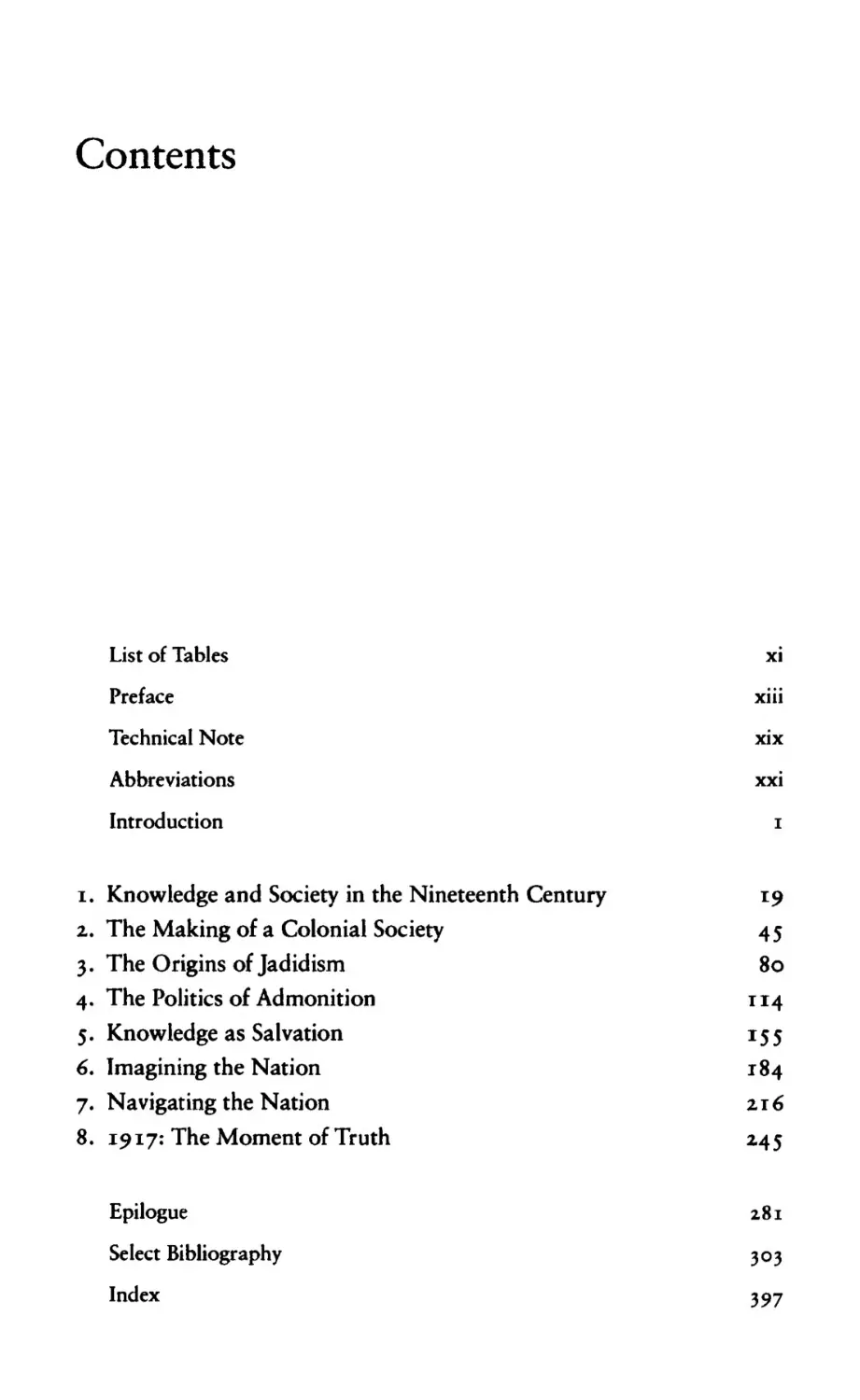
Contents
List of Tables
Preface
xiii
Technical Note
xix
Abbreviations
xxi
Introduction
1.
2.
3.
4.
5.
6.
7.
8.
xi
i
Knowledge and Society in the Nineteenth Century
The Making of a Colonial Society
The Origins of Jadidism
The Politics of Admonition
Knowledge as Salvation
Imagining the Nation
Navigating the Nation
1917: The Moment of Truth
19
45
80
114
155
184
216
245
Epilogue
281
Select Bibliography
303
Index
397
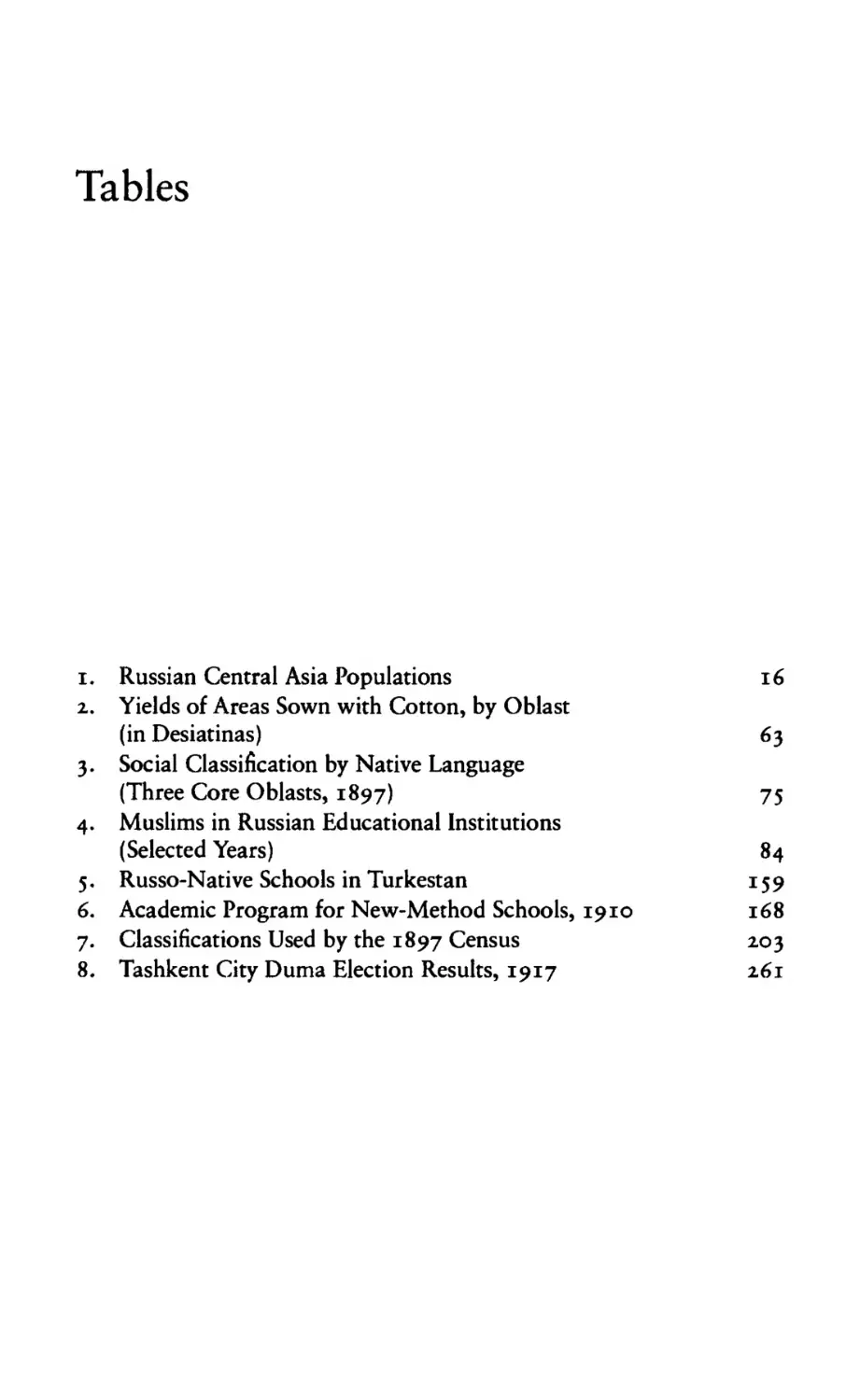
Tables
1.
2.
Russian Central Asia Populations
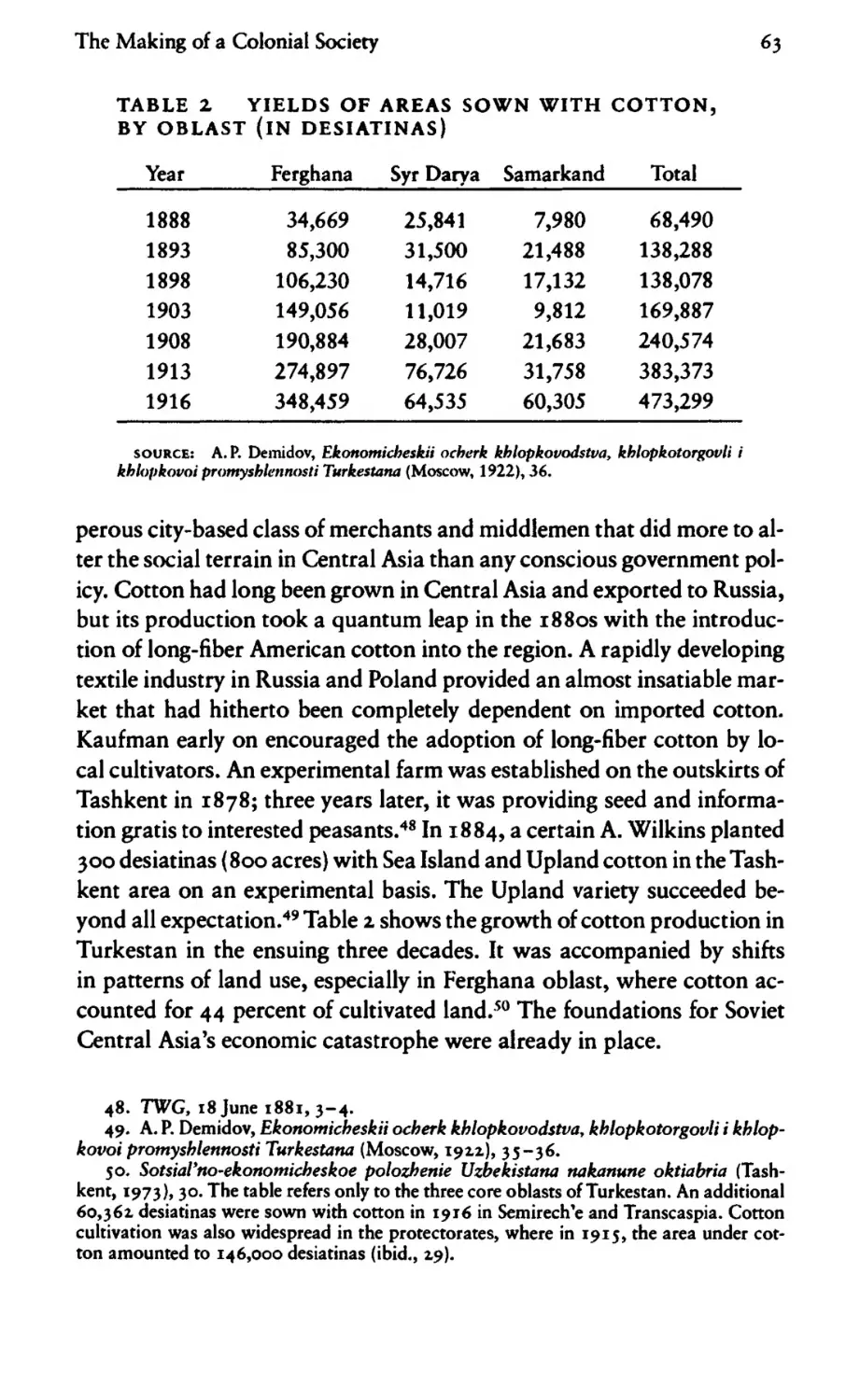
Yields of Areas Sown with Cotton, by Oblast
(in Desiatinas)
3. Social Classification by Native Language
(Three Core Oblasts, 1897)
4. Muslims in Russian Educational Institutions
(Selected Years)
5. Russo-Native Schools in Turkestan
6 . Academic Program for New-Method Schools, 1910
7. Classifications Used by the 1897 Census
8. Tashkent City Duma Election Results, 1917
16
63
75
84
159
168
203
261
Preface
Whether it is in the obsession with multiculturalism in American aca
deme or in facile visions of an impending, perhaps inevitable “dash of
civilizations” in the mainstream public, it is culture that defines the es
sence of difference in the post-C old War world. The Muslim world occu
pies a special place in this cultural geography, more closely identified with
culture than any other part of the world. The cultural determinism im
plicit in such thinking can exist only by leaving unasked the question of
the origins of culture. Although a substantial scholarly literature has ar
gued at some length (but perhaps not very successfully, if one were to
judge from how little its insights seem to illuminate mainstream debate),
cultures are not immutable givens but themselves subject to change and
flux. This applies to Muslim culture as much as to any other, although
given the place Islam and Muslims occupy in the imagination of the
“West,” we are left constantly to reaffirm this basic fact. I have tried in
this book to argue this basic point: that Islam, and Muslim culture, and
the sense of being Muslim are far from immutable characteristics; rather,
they change and evolve and do so through debate and the struggles of
different groups in Muslim society.
The advent of new means of communication and new forms of so
ciability from the nineteenth century on introduced new ways in which
debates over culture could take place, while the political and military
imperatives represented by the rise of European power lent a special in
tensity to these debates. Modern historians have paid too little attention
XIV
Preface
to what Muslims were debating in these new media. A few studies of
major figures and their thought have provided us an overview of the tra
jectory of intellectual history of the period, but the emphasis in such
studies remains either explicitly religious or explicitly political. The sea
change that the Muslim intellectuals’ view of the world, and of their place
in it, underwent in the half-century before the Great War has never been
evoked. Yet this change underlay the new directions in intellectual and
political history that have appeared in the Muslim world in the twenti
eth century.
The foregoing applies with even greater force to Central Asia, an area
largely forgotten by the outside world. When I began graduate work over
a decade ago, I usually had to explain to inquisitive friends where Cen
tral Asia was. Then came perestroika, the demise of the Soviet Union, and
the “emergence of Central Asia.” These events have heightened interest
in the region in a way that would have been inconceivable just a decade
earlier. But while the amount of publishing on the region has increased
manifold, the new literature is dominated by matters of geopolitics and
prognostications about the future of the new countries, with remarkably
little attention paid to topics of cultural or historical import, even as the
literature of prognostication freely makes explanatory use of both cul
ture and history.
This neglect stems from certain fundamental institutional factors: the
passing of the old order in Russia in 1917 coincided, broadly, with a mas
sive redefinition of the Muslim world in Western academe. The Muslim
world came to be reconfigured in an Arab-centered manner, in which the
Turks occupied only a marginal place. No fate was worse than that of
Central Asia, which was consigned to oblivion by scholars of Muslim
societies and left to the tender mercies of émigré scholars and experts
on Soviet nationalities studies. (Mainstream Soviet studies, notoriously
Moscow-centered in any case, saw little more than incomprehensible
oriental exotica in Central Asia.) Much of the slim literature that was
produced on Central Asia outside the Soviet Union during the Soviet pe
riod was marked by a heavy emphasis on politics and what might be
called “national martyrology.” A sensitivity to the Muslim cultural back
ground of pre-Soviet Central Asia and the consequences of its transfor
mation in the postrevolutionary period was seldom evident, for it was
often beyond the competence of nationalities scholars and anathema to
émigré nationalists. The result was a general absence of a comparative
framework for thinking about Central Asian history.
This book has been a prolonged attempt at righting the balance. It pro-
Preface
xv
ceeds from a recognition of the fact that the experience of Central Asians
under colonialism was hardly unique in the Muslim world. The debates
that this book examines were parallel to those capturing the attention of
Muslim intellectuals the world over. Indeed, the Muslim elites of Central
Asia in the tsarist period were part of a much broader, cosmopolitan
community of the world’s Muslims. One of my aims in writing this book
is to reclaim Central Asia for the study of Muslim societies, for only by
understanding this context may we understand the cultural politics in
pre-Soviet Central Asia, and only by understanding pre-Soviet Central
Asia may we understand Soviet Central Asia. And conversely, only by
understanding how Central Asian Muslims debated issues common to
their age may we acquire a comprehensive picture of the myriad forms
modernity has taken in the Muslim world. This is more than an exercise
in “academic” history, for it allows us challenge facile explanations of
the contemporary world in terms of an inevitable “clash of civilizations”
and to remember that the more intransigent visions of the utter incom
patibility of Islam and modernity that capture the headlines today are
but one of the many answers Muslim intellectuals have produced to the
most crucial questions of the previous century.
Attention to debates within Central Asian society also permits a more
nuanced view of Russian imperialism. The demise of the Soviet Union
has created considerable interest in the imperial dimension of Russian
history, which has already resulted in the publication of a number of
works of commendable sensitivity. Yet, much of this work remains in
the domain of Russian colonial history, i.e., the history of how imperial
officials made sense (or tried to make sense) of the borderlands of em
pire. As long as scholars look solely (or largely) at imperial debates over
policy in the borderlands, natives will remain natives, as mysterious to
the historian of today as they were to the administrator of yore.
But for all the attention to these broader dimensions, I have tried
throughout to keep Central Asia itself at the focus of my inquiry (a cour
tesy not usually extended to it), for ultimately this book is an attempt to
comprehend the making of modern Central Asia. I have not mentioned
Soviet historiography earlier. It had its achievements, but shedding light
on the cultural transformations of the tsarist period was not one of them.
As far as the Jadids were concerned, Soviet historiography obfuscated far
more than it revealed. Many names (Behbudi, Cholpän, Fitrat) were sim
ply written out of the history books, while others (Hamza, Awläni, Qädiri) were given highly tendentious biographies. Many of the most basic
outlines of modern Central Asian history have to be delineated anew.
XVI
Preface
This has been a major goal in writing this book, as has been the sense
that the tumultuous history of Soviet Central Asia may only be under
stood against the background of the tsarist period. For Central Asia
might have been largely forgotten by the world of scholarship after
1917, but it experienced all the excesses of the twentieth century: revolu
tion, “development,” genocide, ecological disaster, social engineering,
and virulent nationalism. There are many stories to be told here; this
book is perhaps a first step.
I have been with this project longer than I care to remember and in the
process have accumulated many debts of gratitude to people and insti
tutions. An earlier version of this book was completed as a dissertation
under Kemal Karpat at the University of Wisconsin-Madison. In Madi
son, Michael Chamberlain introduced me to the works of Pierre Bour
dieu, while his own work on medieval Damascus provided an elegant
example of how historians appropriate the work of social thinkers.
David McDonald kept me honest about the Russian dimension of my
work. Many thanks to Uli Schamiloglu for friendship, advice, and those
microfilms.
Since then, I have benefited greatly from the advice and insights of a
number of colleagues. Ed Lazzerini has for years been a font of search
ing questions; he has also generously shared copies of scarce materials
with me. Hisao Komatsu also provided me copies of invaluable and im
possible to find works fundamental to my work. Marianne Kamp shared
her excellent judgment with me on several parts of the manuscript; she
also gave permission to quote from her unpublished work. Dale Eickelman has given encouragement for several years and by inviting me to a
National Endowment for the Humanities seminar on “Imagining Soci
eties: The Middle East and Central Asia” at Dartmouth College, provided
a captive audience for earlier versions of this book. John Perry invited me
to a workshop on “Language, Literature, and Empire” at the University
of Chicago in 1994, which produced valuable insights. Colleagues at the
history department at Carleton College provided excellent comments on
Chapter 2. Elyor Karimov allowed me to make copies of rare materials
in his personal collection. Conversations with Vincent Foumiau, Garay
Menicucci, Scott Seregny, and Gregg Starrett helped in various ways to
clarify the argument. In Tashkent, Abdujabbar Abduvahitov, Akram Habibullaev, Saodat Kholmatova, and Saur Yaqupov provided inestimable
friendship and support.
The research for the dissertation on which the book is based was
Preface
XVII
funded by various agencies at the University of Wisconsin. Since then,
the National Endowment for the Humanities has figured large in my
professional life. A Summer Stipend in 1994 allowed me to return to
Tashkent for archival research, and a Fellowship for College Teachers al
lowed me a precious break from teaching in 1996, during which I wrote
the bulk of the manuscript for this book. My leave coincided with some
of the darkest hours that the endowment has endured, which heightened
my appreciation for the work that it does for the humanities in this coun
try. This book would have taken a lot longer without its support.
I also gratefully acknowledge support from Carleton College. A fac
ulty development endowment grant in 1994 contributed to the trip to
the archives in 1994, and more recently the college provided generous
support for the preparation of illustrations and maps for publication.
Little of the research for this study could have been accomplished with
out the assistance of library and archive personnel on three continents.
The staff at Memorial Library of the University of Wisconsin-Madison,
the (then) Lenin State Library in Moscow, its annex in Khimki, and the
Central State Archives of the Republic of Uzbekistan in Tashkent deserve
special gratitude. The Central State Archives of Cinematic, Audio, and
Photographic Documents of the Republic of Uzbekistan provided the
photograph reproduced here.
But my greatest debts are of a personal nature. Cheryl Duncan hu
mored me throughout the many years it has taken me to finish this proj
ect. In the process, she has read more drafts of this work than seemed hu
manly possible. Her love and encouragement, as well as her editorial skills
and historical insights, were my constant companions. Haroun arrived
in this world unduly ahead of the manuscript and thereby delayed it con
siderably; the joy he brought with him, however, makes it all worthwhile.
Finally, my family has been my greatest source of inspiration. My
brother Najeeb made it all possible in the beginning. My parents, Nazakat and Khalid Latif, always taught me to expect the utmost of myself.
My father’s library, especially his own book on the Muslims of the Soviet
Union, first got me interested in Central Asia. When that interest led me
in the unexpected direction of becoming a historian, my parents sup
ported me in every way possible. It is to them that I dedicate this book.
Technical N ote
TRANSLITERATION
There does not exist a universally accepted system for transliterating Cen
tral Asian Turkic into the Latin script. During this century, it has been
written in five different alphabets in three scripts. I have resisted the temp
tation to transliterate all Uzbek according to modern Cyrillic-script spell
ing, given that even modern Uzbek publishers do not follow this practice.
Instead, I have transliterated the names of individuals active before 1910
and the titles of their works directly from the Arabic script in which they
wrote, using the six-vowel system (a, à, e, i, o, and u) and disregarding
vowel harmony. For modern Uzbek written in the Cyrillic script, I have
used the system adopted in Uzbekistan in 1995, with the exception of
rendering o’ as o, £ as kh, and g* as gh. The two systems are thus ren
dered harmonious, except that the vowels transliterated from the Arabic
script as ä and o appear as o and o, respectively, when transliterated
from the Cyrillic. I have followed the same logic in transliterating Tajik
from the Cyrillic script, whereas “Tajik” in the Arabic script has been
transliterated as Persian. Ottoman Turkish has been rendered in modern
Turkish orthography on the basis of the 1968 Redhouse Türkçe Ingilizçe
Sözlük, and Tatar citations are vocalized using Tatar vowels and vowel
harmony.
XIX
XX
Technical Note
NAMES AND DATES
Personal names took many forms in Central Asia in the period discussed
here. Some people used Russian-style surnames (e.g., Khojaev), whereas
others adopted Tatar-style last names (e.g., Behbudi, Awläni); yet others
used pen names (takhallus, e.g., Ayni), although most were simply known
by their first name (e.g., Hamza, Munawwar Qäri). I have used the form
of name most commonly used by the person in question and have alpha
betized the bibliography accordingly. When the name of the same per
son might be transliterated differently in works appearing in different
languages, I have grouped all entries by the same author together in the
bibliography.
All common-era dates are given according to the Julian calendar,
which was twelve days behind the Gregorian calendar in the nineteenth
century and thirteen days behind in the twentieth. The Julian calendar
was in use in the Russian empire until February 1918; dates after Febru
ary 1918 are in the Gregorian calendar, and the calendar is specified in
cases where confusion might arise. Dates for periodicals published in the
Ottoman empire are also given in the Julian calendar, which was the ba
sis of the Ottoman fiscal calendar until 1917 .1 have used double dating
only when the common-era year could not be determined with certainty
for a publication dated in a hijri calendar.
Abbreviations
GARF
Gosudarstvennyi arkhiv Rossiiskoi Federatsii
IOLR
India Office Library and Records
ÖSE
Özbek sovet entsiklopediyasi
SF
Sadä-yi Farghäna
ST
Sadä-yi Turkistän
TsGARUz
Tsentral’nyi Gosudarstvennyi arkhiv Respubliki
Uzbekistan
TWG
Turkistän wiläyatining gazeti
UT
Ulugh Turkistän
ZhMNP
Zhurnal Ministerstva Narodnogo Prosveshcheniia
Map i. Central Asia, mid-nineteenth century.
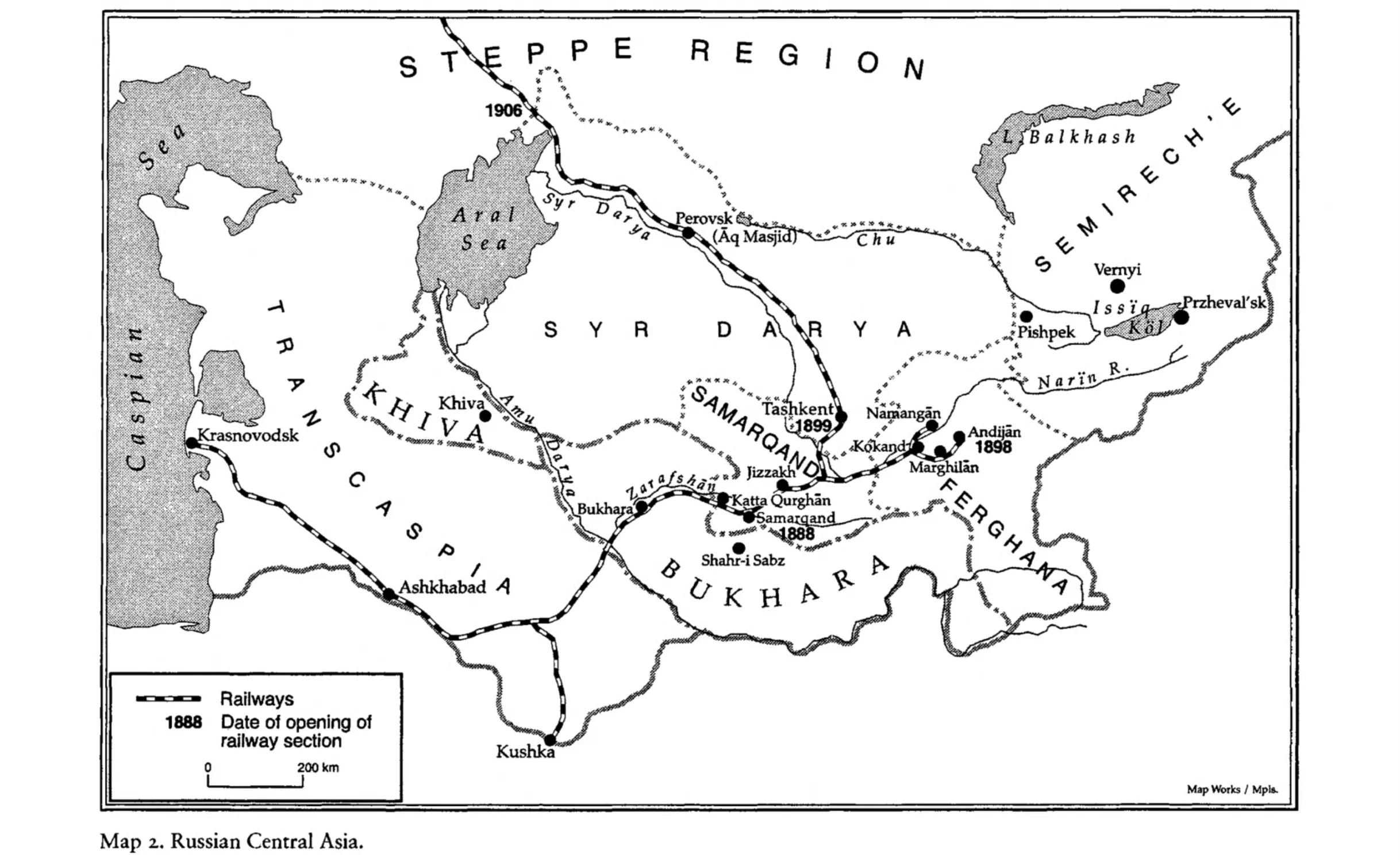
M ap 2. Russian C entral Asia.
Introduction
At present, we Turkestanis are not sufficiently acquainted
with religious and worldly knowledge. Our old maktabs and
madrasas are in ruins, reminiscent of the nesting places of
owls. Our madrasas, far from teaching worldly sciences,
don’t even teach tafsir and hadith, [which are] the basis of all
religious knowledge. We do not have any teachers’ training
colleges to train teachers, or any workshops to teach skills.
We do not have any merchants with modern business skills.
There are no organized schools for the elementary education
of our children.. . . If this . . . continues, soon even our pres
ent existence will be destroyed.
Häji Mum b. Shukrullah, 1916
In combining intimations of mortal danger faced by Central Asian soci
ety with a profound faith in the power of education to provide the solu
tion, this speech from one of the first pieces of modern Central Asian
theater neatly exemplifies the reformist project of the first generation of
modern Central Asian intellectuals, the “Jadids.” The unease about the
present lay in a sense that traditions of the past were not only incapable
of meeting new needs but were also failing to transmit the values of the
past. A thoroughgoing reform of culture and society was needed if Cen
tral Asians were to survive the unprecedented challenges of the modern
world. Although the Jadids saw themselves as reformers of their society,
their enthusiastic embrace of modernity led them to radically new con
ceptions of society. Their attempts at rescuing tradition redefined it, and
their attempts to return to a “pure” Islam brought new understandings
of Islam and of what it meant to be a Muslim. The Jadids were success
ful in garnering considerable support for their project, but their call for
reform also evoked vigorous opposition from established elites (the qadimchi) in their society. It was through the debate over the meaning of
Central Asian culture that Central Asians came to imagine the modern
world and their place in it. This book tells the story of this debate.
2
Introduction
I seek the roots of this debate in Central Asia’s experience of modernity,
a global condition that brings with it new forms of organization of self and
society, new forms of intellectual production, and new ways of imagining
the world (and one’s place within it). Modernity is not reducible to the in
culcation of culturally specific norms or traits; nor is it synonymous with
economic development. Rather, as an enormous body of interdisciplinary
literature has argued in recent years, the modern condition transforms
tradition (indeed, it makes it possible to conceive of tradition as tradi
tion); it takes— and produces— numerous cultural forms, and it inheres
in (economic) underdevelopment as much as in development. This con
ception of modernity therefore differs substantially from that of classical
modernization theory, which saw modernization as a unilinear process
that dissolved all opposition to it in its conquest of traditional forms.
The Jadid formulation of the predicament of Central Asian society
was as much a result of the profound transformation of Central Asia
in the fifty years of imperial Russian rule as a response to it. When Rus
sian forces abruptly conquered the khanates of Central Asia between
the 18 60s and the 1880s, there existed no theater, no printing press, and
no benevolent societies. All of these means of cultural production arose
in the half-century of Russian rule. Between the establishment of the
governorate-general of Turkestan in 1867 and the Russian revolutions
of 1917, Central Asia became increasingly intertwined with imperial
(and hence global) economic networks; its social order was drastically
reshaped, with the extinction of old elites and the emergence of new ones.
Its political order was, of course, reconstituted. New groups, such as the
Jadids, adopted and appropriated new forms of communication and so
ciability in their attempts to reform, creating, in the process, radically
new understandings of tradition, religion, and the world.
The Jadids of Central Asia were far from alone in the Muslim world
in this period in (re)evaluating their cultural heritage under the exigen
cies of modernity. Jadidism, as this movement for cultural reform is usu
ally called, had much in common with similar modernist movements
popular among intellectuals throughout the Muslim world. The aim of
such movements was nothing less than to reconcile Islam with a moder
nity they very much admired. But whereas similar modernist movements
in India, the Ottoman lands, Iran, Egypt, and Algeria have received ex
tensive scholarly attention,1 Jadidism, especially in its Central Asian
i.
I have benefited from the following: Aziz Ahmad, Islamic Modernism in India and
Pakistan, 1857-1964 (London, 1967); David Lelyveld, Aligarh's First Generation: Muslim
Introduction
form, remains virtually unknown. The volume of Western scholarship
on tsarist Central Asia is slim, and work on Jadidism in Central Asia
forms only a small part of it. Until very recently, specialist treatments of
the subject were almost entirely lacking,2 and one was left to retrieve
Jadidism from brief passages widely scattered in broad-ranging syn
thetic works that subordinated Jadidism to much broader themes.3 The
very few longer pieces available on Jadidism suffered from the lack of ac
cess to primary sources that beset all study of Central Asia until the very
last years of the Soviet regime.4 Soviet scholars, while enjoying access to
primary sources, were hampered by ideological constraints that often
proved insurmountable. The situation has changed in recent years, but
far less dramatically than many had hoped during the heady days of per
estroika.5 While the political context of scholarly production has been
Solidarity in British India (Princeton, 1978); §erif Mardin, The Genesis o f Young Otto
man Thought: A Study in the Modernization o f Turkish Political Ideas (Princeton, 1962);
Niyazi Berkes, The Development o f Secularism in Turkey (Montreal, 1964); Albert Hourani, Arabic Thought in the Liberal Age, 1798-1939 (London, 1962); Hisham Sharabi,
Arab Intellectuals and the West: The Formative Years, 1875-1914 (Baltimore, 1970);
David D. Commins, Islamic Reform: Politics and Society in Late Ottoman Syria (New
York, 1990); Hamid Algar, Mirza Malkum Khän: A Study in the History o f Iranian
Modernism (Berkeley, 1973); Mangol Bayat, The First Iranian Revolution: Shi'ism and the
Constitutional Revolution o f 1905-1909 (New York, 1991); Nikkie R. Keddie, ed. and
trans., An Islamic Response to Imperialism: Political and Religious Writings o f Sayyid
Jamäl ad-Dln Ual-Afghânï” (Berkeley, 1968); Keddie, Sayyid Jamàl al-Dïn “al-Afgbàriï”:
A Political Biography (Berkeley, 1972); Homa Pakdaman, Djetnal-ed-Din Assad Abadi dit
Afghani (Paris, 1969); Malcolm H. Kerr, Islamic Reform: The Political and Legal Theories
o f Muhammad 'Abduh and Rashid Ridä (Berkeley, 1966); Elie Kedouri, Afghani and
'Abduh: An Essay on Religious Unbelief and Political Activism in Modern Islam (New
York, 1966); Zaki Badawi, The Reformers o f Egypt—A Critique o f Al-Afghani, 'Abduh
and Ridha (London, 1976); Ali Merad, Le réformisme musulman en Algérie de 1925 à
1940: essai d*histoire religieuse et sociale (Paris, 1972).
2. The one exception was a monograph on Bukhara by Hélène Carrère d’Encausse: Ré
forme et révolution chez les musulmans de Vempire russe, 2nd ed. (Paris, 1981 ), now avail
able in English as Islam and the Russian Empire, trans. Quentin Hoare (Berkeley, 1988).
3. Serge A. Zenkovsky, "Kulturkampf in Pre-Revolutionary Central Asia,” American
Slavic and East European Review 14 (1955): 15-42; Richard N. Pierce, Russian Central
Asia, 1867-1917: A Study in Colonial Rule (Berkeley, i960), 254-255 (one page on
“Dzhadidism” in the context of “The Rise of Native National Consciousness”); Geoffrey
Wheeler, The Modem History o f Soviet Central Asia (London, 1964), 91 (one dismissive
reference to prerevolutionary Jadidism as “merely a Muslim reformist movement with no
separatist aims.”)
4. Hélène Carrère d’Encausse, “The Stirring of National Feeling,” and “Social and
Political Reform,” in Edward Allworth, ed.. Central Asia: A Century o f Russian Rule
(New York, 1967), 172-206; Edward Allworth, The Modern Uzbeks: A Cultural History
(Stanford, 1990); a brief account of Muslim reform, although based entirely on Russian
sources, is found in Seymour Becker, Russia*s Protectorates in Central Asia: Bukhara and
Khiva, 1865-1924 (Cambridge, Mass., 1968), 193-209.
5. Central Asian scholars have brought back into print numerous works of Jadid au
thors, but larger synthetic studies of the period remain rare; see “Jadidchilik nima?” San”at.
3
4
Introduction
transformed in Central Asia in recent years, the severe economic dislo
cation of academic life (combined with new political demands from the
newly independent states) in the post-Soviet period has meant that little
new historiography has emerged on this important topic.6 Outside the
former Soviet Union, interest in Central Asia has focused on the con
temporary period, with Jadidism enjoying the attention of only a few
scholars. Thus, although detailed research on tsarist Central Asia has
begun to appear in recent years, much more remains to be done.7 This
book is the first effort to comprehend Muslim cultural debates in Cen
tral Asia in a broad, comparative perspective.
R E FO R M , CULTURAL P R O D U C T IO N ,
AND ELITE STRATEGIES
Much recent social thought has insisted that cultures, rather than being
timeless givens, are products of historical change, their meanings con
tested and constantly in flux. New understandings of the world emerge
through efforts by various groups in society to make sense of vastly new
conditions they confront. In the case of Central Asia, the Jadids, in diag
nosing the ills of their society and prescribing the cure (to use the medical
metaphors they often favored), were usurping the moral and cultural au
thority of the established religious-cultural elites. Their prescription for
reform contained a radical re-visioning of society and the roles of vari
ous groups within it as well as a redefinition of Central Asian culture
and what was valuable within it. Not surprisingly, the Jadid project pro
voked considerable opposition.
1990, no. 12: 4-10; Begali Qosimov, “Jadidchilik,” in Milliy uyghonish wa özbek filologiyasi masalalari (Tashkent, 1993 ), 12-39; Qosimov, “Sources littéraires et principaux traits
distinctifs du djadidisme turkestanais (début du XXe siècle),” Cahiers du monde russe 37
(1996): 107-132.
6. On the politics of the rewriting of history in contemporary Central Asia, see the
very astute analysis by Stéphane A. Dudoignon, “Djadidisme, mirasisme, islamisme,” Ca
hiers du monde russe 37 (1996): 33-36.
7. Two substantial works appeared while this book was being written: Stéphane A.
Dudoignon, “La question scolaire à Boukhara et au Turkestan russe, du «premier renou
veau» à la soviétisation (fin du XVIIIe siècle-1937),” Cahiers du monde russe 37 (1996):
133-210; and Hisao Komatsu, Kakumei no Chùô Ajia: aru Jadiido no shôzô (Tokyo,
1996). Dudoignon’s article covers much of the same ground as this study, but with a dif
ferent emphasis and rather different conclusions. Komatsu’s work, an extended biography
of Abdurrauf Fitrat in the context of revolutionary change in Central Asia, remains, un
fortunately, beyond my ken. I am grateful to Katie Sparling for acquainting me with its
contents.
Introduction
5
Western scholars have generally tended to ignore this opposition. As
with modernist reform in the Muslim world in general, scholars of Jadidism have tended to focus on the Jadids as the sole voice of reason in their
society while dismissing their opponents as unreasoning obscurantists
opposed to all positive change. Thus, Edward Allworth sees the Jadids as
“men . . . who dared reconsider the predicament of their people,” who
“for the indigenous population of the region . . . created or adapted six
instruments for their purposes.” Their opponents, however, are dis
missed as “those internally governed by fixed habit and rigid tradition”
who “failed to understand” the reforms suggested by the Jadids.8 Soviet
scholarship, on the other hand, acknowledged the contestation but re
duced it to a Marxist metanarrative of class competition. The qadimchi
were representatives of the feudal-colonial order, whereas the Jadids were
mouthpieces of a rising nationalist bourgeoisie, both groups transpar
ently expressing the ideology of their respective classes.9 Both these
views are misleading. The complete absence in Western scholarship of
any analysis of the contested nature of Jadidism leaves us unable to ex
plain the Jadids’ modest success except through invoking such oriental
ist tropes as the obscurantist nature of traditional elites or the fanaticism
of Muslim culture. The Soviet view, too, simplified matters even as it con
fused them. The debate in Central Asian society cannot be reduced to
conflicting economic interests for the Jadids often shared common social
origins with their opponents and economic issues seldom surfaced in the
debate. Rather, much of the debate discussed in this book centered
around the competing claims to cultural authority—the authority to cre
ate and interpret culture— in which new elites challenged the authority
of the old, for in the attempt to reform society lay a claim for leadership
that was profoundly subversive to the established order.
I argue that the struggle between the Jadids and their opponents was
over the possession and redefinition of what Pierre Bourdieu has called
“cultural capital.”10 The Jadids sought to redefine the culture their soci
ety should value, bringing to bear on the debate their access to new in
tellectual technologies and forms of sociability. Their opponents met the
challenge by valorizing the cultural values that guaranteed their status
8. Allworth, The Modem Uzbeks, 12.0-121.
9. Lowell Tillett, The Great Friendship Soviet Historians on the Non-Russian Na
tionalities (Chapel Hill, N.C., 1969) remains the standard work on Soviet historiography
of the nationalities.
10. Pierre Bourdieu, The Logic o f Practice (Stanford, 1990 [orig. 1980]), 108- n o .
6
Introduction
and prestige. Neither group, however, entered the contest fully formed,
and the lines between the two groups always remained porous. Many Jadids were members of the religious elite in their own right, and many oth
ers were only a generation removed. More significantly, however, the
ideas of both groups were articulated and refined through this contest. I
follow Pierre Bourdieu in contending that only by “apprehending the
specific logic of the social world, that ‘reality’ which is the site of a per
manent struggle to define ‘reality,’ ”11 may we begin to understand what
was at stake.
Bourdieu’s numerous works on the social reproduction of culture
provide a valuable point of departure for this study. In his attempt to
transcend the opposition between structures and representations, be
tween the objectivist claims of twentieth-century social science (shared
also by Soviet Marxism) and the phenomenological alternatives pro
posed to them, Bourdieu has defined a reflexive sociology that seeks to
understand how social agents make sense of their world by plotting
strategies of social action given the possibilities and constraints of the
world. What is significant to Bourdieu are not the “rules” of society, but
rather the strategies that social agents bring to bear on their social action.
These strategies emerge from a “practical sense” represented by a logic of
practice that is defined by the agents’ experience of the world. This shift
of attention from structures to practices, without denying the existence
of structural constraints within which individuals and groups act, al
lows him to see the individual as an agent actively negotiating the social
world rather than as a mere actor acting out a script dictated by struc
tures; at the same time, it reminds us that social agents act on a terrain
that contains limits as well as possibilities.12 The social game is played
with symbolic or cultural capital, markers of status and prestige, that sig
nify the distinction of social agents. Wealth is certainly one such marker,
but others, such as education, comportment, possession of culturally
valued knowledge, and claims to august lineage, are also significant in
their own right. The definition of what is culturally valuable, as well as
the rules of the social game itself, are constantly being contested and ne
gotiated by individuals and groups. Individuals and groups differ in
terms of their symbolic capital, but Bourdieu sees them arranged not in
11. Pierre Bourdieu, Language and Symbolic Power, trans. Gino Raymond and Mat
thew Adamson (Cambridge, Mass., 1991), 224.
12. Bourdieu, Logic; Bourdieu, In Other Words: Essays Towards a Reflexive Soci
ology (Stanford, 1990 [orig. 1987]).
Introduction
7
a rigid pyramidal hierarchy but in a social “field” in which groups have
more properties and interests in common the closer they are to each
other. The field becomes the arena for competition and contestation. In
terms of cultural production, the competition of elites leads to the defini
tion and elaboration of culture, as different groups seek to transmute
“ ‘egoistic,’ private, particular interests. . . into ‘disinterested,’ collective,
publicly avowable, legitimate interests.”13
Such an approach has numerous advantages for this study. The no
tion of symbolic capital enables us to go beyond the vulgar-Marxist for
mulations of Soviet historiography without losing sight of the contested
nature of reform. It also forces us to consider the competition within
Central Asian society as a central feature of Jadid reform. The Russian
conquest had transformed the nature of the social terrain in which so
cial competition took place in Central Asia (indeed, the Jadids them
selves were a result of that transformation); access to new means of com
munication and sociability allowed the Jadids to challenge the rules of
the game, while at the same time contesting the value of the symbolic
capital possessed by the older eûtes. The stakes for which the older elites
put up such stubborn resistance to the ideas of the Jadids were nothing
less than their social survival as an elite.
This approach also allows us to problematize the very notion of re
form itself. As a trope for disinterested rectification of the social order,
“reform” is a problematic enough notion when it is invoked by estab
lished states to reaffirm their authority (cases as disparate as those of the
Ottoman empire during the Tanzimat era and the Soviet Union during
perestroika illustrate this); it is far more so in cases where movement for
reform comes from unofficial groups in society. In Central Asia, where
the native state ceased to exist (as in Turkestan) or was not a participant
in reform (as in Bukhara and Khiva), arguments for reform were noth
ing short of arguments for a reconstitution of society according to the
vision of a new elite. Thus, only a focus on elite competition allows us
to understand the politics of the 1917, when revolution redefined the
rules of the game and brought competition into the open.
13.
Bourdieu, Logic, 109; Bourdieu’s works on the reproduction of culture include
Distinction: A Social Critique of the Judgement of Taste, trans. Richard Nice (Cambridge,
Mass., 1984 [orig. 1979]); Bourdieu, The Field of Cultural Production (New York, 1993);
Bourdieu, Homo Academicus, trans. Peter Collier (Stanford, 1988 [orig. 1984]); and Pierre
Bourdieu and Jean-Claude Passeron, Reproduction in Education, Society and Culture,
trans. Richard Nice (London, 1977 [orig. 1970)).
8
Introduction
By focusing on the social life of ideas and connecting it to the social
fortunes of their carriers, we can also avoid reifying religious and na
tional identities. This last is a task of considerable importance, for think
ing about post-Soviet Central Asia is laden with misleading and facile
assumptions about identity. Policy makers debate the potential of
“Islamic fundamentalism” in Central Asia, a danger deemed to inhere
in the fact of Central Asia being “Islamic.” By showing how the mean
ing of Islam and of being a Muslim changed over time (and the period
covered by this book was pivotal in this regard), I hope to bring some
sophistication into the debate over the nature of Islam in Central Asia.14
On the other hand, post-Soviet state elites in Central Asia have staked
their legitimacy on fulfilling the historical destinies of nations that are
deemed to have existed and to have developed together since time im
memorial. This book also questions these claims by highlighting the his
torical process that underlay the construction of modern group identi
ties in Central Asia.
The caveat against reification also applies to viewing Jadidism as a
unified movement, as is often done in the existing literature, which tends
to see Jadidism as a movement that spread out from its centers in the
Crimea and the Tatar lands on the Volga and swept all before it through
out the Muslim borderlands of the Russian empire. Jadidism was a co
herent movement to the extent that it was (or came to be) embedded in
a set of self-reproducing institutions (e.g., new-method schools that re
cruited their own graduates to teach in them). Beyond that, it is difficult
14.
Anthropologists in recent years have produced numerous excellent studies of “lo
cal knowledge” of Islam in diverse contexts: see the following: Clifford Geertz, Islam
Observed: Religious Development in Morocco and Indonesia (New Haven, 1968); Dale F.
Eickelman, Moroccan Islam: Tradition and Society in a Pilgrimage Center (Austin, 1976);
Eickelman, “The Study of Islam in Local Contexts,” Contributions to Asian Studies 17
(1982): 1-16; M. Nazif Shahrani, “Local Knowledge of Islam and Social Discourse in
Afghanistan and Turkistan in the Modem Period,” in Robert L. Canfield, ed., TurkoPersia in Historical Perspective (Cambridge, 1991); Michael Lambek, Knowledge and
Practice in Mayotte: Local Discourses o f Islam, Sorcery and Spirit Possession (Toronto,
1993); John R. Bowen, Muslims through Discourse: Religion and Ritual in Gayo Society
(Princeton, 1993); Patricia Horvatich, “Ways of Knowing Islam,” American Ethnologist
21 (1994): 811-826; Tone Bringa, Being Muslim the Bosnian Way (Princeton, 1995). In
addition, although not directly related to this literature, but very pertinent to Central Asia,
is Devin DeWeese, Islamization and Native Religion in the Golden Horde: Baba Tükles
and Conversion in Historical and Epic Tradition (University Park, Penn., 1994).
This line of inquiry has helped dissolve the notion of a monolithic Islam. Indeed, Abdul
Hamid el-Zein (“Beyond Ideology and Theology: The Search for the Anthropology of
Islam,” Annual Review o f Anthropology 6 [1977]: 227-254) suggested that the notion of
a single “Islam” be replaced by many “islams” to account for the multiplicity of Islamic
expression. A similar argument has been made recently by Aziz al-Azmeh, Islams and
Modernities (London, 1993).
Introduction
9
to impute any unity to the “movement.” To be sure, the Jadids of Cen
tral Asia used the same symbols, tropes, and metaphors as the Jadids of
European Russia in their discourse, but there is no reason to assume that
they necessarily imbued them with the same meaning intended by the
original authors. As Roger Chartier forcefully argues, texts are open to
multiple readings, since a work “acquires meaning only through the
strategies of interpretation that construct its significances. The author’s
interpretation is one among several and it does not monopolize the sup
posedly unique and permanent ‘truth’ of the work.”15 Rather, social
agents use, or “appropriate,”16 texts for their own strategies and social
struggles. In the case at hand. Central Asian Jadids used texts from else
where— from the Muslim centers of the Russian empire as well as the
broader Muslim world— in struggles that were grounded in local reali
ties. The Jadids were not moved by abstract ideas such as “reform” or
“pan-Islam” or “nationalism,” but rather used these abstractions to navi
gate the social struggles of Central Asia.
P R IN T AND T H E R E -IM A G IN A T IO N OF T H E W O RLD
Jadidism would have been inconceivable without print. The Jadids glo
ried in the powers of print (and printed books and newspapers) to spread
knowledge and enlightenment, and publishing remained a significant
field of endeavor for them. This marked a sharp contrast to the situation
before the Russian conquest, when the production and transmission of
knowledge in Central Asia existed in the scribal domain with a strong
component of orality. Knowledge was transmitted in a ritualized setting
through face-to-face interaction between individuals; the possession of
knowledge provided moral and cultural authority in society, which
translated into status and prestige, if not always directly into wealth, al
though that connection was common, too. The advent of the printing
press, the railway, the telegraph, and the modern postal system trans
formed these patterns and allowed the Jadids to redefine the nature of
cultural production in their society.
15. Roger Chartier, "Intellectual History and the History of Mentalités,” in Cul
tural History: Between Practices and Representations, trans. Lydia G. Cochrane (Ithaca,
1988), 41.
16. Chartier again provides a splendid introduction to this notion; see his "Culture as
Appropriation: Popular Cultural Uses in Early Modern France,” in Stephen L. Kaplan,
ed., Understanding Popular Culture (Berlin, 1984). Cf. Michel de Certeau’s notion of
"reading as poaching,” in de Certeau, The Practice o f Everyday Life, trans. Steven F.
Rendait (Berkeley, 1984), 165-176.
IO
Introduction
New means of the production of knowledge were crucial to the Jadids
in numerous ways. Most immediately, these means enabled an unprece
dented flow of information, putting Central Asian intellectuals in con
tact with the broader world in ways that had hitherto been impossible.
By the turn of the twentieth century. Central Asian readers could read
books and (increasingly) periodicals published throughout the Russian
empire as well as those imported from the Ottoman empire, Iran, and
farther afield. This circulation of literature, accompanied by the circula
tion of people facilitated by modern transport, made Central Asia part
of a broader world, or rather, a part of several overlapping translocal
communities, in a far more immediate way than had ever been possible
before.
Furthermore, modern means of communication were not transparent
vessels for the communication of ideas; they helped shape new ways of
imagining the world and thus transformed the parameters of debate in
Central Asian society.17 Print helped transform the social uses of literacy
as it redefined the framework and, increasingly, the norms of public de
bate over culture. As a result, by the turn of the century, Central Asians
not only debated new ideas, but they debated in a manner that was new.
As I argue in Chapter 4, newspapers, magazines, books, and theater cre
ated a public space that became the central venue for discussing culture
and society. Unlike the decades’ worth of learning in the madrasa that
provided entree to the cultural elite, access to the new public space re
quired only basic literacy (and not even that for the theater). In the new
public, the older cultural elite was increasingly marginalized.
This rapid flow of information combined with new means of com
munications wrought a fundamental transformation in the way in which
Central Asian intellectuals had come to see the world. In different ways,
17.
A considerable and rapidly growing literature has explored how print contributes
to a desacralization of knowledge and its demystification. Some of the landmarks in this
literature are Lucien Febvre and Henri-Jean Martin, Vapparition du livre (Paris, 1958);
Elizabeth L. Eisenstein, The Printing Press as an Agent o f Change: Communications and
Cultural Transformations in Early-Modern Europe, 2 vols. (Cambridge, 1979); Roger
Chartier, The Cultural Uses o f Print in Early Modem France, trans. Lydia G. Cochrane
(Princeton, 1987). Scholars of modern Muslim cultural history have recently paid consid
erable attention to the uses of print; see, §erif Mardin, Religion and Social Change in
Turkey: The Case o f Bediiizzaman Said Nursi (Albany, 1989); Juan R.I. Cole, Colonialism
and Revolution in the Middle East: Social and Cultural Origins o f Egypt's cUrabi
Movement (Princeton, 1992); Beth Baron, The Women's Awakening in Egypt: The Early
Years o f the Press (New Haven, 1994); Francis Robinson, “Technology and Religious
Change: Islam and the Impact of Print,” Modem Asian Studies 27 (1993): 229-251;
Adeeb Khalid, “Printing, Publishing, and Reform in Tsarist Central Asia,” International
Journal o f Middle East Studies 26 (1994): 187-200.
Introduction
ii
the discovery of geological time and language families, the idea of Prog
ress, and the modern map of the world all transformed how Central
Asians could imagine their world. New conceptions of time and space
were reflected in the Jadids’ emphasis on history and geography, allowed
a far-reaching historicization of the world that produced new, rational
ist understandings of Islam and Muslimness. The growing consciousness
that the grand narrative of history was not necessarily centered on Islam
or the Muslim community, that they themselves were a product of his
tory, and that they coexisted (often in disadvantageous situations) with
other faiths and other communities were crucial to the elaboration of
modern identities in Central Asia during this period. Their emergence,
moreover, was a result of this basic reconfiguring of the world, not its
cause.
Dale Eickelman has called this the “objectification” of Islam, the
emerging perception of Islam as a coherent, systematic, and selfcontained set of beliefs and practices, separate and separable from
worldly knowledge, which came to displace previously held understand
ings of Islam as embedded in everyday social practice and as something
irreducible to a textbook exposition.18 Underlying the discourse of re
forming tradition was a new kind of knowledge, produced and trans
mitted in a radically new context. Unlike the Jadids, their opponents of
ten set forth an uncompromising traditionalism that valorized existing
practices as the essence of “true” Islam. Yet, as I argue, this understand
ing of tradition was itself marked by modernity, since the very valoriza
tion of tradition made use of modern means and was an expression of
its proponents’ modern predicament.
Similarly, the community— its nature and its boundaries— also came
to be reimagined, giving rise to the first articulations of modem Central
Asian “national” identity. All nations are imagined,19 but they may be
imagined in many different ways. Jadid notions of identity were articu
lated in the context of new ethnographic knowledge produced by the
colonial regime and the influx of romantic discourses of nationhood
from the Tatars and the Ottomans; they were firmly rooted in the politi
cal realities on the ground in Turkestan. The objectification of Islam led
to the emergence of a largely secular Muslim confessional nationalism
in which Islam functioned as a marker of political and cultural identity
18. Dale F. Eickelman, “Mass Higher Education and the Religious Imagination in
Contemporary Arab Societies,” American Ethnologist 19 (1992): 643, 647-649.
19. Benedict Anderson, Imagined Communities, 2nd ed. (London, 1991).
12
Introduction
for a community initially defined by its adherence to a religion. The rela
tionship between ethnic and confessional definitions of the nation is fluid,
rather than fixed;20 in the Muslim world of the turn of the century, a cer
tain tension between the two forms of community existed, but it could
be elided more easily than the existing literature on the subject often re
alizes. It is well to remember this form of political Muslim identity today,
when all “political Islam” has come to be synonymous with the most in
transigent visions of the utter incompatibility of Islam and modernity.
D ISC IPL IN E AND O R G A N IZ E :
N EW FO R M S O F SO CIA BILITY
Häji Muin’s call for organized schools reflected a central concern of the
Jadids: the creation of a system of well-organized schools that would of
fer a standardized, disciplined education providing both religious and
worldly education to future generations of the community. Indeed, the
new-method (usul-i jadid) school gave the movement its name. Under
standing the centrality of the faith both in knowledge and in organiza
tion provides crucial insights into the nature of Jadidism.
The Jadids’ faith in the ability of the human intellect to solve the
problems of the world was intertwined with the notion of progress that
the desacralization and historicization of their outlook helped promote.
I will explore the origins of this conception of the power of knowledge
in Jadid thought at some length, for it represents an important aspect of
their modernity. In the process, however, the concept of knowledge it
self came to be subtly redefined, as it came to encompass new fields of
knowledge and new ways of knowing. For the Jadids, of course, these
transformations were transparent: They did not contravene tradition
but helped bring it to its true fruition. There was no contradiction be
tween the notion of progress and their faith in Islam. Indeed, only knowl
edge could enable Muslims to understood Islam properly, and Islam it
self was the best guarantee of progress. As a closer inspection shows
quite clearly, new notions of knowledge (and hence of religion, history,
and politics) lay at the bottom of the Jadid critique of society.
But if knowledge was a panacea, it needed organized institutions to
be properly produced and disseminated. The Jadids’ critique of their so
ciety centered on the disorder that they saw prevailing in it. The maktab
20.
M. Hakan Yavuz, “The Patterns of Political Islamic Identity: Dynamics and
Transnational Loyalties and Identities,” Central Asian Survey 14 (1995): 341-372.
Introduction
13
was disorganized, unhygienic, and run by uncouth teachers with no
training in pedagogy; there was no system for inspecting schools; there
were no organizations for establishing schools; and the philanthropy of
the rich, insufficient as it was, took no organized form. The Jadids’ ef
forts to overcome this disorder are a central feature of their reformist
project. Their faith in the efficacy of organization and order marks the
Jadids as modems. Their quest for new forms of organization— newmethod schools, publishing houses, benevolent societies, and (eventu
ally) political parties—was significant in itself in transforming the rules
of the social game in Central Asia, as organized, impersonal (and to a
certain extent, self-perpetuating) institutions increasingly became arenas
for debate and the production and transmission of culture, replacing
dialogic interaction in the informal settings where cultural practices
had previously been located. The new-method school, for instance, was
more than merely a reformed maktab: It was the site of a new cultural
practice, that of schooling, which it marked off from everyday practice
and objectified.
The Jadids’ pioneering of incipient institutional forms in the Muslim
society of Central Asia gave them a certain advantage over their oppo
nents, who, for various reasons did not organize in similar fashion. A
new public space was created for the interpretation of Central Asian cul
ture, and of Islam itself, in which the traditional carriers of Islam were
increasingly marginalized. The process of institutionalization was nei
ther easy nor unilinear, since material difficulties combined with oppo
sition from traditional elites and suspicion of the colonial state to ensure
that a large gap remained between Jadid ambition and Jadid achieve
ment. Nevertheless, by 1917, new-method schools were widespread, a
print-based public space had taken hold, and the traditional elites’ mo
nopoly over the definition of culture had been shaken.
C O L O N IA L E N C O U N T E R S
IN T H E RUSSIAN BO RD ERLA N D S
In pointing to the transformative role of Russian rule, it is by no means
my intention to claim that imperial benevolence was the linchpin of cul
tural regeneration in Central Asia. Rather, I hope to distance the analy
sis from the hackneyed dichotomies of resistance and collusion, of na
tive authenticity and “Westernization” (or, in our case, Russification), by
suggesting that the social and institutional terrain on which struggles over
culture take place in colonial settings is very much the product of colonial
14
Introduction
rule. To look for “responses” to colonialism in a domain located entirely
outside of it is futile, since the very formulation of the response is inex
tricably intertwined in patterns of colonial knowledge.21 Although this
obviously applies to modernist re-visions of identity, even visions of the
authenticity of native tradition are articulated through means of cultural
production often introduced by the colonizer. For if culture is to be lo
cated in the struggles of elites, then the colonial presence was a major fea
ture of the social terrain on which they took place. This presence may not
have determined the nature of the competition, but it certainly provided
a major resource even as it also defined the limits of the permissible.
The interconnections between empire and imperial knowledge have
received considerable scholarly attention in recent years,22 but the poli
tics of native cultural production in the conditions of empire have been
less popular. The Jadids, like many colonial intellectuals, occupied a
liminal space between the colonial power and native society. From this
position they could appropriate colonial ideas for their own uses, invok
ing the superiority of the colonizer to exhort their society to reform; at the
same time, they talked back to the colonizer in the colonizer’s own lan
guage. This involved them in bitter struggles over turf in their society with
groups that had made their own compromises with the colonial regime.
In the Russian case, even the colonial nature of the regime remains a
matter of dispute. Although the Russian empire was one of the largest
empires in the world during the period under discussion here, sophisti
cated study of the Russian imperial experience is only now beginning.
Scholars centrally concerned with one or more of the “nationalities” of
the Russian empire have long been used to viewing the Russian state as
a colonial entity (although often more as a matter of reflex than as an
analytical preoccupation), but mainstream Russian history has seen im
perialism only in Russian foreign policy, being content to study the bor
derlands as a problem of administration rather than imperialism.23 And
of all the borderlands. Central Asia remains the least known.
2,1. Frederick Cooper and Ann L. Stoler, “Tensions of Empire: Colonial Control and
Visions of Rule,” American Ethnologist 16 (1989): 609; Timothy Mitchell, Colonising
Egypt, new ed. (Berkeley, 1991), xi.
22. The locus classicus of this debate is, of course, Edward Said, Orientalism (New
York, 1978).
23. The major works on Russian imperialism are concerned almost entirely with im
perial competition outside the boundaries of the Russian state, not with imperial interac
tion within it: Dietrich Geyer, Russian Imperialism: The Interaction o f Domestic and
Foreign Policy, 1860-1914, trans. Bruce Little (New Haven, 1987); John P. LeDonne,
The Russian Empire and the World, 1700-1917: The Geopolitics o f Expansion and
Containment (New York, 1997). The recent work by Andreas Kappeier, Rußland als
Introduction
15
To be sure, Russia’s geographic contiguity to its empire made for sev
eral peculiarities of its colonial experience (the state usually did not rec
ognize the borderlands as separate political entities), but the basic epis
temological operations of empires were, nevertheless, present. Moreover,
as I argue in Chapter 2, Central Asia, conquered between the 1860s and
the 1880s, occupied a position that was in many ways unique in the em
pire. The distinctly colonial conception that informed Russian rule in
the region contrasted markedly to earlier periods of annexation that had
brought other Muslim and non-Muslim groups under Russian rule. If
in previous periods of expansion, the Russian state had coopted local
nobilities and absorbed conquered populations into its system of so
cial classification, in Central Asia the rhetoric of conquest mirrored
nineteenth-century notions of colonialism. Russian administrators con
stantly compared Turkestan to British India (the protectorates of Bu
khara and Khiva were directly inspired by British treaties with various
princely states in India) or French North Africa and sought to benefit
from the experience of these powers in ruling “their” Muslims. The lo
cal population remained “natives,” regardless of social standing.
Although such colonial policies and practices were very important to
Central Asian cultural life, their appreciation is also crucial to under
standing late imperial Russia as a whole. The fact that Russia was a
multinational empire is often glossed over in mainstream Russian (as op
posed to “nationalities”) historiography, with a resultant loss of histori
cal perspective. The imperial borderlands, perhaps Central Asia more so
than any other, were not incidental to Russia. Their existence— and their
subjugation—helped define Russia and Russianness in very tangible
ways that are lost to analysis if Russia is seen as a unitary state.
The study of imperial interactions in the Russian borderlands also
helps to deconstruct the notion of “the West.” Scholarly discourse is so
permeated with the dichotomy between Russia and “the West” (which
events of the past decade have only entrenched more deeply) that it ap
pears as a paradox that Russia should personify “the West” in its Asian
borderlands. Yet, Russians saw themselves as resolutely European in
Central Asia, sharing in the European civilizing mission to which all im
perial powers pretended. If world history of the last two centuries is to
be glossed as “Westernization,” then we face the paradox that many of
Vielvolkerreich: Entstehung, Geschichte, Zerfall (Munich, 1992.), is the first substantial
treatment of Russia as a multiethnic empire.
16
TABLE I
Introduction
R U S S IA N C E N T R A L A SIA P O P U L A T IO N S
Populations
Syr Darya
Samarqand
Ferghana
Total three core oblasts
Transcaspia
Semirech’e
Total Turkestan
Bukhara
Khiva
Total Central Asia
(sq. mi.)
1897
189,150
33,850
55,210
278,210
231,238
147,510
656,960
78,650
26,070
761,680
1,478,398
860,021
1,572,214
3,910,633
382,487
997,863
5,290,983
1911
—
—
—
1,816,550
960,200
2,041,900
4,818,650
472,500
1,201,540
6,492,690
2,500,000
550,000
ca. 9,550,000
so u rc e s : V.I. Masai’skii, T urkestan skii k ra i (St. Petersburg, 1913), 348; A zia tsk a ia R ossiia
(St. Petersburg, 1914), I: 91-92.
For Turkestan, population figures for 1897 are from the census of 1897; those for 1911 represent
official estimates. Figures for the protectorates are estimates and pertain to 1909.
the agents of this process were not generally regarded as those of the
West. Russia is scarcely the only exception; the burden of Europe was
carried in other places by Spain or Portugal, countries that in the conti
nental context were hardly epitomes of “the West.” “Europe” and “the
West” are but ideas that take various forms at various times and places.
But if “Westernization” is not a useful concept, “Russification”— the
dominant paradigm for understanding cultural interaction in the Rus
sian empire— is even less so. The latter concept has been popular with
scholars of “the nationalities” of the Russian empire, who see in every
Russian (or Soviet) policy an attempt to dominate and transform au
thentic national cultures. (It is a measure of the alterity of Russian his
tory vis-à-vis Europe that “Russification,” the local variant of “Western
ization,” carries a completely negative connotation.) By foregrounding
themes of national struggle, while ignoring debates within society, such
approaches render themselves incapable of exploring the politics of cul
tural production and identity formation on the Russian borderlands.
Going beyond Russification is all the more crucial for the study of
Central Asia, where in the tsarist period the state had neither the means
nor the will to intervene directly in local cultural life. The impact of im-
Introduction
17
perial power has to be sought in more subtle form than the paradigm of
“Russification” allows.
C EN TR A L ASIA
Russian Central Asia comprised the govemorate-general of Turkestan as
well as the protectorates of Bukhara and Khiva (see Table 1). For reasons
of both space and clarity, I focus largely on Turkestan in this book, al
though since the writings of Bukharan Jadids (especially Abdurrauf Fitrat) were highly influential, Bukharan developments cannot be wholly
excluded. Nor do I deal with the traditional lands of the Qazaqs incor
porated in the Steppe province administered from Omsk. Its nomadic
population had a conception of Islam very different from that of the in
habitants of the oasis cities of Transoxiana. Moreover, the Steppe prov
ince was under direct Russian rule far longer and subject to different
administrative policies than Turkestan. During our period, the foci of
Qazaq cultural life lay to the north, in Orenburg and even Kazan, rather
than to the south in Tashkent or Samarqand. The administrative entity
of Turkestan produced its own logic that was a salient feature of Central
Asian life in the tsarist period.
CHAPTER I
Knowledge and Society
in the Nineteenth Century
The three and a half centuries between the collapse of the Timurid order
and the Russian conquest constitute the least understood period of Cen
tral Asian history. The literary production of the period still remains
largely in manuscript form, and scholarly attention focuses on the more
glamorous Timurids or the more accessible Russian period. In the ab
sence of systematic research, we are left to struggle with V. V. BartoPd’s
dictum that “in the nineteenth century, in contrast to the Middle Ages,
Turkestan was among the most backward countries of the Muslim
world.” 1Soviet scholarship tended to focus on the centralization of states
in the nineteenth century as a positive sign (and to contrast it to the feu
dal dissension of the eighteenth); however, its judgment on the culture
of this period was no more generous. Yet, if we are to understand the
politics of cultural production that obtained on the eve of the Russian
conquest, politics that the Jadids set out to reform, we need to rescue the
topic from the domain of aesthetic judgment and place it firmly in the
realm of social practice. This is a crucial task in its own right, but it is
also of fundamental importance for understanding the politics of culture
during the tsarist period.
i.
V. V. Bartol’d, Istoriia kuVtumoi zhizni Turkestana (1927), in his Sochineniia (Mos
cow, 1963), II/i: 297.
19
20
Knowledge and Society
K N O W L ED G E, LITERA CY , AND CULTURE
A sharp critique of traditional Muslim education in nineteenth-century
Central Asia is perhaps the only area of scholarship in which all ob
servers, scholars and officials, tsarist and Soviet, agreed with Jadids and
émigré nationalists. The maktabs and madrasas of Central Asia were the
clearest sign of the stagnation, if not the degeneracy, of Central Asia.
Judged by criteria these observers brought with them, the maktab and
the madrasa not surprisingly appeared as inefficient, pointless, and even
harmful. Yet, if we are to understand the logic of the practices surround
ing the transmission of knowledge in pre-Russian Central Asia (many of
which continued well into the twentieth century), we have to examine
them in their own right, and not by the modernist criteria of observers
standing outside the tradition.2
The tradition of learning replicated in the maktabs and madrasas of
Central Asia was common to many premodern Muslim societies. It was
characterized by two overriding concerns: the transmission of knowl
edge (ihn) and the cultivation of proper modes of behavior and comport
ment (adab). The primary impulse was conservational, the transmission
to future generations of the finite, fixed truths revealed by God.3This tra
dition was marked by rigorous discipline, including severe corporal pun
ishment, and often the insistence on memorization without explicit ex
planation. As Dale Eickelman has suggested, “ ‘Understanding’ (fahm) in
the context of such concepts of learning was not measured by any abil
ity explicitly to ‘explain’ particular verses [of the Qur’a n ].. . . Instead,
the measure of understanding was implicit and consisted of the ability
to use particular Quranic verses in appropriate contexts.” 4 The finite
and fixed nature of knowledge by no means precluded a dynamic tradi
tion of interpretation, for it was only through an act of interpretation
that divinely revealed knowledge could become meaningful for human
beings. This interpretation required a carefully inculcated scholarly
habitus, a set of predispositions and habits of mind that allow “practices
and works to be immediately intelligible and foreseeable, and hence
2. The following discussion of the social uses of knowledge owes a great debt to Mi
chael Chamberlain, Knowledge and Social Practice in Medieval Damascus, 1190-1 330
(Cambridge, 1994).
3. Dale F. Eickelman, “The Art of Memory: Islamic Knowledge and Its Social Repro
duction,” Comparative Studies in Society and History zo (1978): 490.
4. Ibid., 494.
Knowledge and Society
taken for granted.” 5 The habitus reproduced in the maktabs, and espe
cially the madrasas, of nineteenth-century Central Asia cultivated a cer
tain relation to texts and to the world beyond them that provided the
framework for life. The distinction between religious and secular knowl
edge in this world would have been impossible, for all knowledge ema
nated from God and was consequently imbued with a certain sacral value.
Different crafts and sciences were similarly deemed to have been invented
by various prophets. Noah, for instance, was the inventor of woodwork
and David of metalwork.
If the transmission of knowledge (taclim) was one concern of the maktab, the other was the inculcation of proper modes of behavior and con
duct (tarbiya). Adab as mimetic practice occupied a central place in Mus
lim societies. Originating in pre-Islamic Middle Eastern traditions of
civility and refinement, adab was thoroughly Islamized after the eighth
century through the works of such Muslim writers of Iranian origins as
Ibn Muqaffac (d. 756) and Firdawsi (d. 1020). In later centuries the term
“adab” came to be understood in a more restricted fashion to denote
knowledge necessary for a certain profession or station in life (and so it
became possible to speak oiädäb al-mufti, the adab of one who holds the
office of mufti [jurisconsult]).6In nineteenth-century Central Asia, proper
adab marked the boundaries of civility and status and was a crucial ele
ment in cultural capital recognized in urban society. Manuals of civility
existed,7 but the primary arena for its transmission remained the maktab.
We have a number of descriptions of the Central Asian maktab, al
though most of them are the hostile views of outsiders.8 Fortunately, in
5. Pierre Bourdieu, The Logic o f Practice, trans. Richard Nice (Stanford, 1990), 58; see
also Bourdieu, “Systems of Education and Systems of Thought,” International Social Sci
ence Journal 19 (1967): 344.
6. F. Gabrieli, “Adab,” Encyclopedia o f Islam, new ed., vol. 1 (Leiden, i960), 175;
Dj. Khaleghi-Motlagh, “Adab,” Encyclopaedia Iranica, vol. 1 (New York, 1982), 431439. On Iran’s long tradition of ethico-didactic writing (pand, andarz, nasihat, etc.), which
in Islamic times assimilated Muslim ethics as well, see Encyclopedia Iranica, II: 16-22,
s.v. “Andarz.” See also, Barbara Metcalf, “Introduction,” in Metcalf, ed., Moral Conduct
and Authority: The Place o f Adab in South Asian Islam (Berkeley, 1984), 1-4.
7. For example, the Adäb us-sälihin of Muhammad Sâlih Kâshghari, translated from
a lithographed edition by N. S. Lykoshin, “Kodeks prilichii na Vostoke,” Sbomik materialov po musuVmanstvu, vyp. 2 (Tashkent, 1900).
8. On the Central Asian maktab, the following are the most significant: V.P. Nalivkin, “Shkoly u tuzemtsev Srednei Azii,” Sbomik materialov dlia statistiki Samarkandskoi
oblasti, 1887-1888 gg. (Samarqand, 1889), 294-303; Nalivkin, “Chto daet sredneaziatskaia musuPmanskaia shkola v obrazovatePnom i vospitatePnom otnosheniiakh?” in
Turkestanskii literatumyi sbomik v poPzu prokazhennykh (St. Petersburg, 1900), 215278; N. P. Ostroumov, “MusuPmanskie maktaby i russko-tuzemnye shkoly v Turkestan-
21
ZZ
Knowledge and Society
the writings of Sadriddin Ayni (1878-1954), we possess a unique source
on the maktab and the madrasa as they existed in this period. Born in a
small village outside Ghijduvän, Ayni was among the last generations of
Central Asians to receive a traditional education. A prominent Jadid, he
had an illustrious career after the revolution in education and publish
ing in which he helped found modern literatures in both Tajik and
Uzbek. One of the few Jadids to survive the 1930s, he was greatly hon
ored as a national hero of Soviet Tajikistan. This stature allowed him to
publish in 1949, at the height of Stalinism, his reminiscences of old Bu
khara, a text remarkable for its sensibility.9 Although Ayni wrote of the
period when Bukhara was a Russian protectorate, much of what he de
scribes can safely be projected back to much of the nineteenth century,
for the impact of the Russian presence on the internal life of Bukharan
maktabs and madrasas was minimal in the 18 80s and 1890s.
The education of a Central Asian boy began when his father took him
to a teacher (maktabdär, dämlä) and left him behind with the formula,
“You can beat him as long as you don’t kill him; the meat is yours, but
the bones are ours.” 101As Ayni later recalled: “When my father left, the
teacher sat me down close to him and ordered one of the older students
to work with me. This pupil bade me look at my writing board as he said
aloud, ‘Alif, be, te, se.’ I imitated him and repeated the names of these
letters. Having taught me how to pronounce them, the student went
over to other kids and started teaching them. The children called him
khalfa.”n The pupil was thus immediately thrust into a set of hierar
chical social relationships. In addition to knowledge, the child acquired
adab from direct contact with the teacher. The maktab had neither for
mal division into classes nor any examinations. The student progressed
through school at his own pace, his status determined by the number of
skom krae,” ZhMNP, n.s. i (1906): otd. nar. ob., 113-166; K.E. Bendrikov, Ocherki po
istorii narodnogo obrazovaniia v Turkestane (1865-1925 gody) (Moscow, i960), 36-48;
Jin Becka, “Traditional Schools in the Works of Sadriddin AinI and Other Writers of Cen
tral Asia,” Archiv Orientâlm 39 (1971): 284-3x1; 40 (1972): 130-163; R. R. Rakhimov,
“Traditsionnoe nachal’noe shkoPnoe obuchenie detei u narodov Srednei Azii (konets XIXnachalo XX v.),” in Pamiatniki traditsionno-bytovoi kuPtury narodov Srednei Azii, Ka
zakhstan i Kavkaza (Leningrad, 1989).
9. Sadriddin Aynî, Yoddoshtho, 4 vols. (Stalinabad, 1948-1954). There exist numer
ous editions of this work, of which perhaps the most readily accessible is a 1984 Persian
edition (Yaddäshthä, ed. Sa'IdI Slrjänl [Tehran, 1984]), which I have used throughout.
10. Häji Muin, Eski maktab, yängi maktab (Samarqand, 1916), 17. This ritual phrase
was common throughout the Islamic world; on its use in Morocco, see Eickelman, Knowl
edge and Power in Morocco (Princeton, 1985), 63.
11. Sadriddin Ayniy, “Eski maktab” (1935), in Eski maktab (Tashkent, 1988), 109.
Knowledge and Society
23
books he finished. Although the students sat together in a “class,” their
relation to the teacher was individual and direct.
Having memorized the names of the letters of the alphabet, the stu
dent was introduced to vowels, which again he learned through memo
rization. “The lessons on ‘zer-u zabar’ were interesting.. . . I was taught
to say, ‘Alif zabar— a, zer— i, pesh— u.’ . . . Thus I learned the letters
from the beginning to the very end of the Arabic alphabet.” 1213At the end
of the year, Ayni started on the abjad.u He was told: “ ‘Say: “Alif bä be
zabar— ab; jim bä däl zabar— jad; abjad’ . . . Once my father said,
‘Now that you can read the abjad, I’ll teach you how to count according
to it,’ and put in front of me a slate with the abjad written on it. Pointing
to a letter, he asked, ‘What [letter] is this? And this?’ I could not answer
a single question. I had absolutely no idea; nobody had ever shown me
the letters.” 14
After the alphabet, the child started with the Haftyak, a compilation
of selected verses from the Q ur’an, beginning with the shortest suras usu
ally located at the end. These too were memorized. The child was thus
familiarized with the alphabet at the same time as he or she started the
process of memorization of key texts. Of course, the Qur’an was taught
in the Arabic, with no translation provided and no attempt made at ex
planation. The rules of the proper recitation of the Qur’an (tajwid, tartil) were taught from this stage, so that the child could recite the Word
of God in an acceptable manner. Upon memorization of the Haftyak,
the boy received the title kitabkhwàn (reader of [a] book).15 He then
proceeded to the Chär Kitäb, an anthology providing basic information
about Islamic ritual. As the name suggests, the anthology contained four
works: Näm-i Haqq, a tract in verse by one Sharifuddin Bukhäri (fl. four
teenth century), dealing with rules for the fulfillment of ritual obliga
tions of ritual purity, fasting, and prayer (namäz); Chär Fast, by an anony
mous author, providing a statement, in prose, of the bases of belief, the
five pillars of Islam, and ritual purity; Muhimmät ul-Muslimin, another
anonymous work providing information on four things that are impor
tant to all Muslims (the unity of God [tawhid], fasting, prayers, and rit
ual purity); and selections from the Pandttâma of Fariduddin Attär, a
12. Ibid., 128-129.
13. The abjad was both a mnemonic device for learning the Arabic alphabet and a sys
tem for counting in which each letter of the alphabet was assigned a numerical value (al
lowing the use of the alphabet in cabals, etc.).
14. Ayniy, “Eski maktab,” 129.
15. Rakhimov, “Traditsionnoe nachal’noe shkol’noe obuchenie,” 122
M
Knowledge and Society
major work in the adab tradition.16 After finishing the Chär Kitäb, the
student encountered poetry, both in Persian and Turkic, by Hâfiz, Sufi
Allah Yâr, Fuzuli, Bedil, Nawä’i, and Attar. The works of these poets con
stituted the canon of Central Asian literature, and acquaintance with
them (and the ability to recite verses from memory at appropriate times)
was de rigueur for an educated person.
The instruction up to this point was entirely oral. Students used writ
ten texts, but they were meant to be used as visual mnemonic aids. Hav
ing finished the Haftyak, the Chär Kitäb, and the Qur’an, Ayni “could
still not read anything, except for what I had read with the [teacher]. For
example, 1 could always read those verses of Hafiz which I had read at
school, no matter whose hand they were in. But I could not read others
that I had not [already] read—I was illiterate! Writing I did not know at
all.” 17 Although children were introduced to the alphabet, the acquisi
tion of functional literacy was not the goal of their maktab experience.
In a society organized around direct, face-to-face interaction between
social agents, writing was of limited use and tended to become a spe
cialized skill. The ability to read and write (and the two were different
skills, separately acquired) was necessary for only a few spheres of en
deavor, whereas vast spheres of life remained untouched by writing.
Even in trade, large-scale transactions were carried out purely orally,
with the personal guarantee of special intermediaries (qäsids) taking the
place of written documents as late as the 1870s.18 At the same time, cul
ture was transmitted largely orally. Central Asia, of course, boasted a vi
brant tradition of oral poetry, but oral transmission also extended to
texts that could be read aloud in various formal and informal settings.
Itinerant reciters and storytellers (maddähs, qissakhwäm) were a com
mon phenomenon in Central Asia, as were evenings (mashrab) devoted
to reading aloud from manuscript texts.19 The ability to read was there
in. For a description of a printed edition of the Chär Kitäb, see O. P. Shcheglova, Ka
talog litografirovannykh knig na persidskom iazyke v sobranii LO IV A N SSSR, 2 vols.
(Moscow, 1975), nos. 600, 640, 650. A very similar anthology from Afghanistan is de
scribed by M. Nazif Shahrani, “Local Knowledge of Islam and Social Discourse in Af
ghanistan and Turkistan in the Modem Period,” in Robert L. Canfield, ed., Turko-Persia
in Historical Perspective (Cambridge, 1991), 170-175.
17. Ayniy, “Eski maktab,” 132.
18. E.g., N. Stremukhov, “Poezdka v Bukharu,” Russkii vestnik 117 (1875): 66j .
19. A. L. Troitskaia, “Iz proshlogo kalandarov i maddakhov v Uzbekistane,” in DomusuPmanskie verovaniia iobriady vSrednei Azii (Moscow, 1975), 191-223; Karl Reicht,
Turkic Oral Epic Poetry (New York, 1992), 87-89; for contemporary descriptions, see
F.H. Skrine and E. Denison Ross, The Heart o f Asia (London, 1899), 400-401; O. Olufsen. The Emir o f Bukhara and His Country (Copenhagen, 1911), 434.
Knowledge and Society
2-5
fore not a necessary precondition for participation in the literary tradi
tion of Central Asia, and indeed, the audience for written texts was al
ways far greater than the number of competent readers. The high rates of
illiteracy and the inability to write prevalent in Central Asia in the nine
teenth century did not indicate a lack of education, let alone ignorance.20
Rather, the emphasis on memorization and learning by rote emanated
from a different concern: Knowledge was to be embodied by the learner
so that his or her body could be marked by sacred knowledge.21
Writing was a separate skill altogether, not taught at all by many maktabdärs. When taught, it usually took the form of calligraphy. Just as stu
dents were left to learn their native language on their own while the maktab concentrated on Arabic and Persian texts, they were left to their own
devices to learn the cursive hand, and only calligraphy was taught at the
maktab. Calligraphy and the possession of a fine hand were thus analo
gous to rhetoric and the ability to quote verses as marks of a civilized in
dividual. As with reading, calligraphy was acquired through imitation.
Ayni recalled that he had acquired the rudiments of calligraphy before
he could read fluently, having copied letters of the alphabet from a rela
tive who had returned to the village for the summer from his Bukharan
madrasa.22Many more people could read than could write.23 At the same
time, writing had significant ritual uses. Books were used not merely for
reading the text but for divination and as charms and amulets.24 Writing
could be venerated in its own right as embodying the holiness of the mes
sage. The Majmtfa-yi nurnâma, an anthology of various prayers, prom
ised, “Whoever reads this Nurnâma or carries it with him will be saved
from the troubles of both the worlds.” 25 Members of various craft guilds
20. Many scholars of Central Asian intellectual life of the period have seen the high
rates of illiteracy in Central Asia as a grave indictment of the maktab and a sign of the stag
nation of Central Asian life. See, for instance, Nalivkin, “Chto daet,” 2.35. Criticism of the
maktab on this account was, of course, a staple of Jadid discourse.
21. Frederick Mathewson Denny, “Qur’an Recitation: A Tradition of Oral Perfor
mance and Transmission,” Oral Tradition 4 (1989): 13.
22. Ayni, Yäddäshthä, 90-92.
23. luldash Abdullaev, Ocherki po metodike obucheniia gramote v uzbekskoi shkole
(Tashkent, 1966), 79-86. Reading-only literacy was a common phenomenon throughout
the world until the rise of universal schooling in the nineteenth century. In France, as late
as 1866, 11.47 percent of the population (9.73 percent of men and 13.21 percent of
women) could only read. (32.84 percent of the population could neither read nor write.)
See François Furet and Jacques Ozouf, Reading and Writing: Literacy in France from
Calvin to Jules Ferry (Cambridge, 1982), 17.
24. Divination through books (fälbini) was a common practice; see N. S. Lykoshin,
“O gadanii u sredneaziatskikh tuzemtsev,” Spravochnaia knizhka Samarkandskoi oblasti
9 (1907): 163-242.
25. Majmu'a-yi nurnâma (Tashkent, 1914), 12.
i6
Knowledge and Society
were similarly exhorted to know the risäla of their guild by heart, or else
to carry it on their person; failure to do so could bring dire consequences.
As the risäla of the guild of grooms stated, “If a groom does not know
this risäla or has not heard it, all livestock is more forbidden than the
flesh of the swine; he will be tortured in his grave by snakes and scorpi
ons, and his face will be black on the day of judgment.” 26 Writing had
many ritual uses, but the ability to read fluently was a skill required only
in a few, very specific niches in society.
The maktab was not a school at all in the sense of an institution set
apart from other practices but a site for the acquisition by children of
basic elements of culture and modes of behavior through interaction with
an older, learned man. It existed wherever the teacher could teach, and
any literate person with the proper credentials of adab and piety could
teach. The maktab seldom had a building of its own: It could be housed
in a mosque, the house of the teacher, or that of a wealthy resident of
the neighborhood. A teacher seldom had more than a dozen or so pupils
in his charge. He did not receive a regular salary but was supported by
gifts from parents, which took the form of weekly donations of food,
and occasionally money (payshanbalik), given every Thursday. In addi
tion, the teacher received gifts of clothes on annual holidays or when a
child finished a book.27The maktab was ubiquitous in the sedentary parts
of Central Asia, especially the towns. As a relatively informal institution,
without formal admissions or enrollments, the maktab was not reducible
to the kind of census-taking that various tsarist statistical committees
strove for. Numbers provided by nineteenth-century travelers should also
be treated with the greatest caution, since they were invariably based
on hearsay or on reports by local “informants,” who usually provided
mythical numbers. Nevertheless, O. A. Sukhareva’s ethnographic data in
dicate that at the turn of the twentieth century almost every residential
neighborhood in the city of Bukhara had its own maktab.28 Maktabs
were also common in rural areas of sedentary population; in 1903, nine
of the fourteen villages of Chapkulluk volost in Khujand uezd had a
maktab.29 Among the nomads, the situation was rather different. In
struction for the children of nomads was generally provided by itinerant
26. “Risâla-yi chârwâdârlik,” in ibid., 63.
27. Rakhimov, “Traditsionnoe nachaPnoe shkoPnoe obuchenie,” 118-119, 122.
28. O.A. Sukhareva, Kvartal’naia obsbchina pozdnefeodaVnogo goroda Bukhary
(Moscow, 1976), 256-257.
29. N. Lykoshin, “Chapkullukskaia volost’ Khodzhentskogo uezda,” Spravochnaia
knizhka Samarkandskoi oblasti 8 (1906): 157-158.
Knowledge and Society
»7
mullas from either the settled areas of Central Asia or from among the
Volga Tatars. For a fixed salary (paid either in cash or kind), the mulla
traveled with the family and taught the children; he was free to take on
any other students from the aul.30 Hiring a mulla from Bukhara or Ka
zan was a status symbol. Once a Tiirkmen fellow student offered to get
Ayni’s elder brother a summer job as teacher in a Tiirkmen village. Ayni’s brother hesitated, because he knew no Turkic: “ ‘That doesn’t mat
ter,’ said the student to reassure my brother. ‘The Turkmenian bais don’t
maintain teachers to teach their children to read and write. The main
thing is that people should say: “Such and such a bai has had a teacher
brought from Bukhara.” ’ ” 31 Concerns about civility and markers of re
spectability were differently defined among the nomads, and the maktab
accordingly occupied a different place in nomadic society.
Of course, not every student stayed in the maktab for the duration;
in an agrarian society with very low levels of surplus, few families could
afford to remove their boys from productive labor for such long periods
of time. Those who stayed to the end had only rudimentary literacy
skills, but they had acquired basic norms of cultured behavior, of ges
ture and posture, and an ingrained attitude of deference to older men—
in short, cultural capital that was a marker of social distinction in their
society. They had also acquired an implicit knowledge of Islam as faith
and practice, without which membership in the community was un
imaginable. They had not acquired literacy, or skills such as arithmetic,
or general knowledge such as history or geography, because these were
transmitted elsewhere in society, in appropriate dialogic contexts.
Maktabs for girls existed and in many ways paralleled the boys’ mak
tab. A very similar kind of instruction was provided by the ätin, who
would teach young girls from the neighborhood in her house in return
for presents from the parents or, possibly, help with housework. It was
not unknown for some women to teach both boys and girls, since seg
regation by sex was not mandatory before puberty.32 Atins were often
wives and daughters of imams and other educated men, but they were
respected members of the community in their own right. As Marianne
Kamp has argued, “Women and girls formed their own chains of knowl30. T.T. Tazhibaev, Prosveshchenie i shkoly Kazakhstana vo vtoroi polovine X IX
veka (Alma Ata, 1962), 57.
31. Sadriddin Aini, Pages from My Own Story, trans. George H. Hanna (Moscow,
1 9 5 8 ), 34 32. Ayni’s father moved him to a girls’ maktab (run by the imam’s wife) when he re
alized that the teacher at the regular maktab was incompetent. “Eski maktab,” 130.
28
Knowledge and Society
edge transmission, without formal male instruction. In gatherings in
volving religious practice,. . . women’s separation from men allowed the
creation of women’s religious authority. Separate spaces and separate
knowledges reproduced gender-based networks.” 33
M ADRASAS AND T H E R E P R O D U C T IO N O F ISLAM
The transmission of knowledge beyond the maktab was diffused through
out society. Knowledge and skills were acquired in practical contexts of
work. Artisans received their training in craft guilds, whose structure,
admittedly very loose, incorporated a sacralized hierarchy: the appren
tice was subordinate to a master (occasionally this relationship was me
diated by a khalifa), who in turn was subordinate to an äqsaqqäl, the
leader of the craft organization in the whole city; the äqsaqqäl was ulti
mately subject to the symbolic authority of the patron of the guild, usu
ally a pre-Islamic prophet. The master (ustäd) would take the appren
tice, usually at age twelve, into his house and over the next several years
teach him the required skills of the trade. The master was also responsi
ble for teaching the child rules of proper behavior (adab) and, if he was
literate, knowledge about Muslim law (ulum-i shariat) and mysticism
(ulum-i tariqat). Initiation into a guild revolved around the memoriza
tion of the risäla, often in verse, that laid out the rules of initiation and
proper conduct to be followed by members. An apprentice was, for ex
ample, expected “to be well-bred and affect humility before the master,
not to be rude to him, not to walk in front of him, not to sit down with
out his permission, [and] not to address him by his name.” 34 In order to
complete their education, apprentices were required to know the risäla
for the guild by heart. Beyond the world of artisans, even chancery prac
tices were similarly endowed with sacred origins and intent, as is clear
from a late-eighteenth century manual of accountancy.35The connections
to the tradition of adab are quite obvious here.
33. Marianne R. Kamp, “The Otin and the Soviet School: The End of Traditional
Education for Uzbek Girls,” paper presented to the annual convention of the American
Association for the Advancement of Slavic Studies, Boston, 1996, 3.
34. Risäla-yi Chitgari, ms., cited by R.G. Mukminova, “Remeslennye korporatsii i
uchinichestvo (po sredneaziatskim pis’mennym istochnikam XVI i XIX w.),” in Materialy
po istorii Uzbekistan*! (Tashkent, 1973), 26; on risàlas in general, see M. Gavrilov, RisoHa sartovskikh remeslennikov: izsledovanie predanii musul’manskikh tsekhov (Tashkent,
191z).
35. Mirzä Badi‘ Diwan. Majma‘ al-arqäm, ed. and trans. L.M. Epifanova (Moscow,
1 9 7 6 ),
17 - 33 -
Knowledge and Society
29
It is in this context that the place of the madrasa in Central Asian so
ciety is best understood. Rather than being an institution of higher learn
ing in the modern sense of the word, the madrasa was the site for the re
production of one class of professionals, those concerned with various
aspects of Islamic law. It was a place where, in dialogic interaction with
a recognized scholar, the student acquired mastery over a number of au
thoritative texts of the Islamic tradition as understood locally. Although
this knowledge existed in written form, it was transmitted orally. As nu
merous scholars have noted, the Islamic tradition of learning was marked
with a profound distrust of the ability of the text to convey the author’s
intention. That could only be learned from the author himself, or through
a chain of transmission going back to the author. Knowledge could be au
thoritative only if acquired through a recognized chain of transmission.36
Further, the proof of mastery of knowledge lay not in a transcript of
courses taken at an institution but in the ijäza (license) issued by the mas
ter in his own name, which signified a link in the chain of transmission.
A student entered a madrasa when a mudarris allowed him to listen
to his lectures; there was no formal matriculation. A gift, usually but not
necessarily of money, called the iftitähäna, signified the beginning of a
teacher-student relationship.37 As in the maktab, progress through the
madrasa was marked by successful completion of books; each student
proceeded along the curriculum at his own pace. Attendance at lectures
coincided with more informal peer learning in study circles organized by
students. Members of a circle studied the same book, and those with a
better command of the material helped others in return for food or
clothing, since it was considered “a kind of vileness” to receive money
in return for knowledge.38 Some texts were studied only in such groups,
and others were prepared thus before students listened to lectures on
them from the mudarris. When a student had satisfied the professor of
his command of a book (which often involved memorization), he could
36. Eickelman, “Art of Memory,” 492; Timothy Mitchell, Colonising Egypt, new ed.
(Berkeley, 1991), 148-154; Brinkley Messick, The Calligraphic State: Textual Domina
tion and History in a Muslim Society (Berkeley, 1993), 2 5 -2 6 ,9 2 -9 4 .
37. Further gifts were given upon completion of each book. The more renowned teach
ers, who could have dozens of students, acquired a sizable fortune from their presents.
(Aini states that in the 1890s, teachers’ income only from their students could amount to
1,500 rubles, which could buy 2,500 puds [more than 40 tons] of grain; Yäddäshthä, 171.)
In addition, a teacher received a portion of the endowed income from the waqf, as well as
from any other posts (mufti, qâzi, etc.) he might hold.
38. Ayni, Yäddäshthä, 537-540; for a discussion of similar “peer learning” in Mo
rocco, see Eickelman, Knowledge and Power, 98.
3°
Knowledge and Society
pass on to the next book by joining another study circle, possibly with
another teacher.
Life in the madrasa began with the private study of several brief tracts:
Awwal-i *ilm, a short tract that covered the essential requirements (zururiyât) of Islam in question-and-answer format; Bidän, an exposition
of the basic rules of Arabic grammar in Persian; and Adäb-i muta'allimin, which covered the adab of the student. After that, the student read
Sharh-i Mulla, a commentary on Ihn Häjib’s Käfiya (which the student
had already studied) by Abdurrahman Jämi, the Timurid poet; written
in Arabic, this was the first book studied with a mudarris. At the same
time, the student started studying formal logic with an assistant teacher,
using the Shamsiya of Najmuddin Qazvïnï (d. i Z 7 6 ); when he was ready,
he moved on to the Häshiya-yi Qutbi, a commentary on Shamsiya;
concurrently with the Hâshiya, the student was introduced to theology
(Ulm-i kalâm) through the ‘Aqä’id of Abü Hafs NasafI (d. 114z), which
he read with an assistant teacher. Later, the student moved to various
glosses on this book. These were followed by the Tahzib ul-Mantiq wa’l
kalâm, a tract on logic and dogma by Sa'duddïn Taftâzânî (d. 13 81 ); Hikmatul-ayn by Qazvlnl, a tract on natural science and metaphysics; Mullâ
Jaläl, a commentary by Jaläluddin Dawwämi (d. 150z) on the ‘Aqä’id
ul-adüdiyat of Abdurrahman b. Ahmad al-Ijï (d. 1356), a tract on Mus
lim beliefs.39 There was no formal termination of studies in the madrasa,
and many students lingered on for decades. The core texts could, how
ever, be mastered in nineteen years.
Formal lessons took place four days a week. The entire study group
assembled; a designated reader (qäri, elected by the students) read out
the passage to be discussed; the mudarris then translated the passage (if
necessary) and proceeded to explain and comment on it; a disputation
involving the students concluded the lesson.40 There was no compulsion
to take courses at the madrasa of residence; indeed, at many madrasas
no lectures were held at all.41 A student was free to learn from any pro39. The foregoing is based on Becka, “Traditional Schools,”39: 296-299; 40: 135136; Ayni, Yäddäshthä, 163-165; A. Mukhammadzhanov, Shkola i pedagogicheskaia
mysl* uzbekskogo tiaroda X IX —nachala X X v. (Tashkent, 1978), 26-28.
40. The description of madrasa life in Ayni, Yäddäshthä, passim, is unique in both its
substance and its sensibility; see also Eugene Schuyler, Turkistan, 2 vols. (New York,
1877), 1:162-165; V. Nalivkin and M. Nalivkina, Ocherk byta zhenshchiny osediogo
tuzemnogo naseleniia Fergany (Kazan, 1886), 61-65.
41. Sukhareva (Bukhara, 72-730) counted eighty madrasas existing in Bukhara at the
turn of the twentieth century; lectures were held at only those twenty-two whose waqfs
provided for hiring a mudarris.
Knowledge and Society
31
fessor in the city. This was especially the case in Bukhara. During the
reign of the pious Shah Muräd (r. 1785-1800), many madrasas in the
khanate were in such bad repair that the amir issued an edict giving
property rights to whoever repaired or rebuilt hujras in a madrasa.42 As
a result, the hujra became immovable private property and madrasas
turned into hostels. Ownership of a hujra brought with it the right to re
ceive a portion of the madrasa’s endowed (waqf) income. The price of a
cell therefore depended on the size of the madrasa’s endowment. In the
nineteenth century, many cells in the madrasas of Bukhara were occu
pied by men who had little connection with learning. Many individuals
owned cells as a form of investment and leased or donated them to stu
dents in need.43 Residents of madrasa cells were free from taxation and
for much of the nineteenth century also received scholarships from the
amir. During the reigns of Shah Murâd and Mir Haydar, large sums of
money were set aside for the use of madrasa teachers and students.44
This custom lapsed in mid-century as Nasrullah diverted funds toward
defense, but at the end of the century, the amir still handed out pensions
(dehyak) to students annually.45 In this situation, a student’s only con
nection with the mudarris of the madrasa where he lived was that they
both derived income from the same waqf.
The madrasa was the site of the social reproduction of Islamic legal
knowledge and its carriers, the ulama. The method of instruction was
connected to this basic concern. It aimed to explicate the meaning of the
text and to convey that meaning dialogically. At the same time, it incul
cated in students a certain habitus, which allowed them to construct
meaningful social action in the world. Students acquired the basic skills
needed to practice their trade— literacy, a knowledge of canonical texts
of Islamic law, and some command of Arabic. Successful completion of
the madrasa opened up various possibilities of employment in the legaladministrative nexus of power. A madrasa education was necessary to
42. Ayni, Yäddäshthä, 161-162.
43. Ibid.; see also F.M. Kerenskii, “Medrese Turkestanskogo kraia,” ZhMNP 284
(1892): 45-47.
44. Several travelers of the early nineteenth century state that large portions of gov
ernment revenue from zakàt and customs were earmarked for support of madrasas and
their students and teachers: Meer Izzut-oollah, Travels in Central Asia in the Years 181213, trans. P. D. Henderson (Calcutta, 1872), 58; Georges de Meyendorff, Voyage d’Orenbourg à Boukhara fait en 1820 (Paris, 1826), 301; Alexander Burns, Travels into Bukhara,
together with a Narrative o f a Voyage on the Indus, vol. 1 (London, 1834), 306.
45. On the dehyak and its corruptions, see Ayni, Yäddäshthä, 774-779.
31
Knowledge and Society
work as mufti (jurisconsult), qäzi (judge), or mudarris, and truly emi
nent figures could hold several positions at the same time.
The madrasa was not concerned with other fields of knowledge, or,
indeed, with the nonlegal aspects of Islam. We know little about Sufism
in nineteenth-century Central Asia, but it is clear that most adult men
had a spiritual guide (shaykh, ishân, pir). However, the madrasas were
not involved in the initiation and learning of Sufi practices, which took
place in the khânqâh. This was true even when many mudarrises seem
to have been Sufi adepts and many ishäns possessed madrasa knowl
edge. A rough survey commissioned by a Russian administrator at the
end of the nineteenth century in Tashkent revealed that a number of ishäns
in Syr Darya oblast had attended madrasas in Bukhara.46 Far from being
mutually exclusive, shariat and tariqat were often paired as sources of
proper conduct and understanding in Central Asian Islam; they remained
parallel phenomena entrenched in different social spaces. Similarly, while
many mudarisses as well as students wrote poetry, as befitted any culti
vated individual, poetry itself was not a subject of study in the madrasa.
Instead, poets gathered in literary circles to write and study poetry.
Princely courts patronized many such circles, but they also existed au
tonomously.47 The madrasas were not concerned with teaching litera
ture or poetry.
Attendance at lectures was open, as Ayni remarked sourly, to “any
one who, having finished the maktab, was seized by the desire to ‘become
a mulla’ . . . whether he be literate, semiliterate, or completely illiter
ate.” 48 But opportunities were not equal to all: The initial investment of
traveling to the madrasa, setting up house there, and providing the
iftitähäna for the mudarris was considerable and thwarted many aspir
ing students. Thereafter, the rate of attrition was high, as many students
struggled to make ends meet. Ayni tells of the various jobs he held in or
der to pay for his keep, from cooking for a circle of his brother’s friends,
to working as a mirzä (clerk) for a merchant, to tutoring wealthy fellow
students. The school year, lasting from September to March, was short,
allowing students to work productively in the summer. Indeed, many stu-
46. I. Geier, “Ishany,” Sbornik tnaterialov dlia statistiki Syr~Dar*inskoi oblasti, 1
(1894): 70.
47. Ayni, in his Yäddäshthä, describes such literary activity at length. According to
A. Abibov, Doirahoi adabii Bukhoroi sharqt (Dushanbe, 1984), at the turn of the twenti
eth century, literary circles existed in such provincial towns as Hisär, Kuläb, Qarätegin,
and Darwäz.
48. Ayni, Yäddäshthä, 163.
Knowledge and Society
33
dents left Bukhara for their villages in October to gather the harvest.49 At
the same time, sons of ulama began madrasa education with a distinct
advantage in cultural capital, and wealthy students could always hire
others to tutor them. Ayni came from a poor family but possessed cul
tural capital, for his father was literate and concerned with poetry and let
ters. Once in Bukhara, the patronage extended to him by Sharifjân Makhdum, scion of a notable Bukharan family, was crucial in ensuring that
Ayni complete his education.
The madrasa did not only reproduce the learned elite, it also repro
duced a certain understanding of Islam. The description above of the
texts around which madrasa education centered in Bukhara is revealing.
Students did not study the Qur’an and its exegesis, the traditions of the
Prophet, or even jurisprudence, although they could do so if they could
find a teacher willing to give them private lessons. Rather, instruction
revolved around commentaries and supercommentaries, some of postTimurid provenance. Moreover, students studied a given text (usually it
self a commentary) individually or with a khalifa; the mudarris lectured
on a commentary. Students aimed at expertise in the interpretation of
the texts that connected them to the Islamic tradition as it was under
stood in Central Asia. “Islam” did not reside in certain scriptures that
spoke for themselves; rather it was embedded in the social practices of
transmission and interpretation, from which it could not be abstracted.
Much the same process was evident even among the ulama, for whom
access to the Islamic tradition lay through layers of authoritative inter
pretation and commentary carried out locally. This Islam was conse
quently not scripturally “pure.” Motivated by a new vision of the world,
latter-day critics such as the Jadids were to take the ulama to task on this
account as they set about purifying Islam; but their critique arose from
assumptions that were inconceivable in the nineteenth century.
The parallels between the madrasa, the craft guild, and the Sufi order
point to the madrasa’s place in society. The transmission of knowledge
was embedded in everyday social practices and consequently diffused
throughout society. The madrasa was one institution among many,
transmitting one kind of knowledge among many. It was imbricated in
the social reproduction of the learned elite and their social distinction,
and it could not have been otherwise in the absence of the disciplinary
apparatus of the modern state. The logic of cultural reproduction that
49. Ibid., 165-166.
34
Knowledge and Society
underlay the madrasa accorded very well, however, with the vastly de
centralized political and social order in which it existed.
STATE, SO C IETY , AND K N O W LED G E
The political order of nineteenth-century Central Asia carried the legacy
of the decentralization of the preceding centuries. Shaybâni Khan’s con
quest of Transoxiana created a confederation of tribes that shared in the
sovereignty of the Chinggisid khan, to whom they paid nominal alle
giance. This was formalized in the division of the realm into a number
of “appanages,” usually centered on a town, which were the loci of real
political power. The authority of the khan, for all its aura of Chinggisid
descent, remained tenuous, since a number of potential Chinggisid rulers
existed at any given time. The resulting decentralization of effective po
litical power meant that even revenue extraction and local administration
were the domain of appanage holders, in contrast to the unitary, hier
archical bureaucracies of the Mughal and (especially) the Ottoman em
pires of the same time.50 The khan’s authority included the customary
prerogatives to mint coinage, to have his name recited during the khutba
(sermon at the Friday prayer), and to receive tribute from the appanages.
Individual khans could attempt to assert their authority more fully, but
the tribes possessed enough power to thwart such attempts. This decen
tralization led to the secession of Khwärazm from the Shaybanid do
mains in the middle of the sixteenth century, but elsewhere, too, political
authority remained fragile and deeply contested. In the early eighteenth
century, decentralization reached such an extreme that the authority of
Abulfayz Khän, ruler of Bukhara, came to be limited to his fortified
palace. Some of the reasons were, to be sure, external; the expansion of
the Jungar empire in Inner Asia set in motion one last wave of nomadic
migration across the Eurasian plain, which resulted in the invasion of
Transoxiana by Qazaq tribes from the Qipchaq steppe, who united with
disaffected Ozbek tribes against the khan in Bukhara. The impact was
felt by the entire sedentary population of the area; an Indian Muslim
traveler to Central Asia in 1812. heard accounts of how Samarqand “had
fallen into such utter ruin and decay, that tigers and wolves had actually
taken up abode in the colleges . . . which are situated in the centre of the
50.
R.D. McChesney, Waqfin Central Asia: Four Hundred Years in the History o f a
Muslim Shrine, 1480-1889 (Princeton, 1992.), 59-60.
Knowledge and Society
35
city.” 51 Balkh and Ferghana seceded from even nominal allegiance to the
Bukharan khan at this time. The unrelated invasion of Nädir Shäh Afshär, fresh from his sack of Delhi, sounded the death knell of the Ashtarkhanid dynasty in Bukhara itself, where a power struggle ensued for the
right to nominate the ruler, in which the Manghit beat out the Keneges,
even though the latter had better Chinggisid credentials.
It took members of the new dynasty much of the rest of the century
to assert their authority over other tribes. Beginning with Shäh Muräd,
however, the rulers of Bukhara (who had taken the title amir) began a
struggle against the power of the tribes that was to continue until the
Russian conquest. Shah M urad’s reign was characterized by constant
warfare with Ozbek tribes in Transoxiana as well as Tiirkmen tribes
who inhabited the desert between his domains and Iran, but it was only
under Nasrullah (r. 1826-1860), who gained notoriety in Britain for
his execution of two British officers, but who also won from his sub
jects the epithet amir-i qassâb (the Butcher Amir), that the power of the
tribal chiefs was broken.52 Similar developments took place in Ferghana,
where over the course of the eighteenth century the Ming khans consol
idated their hold as independent rulers. By the turn of the nineteenth
century they had captured Tashkent, where urban notables had man
aged to retain a considerable amount of degree of autonomy under nom
inal Qazaq rule for much of the eighteenth century. At the same time,
the new dynasty made inroads against Qazaq tribes on the steppe in the
north. The city of Kokand saw considerable public construction during
this period, and the court of Umar Khan (r. 1800-1820) became the
center of a minor cultural renascence.53
The reasons behind this trend toward the greater assertion of power
by rulers remain to be explored fully. It may have been rooted in an at
tempt to control increasing trade with both India and Russia,54 but it
was also connected with the gradual sedenterization of large parts of the
population over the course of the previous century. Nevertheless, cen
tralization had its limits: The struggle against the tribes was not moti51. Izzut-ooliah, Travels, 56. A later Bukharan chronicler recorded that only two
quarters of the city remained inhabited during this period; cf. Yuri Bregel, “Bukhara: ill,”
Encyclopedia Iranica, IV: 518.
52. Bregel, “Bukhara: hi ,” 518.
53. Susanna S. Nettleton, “Ruler, Patron, Poet: ‘Umar Khan and the Blossoming of
the Khanate of Qoqan, 1800-1820,” International Journal o f Turkish Studies 2:2 (198182): 127-140.
54. A.Z.V. Togan, Bugiinkii Tiirkili (Tiirkistan) ve Yaktn Tarihi, 2nd ed. (Istanbul,
1981), 212.
36
Knowledge and Society
vated by any new notions of sovereignty, and it was not entrenched in new
forms of organization or control. In both Bukhara and Kokand, rulers
countered the influence of the tribal elites not by the creation of central
ized institutions of government but by promoting to high positions per
sons (usually Iranian or Qalmuq slaves) personally beholden to them.
Shäh Muräd had begun his career by having the qushbegi (the highest
state functionary, responsible for the treasury) and the chief qâzi of Bu
khara murdered on accusations of corruption and oppression while his
father still ruled.55 The only institutional development connected with
the attempted centralization was the establishment of standing armies
(sarbäz) in both Bukhara and Kokand, although their size remained
small.56 Indeed, the political situation seemed anything but centralized
to our Indian traveler, who enumerated eight major rulers in the region.57
Shahr-i Sabz remained a Keneges stronghold in Bukhara down to the
Russian conquest, its rulers (hâkims) inheriting their authority from
each other while maintaining the legal fiction of vassaldom to the amir
at Bukhara,58 and the ascendance of urban power in Kokand proved
short-lived, as Qipchaq chiefs successfully reasserted their power in the
1840s and all but overthrew the Ming khan.59
Sovereignty was embedded in several levels of obedience and alle
giance; it was exercised not through institutionalized means of domi
nance but rather through a series of personal bonds. A centralized bu
reaucracy existed in only the most rudimentary form, and then it revolved
around the treasury (diwätt). Soviet scholarship was fond of recon
structing stable structures in the khanates of this period,60 but it is cru55. Abdulkarîm Bukhârï, Histoire de l'Asie centrale, cd. and trans. Charles Schefer
(Paris, 1876 [ms. 1818]), 54-55 (text), 113-1x5 (trans.); Ahmad Makhdum Danish,
Traktat Akhmada Donisha “Istoriia Mangytskoi dinastii,” ed. and trans. I. A. Nadzhafova (Dushanbe, 1967 [ms. ca. 1890]) 19-30; Istoriia Uzbekistana, vol. 3 (Tashkent,
1993)»
56. N. Khanykov, Bokhara: Its Amir and its People, trans. Clement A. de Bode (Lon
don, 1845 [orig. 1841]), 87, reported “ 500 regular troops of Bokhara.” A. Madzhlisov,
Agramye otnosheniia v vostochnoi Bukhare v XlX-nachale X X veka (Dushanbe, 1967),
38, puts the number at 800. The statement in the recent Istoriia Uzbekistana, III: 158, that
the sarbäz numbered 40,000, is without foundation.
57. Izzut-oollah, Travels, 60-61.
58. T.K. Beisembiev, “Unknown Dynasty: The Rulers of Shahrisabz in the 18th and
19th Centuries,” Journal o f Central Asia 15, no. 1 (1991): 10-11.
59. T.K. Beisembiev, “Ta’rikh-i Shakhrukhi” kak istoricheskii istochnik (Alma-Ata,
1987), 1 1 ,76-77.
60. A. A. Semenov, Ocherk ustroistva tsentral'nogo administrativnogo upravleniia
Bukharskogo khanstva pozdneishego vremeni (Dushanbe, 1954); N.A. Kisliakov, Patriarkhal'no-feodal'nye otnosheniia sredi osedlogo sel’skogo naseleniia Bukharskogo
Knowledge and Society
37
cial to realize the informality of power in the nineteenth century. Ranks
and titles were granted by rulers as markers of status and authority, but
they did not correspond to stable offices, which did not exist. The con
duct of the state could not be abstracted from the practice of social
elites, which in turn did not have access to formal institutions. This pat
tern of personal, face-to-face relationships was replicated at all levels of
society, including the realm of cultural reproduction.
Social bonds and the activities that depended on them (trade, irriga
tion, cultural reproduction) survived the political instability and nearly
constant warfare precisely because the state was not a significant node
of social solidarity. Social solidarities were enmeshed in a series of bonds
that created numerous localized, often cross-cutting allegiances defined
in sedentary society by residential, professional, and genealogical bonds.
The urban neighborhood (guzar, maballa), formed around a mosque
and a holy site (ziyârat, usually a tomb [mazdr] ), was the locus of close
ties of mutual assistance. The neighborhood community was territorial
and brought together people of various standings; the more notable resi
dents were expected to support and protect their neighbors.61 The neigh
borhood community coexisted with craft guilds, each of which involved
membership in a series of hierarchical relations headed by an elder.62
These hierarchies replicated in society the multilayered pattern of politi
cal power outlined above and provided a means for the mediation of re
lations between rulers and the ruled.
These hierarchies rested on differentials of wealth and status and ex
isted because they were widely recognized as “natural.” The mainte
nance and reproduction of this notability was crucial to the social sur
vival of the notables (and of the social order as constituted). Notability
could reside in a number of sources, among which wealth was one.
khanstva v kontse XIX-nachale X X veka (Moscow, 1962), 42-63; Madzhlisov, Agramye
otnosheniia, 20-70.
61. O.A. Sukhareva, KvartaVnaia obshchina pozdnefeodal’nogo goroda Bukhary
(Moscow, 1976).
62. On the guilds of Central Asia, see M. Gavrilov, “O remeslennykh tsekhakh Srednei
Azii i ikh statutakh—risolia,” Izvestiia sredne-aziatskogo Komiteta po delatn muzeev i
okhrany pamiatnikovstariny, iskusstva iprirody, 3 ( 1928): 235-236, Tashkent; O. A. Su
khareva, BozdnefeodaVnyi gorod Bukhara kontsa XIX-nachala X X veka: remeslennaia
promyshlennost* (Tashkent, 1962) on Bukhara; R. G. Mukminova, “Remeslennye korporatsii i uchinichestvo,” on Samarqand; I. Dzhabbarov, wOb uchinichestve v remeslennykh
tsekhakh Srednei Azii v kontse XIX i nachale XX v.,” in Materialy vtorogo soveshchaniia
arkheologov i etnografov Srednei Azii (Moscow, 1959), on Khorezm; E.M. Peshchereva,
Remeslennye organizatsii Srednei Azii v kontse X IX i nachale X X v. (Moscow, i960).
3»
Knowledge and Society
Substantial merchants (sawdâgar) could enjoy influence in society and
entrée at court. Equally important, though, were other less tangible at
tributes, such as claims to august lineage, the possession of sacred knowl
edge, or a reputation for piety or civility. For the most part, the various
claims to notability were compatible and mutually reinforcing: mer
chants could acquire a reputation for piety through patronage of the
learned or construction of pious sites, and the learned and the pious
could (and did) accumulate considerable wealth. More broadly, knowl
edge and commonly decipherable codes of civilized behavior served as
significant markers of status, whose cultivation in succeeding genera
tions was crucial to the social reproduction of distinction that underlay
the social order of nineteenth-century Central Asia. The maktab and (es
pecially) the madrasa were significant channels for the production and
reproduction of such social distinction.
The mediated nature of political power meant that the domain of law
existed in the interpretive practice of legal experts at some remove from
the power of the state. While appointments to the various offices of law
were often made by the ruler, the prestige and authority of judges and
jurisconsults was largely defined by peer groups. The decision of a qâzi
carried authority not because he was a functionary of the state but be
cause of his reputation for piety and the knowledge he possessed. This
was symbolized by the seals used by qäzis, which carried the name of the
qâzi and a ritual phrase in Arabic and nothing else. Madrasa education
was an instrument for the reproduction of the social distinction and so
cial position of the ulama as a group.
Social distinction did not automatically translate into political power,
however. The relationship between the rulers and the ulama was dy
namic. In times of weakness for the state, the ulama could exercise power
in their own right. In fifteenth-century Samarqand, Khoja Ahrär played
a very significant role in the social and political life of the city,63 and the
Juybäri khojas in Bukhara accumulated vast wealth and political influ
ence in Bukhara in the Shaybänid period.64 In Tashkent, the ulama ruled
in their own right for much of the eighteenth century.65 At other times,
rulers honored the ulama and placed them in places of high influence,
63. Jürgen Paul, “Forming a Faction: The Himàyat System of Khwaja Ahrar,” Inter
national Journal o f Middle East Studies 23 (1991): 533-548.
64. P.P. Ivanov, Khoziaistvo dzhuibarskikh sheikhov: k istorii feodaVnogo zemlevladeniia v Srednei Azii v X V l-X V U vv. (Moscow, 1954).
65. O.D. Chekhovich, “Gorodskoe samoupravlenie v Tashkente XVIII v.,” in Istoriia
i kuVtura narodov Srednei Azii (drevnost*i srednie veka) (Moscow, 1976), 149-160.
Knowledge and Society
39
granting them tax exemptions as well as control of substantial endowed
(waqf) property and patronizing madrasas and khänqähs.66678The Manghit amirs Shäh Muräd and Mir Haydar seem to have formed especially
strong alliances with them. Several ranks among the ulama came to be
reserved for Sayyid Atä’i and Juybari Khojas. Shah Murâd had appar
ently been under the influence of a shaykh before ascending the throne,
and his murders of the qushbegi and the qäzi of Bukhara were prompted,
it was claimed, by his dismay as much at their moral turpitude in smok
ing water pipes, then a new habit in Bukhara, as at their propensity for
oppression. Mir Haydar, described by a contemporary as having the
temperament of a scholar (mullä tab?at), spent a great deal of his time
in learned discussions with the ulama (although that did not prevent him
from also being enamored of women [zan dost] and contracting a great
many marriages)/7 Both were generous in their support of the ulama,
and as a result both acquired excellent reputations with chroniclers. In
both Bukhara and Kokand, intermarriage between the ruling dynasties
and leading Sufi families was widespread during the first half of the nine
teenth century/8
But such deference or alliance did not come automatically. We are
told that Alim Qui, khan of Kokand (r. 1800-1810) “did not believe in
Sufis and shaykhs.” Abdulkarim Bukhari relates the unpleasant experi
ence at his hands of a shaykh who claimed to possess miracles:
One day, seated by a pond, Alim Qui ordered a rope to be flung across it, and
then asked for the said shaykh to be presented to him. The shaykh appeared
along with a few disciples. Alim Qui said, “O Shaykh! Tomorrow, on the day
of resurrection, you will lead your disciples across the bridge of Sirlt over the
fires of hell. Today, why don’t you cross this rope, so that I may witness one
of your miracles.” The shaykh began to preach admonitions and to recite hadith and the Qur’an, but the khan was inflexible and ordered him to walk the
rope at once. No sooner did the shaykh step on the rope than he slipped and
fell into the pond. Blows rained down on him from all sides until he died.
66. A.L. Troitskaia, Katalog arkhiva kokandskikh khanov X IX veka (Moscow,
1968); M. A. Abduraimov, Ocherki agramykh otnoshenii v Bukharskom khanstve, 2. vols.
(Tashkent, 1970), II: z 8 - jz .
67. Bukhâri, Histoire, 76 (text), 169-170 (trans.); Mir Haydar’s reputation for piety
was also noted by all contemporary travelers.
68. Beisembiev, “Dukhovenstvo v politicheskoi zhizni Kokandskogo khanstva v
XVIII-XIX vekakh,” in Dukhovenstvo i politicheskaia zhizn’ na Blizhnem i Srednem Vostoke v period feodalizma (Moscow, 1985), 37-46; Khanykov, Bokhara, 246; M. Abdu
raimov, Voprosy feodal'nogo zemlevladeniia i feodal'noi renty v pis'makh Etnira Khaidara
(Tashkent, 1961), 7 -8 ; Istoriia Uzbekistana, III: 338-343.
Knowledge and Society
4°
[After that,] wherever [Alim Qui] saw a dervish or a man attired in Sufi robes
[khirqa-püsh], he had him arrested and turned into a camel driver/*'
In such cases, kingship was its own justification. As Devin DeWeese has
recently shown us, popular understandings of Islam in post-Mongol Cen
tral Asia fully assimilated myths of conversion to Islam with the very ori
gin of the community itself, which was often defined in terms of rulership.6970 Dynasts also claimed august lineages that tied them, through an
Islamizing figure, to both the Prophet (through ‘All) and Chinggis Khan,
and these claims were constantly renewed through intermarriage with
saintly families.
Thus the prestige of scholars of Muslim law did not mean that the
states of Central Asia were theocratic or governed by an immutable Is
lamic law. The ideal was considerably different. Ruing the demise of the
old order, Ahmad Makhdum Danish, a disaffected Bukharan courtier
writing in the 1890s, recalled the days when the world was right side up.
During the reign of Shah Murâd, the son of an äkhund killed a shop
keeper who was rude to him. The victim’s father petitioned the amir for
justice, but the amir was so outraged by the temerity of the victim that
he imposed a fine on the father instead, exclaiming that if the victim had
not been killed, he would have had him thrown from the Minàr-i Kalàn.
“It is clear from the aforesaid,” Danish concluded, “how knowledge and
its servants were in ascendance at that time, and how strong were the
opinions of the ulama and the rulers.” 71 Shariat was honored because
its carriers were honored.
As long as the old order continued to exist on its own terms, the madrasa made perfect sense and served crucial purposes in reproducing
knowledge and the social order. The demise of the old order, however,
cast everything in doubt.
T H E LUXURY OF ISO L A TIO N
Madrasas continued to be built and endowed and manuscripts contin
ued to be written in the nineteenth century. If anything, the first half of
the nineteenth century was a period of cultural florescence: A majority of
69. Bukhâri, Histoire, 94-95 (text), 211-212 (trans.).
70. Devin DeWeese, Islamization and Native Religion in the Golden Horde: Baba
Tiikles and Conversion to Islam in Historical and Epic Tradition (University Park, Penn.,
I994>-
71. Danish, Traktat, 30-32.
Knowledge and Society
41
the madrasas in existence in Tashkent and Kokand in the first years of
Russian rule had been built in the nineteenth century.72The khans of both
Kokand and Khiva cultivated vast literary circles that produced numer
ous works of poetry and history.73 Yet, this florescence was highly tradi
tionalist, the central preoccupation being with writing poetry on the
models of Timurid or earlier poets and writing commentaries on exist
ing works. Central Asia’s isolation contributed to this conservatism of
local cultural practices and tastes. The shift of world trade routes from
land to sea after the fifteenth century marginalized the economy of Cen
tral Asia; the political dislocation of the eighteenth century added to
it.74 As a result, Central Asia was little affected by the globalization of the
world economy taking place in those centuries, which greatly affected
other Muslim lands. The low levels of technicalization that obtained in
Central Asia until the Russian conquest provide a measure of this isola
tion from the world economy.
The picture of Central Asian isolation can be overdrawn, to be sure.
In the nineteenth century. Central Asian merchants conducted a vigorous
trade with Russia, Afghanistan, India, and China. The reach of Indian
trade was considerable. As Stephen Dale has recently demonstrated, an
Indian world economy encompassed much of Eurasia in the early mod
ern period.75 Although its heyday was over by the nineteenth century,
trade was still sizable. In July 1826, an Indian merchant arrived in Oren
burg with a cargo of gold and silver coin, muslin, and silk brocades.76
Khanykov reported in 1842 that the volume of trade with Afghanistan
and India averaged 3,000-5,000 camel loads annually.7778A substantial
population of Indian merchants resided in the principal cities of Central
Asia, where they enjoyed a near monopoly over moneylending.7®Cen-
72. N. P. Ostroumov, “Madrasy v Turkestanskom krae,” ZhMNP, n.s., 7, (1907): otd.
nar. obr., 7-12; A. B. Vil’danova, “O sostoianii nauki v sredneaziatskikh gorodakh XVIpervoi poloviny XIX veka,” Obshchestvennye nauki v Uzbekistane, 1989, no. 7: 32-36.
73. Umar Khan of Kokand and Rahim IGian of Khiva (r. 1864-1910) were both cele
brated patrons and poets in their own right. For notices on the works of members of their
court circles, see H. F. Hofman, Turkish Literature: A Bio-Bibliographical Survey, 6 vols.
(Utrecht, 1969), II: 87-90, IV: 144; see also Nettleton, “Ruler, Patron, Poet.”
74. This latter point is made by Morris Rossabi, “The ‘Decline’ of the Central Asian
Caravan Trade,” in James D. Tracy, ed.. The Rise o f the Merchant Empires: Long-Distance
Trade in the Early Modem Period, 1350-1750 (Cambridge, 1990).
75. Stephen Frederic Dale, Indian M erchants and Eurasian Trade , 1 6 0 0 -1 7 5 0 (Cam
bridge, 1994).
76. G. A. Mikhaleva, U zbekistan v X V III-p e r v o i polovine X I X veka: remeslo, torgovlia i poshliny (Tashkent, 1991), 74.
77. Khanykov, B okhara , 221-228.
78. Meyendorff, Voyage, 176.
41
Knowledge and Society
tral Asia still served as an entrepôt for trade between Russia and China,
and merchants from Ferghana had acquired a dominant commercial po
sition in Eastern Turkestan, where in 1826 Madali Khan obtained the
right to levy taxes in Alt'i Shahr.79 But the most extensive trade was with
Russia, whose goods had come to dominate the Central Asian market
well before the Russian conquest. Arminius Vâmbéry, who traveled in
Central Asia in 1863, wrote, “It is by no means any exaggeration to as
sert that there is no house, and even no tent, in all Central Asia, where
there is not some article of Russian manufacture.” 80 This trade was car
ried on through annual caravans that braved nomad territory on the way
to Orenburg and beyond. Orenburg, founded in 1742, had a Bukharan
colony, and Bukharan merchants had been allowed to trade at the
Makariev fair (which later moved to Nizhnii Novgorod) since 1807.81
The return trade was in the hands of Tatars, however, and few Russians
set foot in Central Asia.
There was also considerable circulation of people. The ulama re
tained contacts with India. In 1842, Kokand’s embassy to St. Petersburg
was headed by one Sähibzäda Miän Fazl Khalil, a Sirhindi Sufi from
Peshawar. His cousin headed the Naqshbandi order in Kokand from his
arrival there in 1826 until his death in 18 69.82 Those who could also
traveled to Arabia for the hajj, although a Kokand notable found that it
took him seven years to make the trip in the 1820s.83 Similarly, the in
cipient modernization of the armies in the khanates was made possible
largely by imported soldiers. Iranian soldiers, many of them slaves cap
tured in war or by Tiirkmen tribes, provided most of the manpower for
79. Tom Saguchi, “The Eastern Trade of the Khoqand Khanate,” M em oirs o f the R e search D epartm ent o f the Toyo B u n ko , no. 24 (1965): 82-89; Joseph Fletcher, “The
Heydey of the Ch’ing Order in Mongolia, Sinkiang and Tibet,” in John K. Fairbank, ed.,
Cambridge H istory o f China , vol. 10 (Cambridge, 1978), 360-395.
80. Arminius Vambéry, Travels in Central Asia (London, 1864), 475-476; for an ear
lier expression of the same phenomenon, see Mohan Lai, Travels in the Panjab , A fghani
stan, and Turkistan (London, 1846), 142. There is a considerable literature on trade rela
tions between Russia and Central Asia; see M. K. Rozhkova, E konom icheskie sviazi Rossii
so Srednei A ziei ( 4 0 -6 0 go d y X I X veka) (Moscow, 1963); G.A. Mikhaleva, Torgovye
i diplom aticheskie sviazi Rossii so sredneaziatskim i khanstvam i cherez O renburg (Tash
kent, 1982); Kh.Z. Ziiaev, E konom icheskie sviazi Srednei A zii s Sibir’iu v X V I - X I X vv.
(Tashkent, 1983).
81. Mikhaleva, Torgovye i posoPskie sviazi, 22-27.
82. T.K. Beisembiev, “Farghana’s Contacts with India in the 18th and 19th Centu
ries,” Journal o f Asian H istory 23 (1994): 126-128.
83. W. H. Wathen, “Note of a Pilgrimage Undertaken by an Ûsbek and His Two Sons
from Khokend or Kokan, in Tartary, through Russia, &c. to Mecca,” Journal o f the Asiatic
Society o f Bengal 3 (1834): 379-382.
Knowledge and Society
43
the newly organized standing armies.84 Similarly, several Indian Mus
lims with experience in the armies of the East India Company served in
Kokand, one of them rising to be governor of Tashkent for several years.8586
The maverick British traveler John Wolff was “most agreeably surprised”
when a band of soldiers in Bukhara played “God Save the Queen” for him
one evening in Bukhara in 1844.8£ Three decades later, the American dip
lomat Eugene Schuyler, visiting Kokand on the eve of its final annexation,
found local troops being drilled with a mixture of English and Russian
commands, many of them seemingly fully nativized into local Turkic.87
Nevertheless, this reorganization of armies was directed primarily at
regional struggles. The khanates of Central Asia were surrounded by
deserts inhabited by nomadic tribes, and the concerns of rulers contin
ued to focus on the shifting calculus of power involving neighboring
khanates and the nomads; relations with outside powers, always spo
radic because of the distances involved, were seen through the prism of
local rivalries. The khans of Kokand had paid tribute to the Qing dy
nasty since the 1750s, but this relationship remained largely nominal.
To the extent that the khans dealt largely with ambans in Kashgar (over
the years, only eight Kokand missions were allowed to visit Beijing), this
relationship too remained a regional one.88 Russia was the only external
power to have any significant presence in this regional theater of diplo
macy, although as long as the steppe remained beyond Russian control,
its power to act was limited. Successive embassies traveled to St. Peters
burg over the course of the eighteenth and nineteenth centuries, and a
smaller number of Russian missions paid visits to Central Asia capitals.
The Ottomans maintained sporadic diplomatic contact, although
again the vast distances separating the two realms made it impossible for
either side to give these relations any substance. The Ottomans initiated
relations with Bukhara in the aftermath of the treaty of Küçük Kaynarca,
in the hope of opening a second front against Russia. The pious Shah Mu
rad was distinctly unenthusiastic about the cause, informing the Otto-
84. Khanykov, Bokhara, 87; Vâmbéry, Travels, 22,5-2.2.7; Semenov, Ocherk ustroistva, 59.
85. Beisembiev, “Farghana’s Contacts with India,” 126.
86. Joseph Wolff, Narrative o f a Mission to Bokhara, in the Years 1845-1845, to As
certain the Fate o f Colonel Stoddart and Captain Conolly, vol. 1 (London, 184 5), 3 51-3 52.
87. Schuyler, Turkistan, II: 15-16.
88. Saguchi, “Eastern Trade,” 49-51. According to Abdulkarim Bukhari, the Chinese
emperor had granted Alim Qui a pension (*alüfa) in return for making sure that the sons
of Sarimsaq Khoja, the last ruler of Kashgar, did not cross Kokand territory to attack their
father’s lost domains; see Bukhari, Histoire, 96 (text), 117-218 (trans.).
44
Knowledge and Society
man envoy Alemdar Mehmed Said Aga that it was “impossible to wage
war on a power such as Moscow without cannon and armor,” but ask
ing instead for help against “our real enemy . . . Iran and the Râfizis
[Shi'is].” 89 In the ensuing decades, rulers of the three khanates sent a
steady succession of envoys to Istanbul, seeking help in religious as well
as military matters. Yet it was clear to the Porte that even when Central
Asian rulers offered to swear allegiance (bi'at) to the sultan as caliph (as
the rulers of both Bukhara and Khiva did in the 1810s), it was in the
hope of gaining symbolic supremacy in local struggles rather than with
the intent of subordinating their sovereignty to that of the sultan.90
The same distances that isolated Central Asia also provided its rulers
with a certain comfort and safety from colonial intrusion. Unlike the
Muslim states of the Mediterranean, the khanates of Central Asia did
not feel directly the military threat of modern powers until the middle of
the nineteenth century. Central Asia’s neighbors had similar levels of
technology and did not therefore mount a significant challenge to its ex
ternal security. No direct challenge arose from foreign powers until the
1830s, when expanding spheres of British and Russian influence threat
ened Central Asia. Even when this isolation was broken, the low level of
institutionalization in the Central Asian khanates meant that the inten
sive reform from the top experienced by the Ottoman empire or Egypt
could not take place in Central Asia. The result was a measure of free
dom in isolation that was available to few other Muslim states in this pe
riod. The relative security of obscurity allowed the Islamic tradition un
questioned domination in Central Asian intellectual life. The Russian
conquest, so rude in its abruptness, ended this isolation and put Central
Asia and its civilization in a completely different situation.
89. Mehmet Saray, Rus î§gali Devrinde Osmanlt Devleti He Türkistan Hanhklart arasindaki Siyasi Miinasebetler (1775-1875) (Istanbul, 1990), 21.
90. Ibid., 28-53.
CHAPTER 2
The Making
of a Colonial Society
T H E RUSSIAN C O N Q U E ST
The gradual subjugation of the Bashkir and Qazaq steppe by the Rus
sian state over the preceding century and a half had brought Russia into
geographical contiguity with the khanates of Central Asia by the middle
of the nineteenth century. In the confrontation that followed, the techno
logical and organizational superiority of Russian forces proved to be its
own justification for conquest, which was accomplished with great ease
and rapidity. Although the motivation behind the Russian expansion
has been a matter of much debate, it seems quite clear that the initiatives
of willful and ambitious generals played significant and irreversible roles
in the conquest of Central Asia.1i.
i.
Soviet historiography long focused on the economic impulse behind Russian ex
pansion, asserting, not entirely convincingly, the necessity of a nascent bourgeoisie in Rus
sia to find new markets. See the classic statement in N. A. Khalfin, Prisoedinenie Srednei
A zii k Rossii (60-90-e g o d y X IX v.) (Moscow, 1965). Much of Western historiography of
Russian expansion into Central Asia, in positing a calculated Russian advance against
India, is still hostage to the nineteenth-century British understanding of it; for a recent
vulgarization of this theme, see Peter Hopkirk, The G reat G am e (London, 1990). The as
sumption of a grand strategy behind Russian expansion has been questioned, quite con
vincingly in my opinion, by David MacKenzie, “Expansion in Central Asia: St. Petersburg
vs. the Turkestan Generals (1863-1866),” Canadian Slavic Studies 3 (1969): 286-311;
and Peter Morris, “The Russians in Central Asia, 1870-1887,” Slavonic a nd East E uro
pean R eview 53 (1975): 521-538.
45
46
The Making of a Colonial Society
Russia’s first territorial acquisition at the expense of a khanate came in
1853, when Russian forces under the command of General V. A. Perovskii
took the Kokand fortress of Äq Masjid to complete the Orenburg line of
frontier fortifications. Further action was stalled for a decade, when the
decision was made to connect the Orenburg and Siberian lines. The re
sulting advance led to the conquest of the towns, nominally under Kokand
rule, of Turkestan (Yasi) and Awliya Ata, and it finally enclosed the Qazaq
steppe behind Russian lines. This was, however, only the beginning of big
ger things. The following spring, M. G. Cherniaev, promoted to the rank
of major general for his recent exploits, marched on Tashkent and con
quered it against the express wishes of his superiors in St. Petersburg.
Cherniaev’s actions in Tashkent set the pattern for Russia’s military ac
tivity in Central Asia over the next two decades, as military men repeat
edly presented faits accomplis to imperial authorities. Military action
took place in remote, barely known areas, which left imperial authorities
with no ability to monitor the actions of men on the spot, for whom the
militarily weak khanates represented an easy source of military glory.2
Cherniaev was decorated and the territories conquered by him re
tained. War thus came to Bukhara. Amir Muzaffar showed little enthu
siasm for taking on the Russians, preferring to continue his campaign
against Kokand, but he was surprised by his own population. In early
1866, with the Russians at Jizzakh, the ulama of Bukhara led a vast
throng to the amir’s palace demanding the declaration of war.3 A simi
lar uprising took place in Samarqand. The amir was forced to fight, but
the hastily assembled army, including many volunteers with no experi
ence of war, suffered a massive defeat. The next years were a period of un
certainty. The amir sought help from outside: an embassy led by one Mu
hammad Pärsä traveled to India and the Ottoman empire, but to no avail.4
Meanwhile, his troops suffered a number of defeats, which cost him the
2. On the Russian conquest of Central Asia, see Khalfin, Prisoedmenie Srednei Azii;
good summaries in English are Richard N. Pierce, Russian Central Asia, 1867-1917: A
Study in Colonial Rule (Berkeley, i960), ch. 2; Seymour Becker, Russia’s Protectorates in
Central Asia: Bukhara and Khiva, 1865-1924 (Cambridge, 1968), chs. 2-7; and Hélène
Carrère d’Encausse, “Systematic Conquest, 1865-1884,” in Edward Allworth, ed.. Cen
tral Asia: A Century o f Russian Rule (New York, 1967}, 131-150.
3. 'Abdul 'Azîm Sami, Tuhfa-yi shähi (ms., ca. 1899-1900), quoted by L.M. Epifanova, Rukopis’nye istochniki Instituta Vostokovedeniia Akademii Nauk UzSSR po istorii
Srednei Azii perioda prisoedineniia k Rossii (Tashkent, 1965), 34; Ahmad Makhdum
Danish, Traktat Akhmada Donisha “Istoriia Mangitskoi dinastii,” ed. and trans. I. A.
Nadzhafova (Dushanbe, 1967), 4$ff.
4. For a description of the letter to the sultan, see Epifanova, Rukopis’nye istochniki,
69 -70; for some Ottoman documents concerning the embassy, see Osmanlt Devleti ile Kafkasya, Tiirkistan ve Ktrtm Hanltklan Arastndaki Münasebetlere däir Ar$iv Belgeleri (An-
The Making of a Colonial Society
47
provinces of Khujand and Samarqand. In 1868, Bukhara was forced to
pay reparations and to sign a treaty formalizing the loss of territory and
granting Russian merchants equal rights in the country. Similar terms
were imposed by treaty on the rump khanate of Kokand.
The khanates were allowed to exist for several interconnected reasons.
Authorities in St. Petersburg, especially the Ministry of Finance, showed
a marked reluctance to take on the expenditure of administering new re
gions. There was also the need to minimize British concerns about Rus
sian expansion, as well as an uncertainty about the ability to control a
large population little known or understood by the Russians. Only the
initial conquests were to be incorporated directly into the Russian em
pire. Yet, the very logic of military success undermined this hope. Each
round of warfare resulted in the acquisition of extra territory as repara
tions. In 1873, a major campaign that reduced Khiva to vassal status
gained considerable territory for Russia. In Kokand, Khudäyär Khan
found it difficult to assert his authority over his diminished realm and in
1875 lost his throne in an uprising that rapidly turned into a movement
against the Russian presence. Russian troops invaded and occupied Ko
kand; the protectorate was abolished and the khanate incorporated into
the Russian empire. Finally, in the 1880s, the Türkmen steppe, where no
khanate had managed to assert control, was conquered, often with the
use of exemplary brutality (the most notable being Skobelev’s massacre
at Gök Tepe in 1881). Thus, at the end of the period of conquest, for all
its reluctance to take on additional expense, the Russian state found it
self in the possession of a vast new densely populated territory.
The 1868 treaty with Bukhara was eventually replaced in 1873 by a
new, more far-reaching version that defined Bukhara’s status until 1917.
It made the amir “acknowledge himself to be the obedient servant of the
Emperor of All the Russias.” The amir also “renounce[d] the right to
maintain direct and friendly relations with neighboring rulers and khans
and to conclude with them any commercial or other treaties [or to ] . . .
undertake any military actions against them without the knowledge and
permission of the supreme Russian authority in Central Asia.” 5 Once he
kara, 1992), 133-134,136-138; see also Muhammad Anwar Khan, England, Russia and
Central Asia (A Stu d y in D iplom acy) (Peshawar, 1963), 107-112; Mehmed Saray, R us
îfgali D evrinde O sm anlt D evleti ile T iirkistan Hanliklart Arastndaki Siyasi M ünasebetler
(Istanbul, 1990), 81-88.
5.
For an English translation of the treaty, see Becker, Russia’s Protectorates, 316-318
(quote on 316).
48
The Making of a Colonial Society
had accepted Russian suzerainty, Amir Muzaffar set about making the
best of it. Through a series of adroit political maneuvers, Muzaffar and
his successors carved out for themselves a position of authority that their
ancestors had only dreamed of. Now, despite his military defeat, Muzaf
far was installed as a ruler by the Russians, who henceforth had an inter
est in the security of his throne. (Nor was the defeat complete. In 1873,
the Russians made the khan of Khiva cede territory on the right bank of
the Amu Darya to the amir of Bukhara, whom the Russians trusted more.
The amir also gained territory, with Russian blessings, in Qarätegin and
Darwäz and in the Pamirs.)6 On more than one occasion, Russian troops
were deployed in Bukhara to quell disorders. Muzaffar and his successors
kept on good terms with Russian elites, both in Tashkent and St. Peters
burg, and backed these contacts with frequent personal gifts and public
donations.7 Domestically, Muzaffar presented himself as the most pow
erful surviving Muslim monarch in Central Asia. He even turned defeat
into victory by claiming credit for having prevented a complete takeover
by Russia.8 He appealed to religious piety and grounded his legitimacy
in his support for the “traditional” Islamic order in Bukhara. He and his
successors jealously guarded against the introduction of any new insti
tutions that might compromise their absolute power by casting all change
as a bid'at (innovation). The nature of Bukhara’s political order was
transformed as a result of the protectorate, Russia’s professions of non
intervention notwithstanding. With the delineation of its boundaries in
the treaty, Bukhara also became, for the first time, a strictly territorial
entity.
Bukhara’s autonomy was further reduced in 1885, when it was
included in the Russian customs boundary and a Russian “political
agency” was created to conduct relations with Bukhara (which until then
had been carried on through irregular emissaries). The Transcaspian
Railway, built in the 1880s to connect Samarqand and Tashkent with
the Caspian Sea, also cut through Bukhara. A new treaty made the rail
way itself and all stations along it sovereign Russian territory. The po6. Ibid., 90-92., 157.
7. Thus, while Amir Abdulahad stoutly refused permission for Jadid schools in his do
main, he donated 52,000 rubles in the 1890s for the establishment of a Realschule (reaTnoe
uchilishche) for Russian students in Tashkent. The tradition was maintained by Alimjan
(r. 1910-1920) as well. See A. Dobromyslov, Tashkent v proshlom i nastoiashchem (Tash
kent, 1912), 227; B. Kh. Ergashev, “Iz istorii obshchestvenno-politicheskoi zhizni Bukhary
nachala XX veka,” Obshchestvennye nauki v Uzbekistane, 1991* no. 2, 49-5 3.
8. Hélène Carrère d’Encausse, Réforme et révolution chez les musulmans de l'empire
russe, 2nd ed. (Paris, 1981), 86-89.
The Making of a Colonial Society
49
litical agency, directly inspired by the British experience of dealing with
princely states in India, was located nine miles from Bukhara, in Kägän,
which in time became an important outpost of Russian Turkestan. The
political agent was appointed by the governor-general of Turkestan, who
could thus keep a closer eye on the amir and project Russian influence
into Bukhara more easily. The Russian government periodically contem
plated outright annexation of Bukhara, but for the same reasons that had
militated against annexation in 1868, the amir escaped unscathed, his au
tocratic powers intact, until the revolution of 1920.9
The khan of Khiva was less successful. His realm was smaller and
poorer, and the peace treaty accordingly more punitive. Over the de
cades, Muhammad Rahim Khän (1864-1910) and his successor were
far less prominent in Russian public life, but since they could not make
claims to authority like those of the amirs of Bukhara, they proved more
open to reform. Their authority over their realm was less certain, how
ever, and an uprising by nomadic tribes in 1916 led to massive Russian
intervention that all but abolished the protectorate.
Yet, only the military could be wholeheartedly enthusiastic about the
progress of Russian arms in the region. The Ministries of Finance and
Foreign Affairs took a different view of the matter, the former worrying
about the expense of administering vast new territories in a period of fis
cal restraint, and the latter fearing “complications” in its relations with
Britain, which saw any Russian advance as a direct threat to its occupa
tion of India. The fears of these two ministries were reflected in the final
outcome, but the military succeeded in setting the pace of conquest.
Russian expansion ended when the southern boundaries of the empire
were defined in a series of treaties with Britain, which thus made Russian
actions subject to European international law. By that time, however,
the Russian empire had acquired numerous new subjects and huge tracts
of land that it ruled directly. This rule proved quite stable, at least partly
because strategic considerations remained paramount in the eyes of lo
cal administrators.10 It was also backed by large numbers of troops, usu
ally numbering around 50,000, who were frequently deployed.11 There
9. Becker, Russia’s Protectorates, ch. 12.
10. David Mackenzie, “Turkestan’s Significance to Russia (1850-1917),” Russian
R eview 33 (1974): 167-188, provides a nuanced view of the changing significance of
Turkestan to Russia. As the discussion below of irrigation policy shows, however, strate
gic considerations never completely disappeared.
11. David Mackenzie, “Kaufman of Turkestan: An Assessment of His Administra
tion,” Slavic R eview 26 (1967): 272.
50
The Making of a Colonial Society
were few overt challenges to Russian rule until the uprising of 1916, al
though a certain unease about the thinness of their authority never left
the minds of the new rulers.
IM A G IN IN G TU RK ESTA N
The Turkestan krai (region) was created in 1867 and put in the charge of
a governor-general.12 In view of the unsettled and largely unknown con
ditions in the area, civilian and military rule down to the uezd (district)
level were placed in the same hands (although uezd administrators were
relieved of military command in 1884), and the Ministry of War, rather
than Internal Affairs, enjoying ultimate jurisdiction over it. The region
was to be ruled by a governor-general, appointed by the tsar himself and
answerable only to him. K. P. Kaufman, the first governor-general, en
joyed immense plenipotentiary powers over administration and the con
duct of Russian relations with neighboring states. Given its peculiar po
sition, Turkestan was to be governed under its own statute. The tsar
promulgated a Provisional Statute in 1867, but the drafting of a perma
nent statute was delayed by differences between the various ministries
involved, and a final version was not published until 1886. For the first
two decades of Russian rule, therefore, Turkestan was governed provi
sionally, with everyday policy being set by Kaufman. The earliest Rus
sian policies and practices bore the stamp of his preferences.
Central Asia’s otherness was palpable to nineteenth-century Russians.
As Monika Greenleaf has ably argued, since the early nineteenth cen
tury, Russian elites had sought to buttress their Europeanness through
participation in the discourse of orientalism.13 The same could be said
of the discourse of imperialism. In his 1864 memorandum to Russian
missions in Europe, Foreign Minister A. M. Gorchakov argued in terms
of mid-century imperialism common to all Europeans: “The position of
Russia in Central Asia is that of all civilized States which are brought
12. Poinoe sobraniezakonov Rossiiskoi Im perii , 2nd ser., vol. 42, no. 44831 (St. Peters
burg, 1868). The krai initially consisted of two oblasts, viz. Syr Darya and Semirech’e;
later the Samarqand and Ferghana oblasts, comprising lands annexed from Bukhara and
Kokand, respectively, were added. In 1882, Semirech’e was transferred to the Steppe krai,
ruled from Omsk, but returned to Turkestan in 1892, when the Transcaspian oblast,
representing the last fruits of Russian expansion, was also transferred to Turkestan from
the viceroyalty of Transcaucasia. Both, however, continued to be ruled under their own
statutes.
13. Monika Greenleaf, P ushkin a n d R om antic Fashion: Fragment, Elegy, O rient,
Irony (Stanford, 1994), 145.
The Making of a Colonial Society
51
into contact with half-savage, nomad populations, possessing no fixed
social organization. . . . In such cases it always happens that the more
civilized State is forced . . . to exercise a certain ascendancy over those
whom their turbulent and unsettled character make most undesirable
neighbours___ It is a peculiarity of Asiatics to respect nothing but vis
ible and palpable force; the moral force of reason and of the interests of
civilization has as yet no hold upon them.” 14 Nor was this memoran
dum simply eyewash for the benefit of foreign governments. Educated
Russians saw their presence in Central Asia as part of the greater Euro
pean imperial expansion of the nineteenth century. The Russian intelli
gentsia might debate its relation to Europe, but no one doubted that Rus
sia represented Europe in Central Asia.15 Most Russians in Central Asia
saw their goals in terms of the usual nineteenth-century imperial notions
of replacing the arbitrary, “Asiatic” despotism of local rulers by good
government, the pacification of the countryside, and the increase in trade
and prosperity. The earliest administrators took pride in the lower lev
els of taxation Russian rule had brought (even, for some, at the expense
of rendering Turkestan “unprofitable”). Kaufman saw the growth of
trade as the key to the future prosperity of the region and spent a consid
erable amount of energy in organizing a biannual trade fair at Tashkent.
(The experiment was less than successful and was soon abandoned.)16
Russia as progress stood in contrast to Central Asia as fanaticism and
barbarity, much of which was seen to reside in Islam. “Fanaticism” came
to be the defining characteristic of Central Asia, although precisely what
it entailed could vary a great deal; its semantic range included everything
from armed struggle against the Russians, through the refusal to send
14. Great Britain, Parliament, Central Asia, No. 2 (1875): Correspondence Respecting
Central Asia, C. 704 (London, 1873), 70-75.
15. This bears emphasis for two reasons: first, current discussions of post-Soviet
Russia take for granted its otherness from "Europe”; and second, the considerable litera
ture that exists on Russian views of Asia tends to privilege those Russian authors who had
more ambivalent feelings toward Europe (and consequently, toward Asia), thus overstat
ing the prevalence of such views. See, for example, Milan Hauner, W hat Is Asia to Us?
(London, 1990). In any case, as Mark Bassin ("Russia between Europe and Asia,” Slavic
R eview 50 [1991]: 13) has shown, even those Russian writers who asserted Russia’s dif
ference from Europe tended nevertheless to see "the gulf separating Russia from the
Occident as considerably less deep than that separating it from the Orient”; Central Asia
remained a "purely Asiatic land,” a colony of Russia, no matter how un-European Russia
might be.
16. T W G was full of reports and proclamations about the trade fair in the early 1870s.
The fair distinctly failed to amuse Eugene Schuyler, the American minister in St. Petersburg,
who visited Central Asia in 1873;see his scathing critique in Schuyler, Turkistan: N o tes o f
a Journey in Russian Turkistan, K hokand, Bukhara, a n d Kuldja, vol. 1 (New York, 1877),
207-212.
5*
The Making of a Colonial Society
children to Russian schools, to abstention from alcohol. As David Ed
wards has pointed out, establishing the other as fanatical denies him or
her moral status, since he or she exists beyond the realm of rationality,
and gives those whose moral superiority is thus affirmed a free hand in
defending their interests.17 In locating the fanaticism in Islam, Kaufman
and his contemporaries were part of a much broader phenomenon of
nineteenth-century European thought. As European armies of conquest
encountered armed resistance, often in the name of Islam and many times
organized around Sufi brotherhoods, the "fanaticism” of Muslims be
came a commonplace in the literature of imperialism. The view of Islam
as a conspiratorial religion (Sufi brotherhoods, dimly understood, were
particularly suitable grist for this mill), implacably hostile to Christian
ity (or Europe or the West), provided a common framework for colonial
administrators in Asia and Africa.18 Russian administrators in Turke
stan (some of whom were prominent orientalists) looked to the experi
ence of the British and the French in ruling “their” Muslims, and they
avidly read the works of Western European orientalists. The Russians
had encountered the same phenomenon in their prolonged conquest of
Daghestan, where resistance, led by Shamil, had been organized in Sufi
brotherhoods. Similarly, the role of the ulama in forcing the amir of Bu
khara to fight was proof to many of the implacable fanaticism aroused
by Islam. This fear of Islam remained a constant component of policies
toward Muslim peoples through the colonial world, although its inten
sity varied with the political situation. By the end of the century, the fear
of traditional Islam organized in Sufi brotherhoods began to give way to
a fear of Islam, fanatical as ever, but now mixed up with nationalism
and modern education. Bureaucrats in Turkestan could never make up
their minds as to which kind of Islam was more dangerous. Nevertheless,
the fear of the conspiratorial nature of Islam rendered certain religious
practices, such as the hajj, the locus of suspicion, and hence targets of
control.
At the same time, in common with other Europeans, educated Rus
sians had boundless confidence in the inherent superiority of their civi
lization, a belief repeated often by administrators in Turkestan. Writing
17. David B. Edwards, “Mad Mullahs and Englishmen: Discourse in the Colonial
Encounter,” Comparative Studies in Society and History 31 (1989): 31, 655.
18. Christopher Harrison, France and Islam in West Africa, 1860-1960 (Cambridge,
1988), esp. ch. 1; R.S. O’Fahey and Brend Radtke, “Neo-Sufism Reconsidered,” Der Is
lam 70 (1993): 61-64.
The Making of a Colonial Society
53
in the aftermath of the Andijan uprising of 1898, a group of orientalists
could blandly state: “Of course, at the present time, no one doubts that
Islam has had its day and that each day it nears its final collapse and de
composition. No evidence is needed to show that a renascence of the
world of Islam is not possible: left to itself, it must either meet its final
destruction or it will have to adopt a different culture.” 19 Russian poli
cies in Turkestan were therefore the product of a curious combination
of hubris and paranoia. The superiority and ultimate victory of the civ
ilization they represented was assured, but the natives were nevertheless
prone to a fanatical hatred of it. Yet, astute exercise of power (and the uti
lization of expert knowledge) could ensure the perpetuation of Russian
rule and even the diminution of native fanaticism. For Kaufman, policy
choices were obvious: Russian authorities were to tread cautiously and
leave all aspects of local life that were not of a political nature untouched,
so as not to arouse the fanaticism of the natives, while setting before them
the example of the superior civilization of their new rulers. The natural
corollary to nonintervention was “ignoring” (ignorirovattie) Muslim in
stitutions. Kaufman was critical of the treatment of religious function
aries by the earliest Russian rulers in Central Asia, who had attempted
to organize them into a hierarchy that had, in his opinion, only strength
ened their position.20 His own approach was to be different: “Finding
that Islam was accustomed to living in the closest association with the
state and to using its power for its own purposes, the local administra
tion realized that the best way to fight it [Islam] would be to ignore it
completely. In such a situation, the state, by not allowing Islam to unite
under its wing, would condemn it to a process of decay.” 21 While the de
cay took its course, the state was to avoid at all costs inflaming the fa
naticism of the local population. This approach laid the foundations for
an often paradoxical administrative policy that in its broad outlines was
pursued down to the end of the old regime. The policy, with its intended
and unintended consequences, was of fundamental importance in the
evolution of Central Asian culture during the half-century of tsarist rule.
19. V.P. Nalivkin et al., “Kratkii obzor sovremennogo sostoianiia i deiatel’nosti musul’manskogo dukhovenstva, raznogo roda dukhovnykh uchrezhdenii i uchebnykh zavedenii tuzemnogo naseleniia Samarkandskoi oblasti s nekotorymi ukazaniiami na ikh istoricheskoe proshloe,” in Materialy po musul’manstvu, vyp. 1 (Tashkent, 1898), 11.
20. Cherniaev had reappointed the qäzi kalän and the shaykh ul-lslâm of the city to
their offices: N.P. Ostroumov, “Poslednie po vremeni Sheikhul’-Islam i Kazy-Kalian goroda Tashkenta, brat’ia Ai-Khodzha i Khakim-Khodzha,” Protokoly zasedanii i soobsbchertiiachlenov Turkestanskogokruzhka liubiteleiarkheologii, 2 o ( i9 i4 - i9 i5 ) :2 0 ,13.
21. Quoted in Beliavskii, Materialy po Turkestanu (St. Petersburg, 1884), 59.
54
The Making of a Colonial Society
No religious dignitaries were to be appointed to positions of author
ity, as Cherniaev had done in the aftermath of the conquest of Tashkent.
Thus the positions of qäzi kalàn and sbaykh ul-Islâm in Tashkent were
abolished. On his travels around Turkestan, Kaufman often pointedly re
buffed religious dignitaries. He also kept Turkestan out of the jurisdic
tion of the Muslim Spiritual Administration based in Orenburg (a crea
tion of Catherine II, who had sought to provide a bureaucratic structure
for Islam to parallel the Holy Synod), since it would have meant pro
viding an organizational structure to local Islam. Isolating Islam in Tur
kestan was a natural corollary to the policy of disregarding it. Even be
fore Kaufman left St. Petersburg to take up his new appointment, he had
written to the Ministry of the Interior asking for an amendment to exist
ing passport regulations that would make it impossible for Turkestanis
to obtain foreign passports for hajj without his permission.22 Over the
next three years, his chancellery worked out detailed regulations for the
granting of passports to his subjects; finding that “while it is not possible
to prevent this movement altogether, there is also no need to make it easy
and affordable,” it sought to make the practice as difficult as possible by
setting high fees for applications for hajj passports.23 In 1876, Kaufman
was writing to the Minister of Education D. A. Tolstoi raising his con
cern about the active trade in printed Qur’ans and other religious books
between Kazan and Turkestan. “Finding the dissemination of Muslim
teachings by as powerful a weapon as the printed word harmful for Rus
sian interests in Central Asia,” Kaufman asked Tolstoi to take measures
to limit the entry and distribution of Muslim books in Central Asia.24The
request was impossible to implement, but it showed that even the prin
ciples of free trade so dear to Kaufman could readily be sacrificed at the
altar of stability.
More significant was Kaufman’s decision to make a clear distinction
between the sedentary and nomadic populations of the area. The dis
tinction had a long tradition in Russian thinking about Islam, although
the relative values assigned to nomad and sedentary differed over time.
As late as 1864, Gorchakov had presented the nomads as the problem
(“half-savage . . . populations, possessing no fixed social organization”)
and foreseen stable neighborly relations with the “more civilized” seden22. Kaufman to A. A. Lobanov-Rostovskii, 22 July 1867, TsGARUz, f. i,o p . n , d . 1,
11. 1-2.
23. “O poriadke vydachi zagranichnykh pasporrov” (February 1870), TsGARUz, f. 1,
op. 11, d. i, 11. 46ob-47; the regulations were published in TWG, 15 March 1871.
24. Kaufman to Tolstoi, 6 February 1876, TsGARUz, f. 47, d. 1 1 , 11. 2-3.
The Making of a Colonial Society
55
tary khanates. Kaufman reversed the valences. For him, sedentary pop
ulations were repositories of the fanaticism so harmful to Russian in
terests; the nomads, whose “way of life [w as]. . . based on natural and
still primitive principles,” might “officially adhere to Islam [but] in real
ity shun it and have no specific religious faith.” 25 The aim of Russian
policy ought to be to protect these noble savages from the influence of
the fanatical Islam produced in the cities. Kaufman established distinct
patterns of administration for each type of population and even hoped
to redraw administrative boundaries to perpetuate the “natural demar
cation” of the settled from the nomad.26 Although this territorial de
marcation never came about, sedentary populations were placed under
the jurisdiction of Muslim religious law (shariat), while personal law
among the nomads was to be based on custom (adat); in both cases,
judges (called qäzis among the sedentary population and biy among the
nomads) were to be elected. The distinction between the two, never as
clear as Kaufman had assumed, blurred considerably during this period,
largely as a direct result of Russian rule over nomadic territory, which
rendered it safe for both Tatar and Uzbek ulama to operate on the
steppe. By 1917, a new group of Muslim scholars had appeared among
the nomadic population as well. Nevertheless, the dichotomy underlay
Russian administrative policies until 1917, leading to distinct patterns
of political development among the sedentary and nomadic populations
in Central Asia.
These initiatives were combined with a number of other precaution
ary measures. Kaufman forbade all missionary activity by the Orthodox
church in his realm, and the ban lasted until 1917. As a result, Turkestan
never experienced the politics of conversion and resistance to it that
marked the cultural life of the Volga basin and gave Tatar Jadidism its
flavor. Kaufman also prohibited Russian settlement outside of towns and
postal stations and did not allow Russians to purchase land.27 This pro
hibition was short-lived, as the Statute of 1886 allowed Christians and
local Muslims the right to buy property in Turkestan, and in time large25.
Quoted in Daniel R. Brower, “Islam and Ethnicity: Russian Colonial Policy in
Turkestan,” in Daniel R. Brower and Edward J. Lazzerini, eds., The Russian Orient: Im
perial Borderlands and Peoples, 1700-1917 (Bloomington, 1997), i££.
16. K. P. fon-Kaufman, Proekt vsepoddanneishogo otcheta General-ad”iutanta K. P.
fon-Kaufmana po grazhdanskomu upravleniiu i ustroistvu v oblastiakh Turkestanskogo
general-gubematorstva 7 noiabria 1867-25 marta 1881 g. (St. Petersburg, 1885), 82. The
concern with protecting the nomads from the influence of their sedentary neighbors, both
Tatars and “Sarts,” is a constant theme in this report (see esp. ibid., 141-149,440-441).
27. Ibid., 2.46.
56
The Making of a Colonial Society
scale resettlement of Russian peasants appeared on the government’s
agenda, but the caution behind it persisted and served to place limits on
the scale of Russian immigration.
Yet, Islam did not “decay.” Kaufman was wrong, of course, in as
serting that “Islam was accustomed to living in the closest association
with the state.” Kaufman’s hope that “Islam” would decay if bereft of
state support therefore proved to be unfounded. There were other rea
sons, too, why the disregard of Islam did not produce the expected re
sults. Noninterference in native life was not incompatible with funda
mental change. Over the half century of tsarist rule, Central Asia was
framed with new kinds of knowledge, bureaucratic practices, and forms
of economic and political power that profoundly reshaped local under
standings of Islam and ensured that it did not simply decay the way
Kaufman and his successors had hoped.
The confidence that knowledge could subjugate difference led to the
production of colonial knowledge that began immediately after the con
quest. Alongside the new administration came statistical committees and
their publications, which set about bringing order to the land. Numer
ous expeditions, Russian as well as foreign, visited Central Asia in the
1870s and 18 80s to gather geographical and ethnographic information.
Central Asia was surveyed and mapped, its natural features and social
institutions described, and its inhabitants, their fanaticism notwithstand
ing, photographed, counted, measured, and classified.28 Soon this atten
tion extended to archeology and history as well. This research was for
malized in a number of learned societies that appeared in Tashkent to
further the study of the region’s history and archeology, all of which en
joyed official support.29 The aim was to make the region more compre
hensible by rendering it an object of familiar modes of description and
classification, thus facilitating the new rulers’ ability to rule.
This impulse toward rigorous (“scientific”) description coexisted with
a will to exoticize Central Asia, however. When Kaufman first arrived in
Tashkent, he was accompanied by Vasilii Vereshchagin, one of Russia’s
most prominent painters, who specialized in orientalist themes (he was
28. Physical anthropology and craniological research came to Turkestan at this time.
See the numerous photographs of nude specimens of the various ethnographic types of the
local population in Ch. E. de Ujfalvy de Mezô-Kovesd, E xpédition scientifique française
en Russie, en Sibérie et dans le Turkestan, vol. 4 (Paris, 1879), passim.
2.9. B. V. Lunin, N auchnye obshchestva Turkestana i ikh progressivnaia deiateT nost’:
konets X l X —nachalo X X v. (Tashkent, 1962); Brower, “Ethnicity and Imperial Rule.”
The Making of a Colonial Society
57
a disciple of Jean-Léon Gérôme). During two stays in Turkestan, Vere
shchagin painted and sketched numerous scenes of local life that illus
trated the fanaticism and barbarity of the newly conquered territory:
dervishes with irrationally dilated eyes, battle scenes with pyramids of
(Russian) skulls, and slave auctions all served to fix the otherness of Cen
tral Asia in the mind of a wide audience that extended well beyond Rus
sia.30 Arjun Appadurai has suggested that enumeration and exoticization
were intertwined strands of a single colonial project in nineteenth-century
India.31 Russian rule over Central Asia was based on similar epistemo
logical processes.
The knowledge created by the new regime was a force in its own
right. Statistical committees even counted what was not really amenable
to counting; the maktab, as I have argued, was an unstructured site for
the interaction of older men and children; the new regime saw them as
“native schools” and insisted on collecting statistical data on them. These
data are, to be sure, highly unreliable, but the process of counting itself
imparted a new meaning to the phenomenon of the maktab. The regime
was even more interested in the ethnic classification of the population
and over time reified ethnic categories by using them to classify the pop
ulation. These classifications were to play an important role in native
discourses of identity.
But no amount of knowledge could assuage the fear of the natives’ fa
naticism, which tended to subvert intentions of introducing citizenship
to the area. This was reflected in the new administrative structure cre
ated in Turkestan. In order to minimize the chance of provoking the “fa
naticism” of the local population, the internal administration of the na
tive population was left in the hands of local functionaries. In its broad
outlines, the administrative structure that emerged in Turkestan was
similar to that of European Russia in the aftermath of Emancipation,
where the peasantry was also left to administer itself, but the imple
mentation of this structure in Turkestan owed as much to the fear of fa
naticism as to a principled stance on the part of officialdom to establish
30. Vereshchagin’s sketches illustrated the two-volume travelogue of Eugene Schuyler
(Turkistan [New York, 1876]), perhaps the most substantial work on Central Asia to ap
pear in English in the 1870s. Vereshchagin’s vision thus became the standard view of
Central Asia in Britain and the United States as well. Many of his paintings have been
reprinted in E. V. Zavadskaia, Vasilii Vasilevich Vereshchagin (Moscow, 1986).
31. Arjun Appadurai, “Number in the Colonial Imagination,” in Carol Breckenridge
and Peter van der Veer, eds., O rientalism and the Postcolonial Predicament (Philadelphia,
1993 ) , 315 *
5»
The Making of a Colonial Society
empire-wide structures in the newly acquired territory.32Existing systems
of land tenure and revenue collection often continued unaltered during
the period of conquest, often for several years, before the new adminis
tration could mobilize resources to reorganize them. Once that was done,
lower-level administration was organized at the village and volost levels.
In areas of settled population, property owners met to elect electors
(piatidesiatniki, ellikbäshi), who in turn elected village elders (äqsaqqäl),
officials in charge of overseeing irrigation channels (ariq äqsaqqäl), and
volost chiefs. In the cities, different wards elected their own äsaqqäls. A
parallel system of administration was created among the nomadic pop
ulation, with electors choosing leaders at the aul and volost levels. These
officials performed basic functions and assisted the Russian administra
tion in tax assessment. These functionaries were responsible for all mat
ters not having a “political” character, such as revenue collection and
the administration of justice.33 For the same reasons, the local population
was not put under the obligation to serve in the military. Although this
measure was no doubt popular with the newly conquered population, it
also meant that the bifurcation between the two tiers of administration
was complete. A few Tatars and Qazaqs served in the military adminis
tration, but Turkestani functionaries remained confined to the “native”
tier. The Russian administration, which existed only at the uezd and
higher levels, had control over the election and functioning of these of
ficials. Oblast governors retained the right to annul the results of any
election (the right was frequently exercised). The 1886 Statute retained
these elective officials, and they continued to function until 1917. Larger
towns were granted organs of elective public economic administration
(khoziaistvennoe obshchestvennoe upravlenie), with the task of oversee
ing local fiscal affairs and determining taxes, but Kaufman, citing wide
spread corruption and misuse of power, aborted the experiment in 1877
32. Motivated both by a spirit of paternalist protectionism and the fear of rural radi
calism, the state sought to retain the peasant commune in the aftermath of the emancipa
tion of the serfs in 1861. Volost-level administration was in the hands of elected peasants
and volost courts adjudicated according to customary, rather than case, law. The argument
can easily be made that the Russian state’s relationship to its peasantry was colonial. But
many Russian intellectuals sought to overcome their alienation from the peasantry, and
the middle of the nineteenth century was the high point of the romanticization of the peas
ant as representative of pure Russianness. In Turkestan, on the other hand, the distance
from the local population was self-evident to most Russians and tended to affirm their
sense of Russianness. In time, many officials came to see in the settlement of the region by
Russian peasants the solution to the problem of Turkestan’s otherness. Empire could rec
oncile the state to its peasantry in a way not possible in European Russia itself.
33. Kaufman, Proekt, 43.
The Making of a Colonial Society
59
and transferred these functions to the uezd administration.34 The one
exception was Tashkent, where municipal self-government was orga
nized from early on.
Although this policy of “ignoring” Islam was questioned as early as
1882, it remained in force until 1917. Immediately upon Kaufman’s
death, with an impasse still continuing in the debate over the permanent
statute, the imperial government instituted an inspection (reviziia) of the
region to assess the needs of imperial policy there. The inspector F. K.
Girs argued for radical change in the region’s administration. Arguing
that the population was peaceful and well inclined to Russian rule, he
recommended the abolition of the special features of the Provisional
Statute and its replacement by empire-wide structures.35 These recom
mendations were not taken into account, and when the permanent stat
ute was enacted in 1886, the two-tier administrative structure remained
in place. A second inspection in 1908 recommended replacing the 1886
statute with one granting far greater rights to the local population, in
cluding the gradual introduction of zemstvo self-government.36 The pro
posals provoked considerable debate, which continued until the outbreak
of the Great War pushed such matters to the background.
Similarly, Kaufman’s policy of “disregarding” Islam was also debated
but not changed in any fundamental way until after the revolution. The
strongest attack on it came in the aftermath of the Andijän uprising of
1898, when about 2,000 followers of Madali (Dukchi) Ishan, a minor
Sub shaykh, attacked the Russian barracks in Andijan and killed 22 sol
diers while they slept and injured some 16 to 20. The insurgents, who
were armed only with knives and cudgels, soon dispersed and were even
tually hunted down. Russian retribution was swift: 18 of the insurgents
were hanged, 360 were exiled to Siberia, and Mingtepe, Madali’s village,
was razed to the ground and replaced with a Russian settlement.37 The
attack did not produce any other incidents, but it sent shock waves
through Russian society and officialdom since it reaffirmed official fears
34. Ibid., 60-66.
35. F.K. Girs, O tchet revizuiushchego, po Vysochaishem u poveleniiu, Turkestanskii
krai, Tainogo Sovetnika Girsa (St. Petersburg, 1883), 453-463.
36. K.K. Palen, O tch et po revizii Turkestanskogo kraia, proizvedennoi po Vysochai
shem u poveleniiu Senatorom G ofm eistorom G rafom K. K. Palenom, 19 vols. (St. Peters
burg, 1910-1911); see also Pierce, Russian Central Asia, 87-91.
37. The literature on this episode is considerable; for a variety of viewpoints, see, V. P.
Sal’kov, A ndizhanskoe vozstanie v 1898 g.: sb o m ik statei (Kazan, 1901); Fozilbek Otabek
oghli, D ukchi E shon w oqeasi (Tashkent, 1992 [orig. 1927]); Beatrice Forbes Manz, “Cen
tral Asian Uprisings in the Nineteenth Century: Ferghana under the Russians,” Russian
R eview 46 (1987): 261-281.
6o
The Making of a Colonial Society
about the thinness of Russian rule in Turkestan. In a memorandum to
the tsar, the governor-general, S. M. Dukhovskoi, saw in the uprising the
failure of all policies of the Russian state toward its Muslim subjects. He
attacked the policies not just of Kaufman but of Catherine II, who had
created the Spiritual Administration for Muslim Affairs in Ufa and en
couraged the Islamization of the Qazaq steppe. Rather, “Islam, . . . a
teaching extremely inert and undoubtedly inimical to Christian culture,
excludes all possibility of a complete moral assimilation of our present
Muslim subjects with us. A pure Muslim, strongly believing in the letter
of the Qur’an and the shariat, cannot be a sincere and trusted friend of
a Christian.” 38 With this much Kaufman could have agreed; Dukhov
skoi, however, drew other conclusions. A rapprochement between Mus
lims and the “Russian people” was possible only once the Muslim faith
weakened, and that did not appear likely to Dukhovskoi. “Islam is so
strong in the imaginations of the dark and passionate Asiatics that it
would be useless to expect a rapid decline [in its influence].” 39 It was
therefore no longer possible to continue disregarding Islam; rather ac
tive measures were necessary to control it, such as the abolition of the
Spiritual Administration at Ufa, close supervision over all Muslim insti
tutions, and the creation of a special censor for Muslim publications. In
addition, Dukhovskoi suggested using modem medicine as a vanguard
for breaking down the fanaticism of the Muslim, especially of women,
as well as encouraging mixed marriages between Russians and Muslims
(or, since the Church would not recognize such marriages, simplifying
procedures for the adoption of children born of such cohabitation).40 If
the dark and passionate Asiatic fanaticism of the local population could
be thinned by Russian blood, then it was to be coopted into the service
of the state.
On the whole, Dukhovskoi’s dark warnings met only a lukewarm re
ception in St. Petersburg and did not result in any significant change in
policy. In the end, “nonintervention” proved durable because it was
rooted not so much in the whims of a governor-general but in a very real
shortage of resources, both human and financial, which placed strict
limits on the Russians’ ability to effect substantial change. Turkestan
was vastly undergoverned even by Russian standards. Central Asia was
38. S.M. Dukhovskoi, Vsepoddanneishii doklad Turkestanskogo General-Gubematora Generala ot Infentarii Dukbovskogo: Islam v Turkestane (Tashkent, 1899), 13.
39. Ibid., 14.
40. Ibid., 18.
The Making of a Colonial Society
61
conquered at a time when the Russian government was deep in debt af
ter the Crimean War and the Great Reforms and every expenditure was
closely scrutinized. Once the conquest had been accomplished, the cen
tral government continued to be extremely tight-fisted with funds for the
new region. Thus, at the time of its creation in 18 67, the Syr Darya oblast
was staffed with only nineteen career (shtatnye) officials with a budget
of only 48,500 rubles.41 At that time, the Ministry of State Control re
fused to release funds to provide housing for the new administrators,
and even the premises for the governor-general’s chancellery were built
from local taxes.42 Simultaneously, down to the end of the old regime,
there was a remarkable shortage of capable men to administer the re
gion. As a governor-general pointed out in his report to the tsar in 1897,
Turkestan suffered in comparison even with other borderlands adminis
tered by the Ministry of War. Samarqand oblast, for example, with a
population a little smaller than that of Terek province in the Caucasus,
had only half as many permanent staff and no chancellery. The uezd ad
ministration lagged behind even more; Samarqand’s was run by a mere
seventeen officials, compared with fifty-two in Tiflis and forty-four in
Erevan, both of which had far smaller populations.43 The 1908 senato
rial inspection voiced the same complaints. Ferghana oblast, with a pop
ulation of two million, was administered by only forty-three career bu
reaucrats, including two translators. Of these, only nine had a higher
education, all in technical fields.44 And with the exception of the few ca
pable orientalists among them, Russian administrators had no acquain
tance with local languages. The question of providing courses for ad
ministrators in local languages was raised at the official level after the
turn of the century, but nothing tangible came of it.45
T H E EN D O F ISO LA TIO N
Administrative policies might profess to minimize interference, but they
could not keep at bay the profound economic transformation of the re
gion as a result of its incorporation into the Russian empire.46 Central
4 1. Beliavskii, Materialy, 37.
42. Kaufman, Proekt , 92.
43. aVsepoddaneishii doklad Turkestanskogo General-Gubernatora za 1895 -9 7 gg.,”
TsGARUz, f. i, op. 31, d. 53a, 11. i o o b - n .
44. Palen, O tchet , XIV: 47.
45. Lunin, N auchnye obshchestva, 22.
46. What little economic history of Central Asia has been written in the West deals
with the Soviet period. Much, of course, has been published on the imperial period in
6z
The Making of a Colonial Society
Asia’s isolation was quickly breached. The telegraph arrived in Tashkent
in June 1873, a°d the first bank opened in May 1875.47 After a slow be
ginning, the region was also linked to Russia by railway. Purely strategic
reasons (the conquest of the Tiirkmen steppe) motivated the construc
tion of the Transcaspian Railway, the first railway project in the area. It
reached Samarqand from the Caspian only in 1888, and Tashkent and
the Ferghana valley were connected only a decade later. The OrenburgTashkent line, providing a much more direct link with European Russia,
was built between 1900 and 1906. Until then, travel to European Russia
from Tashkent entailed a journey through the Tiirkmen desert to Krasnovodsk on the Caspian, a steamer ride to Baku or Astrakhan, and further
train or steamer connections onward. Even so, the new technology rep
resented an immense saving of time and money over previous forms of
transport. Not only did it effectively tie Turkestan to Russia, it also al
tered patterns of overland trade with neighboring countries. The con
quest had already subjected the trade with India to Russian tariffs (and
the customs boundary was extended to include Bukhara as well in 18 8 5);
the introduction of railways and steamships proved to be the last nail
in the coffin of the caravan trade, for it became much cheaper and faster
to send goods to India via Odessa and Bombay than overland across
Afghanistan.
The conquest also led to the triumph of a cash economy in Central
Asia. The Statute of 1886 recognized the right to possession of land by
those who cultivated it. In sedentary areas, this effectively created pri
vate ownership of land in the hands of a class of smallholders. In no
madic areas, the state claimed ownership of the land since it was not cul
tivated. Long-distance trade was replaced by far more intensive exchange
with Russia, which eventually led to the demise of local crafts produc
tion and its replacement by industrial goods from European Russia. The
key role in this transformation was played by cotton. Cash crop pro
duction brought the cash economy to the countryside, created a greater
economic surplus than ever before, and caused the emergence of a pros-
Russian, however, with the exception of a few monographs published in the 1920s, this
literature suffers from the necessity to reconcile the Central Asian experience with official
interpretations of Marxism. An example of the earlier work is P. G. Galuzo, T urkestan —
koloniia (Moscow, 1929). Many of the orthodoxies of the last three decades of the So
viet period may be found in A. M. Aminov, E konom icheskoe razvitie Srednei A zii (koloniaVnyi period) (Tashkent, 1959).
47. TWG, 28 June 1873; 3 June 1875.
The Making of a Colonial Society
63
TA B LE 2
Y IE L D S O F AREAS SO W N W IT H C O T T O N ,
BY O B L A S T ( iN D E S IA T IN A S )
Year
Ferghana
1888
3 4 ,6 6 9
25,841
7 ,9 8 0
6 8 ,4 9 0
1893
8 5 ,3 0 0
3 1 ,5 0 0
2 1 ,4 8 8
1 3 8 ,2 8 8
1898
1 0 6 ,2 3 0
1 4 ,7 1 6
1 7 ,1 3 2
1 3 8 ,0 7 8
1903
1 4 9 ,0 5 6
1 1 ,0 1 9
9 ,8 1 2
1 6 9 ,8 8 7
1908
1 9 0 ,8 8 4
2 8 ,0 0 7
2 1 ,6 8 3
2 4 0 ,5 7 4
1913
2 7 4 ,8 9 7
7 6 ,7 2 6
3 1 ,7 5 8
3 8 3 ,3 7 3
1916
3 4 8 ,4 5 9
6 4 ,5 3 5
6 0 ,3 0 5
4 7 3 ,2 9 9
Syr Darya
Sam arkand
Total
s o u rc e : A.P. Demidov, E k o n o m icb esk ii o cb erk k h lo p k o v o d stv a , k h lo p k o to rg o v li i
k h lo p k o v o i p ro m y sh len n o sti T urkestana (Moscow, 1922), 36.
perous city-based class of merchants and middlemen that did more to al
ter the social terrain in Central Asia than any conscious government pol
icy. Cotton had long been grown in Central Asia and exported to Russia,
but its production took a quantum leap in the 1880s with the introduc
tion of long-fiber American cotton into the region. A rapidly developing
textile industry in Russia and Poland provided an almost insatiable mar
ket that had hitherto been completely dependent on imported cotton.
Kaufman early on encouraged the adoption of long-fiber cotton by lo
cal cultivators. An experimental farm was established on the outskirts of
Tashkent in 1878; three years later, it was providing seed and informa
tion gratis to interested peasants.48 In 1884, a certain A. Wilkins planted
300 desiatinas (800 acres) with Sea Island and Upland cotton in the Tash
kent area on an experimental basis. The Upland variety succeeded be
yond all expectation.49 Table 2 shows the growth of cotton production in
Turkestan in the ensuing three decades. It was accompanied by shifts
in patterns of land use, especially in Ferghana oblast, where cotton ac
counted for 44 percent of cultivated land.50 The foundations for Soviet
Central Asia’s economic catastrophe were already in place.
48. TWG, 18 June 1881, 3 -4 .
49. A. P. Demidov, Ekonomicheskii ocherk khlopkovodstva, khlopkotorgovli i khlop
kovoi promyshlennosti Turkestana (Moscow, 1912), 35-36.
50. SotsiaVno-ekonomicheskoe polozhenie Uzbekistana nakanune oktiabria (Tash
kent, 1973)» 30* The table refers only to the three core oblasts of Turkestan. An additional
60,362 desiatinas were sown with cotton in 1916 in Semirech’e and Transcaspia. Cotton
cultivation was also widespread in the protectorates, where in 1915, the area under cot
ton amounted to 146,000 desiatinas (ibid., 29).
64
The Making of a Colonial Society
By the turn of the century, Turkestan had acquired a new significance
to the Russian economy. The tsarist government supported cotton pro
duction in Turkestan, which it saw as a way of achieving freedom for the
textile industry of European Russia from cotton imports from the United
States and India. In the oft-quoted words of the minister of agriculture in
1912, “Every extra pud of Turkestani wheat [provides] competition for
Russian and Siberian wheat; every extra pud of Turkestani cotton [pre
sents] competition to American cotton. Therefore, it is better to give the
region imported, even though expensive, bread, [and thus] to free irri
gated land in the region for cotton.” 51 But since the government’s inter
ests lay primarily in encouraging the textile industry of European Russia,
and not the economic development of Turkestan, it limited its encourage
ment to imposing high tariffs on imported cotton (by 1900, the import
duty on cotton was four rubles per pud). Little was done to improve mat
ters locally by funding improvements in irrigation and transportation or
credit to small farmers.52 Yet, cotton reconfigured the social order in Cen
tral Asia. It required intensive amounts of labor (which altered work pat
terns in the countryside) as well as cash (to buy seed, pay for transport,
and buy food during the growing season), which was available to few
peasants. Cotton-buying firms were only too willing to advance large
sums of money against the harvest, often at exorbitant rates, thus tying
the peasantry into a never-ending cycle of debt.53 This dislocation was
cause for some concern among local administrators, since it threatened to
provide fertile grounds for disaffection that could lead to an explosion
of “fanaticism.” The state’s interest in maintaining the region’s stability
could act as a damper on Russia’s economic exploitation of the region.
From the beginning, governors-general had enacted paternalistic legisla
tion to protect Central Asians from outsiders. They had waged a constant
struggle with usurers (mostly Indian), placing limits on what they could
claim in return for defaulted loans.54 Similarly, a 1902 decree forbade
the seizure of plots of under one desiatina for debt.55 In the 1910s, an
ambitious project for financing a large-scale irrigation works at the Mos
cow Stock Exchange came to naught in part because of concerns among
51. A. V. Krivoshein, Zapiska glavnoupravliaiushchego zemledelietn i zemleustroistvom o poezdke v Turkestanskii krai v 1912 godu (St. Petersburg, 191z), 7.
52. Demidov, Ekonomicheskii ocherk, 86.
53. Ibid., 123#.
54. TWG, 19 December 1877.
55. A. Iuldashev, Agramye otnosheniia v Turkestane (konets XIX-nachalo X X vv.)
(Tashkent, 1969), 175-176.
The Making of a Colonial Society
65
the Turkestan authorities about the political consequences of concessions
sought by the Moscow financiers.56
At the same time, with the imperial government beginning to sponsor
resettlement of Russian peasants in the borderlands in the 1890s, Tur
kestan was cautiously opened to peasant settlement, directed mainly to
the nomadic areas of Semirech’e and Syr Darya oblasts, where the state
claimed ownership of land not cultivated by the nomads. Settlement was
seen by many as an instrument of control and economic exploitation of
the new territory; perhaps the most vocal proponent of this view was
Minister of Agriculture A. V. Krivoshein, who in 1909 offered the simple
formula of “cotton + settlement + irrigation = a new Turkestan” as a
means of knitting the region more tightly to the empire. His view was
not overwhelmingly popular in the bureaucracy, however, as many wor
ried that unbridled resettlement would lead to mounting disaffection
and the emergence of a political issue, as was happening in the neigh
boring Steppe region, where the “land question” had become a major
spur to Qazaq nationalism.57 The volume of rural settlement remained
small, and as of 1 January 1910, there were 381,688 Russians living in
Turkestan, comprising 5.9 percent of the population. (The figure was
only 153,651 [3.2 percent] for the three core oblasts.)58
Almost all of the cotton produced in Central Asia was exported to the
textile centers of inner Russia and Poland. Since production was dis
persed among numerous smallholders, the task of procuring the harvest,
and of advancing loans for the next one, fell to local middlemen, who
made hefty profits. This group, which came to be known as the cbistach
(a corruption of the Russian word chistit’, to clean, since most of them
were agents for cotton-cleaning firms), arose from among the local merchantry or usurers but in time diversified their operations.59 From its
ranks emerged a fledgling modern merchant class in Turkestan. Also,
land alienated from smallholders tended to concentrate in the hands of
wealthier landholders, many of whom belonged to the urban merchantry.
Central Asia experienced an unprecedented expansion of its economy,
especially in the cities, whose populations swelled. The largest growth
56. Muriel Joffe, “Autocracy, Capitalism and Empire: The Politics of Irrigation,” Rus
sian Review 54 (1995): 387.
57. In 1909, for instance, the governor-general, P.I. Mishchenko, in a memorandum
to the minister of war, warned of the potential of any “artificial growth” of resettlement
to lead to antigovernment sentiments; TsGARUz, f. 2, op. 2, d. 369, 11. n o b - 12.
58. The figures are from V. I. MasaPskii, Turkestanskii krai (St. Petersburg, 1913 ), 362.
59. Iuldashev, Agramye otnosheniia, 104.
66
The Making of a Colonial Society
was in Tashkent, which grew from around 76,000 in 1870 to 234,289
in 1911. In the same year, Kokand, at the center of the cotton boom, had
a population of 113,636 and Samarqand 89,693.60
A N EW SO CIA L M AP
Local society underwent a major realignment in the first decade of Rus
sian rule. In Bukhara and Khiva, Russian support strengthened the rulers
against chiefs and governors, allowing a greater degree of centralization
than the rulers had been able to achieve themselves. Yet, since this cen
tralization was not entrenched in any new formal institutions of admin
istration, the protectorates did not see the emergence of functionaries in
the manner of Turkestan. The ulama, too, enjoyed less autonomy in their
affairs, even though their jurisdiction was wider in the protectorates than
in Russian territory. The amir also managed to turn the ulama, who had
proved so troublesome in 1866 and 1868, into a state-supported estate,
providing numerous sinecures and establishing a hierarchy that had never
existed before.61 But the new wealth also affected the protectorates,
which were fully absorbed into the Russian economy after 1885. The
amir of Bukhara, one of the world’s largest traders in astrakhan, acquired
a vast personal fortune; others too, native Bukharans as well as Russian
subjects from Turkestan and many Tatars, amassed great wealth from
this trade.
Change took a rather different direction in Turkestan. In the seden
tary areas, the most profound upheaval was the almost total disappear
ance of the warrior elites. The colonial nature of the conquest of Turke
stan, as well as its suddenness, left little room (or need) for the cooptation
of native elites, as had been the case in other Muslim areas of the em
pire, such as the Crimea and the Qazaq steppe. A few scions of ruling fam
ilies received titles and admission into the Russian armed forces, but their
numbers remained small.62 Warlords who fought against the Russians
met varying fates. Many were pensioned off, others were exiled to provin
cial towns in European Russia, while some escaped to Afghanistan to
live out their days. The Statute of 1886, which granted de facto property
rights in land to those who cultivated it, struck a direct blow at the eco60. Aziatskaia Rossiia, vol. 2 (St. Petersburg, 1914), 352-353.
61. Sadriddin Aini, Istoriia Mangytskikh emirov (1921-23), in Sobranie sochitienii,
6 vols. (Moscow, 1971-75), VI: 293-294.
62. A.Z.V. Togan, Bugünkü Türkili (Türkistan) ve Yaktti Tarihi, 3rd ed. (Istanbul,
1981), 272.
The Making of a Colonial Society
67
nomic power of the tribal chiefs, and the introduction of elections for
administrative positions undermined their political power.
The disappearance of the tribal chiefs was accompanied by a realign
ment of existing groups and the emergence of new ones. Proximity to the
Russians and a knowledge of their language came to be a new source of
notability. Anxious to create a group in local society loyal to them, the
Russians created a new group of “honorable” (pochetnye) citizens from
among those who had welcomed the conquest. Many of the wealthiest
merchants of Tashkent, for instance, had favored annexation by the
Russians as early as the 1850s, and had even maintained contact with
the Russians in Orenburg. When Tashkent was finally taken in 1865,
these merchants provided the conquerors with their initial footing in an
unknown and hostile environment. On 17 July 1865, Cherniaev deco
rated thirty-one men for “assiduous service and attachment to the Rus
sian government. . . [and] for services rendered during the conquest of
Tashkent.” 63 This laid the foundations for a new elite of notables who
served as intermediaries between the colonial regime and local society.
Immediately after Tashkent was taken, the conquerors were lionized by
two of the wealthiest merchants in the city, Said Azim-bäy and Sharafibäy Zaynulabidin, the latter a Tatar who had lived in Tashkent for a
long time.64 Between them, they owned the two largest caravansaries in
the city and maintained extensive trading interests in Russia.65 Both were
well rewarded: Said Azim-bäy received the rank of “hereditary honor
able citizen” from the emperor himself in St. Petersburg, and Sharafi-bäy
was appointed chair of the first Public Economic Administration of the
old city.66 Other such appointments followed in Tashkent and in every
other city conquered by Russian forces. Said Azim-bây’s family remained
prominent in local affairs until 1917: Two of his sons, Said Karim-bäy
and Said Ghani-bäy, were elected to the Tashkent City Duma, and a sonin-law won election to the Second Duma in 1906 (although he refused
to serve). The family’s house acquired a permanent place on official itin
eraries in the old city, and as late as 1906 the newly appointed governorgeneral stopped by the house for tea as part of his initial tour of Tash
kent.67 Said Ghani’s millions ensured his appointment in 1908 as the
63. F. Azadaev, Tashkent vo vtoroi polovine X IX v. (Tashkent, 1959), 71-75.
64. P.L Pashino, Turkestanskii krai v 1866 godu. P utevye za m etki (St. Petersburg,
1868), 96,104,106,119.
65. Ibid., i54n.
66. N.P. Ostroumov, Sarty (Tashkent, 1908), 98-99; Azadaev, Tashkent, 2 -4 ,1 0 4 .
67. Taraqqi— O rta A zyaning u m r guzärlighi, 3 February 1906.
68
The Making of a Colonial Society
official guide in charge of supervising the arrangements for the hajj for
Muslims of all Russia/8With time, the ranks of these honorable citizens
swelled to include local merchants as well as some ulama and other func
tionaries. Honorable citizens received medals and ceremonial robes, were
invited to official functions, and acquired numerous formal and infor
mal privileges. The new economy also produced its own heroes. By the
turn of the century, a number of wealthy merchants (bays, aghniyâ) had
emerged as prominent social figures. Some of them were decorated by
the authorities, while others enjoyed the fruits of the stability provided
by Russian rule, the monetized economy, and freedom from competition
with military or khanly elites, as had been the case before the conquest.
Kaufman’s policies also ensured that the ulama survived the conquest
well. The impulse to nonintervention left the madrasas largely intact.
The Provisional Statute of 1867 did not alter the status of waqf prop
erty, and although the 1886 statute sought to regulate such property more
closely, the concept as such was never abolished. Similarly, the state re
tained Muslim courts, which, although placed under bureaucratic su
pervision, continued to function as before and to be staffed by the ulama
themselves. Kaufman’s hope that the removal of state support would lead
to a sharp decline in the authority of the ulama proved misguided, partly
because the qäzis were more closely tied to the state now than before.
Indeed, given the decline in the fortunes of the old warrior elites, the rel
ative position of the ulama increased in Turkestan. Similarly, judicial af
fairs remained largely in Muslim hands. Among the settled population,
every volost and city ward elected, indirectly through ellikbäshis, a qäzi.
Anyone over the age of twenty-five without a criminal record could as
pire to this office. The jurisdiction of the qäzis was strictly defined by
law, although Russian administrators had few means of ensuring strict
compliance. Qäzis could sentence people to arrest for up to eighteen
months or a fine of up to 300 rubles/9 They were not competent to hear
cases involving documents written in Russian or cases involving nonMuslims. Their decisions were subject to review by Russian circuit
courts. Qäzis did not receive a fixed salary but were allowed to charge
fees for each case heard or each document signed.686970 Apart from avoid
ing active interference in the religious life of the local population, these
68. Odesskii listok (Odessa), 19 July 1908.
69. Polozhenie ob upravlenii Turkestanskogo kraia (St. Petersburg, 1886), S 217.
70. On Muslim courts, see F. Bakirov, Chor Turkistonda sud, shariat wa odat (Tash
kent, 1967); N. Lykoshin, Pol zhizni v Turkestane (Petrograd, 1916), 52-96.
The Making of a Colonial Society
69
institutions were a means of cutting costs. By making the seeker of jus
tice responsible for its cost, the Russian authorities removed a substan
tial source of expenditure from the colonial budget. Moreover, these in
stitutions were meant to destroy the authority of traditional Islamic
elites among the settled population and of tribal and clan structures
among the nomads, a task deemed necessary for turning natives into cit
izens of the empire.71
The application of the electoral principle to qäzis had been aimed at
diminishing the moral authority of the office in the eyes of the popula
tion. (The 1886 Statute further eroded the moral authority inherent in
the office by turning qäzis into “popular justices.”) This was only partly
successful, for although the qäzi’s became an elected office, the popula
tion in the settled areas of Turkestan continued to recognize the cultural
capital of the ulama. Many men who had been qäzis in the last years of
Muslim rule returned to office through election. Muhiddin Hakimkhojaoghli, for instance, the son of the last qâzi kalan of Tashkent, was elected
qäzi of the Sibzär part of Tashkent and continued to be reelected until
1902.72 Of the 2.53 qäzis serving in the three core oblasts of Turkestan
on i June 1883,225 had the usual madrasa credentials.73 There was also
a marked reluctance on the part of the population, especially in the early
years of Russian rule, to have recourse to Russian justice. In the three
years 1880-1882, there were only three instances of natives turning to
a Russian court when such recourse was not obligatory.74 After 1886,
when qäzis became “popular justices” overnight, a struggle ensued about
the meaning of their office. The state tried to coopt them as its agents and
provided them with new seals, made of steel, and inscribed in Russian
with the name of the office. Qäzis had traditionally been appointed be
cause of their personal merits, and the silver seals they had used indi
cated only the name of the individual. Many qäzis resisted the new reg-
71. Among the nomads, volost boundaries were drawn on a strictly territorial basis,
without regard to tribal and clan affiliations of the population. This was intended to loosen
tribal affiliations, but some observers saw it as only fueling further intrigue, as members
of various tribes sought to elect their tribesmen to office: Iu. Iuzhakov, “Itogi 27-letnego
upravleniia nashego Turkestanskim kraem,” Russkii vestnik, 1891, no. 7, 70-73; A. A.
Divaev, “Atkamnary (stranitsa iz zhizni Kirgiz),” Sbomik materialov cilia statistiki SyrDar'inskoi oblasti, 3 (1894): 3-17.
72. V.V. Bartol’d, Istoriia kuVtumoi zhizni Turkestana (1927), in his Sochineniia,
9 vols, in 10 (Moscow, 1963-1977), II/i: 359-360. Reelection of incumbents seems to
have been routine; in 1880, five of the eight functionaries (fours qäzis and four äqsaqqäls)
up for election retained their offices; TWG, 29 August 1880.
73. Girs, Otchet, 326.
74. Ibid., 327.
7o
The Making of a Colonial Society
ulation under various pretexts, and some used both seals for a period.
According to the reminiscences of a zealous functionary, this practice
ended only when he personally broke the old seals with a hatchet.75
The story reveals much more than native obstreperousness or Rus
sian bureaucratic zeal: The meaning of the institution was in flux. The
struggle was over whether the qäzis were to operate as agents of the colo
nial state or as members of a traditional Islamic elite. The Russians also
sought to bring order to what seemed to them the chaos of traditional
Islamic law. As I argued in Chapter i , shariat is best understood as in
terpretive practice in which the possession of knowledge of appropriate
texts gave the jurist license to issue his opinions. Abstracted from this
discursive context, the manuals of fiqh were rendered incomprehensible
and chaotic. The Russians brought a different understanding of law, as
a code, accessible to all and universally applicable. The shariat itself was
often (mis)taken as such a code; Dukhovskoi, for instance, could state
simply that the “shariat. . . a multivolume commentary on the Qur’an
[is] considered by Muslims to be a universal codex, in which believers
find answers to all questions, without any exceptions, of religious, state,
public, and personal life.” 76 Dissatisfied therefore with the practice of
qäzis, who cited no precedents and followed no particular procedure,
officialdom set out to refashion the shariat as a civil code. The British in
vention of “Anglo-Mohammedan” law in India, a formalized code of
personal law based on shariat precepts and Anglo-Saxon procedure, pro
vided the inspiration. Already in 1893, B.D. Grodekov had translated
the Hidäya (an eleventh-century manual of fiqh by ‘All b. Abï Bakr alMarghinänl used as the basic code for “Anglo-Mohammedan” jurispru
dence) from the English, and other attempts at the creation of what Brinkley Messick has aptly called “colonial shariat” continued down to the
end of the old regime.77 Yet, characteristically, little came of the effort,
and the tension between the various conceptions of the status of Muslim
law and qäzis was never fully resolved. The ulama, however, came to be
seen as keepers of the Muslim tradition, the last bastions of Islam. With
political power gone and compromises required in navigating the new
75. Lykoshin, Pol zhizni, 70-71.
76. Dukhovskoi, Vsepoddanneishei doklad, 5.
77. Brinkley Messick, The Calligraphic State: Textual Domination and History in a
Muslim Society (Berkeley, 1993), 58-66; on attempts to create “colonial shariat” in Tur
kestan, see Bartol’d, Istoriia kul’tumoi zhizni, 386-388; N.A. Smirnov, Ocherki istorii
izucheniia Islama v SSSR (Moscow, 1954), 76.
The Making of a Colonial Society
71
social and economic order, traditional practices came to be valorized as
the sources of Muslim identity.
Local notables operated inside a precarious matrix of loyalty and
suspicion. Kaufman was fond of majestic displays of his power, for he
believed in behaving like an “oriental” monarch in the Orient. On his
travels around the region, and especially on his return from military
campaigns, he preferred to be welcomed by local notables with suitable
imperial pomp. When Kaufman returned from a trip to St. Petersburg
in 1873,
officials, as well as Russian and Muslim merchants of Tashkent met Kaufman
three chaqirim outside the city. They welcomed him with a laden table.. . .
The Governor General stopped and gave those present the Emperor’s greet
ings to the inhabitants of the region. Later, he mounted his carriage and en
tered the city, where he reviewed the soldiers who stood, row upon row, from
the head of the street to his mansion. At his mansion also, he conveyed the
greetings of the Emperor to the officials who had gathered there [to greet
him]. Upon hearing this, the men were very pleased and returned home with
joy.. . . Later, after nightfall, all streets and houses were illuminated in order
to celebrate the return of the esteemed Governor General.78
The notables played their part, as they did in presenting addresses and pe
titions to the new rulers. During the Russo-Ottoman War of 1877, no
tables from Aq Masjid presented Kaufman with assurances of loyalty
and 10,000 rubles for wounded soldiers collected from the nomadic pop
ulation of the uezd.79 Others sent their sons to Russian schools and built
European-style houses in the Russian parts of town. Yet, nothing could
dislodge suspicion of even the most loyal notables from the minds of
Russian officialdom. For all the prominence Said Azim-bäy acquired,
Kaufman felt it “necessary to deal with Said Azim-bäy very cautiously,
because he wants to boss everyone and everything.” 80 We have seen that
the fear that local notables and functionaries would place their interests
before those of the state (“corruption,” “misuse of power”) led to the
demise of organs of municipal self-government in the 1870s. In 1906,
the veteran administrator V. P. Nalivkin rued the fact that the Russians
had from the beginning enclosed themselves in a “living wall” of op-
78. TWG, 28 February 1873; see also Schuyler, Turkistan, I: 81-82.
79. TWG, 29 April 1878.
80. Quoted in N.P. Ostroumov, Konstantin Petrovich fon-Kaufman, ustroiteV Turkestanskogo kraia. Lichnye vospominaniia N. Ostroumova (Tashkent, 1899), 32-1-
72.
The Making of a Colonial Society
portunists and ill-wishers.81 Other administrators, realizing their depen
dence on these intermediaries, but helpless to do anything, fretted over
their evil designs. Many in Tashkent suspected that Russian policy in
Bukhara was hostage to the machinations of a small group of translators
who had “taken over” the political agency in Kägän.82 As fears of panIslam gathered strength after the turn of the century, honorable status
proved no protection against arbitrary searches. Said Karim’s house was
searched in 1914 because of numerous suspicions harbored against him
by the police (ranging from conspiracy to take over the publishing trade
in Tashkent to collecting money on behalf of the Ottoman war effort).83
Yet, such searches, while a reminder of the precariousness of their posi
tion, did not undermine the notables’ prominence in Muslim society.
The Russian presence, for all its professions of noninterference, had
created new sources of notability and thus redefined the politics of sta
tus and prestige in local society. The new rulers’ dependence on the dec
orated notables and the translators gave them a degree of informal influ
ence in local society. Muslim functionaries in the new apparatus similarly
appeared as intermediaries between the local population and the Rus
sian state, as well as figures of authority. The ulama retained their source
of moral and cultural authority and became the sole bulwarks of moral
authority; indeed, the elimination of tribal chiefs, who had often com
peted with the ulama, gave the latter a stature in society that was in many
ways unprecedented. These new elites reached their compromises with
the new order, which in turn defined the positions they came to occupy
in the new politics of culture in Turkestan.
RUSSIANS AND NATIVES
But Muslim society was no longer autonomous; it was set against a new
settler society that took root as a direct result of the Russian conquest.
The earliest Russians to arrive were members of the conquering armies.
They were followed by civilian functionaries and, in time, by traders,
workers, and divers adventurers, so that quite soon a settler Russian so
ciety, complete with its own schools, churches, newspapers, and mar
kets, appeared in Turkestan. Given the cautious approach to peasant re81. V. P. Nalivkin, Tuzemtsy ran’she i teper’ (Tashkent, 1913), 72-75, passim; see also
Togan, Türkili, 274.
82. See, for instance, the report of a police agent sent from Tashkent to Bukhara on a
secret mission in April 1910, in GARF, f. 102, op. 240 (1910), d. 2 7 7 , 1. 23.
83. “Spravka” (21 May 1915), TsGARUz, f. 461, op. 1, d. 2263, 1. 160b.
The Making of a Colonial Society
73
settlement in Turkestan, the majority of its Russian population was con
nected with administration and trade. The emergence of Russian society
also transformed the urban landscape. The Russians built their own quar
ters, which were self-consciously designed as advertisements for the su
periority of the conquering civilization, adjacent to native cities. In com
mon with urban development in other European colonies, these quarters
were laid out according to a regular plan, their straight, wide streets con
trasting to the labyrinthine neighborhoods of the traditional cities. Im
perial architecture and the presence of churches further defined these
quarters as different, and disproportionate expenditure and allocations
ensured the maintenance of this order. Such “new cities” arose next to all
major cities in Turkestan (in Bukhara, they developed along the Trans
caspian Railway), while in nomadic territory, urban life emerged for the
first time during this period. Vernyi (present-day Almaty), Pishpek (Bish
kek), and Askhabad (Ashgabat) were all established as Russian settle
ments in this period and remained predominantly Russian. Although
common in the colonial world, this pattern of urbanism was unique in the
Russian empire. Similarly, in common with other settler societies, there
were marked differences in wages between settler and native populations.
As an American traveler observed in 1910, “Wages of Europeans are very
high. A Russian labourer or servant expects twice or three times as much
as he gets at home, but the wages of natives are low, z$ and 30 cents a
day being the maximum.” 84 This combination of cheap native labor and
high salaries for settlers meant that even the poorest sections of the Rus
sian population enjoyed a standard of living considerably higher than the
majority of the native population.
All this served to underscore Turkestan’s uniqueness in the empire.
Unlike other Muslim areas of the Russian empire, Turkestan was a rela
tively densely populated region with practically no Russian settlement in
the beginning. It differed dramatically in that respect from the Volga re
gion and the Crimea, which were also inhabited by Muslims but where
the demographic balance was quite different and Russian rule much bet
ter entrenched. It also meant that the relationship between the rulers and
the ruled was different— and more distant— than elsewhere in the Rus
sian empire. The nomenclature adopted for classifying the local popu
lation gives some indication of this difference. Most non-Russian groups
inhabiting the Russian empire were designated inorodtsy (a term best
translated by the French allogènes). Although the term had a consider84. William Eleroy Curtis, Turkestan: “The H eart o f A sia ” (London, 1911), 289.
74
The Making of a Colonial Society
able semantic range, it connoted inhabitants of the Russian state who
were somehow alien.85 For legal purposes, the population of Central Asia
was classified as inorodtsy, but the term was never used in Central Asia
itself, where the term tuzemtsy, directly translatable as “native,” with all
its connotations, held currency. Unlike inorodtsy, the term tuzemtsy as
serted the connection of the given population to the land; conversely, the
term also affirmed the foreignness of the Russians in the region in a man
ner that was inconceivable in other parts of the empire.86 Moreover, in
Turkestan, the otherness of the local population acquired a social as well
as a political or ethnic connotation, for the native population fit the state’s
system of classifications only awkwardly. Table 3, which classifies the lo
cal population by social categories, shows the ambivalence inherent in the
state’s classifications of its newest subjects. While entry into various es
tates was open to the native population of Turkestan, natives remained
simply natives unless marked by some form of social mobility. As the fig
ures for Tatars show, this was not the fate of all inorodtsy in the empire.87
Yet the lines between European and native were not entirely rigid. The
new Russian cities were never segregated. The vast majority of the Euro
pean population lived in those quarters, but a substantial proportion of
their population was invariably of local origin. “Russian” Tashkent grew
rapidly after its establishment in 18 66. It had a population of 2,073 *n
1870, 4,926 in 1877, 33,276 in 1901, and well over 56,000 in 1911.88
85. The concept behind this term has attracted little attention. Its legal and popular
meanings differed considerably, and even the former did not remain constant over the last
century of the old regime; see the succinct overview in Henning Bauer et al., D ie N ationa
litäten des Russischen Reiches in der Volkszählung von 1897, 2 vols. (Stuttgart, 1991), I:
416-419; see also L. Shtemberg, “Inorodtsy: obshchii obzor,” in A.I. Kastelianskii, ed.,
Form y natsionaVnogo dvizheniia v sovrem ennykh gosudarstvakh (St Petersburg, 1910),
5 3 1 -5 3 4 .
86. In actual bureaucratic practice, tu zem tsy and inorodtsy could be used as mutually
exclusive categories. In 1906, the special regulations governing the election of candidates
from Turkestan to the State Duma divided the electorate into “native” (tuzem noe) and
“non-native” (netuzem noe ) groups, thus classifying the nonnative inorodtsy with the Rus
sians; see “Polozhenie o vyborakh v Gosudarstvennuiu Dumu,” Polnoe sobranie za k o n o v
Rossiiskoi Imperii, 3rd ser., vol. 25 (St. Petersburg, 1907), no. 26662, $ i yprilozhenie . The
confusion resulting from attempts to implement this distinction is recorded in TsGARUz,
f. i, op. 17, d. 6 1 6 ,1. 134.
87. As a recent statistical analysis of the 1897 census has shown, Kalmyks and the
“small peoples” of Siberia were the only other groups in the empire among whom large
parts of the population remained simply inorodtsy ; see Bauer et al., D ie N ationalitäten des
Russischen Reiches, II: 197.
88. N. A. Maev, “Topograficheskii ocherk Turkestanskogo kraia,” M aterialy dlia statistiki T urkestanskogo kraia, 1 (1872): 10-11; Azadaev, Tashkent, 134; A.I. DmitrievMamonov, ed., P utevoditel*p o T urkestanu i sredne-aziatskoi zheleznoi doroge (St. Peters
burg, 1903), 352; Istoriia Tashkenta (Tashkent, 1988), 145.
The Making of a Colonial Society
75
TA BLE 3
S O C IA L C L A S S IF IC A T IO N BY NATIV E LA N G U A G E
( t h r e e c o r e o b l a s t s , 1897)
Tajik
Gentry
Personal
nobles
Honorary
citizens
[Christian]
clergy
Merchants
Townsfolk
Peasants
Inorodtsy
Miscellaneous
Foreign
subjects
Ozbek
Sart
Turk
Kirgiz
Tatar
5
1
1
32
14
85
to
1
5
15
44
22
1
3
0
38
5
13
1
0
0
85
2,801
397
345,828
4
18
378
200
949,155
5
18
84
338
724,597
2
0
36
1,055
179
438,446
4
5
6
1,190
203
1,216,021
19
0
103
2,019
1,009
1,805
115
890
1,662
469
160
273
455
s o u rc e : Pervaia vseobsh ch aia p e r e p is* naseleniia R o ssiisk o i Im perii , 1 8 9 7 g ., vols. 83, 86, 89
(St. Petersburg, 1905), table 24.
The figures for Tatar speakers pertain only to Samarqand and Syr Darya oblasts; in Ferghana, Tatar
was counted as one of the “Turko-Tatar” (tiu rk o -ta ta rsk ie ) languages, thus rendering both “Tatar” and
“Turk” incomparable across oblasts. On the classifications used by the census, see Chapter 6.
It presented a marked contrast to the old city, and already in 1873 a for
eign visitor felt that “one can live for years in Russian Tashkent without
even suspecting the existence of the Sart part of town.” 89 As early as
1870, members of the local population owned sixty-nine shops in the
new city, and they comprised more than one-fifth of its population. By
1901, Muslims (including Tatars) accounted for one-third of the civilian
population of the new city,90 which had sixteen mosques in 1913 (com
pared with fifteen churches and two synagogues).91
Nor could officialdom turn unequivocally to the settler population
for support, for it was not immune from the suspicion directed at local
notables. Russian autocracy jealously guarded its monopoly over mat
ters of state policy from the interference of any public groups, Russian
or not. In colonial borderlands such as Turkestan, this monopoly often
89. Ujfalvy, Expédition scientifique, II: 14.
90. Dmitriev-Mamonov, PutevoditeV, 352.
91. A ziatskaia Rossiia, I: 320.
76
The Making of a Colonial Society
came up against the need to find broader support for Russian rule. Dukhovskoi’s suggestion for the genetic Russification of the region was only
the most blunt (because desperate) expression of the hope, frequently
expressed in bureaucratic correspondence, that the answer to the lack of
personnel resources in Turkestan was to entrust the supervision of vari
ous aspects of local life to members of the Russian population. Yet, seek
ing such support from society implied a partnership with society that the
autocracy found unacceptable even after the revolution of 1905. In Tur
kestan, administrators hoped that Russian society would recognize its
duty to empire and act in the interests of state, and they expressed aston
ished dismay when it failed to do so. The political agent in Bukhara wrote
in 1906 of the deleterious effects of the revolution on “Russian prestige”
in Bukhara, and in 1910, Governor-General Mishchenko turned literary
critic in order to remind the editor of the Tashkent journal Sredniaia
Aziia of his duties to Russian power in the region. Presented with a com
plimentary copy of the new publication, he found “extremely weak in
literary terms” a sketch that presented in a poor light the behavior of
army officers. “This story belongs to phenomena,” he wrote, “that are
altogether undesirable, especially in Central Asia.” 92 Russian society did
not always agree with officialdom. It was the only segment of Turke
stan’s population to be involved in the revolution of 1905; in the ensu
ing elections to the State Duma, local Russians largely voted for radical
parties of the left.93 The files of the political police indicate that the state
found itself governing settler society almost as sternly as native society.
Along with the Russians came members of other groups that further
complicated the dichotomy between Russian and native. Some, such as
Ukrainians, Belorussians, and even Poles and Germans, tended to be
lumped together with the Russians both in terms of perception and legal
privileges. Others, such as Jews, Armenians, and Tatars, occupied sepa
rately delineated spaces in the new colonial society. A sizable Jewish
community had existed in Bukhara since at least pre-Mongol times and
played a significant role in the area’s economic life. In 1833, Bukharan
Jews were granted the same rights to trade in Russia as Muslim merchants
from Bukhara and Khiva, and this pattern of equal legal treatment for
all subjects of the amirs of Bukhara was maintained after the conquest.
92. TsGARUz, f. i, op. 28, d. 1119, 1. 112.
93. On the considerable revolutionary activity among the Russian population of
Turkestan, see A. V. Piaskovskii, Revoliutsiia 1905-1907 godov v Turkestane (Moscow,
1958).
The Making of a Colonial Society
77
Kaufman saw Bukharan Jews are a good influence in Turkestan as well
as a channel for Russian influence in Bukhara. Under the terms of the
1873 treaty with Bukhara, Bukharan Jews had the right to own prop
erty and to settle anywhere in Turkestan, a right denied Russian Jews. As
a result, large communities of Bukharan Jews appeared in Tashkent, Samarqand, and the cities of the Ferghana valley, where they were very
successful in business. This success, as well as general anti-Jewish senti
ment of the reign of Alexander III (r. 1881-1894), led to a gradual cur
tailment of their favored status, culminating in a 1910 law that made it
illegal for Bukharan Jews to reside in all but a few towns of Turkestan
unless they could prove that their ancestors had lived in the area before
the Russian conquest. The needed documents were duly produced, and
many Jews remained in Turkestan.94 Some of them had acquired sizable
fortunes, especially three families in Ferghana that had concentrated a
great part of the raw cotton export to Russia in their hands. According
to one estimate, the Vodiaevs alone managed 60 percent of this trade.9S
In 1914, there was a large enough Jewish community in Kokand to sup
port a newspaper, Rahamin. The wealth of the community, as well as its
contacts abroad (extremely sketchy notices in contemporary travelers’
accounts refer to the fact that many local Jews had contacts in Western
Europe and that many spoke French fluently), allowed it to negotiate in
creasing legal disabilities.
An Armenian community similarly developed in the major urban cen
ters of Turkestan, performing similar entrepreneurial functions in the
economy, its arrival facilitated by the Transcaspian Railway. But for our
purposes, the most important community was the Volga Tatars. Under
Russian rule since the middle of the sixteenth century, the Tatars enjoyed
affinities of language as well as of religion with Central Asia and had
played a central role in Russia’s trade with Central Asia during this pe
riod. Bukharan madrasas were also a common destination for Tatar
ulama. A number of Tatars moved to Turkestan after the Russian con
quest, partly because their familiarity with both Central Asia and Russia
gave them a considerable competitive advantage in the area. True to form,
the administration attempted to stem this unauthorized movement of
people, although the repeated prohibitions are evidence of a distinct lack
94. On Bukharan Jews, see Michael Zand, “Bukhara vii: Bukharan Jews,” Encyclo
paedia Iranica, IV: 530-545, with an exhaustive bibliography.
95. Catherine Poujol, “Approaches to the History of Bukharan Jews* Settlement in the
Fergana Valley, 1867-1917,” Central Asian Survey 12. (1993): 553-554.
7«
The Making of a Colonial Society
of success.96 Some Tatar and Bashkir officers served in the Russian army
and therefore appeared in administrative roles; many more served as in
terpreters and guides; but the vast majority of Tatars living in Central
Asia were connected with trade and private business. As inorodtsy, they
suffered from a number of legal disabilities— they could not legally own
immovable property—and were often the objects of suspicion, but they
nevertheless occupied a space quite distinct from the local population.
They were not tuzemtsy, and as Table 3 again shows, were much better
integrated into Russian social classifications. Their position with regard
to local society was, however, always ambivalent; their religious and lin
guistic affinities with it had made them the natural intermediaries in the
Russian trade before the conquest, but they nevertheless remained out
siders. “A number of Noghays [the Turkestani term for Tatar] have ar
rived in these parts lately,” a newspaper reader stated in 1876. “Some
want to buy property here and marry locally because life is good here and
the climate is better. But local Sarts and Qazaqs don’t want to give them
their daughters.” 97 The disdain was mutual, however, as the Tatars in
Turkestan soon formed a close-knit community, which self-consciously
delineated itself from the local population and looked to phenomena in
the Tatar lands of European Russia for inspiration. Numerous markers
separated them from the local population: Most chose to live in Russian
quarters, far more Tatars sent their children to Russian schools, and
Tatar women followed different codes of dress and comportment than
Turkestani women. The Tatar community in Tashkent organized a be
nevolent society with its own school in 1902, which further served to de
marcate it from the rest of Muslim society.98
Yet for all the intermediary groups and the differences within Russian
society, the Russian-native dichotomy came to provide the parameters
within which difference and hierarchy were imagined in Turkestan. The
settler population’s oppositional proclivities did not render it sympa
thetic to the native population. The otherness of the native population
was too widely shared in Russian discourse for that, and the emergence
of a colonial economy tended to reinforce the differences. Even though
the entire spectrum of Russian political life appeared in Turkestan, all
sections of it were united in taking for granted the exclusion (or disre96. l'WG, 29 March 1874, x9 December 1874.
97. TWG, 28 July 1876.
98. Täshkand shahrining orus chästida istiqämat etub masjid-i jàmi'imizga qawm bulub turghuwchi hamma ahl-i mahalla noghäy khalqiga ruski tätäriski ishkoläning päpichitilstvàsining predsidàtilidan dàklâd (Tashkent, 1902).
The Making of a Colonial Society
79
gard) of the natives from mainstream politics. This fact was to be of fun
damental importance in 1917. But the dichotomy was also shared by
non-Russian groups in Turkestan, who appropriated it for their own
uses. The vocabulary of progress and backwardness inherent in the di
chotomy was also to figure prominently in the politics of cultural reform
in Muslim society itself, which was made necessary by changes in soci
ety noted above and the need to make new choices in new circumstances
unleashed by the Russian conquest.
CHAPTER 3
The Origins of Jadidism
In 1899, a young man of twenty-five boarded the Transcaspian Railway
in Samarqand and headed off to Transcaucasia on his way to Istanbul,
Cairo, and Mecca. The journey was to be a turning point in the life of
Mahmud Khoja ibn Behbud Khoja, who later took the surname, in the
Tatar fashion then becoming popular, of Behbudi. In his travels Behbudi
saw current developments in public education in the Ottoman empire and
Egypt and met leading figures concerned with cultural reform. Upon his
return to Samarqand eight months later, he took out a subscription to
the newspaper Terjiiman, published by the Crimean Tatar reformer Is
mail Bey Gasprinskii (1851-1914) in Bahchesaray. Behbudi’s public ca
reer began with the appearance of his first essays in the official Turkistän
wiläyatining gazeti (TWG) in 1902 and proved to be the most illustrious
of his generation. He also supported a school that taught literacy accord
ing to the new method championed by Gasprinskii. Over the years, he
wrote a number of general information books as well as primers for newmethod schools; he edited and published a newspaper and then a maga
zine of his own. His publishing activities expanded considerably and in
1913 he opened a bookstore that stocked books from all over the Mus
lim world. That same year he became Central Asia’s first playwright when
his Padarkush (The Patricide) opened in Samarqand. Down to the pre
mature end of his life in 1919 he continued to exhort his compatriots to
“awake from their sleep of ignorance” and acquire the knowledge that
the new age demanded.
80
The Origins of Jadidism
81
Yet for all his enthusiasm for reform, Behbudi (1874-1919) came
from the old cultural elite of Turkestan. His father was qäzi in the vil
lage of Bakhshi Tepe on the outskirts of Samarqand, and Behbudi was
taught the standard madrasa texts of the time at home by his father and
uncles. But his father died when Behbudi was twenty, and he was forced
to find work. He worked as mirzä (scribe) to an uncle who served as qäzi,
before becoming a qäzi himself.1The family was prosperous enough for
Behbudi to travel abroad, and he was astute enough not to squander his
wealth. In 1913, he owned houses in both the Russian and native parts
of Samarqand (he himself lived in the Russian part) as well as ten desiatinas of agricultural land. He also traded in grain in addition to keeping
his position as a mufti in Samarqand.2
Behbudi’s experience was exceptional only in that he was the most
prominent figure in the Jadid movement that arose in Central Asia around
the turn of the twentieth century. He was very much a figure of his time,
experiencing the world in a manner that would have been impossible for
his compatriots a generation earlier and making use of forms of com
munication and organization that had not existed before. Behbudi’s ca
reer embodied all the seeming paradoxes of Muslim cultural reform in
Central Asia: Its most vocal proponent was rooted in the tradition of
Muslim learning, yet advocated the adoption of new cultural forms; al
though Jadidism generally raised the hackles of Russian officialdom, its
earliest expressions emerged in the organ of officialdom; and although it
was a response to Russian rule, its most constant feature was a ruthless
critique of Muslim society. These are paradoxes, however, only if we in
sist on seeing Jadidism merely as a “response” to colonization or “the
challenge of the West,” an expression of nationalism, directed solely at
the colonizer. The “challenge” was not inherently obvious to all. Rather,
Jadidism is to be located at the intersection of Russian cultural policies
and processes of social and economic change set in motion by the Rus
sian conquest which put older patterns of cultural production under
1. Typically also for the Jadids, details of Behbudi’s biography are not well known.
Apart from Behbudi’s own copious writings, our best source for biographical information
is an article by his disciple, Haji Muin [Shukrullah], “Mahmud Khoja Behbudi (18741919),” Zarafshan (Samarqand), 25 March 1923; see also Sherali Turdiev, “Mahmudkhöja
Behbudiy,” Muloqot, 1994, no. 3 -4 ,4 4 -4 8 ; and Ahmad Aliev, Mahmudkhöja Behbudiy
(Tashkent, 1994).
2. TsGARUz, f. 461, op. i, d. 1312, 1. 665; see also the reminiscences of Behbudi’s
daughter in Solih Qosimov, “Behbudiy wa jadidchilik,” Özbekiston adabiyoti wa san’ati,
19 January 1990.
8z
The Origins of Jadidism
strain and allowed new voices to emerge. Jadidism was both a social and
a cultural phenomenon.
T H E FIRST G E N E R A T IO N
The advocacy of comprehensive modernizing cultural reform was not the
“natural” outcome of Russian conquest. Indeed, the dichotomy of Rus
sian and native served to reinforce existing cultural practices as essential
markers of difference. The authority of the decorated notables rested on
their status as intermediaries between Russians and natives; the clear de
marcation of boundaries between the two as separate entities came to be
of crucial importance to them. Cultural practices—texts, dress, food,
posture, gesture— and the manner of their reproduction became the bed
rock of a traditional way of life that differentiated natives from Russians,
Muslims from Christians. The ultimate authority for this newly objecti
fied tradition rested in “Islam,” which was inextricable, as I have argued,
from the practices surrounding its transmission. The Russians had seen
in Islam the essence of Central Asia’s otherness. For rather different rea
sons, an appeal to Islam became the source of the new elites’ authority.
The notables, as intermediaries between society and the colonial re
gime, kept a foot in both worlds. Wealthy merchants such as Said Azimbäy built houses in the new Russian cities; many ulama accepted decora
tions from the state, learned Russian and sometimes sent their sons to
Russian educational institutions. Sattär Khan Abdulghaffär oghli ( 18431901 ), a qäzi in Chimkent at the time of the Russian conquest of the city,
exemplifies the trajectory of many such individuals. In the dislocation
following the Russian conquest of the town, Sattär Khän lost his po
sition. He made the acquaintance, however, of a Muslim officer in the
Russian army, a certain Yenikeev, from whom he learned Russian. Sat
tär Khän became convinced of the need for Central Asians to learn Rus
sian; for three years, between 1871 and 1874, he taught Russian in a
school that he established in Chimkent. Later, in 18 81, he moved to Tash
kent, where he worked as a translator for various government depart
ments, including the offices of the TWG. In Tashkent, he lived in the Rus
sian part of town in a house furnished in the European manner and sent
his sons to the gimnaziia? Muhiddin Khoja, son of the last qäzi kalän of
Tashkent, was decorated with the orders of St. Stanislav and St. Anna. He3
3.
N. P. Ostroumov, Sarty: etnograficheskie materialy (obshchii ocherk), 3rd ed. (Tash
kent, 1908), 190-215.
The Origins of Jadidism
»3
remained a qäzi all his life, but he learned Russian and consorted with
Russian officials. Although initially opposed to it, he taught Russian to
his sons, one of whom attended the gimnaziia. But Muhiddin also taught
that son the usual madrasa texts at home and married him off at the age
of sixteen.4
The colonial regime had left the practice of Muslim law intact; it also
allowed for the survival of the maktab and the madrasa. Kaufman’s cul
tural policies stemmed from his general outlook on Islam. Properly ig
nored and deprived of state support, maktabs and madrasas would au
tomatically lose their attraction for the population. The state was to be
concerned with attracting the local population to Russian schools, where
they would study together with Russian students. Kaufman saw as the
aim of the educational system the creation of “useful citizens of Russia”
regardless of religion.5 Since the basic aim of public education in the re
gion “must be its development in the direction of Russian interests . . .
the religious convictions of the natives must remain without any en
croachment and schools for natives must not have a confessional char
acter.” 6 The state was to support only Russian schools, where Russians
and natives would study together, for only such education could pro
duce the useful citizens Kaufman foresaw. Kaufman concentrated his ef
forts on the Qazaqs, where education would allow “ [us] to fulfill the hu
manitarian responsibility of drawing them into the family of civilized
peoples . . . [as well as] to distance them from Muslim influence that
have already begun to appear among the nomads.” 7
The local population in its turn steadfastly ignored the new institu
tions (see Table 4). The numbers of Muslims in Russian institutions re
mained minuscule, and most of this small number belonged to Tatar or
Qazaq families, or were sons of the decorated notables. On the other
hand, the maktab and the practices associated with it continued. Tradi
tional Muslim education retained its prestige and its value after the con
quest. To be sure, the period of conquest did prove disastrous for many
madrasas, as in the confusion many waqfs were embezzled and turned
into private property.8 Upon the conquest of Samarqand, waqfs benefit4. Ibid., 121-131.
5. Ostroumov, Konstantin Petrovich fon-Kaufman, ustroitel3 Turkestanskogo kraia
(Tashkent, 1899), 49.
6. S.M. Gramenitskii, Ocherk razvitiia narodnogo obrazovaniia v Turkestanskom
krae (Tashkent, 1896), 4 -5 .
7. Quoted by K. E. Bendrikov, Ocherki po istorii narodnogo obrazovaniia v Turkestane (1865-192.5 gody) (Moscow, i960), 64.
8. N.S. Lykoshin, Pol zhizni v Turkestane (Petrograd, 1916), 68.
The Origins of Jadidism
84
TA BLE 4
M U S L IM S IN R U S S IA N E D U C A T IO N A L
IN S T IT U T IO N S (S E L E C T E D Y EA RS)
Institution
Gimnaziia and progimnaziia
Realschule
Higher primary schools
Teachers’ seminary
18 8 5
1897
1909
1916
14
14
10 6
170
—
7
4
26
145
1 60
341
272
10
7
13
18
so u rc e s : 1885: D. Aitmambetov, D orevoliu tsion rryc sh k o ly v Kirgizia (Frunze, 1961), 49; 1897:
S. Gramcnitskii, 2 5 -le tie u ch elm o g o d elà v T u rk esta n sk o m k ra e (Tashkent, 1901), 3; 1909: Palen,
O tc b e t p o revizii T urk esta n sk o g o kraia , p ro izv e d e n n o i p o V ysochaishem u p ovelen iiu S en atorom G o fm eisto ro m gra fo m K. K. Palenom , VI, 150-177; 1916: N. A. Bobrovnikov, “Sovremennoe polozhenie
uchebnogo delà u inorodtsev vostochnoi Rossii,” Z hM N P , n.s., 69 (1917): 72.
ing properties located in Bukhara were confiscated while the amir of Bu
khara refused to allow mutawallis (“trustees”) from madrasas in the con
quered territories to collect revenues in his domains.9 According to the
1886 legislation, endowed populated lands passed into the possession of
those who worked them, while the status of other kinds of waqf prop
erty had to be verified and confirmed by the local uezd administration.10
New waqfs could be established only with the permission of the governorgeneral himself, and waqf property was subject to local taxes.*11 This
process proceeded with the usual glacial speed, and many claims were re
jected on technicalities.12 Despite such difficulties, though, the cultural
authority of madrasas and the knowledge to be acquired in them re
mained intact and young men continued to consider spending several
years in residence a worthwhile experience. According to some reports,
the numbers of madrasas actually increased after the conquest, espe
cially when the introduction of cotton through the 1890s increased the
income of their waqfs manifold.13 During this period, the madrasas of
9. N. A. Maev, “Dzhizak i Samarkand,” Materialy dlia statistiki Turkestanskogo kraia,
2. (1874): 271; Beliavskii, Materialy po Turkestanu (n.p., n.d. [St. Petersburg, 1884]), 60.
10. Polozhenie ob upravlenii Turkestanskogo kraia (St. Petersburg, 1886), §§ 265,267.
11. Ibid., § 266.
12. V.P. Naiivkin, “Polozhenie vakufnogo delà v Turkestanskom krae do i posle ego
zavoevaniia,” Ezhegodnik Ferganskoi oblasti, 3 (1904): 1-56.
13. This prosperity was, however, relative. According to Ostroumov, the combined
waqf income of the thirty-seven madrasas in the city of Kokand was “not more than
50,000 rubles” on the eve of the First World War (N. P. Ostroumov, Vvedenie v kurs islamovedeniia [Tashkent, 1914], 183). Similarly, the waqf income of madrasas in Andijan
city totaled 34,955 rubles in 1908 (A. Sharafiddinov, “XIX asr okhiri-XX asr boshlarida
Farghona oblastida madaniy hayot tarikhidan,” Obshchestvennye nauki v Uzbekistane,
1978, no. 2, 27). In contrast, in 1908, the Tashkent men’s gimnaziia alone had an annual
The Origins of Jadidism
»5
Kokand were especially densely populated and attracted students even
from Bukhara. New madrasas were founded after the conquest: Of the
fifty-eight madrasas in existence in Samarqand oblast in the years 18921893, no fewer than ten had been founded since the conquest, and
thirty-six in the nineteenth century.*14
The earliest commentaries on the changed fortunes of Central Asia
came in traditional genres. The feeling of a world turned upside down
expressed in these lines by Zäkirjän Furqat (1858-1909), the popular
Kokand poet, was widely shared in the literary milieu of the first genera
tion after the conquest:
Ah! The commonfolk are honored, the learned wretched
The unwise hold their heads high, and the wise are trampled underfoot
And the exalted have become lowly, and the lowly exalted.15
Chronicles by disaffected court officials such as Ahmad Makhdum Da
nish and Abdulaziz Sâmi in Bukhara continued to cast the narrative of
the decline of Muslim fortunes in Central Asia in the same framework
well after the turn of the century.16 Many poets, however, went beyond
such laments and used verse to describe, with praise or satire, many of
the new phenomena they witnessed. Much of this poetry appeared in the
TWG, which, along with its longtime editor N. P. Ostroumov, played a
central (if seemingly paradoxical) role in the articulation of new voices.
Historians have tended to dismiss the TWG all too hastily. In the
influential opinion of Alexandre Bennigsen and Chantal LemercierQuelquejay, “Despite the considerably important role of Muslims in its
publication, it [TWG] was conservative, [and] very hostile to all mani
festations of Jadidism.. . . Edited by Russians, [it] cannot be considered
a true ‘Muslim’ newspaper.” 17 A closer look shows that the newspaper’s
budget of 73,913 rabies (although tuition fees accounted for 21,512 rabies): K.K. Palen,
O tch et p o revizii Turkestanskogo kraia, proizvedennoi p o Vysochaishem u poveleniiu
Senatorom G ofm eistorom grafom K .K . Palenom, 19 vols. (St. Petersburg, 1910), VI: 153.
14. V.P. Nalivkin, “Svedeniia o sostoianii medrese Samarkandskoi oblasti v 1892/93
uchebnom godu” (ms., ca. 1894), TsGARUz, f. 453, d. 1 , 1. 20b.
15. Quoted in A. Abdughafurov, Z o kirjo n Furqat: hayoti wa ijodi (Tashkent, 1977), 20.
16. Ahmad Makhdum Danish, Traktat A kh m a d a D onisha “Istoriia M angytskoi dinastii, ” ed. and trans. I. A. Nadzhafova (Dushanbe, 1967 [ms. ca. 1890]); Sâmi, Tarikb-i
salatin-i m anghitiyya (1906), discussed in Jo-Ann Gross, “Historical Imagination, Cul
tural Identity and Change: 'Abd al-'Aziz Sami’s Representation of Nineteenth-Century Bu
khara,” in Daniel R. Brower and Edward J. Lazzerini, eds.. The Russian Orient: Im perial
Borderlands a n d Peoples, 17 00-1917 (Bloomington, 1997), 203-226.
17. Alexandre Bennigsen and Chantal Lemercier-Quelquejay, L a presse et le m o u ve
m en t national chez les m usulm ans de Russie ava n t 1920 (Paris, 1964), 25-27. Similarly,
writers such as Baymirza Hayit (Türkistan Rusya ile Çin Arasm da, trans. Abdülkadir
86
The Origins of Jadidism
role was far more ambivalent. It began life in 1870 as a weekly supple
ment (with “Sart” and Qazaq editions alternating every week) to the Turkestanskie vedomosti printed at the newly established printing press at
the military headquarters in Tashkent. In 1883, the Qazaq edition was
abandoned altogether and the Sart version turned into a weekly news
paper in its own right; it became biweekly in 1908. The TWG was one
of the first Turkic-language periodicals in the Russian empire, and except
for two brief periods in 1906-1908 and 1913-1915, when a vernacular
commercial press existed in Turkestan, it remained the only local news
paper in Central Asia in the tsarist period.
The newspaper was established by Kaufman’s decree in order to
“inform the populace of all manner of decrees issued by the governorgeneral.” The first issue of the newspaper promised that “it will also in
clude all kinds of news about trade and happenings in Tashkent and other
cities.” 18 Its first editor was Shahimardan Ibrahimov, a Tatar from Oren
burg who worked as translator in the governor-general’s chancellery. In
its first years, the newspaper was aimed at native functionaries, whom it
sought to keep abreast of the latest regulations and decrees; it also served
to provide a record of Kaufman’s comings and goings, and his conquests.
The effect of these dreary reports (often written in convoluted prose that
gave every indication of its origins in Russian bureaucratese) was light
ened by the publication of tales from the Thousand and One Nights and
random news bits from the Russian press. By the mid-18 70s, however,
the newspaper began publishing pieces by its readers, as well as “useful
information” about the modern world. Useful information ranged from
an account of the world’s geography and the names of important states,
through descriptions of hot-air balloons, railways, and telephones (as
early as 1881), to instructions about the cultivation of cotton and silk
worms. In 1879, when Ibrahimov went to Europe on vacation, he sent
back descriptions of his travels for readers of the newspaper, thus pro
viding the first description of Berlin in Central Asian Turkic. Readers’
contributions usually recounted local affairs and scandals, but they also
began to air opinions about the shortcomings of Central Asian society.
Sadak [Ankara, 1975], 168-170) and H. B. Paksoy (Alpamysh: Central Asian Identity un
der Russian Rule [Hartford, 1989], 19) see the newspaper only in the context of Ostroumov’s efforts to create a Sait language, and hence dismiss it as pernicious. For a recent de
fense of its place in Central Asian cultural history, see A. Jalolov and H. Ozganboev,
Ozbek ma”rifatparwarlik adabiyotining taraqqiyotida waqtli matbuotining öm i (Tash
kent, 1993)» 17 - 59 *
18. T W G , 2.8 April 1870.
The Origins of Jadidism
»7
The arrival at its helm of Nikolai Petrovich Ostroumov in 1883
changed the newspaper. A student of Nikolai Il’minskii at the Kazan Spi
ritual Seminary, where he specialized in Arabic, Turkic languages, and
Islam, Ostroumov (1846-1930) arrived in Tashkent in 1877 in the ca
pacity of inspector of schools for Turkestan.19 Over time, he was to serve
as director of the newly founded Turkestan Teachers’ College, and then
the director of the Tashkent men’s gimnaziia. His education was solidly
missionary, but in Turkestan, where Kaufman had prohibited proselytization by the Church, Ostroumov saw himself as an upholder of “Ortho
dox monarchism,” using his orientalist learning to ensure the state’s best
interests in the region. His orientalist credentials attracted the attention
of the authorities, and he soon had easy access to Kaufman and Cherniaev, who, during his brief tenure as governor-general between 188z
and 1884, appointed him editor of TWG, in which position he served un
til 1917. Over the years, Ostroumov became the resident expert on every
thing connected with local life, and the authorities routinely solicited his
opinions on subjects ranging from Islamic dogma to policy concerning
new-method schools; he also served as censor for books published lo
cally. In addition, he maintained a copious correspondence with mis
sionaries and orientalists, in Russia as well as abroad, and produced an
astonishing amount of writing in a number of registers. His missionary
interests are reflected in his translation of the Bible into “Chaghatay,” as
well as in the publication of a series of textbooks of Islamic studies. But
such work was pushed to the background by his copious output on the
archeology, ethnography, and history of Central Asia, which appeared in
a steady succession of articles and monographs. As the epigraph to one of
his books asserted, “It is necessary to study the moral constitution, the
beliefs and the way of life of the Sarts in order to beneficially influence
their lives.” 20
Once understood, however, Sarts had to be enlightened, and that task
Ostroumov made his own. Ostroumov’s appointment as editor was part
of a broader shift away from Kaufman’s policies, as his successors be
came concerned with the local population’s continued disinclination to
learn Russian. The TWG was to be an instrument of the new policy of
cautious enlightenment, and it was to be used much more effectively than
19. Ostroumov’s life and work have largely escaped scholarly notice; the most detailed
treatment is in B.V. Lunin, Istoriografiia obshcbestvennykh nauk v Uzbekistane: bio bibliograficheskie ocherki (Tashkent, 1974), 259-271.
20. Ostroumov, Sarty , epigraph.
88
The Origins of Jadidism
had been the case in Ibrahimov’s tenure as editor. Orientalism could en
lighten orientals and do so in such a way that their interests coincided
with those of autocracy. The TWG published useful information, en
lightening but politically harmless, in its columns with redoubled effort.
In 1891, Ostroumov made the acquaintance of the poet Furqat. At Ostroumov’s invitation, Furqat visited the gimnaziia and the theater in the
Russian part of Tashkent and wrote poems describing them that Ostrou
mov published in TWG. Ostroumov ensured that Furqat received a mod
est honor for his efforts.21 In 1891, when Furqat left Tashkent to travel
through Istanbul, Greece, Bulgaria, Egypt, Arabia, and India (he even
tually settled in Yarkand in Chinese Turkestan), he maintained his cor
respondence with Ostroumov, who continued to publish his poetry and
correspondence in TWG.22 At the same time, Ostroumov encouraged
contributions from the local population, and the TWG often hosted lively
debate among its contributors. For Ostroumov, it was much better to
have the natives debate matters under his watchful eye than on their
own. Hence his suspicion of those— Tatars, Jadids, even other Russian
officials—who encroached on his turf. Many poets and writers devel
oped lasting personal friendships with Ostroumov, for apart from any
personal charms, Ostroumov offered patronage and protection from the
caprices of the bureaucracy. Others, such as the numerous Jadid writers
who wrote for the TWG, although not personally beholden to him, main
tained proper relations with him, for the paper he edited offered them a
unique forum. The bitterest criticism of Ostroumov invariably came
from Tatar writers, who were more likely to focus on his missionary
background and his official position. When TWG ran a polemic against
an article in the very first issue of Taraqqi in 1906, Ismail Abidi (Gabi
tov), its Tatar editor, bitterly denounced “this newspaper whose pub
lisher and editor is the famous missionary Nikolai Ostroumov, while
Mullâ Alim [its “native” subeditor and contributor] is a writer who for
several years has been selling his honor for thirty or thirty-five rubles a
month.” 23 For Ostroumov, the reason for this attitude was simple: “Not
having great success among the natives, progressive Tatars do not hide
their dislike of the Editor of the native newspaper [TWG], calling him a
missionary in the civil sense, i.e., a Russifier, since he defended and de-
21. A. Abdughafurov, “Zokirjon Furqat haqida yangi ma”lumotlar,” in Furqat ijodiyoti (Tashkent, 1990), 34-40.
22. Abdughafurov, Zokirjoti Furqatf 44-101.
23. Taraqqiy 5 July 1906.
The Origins of Jadidism
89
fends the autonomy of the nationality and language of the natives of Tur
kestan from Tatar attempts to involve the Sarts in the progressive Tatar
movement. The native newspaper more than once expressed distrust of
such attempts and printed direct indications that the constitutions of
Turkey and especially Iran will bring no good. Recent events justify this
conviction of the Editor.” 24 Yet, for all this, Ostroumov maintained a
long, if sporadic correspondence with Gasprinskii, who started publish
ing his Terjiiman in the same year that Ostroumov became editor of
TWG. The two editors exchanged subscriptions and invariably main
tained a high level of civility both in print and in correspondence.25
JA D ID ISM S
Although it is impossible to date the beginning of Jadidism in Central Asia
with any precision, by the end of the century poetry in praise of the the
ater and gimnaziia gave way to expressions of profound dissatisfaction
with the current state of Central Asian society and passionate appeals
for change. In its broad outline and its emphasis on elementary educa
tion, this new critique was inspired by similar currents of opinion among
emergent cultural elites in other Muslim regions of the Russian empire.
The term “Jadidism” came from the new (i.e., phonetic) method (usul-i
jadid) of teaching the Arabic alphabet pioneered by Gasprinskii in the
Crimea in the 1880s. Gasprinskii traveled widely among the Muslim
communities of European Russia (he visited Central Asia twice) spread
ing his message. In addition to the reform of the maktab, he advocated
the acquisition of modern knowledge, the creation of new civic institu
tions, and the improvement in the position of women in Muslim soci
ety.26 From 1883 on, he single-handedly published the newspaper Terjii-
24. “Raport Redaktora Turkestanskoi tuzemnoi gazety N. Ostroumova,” 12 March
1910, TsGARUz, f. 1009, d. 150, 1. 63.
25. A small portion of this correspondence is conserved in Ostroumov’s personal
archive (TsGARUz, f. 1009). When Gasprinskii died in 1914, TWG joined the Muslim
press in mourning him; the obituary (TWG, 25 September 1914) was written by Mir Muhsin Shermuhammadov, and Ostroumov added an appreciation of his own.
26. With work in the relevant archives not possible until very recently, the basic source
on Gasprinskii’s life remains the biography written by a disciple: Cafer Seydahmet, Gasptralt Ismail Bey (Istanbul, 1934); for a study of Gasprinskii’s reform program, see Edward
J. Lazzerini, “Ismail Bey Gasprinskii and Muslim Modernism in Russia, 1878-1914”
(Ph.D. diss., University of Washington, 1973); and Lazzerini, “Ismail Bey Gasprinskii
(Gaspirali): The Discourse of Modernism and the Russians,” in Edward Allworth, ed.,
Tatars o f the Crimea: Their Struggle for Survival (Durham, N.C., 1988).
90
The Origins of Jadidism
man to propagate his ideas.27 After an indifferent beginning, the new
method became widespread among the Tatar populations of the Crimea
and the Volga-Urals region. This success was linked to the emergence,
after the middle of the nineteenth century, of an urban mercantile middle
class among the Volga Tatars, who, living in the heartland of the empire,
were directly affected by the escalating economic change in European
Russia. The last half-century of the old regime saw an explosion of pub
lishing activity among the Volga Tatars; modern schooling also become
widespread and new genres of literary production emerged. Similar phe
nomena also developed in Muslim Transcaucasia.28
The Russian conquest put Central Asia at the margins of the debates
that accompanied the rise of Jadidism among those groups. As early as
1885, Terjiiman had 200 readers in Turkestan,29 and it figures promi
nently in the intellectual biographies of every prominent Central Asian
Jadid. Gasprinskii himself was held in the highest esteem by Central
Asian Jadids, many of whom were acquainted with him personally.
Similarly, Jadid schools used Tatar textbooks until (and sometimes even
after) local editions became available, and after 1905, the Tatar press
served as the model for its Central Asian counterpart. In addition, some
Muslims from other parts of the Russian empire came to Central Asia
to teach in new-method schools. However, to assert that Jadidism in
Central Asia arose simply as a result of Tatar influence or that it remained
a pale reflection of a better organized movement in European Russia is
inaccurate.
The view of Tatars as the prime movers of Jadid reform in Central Asia
comes from two mutually antagonistic sources. On the one hand, it is
rooted in the fears and suspicions of Russian officialdom of the period.
Russian officials in Turkestan were always suspicious of Tatar influence,
27. On Terjiiman, see Bennigsen and Lemercier-Quelquejay, La presse, 37-42; Ed
ward J. Lazzerini, “Ismail Bey Gasprinskii’s Pereuodchik / Terciimatt: A Clarion of Modern
ism,” in H. B. Paksoy, ed.. Central Asian Monuments (Istanbul, 1992).
28. Dzh. Validov, Ocherk istorii obrazovannosti i literatury tatar (Moscow, 1923;
reprint ed., Oxford, 1986); Abdullah Battal Taymas, Kazan Türkleri, 3rd ed. (Ankara,
1988), chs. 11-14; Azade-Ayje Rorlich, The Volga Tatars: A Profile in National Resilience
(Stanford, 1986), chs. 6 -9 ; S. Hakan Kinmh, National Movements and National Identity
among the Crimean Tatars (1905-1916) (Leiden, 1996); Alan W. Fisher, The Crimean
Tatars (Stanford, 1978), ch. 10; Hüseyin Baykara, Azerbaycanda Yenilepne Hareketi: XIX.
Yiizytl (Ankara, 1966); Tadeusz Swietochowski, Russian Azerbaijan, 1905-1920: The
Shaping o f National Identity in a Muslim Community (Cambridge, 1985); Audrey L.
Altstadt, The Azerbaijani Turks: Power and Identity under Russian Rule (Stanford, 1992),
esp. ch. 4.
29. Z. Radzhabov, Iz istorii obshchestvenno-politicheskoi mysli tadzhikskogo naroda
vo vtoroi polovine X IX i v nachale X X w . (Stalinabad, 1957), 387.
The Origins of Jadidism
91
pernicious by definition, over their new wards. Kaufman had early at
tempted to minimize such influence by attempting to ban Tatar printed
books from his domain; lack of success in such attempts only strength
ened the suspicions. Ostroumov complained to Gasprinskii in 1900: “I
cannot, of course, determine the course of history, but I always regret
that in three and a half centuries Tatars have remained aloof from the
Russians and . . . pass along their aloofness to other inorodtsy of the
Muslim faith.” 30 Similar sentiments are legion in official correspon
dence from the period. Scholars, both Soviet and Western, have tended
to accept this official view as an accurate reflection of a reality that was
far more complex.31 This picture of Tatar influence also fit well with the
self-image of many Tatars, who saw themselves as the natural leaders of
the Muslim community in the Russian empire. It was their mission to
awaken Central Asia to the cause of reform, and many took for granted
that they would be able to dictate the terms of this awakening. Ultimately,
however, Tatars wrote for a Tatar audience, in which Central Asians oc
cupied a marginal place, and as their responses indicate. Central Asian
Jadids were fully aware of this fact.32
Professions by later émigré historians of a common bond against the
Russians need not hide from view the ambivalence of Tatar opinion
about Central Asia. On the one hand, the region exercised a fascination
for many Tatar intellectuals, who saw it as the cradle of Turkic civiliza
tion, and in the years before the revolution, Nurshirvan Yavushev and
Zeki Velidi (Togan) traveled to Central Asia for scholarly purposes.33
30. Ostroumov to Gasprinskii, n.d. [1900], TsGARUz, f. 1009, d. 9 0 , 1. 540b.
31. Hélène Carrère d’Encausse (“The Stirring of National Feeling,” in Edward All
worth, ed., Central Asia: A C entury o f Russian Rule [New York, 1967], 178), for example,
in speaking of the leading role of the Tatars in Turkestan, cites A.V. Piaskovskii (R evo liutsiia 1 9 0 5 -1 9 0 7 g o d o v v Turkestane [Moscow, 1958], 102), who in turn cites a mem
orandum from the military governor of Syr Darya oblast to the Department of Police ex
pressing disapproval of the spread of pan-Turkic ideas in Turkestan through Terjiiman.
32. Perhaps the most striking evidence of this is the long essay, “Türkistanda bugiinke
häyat” (Contemporary Life in Turkestan), serialized in the Orenburg magazine Shura in
1916 and 1917. It was written by Abdiirrauf Miizaffer, a Tatar functionary who served
for many years in Turkestan. During his stay in Tashkent, he was involved in local cultural
life, primarily as a regular contributor to ST (1914-1915). The tone of the essay is purely
ethnographic, explaining an exotic land and its people to a home audience; the concern
with the Turkestani lack of progress is firmly pushed to the background.
33. Yavushev, who spent several years in Turkestan and Chinese Turkestan, wrote co
piously in both the Tatar and the Central Asian Jadid press about his travels as well as the
history of the areas he visited. He died in 1917; his obituary is in Hurriyat, 17 No
vember 1917. Ahmed Zeki Velidi (1890-1970) went on to become the leader of the Bash
kir national movement during the revolution and civil war, and later, in emigration, un
der the surname Togan, found renown as one of the foremost Turkologists of the century.
9*
The Origins of Jadidism
Containing half the empire’s Muslim population, Central Asia also be
came important to Tatar politicians who founded the All-Russian Mus
lim movement in 1904. For others, the desire to spread the message neatly
coincided with the necessity of getting a job. Tatars (and Transcaucasian
Muslims) held a competitive advantage in the held of new-method edu
cation in Central Asia. Nevertheless, Tatars formed distinct communi
ties in Central Asia cities, with their own schools and organizations, and
those visiting from European Russia found Central Asia quite alien.
Traveling in 1893, Mehmed Zahir Bigiev found himself surrounded by
backwardness. The students in the famed madrasas of Bukhara and Samarqand surprised him by “their complete ignorance of the world”; his
guides could not answer his questions; numerous customary practices,
“holdovers from paganism,” contravened explicit commands of the sha
riat; and the position of women was “extremely pitiable.” All of this Bi
giev contrasted to the situation in “our Russia [bizim Rwsya].” 34 Accord
ing to a Tatar employee of the police department who traveled incognito
in Ferghana in 1909 to gauge the “mood of the population” (a common
exercise), Tatars had stopped interacting with the local population,
which they referred to as iilek khaltq (dead people) for reasons of their
political inertia.35 This impatience with Central Asia also led to constant
criticism in the Tatar press. The Muslim press in Transcaucasia was no
kinder to Central Asia. The illustrated satirical magazine Mulla Nasreddin of course spared nobody, but the Baku newspaper Iqbal also ran
numerous articles harshly critical of Central Asia. A certain Muhammad
Said from Transcaucasia visited new-method schools in Turkestan in
1913 and 1914 and was not impressed by what he saw. First he lectured
the schoolteachers of Turkestan in the local press on the shortcomings
of their schools and their methods of teaching, and then he went home
and declared in Iqbal that “there is not a single genuine and selfless
teacher in Turkestan .”36 All through 1914 and 1915, Iqbal kept up a
barrage of criticism of Central Asia that was harsh even by prevailing
standards. If the Jadids could come in for such treatment, the rest of so
ciety could expect little mercy.
In the end, different elite strategies defined the various styles of Jadid
ism in the Russian empire. These various Jadidisms shared several fea34. Muhammed Zahir Bigiev, Maveraütmährdä siyabät (Kazan, 1908).
35. TsGARUz, f. i, op. 31, d. 540, 1. 1780b.
36. Muhammad Said, “Adah wa tarbiya,” Ayina, 10 May 1914, 557-559; 17
May 1914,567-568; “Imtihän masalasi,” ST, 11 May 1914. The article in Iqbal prompted
a response from Abdulhakim Särimsäqov, “Izhär-i haqiqat yä bayân-i häl,” ST, 8 July 1914.
The Origins of Jadidism
93
tures (the new-method school, an emphasis on education, readership of
common newspapers), but their proponents faced markedly different
struggles in society. Volga Tatar Jadidism was defined by the concerns of
a nascent mercantile middle class facing the consequences of economic
change in the center of the empire along with intense pressure from the
Church, which threatened to obliterate the very existence of the Tatar
community, which had already been turned into a demographic minor
ity. Among the Crimean Tatars and the Qazaqs, reform was first cham
pioned by aristocratic elites who had been coopted into the Russian so
cial hierarchy, many of whom had Russian educations. In Transcaucasia,
Jadidism arose in a situation of conflict with neighboring non-Muslim
communities that threatened to marginalize the Muslim population in
an oil-based industrial economy. In Central Asia, in the new social ter
rain that emerged in the first generation of Russian rule, reform was ar
ticulated by a group occupying a different position in society. Although
Central Asian reformers appropriated the rhetoric and methods of the
Jadids of European Russia, their use of them was defined by imperatives,
constraints, and possibilities peculiar to Central Asia.
Once it is located in society, Jadidism does not appear as an undiffer
entiated intellectual movement emanating from a well-defined center to
the periphery. Instead, there were many Jadidisms in the Russian em
pire, each with its own concerns rooted in local social struggles. This ac
counts for the fruitlessness of repeated attempts at cooperation at the allRussian level, as illustrated by the lack of success of attempts to create a
common Turkic literary language (a favorite project of Gasprinskii’s) or
to create a fully representative political movement.
T H E JA D ID S OF C EN TR A L ASIA
In calling for society to reform itself, the Jadids of Turkestan set them
selves up against the social order that had emerged in the generation af
ter the Russian conquest. The Jadids most commonly called themselves
ziyàlilar (intellectuals) or taraqqiparwarlar (progressives). The term most
often used by others in society was yashlar (the youth). The label usul-i
jadidchilar or jadidchilar (proponents of the new method) was actually
less frequently used, although it has acquired standard usage in scholar
ship. The emergence of the Jadids also created, largely as a residual cate
gory, their opponents, who came to be called usul-i qadimchilar, or qadimchilar (the proponents of the old method). The debate over reform
had turned quotidian cultural practices into objectified traditions. But
94
The Origins of Jadidism
the emphasis on the conflict of ideas implicit in these labels does not help
us in locating the Jadids on the new social map, even though their place
in society was to be of fundamental importance to their project.
The task of locating the Jadids in their society is not easy. Although
the lives of the Jadids are chronologically not very distant, they can be
extremely difficult to reconstruct. They were born in a society in which
written documents did not mark a person’s progress through life (al
though some of them developed a mania for documenting their lives),
and few accumulated private papers. Even the concrete remains of their
lives perished against the twin assaults of Stalinist repression and urban
development. No plaques mark places where the Jadids lived and worked,
for most have not survived; the few “house-museums” that exist have
undergone so many changes that they fail to evoke the lives of their for
mer occupants. Often the most basic details of their biographies are diffi
cult to establish with any certainty. Nevertheless, as the following survey
shows, it is possible to trace the basic outlines of a collective biography.
Behbudi remained the most respected Jadid in Central Asia down to
the revolution. In Samarqand he found support from a number of active
colleagues and disciples. His circles included Abdulqâdir Shakuri, Ajzi,
and Häji Muin. Shakuri’s (1875-1943) father was an imam, and his
mother ran a maktab for girls.37 He studied at the Ärifjan-bäy madrasa
in Samarqand and taught children according to the old method in his
village of Rajabamin on the outskirts of the city. Then he came in con
tact with Gasprinskii’s Terjiiman at a Tatar friend’s shop and became a
devotee of the new method.38 He opened one of the first new-method
schools in his village and in time published three textbooks for use in such
schools. He traveled to Kazan in 1909 and to Istanbul in 1912 to ob
serve at first hand the workings of modern Muslim educational institu
tions.39 Sayyid Ahmad Siddiqi (1864-1927), who wrote under the pen
name “Ajzi,” was born in a family of modest means. Orphaned early, he
was apprenticed to a watchmaker and worked for several years in this
craft before going to Bukhara to attend a madrasa.40 He dropped out af
ter two or three years and worked at various jobs, including a stint as a
37. Wadud Mahmudî, “Muallim Abduqodir Shakurî,” Sadoi Sharq, 1990, no. 8, 5.
38. M. Fattaev, Vidnye pedagogi Samarkanda (Samarqand, 1961), 5-6; Mahmud?,
“Muallim Abduqodir Shakur?,” 7.
39. Mahmud?, “Muallim Abduqodir Shakur?,” 22.
40. Muhammadjon Shukurov, “Zindaginomai Ajzî,” Sadoi Sharq, 1992, no. 2, 123124.
The Origins of Jadidism
95
scribe for the qäzi of Khâtirchi.41 Like all Jadids from Samarqand, Ajzi
was perfectly bilingual in Persian and Turkic, and at about this time, he
learned Russian from personal friends (two Russians and a Qazaq). Ajzi
had inherited a parcel of land from his father, which he sold in 1901 to
go on the hajj. He traveled in Turkey, Egypt, and Arabia (where he
worked as a translator at the Russian consulate in Jeddah) for two years.
On the way back, he visited Moscow and St. Petersburg before return
ing to Turkestan through the Caucasus. In Baku, he made the personal
acquaintance of leading Transcaucasian Jadids. As for Behbudi, this trip
acquainted Ajzi with contemporary intellectual life in other Muslim
countries, and upon his return he opened a new-method school in his
village.42 Ajzi was also active in publishing and started the Zarafshan
Bookstore in Samarqand in 1914. He was an accomplished poet who
contributed frequently to TWG as well as Behbudi’s Ayitta, but his big
gest contribution to Jadid reform was two long poems in Persian (both
later translated into Turkic), Anjumatt-i arwäh (The Gathering of Souls)
and Mir’at-i ibrat (The Mirror of Admonition), which came to be the
standard Jadid indictment of Turkestani society. Häji Muin ibn Shukrullah (1883-1941) was born in the family of a shopkeeper but orphaned
at the age of twelve and brought up by his grandfather, whom he accom
panied on hajj in his youth. He established a maktab in Samarqand,
which he switched to the new method in 1903. Over the next decade, he
published a primer and poetry, in addition to being a regular contribu
tor to both the Central Asian and Tatar press and translating between
Turkic and Persian. After the success of Behbudi’s first play in 1914,
Häji Muin diverted his energies to writing plays for the stage and pro
duced several pieces, of which three were published.43
Tashkent was the largest center of Jadid activities. Its publishing trade
was the largest, and its new-method schools most numerous in Turke
stan. Munawwar Qàri Abdurrashid Khan oghli (1878-1931) was in
many ways Behbudi’s counterpart there. Also born in a family of cul
tural accomplishment (his father and two elder brothers were mudarrises), Munawwar Qäri attended the Yunus Khan madrasa in Tashkent
before spending some time at a madrasa in Bukhara. He returned to
41. Ibid., 12.4.
42. Ibid., 125-126; Fattaev, Vidnye pedagogi, 20-21; see also Begali Qosimov, “Shoir
khotirasini izlab,” Sharq yulduzi, 1989, no. 10, 178-184; Shuhrat Rizaev, “Khalqdin
yorliq istarman . . . , ” Guliston, 1990, no. 8, 9-10.
43. R. Muqimov, “Hoji Muin kim edi?” Muloqot, 1994, no. 5 -6 , 27.
96
The Origins of Jadidism
Tashkent in 1901 and opened a new-method school. We know little
about his personal motivation, although one author has recently hinted
at the significance of his friendship with a Crimean Tatar.44 This school
eventually became the largest and the most organized new-method school
in all of Turkestan. Munawwar Qäri also wrote numerous textbooks, ran
a bookselling and publishing business, was instrumental in publishing at
least two newspapers, and also became involved with theater after 1914.
He was at the center of a gap, or a discussion circle, in Tashkent that pro
vided the focus for Jadid activity in the city.45 Munawwar Qäri’s friends,
disciples, and acquaintances included practically everybody involved in
reform in Central Asia.
One of his closest comrades was Abdullah Awläni (1878-1934),
whose father was allegedly a weaver46 but whose family was prosperous
enough for Awläni to own a house in Tashkent, which he converted into
a new-method school. In his youth, Awläni had attended both the maktab and madrasa. In his own words, around the age of fourteen, “I began
reading Terjüman and became aware of the world.” 47 In 1908, he pub
lished the short-lived newspapers Shuhrat and Azya, subsequently au
thored several textbooks and collections of poetry (often for classroom
use), and organized a reading room in Tashkent. He, too, was involved
in publishing and was partner, along with ten other Tashkent Jadids, in
the Maktab publishing company floated in 1914. After 1914, Awläni
also wrote a number of plays for the theater, with which he was involved
also as actor, director, and manager, founding Turkestan’s first regular
theater troupe in 1916.48
In Ferghana, with its cotton-boom economy and many small towns,
Jadid circles were more numerous and dispersed. One of the first advo-
44. Sirojiddin Ahmad, “Munawwar qori,” Sharq yulduzi, 1992,, no. 5, 107.
45. GARF, f. 102, op. 244 (1914), d. 74, ch. 84B, 1. 71.
46. This information comes from Awläni’s own account of his life, written in 1933,
when the need to find such proletarian origins was quite pressing; see Abdulla Awloniy,
“Tarjimai holim,” in Toshkent tongi , ed. B. Qosimov (Tashkent, 1979), 373-374. Despite
Awläni’s prominent position in the official pantheon, details of his life are sketchy, as ex
isting biographies tend to focus on the period after 1917. See A. Bobokhonov and M. Mahsumov, A bdulla A w loniynitig pedagogik faoliyati w a ta**lim-tarbiya toghrisidagi fikrlari
(Tashkent, 1966); Abdulla Abdurazzakov, “Pedagogicheskoe nasledie uzbekskogo prosvetitelia Abdully Avloni” (Candidate’s diss., Tashkent, 1979); U. Dolimov, “Abdulla Aw
loniy—atoqli metodist olim,” in M illiy uyghonish w a özbek filologiyasi masalalari (Tash
kent, 1993), 40-50; and Ö SE , 1, 14-15, s.v. “Abdulla Awloniy.”
47. Quoted by Bobokhonov and Mahsumov, A bdulla A w lo n lyn in g pedagogik fa o
liyati, 32-33.
48. T.T. Tursunov, O ktia b r’s kaia revoliutsiia i uzbekskii teatr (Tashkent, 1983),
10-12.
The Origins of Jadidism
97
cates of reform in the region was Ishaq Khan Tora Junaydullah oghli
(1862-1937), who began writing in TWG in the 1890s. Like Behbudi,
he came from a well-to-do family and likewise possessed madrasa knowl
edge (he had attended madrasa in Kokand and was qäzi in his native vil
lage of Tora Qurghän). He had traveled in Arabia, Iran, Afghanistan, In
dia, and Chinese Turkestan for five years between 1887 and 1892. Upon
his return home, he went into the publishing trade, which he used to
publish his own work, including such useful books as a six-language lex
icon and a compendium of scripts used all over the world. In 1908, he
purchased a printing press, which he devoted largely to propagating the
message of reform.49 By that time, new-method schools were widespread
in Ferghana, and their teachers provided a substantial core for Jadidism.
Again, many came from the older cultural elite. Äshurali Zähiri (1885—
1942?), a prominent contributor to the press and author of the first
guide to the orthography of Central Asian Turkic, had attended madrasas
in Kokand and Bukhara.50 But perhaps the most active proponent of re
form in Ferghana was Hamza Hakimzäda Niyäzi (1889-1929), whose
background and activities encapsulated many characteristics of Central
Asian Jadidism.
Hamza’s father had studied in Bukhara and was one of the most
renowned apothecaries of Kokand. He also wrote poetry and mingled
with the literary elite of Kokand. He had traveled extensively in Chinese
Turkestan and India, which is evidence of a certain prosperity.51 Ham
za’s education was traditional: After the maktab, he spent seven years in
a madrasa in Kokand. Hamza wrote poetry in Persian and corresponded
with his father only in Arabic. But by 1907, he began reading Vaq'it and
Terjiiman, and, as he later recalled, “I began to think about old super
stitions, about [reform] of the madrasas, changes in the people’s life, civ
ilization, and society.” 52 He had started working as a scribe in the office
of Abidjan Mahmudov,53 but in 1910 he went to Bukhara to perfect his
Arabic. He arrived, however, just as riots broke out in the city, and in49.
O. Usmon, özbekistonda rus filming ilk targhibotchilari (Tashkent, 196z), 40;
Aziz Bobokhonov, Ozbek matbaasi tarikhidan (Tashkent, 1979), 111-113; Ulughbek
Dolimov, Ishoqkbon Ibrat (Tashkent, 1994).
$0. Iuldash Abdullaev, Ocherki po metodike obucheniia gramote v uzbekskoi shkole
(Tashkent, 1966), 147.
$1. Siddiq Rajabov, “Ozbek pedagogik fikrining asoschisi,” Ozbek tili wa adabiyoti,
1989.no. s, 15.
51. Hamza, “Tarjimai hoi,” in Hamza Hakimzoda Niyoziy, Tola asarlar töplami, ed.
N. Karimov et al., j vols. (Tashkent, 1988-1989), IV: 293.
$3. Personal document in Hamza, Tola asarlar töplami, V: 18$.
98
The Origins of Jadidism
stead he worked in a printing press in Kägän and returned by way of
Tashkent.54 It was during this visit that he first saw a new-method school.
He also made the acquaintance of a number of Jadids in that city. Upon
his return to Kokand, Hamza opened his own school and began teach
ing. At some point during this period, Hamza had learned Russian (per
haps at a Russo-native school).55 In 1912, he married a Russian woman
who converted to Islam. Almost immediately afterward, Hamza left, via
Afghanistan and India, for hajj. He also visited Syria and Istanbul be
fore returning through Odessa and Transcaspia to Kokand.56 Over the
next five years, Hamza opened a number of schools in various cities of
Ferghana, although some of them do not seem to have lasted very long.
He also wrote a number of textbooks and primers for his use, although
none was published. Other works did get published: articles in the Jadid
press, several volumes of “national” poetry, a piece of fiction that may
be considered the first attempt to write a novel in Central Asia, and sev
eral plays. Hamza was also involved in publishing and bookselling, a
benevolent society (it does not seem to have had a very successful career),
and a theater troupe. We have practically no information about Ham
za’s private life and only the sketchiest knowledge of his financial situa
tion. Teaching seems to have been an economic necessity as much as a
passion for Hamza, but he could also look for support from wealthy
friends. He had worked for Abidjan Mahmudov in 1908, and when Mah
mudov brought out the newspaper Sadä-yi Farghäna in 1914, Hamza
wrote for it. His friends also included merchants such as Mir Zähid Mir
Aqil oghli of Kokand and Said Nâsir Mir Jalilov of Turkestan, both of
whom helped him out with loans in times of need.57
Hamza’s roots were firmly in the tradition of Muslim knowledge re
produced in the madrasa, and he could utilize all the resources available
to a well-connected man in cultivated society.58 Indeed, the number of Ja
dids who emerged from the cultural elite of the pre-Russian period is strik
ing. A number of the most prominent Jadids were ulama in their own
54. Hamza, “Tarjimai hoi,” 2.93-194.
55. Rajabov, “özbek pedagogik,” 15.
56. Hamza Hakimzoda Niyoziymng arkhivining katalogi, z vols. (Tashkent, 199091), 1,305. The fact that Hamza was a häji was never brought up in his Soviet biographies.
57. Cf. several unpublished private documents in Hamza, Töla asarlar töplami, V:
189 - 19z; see also Ghaffor Möminov, “Hamza biografiyasining bir sahifasi,” Hamza ijodi
haqida (Tashkent, 1981), 140-141.
58. This needs to be reiterated given the misrepresentation of Hamza’s life in Soviet bi
ographies. See, e.g., Laziz Qayumov, Hamza: esse (Tashkent, 1989), 17-18.
The Origins of Jadidism
99
right. Behbudi and Munawwar Qäri both possessed the cultural capital
that came from the possession of madrasa knowledge and maintained per
sonal relationships with noted ulama. It is important to remember, too,
that the ulama were not as benighted a group as they are often portrayed.
Edward Allworth, for instance, in describing the qadimchilar as “inter
nally governed by fixed habit and rigid tradition.. . . ultraconservative
officials and clerics [who] could not imagine that they might benefit from
the notions of these cultural-social thinkers [the Jadids],” 59 unreflexively
adopts the rhetoric of the Jadids. In practice, the lines separating the Jadids from their opponents were considerably more porous. Others active
in the Jadid cause were even more closely tied to the madrasa milieu. Sayyid Ahmad Wasli (1870-1920) of Samarqand wrote copious poetry in
praise of the new method but accepted an appointment as mudarris at
the Hazrat-i Shah madrasa in 1915.60 His support for reform was more
circumscribed, stopping short, as we shall see, of the embrace of theater
and changes in the place of women in society. The Beglarbegi and Kokaldäsh madrasas in Tashkent were the center of considerable literary ac
tivity; such poets as Tawallä, Kami, Khislat, and Sidqi (all of whom ap
peared as champions of reform in the Jadid press) lived and wrote there.61
Abdullah Qädiri’s early biography also reminds us of the impossibility
of drawing strict boundaries between the ulama and the Jadids. Qädiri
(1894-1938), who was to become the first Uzbek novelist after the rev
olution, came from a learned family. His maternal grandfather was a
muezzin, and the poet Miskin (1880-1937) was a maternal cousin.62
His father was in his seventies when Abdullah was born, and the family
was in dire financial straits. After the maktab, Abdullah held a number
of menial jobs in succession before being hired by a merchant as a scribe.
His employer put him in a Russo-native school so he could learn Rus
sian.63 He spent four years in this school, after which he went to work
for another merchant. He became interested in writing and published his
first play in 1915. Yet, after all this involvement in Jadid reform, he went
back to a madrasa in the years 1916-1917.64
59. Edward Allworth, The M o d em Uzbeks: A Cultural H istory (Stanford, 1990), 120.
60. A yina , 1 June 1915, 430.
61. Begali Qosimov, “Tawallo (1882-1939),” preface to Tawallo, R aw naq ul-Islotn,
ed. Begali Qosimov (Tashkent, 1993), 4.
62. Habibulla Qodiriy, O ta m haqida (Tashkent, 1983), 5-24.
63. Abdulla Qodiriy, “Tarjimai hoi” (1926), in K ichik asarlar (Tashkent, 1969), 205.
64. Ibid., 206.
IOO
The Origins of Jadidism
Other ulama, in Tashkent as well as elsewhere, were involved with
different versions of reform. Abdulqädir Sayyäh, for instance, fits the
profile of many Jadids: He traveled extensively, he was a copious author
and was involved in publishing, and in 1915 he began publishing the
magazine al-Isläh (Reform). But he was no enthusiast of the new method
of education. The reform he advocated in his magazine concerned ques
tions of religious purity and exactitude. Although it too sought to rec
tify what it saw as the current perversion of Islam, it derived its author
ity not from the discourse of progress and knowledge but from a
strengthening of the tradition itself. We know rather little about such in
tellectual currents in Central Asia, but it seems likely that the contribu
tors to al-Isläh formed a revivalist movement akin to that of the mod
ernized madrasa at Deoband in India. Contacts with ulama in India had
survived the Russian conquest, and by the turn of the century older pat
terns of travel had been reversed and many ulama now went to India to
study. The modernized madrasa at Deoband received students from as
far away in the Russian empire as Kazan. In 1914, there were enough
students at Deoband from Bukhara and Kazan to form an association/5
Although al-Isläh remained inimical to the main thrust of Jadidism, its
pages did see some discussion of proposals to reform madrasas. One set
of proposals, submitted by a mudarris from Bukhara, suggested a fifteenyear curriculum, with two subjects being taught every year. These pro
posals would have gone some way in turning madrasas into colleges,
with the introduction of a fixed curriculum, grades, and examinations/6
The distinction between such revivalist ulama and the Jadids is a cru
cial one, for it points to a significant characteristic of Jadidism; as such,
it is well worth a short digression. A number of scholars in the West have
sought to ground Jadidism in an indigenous Muslim tradition of re-65
65. “ ‘Dar ul-ulum Deoband’dagi Rusyali Islam talabalaridan tashakkur,” Ayitia,
16 October 1914,1225. During the first century of its existence (1867-1967), Deoband
graduated 70 students from “Russia (including Siberia)” (Barbara D. Metcalf, Islamic
R evival in British India: D eoband, 1 8 6 0 -1 9 0 0 [Princeton, 1982], 1 1 0 - in ) . Although
the figure of 70 students is an aggregate for the entire century, the great majority, if not all,
of these students must have matriculated before 1917. To put the number of Russian
Muslim students in context, it must be remembered that the total for all students from out
side South Asia was only 431 for this period. The college at Deoband was founded by re
formist ulama in the late 1860s; it offered instruction only in religious subjects, but it was
organized along modern lines, with annual examinations, grades, and division into classes
(ibid., ch. 3).
66. Mudarris Sayyid Ahmad Wash, “Himmat ur-rijâl taqla' ul-jibâl,” al-Islâh, 15 July
1915, 392-394; Wasli, “Islâh-i tadris haqinda,” al-Isläh, 15 September 1915, 514-516;
Qäri Ziyä’uddin Makhzum b. Dämlä Fayzurrahmän Mudarris, “Insänning birinchi wazifasi wa ham mäya-i sa'ädat,” al-Isläh, 15 September 1915, 516-519.
The Origins of Jadidism
IO I
fo rm /7 Jadidism was the outcome, according to this view, of a long
struggle in Bukharan madrasas to break the bonds of taqlid (obedience
to canonical opinion) and for a return to the scriptural sources of Islam.
This view was a corrective to Soviet-era conceptualizations of intellectual
history as a battle between “enlighteners,” secular, antireligious, and pro
gressive by definitions, and upholders of various reactionary ideologies,
of which Jadidism was one.6768 By pointing to the origins in Islamic theol
ogy of the reformism of such Tatar figures as Abdunnasir Kursavi ( 1776 1812) and Shihabiddin Märjani (1818-1889), scholars situated Tatar
intellectual history in its Muslim context.
But such a view is much more difficult to maintain with respect to
Central Asian Jadidism. To be sure, much of the reformism of Kursavi
and Märjani owed a great deal to their educations in the madrasas of
Bukhara, but we have very little evidence to date of debates about taqlid
among Bukharan ulama, and Jadidism’s connection to such debates is
even more problematic. The problem is usually solved by seeing the Bu
kharan savant Ahmad Makhdum Danish (1826-1897) as the “theoreti
cal precursor” of the Jadids, indeed a figure so important that “few men
have shaken . . . traditional attitudes as deeply as he.” 69 Unfortunately,
Danish’s own work scarcely bears this heavy burden. Much of his work
is marked by a sensibility that belongs very much to the world whose
passing he mourns, rather than the brave new world that the Jadids cel
ebrated, and his literary style aims to reproduce the golden age of Per
sian prose of yore. Furthermore, Danish wrote while in disgrace, and his
work remained in manuscript until well after his death. Danish’s influ
ence was no doubt substantial in the literary circles of Bukhara, but his
name never once appeared in a Jadid publication before the revolution.
His reputation as the first of the modems was created almost single-
67. This is the theme of several articles by French, Uzbek, and German scholars pub
lished in “Le réformisme musulman en Asie centrale: du «primier renouveau» à la so
viétisation, 1788-1937,” ed. Stéphane Dudoignon and François Georgeon, in Cahiers du
monde russe 37 (1996): 7-140; for comment pertaining specifically to Central Asia, see
Dudoignon, “La question scolaire à Boukhara et au Turkestan russe, du «premier renou
veau» à la soviétisation (fin du XVIIIe siède-1937),” 140-146.
68. Edward J. Lazzerini, “The Revival of Islamic Culture in Pre-Revolutionary Russia:
Or, Why a Prosopography of the Tatar Ulemal” in Ch. Lemercier Quelquejay et al., eds.,
Passé turco-tatar, présent soviétique: études offertes à Alexandre Bennigsen (Paris, 1986),
367-372.
69. Carrère d’Encausse, “The Stirring of National Feeling,” 172; Carrère d’Encausse
has made the same claim elsewhere as well (Réforme et révolution chez les musulmans de
l’empire russe, 2nd ed. [Paris, 1981], 105-109), and the view has recently been repeated
by Stéphane Dudoignon, “La question scolaire,” 142.
102
The Origins of Jadidism
handedly in the 1920s by Sadriddin Ayni, whose view has been accepted
much too readily by scholars.
But there is a further, more fundamental problem with a continuity
between debates over taqlid and Jadidism, for it places Jadidism in the
realm of “religion” (or, to be more precise, theology) rather than in that
of cultural transformation. As I will argue, theological argumentation
was conspicuous by its absence in Jadid writing, even though the Jadids
made use of modernist theology being produced elsewhere. The trajec
tory of Jadidism that I have outlined in this chapter places it in the trans
formations of Central Asian society wrought by the Russian conquest, as
a modern “response” to modernity, which sought to reconfigure the en
tire world, including Islam. If there was widespread debate in Bukhara
in the nineteenth century on the questions of taqlid and a return to scripturalist Islam, its inheritors were not the Jadids but the revivalist ulama
who published al-Isläh.
The relationship between the Jadids and the moneyed elite of Tur
kestan was also ambivalent. Said Karim-bäy, Said Azim’s son, published
the newspaper Tojjàr in 1907 and occasionally wrote for it, too. He was
a founding member in 1909 of the first Muslim benevolent society in
Tashkent, in which the prime movers were Munawwar Qâri and Awläni. Said Ahmad, Said Karim-bay’s son, was a partner in the Maktab
Publishing Company, launched in 1914. Mirzä Hakim Särimsäqov, a
textile merchant, was a collaborator of Munawwar Qäri and Ubaydullah Khojaev in publishing Sadä-yi Turkistän (to which he contributed)
and a partner in the Turkestan Bookstore.70 But the most prominent mer
chant in Jadid ranks was Abidjan Mahmudov of Kokand, merchant of
the second guild, who, in addition to his substantial business, was active
in the publishing trade. In 1914, he established his own printing press
and published the newspaper Sadä-yi Farghäna.71 The Jadids and the
new moneyed elite were part of the same phenomenon, i.e., the trans
formation of the Central Asian economy under Russian rule, but the two
elites had different stakes in the future. As a new cultural elite, the Jadids
proceeded from the assumption that it was necessary to transform the
cultural tradition they inherited in order to cope with the new condi
tions. The moneyed elite, on the other hand, had fared well under the
new regime, and most, content to make money from the new opportu
nities without changing the old ways, saw no pressing need for reform.
70. TsGARUz, f. 461, op. i, d. 1311, 1. 2410b, 255.
71. TsGARUz, f. 19, d. 19074, 11. 14, 30-300!).
The Origins of Jadidism
103
They flaunted their newly acquired status in ostentatious displays of
wealth at various feasts (toys). For the Jadids, the wealth possessed by
the merchantry represented a great resource that could free the Jadids
from economic constraints if used according to their priorities. But the
merchants (bäys) only occasionally spent their wealth in the service of
reform, especially since that reform was articulated by a marginal group
of youth. As we shall see, in their literature and drama, the Jadids pre
sented their ideal of the bay as a philanthropist patron of reform. In
pressing the wealthy of their own community for help, Turkestani Jadids
pointed to the example of the Tatar and Transcaucasian Muslim middle
classes, who provided considerable financial assistance to their compa
triots. The results were indifferent; Turkestan saw nothing comparable
to the large-scale philanthropy of the Taghievs of Baku or the Hiiseyinovs
of Orenburg.
The Jadids came from various backgrounds. What they had in com
mon was a commitment to change and a possession of cultural capital.
This disposed them to conceive of reform in cultural terms, and the
modicum of comfort that most enjoyed in their lives allowed them to de
vote their energies to it. In the end, the Jadids were constituted as a group
by their own critical discourse. Their sense of cohesion came from their
shared vision of the future as well as their participation in common ac
tivities and enterprises. The basic institution of Jadid reform was the newmethod school itself. These schools were the site of the struggle for the
hearts and minds of the next generation. Through them the Jadids dis
seminated a cognitive style quite different from that of the maktab and
thus created a group in society that was receptive to their ideas. These
schools were also crucial to the social reproduction of the movement. If
the first new-method schools were founded single-handedly by a few
dedicated individuals, by 1917 new-method schools were often staffed
by their own graduates.72 The Jadids also enthusiastically adopted such
new forms of sociability as benevolent societies. Ultimately, though, the
structure of the movement was quite diffuse, with a correspondingly
wide range of sensibilities and attitudes toward other groups in society
as well as the state.
Munawwar Qäri represented perhaps the conservative end of the Jadid
spectrum. Police documents indicate that many of his closest associates
72.
See, for example, A. F. Ardashirov, “K voprosu o roli novometodnykh maktabov
(po materialam Andizhanskoi oblasti),” Uchenye zapiski Andizhanskogo gospedinstituta,
no. 6 (1957): 132-172.
104
The Origins of Jadidism
were ulama not otherwise associated with the Jadid cause, and his writ
ings remained, in terms of genre and content, the most traditionalist.
Other Jadids were far more outspoken in their criticism of the old order
and the role of the ulama in it. Indeed, it is possible to discern a second
“generation” of Jadids in Turkestan by 1910. Younger, and with a less
thorough grounding in the madrasa tradition, they were more impatient
with the current state of their society and harsher in their tone. Abdulhamid Sulaymän oghli, who wrote under the name Cholpän, began
publishing in the last years before 1917. He was the scion of a wealthy
family and had attended a Russo-native school after the maktab.73 Mirmuhsin Shermuhammadov (1895-1929) attended a new-method school
in Tashkent and started writing in TWG in 1914. A prolific writer (he also
contributed to other periodicals), he fearlessly took on every topic and
every person, including Behbudi himself.74 Even Hamza, whose madrasa
credentials were impeccable, was fond of harsh criticism, as in this äshula
(poem set to a folk tune):
Cry, cry o Turkestan
May soulless bodies swing, cry o Turkestan
Is there a nation like ours, sunk in infamy?
Deceived into foolishness, devoid of chastity?75
This powerful language contrasted to the more cautious tone of Behbudi
or Munawwar Qäri. When Hamza sent Munawwar Qäri a manuscript
for publication, he was told to tone down the language and to avoid us
ing impolite (adabdan khärij) words.76
The first Jadids in Central Asia were, by and large, men of the old or
der whose personal experiences had convinced them of the need to
change. Yet, they were also products of their time. Many of them had trav
eled extensively. They possessed the cultural capital of the past, but al
most none had experienced a purely Russian education. Many of them
knew Russian, but it was usually self-taught in adult life; they had not
been through the formative experience of Russian education. This con73. A.Z. V. Togan, Hättralar: Türkistan ve Diger Müslüman Dogu Tärklerinin Milli
Varltk ve Kültür Miicadeleleri (Istanbul, 1969), 118-119; Ibrohim Haqqulov, editor’s in
troduction to Chölpon, Bahomi soghindim (Tashkent, 1988), 4; for a bill biography of
Cholpân, see Naim Karimov, Abdulhamid Sulaymott öghli Chölpon (Tashkent, 1991).
74. Begali Qosimov, “Mirmuhsin Shermuhamedov (Fikri) wa uning adabiy muhiti”
(Candidate’s diss., Tashkent, 1967); ÖSE, VII: 274, s.v. “Shermuhamedov, Mirmuhsin.”
73. Hamza Hakimzäda Niyäzi, Milli âshulalar uchun ntilli she'rlar majmuasi (Eski
Marghilân, 1916), 1.
76.
Munawwar Qâri to Hamza Hakimzäda, 4 November 191$, in Hamza arkhivining
katalogi, II: 283-284.
The Origins of Jadidism
105
trasts markedly with the Jadids of European Russia and Transcaucasia,
many of whom had a Russian (and, in some cases, even a European) ed
ucation. Gasprinskii, who had attended a military academy in Moscow
and worked for two years in Paris as Turgenev’s secretary,77 is hardly un
usual in that respect. Central Asian Jadids, on the other hand, remained
much closer to the Islamic cultural tradition than Jadids in other parts
of the Russian empire.
Yet, for all this, their youth was a striking characteristic. Ishäq Khan
and Ajzi, bom in the 1860s, were by far the oldest members of the co
hort. Behbudi was twenty-eight when he launched his public career and
Munawwar Qäri only twenty-three; Awläni began writing poetry at the
age of sixteen. Those who became active in the last few years before the
revolution were even younger. Hamza was twenty-one when he opened
his first school in 1910, the same age at which Abdullah Qädiri wrote
his first play. When Cholpän sent in his first poem to the newspaper Shuh
rat in 1908, he signed the accompanying letter “a maktab pupil.” He was
probably only ten years old then.78 The youth of the Jadids was testimony
to their prodigious talent and a source of their seemingly inexhaustible
energy but, in a society where age was cultural capital in itself, also their
greatest handicap.
They also differed from the small number of Central Asians with a
modem, secular Russian education. Ubaydullah Khojaev, the Tashkent
lawyer and publisher, and the Samarqand doctor Abdurrahman Farhädi,
who was appointed Russian consul in Najaf in 1914,79 were perhaps
the only representatives of this group prominent in public life before
1917. (Several others, such as Tashpolât Närbutabekov and Nazir Toraqul oghli, became active in that year.) The vast majority of Muslims in
Central Asia with a Russian secular education were Qazaq or Tatar.
Whereas the Jadids originated in the old cultural elite of the region, these
intellectuals often came from aristocratic elites. The Tatars came from
among the ranks of the more prosperous sections of the community that
had arrived in Turkestan after the Russian conquest. The Qazaqs, on the
other hand, often came from aristocratic families and were southern ana
logues to a secular Qazaq elite that had formed in the Steppe province
by the middle of the nineteenth century. The Qazaq elites of the steppe
77. Seydahmet, Gaspirali Ismail Bey, 12-19.
78. The newspaper was closed down by the authorities and its papers seized before it
could be published. The poem is to be found in TsGARUz, f. 1, op. 31, d. 489a, I. 31.
79. k y 'tna, 7 December 1913, 167; see also Mahmudt, “Muallim Abduqodir Shakurî,” 26.
io 6
The Origins of Jadidism
had been sending their children to Russian schools since the first quar
ter of the nineteenth century.80 The absence among the Qazaqs of a tra
dition of book learning entrenched in madrasas made the transition to
secular education easy, since the survival of a cultural elite was not at
stake, and by the middle of the nineteenth century, this interaction had
produced the genius of Choqan Valikhanov, equally at home in Qazaq
and Russian society.81 A number of these secular intellectuals received a
university education in Russia. Mustafa Choqây (1890-1941), who was
descended from the Khivan royal family, attended the Tashkent gimnaziia on a substantial scholarship and went on to study law at St. Peters
burg University.82 While in Petersburg, he worked at the offices of the
Muslim Faction in the State Duma, drafting speeches for Muslim depu
ties.83 In choosing to wage his struggles in the sphere of politics rather
than cultural reform, Choqäy was typical of the secular intellectuals,
whose activities went on in parallel with that of the Jadids. We find little
evidence of interaction between the two groups before 1917. The Jadids
represented the modernization of the Muslim cultural tradition of Cen
tral Asia; the secular intellectuals were fluent in the idiom of European
thought. The Jadids spoke to Muslim society in order to achieve cultural
change; the secular intellectuals spoke to the Russian state and Russian
society in order to achieve political change. With Islam Shahiahmedov,
a Tatar born in Tashkent and Choqäy’s contemporary in St. Petersburg
who was arrested in 1907 for spreading revolutionary agitation in the
Tashkent garrison,84 we have come a long way from Wasli and Munawwar Qäri. Although a police report described him as “belonging to the
80. An “Asiatic school” to teach Russian to Qazaq children with the aim of produc
ing translators was opened at Omsk as early as 1786. A school directed at the children of
the Qazaq aristocracy started at Khanskaia Stavka in 1841, followed by another one at
Orenburg in 1850 (T.T. Tazhibaev, Prosveshchettie i shkoly Kazakhstana vo vtoroi polovine X IX veka [Alma Ata, 1962], 17, 22-23). Many Qazaqs also attended Russian civil
ian and military schools at Qmsk and Orenburg.
81. The Russian conquest of Turkestan brought the Qazaq steppe under greater
influence of the Islam reproduced in madrasas, as madrasa students found it safer to travel
to the steppe in the summer. Writing in 1910, Ahmet Bukeykhanov saw two competing
new elites emerging in the Qazaq lands, one formed like him in Russian institutions, the
other increasingly Muslim and formed in the madrasas of Central Asia and the Volga; see
A. Bukeikhanov, “Kirgizy,” in A. I. Kastelianskii, ed., Fomty natsional’nogo dvizbeniia v
sovremennykh gosudarstvakh (St. Petersburg, 1910), 597-598.
82. TsGARUz, f. 47, d. 7 8 7 , 1.192.
83. Dzhumabaev, “Nash vozhd’,” in lash Turkestan: pamiati Mustafy Chokai-beia
(Paris, 1949), 5 -6 ; see also Ozod Sharafiddinov, “Mustafo Chöqaev,” Sharq yulduzi,
1992, no. 4, 85-93.
84. “Spravka” (12 May 1916), TsGARUz, f. 1, op. 31, d. 1113, 1. 28-28ob.
The Origins of Jadidism
107
so-called Bolshevist-Leninist current of the RSDWP,” 85 Shahiahmedov
contributed to both liberal and radical periodicals in St. Petersburg, and
upon his return to Turkestan in 1915, he edited the “progressive, nonparty” newspaper, Turkestanskii krai.*6 In the heady days of 1917, when
organized politics became a possibility, Jadids and Russian-educated in
tellectuals coalesced in a single political movement in which the latter
tended to assume positions of leadership. The leading role of the mod
ern educated intellectuals in 1917 was out of all proportion to their nu
merical strength or to their influence in local society before the revolu
tion. Active politics required a command of the Russian language and of
the Russian political idiom, and in this regard the Russian-educated in
tellectuals held a clear advantage over the Jadids.
C O L O N IA L SENSIBILITIES IN T H E AGE O F EM PIRE
The Jadid project was predicated on a new sense of the world and of
Central Asia’s position within it. The cornerstone of this worldview was
an assimilation of the idea of progress. The Jadids explicitly understood
that their age was different from any other: “ [In the past], one science
or craft [used to] develop [at a time],” a Jadid textbook read. “In this
century, [however,] all sciences and crafts develop [together].. . . This is
the century of science and progress. The sciences seen in this century have
never been seen before.” 87 Science developed its own authority, as new
discourses of hygiene and public health brought more and more aspects
of life into the realm of human agency. The term used for “progress” was
taraqqi, with a semantic range that covered “development,” “growth,”
and “rise” (those who had achieved progress were mutaraqqi).88 The cen
trality of progress to the Jadid project was underscored by the fact that
perhaps the most common term used to describe them as a group, both
by themselves and by others (albeit with more derision than pride), was
8$. Ibid., I. 280b.
86. Turkestanskii krai, $ April 1916. Bennigsen and Lemercier-Quelquejay (La presse
et le mouvement national, 168) count Turkestanskii krai as a “Muslim” newspaper. This
assertion is not borne out by the evidence of the newspaper itself. The newspaper spoke
in the idiom of Russian liberalism; its readership was overwhelmingly Russian, and it had
no choice but to cater to their interests. As such, it scarcely differed from any other liberal
Russian-language newspaper published in Turkestan.
87. Ghulämuddin Akbarzäda, Talim-t säni (Tashkent, 1913), 27-28.
88. See O. Usmonov and Sh. Hamidov, özbek tili leksikasi tarikhidan materiallar
(XIX asming okhiri-X X asming boshlari) (Tashkent, 1981), 153, 231, for examples of
usage.
io8
The Origins of Jadidism
taraqqiparwar, “proponents of progress.” This progress was a universal
phenomenon accessible to all who cultivated knowledge. Europe and
Russia had achieved a higher level of progress because of superior knowl
edge; they were models to be followed. This attitude was subversive of
the dichotomy of Russian and native (colonizer and colonized) on which
the colonial order was based, but it served a crucial rhetorical purpose
for the Jadids.
The idea of progress was predicated upon the growth of a historical
conception of time among the Jadids. The Islamic tradition, it is proba
bly fair to say, had never seen history as a road to progress; rather, the
past was a sacralized record of divine intervention in the affairs of men.
Just how new the idea of constant progress and change over historical
time was becomes clear from the pains Abdurrauf Fitrat took to explain
the notion from first principles in an article devoted to outlining the
goals of life. Humanity was weak and bereft of knowledge and skills at
the beginning of Creation, but slowly it conquered the elements:
It is impossible to deny the changes wrought by humans in the world. Are
these changes . . . progress or decline? That is, have humans [insänhä] been
moving forward or backward from Creation to the present day? Of course
forward, i.e., they have been progressing, and they have not stopped at a
point to our day. For example, a few years ago, we considered the railway the
ultimate means of transport. [But] after a while, the power of human knowl
edge invented the aeroplane and proved us wrong. Thus, it becomes obvious
that humanity [batti Adam] has progressed from Creation to our days, and
after our time too, it will progress, that is, move forward.” 89
Fitrat then relates his theme to that of religion, but even there the no
tion of progress is prominent. God has provided guidance to humanity
through the ages, but earlier prophets conveyed God’s message to spe
cific groups. Only after humanity had progressed to a certain level was
it ready for God’s final message. Fitrat thus grafts Islam on to an evolu
tionary vision of history. From our point of view, however, the article is
important in that it unequivocally treats history as a record of human
progress.
Geography similarly provided the Jadids a completely different con
ception of their place in the universe. Modern geography brought with
it new conceptions of space, as something that could be envisioned in
the form of a map or a globe but that also was finite. It provided a sense
89.
Abdurrauf Fitrat, “Hayât wa ghâya-yi bayât,” Ayina, 14 December 1913, 196197, and 21 December 1913, 220-222; quote from 220.
The Origins of Jadidism
109
of the interconnectedness of peoples and countries.90 The study of geog
raphy occupied a very important place in Jadid thinking because it pro
vided a graphic appreciation of the modern world. The Europeans had
conquered the world by knowing it, Behbudi had implied; conquered
nations likewise had to know the world. Munawwar Qâri’s geography
textbook, for instance, provides detailed factual information (popula
tion, type of government, and capital city) about every country in the
world; Munawwar Qäri paid special attention to Muslim populations in
each country.91 The Jadids’ fascination with maps, globes, and atlases
went beyond the classroom. Behbudi published a four-color wall map of
Central Asia inscribed in Turkic,92 and his bookstore carried numerous
atlases and maps, mostly of Ottoman provenance.93
The significance of the new writing then appearing in Tatar, Otto
man, and Arabic in shaping the worldviews of educated Central Asians
was central. The new bookstores operated by the Jadids in the major
cities of Central Asia stocked books published in India, Iran, Istanbul,
Cairo, and Beirut, as well as the various Muslim publishing centers of
the Russian empire. In Samarqand, at Mahmud Khoja Behbudi’s book
store opened in 1914, the interested reader could find a large number of
books in Tatar, Ottoman, Arabic, and Persian on topics such as history,
geography, general science, medicine, and religion, in addition to dictio
naries, atlases, charts, maps, and globes.94 Among these imported books
were many translations or adaptations of European works. In the absence
of any significant local translations, these Ottoman and Tatar transla
tions became Central Asia’s window on Europe, a fact quite obvious
to Behbudi: “Ottoman, Caucasian, and Kazan Turks daily increase the
number of translations of works of contemporary scholars, which means
that the person who knows Turkic knows the world.” 95 But it is easy
to overlook the continuing importance of Persian and Arabic. Persian
printed books continued to be imported from India (and some book
sellers even had their books printed in India),96 and Persian-language
90. Thongchai Winichakul, Siam Mapped: A History o f the Geo-body o f a Nation
(Honolulu, 1994).
91. Munawwar Qäri, Yeryuzi (Tashkent, 1913).
92. Ayina, 1 March 1914.
93. Cf. price list in Ayina, 6 September 1914,1095.
94. Much of the information in the following section is derived from a number of de
tailed price lists of books published by Behbudi in Ayina in 1914.
95. Behbudi, “Ikki emas, tort til lâzim,” Ayina, 26 October 1913, 13.
96. G. L. Dmitriev, “Rasprostranenie indiiskikh izdanii v Srednei Azii v kontse XDCnachale XX vekov,” Kniga: materialy i issledovaniia, no. 6 (1962): 239-254.
no
The Origins of Jadidism
newspapers such as Chihra-numà (Cairo), Habl ul-matin (Calcutta),
and the Siräj ul-akbbâr (Kabul) were widely read in Jadid circles. The
Jadids’ madrasa educations also gave them access to Arabic. Hamza cor
responded in it; Shakuri worked as a translator in the Russian consulate
in Jeddah; and Abdullah Qädiri read the works of the modernist Arab
historian Jurjï Zaydän in the original.97
Jurjï Zaydän was only one example of modern scholarship influenc
ing Jadid thinking. It intruded in other ways as well. Fitrat, in his Tales
o f an Indian Traveler, quotes a long passage from “the great French pro
fessor” Charles Seignobos about the glories of medieval Islamic civiliza
tion.98 European scholarship on history, linguistics, and anthropology
was often held up as validating arguments made by the Jadids. References
to Gustav Le Bon, John William Draper, and Reinhart Dozy show up fre
quently in Jadid writings. Such writing also influenced the style of Jadid
argumentation. Fitrat imported Seignobos’s anticlericalism whole cloth
into his argument against the influence of the ulama in contemporary
Bukhara, which he compares to the influence of the Church in the Dark
Ages.99 Almost all Jadids knew Russian, but it was not a significant chan
nel for the transmission of modern knowledge to Central Asia.
In addition to the printed word, travel provided important links with
Muslim movements and intellectuals overseas. When Jadids traveled,
they invariably went to other Muslim countries. One of the transforma
tive moments of Behbudi’s life was his 1900 visit to Egypt, where he vis
ited al-Azhar and, most likely, met with reformers such as Muhammad
‘Abduh.100 Behbudi visited Istanbul and Cairo again in 1914. In the
meantime, he maintained his contacts in those places, so that when, a de
cade after his first trip abroad, a disciple of his left Samarqand to attend
al-Azhar, Behbudi was able to provide him with letters of introduction
to a benevolent society in Istanbul.101 The Ottoman empire occupied a
special place in the imagination of the Central Asian Jadids, who fol
lowed closely the debates of the Second Constitutional Period inaugu
rated by the Young Turk revolution of 1908, finding them much livelier
than anything possible in the Russian empire at the time. They sympa97. Qodiriy, Otam haqida, 59.
98. Fitrat, “Bayonoti sayyohi hindi,” ed. Kholiq Mirzozoda, Sadoi Sharq, 1988,
no. 6, 2.8.
99. Ibid., 27-28.
100. Häji Muin, "Mahmud Khoja Behbudi.”
101. Äbdusälam Azimi, "Behbudi haqqida khatira wa tääsuratim,” Zarafshan, 25
March 1923. Abdussalam Azimi also carried a letter of introduction to Gasprinskii, with
whom Behbudi was on close terms.
The Origins of Jadidism
h i
thized primarily with the Islamists rather than the Turkists, but they also
picked and chose among other ideas.102 There existed a considerable
community of Central Asian students in Istanbul in the years preceding
the outbreak of World War I. Muhammad Sharif Sufizâda (1869-1937),
who was born in Chust in Ferghana, spent his life traveling. He went to
Istanbul in 1902 and after three years of serving as imam in various Sufi
lodges, he entered the Imperial Teachers’ College (Darülmüallimin-i §ahane) in 1905. He did not finish the course but returned to Turkestan in
1906, in order, he claimed, “to serve his own coreligionists and compa
triots.” 103 Over the next eight years, he taught according to the new
method in various cities of Turkestan as well as in Qonghirät in Khiva.
In 1913, he opened a new-method school in Chust, but opposition from
neighbors forced him to close it and leave town.104 He went to Afghani
stan where he contributed to the Sirâj ul-akbbär. In 1919, when the gov
ernment of Soviet Turkestan sent a diplomatic mission to Afghanistan
(Awläni was one of its members), Sufizâda served as its translator and
returned home with it.105
The most famous Central Asian to study in Istanbul, however, was
Fitrat (1886-1938), who spent the tumultuous period between 1909
and the summer of 1914 in Istanbul.106 The son of a merchant who had
traveled extensively in the Ottoman empire, Iran, and Chinese Turke
stan, Fitrat attended the Mir-i Arab madrasa in Bukhara, but in 1909
the Tarbiya-yi Atfäl (Education of Children) society gave him a scholar
ship to study in Istanbul. Fitrat’s years in Istanbul were formative, al
though the precise details of his activities remain frustratingly elusive.
During this time, he published his first three books, at least two of which
(Debate between a Bukharan Mudarris and a European and Tales o f an
Indian Traveler) achieved great popularity back in Central Asia. He first
102. The Ottoman Islamists were modernists very critical of traditional practices of
Islam; few of them came from traditional llmiye backgrounds. Rather, they shared the the
ological views of the Egyptian modernist Muhammad 'Abduh (whose writing appeared
frequently in the leading Islamist journal, Sirat-i Müstakim [later Sebilürreçad]). Their
rhetoric of awakening and strength through knowledge was very similar to that of the
Jadids of Central Asia, but their most fundamental problem was to ensure the survival of
the Ottoman empire on the basis of Muslim solidarity. See Tarik Zafer Tunaya, tslamcihk
Cereyant (Istanbul, 1962); Ismail Kara, Türkiyede Islâmctltk Düçüncesi: Metinler, Kiçiler,
2 vols. (Istanbul, 1986-1987), I: xv-lxvii.
103. Khurshid, 19 October 1906.
104. On this incident, see TWG, 3 February 1914.
105. ÖSE, X: 478-479, s.v. “Söfizoda.”
106. The only full-length biography of Fitrat is in Japanese: Hisao Komatsu, Kakumei
no Chüö Ajia: am Jadiido no sbözö (Tokyo, 1996); otherwise, see Begali Qosimov, “Fitrat
(chizgilar),” Sharq yulduzi, 1992, no. 10, 170-180.
Ill
The Origins of Jadidism
appeared in print the Islamist newspaper Hikmet, published by §ehbenderzade Filibeli Ali Hilmi, a prominent Islamist whose difficulties with the
C.U.P. government led to the closure of the newspaper on several occa
sions; Fitrat also contributed to Strat-t Müstakim, the flagship Islamist
journal edited by Mehmet Âkif (Ersoy).107 Butin 1914 Fitrat was enrolled
in the Medreset ül-Vâizin,108 a reformed madrasa created earlier that
year to prepare a new kind of religious functionary. Its wide-ranging
curriculum included Turkic history, taught by Yusuf Akçura, the chief
ideologue of pan-Turkism.109 Behbudi’s intellectual range was similarly
broad. The reading room he organized in Samarqand received Strat-t Mü
stakim, and Behbudi sent its editors copies of his publications (along with
a recent copy of TWG) as a gift.110 But he also maintained commercial re
lations with the main Turkist organ Türk Yurdu (whose offices in Istan
bul stocked Behbudi’s map of Turkestan inscribed in Turkic),111 and in his
own Ayina, he reprinted articles from the entire spectrum of the Ottoman
press until the war cut relations.
Istanbul at the time was probably the most cosmopolitan city in the
world, and a cauldron of Muslim opinion, as émigrés and exiles from all
over the Muslim world gravitated to it. The role of Muslim émigrés from
the Russian empire, such as Yusuf Akçura and Ahmed Agaoglu (Agaev),
in laying the foundations of pan-Turkism is generally recognized, but the
substantial presence of Iranian exiles in the city has provoked less inter
est.112 Fitrat, who at that time wrote exclusively in Persian, was clearly
influenced by the Travels o f Ibrahim Bek by the Iranian exile Zayn ul‘Àbidln Marâgha’ï, published in Istanbul, for the parallels between the
novel and Fitrat’s own Tales o f an Indian Traveler are striking.113 Simi-
107. Abdurrauf, “Hasbihäl bahamwatanän-i bukhârâyî,” Hikmet, 18 November
1910; Buharah Abdürraüf, “Buhara Veziri Nasrullah-bi Pervaneçi Efendi Hazrederine Açik
Mektub,” Teariif-i Müslimin, 25 November 1910,10 (only the tide and the byline are in
Ottoman; the text is in Persian). On Hikmet and its publisher, see Kara, Türkiyede Islâmcthk, I: 3 -4 .
108. Ayina, 17 May 1914, 588.
109. Hiiseyin Atay, Osmanlilarda Yiiksek Din Egitimi (Istanbul, 1983), 308-311.
n o . “Samarkand’dan,” Sirat-t Müstakim, 16 September 1910, 66-67.
i n . “Turkistän Bukhara Khiwa kharitasi,” Ayina, 1 March 1914, 356.
112. Jamshld Bihnäm, “Manzilgähl dar räh-i tajaddud-i Iran: Islämbül,” Irännäma,
11 (1993): 271-282; Thierry Zarcone and Fariba Zarinebaf-Shahr, eds.. Les iraniens
d’Istanbul (Paris, 1994).
113. The novel was published in several instalments between 1903 and 1910, in
Cairo, Istanbul, and Calcutta, and has enjoyed considerable popularity ever since. See
H. Kamshad, Modem Persian Prose Literature (Cambridge, 1966), 17-21; M .R.
Ghanoonparvar, In a Persian Mirror: Images o f the West and Westerners in Iranian Fiction
(Austin, 1993)» 39 - 43 -
The Origins of Jadidism
113
larly, in using the dialogue format in his Debate, Fitrat followed a prac
tice common in Iranian modernism.
The Jadids were part of a cosmopolitan community of Muslims knit
together by readership of common texts and by travel. They lived in the
last generation when Muslim intellectuals in different countries could
communicate with each other without the use of European languages.
Central Asian Jadidism was located squarely in the realm of Muslim mod
ernism. It was Muslim because its rhetorical structures were rooted in
the Muslim tradition of Central Asia and because the Jadids derived ul
timate authority for their arguments in Islam. The Jadids never disowned
Islam in the way that many Young Turks had done well before the end
of the nineteenth century.114 Rather, modernity was fully congruent with
the “true” essence of Islam, and only an Islam purified of all accretions
of the ages could ensure the well-being of Muslims. Informed by a new
vision of the world, the Jadids arrived at a new understanding of Islam
and what it meant to be a Muslim.
114.
For an excellent exposition, see M. §ükrü Hanioglu, The Young Turks in Oppo
sition (New York, 1995), ch. 2.
CHAPTER 4
The Politics of Admonition
PUBLICS AND PUBLIC SPHERES
Jürgen Habermas’s notion of the public sphere has attracted much atten
tion in recent years. Since Habermas very consciously defines his public
sphere as a specific moment in the history of bourgeois Europe, its util
ity as a model for comparative research is limited (although it has been
attempted). We are unlikely to find private individuals (each both “owner
of goods and persons and one human being among others, i.e., bourgeois
and homme”) “com[ing] together as a public [and] soon claiming] the
public sphere regulated from above against the public authorities them
selves” in settings other than the ones Habermas investigates, and least
of all in the colonial world.1 Indeed, as a number of scholars have ar
gued, Habermas’s description of the public sphere remains highly ideal
ized even for eighteenth-century Europe.2 Nevertheless, the emergence of
the press, a substantial publishing trade, intensive sociability in discus
sion groups and benevolent societies all reconfigured the nature of cul
tural production in Central Asia. There may not have been any bour1. Jürgen Habermas, The Structural Transformation o f the Public Sphere: An Inquiry
into a Category o f Bourgeois Society, trans. Thomas Burger with Frederick Lawrence
(Cambridge, 1989 [orig. 196a]), 27, 55.
2. Robert Darnton, “An Enlightened Revolution?” New York Review o f Books, 24
October 1991, 34. See also the essays in Craig Calhoun, ed., Habermas and the Public
Sphere (Cambridge, 1992).
114
The Politics of Admonition
115
geois, but the transformation of the context in which culture was pro
duced and reproduced was significant. In our disappointment at not find
ing an exact match with Habermas’s description, it is easy to overlook
the similarities. Jadidism as a critical discourse arose in a realm of pub
lic debate that had come into existence as a result of the transformations
wrought by the Russian conquest. The advent of print had begun to re
define the parameters of debate in Muslim society, in which the author
ity of older elites could be challenged in public. The Jadids’ enthusiastic
advocacy of print and new forms of sociability was not incidental, for
Jadidism’s strength as a cultural or political force was directly related to
the strength and extent of the new public sphere constituted by these new
forms. This proved to be a formidable problem, for neither the economic
nor the political situation was particularly salubrious for the public
sphere, and Jadidism had constantly to maneuver between the twin per
ils of a weak market and a hostile colonial state in order to propagate its
reform.
The colonial context marked the new public sphere in two fundamen
tal ways. First, the state had a significant presence in it, both as protago
nist and antagonist. From the earliest period, the authorities attempted
to inculcate “useful knowledge” among the local population to counter
what they considered its inherent fanaticism and to render it more amen
able to Russian rule. They also kept a stern watch on the public, using
their wide-ranging powers of censorship and oversight with abandon.
Second, the “native” public sphere existed alongside, and alterior to, a
local Russian public sphere. The existence of a public sphere in Russia,
where autocracy jealously retained control over all matters of state im
port, is problematic in itself, although recent scholarship has seen plen
tiful evidence of it in the flourishing of a popular press and voluntary
organizations in the postreform period.3 This form of public life also ap
peared in Turkestan, where a nonofficial Russian-language press emerged
early.4 Although its relationship with officialdom remained tense, it could
engage the state in political dialogue, especially after 1905. By contrast,
the native public sphere was subject to different rules and the object of
much greater official suspicion. Permission to publish newspapers was
3. Jeffrey Brooks, When Russia Learned to Read (Princeton, 1985); Louise McReynolds, The News Under the Old Regime (Princeton, 1992.); Edith Clowes, Samuel Kassow,
and James West, eds., Between Tsar and People: Educated Society and the Quest for Pub
lic Identity in Late Imperial Russia (Princeton, 1991).
4. M.P. Avsharova, Russkaia periodicheskaia pechat’ v Turkestane (1870-1917)
(Tashkent, i960).
lié
The Politics of Admonition
granted by the governor-general himself. Once in business, editors had
constantly to worry about the censors, for the slightest misstep could re
sult in the closure of a newspaper. The administration could go to ex
tremes of bureaucratic obscurantism to deny permission or to revoke it
once it was granted. Writing in emigration, Mustafa Choqäy recalled
how an application he submitted was rejected because it was “too simply
worded.” 5 With few qualified personnel to monitor vernacular newspa
pers, local authorities erred on the side of caution and suspended publi
cation of newspapers at the slightest excuse.6 As Munawwar Qäri wrote
of the forced closure of Taraqqi in 1906: “When a Russian newspaper
is arraigned before a court or prohibited from publication for some
reason, it is allowed to publish under a new title so that subscribers
keep receiving something. But this system apparently does not apply to
Muslims.” 7 Officialdom also attempted surveillance over native society
through a network of police agents whose presence, judging by the vol
ume of the reports they filed, must have been quite pervasive. Given this
suspicion, and Turkestan’s disenfranchisement from imperial politics af
ter 1907, the native public sphere became largely depoliticized. Eschew
ing a discourse of political rights aimed at the state, it focused largely on
debates about culture and society. This accounts for the fact that the re
formist project was articulated in terms of a harsh critique of Central
Asian society itself, in which all problems were the result of shortcom
ings of Central Asians themselves, and where the solution lay in selfimprovement.
The difference between the Russian and native spheres was, however,
primarily a matter of language, for there were no legal restrictions on the
entry of “natives” into the Russian press. Rather, the exclusion was pri
marily based on cultural capital— the knowledge of Russian and pro
fessional or academic accomplishment in “Russian” domains, although
attempts by natives to enter the sphere never failed to provoke official sus
picion. Until 1917 the spheres remained distinct. The Russian-language
5. Mustafa Chokacv, “Dzhadidizm” (ms., 1931), L’Archive de Moustafa Tchokai Bey,
carton 7.
6. Immediately after Sadä-yi Turkistän began publication in April 1914, the governor
of Syr Darya oblast asked the governor-general to delegate the task of monitoring it to a
competent orientalist such as Ostroumov or Semenov because no person higher in rank
than a translator could be found in the Syr Darya chancellery with the necessary linguis
tic skills. The chancellery of the governor-general, however, could not spare the services of
the men requested and the task remained with the translator. The correspondence is in
TsGARUz, f. i, op. 31, d. 957, II. 1-5.
7. “Afsus,” Khurshid, 6 September 1906.
The Politics of Admonition
117
press in Turkestan had little in common in theme, tone, or content, with
its vernacular counterpart. Few people were active in both spheres. Ubaydullah Khojaev, a trained lawyer who also published the newspaper Sadäyi Turkistän, was perhaps the only such figure. The Jadids were not hos
tile to the Russian sphere, however, for as I shall argue, the central goal
of Jadid reform was to enter this sphere while retaining the bifurcation
between Russian and native.
Beyond this dichotomy of Russian and native publics, as we have seen.
Central Asia was also located on the fringes of two other publics: one
composed of the Muslims of the Russian empire and centered around
Terjiiman and other Tatar newspapers; and the other an international,
cosmopolitan public of readers of newspapers from all over the Muslim
world. Debates in these other publics influenced the tenor of Central
Asian Jadidism, but the fortunes of the Jadids were determined on the
ground.
PR IN T AND TH E PU B LIC
Printing arrived in Central Asia with the Russian armies. The new au
thorities’ faith in the power of the printed word equaled that of the
Jadids a generation later. One of Kaufman’s first acts was the establish
ment of a printing press, complete with Arabic characters, which were
used also to print TWG from 1870. The state also published a small num
ber of booklets and brochures (some of them reprints from the TWG)
containing useful information (such as books about the history of Rus
sia and the Romanov dynasty, a history of Egypt, a life of Columbus, but
also pieces from Pushkin and Tolstoy in translation) or official reports
and proclamations in Turkic. Commercial publishing took off only after
the appearance of lithography in 1883, but then developed rapidly. In
1898, two British orientalists visiting the book market in Bukhara found
“the counters of its shops . . . piled high with standard works in litho
graph editions, and here and there a manuscript. Great finds may some
times be obtained by connoisseurs, though there are still enough native
bibliophils in Bokhara to render good finds by Europeans exceptional.” 8
Manuscripts might have become a rarity, but it is impossible to speak of
a printing revolution in Central Asia in the manner that many scholars
8. F.H. Skrine and E. Denison Ross, The Heart o f Asia (London, 1899), 371.
i i
8
The Politics of Admonition
claim for early modern Europe.9 The new trade was coopted by the ex
isting network of manuscript trade, and dealers in manuscripts (sahhâf,
warräq) were the first Turkestani publishers. The local publishing trade
remained in the hands of the ttäshir (publisher), the individual who bore
the cost and the risk of putting a new book on the market. The role of
the publisher could range from that of a sponsor, responsible only for the
financial outlay, to that of calligrapher, printer, and bookseller as well.
The output of the printing trade was dominated by traditional genres.
Lithographed books did not look any different from manuscripts, al
though they were far more ubiquitous. New genres appeared in local
publishing only after the turn of the century and were largely the work
of the Jadids.10
Print was central to the strategies of the Jadids, many of whom were
deeply involved in publishing. The bulk of publishing remained in the
hands of individuals and hence subject to limited resources and the frail
ties of individual initiative. The Jadids sought to put the business on
sounder footing and pioneered bookstores (kutubkhäna), larger corpo
rate entities that served also as publishing houses. In 1910, seven men,
including such well-known Jadids as Munawwar Qäri, Abdussami Qäri,
and Abdullah Awläni, applied for permission to open a bookstore called
Umid (Hope). The request was categorically denied,11 no doubt because
Munawwar Qäri and Awläni had earlier incurred the ire of the author
ities with their involvement with independent newspapers between 1906
and 1908. Awläni was more successful in 1914, when he opened the Zamän (Time) Bookstore in the Russian part of Tashkent.12 In 1916, he
joined with a number of Tashkent professional booksellers and philan
thropists to form the Maktab Nashr-i Maärif Shirkati (Maktab Educa
tion Company).13 Behbudi’s diverse activities included operating a book
store, located in his house in Samarqand,14 where Abdulqädir Shakuri
also started the Zarafshän Bookstore in 1915.15 The largest growth of
bookstores, however, took place in the towns of the Ferghana valley,
9. The strongest statement is made by Elizabeth Eisenstein, The Printing Press as an
Agent for Change: Communications and Cultural Transformations in Early-Modern Eu
rope, z vols. (Cambridge, 1979).
10. For more attention to this point, see Adeeb Khalid, “Printing, Publishing, and
Reform in Tsarist Central Asia,” International Journal o f Middle East Studies z6 (i994):
187-zoo.
11. GARF, f. ioz, op. 244 (1914), d. 74, ch. 74B, 1. 442.
12. TsGARUz, f. 17, d. 17273, 11. 94, 95.
13. “ ‘Maktab’ nashr-i maärif shirkatining qânuni,” Turân (Tashkent), 5 May 1917.
14. “Behbudiya kutubkhanasi,” Ayina, 27 April 1914, 522.
15. Wadud Mahmudi, “Muallim Abduqodir Shakurî,” Sadoi Sharq, 1990, no. 8, 30.
The Politics of Admonition
1 19
where several such companies were launched between 1913 and 1915.
Such bookstores had larger financial resources and, as corporate entities,
were less vulnerable to the fickleness of individual fortunes. Neverthe
less, it would be a mistake to assume that these bookstores were able to
function like modern publishing concerns. Maktab, which began oper
ation with a capital of 5,500 rubles, paled in comparison with such
Tatar publishers as the Karimov Brothers of Orenburg, not to mention
established Russian publishers.1* Ghayrat (Energy) was a larger opera
tion. It had hoped to raise 50,000 rubles through the sale of shares,
although success was limited. Primarily concerned with supplying text
books and stationery to new-method schools and selling books and
newspapers when it first received permission to operate on 27 February
1915, its executives were, by late 1916, aiming to acquire a printing
press with the eventual goal of publishing a newspaper.1617
For all the moral urgency with which the Jadids invested it, publish
ing was a commercial enterprise in which the decision to put a certain
text in print was largely, but not solely, determined by the need to sell.
This was a fact of crucial importance for the fate of Jadid reform, since
the Jadids constantly came up against the stark realities of a market in
which they occupied only a small niche. Benedict Anderson has argued
that “print capitalism” went a long way toward creating standardized
languages and fostering a new sense of community in many parts of the
world.18 For the Jadids, however, the market proved to be the most for
midable obstacle. The market imposed harsh limits on what the Jadids
could accomplish. They sought, instead, to bypass the market through
recourse to philanthropy, patronage, and charity, but they were not en
tirely successful in institutionalizing philanthropy in Turkestan, and Ja
did reform remained subject to significant economic pressures. (Indeed,
it was only after the revolution, when the market was abolished, that
print produced the kind of change that Anderson ascribes to “print cap
italism” in early modern times.) Although books and newspapers were
the stock in trade of Jadid reform, Jadid publications occupied only a
16. The Karimov brothers received permission to start a company to publish and sell
books in 1898. They began with an operating capital of 20,000 rubles; Abrar Karimullin,
Tatarskaia kniga nachala X X veka (Kazan, 1974), 22; The Moscow firm of I.D. Sytin Sc
Co. began with a capital of 75,000 rubles in 1884; by 1914, when it was the largest pub
lishing concern in Russia, the company was worth 3.4 million rubles; Charles A. Ruud,
Russian Entrepreneur: Publisher Ivan Sytin o f Moscow, 1851-1934 (Montreal, 1990),
27,141.
17. TsGARUz, f. i, op. 31, d. 1144, 11. 34015-36.
18. Benedict Anderson, Imagined Communities, 2nd ed. (London, 1991).
120
The Politics of Admonition
small part of local production. According to the only accurate and reli
able bibliographical information we possess, of the seventy printed edi
tions of sixty-nine different works that appeared in Central Asia between
October 1910 and August 1911, only eleven could be classified as Jadid
publications. The balance of the publishing output comprised new edi
tions of classical works or new works of poetry in the traditional idiom.19
Publishing remained a precarious business, and many Jadid publica
tions continued to be financed by their authors. The publishing career of
Hamza Hakimzäda’s Milli äshulalar (National Songs), a collection of
poetry for use in new-method schools, provides an example of publish
ing practices from the period. Hamza apparently completed the manu
script in February 1913, when he wrote to the printing press of the
newspaper Vaqit in Orenburg for quotes on the price of printing the col
lection of verse. The Vaqi't press was well known for the quality of its
work, but apparently the quality work came at a price. The press asked
80 rubles for printing 1,000 copies, although an order of 1,500 copies
would have cost only 105 rubles. This was apparently beyond Hamza’s
means (he had just returned from a long trip abroad), and he dropped
the matter. In 1915, he approached Munawwar Qäri at Turkistän Book
store in Tashkent for publishing the work piecemeal. He was offered
royalties of 100 copies for each printing if Turkistän were to publish the
book of its own accord. Hamza chose a different option, whereby Turki
stän supplied the paper and covered other expenses, but Hamza still had
to pay the cost of printing, which, for 1,000 copies, came to 28 rubles.
For its services, Turkistän retained 28 5 copies (another 15 went for “cen
sor, etc.”), leaving Hamza 700 copies to sell for himself. For publishing
later parts of the series, however, Hamza turned to two friends, Iskandar
Baratbäev and Said Näsir Mirjalil oghli, who published seven parts dur
ing 1916 and 1917, receipts from the sale of one part apparently financ
ing the publication of the next.20 Hamza could, moreover, count on the
support of friends in his search for ready cash needed to publish his work.
19. L. Zimin, “Bibliografiia,” Sredniaia Aziia9 1911, nos. 2, 3, 4, 6, 8. It should be
noted that as low as these figures might be, they are significantly higher than those gener
ally quoted in the literature. Soviet sources usually cited a figure of thirty-three titles in
“Uzbek” for the year 1913 (Istoriia knigi v SSSR 1917-1921 [Moscow, 1986], III: 168);
these figures were also used by Edward Allworth, Central Asian Publishing and the Rise
o f Nationalism (New York, 1965), 36.
20. This correspondence can be followed in Hamza Hakimzoda Niyoziy arkhivining
katalogi, 2 vols. (Tashkent, 1990-1991), II: 9, 28, 283-284, 286-290, 293-294, 305;
see also lokhtamurod Zufarov, “ «Milliy She”rlar Majmualari»ga doir yangi hujjatlar,”
Özbek tili wa adabiyoti, 1989, no. 1, 42-52.
The Politics of Admonition
121
In July 1914, for instance, sixteen friends raised a total of 139.50 rubles
among them for printing and publishing Yängi Saâdat.21 But the onus
for mustering resources remained on the authors themselves in the pub
lishing world of Turkestan before 1917.
T H E PRESS
Economic constraints similarly haunted attempts to establish an inde
pendent vernacular press in Turkestan, although officialdom was respon
sible for the demise of many newspapers. The newspaper held a par
ticular fascination for the Jadids, who celebrated the mere existence of
newspapers as a sign of progress and a source of enlightenment. A writer
in one of the earliest Turkic-language newspapers in Tashkent likened
newspapers to true sages and skilled physicians (hukamä-yi sädiq wa
atibbä-yi bäziq) who cure the ills of the community, and several years
later, Behbudi saw newspapers as leaders of society through their con
stant criticism of its shortcomings.22 Newspapers also provided infor
mation about the rest of the world, making their readers aware of world
affairs and of progress achieved by other peoples. Articles extolling the
virtues of newspapers became a staple in the Jadid press, and protago
nists in Jadid literature spent a lot of time reading newspapers.23
We do not know whether the TWG owed its monopoly solely to offi
cialdom, which denied permission for publication of other vernacular
periodicals, but we do know that Turkic and Persian newspapers pub
lished in the Ottoman empire, Iran, and Europe, as well as Terjiimatt,
were widely read in Central Asia. The postal system, which reached Cen
tral Asia with the conquest, made this possible, and although officialdom
saw censorship as an immutable right, it did not extend to a complete
ban on imported publications. The political liberalization in the wake of
the revolution of 1905, along with the political enthusiasm it aroused,
led to the appearance of the unofficial press in March 1906. The first in
dependent vernacular newspaper was also the most unusual. It was pub
lished by 1. 1. Geier, a local Russian of moderate socialist persuasion,
with the aim of acquainting the local population with the new political
ideas. Much of the copy was translated from Russian newspapers by Mu2.1. Hamza arkhivi katalogi, I: 306.
22.. Behrämbek Dawlatbäev, untitled article» Taraqqi, 2.3 July 1906; Mahmud Khoja
[Behbudi], “GazTt chlst?” Samarqand, 3 May 1913.
23.
E.g., Behbudi, “Gazet ne dur?” Tojjär, i i November 1907; “Ba'zï fawä’id-i rüznäma,” Bukhärä-yi shartf, 11 March 1912.
122
The Politics of Admonition
hammadjan Aydarov, an interpreter retired from official service. This
made for ponderous prose, which showed up even in the title of the
newspaper, Taraqqi—Orta Aziyaning umr guzärlighi (Progress— Cen
tral Asian Life). There were already several new-method schools in Tash
kent, and the Jadids, then still a small group, took the opportunity to ap
pear in print. Munawwar Qäri, who never contributed to TWG because
of personal and political differences with Ostroumov, published his first
articles here. Nevertheless, the brief career of this newspaper (it folded
for financial reasons after seventeen issues spread over three months) is
important mostly because it represented one of the very few attempts by
local Russians to include the native population in political dialogue.
The newspaper’s failure did not deter Ismail Abidi (Gabitov), a Ta
tar Social Revolutionary, from trying again. Abidi brought out Taraqqi
(Progress), which managed to appear nineteen times before being shut
down by the Tashkent high court. Taraqqi had much in common with
its predecessor, except that its political views were more radical and it
avoided the infelicities of language that had plagued Taraqqi-Orta Azyaning umr guzarlighi. Again, local reformers flocked to the newspaper
to take advantage of the forum and to air their criticisms of society. Such
criticisms created their own scandals, but the undoing of the newspaper
was its radical tone, directed in the fashion of those days against bureau
cracy as the enemy of the newfound liberties of the land, which proved
too much for local officialdom to bear. Problems began early as police
raided its offices after the publication of its third issue and confiscated
several hundred unsold copies because inaccurate translations of two ed
itorial articles had led them to believe that the newspaper favored killing
members of educated nationalities. Abidi was called to the police station
and released only on bail.24 The newspaper was shut down after nine
teen issues by court order for publishing an editorial containing unac
ceptable material.25
Within three weeks of Taraqqfs closure, Munawwar Qäri brought
out his own newspaper, Khurshid (The Sun). It had Taraqqi's feisty tone
and did not shun explicitly political topics (it published several articles
about Russia’s still volatile political situation, as well as covering politi
cal events in Iran, Egypt, and India with overt anticolonial sympathies).
24. See his account of the incident in “Bäylar, buyraqarätiya wa ghazita,” Taraqqi,
27 July 1906.
25. TsGARUz, f. i, op. 4, d. 1003, 11.117, 119,188.
The Politics of Admonition
123
All of this invited official wrath, and after only ten issues the newspaper
was ordered closed for its “extremely harmful direction.” 26 The same
fate befell Shuhrat (Fame), published in December 1907 by Abdullah Awläni with the cooperation of Ahmetjan Bektimirov and Munawwar Qäri,
which also lasted ten issues, as well as its successor Aziya (Asia), which
could manage only five issues. The much more moderate Tojjär (Mer
chants), published by Said Karim-bäy, the decorated notable, shunned
politics (“Our purpose is not opposition to the government [unlike Taraqqi and Khurshid] but rather to be the friends and supporters of the
Russian state in a way that does not harm religion”),27 but could not at
tract enough readers to pay its way, and Said Karim-bäy apparently be
ing unwilling to foot the bill himself, folded after thirty-seven issues. By
March 1908, the independent vernacular press had ceased to exist in
Central Asia.
The first attempt to revive it came in Bukhara in 1912 and took a more
institutionalized form. In 1912, a group of Bukharan Jadids managed to
secure permission for the publication of a Persian-language newspaper
called Bukhärä-yi shartf(Bukhara the Noble) in Kägän. The newspaper
was financed by a joint-stock company for which 9,000 rubles were
raised almost immediately.28 Mir Jalil Mirbadalov, the chief translator at
the Russian Political Agency, was apparently instrumental in securing
permission, although the agency reserved the right to censor the news
paper. Edited by an Azerbaijani, Bukhärä-yi shartf published daily (al
though in July, when it launched a biweekly Turkic supplement titled
Turätt, its frequency declined). The two newspapers survived on their
own for several months but were closed down in January 1913 by Rus
sian authorities at the request of the amir.29 In April of that year, Behbudi, who by this time was deeply involved in writing and publishing,
launched Samarkand as a biweekly newspaper. The venture was not suc
cessful financially, and in September he abandoned the newspaper and
channeled its finances into Central Asia’s first magazine, Ayina (The Mir
ror), which he managed to put out almost weekly for the next twenty
months. Again, sales were poor and the onset of war did not help matters.
At the end of the first year, the number of paid subscribers was 234, and
26. TsGARUz, f. i, op. 31, d. 536, 1. 16.
27. “Matbuät älami,” Tojjär, 21 August 1907.
28. A. Samoilovich, “Pechat’ russkikh musuPman,” Mir Islama 1 (1912): 47811.
29. Sadriddin Ayni, Bukhara inqilabi tarikhi uchun materiyallar (Moscow, 1922),
94-101.
IZ4
The Politics of Admonition
the situation does not seems to have improved.30When Behbudi was told
by his doctors in the summer of 1915 to take the waters, he closed the
magazine down.31 It was never published again.
But 1914 had been the banner year for journalism in Central Asia. In
March, Munawwar Qäri, Abdullah Awläni, Ubaydullah Khojaev, and
four others launched Sadâ-yi Turkistân (Voice of Turkestan) as a jointstock venture in Tashkent.32 Almost simultaneously, Abidjan Mahmu
dov, Jadid activist and merchant of the second guild in Kokand, began
Sadä-yi Farghäna (Voice of Ferghana). The two newspapers, alike in
many ways, shunned politics and focused on educational and cultural
goals, ceaselessly exhorting their compatriots to wake up (a favorite
metaphor) to the necessity of reform. In early 1915, when reformist
ulama in Tashkent launched their own magazine, al-Islâh (Reform), five
periodicals (including TWG) were being published in Turkestan. But this
situation did not last; although political caution saved them from the
censor’s axe, all but al-Isläh fell victim to the market, the small readership being unable to sustain them. Sadâ-yi Turkistân folded in May 1915
for financial reasons, Sadä-yi Farghäna followed soon afterward, and
Âyina's last issue came out in J une 1915. There were two attempts to pub
lish news sheets containing only agency reports in translation and an un
successful bid to revive Sadâ-yi Turkistân in Andijän in 1916.33 When the
old order was cast asunder by revolution in March 1917, the only un
official vernacular periodical being published in Central Asia was alIsläh.34
The Jadid press had a marked didactic flavor. For the Jadids, the news
paper was a platform from which to broadcast their exhortations to re
form. The model for the Central Asian press was provided, of course, by
Gasprinskii’s Terjiiman, which for a generation had stood as the only
unofficial Muslim newspaper in the Russian empire of any consequence,
but Turkestan newspapers shared the general attitudes and style com
mon to much Muslim journalism of the turn of the century, in both the
30. “Muhtaram khwänandalargha!” Ayitta, 16 November 1914, 40-41.
31. “Idaradan,” Ayina, 15 June 1915,442.
32. GARF, f. 102, op. 244 (1914), d. 74, ch. 84B, 1. 125.
33. Ziyo Said, Özbek waqtli matbuoti tarikhiga materiallar (1927), in his Tanlangan
asarlar (Tashkent, 1974), 101.
34. On the press in Central Asia, see Said, özbek waqtli matbuoti; the sections on
Central Asia in Alexandre Bennigsen and Chantal Lemercier-Quelquejay, La presse et le
mouvement national chez les musulmans de Russie avant 1920 (Paris, 1964), otherwise
the standard work on the subject, are often incorrect and should be used with caution.
The Politics of Admonition
125
Russian and Ottoman empires, as well as in the Ottoman and Iranian
diasporas. Newspapers ran to four pages and appeared usually twice
a week (the exception being Bukhârâ-yi shartf, which appeared daily).
They carried news, mostly from other newspapers or from telegraph
agencies, since none could afford to post correspondents, but the bulk of
the space was occupied by essays, editorial and opinion pieces dealing
with the usual themes of education, progress, and admonition. Poetry,
usually critical or exhortatory, was a prominent feature. Readers from
all over Central Asia wrote to comment on shortcomings or problems in
their localities or in Central Asia in general. The central feature of all
newspapers remained the filyatun (feuilleton via the Russian), a long es
say which often took up as much as a quarter of each newspaper. The
filyatun was either critical or informative, usually both, as authors man
aged to inform readers about the achievements of other societies while
using the invidious comparison to Turkestan to exhort their readers to
reform, to act as the “society’s physicians.” Sometimes the filyatun was
written as fiction; Cholpän’s Doctor Muhammadyär, perhaps the first
modem short story in Central Asian Turkic, appeared as a series of filyatuns in Sadä-yi Turkistän in the summer of 1914. Behbudi’s Ayina had
a similar tenor of exhortation and admonition, although he also pub
lished a great deal of informational material, such as a series of articles
on the antiquities of Samarqand, a long essay on “Why Did the Turkish
State Decline?” reprinted from Terjiiman, and Behbudi’s own observa
tions on a two-month trip to the Ottoman empire in 1914.
It was this content that distinguished the Jadid press from the TWG
on one side and al-lsläh on the other. The earliest voices of reform ap
peared in TWG, which also featured the filyatun. The tone, however,
was never so single-mindedly exhortatory as it was in the Jadid press.
Filyatuns in TWG were generally “informational,” such as numerous
articles on the tercentenary of the Romanov dynasty in 1913, the cen
tenary of the Napoleonic invasion, or the history of the conquest of
Turkestan. Indeed, the appearance of an independent Muslim press af
ter 1905 brought about a change in the character of the newspaper, which
seems to have become more circumspect in giving voice to reform. Much
of the copy in the last decade of its existence was written by its native
editor, one Mulla Älim, a protégé of Ostroumov, who frequently sparred
with editors of other periodicals, both Central Asian and Tatar. Al-Isläh,
on the other hand, did not write about seeking admonition from Euro
peans; the reform to which it was committed emanated from different
126
The Politics of Admonition
sources. Its prose, heavily larded with Arabic and Persian expressions,
was also broken up with lengthy quotations in Arabic (without transla
tion) which served, among other things, to demarcate its readership.
With the exception of al-Isläh, the ulama did not attempt to join the
fray by launching their own publications. Because they did not leave a
published record, it is difficult to surmise their reasons. Significant no
doubt was the traditionalist ulama’s distaste for engaging in debate with
those outside their own circles, those who had not dedicated themselves
for years to the acquisition of knowledge and adab. However, a second,
more fundamental reason for the ulama’s absence from the world of
journalism was that the bulk of their constituency continued to exist in
a largely oral world in which literacy remained a sacralized skill. For the
traditionalist ulama, written knowledge was still transmitted through
face-to-face interaction, and the impersonal use of the written word in
herent in the newspaper was not widely accepted by them. Reading,
even for those who were literate, was primarily a devotional activity.
Attention to such different uses of the written word and different (cul
turally valued) reading habits might also help explain the lack of finan
cial success the Jadids met in their publishing efforts. The obvious rea
sons for the low demand for newspapers and magazines, and for the
printed word in general, were the low purchasing power of consumers
in a poor agrarian economy and the low levels of literacy among the
population. But as I argued in Chapter i , low levels of literacy did not
in themselves mean a lack of education or of interest in the literate tra
dition. Texts could always be read aloud and shared by those who could
not read themselves. Therefore, we have to look further than low levels
of literacy for possible explanations of low demand for the printed word.
Historians of Europe have remarked on the transition from “inten
sive” to “extensive” reading practices in the eighteenth century. “Inten
sive” reading involved the communal reading and rereading, often aloud
(and accompanied by memorization) of a small number of texts belong
ing to only a few genres; such reading was embedded in reverential atti
tudes toward both the act of reading itself and the book being read.
“Extensive” reading, which developed in the age of print, is marked by
the reading, silently and individually, of a large number of texts devoid
of any reverential or sacral meaning.35 Such a line of inquiry yields fruit-
35.
For an excellent introduction to this literature, Roger Chartier, “Du lire au livre,”
in Chartier, ed., Pratiques de la lecture (Marseilles, 1985), 69S.
The Politics of Admonition
127
ful insights into the Jadid experience with disseminating reform through
the printed word.
In the tradition reproduced by the maktab, texts were sacralized ob
jects accessible only through the mediation of a recognized master. The
newspaper represented a completely new use of the written word. Its im
personal text, usually in quotidian language rather than rhymed prose
or verse, was a desacralized commodity that did not fit existing patterns
of usage for the written word. And while the newspaper itself was the
best source for the dissemination of new reading habits, the continued
existence of older reading habits proved to be the major obstacle in its
growth. The new-method schools inculcated different reading practices,
and a new generation of their graduates might have formed a reading
public to support Jadid publishing efforts, but in the period under re
view, such was not the case. Newspapers published by the Jadids there
fore failed to attract a wide readership and consequently faced severe
financial hardships. Shuhrat had a print run of only 300 when it was
closed down by the administration,36 and as noted above, the number of
paid subscriptions to Behbudi’s Ayina hovered around 200 for most of
its existence.
A NEW LITERATURE
The Jadids’ first attempts to write prose fiction also date from this pe
riod. Ostroumov had published pieces by Tolstoy in the TWG, and prose
fiction in Tatar and Ottoman had made its appearance in Central Asia.
A translation from Azerbaijani of Robinson Crusoe published in 1912
by Fâzilbek Ätäbek oghli introduced the term roman to Central Asia.
Hamza Hakimzäda Niyäzi called his 1915 story of the happiness brought
by knowledge a “national novel” (milli român). The Jadids hoped for
nothing less than to create a new canon more in keeping with the needs
of the moment than the existing literature, which they harshly criticized
for its obsolescence and decadence. Hamza wrote his New Happiness
for the following reasons: “This book is not for use in the maktab;
rather it was written with the aim of providing a book for reading [qiräat risälasi] for use in place of the books currently read by the common
people, such as Jamshed, Zarqum, Aldarkushä, [various] bayâzes. Dalla
Mukhtär, Gul andäm, Afandi, etc., which are all full of superstition and
36. TsGARUz, f. 461, op. 1, d. 5 7 , 1. 6070b.
128
The Politics of Admonition
nonsense, injurious to morals, and [entirely] baseless.” 37 Much like the
press, Jadid literature remained firmly subordinated to an overriding di
dactic concern. This was especially true of the plays which usually cul
minated in lengthy speeches in which a mouthpiece of the Jadids would
rouse the audience by pointing to the moral of the story. There is no char
acter or plot development and no concern with the internal struggles of
human beings. The interiorized self of bourgeois modernity is nowhere
to be found in the Jadid literature of this period. For all their denigra
tion of the oral romance tradition, the Jadids could not escape its con
ventions. Many characters did not even have individual names but rather
represented social types. The plot served to highlight social ills and to
present Jadid remedies for them, but assertion took the place of demon
stration through plot development. The effect was rather lugubrious,
and most theater evenings were leavened with the inclusion of light com
edy (although the didactic intent was never far beneath the surface even
in comedy: a skit called The Fool puts the difficulties encountered by a
country bumpkin in the city to generic ignorance, whereas in Is It Easy
to Be a Lawyerf, the lawyer frequently rises above the antics of his bum
bling clients to lecture the audience about the need to reform).38 Never
theless, many of the writers who began writing in the last years before
1917 went on to become accomplished men of letters in the following de
cade, and the history of modern Central Asian literature can scarcely be
imagined without the names of Fitrat, Cholpän, Qädiri, and Hamza (al
though generations of Soviet scholarship attempted to do precisely that).
Poetry, however, retained its central place in Central Asian literary
life, and much of the Jadid exhortation took this form. Sadriddin Ayni’s
characterization of “Tajik” literature of this period as “old in form but
with new topics” applies also to literary output in Turkic.39 The Jadid
press regularly published poetry (odes to the press were a standard fea
ture), and poetry had an important place in the curriculum of newmethod schools. Sayyid Ahmad Ajzi wrote two long poems in the masnawi tradition ruing the fallen state of the Muslim community and
exhorting it to reform. But there were new uses for poetry, too. The ad
vent of the gramophone had made folk tunes respectable, and both Aw-
37. Hamza Hakimzada Niyazi, Yätigi saädat: milli roman (Kokand, 1915), 2.
38. Abdullah Badri, Ahmaq (Samarqand, 191$); Abdullah Awläni, Advokatlik äsän
mi? (1916), in Abdulla Awloniy, Tashkent tongi, ed. B. Qosimov (Tashkent, 1978), 3003 *9 39. Sadriddin Aynt, Namùna-yi adabiyät-i Tajik (Moscow, 1926), 529.
The Politics of Admonition
129
läni and Hamza wrote lyrics with “national” (i.e., reformist) themes for
folk melodies.
M O D E R N THEATER
Theater exercised a deep fascination for Jadids throughout the Russian
empire. Looking back on a quarter century of reform, Ismail Bey Gasprinskii could write in 1901 on the emergence of theater as a major achieve
ment.40 As with newspapers, the mere existence of theater was deemed
a sign of progress and civilization. Modern theater came to Central Asia
with the Russian conquest, but until the turn of the century, theatrical
activity was confined to the Russian community in the larger cities. A
dramatic literature and professional troupes had developed among the
Muslims of Transcaucasia and the Tatar lands by the end of the nine
teenth century. Transcaucasian and Tatar troupes toured Turkestan in
1911, after which such tours became common.41 In addition, dramatic
activity was sustained locally by expatriate Tatars who began staging
plays for their community at least as early as 1905, and by 1913, this ac
tivity was strong enough to support a standing Tatar theater group in
Tashkent led by Zeki Bayazidskii.42
The repertoire of these troupes came whole cloth from European Rus
sia or Transcaucasia, and it was performed in the languages of those ar
eas. Local Jadids realized the advantages of the medium and sought to
use it for their own goals. Mahmud Khoja Behbudi wrote The Patricide,
the first play to be set in Central Asia, as early as 1911, but difficulties
with the censor delayed its publication until 1913 and its performance
until 1914. When it did first play, in Samarqand on 15 January 1914, it
was an instant success.43 The group that performed it, composed of
seven Central Asians, a Tatar, and an Azerbaijani, traveled to Kokand,
40. Ismail Bey Gasprinskii,“First Steps toward Civilizing the Russian Muslims,” trans.
Edward J. Lazzerini, in Lazzerini, “Gadidism at the Turn of the Century: A View from
Within,” Cahiers du monde russe et soviétique, 16 (1975): 257.
41. Gulam Mämmädli, “Azärbayjan teatri Orta Asiyada,” in Iskusstvo Azerbaidzhana9 vol. 3 (Baku, 1950), 228-229; M. Buzruk Salihov, Ozbek teatr tarixi ucun materiallar (Tashkent, 1935), 58.
42. Salihov, Ozbek teatr, 57, 61.
43. According to the report in Ayina, admittedly written by Behbudi himself, the au
dience numbered 370 (the theater seated 320, so another 50 seats had to be installed tem
porarily) and many others had to be turned back; Behbudi, “Turkistanda birinchi milli
tiyatir,” Ayina, 25 January 1914, 227. The play again attracted a sellout crowd when it
came to Tashkent on 6 March 1914; see TWG, 6 March 1914.
130
The Politics of Admonition
Tashkent, and Katta Qurghän in the next few weeks.44 By early Septem
ber, The Patricide had been performed fifteen times by different groups
in Turkestan, often without the permission of the author.45 The next
three years saw intense activity in local theater.46 Central Asian Jadids
favored plays that dealt specifically with local issues over those trans
lated from Tatar or Azerbaijani, and therefore many of them turned play
wright and produced a number of plays addressing questions of purely
Central Asian interest.47 Samarqand was the greatest center of this ac
tivity where Behbudi’s disciples Häji Muin b. Shukrullah and Nusratullah b. Qudratullah produced a number of scripts. In addition, Hamza in
Kokand, Awläni in Tashkent, and Abdullah Badri in Bukhara wrote nu
merous plays in this period, several of which were never published.48
Theatrical performances, often in the form of artistic soirées, became
commonplace even in smaller towns like Osh, Namangan, and Katta
Qurghän. This activity was paralleled by visits from Azerbaijani and
Tatar troupes, who also began to perform local plays. Moreover, a num
ber of Tatar and Transcaucasian plays were translated into local Turkic
and sometimes adapted to a Central Asian setting.49 Local amateur the
ater groups began to form immediately after the first performance of
The Patricide. The original cast of the play, which rehearsed at Behbudi’s
house in Samarqand, coalesced into a troupe and began touring Turke
stan. Behbudi had apparently directed the troupe in the beginning, but
later the position passed to the Azerbaijani director Ali Asghar Askarov.50
Other amateur groups formed in Tashkent and Kokand as well as in
smaller towns. Hamza was at the center of one such group in Kokand,
which performed plays written or translated by Hamza himself. The first
44. Mamadzhan Rakhmanov, Uzbekskii teatr s drevneishikh vremen do 1917 goda
(Tashkent, 1968), 280.
45. Mahmud Khoja [Behbudi], “Padarkush wajhidan,” Ayina, 13 September 1914,
1130.
46. For an overview, see A. Samoilovich, “Dramaticheskaia literatura sartov,” Vestnik
Imparatorskogo Obshchestva Vostokovedeniia, 1916, no. 5, 72-84; Edward Allworth,
“The Beginnings of the Modern Turkestanian Theater,” Slavic Review 23 (1964): 676687; Allworth., The Modem Uzbeks (Stanford, 1990), 147-15 2.
47. See, for instance, Khälmuhammad Äkhundi, “Namangândan maktub,” Ayina, 16
May 1915, 399. Local reviews and reports of theatrical performances in Ayina also ex
pressed disapproval of Tatar actors for various reasons: “Samarqanda tiyatir,” Ayina, 1
February 1914, 263; “Katta Qorghânda tiyatir,” Ayina, 29 March 1914, 349.
48. Buzruk Salihov (Ozbek teatr, 82-84) lists seventeen locally written plays that
were staged before February 1917. In addition, another twenty-four plays of Tatar, Trans
caucasian, and Ottoman origin had been staged by that time.
49. Samoilovich, “Dramaticheskaia literatura,” 73.
50. Rakhmanov, Uzbekskii teatr, 280.
The Politics of Admonition
131
engagement of the group was Hamza’s Zaharli hayät (A Poisoned Life),
performed in October 1915.51 In Tashkent, a group formed around Awläni, who had been involved in local Tatar theater since at least 1909. In
1916, the group was formalized as the Turan Amateur Dramatic Society,
with the mission to “develop the love of serious drama among the popu
lation . . . [and] to stage spectacles for the people, [in order to] provide
healthy diversions to them.” 52 In Bukhara, dramatic activity remained in
the hands of local Tatars, who were, however, allowed to stage their plays
in old Bukhara.
In founding a modern theater in Central Asia, the Jadids sought to
distance it from the long tradition of folk theater known as maskharabâzlik. Satire was the stock in trade of this theater, and maskharas could
poke brutal fun at various aspects of society, including the khans and
Islam itself.53 Yet, in preconquest Central Asia, the whole enterprise was
located beyond the pale of adab (adabdan khärij) and hence denied any
moral authority. Moreover, the maskharas’ use of music was always sus
ceptible to attack by the ulama on Islamic grounds, and their bodily
movements contravened the rules of proper deportment conveyed by the
maktab. To be a maskhara was the opposite of being a cultured individ
ual; for cultured individuals to take on the activities of the maskharas
was scandalous. The Jadids sought to make theater respectable through
an appeal to the nation and the needs of the age. For Behbudi, for in
stance, “theater is a place for preaching and exhortation [ntajlis-i wa'zu nasihat]” for society and in its lofty purpose had nothing in common
with the crude craft of the maskharas.54 The Jadids drew inspiration
from the modern, print-based theater of Europe, which had also been
adopted by other Muslim communities of the Russian empire. Indeed,
the print antecedents of Jadid theater need to be emphasized. Unlike the
maskharas, the Jadids transmitted their theatrical work in print. The
Jadids published the transcripts of many of their plays, partly in the hope
that all productions of the same play would convey a uniform message.
In conveying its message orally, Jadid theater still aspired to the unifor
mity made possible by print.
Theater was immediately put to philanthropic use. The play itself
spread the message while the performance was used to raise money for
51.
52.
1983),
53.
54.
Ibid., 290.
Q uoted in T .T . Tursunov, Oktiabr'skaia revoliutsiia i uzbeksii teatr (Tashkent,
10.
See Rakhmanov, Uzbekskii teatr, 195-198, for examples.
Behbudi, “Tiyätir, m usiqi, sh e 'r,” Ayina, 18 Decem ber 1914, 111-114.
1)2
The Politics of Admonition
other Jadid causes. Since all the actors were amateurs, usually Jadid ac
tivists, there were no performance fees and a large percentage of the rev
enue could be used for other purposes. In the three years of its existence,
Jadid theater was staged to benefit reading rooms, new-method schools,
a Muslim field hospital on the war front, and wounded Muslim soldiers.
Thus, the first ever performance of The Patricide in Samarqand raised
329.69 rubles for the city’s Muslim Reading Room. This figure repre
sented the entire net income from the evening after expenses of 170 rubles
had been paid.55 A performance of the same play in Khujand raised 590
rubles for the Red Crescent in January 1915,56 and a performance of
The Feast in Samarqand the previous December raised 245 rubles, aquarter of which was donated to the war wounded and the rest to newmethod schools in the area.57 The popularity of theater led to the emer
gence of cultural soirées that combined cultural, economic, and political
functions in one event. A soirée typically included at least one play in ad
dition to music and a program of songs. The Tatar singer and Jadid ac
tivist Kamil ul-Mutigi Tuhfatullin toured Central Asia at least twice be
tween 1913 and 1915, giving concerts of Tatar music, including poems
by such prominent Tatar Jadids as Abdullah Tuqay set to music.
NEW FO R M S O F S O C IA B IL IT Y
The activity surrounding the theater was crucial in forming a public that
came together under new rules to discuss issues concerning society. It es
chewed overtly political matters, but it redrew the boundaries of debate
about cultural and social issues. Similarly, informal discussion circles re
mained the primary institutional form of Jadidism in Turkestan. (The sit
uation was different in Bukhara, where official hostility drove the Jadids
into secret societies.) The Central Asian tradition of gap, circles that
brought together men of various crafts or neighborhoods for weekly or
monthly gatherings of mutual hospitality, was appropriated for new aims
by the Jadids. Munawwar Qäri was reported by the tsarist police to be
leader of one of the largest gaps in Tashkent.58 But for many Jadids such
“modern” gaps were merely the beginning. For the Jadids, the key to
progress and development lay in organized effort. Hamza saw all assoSJ. Ayina, 25 January 1914, 237.
56. Ayina, 30 January 1915, 206.
57. Ayina, 30 December 1914,135-137.
58. GARF, f. 102, op. 244 (1914), d. 74, ch. 84B, I. 71.
The Politics of Admonition
133
ciational endeavors, even commercial ones, as an expression of unity.
When he wrote to prospective investors in 1914, he expressed this hope:
“Maybe in this way our unity will develop, and the rule of joint organi
zation [shirkat qänuni] will take root among the Muslims of Ferghana
and Turkestan, and soon all our affairs, currently decaying, will again
turn to progress and development.” 59 The bookstores and publishing
ventures described above were the most successful in this regard, and
they do show a process of greater institutionalization throughout the de
cade preceding 1917. These ventures were commercial, to be sure, but
by their nature they also served as an institutional basis for cultural re
form. The Jadids, though, invested their highest hopes in benevolent so
cieties, such as those which had flourished among the Tatars since the
1890s. As forms of institutionalized philanthropy geared to social (rather
than individual) goals, such societies neatly tied together the various
strands of Jadid reform in an institutional framework. The issue of estab
lishing a benevolent society in Turkestan was raised in 1906 in the gen
eral atmosphere of enthusiasm,60 but nothing came of it until 1909,
when the Imdàdiya (Aid) society was formally established with Munawwar Qâri and Abdullah Awläni, who had collaborated on the newspa
per Shuhrat the previous year, among its founders. The society defined
its aim as “the improvement of the moral and material position of needy
persons of the Mohammedan faith in the Syr Darya oblast,” through
opening shelters for the poor, supporting hospitals, and helping stu
dents.61 The educational goals were broadened in 1913 to include the
opening of schools and reading rooms and the establishment of scholar
ships.62 The society secured the financial help of Said Karim-bày (who
also served as chair for a year), and it lasted until the revolution. It ac
quired a niche for itself in the public life of Muslim Tashkent without ever
making the kind of difference its founders had hoped for. Membership
dues (a modest six rubles) were the main source of revenue, although the
advent of theater provided another. Still, the total expenditure for 1914
stood at only 1,975.20 rubles, roughly one-third of which went to stu
dents in various kinds of schools.63
59. Hamza arkhivi katalogi, I: j8 .
60. Taraqqi, 27 July 1906; 3 August 1906; 12 August 1906; “Tashkand Jamiyat-i
khayriya,” Khurshtd, 21 September 1906.
61. Ustav musul'manskogo obshchestva “Pomoshch’” v Tashkente (Tashkent, 1909).
62. TsGARUz, f. 17, d. 17416, 1. 29.
63. ST, 21 January 1915.
134
The Politics of Admonition
Imdâdiya remained the only benevolent society to operate among the
native population of Turkestan, although numerous such societies ex
isted among the European and Tatar communities in various cities. Other
attempts at organized philanthropy also had limited success. Thirteen ac
tivists led by Behbudi founded a “Muslim reading room” (qiraatkhâna
wa mutäliakhäna islämiyasi [sic]) in Samarqand in 1908. It began with
125 subscriptions, but by 1912, only seven members remained and daily
attendance averaged barely ten persons a day/4 In 1912, Abdullah
Awläni opened the Turân reading room in Tashkent, which received pe
riodicals from all over the Muslim world, most of them obtained gratis
from their publishers. Nevertheless, financial worries never left it, and it
seems to have folded in early 1917.6465
A PU B LIC SPH ER E
Numerous stalled initiatives to publish newspapers and a small share of
the publishing market do not seem to indicate huge success for Jadid re
form. However, two points should be kept in mind. The Jadid presence
in the publishing field increased rapidly in the years after 1912, both in
terms of titles published and publishing ventures launched, and modem
theater, perhaps the most successful medium of Jadid reform, began in
1914 and was hugely successful in the following years. This in spite of
an economic slump that hit Turkestan about that time and worsened at
the onset of the world war, with its inflation and often crippling paper
shortages. The collapse of the periodicals launched in 1913 and 1914 was
at least partly due to this slump, since even the officially bankrolled TWG
was feeling the pinch; its frequency had been reduced in 1916, and there
was talk in early 1917 of cutting it back even further.66 Second, the lack
of success of local publishing (especially of the periodical press) was to
some extent compensated for by the appearance of Turkic-language
newspapers from other parts of the Russian empire. Terjiiman had al
ways been popular; after 1905, it was joined by the very vibrant peri
odical press that emerged among the Volga Tatars. Indeed, the success
64. Behbudi, “Hisâbi-âtchut,” TWG, 4 March 1910; Behbudi, “Qiraatkhâna wa mutaliakhäna islämiyasi bäbinda mukhtasir bayânnâma,” Samarqand, i i June 1913; Ayina,
7 December 1913,144.
65. A. Abdurazzakov, “Pedagogicheskoe nasledie uzbekskogo prosvetitelia Abdully
Avloni” (Candidate’s diss., Tashkent, 1979), 56-58; A.G. Kasymova, Istoriia bibliotechnogo delà v Uzbekistane (Tashkent, 1981), 32-33.
66. TsGARUz, f. 1, op. 8, d. 528, 1. 5.
The Politics of Admonition
135
of Tatar newspapers, much better produced and often cheaper than their
local counterparts, worked to the disadvantage of Central Asian press
by encroaching upon an already small market.67
Yet, for all these difficulties, print had subtly transformed the manner
in which culture was produced and reproduced in Central Asia. As in
early modern Europe, print helped sever the link between intellectual
production and courtly patronage.68 It also redefined the boundaries of
debate. Beginning with the informational pieces in the TWG, it had led
to the creation of a public in which entree was gained by the ability to
read (or hear) the printed word. Moreover, the new ubiquity of the writ
ten word carried in it seeds of a profound change in cultural attitudes to
ward knowledge and its place in society. The scarcity of the written
word in the scribal age endowed it with a sacral aura. Writing itself was
the object of reverence and the mnemonic, ritual, and devotional uses of
the written word overshadowed its more mundane documentary func
tions. Further, in the tradition of Islamic learning entrenched in the
madrasas of Central Asia, access to the written word was mediated by
authoritative, face-to-face interaction with a recognized master. The
ubiquity of print undermined these relations by making the written
word more accessible and tended to render the mediation of the learned
unnecessary, thereby producing two interrelated results.
On the one hand, print allowed the Jadids to challenge the monopoly
of the traditionally learned over authoritative discourse. In their writ
ings, the Jadids tended to address a public composed of all those who
could read. The use of print allowed the Jadids to go beyond the con
cerns of intellectual pedigree and patronage that provided the frame
work for literary production in the manuscript age. The Jadid project in
volved nothing less than the redefinition of the social order, for when
Behbudi claimed that newspapers were spiritual leaders of society, or
that the theater was a “house of admonition” (ibratkhäna) where soci
ety could take stock of its ills,69 he was directly challenging the author
ity of the traditional cultural elite. The knowledge of the ulama was now
neither necessary, nor sufficient to cure society’s ills. Similarly, the new
prose literature, with its critical posture, independent of the constraints
oiadab , was crucial to the Jadids’ attempt to carve out a discursive space
67. Siddiqi, “T urkistän jaridalari,” Ayitta, 27 Septem ber 1914,1181; A bdurrauf M iizaffer, “T ürkistanda bugünke h äyat,” Shura, 15 February 19x7, 83.
68. E.g., Alvin Kernan, Samuel Johnson and the Impact o f Print (Princeton, 1987).
69. M ahm ud K hoja [Behbudi], “T iyätir nedur?” Ayina, 10 M ay 1914, 550-553.
136
The Politics of Admonition
for themselves in their society. The printed word redefined the bound
aries of the public space within which debate was carried out. The cre
ation of a print-based public space led to a new cultural politics in
Central Asia.
The ubiquity of print also contributed to a certain desacralization of
writing itself. Combined with the spread of functional literacy, the ubiq
uity of print tended to shift the focus of learning from the master to the
text, the secrets of which were now available to all who could read.
Newspapers and printed forms further tended to encourage quotidian
uses of writing. The Jadids’ denigration of the medieval commentaries
and glosses used in the madrasa, and their call for a “return” to the tex
tual sources of Islam were rooted in this new attitude toward writing.
The market-oriented print trade also led to the commodification of the
written word: unlike manuscripts, printed books had to be sold, much
like any other commodity. Publishers were not patrons, and although
sometimes putting a godly book in print was seen as a pious act, few
publishers could afford to do so regularly. This commodification further
contributed to the desacralization of writing in the age of print. Both
these phenomena were highly subversive of the authority of the ulama.
Access to printing allowed the Jadids to reconfigure cultural debate in
their society and to lay the foundations for a broad-based movement of
cultural reform beyond the control of the older cultural elite.
T H E M I R R O R OF A D M O N I T I O N
The following assessment by Munawwar Qäri, published in Khurshid,
perhaps the most outspoken of the newspapers of 1906-1908, is fairly
typical of Jadid thought:
[A]il our acts and actions, our ways, our words, our maktabs and madrasas
and methods of teaching, and our morals are in decay.. . . If we continue in
this way for another five or ten years, we are in danger of being dispersed and
effaced under the oppression of developed nations [mutaraqqi millatlar] . . . .
O coreligionists, o compatriots! Let’s be just and compare our situation with
that of other, advanced nations;. . . let’s secure the future of our coming gen
erations [awlâdimiz uchun ham fä'idalik yollar âchîb] and save them from
becoming slaves and servants of others. The Europeans, taking advantage of
our negligence and ignorance, took our government from our hands and are
gradually taking over our crafts and trades. If we do not quickly make an ef
fort to reform our affairs in order to safeguard ourselves, our nation, and our
children, our future will be extremely difficult.
Reform begins with a rapid start in cultivating sciences conforming to our
times [zamänagha muwäfiq ulum-u funun]. Becoming acquainted with the
The Politics of Admonition
137
sciences of the [present] time depends upon the reform of our schools and our
methods of teaching.70
Much about Central Asia and its culture had to be reformed and recast
if the challenge were to be met properly; continuation in the old ways
could lead to the extinction of the community. The Jadids saw as their
mission the awakening of their nation (millat) from the sleep of igno
rance through combining exhortation and self-criticism with warnings
of dire consequences if the call were not heard. Faith in the power of
knowledge (and education) to ameliorate the situation was central to the
Jadid project, and I will examine it in greater detail in the Chapter 5.
Suffice it to note here the connection between the decay in morals and
ignorance as well as the intimation of mortal danger if society does not
change its ways. The reverse of progress was decay. The Jadids espied not
just stagnation but decline in their society. If knowledge needed proper
social organization in order to flourish, the Jadids saw only disorder and
chaos around them. Earlier Muslims had cultivated knowledge, but suc
ceeding generations, through their heedlessness, had forgotten even the
names of their forebears. Jadid writers often evoked the names of Ibn
Sinä (Avicenna), al-Färäbi, al-Bukhäri, and Ulugh Bek as exemplars of a
previous age of learning that had been forgotten. The Bukharan writer
Mirzä Siräj, surveying the decline around him, asked, “If the Minär-i
Kalän [the thirteenth-century tower that is Bukhara’s most imposing
structure] were to fall down today, would we be able to rebuild it?” 71
Knowledge for the Jadids was universal, not culturally specific. Com
parisons with “developed” nations were therefore not just permissible
but mandatory, and the Jadids constantly made them. The central rhe
torical tool for the Jadids was ibrat, seeking admonition or heeding laud
able example. The Jadids saw themselves as showing their society the
mirror of admonition so that society could reform itself. Much of what
the Jadids wrote about other societies (or their own) stemmed from this
rhetorical purpose. Their accounts of “developed” countries were en
tirely positive. Behbudi in particular was fond of publishing statistics
showing numbers of newspapers, theaters, schools, or expenditures
70. “Islâh ne demakdadur,” Khurshid, 28 September 1906. This message, in its broad
outline as well as in its details, was repeated time and time again in the following decade;
see, e.g., Jalâl, “Che bâyad kard?” Bukhârâ-yi shartf, 14 March 1912; Behbudi, “Ihtiyaj-i
millat,” Samarqand, 12 July 19x3; Häji Muin b. Shukrullah, Eski maktab, yangi maktab
(Samarqand, 1916), 27-28.
71. M.S. Mirzä Khurdäf, “Qadari fa'äliyat läzim ast,” Bukhärä-yi shartf, 22 March
1912.
ï 38
The Politics of Admonition
on education in various countries of the world. Newspapers wrote of
technological progress, philanthropy, and collective effort in other coun
tries, all the while exhorting their readers to heed the call and follow the
example. Even when dealing with questions of morality, Europe pre
sented a positive image. This is worth noting, since all too often schol
arly literature on Muslim perceptions of Europe focuses on criticism of
the loose morality of Europeans. There is virtually no condemnation of
European morals in the writings of the Jadids of Central Asia. An article
on “Alcoholism among the French,” for instance, described not the moral
decrepitude of Christian (or capitalist) society but efforts at counter
ing alcoholism that the Muslims of Central Asia might emulate.72 And
when they described travels abroad, they painted a uniformly positive
picture.
In 1902, Mirzä Siräj Rahim, the son of a wealthy Bukharan merchant,
embarked on a six-month visit that took him through Russia to Istanbul
and then to all the major capitals of Europe. Almost immediately upon
his return, he left again for India, Afghanistan, and Iran, where he ended
up staying for many years. Returning to Bukhara in 1909, he became
prominent in local reform circles, editing Bukhara’s Erst Turkic news
paper in 1912, and contributing to periodicals in Turkestan, Iran, and
Istanbul until his premature death in 1914.73 In 1911, he published an
account of his travels of the previous decade that provided the first exten
sive Central Asian portrayal of the outside world to the local audience.
Mirzä Siräj takes great pleasure in describing the wonders of Europe
to his readers, with the focus squarely on progress, order, and material
achievement. He traveled first class across Europe. There is no mention
of any difficulties he experienced or any sense of alienation in being in a
foreign land. In his bourgeois cosmopolitanism there is not a trace of the
native fanaticism that frightened Russian administrators. Upon arriving
in a city, he would hire a cab to be driven around the sites before settling
down to a round of visits that included museums, schools, universities,
and theaters. (Only in London did he visit a factory.) In Vienna, he pro
vides a detailed description of the etiquette involved in a visit to the the
ater. In Berlin we get copious detail about his hotel, which was “as good
as, or rather, better than the palaces of the monarchs of Asia.” He was
especially fond of Paris (“Whoever comes into this world and does not
72. Bäsit Khän Zâhid Khân oghli, “Firânsuzlarda ichkulik,” Khurshid, 12 November
190 6.
73. See his obituary in Ayina, n January 1914, 291-292.
The Politics of Admonition
139
see Paris might as well not be bom” ), with whose boulevards and cafés
he fell in love.74 The descriptions are repetitive and perhaps superficial,
but they always serve to remind the reader of the achievements of devel
oped states. The source of this progress was not far to seek. “The in
struments of progress and improvement [taraqqi wa tarbiyat] that I saw
in the cities of Germany are also present in villages and towns in pro
portion to their size. Every village has a complete elementary school, an
organized secondary school, a hospital, a theater, a hotel, and a recrea
tional p a rk .. . . The expenses of these are the responsibility of the con
stitutional state of Germany.” 75 In Vienna, “every person, big or small,
man or woman, reads the newspaper. Every day, several newspapers are
printed in the presses of this city. An idle, illiterate person is never to be
found.” 76 The comparison, invariably invidious, with Central Asia, is
always implicit, and occasionally bursts out in impassioned prose.
I did not see in Europe a single person whose clothes were old or torn, not
one building in ruins, nor a street that was unpaved.. . . But in our country,
our poor merchants and shopkeepers, in their cells and shops dark with dust
and [surrounded by] crowds of beggars, cannot find a minute to breathe prop
erly. . . . Pity on us, pity on us. All the time I toured Paris, [my] beloved home
land was constantly in my mind, and all the time tears flowed from my eyes.77
Leaving Paris for the last time, he felt very sad until he reminded him
self, “No matter what, I am going to my country and the lands of Islam.”
Even if it is bad, it is our homeland.. . . One should not despair of one’s home
land, and one should not exile its love from the heart. The fault is not with our
country, it is with its children for they are ignoble and do not know the rights
of their mother. Whatever there is comes from the homeland, and its love has
been decreed by the Pride of the Universe to be a pillar of the faith: “hubb ulwatan min al-imän” [love of the homeland is part of faith]. We do not know
the worth of our land, and do not attempt to work for its prosperity and im
provement. The fault does not lie in our country, but in ourselves.78
For Behbudi, who provides us the other Jadid view of the world be
yond, this didactic purpose is firmly foregrounded. Behbudi traveled in
the Ottoman empire in 1914 and described his impressions in detail in
Ayina. Again we get detailed descriptions of the order and cleanliness of
74. Mirzä Siräjiddin Häji Mirzä 'Abdurrauf, Safamäma-yi tubaf-i Bukhara, ed.
M. Asadiyän (Tehran, 1992), 107-109,113,121. This book was originally published as
Tuhaf-i ahl-i Bukärä (Kâgân, 1911), but I have been unable to locate a copy of the original.
75. Ibid., n s .
76. Ibid., 106-107.
77. Ibid., 133-135.
78. Ibid., 149.
140
The Politics of Admonition
Russian cities (in Transcaucasia) and the industry and effort of Euro
peans, but every such description is turned around to a criticism of the
present state of the Muslim world. The reader is constantly reminded of
the backwardness and ignorance of Muslims and of the price they are pay
ing for it. In Rostov, the 5,000 Muslims do not have their own school.
In Edirne, all the trade is in the hands of non-Muslims while the Turks
only govern; he finds the same situation in Palestine, where all the shops
were owned by Jews. All grocery stores sell wine, which is gladly im
bibed by the local Arabs who do not go to the rüçdiye schools opened by
the state because they consider them haräm (forbidden).79 Similarly, he
is appalled to find a brothel overlooking a cemetery in Jaffa but disagrees
with his interlocutors, who place the blame on foreign consuls and their
Jewish or Christian protégés; the blame must rest squarely with the
Muslims and their ignorance.80 Pilgrims and tourists come from afar to
visit the Holy Land, all equipped with guide books describing the sights
in detail. Muslim pilgrims are the exception. No guide books exist in
any Muslim language, and Behbudi notes that he was one of only three
Muslims visiting the sights. Even when Behbudi is delighted at the num
ber of wealthy Muslims in Baku, he rues the fact that they do not sup
port the city’s newspapers sufficiently. Behbudi rhapsodizes over the glory
of the Selimiye mosque in Edirne and the Umayyad mosque in Damascus
as examples of the effort and zeal of early Muslims and their support for
Islam. The contrast with his contemporaries could not be more starkly
drawn. Standing amidst the ruins of the recent war in Edirne, he declares
them to be “part of the ruins of ignorance and disorder [ilmsizlik wa
idârasizlik].” 81
Travelogues and foreign Muslims had other rhetorical uses, too. Fitrat used a fictional Indian Muslim traveler to present his desiderata of
reform in Bukhara. The Tales o f an Indian Traveler was published in
Persian in Istanbul but was freely available in Turkestan (although the
amir of Bukhara attempted to ban it from his domain). While some of
the criticism in it pertains specifically to Bukhara, the tract became a fa
vorite of the Jadids of all Central Asia and Behbudi published a Russian
translation in Turkestan.82
79. Mahmud Khoja [Behbudi], “Sayähat khâriralari—XVIII,” Ayina, 25 October
1914,1238.
80. Behbudi, “Sayähat khätiralari—XXIII,” Ayina, 8 December 1914,104-10$.
81. Mahmud Khoja [Behbudi], “Sayähat khätiralari—VIII,” Ayina, 10 August 1914,
1003.
82. Abdurrauf Fitrat, Bayänät-i sayyâh-i hindi (Istanbul, 1911); I have used a modem
Tajik edition of this text: Abduraufi Fitrati Bukhoroi, “Bayonoti sayyohi hindi,” ed.
The Politics of Admonition
141
The Traveler arrives at the city gates to find them closed for the night.
While he is arguing with the gatekeeper, carriages containing Armenians
and Jews are allowed into the city without any questions being asked.
Then the doors open again, an Armenian emerges and calls out to some
one. His dog, accidentally left behind, appears and is admitted to the
city while Muslim travelers wait outside for dawn. The next morning,
the Traveler finally enters the city and takes a carriage to an inn in the
city but immediately runs into a traffic jam in the narrow streets, as on
coming carriages refuse to yield out of honor (cär). As fighting erupts, the
Traveler asks his driver, “Brother, aren’t there the ruler’s men around to
settle this?”
“What do the ruler’s men have to do with this?” comes the reply.
The affair is settled only after a physical confrontation, but the theme
of chaos and disorder is firmly established in the narrative, as is its con
nection with the state’s incompetence and dereliction of duty. Both are re
peated continuously throughout the narrative. Later, when the Traveler
visits the town of Qarshi, he has the following exchange with a master
weaver:
“Really, the people of Qarshi are very skilled in weaving alacba [the Traveler
said]. Thanks to this noble skill they reap a great deal of profit these days.
But what is your opinion of the future of this craft?”
The owner of the workshop did not understand my question and looked
at me in surprise. I explained my question further. “Will the affairs of the
craftsmen of Qarshi be in the same healthy state ten or twelve years from now
or not?”
The master understood me this time, but since such a question had not
even occurred to him until now, was surprised again, and said nothing. I
added, “Esteemed master, Europeans, when they set their hands on some
thing, keep their eyes on how it will develop over ten, twenty, even a hundred
or two hundred years. You people of Qarshi are highly skilled, but do you
not think of the future of this trade?”
Master: “Our trade was good a few years ago. Now too it’s not bad. But
only God knows its future.”
I: “True, but have you done anything [to ensure] the development of your
trade over the next ten years?”
Kholiq Mirzozoda, Sadoi sharq, 1988, no. 6,12,-57. The book was widely read in Central
Asia at the time of its publication, and Behbudi published a Russian translation in 1914:
Abd-ur-Rauf, Razskazy indiiskogo puteshestvennika: Bukhara kak ona est\ tr. A.N. Kondrat’ev (Samarqand, 1913 ); a Turkic edition, however, did not appear until 1991, when
it was published in modern Uzbek: Abdurauf Fitrat, “Hind sayyohining qissasi,” trans.
Hasan Qudratullaev, Sharq yulduzi, 1991, no. 8, 7-39.
I42
The Politics of Admonition
Master: “Our affairs are good now; who knows who’ll be dead and who
alive in ten years?” 83
Planning and foresight were essential to progress and modernity, and they
were lacking in Central Asia. For Fitrat, they constituted an essential
duty of the state, for the Traveler then proceeds to outline an economic
policy that Bukhara should follow in order to secure its prosperity.
The theme of sanitation and public health also figures prominently in
the Indian Traveler’s account. He finds Bukhara unhygienic and employs
the discourse of public health to criticize it. In the middle of the trip, he
falls ill and finding that none of the practitioners of Bukharan medicine
can explain his illness to him, refuses to be treated by them and insists
of calling a Russian doctor. Modern medicine cures him, of course, and
he recounts in detail his conversation with the Russian doctor on sani
tation, public health, and medical education.
The superiority of modern medicine over its traditional Central Asian
counterpart, demonstrated by experience, had become an arena of con
testation early on. We will remember Governor-General Dukhovskoi’s
suggestion of harnessing medical science to the task of overcoming na
tive fanaticism. But while individual patients cured by modern medicine
were doubtless impressed, public health, a major concern of officialdom,
encountered many difficulties as the local population resented the ex
tension of state power into newer domains that such initiatives repre
sented. The most extreme case were the so-called cholera riots in Tash
kent in 1892, when attempts by the authorities to regulate burials during
an epidemic led to the most serious outbreak of violence in Tashkent of
the tsarist period.84 The Jadids also embraced this discourse of public
health, while criticizing traditional medicine. As a contributor to kyina
wrote, “Our tabibs are ignorant of the science of medicine and have no
skills other than that of worsening the disease and sending off the patient
to the other world speedily.” 85
Ignorance led to corruption of Islam itself. The Indian Traveler also
visits the tomb of Bahâ’uddin Naqshband on the outskirts of Bukhara
and is dismayed at what he sees there. Pilgrims kissed sacred relics such
as rams’ horns and a flagpole bearing the mazär'% banner and prayed to
83. Fitrat, “Bayonoti sayyohi hindi,” 40.
84. This episode remains little studied. The last full-length treatment of the subject
was V. Zykin, Vosstanie v Tashkente v 1892 g. (Tashkent, 1934).
85. H.M ., “Tib wa hifz us-sihhatda ri'ayatsizlikimiz,” kyina, 7 June 1914,778-779.
The Politics of Admonition
M3
the buried saint. The Traveler considers this idolatry, and asks, “Is it pos
sible that you consider others ‘infidels’ for idolatry and worshipping the
cross, and but worship flagpoles in mazars, ask Bahâ’uddin about your
needs, and yet consider yourself Muslims?” 86 Criticism of customary
practices for being not “truly Islamic” and hence connected to igno
rance was a common feature of Jadid discourse.
MATTERS O F SURVIVAL
The sense of impending doom evoked by Munawwar Qäri was widely
shared by the Jadids, who had to do no more than read their newspa
pers, which they all did diligently, to be reminded of this Darwinian fact.
The middle of the first decade of this century, when the first Jadid news
papers appeared, was a time of great optimism in the wake of revolution
in Russia (as well as in Iran), and the hope of a liberal constitutional re
gime in Russia was very much alive. But the situation changed rapidly.
Political life in Russia chilled after 1907, while the news from the Mus
lim world was uniformly bad. Morocco’s rapid subjugation to France
and Spain coincided with the virtual disintegration of Iran, but it was
the numerous wars faced by the Ottoman empire in the period after the
Young Turk revolution of 1908 that shaped a sense of crisis among the
Jadids of Central Asia (as indeed among Muslim intellectuals the world
over). The wars were covered extensively in the Muslim press of Russia,
including the TWG, and brought to the Jadids a certain sense of urgency.
Häji Muin cited the example of recent territorial losses suffered by the
Ottoman empire and Morocco to bring home the same point: “With the
help of the development of science and technology [ilm-u fan], Euro
peans can keep an eye on the affairs of all kinds of people in the world.
The world has become a struggle for life in which every powerful thing
destroys the powerless.” 87 To stay in the game, every nation had to ac
quire the means necessary for survival, of which knowledge was the
most basic. “No nation can survive in the battleground of life without
knowledge,” wrote a contributor to Ayina. “Any such nation, whether
master [häkim ] or subject [mahkum ], will succumb to other nations
who possess industry and skills. . . . If subject nations wish to survive
without losing their religion and nationhood [din wa milliyat], they must
86. Fitrat, “Bayonoti sayyohi hindi,” 19-2,0.
87. Häji Muin b. Shukrullah, "Istiqbäl qäyghusi,” Ayina, 2 November 1913,11.
144
The Politics of Admonition
acquire wealth.” 88 Fitrat once wrote that a nation lacking resolve and
determination had no right to exist.89 The responsibility for survival
therefore lay with the nation itself.
Progress and enlightenment were sources of both power and danger.
Jadid authors constantly pointed to Jews and Armenians as both sources
of danger and models for emulation. On the steamer from Odessa to
Istanbul, Behbudi had a long conversation with a Jew bound for Pales
tine. “ ‘How are the new cities around Jerusalem?’ I asked. ‘Praise the
Lord, they progress by the day,’ he said. ‘Doctor Herzl founded these
cities with money collected from people with great effort___ Now there
is a Jewish bank there, teachers’ colleges, gimnaziias, etc. Now at the in
vitation of the Doctor we are learning the old Jewish tongue (Hebrew).
I did not know anything other than Russian. But I studied Hebrew two
hours a week for a year and now I can speak, read, and write it.’ . . . And
we study Arabic for twenty years and still cannot speak or write it!” 90
Jews and Armenians, small stateless communities, even more than the
powerful imperial nations of Europe, proved to the Jadids the truth of
their general assertion that knowledge was the key to progress.91 At the
same time, they were the perfect example of a Darwinian world in which
survival was assured only by disciplined effort.
Ignorance could be fatal. Death constantly stalks Jadid literature. In
Behbudi’s The Patricide, a rich merchant refuses to send his son to
school; the latter, unable to tell right from wrong, falls in with bad com
pany. One night, in need of money to pay for a prostitute, the group at
tempts to break into the merchant’s house and ends up killing the mer
chant.92 In Abdullah Qädiri’s The Unfortunate Groom, an impecunious
young man forced to conform to custom and celebrate his wedding with
an expensive feast (toy), goes bankrupt and commits suicide along with
his wife.93 In Hamza’s A Poisoned Life, a young woman married off by
88. Niyäzi Rajabzada, “Ibtidäi maktablarimizning tartibsizligi, yäkhud taraqqining
yoli,” Ayina, iz July 1914,908-909.
89. Abdurrauf Fitrat, “Himmat-u sabäti bolmagän millatning haqq-i hayäti yoqdur,”
Ayina, 14 January 1915,16z.
90. Behbudi, “Sayâhat khâ tira lari—V,” Ayina, 17 July 1914, 9Z9-930.
91. This is worth noting, for the Jadids’ views on this question have usually been cited
in the Soviet literature (and occasionally in non-Soviet works as well) as examples of their
national chauvinism and even anti-Semitism; see, e.g., Büzrük Sal'ihof, Ozbek ädäbijat'ida
millätcilik körünifläri (Tashkent, 1935), i i - i z ; Z. Radzhabov, Iz istorii obshchestvennopoliticheskoi mysli Tadzhikskogo naroda vo vtoroi polovine XIX i v nachale XX vv. (Stalinabad, 1937), 4 0 1 -40 z.
9z. Behbudi, Padarkush (Samarqand, 1913).
93. Abdullah Qädiri, Bakhtsiz kiyâw (Tashkent, 1915).
The Politics of Admonition
MS
her ignorant parents to a wicked old ishân, takes her life and is followed
to the other world by her erstwhile suitor, a young man of modern learn
ing and good intentions.94 In Chölpon’s Doctor Mubammadyâr, murder
takes place almost at random, the result of the ignorance that reigns in
Central Asian society.95 (Occasionally the wages of ignorance are other
than death. In Qädiri’s The Pederast, the protagonist murders several ri
vals and is sent off to Siberia as a result.96) And Ajzi painted a portrait
of his city in the future, when splendid prosperity reigns over it but all
its madrasas have been turned into restaurants and its mosques replaced
by churches; there are no Muslims left.97
PU B LIC M O R A L IT Y
The road to death and destruction passed through immorality, and the
Jadids saw plenty of evidence of that in their society. Russian rule had
brought with it legal prostitution and the sale of alcohol, both of which
were quite popular in Turkestan. We read of a brothel in Samarqand
with “nearly 400 Turkestani, Bukharan, Tatar, and Russian prostitutes,”
without any indication that it was in at all unusual.98 Even more trou
bling to the Jadids, however, was the widespread practice of dancing boys
(bachcha, jawän, besaqqäl) who, dressed as women, figured in evenings
of entertainment (bazm, ma'raka) and who were often also prostituted.
This form of pederasty was a widespread practice (and perhaps had be
come more widespread under Russian rule).
For the Jadids, the practice was a sign of the worst depths of degrada
tion to which Central Asia had sunk. Fitrat’s Indian traveler is appalled
when he witnesses pederasty at the tomb of Bahä’uddin Naqshband:
Woe to me! Next to this noble paradise were open the doors to hell. Next to
these sacred tombs had arisen the vileness of the tribe of Lot! Among the tea
stalls people sat in circles of five or ten; in the center of each circle was a young
boy who with innocence and modesty read several verses from memory. All
those around him pressed up against him, staring at the poor child with eyes
full of lust, just like the devil!!! This terrible and impious spectacle made my
whole being shiver.. . . I said to myself, “O Muhammad! . . . Rise! O edu94. Hamza Hakimzäda, Zaharli hayot (1916), in Tola asarlar töplami, ed. N. Ka
rimov et al., 5 vols. (Tashkent, 1988-1989), III: 15-41.
95. The story was serialized in ST in 1914; cf. Chölpon, “Dokhtur Muhammadyor,”
Sharq yulduzi, 1991, no. 1,131-138.
96. Qädiri, Jawänbäz (Tashkent, 1915).
97. Sayyid Ahmad Siddiqi [Ajzi], Tarjima-yi mir'at-i ibrat (Samarqand, 1914), 15-26.
98. Ayitta, 8 February 1914, 281.
146
The Politics of Admonition
cator, take a look at the actions of these savages! O reformer of people! Either
find a way of reforming them, or else show them a place under the earth, like
the people of Lot! Don’t let the filthy existence of these shameless people
harm the glory of the Qur’a n ."
For Munawwar Qäri, “Forbidden acts such as drinking, gambling, ped
erasty, feasting, turning men into women and women into men [erkekni
khâtun qilmäq wa khàtunni erkek qilmäq], adultery, backbiting” were
the reason why “our lands were captured and we were reviled and de
meaned [khwär-u zahl bolduk ].” 9100
Many of these practices came together in the often extravagant feasts
(toys) celebrating circumcisions, weddings, and deaths that were an in
tegral part of Central Asian life. They were defended, even by ulama, as
worthy ancestral traditions. By the turn of the century, they had be
come a means for the newly rich to celebrate their wealth and to assert
their social status. The more extravagant feasts lasted several days, with
guests (often numbering in the hundreds) arriving from all over Central
Asia; the central feature was a party featuring alcohol and dancing boys.
The Andijan millionaire Mir Kämil-bäy hosted a toy in 1911 that lasted
twenty-five days; guests came from all over Turkestan, and charity and
food were provided for “widows and travelers” throughout this period.
The awestruck report in TWG (“a royal feast neither heard, nor seen,
nor known to people of previous generations” ) estimated the total ex
penditure to have been 25,000 rubles.101 The Jadids took a dim view of
such practices, which they saw as a waste (isräf) of resources that should
better be spent for the public good, and especially after a wave of bank
ruptcies during the economic slump of 1913, as a sign of ignorance lead
ing to destruction. Jadid authors expressed opposition to toys in news
papers and school textbooks, much of which was encapsulated in the
1914 play The Feast by Behbudi’s disciples Häji Muin and Nusratullah
b. Qudratullah.
The play depicts the dire consequences of ignorance and wasteful
ness. A rich merchant plans to celebrate his son’s circumcision with a
toy, brushing aside exhortations against wastefulness and other acts
“forbidden by the shariat.” Vanity and selfishness govern his actions (“If
you give a huge feast, your wealth will be known and you will be fa-
99. Fitrat, “Bayonoti sayyohi hindi,” 21.
100. Munawwar Qäri ibn Abdurrashid Khan, untitled article, Taraqqi—Orta Azyarting umr guzärlighi, 7 March 1906.
101. TWG, 28 April 1911.
The Politics of Admonition
147
mous”); only the rich are invited, while the poor are insulted (“I didn’t
have this feast for beggars and the poor; get lost!”). The feast, complete
with alcohol and bachchas, is duly celebrated, but goes 4,000 rubles
over the already extravagant budget of 15,000 rubles, leaving the mer
chant with a bank balance of precisely 130.23 rubles. He has to default
on a payment of 5,000 rubles to the Moscow Bank, which had conve
niently (for the plot) fallen due at that time, and as a result his store is
sealed. The stage is set for the protagonist to deliver his speech:
When will we Muslims of Turkestan [save ourselves] from this ignorance?
Ignorance has turned us into drunkards, pederasts, fools, and wastrels. And
now it has dishonored us and laid waste our homes. Other nations spend
their money in the path of knowledge and learning, on religious and national
causes, and therefore progress by the day. We, because of our ignorance,
waste our money, and even sell [lose] our houses and orchards on feasts par
ties, and kobkäri, and soon will be begging for a piece of bread. If we Muslims
don’t take advantage of this time [remaining] and do not change our waste
ful customs, soon we’ll be deprived of what we have [left] and be cast into the
streets. May God grant all Muslims the eyes of admonition.102103
The cause of moral corruption was ignorance, and knowledge was the
only true guarantee of good morals and piety. “Schools are blessed places
built for our good,” a textbook informed pupils. “Mosques are also ex
tremely sacred places built for Muslims to worship in. If there were no
schools in the world, who would enter a mosque and worship there?” ,0:*
It was a crisis not because the morals of individuals were at stake or
because sin was widespread but because immoral acts led to dereliction
of duty to the community, which had come to be the locus of Jadid re
form. A correspondent for Shuhrat calculated that at a recent Feast of the
Sacrifice (Id-i qurbän), Muslims of Tashkent spent 100,000 rubles on al
cohol and prostitutes. “If this is not progress, what is?” the writer asked.
“But what kind of money was this? This was money enough to educate
millions of children, to bring them from bestiality to humanity, to pro
duce thousands of servants of the nation [tnillat khâdimi].” 104 Narcotic
addicts, lampooned in a play by Häji Muin, were similarly immoral not
so much because Islamic law forbade the use of narcotics but because
they wasted time, money, and human resources.105
102. Nusratullah ibn Qudratullah with Häji Muin, Toy (Samarqand, 1914).
103. Abdullah Awläni, Birinchi muallim (Tashkent, 1912), 30.
104. Dimashqi (pseud.), “Musulmânlarda ichkulik balâsi,” Shuhrat, 11 December
1907; the issue was also taken up in (<Ichkulik balâsi,” Tojjär, 13 January 1908.
105. Häji Muin Shukrullah, Koknäri (Samarqand, 1916).
148
The Politics of Admonition
T H E PO L ITIC S OF A D M O N IT IO N
Locating morality in the public realm provided a new vision of the rights
and responsibilities of different groups in society. In showing the mirror
of admonition to society, the Jadids asserted a claim to cultural and
moral leadership in it. Their knowledge of the path to a better future
qualified them to lead the society. This was, of course, profoundly sub
versive to the authority of the established elites in society, who derived
their authority from their mastery of the past and their role in the com
promises with Russian authorities. What ensued as a result of the emer
gence of a Jadid voice in society was a struggle for leadership in which
the fundamental stakes were cultural. The struggle was over the defini
tion of Central Asian Muslim culture: How was it to be defined and by
whom? It was not simply a struggle for cultural capital; the Jadids’ chal
lenge put the very definition of this capital in question. This politics was
every bit as real, and more important, than the politics entrenched in
formal institutions of state.
The Jadids commonly asserted that their society rested on the twin
pillars of the wealthy (aghniyâ) and the learned (ulamä), for whom they
professed great respect if they did their duty to society. But they also
bore the blame when problems arose. “The number of those imprisoned
in the mire of pederasty, alcohol, and gambling has increased recently,”
wrote a concerned Ayina reader from Awliyâ Atä, “because our leaders
[ulugh wa kattalarimiz] and our qäzis have done nothing to counter
these ills.” 106107As we saw, the wealthy were open to criticism for wasting
their wealth on extravagant feasts rather than using it to benefit the na
tion. The ulama fared no better. None of the portraits of ulama in Jadid
literature is particularly flattering. In The Feast, the neighborhood imam
makes an attempt to dissuade the merchant from wasting his money on
the feast by arguing that such acts are forbidden by the shariat, but
quickly backs down when someone makes a pointed reference to his
livelihood depending on the goodwill of the bay.™7 Häji Muin’s protag
onist in his play, The Oppressed 'Woman, a new-method teacher, makes
the following speech:
In the old days, the common people were subservient [tâbi‘] to the ulama, but
unfortunately now the ulama are subservient to the people and have become
106. Begi In'âm oghli, “Awliyâ Atädan,” Âyina, 10 May 1914, 562.
107. Nusratullah, Toy, 11-12
The Politics of Admonition
149
flatterers. For this reason, a number of forbidden things such as pederasty,
drinking, and ill treatment of [multiple] wives are growing daily.. . .
[Aside:] In this respect, the fault lies with our ulama, not the people. It is
because of this that they say, “ fasäd ul-älitn fasäd ul-älam [The corruption of
the learned is the corruption of the world].” . . . Ah! O God, grant our ulama
justice and discernment!108
Ulama hostile to reform were, for the Jadids, ignorant of Islam, venal,
weak-willed, and concerned only with their own material well being.
This was especially the case with criticisms of Bukhara. Fitrat’s Indian
Traveler found it offensive that the ulama in Bukhara charged high fees
for affixing their seals and signatures on documents. Shariat was for sale
in Bukhara. The Traveler puts the matter in historical perspective for a
Bukharan interlocutor:
The activities of your self-proclaimed ulama are the reason for the extinction
of your nation. But there’s no need to grieve, brother, since your ulama aren’t
the only ones like this. The fact is, ulama all over the Muslim world in the last
three centuries have committed similar crimes. Until yesterday, the majority
of ulama among Turks and Tatars, and in Iran and India, like yours, all drank
the blood of oppressed people. But these nations scrutinized matters before
you have done, and they overthrew the ulama from their pedestal. Quickly
they distinguished real scholars from mulläs who only worshipped their own
bellies; they placed crowns on the heads of the former and trampled the lat
ter underfoot.109
Ishäns, connected with the world of Sufism and its related wsupersti
tions,” received even shorter shrift. Every ishän in Hamza’s writing is a
mean-looking glutton who takes a new wife every year, while the Tash
kent poet Shawkat Khändayliqi let them have it thus:
Why are there so many dogs in Bukhara in the winter, but so few in the
summer?
In the summer, they all become ishäns and go to the country, that’s why.110
It was in this context that the rest of society responded to Jadid criticism.
The opponents of the Jadids were motivated by very real concerns: They
were defending nothing less than a social order that privileged them.
The Jadids put to question not just the credentials of the ulama but also
the compromises the latter had worked out with the colonial regime,
108. Häji Muin b. Shukrullah, Mazluma khâtun (Samarqand, 1916), 2.3-25.
109. Fitrat, “Bayonoti sayyohi hindi,” 26.
110. Quoted in A. Jalolov, Inqilobiy datvr özbek adabiyoti wa Shawkat ijodi (Tash
kent, 1988), 58.
ïS O
The Politics of Admonition
which ensured them a status as intermediaries between the local popu
lation and Russian officialdom. Much of the social landscape within
which the qadimchi operated was the product of Russian rule and the
compromises forced by it.
Many simply ignored the Jadids, although this was increasingly diffi
cult to do at least in the urban centers. Others responded in kind. The
main arguments against the Jadids are encapsulated in the following at
tack by a Tashkent Tatar on other Tatars that doubtless was read as ap
plying equally to local Jadids:
How have they awakened [the nation]? To wearing narrow trousers, patentleather shoes, and short jackets . . . to wasting money on all sorts of music
and useless things, money that could be used to benefit the nation.. . . Our
esteemed writers say, “The new method has arrived, the western sun has
arisen, everyone has received the light, has arisen and become human.” Why
don’t you show us a teacher who is a perfect Muslim, who works for the re
juvenation of religion [abyâ-yi din] and who explains it to common people?
But you cannot.. . . This method of Yazid [usul-i Yazid] of yours will cause
poor Muslims to be left without faith; [it] will cause women to discard their
veils.'11
The anonymous author went on to berate the Jadids for their duplicity
and insincerity (their concern for the nation exists only on their tongues,
not in their hearts, and is motivated by the need to sell their newspa
pers). Other arguments were more pointed. Sayyid Ahmad Wasli, the
Samarqand mudarris who had considerable sympathies for the Jadid
cause, wrote that one of the major shortcomings of the Jadid project was
its constant criticism of the ulama. “New-method teachers are merely
teachers of reading and writing; for them to criticize the teaching of the
ulama was a great impropriety [buyuk adabsizlik], especially when most
of them had never even attended such lessons. If they had only stuck to
teaching,” Wasli added, “all of Turkestan would have phonetic-method
schools by now.” 112 The point was made more forcefully by an author
in al-Isläh as few months later. Praising the Sadä-yi Turkistän and the
Sadä-yi Farghäna for their intentions, the author found it
unfortunate that in every single issue, these esteemed newspapers accuse the
ulama, the pillars of the faith of Islam, of every kind of ignorance, indeed of
foolishness, and insult them by attacking the path shown by the noble shariat
as ignorance or error. Rather, [these newspapers] are published in the spirit
i n . Turkistänlik bir Noghäy Mulla, “Yangi fikrchi, eski fikrchi,” TWG, 7 January
1910.
11 a. Wasli, “Jarida wa usul-i jadida,” SF, 6 November 1914.
The Politics of Admonition
151
of our Europeanized youth who, without regard to divine commandments
[amr-i baqq] or the requirements of the shariat [hukm-i shar€], claim to be the
renewers of the epoch___
All of them are ignorant, [men] of unopened eyes and unsound intellects,
who have wasted their lives in maktabs and madrasas for none of their les
sons seems to have done them any good.113
--
Generational conflict was never far below the surface. After all, the most
common appellation for the Jadids was yäshlar, “the youth.” Hamza’s A
Poisoned Life was as much about the relations between the generations
as about ignorance. It is a tale of eighteen-year-old Mahmudkhän, “most
open-minded . . . [and] nation-minded [millatparast],” and seventeenyear-old Maryam khänim, the daughter of a craftsman who “although
educated in the old maktabs had read novels, newspapers, and magazines
under the influence of her love for M ahm udkhän,. . . a slave of the na
tion [millatjâriyasi].”They are in love and plan toopen a school, but their
wishes are quashed by their parents. Mahmudkhän’s father refuses out
right to marry his only son to the daughter of a poor craftsman. Maryam’s
“ignorant and money-worshipping” parents, on the other hand, have
promised her hand to a sixty-year-old ishän who already has six wives.
The result is disastrous, and both young people take their own lives rather
than acquiesce to the dictates of their parents. Hamza attempts to por
tray them as victims of ignorance and martyrs to the nation, but the most
memorable lines in the play involve the two protagonists cursing their
ignorant ijähil) and loveless (sbafqatsiz) parents for riding roughshod
over their wishes.114 The generational aspect of conflict was prominent
also when the qadimchi turned tables on the Jadids and, after Behbudi’s
Patricide began touring, began calling the Jadids “patricides.”
All the major sites of Jadid reform— the new-method school, the pe
riodical press, the theater—were criticized by the ulama, and the Jadids
spent considerable energy trying to justify their enthusiasm for new cul
tural practices. The newspaper aroused deep suspicion. Early in its ca
reer, the TWG found it prudent to remind its readers that “reading or
listening to a newspaper does not harm religion, but rather it informs
[the reader] of all manner of things.” 11S But the suspicions lingered. In
1906, an article by Munawwar Qäri (who himself had proper creden-
113. Khalmuhammad Toraqulov, MTalab-i isläh,” al-Isläb, 15 June 1915, 336-338.
114. Hamza, Zaharli hayot, yokhud ishq qurbonlari (1916), in his Tola asarlar toplami, III: 15-41.
115. “MaMumnâma,” TWG, 8 January 1874.
152
The Politics of Admonition
tials as an älim) criticizing the old-method maktabs in the first issue of
Taraqqi so irked the ulama of Tashkent that they sent a delegation to the
city administrator requesting him to suspend publication of the news
paper."6 Although the delegation did not achieve its aim, the newspa
per was soon shut down for other reasons.
Similarly, the Jadids’ use of music and theater provoked heated debate,
with many traditionalist ulama, and even some of the more conservative
Jadids, criticizing it on Islamic grounds. Music and theater had, of course,
long existed in Central Asia, but they both occupied an ambiguous place
in the cultural tradition. The Jadids’ insistence that their theater was dif
ferent only compounded their problems, since they could never shake off
the ambiguities of maskharabäzlik and had to deal with suspicions over
what they insisted was new. The two issues that came to the fore involved
women and music.
Women acted on the stage in Tatar plays staged in Tashkent. This was
cause for scandal, especially among the local population. In 1910, a Tash
kent Tatar who happened upon a benefit performance was dismayed by
what he saw (“What benefit will come from girls dancing shamelessly
with unrelated men? " I." 7When Central Asian Jadids began staging their
own plays, they avoided the problem by having men play all roles on
stage. A dual-track system developed in which outside plays could have
women on stage, but not locally produced ones. For instance, when The
Patricide first played in Tashkent in February 1914, the merchant’s wife
was played by Abdussami Qäri Ziyäbäev, but a woman played a female
role later in the evening during the Transcaucasian comedy Khor khor.1167118
Apparently, even local troupes could include women when putting on
performances of imported plays.
The questions over music were less easily dodged. Music was widely
used by the Jadids: not only were theatrical performances accompanied
by music, but most fundraising cultural evenings also featured perfor
mances of folk and traditional music. As we have seen, Hamza and Awläni also wrote poetry specifically for music. The Jadids’ open use of mu
sic in nonreligious contexts rendered them vulnerable to the charge of
introducing illegitimate innovations into Islam. Because of these associ
ations, the theater aroused the opposition of many who were generally
supportive of Jadid reform. Nor was such criticism restricted to the
116. For later comment on the incident in Taraqqi's columns, see Mullâ Zulfiqâr,
“Madrasalargha aid,” Taraqqi, 5 July 1906.
117. Tahir Sami'ullin, “Ibramâma,” TWG, 7 February 1910.
118. Taziljänbäev, “Tashkanda [sic] milli tiyâtir,” Àyina, z z March 1914, 324.
The Politics of Admonition
M3
printed page. Before the first Tashkent performance of The Patricide, a
number of ulama and merchants attempted to have the city authorities
ban the play, failing which they sought to buy out the troupe by offering
to pay an amount larger than what the performance would have raised.
According to a contemporary observer, these men sought to prevent the
performance because they feared that the actors, including many newmethod teachers, would henceforth be counted as maskharas and ex
cluded from polite company.119
This debate is most clearly documented in a polemic between Wasli
and Behbudi, perhaps the most enthusiastic proponent of theater among
the Jadids of Turkestan, over the permissibility of theater from the Islamic
point of view. Wasli saw theater as completely contrary to the shariat:
Now, among the things forbidden by the shariat are games and amusements.
Basically, they destroy [personal] dignity and credit, waste one’s time and life,
and keep [one] from one’s duties as a human being. They also bring [with
them] calamities such as spendthriftness-----If other forbidden [things] such
as musical instruments, singers, gambling, and women are added to these
games, they become doubly forbidden and bring heavenly retribution upon
the head of the community.. . . Obscenities (fuhushiyät) are not entirely with
out some profit, and I am afraid that if the custom of considering permissible
every forbidden thing which has some good in it takes hold, obscenities too
will gradually flourish.120
By thus condemning music, Wasli was also condemning the new phe
nomenon of musical soirées and benefit concerts, which had become in
creasingly important to the Jadid cause.
In his response, Behbudi cited hadith and instances from the life of
the Prophet to argue that music and games were permissible provided
they did not contain obscenity. He acknowledged that theater was an in
novation (bid'at), but, he argued:
Innovation is that which did not exist in the time of the Prophet. Innovations
that have arisen since then are of two kinds: If an innovation brings benefits
to the faith and the community [dirt wa millat], it is called a good innovation
[yakhshi bidcat]; if it brings harm . . . , it is called a sinful innovation [gunäh
bidcat\. The Patricide is also an innovation, but we consider it a good inno
vation because it admonishes the audience. It enjoins good and forbids evil
by showing the audience as a warning the murder and abasement that come
from being caught in drunkenness and obscenity. Indeed, the theater is a place
for preaching and exhortation [majlis-i wacz-u nasihat].121
119. Salihov, Ozbek teatr, 74-79.
120. Mudarris Wasli, “Shariat-i Islâmiya,” SF, 21 November 1914.
121. Behbudi, “Tiyätir, musiqi, she'r,” Ayina, 18 December 1914, in - 1 1 4 .
154
The Politics of Admonition
Behbudi also pointed out that Wasli himself wrote poetry incorporating
rather racy themes of love and drink, which, although they followed re
ceived patterns, were not permitted by the shariat.
Wasli denounced theater as a wasteful pastime because it threatened
to bring into public use behavior that had hitherto lain on the fringes of
the acceptable. By putting women on the stage and having men act as
people they were not, by openly acknowledging, indeed exhibiting, prac
tices that were immoral, and by using music to appeal to the audience,
Jadid theater threatened to upset the rules of proper deportment ac
cording to which the traditional elites had negotiated their life struggles.
Wash’s support of the new method did not extend to this radical redefi
nition of acceptable behavior.
The debate over the permissibility of music continued after the po
lemic between Wasli and Behbudi came to an end. It was given a new
lease of life by Russian officialdom. The Tatar singer Kamil ul-Mutigi
Tuhfatullin sought permission to tour Turkestan in 1915 for a series
of concerts to benefit various war-related causes. In a fit of zeal, acting
Governor-General F.V. Martson referred the matter to the Muslim
Spiritual Administration in Orenburg, whose opinion about the permis
sibility of the concert he sought, even though Turkestan lay beyond
the board’s jurisdiction. The matter leaked to the press and debate be
gan anew, this time in the pages of al-Isläh. In response to a reader’s
question, a certain Fazlulwahhâb Qäri of Marghinän declared all use
of music and song as harätn. Ashurali Zähiri, a teacher in a Russonative school in Kokand who had studied in Bukhara, joined the fray.
He took on the author on his own turf, citing evidence from the req
uisite texts and discussing quotations from the hadith in the Arabic
to show that none of the hadiths used by Fazlulwahhâb were trust
worthy. Music and song were not haräm, but mubäb (permissible),
and their use in the time of the Prophet was attested to in historical ac
counts.122 Zähiri’s intervention did not end the matter, of course, but
it was a sign that many Jadids could take on their critics on their own
terms. At the same time, the ulama found themselves debating issues
in print, in a public forum where the rules of entry were not of their
making.
122.
Ashur Ali Zâhiri, “Shariat-i Islâmiya wa musiqa, yâki Fazlulwahhâb Qärigha raddiya,” al-Isläh, 15 January 1916, 51-53; Zâhiri, “Ashäb-i karam, täbi’in wa mujtahidin-i
azzämning musiqa wa naghmätga nazarlari,” al-Isläh, 15 February 1916,104-110.
CHAPTER 5
Knowledge as Salvation
The merchant Ghäzi-bäy was an ignorant person who neglected to edu
cate his son Abdulqahhär. Instead of sending him to school, he married
him off at the age of sixteen to Maryam. Out of ignorance, Abdulqahhär
fell into bad habits and soon managed to waste away his fortune on drink
ing and gambling. When all was lost, he pawned his house and disap
peared, leaving Maryam to care for herself and their two children. But
Maryam was intelligent and knew the value of knowledge, and despite
all the hardship— she had to go from door to door, doing menial labor
for neighbors—gave her son Alimjan the beginnings of education. Alimjän was a kind, studious child who went to the mosque regularly instead
of playing in the street. Then one day Ahmadjän, a friend, took Alimjan
to the new-method school he attended. The teacher was very kind to
Alimjan and admitted him to the school, waiving tuition and providing
him with the necessary school supplies. Given his mother’s good training,
Alimjan flourished, finishing two grades in one year. At the examination,
he outshone his peers and, by answering all the questions posed by visit
ing dignitaries, brought credit to himself, the school, and the new method.
In time, he graduated and was given a job as secretary by a merchant who
had attended the final examination. Alimjan’s knowledge and diligence
won him the trust of the merchant, who gave him his daughter in mar
riage. In the meantime, Alimjan got word that his father was alive, eking
out an existence in a hovel in Tashkent. Alimjan went to Tashkent to res
cue his father (spending the sixteen hours on the train journey from Ko155
156
Knowledge as Salvation
kand reading) and thus reunited the family. Alimjan’s father-in-law con
veniently died soon afterward, leaving his fortune to Alimjan, who, along
with his family, lived happily ever after, thanks entirely to knowledge.1
Such was the new happiness of which Hamza Hakimzada wrote in
his “national novel” in 1915. This view of knowledge as the panacea for
all ills, individual and social, as a font of happiness, wealth, and progress,
was the point of departure for all Jadid thinking. But it was also clear to
the Jadids that existing maktabs and madrasas were not producing such
knowledge. Reform had to begin with the schools, the most crucial aspect
of which was the adoption of the phonetic (or new) method (usul-i ja
did) of teaching the alphabet. The creation of schools that would teach
by the new method became the centerpiece of Jadid reform and, indeed,
provided the movement its name.
The reform of the maktab (and the attempted reform of the madrasa)
aroused extreme passions in Muslim society. Opposition to the Jadids is
usually dismissed as the fanatical reaction of obscurantists opposed to
all change, but taking the opposition— and the ensuing debate over the
meaning of culture—seriously allows us to appreciate the extent and
mechanism of change advocated by the Jadids. The knowledge that the
Jadids celebrated came off the printed page and was predicated on the
acquisition of functional literacy. This view of knowledge threatened to
undermine existing practices surrounding the transmission of knowl
edge and the patterns of cultural and moral authority they engendered.
Knowledge, and its place in society, was being redefined in the debate
over the new method.
The Jadids’ cult of knowledge also placed them firmly in the main
stream of the enlightenment project. The faith in the power of knowl
edge to transform societies was shared by the rulers of Russia and those
sent to administer Turkestan, as well as Russian society in general, which
also sought answers to its problems in knowledge and education. “Only
knowledge can conquer this region spiritually,” Kaufman once told Ostroumov. “Neither weapons, nor legislation can do this, but the school.
i.
Hamza Hakimzada Niyäzi, Yängi saädat (milli roman) (Kokand, 1915). This basic
plot is to be found in numerous Jadid works of verse and prose; see also Sadriddin Ayni’s
epistolary novel, Khànadàn-i khushbakht, in his Tahzib us-sibyän (Samarqand, 1911);
Abdulhamid Sulaymäni [Cholpän], “Dokhtor Muhammadyâr,” serialized in ST, 1914.
The ultimate source of this vision was a novel by Gasprinskii, The Muslims o f the Abode
o f Happiness (Darürrahat Müsülmanlarï [Bahchesaray, 1906]), which was translated into
Persian by Fitrat in 1916 (Musulmänän-i Dar ul-rähat [Bukhara, 1916]).
Knowledge as Salvation
157
and only the school, can.” 2 This faith in the power of knowledge and
education remained with Kaufman’s successors, even when they aban
doned policies he had initiated. The same faith in the power of knowl
edge, however, also produced a fear of the wrong kind of knowledge,
which could exacerbate the “fanaticism” of the natives. Kaufman’s wor
ries about the malign influence of sedentary Muslims over the nomads
and his successors' concerns about the influx of “pan-Islamic” ideas
from the Ottoman empire shared this fear. As a promoter of an enlight
enment suitable for Russian state interests and a jealous watchdog over
rival forms of it, the state saw itself as a significant actor in the realm of
education. Indeed, the earliest efforts to transform Central Asian society
through education came from the state, and it is here that we begin our
examination.
ED U C A TIN G TH E NATIVES
The dismal record of Russian educational institutions in attracting stu
dents from the local population led to a reappraisal of Kaufman’s policy
upon his death. In 1884, the new governor-general, N .O . Rozenbakh,
seeking a different ploy to get Muslims to send their children to Rus
sian schools, came up with the idea of “Russo-native schools” (russkotuzemnye shkoly), in which Russian and traditional Muslim education
would coexist. In the morning, a Russian teacher would teach Russian
and arithmetic, while a dämlä would give lessons identical to those in
the maktab in the afternoon.3The course of study was four years, by the
end of which students were expected to be able to write and speak
Russian. Reading lessons in the fourth year introduced students to Rus
sian geography and history.4 Local notables were pressed into service in
2. N.P. Ostroumov, Konstantin Petrovich fon-Kaufman, ustroiteV Turkestanskogo
kraia: Lichnye vospominaniia N. Ostroumova (Tashkent, 1899), 54-55.
3. The parallels with the Russo-Tatar schools that had begun to appear in the Volga
region in the 1870s can be misleading. Muslim religious instruction in the Tatar schools
was admissible, but possible only if paid for by the community (although this requirement
was often bypassed). In the first year of the school, instruction was in Tatar, but gradually
Russian became the sole language of teaching; see A. Kh. Makhmutova, Stanovlenie svetskogo obrazovaniia u Tatar (Kazan, 1982), ch. 2. The Tatar precedent seems not to have
figured in the debates in Tashkent over the introduction of Russo-native schools; see K. E.
Bendrikov, Ocherki po istorii narodnogo obrazovaniia v Turkestane (1865-19x5 gody)
(Moscow, i960), 181-185.
4. Bendrikov, Ocherki, 308-309. A formal curriculum was drawn up only in 1907; a
copy is in TsGARUz, f. 47, op. 1, d. 9 0 3 , 11. 4 -5 .
i 58
Knowledge as Salvation
this novel intervention in local cultural life, and the first Russo-native
school opened in Tashkent in the house of Said Karim-bây, Said Azim’s
son, in December 1884/ Notables were asked to provide funding and
students. Most of the students of the first school in Tashkent were chil
dren of local notables, who also served as patrons of these schools,
charged with promoting the school in society. Annual examinations were
public occasions to which local dignitaries were invited to see for them
selves the benefits of the new school. High-ranking officials acted as
chief examiners, and graduates received prizes for completing the course
of studies. (Abdullah Qàdiri received a gold watch from the governorgeneral himself upon his graduation in 1912.) Yet the treasury remained
reluctant to release any funds for these schools, leaving many of the first
schools dependent on local revenues. The first school in Tashkent re
ceived 700 rubles from the treasury and 1,300 rubles from the city, while
the rooms were donated by Said Karim-bäy.
The schools had a shaky beginning, as parents refused to send their
children to them. In the first few years of their existence, it was even com
mon for notables to pay children of the poor to attend, the police bear
ing the responsibility for finding the children/ In many locations, schools
were supported by special levies (maktab puli), which served to heighten
their unpopularity.567 The situation changed by the turn of the century.
With the growth in the economy, many more people encountered Russian
and came to see it as an important skill. Table 5 shows the significant in
crease in the number of such schools in the first decade of the twentieth
century. The growth was greatest in Syr Darya oblast, where the num
ber of such schools almost doubled in the last six years of the old regime.
The primary goal of the schools was to impart functional skills in
spoken and written Russian, and over the years the Russian sections
of these schools became their real focus. Although many observers re
mained skeptical, a graduate of the four-year course was supposed to
have acquired a facility in reading and speaking Russian and to be able
to write basic bureaucratic or business documents.8 The “native” part,
on the other hand, was meant to gain the trust of the local population
by assuring it that the school would transmit the knowledge that parents
5. TWG, 31 December 1 8 8 4 .
6. V. Nalivkin, Tuzemtsy ratt’she i teper’ (Tashkent, 1913), 104.
7. A.E. Izmailov, Prosveshchenie v respublikakh sovetskogo Vostoka (Moscow,
1973), 44. In Semirech’e, this tax was the only source of revenue for Russo-native schools:
D. Aitmambetov, Dorevoliutsionnye shkoly v Kirgizii (Frunze, 1961), jo -5 1 .
8. A copy of the academ ic program as revam ped in 1907 is in TsGARUz, f. 47, op. 1,
d. 9 0 3 , 1. 2 - 4 0 b; see also TWG, 5 N ovem ber 1915; 8 N ovem ber 1915.
Knowledge as Salvation
TABLE
5
159
R U S S O -N A T IV E S C H O O L S IN T U R K E S T A N
S tu d e n ts
Year
Schools
“Nativem
1886
4
116
Total
Number
Graduated
__
116
__
Russian
1891
22
375
51
426
25
1896
28
650
51
701
15
1901
45
1490
89
1906
87
2364
1909
98
2975
102
1579
79
2364
—
3077
—
so u rc e : V. T. Kocharov, Iz isto rii o rg a n iza tsii i ra zviîiia n arodn ogo obrazo va n iia v d o re vo liu tsio n n o m U zbekistan * ( 1 8 6 5 - 1 9 1 7 gg.) (Tashkent, 1966), 68-69.
expected from a maktab, a point Russian officials took care to empha
size repeatedly. “Remember,” Governor-General Teviashev told the au
dience while inaugurating a new school in 1905, “that the education ad
ministration by no means hinders your religious customs and allows
your children to study religion in this school in exactly the same man
ner that you studied it in your schools.” 9 Native teachers were, there
fore, left free to teach as they pleased. Sporadic attempts to establish a
standardized curriculum produced no tangible results. By the turn of the
century, many native teachers had begun to use the phonetic method to
teach the alphabet and to use textbooks. In 1902, at Ostroumov’s ini
tiative, the local educational administration commissioned Said Aziz
Khoja, a “native” teacher in one of the Tashkent schools, to write a
textbook especially for the first year to replace the Tatar manuals that
had hitherto been used.10 The resulting text, Ustäd-i atvtval (The First
Teacher), was the first new-method textbook to be published in Central
Asia. A reader for the second year followed two years later.11 The native
section imparted basic literacy in Turkic (or Persian in a few schools in
Samarqand) and the ability to recite the Q ur’an and to answer questions
9. Quoted by Ostroumov, “Musul’manskie maktaby i russko-tuzemnye shkoly v Turkestanskom krae,” ZhMNP, n.s., 1 (1906): otd. narod. obraz., 148.
10. Iuldash Abdullaev, Ocherki po metodike obucheniia gramote v uzbekskoi shkole
(Tashkent, 1966), 107-118. Said Rasul Khoja (1866-1938), a native of Tashkent, learned
Russian on his own initiative while a madrasa student and therefore found employment in
the first Russo-native school to open in Tashkent. B. Qosimov, “Reformator pedagog,
ma”rifatparwar,” Sovet maktabi, 1967, no. 5 ,7 6 -7 9 .
11. On the creation of these textbooks, see Abdullaev, O metodike, 107-12.6.
i6o
Knowledge as Salvation
about religious obligations and rituals.12 While many schools had two
or three Russian teachers, all made do with only one “native” teacher,
so that often by the fourth year “native” instruction amounted to no
more than a half-hour a day.13
Over time, local administrators came to attach high hopes to these
schools. Writing in 1909, Governor-General P.I. Mishchenko saw them
as “the best means for promoting Russian citizenship \grazhdanstvennost’] and language” among the natives. His suggestion of increasing
their budgetary allocations in view of the political benefits they were
likely to accrue fell victim to the paucity of resources, however, and was
never realized.14 To the end of the old regime, numbers of Russo-native
schools remained small, and only one offered more than the basic four
years of instruction. Yet, they were the most likely channel for the local
population to learn Russian.15 At the same time, there remained consid
erable dissatisfaction about their efficacy. N. S. Lykoshin, a longtime ad
ministrator, felt that “the Sart merchant considers it sufficient if his son,
after graduating from [a Russo-native] school, can write the address in
Russian or a letter or a simple business telegram; but the development
of the child does not go beyond this in a direction desirable to us.” 16
Even so, the numbers of students graduating remained small; only fortyseven students finished the four-year course in 1910, and sixty-three in
1913, when Tashkent’s schools were the most successful in the whole
province.17 The situation was far worse in Ferghana, where as many as
seventeen of the twenty schools did not graduate a single student in
1907, and three schools in the oblast continued to exist without pro
ducing a single graduate among them after 1903.18
T H E N EW M E T H O D
The growth in the numbers of Russo-native schools after the turn of the
century was part of a broader phenomenon that included the emergence
12. This is what children were examined for at the public annual exams; see, e.g.,
TWG, 19 May 1911,10 April 1914.
13. TWG, 8 September 1910; 19 May 1911.
14. TsGARUz, f. 2, op. 2, d. 36 9 , 11. 10-11.
15. Several Russo-native schools also offered evening courses in Russian for adults;
cf. Aitmambetov, Dorevoliutsionnye shkoly, 75.
16. N.S. Lykoshin, Pol zbizni v Turkestane (Petrograd, 1916), 58.
17. TWG, 20 May 1910, 23 May 1913.
18. A. Mukhammadzhanov, Shkola i pedagogicheskaia mysV uzbekskogo naroda
XlX-nachala X X v. (Tashkent, 1978), 74; A.F. Ardashirov, wRussko-tuzemnye shkoly v
dorevoliutsionnom Andizhane,” Uchenye zapiski Andizhanskogo gospedinstituta, no. 6
(1957): 123-124.
Knowledge as Salvation
i6 i
of new-method schools beyond the purview of officialdom. Indeed, Mi
shchenko’s enthusiasm for Russo-native schools was provoked at least in
part by his concerns about the growth of new-method schools in Turke
stan. Pioneered in the Crimea by Gasprinskii, who opened the first such
school in 1884, new-method schools were the staple of Muslim reform
in the European parts of the Russian empire. By the turn of the century,
these schools dominated elementary education among the Tatars, and
new-method madrasas were being founded in Ufa and Kazan. In Turke
stan, the first new-method schools appeared in the early 1890s, usually
among the Tatar communities in Turkestani cities, but they had spread
among the local population as well by the turn of the century. By the time
Mishchenko wrote, these schools had become the object of concern for
officialdom as well as the focus of the biggest debate in Muslim society.
Scholars have been too content to see the new-method school as the
creation of Gasprinskii’s genius alone. In fact, the new-method school
was part of a secular trend toward functional literacy and the organi
zation of general schooling in which new domains of cultural practice
were elaborated. Such practices had first appeared in Western Europe,
and they came to Central Asia from two sources. The first was Russia,
where concern with elementary schooling had emerged by the middle of
the nineteenth century. This experience was reflected in the Russo-native
schools, with which new-method schools shared many characteristics.
Many “native” teachers (Häji Muin in Katta Qorghän, Sayyid Ahmad
Ajzi in Samarqand, Äshur Ali Zàhiri in Kokand, Said Rasul Rasuli in
Tashkent) were prominent in Jadid circles, and many of the younger Jadids attended Russo-native schools. The second, more relevant, source
was the Ottoman empire, where, for reasons very similar to those in
Russia, low rates of literacy among the empire’s Muslim population had
come to be a pressing concern in Ottoman circles by the early 1860s. In
the ensuing debate, non-Ottoman Muslims, such as the Iranian states
man Mirzä Malkum Khan and the Azerbaijani Mirza Fathali Akhundov
(Akhundzadeh), both of whom were in Istanbul at this time, took an ac
tive role. The diagnosis varied. For Malkum Khän and Akhundov, the
cause was the difficulty of the Arabic script, and the remedy a reform of
the script. Others, such as the poet Namik Kemal, felt that poor meth
ods of teaching the alphabet were to blame for low rates of literacy and
that more efficient methods of instruction would solve the problem.19
19.
Hamid Algar, Mtrzä Malkum Khan: A Study in the History o f Iranian Modernism
(Berkeley, 1973), 82-95.
162
Knowledge as Salvation
Gradually the phonetic, or new, method (usûl-i cedid) for teaching the
alphabet won official favor when the authorities passed a law making
elementary education compulsory.20 This debate was known among
Muslim elites in the Russian empire and had even made it to the pages
of TWG, which in 1876 published an article (unfortunately anonymous)
propounding the need for a more efficient method of teaching the al
phabet.21 Said Rasul Khoja, a teacher in Tashkent’s first Russo-native
school and author of Ustäd-i atvwal (The First Teacher), the first newmethod primer in Central Asia, wrote in its preface: “After this [kind of]
First Teacher became popular in Istanbul, and the advantages of im
parting instruction with it in the maktab became known . . . , the schol
ars of Kazan translated it into their own language [and started using it
in their m aktabs].. . . The advantages of this way of teaching were also
realized at some Russian schools in Tashkent.” 22 Gasprinskii himself
was understandably reluctant to draw attention to the Ottoman ante
cedents of the school he pioneered, since that would have laid him open
to official suspicion, but the circumstantial evidence is overwhelming.
But while there can be no doubt about the Ottoman pedigree of the newmethod school, it was more than simply a transplant. In the Ottoman
empire, the new method was introduced in a network of state-sponsored
and state-funded schools (although financial constraints kept funding
levels low);23 in the Russian empire, on the other hand, such schools ex
isted in the often tenuous space provided by the state to the “confes
sional” schools of its religious minorities. The organization and support
of such schools remained the concern of society, rather than the state,
with all the attendant problems.
D ISO W N IN G TH E MAKTAB
The new-method school acquired such a central position in Jadid reform
across the Russian empire because political realities allowed it. As “con
fessional” schools, maktabs had existed in the semi-public niche allowed
by the state to religious communities. A reform of these schools could be
carried out through purely civic initiative in considerable freedom from
government control. But the reform also arose from a profound dissatis-
20.
21.
22.
23.
Bayram Kodaman, Abdülhamid Devri Egitim Sisterni (Ankara, 1991), 63.
Anon., “Taclim-i ulum khususida,” TWG, 5 February 1876.
Said Rasul Khoja Said Aziz Khoja oghli, Ustäd-i atvwal (Tashkent, 1902), 1.
Osman Ergin, Türkiye Maarif Tarihi, 5 vols. (Istanbul, 1977), IV: 460-475.
Knowledge as Salvation
163
faction with the state of the maktab. Judged by the needs of the age, the
maktab was found wanting. Häji Muin’s 1916 play Old School, New
School opens in a maktab, “dark as a dungeon with a stove in the middle;
a bastinado hangs on the wall; on one side lies a filthy container of water,
on the other side, on a tom carpet, sits the teacher, wearing several layers
of dirty clothes, short-tempered and with the looks of an opium addict.” 24
The teacher is more concerned with food (he sends a pupil off to get tea)
and gifts (he insistently asks for his weekly gift of food from the parents
of another pupil) than with the welfare of the children in his charge, who
learn absolutely nothing. Chaos reigns in the school, as fights break out
between children frequently and provoke intemperate physical punish
ment from the teacher.
New conditions demanded schools where children could acquire lit
eracy, a basic knowledge of “arithmetic, geography, history, especially
the history of Islam,” as well as “religious obligations [wäjibät-i dirtiya],
i.e., proper recitation of the Q ur’an, questions of faith . . . prayers, fast
ing, haj j, and almsgiving.” 25 This valorization of functional literacy as a
transposable skill was connected with the new ubiquity of the written
word made possible by print. As I argued in Chapter 1, the juncture of
orality and literacy at which the maktab existed rendered functional lit
eracy less than a necessity. Now that literacy came to be a highly valued
skill, the absence of literacy instruction became the maktab’s biggest li
ability. Similarly, the complaint, repeatedly made, that poor children
wasted several years of their lives in the maktab without even acquiring
the rudiments of literacy bespoke a newfound sense of efficiency. The
maktab was fully imbricated in the rhythm of everyday life, in which the
teacher’s qualifications in the maktab lay in his knowledge and piety ac
quired through interaction with a recognized master. “Teaching” as such
was not a separate domain of practice, nor was “learning” to be mea
sured by such means as examinations and grades. Now this became lack
of method and organization, and hence a major shortcoming of the
maktab.
The new method involved teaching the alphabet using the phonetic
method instead of the syllabic method used in the maktab. Instead of
memorizing the names of the letters, the emphasis here was on teaching
children the sounds that the letters represented; the aim was to impart
24. Häji Muin b. Shukrullah, Eski maktab, yangi maktab (Samarqand, 1916), 3.
25. Munawwar Qäri, “Bizni jahälat, jahl-i murakkab,” Taraqqi—Orta Azyaning umr
guzärlighi, 14 June 190 6.
164
Knowledge a$ Salvation
the ability to read and write rather than an “implicit” knowledge of cer
tain canonical texts. The texts used in new-method schools were spe
cially devised primers that introduced pupils to the alphabet, with the
most commonly used letters coming first and letters representing the
specifically Semitic phonemes of Arabic being left to the last. Beyond lit
eracy, new-method schools also sought to teach such “contemporary”
(zamàncha) subjects as arithmetic, geography, science, and history.
The new method made both the Russo-native and Jadid schools qual
itatively different from the maktab. This fact was underscored by the in
sistence of new-method teachers on calling themselves muallim, after
Tatar and Ottoman fashion, rather than dämlä or maktabdär, the terms
traditionally used in Central Asia for teachers in maktabs. The physical
appearance of new-method schools was also different. The new school
in Häji Muin’s play “accords with the rules of public health. Maps hang
on the walls. On one side, the teacher sits on a chair behind a table and
next to a blackboard. Across from him, behind two desks, sit four stu
dents-----As the curtain rises, the children rise to their feet and greet the
teacher.” 26 Desks, chairs, maps, and globes became fetishes of the newmethod schools. The very act of sitting on chairs in orderly rows, with
the teacher standing facing the class, rather than sitting on the floor in a
circle around the dämlä, meant, for the Jadids, a leap from the disorder
and backwardness of the maktab to the scientific order of the school. A
pedagogical manual written by Gasprinskii (and apparently well known
in Central Asia) came complete with a diagram of the ideal class
room, with windows, maps, globes, blackboard, and desks neatly laid out
in rows.
T H E SC H O O LS
If so far this description of new-method schools seems like a Foucauldian delight, we need to remember the many ways in which such ideals
did not become reality. It is impossible to determine the exact number of
new-method schools in Turkestan, for although the new-method school
was a more tangible entity than the maktab, with records of admissions
and enrollments, the discrepancies between archival figures and unoffi
cial information are substantial. Many schools quickly folded for lack
of interest on the part of parents, active opposition from them, hostility
of the state, or financial problems. Others existed unofficially, beyond
26. Häji Muin, Eski maktab, 40.
Knowledge as Salvation
165
the domain of the bureaucracy, especially after 1912, when new legisla
tion sought to control them.
The first new-method schools in Turkestan were opened by Tatars for
their own use. The first school for Turkestanis for which we have con
crete evidence was opened in Andijan by Sultan Muräd-bäy, owner of a
cotton-cleaning factory, who hired a Tatar teacher to teach the children
of factory workers,27 but it was not until the turn of the century that
these schools became widespread. Munawwar Qäri opened the first
new-method school in Tashkent in 1901,2®and by late 1903 the city was
reported to have more than twenty such schools.29 Abdulqadir Shakuri
started the first school in the Samarqand area in 1903,30 while the first
schools in Kokand also opened in the first years of the century.31 The ac
tual numbers of these schools are difficult to determine, though. Man
datory registration began only in 1912, and even then many schools es
caped the state’s notice. The wide range of figures to be found in
bureaucratic correspondence of the day indicates that officialdom had
little idea of the precise number of schools in existence. According to
official figures, there were thirteen schools with 1,100 students in the old
city of Tashkent and thirteen in Kokand.32 Yet, the inspector of schools
in Ferghana oblast reported twenty-three new-method schools in his ju
risdiction in February 1910, but only “about twenty” three years later.33
However, according to a correspondent to Ayina, Kokand then had
thirty-one schools with 3,000 students, making it the leading city in Tur
kestan.34 In 1914, the Samarqand area had at least a half-dozen sub
stantial schools.35 These figures, in all likelihood, understate the number
of schools in existence for the contemporary press gives the impression
that new schools were being opened frequently. We might also consider
the evidence of the textbooks. The last decade of tsarist rule saw the
27. A. F. Ardashirov, aK voprosu o roll novometodnykh maktabov,” Uchenye zapiski
Andizhanskogo gospedinstituta, no. 6 (1957): 131.
28. Sirojiddin Ahmad, “Munawwar Qori,” Sharq Yulduzi, 1992., no. 5,107.
29. Turkestanskie vedomosti, 2 November 1903, 552.
30. Muallim Mullâ Abdulqâdir Samarqandi, “Ajä’ib bir zamän emish,” Tojjär, 2 Octo
ber 1907.
31. A report from the Ferghana oblast educational establishment to the governor-gen
eral from 1913 provides details on four of the most important schools in Kokand, the first
of which opened “ten to twelve years ago” (TsGARUz, f. 1, op. 31, d. 9 4 3 , 11. 57ob-58).
32. Sh. Ismoilov, “XIX asming okhiri, XX asr boshlarida Turkistondagi yangi usul
maktablari,” Obshchestvennye nauki v Uzbekistane, 1976, no. 2, 56-58.
33. TsGARUz, f. 19, d. 35019, 11. i8 - i8 o b (for 1910); f. 1, op. 31, d. 9 4 3 , 1. 65 (for
1913, reported by the governor of Ferghana to the governor-general).
34. Mullâ Ishâq Jân, “Jawâb,” Ayina, 4 January 1914, 257.
35. Ayina, 6 September 1914, 1105-1106.
1 66
Knowledge as Salvation
publication of scores of textbooks locally, many of which went into sev
eral editions. Since publishing was largely a commercial enterprise, we
can safely assume that enough demand existed for publishers to put
these textbooks on the market. The usual print run for local publica
tions was 1,000 copies. Therefore, it seems reasonable to assume that
new-method schools numbered in the hundreds in Central Asia during
the last decade of the old regime. At the very least, it is quite clear that
by the beginning of the second decade of the twentieth century newmethod schools had become a constant feature of urban life in Turkestan.
New-method schools varied a great deal in size, organization, and
stability. Some, such as Munawwar Qäri’s in Tashkent and Abdulqädir
Shakuri’s in Samarqand, had over a hundred students, but many— per
haps the majority—had far smaller enrollments and existed in spare
rooms in teachers’ or patrons’ houses. The novelty of some schools did
not extend beyond the use of the phonetic method to teach the alphabet,
whereas others offered four years of general elementary education.36The
scarcity of financial and material resources remained the most formid
able obstacle. They may have come from reasonably prosperous back
grounds, but few Jadids possessed the resources required for establish
ing schools. Several Jadids opened schools in their own houses, but others
depended on the cooperation of those who had the means and the pub
lic authority to support their efforts. Many schools were founded by mer
chants and other notables, either in their own houses or in rooms espe
cially constructed for the school. In Tashkent, the Imdädiya benevolent
society provided a subsidy of fifty rubles per month to some schools.37
The practice of charging tuition brought its own ambiguities, for such
frank exchange of knowledge for money went against the adab of knowl
edge (in the maktab, we will recall, the teacher received gifts of food or
clothing from the parents, but almost never money) and was distasteful
to many parents, but it also laid teachers open to the charge of being in
terested only in the money. This caused deep anxieties among the Jadids,
who claimed to be “servants of the nation” first and foremost. The am
biguity was never resolved, since teaching was the main source of liveli
hood for many new-method teachers. Jadid publications carried many
36. See, e.g., reports of annual examinations at a school “with old-method order but
new-method form” (usul-i qadima tartiblarinda wa usul-i jadida suratinda) in TWG, 15
July 1910; 2.6 June 1911. Such schools were quite widespread, but it is impossible to es
tablish their numbers.
37. Gr. Andreev “Novometodnye maktaby,” Turkestanskie vedomosti, 21 Octo
ber 1915.
Knowledge as Salvation
167
cautionary tales about the corrupt teachers for whom even new-method
teaching was a source of private enrichment rather than a way of serv
ing the nation.
Hopes of creating an organized system of schools remained unful
filled. A shortage of teachers similarly bedeviled new-method schools.
Until 1912, Tatars taught in many schools, but this practice became
hazardous after new regulations went into effect that year. One solution
was to send students to Tatar schools in European Russia for a higher
education and to start summer teacher training courses locally,38 but
available resources again fell woefully short. Many new-method schools
in Turkestan remained one-man shows in which the only teacher was an
autodidact whose commitment to reform often outweighed his ability to
teach. Ironically, although the Jadids insisted that maktab teachers were
ignorant of the science of education, few if any in their own ranks had
a higher education, let alone pedagogic training. Jadid textbooks, too,
were the work of amateurs, very committed and dedicated, but amateurs
nevertheless. For the same reasons, several attempts to impose a uniform
curriculum came to naught because there existed no institution that
could enforce uniform standards. An attempt in Kokand to teach ac
cording to a common program failed because few teachers could teach
all the subjects included in the syllabus.39 The Jadids of Central Asia
could not bring any uniformity or system to their schools down to 1917.
T H E ADVENT O F S C H O O L IN G
The program in Table 6 accompanied twelve identical applications for
permission to open new-method schools in Tashkent submitted in
June 1910. Unfortunately, it does not provide any information about the
allocation of time in the classroom (and even if did, it could not be taken
as a true indication of what went on in the classroom, since dodging the
Russian school inspector was not very difficult). In the more established
new-method schools, instruction took place four or five hours a day, six
days a week.40 The first year was largely devoted to learning the alphabet.
By 1917, teachers in Central Asia had a choice of at least a dozen locally
38. N. Y., “Muallimlar tayyârlamaq usuli,” Ayina, 19 April 1914.
39. Ozbek, “Maktab masalasi,” Ayina, 28 December 1913, 234-235.
40. See, for instance, the teaching plans of several Andijan schools in Ardashirov,
“K voprosu,” 157-159.
TA BLE 6
A C A D E M IC P R O G R A M
F O R N E W -M E T H O D S C H O O L S , I ^ I O
________
Subject
Year I
reading and writing
Year II
prayer
reading and writing
prayer
religious instruction
Year III
reading
[moral instruction]
recitation of the Qur'an
religious instruction
sacred history
geography
arithmetic
Year IV
reading
recitation of the Qur'an
ethics
sacred history
arithmetic
Arabic
Persian
so u rc e : TsGARUz, f. 47, d. 1148,11. 3-25.
Texts
Munawwar Qâri,
Adib-i awwal
Munawwar Qäri,
Adib-i säni
Munawwar Qari,
Hawaij-i diniya
Mominjän
Muhammadjânov,
Nasä'ih ul-atfäl
Sufi Allah Yär,
Sabät ul äjizitt
Munawwar Qäri,
Tajwid
Munawwar Qäri,
Hawaij-i diniya
Hanafi, Tarikh-i
anbiyä
Fatih Kerimi,
Mukhtasar
jughräfiya
Hadi Maksudi,
Dunya ma'lumäti
Inäyatullah
Mirzäjän oghli,
Hisäb mas’alasi
Adabiyät (poetry)
Munawwar Qäri,
Tajwid
Fakhriddinov,
Nasihat
Hanafi, Tarikh-i
anbiyä
Inäyatullah
Mirzäjän oghli,
Hisäb mas'alasi
Maksudi, Durus
Abdulqädir
Shakuri, Jäm?
ul-bikäyät
Knowledge as Salvation
169
produced primers to use in the classroom. Said Rasul Khoja’s Ustäd-i
awwal (The First Teacher) was used in Jadid schools, but it was eventu
ally displaced by Munawwar Qari’s Adib-i awwal (The First Writer,
19io).41 The next few years saw the appearance of several other prim
ers, including several in Persian. These books had much in common: They
introduced the Arabic alphabet in stages, giving each letter its phonetic
value, and providing exercises in joining the various letters. These led to
exercises in forming words and, toward the end of the year, whole sen
tences. Certain primers contained passages for reading.
In the second year, students read longer passages in readers specially
designed for children. The passages were largely in prose, but textbooks
were also liberally sprinkled with verse. These texts differed from those
used in the maktab in that they were specially written for children in
their native language using a simple vocabulary. Although the readings
remained didactic in intent, they now included fairy tales or stories about
animals. Munawwar Qäri’s Adib-i säni, for instance, contains forty-five
passages of literary, scientific (fanni), and moral content. The “scientific”
passages provide basic information such as the months of the year in the
lunar calendar, as well as the Arabic, Russian, and Ottoman solar cal
endars,42 or word lists of animals, items of clothing, geographical terms,
and so forth. The ethics lessons deal with common Jadid themes such as
the superiority of knowledge over wealth, the status of teachers, the sad
fate of a habitual liar, and notions of generosity, miserliness, and waste
fulness. Thus, the story of a rich man who refuses to give a circumcision
feast for his son because it would become wastefulness (isräf) if he in
vited only his rich friends, and donates the money instead to schools and
madrasas was recounted with approval.43 In another story, a rich man
who would not send his son to school because tuition cost one ruble per
month deprives his son of the ability to tell right from wrong. As a re
sult, the son becomes a wastrel and spends his entire fortune. The moral:
“Such is the fate of the wastrel and of the wealth of the miser.” 44 The ge
nealogy of these textbooks remains to be examined. The most immedi
ate model was provided by Tatar textbooks, but these were themselves
41. For a critical survey, see Häji Muin, “Alifbâlarimiz,” Hurriyat, 19 January 1918;
22 February 1918. An extensive bibliography of pre-1917 textbooks and primers is in
Adeeb Khalid, “The Politics of Muslim Cultural Reform: Jadidism in Tsarist Central Asia”
(Ph.D. diss., University of Wisconsin-Madison, 1993), 448-454.
42. Munawwar Qäri ibn Abdurrashid Khan, Adib-i säni, 3rd. ed. (Tashkent, 1912),
13-14.
43. Ibid., 44.
44. Ibid., 4 0 -4 2 .
170
Knowledge as Salvation
deeply influenced by Russian pedagogical tools. Said Rasul Khoja also
indicates an Ottoman connection, with its roots in French models. In
style and format, the new primers of Central Asia replicated develop
ments in European pedagogy.
In subsequent years, primers were supplemented by collections of po
etry written by various Jadid authors specifically for use in schools.
Unlike the mystical poetry of the maktab, these poems propagated the
basic message of Jadid reform, such as the fallen state of Turkestan, the
need for knowledge, the excellence of schools, and a passion for the na
tion. Often these poems were written to the tune of newly respectable
folk tunes and meant for recitation or singing. By 1913, weekly poetry
lessons were common in many schools.45 This was a major change from
the maktab, where singing and profane poetry (let alone the singing of
profane poetry) had no place. Munawwar Qäri also introduced physical
exercise at his school, but the experiment did not last long. Physical ex
ercise of this kind contravened the conventions of adab, and many par
ents, even those convinced of the superiority of the new method, could
not countenance it. Many parents also feared that physical training
would inevitably lead to conscription of their children into the army and
therefore began to withdraw them from the school.46
Elementary Arabic was taught in some schools, but the teaching of
Russian was still the exception rather than the rule in new-method
schools, the result of a combination of parental suspicion and a lack of
capable teachers. Munawwar Qäri started teaching Russian in his school
in 1911,47 and four years later it was being taught twelve hours a week
by a Russian teacher.48 The curriculum of new-method schools often in
cluded lessons in hygiene and elementary science, for which Tatar text
books were used. Arithmetic was commonly taught, and some schools
even taught geometry in higher grades. Locally published textbooks for
elementary arithmetic became available in 1913, but Tatar manuals,
themselves translations of Russian textbooks, continued to be used for
higher classes.
Jadid criticism of the maktab went beyond its inefficiency and disor
der and questioned the very suitability of its texts for young children.
45. Cf. Bobrovnikov, “Russko-tuzemnye uchilishcha, mekteby i medresy v Srednei
Azii, ZhMNP, n.s., 46 (1913): 6 6 - 70; Andreev, “Novometodnye maktaby v Turkestane,”
Turkestanskie vedomosti, 11 December 1915.
46. Andreev, “Novometodnye maktaby v Turkestane,” Turkestanskie vedomosti, z i
October 1915.
47. Application dated 11 February 1911, in TsGARUz, f. 47, d. 1149, 1. 4.
48. Andreev, “Novometodnye maktaby,” Turkestanskie vedomosti, z i October 191J.
Knowledge as Salvation
171
Abdullah Awläni echoed Munawwar Qäri when he wrote: “Everyone
knows that the books used in the Muslim schools of Turkestan, such
as Chär kitâb, Sabât ul-Äjizin, Fuzuli, Nawâ’i, Khoja Häfiz, Bedil, and
Maslak ul-Muttaqin, are, one and all, books of poetry. Some of them are
concerned with difficult problems of dogma and practice [e'tiqädät wa
amaliyât] , . . . [and] as most of them are in Persian, it is impossible for
young children to benefit from them, or even to understand them. Teach
ing these books is like reaching for the stars while sitting on the ground.
. . . Even if [the children] understand the meaning of these apparently
romantic poems, what good do they do?” 49 Others went further and
claimed that romantic poetry memorized in the maktah actually spoiled
the morals of little children and was the cause of widespread pederasty
in Central Asia.50
Children needed books specially designed for them that paid atten
tion to their levels of comprehension and provided material they would
find interesting. “It would be more beneficial to pupils just embarking
on the study of literature,” Munawwar Qäri once suggested to Hamza,
“if you included short, interesting tales, such as those about the ac
tions of people and animals, in short tales accessible to the faculties of
children, rather than [dealing with] difficult topics such as . . . honor,
courage, nation, and nationalism, or other such dry admonitions. . . .
Experience shows that pupils are troubled not by the size of our present
books of literature but by the difficulty of their vocabulary and subject
matter.” 51
A Russian orientalist visiting Munawwar Qäri’s school in 1915 noted
that punishments meted out to children were very mild and that teach
ers used the polite form of speech in addressing the children.52 The Jadids’ horror of physical punishment, repeated on numerous occasions by
other writers, stemmed from the same sources as their new-found dis
gust with mystical poetry. This was the Jadids’ discovery of childhood.53
The maktab treated young boys essentially as men on a small scale. For
49. Abdullah Awläni, Adabiyät, yäkhud milli she'rlardan (Tashkent, 1909), quoted in
A. Bobokhonov and N. Mahsumov, Abdulla Awloniyning pedagogik faoliyati wa ta“limtarbiya töghrisidagi fikrlari (Tashkent, 1966), 45.
50. Häji Muin ibn Shukruilah, “Jawänbäzlikning sabablari,” Ayina, 31 May 1914,
637; Alimcan el-ldrisi, “Buhara’da Tahsil,” Sirat-i Mästakim, 8 October 1909,1 n - i 12,
made the same argument about madrasas in Bukhara.
51. Munawwar Qäri to Hamza Hakimzäda, x January 19x6, in Hamza Hakimzoda
Niyoziy arkhivining katalogi, 2 vols. (Tashkent, 1991), II: 286-287.
52. Andreev, “Novometodnye maktaby v Turkestane,” Turkestanskie vedomosti, 28
October 1915.
53. Philippe Ariès, Centuries o f Childhood, trans. Robert Baldick (New York, 1962).
172
Knowledge as Salvation
the Jadids, childhood was a special period of life, marked off from the
rest of life, a period in which the obligations and gravity of adulthood
did not apply. However, such a period also provided the opportunity for
molding and training the intellect, morals, and even the body of the child,
all the subject of the new, “scientific” discipline of pedagogy.
D ESA C R A LIZ A TIO N
Concerns with morality were ubiquitous in new-method schools. Moral
and ethical messages were never concealed below the surface in these
readings, nor did moral education stop with such reading passages.
Several textbooks published in Central Asia during this period were di
rectly concerned with imparting purely ethical and moral advice. With
names such as Adablik oghlärt (The Boy Who Has Adab) and Nasä’ih
ul-atfäl (Advice to Children),54 these textbooks harked back directly to
the adab tradition of the maktab. Reading passages in these books de
scribed ideal modes of behavior and deportment. A well-mannered child
“listens carefully, with all his soul, without looking to either side, to the
teacher or the assistant [khalifa] when they teach.” 55 The same text of
fers, as an example to be followed, the story of a little boy who is woken
up by his father in the middle of the night, when the latter wakes up of
thirst. The father sends the child to fetch water but falls back to sleep be
fore his return. The child stands quietly at his father’s bedside with the
water until he wakes up again.56
Religious instruction took up a substantial part of school time. The
topics covered by the syllabus were quite traditional. The most com
monly used textbook on Islam was the Hawä’ij-i diniya (Religious Re
quirements) by Munawwar Qàri. Its three parts treated belief, ritual, and
Islamic injunctions on social and commercial practices in the form of
questions and answers. Children also learned to read the Qur’an accord
ing to the principles of tajwid (for which new textbooks also appeared),
and they memorized passages from it, as well as learning to recite the five
daily prayers. The use of mystical poetry continued and prayer was manda
tory in new-method schools. School events began with the recitation of
the Qur’an and the evocation of blessings on the Prophet.57
54. Muhammadjan Qàri ibn Rahimjân, Adablik oghlärt (Tashkent, 191z); Mominjan
Muhammadjanov, Nasä’ih ul-atfäl (Tashkent, 1912).
55. Muhammadjan Qäri, Adablik oghlärt, 7.
56. Ibid., 3 -4 .
57. For example, the final examination for the 1912-13 school year at Abdulqâdir
Shakuri’s school in Samarqand began with worship (salät)> invocation of blessings on the
Knowledge as Salvation
173
The numerous continuities with the maktab can be deceptive, though.
Concerns with morality might seem little different from the kind of
moral training and obedience to older men that was imparted in the
maktab, but morality was now taught through specially created texts,
not under threat of physical punishment. Similarly, religious tenets were
conveyed to pupils not through mimetic practice but from especially de
signed textbooks in the vernacular; pupils were also expected to under
stand the meaning of the religious acts they were learning. In setting les
sons aside for religion, the new-method schools began the process of
marking off Islam from the rest of knowledge. In the maktab, all knowl
edge was sacral and tenets of Islam pervaded everything taught. In newmethod schools, Islam became an object of study, knowledge of which
could be acquired in the same way as all other knowledge. The Jadids
thus constituted the domain of “religion,” as a result of which certain
practices and spaces now became exclusively “religious.” Other domains
of practice, by the same token, were desacralized and firmly placed in
the realm of the “nonreligious.”
This approach is clearly seen in the construction of “sacred history” as
a field of study in new-method schools. The “tales of the Prophets” (qisas
ul-anbiyâ) were a respected genre in Muslim tradition, and Rabghuzi’s
thirteenth-century text was widely circulated throughout the Turkic
world. However, the immediate inspiration for including sacred history
in the curriculum came from Russian schools, which had always included
sacred history in their syllabus. The Jadids sought to create a Muslim
equivalent of this modern phenomenon.
All nations, whether Christians or Jews, teach the history of their religion and
the lives of the prophets in their schools. Every Christian and Jewish student
learns the guidance and formation of his religion and becomes acquainted
with historical events. This is the cause of the growth of religious and na
tional zeal and sentiment [gbayrat-u hammiyat-i diniya wa milliya].
. . . The Europeans and [students] in the organized schools of Russia also
study other religions [including] the history of Islam. A Christian student
knows more about the history of Islam than a Muslim student.58
Muslims students must know more about the origins of their religion, and
Prophet (mawlid), recitation from the Qur’an (qiraat) as well as of national poetry (milli
she'r), and recited supplication to God (munâjât). The religious ambiance of these schools
could not be doubted, but the recitation of modem poetry was indicative of a growing con
cern with the community. Samarkand, 24 May 1913.
58. Mahmud Khoja Behbudi, Mukhtasar tarikh-i Islam (Samarqand, 1909), 2.
174
Knowledge as Salvation
this knowledge should be structured in the same way as in corresponding
disciplines developed by Europeans. Behbudi and Fitrat published text
books on the history of Islam, and Awlàni wrote a history of the prophets,
little different from the qisas genre in its content, but written in a ver
nacular style comprehensible to school-age children. In the process, Islam
itself began to be historicized, with far-reaching consequences.
Similar assumptions underlay the Jadids’ critique of the madrasa. The
madrasas of Bukhara and their professors became the butt of criticism
and ridicule in the press all over the Turkic world. Again, the most influ
ential critique came from Abdurrauf Fitrat in the form of a debate be
tween a Bukharan mudarris, in India on his way to hajj, and a European
sympathetic to Islam and extremely learned in it. The European asks the
Bukharan about the curriculum of Bukharan madrasas and is appalled at
the list of commentaries and supercommentaries that he hears: “I didn’t
think I’d ever hear such nonsense [khuräfät] even in my dreams. What a
waste of time the people of Bukhara are engaged in! After spending
twenty-seven years of their lives in a futile place, they start teaching the
same empty and meaningless subjects. But when do they study the most
important subjects such as tafsir, hadith, and fiqh?” 59 As we saw in
Chapter i, the madrasa was the site of the reproduction of a knowledge
of Islam mediated through several layers of glosses and commentaries,
in which the practice of commentary and interpretation was Islam. That
set of practices had become a bundle of nonsense and sophistry now,
since real knowledge lay in the scriptural sources of Islam. This new tex
tual view of Islam subverted the interpretive practice that was the foun
dation of Bukharan madrasas and thus opened the way for a new un
derstanding of Islam itself. The point was to acquire a “true” knowledge
of the pristine textual sources of Islam, bypassing the glosses and com
mentaries, which now came to be seen as nothing more than centuries’
worth of corruption and a source of moral and social decline.
There were other problems with the madrasa, too. For all his years
spent studying Arabic grammar, Fitrat’s mudarris cannot speak Arabic
properly. (By using phonetic transcription of standard Bukharan [mis]pronunciation of Arabic, Fitrat makes a point of highlighting the mudarris’s poor Arabic.) The European, who has studied it through the new
method, can speak Arabic fluently and corrects his interlocutor in sev
eral places. Elsewhere, madrasa teachers and students were criticized for
59.
Fitrat Bukhara*1, Munäzara-yi mudarris-i bukhäräyi bä yak nafar-i farangt dar
Hindustän dar bära-yi makätib-i jadtda (Istanbul, 1911), 17.
Knowledge as Salvation
175
their lack of interest in the affairs of the nation and their selfish opposi
tion to those who had the interest of the nation at h eart/0 Fitrat’s Indian
traveler finds professors having affairs with their students/1
The Jadids’ disdain for traditional ways of knowing Islam was rooted
in this fundamental transformation of their worldview. In their desacralized universe, where all phenomena were liable to rationalist explana
tion, correct understanding of Islam required not insertion in a chain of
authoritative masters but mastery of the textual sources of Islam in the
original, now available in print. Hence the emphasis on fluency in Arabic
and the acquisition of hadith, tafsir, and fiqh. In 1916, Fitrat published
The Guide to Salvation, an ethico-didactic tract in which he sought the
justification for all Jadid exhortations in the Q ur’an itself. The text is pep
pered with quotations from the Qur’an in Arabic, which alone for Fitrat
provide the true measure of the merit of social and individual endeavor/2
These new emphases denigrated the cultural possessions of the tradition
ally learned and were thus profoundly subversive of their authority. They
also opened up access to the practice of interpretation to those outside the
ranks of the madrasa-educated elites. As the seventeen-year-old Maryam
tells the sextogenarian ishän who has married her, “I am educated and
know religion better than you.” 601263
The Jadids may not have been “secularists,” for they constantly sought
justification for their arguments from Islam, but their understanding of
Islam was situated squarely in a desacralized world defined by progress
through history. The shariat and true Islam were entirely compatible
with the needs of the age, as we saw, and could only be brought about
through modern knowledge. The implementation of Islamic law was
never an issue in the politics of the Muslim nation; that attitude toward
the Islamization of law belongs to a later generation. At the same time,
theological debate was conspicuously absent from Central Asian Jadidism. The Jadids doubtless followed the debates of other modernist Mus
lims, such as Rizaeddin Fakhreddin, the Islamists in the Ottoman empire,
and Muhammad ‘Abduh and his followers in Egypt, but we have no evi
dence of any local debates that went beyond the permissibility or other-
60. M. Sh., “Mullalarimizda daraja-yi fikriya,” ST, 15 January 1915.
61. Fitrat, “Bayonoti sayyohi hindi,” ed. Kholiq Mirzozoda, Sadoi Sharq, 1988,
no. 6, 33.
62. Abdurrauf Fitrat, Rahbar-i najät (Bukhara, 1915); cf. “Rohbari najot,” ed. Muhabbat Jalilova, Sadoi Sharq, 1992, no. 7 -8 , 16-59; no. 9, 8-54.
63. Hamza, Zaharli hayot (1916), in his Tola asarlar töplami, ed. N. Karimov et al.,
5 vols. (Tashkent, 1988-1989), III: 27.
176
Knowledge a$ Salvation
wise of the new method or the theater. The Jadids’ priorities tended to
be the concerns of the community rather than of the faith.
STRUGGLES OVER S C H O O L IN G
The debate surrounding the new method is not easy to chronicle. Unlike
the copious critique of the maktab produced by the Jadids, critics of the
new method did not appear in print very often, and we are left to glean
the nature of those criticisms from the Jadids’ criticism of their critics in
newspaper debates. Opponents of the new method also appear, in heav
ily caricatured form, in Jadid literature and drama.
The fundamental criticism of the new method was that it contravened
customary practices surrounding the transmission of knowledge. If the
possession of those practices made one a member of the Muslim com
munity, then their contravention was construed by many as an act of se
cession from that community. As Fitrat’s mudarris put it simply, “These
schools turn our children into infidels [kafir]”64 Nor was this merely a
literary topos: in December 1913, the imam at the Ulugh Bek mosque in
Samarqand declared in a Friday sermon that the new method of educa
tion and learning Russian were against the shariat and that those who
sent their children to a new-method school were infidels.65 In 1914, a
new-method school in the Maddähi quarter of Samarqand was prevented
from opening by residents who would not allow a “Russian school” in
their midst,66 while in late 1916, posters bearing a similar condemnation
appeared in Bukhara.67 These schools also did away with the texts tra
ditionally used in the maktab, which popular opinion held to have been
established as part of the canon by Imam Abu Hanifa (the founder of the
Hanafi school of fiqh) himself.68 New-method schools were considered
unacceptable also because they used a simplified alphabet and because
children sat on benches, “like Russians.” 69 The new body language in
culcated in new-method schools provoked, not surprisingly, a great deal
of debate and hostility toward the Jadids. The Jadids’ denigration of the
standard texts of the maktab as nonsense and sophistry, and their re-
64. Fitrat, Munâzara, 37.
65. Mahmud Khoja [Behbudi], “Bizni hâllar wa ishlar,” Ayina, 18 January 1914,
200-202.
66. Ayma, 14 January 1915,154-155.
67. Abdurrauf Fitrat, “Jahilana taassubgha misai,” Shura, 15 January 1917» 34*
68. Munawwar Qäri, "Bizni jahalat.”
69. Häji Muin, Eski maktab, 42.
Knowledge as Salvation
177
placement of these texts by primers and textbooks, also provoked sus
picion. In the tradition of the maktab, the written word possessed a sa
cred aura; the use of lighthearted stories about animals and of songs
in the new-method curriculum offended many sensibilities.7071Customary
practices had been valorized into immutable tradition partly as a result
of the Russian conquest and now served as markers of the local Muslim
community and of the status of elites within it. The maintenance of such
markers was especially important to the notables created by Russian
rule itself if they were to act as intermediaries between two distinct com
munities. Jadid reform, and most specifically the new-method school,
threatened to undermine the status quo.
The Jadids argued for the legitimacy, and indeed the superiority, of
their method through recourse to the nation, Islam, and science. Fitrat’s
response to the charge that new-method schools turn children into
infidels was to claim that, on the contrary, these make children “perfect
Muslims and well-trained patriots [mu'addib watanparwarän]. ” 71 At
the same time, the Jadids argued that it was the maktab that failed to
transmit “proper” Islamic knowledge to children. Fitrat was more caus
tic in 1917 in his response to the anonymous posters in Bukhara; point
ing to the poor grammar and spelling of the posters’ text, he wrote:
“Even if the backwardness of Bukharans in commerce, morals, science,
and industry . . . is not obvious to the writers of the posters, it is obvi
ous to others.. . . Even when we see the scientific wonders of the world,
such as the telephone, the telegraph, or the railway, we do not have any
body who can learn their secrets. We do not even have people who, hav
ing graduated from a madrasa, could write posters . . . correctly.” 72
Munawwar Qäri argued that it was simple ignorance (jahl) to think that
the canon used in the maktab had been created by Abu Hanifa because
poets like Fuzuli, Sufi Allah Yar, and Bedil had not been born in Abu
Hanifa’s time.73 The Jadids also pointed to the example of other Muslim
countries where the phonetic method had long been in use.74 As for sit
ting on benches, Hâji Muin invoked the authority of modern science to
70. This is scarcely peculiar to Turkestan or to Muslim society. Ben Eklof (Russian
Peasant Schools: Officialdom, Village Culture, and Popular Pedagogy, 1861-1914 [Ber
keley, 1986], ch. 9) has described very similar reactions to new schools among Russian peas
ants, who had only disdain for primers that made children read such lighthearted stuff, but
nothing useful or “beneficial.”
71. Fitrat, Munâzara, 23.
72. Fitrat, “Jahilana taassubgha misai,” 34.
73. Munawwar Qäri, “Bizni jahalat.”
74. Fitrat, Munâzara, 23; Munawwar Qäri, “Bizni jahalat.”
i
78
Knowledge as Salvation
argue that it was far more sanitary and hygienic than sitting on the
ground because children were thus protected from the harmful moisture
of the ground.75
In the end, though, the best argument for the new method was its ef
ficacy in imparting functional literacy, which had increasingly become
more valued. Consequently, the Jadids borrowed from Russo-native
schools the custom of making the annual examinations a public occasion
to which local notables were invited to see for themselves the achieve
ments of the new system. Visitors could ask children questions, and the
children recited prayers and read from the Qur’an to impress skeptics.
Such occasions, complete with printed invitations and elaborate notices
in the press (including the TWG), became important public events in the
consolidation of Jadidism as a social phenomenon.
O FFIC IA L SU SPICIO N S
The state, once it had decided to intervene in local cultural life, proved
to be very jealous of its turf and wary of initiatives from other sources.
As early as 1871, Said Azim-bäy had petitioned Kaufman for funds to
enable the teaching of Russian script in certain madrasas. The sugges
tion aroused some interest in Kaufman but died a natural death in the
labyrinths of bureaucracy.76 Similarly, in 1892, Ismail Bey Gasprinskii
“took the liberty” of sending Governor-General Vrevskii a brief printed
memorandum he had prepared the previous year for a functionary of
the Ministry of Internal Affairs, identified only as Vashkevich, who had
been sent to the Crimea to report on the possibility of reorganizing the
religious and educational administration of the region’s Muslims. The
only reason Gasprinskii gave for this approach was that he knew that
Vrevskii was “interested in everything that pertain[ed] to the Muslim
school,” 77 but he obviously hoped that his views would at some level
influence official policy. In the memorandum, Gasprinskii suggested that
the “weak urge among Muslims to learn Russian, explained usually by
their fanaticism or their isolation,” stems from rather different reasons.
The traditional maktab was so time consuming that it left children no
time to devote to Russian; the solution was to make the teaching in the
75. Häji Muin, Eski maktab, 42.
76. On this episode, see Bendrikov, Ocherki, 68-70.
77. Gasprinskii to Governor-General, 5 June 1892, in TsGARUz, f. 1, op. 11,
d. 806,1. 1.
Knowledge as Salvation
179
maktab more efficient, which would free up time necessary for learning
Russian. The note described Gasprinskii’s own successful experience in
this regard:
Close study of this question showed me that the entire six-year wisdom of the
maktab may be managed in two years if certain order is brought about and
the hojas (maktab teachers) are given clear, organized elementary guides for
teaching reading and writing. The three or four years thus saved may be de
voted to the teaching of Russian right there in the maktab without trans
gressing the way of life of the M uslims.. . . For this it is necessary to popu
larize the new method of teaching and new-method maktabs, so that later the
same person, best of all a hoja or mulla, could teach Arabic, Turkish, and
Russian. 78
For Gasprinskii, the solution lay in the creation of “higher madrasas,”
reformed madrasas, funded where possible from waqf funds, where
Russian language and principles of law and pedagogy would be taught;
such madrasas would serve as channels for obtaining religious and ped
agogical positions.
Much of this did not apply directly to Turkestan, where no spiritual
administration existed, but it was still a very modest proposal, couched
in terms that officialdom would understand. It sought justification for
the new-method maktab not in the backwardness of Muslim society and
the need for self-improvement, as was to become the norm in Central
Asian Jadid rhetoric in the following decades, but in the need for Muslims
to learn Russian. This was where Gasprinskii hoped his proposal might
strike a chord with Turkestan authorities, exercised by the lack of inter
est among the local population in learning Russian. Nevertheless, the
memorandum encountered much hostility in Tashkent. The governorgeneral’s chancellery passed the memorandum on to two local orientalistadministrators, Ostroumov and V.P. Nalivkin, for comment. Nalivkin
found Gasprinskii’s main point, the need for Muslims to learn Russian,
to be “incontestable,” but felt that very similar actions had already been
undertaken by the administration itself; Gasprinskii’s attention was not
welcome because he did not know local conditions and his primer, writ
ten in Crimean Tatar, was of little use in Turkestan. “It would be lamen
table,” Nalivkin concluded, “if in the matter of the enlightenment of
the natives of Turkestan Russian authorities turned for help to Tatars in
general, and to a Tatar such as Mr. Gasprinskii in particular. As editor
of the Crimean Tatar newspaper Terjiiman, Mr. Gasprinskii has, over
78. TsGARUz, f. 1, op. 11, d. 8 0 6 , 11. 2-3 .
i8o
Knowledge as Salvation
the course of many years, distinguished himself by a direction so antiRussian that there remains no possibility of believing his readiness to
serve Russian affairs. In the note presented by him, I see nothing more
than an attempt to secure . . . some influence in the affairs of the Mus
lims of Turkestan.” 79 Ostroumov, too, was appalled at the temerity of
an inorodets to meddle in a question of state: “In the matter of the edu
cation of inorodtsy in Russia, we need the direction of a Russian mem
ber of the Ministry of Education, not that of a Tatar inorodets, vehe
mently defending the inviolability of inorodets way of life with all its
peculiarities.. . . It would be absurd!” 80 Not only was Gasprinskii med
dling in affairs of the state, but he was a Tatar. The memorandum was
therefore put to rest in the files of the bureaucracy. Gasprinskii traveled
to Central Asia himself the following year and met officials in Tashkent,
as well as Amir Abdulahad of Bukhara, but with little result.81 He opened
Samarqand’s first new-method school in the house of a Tatar merchant,
but the school soon ran into trouble; a year later, when Gasprinskii
wrote to Ostroumov, asking him to intercede, the school had still not re
ceived official sanction.82
Official Russian reaction to Jadid schools stemmed from a long tra
dition of thinking about Muslim affairs in the empire. State officials and
policy makers since iPminskii and Pobedonostsev had been wary of
a Muslim community (and inorodtsy in general) that, led by a moderneducated intelligentsia instead of the traditional religious elite, would
demand its rights on a political plane. The Jadids represented political
awakening and separatism. For conservatives such as Ostroumov, who
set himself as the enlightener of the local population, any unsanctioned
attempt to spread enlightenment was by definition a political act con
trary to Russia’s state interests. At bottom was a tension, never resolved,
in official thinking between the universality of the enlightenment and the
strategies dictated by empire. Knowledge was the antidote to fanaticism,
to be sure, but it had to be the right kind of knowledge, officially sanc
tioned and monitored, for otherwise knowledge and modern education
could become dangerous political phenomena, leading to political or
even “separatist” claims. In this sense, the Jadids were the true believers
79. Ibid., II. 6 -70b.
80. Quoted in Bendrikov, Ocherki, 254.
81. This episode is treated in detail by Edward J. Lazzerini, “From Bakhchisarai to
Bukhara in 1893: Ismail Bey Gasprinskii’s Journey to Central Asia,” Central Asian Survey,
3, no. 4 (1984): 77-78. See also Bendrikov, Ocherki, 253-256.
82. Gasprinskii to Ostroumov, 19 November 1893, TsGARUz, f. 1009, d. 5 0 , 1. 19.
Knowledge as Salvation
i8 i
in the universality of enlightenment; Gasprinskii’s denial of Muslim fanat
icism subverted the ‘colonial order and therefore rendered him suspect
for pursuing the enlightenment project too far. In another memorandum
of 1901 on “the progressive movement among Tatars,” Ostroumov had
taken to task all Tatar publicists for harboring anti-Russian sentiments.83
The solution was to foster organic change in the madrasa while fostering
officially supervised education “in the spirit of Russian state interests,”
using administrative regulations, inspections, and censorship to ensure
compliance.
All these fears seemed to be vindicated in 1905, when maktabs and
madrasas remained immune from the political activity that seized all
other educational establishments of the empire. The revolution produced
a honeymoon between officialdom and traditional maktabs and ma
drasas. In an article in the Journal o f the Ministry o f Education, Ostrou
mov waxed lyrical about the particular attention to strong discipline
and obedience paid in the madrasas of Central Asia, which he compared
to Orthodox seminaries of old Russia.84 After 1905, therefore, the state
came to favor the old-style maktab more and more. As the minister of
internal affairs wrote in a 1913 circular to governors of all provinces of
the empire with a Muslim population, the traditionalist ulama, “being
motivated purely by religious conviction, are, without realizing it them
selves, . . . allies of [the state] Power in the struggle with the undesirable
(from the state’s point of view) nationalization of the Muslim school.” 85
In Turkestan, however, real concern with Jadid activity emerged only
in 1908, when the education administration received an application for
permission to open a new-method school. The school opened by Gasprinskii had left little trace in the files of the bureaucracy, and others had
long existed without any permission being requested or granted. In the
best traditions of Russian bureaucracy, the request was denied because
no clear guidelines existed for schools that, unlike confessional schools,
would also provide instruction in nonreligious subjects. An interdepart
mental correspondence regarding the status of these schools ensued,
which resulted in Governor-General A. V. Samsonov writing to the min-
83. Ostroumov, “Po voprosu o narozhdaiushchemsia vo srede tatarskogo naseleniia
Rossii progressivnogo dvizheniia,” 30 January 1901, TsGARUz, f. 1, op. 31, d. 123,
11. 8-13.
84. Ostroumov, “Madrasy v Turkestanskom krae,” ZhMNP, n.s., 7 (1907): otd.
narod. obraz., 2off.
85. Circular from Minister for Internal Affairs, 22 September 1913, TsGARUz, f. 1,
Op. Ji,d . 943,1. 3.
i8 i
Knowledge as Salvation
ister of education for guidance on the question in September 1911.86
Once word was received from St. Petersburg, Samsonov issued a circu
lar on 25 January 1912, outlining the new regulations that were to gov
ern new-method schools in Turkestan down to 1917. The new regula
tions allowed new-method schools to be opened with due permission
from the Inspectorate of Education in Tashkent.87 Applications were to
be accompanied by a lesson plan and a list of textbooks to be used.88 It
was to be strongly recommended to each applicant that Russian be
taught in the school. Most important of all, these schools were brought
under imperial legislation of 27 October 1907, which required teachers
in elementary schools for the inorodtsy to be either Russian or else be
long to the same nationality (plemia, literally “tribe” ) as the students.89
The law further required that teachers be properly certified according to
legislation dating from 1892, which restricted certification to those who
had completed their education in the Russian empire.
The new legislation was directed especially against the Tatars who
were prominent among teachers in new-method schools. Jadid teachers
were in short supply in Turkestan, and founders of new-method schools
in the region often found it more convenient to hire Tatars, even though
they did not speak the vernacular, than to find potential teachers locally.
The law was meant to cripple the fledgling new-method schools of Tur
kestan by depriving them of their surest supply of teachers. Henceforth,
each community was to produce teachers from among its own numbers,
or else be dependent on Russo-native or Russian schools. These regula
tions created grave difficulties for Jadid schools by providing the state
any number of pretexts for closing them, although the enforcement of
these regulations remained, as ever, subject to individual zeal. As a mat
ter of fact, the law forbidding teachers to teach children of other na
tionalities had already been enforced by city authorities in Kokand in
December 1910. Seven schools were closed down in Kokand despite the
86. TsGARUz, f. 47, d. 1148, 1. 54.
87. TsGARUz, f. 47, d. 1149, II. io -io o b . These regulations have also been published
in, inter alia, A. Mukhammadzhanov, Shkola i pedagogicheskaia mysl’ uzbekskogo naroda XlX-nachala X X v. (Tashkent, 1978), 7 9-80.
88. In practice, it seems, an application for a new school also required information
about the place where the teacher received his education (or the books he used for selfstudy) as well as his domicile. The application was to be submitted to the local pristav (pre
fect), who would then investigate the admissibility of the schools as well as the political
reliability of the teacher before granting permission (Mahmud Khoja [Behbudi], “Maktablargha rukhsat älmäq tariqasi,” Ayina, 17 May 1914, 574-576).
89. “Vysochaishe utverzhdany Pravila o nachal’nykh uchilishchakh dlia inorodtsev,”
enacted by P. fon-Kaufman, Minister of Education, in TsGARUz, f. 19, d. 35019, 1. 51.
Knowledge as Salvation
183
intercession of Russian and German members of the Kokand chamber
of commerce (birzhevyi komitet) on behalf of local notables.90 On 23
January 1911, when parents of the affected children petitioned the gov
ernor of Ferghana to allow the Tatars to continue to teach, the governor
disallowed the petition because “the same, and even better, results may
be obtained in Russo-native schools, about the opening of which the pe
titioners may present an application with an undertaking to take the ex
penses upon themselves.” 91 Even greater problems arose in Semirech’e,
which had a small, mixed urban population of Tatars, Ozbeks, and Qazaqs, and where practically every school was ethnically mixed. The in
spector in Przheval’sk was indulgent (he was highly impressed by the
academic achievements of students he had inspected in such schools),
but the one in Vernyi closed down six schools.92
The fear of the new-method schools also took the form of constant
suspicion about the textbooks used in them. In September 1911, the edu
cation administration in Tashkent sent out a circular asking local offi
cials to investigate reports that certain Jadid textbooks contained pas
sages from the “oppositional” newspapers of 1906-1908.93 Although
no such passages were found, S. M. Gramenitskii, director of schools in
Syr Darya oblast, suggested tightening censorship over textbooks used
in new-method schools.94This would, of course, have been an impossible
undertaking considering that the local administration had only a few
bureaucrats trained in local languages. There were numerous expres
sions of the sentiment that these schools could not be outlawed because
of the “fanatical” nature of the local population, or, more realistically,
because such an action would serve only to push them underground,
and hence render them more difficult to control.95 Wary of phenomena
it did not understand, and yet unwilling to ban them outright, the state
chose instead to keep them on a short leash.
90. TsGARUz, f. 19, d. 35019,1. 630b; Bobrovnikov,uRussko-tuzemnye uchilishcha,”
7 I“ 73*
91. The petition with 351 signatures and the governor’s reply is in TsGARUz, f. 19, d.
35019,11. 6 3 -6 3 0 ^
92. TsGARUz, f. 47, d. 1149, 11. 38, 48-51, 69-75.
93. TsGARUz, f. 47, d. 1148, 11. 59, 62.
94. Ibid., I. 161.
95. See, e.g., the opinion of the Inspector of Schools of Ferghana oblast, 1 February
1910, in TsGARUz, f. 19, d. 35019, 1. 90b; also S.M. Gramenitskii, Polozhenie inorodcheskogo obrazovaniia v Syr-Dar’inskoi oblasti (Tashkent, 1916), 71-72.
CHAPTER 6
Imagining the Nation
Awaken, o beloved nation
so that the love I have given won’t go to waste
My thoughts are always tied up in the love of my nation
pale-faced and red-eyed, this is my picture.
Tawallä, 1 9 1 4
The nation (millat) was the locus of Jadid reform, and sentiments such
as these by Tolagan Khojamyärov Tawallä suffuse the work of practi
cally every Jadid writer. For the Jadids, their concern for the nation set
them apart from others in their society who recognized only particular,
selfish interests. However, such concern was something new: Traditional
Central Asian visions of history had revolved around dynasties or tribes.
Now new understandings of the world engendered new notions of iden
tity. But if the nation was central to Jadid thought, its boundaries and
the manner in which it was to be delineated remained in a state of flux,
for the nation was imagined in complex ways that at first sight appear
mutually contradictory. Nonetheless, all of them were modem, and all
of them helped define how the Jadids acted in the world both before and
after 1917.
Despite the overriding importance attached to questions of identity in
current writing on Central Asia, pre-Soviet identities remain poorly un
derstood. Most writers writing outside the Soviet paradigm hold one of
two views about pre-Soviet identity of Central Asians. One asserts that
Central Asians before 1917 lacked all forms of identity except the reli
gious. As late as 19x6 the renowned Russian orientalist V. V. Bartol’d
could write, “The settled peoples of Central Asia are in the first place
Muslims and think of themselves only secondarily as living in a particu
lar town or district, to them the idea of belonging to a particular stock
is of no significance.” 1 Alexandre Bennigsen and Chantal Lemercier-
1. W. Barthold, “Sart,” Encyclopedia o f Islam, 4 vols. (Leiden, 1913-1936), IV: 176.
184
Imagining the Nation
185
Quelquejay, whose work has been enormously influential, extended this
to the Jadids as well: “In Turkestan and the two protectorates of Bu
khara and Khiva,. . . the national movement. . . assumed, after the defeat
of Russia by Japan, a fundamentally pan-Islamic character.. . . Educated
for the most part in the conservative medresehs, the young reformist in
tellectuals moved rapidly towards the left. Their nationalism, inspired by
the teaching of Jamaleddin al-Afghani, was fundamentally hostile to Rus
sia and the Russians.” 2In a more blunt formulation, this becomes a situa
tion where as late as 1917, “Muslims were victimised by their own back
wardness [and] ethnic or tribal rivalries.. . . Their political development
hardly embraced the idea of class or of nation, being centred round Is
lam and the tribe or clan.” 3 One hesitates to attach a label to a view so
characterized by absences, but one might call it the “Muslim” view.
The second view, particularly popular in Turkey but also widely held
in European and North American academe, might be labeled “Turkist.”
It holds that Central Asians were part of a single “Turkish” nation that
extended from “the shores of the Bosporus to the sands of Kashgar,” that
all Turkic languages were essentially one mutually intelligible language,
and that relations between various Turkic-speaking groups were char
acterized solely by respect, solicitude, and a will to unity.4 Rooted in the
hopes of Crimean and Volga Tatar intellectuals (the most prominent of
whom was Gasprinskii), this notion of Turkic solidarity was popular
ized by Turkic émigrés in republican Turkey, whose claims have too of
ten been taken at face value.
Both these views see the emergence of distinct nations in the 1920s as
the result of imperial fiat, a classic case of divide and rule, imposed by an
omnipotent regime on a helpless victimized population. They both also
share the view that Central Asian identities were focused elsewhere and
that Central Asians were only passive participants in larger dramas be
ing played out elsewhere.
a. Alexandre Bennigsen and Chantal Lemercier-Quelquejay, Islam in the Soviet Union,
trans. Geoffrey E. Wheeler and Hubert Evans (London, 1967), 47. The authors present no
evidence for their categorical assertion of the overriding influence of Afghani in Central
Asia; they also exaggerate the “leftist” or revolutionary stance of the Jadids.
3. Stephen Blank, “The Contested Terrain: Muslim Political Participation in Soviet
Turkestan, 1917-19,” Central Asian Survey 6, no. 4 (1987): 48.
4. This position has never been explicitly formulated, but is often taken for granted;
see, e.g., Nadir Devlet, Rusya Türklerinin Milli Mäcadele Tarihi (1905-1917) (Ankara,
1985). Its popularity (and die passion that it arouses) is evident to anyone who has at
tended a gathering of Central Asian studies or seen the question debated on the Internet.
i8 6
Imagining the Nation
For its part, Soviet scholarship offered a different narrative of Central
Asian identities. It asserted the “objective” existence of nations since time
immemorial. History was the process of the elaboration and refinement
of these national identities through processes such as ethnogenesis. This
obviously romantic idea had, from the beginning, formed the basis of
Bolshevik (and hence Soviet) understanding of the “national question.” 5
This view of things, “naturalized” by the existence of statistical data on
each nation, is also often adopted by many writers abroad without much
curiosity about the origins of either the nations or the data.6 Despite the
often bitter polemics between the holders of the “national” and “Turkist”
views, the two share certain fundamental assumptions. They both take
for granted the ontological existence of nations, the assumption that na
tions are “sociohistorical organisms,” sharing common origins (“ethno
genesis”) and united by common “historical destinies.” The difference is
simply that whereas the Turkist view insists on the existence of a single
“Turkish” nation, the “national” view holds that there are several Turkic
nations. The collapse of the Soviet Union has done little to challenge the
belief in the reality of the nation among intellectual and political elites
in formerly Soviet lands.7
All three views, for different reasons, largely ignore how Central
Asians imagined their community and how those views evolved over
time. This is especially true of the debates of the tsarist period. Yet, those
debates are crucial to understanding the transformations of the 1920s.
Attention to them allows us to question primordial discourses of iden
tity by examining how such notions evolved over time in concrete his
torical circumstances. The aim in this chapter is to rescue history from
5. For an excellent examination of this fundamental trait of the Soviet polity, see Yuri
Slezkine, “The USSR as a Communal Apartment, or How a Socialist State Promoted Eth
nic Particularism,” Slavic Review 53 (1994): 414-452.
6. For a critique of this literature, see John Schoeberlein-Engel, "Identity in Central
Asia: Construction and Contention in the Conceptions of ‘özbek,’ ‘Tajik,’ ‘Muslim,’
‘Samarqandi,’ and Other Groups” (Ph.D. diss., Harvard University, 1994), 44-72.
7. The use made of such “organismic” views of the nation (and national destiny) by
political elites in the newly independent countries of the former Soviet Union is not sim
ply a matter of political calculation. Rather, it represents a dominant paradigm widely
shared in the (formerly) Soviet world that remains strong in academic circles as well. A
lengthy debate on questions of nationality and national identity in the Moscow journal
Etnograficheskoe obozrenie (Anthropological Survey) between 1994 and 1996 produced
views that ranged from asserting the “objective reality” of ethnicity (S. A. Arutiunov, “Ethnichnost’— ob”ektivnaia real’nost’,” Etnograficheskoe obozrenie, 1995, no. 5,7-10) to an
attempt to replace “ethnos” or “nation” with “socio-historical organism” as “the most im
portant category of historical science” (Iu.I. Semenov, “Sotsiosial’no-istoricheskie organizmy, etnosy, natsii,” Etnograficheskoe obozrenie, 1996, no. 3, 3-13).
Imagining the Nation
187
the hegemony of the nation by showing how the nation itself is the prod
uct of history.
All nations are imagined, but they may be imagined in a number of
ways. Benedict Anderson has drawn our attention to the ways in which
new means of communications and new regimes of power make possible
new ways of imagining community.8 However, his insistence that na
tionalism emerges only with the demise of broader notions of commu
nity diverts attention from the many different ways in which the nation
may be imagined. Print, the census, and the globe made it possible for
the Jadids to see themselves as citizens of a modern, interconnected
world, of a community of Muslims within it, and of a community of
Turks that overlapped with the community of the world’s Muslims. As I
show below, these various visions of the world coexisted, sometimes in
a state of tension, until well after 1917.
P R E M O D E R N ID E N T IT IE S
“There is no Persian except in the company of a Turk, [just as] there is
no cap unless there is a head to put it on” (Tatsiz Türk bolmas, bashsiz
börk bolmas), went a Turkic proverb recorded by the eleventh-century
lexicographer, Mahmud al-Käshghari.9 Maria Eva Subtelny has rightly
used this to investigate the symbiosis of Turkic and Iranian (or Tajik) ele
ments in Central Asia.101 wish to go further and suggest that the mutual
dependence to which the proverb refers may be seen at a more funda
mental level. Only the existence of a Persian made a Turk a Turk, and
vice versa. The symbiosis of Turkic and Iranian in Central Asia was not
the coagulation of two preexisting wholes; rather, it was the very en
counter that shaped the two components of the symbiosis. Without the
opposition, each side of the symbiosis remained a variegated expanse.
Iranian speech varied greatly, although the emergence of a high liter
ary tradition had ensured a great degree of standardization of the writ
ten language, which tended to mask the differences in regional usages.
The language was always referred to as Färsi, Persian, and never as Tajik.
The differentiation of speech was much greater on the Turkic side, which
8. Benedict Anderson, Imagined Communities, 2nd ed. (London, 1991), 12-19.
9. Mahmud al-Kâsyarï, Compendium o f the Turkic Dialects (Dïwân Luyät at-Turk),
ed. and trans. Robert Dankoff, 3 vols. (Cambridge, 1982-1983), II: 103.
10. Maria Eva Subtelny, “The Symbiosis of Turk and Tajik,” in Beatrice Forbes Manz,
ed., Central Asia in Historical Perspective (Boulder, Colo., 1994), 4 5 -6 1 .1 owe the refer
ence to the proverb to Subtelny.
i8 8
Imagining the Nation
extended far beyond Central Asia to Anatolia and the Balkans in the
west, the Volga and the Urals in the north, and the Gobi desert in the
east. This vast array of dialects, gradually merging one into another, was
united only in opposition to Iranian. In the period after the fifteenth cen
tury, two literary standards (Ottoman and Chaghatay) emerged, but their
impact on spoken dialects was minimal, for skill in the literary form of
either Turkic or Persian was a sign of culture and virtuosity, not a source
of national pride. Indeed, a saying current in the late nineteenth century
even asserted that “Arabic is honor, Persian baseness, [and] Turkic dirt”
(lisän-i arabi sharäfat, lisän-i färsi qabähat, lisän-i turki najäsat).n Each
language had its appropriate range of use. Arabic was entrenched in the
madrasa, whereas Persian remained the language of the chancery in Ko
kand and Bukhara until their respective ends (only in Khiva was Turkic
used extensively in the chancery). Thus, there was no paradox involved
in the fact, embarrassing to both Iranian and Turkic nationalists today,
that Firdawsi composed his immortal Shähnäma under the patronage of
Mahmud of Ghazna, a Turk. At the everyday level, Iranian speech in
Transoxiana acquired Turkic lexical and grammatical elements, while
Persian models imbued all literary Turkic. Bilingualism was widespread
even in the countryside, and the cultural capital of any cultivated indi
vidual included a knowledge of the high traditions in both idioms.
As labels for population groups, too, “Turk” and “Tajik” operated
only on the most general level. Contrasted to “Iranian,” “Turk” denoted
all groups of Turkic speech in Central Asia, but it also had more specific
uses. After the last wave of Turkic migration into Transoxiana during
the Shaybänid conquest, “Turk” came to be used exclusively for the older
Turkic population of the region; the newcomers were called “Ozbek.”
This narrower sense of “Turk” survived down to 1917.12 Other tribal
conglomerates, such as the Qazaq, the Qïrghïz, and the Turkmen, re
tained their distinctive identities, rooted in myths of origin that defined
them against other groups in Transoxiana. There were also smaller, more
localized groups (such as the Moghuls of eastern Bukhara and the Qurama of the Chirchik valley) that did not fit the various tribal federations
neatly and therefore remained distinctive. Moreover, the “ethnic” sense
of “Turk” and “Tajik” did not coincide with language use. It was quite
11.
Quoted by V.P. Nalivkin, “Shkoly u tuzemtsev Srednei Azii,” Sbomik materialov
dlia statistiki Samarkandskoi oblasti, 1887-1888 gg., 1 (1889): 300-301.
12.. B. Kh. Karmysheva, “Etnograficheskaia gruppa ‘Tiurk’ v sostave uzbekov,” Sovetskaia etnografiia, i960, no. 1, 3-22.
Imagining the Nation
189
possible for groups to identify themselves as Ozbek while speaking only
Persian, as was the case with many Ozbeks in Bukhara.1314In 1949, the
anthropologist Belqis Karmysheva found groups in Baljuwän who
claimed descent from “Turk” tribes but spoke only Persian and consid
ered themselves “Tajiks of Turkic descent [Tadzhiki roda tiurk].”u
Urban dwellers, many of whom did not use tribal designations, were
referred to variously as “Tajik,” “Sârt,” or “Chaghatäy,” regardless o f .
speech. The usage of these terms was neither constant nor universal (as
nineteenth-century scholars were to find out to their chagrin), but var
ied over time and place. The term “Sart” was not used in Bukhara, for
example, where the term “Chaghatay” had currency. Although Russian
scholars were to distinguish between the two on the basis of language,
the relation between Sart and Tajik, often mentioned as synonymous in
Timurid sources, was far more complex. As late as 1880, Sulaymän
Efendi, the shaykh of the Bukharan Naqshbandi lodge in Istanbul, de
scribed “Sart” to his Ottoman audience as “tribes of Tajik and Persian
origins living in Turkestan; also called Tat.” 1516In practice, Sarts and
Tajiks were marked as different by their urban status, not by common
origin or language. A nineteenth-century history from Kokand used Sart
(sartiya) to oppose the sedentary population of the khanate to the no
madic (ilâtiyya).1Ä To paraphrase John Schoeberlein-Engel, seeing the
Sarts as an ethnic group or a nationality is analogous to seeing all towndwellers of southern Europe as a nationality.17 Nor did these label ex
haust the diversity of the urban population, where groups such as Sayyids
and Khojas asserted their distinctiveness on the basis of their sacred de
scent, even though they spoke the same language as their neighbors. The
same held true, at the other end of the social spectrum, of the Loli, the
“gypsies” of Central Asia, whose identity was defined by their profession.
13. O.A. Sukhareva, Bukhara: XIX~nachalo X X v. (PozdnefeodaVnyi gorod i ego
naselenia) (Moscow, 1966), 129-139.
14. B.Kh. Karmysheva, Ocherki etnicheskoi istorii iuzhnykh raionov Tadzhikistana i
Uzbekistana (Moscow, 1976), 76.
15. §eyh Süleyman Efendi Buharî, Lûgat-i Çagatay ve Turkt-yi Osmant (Istanbul,
1298/1880-1881), 178.
16. T. T. Beisembiev, “Tarikh-i Shakhrukhi*9 kak istoricheskii istochnik (Alma Ata,
1987), 78.
17. Schoeberlein-Engel, “Identity in Central Asia,” 141 (who makes this observation
in examining a definition of Tajiks as the settled population of Central Asia). On Sarts as
a social, rather than an ethnic, entity, see also Bert G. Fragner, “The Nationalization of
Uzbeks and Tajiks,” in Andreas Kappeler et al., eds., Muslim Communities Reemerge:
Historical Perspectives on Nationality, Politics, and Opposition in the Former Soviet
Union and Yugolslavia (Durham, N.C., 1994), 15.
190
Imagining the Nation
Individuals felt themselves to be Ozbek or Turk or Tajik not through
some abstract sense of belonging to a national group but through the con
crete fact of being born in a family that was located socially in a rami
fied structure of relationships conceived in kinship terms. Tribal desig
nations were far more significant to individual identity than broader
categories such as “Turk” or “Tajik.” There is no reason to assume that
individuals classified by court chroniclers as “Turk” would have felt any
affinity for each other, or that divisions between Turk and Tajik or Oz
bek and Sart mentioned in the literary sources implied anything but di
visions among the court elites. Among the sedentary population without
tribal divisions, geographical designations played a similar role. Thus,
the sedentary Turkic-speaking population of Khwârazm, called “Sart”
in Khwârazm, were called “Urganji” (after the town of Urgench) in
Bukhara.
Group identities in pre-Russian Central Asia presented a complex
mosaic of fragmented identities intimately intertwined with the social
and economic fabric of the land. Community was not conceived of as an
organism. Nor were the various identities mutually exclusive: One could
be a Sart, a Khoja, and a Turk at the same time. Genealogical explana
tions were used to assert the origins of groups or social practices; but
there is little reason to take these explanations at face value (as indeed
they have been by numerous scholars, who all too easily assimilate them
into theories of “ethnogenesis” ). Arguments based on the organic unity
of populations with common genetic descent are hazardous enough at
the best of times; they have even less applicability in Central Asia, with
its centuries of migration, warfare, and social dislocation.
ISLAM AND T H E N A T IO N
The Jadids defined the nation in a number of ways. Take, for instance,
this appeal addressed by the editor of Tojjar to his “compatriots”
(watandäshlar):
In our time there is not a single nation that doesn’t have tens or hundreds of
newspapers and magazines in its own language, for the twentieth century
deems any nation not having publications in its own language savage and un
civilized by time itself. . . . O compatriots! . . . By virtue of the manifesto
granted by our emperor on 1 7 October 1 9 0 5 , we too acquired ten or fifteen
newspapers and magazines and thus became aware of the w orld.. . . But be
cause these newspapers and magazines were in Turkish or Tatar [turkcba
tätärcha], and not in the pure language of Turkestan, it was generally not
possible for the Muslims of Turkestan to benefit from them .. . . Now it is ob-
Imagining the Nation
191
vious to any intelligent person that the solution to this is of course to publish
a newspaper in the language of Turkestan, that is, in Chaghatay. 18
The “we” refers in the beginning to the Muslims of the Russian empire,
but then is quite explicitly narrowed to refer only to the “Muslims of
Turkestan.” At other times, Jadid authors referred only to “Muslims,”
but again the context made it clear that the intended audience did not
comprise Muslims generally but only the Muslims of Central Asia. Simi
larly, when the protagonist in Häji Muin’s play Old School, New School
declaims, “At present, we Turkestanis are not sufficiently acquainted
with religious and worldly knowledge,” 19 he clearly has in mind the
Muslim population of Turkestan, local Jews and all recent settlers being
implicitly excluded from the intended audience. Reference to the Mus
lims of Turkestan abound in Jadid writing of the period. If the Jadids
were nationalists, they were so on behalf of a nation defined in both ter
ritorial and confessional terms.
The nation was rooted historically. It is significant that the history
taught in new-method schools of Turkestan was that of Islam, not Tur
kestan or the Turks. The prior golden age of the nation with which the
Jadids identified was that of Islam, or more precisely, of the glorious em
pires built by Muslim dynasties. Jadid writings are replete with refer
ences to this earlier age, which served both to highlight the degradation
of the present as well as to justify the reforms they advocated. Thus,
Nushirvan Yavushev claimed that madrasas in the glory days of Islam
offered a full curriculum of worldly as well as religious sciences.20 Usu
ally, however, the historical legacy was delineated more precisely. The
names of Bukhäri, Färäbi, Ihn Sinä, and Ulugh Bek were invoked to
highlight the past of a Central Asian Muslim nation.
This community had all the characteristics of a nation. We find the
expression “Muslim language” (musul’manskii iazyk, musulman tili) in
both Jadid and official Russian discourse. Ingeborg Baldauf, the only
scholar to have remarked upon this phenomenon, confuses the issue
needlessly when she writes: “I do not dare to answer the question
whether the introduction of a ‘Muslim language’ along with the exis
tence of a ‘Muslim nation’ is to be regarded as a homage to the roman
tic identification of a nation with its tongue, and vice versa. We might,
18. “Matbuät älami, yäki sabab-i ta’sis-i ghazita-yi Tojjär’,” Tojjör, 21 August 1907.
19. Häji Muin b. Shukrullah, Eski maktab, yangi maktab (Samarqand, 1916), 27-28.
20. N.Y., “Eski musulman madrasalarinda nimalar oqulur edi?” Ayina, 15 Febru
ary 1914.
192
Imagining the Nation
however, regard the musulmon tili as a ‘pseudo-language.’ ” 21 There was
nothing pseudo about the Muslim language. The expression again was
a product of Russian usage. For Russian bureaucrats, anything written
in the Arabic script or incomprehensible to all but the few trained ori
entalists among them was “Muslim.” Thus, the administration granted
separate licenses to booksellers for the sale of books po-musul’manski
(“in Muslim”), regardless of the language. This usage was adopted by
the local population, although it clearly meant the language of the Mus
lims of Turkestan. The newspaper Tojjâr proclaimed on its masthead
that it was published in “the Muslim language” (musulmäncha). But
this usage was obviously understood in a strictly local context, as a lan
guage of the Muslims of Central Asia, for the same newspaper claimed
in its first issue to be filling a gap created by the fact that the ten or fifteen
newspapers that appeared in the wake of the October Manifesto of 1905
were all “in Turkish or Tatar [turkcha tätärcha] and not in the pure lan
guage of Turkestan.” 22 The Muslims of Turkestan were a nation, but
that nation was not defined by its language in the romantic mold.
And the uses of the nation were entirely secular. As with any other
nation, the Muslim nation of Turkestan existed alongside many others,
and its essence was political rather than religious. The “others” could be
conceived as religious or national entities, although given the realities of
the time, the two tended to coincide. Jadid authors constantly pointed
to the Jewish and Armenian communities as both sources of danger and
models for emulation.
We Muslims have been left behind in everything. In matters of trade we are
the prisoners of jews. There’s no place more important than unskilled labor
or salaried work left for us local Muslims. Drivers, carriers, diggers, watch
men, in short, those performing menial labor are all Muslims, but their em
ployers, the owners of large buildings, the masters of the stores are all Jews.
The small Jewish nation [millat], without any protectors, has taken all trade
in its own hands.
We do not complain of the Jews, to whom we have no enmity. They have
achieved this status through their own energy and expertise. Bravo! The fault
is our own. We did not take the path taken by the Jews in trade and we did
not learn the things learned by the Jews.2-1
For Hamza, the “most basic reason for their [Jews’ and Armenians’] be
ing able to command so much wealth so quickly. . . is their knowledge of
z i. Ingeborg Baldauf, “Some Thoughts on the Making of the Uzbek Nation,” Cahiers
du monde russe et soviétique 3z (1991): 8z.
zz. “Matbuât âlami, yâki sabab-i ta’sis-i ghazita ‘Tojjâr’.”
Z3. ‘A., “Tijäratimiz wa maktab,” Turin, 30 December 191z.
Imagining the Nation
193
the languages of Russia, and, indeed, their having perfected their knowl
edge of commerce in organized schools and universities.” 24 These com
munities proved to the Jadids the truth of their general assertion that
knowledge was the key to progress. At the same time, they were the per
fect example of a Darwinian world in which survival was assured only
by disciplined effort.
In many Jadid writings, the distinction between Islam as a faith and
Muslims as a community disappears completely. Behbudi once urged his
compatriots to educate their children to become “judges, lawyers, en
gineers, teachers, the supporters and servants of the nation, . . . who
would work for the true faith of Islam.” 25 This was the new language of
group survival, of progress and modernity. Similarly, Tawallä had in mind
the progress and prosperity of the nation of Muslims when he titled a
collection of his poetry The Splendour o f Islam. Russian bureaucratic
practices, which emphasized religious affiliation as a significant marker
of classification, contributed to self-identification in this form. Although
the nation of “the Muslims of Turkestan” was connected to other Mus
lim communities in the Russian empire and beyond, it remained a de
lineated, territorial entity in which ethnic identities were clearly subor
dinate to a more general, patriotic identity. The desacralization of Islam
and the absence of theological debate, both noted above, meant that the
Jadids’ priorities tended to be the concerns of the community rather than
of the faith.
Such secular confessional nationalism was hardly unusual at the turn
of the century, as the rise of Zionism attests. In the Muslim world it
arose in a variety of contexts, the dissolution of the Ottoman empire, in
which the nationalisms of its subjects in Europe were all fueled by fer
vent anti-Muslim feelings, being the most significant. Ottomanist intel
lectuals, such as the Lebanese Druze Amir Shakib Arsalän, looked to
Islam to provide a rallying point in their struggle against imperialism. In
a different political context, the highly secularized Muslim elites of India
found in Muslim “communalism” a node of politically significant loy
alty. After 1917, the Tatar Mirsaid Sultangaliev was to advocate class
war in defense of a proletarian Muslim nation.26
24. Hamza, “Muallim afandilarimiza ulugh rijamiz,” SF, 25 October 1914.
25. [Behbudi], “Àmâlimiz yà inki murâdimiz,” Àyina, 7 December 1913, 155.
26. William L. Cleveland, Islam against the West: Shakib Arslan and the Campaign
for Muslim Nationalism (Austin, 1985); Alexandre Bennigsen and Chantal LemercierQuelquejay, Les mouvements nationaux chez les musulmans de Russie: le «Sultangalievisme» au Tatarstan (Paris, i960); Alexandre Bennigsen and S. Enders Wimbush, Mus-
194
Imagining the Nation
The line separating the Muslims of Turkestan from those of other ar
eas could be porous. In 1904, Tatar public figures began organizing a
political movement that sought to represent all the Muslims of the em
pire in one organization. Although Turkestan and Bukhara remained
largely marginal in this movement, the idea that the Muslims of the
Russian empire belonged to one community was often invoked. Behbudi
could claim, for instance, that “we Muslims constitute the second largest
nation [millat] in the Russian empire.” 27 The affinity the Jadids felt with
Muslims elsewhere in the world is obvious from the intellectual milieu
in which they lived and worked.
But this was a very different matter than the “pan-Islam” whose dread
filled the hearts of colonial officials all over the Muslim world. Russian
officialdom spent a great deal of time worrying about pan-Islam and the
dangers it posed to the stability of the empire. It located its sources in
the “fanaticism” of Muslims, which needed only a spark to ignite. That
spark could come, many in Russia feared, from agents of the Ottoman
sultan, and the Okhrana, the tsarist secret police, assembled a vast ar
chive on the subject. Its agents saw Turkish emissaries everywhere they
looked, although none were ever apprehended. The kernel of truth on
which these fears were based was provided by Ottoman attempts under
Abdülhamid II to forge links with Muslim populations in the colonies of
European powers primarily to provide his empire some diplomatic lever
age. But the success of that enterprise was vastly circumscribed, and Otto
man intrigue does not explain the phenomena that worried the Okhrana.
Pan-Islamic sentiment was undoubtedly significant in Central Asia be
fore 1917, but its sources lay not in the fanaticism (inherent, yet malleable
by malign forces such as Turkish emissaries) of the Muslim masses, as
colonial officials feared, but in Muslim elites’ encounter with modernity.
Pan-Islam was not (and could not have been) the result of manipulation
from outside. During the last two decades of the tsarist regime, Russian
officialdom was seized with the fear of “Turkish emissaries” roaming the
empire and sowing seeds of fanaticism and separatism among its Muslim
population. Yet, in those years the Ottoman empire faced immense prob
lems externally and political instability domestically. It did not have the
resources necessary to mount such an operation, and Ottoman archives
Urn National Communism in the Soviet Union: A Revolutionary Ideology for the Colonial
World (Chicago, 1979).
27. “Sharq äqshämindagi nutq,” Ayina, 2 April 1915, 285.
Imagining the Nation
195
have yielded no evidence of it ever having been mounted.28 Nor was it a
throwback to some primordial sentiment traceable to the teachings of the
Q ur’an. Rather, pan-Islamic sentiment was rooted in modernity, which
made it possible for the first time to imagine a community encompass
ing all the Muslims of the world. We have already seen the wide circu
lation of the printed word among Muslim elites throughout the world,
which allowed new links to be forged. The Jadids belonged to perhaps the
last generation of Muslim intellectuals who could communicate with
each other without the use of European languages. Muslim newspapers
of the period frequently quoted each other. The Jadid press (especially in
the freer period of 1906-1908) gives evidence of a fascination with Mus
lims all over the world. There are numerous stories about the spread of Is
lam in Europe and extensive, optimistic coverage of an imminent explo
sion of interest in Islam in Japan, the one non-European power to have
asserted its presence in the world.
This sense of unity was given a very visible form by modern geogra
phy and cartography. The novelty of this sense of the world is often not
appreciated. Bernard Lewis, among others, writes that in the “Muslim
world view the basic division of mankind is into the House of Islam . . .
and the House of W ar.. . . The one consists of all those countries where
the law of Islam prevails, that is to say, broadly, the Muslim Empire; the
latter is the rest of the world.” 29 But the fact remains that the “House of
Islam” was never imagined in a geographical sense, and the legal theory
did not by itself bring about a consciousness of unity. (In any case, there
is little evidence that legal theories influenced political and diplomatic
practice as directly as Lewis asserts.) Rather it was globes, atlases, and
postcards bearing maps of the Ottoman empire or the route of the Hijaz
railway that allowed the Muslim ummah to be imagined as a geopoliti
cal entity for the first time in history. Munawwar Qâri’s geography text
book, which provided a country-by-country account of all the major
countries of the world, also included statistics on the number of Muslims
in each country.30
Yet, this was very different from the pan-Islam that Abdülhamid II
sought to use as a diplomatic tool against European powers, since it did
not automatically serve Ottoman state interests, nor was it instigated by
2.8. Hakan Kinmli, National Movements and National Identity among the Crimean
Tatars (1905-1916) (Leiden, 1996), 190-191.
29. Bernard Lewis, The Muslim Discovery o f Europe (New York, 1982), 60-61.
30. Munawwar Qäri, Yeryuzi (Tashkent, 1913).
196
Imagining the Nation
Ottoman agents. Nevertheless, as the last Muslim state left in the high age
of European imperialism, the Ottoman empire took on a great symbolic
value to Muslims living under colonial rule, and its travails, especially
during the second constitutional period, provoked sympathy among
Muslims worldwide. The wars in North Africa and the Balkans were as
siduously followed by the Muslim press of Russia (including the TWG)
and provoked much angst. We have not had the means to enter the pri
vate world of the Jadids during this period, but a personal letter from
Sadriddin Ayni I found serendipitously provides a first glance. Writing
to a friend in March 1913, while Balkan armies laid siege to Edirne,
Ayni has this to say: “The news from the war is very b a d .. . . [But] the
second war is altogether more cheerful than the first. Even women are
present in the service of the wars and the soldiers. The unbelievers are
united in their attempts to destroy the Muslim world, whether through
war or through peace. The difference is that if they destroy it through
peace, the Muslim world will be destroyed disgracefully [raziläna]; if
they destroy it by war, we will be martyred with honor [ttâmus].” 31 Ayni
sent along pictures from the press of §ükrü Pa§a, the defender of Edirne,
and a group of Tatar women doctors who had volunteered to serve in
Ottoman field hospitals. He also wrote an ode to Çiikrü Pa§a in Turkish.
The same sense of impending doom was evoked three years earlier by
Fitrat, who concluded his Debate with an impassioned appeal to the
amir to act before “the enemies of our faith of Islam conquer all Mus
lims . . . and demand that we renounce our religion . . . and replace our
imams with priests, our call to prayer with bells, and our mosques with
churches.” 3132
Before we rush to declare these statements expressions of age-old Is
lamic fanaticism, we might do well to remember that the language of
honor used here would not have been alien to anyone in Europe at that
time. Nor should we forget that the anti-Muslim sentiment that had
fueled every Balkan nationalism was commonplace in contemporary
Europe. The plea to do something before all mosques are turned into
churches evokes this experience, which was very current to people in
Istanbul. Moreover, pan-Slavic sentiment was widespread in Russia dur
ing the Balkan wars, as numerous societies emerged to aid the struggle
31. Private letter dated io Rabi* I I 1331/7 March 1913, in the possession of Dr. Elyor
Karimov, Tashkent, to whom goes my gratitude for allowing me to quote from it.
32. Fitrat Bukhârâyl, Munäzara~yi mudarris-i bukhàràyï bâ yak nafar-i farangï dar
Hindustan dar bära-yi makätib-i jadïda (Istanbul, 1911), 65. This plea was excised from
the Turkic translation published legally in Tashkent in 1912.
Imagining the Nation
197
of fellow Slavs against Muslim oppression, and anti-Muslim sentiment
remained an integral part of official Russia’s self-perception.33 Nor was
the role of print incidental in understanding how a Bukharan mudarris
came to write poetry in honor of a foreign general defending a city the
author had never seen. Pan-Islam was located squarely in the twentieth
century.
For the mass of the population, Islam continued to be embedded in
everyday practices mediated by men or women of learning. Pan-Islam as
a phenomenon of the reading or hearing public remained a matter of
elite concern. Different elites in different Muslim countries looked at
Muslim unity through the prism of their own struggles (within their own
society as well as with colonial authorities). No organizational structure
for pan-Islamic unity ever existed.34 In Central Asia, it was rooted in the
anxieties of the Jadids themselves, which alone shaped their activities.
More importantly, even for the intellectual elites, pan-Islam was never
the sole identity or course of political action.
R O M A N T IC N A TIO N A LISM
The idea that humanity is divided into discrete nations united by a lan
guage and common descent through history arrived in Central Asia in
full force from two different directions. In the eighteenth century, the
Russian state had become interested in knowing more about its subjects.
By the middle of the nineteenth century, the major axis of classification
had come to be the nexus of race, nationality, and language. From the
beginning, Russian officialdom had looked to anthropology to render
Central Asia comprehensible by classifying its inhabitants. These new
classifications, created to understand and control the local population,
became integral to bureaucratic practice in Central Asia, and from there
entered local understandings of identity.
33. On the eve of world war in 1914, an official publication claimed: “The majority
of the people of the East were Muslims or inclined to this faith (Tatars, Kirgiz, Bashkirs).
Sometimes among them appeared emissaries of the Turkish sultan. Already in the seven
teenth century, Russia’s role as the main and most dangerous enemy of the Mahomedan
world had been defined, and therefore the Mahomedan world attempted to unite for a
more successful struggle with Russia.” S.M. Seredonin, “Istoricheskii ocherk zavoevaniia
Aziatskoi Rossii,” in Aziatskaia Rossiia, z vols. (St Petersburg, 1914), I: z6.
34. The several international Muslim congresses did, after all, not amount to much;
see Martin Kramer, Islam Assembled: The Advent o f the Muslim Congresses (New York,
1986). The first such congress, held in Cairo in 1907, at the initiative of Gasprinskii, failed
to excite even the Okhrana; the disappointingly slim dossier is in GARF, f. 102, op. 238,
d. 289.
198
Imagining the Nation
The same understanding of community underlay the vision of the vari
ous nationalist movements in the Russian and Ottoman empires, even
though the political aims of these movements were often diametrically
opposed to those of officialdom. Romantic ideas appealed to Turkic in
tellectuals in the two empires, who began to reimagine their histories to
ward the end of the nineteenth century. Given the nature of the romantic
nation, and the fact that they tapped into common sources (new findings
in history, Turkology, and anthropology)35 and common sensibilities (en
thusiasm for romantic nationalism under the influence of pan-Slavism
and pan-Germanism), these groups soon discovered mutual affinities,
and the idea of a broader pan-Turkic nation emerged. The study of these
various Turkisms (Tatar and Crimean nationalisms in Russia and Turkism in the Ottoman empire) has been long been overshadowed by an em
phasis on the purely political side of pan-Turkism, with the result that the
complex connections and contestations between them are poorly under
stood.36 The writings of Turkic émigrés from Russia in the Ottoman
empire, such as Yusuf Akçura, Agaoglu Ahmed and Hiiseyinzade Ali,
brought the most extreme versions of the two currents together in panTurkism, which professed the goal of the political unity of those who be
longed to the Turkic race/nation. Such pan-Turkism, however, was not
synonymous with the variegated discourse of Turkism. Pan-Turkism may
have had limited success as an intellectual movement, but the more basic
idea of the affinity of various Turkic groups, and the knowledge of their
Turkness, rapidly suffused all notions of identity in the Turkic world.
Central Asia was of great importance to Turkists, both as the origi
nal homeland of the race/nation (the Turan celebrated most famously
by Ziya Gökalp as “the homeland of the Turks, neither Turkey, nor
Turkestan / but a great and eternal land: Turan” ),37 and also as the home
of a large Turkic population. Turkist intellectuals in both empires (al
though in vastly different conditions) produced a vast corpus of litera35. The most concise account of the origins of Turkism in nineteenth-century discov
eries in orientalism and Turkology remains that of Ziya Gökalp, Türkçülügün Esaslart
(Ankara, 1923), 5-10.
36. The British Admiralty’s A Manual on the Turanians and Pan-Turanianism (Lon
don, n.d. [1918]) remains an iconic text in any discussion of pan-Turkism down to today.
The brief account in Jacob Landau, Pan-Turkism, rev. ed. (London, 1995), chs. 1-2, is
deeply flawed and peppered with factual and interpretive inaccuracies. The only compre
hensive account of Turkism in both empires is again by a participant: Akçuraoglu Yusuf
[Yusuf Akçura], “Türkçülük,” in Türk Yth 1928 (Ankara, 1928), 288-459. See also Paul
Dumont, “Le revue Türk Yurdu et les Musulmans de l’empire russe, 1911-1914,” Cahiers
du monde russe et soviétique i j (1974): 315-331.
37. Ziya Gökalp, “Turan,” Ktztl Elma (Istanbul, 1914), 7.
Imagining the Nation
199
ture that depicted Central Asia as part of a much larger community
marked by race and language. This literature was widely read in Central
Asia, and although no Central Asians contributed to it, its fundamental
premises seeped into Jadid thinking about community and shaped the
manner in which they imagined the world and their place in it.
SART AND TAJIK
The romantic idea of the nation wreaked havoc on older notions of com
munity and identity. Armed with an understanding of the world that
saw it divided into discrete groups, amenable to rigorous, “scientific”
classification if only sufficient “objective” data could be obtained, Rus
sian officials and scholars proceeded to find the objective reality behind
every label they encountered in their new domains. The enumeration and
classification of the population that ensued created new understandings
of old labels. The complexities of Central Asian identity were nowhere
better demonstrated than in the case of the “Sarts.” The career of this la
bel in the half-century of Russian rule demonstrates the forces at work
in shaping identities in Central Asia.
For reasons that remain unclear, “Sart” became the term most com
monly used by the Russians to denote the sedentary population of Cen
tral Asia after the conquest. It was used in several different ways. “In com
mon parlance and every day life,” a German geographer wrote in 1914,
“the Russians use ‘Sart’ in much the same way as British colonists would
speak of ‘niggers.’ It is applied to all and sundry ‘natives’ whose dress
does not single them out at once (Jews, Turkmen, Kirghiz) or who are
not evidently foreigners (Europeans, Afghans, Chinese, Hindu, etc.).” 38
Officials and scholars sought to use the term in a more precise manner,
to apply it only to the “real” Sarts. The precise demarcation of the com
munity united behind the label remained in question, but officials and
scholars never doubted that the acquisition of sufficient objective infor
mation would provide the answer. The Sarts existed as an organic en
tity; the problem was to define them precisely. The answers could be
sought in the realms of science or history, but not social practice, for
how the people defined themselves was of very little importance to the
concerns of “science.” For physical anthropologists, craniological mea
surements provided a key to the Truth that was often clouded by social
38.
W. Rickmer Rickmers, The Duab o f Turkestan: A Physiographic Sketch and Ac
count o f Some Travels (Cambridge, 1913), 5
200
Imagining the Nation
conventions of naming. Similarly, although orientalists exhaustively ex
amined the etymology of the term and its occurrences in historical texts,
they did not deign to look at how the term was used in actual practice
(but then that has never been the concern of orientalism).
The earliest Russian observers often saw no difference between the
terms “Sart” and “Tajik.” Iu.D. Iuzhakov, arriving in Central Asia with
the armies of conquest, reported that the two terms were synonymous
and both referred to the sedentary population of the region. His infor
mants, most likely Tatar or Qazaq interpreters, had apparently told him
that this population had descended from Jews and Iranians, an explana
tion he found convincing. Iuzhakov felt he knew the natives well enough
to report, “In their terrible greed for money and their thievery, they ex
ceed even the Jews. In their manners, the tone of their conversations,
their cowardice, in the pettiness of their interests, and in the complete
absence of political tact, they are, precisely, Jews.” The fact that some
Sarts spoke “their own language . . . a mixture of Turkic and Persian in
which the Turkic element strongly predominates,” whereas others spoke
a variety of Persian, was not of sufficient importance for him to override
the common genetic origins as a marker of identity.39 The stereotypes Iu
zhakov used continued to be invoked down to the end of the old regime,
but the linguistic distinction, so unimportant to him, soon emerged as
all-important, and “Sart” came to be applied in Russian bureaucratic
practice exclusively to the Turkic-speaking parts of the sedentary popu
lation of Central Asia, while “Tajik” was reserved for those of Iranian
speech, the widespread bilingualism ignored for being too cumbersome.
Such a definition of “Sart,” which distinguished Sarts from Tajiks on
the one hand and other Turkic-speaking Central Asians on the other,
proved difficult to establish in practice. Science came to the rescue.
A. Bogdanov used craniological data to argue that Sarts and Ozbeks were
distinct peoples.40 The anthropologist N.A. Aristov suggested a nar
rower definition of “Sart” to rescue the term from popular misuse. Real
Sarts were, for Aristov, “sedentary Turks and Turkicized natives who
have already lost their tribal way of life and the tribal divisions connected
with it,” and the term should only be applied to them.41 The notion of
39. lu. D. Iuzhakov, “Sarty ili Tadzhiki, glavnoe osedloe naselenie Turkestanskoi ob*
lasti,” Otechestvennye zapiski 173 (1867): 398-400.
40. A. Bogdanov, “Antropometricheskie zametki otnositePno turkestanskikh inorodtsev,” Izvestiia Obshchestva liubitelei estestvoznaniia, antropologii i etnografii, 1888,
no. 5, 85-87.
41. N.A. Aristov, “Zametki o b etnicheskom sostavetiurkskikh piemen i svedeniia ob
ikh chislennosti,” Zhivaia starina 6 (1896): 429. Precisely this notion has been resurrected
Imagining the Nation
201
“Turkicization” also evoked racial admixture (already foreshadowed in
Iuzhakov), which proved compelling to the romantic imagination and
soon became a characteristic trait of the Sarts.42 Orientalists, on the other
hand, sought the answer in philology. Perhaps the most influential view
was formulated by Bartol’d. For Bartol’d, “Sart” was an old Turkic term,
of Sanskrit origin, meaning “merchant,” which in the post-Mongol pe
riod came to be used as a synonym for “Tajik” in referring to bearers of
the Persian Muslim culture of the towns, in opposition to the nomadic
Turkic culture of the steppe. The distinction between Turk and Tajik was
of little interest to the Ozbek conquerors of Central Asia, and after the
sixteenth century, “Sart” distinguished the sedentary population of the
conquered territory from the conquerors and their allies. Gradually,
“under the influence of the conquerors,” the town-dwellers began to call
themselves Sart, “ but the tribal differences between Turks and Tajiks
were so great that the representatives of both peoples could not call
themselves by the same name. Since the majority of the settled popula
tion now spoke Turkic, urban Turks began to be called ‘Sarts,’ in con
tradistinction to not just the nomads, but also the Tajiks.” 43
This approach was in many ways typical of the orientalist enterprise.
The etymology of the term “Sart” was the key to the business of under
standing who the Sarts were. Similarly, if the term appeared in histori
cal sources, then Sarts must exist as “a people,” and today’s Sarts must
have something to do with the Sarts mentioned in those sources. Much
of Bartol’d’s evidence comes from a few scattered references in histori
cal sources, all produced at court and usually referring only to court
elites, which he sees as proof of his fundamental assumption that stable
labels refer to stable communities, which retain their organic unity
through the ages.44
in the only post-Soviet discussion of the Sarts: O.M . Bronnikova, “Sarty v etnicheskoi istorii Srednei Azii (k postanovke problemy),” in Etnosy i etnicheskie protsessy: pamiati
R .F. Usa (Moscow, 1993), 151-158.
42. This explanation especially found wide acceptance in more popular works; see,
e.g., A. Kruber et al., eds., Aziatskaia Rossiia: illiustrirovannyi geograficheskii sbomik,
jrd ed. (Moscow, 1910), 189; or V.I. Masal’skii, Turkestanskii krai (St. Petersburg, 1913),
392-393.
43. V.V. Bartol’d, “Eshche o slove ‘Sart’” (1895), *n Sochineniia, 9 vols. (Moscow,
1963-1977), II/2: 310-314; see also Barthold, “Sart,” 175-176.
44. This is also the approach taken by Yuri Bregel (“The Sarts in the Khanate of
Khiva,” Journal o f Asian and African History 12 [1978]: 120-151), who on the basis of
literary references to a division of notables among “Sarts” and “Uzbeks” in Khiva con
cludes that Sarts “were definitely considered by the Uzbeks as a different ethnic group, a
202
Imagining the Nation
One person not daunted by the complexity of the problem was Ostroumov. In a work titled Sarts: Ethnographic Sketches, he reviewed the
“scientific” literature on the question for forty pages, but then concluded
simply that “Sarts are the sedentary natives, predominantly of the Syr
Darya and part of the Ferghana oblasts.” 45 (Ostroumov clearly never
paused to wonder at the neat coincidence of ethnic distribution with re
cently created administrative boundaries. ) What Ostroumov thought was
important, however, because his control of the TWG and his stature as
an orientalist allowed him to elaborate a Sart language, distinct from Oz
bek and other Turkic dialects, as a literary language. Russian oriental
ism knew the Turkic speech of the sedentary population of Transoxiana
as “Sart,” and in addition to Ostroumov’s exertions at the helm of TWG,
grammars and dictionaries of the Sart language made their appearance.
“Sart” also appeared as a category in the all-Russian census of 1897.
The census made a brave attempt to reduce the empire’s ethnic com
plexity to the simplicity of numbers. Although the census did not have a
category for “nationality” as such, it did classify people according to na
tive language, which was believed to be the primary attribute of a na
tion. The purpose was largely defeated in Central Asia. The census
counted Ozbeks and Sarts separately but left a large part of the popula
tion classified simply as “Turkic” (tiurkskii) (see Table 7). This could
have been an attempt to distinguish between “Ozbek” and “Turk”—the
census does not make this clear—but since the same classification was
used in other regions of the empire for very different groups of Turkic
speakers, it confounded not only local statistics but also those at the allRussian level.46 (There were other instances of less than consistent us
age: In some tables, Tatars were counted separately, but in others they
appeared only as speakers of “Turko-Tatar languages.” In any case,
“Tatar” covered the Turkic languages of the Volga, Urals, Crimea, and
different people.” Bregel’s insistence that the Sarts were distinguished by a specific politi
cal position defined “by the role of their [sic] leaders in the government” makes it seem as
if the Sart notables who laid claim to certain positions at court actually represented other
Sarts in the affairs of government. This betrays a misunderstanding of the nature of both
power and community in premodern Centrai Asia, for there is no reason to believe that
Sart notables felt any affinity for, or were capable of mobilizing, peasant Sarts in the rest
of the country.
4 j. N.P. Ostroumov, Sarty. Etnograficheskie materially (obshchii ocherk), 3rd ed.
(Tashkent, 1908), 3.
46.
See comments by Guido Hausmann in Henning Bauer et. al.. Die Nationalitäten
des Russischen Reiches in der Volkzählung von 1897, z vols. (Stuttgart, 1991), I: 244245.
Imagining the Nation
TA BLE
7
203
C L A S S IF IC A T IO N S U SE D BY T H E
1 8 9 7 C EN SU S
Syr Darya
Tajik
114,081
5,558
230,384
350,023
Sart
788,989
144,275
18,073
951,337
Ozbek
153,780
64,235
507,587
725,602
Turk
261,234
158,675
19,993
439,902
Kirgiz
201,579
952,061
63,091
1,216,731
852
5,257
450
6,559
Russian
8,140
31,900
12,485
52,525
Others
43,559
116,437
7,958
167,954
Total
1,572,214
1,478,398
860,021
3,910,633
Tatar
Samarqand
Total
Ferghana
so urce:
Pervaia vseobsh ch aia p e re p is * naseleniia R o ssiisk o i Im perii, 1 8 9 7 g., v o ls . 83, 86, 89
(St. Petersburg, 1905), table 13.
The basis of classification was native language. “Kirgiz” included both Qazaq and Qïrghïz; “Tatar”
included Volga, Crimean, and Transcaucasian (“Azerbaijani”) speech.
Transcaucasia.) Nevertheless, enumeration produced new understand
ings of community. To say that in 1897 in the three core oblasts of
Turkestan there were 951,337 Sarts who were only Sarts and nothing
else transformed the meaning of the term by abstracting it from the con
tours of local relations and oppositions.
It is difficult to judge whether the official use had any resonance
among the population itself. To be sure, official favor for the term “Sart”
led to its use, especially in bureaucratic contexts, and the TWG helped
popularize the new understanding of the term. This usage was also ac
cepted by Tatar writers, who found the notion of racial admixture as the
explanation for the origins of the group quite compelling. The Jadids of
Central Asia, however, were resolutely opposed to the label.
Criticism of the official use of the term came as early as 1893, when
concern that Russian functionaries should learn local languages led to
the creation of language courses for them. One of the languages sched
uled to be taught was Sart. Sher Ali Lapin, whom we will encounter
again in Chapter 8, an interpreter in the chancellery of the governor of
Samarqand oblast and a Qazaq himself, argued in a lecture that “there
is neither a Sart people, nor a Sart language.” Rather, the word was a
contraction of sari it, “yellow dog,” a derogatory appellation used by
Qazaq and Qïrghïz nomads for all sedentary people, regardless of ori-
204
Imagining the Nation
gin. “We have no basis for calling the language of the Sarts ‘Sart,’ since
the language of the Sarts includes both Tajik and the language of the
sedentary Ozbeks; therefore the language should be called. . . the Ozbek
language, in the dialect of the sedentary Ozbeks.” 47
Lapin was taken to task by Bartol’d, then working on his doctorate
in Tashkent, who was surprised that “Mr. Lapin decided to speak with
such aplomb about things with which he apparently has not the slight
est acquaintance.” Rejecting the explanation of the origin of the term
put forward by Lapin as mere folk etymology, Bartol’d fixed the expla
nation in the proper realm of high culture, citing references to the term
in the literary and historical sources of the post-Mongol period.48 When
Lapin had the temerity to reply in print, Bartol’d heaped further conde
scension on him. Writing in Turkestanskie vedomosti, where Lapin had
responded, Bartol’d presented a long list of faulty citations and misquo
tations committed by Lapin, before concluding: “In printing Mr. Lapin’s
article, the editors proceeded from the opinion that the inclination to
scientific work on the part of a native in any case represents a gratifying
phenomenon that must be supported by every means. No one disputes
this; but no one expects native writers to attain at once the scientific
standards established by European science as a result of long experi
ence.” 49 Having crushed the native beneath the weight of the long ex
perience of European science, Bartol’d went on to indulge in oriental
ism’s fetish with literary etymologies, elaborating in the process his
theory of the origins of Sart. No more was heard from the native side for
a decade and a half.
When the issue arose next, it was taken up with the Tatars, who used
the term routinely. In 1911, Behräm-bek Dawlatshäev, the highest-rank
ing interpreter in Bukharan service, broached the topic in Shura, per
haps the most respected magazine in the Tatar world. “Are we Sarts or
Turks?” he asked the editors in the regular question-and-answer section
of the magazine. Turkestan means “the land of the Turks,” he asked, “so
why is it that we are called ‘Sarts’? Is it that in earlier times Turks lived
in this ‘land of the Turks,’ but later left it, leaving their name behind? If
so, then where did the people called ‘Sart,’ that is, us, come from and
when?. . . And how is it that we inherited Turkic literature? Did the Turks
47. Quoted in Bartol’d, “O prepodavanii tuzemnykh narechii v Samarkande” (1894),
in his Sochineniia, II/a; 303-304.
48. Ibid.
49. Bartol’d, wVmesto otveta g-nu Lapinu” (1894), in Sochineniia, II/2: 308-309.
Imagining the Nation
205
leave it to us? Or did we take it, and the land, from them by force?” 50
And so forth. No Tatar writer responded, but Behbudi joined in with a
lengthy article in which he argued that the origins of the word “Sart”
were unknown and that it was used pejoratively only by the northern
neighbors of Central Asia (Qazaqs and Tatars, from whom the Russians
took it). “Upon asking Qazaqs ‘Whom do you call a “Sart,”’ I usually
received the answer, ‘Those who travel around our steppe’ (meaning all
traders).” The term was not used by those labeled “Sart” themselves,
Behbudi further argued: “Those who have no interaction with the Rus
sians or are unfamiliar with the press think it is the Russian word for
‘Muslim.’ ” Finally, Behbudi noted, there were ninety-two tribes in Tur
kestan, but none was called Sart.51
Behbudi was backed by his friend Baqä Khoja, who in a long article
denied the existence of a Sart people. “The inhabitants of Turkestan,
that is, Turan and Transoxiana, are, from the point of view of race and
nationality [jinsiyat wa qaumtiyat], predominantly Turks and Tajiks.”
The opposition of Turk and Tajik had become a metaphor among “ori
ental poets,” but neither old Arabic, nor Persian histories, geographies,
or dictionaries contained the word “Sart.” Quoting Russian authors in
the original, he went on to show the many, often contradictory, expla
nations given for the word. “To call the Ozbek Turkic inhabitants of the
five oblasts of Russian Turkestan and the khanates of Bukhara and
Khiva ‘Sart’ is an injustice, the despotism of opinion, the cause of doubt
and division; [in short,] a huge mistake.” 52
The same conclusions were reached by Dawlatshäev when he himself
answered the question he had raised. The matter was simple: “We Turkestanis are Turkic Ozbeks who belong to more than one hundred tribes
[awmâq] of the Mongol people [qawm] and the Turkic race [urugh]."
The proof was simple and lay in the Turkic speech and literature of the
region, as well as in its ruling dynasties. The 92 tribes “renowned from
olden times to the present” had increased to over 100, he argued, and he
appended a list of i n tribal names then current. “Now, if foisting the
name ‘Sart’ on [the population of] Turkestan, composed of ‘more than
a hundred Turk-Mongol tribes,’ whose history, literature, language, and
50. Shura, 15 August 1911, 504.
51. Mahmud Khoja bin Behbud Khoja, “Sart söze mäjhuldur,” Shura, 1 Octo
ber 1911, 581-582.
52. Samarqandi Baqä Khoja bin Sayyid Hädi Khoja, “Sart söze asïlsïzdïr,” Shura, 15
December 1911,754-757.
206
Imagining the Nation
customs are Turkic, is not an injustice, what is?” 53 The debate flared up
again, but this time in Behbudi’s Àyina, in early 1914, in response to an
article by the young Bashkir historian Ahmed Zeki Velidi in which he
spoke of “Sans.” Behräm-bek Dawlatshäev again expressed his displea
sure with “those writers who, not knowing that we Turkestanis belong
to over a hundred Turkic tribes, call us ‘Sart,’ as well as those who, know
ing full well that we are Turks, call us ‘Sart’ by way of insult.” 54 Two
weeks later, Ayina published an open letter with seven signatures ex
pressing displeasure over the use of the term “Sart” when “everyone
knows that the population of Turkestan is composed of Ozbek, that is
Turkic, Tajik, that is, Persian [Färs khalqi], and Arab (Khoja) groups.” 55
Behbudi took this opportunity to republish the 1911 articles from Shura
in modified form.56
Beyond such “ethnographic” debates, “Ozbek” also appeared occa
sionally in Jadid literature as synonymous with the nation. In a poem
published in 1916, for instance, Hamza used Turkistän eli (“the people
of Turkestan”) and Ozbek eli (“the Ozbek people”) interchangeably in
exhorting the nation to “not sleep in this age of progress.” 57
Not everyone in Central Asia shared the Jadids’ position. Not surpris
ingly, TWG took the lead in criticizing the Jadids. A student from Osh
wrote in 1913 to criticize those who wanted to protest the use of the
term on two counts. First, “Sart” was not a pejorative term but rather
carried connotations of “royal descent” and “philosopher.” Second, the
author asked if a change in terminology would make the people of
Turkestan stronger or more developed?58 Other writers argued that this
search for roots was a form of nationalism and divisive of the Muslim
community and that labels were not important, since “the name of the
renowned and developed Nemets [German] nation comes from the word
rtimoi, which means ‘mute.’ But they respect this name and do not worry
about changing it. They have not lagged behind because of this name,
but are the most developed; the cause for their renown is not their name,
but their good morals.” 59 An author, writing under the pseudonym “Sart,
53. Behram-bek Dawlatshaev, “Türkistanlïlar,” Shura, 1 January 1913,12-15.
54. Behräm-bek Dawlatshäh, “Sart masalasi,” Ayina, 19 February 1914, 300.
55. “Tashkanddan gila=opka,” Ayina, 1 March 1914, 354.
56. “Sart sozi majhuldur!” Ayina, 22 March 1914, 314-315; 29 March 1914, 338340; 5 April 1914, 362-365; 12 April 1914, 386-388; 19 April. 1914,478-480.
57. Hamza, “Dardiga darmon istamas,” in Tola asarlar töplami, ed. N. Karimov
etal., 5 vols. (Tashkent, 1988-1989), II: 2,9-30.
58. Mirza Qädirjän Qäbiljänbäyev, “Haqqâniyat,” TWG, 10 January 1913.
59. Mulla Alim, “Po povodu pis’ma o slove ‘Sart’," TWG, 20 January 1913.
Imagining the Nation
207
son of Sart [Sart oghli sart]” contended that “we Sarts do not hate the
name, since our faith does not consider names and lineages important.” 60
Nevertheless, the Jadids’ opposition to the term “Sart” was signifi
cant for various reasons. In disowning it, the Jadids were as far from the
pre-Russian usage of “Sart” as a social marker as were Russian scholars
and functionaries, but whereas the latter searched for the nation hiding
behind the label, the Jadids rejected it because, they argued, there was
no nation there. Nations were objective identities, but their objectivity
was defined by race; hence the concern with biological origins, which
made Tajiks into Iranians and Khojas into Arabs. The fact that Behbudi,
with his cosmopolitan tastes, moderate politics, and Muslim education,
was so prominent in demanding the use of the “proper” names for the
people of Central Asia indicated how far Turkism had crept in around
the edges into local discourses of identity. “In our age, the ‘national’
[milliyat] question has taken precedence over the question of religion
among Europeans,” wrote a writer who unfortunately remained anony
mous, “so there is no harm if we too occasionally discuss the ‘Sart’ ques
tion, which is considered a national question, and thus remember our
nation.” 61 Indeed, the Tatar writer Abdurrauf Muzaffar made the point,
quite popular in Ottoman circles at the time, that “religion exists only
on the basis of the nation and national life.. . . A religion without a na
tion is destroyed.” 62
It is equally important that criticism of the use of “Sart” was directed
against Turkist authors. The discourse of Turkism was polyphonic, and
the debate described above was an attempt by Central Asian writers to
define their own version of Turkism. More significant, especially with
hindsight, is the fact that the distinction between “Ozbek” and “Turk”
disappears entirely. The ninety-two tribes mentioned by Behbudi were
the ninety-two tribes of the Ozbek confederation in the aftermath of the
Shaybäni conquest of Transoxiana and did not encompass the entire
Turkic-speaking population of the region. No wonder, then, that they
turn into “more than one hundred tribes” in the hands of Dawlatshäev.
Ozbekness became, for the Jadids, a defining feature of the Turkic
speaking population of Central Asia. We are reminded of Wickmer’s ob60. Sart oghli Sart, “Otvet zhumalu ‘Aina’,” TWG, 27 April, 1 and 4 May 1914. The
pseudonym is significant, since this form was popular with Turkist authors in the Ottoman
empire.
61. “Sart sozi ma'lum bolmädi,” Ayina, 19 July 1914,923.
62. A. Muzaffar, “Din millat, millat milliyat ila qäimdir,” ST, 26 November 1914;
2 December 1914; 10 December 1914.
zo8
Imagining the Nation
servation that “Sart” was used to denote all “unmarked” Turcophone
groups of Central Asia. In Jadid parlance, that meaning of “Sart” was
being translated into “Ozbek.” This also applied to the name of the lan
guage, which was often equated with Ozbek in this period. In the early
1920s, all the “marked” groups of Central Asia (Türkmen, Qazaq, Q'irgh'iz, and, eventually, Tajik) were carved away from Turkestan, and the
remaining Turcophone population became the modern Uzbek nation.
The roots of these momentous changes are to be found in local dis
courses before 1917. The modern nations of Central Asia were not sim
ply the work of an imperial Soviet regime bent on dividing its subject
populations, the better to conquer them; rather, their origins lie in new
ways of imagining the world and Central Asia’s place within it. Simi
larly, the abolition of the term “Sart” in the early Soviet period was not
“evidence of [the] ignorance of those who governed Turkestan at that
time,” as Yuri Bregel snidely claims, but rather the outcome of very real
politics surrounding Central Asian identity in a revolutionary age.63
The insistence on the “proper” identification of peoples led to the
disaggregation of the sedentary population along newly drawn ethnic
lines. The most difficult disentanglement was that of the Tajiks. The long
standing dichotomy of Turk and Tajik was invested with new meaning.
Now the difference was seen to reside in the realm of nature and was de
scribed in a new language, such as in this description of the Tajiks of Bu
khara that appeared in Shura: “Although the Tajiks are Iranian and their
language Persian, their religion is Sunni. Their name emerged from their
animosity toward the Shi'is.. . . Their faces are straight, their women
renowned for their beauty. They are assiduous and masters of com
merce, but [also] deceptive and have low morals.” 64 The low levels of
morality and general effeteness of the Tajiks, taken whole cloth from
contemporary European anthropology, appear quite frequently in Jadid
writing. Criticisms of the maktab often carried an anti-Iranian subtext.
A Jadid schoolteacher complained that although old-style maktab teach
ers “are Turks, [they] do not know their mother tongue and do not teach
it, but rather look upon i t . . . with hatred. Instead, they waste the poor
children’s time with Persian fairy tales and puzzles, whose harmfulness
in the present day is quite obvious.” 65
63. Bregel, “The Sarts of the Khanate of Khiva,” iz in .
64. “Bukhara mamleketi,” Shura, 1 February 1910,101.
65. Däda Mirzâ Qâri, “Mua 11im wa shägirdlar,” Ayitta, 14 December 1913,183-4.
Imagining the Nation
209
This re-visioning of identity remained an exercise in exclusion, since
we have little evidence of any parallel assertion of Iranian or Tajik (or
Aryan) identity among the Iranophone population of Central Asia. The
few instances in which romantic notions of Iranianness appeared in
print were all connected with the Turkist enterprise. The Transcaucasian
editor of Bukhärä-yi shartf published a language tree that placed Persian
in its “proper” Aryan context. In another issue we read: “There are [be
tween] 10 million and 12 million Muslims in Turkestan, Transoxiana,
Bukhara, and Khiva. Approximately 7 million of them are Ozbeks, Turk
mens, and Qïrghïz Qazaq, who belong to Turanian nations [umam-i
türâniya], and are Turks; their national language is Ozbek or Chaghatay
Turkic. The remaining [sic] 2 million are Tajiks, who belong to the Aryan
nations [umam-i äriyäniya], and are of Iranian origins; their literary lan
guage is also Persian.” 66 Beyond this, however, there was little discus
sion of Tajik or Iranic identity in Central Asia until well into the 1920s.
WATAN
Patriotism (watanparwarlik) was also an important virtue for the
Jadids. Abdullah Awläni placed it in the realm of nature when he sug
gested that even animals and birds love the place where they are born.
Because of this natural feeling, Arabs continue to live in their blistering
hot deserts and Eskimos in the cold north, “just as we Turkestanis love
our homeland more than our lives.”67 In its traditional meaning, the
term tvatan meant merely one’s birthplace. By the period under consid
eration, however, it had been attached to the nation, although its
boundaries remained ambiguous. The Jadids used the term in many dif
ferent ways. The most common use of “watan” was to denote Turkestan
in the Russian administrative sense of the term. At other times, its extent
was vaguer, incorporating the protectorates and even Chinese Turke
stan, and after the outbreak of war in 1914 “watan” often meant the
Russian empire. But these were all purely territorial designations. The
millat and the watan defined each other in the most common designation
of the nation, the Muslims of Turkestan. Similarly, the term “Turän,”
which became quite popular in the early twentieth century in Central
Asia (it was borne by three different newspapers, and Awläni used it for
66, B.Kh., “Amârat-i Bukhara,” Bukhärä-yi shartf, 28 March 1912.
67. Abdullah Awläni, Turki Gulistän, yäkhud akhläq (Tashkent, 1914), 36,
210
Imagining the Nation
a reading room and a theater troupe he organized) did not carry the bag
gage attached to it by Turkists elsewhere. Rather, in Central Asia it sig
nified “Russian Central Asia” (Turkestan, Bukhara, and Khiva), as when
Behbudi wrote of “the 20 million Muslims in Russia, of which half are
us Turânis.” 68
But romantic discourses had begun to encroach on this notion and to
impart to it a new meaning. In its extreme formulation, this new under
standing of Turkestan as the homeland of the Turks differed markedly
from its premodern usage (which in Persian had connoted the land where
Turks, as opposed to Iranians, predominated, just as there was an Arabistan and a Hindustan), for it now came with claims of political primacy
(and ultimately sovereignty) and cultural hegemony for the nation to
whom the homeland “ belonged.” As such, it was profoundly subversive
of the symbiosis of Turks and Iranians that had existed in Transoxiana
for several centuries. This was explicitly stated by the Istanbul Turkist
journal Türk Yurdu, which criticized the fact that Bukhârâ-yi shartf was
being published in Persian “when [Bukhara’s] people are entirely Turks
and children of Turks [Türk oglu Türk].”69 Elsewhere, the same journal
expressed the hope that “since the Bukharans are all Turks, the situation
[of Persian being the official language] will change in the near future.
The official language and the publications of [this] Turkic state will of
course be Turkic, and the Persian language will be used, to an extent pro
portionate to their numbers, only for the few Tajiks who have immigrated
from Iran.” 70 This argument was reproduced almost intact by Dawlatshäev, who claimed that Turàn, the land north of the Amu Daryä, had
always been Turkic, and that the prevalence of Persian speech, limited in
any case only to the three cities of Bukhara, Samarqand, and Khujand,
was the result of forced migrations of Iranian population by the Turkic
Ozbek khans of Bukhara in previous centuries, and of the high esteem
for Persian literature among urban sophisticates.71 The claim was pre
posterous, of course (and perhaps because of this it has resonated ever
since in nationalist discourses in Central Asia) but, given the basic prem
ises of the new notions of identity, logical in its own way. Nevertheless,
it is important to keep in mind that although the essential Turkicness of
Turkestan was thus asserted, it did not automatically imply that it was
68. “Sadä-yi Turkistän, Sadä-yi Farghäna, yâkhud Turânning ekizik-tuwwäm farzandlari,” Äyina, 12 April 1914, 392..
69. “Buhara-yi §erif Gazetesi,” Türk Yurdu, 1 (1912): 376.
70. “Turan Gazetesi,” Türk Yurdu, 2 (1912): 631.
71. Dawlatshaev, “Tükistanlïlar,” 14.
Imagining the Nation
zu
the homeland of all Turks or that all Turks had equal claims to it. The
Central Asians might be Turks, but for the Jadids they were so on their
own terms. Even as they discovered common ties with other Turkic
peoples, the Jadids drew lines marking themselves off from them.
LANGUAGE
If the rhetoric of the homeland marked Central Asians off from other
Turks and Muslims implicitly, debates over language did so quite ex
plicitly. At bottom lay the brand-new idea that (as a local author put it)
“every nation takes pride in its language.” 72 Language had never served
as a marker of identity in Central Asia, and the idea that an individual
should work and feel pride in his or her native language would have been
incomprehensible a generation earlier. Romantic notions of nationhood
were partly the cause, but the real change came with schooling. If func
tional literacy was a desired goal, it had to be achieved only in the child’s
native language. A central point in the Jadids’ criticism of the old maktab was that a number of texts used in it were in Persian, which the chil
dren could not understand. The need for textbooks written in the ver
nacular led to the elaboration of a modern literary Central Asian Turkic
language.
The fact that the maktab did not teach language as such now came to
be seen as a major shortcoming. Before it could be taught as a subject,
however, language had to be abstracted from lived experience and ren
dered into an object of study. This process began with the publication in
1916 of a volume on orthography by Äshura Ali Zähiri.73 At the same
time, the Jadids hoped to simplify the written language and bring it
closer to speech. The process was not simple, of course, as models, both
lexical and grammatical, were borrowed indiscriminately from Tatar
and Ottoman.74 Jadid authors began to use new letters to represent the
phonemes lr>J and /v/. But the trend toward simplification by ridding the
language of borrowings from Persian and Arabic, common to all Turkic
languages of the period, and underlain again by romantic notions of
authenticity, was less successful in Central Asia than anywhere else.
Authors commonly doubled more arcane (Arabic and Persian) words
72. S. A., “Har millat oz tilidan fakhr etar,” Ayina, 21 June 1914, 836-838.
73. Äshur Ali Zähiri, Imlä (Kokand, 1916).
74. A. K. Borovkov, Uzbekskii literatumyi iazyk v period 1905-1917 gg. (Tashkent,
1 9 4 0 )-
212
Imagining the Nation
with their more popular (Turkic) equivalents, using the sign of equality
as a punctuation mark, but there was little interest in a more thorough
going purification of the language.75
The logic of simplifying and rendering the written language closer to
the spoken led to the crystallization of distinct literary standards. The his
tory of the transition of numerous Turkic dialects from speech to print lan
guages is a contentious matter. Turkists insist that all Turkic languages are
essentially a single language, arguing that the distinction between Turkic
and Turkish does not exist in Turkic languages and that the distinctions
between the “dialects” have been imposed by the divide-and-rule policies
of the Soviet regime. The argument is specious, since it misrepresents the
situation until the nineteenth century and refuses to acknowledge the
transition from spoken to print language undergone by all Turkic lan
guages since then.
Historically, Turki/Turkcha referred not to a single language but to a
range of dialects sharing a common grammatical structure. Until the nine
teenth century, two literary standards coexisted, each with its own or
thographic conventions and rules of syntax. However, because literary
standards were as much about virtuosity as about communication, their
connection with spoken speech was minimal. The roots of the Turkist
contention lie in the late nineteenth century, when Gasprinskii, motivated
by the hope of bringing about the unity of deed, thought, and language
(Ishte, fiktrde, dilde birlik, in his words) among the Turks of the world,
sought to create a common literary language out of the numerous dia
lects that had begun to appear in print. This hope became a fundamental
plank of Turkist thought, for if Turks were a single nation, then they had
to share a common language. Terjiiman, written in a simplified form of
Ottoman, was widely read throughout the Turkic world, but the rapid
rise of Tatar as a literary language at the end of the century put paid to the
hope of creating a common Turkic language. The Transcaucasian press
also retained peculiarities of local speech in its orthography. Written in
the Arabic script, which concealed differences in vowels, all these vari
ants remained mutually comprehensible in written form, but clearly lo
cal variants had emerged as full-fledged languages. The market and the
ideal of schooling in the vernacular (with the emphasis on comprehen
sion and literacy) combined to create new literary languages out of mere
dialects. For literary languages are not a product of nature but are ere75.
Indeed, Behbudi ridiculed very modest suggestions in ST for the purification of
language; see his “Til masalasi,” Ayina, 2 April 1915,274-277; 16 April 1915, 306-311.
Imagining the Nation
213
ated historically through complex interactions of states, markets, and
academies. Ultimately, the best analogy for the development of the Turkic
languages is to be drawn with the manner in which imperial courts, na
tional markets, and (later) academies marked off ranges of Romance dia
lects into the national languages of today. Some, such as French, Span
ish, and Italian, became “national” literary languages, while others, such
as Catalan and Provençal, remained (at least until recently) dialects. The
Soviet period was different in the systematic manner in which languages
were delineated one from another, but the process had begun well be
fore 1917.
In Central Asia, where the spoken language was close to the literary
standard of Chaghatay Turkic (which has the same relation to the Uzbek
of today that Ottoman has to modern Turkish), the debates about the
creation of a common language around a modified Ottoman, so dear to
Gasprinskii, had little appeal. The only trace of this debate in the Jadid
press of Central Asia is a short piece by Häji Muin. Titled “On Lan
guage Unity,” the piece is notable more for its brevity and casual tone
than for its content. There was little to indicate that the article addressed
a burning issue of the day. Häji Muin wrote: “In my opinion, the first
step in this direction would be to replace the words not understood by
most Turks with those understood by all.” He went on to provide a list
of words that Tatar authors might replace with their Chaghatay equiva
lents.76 The problem would be solved if the Tatars deferred to Central
Asians.
The language of Central Asia might have been called “Turkic” (turki,
turkcha), but it was always qualified as “Turkestan Turkic” (Turkistän
shewasi, Turkistän shewa-yi turkiyasi). Similarly, primary school text
books in Central Asia were avowedly written in “Turkestani Turkic”
(Turkistän shewasida, ächiq tilda), as was prominently displayed on their
title pages. This was to be a common language for all of Turkestan but
not one common to all of Turks of the world. Local authors whose writ
ings bore Tatar or Ottoman influences were criticized for not writing in
Central Asian Turkic. A reader criticized Awläni on this count: “Only a
person who knows Ottoman [usmänlicha] can understand his poems.
Now, at least Ottoman is a delicious and very literary dialect [lehja]; but
what do we have to do with Tatar, which neither our literati, nor our stu-
76.
Häji Muin ibn Shukrullah, aTil birläshdurmäq haqqinda,” Äyitta, 4 January 1914,
2.59-260.
214
Imagining the Nation
dents know?” 77 There were instances when local newspapers refused to
print articles because they were not in the local language.78 Reviews of
theatrical performances published in the Jadid press often criticized
Transcaucasian Muslims and (especially) Tatars, who were prominent in
the first years of modern theater, for declaiming in their own languages,
which, according to the reviewers, were not easily understood by the
audience.79
But what was the “Turkestan Turkic” to be? Behbudi’s Ayina was pub
lished, according to the Turkic inscription on the title page, in “Turkic
and Persian [turki wa farsi orta sbewada];” the Russian inscription on
the same page, however, described those languages and “Ozbek and Per
sian [na uzbekskom i persidskom iazykakh].” Much as the Jadids had
come to see the “unmarked” Turkic population of Central Asia as Oz
bek, so they saw its Turkic speech as Ozbek. The roots of modern Uzbek
predate the Soviet regime.
T H E M USLIM S OF TURKESTAN
“Of course,” Behbudi concluded his article criticizing the use of the term
“Sart,” “they will ask, ‘What should we call you if we can’t call you Sart?’
The answer is very easy: the Ozbeks of Turkestan, the Tajiks, Arabs,
Turks, Russians, Jews of Turkestan. If they say, ‘We’re unable to distin
guish the Turks, Arabs, and Persians [Färsi] of Turkestan from one an
other, and need a name common to all,’ we say, ‘Write “the Muslims of
Turkestan [Turkistän musulmânlari].” ’ ” 80 The Muslims of Turkestan
constituted the Jadids’ nation. It was a secular nationalism in which con
cern for the welfare of Muslims firmly took precedence over questions
of religious doctrine. Jadid affinities extended beyond Central Asia, and
the Muslims of Central Asia were part of larger communities (the Mus
lims of Russia and the Muslims of the whole world), nonetheless the po
litically significant identity remained the local, territorial one. The Mus
lims of Turkestan were to form the most significant node of solidarity
in 1917.
77. Rasuli, “Shâir wa milli she'rlarimiz,” Ayina., 14 February 1913, 214. Such disdain
for Tatar was not unusual; Behbudi once called it “a corrupt and base dialect”: “Khätirät-i Farghäna,” Shuhrat, 8 January 1908.
78. See, for example, the editorial response to M. Mirzä Hamidzäda (probably a
Transcaucasian Muslim) in SF, 9 October 1914.
79. “Samarqanda [sic] tiyätir,” Ayina, 1 February 1914, 262; “Bukhäräda milli tiyàtir,” Ayina, 2 2 March 1914,326; “Katta Qorghända tiyätir,” Ayina, 29 March 1914,349.
80. Mahmud Khoja [Behbudi], “Särt sozi majhuldur,” Ayina, 19 April 1914,480.
Imagining the Nation
215
At the same time, romantic notions of community had seeped deep
into Central Asian discourses. The Jadids professed profound interest in
their “national” origins. Acts of implicit exclusion came to define the
Muslims of Turkestan primarily as Turks, and those Turks primarily as
Ozbeks. However, these acts remained implicit until late 1917, when
events forced a changed. In the meantime, the territorial, confessional,
and national identities coexisted, as the following “Categories of Islam,”
taken from Munawwar Qàri’s primer for new-method schools, show:
“Arab Turk Färs Ozbek Noghäy Tatar Bäshqurd Persiyän [sic] Cherkes
Lezgin Tekke Turkman Afghan Qäzäq Qirghiz Qipchäq Tungàn Taranchi Hanafi Shafi'i Mäliki Hanbali Ja'fari. All of them believe in the
existence and unity of God and the prophecy of Muhammad, on whom
be peace.” 81
81. Munawwar Qâri, Adib-i awwal (Tashkent, 1912), 30.
CHAPTER 7
Navigating the N ation
The recentering of social vision on the nation brought with it new re
sponsibilities and new claims to leadership. The Jadids claimed to be mo
tivated by the good of the nation, while their criticism of various groups
in society emanated from the perception that these groups were not
playing their proper role in the development of their community. Jadid
authors routinely decried the selfishness and parochialism of their oppo
nents, whether wealthy merchants who spent their money on extrava
gant feasts or traditionalist ulama who opposed the new method. More
pertinently, it was the Jadids who, in the name of the nation, claimed the
authority to define social roles and obligations for the new age. If the
Jadids were important to the nation, so too was the nation important
to them.
Overtly political action directed at the state occupied only a small part
in the struggles of the Jadids before 1917. The possibilities for such action
remained slim, even after 1905, as Turkestan’s colonial position dictated
its marginalization from the empire’s experiment with quasiconstitution
alism. When the greater self-assurance of the Jadids by 1914 led many of
them to engage in politics, their strategies were defined by the twin needs
of working within the existing legal framework and of asserting their
claim to speak for the nation in the political realm. The nation of the Ja
dids was located at a specific point in Turkestani society, which their
universal claims sought to hide. The Jadids’ own position in society thus
shaped their political action in fundamental ways.
216
Navigating the Nation
217
T H E L O C A T IO N O F T H E N A T IO N
In attempting to locate the nation of the Jadids in society, we might be
gin by examining more closely their dire warnings about extinction and
destruction. Whose survival was at stake? Quite clearly, there was no
threat to the physical existence of the population of Central Asia in the
way that was conceivable for, say, the Crimean Tatars. There was also no
pressure of assimilation through proselytization or forced conversion, as
had been the case with the Volga Tatars (which had left a deep imprint
on Tatar Jadidism). Rather, the fear was of something else. For Behbudi,
it was “imperative [that we] reform our schools, our shops, our work
shops, our madrasas, [in short] everything, according to the needs of the
age. Otherwise, we will lose everything and nothing will be left for us
except menial labor.” 1 This fear of immiseration appears again and
again in Jadid writing. The extinction that the Jadids warned about was
the extinction of the elites of Muslim society.
The challenge therefore was to create an elite that could participate in
the new imperial economy. The clearest expression of this again comes
from Behbudi, who as a man of substance and consequently moderate
tastes in politics realized the need to work through the system, a posi
tion that his generally cautious approach to politics tended to confirm.
“We Muslims constitute the second largest nation [millat] in the Russian
empire,” he claimed at a fund-raising event during the First World War,
“but unfortunately, in the affairs of government. . . we are one of the
smallest.. . . In order to benefit from the state and to enter government
office, we must send our children to government schools.” 23Elsewhere,
Behbudi suggested that money spent by the wealthy on ostentatious
feasts would be much better spent providing children with an education
that would allow them to become “judges, lawyers, engineers, teachers
[zamäna maktabdäri], the supporters and servants of the community,
i.e., deputies to the State Duma, technicians to reform our workshops
[milli sanaatkbänalarimiz], people who have studied the science of com
merce to help us in commercial establishments and banks, i.e., men of
commerce, [as well as] to develop people who, in city dumas and in the
zemstvos to be introduced in the future for the Russian homeland \watan], would work for the true faith of Islam, for the weak and the poor.” 1
1. Behbudi, “Ihtiyaj-i millat,” Samarkand, 12 July 1913.
2. MSharq aqshamindagi nutq,” Ayina, 2 April 1915, 285.
3. [Behbudi], uAmälimiz yä inki murädimiz,” Ayina, 7 December 1913,155.
218
Navigating the Nation
Other Jadids might have held a less rosy picture of the possibilities, but
they shared Behbudi’s basic attitudes. We need only recall the happiness
brought by knowledge to characters in the fiction of Cholpän and Hamza
(see Chapter 5) to understand this basic vision of success. Participation
in the imperial mainstream thus became the Jadids’ fundamental politi
cal goal.
Such elites would be able to undermine the Russian-native dichotomy
that had framed Central Asian life since the conquest. The solution was
not assimilation or Russification, however, but the modernization of Turkestani society. The new elite was to be modern but also Muslim and
Turkestani. Jadid authors criticized those in Central Asia who aped Rus
sian ways simply for the sake of imitation. Ubaydullah Khojaev once
wrote that “wearing Russian dress in the way of education or official ser
vice is harmless, even required. It is a different matter when people put on
a suit to look like Russians or to speak with Russian girls.” 4 (Of course,
the distinction was hard to make, and many of the Jadids’ opponents did
not make it at all; for them, the Jadids were no different from the dandies
criticized by the Jadids.) Similarly, the Jadids were at one with Russian
officialdom in exhorting Central Asians to learn Russian,5 but they also
criticized those who used Russian words indiscriminately in vernacular
speech. Abdullah Awläni even elevated “preservation of the language
[hifz-i lisätt]” to the status of a moral trait: “Learning Russian, the lan
guage of the state, is as necessary for our life and happiness as bread and
food, but it is essential to keep it in its own place. Mixing [words] up like
kedgeree cooked in linseed oil destroys the spirit of a language.. . . [and]
the loss of the national language is the loss of the soul of the nation.” 6
This was also why new-method schools were so essential. Russo-native
schools offered a similar (or, as officialdom insisted, better) curriculum,
but the Jadids’ enthusiasm for them was always equivocal (even when
some of them taught in such schools). Although Turkestani Jadids did not
always share the harsh views of these schools held by Tatars, who saw in
them a missionary plot, they nevertheless felt that Russo-native schools
devoted inadequate time to teaching articles of the Muslim faith and
taught “ Russian to seven-year-old children who do not even know their
4. Response to A. Muhammadov, “Kiyum masalasi,” ST, 24 May 1914.
5. M. R., “Luzütn-i dänistan-i zabân-i khlrijî,” Bukhârâ-yisharif, 12 April 1912; Mir
Muhsin Shermuhammadov, “Ahwälimizgha bir nazar,” TWG, 19 January 1914; “Rus
lisânining ahamiyati,” ST, 17 May 1914.
6. Abdullah Awläni, Turki Gulistäti, yäkhud akhläq (Tashkent, 1914), 45.
Navigating the Nation
219
own language.” 78Future members of the elite had to master their own
faith and language before they could join the battle in the wider world.
Reform required resources that only money could buy. “In today’s
world, bravery resides in w ealth__ because people are necessary in or
der to have sovereignty; people require skills; skills require knowledge;
and knowledge requires money.” * And it worked both ways, for wealth
was a sign of success in the new economy, the just desert for effort and
zeal. Jadid authors came to see the existence of millionaires as the sign of
the progress of the community to which they belonged. Upon arriving in
Baku on his way to Istanbul in 1914, Behbudi noted with approval that
“in terms of the extent of Muslim wealth, this is the second city in Rus
sia. Here there are several Muslims who own property and capital worth
100 million rubles; Muslim millionaires number more than 100, and the
number of those worth half a million is even greater. There are thou
sands of Muslims worth 100,000 [rubles], while those whose capital is
worth between 20,000 and 30,000 rubles number in the tens of thou
sands. Most of the property in this city is in the hands of Muslims. May
God increase [their wealth]!” 9 Behbudi’s numbers are, of course, exag
gerated, but his fascination with the numbers of wealthy Muslims was
widely shared by his contemporaries (and in later decades used as damn
ing evidence of the Jadids’ bourgeois nationalism). The wealth of indi
viduals was the wealth of the community and could (and should) be put
to the communal good. For Awläni, all members of a society were in
terconnected: “The rich man depends on the poor, the poor on the rich;
the teacher on the student, the student on the teacher; the parents on the
child, and the child on the parents.” 10 At first sight this differs little from
views long held in the Muslim tradition, but Awläni made service to the
nation the yardstick for judging all actions. The proper functioning of
society required that all its members recognize their duties to the nation.
In more developed nations, these mutual dependencies were clearly rec
ognized, and the Jadid press pointed to government expenditures on ed
ucation or health in various countries, or to acts of organized philan
thropy, as evidence of this. When Mirzä Siräj toured Europe, he saw the
fact that the theater he visited in Berlin cost 100 million marks to build,
7. “Turkistän maktablari,” ST, 22 April 1914; similar opinions were expressed by
Behbudi, who usually bent over backward to advocate the learning of Russian (Samarqandy 9 May 1913).
8. Awläni, Turki Gulistän, 23.
9. Mahmud Khoja (Behbudi], “Sayähat khätiralari—II,* Ayina, z i June 1914, 834.
10. Awläni, Turki Gulistän, 54.
220
Navigating the Nation
or that tens of millions of marks were spent on the construction alone of
the university in the same city, as evidence of the zeal of the people of
Germany.11
Such views of society and social responsibility might be naive, but do
they make the Jadids the ideologues of a nascent bourgeoisie, the chau
vinist bourgeois nationalists of Soviet lore? The nation as imagined by
the Jadids was, as we shall see, narrowly based in certain urban groups,
and its core was provided by the wealthy. However, the wealthy were to
be celebrated only as long as they fulfilled their duties to their commu
nity as defined by the Jadids. This they did only seldom, and far more
prevalent in Jadid literature are criticisms of the wealthy for not fulfilling
their duties properly. Ultimately, the Jadids’ claim to leadership was in
their own right. It was as intellectuals that the Jadids sought to set the
direction for their society. “It is well known,” wrote Awlâni, “that the
progress and exaltation of every nation comes from valuing the service
of those who serve it with their lives, money, and pens. By celebrating
the brave scholars and poets of the past with stipends, statues, and the
pen, [other nations] increase the courage and zeal of those who work
[for the glory of the nation].” 12 The assertion of moral authority by new
intellectuals had its problems. Awlâni found his own situation rather
different, for he complained that “unfortunately, we [Turkestanis], far
from valuing such people, scorn them and even call them infidels [takfir
qilmak\.” 13 If the nation was a phenomenon of the modern age, a fact
the Jadids well recognized, then it needed modem leadership, which
only the Jadids could provide. They were to make this claim a significant
feature of their bid for leadership in 1917.
The rhetoric of the nation served to conceal the Jadids’ own position
in their society and their vision of its functioning. That rhetoric pre
cluded discourses of class, of which the Jadids had the greatest suspi
cion. Behbudi wrote of the Social Democratic party in 1906: “Our pres
ent epoch is not propitious for carrying out their program. . . . Their
wishes appear fantastic and joining this party is extremely dangerous for
us Muslims.” 14 The radical transformation of society advocated by this
11. Mirzâ Sirâjiddïn Häji Mirzä ‘Abdurra’üf, Safamäma-yi tuhaf-i Bukhärä, ed.
M. Asadiyän (Tehran, 1992, [orig. 1911]), 117, 120.
12. Awlâni, Turki Gulistän, 53.
13. Ibid.
14. Al-Häji Mahmud Khoja walad-i Qäri Behbud Khoja, “Khayr ul-umur awsatihä,”
Khurshid, 11 October 1906. This suspicion marked Jadid thinkers throughout the
Russian empire; Musa Jarullah Bigi, the prominent Tatar Jadid, expressed very similar sen-
Navigating the Nation
121
party would be highly intrusive of Muslim society, its cultural practices
and its solidarities, and, in the process, would jeopardize the Jadids’
claim to lead reform. Of course, the predominance of Russians in the
industrial work force in Turkestan, and the complete unwillingness of
Russian socialist parties to attract their “native” co-workers to their
cause, meant that Behbudi’s fears remained largely groundless. Mean
while, the older solidarities of craft guilds had been severely disrupted
by the advent of capitalism. By the turn of the century, guild lodges
(takiya) were reported to be in disuse.15 Caught in this transformation,
Muslim artisans and craftsmen could not formulate a voice of their own.
Although the Jadids spoke of “the io million Muslims of Turkestan,”
and although the settlement of Russian and Ukrainian peasants in the
Qazaq lands of Semirech’e and the Steppe krai had become a political
issue of sorts, the rural population remained virtually invisible in their
writings. The silence is revealing enough, but the one piece in the Jadid
repertoire to address the issue is even more so. The first issue of the Bu
kharan newspaper Turin carried “An Address to Our Peasant Broth
ers,” in which the anonymous author wrote: “O peasant brothers, o chil
dren of the land [watan], you are a pure and sincere people who, unaware
of the world, spend your time in hard labor-----If you did not exist, our
affairs would be in ruin. May God give you power and abundance. Amen.
But our duty is to teach you and to open schools for you and to give you
all possible help___ It is an obligation for us city dwellers to ensure that
you are not oppressed.” 16 On a less positive note, many writers criti
cized “shameless lazybones,” such as storytellers and Sufi adepts (qalandars), who lived off the gullibility of others.17 Even more telling is a
discussion of the fruits of knowledge in Hamza’s New Happiness: “All
unskilled peoples, such as drivers, tea shop owners, bakers, gamblers,
thieves, sweepers, cobblers, watchmen, water carriers, doormen, and
others like them, are uneducated. Educated people, even if young, are
teachers, owners of large shops, clerks in good places, well dressed and
timents when taking stock of the Muslim political movement in 1915: Islahat esaslari
(Petrograd, 1915), 200.
15. V.P. Nalivkin et al., “Kratkii obzor sovremennogo sostoianiia i deiatel’nosti
musul’manskogo dukhovenstva, raznogo roda dukhovnykh uchrezhdenii i uchebnykh
zavedenii tuzemnogo naseleniia Samarkandskoi oblasti s nekotorymi ukazaniiami na ikh
istoricheskoe proshloe,” in Materialy po musul’matistvu, vyp. 1 (Tashkent, 1898), 33.
16. “Dehqän qardäshlarimizgha khitäb,” Turän, 11 July 1912.
17. Abdulhakim Sârimsâqov, “Qalandarlar yâkhud tanballar,” ST, 4 April 1914;
anon. (Sârimsâqov?), “Qalandar, maddäh (wä’iz), luli, wa gadäylarimiz, yäki musulmänlik nämini bolghätguchi be-’är tanballarimiz,” Ayina, 14 June 19x4, 80;.
zzz
Navigating the Nation
respected everywhere.” 18 This was a far cry from Narodnik-style popu
lism. The nation included the peasants, but they had little to contribute
to it. Only urban folk (and then, of course, only a few of them) were quali
fied to lead the nation in the battlefield of modern life.
The Jadid nation was coexistent with the reading (and hearing) pub
lic described in Chapter 4. Within that public, the Jadids were engaged
in a struggle of elites for the right to lead the nation. As such, the Jadid
vision of the nation was elitist, although this elitism was never fully ar
ticulated as a doctrine (as, for instance, was the case with the Young
Turks)19 but rather the logical conclusion of the Jadids’ position in their
own society and the political constraints in which they operated. The
same political constraints softened that elitism, for new-method schools
(in many of which tuition was waived for poor children) were a far more
egalitarian instrument of elite formation than the creation of universities
(as in Muslim India with the Aligarh movement of Sayyid Ahmad Khan).
Such struggles were an integral part of the establishment of the hege
mony of the nation. Partha Chatterjee has argued that in colonial situa
tions, nationalist elites have to declare the sovereignty of nationalism in
native society before engaging the colonial state in a political struggle
for independence.20 In Central Asia, that first struggle for sovereignty
had not been resolved by 1917.
W O M E N AND T H E N A TIO N
A critique of the position of women in Central Asian society formed an
integral part of the Jadid project. In common with modernists elsewhere
in the Muslim world, the Jadids of Central Asia criticized the practice of
polygyny, the poor treatment of women, and their lack of education.
Again, the Jadids sought legitimacy for these criticisms from an under
standing of “pure” Islam acquired through modern education, but it was
the nation, not religious reform, that drove them.
A proper assessment of the place of the “women’s question” in Jadid
thought is made difficult by our sketchy knowledge of changes affecting
urban women’s lives during the tsarist period. The lot of urban women
was difficult in Central Asia: In the late nineteenth century, za'ifa
(“weak”) and ttäqis ttl-aql (“deficient in judgment” ) were common terms
18. Hamza Hakimzäda Niyäzi, Yängi saädat: milli romän (Kokand, 1915), z i - z z .
19. M. $ükrü Hanioglu, The Young Turks in Opposition (New York, 1995), 103-108.
10. Partha Chatterjee, The Nation and Its Fragments (Princeton, 1991).
Navigating the Nation
223
for “woman” in learned usage. The impact of the Russian conquest on
local gender relations is difficult to gauge. As we have seen, the immedi
ate result of the conquest was the valorization of traditional practices as
hallmarks of local Muslim identity. It is likely that the need to assert re
spectability and propriety in the new conditions led to an increase in the
seclusion of women. Several other factors tended to heighten the role of
respectability as a status marker. The new wealth accumulated in the
cities, which led to the marathon feasts often criticized by the Jadids,
created new demand for it (it likely also made polygyny into a form of
conspicuous consumption), while the appearance of legal prostitution
further made respectability significant. (Most of the prostitutes counted
in the census of 1897 were Central Asian; Russian and Tatar women re
mained a minority in the profession.)
We know even less about the Jadids’ personal lives or their private at
titudes toward women. Hamza married a Russian woman who con
verted to Islam and seems to have played a small role in Jadid activities
(she was invited to the annual examinations at new-method schools).21
We also have a photograph, although of unknown date, of Munawwar
Qäri with his wife, who is unveiled.22 Our main source, therefore, are the
Jadids’ writings. These are marked by a great sympathy for women and
a concern for bettering their position. Again, the inspiration came from
Tatar and Ottoman debates. Magazines by and for women, such as Âlemi nisvan (Women’s World), edited by Gasprinskii’s daughter Shafika Ha
num in Bahchesaray, and Suyiim Bike, which appeared in Kazan from
1913 to 1917, had created a women’s voice in the new discourses of the
nation then being articulated. Veiling had disappeared among the Tatars
by the turn of the century, and Tatar women in Central Asian cities were
visible symbols of the change local Jadids wanted to bring about in their
society; and to the extent that women had a voice in this debate, Tatar
women were also agents of reform.
Women wrote poetry, of course, and in 1914 the Kokand poet Ibra
him Dawrän published an anthology of verse written by women. Some
of the poets included in the anthology had lived in the nineteenth cen-
II:
21.
10.
22.
Hamza Hakimzoda Niyoziy arkhivming katalogi, %vols. (Tashkent, 1 9 9 0 - 1 9 9 1 ),
The photograph is reproduced in San”at, 1 9 9 0 , no. 12 , 9 . Soviet sources provide
some information on individual women’s lives: Islam i zhenshchiny Vostoka: istoriia i
sovremennost* (Tashkent, 1 9 9 0 ); ÖSE, I: 3 4 3 - 4 4 , s.v. “Anbar Otin”; ibid., IV: 3 9 , s.v.
“Dilshod otin.” See also Marianne R. Kamp, “The Otin and the Soviet School: The End
of Traditional Education for Uzbek Girls,” paper presented to the annual meeting of the
American Association for the Advancement of Slavic Studies, Boston, 1 9 9 6 .
2Z 4
Navigating the Nation
tury, but most were contemporaries. The anthology had a marked re
formist character, with numerous poems lamenting the difficult position
of women in Central Asian society, exhorting women to acquire knowl
edge, and calling on men to enable women to do so.23 Women, especially
Tatar women, also wrote in the press, particularly in Sadä-yi Turkistän,
which debated the women’s question at some length. The themes as well
as the mode of argument remains embedded in a nationalist discourse
on women.
“In case you do not know [already], know clearly: We too are human
beings and Muslims [biz insän bälasi insän, musulman bälasi musulmandirmiz],” wrote a woman schoolteacher from Tashkent, “and as such we
need, and have the right to, education.” Similarly, Zuhuriddin Fathiddinzäda of Bukhara wrote in an article entitled, “Women’s Rights” :
“Women are the mothers of all humanity: Prophets, messengers, kings,
scholars, writers, and poets are all children of these esteemed mothers.”
Therefore, he argued, citing the Qur’an, Islam had accorded equal rights
(“apart from a few partial exceptions”) to them. “But we leave them
without education, we marry off fourteen-year-old girls to old men of
sixty or seventy for money, and we lock women up in dungeonlike houses
as if they were thieves. Is this justice? Is this equality? Is this the condition
of women who are the lights of civilization [madaniyat chiräghi] ?” 24*
All these themes appear in Jadid literature and theater. In Abdullah
Awläni’s comedy. Is It Easy to Be a Lawyer?, the only sympathetic char
acter is a woman who comes seeking divorce from her abusive husband.
Dawrän-bek, the Russian-trained lawyer who is Awläni’s protagonist, is
agitated:
O cruel civilization! When will you take root among us Turkestanis? When
will you liberate us from this dungeon of ignorance? Until we start domestic
education and enlighten our women, such terrible things will continue in our
midst. Instead of being married to a man of her own choice, one she had seen
and wanted, she was given off, like an animal. . . to a cruel man. The whole
life of this innocent has passed in suffering, sorrow, and distress.. . . Now to
abolish such terrible things from our midst, we must expend all our might in
the way of educating our women and acquainting them with knowledge and
civilization [maärifwa madaniyat].15
23. Ibrahim Dawrän, Ash‘är-1 niswàn (Kokand, 1914). I have not been able to locate
a copy of this book, but it is discussed (with extensive quotations) by Tokhtamurod
Jalolov, özbek shoiralari, 3rd ed. (Tashkent, 1980), 125-173.
24. Zuhuriddin Fathiddinzäda, “Huquq-i niswän: musäwät,” ST, 12 November 1914.
2$. Abdulla Awloniy, Advokatlik oson mi (1916), in Tashkent tongi, ed. Begali Qosimov (Tashkent, 1979), 312-313.
Navigating the Nation
“ 5
Häji Muin’s play, The Oppressed Woman, describes the evils of polyg
yny. Ozâqbây is a rich merchant contemplating taking a new wife: “New
wives bring back a man’s lust and make his mouth water. Now I too have
to take a fourteen-year-old for a wife and enjoy life. This [present] wife of
mine has borne three or four children and is approaching thirty. There’s
no joy left in life with her.” He is egged on in his thoughts by Ishän Bäbä,
a man who has performed the hajj seven times and appears on stage with
a long string of prayer beads. A new-method teacher, on the other hand,
tries unsuccessfully to dissuade Ozâqbây. Polygyny is permissible, he ar
gues, only if the husband can treat all his wives justly and equally, which
is never possible in practice. Ozäqbäy’s present wife, Tunsuq Ay, is a de
voted mother and a loving wife who insists that their fourteen-year-old
son attend a new-method school. She is devastated by the news that
Ozâqbây is contemplating taking a new wife, but her feelings are of as
little consequence as the imprecations of the teacher, and Ozâqbây, on
the strength of his wealth, finds himself an eighteen-year-old wife. But
the new wife, Suyar Ay, spells disaster from the beginning. After six
months of this menage, Suyar Ay accuses Tunsuq Ay of theft; Ozâqbây
believes the allegation and in a fit of anger begins beating his first wife.
The play ends in tragedy: Ozâqbây discovers the error of his ways (“I
didn’t take a second wife, I took on a calamity”), but Tunsuq Ay is al
ready mortally ill and dies in the last scene.26
The biggest cause of Jadid concern, however, was the fact that women
were denied education. Zuhuriddin Fathiddinzâda’s argument that wom
en’s right to knowledge was granted by Islam itself was repeated again and
again by other writers and accompanied by exhortations to men to edu
cate women.27 Not only were women being denied a right granted by Is
lam itself, but doing so was bringing irreparable harm to the nation. “The
progress and civilization of a nation is dependent upon the educational,
moral, and intellectual progress and civilization of women,” 28 because of
the crucial role of women as mothers of the next generation. “In the hands
of ignorant [jâhila] mothers, the young, innocent children of the nation
grow up untrained, unclean, and deprived of delicacy and morals. Full of
meaningless tales and superstitions heard from the mouths of their moth
ers, children’s brains become insensate, like roses pulled up from their
26. Häji Muin b. Shukrullah, Mazluma khätun (Samarqand, 1916).
27. See, e.g., Hamza, “Erlar wa qiztar laplari,” in his Tola asarlar töplami, ed. N. Kari
mov et al., 5 vols. (Tashkent, 1988-1989), II: 31; many poems in Ash’är-i niswän also
take this view.
28. “Khänimlar täwushi,” ST, 11 July 1914.
lié
Navigating the Nation
roots. Removed from reason and reality, they incline toward unnatural
suppositions.” 29 The solution, of course, was education: Child rearing
was a science just as engineering or accountancy, and in civilized nations,
it was taught to women in schools.30The nation demanded changes in the
status of women, and the nation’s needs were to determine what the new
status was to be.
The nation also demanded a strong, stable family, for that alone could
provide the preconditions for progress. This was the fundamental reason
behind the Jadids’ opposition to polygyny. In The Oppressed Woman,
the second wife disrupts the tranquillity of the family and distracts atten
tion from the education of Ozäqbäy’s fourteen-year-old son. Taking child
brides or very early marriage similarly made for insecure families and in
adequate upbringing. The idea of the monogamous family as the bastion
of the nation was introduced to Central Asia by Behbudi, who, in a long
series of articles on “Family Health,” expounded the latest wisdom on
the matter extracted from contemporary Ottoman and Arabic manuals.
Marriage was a natural instinct for human beings, but its place in soci
ety must be clearly understood. Puberty introduces thoughts and ideas
that, if left unchecked, could cause great harm; therefore civilized Mus
lims make their children read books explaining these dangers. Semen
has to be used in the right manner, for “just as it is incorrect to use it be
fore its time, so it is to delay its use.” 31 Late marriage or bachelorhood
were equally harmful, and Behbudi cited statistics from France and Hol
land to prove that most “crimes, murders, and sins” are committed by un
married men and women. Sex outside of marriage creates limitless disease
and is, moreover, a sin. Similar, only greater, dangers lurk behind other
misuses of semen and lust: adultery, pederasty, masturbation, and exces
sive intercourse of any kind weaken the body, deaden the brain, and make
it impossible to develop one’s intellectual faculties.32 Similarly, Awläni,
saw “lust [as] a valuable treasure. If used in a legal manner [surat-i mashru'a], it becomes the alms of the body, indeed the center of life itself.. . .
If used improperly, it represents the embezzlement of a tru s t. . . [which]
destroys virtue and ruins life.” 33 Fitrat wrote a full-length book, appar2 9 . Nushirvân Yivushev, “Khätun-qizlarimizga bir nazar,” ST, 3 June 1 9 1 4 .
3 0 . Tashkandlik bir muallima, “Turkistän muslimalari tarfidan bir sadä,” ST, 20 May
1 9 1 4 ; Zuhuriddin Fathiddinzäda, “Huquq-i niswän,” ST, 10 December 1 9 1 4 .
3 1 . Behbudi, “Hifz-i sihhat-i äila,” Ayina, 13 September 1 9 1 4 , 1 1 2 7 - 1 1 2 9 .
3 2 . Behbudi, “Hifz-i sihhat-i äila,” Ayina, 27 September 1 9 1 4 , 1 1 7 2 - 1 1 7 3 ; 4 Octo
ber 1 9 1 4 , 1 1 9 6 - 1 1 9 7 ; 16 October 1 9 1 4 , 1 2 1 8 - 1 1 2 0 .
33. Awläni, Turki Gulistän, 65-66. The societal aspect is foregrounded here as well,
for Awläni presents, by way of the consequences of improper use of lust, the example of
Navigating the Nation
227
ently no longer extant, called Family, or the Duties o f Housekeeping, in
which he set out to define the true Islamic (shari ) manner of taking a wife,
performing the ceremony of marriage, and raising children, as well as the
rights and obligations of spouses as prescribed by Islam. He was espe
cially critical of polygyny, on which he took the usual modernist position,
seeing it as permissible, but only under conditions that are impossible to
fulfill in normal life. Practiced in the absence of the required conditions,
polygyny only caused grave moral harm.34
The invocation of the norms of scripturalist Islam should not blind us
to the real source of this new sexual morality, which lay squarely in con
temporary bourgeois Europe. Behbudi’s Ottoman and Arabic sources
banked heavily on contemporary European medical science and repro
duced whole cloth the sexual morality that underpinned it. (Not only did
Behbudi cite crime statistics from France and Holland, but he also repro
duced in great detail the tale of a fifteen-year-old English boy whose ad
diction to masturbation could not be cured by anything other than mar
riage.)35 Modernist Muslim discourses on women invoked the authority
of science as quickly as they invoked that of the shariat, but their con
cerns were strictly circumscribed by the broader interests of the nation.
The impact of this discourse on actual social practices was minimal.
Traditionalists rebutted Jadid claims about the equality of women’s
rights with equally authoritative verses from the Qur’an.36 The connec
tion of the debate with Tatar practices also had its disadvantages; and
although Jadid authors could point to Tatar (and Istanbul) women as
proof that the changes they advocated were the norm among other
(“more civilized”) Muslims, their opponents could dismiss the whole ar
gument as one more example of the Jadids aping the Tatars, who, for
many, existed at the outer limits of Muslimness. Sayyid Ahmad Wasli, a
Samarqand mudarris with substantial Jadid credentials, parted com
pany with other Jadids on this issue. He was happier publishing dog
gerel in honor of veiling (“The veil is a beautiful treasure for women and
girls/the veil is the curtain of chastity on the face of shame and honor,”
“many of our youth . . . [who] fall victim to the oppressive disease of syphilis” and spend
their hard-earned money (and waste their precious lives) in finding a cure.
34. Abdurrauf Fitrat, ‘Ä ’ila, yäkhud wazä’if-i khänadäri (Bukhara, 1916); my discus
sion is based on a review by Häji Muin (in Hurriyat, 22 September 1917) and an adver
tisement for the book that reproduced its table of contents (Hurriyat, 28 November 1917).
35. Behbudi, wHifz-i sihhat-i âila,” Ayina, 25 October 1914, 1241-1244.
36. “Mozhet li zhenshchina byt’ kazicm,” TWG, 15 July 1912; Bir Musulman, “Zhenshchina ne ravna s muzhshchinoi,” TWG, 20 Septmber 1912; “Sotrudniku gazety ‘Sadai
Turkestan’,” TWG, 30 November 1914 (a direct response to Fathiddinzâda).
zzS
Navigating the Nation
and so on 37) than following the Tatars in their misguided ways: “ [Turkestani newspapers] take inspiration directly from Tatar life and therefore
alienate the people of Turkestan. For example, if a Tatar writer describes
Turkestanis as polytheists [mushrik], all local newspapers also start call
ing [Turkestanis] polytheists. Trying to imitate the Tatars, they are also
call for letting loose our women [khätun-qizlarimiz qächmäsutt dedilar].
Therefore, the number of buyers for these newspapers is small.” 38 A
pseudonymous author wrote in TWG that the “freedom of Tatar women
is nothing more than the freedom to go around barefaced and mix with
unrelated men.” All his suspicions were confirmed, he stated, when a
Tatar family moved in next door: “The women do not cover their faces,
do not pray, and have no idea of adab or proper manners.” 39
Regardless of what Wasli insinuated, the question of unveiling was
never explicitly raised in Central Asia before 1917, and Jadid attitudes on
gender issues remained conservative. In 1915, Abdulwahhab Muradi, a
locally resident Tatar fired off another letter to Shura with the usual criti
cisms about the position of women in Turkestan and the lack of attention
given to their education. No local newspaper has published anything on
the issue, Muradi informed his Tatar audience, and al-Isläh, far from dis
cussing the need to educate women, has started to talk about veiling. Igno
rant women in a veil only bring harm, as the author himself had witnessed
at a fair in Tashkent recently, where all sorts of illicit things happened un
der the veil.40 In response, Zuhuriddin Fathiddinzâda, who had argued
for the equality of women’s rights, jumped to the defense of al-Isläh and
Turkestan: “Sir! No Muslim journal (including al-Isläh) desires the un
veiling of women, and no son of Turkestan [Turkistän bälasi] (and the
editorial team at al-Isläh is not exempt from this) would agree that his
mother or sister should dress up her hair in the Paris fashion and prom
enade on boulevards in a décolleté dress.” 41
T H E JA D ID S IN PO L ITIC S
Official Russia feared political awakening in the borderlands of the em
pire primarily for its potential for “separatism.” The same fears that cul37. Wasli, “Tasattur-i niswän haqqinda,” al-Isläh, 1 October 1915, 541-545.
38. Mudarris Wasli, “Jarida wa usul-i jadida,” SF, 6 November 1914.
39. Bir Musulman, “Tatar khätunlärida hurriyat,” TWG, 24 September 1915.
40. Abdulwahhab Muradi, “Tiirkistanda khanimlar,” Shura, 1 November 1915,
659-660.
41. Bukharali Zuhuriddin Fathiddinzâda, “Turkistända khänimlar,” al-Isläh, 21 De
cember 1915, 730.
Navigating the Nation
229
tural reform would inevitably lead to separatism (here made worse by
the fanaticism of the local population and the intrigues of Ottoman
emissaries) underlay the reaction of the local administration to the
growth of Jadidism in Turkestan. Russian official discourse therefore
treated Jadidism primarily as a political phenomenon, a view that histo
rians, both in Russia and the Soviet Union and abroad, have tended to
adopt. This fear was largely unfounded, though, for two fundamental
reasons: There existed no institutional framework within which local
political interests could be articulated, and Jadidism had not vanquished
its opposition within Muslim society. Jadidism remained a cultural move
ment rather than a political movement asserting claims against the state.
What little political activity the Jadids engaged in before February 1917
bore the marks of these constraints.
The elective offices introduced by the Provisional Statute of 1867, and
largely retained by the legislation of 1886 (see Chapter z) were not meant
to, and did not, lead to the emergence of organized politics. Russian legis
lation intended these offices to mediate between state and society, not to
articulate any political goals. As such, these offices remained the domain
of the informal politics of personalities.42 Such notables also monopo
lized the “native” seats in the Tashkent City Duma when the city was
brought under the Municipal Legislation of 1870 (modified to restrict
Muslim representation to only one-third of all seats).43 Said Azim-bäy
won election to the body early in its existence, and the seat stayed in the
family for most of its existence.44 The Tashkent City Duma did not serve
as a forum for the articulation of political demands, Russian or Muslim.
The Jadids were a fledgling group when the revolution of 1905 cre
ated vast new possibilities for political action. Although they lacked any
organizational basis or experience, they attempted to make use of the
new freedoms in the cause of their reform. However, they could not al
ways turn their energies into practical results. Although many writers ex
horted their compatriots in the newly founded newspapers to make use
of the new freedoms, they were unable to play a significant role in the
brief period of political activity that followed.45 Much ofthat activity in-
42. N.S. Lykoshin, Pol zhizni v Turkestane (Petrograd, 1916), 140-143.
43. F. Azadaev, Tashkent vo vtoroi polovine X IX veka: ocherki sotsiaVno-ekonomicheskoi i politicheskoi istorii (Tashkent, 1959), 107-112.
44. Ibid., 114.
45. See, for example, Munawwar Qari, untitled article, Taraqqi—Orta Azyaning umr
guzarlighi, 7 March 1906; or Fazlullah Yunchi, letter, Taraqqi—Orta Azyaning umrguzarlighi, 22 March 1906.
230
Navigating the Nation
volved petition campaigns waged by the established elites. However,
these petitions seldom went beyond religious issues to the question of
political rights of the Central Asian population.
A common demand in these petitions was the creation of a Muslim
“spiritual assembly” patterned after the three that existed in European
Russia, and whose creation in Turkestan had been opposed by Kaufman.
In a petition signed by the notables of Kokand in December 1905, for
instance, seven of the sixteen demands concerned the formation and func
tions of such an assembly, while another seven concerned the reform of
the office of the qäzi. It also demanded complete freedom to import and
publish locally books and periodicals. The petition thus sought to rescue
the process of the appointment and removal of qäzis from the electoral
principle and to return it to the ulama. The petitioners also wanted the
qäzis to have jurisdiction over foreign Muslims visiting Turkestan and
for them to have freedom from intervention by Russian courts in cases
involving blasphemy. The last section of the petition, asking for the abo
lition of Section 64 of the Turkestan Statute of 1886 (which gave police
officers sweeping rights of imprisonment without charge), was the only
part of the petition with any directly political implications; it was also
the only one to mention the term “Turkestan.” 46
Petitions for the creation of a “spiritual assembly” were no doubt po
litical to the extent that they asserted local rights against the state and
demanded a change in the structures of power. Purely religious demands
could turn into political ones, as was the case with the Tatars’ struggle
to wrest control of the Orenburg spiritual assembly from the state. But
whereas the Tatar movement sought to make the assembly entirely elec
tive, and hence free of government control, the petitions in Turkestan
were geared toward undoing some of the damage done to the moral au
thority of the ulama by Russian legislation. Hence the insistence on re
voking the electoral principle in religious affairs in Turkestan and its re
placement by the moral authority of the traditionally learned. In any
case, such petitions often disappeared into the abyss of the bureaucracy
without a trace.47
46. Taraqqi—Orta Azyatting umr guzarlighi, 10 January 1906.
47. Muslim notables of Semirech’e met in Alma Ata on 13 March 1906, to draft a pe
tition demanding the creation of a “spiritual assembly” for Turkestan. The petition was
handed to the military governor of Semirech’e on 4 April 1906, for transmission to Count
Witte. Eight years later the petitioners were still waiting for a response: “Ycttisu wiläyati Musulmânlarining iltimäsi,” reprinted from Vaqit (Orenburg) in Ayina, 3 May 1914,
54 * - 544 -
Navigating the Nation
231
T H E A LL-RU SSIA N M U SLIM M OVEM ENT
The October Manifesto of 1905 conceded the right of political assembly
and popular representation to the population of the empire. The nascent
elites of the Muslims of European Russia and Transcaucasia seized this
opportunity to launch an empire-wide political movement that sought
to speak in the name of all the Muslims of the empire in the newly granted
institution of popular representation, the State Duma. Both in the AllRussian Muslim movement and in the Duma, however, Turkestan’s par
ticipation remained minimal.
Existing scholarship has tended to endow the All-Russian Muslim
movement with immense authority. Its creation, and the convocation of
three congresses in the years 1905-1906, is seen as proof of the exis
tence of a political and cultural unity among the empire’s Muslim pop
ulation. In fact, the movement was dominated by Tatar and Transcauca
sian public figures, many of whom had received foreign educations, and
the third congress was the only one to include delegates from Turkestan.
That congress decided to create a political party (Rusya Musulmanlar'inïng Ittifaqi, Union of Russian Muslims) to work for the defense of the
religious and cultural rights of the Muslims of the empire through the
new quasiconstitutional means allowed by the October Manifesto.48 As
such, this congress marked the political victory of Jadidism among the
Muslims of Russia and Transcaucasia, but it had little impact on Turke
stan. The congress also decided to ally the movement with the Constitu
tional Democrats (Kadets) in mainstream Russian politics. This alliance
was hardly surprising. Jadid thinking consistently saw the enlightenment
of individuals as the true path for the progress of society. This individu
alistic thrust of their thinking gave the Jadids a natural affinity for politi
cal liberalism. The political program adopted by the Muslim Faction was
hardly distinguishable from that of the Kadets except for a few clauses
specifying Muslim religious rights.49 Tatar and Transcaucasian Muslim
elites could by now speak the language of Russian politics and engage
the state (and other political parties) in a discourse of political rights that
48. On Muslim political activity in this period, see Musa Jarullah Bigi, Islahat esaslafi;
A. Arsharuni and Kh. Gabidullin, Ocherki panislamizma i pantiurkizma v Rossii (Mos
cow, 1931), 13-33; Serge A. Zenkovsky, Pan-Turkism and Islam in Russia (Cambridge,
1960), ch. 4.
49. Programma Musul’manskoi gruppy v l-oi Gosudarstvennoi Dutne (St. Peters
burg, 1907), art. i5n, 22-25, and 41, were the only parts of the document specific to the
Muslim community.
232
Navigating the Nation
required a vocabulary entirely different from the discourse of cultural
reform within Muslim society. In Central Asia, on the other hand, no
groups yet existed that could participate in such an enterprise. The dis
parity between the language of the program of the Muslim political
movement and that of cultural debate in Turkestan is indicative of the
marginal position Turkestan occupied in the political movement. The
agenda of the political movement was set by the largely secular elites of
the Muslims of European Russia, with little contribution coming from
Turkestan. There were no Central Asian delegates at the first two con
gresses and only a few at the third,50where the question of creating a Mus
lim spiritual assembly for Turkestan received some attention.51 Only one
Central Asian was elected to a commission of the congress.52 In any
case, the congress’s deliberations never took practical form, and the or
gans of empire-wide organization of the Muslim community remained
on paper only.
On 3 June 1907, Prime Minister P. Stolypin dissolved the Second
Duma and revamped electoral laws in an attempt to manufacture a more
pliant legislature. Representation of inorodtsy was cut drastically, and
Turkestan was completely disenfranchised. This coup also put an end to
the Muslim congresses, and their deliberations came to naught. The
state never allowed the Ittifaq to register as a political party53 and in the
increasingly repressive political climate after 1907, even the purely cul
tural and educational activities of the body atrophied. Muslim political
activity was restricted to a small Muslim Faction in the Duma. Legal ac
tion had strict limits, as the attempt by members of the Muslim Faction
to organize a Fourth Muslim Congress with official permission showed.
The conference, convened in St. Petersburg in June 1914 to allow mem
bers of the Muslim Faction to discuss educational and religious issues
with their constituents, was attended by forty officially approved dele
gates, who met behind closed doors. In this era of restricted activity,
Turkestan again took a back seat. Now that the Muslim Faction in the
50.
The available documents of the congress do not provide a complete list of partic
ipants. We know for certain of only two Turkestanis who attended the meeting: Mahmud
Khoja Behbudi (cf. Behbudi, “Qasd-i safar,” Ayina, 24 May 1914, 598) and Aminjän
Ilhämjänov, whose name appears on the list of officials elected by the meeting.
j i . “Bizlargha ne läzim?” Khurshid, 21 September 1906.
52. Aminjän Ilhämjänov was elected to the fifteen-member Presidium, but his seems
to be the only Turkestani name on that or the three other commissions elected by the con
gress: III- i Vserossiiskii Musul’matiskii s ”ezd (Kazan, 1906), 2, 7,1 1 ,1 3 -1 4 ; cf. A.Z. V.
Togan, Bugünkü Türkili (Türkistan) ve Yakin Tarihi, 2nd ed. (Istanbul, 1981), 348.
53. Alfred Levin, The Third Duma: Election and Profile (Hamden, Conn., 1973),
5«-S7-
Navigating the Nation
233
Duma did not contain even a token Turkestani contingent, its concerns
focused more and more on Tatar and Transcaucasian issues. Of the forty
delegates invited to attend the Fourth Muslim Congress in 1914, only
three represented Turkestan (and one of them was a Tatar), even though
the agenda included the creation of a spiritual assembly for Turkestan.-54
Turkestani newspapers expressed their disappointment at this snub, but
they could do little but bemoan the lack of qualified and committed in
dividuals in Central Asia.55
TURKESTAN IN T H E STATE D UM A
Turkestan’s experience with the State Duma was similarly short-lived
and marginal. Turkestan’s representation in the State Duma was subject
to special election rules, which were still being drafted when the First
Duma opened in April 1906 in St. Petersburg.56 It was dissolved well be
fore elections could take place in Turkestan.57 Turkestan did send dele
gates to the Second Duma: Seven “non-native” and six “native” depu
ties were elected from separate curiae. Not only was the local population
vastly underrepresented, but the election of its deputies took place in
four stages, rather than the two for the election for the Russian depu
ties.58 The franchise was limited by strict property requirements as well
as a knowledge of Russian.
The Jadids had great enthusiasm for the Duma, which they saw as a
tribune of liberty and equality. Even Munawwar Qäri, far more skepti
cal of Russian officialdom than someone like Behbudi, wrote passionately
of the need to elect worthy individuals as deputies of the nation.59 The
reality proved to be rather different. There existed no political parties
among the local population of Turkestan at this time. The Union of Mus
lims projected by the Muslim congresses remained only a hope, and Rus-
54. The three delegates were Sher Ali Lapin, Said Näsir Jalilov, and General Sahibgeray
Yenikeev, a Tatar; cf. Ayina, 28 June 1914, 863. Because of its low profile, this congress
has escaped most historians’ notice, although it was covered in the Russian as well as the
Muslim press at the time. Yenikeev’s speech was reported by Novoe premia, 19 June 1914.
55. ST, 6 June 1914.
56. “Polozhenie o vyborakh v Gosudarstvennuiu Dumu,” Polttoe sobranie zakonov
Rossiiskoi Imperii, 3rd ser., vol. 25 (St. Petersburg, 1907), no. 26662, art. 1, prilozhenie.
57. A. V. Piaskovskii, Revoliutsiia 1905-1907 godop v Turkestane (Moscow, 1958),
525-526.
58. Sotsial’no-ekonomicheskoe i politicheskoe polozhenie Uzbekistana nakanune oktiabria (Tashkent, 1973), n .
59. “Millat majlisigha wakil kerak,” Khurshid, 19 October, 1906; “Khälisäna bir arz,”
Khurshid, 12 November 1906.
234
Navigating the Nation
sian political parties restricted their activity in Turkestan to the Russian
population. Therefore, as in the elections to the Tashkent City Duma,
most of the successful candidates from the local population came from
the notables. Makhtumquli Nur Berdikhanov, the deputy from Transcaspia, belonged to the Akhal Tekke aristocracy and had actually taken
part in the defense of Gök Tepe against Skobelev’s armies in 1881 before
going into Russian service.60 Tashpulät Abdulkhalilov and Sälihjän Muhammadjanov, deputies from Samarqand and Ferghana oblasts, respec
tively, were merchants, while Töleuli Allabergenev, the deputy from Syr
Darya oblast, was a Qazaq tribal chief.61 In Tashkent the election de
scended into farce. The forty eligible voters met for the final election on
7 February to choose from two candidates. One of the candidates with
drew, leaving the other, Arif Khoja, a son-in-law of Said Azim-bäy win
ner by default. Later in the day, however, the presiding officer had doubts
about the legality of election without voting, and therefore he convened
the electors again the next day to confirm the winner by casting actual
votes. At this time, Arif Khoja withdrew “for personal reasons,” leaving
the field open again. New candidates were hastily found, but to the con
sternation of the presiding officer, the election resulted in a tie, with both
candidates receiving eighteen votes, and the decision was made by the
drawing of lots. The winner was Abdulwähid Qäri, the mudarris at Mirzä
Abdullah madrasa in Tashkent.62 He took no discernible part in the
proceedings of the Duma, but his election made the Okhrana suspicious
of him. Two years later, he was arrested for conducting “nationalistseparatist propaganda” among the local population and exiled to Tula
province for five years.63 Muhammadjan Tin'ishpaev (Tanyshbaev), a
scion of the Qazaq aristocracy who held an engineering degree from the
Alexander I Institute of Rail Transport in St. Petersburg, elected from Semirech’e, was the only one of the six with whom the Jadids might have
felt strong affinity.64
60. “Chieny Gosudarstvennoi Dumy pervogo, vtorogo i tret’ego sozyva,” section at the
end of Entsiklopedicheskii slovar* russkogo bibliograficheskogo Instituta Granat, vol. 17
(Moscow, n.d.), 42; Togan, Tiirkili, 349.
61. Gosudarstvennaia Duma, Ukazatel*k stenograficheskim otchetam: vtoroi sozyv;
1907 god (St. Petersburg, 1907).
62. Gosudarstvennaia Duma, Vtoroi Sozyv, Stenograficheskie otchety: 1907 god,
vol. 2 (St. Petersburg, 1907), 783.
63. TsGARUz, f. 461, op. i, d. 1311, 1. 70.
64. On Tmishpaev, see A.S. Takenov and B. Baigaliev, “Inzhener i istorik (o M. Tynyshpaeve),” in M. Tynyshpaev, Istoriia kazakhskogo naroda, ed. Takenov and Baigaliev
(Alma Ata, 1993)» 3-M*
Navigating the Nation
*35
Five of the six Muslim deputies from Turkestan sat with the Muslim
Group in the Duma. (Tmïshpaev, the only one of the six with a Russian
education, was elected on a Kadet ticket.) Tmïshpaev and Abdulkhalilov won election to the Agrarian Commission of the Duma, but otherwise
Turkestani deputies left little mark on the proceedings. On zz May
1907, in the only speech ever delivered at the Duma by a Turkestani
Muslim, Abdulkhalilov criticized a bill submitted by the Ministry of
Finance proposing a tax levy on unirrigated lands in Turkestan.65 The
speech drew applause from the center, but the Stolypin coup was less than
two weeks away.
A M USLIM V O IC E IN TURKESTAN
To understand the real dimensions of Jadid political action in Central
Asia, however, we have to lower our sights to the local level. Jadid con
cerns revolved around not separatism but a quest for participation in
Russian political life; or, in the terms outlined in Chapter 4, it involved
an attempt to overcome the split between the Russian and native publics
through the entry of Muslims into the Russian sphere. Only by creating
a Muslim voice in the Russian public could political claims be made on
the state.
The fundamental problem remained that of resources. Not many Jadids had the command of Russian necessary for such participation, and
the few Central Asians with Russian educations tended, as we saw in
Chapter 3, to develop a different profile. Unlike the Jadids, who spoke
in the idiom of Muslim cultural reform, the secular intellectuals spoke
the language of modern Russian liberalism. Few of the Russian-educated
intellectuals took part in Jadid activities such as teaching in new-method
schools or publishing. The differences were by no means unbridgeable,
however, and a rapprochement between the two groups is discernible af
ter 1914, when many Jadids turned more and more to political action.
The bridge between the two groups was provided by Ubaydullah Khojaev (1886-1942). Born in Tashkent, Khojaev attended a Russo-native
school. Upon graduation, he found work as translator for a Russian jus
tice of the peace, whom he accompanied to Saratov when the latter was
transferred there. Khojaev stayed in Saratov for several years, during
which he acquired considerable legal training. He returned to Tashkent
early in 1913 and set up a legal practice. At the same time, he became
65. Gosudarstvennaia Duma, Vtoroi Sozyv, Stenograficheskie otchety, II: 1037-1039.
236
Navigating the Nation
involved in local Jadid affairs. He was a partner in the Umid Bookstore as
well as the editor of the newspaper Sadä-yi Turkistän.66 Khojaev began
his public career in Tashkent. In February 1914, he sued the publisher
of Turkestanskii kur’er on behalf of such local Jadids as Munawwar
Qäri and Mirzä Hakim Sârimsâqov for publishing a poem they deemed
blasphemous.67 This was an attempt to assert the religious rights of the
Turkestani population through channels provided by Russian law as
well as a move by the Jadids to challenge the monopoly of the decorated
notables as spokesmen for the local population vis-à-vis the state. Protes
tations of loyalty, of course, were seldom transparent. In 1914, as editor
of Sadä-yi Turkistän, Ubaydullah suggested that Muslim society in Tash
kent should celebrate the forthcoming fiftieth anniversary of the Russian
conquest of the city: “The friendly Russian state took our city and our
sovereignty from us. What harm came to us out of this? The Muslims of
Turkestan have suffered no harm from the Russian government. On the
contrary, our country has flourished.” To celebrate the auspicious occa
sion, Khojaev suggested that society establish either a teachers’ college
or a new-method college [äliya madrasa] such as those that existed in
Ufa and Orenburg.68 After all, Gasprinskii had obtained permission to
publish Terjüman only on the occasion of the centenary of the Russian
annexation of the Crimea. In Tashkent, Khojaev’s plea went unheeded,
but it provides a crucial insight into the political strategy of the Jadids.
By appropriating the discourse of the state, they sought to create a civic
space in which the nation could organize itself, using toward that goal
the institutions of the state to their advantage.
Khojaev also ran for election to the Tashkent City Duma in 1914. He
used his newspaper to good effect, criticizing the general apathy sur
rounding the election even among the small electorate in a matter of such
great importance. The duma was a forum in which the most respected
men from each nation spoke in their nation’s interest, for there “wealth
does not matter, but carefully reasoned speeches attract attention.” 69 He
and a number of sympathizers ran on the basis of their claims to pro
viding just that kind of service to the nation, with modest success. Kho
jaev was one of six new members elected that year.70 He entered the new
66. Most of this information comes from the Okhrana dossier on Khojaev: TsGARUz,
f. 461, op. i, d. 2.2.63, H* 1 0 4 -1080b; see also Politicheskie deiateli Rossii 1917 g.: biograficheskii slovar*(Moscow, 1993), 335, s.v. “Khodzhaev, Ubaidulla.”
67. GARF, f. 102, op. 244, d. 74, ch. 84B, 1. 104.
68. Ubaydullah, “Yubeligha hâzirlanuw,” ST, 28 May 1914.
69. “Dumakhâna wa ghiläsnilar,” ST, 30 September 1914.
70. “Ghilâsni sâylâwi,” ST, 17 October 1914.
Navigating the Nation
237
forum with enthusiasm, speaking out against arbitrary activities of the
police in the old city and unlawful imprisonment of those searched.71
Such activities had increased after the outbreak of war in July 1914.
The declaration of war had provoked the usual declarations of loyalty to
the tsar from the decorated notables in Turkestan,72 but the Jadid press,
then at the moment of its greatest success, was not far behind. Khojaev,
writing in Sadâ-yi Turkistân, called for support of the Russian army,
especially since it included “many of our coreligionists.” 73 Behbudi re
minded his readers of the need for patriotism during this hour of diffi
culty for “the Russian state [which] is home for us Russian Muslims.”
This patriotism could take the form of “help to the state in cash or kind,
to the extent possible.” 74 The message was also conveyed through patri
otic poetry. In his “Prayer for the Emperor,” Hamza declaimed:
Give your lives to the Land, be an example
Find success, o tiger-hearted armies
Long live the nation, long live our Emperor
The tiger-hearted armies were encouraged to “raze Hungary to the
ground/conquer and destroy German cities.” 75 Hamza was hardly un
usual. Ibrahim Dawrän wrote an ode “To Our Soldiers” and Mir Muhsin asked the Kaiser, “Who’s the Coward?” 76 The Russian empire was
unequivocally the homeland (watan) and, as such, the recipient of all the
obligations due to a homeland.
The situation was complicated by the entry into war of the Ottoman
empire in October, especially as the Ottoman government sought to
play the pan-Islamic card. The Çeyhülislâm declared the war to be a holy
war (Cihad-t Mukaddes) in which aid to the Ottoman empire was in
cumbent upon all the Muslims of the world. In his fetvâ (legal opinion),
the Çeyhülislâm also answered “Yes” to the following question: “Is it ab
solutely forbidden to Muslim subjects of the aforementioned [Entente]
powers, at war with the Muslim government, to fight against the armies
of the Muslim government even if they were coerced with threats to their
life and even of the destruction of their families; and if they do so, do
71. “Shahr dumâsinda,” ST, z December 1914.
72. “Vsepoddaneishii adres tashkentskikh musul’man,” TWG, 3 August 1914.
73. Ubaydullah, “Watan muhâfazasi,” ST, z September 1914.
74. Behbudi, “Watanparwarlik kerak,wAyina, 16 August 1914, 1018-1022
75. Hamza, “Padishah hazratlarina duâ,” in Aq Gul (Kokand, 1914), cf. Hamza, Tola
asarlar töplami, II: 22-24.
76. Dawrän, “Bizim askarlarga,” ST, 22 September 1914; Mir Muhsin, “Kim nämard,” TWG, 11 September 1914.
238
Navigating the Nation
they deserve . . . the fires of hell?” 77 The C.U.P. regime had chosen, un
der German pressure, to place a greater burden on pan-Islam than Abdiilhamid had ever done in his three decades at the helm. Ironically, the de
cision to seek the fetvâ was motivated by the same assumptions about
the nature of Muslim opinion that underlay European fears of panIslam: that it was monolithic in its religious motivation, and that it could
be molded (and manipulated) by Ottoman proclamations. The reality
was quite different.
True, the Balkan wars had created a groundswell of sympathy for the
Ottoman empire in Central Asia, which carried over into the world war.
Central Asia was rife with rumors, all dutifully transcribed by Okhrana
agents, of an Afghan invasion of Central Asia, and many prayed for
Ottoman successes with German help. Many in Central Asia, especially
members of the traditionalist religious elite, openly expressed their an
tagonism to the Russian cause in the war. Russian authorities stepped up
their vigilance, resulting in an upsurge in arbitrary searches and arrests.
The Jadids, however, figure nowhere in the Okhrana’s catalogue of its
fears and anxieties. The Ottoman empire no doubt was the focus of the
Jadids’ sympathies, but those sympathies did not override the political
realities they faced at home. The process of building a civic space for
Centra] Asian Muslims could not be sacrificed at the altar of quixotic
support for the Ottoman cause. “There is nothing to be done,” Behbudi
wrote of the entry of the Ottoman empire in the war, “except to express
sorrow that the fires ignited by the Germans have engulfed Russia and
Turkey.. . . We, the Muslims of Turkestan, are subjects of Russia and co
religionists of the Turks. Our common religion and common race [hamdirt wayâ ham-uruqlikimiz] cannot hinder our friendship with Russia,
because this war is not a religious war, but one for political gain, indeed
a German war.” 78 The “friendship” here was, of course, a euphemism
for the civic space Central Asian society enjoyed under Russian rule, but
even that space (which made Jadid reform possible) would be threatened
if the state was provoked by overt opposition to the war. “It should be
well understood that any ignorant and impolite action would destroy
our fifty-year friendship.” 79 Behbudi went on to wish that the Turks had
never entered the war, but since they had been duped by the Germans,
77. “Cihad-i Mukaddas llani ve Fetvâ-yi §erif,” Islam Mecmuast, 6 November 1914,
440-441.
78. Behbudi, “Rusiya wa Turkiya arasinda harb,” Ayina, 6 November 1914, 3.
79. Ibid., 4.
Navigating the Nation
239
he advised his readers to “remain peaceful and help the wounded to the
extent possible,” because “the war between Turkey and Russia is 3,000
to 5,000 cbaqirim away from us and it will stay th ere.. . . One should
not trust the word of those who, knowing nothing about history, geog
raphy, or politics, claim to be ishans or divines. Those who want to
know [about the war] should read the telegraph and newspapers, read
the books of history and geography, and look at the map of the world to
acquaint themselves w ith __ the warring states.” 80 The “ishans and di
vines” were obviously those in Central Asia who hoped for liberation
from Russian rule through the war. Behbudi here was arguing, on the ba
sis of his new-method knowledge, that such hopes were not justified by
the geopolitics of the war. The war was too far away to benefit Turke
stan; a look at the map also told Behbudi that rumors of an Afghan
intervention in Central Asia in the name of Islam were mere fantasies
(Behbudi could not have known that the German and Ottoman high
commands were to try to make them come true in the following years).
Since liberation by Ottoman arms was not a possibility, Behbudi urged
his readers to value the “friendship” of Russia.
Nor was this the personal opinion of Behbudi alone. Most Jadids dis
played the caution he suggested. The police reports from the period
meticulously record countless rumors, many of them outlandish, over
heard by agents, but none of them mention anyone active in Jadid re
form except Munawwar Qàri. Instead, the Jadids began organizing a
number of events to raise funds for wounded soldiers and their families.
Over the three years of its existence, Jadid theater was staged at least as
often to raise funds for the war effort as for Jadid cultural activities. The
most popular causes with Turkestani Jadids were a field hospital for
Muslim soldiers and aid to the victims of war on the Kars front. Patri
otic, pro-war sentiment continued to be expressed in Jadid poetry and
journalism after the Ottoman entry into the war.
The war came to Central Asia in June 1916, when, faced with two
years of disasters in the battlefields, the government decided to revoke
Central Asians’ exemption from military service and to levy troops for
work at the rear. Since no records of births existed, lists of men to be
conscripted were to be drawn up by volost administrators enjoying con
siderable discretionary powers. Both the decree and the manner of its pro
posed implementation provoked hostility from the beginning. Through
out the sedentary regions of Turkestan, crowds gathered at volost offices
80. Ibid.
240
Navigating the Nation
demanding the destruction of the lists and the revocation of the decree.
These gatherings were accompanied by mob justice, in which volost ad
ministrators and accompanying troops were attacked and killed. In Jizzakh uezd of Samarqand oblast, such opposition turned into open revolt,
as insurgents destroyed railway and telegraph lines and attacked Rus
sian settlements. But it was in the nomadic areas of the Steppe krai
and Semirech’e that the colonial peace was shattered most dramatically.
There, Qazaq and Qïrghïz nomads refused to be conscripted and went
on the offensive. Unlike in the core oblasts of Turkestan, where native
functionaries were often the target of the rebels, in the nomadic areas re
sentment over massive state-sponsored settlement over the previous de
cade made Russian settlers the focus of attack. These attacks were accom
panied by flight by large numbers of nomads (as well as the sedentary
Dungans) into Chinese territory.81
Russian control could be reestablished, and then tenuously, only by
reinforcements from Russia, who, along with armed settlers, repaid the
atrocities with usurious interest. At the height of the uprising, A.N.
Kuropatkin, an old Turkestan hand, was appointed governor-general of
Turkestan. He arrived in Tashkent resolved to set matters right using the
methods he had used in Andijan in 1898. Land where “Russian blood had
been spilt” (in the Przheval’sk, Pishpek, and Jarkent uezds in Semirech’e,
and in Jizzakh uezd in Samarqand) was confiscated. Kuropatkin also con
templated separating Russian and “Kirgiz” (the generic Russian term
used to denote both Qazaq and Qïrghïz nomads) populations in large
parts of Semirech’e, cleansing the area around the Issiq Köl and the Chu
River of its Qazaq and Qïrghïz population, and creating a “Kirgiz”-only
uezd in the Nari'n region. In more practical terms, Russian soldiers and
settlers wreaked vengeance on those nomads who remained behind.
Those who had fled to Chinese territory, where they spent the winter in
miserable conditions and were preyed upon by Chinese officials, returned
to find their crops destroyed, their grazing land taken over by Russian
settlers, and their cattle lost en route. The total Russian losses were sub
stantial, although they were concentrated mostly in Semirech’e (a total
of 2,246, of which 2,108 were in Semirech’e), but in typical colonial
fashion, native casualties far outnumbered them. According to early So-
81.
The only substantial narrative account in English of this episode is the dated work
by Edward D. Sokol, The Revolt o f 1916 in Russian Central Asia (Baltimore, 2954). Of
the several accounts in Russian, the most comprehenisve is Kh. Tursunov, Vosstanie 1916
goda v Srednei Azii i Kazakhstane (Tashkent, 196z).
Navigating the Nation
241
viet figures, in Przheval’sk oblast, 70 percent of the Qazaq and Qïrghïz
population, and 90 percent of the cattle, died. In Semirech’e as a whole,
20 percent of the population, 50 percent of the horses, 39 percent of the
cattle, 5 5 percent of the camels, and 58 percent of the sheep were lost.82
The atrocities continued well into the summer of 1917.
The fact that the Jadids were not involved in the uprising is not sur
prising. They had no presence in the rural areas, let alone the nomadic
territory where the uprising was the strongest. What is surprising, how
ever, is their enthusiasm for recruitment and their dismay at the upris
ing. Ubaydullah Khojaev was involved in the process and chaired the
Tashkent city committee for recruitment.83 Others sought to cooperate
with the authorities. Tawallä welcomed Kuropatkin upon his arrival in
Tashkent, at the height of the uprising, with a poem in TWG.84When the
first batch of one thousand conscripts left Tashkent on 18 September
1916, the ceremonies included patriotic poetry recited by members of
Awlâni’s Turin theatrical troupe and students of new-method schools.
(The latter were rewarded with 100 rubles and candy by the city’s gov
ernor.)8586The new volume in Hamza’s series of National Songs, pub
lished in November 1916, was entirely dedicated to poetry in support of
the war effort. The refrain of his poem “A Sincere Prayer” was quite un
equivocal: “O compatriots, be true to our King / until even our lives are
sacrificed.” 8é
This is strange behavior for pan-Islamists or nationalists. It becomes
impossible to explain if we insist on seeing Turkestani society as a
monolithic whole in its response to colonial rule. Rather, we have two
different strategies located in very different parts of society. The nomads
and peasants of Turkestan, operating along the solidarities of tribe and
clan, sought to drive the Russians (functionaries and settlers) out of their
lands. The Jadids sought to use the conscription edict as an opportunity
to establish a Central Asian Muslim presence in mainstream Russian
life. Behbudi for one had long seen Turkestan’s exemption from military
service as a practice of exclusion;87 the 191 6 edict, born of necessity, was
a chance to overcome this exclusion and, by contributing to the war ef-
82. Sokol, The Revolt, 146,159.
83. TsGARUz, f. i, op. 31, d. 1144, 11. 5, 370b.
84. TWG, 21 August 1916.
85. “Istoricheskii den* v Tashkente,” TWG, 24 September 1916.
86. The text is in Hamza, Töla asarlar töplami, II: 66.
87. Behbudi, “Askar mas’alasi,” Samarqand, 28 June 1913; Behbudi, “Fänat kerak,
kongulli askar kerak,” Ayina, 23 August 1914,1042-1044.
142
Navigating the Nation
fort, stake out a place in Russian political life after the war. Indeed, the
mobilization in itself was a political issue, even before the ensuing up
rising made it a matter of empire-wide importance. While he helped or
ganize the mobilization, Khojaev also traveled to Petrograd along with
the Andijan millionaire Mir Kämil-bäy and Khojaev’s friend Vadim Chai
kin, a Social Revolutionary, to invite a delegation from the State Duma
to visit Turkestan and examine the situation themselves. The quest was
successful, and a two-member delegation, consisting of Kutlugmurad
Tevkelev, the chairman of the Muslim Faction, and the Social Revolution
ary deputy Aleksandr Kerenskii (who was born in Tashkent), toured the
province in August. Upon his return, Kerenskii gave a two-hour speech,
highly critical of Russian policy in Turkestan, in a closed session of the
Duma. At the same time, Khojaev’s success in bringing two worthies
from Petrograd increased his influence in Tashkent. Russian officials
noted with concern that many people in Tashkent had begun to think of
him as an aristocrat and had begun to address him directly with their
grievances as someone enjoying great power.88
The alliance between Khojaev and Chaikin provided one of the few
instances in prerevolutionary Turkestan of political collaboration be
tween members of the Russian community and the native population,
but it is a good example of Jadid strategy in this tumultuous period. Its
origins remain unclear. When Sadä-yi Turkistän collapsed due to finan
cial problems in May 1915, Khojaev moved, his membership in the
Tashkent City Duma notwithstanding, to Andijan, where he started a le
gal practice. By summer 1916, Khojaev was on friendly terms with sev
eral Russians of Social Revolutionary persuasion, such as Vadim Chai
kin and I. Ia. Shapiro. Chaikin had been arrested in Kursk province in
June 1908, for agitating among the peasants, for which he had spent five
years in exile in Yakutia. In 1916 he worked with his brother Anastasii,
who as an “honorary citizen” had far more solid credentials.89 Shapiro
was a lawyer who had a long history of antigovernment activity and
who had first been arrested in Kharkov in 1904.90 After the events of the
summer of 1916, they launched the Andijan Publishing Company as
a joint-stock venture, in which Ubaydullah Khojaev was apparently a
shareholder. The company hoped to publish two newspapers, one in
Russian and one in Turkic, called The Voice ofTurkestan, although finan-
88. TsGARUz, f. 461, op. 1, d. 2023, 11. 1 2 ,190b, 250b.
89. TsGARUz, f. i, op. 31, d. 1144, 11. 30b-40b.
90. TsGARUz, f. 461, op. i, d. 2023, 1. 24.
Navigating the Nation
M3
cial constraints meant that only the Russian version (Turkestanskii golos) ever saw the light. The Ghayrat Company of Kokand was also inter
ested in publishing the Turkic version (to be called Sadä-yi Turkistän),
and negotiations were under way between the two organizations in No
vember 1916. Preparations were far advanced, for in December 1916,
Cholpän, on behalf of the editorial board, solicited the customary poem
in praise of the new newspaper from Hamza.91 The Russian version re
mained a Russian newspaper, catering to local Russian society but, un
usually, providing comment favorable to Muslim positions on issues
such as Russian settlement in Semirech’e.92 The activities of this group
went beyond publishing, however. The offices of the newspaper had be
come the meeting place for local Jadids, who counted among their num
bers merchants, interpreters, and booksellers.93 In 1916, they launched
a campaign of petitions and denunciations against corrupt local officials,
as a result of which a number of officials were dismissed. Again, as with
the lawsuit over blasphemy, the purpose of this campaign was to assert
the presence of the group in local society by forcing the administration
to play according to its own rules. The campaign was successful enough
to attract the notice of oblast authorities, who, not surprisingly, did not
share this view of accountability. The governor of Ferghana oblast, took
a dim view of the situation and the people involved. What he had on his
hands was a “local party called ‘Taraqqiparwar,’ which covers itself in
pan-Islamist ideas, but which in reality pursues the goals of profit through
blackmail, vile slanders, graft, intrigues, and lies.” These unscrupulous
individuals— corrupt interpreters, slimy lawyers, self-serving members
of the Russian community, and Jews—had “terrorized” the population
and succeeded to the extent that “power had passed from the hands of the
administration to this group.” The governor recommended exiling the
whole group from Turkestan.94 The matter was still being investigated
when revolution broke out in the streets of Petrograd.
O F N A TIO N A L IN T ER EST
Jadid political strategies aimed at the creation of a Muslim voice in Tur
kestan and of Muslim participation in the imperial mainstream. To this
91. Hamza arkbivi katalogi, II: 23-14; TsGARUz, f. 1, op. 31, d. 1144, 1. 340b.
92. Togan, Tiirkili, 355-356.
93. TsGARUz, f. i, op. 31, d. 1144, 1. 20.
94. Military Governor, Ferghana, to Governor-General, Turkestan, 12 December
1916, in TsGARUz, f. 461, op. 1, d. 2023, 11. 5-10.
244
Navigating the Nation
end, they sought alliances with sympathetic Russians in their midst and
attempted to work for the state. The continuation of this strategy dur
ing war and insurgency was the only choice open to the Jadids, who had
no roots in the countryside that would allow them to launch a popular
movement of armed resistance against the colonial regime. Indeed, as the
foregoing should have made clear, they had no interest in doing so even
if they had the resources. The logic of a modernist, urban, intellectualled political movement and that of rural insurgency remained fundamen
tally incongruent. Rather, their ultimate hope remained that politically
cautious participation would bear fruit and produce political conces
sions after the war from which the nation, and the Jadids as the nation’s
leaders, would benefit. National interests do not exist beyond the com
peting parochial interests of the social agents that compose the nation,
but are articulated in the struggles of those groups.
Ultimately, the strategy was unsuccessful. Russian officialdom mis
took the striving for inclusion for separatism, and the campaign against
corrupt functionaries became, in its eyes, terrorism. Jadid involvement
in the mobilization of 1916 was either easily forgotten or else ascribed
to the opportunism of ambitious individuals. The revolution of 1905
had not dented autocracy’s will to exclude all social groups from mat
ters of political import in the colonial periphery that was Turkestan.
Turkestan might be defined by the “fanaticism” of its inhabitants, but
the ambitions of its modern elites were equally, if not more, dangerous.
Official hostility proved insurmountable. That was only half the battle
for the Jadids, however. Equally significant was conflict within their so
ciety. Officials investigating the dark deeds of Khojaev and his associates
in Andijan had no trouble finding people in Andijan and elsewhere to
fill its dossiers with denunciations of the group.95 The nation was deeply
divided just as revolution in distant Petrograd hurled it into a new era
of political opportunity.
95. TsGARUz, f. 276, d. 916.
CHAPTER 8
1917: The M oment of Truth
The Russian revolution of February 1917 arrived in Turkestan by tele
gram and took everyone by surprise. Overnight, the political order in
place for a half-century disappeared. Groups scrambling to organize in
the new order followed the example of events unfolding in Petrograd,
but since social tensions in Turkestan had little in common with those
of distant Petrograd, the politics of the new era were fully embedded in
the colonial realities of Turkestan. The familiar patterns of dual power
appeared in Turkestan, too, as executive committees of the Provisional
Government appeared side by side with soviets of workers’, soldiers’,
and peasants’ deputies within the first few days of the revolution, but
both sides represented the Russian population. Far more significant was
the divide between Russian and Muslim politics, as the Russian-native
dichotomy that had framed Central Asian life since the conquest became
a significant political vector.
The revolution also transformed the nature of Muslim politics in
Turkestan. Overnight, the struggle over culture, confined to a restricted
public space and fought over schools and newspapers, was transformed
into an explicitly political struggle to be decided by the vote. This put
the Jadids in a difficult position, for it was quite clear that their struggle
for authority within their society had just begun. Strategies that worked
in the struggles of urban elites did not always succeed in the era of mass
mobilization. As the conflict between the Jadids and their opponents
came into the open, it shaped the reactions of both sides to the oppor2-45
24 6
I9 i7 : The Moment of Truth
tunities opened up by the revolution. The Jadids embraced the promise
of liberal constitutionalism embodied in the February revolution and, in
keeping with their political strategies of the tsarist period, sought to maxi
mize Turkestan’s participation in Russian life, a hope reiterated by Jadid
writers throughout the year. Their opponents sought to protect the local
specificities that marked Turkestan’s position in the empire and upheld
their position within Turkestani society.
For the Jadids, 1917 was a turning point. The emergence of open poli
tics pitched them in unforeseen directions. They struggled on two fronts:
for the defense of their nation’s interests against the colonial aspirations
of the Russian population of Turkestan, and for control of their nation’s
destiny against many opponents in their own society. Before the year was
out, many of them found themselves experimenting with running a gov
ernment. Their lack of success led to a fundamental shift in both the prem
ises of their reform and the political strategies they were willing or able to
employ. The year 1917 marked a shift from the politics of admonition
to those of mobilization, while the nation for whose benefit the Jadids
acted in politics came to be imagined increasingly as an ethnic entity, with
the rhetoric of Turkism firmly being foregrounded. As we will see in the
Epilogue, both of these shifts were of paramount importance in under
standing the politics of the early Soviet period.
C O L O N IA L R E V O L U T IO N
A. N. Kuropatkin, the recently appointed governor-general, put the mat
ter in its imperial context when he confided to his diary on 6 March:
“Nothing special has happened yet, but we can expect anything, even
terrorist acts, which are especially dangerous in Asia where we Russians
form a third [sic] among the 10 million strong native population.” 1 His
first instinct, therefore, was to suppress the news of the revolution in
Petrograd, but his efforts at concealment were unsuccessful, and the news
became widely known through unofficial channels in Tashkent early the
next morning.2 On 2 March, Russian workers of the Central Asian and
Tashkent railways organized a soviet, which in turn elected a Tashkent
Soviet of Workers’ Deputies on 3 March. Soldiers at the Tashkent garri
son followed two days later and organized a Soviet of Soldiers’ Deputies
1. “Iz dnevnika A.N. Kuropatkina,” Krasnyi arkhiv, no. 20 (1927): 60.
2. Istoriia Tashkenta s drevneishikh vremen do pobedy fevral’s koi burzhuaznodemokraticheskoi revoliutsii (Tashkent, 1988), 286.
1917: The Moment of Truth
247
on 5 March. The same day, the Tashkent City Duma called a meeting of
all public organizations, which proceeded to elect a nineteen-member
Executive Committee of Public Organizations with V. P. Nalivkin, a mod
erate Menshevik in spite of his long career as a functionary in Turkestan,
as chair.3 All the trappings of dual power were in place in Tashkent.
The initial assumption among all sectors of Russian society was that
the revolution would not question their supremacy in Turkestan and that
it would remain a largely Russian affair, as had been the case in 1905.
The earliest efforts to organize public life in Tashkent therefore made no
attempt to include the native population. The public organizations rep
resented in the Executive Committee were all organizations of Russians
in the Russian part of Tashkent, and dual power was at first a purely Rus
sian affair. The token presence of “natives”—Ubaydullah Khojaev and
lashpolâd Närbutabekov were coopted into the Tashkent Executive
Committee to represent the old city— only served to underscore this
assumption. On 6 March, Kuropatkin addressed separate assemblies of
Russians and Muslims, assuring the latter (in an abridged version of his
speech to the Russian assembly) that “under the new order of life in Rus
sia their lives, too, will be easier than before.” 4
But this was not to be a repeat of 1905. The rise of the reading and
listening public over the previous decade and, more importantly, the war
and the uprising of 1916, had politicized local society, and in March 1917
the proclamation of the new order was universally celebrated as the
dawn of a new age of liberty, equality, and justice. A long poem, “The
New Freedom,” by the Tashkent poet Siräjiddin Makhdum Sidqi, pub
lished in an enormous edition of 10,000 copies on 12 March, provides
a glimpse at how the revolution was received in this distant colony of
the Russian empire. “Praise be that the epoch of freedom has arrived.
The sun of justice has lit the w orld.. . . The time of love and truth has
com e.. . . Now, we have to set aside our false thoughts;. . . the most im
portant aim must be to give thought to how we will live happily in the
arena of freedom.” 5 A few weeks later, Sidqi published another narra
tive poem giving an account of the revolution in Petrograd with a print
run of 25,000. Here again, Sidqi’s fundamental theme was liberty: The
events in Petrograd, which he recounts in considerable detail, were the
3. P.A. Kovalev, Revoliutsionnaia situatsiia 1915-191:7 gg. i ee proiavleniia v Turkestane (Tashkent, 1971), 217.
4. “Iz dnevnika,” 60.
5. Siräjiddin Makhdum Sidqi, Tâza hurriyat (Tashkent, 1917), 2.
248
i 9 i T- The Moment of Truth
culmination of a long struggle by the people of Russia for liberty that
dated back to the Pugachev revolt in the 1770s. The verse format of the
pamphlet bridged the gap in intelligibility by translating the episode into
a form fully accessible to the local population.6
Sidqi’s call for action was echoed by many others in Turkestan. The
newly established newspaper Ratvnaq ul-Isläm declared that “i t . . . [was
now] necessary to pass from the epoch of words to the era of deeds.” 78
Even Behbudi broke his composure and in a moment of excitement criti
cized the old regime, in which “missionaries, or rather men wishing to
destroy us and our sacred shariat,” had subordinated the shariat to the
Turkestan Statute.* And indeed, in the very first days of the new order,
a number of organizations appeared among the Muslim population. The
Jadids played a crucial part in this period of organization. As early as
5 March, activists in the old city of Tashkent formed a committee to “ex
plain the meaning of the revolution to the Muslim population and to pre
pare it to take advantage of the new political situation.” 9 On 9 March,
a public meeting in old Tashkent, presided over by Ubaydullah Khojaev
and Munawwar Qäri, attracted 20,000 people.10 Another, even larger
public meeting on 13 March at the main mosque elected by acclamation
four deputies to the Tashkent Executive Committee. The meeting also
elected a separate commissar for the old city and resolved to elect a
forty-eight-member committee to administer it. This committee met the
following day and chose the name Tashkand Shurä-yi Islämiya (Tash
kent Muslim Council) for itself. In due course, the Shura decided to send
delegations to other cities in Turkestan to initiate organizations, induct
new members, and raise funds.11 But similar meetings, perhaps on a less
spectacular scale, took place in almost every city of Turkestan.
The Tashkent Shura, which in contemporary Russian sources was
commonly translated as the “Soviet of Muslim Deputies,” was clearly
intended to be the counterpart of the soviet in the Russian city. In the
long run, this audacious bid to secure self-administration did not suc-
6. Sidqi, Buyuk Rusiya inqilâbi (Tashkent, 1917). Sidqi’s poems are only one example
of a minor literary explosion unleashed by the February revolution in Turkestan. For ob
vious reasons, this corpus has received no scholarly attention.
7. Rawttaq ul-lslâm (Kokand), no date (April 1917), no. 5.
8. Mahmud Khoja Behbudi, “Bizga islähät kerak,” Najât, 17 April 1917.
9. D.I. Manzhara, Revoliutsionnoe dvizhenie v Srednei Azii 1905-1920 gg. (Vospominaniia) (Tashkent, 1934), 36.
10. Najât, 23 March 1917. The figure of 20,000 was most likely exaggerated, but it
nevertheless indicates a completely unprecedented scale of mobilization.
11. Najât, 26 March 1917 UT, 25 April 1917; Tirik soz (Kokand), 2 April 1917.
1917: The Moment of Truth
M9
ceed, and the Shura came to be a coordinating committee of Muslim or
ganizations in Tashkent. By the summer, when other organizations had
emerged beyond its ambit and, eventually, in direct opposition to it, it
had become one Muslim organization among many in Tashkent. But in
March, it served to assert a Muslim presence in the politics of the most
important city in Turkestan, and it tapped the widespread enthusiasm
aroused by the revolution.
This enthusiasm was also reflected in the rebirth of the vernacular
press. The first month of the new order saw a number of newspapers
launched in Tashkent, Samarqand, and Kokand. However, the biggest
coup was the takeover of the TWG by a group of Jadids in mid-March.
In pursuance of demands by social organizations that both TWG and its
parent publication, Turkestanskie vedomosti, be given over to the pub
lic (obshchestvo),n the Tashkent Executive Committee of the Provisional
Government organized a public meeting on 12 March to discuss the fate
of TWG. The meeting, with Nalivkin in chair, convened in the Teachers’
Seminary, which since its inception in 1879 had been headed by N.P.
Ostroumov, who was present as editor of TWG. In attendance were
Munawwar Qäri, Ubaydullah Khojaev, and a host of other Tashkent
Jadids. Ostroumov resigned as editor before the meeting began, and his
permission to leave was granted. Nalivkin, speaking in Turkic, decried
“the extremely constrained position” of the vernacular press that had
existed until then but expressed hope for a better future “now that there
are no secrets between the government and the Muslims.” The evening
ended with Munawwar Qäri being elected the new editor of the news
paper, which was renamed Najät (Salvation).1213
Ostroumov might have thought the world had turned upside down.
The same bewilderment is clear in a letter sent to a Tashkent newspaper
by N. S. Lykoshin, the orientalist and longtime Turkestan hand who un
til recently had been governor of Samarqand oblast. Lykoshin drew his
readers’ attention to “the transformation in the worldview of our na
tives,” who never had even as many popular rights as those expressed
in the Novgorod veche. The difference between Russian and native had
to be established, even if only through an appeal to the hoary myths
of eleventh-century Novgorod. “These people lived for centuries under
12. TsGARUz, f. i, op. 8, d. 528, 11. i6 -i6 o b .
13. Gr. Andreev, “Soveshchanie po reorganizatsii Turkestanskoi Tuzemnoi Gazety,’”
Turkestanskie vedomosti, 16 March 1917; “Tarikhi majlis, yäkhud Astraumof ornida
Munawwar Qâri,” Najât, 19 March 1917.
250
i9 17: The Moment of Truth
the despotic administration of their khans and amirs, under the severe
statutes of their strict religion.. . . Our natives were never citizens; they
were always only members of the general Muslim religious community,
regardless of which state they happened to live in.” Their incapacity to
become citizens was clearly demonstrated in 1916, when, “presented
with the demand to raise troops, our natives responded not as citizens,
but simply as people in whom the instinct for self-preservation was
much stronger than [the sense of] duty.. . . Disorders erupted in the re
gion, Russian blood flowed, and punitive expeditions were called up.”
Once “pacified” (and Lykoshin knew all about the “pacification,” for
he had been responsible for the suppression of the uprising in Jizzakh,
one of the bloodier episodes in the uprising), the natives had turned to
other unsavory practices, such as the campaign of petitions against func
tionaries launched by “the secret society ‘Taraqqiparwar.’” It was in
these conditions that the natives entered Russian political life. “The ad
ministration explained to the natives the recent events, but of course it
was not possible to explain everything completely. The native mass
heard nothing sensibly, and understood nothing sensibly. Only it became
clear that with the change in the government, our native population was
also given the same rights as the other citizens of our fatherland___ This
our practical natives understood very well and, not thinking apparently
of the obligations of Russian citizenship, turned all their attention to the
most rapid realization of their new rights.” Lykoshin’s ire was raised by
events in Samarqand, where the organizers of the first executive com
mittee, formed on 5 March, had coopted two Muslims (one of whom was
Behbudi) as its members. At its first meeting, however, the committee
had decided that the Muslim population should elect its own deputies.
A mass meeting held two days later had resurrected the petition cam
paign and, in addition to calumniating various members of the adminis
tration, had been impertinent enough to ask that taxes raised in old
Samarqand not be spent on the Russian part of town and that Muslims
be granted not two, but fifty-eight of the ninety seats in the executive
committee.14
Lykoshin’s views were not necessarily typical of the Russian popula
tion, but the unease at the prospect of the transformation of natives into
citizens was widely shared. Once the bewilderment had worn off and it
became clear that the Provisional Government intended to extend full
citizenship to Turkestan and to grant its Muslim inhabitants the fran14. N.S. Lykoshin, “Grazhdane tuzemtsy!” Turkestanskii kur’er, 19 March 1917.
I 9 i7 : The Moment of Truth
251
chise on the same basis as other citizens, Russian organizations acted to
protect their privileged status in the region.15 This took the form of a de
mand at the Regional Congress of Executive Committees in April to cre
ate separate dumas for the Russian and “native” parts of cities in Tur
kestan, each controlling separate budgets. This attempt to protect the
privileges that had been assured under the old regime (the Tashkent
Duma was assured a two-thirds Russian composition) and to protect
the interests of the Russian population from the impact of democracy
clearly pitted the Russian community against the loçal population. In
mid-summer, this issue took a different form, as local Russians demanded
the creation of a special electoral unit for the Russian population of Tur
kestan in the elections to the Constituent Assembly to ensure that the lo
cal Russian population was not drowned in the sea of local voters. Both
these demands directly contradicted the principle of universal and equal
franchise and were contested by Muslim representatives.
The Russian left, which had a considerable presence in Turkestan (the
region had returned several socialist deputies to the Second Duma), did
not differ markedly in this respect from the rest of Russian society. A So
viet of Soldiers’ and Workers’ Deputies had emerged in Tashkent at the
very beginning of the revolution. Given the situation in Turkestan, it was
by definition a Russian institution. The labor movement in Turkestan had
always been a Russian affair, with little effort to propagandize the “na
tives.” In the conditions of empire, even Russian workers were a prosper
ous elite in Turkestan, since “belonging to the industrial proletariat in
[this] tsarist colony was the national privilege of the Russians.” 16 For
the labor movement, native society with its dark Asiatic masses signified
little more than the panorama of backwardness that socialism was to
conquer. It had failed to protest against the atrocities committed against
the local population in 1916. For its part, the Muslim artisans were or
ganized along very different principles. The struggles of the Russian la
bor movement would scarcely have been intelligible to them even if the
Russians had made any effort to be inclusive.17 The case of the soldiers
15. In April, the Provisional Government ordered new elections for all existing mu
nicipal dumas (including that of Tashkent) on the basis of universal suffrage (Robert Paul
Browder and Alexander F. Kerensky, eds., The Russian Provisional Government, 1917:
Documents, 3 vols. [Stanford: Stanford University Press, 1961], I: 261-262). It also in
troduced dumas into other cities in Turkestan.
16. G. Safarov,KoloniaTnaia revoliutsiia—opyt Turkestana (Oxford, 1985 [orig. Mos
cow, 1921]), n o .
17. Ibid., 83 et passim. For a similarly harsh appraisal of the Russian labor movement
and the early Soviet regime in Turkestan, see the opening pages of S. Ginzburg, “Basma-
* 5*
I9 i7 : The Moment of Truth
was even more obvious: Even the most humble Russian soldier in Turke
stan was a member of an occupying force and derived his identity on the
colonial fringe from that fact. Moreover, many of the soldiers stationed
in Turkestan in February 1917 were recent arrivals, having been sent
just the previous autumn to quell the uprising against recruitment. Rus
sian peasants, mostly armed settlers competing with the local popula
tion for land and water, were also quick to organize soviets. The major
ity of them lived in Semirech’e, where the bloodshed from the previous
year continued well past the revolution.18 The soviets’ claim to power
thus violated the principle of autonomy of Turkestan on both “national”
and territorial grounds, but their monopoly over armed force in the re
gion at a time when all constituted authority was disintegrating ensured
that they emerged as very significant political actors.
M USLIM PO LITIC S
Many of the local Muslim organizations founded in the first weeks of
the revolution were concerned primarily with cultural or educational is
sues, while others had more overtly political aims, although the two sets
of goals were rarely separable. The Splendor of Islam Society (Rawnaq
ul-Isläm Jamiyati) in Katta Qorghän, for instance, aimed to “acquaint
the people with the present situation and to send people to the villages
to spread ideas of citizenship [ghräzhdänliq] and knowledge, in order to
prepare our brothers for the Constituent Assembly and to reform our
schools.” 19 Along with the mushrooming of organizations went the
adoption, no matter how superficially, of new norms of procedure. On
22 March a meeting of the prominent ulama of Kokand began with the
election of a chair and a secretary to record the minutes of the proceed
ings.20 Agendas were drawn up for meetings and minutes diligently kept
and promptly published in the press. The revolution had produced new
forms of sociability among the local population that the tsarist regime
had done its utmost to curtail. Although the more ambitious among
chestvo v Fergane,” in Ocherki revoliutsionnogo dvizheniia v Srednei Azii: sbomik statei
(Moscow, 1926)
18. Marco Buttino, “Turkestan 1917, la révolution des russes,” Cahiers du monde
russe et soviétique, 32 (1991): 6 6 -6 7 , 70-71.
19. UT, 5 May 1917, 3. Very similar aims were expressed by the Muslim Education
Society in Samarqand (Samarqand anjuman-i maârif-i islâmiya jamiyatining mukhtasar
proghràmasi [Samarqand, 1917], 2-7).
20. Tirik soz, 2 April 1917.
1917- The Moment of Truth
*53
them could still comment with dismay that most of the new organiza
tions remained mere societies or circles,21 there was little question that
the nature of politics had changed irrevocably in Turkestan.
For the Jadids, the revolution was a summons to action, and they acted
to realize their long-held wishes. The organizational activity of the first
weeks of the revolutionary era bore the marks of cultural struggles of
Central Asia. The enthusiasm that led to the reemergence of the periodi
cal press was replicated in other areas of Jadid concern. Munawwar Qäri
organized a commission in early March to work toward creating a com
mon program for all Muslim schools in Turkestan and to suggest ways
of introducing the teaching of Russian into them.22 New-method teach
ers formed unions in Tashkent and Kokand and, in true revolutionary
fashion, convened a Turkestan Teachers’ Congress, which met in Tash
kent on 20 May.23 Over the summer, the Jadid-led Turkestan Central
Council organized teacher training courses in Tashkent, which paral
leled similar initiatives in Samarqand.24 Abdullah Awläni went as Tur
kestan’s delegate to the All-Russian Muslim Teachers’ Congress in Ka
zan in August 1917, where he was elected to the presidium.25
The revolution opened up entirely new domains to competition
among Muslim elites of Turkestan. Now the state came to occupy a cen
tral place in their thinking about the future; the politics of admonition
gave way to the politics of mobilization, and votes took the place of ex
hortation. They sought to use the freedoms allowed by the revolution to
ensure full participation for Turkestan in the political life of the Rus
sian republic (which had been a basic political goal of the Jadids before
the revolution). The possibilities seemed limitless now. The fundamental
task was to ensure that the nation knew how to take advantage of them.
Exhortations to unity and action abounded in the Jadid press, and they
were combined with warnings about the dangers of not seizing the op
portunity provided by the revolution: “ [If we let this moment go,] it
will be an enormous crime, a betrayal of not just ourselves, but of all
Muslims. . . . We will leave a bad name behind in the history of Tur
kestan. God forbid, we will be accountable both to coming generations
and to our ancestors and will receive retribution both in this world and
21.
zz.
23.
24.
2$.
“Turkistända tashkilät masalasi,” Kengash, 11 July 1917.
Ibrahim Tahir, “Maktab wa madrasalar islähi,” UT, 5 May 1917.
“Turkistân muallimlar isyizdi,” UT, 24 May 1917.
Kengash, 25 July 1917; Hurriyat, 18 July 1917.
Kengash, 20 August 1917.
*54
1917: The Moment of Truth
afterlife. O Muslims of Turkestan! . . . Let this time not pass!” 26 The
Jadids also asserted their claim, implicit in their rhetoric of the previous
decade and a half, to lead their society in the new era. Their possession
of modern knowledge, especially of the Russian language, gave them the
necessary qualifications for that role. Conversely, the Jadids commonly
asserted that the traditional educations of the ulama had left them inca
pable of understanding, let alone making use of, the opportunities of
fered by the new turn of events.
The emergence of open politics brought the Jadids in cooperation with
those Russian-educated Central Asian intellectuals who had played little
or no role in the politics of cultural reform. Tashpoläd Närbutabekov, a
lawyer, was from the beginning very prominent in Muslim politics. The
revolution found Mustafa Choqäy in Petrograd, where he worked in the
offices of the Muslim Faction at the State Duma. He took the first train
to Turkestan. Also taking the train was the young Bashkir historian
Ahmed Zeki Velidi (1894-1970), who had spent some time in Central
Asia several years earlier doing his research. Until August, when Bashkir
politics claimed his attention, he played a very visible role in organiza
tional matters. Delegations from Kazan and Transcaucasia arrived to
help local Jadids organize, and some of their members ran for office. A
number of lines dissolved in 1917, and the Jadids became part of a broad
coalition of groups whose major common characteristics were their
youth and a will to participate in the liberal politics of the revolution.
The Jadids’ claim to leadership was contested by other groups in so
ciety. Tensions appeared at the outset. The induction of Khojaev and
Närbutabekov into the Tashkent Executive Committee on March 6 led
to grumbling in the city about “why have the youth [yäshlar] entered the
committee when no ulama, functionaries, or merchants were included?”
The Jadids were able to contain conflict on this occasion by going door
to door over the next few days and putting the matter before the public
meeting of 13 March, which in addition to ratifying the election of these
two, elected two more representatives (both Jadids) to the committee.27
But much tougher struggles lay ahead. The Jadids retained control of the
Tashkent Shura, but many other organizations, especially outside the
26. Muallim M .H ., “Bukun qândây kun?” Kengash (Kokand), 15 April 1917,12. For
other expressions of such anxiety, see Shäkirjän Rahimi, “Eng zor wazifalarimiz,” Najât,
23 March 1917; Abidjan Mahmudov, editorial in Tirik soz, 2 April 1917; Mirmuhsin
Shermuhammadov, “Hurriyatdan nechuk fâidalanamiz,” Najât, 9 April 1917.
27. “Tashkandda hurriyat harakatlari,” Najât, 23 March 1917.
1917: The Moment of Truth
*55
capital, appeared far beyond their purview. Many revolved around per
sonalities, in effect transforming the informal politics of colonial Tur
kestan into the formal politics of the revolutionary era. Tashkent Jadids
hoped to create a network of organizations covering all of Turkestan, but
no coordinated effort ever came about. The title “Shurä-yi Islam” proved
quite popular, but the various shuras in Turkestan had little in common
with the Tashkent organization. In Samarqand, the local shura was the
organization of the ulama, many of whom were inimical to the Jadids.
The three organizations in Äq Masjid represented various factions of lo
cal notables.2829But the most intriguing story came from Andijan.
Representatives of the Tashkent Shura arriving in Andijan walked into
the ancient rivalry between two local millionaires. Mir Kämil-bäy and
Ahmetbek Temirbekov. Mir Kämil interfered in the meetings of the newly
established organization (in one instance, his minions forced all Tatars
present to wear a chalma (turban), and expelled those who refused),23
while Temirbekov refused to have anything to do with the Tashkent del
egates. Instead, he asked the local executive committee for permission to
start “his own” Shurä-yi Islam. When permission was not granted, he
named his organization Hurriyat (Liberty). By late May, though, numer
ous other organizations had come into existence and joined together to
form a Ferghana Oblast Soviet of Deputies of Muslim Organizations.
On 20 May, this soviet, in conjunction with the Turkestan Soviet of Sol
diers’ and Workers’ Deputies, managed to have Mir Kamil exiled from
Turkestan and Temirbekov sent off to Tashkent. They were allowed to
return in mid-July, but only on condition that they not interfere with
public affairs until the election of the Constituent Assembly.30
Moderate Jadids emphasized unity in their attempts at organization.
When Munawwar Qäri organized the school commission in March, he
invited maktab teachers to participate, clearly an attempt to build bridges
with more conservative groups. The Union of Teachers in Kokand simi
larly took a conciliatory stance toward the ulama. As the editorial in the
first issue of its magazine asserted, the community needed the ulama for
guidance in religious affairs just as much as it needed open-minded,
Russian-speaking, modern-educated people to take the helm in the po-
28. Mustafa Çokay, 1917 Yth Hattra Parçalart (Ankara, 1988), 17-19.
29. CJT, 20 May 1917, 4.
30. “Protokol zasedaniia S”ezda Andizhanskikh obshchestvennykh musuPmanskikh
uezdno-gorodskikh organizatsii ot 14-1706 iiulia 1917 goda,” TsGARUz, f. 1044, d. 24,
II. 26-270b.
256
1917: The Moment of Truth
litical realm.31 However, other aspects of Jadid activity worked against
this attempted conciliation. One of the Jadids’ first organized efforts af
ter the revolution was a campaign against corrupt or incompetent qâzis.
This was clearly a continuation of the campaign pursued the previous
winter by Ubaydullah Khojaev and Vadim Chaikin, but now it tapped
into the general revolutionary sentiment against the old order. The Tash
kent Shura called for the re-election of all qâzis who had been serving
for more than three years, and two days later it resolved to form a com
mittee to “dismiss those old functionaries whose continued employment
is harmful” in the new era.32 In Kokand, one of the first acts of the local
shura was the dismissal of several qâzis.33 Many of these functionaries,
and especially the qâzis among them, were to form the backbone of the
opposition to Jadids that emerged by late spring.
The high point of the political movement came early, when it orga
nized the First Turkestan Muslim Congress, from 16 to 22 April, in Tash
kent. Although the congress was not representative in the strict sense of
the word (Muslim organizations from all over Turkestan were invited to
send delegates with mandates, but more than 100 delegates arrived on
their own out of a sense of civic duty),34the mere fact of its convening only
seven weeks after the fall of the autocracy was remarkable. The congress
opened in the mansion of the governor-general with typical revolution
ary pomp, as representatives of the Provisional Government, Turkestan
Congress of Executive Committees, and Turkestan Soviet of Soldiers’ and
Workers’ Deputies greeted its inaugural session.35 The elections to the
presidium of the congress signified a victory for the Jadids: Munawwar
Qâri was elected president, and Ubaydullah Khojaev, Mustafä Choqäy,
Närbutabekov, Islam Shahiahmedov, and Zeki Velidi were among those
elected to the presidium.36 The congress also elected a twelve-member
delegation to attend the forthcoming All-Russian Muslim Congress or
ganized by the Muslim Faction of the Duma in Moscow and decided to
establish a Turkestan Muslim Central Council (Turkistän Milli Markaz
Shuräsi) as its standing executive organ.37 Although this organ did not
begin work until 1 June, it was to provide an invaluable institutional base
31. Muallim Hakimjän Mirzäkhänzäda, “E'tizärga e'tizär,” Kengash, 15 April
, 1432. Najät, 26 March 1917; 9 April 19x7; 15 April 1917.
33. Muallim Shäkir al-Mukhtäri, Kimqäzibolsin (Kokand, 1917), 2; UT, 5 May 1917.
34. UT, 25 April 1917.
35. Turkestanskie vedomosti, 22 April 1917.
36. UT, 25 April 1917.
37. Kengash, 31 August 1917.
1917
1917* The Moment of Truth
257
for the Jadids; through it, the Jadids could claim to speak in the name of
all Muslims of Turkestan. The sixteen-point program for the congress
included a wide array of questions dealing with the political future of
Turkestan, ranging from the attitude toward the new government, the
forms of state organization, food supply, and land and water rights, to
questions of education reform.38
Yet, even the euphoria of the occasion could not hide the acute tensions
within Muslim society. The congress was sharply divided on the ques
tion of autonomy. All had celebrated the dawn of freedom, and all could
agree on the desirability of autonomy, but different groups had very dif
ferent ideas about the meaning of these terms. The ulama were wary of
a redefinition of culture that undermined their position as its authorita
tive interpreters. The Jadids’ eagerness to use the opportunities afforded
by the revolution to seek full participation for Turkestan in the new or
der also threatened to collapse the walls that sustained the ulama’s sta
tus within the community. The ulama’s response to the revolution there
fore took the form of an attempt to maximize the space allowed by the
regime to the regional and cultural peculiarities of Turkestan and to at
tempt to cordon off as much of their society as possible from the depre
dations of the new universalist order inaugurated by the revolution. In
practical terms, it meant demands for broadening the competence of
Muslim courts to new areas of criminal and personal law, which would
have placed the ulama in greater control of Muslim society.39 The ulama
were less concerned with participation in mainstream imperial life, for
while they could reach accommodation with outsiders, they had no pa
tience for those within their own society who sought to undermine their
authority.
Non-Russians in the country widely assumed that the democratic Rus
sia of the future would provide some sort of autonomy for its various
nationalities. As various groups across the empire organized politically
and sought to be recognized as future autonomous subjects, they de
bated the choice between territorial and cultural forms of autonomy (the
latter would have guaranteed nationalities such cultural rights as those
of language, education, and representation, without attaching those to
a territory). The debate came in this form to Turkestan. Most Jadids fa
vored cultural autonomy, for they feared that without outside help they
38. UT, 25 April 1917; see also Browder and Kerensky, eds., Russian Provisional Gov
ernment, I: 420-421.
39. Çokay, 1917 Ytlt, 49•
2 58
1917: The Moment of Truth
would be swamped by the enormous influence the ulama wielded in
Turkestan and thus be marginalized in public life. Behbudi, along with
Zeki Velidi, vehemently opposed this position and insisted that the con
gress vote for territorial autonomy. They were successful, and the con
gress voted in favor of a democratic federative republic for Russia with
Turkestan enjoying wide territorial autonomy.40 The Jadids’ fear of ter
ritorial autonomy turned out to be justified, although a different resolu
tion at the congress would hardly have mattered.
Conflict came into the open by late spring. In Kokand, Hamza had
early got into trouble with his peers, when an article he wrote in the Ko
kand magazine Kengash (Counsel) provoked criticism for its generally
harsh tone.41 In Tashkent, the Turin party (toda), under the leadership
of Abdullah Awläni, consistently took a more radical line than the Shura.
It began by requisitioning, in true revolutionary fashion, the offices of
the municipal chief of Tashkent for use as its headquarters (a rare, per
haps unique, instance of such revolutionary initiative from a Muslim or
ganization).42 In July it was instrumental in hosting a delegation from
the Turkic Federalist Party based in Ganjä in Transcaucasia. But it was
an article by Mir Muhsin Shermuhammadov in the second issue of its
newspaper Turän that brought matters between the Jadids and their op
ponents to a head. Mir Muhsin, recently returned from a year at the
new-method Galiye madrasa in Ufa, expressed the usual Jadid criticisms
of traditional education. These sentiments had been repeated ad m u
seum by Jadid writers and orators since the turn of the century, but now
certain ulama seized upon it as a show of strength. Mir Muhsin’s criticism
of a medieval tract on Arabic grammar was deemed blasphemous by the
qäzi of the Sibzär section of Tashkent, and although Awläni apologized
publicly in the next issue of the newspaper, Mir Muhsin was arrested and
sentenced to death for apostasy.43 The sentence far exceeded the qäzi’s
40. Contemporary reports (e.g., Najât, 23 April 1917) unfortunately do not provide
details of this debate. Behbudi recounted his views several months later: “Turkistân
mukhtariyati,” Hurriyat, 19 December 1917; A. Z. V. Togan, Hâtiralar: Türkistan ve Diger
Müslüman Dogu Türklermin Millt Varltk ve Kültür Mücadeleleri (Istanbul, 1969), 152153; see also Ahlullah Khayrullah oghli, “Turkistanda birinchi ‘qurultay,* * Shura, 15 July
1917, 3 * 3 - 324 *
41. The article in question seems never to have been published, but the debate it pro
voked became public when Hamza complained in a different newspaper that he had been
censored in a manner worse than he had experienced in the imperial period; see Hamza,
aEwtizor,” in Tola asarlar töplami, ed. N. Karimov et al., 5 vols. (Tashkent, 1988-1989),
IV: 269. For Kengash's response, see Mirzäkhänzäda, wEctizârga ectizâr,” 14.
42. UT, 7 July 1917.
43. “Shâyân-i ta’assuf wâqealar,” UT, 31 May 1917. This incident caused comment
in the Tatar press as well; see Shura, 15 June 1917, 286-287.
I 9 i7 : The Moment of Truth
159
competence, but what was truly at stake was not blasphemy but an as
sertion by the ulama of their power within Muslim society as well as a
challenge to the new Russian authorities. Ultimately, Mir Muhsin was
rescued by the police from the Russian quarter and his sentence was
“commuted” to eighteen months’ imprisonment. Mir Muhsin managed
to escape and with financial help from friends among the Jadids returned
to Ufa, but the absence of widespread protest against this action was
proof that the ulama retained moral and religious authority among the
population at large, surely a disturbing sign for the Jadids.
As disagreements deepened, the ulama in Tashkent split from the
Shura and formed their own organization, the Ulamâ Jamiyati (Society
of Ulama). Again, the new principle of sociability is worth noting, for
the Ulamâ Jamiyati was a modern organization quite distinct from the
ulama’s traditional modes of association. Although technically not a po
litical party, the Ulama Jamiyati often functioned as one, as is clear from
its actions during the rest of the year, when it mounted political cam
paigns, ran candidates for office, held conferences, and published mag
azines. Nor was it merely a trade union for the ulama; it was a political
organ representing the interests of all traditional elites in Turkestani so
ciety. It was headed not by a religious dignitary but by Sher Ali Lapin, a
Russian-educated Qazaq who had spent years in Russian service as an
interpreter and was currently a lawyer.44 Nor was the Jamiyat averse to
forming alliances with Russian parties of the right and the left, as its
progress through the year showed.
The campaign for elections to the Tashkent Duma, set for late July af
ter the Russians had dropped their demand for segregated dumas, pitted
the Jadids directly against the ulama in a test of political strength.45 An
offer by the Shura to field a joint slate of all Muslim groups in the city was
rebuffed by the ulama, who saw little need to cooperate with their rivals.
The Shura responded with a pamphlet that severely criticized “certain
mullas and old functionaries who have united with foreign enemies who
do not wish Muslims to achieve progress and take their affairs in their
own hands and [who therefore] oppose the Shurä-yi Islämiya.” 46 Here
and throughout the campaign, the Shura stressed that its candidates
44. TsGARUz, f. 47, d. 2769, passim; Çokay, 1917 Yilt, 18-19. Hélène Carrère
d’Encausse (“The Fall of the Czarist Empire,” in Edward All worth, ed., Central Asia: A
Century o f Russian Rule [New York, 1967], 216), assuming the Ulamâ Jamiyati to be a
purely clerical organization, automatically promotes Lapin to “a mullah.”
45. Togan, Hâtiralar, 163-165.
46. Tashkand Shurä-yi Islämiyasi, Khitäbnäma (Tashkent, 1917), 2.
i6 o
1917: The Moment of Truth
would be able to function fruitfully in the duma because they had mod
ern educations and were fluent in Russian. The purely traditional edu
cation of the ulama, the pamphlet went on to argue, rendered them ig
norant of the times and of contemporary politics, and led them to be
taken in by mischief makers (fitnachilar). The pamphlet also asserted the
credentials of the Shura’s candidates, many of whom were learned in tra
ditional knowledge.47
The ulama’s response was brief and caustic. In the few months of
freedom, they stated in their response, the ulama of Tashkent had heard
several criticisms from “inexperienced youth [yäshlar] . . . who had not
received a complete religious or worldly education.” The ulama had re
fused to field a joint slate because they knew who would be on that list
and “which children [bälalar] would gain control of the public affairs of
the Muslims of Tashkent. Keeping in mind the great importance of the
duma, the ulama saw no public good coming out of cooperation in this
matter with such youth.” 48 The list of candidates put forward by the
Ulamâ Jamiyati was dominated by members of the religious elite.49
Two different bases of authority were at stake here. The Shura based
its claim to authority and leadership on its superior knowledge of the
current situation and its claim to be able to function fruitfully in the
Duma and, later, in the Constituent Assembly. The ulama derived their
authority from their possession of traditional knowledge still greatly val
ued by society. Their condescension about the inexperience of youth also
tapped into the great respect accorded to age in Central Asia. Ultimately,
the ulama’s claims to leadership proved more authoritative as they won
the election by a landslide, gaining an absolute majority in the new
duma, while the Jadids could scrape together only eleven seats. Voting
was strictly according to national lines, with much of the Russian vote
going to the Socialist Revolutionaries (see Table 8).
Once elected, the Tashkent Duma found it difficult to accomplish
much in the chaotic situation of the summer except to provide further
evidence of the tensions that existed between the ulama and the Jadids.
The election of a new chairman for the duma produced the first crisis.
The Ulama Jamiyati had no hesitation in putting forward as its candi47. Ibid., 5,13.
48. Ulamâ Jamiyati, Haqiqatgha kbiläf tärqatilgan kbitäbnämagha jawâb wa ham
bayâtt-i abwâl (Tashkent, 1917), 2, 5-7 .
49. “V obshchestve mull,” Turkestanski kur’er, 2 July 1917, in Pobeda oktiabr’skoi
revoliutsii v Uzbekistane: sbomik dokumentov (henceforth PORvUz), 2 vols. (Tashkent,
1963-1972), I: 153.
I 9 i7 : The Moment of Truth
261
TA BLE 8
T A SH K E N T C I T Y D U M A
ELECTION RESULTS, I 9 1 7
Seats
List
Votes
Social Democrats
2,946
5
Social Revolutionaries
15,753
23
Ulama Jamiyati
40,302
62
1,124
2
477
1
1,569
2
466
1
1,156
2
18
—
7,160
11
Union of Shop Assistants
173
—
Cossacks
376
1
Party of People’s Freedom
315
1
Society of Native Jews
360
1
Union of Soldiers’ Wives
27
—
Progressive Women (Russian)
21
—
72,241
112
Union of Houseowners
Union of (Muslim) Construction Workers
Radical Democrats
Russian Jews
Soviet of (Russian) Public Organizations
(Russian) Construction Workers
Shurâ-yi Islämiya
Total
so u rce:
K engash ,
6 August 1917
date Lykoshin, whose amazement at natives becoming citizens we noted
above. However, strong protest from other parties led to his nomination
being withdrawn, to be replaced by that of A. K. Iakhimovich, whose
politics were described by a disgruntled Jadid newspaper report as
“to the right of the Kadets.” 50 Iakhimovich was finally elected chair in
late August, signifying an alliance between the ulama and conservative
Russians.
The issue of schools provided the ulama another opportunity to hu
miliate the Jadids. The ulama elected five of their number to the eightmember commission formed in August to inspect schools in the city, and
50. UT, 27 August 1917, 3.
z6z
1917: The Moment of Truth
one place went, ex officio, to the head of the duma. For the other two
places, the Shura nominated Munawwar Qäri, the founder of the largest
new-method school in Tashkent and widely recognized as the leader of
the Jadid movement in the city. In a public insult to Munawwar Qäri and
the Jadid cause, the ulama voted him down and instead elected two Rus
sian socialist members of the duma to the commission.51 The ulama
deemed even radical Russians preferable to the Jadids in questions of cul
tural policy, an indication of how far apart the two sides had drifted over
the summer.
Tashkent provided only the most telling example of a conflict that
raged throughout Turkestan. First blood had been shed in mid-April dur
ing a confrontation in Namangan, although details of the incident are
extremely sketchy.52 In June, a meeting of the notable ulama of Kokand,
called on the initiative of a qäzi who had been dismissed earlier in the
year, decreed that Musa Jarullah Bigi, the renowned Tatar modernist
âlitn, and Ayaz Ishaki, the Tatar writer, were both infidels whose books
should be gathered and burnt. The assembled ulama also demanded that
they should have the right to supervise and censor all books and news
papers published in Turkestan.53 Attitudes were also influenced by events
in Bukhara, where the amir had mustered conservative forces against the
Jadids. In May, a certain Mulla Khälmuräd Tashkandi, a conservative
scholar in Bukhara, had obtained a fatwä decreeing all Jadids of Turke
stan and Bukhara to be “enemies of the Islamic faith.” 54
The question of women’s place in the new era proved to be a major
source of conflict. The Provisional Government granted the franchise to
all citizens of Russia over the age of twenty, regardless of sex. This mo
mentous change upset all existing calculations in Turkestan. The Jadids
welcomed these new rights and set about registering women voters. They
saw the right to vote as a boost to the position of women, but they also
deemed women’s votes to be crucial to the success of Muslim candidates
in an election based on proportional representation. They succeeded in
51. “Duma jivilishi,” UT, 23 August 1917. In a few weeks, the commission decided
to coopt four experts to help it in its work, and elected Munawwar Qäri as one of the four.
But the ulama still managed to elect two teachers of old-method schools. “Maktab kämisiyasi,” Kengash, 8 September 1917.
52. I have encountered several indirect references to this incident: TsGARUz, f. 1044,
d. i, 1. 36; see also a letter signed by representatives of two Andijan organizations express
ing dismay at the activities of “the Protopopovs of Turkestan”: “Turkistän Protäpäpavlari,” UT, 14 June 1917.
$3. “Khoqand ulamäsining qaräri,” UT, 13 July 1917.
54. “Bukhara v 1917 godu,” Krasnyi arkhiv, no. 20 (1927): n o .
1917: The Moment of Truth
263
securing a resolution of the April congress in favor of “giving” women
the vote,55 and in July they garnered the help of Tatar women in regis
tering women voters. As a conciliatory measure, the Jadids approached
the ulama for a fatwä on whether it was permissible for women to vote
if separate polling facilities existed for them and they encountered no men
in the process. For the ulama, the choice between ensuring the electoral
strength of the Muslim community and relinquishing their vision of a
Muslim society built on gendered patterns of authority was clear-cut.
They ruled that women’s right to vote contravened Islamic laws and was
therefore impermissible. Eventually, some Muslim women did vote, but
the issue proved highly divisive throughout Turkestan. Behbudi, ever the
moderate, suggested that the Jadids yield on this question for the sake of
“national” unity, although in a different context he rued the fact that
women’s votes were crucial in assuring Muslim control of the new or
gans of self-government.56 This kind of unity was achieved in Katta Qorghän at least, where women simply did not vote in the elections.57
Class was conspicuously absent from this intense political conflict,
which was played out in the language of the nation and of its culture. The
local urban workforce had plenty of grievances: It had suffered the con
sequences of the rapid transformation of the local economy under the
impact of cotton and had been adversely affected by the severe economic
crisis that hit Turkestan after the outbreak of the war. But it was in a pe
riod of transition, in which older patterns of organization such as the
guilds were dissolving and new forms of solidarities had not emerged.
The political language of the Russian labor movement remained unintel
ligible to Muslim artisans operating in a very different moral economy.
Artisans did begin to organize, and a Soviet of Muslim Workers’ Depu
ties was formed in Tashkent in June at the initiative of Muslim soldiers
returned from duty in the rear of the front.5* A Union of Muslim Toilers
(Khoqand Musulman Mehnatkashlar Ittifäqi) appeared in Kokand on
25 June, and a Muslim Artisans’ Union (Sannäc ul-Isläm) organized in
Andijan with as many as 1,500 members.59 Although Soviet historiogra
phy made much of the existence of Muslim labor organizations, it is un
likely that they shared much with the Russian soviets, which in turn made
little effort to proselytize among the natives. A number of organizations
55.
56.
57.
58.
59.
Najât, 28 April 1917.
Behbudi, “Bayän-i haqiqat,” UT, 12 June 1917; Hurriyat, 3 July 1917.
M. Khojayev, “ Katta Q o rg h ân ,” Hurriyat, 29 September 1917.
PORvUz, I: 281.
Hurriyat, 18 July 1917,4 August 1917.
264
I9 i7 : The Moment of Truth
of Muslim artisans were headed by Jadids. The Tashkent Soviet of Mus
lim Workers was led by Abdullah Awläni and Sanjar Asfendyarov, a
Qazaq medical doctor who was active in the Shura and who was to be
prominent in the Kokand Autonomy. Its journal, despite its proletarian
title (Isbchilar dunyäsi [Workers’ World]), differed little from any other
Jadid publication.**0
The most prominent class-based Muslim organization existed in Samarqand, where by July, Muslim politics had split between an organi
zation called the Shurä-yi Islämiya, dominated entirely by the ulama,
and a Muslim Executive Committee, which included members from “the
merchants and all other groups.” 6061 In August, a public gathering estab
lished the Samarqand Labor Union (Samarqand Zehmat Ittifäqi), which
fielded a full slate of candidates for the municipal elections held on 8 Sep
tember. Eschewing the rhetoric of Muslim unity, it openly stressed the
specific needs of the poor.62 Many candidates on the list were workers,
but among its organizers was Sayyid Ahmad Ajzi, and it acquired the
support of the Jadids of the city and of their newspaper, Hurriyat (Lib
erty). Behbudi stood aloof, however, while Wasli campaigned actively
against it. The campaign turned nasty, as the ulama declared supporters
of the Ittifäq to be infidels and threatened anyone who voted for them
with eviction from his neighborhood. Violence broke out on the day of
the election, in which eight supporters of the Ittifäq were badly injured.63
In the event, the Ittifäq won only 1,796 votes and four of the seventy-five
seats. The Shurä had entered the election in a coalition with the (Rus
sian) Householders’ Union, and their joint list (on which there were
twenty-five Russians) won fifty-five seats.64
It was obvious to the Jadids that they needed outside help. Their
domination of the Central Council gave them an institutional base from
which they could claim to speak on behalf of the indigenous population
of Turkestan, and in doing so, they could look for support to two out
side sources that held considerable promise. A liberal democratic Russia
60. Its first issue included an article (in Ottoman) on universities in Japan, two articles
on the history of early Muslim dynasties, complete with tables on the titles and reigns of
Umayyad and Abbasid caliphs, and a piece of political commentary borrowed from ITT.
61. Mufti Mahmud Khoja Behbudi, “Samarqandda milli ishlar haqqinda,” Hurriyat,
28 July 1917.
62. E.g., “Samarqand Ishchilar Ittifäqining bayännämasi,” Hurriyat, 25 August 1917.
63. S. Siddiqi, “Har asbäb oz ishi uchun yiräghlikdur,” Hurriyat, 29 August 1917;
H .M . Shukrullah, “Shurä-yi Islämiya wa säyläw,” Hurriyat, 19 September 1917. The list
of those injured is in Hurriyat, 12 September 1917.
64. “Shahr dumäsi,” Hurriyat, 19 September 1917.
I9i7: The Moment of Truth
265
willing to recognize the principle of national rights while upholding a
commitment to secularism and civil liberties could provide a cushion
against the more reactionary demands of the ulama (as had clearly been
demonstrated in the Mir Muhsin case). Similarly, incorporation into an
all-Russian movement for Muslim unity under the modernist leadership
of the Tatars, among whom Jadid reform had succeeded to a far greater
extent, might have allowed the Jadids of Central Asia the moral and po
litical support they needed to implement their reform, as well as provid
ing a broader sphere of action at the all-Russian level. Yet, in the chaotic
conditions of 1917, both these sources of support melted away, leaving
the Jadids to wage their struggles by themselves.
The support of democratic Russia had great potential, and the early
signs were hopeful. When the Tashkent Soviet of Soldiers’ and Workers’
Deputies placed Kuropatkin under arrest on 31 March, Petrograd ap
proved the action and, recalling Kuropatkin, appointed a Turkestan
Committee of nine members (five Russians and four Muslims, none of
them from Turkestan) to govern the region until the Constituent Assem
bly could meet and determine its political status. The committee began
with great enthusiasm and high hopes, holding its first meetings on the
train to Tashkent as its members prepared to take on the challenge of gov
erning a distant colony.65 It was welcomed upon its arrival in Tashkent
on 13 April by a throng of thousands. Troops played the “Marseillaise,”
and children from new-method schools sang “national” songs in the
committee’s honor.66 But the euphoria evaporated almost immediately,
as the Kadet background of its members led to opposition from the
Turkestan Soviet, leading six of them to resign within weeks.67 For much
of the summer, the committee was inactive, although Nalivkin became
its acting chair. Attempts to resurrect it continued down to October, but
the committee was never a force to be reckoned with.
The All-Russian Muslim movement proved equally disappointing,
participation in a larger Muslim community whose overall leadership
was firmly in the hands of fellow Jadids appeared to Turkestani Jadids
to be a guarantee against the influence of ulama at home. But the move
ment had tried, ever since its inception in 1904, to reconcile varied in
terests. Its Tatar leadership had hoped to use it as a vehicle for extend
ing Tatar leadership to a wider constituency, hopes that were renewed in
65. Minutes of the meetings of the committee are in TsGARUz, f. 1044, d. 1.
66. Najät, 17 April 1917.
67. TsGARUz, f. 1044, d. 1 , 11. 173-1730b.
266
I9 i7 : The Moment of Truth
1917. The Kazan Muslim Committee sent a six-member delegation to
Tashkent to help the local population organize for the awesome possi
bilities opened up by the revolution. Their natural affinities lay, of course,
with the Jadids, but the venture proved ineffective from the beginning.
The members of the delegation arrived one at a time, and although they
were welcomed loudly,68 the leadership of the Shura had ambivalent
feelings toward them. The delegation spent considerable energy on or
ganizational matters, but local leaders were suspicious of the uninvited
guests, who understood little of the local realities but felt called upon
nevertheless to give advice.69 Differences came to the fore quite quickly;
three of the members resigned and returned to Kazan by early June,70
and another two returned at the end of August.71 The All-Russian Mus
lim Congress at Moscow also proved unsuccessful in the long run. The
fanfare of the occasion could not hide basic differences, and the confer
ence turned into a contest between the Tatars and the rest over the ques
tion of autonomy: Mainstream Tatar opinion favored national-cultural
autonomy, while almost everybody else voted in favor of territorial au
tonomy. Although, after lengthy debate, the congress passed a compro
mise resolution that recognized both forms of autonomy,72 the con
frontation cost a de facto Tatar withdrawal from the movement. The
Second All-Russian Muslim Congress, held in Kazan in July, was an allTatar affair, its exclusivity underscored by its organizers’ refusal to avoid
a conflict with a Qazaq congress in Orenburg.73
Transcaucasian politicians attempted to fill the space vacated by the
Tatars after June. The Ganja-based Türk Adäm-i Märkäziyät Firqäsi
(Turkic Federalist Party)74 sent a four-member delegation to Tashkent in
June to establish a local organization of the party with the aim of form-
68. UT, 13 May 1917, 3.
69. The malaise was mutual; Abdullah Battal Taymas, one of the Kazan representatives,
looked back on his visit as a waste of time: Rus Ihtilâlinden Hâttralar (Istanbul, 1947), 39.
70. “Qazan hay’atining isti'fâsi,” UT, 7 June 1917,4.
71. “Qazan hay’ati,” ITT, 27 August 1917, 4.
72. Browder and Kerensky, eds., Russian Provisional Government, I: 409.
73. The proceedings of the Moscow congress are in Butun Rusya Müsülmanlarïning
iyiyn ch i yilda 1-11 Mayda Mäskävdä bolghan umumi isyizdining protaqollarï (Petro
grad, 1917). See also Serge A. Zenkovsky, Pan-Turkism and Islam in Russia (Cambridge,
i960), 141-153.
74. On the Türk Adäm-i Märkäziyät Firqäsi, see Tadeusz Swietochowski, Russian
Azerbaijan, iy o y -iy z o : The Shaping o f National Identity in a Muslim Community (Cam
bridge, 1985), 86, 90. Adam-i markaziyat is literally “decentralization,” but the party’s
own publications translated it as Tiurkskaia federativnaia partiia, and I have followed that
in translating the name into English.
l ÿ i y - The Moment of Truth
267
ing a bloc of autonomist movements in the Constituent Assembly.75 The
delegation began by building bridges with the ulama and exhorting the
Jadids to greater caution.76 Its members traveled to various cities in
Turkestan, establishing local cells and raising money. They seem to have
achieved considerable success in gamering a consensus around the idea
of autonomy, for in early September the party published its program,
signed by fourteen men from several cities of Turkestan, including Munawwar Qäri and Behbudi.77 Yet again, the ulama of Tashkent remained
aloof, and not a single one of them appears among the signatories of the
program.
The crisis deepened further in September, when the Jadids and the
ulama held separate congresses. The Shura had called the second Turke
stan Muslim Congress for early September to discuss the activity of the
Central Council, the questions of land, water, and food supply, and the
political future of Turkestan.78 The ulama effectively sabotaged the con
gress by vehemently criticizing it in a pamphlet as a conference of athe
ists.79 The congress opened with barely 100 delegates, instead of the 500
expected, and almost no ulama in attendance. It nevertheless heard a pro
posal, drafted by Islam Shahiahmedov, a graduate of the law faculty in
Petrograd, outlining a plan for far-reaching autonomy for Turkestan.
Shahiahmedov saw Turkestan enjoying territorial autonomy in a federal
Russia. It was to have its own duma with authority in all matters except
external affairs, defense, posts and telegraphs, and the judiciary. The re
gion was to enjoy complete autonomy in the economic realm, including
control over mineral and water resources. The project also called for the
equality of all citizens of Russia, regardless of religion, nationality, or
75. Members of a delegation from Baku had attended the meeting of the Central
Council on 26 June and been coopted into it: Kengash, 28 July 1917.
76. The first issue of its newspaper, Turân, published an article lavishing praise on the
ulama: “A number of complaints have arisen since the beginning of Freedom because of
discord between the ulama and the youth \yâshlar]. Gentlemen, even a little prudent reflec
tion would force us to admit that today the ulama are our spiritual fathers and the sup
porters of our faith. If we youth deny their existence, we will be guilty {gunâhgâr] for all
time” (“Ja hä lat yuzindan i’tiläfsizlik,” Turän, i September 1917). The next issue of the
newspaper published a similarly laudatory article about the ulama: “Al-'ulama’ warsat
ul- anbiyä*,” Turân, 6 September 1917.
77. This document has been published in modern Uzbek by Ahmadjon Madaminov
and Said Murod, eds., “Turkistonda khalq jumhuriyati,” Fan wa Turmush, 1990, no. 7,
6 -8 ; for an English translation and commentary, see Hisao Komatsu, “The Program of
the Turkic Federalist Party in Turkistan (1917),” in H. B. Paksoy, ed., Central Asia Reader:
The Rediscovery o f History (Armonk, N.Y., 1994), 117-12.6.
78. See Kengash, 31 August 1917, for the agenda of the congress.
79. Kengash, 12 September 1917.
268
I9 i7 : The Moment of Truth
class, the freedoms of assembly, religion, and conversion, and the aboli
tion of censorship and the passport system. The congress recommended
broad dissemination of the project for discussion before being put to a
vote at the next conference.80 The congress also passed a resolution on
questions of “education and civilization,” which called for universal,
compulsory, free elementary education in the vernacular, the organiza
tion of a hierarchy of new-method schools and teachers’ colleges, and the
creation of a university. All education was to be funded by the state but un
der Muslim control. Russian was to be introduced only in middle school.
Madrasas were also to be reformed and regulated.81 Finally, a resolution
called for the establishment of a shariat administration (mahkama-yi
shar'iya) in each oblast, but with the crucial proviso that the electoral
principle be maintained and that its members be “educated and aware
of contemporary needs” (zatnändan khabardär, ilmlik kishilar).*2
The ulama met in their own congress a week later, a huge affair with
over 500 delegates from the five oblasts of Turkestan as well the Turgay
and Ural’sk oblasts of the steppe region. The congress unanimously re
solved itself to be in favor of a federative democratic republic, with Tur
kestan having its own duma with jurisdiction over issues of land and wa
ter, as well as its own militia. It also called for a halt to the creation of
land committees and the socialization of land. None of this was drasti
cally different from the form of autonomy the Jadids’ congress had heard
the previous week. The crucial difference lay in the ulama’s resolution of
the questions of religion and women. The congress resolved that “the af
fairs of religion and of this world should not be separated, i.e., every
thing from schools to questions of land and justice should be solved ac
cording to the shariat.” Similarly, “Women should not have rights equal
to those of men, but everyone should have rights according to one’s sta
tion as adjudged by the shariat.” 83 (Of course, since the only people ca
pable of interpreting the shariat were the ulama themselves, this guaran
teed the entrenchment of their authority in the new regime.) Finally, the
congress called for the Muslims of Turkestan to maintain unity and sug
gested that this unity be embodied in a new party to be called the Ittifäq
ul-Muslimin (Union of Muslims), which should replace all existing or80. Kengash, 13 September 1917; the text of the draft resolution in autonomy is in
UT, 7 and 10 September 1917.
81. Turâtt, 2,1 September 1917.
82. Turân, 14 September 1917.
83. “Ulama isyazdining qarärlari,” UT, 30 September 1917*
I 9 i7 : The Moment of Truth
z 69
ganizations such as the Shurä-vi Islàmiya.84 This was nothing less than
a call for the abolition of the organizational infrastructure of Jadidism
in Turkestan,, an aggressive assertion by the ulama of their power. Each
side now saw itself as the sole legitimate representative of the commu
nity and sought to act on its behalf.
BREAD AND R EV O LU T IO N
Ultimately, the fate of the region was decided by its Russian population,
which enjoyed a monopoly on armed force rooted directly in the fact of
empire. Much more than political supremacy was at stake in Turkestan
in 1917. By that spring, Turkestan was in the midst of a severe economic
crisis, and famine was already a possibility. The grain shortage had af
flicted the whole empire since the outbreak of the world war,85 but it af
flicted Central Asia with special force. The area under cotton had in
creased dramatically once the war began, making Turkestan dependent
on grain imported from European Russia. The destruction wrought by
the uprising of 1916 and its suppression had further disrupted agri
cultural production. In 1917, the rains failed and the ensuing draught
crippled the grain harvest, just as political instability rendered shipments
from European Russia unreliable. By autumn, when Cossack forces be
sieging Orenburg cut off the most direct route from Russia, Central Asia
was in the grips of a full-scale famine. The struggle for political power
in 1917 and the following years was played out against the backdrop of
famine and the collapse of the imperial economic order.86 Maintaining
the pol itical supremacy of the Russian community in Central Asia had be
come, quite literally, a matter of life and death, since only such control
could assure the settlers privileged access to food. As Marco Buttino has
84. “Tashkandda ulamâ siyazdi,” UT, 30 September 1917.
85. Lars T. Lih, Bread and Authority in Russia, 1914-1921 (Berkeley, 1990).
86. Until recently, scholarship on Central Asia has failed to take adequate notice of the
famine or the economic crisis that preceded it. For recent attempts to right the balance, see
Richard Lorenz, “Economic Bases of the Basmachi Movement in the Farghana Valley,” in
Andreas Rappeler et al., eds., Muslim Communities Reemerge: Historical Perspectives on
Nationality , Politics, and Opposition in the Former Soviet Union and Yugoslavia (Dur
ham, N.C., 1994), 2.77-303; Marco Buttino, “Study of the Economic Crisis and Depopu
lation in Turkestan, 1917-1920,” Central Asian Survey 9, no. 4 (1990): 59-74; Buttino,
“Politics and Social Conflict during a Famine: Turkestan Immediately after the Revolu
tion,” in Buttino, ed., In a Collapsing Empire: Underdevelopment, Ethnic Conflicts and
Nationalisms in the Soviet Union (Milan, 1993), 257-277.
270
i9 i7 : The Moment of Truth
persuasively argued, the actions of the Russian inhabitants of Central
Asia in 1917 were motivated by this imperative.87
In March, the Provisional Government proclaimed a monopoly on
grain and established a network of food supply committees at every ad
ministrative level to oversee the distribution of food among the popula
tion. Turkestan, however, was exempted from this monopoly, largely
because the situation there had become so dismal that the government
did not want to add to the liabilities it was taking on. The food supply
committees became an arena of overtly political conflict between Rus
sians and Muslim, as various organizations struggled for control of them.
The Muslim congress in April passed two resolutions on the food sup
ply question. The first called for all grain currently in Turkestan and that
which was to be imported to be distributed among the population in
proportion to the weight of each community in the local population. As
an operational tool, the conference called for the creation of a network
of bakeries under the control of local food supply committees to ensure
proper distribution. The second resolution called for the dissolution of
all existing food supply committees and for their reelection, giving the
local population proportional representation on them.88 The resolutions
were largely ignored, but the question remained a major issue through
out the year. When in early June the Syr Darya oblast food supply com
mittee decided to reconstitute itself, the representation was by organi
zation. The Tashkent Soviet got ten seats out of forty-one, but only four
members were guaranteed to be Muslims.89
While these struggles continued, many Russians, especially soldiers
and (newly armed) workers organized in soviets, sought other ways of
intervening in the distribution process. Many Russians in Tashkent were
convinced that the inhabitants of the old city had stockpiles of grain and
that Muslims merchants were hiding these in order to push food prices
up. The requisitioning of food from hoarders and speculators had per
fect revolutionary credentials, and groups of Russian soldiers began
routinely to indulge in the practice. Buttino notes several waves of req-
87. Marco Buttino, “ ‘La terra a chi la lavora’: la politica coloniale russa in Turkestan
tra la crisi dello Zarismo e le rivoluzioni del 1917,* in Alberto Masoero and Antonello
Venturi, eds., Russica: Studi e ricerche sulla Russia contemporanea (Milan, 1990), 277332; Buttino, “Turkestan 1917,” 61-77.
88. “Muhim qararlar,w ITT, 25 April 1917, 3.
89. “Aziq masalasi,” UTt 14 June 1917, 3 -4 . Three of the four Muslim seats were to
go to representatives of organizations of Muslim peasants and one to a Muslim member
of the Tashkent Duma.
1917: The Moment of Truth
271
uisitions in the old city in Tashkent, as well as similar incidents in Samarqand and Skobelev.90 But matters acquired a different shape in early
September around the Feast of the Sacrifice (Id-i qurbätt), which fell on
10 September that year. On that day, soldiers from two regiments ar
rived at the railway station and began confiscating all grain in posses
sion of the passengers, many of whom were peasants from villages
around Tashkent who had come to town to sell their animals and buy
grain for the holiday. Matters escalated rapidly, and the following day a
vast meeting of soldiers formed by acclamation a provisional revolu
tionary council, which proclaimed the overthrow of both the Provi
sional Government and the Turkestan Soviet and took power in its own
hands.91 Contemporary observers explicitly noted the connection be
tween the food crisis and this putsch, but it has ever since been misrecognized as part of the revolutionary upsurge throughout the empire in
the aftermath of Kornilov’s march on Petrograd.92
The other political issue of the summer that had a clear RussianMuslim dimension was the continuing bloodshed in Semirech’e, and the
timing of the putsch was probably connected to it. If requisitioning of
food provided good revolutionary cover for protecting the interests of
the urban Russian population, the soldiers’ soviets provided impeccable
revolutionary credentials for carrying out devastating warfare in the
countryside against the nomadic population. The issue came to the fore
in Muslim politics in Tashkent. It had occupied the Turkestan Com
mittee substantially, to the extent that two of its members, Shkapskii and
Tin'ishpaev, spent most of their sojourn in Turkestan in Vernyi, inspect
ing the carnage. In April, the Shura and the Soviet had agreed to form a
joint commission to investigate the situation in Semirech’e, but it took
until 15 June for the commission to leave Tashkent.93 In July, reports
by its members, returning individually, began to appear in the Muslim
90. Buttino, "Turkestan 1917,” 69-70. At times, “requisitioning” extended to other
commodities as well. On 31 July, soldiers in Kokand commandeered two cartloads of
draperies, which they planned to sell off. The goods belonged to solid merchants of the
city, who approached the Turkestan Soviet, more moderate than its local counterparts,
which directed that the goods be returned, otherwise the perpetrators "would be account
able according to the law” (PORvUz, I, 2,01). We do not know whether the Turkestan So
viet’s writ bore fruit or not.
91. Buttino, " ‘La terra a chi la lavora’,” 318-326; Buttino, "Turkestan 1917,” 72.
92. The incident was reported prominently in the Provisional Government’s Vestnik,
where the connection with food riots is made explicitly (see Browder and Kerensky, eds.,
Russian Provisional Government, I: 422-424).
93. "Yedisu haqqindagi nimäyish,” UT, 18 July 1917.
172
I9 i7 : The Moment of Truth
press, and several Muslim organizations began to plan a demonstration
in support of the Muslims of Semirech’e.94
The demonstration came off spectacularly on 18 August. A massive
procession, carrying banners and red flags left the old city and marched
through to the streets of Russian Tashkent to the governor-general’s man
sion. Nali vkin, then acting chair of the largely moribund Turkestan Com
mittee, addressed the crowd in Turkic, laying the blame for the events
on Russian settlers. But the demonstrators wanted more. According to
the report in Ulugh Turkistän, Nalivkin was heckled: “We did not come
here to listen to past history. Give us a clear answer. . . . It’s been six
months since freedom was declared, but the government hasn’t given a
thought to them [the Muslims of Semirech’e]. This is because the blood
flowing in Semirech’e is Muslim and Turkic blood.” A clear answer
was not forthcoming, and the demonstration moved off after two hours
to Kaufman Square, the center of Russian Tashkent, to listen to more
speeches.95
The episode was remarkable for several reasons. For all the setbacks
the Jadids had suffered recently, this demonstration showed that they re
tained the ability to put masses of people on the streets. The ulama do not
seem to have taken an active part in it, but they did not obstruct it either.
The Shura’s major demands were substantial: that fresh troops be sent to
stop the carnage and that half of them be Muslim, that arms given to the
settlers at Kuropatkin’s command be taken back, that refugees returning
from Chinese territory be allowed to settle on their own lands, that Cos
sack regiments sent to Semirech’e be withdrawn, and that a Muslim rep
resentative be added to a Provisional Government delegation being sent
to the area.96 But it was the physical presence of large numbers of Mus
lims in the Russian city in an overtly political cause that upset the bal
ance and led to the panic that culminated in the putsch of 12 September.
This putsch won less than unanimous support locally. The Provisional
Revolutionary Committee had acted against not just the authority of the
Provisional Government but also that of the Turkestan Soviet, whose
much more moderate leadership was forced to flee to Skobelev in Fer
ghana, where it continued to denounce this usurpation of power.97 The
putsch was also denounced by various Muslim organizations, the Jadid
conference resolving that “Muslims will never accept the acquisition of
94.
95.
96.
97.
“Yedisuda dahshatli hällar,” UT, 19 July, 26 July, 9 August 1917.
“Yedisu Musulmänlari haqqinda buyuk nimäyish,” UT, 23 August 1917.
Kengash, 14 July 1917; 20 August 1917.
PORvUz, I, 328-330.
1917' The Moment of Truth
273
power by a single party in a democratic Russia.” 98 Ultimately, however,
the putsch was unsuccessful because not every group among the local
Russian population supported it. Petrograd was able to quell the rebel
lion by rushing loyal troops from Kazan under the command of Major
General B.A. Korovichenko, who was able to restore order. Korovichenko began a fresh round of all-party negotiations for rejuvenating
the Turkestan Committee while attempting to reassert the authority of
the center. However, the coincidence of interests between the various
groups that had opposed the putsch proved evanescent. As the legitimacy
of the Provisional Government declined throughout the empire, the com
mitment to constitutional procedure on the part of Tashkent Russians,
never very strong to begin with, rapidly gave way to concern for survival.
As preparations began for the elections to the Constituent Assembly,99
the second congress of soviets in October elected a far more radical re
gional soviet that had fewer qualms about taking power by force. When
the Tashkent Soviet took power on October 23, after fours days of fight
ing, the regional soviet did not oppose it..
It is crucial to realize that the conquest of power by the Tashkent So
viet preceded the Soviet victory in Petrograd and was largely unconnected
to it. The roots of the October “revolution” in Turkestan lay in the bal
ance of power between the forces represented in the soviets (predomi
nantly soldiers and settlers) and the rest of society (“privileged” Russians
and natives) as it existed on the ground. The struggle might have been
clothed in the language of revolution then fashionable throughout Rus
sia, but its reality was very different than in Petrograd. Contemporary
observers in Central Asia saw the two takeovers as separate. The revo
lution in Petrograd was not without its possibilities, as we shall see, but
the assumption of power by the soviets in Tashkent was of much greater
practical import.
Contrary to the general impression in the literature, the Soviet take
over in Tashkent did not galvanize the Muslim population to united po
litical action.100 The positions of the two sides were too far apart for
that, and few saw the takeover as the end of politics. The pattern of par
allel responses continued. The ulama convened a general Muslim con
gress in the second week of November, to which no Jadids were invited,
98. Turâtt, 21 September 1917; see also UT, 30 September 1917.
99. Turk eli, 15 October 1917.
100. Hélène Carrère d’Encausse, “Civil War and New Governments,” in Allworth,
ed., Central Asia, 225, asserts that the “refusal [of the Soviet to share power] welded the
unity of all the Muslim political groups,” which united around the Shura.
2-74
I9 i7 : The Moment of Truth
in order to discuss the question of relations with the new regime. The
congress met when many Jadid leaders were out of town in the immedi
ate aftermath of the fighting, and their absence led to the withdrawal of
the delegation from Transcaspia.101 After the initial chaos, however, the
congress heard more than twenty speeches. Its final resolution, noting
that “the Muslims of Turkestan__ comprise 98 percent of the popula
tion,” deemed it “impermissible to advocate the assumption of power in
Turkestan by a handful of immigrant soldiers, workers, and peasants
who are ignorant of the way of life of the Muslims of Turkestan.” 102
Rather it decided to propose to the Soviet the creation of a new Tur
kestan Committee to govern Turkestan until the convening of the Con
stituent Assembly. The committee was to have twelve members, six from
the present congress and three each from the regional congresses of mu
nicipal dumas and the soviets. The committee was to be responsible to
a council of twenty-four, with the ulama’s Muslim congress receiving
fourteen seats. The congress elected a five-member commission, headed
by Lapin, to convey these proposals to the Soviet.103
Even as a negotiating position, these proposals are remarkable. They
indicate how secure the ulama felt in their leadership of the Muslim popu
lation and of the political weight of that population in the affairs of the
region. At the same time, they indicate the continuity in politics perceived
by the ulama, for the proposals were aimed at the creation of a new Tur
kestan Committee, the same process that Korovichenko had been at
tempting. The Soviet, of course, had no intention of sharing its power
and curtly refused the offer. The resolution of the Bolshevik-Maximalist
faction passed by the Soviet gives clear indication of its views on the mat
ter: “The inclusion of Muslims in the organ of supreme regional power
is unacceptable at the present time in view of both the completely indefi
nite attitude of the native population toward the power of the Soviets of
Soldiers’, Workers’, and Peasants’ Deputies, and the fact that there are
no proletarian class organizations among the native population whose
representation in the organ of supreme regional power the faction would
welcome.” 104 The language of class could easily conceal the national and
colonial dimensions of the conflict.
101. “Musulman kräeväi siyazdining bâtafsil qarâri,” al-Izäh, z8 November 1917,
Z69.
102. “ ijnchi noyäbirda Tashkandda bolghän musulman kräevai siyazdining qarâri,”
al-Izäh, 18 November 1917, 266-267.
103. Ibid.; “Siyazdning qarâri,” UT, 18 November 1917.
104. The text of this resolution is in A. A. Gordienko, Obrazovanie Turkestanskoi
ASSR (Moscow, 1968), 309-310.
i 9 i7 : The Moment of Truth
*75
E X P E R IM E N T IN G O V E R N M E N T
While the ulama were negotiating with the Tashkent Soviet, several mem
bers of the Central Council had fled from Tashkent during the fighting
and gathered in Kokand, where they convened their own “extraordi
nary” conference to address the new political situation. The Kokand con
ference was not convened as a result of the rebuff to the ulama by the so
viet congress; rather, it was a counterpart to the ulama’s conference of
early November and was dominated by the Jadids and their sympathiz
ers. Although conditions in Turkestan made travel difficult and the ma
jority of delegates came from the Ferghana oblast,105 the major figures
in the Shura were all present when the congress opened on 26 Novem
ber. Also present were large numbers of Russian and Jewish representa
tives of municipal and other public organizations from Turkestan (al
though most in fact came from Ferghana). The Jadids had veered into an
alliance with moderate Russian forces in Turkestan.
After only brief debate, the congress passed the following resolution:
“The Fourth Extraordinary Regional Muslim Congress, expressing the
will of the peoples of Turkestan to self-determination in accordance with
the principles proclaimed by the Great Russian Revolution, proclaims
Turkestan territorially autonomous in union with the Federal Demo
cratic Russian Republic. It entrusts the elaboration of the form of auton
omy to the Constituent Assembly of Turkestan, which must be convened
as soon as possible. It solemnly declares that the rights of the national
minorities inhabiting Turkestan will be safeguarded in every possible
way.” 106The congress elected an eight-member “provisional government
of Turkestan,” which was to be responsible to a fifty-four-member coun
cil. It elected thirty-two members from among those attending; eighteen
of the remaining seats were to be filled by representatives of various nonMuslim parties and organizations while four seats were to go to repre
sentatives of municipal dumas.107
In following up on the resolutions of the September congress, the con
gress affirmed the Jadids* sense of continuity with the period since Feb
ruary. Nevertheless, speakers were also aware that the assumption of
105. J. Castagne, “Le Turkestan depuis la révolution russe,” R evue du m onde m u
sulm an 50 (1922): 47. Castagné was a French archeologist who spent several years in
Turkestan.
106. P O R vU z, II, 27; cf. Mustafa Chokaev, “Turkestan and the Soviet Regime,”
Journal o f the R oyal Central Asiatic Society 18 (1931): 407.
107. UT, 8 December 1917, 2.
176
1917= The Moment of Truth
power by the Soviet had altered the situation drastically. Mustafa Choqäy, who was elected foreign minister, spoke of “the absence of govern
ment in Russia today . . . [which] makes the convocation of the Con
stituent Assembly doubtful.” 108 The congress linked Turkestan’s future
to a liberal democratic Russia and yet promised to convene Turkestan’s
own Constituent Assembly. In his speech, Behbudi stressed the necessity
of having Turkestani delegates present at any peace conference in the fu
ture.109 More practically, the congress decided, after lengthy debate, to
join Kaledin’s South-Eastern Union. Many speakers disputed the wisdom
of an alliance with a Cossack force known for its counterrevolutionary
tendencies as well as its avowed intention of “placing a cross over the
Aya Sofya,” but the union controlled rail routes to Russia, the only source
for importing grain.110
This provisional government, which became known as the “Kokand
Autonomy,” was dominated by Russian-educated Muslim intellectuals,
with whom the Jadids had cooperated all year. Muhamedjan Tini'shpaev
served as prime minister and minister for internal affairs; the other min
isters and their portfolios were Islam Shahiahmedov, deputy prime min
ister; Mustafa Choqäy, external affairs; Ubaydullah Khojaev, in charge
of creating a people’s militia; Yur Ali Àghâev, land and water affairs;
Abidjan Mahmudov, food supply; Abdurrahmän-bek Urazaev, deputy
minister for internal affairs; and Solomon Gertsfel’d, finance.111 The
thirty-two members elected to the council included Sher Ali Lapin but
no other members from the Ulamä Jamiyati. Indeed, the council was re
markable for its complete exclusion of the ulama. At the same time, the
congress offered moderate Russians a disproportionate role in the pro
posed government in an attempt to distance them from the soviets. The
congress and the government elected by it were thus characterized as a
broad alliance of moderate forces of the region that excluded both the
ulama and the soviets.
Events had pitched the Jadids into the unfamiliar business of running
a government, but November 1917 was a singularly inauspicious time
for embarking on such an experiment. As a symbolic gesture, the procla
mation of autonomy was widely celebrated by the Jadids throughout
Turkestan. It also attracted support from several Russian organizations,
108.
109.
no.
in .
Vaq'it, 17 December 1917.
Vaq'it, 2.1 December 1917.
Ibid.
“Muwaqqat Turkistän hukumatining a'zalari,” UT, 13 December 1917,1.
1917: The Moment of Truth
*77
especially those of Ferghana.112 Many others in Muslim society held out
little hope for it, and many feared that it would lead to war.113 The new
government therefore called for demonstrations in its support through
out Turkestan. Demonstrations took place successfully in Andijan on
3 December and Tashkent on 6 December.114 The Kokand Autonomy
then called a second meeting in Tashkent on the following Friday, 13 De
cember, which that year was the birthday of the Prophet. The second
meeting was intended both as a show of support and a direct challenge
to the Tashkent Soviet on its own turf. The second demonstration was
supported by the Tashkent Duma, which had refused to accept its dis
solution by the Soviet in early December.115 The Soviet briefly debated
participating in the demonstration under its own banners, but decided
against it.116 Instead, it decided to allow the demonstration to take place,
but not to allow it into the Russian part of the city; it also placed Tash
kent on war footing on the day of the demonstration.117 A clearer admis
sion of the geographic limits of its authority could not have been possible.
In the event, the demonstration attracted tens of thousands of people
from Tashkent and beyond, including many non-Muslims. The ulama in
Tashkent had showed little enthusiasm for the Kokand Autonomy, but
a group of them also joined the demonstration. The demonstration then
marched into the Russian part of the city, where it quickly turned into a
confrontation: It attacked the prison and freed political prisoners taken
by the Soviet during its conquest of power the previous month. Russian
soldiers fired into the crowd, killing several people, while many others
were killed in the ensuing stampede.118 The freed prisoners were recap
tured and summarily executed.
Two weeks later, in a transparent attempt to garner “proletarian” cre
dentials for itself, the Kokand Autonomy organized a Congress of Mus
lim Workers and Peasants in Kokand. It was attended by about zoo depu
ties who declared that the Kokand Autonomy was not a government of
the bourgeoisie alone but was “composed of the best sections of our so
ciety.” Few of those taking part were either workers or peasants, and
112. P. Alekseenkov, Kokandskaia avtonomiia (Tashkent, 1931), 35-36.
113. Behbudi, “Turkistân mukhtâriyati,” Hurriyat, 19 December 1917.
114. UT, 10 December 1917; 16 December 1917.
115. UT, 8 December 1917; 10 December 1917.
116. PORvUz, H: 38.
117. Alekseenkov, Kokandskaia avtonomiia, 47-48; PORvUz, II: 59.
118. “Katta mitingh,” UT, 10 December 1917; “Fäjiali wäqea,” UT, 16 December
1917; “Tashkandda mukhtâriyat nimäyishi,” al-Izäh, 25 December 1917, 277; cf. Safa
rov, KoloniaPnaia revoliutsiia, 1 1 5 .
278
i 5H7: The
Moment of Truth
among the presidium we find the names of Dr. Sanjar Isfendyarov, Ab
dullah Awläni, and Piri Mursilzade, a member of the delegation from the
Turkic Federalist Party.119
While the Kokand Autonomy could bring people out into the streets,
it lacked the means to assert its power. Forming a standing army in a
colony of occupation was of course difficult, and the uprising of the pre
vious year had shown how unpopular the idea of conscription was in the
area. The government invited Russian and Tatar officers and Ottoman
prisoners of war quartered in the area to its side, but it could recruit only
sixty-odd volunteers for the ranks. Its financial resources were equally
scarce. Even a government with much greater coercive power behind it
would have found it difficult to raise revenue in the region’s crisis-ridden
economy. The Kokand Autonomy found it impossible to levy taxes. Its
writ did not even extend to Russian institutions in the new city. In Janu
ary, P. G. Poltoratskii, the commissar for labor in the Soviet government,
came to Kokand and “nationalized” the Kokand branch of the State
Bank.120The government raised 3 million rubles through a loan, but they
were spent quickly, and nothing more could raised.121 And there was
little outside help to be found in the chaotic conditions of that winter.
The Kokand Autonomy sought cooperation from Ataman Dutov as well
as the Alash Orda regime among the Qazaqs.122 A mission dispatched to
the amir of Bukhara produced predictably scanty results.123 Help from
beyond the borders of the Russian empire was out of the question.
Tendentious claims of Soviet historiography notwithstanding,124 the
British were in no position to give any help. Indeed, the fear of pan-Islam
paralyzed British thinking on Central Asian affairs throughout the pe
riod of Russian civil war, rendering it incapable of distinguishing be-
119. “Musulman ishchi wa dehqän siyazdi,” UT, 4 January 1918; Vaqi't, 18 Janu
ary 1918; H urriyat , 9 January 1918.
120. Alekseenkov, Kokandskaia avtonom iiay 43-44.
121. Choqây claimed that, although the sum was raised, the government could not
find any arms to buy (Chokaev, “Turkestan,” 408).
122. M. Tchokaieff, “Fifteen Years of Bolshevik Rule in Turkestan,” Journal o f the
R oyal Central Astatic Society 20 (1933): 358.
123. Abdullah Receb Baysun, Tiirkistan M illt H areketleri (Istanbul, 1943), 31.
124. The Kokand Autonomy was demonised early in Soviet historiography. To its sins
of being a counterrevolutionary alliance of local and Russian bourgeoisies was added the
accusation of being “an attempt of imperialist states, especially England and America, to
come to the help of exploiter classes overthrown by the October revolution and to realize
their aggressive plans of turning Turkestan into their colony and a bridgehead for an at
tack on Soviet Russia” (Kh.Sh. Inoiatov, O tve t faVsifikatoram istorii sovetskoi Srednei
A zii i K azakhstana [Tashkent, 1962], 61).
I 9 i7 : The Moment of Truth
279
tween various political currents in the struggle. In any case, the period
in which the Kokand Autonomy existed was too early for any British ac
tion. In December 1917, a report received at the British consulate in
Kashgar that the Kokand Autonomy was “doing great honor” to two
äqsaqqäls from Chinese Turkestan set off pan-Turkist alarms, and the
British minister in Beijing unleashed a thunderous letter to the con
cerned authorities upbraiding them for their laxity.125 The British did in
tervene, briefly and ineffectively, in Central Asia, but the Kokand Au
tonomy had ceased to exist long before then.
The end came in early February. Hostilities grew between the Kokand
Autonomy, entrenched in the old city, and the Kokand Soviet, which con
trolled the Russian quarter and the citadel. Again, Soviet power was en
trenched in the planned spaces of the colonial city. By February, Dutov’s
blockade of Orenburg was broken, and the Soviet in Tashkent could spare
enough forces to Kokand. Anticipating the arrival of reinforcements, the
Kokand Autonomy opened hostilities but was soon outgunned.126 As the
last Soviet scholar to write on the episode, P. Alekseenkov, stated in a
matter-of-fact manner, “Not knowing exactly where the enemy was, the
defenders of the citadel opened machine-gun fire on the old city.” 127After
the machine guns came the burning and looting. The city burned for three
days. Russian soldiers were in control of whatever power remained in
Turkestan.
125. IOLR, L/PfScS/10/721,245.
126. The Kokand government did not leave any archives behind, and therefore its ac
tivities are shrouded in mystery. For details of the negotiations between the Autonomy and
the Soviet, see M. Khasanov, “Al’ternativa: iz istorii kokandskoi avtonomii,” Zvezda Vostoka, 1990, no. 7,112-113.
127. Alekseenkov, Kokandskaia avtonomna, 58.
Epilogue
T H E T R A N S F O R M A T IO N OF JA D ID ISM
The revolution marked a turning point in the history of Central Asian
Jadidism. By 1917, the Jadids had been successful in asserting their pres
ence as a new group in society and pursuing their claims to leadership in
it. The advent of print (and later the use of theater) had allowed them to
create a new public space from which older cultural elites were increas
ingly marginalized, their cultural capital slighted by the Jadids as being ir
relevant to the needs of the age, and their commitment to the good of the
nation questioned. The new knowledge brought in by print and repro
duced in new-method schools led to new understandings of the world.
The nation appropriated from dominant discourses of contemporary Eu
rope was now used as a yardstick for measuring the utility of ideas and
practices in Muslim society. Islam itself came to be abstracted from the
social practices of religious scholars and anchored in sacred texts, access
to which, the Jadids claimed, was open to anyone with the requisite
knowledge. At the same time, the Jadids saw the welfare of Islam inex
tricably linked to the progress of Muslims. The Muslim community thus
became a modern nation, with all the rights and obligations that went
with it. Measured in terms of the number of new-method schools, publi
cations, and theater, the Jadids’ success was unquestionable before 1917.
Central Asian cultural life in 1917 was very different from even a gener
ation earlier.
281
282
Epilogue
Yet, Jadid success was very far from complete. The new public space
was still minuscule, and the status and prestige of the older elites, though
diminished, remained very strong in society at large. When the February
revolution transformed overnight the old politics of cultural reform into
one of mass mobilization, the Jadids found themselves on new, uncertain
terrain. Their political strategies until then had been dictated by the con
straints imposed on political activity by an autocratic colonial state. The
promise of an inclusive liberal constitutionalism proffered by the Provi
sional Government marked a complete transformation of the political
arena. The Jadids saw in liberal constitutionalism the promise for the ful
fillment of their hopes for their nation, and as numerous pronouncements
throughout the year show, they sought to work within that framework.
This strategy failed, however: the Jadids were surprised by the vehemence
of the opposition from within their society, just as the constitutional or
der collapsed under the weight of social radicalism. The new politics
brought into the open deep conflicts that had existed ever since the rise
of Jadidism but had remained confined to debate over culture. Through
the course of 1917, the Jadids found themselves capable of organizing
massive demonstrations but repeatedly failed to convert that support into
votes. Rather, the ulama emerged as the leaders of the society, their claim
confirmed, in many elections, by votes. The ulama’s triumph was ren
dered moot, however, by the collapse of the constitutional order, which
put an end to electoral politics and put power in the hands of members
of the settler community.
But the struggle was far from over in Turkestan after the Soviet victory
at Kokand. The three years following 1917 were a period of intense up
heaval during which the entire social and political order in the former
Russian empire was reconstructed in a multifaceted struggle of various
social groups. For the Jadids the years were transformative of both their
worldview and their strategies. They succeeded in becoming active agents
in the contests over the reestablishment of state order in Central Asia, in
which the future of Central Asia was defined. When the exclusionary
policies of the Tashkent Soviet changed, under pressure from the central
government, a remarkable concatenation of circumstances allowed the
Jadids to first enter, and then briefly take over, the new institutions of
power being created by the Soviet regime in Turkestan. Although the at
tempt was unsuccessful, the state had come to play a significant role in
Jadid strategies. This marked a significant break from the tsarist period,
when Jadid reform was formulated solely in society, often against the
suspicions of an exclusionary state.
Epilogue
283
The experiences of 1917 went a long way toward defining the new
strategies. The nation had let the Jadids down. Their vision of the good
of the nation was clearly not shared by large parts of the urban popula
tion (the rural population had remained largely invisible in Muslim pol
itics throughout the year). Although the Jadids continued to blame igno
rance for the ills of their society,1and struggles in the realm of culture and
education remained at the forefront of their agenda, they had realized
that new methods were required in the new era. Years of exhortation had
produced scanty results. The new era was to be one of action and insti
tution building. At the same time, the emphasis on politics had come to
stay, but liberal constitutionalism gave way to the politics of mobiliza
tion. As Soviet attitudes changed, the Jadids came to see the state not as
an enemy but as an instrument of change. The new regime was quite dif
ferent from the old and presented its own opportunities and constraints.
Jadid strategies accordingly shifted in the years after 1917. The revolu
tion provided the chance for a politicized and radicalized cultural elite
to win control of the destiny of the nation it sought to change. In the
process, the nation itself came to defined anew, as an ethnically charged
patriotism came to be synonymous with a nationalism expressed in con
fessional terms.
TOW ARD SOVIET POW ER
In some ways, the carnage at Kokand made surprisingly little difference
for the Jadids. Most delegates to the November congress remained ac
tive in public life in the immediate aftermath of the battle. Mustafa Choqäy represented “Autonomous Turkestan” at several all-Russian gather
ings of anti-Bolshevik forces in 1918 and 1919, before going into exile
through Transcaucasia.2 The Kokand Autonomy had never been able to
assert its power beyond the old city of Kokand, and therefore its fall did
not affect any significant part of the population beyond Kokand. Nor
did military conquest result in effective rule by the Soviets. The Soviet
government in Tashkent had admitted its own limits in December when
it had allowed the demonstration in support of the Kokand Autonomy
to take place in the old city but refused it entrance into the Russian quar
ter. There matters stood for quite some time. The old city, with its laby1. Fitrat, “Maktab kerak,” Hurriyat, 22 April 1918.
2. D. A. Amanzholova, Kazakhskii avtonomizm i Rossiia (Moscow, 1994), 100,105,
122.
284
Epilogue
rinthine alleys and unfamiliar sights, remained alien to the new Russian
power and largely beyond its control. The only manner in which Soviet
power could be asserted in the old city was through requisitioning, car
ried out in brief armed sorties. These had picked up immediately af
ter the Soviet takeover. The newspaper Ulugh Turkistän complained in
early January of the numerous requisitions in recent days. “There was a
time when people were dying every day of hunger in the old city, but the
European inhabitants of the new city did not grieve. Now that the food
supply is diminishing in the new city, they turn their gaze to the old city.” 3
Beyond Tashkent the situation was chaotic still. Soviet power, to the ex
tent that we can speak of it as a unitary entity, came to different places
at different times, its fortunes varying greatly according to local condi
tions. In areas of Russian peasant settlement, Russian-dominated food
supply committees took requisitioning in their own hands, often acting
against the commands of the Tashkent regime. The establishment of So
viet rule in Turkestan ultimately became a matter of reestablishing the
rule of the city over the countryside.4
The dislocation caused by the revolution also redefined the geopolit
ical situation in Central Asia. Although the Russian civil war did not
officially begin until May 1918, the military situation in the empire had
been uncertain at least since the autumn of 1917, and had seriously un
dermined the apparatus of colonial power established a half-century
earlier. Soviet power was not established in any militarily meaningful way
until 1920, when the central government, having emerged victorious in
the civil war in European Russia, could send reinforcements to Central
Asia. Until then, the Soviet regime in Tashkent remained vulnerable.
This geopolitical uncertainty was accompanied by a profound eco
nomic crisis. By 1918, the cotton economy was in utter ruin. Production
had declined after a peak in 1916, and inflation, dating back to 1914,
had rocketed in the revolutionary era (prices had increased by 466 per
cent in 1917,149 percent in 1918, and 1065 percent in 1919, by which
time they stood at 588 times the level of 1914).5 Most significantly, how-
3. “Eski shahrda tintuw,” UT, 4 January 1918.
4. The extremely complex politics of famine in Turkestan after 1917 are analyzed by
Marco Buttino, “Politics and Social Conflict during a Famine: Turkestan Immediately af
ter the Revolution,” in Buttino, ed., In a Collapsing Empire: Underdevelopment, Ethnic
Conflicts and Nationalisms in the Soviet Union (Milan, 1993), 257-277.
5. Safarov, KoloniaVnaia revoliutsiia: opyt Turkestana (Oxford, 1985 [orig. Moscow,
1921]), 164.
Epilogue
285
ever, the famine of 1917 had assumed disastrous proportions over the
winter. Over the next three years, the famine and the accompanying epi
demics and armed conflict with the Russians devastated the local popu
lation of Central Asia. According to Marco Buttino’s careful estimate, the
indigenous rural population declined by 23 percent between 1917 and
1920. (The figure was 30.5 percent for 1915-1920, which included the
destruction of the 1916 uprising.) The loss was offset only in very small
part by a modest 8.3 percent increase in the urban population, and there
was doubtless some emigration to other parts of the Russian empire as
well as to China, Afghanistan, and Iran. But the majority of the decline
in population is attributable to hunger and war.6
Such were the political realities faced by the Jadids in the spring of
1918. Many entertained hopes of foreign intervention against the Soviet
regime. One émigré account, written a quarter of a century later, sug
gests that many Jadids were in contact with Ottoman authorities in
Transcaucasia as well as Istanbul, hoping to attract military interven
tion.7 Rumors of such action had reached P. T. Etherton, the British con
sul in Kashgar, who also reported in December 1918 that “a deputation
of the leading merchants of Ferghana and Kashgaria, men of great wealth
and influence, came to see me and expressed the hope that British inter
vention would eventuate, whilst at the same time they voiced the confi
dence of the people in any action the British might take.” 8 The Ottoman
foray into Transcaucasia ended quickly, and the British, for all their con
cern about the security of India, were wary of active involvement in an
unstable situation while the war still continued in Europe. Armed resis
tance did not appear as an option to the Jadids.
The Jadids had little connection with the Basmachi revolt in Fer
ghana, which began in 1918 and continued for several years, by which
time it had also spread to eastern Bukhara. Conventional wisdom con
nects the Basmachi to the destruction of the Kokand Autonomy. Soviet
historiography saw in them the force of counterrevolution, acting in uni
son with every reactionary force in the region to nip Soviet power in the
bud. Non-Soviet scholarship has generally accepted the romanticized
émigré view of the Basmachi as a guerrilla movement of national libera-
6. Buttino, “Study of the Economic Crisis and Depopulation in Turkestan, 19171920,” C entral A sian S u rvey 9, no. 4 (1990): 64-69.
7. Abdullah Recep Baysun, T ürkistan M illi H arek etleri (Istanbul, 1943), 31-34.
8. Etherton to Government of India, 9 December 1918, in IOLR, L/P&S/10/741,
2 1 1 V -2 1 2 .
286
Epilogue
tion.9 Both views place a greater burden on the Basmachi than historical
evidence can sustain. Instead, the revolt was a response to the economic
and social crisis produced by the famine and the resulting “bacchanalia
of robbery, requisitions and confiscations on the part of ‘Soviet author
ities.’ ” 10 Ferghana had been a turbulent area in the last decades of im
perial rule, when the term bäsmacbi was commonplace in TWG, whose
pages were replete with accounts of banditry and murder in the region.
The Basmachi represented one strategy of the rural population to cope
with this dislocation.11 The potential military threat that the Basmachi
represented to Soviet power was recognized by many contemporaries,
but always greatly overestimated. Both in terms of its organization and
its goals (or rather the absence thereof), the movement was embedded in
local solidarities, which remained alien to the more abstract visions of na
tional struggle espoused by those who sought to coopt it to their goals.12
We might do well to remember that Choqäy on more than one occasion
disowned any connection between the struggle he had led and that of the
Basmachi, who were little better than bandits in his opinion.13
The main political strategy of the Jadids came to focus instead on a
struggle for participation in the new regime and its fledgling institutions.
“Knowing that struggle in Turkestan was useless and could lead only to
the ruin of the land,” Choqäy wrote in 1923, “the core of the autono
mists remaining after the defeat at Kokand called upon its supporters to
work with existing authorities in order to weaken the hostility directed
at the indigenous population by the frontier Soviet regime.” 14 For rea
sons beyond their control, the Jadids were remarkably successful in this
bid; in the process they outflanked the ulama in their quest for leader
ship of urban Muslim society.
9. Most recently by Baymirza Hayit, Basmatschi: Nationaler Kampf Turkestans in den
Jahren 1917 bis 1934 (Cologne, 1992.).
10. S. Ginzburg, “Basmachestvo v Fergane,” in O cherki revoliutsionnogo dvizheniia
v Srednei Azii: sb o m ik statei (Moscow, 1926), 134.
11. Richard Lorenz, “Economic Bases of the Basmachi Movement in the Farghana
Valley,” in Andreas Kappeler et al., eds., M uslim C om m unities Reemerge: H istorical
Perspectives on N ationality, Politics, and O pposition in the Former Soviet Union a nd
Yugoslavia (Durham, N.C., 1994), 277-303.
12. The most quixotic of these attempts was that of Enver Pasha, who in 1921 briefly
placed himself at the helm of the Basmachi in a bid to oust the Soviet regime from Central
Asia. On this episode, see now Masayuki Yamauchi, The Green Crescent under th e R ed
Star: Enver Pasha in Soviet Russia, 1919-1922 (Tokyo, 1991).
13. Bor*ba (Tiflis), 12 February 1921; Chokaev, “Komi vozstanii v Bukhare,”
Poslednie novosti (Paris), 29 September 1923.
14. Chokaev, “Korni vozstanii.”
Epilogue
287
M USLIM C O M M U N IST S
One of Lenin’s first decrees had been directed “To the Toiling Muslims
of Russia and the East,” whose grievances the Bolsheviks sought to coopt.
The policies of the Tashkent Soviet were, from this point of view, totally
reckless and were challenged by the central government (which moved to
Moscow in March 1918) early on. Yet, Moscow’s influence was highly
mediated. The civil war and the tenuousness of the Bolshevik hold on
power in central Russia itself ruled out any direct intervention. Still,
Turkestan’s avowed adherence to Russia, an important pillar of its claim
to legitimacy, gave Moscow some scope for moral suasion, which it
sought to utilize to the fullest extent possible. The newly formed People’s
Commissariat for Nationality Affairs (or Narkomnats, in the revolution
ary argot then coming into vogue) sent a mission with plenipotentiary
powers to Turkestan to assert its will. The mission, composed of A. P. Ko
bozev and two Tatars, Y. Ibrahimov and Arif Klevleev, arrived in Tash
kent in February 1918 and began the task of attracting Muslims into the
new regime. Kobozev’s tactics were straightforward: to support local
Muslims almost indiscriminately against the Russians in control of the
Soviet.15 In a telegram to the Tashkent Soviet announcing the Kobozev
mission, Stalin, then commissar for nationality affairs, informed the
Tashkent Soviet that Klevleev was a former nationalist, but suggested that
the new regime not be afraid of “the shadows of the past” and “attract
to [Soviet] work other supporters of Kerenskii from the natives, to the ex
tent that they are ready to serve Soviet power.” 16 Kobozev’s efforts bore
fruit, and on the eve of the Fifth Turkestan Congress of Soviets in April,
he was able to inform the Council of People’s Commissars in Moscow
that “white Muslim chalmas [turbans] have grown [in number] in the
ranks of the Tashkent parliament.” 17 Seven of the thirty-six members of
the Central Executive Committee of the Turkestan Autonomous Federa
tive Republic that was proclaimed by the congress were Muslims. Kobo
zev also pushed for the formation of a Commissariat for Nationality
Affairs (Turkomnats) in the new autonomous republic, to which the
Tashkent government acceded in June after much footdragging. This was
the first in a series of institutions that provided Muslims access to the new
power structure. The terms of reference of the Turkomnats were fairly
15. Safarov, Kolotiiaïnaia revoliutsiia, 159.
16. Stalin to Kolesov, 7 April 1918, in PORvUz, II: 223.
17. Radiogram dated 16 April 1918, in ibid., 241.
288
Epilogue
modest. Its main function was to represent and defend the interests of
workers of various nationalities (including non-Russian Europeans liv
ing in Turkestan). With the moral support of Moscow, however, it gath
ered considerable political power around it and became the mouthpiece
of Muslim opinion within the party. By the autumn of 1918, all oblastlevel executive committees of the Soviet regime had sections on nation
ality affairs.
Over the next few months, large numbers of Muslims flocked to the
new institutions of power. The Bolsheviks finally formed their own party,
the Communist Party of Turkestan (KPT), in June 1918. Archival re
search on the recruitment of Muslims into the party in its first years is still
not possible, but all evidence suggests that large numbers of Jadids joined
it as soon as it was possible. Klevleev was especially active in recruiting
Muslims into the party and state apparatus. In May, he visited Samarqand, where he addressed a mass meeting in the Sher Där madrasa orga
nized by the Samarqand Labor Union. Later in the month, the union re
named itself the Muslim Soviet of Workers’ and Peasants’ Deputies of
Samarqand uezd, and by August, a Muslim Workers’ Communist Soci
ety (Musulman Zehmatkash Ishtirâkiyun Jamiyati) boasted 1,600 mem
bers in Samarqand. The Jadid newspaper Hurriyat had been adopted by
the education section of the Samarqand Soviet as its organ.18 In Tash
kent, the Tatar Union reorganized as the Tatar Socialist Workers’ Com
mittee in June. Then, on 2 August, in a meeting held in the main mosque
of Tashkent and chaired by Klevleev, it transformed itself into the Tatar
section of the Russian Communist Party (Bolshevik).19 A Soviet of Work
ers’ and Peasants’ Deputies had appeared in old Tashkent, and it pro
vided an important channel for recruitment of Muslims. After Klevleev
engineered new elections for its Executive Committee in June, it in
cluded the Bolsheviks Abdullah Awläni and Said Akram Said Azimbaev
and the Left Social Revolutionary Tawallä. By August, Tawallä had been
elected to the Executive Committee of the Tashkent Soviet, as was Bashirullah Khojaev, the brother of Ubaydullah Khojaev and an old Jadid in
his own right.20
The Jadids thus rapidly transformed themselves into Muslim Com
munists and asserted the claim, again, to speak in the name of the Mus
lims of Turkestan. “Muslim” also functioned as an identity label in the
18. Ibid., 235, 267, 289, 324-325.
19. Ibid., 303,420-421.
20. Ibid., 333-334» 461-462.
Epilogue
289
early Soviet period. For the new regime in Moscow, “Muslims” repre
sented a nationality alongside Ukrainians, Jews, and Georgians in the vo
cabulary of the Narkomnats. (In Turkestan, “Muslim” had the added
benefit of being usable as a synonym for “native.”) The ulama, who had
contested the Jadid claim to leadership the previous year, proved far less
adept at operating in the new political language and quickly lost the ini
tiative they had gained in Muslim politics in 1917. The Jadids went on
the offensive quickly. In early 1918, they organized a Fuqahä Jamiyati
(Society of Jurists) comprising ulama sympathetic to reform, which was
clearly meant to counter the influence of the ulama. Then in April the
Tashkent Soviet of Muslim Workers’ and Peasants’ Deputies, essentially
a Jadid organization, asked the City Soviet to arrest the “counterrevo
lutionary” ulama belonging to the Ulamâ Jamiyati and to requisition the
property belonging to the organization. The request was duly carried out,
and the Jamiyat was abolished on 5 May for “not corresponding to the
interests of the working people” and its organ, al-Izäb, was banned.21
The Fuqahä Jamiyati did not last very long, but it had done its work.
When it was dissolved in its turn for being “irrelevant to current prob
lems,” its property was turned over to Madaniyat (Civilization), a new
educational society formed by Jadids.22
For their part, the new Muslim Communists assimilated the language
of class that legitimated the new regime. The Tashkent Soviet, in using the
language of class to assert the national rights of the region’s European
settler population, had highlighted the importance of the new language.
The Kokand Autonomy had also sought “proletarian” legitimacy for it
self by organizing a Muslim Workers’ and Peasants’ Congress. From then
on, class and revolution entered Jadid vocabulary and over the next sev
eral years were repeatedly used to assert the rights of the local popula
tion. To be sure, most of the Muslims who entered the party in 1918 and
subsequent years had not been active Jadids before 1917. The revolution
had seen a major influx of new people into public life, and their num
bers continued to increase, thus broadening the base of the politically ac
tive elite in Turkestan. The politics of these Muslim Communists, how
ever, represented in many ways a direct connection with the main thrust
of Jadidism. Education and enlightenment continued to hold a central
place in their strategies. The burst of activity that took place in 1917,
21. Ibid., 203-204, 26$.
22. “Maqsad-u maslak,” Bayätt ul-haq, 16 August 1918 (n.s.).
290
Epilogue
when the Jadids organized teachers’ courses and published new text
books, continued and by the middle of 1918 found a more receptive offi
cial environment. Kobozev and Klevleev ensured that the new Commis
sariat for Education became involved in Muslim education as well. This
provided a significant channel for the influx of Jadids into the new ap
paratus. Russo-native schools had been abolished in the summer of 1917,
and now a new network of “Soviet” schools began to emerge around ex
isting new-method schools. In the summer of 1918, twenty new schools
were opened, and in 1919, in Tashkent alone, there were forty-eight
Muslim schools with 158 teachers and 9,200 students, a significant in
crease over the figures of the tsarist period.23 (This was in addition to the
maktabs, which continued to exist.) Although details of the curricula of
these schools remain elusive, there is no doubt that these schools were a
direct continuation of the Jadids’ new-method schools. The increase in
the number of schools was made possible by the presence in Turkestan
of Ottoman prisoners of war, many of whom were pressed into service
as teachers.24 They brought with them curricular and political attitudes
that had little in common with those of the new regime. Ottoman Turk
ish was widely used in instruction, and the “national poetry” of the Ja
dids gave way to Ottoman martial songs and military drill.25 Old text
books were reprinted and new ones continued to appear in a very similar
mold. Textbooks such as Wash’s Ortäq (Friend) or Shäkirjän Rahimi’s
Sawghä (Present) scarcely differed, in tone or content, from any newmethod textbook of the past, even though they were published by Soviet
authorities.26 In addition, several textbooks were translated from Rus
sian or Tatar.27
The lithography-based publishing trade did not survive the revolu
tion. The year 1917 had been the most prolific in Central Asian pub
lishing, and the same activity continued into the first half of 1918, when
several new periodicals appeared. By the summer, however, the Soviet
regime had managed to nationalize all printing presses (the majority of
23. Rakhimi, “Prosveshchenie uzbekov,” Nauka i prosveshchenie, 1922, no. 2, 4142; Safarov, KoloniaVnaia revoliutsiia, 149.
24. This episode remains little known; the only substantial piece of documentation is
the reminiscences of Râci Çakirôz, one of the prisoners of war, in R. Çakirôz and Ti
mur Kocaoglu, “Türkistan’da Türk Subaylan,” serialized in Türk Dünyast Tarih Dergisi in
1987-1988.
25. Sh. Rahim, Ozbek maärifningotkandaki wa häzirgihält (Tashkent, 1923), 18-19.
26. Wasli, Ortäq (Samarqand, 1918); Shäkirjän Rahimi, Sawghä (Tashkent, 1919).
27. N. P. Arkhangelsk», “Uchebnaia literatura na uzbekskom iazyke,” Nauka i prosveshchenie, 1922, no. 2, 2nd pagination, 36.
Epilogue
291
which had existed in Russian pans of towns and for whom the printing
of Arabic-script texts was a side operation), thus sounding the death
knell of the book trade. The official monopoly on printing and publish
ing was in place, but again the only qualified personnel available were
Jadids, and the new official press bore an uncanny resemblance to the
Jadid press of old. The unofficial vernacular press had ceased to exist by
mid-1918, to be replaced by Ishtirâkryun (Communists), the official or
gan of Turkomnats, which, as its Arabianate title indicates, retained a
distinctly Muslim flavor. Jadid authors retained a commanding presence
in the many such quasi-official newspapers that appeared throughout
Turkestan over the next three years, as the officially sanctioned press be
came in those years a conduit for a Jadid voice.
But that voice had changed dramatically in the aftermath of the col
lapse of the old order. An ethnically charged patriotism rapidly came to
characterize the Jadid rhetoric of the nation. In the first days of the rev
olution, the nation was universally defined as comprising the Muslims
of Turkestan. Over the course of the year, the Jadid emphasis shifted
gradually to Turkestan, which was now insistently seen as the homeland
of the Turkic peoples. The ulama’s appropriation of Islam was partially
responsible for this, for it pushed the Jadids to cast their appeal increas
ingly in terms of ethnic nationalism. For Turkestani Jadids, the new con
ditions pushed to the fore the romantic notions of Turkicness that had
been present in their rhetoric before the revolution. All through the year
Jadid writers evoked Chinggis, Temur, and Ulugh-bek. Nowhere is this
clearer than in the writings of Fitrat, who wrote a regular column in
Hurriyat after becoming its editor in August 1917. In July, he wrote: “O
great Turan, the land of lions! What happened to you? What bad days
have you fallen into? What happened to the brave Turks who once ruled
the world? Why did they pass? Why did they go away?” 28 This new
found Turkism was also reflected in Fitrat’s language. Up until the rev
olution, Fitrat had published almost exclusively in Persian; in that year
he switched to a highly purist form of Turkic. In September 1917, he pub
lished a reader for the fourth year of new-method schools (ostensibly for
use in Bukhara) with a vocabulary so rigorously Turkist that Fitrat felt
compelled to translate several words in footnotes. All the characters in
the reading passages bear Turkic names.29 In the spring of 1918, a news-
28. Fitrat, “Yurt qäyghusi,” Hurriyat, 28 July 1917.
29. Fitrat, Oqu (Bukhara, 1917).
292
Epilogue
paper, Turk sozi (Turkic Word), was being published in Tashkent by an
organization called Turk Ortäqlighi (Turkic Friendship). Over the next
two years, the same mood was to lead to the elaboration of a Chaghatäy nationalism by a number of Jadid writers under Fitrat’s leadership,
grouped in the Chaghatäy Gurungi (Chaghatay Conversation).30
There were several sources of this new emphasis on Turkism. The
abolition of censorship made possible the expression of hitherto unmen
tionable visions of identity. The most extreme expressions of Turkism
still came from the Tatars, whose newspaper in Tashkent was called
Ulugh Turkistän (Great Turkestan). In its first issue, Nushirvan Yavushev
had claimed that the “30 million Turko-Tatars in Russia” were, “from
the point of view of race, nationality, and language, tied to one another
like the children of the same father and the branches of the same tree.
Turkestan is the original homeland of the Turks. Therefore, no Turkic
nation of Russia will stand back from helping our Turkestani brothers
in their quest for autonomy. No Turkic son can forget that Turkestan is
his own homeland.” 31 This tenor was kept up throughout the year by
Ulugh Turkistän and the Tatar press in European Russia.
The other source of this new Turkism was the Ottoman empire, where
pan-Turkism had reached an apogee of influence during the war, the fetvâ
depicting it as a holy war notwithstanding. Strict censorship imposed at
the beginning of the war had excluded much of this rhetoric from Rus
sia, but with the weakening of the Russian war effort by the autumn of
1917, such censorship waned. Ottoman victories in Transcaucasia in the
spring of 1918 further heightened enthusiasm for Turkism among the
Jadids. Yet, this was not the Ottoman-directed spread of pan-Turkism
that Russian official had long feared (and that contemporary British in
telligence services suspected). No evidence of direct Ottoman govern
ment support for Turkist or pan-Turkist groups in Central Asia has come
to light. Rather, this enthusiasm for Turkism sprung from the radical
mood of the Jadids. The most tangible connection between the Ottoman
empire and Turkestan was the presence of several thousand Ottoman
prisoners of war in Turkestan, who, in the chaotic circumstances of 1918,
found themselves having to fend for a living. Yet their participation in
30. On the Chaghatäy Gurungi, see Hisao Komatsu, “The Evolution of Group Iden
tity among Bukharan Intellectuals in 1911-1928: An Overview,” Memoirs o f the Research
Department o f the Toyo Bunko, no. 47 (1989): i22ff.; William Fierman, Language Plan
ning and National Development: The Uzbek Experience (Berlin, 1991), 232-239.
31. N. Yavushev, “Turkistän äftänomiya âluw haqinda,” UT, 5 May 1917.
Epilogue
293
local cultural life, although important, was hardly part of a centrally di
rected plot to disseminate pan-Turkist ideas.12
It is also important to note that this rigorous Turkism did not come
at the expense of Islam, which continued to figure prominently in Jadid
rhetoric. Consider the following appeal for unity among Muslims pub
lished in October 1917 by the Shura's Central Council: “Muslims! All
hopes, all goals of us Turks are the same: to defend our religion [din] and
our nation [millat], to gain autonomy over our land [topräq] and our
country [watan], to live freely without oppressing others and without
letting others oppress us. Turkestan belongs to the Turks.” 3233 “Muslim”
and “Turk” were still used interchangeably, but all the Muslims of Tur
kestan were now assumed to be Turks.
This shift toward Turkism was accompanied by a sudden turn to an
ticolonialism in Jadid rhetoric. This turn, first noticeable in the autumn
of 1917, is largely to be explained by contemporary events. The Jadids
had supported the Russian war effort in the hope of securing a voice in
imperial politics after the war. The February revolution had changed
little in this regard; however, by autumn Russia’s commitment to the
war, and the geopolitical calculations that underlay it, had unraveled.
Upon taking power in Petrograd, the Bolsheviks immediately cast their
appeal in antiwar and anti-imperialist terms. Their appeal to toiling
Muslims, meant to rattle the governments of the Entente powers,34 was
followed by the publication of secret treaties signed during the war,
many of which were at the expense of the Ottoman empire. The publi-
32. The main sources for our understanding of pan-Turkism have been contemporary
British intelligence reports. Written in the heat of the moment, during a war that had a taken
a turn that their authors often did not understand, these reports can easily exaggerate Otto
man influence in Central Asian affairs. They also assumed political manipulation behind
every change of opinion among the “natives,” who were usually assumed to not be able to
think for themselves.
It is true that in the aftermath of the Ottoman collapse, both Enver and Cemal pashas
found themselves in the Russian empire. But it is simplistic to assume that they were still
chasing a pan-Turkist dream. Based on unprecedented access to Enver Pasha’s private cor
respondence, Masayuki Yamauchi (The Green Crescent under the Red Star) has argued
persuasively that Enver was motivated ultimately by a desire to recapture his political po
sition in Anatolia. For much of his time in Soviet Russia, Enver sought ways in which he
could upstage Mustafa Kemal (Atatürk) as the leader of the anti-Entente struggle in Ana
tolia by appealing to a mixture of anticolonial, anti-Entente, Muslim, and Turkic senti
ments. It was only when he realized that the Soviet regime had little interest in backing him
that he went to Bukhara and sought to rally the Bâsmachi against Soviet rule.
33. “Musulmanlar!” Turk eli, 15 October 1917.
34. The move achieved its goals, for the British were truly concerned and sought to en
sure that news of the proclamation did not reach India or Egypt. The correspondence in
this regard is in IOLR, L/P&S/i 1/130, file P4/1918.
194
Epilogue
cation of the treaties had a significant impact on Jadid thinking. For
Fitrat, “it had now become clear who the real enemies of the Muslim,
and especially the Turkic, world are.” 35 The defeat of the Ottoman em
pire in 1918 further fueled anti-Entente sentiment, and anticolonialism
(with an acutely anti-British ring) became a constant feature of Jadid
rhetoric.
This marked a significant break from the Jadid admiration for the
“developed” and “civilized” nations of Europe, which had withstood all
evidence to the contrary. Fitrat, who had chosen Europeans as his
mouthpiece in his exhortatory tracts earlier in the decade, wrote Sbarq
siyäsati (Politics of the East), a bitter denunciation of Europe’s imperial
record in 1919. “To this day, European imperialists have given the East
nothing except immorality and destruction. Even though they came to
the East saying, ‘We will open schools of civilization and colleges of hu
manity,’ they have opened nothing but brothels and winehouses.” The
European policy of “enslavement and destruction” was current every
where in the East and the Muslim world and had reached new heights
after the recent war. The British now occupied all Arab lands with the
exception of Hijäz, which, Fitrat wrote, they were about to swallow.
“They will make an Englishman who has falsely converted to Islam the
caliph and thus turn 350 million Muslims into their eternal slaves.” The
only solution for Muslims, and for the people of “the East,” was to seek
the support of Soviet Russia, which had already fought the imperialist
powers and which needed help from “the East” for its own survival.
Most significantly, “Today it is necessary to drop everything else and
take on the English. In order to do that, it is our responsibility to be
friend every enemy of the English.” 36
The plight of their counterparts in Bukhara further drew the Jadids
to the Soviet regime. Bukharan Jadids has sought to force the amir’s
hand in April 1917, but the move had backfired. The amir turned the
matter into one of Bukharan sovereignty and Islamic purity and perse
cuted the Jadids, most of whom fled to Kagan and Turkestan, where
they continued to plot and publish.37 Their writings from this period are
35. Fitrat, “Yäshurun muâhidalari,” Hurriyat, 18 November 1917.
3 6 . Fitrat, Sbarq siyäsati (N .p., 1 9 1 9 ), 1 3 , 3 7 - 4 7 .
37. Accounts of the revolution in Bukhara are to be found in S. Ayni, Bukhara ittqilabi tarikhi uchutt materiallar (Moscow, 191a); Faizulla Khodzhaev, K istorii revoliutsii v
Bukhare (Tashkent, 1916); Khodzhaev [Fayzulla Khojaev], Bukhara inqilabinin tarikhiga
materiallar (Tashkent, 1930); Hélène Carrère d’Encausse, Réforme et révolution chez les
musulmans de l’empire russe, znd ed. (Paris, 1981), i9off.; Seymour Becker, Russia’s Pro-
Epilogue
295
also marked by a conflation of revolution and national struggle. Ab
dullah Badri, who had written several plays before 1917, published two
pamphlets in 1919 presenting the Young Bukharans (as the Bukharan
Jadids had come to be known after 1917) to the peasant population of
Bukhara. The amir appears not as the last surviving Muslim monarch in
Central Asia, as Bukharan Jadids had seen him before 1917, but as a cor
rupt, bloodthirsty despot living off the toil of the peasants in his realm;
other high-ranking dignitaries fare no better.38 Fayzullah Khojaev, the
leader of the Young Bukharans, writing in the first issue of the party’s
newspaper, Uchqutt (Spark), connected the amir to imperialism, espe
cially that of the British (who had forced the government of Turkey, the
center of the Muslim world, to move to Anatolia and who had bombed
Mecca and Medina). “Therefore, it is necessary for us,” he concluded,
“to destroy the cruel, bloodthirsty, and despotic amir [and his func
tionaries], and to form in their place a just and equitable government, so
that poor peasants, artisans, and soldiers may live together in liberty and
peace, like the children of the same parents. Thus, hand in hand with
our coreligionists throughout the world, Afghans, Iranians, Indians,
Arabs, and Turks, we will counter the English, accursed throughout the
East, and their lackeys.” Khojaev also concluded the need for assistance
from Soviet Russia, “the tribune of justice and liberty in the whole
world.” 39
But the conflation of class and nation allowed by anticolonialism
could be used against Russian Communists in Turkestan just as easily as
against the British. As the First Regional Conference of Muslim Commu
nists, held in May 1919, noted, “The spirit and direction of the old priv
ileged classes has not been removed decisively and . . . members of the
former privileged classes as well as some self-styled Communists treat
Muslims as subjects.” 40 Another conference of Muslim Communists of
Tashkent “considered] it necessary to note that the primary hurdle to
the Soviet construction of Turkestan is the mistrust shown by the
tectorates in Central Asia: Bukhara and Khiva, 1865-1924 (Cambridge, 1968), chs. 1417; Reinhard Eisener, "Bukhara v 1917 godu,” Vostok, 1994, no. 4, 131-144; no. 5,
75- 9*-
38. Abdullah Badri, Yäsh Bukhàrâlilàr kimlarf (Moscow, 1919); Badri, Yäsh Bukhärälilar bechära khalq wa dehqänlar uchun yakhshimi, yamänmi? (Moscow, 1919).
39. Fayzullah Khoja, "Bukhârâning yagäna äzädliq wa istiqläl chäralari,” Uchqun,
15 April 1920. The masthead of the newspaper proclaimed: "The liberation of the East is
a matter of the People of the East themselves.”
40. Quoted by Safarov, KoloniaVnaia revoliutsiia, 151.
296
Epilogue
European proletariat toward the toiling Muslim masses, as a result of
which the Muslim proletariat is sidelined in the construction of the new
life.” 41 Food supply committees, subordinated to the soviets by early
1918, became the most significant arena of political conflict, but the
conflict soon spread to the highest organs of the party itself.
The process was set in motion by the highest authorities of the (newly
renamed) Russian Communist Party (Bolshevik), or RKP(b), themselves,
who by the spring of 1919 were stressing the need for “particular care
and attention” toward “the remnants of national feelings of the toiling
masses of the oppressed or dependent nations.” This concern led to the
formation in April 1919 of the Muslim Bureau (Musbiuro) of the Re
gional Committee of the KPT as the party analog of the Turkomnats.42
Quite rapidly, the Musbiuro became autonomous of the Regional Com
mittee of the KPT and began to assert its will quite openly. A Central
Committee decree demanding that the indigenous population of Tur
kestan enjoy proportional representation in ail state organs provided an
opportunity for the Musbiuro to act. New party and Soviet congresses
were hurriedly convened to act upon the new directive, and both elected
new executive committees, both of which were dominated by Muslims.
Turar Rïsqulov, a Qazaq from Awliya Ata, was elected president of both
committees.
Muslim Communists made their most ambitious bid in January 1920,
at the Fifth Regional Conference of the KPT, where they succeeded in pass
ing a resolution changing the name of the KPT to the “Communist Party
of the Turkic Peoples” and that of the Turkestan Republic to the “Turkic
Republic.” 43 This was accompanied by another resolution demanding
wide-ranging autonomy for Turkestan. Rïsqulov had explicitly drawn
a parallel with the Kokand Autonomy in describing to the congress
the kind of autonomy the resolution hoped to institutionalize,44 but the
resolution, “On the Autonomy and Constitution of Turkestan,” went
much further. “In the interests of the international unity of toiling and
oppressed peoples, to oppose by means of Communist agitation the
41. Quoted by U. Kasymov, uIz istorii musuPmanskikh kommunisticheskikh organizatsii v Turkestane v 1919-1920 godakh,” Trudy Tashkentskogo gosudarstvennogo universiteta, n.s., no. 207 (1962): 10.
42. T. Ryskulov, Revoliutsiia i korennoe naselenie Turkestana (Tashkent, 1925),
121-127.
43. Safarov, Kolonial'naia revoliutsiia, 171.
44. V.P. Nikolaeva, “Turkkomissiia kak polnomochnyi organ TsK RKP(b),” Voprosy
istorii KPSS, 1958, no. 2, 83.
Epilogue
*97
strivings of the Turkic nationalities to divide themselves into different
groups . . . and [their desire] to establish separate small republics; in
stead, with a view to forging the unity of all Turkic nationalities who
have so far not been included in the RSFSR, it is proposed to unify them
with the Turkic Soviet Republic, and wherever it is not possible to achieve
this, it is proposed to unite different Turkic nationalities in accordance
with their territorial proximity.” 45 The juxtaposition of nationalist and
Communist language was used again when Rïsqulov traveled to Mos
cow in May 1920 to present the Muslim Communist case to the highest
party authorities after the resolution had been overridden, after some va
cillation, by the recently appointed Turkestan Commission (Turkkomissiia) of the Moscow Central Committee. In a presentation to the Central
Committee, Rïsqulov argued that there were only two basic groups in
Turkestan, “the oppressed and exploited colonial natives and European
capital.” 46 He went on to demand, in the name of the KPT and the gov
ernment of Turkestan, the transfer of all authority in Turkestan to the
Central Executive Committee of Turkestan, the abolition of the Turkkomissiia, and the establishment of a Muslim army subordinate to the au
tonomous government of Turkestan.47 In their substance, these demands
harked back to the hopes of 1917, but they were now couched in the lan
guage of revolution. But class had been replaced, in the colonial situa
tion of Turkestan, by nation; national liberation of the Muslim commu
nity could be achieved through Communist means and in the Soviet
context.
SOVIET C EN TR A L ASIA
The attempt to transform the KPT was, of course, defeated. The Turkkomissiia, shifting its attention to combating local nationalism, rescinded
the resolution on autonomy as being “contrary to the principles of inter
nationalist construction of the Communist Party.” Instead, the Central
Committee in Moscow passed its own resolution on the autonomy of
Turkestan, which offered a strictly territorial autonomy to Turkestan. In
June 1920, the Central Committee passed another four resolutions call-
45. Quoted in Safarov, KoloniaVnaia revoliutsiia, 171; see also Rezoliutsii i postanovleniia s ”ezdov Kommunisticbeskoi partii Turkestana (1918-1924 gg.) (Tashkent,
1968), 70.
46. Quoted by Nikolaeva, “Turkkomissiia,” 82.
47. Ibid., 85.
z$8
Epilogue
ing for stricter central control over Turkestan affairs. The Bolshevik vic
tory in the Civil War and the massive presence of the Red Army in Tur
kestan made such resolutions meaningful. In September, party and So
viet congresses met to elect new executive committees that excluded
Rïsqulov and his supporters and adopted the RKP(b) resolutions of July.
This setback did not spell the end of Muslim participation in Soviet politi
cal life, though. The new central committees elected in September 1920
had a Muslim majority, and the people’s republics formed in Khiva and
Bukhara in that year were governed entirely by Muslims, mostly Jadids.
The strengthened central position did not mean an unrestricted enforce
ment of a central will. The regime in Moscow had neither the means nor
the resources for that. Indeed, ideologically committed to granting au
tonomy to all national groups within its domain, the regime was only
too willing to accept the particularism of Central Asia. How that partic
ularism was to be defined became the crucial question. The Turkic Mus
lim nation of the Jadids conflicted with the more narrowly defined ethnic
nations supported by the Soviet regime (but also, increasingly, by many
Muslims in Central Asia itself). Ultimately, with the “national delimita
tion” of 1925, ethnic nationalism supplanted broader Turkist visions of
identity as the legitimate basis of autonomy. This process created new eth
nographic knowledge, which made possible, but also legitimized, the new
national identities.
By 1925, then, the political boundaries of modern Central Asia were
largely in place. The political and cultural transformations they repre
sent have only been briefly sketched here, but the involvement of the Ja
dids in the process cannot be overemphasized. Their adroit appropriation
of the new language of class and revolution, perhaps most clearly visible
in the resolutions passed by the Muslim Communists of Turkestan in
January 1920, expressed what Alexandre Bennigsen has called “Muslim
national communism,” which was best developed by the Tatar Mirsaid
Sultangaliev.48 This was a new strategy called for by a new age. Pre
revolutionary Jadidism had been fully imbricated in the imperial order,
making use of the opportunities allowed by it while subject to its con
straints. Hence the emphasis on self-improvement by the Muslim soci
ety with the hope of its inclusion in the imperial economy and the impe-
48.
Alexandre Bennigsen and Chantal Lemercier-Quelquejay, Les mouvements na
tionaux chez les musulmans de Russie: le «sultangalievisme» au Tatarstan (Paris, i960);
Bennisgen and S. Enders Wimbush, Muslim National Communism in the Soviet Union: A
Revolutionary Ideology for the Colonial World (Chicago, 1979).
Epilogue
2-99
rial political order. Muslim national communism was the Jadids’ strat
egy for the new age ushered in by the revolution. After 1920, Soviet rule
provided the new context in which Central Asian cultures were to be
imagined. The regime was quite different from tsarist autocracy: Instead
of exclusion, it offered mobilization, and it increased the reach of the
state into spheres of activity autocracy had been content to leave alone.
Its emphasis on enlightenment and progress was easily comprehensible
to the Jadids, and its methods of mobilization and organization evoked
their respect. The Jadids had not forgotten the lessons of 1917. They
had found in the Soviet regime the outside support they had been unable
to muster in that year.
Muslim national communism represented a new expression of the
secular Muslim nationalism that had motivated the Jadids before 1917,
now expressed in the language of revolution and combined, seamlessly in
the minds of those involved, with anticolonial struggle.49 The Jadids’
commitment to revolution was genuine, and the language of class was
not evoked simply out of cynicism; yet, the Jadids’ understanding of both
these concepts was their own. Scholars outside the former Soviet Union
have wasted much energy in debating whether the Jadids were “true”
Communists or not. The assumption that both “Jadids” (or “Muslims”)
and “Communists” are stable entities whose essential characteristics are
mutually exclusive is of course untenable in the light of historical evi
dence. To a radicalized cultural elite, the mobilizational methods of com
munism appealed greatly, and the rhetoric of revolution provided a means
for struggling with enemies both within and without society.
For much of the 1920s, the Jadids played central roles in the political
and especially the cultural life of Central Asia. Fayzullah Khojaev was
prime minister of the Bukharan People’s Republic and then president of
Uzbekistan, while Fitrat served as minister for education in Bukhara.
Cholpän, Qädiri, Hamza, Munawwar Qäri, Awläni, Ayni, Ajzi, and
Häji Muin, to name only a few of the most important figures, were all
central figures in the worlds of letters, arts, and education all through
the decade. They saw themselves creating a new civilization— modern,
Soviet, Central Asian, Turkic, and Muslim all at once. They hoped to
coopt the state to the work of modernization that exhortation alone had
not achieved in the prerevolutionary era. As such, the Jadids in the 1920s
49.
The transition from anticolonial pan-Islam to anticolonial socialism also proved
easy for many Muslim Indians: see K. H. Ansari, “Pan-Islam in the Making of the Early
Indian Muslim Socialists,” Modem Asian Studies 20 (1986): 509-537.
300
Epilogue
were hardly the pawns of a monolithic Soviet regime; rather, they are
best compared with fellow modernists in Iran and (especially) Turkey in
the same decade who also used the newly established apparatus of a
modern centralized nation-state to revolutionize society and culture.
But unlike their counterparts in Turkey and Iran, the Jadids’ triumph
was short-lived. By the late 1920s, the regime in Moscow had given up
on the experimentation that had characterized much of that decade, and
the Jadids’ understanding of Soviet reality collided head on with the cen
tralizing impulse of the new period. The results were catastrophic for the
Jadids personally and for Jadidism as a cultural movement. Of the ma
jor figures, only Ayni died in his bed; most others met violent deaths
at the hands of various enemies. Behbudi was the first to go, tortured to
death in March 1919 by (appropriately enough, perhaps) the function
aries of the amir of Bukhara after they had apprehended him as he tra
versed Bukharan territory on his way, in all likelihood, to the Peace Con
ference in Versailles to plead the case of Turkestan. Hamza was killed by
a mob in 1929 as he took part in a campaign against the veil. Munawwar Qäri, Cholpän, Qâdiri, Hâji Muin, and Ubaydullah Khojaev all dis
appeared in the Gulag in the 1930s. By 1938, when Fitrat was executed
and Fayzullah Khojaev, most famously of them all, mounted the podium
at the Great Purge Trial in Moscow as part of the “anti-Soviet bloc of
‘Rights and Trotskyites’ ” to face the fatal charges of counterrevolution
and anti-Soviet activity, the Jadid generation had been obliterated. They
were replaced by a new generation (the so-called Class of ’38 ), whose ed
ucation and worldview had been shaped entirely within the Soviet con
text.50 Although this generation inherited many of the compromises of
the 1920s and 1930s, it shared little else with the Jadids. It was a new po
litical elite that over the next several decades came to entrench itself in
the political structures of the Soviet Union. And although this new elite
developed its own versions of (often virulent) nationalism, it had little in
common with the visions of the Jadids. Given such a conjuncture of po
litical interests between the new republican elites and the central regime,
the memory of the Jadids was rapidly consigned to oblivion.
That oblivion has proved quite difficult to overcome. The process of re
claiming the memory began with the belated advent of glasnost to Cen
tral Asia, and in the heady days of 1991 and 1992, much was written
50.
The term “Class of ’38” was coined by Donald S. Carlisle, “The Uzbek Power
Elite: Politburo and Secretariat (1938-83),” Central Asian Survey 5, no. 3/4 (1986): 99.
Epilogue
301
about the Jadids. But the Class of ’38 survived in power (especially in Uz
bekistan) and has sought to base its legitimacy in a nationalism that ap
peals to the safely distant past of the fourteenth and fifteenth centuries.
“Amir” Temur, Ulugh-bek, and Alisher Nawä’i are the new heroes of in
dependent Uzbekistan, while the Jadids serve largely to symbolize the
martyrdom of the Uzbek nation at the hands of the colonial Soviet regime.
The Jadids have thus been appropriated by a nation imagined largely in
the Soviet period.
Select Bibliography
ARCHIVAL SOURCES
t s e n t r a l ’n y i g o s u d a r s t v e n n y i
A RKHIV RESPUBLIKI UZBEKISTAN, TASHKENT
f. I
f.2
f- 3
f.17
f. 1 8
f. 1 9
f. 4 7
f. 2 7 6
f- 4 5 5
f. 4 6 I
f. 1 0 0 9
f. IO 4 4
Kantselliariia Turkestanskogo General-Gubernatora
Diplomaticheskii chinovnik pri Kantselliarii Turkestanskogo
General-Gubernatora
Rossiiskoe Politicheskoe agentstvo v Bukhare
Syr-Dar’inskoe oblastnoe upravlenie
Samarkandskoe oblastnoe upravlenie
Ferganskoe oblastnoe upravlenie
Upravlenie uchebnykh zavedenii Turkestanskogo kraia
Kantselliariia Voennogo gubernatora Ferganskoi oblasti
Tret’ii Inspektor narodnykh uchilishch Turkestanskogo kraia
Turkestanskoe raionnoe okhrannoe otdelenie
Lichnyi fond N. P. Ostroumova
Turkestanskii Komitet Vremennogo Pravitel’stva
GOSUDARSTVENNYI ARKHIV R O S S IIS K O I F ED E R A T S II, M O SC O W
f. 102
Departament Politsii Ministerstva Vnutrennikh Del
IN D IA O FFICE LIBRARY AND R E C O R D S, L O N D O N
L/P&cS/io
Departmental Papers: Political and Secret Separate Files
3°3
Select Bibliography
304
l ’i n s t i t u t d e s l a n g u e s e t c i v i l i s a t i o n s o r i e n t a l e s , p a r i s
L’Archive de Moustafa Tchokai Bey
CEN TR A L ASIAN PRIMARY SOURCES
Abdulkarïm Bukhârï. Histoire de l*Asie centrale par Abdoul Kerim Boukhary.
Ed. and trans. Charles Schefer. Paris: Ecole des Langues Orientales Vivantes,
1876.
Ajzi, Sayyid Ahmad Siddiqi. Tarjima-yi miryat-i ibrat. Samarqand: Zarafshan,
1914.
Awlâni, Abdullah. Birinchi muallim. Tashkent, 1912.
-------- . Turki Gulistàn, yâkhud akhlàq. Tashkent, 1914.
Ayni, Sadriddin. Tahzib us-sibyàn. Samarqand, 1911.
Badri, Abdullah. Ahmaq. Samarqand, 1915.
-------- .Jawânmarg. Samarqand, 1916.
-------- . Yäsh Bukhärälilär kimlarf Moscow: Yäsh Bukhàrâlilarning Maskaw kamiteti, 1919.
-------- . Yäsh Bukhärälilär bechära khalq wa dehqânlar uchun yakhshimi, yamânmif Moscow: Yash Bukhàrâlilarning Maskaw kamiteti, 1919.
Behbudi, Mahmud Khoja. Mukhtasar tarikh-i Isläm. Samarqand, 1909.
Danish, Ahmad Makhdum. Traktat Akhmada Donisha (<Istoriia Mangytskoi dinastii. ” Ed. and trans. I. A. Nadzhafova. Dushanbe: Irfon, 1967.
Fitrat, Abdurrauf. Bayänät-i sayyäb-i hindi. Istanbul, 1911.
---------. Hindustända bir farangi ila bukhärälik bir mudarrisning birnecha masalalar ham usul-i jadida khususida qilghan munäzarasu Trans. Häji Muin.
Tashkent: Turkistän kutubkhänasi, 1914.
-------- . Mukhtasar tarikh-i Isläm. Samarqand: Häji Muin, 1915.
---------. Munäzara-yi mudarris-i bukhäräyi bäyak nafar-i farangi dar Hindustän
dar bära-yi makätib i jadida. Istanbul: Matbaa-yi Islamiye-yi Hikmet, 1911.
-------- . Oqu. Bukhara: Marifat, 1917.
-------- . Razskazy indiiskogo puteshestvennika: Bukhara kak ona est\ Trans.
A.N. Kondrat’ev. Samarqand: Behbudi, 1913.
-------- . Sharq siyäsati. N.p.: Yash Bukhärälilär Qomitäsining nashriyät shu'basi,
1919.
Ghulämuddin Akbarzäda. Ta*lim-i säni. Tashkent, 1913.
Häji Muin b. Shukrullah. Eski maktab, yangi maktab. Samarqand, 1916.
-------- . KoknärL Samarqand, 1916.
-------- . Mazluma khätun. Samarqand, 1916.
Hamza Hakimzäda Niyäzi. Milli äshulalar uchun milli sbe'rlar majmuasi.
7 parts. Kokand, 1915-1917.
---------. Yängi saädat: milli romän. Kokand: Madärä, 1915.
Majmu'a-yi nurnäma. Tashkent, 1914.
Mirzä BadicDiwän. Majnuf al-arqäm. Ed. and trans. L. M. Epifanova. Moscow:
Nauka, 1976.
Mominjän Muhammadjänov. Nasäih ul-atfäL Tashkent, 1912.
Select Bibliography
305
Muhammadjän Qâri b. Rahimjân. Adablik oghlàn. Tashkent, 1912.
al-Mukhtâri, Muallim Shâkir. Kim qàzi bobin. Kokand, 1917.
Munawwar Qâri. Adib-i awwai Tashkent, 1912.
-------- . Adib-i sàni. Tashkent, 1912.
-------- . Yeryuzi. Tashkent, 1913.
Nusratullah b. Qudratullah (with Hâji Muin). Toy. Samarqand, 1914.
Qâdiri, Abdullah. Bakhtsiz kiyàw. Tashkent, 1915.
-------- . Jawänbäz. Tashkent, 1916.
Rahimi, Shâkirjân. Sawghâ. Tashkent, 1919.
Said Rasul Khoja Said Aziz Khoja oghli. Ustäd-i awwai. Tashkent, 1902.
Sidqi, Siräjiddin Makhdum. Buyuk Rusiya inqiläbi. Tashkent: Rawnaq, 1917.
-------- . Tâza hurriyat. Tashkent, 1917.
Tashkand Shurä-yi Islämiyasi. Khitäbnäma. Tashkent, 1917.
Tawallâ. Rawnaq ul-Isläm. Tashkent, 1914.
Ulamä Jamiyati. Haqiqatgha khiläf tärqatilgan khitäbnämagha jawäb wa harn
bayän-i ahwäL Tashkent, 1917.
Wasli. Ortäq. Samarqand, 1918.
Zähiri, Äshur Ali. Imlä. Tashkent, 1916.
M O D E R N E D IT IO N S
Awloniy, Abdulla. Toshkent tongi: she ”rlar, masallar, riwoyatlar, dramalar.
Ed. B. Qosimov. Tashkent: Ghafur Ghulom, 1979.
Chölpon. Adabiyot nadur. Ed. D. Quronov, Zamira Eshonova, and U. Sultonov.
Tashkent: Chölpon Nashriyoti, 1994.
-------- . Bahorni soghindim. Ed. Ibrohim Haqqulov. Tashkent, 1988.
Fitrat [Abdurauf Fitrati Bukhoroî]. “Bayonoti sayyohi hindi.” Ed. Kholiq Mirzozoda. Sadoi Sharq, 1988, no. 6, 12-57.
-------- [Abdurauf Fitrat]. “Hind sayyohining qissasi.” Trans. Hasan Qudratullaev. Sharq yulduzi, 1991, no. 8, 7-39.
-------- [Abduraufi Fitrati Bukhoroi]. “Rohbari najot.” Ed. Muhabbat Jalilova.
Sadoi Sharq, 1992, no. 7 -8 , 16-59; no. 9, 8-54.
Hamza Hakimzoda Niyoziy. Tola asarlar töplami. Ed. N. Karimov et al. 5 vols.
Tashkent: Fan, 1988-1989.
Mirzâ Siräjiddin Hâji Mirzä 'Abdurrauf. Safarnäma-yi tuhaf-i Bukhärä.
Ed. M. Asadiyân. Tehran: Intishârât-i Bü 'Alï, 1992.
Qodiriy, Abdulla. Kichik asarlar. Tashkent: Ghafur Ghulom, 1969.
Tawallo. Rawnaq ul-lslom. Ed. Begali Qosimov. Tashkent: Fan, 1993.
P E R IO D IC A L S
Äyina. Samarqand, 1913-1915.
Bayân ul-haq. Tashkent: Madaniyat shirkati, 1918.
Bukhärä-yi shartf. Kâgân, 1912-1913.
Hurriyat. Samarqand, 1917-1918.
30 6
Select Bibliography
al-Islâh. Tashkent, 1915-1917.
al-Izäh. Tashkent: Ulamä Jamiyati, 1917-1918.
Kengash. Kokand: Khoqand Muallimlar Jamiyati, 1917.
Kengash. Tashkent: Markaz Shuräsi, 1917.
Khurshid. Tashkent, 1906.
Najät. Tashkent, 1917. Continuation of TWG.
Raumaq ul-Isläm. Kokand, 1917.
Sadä-yi Farghäna. Kokand, 1914-15.
Sadä-yi Turkistän. Tashkent, 1914-1915.
Samarkand. Samarqand, 1913.
Shuhrat. Tashkent, 1907-1908.
Taraqqi. Tashkent, 1906.
Taraqqi—Orta Azyaning umr guzärlighi. Tashkent, 1906.
Tirik soz. Kokand, 1917.
Tojjär. Tashkent, 1907.
Turän. Kägän, 1912-1913.
Turätt. Tashkent: Turân Jamiyati, 1917.
Turän. Tashkent: Turk Adam-i Markaziyat Firqasi, 1917.
Turk eli. Tashkent, 1917.
Turkistän wiläyatining gazeti. Tashkent, 1870-1917.
Uchqun. Tashkent: Yäsh Bukhärälilar Firqasi, 1920.
Ulugh Turkistän. Tashkent, 1917-1918.
PUBLISHED D O C U M EN TS AND O FFIC IA L SOURCES
Bigi, Musa Jarullah. Islahat esaslafi. Petrograd, 1915.
Browder, Robert Paul, and Alexander F. Kerensky, eds. The Russian Provisional
Government, 1917: Documents. 3 vols. Stanford: Stanford University Press,
1961.
“Bukhara v 1917 godu." Krasnyi arkhivf no. 20 (1927), 78-122.
Butun Rusya Müsülmanlartnïng iyiy n ch i yilda 1-11 Mayda Mäskävdä bolghan umumi isyizdining protaqollafi. Petrograd: Butun Rusya Müsülmanlarï
Shurasï, 1917.
Dukhovskoi, S. M. Vsepoddanneishii doklad Turkestanskogo General-Gubernatora Generala ot Infentarii Dukhovskogo: Islam v Turkestane. Tashkent,
1899.
Ezhegodnik Ferganskoi oblasti. 3 vols. Novyi Margelan, 1902-1904.
Girs, F. K. Otchet revizuiushchego, po Vysochaishemu poveleniiu, Turkestanskii krai, Tainogo Sovetnika Girsa. St. Petersburg, 1883.
Gosudarstvennaia Duma. UkazateV k stenograficheskim otchetam: Vtoroisozyv,
z 9°7 8°d- St. Peterburg: Gosudarstvennaia tipografiia, 1907.
---------. Vtoroi Sozyv. Stenograficheskie otchety: 1907 god. St. Petersburg: Go
sudarstvennaia tipografiia, 1907.
Great Britain. Parliament. Central Asia, No. 2 (1873): Correspondence Respecting Central Asia. C. 704. London: HMSO, 1873.
Hamza Hakimzoda Niyoziyning arkhivining katalogi. 2 vols. Tashkent: Fan,
1990-1991.
Select Bibliography
307
“Iz dnevnika A.N. Kuropatkina.” Krasnyiarkhiv, no. 20 (1927): 56-77.
fon-Kaufman, K.P. Proekt vsepoddattneishego otcheta General~ad”iutanta
K.R fon-Kaufmana po grazhdanskomu upravlertiiu i ustroistvu v oblastiakh
Turkestanskogo general-gubematorstva 7 noiabria 1867-25 marta 1881 g.
St. Petersburg: Voennaia tipografiia, 1885.
Krivoshein, A. V. Zapiska glavnoupravliaiushchego zetnledeliem i zemleustroistvom o poezdke v Turkestanskii krai v 1912 godu. St. Petersburg, 1912.
A Manual on the Turanians and Pan-Turanianism. I.D. 1199. London: HMSO,
n.d. [1918].
Materialy dlia statistiki Turkestanskogo kraia. Ezhegodnik. 4 vols. St. Peters
burg, 1872-1876.
Obzor Ferganskoi oblasti za 1896 god. Novyi Margelan, 1898.
Obzor Samarkandskoi oblasti za 1905 god. Tashkent, 1906.
Osmanh Devleti He Kafkasya, Türkistan ve Ktrtm Hanltklart Arasmdaki Münasebetlere Dâir Arqiv Belgeleri. Ankara: Ba§bakanhk, 1992.
Palen, K. K. Otchet po revizii Turkestanskogo kraia, proizvedennoi po Vysochaishemu poveleniiu Senatorom Gofmeistorom grafom K. K. Palenotn.
19 vols. St. Petersburg, 1910.
Pervaia vseobshchaia perepis* naseleniia Rossiiskoi Imperii, 1897 8• 89 vols.
St. Petersburg, 1905.
Pobeda oktiabr’s koi revoliutsii v Uzbekistane: sbornik dokumentov. 2 vols. Tash
kent: Fan, 1963-1972.
Polnoe sobranie zakonov Rossiiskoi Imperii. 2nd ser., vol. 42; 3rd ser., vol. 25.
St. Petersburg: Gosudarstvennaia tipografiia, 1868, 1907.
Programma MusuVmanskoi parlamentarskoi fraktsii v Gosudarstvennoi Dume.
St. Petersburg, 1907.
Rezoliutsii i postanovleniia $”ezdov Kommunisticheskoi partii Turkestana
(1918-1924 gg.). Tashkent: Uzbekistan, 1968.
Samarkand anjuman-i maàrif-i islâmiya jamiyatining mukhtasar proghràmasu
Samarqand, 1917.
Sbornik materialov dlia statistiki Syr-Dar’inskoi oblasti. 13 vols. Tashkent,
1891-1907.
Spravochnaiaknizhka Samarkandskoi oblasti. 10 vols. Samarkand, 1894-1912.
Täshkand shahrining orus chästida istiqämat etub masjid-i jämiimizga qatvm
bulub turghuwchi hamma ahl~i mahalla noghäy khalqiga ruski tätäriski ishkoläning päpichitilstväsining predsidätilidan däkläd. Tashkent, 1902.
I IN Vserossiiskii MusuVmanskii s”ezd. Kazan, 1906.
Trudy Syr-Dar'inskogo oblastnogo statisticheskogo komiteta v 1887-1888 gg.
Tashkent, 1888.
Ustav musuVmanskogo obshchestva “Pomoshch’” v Tashkente. Tashkent: Pomoshch’, 1909.
SECONDARY LITERATURE
Abdughafurov, A. Zokirjon Furqat: hayoti wa ijodi. Tashkent: Fan, 1977.
-------- . “Zokirjon Furqat haqida yangi ma”lumotlar.” In Furqat ijodiyoti. Tash
kent: Fan, 1990.
3o8
Select Bibliography
Abdullaev, Iuldash. Ocherki po metodike obucheniia gramote v uzbekskoi
shkole. Tashkent: Uchitel’, 1966.
Abduraimov, M. A. Ocherki agrarnykh otnoshenii v Bukharskom khanstve v
XVI-pervoi polovine X IX veka. 2 vols. Tashkent: Fan, 1965-1970.
-------- . .Voprosy feodaVnogo zemlevladeniia i feodaVnoi renty v pis'makh
Emira Khaidara. Tashkent: Fan, 1961
Abdurazzakov, Abdulla. “Pedagogicheskoe nasledie uzbekskogo prosvetitelia
Abdully Avloni.” Candidate’s diss., Tashkentskii gospedinstitut im. Nizami,
Tashkent, 1979.
Abibov, A. Doirahoi adabii Bukhoroi sharqî (Asri X IX wa ibtidoi asri XX).
Dushanbe: Donish, 1984.
Ahmad, Aziz. Islamic Modernism in India and Pakistan, 1857-1964. London:
Oxford University Press, 1967.
Ahmad, Sirojiddin. “Munawwar qori.” Sharq yulduzi, 1992, no. 5,105-119.
Aitmambetov, D. Dorevoliutsionnye shkoly v Kirgizii. Frunze: Izd. AN Kirgizskoi SSR, 1961.
Akçuraogiu Yusuf [Yusuf Akçura]. “Türkçülük.” In Türk Ytli 1928. Ankara:
Türk Ocagi, 1928.
Alekseenkov, P. Kokandskaia avtonomiia. Tashkent: Uzgiz, 1931.
Algar, Hamid. Mirza Malkum Khän: A Study in the History o f Iranian Mod
ernism. Berkeley: University of California Press, 1973.
Aliev, Ahmad. Mahmudkhoja Behbudiy. Tashkent: Yozuwchi, 1994.
Allworth, Edward. "The Beginnings of the Modern Turkestanian Theater.” Slavic
Revietv 23 (1964): 676-687..
-------- . Central Asian Publishing and the Rise ofNationalism. New York: NYPL,
1965.
-------- . The Modern Uzbeks: From the Fourteenth Century to the Present: A
Cultural History. Stanford: Hoover Institution Press, 1990.
-------- , ed. Central Asia: A Century o f Russian Rule. New York: Columbia Uni
versity Press, 1967.
Altstadt, Audrey L. The Azerbaijani Turks: Power and Identity under Russian
Rule. Stanford: Hoover Institution Press, 1992.
Amanzholova, D. A. Kazakh skii avtonomizm i Rossiia: istoriia dvizheniia Alash.
Moscow: Rossiia Molodaia, 1994.
Aminov, A.M. Ekonomicheskoe razvitie Srednei Azii (koloniaPnoi period).
Tashkent: Uzbekistan, 1959.
Anderson, Benedict. Imagined Communities: Reflections on the Origin and
Spread ofNationalism. 2nd ed. London: Verso, 1991.
Ansari, K. H. “Pan-Islam in the Making of the Early Indian Muslim Socialists.”
Modern Asian Studies 20 (1986): 509-537.
Appadurai, Arjun. “Number in the Colonial Imagination.” In Carol Breckenridge and Peter van der Veer, eds., Orientalism and the Postcolonial Predica
ment. Philadelphia: University of Pennsylvania Press, 1993.
Ardashirov, A. F. “K voprosu o roli novometodnykh maktabov (Po materialam
Andizhanskoi oblasti).” Uchenye zapiski Andizhanskogo gospedinstituta,
1957, no. 6, 131-171.
Select Bibliography
*
3°9
-------- . “Russko-tuzemnye shkoly v dorevoliutsionnom Andizhane.” Uchenye
zapiski Andizhanskogo gospedinstituta. no. 6 (1957): 81-130.
Ariès, Philippe. Centuries o f Childhood. Trans. Robert Baldick. New York:
Knopf, 1962.
Aristov, N. A. “Zametki ob etnicheskom sostave tiurkskikh piemen i svedeniia
ob ikh chislennosti.” Zhivaia starina 6 (1896): 277-456.
Arkhangel’skii, N. P. “Uchebnaia literatura na uzbekskom iazyke.” Nauka iprosveshchenie, 1922, no. 2, 2nd pagination, 34-41.
Arsharuni, A., and Kh. Gabidullin. Ocherki panislamiztna i pantiurkizma v
Rossii. Moscow: Bezbozhnik, 1931.
Arutiunov, S.A. “Ethnichnost’— ob”ektivnaia real’nost’.” Etnograficheskoe
obozrenie, 1995, no. 5, 7-10.
Atay, Hüseyin. Osmanltlarda Yüksek Din Egitimi. Istanbul: Dergâh, 1983.
Avsharova, M.P. Russkaia periodicheskaia pechat' v Turkestane (1870-1917):
Bibliograficheskii ukazateV literatury. Tashkent: Gosizdat UzSSR, i960.
Aynl, Sadriddln. Bukhara inqilabi tarikhi uchun materiallar. Moscow: SSSR
Khalqlarining Markazi Nashriayti, 1922.
-------- [Ayniy]. Eski rnaktab. Tashkent: Yulduzcha, 1988 (orig. 1935).
-------- [AiniJ. Istoriia Mangytskikh emirov. In Sobranie sochinenii, 6 vols. Mos
cow: 1971-1975 (orig. 1921-1923).
---------[‘Aynl], Namüna-yi adabiyät-i Tàjïk. Moscow: Tsentral’noe izdatePstvo
narodov SSSR, 1926.
-------- [Aini]. Pages from My Own Story. Trans. George H. Hanna. Moscow:
Foreign Languages Publishing House, 1958.
-------- [‘Aynl]. Yäddäshthä. Ed. Sa'îdl Slrjânl. Tehran: Ägäh, 1984.
Azadaev, F. Tashkent vo vtoroi polovine X IX veka: ocherki sotsiaVnoekonomicheskoi i politicheskoi istorii. Tashkent: Izd. AN UzSSR, 1959.
Aziatskaia Rossiia. 2 vols. St. Petersburg: Pereselencheskoe Upravlenie, 1914.
al-Azmeh, Aziz. Islams and Modernities. London: Verso, 1993.
Badawi, Zaki. The Reformers o f Egypt—A Critique o f Al-Afghani,cAbduh and
Ridha. Muslim Institute Papers, no. 2. London: Open Press, 1976.
Bakhash, Shaul. Iran: Monarchy, Bureaucracy, and Reform under the Qajars.
London, 1978.
Bakirov, F. Chor Turkistonda sud, shariat iva odat, Tashkent: Fan, 1967.
Baldauf, Ingeborg. “Some Thoughts on the Making of the Uzbek Nation.^ Ca
hiers du monde russe et soviétique 32 (1991): 79-96.
Baron, Beth. The Women's Awakening in Egypt: The Early Years o f the Press.
New Haven: Yale University Press, 1994.
BartoPd, V.V. Sochineniia. 9 vols, in 10. Moscow: Izd. Vostochnoi literatury,
1963-1977.
Bassin, Mark. “Russia between Europe and Asia: The Ideological Construction
of Geographical Space.” Slavic Review 50 (1991): 1-17.
Bauer, Henning, et al. Die Nationalitäten des Russischen Reiches in der Volk
zählung von 1897. 2 vols. Stuttgart: Klein, 1991.
Bayat, Mangol. The First Iranian Revolution: Shi ism and the Constitutional
Revolution o f 1905-1909. New York: Oxford University Press, 1991.
3io
Select Bibliography
Baykara, Hüseyin. Azerbaycanda Yenileçme Hareketi: X IX . Yiizytl. Ankara:
Türk Kültürünü Araçtirma Enstitüsü, 1966.
Baysun, Abdullah Receb. Türkistan Milli Hareketleri. Istanbul, 1943.
Becka, Jin. “Traditional Schools in the Works of Sadriddin Aynl and Other
Writers of Central Asia.” Archiv Orientâlnt 39 (1971): 284-321; 40 (1972):
130-163.
Becker, Seymour. Russia's Protectorates in Central Asia: Bukhara and Khiva,
1865-1924. Cambridge, Mass.: Harvard University Press, 1968.
Beisembiev, T. K. “Dukhovenstvo v politicheskoi zhizni kokandskogo khanstva v
VIII-XIX vekakh.” In Dukhovenstvo i politickeskaia zhizn *na Blizhnem i
Srednem Vostoke v period feodalizma. Moscow: Nauka, 1985.
-------- . “Farghana’s Contacts with India in the 18th and 19th Centuries.” Jour
nal o f Asian History 28 (1994): 124-135.
-------- . uTa'rikh-i Shakhrukhi" kak istoricheskii istochnik. Alma-Ata: Nauka
Kazakhskoi SSR, 1987.
-------- . “Unknown Dynasty: The Rulers of Shahrisabz in the 18th and 19th Cen
turies.” Journal o f Central Asia 15, no. 1 (1992): 20-22.
Beliavskii. Materialy po Turkestanu. N.p., n.d. [St. Petersburg, 1884].
Bendrikov, K. E. Ocherki po istorii narodnogo obrazovaniia v Turkestane (18651925 gody). Moscow: Izd. Akademii pedagogicheskikh nauk, i960.
Bennigsen, Alexandre, and Chantal Lemercier-Quelquejay. Islam in the Soviet
Union. Trans. Geoffrey E. Wheeler and Hubert Evans. London: Pall Mall
Press, 1967.
-------- . Les mouvements nationaux chez les musulmans de Russie: le «sultangalievisme» au Tatarstan. Paris: Mouton, i960.
-------- . La presse et le mouvement national chez les musulmans de Russie avant
1920. Paris: Mouton, 1964.
Bennigsen, Alexandre, and S. Enders Wimbush. Muslim National Communism
in the Soviet Union: A Revolutionary Ideology for the Colonial World. Chi
cago: University of Chicago Press, 1979.
Berkes, Niyazi. The Development o f Secularism in Turkey. Montreal: McGill
University Press, 1964.
Bigiev, Muhammed Zahir. Maveraünnährdä siyahät. Kazan: Kitab, 1908.
Bihnäm, Jamshïd. “Manzilgâhï dar räh-i tajaddud-i Iran: Islämbül.” Irännäma 11
(1993): 271-282
Blank, Stephen. “The Contested Terrain: Muslim Political Participation in Soviet
Turkestan, 1917-19.” Central Asian Survey 6, no. 4 (1987): 47-73.
Bobokhonov, Aziz. Ozbek matbaasi tarikhidan. Tashkent: Ghafur Ghulom,
19 7 9 -
Bobokhonov, A., and M. Mahsumov. Abdulla Awloniyning pedagogik faoliyati
wa ta"lim-tarbiya töghrisidagi fikrlari. Tashkent: Oqituwchi, 1966.
Bobrovnikov, N. A. “Russko-tuzemnye uchilishcha, mekteby i medresy v Srednei Azii.” ZhMNP, n.s., 45 (1913): otd. narod. obraz., 189-241; 46 (1913):
49-84 .
-------- . “Sovremennoe polozhenie uchebnogo delà u inorodtsev vostochnoi
Rossii.” ZhMNP, n.s., 69 (1917): 51-84.
Select Bibliography
311
Bogdanov, A. “Antropometricheskie zametki otnositePno turkestanskikh inorodtsev.” Izvestiia Obshchestva liubitelei estestvoznaniia, antropologii i etnografii, 1888, no. 5: 85-87.
Borovkov, A. K. Uzbekskii literatumyi iazyk v period 1905-1917 gg. Tashkent,
1940 .
Bourdieu, Pierre. “Cultural Reproduction and Social Reproduction.” In Rich
ard Brown, ed., Knowledge, Education and Cultural Change. London: Tavi
stock, 1973.
-------- . Distinction: A Social Critique o f the Judgement o f Taste. Trans. Rich
ard Nice. Cambridge, Mass.: Harvard University Press, 1984 (orig. 1979).
-------- . The Field o f Cultural Production. New York: Columbia University Press,
I 9 9 3 ‘
-------- . Homo Academicus. Trans. Peter Collier. Stanford: Stanford University
Press, 1988 (orig. 1984).
-------- . In Other Words: Essays Towards a Reflexive Sociology. Stanford: Stan- .
ford University Press, 1990 (orig. 1987).
-------- . Language and Symbolic Power. Trans. Gino Raymond and Matthew Ad
amson. Cambridge: Harvard University Press, 1991.
-------- . The Logic o f Practice. Trans. Richard Nice. Stanford: Stanford Univer
sity Press, 1990.
-------- . “Systems of Education and Systems of Thought.” International Social
Science Journal 19 (1967): 338-358.
Bourdieu, Pierre, and Jean-Claude Passeron. Reproduction in Education, Soci
ety and Culture. Trans. Richard Nice. London: Sage, 1977 (orig. 1970).
Bowen, John R. Muslims through Discourse: Religion and Ritual in Gayo
Society. Princeton: Princeton University Press, 1993.
Bregel, Yuri. “The Sarts in the Khanate of Khiva.” Journal o f Asian History 12
(1978): 120-151.
Bringa, Tone. Being Muslim the Bosnian Way: Identity and Community in a
Central Bosnian Village. Princeton: Princeton University Press, 1995.
Bronnikova, O. M. “Sarty v etnicheskoi istorii Srednei Azii (k postanovke problemy).” In Etnosy i etnicheskie protsessy: pamiati R.P. Itsa. Moscow: Vostochnaia Literatura, 1993.
Brooks, Jeffrey. When Russia Learned to Read: Literacy and Popular Culture,
1861-1917. Princeton: Princeton University Press, 1985.
Brower, Daniel R., and Edward J. Lazzerini, eds. The Russian Orient: Impe
rial Borderlands and Peoples, 1700-1917. Bloomington: Indiana University
Press, 1997.
Burns, Alexander. Travels into Bukhara, together with a Narrative o f a Voyage
on the Indus. 3 vols. London: John Murray, 1834.
Buttino, Marco. “Politics and Social Conflict during a Famine: Turkestan Imme
diately after the Revolution.” In Marco Buttino, ed., In a Collapsing Empire:
Underdevelopment, Ethnic Conflicts and Nationalisms in the Soviet Union.
Milan: Fondazione Giangiacomo Feltrinelli, 1993.
-------- . “Study of the Economic Crisis and Depopulation in Turkestan, 19171920.” Central Asian Survey 9, no. 4 (1990): 59-74.
31 *
Select Bibliography
-------- . “ ‘La terra a chi la lavora’: la politica coloniale russa in Turkestan tra la
crisi dello Zarismo e le rivoluzioni del 1917.” In Alberto Masoero and Antonello Venturi, eds., Russica: Studi e ricerche sulla Russia contemporanea.
Milan: Franco Angeli, 1990.
-------- . “Turkestan 1917, la révolution des russes.” Cahiers du monde russe et
soviétique 32 (1991): 61-77.
Çakirôz, Râci, and Timur Kocaoglu. “Türkistan’da Türk Subaylari.” Türk Dünyast Tarih Dergisi, 1987-1988.
Calhoun, Craig, ed. Habermas and the Public Sphere. Cambridge, Mass.: MIT
Press, 1992.
Carlisle, Donald S. “The Uzbek Power Elite: Politburo and Secretariat (193883).” Central Asian Survey 5, no. 3/4 (1986): 91-132.
Carrère d’Encausse, Hélène. Réforme et révolution chez les musulmans de Vempire russe. 2nd ed. Paris: Presses de la Fondation nationale des sciences poli
tiques, 1981.
Castagné, J. “Le Turkestan depuis la révolution russe.” Revue du monde musul
man 50 (1922): 28-74.
de Certeau, Michel. The Practice o f Everyday Life. Trans. Steven F. Rendait. Ber
keley: University of California Press, 1984.
Chamberlain, Michael. Knowledge and Social Practice in Medieval Damascus,
1190-1350. Cambridge: Cambridge University Press, 1994.
Chartier, Roger. Cultural History: Between Practices and Representations.
Trans. Lydia G. Cochrane. Ithaca: Cornell University Press, 1988.
-------- . The Cultural Uses o f Print in Early Modern France. Trans. Lydia G.
Cochrane. Princeton: Princeton University Press, 1987.
-------- . “Culture as Appropriation: Popular Cultural Uses in Early Modern
France.” In Stephen L. Kaplan, ed., Understanding Popular Culture. Berlin:
Mouton, 1984.
---------. “Du lire au livre.” In Roger Chartier, ed., Pratiques de la lecture. M ar
seilles: Rivages, 1985.
Chatterjee, Partha. The Nation and Its Fragments: Colonial and Postcolonial
Histories. Princeton: Princeton University Press, 1992.
Chekhovich, O. D. “Gorodskoe samoupravlenie v Tashkente XVIII v.” In Istoriia
i kuVtura narodov Srednei Azii (drevnost9i srednie veka). Moscow: Nauka,
1976.
“Chleny Gosudarstvennoi Dumy pervogo, vtorogo i tret’ego sozyva.” Selfcontained section in the back of vol. 17 of Entsiklopedicheskii slovar' russkogo bibliograficbeskogo Instituta Granat. Moscow: Granat, n.d.
Cleveland, William L. Islam against the West: Shakib Arslan and the Campaign
for Muslim Nationalism. Austin: University of Texas Press, 1985.
Clowes, Edith, Samuel Kassow, and James West, eds. Betweett Tsar and People:
Educated Society and the Quest for Public Identity in Late Imperial Russia.
Princeton: Princeton University Press, 1991.
Çokay, Mustafa. 1917 Yth Hatira Parçalart. Ankara: Ya§ Türkistan Ne§riyati,
1988.
---------[Mustafa Chokaev]. “Dzhadidizm.” Ms., 1931. L’Archive de Moustafa
Tchokai Bey, carton 7.
Select Bibliography
313
---------[M. Tchokaieff], “Fifteen Years of Bolshevik Rule in Turkestan.” Journal
o f the Royal Central Asiatic Society 20 (1933): 351-359.
---------[Mustafa Chokaev]. “Turkestan and the Soviet Regime.” Journal o f the
Royal Central Asiatic Society 18 (1931): 403-420.
Cole, Juan R. I. Colonialism and Revolution in the Middle East: Social and Cul
tural Origins o f Egypt's tUrabi Movement. Princeton: Princeton University
Press, 1992
Commins, David D. Islamic Reform: Politics and Society in Late Ottoman
Syria. New York: Columbia University Press, 1990.
Cooper, Frederick, and Ann L. Stoler. “Tensions of Empire: Colonial Control and
Visions of Rule.” American Ethnologist 16 (1989): 609-621.
Curtis, William Eleroy. Turkestan: “The Heart o f Asia." London: Hodder &
Stoughton, 1911.
Dale, Stephen Frederic. Indian Merchants and Eurasian Trade, 1600-1750.
Cambridge: Cambridge University Press, 1994.
Darnton, Robert. “An Enlightened Revolution?” New York Review o f Books,
24 October 1991, 33-36.
Demidov, A.P. Ekonomicheskii ocherk khlopkovodstva, khlopkotorgovli i
khlopkovoi promyshlennosti Turkestana. Moscow: Vysshii sovet narodnogo
khoziaistva, 1922.
Denny, Frederick Mathewson. “Qur’an Recitation: A Tradition of Oral Perfor
mance and Transmission.” Oral Tradition 4 (1989): 5-26.
Devlet, Nadir. Rusya Türklerinin Millt Mücadele Tarihi (1905-1917). Ankara:
Türk Kültürünü Ara§tirma Enstitüsü, 1985.
DeWeese, Devin. Islamization and Native Religion in the Golden Horde: Baba
Tükles and Conversion in Historical and Epic Tradition. University Park:
Pennsylvania State University Press, 1994.
Dmitriev, G. L. “Rasprostranenie indiiskikh izdanii v Srednei Azii v kontse XIXnachale XX vekov.” Kniga: materialy iissledovaniia, no. 6 (1962): 239-254.
Dmitriev-Mamonov, A.I., ed. PutevoditeV po Turkestanu i sredne-aziatskoi
zheleznoi doroge. St. Petersburg, 1903.
Dobromyslov, A. Tashkent v proshlom i nastoiashchem. Tashkent, 1912.
Dolimov, Ulughbek. Ishoqkhon Ibrat. Tashkent: Sharq, 1994.
Dudoignon, Stéphane A. “Djadidisme, mirasisme, islamisme.” Cahiers du
monde russe 37 (1996): 13-40.
-------- . “La question scolaire à Boukhara et au Turkestan russe, du «premier re
nouveau» à la soviétisation (fin du XVIIIe siècle-1937).” Cahiers du monde
russe 37 (1996): 133-210.
Dumont, Paul. “Le revue Türk Yurdu et les musulmans de l’empire russe, 19111914.” Cahiers du monde russe et soviétique 15 (1974): 315-331.
Dzhabbarov, I. “Ob uchinichestve v remeslennykh tsekakh Srednei Azii v kontse
XIX i nachale XX v.” In Materialy vtorogo soveshchaniia arkheologov i
etnografov Srednei Azii. Moscow, 1959.
Dzhumabaev. “Nash vozhd’.” In lash Turkestan: pamiati Mustafy Chokai-beia.
Paris: lash Turkestan, 1949.
Edwards, David B. “Mad Mullahs and Englishmen: Discourse in the Colonial En
counter.” Comparative Studies in Society and History 31 (1989): 649-670.
314
Select Bibliography
Eickelman, Dale F. “The Art of Memory: Islamic Education and Its Social
Reproduction.” Comparative Studies in Society and History 20 (1978):
485-516.
---------. Knowledge and Power in Morocco: The Education o f a TwentiethCentury Notable. Princeton: Princeton University Press, 1985.
-------- . “Mass Higher Education and the Religious Imagination in Contempo
rary Arab Societies.” American Ethnologist 19 (1992): 643-655.
-------- . Moroccan Islam: Tradition and Society in a Pilgrimage Center. Austin:
University of Texas Press, 1976.
---------. “The Study of Islam in Local Contexts.” Contributions to Asian Studies,
17 (1982): 1-16.
Eisener, Reinhard. “Bukhara v 1917 godu.” Vostok, 1994, no. 4, 131-144;
no. 5>75 - 9 *Eisenstein, Elizabeth L. The Printing Press as an Agent o f Change: Communica
tions and Cultural Transformations in Early-Modern Europe. 2 vols. Cam
bridge: Cambridge University Press, 1979.
Eklof, Ben. Russian Peasant Schools: Officialdom, Village Culture, and Popular
Pedagogy, 1861-1914. Berkeley: University of California Press, 1986.
Encyclopaedia Iranica. 7 vols, to date. Costa Mesa: Mazda, 1982-.
Encyclopedia o f Islam. New ed. 8 vols, to date. Leiden: E. J. Brill, i9 6 0 -.
Epifanova, L.M. Rukopis'nye istochniki Institute Vostokovedeniia Akademii
Nauk UzSSR po istorii Srednei Azii perioda prisoedineniia k Rossii (Bu
khara). Tashkent: Nauka, 1965.
Ergashev, B. Kh. “Iz istorii obshchestvenno-politicheskoi zhizni Bukhary nachala
XX veka.” Obshchestvennye nauki v Uzbekistane, 1992, no. 2, 49-53.
Ergin, Osman. Türkiye Maarif Tarihi. 5 vols. Istanbul: Eser, 1977.
Fattaev, M. Vidnye pedagogi Samarkanda. Samarkand: Samarkand. Gos. Universitet, 1961.
Febvre, Lucien, and Henri-Jean Martin. Vapparition du livre. Paris: Éditions
A. Michel, 1958.
Fedorov, E. Ocherki natsionaVnogo-osvoboditeVnogo dvizheniia v Srednei Azii.
Tashkent: Gosizdat Uzbekskoi SSR, 1925.
Fierman, William. Language Planning and National Development: The Uzbek
Experience. Berlin: Mouton de Gruyter, 1991.
Fisher, Alan W. The Crimean Tatars. Stanford: Hoover Institution Press, 1978.
Fletcher, Joseph. “The Heydey of the Ch’ing Order in Mongolia, Sinkiang and
Tibet.” In John K. Fairbank, ed., Cambridge History o f China, vol. 10. Cam
bridge: Cambridge University Press, 1978.
Furet, François, and Jacques Ozouf. Reading and Writing: Literacy in France
from Calvin to Jules Ferry. Cambridge: Cambridge University Press, 1982.
Galuzo, P.G. Turkestan—koloniia (ocherk istorii Turkestana ot zavoevaniia
russkimi do revoliutsii 1917 goda). Moscow, 1929; reprint, Oxford: Society
for Central Asian Studies, 1986.
Gavrilov, M. “O remeslennykh tsekakh Srednei Azii i ikh statutakh-risolia.” Izvestiia sredne-aziatskogo Komiteta po delam muzeev i okhrany pamiatnikov
stariny, iskusstva i prirody, vyp. 3. Tashkent, 1928.
Select Bibliography
315
-------- . Risolia sartovskikh remeslertnikov: izsledovanie predanii musulmanskikh tsekhov. Tashkent, 1912.
Geertz, Clifford. Islam Observed: Religious Development in Morocco and Indo
nesia. New Haven: Yale University Press, 1968.
Geier, I. “Ishany.” Sbornik materialov dlia statistiki Syr-Dar9inskoi oblasti 1
(1894): 62-82.
Geyer, Dietrich. Russian Imperialism: The Interaction o f Domestic and Foreign
Policy, 1860-1914. Trans. Bruce Little. New Haven: Yale University Press,
1987.
Ghanoonparvar, M. R. In a Persian Mirror: Images o f the West and Westerners
in Iranian Fiction. Austin: University of Texas Press, 1993.
Gökalp, Ziya. Ktztl Elma. Istanbul: Hayriye Matbaasi, 1914.
-------- . Türkçülügün Esaslart. Ankara: Matbuat ve Istihbarat Matbaasi, 1923.
Gordienko, A. A. Obrazovanie Turkestanskoi ASSR. Moscow: Iuridicheskaia
Literatura, 1968.
Gramenitskii, S. 2y-letie uchebnogo delà v Turkestanskom krae. Tashkent, 1901.
-------- . Ocherk razvitiia narodnogo obrazovaniia v Turkestanskom krae. Tash
kent, 1896.
-------- . Polozhenie inorodcheskogo obrazovaniia vSyr-Dar'inskoi oblasti. Tash
kent, 1916.
Greenleaf, Monika. Pushkin and Romantic Fashion: Fragment, Elegy, Orient,
Irony. Stanford: Stanford University Press, 1994.
Habermas, Jürgen. The Structural Transformation o f the Public Sphere: An In
quiry into a Category o f Bourgeois Society. Trans. Thomas Burger with Fred
erick Lawrence. Cambridge, Mass.: MIT Press, 1989 (orig. 1962).
Hanioglu, M. §ükrü. The Young Turks in Opposition. New York: Oxford Uni
versity Press, 1995.
Harrison, Christopher. France and Islam in West Africa, 1860-1960. Cam
bridge: Cambridge University Press, 1988.
Hauner, Milan. What Is Asia to Usf: Russia's Asian Heartland Yesterday and
Today. London: Unwin Hyman, 1990.
Hayit, Baymirza. Basmatschi: Nationaler Kampf Turkestans in den Jahren 1917
bis 1934. Cologne: Dreisam Verlag, 1992.
-------- . Türkistan Rusya ile Çin Arastnda. Trans. Abdülkadir Sadak. Ankara:
Otag, 1975.
Hofman, H. F. Turkish Literature: A Bio-Bibliographical Survey. 6 vols. Utrecht:
Library of the University of Utrecht, 1969.
Hopkirk, Peter. The Great Game: On Secret Service in High Asia. London: John
Murray, 1990.
Horvatich, Patricia. “Ways of Knowing Islam.” American Ethnologist 21 ( 1994):
811-826.
Hourani, Albert. Arabic Thought in the Liberal Age, 1798-1939. London: Ox
ford University Press/Royal Institute for International Affairs, 1962.
Inoiatov, Kh. Sh. Otvet falsifikatoram istorii sovetskoi Srednei Azii i Kazakhstana. Tashkent: Gosizdat UzSSR, 1962.
Islam i zhenshchiny Vostoka: istoriia i sovremennost\ Tashkent: Fan, 1990.
31 6
Select Bibliography
Ismoilov, Sh. “XIX asrning okhiri XX asr boshlarida Turkistondagi yangi
usul maktablari.” Obshchestvennye nauki v Uzbekistane, 1976, no. 2, 5558.
Istoriia knigi v SSSR, 1917-1921. 3 vols. Moscow: Kniga, 1986.
Istoriia Tashkenta s drevneisbikh vremen do pobedy fevraVskoi burzhuaznodemokraticheskoi revoliutsii. Tashkent: Fan, 1988.
Istoriia Uzbekistana. 3 vols, to date. Tashkent: Fan, 1993-.
Iuldashev, A. Agrarnye otnosheniia v Turkestane (konets XIX-nachalo X X vv.).
Tashkent: Uzbekistan, 1969.
Iuzhakov, Iu. “Itogi 27-letnego upravleniia nashego Turkestanskim kraem.”
Russkii vestnik, 1891, no. 7, 49-82; no. 8, 3-51.
-------- . “Sarty ili tadzhiki, glavnoe osedloe naselenie Turkestanskoi oblasti.”
Otecbestvennye zapiski 173 (1867): 397-432.
Ivanov, P. P. Khoziaistvo dzhuibarskikh sheikhov: k istorii feodaVnogo zemlevladeniia v Srednei Azii v X V I-X V II vv. Moscow: Izd. AN SSSR, 1954.
Izmailov, A. E. Prosveshchenie v respublikakh sovetskogo Vostoka. Moscow:
Pedagogika, 1973.
Izzut-ooilah, Meer. Travels in Central Asia in the Years 1812-13. Trans. Cap
tain P. D. Henderson. Calcutta: Foreign Department, 1872.
“Jadidchilik nima?” San”at, 1990, no. 12, 4-10.
Jalolov, A. Inqilobiy dawr özbek adabiyoti wa Shawkat ijodi. Tashkent: Fan,
1988.
-------- . X IX asr okhiri X X asr boshlaridagi özbek adabiyoti. Tashkent: Fan,
1991.
Jalolov, A., and H. özganboev. özbek ma ’'rifatparwar adabiyotining taraqqiyotida waqtli matbuotining örni. Tashkent: Fan, 1993.
Jalolov, T. özbek shoiralari. 3rd ed. Tashkent: Ghafur Ghulom, 1980.
Joffe, Muriel. “Autocracy, Capitalism and Empire: The Politics of Irrigation.”
Russian Review 54 (1995): 365-388.
Kamp, Marianne R. “The Otin and the Soviet School: The End of Traditional
Education for Uzbek Girls.” Paper presented to the annual meeting of the
American Association for the Advancement of Slavic Studies, Boston, 1996.
Kamshad, H. Modern Persian Prose Literature. Cambridge: Cambridge Univer
sity Press, 1966.
Rappeler, Andreas. Rußland als Vielvolkerreich: Entstehung, Geschichte, Zer
fall. Munich: Beck, 1992.
-------- et al., eds. Muslim Communities Reemerge: Historical Perspectives on
Nationality, Politics, and Opposition in the Former Soviet Union and Yugo
slavia. Durham, N.C.: Duke University Press, 1994.
Kara, îsmail. Türkiyede ïslâmctltk Düçüncesi: Metinler, Ki§iler. 2 vols. Istanbul:
Risale, 1986-1987.
Karimov, Naim. Abdulhamid Sulaymon öghli Chölpon. Tashkent: Fan, 1991.
Karimullin, Abrar. Tatarskaia kniga nachala X X veka. Kazan: Tatarskoe knizhnoe izdatel’stvo, 1974.
Karmysheva, B. Kh. “Etnograficheskaia gruppa «Tiurk» v sostave uzbekov.” Sovetskaia etnografiia, i960, no. 1, 3-22.
Select Bibliography
317
-------- . Ocherki etnicheskoi istorii iuzhnykh raionov Tadzhikistana i Uzbekistana. Moscow: Nauka, 1976.
Kastelianskii, A. I., ed. Formy natsionaVnogo dvizheniia v sovremennykh gosudarstvakh (Avstro-Vengriia. Rossiia. Germaniia.). St. Petersburg: Obshchestvennaia Pol’za, 1910.
Kasymov, U. “Iz istorii musul’manskikh kommunisticheskikh organizatsii v Turkestane v 1919-1920 godakh.” Trudy Tashkentskogo gosudarstvennogo
universiteta, n.s., no. 207 (1962): 3-29.
Kasymova, A. G. Istoriia bibliotechnogo delà v Uzbekistane. Tashkent: Oqituwchi, 1981.
Keddie, Nikkie R. Sayyid Jamàl al-Dïn “al-Afghänt”: A Political Biography. Ber
keley: University of California Press, 1972.
---------, ed. and trans. An Islamic Response to Imperialism: Political and Reli
gious Writings o f Sayyid Jamàlal-Dtn “al-Afghànï. ” Berkeley: University of
California Press, 1968.
Kedourie, Elie. Afghani and cAbduh: An Essay on Religious Unbelief and Politi
cal Activism in Modern Islam. New York: Humanities Press, 1966.
Kerenskii, F.M. “Medrese Turkestanskogo kraia.” ZhMNP 284 (1892): 18-52.
Kernan, Alvin. Samuel Johnson and the Impact o f Print. Princeton: Princeton
University Press, 1987.
Kerr, Malcolm H. Islamic Reform: The Political and Legal Theories o f Mu
hammad cAbduh and Rashïd Ridä. Berkeley: University of California Press,
1966.
Khalfin, N. A. Prisoedinenie Srednei Azii k Rossii (60-90-e gody X IX v.). Mos
cow: Nauka, 1965.
Khalid, Adeeb. “The Politics of Muslim Cultural Reform: Jadidism in Tsarist
Central Asia.” Ph.D. diss.. University of Wisconsin-Madison, 1993.
-------- . “Printing, Publishing, and Reform in Tsarist Central Asia,” Interna
tional Journal o f Middle East Studies 26(1994): 187-200.
-------- . “Tashkent 1917: Muslim Politics in Revolutionary Turkestan.” Slavic
Review 55 (1996): 270-296.
Khan, Muhammad Anwar. England, Russia and Central Asia (A Study in Diplo
macy). Peshawar, 1963.
[Khanykov, N. K.] Bokhara: Its Amtrand Its People. Trans. Clement A. de Bode.
London: James Madden, 1845.
Khasanov, M. “APternativa: iz istorii kokandskoi avtonomii.” Zvezda Vostoka,
1990, no. 7, 105- i 20.
Khodzhaev, Faizulla. K istorii revoliutsii v Bukhare. Tashkent: Uzbekskoe gosizdat, 1926.
--------- [Fajzulla Xoçajïv]. Buxara ïnqtlabïnin tarïxiya materjallïr. Tashkent:
öznä§r, 1930.
Kirimli, S. Hakan. National Movements and National Identity among the Cri
mean Tatars (1905-1916). Leiden: E. J. Brill, 1996.
Kisliakov, N. A. PatriarkhaVno-feodal'nye otnosheniia sredi osedlogo seVskogo
naseleniia Bukharskogo khanstva v kontse X IX —nachale X X veka. Mos
cow: Izd. AN SSSR, 1962.
3 i8
Select Bibliography
Kocharov, V. T. Iz istorii organizatsii i razvitiia narodnogo obrazovaniia v dorevoliutsionnom Uzbekistane (1865-1917 gg.). Tashkent: Fan, 1966.
Kodaman, Bayram. Abdülhatnid Devri Egitim Sistemi. Ankara: Türk Tarih Kurumu, 1991»
Komatsu, Hisao. “The Evolution of Group Identity among Bukharan Intellectu
als in 1911-1928: An Overview.” Memoirs o f the Research Department o f
the Toyo Bunko, no. 47 (1989): 115-144.
---------. Kakumei no Chüö Ajia: aru Jadiido no shôzô. Tokyo: University of Tokyo
Press, 1996.
-------- . “The Program of the Turkic Federalist Party in Turkistan (1917).” In
H. B. Paksoy, ed., Central Asia Reader: The Rediscovery o f History, Armonk,
N.Y.: M. E. Sharpe, 1994.
Kovalev, P.A. Revoliutsionnaia situatsiia 1915-1917 gg. i ee proiavleniia v
Turkestane. Tashkent: Fan, 1971.
Kramer, Martin. Islam Assembled: The Advent o f the Muslim Congresses. New
York: Columbia University Press, 1986.
Kruber, A., et al., eds. Aziatskaia Rossiia: illiustrirovannyi geograficheskii sbornik. 3rd ed. Moscow: I.N. Kushener, 1910.
Lambek, Michael. Knowledge and Practice in Mayotte: Local Discourses o f
Islam, Sorcery and Spirit Possession. Toronto: University of Toronto Press,
1993-
Landau, Jacob. Pan-Turkism: From Irredentism to Cooperation. Rev. ed. Lon
don: C. Hurst, 1995.
Lazzerini, Edward J. “From Bakhchisarai to Bukhara in 1893: Ismail Bey Gasprinskii’s Journey to Central Asia.” Central Asian Survey 3, no. 4 (1984):
77-88.
-------- . wGadidism at the Turn of the Twentieth Century: A View from Within.”
Cahiers du monde russe et soviétique 16 (1975): 245-277.
---------. “Ismail Bey Gasprinskii and Muslim Modernism in Russia, 18781914.” Ph.D. diss., University of Washington, 1973.
-------- . “Ismail Bey Gasprinskii (Gaspirah): The Discourse of Modernism and
the Russians.” In Edward Allworth, ed., Tatars o f the Crimea Their Struggle
for Survival. Durham, N.C.: Duke University Press, 1988.
---------. “Ismail Bey Gasprinskii’s Perevodchik/Tercüman: A Clarion of Mod
ernism.” In H. B. Paksoy, ed., Central Asian Monuments. Istanbul: Isis, 1992.
-------- . “The Revival of Islamic Culture in Pre-Revolutionary Russia: Or, Why
a Prosopography of the Tatar Ulema?” In Ch. Lemercier Quelquejay et al.,
eds.. Passé turco-tatar, présent soviétique: études offertes à Alexandre Bennig
sen. Paris: Editions EHESS, 1986.
LeDonne, John P. The Russian Empire and the World, 1700-1917: The Geo
politics o f Expansion and Containment. New York: Oxford University Press,
1997.
Lelyveld, David. Aligarh's First Generation: Muslim Solidarity in British India.
Princeton: Princeton University Press, 1978.
Levin, Alfred. The Third Duma: Election and Profile. Hamden, Conn.: Archon
Books, 1973.
Lewis, Bernard. The Muslim Discovery o f Europe. New York: Norton, 1982.
Select Bibliography
319
Lih, Lars T. Bread and Authority in Russia, 1914-1921. Berkeley: University of
California Press, 1990.
Logofet, D. N. Bukharskoe khanstvo pod russkim protektoratom. 2 vols. St. Pe
tersburg: V. A. Berezovskii, 1911.
Lunin, B.V. Istoriografiia obshchestvennykh nauk v Uzbekistane. bio-bibliograficheskie ocherki. Tashkent: Fan, 1974.
-------- . Nauchnye obshchestva Turkestana i ikh progressivnaia deiateVnost*:
konets X IX —nachala X X v. Tashkent: Izd. AN UzSSR, 1962.
Lykoshin, N.S. “Chapkullukskaia volost’ Khodzhentskogo uezda.” Spravochnaia knizhka Samarkandskoi oblasti 8 (1906): 1-234.
-------- . uKhoroshii ton” na Vostoke. Petrograd, 1916.
-------- . “Kodeks prilichii na Vostoke.” Sbornik materialov po musulmanstvu,
vyp. 2. Tashkent, 1900.
—------ . “O gadanii u sredneaziatskikh tuzemtsev.” Spravochnaia knizhka
Samarkandskoi oblasti 9 (1907): 163-242.
---------. Pol zhizni v Turkestane: ocherki byta tuzemnogo naseleniia. Petrograd,
1916.
MacKenzie, David. “Expansion in Central Asia: St. Petersburg vs. the Turkestan
Generals.” Canadian Slavic Studies 3 (1969): 286-311.
-------- . “Kaufman of Turkestan: An Assessment of His Administration.” Slavic
Review 26 (1967): 265-285.
-------- . “Turkestan’s Significance to Russia (1850-1917).” Russian Review 33
(1974): 167-188.
Madaminov, Ahmadjon, and Said Murod, eds. “Turkistonda khalq jumhuriyati.” Pan wa Turmush, 1990, no. 7, 6 - 8
Madzhlisov, A. Agrarnye otnosheniia v vostochnoi Bukhare v XIX-nachale X X
veka. Dushanbe: Irfon, 1967.
Maev, N. “Dzhizak i Samarkand.” Materialy dlia statistiki Turkestanskogo
kraia 2 (1874): 269-287.
---------. “Topograficheskii ocherk Turkestanskogo kraia.” Materialy dlia stati
stiki Turkestanskogo kraia 1 (1872): 7-118.
Mahmüd al-Kâsyarï. Compendium o f the Turkic Dialects (Dïwàn Luyät atTurk). Ed. and trans. Robert Dankoff. 3 vols. Cambridge, Mass.: Harvard
University, 1982-1985.
Mahmudî, Wadud. “Muallim Abduqodir Shakurî (qissai hujjati).” Sadoi Sharq,
1990, no. 8, 3 -41.
Makhmutova, A. Kh. Stanovlenie svetskogo obrazovaniia u tatar (bor’ba vokrug
shkoVnogo voprosa, 1861-1917). Kazan: Izd. Kazanskogo universiteta,
1982.
Mämmädli, Gulam. “Azärbayjan teatrï Orta Asiyada.” In Iskusstvo Azerbaidzhana, vol. 3. Baku: Izd. AN Azerb. SSR, 1950.
Manz, Beatrice Forbes. “Central Asian Uprisings in the Nineteenth Century: Fer
ghana under the Russians.” Russian Review 46 (1987): 261-281.
Manzhara, D.I. Revoliutsionnoe dvizhenie v Srednei Azii 1905-1920 gg. (Vospominaniia). Tashkent: Sredazpartizdat, 1934.
Mardin, §erif. The Genesis o f Young Ottoman Thought: A Study in the Modern
ization o f Turkish Political Ideas. Princeton: Princeton University Press, 1962.
320
Select Bibliography
-------- . Religion and Social Change in Turkey: The Case o f Bediüzzaman Said
Nursi. Albany: SUNY Press, 1989.
Masal’skii, V.I. Turkestanskii krai. St. Petersburg: A.F. Devrien, 1913.
McChesney, R. D. Waqfin Central Asia: Four Hundred Years in the History o f a
Muslim Shrine, 1480-1889. Princeton: Princeton University Press, 1991.
McReynolds, Louise. The News under the Old Regime: The Development o f a
Mass Circulation Press. Princeton: Princeton University Press, 1992.
Merad, Ali. Le réformisme musulman en Algérie de 1925 à 1940: essai d'his
toire religieuse et sociale. Paris: Mouton, 1972.
Messick, Brinkley. The Calligraphie State: Textual Domination and History in
a Muslim Society. Berkeley: University of California Press, 1993.
Metcalf, Barbara Daly. Islamic Revival in British India: Deoband, 1860-1900.
Princeton: Princeton University Press, 1982.
-------- , ed. Moral Conduct and Authority: The Place o f Adab in South Asian
Islam. Berkeley: University of California Press, 1984.
Meyendorff, Baron Georges de. Voyage d'Orenbourg à Boukhara fait en 1820.
Paris, 1826.
Mikhaleva, G. A. Torgovye i diplomaticheskie sviazi Rossii so sredneaziatskimi
khanstvami cherez Orenburg. Tashkent: Fan, 1982.
-------- . Uzbekistan v XVIII-pervoi polovine X IX veka: remeslo, torgovlia i
poshliny. Tashkent: Fan, 1991.
Milliy uyghonish wa özbek filologiyasi masalalari. Tashkent: Universitet, 1993.
Mitchell, Timothy. Colonising Egypt. New ed. Berkeley: University of California
Press, 1991.
Mohan Lai. Travels in the Panjab, Afghanistan, and Turkistan, to Balk, Bokhara,
and Herat; and a Visit to Great Britain and Germany. London: Wm. H. Al
len, 1846.
Mominov, Gh. “Hamza biografiyasining bir sahifasi.” In Hamza ijodi haqida.
Tashkent: Fan, 1981.
Morris, Peter. “The Russians in Central Asia, 1870-1887.” Slavonic and East
European Review 53 (1975): 521-538.
Mukhammadzhanov, A. Shkola i pedagogicheskaia mysl9 uzbekskogo naroda
XIX-nachala X X v. Tashkent: Fan, 1978.
Mukminova, R.G. “Remeslennye korporatsii i uchinichestvo (po sredneaziatskim pis’mennym istochnikam XVI i XIX w .).” In Materialy po istorii Uz
bekistan. Tashkent: Fan, 1973.
Muqimov, R. “Hoji Muin kim edi?” Muloqot, 1994, no. 5 -6 , 25-28.
Nalivkin, V. P. “Chto daet sredne-aziatskaia musul’manskaia shkola v obrazovatel’nom i vospitatel’nom otnosheniiakh?” In Turkestanskii literaturnyi
sbomik v pol’zu prokazhennykh. St. Petersburg: Turkestanskoe okruzhnoe
upravlenie Rossiiskogo Obshchestva Krasnogo Kresta, 1900.
-------- . “Polozhenie vakufnogo delà v Turkestanskom krae do i posle ego zavoevanna.” Ezhegodnik Ferganskoi oblasti 3 (1904): 1-56.
-------- . “Shkoly u tuzemtsev Srednei Azii.” Sbomik materialov dlia statistiki Samarkandskoi oblasti, 1887-1888 gg., 1 (Samarqand, 1889), 294-303.
-------- . “Svedeniia o sostoianii medrese Samarkandskoi oblasti v 1892/93
uchebnom godu.” Ms., ca. 1894. TsGARUz, f. 455, d. 1.
Select Bibliography
321
-------- . Tuzemtsy ran'she i teper\ Tashkent, 1913.
Nalivkin, V. P., and M. Nalivkina. Ocherk byta zhenshchiny osedlogo tuzemnogo naselettiia Fergatty. Kazan: Tip. Imp. universiteta, 1886.
Nalivkin, V.P., et al. “Kratkii obzor sovremennogo sostoianiia i deiatel’nosti
musuPmanskogo dukhovenstva, raznogo roda dukhovnykh uchrezhdenii i
uchebnykh zavedenii tuzemnogo naseleniia Samarkandskoi oblasti s nekotorymi ukazaniiami na ikh istoricheskoe proshloe.” In Materialy po musuVmnastvu, vyp. 1. Tashkent, 1898.
Nettleton, Susanna S. “Ruler, Patron, Poet: ‘Umar Khan and the Blossoming of
the Khanate of Qoqan, 1800-1820.” International Journal o f Turkish Studtes 2, no. 2 (1981-1982): 127-140.
Nikolaeva, V.P. “Turkkomissiia kak polnomochnyi organ TsK RKP(b).” Voprosy istorii KPSS, 1958, no. 2, 73-88.
Ocherki revoliutsionnogo dvizheniia v Srednei Azii: sbornik statei. Moscow:
Nauchnaia assotsiatsiia Vostokovedeniia pri TsIK SSSR, 1926.
O’Fahey, R.S., and Bernd Radtke. “Neo-Sufism Reconsidered.” Der Islam 70
(1993): 52-87.
Olufsen, O. The Emir o f Bukhara and His Country: Journey and Studies in Bu
khara (With a Chapter on My Voyage on the Amu Darya to Khiva). London:
William Heinemann, 1911.
Ostroumov, N. P. Konstantin Petrovich fon-Kaufman, ustroitel* Turkestanskogo
kraia. Lichnye vospominaniia N. Ostroumova. Tashkent, 1899.
-------- . “Madrasy v Turkestanskom krae.” ZhMNP, n.s., 7 (1907): otd. narod.
obraz., 1-58.
-------- . “Musul’manskie maktaby i russko-tuzemnye shkoly v Turkestanskom
krae.” ZhMNP, n.s., 1 (1907): otd. narod. obraz., 113-166.
-------- . “Poslednie po vremeni Sheikhul’-Islam i Kazy-Kalian goroda Tashkenta, brat’ia Ai-Khodzha i Khakim-Khodzha.” Protokoly zasedanii i soobshcheniia chlenov Turkestanskogo kruzhka liubitelei arkheologii 20 (1914T9 I 5 ): r i “ T4 *
-------- . Sarty. Etnograficheskie materialy (obshchii ocherk). 3rd ed. Tashkent,
1908.
-------- .”Svedeniia o Turkestanskoi tuzemnoi gazete.” In Trudy Syr-Dar'inskogo
oblastnogo statisticheskogo komiteta v 1887-1888 gg. Tashkent, 1888.
-------- . Vvedenie v kurs islamovedeniia. Tashkent, 1914.
Otabek oghli, Fozilbek. Dukchi Eshon woqeasi. Tashkent: Chölpon, 1992 (orig.
1927).
Ozbek sovet entsiklopediyasi. 14 vols. Tashkent: Özbekiston SSR Fanlar Akademiyasi, 1971-1980.
Pakdaman, Homa. Djemal-ed-Din Assad Abadi dit Afghani. Paris: Maisonneuve
et Larose, 1969.
Paksoy, H. B. Alpamysh: Central Asian Identity under Russian Rule. Hartford:
Association for the Advancement of Central Asian Research, 1989.
Pashino, P.I. Turkestanskii krai v 1866 godu. Putevye zametki. St. Petersburg,
1868.
Paul, Jürgen. “Forming a Faction: The Himäyat System of Khwaja Ahrar.” Inter
national Journal o f Middle East Studies 23 (1991): 533-548.
322
Select Bibliography
Peshchereva, E. M. Remeslennye organizatsii Srednei Azii v kontse X IX i na~
chale X X v. XXV Mezhdunarodnyi Kongress Vostokovedov: Doklady delegatsii SSSR, no. 148. Moscow: Izd. Vostochnoi literatury, i960.
Piaskovskii, A. V. Revoliutsiia 1905-1907 godov v Turkestane. Moscow: Izd.
AN SSSR, 1958.
Pierce, Richard N. Russian Central A sia,1867-1917: A Study in Colonial Rule.
Berkeley: University of California Press, i960.
Politicheskie deiateli Rossii 1917 g.: biograficheskii slovar\ Moscow: Izd.
“Bol’shaia Rossiiskaia Entsiklopediia,” 1993.
Poujol, Catherine. “Approaches to the History of Bukharan Jews’ Settlement in
the Fergana Valley, 1867-1917.” Central Asian Survey 12 (1993): 549-556.
Qayumov, Laziz. Hamza: esse. Tashkent: Yosh Gvardiya, 1989.
Qodiriy, Habibulla. Otam haqida: khotiralar. Tashkent: Adabiyot wa san”at,
1983.
Qosimov, B. “ Fitrat (chizgilar).” Sharq yulduzi, 1992, no. 10, 170-180.
---------. “Mirmuhsin Shermuhamedov (Fikri) wa uning adabiy muhiti.” Can
didate’s diss., Toshkent Dawlat Universiteti, 1967.
-------- . “Reformator pedagog, ma”rifatparwar.” Sovet maktabi, 1967, no. 5,
76-79.
-------- . “Shoir khotirasini izlab.” Sharq yulduzi, 1989, no. 10, 178-184.
-------- . “Sources littéraires et principaux traits distinctifs du djadidisme turkestanais (début du XXe siècle).” Cahiers du monde russe 37 (1996): 107-13 2.
Radzhabov, Z. Iz istorii obshchestvenno-politicheskoi mysli tadzhikskogo naroda vo vtoroi polovine X IX i v nachale X X w . Stalinabad: Tadzhik, gos.
izd., 1957.
Rahim, Sh. Ozbek maärifining otkandaki wa hâzirgi hàli. Tashkent, 1923.
-------- [Rakhimi, Sh.]. “Prosveshchenie Uzbekov.” Nauka i prosveshchenie,
1922, no. 2, 2nd pagination, 38-44.
Rajabov, Siddiq. “özbek pedagogik fikrining asoschisi,” özbek tili wa adabiyoti, 1989, no. 5.
Rakhimov, R. R. “Traditsionnoe nachal’noe shkol’noe obuchenie detei u narodov Srednei Azii (konets XIX-nachalo XX v.).” In Pamiatniki traditsionnobytovoi kuVtury narodov Srednei Azii, Kazakhstana i Kavkaza: sbornik Muzeia Antropologii i etnografii. Leningrad: Nauka, 1989.
Rakhmanov, Mamadzhan. Uzbekskii teatr s drevneishikh vremen do 1917 goda.
Tashkent: Gafur Guliam, 1968.
Reichl, Karl. Turkic Oral Epic Poetry: Traditions, Forms, Poetic Structure. New
York: Garland, 1992.
Rickmers, W. Rickmer. The Duab o f Turkestan: A Physiographic Sketch and
Account o f Some Travels. Cambridge: The University Press, 1913.
Rizaev, Shuhrat. “Khalqdin yorliq istarman-----” Guliston, 1990, no. 8, 9-10.
Robinson, Francis. “Technology and Religious Change: Islam and the Impact of
Print.” Modern Asian Studies 27 (1993): 229-251.
Rorlich, Azade-Ay§e. The Volga Tatars: A Profile in National Resilience. Stan
ford: Hoover Institution Press, 1986.
Rossabi, Morris. “The ‘Decline’ of the Central Asian Caravan Trade.” In James
D. Tracy, ed., The Rise o f the Merchant Empires: Long-Distance Trade in the
Select Bibliography
323
Early Modern Period, 1350-1750. Cambridge: Cambridge University Press,
1990.
Rozhkova, M.K. Ekonomicheskie sviazi Rossii so Srednei Aziei (40-60 gody
X IX veka). Moscow: Izd. AN SSSR, 1963.
Ruud, Charles A. Russian Entrepreneur: Publisher Ivan Sytin o f Moscow, 18511934* Montreal: McGill-Queen’s University Press, 1990.
Ryskulov, T. Revoliutsiia i korennoe naselenie Turkestana. Tashkent: Uzbekskoe
gos. izd., 1925.
Safarov, G. KoloniaVnaia revoliutsiia—opyt Turkestana. Moscow, 1921; reprint,
Oxford: Society for Central Asian Studies, 1985.
Saguchi, Torn. “The Eastern Trade of the Khoqand Khanate.” Memoirs o f the
Research Department o f the Toyo Bunko, no. 24 (1965): 47-114.
Said, Edward. Orientalism. New York: Vintage, 1978.
Said, Ziyo. Tanlangan asarlar. Tashkent: Ghafur Ghulom, 1974.
Salïhov, M. Büzrük. Özbek ädäbijat'ida millätcilik körüni§läri (qtsqaca tafix).
Tashkent: Özdävnä§r, 1933.
-------- . Ozbek teatr tarixi ucun materiallar. Tashkent: Oz. SSR Davlat Na§rijati, 1935.
SaPkov, V. P. Andizhanskoe vozstanie v 1898 g.: sbornik statei. Kazan: Izd. P. N.
Salkovoi, 1901.
Samoilovich, A. “Dramaticheskaia literatura sartov.” Vestnik Imperatorskogo
Obshchestva Vostokovedeniia, 1916, no. 5, 72-84.
-------- . “Pechat’ russkikh musul’man.” Mir Islama, 1912, no. 1, 463-483.
Saray, Mehmet. Rus l§gali Devrinde Osmanlt Devleti tie Türkistan Hanltklart
Arasmdaki Siyasi Münasebetler (1775-1875). Istanbul: Istanbul Matbaasi,
1990.
Schoeberlein-Engel, John. “Identity in Central Asia: Construction and Conten
tion in the Conceptions of ‘özbek,’ ‘Tâjik,’ ‘Muslim,’ ‘Samarqandi,’ and
Other Groups.” Ph.D. diss., Harvard University, 1994.
Schuyler, Eugene. Turkistan: Notes o f a Journey in Russian Turkistan, Khokand,
Bukhara, and Kuldja. 2 vols. New York: Scribner, 1877.
Semenov, A. A. Ocherk ustroistva tsentraVnogo administrativnogo upravleniia
Bukharskogo khanstva pozdneishego vremeni. Dushanbe: Tadzhikskii filial
AN SSSR, 1954.
Semenov, lu. I. “Sotsiosial’no-istoricheskie organizmy, etnosy, natsii.” Etnograficheskoe obozrenie, 1996, no. 3, 3-13.
Seydahmet, Cafer. Gasptralt Ismail Bey. Istanbul, 1934.
Shahrani, M. Nazif. “Local Knowledge of Islam and Social Discourse in Afghan
istan and Turkistan in the Modern Period.” In Robert L. Canfield, ed., TurkoPersia in Historical Perspective. Cambridge: Cambridge University Press,
1991.
Sharabi, Hisham. Arab Intellectuals and the West: The Formative Years, 18751914. Baltimore: Johns Hopkins Press, 1970.
Sharafiddinov, A. “XIX asr okhiri-XX asr boshlarida Farghona oblastida madaniy hayot tarikhidan,” Obshchestvennyenauki v Uzbekistane, 1978, no. 2,
25-28.
-------- . “Mustafo Chöqaev.” Sharq yulduzi, 199z, no. 4, 85-93.
3*4
Select Bibliography
Sharipov, Jumaniyoz. Ozbekistonda tarjima tarikhidan: Revolyutsiyadan oldingi
dawr. Tashkent: Fan, 1965.
Shcheglova, O. P. Katalog litografirovannykh knig na persidskom iazyke v sobranii LO IV A N SSSR. 2 vols. Moscow: Nauka, 1975.
Shukurov, Muhammadjon. “Zindaginomai Ajzî.” Sadoi Sharq, 1992, no. 2,
123-136.
Skrine, F.H., and E. Denison Ross. The Heart o f Asia: A History o f Russian
Turkestan and the Central Asian Khanates from the Earliest Times. London:
Methuen, 1899.
Slezkine, Yuri. “The USSR as a Communal Apartment, or How a Socialist State
Promoted Ethnic Particularism.” Slavic Review 53 (1994): 414-452.
Sokol, Edward D. The Revolt o f 1916 in Russian Central Asia. Baltimore: Johns
Hopkins University Press, 1954.
Sotsial’no-ekonomicheskoe i politicheskoe polozhenie Uzbekistana nakanune
oktiabria. Tashkent: Fan, 1973.
Stremukhov, N. “Poezdka v Bukharu,” Russkii vestnik 117 (1875): 630-695.
Subtelny, Maria Eva. “The Symbiosis of Turk and Tajik.” In Beatrice Forbes
Manz, ed.. Central Asia in Historical Perspective. Boulder, Colo.: Westview
Press, 1994.
Sukhareva, O. A. Bukhara: XIX-nachalo X X v. (PozdnefeodaVnyi gorod i ego
naselenie). Moscow: Nauka, 1966.
---------. KvartaVnaia obshchina pozdnefeodaVnogo goroda Bukhary (v sviazi s
istoriei kvartalov). Moscow: Nauka, 1976.
-------- . PozdnefeodaVnyi gorod. Bukhara kontsa XIX-nachalo X X v.: remeslennaia promyshlennost'. Tashkent: Izd. AN UzSSR, 1962.
Süleyman Efendi Buharî. Çeyh. Lûgat-i Çagatay ve Turkî-yi Osmanî. Istanbul:
Mihran Matbaasi, 1298/1880-81
Sultanov, T. I. “Sredneaziatskaia i vostochno-turkestanskaia pozdnesrednevekovaia rukopis’naia kniga.” In Rukopis*naia kniga v kuVture narodov Vostoka:
ocherki. Moscow: Nauka, 1987.
Swietochowski, Tadeusz. Russian Azerbaijan, 1905-1920: The Shaping o f Na
tional Identity in a Muslim Community. Cambridge: Cambridge University
Press, 1985.
Taymas, Abdullah Battal. Kazan Türkleri. 3rd ed. Ankara: Türk Kültürü Ara§tirma Enstitüsü, 1988.
-------- . Rus Ihttlâlinden Hâttralar. Istanbul: Güven, 1947.
Tazhibaev, T. T. Prosveshchenie i shkoly Kazakhstana vo vtoroi polovine X IX
veka. Alma Ata: Kazgosizdat, 1962.
Thongchai Winichakul. Siam Mapped: A History o f the Geo-Body o f a Nation.
Honolulu: University of Hawaii Press, 1994.
Tillett, Lowell. The Great Friendship: Soviet Historians on the Non-Russian
Nationalities. Chapel Hill: University of North Carolina Press, 1969.
Togan, A. Zeki Velidî. Bugünkü Türkili (Türkistan) ve Yaktn Tarihi. 2nd ed.
Istanbul: Enderun Kitabevi, 1981.
---------. Hâttralar. Türkistan ve Diger Müslüman Dogu Türklerinin Millt Varltk
ve Kültür Mücadeleleri. Istanbul: Hikmet Gazetecilik, 1969.
Select Bibliography
3*5
Troitskaia, A. L. “Iz proshlogo kalandarov i maddakhov v Uzbekistane.” In DomusuVmanskie verovaniia i obriady v SredtieiAzii. Moscow: Nauka, 1975.
---------. Katalog arkhiva kokandskikh khanov X IX veka. Moscow: Nauka,
1968.
Tunaya, Tarik Zafer. Islâmcthk Cereyant. Istanbul: Baha, 1962.
Turdiev, Sherali. “Mahmudkhoja Behbudiy.” Muloqot, 1994, no. 3 -4 , 44-48.
Tursunov, Kh. Vosstanie 1916 goda v Srednei Azii i Kazakhstane. Tashkent: Gosudarstvennoe Izdatel’stvo Uzbekskoi SSR, 1962.
Tursunov, T.T. Oktiabr'skaia revoliutsiia i uzbekskii teatr. Tashkent: Fan, 1983.
Tynyshpaev, M. Istoriia kazakhskogo ttaroda. Ed. A. S. Takenov and B. Baigaliev. Alma Ata: Qazaq Universiteti, 1993.
Ujfalvy de Mezô-Kovesd, Ch. E. de. Expédition scientifique française en Russie,
en Sibérie et dans le Turkestan. 5 vols. Paris: Ernest Leroux, 1878-1879.
Urumbaev, Zh. A. Ocherki istorii shkoly v Karakalpakstane (1810-1967 gg.).
Nukus: Karakalpakistan, 1974.
---------. “O novometodnykh shkolakh na territorii Karakalpakii (19071918 gg.).” Trudy Karakalpakskogo gospedinstituta, no. 2 (1964): 133-149.
Usmon, Olim, ôzbekistonda rus tilining ilk targhibotchilari. Tashkent, 1962.
Usmonov, O., and Sh. Hamidov. özbek tili leksikasi tarikhidan materiallar
(XIX asrning okhiri-X X asrning boshlari). Tashkent: Fan, 1981.
Validov, Dzh. Ocherk istorii obrazovannosti i literatury tatar. Moscow, 1923;
reprint, Oxford: Society for Central Asian Studies, 1986.
Vâmbéry, Arminius. Travels in Central Asia, Being the Account o f a Journey
front Teheran across the Turkoman Desert on the Eastern Shore o f the Cas
pian to Khiva, Bokhara, and Samarcand, Performed in the Year 1863. Lon
don: John Murray, 1864.
Vil’danova, A. B. “O sostoianii nauki v sredneaziatskikh gorodakh XVI-pervoi
poloviny XIX veka.” Obshchestvennye nauki v Uzbekistane, 1989, no. 7,
32-36.
Wathen, W. H. “Note of a Pilgrimage Undertaken by an Ûsbek and His Two
Sons from Khokend or Kokan, in Tartary, through Russia, 8cc. to Mecca.
Obtained in Conversation with the Parties” Journal o f the Asiatic Society o f
Bengal 3 (1834): 379-382.
Wheeler, Geoffrey. The Modern History o f Soviet Central Asia. London: Weiden
feld & Nicholson, 1964.
Wolff, Joseph. Narrative o f a Mission to Bokhara, in the Years 1843-1845, to
Ascertain the Pate o f Colonel Stoddart and Captain Conolly. 2 vols. London:
J. W. Parker, 1845.
Yamauchi, Masayuki. The Green Crescent under the Red Star: Enver Pasha in
Soviet Russia, 1919-1921. Tokyo: Institute for the Study of Languages and
Cultures of Asia and Africa, 1991.
Yavuz, M. Hakan. “The Patterns of Political Islamic Identity: Dynamics and
Transnational Loyalties and Identities.” Central Asian Survey 14 (1995):
341-372.
Zarcone, Thierry, and Fariba Zarinebaf-Shahr, eds. Les iraniens d'Istanbul.
Paris: Institut français de recherches en Iran, 1994.
326
Select Bibliography
Zavadskaia, E. V. Vasilii Vasilevich Vereshchagin. Moscow: Iskusstvo, 1986.
el-Zein, Abdul Hamid. “Beyond Ideology and Theology: The Search for the An
thropology of Islam.” Annual Review o f Anthropology 6 (1977): 227-254.
Zenkovsky, Serge A. “Kulturkampf in Pre-Revolutionary Central Asia.” Ameri
can Slavic and East European Review 14 (1955): 15-42.
-------- . Pan-Turkism and Islam in Russia, 1905-1920. Cambridge: Harvard
University Press, i960.
Ziiaev, Kh. Z. Ekonomicheskie sviazi Srednei Azii s Sibir’iu v X V I - X I X vv.
Tashkent: Fan, 1983.
Zimin, L. “Bibliograf«a.” Sredniaia Aziia, 1911, nos. 2, 3, 4, 6, 8.
Zufarov, Tokhtamurod. “ «Milliy She”rlar Majmualari»ga doir yangi hujjatlar.”
Özbek tili wa adabiyoti, 1989, no. 1, 42-52.
Zykin, V. Vosstanie v Tashkente v 1892 g. Tashkent, 1934.
Index
‘Abduh, Muhamad, n o , m n , 175
Abdulhamid Sulaymän oghli. See
Cholpän
Abdülhamid II, 194,195, 238
Abdullah Awläni. See Awläni
Abdullah Qädiri. See Qädiri
Abdulwähid Qäri, 234
Abdussami Qari Ziyäbäev, 118, 152
Abidi, Ismail, 88, 122
Abidjan Mahmudov. See Mahmudov
Abulfayz Khan, 34
adab, 20, 21, 28,126,131, 166,170,
228; redefined by print, 135
adat, 55
a d m o n itio n as m e ta p h o r, 135,137-138
A fg h an istan , 97, 98, h i , 285
A g ao g lu , A hm ed, 112,198
A ghâev, Yur A li, 276
A jzi, 94 - 95 » 105» 1*8, 145» I * i , * 6 4 ,
299
Akçura, Yusuf, 112,198
Akhundov, Mirza Fathali, 161
Alash Orda, 278
alcohol, 138,145, 147, 148
Ali Hilmi, Çehbenderzade Filibeli, 111112
Aligarh, 222
Alim Qui, 39-40
All-Russian Muslim movement, 92, 231233, 265-266. See also Muslim
Faction
All-Russian Muslim Teachers’ Congress,
z 53
Allworth, Edward, 5, 99
Altï Shahr, 42
Anderson, Benedict, u n , 119,187
Andijan, 84n, 146, 242-243, 255, 277
Andijan uprising, 53, 59, 240
anticolonialism, 122, 293-295
Aq Masjid, 46, 71, 255
Aqsaqqäl: of craft guilds, 28; of village,
58
Arabia, 80, 95
Arabic: Jadids’ knowledge of, 97,109;
Jadid views of, 174-175; in madrasas,
31; in new-method schools, 170
Arif Khoja, 234
Aristov, N. A., 200-201
Armenians: in Jadid rhetoric, 141, 144,
192-193; in Turkestan, 77
artisans, 251, 263-264
Asfendyarov, Sanjar, 264, 278
Äshur Ali Zähiri. See Zâhiri
Askarov, Ali Asghar, 130
Askhabad, 73
Attar, Fariduddin, 24
autonomy of Turkestan: as political ques
tion in 1917, 257-258; proclaimed,
287; views of Central Committee of the
Russian Communist Party, 297-298;
views of Jadids, 267-268; views of
Muslim Communists, 296-297; views
of ulama, 268, 274. See also Kokand
Autonomy
Awläni, 96, 102, i n , 118, 123, 124,
133-134, 171, 218, 219, 220, 241,
327
Index
328
Awlâni (continued)
2.53,264, 278, 288, 299; Advokatlik
oson mi? 128, 224; on family, 226; in
theater, 130, 131
Awliy Ätä, 46, 296
Aydarov, Muhammadjan, 121-122
Ayina, 95,123-124,127,165
Ayni, Sadriddin, 22, 33, 102, 128, ijé n ,
196, 299, 300
al-Azhar, 100
Aziya, 96,123
Badri, Abdullah, 130, 295; Ahmaq, 128
Bahä’uddin Naqshband, 142-143,145
Baku, 140, 219
Baljuwân, 189
Balkh, 35
Baqâ Khoja b. Sayyid Hâid Khoja, 205206
BartoPd, V. V., 19, 184, 204
Basmachi, 285-286
Bayazidksii, Z eki, 129
Bedil, 24
Behbudi, Mahmud Khoja, 8 0 -8 1 ,9 4 ,
1 0 4 ,1 0 5 ,1 0 9 ,112,174,193, 214,
217, 219, 248, 250, 258, 263, 264,
267, 276, 300; bookstore, 131; on
family health, 226-227; Padarkush,
80,129-130,132,144, 151,152,153;
polemic with Wasli, 153-154 and read
ing room, 132, 134 ;Samarqand, 123;
on Sarts, 205-206; on socialist parties,
220-221; on theater, 131; travels of,
139-140;. on World War I, 238-239.
See also Ayina
Bektimirov, Ahmetja n, 123
benevolent societies, 133-134, 166
Bennigsen, Alexandre, 85, 184-185, 298
Bigi, Musa Jaruliah, 262
Bigiev, Mehmed Zahir, 92
bilingualism, 188
biy, 55
Bolsheviks: appeal “To the Toiling M u s
lims of Russia and the East,” 287; p u b
lish secret treaties, 293-294. See also
Com m unist Party of Turkestan; Rus
sian C om m unist Party
bookstores, 109, 118-119, 133
Bourdieu, Pierre, 6 -7 . See also habitus;
cultural capital
Bregel, Yuri, 20m , 208
Britain, 35, 44, 49, 278-279, 285
Bukhara, 16, 35, 94, 262; conquest of,
46-4 8 ; relations with Ottoman em
pire, 4 3-44, 46; Russian Political
Agency in, 48, 72, 123; standing army
in, 36, 42; theater, 131
Bukhara, People’s Republic of, 298
Bukhärä-yi Sharif, 123, 210
al-Bukhâri, 137,191
census of 1897, 202-203
Central Asia: Russian views of, 51; Tatar
views of, 91-92, 228
Chaghatây, as designation for urban
population, 189
Chaghatây Gurungi, 292
Chaghatay nationalism, 292
Chaikin, Vadim, 242-243, 256
Chemiaev, M. G., 46, 67
childhood, discovery of, 171-172
Chimkent, 82
Chinggis Khan, 291
chistach, 65
Cholpän, 104,105,128, 243, 299,
300; Doctor Muhammadyär, 125,145,
i 56n
Choqäy, Mustafa, 106, 116, 254, 256,
276, 283, 286
Chust, h i
circles, literary, 32, 41. See also gap
class: in Jadid rhetoric, 220-221; lan
guage of, 289, 297; in Muslim politics,
263-264, 277-278
colonial shariat, 70
Communist Party of Turkestan, 288;
Fifth Regional Conference of, 2961 97
Congress of Muslim Workers’ and
Peasants’ Deputies, 277-278, 289
Constituent Assembly, 251, 252, 255,
265, 267, 273,176
cotton, 62-65, 269, 284
Crimea, 89-90
Crimean Tatars and Jadidism, 93
cultural capital, 5 -7, 21, 27, 33,103,
116, 148
CUP (Committee of Union and Progress),
112, 238
Danish, Ahmad Makhdum, 40, 85, 101102
Darwinism, social, 143-144,193
Dawlatshäev, Behräm-bek, 204-205,
206, 207
Dawrän, Ibrahim, 223-224
debt crisis, 64
dehyak, 31
Deoband, 100
desacralization, 12, 172-176
dual power, 245, 247
Dukchi Ishän, 59
Dukhovskoi, S. M., 60, 70,142
Duma, State, 233-235, 242, 251
Index
Edirne, 140,196
Egypt, 80,95, “ O
Eickelman, Dale, 11
Enver Pasha, x86n, 19311
Ersoy, Mehmet Âkif, 112
Etherton, P. T., 285
Europe: Jadid views of, 138-140, 294;
as problematic construct, 16; Russia
as bearer of, 51
Executive Committees of the Privisional
Government, 245, 247; Regional
Congress of, 251
exoticization, 56-57
Fakhreddin, Rizaeddin, 175
famine, 269, 284-285, 286
fanaticism, 5; Russian views of, 51-53,
57, 60, 64, 229
al-Fârâbi, 137, 191
Farhad i, Abdurrahman, 105
Fâzilbek Âtâbek oghli, 127
Ferghana 35, 63; Jadids in, 96-98
Ferghana Oblast Soviet of Deputies of
Muslim Organizations, 255
filyatun, 125
Firdawsi, 21,188
Fitrat, m - 1 1 2 , 1 2 8 ,156n, 174, 291,
292, 299, 300; 'Xila, 226-227;
Bayänät-i $ayyäk-i hindi, i n , 112,
140-143, 145-146, 149 , 175;M««dzara, h i , 113,174-175,176,177,
196; Rahbar-i najät, 175; Sharq Siyäsati, 294
food supply as arena of political conflict,
257, 267-268, 270, 284, 296
functionaries, Muslim: under Russian
rule, 57, 58, 72
Fuqah âjamiyati, 289
Furqat, Zäkirjän, 85, 88
Fuzuli, 24
Gabitov. See Abidi
gap, 96, 132
Gasprinskaia, Shafika Hanum, 223
Gasprinskii, Ismail Bey, 80,162,164,
181, 236; correspondence with Ostroumov, 89, 91; Darürrahat Müslümanlafi, 15611; memorandum to gover
nor General of Turkestan, 178-180;
on language unity, 212; and Turkic
unity, 185; views on theater, 129
Geier, I. L, 121
geography, 108-109; and pan-Islam, 195
Gertsfel’d, Solomon, 276
Ghayrat Company, 243
Girs, F. K., 57
Gök Tepe, 47, 234
329
Gökalp, Ziya, 198
Gorchakov, A. M., 50, 54
Gramenitskii, S. M., 183
Grodekov, B. D., 70
guilds, 26, 28, 37, 221
Habermas, Jürgen, 114 -115
habitus, 20, 21, 31
Haftyak, 23
Häji Muin b. Shukrullah, 12, 95, 130,
143,161, 299, 300; Eski maktab,
yangi maktab, 1, 163, 164,177-178,
191; on language unity, 213; Mazluma
khätun, 148-149, 225, 226; Toy, 132,
146-147,148
Hamza Hakimzâda Niyâzi, 97-98,105,
128,132-133,149, 206, 223, 243,
258, 299, 300; Milli Äshulalar, 104,
120-121, 241; in publishing, 120121; in theater, 130; and World War I,
237, 241; YängiSaädat, 127-128,
155-156, 221-222; Zaharli hayät,
1 3 1 , 144 - M 5» 151» 175
Hikmety m - 1 1 2
historicization, 12
history, new conceptions of, 108
homeland, 209-211; as Russian empire,
*37
Hurriyat, 264, 288, 291
Hüseyinzade Ali, 198
Iakhimovich, A. K., 261
Ibn Muqaffa', 21
Ibn Sinä, 137,191
Ibrahimov, Shahimardan, 86
Ibrahimov, Y., 287
ignorance: as corruption of Islam, 142143; as fundamental problem of Jadid
reform, 136-145
Imdädiya benevolent society, 133-134,
166
imperialism, discourse of, 50, 52
India, 98,109; contacts with Central
Asia, 42-43, 100
Indians in Central Asia, 41, 43, 64
inflation, 284
inorodtsy, 73-75, 78, 182, 232. See also
tuzemtsy
Iqbal, 92
Iran, 97, 285; modernist thought in, 112irrigation, 37, 58, 64-65
Ishaki, Ayaz, 262
Ishâns, 32; Jadid criticisms of, 149, 221222
Ishaq Khän Tora Junaydullah oghli, 97,
105
330
isbchilar Dunyäsi, 264
lshtiräktyun, 291
al-Isläh, 100,124, 125,150-151, 154,
228
Islam: historicized, 12, 174; Jadid views
of, 142-143; new ways of knowing,
173-176; objectification, 11; and prog
ress, 12,108; traditional Central Asian
understanding of, 33
Istanbul, 98, m - 1 1 3
Iuzhakov, lu. D., 200
al-Izäh, 289
Jadidism: diversity of, 8 -9 , 89-93, 217;
as elite competition, 4 -7 ; as genera
tional conflict, 151; historiography,
3-5, 81-82; and Muslim modernism,
2 - 3 , 113; new conceptions of Islam,
173-176; and the state, 7,115-116,
162, 236, 282, 299; trasnsformation
of, 281-283
Jadids: in Bukhara, 123, 294-295; claim
to leadership, 220; collective profile,
93-99; as colonial intellectuals, 14;
criticized by qadimchi, 150-151, 227228; fascination with knowledge, 156157; geography, 108-109; influx into
Communist Party of Turkestan, 288;
and merchants, 102-103, 220; new
conceptions of history, 108; as new
elite, 4 -7 ; and Ottoman empire, 110112; on peasants, 221; in politics,
236-237, 243-244; “second genera
tion,” 104; and secular intellectuals,
105; on sexuality, 226-227; sufism,
221-222; travels, 95, 97, 98, n o 112; and ulama, 100-102; and upris
ing of 1916, 241-242; on women,
223-226, 228; and World War I,
* 37-*39
Jaffa, 140
Jarkent, 240
Jews: in Jadid rhetoric, 141,144, 192193; in Turkestan, 76-77
Jizzakh, 46; in 1916, 240, 250
Juybari Khojas, 38, 39
Kadets, 231, 235, 261, 265
Kagan, 49, 72,123, 294
Kaledin, 276
Kashgar, 279, 285
al-Kâshghari, Mahmud, 187
Katta Qurghän, 130, 252, 263
Kaufman, K. P., 50, 51, 54, 58, 60, 63,
71, 86, 156-157, 178, 230; policies
on education, 83; policies questioned.
Index
59, 157; views on Islam, 53-54, 56;
views on nomads, 54-55
Kazan Muslim Committee, 266
Keneges, 35, 36
Kengash (Kokand), 258
Kerenskii, Aleksandr, 242
Khälmuräd lashkandi, Mullâ, 262
khänqähs, 32, 39
Khiva, 44, 48; under Russian protec
torate, 16 (table 1), 49. See also
Khwärazm
Khiva, People’s Republic of, 298
Khoja Ahrâr, 38
Khojaev, Bashirullah, 288
Khojaev, Fayzullah, 295, 299, 300
Khojaev, Ubaydullah, 102, 105, 117,
124, 218, 235-237, 241, 242-243,
244, 247, 248, 249, 254, 256, 276,
300
Khojas as social category, 189, 207
Khudäyär Khan, 47
Khujand, 47,132
Khurshid, 122-123, 136-137
Khwärazm, 34
Klevleev, Arif, 287, 288, 290
knowledge, colonial, 56; distinction be
tween religious and secular, 21, 173;
Jadid conception of, 137-138,143,
147, 156-157; and print, 135; tradi
tional Central Asian conceptions of,
20; transmission of, 20, 21, 29, 33
Kobozev, A. P., 287, 290
Kokand (city), 41, 66, 98, 256, 278
Kokand (khanate): and Chinese empire,
43; centralization in, 36; conquest of,
47; standing army in, 36
Kokand Autonomy, 275-279, 283, 285,
289, 296
Kornilov, 271
Korovichenko, B. A., 273, 274
Krivoshein, A. V., 65
Kuropatkin, A. N., 240, 241, 246, 247,
265, 272
language reform, 211
language unity, 93, 212-213; Turkestani
exclusivism, 213-214
Lapin, Sher Aii, 23 3n, 259, 276; on Sarts,
203-204
Lemercier-Quelquejay, Chantai, 85, 184185
Lenin, V. L, 287
literacy, 24-26, 27, 31; separate from
ability to write, 25
literature: didacticism in, 128; written by
Index
Jadids, 127-129. See also individual
authors
Lykoshin, N. S., 160, 249-250, 261
Madali Ishàn, 59
Madali Khan, 42
madrasa: description of life in, 30-31,
32-33; gifts, 29; Jadid criticisms of,
174-175; modernist criticisms of, 20;
place in society, 2,9-34; reform of,
100; renting of cells in, 31; and social
distinction, 38; under Russian rule,
83-85
Mahmudov, Abidjan, 98,102,124, 276
maktab: among nomads, 26-27; books
used in, 23; description of teaching in,
22-23; for girls, 27-28; gifts, 26;
Jadid criticism of, 12-13,162-163,
170-171,176-178; numbers of, 26,
57; under Russian rule, 83, 290; and
social distinction, 38
Maktab Publishing Company, 96,118,
119
Malkum Khän, Mirzâ, 161
Marägha% Zayn ul-'Äbidln, 112
Martson, F. V., 154
maskbarabäzlik, 1 3 1
medicine, modern: Jadid fascination
with, 142, 226-227
memorization, 20, 23
merchants: and Jadids, 102-103, 220;
under Russian rule, 65, 68
merchants, Bukharan, 38; in Russia, 42
Mir Hay dar, 39
Mir Kâmil-bây, 146, 242, 255
Mir Muhsin Shermuhammadov, 104,
236, 258-259, 265
Mirbadalov, Mir Jalil, 123
Mirz äSiräj Rahim, 137; travels in
Europe, 138-139, 219-220
Mishchenko, P. L, 76,160
missionary activity banned in Turkestan,
55
modernism, Muslim: and Jadidism, 113
modernity defined, 2
morality in new-method schools, 172-
173
Morocco, 143
Muhiddin Khoja, 82-83
Mulla Nasreddin, 92
Mull âAlim, 88, 125
Munawwar Qäri Abdurrashid Khän
oghli, 95-96,102,10 3 -1 0 4 ,1 0 5 ,1 0 9 ,
116, 118, 122,123, 124,132,133,
136-137,146, 151-151* 177 * 115*
223, 233, 236, 239, 248, 249, 253,
331
255, 256, 262, 267, 299, 300; Adib-i
awwal, 169; Adib-i sâtii, 169; Hawä'iji diniya, 172; new-method school of,
165,166,170,171; Yeryuzi, 195
Muradi, Abdulwahhab, 228
Musbiuro, 296
music, debates over the permissibility of,
152-154
music, folk, 128-129
Muslim as national label, 288-289
Muslim Artisans’ Union (Andijan), 263
Muslim Bureau (of the Regional
Committee of the Communist Party of
Turkestan), 296
Muslim Communists, 289, 296; confer
ences of, 295-296
Muslim Faction, 232-233, 242, 254,
256
Muslim language, 191-192
Muslim National Communism, 298-299
Muslim nationalism, n - 1 2 , 175-176,
190-197, 299. See also Pan-Islam
Muslim Spiritual Administration, 60,
154, 230; excluded from Turkestan, 54
Muslim Workers’ Communist Society
(Samarqand), 288
Muzaffar (amir of Bukhara), 46; domes
tic policies of, 48
Muzaffar, Abdurrauf, 9 m , 207
Nadir Shah, 3 5
Najât, 249
Nalivkin, V. P., 53, 71,179-180, 247,
2-4 9 * 1 7 1
Namangan, 130, 262
Namik Kemal, 161
Närbutabekov, Tashpoläd, 105, 247,
254, 256
Narin, 240
Narkomnats, 287, 289
Nasrullah Khan (ruler of Bukhara), 3 5
nation: as locus of Jadid reform, 184 as
Muslims of Russia, 194, 217; as Mus
lims of Turkestan, 175-176,190-197,
214-215; redefined in aftermath of
1917, 283, 291; as yardstick of reform,
216-228, 281
"national delimitation,” 298
Nationalities Affairs, People’s
Commissariat of, 287
Nawä’i, Alisher, 24, 301
Nazir Toraqul oghli, 105
new method, 163-164
newspapers: Jadid, 116, 121-125, 249;
Persian, n o ; Russian, 116-117;
Soviet, 291; Tatar, 117,134-135
332
notables: in the nineteenth century, 37;
under Russian rule, 67, 71, 82, 83, 229
Nusratullah b. Qudratullah, 130, 146147. See also Hâji Muin
officialdom: reaction to new-method
schools, 180-183; surveillance, 116;
views of, 52-53, 60-61; views of
Jadidism, 229;
oral tradition, 128
orality, 24-25
orientalism, 50, 88, 202; and ethnic
definitions, 200, 201
Osh, 130
Ostroumov, 85, 87-8 9 ,1 2 7 ,1 5 6 -1 5 7 ,
159, 179-180, 249; correspondence
with Gasprinskii, 89, 91; on Sarts,
202; views of madrasas, 181
Ottoman empire, 110-113,143, 193;
diplomatic relations with Central Asia,
43-44,46; educational reform in, 161162; Islamism, m - 1 1 2 ; Islamists,
175; Jadids in, 80; pan-Turkism in,
292; symbolic value to Jadids, 196; in
World War I, 237-238, 285, 292, 294
Ottoman emissaries, official fears of, 229
Ottoman prisoners of war, 278, 290,
292-293
Ozbek: Jadid views on, 205-208; lan
guage, 214-215; as synonymous with
Turkestani, 206
Index
197; and the production of knowledge,
9-10; and the reproduction of culture,
135-136; transformation of cultural
life, 281; and ulama, 126,136
printing revolution, 117-118
progress, 12, 107-108; Soviet commit
ment to, 299
prostitution, 145, 147, 223
Provisional Government, 256, 262, 270,
271, 273, 282
public health, 142
public sphere, 134-136, 235, 281-282;
in colonial context, 115 -117
publishing, 118; transformation under
Soviet rule, 290-291
qadimchi, qadimchilar, 1, 5, 93, 99; criti
cisms of Jadids, 150-151, 227-228
Qädiri, Abdullah, 99, n o , 128, 158,
299, 300; Bakhtsiz kiyâw, 144; Jawänbäz, 145
Qarshi, 141
Qazaqs, 17; Kaufman’s views of 83; and
modem education, 105-106; reform
among, 93; in Russian service, 58;
Russians views of, as less fanatical,
54-55; in uprising of 1916, 240-241
qâzi, 55, 68-70, 230, 256, 258-259
Qing dynasty, 43
Qïrghïz in 1916, 240-242
Qur’an: Jadid views of, 175; in madrasa,
33; recitation of, 23
Palen K. K., inspection of Turkestan by
57* 6 i
Palestine, 140
pan-Islam: as modem phenomenon,
194-197; Russian fears of, 72,157
pan-Turkism, 198, 293m See also
Turkism
peasants, Jadid views of, 221
peasants, Russian, 58n, 65, i77n, 221,
252; settlement in Turkestan, 72-73
pederasty, 14 5-147,148, 226
peer learning in madrasas, 29
Perovskii, V. A., 46
Persian language, 187-188
Perzheval’sk, 240-241
Pishpek, 73, 240
poetry, Jadid uses of, 128-129
Poltoratskii, P. G., 278
polygyny, 223, 227
power, political: informality of, 37-38;
and Shariat, 40; and social status, 38
press. See print; newspapers
print: and adab, 135; advent of, 117; and
Jadid strategies, 118-119; and the
market, 118-121; and new identities.
Rabghuzi, 173
Rahimi, Shäkirjän, 290
railways, 48, 62
Rasuli, Said Rasul, 161
Raumaq ul-Isläm, 248
reading, practices of, 126-127
reading rooms, 132, 134
requisitioning, 284
revolution of, 1905,121,181, 229-230
Rïsqulov, Turar, 296, 297, 298
romantic nationalism, 197-199
Rostov, 140
Rozenbakh, N. O., 157
Russia: as colonial power, 14-15; rela
tions with Central Asia before con
quest, 43
Russian Communist Party, 296-298
Russian language: Jadid views on, 218219; knowledge of among Central
Asians, 82; knowledge of among
Jadids, n o ; in Russo-native schools,
158-159
Russian settlers, 65, 72-76, 78-79; dif
ferential wages, 73; relations with
Index
officialdom, 75-76; during revolution
of 1917,251,269-273;
Russians as opposed to “natives,” 7 2 76, 78-79* 82,218, 245
Russification, critique of, 13, 16-17
sacred history, 173
Sad-yi Farghäna, 98,102, 124,150-151
Sadä-yi Turkistän, 11 7 ,1 2 4 ,1 2 5 ,1 5 0 151, 224, 236; attempts to revive,
242-243
Said Akram Said Azimbaev, 288
Said Azim-bây, 67, 71, 82, 178, 229, 234
Said Ghani-bäy, 67-68
Said Karim-bay, 67, 72,102,133,158;
as publisher of Khurshid, 123
Said Rasul Khoja Said Aziz Khoja oghli,
159,162,169,170
Samarqand, 123
Samarqand, 34-35* 47* 66* *5°, *55*
264, 288; Jadids in 94-95
Samarqand Labor Union, 264, 288
Samarqand Soviet, 288
Sâmi, Abdulaziz, 85
Samsonov, A. V., 181-182
Saratov, 235
Särimsäqov, Mirz äHakim, 102, 236
Sart: as category in census of 1897, 202,
203; defense of, 206-207; politics of
definition, 199-208
Sattâr Khan Abdulghaffâr oghli, 82-83
Sayyid as social category, 189
Sayyid Ahmad Siddiqi. See Ajzi
Schoeberlein-Engel, John, 189
schools, new-method: in 1917, 253, 262,
290; absence of physical punishment,
171; criticisms of, 92; genealogy of,
161-162; as institutions of reform,
103; numbers of, 164-166; official re
action to, 180-183; qadimchi criti
cisms of, 176; among Tatars, in Cen
tral Asia, 161; teaching in, 167-172;
textbooks used in, 1 69-170,172174,290
schools, Russian, 83; Muslims in, 83-84
schools, Russo-native, 99,104, 157-160,
290; Jadid views of, 218-219
schools, Soviet, 290
science, authority of, 107, 142, 173,
177-178, 226-227
secular intellectuals, Central Asian, 105107, 235,254, 276
Seignobos, Charles, 120
Semirech’e, 65; in 1916, 240-241, 252,
272-273
sexuality, new conceptions of, 226-227
Shafika Hanum (Gasprinskaia), 223
333
Shah Murad, 35, 39, 40, 43
Shahiahmedov, Islam, 106-107, *56,
267-268, 276
Shahr-i Sabz, 36
Shakuri, Abdulqâdir, 94,110; bookstore,
118; new-method school of, 165, 166,
i 72n
Shamil, Imam, 52
Shapiro, I. Ia., 242
Shariat, 40, 83, 268; “colonial shariat,”
70
Shawkat Khändayliqi, 149
Shaybäni Khân, 34
Shermuhammadov. See Mir Muhsin
Shuhrat, 96, 123,127,147
Shura (Shura-yi Islamiya), 248-249,
254-255, 258, 259-162, 264, 266,
271, 272; title adopted by other orga
nizations, 255, 264
Sirâjiddin Makhdum Sidqi, 247-248
Sirat-i Miistakim, 112
Social Democrats, 220-221
Social Revolutionaries, 242-243
sovereignty, nineteenth century concep
tion of, 34-40
Soviet of Muslim Workers’ Deputies,
263-264
Soviet regime, Jadid views of, 294, 295
Stalin, 287
Stolypin, P., 232
Sufi Allah Yar, 24,168, 177
Sufism in nineteenth century, 32. See also
Ishâns
Sufizâda, Muhammad Sharif, 111
Sulaymän Efendi, 189
Sultangaliev, Mirsaid, 193, 298
Tajiks: politics of definition, 199-201,
208-209; premodern understandings
of, 188-190
taqlid, 101-102
Taraqqi, 88,116,122
Taraqqi—Orta Aziyaning umr guzärlighi,
121
Tashkent, 38, 41, 66, 133, 277; cholera
riots in 1892, 142; conquest of, 46;
gimnaziia, 87, 88; Jadids in, 95-96;
Russian city of, 74-75, 251, 272, 277
Tashkent City Duma, 67, 229, 236-237,
247, 259-262, 277
Tashkent Executive Committee of Public
Organizations, 248, 249
Tashkent Soviet of Muslim Workers’ and
Peasants’ Deputies, 263-264, 289
Tashkent Soviet of Soldiers’ and Workers’
Deputies, 246-247, 251, 265, 271;
policies of excluding Muslims from
334
Tashkent Soviet of Soldiers’ and Workers’
Deputies (continued)
power, 287; in power, 273, 274, 283284; Provisional Revolutionary
Committee of, 271, 272
Tatar Socialist Workers’ Committee, 288
Tatars: and All-Russian Muslim move
ment, 92; banned from teaching
Turkestanis, 182; criticisms of TWG,
88-89; residing in Central Asia, 58,
77-78, 292; and Russian trade, 42;
views of Central Asia, 91-92, 228
Tawallä, Tolagan Khojamyärov, 99, 184,
193, 241, 288
Temirbekov, Ahmetjan, 255
Temur, 291, 301
Terjiiman, 80, 89-90, 96, 97, 117, 121,
124, 134, 212, 236
Teviashev, 159
Tevkelev, Kutlugmurad, 242
theater, 128, 129-132; folk, 131; Jadid
views of, 135; philanthropic uses of,
131-1 32; qadimchi criticism of, 152154; Tatar, 129; troupes, 129-131;
and women, 152
Tinïshpaev, Muhammadjan, 234-235,
271, 276
Togan. See Zeki Velidi
Tojjär, 102,123, 192
Tolstoi, D. A., 54
Tolstoy, L , 127
Tora Qurghân, 97
toys, 103,14 6
trade in the nineteenth century, 41-42;
transformation of patterns of, 62
travel accounts, Central Asian, 86, 138140
Tuhfatullin, Kamil ul-Mutigi, 132,154
Tuqay, Abdullah, 132
Turan Amateur Dramatic Society, 131,
241
Turan: in Jadid usage, 209-210; as
Turkist ideal, 198
Turan party, 258
Turän (Kagan), 123, 221
Turän (Tashkent), 258
Turk: as category in census of 1897,
202-103; premodern understandings
of, 188. See also Turkic as variegated
expanse of dialects; Turkism
Turk Sozi, 292
Türk Yurdu, 112, 210
Turkestan Autonomous Republic, 287
Turkestan, Chinese, 42, 97, 240-241,
272, 279
Turkestan Commission, 297
Index
Turkestan Committee of the Provisonal
Government, 265, 272, 273, 274
Turkestan Congress of Executive
Committees, 256
Turkestan Congress of Soviets, Fifth,
287
Turkestan krai, 16; administration of,
57-58; colonial position of, 15, 73;
created, 50; disenfranchisement from
State Duma, 232; Provisional Statute
for the Administration of, 50, 59, 68;
in State Duma, 233-235; Statute for
the Administration of, 1886, 55, 59,
66, 68, 230
Turkestan Muslim Congress: First, 256257, 263, 270; Second, 267-268;
Fourth (“Extraordinary’’), 275-276,
283
Turkestan Muslim Central Council
(Turkistän Milli Markaz Shuräsi), 253,
256-257, 264, 275, 293
Turkestan Soviet, 256, 265, 271, 272
Turkestan Teachers’ Congress, 253
Turkic Federalist Party (Türk Adäm-i
Märkäziyät Firqäsi), 258, 266-267,
278
Turkic as variegated expanse of dialects,
187-188, 212-213
Turkic Friendship (Turk Ortâqlighi), 292
Turkism, 198, 291-294; anti-Iranian
rhetoric, 208; and Islam, 293; as ro
mantic discourse, 210-211
Turkkomissiia, 297
Turkomnats, 287-288, 291, 296
tuzemtsy, 74, 78
TWG (Turkistän wilâyatining gazeti), 80,
82, 8 5 -89,112,120, 125-126,127,
134, 146, 151, 203, 241, 286; finan
cial problems, 134; taken over by
Jadids, 249
Uchqun, 295
ulama, 31, 38, 42; in Bukhara, 46, 52,
66; congresses in 1917, 268-269,
273-274; Jadid criticisms of, 148150; and print, 126, 136; revivalism
among, 100-102,124; in Turkestan
under Russian rule, 68, 70-71, 255,
257, 262, 267, 277, 282, 286, 291; on
women, 268. See also qadimchi; Ulam
âjamiyati
Ulam âjamiyati, 259-262, 276, 289
Ulugh Bek, 137, 191, 291, 301
Ulugh Turkistän, 272, 284, 292
Umar Khän, 35
Union of Muslim Toilers (Kokand), 263
Index
Union of Teachers (Kokand), 255
uprising of 1916, 239-242; aftermath,
272-273
Urazaev, Abdurrahmân-bek, 276
Uzbek. See Ozbek
Valikhanov, Choqan, 106
Vâmbéry, Arminius, 42
Vaq'it, 97
veiling, 223, 227-228
Vereshchagin, V.V., 56-57
Vernyi, 73, 271
Vrevskii, 178
waqf, 31, 39, 68; regulation of, 83-84
Wasli, Sayyid Ahmad, 99, 150, 153-154,
227-228, 264, 290
watan, 209-211; as Russian empire, 237
Westernization, critique of, 13-14, 1516
335
women: in 1917, 262-263, 268; Jadid
views of, 223-226, 228; position of, in
urban Central Asia, 222-223; in press,
223; veiling, 223, 227-228
women, Tatar, 223, 224, 263
World War I, 237-239
writing: and print, 135-136; ritual uses
of, 25; separate from literacy, 25
Yavushev, Nushirvan, 91, 292
Young Bukharans, 295
Young Turks, 113
Zähiri, Ashur Ali, 97, 154, 161, 211
Zaydân, JurjT, n o
Zaynulabidin, Sharafi-bây, 67
Zeki Velidi, 91, 206, 254, 256, 258
zemstvo, 59
Zionism, 193
Zuhuriddin Fathiddinzâda, 224, 225, 228