/


Автор: Powell P.J.
Теги: history of peoples tribes north america cheyenne indians
ISBN: 0-06-451550-8
Год: 1981


Текст
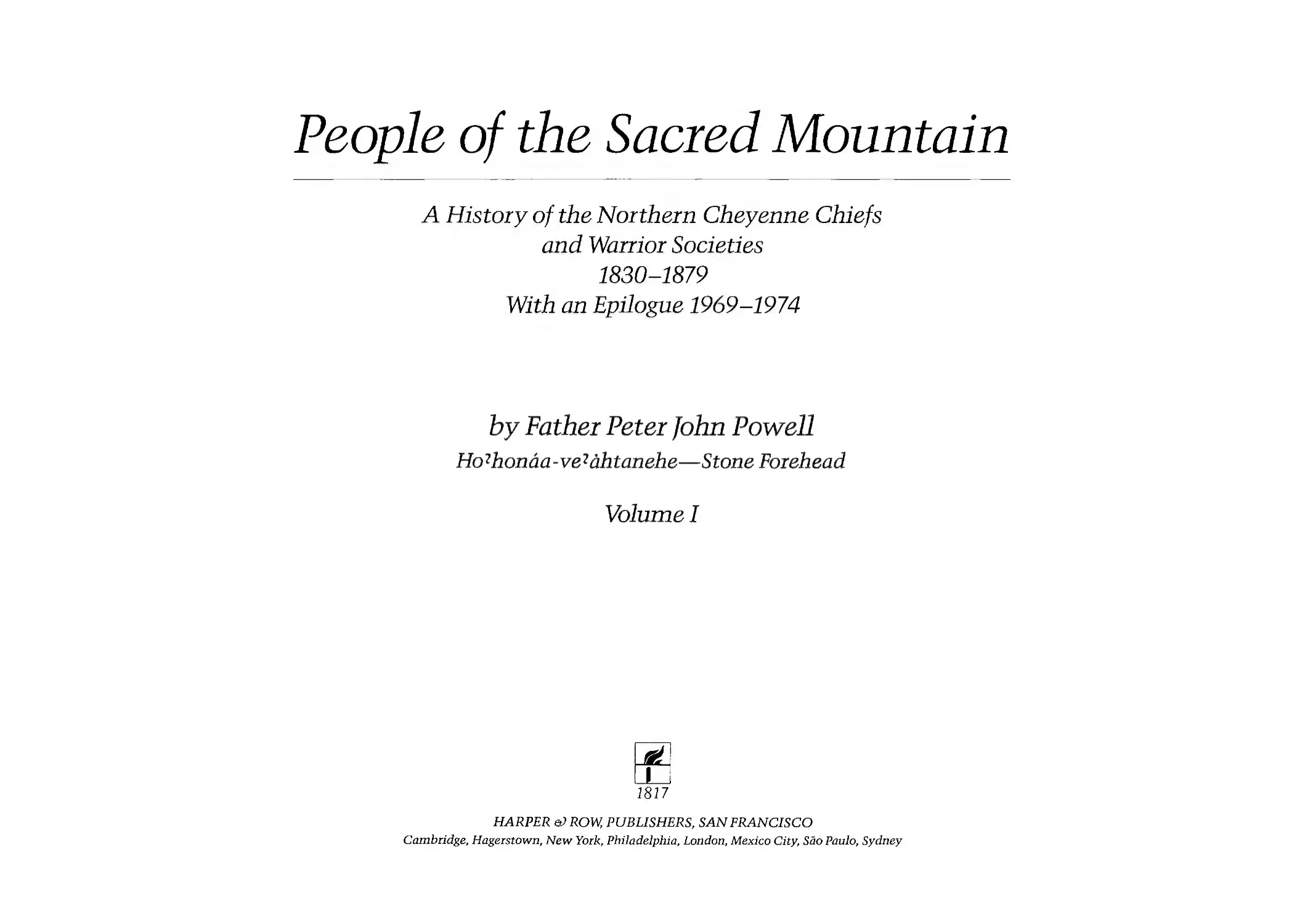
People of the Sacred Mountain
A History of the Northern Cheyenne Chiefs
and Warrior Societies
1830-1879
With an Epilogue 1969-1974
by Father Peter fohn Powell
Ho7honda-ve2ahtanehe—Stone Forehead
Volume I
1817
HARPER &> ROW, PUBLISHERS, SAN FRANCISCO
Cambridge, Hagerstown, N e w York, Philadelphia, London, Mexico City, Sdo Paulo, Sydney
Little Wolf Counts Coup on a Nez Perce
(from the Little Wolf Ledger)
T he Sweet M edicine C hief wears his long trail w ar bonnet, w ith the skins of
sacred birds, sym bols of the M a?heono, tied to the trail. Wearing them , he would
be as sw ift and sure-striking in battle as were these holy birds.
L ittle Wolf w ears a dentalium -shell choker, m etal armbands, probably of
brass, and a shirt of w h ite-m an cloth. His legs are painted the yellow of Sun
him self, and his breechclout is of red trade cloth. A woven sash, perhaps a gift
from a mixed-blood friend, is k notted about his w aist.
A lthough he carries a repeating rifle, he strikes the Nez Perce w ith a forked
stick, using th is harm less object to count the first and bravest of coups.
T he au th o r has designated this ledger the Little Wolf Ledger, in honor of the
great Sweet M edicine Chief, who is prom inently pictured on its pages.
Photo: F. Peter Weil, Chicago. C ou rtesy Foundation for the Preservation of Am erican Indian A rt and
C u ltu re, Inc., Chicago.
PEOPLE OF THE SACRED M O U N TA IN : A H istory of the Northern Cheyenne
C hiefs and Warrior Societies, 1830-1879. With an Epilogue 1969-1974. Volume 1.
Copyright © 1981 b y Father Peter John Powell. A ll rights reserved. Printed in the
U nited States of America. N o part of this book m a y be used or reproduced in any
m a n n er w hatsoever w ith o u t w ritten permission except in the case of brief quota
tions em bodied in critical articles and reviews. For information address Harper
d) Row, Publishers, Inc., 10 East 53rd Street, N ew York, N Y 10022. Published
sim u lta n eo u sly in Canada byF itzhenry &) Whiteside, Limited, Toronto.
FIRST EDITION
D esigned by Catherine H opkins
Library o f Congress Cataloging in Publication Data
Powell, Peter f.
1928People o f the sacred m ountain.
Bibliography: p. 1403
Includes index.
1. Cheyenne Indians—Wars. 2. Cheyenne Indians—Tribal government.
3. Indians of N o rth A m erica—G reat Plains—Tribal government.
4. Cheyenne Indians—Secret societies. 5. Indians of N orth America—Great
P lains— Secret societies. I. Title.
E99.C53P59 1979
970'.004'97
76-50454
ISBN 0-06-451550-8
81
82
83
84
85
10 9
8
7 6
5 4 3
2
1
For M a2heo2o and His People
The author's net royalties
w ill be equally shared with
the Cheyenne People.
This book is fourteenth in Harper &) Row's Native American
Publishing Program. A ll profits from this program are used to
support projects designed to aid the Native American People.
Other books in the program:
Seven Arrows
Hyemeyohsts Storm
Ascending Red Cedar Moon
Duane Niatum
Winter in the Blood
fames Welch
Indians' Summer
Nas fNaga
Carriers of the Dream Wheel
edited by Duane Niatum
Riding the Earthboy 40
fames Welch
Going for the Rain
Simon Ortiz
The Blood People
A dolf Hungry Wolf
Digging Out the Roots
Duane Niatum
Wind from an Enemy Sky
D Arcy McNickle
The Metaphysics of Modem Existence
Vine Deloria, fr.
W inter of the Salamander
Ray Young Bear
Song of Heyoehkah
Hyemeyohsts Storm
Contents
LIST OF COLOR PLATES
LIST OF BLACK-AND-WHITE PLATES
xiii
1836
The Wolf People Drive Back Young High Back Wolf
30
xv
1837
Mouse's Road Dies Fighting the Kiowas
34
1837
Forty-two Bowstrings Are Wiped Out
38
1837-1838
Medicine Snake Is Killed
47
1838
PREFACE
xvii
INTRO D U CTIO N
xxi
ACKNOWLEDGMENTS
xxv
THE CHEYENNES WHOSE KNOWLEDGE HELPED
TO MAKE THESE VOLUMES POSSIBLE
xxxi
xxxvii
GLOSSARY
P a r ti
TH E TIM E O F Q U IE T
ca. 1830*
All the People Were Crying
ca. 1830
Box Elder First Shows His Power
16
ca. 1831
Two Chiefs Carry Oxohtsemo Against the Crows
18
ca. 1831
Big Head's Kit Fox Bow Lance Helps to Save His Life
23
ca. 1836
The Kiowas Come North
27
3
The Battle at Wolf Creek
51
1839-1840
The Dog Soldiers Speak for Peace
67
1843-1844
One of the Sacred Arrows Returns Home
74
1844
Medicine Water's Iron Shirt Stops the Delawares
75
1845
The Kit Foxes Wrap Their Chief in Blankets
80
1845
The Crazy Dogs Lose a Brave Man
90
1849
Half the Southern People Are Killed
93
1851
Four Chiefs Sign the Great Treaty at Horse Creek
100
1852
The Iron Shirt Fails Alights on the Cloud
111
Ice Tries to Throw Away His Life
151
1853
The Summer of Much Weeping
154
1853
The First Raid into Mexico Fails; but the Elks and
Red Cherries Make the Crow Women Cry
164
1854
A Kit Fox Chief Is Murdered
172
1852-1853
*Year Described
xi
Blood on Maahotse Brings the People Together
Again
180
The Chiefs Are Renewed
185
Bull's Son Is Killed by the Wolf People
190
The Dog Soldiers Celebrate; but the Kit Foxes
Mourn
194
1856
Soldiers Bloody the Earth
202
1857
Ice's Power Fails
211
Ice Leads a Starvation War Journey, but Lives to
Scalp a Pawnee
1858
1860
1865
Ice Strikes the Flatheads
389
1865
Black Kettle and the Chiefs with Him Sign a New
Treaty on the Little Arkansas
391
1865-1866
Trouble in the Smoky Hill Country
404
1862-1865
The Crows Are Driven from the Elk River Country
414
1865-1866
A New Treaty Is Offered to the Northern People
417
1866
Morning Star and the Other Ohmeseheso Peace
Chiefs Are Driven from the Tongue River
Country
215
1866
Two New Forts in the North Country
426
434
The Unity of the Council Chiefs Is Threatened
223
1866
Ice Makes Thunder's War Bonnet for Roman Nose
229
Morning Star, Old Spotted Wolf, and Turkey Leg
Sign the New Peace Treaty
442
The Six Chiefs Sign a N ew Treaty
231
One Hundred Soldiers Are Killed
451
1861
A Scalp for Box Elder
238
Soldiers Bum the Dog Soldier Village on Red Arm
Creek
462
1862
Another Scalp from the Wolf People
240
1867
The Dog Soldiers Fight Back
479
1863
The Summer of the Dog Soldier Sun Dance
243
1867
Black Kettle Hears News of a New Peace Council
501
1867
A N ew Peace Is Offered at Medicine Lodge Creek
506
1867
The Dog Soldiers Accept the New Peace at
Medicine Lodge Creek
521
The Young Dog Men Raid the Saline and Solomon
532
1854
1854
1854-1855
1855
1857-1858
1859-1861
Part II
THE TIME OF WEEPING
1864
White Soldiers Murder Starving Bear
257
1864
The Council of the Forty-four Is Renewed
270
1864
Little Wolf and Morning Star See Bridge's Healing
Power
1864
Striking the Platte
1864
1865
1866
1866-1867
1868
1868
Roman Nose Is Killed
573
275
1868
Bullet Proof's Power Fails
583
278
1868
White Soldiers South of the Arkansas
588
Death at Sand Creek
299
1868
Soldiers Attacking in the Snow
594
Moving North to Strike the Ve?ho?e
311
1868
Black Kettle Is Killed by the White Soldiers
602
1865
Attacking the Bridge at Moon Shell River
327
1865
White Soldiers Invade the North Country
375
NOTES
621
MAPS
685
Errata
page 691 to 695
List of Color Plates
Frontispiece: Little Wolf Counts Coup on a Nez Perce
_______________ Section A _______________
WARRIORS OF THE NORTHERN PEOPLE
Bear Foot, a Contrary, Is Rescued by Last Bull, Head Chief of the
Kit Foxes
145
A Kit Fox Brave Man Counts Coup on a Fleeing Shoshoni
221
A Contrary and a War-Bonnet Man Test the Bullets of Soldiers and
Their Pawnee Scouts
147
A Kit Fox Head Chief Battles a Nez Perce
123
A Contrary Lances a Nez Perce
149
A Kit Fox Head Chief Turns Aside a Nez Perce Bullet
125
Oak's Sacred Mah slh' kota Band Shield Turns Away the Crow
Bullets
127
A Crooked-Lance Bearer of the Elkhom Scrapers Counts Coup on
Two Enemies
129
_______________ Section B____________
FIGHTING THE PEOPLE'S ENEMIES
Lancing a Pawnee
345
A Straight-Lance Bearer of the Elkhom Scrapers Strikes Down an
Enemy
131
Counting Coup on a Pawnee Soldier Scout
347
A Dog Soldier Stabs a Warrior of the Cut-Hair People
133
A Warrior Woman
135
A War-Bonnet Man Rides Down a Pawnee Warrior, Counting Coup
on a Woman and Her Child
349
A War-Bonnet Man Strikes an Armed Enemy
137
A Crazy Dog Chief Counts Coup on a Crow or Nez Perce
139
A Pawnee Soldier Scout Fires at a Shield Bearer
351
A Great Warrior Is Killed by the Crows
353
A War-Bonnet Man Fights a Crow
355
*
A Crazy Dog Banner-Lance Bearer Strikes Down a Crow or Nez
Perce
141
A Shield Bearer Chases a Crow Man and Woman
357
A Crazy Dog Banner-Lance Bearer Kills a Crow Woman
143
Counting Coup with a Flute on a Shoshoni
359
xiii
A Shield Bearer Rides Down a Shoshoni
361
Yellow Nose Lances a Ve?ho?e
543
Big Wolf Counts Coup on a Fallen Shoshoni
363
Yellow Horse Captures a Herd of Mules
545
The Kit Fox Great Man Strikes a Nez Perce
365
Yellow Horse in a Running Fight with Ve?ho?e
547
The Same Kit Fox Great Man Counts Coup on Two Utes
367
Yellow Horse Clubs a Trooper
549
Weasel Bear Rides Down a Trooper
551
Yellow Horse Rides Down a White Civilian
553
A War-Bonnet Man Counts Coup on a Ve?ho?e
555
A Warrior Shoots a White Civilian
557
Counting Coup on a White Hunter
559
The Great Warrior with the One-Horned War Bonnet Strikes a
White Hunter
561
A Young Man, the Carrier of Vikuts, Strikes Four Miners in the
Black Hills
563
Coup Is Counted on Three White Hunters: Then They Are Given
Their Lives
565
Oxohtsemo, the Sacred Wheel Lance, Protects Two Warriors from
N ez Perces
369
Herding Captured Horses across a River
371
Yellow Nose Cuts Down an Enemy Woman and Child
3 73
_______________ Section C_______________
FIGHTING THE VE^HO^E
Yellow Nose Shows His Power against the Soldiers
537
Soldiers Shoot Down a Shield Owner and His Horse
539
Two War-Bonnet Men Fall before the Soldier Bullets
541
x iv
List of Black and White Plates
Noaha-vose, the Sacred Mountain
Elk River and His Wife
1
14
Starving Bear (Lean Bear), War Bonnet, Standing in the Water, and
Agent S. G. Colley, on Their Way to Washington, D.C.
245
Starving Bear (Lean Bear), War Bonnet, and Standing in the Water
246
White Antelope, Alights on the Cloud, and Little Chief Visit
Washington, D.C.
113
Porcupine
489
Alights on the Cloud
114
Man Riding on a Cloud (Alighting on Cloud or Touch the Cloud)
611
Little Chief
115
Man Riding on a Cloud (Alighting on Cloud or Touch the Cloud)
612
Mad Wolf, with Man on a Cloud
166
xv
Preface
F
power for the men of the People. Through Maahotse, Ma?heo?o
gave the Cheyenne males spiritual dominence over the men of
other tribes as well as over the animals that the People must have
for sustenance.
And M a?heo?o Himself gave Esevone to Erect Homs, the
So?taa?e Prophet. The Creator did so on another sacred mountain,
this one in a cold country north of the present-day Cheyenne
lands, probably in Minnesota. This was in the days before the
So?taaeo?o joined the Cheyenne proper to become a band within
the Cheyenne tribe. Since that joining, the Creator has blessed all
the People through Esevone's sacred, living presence among
them. However, from the beginning, the Buffalo Hat has been the
special channel through which Ma?heo?o pours His life into the
lives of the Cheyenne women. Through Esevone, the Creator
makes the women fruitful, blessing them with new children, so
that the tribe will continue. Female animals and plants too are
blessed by Esevone, so that they also are fruitful. Thus, since the
Sacred Buffalo Hat came to live among them, the People's contin
uation as a tribe was assured, and there was always food for them.
So it was that the capture of the Sacred Arrows and the dese
cration of the Sacred Buffalo Hat brought both sorrow and ongoing
tragedy to the Cheyennes. For the violation of these supremely
sacred tribal possessions disrupted the flow of Ma?heo?o's divine
OR THE Cheyennes, supernatural life fills all creation,
supernatural life that flows from Ma?heo2o, the Creator
Himself; from Neve-stanevoo2o, the Sacred Persons who
live at the Four Directions,- and from the Ma?heono, the Sacred
Powers who dwell above and below Tsehesketse-ho?e, Mother
Earth, the mother of all living things. The Cheyennes believe
their history to be sacred history, for it has been, and continues to
be, lived in a world filled with supernatural life and power.
Two great tragedies overshadow everything else in Cheyenne
tribal history,- two disasters were of such tremendous spiritual
proportion that they affected all other events in Cheyenne life
after their occurrence. They struck at the very heart and soul of
the Cheyenne identity as the People of Ma?heo?o. These tragedies
were the capture of Maahotse, the Sacred Arrows, by the Pawnees
in 1830 and the desecration of Esevone, the Sacred Buffalo Hat, by
a woman of the So?taaeo?o, a band of the People themselves, in
about 1872.
It was Ma?heo?o Himself who gave Maahotse to Sweet
Medicine, the Cheyenne Prophet. The Creator did so in a cave
w ithin Noaha-vose, the Sacred Mountain (also called Bear Butte),
near present-day Sturgis, South Dakota. From that time on,
M a?heo?o has poured His life into Cheyenne lives through the
Sacred Arrows. They are His special channels of blessing and
xvii
life into the life of the tribe. It broke the supernatural unity that
binds M a?heo?o to His People. It also ruptured the male and
female relationship in life, a relationship that must be supernaturally blessed if the People and other living things are to con
tinue to prosper.
As the years passed, the consequences of the twin disasters
brought greater and greater sorrow to the People. Soon after the
capture of the Sacred Arrows in 1830, the Cheyennes began to
suffer more frequently at the hands of enemy tribes. Then, in
1849, the great movement of white wagon trains across the
Southern Cheyenne lands began. The whites brought new dis
eases w ith them, diseases that raged through the southern Plains
tribes like prairie fires, leaving hundreds, if not thousands, of
people dead. That was bad enough; however, in the late 1850s
gold was discovered in Colorado. Then the earlier trickle of
wagon trains became a great flood of white settlers, swallowing
up the lands and buffalo herds of the Southern Cheyennes. In the
1860s, the soldiers began their continuous attacks, the worst of
w hich was the slaughter of the peaceful Southern bands gathered
at Sand Creek late in 1864. Even after that butchery, the soldier
attacks continued; and of course, the Cheyennes fought back.
Then, about 1872, the Sacred Buffalo Hat was desecrated, her
horn ripped off in a fit of anger by the wife of the temporary
Keeper. The final fighting with the whites followed hard upon
that dreadful sacrilege. In 1874-1875 the last free bands of the
Southern People were defeated by the soldiers. After that, the old
free life was ended and the bitter reservation years began.
The Northern People resisted longer, winning great victories
over the soldiers of Crook and Custer in June 1876. Five months
later, in November 1876, the soldiers struck back harder, attack
ing the great village in the Big Horn Mountains. There they
burned the tipis and everything in them, wiping out the material
beauty of the old-time Northern Cheyenne way in one great holo
caust, forcing the freezing, half-naked people to flee across the
m ountains in the bitter cold. The Northern People never recovered
from that attack; and through the late winter and early spring of
1877, they too rode in to surrender. Most of them did so at Fort
Robinson, but some families did so at Fort Keogh. Soon after that
surrender, the people at Fort Robinson were moved to Indian
Territory. There they found not only homesickness, but sickness,
starvation, and death. So in September 1878 they started home
again, w ith Little Wolf and Morning Star leading the way. On that
hard journey north they fought off attack after attack by the sol
diers. Finally they reached the North Platte River in Nebraska,
the southern boundary of the old Northern Cheyenne lands. There,
believing they were safe, the two Chiefs separated. Morning Star
took his followers on toward Fort Robinson to surrender. How
ever, instead of peace, they found suffering and death. For at Fort
Robinson, early in January 1879, many of them were shot down
by soldiers as they raced across the frozen snow, choosing death
in their own country to being returned to the hated south again.
The killing of Morning Star's people aroused public sentiment,
and finally the Northern Cheyennes were granted a reservation in
their own North country. However, even with the establishment
of this reservation—the Tongue River reservation—in 1884, new
battles and new suffering lay ahead. Beginning in the late 1890s
the sacred ceremonies, the very heart of their life as the People of
M a?heo?o, began to be threatened by constant government and
missionary persecution. I have chronicled this bitter struggle for
religious freedom in Sweet Medicine: The Continuing Role of the
Sacred Arrows, the Sun Dance, and the Sacred Buffalo.Hat in
Northern Cheyenne History (1969).
In those two earlier volumes, I described the role of the
sacred ceremonies in the tribal life of the people. However, the
lives of the men who governed and protected the People—the
Council Chiefs and the men of the warrior societies—were
affected by the desecration of Maahotse and Esevone in their own
special way. It is their history that is recounted on the following
pages.
It is a history filled with both glory and tragedy. Throughout
these years of suffering and persecution, the Chiefs and military
societies have not forgotten their responsibilities to protect and
work for the good of the People. So it was that in June 1974, one
hundred and two summers after the first terrible desecration of
Esevone, representatives of the Northern Cheyenne Chiefs and
m ilitary societies accompanied the Sacred Buffalo Hat back to the
Sacred Mountain. There the Cheyennes' history as a holy people
had begun, when Ma?heo?o Himself gave Maahotse to Sweet
Medicine. In 1945 the Sacred Arrows had returned to the Holy
Mountain, carried there by their Keeper; Esevone, however, had
not been there since about 1882. It was time for her to return. For
now the Northern Cheyennes are facing yet another threat to
their sacred way of life. That threat is a deadly one, coming from
the giant strip-mining companies, whose operations would rip
apart Mother Earth far more terribly than anything the whites
have done to her before.
When Esevone returned to the Sacred Mountain in 1974, the
contents of her bundle were repaired. Esevone herself was exposed
to the life-renewing power that flows from Noaha-vose, power
from Ma?heo?o Himself, endlessly pouring from the Sacred Moun
tain, the holiest place on all the generous breast of Mother Earth.
And w ith Esevone's return to the Holy Mountain, many of
those present prayed that an era of new greatness for the Chey
ennes, Ma?heo?o's People, now would begin.
Great men make history. Therefore the lives of the following
four great Chiefs will form continuing threads in the overall his
tory of the Chiefs and warrior societies:
LITTLE WOLF, the greatest warrior among the Northern People,
was the first man to be simultaneously a Council Chief and head
chief of a warrior society. In 1864 he was chosen to be Sweet
Medicine Chief, the head Chief of the Council of the Forty-four.
It was he who, with Morning Star (Dull Knife), led the main body
of the Ohmeseheso back to the North country after their terrible
exile in the South.
People. At the time of his death in 1921, he was one of the four
Old Man Chiefs of the Northern Cheyennes.
My primary purpose in writing this work is to provide today's
Cheyenne People with a history of their own tribal Chiefs and
warrior societies. Thus, whenever possible, I have used Cheyenne
accounts of the events and people portrayed on these pages. Where
Cheyenne accounts were lacking, I have given first preference to
the accounts of men who married women of the People, or who
shared the People's blood: men such as William Rowland, James
Rowland, and George Bent. Only when Cheyenne or part-Chey
enne sources are lacking have I introduced material from other
tribes or from white sources. In such cases, I have tried to inter
pret those sources in terms of the People's own thought and
actions, as I have learned them from the Old Ones, among both
the Northern and Southern Cheyennes. I have tried carefully to
note the sources of what is written, so the People themselves will
know the names of the Old Ones whose wisdom and knowledge
is recorded here.
Since these volumes are written primarily for the People, I
use Cheyenne idioms throughout. Those most frequently used
are the following:
People: the Cheyennes themselves.
BOX ELDER (also called Old Brave Wolf, Strong Wolf, Big Wolf,
Maple Tree, Dog on the Hill, and, by the whites, the Medicine
Man), was not only a Chief, but also the greatest of the old-time
So?taa?e holy men. To this time, more than eighty years after his
death, Box Elder's name is venerated among the Northern People,
and some of the Old Ones invoke his prayers and blessing from
Seana, the Place of the Dead.
STONE FOREHEAD (called Medicine Arrow by the whites), the
greatest of the Keepers of Maahotse, lives on in the hearts of the
People, both in the North and South. For to this time it is recalled
how his smoking with Custer under the Sacred Arrows brought
about Custer's death at the Little Big Horn.
WHITE BULL (Ice or Hail), a leading warrior of the Elkhom
Scraper Society, was also a great holy man among the Northern
Ohmeseheso or Northerners: the Northern Cheyennes. Ohmese
heso originally referred to one band, the Eaters or Northern
Eaters. However, from about the early 1850s on, the name
was used as a general term for the bands who lived in the
north—the present-day Northern Cheyennes,.
Southerners: the Southern Cheyennes; those who lived south of
the Platte.
ve2ho?e, ve?ho?e (plural): literally "spider," the name given to the
whites. Originally, the name was used for the Spider trick
ster, who figures in many of the Cheyenne fun stories, the
stories recited to amuse the children. Spider possesses un
usual powers,* so the People also gave his name to the white
man, whose inventions were so numerous and amazing.
However, the old word also has a much more subtle
connotation when it is used to mean white man. For here
the term implies intricacy, trickery, or trap. The white
man's mind is deceitful. The white man's thoughts are usu
ally directed toward tricking the Cheyennes, robbing them
of their way of life, trying to destroy them as the People.
Cheyenne names for other tribes, rivers, and seasons of the
year are used throughout the narrative. A complete list of these
terms, with their contemporary spelling, is included in the glossary.
Finally, paintings by Cheyenne warrior artists illustrate the bat
tles and military-society paraphernalia described in the narrative.
Thus, this work is an attempt to record Cheyenne history as
it was lived and recounted by the Cheyennes both past and pres
ent, and as it was pictured by the artists of the warrior societies,
those brave men who fought for the People and for the sacred way
of life given to them by Ma?heo?o, the Creator Himself.
These two volumes were written to commemorate the cen
tennial of Little Wolf and Morning Star's epic journey home to the
N orth country. Thus they end with Little Wolf's arrival there in
March 1879. An additional work, recounting the history of the
Northern Cheyenne Chiefs and warrior societies from that time
to the present, is now in preparation.
Introduction
assisted by the men of their respective societies. In the old free
days, the warrior societies functioned as protectors of the People,
and also, under the appointment of the Chiefs, as village and
hunting police. Ideally, like the Council Chiefs, the headmen
should be leaders and servants of the People, working hard and
constantly for the good of the tribe as a whole. Indeed, in these
later years among the Northern Cheyennes, the headmen have
often assumed the strongest role of leadership, for throughout the
early reservation years, the government deliberately attempted to
break the power of the Council Chiefs. Thus, by the time of the
establishment of the present system of government by Tribal
Council, about 1934, the position of Chief had become one of
honor and respect, more than of great actual power. The headmen
of the warrior societies, however, continued to maintain much of
their traditional authority, largely because their leadership was
not so apparent to the Indian Bureau agents.
It was a profound sense of concern for the needs of the People
that moved. Charles White Dirt, headman of the Elkhom Scraper
Society, and his companions to come to me. At this time the war
in Vietnam was dragging on and on, tearing the: nation apart,
dividing world opinion, and, worst of all, killing a seemingly end
less number of human beings. These four men, all respected lead
ers in both the warrior societies and sacred ceremonies of the
lHESE VOLUMES began on Noaha-vose, the Sacred Mountain.
One warm afternoon, early in August 1970, Charles
White Dirt, headman of the Elkhom Scraper society, came
to see me at the home of my Northern Cheyenne parents, John
and Josie Stands in Timber, in Lame Deer, Montana. Here John
Stands in Timber had spent the last years before his death; here
his wife Josie One Bear Stands in Timber continues to live. I am
their adopted son, and their home is mine during those months I
spend among our people, the Northern Cheyennes, each year.
Charles Sitting Man, Jr., Frank Walks Last, and William Hollowbreast came with Charles White Dirt, making the sacred
number four. Charles White Dirt was carrying a filled pipe, its
mouthpiece extended toward me. Would I offer the pipe and pray?
he asked. I did so and then we all smoked together, praying with
the pipe that, the People say, never fails to bring a blessing.
When Sweet Medicine, the Prophet, departed this world, he
left to the Council Chiefs the double responsibility of leading and
serving the Cheyennes. Ideally, the Chiefs must be not only wise
leaders, but also generous servants of the people. The headmen of
the traditional warrior societies—the Kit Foxes, Elkhom Scrap
ers, and Crazy Dogs among today's Northern Cheyennes—also
share this twofold responsibility. Traditionally, a primary role of
the headmen is to carry out the orders of the Council Chiefs,
T
xxi
Northern Cheyennes, were deeply troubled by the war. What did I
think could be done to end the war? they asked me, an AngloCatholic priest who, they knew from our long years together,
shared their own faith in the holiness and supernatural power of
the Cheyenne sacred ceremonies and the Cheyenne sacred way of
life.
Charles White Dirt asked if we could get every one on the
reservation together—the Sun Dance people, the Native Ameri
can Church people, representatives from the other Christian
Churches working among the Northern Cheyennes—to pray and
to do something to end the fighting in Vietnam. I replied that at
times of trouble like this, we must return to Noaha-vose, the
Sacred Mountain, to fast and pray there; for Noaha-vose is the
heart of all holy power and blessing for the Cheyenne People,
M a?heo?o's own People.
Charles White Dirt had fasted on the Sacred Mountain twice
before. Now, as he had done so often, he spoke of the holiness of
Noaha-vose, a holiness which no white-man words can begin to
describe. He mentioned how, during the Korean War, he, Albert
Tall Bull, Bert Two Moon, and Willis Medicine Bull had fasted
there, praying for that war to end. Ma?heo2o had answered those
prayers, for peace came soon afterward. Then, in a voice that was
quiet w ith respect, he spoke of that holiest of all events in the
history of the People: the day Ma2heo?o gave Maahotse, the
Sacred Arrows, to Sweet Medicine, in a cave inside the Sacred
Mountain. From that day on, sacred power has flowed from Noa
ha-vose in an endless stream, blessing and renewing the men who
fasted there, giving them wisdom and the supernatural power to
guide the People through many a difficult time.
So it was that Charles White Dirt and I vowed, holding the
sacred pipe, that we would journey to the Sacred Mountain
together, to fast and pray for the Cheyenne People, the nation,
and a speedy end to the war in Vietnam. We knew that two other
m en should fast with us to make the sacred number four, and, as
we smoked, we begged Ma2heo?o to guide us in selecting those
men. Then, together w ith the other men present, we discussed
the season of our fast. The others thought June might be the best
time. The sacred white “m an" sage would be up then, ready
to give us the blessing of renewed strength which holy white sage
always brings when used in the sacred ceremonies. We would
need four buffalo robes and buffalo heads (skulls) without bul
let holes in them, for nothing used in the Cheyenne sacred
fasts should be touched by white-man's metal. Male buffalo
heads were best, they declared, although some fasters used
female skulls.
And so the talking continued in John Stands in Timber's last
home, which Josie Stands in Timber had made my home too,
whenever I returned to the Northern People. The pipe continued
making its sacred round as we discussed the vow Charles White
D irt and I had made. We agreed not to talk too much about the
vow. Instead, we would pray on it, and keep working at carrying it
out, so that all the People would know that we were serious about
fulfilling such a sacred vow and responsibility.
After the pipe had been smoked out and our talking ended,
we left the house together and headed for the forks of Lame Deer
Creek. There we gathered in council with the other Chiefs and
headmen to discuss the renewing of the tipi of Esevone, the Sacred
Buffalo Hat.
This pilgrimage to the Sacred Mountain had a long beginning
for me. In July 1962, the Northern Cheyenne Chiefs' Society had
invited John Stands in Timber, John Woodenlegs, the late Verne
Dusenberry, and me to membership in the Chiefs' lodge. In 1970,
I had been honored again by being chosen one of the Chiefs of the
N orthern Cheyennes. During the 1960s and 1970s I made a num
ber of visits to our relatives, the Southern Cheyennes in Okla
homa. There, during the 1961 Sun Dance, Ralph White Tail, a
venerated Sacred Arrow and Sun Dance priest, had given me the
name Ho2honaa-ve?ahtanehe, Stone Forehead, honoring me with
the name of that great Keeper of Maahotse who lived during the
final years of Cheyenne freedom. At the request of the Chiefs and
headmen of both the Northern and Southern Cheyennes, and
w ith the blessing and permission of the Keepers of Maahotse and
Esevone, I had recorded the Sacred Arrow, Sacred Buffalo Hat, and
Sacred Sun Dance ceremonies, so there would be a permanent
record of the beauty and sanctity of the Cheyenne holy ways.
In May 1971, the spring following our vow to fast on Noahavose, I drove south to meet with the Chiefs and headmen of the
Southern Cheyennes. We gathered in the presense of Maahotse,
the Sacred Arrows. Early in 1971, the Southern Chiefs and head
m en had chosen Edward Red Hat, a man deeply respected for his
goodness and knowledge of the sacred ways, to be the new Keeper
of Maahotse. Now it was he who guarded the Sacred Arrows as
xxii
to taunt us, sparkling in the bright Sunlight, the water tempting
us to flee the terrible heat of the Sun, whose blazing rays burned
our bodies.
Then, as evening drew on and Sun's heat lessened, mos
quitoes swarmed in, bringing new misery to us. When we tried to
escape beneath our buffalo robes, the heat quickly became unbear
able. When, soaked with sweat, we threw the robes aside for a
m om ent of air, the mosquitoes moved like arrows, biting us mer
cilessly, until our dehydrated bodies were covered with bumps,
the itching driving us almost to distraction.
As always, the pipe did not fail, and so, holding fast to our
pipes, we were able to endure. Finally the night breeze sprang up,
blowing away the mosquitoes, bringing in cool air after the blaz
ing heat of the day. Then the Moon, the Sun of the Night, rose
high in the sky, and rustling sounds around us spoke of wild
creatures who had come to watch us. Some of them, we said
afterward, m ust have been those Ma?heono who assume the
forms of animals and birds when they visit men, especially those
men who are fasting and praying.
It was shortly before the Morning Star burst into white glow
in the heavens, early on the fourth day, that the Ma?heono
revealed themselves clearly, coming to each of us in a different
form, but making their holy presence known, so that we had no
doubt that the Sacred Powers had visited us. After their holy
coming, the darkness seemed to pass away quickly and the first
gray streaks of morning light began to appear in the sky.
Shortly after dawn of the fourth day, silently rising out of the
m ist that covered-the Sacred Mountain, George Elk Shoulder sud
denly appeared. In his right hand he carried a bundle of sacred
w hite sage. He moved from faster to faster, stroking our limbs,
our bodies, and our faces with the holy sage, removing the power
of the sacred designs painted upon us, so that we could leave the
Spirit-filled slopes of Noaha-vose for the everyday world below.
One by one we moved down the slope, stumbling through the
m ist of morning, weakened by the days of fasting. Our friends and
relatives were camping below, and a group of Lakotas, old-time
friends and allies of the People, had come from Rapid City to join
their prayers to those being offered for us at the foot of the Sacred
M ountain. As we drew near, people came pouring from the tents,
some of them mothers with babies in their arms. As they reached
us they embraced us, exclaiming "Hahoo, hahoo! Thank you,
they hung in their holy lodge. On this occasion we Chiefs gath
ered in the presence of Maahotse to unwrap the Sacred Arrows
and see that all was well with them, as Edward Red Hat assumed
his new duties as Keeper.
It was there, in the holy and living presence of the Sacred
Arrows, that I spoke to their Keeper, and to the Southern Chey
enne Chiefs present, of the vow that Charles White Dirt and I had
made. There, as Maahotse listened, Edward Red Hat asked me if
he could join us in fasting on the Sacred Mountain. He1said that
even before he had been chosen Keeper, he had vowed to journey
to Noaha-vose, to fast with the Northern Cheyennes. He asked if
I would carry his request back to the Northern People, and I said I
would be honored to.
So it was that the evening of July 12, 1971, five of us climbed
a steep slope of the Sacred Mountain together: five, the old holy
number four, w ith one added to pull together all the power inher
ent in the four, as Ma?heo?o Himself is the One source of all the
holy power flowing from the four Sacred Arrows.
The five fasters were Edward Red Hat, Keeper of Maahotse;
Charles White Dirt, then headman of the Elkhorn Scraper Soci
ety, now also one of the five Head Chiefs of the Northern Chey
ennes; Alex Brady, a widely respected Sun Dance priest, who also
was a leader of the Crazy Dog Society; Wilson Brady, another
well-known Crazy Dog Society member; and I, one of the North
ern Cheyenne Chiefs and an Anglo-Catholic priest.
Part way up the slope we paused, surrounded by a small group
of our relatives and friends, and stripped to breechclout and moc
casins. Then we were painted with holy paint, in sacred designs,
by George Elk Shoulder and Mike Little Wolf, both of whom had
fasted on the slopes of the Sacred Mountain.
Then we scattered, taking our pipes with us. Our beds had
been prepared in advance, beds of white "man" sage, with a buffalo
robe to cover each of us. At the head of each bed stood a buffalo
skull, symbol of the living presence of Esevone, the Sacred Buffalo
Hat. Through the buffalo skull, Esevone herself would be watch
ing over us, blessing us, strengthening us, as Esevone blesses and
strengthens the people who pray in her presence.
Throughout the heat of the days that followed, we fasted
from all water and food, praying constantly, smoking the long
stemmed pipe that each of us carried. Far below, at the foot of
the Sacred Mountain, the blue waters of Bear Butte Lake seemed
xxiii
thank y o u !/7 as they held out the little ones for us to stroke, to
bless them w ith that blessing we had received on Noaha-vose.
For we had returned to the world blessed by the endless sacred
power that flows from Noaha-vose, the holiest place on all the
Earth. Once again representatives of the Chiefs and warrior soci
eties, w ith the Keeper of Maahotse, the greatest holy man among
the People, had offered the sacrifice of themselves upon the Sacred
Mountain. From that sacrifice would come blessings for Ma2heo 2o's People, the Cheyennes; and, we prayed, blessings and peace
for all the people of America and the world.
Whether I have used that sacred power well, only the People
themselves are qualified to say. Throughout the years of writing
this work, I have done my utmost to live sustained by that holy
power from Noaha-vose. I have done my best to be both a servant
and a blessing to Ma?heo?o's People; as Edward Red Hat, Charles
White Dirt, Alex Brady, Wilson Brady, and I prayed we all would
be, when we offered our sacrifice together, on the Sun-brightened
slope of Noaha-vose, M a?heo?o's own Sacred Mountain.
Peter John Powell +
Chicago, Illinois
25 March 1981
Acknowledgments
O ONE ever writes a book alone. The warmth, support,
and patience of family, friends, and associates; the gener
osity of the wise ones willing to share their knowledge
and insights,- and above all the love of those whose lives touch the
author's life: all these blend to make the dream of writing a book
become a reality.
Of those who made this work possible, my gratitude first
m ust be expressed to the Cheyennes: Ma2heo2o's People; and my
own people too. Those whose wisdom and knowledge fill the
following pages are noted separately; my gratitude to them could
not be expressed in a lifetime of words.
Nor could the volumes have been written without the John
Simon Guggenheim Memorial Foundation and the National
Endowment for the Humanities. A Guggenheim Fellowship for
1971-1972 made possible fieldwork among the Cheyennes, as
well as research in the museums and archives possessing major
collections related to the People. Then, in 1973 and 1974, a grant
from the National Endowment for the Humanities enabled me to
spend those years in writing these volumes. My profound grati
tude for both.
To five treasured friends, all distinguished scholars in their
respective fields, I wish to extend a special expression of gratitude
and affection. Not only did they support me in my belief that these
books should be written; but they also possessed the courage to
declare that I, a priest, was the man who should write them. They
are the late Ray A. Billington, Senior Research Associate, Henry E.
H untington Library and Art Gallery, San Marine), California;
Thomas G. Belden, former Chief Historian, United States Air
Force, presently of the Concepts and Analysis Directorate, United
States Air Force, Washington, D.C.; Paul Dyck, artist of Plains
Indian life, Director, Paul Dyck Research Foundation, Rimrock,
Arizona; Sol Tax, professor of Anthropology, LJniversity of
Chicago, former Director, Center for the Study of Man, Smith
sonian Institution, Washington, D.C.; and Lawrence W. Towner,
President and Librarian, The Newberry Library, Chicago, Illinois.
And w ith my special thanks and affection to these five men, I
would extend the same to their wives as well: to Mabel Crotty
Billington, Marva Robbins Belden, Star Hamilton Dyck, Gertrude
Katz Tax, and Rachel Bauman Towner. All are epitomes of charm
and graciousness. All generously opened their homes and boards
to me, buoying my spirits after many a long day of research and
writing.
W ithout the permission and blessing of my Ordinary, the
Right Reverend James W. Montgomery, D.D., Bishop of Chicago,
it would have been impossible for me to spend these years in
fieldwork and writing. I wish to express my profounclest gratitude
N
xxv
to Bishop Montgomery for his kindness in doing so, and for the
encouragement and support that he has given me at every step
along the way.
Among the hierarchy, I also would extend profound thanks to
the Right Reverend Walter C. Klein, Ph.D., Bishop of Northern
Indiana, now deceased, and the Right Reverend Donald J. Parsons,
Th.D., Bishop of Quincy. Both have been of special strength and
blessing during these years of combining the priestly vocation
w ith that of the scholar.
I have been fortunate to be a Research Associate of The New
berry Library, Chicago, since 1973. However, for more than
twenty-five years it has been my pleasure to make use of the
splendid Edward E. Ayer Collection of American Indian volumes
there. Most of the actual writing of these books was done at The
Newberry, in the Department of Special Collections. There the
following persons have been unendingly gracious and helpful, and
they have become warm friends as well: John Tedeschi, Curator
of Special Collections; John Aubrey, Acting Supervisor of Special
Collections,- Susan Dean, Assistant Curator, Special Collections;
Diana Haskell, Curator of Modem Manuscripts; Carolyn Sheehy,
Reference and Manuscripts Assistant; Anthony J. Amodeo, Refer
ence Assistant; Michael Kaplan, Senior Page; Richard Buchen,
Page; and the Special Collections Reading Room Staff, present
and past: Stacia Fischer, Wendy Towner Yanikoski, Maureen
Neff, Judith Kolata, and Arthur Prieditis.
The following Newberry Library staff have been of invaluable
assistance as well: Jane E. Smith, formerly Secretary to the Direc
tor and Librarian; F. Peter Weil, Supervisor of the PhotoDuplication Section,- Helga Miz, Margaret Brenneman, and Linda
Chan, all of the Department of Technical Services.
For more than twenty years, the staff of the National Anthro
pological Archives, Smithsonian Institution, Washington, D.C.,
has been unceasingly generous and thoughtful. I express my spe
cial gratitude to Herman J. Viola, Director; Margaret C. Blaker,
former Director; James R. Glenn, Archivist; Paula Richardson
Fleming, Museum Specialist; Chung-su Houchins, Museum Spe
cialist; and Jill Rhodes Lawson, former Museum Specialist.
The Southwest Museum, Los Angeles, is a very special home
away from home for me. The George Bird Grinnell field notebooks,
manuscripts, photographs, and correspondence are in the library
there, a rich mine of knowledge for any Cheyenne scholar willing
to do the digging. Best of all, however, is the warmth and gracious
ness extended by the entire staff. This graciousness moved them to
contribute many hours of overtime work in order that I might
derive the fullest benefit from both the library and the ethnological
collections. I send warmest thanks to the entire staff of the South
west Museum, and especially to the late Carl S. Dentzel, formerly
Director,- Bruce Bryan, Acting Director; Ruth M. Christensen,
Librarian; Kathleen WThitaker Bennett, formerly Curatorial Assis
tant; Rose L. Ingraham, Casa de Adobe Hostess; the late Betty
Ingraham Gray, formerly Secretary; Louise Foreman Maynard,
Secretary and Assistant Treasurer, and Robert Maynard her hus
band; Dee Ulrich, Registrar,* Glenna R. Schroeder, Library Archi
vist; Ron R. Kinsey, Curatorial Assistant; Valerie Dembrowslci,
Controller,* Kathryn E. Breckenridge, Secretary; and Linda Blackwell, Curatorial Assistant; also John Aldocano, Ramon Sandoval,
Tony Martinez and Robert Valdez.
During the years 1971-1974, I was privileged to spend many
weeks in research at the Museum of the American Indian, New
York City. There the entire staff were bestowers of countless
kindnesses. I wish to thank them all for being such delights,
especially Frederick J. Dockstader, then Director,* Carmelo
Guadagno, Curator of Photography; Ellen Jamieson, Publications
Manager; Mary W. Williams, then Manager, Book Shop,* Susan C.
Krause-Martin, then Exhibits Curator; G. Lynette Miller, then
Registrar; U. Vincent Wilcox, III, then Curator, Research Branch.
At the American Museum of Natural History, New York
City, the staff of the Department of Anthropology was of special
assistance in my study of the Cheyenne painted ledger books and
ethnological specimens in that great museum's collections. I am
especially grateful to Stanley Freed and Philip C. Gifford, Jr. for
numerous courtesies during my period of research there.
Here in Chicago, the staff of the Field Museum of Natural
History's Department of Anthropology has been unendingly gra
cious and helpful throughout all these years. I extend special
thanks to Phillip Lewis, Chairman, Department of Anthropology;
Donald Collier, Curator of Middle American and South American
Archaeology and Ethnology, retired; James W. Van Stone, Curator
of N orth American Archaeology and Ethnology; and Phyllis
Rabineau, Custodian of Collections.
Mildred R. Goosman, Curator of Western Collections, Joslyn
Art Museum, Omaha, was most generous and helpful during my
xxvi
days of research there. In addition to being so kind, her knowledge
of Cheyenne ledger-book art provided me with the key that
enabled me to identify a large number of warrior drawings in
other museum collections, drawings whose exact identification
would otherwise remain unknown.
Marie T. Capps, Maps and Manuscripts Librarian, United
States Military Academy Library, West Point, was especially
helpful in discovering a hitherto unknown Cheyenne warrior
ledger for my study. Some of its paintings appear on these pages.
During my study of it, and of the John G. Bourke diaries at the
U.S. Military Academy Library, the following persons also were
most helpful and kind: Edward Rich, former Chief of the Special
Collection Division; Ruth Murphy, Library Technician; and
Regina M. Hanretta, Archive Technician.
Mary Isabel Fry, Head of the Department of Reader Services,
Henry E. Huntington Library, San Marino, California, introduced
me to the Indian collections of that beautiful institution. She also
made possible the living arrangements that made my visit there
both fruitful and delightful.
Archibald Hanna, Curator of Western Americana, Beinecke
Rare Book and Manuscript Library, Yale University, opened to me
the treasure of Plains Indian manuscripts in that splendid collec
tion. After he did so, Anne Whelpley, Joan Hoffman, Susan
Rutter, Cosima Long, and Virginia George made it possible for me
to study them rewardingly.
Marie Keene, Librarian of the Thomas Gilcrease Institute of
American History and Art, Tulsa, was most gracious in providing
me w ith the Cheyenne manuscripts and ledger books there.
Daniel M. McPike, Anthropologist, kindly arranged for me to
examine the Cheyenne ethnological specimens in the Gilcrease
Institute storage collections.
Norman Feder, former Curator of American Indian Art, Den
ver Art Museum, has long been of invaluable assistance in my
study of Cheyenne warrior painting, especially as it relates to
Plains Indian art as a whole. I am deeply grateful for his continual
kindness.
For years our friends and neighbors in Big Horn, Wyoming,
have encouraged me and brightened my life throughout the ter
rible ordeal of writing the first drafts of these volumes, as well as
of Sweet Medicine. My affection and thanks to the entire Big
Horn community, and especially to Carlo and Beatrice Gallatin
Beuf, Daryl and Jean Daly, the late Harry B. Fulmer, Caroline
Peters Forrest, James T. Forrest, the Victor Garber family, Vie
Willits Garber, Robert T. Helvey, Wendell and Wyla Loomis,
Adrian and Joan Malone, Mrs. Glen Miller, the late Emmie D.
Mygatt, Mamey Helvey Owens, Rose (Mrs. Gilbert) Valdez, and
William Valdez.
The locating and selecting of photographs was a major task,
and many friends graciously furnished the photos reproduced on
the following pages.
Dr. Raymond J. De Mallie, Associate Professor of Anthropol
ogy, Indiana University, Bloomington, discovered and identified
the portraits of Little Wolf, taken at the time of the Fort Laramie
Treaty of 1868.
Wesley Hurt, Director, and the following staff members of
Indiana University Museum, Bloomington, were most generous
in making available the Joseph Dixon photographs from the Rod
man Wanamaker collection of the museum: Susan Applegate,
formerly Graduate Assistant; Susan Wides, formerly Research
Assistant; and David Schalliol, Curator of Exhibits.
Robert "Bob" Lee, Editor, Black Hills Publishers, Inc.,
Sturgis, South Dakota, and author of numerous books and articles
concerning the Black Hills region, kindly supplied the photo
graphs of the Sacred Mountain.
To the late Richard B. "Dick" Williams, educator, author,
and historian of Sturgis, South Dakota, and to Ruth Williams, his
beloved wife, both the People and I owe a debt of gratitude beyond
any expression. For more than thirty years, Dick Williams en
couraged and assisted the men and women of the People who
came to pray and fast on Noaha-vose. Thanks to his ceaseless
efforts, the Sacred Mountain is now Bear Butte State Park, where
the People enjoy the right to worship in privacy at any time, and
where they enjoy special camping privileges as well. More than
any other non-Cheyenne, Dick Williams fought, worked, and
sacrificed to save Noaha-vose for the People. The memory of him
will bless, strengthen, and warm our hearts always.
Vance E. Nelson, Curator of the Fort Robinson Museum,
Crawford, Nebraska, was most helpful in supplying information
concerning the imprisonment of Morning Star and his people
there. He also discovered and made available the photograph of
the barracks where Morning Star's people were held prisoner dur
ing the terrible captivity there.
Richard A. Pohrt, of Flint, Michigan, distinguished authority
on the art of the Great Lakes and Plains Indian tribes, kindly
supplied his personal copy of the rare early photograph of Man on
a Cloud and Mad Wolf.
Jack Coffrin, of Coffrin's Old West Gallery, Miles City, Mon
tana, agent for The Huffman Pictures, made available the fine
early Cheyenne photos from that great collection.
Colin Taylor, of Hastings, Sussex, England, author of numer
ous scholarly studies concerning the Plains Indians, informed me
of the location of the early photographs of Starving Bear, War
Bonnet, and Standing in the Water reproduced here. In doing so,
he generously supplied me with his own copies of these photo
graphs, and allowed me to use them in this work.
The preparation of these volumes was a team effort in the
finest sense of that term. Douglas Latimer, Editor of Harper and
Row's Native American Publishing Program, is the most gracious
and generous of chief editors. Without his patience and encour
agement, and without his willingness to sacrifice himself and his
time, these volumes would not have appeared in such splendid
form. His deep personal commitment to Native American selfdetermination, and to Native American authors, is a continuing
inspiration to all of us who are privileged to be his friends.
To Faith Sale and Margaret Wolf, I extend profoundest grati
tude. Sensitive, perceptive, supportive, disciplined, unsparing of
themselves: they are truly Editors Extraordinary. Never could I
thank them sufficiently for their deep personal commitment to
making these volumes become a reality, and for their endless
kindnesses in the course of doing so.
Nor could I ever thank David Sachs sufficiently for his excep
tional skill and devotion in editing manuscript, galleys, page
proofs, photo captions, and in preparing the index. Ever-generous
in sacrificing himself and his time to this arduous task, he never
theless always found extra time in which to be the bestower of
warm encouragement to the author.
Harvee Schaeffer coordinated the contributions of the widely
dispersed team of author, editors, and designer with endless ef
ficiency, during the editing of the first volume. At the same time
she showered us w ith kindness, strengthened us with encourage
ment, and honored us with the joy of being counted among her
friends. A very special thank you to Harvee in the name of us all.
Inez Chapman contributed her own special brand of gracious
xxviii
ness, skill, and thoughtfulness in coordinating our joint efforts
during the editing of the second volume. Her many kindnesses,
personal commitment, and obvious talents are deeply appreciated
by all of us.
During the stages of production, Thomas Dorsaneo, Produc
tion Manager, Harper & Row/San Francisco, assumed the
awesome task of coordinating the contributions of author, edi
tors, and designer. His superb talent, gracious disposition, and
profound personal commitment to these volumes immensely
strengthened and encouraged this author, bringing long years of
labor to this happy conclusion.
At the same time, Kathy Reigstad, Production Editor, and
Catherine Hopkins, Art Director, exerted their own splendid
talents to the utmost. The result is that these volumes truly
reflect the beauty and holiness of the Cheyenne Way. For that, I
could not begin to thank Kathy and Catherine sufficiently.
Dessa Brashear, Associate Publisher, and Richard Lucas,
Marketing Director, were constant sources of warm encourage
m ent and strong support throughout all the stages of publication.
I am profoundly grateful to both.
Warm gratitude, also, to Kathy Lee, whose incomparable
skill and accuracy as proofreader provided invaluable assistance
at the most crucial period in the preparation of these volumes.
And there are those among my own family, both extended
and immediate, to whom I would extend thanks at this time.
I shall never cease to be grateful to Mari Sandoz for her influ
ence on my life. She was the first person to encourage me in my
dream of writing a history of the Cheyenne people from within
the context of their own sacred ceremonies. Had she not been so
strong in expressing her confidence in my capability to complete
that awesome task, I never would have possessed enough courage
to write Sweet Medicine and now People of the Sacred Mountain.
Mari's profound love of the Great Plains and their people inspires
me to this day, and will inspire me always.
Alice L. Marriott and Carol K. Rachlin, of Oklahoma City
and the Southwest, laid much of the foundation from which these
volumes emerged. It was they who first introduced me to Mary
Little Bear Inkanish, and to many others among the Southern
Cheyenne people. They also gave me my first real insight into the
holiness of woman's role in the sacred ceremonies of the People.
Their writings are a constant source of inspiration for my own
Haruyo Mimura, her mother, these volumes would be far less
beautiful. Ms. Neog's generosity made possible the inclusion of
the Yellow Horse paintings, those splendid examples of Chey
enne warrior art. Ms. Neog also typed a number of the early chap
ters in Volume I. Then, as if that were not enough, she and her
m other also made possible the photographing of many of the war
rior paintings reproduced in color on the following pages.
Lee S. Raisch and Dorothy C. Raisch of Chicago have encour
aged me unceasingly throughout these past years of writing and
research. W ithout their love, generosity, and concern, it would
have been impossible for me to complete People of the Sacred
Mountain. They are the finest parents-in-law who ever lived, and
I am endlessly grateful for the privilege of being their son-in-law.
Virginia Lee, Kathy, Christine, John, and Pasha—my wife,
daughters, and sons—have never failed to love and encourage me
in my writing. This in spite of the fact that they have been all but
completely deprived of a husband and father throughout the past
eight years. They have done so because they are endlessly loving,
generous, and good-natured. For them, no expressions of thanks
or praise could begin to suffice. I only hope that they comprehend
a bit of the endless love and gratitude that I send them.
Finally, there is my mother, Helena Teague Powell, who
encouraged her son to dream dreams, and to entrust those dreams
to the infinite love and generosity of Ma2heo?o Himself.
writing. Their home is the place of wisdom, warmth, and beauty
where I always find renewal and enrichment for my own life and
thought.
In Chicago, Amy Skenandore, Director Emeritus, Elmira
McClure, Director, Prafulla Neog, Assistant Director, with the
entire staff and people of St. Augustine's Indian Center have
shown endless consideration and affection to me throughout the
long years of work on these volumes. No priest was ever blessed
w ith a more loving spiritual family; and I never cease to be
grateful that they are mine.
For years Norman Maclean, former William Rainey Harper
Professor of English, University of Chicago, has been a brilliant
and beloved guide, both in life and in writing. His love of the West
and of her people, and his ability to communicate the warmth of
that love, are continuing sources of inspiration for all of us privi
leged to be his friends.
Helen S. Banta sacrificed more impressive positions, at much
higher salaries, to perform the arduous task of typing the major
portion of my lengthy manuscript. She was invaluable as a
research assistant, especially in gathering and verifying the infor
m ation included on the maps in these volumes. In the course of
all this, she filled the lives of those around her with much bright
ness and joy. I could not begin to thank her sufficiently.
W ithout Doreen Mimura Lin Neog and the late Jeanne
xxix
The Cheyennes Whose
Knowledge Helped to Make
These Volumes Possible
in 1882, Sitting Man came north with them, following Esevone,
the Sacred Buffalo Hat.
At the time of his death in 1961, he was the oldest man
among the Northern People.
Y INTENTION is that these books will recount Chey
enne history as that history has been recalled by the
People themselves. It has been twenty-five years since
first I went to the People, asking them to instruct me in their
sacred ceremonies and history. Since then, they have been more
than generous in sharing their knowledge and insights with me.
Indeed, so many did so that I cannot list them all. I regret that this
is the case, for I would like to express my gratitude to each of
them by name.
Over the years, however, the following people have been
special sources of wisdom, knowledge, and inspiration for me.
They have been my chief instructors and principal informants in
recording the history of the People, a history that is lived within
the supernatural life that flows from the Sacred Mountain and the
sacred ceremonies.
More than anyone else's, these volumes are theirs.
M
HENRY LITTLE COYOTE.
A Northern So?taa?e, he was bom in 1875 and died in 1969.
His father was White Frog, a great Massaum priest, and, in
his last years, a Chief. His mother was Comes Together or Island
Woman, the brave woman who escaped the Pawnee soldier scouts
in 1867. Little Coyote was a strong Kit Fox Society man, and in
later years he was one of the Door Keepers for his society. He was
greatly venerated by the Northern People, for from 1959 to 1965
he was Keeper of the Sacred Buffalo Hat.
FRANK WATERS.
A Northern Cheyenne, he was born in 1875 and died in 1962.
His father was Braided Locks.
Frank Waters also was greatly venerated by the Northern
People, for, from ca. 1940 until his death he served as Sweet
Medicine Chief, guarding the Chiefs7bundle itself.
CHARLES SITTING MAN (Wolf Necklace).
A Northern So?taa?e, he was bom in 1866 and died in 1961.
His father was Holy or Medicine or Doll Man, a Crazy Dog
chief. However, Sitting Man himself belonged to the Elkhom
Scrapers. He also was respected as a Sun Dance Instructor. He
well recalled the exile of Coal Bear, Little Chief, and Black Wolf
in the south; and when finally these Chiefs reached home again
CHARLES WHISTLING ELK.
A Northern Cheyenne, he was born in 1876 and died in 1958.
His father was Brady or Braided Hair.
xxx i
A deeply respected holy man among the Northern People in
his later years, he prepared and instructed the men who fasted
upon the Sacred Mountain, doing so from at least 1939 until the
tim e of his death. The men of his family were strong Crazy Dogs,
and Whistling Elk was a headman of that society.
ETHEL BEAR CHUM RIDGE WALKER.
A Northern Cheyenne, she was born in June 1876 and died in
February 1969. Her father was Bear Chum; her mother was White
Woman.
Bom two days after the great victory over Long Hair and his
men, while the Ohmeseheso were moving away from the Little
Big Horn after wiping out Custer and his soldiers, she was raised
in the old-time traditions of the People. At the time of her death,
she was the oldest member of the tribe.
MARY LITTLE BEAR INKANISH.
A Southern Cheyenne, she was born in 1877 and died in 1965.
Her mother had served as Sacred Woman in the Sun Dance of the
Southern People, and her brother was Pledger of the Sun Dance on
at least one occasion.
At the time of her death, Mary Inkanish was the most noted
beadworker among the Southern People, and she knew some of
the traditions of The Selected Women.
JOHN FIRE WOLF.
A Northern So?taa?e, he was born in 1877 and died in 1966.
His father was Chief Black Wolf; his mother Yellow Woman or
W hite Buffalo Calf Woman.
An Elkhorn Society man, Fire Wolf also was one of the most
highly respected Sun Dance Instructors and painters among the
Northern People at the time of his death.
GEORGE BRADY (Buffalo Wallow, or Com Planted on Good
Level Ground, a sacred name associated with Mother Earth
herself, when first she gave com and buffalo meat to the People).
A Northern Cheyenne, he was born in 1881 and died in 1968.
His father was Brady or Braided Hair; his mother was Plains Woman.
Like his brothers Charles Whistling Elk and Alex Brady, he
was a strong Crazy Dog Society member. George Brady also was
respected for his power in instructing the men who sacrificed
their flesh in the Rawhide Pulling ceremony.
JAY BLACK KETTLE (Gentle Horse).
A Southerner, he was bom in 1881 and died in 1969. His
father was Black Dog, brother of Black Kettle, who later took the
name Black Kettle. His mother was Ghost Woman.
Jay Black Kettle was deeply respected by the People holding
fast to the sacred ways, for from 1957 to 1962 he was Keeper of
Maahotse, the Sacred Arrows themselves.
JOHN STANDS IN TIMBER.
A Northern Cheyenne, he was born in 1882 and died in 1967.
His father was Stands Different; his mother was White Buffalo
Cow, daughter of Lame White Man.
At the time of his death, John Stands in Timber was respected
as being the historian for the Northern People. For years he was a
member of the Kit Fox Society, and he was chosen one of the Kit
Fox Door Keepers. In 1962 he was chosen a member of the Chiefs7
society, a position he held until his death.
RALPH WHITE TAIL (Black Turkey).
A Southerner, he was bom in 1884 and died in 1961. He bore
the name of his father, White Tail.
In his earlier days he had belonged to the Kit Foxes; later he
became one of the Dog Men. In 1947, the Southern Arapahoes
made him one of their Chiefs.
A greatly respected holy man, Ralph White Tail had been
trained as an Arrow Lodge priest by Mower, while Mower was
Keeper of Maahotse. White Tail was also a noted Sun Dance
Instructor, and leader in the lesser sacred ceremonies.
DAVIS WOUNDED EYE (Small Blanket).
A Northern So?taa?e, he was born in 1885 and died in 1961.
The son of Wounded Eye, Keeper of Esevone, he was raised in
the holy ways of the Sacred Hat lodge. A Kit Fox headman in later
years, he well recalled the role the warrior societies played in
guarding the Sacred Buffalo Hat.
WILLIS MEDICINE BULL (Screeching Bald Eagle).
Bom in 1887, he was the son of Medicine Bull or Buffalo
Medicine.
As a young man he was a member of the Contrary lodge. He
also became a member of the Crazy Dog Society. He fasted on
Noaha-vose in 1951 and again in 1969. From 1961 on, he instructed
JOSEPHINE ONE BEAR STANDS IN TIMBER (Milky Way
Woman).
A Northern Cheyenne, she was born about 1897. Her father
was Jacob One Bear,- her mother was Ethel Bear Chum Ridge
Walker.
Raised in the old traditions of the People, she is respected as
one of the finest beadworkers among the Northern People. She is
the widow of John Stands in Timber.
the men who fasted on the slopes of the Sacred Mountain. He also
was respected as a Sun Dance Instructor.
He succeeded Frank Waters as Sweet Medicine Chief. At the
tim e of his death ca. 1971, he was considered to be the head Chief
of the Northern Cheyennes.
RUFUS WALLOWING (Egg).
A Northern Cheyenne, he was born in 1887 and died in 1965.
His father, Bull Wallowing, fought the soldiers under Fetterm an and Custer,* and for a time he was a Contrary. His mother
was Sioux Woman, a Lakota.
A nephew of Two Moon, Rufus Wallowing was respected for
his knowledge of the last days of warfare with the soldiers and the
events of the early reservation years, as well as for his own
wisdom and leadership in tribal affairs.
WESLEY WHITE MAN (Broken Bow or Black Bear).
A Northern Cheyenne, he was born in 1897. His father was
Little White Man; his mother was Porcupine Dress.
He has fasted on the Sacred Mountain, and assisted in the
offering of the Sacred Arrow ceremonies.
ALEX BRADY (Little Swift Hawk).
A Northern Cheyenne, he was born in 1898 and died about
1976. His father was Brady or Braided Hair; his mother was Frog
Woman.
A Crazy Dog Society leader, he also was a respected Sun
Dance Instructor and painter of the Swift Hawk and Deer paints.
He offered his flesh in the Rawhide Pulling ceremony. He also
fasted on the Sacred Mountain in 1965 and again in 1971.
FRED LAST BULL.
The son of Last Bull, head chief of the Kit Foxes in the 1870s,
he was bom about 1888 and died about 1961. He was a Buffalo
priest and Sun Dance priest as well. In 1956-1957 he guarded
Maahotse while they temporarily were in the North,- and it was
he who presided over the opening of the Sacred Buffalo Hat in 1959.
GROVER WOLF VOICE (Red Elk).
Bom in 1890 at Fort Keogh, his father was Wolf Voice, a Gros
Ventre. His mother was Crow Woman, a So?taa?e-Gros Ventre.
His maternal grandmother was Elk Woman, a So?taa?e. He died
about 1977.
A venerable elder of the Northern Cheyennes, he was a mem
ber of the War Dance (Omaha) Society. He danced in the Sun
Dance and offered his own flesh in the Rawhide Pulling cere
mony. He also was respected as the maker of sacred flutes among
the Northern People.
JOHN HILL (Beaver Heart).
Bom in 1896, he was the son of Joseph Hill (Black War
Bonnet) and Flying Woman. His maternal grandfather was Chief
Whirlwind.
At the time of his death in 1969, he was a respected Sun
Dance Instructor and Arrow Lodge man among the Southern
People.
EDWARD RED HAT (Fan Man).
A Southern Cheyenne, he was born in 1898. His father was
Red Hat; his mother was Walks in the Middle.
The Keeper of Maahotse, the Sacred Arrows, since 1971,
Edward Red Hat is venerated by the People both in Montana and
Oklahoma. He also possesses the power and authority to make
the Blue Sky used in the Sacred Arrow ceremonies. He fasted on
the Sacred Mountain in 1971, 1976, and 1977. Before the Chiefs
and headmen chose him to be Arrow Keeper, he was a member of
the Bowstring Society.
WILLIAM HOLLOWBREAST.
A Northern Cheyenne, he was born in 1900, and died in 1981.
His father was Hubert Hollowbreast (Roached Hair or Pompa
dour), a So?taa?e; his mother was Buffalo Woman, of the Chey
enne proper. His paternal grandfather was Wrapped Hair, the Kit
Fox chief in the 1870s.
xxxiii
William Hollowbreast danced in the Sun Dance the sacred
four times. A Sun Dance painter as well, he possessed power to
paint both the Eagle and Grasshopper paints. At his death he was
one of the Northern Cheyenne Council Chiefs.
CHARLES SITTING MAN, JR. (Kills One).
A Northern So?taa?e, he was born in 1900. His father was
Charles Sitting Man; his mother was Yellow Hair Woman. Both
were So?taa?e.
A leading member of the Elk Society for many years, he
danced in the Sun Dance and, in later years, was respected as a
Sun Dance painter. At the time of his death in 1978, he was one of
the Old Man Chiefs of the Northern People.
JOSEPHINE HEAD SWIFT LIMPY (Stands by the Fire).
A Northern So?taa?e, she was born in 1900. Her father was
Head Swift, Keeper of the Sacred Buffalo Hat.
She herself guarded Esevone from 1952 until January 1958. In
January 1969 the Sacred Buffalo Hat again was placed in her care,
until Joe Little Coyote succeeded her as Keeper in spring 1973.
She died in 1980.
ALBERT TALL BULL.
A Northern Cheyenne, he was born in 1906. Jacob Tall Bull
adopted him as his son; his mother was Medicine Rock Woman.
A greatly respected Sun Dance Instructor, he also was a
member of the Crazy Dog Society. He fasted upon Noaha-vose in
1945, 1951, 1965, and 1969, the sacred four times. At the time of
his death in summer 1973, he was Keeper of the Chiefs7bundle.
JAMES MEDICINE ELK (Blind Wolf).
A Northern Cheyenne, he lived much of his life among the
Southern People. He was bom in 1907, the son of Medicine Elk, a
Northerner, and Mary Bird Bear.
As a young man he took part in the last Massaum ceremony
offered in the South. Then, in 1962 he became Keeper of the
Sacred Arrows, guarding Maahotse until 1971, when Edward Red
Hat succeeded as Keeper.
James Medicine Elk died about 1974.
ROGER RED HAT (Crow Hollering).
A Southern Cheyenne, he was born in 1903. He was the
brother of Edward. Red Hat, Keeper of Maahotse, and like him
possessed power to make the Blue Sky for the Sacred Arrow cere
monies. He died ca. 1978.
CHARLES WHITE DIRT (Yellow Eyes).
A Northern Cheyenne, he was born in 1904. His father was
A rthur White Dirt; his paternal grandfather was Chief Crazy
Head. His mother was Maggie Sun Roads; his maternal grand
father was Sun Roads, who also was a Chief.
Charles White D irt was named one of the five Head Chiefs of
the Northern Cheyennes in 1974. For years he has been head man
of the Elkhom Scraper Society, the man who sits in the place of
honor in the Elkhom Scraper lodge. As such, he has led the Elks
in protecting and moving the Sacred Buffalo Hat on a number of
occasions.
He first fasted on Noaha-vose in 1951, and has fasted the
sacred four times there. In 1974 he represented both the Chiefs
and the Elkhom Scrapers when Esevone was renewed at the
Sacred Mountain.
xxxiv
ROY BULL COMING (Starving Wolf or Hungry Wolf).
A Southerner, he was bom in 1914.
For years he has been a respected Sun Dance and Sacred
Arrow priest among both the Southern and Northern People, and
is the Keeper of the holy Badger bundle used in the Sacred Arrow
ceremonies. He is one of the Chiefs of the Southern Cheyennes.
JAMES MEDICINE BIRD (Walks With the Wind).
A Northerner, he was bom in 1914. His father was Nelson
Medicine Bird; his mother was Yellow Woman (Ribbed Woman),
daughter of One Eyed White Man.
James Medicine Bird was a long-time member of the Elkhom
Scraper Society, and for years he kept the Elk society sacred
bundle. He died about 1975.
HENRY TALL BULL (Standing Twenty).
A Northern Cheyenne, he was bom in 1917 and died in 1973.
His father was Charles Tall Bull; his mother was Mary Brady,
daughter of Brady.
Raised in a prominent Crazy Dog family, he was the greatgrandson of Tall Bull, head Chief of the Dog Soldiers during the
1860s. The Tall Bull and Brady families also are strong in the
Cheyenne sacred ways, and Henry Tall Bull was well-versed in
both the history and sacred traditions of the Northern People.
JOHN WOODENLEGS, SR. (Morning Star).
Both Cheyenne and So?taa?e, he was bom in 1912. His father
was Thomas Woodenlegs (Twin); his mother was Fannie Wolf
Voice.
John Woodenlegs was president of the Northern Cheyenne
Tribal Council from 1955 to 1968. In 1962 he was elected to the
Chiefs7 Society, and he remains a Chief of the Northern People.
He also belongs to the War Dancers Society. In 1974, he fasted on
the Sacred Mountain while Esevone was being repaired.
John Woodenlegs has been a member of the Native American
Church since he was a small boy. From about 1946 to 1975 he was
President of the Northern Cheyenne Native American Church.
He also served on President Lyndon B. Johnson's National Com
mission on Rural Poverty. He is currently a member of the North
ern Cheyenne Tribal Council.
JAMES LITTLE BIRD.
A Northern Cheyenne, he was born in 1921. His father was
Aloysius Little Bird, an Elkhom Scraper Society man; his mother
was Mary Ellen Tangle Yellow Hair. Both of his grandfathers were
Elkhom Scrapers, as was his paternal great-grandfather, Bob Tail
Horse.
James Little Bird has been an Elk Society man since 1940. He
was chosen to open the Sacred Buffalo Hat bundle in the presence
of representatives of the Chiefs and headmen about 1966. He
fasted upon the Sacred Mountain in 1969 and 1971, and is also
respected as a Sun Dance Instructor.
He presided over the ceremonies of Esevone's return to the
Sacred Mountain in 1974.
WILLIAM TALL BULL (Wolf Feathers).
A Northerner, he was bom in 1921. Brother of the late Henry
Tall Bull, he too is the son of Charles Tall Bull and Mary Brady.
Strong in the sacred beliefs and ceremonies of the People,
William Tall Bull sacrificed his own body in the hills, offering his
flesh in the Rawhide Pulling ceremony. He also danced in the
sacred Sun Dance. A leading man of the Crazy Dog Society, he is
deeply respected for his knowledge of the Cheyenne sacred ways.
JOE LITTLE COYOTE (Night Fighter or Night Killer).
A Northern So?taa?e, he was born in 1942.
Keeper of Esevone from 1973 to 1974, he is a member of the
Kit Fox Society, as were his father Eugene Little Coyote, and his
grandfather Henry Little Coyote, who had been Keeper of
Esevone. Joe Little Coyote has danced in the Sun Dance, and in
1974, he was one of the four men whoifasted upon the Sacred
Mountain while Esevone was being repaired. He was the first
Executive Director of the Northern Cheyenne Research and
Human Development Association, Inc. In 1977 he attended
Harvard University, and is presently back home among the
Northern People, where he serves as Oil and Gas Administrator
for the Northern Cheyenne tribe.
AARON WHITE MAN.
A Northern Cheyenne, he was born in 1923. His father was
Stanley Little White Man; his mother was Grace Walking Bear.
A respected Sun Dance priest, Aaron White Man has danced
in the Sun Dance Lodge at least eleven times, on the Cheyenne
Paint side. He has been Pledger at least four times, and Earth
Maker the sacred four times.
xxxv
Glossary
HESE CONTEMPORARY Cheyenne spellings, with their
translations, are those approved by the Northern Cheyenne
Cultural Advisory Board, composed of tribal elders of the
Northern Cheyenne People. The author is especially grateful to
Henry Scalpcane and James Shoulderblade, Language Researchers,
and Dan K. Alford, Project Linguist, for their special efforts.
See the English-Cheyenne Student Dictionary, produced by
The Language Research Department of the Northern Cheyenne
Title VII ESEA Bilingual Education Program, Lame Deer, Mon
tana, 1976.
See also Rev. Rodolphe Petter, English-Cheyenne Dictionary,
Kettle Falls, Washington, 1915. Petter;s personal annotated ver
sion of this dictionary, in the Department of Special Collections,
The Newberry Library, Chicago, was consulted by the author in
his preparation of these volumes.
Occasionally the new spelling for a Cheyenne word was not
available. In those cases I have, in most instances, used George
Bird Grinnell's spellings.
T
SACRED NAMES AND TERMS
M a?h eo ?o
The All Father, the Creator Himself. He made the Universe and all
in it. It was He Who, at the Sacred Mountain, gave the Sacred Arrows and
the Sacred Code of Law for the People to Sweet Medicine, the Great Prophet
of the Cheyennes.
N eve-stanevoo?o
The Four Sacred Persons. M a?heo?o created them, and He
appointed them Guardians of the Universe. Their homes; are at the Four
Directions: Southeast, Southwest, N orthwest, and Northeast. From there
they w atch over the People, blessing them and protecting them.
M a?heono
The Sacred Powers. It is they, who are Spiritual Beings, whose
presence fills the universe w ith life. When they appear to men and women
they assume the forms of natural phenomena, animals, birds, and other
living creatures. Sometimes they appear as mysterious men or women,
their bodies painted w ith the sacred red or yellow paint.
T sehesketse-ho?e
M other Earth. Called Grandmother Earth by the Old Ones
and in the old sacred traditions. After M a?heo?o made Grandmother Earth,
He called her the m ost beautiful of His creations. Ever-generous and boun
tiful, it was she who gave the People their first com and buffalo meat,
through Sweet Medicine and Erect Horns.
Noaha-vose
The Sacred Mountain. Noaha-vose is the place of origin for all
the sacred power M a?heo?o pours out upon the People and their world. It
was inside the Sacred M ountain that the Creator first revealed Himself to a
man, Sweet Medicine, the Great Prophet of the Cheyennes. There, too,
M a2heo7o gave Maahotse, the Sacred Arrows, to Sweet Medicine. Holy
power stream s in an endless flow from Noaha-vose, blessing and renewing
the People, w henever they return to fast or pray on the slopes of the Sacred
M ountain. To the People, Noaha-vose is the holiest spot on earth.
The Sacred M ountain is often called Bear Butte for it is formed like a
great sleeping grizzly bear. Noaha-vose rises near Sturgis, South Dakota.
M aahotse
The four Sacred Arrows, holiest of all the tribal possessions of the
People. Through Maahotse, Ma?heo?o pours His own divine life into the
lives of the People, especially into the lives of the men. Today, the Sacred
xxxvii
Arrows live among the Southern Cheyennes in Oklahoma, where they are
guarded by Edward Red Hat, their Keeper.
Esevone
The Sacred Buffalo Hat. M a?heo?o sent Esevone to the So7taa7e tribe
through Erect Horns, the G reat Prophet of the So7taaeo?o. Years later, w hen
the So?taae?o joined w ith the Cheyenne proper, they brought w ith them
both Esevone and the Sacred Sun Dance ceremonies, which M a?heo*o also
gave Erect Horns. The Sacred Buffalo Hat is the living, life-bringing channel
of the Creator's blessings to all the People, but especially to the women.
Today Esevone lives among the N orthern Cheyennes in Montana, where
she is guarded by Elmer Fighting Bear, her Keeper.
Hoxehe-ome
T he Sun Dance Lodge or Father, Generator-Lodge, the Lodge of
N ew Life. Through the offering of the sacred Sun Dance, the People, the
world, and all living things are renewed. On the fourth day, that holiest of
days, supernatural power comes pouring from the Sun Dance Lodge, filling
the People and all creation w ith new life from M a?heo?o Himself.
Seana
The Place of the Dead. After death, the People climb the M ilky Way
Trail to Seana, the Place of the Dead. There the departed ones live in peace
and great happiness, close to M a?heo?o Himself. Only notorious evil per
sons or suicides are forbidden to enter Seana.
Oxohtsemo
The Sacred W heel Lance. Originally four of these holy lances
existed among the People. A w heel or circle, symbol of M a?heo?o's eter
nity, was tied to the shaft of each. This wheel was fringed w ith eagle
feathers and the skins of certain anim als whose forms the M a?heono
assum e w hen they appear to men. The Sacred Wheel Lances possessed
power to m ake individual warriors or war parties invisible when the pres
ence of enem ies endangered their lives.
Hohnohka
A Contrary. These men, of w hom there were no more than four
am ong the People at any one time, were possessed by an overwhelming fear
of Thunder. By accepting ownership of a Thunder Bow, and by accepting the
lives of discipline and great hardship that w ent w ith it— living apart from
others, speaking and acting backwards, rem aining unm arried— they gained
a share of T hunder's ow n tremendous power. Finally, by bearing these
difficult responsibilities long and faithfully, they won Thunder's pity. Then
he lifted the fear of him from them , and they returned to norm al living
again. A Contrary was an exceedingly brave warrior.
Hohnohkavo?e
The Thunder Bow. One of these sacred bow lances, the orig
inal of w hich was carried by Thunder himself, was borne by each Contrary.
T he Thunder Bow shared T hunder's own. power. Thus the m an who owned
it possessed n ot only great spiritual responsibility, but also the protection
of T hunder himself.
Tse-monestovese-he?eo?o or som etim es M oneneheo?o
The Selected Women,
T he Selected Ones. Most, if not all, of these women were holy women,
priestesses. Formed into guilds, it was they who made the sacred quillwork,
and later the sacred beadwork, used in decorating the holiest of clothing or
lodges. As they worked, they were blessed by the holy power flowing from
the sacred bundle belonging to each guild.
M a?heone-xo?estaanestse
Christ, the Anointed One. The Old Ones say the
first word of C hrist came to the People through the Kiowas and Coman
ches, who, in turn, had been told about Him by the Mexicans. At first He
was considered the Holy Man who guarded and blessed the Mexicans.
BANDS
*I vists'tsi nih'pah
Oeve-manaho
Aorta Band ("closed gullet" or "closed aorta")
Scabby Band (Village)
Heevaha-taneo?o
Hair Rope M en or Hair Rope People. The largest band
among the Southern People, their name was often used to designate the
Southern C heyennes as a whole.
Among m any contemporary N orthern Cheyennes, and among the Old
Ones w ho were the author's informants, the Southern Cheyennes are called
"Southerners." This is the term frequently used to designate the Southern
Cheyennes in these volumes.
H ese2omee-taneo 2o
Ridge Men or Ridge People
Wu'tapiu (*Wu'ta piu)
Said to be a Lakota word meaning "Eaters." Therefore
it w ould be an equivalent of Ohmeseheso, the N orthern Eaters. Thus the
W u'tapiu are som etim es referred to as the Southern Eaters.
It is also said th at half of this band was called W u'tapiu while the other
half was called H oohtsetse-taneo?o, Tree People or Logmen.
Haovo hnovaha-taneo 2o
Poor People
O ?xe s too7ona-taneo ?o or N e ?e stoo?ona-taneo2oBroken-J aw People or LowerJaw-Protruding People
So?taa?e, So?taaeo?o (pi.)
Suhtai
*Mah sih'kota
Lying on the Side w ith the Knees Drawn Up or Flexed Legs
People.
Later they merged w ith the H otam e-taneo?o, the Dog Men or Dog
Soldiers.
Ohmeseheso (short form of Notame-ohmeseheso)
Eaters or N orthern Eaters.
Originally this was the largest band in the N orth; so much so that the word
is com m only used to refer to the N orthern People, the N orthern Chey
ennes, as a whole. It is used in this broader sense throughout the following
pages.
*George Bird G rinnell spellings.
TRIBES
H o2ohomo? eo ?o
The Inviters, the Lakotas.
Hotohkesoneo2o
Sosone?eo?o
xxxviii
Little Star People, the Oglala Lakotas.
The Shoshonis.
M o?ohtavaha-taneo?o
S e?senovetse-taneo?o
Veta-paheto?eo?o
Black People, the Utes.
Antelope Pit River
Snake People or Rattlesnake People, the Comanches.
Red Paint River
Greasy-wood People, the Kiowas.
So?taa?e, So?taaeo?o (pi.)
White Water
W hite River
Sudden or Unexpected River
The Suhtai.
Tse-Tsehese-staestse, Tse-Tsehesestahase
The Cheyenne proper.
Kingfisher Creek
N orth Platte and Platte Rivers
Crow People, the Crows.
Moon Shell River
Hoheeheo?o
Cradle People, the Assiniboines.
Horse River
Hetane-vo7eo?o
The Cloud People, the Arapahoes. The Southern Arapahoes
are com m only designated as the Cloud People, the N orthern Arapahoes as
the Sage People.
H o2nehe-taneo?o
Cut-hair People or Shaved Head People, the Osages.
Wolf People, the Pawnees.
Horse Creek
Fat River or Tallow River
Red Shield River
Turkeys Creek
Frenchm an's Fork of Republican River
Solomon River
Cedar River
Saline River
THE CHIEFS AND WARRIOR SOCIETIES
Red Arm Creek
Vehoo?o
Dry Creek
Vohkesehe-taneo?o
H em o?eoxeso
Kit Fox men, commonly called Kit Foxes or Fox Soldiers.
Elk Soldiers or Elkhom Scrapers (also called Crooked Lances).
Hotame-taneo?o
Dog M en or Dog Soldiers.
M a?hoohevase
Soldiers.
Also called Hotova-notaxeo?o. Red Shields or Buffalo Bull
H e-m a?tanoo-heso
Crazy Dogs.
Sand Creek
Flint Arrowpoint River
Arkansas River
Many Pipe Dance River (later Bull River)
Wolf River
N orth Canadian River
Red Water
South Canadian River
Bitter Water
Bowstrings ('his-bowstring-little').
Smoky Hill River
Pawnee Fork of the Arkansas River
Lodge Pole River
Hotame-masahao?o
South Platte River
Republican River
White Man's River
Bunch of Trees River
The Council Chiefs.
Niobrara River
Kingfisher Creek
Ooetaneo?o
Oo?kohtaxe-taneo?o
Little Missouri River
South Fork of heyenne River
Big Sand
Cimarron River
Washita River
Sweetwater
N orth Fork of Red River of Texas
Southern Red Water
Red River of the South
CHEYENNE STREAM NAMES
Big Greasy River or Fatfoam River
Elk River
Missouri River
Yellowstone River
Sheep River
Big Horn River
Little Sheep River
Little Big Horn River
Roseberry River
Rosebud River
Tongue River
Tongue River
Powder River
Powder River
Foolish Woman River
Little Powder River
Crazy Woman's Fork of Powder River
Little Powder River
M ONTHS OF THE YEAR
T he nam es given to the m onths by the People varied between the Ohmeseheso
and the Southern People. There are also variations in the names as recalled by the
O ld Ones, both in the N orth and South. Some say today that there was no standard
set of nam es for the m onths. Some Old Ones also say that, traditionally, there
w ere only six nam es for divisions of the year, based on the Moon.
The nam es of the twelve m onths used in these volumes are those supplied by
Wolf Chief, the N ortherner, to George Bird Grinnell. See Grinnel], The Cheyenne
Indians, I, 71-72.
For today's usage among the Ohm eseheso see English-Cheyenne Student
Dictionary, 70, "M onth.”
July
WOLF CHIEF'S NAM ING OF THE MONTHS
January
February
March
April
Moon w hen the buffalo bulls are rutting
August
There is no nam e for August, but it is referred to as "the tim e when
the cherries are ripe"
Hoop-and-stick game moon
September
Big hoop-and-stick game m oon
October
Light snow moon; also called D usty moon
Spring m oon
May and June
There are no names for these m onths, but they are referred to as
“the tim e w hen the horses get fat"
xl
Cool moon
M oon w hen the w ater begins to freeze on the edge of the streams
November
Freezing m oon
December
Big freezing moon
People of the Sacred Mountain
Part One
The Time of Quiet
When the sacred circle of the Forty-four was unbroken,
and peace and friendship w ith the Ve7h 6 7e seem ed possible.
N oaha-vose, T he Sacred M ountain
T h is is th e h o liest place in all th e world, for here M a2heo?o, the All-Father
C reator H im self, gave M aahotse, the Sacred Arrows, to Sweet Medicine the
Prophet. From th a t day on, the Cheyennes have been M a?heo ?o's own chosen,
called-out people, th e People. An endless stream of sacred power flows from the
C reator's lodge w ith in the H oly M ountain, blessing His People, giving them
abu n d an t pow er for new life.
P hoto: T hom as Becker. C ourtesy Robert “ B ob” Lee, Editor, The Black H ills Publishers,
Sturgis, S o uth D akota.
All the People Were Crying
The North
ca. Summer 1830
mourning ones persuaded the headmen of one of the warrior
societies to take pity upon them and to accept a pipe, thus
vowing that the society would revenge these deaths. Soon after
that a Crier rode through the main village, announcing the
Council Chiefs' decision that the tribe would wait one winter;
then Maahotse, the four Sacred Arrows, would be moved
against the Wolf People. In the days that followed, war pipes
were sent to the scattered camps, and all the chiefs of the war
rior societies smoked, promising to follow the Sacred Arrows
w ith all their men.
By the time the cherries were ripe, the next summer, the
entire tribe had gathered in one great Half Moon village. As
always, the village opened toward the East, the direction of the
Sunrise and of the Sacred Mountain, the direction from which
new life flowed upon the People each day. A large body of
Hotohkesoneo?o, Oglalas, joined them. So did some of the
Cloud People, the Arapahoes. Then the three tribes started out,
the People leading the way as they rode down the north bank of
Moon Shell River, the North Platte.
It was a great procession. Every man, woman, and child was
present, for Maahotse, the Sacred Arrows, and Esevone, the
Sacred Buffalo Hat, were leading the way. Only once or twice
before could the Old Ones recall such a moving of Maahotse and
LL THE People were crying, a great mournful wailing
rising from their throats, its noise borne northward by
the wind that rippled the buffalo grass, until finally the
sounds of their grief seemed to pierce to the very heart of
Noaha-vose, the Sacred Mountain.
The trouble had started the summer before, when a war
party had traveled east to the lower Platte country to raid the
Wolf People, the Pawnees. The Wolf People had discovered
them and wiped out the entire party. Some time after that,
their bodies had been found by the men of another war party
from the People, as they passed the spot where their tribesmen
had been killed. The Pawnees had hacked the fallen warriors
into little bits. Then they had thrown the pieces into a nearby
stream. Prairie wolves had eaten some of the flesh; but remain
ing scraps of clothing and personal ornaments made it possible
to identify the warriors.1
This had filled the entire tribe w ith great anger, for the
Wolf People were their bitterest enemies, and this wiping out
of an entire war party made the People furious. Relatives of the
dead men moved through the village, weeping in anger and sor
row, the men's hair loosened, while blood streamed from the
women's finger joints and legs, where they had cut off their
finger tips and slashed their legs in mourning. Finally the
A
3
Esevone against the enemy.2 However, when the Sacred Arrows
and Sacred Buffalo Hat did lead such a march, the entire tribe
followed. Had any family held back, the men of one of the warrior
societies would have ridden in on them quickly, slashing their
lodge cover, beating them across the heads and bodies with heavy
horn-handled quirts, until finally the family would race to catch
up w ith the rest of the moving people. Any Cheyennes who delib
erately cut themselves off from the presence of Maahotse en
dangered the lives of everyone else in the tribe. For if the Sacred
Arrows were not respected, the People would lose that super
natural power and sacred identity that marked them as being
M a?heo?o's People.
White Thunder, the Keeper of Maahotse, rode at the head of
the moving ones.3 His wife rode beside him, bearing the Sacred
Arrow bundle upon her back. The faces, hands, and bodies of both
the Keeper and his Woman were covered with dark red paint, the
color symbolizing the new life that Ma?heo?o continually gives
to His People. Watchful warriors from one of the military socie
ties rode on either side of the holy couple,- and, far ahead of them,
scouts—wolves—scanned the surrounding countryside for enemy
signs. White Thunder was nearly seventy winters old at this time.
So sacred was his position it was said that he owned the People;
that he held the People in the palm of his right hand. For White
Thunder was the successor of Sweet Medicine, the holy Prophet,
who first bore the Sacred Arrows to the People.
Generations before this time, Sweet Medicine and his
Woman had made the first journey to Noaha-vose, the Sacred
M ountain itself. There, in a lodge at the heart of the holy moun
tain, M a?heo?o, the Creator Himself, had given Maahotse to the
Prophet. As M a?heo?o instructed Sweet Medicine in caring for
the Arrows, many mysterious men sat looking on and listening.
The four principal men among them sat in seats marking the four
directions of the universe. These were Neve-stanevoo2o, the four
Sacred Persons. They are the great Servants of Ma?heo?o, the
Guardians of all creation. Their homes are at the semi-cardinal
points, the Sacred Four Directions of the universe,- and from here
they watch over the People and bless them. Sitting elsewhere
around the lodge were the Ma?heono, the Sacred Powers. Among
them are Voto?estaha-tane-o?o, the Supreme, Above Beings.
These are the Holy Beings who live in the atmosphere, the high
mountains, throughout the universe itself. Sun, the bringer of life
and light each day,- Moon, the Sun of the Night; Thunder, the
mighty One whose roaring shakes the prairie and mountains:
these are the most powerful of the Supreme Beings. The Morning
Star and Stars, the Whirlwind, and the Winds that blow from the
Four Directions, these, too, are Above Beings.
Then, sitting behind the Supreme Beings were Ahtono?omeetaneo?o, the Underground People. These, too, are powerful Spiri
tual Beings, and when they appear to men they can manifest
themselves in human or animal forms. Badger is one of them, and
he possesses great power for prophecy. And occasionally one of
the Underground People appears as a mysterious man or woman,
his or her body covered with sacred red or yellow paint.
Thus, while M a?heo2o instructed Sweet Medicine in caring
for the Sacred Arrows, all the Ma?heono in creation sat watching
and listening in a circle around him, ready to assist the Creator in
this sacred instruction, for now all the holiness and power in the
universe was gathered there in the lodge at the heart of the Sacred
Mountain.4
For four years Sweet Medicine and his Woman remained
w ithin the Holy Mountain. Throughout the entire time, they
were being instructed by Ma?heo?o, the four Sacred Persons, and
the Sacred Powers. Then, at the end of the fourth year, Sweet
Medicine and his Woman left Noaha-vose by a door that faced the
setting Sun. It was the Woman who bore Maahotse upon her
back, their sacred forms protected by a quiver of kit-fox skin.
Cedar burned outside the door as they departed, the fragrant
smoke purifying the world outside for this coming of Ma?heo?o's
infinitely holy Presence within the Sacred Arrows. From that
tim e on, M a?heo?o had bound the tribe to Himself through
Maahotse, pouring His life into the People's lives through the
Sacred Arrows. Maahotse also became the supreme source of
supernatural power for the men of the tribe. When Sweet Medi
cine first showed the Arrows to the men, he called two of them
“M an Arrows" and two of them “Buffalo Arrows"; for, he
explained, the power of Maahotse now would give the People's
m en power over the men of all other tribes, as well as power over
the buffalo, which the tribe needed for both life and food. And,
from the moment the Sacred Arrows arrived, no woman was per
m itted to gaze upon them,- no woman was allowed even to men
tion them by name.
So it was that, through Maahotse, the Creator's own life and
power came down from the Sacred Mountain to live among men.
W ith the Sacred Arrows dwelling in their midst, the Cheyennes
truly were Tse-tsehese-stahase, Those Who Are Hearted Alike.
Now they knew that they, of all people in the world, had been
selected by Ma?heozo to be His own chosen called-out people, the
People.5
Sweet Medicine lived four long lives of men before he finally
left the People. However, before he did so, the Prophet appointed
a man to guard the Sacred Arrows in his place, a man to sit in his
seat in the Sacred Arrow Lodge. From that day on, the People
respected the Keeper of Maahotse as being the greatest holy man
among them. However, not only was each Keeper a priest of great
personal holiness. He also was a man who had offered the sacri
fice of his own body, the sacrifice that pleased Ma?heo2o, the
Sacred Persons, and the Ma?heono most of all.
The marks of that sacrifice were still visible to the Council
Chiefs and headmen riding behind the Arrow Keeper now. White
Thunder rode stripped to the waist in the summer heat, with
Sun's brightness revealing the dull white scars that rose beneath
the dark red paint covering his entire body. He had received those
scars at the time he became Keeper of Maahotse. It was the old
Arrow Keeper, too aged to carry on, who had chosen White Thun
der to succeed him. After he had announced his choice, the Chiefs
of the Council of the Forty-four, followed by the headmen of the
warrior societies, had gathered inside the Sacred Arrow Lodge.
There they had smoked with White Thunder, the pipe sealing
their acceptance and approval of him as the new Keeper, as they
all sat together in the presence of Maahotse.
However, even after the pipe had completed its sacred circle,
White Thunder's acceptance of the Keeper's position had to be
blessed and sealed by sacrifice. Thus at Sunrise the next day, at
the time when Sun first showed his light to the People and their
world, the new Keeper began the offering of his sacrifice. He did
so in the Sacred Arrow Lodge, in the presence of Maahotse them
selves. However, before the ceremonies began, he and the old
Keeper again smoked together, begging Ma?heo?o and all the
Holy Powers to bless the People through this sacrifice that he, the
new guardian of the Arrows, would now be offering. The old
Keeper would be there to assist him in carrying out his vow, for
the cutting could be done only by a man who himself had offered
this sacrifice. And throughout the long day that lay ahead, both
White Thunder and the older priest would be fasting from all food
and water.6
Once the two Keepers had finished their smoking, the older
m an moved to a spot close to the pole from which the Sacred
Arrow bundle hung suspended, covered with beautifully painted
robes and other fine offerings. There the old priest prepared a bed
of white "man" sage, the male silver sage that is holy and filled
w ith power for renewing. After that he placed a Sun-whitened
buffalo skull, the symbol of Esevone's own presence, at the head
of the sage bed. The eyes of the buffalo head faced west, so that
they would be gazing into White Thunder's face, watching him,
guarding him, once he lay down upon the bed of sacred white
sage. Through the presence of the buffalo skull, Esevone's power
also would be present here in the Sacred Arrow Lodge, joined with
the power of Maahotse to strengthen and bless the new Keeper
throughout the ordeal that lay ahead. Last of all, the old Keeper
filled four pipes, the holy number, with tobacco. Then he rested
them upon the earth beside the buffalo skull. Now all was ready.
White Thunder stripped to his breechclout. Then he stretched
himself out upon the bed of white sage, his face turned toward the
East, the direction of the Sunrise and the Sacred Mountain. After
that the old Keeper took a piece of charcoal. Then, beginning at
White Thunder's right side, he outlined upon the new Keeper's
legs, arms, and body the symbols of the Sun, the Moon, and the
trails that lead from the Sun to the Four Directions, where the
Sacred Persons live.
Once the outlining with charcoal had been completed, the
older Keeper took a sharp-pointed awl in his right hand. Again
beginning at White Thunder's right side, he thrust the awl into
the new Keeper's right leg, lifting the outer skin free from the
flesh beneath. The old Keeper sliced away a small piece of the
skin, using a flint knife to do this cutting. He raised the skin upon
the awl point, and, beginning at the Southeast, the holiest of the
Four Directions, he offered the skin to each of the four Sacred
Persons,* to M a?heo?o, Whose home is above, at the heart of the
universe,- and to Mother Earth, who lives below. Finally he placed
the offering of skin upon the bosom of Mother Earth, who is
herself the bearer of life for the People.
All day long this painful piercing, stretching, cutting, and
offering of living skin continued. Four times the old Keeper
paused long enough to light one of the pipes. Each time he and
W hite Thunder smoked together, their smoking a prayer to
M a?heo?o, the Sacred Persons, and the Ma?heono to take pity and
to accept this sacrifice. Blood was pouring down the Keeper's legs,
arms, and body as this offering continued in the presence of
Maahotse. At the end of his bed the buffalo skull still watched,
bringing Esevone's blessing to him as he endured this suffering.
The old Keeper maintained a definite pattern in his own work,
cutting away the pieces of skin in an East-to-West direction, fol
lowing Sun's movement through the heavens.7
The sacrifice ended as Sun's own journey across the sky
ended. By that time White Thunder lay bleeding and exhausted
upon the bed of white sage, with the symbols of the Sun, the
Moon, and the trails leading to the Sacred Persons carved into his
own body for the rest of his days. A man's body is the best sacri
fice he can offer to Ma?heo?o and the Sacred Powers. Now White
Thunder, the Keeper of Maahotse, the man who owned the
People, had sacrificed his own body to bring blessings to the
entire tribe. And he had done so before he himself sat down in
Sweet Medicine's place of honor beside the Sacred Arrows.
However, in this movement of the People against the Paw
nees, White Thunder and his Woman were not alone in leading
the tribal procession. For off to one side of the marching column,
but still in a direct line with the Sacred Arrow Keeper and his
wife, a second holy couple also were moving across the Sunbleached face of the summer prairie. They were Sun Getting Up
(Out of Bed) and his wife, the Sacred Buffalo Hat Woman. Their
hands, faces, and bodies also were covered with the dark red paint
of new life. Sun Getting Up rode mounted upon his horse. His
wife marched ahead of him on foot, carrying Esevone, inside a
buffalo-hide sack, on her back. Now the Sacred Buffalo Hat was
also present, to bless and guide the People in this moving against
the hated Wolf People.8
O ld tim e sacrifice of skin of the Keeper of M aahotse. From
G rinnell, “ G reat M ysteries of the C h ey en n e/7545.
Like Maahotse, Esevone had come from a sacred mountain.
This time the mountain had been Black Mountain, the So?taa2e
holy place. Erect Homs, the So?taa?e holy man, had journeyed
there, seeking help for his starving people, taking a Woman with
him. There, in a beautiful lodge inside the mountain, Ma?heo?o
had taken pity upon them, giving Esevone to Erect Homs. For
four winters the Creator, assisted by Thunder and the other
M a?heono, instructed Erect Homs and the Woman in caring for
the Sacred Buffalo Hat. And, during the same time, the Holy Ones
taught them the Sun Dance ceremonies, for the lodge within
Black Mountain was the first Sun Dance Lodge.9
When the time of their instruction was over, Ma?heo?o
placed Esevone upon Erect Homs's head. Then, wearing Esevone,
the holy man prepared to leave the sacred mountain with his
Woman. It had been bitter cold when first they entered, and the
game had disappeared. Now, as they stepped outside, the world
suddenly became new: the earth awoke, the trees and bushes
began to bloom, and where there had been no game before, great
buffalo herds came pouring from a hole in the side of the moun
tain. As Erect Horns and the Woman journeyed back to the
So?taa?e camp, the buffalo followed behind, drawn to them by
Esevone's presence and power.
Once Esevone arrived, the So?taaeo2o never again suffered
from starvation. From then on, they had plenty of buffalo to eat.
And, at the beginning of each summer, when they offered the Sun
Dance ceremonies, power came pouring from Hoxehe-ome, the
Sun Dance Lodge: sacred power that brought new life to the
So?taaeo2o, to the game herds, and to all creation as a whole. For
the Sacred Buffalo Hat's power is female power, power for renew
al, power to bring forth new life. And, in the Sun Dance cere
monies, a woman, the Sacred Woman, offered the sacrifice of her
own body too, blending her sacrifice with the sacrifice of her
husband, the Sun Dance Pledger. Thus, through Esevone and the
Sun Dance that came with her, woman's power was mingled with
that of man, assuring the continued renewal of the So2taa?e
people and their world.
When Erect Horns received Esevone, the Soztaaeo?o were a
distinct tribe, separate from Tse-tsehese-stahase, the Cheyenne
proper. Years later, at about the time the Cheyennes crossed the
Missouri River, the two tribes met and united. However, even
after that, the So?taaeo?o formed a distinct band within the tribal
camp circle. They came bringing Esevone with them, the Sacred
Hat Woman bearing the holy bundle upon her own back; and
from then on Esevone's lodge rose next to Maahotse's tipi, close
to the heart of the great Half Moon camp circle.10
With this joining of the Sacred Arrows and the Sacred Buffalo
Hat, both the male and female relationships in life were blessed
and filled w ith holiness. Now an endless stream of sacred power
flowed upon the People from Maahotse and Esevone, filling their
lives and their world with beauty, harmony, and power to bring
forth new life.
Thus it was that the Sacred Arrows and the Sacred Buffalo
Hat led the way as the People moved deeper and deeper into the
country of the Wolf People. Life seemed peaceful and relaxed,
w ith people traveling carelessly in small groups. Suddenly, how
ever, excitement broke out at the head of the column, where the
Council Chiefs and headmen rode behind the Keepers of the two
Great Mysteries. The bodies of four Cheyennes had been discov
ered there, all of them cut down by the Wolf People. The Chiefs
and headmen examined these bodies, and discovered that they
were the same four messengers who had been sent back from the
war party. The men had been dead for some time; their bodies had
begun to rot. They lay sprawled near a small stream, the signs
showing that they had fought long, using the bank of the stream
as a breastwork. The Pawnees had driven the four Cheyennes out
of this stronghold, forcing them to fight out on the open prairie,
where the Wolf People finally killed them all. Then the Pawnees
celebrated by dragging their dead bodies about. Now their corpses
were decaying. From then on, the People would call this place
"Where the scouts were killed and rotted." Two of the dead men
were Light and Roasting. Roasting was the brother of High Back
Wolf, the Sweet Medicine Chief, the head Chief of the Forty-four
Chiefs of the People.
The Chiefs and headmen all dismounted. Then one of them
filled a pipe, extending the mouthpiece to the Sacred Persons, to
M a?heo?o, and to Mother Earth, offering the Holy Ones the first
smoke. The pipe never failed to bring guidance and blessings, so
the Chiefs and headmen smoked together, discussing what they
should do about this killing, while they waited for the rest to
catch up.
When the others did arrive, the Chiefs mounted again,- and
once more all the People followed Maahotse and Esevone east
ward. As they moved along, more scouts were sent out to search
for the Pawnee village. Finally these scouts returned, riding into
camp howling like wolves, the signal that they brought news.
The Chiefs gathered, and the scouts reported to them. As they did
so, they kept pointing toward a high blue ridge, rising far in the
distance, w ith a large point of land running down the ridge in the
direction of the People's camp. Now the scouts told the Chiefs:
"At the head of the stream running down by that ridge and point
is the camp of the Wolf People. We have watched it; and we think
that since they killed those four men the Wolf People have sent
runners to all their camps, for they are moving in toward that
place from all directions. They are already putting up
breastworks."
When the people heard that news, there was great excitement
throughout the column. Now all three tribes paused long enough
for the women to set up their lodges. Then, inside the tipis, they
erected special high scaffolds for most of their belongings, to keep
them safe from the prairie wolves. Then all moved forward, leav
ing the camp standing empty behind them.
The People were deeply grieved by this killing of the four
scouts, one of them, Roasting, the brother of their most respected
Chief. They were angrier than ever, and impatient for revenge
upon the Wolf People. So they pushed on hard, traveling all day
long, and on into the darkness, until they were close to the Paw
nee camp. They found it at the head of the South Loup River,
north of the Platte. By this time it was late at night, so they
formed a long line and waited until the coming of the new day.
When Sun finally rose, those who were watching the Pawnee
camp saw a number of the Wolf People mounting up, making
ready to ride out after buffalo. The People's warriors waited eager
ly, dressed in their finest war clothing, hoping that these enemies
would ride out and away from their village. Then they could
catch the Wolf People out on the open prairie, away from the
protection of their camp.
The People had come to wipe out these enemies. Now, as
they waited for the Wolf People to appear, they began offering the
ceremonies that would give them the power to do so. White
Thunder carefully prepared a bed of holy white sage upon the
earth. Then he laid the Sacred Arrow bundle upon the sage, the
flint heads of Maahotse pointing toward the Sacred Mountain as
they rested there inside their quiver of kit-fox skin.
All the men and boys gathered behind White Thunder, form
ing a line that stretched far across the prairie. The women and
girls slipped in behind them, forming their own line as they took
seats upon the earth. Their heads were turned away from the
Sacred Arrow bundle, their eyes completely covered with their
robes, for no woman may look upon the holiness of Maahotse.
Once the men had formed their shielding wall behind
Maahotse, White Thunder reached inside the kit-fox skin.
Resting there was a piece of sacred sweet root, the plant whose
form Sweet Medicine had taken when he left the earth. "Do not
forget me. This is my body I am giving you. Always think of m e/'
the Prophet had told the People that day. And from that time on
this piece of sacred sweet root had rested inside the Sacred Arrow
bundle, assuring the people of Sweet Medicine's own presence
close to the Arrows he himself first had carried to the tribe.
Now White Thunder knelt behind Maahotse. He bit a tiny
fragment from the sweet root, chewing it up fine before he spat it
five times upon his extended palms. He was marking the sacred
Four Directions and M a?heozo's home at the heart of the universe
upon his palms. Now Sweet Medicine's own blessing would rest
upon his hands, drawing sacred power from those five holy places
to bless the hands for the holy work ahead. Then the Keeper
reverently slipped Maahotse from their quiver, one at a time,
resting them upon the bed of white sage. Maahotse lay there
exposed, their flint heads again pointing toward the Sacred
Mountain, their first home.
White Thunder rose and, standing behind the Sacred Arrows,
again bit a fragment from the holy sweet root. First he chewed it
up fine. Then, beginning at the Southeast, the holiest of the Four
Directions, he blew sweet root toward all Four Directions. Last of
all, he blew the sacred root in the direction of the Pawnee camp.
Now the Wolf People would be blinded by the power of Sweet
Medicine's presence; the Pawnee arrows would fly slowly and in
a zigzag direction, rather than fast and straight; and, when a Paw
nee was cut down, the People's warriors moving in to count coup
would see a piece of the sacred sweet root floating in the dead
man's eyes.
First making the four forward motions, White Thunder lifted
Maahotse from their bed of sage. He held the Arrows together in
his right hand and began to dance slowly, his left foot extended.
Then he began singing, chanting the sacred blinding song that
belonged to the Arrows, stamping his left foot in time to the
melody, as he danced with the Arrow points turned against the
Pawnees:
There you lie helpless,
Easily to be wiped out!
he sang, still stamping his foot in time to the melody, thrusting
the flint points of Maahotse toward the enemy in time to this
dancing.
Four times White Thunder thrust the points of the Sacred
Arrows toward the Pawnee camp. The first time he aimed the
Arrow points toward the feet of the enemy. The second time he
thrust them toward the Pawnee legs, moving the flint points
upward, from ankle to thigh, as he did so. The third time he
thrust Maahotse toward the Pawnee hearts. The fourth time, the
final time, he thrust the flint heads of the Sacred Arrows toward
the heads of the Wolf People. No human being can stand before
the power flowing from the Arrow points. That power is so
sacred, so strong, that it can destroy a person passing in front of
the points as far away as the distance of four rivers.11
Behind White Thunder, the People's men were following the
Keeper's own movements. They danced with their left feet ex
tended also, thrusting their lances, arrows, and other weapons in
tim e w ith the Keeper's thrusting of Maahotse. And, each time
White Thunder made the stabbing motions, the men shouted
their war cry.
Four times White Thunder thrust the heads of Maahotse,
heads fashioned from flint that endures forever, toward the Wolf
People. Then, the fifth time, he thrust the Arrow heads toward
M other Earth. This was the thrust that pulled together all the
power living w ithin Maahotse. The entire power of the Sacred
Arrows was turned against the Wolf People. Now it would be easy
for the People to wipe out their enemies.
Two warriors already had been chosen to bear Maahotse and
Esevone against the Pawnees. These were the men who would
lead the charge against the Wolf People. They would ride in
advance of the People's warriors, their positions the same as those
of the two sacred lodges when they stood in the camp circle. Bull
had been chosen to carry Maahotse, and he would ride before the
right side of the line of charging warriors, just as the Arrow Lodge
rose at the Southeast or right side of the inner camp circle. A
second warrior would be wearing the Sacred Buffalo Hat. He
would ride before the left side of the line of charging warriors, just
as the Sacred Hat Lodge rose to the left of the Arrow Lodge, at the
Southwest point of the inner camp circle.12
Each of the bearers of the two Great Covenants would be
riding horses of great swiftness. As the People's charging warriors
drew near the Pawnee line, the two bearers would dash out ahead
of the others, racing on until they were directly in front of the
Wolf People. There, before the enemy line, they would suddenly
pass each other. Then they would continue, galloping around
behind the backs of the waiting Pawnees. This was the charge
that was filled w ith power. It would end the enemy's fighting
strength, for the holiness of Maahotse and Esevone would have
left the Pawnee warriors blinded, confused, and panic-stricken.
This same sacred power would have blessed the advancing war
riors of the People, protecting them from wounds and death as
they rode in to finish off their enemies. Their work completed,
the bearers of the Sacred Arrows and Sacred Buffalo Hat would
have galloped back to the waiting Keepers, knowing that the holi
ness of the two Great Covenants would destroy the Wolf People.
This time, however, the blinding ceremonies were never
offered. For the sight of the great Pawnee hunting party riding
toward them was too much for the People's waiting warriors.
They raced out to meet the hated Wolf People, eager to cut them
down as quickly as possible, without even waiting for the Sacred
Arrows and Sacred Buffalo Hat to lead the way into battle.
White Thunder was tying Maahotse to Bull's lance just as the
warriors raced out. He shouted to them to wait, but they paid no
attention to his cries. So the Keeper hastened to lash Maahotse to
Bull's lance, tying the Arrows in a bunch just below the lance
head, rather than tying the Man Arrows and Buffalo Arrows in
separate pairs, as they were tied to the pole during the renewing
ceremonies.13 Bull fought to keep control of his excited pony as
the women and children surged forward, forming a great circle of
watchers behind the line of Council Chiefs and older men who
had retired from the warpath. Now the warriors of both tribes
were clearly visible to the women of the People and of the Wolf
People, who watched their men racing toward each other, charg
ing their ponies across the wide flat that separated the two tribal
camps.
Bull finally managed to pull away, the Sacred Arrows hanging
beneath his lance head. He was galloping on across the flat, trying
to overtake the other warriors, when suddenly he spotted a
wounded Pawnee sitting in front of the enemy line. The man's leg
was broken, and as he rode in to strike him, Bull could hear him
singing his death song. Suddenly a Cheyenne cried out from
nearby, “Do not go near him. He has already been killed!'' mean
ing that coup had already been counted upon the Pawnee. Bull
charged on, however, his lance outthrust to strike the seated man.
As he reached the Pawnee, he leaned over to one side, thrusting at
the enemy w ith his lance. But the Pawnee was too quick. He
dodged the blow, catching the lance with both hands as it came
toward him, dragging it out of Bull's right hand.
When Bull realized the terribleness of what had happened, he
wheeled his horse, and slowly rode back toward the People,
mourning in a loud voice. The wounded Pawnee sat gazing at the
Sacred Arrows tied to the end of the captured lance. Then, realiz
ing that he had captured something of great value, he cried out to
his tribesmen, "Come here. This is something wonderful!"
When the Pawnees heard that, they charged out quickly. The
People's men came racing in from the other direction, trying to
rescue Maahotse. But the Pawnees rode harder, and they were
able to reach the wounded man first. One of them seized the lance
w ith the Arrows, and, turning his horse, galloped off with
Maahotse. The People's warriors charged in after him. Someone
killed the Pawnee w ith the broken leg as they galloped by. That
did no good, however, for Maahotse still lay in the hands of the
Wolf People.
It was a young man who rode back to the watching ones,
carrying the bitter news to them. When the People heard that
Maahotse were gone, they all began to wail. Chiefs, wrinkled old
men, young children—all of them stood weeping, the tears spark
ling in the bright summer Sunlight as they rolled down the
people's faces.
Out on the flat, the fighting stopped almost at once, for the
People's warriors had lost heart. They knew that with the Arrows
gone there was no hope of victory. The fighting men quickly
turned their horses. Now they, too, were weeping, the tears pour
ing down their painted cheeks as they slowly retreated. When
finally the warriors reached camp, the people there were so filled
w ith sorrow that they did not even bother to ask how many men
had been killed on either side. Then the great village slowly began
its movement back up Moon Shell River. The whole tribe was
weeping as they rode along, still mourning the loss of the Sacred
Arrows.
It was the greatest disaster the People had ever suffered. Even
after they reached home they could not believe that it had hap
pened. When they finally arrived, White Thunder told his Woman
to erect Maahotse's tipi at its old place near the center of the
camp circle, at the Southeast direction.
However, the lodge rose there empty.
In spite of this emptiness, people continued to bear their
offerings to the Sacred Arrow Lodge. There, as always, they
begged the M a?heono to take pity upon them, to bless them, and
to protect them and their families. For even though Maahotse
themselves had been stolen, White Thunder still guarded the kitfox skin in which the Arrows had been wrapped ever since Sweet
Medicine's Woman bore them from the Sacred Mountain. As long
as this holy object rested among the People, something of the
power and presence of Maahotse still remained to bless them.
Therefore, the leaders of many a departing war party, the men
who carried the pipes, still wept as they walked toward the sacred
tipi. There, inside, they begged the Ma?heono to bless them in
striking their enemies and in capturing many horses. Then each
pipe bearer left an offering behind: the tail feathers of an eagle, a
soft-tanned mountain lion skin, a rich red or dark blue blanket of
trade cloth. If the war party was victorious, the pipe bearer often
returned to the sacred lodge leading a horse for the Arrow Keeper
or bearing the perfumed scalp of some long-haired enemy, which
he then handed to White Thunder as an offering of thanks. The
women sent their gifts as well. Often there would be beautifully
painted buffalo robes, their surfaces brilliant with the geometric
designs that were filled with power for blessing. Or the Selected
Women would offer a white-tanned buffalo robe, the flesh side
emblazoned w ith a great Sunburst of red- and yellow-dyed quills.
So glorious was such a robe that it seemed to glow with the
reflection of the Sun himself.
Still, however, the People knew that they could not live
w ithout the Sacred Arrows.
Therefore, at the end of two or four winters, * the entire tribe
again gathered in the great Half Moon circle of tipis that opened
toward the Sunrise and the Sacred Mountain.14 A great double
lodge was erected at the center, the heart, of that circle. Here the
Chiefs of the Council of the Forty-four gathered. Each Chief wore
a single eagle feather in his hair. Each carried a fringed pipe bag
and the long-stemmed pipe that was the symbol of his office.
Seated at the four directions were the Old Man Chiefs, the four
priestly head Chiefs. These were the men who represented Neve*T h e O ld O nes often used the term w inters to designate years. Thus, through
o u t th e follow ing narrative, “w in ters" w ill m ean “years," except w here the
w ord “ y ears" is needed for clarification. Of course “w in ter" also applies to
th e cold season, Cold M aker's tim e.
stanevoo?o, the four Sacred Persons themselves. They, the Old
Man Chiefs, were pledged to protect the People on earth as faith
fully as Neve-stanevoo?o blessed and guarded the People from
above. Then, at the place of honor, the seat directly opposite the
doorway, sat High Back Wolf, the So?taa2e Chief who also was
the Sweet Medicine Chief himself. His seat represented Ma?heo ?o's home at the heart of the universe; and he, the greatest of the
Chiefs, was to be as wise, as generous, as good a father to the
People on earth, as the Creator Himself was to the People from
above. The office of Sweet Medicine Chief was one of great holi
ness, for he bore under his left arm the sacred bundle containing
the holy sweet root into which Sweet Medicine transformed
himself before he left earth. Thus, through the Sweet Medicine
Chief, the Prophet continued to guide the People with both wis
dom and justice. Finally, seated on either side of the Sweet
Medicine Chief, the Keepers of the Sacred Arrows and the Sacred
Buffalo Hat, the two greatest holy men in the tribe, brought to the
Council the blessings of the two Great Covenants themselves.
Here, as in their own lodges, the Sweet Medicine Chief and the
two Keepers sat facing the East, the direction from which sacred
power flowed, blessing the People with new life from the Sun and
the Sacred Mountain. Seated together, the Forty-four Chiefs
formed one great circle, the symbol of Ma?lieo2o/s own eternity;
for like the sacred circle, the Creator has no beginning and no end.
Then, seated behind the Council Chiefs, were the chiefs of
the four great warrior societies founded by Sweet Medicine him
self: the Kit Fox Men, the Elkhom Scrapers, the Dog Men, and the
Red Shields. Sitting with them were the chiefs of the Bowstrings,
the soldier society founded by Owl Friend some winters before
this. He, in turn, had been taught by the wolves, who also gave
him the songs and paraphernalia of the society. Now, in the
presence of the Chiefs of the Council of the Forty-four, these
warrior-society headmen looked on in silence, listening respect
fully, speaking only if the Chiefs invited them to speak. The
warrior-society headmen were the great men of action in the
tribe. However, it was the Council Chiefs whose wisdom, gener
osity, bravery, and good nature marked them as being worthy
head Chiefs of the People. Thus, whenever the Council of the
Forty-four gathered in the sacred circle,- whenever the Chiefs
smoked together the pipe that never fails; then Ma?heo?o, the
Sacred Persons, Mother Earth, and the Sacred Powers all were
present, hearing the Chiefs7 petitions for guidance, and blessing
them as they counciled together for the good of all the People.15
The Chiefs deliberated for hours, discussing what should be
done about the loss of the Sacred Arrows. Each Council Chief had
come to the Council knowing in advance the feelings of the
people in his own band. Finally, after all those who wished to
speak had done so, it was clear that the Council Chiefs had come
to one mind. All of them had decided that four new Arrows must
be made, for the People could not continue to live without
Maahotse. They could not exist without the Sacred Arrows
through whom M a?heo?o poured His own life into their own lives
and world.
Once the Council of the Forty-four had come to that deci
sion, the Chiefs turned the matter over to White Thunder, for he
was the man who sat in Sweet Medicine's place.
Four priests assisted the Keeper in the Sacred Arrow Lodge,
four Helpers aided White Thunder in caring for Maahotse and in
offering the Sacred Arrow ceremonies. Now Gray Hair, one of
these Helpers, was chosen to search outside the camp for four
straight shoots of currant bush, to be used in making the shafts of
the new Arrows. It had been decided that the Arrows would be
made in the Massaum Lodge. When the Massaum was offered,
both Mother Earth and the animals who lived upon her were
pleased. Then Mother Earth blessed the People with food and
water, both for the Cheyennes and for the herds of buffalo, deer,
and other animals that the People needed for life. The Massaum
ceremony also possessed power for drawing the animals to the
People, so there would always be food and clothing for the tribe.16
Therefore, once Gray Hair had located the four currant shoots, he
carried them back to the Massaum Lodge. There he found the tipi
swept and clean, its floor covered with sacred white sage. People
had already carried gifts there, to be offered to the new Maahotse
once they were made. Everything needed for the Arrow cere
monies was also present: fresh sinew, new feathers, paint, and
four shining obsidian points for the Arrow heads.
Then the making of the new Maahotse began. Four days were
devoted to fashioning them, just as four days always had been
given over to the renewing of the Sacred Arrows in the past.17The
work was carried on with the same intense reverence, the same
careful deliberation, that White Thunder and his four Helpers
always showed when Maahotse were being renewed. Now they
took special care to see that the new Arrows would be as nearly
identical to the original Maahotse as possible. After Gray Hair
carried in the four currant shoots, these were cut to the proper
length. Then they were laid, one behind the other, upon a bed of
sacred white sage. The sage had been spread in front of the
Keeper's seat, at the place of honor in the lodge.
Before this time, whenever Maahotse were being renewed,
the Pledger of the ceremony had carried his pipe to four of the best
arrow makers in the tribe. Extending the mouthpiece in supplica
tion to each of them, he then begged the man to come with him,
to assist him in carrying out his vow to renew Maahotse. Then,
once all four of the arrow makers had entered the sacred lodge, it
was they who carried out the actual task of binding the feathers
and stone heads to the Arrow shafts. This was delicate work, for
the sinew wrapping around the heads extended down the shafts
for three or four inches. It was a great honor for an arrow maker to
be invited to assist in the renewing ceremonies. However, the
work was so holy that many good men avoided smoking the pipe
in acceptance, for they feared that if anything went wrong—if a
piece of sinew snapped or a feather slipped—trouble would strike
the People.
Now, with four completely new Maahotse to be made, even
the best of the tribal arrow makers were not qualified to carry out
such sacred work. Instead, the pipe was carried to Box Elder and
Crazy Mule, two of the most venerated holy men among the
People.18 When the pipe was offered to these holy men, each of
them smoked, accepting the honor of preparing the shafts of the
new Sacred Arrows. Then Box Elder and Crazy Mule entered the
Massaum Lodge, where they took seats beside White Thunder, so
that the Keeper himself could guide them during the holy work
ahead.
Each stage in the dressing of the Arrows was carried out
slowly, carefully, and w ith the deepest reverence. First the holy
m en rubbed the green currant shoots w ith smooth stones, until
the heat from this rubbing had almost dried the shafts. Then
they cut four grooves into the shafts,* ordinary arrows had only
three, but the Sacred Arrows were given four, the sacred number.
Box Elder and Crazy Mule made four forward motions with their
hands. Then they proceeded to carve four zigzag lightning sym
bols into the shafts. The new feathers were attached next, held
in place by a special glue made from the bones of a fish. Next the
feathers were bound to the shafts w ith fresh buffalo sinew. Then
the stone heads were also wrapped w ith sinew, and afterward
rubbed w ith white clay, so that the wrappings glowed white in
the light of the fire burning at the center of the lodge. Finally the
new Maahotse were painted, the shafts of the two Buffalo
Arrows colored red w ith buffalo blood, the Man Arrows painted
black, the color formed by mixing a certain coarse burned grass
w ith blood.
Once the Arrows were painted, White Thunder and the
others noticed that one of them seemed to take longer to dry than
the other three. After the others had dried, a little grease con
tinued to flow from its shaft. At that time, White Thunder and
the other men could not understand why this was happening.
Later they discovered that this was a sign that there would be
plenty of buffalo for the People that year.
This was the fourth day of the ceremonies, the holiest day of
all. All day long, the great tribal village lay wrapped in deepest
silence. The doorflap of each lodge had been pulled tightly shut,
while, two by two, the men of one of the warrior societies
patrolled the camp circle, silently watching to see that no one
ventured outside, ready to brain any dog whose barking broke the
quiet. It was as if all the People had caught their breaths in one
great gasp of silent awe, for on this day Maahotse themselves lay
exposed inside the Massaum Lodge. No sound could be uttered in
the presence of this holiness for which there were no words, this
holiness that enveloped the entire tribe.
At dawn the next morning, White Thunder solemnly bore
the new Maahotse out of the Massaum Lodge. His robe, clothing,
and body were covered with the red paint of new life as he carried
the new Arrows across the heart of the camp circle to the spot
where the Sacred Arrow Lodge rose. There, standing in the first
golden light of Sun's brightness, White Thunder reverently fas
tened the new Maahotse above the tipi doorway, leaving them to
rest against the breast of the sacred lodge.
All around the Half Moon circle, the sound of doors striking
the lodge covers broke the silence of the new day. Then, stream
ing in from the Four Directions, came all the men and boys,
dressed in their finest clothing, their faces painted red or yellow,
those holiest of colors. When finally they reached the Arrow
Lodge, they stood gazing at the new Maahotse in awe and wonder,
their voices silent in the presence of such holiness, a holiness that
burst from the Arrows in blinding rays of light, brighter than the
Sun himself at midday.
Surely all would be well again, the men thought, with these
four new Sacred Arrows living among the People.
However, even with the new Maahotse hanging in the Sacred
Arrow Lodge, there remained a feeling of uneasiness, a feeling
that life would never again be the same. One of the first men to
feel this uneasiness was Bull, the warrior who had lost the first
Maahotse to the Wolf People. Shortly after the new Arrows were
made, he dreamed that something must be done so that the Massaum could be offered quickly. But before the Massaum cere
monies could be held, there was a murder within the tribe. For
the first time, the shafts of the new Arrows were flecked with
blood, for blood always appeared on Maahotse when there was a
killing w ithin the People themselves.
Bull pledged the renewing ceremonies, and White Thunder
and his four Helpers carried out the holy rites that always
cleansed the Arrows. However, soon after that, another Cheyenne
was murdered by a tribesman. Again Bull pledged the renewing
ceremonies, and again the new Arrows were cleansed and made
fresh. This time, Bull offered the sacred ceremonies with petition
that there would be no more killings within the People. Then,
after this second renewing of Maahotse, Bull's old name was
thrown away. Now he was called Black Weasel.
Still there were signs that the Ma?heono were not pleased,for, on two more occasions, it became necessary for Bull, now
Black Weasel, to pledge the Arrow-renewing ceremonies. That
made the sacred four times that he had been Pledger,- and in honor
of that, his name was changed again. Now he was called Medicine
Camp.19
And there were other signs that things were not right.
Even w ith the new Arrows made, the shame of the loss of the
first Maahotse still weighed like a stone upon White Thunder's
heart. Finally, in the summer of 1835, the Arrow Keeper decided to
take matters into his own hands.20Bearing his pipe but. no weapons,
he and his Woman, together with Doll Man, Old Bark, * and Old
Bark's wife, set out on foot. They were headed for the Skidi Pawnee
village on Red Shield River, the Republican. They approached the
camp of the Wolf People secretly. But when they came near it,
they walked boldly in among the earth lodges. There they met a
young Pawnee and, signing to him, asked where the Chief of the
village lived. The Pawnee looked at them with amazement, see
ing that they were strangers. Then he pointed to one of the earth
lodges, signing, "Right over there is where the Chief lives."
Moving as quickly as they could, the Arrow Keeper and his
party reached the lodge and, entering it, sat down. Once inside,
they felt safe for the time being. The owner of the lodge looked at
them w ith great surprise. However, he was a Chief, and his lodge
was open to strangers,- so he told his wife to offer them water,
then some food. Now White Thunder and the others knew that
they were safe, for once they had eaten and drunk as guests of the
Chief, the Wolf People could not kill them.
Once the Cheyennes had eaten, the Chief signed to them that
they were to remain where they were. Then he sent messengers
to the headmen of the village, calling them to his lodge. Once
these men had arrived, they began to discuss matters.
White Thunder and his companions discovered that they had
come to the right place, for they were seated in the lodge of Big
Spotted Horse (Big Eagle), the Skidi Chief who rode off with the
Arrows after the crippled man had captured them. Maahotse were
hanging in this very lodge, tied to a sacred bundle that hung above
the place of honor.
The Wolf People counciled for a while. Then they signed to
White Thunder and the others, asking them why they had come
to their village. The Arrow Keeper and the men with him signed
back their answer. Big Spotted Horse sat there quietly, watching
them. Finally he reached up and took down the sacred bundle in
which Maahotse were wrapped. "My friends," he said to the
People, "I will give you only one of these Arrows. You can choose
the one you want."
* O ld Bark, b e tter know n as Bear Feather, is also called Feather Bear or Ugly
Face. In la ter years, if not at th is tim e, he was C hief of the W u'tapiu band of
th e People.
Elk River and H is Wife
H e Was T here the Day M aahotse Were Captured
As a boy, Elk River witnessed the greatest spiritual tragedy
ever to befall the People: he was present when the Pawnee
warrior dashed away from the line of Cheyenne fighting
men, trium phantly waving Maahotse above Ms head. Elk
River heard the mourning of the men and women, and he
saw the tears of sorrow that flowed down the cheeks of all
the People as they started north again, their lives empty,
w ith M a?heo?o's precious gift stolen by the hated Wolf
People.
A N orthern SoUaa?e, Elk River lived a long and remark
able life. He was probably bom ca. 1818-1820, and grew up
knowing well the traditions of the Bowstring Society. Owl
Friend, founder of the Wolf Soldier band, later known as
the Bowstring Soldiers, was his father's uncle. In spite of
that, it appears that Elk River never joined one of the
warrior societies. When he reached manhood he raided the
enemies of the People often, although he was not greatly
interested in coups or scalps. It was horses he wanted, and
he captured enemy horses again and again. He was a
famous catcher of wild mustangs as well. So skillful was he
that he could gallop alongside a wild horse, drop a hackamore on the mustang, and still keep his seat on his own
horse as he quickly pulled the galloping mustang to a halt.
To this day, Old Ones among the Northern People recall
Elk River's generosity and his remarkable sense of justice.
Yet in spite of his compassion, it is said that Elk River was
not strong in following the sacred ways of the People. It is
said that he never entered the sweat lodge; nor did he take
part in the Sun Dance. He simply lived his own life, took
good care of his family, was generous to those in need, and
held the respect of all the People.
This portrait was taken at Fort Keogh, Montana, between
1888 and 1897, by Christian Barthelmess, the post photog
rapher. Elk River himself was at least sixty-eight winters
old at that time, perhaps as old as seventy-seven winters.
The buffalo were gone; and so was the old free way of life of
the People. Yet the beauty and power of that life is reflected
in the serenity of his face.
Elk River died during the winter of 1908-1909. By that
tim e he was more than eighty-nine winters of age, the
oldest man among the Northern People. His name remains
venerated by them.
C ourtesy The Sm ith so n ia n In stitu tio n , N ational Anthropological
A rchives, Bureau o f A m erican Ethnology C ollection, negative no.
56 , 072 .
14
W hite Thunder deliberated for a while. Then he reached
forward and slid out one of the Buffalo Arrows, the Arrows that
gave the People's men power over the buffalo herds, assuring
that there would always be plenty of meat for the tribe. The
Keeper offered the Arrow above, its point toward the sky. Then
he slowly lowered it until the flint point was aimed directly at
the Pawnee Chief. While he was offering and pointing the
Arrow, he was speaking softly, saying in Cheyenne, "My friends,
now I am going to make peace w ith you. However, if after this
you do anything foolish, if you go against us on the warpath, or
send war parties to steal horses, we will overtake you and we
w ill kill every one of you that we find. No one shall be left alive.
This is a solemn promise which we shall keep, and which you
also m ust keep."
Big Spotted Horse heard all of this. However, he could not
understand any of it, for White Thunder was speaking to him in
the language of the People. Still, when the Keeper had finished,
the Pawnee answered, "Lau," meaning that he agreed. It is well
that he did so, for after this pointing of the Sacred Arrow at him,
Big Spotted Horse would have died if he had broken his promise.
Then White Thunder addressed all the Pawnees present, say
ing to them in signs, "Now my friends, I would like you to come
along w ith us to the camp. No one among the People or the Cloud
People will kill you. I cannot say anything about the Inviters
[Lakotas]. But if anyone does attack you, I will be there and I will
fight by your side." When the Wolf People heard that, they
answered, "Lau."
Soon afterward, the entire village started off on foot, follow
ing the Sacred Arrow Keeper. The Pawnees had decided not to
take any horses w ith them, for White Thunder had promised that
once they reached the People's village they would be given plenty
of horses. Finally they reached a great camp of both the People
and the Cloud People, pitched at the Big Timbers, just below
Bent's Fort on the Arkansas. Here peace was made between the
two tribes.21 The Wolf People had brought many guns along with
them, and now they gave these to the People as peace presents.
The People, in turn, gave the Pawnees more than one hundred
horses, and many other gifts22
However, in spite of the many ponies they received, Big
Spotted Horse and the Wolf People were not pleased with the way
they were treated. Finally the Pawnees broke camp and rode off
toward their country again. When they left, Big Spotted Horse
was still carrying the other three Maahotse with him.23
After that, the peace with the Wolf People lasted only a short
time. Trouble came to them as well. For as soon as the Pawnees
captured Maahotse, they began to die off. From that day on the
Wolf People had no luck, the Old Ones often declared.24
Now, however, the People became aware of increasing trou
ble in their own lives. As the seasons slowly passed, and three of
the original Sacred Arrows remained in enemy hands, many of
the People themselves came to believe that the power of
Maahotse had indeed been broken.25 For, from the day of their
capture on, ever-deepening sorrow enveloped Ma?heo2o's People.
Box Elder First
Shows His Power
The North
ca. Autumn 1830
WEET MEDICINE gave the People their first Chiefs; and
from the time of the Prophet's passing, the Chiefs best repre
sented the ideal of what it was to be of the People. Generous,
wise, brave, devout, kind, they led and guided their own bands
while remaining sensitive to the needs of the entire tribe. The
Chiefs were the fathers of their respective bands,- yet they were
also the servants of all the People.1
Thus, whenever a Chief died at the hands of the enemy, the
entire tribe gathered. Then the People set off together, and, moving
about the prairie, they searched for the enemies who had killed
him. When they found them, they took their revenge upon them.
Now it was Ooetaneo?o, the Crow People, who had killed
one of the Council Chiefs. The time was about 1830, soon after
the People gave up the old flint arrowheads for points made of the
w hite man's iron. It was only a short time before this that they
first had seen flintlock rifles, so that the warriors were still carry
ing bows and arrows, as well as lances.
The dead Chief's relatives were eager for revenge. Instead of
waiting for all the People to gather, camp was broken as soon as
about half the tribe was present. Both the Ohmeseheso and
So?taa?e bands were among the people who moved off toward
Crow country.
At this time, there was a great holy man living among the
So?taaeo?o. His name was Horn or Old Horn, although in later
years the People would call him Blind Bull. The Ma?heono them
selves had given Horn the gift of prophecy, and the Ma?heono
often spoke to him through the mouths of the wolves, using the
wolves as their messengers. Just before this move of the People
against the Crows, a great white wolf had come to the So?taa2e
holy man, bringing him a message from the Ma?heono. Horn was
to fortify himself, the wolf said, for soon something great was
going to happen. When Horn heard that, he immediately began to
make ready for whatever lay ahead. Then he told his oldest son to
make ready as well. That son was Box Elder, who was at this time
a warrior of more than thirty winters.
The People found the Crows, all right. However, they also
discovered that some Sosone?eo?o, Shoshonis, were camping close
to these enemies. Now both tribes joined in attacking the Chey
ennes, and soon had them completely surrounded. The People
managed to throw up breastworks around their camp. In spite of
this, the Crows and Shoshonis captured all their horses, driving
off every hoof that the Cheyennes possessed. Then the enemies
penned in the Cheyennes so tightly that no messenger could break
through to carry word of their danger to the rest of the People.
For three days the fighting continued, the Crows and Sho
shonis pressing so hard that it appeared they surely would break
S
16
through the breastworks and wipe out the Cheyennes. However,
just as morning of the fourth day was dawning, wolves suddenly
began to howl all about the place where they were fighting. Horn
listened carefully, his ears catching the message that the Ma?heono were sending to him through their messengers. These wolves
were telling Horn that he must prepare Box Elder so that all the
wolves would be able to recognize him. Then he was to send his
son out to fight.
As soon as the wolf voices died away, Horn called Box Elder
to him. The holy man placed a sacred whistle about his son's
neck, a whistle like the one he himself wore. Then Horn told Box
Elder that the wolves had instructed him to circle the breast
works the sacred four times. Then, while he was doing this, Box
Elder was to charge the enemies, blowing the whistle he was
wearing.
Horn moved outside the breastworks. Then he began to circle
the camp on foot, slowly moving along in plain sight of the ene
mies. He was blowing his sacred whistle as he did so, its eagle cry
summoning the Ma?heono to come down and save him and his
people. Box Elder waited behind for a few moments. Then he ran
from the breastworks, racing straight toward the circle of enemies
who waited outside. The cry of his own whistle cut the quiet of
the morning, summoning the Sacred Powers to come to his pro
tection. Racing out behind him came the rest of the People's
fighting men, charging the enemies with him. As the Crows and
Shoshonis saw Box Elder racing toward them, his whistle sum
moning the Sacred Powers, their hearts suddenly became filled
w ith fear. They scattered, fleeing in all directions as they left the
Cheyennes in safety behind them.
The People would have been wiped out had it not been for
Horn's sacred power. The So?taa?e holy man had saved them all.
And, from now on, the Crows and Shoshonis respected the People
as being especially brave.
Box Elder's reputation as a holy man grew greater and greater
after this victory. Horn instructed his son in his own sacred
knowledge, so that by the time Horn died Box Elder had become
as great a holy man as his father. The Ma^heono themselves
shared their sacred power with Box Elder, giving him the ability
to know what would happen in the future. The wolves became
his teachers too, and whenever the Ma?heono wished to send him
word, they sent a wolf as their messenger. It was the Ma?heono
who told Box Elder that he would never be killed in battle. He
would live to a great old age, and he would die a natural death, the
Sacred Powers said, again sending this word through the mouths
of the wolves.
In the years that followed, Box Elder often carried the pipe
against the enemy. Much of this time he was in great danger. Yet,
in spite of that, men flocked to follow him whenever he took the
war trail. His power was great in battle, for he could tell just
where the enemy would be found, and he knew in advance just
how many enemies he and his men would be able to kill. Once,
before leaving on one of his war expeditions, Box Elder announced
that he would bring back captives. When he returned, four Paw
nee women were following him. Later, the Ma?heono told him
that again he would bring back captives, and once more he did so.
As the years passed, the People saw that Box Elder's prophe
cies always came true.
Yet, in spite of his power as a leader of war parties, Box Elder
held fast to his obligations as a holy man. Here again, the
M a?heono sent the wolves to instruct him in the way of life that
he was to live, and Box Elder was faithful in following their in
structions. The People came to venerate him as a great Sun Dance
priest; and even after he completed the sacred four times as a Sun
Dance Instructor, other priests came to him, begging him to lend
them his holy straight pipe. For many summers, that straight pipe
was painted, packed, and smoked whenever the Sun Dance was
offered in the North. Whenever it was used in Hoxehe-ome, the
Father, Generator-Lodge, the green prairies always became black
ened w ith buffalo, and streams ran sweet and clear, the chokecherry bushes sagged w ith red ripe fruit, and many new babies
laughed in the tipis of the People.
Still, Box Elder remained a humble man. Whenever he jour
neyed from camp to camp, he always traveled on foot. Throughout
his lifetime the wolves continued to be his instructors. He, in
turn, became more and more like them. He traveled in the darkness,
as did the wolves, and he always entered a village late at night.
Yet people always knew when he was approaching, for he came
blowing upon his sacred whistle, the sound traveling long distances
through the silence of the night, the cry announcing the holy
man's presence long before Box Elder himself entered the camp.2
Two Chiefs Carry Oxohtsemo
Against the Crows
The North
ca. Summer 1831
prom inent men among the People. Not only did he own an
Oxohtsemo, he was also Chief of the Hese?omee-taneo?o or
Ridge Men Band, and thus he sat in the Council of the Forty-four.
One night, probably two winters before the great Winter the
Stars Fell (1833), Lame Medicine Man beheld himself in a dream.
He was leading a war party heading for the Big Horn River coun
try, where their enemies, the Crows, lived. He was carrying
Oxohtsemo w ith him. In the dream, he also saw that he and his
men would capture many Crow horses.
Next morning, Lame Medicine Man invited High Back Wolf
to his lodge. There he repeated his dream to the Sweet Medicine
Chief. When a holy man had such a dream, the People believed
that the dream would indeed come true. Therefore, after hearing
Lame Medicine Man's dream, High Back Wolf said, "Ne-a?ese!
Ne-a?ese!"* repeating his thanks twice, because of his deep grati
tude to Lame Medicine Man for his kindness in sharing this
powerful dream w ith him. Then the Sweet Medicine Chief added,
"We will get together a party and start out at once, as soon as the
moccasins can be made."
After that, High Back Wolf carried word of Lame Medicine
Man's dream to some of his warrior friends. They must make
ready to leave in a few days, the Sweet Medicine Chief instructed.
T WAS the Ma?heono themselves who first instructed Horn,
Box Elder's father, in the making of Oxohtsemo, the Sacred
Wheel Lance. Before his passing, Horn presented Oxohtsemo
to his son; and from then on Box Elder's Wheel Lance was vener
ated as being among the holiest of the sacred bundles possessed
by the So?taa?e and Ohmeseheso People. For the Ma?heono had
filled Oxohtsemo w ith power to throw a robe of invisibility over
any man who carried the Wheel Lance, and that power protected
both Box Elder and the People on many dangerous occasions
throughout the winters that followed.1
Later, three other Wheel Lances were made, thereby complet
ing the sacred number four. By the 1830s, Old Lodge, Bear, and
Lame Medicine Man were the keepers of the other three. All were
noted warriors. However, like Box Elder, all were holy men as
well. For all four Oxohtsemo keepers were Spirit Lodge priests;
all were men who possessed the power to summon the Ma^heono
during the offering of the Spirit Lodge ceremonies. There the
Sacred Powers themselves spoke from the darkness, telling the
Spirit Lodge priest the answers to questions that were disturbing
the People, questions regarding such matters as the whereabouts
of warriors absent on the war trail for too long a time, and
whether these missing men were alive or dead.2
I
By the early 1830s, Lame Medicine Man was one of the most
* Trans.: "T h a n k you! T hank you!"
18
The other men prepared themselves as he had directed, and, in a
short time, the war party was ready to start out. There were nine
warriors in all, Crooked Neck among them. They left camp on
foot, heading west toward the Big Horn Mountains, as Lame
Medicine Man's dream had directed. There was no need for them
to take horses, for they knew that they would return home driv
ing many Crow ponies before them, as Lame Medicine Man's
dream had told them. High Back Wolf and Lame Medicine Man
led the way, their pipes resting across their left arms, for they
were pipe bearers, the leaders. The seven other men followed a
short distance behind them, all of them walking in single file.
They traveled on throughout the entire day, fasting from all
food and water as long as Sun's light appeared in the sky. Then, at
Sunset, the two pipe bearers ordered camp to be made and a small
cooking fire lighted. However, before they began to eat, Lame
Medicine Man filled his pipe and lighted it, offering the first
smoke to the Sacred Persons, to Ma?heo2o, and to Mother Earth.
Then all the men smoked together, seated in the sacred circle.
After that, he and High Back Wolf spoke briefly to the men, con
cerning the trail they would be taking to the Big Horn country.
There was no need for the pipe bearers to give these men more
advice than that, for all were seasoned warriors.
After that, the youngest men among them prepared their first
meal. However, once the meat was ready, both Lame Medicine
Man and High Back Wolf held back. As pipe bearers, they were
not permtted to ask for food or water and they were not permitted
to help themselves to either. So they sat there looking on, until
finally both meat and water were set on the earth before them.
Only then did they join their men in eating this first food of the
war journey.
After they had eaten, the men again sat down in a circle. Now
Lame Medicine Man prepared the pipe for the last smoking of the
day. Again, he offered the first smoke to the Sacred Persons,
M a?heo?o, and Mother Earth. Then he extended the mouthpiece
toward Oxohtsemo, inviting the Sacred Wheel Lance to smoke
w ith them and to bless them in this striking of their enemies. The
pipe made its rounds, and the ashes were scraped out upon the
earth. Then the tired warriors rolled up in their robes, and soon
they were asleep. The two pipe bearers did not sleep, however.
They sat watching in the silence for a time. Then, while the
Seven Stars sparkled above them, Lame Medicine Man quietly
began to sing a holy song. The words begged the Sacred Powers to
come to his aid, and to give him wisdom in leading these men.
High Back Wolf then sang a sacred song of his own, begging the
same blessing. Then the two Chiefs rolled up in their robes also.
They slept there, stretched out upon Mother Earth, until the
Morning Star's cold brightness signaled the beginning of a new
day. Then they threw back their robes and headed off in a single
file again, heading westward in the chill breeze of morning.
Some nights later, after camp had been made, coyotes moved
in close to their fire. Suddenly the coyotes set up a great howling,
and now Lame Medicine Man listened closely to their voices.
When the howling finally died away, he called out, "Ne-a?ese!
N e-a2ese!" thanking the coyotes for what they had just told him.
However, he did not tell the others what he had heard until High
Back Wolf filled the pipe and offered it to him to smoke. Only
then did Lame Medicine Man repeat what the coyotes had told
him: They were on a good road and they would get many horses,
the coyotes said. When the other men heard that, there were
sounds of gratitude around the campfire.
One day the two pipe bearers sent two wolves to scout ahead
of the others, telling them to look for Crow signs there. Then the
seven others moved off at a slower pace, Lame Medicine Man and
High Back Wolf walking a short distance ahead of the others.
Suddenly one of the men at the rear called out softly, "Drop to the
Earth. There is a person on horseback on a hill above us." They
quickly fell to the ground. Then they cautiously raised their
heads, and now they could see a man on horseback there on the
hill.
After that, they crept on to a nearby hollow. Once they were
well hidden there, High Back Wolf told the others to lie still.
Then he raised his head to take another look. After doing so, he
told the others that the hill up ahead of them was covered with
Crows. He looked again. Then he quietly told them that the
Crows were moving down toward where they were lying. They
lay there quietly now, watching the enemies ride closer and
closer to them. They could tell that the Crows were on their way
to hunt buffalo and had not yet spotted them.
High Back Wolf told his men to hug the Earth once more.
Then he addressed Lame Medicine Man, saying to his brother
Chief, "I always have believed you to be a strong holy man. Take
pity on our men now and help us, so that these Crows shall not
find us. As for me, when I get back to the village, I shall wrap a
fine blanket about Maahotse."
Then High Back Wolf began praying to the Sacred Arrows,
saying to them, "Although you are a long way from us now, O
Maahotse, we always believe that you listen when anyone speaks
any words toward you. Now I beg you to make these Crows blind,
so that they may not see us." Then, after uttering this prayer,
High Back Wolf again fell silent.
Meanwhile, the Crows kept moving closer and closer to the
Cheyennes, who were still hugging the breast of the Earth. Sud
denly Lame Medicine Man rose and, carrying Oxohtsemo with
him, crept out a short distance ahead of his men. There he thrust
the point of the Sacred Wheel Lance into the ground, so that
Oxohtsemo stood firmly planted in Mother Earth. Then the holy
man rose to his feet and, standing there in plain view of the
enemies, began singing Oxohtsemo's sacred blinding song. The
Crows kept right on riding toward them, passing close to them,
then splashing their horses on across the stream that flowed
below them. The People's men could hear them laughing and
talking as they rode by. Lame Medicine Man paid no attention to
the enemies. He continued his singing, repeating the blinding
song over and over, until finally all the Crows had ridden on by
them. Afterward, his men told the People that the Crows never
once looked toward the place where they were lying.
When finally the last enemy had ridden out of sight, High
Back Wolf moved up on a high hill nearby. There he watched the
enemies, looking to see in which direction they were moving.
When he came back, he reported to the others that the Crows
were heading toward some buffalo herds off in the distance. The
People's men moved over to a nearby stream, and here they re
mained until the Crows had ridden back to their main camp.
Meanwhile, the two wolves sent out that morning still had
not returned. It was not until evening that the others saw the
scouts heading toward them, coming in at a run. Now the others
knew that the wolves had found something and that they were
bringing in news of it. Sure enough, when finally the scouts
reached camp, they reported that they had found the Crow village
on Little Big Horn River, and also that they had seen the same
hunting party that had passed Lame Medicine Man and the
others. They also reported that they had seen many horses grazing
on both sides of Big Horn River.
That was good news! When the two pipe bearers heard it,
they decided that they would all move on to a spot closer to the
Crow camp, where they could leave their belongings for a time.
Then, once they had struck the horse herds, they would meet at
this spot w ith the ponies they had taken. After searching for a
time, they found the right place, and here they prepared to leave
their belongings.
As they made ready to move in on the enemy herds, the men
began making their vows to Ma?heo?o and the Sacred Powers,
promising that, if they were blessed and brought home safely,
they would offer certain sacrifices. Some men vowed that they
would offer the next renewing ceremonies for Maahotse. Others
vowed to wrap Esevone with fine robes, white-tanned and beauti
fully painted or quilled. Others vowed that they would paint
w hite blankets w ith the holy blue paint that came from the foot
of Noaha-vose, the Sacred Mountain.
By the time they finished these vows, darkness had fallen.
Moon, the Sun of the Night, was rising, throwing her soft light
upon the horse herds, making it easy for the men to pick out the
best ponies that were grazing there. Ordinarily they would have
moved off in pairs, traveling together as partners, for this was the
easiest and most effective way to drive off enemy horses. Usually
it was difficult for one man to drive off ponies at night, and to be
quiet in doing so. Now, however, they could see so many horses,
that it seemed wisest for each man to capture his own. High Back
Wolf and Lame Medicine Man had the final say, as they were the
pipe bearers. They agreed with the others that this would be the
wisest plan, for there were plenty of horses for all, and each man
could take as many as he wanted. Besides that, all the men were
experienced horse catchers. All had been on horse-taking expedi
tions before, so there were no young men who needed advice in
capturing these Crow ponies.
As they prepared to begin work, Lame Medicine Man left
Oxohtsemo behind, thrust in the Earth at the place where they
would return w ith their horses. From there, the Sacred Wheel
Lance would throw a protective robe over them, shielding their
movements from the eyes of any Crow who might be watching.
The others left their guns and other belongings lying close to
Oxohtsemo. Then they moved off, carrying only their bows and
arrows, the twisted hair ropes that they used as bridles, and their
rawhide lariats. Once each man had picked out a good riding
horse, he would drag the lariat behind him. Then, suddenly
throwing the lariat forward, he would snap it like a long whip,
using it to hurry along the other horses he wanted to drive away.
Lame Medicine Man, High Back Wolf, and their men moved
quickly, slipping among the horse herds like shadows, each man
rounding up the best horses he could find. Then, once each had all
the horses he could handle, he drove them back to the spot where
Oxohtsemo stood protecting them. When finally all were gath
ered there, they discovered that each man had captured fine
horses. However, they also discovered that Crooked Neck had not
waited for them. He had gathered up his gun and other posses
sions and left. All the other men had waited for each other as was
expected of a war party, for if any one had been left behind, people
would have criticized the other members of the war party after
they returned home.
Crooked Neck reached home first, for he had the head start.
N ot until the next day did Lame Medicine Man, High Back Wolf,
and the others return, driving the captured horses before them.
When they compared horses now, they saw that Crooked Neck had
captured the largest and finest bunch of them all. Crooked Neck
had some explaining to do for leaving the others behind. He did
so, telling the men that because he had captured so many horses,
he thought it best to move on at once,* for if he had waited for the
others, he might have held them back from traveling quickly.
Then Crooked Neck described a mysterious thing that had
happened to him on the way home. He was driving the captured
horses through the country between Powder River and Tongue
River, when he came upon a lake. By this time, his horses were
thirsty, and he drove them over to the water. However, as he drew
near he saw a great turtle standing on the shore of the lake. The
turtle m ust have been very old, for his back was overgrown with
moss. The horses caught the scent of the turtle and suddenly they
became so filled with fear that they would not go near the water.
Now Crooked Neck knew that this was a mysterious creature, so
he spoke to the turtle, begging it to take pity upon him, for he was
very poor. Then he asked the turtle to help him reach home safely
w ith his herd of horses. He continued this speaking, until finally
the great turtle disappeared out of sight in the deep water. Then
Crooked Neck rode off to round up his horses again. All night
long, as he drove the horses on through the darkness, he could see
the monster turtle before him.
So mysterious was the experience that after this Crooked
Neck made a shield, and in the center of its cover he painted the
great turtle. He made the same shield for his brother. From then
on, he also skinned the tails taken from snapping turtles and he
rolled them on his scalp lock, carrying the power of the mysteri
ous turtle wherever he went. After that, Crooked Neck told the
people that he would never die until his head had been cut from
his body. The great turtle had given him this power, he said. And
the People believed this, for Crooked Neck would not dare to lie
about so sacred a thing.
When Crooked Neck had completed his telling of these mys
terious events, High Back Wolf, Lame Medicine Man, and the
others recounted their own adventures. They said that the Crows
had followed them, and this they knew because they could see
the enemy dust rising a great way off. However, they had kept on
traveling fast, always leaving one man behind to watch along
their back trail. They had agreed what they would do in case the
Crows overtook them. If this happened, each man would turn
loose his bunch of captured horses, keeping only the three best
ones. This would give them all a better opportunity to escape, for
if any man's horse tired, then he could change to another good
one, and let the tired horse go. However, they never had to do so,
for the Crows never caught up with them. Lame Medicine Man's
dream had been true.
Once all the men in the war party had rested, they prepared
to offer the sacrifices they had vowed after Oxohtsemo's power
had shielded them from the Crows.
High Back Wolf was carrying a fine blanket in his arms as he
started toward the Sacred Arrow Lodge on foot. It was a beau
tiful bright day, and White Thunder had hung Maahotse above
the tipi door, to be blessed there by the Sun's life-renewing rays.
As High Back Wolf drew near the Sacred Arrows, he began
weeping, crying out to Maahotse to take pity on him. When he
reached th e Arrow Lodge, he paused directly in front of
Maahotse. For a time he stood there, the tears streaking his
cheeks, as he begged Maahotse to accept this offering he was
bringing in fulfillment of his vow. Then, slowly moving forward
four paces, he carefully wrapped the blanket around the Sacred
Arrow bundle.
Once he had fulfilled this vow, High Back Wolf stooped and
entered the Arrow Lodge itself. There he smoked with White
Thunder, and there he again thanked Maahotse for blessing him
w ith so many fine horses. Then he invited the Keeper to accom
pany him to his lodge. When they reached there, the Sweet Medi
cine Chief had his wife prepare food for the Sacred Arrow Keeper.
After White Thunder had eaten, High Back Wolf said to him,
"Now, when you return home, take with you the horse that is
tied out in front of this lodge." When the Arrow Keeper left for
Maahotse's home, he found waiting for him outside the Chief's
lodge one of the Crow horses High Back Wolf had captured.
Meanwhile, where the Sacred Hat Lodge rose nearby, Crooked
Neck also was fulfilling the vow he made to Esevone. For there he
wrapped a beautiful blanket around the Sacred Buffalo Hat and
presented one of the best horses he had captured to Sun Getting
Up, the Keeper of Esevone.3
Once again, the two Great Covenants had blessed both the
Chiefs and the People.
Big Head’s Kit Fox Bow Lance
Helps to Save His Life
The North
ca. Late Summer 1831
HE RETURN of, the two Council Chiefs, driving so many
Crow horses before them, caused some envy back in the
village. One of those who was envious was Big Head, * the
head chief of the Kit Foxes. Soon after the return of the two
Chiefs, Big Head called his friends to his own lodge. There he
spoke of his envy of High Back Wolf and Lame Medicine Man
because they had captured so many fine Crow horses. Then he
announced that he wished to lead a war party against the Black
People, the Utes, and the Sosone?eo?o, the Shoshonis. "Now my
friends," he said, "all of you who wish to go with me, make ready.
Get your moccasins, get some food, and bring all the guns that
you can gather, w ith plenty of powder and balls!" At this time,
guns were scarce among the People, and they were still using
flintlocks.1
Then they started off on foot, with Big Head carrying the bow
lance that marked him as being chief of the Kit Foxes.2 Sitting
Bear, Lone Bear, and Walks Out were among the mature fighting
men who followed him now. There were younger warriors as
well; among them was Little Wolf, who was still a very young
man, and acted as servant to Man Above, his brother.3 Now, as the
war party moved along in a single file, Little Wolf bore Man
Above's war pack on his own back. Later, as it became necessary,
he would serve his brother with food and water, mend his mocca
sins, and perform any other chores that Man Above might wish
him to do. In return for acting as servant, he would be learning the
ways of the war trail.
Now, w ith Big Head leading the way, they followed Moon
Shell River, the North Platte, until finally they reached the
mountains. Then they swung north to Wind River, where they
had heard the Sosone?eo?o were camping.
When Big Head believed they were near the enemy camp, he
sent out three wolves to locate the Sosone?eo?o. Stone Calf, who
also was a young man at this time, was the leader of these scouts.
One evening, while the other men were roasting meat and eating,
they suddenly heard the howling of a wolf. The sound rose from
no great distance away, and they sprang to their feet, exclaming,
"The wolves are coming!"
The warriors built up a small mound of earth in the shape of
the Sun and all the men stood behind it, forming a Half Moon. As
the scouts drew nearer, Big Head and the others began to sing the
song used to greet a returning wolf. Shortly after that, the three
scouts came into sight, running toward them. Suddenly they
T
*T h is is n o t th e sam e Big H ead or C urly H air w ho was seized as a hostage by
Lt. Col. G eorge A. C u ster in spring 1869, nor is he Tangle Hair, who was
so m etim es called Big Head.
23
stopped, turned sideways, and Stone Calf howled like a wolf. The
two other scouts did the same. Then they started running again
until they were only a short distance in front of Big Head and the
others. Here they finally stopped.
Then Big Head moved forward. Taking Stone Calf by the
hand, he led him over to where the other men stood waiting.
"Now, my friend, tell us what you have seen," he said. "You have
come to us running, and we know that it is not for nothing that
you came in fast, but rather because you have some good news to
tell us."
Stone Calf said to Big Head, "Hand me the pipe." Some of the
others already had prepared the pipe, filling it and making it
ready, as was the custom when the wolves were coming to make
their report. They passed it over to Stone Calf and he smoked,
thus vowing to M a?heo?o and the Sacred Powers that he would
tell the truth. When he had finished smoking, he passed the pipe
to the two other wolves. They smoked also. Then Stone Calf said
to them, "I want you to listen carefully and see that I tell truth
fully what we have seen. If I make a mistake, or if I tell anything
untrue, I want you to correct me."
Then Stone Calf turned to Big Head and the others and said,
"As we were moving along, the first signs we saw were the fresh
tracks of a horse. We followed them a short way. Then the horse
stopped and the rider dismounted. The tracks were made either
by a Sosone?e or by a Black Person, a Ute. The moccasins showed
that. Then we ran to the top of a high mountain, and from there
we looked down on the lower land. There, in the valley, we could
see people everywhere, packing their horses with buffalo meat.
These Sosone?eo?o had been chasing buffalo, and they were just
leaving the killing ground with their loads of meat. This was in
the middle of the day."
When Big Head heard that, he said to the three wolves, "Look
at the Sun, and see the way it stands in the sky now. Is it too far
for us to go there today to capture horses?"
"Yes," the wolves replied, "it is too far to do anything today.
It would be better to move in a little closer to the enemy this
evening, and then to send out two more wolves to locate their
camp. We do not know exactly where the camp is. It is possible
that these people may have come a long distance to chase buffalo."
"What you say is true," Big Head told them. "I had not thought
of that. We must find where the camp is located before we go any
farther."
Stone Calf responded, "I for one will go to look for this
camp." Then three or four others spoke up, saying that they
would go w ith him. Big Head told Stone Calf that he was glad that
he wished to go again, for he knew just where to go to locate the
trail of these people. After that, Stone Calf advised the others
where they had better stop that night, and he said that he and his
m en would return and meet them there.
As the wolves prepared to move off, Big Head said to them,
"If you come upon the camp suddenly, do not take any horses.
That would spoil this trip. I am depending upon you not to alarm
these enemies." Then Stone Calf and the other scouts started off,
w ith the rest of the war party following after them at a distance.
The wolves were gone all night. When finally they returned
next morning, they came in howling again. This time they report
ed that they had found a large camp. When Big Head heard that,
he decided that they would remain hidden in the mountains until
it was near evening. Then they would start off for the enemy
village. When finally they did so, Stone Calf was leading, for he
was the one who knew the location of the village. On the way
there, he took the others up into the high hills, so that they could
see the spot where the camp was pitched at the foot of the moun
tain. While they watched the village, there was much talking
among all of them. As they looked down, they saw a man leaving
camp on a white horse. "He is hunting deer," Big Head said to the
others.
Finally it was dark enough for Big Head to say that now they
would start down to capture the horses. However, before any of
the men left, the Kit Fox chief warned them not to enter the camp
to take any horses that were tied there, for the Sosone?eo?o would
be quick to miss any horses that had been tied in front of their
lodges. All the men agreed to do as Big Head told them, and they
all agreed to meet back at this place. Then they moved off singly.
The night passed quickly, with the men busily picking out
the best horses they could find. Then they drove the captured
ponies back to their gathering spot. At length all the men had
arrived there except Walks Out.4 Soon he appeared. However, it
was clear that he had disobeyed Big Head, for he was leading four
horses he had cut loose from inside the camp itself. When asked
why he had done this, he replied that he had not found any horses
outside the camp, so he had captured these inside, for he did not
wish to return without any horses. When the other men heard
this, all of them said, "Now the enemies will know at once that
someone is capturing their horses. Then they will follow us first
thing in the morning. Now we must get away from here as fast as
we can."
As they started driving the captured horses home, they had a
hard time handling them. Some of the horses kept trying to run
back to the Shoshoni camp, while others headed off into the
brush and timber, slowing down the warriors in their attempt to
get away quickly. When daylight finally came, they were still
riding through the heart of the mountain country. They left a
plain trail behind them, for they had captured many horses. They
knew that the Sosone?eo?o would soon be overtaking them, so
they kept looking back, watching to see if there were any signs of
people following them. Even the watching was hard to do, for
there were mountains and hills all around them, so that they
could not see far. When the Sun finally rose, they still had not
traveled any great distance. However, as they looked back
through the morning light, they could see a cloud of dust rising
behind them. It was the Sosone?eo?o coming. Now the Chey
ennes hurried the captured horses along, trying to reach the
m ountains before the enemies caught up with them, for there
they would have better cover for fighting.
They had almost succeeded in reaching the foot of the moun
tains when suddenly a war whoop sounded in front of them.
Before they had time to catch fresh horses from the herd, the
Sosone?eo?o charged in on them, shooting as they came. One
Shoshoni, riding a white horse and carrying a brass shield, rode
right through them. Then he wheeled to charge back again.
When Big Head saw this, he shouted to his men to dismount
and fight on foot. They quickly dismounted, turning their horses
loose. Then they headed for the rocky hills ahead, where they
planned to make a stand. Most of them were carrying guns, and
they fought their way toward the hills in pairs. First one man
would fire at the Sosone?eo?o. Then the other would aim his
loaded gun at the enemies, threatening to shoot at them while his
friend reloaded. Once the first warrior had reloaded, his com
panion had a chance to shoot. Big Head's men had learned this
trick from the white trappers, who used it in fighting Indians.
Now the People's men also used it well, holding back the Soson e?eo?o so the enemies could not get close to them.
However, the power of this shooting did not stop the brave
Shoshoni who carried the brass shield. He charged again, his lance
in his hand, heading for the spot where Sitting Bear and Lone Bear
were standing. Sitting Bear was one of the best shots in the war
party. As the enemy came riding in, Sitting Bear told Lone Bear
not to shoot, but to hold his load instead. He would do the
shooting, he said, and this would give Lone Bear the chance to
count coup upon this enemy. Then, as the Shoshoni came into
close range, Sitting Bear took careful aim and fired. The enemy
dropped from his horse, and Lone Bear dashed in to count coup on
him, striking him on the head with the butt of his flintlock gun.
As the enemy fell, the other Sosone?eo?o tried to close in
upon Sitting Bear and Lone Bear. There was hard close fighting for
a time, and here Big Head himself was wounded. The People's
men fought like grizzly bears, however, and they wounded several
of the Sosone?eo?o, killing three of their horses as well. Before
long the enemies began to fall back. The Cheyennes headed for
the rocky place up ahead. Big Head was bleeding badly by this
time, using his rifle for a cane as he and his men moved toward
the protection of the rocks. Stone Calf was carrying the bow lance
for Big Head, and he told the wounded chief to try to make it to
the rocky hill rising near them. Then the Sosone?eo?o came rid
ing in hard again. By this time, however, the People's warriors had
reached the rocky hill. This was a good place for fighting, with
many great stones to protect them as they fired out at the ene
mies. Now the Cheyenne rifle fire became so hot that the Soson e?eo?o finally decided to give up the fight.
The Sosone2eo?o gathered together the bodies of their
wounded, crying over them while they also mourned the death of
the warrior w ith the brass shield. The People's warriors did not
think much of all that mourning by men, especially over
wounded warriors. They were also feeling sorry that they had not
had tim e to scalp the dead Shoshoni. However, they had managed
to count three coups upon him. Lone Bear had counted the first,
Heap of Birds (Many Magpies) the second, and Iron Crow had
struck the third. Sitting Bear had the honor of shooting the
enemy, and that also counted as a coup.
By this time, Big Head had lost so much blood that it was
clear that he was dying. The men leaned him up against a great
stone, and Stone Calf rested the bow lance close to his head.
Then, as soon as the Sosone?eo?o left, those men who had blan
kets wrapped them around the dead Kit Fox chief. After that, they
started home.
Days later, they found the Cheyennes on North Platte River,
a regular camping ground for the People in those days. When
finally they reached the village, they told how Big Head had been
killed by the Sosone?eo?o. There was great wailing when the
People heard that, with both his relatives and his Kit Fox brothers
mourning. Finally the Foxes gathered in their own lodge. There
they decided that they would go to see their fallen leader, show
ing their respect for him by wrapping his body in fine robes. They
agreed that they would start out in a few days.
However, shortly after Big Head's party returned to camp,
and before the Kit Foxes even had left it, some men who had been
out chasing buffalo came running in to say, "Big Head is coming,
riding behind one of the hunters." When the People heard that,
the entire village ran out to see if the report was true. Big Head's
relatives rushed out with their hair still cut short, the women's
legs gashed and bleeding, where they had slashed their limbs in
mourning at his death. They had no doubt that Big Head had
indeed been dead but now had become alive again.
It was not long before Big Head himself came into sight,
riding behind one of the buffalo hunters. His friends rushed for
ward, hugging and kissing him, for in those days it was the cus
tom for men to hug and kiss those who had been lost a long time
but then had returned safely to camp.
Then Big Head told his story. He said that toward night of the
day he had been left behind he became conscious again. By that
time, he was suffering greatly from lack of water. Finally he man
aged to get to his feet, and he moved off in the direction he
believed his men to have taken. He was carrying his Kit Fox bow
lance, leaning upon it, as he moved along very slowly. All night
long he walked. Then, next morning, he came to some water.
There he rested for a long time, bathing his wound, and washing
away the blood. Finally, after he was able to take a bath, he felt
his strength returning. Then he began to think about his hunger.
He had no knife. However, the bow-lance head was made from
the blade of a knife. He used its steel point to dig up some roots he
found nearby.
A short time later, while he was resting near a small stream,
he saw an old buffalo bull moving down to drink. He decided
th at he would try to kill that bull with his Kit Fox lance. After
ward, he said that the Sacred Powers surely had taken pity upon
him, for soon the bull lay down near the stream bank, with his
back toward the creek itself. Big Head crept along under the
bank until he was close to the bull. Then, when he was very
close to him, he thrust the sharp steel point of the lance right
into the buffalo's side. The bull jumped to his feet and started
running. However, when he had run only a short distance he
stopped. He stood there for a few moments, the blood pouring
from his m outh and nostrils. Big Head waited behind the bank,
knowing that he had struck the bull in the right spot. Then the
bull slowly fell over.
When Big Head saw that, he felt the life returning to him. He
ran over to the carcass and, thrusting his lance into the body near
the kidneys, cut open the bull. Then he pulled out the kidneys
and ate them raw, the blood covering his own mouth as he wolfed
down the warm meat. Once he had eaten all the meat he wanted,
he cut off enough to carry with him so he would have food along
the road. Then he started off again. By this time he was feeling
fine, so he walked along without using his bow lance as a cane.
From then on, he traveled steadily, stopping only to eat and drink
whenever he came to some water.
For more than twenty-five winters after this, Big Head con
tinued to carry the Kit Fox bow lance. His power remained strong
throughout all that time. Years later, when fighting broke out
w ith the ve?ho?e, he was shot several times by the soldiers at Fort
Kearny. He always recovered, however, and it was not until 1857
that his Kit Fox brothers finally wrapped his body in blankets for
the last time.
The Kiowas Come North
The South
ca. Summer 1836
HE GREASY Wood People, the Kiowas, were said to
have brought the first horses to the People. This was
back in the days when the Kiowas themselves lived in
the N orth country, in the land near Tongue River. Even then,
however, they were raiding south into Old Mexico, where they
captured many fine horses. Still they were stingy when it came
to trading them to the Cheyennes, doing so only one horse at a
time. Finally the People themselves owned enough mares so
th at they could begin to raise their own horses. However, their
herds still did not begin to rival the vast herds owned by the
Kiowas or those owned by their allies the Rattlesnake People,
the Comanches.*1
When the People first crossed the Missouri into the Black
Hills country, they found the Kiowas, Arapahoes, and Crows
already living there. The Prairie Apaches were there too, camp
ing close to their friends the Kiowas. Evidently the Kwahadi
Comanches were also living in the North country then, for the
Old Ones among the People recalled that the Cheyenne women
first learned to dress buffalo robes in one piece from the Kiowa
and Comanche women. They also recalled that these tribes
gave the women of the People the mixture used in softening
robes.
The People became close friends with the Cloud People,
th e Arapahoes, at their first meeting; and they remained
friends throughout the years that followed. At first the People
were on good terms w ith the other tribes living in the Black
Hills country. However, as time passed, quarrels arose. Then
the warriors of the People began to attack all the other tribes.
It was shortly after this that the Lakotas began to push into
the Black Hills country. The People considered this country
their own, for Noaha-vose, the Sacred Mountain, rose there.
However, they were kind to the newcomers, feeding them
whenever they appeared. H o?ohomo?eo?o, the Inviters, as the
Lakotas are called today, did not come all at one time. Instead
they came moving in slowly, w ith a few small parties moving
out from the Missouri at first, followed by larger bands.
The Old Ones among the People recalled that the first
Lakotas who came to the Black Hills country were very poor,
moving along on foot, w ith no horses, only dogs. They came to
T
*O ld O nes among both the N orthern and Southern People used the name R attle
snake People for the Comanches. However, the word for them, Se?senovetsetan eo 2o, now is translated Snake People. See also Mooney, The Cheyenne
Indians, p. 425, where the plural spelling is given as Shi'shinoatsita'n-eo = Snake
People. Rodolphe Petter, the great w hite authority on the People's language,
records the word as Sisinovozhetan (Sisinovozhetaneo, “rattle snake people,
Com anches"). Rodolphe Petter, English-Cheyenne Dictionary, “Indian," 582.
27
visit the Cheyennes, and the People, generous as ever, gave
them presents of meat, as well as a few horses. The Lakotas
saw how rich the Black Hills country was in game,- and they
also saw how rich in horses the tribes of the region had be
come. So the Lakotas began moving out in stronger bands,
coming to hunt buffalo and to steal ponies from the tribes liv
ing around the Black Hills. Once the Lakotas were there, their
warriors began to join forces w ith the People's warriors; and
before long both tribes were assisting each other in attacking
other tribes.
The Greasy Wood People were the first to suffer. These were
the northern Kiowas or Cold Men, who at this time, about 1800,
were still living in the Black Hills country. By this period, however,
some of their tribesmen, the southern Kiowas, had already moved
down into the Red River country, following the Kwahadi Co
manches to those far south lands. About 1800, the Lakotas struck
the northern Kiowas hard, driving them into the mountains at the
head of the Platte. From there the Cold Men headed south, joining
the rest of their tribesmen and the Comanches near the Red River,
in present Oklahoma. With these northern Kiowas went their old
allies, the Prairie Apaches.2
With the Kiowas driven out of the Black Hills country, the
People and their Lakota allies turned their attention to the Crows.
When first the People moved into the country of the Sacred Moun
tain, Ooetaneo^o, the Crow People, were camping in the Little
Missouri and Powder River country, northwest of the Black Hills.
Now, under constant attack from the Cheyennes and their friends,
the Crows moved farther toward the northwest, until finally they
reached Tongue River and the Big Horn country.3
However, even after the Kiowas had been pushed south, some
of them continued to return to the North Platte country. There,
almost every year, they met the Crows, the Arapahoes, and some
times even the People themselves at a trading fair. The Kiowas
brought horses and Mexican trade goods north with them. For
these things they received guns, ammunition, elk teeth, ermine
skins, eagle feathers, British trade goods, and other things from the
Crows, Arapahoes, and Cheyennes. But these peaceful trading fairs
did not continue. For about 1813 or 1814, a party of Lakotas visited
the Kiowa trading camp on Horse Creek, just west of the present
Wyoming-Nebraska line, for the purpose of making peace. That
peace never came about; for a sudden quarrel broke out between
one of the Lakotas and a Kiowa. The quarrel ended when the
Lakota sank his tomahawk into the Kiowa's head, ending all talk of
peace between the two tribes.4 For now the Lakotas attacked the
Kiowas w ith a fury, driving them and the other traders into the
m ountains at the head of the Platte. From there the Kiowas hurried
south once more. About 1815 they ventured up into the Platte
River country again. However, once more the Lakotas attacked
them, again driving them into the mountains. From then on the
Kiowas remained south of the Arkansas River, venturing north
only on rare occasions.5
The Greasy Wood People, however, remained the envy of the
Northern tribes. For they continued their raiding south into the
Mexican settlements, where they could capture an endless supply
of horses. This, combined with their own skill in breeding and
training horses, gave the Kiowas and their Comanche allies the
reputation of owning the finest horses and the greatest herds to be
found anywhere.
The People loved horses and, more than ever, they longed to
own the wealth of horses grazing around the camps of the Greasy
Wood and Rattlesnake Peoples.
About 1836, a large band of Kiowas, some one hundred lodges
in all, started north to trade with their old friends, the Crows. As
always, the Greasy Wood People were rich in horses, and they
planned to trade these for elk teeth, ermine skins, and eagle fea
thers: things the Crows possessed in abundance.6
Just at that time, Yellow Wolf's Hair Rope People and Black
Shin's So?taa2e band were moving south, camping together and
looking for buffalo. Camp had been made on Artichoke Creek, east
of present Denver. From there, early the next morning, scouts rode
out to look for buffalo. The entire camp then followed, the men
from the warrior societies riding out in front and along both sides
of the sprawling column. As usual, the old men, women, and
children rode in the middle, riding or leading the travois and pack
ponies and herding the loose horses.
Soon the scouts were riding far in advance of the others. It was
still early in the morning, with the light still dim, when they
noticed something moving off in the distance. A great number of
spots were moving along there, and as the wolves continued to
watch them, they appeared to be buffalo or wild horses. The scouts
rode up on a hill to watch them more carefully, and as the Sun rose
higher in the sky, they could see that the moving animals appeared
to be white, w ith dark spots on their backs. Then the wolves knew
that they were looking at horses, with people riding upon their
backs.
The wolves were excited; and they began to signal the moving
camp. They were seated on their horses there on the hill, and now
one scout rode away from the others. Then he rode back again. He
repeated this riding back and forth several times, making the signal
that there were enemies ahead. When the warriors in the moving
camp saw that, they jumped off the ordinary horses they were
riding. Then they ran for their war bonnets, shields, war clothing,
and weapons. Once they were dressed for battle, they mounted
their war horses, heading them toward the scouts at a dead run.
The Kiowas were riding across an open stretch of prairie when
they saw the People charging in at them. Immediately, the old
men, women, and children bunched together. Then, taking the
loose horses w ith them, they made a run for Scout Creek, a thickly
timbered stream flowing off to one side of them. As they did so, the
Kiowa warriors formed behind them, covering their rear, ready to
face the approaching People, who greatly outnumbered them.
While the Kiowa women and children were stampeding for the
timber, one woman, carrying a little girl on her back, fell from her
horse. When Black Shin, the So?taa?e Chief, saw this, he rode in
quickly to capture her. However, another warrior reached her first.
He struck her w ith his lance point, wounding her slightly in the
chest, as he counted coup upon her. Then Black Shin took the
captured woman and child back to his lodge. There a number of the
People's women and children ran up to see the Kiowa prisoners,
who were sitting in front of the Chief's tipi. The woman's wound
was still bleeding slightly, and she was holding the little girl, who
was only two or three winters old. When the People's women
examined the child, they discovered that she had blue eyes,
brown hair, and very fair skin. She was a white child, captured by
the Kiowas only a short time before this.7
Now, as more and more warriors of the People came riding up,
the Kiowa fighting men began to retreat slowly, pulling back
toward the thickly wooded stream, giving thefr old men and
women time to dig pits in the sand hills nearby and to throw up
breastworks of fallen timber.
One of the Kiowa warriors was a very brave man. He was
riding a fine white horse, and across his right shoulder flowed a
sash embroidered with dyed porcupine quills, one like the Dog
Ropes worn by the four bravest men among the Dog Soldiers.8
Again and again he charged the People, and during one of these
charges he killed Man Above, father of the Man Above whom the
whites called Little Big Jake, striking him such a hard blow with
his lance that he knocked him right off his horse.9
Finally, when the rest of the Kiowa warriors had fallen back
almost to Scout Creek, this brave man came riding back again.
Once more he charged his white horse in among the People. This
tim e the Cheyenne warriors began shooting at him with arrows.
Suddenly, one of Old Buffalo Hair's arrows struck him, piercing his
body. Then the brave Kiowa turned his horse and, riding slowly,
headed back toward his own people's lines. However, before he
could reach his friends, his lance dropped from his hand and he fell
from his horse. The People's warriors rode in on him immediately
and, first counting coup upon him, scalped him. Then they noticed
that his bow was made of yellow wood that they had never before
seen used for a bow. The wood was Osage orange.
When the other Kiowa warriors saw their brave man fall, they
lost heart. They retreated into the thick timber. Scout Creek
flowed through this timber, and the Kiowa women had already tied
many of their best horses to trees growing along the edge of the
stream. The Kiowa warriors ducked behind the rough breastworks
the women and old men had piled up. Then they dismounted, and
from here they fought on foot, firing out at the Cheyennes.
The People's warriors, Black Shin and White Face Bull among
them, made several charges, trying to drive the Kiowas from these
defenses. However, the Greasy Wood People were in a wellprotected place, where they could not be reached. Finally, the
Cheyennes turned their attention to the enemy horses. Many of
the best ponies remained tied to trees growing near the stream, and
the People's warriors were able to capture a good number of them.
Many still had packs tied to their backs. However, other fine horses
had been tied to trees that grew close to the Kiowa breastworks and
rifle pits. Here the firing was too hot for the Cheyenne fighting
men, and they were not able to run off any of these ponies.
Once the People's warriors had driven off all the horses they
could, they gave up the battle. Then they withdrew, singing their
victory songs.
The Wolf People Drive Back
Young High Back Wolf
The Smoky Hill Country
Summer 1836
OR YEARS, the first High Back Wolf, a So?taa?e, was the
m ost powerful and respected m an among the People.
About 1824, the Council Chiefs had chosen him to be the
Sweet Medicine Chief, and, from then on, it was said that he
absolutely ruled the tribe. Whatever he said was done, the Old
Ones recalled.1
It was in 1825 that High Back Wolf and some of the other
Chiefs signed the first treaty the People made w ith the United
States. One day some Lakota Chiefs, who knew High Back Wolf,
came to his camp, and there they told him that some white
soldier chiefs, officers, were looking for him. They wanted to
discuss a treaty w ith him, the Lakotas said. He was to take some
of the other Cheyenne Chiefs w ith him, and they were to go
w ith these Lakotas, and some other Sioux as well, to a soldier
fort on the other side of the Missouri.
When High Back Wolf heard that, he asked the other Chiefs
of the People who of them would go w ith him. They all held
back. Finally, he decided that he would have to go by himself, so
off he started. However, shortly after he left, two of the Chiefs,
Buffalo Head and Leaving Bear, changed their minds. They rode
off and finally caught up with him. Later White Antelope* and
Little Moon also caught up w ith the others, before they had
reached the Lakota camp.2 Now there were five Chiefs of the
People. They joined the Lakotas, and together the Chiefs of both
tribes rode down Big Greasy River, the Missouri, to where Bad
River, the Teton, flows into it.
The soldier fort stood on the other side, so they had to cross
over in boats; Inside the fort they finally met the officers: There
the soldier chiefs told them that they wanted to cross the coun
try lying between the Missouri and the mountains. When High
Back Wolf heard that, he told the officers that the Chiefs of the
People could not make any agreement without the permission
of all the other Chiefs. They would have to go back and meet
w ith the rest, he said. Then they would return and report on
w hat had been decided by the entire Council.
So this was done. The Council of the Forty-four gathered,
and their decision was that a treaty could be made with these
w hite soldier chiefs. Then High Back Wolf, the other four
Chiefs, and some warriors again returned to the soldier fort.
There they signed the Friendship Treaty. After that, they were
given presents and food, and they stayed around the fort for
some time. Later, each man was given a silver medal, with two
*John Stands in T im ber, th e source of th is account, identified W hite A ntelope
as being a C o uncil C hief at this tim e. However, it appears certain th a t he was
a c tu a lly a w arrio r society chief— either of the Dog M en or of the Elkhorn
Scrapers. See "T h e D og Soldiers Speak for Peace," herein.
F
30
hands clasped upon its face. High Back Wolf was proud of his
medal, and for years he wore it on great occasions, hanging below
his neck, resting against the yoke of his quilled scalp shirt.3
By 1833, the Winter the Stars Fell, High Back Wolf was dead,
killed by one of his own people. He was murdered by Flint, only
two or three days before the stars fell blazing from above. High
Back Wolf was a great priest, and many said that his death caused
the meteoric shower that filled the People with such fear and
wonder. One of his relatives, the mother of Hail, had a husband
who mistreated her. Finally, High Back Wolf stepped in; taking the
woman away from the husband, he returned her to her own family.
Later, however, the husband's relatives managed to get High Back
Wolf drunk. Then, while he lay helpless, Flint killed him.
There were those among the People who said that High Back
Wolf never should have mixed into the matter. He was the
Sweet Medicine Chief, the greatest of the Council Chiefs, and
like the Arrow Keeper, it was sometimes said that he held the
lives of the People in the palm of his hand. The Chiefs were
vowed to be peacemakers, and he, the Chief who carried Sweet
Medicine's own bundle, was too great a man to be involved in a
fight over a woman.4
In spite of that, the People mourned him greatly. For years
after his death, there were those who stopped to weep by his
burial place whenever they passed nearby.
Early the next summer, 1834, the People gathered together
for the renewing of the Council of the Forty-four.5 Once again, a
great double lodge was erected at the heart of the Half Moon
circle of lodges, and here the surviving Chiefs gathered. When the
names of the new Chiefs were announced, High Back Wolf's So?taaeo^o were pleased to hear that their dead Chief's nephew had
been chosen as his successor. The younger High Back Wolf was
his uncle's namesake, and the old Chief's Peace and Friendship
medal had passed on to him. Then, shortly after that, when the
tim e came to choose the new Sweet Medicine Chief, the other
Council Chiefs instructed young High Back Wolf to sit down in
his uncle's seat at the place of honor, the seat that represents
M a?heo?o's own home at the heart of the universe. Then, while
the fragrant smoke of burning sweet grass both blessed and puri
fied the air, the Chiefs' bundle was placed in High Back Wolf's
outstretched palms. He reverently placed the carrying thong
around his neck, so that the bundle hung resting against his heart.
Now Sweet Medicine himself was spiritually present, blessing
and guiding both the new head Chief and the other Chiefs of the
Council of the Forty-four, the men who were vowed to guide the
People as wisely as the Prophet himself had guided them when
still he was present upon earth.
Two winters after that, in 1836, the younger High Back Wolf
himself carried the pipe at the head of a war party moving on foot
against the Wolf People, the Pawnees. As always, the warriors
were carrying their sacred medicine objects, bringing the blessing
of the M a?heono with them. This time, however, a holy man also
moved among them. This was Bear, the keeper of one of the four
Sacred Wheel Lances. Sometimes an individual warrior would beg
one of the Sacred Wheel Lance Keepers to lend Oxohtsemo to
him, to bring the Wheel Lance's protection and blessing upon
him. This had happened just before this war party left camp; and
now Wolf Pipe, one of the warriors present, was carrying the
Sacred Wheel Lance belonging to Bear.6
Most of the men followed High Back Wolf on foot, for they
planned to capture horses. A few, however, took horses with
them, leading them; for the plan was to use these horses in draw
ing out the Wolf People from their village. The warriors on horse
back were to charge the Pawnee camp. Then, when the Wolf
People came running out to fight them, the mounted men were to
pretend to run away. The Pawnees would follow them out into
the open prairie, away from the protection of their earth lodges.
Then, when finally the enemies were close to the spot where the
m ain body of warriors was hiding, High Back Wolf and the others
would charge out to cut them off.
The People's men had hopes of striking a large body of Wolf
People now. This was the season of the annual Pawnee summer
hunt, when the Wolf People left their great earth-lodge villages to
head west to the buffalo ranges. There they hunted in the lands
around the headwaters of the Republican River, or at the head of
Smoky Hill River. These were their favorite hunting grounds, and
the People used to say that there were so many Wolf People in
those hunting parties that, whenever they attacked them, the
Pawnees ran from their lodges like a swarm of angry bees.
Now, once the Cheyenne war party entered Pawnee country,
High Back Wolf chose eight fast runners to be scouts. He told
these men to move out ahead of the main war party and to locate
the enemy camp so they could strike it. The scouts moved off and
the rest of the men moved slowly on behind them. Time passed,
however, and still there was no sign of those first wolves. Then
High Back Wolf sent out other scouts to locate them. These men
finally did return. When they did, they came moving into camp
quietly, w ithout making the wolf howls they would have made if
they had found the enemy camp. As they reported to High Back
Wolf, they told him that they could find no trace of the missing
men. That was strange, the men said to each other. They knew
that the eight scouts could not be lost, for they had been told just
where to meet the other members of the war party and where to
make their report. High Back Wolf discussed this with his men,
and they decided to wait at the designated meeting place for a
while longer. They remained there for three more days. Finally,
after all that waiting, they pushed on again.
Still there was no sign of the missing men. High Back Wolf
filled a pipe w ith tobacco. Then he carried the pipe to Bear, the
holy man whose Oxohtsemo had been carried along to bring the
war party a blessing. Bear was a Spirit Lodge Priest; and now the
Chief begged the holy man to summon the Ma2heono to him, so
that he might ask them what had become of the eight missing
wolves. Were the men still alive? High Back Wolf and the others
wanted to ask the M a?heono now. They were careful to pose the
question in that way, hoping for a good response. To have come
right out and asked if the men were dead likely would have
brought a bad answer, for it was for the Sacred Powers themselves
to tell them whether the missing men had been killed.
So Bear entered the Spirit Lodge, and there he asked the
Sacred Powers what had happened to the eight wolves. The
M a?heono answered from the darkness, telling Bear that the
scouts were still out looking for the Wolf People, and that they
did not wish to return until they had located the enemies. When
High Back Wolf and the others heard that they said, "E-peva?e.
Ne-a?ese! Ne-a?ese!"* Then the war party moved off down
Smoky Hill River.
Man on the Hill and Hawk had been appointed scouts, and
now they moved on ahead of the others. However, they had not
* “ It is good. T h an k you! T h an k you!"
traveled far when they saw some prairie wolves running up out of
a hollow. They could see that one of these wolves was dragging
something, so they moved on toward the spot where the wolves
were eating. When finally they reached the hollow, they saw
entrails scattered all over the ground. They saw that the objects
the wolves had been dragging were the bodies of the eight missing
scouts. The Pawnees had surprised them and killed them. A great
crowd of enemies m ust have done so; for when Man on the Hill
and Hawk looked about, they found the tracks of many men,
women, and children all around this place of death.7
After seeing this terrible sight, the two scouts ran on to the
top of a nearby hill, one that was in sight of their own camp. Man
on the Hill moved twenty steps away from Hawk. Then, together,
both men began signaling to their companions. Eight times they
raised their robes. Eight times they lowered them and spread
them out upon the earth, showing that eight men had been killed.
When the others back in camp saw that, they raced toward the
two scouts at once. Meanwhile, the scouts stood there on the hill,
awaiting the others. Then, once all were present, they ran to
gether to the hollow where the eight wolves had been wiped out.
When finally they reached it, they began to weep, mourning for
the friends who had died there.
Finally they had mourned long enough, and then they began
to discuss this killing of their companions. They all agreed that
the Wolf People m ust have been camping here, and that the
scouts m ust have walked into the enemy camp before they even
saw it. Then they recalled that the day before the eight wolves
started out, a heavy fog had blanketed the country. The dead men
m ust have become lost in that fog, for without such a blinding
mist, they could not have come so close to the Wolf People's
camp without seeing someone.
After that, High Back Wolf and his men looked about some
more. Then they discovered a trail, showing that, once the Paw
nees had killed the eight scouts, they had moved on across coun
try to Smoky Hill River. After High Back Wolf saw these signs, he
told those men who had been leading war horses to mount up and
follow this enemy trail. These men did so while, behind them, the
other warriors began to bury their friends. By this time, however,
the prairie wolves had stripped all the flesh from the dead men's
bones. The living warriors could not honor their friends by wrap
ping their bodies in blankets. All they could do was to gather up
their scattered bones and to place them in a hole in the riverbank.
As they worked at this terrible task of burying their friends,
the anger w ithin High Back Wolf and his companions grew great
er and greater. Finally they were so furious that they did not want
to wait for the return of the men who had ridden on ahead. So
they started out after them on foot, walking so fast that soon they
overtook the riders. When they were close to them they called out
to them, telling them to attack the enemies whenever they found
them. "Then run back and tell us," they called.
The mounted men signaled to them, saying that they under
stood. Then they rode off again. They had ridden only a short
distance when suddenly they saw two Pawnees, sitting side by
side upon a hill. The People's men moved in on them cautiously,
heading their horses up a small ravine running in the direction of
the hill where the enemies sat. The Pawnees, meanwhile, had no
idea that enemies were near. Then, when finally they were close
to the two men, the Cheyennes charged in on them.
Black Wolf was mounted on the fastest horse, and soon he
pulled out ahead of the others. The enemies spotted them com
ing, and one began to run away immediately. The other one car
ried a gun, and he stood his ground, facing the People's men, gun
in hand. Black Wolf was carrying a sacred medicine stick, and as
he rode in, he touched the enemy with it, counting the first coup.
However, just as he struck the blow, the Pawnee shot him in the
chest. The bullet threw Black Wolf back in his seat, but still he
managed to stay on his horse. Some of the men riding in behind
him finished off the Pawnee. Then, holding Black Wolf on his
horse, they rode back to High Back Wolf and the main war party.
The Pawnee camp was pitched beside a stream running close
to the hill where the two enemies had been sitting. Both had been
in clear view of the camp. The Pawnees came rushing from it,
both on foot and on horseback. There were so many of them that
they looked like ants swarming from an anthill. Afterward, High
Back Wolf's men would say that this was the greatest body of
Wolf People they ever had seen in one place. They met the Chey
ennes head on, clashing with them in one of the greatest battles
the People ever fought with the Wolf People. Finally the Pawnees
began to get the upper hand. Then they began driving the Chey
ennes up a stream flowing along the south side of Smoky Hill
River. From then on, the People would call this stream Driven
River, for the Pawnees had driven High Back Wolf and his war
riors up it this day.
Bear was a source of great strength during this fighting. He
was in motion constantly, moving back and forth among the
men, carrying Oxohtsemo in his arms, bringing the Sacred Wheel
Lance's protective power with him. However, once the People's
warriors began to retreat up the stream, Bear decided that it was
tim e for him to die. He called to the men around him, telling
them that he was going to stop and hold his ground here. Then he
turned to face the advancing Wolf People, holding the Sacred
Wheel Lance in one hand, shaking his medicine rattle in the
other. High Back Wolf, however, would not permit the holy man
to die while he led a war party. He ran up to where Bear was
standing and, striking the holy man with his bow, forced him to
move away w ith the others.
In spite of both High Back Wolf and Bear, several men died in
this fighting with the Wolf People. Many were wounded as well.
Black Wolf managed to hold on to life until he reached home
again. Then he died, back among the People.
From that time on, the Cheyennes named the spot where the
Pawnees had camped in the fog "Where the Scouts Are Lying."
The People themselves never camped there again. It was too
much like a grave.
Mouse’s Road Dies Fighting
the Kiowas
The South
Summer 1837
N THE North, among the Ohmeseheso and So?taaeo2o, Box
Elder's reputation as a holy man was growing greater and
greater. People said that his prophecies always came true,*
warriors were eager to follow him whenever he carried the pipe,*
and Oxohtsemo never failed to bless and protect the men who
carried the Sacred Wheel Lance against the enemy.
Among the Southerners, however, the name of Stone Forehead
was becoming increasingly well known. Like White Thunder,
Keeper of Maahotse, he was a man of the Ivists' tsi nih*' pah* or
Aorta Band.1It was said that the Sacred Arrow Keeper himself had
instructed Stone Forehead in the mysteries of the Spirit Lodge, for
his power in summoning the M a2heono there had never been
known to fail. He was also respected as a leader of war parties, one
who had captured many horses from both the Greasy Wood and
Rattlesnake Peoples.
It was summer 1837, and the Aorta People were camping
w ith the Hair Rope People and other of the Southern bands beside
Tallow River, the South Platte. Here a party of fourteen men left
camp on foot, heading for the Kiowa and Comanche horse herds
far to the south. Stone Forehead and Pushing Ahead led the way,
their war pipes held in place by their belts, for once again they
were pipe bearers. Both were mature warriors; Stone Forehead
was some forty-two winters old, Pushing Ahead about thirtyseven. Old Little Wolf,* Chief Yellow Wolf's cousin and close
friend, was among the men who followed them. So was Walking
Coyote, Yellow Wolf's adopted son.2 There were other seasoned
fighting men in the party, among them the noted warrior Mouse's
Road.3
Eventually they located the enemy camp at the head of Big
Sand Creek, a stream that flows into the Red River of Texas. That
evening they waited outside the camp, deciding upon the spot
where they all would gather with the horses they planned to
capture. Then they paired off, waiting for the camp to quiet down
before they moved out among the horse herds. Well into the
night, they finally slipped off in couples, with Old Little Wolf and
Walking Coyote striking out together.
Stone Forehead had chosen Angry to be his partner. The night
was pitch-black around them, so they felt safe to move down into
the camp itself, seeking out the fine war horses that might be tied
I
*T h ere are at least four different w ays of spelling th e nam e of th is band. This
is th e spelling G rin n ell uses on page 93 of The C heyenne Indians, vol. I. (No
new spelling available.)
*T h is is O ld L ittle Wolf, or L ittle Wolf, the Southerner. He is often called Big
Jake by th e w h ites. A t th is tim e he was head chief of the Bowstring Society.
34
there, close to the lodges. As they passed behind one of the Kiowa
tipis, they noticed a pole with a shield hanging from it. When
Angry saw that, he quietly untied the shield. Then he slipped it
over his neck, so that it rested upon his back. After that, he and
Stone Forehead moved on. They came upon a bunch of some fifty
or sixty horses and, moving around behind them, herded them
along for a short distance. Then each of them caught a gentle
horse, and, mounting these ponies, drove the herd back to the
spot where they had all agreed to meet.
The other men began arriving too, until Stone Forehead,
Pushing Ahead, Angry, and five of the other men had gathered
there w ith their horses. However, time passed and still there was
no sign of Old Little Wolf, Walking Coyote, and four other men—
among them Mouse's Road.
Finally, Stone Forehead announced, "We cannot wait here
any longer. We must start." So they moved out together, with
Stone Forehead and Pushing Ahead riding behind the other men,
guarding their rear, for this was the obligation of the pipe bearers.
As they hurried along, each pair of warriors was herding their own
captured horses some two or three hundred yards from the next
pair. However, they were all running their respective herds side
by side. At last daylight broke, and then they paused long enough
to look over the horses carefully, so they would all recognize their
own horses once they reached home. After doing so, they
bunched the horses together, forming one large herd. Then off
they started again. This time, however, they could drive the herd
only slowly, for the country had become very rough. Pushing
Ahead, who knew this country from his earlier war parties, be
came worried at this point, saying to the others over and over
again, "We are going so slowly that they will surely overtake us."
He was right. Shortly after the middle of the day they spotted
Kiowas and Comanches off in the distance, coming up fast, chas
ing them. However, there were not many of them, no more than
thirty. When the People's men spotted them, they pulled up long
enough to change horses. They caught the fastest ponies and
mounted them, so that they would be able to move about the
captured herd swiftly. Then Pushing Ahead, who had always been
a brave man, said to the rest, "We must not let them take our
horses. I do not think that there are many of them." By the time
he said that, all the men were mounted upon the fastest horses, so
they were able to bunch together the rest of the herd in a very
short time. Then the two pipe bearers chose two young men to
ride out ahead of the rest of them, instructing the pair that one
man was to ride on each side of the herd, to hold the herd to
gether, while the rest of them kept driving the captured ponies in
the direction of home.
The young men raced off, while Stone Forehead, Pushing
Ahead, and the four remaining warriors wheeled their horses to
face the advancing enemies. Then, once they drew near, one of
the People's men jumped from his pony to fire at one of the
Comanches. His rifle ball passed through the neck of the enemy's
horse, but did not kill the pony. The Comanche managed to turn
his bleeding horse. Then he quickly rode back toward his com
panions. Soon, however, the wounded horse stumbled, and the
Comanche had to jump off to mount behind one of his friends. At
that point, the Cheyennes came charging in. The power of that
charge was too much for the Kiowas and Comanches. They
quickly turned their horses. Then they raced off toward home.
After that, Stone Forehead, Pushing Ahead, and their com
panions had no further trouble. Finally, they reached home,
where they rode into camp singing victory songs, driving the herd
of captured horses before them.
Elsewhere, however, things had not gone so well for the six
men who had failed to meet Stone Forehead and the other men
outside the enemy village. When finally they started off toward
home, they were still separated from each other. This time Old
Little Wolf and Walking Coyote had managed to capture only a
few horses, and, as they drove them along, they were riding by
themselves. The four other men, Mouse's Road among them,
were traveling at a distance from them, hurrying along their own
bunch of captured ponies.
Finally, Old Little Wolf and Walking Coyote reached the
level country lying at the head of Lodge Pole River, the Washita.
Here they could travel faster, so they pushed the captured herd
harder. Suddenly they saw a dust cloud moving up behind them,
the sign of enemies on their trail. Then, before much longer, they
could make out the enemies themselves. There was a great num
ber of them, both Kiowas and Comanches, divided into two par
ties, both of them riding hard.
Old Little Wolf and Walking Coyote glanced around and spot
ted a ravine nearby. When Old Little Wolf saw it, he said, "These
horses are tired and we cannot drive them much farther. Soon the
enemy will overtake us. Let us dismount and hide in this ravine."
So they both jumped from their horses and ran off down the
ravine, until at last they discovered a small hollow. It was quite
shallow, and if the Kiowas had come searching for them, they
certainly would have discovered them. However, just at this
point, the enemies spotted Mouse's Road and the men with him,
racing along at a distance. So they turned to rush them, leaving
Old Little Wolf and Walking Coyote in safety behind them.
As the enemies came charging toward them, Mouse's Road
and his three companions made no attempt to escape. Instead,
they released the captured ponies they had been herding. Then
they rode up on a small hill and dismounted. After doing so, they
calmly killed the ponies they had been riding, for they had de
cided to die together here. By this time the Kiowas and Coman
ches were close to them, so close that they could see the four
Cheyennes stripping off their leggings, so they could run swiftly
and easily during the fighting ahead.
As the enemies came racing in, Mouse's Road and his com
panions faced them bravely. By this time, however, they had been
out for so long a time that only a handful of arrows remained
among them. Still, they stood together there on the hill, singing
their death songs, firing the few arrows they had left. Soon all
three of his companions were dead, and Mouse's Road was left
chanting his death song alone. Early in the fighting a rifle ball had
broken his bow in two, so he had thrown it away. Now his only
weapon was his knife. So he stood there, knife in hand, waiting
for the enemies to move in on him.
Mouse's Road did not have to wait long. For one of the Coman
che Chiefs quickly spotted him standing there without a bow,
and now he came charging up to finish him off. He was carrying a
lance, holding it straight in front of him, ready for the death
thrust. However, as the Comanche came at Mouse's Road, the
People's man stepped back to avoid the thrust. Then he grabbed
the enemy himself and, pulling him down from his horse, quickly
finished him off w ith his knife. After that he released the Coman
che's war horse. Then, still unwounded, he turned toward the
enemies again. "Come on," he signed, daring them to take him.
Lone Wolf, the Kiowa Chief, had come to this fighting late,
riding in behind the others. Now he came rushing up, calling to
his men, "I have just come and I want all of you to look at me. I
intend to kill that man." The Kiowas and Comanches both had
Mexican captives, and one of these had been riding close to Lone
Wolf as he came rushing up. As Lone Wolf prepared to charge, he
told the Mexican, "Do not ride close behind me." Then, kicking
their horses into a dead run, the two men charged in on Mouse's
Road. The Mexican rode straight in on the brave Cheyenne, in
spite of Lone Wolf's warning, and he reached Mouse's Road first.
Mouse's Road watched him come nearer and nearer. Then, once
the Mexican was close, he ran out to meet him, running right up
beside the advancing enemy. He reached up and seized the Mexi
can from his horse, pulling him down to the ground. There he
stabbed him, plunging his knife into the Mexican's body again
and again, until the enemy was dead.
Lone Wolf, meanwhile, had jumped down from his war horse,
rushing to the aid of the Mexican. When Mouse's Road saw him
coming, he dropped the dead man. Then he rushed straight at the
Kiowa. Lone Wolf came at him, holding his lance above his head,
grasping it w ith both hands, so he could strike a blow of great
power. As the two enemies met, Lone Wolf thrust at Mouse's
Road w ith all his might. Mouse's Road ducked as the metal lance
point came flashing at him. Then, running beneath the lance
itself, he caught Lone Wolf by his left shoulder. Then he stabbed
him in the hip, the knife blade striking a terrible blow that left
the Kiowa w ith blood pouring down his leg.
Lone Wolf turned to run, but there was no escaping Mouse's
Road. Grabbing the Kiowa by his silver hair plates, he thrust at
the enemy's back w ith all his might. There was a dull clank as the
knife point struck one of the silver hair plates. Then the knife
snapped in two, leaving only some four inches of blade still
fastened to the handle. Now Lone Wolf's bravery deserted him
entirely, and he began screaming to his people for help. No one
came to rescue him, however, and Mouse's Road kept right on
stabbing him, hacking and cutting with the bloody stump of the
broken knife, until Lone Wolf finally fell to the earth. There he
lay motionless, pretending to be dead.
Soon after this, another Comanche Chief came riding out,
m ounted on a fine horse, armed with both bow and arrows and a
lance. When Mouse's Road saw him coming, he picked up the
lance Lone Wolf had dropped. Then he ran out to meet the Co
manche. The enemy thrust at him with his lance, but Mouse's
Road parried that blow. Then, with one terrible thrust, he drove
his lance deep into the Comanche's body. Then he lifted the
enemy high out of the saddle and threw him to the ground. Now
another Comanche was dead.
The Kiowas and Comanches sat there stunned. This was
something they had never seen before: a man who appeared to be
faster than a horse, more agile than a mountain lion, as powerful
as a bear—a man against whom their weapons appeared to be
worthless. By this time there were more than one hundred
Kiowas and Comanches watching Mouse's Road. There he was,
one man, on foot and without weapons—yet he was holding all of
them off. This was too much power for the enemies to face, and
they began to run away. Behind them, Mouse's Road was ready for
more fighting. He had mounted the dead Comanche's horse, all
set to face the enemies again.
Some of them, braver than the others, made signs to him,
saying, "Hold on! Wait, wait! Take that horse that you have. We
will give you a saddle. Go on home to your village and tell your
people what has happened."
"No," Mouse's Road signed back, "I will not go home. My
brothers all have been killed and if I were to go home I would be
weeping all the time, mourning for these men. You must kill me."
Once the Kiowas saw those signs, they started running.
Mouse's Road was right after them, charging in behind them,
trying to catch them. However, while he was doing so, two other
Kiowas came riding up, moving in behind the main body of
Kiowas, between Mouse's Road and these fleeing ones. Both were
carrying guns and, as they saw the Cheyenne riding in, they
jumped down from their horses. Then they sat down upon the
earth, waiting for Mouse's Road to come near them. When finally
he was close to them, both men threw up their rifles and fired.
One of their rifle balls caught him in the thigh, breaking the bone,
toppling him from his horse.
However, once he hit the earth he quickly pulled himself up to
a sitting position. Then he moved his lance into position, ready to
sell his life dearly. When the Kiowas and Comanches saw him in
this condition, their bravery suddenly returned. They began mov
ing in, throwing a circle of mounted warriors around him. Still
they did not dare to go near him. Finally, however, one of them
crept up on him from behind, carrying a rifle. Once he was in back
of Mouse's Road he fired, shooting the People's brave man in the
back. Mouse's Road dropped. Then all the enemies came swarming
in on him, stabbing him with their knives and lances until his tom
body was covered with blood. Finally, someone cut off his head.
Then a wonderful thing happened: with only the bloody
stump of his neck remaining, Mouse's Road raised himself on his
hands, so that he sat upright again.
That was too much for the Kiowas and Comanches. Filled
w ith fear now, they jumped on their horses and raced off, quirting
their horses until finally they reached their own village. There
they told their own people that they had killed a holy man, who
had come back to life. Now he was coming to attack them, they
gasped. There was panic then, with the women packing only a
few of their possessions before the whole camp hurried away.
Even then, many of them were so frightened that they ran off,
leaving their lodges standing behind them.
Lone Wolf, the Kiowa Chief, lived for more than forty win
ters after that. However, from that day on, his scarred and crip
pled body reminded his people of the cutting he had received from
Mouse's Road, the bravest man the Kiowas and Comanches ever
saw or heard of.
Forty-two Bowstrings
Are Wiped Out
The South
Summer 1837
HE BOWSTRINGS, or Wolf Soldiers, was, at this time, the
only warrior society that had not been founded by Sweet
Medicine himself. It had come into being some winters
before the capture of Maahotse, when Owl Friend, a man of the
Ohmeseheso, was rescued from freezing by the Ma?heono, who
appeared as wolves. And it was these M a2heono, Thunder himself
among them, who gave Owl Friend the Bowstring Society songs,
dances, and regalia.
By the late 1830s, the Bowstrings had gained a reputation for
being the noisiest and most fun-loving of the soldier societies.
M ost of their forty-four members were young men, as young as
fifteen or sixteen. Like all young men, they enjoyed dancing and
having a good time. However, they also were noted for being very
hot-tempered.1
flint points of Maahotse became flecked with fresh blood. Then
the Arrows had to be renewed. When that happened the entire
tribe came together, camping in the great Half Moon circle that
opened toward the Sunrise and the Sacred Mountain. Of all the
sacred ceremonies, this renewing of Maahotse was the holiest.
The ceremonies lasted four days, with the entire tribe wrapped in
deepest silence when finally the Arrows lay exposed in the great
double tipi that symbolized Sweet Medicine's own lodge. How
ever, once the four days were over, once Maahotse had been
cleansed and renewed, an abundance of new life came pouring in
upon the People. Now they were one with Ma?heo?o again. Now
they were once more united w ith each other as Ma?heo?o's
People. However, until that time came, no war party was safe in
leaving camp. It would have been unthinkable to do so, for di
saster surely would follow any fighting man who moved against
the enemy while Maahotse lay covered with blood.
At this time in 1837, the Arrow-renewing ceremonies had
been pledged. However, it still remained for White Thunder to
announce when and where the People were to gather for the
sacred rites. And, until the renewing ceremonies were over, the
Bowstrings could not leave camp to strike the Kiowa horse herds.
The longer they waited, the more impatient they became. Finally
T
During the summer of 1837, the Bowstrings decided that it
was time to strike the Kiowa and Comanche horse herds again.
However, shortly before they decided to do so, murder had been
com mitted w ithin the tribe. So perfect was the People's unity
w ith M a?heo?o, and with each other, through Maahotse, that
whenever one Cheyenne killed another, blood appeared upon the
Sacred Arrows themselves. The shafts, feathers, and even the
38
they went to the Sacred Arrow Lodge, and there they boldly asked
White Thunder to begin the renewing ceremonies at once. The
Arrow Keeper answered them that the time and place still were
not right. "Wait a w hile/7White Thunder urged them.
The Bowstrings were not pleased by that answer. They re
turned to their own society lodge, and there they discussed the
m atter together. Finally they came to one mind: they were going
after Kiowa horses and they were going as soon as possible. After
that they marched back to the Sacred Arrow Lodge; and there, in
the presence of Maahotse themselves, they ordered White Thun
der to offer the renewing ceremonies. White Thunder refused
quietly, for the Keeper of Maahotse is not permitted to show anger.
Then the Bowstrings exploded. Grabbing the quirts they used
in punishing ordinary lawbreakers, they attacked the holiest man
among the People. They beat White Thunder unmercifully, lash
ing the aged Keeper with the biting leather thongs of their quirts,
clubbing him w ith the heavy hom handles, until finally he prom
ised to offer the renewing ceremonies. However, before the re
newing ceremonies began, White Thunder warned the Bowstrings
that bad luck would strike them the first time they moved against
the enemy. "Wherever you go, you will be powerless,77the Keeper
announced. And, coming from White Thunder, the holy man who
sat in Sweet Medicine's seat, that warning was both a prophecy
and a curse.2
So Maahotse were cleansed and made fresh once more,* and
w ith their renewing the People again were made one.
At this time the Build the Fire in the South People, the
Southern Arapahoes, were camping with the People themselves.
It was early summer, and once the Arrows had been renewed, the
Arapahoes offered their own Medicine Lodge ceremonies. In the
m idst of those ceremonies, the Sun Dance Pledger was lying
stretched out, his belly upon the earth, when suddenly he saw a
vision. He prophesied after that, saying, "When we finish this
Medicine Lodge dance, we will make up a big party and go to
war." By this he meant that the Arapahoes and the People would
strike the enemy together.3
However, while the ceremonies in the Medicine Lodge con
tinued, another Arapaho Sun Dancer suddenly cried out, "Wait!
Everyone stop and be quiet. You people who are talking about
going to war, you Bowstring Solders: Do not go. Put it off. I have
seen heads* coming into the camp from all directions. However, I
do not think these are the heads of enemies. I think they belong to
our own people. After the heads disappeared, I saw blood flowing.
There was no place in the Medicine Lodge from which blood did
not flow."
Most of the listeners had ears for a warning like that. Still, in
spite of what the Arapaho Sun Dancer had said, small parties of
young men continued to slip away from camp.
Once the Medicine Lodge ceremonies were over, the great
combined village began to break up, the bands scattering for the
summer roaming and hunting. In the People's village, however,
one of the Bowstrings, a warrior named Hollow Hip, continued to
speak of going off to war. "It is a bad thing to live to be an old
m an,77he said to the other men. "Why should we not go now? A
m an can die only once!77Bear Above, another Bowstring warrior,
also urged the young men on, until finally most of the Bowstrings
had made up their minds to go. Three young men offered to come
along as servants for the others. They were to roast the meat and
do the cooking for the rest of the warriors.
Four Contraries also smoked with Hollow Hip and the
others, thereby promising that they would join them in striking
the enemy. At no one time were there ever more than four Con
traries among the People,- and often there were fewer, for these
warriors had assumed a heavy spiritual responsibility. Each Con
trary carried Hohnohkavo?e, a holy Thunder Bow, blessed by
Thunder himself. A Thunder Bow gave a man great power in
battle. But this was heavy power to bear. Part of his spiritual
obligation was that he m ust do the opposite of what he said: thus
the name Contrary. He also had to camp apart from the rest of the
people as long as he carried a Thunder Bow. Thunder's power was
tremendous. However, it was a terrible and lonely responsibility
to share in that power as a Contrary.
Soon afterward, Hollow Hip, Bear Above, and the other men
w ith them left the village on foot. However, once they had
traveled some distance, they began to find the trails of smaller
parties of men who had left camp before them. These trails finally
came together, and then Hollow Hip and those with him over
* Scalps.
took the others. Now there were forty-two men altogether. All
were on foot; all were Bowstrings. They talked over their plans,
and decided to keep heading south until they struck the Kiowa
and Comanche villages.
From the beginning their luck was bad. The Contraries never
caught up w ith them, so they did not have the blessing of the
Thunder Bows w ith them. Game was scarce, and before long they
had eaten up all the food they were carrying with them. After that
they finally found some game. However, in killing it they had to
shoot away most of their arrows. By the time they reached Wolf
River, the North Canadian, they had used up most of their arms
just for killing meat. Finally, after many days of travel, they found
the Kiowas, Comanches, and Prairie Apaches, their camps strung
out along the valley of Lodge Pole River, the Washita. The Bow
strings slipped in as close to one of the villages as possible. Then
they took cover in a ravine, and from there they sent two scouts
to climb the bluffs that rose along the river. These wolves finally
took cover in a spot close to the Kiowa camp. From where they
were lying, they could look down into the valley, right down into
the Kiowa village itself.
Early next morning, a lone Kiowa rode out to do some hunt
ing ahead of the other men in the camp. As he was riding over the
bluffs, he spotted the heads of the two Bowstring wolves, peeking
over the hilltop. He rode up behind them, the sounds of his pony's
hoofs muffled by the thick grass. So quietly did he come up that
the scouts did not even see him until he was about two hundred
yards away. Then, w ith the usual Bowstring recklessness, the two
m en jumped up and opened fire on the Kiowa. Their rifle balls
missed him, but one ball hit his horse, crippling the pony for a
minute. Immediately the two Bowstrings rushed in to finish him
off. However, before they could reach the man, his horse recov
ered; and, quirting his pony, the Kiowa rushed back to camp.
There, pointing to his horse's wound, he told his people how two
enemies had fired at him.
The two wolves, meanwhile, raced back to where their com
rades lay waiting. There they told them what had happened. Now
the Bowstrings saw there was no hope of escaping. They were on
foot; and there was no strong position nearby where they could
make a stand. All they could do was to pile up stones, building a
breastwork behind which they could lie. They did so hastily; and
here they prepared to sell their lives bravely.
Meanwhile, back at the camps, the Kiowa, Comanche, and
Apache warriors were grabbing their weapons and mounting up.
They rode off quickly, heading for the place where the two Bow
strings had shot at the hunter. However, when they reached it, all
they could find were a few tracks. The grass was both thick and
strong, making it impossible for them to trail these men who
were on foot. Then the enemies began to spread out, searching the
countryside for the Bowstrings. Se't-a'ngya, Sitting Bear, led a
large Kiowa party that headed northwest. After searching for a
time, these Kiowas found no traces of the Cheyennes, and so they
started back to camp. On their way back, however, a Mexican
captive spotted the Bowstrings' stone breastwork rising at the
head of a ravine. He signaled his discovery and the Kiowas moved
in quickly. Soon they had the Bowstrings surrounded; and the
fighting began.
However, even now the Kiowas were not certain who they
were fighting. Finally, after shooting at the Bowstrings for a
while, they stopped firing long enough to ask them in signs,
"Who are you?" The People's men signed back that they were
Cheyenne Bowstring soldiers. When the Kiowas saw that, they
signed again, asking about the society, its dances, and what its
songs sounded like. The Bowstrings, reckless to the end, now
sang their songs for the Kiowas, so that these enemies would not
forget who it was they fought this day. This is how the Kiowas
first learned the Bowstring songs that they sang in their Gourd
Society dances from that time on.4
However, once the Bowstrings finished singing their own
society songs, the fighting broke out again. The end came quickly
after that, for the People's men had very little ammunition. Soon
their last arrow and rifle ball were gone, and the Kiowas rode in
on them from all directions. The little band of Bowstrings stood
there waiting for them, meeting the Kiowa lances with nothing
but the knives they held in their hands. Finally, only one man
was left alive. When the enemies saw that, they signed to him,
telling him to go home and tell the news of what happened. The
Bowstring made signs in return saying, "No. If I were to go back
by myself I could never feel good again."
At that point, the main body of enemies stood on a hill,
watching this last brave man. However, there were other enemies
who had been off chasing some of the other Bowstrings who were
now dead. They came riding in now, and as they did so, one
Comanche said, "I will go down and kill that man."
"Do not do it," the others warned. "See, he has killed three
men, and see how many horses he has taken from us."
"No," the Comanche responded. "If my friend* kills me, I
shall not complain." Then he headed toward the lone Bowstring.
They met down in the ravine, and there they fought with
butcher knives, cutting each other badly. Finally the Bowstring
caught the Comanche by the hair and, reaching across the en
emy's shoulder, stabbed him in the back. However, his knife hit
one of the Comanche's silver hair plates, and suddenly the blade
snapped. The Comanche pulled loose and walked away. Then the
other enemies charged in, and they finished off this last of the
Bowstrings.
After that, when they looked at the dead Cheyenne closely,
they saw that he was wearing a dragonfly tied to his hair. When
they saw this sacred symbol, and when they remembered how
bravely he had fought, they decided that this man possessed spiri
tual power. So they cut up his body, scattering the flesh to the
Four Directions. Then they scalped all the Bowstrings and threw
their weapons into the bushes nearby. They did not rob the
bodies, however; nor did they strip them.
Back at the main village of the People, everyone was waiting
for news about the Bowstrings. No word came, however, for all
their bodies were lying out there in Kiowa country.
However, sometime after that, some Cloud People, Southern
Arapahoes rode off on a trading journey, probably to Fort Adobe.
As they drew near the trading post, they could see that many
Kiowas, Comanches, and Prairie Apaches were camped there, and
that they were holding scalp dances. The Arapahoes rode over to
watch, and there, among the scalps being danced, they recognized
those belonging to Red Tracks and Coyote Ear, both of them
Bowstrings. They could recognize them by the length and fine
* T he te rm "frie n d " w as som etim es used by a w arrior of one tribe in describing
a brave m an am ong h is enem ies, especially if he was ready to pit his own
p ow er against th e pow er of th e o th er warrior.
ness of the hair, as well as by its braiding and the ornaments tied
in it.
The Arapahoes, however, said nothing.
Traveling w ith the Cloud People was a Lakota named Smok
ing Lodge. Once the Kiowa war dances ended, he left the Arapa
hoes, heading his horse for the nearest Cheyenne camp to tell the
news. Once he reached the village, he told all that he had seen and
heard: that the Kiowas and Comanches had killed and scalped the
Bowstrings, but they had not stripped or robbed their bodies.5
Once the People in the first camp heard that news, they sent
a runner on to the next camp. Then, from there, another runner
carried word to the next village, until word had reached all the
Southern People. Now, throughout the Southerners' camps, the
awful wailing of women could be heard everywhere, and there
was a fierce crying out for revenge upon the Greasy Wood People
and the Rattlesnake People.
It was summer 1837 when the Bowstrings were wiped out.
However, early winter had arrived before Porcupine Bear, chief of
the Dog Soldiers, began to move from camp to camp among the
Southern bands, carrying a war pipe with him. At each camp the
Council Chiefs and headmen of the soldier societies gathered.
Then Porcupine Bear extended the mouthpiece of his war pipe to
them, begging them to smoke, and thus to vow that they would
join the Dog Soldiers in making the Kiowas suffer for their killing
of the Bowstrings.
Traveling was slow during the winter, with the snow deep in
many places, and the distances great between camps. The end of
w inter arrived, and still Porcupine Bear had not reached the
Ohmeseheso people, who then were camping in one large village
near the Black Hills.
However, up in the North country, in the Ohmeseheso camp
itself, Pushing Ahead, Crooked Neck, and Crow Chief had de
cided that it was time to strike the Kiowa horse herds again. This
was a good time of year for doing so, for after the long, cold winter
the enemy ponies would be thin and weak, unable to carry riders
for any great distance. Now, a Cheyenne war party with a good
start and a big enough herd of captured ponies would have the
advantage over any enemies who chased them. For the pursuing
Kiowas would have only one horse for each man, and these ponies
would be in poor condition; so chances were good that they
would wear out before the Kiowas could catch up with the Chey
enne party. And, even if the enemies did catch up, the People's
warriors would still have the advantage, for they would be driving
a herd of horses, and they could keep changing to fresh mounts as
they hurried their captured ponies away from enemy country.
Thus, when the last of winter began turning into spring 1838,
Pushing Ahead, Crooked Neck, and Crow Chief carried the pipes
for a war party of nine men.6 Stone Forehead was one of the
warriors who followed them on this raid. So were Omaha, Bob
tailed Bull, Man on the Hill, and Cross Man. Gentle Horse came
too. He was a mature warrior of some thirty-seven winters, and
was the younger brother of Black Kettle, the noted So2taa?e
fighting man.7
When they left the Ohmeseheso village, they were traveling
light, as did most war parties out to capture horses. All were
dressed simply, their leggings and moccasins cut from smoked
lodge skins. Their blankets were lodge skins as well, and they also
carried scraps of buffalo robes and awls. Once they were close to
the enemy horse herds they would fold these scraps of buffalo
robe to form long, narrow bags. Then they would sew the edges
together w ith sinew, leaving a hole through which dried grass
could be stuffed. Thus they would have pad saddles to throw on
the backs of the swiftest of the captured horses. Then they would
not have to make the long ride home bareback. The nine warriors
were also carrying rawhide stirrups; and each man had a rope of
twisted buffalo forehead hair to be used as a bridle. Now, as they
headed southward, these ropes were coiled and thrown over their
heads, leaving their hands free for action. Their extra moccasins
were tied to the ropes, with the moccasins resting flat against
each warrior's back. The nights were still cold, so that each
evening they built war lodges, bending willow branches to form a
framework shaped like a sweat lodge, or standing poles on end to
form a tipilike frame. Then they covered these frameworks with
boughs, sheets of bark, or long grass. These war lodges kept out
the cold or dampness of the weather, and they also hid the light
cast by the fire burning inside.
Crow Chief was the best hunter and fastest runner in the war
party. Therefore, Pushing Ahead and Crooked Neck asked him to
go on ahead, telling him to scout for the others and also to kill
game for feeding them all. Finally they reached the Smoky River,
and here they made camp on Running Creek, a tributary that
flowed into the Smoky from the south. Here the entire party
stopped to hunt. Then, afterward, they dried the meat that they
had killed. Here they also cut strips from the dry hides they had
taken, using them to make short ropes. Then two men carried
these ropes part way up the side of a nearby bluff. There each man
took hold of an end of the ropes. They then ran the ropes back and
forth around the points of rocks that were lying there, until
finally the dry rawhide had been softened enough for the ropes to
be usable. While they were doing this work, a great herd of buffalo
came moving in around them. The calves were just being bom at
that season; and so someone suggested that they stop long enough
to kill some calves. Then they could use their hides for making
sacks in which to carry their dried meat. This was a good idea, for
the m en were carrying both awls and sinew with them already. So
they killed some calves. Then they went to work making these
sacks.
After that they started south again. Finally, they struck Flint
Arrowpoint River, the Arkansas. Once they had crossed it, they
considered themselves to be in enemy country. Now, during the
day, the pipe bearers sent a wolf ahead to scout for danger. The
other men waited, holding back until the wolf had crept to the top
of some hill, where he looked out over the country. Then, if all
was well, he motioned them to come on. Scouting was lonely
work, and the man often sang wolf songs to himself, to cheer
himself, and to help ease his loneliness. These songs often spoke
of a girl who waited for her warrior back at the village,- and so the
words were such as these:
My love, it is I who is singing,
Do you hear me?
or
I do not see my love.
Come out of your lodge,
so that I may see you.
Ah! I do see you.8
Once they reached Many Pipe Dance River, the Cimarron,
they became even more careful. Here the country stretched open
and flat for a long distance, so they crawled from point to point as
they moved across the hills. Or sometimes they would move
along by twos, one man just behind the other, so that anyone who
m ight see them from a distance might take the two warriors for
an elk or a horse. Then, when it was time to camp at evening,
they never did so in a creek bottom. Instead, they would take
their evening drink of water; then they would pull back to some
ravine, and there they would spend the night.
Finally they reached Red Water, the South Canadian. Here
Crow Chief led the way, with the others stepping squarely in the
footprints he was making in the sand along the river. The last
m an in line was carrying a bunch of willow twigs, and now, as the
others moved on, he paused to sweep away the tracks they had
made in the sand. Darkness was falling as they made this crossing
of the Red Water. Once on the other side, they moved on up into
the breaks beyond the river. Here they ate their evening meal of
meat, which they had roasted while it was still light, so that they
would not have to have a fire burning after dark.
Next morning they were up early. Crooked Neck moved out
first, to act as the scout. After he was gone for a short time, the
other men followed. They were deep in enemy country by this
time, so they were very careful. Now, Crooked Neck was scout
ing from the side of a hill, looking out over the sweep of country
side, while his companions traveled along the bed of a ravine.
Crooked Neck and the others were in sight of each other as they
moved along, and presently the men in the ravine saw Crooked
Neck peer over the hill. Suddenly he jumped down into the ravine
itself. Then he ran down toward the stream, all the time making
signs for the others to keep on moving up the ravine.
Soon Crooked Neck joined them there, saying to them, "I
don't know what it is, but just over the hill there is a herd of
buffalo. I just saw the bulls begin to run. People must be there,
and we shall have to wait here for a while."
When the others heard that, they immediately began to put
on their light moccasins for running. While they were doing this,
they suddenly saw a buffalo cow running up a side ravine, with a
m an chasing her on horseback. The man was pulling up alongside
the buffalo, preparing to shoot an arrow into her. Then a woman
came riding in behind the man, with both of them mounted on
fast buffalo horses. The man must have hit the buffalo in a vital
spot, for soon the cow stopped, staggered, and fell over. Even then,
however, the man did not dismount at once. Instead, he and his
wife sat there waiting on their horses, gazing out over the
countryside. Finally the man dismounted, and he began to butcher
the cow. Still he remained cautious, for, before he had begun
work, he had handed his horse's rope to the woman, and as she sat
waiting for him, she kept her husband's buffalo pony standing
close to her.
"Now," Pushing Ahead quietly told the others, "we will
creep up close to these people and we will kill them." Then they
slipped down into the side ravine. Creeping along one behind the
other, they came to within some two hundred yards of the strang
ers. The man was still butchering, while the woman held his
horse. When Pushing Ahead saw they could get no closer to them
w ithout being seen, he said to the others, "Now let us make a
rush and kill them before he can get up on his horse." Crow
Chief, however, quickly spoke up, saying, "No. We cannot do
that. We shall be running uphill, and long before we can reach
that man, he will be on his horse and away."
Meanwhile, up ahead of them, the man was working quickly,
cutting pieces of meat from the buffalo, then loading them on
both his horse and his wife's pony. Now Crow Chief said, "It will
be better to watch these people, and see where they go. Their
village m ust be nearby." The others agreed that this was a good
idea. Then they said to Crow Chief, "You are the fastest runner.
As soon as she gets over the hill, you follow her and see where she
goes. We will carry your gun and other things."
So they waited until the man finished his butchering. Then
he mounted and rode off, with the woman following. As soon as
she passed over the crest of the nearest hill, Crow Chief started
running after her. When finally he reached the crest of the hill,
the man was still in sight ahead of him, so Crow Chief motioned
to the others to come on. He waited until the man and woman
passed over yet another hill. Then he ran after them again. By the
tim e the other Cheyennes peeked over the hill, Crow Chief had
reached the next hill, and from there he signed to them, telling
them to come on. When finally they reached Crow Chief, he said
to them, "Well, I guess we have found our friends." Then he
pointed down the valley and there, on both sides of the Washita,
as far as their eyes could see, the hills were covered with horses.
Now, as they looked around, they saw a great buffalo wallow
near them, the grass growing high inside it. They moved over to
the wallow, and, hiding in the tall grass there, they began to stuff
their pad saddles with grass. Then they prepared their ropes,
straightening them out by running the ropes back and forth across
the soles of their feet, or by pulling hard upon them until the
ropes were soft and pliable again. This work took a long time.
Then they began to choose partners, saying to one another, "Who
shall go together?" Pushing Ahead and Crooked Neck spoke up
first, saying that they would work as partners. Then Crow Chief
said, "I will go by myself, for I am the fastest runner, and I do not
want to have to wait for anyone."
As soon as it was dark, one of the pipe bearers gave the signal,
and the warriors started moving toward the village. They were
carrying only the short rawhide ropes and their buffalo-hair lariats.
Six of them moved off in pairs. Then Crow Chief, Gentle Horse,
and Omaha started off together. However, before they reached the
village itself, they parted, each man going off on his own.
Soon Crow Chief was far ahead of the others. Gentle Horse
moved up along the hill that rose above the camp. It was not long
before he came upon a bunch of horses, moving along close to
gether, as if someone were herding them. When these horses saw
him coming, they suddenly threw up their heads and snorted.
Gentle Horse knew how to handle them, however; and he walked
around them for a few moments, until they had become used to
his presence. Finally he threw his rope over one of the ponies, and
mounted. Then he began to drive off the other horses.
Soon Gentle Horse discovered that these horses were being
herded by a captive Mexican boy, who m ust have been lying flat
upon his pony when Gentle Horse came upon the ponies. Then
the young Mexican must have slipped off when the herd began
moving, and a horse must have stepped on him, for soon Gentle
Horse heard a boy's voice behind him, crying out as if in pain.
Afterward, Gentle Horse always declared that he had made a great
m istake in not going back, capturing the boy, and making him
help in driving off the horses.
When Gentle Horse finally arrived back at the rendezvous, he
found that all the others were present except Crow Chief and
Man on the Hill. Now there were horses all about the buffalo
wallow. For a short time the others waited for the missing men to
come back. Finally, Pushing Ahead said, "We cannot wait longer
for these men. Something may have happened to them. We can
not risk the lives of the others." So they started off, riding hard
throughout the entire night. Late that night a great rainstorm
arose, and this helped them, washing away their tracks. Finally
daylight came, and now, as they were riding along, they happened
to gaze down toward the river. There they saw two men, each of
them driving a bunch of horses. When these two men saw them
they changed their course, and soon they were able to catch up
w ith them. As they came riding up, the others saw that it was
Crow Chief and Man on the Hill. When first the war party had
been heading south, the three pipe bearers had shown the others
the way they would take in returning, pointing out landmarks by
w hich the trail might be found. Thus Crow Chief and Man on the
Hill, instead of meeting the others back at the buffalo wallow,
had ridden on to where the trail north passed near the river. It was
here that they had finally found their companions.
Up to this point, the warriors had been herding their horses
in separate bunches, so that each man would have time to know
his own horses before they herded them all together. Now, with
the arrival of Crow Chief and Man on the Hill, they drove the
horses together, forming one herd. Then they pushed on, riding
hard. While they were doing so, one of the pipe bearers always
covered their rear, watching the back trail for any sign of enemies.
All day long they kept pushing on hard. Then evening came, and
they crossed the Arkansas by night. Finally, on the other side,
they pulled up and rested their horses. By this time they all were
very tired, so they moved up to divide above the river, and made
camp for the night. Before anyone went to sleep, the pipe bearers
told their men each to catch a fast horse from the herd, and to tie
the horse close to him. They slept soundly.
Crow Chief was awake and up at daylight, saying to the
others, "Come on. Let's go!" So they started off again. This time
they moved along on foot for a while, for all of them were very
sore, and Crow Chief had told them to walk until they had
limbered up.
Finally, about noon, Crow Chief caught one of the captured
horses. Now he rode on ahead of the others, and soon he was able
to kill two buffalo. He and Man on the Hill had been riding bareback, for they had left their riding pads behind at the buffalo
wallow. Now Crow Chief skinned the hide from the shoulders of
the buffalo, where the hair is thickest, and from this hide he and
M an on the Hill made new riding pads. Then they cut new stir
rups from the buffalo rawhide.
After that, the pipe bearers announced that all of them would
remain there to rest for a time. They did so for two days, doctor
ing themselves by annointing their sore and chaffed spots with
buffalo tallow. When finally they started off again, most of them
were still on foot. But Crow Chief was riding, for he was tireless.
Again he moved on ahead of the others, and this time he killed
two antelopes for their food. He skinned them. Then, keeping one
hide for himself, he handed the other hide to Man on the Hill,
telling him to spread it over his new buffalo pad, and then he
really would have a comfortable saddle. After that they started off
again, and they kept moving until finally they reached the head of
Red Shield River, the Republican. Here they planned to pause for
a while, so they killed a buffalo and they then dried the meat.
When the war party had first left the Black Hills, the Ohme
seheso had been planning to move south, crossing both the North
and South Platte Rivers as they headed there. Now, as Pushing
Ahead and the others rested on the Republican, the pipe bearers
still sent out a scout each day. One morning Gentle Horse was
serving as a wolf, riding a dun horse he had captured from the
Kiowas. He had ridden up to the point of a hill, and from there he
was looking over the country around him. Suddenly he saw a man
and a woman riding toward him. He rode around closer to them
so that he could get a better view. As they came nearer, he
recognized them as being of the People. So he rode down to meet
them, and it was they who told him that the Ohmeseheso village
was close at hand.
Once the other warriors heard that news, they mounted up
and pushed on toward home at once. When they reached the
village, they rode in triumphantly, driving the captured herd
before them. The three pipe bearers rode out in front, singing a
victory song, as their war party swept down into the village.
All of you have returned alive,You all shall see your sweethearts.
was probably one of the songs they sang, while the shrill voices of
women sounding the tremolo welcomed them home again.
It was a time of great excitement in the Ohmeseheso camp.
Word of the Bowstring deaths had taken a long time to reach
the North. Thus, it was only a short while before Pushing Ahead
and the others reached home that the bad news finally reached
the Ohmeseheso village. By that time the Northern People had
broken up into smaller camps, w ith many of the men off chasing
w ild mustangs in the Horse Butte country, near the forks of the
Platte River. However, once these horse catchers received the
bad news, they sent word back to the Southerners, saying that
they would begin moving down to the head of Tallow River, the
South Platte. There all the Ohmeseheso camps would gather in
one large village. Then they would head south to unite with the
Southern bands in moving against the Greasy Wood People, the
Kiowas.
By the time Porcupine Bear finally reached the Ohmeseheso,
they were gathered in the one village on the South Platte River. It
was there that the Dog Soldier chief entered the camp weeping,
his war pipe extended to the Northern Chiefs and soldier-society
headmen. They smoked it, pledging their support to the Dog
Soldiers. However, once this smoking was over, the Chiefs dis
covered that Porcupine Bear was carrying more than the war pipe
w ith him. Tied to his pack horse was a keg of whisky, a gift for
the Council Chiefs and headmen in each of the camps he was
visiting.
Now Porcupine Bear began to hand out cupfuls of whisky to
anyone who wanted some. After that, it did not take long for
trouble to begin. Soon some of the warriors became drunk, and a
brawl broke out among them. In the midst of this brawling, Little
Creek and Around, Porcupine Bear's own cousin, got to fighting.
Before long, both men were rolling about on the ground, pounding
each other w ith their fists. Around was getting the worst of it, and
he began to call to Porcupine Bear, begging his relative to come to
his rescue. By that time Porcupine Bear had quietly become drunk
himself. For a time he sat nearby, singing his Dog Soldier songs
while the two men rolled about, still pounding each other. Final
ly, however, his cousin's cries got through to him. Then he pulled
out his knife and, moving in, began to stab Little Creek, who now
was sitting on top of Around, holding him down while he pound
ed him w ith his fists. Once the blood was flowing, Porcupine Bear
shouted to all his relatives, calling to them to come out and to do
w hat he had done. The relatives came hurrying in and, pulling out
their knives, stabbed Little Creek again and again, until finally he
lay dead upon the ground.9
So Porcupine Bear, head chief of the Dog Soldiers, had now
become a murderer.
The Ohmeseheso Council Chiefs lost no time in gathering,
and they immediately ordered Porcupine Bear and his relatives
out of the camp. As murderers, they would be exiles, cut off from
both the life and the protection of the People. From then on, the
smell of death would follow them wherever they went. From then
on, Porcupine Bear and his outlaws would stink like rotting flesh.
However, in spite of being ordered into exile, Porcupine Bear
refused to move his relatives any great distance from the main
camp. Throughout the entire journey south, the outlaws contin
ued to move right along beside the Ohmeseheso, at a distance
from them, but paralleling the Northerners' line of march. Porcu
pine Bear's actions had splattered the shafts of the Sacred Arrows
w ith fresh blood. Yet his outlaws continued to pitch camp only a
mile or two from the very People whose unity with Ma2heo2o,
and w ith each other, had been broken by this spilling of Chey
enne blood.
Once the Ohmeseheso Council Chiefs had acted, the Dog
Soldiers themselves moved into action. They gathered in their
own society lodge, and there they threw away Porcupine Bear,
stripping him of his position as head chief. However, even after
that the Dog Men had to bear further disgrace. They were the
soldier society which had vowed to move Maahotse against the
Kiowas, and protecting the Sacred Arrows during such a move
was one of the holiest responsibilities a warrior society could
assume. Porcupine Bear's murder of Little Creek had destroyed
the Dog Men's right to carry out such a sacred obligation, for the
disgrace of a chief reflected upon all the members of his warrior
society. Once the Dog Soldiers had deposed Porcupine Bear, they
handed over to the Bowstrings the honor and responsibility of
moving Maahotse against the Kiowas.
The Bowstrings, however, had been all but wiped out by the
Kiowas. Of the forty-four members of the society, forty-two had
been killed by the warriors of the Greasy Wood people. However,
at the last renewing of the warrior societies, held at the same time
the Council of the Forty-four was renewed in 1834, the Bow
strings had chosen Old Little Wolf to be their head chief. A war
rior of some forty winters at this time, he assumed the responsi
bility for reorganizing his own soldier society. Then, once he had
filled all the empty seats in the Bowstring lodge, Old Little Wolf
took up the war pipe himself. Starting out from the Southern
camps, he moved steadily northward. Whenever he came to a
camp, he entered it on foot, the war pipe extended in petition to
the Chiefs and headmen who lived there. Then he begged them to
smoke w ith him, thereby vowing to Ma?heo2o their willingness
to assist the Bowstrings in moving the Sacred Arrows against the
Greasy Wood People. Then there would be revenge for the killing
of the forty-two Bowstrings, those warriors whose bones still lay
unburied out in Kiowa country.
Medicine Snake Is Killed
The South
Winter 1837-1838
were taunting Medicine Snake and his men, howling at them like
wolves, thus telling them that soon they would be meat for the
wolves. Then, just as the Cheyennes managed to reach the small
hollow, the mounted Pawnee warriors came riding in to head
them off.
So Medicine Snake and his men made their stand there in the
hollow. From the beginning there was no hope, for the great
crowd of Wolf People had them completely surrounded. Soon the
Pawnees were moving in to finish off the People's men, the
warriors yelling and shooting as they closed in, the women and
children screaming insults as they followed the men. Once Medi
cine Snake and his men were all dead, the Wolf People cut up
their bodies, scattering the pieces around on the prairie, leaving
them there as food for the wolves.
T WAS winter once more, the winter of 1837-1838. Medicine
Snake, or Walking Whirlwind, who next to Yellow Wolf was
the most noted Chief of the Hair Rope People, decided that it
was tim e to raid the Pawnee horse herds again. Four other war
riors joined him. Then they started from camp on foot, heading
off in the direction of Turkeys Creek, the Solomon River. Here
they hoped to find the Wolf People camping.1
Days later they reached the head of the south fork of Red
Shield River, the Republican. Here they camped for the night,
w ith no thought that Pawnees were in the vicinity. They were up
early the next morning, only to find that a dense fog was covering
the countryside. As they moved off down the valley, the fog be
came so heavy that they could not see ten feet in front of them.
Suddenly the fog lifted, and they discovered that they had walked
right into a large Pawnee hunting camp.
Medicine Snake was a brave man, and so, instead of running
back for the hills, he and his men rushed off toward a small creek
that flowed below the Wolf People's camp. The Pawnees were
right behind them. Men came dashing out both on horseback and
on foot. The women, children, old people, and even dogs rushed
out behind the warriors, all of them heading for the stream to
ward which the People's men were now running. The enemies
I
Meanwhile, back at the Hair Rope village, winter passed
w ithout a sign of the missing warriors. As the days went by, their
families became more and more anxious, wondering what had
happened to them. Finally some of their relatives carried pipes to
certain of the Spirit Lodge priests, begging them to call up the
Ma^heono, in order to ask the Sacred Powers what had become of
the missing warriors. The priests did so. However, when the
47
M a?heono spoke from the darkness surrounding the Spirit Lodge,
they said that the missing men were safe, and that soon they
would be returning to camp.
But Medicine Snake and his men never did appear.
Finally Yellow Wolf and the other Southern Council Chiefs
decided to carry a pipe to the Arrow Keeper himself. The Chiefs
formed into one long line, with the Chief who carried the pipe
standing at the heart, the center, of the line. Then they started
walking toward the Sacred Arrow Lodge, weeping in supplication
as they moved along, the pipe bearer holding the pipe extended
before him. When finally the Chiefs reached the Arrow tipi, they
stood before it weeping, until finally the Keeper invited them to
come inside. There the pipe bearer offered the holy man the pipe,
begging him to take pity upon them, and to call the Ma?heono to
the Spirit Lodge. There the Keeper was to ask the Sacred Powers
w hat had become of the missing men. The Keeper listened
quietly. Then he accepted the pipe and, offering it first, smoked it
w ith the Chiefs.2
That same night the Spirit Lodge was erected inside the
Sacred Arrow Lodge itself. It was a small lodge made of skin, and
it stood at the middle of the Arrows7home, close to where the fire
burned at the center of the tipi. Crowded around it were the
Chiefs and the headmen, together with the Wolf Pup priests, who
would sing the sacred songs. Many of the people stood packed
together outside the lodge, listening; for everyone wished to hear
w hat the M a?heono would say. They knew that whatever the
M a?heono would say inside of this tipi would have to be true, for
Maahotse themselves were hanging there, listening to everything
that would be said. And only truth could be spoken in the pres
ence of the Sacred Arrows.
Darkness had come, and it was time for the Keeper to enter
the Spirit Lodge. First some of the Chiefs bound him, encircling
his fingers, toes, hands, feet, and finally his throat with a long
rawhide rope. Then they placed him inside the Spirit Lodge itself.
The Keeper lay there, bound hand and foot, completely helpless.3
A trail of sacred white "man" sage led to the entrance of the
Spirit Lodge. An eagle wingbone whistle lay resting upon the holy
sage, its mouthpiece turned toward the doorway of the Spirit
Lodge. Now two groups of four Chiefs took seats along each side
of the trail, four men on each side. The two ends of the rawhide
rope which bound the Keeper lay trailing out from beneath the
cover of the Spirit Lodge, and each group of Chiefs grasped one
end of it.
A Servant rose to put out the fire burning at the center of the
Sacred Arrow Lodge. It was pitch black inside. Now, slowly rising
out of the darkness, came the voices of the Wolf Pup priests,
singing the first of the Spirit Lodge songs. Three songs were sung.
Then, as the fourth song began, the eight Chiefs pulled back on
the rawhide rope, straining upon it with all their might. Through
out the singing of the song they continued to strain against the
rope, pulling it so tight that they could feel the Arrow Keeper's
body being lifted from the ground. Then, as the fourth song ended,
the Chiefs suddenly dropped the ends of the rope. The Keeper's
body dropped with a soft thud. After that there was not a sound
from the Spirit Lodge, no breathing, nothing. It was as if the
Keeper were dead.
Then, sounding above them in the darkness, came the shrill
crying of an eagle wingbone whistle. It was the whistle that had
been resting upon the trail of sacred sage. Four times its eagle cry
sounded in the air above them, summoning the Ma?heono to
come to the Chiefs in the Sacred Lodge. After the fourth cry there
was silence for a time. Then, speaking from the blackness of the
night above them, came the voice of one of the Ma?heono. At first
the voice spoke from the top of the Arrow Lodge, above the
smoke hole, where the tipi poles were tied together. There the
voice announced that he was coming down to learn what it was
that the Chiefs wished to know. Then the voice moved down
through the smoke hole, the sound moving lower and lower, until
it was speaking barely above the earth. Suddenly the ground
shook; and now the Chiefs knew that one of the Ma?heono had
touched the earth. He was right there with them.
It was Sun Flower who had come, answering the cry of the
whistle that had summoned him with the eagle's voice. The
Chief who had carried the pipe to the Arrow Keeper was standing
there, waiting for him in the darkness. Now he extended his pipe
in supplication toward Sun Flower's voice, begging him to take
pity upon the Chiefs. One of their brother Chiefs was missing,
together w ith his party, he explained. They wished to find out
w hat had happened to him and to his men. The missing warriors'
relatives were also worried, for they had gone an entire winter
w ithout any word.
Sun Flower spoke plainly now. These men were dead, killed
long ago by the Wolf People. They had been caught on one of the
streams that ran into Turkeys Creek, Sun Flower said.
When the Chiefs heard that they began weeping, mourning
Medicine Snake and his men, there in the presence of the Sacred
Arrows.
Then, once the sound of Sun Flower's voice had disappeared
from the Arrow Lodge, other noises were heard in the darkness.
There were the sounds of scratching feet, as Badger and his wife,
the caretakers of the Spirit Lodge, came running in to release the
Sacred Arrow Keeper. One of the Servants kindled the fire again.
Then, there in the new firelight, the Chiefs saw the Keeper of
Maahotse sitting alive and untouched. The rawhide rope that had
bound him lay neatly coiled upon the floor of the Spirit Lodge.
Shortly after that, a Lakota war party, whose members had
been out looking for Pawnees, came to the Cheyenne village.
There they told the People that during their travels they had
come upon an abandoned Pawnee campground, up on Solomon
River. The village had been a large one, and the signs showed that
the Wolf People had been there all winter.
Then the Lakotas said that outside the camp they had come
upon a dead cottonwood tree. There, on the white trunk of the
tree, the Pawnees had made a number of drawings in charcoal.
These showed that the Wolf People had killed five men. There
was a finger, a marker, pointing down the river. However, the
Lakotas had not bothered to travel on down the river to see what
had taken place there.4
When the People heard this, they believed that the five men
in the drawings must be Medicine Snake and his men. Now
Standing on the Hill gathered together a party of his own, to visit
the spot where these persons had been killed. However, he and
his companions were not sure what they would find. Both wolves
and coyotes were plentiful in that country, so the Cheyennes
expected they would find only bones. They decided to go anyway.
Then the Lakotas told them just what way to travel, describing
the Pawnee hunting ground to them, and also telling them where
the log w ith the drawings on it stood.
After that Standing on the Hill and his party started off for
the Solomon River country. Some women traveled along with the
men. They also carried fine blankets with them, to wrap around
the bodies of Medicine Snake and his men, if they were able to
find the bodies. The journey was a long and dangerous one, for the
spot they were seeking lay deep within the Pawnee hunting lands.
Finally, however, they found the great white log, and on it they saw
for themselves the drawings the Lakotas had described to them.
Around the tree there were great piles of ashes, showing that the
Wolf People had built great fires to dance the scalp dance here.
As Standing on the Hill and the others gazed at the charcoal
drawings, they could see that whoever had done them had drawn
them well, taking pains to see that they were both easy to read
and to understand. They showed that five men had been killed.
The men's footprints had also been drawn upon the log, and these
footprints showed that the five men had come close to the Paw
nee camp. There the footprints turned back, ,signifying that the
people who made them had run away from the village.
The charcoal drawings clearly pictured a Pawnee man and his
wife out gathering wood. The man had an axe in his hand, while
the woman was carrying wood in her arms. It was they who had
seen the five strangers, and they were pictured running back to
the camp. Drawings of Pawnee footprints showed that the couple
had made it back to the village. Then many other footprints were
pictured leaving the camp. There were tracks of both horses and;
men, and they were heading away from the village.
The drawings also showed that Medicine Snake's party had
run down the river and then raced up a small stream. Here the
Pawnees overtook them, and here the People's men made their
stand.
After carefully studying these drawings, Standing on the Hill
and his party went looking for the place where their friends had
died. Finally they found it, and they discovered that the Wolf
People had gone to the trouble of marking the spots where they
had killed each of the five men. A small pile of stones marked
each place, and these rocks showed that all five Cheyennes had
died making their stand along the side of a rocky bluff.
Standing on the Hill and his party examined these stone
markers carefully. As they did so, it appeared to them that Medi
cine Snake m ust have charged the Pawnees alone, running out to
meet them as they came moving up the bluff; for a line of small
stones marked the tracks of one man who had moved out toward
the Wolf People alone. At the end of this line of stones rose a great
pile of stones, marking the spot where one man had died by him
self. The Cheyennes could not be certain that this lone warrior
was Medicine Snake. However, they agreed among themselves
that it m ust have been the Chief, for he was a very brave man. He
had been the pipe bearer for this war party, and it was the pipe
bearer who should die first whenever his men were in great
danger. He was the leader, and thus he was the man who must
defend the others who followed him on the war trail. The pipe
bearer was the one who m ust face the enemies alone, signing or
calling out to them, “When you have killed me, then you can kill
my m e n /7 Medicine Snake was that kind of a man. Now, as his
friends gazed at the stone markers, they agreed that this is what
Medicine Snake must have done: he must have given his life for
his men first, before the Wolf People had been able to move in and
wipe out the others.
After they had discussed all this, Standing on the Hill and his
companions started looking around for the bodies of the dead
warriors. However, it was as they had feared: the wolves and the
coyotes had dragged off the bodies and eaten them long before
this. All they could find were a few bones. However, they did the
best they could do for such brave friends. They gathered up all the
bones they could find. Then they wrapped them in a fine blanket,
and placed them in a hole.
From then on, the People called that place “Where Medicine
Snake is Pictured,77 naming it for the drawings the Wolf People
had made of the dead Chief and his companions there.5
The Battle at Wolf Creek
The South
Summer 1838
waiting, as if about to charge down upon an enemy camp. They
sat there watching until they saw that their women had their
tipis up and their horses turned loose. Then the Ohmeseheso
Chiefs and warriors charged down on the camp, firing their rifles
into the air, as was the custom for the men of each band to do
when their respective bands arrived at the tribal village.
They did not, however, ride on into the camp circle itself.
Instead, once they had made this first charge, they swung on up to
the top of another hill. There the Council Chiefs and the mem
bers of each warrior society formed into their respective groups,
w ith four men riding abreast in each. Once they had done so they
were ready to enter the village itself. Then they started down the
hill, w ith the Chiefs leading the way. Their horses were walking
now, moving slowly, as they entered the camp circle at the South
east, the direction where Sun first is seen as he rises each morn
ing. Then the Chiefs and warrior societies solemnly paraded
around the camp circle, the Chiefs leading the way, with each
society singing its own songs, the horses prancing along now, as
they followed the direction of Sun's movement across the sky.
When finally the Chiefs reached the Northwest comer, the direc
tion, where Sun sets, they led the way out of the camp circle.
Then, circling the village from the outside, they continued their
parading until the horses again reached the Southeast direction,
T WAS a long journey south for the Ohmeseheso. Finally,
however, the Southerners' village came into sight, the lodges
pitched beside Flint Arrowpoint River, the Arkansas, just be
low Bent's Fort. Everyone there was in mourning. Blood was
everywhere: flowing down the gashed legs of the women, pouring
from the bleeding stumps of the fingers they had chopped off in
their terrible grief.
Now, as the Southerners' lodges came in sight, it was cried
among the Ohmeseheso that their people were to stop. Then the
m en hurried to dress in their war clothes, preparing to make their
formal entry into the tribal village that was gathering ahead of
them. However, while they were still painting and dressing, peo
ple came moving out from the main camp itself. The women
among them were wailing, their legs were streaked with blood,
their hair cut short and caked with dust. It was a pitiful sight, and*
as the Ohmeseheso women saw these grief-stricken ones moving
toward them, they began to wail too, until all the women in camp
were weeping and crying as with one great sorrowing voice.
Finally things calmed down enough so that the Southerners
could tell the Ohmeseheso to move on into the spot reserved for
them in the tribal camp circle. Then the women started to move
off toward the main village. The men, however, stayed behind.
Then they rode to the top of a nearby hill, and there they sat
I
51
where the camp circle began. Here the Chiefs dismounted, the
warriors doing so after them. Then the Chiefs and warrior-society
men scattered.
It was not long after this arrival of the Ohmeseheso that two
m en rode into the tribal village to announce: "In a little while
another band will move in. Wait for them." The people watched
for them. However, it was two days before the others finally
appeared. This time it was the people of the Mah sih'kota* band.
Their Chiefs and warriors charged the village also, turning their
horses aside before they entered the circle. Then all the Mah sih'kotas rode into the village, taking their traditional spot in the
great Half Moon circle of lodges that opened toward the Sunrise.
Now, w ith all the People gathered, the renewing of Maahotse
could begin. White Thunder again presided, and once again the
Sacred Arrows were made fresh and clean. Then the People were
safe to move out against the Kiowas.
Shortly after the Arrows had been renewed, a great Sunshade
was erected at the heart of the tribal camp circle. Here the men of
all the warrior societies gathered. Then a great crowd of people
streamed toward the green shade, weeping and wailing as they
moved along, leading horses or carrying gifts in their arms. These
were relatives of the Bowstrings, still mourning for their dead
ones. When finally these mourners reached the warriors gathered
beneath the Sunshade, they stood there weeping before them.
Then they began to stroke the warriors7faces, begging these fight
ing men to take pity upon them, and to dry their tears by reveng
ing the deaths of their loved ones. The mourning men were a sad
enough sight, their long hair loose, uncombed, and heaped with
dust. But the women were even more pitiful, with blood stream
ing down their gashed legs, as they stood wailing in front of the
fighting men. Then, as they stroked the warriors' faces in suppli
cation, their bleeding finger stumps left red trails of fresh blood
across the cheeks of the silent fighting men.
Finally Hole in the Back, an Old Man Crier, mounted his
horse. He slowly rode around the camp circle, calling out the
names of each soldier society four times. Then he shouted the
names of the young men who had not yet joined a soldier society.
"All these gifts are brought to you soldiers and to you young men,
* O ld spelling from G rinnell. N ew spelling n o t available.
so that you will take pity upon these people," he cried, his deep
powerful voice throwing the message into every lodge in the
tribal village.
After that, it was up to the Council of the Forty-four to decide
w hat action should be taken next. The Chiefs gathered, and the
pipe made its sacred circle around their great double lodge. For a
long time they discussed the matter. However, they could not
come to one mind; and without coming to one mind, the Council
of the Forty-four would not act. Finally, the Chiefs sent word over
to the Red Shield Lodge, saying that they would place this deci
sion in the hands of the Red Shields. The Red Shield Society men
were the special advisers and protectors of the Council Chiefs.
They were also the oldest men of any of the warrior societies, and
as such they were greatly respected for their wisdom and experi
ence. Therefore, once they received this message from the Chiefs,
they immediately gathered in their own society lodge. There they
counciled together until finally they came to one mind. After that
they sent a Crier to carry word of their decision to the people
outside. The Crier mounted up. Then he began to circle the camp,
calling to all the warriors in the village, telling them to prepare
their war bonnets, shields, and sacred medicine objects. "Look at
the people who have given you all these gifts, and take pity upon
them ," the Red Shield Crier shouted. And when the fighting men
heard his deep voice, they made ready to do as the Red Shields had
instructed. They made ready for war.
Still, even then the People could not start against the Kiowas
at once, for winter was close at hand. Therefore, for some time
after the Red Shield announcement, the tribal village remained in
camp at the same spot. However, as the weather continued to
grow colder, the living became harder and harder. And there were
other troubles as well. One band lost all its horses, driven off by
enemy raiders. That was a hard loss, for among the stolen herd
was a roan horse so fast that, winters later, people still were
talking about him. Then the snow came, with so much falling
that when people moved about they had to walk in the footprints
of those who had gone before them. With the snow so deep, the
horses could not find food; and so they became very poor and
thin, w ith some even starving to death. The people almost
starved too; for the village was so big that the hunters could not
kill enough game in the deep snow. Throughout the entire winter
they did not see any buffalo, and this caused the worst suffering of
all. Finally, in order to survive, the village broke up, with the
bands scattering again.
At last spring began to arrive, and before long most of the
snow had melted. Then the buffalo started to appear, and soon the
people's stomachs were filled. The Chiefs sent out messengers to
all the scattered bands, calling them back into one great tribal
village again.
By that time, the People were anxious to be on their way.
One man, whose son had been killed by the Kiowas, said to his
friends, "I am beginning to think about my son. I would like to go
and look for him." And there were many others like him: all of
them wishing they could move off to find the bones of their loved
ones, so they could wrap their remains in blankets, burying the
dead ones properly.
Finally the weather was warm enough for the People to start
out. Then the entire tribe started south, Maahotse and Esevone
leading the way, as they moved south by way of Bent's Fort. There
they stopped long enough to trade for the Hudson's Bay guns,
flints, and balls that they would need in the fighting ahead. After
leaving Bent's Fort, they continued their movement down the
Arkansas. Then, at the spot called the Sand Hills, six or seven
miles above Choteau's Island, they found the Cloud People camp
ing. Up to this time the Arapahoes had taken little part in fighting
the Kiowas, Comanches, and Prairie Apaches. Now, however,
they accepted the war pipe that Old Little Wolf offered them in
the name of the Bowstrings. Then the People paused to camp here
at the Sand Hills, erecting their Half Moon circle of lodges a short
distance above the Cloud People's village.
Once camp had been made, the Cheyenne women again
erected a great double lodge at the center of their camp circle.
Here the Council of the Forty-four prepared to hold a feast and a
council; and here the Chiefs sent runners to the Arapaho village,
inviting the Chiefs of the Cloud People to come up and eat with
them.
At this time there was among the Cloud People a certain
young warrior who owned a medicine war club. He was neither a
Chief nor a warrior, but was simply a handsome young dandy.
The People called him Flat War Club, naming him for the large,
flat, wooden club that he carried. When word of the Cheyenne
Chiefs' invitation reached this young Arapaho, he sent a message
to the Chiefs, saying that he wished his Cheyenne friends to
come to his lodge, and from there to carry him over to the double
lodge where the Chiefs were holding their feast. When the Chiefs
received this request they were amazed, for this unknown young
m an now was asking them to pay him a very great honor.
Nevertheless, in spite of their amazement at his boldness,
the Chiefs selected certain men from the warrior societies to
bring the Arapaho to them. These warriors carried a fine strouding blanket with them, and when they reached Flat War Club's
lodge, they spread the blanket upon the earth there. The Arapaho
sat down upon it, making quite a load, for he was a large, heavy
man. Then the warriors took hold of the edges of the blanket, and
off they started. They had to stop and rest several times along the
way, since the Arapaho was so heavy. Finally, however, they
reached the People's village. There they carried Flat War Club
into the Council Chiefs' lodge, and there they sat him down in
the place of honor at the west side.
The women carried in food after that, and all the Chiefs, both
of the People and of the Cloud People, feasted together. Finally,
after all had eaten, Flat War Club rose to his feet. "My friends," he
began. "I have asked you something pretty strong—that you
Cheyenne Chiefs should carry me over here to your camp. How
ever, I had a reason for doing this. I shall not come back from this
warpath on which we are going. I am giving my body to you. Now
I w ant the privilege of talking to your wives, for after this I shall
never be able to talk to anyone."
"Talking to the women" meant making love to them. Now,
among all the Plains tribes, the women of the People were famous
for their virtue. Ma?heo?o, through Esevone, the Sacred Buffalo
Hat, gave them the power to maintain that virtue; and one of the
prayers of the Sacred Woman in the Sun Dance was that, through
her sacrifice, the rest of the women would always remain chaste.
This was a serious request for the Chiefs to consider, and they
hesitated before giving an answer. However, Flat War Club was
vowing to throw away his life, to give his body to the enemy. This
was a great sacrifice, and so the Chiefs did not like to refuse the
favor he was asking of them. Finally Yellow Wolf and some of the
other Chiefs called out, "That is good. You shall do so. We will
have an Old Man Crier call that throughout the camp."
Then Yellow Wolf and others among the People's Chiefs
addressed the Chiefs of the Cloud People with these words:
“Friends. We have made this road. We have come to this decision:
no prisoners shall be taken. These people have killed many of our
young men, our Bowstring soldiers; and this is the road that we
have made: we shall take no one alive."
The Arapaho Chiefs replied that they understood this, and
the counciling continued. Then, a while later, a Cheyenne fight
ing man entered the lodge to vow that he would not return from
this war trail. His name was Big Breast; and soon a Crier was
riding around the camp circle, shouting news of his suicide vow
to everyone in camp. Big Breast walked ahead of the Crier as he
did so, singing his death song, carrying his lance in his right hand.
His wife and two little children wept bitterly when they heard of
his vow. However, Big Breast took no pity upon them.
Flat War Club, however, was enjoying his last days. Both here
in the Sand Hills, and throughout the rest of People's march
toward the Kiowas, he became a familiar figure around the Chey
enne camp. Each morning he dressed in his best clothes and
painted his face. Then, mounted upon a fine horse, he rode around
the People's camp circle. He was holding his flat war club in his
hand, and singing his death song, so that all the people could hear.
Then, once he had shown himself off, he dismounted and moved
down to the trail which the women and girls followed in carrying
water from the stream. Whenever he saw a pretty girl there he
would stop her. Then he would “talk to her.'' No one ever stopped
Flat War Club. The Chiefs had said he could do so; and soon he
would be throwing away his life.
When finally the People were preparing to leave the Sand
Hills on the Arkansas, the Chiefs chose certain brave men to act
as wolves. These were Pushing Ahead, Crooked Neck, and some
others, all of them swift runners. Because they were fast runners,
the Chiefs sent them ahead on foot, telling them to locate the
enemy village; then to bring back word. Pushing Ahead and
Crooked Neck were honored by being named the first two of
these wolves.1They and the other scouts left camp quickly. Then
they headed south. However, in doing so they moved too far west,
and they missed the Kiowa camp. One day, however, while they
were watching from the top of the hill overlooking a stream
called Wolf Creek, they spotted a small war party, moving along
the stream. There were only two or three men, leading their
horses, carrying their shields and lances. As Pushing Ahead saw
them, he remarked, “There is a war party returning to the main
camp.'' So they watched them carefully, noting the direction they
were heading in.
The wolves waited until these Kiowas were out of sight.
Then they started off for the Cheyenne village, running most of
the way. Finally they located the People camping on Crooked
Creek, a stream that flows into Many Pipe Dance River, the
Cimarron, from the north. The Cheyenne tipis still rose in the
form of the Half Moon, with the Council Chiefs' double lodge
rising at the heart of the camp circle. The Chiefs called the
wolves to this lodge, and here Pushing Ahead and the others
reported what they had seen. Once they had done so, a Crier
carried this news to the rest of the village,* and now the People
prepared to move out.
That night the Council Chiefs called a number of young men
to their lodge. There they chose certain of them to be scouts.
Gentle Horse and Wolf Road were among these wolves. Both were
brave warriors, and Wolf Road was also one of the swiftest run
ners in the tribe. Now the Chiefs told these young men to head
south until they reached Wolf Creek. There they were to find the
trail of the Kiowa war party. Then they were to follow it to the
enemy camp. After saying this, the Chiefs named Wolf Road to be
the leader of these scouts. The wolves left camp at once, while
behind them the People themselves prepared to move south the
next morning.
At this time, unknown to the Cheyennes, the entire Kiowa
tribe had gathered near the mouth of Wolf Creek. Here they were
preparing to offer their Medicine Lodge ceremonies. The Prairie
Apaches and a part of the Comanches were camping near them at
this time. The rest of the Comanches were camped over on the
South Canadian, making ready to move north to join the others
on Wolf Creek. Shortly before this, the Kiowas had made peace
w ith the Osages, and they were expecting a great number of their
old enemies to join them for the offering of the Medicine Lodge
ceremonies.
Before Wolf Road, Gentle Horse, and the other scouts left the
People's camp, Gentle Horse had asked Pushing Ahead where he
thought the Kiowa village might be. Pushing Ahead had told him,
and from that description Gentle Horse got the idea that the
enemy camp was somewhere near the mouth of Wolf Creek. This
stream joins Beaver Creek directly east of the spot where, years
later, old Camp Supply would be built, in northwestern Okla
homa. The two streams, after joining, form Wolf River, the North
Canadian.
Now, after Gentle Horse's talk with Pushing Ahead, he, Wolf
Road, and the other scouts moved south as far as the head of Wolf
Creek. However, they struck too far to the west, so they passed
the Kiowa village without ever seeing it. Then they began to
move up the stream, scouting the countryside carefully.
One day, however, as they were moving up a ravine that ran
between Wolf Creek and Beaver Creek, they suddenly saw a group
of Kiowa and Comanche buffalo hunters riding across the hills
that rose in front of them. The scouts quickly dropped into the
grass covering the floor of the ravine. Then, presently, they crept
down into the stream bed itself. There they lay right in the water,
their bodies hidden by the rushes that grew all around them. Soon
a Kiowa boy rode by, chasing a buffalo. He was mounted on a fine,
fast bay mule, and he quickly caught up with the buffalo, killing
it. Both the hunter and the buffalo passed within a few yards of
the scouts, and if the Kiowa had not been watching the buffalo so
closely, he would have seen Gentle Horse and the others.
The wolves remained hidden in the water for a while longer,
waiting until the Kiowas had time to pack the meat into camp.
Then the scouts carefully crept off through the grass, following
the ravine until they were out of sight of the enemies. Still they
were not sure where the Kiowa camp was located. All they knew
was that it was nearby.2
After that the wolves started back to camp, running all night
in their eagerness to get there. At daylight they finally reached
the village, which had just been pitched on Beaver Creek. Wolf
Road was running, for he was both the leader and the fastest man
among them. He always carried a wolf skin with him; and now he
bore the skin in his hand, a sign to any watchers that he had seen
something. Some of the People saw the scouts coming, and by the
tim e they reached camp the Council Chiefs were already gathered
at the center of the village, waiting to hear their report. Some men
were busy heaping up a pile of buffalo chips, while the Chiefs
stood behind this pile, singing the songs used to greet a returning
scout. The scouts were running swiftly as they drew near the
village. Then, as they reached the entrance to the camp circle
itself, they began to howl like wolves, throwing their heads from
side to side, as wolves do when they are watching for enemies.
Four times the scouts paused in their running, saluting the Sacred
Persons at the Four Directions. Then they came racing single file
into the camp circle itself.
When the people heard the wolf cries they knew that good
news was coming, that the enemy village had been discovered.
Now, throughout the camp itself, the young men hurried to pre
pare themselves as if for battle, painting their faces and bodies,
dressing in their war clothing, and uncovering their shields. Then
they jumped on their war horses, as if they had to charge the
enemy at once.
Meanwhile, the scouts had run around in front of the waiting
Chiefs,* and here they finally stopped. Wolf Road stood there,
panting as he made his report. Then Gentle Horse made his, as
did each of the other wolves. Once each man had finished his
report, he passed on around behind the Chiefs. Then, once they
had all finished, young men on horseback suddenly rode in from
all sides of the village, charging the pile of buffalo chips, each man
trying to count first coup upon the pile, for it represented an
enemy. After three had counted coup upon the chips, all the
young warriors rode in a Sun circle around the Chiefs, who had
remained standing behind the pile, still singing. It was only after
the Chiefs finished singing these songs that the young men
finally scattered.
At this point, the People and the Cloud People were camping
together in one great village, their lodges forming the Half Moon,
w ith the Arapaho tipis rising at the Northeast end of the crescent.
Now a Crier mounted his horse and, beginning at the Southeast,
began to circle the camp. First he shouted the news that the
scouts had carried to the Chiefs. Then he cried the Chiefs' in
structions that the people would move against the enemy that
night. There was great excitement after that. Women rolled up
their lodge covers, tying them several feet above the ground so
that the prairie wolves could not gnaw them. Then, inside the
tipis themselves, they erected pole scaffolds, placing most of their
possessions on top of these scaffolds, keeping them safe from any
passing prairie wolves or coyotes. Then they left their lodges
standing right where they were.
The men, meanwhile, were singing their war songs, dressing
and painting themselves and their war horses, so they would look
their best as they rode out to face death. The air was filled with
the mingled fragrance of white sage, burning sweet grass, and
smoking cedar from the Sacred Mountain, as the men blessed and
purified their scalp shirts, war bonnets, and shields for the fight
ing ahead.
When evening arrived the two tribes gathered, forming one
great column. Everyone was present: men, women, children, old
people, horses—even the dogs. Children too small to ride on their
ponies' backs had been placed in the baskets of the travois drag
ging behind many a horse. There the little ones were tied down,
so they could sleep through the journey ahead without any danger
of falling out.
Now the men of the warrior societies took their places: the
Kit Foxes, the Elkhom Scrapers, the Dog Soldiers, and the Bow
strings marching together in their own bands. The old men, wo
men, and children moved along in a great column by themselves,
the horses bunched up in a great herd behind them. The chiefs of
the soldier societies had appointed men to guard both flanks of
the People, as well as their rear, and these men were riding on
duty now. Many of them carried heavy quirts dangling from their
wrists, ready to fly into action if anyone straggled behind or tried
to drop out of the column. The Red Shields rode with the main
body, for they, the old warriors, were the special guardians of the
Council of the Forty-four. Far out ahead of them all, scouts
formed a protective shield to cover their advance. And, as always,
the Dog Soldiers, the watchdogs of the People, came last, forming
the rear guard of the moving ones.
The Council Chiefs rode near the head of the column, their
long-stemmed pipes resting against their left arms. However, it
was the Keepers of the two Great Covenants who, with their
Women, moved before both the Chiefs and the People. White
Thunder was riding at the very head of the column, a frail, redpainted figure on a slowly moving horse. Tail Woman, his wife,
rode beside him, bearing the Sacred Arrow bundle on her back.
Then off to the right of the column, but in a line with the Keeper
of Maahotse, Sun Getting Up, Keeper of Esevone, also rode at the
head of the moving People. His wife, the Sacred Buffalo Hat
Woman, walked beside him, bearing Esevone upon her aging
shoulders.
Once again the two Great Covenants were leading the way.
Once again they were blessing the People as they moved against
the enemy.
All night long they continued their march, pausing the sacred
four times to rest, the Chiefs smoking together each time they did
so. While they moved along, the men of the warrior societies took
turns singing, filling the darkness with the words of their strongheart songs. The People still were not certain where the Kiowa
camp was located, so they continued heading southeast. The men
were riding while the women walked, leading the pack horses
that pulled the travois upon which the little ones were sleeping.
There was always a risk that some young men, eager for coups,
might slip away to strike the enemy first, giving away the
People's presence. Now, therefore, as they drew closer to the
enemy, the chiefs of the warrior societies sent more of their men
to form a tighter guard around the column, watching the people
closely, making certain that no one slipped away in the darkness.
The Council Chiefs' plan was that the People should reach
the enemy camps by dawn. However, when Sun's light finally
brightened the land, they found themselves still out on the high
prairie, not yet within sight of the stream on which the Kiowa
and Comanche villages stood. They were too far east, and thus
downstream from the village of the Greasy Wood People.
So the column swung around, and with Maahotse and
Esevone still leading the way, the People headed farther west. By
this time, they and the Cloud People were moving in two main
columns, having separated in the darkness and in the uncertainty
of where the enemies were located. On they moved, each tribe in
its own column, seeking the Kiowa village. It was a long ride, and
Sun was standing high above the horizon before the weary people
finally glimpsed the broad green belt of timber marking the edges
of Wolf Creek.
Meanwhile, throughout all the days since their killing of
Little Creek, Porcupine Bear and his outlaw band had continued
to pitch their own camp only a mile or so from the tribal village.
They had kept an eye and ear on the People as well, for from the
tim e the village started moving south to fight the Kiowas, Porcu
pine Bear and his relatives knew just what was happening there.
At this point the outlaws were traveling a short distance west of
the People's column. It was now that this line of travel brought
the outlaws directly opposite the Kiowa camp, even though the
m ain column of the People still was nowhere in sight.
It was early in the morning now, and Porcupine Bear was
riding a short distance in advance of his men. The mist of morn
ing had just risen from the prairie, when suddenly he saw people
riding over a hill in front of him. There were both men and
women, and he could see that they were on their way to hunt
buffalo. Porcupine Bear called to his men now, saying, “Keep
down, deep down out of sight. I will fool them." Then, while his
warriors ducked down into a ravine behind him, Porcupine Bear
quickly threw down his lance. After that he began riding back and
forth, making the sign that he had spotted buffalo. Now, as the
Kiowas saw this, they supposed that he was one of their own men
who had ridden out earlier, and that he had located buffalo before
them. So they rode toward him at a fast gait, still mounted on
their everyday ponies, still leading their fast buffalo horses. As
they came toward him, Porcupine Bear was careful to keep his face
turned from them. Instead, he kept gazing off across the prairie, as
if he were watching a buffalo herd moving off in the distance there.
And he continued to do so, until finally the Kiowas were so close
that he could hear them speaking to each other.
Down in the ravine behind him, his men still remained hid
den. They were busy, however, uncovering their shields, stringing
their bows, and putting arrows to their bowstrings. Soon Porcu
pine Bear called softly, “Be ready now, they are getting close. We
m ust not give them time to prepare for us."
At last he could hear the Kiowas talking clearly. Now he
reached down and grabbed up his lance. Then, wheeling his horse,
he charged in upon the enemies, his men racing right after him.
Porcupine Bear had his eye upon a man riding a fine mule. He
came at him full speed now, striking the enemy such a hard blow
w ith his lance that he knocked the Kiowa right off his mule.
However, he did not even pause to scalp the fallen man. Instead
he rushed right on after the other enemies, striking them so
quickly that they had no time to think or to act. His men came
right behind him, shooting down the Kiowas, or running them
through w ith their lances, until soon all the enemies lay
stretched out upon the earth.
The last ones to die were a husband and wife. The man had
been riding so far behind the other Kiowas that he had time to
change horses. Now he jumped on his swift buffalo pony, turned
the horse, and started to race off. As he did so his wife cried, “Do
not leave me!" So the husband turned back to save her. Then the
outlaws killed both of them in a hurry.
There were six warriors in Porcupine Bear's outlaw band, his
son Porcupine among them. As they counted the dead Kiowas,
they found that they had wiped out thirty enemies, both men and
women. Porcupine Bear himself killed twelve; while Crooked
Neck, one of his relatives, killed eight more. Then, once the out
laws finished counting the bodies, they scalped them all.
So it was that Porcupine Bear and his men counted the first
coups in this fighting, for they struck the Kiowas an hour or two
before the men of the warrior societies made their attack on the
enemies. However, the People never recognized the claims of
Porcupine Bear and his men to have counted the first coups in
this fighting. For they were murderers. They still carried the
stench of rotting flesh with them wherever they went. For they
had brought blood upon Maahotse,- they had cut themselves off
from the life of the People.
However, it was not enough that Porcupine Bear had blood
ied the Sacred Arrows. Now he and his outlaws would bring blood
upon the People as well. For they had attacked before White
Thunder and Sun Getting Up had uncovered Maahotse and
Esevone for the blinding ceremonies. They had attacked before
the charge of the two Great Covenants left the Kiowas helpless
before the advancing warriors of the People. Now Porcupine Bear
and his outlaws had destroyed the power of that charge, and with
it, the blessing the People needed for avenging the deaths of the
forty-two Bowstrings.
Sun was standing high above the horizon when some of the
warriors guarding the main column spied the first enemies. For
this day's march, the Council Chiefs had ordered that four parties
of warriors should ride behind the People, guarding their rear. At
this point the Dog Soldiers were riding a great distance behind all
the other warrior societies, covering the back trail. The next
group of warriors was riding closer to the moving column, while
the third group rode even nearer. The fourth group of fighting
m en rode w ithin sight of the People themselves. Other men from
the warrior societies still protected both sides of the column,
while, out in front, an advance guard still shielded the People's
advance.
Suddenly some of the warriors patrolling the south side of the
column saw a man and woman come riding up. They charged
these enemies at once, with Walking Coyote, Yellow Wolf's
adopted son, racing out ahead of the others. He was mounted
upon a fine black horse, the gift of his father. Soon the two
enemies saw the Cheyennes coming, and they wheeled their
horses to run away. The man was riding the faster pony, and soon
he was far ahead of his wife. Then she cried out to him, begging
him to wait for her; but he kept right on going. Soon after that
Walking Coyote came riding in on her, and striking her, he
counted coup upon her. He was a Bowstring, and now he had
struck the first coup recognized by the People in this fighting to
avenge the wiping out of his Bowstring brothers.
As the second line of warriors riding behind the moving
column saw Walking Coyote's charge, they sent a young man out
to see what was happening. However, by the time this warrior
came in sight of the fighting, he found that other men, closer to
Walking Coyote, had already ridden in on the enemy couple. The
Kiowa man was still racing on ahead of his wife; so the young
man asked the other warriors, "Have you counted coup on him?"
"No. He is like a bear. We cannot handle him," they replied.
"Ne-a?ese!" the young man said. "I thought I would get here
too late,- but you have left me something."
So he charged out toward the enemies, and soon he caught up
w ith the woman. Then he struck her, counting coup upon her.
After that the other warriors killed her, for the Chiefs had said
that no enemy lives were to be spared today.
The young man did not wait to see that, however, for he had
ridden off after her hard-riding husband. But the enemy's horse
was too fast for the young warrior, and he was never able to catch
him. Other warriors did, however. Then they killed him.
Meanwhile, one of the first group of warriors had scalped the
dead woman. Then he and his companions rode back to where the
column had stopped, waiting to find out what was happening.
When they reached the People, they laid the woman's hair upon
the earth, so that all could see it. Then someone asked, "Is White
Thunder w ith us yet?"
"No," the others replied. "He has taken Maahotse and gone
on ahead."
Esevone, however, still was with them here. Now Sun Get
ting Up and his Woman opened the sacred bundle. Then the
Keeper placed Esevone upon the earth, so that she faced this first
scalp taken from the People's enemies. Elk River had been stand
ing w ith the Chiefs while this was being done. Now he made the
four forward motions. Then he reverently lifted Esevone, placing
her upon his own head. After Elk River had done that, all the
Chiefs formed a line behind the Sacred Buffalo Hat, with the Red
Shields falling in line behind them. Then the Chiefs and Red
Shields began slowly marching toward Esevone, singing the
Chiefs' songs as they did so. The women, however, sat with their
backs toward the Sacred Hat, for they were not permitted to see
Esevone moving toward the enemy scalp. Limber Lance, Elk
River's father, was a member of the Red Shield Society then, and
so he was one of the men who joined in this offering to Esevone of
the first enemy scalp.
The column moved on after this first fighting, heading down
one of the tributaries of Wolf Creek, until finally they were far
below the Kiowa village itself. Here at last they spotted the camp,
rising above them on Wolf Creek, the whitened tipis standing out
clearly against the dark green of the timber growing along the
north side of the stream. Here the Chiefs instructed the women
and children of both tribes to remain back on the hills. This was a
safe place, and from here they could watch the fighting that
would take place down in the valley. The Red Shields, who were
all older men, remained behind as guards. Then the young men
and warriors of the other soldier societies rode off toward Wolf
Creek. Before they reached the stream, however, they broke up
into several groups. Kicking their horses into a hard run, they
rode in to strike the enemy at different points along Wolf Creek
itself.
Old Little Wolf, the Bowstring chief, and Medicine Water,
one of the Elkhom Scraper Society head chiefs, now led a charge
against the lower end of the Kiowa village. All these men were of
the People, w ith the exception of Flat War Club, the Arapaho who
had vowed to give his body to the enemy. As they raced along
Wolf Creek, they could see a scattering of enemies along the
opposite bank of the stream. Then Old Little Wolf, Medicine
Water, and a few other warriors splashed their horses into Wolf
Creek, riding through the water to strike those enemies on the
other side. However, before all the Cheyennes reached the oppo
site bank, some of them came upon two Kiowas riding the same
horse. Two Tassels rode up to these enemies. Striking them, he
counted coup upon both men with one blow. His relative, Frog
Lying on the Hillside, was riding behind him, and now Two
Tassels called out to him, telling him to hit the two enemies
sideways. Then he could count the second coup upon both of
them at the same time. Frog Lying on the Hillside did as he was
told, striking at both Kiowas at once. However, he managed to
touch only one. When Two Tassels saw that, he threw up his gun
and shot them, the one rifle ball passing through both men. The
first Kiowa dropped from the horse at once. The other managed to
hold on a bit longer, but soon he, too, toppled to the ground.
Meanwhile, Medicine Water, Old Little Wolf, and other war
riors had already crossed Wolf Creek. They continued along its
south bank, riding along until they were nearly opposite the
lower end of the Kiowa village. Here they came upon some enemy
women out digging roots. Then they rode in among these scream
ing women, counting coup on them and killing twelve before the
rest of them managed to escape. The People were taking no cap
tives today.
On the other side of Wolf Creek, the warriors who had not
crossed the stream now rode charging along its north bank, head
ing for the Kiowa village. Gentle Horse was one of these warriors.
This day he had prepared his hair for war in the ancient fashion,
tying it in a knot over his forehead, then thrusting a single eagle
feather through the knot. As he charged through the upper part of
the Kiowa village, he spied a large herd of enemy horses. He
quickly rounded them up; then he drove them off into the hills
rising beyond the enemy camp, where they would be safer.
Meanwhile, across Wolf Creek, Old Little Wolf and Medicine
Water were attempting to lead their men back across the stream
to its north side. However, the water was both deep and muddy at
the point where they tried to cross, with the bank rising steeply
on the opposite side, where the Kiowa village was located. The
People's men quirted their war horses into the stream, fighting
the ponies to make them splash out into the deep water. The
horses had a hard time of it, swimming along slowly, trying to
keep their heads above the water. Then once the tired ponies
managed to reach the other side, they found that they could not
make it up the steep bank.
Medicine Water, the Elkhom Scraper chief, had been in the
forefront throughout all this action. Now he had managed to
swim his horse across the stream. However, by the time he
reached the far side his pony was too exhausted to climb the
bank. So he paused to allow the horse to rest. However, while he
was doing so he happened to look up. There, on the bank above
him, a Kiowa warrior stood watching him, waiting to strike him.
The enemy wore a fine yellow shirt that hung to his knees, and he
was carrying a bow and arrows. This was the warrior the Kiowas
called Sleeping Bear, or Bear Lying Down. The People, however,
called him Yellow Shirt, naming him for the garment he wore.
Now Medicine Water thrust at the enemy with his lance,
trying to kill him. The Kiowa, however, grabbed the lance, jerking
it out of the Elkhom Society chief's right hand. Medicine Water
had dressed for this fighting in his famous shirt of iron mail.
Winters before, the shirt had been carried north by a Mexican
trader, who traded it to an Arapaho. Later, Rising Elk, a relative of
Medicine Water, had obtained it from the Arapaho; and from then
on the shirt had remained in Cheyenne hands. Now, up above
him, Medicine Water could see Yellow Shirt looking over the iron
shirt carefully, trying to find a spot where he could miss the
armor and drive the lance into Medicine Water's body. Finding
none, however, he finally grabbed his bow and arrows. Then he
loosed an arrow that passed through Medicine Water's cheek,
lodging there, so that it stuck out from his face. The pain of that
wounding jolted the Elkhom Society chief. However, he still
managed to keep his seat on his horse's back.
By that time Old Little Wolf and some of the other Chey
ennes had managed to work their way to the top of the stream
bank. There they moved in on Yellow Shirt, and now Old Little
Wolf struck the Kiowa fighting man, counting the first coup upon
him. Then Wolf Chief tried to run him through with his lance.
The Kiowa grabbed his lance, wrenching it right out of Wolf
Chief's hand. Two other Cheyennes did manage to strike him,
counting coup upon him. However, none of these blows stopped
the brave Kiowa.
Just then a crowd of Comanche, Kiowa, and Prairie Apache
warriors came charging up, drawing the attention of the People's
m en away from Yellow Shirt, so that he was able to jump up on a
horse. Then he wheeled the pony and led those warriors in attack
ing Old Little Wolf, Medicine Water, and their men. The power of
that charge drove the People's men back into Wolf Creek. There
they headed for the opposite bank, the enemies chasing them,
keeping after them all the way across the stream.
It was in this fighting that Flat War Club finally carried out
his vow. For now, as his Cheyenne comrades retreated across the
stream, the Arapaho rode back and forth in the water behind
them, covering their rear so they could escape. His only weapon
was his medicine war club. Suddenly, up ahead of him, a Chey
enne horse dropped, shot from under his rider. When Flat War
Club saw that, he hurried to his rescue, catching him, pulling him
up behind him on his own horse. Then they started splashing off
through the water again. Soon, however, the added weight be
came too much for Flat War Club's horse. Then the pony slowed
down, and that gave the Kiowas the chance they needed. Soon
they came moving in on the two men. Then they killed them,
cutting down both of them before they could reach the south
bank of Wolf Creek.
Flat War Club had carried out his vow.
Others were dying in the water, too. Rising Sun was wounded
as he hurried across the stream, falling into the water from his
horse. The water was shallow, and he managed to rise to his feet
again. Then he waded on, heading for the opposite bank. But just
as he reached the other side, he dropped again. This time he was
dead.
The charging Kiowas and Comanches touched his body.
Then they raced on, chasing the People's warriors through the
muddied waters of Wolf Creek and up onto the opposite bank of
the stream. Medicine Water, Old Little Wolf, and the others with
them rode hard the entire way, quirting their ponies, hurrying
them across the stream and up the bank on the far side. From
there they headed for the flat land beyond the stream, pushing
their exhausted horses to the limit, trying to reach the main body
of Cheyenne and Arapaho men who waited for them there. These
warriors were sitting in a long line, facing the approaching Kio
was and Comanches, who came thundering in on them, still chas
ing Medicine Water, Old Little Wolf, and the others.
Back in the hills, the old Chiefs and Red Shields stood watch
ing this hard fighting taking place close to Wolf Creek. The Red
Shields were still protecting the Chiefs, as was their obligation,
and a few of them, as well as a few of the old Chiefs, were armed
w ith guns. Now, however, a messenger came riding up to them,
bringing a message from the chiefs of the warrior societies. When
the messenger reached the Chiefs and Red Shields he said, "I was
sent to ask you to gather all the guns left in camp, and to bring
them out to the warrior-society men who are fighting." When the
Chiefs heard that they responded, "May you all fight hard. We
shall be out there soon, but not at once."
The Red Shields, however, got busy; and soon they had gath
ered up the guns that still remained in camp. Then they marched
off toward Wolf Creek, carrying the guns, singing one of their
society songs. Once they reached the stream they rode up on it
slowly, for the fighting still was heavy and close here, the war
riors killing each other with lances rather than with guns.
Suddenly a Comanche warrior came charging boldly in
among the fighting men of the People and the Cloud People.
There he struck a Cheyenne across the forehead with his empty
rifle. Then he wheeled his horse and started back across the
battlefield, heading for his own people. One of the People's war
riors took off after him, racing after him, armed with a lance.
Finally he overtook the Comanche. Then he killed the brave
enemy before he could reach his own people again.
Shortly after that an Old Man Crier rode down the line of the
People's fighting men, crying out to remind the warriors that the
Chiefs had ordered no prisoners were to be taken. "They have
killed many of our people," the Crier shouted. "Take no pity on
any of them!"
At this point heavy fighting broke out around the Red Shields
themselves. Earlier in the day, before the fighting actually began,
four Dog Soldiers had vowed to throw away their lives, pledging
that they would not leave this battle alive. One of these suicide
warriors was named Whistling Arrow. Another, whose name is no
longer recalled, carried the Dog Soldiers' sacred pipe. Now, as he
and the other three Dog Men charged into battle, he was carrying
no weapon, only the holy pipe, tied to a willow branch.
The fighting became so heavy that Whistling Arrow's horse
was wounded. Then he abandoned the pony, and jumped up be
hind the pipe bearer. However, the extra weight was too much for
the horse, and soon he became winded. When the Kiowas and
Comanches saw that, they came moving in on the Dog Soldiers. It
did not take them long to kill both Whistling Arrow and the pipe
bearer. However, in spite of all their attempts to give their bodies
to the enemy, the two other Dog Men survived. And they were a
fine example to the men fighting around them. One warrior of the
People, an older man brave enough to wear a war bonnet, had
heard the four Dog Soldiers making the vow to throw away their
lives. Now he said to the men around him, "I wish that I had
followed my friends." Then he rode in to fight. There it did not
take him long to find death also.
There was much charging back and forth now. At one point
the Comanches rode in hard, and the People's warriors fell back
before their attack. Medicine Bear was one who had been in the
thick of the fighting. Now, however, as his comrades dashed off in
retreat, his horse fell behind the rest. His comrades saw that he
was riding slowly, and so they called back to him, telling him to
hurry. When Medicine Bear heard their shouts, he looked around
to see how close the enemies were. Just as he turned, a Comanche
arrow caught him right in the face. Then the enemy who shot
him came riding in on him, trying to knock him from his horse.
Medicine Bear whipped his pony and was finally able to make his
escape. Here, Howling Wolf took a rifle ball right in the chest.
Up to this time, White Thunder, the Sacred Arrow Keeper,
had held back from the fighting. There was no reason for him to
enter the battle anyway, for the Keepers were men of peace. How
ever, for White Thunder, the winters since the capture of Maahotse had been hard ones, filled with the terrible grief that came with
losing M a2heo2o's greatest gift to His People. Then, on top of that
sorrow, there was the terrible humiliation of being beaten by the
Bowstrings, quirted as if he were a common lawbreaker. He was
an old man by this time, more than seventy winters old, and now
he was looking for death. Before the fighting broke out, someone
had heard him say, "I will give the People a chance to get a wiser
m an to guide them, for they have been calling me a fool." He had
prepared Maahotse for the blinding ceremonies, tying them to the
lance of the warrior who carried them in the charge of the two
Great Covenants. However, after the charging was over, he left
the Sacred Arrows with the same man. Then the aged Keeper
slowly moved down to the place where the old Chiefs stood
watching the fighting down below them, the Red Shields still
guarding them.
However, just at this time, the Kiowa and Comanche charge
was gaining greater and greater power. Soon the enemies began to
push back the People's fighting men, crowding them farther and
farther back, until finally they were right on top of the watching
Chiefs and Red Shields. Suddenly a large party of enemies broke
through the Cheyenne lines. On they came, charging in among
the Chiefs themselves, riding right over them, trampling some of
the Chiefs underfoot. White Thunder was the first to go down;
and as he fell the enemies killed him, trampling his frail body
beneath their horses' hoofs as they rode right over him. He lay
there, broken and bleeding, his blood soaking into the bosom of
M other Earth, the only Keeper of Maahotse ever to die at the
hands of the People's enemies. However, he had gotten his wish;
for now he, the man who held the People in his hand, had thrown
away his life so that they could have a wiser Keeper to guard
Maahotse.
Of this the Kiowas and Comanches knew nothing. They
charged right on, striking at the other Chiefs and at the Red
Shield warriors, fighting to protect the Chiefs. Next the enemies
killed Big Breast, the Cheyenne who had vowed before the Coun
cil Chiefs that he would not return from this warpath. Then they
cut down Gray Hair, another member of the Council of the Fortyfour. After that they killed Deaf Man, an old warrior who was one
of the two Servants of the Red Shield Society. The Red Shields
respected him as one of their headmen, for the Servants' advice
was almost always followed by the other members of their soldier
society.
This was a bad day for the People; a day of sorrow brought to
them by the lawlessness of Porcupine Bear and his outlaws.
The hard-charging Kiowas and Comanches were bringing
suffering elsewhere as well. Shortly after White Thunder had
been cut down, Gentle Horse was wounded, a bullet piercing his
lower jaw. Then the Kiowa who fired the shot came riding right
up beside him, pushing the muzzle of his gun right next to Gentle
Horse's face as he pulled the trigger to finish him off. The gun
misfired, however, and Gentle Horse escaped, the blood stream
ing down his neck as he rode off in the direction of his comrades.
Finally he reached them safely.
And there had been hard fighting down close to the Kiowa
village. Earlier, while Yellow Shirt still was fighting Old Little
Wolf and the others at Wolf Creek, a second band of the People's
fighting men, on their way to strike the Kiowa camp itself, came
to the bank of a stream flowing some distance from that village.
They forded this creek, then they hurried on, without any ene
mies riding out to face them. On the other side of the stream
there was much timber. Now, as the People's men rode deeper
into the timber, they surprised a group of Kiowa women out
drawing sap from the trees. When the women saw them coming
they scattered, screaming. The warriors came riding in after
them, lancing some, shooting down others with their bows and
arrows, until a good number of them lay dead. Then they moved
on deeper into the trees. There they discovered that the timber
was filled w ith courting couples, taking advantage of the privacy
to be found among the trees. The warriors surprised them, too.
Then, riding in among them, they killed nearly all of these lovers
w ith ease. After that they rode on toward the Kiowa village itself.
Meanwhile, the Kiowas' Comanche allies had finally re
ceived word of the attack. Their camp rose some distance from
the Kiowa village, so it had taken time for the news to reach
them. Now small bands of Comanche fighting men left their
camp, riding hard. Soon they came racing into the Kiowa camp in
small groups.
The People's warriors, however, still were riding on through
the timber. Suddenly they found their charge blocked by breast
works formed by fallen logs and thick brush. The Kiowa and
Prairie Apache women had built these, throwing them up quickly
as soon as the first alarm had been raised. As the Cheyennes tried
to break through, they found the Kiowa camp completely pro
tected by this high wall of fallen trees and thick brush. By this
time, most of the Kiowa warriors had fallen back behind the
breastworks, and the People's men found, to their disappoint
ment, that they could not get at them. All they could do was
exchange shots w ith them, trying to kill them at a distance.
Then, as this back-and-forth shooting continued, some of the
Kiowa women began digging rifle pits back in the sand hills
beyond the camp. The Kiowa plan was to use these as breastworks
if the Cheyennes finally succeeded in pushing their way deeper
into the village. Before long a number of Kiowa fighting men had
taken shelter behind the breastworks, and from there they poured
out arrows and rifle balls at the attacking Cheyennes and Arapahoes. Inside the breastworks, the Kiowa and Apache women hud
dled together, watching the fight with great fear. Many of them
had their horses all packed, ready to flee if the Cheyennes and
Arapahoes managed to break through the log barricades.
By this time, the warriors of the People and the Cloud People
had the Kiowas surrounded. There was no way for the enemies to
escape now. The Cheyennes, meanwhile, kept up a constant
charging up to the breastworks, trying to break through at some
point. However, the log walls were too much for the horses; and
each time the ponies reached them they shied away, refusing to
jump over, the fallen timbers and brush. Finally one or two small
bands of the People's warriors managed to break through the
breastworks, and they dashed in to attack the Kiowas right in
their own camp. The Kiowas were brave fighters, and before long
they managed to kill some of these warriors. Then they drove the
rest of them out.
Porcupine, Porcupine Bear's son, was one of the men who
managed to break through the barrier of fallen trees. Then he
jumped into the area behind the breastworks. There he did great
things, killing several enemies in hand-to-hand fighting before he
him self was killed. One of the Dog Soldiers also died in close to
the breastworks. He was carrying one of the Dog Soldier lances;
and as he fell some of his Dog Soldier brothers rushed in to save
the lance before the enemies could capture it. Muskrat, another
Cheyenne fighting man, was almost killed close to the breast
works. An enemy rifle ball caught his horse, throwing the pony to
the ground on top of him, pinning him to the ground there. Some
enemies came rushing in and counted coup on him before his
comrades finally managed to rescue him.
There was also much charging back and forth outside the
breastworks. Early that morning, one of the Comanche Chiefs
had ridden out to hunt buffalo. He was still out hunting when
news of the Cheyenne attack came to him. When he heard that he
raced back to his own camp. There he grabbed his war horse and
rode off to charge the Cheyennes and Arapahoes. Many of his own
Comanche warriors followed him, for he was a brave man. In the
m idst of that early fighting his horse was shot from under him, so
he returned to camp for another pony. Then he rode off to face the
Cheyennes again. By the time he returned, the Kiowa women had
the breastworks in place, and the Kiowa, Comanche, and Prairie
Apache warriors were already firing out from behind the logs and
brush that formed them. A few men were firing from behind the
Kiowa tipis as well.
Now the brave Comanche Chief charged the Cheyennes and
Arapahoes once more. This time, however, a crowd of Kiowa
warriors came riding behind him. Crooked Neck, who with Push
ing Ahead had first discovered the Kiowas, saw these enemies
coming at them now. He quickly called to the men around him,
shouting, “Come! Let us run and draw them away from their
village/7So Crooked Neck and the men around him turned their
horses and rode off at a run. Behind them came the enemies,
chasing them hard, w ith the Comanche Chief riding out in front.
For some distance the People's men continued their retreat. Final
ly, however, Crooked Neck shouted to the others, “This is far
enough. Now turn!77 At that cry, the People7s men wheeled their
ponies, and this time they came riding in hard. Now it was the
enem ies7turn to retreat. They quickly turned their ponies, head
ing them back toward the Kiowa camp as hard as they could run.
Sun Maker was riding the fastest horse among the People7s
warriors. As he dashed in after the enemies, he was almost able to
overtake them. The Comanche Chief was riding at their rear, his
horse racing behind the others. As Sun Maker galloped up close,
he fired an arrow at the Comanche Chief. The arrow struck him,
catching him right in the back. In spite of that, the brave Coman
che kept his seat, the arrow sticking out of his back as he rode on.
Suddenly, however, just as he was nearing the village, he began to
sway. Then he threw out his arms, trying to catch his horse's
neck. He kept right on falling, however, his body toppling forward
until he h it the ground. Some of the Kiowa women saw him
falling, and they came running toward him from all directions.
They were too late; he was dead.3
The People were losing men, too. In the midst of one of the
Kiowa charges, Two Crows, a noted warrior, suddenly jumped
down from his horse. Then he shouted to his companions, “I shall
ask none of you to take me up behind you. While I am fighting
here, the rest of you can get away.77
Then, facing the enemies on foot, he held them off until his
friends were able to make their escape. By that time, however, the
Kiowas had Two Crows surrounded. Then they killed him.
Yellow Shirt, the brave Kiowa, had been constantly in the
thick of the fighting. Coup had been counted on him often. Still
he had survived to face the People's warriors again. During the
first fighting beside Wolf Creek, Old Little Wolf and two of his
m en had struck him three times, counting coup upon him. Then
Yellow Shirt had counterattacked with his men, and they had
driven the People's warriors back across the stream. There fresh
Cheyenne and Arapaho warriors had come charging in, and they
had thrown back Yellow Shirt and his men, driving them back
across Wolf Creek, into the Kiowa camp itself. Three more Chey
ennes had counted coup on the brave Kiowa during that charging.
However, once again no one was able to kill him.
After that fighting, Yellow Shirt remained in the Kiowa vil
lage for a short time. Then, mounted upon a fresh horse, he came
charging out again. At this point the fighting around the breast
works was heavy. Now Yellow Shirt came riding out from behind
the logs and brush, charging right into the midst of the People's
warriors who were firing in upon the Kiowas. They opened fire on
him, shooting at him from close range. Suddenly a Cheyenne rifle
ball struck Yellow Shirt, breaking his thigh, toppling him from
his horse. He hit the ground, but even then he was able to pull
himself up to a sitting position. Then he sat there, singing his
death song, his bow and arrows ready as he prepared to sell his life
dearly. The People's men came moving in on him again, trying to
strike him. Three more warriors managed to count coup upon
him. Then they finally succeeded in killing the brave Kiowa.
Thus nine coups had been counted upon Yellow Shirt in this
one day7s fighting. Later the People would say that he was the
bravest of all the enemies they fought at Wolf Creek. Indeed, so
brave was he that all nine of the Cheyenne and Arapaho warriors
who had struck him afterward named their sons for him.4
Off in the distance, the women, old people, and children of
the People had been looking on from the hills rising south of Wolf
Creek. About the middle of the fighting, however, they decided to
move over to a hill closer to the battlefield, in order to see the
fighting better. While they were doing so, some of their dogs
began to bark from a ravine down below them. Some women ran
over to see who was there, and, as they were doing so, a great tall
Kiowa woman jumped up, wrapped in a blanket. Medicine
Snake7s widow rushed in and, grabbing her, held her tightly in her
arms. “Come and help me!77Medicine Snake7s widow cried. “She
is very strong/' Then the other women came running up and,
pulling out their knives, stabbed the woman, killing her.
Down in the Kiowa village, meanwhile, the enemy women
had been watching the People's women and children moving up
into sight there on the hilltop. Now they became more frightened
than ever, believing that these were more Cheyenne warriors
coming to attack them. So an old Kiowa Crier mounted up and,
riding through the camp, shouted to the women to get their
horses ready. If they had to run, he shouted, they should all run up
the creek. At this time, a second Comanche village was camped
on the South Canadian River. It was to this camp that both the
Kiowas and Comanches were planning to go if the People forced
them to run.
The fighting around the Kiowa camp continued from noon
tim e until Sun hung low in the West. The enemy losses con
tinued to grow, w ith between fifty and sixty dead before the day
ended. The People suffered badly too, with more than eleven men
dead, the two Chiefs White Thunder and Gray Hair among them.
Finally, as evening drew near, the older people began calling
down from the hills, telling the warriors that there had been
enough fighting, that it was time to stop and to pull back now.
Soon the warriors began to do so. At this point Little Raven,
the Arapaho, w ith some other Arapaho fighting men, began fall
ing back from near the edge of the Kiowa camp. As they were
doing so, a small band of Comanches and Kiowas met them,
making the sign for peace. Now these enemies begged Little Raven
for peace. Little Raven, however, replied that the Arapahoes could
not make peace as long as their friends the Cheyennes did not want
it.5 Then the Arapahoes continued on to their own people.
Meanwhile, most of the People's fighting men were heading
back toward their own women and children. They had to cross a
stream, and there, hidden beneath some driftwood, they discov
ered an enemy woman. She thought that she had been seen, so
she crept out, hoping for mercy. The warriors, however, were
showing no mercy this day. So they shot her.
At last the warriors reached the hills, where they found the
women, children, and old people ready to move out. In a short
tim e the great column was on its way again, heading back toward
the empty village near Beaver Creek. As the People rode off, the
Kiowas and Comanches mounted. Then they rode up on a ridge,
and there they sat watching the great column from a distance.
When the People saw them there they said to each other, "We must
w atch them. They may charge down and try to split the camp."
Now, as the rest of the People were moving off, Limber
Lance, Elk River's father, w ith two other Cheyennes and some
Southern Arapahoes, rode over to the Comanche camp. There
they shook hands w ith the Comanches, making their own peace
w ith them. Then the Comanches asked about some of their miss
ing men, wishing to find out what happened to them. They asked
for Wolf Neck, and the Cheyennes and Arapahoes said that he
was killed in a certain place. Then they asked for Shaved Head,
and the Cheyennes said that he had been killed chasing buffalo.6
However, only the Council of the Forty-four could make
peace for all the People. Therefore, even though Limber Lance and
the others w ith him had shaken hands with these Comanches,
nothing could be done about real peace until the Council Chiefs
themselves reached a decision about the matter.
Shortly before this time, the Kiowas had made peace with the
Osages, and they had invited their new allies to attend this year's
Sun Dance. The Osages still had not reached the Kiowa village. A
day or so later, however, they came riding in, expecting to find the
Kiowa camp filled w ith the happiness that comes at Sun Dance
time. Instead they discovered a village filled with wailing women,
their legs bloodied by the knives of mourning. When the Osages
heard what had happened, they tried to persuade their new allies
to follow the Cheyennes and to attack them again. However, both
the Kiowas and Comanches had had enough fighting for the time
being. "No. They are gone. Let them go," was their response to
the Osages.
Meanwhile, the People were weeping too, the sound of wo
men's wailing rising along the entire length of the moving col
umn. This time, however, men were weeping as well, for White
Thunder, Keeper of Maahotse, was dead. He, the holiest man
among the People, now was climbing the Milky Way Trail to
Seana, the Place of the Dead. It was an unheard-of thing, this
death of an Arrow Keeper at the hands of the enemy. Like Sweet
Medicine himself, the Arrow Keepers lived to peaceful old ages. It
was only the capture of Maahotse by the Wolf People that could
have caused this sorrow to happen, people were saying among
themselves now.
Maahotse themselves were safe, however. Fortunately, the
warrior who carried them in the charge of the two Great Cove
nants afterward had carried them back behind the fighting lines.
There he turned the Sacred Arrows over to Tail Woman, White
Thunder's wife. Now, as the mourning People rode away from
Wolf Creek, she still rode before them, leading the way with
Maahotse carried upon her back. She was weeping with the
others, mourning her husband's death, and the death of the others
who also died this day. Still her face and hands were covered with
the red paint of new life, the life Ma2heo?o gives the People
through the Sacred Arrows.
When finally the weeping People reached Beaver Creek, the
women broke camp in a hurry. Then the great tribal column
started off again, heading back to Flint Arrowpoint River, the
Arkansas. Tail Woman still led the way, bearing Maahotse upon
her back, while off to one side of her the Sacred Hat Woman
shared this leading with her, bearing Esevone upon her own
shoulders; as she walked along.
Finally they reached the Arkansas, and here the tribal village
was pitched above Bent's Fort, the fort of White Thunder's own
son-in-law. Here, too, the Chiefs' wives erected the Chiefs' great
double lodge at the heart of the Half Moon circle of tipis, close to
the lodges of the Sacred Arrows and the Sacred Buffalo Hat. There
the Chiefs of the ten bands of the People gathered, each of them
carrying the long-stemmed pipe and quilled tobacco bag that sym
bolized his office. This time, however, there would be no discus
sion of ordinary matters, even such important matters as peace
w ith the Kiowas and Comanches. For now the Chiefs had gathered
to choose a successor for White Thunder, the Keeper of Maahotse.
Sweet Medicine had said that an Arrow Keeper was to be
succeeded by his son. However, if he had no natural son, his
nephew could succeed him, for, in the People's belief, a man's
nephew is also his son. However, if there was no direct male
successor, then it was the Council of the Forty-four, in consulta
tion w ith the headmen of the warrior societies, who possessed the
authority to choose the new Keeper of Maahotse. And, in any
case, it was the Chiefs, followed by the headmen of the soldier
societies, who m ust give formal approval to any new Keeper of
the Sacred Arrows. White Thunder had left no male successor
behind, so now it was necessary for the Council of the Forty-four
to choose the new man who would sit in Sweet Medicine's place.
As the Council Chiefs gathered in their lodge, the four Old
Man Chiefs again took their places in the seats marking the Four
Directions, the home of the Sacred Persons. High Back Wolf sat
down in the place of honor, the seat that symbolized Ma?heo?o's
own home at the heart of the universe. There the Sweet Medicine
Chief packed his long-stemmed pipe. Then he offered the first
smoke to the Sacred Persons, to Ma?heo?o, and to Mother Earth,
begging them to bless and to guide the Council in this choice that
the Chiefs m ust make for the good of all the People. However,
before he had offered the pipe, High Back Wolf had placed the
Chiefs' bundle upon a bed of sacred white sage, spread upon the
earth directly in front of the seat of honor. Now he also offered
the pipe toward the sacred Chiefs' bundle, begging Sweet Medi
cine, who himself was there, to hear the Chiefs now, to smoke
w ith them, and to help them in choosing the new Keeper who
would sit in the Prophet's seat beside the Sacred Arrows. Once
the Sacred Persons, M a?heo?o, Mother Earth, and Sweet Medicine
had received the first smoke, then High Back Wolf slowly inhaled
the sacred four mouthfuls of smoke. After he had done so, he
started the pipe on its way around the circle of Council Chiefs.
Then, after the Chiefs had completed their smoking, the pipe was
passed behind them, to the headmen of the soldier societies.
Only after the pipe had traveled the course of the sacred
circle did the Chiefs' discussion of the new Keeper's qualifica
tions begin. He must be Tse-tsehese-staestse, a man of the People
proper, not a So?taa?e. This was because Sweet Medicine himself
was Tse-tsehese-staestse, and because he had carried Maahotse to
the People before the So2taaeo?o had united with them, back in
the Missouri River country. The new Keeper of Maahotse also
m ust be a generous man, one who would care for the poor, the
widows, and orphans; for the Arrow Keeper's generosity must
reflect Ma?heo?o's own generosity to His People. He must be
married; for there m ust be a woman to keep the Sacred Arrow
lodge clean and bright; and it is she who must carry the holy
bundle on her back whenever camp is moved. The new Keeper
had to be a man noted for his good nature and even disposition.
He m ust never show anger. Instead, he must display the patience
and compassion that Sweet Medicine himself showed when he
was instructing the People in the holy ways he had learned inside
the Sacred Mountain. The Keeper of Maahotse must be a man of
peace, for no blood can be shed in the presence of the Arrows, or
even near them. The Sacred Arrow Lodge was a place of sanctu
ary, where even bitter enemies such as the Wolf People were safe.
He m ust be a wise man, one who could guide the people, bringing
them back together whenever differences arose among them.
And, above all, the Keeper must be a true holy man, one whose
power in the sacred ceremonies already had been proven by his
power to bring blessings upon the People themselves.7
Through most of the day the Chiefs' deliberations continued.
A man's name would be suggested, and then his qualifications
would be discussed in the light of those qualifications Sweet
Medicine had left them. Each Council Chief was given an oppor
tunity to speak if he wished. Then, once all the Chiefs had a
chance to speak, they invited the soldier-society headmen to do
the same.
Finally it was clear that the Council had come to one mind
concerning the man who best represented all these qualities.
Then High Back Wolf arose, and, speaking before Sweet Medi
cine's own presence there in the Chief's bundle, he, the Sweet
Medicine Chief, formally announced the choice of the Council of
the Forty-four. And when the soldier-society chiefs heard the
name, sounds of approval rose from their seats as well.
Lame Medicine Man, Chief of the Ridge Men Band, Keeper of
a Sacred Wheel Lance, a holy man whose power was known and
respected among all th^e People, had been chosen the new Keeper
of Maahotse.8
The Dog Soldiers
Speak for Peace
The South
Summer 1839-Summer 1840
Standing on the Hill was an experienced war leader, and now
he warned his men that before they struck the Kiowa horse herds
they m ust wash themselves thoroughly with both mud and
water, to get rid of the scent of mustang grease. Horses greatly
fear the smell of horse meat, and if the men carried that odor into
the Kiowa pony herds they could frighten the enemy horses they
were attempting to catch.
Soon after they crossed Wolf Creek, they discovered signs
that people had traveled through this country before them. How
ever, there were no signs to show who the strangers were or what
they were doing. Finally Standing on the Hill chose three men to
be scouts: Wolf Road, Sun Maker, and Walking Coyote. All of
them were men who had made names for themselves in the pre
vious summer's fight at Wolf Creek.
That night the war party camped on the divide between the
N orth and South Canadian, above the Antelope Hills. The three
wolves were up and gone from the camp before daybreak. Stand
ing on the Hill had told them to cross Red Water, the South
Canadian, then to hunt west from the Antelope Hills. There they
were to begin to look for enemies on Lodge Pole River, the
Washita. The wolves did so, following up a tributary of the South
Canadian. As usual they traveled along ravines and other low
places, keeping down out of sight. However, before they had
reached the head of the stream they saw people coming up on the
T WAS summer 1839; and still no peace had been made with
the Greasy Wood and Rattlesnake Peoples. Their horse herds
were greater than ever; so now another war party left the
camp of the Hair Rope People on Tallow River, the South Platte.
Standing on the Hill was the man who carried the pipe, with ten
or eleven warriors following him, all in single file.1
They headed south by way of Bent's Fort, where they stopped
long enough to trade for guns, ammunition, blankets, and new
knives. William Bent trusted them, so he allowed them to have
these things on credit. At this point he did not know all the
People. However, he did know the Southerners. He also knew
that the man who carried the pipe would make himself respon
sible for the debts of all the men in his war party. The pipe bearer
knew the relatives of each man who followed him, so Bent knew
that if any of Standing on the Hill's men were killed, Standing on
the Hill himself would see that the dead man's relatives paid his
debt in full.
After leaving Bent's Fort, they continued south, crossing
Flint Arrowpoint River, the Arkansas, then heading across
country toward Many Pipe Dance River, the Cimarron. While
crossing this stretch of country they lived on nothing but horse
meat, for the divide was covered with herds of wild mustangs.
Finally they reached Wolf Creek, and here they struck off toward
the east.
I
67
hill. There were many buffalo around them, and now these
strangers began chasing them. When the scouts saw that, they ran
to the head of the ravine, where they ducked down to hide in a
small hollow.
As they looked out, they could see that the strangers were
Kiowas, and that they were killing buffalo all around them. Then,
as the three wolves continued to watch, one of them saw, farther
down the ravine, a man riding across the same stream they had
followed coming to this place. Suddenly the man stopped. Then
he turned up the stream, moving along it slowly, examining the
ground, following the tracks that the People's wolves had made.
He followed the tracks along the stream, until he had nearly
reached the place where they were hiding. However, just before
he came to the hollow he turned off, riding along the side of the
hill, rather than along the bottom land.
The three wolves had already made up their minds to kill the
Kiowa as soon as he was close to them. However, they knew that
they could not kill him with a gun, for if they did, the people who
were running buffalo would hear the noise.
As the Kiowa turned off up the hill, the scouts crept up a
small side ravine, where finally they slipped under a bank that
they knew he must pass. Meanwhile, the Kiowa was looking over
the country, trying to see if there were any people out there in the
distance. He was so busy doing so that he passed within twenty or
thirty feet of the wolves without ever seeing them. They let him
pass. Then suddenly they all shot at him with their bows and
arrows. Walking Coyote's arrow hit the Kiowa's horse, while Wolf
Road's arrow struck the pommel of his saddle. Sun Maker, how
ever, hit the enemy himself, the arrow passing beneath his arms,
piercing right through his heart. The wounded horse gave a
mighty lunge, and the dead man fell off. Then the three scouts
rushed forward to count coup. Wolf Road touched him first, cry
ing, "Ah haih! * I am the first!" Then Sun Maker cried, "I am the
second!" as he counted his coup. He also received credit for shoot
ing the enemy from his horse. Finally Walking Coyote struck the
Kiowa, counting the third coup upon him.
After that they dragged the dead man into a ravine. Then they
caught his wounded horse and led it into the ravine. Here they
scalped the Kiowa. Then they shot his horse, killing him.
* O ld spelling, from G rinnell.
The dead Kiowa wore a tail of silver hair plates and his horse
was wearing a fine bridle. The scouts took these. Then they re
covered their arrows and started off down the creek, heading in
the same direction from which they had come. Once they reached
the flat, they looked back; and now they could see a few buffalo
running away, with some of the Kiowas still butchering after
their kill. Here the wolves had to cross a flat open space, so they
bunched up together, stooped down, and threw a robe over them
selves, so they looked like a buffalo. When they reached the brush
again, they began running as fast as they could go. Then, when
they reached the creek where the rest of the war party was wait
ing, they followed the stream until finally they found their com
rades. They were all asleep except for one, who was sitting on a
hill, keeping watch.
Once they had reported what they had done, Standing on the
Hill said to Wolf Road, "Now, my friend, you are the fastest
runner among us. You m ust stay behind and watch the trail while
we go back. These people will look for the man who is dead, and
they will find our tracks. Then it will be too dangerous to go on."
So Wolf Road stayed back, waiting until the other men had dis
appeared over the most distant hill. Then, seeing nothing, he
started running, until at length he overtook his companions.
They ran on through the entire night, pausing to take a brief sleep
once morning had come. Then they started running again, and
they kept running until late that night. Only then did they rest
again for a short time.
Finally they reached Flint Arrowpoint River, the Arkansas.
Here, on the south side of the river, they met a war party from the
People, heading south. These men were on foot too, but they had
a dog along to pack their moccasins. For a while they rested to
gether, and from these other men they learned that the main
camp of People now stood on the north side of the river. For a long
tim e they made no mention of having killed an enemy. Finally,
however, Standing on the Hill drew out the Kiowa scalp, saying,
"Friends: here is what we have done. If you will come back with
us, we will have a dance."
Suddenly, while Standing on the Hill was saying this, Wolf
Road snatched the scalp right out of the pipe bearer's hand. Then
he dashed off in the direction of the main village, with the other
m en racing after him. No one could catch him, however; for he
was the fastest runner of them all.
Another winter passed, and still the Council of the Forty-four
Chiefs had not decided to make peace with the Kiowas and Co
manches. Then summer 1840 arrived, and all the people gathered
to offer the sacred Medicine Lodge ceremonies. When the Sun
Dance was ended, and the world made new again, Seven Bulls, a
prominent Southern fighting man, started south with a war party
of seven men, carrying the pipe before them. Horse Road was a
member of this party. The journey south was a long one; so when
Seven Bulls and his men happened to pass a Southern Arapaho
camp along the way, they turned aside for a visit.2
O ther than joining w ith the People in fighting the Kiowas
and Comanches at Wolf Creek, the Cloud People had not fought
these two tribes before. The People Using the Rasp Fiddle,* the
Prairie Apaches, always were peacemakers, so for years they had
m aintained friendly contacts w ith the Arapahoes. Sometime
before this an Arapaho woman had married a Prairie Apache
man; and an Arapaho warrior, a relative of Little Raven,
was married to a woman of that tribe. For these reasons,
then, the Prairie Apaches occasionally visited the camps of the
Cloud People.
Shortly before Seven Bulls and his men arrived at the
Arapaho village, three Prairie Apache men had come riding into
the same camp. There they told the Cloud People that the
Kiowas, Comanches, and their own people were camping over on
Beaver River, the north fork of the North Canadian. All three
tribes wished to make peace with the Cheyennes and Arapahoes,
these Prairie Apaches declared.
The three Prairie Apaches were guests in the lodge of Bull, a
noted Chief of the Cloud People. Thus, when Bull heard this
news, he invited Seven Bulls, Horse Road, and the rest of their
war party to his tipi to meet the Apaches. The People's men
accepted this invitation, and once they were seated inside his
lodge, Bull filled a pipe. However, when he offered the pipe to the
Cheyennes, they refused to smoke. “Friend," Seven Bulls said to
the Arapaho, “you know that we are not Chiefs. We cannot
smoke with these men nor make peace with them. We have no
authority; we can only carry a message."
When Bull heard that, he said to Seven Bulls and his com
panions, “The Kiowas and Comanches wish to make peace with
you people, and if you will make peace they will bring back to you
the heads* of those Bowstring Soldiers, wrapped up in a cloth.
They will also give you many horses—horses to the men, and also
to the women and children."
Seven Bulls replied to his host, “I have listened to what you
say, and tomorrow with my party I will start back to the People's
village and will carry this word to the Chiefs. They must decide
w hat shall be done. We are young men. We cannot say anything,
but we will take your message back to the Chiefs.''
At that time, the People were all camping together on Shaw
nee Creek, a tributary of the Republican, flowing into that river
from the north. When Seven Bulls and his men reached the vil
lage, they told all that they had heard in the Arapaho camp. Once
the news had spread, sounds of sorrow broke out again, with both
m en and women mourning throughout the whole night, their old
sorrow awakened by this news that the Kiowas knew where the
bodies of their loved ones lay, and that they had the scalps of
them all. Next morning the mourning became even more terrible,
for now the women gashed themselves horribly with flint knives,
weeping and wailing throughout the entire day.
Finally, the morning of the second day, some of the women
erected the double lodge for the Council at the heart of the camp
circle. Here the Chiefs assembled once more, with High Back
Wolf, the Sweet Medicine Chief, looking on from the place of
honor. Then, once all the Chiefs were seated in the sacred circle,
they sent for Seven Bulls and his men. They were all young men,
so they were told to take seats near the door, close to where the
servants usually sat. Then High Back Wolf spoke to them, saying,
“Friends, I want you to tell my friends, these Chiefs, just what
Bull and the Apaches told you.'' So Seven Bulls reported what he
and his friends had been told. When finally he finished, High Back
* T h is nam e, People U sing th e Rasp Fiddle, was used by the Southern C hey
ennes for any people of A pache kinship, including Kiowa Apaches, Mescaleros, etc., b u t n o t th e N avaho. See Mooney, The C heyenne Indians, p. 426.
‘ Scalps.
When Wolf Road reached camp, he ran into the village sing
ing. Then he dashed on across the camp circle, until he reached
the Sacred Arrow Lodge. There, inside, he hung the Kiowa scalp
upon the Sacred Arrow bundle, leaving it there as an offering to
Maahotse.
Wolf said, "That is all. You can go now. Then we will talk over
the m atter among ourselves."
Seven Bulls and his men left the lodge. Then the Council
Chiefs began to discuss this offer of peace. However, some of
them still had strong feelings against the Kiowas and Comanches,
and before long it became clear that the Council could not come
to one mind in this matter. Finally, after much discussion, the
Chiefs agreed to leave the entire decision to the Dog Soldiers.
They were the strongest and bravest of the warrior societies, the
m en who had to bear the brunt of fighting the Kiowas, Coman
ches, and Prairie Apaches; so the Chiefs were willing to accept
their decision on this matter. Then High Back Wolf sent out the
two Chiefs who were the Door Keepers of the Council of the
Forty-four, instructing one of them to bring back Little Old Man,
the other to bring White Antelope. These men were two of the
bravest men among the Dog Soldiers, and they had been chosen
Door Keepers in the Dog Men's lodge.3
When White Antelope and Little Old Man appeared, they
took seats to the right of the doorway of the Council Lodge. There
High Back Wolf spoke to them, telling them the message that had
been brought to the Chiefs from their old enemies. "Now, my
friends," High Back Wolf declared, "you two men go and call
together your Dog Soldiers. Talk this matter over, and let us
know what you think of it; what is best to be done."
The two Dog Soldier Door Keepers left the Council Lodge
after that. Then they called together their own Dog Soldier
brothers. There were many of them, all brave men. When finally
they were assembled, White Antelope spoke first, telling them
w hat High Back Wolf had told him. Then he declared, "The
Chiefs are leaving this matter to us, as we are the strongest band
of soldiers. It is my opinion that our Chiefs are in favor of making
peace w ith the Kiowas, Comanches, and Apaches. Now we are all
here. What do you think about it?"
For a little while there was silence. Then Beard, one of the
head chiefs of the Dog Men, rose to speak. "I think it will be best
that we leave the decision to you two men, White Antelope and
Little Old Man," he declared. "Whatever you say will please us
all." When Beard said that, sounds of approval rose from the circle
of the Dog Men. Then White Antelope and Little Old Man re
plied: "Very well, let it be so. We will make a peace with these
tribes. Now we will go back and tell our Chiefs what we have
decided; that we have determined to make peace. We will tell
them that we will meet these people at the mouth of Two Butte
Creek, at the south side of Flint Arrowhead River, where the dead
tim ber lies so thick. Those tribes can meet us there, and then we
can arrange what we shall do after they arrive."
There were more sounds of approval from the Dog Men.
Then White Antelope and Little Old Man returned to the Council
Lodge. There they told High Back Wolf and the other Chiefs that
the Dog Soldiers would make peace with the Kiowas, Coman
ches, and Prairie Apaches. When the Council Chiefs heard that,
they all rose to their feet. Then they said, "Ne-a?ese! Ne-a?ese,
Hotame-taneo?o!" *
Now the Council Chiefs were happy that this peace would be
made.
High Back Wolf, the Sweet Medicine Chief, mounted his
horse after that. Then, acting as Crier for the Council of the
Forty-four, he rode around the camp circle, moving from South
east to Northeast, once again following Sun's life-bringing jour
ney across the heavens. As he did so he shouted the good news,
telling the People that the Chiefs and the Dog Soldiers had agreed
to make a peace with the Greasy Wood People, the Rattlesnake
People, and the People Using the Rasp Fiddle. "From now on, no
more war parties will start out against our old enemies!" he cried.
When the People heard that, there was great excitement through
out the village.
Soon afterward camp was struck, and the entire tribe moved
off in the direction of Bent's Fort. Soon there would be much
gift-giving, and now the People were eager to trade with Bent for
the many things they would be needing to make gifts to their old
enemies.
Meanwhile, the Chiefs had sent runners to the Arapaho
camp, to tell the Prairie Apaches, staying in Bull's lodge there,
w hat they and the Dog Soldiers had decided. As soon as the
Apaches received that news, they rode off south to carry the word
to the Kiowas, Comanches, and their own people.
Soon after that the Cloud People joined the People. Then
both tribes moved on to the Piles of Driftwood place, at the
m outh of Two Butte Creek. Here they set up camp. Two days
* Trans.: “T h an k you! T hank you, Dog M en!"
later some of the People saw a party of strangers riding toward
their village. As the men drew nearer, they could tell by their
dress that four of them were Kiowas, two were Comanches, and
one was a Prairie Apache. There was a boy riding with them, and
he was Kiowa too. The strangers rode on, coming over the hill
that rose south of the People's village. Then, without pausing,
they headed down into the village. Now the people could recog
nize their faces. The leading man among them was Doha'san,
Little Bluff, head Chief of the Kiowas. Se't-a'ngya, Sitting Bear,
chief of the Ka itse'nko, the bravest of the six Kiowa warrior
societies, rode w ith him. It was Sitting Bear who had been a leader
in wiping out the Bowstrings. Yellow Hair and Eagle Feather, both
prominent men among the Kiowas, also were in the party. The
boy was Yellow Hair's son, named Yellow Boy. The Comanches
were Chiefs Bull Hump and Shavehead; while the Prairie Apache
was Lean Bear or Poor Bear, also a Chief. All of them rode right
into the center of the People's camp circle. There they dismount
ed. Then they sat down upon the earth in a row, with the boy
seated in front of them. Eagle Feather was carrying a pipe, already
filled w ith tobacco.
When High Back Wolf and the other Chiefs of the People saw
them there, they moved out to the center of the camp circle.
There they also sat down in a long line, facing the Kiowa,
Comanche, and Prairie Apache Chiefs. As soon as the People's
Chiefs were seated, Eagle Feather lighted the pipe. Then he rose
and, moving along before the line of Cheyenne Chiefs, offered the
pipe to each man. Each Chief of the People took one puff, until at
last all of them had smoked.
Now the peace was made.
The Kiowas had brought the Bowstring scalps with them,
forty-two in all, wrapped in a brightly colored Navaho blanket.
Once the smoking ended, Eagle Feather said to the Chiefs of the
People, "My friends, we have brought these heads,* and they are
here." High Back Wolf hastily replied, "Friends, these things, if
shown and talked about, will only cause bad feeling. The peace is
made now. Take the heads away with you and use them as you
think best. But do not let us see them or hear of them!"
Then High Back Wolf rose and called to the People, saying,
* Scalps.
"Now we have smoked and made peace with these tribes. If any
of you have any presents you wish to give these men, bring them
here." When Doha'san, the Kiowa Chief, heard that, he imme
diately rose and said, "We all of us have many horses,* as many as
we need. We do not wish to accept any horses as gifts; but we
shall be glad to receive any other presents. We, the Kiowas,
Comanches, and Prairie Apaches, have made a road to give many
horses to you when we all come here."
Then people came moving in from all directions of the vil
lage. They were bearing gifts,- and when they reached these men,
they threw the presents on the earth in front of them. Soon only
the little boy's head could-be seen above the pile of blankets that
was heaped around him. Then, once the People had brought their
gifts, the visitors were taken to a big lodge. There a feast was
served to them. The People noticed that, throughout all this, it
was the Kiowa leaders who did most of the talking, with the
Comanche and Prairie Apache Chiefs saying little.
Once they had eaten, Doha'san said to the Chiefs of the
People, "Now, friends, choose the place where we shall come to
m eet you. It must be a wide place, for we have large camps and
many horses." The People's Chiefs replied, "Just below the fort
there is a wide place on both sides of the river. We will camp on
the north side, and you people can camp on the south side. Let us
m eet there."
Doha'san replied, "It is good. There we will make a strong
friendship that shall last forever. We will give you horses, and you
shall give us presents. We will go back in the morning, and when
we get to our camp we will send you a runner to let you know
when we shall be there."
Next day the Kiowa, Comanche, and Prairie Apache leaders
rode off. Soon after they left, the People broke camp. Then they
moved up to the wide bottom land that covered both sides of the
Arkansas, some three miles below Bent's Fort. They had been
camping there three days when the Kiowa runners began to
arrive. Then, as the Comanche, Prairie Apache, and Kiowa vil
lages drew near, great clouds of dust could be seen rising off to the
south, where the camps were moving in, and where the great
herds of horses were being driven. When finally the tipis were up,
the villages of the three tribes covered the entire bottom land on
the south side of Flint Arrowpoint River.
Except when they are offering the Medicine Lodge cere
monies, the Kiowas and Comanches do not set up their lodges in
a circle. Ordinarily they camp in a body, but with their tipis
scattered up and down the side of a stream. They set up their
villages in this manner now, a great line of tipis along the green
valley of the Arkansas, with the great pony herds grazing in the
hills above the lodges.
Once both the Kiowas and Comanches had moved in and set
up their camps, High Back Wolf mounted his horse. Then, splash
ing into the water, he headed his pony across the river. When he
reached the south side, he rode through the scattered camps
there, inviting all the Chiefs of the Greasy Wood and Rattlesnake
Peoples to come across to his village, to feast there.
Meanwhile, back at the People's village, the women erected a
special lodge at the center of the camp circle. Once High Back
Wolf returned, he sent word to the other Council Chiefs, telling
them to send kettles of food to this lodge. When the visitors
arrived, they sat down in the great lodge, and there a feast was
served them in the name of the entire Council of the Forty-four.
When all the guests had eaten, Doha'san, the Kiowa head
Chief, rose to speak. "Now, my friends/' he began, "tomorrow
morning I want you all, even the women and children, to cross
over to our camp and sit in a long row. Let all come on foot, for all
will return on horseback." When the Chiefs of the People heard
that, exclamations of approval rose from their circle.
So the next day all the People waded across Flint Arrowpoint
River. On the other side, when they reached the Kiowa village,
they sat down in rows, the men in front, the women and children
seated behind them. Sitting Bear, the brave Ka'itsenko chief, was
the first to come up to them. He was a young headman then, but
he was wealthy in horses. Now he was carrying a great bundle of
sticks, too large to be held in his hand, so that he carried them in
the hollow of his left arm. Each stick represented a horse. Then,
beginning at one end of the row of seated men, he moved along
the entire row, handing a stick to each man. Finally all the sticks
were gone, all given away. Then he walked over to some nearby
brush, and there he broke off many more sticks, representing
many more horses that he would give away as gifts. Doha'san and
the other Chiefs of the Greasy Wood People followed Sitting Bear.
As Doha'san came up, he told the People, "Do not lose these
sticks. We do not know your names, but as soon as we finish you
m ust come up and get your horses." All the Kiowas gave ponies to
the People this day. However, Sitting Bear gave the most horses of
all; some say as many as two hundred and fifty.
It was a great day for the People, who loved horses so greatly.
Every one of them led ponies away from the Kiowa village. Even
the unim portant persons received four, five, or six horses. How
ever, the Chiefs received the greatest number of all. Before the
giveaway ended, the People did not even have enough ropes to
lead the ponies back to camp. So they drove them across the river
in bunches. The Kiowas, Comanches, and Prairie Apaches had a
number of Mexican captives among them. Soon they had to send
off these captives, as well as their own young men, to bring in
more horses from the hills, and to hold them close to their tipis.
Then men from the three tribes walked among the lodges with
some of the People. As they moved through their own camps,
these m en would point out one horse after another, saying to the
Cheyennes w ith them, "I give you that one; I give you that one."
The People's old enemies had become generous friends this
day.
But the People were not to be outdone in generosity. Once
they had all received horses, High Back Wolf invited the Kiowas,
Comanches, and Prairie Apaches to cross the river to the People's
village the following day. He told them to bring horses with
them, for they would need these ponies to carry back all the gifts
they would receive there. Once they reached the village, they
should go right to the center of the camp circle and sit down in
rows across it, he instructed. Then, once he had finished issuing
this invitation, High Back Wolf rode back across the Arkansas
again. Then he circled the People's village, calling out that all the
women should cook food for their visitors.
The following day, the Kiowas, Comanches, and Prairie
Apaches all waded their horses across the Arkansas. When they
entered the People's village, they did as High Back Wolf had
instructed, sitting down in rows, with the Chiefs seated in front
of everyone else. Then the women of the People came from their
lodges, carrying great kettles of food, enough for all the visitors to
eat. At this time the People had not yet obtained coffee or sugar.
Of the white-man foods, they had only rice, dried apples, and com
meal, w ith New Orleans molasses to sweeten their food. How
ever, this food was new and strange to the visitors, and they ate it
hungrily, enjoying it.
When all the visitors had eaten, High Back Wolf cried to the
People that their guests had finished their meal. Now, he said, the
People should bring out their presents. Some of the men were
bringing guns as gifts. To them, High Back Wolf called, “Those of
you who are bringing guns must fire them in front of the lodges,
not here close to the people!" Then he spoke to the chief persons
among the guests, saying, “Do not be frightened if you hear shots.
It is our custom, when we are going to give a gun away, to fire it in
the air."
For a while after that, it sounded as if a battle was being
fought in the village, for guns were firing all around the circle.
However, the People brought other presents as well: blankets,
calico, beads, brass kettles; many, many gifts in all.
Finally, after the last of the presents had been given away,
High Back Wolf, the Sweet Medicine Chief, told the People's
guests, “Now we have made peace, and we have finished making
presents to one another; tomorrow we will begin to trade with each
other." Then, addressing the Chiefs of the three tribes, he con
tinued, “Your people can come here and try to trade for the things
that you like, and my people will go to your camps to trade." It was
done as High Back Wolf directed, and next day a period of great
trading began. From this time on, the People called this place
where peace was made “Giving Presents to One Another Across
the River." The spot was the wide bottomland along both sides of
the Arkansas, some three miles below Bent's Fort.
Shortly after the peace ceremonies ended, some of the Kiowa
fighting men held a great war dance inside the People's village, on
the north side of the Arkansas. There the Kiowa warriors proudly
recounted all the coups they had won in wiping out the
Bowstrings.
The People took that boasting quietly. However, a few days
later Old Little Wolf and his Bowstrings decided to return the
compliment. So they painted their faces and dressed in their
finest war clothing. Then they rode across the river in a body,
proudly carrying the banner lances and wearing the holy regalia
the M a2heono had first shown to Owl Friend, their founder.
Then, when they reached the center of the Kiowa village, they
held a dance of their own, proudly recounting all the coups they
had won in striking the Kiowas and Comanches at Wolf Creek,
and in other battles as well.
In the midst of the Bowstrings' celebration, a lone warrior
came riding up to the dance circle. It was Porcupine Bear,
mounted upon a fine horse. He sat there proud as ever, showing
no sign of remorse for what he had done in murdering Little
Creek, in bloodying the Sacred Arrows, and in bringing so much
blood upon the People themselves at Wolf Creek. Nor did he
show any sign of mourning for his son Porcupine, killed in the
fighting w ith the enemies there.
Instead, Porcupine Bear rode right into the midst of the circle
of the Bowstring dancers. There, unrepentant to the end, he
boldly recounted all twenty of the coups he claimed to have won
when he and his outlaws struck the Kiowa hunters during the
first fighting at Wolf Creek.
These were the coups the People never recognized; the coups
that broke the power of the charge of Maahotse and Esevone, the
charge that would have left the Kiowas and Comanches blind and
helpless, so that the People's warriors could have destroyed
them.4 Instead, Porcupine Bear's lawlessness had brought about
the deaths of so many of the People that the wiping out of the
Bowstrings was never avenged.5
Still, in the end, the power of Maahotse and Esevone tri
umphed. For the three enemy tribes had been the ones who asked
the People for peace first, acknowledging the greater power of the
People.
The peace made with the Kiowas, Comanches, and Prairie
Apaches was a lasting one, never broken afterward. The Dog
Soldiers played an important role in bringing it about, by advising
the Council of the Forty-four to accept the peace offer made by
their old enemies. The Dog Men, always the watchdogs of the
People, had made a wise decision on the People's behalf.
One of the Sacred Arrows
Returns Home
The North
Winter 1843-1844
Medicine, two more than the holy number four. Finally Lame
Medicine Man set aside two of the new Maahotse: one Man
Arrow, one Buffalo. Then he and his four Helpers dressed these
Arrows well, placing new feathers upon them, wrapping them
w ith fresh sinew, rubbing their respective shafts with a new coat
of black and red paint. When this holy task was completed, people
flocked to the Sacred Arrow Lodge, bearing so many gifts that
they formed a great pile. Lame Medicine Man carefully wrapped
the two Maahotse in this bundle of gifts. Then he reverently
carried the two new Arrows back to Noaha-vose. There the
Keeper placed the bundle, with its holy contents, in a crevice in
the rock.
From time to time after that, whenever the People passed
near the Sacred Mountain, a holy man would climb Noaha-vose
to see if all was well w ith the Arrows. For a long time, the bundle
w ith its holy contents was always found in the same place. Final
ly, however, someone climbed the Sacred Mountain only to find
that the two new Arrows, with their bundle, were gone.3
HE SORROW of losing Maahotse, Ma?heo2o's holiest gift,
continued to haunt the People.
During the winter of 1843-1844, however, while Lame
Medicine Man was Keeper, a wonderful thing happened. A war
party of Oglala and Burned Thigh Lakotas struck a Pawnee village
on Moon Shell River, the North Platte. The Lakotas captured the
village. There, to their amazement, they discovered one of the
original Maahotse, one of the Man Arrows, those that gave the
men of the People power over the men of enemy tribes.1
After that the Burned Thighs sent word to the People, telling
them that they were bringing home one of the Sacred Arrows.
That was great news, so great that some found it hard to believe.
Thus, while the Burned Thighs were moving toward the People's
village, some men rode out to see the Arrow with their own eyes.
Upon returning to camp, they reported to Lame Medicine Man
and the Chiefs that this truly was one of the Sacred Arrows. The
Wolf People had mistreated the Arrow greatly, for the shaft was
covered w ith buffalo grease and the feathers almost gone. "It
looked as if It had been given to the children to play w ith/' one of
the Old Ones recalled many winters later.2
However, w ith two of the original Maahotse living among
the People again, Lame Medicine Man found himself faced with a
problem. Six Maahotse hung in the Sacred Arrow Lodge now, two
more than the original four Ma?heo?o Himself gave to Sweet
Thus two of the original Maahotse, given by Ma?heo?o
Himself to Sweet Medicine, were now back among Ma?heo?o's
People. Still, two remained captive in the hands of the Wolf
People. Only sorrow could come from such a desecration. And so
the People's sorrows continued to increase.
74
Medicine Water's Iron Shirt
Stops the Delawares
The South
Late Spring 1844
heavy. When he was not wearing it, he kept it wrapped in a
striped blanket, stored in a case and carefully guarded.
When the Cloud People saw this iron shirt, many of their
Chiefs and warriors wished to trade for it. Some of them offered
two mules or two horses for it; others even offered four. However,
the Mexican headman always said no. He would not let the shirt
go.
However, there was living in the Arapaho village a man
named White Lodge (later his name was changed to Elk Tongue).
He owned a fine pacing mule that he rode to battle, leading his
war ponies behind the mule, so that they would be fresh when the
fighting began. When he heard about the iron shirt, he decided to
ride over to the Mexican camp to see it. He did so, and while he
still was a distance from the camp, the Mexican headman saw
him approaching, riding the mule. He immediately took a fancy
to the mule, so when the Arapaho pulled up he rose and shook
hands w ith him. Then he said, “My friend, you have a fine mule. I
would like to have it." Having said that, he took the Arapaho over
to where his trade goods lay spread out upon the ground. There,
lying in their midst, was the iron shirt. They bargained for a
while, and finally the Mexican offered to trade the iron shirt for
White Lodge's pacing mule. Some other warriors were standing
nearby, listening to all this, and when they heard that offer, they
urged White Lodge to accept it. Finally he did so.
HE OLD Ones declared that even before the People met
the first French traders, wandering traders from the Hairy
N ostriled W hite Men, the Mexicans, made the long
journey north to the Black Hills country. There they traded with
the tribes living around the Black Hills in those days: the Kiowas,
Comanches, Crows, Arapahoes, and the People themselves.
These Mexicans traded as far west as Tongue River and the
country near the Big Horn Mountains. They carried with them a
certain dry hard bread, of which the northern tribes were very
fond; also salt, arrow shafts, bows and partly manufactured bows,
as well as sheet iron for arrow points. Winters ago, Old Ones,
such as Elk River, the great horse catcher, recalled that it was
from these Mexicans that the People obtained their first metal
arrowpoints.1
Sometime before 1820 one of these Mexican trader bands
came riding north to trade in the Cheyenne and Arapaho camps
near the Black Hills. These traders reached the Cloud People's
village first, and, as they rode into the village, their headman was
wearing a shirt made of iron. The Arapahoes had not seen one of
these shirts before, and they looked at this one in wonder.2 It was
covered w ith metal disks, each one about the size of a silver
dollar, and together they covered the shirt like the scales of some
great fish. The shirt was lined with soft leather, and when the
Mexican chief took it off, it was clear to see that it was very
T
75
As the Mexican handed over the iron shirt to White Lodge, he
told the Arapaho that there was a certain medicine that he should
use before he wore the shirt into battle. He gave this medicine to
White Lodge, telling him first to chew the medicine up fine.
Then, before putting on the iron shirt itself, the Mexican added,
he should rub the medicine all over his body.
A helmet was worn with the shirt. Strongly made, it had a
piece that hung over White Lodge's forehead to the tops of his
eyes, w ith another flap hanging down behind, covering the back
of the neck. The iron shirt itself could be fastened together at
each side. Then there were arm pieces that extended to White
Lodge's elbows, with leggings that reached down nearly to his
knees. Both the arms and leg pieces were separate, and they had to
be tied in place after the shirt itself had been put on.
Now, the Mexican said, White Lodge certainly would be
come a Chief.
Once White Lodge had that iron shirt, every other warrior in
the tribe wanted it. White Lodge, however, refused to part with it.
Then one day White Lodge rode out to chase buffalo with some
other Cheyenne and Arapaho men. They found a herd and rode
among them, only to find that there was a herd of wild horses
running in among the buffalo. The men began both killing buffalo
and catching wild horses at the same time. One of them was a
m an of the People named Rising Elk, or Elk Getting Up on His
Feet. He was the owner of a swift mule, one that could run faster
than any of the horses around him. Whenever the men were chas
ing buffalo, Rising Elk was always the first man to ride into the
herd. During this hunting, it was the same as always, for Rising
Elk's mule was the first to race in among the running buffalo.
When White Lodge saw that speed, he said to himself, "I am going
to own that mule."
So, once the hunt had ended, White Lodge rode over to Rising
Elk's lodge in the People's village. There he invited Rising Elk to
come to his tipi for a feast and to bring two good friends with him.
After that the Arapaho rode back to his own village. There he
invited some of his own friends to come to the feast also. They all
gathered, men of the People and the Cloud People, and they en
joyed the eating together. However, once they had feasted and
smoked together, White Lodge rose from his seat at the place of
honor. The iron shirt was there in his lodge, and now he moved
over to where it was lying. Then, lifting it, he carried it over to
where the Cheyennes were sitting. There he laid the shirt upon
the earth, right in front of Rising Elk. "Now, my friend," he said,
"I have owned this shirt for many years, and I have had many
fights w ith it. From now on you can own it."
Two or three days passed after that offer. Then Rising Elk
rode over to White Lodge's tipi in the Cloud People's village.
There he invited the Arapaho to come to his lodge, and to bring
some friends with him as well.
Rising Elk owned many horses. So, just before White Lodge
and his friends were to arrive, he had those horses driven in close
to his tipi. There he tied the best ponies together in pairs: his
long-winded horses, his buffalo horses, and his war horses. Then,
close to where these finest horses were tied, he had the rest of his
horses herded together into one bunch, for he wanted White
Lodge to be able to see them all.
When White Lodge arrived, he and his friends feasted with
Rising Elk. Then Rising Elk took the Arapaho out to view his
horses. "See," he told him, "here are my swift buffalo horses, my
war horses, my buffalo-running horses, and the camp-race horse.
Take any two of these horses that please you."
"No," White Lodge responded. "All I want is that fast mule."
So Rising Elk gave him the mule, and the Arapaho gave him the
iron shirt in trade for the animal.
For winters after that, the iron shirt remained with Rising
Elk. Finally he presented the shirt to his son, a young man named
Black Lodge. Black Lodge, however, died in the South, killed in a
battle w ith enemies there. He was not wearing the iron shirt
when he died, for he had joined a war party striking the enemy on
foot, so he had not taken the shirt, for it was too heavy to wear
except when a man was riding horseback.
When news of Black Lodge's death reached home, the iron
shirt was placed in the hands of his brother-in-law. It is said that
the brother-in-law was Medicine Water, the Elkhom Scraper So
ciety chief who fought so hard at the great battle at Wolf Creek.
Medicine Water was a generous man as well as a brave one.
Once the shirt was his, he allowed his own brother to be the first
m an in the family to wear the shirt against the enemy. The
brother's name has been forgotten. However, late in the 1820s, he
joined a war party riding out to look for Crows. It was winter, and
the m en were bundled in their robes as they moved along looking
for enemies. Finally they found some Crows, taking them by
flowing into the Republican from the south. Later the People
would call it Shawnee Creek, in memory of what happened here.
A band of Burned Thigh Lakotas had joined the Hair Rope
People, and both tribes were camping together in one village.
Their lodges rose all along the stream bottom, with high bluffs
rising along both sides, concealing the village from anyone who
might approach either on foot or on horseback. It was a good
camping spot.3
Straight Robe, one of the Hair Rope men, had left the village
to go hunting.4 He was on his way back, and had almost reached
home again, when he saw some coyote pups ducking down into a
hole. Coyote puppies were good eating. Therefore, once he
reached home he told his wife, Tall Woman, "Go and get your
little brother, and we will go out and catch some young coyotes. I
have seen several running into a hole. The boy is small, and he
can creep in with a rope. Then we can drag the puppies out one by
one, and we will have some good food."
Tall Woman agreed that this was a good idea, so she called
her little brother to her. (At this time he was very young. Later,
however, he would be called Widower.) Then the three headed for
the coyote den. They had reached there, and the little boy was
just beginning to crawl into the coyote hole, when Straight Robe
happened to look up. As he did so he saw people coming, riding
over the hill, heading straight toward them. These men were
strangers—enemies; and they carried rifles slung across their
saddles.
Straight Robe quickly dragged the little boy out of the hole.
Then he told his wife and her brother to run back to camp as fast
as they could go. "I will stay behind and fight off the strangers, so
that you will have a good start," he told them as he sent them
racing off.
The m inute the strangers spotted the three Cheyennes they
set up a yell. They were traveling with pack horses. Now, how
ever, they abandoned these horses to chase the three Cheyennes.
Tall Woman and her little brother rode for their lives. Finally they
reached camp safely, shouting a warning to the others there as
they came racing in. Then, shortly afterward, Straight Robe came
riding in, galloping hard.
The whooping strangers came right behind him, galloping up
the bluff above the camp, expecting to catch the three Cheyennes
on the other side. However, as they came charging over the top,
surprise out on the prairie. The enemies took shelter in a hollow
place, and from there they stood off the People's warriors for some
time. Finally Medicine Water's brother charged in upon these
enemies, wearing the iron shirt to protect his body, but without
the heavy helmet to cover his head. As he came charging in, an
enemy rifle ball caught his war horse, dropping the pony. Medi
cine Water's brother picked himself up. Then he moved in on
foot. Suddenly a Crow rifle cracked, its ball catching him in the
forehead, leaving him dead upon the snow.
It was early morning when he died. Soon after that the Crow
Chief came walking out of the hollow, facing the People's war
riors out in the open. It was easy to see him, for he wore a red
blanket coat with a hood, a capote,- the brightness of its color
stood out against the whiteness of the snow. He stood there in the
open, making signs to the Cheyennes. They would kill him, he
signed. However, he was like the Sun. Therefore, he would not
die until Sun himself hung low in the heavens—late afternoon.
What the Crow said was true. The People's warriors con
tinued fighting him and his men throughout the rest of the day.
Finally, late in the afternoon, they were able to move in upon the
hollow. Then they wiped out the Crows, killing the Chief in the
red blanket first of all.
The death of Medicine Water's brother did not break the
power of the iron shirt. After that Medicine Water himself wore
the shirt in many a battle. Finally he became so noted for his
bravery that the Elkhom Scrapers chose him to be one of their
two head chiefs. The last time he had worn the iron shirt was
during the fighting at Wolf Creek. That day, however, he had not
worn the helmet; and so Yellow Shirt, the brave Kiowa, had been
able to shoot the arrow through his cheek. That wound healed,
and soon Medicine Water was fighting again. That was his obliga
tion as chief of the Elkhom Scrapers, for the head chiefs of all the
soldier societies were chosen to die.
By late spring of 1844, Medicine Water was beginning to feel
the weight of his winters. The People had already scattered for the
summer hunting and roaming. Medicine Water belonged to the
Heevaha-taneo?o, the Hair Rope People, and now this band was
camping on a stream near the forks of Red Shield River, the
Republican, near the present western boundary of Kansas. This
stream was a tributary of the Arikara fork of the Republican,
77
they pulled up their horses in amazement, for they found them
selves right at the edge of the village, which had been hidden in
the valley below them.
Now the strangers were close enough for the People to see
who they were. They were Savanaho, Delawares.5 However, at
this time both the People and the Lakotas were at peace with the
Savanaho, so they could not understand why these Savanaho
would be chasing and shooting at Straight Robe and the others.
By this time the Delawares riding in the lead had jerked up
their horses. They whirled the ponies around and, riding off at top
speed, raced back toward the other men coming up behind them.
There was quite a company of these men, with well-loaded pack
horses as well, for the Savanaho had been trapping up in the
mountains, and now they were returning with the season's catch
of fur. The Delawares wasted no time once they saw the People.
Quickly rounding up their pack horses, they hurried them off to a
nearby creek. When they reached there they dismounted. Then
they herded their horses off down the stream bed, where the high
banks would protect them. Once the horses were safe, the Sa
vanaho moved out on foot. Then they lined up on the prairie,
where they loaded their long-barreled rifles, getting them ready
for action.
Back at the camp, the People and the Lakotas were preparing
to fight. Once they were mounted and armed, they rode across the
bluffs in small groups, eager to face the enemies waiting for them
there. Soon a large body of warriors had lined up on the prairie
beyond, facing the party of Delaware trappers who waited there,
their guns loaded.
Now, however, Yellow Wolf came racing out, calling, “Wait.
Go slowly now. We are not at war with these people. Let us try to
make peace w ith them now!"
“But," replied one of the waiting warriors, “they have just
been shooting at that man right now. Why should we make
peace?"
“Well," Yellow Wolf replied, “wait. We shall try to make this
meeting peaceful."
Then High Back Wolf, the Sweet Medicine Chief, and Stand
ing on the Hill, who was now one of the Council Chiefs, both
rode toward the Savanaho, making peace signs. This did no good,
however; for the Delawares opened fire on the Chiefs too, driving
them back toward their own men. Still, in spite of that shooting,
the Cheyennes kept on trying to make peace. Finally they even
rode out w ith a little boy whose father was Delaware. Then,
holding him up, they called out the boy's name in Delaware. Still
the trappers kept right on shooting. Four times High Back Wolf,
Standing on the Hill, and other Chiefs rode out toward the Dela
wares, making peace signs. Four times the Savanaho opened fire
on them, never allowing them to come anywhere close to them,
so they might talk together about peace.
Finally Medicine Water got tired of all this. He was a chief of
the Elkhom Scrapers, a man of action and not words. By this time
it was clear to him that these Savanaho really wished to fight and
that it was useless to attempt to make peace with them. So he
spoke to Alights on the Cloud, his son (that is, his nephew*),
saying, “Now, my son, these people insist on fighting." Then,
reaching down to where he was carrying his iron shirt on the front
of his saddle, Medicine Water said, “Here is the iron shirt. Put it
on and wrap that red blanket about you, to hide the shirt. Then
ride up close to them." Alights on the Cloud did as his father
instructed, wrapping the red trade-cloth blanket about him, so
that the iron shirt was completely covered.
By this time the Cheyenne and Burned Thigh warriors had
pulled up to form one long line. They sat there waiting, mounted
upon their war horses, facing the line of Delaware trappers. One
of the People's Chiefs cried out, “These people want to fight.
Now let us make ready and kill them." Then Medicine Water
shouted, “My son, Alights on the Cloud, will empty their guns."
As soon as Alights on the Cloud heard those words, he kicked his
horse into a dead run, charging straight at the waiting Savanaho.
They watched him come at them, their rifles ready. Alights on
the Cloud charged on, heading his horse for one end of the Dela
ware line. When he reached there, he wheeled his pony around in
a wide circle. Then he swept along the entire length of the enemy
line, daring the Savanaho to fire at him, riding so close to them
that it seemed impossible for them to miss him. As he flashed by,
all of the enemies fired. They were good shots, and their rifle balls
h it him. However, they bounced off, tossed aside by the power of
the iron shirt.
Finally Alights on the Cloud reached the end of the line of
*In th e Peopled k in sh ip system , a m an's nephew is addressed as “ son" and
tre a te d as such.
enemies. Then the Chiefs gave a signal, and like a flash of light
ning the Cheyenne and Burned Thigh warriors came charging in.
Alights on the Cloud had already emptied the Delaware rifles.
Now the lightning charge caught them before they could reload
their long-barreled guns. They fled, racing back toward the ravine
where they had hidden their horses. When they reached there,
they jumped into the ravine, hastily attempting to reload. The
People's men were too fast for them, however; rushing in upon
them, they ran the Savanaho through with their lances, or knocked
them down w ith their war clubs. So quickly did they charge in
that almost half of them died with the ramrods sticking out of
their rifle muzzles, the balls rammed only halfway down the
barrels.
Porcupine Bear was one of the bravest men in this fighting.
His four years of exile for murder ended, he had returned to the
People again. Now he jumped right in among the Savanaho,
striking the enemies right and left with his hatchet. Suddenly a
Delaware who was lying down fired at Porcupine Bear, the rifle
ball catching him in the leg, plowing right through the thigh.
After that the People would call Porcupine Bear by the name
Lame Shawnee, honoring him for his power in this fighting with
the Savanaho.
Not an enemy escaped; and as the People's warriors and the
Burned Thighs scalped them they counted seventeen of them
dead.6 Their pony packs were rich in plunder, stuffed with the furs
of bears, mountain lions, beavers, otters, wolves, and badgers.
There were many beaver tails as well, dried and parboiled, ready
for good eating. Best of all, there were the horses and fine rifles. It
was a great victory.
The Chiefs, however, remained uneasy about this victory.
Both the Delawares and their Shawnee allies were bold and
adventurous, so well armed that they were perhaps the most
dreaded Indians on the prairies at this time. Their war and hunt
ing parties penetrated into both the plains and mountain country,
journeying as far south as Mexico and as far west as the Great Salt
Lake. While they were traveling this great country, they never
missed a chance to attack any small party of Indians they met;
and because they possessed such fine rifles and were good shots as
well, they had little trouble defeating anyone they fought.
Now, w ith this wiping out of a Delaware hunting party, the
Chiefs were worried that the Savanaho might strike back at the
People w ith a revenge raid. Thus, after this victory, the Hair Rope
People, as well as the other Southern bands, moved back down to
the Arkansas River. There, near the Big Timbers, they met the
white-man exploring party led by John C. Fremont. The Chiefs
explained to Fremont why they had wiped out the Delaware trap
ping party. Then they asked him to carry word to the Delaware
Chiefs that the People were not to blame for what had happened.
Evidently, Fremont never delivered that message. For late in
the summer of 1845, a party of Delawares, relatives of the trap
pers killed by the Hair Rope People, came riding into Bent's Fort
to inquire about the missing men. Yellow Wolf and Old Bark,
w ith William Bent himself, explained to these Savanaho that the
dead trappers themselves were the ones to blame for what hap
pened. The trappers had fired the first shots. Then they also fired
at High Back Wolf and the other Chiefs who rode out to council
w ith them, Yellow Wolf and Old Bark explained. The Delawares
accepted that explanation, and from then on the People did not
fight these Savanaho again.7
So it was that Medicine Water's iron shirt won a great victory
for the People, bringing new honor to the Elkhom Scrapers as
well.
The Kit Foxes Wrap Then
Chief in Blankets
The South
ca. Autumn 1845
sented Lone Wolf's own body. Next, near both the upper and
lower ends of the bow lance, they tied a bunch of owl, swift hawk,
and eagle feathers, lashing them to the shaft with fresh whitened
sinew made from bear intestine. The swift hawk feathers would
bless Lone Wolf, giving him dash and courage in the attack. The
owl feathers gave him power to move silently through the night,
as the owl swoops through the darkness. The bear has power to
cure himself if he is wounded, and now Lone Wolf would be
blessed by that power too. Then they painted the entire bow with
sacred red paint, the new-life color. Finally, the makers prepared a
strip of tanned hide, taken from above the buffalo's backbone.
This was the wrapper in which Hohnohkavo?e was to be carried.
Now they told him that once he had counted coup with the
Thunder Bow, the wrapper could be painted red. Until then it was
to be left unpainted. Then they slipped Hohnohkavo^e into the
wrapper.3
After that, the makers prepared a short forked stick, having
two prongs,but w ith one prong longer than the other. They sharp
ened the stick at its butt. Then they painted the entire stick the
dark red of new life. Finally they laced the stick to the Thunder
Bow, tying it outside the buffalo-hide wrapper. Now they in
structed Lone Wolf in how he was to use the forked stick, telling
him that whenever he unwrapped his Thunder Bow for battle, he
ONE WOLF, one of the Kit Fox chiefs, feared thunder.1For
winters that fear grew, until finally he, who feared nothing
in battle, became almost crazy whenever a storm arose.
Then one day, during a great downpour of rain, Thunder himself
appeared in the sky. His left hand was upraised, and in it he
carried a great red-painted bow lance. Lone Wolf must become
Hohnohka, a Contrary, he commanded. Only then would he pity
him; only then would he take away his fear, Thunder roared, his
voice crashing down from above, filling the Kit Fox chief with
new terror.
After seeing that vision, Lone Wolf packed a pipe. Then he
carried it to the proper persons, men who had once carried Thun
der Bows themselves. He stood before them weeping, begging
them to take pity upon him, and to make for him Hohnohkavo?e,
the sacred bow lance that Thunder himself carried. The men
accepted the pipe and smoked it. Then they prayed for a long
time, begging Thunder to pity them as they assisted Lone Wolf in
his obeying of Thunder's own command.
Then they began work upon Hohnohkavo?e, the Thunder
Bow. Its shape was that of a great bow, some eight feet long, with
two strings of buffalo sinew, and with a notched iron lance head
at one end. Then, just below the lance head, the makers fastened
the stuffed skin of a tanager.2 The skin of this sacred bird repre
L
80
was first to untie the stick, and then to thrust the pointed end
into the earth. Next, he was to place a piece of braided sweet grass
upon a red-hot coal. Then he was to purify Hohnohkavo^e in the
sweet grass smoke, lightly shaking the Thunder Bow four times
as he was incensing it. After that, he was to rest the top of the
lance against the forked end of the stick, the lance point up, so
that the head of the Thunder Bow never touched Mother Earth.
Then, when he was ready to carry Hohnohkavo?e into the fight
ing, Lone Wolf was to hand this stick to some young man, to carry
into battle. This would bring good fortune to the young warrior,
for the red-painted stick shared in the power flowing from the
Thunder Bow itself.
Once Hohnohkavo?e was completed, the makers began to
instruct Lone Wolf in the way he must dress. From now on, they
told him, his body and clothes must always be painted red. He
could wear only old clothing, with his leggings, moccasins, and
robe cut from lodge skins. He was to tie the beard of a buffalo bull
to the heel of each moccasin. And, from now on his hair braids
were to be wrapped with strips of dressed buffalo hide, each strip
split at the end to form two short tabs, such as are worn at the
heels of men's moccasins.
This was to be his ordinary dress. However, whenever he
rode into battle he was to strip to his breechclout, and to paint his
entire body red. Tied to his hair, at the middle of his forehead, he
was to wear the stuffed skin of an owl.4 Then, around his neck, he
was to carry a whistle made of ash wood, five or six inches long,
as thick as a man's finger, and held in place by a string of dressed
buffalo hide.5
After that, the Thunder Bow makers instructed Lone Wolf in
the way of life that he m ust live as a Contrary. It was a great
burden that he must assume, they said; for from now on he must
act and speak backward. If he wished to say yes, he must say no
instead. When other members of his Kit Foxes would ask some
holy m an the question, “Grandfather, will you come here?" Lone
Wolf would have to say, “Grandfather, you will not come here." If
people invited him to come, he now would instead have to go. Or,
if he was told to ride, he would have to walk instead. Even in
battle, if he wished his comrades to charge, he would have to cry,
“Fall back!"
There would be much loneliness for him as well. No longer
could he associate on terms of equality with any of his Kit Fox
brothers, or w ith anyone else in the camp. No longer could he
joke or have a good time. Now he must remain apart from the
other people. In camp his lodge was to be pitched off by itself, one
hundred or two hundred yards away from the other tipis, or even
on some hill distant from the rest of the camp. If there happened
to be another Contrary in camp, Lone Wolf and he might share a
lodge. However, no one else could live with him now; for only a
Contrary was allowed to live with a Contrary.
Now even his food would be cooked separately, and served to
him separately. Even when he was sitting in the Kit Fox councils,
food would have to be served to him separate from the others, for
he was a man set apart. From now on he must eat and drink from
his own special dish, a bowl made of mountain-sheep horn. No
one else could use or even touch that dish, and after Lone Wolf ate
from it, he was to wipe out the bowl with sacred white sage. For
now that Lone Wolf carried a Thunder Bow, he possessed a share
in Thunder's own power. From now on everything that he
touched would be touched by that sacred power as well—a power
that no ordinary person or thing was capable of bearing.
The cover of his tipi was to be painted the sacred red, thus
marking it as a holy lodge. No longer would Lone Wolf sleep at
the place of honor in the tipi, for now the lodge was Hohnohkavo?e's home; and now, every night and throughout stormy days as
well, the Thunder Bow would hang above the place of honor.
From this time on no one, not even Lone Wolf himself, could pass
between Hohnohkavo?e and the fire burning at the center of the
tipi. Only the pipe, the sacred pipe that never failed to bring
blessings from Ma?heo?o and the Powers, could be passed be
tween the Thunder Bow and the fire.
Now, when Lone Wolf lay down to sleep at night, he must do
so upon Mother Earth, for no longer could he own a bed to rest
upon. In fact, he might not even sit upon a bed. Thus, whenever
he entered anyone else's tipi, the lodge owner or his wife at once
moved things out of the way, so that Lone Wolf could sit upon the
bare floor of the lodge. When he rose to leave, Lone Wolf must
pass a bundle of white sage over the spot that had been his seat;
for again Thunder's power had touched that place, and the earth
there had to be purified to protect anyone else who might sit
there.
When the days were bright and clear, Lone Wolf was to carry
Hohnohkavo?e out of the red-painted lodge. There, outside, he
was to tie the Thunder Bow to a pole planted in the earth at the
rear of the tipi. There Sun's own life-giving power would bless
and renew Hohnohkavo?e's power, just as the Sun blessed and
renewed the People and their world each day. The others in camp
m ust be very careful in passing the Thunder Bow as it hung sus
pended from the pole. For, if anyone accidentally brushed against
Hohnohkavo?e, or if any children playing nearby knocked against
it, Lone Wolf must immediately take them inside the lodge.
There he m ust purify them by stroking their bodies with sacred
white sage. If he did not do so, they surely would die, for lightning
kills anyone or anything that touches a Thunder Bow.6
Then, at Sunset, Lone Wolf was to take Hohnohkavo?e down
from its pole. He was to leave the pole outside, resting it against
the back of the lodge. However, the Thunder Bow was to be car
ried inside, and there he was to hang Hohnohkavo?e at the place
of honor at the rear of the lodge.
There were other obligations that Lone Wolf also had to
assume, the Thunder Bow makers continued. If he was in a war
party striking the enemy on foot, he must travel off to one side of
the rest, for if he happened to step in the tracks of the other men,
this would cause them to become footsore and lame. And, if they
stepped in his tracks, the same lameness would quickly appear.
Or, if he was w ith a party chasing enemies who had stolen horses
from the People, it was his duty to pierce the tracks of the stolen
horses w ith the point of his Thunder Bow. That would cause the
horses who made the tracks to wear out quickly,* and then the
People's warriors would be able to recapture them.
Lone Wolf was to keep the Thunder Bow with him constant
ly, carrying it in the hollow of his left arm whenever he was
moving along. If, while he was riding on horseback, Hohnohkavo?e accidentally touched the pony, he was to wipe off the horse
w ith sacred white sage, praying over the pony before he turned
him loose. If he did not do so, the horse would be struck down by
lightning. At night, while he was on the warpath, he was to hang
the Thunder Bow upon a bush or tree, in order that it not touch
the earth. If he wished to hunt, he might allow one of his party to
carry Hohnohkavo?e, providing the other man bore the Thunder
Bow in the same manner as did Lone Wolf.
Then, as he rode into battle itself, he must be careful to
charge in by himself, keeping separate from the others in the
main body of fighting men. No one should pass in front of him,*
for, if he fell behind another man, or if anyone fell behind him,
misfortune would strike the other warrior: his horse would fall,
or become exhausted, or be hurt in some way.
As first he charged in, he was to be carrying his Thunder Bow
in his left hand. As long as he did so, he could advance and retreat,
fighting like any other warrior. However, once he was ready to
strike the enemy, he was to shift his lance from his left hand,
passing the lance behind the back of his neck to his right hand,
blowing upon his ash whistle as he did so. Once he was holding
the Thunder Bow in his right hand, he could never retreat, no
m atter how many guns were shooting at him. And even then he
m ust be careful to carry Hohnohkavo?e with its lance head up, for
never m ust the head of Thunder's Bow touch Mother Earth, or
even be pointed directly toward her.
Thus, from now on, it would be a heavy burden that Lone
Wolf would have to bear. He would be a lonely man. As long as he
carried Hohnohkavo?e he could not marry, for contact with a
woman would break his power and sap his strength in protecting
the people.7 However, there was no escaping this sacrifice, for
Thunder himself had called him to be a Contrary; and if ever he
became careless in his obligations, Thunder surely would kill
him w ith lightning.
There were, however, blessings to make up for these hard
ships of carrying a Thunder Bow. For Ma?heo?o and the Sacred
Powers blessed a Contrary with an understanding of supernatural
things possessed by few other men. The People themselves re
spected him as being a man of special purity; for, by the Con
trary's willingness to live without a wife, all his male power
could be used for protecting the tribe. Thus the Contraries were
also noted as being among the very bravest of fighting men. How
ever, they were men of tender conscience as well, for they
possessed a special awareness of the beauty of creation, a creation
filled w ith M a?heo?o's own life and the presence of the Sacred
Powers everywhere. The Contraries were more then great war
riors; they were great philosophers as well.
For all these reasons, then, Lone Wolf's carrying of Hohnohkavo?e would bring power to him and blessings to the People, the
Sacred Bow makers concluded.
Once Hohnohkavo2e was made, Thunder's power was shown
to Lone Wolf almost at once. For the night after the Thunder Bow
had been completed, Lone Wolf had a dream. In the dream one of
the M a?heono spoke to him, telling him that now he was to lead
six men on a war party to Ute country. There he was to capture
many horses from the Black People. Afterward, Lone Wolf did not
speak of this dream to anyone else. However, once he decided who
he would take with him, he went to each warrior, telling him how
he planned to strike the Black People and their horse herds. He
added that he wished to leave for enemy country in a few days—as
soon as their moccasins could be made—for they would be making
the trip on foot, and they would need many pairs of moccasins to
replace those that would wear out along the way.
They finally left camp in the middle of the night, with no one
knowing of their departure except the families of the men now
following Lone Wolf. With the exception of Lone Wolf, Island was
the only seasoned warrior among them. The others were young
m en w ithout much experience in capturing enemy horses. Of
these, one of the youngest was Wolf Face. However, all of them
possessed great faith in Lone Wolf's power to lead them success
fully. He was a brave and experienced warrior, or else the Kit
Foxes would not have chosen him as one of their chiefs. Even
more important, he was carrying his new Thunder Bow, and cer
tainly would bring them both blessing and good fortune.
Now, as they slowly headed south on foot, Lone Wolf
watched the men carefully, to see that all was well. He was lead
ing them, but keeping well off to one side, so no one would step in
his tracks. His Thunder Bow was resting in the hollow of his left
arm, its point carried well above the earth. As the day wore on he
could see that the men were tiring. He signaled a halt. Then, as
they rested, he placed five sprigs of white sage inside each man's
moccasins. Sacred sage has great power for refreshing and renew
ing. And now, after Lone Wolf had done this, his men moved off
w ith fresh strength for their journey.
Finally they reached the mountain country that was the
home of the Black People. They moved on into the mountains
and there, soon after they entered, they discovered a camp spot
deserted by some of the Utes. As they looked around they could
see that there had been eight lodges in all, and that the enemies
had been camping there for a good time, hunting for elk, deer,
antelope, and bear. They could tell this by the piles of bones that
lay about outside the camping place. There were even some buf
falo bones as well. Lone Wolf and his men examined the camp
carefully, and decided that the trail of the Utes who had camped
here was two days old.
They set out after these enemies, but had followed the trail
only a short distance when they came to a stream. Lone Wolf and
his m en crossed the water to pick up the tracks on the other side.
However, when they reached there, not a single footprint was to
be seen. Lone Wolf had seen Ute trails before, and now he ex
plained to his men how cunning the Black People could be in
hiding their trails. After that he told one of his men to move on
down the creek to search for the trail on the opposite side. Mean
while, he himself would go upstream to look for the trail there.
Then he told the other young men to climb a nearby hill, and to
w ait there until the two men returned from their scouting.
It was a long way upstream that Lone Wolf finally discovered
the spot where the Utes had left the water. When he found their
trail again, he came back running. Meanwhile, the other scout
had come in just before him, having found no sign of the enemy
trail. Now they paused long enough to eat some dried buffalo
m eat they were carrying with them. Then they moved off, head
ing upstream at a trot, for they had a long way to travel before
they reached the spot where the Black People left the stream.
Lone Wolf led the way, his Contrary Bow resting in the hollow of
his left arm. He had warned his men to keep a good distance
behind him, telling them that if he saw anything he would throw
himself upon the earth. If they saw him do that, they must do the
same thing. Then they were to creep to the nearest brush to hide.
The Utes were traveling fast, and they had covered a great
distance before making camp again. Thus the People's men did
not overtake them that night. Lone Wolf had his men up early the
next morning, and again they started off on the trail. Soon it
began snowing, and Lone Wolf hurried them along now, before
the trail became covered with snow. By this time they were high
up, close to the backbone of the mountain. The cold was becom
ing more bitter, so when they stopped that night they built a great
fire of pine wood.
By this time their food was exhausted, and they were hungry
as well as cold. Contraries were not supposed to own dogs. In
spite of that ban, Lone Wolf had a great dog with him, one that
was. carrying his moccasins and war gear. Now he told his young
m en that he would go out and look about. Then, while he was
gone, they were to kill his dog and roast the meat.
Most of the morning had passed before Lone Wolf again re
turned to camp. When he did so, he brought the news that he had
found the Black People's camp and had seen the horses all around
it. He had watched them from a bluff and had counted eight
lodges rising there. "We will take all their ponies," he said. "Then
they will have nothing to ride to follow us, and there will be
nothing for us to fear. I have chosen the way we will follow to go
to their camp. We do not need to follow the trail. I know where
the camp is, and just how to get to it."*
By this time the snow was melting fast. Lone Wolf and his
m en moved along slowly, for they wished to reach the camp just
before Sunset, in order to look around and locate the horse herds.
Then they could go directly to the herds without having to search
for them in the dark.
Finally they reached a high hill. Here Lone Wolf told the
others, "This is our lookout place." Many juniper trees were
growing there, with many big rocks as well, and these would keep
them from being spotted by any Utes down below. Then he led
the young men up onto the hill itself. There he gave them plenty
of tim e in which to look down into the valley where the Utes
were camping, for he did not want anyone to say later that he had
not been willing for them to see the camp and the horse herds.
However, from this hill they could see only the tops of the enemy
lodges, w ith the smoke rising from them, and the horses grazing
down below, beyond the camp itself. Many winters later, Wolf
Face still recalled what a pleasant view they had seen from the
top of this high hill.
Then, after watching there a while, they pulled back to the
shelter of the trees and rocks. Here they began to stretch and
soften their rawhide ropes, pulling them back and forth around
the rocks and juniper trees, the heat softening the stiff ropes until
they became pliable. Now they could be easily thrown over the
enemy horses. Then Lone Wolf advised his men to tie about their
waists the small, short, twisted hair ropes that they used for
bridles. These were light and convenient to slip into a horse's
mouth, and they untied more easily and quickly than rawhide
ropes, especially after they had become wet in a horse's mouth.
*As a C ontrary, Lone Wolf w ould norm ally be using the opposite form of w hat
he m e an t to say. However, Lone Wolf's speeches, as recorded here, are from
Wolf Face, h im self a m em ber of the party, to George Bird G rinnell.
At this spot, also, the men slipped on new moccasins. Then they
hung their robes and everything else that was heavy up in the
trees. They wished to move as lightly as possible, so they also left
the two guns that they had among them.
As there were six of them, Lone Wolf now advised them to go
in pairs, for this was rough country, and two warriors could drive
captured horses more easily and quickly than one. Then he told
his men, "Now, if you meet, do not speak, but whistle to each
other." He said this because if any Ute met someone moving
among the horses, he was sure to ask, "Who are you?" as was the
custom among all the tribes if anyone was discovered moving
among the horse herds. If the person did not answer, that was a
sure sign that he was a stranger come to steal horses. However,
among the People, men who went off to steal horses whistled to
each other, and this was always understood.
Then Lone Wolf added, "Do not wait for one another when
you come upon a herd of horses, but drive them away as quickly
as you can. Do not make any noise while doing this, but take the
horses back to where we left our belongings and wait there for the
others in the party. Wait until we all have gotten there, so that we
can all start together." Lone Wolf was a good war leader, and he
said this because he did not wish to leave anyone behind. A pipe
bearer bore the responsibility of bringing his men home safely;
and if he lost anyone, or even left them behind, all the people in
the camp would talk about this when he returned home.
Throughout all this, the young men had continued to work
on their ropes, softening and stretching them for the work ahead.
Now Lone Wolf continued to counsel them, saying, "We shall do
well to wait until all the Black People are sleeping, and by that
tim e the Moon will be up. We should not leave any horses behind
us; for if we do they will follow us, or they may go and tell their
friends, if there are any other Black People camping near here. We
m ust take all their horses."
All the others said that they would do as Lone Wolf told
them. Then he encouraged them, saying, "Now, what you are
going to do is a very good thing. There are few things more honor
able than to take horses from our enemies. All your families and
the sweethearts of you young men will be happy to see you re
turning, driving before you the horses of our enemies." After
hearing those words, the young men felt much more encouraged.
They needed strengthening; for some were very lonely and fright
ened at being in this strange country, far from home, with dark,
high mountains all around them. They trusted Lone Wolf, believ
ing that he knew how all things should be done, for he had been
on many war parties that captured horses from the enemy.
Finally the Moon, the Sun of the Night, was risen. It was
tim e to move down into the horse herds. They started down the
hill in the Moon's brightness, passing around the camp, rather
than through it, lest the enemy dogs bark at them. There was still
some snow upon the ground, but only in a few places.
When finally they were close to the horses, they separated,
slipping off in pairs. Lone Wolf had chosen Island to go with him,
and now they moved off together. Meanwhile, Wolf Face and his
companion moved off in the direction of a spot where they could
see something moving. They knew this must be horses, so when
they were close to the ponies they stood there motionless for a
time, in order not to frighten any horses. While they were waiting
there someone slipped down from a nearby bluff. He whistled,
and they, certain that it was one of their own men, whistled back.
Sure enough, it was Lone Wolf himself.
Now Lone Wolf instructed Wolf Face and his companion to
drive these horses up close to the hill. Each man was to catch a
horse there. Then they were to drive the other ponies on to the
spot where they all had come together. Lone Wolf added that he
had found only eight horses, and that he was looking for more.
Then Wolf Face and his friend started off, driving the cap
tured horses before them. As they were doing so, another man
came riding toward them. This man whistled, so they knew that
he was one of their own party. As he drew closer they could see
that it was Island, who had first moved off with Lone Wolf. He
told them that his herd was just over the hill now, and that he
was looking for more horses, as he did not have as many as he
wished. Then Wolf Face told Island, "I do not think that there are
any more horses. Lone Wolf is out looking for more, and if there
are more he will get them."
While they were still talking there, the two remaining young
m en also came riding up. They were driving all the horses they
could find, but there were not many of them. They all started off
together, heading for the spot where Lone Wolf had told them all
to meet. As they rode along, each pair of men agreed between
themselves that they would wait until morning to divide the
horses on the road, for then each man would be able to recognize
his horses in the daylight. It was the custom to divide captured
horses before the war party reached the home camp. Then, if
anything should happen to any member on the way home, his
family would still receive the horses he had captured. Occasion
ally an older warrior would forcibly take away horses from a
younger man. However, when this happened, the brother, uncle,
or father of the young man whose horses had been taken would
take back these horses again after the war party reached home.
Sometimes there were great quarrels over this, and Lone Wolf's
men wanted to avoid such disagreements.
Shortly after Wolf Face, Island, and the other men reached
their meeting place, Lone Wolf himself came riding up, driving
about fifteen horses. He told the others, "I guess that we have
taken all their horses. Nevertheless, we must travel fast. There
may be another Ute camp near here, and they may follow us.
Now I will ride ahead and pick out the easiest trail, and you
young men can follow me with the horses, and keep them up."
It was about midnight as they started out, and they could see
that they were driving nearly a hundred head of horses. When
dawn finally broke, they could see that they were still in the
mountains, still in enemy country. Lone Wolf kept urging them
on, telling them to drive the herd fast. Along the way they had to
drive through some very bad places. However, these did not
bother the Ute ponies. They were used to roads of this kind, for
the mountains were their home. Whenever they came to a narrow
path, the captured horses fell right into line, one behind the other,
as they were accustomed to travel.
Finally, along toward evening, they reached open country.
Here Lone Wolf again urged the others on, saying, "Now let us
push on w ith the horses, and make them go as fast as we can."
Once they were some distance out on the prairie, Lone Wolf
pointed out to the others the direction in which they should head.
Then he said that he would stay behind to see if the Black People
were following. The others rode off, but Lone Wolf pulled up in
the hills. There he looked back over the trail they had taken,
watching to see if there were any signs of dust thrown up by the
hoofs of pursuing enemy horses. Finally, after waiting for a time
w ithout seeing anything, he mounted and rode off again.
After overtaking his men, he rode on with them for a time.
Then he fell back again, and once more he scouted along their rear
while they pushed on. Later, when he caught up with them again,
he told them that they must continue to push hard all day, but at
night they would stop for a time to rest. By this time all the young
men were tired, their legs stiff and sore from spending so much
tim e on horseback. Finally they came to some water, and here
they paused long enough for the horses to drink their fill. Then
they drove on to a grassy spot, where they stopped for a short
time, allowing the horses to graze.
Meanwhile, Lone Wolf had again dropped behind them,
watching the countryside over which they had been riding. They
were in open country now, and could see all around them. At
Sundown, the young men paused long enough to water the horses
again. Then the warriors themselves drank all the water they
could hold. After that they pushed on again, riding far into the
night. Finally they reached a hollow place in the prairie, and here
they pulled up to sleep for the rest of the night.
However, before they rolled up in their robes, Lone Wolf said,
"Now, before you lie down, each one of you catch the best horse
he has and tie him up." He told them to do this so that, in case of
an attack, they would be able to jump on their horses and ride off.
Then he started the herd moving in the direction in which they
were headed. However, after a time he left them alone feeding.
The horses were tired, he said, and they would not wander far
now.
The young men could see why the Kit Foxes had chosen Lone
Wolf to be their chief. He was a wonderful man, one who never
seemed to tire out or to get sleepy. Island was the only man
among them like Lone Wolf. For now, as they stopped for the
night, Island was as fresh as ever. He also had both the best horses
and more of them then anyone else in the war party.
Finally Lone Wolf said to the others, "Lie down now and
sleep well. As soon as the Morning Star arises, I will awaken
you." The young men were happy to hear that. They were ex
hausted by this time, and, as soon as they were stretched out
upon the earth, they knew nothing more.
However, as soon as the Morning Star stood above them,
Lone Wolf was calling, "Get up now, and we will start!" Island
had been up for a good time already; and he had the horses all
bunched together, ready to start. All night long, he and Lone Wolf
had walked through the horses, herding them while the young
m en lay deep in sleep. Now Island said, "We have all the horses
that we brought here. Not one is missing."
Once the young men were up and ready to start, Lone Wolf
told them, "We will go slowly now, for we are out of danger. Then
as soon as we get a little farther away from here, I will kill an
antelope."
When a man is tired out he does not feel like eating. By this
tim e two days and two nights had passed without Lone Wolf's
m en having eaten anything. Yet they did not feel hungry. Ante
lope were plentiful all around them, and just before they came to
a stopping place, Lone Wolf killed one. Then their hunger re
turned in a hurry, and they cut open the antelope, devouring
everything that was inside the animal without even cooking it:
the liver, kidneys, tripe, fat—all the organs. After doing so, they
pushed on until they came to some water. There they stopped to
build a buffalo-chip fire, and they rested until Sundown, eating all
the m eat they could hold. Once darkness fell, they moved on
again. Finally, late that night, they pulled up to sleep. They were
out of danger now, for they were in their own country at last.
Next morning they headed for Flint Arrowpoint River, the
Arkansas. There they expected to find the Cheyenne camps, for
when they had started off to strike the Utes, the People had been
moving toward the Arkansas.
They were moving easily now, herding the horses before
them. As they rode along, they discussed what they would do
w ith the ponies. Finally they decided to give away most of these
horses to their relatives and friends. Lone Wolf had advised them
to do this, telling them that it was greatly to a man's credit to
present enemy horses to his relatives and friends; and it was even
more praiseworthy to give them to the man whose daughter one
wished to marry. "Now is the time to marry a wife, if any young
m en in this party wish to take a wife," he said. However, the men
all declared that none of them wished to marry at this time.
"That is good," Lone Wolf responded. "The longer you remain
single, the better it will be. I have no wife, and I do not intend to
marry for some time yet."* Then he told his men that as soon as
he reached the village, he intended to start back against the Black
People once more. If any of them wished to go with him, they
might do so, he said.
It took them five days of easy riding to reach the People's
*Forbidden to marry as long as he remained a Contrary, Lone Wolf said this
referring to some future tim e when he would give up the Thunder Bow.
village. When finally they came in sight of the camp, Lone Wolf
m ounted the finest of the Ute horses that he had captured. Then,
bearing his Thunder Bow in his left hand, he rode out ahead of his
men. He had been carrying a short gun with him and now, as they
neared the village, he fired it, signaling the people in camp that he
and his men had done something big. When the people heard the
shot, they came running from their lodges to greet the returning
warriors. Now, as they saw Lone Wolf carrying his Thunder Bow,
they knew who it was leading the charge down into the camp
circle. There Lone Wolf gave away all the horses he had captured.
The making of Hohnohkavo?e was always very costly, with
many horses given to the makers, as well as other gifts. Lone Wolf
had already paid well the men who made his Thunder Bow. How
ever, the more presents given to the makers of Hohnohkavo?e,
the better the sacred bow would be made and the stronger its
power. Now, therefore, Lone Wolf presented a captured horse to
each of the men who had made his Thunder Bow. They, in turn,
were greatly pleased; for it was a great credit to them that Lone
Wolf had been blessed with such good fortune while on his first
trip carrying the Thunder Bow they had made for him.
Only a few days had passed before Lone Wolf began making
ready to strike the Black People again. This time he chose as his
companions six young men from his own Kit Fox Society, making
seven in all. * They should prepare to leave soon, he said now.
However, word of Lone Wolf's plan to strike the Utes again
quickly reached some of the older men. When they heard that,
they hastened to the red-painted Contrary lodge. There, in the
presence of Hohnohkavo7e, they warned Lone Wolf that he must
be careful. It was too soon for him to take the war trail again, they
said; too soon to go after he had had such good fortune. It would
be better to wait until spring, they advised. Then one of them
added, “If you go now, the luck will turn against you. This has
always happened, even when the returning war party has brought
back many scalps. If the same party starts out again immediately,
someone is sure to be killed on this next trip."
Lone Wolf, however, had made up his mind to go, and to do so
at once. Soon after that he departed, leaving the village in broad
daylight. At this point he was traveling alone, for he had told his
*A war party of seven was considered very unlucky by the People.
young men to leave camp separately and to meet him outside the
village. They had done this,* so that now only Lone Wolf knew
just who they were.
Lone Wolf had invited Long Back, an old warrior of many
warpaths, to come along as the second leader on this war trail.
Long Back was a good adviser, and once the war-party members
had all gathered outside the camp, he advised Lone Wolf to stop
somewhere so that they could kill a buffalo. Then they should dry
the m eat and take it with them, for in the mountains it would be
hard to kill any food. Besides that, he added, it would not be wise
to fire any guns while they were in the Black People's country.
When Lone Wolf heard this, he agreed.
Two days after they left camp, the seven men reached a spot
where plenty of game was to be found. There were three guns
among them, so now they stopped at this place to hunt. Here they
killed some fat buffalo cows and, cutting them up, dried a good
am ount of meat. They also shot some antelopes and, half-dressing
the hides, made bags in which to carry the buffalo meat. Three or
four days were spent at this place. Then they packed the dried
m eat in their antelope-hide bags and started off toward Ute coun
try again. As they moved along, Lone Wolf told the others of a place
he knew, called Open Park by the People, a great hunting spot for
the Black People. It was there that he was going now, he said.
After several days they reached the mountains. Here they
began to look out for enemies. Utes, Pueblos, Mountain Apaches—
they had to watch for all of them now. Wherever they made camp
they built very small fires, using no pine or juniper wood in them,
for both gave off too much smoke, and this smoke might be seen
by the enemies.
One day Hawk, one of the young Kit Foxes, was sent ahead to
scout. Presently he came running back into the camp, bringing
news that he had heard two shots fired up the stream, not very far
away. When the others heard this, they all started to move out.
Now, however, both Lone Wolf and Long Back advised them to
carry all their belongings with them. If they did not locate the
enemy camp, they would move on farther and not return this
way, they said,
The young men were hurrying now, walking quickly, eager to
find the enemies. They had not gone far when they came upon the
track of a pony. They followed this track, and soon it led them
right to a camping place that the Utes had used until just that
morning. The signs showed that there were five lodges of the
Black People, and that they had stopped here only one day. The
trail was still very fresh.
Lone Wolf and Long Back had moved on ahead of the others.
Soon they stopped, and now they told the young men to leave
their loads on the limbs of the trees here, but at a little distance
from the trail. The young men moved off to do so. However,
before they left, the leaders advised each man to take along an
extra pair of moccasins, in case anyone should become separated
from the others. This was rough country, and it was easy to be
come lost in it, the two older warriors explained.
Then, while the young men were busy off in the trees, Lone
Wolf began the uncovering of his Thunder Bow. He purified it in
sweet-grass smoke, moving it four times through the fragrant
purifying smoke as he did so. Then he rested its wrapper upon the
branches of one of the trees. It was believed that no bullet or
arrow could touch a Contrary while he was carrying Hohnohkavo?e. In spite of that, Lone Wolf still was carrying a gun with
him, one whose stock and barrel had been cut off so short that he
carried it in his belt like a pistol.
Once the young men returned to where Lone Wolf and Long
Back were waiting, they also began to prepare themselves for
battle. When all had painted and dressed themselves, the two
older men told them, "Since there are only five lodges of these
Black People, we may as well attack them as soon as we find their
camp." When the young men heard that they began to string their
bows, pulling upon the strings to see that they were in good
condition, so they would not break. Then each man slipped four
or five arrows from his quiver, smoothing out the feathers, and
making certain that the heads were firmly in place. Then they
moved forward at a trot, Lone Wolf and Long Back leading the
way.
Before they had gone any great distance, they heard a dog
barking, not far behind. A hill rose right ahead of them, and they
ran on until they reached the foot of it. Then, creeping up its side,
they lay down upon the top. From there they could see around
them, and they looked about, trying to decide from which direc
tion it would be best to charge the camp. Suddenly, a shot rang
out, fired at them from behind. Then a Ute rose nearby, shouting
out a warning to the camp as he raced toward it. Long Back fired
at the enemy as he rode by; but the shot missed. When the other
warriors saw this happen, they started to charge down toward the
camp. As they rushed in, they could see the women and children
running off into the timber that covered the hills rising behind
the camp.
Lone Wolf was running ahead of his men, his Thunder Bow in
his left hand, the short gun grasped in his right, as he led their
charge. Long Back cried out to him to be careful, for there were
enemies ahead, just behind the trees. Lone Wolf, however, did not
appear to hear that warning. He raced right on, leading his men
against the Black People. Suddenly a Ute warrior, who had been
standing behind one of the trees, fired. The shot caught Lone Wolf
in the chest, throwing him to the ground. There he lay, the
Thunder Bow still held in his left hand, the short gun in his right.
After firing that one shot, the Ute dashed off into the timber.
Just then, another Ute came racing in on horseback. He quickly
rounded up all the Black People's horses, driving them off, so the
Cheyennes could not capture them.
Lone Wolf still lay where he had fallen. Now, as Long Back
and the young men gathered about him, they could see that the
Ute bullet had killed him instantly. It had turned out just as the
old m en had predicted. Their leader had been killed.
Now, while the others lifted Lone Wolf's body, one of the
m en carefully picked up his Thunder Bow. Then they carried
their chief over to a stream that flowed nearby. There they laid
his body upon the rocks, Hohnohkavo?e resting beside him, for
no one else could carry that Thunder Bow again. They had left the
wrapper behind, hanging on the branches of a tree, where Lone
Wolf had placed it before they attacked. Now the wrapper never
would be painted with the dark red paint of new life.
After that Long Back and his men moved back to the trees
where they had left their loads. There they took up their moc
casins, w ith enough meat to last them until they reached home.
After doing so they traveled night and day, and were three days in
reaching the village. When they arrived home, there was great
weeping, w ith everyone mourning Lone Wolf's death, for he was
of a good family and highly respected by the People.
Soon after Long Back and his companions reached home, the
Kit Foxes gathered in council. They discussed Lone Wolf's death
among themselves and now they decided that they must journey
to where his body lay, taking with them blankets in which to
wrap his body. In this way they would show their respect and
affection for their dead chief. By this time it was late fall, and in
the m ountains the weather was beginning to turn cold. When
they reached the spot where Lone Wolf's body lay, night had
almost fallen. So they made camp nearby. Then, next morning,
they carried Lone Wolf's body to a good place. They wrapped him
in fine blankets, leaving him there.
After paying that respect to their dead chief, they moved off
to look at the Black People's camp. There, to their surprise, they
found the lodges still standing, just as the Utes had left them
w hen they fled the attack of Lone Wolf's men. The Black People
had not even come back to pick up their saddles, which suggested
that they m ust have been a long way from the main Ute village.
What they left behind showed that they were a hunting party.
Their lodges were very small, and all they contained were saddles
and a few sheepskins to sleep upon.
Once the Kit Foxes had looked upon all this, the headmen
told the warriors, "Now we have seen our friend, and we have
dressed him in good clothing, and wrapped him up well. It is
useless to go farther, for the Black People have been alarmed. By
this time they will have moved off to their hiding places, and are
on the watch. Now we shall start for home. Then next summer
we shall gather a large party and come back here for revenge."
So the Kit Foxes started home, leaving Lone Wolf and his
Thunder Bow behind, resting in the cold of the Black People's
mountains.
The Crazy Dogs
Lose a Brave Man
The North
ca. Summer 1845
Society dances; and whenever the Bowstrings came North, they
danced in the Crazy Dog dances.2
The Crazy Dogs, however, adopted their own special dress
and society regalia. The chiefs wore antelope-hom headdresses,
w ith a single trail of eagle feathers, flowing down a crown of the
bonnet to the earth behind them. In battle, or on special occa
sions, the bravest men of the society wore short robes or capes,
cut at the top and bottom to form strings or fringes about two feet
long. The upper fringes were thrown back over the outside of the
robe, so they hung down its back. A few of the bravest and bestdisciplined men wore scalp shirts. However, all the Crazy Dogs
carried globular rawhide rattles, their centers open, so that they
formed the sacred circle. On the upper side of these rattles was
painted the Sun w ith his "roads," his beams. On the lower side
were painted the figures of the Moon and Stars. Thus, whenever
they carried these rattles, the Crazy Dogs were protected by Sun
himself during the day and by the Moon and Stars throughout the *
night. A single golden eagle feather was tied opposite the Sun and
Moon, while the handle was wrapped with weasel skin, the flesh
side painted Sun's own color, yellow.3
Ten of the bravest Crazy Dogs, all men from respected fami
lies, carried the society's banner lances. The shafts of these lances
HE SACRED traditions recall that Sweet Medicine himself
founded not only the Chiefs but also the four great warrior
societies of the People: the Kit Foxes, the Elkhom Scrapers,
the Dog Soldiers, and the Red Shields. Years after the Prophet did
so, Owl Friend, the uncle of the So?taa2e Elk River's father,
founded the Wolf Soldiers. Later they were called the Bowstrings,
and Elk River himself has left behind the story of their founding.1
However, of the founding of Hotame-masahao?o, the Crazy
Dogs, the Old Ones have left behind only snatches of recollec
tion. It is known that the Crazy Dogs have always been a warrior
society among the Northern People only. Thus, it would seem
that they came into existence after the Southerners had left the
N orth country behind for good. It is also recalled that even after
that separation, the Crazy Dogs and Bowstrings continued to con
sider themselves related. Probably, then, both of them had a
common origin in Owl Friend's Wolf Soldiers, dividing into two
distinct warrior societies about the time the People themselves
divided into two distinct Northern and Southern divisions, short
ly after the Horse Creek Treaty of 1851.
Whatever the case, the Bowstrings and Crazy Dogs continued
to consider themselves ceremonially related. For whenever the
Crazy Dogs visited in the South, they took part in the Bowstring
T
90
were encased in red trade cloth, with a long row of eagle feathers
hanging from the cloth. Thus they resembled the banner lances
carried by the Bowstrings in the South.4
The People used the name “Crazy Dog" or “Foolish Dog" as
the ceremonial designation for a very young warrior, one who still
was being trained as a fighting man. Young men such as that
usually were very brave,- but often they were foolhardy was well,
putting their own desire for war honors ahead of the good of the
other warriors. All too often they destroyed the chance for a great
victory by charging the enemy first, revealing the presence of
their older comrades, who were holding back until they had their
foes in a more favorable position. It is said that, like the Bow
strings, the Crazy Dogs had more than their share of these wild
young men, men who lacked a sense of responsibility for the
People.5
However, the Crazy Dogs were also respected for their brav
ery. Like the maddened dogs whose name they bore, they never
turned aside, either in charging the enemy, or even in their own
society dances. Once they began to dance, they continued to
move forward, no matter what lay ahead. Whenever the Crazy
Dog dances were held, one of their bravest men was chosen to
direct the movements of the others. He alone rode a horse, while
the rest of his society brothers danced along on foot. He also
carried a quirt: a great heavy one, with a broad notched wooden
handle. Once the Crazy Dogs began dancing, they kept moving
straight ahead, never turning aside unless the director whipped
them about or quirted them off to one side. Only then could they
change direction. In this dancing they also imitated the dogs
whose name they bore, running forward for a distance, then stop
ping at the lodge of some important man to sing and dance for a
time. After doing so, they ran on again.
If, in the course of their dancing, they found a river blocking
their path, they were bound by the same obligation never to turn
aside. They kept right on, dancing into the water, splashing
through to the other side, even though they might be dressed in
their finest leggings and moccasins. Only if the director quirted
them were they permitted to turn aside from such a soaking.6
This refusing to turn aside was the heaviest obligation the
Crazy Dogs bore. The People respected their courage in assuming
it, and many winters later they still recalled the names of the
brave men who fell in carrying it out. Bear Showing on the Hill
was one of these brave ones.
It was still 1845, the same ve?ho?e year that Lone Wolf was
killed by the Black People. This time, however, a war party was
preparing to move against those most-hated of enemies, the Wolf
People. At this time Bald Faced Bull was a young boy, only ten
winters old. However, he had made up his mind to join this war
party. He told his parents that he wished to do so. They said that
he was too young to go to war.
After that refusal, Bald Faced Bull led his horse away from the
camp, tying him a long way off in the timber. Next morning he
took his quiver, bow and arrows, and started off on foot, as if he
were going hunting. Instead he went to his horse, mounted up,
and rode off after the war party. When he caught up with them,
the pipe bearer allowed him to join the others, for he saw that he
was a brave boy.
For ten days the war party traveled on, until finally they
came in sight of the Wolf People's camp. Then the pipe bearer
picked out the men who had the fastest horses. They were to
make the charge on the camp, to draw out the enemy warriors
from the safety of their earth lodges. Bald Faced Bull was one of
the ones chosen.
These warriors started off on their horses. However, before
they reached the camp they met two Pawnees. One of them
quickly dismounted and ran off into the brush nearby. However,
the other one was carrying a gun. He waited outside the brush, his
gun pointed at the Cheyennes, waiting for them to come nearer.
The People's warriors, however, held back, afraid to go near him.
Just at that point Bear Showing on the Hill, a Crazy Dog
warrior, came riding up. The others called to him, “Look out for
that man. He will kill you!" However, Bear Showing on the Hill
refused to turn back. Instead he charged down at the Pawnee,
ready to strike him. The enemy, however, jumped back as he
drew near. Then throwing up his gun, he shot the Crazy Dog
warrior in the breast. When the other Cheyennes saw that, three
or four jumped on the Pawnee. Then they cut him to pieces while
he was still alive.
After doing that, the People's warriors went looking for the
other Pawnee who had run into the brush. He had hidden himself
beneath a pile of weeds. However, as the People's men came
toward him, he breathed heavily, causing the weeds to move a
little. One of the warriors, who was carrying a lance, spotted that
movement. "It looks as if a Wolf Person is here," he said to the
others. Then he jabbed his lance into the weeds, striking the
enemy in the back. The Pawnee jumped up and started running.
However, as he did so, another of the People's men shot him with
a gun, killing him.
After that, the advance party returned to the main band of
warriors. Then they turned back to their village. They had killed
two enemies, but they had lost a very brave man.
Bald Faced Bull lived to be an old man, dying in the South.
However, he never forgot Bear Showing on the Hill, the Crazy
Dog who charged straight ahead to his death, as the Crazy Dog
warriors were pledged to do.
92
Half the Southern People
Are Killed
The South
Summer 1849-Winter 1849
w ith the ve2ho?e began to change. Then the old uneasiness since
the loss of Maahotse became a growing fear rising within the
hearts of the wisest ones among the People.
T WAS eleven summers after the capture of Maahotse that
the People began to realize the vast numbers of ve2ho?e living
far to the east of the Sacred Mountain. For it was in 1841 that
the first emigrant train slowly lumbered up Tallow River, the
South Platte, headed for the Oregon country.
For* many winters now, the People had known white moun
tain men and traders such as Small White Man, William Bent,
later named Gray Beard, who, about 1835, had married Owl
Woman, White Thunder's older daughter.1 However, these rest
less new ve?ho?e, w ith their covered wagons, were a different
breed of men. Some appeared frightened whenever the Cheyennes
appeared; others seemed openly hostile. Few stayed long enough
to become close to the People.
At first the People were amazed at this flow of wagon trains
across their lands. Soon, however, the amazement became uneas
iness; then alarm. Then soldier forts began springing up near the
trails used by the whites as they headed farther west. And, before
many more summers passed, the first trickle of covered wagons
had become a river, flowing across the heart of the Southern
People's hunting lands.
Even then, the Council Chiefs and headmen of the soldier
societies held the young men back, forbidding them* to strike the
emigrant trains. However, in 1847 these peaceful relationships
I
Some of the Old Ones declared that this change for the worse
began in the ve2ho?e year 1847, when Tobacco was shot, the first
Council Chief to be killed by the white soldiers.
His father's name was Red Painted Robe. However, it was his
mother, White Buffalo Woman, whose name the People greatly
respected. Some called her the Great Mother, for it was she who
brought them the Council of the Forty-four. She was the last
woman Hoheeheo?o, the Cradle People, the Assiniboines, ever
captured from the People. That was some sixty summers before
this time, when the People still were living in the Little Missouri
country. White Buffalo Woman was carrying a baby inside her
when the enemies took her, and while they were on the way back
to their own camp she gave birth to the child who grew up to be
Tobacco.2
White Buffalo Woman was a very handsome woman, and
w hen the Assiniboines finally reached their village, the man who
captured her took her to his own lodge. There he put her on the
north side of the tipi.
The Assiniboine, however, already had a handsome young
93
wife. She waited for a few days after White Buffalo Woman first
arrived. Then she cut some parfleche soles and skin uppers for
moccasins. After doing so, she gave them to White Buffalo
Woman, w ith some sinew as well. "Make yourself some mocca
sins, and make them strong/7she signed; and the People's woman
began to do so. Then, while White Buffalo Woman was working
on these moccasins, the Assiniboine wife made a large parfleche
sack. She packed it with dried meat and back fat. When White
Buffalo Woman had finished making the moccasins, the Hoheehe
wife packed them in the sack too, stuffing some rawhide, some
sinew, and an awl into one of the moccasins before she did so.
Once the parfleche sack was packed, she said to White
Buffalo Woman, "When your moccasins wear out, make others
for yourself w ith these things. Take this rope too," she added,
packing a line of buffalo hide inside the sack.
Then, w ith everything ready, the Hoheehe woman placed the
sack behind her own bed, so that no one would suspect that it
belonged to the captive wife. A few days passed after that. Then
the Assiniboine wife said to White Buffalo Woman, "Tonight we
are going to have a big dance, and my husband is going to it. I wish
you to go to your home. I will go a little way with you and help you.
You know the trail you came over. However, you must not follow
that trail, for war parties are moving back and forth on it all the
time, and you may meet one. Therefore, when you are traveling,
keep to one side of the trail, near enough to it so that you will not be
lost, but far enough away so that you will not be seen.
"Now you know that you must travel through some heavy
timber. So at night, when you sleep, find some leaning tree that
has partly fallen down. Then climb up into it, and sleep in the
forks, for there are many bears in the country that you must pass
through. Take this root digger also, and when you stop at night
always put it on the ground with the sharp end pointed in the
direction you are going, so that in the morning, if Sun is not
shining, you will always know what way to go.
"If my people follow you, to try to overtake you, remember
that it is the medicine of the Assiniboines to follow an escaping
person for one day only. If they do not overtake him in one day,
they return. At this time there is only one war party out. So if you
see them coming toward you, and they pass you, you may then
take the regular trail and go on to your home."
Then the Hoheehe woman also gave White Buffalo Woman
an ax w ith a short handle and a round hole in the back.
That night the two women left camp together, with White
Buffalo Woman carrying her baby boy on her back. The Hoheehe
woman stayed with her long enough to get her outside of the
camp and to show her the trail. Then White Buffalo Woman
started on her way. She did as her friend told her, and for many
days she traveled along toward home.
She kept a careful watch as she did so, and one day she saw
people moving along the trail, coming toward her. It was the
Assiniboine war party, heading for home. She quickly lay down in
the grass, remaining there a long time, until finally, when she
looked up, the warriors were becoming smaller and smaller off in
the distance. After that she took the trail boldly, following it back
to Big Greasy River, the Missouri. It was spring, and the ice on the
river was about to break up. However, the Assiniboine war party
had laid poles on the ice where they crossed, making a rough
bridge, over which she now crossed in safety.
By this time all her food was gone, and she was growing thin
and weak. However, from time to time she came upon old buffalo
bull carcasses lying on the prairie. Then she cut pieces out of the
hides and gnawed them. This poor food kept her alive, giving her
m ilk enough to feed her baby, until finally she reached the Peo
ple's village on Antelope Pit River, the Little Missouri.
It was there that she told how the Assiniboines made medi
cine to surround the buffalo. Then she told them how the
Hoheeheo?o chose their Chiefs. From then on the People selected
their Chiefs in the same way, and that is how the Council of the
Forty-four came into existence.
That had been more than sixty winters before this time,
about 1787. The baby had grown up to be Tobacco, a famous
fighting man, who finally was chosen one of the Council Chiefs.
To the tim e of his death he wore his hair in the old-time warrior
style, w ith his head shaved, except for the scalp lock. In this he
was like Shavehead, the Comanche Chief who had smoked with
the Chiefs of the People when peace was made with the Kiowas
and their allies in 1840.3
In the spring of 1847, some of the bands of the Southern
People were camping on the south side of Flint Arrowpoint River,
the Arkansas, close to the spot where the great sand hills swept
down to the river itself. This was a noted landmark among the
Plains tribes, and it was the place the People were heading for
when Maahotse and Esevone were carried against the Kiowas,
Comanches, and Apaches in 1838.
One night, while the Southerners were still camping near the
big sand hills, Tobacco decided to cross the river to visit the white
soldier camp that had been established over on the north side.
The troops had just had a small fight with the Comanches near
where Fort Lamed would be built in 1859, at the mouth of Paw
nee Fork. Tobacco had just reached the spot called Point of Rocks,
not far from the soldier camp, when the sentry challenged him.
Tobacco knew no English, so he did not answer, riding on across
the river instead. Then the soldier fired at him through the dark
ness. The bullet caught Tobacco in the body, wounding him
badly. However, he still managed to make it back to his lodge.
He lived on for some five days after that. Then, when it was
clear he was dying, he called his family and relatives together.
They were not to avenge his death, he said; for his friends the
ve2ho?e had killed him without knowing who he was.
Then he called his brother Chiefs to his tipi as well. They
were not to become angered by his death, he told them. Instead,
they were to try to keep peace with the ve?ho2e, as he was a good
friend to them.
The Chiefs respected Tobacco's wish, and even after his
death they permitted no attacks upon the white soldiers or upon
the wagon trains.
Greater troubles lay ahead. In 1849, gold, the chief metal, was
discovered far to the west in California. By that time the wagon
trains heading for Oregon had already destroyed most of the
game, grass, and timber that grew along the trail winding up
Platte River. Now, with the discovery of gold, a great new stream
of ve?h o ?e wagons began to pour west. This time, however, they
were following the road along the Arkansas River. For more than
tw enty summers now, the Southern People had roamed and
hunted in the grassy lands lying between the Platte and the
Arkansas. With this new ve2ho?e invasion, the Southerners found
themselves caught between two great streams of the white move
m ent west.
From the beginning it was clear that the ve2ho?e had no
respect for Mother Earth, from whose body sprang forth new food,
shelter, and fuel for the People each spring. First the whites
chopped down and wasted what little wood there was growing
along the Platte River road. Familiar groves of cottonwoods, trees
that had warmed, sheltered, and, in summer, cooled the People
for years, now were destroyed in a few short seasons. The Big
Timbers along the Arkansas, a favorite camping place for the
People ever since the first bands moved south, now began to
disappear. At the same time the herds of ve?ho2e oxen, horses,
and mules cropped the rich grass of the river bottoms so short
that, in a very brief time, these lands were nearly bare. And, from
the very beginning, the whites slaughtered the buffalo wantonly,
cutting from their bodies only the choicest portions of meat,
leaving the rest to rot under the blazing Sun of summer.
All this was hard enough for the People to bear. However,
there was worse to come: for 1849 was the Winter When the Big
Cramps Took Place, the year when cholera first struck the Plains
tribes. This new, swift form of death was another ve?ho?e gift,
carried up the Platte Valley in the slowly moving wagon trains. It
was the Southern bands who would suffer the most, together with
the Lakotas who lived closest to the emigrant roads. The Ohme
seheso and Northern So?taa?e people, living up in the Black Hills
and Powder River country, were not hit as hard. Later, those who
survived said that almost half the Southern People died from the
big cramps during that one terrible summer of 1849.4
The trouble began at Sun Dance time. One Eye, a Bowstring
Society warrior, had pledged the Sun Dance this year, vowing to
M a?heo?o and the Ma2heono that he would sacrifice his body in
Hoxehe-ome, the Father, Generator-Lodge, in order to bring new
life to the People.5At that time both the Southern So?taaeo?o and
the Mah sih'kdta, or Flexed Legs People, were camping together
in one village, on Smoky Hill River, in western Kansas. The Dog
Soldiers were also present, camping together as always, with their
lodges pitched only a short distance away.
It was the rule that whenever one member of a warrior so
ciety pledged the Sun Dance, all the other men in his society
joined their brother in the dancing and fasting within the Father,
Generator-Lodge itself. Thus the Bowstrings were busy now,
moving through the camps there on Smoky Hill River, gathering
the gifts and paraphernalia needed by One Eye and his wife, who
would be the Sacred Woman, to carry out this vow.6
All the People would be gathering in one great Half Moon
village for the offering of the Sun Dance. However, at this point
the Ohmeseheso had not moved down from the north, and most
of the Southern bands had not started north for the Smoky Hill
country. Instead they were moving into camp on Bluff Creek,
near the Canadian River. For there the Kiowas had invited these
Southerners to attend their Sun Dance before starting north to
their own.
It was a great village that finally assembled there. All the
Kiowas were present, w ith their old allies the Comanches and
Prairie Apaches. Some of the Southern Arapahoes moved in too,
w ith Bull, the head Chief of the Cloud People, as the leading
Chief in their camp.
Bear Feather* was a venerable and prominent Chief of the
People,7 and now he and his band, the Wu'tapiu or Southern
Eaters, had accepted the Kiowa invitation to come to their Sun
Dance. So had Yellow Wolf and his Heevaha-taneo^o. White Face
Bull's band of Oeve-manaho or Scabby People also were present,
as well as the Ivists'tsi nih''pah or Aorta Band.
Several days before the Kiowas began their ceremonies, the
Cut-Hair People, the Osages, also came riding in, pitching their
lodges right below those of the People. From the time the Osages
arrived their camp was a busy place, filled with visitors all the
time, for the Cut-Hair People had brought with them many
things to trade. Iron kettles were among these trade goods. How
ever, best of all, the Osages carried a good supply of otter skins
w ith them. This pleased the People, for they, like the other prairie
tribes, greatly prized otter fur. The Southern men used it in
m aking their turbans, and both they and the Ohmeseheso men
used it for wrapping their hair braids, whenever they dressed for
war or for other important occasions.
Finally the last day of the Kiowa Sun Dance arrived. This was
the day when sacred power was at its height, and now the outside
of the Medicine Lodge was packed with people, gathered to watch
the final dancing and to receive the blessings that flowed from the
holy lodge itself. Porcupine Bull, White Face Bull's son, was look
ing on from the midst of this crowd, when suddenly he saw one of
*Also nam ed Old Bark, Ugly Face, or Feather Bear.
the Kiowa Sun Dancers drop to the ground. He lay there, doubled
up w ith pain, while a ring of men, women, and children quickly
gathered around him. They did not remain there long, however,
for soon the womens' wailing signaled that the dancer was dead.
Some of the older people began crying out now, shouting to all
w ithin hearing distance that the big cramps had come upon them.
Then out in the crowd itself, an Osage man suddenly fell to the
ground, clutching his stomach in pain. Soon he, too, was dead.
After that White Face Bull lost no time in warning the
People. He cried out in a great voice, telling the Cheyennes to run
to their lodges and to get away from this place as quickly as
possible. The People broke away from the crowd, dashing off in
the direction of their own camp. There they hurriedly packed.
Then they raced off toward the Arkansas, scattering away from
each other as soon as they were outside the Kiowa village.
People were dying in all the tribal camps. However, the great
est noises of mourning were rising from the Kiowa and Osage
villages, where the wailing of the women could be heard by the
Cheyennes even as they rode away. In every camp people hastily
tore down their lodges. Then they rushed away, with the Kiowas,
Comanches, and Apaches fleeing south, while the Osages raced
off toward the east.8
Yellow Wolf's Hair Rope Band, with some of the Aorta
People, had fled the Sun Dance village together. Now, as they fled
north, riding among them was Tail Woman, widow of White
Thunder, the old Keeper of Maahotse. She and Yellow Woman,
her younger daughter, the second wife of William Bent, had ridden
down from Bent's Fort to spend this summer camping with their
relatives. They had brought w ith them Mary, George, and Charles
Bent, Tail Woman's grandchildren by her dead first daughter and
by Yellow Woman herself. Mary was a girl of some eleven winters,
while George was some six winters old at this time. Charles,
Yellow Woman's son, was still only a baby. Now, as the Hair Rope
and Aorta People hurried north, the two boys were riding on a
single travois together, bumping along behind a great mule that ran
along in the midst of the People's fast-moving ponies.
All night long they fled, racing their horses to keep ahead of
the cramping sickness. Shortly after noon the next day they
reached Many Pipe Dance River, the Cimarron; and here they
finally paused to make camp. Tail Woman lay down to rest be
neath a tree, enjoying the shade there, when suddenly the cramps
struck, doubling her up in pain. She did not live long after that,
and she, the holy woman who had long carried Maahotse on her
own back, now lay dead beneath the shady tree. She died at noon
time, when Sun was shining at the fullness of his power above.
Her mourning family buried her as quickly as possible, paint
ing her face and hands the sacred red, dressing her frail body in her
finest clothing. Then, after wrapping a blanket around her, they
placed Tail Woman in the branches of the tree she had died under.
After that they mounted their horses quickly, filled with new fear
of the cramping sickness; and they raced off toward the Arkansas
again. Finally they reached Bent's Fort, and here, at last, they
pulled up their exhausted ponies.
Tail Woman was not the only great one to die in the camp
beside the Cimarron. Little Old Man found death there too. Nine
summers before, it was he and White Antelope who had spoken
for the Dog Soldiers, advising the Council of the Forty-four to
make peace with the Kiowas. On that occasion, High Back Wolf,
the Sweet Medicine Chief himself, had sent for them, thus honor
ing them as being two of the bravest warriors among the many
brave m en who formed the Dog Soldier Society.
Now, here in the camp by the Cimarron, Little Old Man
began to dress for battle. He slipped on his quilled and painted
scalp shirt, fringed with long black locks of enemy hair, each lock
symbolizing his own coups or those of his Dog Soldier brothers. A
holy man had made this scalp shirt, and once it had been placed
upon Little Old Man's shoulders, he never again was permitted to
show anger toward any one among the People. Now, once he had
put on the scalp shirt, he slipped his Dog Soldier war bonnet out
of its painted parfleche case. He offered the war bonnet to Ma?heo ?o, to the Sacred Persons, and to Mother Earth, begging blessings
upon it. Then he placed it upon his head, and tied the lacing
strings beneath his chin.
Once Little Old Man had dressed, he proceeded to dress his
favorite war horse for battle also. Around the horse's neck he
hung a leather necklace, to which was tied the stuffed skin of a
mole. This was a sacred necklace, one that would bless the horse,
for the mole represented one of the Ma?heono, whose power pro
tected the horse from both bullets and arrows.
Then Little Old Man mounted and started off through the
camp. He was carrying his shield on his left arm, and in his right
hand he held his lance ready for action. As he rode along, he was
shouting to the people, crying out to them, "If I could see this
thing; if I knew where it came from—then I would ride right into
it and kill it."
Across the entire length of the camp Little Old Man rode,
shouting at the enemy, challenging him to come out and stand
against him. The enemy, however, never appeared. Finally Little
Old Man turned his horse and headed back toward his own lodge,
where his family waited for him. He was dismounting in front of
them when the cramps suddenly seized him. In a little while he
died in his wife's arms.
Even a Dog Soldier could not stop this enemy who killed
w ithout being seen.
Frightened by Little Old Man's death, Yellow Wolf's people
stampeded now, fleeing the Cimarron in terror. All night long
they raced north, pushing their horses on across the sand hills
until finally they reached the Arkansas. They hurried across the
river, and there, on the other side, they met Gentle Horse and his
So?taaeo?o band. These So?taaeo?o were fleeing south, and now,
to their horror, Yellow Wolf's people found that the cramping
sickness was killing Gentle Horse's people as well.
The Southern So?taaeo?o, the Flexed Legs Band, and the Dog
Soldiers were still camping at the head of Smoky Hill River when
the first news of the cholera reached them. Little Horse, a young
warrior, carried the news, racing into the Dog Soldier village,
where he gasped out word that his war party had been hit by the
sickness. Men were falling off their horses, dying right where they
fell, he told the Dog Soldiers.
Then he told of how he had been with a great war party, some
two hundred men in all, with women as well, who had ridden out
to attack the Wolf People. They were heading up Platte River,
looking for Pawnees, when they had come upon a wagon train.
When they saw the wagons, they rode right into the ve?ho?e
camp, where they expected to visit for a time. However, what
they found there were dead bodies, lying all about, with people
dying in the wagons as well.
The warriors immediately fled. Once outside the ve?ho?e
camp they scattered at once, with each man riding off toward his
own camp. However, half of the warriors died before they could
reach home, the pain of the cramps pulling them from their
horses, leaving them dead where they fell.
Once the Dog Soldiers heard that news, they broke camp at
once. Then they, too, raced away, scattering in family groups, fleeing
the sickness that they feared Little Horse himself was now carrying.
Days later, at the head of Red Shield River, the Republican, the Dog
Men came back together again. It was then they discovered that they
had been fortunate, for few of their people had died.
The Southern So?taaeo?o and Flexed Legs Bands had not been
so fortunate. Once word of the big cramps hit them, the entire
village fell into a panic. The two bands quickly broke up into
smaller bands and family groups. Then they fled the camp sepa
rately. Gentle Horse, now one of the So?taaeo?o Chiefs, had led
his people toward the south. However, before they had gone far
the sickness struck them, and soon it was raging through their
lodges. Still they continued heading south until finally, just above
the Arkansas, they met Yellow Wolf's people racing north.
Now, when Yellow Wolf's people discovered that Gentle
Horse's So?taaeo2o were dying too, they turned their horses to
flee again. This time the Hair Rope People themselves broke into
smaller family groups. Then they scattered across the prairie,
hoping to escape the sickness that way. Yet, in spite of the swift
ness of their flight, more of their people died. However, of all the
Southern bands, it was the Hair Rope People who, in the end, lost
the fewest.
The other bands suffered much more. The 6 ?xestoo?onataneo?o, or Broken Jaw People, were practically wiped out. The
Mah sih'kota lost so many families that finally the few survivors
joined themselves to the Dog Soldiers, who, by that time, were
camping at the head of the Republican River. There the remain
ing Flexed Legs People joined the Dog Men all in one body. From
then on the old Mah sih'kota became merged with the Dog Sol
diers. From that time on, the Dog Men would be the only soldier
society that formed a distinct band among the nine other bands
forming the People's camp circle.9
Finally Cold Maker arrived, bringing w ith him the bitter cold
of winter. W ith its arrival, the ending of the big cramps finally
came. By that time, however, almost half of the Southern People
had been killed.
Even w ith the cholera ended, the sorrowing was not over.
Lame Medicine Man, blessed by the power of Maahotse, had
lived through the cramping sickness. Later that winter he was
preparing to administer the "throwing it at him" ceremony.
Sweet Medicine himself had taught the first Arrow Keeper this
ceremony. From then on, before any sacred work began, or before
any of the holy ceremonies could be offered, the Keeper of
Maahotse would first touch his finger to Mother Earth. Then he
touched his tongue, bringing the life-renewing power of Mother
Earth to himself. After that he bit a tiny fragment from the piece
of sweet root that was kept inside the Sacred Arrow bundle, the
holy root that was used in the blinding ceremonies before battle.
Then the Keeper reverently spat sweet root upon his extended
palms five times, marking there the sacred Four Directions and
M a?heo?o's home at the heart of the universe. Now the blessing of
the Sacred Persons and M a?heo?o would be upon his hands as he
carried out the holy work ahead. Finally he made the purifying
gestures, covering his entire body with those blessings from above.
If there were any other priests or helpers present, they, too,
held up their open palms. Then the Keeper also spat sweet root in
their direction, blessing their hands as well. While he was doing
so the men turned away their faces, for if any fragments of this
m ost sacred root, the root into which the Prophet had trans
formed himself, ever touched their eyes, they surely would be
blinded. And, to swallow any of the sacred root would mean
certain death.
Late in the winter of 1849, after the cramping sickness had
spent itself, the Southern People again were camping on the
Arkansas River, near Bent's Fort. The Sacred Arrow lodge rose in
the village, and inside the tipi Lame Medicine Man was preparing
to administer the "throwing it at him " ceremony. But something
terrible happened: Instead of spitting out the fragment of sweet
root, he swallowed the sacred root instead.
After that he died quickly.10
The whole camp was mourning as his family carried his body
up into the hills, for the Sacred Arrow Keepers must be buried on
a high place, like Noaha-vose, the Sacred Mountain itself. Lame
Medicine Man was dressed in his finest clothing, and then, for the
last time, the People saw his face covered with the sacred red
paint of new life.
Once again, the Council of the Forty-four assembled, with
the soldier-society head chiefs seated behind the circle of the
Council Chiefs. Once again the Sweet Medicine Chief offered the
pipe to the Sacred Persons, to Ma?heo?o, to Mother Earth, and to
Sweet Medicine himself, present among them in the Chiefs7bun
dle. The Council smoked the pipe that never failed to bring bless
ings to the People. Then they deliberated once more, again seeking
the man whose life best expressed the ideals that Sweet Medicine
himself had taught the People. When finally they came to one
mind, the Sweet Medicine Chief announced the Council's choice
as Keeper of Maahotse. He was Stone Forehead, or, as he some
tim es was called, Man Who Walks With His Toes Turned Out.
Like White Thunder before him, the new Keeper was a man
of the Aorta Band. At this time he was some fifty-five winters old,
and for years he had been respected as a brave warrior and a great
catcher of enemy horses. However, more than that, the People
had come to venerate him as a great holy man, for he possessed
strong healing power, and he was well known for his power as a
Spirit Lodge priest. Now, however, he would leave the war trail
behind, for the Keepers of Maahotse had to be men of peace.
Then, as the earlier Keepers had done before him, Stone Forehead
offered his own body as a sacrifice for the People. One of the four
Arrow Lodge priests did the cutting, carving the sacred symbols of
the Sun, the Moon, and the four Sacred Persons into Stone
Forehead7s own living skin. Then he, the newest Keeper of
Maahotse, sat down in Sweet Medicine7s seat beside the Sacred
Arrow bundle.11
Four Chiefs Sign
the Great Treaty
at Horse Creek
The North
Summer 1851
Now he and his two men headed south and east, for they
were planning to strike the Wolf People. They rode on down
Moon Shell River, the North Platte, until they were close to
Grand Island. It was here that suddenly they came across a large
band of Pawnees, moving across the prairie. Two Tails and his
m en had moved in close to these enemies before they actually
discovered them, and now they ducked down, flattening them
selves upon a hilltop, where they lay watching the Wolf People
moving by.
Suddenly they heard a noise behind them. Turning their
heads quickly, they saw two Pawnees charging in on them. Both
the enemies were carrying guns. The People's men had only bows
and arrows, w ith Two Tails carrying a lance as well. Yet, in spite
of this, the Cheyennes jumped on their horses and rushed out to
m eet the Wolf People. The enemies were cowards, and now, as
they saw Two Tails and his men coming at them, they turned tail
and ran. One was riding a mule, while the other was mounted
upon a very fine mare. The man on the mare raced off to one side,
while Two Tails kept after the enemy riding the mule. Finally
that man jumped off his mule and opened fire on Two Tails. The
shot missed, and then Two Tails rode in on him, finishing him off
w ith his lance.
Meanwhile, his two men continued after the man who was
riding the mare. Soon that enemy also jumped down to fire at the
HE PEOPLE used to say that the Wolf People and the Crow
People were their bravest enemies. When the Cheyennes
fought either one of them, it was like two buffalo bulls
fighting. The People's warriors would push and push, and the
men of the Crows or Wolf People would fall back. In a short time,
however, the enemies would be riding in again, throwing back the
Cheyenne fighting men. Then the People's warriors would fight
harder, and the Crows or Pawnees would fall back again. And so
the warriors moved back and forth, fighting each other like two
buffalo bulls locking homs in the spring.
However, when the People fought the Hoheeheo?o, the Assi
niboines, it was like chasing buffalo cows. Then the People's
warriors had to ride hard to catch up with them, the Hoheeheo?o
ran so fast.1
T
In 1851, two summers after the cramping sickness killed so
many, Two Tails carried the pipe at the head of a small war party
of only two other men.2 A Northern So?taa?e, he was no more
than twenty-one winters old at this time.* Yet, in spite of his
young age, he already had counted more coups than any other
warrior among the Dog Soldiers.3
*This is the Two Tails who later bore the name Little Wolf. He became head
chief of the Elkhorn Scrapers, and then Sweet Medicine Chief of the People.
100
Cheyennes. The shot missed, but the noise of the firing fright
ened his mare. She bolted, heading off in Two Tails's direction.
Now, as he saw that fine mare coming, he forgot all about the
mule. He took off after the mare, and soon he caught her.
By this time his two men had moved in close enough to the
Pawnee to begin shooting their arrows at him. However, while
they were shooting they happened to look around, and then they
saw a great crowd of Pawnees coming in at them at full run. This
tim e it was Two Tails and his men who wheeled their horses and
dashed off. The Wolf People chased them for a good distance.
However, they never did catch up with them.
Days later, the three warriors reached the Ohmeseheso camp
safely. They rode into the village proudly, Two Tails riding in
front of his two men, leading the fine mare and singing his victory
song.
on or before the first day of September. There they would meet
officers who had been invested with full power from their Great
Father. These officers would be able to make arrangements that
would be beneficial and advantageous to the tribes, as well as
being satisfactory to their Great Father and the people of the
United States. Broken Hand added that as soon as this treaty was
completed, and the agreement drawn up, approved, and signed by
both the tribes and the Great Father's representatives, then there
would be many gifts divided among those tribes who had ac
cepted the treaty.
Once the Kiowa, Comanche, and Apache Chiefs heard Fitz
patrick's invitation, they refused it immediately. They told
Broken Hand that the distance was too far for them to travel, and
they also would have to go among too many strange tribes. Be
sides that, their people had too many horses and mules to risk
taking them so far, especially among such well-known horse
thieves as the Crows and Lakotas. Then the Kiowa, Comanche,
and Prairie Apache Chiefs stated that they already were at peace
w ith the Americans. They had made up their minds to keep that
peace, and they were willing to sign papers that said so. However,
any council held between them and the United States must be
held either on the Arkansas River or in their own country, the
Kiowas and their allies added.
High Back Wolf, the Sweet Medicine Chief, as well as Yellow
Wolf, Standing on the Hill, and the other Southern Chiefs and
headmen were also present. They announced that they would
take their people and go north to the great council and treaty
grounds. The Southern Arapaho Chiefs said that they would go
too. Then, once this meeting with Broken Hand had broken up,
the Southerners at once began making preparations for the jour
ney north. It was a long trip of over six hundred ve?ho?e miles,
and they wanted to get started on it.
However, before the Southern People and Southern Arapa
hoes started north, Colonel E. V. Sumner came riding in with a
command of soldiers. They were on their way to New Mexico,
and now they pitched camp a mile and a half above the post, close
to the main Cheyenne village. The soldiers remained there for
m ost of two days, and the People, always curious about ve2ho?e
life, visited freely in the soldier camp.5
Among the men who did so was Starving Bear or Lean Bear,
who at this time was a young Chief of some thirty-eight winters.6
Soon after Two Tails's return, all the Ohmeseheso started to
move south, heading for Fort Laramie, the new soldier post on
Moon Shell River, the Upper Platte. Broken Hand Fitzpatrick, the
agent for the Upper Platte Agency, had invited them to attend a
great council there, to be held late that summer.4
Earlier that spring, Broken Hand himself had traveled south
to Fort Atkinson, the new soldier post on the Arkansas River.
There he sent out runners to all the tribes living in that part of the
country, inviting them to come and to council with him.
By the middle of June 1851, the Southern People and the
Cloud People, as well as the Kiowas, Comanches, and Prairie
Apaches had arrived at the post, covering both sides of the
Arkansas w ith their tipis and great horse herds. As they arrived,
Fitzpatrick appointed a day for each tribe to visit him and to talk
w ith him separately. As each tribe did so, he gave them a feast of
bread, pork, and coffee. He distributed gifts, and then he invited
the tribe to a second council, one that the tribes present would
attend together.
It was at this second council that Broken Hand finally ex
plained to the Southern tribes that their Great Father in Washing
ton had it in his mind to do something for them, and to repay
them for any damage or injury that they had suffered, or might
suffer, from any Americans traveling through their country. Fitz
patrick said that it was for this purpose that the Great Father had
sent him now, to invite them all to gather at or near Fort Laramie,
101
were Sosone?eo?o, Shoshonis, led by Scar Face, Chief Washakie.
Jim Bridger came with them, and he had seen to it that each of the
Shoshoni warriors was armed with a rifle. That had not frightened
the People, however, for soon after the Shoshonis left the Wind
River country a Cheyenne war party had attacked them, killing
two enemies and taking their scalps. Here at Fort Laramie, how
ever, the People's Chiefs kept the young men well in hand, with
both the Chiefs and the soldier societies honoring the truce that
had been agreed upon while the tribes were awaiting the start of
the great council.
However, the sight of the arriving Shoshonis was too much
for one of the Lakota warriors. His father had been killed by Scar
Face some years before. Now, as Washakie led the Shoshoni col
um n over the brow of the hill overlooking Fort Laramie, the
Lakota grabbed his bow and arrows, jumped on his horse, and
rushed off toward the enemy. One of the interpreters for the coun
cil, a Frenchman, had been keeping an eye on the Sioux, suspect
ing trouble. The interpreter jumped on his own horse and raced
off after him.
The Shoshonis, however, calmly pulled up their horses. Then
their warriors sent up a great shout of defiance. Scar Face moved
out a few more steps. Then, raising his gun, he prepared to fire.
Just at that point the interpreter reached the Lakota and, pulling
him from his horse, grabbed his bow and arrows away, then stood
there over the prostrate warrior.
Now a great harangue between the interpreters and Lakota
Chiefs followed. The Shoshonis, still led by Scar Face, held their
ground, rifles ready in their hands, calmly waiting for whatever
might come. At the same time the Lakota warriors were ready for
action, waiting for a signal to whip their arrows out of their
quivers. The advantage was w ith the Lakotas, for they, with the
People and the Arapahoes, outnumbered the Shoshonis more
than five to one. However, each Shoshoni fighting man was carry
ing a gun, while fewer than one Lakota out of a hundred owned a
rifle. And, besides that, the People's Council Chiefs were holding
back their own fighting men, urging them to keep the truce.
Finally Scar Face's courage, and the firmness of his own warriors
and people, carried the day. The Lakota warrior was led back to
camp. Then Washakie led his people down to a spot close to
where the dragoons were camping. There the Shoshonis pitched
their lodges close to the tents of the white soldiers.8
One of the white officers had brought his wife with him, and
Starving Bear was struck by the rings that the woman was wear
ing. He took her hand. Then he removed one of the rings, in order
to look at it more closely. The woman immediately called her
husband, telling him that an Indian had taken her ring. When the
officer heard that he grabbed a buggy whip, rushed in, and
whipped Starving Bear soundly. This was the kind of beating that
the warrior societies reserved for someone who had broken the
camp or hunting rules laid down by the Chiefs. Starving Bear was
a Council Chief himself; yet this ve?ho?e soldier chief had treated
him like an ordinary lawbreaker.
When the People heard what had happened, they were
angered at this treatment of one of their Chiefs. Shortly after the
news reached the village, Bear, a famous warrior, mounted his
war pony. He was dressed for war, his face painted with black and
w hite clay. A great bearskin hung down his back, with the bear's
ears sticking up over his head, and in his hand he carried a large
pipe tomahawk. He rode through the village, crying to the young
men, urging them to get ready for battle. The warriors were al
ready angry, and by the time the Council Chiefs moved in to stop
the trouble, the young men were arming themselves. Fortunately,
High Back Wolf, Yellow Wolf, and Standing on the Hill were all in
camp at this time. They moved in to quiet Bear first, and at last
were able to stop his haranguing. Then they spoke to the young
m en themselves, quieting them down, until finally they had per
suaded the warriors not to attack the soldier post.7
However, the soldier chief's beating of Starving Bear had not
helped to make anyone feel better toward the ve2ho?e.
By late July the Ohmeseheso and Northern So2taaeo?o had
arrived at Fort Laramie, where they were soon joined by the
N orthern Arapahoes, Oglalas, Burned Thighs, and a few Blackfeet
Lakotas. Soon after that the Southern People and the Cloud
People came riding in. Broken Hand Fitzpatrick himself arrived
back at the fort on July 25. Then, five days later, D. D. Mitchell,
the Superintendent of Indian Affairs, Central Division, head
quartered at St. Louis, came riding in with his party. A detach
m ent of dragoons was escorting them, reinforcing the soldiers
already stationed at Fort Laramie.
However, it was not until the beginning of September, the
Cool Moon, that the first of the People's enemies arrived. These
102
By this time some ten thousand Indians were camping
around Fort Laramie itself. Thousands of ponies grazed in their
horse herds, so many that, in a short time, the grass had been
short-cropped in all directions. More tribes were expected, and it
soon became clear that a new location for the great council must
be found. The Chiefs continued to meet with the white com
missioners, and finally they agreed that all the tribes would move
south to the m outh of Horse Creek, some thirty-six miles down
Platte River. There was plenty of rich grass there, and lots of room
for camping.
On September 4, all the tribes moved out, following
Mitchell, Broken Hand, and the other ve2ho?e representatives
down to the new treaty ground. By the next day they had reached
Horse Creek. There the Cheyennes, Arapahoes, and Lakotas were
told to pitch their camps along the north side of Platte River. The
Shoshonis were to be separated from their old enemies, so now
Washakie's people moved over to the south side of the river,
below the spot where Horse Creek flowed into the Platte, not far
from the place where the white soldiers themselves were making
camp. Soon the soldiers had set up lines of sentinels, and no one
was allowed to pass these sentinels without permission.
By this time the ve?ho?e commissioners had decided that the
great council could not begin until September 8. Meanwhile the
tribes kept themselves busy with feasting, visiting, and dancing
continuing through the day and most of the night as well. On
September 6, nearly one thousand Lakota Chiefs, headmen, and
warriors paraded down the Platte, heading for the commissioners'
tent. They rode four abreast, mounted upon their finest horses,
shouting their victory cries as they came sweeping over the hill
that rose beyond the ve?ho?e camp. The Lakota head Chiefs rode
at the center of this great column, bearing an old American flag,
which, they said, William Clark himself had given them, back in
his early days as Indian commissioner. Down into the ve?ho2e
camp they rode, still singing their peace songs, until finally they
reached the commissioners' tent. There they dismounted, form
ing a great circle. Mitchell came out to meet them, and he handed
out gifts of tobacco and red paint, telling the Lakotas that he
would expect to meet them in council on Monday morning, when
the cannon was fired. Later that day the People held their own
parade. Several hundred Chiefs, headmen, and warriors, dressed
in their finest clothing, came riding down into the ve?ho?e camp.
There M itchell came out to greet them too, handing out gifts of
tobacco and red paint to both the Council Chiefs and the chiefs of
the soldier societies.9
The next day was Sunday, the ve2ho?e day of rest. By this
tim e the council ground was ringed with tipis that rose on three
sides, leaving one side through which any newly arriving tribes
could enter. On Sunday morning some women moved out to the
center of the crescent moon of lodges, taking with them both tipi
poles and covers. Soon they had erected a great council lodge,
w ith an arbor to shade the commissioners, their staff, and their
w hite friends. Then, that afternoon, the Oglalas invited the
People, Arapahoes, and Shoshonis to a great feast, followed by
dances. Feasts and dances were held in most of the other Lakota
camps as well, w ith the sounds of drums and singing continuing
through the night until the dawning of the new day.
Then Sun rose on the first day of the council itself. A great
flagpole, formed by lashing three tipi poles end to end, had been
erected at the center of the council ground. Here the Stars and
Stripes was unfurled, the flag fluttering there above the people's
heads, stirred by the cool breezes of morning. Throughout the
camps there were sounds of eager preparation. Then, at the mid
dle of the morning, a cannon suddenly boomed—the signal that
the great council was ready to begin.
Then people came streaming in from all directions, wearing
their finest clothing. The Council Chiefs and warrior-society
headmen wore their war bonnets, and many wore war shirts as
well, the shoulders and arms emblazoned with porcupine quill
work, the fringes made of enemy scalp locks. Many of the Chiefs
wore quilled leggings as well, bright with the yellow paint that
was Sun's own color. Today, however, they had not put on their
finest clothing in order to face death. Today they were coming to
talk about peace. A great crowd of young men followed the Chiefs
and headmen, all of them dressed in their finest. Last of all came
the women and children, their faces brilliant with red or yellow
paint, the women gorgeously dressed in their finest quilled,
fringed, and painted elk-tooth dresses. They came singing peace
songs, walking in beauty and with great dignity, with even the
little children and young girls becoming quiet and attentive as
soon as the council was called to order.
Superintendent Mitchell and Broken Hand Fitzpatrick, to
gether w ith their assistants, the soldier officers, and the other
w hite visitors, all sat waiting there beneath the shade of the great
arbor. Then, once the people had all gathered around, it was an
nounced that only the Chiefs and headmen were to take seats
w ithin the circle itself. Here, once more, the circle was like the
Cheyenne tribal camp circle, with its opening toward the East,
the direction from which Sun brought the People new life each
day. The Lakota Chiefs were instructed to sit to the north and
west of the opening. Then the Chiefs of the People were in
structed to take seats next to the Sioux. Now High Back Wolf,
together w ith Stone Forehead and Sun Getting Up, the Keepers of
the two Great Covenants, took their places in the circle. Then the
other Council Chiefs moved in, Yellow Wolf, Bear Feather, White
Antelope, Gentle Horse, Standing on the Hill, Alights on the
Cloud, and White Face Bull among them. The Arapaho Chiefs sat
down beside their friends the Cheyennes, with Scar Face and the
Shoshoni Chiefs taking their places along the Southeast side of
the great circle. After that, the headmen of the soldier societies
sat down behind the tribal Chiefs, with the other warriors joining
the soldier-society headmen where there was room. Finally, far
out behind the circle of Chiefs and fighting men, the women and
children stood or took the seats that remained, quiet and atten
tive, so that they, too, could catch all that went on in the great
center lodge.10
Superintendent Mitchell opened the council with words of
good will. As he did so, the tribal interpreters stood close to their
Chiefs, translating Mitchell's words into the language of the
tribes. Gray Blanket, John S. Smith, was interpreting for the
People now. He was married to a Cheyenne woman, the sister of
Yellow Horse. Both his wife and little son were here at the great
council also, listening to him from a distance, as he translated
M itchell's words into the soft, flowing speech of the People.
First Mitchell announced that he had come here on impor
tant business. He had come here wanting everything to be done in
good faith. As proof that he was speaking the truth, they would
smoke the pipe of peace together. However, only those whose
hearts were free from deceit should touch the pipe now, Mitchell
added.
Then a beautifully decorated long-stemmed pipe was brought
forth. Into its catlinite bowl was tamped red-willow bark, mixed
w ith tobacco. Then C. Campbell, the interpreter for the Lakotas,
lit the pipe and handed it to Mitchell. Mitchell took a few puffs,
then passed the pipe to Broken Hand Fitzpatrick, who smoked it
next. Then Fitzpatrick passed the pipe on to the Chiefs, beginning
w ith the Lakotas. As the Chiefs began to smoke, there was a new
sense of worship in the ceremony. Each Chief offered the pipe. He
inhaled the four mouthfuls of smoke. Then he passed the pipe on
to the man at his right. Once the Lakota Chiefs had finished their
smoking, the pipe was refilled and handed back to Mitchell and
Fitzpatrick. They smoked again, then passed the pipe to the
Chiefs of the People.11
Now the Council Chiefs, the Keepers of the two Great Cove
nants seated among them, began their smoking. High Back Wolf
offered the pipe to the four Sacred Persons, to Ma?heo?o, and to
M other Earth. Then he smoked, inhaling the holy four mouth
fuls, then blowing the smoke from his lips. After doing so, he
passed the pipe to the Chief at his right, probably Stone Forehead.
Then, one by one, the Council Chiefs smoked. Now the Council
Chiefs were binding themselves to speak only the truth as they
carried out this seeking of peace for the good of all the People.
Smoking was sacred work, and no sacred work should be
carried out in a hurry. Thus the pipe moved from hand to hand
slowly. After the leaders of each tribe had smoked, the pipe was
refilled and returned to Mitchell and Broken Hand. The two com
missioners smoked again, then passed the pipe on to the Chiefs of
the next tribe. Then those Chiefs began the smoking in the name
of their people.
While the pipe was still moving from hand to hand, the wife
of one of the soldier officers entered the council circle. The
ve?h o ?e stood up, and she was shown a seat under the arbor. Her
coming gave Mitchell the chance to make a point. “In her pres
ence/' he told the Chiefs and headmen, “the white men give you
an evidence of their peaceful intentions__ "
Just after the white woman's coming, a woman of the People
moved out toward the center of the circle, leading a horse on
which sat a young boy. She stood there in front of all the whites,
wailing and singing a mourning song. A few years before this, one
of the Shoshoni Chiefs, present at the council, had killed her
husband, leaving this boy without a father. The woman had
brought the boy here, and now she was asking the Shoshoni Chief
to come forward and adopt her fatherless boy as his own son.
Soon, however, some of the People's Chiefs themselves came for
ward, and taking the pony's bridle, they led the boy and his
104
m other out of the council circle. This was not the proper time for
doing such a thing, the Chiefs told the mourning woman.12
Finally the pipe had completed its making of the Sun circle.
Then Mitchell rose again. Speaking one sentence at a time, then
waiting for it to be translated by the interpreters, he told the
reasons for the calling of the great council. First, he said, he and
Fitzpatrick had been sent by the Great Father at Washington to
make peace w ith the tribes. It was true that the buffalo were
becoming scarce and that the horses and cattle of the white emi
grants were eating up the grass. However, the Great Father ex
pected to pay the tribes for this loss. The Great Father also wished
his white children to pass in safety along the roads now running
through the lands of the different tribes. He also wanted the right
to build soldier forts and posts for the protection of those white
children who used the roads. And the Great Father wanted other
things as well. He wished the boundaries of each tribe's territory
to be agreed upon at this council. He also wanted the tribes to
make peace among themselves, and to make a peace with the
w hite people that would last through the years ahead.
Then Mitchell told the council that, last of all, in order to
promote discipline within the tribes themselves, the Great Father
now wished each tribe to choose one head Chief. This Chief
would have control over all his people, and it was he who would
be responsible for all the actions of his people.13
As the interpreters translated that demand, a low murmur
rose from the ranks of the Cheyenne and Lakota Chiefs and head
men. Lakota, the Sioux's own name for themselves, meant Allies,
Friends. However, for years now the western Sioux had been di
vided into seven divisions, seven tribes. Each tribe had its own
Chiefs, and they never before had recognized the authority of one
head Chief.
Nor had one Chief ever been permitted to speak for all the
People. For from those first days when Tse-tsehese-stahase and
Sotaaeo?o united, it was Maahotse and Esevone who had bound
the two tribes together, making them one. From then on it was
M a2heo?o's own life, flowing from His presence in the two Great
Covenants, that had kept the Cheyenne bands spiritually united
as the People. It was Ma2heo?o's wisdom, taught to them by
Sweet Medicine the Prophet, that still governed them through the
Council of the Forty-four.
Among the People, a Chief's power was no greater than the
power willed to him by the people who had chosen him to be
their leader. The ideal Chief was, first and foremost, the servant
of his people. He was the man who knew the mind of his people,
and spoke that mind in the Council of the Forty-four Chiefs.
Occasionally, however, a Chief attempted to break that pattern
and to impose his own will upon the people. The first High Back
Wolf had been such a man, exercising great power over the entire
tribe. However, even he, the Sweet Medicine Chief at that time,
had not been able to hold such power for long. In the end one of
his own tribesmen killed him, cutting him down for interfering in
the marriage of his relative, a matter that should have been be
neath his dignity as a Chief. Even at this moment the younger
High Back Wolf was sitting in the council circle, the Chiefs' bun
dle resting against his heart, bringing Sweet Medicine's own pres
ence to these deliberations. Yet even he, the present Sweet Medi
cine Chief, could not speak for the other Chiefs until all had come
to one mind, or until the Council of the Forty-four had asked him
to do so. And even the Forty-four Chiefs were careful to deter
mine the mind of the warrior-society headmen before they took
final action on any important matter that came before them.
Now, here at the great council, the Great Father in Washing
ton was asking the Chiefs to do something they never had done
before. He was asking them to name one man who could speak for
all ten of the People's bands, all forty-four of the Council Chiefs,
all the headmen and warriors of the five soldier societies, and for
all the People themselves, both Tse-tsehese-stahase and So7taaeo?o. And that would be a hard thing to do__
After Mitchell had made that request, the Council Chiefs
discussed the matter among themselves. Then they consulted
w ith the headmen of the warrior societies. Finally the time came
for High Back Wolf to name their choice. Now, however, the
name the Sweet Medicine Chief announced was not his own
name. Instead, the name was He Who Walks With His Toes
Turned Out—Stone Forehead. For now the Council of the Fortyfour, now the headmen of the warrior societies, had decided that
he, the holy man who sat in the Prophet's seat, was the one man
who had the power to speak for them all. He, the Keeper of
Maahotse, the Sacred Arrows that bound the tribe to the Creator,
was truly head Chief of all the People.
Once the different tribal Chiefs had announced their choices
105
of men to be their head Chiefs, Mitchell continued his address.
He told the council that if the tribes would accept these propo
sals, as compensation for the white people's destruction of their
buffalo ranges and grass, their Great Father would give each tribe
fifty thousand dollars a year, to be spent for goods and provisions.
However, if the people of one tribe made war on another tribe,
took scalps, stole horses, carried off women, or behaved badly in
any other way, then their annuity payment would be held back
until the wrong had been compensated. And the same would hold
true if the tribes injured any white people lawfully passing
through their lands.
M itchell added that he was eager for representatives of each
tribe to pay him a visit, and that he also wanted Chiefs chosen to
accompany Broken Hand to the Great Father's home in Washing
ton. Then he told the Chiefs he was sorry that the ox train, loaded
w ith food and gifts for all the people, had been delayed for so long
a time. However, it was on its way, and would soon be there, he
added. That was good news to the tribes, for food was becoming
scarce in the camps, and there had been no chance to hunt buffalo
while they were waiting for the great council to begin.
Finally Mitchell asked the Chiefs to discuss these proposals
among themselves. Then they were to return two days from this
time, when the cannon was fired and the flag raised again.
After saying all that, Mitchell sat down again. Then Broken
Hand rose to his feet. He spoke briefly, telling the tribes to remain
on friendly terms w ith each other, and to make themselves fully
aware of the proposals that had been offered to them.
Then, beginning w ith one of the Burned Thigh Chiefs, several
Chiefs rose to speak briefly in response. All of them expressed
pleasure at the signs of peace they saw around them, as well as at
the friendliness shown here at the council itself. Then, on that
peaceful note, the first session of the great council ended.14
firing off their guns or arrows, shouting their war cries, and then
charging in, as if to strike the enemy. The women, children, and
old people stood watching their men from a distance, the women
singing strong-heart songs, w ith the high tremolo of some proud
m other or sister rising above the lower tones of the songs them
selves. At times the twisting, wheeling, and charging in and out
of the warriors made it seem certain that they would trample the
watchers under their horses' hoofs. However, these were war
horses, and the men kept perfect control of them, much to the
admiration of the ve?ho?e who looked on, filled with amazement
at the precision of the Cheyenne drill. Then, once the maneuvers
were over, dancing began again. The People's fighting men formed
a Half Moon circle. Then, one by one, the warriors came forward
to re-count their coups. As each man finished the recitation of his
brave deeds, the drum was pounded and the trilling of admiring
women again filled the clear, bright air. It was a proud time for the
People.15
The next morning, September 10, the booming of the cannon
and the raising of the Stars and Stripes signaled the opening of the
second session of the great council. The Chiefs and headmen
gathered again, taking their former places in the circle. Then
sounds of excitement began moving through the crowd. The
Chiefs looked up, and now they saw a column of moving people
coming toward them in the distance. Ooetaneo?o, the Crow
People, were arriving. On they came, marching across the plain in
a great column, their two head Chiefs riding before them. Each
Chief carried a calumet, a pipe w ith a long slender stem, the stem
beautifully beaded and decorated with dyed tufts of horsehair,
w ith the skin and feathers of sacred birds bound close to the base
of the shapely stone bowl.
To this pipestem were tied a number of eagle tail feathers,
spread to form a fan, and so fastened that they swayed gracefully
w ith every movement of the bearer and his horse, suggesting the
wings of an eagle in flight. The two Crow Chiefs were careful to
see that these calumets never touched their horses, for these were
the holiest of pipes.
The Crows were coming in peace, singing their peace songs,
their sacred calumets of peace and brotherhood leading their en
trance into the circle of these tribes that long had been their
enemies.
For the next nine days the tribes enjoyed themselves, counciling, feasting, and visiting together.
The day after the first session of the great council, some one
hundred warriors of the People rode out to show off their skill in
m ilitary maneuvers. All were painted and dressed in their finest
clothing, carrying their lances, bows and arrows, and the few guns
they owned at this time. It was a great sight, with the warriors
106
w ant to see the goods/' one of the Chiefs told the commissioners,
summing up the feelings of the rest.17
Soon after that the great council closed for the day.
Soon the People's Chiefs and headmen could see the Crow
People plainly. The men were dressed in their finest clothing,
their shirts and leggings trimmed with white weasel skins and
the black scalp locks of dead enemies. Their horses were richly
dressed, w ith bridles beautifully decorated with quillwork, their
saddle blankets made of mountain-lion skin, trimmed with crim
son trade cloth and the finest of beadwork and quillwork. The
women rode proudly behind their men, their dresses heavy with
teeth taken from the elks that roamed the Crow lands in such
abundance. There were bitter enemies all around them now; but
the Crows came right on, seemingly undisturbed by that danger.
Then they came riding right into the great circle, where both the
Chiefs of the People and of the Lakotas rose to greet them in peace.
M itchell stepped out to meet the Crow Chiefs, greeting them
w ith a short welcoming speech. The Crow Chiefs dismounted to
make their responses. The calumet was passed. Then the Crows
were given a camping spot close to that of the white commission
ers. After that the Crow Chiefs and headmen sat down beside Scar
Face and his Shoshonis. The pipe was passed again,* and this time
the Chiefs of the People, the Lakotas, and the Arapahoes all
smoked w ith their old enemies. Then the Crows, too, were ready
to take part in the great council.16
M itchell opened the new session, calling for the answers of
the Chiefs first. One by one, beginning with one of the Burned
Thigh Chiefs, they rose to make their replies. Some were ready to
agree to the ve2ho?e terms, but others spoke of their fears about
the future. They described the poverty of their people, brought on
by the coming of the white settlers, who destroyed both their
lands and their buffalo. They spoke of their misgivings about the
farming the ve?ho?e kept suggesting that they do. The People had
done almost no farming since they left the Missouri River and
Cheyenne River country, and what little they had done was
mainly for the raising of com to be used in certain of the sacred
ceremonies. Besides that, no warrior had any desire to do farming.
There was no honor in that kind of work, as there was in striking
the enemy or in driving off captured horses. Many of the Chiefs
expressed hope that the provisions and gifts the ve?ho2e had
promised them would soon arrive. “We have heard all you have
said; your words are very good, but we think we should have a
hundred wagonloads of goods every year, and more buffalo.. .. We
Next day a council with the Crows filled most of the earlier
part of the day. Toward evening a delegation of some thirty-two
Assiniboines, Hidatsas, and Arikaras came riding in. A few Crows
were w ith them, and so were Alexander Culbertson, the agent at
Fort Union on the Upper Missouri, and Father Pierre-Jean De
Smet, the Jesuit priest. Many of the northern tribes already knew
and trusted the Father, and now he was warmly welcomed, then
shown a seat beside Mitchell, Broken Hand, and the others.18
In the days that followed, while the tribes anxiously awaited
the arrival of the supply wagons, the Chiefs' talks with the
ve?h o ?e commissioners continued daily. On September 12, the
talk was concerned with the location of tribal boundaries. Both
Chiefs and interpreters were present from all of the tribes, and
they attempted to work out a map of the lands claimed by each
tribe as their own. Broken Hand, Father De Smet, Jim Bridger, and
some of the other mountain men present assisted in marking off
the streams and mountains, the landmarks that all the tribes used
in identifying the location of their own lands. By the end of the
day the boundaries had been agreed upon to the satisfaction of the
ve?ho?e. The tribes, however, were not pleased; for each claimed
more lands than the neighboring tribes would allow them. The
Lakotas' title to a great area of land was recognized—more land
than any other tribe owned. However, even then the Oglalas and
Burned Thighs insisted that they be allowed to hunt south of the
N orth Platte River, in the lands the council recognized as belong
ing to the Cheyennes and Arapahoes. It was right for them to do
so, the Lakotas argued, for they had roamed and hunted there
w ith the Dog Soldiers for many winters now. In the end the
ve?ho?e gave in to the Burned Thighs and Oglalas, and finally all
the tribes present were recognized as having the right to hunt
throughout all the lands covered by the treaty itself.19
Two days later, on September 14, the day when the ve?ho?e
rested, some of the women erected a great open lodge near the
center of the camp circle. Many lodge covers were used in making
it, and inside it Father De Smet erected the altar he used in
traveling. There he offered Mass, doing so in the presence of all
107
the whites attending the council, as well as a great crowd of
tribesmen.
In the days that followed, Father De Smet appeared to be in
constant motion, visiting the tribal villages, telling the people
about the Great Spirit the ve2ho?e worshiped. In the People's
village, he spoke of Ma?heone-xo?estaanestse, Christ, the Anoint
ed One. The People respected any holy man, and now many of
them came to listen to the words of the ve?ho?e priest who spoke
w ith such deep sincerity. Generosity was always a mark of great
ness among the People, and, besides that, it was bad manners to
refuse the request of a friend who came visiting in your lodge or
camp. Thus, when finally the holy white man asked the People to
bring their little ones to him to be baptized, they responded gener
ously. By the time the council was over, Father De Smet had
baptized 253 Cheyenne children. And he was active among the
other tribes as well, baptizing 305 little ones among the Arapa
hoes, and another 280 among the Oglalas and Burned Thighs.20
The People, however, had no intention of giving up Ma?heo ?o's ways for the ve?ho?e sacred ways. Later, as Father De Smet
moved about the Cheyenne village, he saw one of the People's
own sacred rites, one that brought a blessing to their own chil
dren. Once a baby was from three to six moons old, it was time
for the child's ears to be pierced. Often this was done at Sun
Dance time, when sacred power came flowing from the Father,
Generator-Lodge, blessing the People, and all creation around
them. However, the ear piercing also could be performed at any
great holy gathering. Here at Horse Creek all the People were
assembled for a sacred purpose, with Maahotse and Esevone pres
ent to bless them; so now many parents decided that this was the
tim e for their own baby's ears to be pierced.
A great lodge was erected near the center of the Cheyenne
village, formed from the covers of six ordinary lodges. Then the
Old Man Criers began to move around the camp circle, calling out
the names of the holy man chosen by each child's parents to
perform the actual ear piercing. Most of these holy men were
noted warriors as well.
Soon, one by one, the holy men came moving across the
camp to the great lodge, where a crowd soon gathered. Once each
holy man appeared, each child's mother placed a new knife in his
right hand, a knife whose blade had been blessed by sacred sweet
root. This blessing had been performed by Stone Forehead or by
the Keeper of the Sacred Buffalo Hat. Then the mother extended
her baby upon a robe, painted with the power-filled designs that
only Tse-monestovese-he?eo2o, the Selected Women, could paint.
Then, while a relative or close friend held the child down, the
holy man counted coup over the little one. He made the sacred
four forward motions with the new knife. Then he pierced the
baby's ears, first the right ear, then the left, making from two to
five incisions in each lobe.
Once the piercing had been completed, the baby's father
came forward, bringing horses or other fine gifts for the holy man.
Now these parents had publicly shown their affection for this
new baby of theirs. Through this holy ceremony, a special bless
ing had been brought to their child.21
Later, in the same lodge where the ear piercing had been held,
the Council Chiefs took the lead in offering reparation for the two
Shoshonis killed by Cheyennes while the Sosone?eo?o still were
heading for Fort Laramie. The Chiefs invited forty of the Sho
shoni Chiefs and headmen, as well as the brothers of the two dead
men, to come and feast with them. The brothers of the dead men
were given the seats of honor in the circle, seated between Scar
Face and the other head chief of the Shoshonis.
Several speeches were delivered, with the Chiefs of the People
expressing regret that some of their own warriors had broken the
truce. Then they declared their intention to "cover the bodies" of
the two Shoshonis killed by these men. A feast of boiled crushed
corn followed, the only food the People could offer since the
ve?ho?e supply train was now so long delayed. Then, once the feast
was over, the Cheyennes carried in the gifts that they were offering
in reparation: tobacco, blankets, strips of rich red and dark blue
trade cloth, as well as knives. These were placed upon the earth at
the center of the lodge, forming a great pile there.
After that, the scalps of the two Sosone2eo?o were carried in.
Then they were handed to the brothers of the dead men them
selves. The brothers had been looking on with somber faces.
Now, however, as they accepted the scalps, they broke down in
grief. The Chiefs of the People quickly assured them that no scalp
dance had been held over these scalps. When the brothers heard
that they felt better, and they rose to embrace the Cheyenne
warriors who had killed their brothers. Then they accepted the
108
river to the crossing of the Santa Fe Trail; then running in a
northwesterly direction to the forks of the Platte; and from there
up Platte River to its source.
The Lakotas, however, were recognized as owning all the
land beginning at the mouth of White Earth River on the Mis
souri; then running in a southwesterly direction to the forks of
Platte River to the Red Butte, or where the road leaves the river;
from there along the range of the Black Hills to the headwaters of
Heart River; then down Heart River to its mouth; and from there
down the Missouri River to its place of beginning.
Their old enemies, the Crows, were recognized as owning a
great territory too. The Crow lands began at the mouth of Powder
River on the Yellowstone; then up Powder River to its source; then
running along the main range of the Black Hills and Wind River
Mountains to the headwaters of the Yellowstone; from there down
the Yellowstone to the mouth of Twenty-five Yard Creek; thence
to the headwaters of Muscle-shell [Musselshell] River,- from there
down the Muscle-shell [sic] to its mouth; from there to the head
waters of Big Dry Creek, and finally on to its mouth.23
gifts that had been piled there before them, giving most of these
presents away to their companions soon after they received them.
The bodies of the dead Sosone2eo?o had been covered; and
now the Chiefs of the People and the Shoshoni Chiefs declared
that the two tribes were at peace with each other. More presents
were exchanged, and each tribe adopted children from the other,
further strengthening the good feelings that now existed between
them. The next night the People visited the Shoshoni village, and
there was singing and dancing all night long.22
It appeared that peace with the Sosone?eo?o really had come
at last.
On September 17, the cannon boomed again, and once more
the Stars and Stripes was raised atop the lodge flagpole. The tribal
Chiefs and headmen took their seats in the circle, with Stone
Forehead sitting at the place of honor among the Chiefs of the
People. Then, sentence by sentence, Mitchell read the treaty to
them. After each sentence Gray Blanket, John S. Smith, and the
other interpreters, translated the ve2ho?e words into the language
of their people.
From this time on, the treaty said, peace and friendship were
pledged between the United States and all the tribes who had
gathered here. From this time on, these tribes were to give up all
hostilities w ith each other, to maintain good faith and friendship
w ith each other, and to make an effective and lasting peace. The
tribes themselves now declared that they recognized the right of
the United States to build roads, soldier forts, and other posts
w ithin their lands. Then the government declared that the United
States would protect all the tribes from any depredations com
m itted against them by the people of the United States. On the
other hand, each tribe assumed responsibility for any depredation
com mitted against white people on the tribal lands, either by
bands or by individual tribesmen. Finally, the boundaries of the
tribal lands now were clearly defined in ve?ho?e terms.
Under the terms of the treaty, the People and the Cloud
People, the Arapahoes, were recognized as owning the lands
whose boundaries began at the Red Butte, at the north fork of
Platte River. Then the boundaries continued on up the North
Platte to its source; then along the main range of the Rocky
M ountains to the headwaters of the Arkansas; then on down that
As the time came to sign the treaty, this definition of the
Cheyenne lands was acceptable to the Southern People, for the
country described as belonging to the Cheyennes was the land
largely occupied by the Southern bands. But the treaty also stated
that the Lakotas were the tribe that owned the Black Hills and
m ost of the lands around them.
The Ohmeseheso, however, with the Northern So?taaeo?o,
especially Box Elder's band, had no intention of giving up their
claim to the Black Hills, together with the country that stretched
west to the Big Horn Mountains and the Big Horn River, north to
Elk River, the Yellowstone, and south to Moon Shell River, the
N orth Platte. The People had lived in the Black Hills country
before the first Lakota bands came pushing in upon them from
the east. Noaha-vose rose there, and the Northern People had no
intention of giving up the Sacred Mountain and the lands around
it. They were willing to share the Black Hills, Powder River, and
Elk River countries w ith their old allies, the Oglalas, Burned
Thighs, and Miniconjous. However, as far as the Ohmeseheso and
N orthern So?taaeo?o were concerned, the North country still
belonged to them and to all the People.
109
When finally the long reading was ended, Mitchell and
Broken Hand moved up to sign the treaty in the name of the
government. Then beginning with Bear That Scatters, the Burned
Thigh Chief, who, against his wishes, had been appointed head
Chief of all the Sioux, six Lakota Chiefs moved forward to sign. *
Each Lakota made an X beside his name, written at the bottom of
the treaty.
Then it was the turn of the Chiefs of the People to sign. Stone
Forehead was the first to do so, marking his X on the treaty,
signifying that he accepted its terms in the name of all the People.
Then once the Keeper of Maahotse had made his mark, three
other Chiefs added their marks as well. They were White Face
Bull, Chief of the Oeve-manaho or Scabby Band; Bear Feather,
Chief of the Wu'tapiu or Southern Eaters; and White Antelope,
Chief of the Hese?omee-taneo?o or Ridge Men.24
Thus four Chiefs signed the great treaty at Horse Creek, the
Keeper of the Sacred Arrows first among them: four, the sacred
number.
All were Southerners. Not one was from the Ohmeseheso,
the Northern So2taaeo?o, or any of the other bands which re
mained in the People's old home in the North country, the land of
Noaha-vose, the Sacred Mountain.
*Bear T hat Scatters is also known as Conquering Bear, Brave Bear, Whirling
Bear, and occasionally The Bear.
110
The Iron Shirt Fails
A lights on the Cloud
Autumn 1851-Summer 1852
Oglalas and Burned Thighs. Goose represented the Blackfeet
Lakotas, who had only a few people present at the great council.
The delegation of Chiefs, headmen, and ve?ho2e followed the
Platte River road east, until they reached Fort Keamy. Here, on
October 2, 1851, Superintendent Mitchell held a council with
some twenty Pawnee Chiefs and headmen. The Cheyennes,
Lakotas, and Arapahoes sat side by side in the council circle here,
listening to the Wolf People's strange words, watching the signs
their old enemies had to use in talking with them now. The
Pawnees said they were sorry that they had not attended the great
council, for now they were cut off from the benefits the other
tribes would receive from the treaty, and they would have no
share in the presents being given away by the government. How
ever, they promised Mitchell that they would still follow the
spirit of the treaty. They also vowed to carry out the orders of
their Great Father, the President, that they should live in peace
w ith all their neighbors, and they promised to stop any attacks
upon the white travelers who might be crossing their tribal lands
in the future.
The Pawnees made all these promises in the presence of the
Cheyenne, Lakota, and Arapaho Chiefs and headmen. Then to
prove their peaceful intentions, the Wolf People invited the visit
ing Chiefs and headmen to a round of feasts and dances, held in
HROUGHOUT ALL the councils at Horse Creek, Alights
on the Cloud had been recognized as one of the most im
portant men present.1 All the People admired him, for he
was a good m an and a handsome one, very brave and generous, as
a Chief m ust be. Whenever the Chiefs paraded at Horse Creek,
Alights on the Cloud wore the famous iron shirt that Medicine
Water had given him at the time the Savanaho were wiped out,
seven summers before this. Whenever he wore it he had to sit on
his war horse stiffly, for the iron shirt was very heavy.
Soon after the great council ended, eleven Chiefs and head
men, together w ith Superintendent Mitchell, Broken Hand Fitz
patrick, Father De Smet, and the ve2ho2e who had come with
Mitchell, all started off toward the east. Mitchell had asked the
Chiefs to send delegations to visit the Great Father in Washing
ton. They were heading there now, accompanied by Broken Hand
and by Gray Blanket, John S. Smith, their interpreter. Stone Fore
head, however, did not go with them. Maahotse were the People's
m ost sacred possession, and he, their Keeper, could not leave the
Sacred Arrows unguarded. But three of the Council Chiefs did go
east. Alights on the Cloud was one of them, together with White
Antelope and Little Chief.2 Eagle's Head, Storm (Tempest), and
Friday went along to represent the Arapahoes; while One Hom,
Shell Man, Watchful Elk, and one other Chief represented the
T
111
6, 1852, at the beginning of the hoop-and-stick game moon, the
Chiefs and headmen were taken to visit the Great Father himself.
Alights on the Cloud, White Antelope, and Little Chief wore their
finest clothing, their shirts and leggings beautifully embroidered
w ith quills and beadwork, and fringed with hair from many ene
m y scalps. Little Chief wore his long trail war bonnet; as did the
other Chiefs brave enough to own one. Superintendent Mitchell,
Broken Hand Fitzpatrick, and Luke Lea, the Commissioner of
Indian Affairs, accompanied them.
President Millard Fillmore, his wife and daughter, and a
num ber of guests greeted them in one of the White House parlors.
The Chiefs, as usual, took seats upon the rug, the closest they
could come to Mother Earth here. This was a great occasion, so
they had brought a pipe for the smoking that began and blessed
any solemn gathering. Now, however, the Chiefs were surprised
to learn that the Great Father saw nothing sacred in smoking, for
one of the ve?ho?e soon told them that smoking in the presence of
ladies was not considered proper. So the long-stemmed pipe was
returned to its quilled and fringed pipe bag. There was to be no
blessing upon this meeting with the Great Father.
The Great Father, however, did speak to them briefly, telling
them that he was pleased to meet them, and that he had hopes for
a lasting peace w ith their people. He urged them to turn their
attention to farming, instead of hunting; and he warned them
against any interference with the white emigrants moving along
the Platte River road. Several of the Chiefs and headmen then
spoke to the Great Father in response, telling him that they were
happy to have made the long journey and pleased to have met
him. Afterward, the President presented silver medals to them,
and American flags as well. The Chiefs shook the Great Father's
hand once more, and they departed.
Then, about January 11, 1852, the Chiefs and headmen
started home again.5
their honor. In the midst of one of these feasts, Big Fatty, a Chief
of the Loup Pawnees, shouted,
My heart leaps for joy, because I find myself
here w ith people who, from the time I was a baby, I
have been taught to consider as my hated enemies.
Cheyennes: I and my warriors have made many
raids into your lands, to steal your horses and take
your scalps. Yes, my heart leaps with joy, for it never
dreamed of meeting you face to face, and of touching
your hand in friendship. You see me a poor man
here—I do not have a horse to ride. Well, I will gladly
walk for the rest of my life, if the tomahawk is to be
buried by us all.
Then the Pawnee Chief offered his pipe to all the Chiefs and
headmen in the delegation. Several of them accepted it and
smoked. However, when the pipe reached Alights on the Cloud,
he would not even touch it. "Neither you nor your people invited
me into your lands," he told Big Fatty. Then, pointing to Mitchell,
he added, "My father asked me to follow him, and I follow him.
However, I will not accept your pipe of peace, for I do not wish to
lie to you. Even now, while I am speaking to you, our own brave
warriors are looking for the lodges of your own people. No, I will
not lie to you. There will be no peace between you and me. I am
saying this to you w ithout fear and clearly, for I am standing
under the banner of my father."
There was to be no peace between the People and the Wolf
People.3
After this council w ith the Wolf People, the party divided.
M itchell and some of the other whites w ith him headed for the
m outh of the Platte, while the Chiefs and headmen, together with
Broken Hand, Father De Smet, John S. Smith, the interpreter for
the Cheyennes, and Joseph Honore, the Lakota interpreter, con
tinued along the Oregon Trail to Westport. There they caught a
steamboat to St. Louis, where Broken Hand made them a great
display of ve2ho?e power. They were taken to visit officials and
leading merchants, and Catholic University held a banquet for
them .4
Then the party headed on to Washington. There, on January
Summer arrived, and with it the People's chance to make the
Wolf People suffer again. Once the snow was melted enough for
traveling, the Southern Cheyennes sent war pipes to their allies,
asking them to join them in striking the Pawnees. Before long a
great war party had gathered in the South, with Lakota, Arapaho,
Kiowa, and Prairie Apache warriors riding in to join the People in
112
W hite A ntelope, A lights on th e Cloud, and Little
C hief V isit W ashington, D.C.
1851 ot 1852.
W hite Bull (Ice) declared that the first High Back
Wolf, the great Sweet Medicine Chief, together with
Limber Lance and Bull Head, visited Washington,
D.C., in 1832, the first delegation from the People to
do so.1 At about that period, the first High Back
Wolf's portrait was painted by George Catlin, while
the Sweet Medicine Chief and his immediate band
were on a visit to the Lakotas.2 No known portraits
from that period exist of Limber Lance and Bull
Head, however.
This, then, is the earliest known photograph of
any of the Council Chiefs, taken at the time of the
visit of White Antelope, Alights on the Cloud, and
Little Chief to St. Louis and Washington, D.C., after
the signing of the Great Treaty at Horse Creek in
1851. W hite Antelope sits to the left, Alights on the
Cloud is in the middle, and Little Chief is seated on
the right.
White Antelope wears w hat appears to be a beaten
silver pectoral ornament fastened to his cloth neck
erchief. Both Alights on the Cloud and Little Chief
are wearing silver peace medals. The Chiefs of the
People received Treaty medals, along with officers'
uniform s and dress swords, after the Council at
Horse Creek. However, when the three Chiefs
visited President Millard Fillmore in Washington,
113
D.C., the Great Father himself presented them with
silver presidential medals. Apparently these are the
medals. If so, this portrait was taken after that event,
probably in St. Louis, while the Chiefs were on their
way home.
P hoto: A p p a ren tly b y Fitzgibbon, St. Louis, 1851 or 1852.
C o u rtesy The N ew b erry Library, Chicago.
1. W hite Bull (Ice) to George Bird G rinnell. In George Bird
G rin n ell, The C heyenne Indians, I, 30.
2. See G eorge C atlin , Illu stra tio n s o f the Manners, C us
to m s, a nd C o n d itio n o f the N orth A m erican Indians, II
(London: 1876), p o rtrait 115, follow ing p. 2. C atlin calls
H igh Back Wolf " th e w olf on th e h ill."
A lights on th e Cloud
1851 or 1852
Here the great fighting man again appears in his scalp shirt and
long-fringed leggings, holding the pipe and decorated pipe bag
that symbolize the sacredness and dignity of his office as a
Council Chief.
This portrait, w ith those immediately preceding and following
it, appears in Volume I of the photograph albums N orth American
Indians, D epartm ent o f the Interior, U nited States Geological
S u rvey o f the Territories, F. V, H ayden in Charge, Edward E. Ayer
Collection, The Newberry Library, Chicago. All three portraits
are listed and identified (but not correctly) in D escriptive Cata
logue o f the Photographs o f the U nited States Geological Survey
o f the Territories for the Years 1869 to 1873 Inclusive, W. H.
fackson, Photographer (Washington, D.C.: 1874).
It is a fact that many of the Indian portraits attributed to W. H.
Jackson, and listed in his Descriptive Catalogue . . . (1874), were
actually taken by other photographers at dates earlier than the
1869-1873 dates on the title page of the Descriptive C ata
logue . .. (1874).
These three photographs are cases in point. All three are in
marked contrast to the other Cheyenne portraits appearing in the
albums N o rth A m erican Indians ..., noted above. All three were
originally daguerreotypes, indicating an 1850s or earlier dating,
rather than the post-1860 dates of the photos by W. H. Jackson,
Alexander Gardner, and most of the other photographers whose
work is represented in the North A m erican Indians . . . albums.
Furthermore, the quilled and/or bold, simple beadwork designs
decorating the clothing of the three Chiefs, the cut and style of
their clothing, and the style of Little Chief's war bonnet are typi
cal of the 1840s and early 1850s. This is in striking contrast to the
style and design of the clothing worn by the Chiefs of the People
in portraits taken in the 1860s and 1870s. Clearly, all three of
these photographs were taken in the early 1850s, with Alights on
the Cloud and Little Chief wearing the same (or similar) clothing
in both portraits of them.
This photograph, portrait 122, Volume 1, N orth Am erican
In d ia n s .. is captioned "High Toe" in Jackson's Descriptive C at
alogue . . . (1874), 72. There it appears in the section entitled
"Cheyennes. Colorado Territory." However, a close comparison of
this portrait with that of White Antelope, Alights on the Cloud,
and Little Chief shows that the face of this man is the face of
Alights on the Cloud, and that his earrings, otter-wrapped braids,
and clothing are of the same design and style as those worn by
Alights on the Cloud in the joint portrait of the three Chiefs.
Photo: A p p a ren tly b y Fitzgibbon, St. Louis, 1851 or 1852. Courtesy The
S m ith so n ia n In stitu tio n , N a tio n a l A nthropological Archives, Bureau of
A m e ric a n E thnology C ollection, negative no. 219.
114
L ittle Chief
1851 or 1852
This portrait of Little Chief was apparently taken as the Chiefs
were in St. Louis on their way to Washington, D.C., because he
does not wear the silver presidential (?) medal that appears in
his later portrait with White Antelope and Alights on the Cloud.
All three Chiefs are wearing their scalp shirts, sacred shirts
that could be worn only by the bravest of warriors. These shirts
bore the blessing of the Ma?heono on them; and the holiest of
them were those whose making was presided over by a holy man
who himself was entitled to own a scalp shirt. Stone Forehead
and Box Elder were both respected makers of scalp shirts at this
period.
The hair lock fringes, taken from enemy scalps, represented
the combined bravery and war deeds of the scalp shirt owner, his
warrior society brothers, and other brave men of the People. The
quilled strips and Sun-shaped rosettes decorating such shirts
were creations of the women called Tse-monestovese-he?eo?o,
the Selected Women. Most if not all of these were holy women,
priestesses; and the designs they created with dyed bird or porcu
pine quills were filled w ith supernatural power to bless the man
who wore the shirt.
All three Chiefs wear scalp-trimmed leggings as well. Like the
scalp shirts, these were made under the direction of a holy man,
w ho al so was a great warrior. Again, the Selected Women embroi
dered the quilled or beaded strips running down the sides of the
leggings. These leggings also brought blessing and supernatural
protection to the man who wore them.1
Little Chief's war bonnet, with the single trail of eagle feathers
extending from the crown of the head to the Earth, was an older
style of war bonnet, both among the People and the Lakotas. jC t
the previous portrait.)
This photograph, portrait 331 in Volume I, N orth American
Indians, D epartm ent of the Interior, U nited States Geological
Survey o f the Territories, F. V. Hayden in Charge, is captioned,
"One-Horned Elk, an Ogallalla [sic] Dakota, Dakota Territory,”
in W. H. Jackson's D escriptive C atalogue. . . (1874), 76, no. 331.
However, the face, war bonnet, and clothing are those of Little
Chief, as he appears in the joint portrait with White Antelope
and Alights on the Cloud.
These three photographs are the earliest photographs of the
Chiefs of the People known at this time.
P hoto: A p p a ren tly b y Fitzgibbon, St. Louis, 1851 or 7852. Courtesy
T he N ew b erry Library, Chicago.
1. For a detailed description of Cheyenne sacred clothing, see Peter J.
Powell, "Beauty for New Life: An Introduction to Cheyenne and
Lakota Sacred A rt," in Evan A. Maurer, ed., The N a tive Am erican
Heritage: A Survey o f N orth A m erican Indian Art, 32-56.
and there to watch for any enemies who might be located out in
front of them. Alights on the Cloud rode with these ten men,
carrying his iron shirt tied to his horse's saddle, ready to put it on
the m om ent the enemy was struck.7
this fighting. There were more than two hundred thirty Chey
enne fighting men in all, and they represented all five of the
soldier societies. With such a great war party for protection,
women would be safe as well; so many of the men decided to take
their wives w ith them. One of the men who did so was Alights on
the Cloud. He had been married less than one moon at this time,
and now he took his new wife along to ride beside him.6
For fifteen sleeps the great party rode steadily northward,
until finally they reached the Wolf People's country. Then scouts
were sent out to find the Pawnees. Alights on the Cloud and
Raccoon were among these wolves, and that evening they rode
out of camp, taking Kiowa Woman, Raccoon's wife, with them.
She was mounted upon a fine horse.
They continued riding along for some distance. Then they
reached a stream bed, whose high banks would shield them from
any enemy sight. They rode up this stream bed, until finally they
reached the foot of a high hill. Here they pulled up their horses.
Then, while Kiowa Woman waited behind on her pony, the men
climbed up to the top of the hill. There they concealed them
selves by tying grass about their heads. Then they peered over the
hills. Before long Kiowa Woman saw them signaling to her that
they could see Pawnees running buffalo off in the distance. In a
few moments they came hurrying down to where she sat waiting
w ith the horses. Then they mounted, and the three of them hur
ried back toward camp.
When they were close to camp, Alights on the Cloud and
Raccoon began howling, making the wolf sounds that announced
to the others that they were bringing news. As they came hurry
ing into the camp, Kiowa Woman could see a great fire burning in
the center, w ith a great crowd gathered around it, for the Red
Shields were holding a dance. Alights on the Cloud and Raccoon
rode up to where the crowd was gathered, while Kiowa Woman
moved on to their war lodge to unsaddle.
The two wolves reported that they had spotted Wolf People
nearby. Soon after their report other signs appeared, showing that
enemies were not far off. Throughout the night the buffalo herds
surrounding the camp moved uneasily, a sure signal that people
were close by. Finally, late that night, the Chiefs sent out three or
four more parties of wolves. Then they sent out ten other war
riors, telling them to ride in a straight direction from the camp,
Back at the camp, when morning broke, the men there made
ready for the fighting that surely lay ahead. They painted both
themselves and their horses with the holy colors and symbols,
purifying their sacred medicine objects in sweet-grass smoke, and
making sure that their weapons were in good working order.
Then, once all of the men had dressed in their finest clothing,
ready to face death, the great war party prepared to move out.
Meanwhile, up ahead of them, Alights on the Cloud and the
others in the advance party had discovered the remains of an
enemy camp. The signs showed that there had been a great num
ber of Wolf People there. It appeared that all the Pawnees had
gathered together, forming one great village as they rode out on
their summer buffalo hunt. Now the ten men took a quick look
around, and then they moved on after the enemy.
Later, the People would be told that a Kiowa war party led by
Gray Bear had fought the Wolf People just the day before this.
When the main body of fighting men finally reached the deserted
camp, they discovered the bodies of some dead Pawnees. These
were warriors who had been killed in the fighting the day before.
The Cheyennes found other signs of battle as well. There were
fresh scalps hanging in the camp, still tied to sticks thrust into
the earth. Then the People's men discovered something else. It
was the body of one of Gray Bear's warriors. The Wolf People had
tied the Kiowa to a stout post, one striped with paint. Then they
had scalped the captured man. After that they had cut off his arms
and then his legs, just below the knees. Then, when finally he was
dead, they had left him there, tied to the post. Only bis head and
the trunk of his body remained for the People's men to gaze at.
Meanwhile, up ahead of the main body of men, Alights on
the Cloud and the nine other scouts continued their advance
upon the enemy. They were traveling slowly, for throughout
most of the early morning they had been riding through mist so
thick that they could see only a short distance ahead of them.
Finally the m ist lifted, and suddenly the Cheyenne wolves could
116
arrow caught him at the comer of his right eye, piercing right
through to his brain.
Alights on the Cloud swayed for a moment. Then he fell from
his horse, landing directly upon the arrow, the weight of his body
snapping the shaft as he struck it. The Wolf People came swarm
ing in now, and, stripping off the great iron shirt, they carried off
part of his armor. Then they cut Alights on the Cloud to pieces,
unjointing his limbs, tossing them out on the prairie for the
wolves to eat.9
After that some of the Pawnees caught up with White Horse
and Big Hawk, and they killed both of them as well. Then they
cut their bodies to pieces also, scattering the bloody parts all over
the prairie.
see that there were little groups of Wolf People all around them,
both chasing and butchering buffalo. They quickly sent back run
ners to the main party, telling them to mount up and join them
for the attack. Once that news reached the others, they jumped on
their war horses and rushed to join the ten scouts.
The scouts, however, did not bother to wait for the others.
They immediately rode in hard, charging down upon the enemies
who were hunting and butchering buffalo below them. As the
Cheyennes came riding in the Wolf People scattered, heading
back toward their camp.8
Alights on the Cloud had already dressed for battle. Now he
came charging in, wearing his great iron shirt, with the iron leg
gings and helmet as well. His horse was the fastest one among the
scouts, and soon he had pulled out in front of all the others,
leading their charge. Before long he was moving in on one of the
fleeing Pawnees. He overtook the enemy quickly and, touching
him w ith his lance, counted the first coup upon him. Then White
Horse and Big Hawk came riding in behind him, and they struck
the Pawnee w ith their lances also, counting the second and third
coups. The other seven scouts, however, were still a good dis
tance behind them.
By this time the Wolf People were running for their lives,
racing back to camp. Alights on the Cloud, White Horse, and Big
Hawk kept right after them, chasing them until they were right
outside the enemy camp itself. By this time, however, the Pawnee
warriors back at the camp had spotted the three Cheyenne war
riors galloping in. The Pawnees jumped on their own horses and
rushed out to meet Alights on the Cloud and his companions.
Then it was the People's men who wheeled their ponies to ride
away.
Alights on the Cloud found himself closest to the enemies,
for he, the leader of the Cheyenne charge, had ridden in nearest to
their village. Now he started riding back toward his own men.
However, before he had gone far his horse began to slow down,
tired out by the weight of the great iron shirt and leggings. Soon
the Wolf People closed in on Alights on the Cloud, firing their
arrows at him as soon as they were within shooting distance. But
their arrows could not touch him, for nothing could pierce the
strength of the iron shirt. Finally Alights on the Cloud glanced
back to see how close they were to him. As he turned, a Pawnee
Earring, Alights on the Cloud's brother, was among the seven
other scouts. They were riding slower horses, and had fallen be
hind Alights on the Cloud, White Horse, and Big Hawk in the first
charging. Then the Wolf People had come pouring out of their
camp, charging in upon the scouts in great numbers. Earring was
fighting them not far from the place where they killed Alights on
the Cloud. However, when word reached him that his brother
was dead, he turned his horse. Then he raced back into the midst
of the advancing enemies, riding right through them to the spot
where his brother lay. When he finally reached his brother's body,
he jumped off his horse. Taking Alights on the Cloud in his arms,
he kissed him, crying out, "My brother is dead. I will die also!"
Then he rose to face the Wolf People. He charged at them, rushing
them and shooting at them, but always keeping close to his
brother's body. Finally the enemies killed him too. Then the Wolf
People moved on to cut down three other Cheyennes: Red Bird,
Black Wolf, and Medicine Standing Up.
By this time, however, a second body of the People's fighting
m en had come riding up. These warriors took a stand where the
others had been killed, covering the bodies of their fallen com
rades. They fought hard there, holding off the Wolf People until a
third party of Cheyenne warriors came charging in upon the
Pawnee flank. That stopped the Wolf People,- and they began to
fall back. Soon they were scattering, racing back toward the safety
of their camp. By this time some of their ponies had been
wounded badly, while others had become too winded to make it
117
them out in a row, their bodies resting upon beds of fine blankets.
Eight were men of the People, one a Prairie Apache, the son of
Bear Tongue. Alights on the Cloud's head had been nearly severed
from his neck, so his friends had to prop up his body to make the
head stay in place. Then they carefully wrapped the Chief's body
in a new blanket, laying it down beside the bodies of the men who
had died w ith him. His great iron shirt had failed.
back to camp. As these horses dropped, the People's men moved
in on their riders. One by one, they cut down these Pawnee war
riors, and soon eight of the Wolf People lay stretched out dead
upon the ground. Then the People's men treated them the same
way the Pawnees had treated Alights on the Cloud and his men.
They cut the Wolf People to pieces, unjointing their limbs, toss
ing them out on the prairie to be food for the wolves. It was not
long before the battleground was a terrible sight, with the dead
bodies of buffalo, horses, Cheyennes, and Pawnees scattered all
over the earth.
It was nearly Sundown by the time the People's warriors had
driven back the Wolf People and recovered the bodies of their
comrades. They gathered the scattered pieces of their dead
friends, putting their bodies back together so they could wrap
them in blankets and bury them decently. Kiowa Woman was
among those who came to gaze upon the remains of Alights on
the Cloud. The iron arrowhead that killed him had buried itself so
deeply in his eye that his friends had to use a bullet mold to pull it
out. The Wolf People had scalped him. Then, after cutting off his
hands and feet, they had even ripped open his body, so the mourn
ing People had to replace his entrails before they could even lay
their Chief out for burial.
They buried all the dead warriors in a nearby ravine, laying
That night the entire camp was bathed in tears, with all the
People weeping for their great man who now was dead. Alights on
the Cloud's new wife cut her hair in mourning; then she slashed
her arms and legs, the tears rolling down her face in mixed
mourning and pain. Hardly a word was spoken, the sorrow was
that heavy upon all of them. As they packed to move out, even
the warriors were weeping. Some of them cut off the manes and
tails of their favorite war horses, while a few even slashed their
limbs to show the terribleness of their grief.
Then they broke camp and headed south once more. After
five miserable days of traveling both day and night, they finally
reached home. There they announced the awful news: Alights on
the Cloud, their bravest man, now lay dead in the Wolf People's
country.
118
Warriors of the Northern People
A ll n a m es o f N orthern C heyenne painted ledgers are those given to them by the
author, either in honor of the outstanding warrior or warrior society depicted
on th e pages o f sam e, or in honor of the kn o w n artist or original ow ner o f same.
A Kit Fox Brave Man Counts Coup on a Fleeing Shoshoni
and th e M oon are th e trails leading to the Four D irections. Here dwell Nevestan ev o o ?o, th e four Sacred Persons, appointed by M a?heo?o to guard the People
and th e universe. A t the right of the shield appear those Sacred Powers who
assum e th e form s of dragonflies w hen they appear to the People. These Ma?heono bless th e warrior, m aking h im as sw ift and light in battle as is the dragonfly.
T h e shield trail is covered w ith rows of eagle feathers. The eagle is the holiest of
birds, for h e flies closest to Thunder, sharing in the power of th at great Sacred
Being.
A m an 's w ar horse was his greatly beloved companion and possession. Thus,
sacred vision sym bols are painted upon the pony, to bless him also. Holy
sym bols of th e Sun, hail, and the dragonfly, all Ma^heono, cover the horse's
body, blessing h im w ith the protection of those Sacred Beings. The tip of an
antelope's horn hangs beneath his throat. This blesses him also, making him as
sw ift and sure-footed as an antelope, as w ell as protecting h im from stepping
in to a prairie-dog hole. Sacred w hite "m an " sage is tied in the horse's tail,
blessing h im w ith endurance. The horse's tail is tied up for battle, w ith cloth of
ho ly red. Blessed by such an abundance of sacred protection, both warrior and
horse w ill emerge triu m phant from battle.
(from the Little Wolf Ledger)
T he w arrior touches the Shoshoni w ith one of the Kit Fox bow lances, carried by
th e bravest m en of th at society. H is body, horse, and shield are painted w ith
holy sym bols first given by one of the Ma^heono, th e Sacred Powers. Such
sym bols usu ally w ere revealed to a holy man, who in tu rn painted them upon
th e w arrior and his horse before battle, thereby giving both m an and horse
supern atu ral blessing, power, and p rotection against the enemy. The warrior
w ho w ore such a holy "p a in t" spiritually fortified him self to receive it by
prayer, fasting, and som etim es the offering of his own flesh. Blessed w ith such
pow er from the M a?heono, he placed him self in the forefront of the attack or
defense. Of such a "naked fighter," Wooden Leg said: "H is thought was 'I am so
protected by m y m edicine [sacred power] th at I do not need to dress for death.
N o b u llet or arrow can harm m e now.' " 1
Shields w ere filled w ith living, holy power from the M a?heono, who revealed
th e design of th e shield, and the sym bols painted upon its cover, to a holy man.
A holy m an was p erm itted to m ake four shields bearing the same sacred design.
T he actu a l interp retatio n of th e designs was know n only to the holy m an who
received them . In th is shield, the horned man, painted black, who stands at the
left of th e shield is probably N otam ota, the Sacred Person whose home is at the
N orth east. T he figures of the Sun and of the Moon, the Sun of the Night, appear
at th e center. Sun is th a t great Sacred Power w ho gives blessing and new life to
th e People and th eir world, both day and night. The lines painted behind the Sun
1. Wooden Leg, in Thomas B. Marquis, A Warrior Who Fought Custer, 84.
Photo: F. Peter Weil, Chicago. C ou rtesy Foundation for the Preservation of Am erican Indian A rt and
C u ltu re, Inc., Chicago. A ll ph otos from the L ittle Wolf ledger are courtesy of th at foundation.
120
A Kit Fox Head Chief Battles a Nez Perce
War horses w ere trained to stand still once their owners left their backs. Here
th e C heyenne w ar horse, w hose bridle is decorated w ith German silver, and the
N ez Perce horse, w hose halter and single rein are probably of braided rawhide,
stan d looking on as th eir m asters fight it out.
U nfortunately, the identification of "C heyenne 3" has been lost. However,
from h is kit-fox-skin insignia, he m ay be Last Bull, head chief of the N orthern
Kit Fox society at the period these paintings were created.
(from the Little Wolf Ledger)
T he Kit Fox society headm an wears the kit-fox skin, symbol of his position as
head chief of his society, flowing from his right shoulder. An eagle breath
feather, sym bolizing the Sacred Power who protects him , is tied to his scalp
lock. H e w ears a soldier coat, trade cloth leggings, and breechclout. Black is
often su b stitu ted for dark blue in the People's art. Thus, certainly the soldier
coat, and probably the breechclout and leggings as well, were actually dark blue.
A hair-pipe breastplate covers his chest.
Photo: F. P eter Weil, Chicago.
122
A Kit Fox Head Chief Turns Aside a Nez Perce Bullet
(from the Little Wolf Ledger)
H ere th e sam e Kit Fox headm an dem onstrates his bravery again. Armed w ith
only a bow, he charges in upon a N ez Perce armed w ith both rifle and knife. At
th e m o m en t th e enem y fires, he strikes him across the hand, causing his rifle to
fire upw ard, th e bullet flying harm lessly into the air. A t the same time, by
touchin g th e N ez Perce's hand w ith his bow, the brave Kit Fox headm an counts
coup on him .
Photo: F. P e te i Weil, Chicago.
124
Oak's Sacred Mah sih'kdta Band Shield Turns Away the Crow Bullets
O ak also fastened a bunch of feathers from the short-eared owl to the shield
face, directly above th e M oon symbol. The night owl is a great sacred helper,
especially in m atters p ertaining to lightning. He silently swoops through the
sky w h en th e M oon throw s her light through the darkness. Thus, his feathers
give a m an pow er to move about silently, and to see through the darkness, as
does th e short-eared owl.
A tra il of dressed buffalo hide was tied to the shield face below the figure of
th e M oon. Its presence carried Esevone's blessing to the m an who bore the
shield. Finally, four rows of eagle feathers were fastened to the trail, feathers
from th a t m o st sacred of birds whose power comes from T hunder himself.
T hus, th e m an w ho carried Oak's shield possessed power to move w ith
silence and great strength. The Ma*heono always were present to bless and
p ro tect him , both in the darkness of the night and in the brightness of Sun's own
daylight.
A t th e earliest, G reat Eyes received Oak's sacred shield from yoimg Oak about
1828 or 1829. Som etim e afterward he loaned the shield to Big Head, who was
preparing to lead a w ar party against the Crows. Big Head was one of the bravest
of th e N o rth ern E lkhom Scrapers, so brave th at he carried one of the Elk
crooked lances. He and his m en found the Crows, and in the fighting that
follow ed, one of the four grizzly bear claws was shot away. Oak was long dead by
th a t tim e, so no one possessed power to renew the shield. Thus, from then on,
only th ree claw s rem ained fastened to the face of the shield.
T his draw ing m ay w ell depict th at battle w ith the Crows. U nfortunately the
com panion page to it was not photographed. It depicts a group of Crow warriors,
m o u n ted and on foot, shooting at the Crooked Lance bearer. If this is indeed the
b a ttle w here the grizzly claw was shot away, then this scene is early in the
fighting, for all four claws rem ain tied to the red-painted face of Oak's great
shield.
T h e a u th o r has nam ed this ledger the Black Horse Ledger, because Black
H orse is the only w arrior w hose nam e glyph appears on its drawings.
(from the Black Horse Ledger)
Of th e sacred v ision shields, it is recalled th at the old-tim e band shields were
considered th e m o st powerful. Originally each band of the People possessed four
of these shields, w hich w ould be carried only by the m en of th a t band.
O ne of th e m ost fam ous shields among the People was the sacred M ah slh'kota
band shield m ade by Oak, a great holy m an of those early days w hen all the
People lived together in the Black H ills country. Two M oon believed th at Oak
m ade th is shield as early as 1780, and it became the last great sacred shield
rem ain in g am ong the Ohm eseheso. O ak first presented the shield to his son
Oak, w ho carried the shield to w ar w hile still a young, unm arried man. Later
young O ak passed the shield on to G reat Eyes, bom about 1818. Great Eyes
carried th e shield throughout his w arrior years, and he carried it as he followed
L ittle Wolf and M orning Star hom ew ard again in 1878-1879. G reat Eyes was
am ong those w ho chose to follow M orning Star to Fort Robinson. There he was
k illed during th e terrible fighting in the snow and b itter cold. Before he joined
th e o thers in breaking out of th eir prison barracks, he placed Oak's sacred shield
upon th e back of Red Bird, his young nephew. As Red Bird fled through the
night, a soldier b ullet caught h im in the knee. Still the boy kept on; and finally,
a w eek later, he hobbled in to th e house of John Shettler, a w h ite m an who
lived below Fort Robinson. T hroughout th a t ordeal, Red Bird had carried
O ak 's sh ield upon h is back, p rotecting th e shield w ith h is own body. The
sacred sh ield blessed h im for th a t faithfulness, and Red Bird lived to a peaceful
old age, spending h is last years beside Tongue River, on th e N orthern People's
re s e rv a tio n .1
O ak's shield had no cover of antelope skin. Instead, the buffalo-neck-hide face
w as p ainted th e sacred red, w ith a great crescent m oon painted at the top.
O riginally, O ak tied four grizzly bear claws below the horns of the Moon,
sym bolizing the Four D irections. A grizzly possesses great strength and courage,
and he is so hard to k ill th at warriors counted coup upon grizzly bears, just as
th ey counted coup upon a hum an enemy. Thus, whoever carried Oak's shield
w as blessed w ith th e grizzly's power; he w ould be filled w ith great strength and
courage.
T he holy m an tied o ther sacred objects to the face of the shield. Among them
w ere a tu rtle's tail and a round leaden ball. Like the grizzly, the turtle is very
hard to kill. Even w hen his head is cut off he keeps moving, and som etimes he
even w alks away headless. The m an who carried Oak's shield was blessed w ith
such power, for even if he were badly wounded he was likely to recover. The
tu rtle know s how to hide too, for he can dive to the bottom of a lake or stream
and rem ain hidden there for a long tim e.2 The leaden ball w as formed from
n a tu ra l lead, dug from M other Earth. Thus, it had power to tu rn aside any rifle
balls m ade from the w hite m an's lead.
1. In August 1900, George Bird Grinnell purchased Oak's sacred shield from Red Bird.
Today it rests in the study collections of the American Museum of Natural History,
New York. A photo of the shield appears in George Bird Grinnell, The Cheyenne
In d ia n s, I, 192.
2. W hite Bull (Ice), to George Bird Grinnell, August 11, 1900. Also from Grinnell's
August 1900 N orthern Cheyenne field diary, no date. Cf. Grinnell, The Cheyenne
In d ia n s, I, 193-94.
This shield was called the Oomsh Shield among the Southern People.
Photo: F. P eter Weil. C ou rtesy The N ew b erry Library, Chicago.
126
A Crooked-Lance Bearer of the Elkhom Scrapers
Counts Coup on Two Enemies
H ere one of th e tw o bearers of the Crooked Lances counts coup upon two
fallen enem ies, probably Shoshonis.
T he au th o r has designated this ledger the Crazy Dog Ledger because of the
prom inence of Crazy Dog w arriors in its paintings.
(from the Crazy Dog Ledger)
T he tw o bravest m en of the E lkhom Scrapers carried the two m ost powerful
lances of th a t society, shaped like great shepherds crooks. These were wrapped
w ith o tte r skin, and it was from them th at the Elkhom Scrapers derived their
second nam e, the Crooked Lances.
Photo: C o u rtesy The Library, U n ited States M ilitary A cadem y, West Point.
128
A Straight-Lance Bearer of the Elkhorn Scrapers Strikes Down an Enemy
Both th e w arrior and his horse bleed from wounds. Still he strikes the enemy
in th e forehead, perhaps killing him . The army officer who purchased this ledger
from th e People identified the enemy as "Sioux." In that case, he is probably
A ssiniboin rath er th an Lakota, for the Lakotas were long-time allies of the
People. However, perhaps he is one of Sitting Bull's people who, after the wiping
o u t of Long H air Custer, crossed the border into Canada. Some m en of the
N o rth ern People served as scouts against these Lakotas, for, as prisoners of
C olonel N elson A. Miles, they could not refuse his w ish that they do so.
(from the Little Wolf Ledger)
T his w arrior, w hose face and body are painted w ith Sun's yellow color, carries
one of th e o tterskin-w rapped straight lances of the Elkhorn Scrapers. The sacred
bird tied to h is scalp lock appears to be a kingfisher. If so, this may be W hite
Shield, hero of the fighting w ith Crook's soldiers at the Rosebud, who was a
p ro m in en t E lkhom Society man, and who som etim es wore in his hair the sacred
kingfisher of his father, Spotted Wolf. Or he may be Spotted Wolf himself. His
h a ir is k n o tte d in the front, for war,- an old style of hair dress among the People.
P hoto: F. Peter Weil, Chicago.
130
A D og Soldier Stabs a Warrior of the Cut-Hair People
H and-to-hand com bat was the bravest kind of fighting, and the Dog Men
excelled in it. In th is painting a Dog Soldier dem onstrates his ability at it. The
enem y possessed the advantage, for he carried a bow and arrows—long-range
w eapons. T he Dog Soldier carries only a saber and knife, both effective only at
close range. So he w aits u n til the enem y's arrows are gone. Then he moves in,
and, w ith o u t bothering to pull out his long-bladed saber, finishes off the CutH air w arrior w ith his knife.
(from the Crazy Dog Ledger)
T here w as no m istaking a Dog Soldier in battle, for his headdress of short-cut
raven, crow, or haw k feathers, w ith its single row of eagle feathers down the
crow n, set h im apart from the m en of any o ther w arrior society.
|
T he Osages, Kaws, and Quapaws all spoke the same language, all shaved their
heads and painted both heads and faces red. Thus the People called the three
tribes by th e sam e nam e of C ut-H air People, also translated Shaved-HeadPeople or Red Shaved People. A ll three were enemies of the People, who, except
for a few peaceful interludes, fought them constantly in the free days.
Photo: C o u rtesy The Library, U n ited States M ilita ry A cadem y, West Point.
132
A Warrior Woman
It is said by som e th at w om en w ho had gone to w ar w ith their husbands
form ed th e ir ow n guild and society, and held m eetings at w hich no one else
m ig h t be present. However, the num ber of these wom en among the People was
very sm all.
T he au th o r has nam ed this ledger the Spotted Wolf-Yellow Nose Ledger,
because it was obtained from Spotted Wolf, probably Old Spotted Wolf.
However, Yellow Nose, the brave m an of the Little Big Horn fighting, is the hero
and/or artist of m any of the scenes depicted on its pages.
(from the Spotted Wolf-Yellow Nose Ledger)
W arrior w om en were rare among the People, and w arrior drawings of w omen
even rarer. A draw ing of Buffalo Calf Road Woman, a great fighting wom an of
th e People, appears elsewhere. However, she is depicted wearing a fine dress and
long dentalium -shell earrings in battle, as a wom an would dress for a special
occasion. Island Woman, wife of W hite Frog, was dressed as a w om an w hen she
w on h er n am e escaping from her Pawnee captors.
T his w arrior w om an, however, is stripped to breechclout only, as the “naked
fig h te rs'7am ong th e m en fought. Perhaps she is Heova?e?e, Yellow Haired
W oman, w ho fought at Beecher's Island and in the great fight w ith the Shoshonis in late au tu m n 1868.
Photo: C o u rtesy The Sm ithsonian Institu tion, N ation al A nthropological Archives. Bureau of
A m erica n Ethnology, m s. 166,032.
134
A War-Bonnet Man Strikes an Armed Enemy
sacred circles m arking the Four D irections, as w ell as sm aller cut feathers from
a h o ly bird, and oth er sacred symbols, th eir m eaning probably know n only to
th e holy m an w ho received the shield design in a vision. His notched-handled
q u irt is th a t of a headm an of one of the warrior societies.
It is difficult to identify the enemy. This is a N orthern ledger book, and he
w ears th e b lanket leggings favored by the northern tribes. However, he appears
to be carrying a w aterm elon, a fruit grown by the agricultural tribes in the
south, and all b u t unknow n in the N orth country. However, it is said th at some
m elons w ere grow n by the tribes living in the fertile M issouri River valley; so
perhaps th e enem y is a M andan or Hidatsa.
(from the Crazy Dog Ledger)
T he w ar-bonnet m an holds his own p istol in the air, allowing the enemy to fire
his p isto l first, giving the m an a chance to kill him , w hile he strikes the enemy
w ith h is n o tched quirt. T he enem y b ullet misses, and the leather thongs of the
w ar-bonnet m an's quirt h it him , m aking this coup all the m ore brave.
T he People's m an is beautifully dressed, wearing a long trail w ar bonnet, as
w ell as G erm an silver h air plates stream ing from his scalp lock. Around his
w aist is a blanket w ith a beaded strip, and his breechclout and leggings are of red
trade cloth. D entalium -shell earrings dangle from his pierced ears, and a denta liu m choker encircles his neck. He wears a breastplate of hair pipes over a vest
and sh irt of w h ite-m an cloth. His holy shield is painted Sun's yellow, w ith
P hoto: C o u rtesy The Library, U n ited States M ilita ry A cadem y, West Point.
136
A Crazy Dog Chief Counts Coup on a Crow or Nez Perce
(from the Crazy Dog Ledger)
A fter th e d istin ct division of the People into N ortherners and Southerners, the
C razy Dogs and Bowstrings still considered them selves to be ceremonially one.
T hey w ore and carried the sam e paraphernalia/ and whenever they visited back
and fo rth they took part in each other's dances.
T he bravest m en of both societies carried great feathered banner lances. Thus,
unless w e know th e exact origin of a w arrior drawing, it is next to im possible to
differentiate betw een a Crazy Dog banner lance and a Bowstring banner lance.
T he fighting m en identified as Crazy Dogs in these paintings are warriors from
ledger draw ings whose origin is clearly from the N orthern People. However, we
canno t m ake an absolute identification, for Southern warriors som etim es ap
pear in O hm eseheso ledger drawings, and N orthern warriors occasionally are
depicted by artists of the Southern People.
However, one clearly recognizable difference betw een the Crazy Dogs and
Bowstrings is th a t the bravest m en among the Crazy Dogs wore long trail war
bonnets, bearing the horns of the prong-horn antelope, fleetest of all the prairie
anim als. In this drawing a Crazy Dog headm an is show n w earing one of these
great w ar bonnets.
H e also w ears a scalp shirt, Whose beaded strips bear the tracks of the prong
ho rn antelope. T he upper portion of the shirt is painted black, the color of
N otam ota, the Sacred Person w ho dwells at the N ortheast. Snow and storms
flow in upon th e People from that direction,- and so does death itself. The lower
p art of th e sh irt is painted yellow, the color of Onxsovon, the Person who guards
th e N orthw est, w here Sun him self sets. Thus Sun's own life-giving and liferenew ing pow er fills the chief as he wears this sacred shirt into battle.
Four eagle feathers hang from the shirt, representing the holy Four Directions,
th e hom e of th e Sacred Persons. The feathers have been painted red, the color of
blood, th e life force. Thus, power for new life would flow upon the scalp-shirt
wearer, bringing h im blessings from the Sacred Persons.
T he chief's breechclout is of trade cloth; and again its color is red, the new-life
color.
From at least th e tim e of the G reat Treaty at Horse Creek in 1851, the People's
C hiefs and headm en possessed army sabers. Then, once the w ais w ith the
soldiers began, C heyenne victories brought more sabers into warrior hands.
T hey becam e greatly prized as weapons; and some were decorated w ith trailers
of o tter hide, the flesh side painted the sacred yellow of the Sun.
Photo: C o u rtesy The Library, U n ited States M ilitary A cadem y, West Point.
A Crazy Dog Banner-Lance bearer Strikes Down a Crow or Nez Perce
w ears a capote coat. The Crow, or N ez Perce, has taken refuge in a buffalo
w allow, or a wash, w here the sides offer him some protection. He carries a rifle,
w h ich he uses to cover the Crazy Dog as the Cheyenne moves in on foot. But the
pow er of the Crazy Dog lance is stronger, for the People's warrior eludes the rifle
and plunges his lance into the enemy's stomach, striking him down and count
ing coup on him , all w ith one quick thrust.
(from the Crazy Dog Ledger)
T he great banner lances carried by the headm en of the Crazy Dog society
possessed sacred power to protect the warriors who bore them . T he rattles of the
society w ere shaped in the form of the sacred circle, and the holy symbols of the
Sun, th e Moon, and the Stars were incised upon them . These rattles were carried
in to b attle, frequently tied to th eir owner's lances.
H ere th e pow er of a Crazy Dog banner lance and rattle are dem onstrated
against an enem y Crow or N ez Perce. It is winter, and the Crazy Dog warrior
Photo: C o u rtesy The Library, U n ited States M ilita ry Academ y, West Point.
140
A Crazy Dog Banner-Lance Bearer Kills a Crow Woman
(from the Crazy Dog Ledger)
C aptive w om en w ere usually adopted into the People, and m arried to m en of the
tribe. O ccasionally, however, the w om en of bitter enemies, such as the Crows
or Wolf People, were treated as enem y men, and killed on the spot. One such
killing is show n here.
Photo: C ou rtesy The Library, U n ited States M ilitary A cadem y, West Point.
142
Bear Foot, a Contrary, Is Rescued by Last Bull, Head Chief of the Kit Foxes
(from the Last Bull Ledger)
N o w arriors carried m ore trem endous spiritual obligations than the Contraries,
th e m en w ho feared Thunder. In order to gain T hunder's pity and respect these
m en assum ed th e heavy responsibilities th at came w ith owning H ohnohkavo?e,
th e Sacred T hunder Bow.
T he C ontraries were m en of great bravery, and, although there were n e v e r
m ore th a n four at one tim e among the People, they w ere greatly sought after as
m em bers of w ar parties. O ften a C ontrary's comrades asked him to lead their
charge against the enemy, as did Little Horse, the Contrary who led the charge
th a t w iped o u t th e Fetterm an com m and outside Fort Phil Kearny in 1866.
As strong as th eir supernatural power was, C ontraries occasionally were
killed in b attle. Bear Foot was one, for he died on the Little Big H orn River,
fighting th e Crows.
T h is p ainting depicts the b attle in w hich Bear Foot died. The glyph in the
upper right-hand com er identifies him as the C ontrary depicted here, facing the
enem y bullets. H is rescuer carries the Bow Lance and shield that identify him as
Last Bull, th e Kit Fox head chief. Bear Foot's horse, shown in the lower drawing,
h as tak en a Crow bullet, leaving his m aster on foot. T hen Last Bull came riding
in, p ulling th e C ontrary w arrior up behind him and carrying him away. Here
th ey are racing off am id a hail of enem y bullets. Bear Foot holds his Thunder
Lance before him , his face and body covered w ith the sacred red paint always
w orn by th e C ontraries.
T h is day his pow er failed; for, in spite of being snatched away from death at
th is point, Bear Foot was killed later on in the battle. After his death his family
h u n g h is sacred T hunder Bow in a tree, for no one, other than another Contrary,
possessed th e pow er to care for such a holy weapon.
T he au th o r has entitled this ledger the Last Bull Ledger, because Last Bull, the
Kit Fox chief, figures prom inently in scenes in it.
Photo: C o u rtesy A m erican M useum of N atu ral H istory, N ew York.
A Contrary and a War-Bonnet Man Test the Bullets of Soldiers and Their
Pawnee Scouts
(from the Spotted Wolf-Yellow Nose Ledger)
T he C ontrary's T hunder Bow, filled w ith sacred power, protects him as he races
off am id enem y lead. The w ar-bonnet man, however, is not as w ell protected,
and soldier bullets have struck him and his war horse, m ortally wounding both.
P hoto: C o u rtesy The Sm ithsonian In stitu tion , N atio n a l A nthropological Archives. Bureau of
A m erican Ethnology, m s. 166,032.
146
A Contrary Lances a Nez Perce
(from the Spotted Wolf-Yellow Nose Ledger)
A rrow s from th e N ez Perce's bow fly harm lessly by the C ontrary as he cuts
dow n th e enem y w ith his Sacred Thunder Bow. A second N ez Perce fires at him ,
b u t th e b u llet does n o t touch him , for no sign of blood appears on his body.
T he C ontrary's body, and his horse as well, are painted w ith forked lightning
m arks, sym bols of T hunder's trem endous power. The Sun and Moon, those two
great Sacred Beings, are painted upon his chest and back. Blessed w ith this holy
power, the C ontrary was among the m ost fearless of all fighting men.
Photo: C o u rtesy The Sm ithsonian In stitu tion , N atio n a l Anthropological A rchives. Bureau of
A m erica n Ethnology, m s. 166,032.
148
Ice Tries to Throw Away
His Life
The South
ca. Summer 1852-Spring 1853
of them happened to glance up a small ravine that ran nearby.
There he saw a lone Pawnee. He told the others, and they quickly
charged in on the enemy. The Pawnee was quick, however, and he
jumped into the ravine, taking cover behind its high bank. Then
he raced off up the ravine. The People's men quickly divided into
two groups. Half of them ran up one side of the ravine, half along
the other, firing at the Pawnee every chance they got.
The Pawnee, however, had run only a short distance when
suddenly he came upon a great buffalo bull, resting in the cool of
the ravine. The bull raised himself up with a loud snort. Then he
charged the Pawnee, who turned quickly now, fleeing off down
the ravine, the bull at his heels, and the People's men right at the
bull's heels. As quickly as possible, the Pawnee found a low spot.
Then he climbed up onto the bank of the ravine. There he stood,
looking down at the others, safe from the buffalo at last.
As the People's men came rushing toward him, he made
signs to them, saying, "Hold on! Hold on!" They did so. Then the
Pawnee said to them in signs, "Have a big laugh at the bull and
me. Then kill me."
So the People's men did as he asked. They had their laugh.
Then they killed him.
After that they moved off, leaving the Pawnee stretched out
upon the prairie, as a warrior wished to be left in death.
Later, Ice and his companions agreed that if the Pawnee had
CE WAS only fifteen winters old when he went into the hills
to fast and pray for power. The Sacred Powers took pity on
him, for, while he was there, one of the Ma?heono appeared in
his dreams—a little man whose face was very handsome. He
spoke out of the silence, saying to Ice:
I
Friend, someday I wish you to dig a big hole in
the ground. Then I want you to get into it, and to put
a big rock over the hole in which you are. Let the
rock be a large one, even if it is so big that it would
take a number of people to lift it. I will be with you
and help you, and I will bring you out safely.1
Ice did not forget that message; and when he returned from
this fasting, he could feel power rising up within him, great power
for so young a man to possess. There was soon to be a testing of
that power.
While Ice was still young and unmarried, he joined a small
war party that left camp to strike the Pawnees. They had reached
enemy country, and were still looking for signs of the Wolf
People, when they came upon a buffalo carcass, the meat freshly
cut away from the bones. Then they knew that there were people
nearby.
As the People's men stood there, examining the carcass, one
151
said, "Hold on! Hold on! You have chased me and the bull has
chased m e; now let me g o /7then they would have allowed him to
escape. However, he was a very brave man, so he had told them to
go ahead and kill him instead.
to glance down the bed of a small stream that was flowing nearby.
There they saw two men, standing by their horses, loading meat
onto them. The People's warriors charged them at once. As the
Omahas saw them coming, they left the meat behind, jumped on
their horses, and raced off as fast as their ponies could run.
Ice's horse was the fastest one among the People's men, and
he soon pulled ahead of all the others. He was looking for death
today, and he intended to die just as his father had told him to do.
Now, as he came riding in on these two enemies, he could see
that one carried a flintlock rifle, while the other had a bow and
arrows. He also noticed that the Omaha with the rifle was raising
the ham mer and pouring powder into the pan, in order to make a
sure fire.
Once the enemy had his gun loaded, he began singing his war
song. Now, as he continued to sing it, he also made signs to Ice,
telling him to come ahead. Ice did as the enemy asked, riding
straight at the two Omahas, carrying only his bow and arrows and
quirt. Then both the enemies charged him, riding close together
as they came racing at him.
Ice watched them carefully as they came toward him. He
decided that he would ride in between them, count coup on the
m an w ith the gun, and give them both a chance to kill him. So he
rode in hard, his horse charging in between the two of them, his
quirt raised to strike the warrior with the gun as soon as he was
close enough to do so. However, just as he was ready to strike the
Omaha, the enemy twisted around on his pony. Then, thrusting
the muzzle of his gun so close to Ice that it touched his war shirt,
the Omaha pulled the trigger. Ice heard the trigger snap, and just
as it clicked, he brought down his heavy quirt upon the enemy's
head. That blow almost knocked the Omaha from his horse.
However, he managed to grab the pony's mane, and, holding on
for dear life, he was able to keep his seat. Meanwhile, however,
the other enemy had dashed by on Ice's left side. Then he twisted
around and fired an arrow back over his shoulder. The arrow cut
the air by Ice's ear, barely missing him.
Still Ice kept riding straight ahead. Now he had counted the
first coup, the bravest coup of all. Then the other men of the
People came racing in behind him, and they quickly closed in on
the two Omahas. After that the enemies did not last long.
By that time, however, the sounds of shooting had reached
the Omaha village. Many enemies came charging out, ready to
N ot long after, Ice injured his knee. No matter what he did,
the injury remained. The leg became badly swollen, and for a long
tim e was very painful. For more than two winters the injury
stayed w ith him, hurting him and troubling his mind. His power
seemed to have failed him, and he became very poor in flesh and
even poorer in spirit. This injury would kill him, he eventually
came to believe.
Finally Ice's misery became so great that he said to his father,
N orth Left Hand, "Father, now I am going to die. When I do, I
w ant you to place me on a bed in a lodge. Do not put me in the
ground and cover me w ith dirt." As a warrior of the People, he did
not w ant his body to be covered with dirt. Instead, he wanted to
be eaten by birds and animals, so that his flesh could be scattered
far and wide, toward all of the sacred Four Directions.
When N orth Left Hand heard that, he replied, "You m ust not
die this way, my son. This is not a good way to die. Get ready, and
I will outfit you. For now you m ust go to war and give your body
to the enemy. Ride right in, count the first coup, and let them kill
you. Then you will be dying bravely and well."
Ice did as his father instructed, and soon he joined a war party
led by Big Foot, who had decided to strike the Omahas in their
own country. When this war party left the village of the Southern
People, Ice was riding the finest horse North Left Hand owned.
His face was painted for battle, and he was wearing beautiful war
clothing. Now he was dressed properly to die.
When the war party finally reached Omaha country, Big Foot
sent a scout ahead to search out the enemy. Before long the wolf
was back, bringing news that he had found enemies close by.
They had made a buffalo surround, and they were butchering the
animals they killed.
The People's men mounted in a hurry and headed for the spot
where the Omahas had been butchering their kills. However,
when they reached the place, there was not an enemy in sight, for
the Omahas had finished their work and had moved off.
After that Big Foot and his men began searching the country
side for these enemies. While they were doing so, they happened
152
face Big Foot's war party. A great fight followed, and in it the
People's warriors killed another Omaha.
After that they started home, happily carrying the three ene
my scalps.
gave You my son. However, You took pity upon me and You sent
him back to me alive, so that he may live upon the earth. Now I
know that he will have a long life."
Then, after offering that prayer, North Left Hand mounted
one of his horses. He began to circle the camp, crying out the
name of each person to whom he was giving a horse. As each man
came forward, North Left Hand placed the pony's rope in the
man's hand. Then he told the story of what his son had done. And
so he continued on around the camp circle, crying out names,
giving away horses, and repeating his story of Ice's bravery, until
at last he had given away every horse he owned.
In these early days of his life, Ice and his father were still
living among the People in the South. Thus, it was to the village
of the Southern People that Big Foot's war party now returned.
When they reached home, North Left Hand was overjoyed to see
his son still alive. A man m ust show his gratitude for such a great
blessing as this, and so the father now vowed that he would give
away every horse he owned. He said to Ice, “Now my son, you
have been to war. You have given your body to the enemy,- and
you have lived. Now, my son, you will live to be an old man. You
will never be killed."
Then North Left Hand began to pray, saying, "Ma7heo?o, I
Never again did Ice try to throw away his life. He had tried to
do so, but the Sacred Powers would not allow it. Ma2heo2o and
the M a?heono had taken pity upon him.
They were saving him for other work.
153
The Summer of Much Weeping
The South
Summer 1853
F
When finally he reached the North country, he found the
Ohmeseheso and Northern So?taaeo?o camping on Laramie
River. There he entered the village weeping, the tears streaming
down his face as he offered the pipe to the Council Chiefs and
soldier society headmen, begging them to pity him and to avenge
his boy's death. The Chiefs and headmen smoked. Then Little
Robe circled the camp, mourning and weeping, crying out to the
people what he wished them to do for him.
Once he had talked to the people in this manner, he said to
the Chiefs and headmen, "What I wish to do is to find these
people who killed my son and to get revenge on them, if it can be
done." The Chiefs agreed to move south quickly, to join the
Southern People in doing so. They also said that they would leave
behind in camp here on Laramie River, all the old people and
those unable to make the long journey lying ahead of them now.
N ot long after that, the Northern People started off, follow
ing Esevone as she led the way south, borne upon the back of the
Sacred Hat Woman.
The People finally came together at the mouth of Beaver
Creek, on the South Platte. Once all ten bands were there, and
once Little Robe himself had returned to the village, some of the
women took two tipi covers, joining them together to form one
great lodge. There the soldier societies all gathered. Then, once all
OR MOONS after the death of Alights on the Cloud, the
weeping for him continued. Brave, kindly, generous—he had
been everything the People loved and admired in a Chief.
Besides that, the power of his iron shirt had been considered to be
almost sacred; and the thought that Alights on the Cloud had
died wearing it caused wonder and even fear among some of the
People. Added to that was the humiliation of his death at the
hands of the Pawnees, the very enemies whose pipe he had re
fused to smoke. Now the People's tears could be dried only by
making the Wolf People suffer again.1
Finally, early in the spring of 1853, Little Robe,* a prominent
Dog Man whose son had died in the same fighting as Alights on
the Cloud, began carrying a pipe to each of the scattered bands of
the People.2 Since he was a Dog Soldier, he reached the Southern
Cheyenne camps first. However, he did not stop with the People
themselves. He also carried the pipe on to the Kiowas, the Prairie
Apaches, some of the Comanches, the Arapahoes, and to the
Burned Thigh Lakotas. When he reached each tribal camp he
begged the Chiefs and headmen there to unite with the People in
wiping out the Wolf People.
*T his is th e elder L ittle Robe, w ho was seated as a C ouncil Chief at the 1864
renew in g of th e C ouncil of th e Forty-four.
154
of them had assembled, relatives of the men killed the year before
began moving toward the lodge, weeping and mourning as they
headed across the camp circle. When they reached the soldier
society warriors, they stood before them crying. Then, stroking
the faces of the fighting men, they begged them to pity them and
to avenge the deaths of their relatives by wiping out the Wolf
People. Even in their sorrow these mourners were generous, so
generous that, among the Dog Soldiers alone, each man received
seven horses.
Soon after that, the Council Chiefs all gathered in their great
double lodge. They discussed this matter of revenging the death
of Alights on the Cloud, and finally they came to one mind on the
matter. Then they sent their Old Man Crier to announce their
decision: Maahotse and Esevone would be moved against the
Wolf People. This time, however, the Crier also announced the
decision of the Ohmeseheso Chiefs to leave their old people be
hind on Laramie River, and with them the others not strong
enough to make the long journey to the Wolf People's country. *
After that the Chiefs chose eight men, warriors here in camp
who owned the best horses. Then they told these wolves to ride
out and find where the Wolf People were camping. Two Tails was
one of these scouts.* He was about twenty-three winters old by
this time, and he still possessed the greatest number of coups won
by any man among the Dog Soldiers. His bravery was well known
among all the People,- so much so that during the Great Treaty at
Horse Creek, the old people had honored him by choosing him to
ride at the head of the Dog Soldiers whenever the Dog Men had
paraded through the camp.
Shortly after the Chiefs had chosen them, Two Tails and the
seven other wolves rode together from the tribal village, heading
east toward the Wolf People's country. Finally they located one of
the Pawnee villages. Here they surprised three women, out work
ing in the fields. Once again Two Tails was the first man to
charge in on them, and, striking one of them, he counted the first
coup. Then he and the rest of the wolves returned to the People's
village, where they reported the Wolf People's location to the
Chiefs and headmen.3
Soon after that, the People broke camp. Then they headed
south, w ith Maahotse and Esevone leading the way, as they rode
along strung out in a great column. They continued moving until
they reached the Arikara fork of Red Shield River, the Repub
lican. Here they made camp, and here they were met by the
Kiowas, Comanches, Prairie Apaches, Lakotas, and by a few
Crows, who had been visiting their friends the Kiowas. Little
Robe offered these Crows his pipe, and some of them smoked, for
they and the People were still keeping the peace both had pledged
at the Great Treaty at Horse Creek. One Cheyenne presented a
fine horse to the Crow Chief, who mounted the pony and rode
about the camp, singing a song in praise of the generous man who
gave him the horse. However, a little later, these Crows, along
w ith some Lakotas, turned back and left the People.
By this time it was June 1853, the season when the horses get
fat. Now it was Sun Dance time again, time to renew the People
and their whole world before they moved out against the hated
Wolf People. So the Cheyennes paused long enough to offer the
Sun Dance ceremonies. The Pledger this year was a Kit Fox
warrior; so all the Kit Foxes shared his sacrifice by fasting and
dancing w ith him in the Father, Generator-Lodge, the Lodge of
New Life.
Finally the fourth day of the Sun Dance arrived, the day when
holy power flowed from Hoxehe-ome, the Sacred Lodge, like a
great river, filling the People and all creation with new life. This
day of greatest holiness is always a good day for making impor
tant decisions, decisions about matters that affect the lives of the
entire tribe. Now, therefore, Wood and Two Thighs, the head
chiefs of the Kit Foxes, began to discuss locating the Pawnees.
Wood said, "This is the last day of the Sun Dance, and we are not
far from the Wolf People's country. Now it is time for us to choose
scouts and to send them out to find the Wolf People's camp." Two
Thighs agreed. Then they discussed the men they should choose
as scouts. Finally one of them remarked, "There is Mad Wolf over
there. He is pretty cunning. Let us choose him for one." The other
replied, "That is good."
While their two head chiefs had been discussing this matter,
the rest of the Fox soldiers had been sitting together in one long
line beneath the shade of their society's arbor. Once Two Thighs
* N orm ally, every m an, w om an, and child of th e People followed w hen M aa
h o tse and Esevone led th e m arch against an enem y tribe. T his is the only
ex cep tio n recorded in C heyenne oral history. It is an exam ple of the com pas
sio n id eally ex hibited by th e C ouncil Chiefs,
t A gain, th is is Tw o Tails w ho later w ould be fam ous as L ittle Wolf, head chief
of th e E lk h o rn Scrapers, and Sweet M edicine C hief of th e People.
155
and then to bring back that news to the camp. I will go along with
you to see that you do what you are told. You can get your horses
now, and start down the river. I intend to go ahead, and then to
stop at a certain place, where we all will meet late this
afternoon."
Once the seven wolves had heard that they all arose. Then
they headed off to get their horses. After that Wood saddled up his
own horse and started off down the river. He kept riding until it
was late afternoon. Then he climbed a nearby hill. There he sat
down to await the arrival of the scouts. Before long, the first one
rode up to him. Then, one by one, the other wolves joined the Kit
Fox chief.
There were always young men eager for the first chance to
strike the enemy. Now two or three of them came riding in
among the seven men chosen to be scouts. When Wood saw this,
he said to the others, "Well, we cannot send them back; let them
go along." Then he added, "Let us go down to the river now, and
take a bath. After that we can start off in the cool of evening and
travel at night." They all moved down to the river and there they
splashed and swam about, until an angry buffalo bull came charg
ing in, scattering them all.
Now that their bathing was ended, Tall Bull mounted his
horse and rode off into the timber rising near them. There he
came upon a herd of buffalo, heading down to water at the river.
He picked out a fat cow in the herd and, riding in on the buffalo,
managed to kill her. After that, the rest of the men came riding
up. Some of them butchered the cow, cutting off the choice pieces
of meat, then tying them to their horses. After they had done that,
Wood said, "We will travel along now, and then stop a little far
ther downstream. There we will roast the meat." Once the meat
was cooked, they again mounted up, and they rode on throughout
m ost of the night. Finally they paused for a short rest.
Before Sun's rising they were up and off again, riding on
throughout the morning and well into the afternoon, without
making a stop. Suddenly, however, one of them spotted some
prairie wolves running away from a certain place on the prairie
beyond them. They turned their horses in that direction and rode
over to examine the spot. There they found the carcass of a freshly
killed buffalo, w ith an arrow still sticking out of it. Some of them
examined the arrow and saw that it was Pawnee. Then they care
fully looked around the base of the hill and off down into the valley
and Wood came to their decision about Mad Wolf, they rose and,
moving out in front of their seated men, spread a blanket upon
the earth there. Then the two chiefs moved off to find Mad Wolf.
The People possessed strict rules of etiquette. One of the rules
was that a man should not appear eager about accepting the honor
of being chosen a scout. The proper thing to do was for the man to
hang back after he had been selected, telling those who came for
him that he did not wish to go. In fact, a man could even resist and
try to escape from the men who came to take him to the place
where he would be told what service was being asked of him.
Now, therefore, once the two Kit Fox chiefs found Mad Wolf,
they quickly grasped his arms, so that he could not escape them.
Then they hurried him back to the Kit Fox Society shade and told
Mad Wolf to sit down upon the blanket they had spread at that
place. He did so, facing the row of Kit Fox warriors as he sat there.
"Now sit here for a time, until we bring up the other men who are
to sit by you/' the two chiefs told him.
Wood and Two Thighs had already decided that War Bonnet
would be the next man to be brought in as a wolf. They walked off
to look for him, and soon they found him, sitting inside his own
lodge. They took him by the arms too and, bringing him back to
the arbor, made him sit down beside Mad Wolf on the blanket.
After that they brought in Tall Bull, a respected warrior of the
Dog Soldiers, then Starving Elk, a Northerner. Finally they
brought in Two Tails, who had counted first coup upon the
Pawnee woman.
At this point, the two Kit Fox head chiefs paused long enough
to discuss whom they would next choose as wolves. Then they
said, "Now let us get Yellow Bear of the Cloud People, and let us
bring him up " They did so. Then they chose a Kiowa, Dirt on the
Nose. Once they had brought him in, there were seven men
seated side by side on the blanket—all of them facing the Kit Fox
warriors.
Then Two Thighs and Wood moved back to their seats in the
m idst of their men, and Wood began to address the seven warriors
sitting in front of them. "Now my friends," he began, "you know
w hat the feeling is in this camp. We want to find the enemy. You
m en have been chosen to do so, for we believe that you are good
men, and we want you to go ahead and do your best. You must
remember that you are not going out to count coups, nor to take
scalps or horses. You are going out to find where the enemy is,
156
Then Wood said to War Bonnet, "You go on now and let the
others follow you. I will ride last, and will announce the news to
the people." So the wolves rode single file into the village, with
War Bonnet riding at their head. Wood came riding far behind
them, bringing up the rear.
As the scouts rode in, they howled like wolves from time to
time. Then they stopped to turn their heads from side to side, as a
wolf does when he is listening for enemies. The people knew well
w hat that howling meant. The scouts were telling them, "We
wolves are returning with news!"
Now there was even greater excitement and rushing about in
the village. Men were throwing saddles on their fastest war
horses. Some were uncovering their shields, offering them to the
Sacred Persons, to Ma?heo?o, and to Mother Earth, receiving
blessings before they slipped their left arms through the shield
thongs. Other warriors were painting their faces and preparing
their war medicines, incensing the sacred protective objects in
sweet-smelling sage or sweet-grass smoke before they tied the
holy objects to their scalp locks or around their necks.
At the center of camp, some of the men quickly piled up a
mound of buffalo chips for the coup-counting. By the time the
wolves themselves came riding into the camp circle, many of the
young men were already mounted and riding about, singing their
war songs, and preparing to charge in and count coup upon the
buffalo chips, once the wolves had made their report. Off to one
side, the women and children were gathered together, keeping out
of the way of the mounted warriors and eagerly awaiting the
arrival of the scouts with their news. There was great excitement
everywhere.
Now, as the procession of scouts came riding in, War Bonnet
was leading the way. They trotted on to the center of camp. There
the Chiefs stood waiting for them, facing them from behind the
pile of buffalo chips. "What news do you bring?" the Chiefs asked
as the wolves pulled up in front of them.
"My friend who is coming behind will tell you that," War
Bonnet responded. Then he and the other scouts rode around
behind the Chiefs, forming their horses into a line as they awaited
Wood's arrival. Soon the Kit Fox chief came riding in, the last
m an to arrive. When he reached the Chiefs, he pulled his horse to
a stop. Then he reported to the Council Chiefs just what he and
his wolves had seen and done.
itself; and now they saw the scattered carcasses and skeletons of
many buffalos. The meat remaining on them was still fresh, a sure
sign that hunters had been there only a short time before.
Shortly after finding the Pawnee arrow, Tall Bull and War
Bonnet rode to the top of a nearby hill. They peered over it for a
time. Then they rode back to the others. There they reported:
"We saw two or three persons going across the hill over there.
The camp is probably down in the valley below it /7
When Wood heard that he replied, "Very well. We have done
w hat we came to do. It is not necessary to go any farther. Look at
these fresh carcasses all about us. Now let us return to the village
and report."
After that they rode off for a short distance, until they were out
of sight of the place where they had found the Pawnee arrow. Then
they pulled up to rest beside a hill. While they were resting, Yellow
Bear, the Arapaho, mounted his horse. Then he began riding
around in a circle, singing his war songs. He was a man of the
Arapaho Dog Soldiers, and he announced to his companions that
they should not return to the village without taking a scalp to wave
as they rode in. When Wood heard that, he walked over to where
Yellow Bear was still circling his horse. As the pony came by, he
caught the bridle, pulling the horse to a stop. "My friend," he told
the Arapaho, "we came here to find the enemy, then to go back and
report to the village. We did not come out to take scalps or to count
coups. Let us do what we came out to do, and nothing more."
Soon after this they set out again. Then they rode all night
until, shortly after daybreak, they pulled up their horses. But they
rested only briefly, not even bothering to unsaddle their ponies.
Then they hurried on again. Finally, toward the middle of the day,
Yellow Bear asked the others if they were hungry. They answered
that they were, so he said he would ride down and kill a buffalo
cow. Before long he had done so, and they all stopped by a nearby
stream long enough to eat the fresh meat. After that they headed
toward the camp again, still riding fast.
In the middle of the afternoon, they met a young man who
was out hunting. They sent him on ahead to tell the camp that
they were coming. The young man rode on, with Wood and the
scouts following. When finally the young man reached the vil
lage, the others were close enough to see the people begin to run
about, rounding up their horses, throwing up a great cloud of dust
as they got ready to move against the Wolf People.
157
Soon after that, the Chiefs told their own Crier to mount up.
Then, following Sun's own circle around the village, the Crier
shouted the Chiefs' instructions to the warrior societies: "Paint
your horses and dress in your war clothes. Then gather on the hill
just south of the opening of the camp circle!" he cried. The men
knew that this meant a parade; and soon all the soldier societies
had gathered together there on the hill.
There was great discipline in a formal parade such as this. The
Council Chiefs had already announced that the Kit Foxes would
lead the march. The Chiefs were honoring the Foxes now, for the
two Kit Fox head chiefs had chosen the wolves who had found the
Pawnee village; and Wood himself had ridden along with these
scouts to see that they followed the Chiefs' instructions. Now, as
the parade was preparing to move out, Wood and Two Thighs
called the names of two of the bravest men among their Kit Fox
warriors. "These two men are to lead," they told the others. Then
the Fox chiefs called out the names of two other brave warriors.
"You two bring up the rear," they instructed these men.
The chiefs of the other soldier societies were following the
same procedure. Once they all had gathered in their separate soci
eties, the Foxes started their horses down toward the opening of
the tribal camp circle. The two bravest men were leading the way,
riding side by side, carrying the sacred bow lances of their society.
The rest of their Kit Fox brothers followed, riding in single file,
w ith the two other brave men bringing up the rear, bearing aloft
their lances.
They were singing one of their Kit Fox songs as they proudly
rode into the camp circle:
the Elkhom Scrapers sang now, their bravest men proudly hold
ing aloft the great crooked lances of their society.
Riding the same distance behind the Elks came the line of
marching Dog Soldiers, with Two Tails riding at the head of the
line, the bravest man among the Dog Men. He and the three other
bravest men among the Dog Men wore their Dog Ropes, the trail
ing sashes which reminded the People that these were the men
who vowed to die rather than retreat.
The Red Shields followed, wearing their homed buffalo head
dresses, and carrying the red-painted shields from which they
took their name. These were the oldest men in any of the warrior
societies, and their deep singing contrasted with the higher voices
of the younger warriors both leading and following them. The
People watched the Red Shields with a special respect, for these
were the protectors of the Chiefs themselves.
Then, last of all, the Bowstrings came riding in, their head
chief wearing the great bearskin cape, while their chiefs' shoul
ders were covered with wolf-skin ponchos.
The parade was a glorious mingling of motion, music, and
color. War bonnets swayed in time to the dancing movements of
the war horses, while sunshine flashed from the beaten-silver hair
plates trailing from the scalp locks of many a younger warrior.
The m en's war clothing glowed with the soft, rich shades of the
sacred colors—red, yellow, black, white, blue, and green. These
colors symbolized the Four Directions, the Sky, the Earth—the
places from which sacred power came pouring in upon the People,
blessing them and giving them new life. Red and black painted
scalps danced from the bridles of many prancing war ponies,
while long black fringes of human hair flowed from the shirts and
leggings of the bravest men, symbols of the coups won by them
and by their soldier-society brothers. It was a sight which never
failed to make the People's hearts sing.
By the tim e the Elks started down the hill, the Foxes were
already parading around the camp circle. They had entered at
the Southeast, riding along the camp circle from East to West,
following the passage of Sun himself across the heavens. How
ever, as they drew near to the lodges of Maahotse and Esevone,
their singing suddenly ceased. Now they rode behind the holy
lodges slowly, passing behind them in quiet, keeping silence in
the presence of those two Great Covenants whose power
blessed the lives of all the People. Not until they were well
Brothers: when we fight we all must stick together.
None of you m ust run away!
Then, some hundred yards behind the Kit Foxes, the men of
the Elkhom Scraper Society came following on horseback. They
were singing too, the words of their song reminding the People
how the Elks watched out for each other, even in the hardest of
fighting:
My friends:
I am ready to help them out
Whenever they need help!
158
beyond Esevone's home did they begin to sing again. Then they
burst forth w ith another Kit Fox song, one that reminded them
that it was better to die young in battle than to die the old
m an's death:
completed could the horse be turned loose for ordinary grazing
and roaming.
The day after the great parade of the soldier societies, the
Chiefs ordered camp broken and all the People moved farther
downstream. That afternoon the Chiefs again gathered at the
center of the camp circle. There they told their Crier to call out
the names of certain men. The Chiefs had decided that these
m en were to be wolves, and they were to leave that night for
the enemy camp. Now the Chiefs told their Crier to call the
names of Tall Bull and War Bonnet first, for they were the first
ones to have seen the enemy during the earlier scout. After
that, the Chiefs said that the names of four other men, Wolf
Face among them, were to be cried out. The Crier rode out
along the circle to carry out their orders. Now, however, there
was no ceremony of bringing these wolves up before the mem
bers of one of the soldier societies. The Chiefs themselves had
made this choice; thus, once the Crier had shouted their
names, and once they had reported to the Chiefs at the center
of camp, the Chiefs simply told them to leave as quickly as
possible.
Tall Bull and Wolf Face left camp that same afternoon,
having first told the other wolves to meet them farther down
stream. By late afternoon the other scouts had located them there.
Then they all moved off downstream together. They rode on
through most of the night, pausing to snatch a little sleep before
dawn. Then they started off again, riding on until the heat of the
day finally caused them to pull up for a longer rest.
It was not until late afternoon that they finally reached the hill
from which Tall Bull had first spotted the Wolf People. Now he led
the others to the top of this hill, and from there he pointed to the
spot where he had seen the Pawnees move off out of sight. Then
they rode over to that other hill and climbed up it together. They
looked over the top, and they could see that a camp had recently
been pitched down in the next stream valley. They rode down to
see if they could find any signs as to where the enemies had gone.
They found the ashes of many fires, a sure sign that these Pawnees
had stayed in one place for a long time, killing buffalo there. There
were, still many dogs hanging around, tearing off the flesh of the
carcasses that remained nearby. Then, off to one side, the People's
wolves discovered a well-worn trail. It led to another camp, a
When a man gets old his teeth are gone.
I am afraid (of that time),
I wish to die (before it comes)4
the Foxes were singing now, with the high shrill tremolos of the
watching women rising above the deeper tones of the exultant
warrior voices.
On the Kit Foxes rode, until finally they reached the North
east comer of the camp-circle opening. Here the Fox soldiers sud
denly swung left. Then they marched back along the outside
border of the Half Moon circle of lodges, still singing as they rode.
The other soldier societies came riding along behind them, keep
ing their parade formation, with their men singing the songs of
each society. Finally the Kit Foxes reached the rear of the South
east point of the camp circle. Here they pulled up their horses and
dismounted. The shield owners among them slipped soft skin
covers over the sacred drawings that gave the shields their power.
The war-bonnet men carefully packed their war bonnets back
into their painted parfleche cases. The bearers of the sacred bow
lances pulled soft-tanned covers over these two most precious
possessions of the Kit Fox Society. Then, the Foxes scattered to
their own lodges.
As the other societies reached this place behind the Southeast
point of the circle, they, too, dismounted. They removed their
shields and war bonnets and carefully packed the sacred society
insignia. Then they scattered in the same fashion as the Foxes.
However, for those warriors whose horses had been painted
w ith sacred symbols, there still remained the work of washing
and cleaning these ponies, so they could return to everyday living.
At this point the owners usually asked an elderly man, or
perhaps a boy, to help them. The man or youth would lead the
horse down to a stream. There the holy symbols were washed
away w ith the clear, living water that must be used in such
cleansing. Then the horse was usually stroked with sacred white
sage as well, wiping away any power that might remain from the
sacred paint. Only after these purifying ceremonies had been
159
smaller one, some two hundred yards from the main camp. Here
the scouts found signs showing that a number of people had been
staying at this place, living in small war lodges made of bent-over
willows, shaped the way a sweat lodge is shaped.
After examining the second camp spot, the wolves moved on.
Then, to the southwest, they found a broad trail that led over a
nearby hill, then down into the valley of the stream that flowed
beyond. The wolves followed this trail for some distance before
they finally pulled up their horses to rest. Then they waited until
Sun hung low in the West before starting off again, watching and
listening carefully, expecting at any time to see something up
ahead. Darkness fell, but still they kept on, stopping every few
m inutes to look and to listen. Then they heard dogs barking. “Ah,
there is the village/' someone said. The sounds still came from a
long way off, so they traveled on farther, until finally the beat of
drums reached their ears. Still they kept on, watching more care
fully than ever, until finally they saw the camp and plainly heard
the sounds that rose from it.
The Wolf People had pitched camp between the forks of a
stream which flowed before the watching scouts. Now, before
they moved on to this stream, Tall Bull suggested that they pause
long enough to tie their horses in the brush, close to each other.
“Then we shall know where they are, and will not be calling to
each o ther/' he told the others. After that he suggested that they
scatter, move in close to the camp, and then take a look around it.
The others agreed to this plan. So they all scattered, with Tall
Bull and Wolf Face heading off together. They climbed into the
stream bed, at a point above the village. Then, protected by its
high banks, they crept along until they were inside the Pawnee
camp itself. A great fire was blazing away at the center of a circle,
w ith the Pawnee men, women, and children dancing around it.
Then, as Tall Bull and Wolf Face looked more carefully, they
discovered other Indians standing in the shadows, off to one side.
They recognized them as Savanaho, for they wore white-man hats
w ith feathers tied to them, and they were carrying the long rifles
the Savanaho used. For a while the two Cheyennes stood there,
watching the Pawnee dancers. Then they slipped back to where
the horses were tied. They told the other wolves what they had
seen, and then some of the others also slipped down the stream
bed to watch the enemy dance.
When these men finally returned, Tall Bull suggested that
they all wrap themselves in their blankets and enter the Pawnee
camp one by one. There they could mingle with the enemies.
Then they would be touching them, counting coup upon them.
At first that idea sounded good. Finally, however, one of the men
said: “No, we had better not do that. We were not sent here to
count coups or to mix with these people. We were sent here to find
their camp. Let us go back now.'' The others agreed, so they started
back toward the People's village. They pushed on throughout the
entire night, then on through the morning of the next day. Finally,
about noon, they reached home. Here they reported to the Chiefs,
telling them that they had found the camp of the Wolf People.
The People waited where they were for the rest of that day.
Then, the next morning the tribe started to move down the
stream. That evening the women erected their tipis as usual.
Now, however, they built high platforms inside the lodges. Then
they piled their possessions upon these platforms, in order to
keep them safe from the wolves and coyotes. Later the same
night, the Chiefs sent out word to break camp. Then, with
Maahotse and Esevone leading the way, all the People started off
toward the Pawnee village. Once again, men from each of the
soldier societies rode far in advance, as well as on both sides of the
moving ones. At the rear, the Dog Soldiers threw their line of
brave men across the back of the moving column, protecting the
People from any enemy attack from behind. Again, the women
and old people rode at the middle of the column, with the smaller
children resting upon travois. On they pushed, advancing through
the darkness, until finally, late that night, they reached the divide
rising close to the hill where Tall Bull and Wolf Face had first seen
the Pawnees. Here the Chiefs signaled a pause, and the weary
People rested for a short time.
Daylight came quickly; and then they were in motion again,
riding on until they were within four or five miles of where the
scouts had found the Wolf People's camp. Now the Chiefs in
structed the women and children to wait behind a large hill. The
men, however, rode on for a short distance. Then, once they were
shielded from the gaze of any woman, the Keepers began prepara
tions for the blinding ceremonies.
Half Bear, a noted holy man among the S6?taaeo?o, had suc
ceeded his relative, Sun Getting Up, as Keeper of Esevone. He
reverently lifted the Sacred Hat from her buffalo-hide pouch,
placing her upon a bed of holy white sage, spread upon the breast
160
of Mother Earth. Esevone faced the enemy camp as she rested
there, her sacred power turned against the hated Wolf People.
A short distance away, Stone Forehead had also rested
Maahotse upon a bed of white sage. The Arrows lay there, still
wrapped in their kit-fox-skin quiver. Then slowly, devoutly,
Stone Forehead slipped the first Sacred Arrow from the kit-fox
skin. Holding the Arrow with the flint point directed toward
M other Earth, the Keeper carefully handed it to Wooden Leg, a
warrior-holy man. Wooden Leg moved out in front of the long line
of the People's fighting men. Then he raised the Arrow slowly,
until finally the point was turned directly toward the Wolf
People's camp. Now the power flowing from the Sacred Arrow
was turned directly against the enemies. Then Wooden Leg began
singing the blinding song, dancing in time to the sacred song and
thrusting the Arrow's head toward the Pawnee camp. The other
warriors were dancing w ith him, stamping their feet in time to
the song, defiantly motioning with their shields and weapons
each time Wooden Leg thrust the Sacred Arrow in the Wolf
People's direction. Four times Wooden Leg sang the blinding
song. As he finished the fourth singing, all the People's men
shouted their war cries. Wooden Leg slowly lowered the Arrow.
Then, carrying it with its flint head still facing Mother Earth, he
bore the Sacred Arrow back to Stone Forehead.
Long Chin, a chief of the Dog Soldiers, had already asked Half
Bear if he could wear Esevone in the charging that would blind
the Wolf People. Now he rode in to receive the Sacred Buffalo
Hat. Half Bear carefully raised Esevone from her bed of white
sage. Then he placed her in the hands of Long Chin, who reverent
ly raised her, setting her upon his own head. Once the Sacred
Buffalo Hat was in place, Long Chin began to tie the leather chin
strings. Suddenly one of the strings snapped, tearing apart right in
Long Chin's hand. Here was trouble! for even the smallest harm
ing of Esevone would bring misfortune to the People. Long Chin
acted as best he could. There, in Esevone's own sacred presence,
he vowed that he would give a woman, to be passed on the prairie,
as a sacrifice to Esevone for this wrongdoing. Then Long Chin
knotted the broken string, and tying the ends beneath his chin, he
rode off to the place where Stone Forehead was preparing Maahot
se for the Arrows' charge against the enemy.
By this time Maahotse's Keeper had lashed all four of the
Sacred Arrows to the lance of Black Kettle, one of the bravest men
in the Elkhom Scraper Society. Now, as Long Chin came riding
up, Black Kettle rode out to meet him. Riding side by side, they
cantered off to take their places at the head of the line of Chey
enne fighting men. Then, with one great cry, the People's war
riors charged in against the Wolf People, the Sacred Arrows and
the Sacred Buffalo Hat leading the way as they thundered off
toward the Pawnee camp.5
However, there was still more trouble ahead. For while
Maahotse and Esevone were being prepared for the blinding
charge, Big Head and seven other warriors, all of them young
men, slipped off from the others, hoping to strike the enemy first.
Now, in their eagerness to count the first coups, Big Head and his
companions rode in front of the two Great Covenants, breaking
the power of their blinding charge, destroying the blessing that
this charge brought to all the People.
Black Kettle and Long Chin were unaware of this, and on
they sped, leading the other warriors in their charge on the Wolf
People's village. However, as the People's men came racing into
the camp itself, they found that all the enemies had left. The
camp was deserted, with only the ashes of the fires remaining to
show where the Wolf People's lodges had stood. The People's
warriors looked about quickly. Then they rode out of the camp,
charging on up the stream, seeking their enemies. There was no
sign of them, so they turned their horses and, charging back again,
searched for the Wolf People everywhere. There was still no sign
of the Pawnees.
Then, off in the distance, some men came riding into sight.
The People's warriors rode in on them hard, believing that these
were enemies at last. However, as they drew nearer, they recog
nized Big Head riding toward them, waving a fresh scalp. When
Big Head and his men finally pulled up, they told the others how
they had already killed some Pawnees who had lagged behind
while the other Wolf People were moving. Then Big Head said,
"The camp is right over that hill. Go slowly now, for there are
many of them." However, once the other Cheyennes heard that,
they quirted their ponies into a dead run. Racing them up over the
hill that rose before them, they finally looked down upon the
Wolf People's camp, which rose in the valley below them, close to
the stream they had been following all this time.
By now the Wolf People had received plenty of warning that
the Cheyennes were on their way. Early that morning some Paw
nees had ridden from the camp, and, pausing to look around from
the top of a high hill, they had spotted the People and their allies
moving toward them. They raced back to camp with this news.
Then the Pawnee men hurried their women, children and horses
down into the safety of the stream bed. There the high banks
formed natural breastworks, providing the Wolf People with fine
protection against both the arrows and bullets of the People's
warriors.
N ot long after that, the Cheyenne fighting men themselves
came racing in toward the Pawnee village, their allies riding with
them. There were a great number of warriors in the combined
tribes, many more than the Wolf People themselves possessed.
However, the Pawnees managed to hold them off for hours, pro
tected by the high stream banks. Finally the People's warriors and
their allies fought their way into the Pawnee camp itself. There
they tore down the hunting lodges, carrying off the lodge covers
and taking w ith them anything else they wanted.
Just as they were finishing this plundering of the camp, a
party of strangers came riding in upon them. Sunlight was flash
ing off the long rifle barrels of these strangers, and they carried
forked sticks tied to their saddles. As the People's men spied
these long rifles and forked sticks, they knew that these must be
the same Savanaho that Tall Bull had seen before inside the
Pawnee camp the night before.6 This time, however, they were
Potawatomis.
Once the Kiowas had seen these strangers, they signed to the
Cheyennes: "We know these people. Wait. We will talk to them."
Then they started out to meet the Savanaho. The Savanaho, how
ever, had no ears for listening to any talk. At once they made a
short charge. Then, pulling up their horses, they fell into line and
opened fire on both the People's warriors and their allies. The first
man to be killed by their rifle balls was a Kiowa.
They were fine shots, these Savanaho, and their bullets imme
diately cut down both horses and men. When the People's warriors
saw that, they turned and ran, their allies riding off with them. The
Savanaho rode after them, chasing them a long way, keeping right
after them. Then the courage of the People's warriors returned.
Suddenly they and their friends wheeled their horses. Then they
came charging back. The charge did no good, however, for soon
horses were dropping on all sides, their riders falling to the ground
as well, struck down by the Potawatomi rifle balls. The Savanaho
rode up to where these dead Cheyennes were lying. They jumped
off their horses and, in clear sight of the watching Cheyennes, cut
open the dead men's breasts. Then they tore the hearts from the
bodies and stuffed them in their bullet pouches. After that they
thrust their hands down into the dead men's chests, smearing the
Cheyenne blood across their faces. The People's warriors and their
friends watched all this with growing fear, for it was said that the
Savanaho used their enemies' hearts for making the strong medi
cine they rubbed on their bullets, so that they never missed a shot
when they fired at their enemies.
Now, when the People's warriors saw the Savanaho cutting
open their men, they turned and ran away. Two Tails was riding
off w ith the others, when suddenly his horse went down, struck
by a rifle ball. He managed to fall free of the pony, and stood there
on foot, facing the enemies, as they came riding in on him hard.
Some of the People's warriors saw what had happened, and they
pulled up their horses. Then they rode back to make a stand about
Two Tails. In a short time, however, the Savanaho had him al
m ost completely surrounded. Things looked so bad that Horse
Black was asked to charge in to his rescue. He did so at once,
racing in amidst a hail of enemy rifle balls to take Two Tails up
behind him. Then they rode off together, the rifle balls still cut
ting the air around them.
Finally the People's warriors pulled up their horses to make
another stand. The Savanaho pulled up their horses was well, and
now two of them jumped down to fire on foot. The Cheyennes
and their friends charged in on these two, killing them both as
they stood there. Sitting Bear, the Kiowa chief, lanced one of the
Savanaho as he rode by him, while Good Bear, a warrior of the
Southern People, shot down the second.
After that the fighting stopped.
Then the Cheyennes began to count their dead and wounded.
It had been a bad day for the People, with the power of Maahotse
and Esevone broken by Big Head and his impatient young men.
Now they counted eighteen Cheyenne warriors dead, with two
Kiowas, two Prairie Apaches, and an Arapaho killed as well.7
This was a summer of much weeping for the People.
Later, after the People had returned to camp, the Dog Soldiers
said among themselves, "Let us go back to the home of these
Wolf People, where they have their dirt lodges."
they saw three Pawnees start up the hill, heading straight for
them. Suddenly these men stopped, as if they had seen some
thing. They stood there for a while, talking together. Then they
turned and raced off, headed back toward the village, running as
fast as they could. The People's scouts charged down after them,
and soon they overtook them. Then they killed all three men,
cutting them down before they could reach the safety of their
earth lodges.
Down in the village, the Wolf People had begun turning out
their horses for the day. Now, all of them came rushing from
their lodges. Then the men began firing at Shell's war party. The
People's warriors turned in the face of that firing. Then they
raced off, heading for the stream that flowed close to the village.
Behind them, the Pawnees mounted up in a hurry. Then they
rode after the Cheyennes, chasing them until they reached the
bank of the stream. The stream was so swiftly flowing that it
could be crossed only by the small bridge that traversed it here.
The People's warriors had already made it over that bridge, and
now they tried to hold it, so that the Pawnees could not reach
the other side of the stream. The enemies were too strong for
them, however; and they soon forced their way across the
bridge. Then the Cheyennes started running again. The Wolf
People chased them for a long distance, until finally two of the
People's warriors fell back to fight them, checking their
advance. Then the rest of Shell's war party turned to join these
two m en in holding off the Wolf People.
When the Pawnees saw that, they turned and ran, the People's
m en right after them. Soon they overtook one of the Wolf People.
Then they killed him. When the Wolf People saw that, their cour
age returned. Then they rode in hard, trying to get revenge. Now
it was the People's men who turned and ran off, racing across the
prairie until finally the Pawnees decided to leave them alone. No
Cheyennes had been killed, and only one or two wounded.9
Then the Dog Men rode out to find the principal Pawnee
village. After much searching, they finally located it. Then the
Dog Soldiers charged right in among the earth lodges, and there,
inside the camp itself, they killed four of the Wolf People. After
that the Dog Men set fire to the great village. Tangle Hair, who
later became one of the Dog Soldier chiefs, burned fifteen enemy
lodges himself. Among them was the great medicine lodge of
these Wolf People.
After that the Dog Soldiers felt better.8
Then that fall, Shell, a Northern So?taa?e, led another war
party against the Wolf People. There were sixty men in all, and
they started out from the Smoky Hill country. After they had
been on the way a few days, Shell sent out two young men to
locate the Pawnee camp. These scouts traveled on until they
reached a spot on the Platte, near what is today Fremont, Ne
braska. There they found a village of Wolf People, living in their
dirt lodges.
The two scouts hurried back to the main war party after that.
When they reached a hill close to the camp, they climbed it. Then
they howled like wolves. When the others heard those wolf cries,
they knew that the scouts had found Pawnees. Then they all
painted themselves and combed their hair, so they would look
well if they were killed. A little after noon they all started out on
horseback. The scouts had said they would have to travel all day
and m ost of the night to reach the enemy village. So they pushed
on ahead, traveling on until the Morning Star rose above them.
They rested briefly. Then they pushed on again, reaching the
Wolf People's village shortly before daylight. A swiftly flowing
stream entered the Platte at this place, with much timber rising
along it. The enemy lodges stood on a ridge, and, in the dim light
of early morning, the People's scouts climbed up a hill that rose
just behind the lodges. There they tied grass around their heads,
the grass long enough to cover their faces, with just enough space
between the blades for them to see through. Now, with their
heads covered by this grass, they felt concealed enough to peer
over the hill and watch the camp below.
Seated on their horses, but far enough below the top of the
hill so that their bodies were concealed as they peeked over it,
they waited until daylight arrived. As they watched from there,
Shell's war party had killed four Pawnees, and dancing with
their scalps gave the people back in camp some satisfaction. How
ever, their deaths were no real revenge for the death of Alights on
the Cloud.
So the mourning for the great Chief continued, with the
People's hatred of the Wolf People just as strong as ever.
163
The First Raid into Mexico
Fails; but the Elks and Red
Cherries Make the Crow
Women Cry
The South and North
Summer-Winter 1853
as their own, so that many a family of the Greasy Wood People
had Mexican blood mixed w ith Kiowa.
Finally, however, War Bonnet decided that it was time to stop
talking and start acting. He had been wounded in the fighting
w ith the Wolf People earlier this summer of 1853, and those
wounds had not yet healed. Nevertheless, he sent invitations to a
number of young men, asking them to come and feast with him at
his lodge. They did so, and War Bonnet's woman fed them well.
Then, once they had eaten, War Bonnet announced why he had
called them together: It was time to strike the Hairy Nostriled
White Men in their own country, and he wished to lead a war
party there, he declared. Then he offered a pipe to the young men
around him. Sixteen of them smoked, pledging to follow him
south. One older warrior accepted the pipe as well. This was Mad
Wolf, who, at this time, was a seasoned fighting man of some
twenty-eight winters.
In a few days, War Bonnet and his men left the village on foot,
beginning their long journey south. They traveled on, passing
through Kiowa country as they did so. One day they came upon a
camp of the Greasy Wood people, their lodges pitched along the
bank of Sunflower Creek. They told these Kiowas where they
were headed, and nine of them, led by High Walker, said they
would join the Cheyennes and show them the way.
ATE IN that same summer of 1853, while many of the
People were still mourning, seventeen warriors, most of
them young men, left the main village of the Southerners,
near Platte River. War Bonnet was their leader, the man who
carried the pipe, and he and his companions headed south. This
time, however, they were not moving south to strike the horse
herds of some enemy tribe. Now, for the first time, they were
heading for Old Mexico, to capture some of the fine horses raised
by the Hairy Nostriled White Men who lived in that country.1
For years now the Kiowas had been telling the People how
m any horses there were waiting to be captured down in Old
Mexico. Seated around the fire, on many a winter's evening,
the young m en had talked of going to that far country someday.
Still, no Cheyenne war party had yet raided that far south.
Even for the Arkansas River bands of the People, it was a long
journey south, w ith long stretches of land where there was no
w ater at all. Even the Kiowas sometimes lost men in their
raiding there, warriors who died of thirst in those great hot
stretches of land between the water holes. However, in spite of
all the hardships and dangers, the Kiowas had continued raid
ing deep into Mexico. Usually their warriors returned home
driving great herds of captured horses before them, with many
captive women and children as well. These captives they raised
L
164
They started off together, heading farther and farther south.
Soon, however, the Kiowas became frightened by the People's
Men.2 Then the Kiowas began slipping off one by one, dropping
off from the war party in order to return home. Finally only one
Kiowa was left. War Bonnet and his men needed him as a guide,
so they watched him closely, refusing to allow him to leave.
When night came they slept all around him, guarding him, so he
could not slip off to join the others who had already left.
On and on they walked, War Bonnet leading the way, taking
them still farther south. Game became scarcer as they left the
Cimarron River country behind. However, once they passed
through the Big Timber country into Texas, they found that deer
were again plentiful. Here Mad Wolf moved off from the rest of
the war party, taking the Kiowa with him, as he set out to kill a
deer for their food. He had shot one deer, and he was going after
another, when suddenly he noticed that the Kiowa had slipped
away from him.
After Mad Wolf carried that news back to the others, most of
them wanted to turn back, for now they had no idea in which
direction they should be traveling. War Bonnet, however, would
not hear of this. "If we go back, we will die anyway," he told his
men. So they finally started off again, War Bonnet leading the
way, watching Sun to know which direction was south. However,
before they had traveled far, they came upon the trail of another
war party. The trail was a fresh one, the signs showing that the
m en who made it had passed by only a short time before. War
Bonnet and his men set off following this trail, and before long
they overtook the strangers who had made it. From a distance
they recognized them as Kiowas, members of a war party. When
War Bonnet and his men discovered this they were pleased, for
here were men who would know the way south.
The People's warriors moved up to within a short distance of
where the Kiowas had stopped to make camp. Then they made
camp also. The Kiowas, seeing them there, sent a man over to
invite them to eat at their camp, where they were roasting some
buffalo meat. That sounded good; so War Bonnet and his men
moved over to join them. Now they discovered that these Kiowas
were under a chief named Black Bear. They also discovered that
the warrior who had slipped away from Mad Wolf had joined this
war party.
The People's warriors and the Kiowas ate their meal of buf
falo meat together. Then the Kiowa chief explained to War Bon
net that he and his men were planning to travel only as far south
as the Texas country; they were not going down into Old Mexico.
"The Spanish country is too rough," the Kiowa leader explained.
"It is hard traveling for there is much cactus there and your cloth
ing will be worn out," he said. So he advised the People's warriors
to turn back.
However, War Bonnet did not like that advice. He and his
m en still wished to see the far south country, and he was deter
mined to lead them there. In spite of that, the Kiowa chief kept
pressing them to turn back, advising them to give up their plans
of heading south. The more he did so, the angrier War Bonnet
became. Finally he was so furious that he was ready to attack
these Kiowas and kill them. "We used to fight the Greasy Wood
People," he growled at his men, who were still camping apart
from the Kiowas. "Now these people will not listen to what I say.
I don't like it!" he thundered, exploding at the stubbornness of
the Kiowa chief.
By this time, even from a distance, it was clear to the Kiowa
headman that War Bonnet was furious. So he sent a messenger to
the People's men, inviting them to come to his camp again, so
they could talk things over. The Kiowa Chief had more warriors
than did War Bonnet. In spite of that, he was frightened by the
Cheyennes. So when War Bonnet and his men finally arrived, he
spoke to them pleasantly, telling them once more that he did not
wish them to travel with his men, for the country ahead was
m uch too rough for the Cheyennes to cross. War Bonnet had
heard that excuse before, and he repeated that he and his men
wanted to go on into the far south country. Finally the Kiowa
Chief, still fearing the People's men, decided that he had better
give in. They would show the Cheyennes the way south, he said.
So after that the two war parties mingled, and they made prepara
tions to head south together.
Now, as they started to move off, War Bonnet and his men
left everything behind except their pack saddles, while the
Kiowas, who were mounted, kept only the ponies they them
selves were riding. Then they moved off together, traveling
deeper and deeper into Texas, as they headed for Old Mexico. It
was a hot, dry journey, with long stretches where there was no
w ater at all. One day, however, close to noontime, they came
upon the tracks of some horses. Then, not long afterward, they
165
Mad Wolf, w ith M an on a Cloud
He Survived th e First Raid into Mexico
1880
Mad Wolf, who rode with the first war party from the People to strike
into Mexico, is seated at the right. A brave man in his fighting years,
he lived to recount the details of the disastrous battle with Mexican
lancers in 1853.
It is not recalled that Mad Wolf was a scalp shirt wearer among the
People. The hair-trimmed shirt that he wears in this studio portrait
was evidently borrowed for the occasion, for it appears to be decorated
w ith Hidatsa-style quillwork. In another portrait by the same photog
rapher, the shirt is worn by Poor Wolf, a prominent Hidatsa, further
indicating its probable Hidatsa origin.1 Furthermore, the quilled
designs are not those of the Selected Women, the creators of sacred
quillwork among the People.
Man on a Cloud (Standing on Cloud) was the youngest brother of the
great Alights on the Cloud, killed by the Wolf People in 1852.
Although probably born during the year of his brother's death, and
thus young to become a prominent warrior in the short period of
freedom remaining during his manhood, Man on a Cloud nevertheless
became a prominent man among the Southern People. He fought the
enemy tribes, and he and his brothers Medicine Water and Iron Shirt
made names for themselves fighting the white soldiers.
Man on a Cloud's quiver, bow, and arrow may have been borrowed,
or perhaps they were gifts. Their design and the beadwork on the
quiver do not appear to be of the People.
At the tim e of this portrait, 1880, both Mad Wolf and Man on a
Cloud were probably Chiefs of the Southern People, for both were
members of the Southern Cheyenne and Southern Arapaho delegation
to Washington, D.C., in 1880. This portrait was taken during that trip
East, while Mad Wolf and Man on a Cloud were visiting the students
of the Southern People enrolled in the Indian Training School at
Carlisle, Pennsylvania.2
P hoto: /. N. C hoate, Carlisle, Penn. From the collection of Richard A. Pohrt,
Flint, M ichigan, and p u b lish ed b y his courtesy.
1. R ichard A. P ohrt to author. L etter dated January 9, 1978.
2. Cf. th is p o rtra it w ith th a t of the 1880 Southern Cheyenne and Arapaho
delegation to W ashington, D.C., in Stan Hoig, The Peace Chiefs o f the
C heyennes, 40-41.
166
found the horses themselves. By this time, they were nothing but
carcasses, dead from the terrible thirst that came in this land
where there was no water.
Soon after this the People's warriors and Kiowas started
across a great stretch of flat, open prairie. Sun was blazing down,
and they could see for a long distance on every side. They kept
moving along for a time. Then, a long way off, they spotted some
thing moving toward them. At this distance they could not make
out what it was. However, as it came closer they could see that it
was a man. Behind the man, off in the distance, they saw what
appeared to be a fire burning, for smoke was rising there. Mean
while the stranger kept moving toward them, coming closer and
closer, until finally Mad Wolf and some of the others recognized
him. It was Long Hair, a Kiowa friend of theirs. When Long Hair
reached them, he was pleased to see them. He told them that he
had never expected to see Cheyennes down in that country.
It was not long after Long Hair's arrival that they discov
ered that what they had believed to be a fire burning was, in
stead, a cloud of dust moving steadily toward them. As the
dust cloud drew near, they saw that it was formed by a great
herd of eight hundred horses, driven along by eight Kiowa war
riors. These Kiowas pulled up long enough to talk, and, among
other things, they told the Cheyennes where they could find
w ater nearby. War Bonnet and his men were pleased by this
good news, and they hurried on to^the spot, the Kiowa war
party moving there w ith them. However, when finally they
reached this water, they found it to be both dirty and bitter.
Still, w ater was water, so they drank it anyway. Then they
paused to butcher a mule and eat the meat.
It was here that the Kiowa Chief announced to War Bonnet
that he wished to turn back. It is not recalled why he decided to
do so. However, after he had said this, he called his own men
together. Then he asked the Cheyennes to choose one man who
would go w ith them, showing them the way south. The People's
men did so, and the Kiowa Chief ordered this warrior to go with
War Bonnet and his men. Then the Kiowas showed the Chey
ennes how to make water vessels from the hoofs cut from the
m ule they had eaten. The hoofs were tied together with a rope of
braided horsehair, and they held a good amount of water, enough
to get the People's warriors across some of the long stretches of
waterless country still ahead.
The Kiowas started north after that. War Bonnet and his men,
however, moved off on foot, carrying their water in the buckets
made from the mules' hoofs. Finally they reached the Rio Grande
River. Here they crossed at a shallow place, where the river
bottom was covered with great rocks. On the other side they
noticed the many different types of trees growing close to the
river, trees that were completely new to them. Yet, strange as this
land was to War Bonnet and his men, they soon discovered that
their Kiowa guide knew it well.
Once across the Rio Grande, they traveled south for several
more days, still moving along on foot, Sun beating down upon
them w ith great heat. Finally, however, they reached some moun
tains, where the air became cool again. Here they found ve?ho2e,
digging things out of the earth. They made friends with these
whites, and the ve?ho?e in turn showed them what they were
doing: mining. After seeing that, War Bonnet's men named these
people, "Stone White Men." They were kind to the Cheyennes,
and one even gave them a cow to kill and eat.
After visiting with these ve?ho?e for a time, War Bonnet and
his men started off again, continuing south until they came upon
some Comanches who were strangers to them. There were many
scattered camps of these Rattlesnake People, forming a goodsized village there in the mountains. A great number of Mexican
women and children lived among them, captured by the Coman
che warriors in their raids farther south into Old Mexico.3
War Bonnet and his men were interested in these strangers.
However, they had come for horses, so they pushed on again,
heading deeper and deeper into the strange country around them.
Finally, three sleeps south of the Comanche village, they struck
the first Mexican settlement. They moved in to look the place
over. To their disappointment, they found that these people had
no horses. So once again they moved on, traveling along on foot,
until at last they came to a place where the whole countryside
was covered w ith horses. Here was what they needed! So they got
busy at once, rounding up the gentlest horses they could find,
herding them off to one side. Then they started off again. This
time, however, they were riding.
On they rode, taking their time, seeing this strange new
country. Sometimes they came upon more herds of horses. How
ever, they did not go near them, for these were not the fine horses
they were seeking.
167
them to see what was happening to them. However, soon after
the soldiers rode by, they heard the sounds of soldiers shouting.
Then there were the noises of shooting, yelling, and other sounds
of battle. Rising above all those noises, they heard the voices of
their friends, singing their war songs as they faced death.
When Sundown came, the sounds of fighting ended. Then
Mad Wolf and the others with him looked out from their hiding
places in the tall grass. They could see soldiers everywhere, and
hanging over them was a great black cloud of gunpowder smoke.
Finally the soldiers moved off, and the cloud of smoke drifted
away in the evening breeze. Then, covered by the darkness
around them, Mad Wolf and his companions slipped back to look
for the friends they loved. Bright moonlight covered the country
side when finally they reached the spot where they last had seen
their friends, still gazing at the spotted horses. Now, as they came
slipping in close to where they had left their companions, they
heard the voice of one of them, talking to himself in the darkness.
They called to him, asking if he was still alive. "Yes," he replied.
Then they moved over to where he lay, the only one of their
friends who had not been killed. There he told them what had
happened. The soldiers were Mexican lancers, and they had
fought hiding behind their horses, as Indians do. War Bonnet's
m en had not been able to hold them off for long, for they had only
a few guns and a little ammunition. Most of the People's men had
been carrying only bows and arrows, and these were no match for
the guns and lances of the Mexican soldiers.
After the wounded man finished this story, Mad Wolf and his
companions quietly carried him away from the battlefield. This
tim e they could not stop to wrap the bodies of their dead friends
in blankets, for they discovered that the Mexican lancers were
camping only a short distance away, close to the ranch of the man
who owned those spotted horses they wanted so much.
The dark robe of night covered them, however, and they
escaped w ith their wounded friend. Even though they still had
their lives, it seemed as if there was no hope that they would ever
reach home again. Still, in spite of that fear, they started north,
helping their wounded comrade along, struggling on through
long, hot days of never-ending misery.
The M a2heono were with them, however. Weeks later they
came limping into their own home camp.
The first raid into Mexico was ended. And once again the
Now they were making the day night and the night day,
traveling by dark and resting by light. When Sun was out, they
kept themselves hidden in some patch of brush, waiting for the
coming of the darkness. However, whenever a lone Mexican hap
pened to wander by, they moved out of the brush long enough to
kill him. And, whenever they came upon a house, even if it was
daylight, they paused long enough to slip up and look in the
windows. Then, if they saw anything they wanted inside, they
broke in and carried it off, taking it with them as they moved on
once more.
By this time they had been in Mexico so many moons that
they had lost all track of time. They could travel at all times, for
this was a warm country, w ith no winter snow and ice to hold
them back. The Kiowa warrior still rode with them, showing
them the way. However, in spite of the fact that they had horses
to ride and much plunder as well, Mad Wolf and some of the other
m en believed that they would never see their own home again.
For this was truly strange country, w ith no landmarks by which
they could remember the way back, the land around them per
fectly level in all directions. Now the Sun and the Moon were
their only guides. Still War Bonnet and his men kept pushing on.
Finally, they came upon the very thing they had come all this
long, hard distance to find. For there, ahead of them, grazed a
great herd of spotted horses and mules. Now War Bonnet and his
m en pulled up, gazing quietly at this wonderful sight. For a long
tim e they sat there, admiring those spotted horses, their minds
fixed on nothing else. Each man longed to catch the finest animal
in the herd. So great was their admiration that they did nothing
but gaze at these beautiful horses. Now, for the first time, they
did not bother to look around them for any enemies who might be
approaching.
Mad Wolf, however, had his mind on other things as well. So,
after a while, he and two other men decided that they had seen
enough of the spotted horses for the time being. They moved
away from the rest of their companions, traveling along for quite
a distance, searching for wood that they could cut for use as arrow
shafts. Suddenly, in the midst of this searching, they spied sol
diers riding toward them, only a short distance away. Mad Wolf
and the others quickly ducked down into the grass, and there they
lay hidden until the soldiers had ridden on by.
By this time they were too far away from their friends for
168
knives of mourning slashed the legs of the weeping women of the
Southern People.
band of the People to remain in the Yellowstone country for long.
At Horse Creek the Crows had gone so far as to claim these lands
as their own; and the government had supported that claim. How
ever, the So2taaeo?o and Ohmeseheso had no intention of giving
up this beautiful country, so rich in water, grass, and game. The
Horse Creek Treaty gave both them and the Lakotas the right to
hunt anywhere they wished. Besides that, the Crows had been
enemies for so long that the People could not put this enmity out
of their minds. And, most important of all, the Elk River lands
were part of the North country, the country blessed by the end
less holy power flowing from Noaha-vose, the Sacred Mountain.
In the North, however, the Ohmeseheso fighting men were
turning their attention to the Crows again. At the Great Treaty at
Horse Creek, the People's Council Chiefs had smoked with the
Chiefs of Ooetaneo?o, the Crow People, pledging peace between
the two tribes. For two summers that peace had held. Earlier this
same summer of 1853, a few Crows had even joined the Chey
enne and Kiowa fighting men who moved out to attack the Paw
nees. However, before the Wolf People had been struck, these
Crows had turned back. That turning back had awakened some of
the old hatred the People felt for the Crow People.
But there was a deeper reason for this hatred. At Horse Creek
the Crows had been given title to all the country that began at the
m outh of Powder River on the Yellowstone. From there, these
Crow lands were said to extend up Powder River to its source.
Then from that source, they were said to extend on across the
m ain range of the Big Horn Mountains (called the Black Hills in
the treaty) and Wind River Mountains, all the way to the head
waters of Elk River, the Yellowstone.4
However, for generations now, the People had considered Elk
River to be the northern boundary of their own lands. Many
w inters before, when the Cheyennes were still living east of the
Missouri, a small band, most of them So?taaeo?o, had crossed the
Missouri at the spot later called Cheyenne Crossing. This small
band had led the way to the Yellowstone country. From that time
on, the Northern People, but especially the So?taaeo?o, consid
ered that country to be their own. They called the Yellowstone
Elk River, naming it for the great herds of elk that grazed along its
green bottom lands. Since that time, the Northern People had
spent m uch of the summer there, camping and hunting in the
valleys of the Powder, the Tongue, the Rosebud, and the Big Horn
Rivers, streams that flowed into Elk River. Seemingly endless
herds of buffalo, antelope, and elk roamed the valleys of those
clear, cool rivers,- and as the years passed the Yellowstone country
became the favorite hunting lands of the Ohmeseheso and North
ern So?taaeo?o.
Time and time again, throughout these years, they had
fought the Crows for possession of the Elk River lands. The
Crows had fought back hard, making it dangerous for any small
Hotohkesoneo?o, the Little Star People, as the People called
the Oglalas, had become increasingly close friends of the Chey
ennes, both in the North and in the South. So the Elks had invited
Young Man Afraid of His Horses, son of Old Man Afraid of His
Horses, one of the Oglala Chiefs, to become a member of the
Elkhom Scraper Society. A brave warrior from a distinguished old
family of Chiefs, his membership in the Elks had further
strengthened the close relationship between the Ohmeseheso and
the Oglalas.
So it was that early in the fall of 1853, some of the Elkhom
Scrapers decided to join Young Man Afraid of His Horses* in a
war party against the Crows. Altogether, there were ten Oglalas
* Young M an Afraid of H is H orses is th e son of Old M an Afraid of His Horses,
also called M an Afraid of H is Horses. By 1854 O ld M an Afraid of H is Horses
w as generally accepted to be head C hief of th e Oglalas.
T he nam e M an Afraid of His Horses (often interpreted M an Afraid of His
Horse) w as a very old one among the Oglalas, and had been handed down from
fath er to son for several generations.
O glala oral tradition translates the m eaning as referring to the fact that the
original bearer of the nam e was so brave that the m ere sight of his horse or
horses caused fear among his enemies. As such, the nam e goes back to about
th e 1730s, w hen the Lakotas obtained their first horses. However, there is an
O glala trad itio n th at the nam e goes back even further, to the days w hen dogs
w ere used as beasts of burden, before horses appeared. This tradition says that
th e nam e w as originally M an Afraid of His Dog (or Dogs). The meaning was
sim ilar: th a t the m an was so brave th at even the sight of his dog caused his
enem ies to becom e afraid. W ith the arrival of the horse, called “the holy dog"
by th e Lakotas, the nam e changed from its dog form to its horse form.
T he M an Afraid of His Horses fam ily was, and is, one of the oldest and
m o st deeply respected fam ilies among the Lakotas. At least one w hite author
ity has referred to them as “the Cabots of the O glalas/7
169
in this party. Four of the Elks were already well-known warriors:
Crow Split Nose, Spotted Wolf (son of Old Spotted Wolf or
W histling Elk), Sits in the Night, and Twisted Limping. A few
other Ohmeseheso warriors joined them, Lone Wolf among these.
Some women came along too, for at this time the Crows were
camped at no great distance from the Northern People.
Among all these seasoned warriors, there was one boy. He
was fifteen winters old and this was his first war party. Red
Cherries was his name.
The Crows had been camping at the mouth of Little Horn
River. However, they had decided to break camp and move on to a
spot not far below that stream. Now, as the Elkhom Scrapers and
their companions came riding into enemy country, it was this
older camp site that they discovered first. When they found it,
they quickly rode back into the hills above the river, hoping to
find more Crow signs there. Finally one of the men climbed to the
top of a hill, and there he discovered, right below him, the entire
Crow tribe, camping together in one great village. Both the River
and M ountain Crows were there, their tall, slender lodges rising
along the bank of the Big Horn River, just below the mouth of the
Little Horn. It was a great sight.
The pipe bearers of this war party were Oglalas. They gath
ered all their men around them. Then they chose four Cheyennes
and one Oglala to be decoy warriors. These were the men who
were to make the first charge against the Crows and thus draw
the enemy warriors out of their village, out into the open country
outside the camp, where it would be easier for the rest of the
Cheyennes and Oglalas to kill them. All four of the Cheyenne
decoys were Elks: Crow Split Nose, Spotted Wolf, Sits in the
Night, and Twisted Limping. The name of the Oglala decoy was
One Bear. Now these five men rode away from the main war
party, keeping their war horses at a fast lope as they headed for
the Crow village. Their friends followed at a distance, keeping out
of sight, until the five decoys were able to draw the Crow warriors
away from their own camp.
As Crow Split Nose and the other decoys moved down
toward the enemy village, they came upon a ravine. They rode
down into it, and once they had reached the other side, they
continued on until they reached the top of the ridge rising beyond
it. At the crest of this ridge they paused for a moment. Then,
kicking their ponies into a charge, the five decoys raced down
toward the enemy village. Suddenly, however, a Crow man and
woman came riding into sight, headed right for them. As these
enemies spotted the decoy warriors, they quickly wheeled their
horses and raced them back toward camp. The four Elkhom
Scrapers were faster, however. Riding in hard, they were soon able
to capture the woman. Then One Bear, who had fallen behind,
came riding up too. Now, when he saw the enemy woman, he had
no pity. He shot her, killing her right there.
After that the five decoys kicked their horses into a gallop,
and again they charged on toward the village. By this time, how
ever, the Crows in the camp had seen that something was hap
pening up above them. Some of them had jumped on their horses
and raced out to meet the fleeing Crow man, to hear from him
w hat had taken place. By this time, Crow Split Nose, Spotted
Wolf, and the other decoys were charging up and down near the
camp, trying to draw the enemies away from their village. Up
above them, the main war party of Cheyennes and Oglalas was
still watching from behind the hills, waiting there until the
Crows could be drawn in close.
Now the Crows were charging the five decoys, fighting them
at close quarters. Finally there were so many enemies that they
had the decoys nearly surrounded. But Crow Split Nose and the
others fought hard, and at last they were able to break away. Then
they began pulling back, retreating toward their hidden compan
ions, drawing the enemies after them, until finally they had the
Crows close to where their friends were waiting.
Suddenly the hidden warriors came racing out, charging in
upon the Crows. Now it was the Crows' turn to retreat. They
began to do so at once, gradually drawing back toward the safety
of their own camp. However, the People's men and the Oglalas
would not let them escape. Young Man Afraid of His Horses
charged right up against a Crow, knocking down the enemy's
horse, then riding right over both the man and his pony. Then
Charging Hawk, a Cheyenne, made a great charge. As he came
racing in, a Crow rushed out to meet him. They dashed on horse
back; and both men fell from their horses at the same time. When
their comrades saw them rolling on the ground, they came rush
ing in from both sides, meeting head on right over the spot where
the two men had fallen. At that moment Charging Hawk and the
170
Crows for the fourth time, charging right into their midst. The
power of this fourth charge broke them, scattering them in all
directions as they ran off, leaving their horses behind them. Red
Cherries raced after the horses, and before long he had rounded up
nine of them. Then he drove these ponies back up to the breast
works at the top of the hill.
However, one Crow warrior still remained down below, left
behind on foot when the others scattered. Red Cherries saw him
waiting there, and he made up his mind to ride down this enemy.
Twice he charged in on the Crow, and both times the enemy
dodged him. The Crow was carrying a six-shooter,- and each time
Red Cherries came riding in, the enemy fired at him. Those shots
were useless, however, for not one bullet touched the young war
rior. Then Red Cherries came charging in for the third time. This
tim e his horse hit the Crow squarely, knocking the enemy over a
high bank that rose by him. However, the power of that charge
was so great that it almost toppled Red Cherries over the bank as
well, but he managed to keep his balance. Then he rode his horse
right over the enemy, just as he had made up his mind to do.
The Crows had been busy too, firing at Red Cherries from a
distance, even though they had run away. Now an enemy shot
struck the young warrior's horse, killing the pony and throwing
Red Cherries to the ground. His companions saw this, however,
and now they all came charging down from the breastworks
above him. This time they were ready for more hard fighting, and
before long they were able to drive the Crows back to their own
village. But the People's men suffered for their bravery. Both Lone
Wolf and another warrior died in this fighting, and five other men
were wounded as well.
After that, the Elkhom Scrapers and their companions started
home, driving the captured Crow ponies in front of them. When
they finally reached the dhmeseheso village, young Red Cherries
rode at the head of the procession, with the bravest of the older
fighting men. He had counted his first coup. He had come through
his first fight covered w ith honor. He was a man now.
Crow managed to break away from each other. Then each man
jumped on a horse and rode off, only to discover that he had taken
the other man's horse.
Soon, however, Crow reinforcements came riding up from
the village. It was not long before they had the People's men and
the Oglalas outnumbered. Then they began driving them back
once more.
The women of the People who had ridden along on this war
party had been watching all this from a distance. The warriors,
before they prepared for their charge upon the Crows, had left these
women w ith the pack horses. There they had told them to ride on
to a certain hill, where they were to wait until the men were able to
rejoin them. Now the Cheyennes and Oglalas began falling back
toward this hill, fighting hard to stay alive as they moved in its
direction. Finally they reached the hill, and they quickly climbed
to the top, where they managed to throw up breastworks. By this
time, however, the Crows had them surrounded.
The fighting continued for a long time. As the People's men
looked down, it appeared that the Crows had gathered on the side
of the hill were the breastworks were the lowest. Here they kept
up a steady firing at the Cheyennes and Oglalas.
After the fighting had dragged on like this for a great while,
Red Cherries decided that he had had enough. Now, speaking to
his companions, he said, "We cannot remain here in the breast
works. We m ust charge out. I will make the charge now, if you
w ill keep shooting at them." Then, mounting his horse, Red
Cherries dashed down toward the Crows, drawing their fire to
himself. Three times he charged, riding to within three or four
yards of the enemy lines each time. The Crows kept shooting at
him, firing both arrows and bullets at him. Finally, after making
the third charge, Red Cherries rode back up to the breastworks on
top of the hill. There he told his companions, "We must get out of
this. This time I will charge through them, and you shoot as hard
as you can."
Red Cherries turned his horse. Then he raced down upon the
171
A Kit Fox Chief Is Murdered
The South
Early Summer-Autumn 1854
Chiefs began to pass around the circle of Cheyennes, offering
their pipe to the lips of each man who was seated there. Bear
Feather was offered the pipe first, for he was head chief of the
Wu'tapiu. He accepted it, taking the four puffs, thereby pledging
his help in this seeking of revenge upon the Wolf People. Then,
once Bear Feather had smoked, Old Whirlwind, * his son-in-law,
accepted the pipe, taking the four puffs upon it also.3 After he had
smoked, the Kiowas and Comanches continued their movement
around the circle, offering the pipe to each of the other men
seated there. Some fourteen or fifteen of them smoked it. Among
them were Crane, Sitting Medicine, Cut Lipped Bear, Point of
Hill, Hawk Nose, Male Crow, Standing in the Water, Gentle
Horse, Peg Leg, and Mouthful. All were Wu'tapiu,- all were mem
bers of Bear Feather's band. Medicine Man, a Lakota, was also
present, and he smoked too. However, there were many other
Cheyenne men present who refused the pipe when the Kiowa
placed the mouthpiece before their lips.
Once the pipe had completed its round, the Kiowa and Co
manche Chiefs were feasted by Bear Feather's people. After eat
URING THE previous fall, some Kiowa and Comanche
Chiefs had come riding into Bear Feather's* Wu'tapiu
camp, down in the Arkansas River country.1 They were
carrying a pipe, and as soon as they entered the People's camp
they began to weep and mourn. When finally they reached a spot
close to the center of camp, they got down from their horses.
Then they sat upon the earth, and there they continued their
mourning and weeping.2
When the People saw them crying there, some of the women
hurried to erect a double lodge at the center of the camp. Once it
was up, Bear Feather and the other Wu'tapiu Chiefs and leading
m en entered it, taking seats in a circle inside. Then they sent a
messenger to the Kiowa and Comanche visitors, inviting them to
come inside for a feast and council.
When the visitors entered, they stood there mourning for a
time. Then Bear Feather asked them what they wished. The
Kiowas replied that they were seeking revenge for the deaths of
two of their Chiefs, killed by the Pawnees in the great battle of
the year before. They had come here to ask the Cheyennes to join
them in attacking the Wolf People again.
Once they had announced this, the Kiowa and Comanche
D
* T h is is O ld W hirlw ind or M oving W hirlw ind. He was the son of M edicine
Snake, C hief of th e H air Rope People, killed by Pawnees in the w inter of
1837-1838.
*T h is is Bear Feather, also called O ld Bark, Ugly Face, or Feather Bear.
172
their enemies riding toward them, they quickly pulled back to a
high ridge that rose near them. Here they prepared to make their
stand. Hardly had the Savanaho taken this position, when the
People's men and their allies came riding in from all directions.
Most of the Plains warriors were armed with bows and arrows and
lances. However, with the exception of the Osages, only a few of
them carried guns.
The Savanaho, on the other hand, were all armed with good
rifles. Now, as the People's men and their allies came charging in,
the enemies kept up a steady fire at them, so steady that the
attackers could not get close enough to use either their bows or
the few smooth-bore rifles that they carried. The Savanaho quick
ly saw that they had the fire power on their side. So they main
tained their steady shooting, firing their rifles in relays, so that all
of their guns were never empty at the same time.
The People's warriors and their allies were unable to break
through that ring of Savanaho rifle fire. However, some of them
showed great courage in charging in amidst the enemy rifle balls.
Old Whirlwind, who was wearing a war bonnet, was especially
brave this day. Time after time he rode straight into the enemy
fire, until finally all the feathers in his war bonnet had been shot
away. Then only the sacred stuffed hawk, tied to the brow of the
war bonnet, remained untouched. That hawk represented the
Sacred Power who blessed and watched over Old Whirlwind. It
was the power of the Ma?heono that had protected Old Whirl
wind and the sacred hawk itself, turning aside the enemy rifle
balls that came flying in at both of them. Later Old Whirlwind
himself recalled, "The balls were flying thick about me, and the
feathers were cut from my war bonnet. Yet the hawk that was
tied to the front of it never was hit. Nor was I hit. The Savanaho
were fighting on foot in a little hollow—a place like a buffalo
wallow. I was riding a horse and kept trying to charge up close.
Afterward I wondered that I had not been killed. Ma?heo2o and
the hawk protected me."5
Finally, however, the People's warriors and their allies had to
pull back. Now, as Old Whirlwind and his Wu'tapiu friends
looked at each other, they saw that they had lost no men to the
enemy rifle balls. However, several Kiowa and Comanche war
riors had been killed, and a few Osages as well. The Prairie
Apaches had lost a second chief, Bobtailed Horse. He was named
for the spotted bobtailed pony he always rode in battle. The
ing, they rose and left the Wu'tapiu camp. Then they rode off,
heading for the camps of other friendly tribes, where they again
offered the pipe to the Chiefs and headmen living there. Little
Raven, Bull, and Storm all accepted the Kiowa pipe in the name of
their Arapaho bands. All the Prairie Apache Chiefs and headmen
smoked, for they were long-time allies of the Kiowas and Comanches. However, only a few Lakota and Osages would do so.
The plan was that all those who had smoked the Kiowa pipe
would gather together in one great village the following summer.
Then they would move out together to make the Wolf People
suffer.
Now, in the summer of 1854, the combined tribes gathered at
Pawnee Fork on the Arkansas River, at the crossing of the Santa
Fe Trail. Together they formed a great village, one of the greatest
ever to assemble on the Arkansas. All the Kiowas and Prairie
Apaches were there, with most of the Comanches as well. There
were only a few Arapahoes and Osages. The only Cheyennes pres
ent were the sixteen or seventeen warriors from Bear Feather's
W u'tapiu people.4
From there they headed north together, the Kiowas having
told the others that they would attack any enemies they might
m eet along the way. On and on they rode, until at last they
reached Red Shield River, the Republican, close to the spot where
the People and their allies had fought the Pawnees the summer
before. There, early one morning, a Prairie Apache scouting party,
under the noted war chief Plenty of Camps, came upon a hunting
party of Savanaho. There were fewer than one hundred of these
Savanaho, most of them Sac and Fox, with a few Potawatomis as
well. They had left their villages to search for buffalo out on the
plains. However, they had heard that a great war party was in the
vicinity, so they had left their women and children behind in the
safety of their camps.
A running fight broke out at once, and in the skirmishing the
Savanaho killed Plenty of Camps. That broke the spirit of his
men, and they pulled back to the main body of warriors. When
the others heard their news, they made ready for battle immedi
ately. Then, dressed in their war bonnets and finest war clothing,
they rode out to meet the Sacs, Foxes, and Potawatomis.
However, it was the middle of the day before they finally
met. The Savanaho were greatly outnumbered, and as they saw
173
Arapahoes lost no men at all, though only a few of them had been
present in this fighting—indeed, it is said that these men had only
watched the battle from a distance, standing there and looking
on, but taking no part in the real fighting.
tribes would gather w ith him in council, providing that the coun
cil was held in their own country. Whitfield agreed to this. Soon
afterward Bear Feather's Wu'tapiu, together with the other Arkan
sas River bands, both of the People and of the Arapahoes, started
moving north, headed for South Platte River. Here they had
agreed to meet Whitfield at St. Vrain's Fort.
Agent Whitfield wanted all the Cheyenne and Arapaho bands
to gather in council with him. However, when he reached the
South Platte, a messenger brought word that the Sage People, the
N orthern Arapahoes, would not come there. Their horses' feet
were too sore to make the long ride from the North Platte coun
try, the Sage People said. However, when Whitfield questioned
the Southern Arapahoes as to why the Northern Arapahoes had
sent this excuse, they told him that some years before this their
own head Chief had been killed by Northern Arapahoes. Ever
since that time the two divisions of the Cloud People had never
camped together. After hearing that, Whitfield dispatched more
runners to the Northern Arapahoes, again asking them to come
south. The Sage People still refused to do so, and finally the agent
sent word that he would meet with them at Fort Laramie.
The Sage People, however, were not the only ones who
would not come south. For when Whitfield finally reached St.
Vrain's Fort, a message awaited him from the Ohmeseheso and
N orthern So?taaeo?o Chiefs, saying that they would not come
there to council w ith him either. These Chiefs and headmen of
the N orthern People also sent word that they were dissatisfied
w ith the ve?h o ?e in many ways. When Whitfield heard this, he
sent word back to the N orthern Cheyennes, telling them that
he w ould m eet them and the N orthern Arapaho Chiefs in
council at Fort Laramie, and that he would bring w ith him
th eir annuity goods.7
Earlier in this summer of 1854, John W. Whitfield, Broken
Hand Fitzpatrick's successor as agent on the Upper Platte, had
summoned a council of all the tribes under his supervision. He
reached the Pawnee Fork of the Arkansas just two days after Old
Whirlwind and the other warriors from Bear Feather's Wu'tapiu
band had ridden off w ith the Kiowas, Comanches, and Prairie
Apaches, to take revenge on the Wolf People. When Whitfield
heard that, he quickly dispatched runners in an attempt to bring
them back. But there was no turning back once a war party was
on its way. Besides that, both the Chiefs and warriors were confi
dent of a great victory. Before leaving the Arkansas they had
announced that they would wipe out any frontier Indians, such as
the Savanaho, that they met on the plains. Now, when they re
ceived Agent Whitfield's message, they sent word back to him
that they would return soon, for it would not take them long to
clear the plains of all the tribes moving in from the east.
These were empty words, however. For after this fighting
w ith the Sacs and Foxes, the allied warriors had no more stomach
for moving against the Wolf People. So they turned back and
headed home, the warriors of each tribe scattering to their respec
tive camps. When Old Whirlwind and the Wu'tapiu fighting men
finally reached Bear Feather's camp, there was no charging in
w ith a joyful shaking of enemy scalps. They and their allies had
left six Savanaho dead behind them. However, so heavy was the
rifle fire from the living Savanaho that the People's warriors and
their allies never got close enough to scalp these fallen enemies.6
The Savanaho were always hard men to kill.
By this time, the People themselves were divided into three
distinct divisions. The Ohmeseheso and Northern So?taaeo?o
continued to live in the People's old home north of the Platte, still
roaming the Black Hills and Powder River country. The Southern
People, however, were divided into two divisions, with one group
of bands roaming the country near South Platte River, while the
other bands lived farther south in the Arkansas River lands.
Of these two Southern divisions, the Hese?omee-taneo*o or
Ridge Men still favored the lands around the headwaters of the
After the defeat by the Sacs and Foxes, the Kiowa and Co
m anche Chiefs were more in the mood for counciling with their
new agent. Soon after their return, Doha'san and his Kiowa fol
lowers, together with Shavehead and some of the other Coman
che Chiefs, met w ith Whitfield at Fort Atkinson. Then, shortly
after that council was over, some Southern People and Arapahoes
also came riding into the fort. There they, too, met with the new
agent, and they promised him that all the Southern bands of both
174
Creek, three summers before this time, had all the People camped
together as one.8
The troubles that began with the capture of Maahotse by the
Pawnees were affecting the Cheyennes more deeply than ever.
For now this dividing into clear-cut Northern and Southern divi
sions brought w ith it a new threat to their continuing unity as the
one people who are Ma?heo?o's Own chosen, called-out People.
Republican, Beaver, and Smoky Hill Rivers. There they chased
and captured wild mustangs, and hunted the great herds of ante
lope roaming that country. Black Shin's band of So?taaeo?o often
camped there too, for Black Shin possessed great power for draw
ing antelope into the old-time antelope traps, the traps first used
in the days when the People all lived together close to the Black
Hills. But it was the Dog Soldiers who loved the lands around the
headwaters of the Republican and Smoky Hill Rivers the most,
and considered them to be their own country. For here the prai
ries were still darkened by great herds of buffalo, untouched by
the slaughter caused elsewhere by the ve2ho2e's continuing to
push their way westward.
By this time Yellow Wolf's Heevaha-taneo2o or Hair Rope
People were living farther south, closer to the Arkansas River.
However, the men of the Hair Rope People continued to be great
horse catchers, so Yellow Wolf's band often traveled north to
chase wild mustangs with the Ridge Men. Besides that, Old Little
Wolf, the Bowstring head chief, belonged to the Ridge Men. He
and Yellow Wolf were both cousins and close friends and they
enjoyed chasing wild mustangs together. Bear Feather's Wu'tapiu
or Southern Eaters favored the Arkansas River country too, and so
did White Face Bull's Oeve-manaho or Scabby Band.
It was there, in the Arkansas River lands, that Stone Forehead
usually camped w ith his own Ivists'tsi nih''pah or Aorta Band.
However, even there, in the far South country, the Sacred Arrow
Lodge still faced north, its doorway opening toward the Sacred
M ountain, Maahotse's first home. And it was back in the North
country itself that Half Bear, Keeper of Esevone, still guarded the
Sacred Hat Lodge. Whenever he moved, his wife walked beside
him, bearing the Sacred Buffalo Hat upon her back, her face red
dened w ith the paint of new life. For it was new life that Esevone's
holy presence brought to all the People, but especially, in these
later times, to the Northern So?taaeo?o and Ohmeseheso.
Here at St. Vrain's Fort also, Agent Whitfield raised the
question of the warriors of the People raiding south into Mexico.
He had already discussed this m atter with the Kiowa and
Comanche Chiefs at Fort Atkinson, explaining to them that
they could no longer raid into New Mexico, for that country
now belonged to the United States. The Chiefs of both the Greasy
Wood People and Rattlesnake People had bridled when they
heard this. Then they told Whitfield that they had never made
any agreement to stop making war on the Mexicans, for if they
could not raid into Mexico, they would have no place to go to
capture horses and mules.
Meanwhile, the fighting men of the Southern People them
selves had renewed their raiding into the far South country. For in
the spring of 1854 another war party had struck down into Old
Mexico. While the warriors were on their way there, they had
paused long enough to carry on a little raiding into New Mexico,
where they had taken some captives. Now, here at St. Vrain's
Fort, Agent Whitfield asked the Southern Chiefs and headmen to
give up these captives. The Chiefs discussed this matter among
themselves for a long time. Finally they decided to do as the agent
requested, and handed over a white boy and two Mexicans. The
Chiefs assured Whitfield that these were the only captives held
by their people, that all the other prisoners were gone by this
time. Then the Chiefs promised that their warriors would not
raid into Mexico again, provided that the Hairy Nostriled White
Men would leave the People and their buffalo alone.
The council ended on that peaceful note. Then Whitfield
distributed treaty goods to both the Southern People and the
Cloud People, the Southern Arapahoes.9
W ith the People themselves divided into these three main
divisions, only the great sacred ceremonies could bring them
together: the renewing of Maahotse, the offering of the Sun
Dance, the renewing of the Council of the Forty-four Chiefs. Yet
these holiest of ceremonies had not been offered for some time
now, for here at St. Vrain's Fort, the Chiefs of the Southern People
told Agent Whitfield that not since the Great Treaty at Horse
However, more trouble lay ahead. For soon after that, while the
Southerners were still camping near St. Vrain's Fort, blood again
stained the Sacred Arrows. Once more dull red flecks covered the
175
flint heads and painted wooden shafts of Maahotse; and even the
feathers were spotted w ith bloodstains.
This time the Kit Foxes were involved in the trouble. For,
some time before this, White Horse, one of the Kit Fox head
chiefs, stole the favorite wife of Walking Coyote, Chief Yellow
Wolf's adopted son.
Most prominent men would have paid no attention to the
stealing of one of their wives. The Council Chiefs and the scalpshirt wearers among the warrior society members were all bound
to pay no heed to such an act against them. Their obligations to
M a?heo?o, to the M a?heono, and to the People, were much too
great for them to show anger over such an unimportant matter as
the loss of a wife. Walking Coyote should have shown such selfcontrol, for he was an important man among the Bowstrings.
However, he had not been bom of a woman of the People. Instead,
he had been bom a Ponca, captured with his sisters when he was
young, and raised by Yellow Wolf as lovingly as if he were the
Chief's own son. Yellow Wolf had taught him well, and Walking
Coyote had grown up to be a great horse catcher, of both wild
mustangs and enemy horses. He was a very brave man as well,
and had made a great name for himself fighting the Comanches
about 1828. Then, in the great battle at Wolf Creek, he had been
the first m an to count coup in that fighting to revenge the wiping
out of the Bowstrings.
Now, however, in spite of that bravery, Walking Coyote for
got w hat it meant to be "all Cheyenne." The loss of his wife to
W hite Horse was a heavy blow. By this time Walking Coyote was
some forty-six winters old, and he was very fond of this woman,
who was much younger than he. Besides that, White Horse was
chief of the Kit Foxes, a rival society to his own Bowstrings. Thus,
Walking Coyote spent a good deal of time brooding over his loss,
and the more he brooded the angrier he became. Finally he forgot
his pride altogether, and he sent a message to White Horse, telling
him to send back the woman. If the Kit Fox chief did not do so, he
would kill him, Walking Coyote added.10
White Horse ignored the message completely. After all, he
was an important man among the People. He was one of the two
Kit Fox head chiefs, the headman of one of the four warrior socie
ties founded by Sweet Medicine himself. The Kit Foxes claimed
superiority over the other societies anyway, and that superiority
was often displayed publicly. Whenever a Crier rode around the
Half Moon circle of the tribal village, summoning the warrior
society headmen to a council or feast, the Crier always shouted
White Horse's name first. Then he called out the name of the
other Kit Fox head chief and the two Doorkeepers, summoning
the headmen of the Fox Society before he summoned the chiefs of
any of the other soldier societies.
The Kit Foxes had reason for their pride. The great majority
of them were from the original People, the Cheyenne proper. At
the most, only a handful of So2taaeo?o ever were members. The
Foxes' claim to prominence over the other warrior societies
stretched back to those first days after the People crossed the
Missouri River. There were still Old Ones who called the Kit
Foxes by their old title, "Preparing the Place Ones"; for tradition
said that it was the Foxes who both found and prepared the spot
where the Sacred Arrow ceremonies were first offered after the
People crossed the Missouri into the Black Hills country. From
that tim e on, the Kit Foxes had considered themselves the special
protectors of Maahotse, of the Sacred Arrow Lodge, and of the
Sacred Arrow Keeper himself. And, as a sign of Ma?heo?o's
special blessing upon the society, ever since that day when Sweet
Medicine first carried Maahotse down from the Sacred Mountain,
the Arrows had rested inside a quiver of kit-fox skin, a skin that
not only protected Maahotse from snow and rain, but also from
the eyes of any watching woman. Thus, more than any other
warrior society, the Kit Foxes were bound to the Sacred Arrows
and their Keeper.11
This closeness of the Foxes to Maahotse gave their chiefs a
place of special dignity and importance among the People. Thus,
when White Horse received Walking Coyote's warning against
his life, he, the Kit Fox head chief, ignored it. In fact, he did not
even bother to send a message in return.
Walking Coyote waited for a response. Finally, when none
came, he went to Yellow Wolf, his adopted father. The Chief was
an old m an of some seventy winters now, greatly respected by all
the People, but especially by the Southern bands. He had raised
Walking Coyote as his own child, and had come to love him
better than any of his natural sons and daughters. However,
Yellow Wolf still sat in the sacred circle of the Forty-four Chiefs.
He still was strong in opposing any shedding of blood within the
People themselves. Walking Coyote knew this. Therefore, be
cause he respected his father, he felt that he must obey Yellow
176
Wolf had been busy making peace with those relatives, giving
them presents to cover the loss of the dead man. Now, once he
reached Walking Coyote, he told him, "This is all over with. You
should go back to camp."
When Walking Coyote and War Bonnet heard that, they
m ounted up. Then they rode off toward the main village.
Shortly after this, the stolen wife returned to Walking Coy
ote's lodge.13However, that did not wipe away the blood from the
Sacred Arrows; nor did it cleanse the air of the stench of death
that came from this killing within the People themselves.
Wolf if his father asked him to hold back from killing White
Horse. Now, in order to head off any such request from the Chief,
he w ent to Yellow Wolf first, saying, "Father, as you know, White
Horse has stolen my woman. I have sent word to him many
times, telling him to send her back. However, he has not done so.
Now I intend to kill him. I ask you not to interfere in my trouble,
and not to ask me to hold back from killing this man."
Some time after that, while the Southern People still were
camping together below St. Vrain's Fort, Walking Coyote and War
Bonnet,* his close friend, left the main village together.12 They
were heading for St. Vrain's Fort, some twenty miles below the
village, near Tallow River, the South Platte.
At this time, however, there was a smaller camp of Southern
People pitched close to the fort itself. White Horse was living
there, together with another of his wives, not the stolen woman.
Now, as Walking Coyote and War Bonnet came riding into St.
Vrain's Fort, they spotted White Horse and this wife sitting upon
a bench in the hallway of the fort. As soon as White Horse saw
them coming, he and his woman started to move away, headed
for the men's mess room.
When Walking Coyote saw this, he quickly jumped off his
horse. Then he aimed his gun and fired at the Kit Fox chief. The
rifle ball caught White Horse in the upper chest, passed through
his body, and killed him at once. That brought Walking Coyote
to his senses in a hurry. He and War Bonnet led their horses to a
spot outside the gate of the fort. There they sat down. Then
Walking Coyote announced, "If anyone has anything to say to
me, I am here."
The two friends sat there for a short time, awaiting any
attem pt for revenge that might come to them from White Horse's
relatives. Then Old Little Wolf came walking out of the fort. For
years now he had been the head chief of the Bowstrings, Walking
Coyote's own soldier society. Besides that, he and Yellow Wolf
were cousins, relatives, and that made him Walking Coyote's
relative as well. Thus, while the two friends had been sitting
there, waiting for trouble from White Horse's relatives, Old Little
After White Horse's murder, the main Southern village
moved down to Sand Hill Timbers, on the Arkansas River. Soon,
however, buffalo became scarce along the Arkansas. For, after the
killing of White Horse, the stench of rotting flesh hung above the
Sacred Arrow Lodge, w ith this odor of death rising from the entire
camp. The buffalo smelled this terrible stench, and they moved
away to escape it, for they, too, hated the smell of death. As yet no
m an had vowed the renewing of Maahotse, and until the Sacred
Arrows had again been cleansed, game would avoid the People;
for it was Maahotse who gave the men power over the animals
the People needed for food. And it was the Sacred Arrows who
gave the men power over the men of enemy tribes. Now, with
blood covering Maahotse, no war party dared to leave camp. For
to strike the enemy at this time would bring only disaster.14
It was during this time that two men of the Oeve-manaho or
Scabby Band left the village at Sand Hill Timbers. Because their
buffalo herds had moved so far away from the Arkansas, these
m en had decided to try hunting a greater distance away from the
camp. Shortly before they left, the Chiefs decided that the village
should move over to Many Pipe Dance River, the Cimarron, in
hopes that game might be found there.15 Thus, when the two
hunters rode from camp, they headed toward the Cimarron, for
they planned to meet the People at that river, once the village had
been moved there. Shortly after that, the Southerners themselves
broke camp. Then, w ith Stone Forehead and his Woman leading
the way, Maahotse carried on the Woman's back, they moved
over to Many Pipe Dance River. There camp was set up, and the
Southerners settled down again.
Time passed, and still the two hunters did not return. Their
relatives became uneasy, fearing that something had happened to
* T h is is th e War B onnet w ho was bom ca. 1804 and killed at Sand Creek in
1864. H e w as W hite A ntelope's cousin, and, in 1854, was nam ed a Chief of
th e Scabby Band. He w as no relative of th e War Bonnet k illed by M exican
lan ce rs in 1853.
111
decided that camp should again be moved, this time to Willow
Grove, at the headwaters of the Cimarron. One day, while the
Southern People were camping there, some men called out to say
that a person was coming on foot and that he was weeping. The
m an who vows the renewing of Maahotse must approach the
Arrow Lodge weeping and on foot. Therefore, as the people heard
sounds of mourning now, they said to each other, "Perhaps some
one is coming to renew Maahotse." Soon after that a man came
into sight, moving into the village on foot. He was wrapped in a
buffalo robe, the skin side painted the sacred red, while in his
right hand he carried a pipe. Deeper and deeper into the camp he
moved, tears streaking his dust-covered face, as he headed for the
Sacred Arrow Lodge.
Soon the people recognized the man as Chief Coming Up,
one of the Bowstring chiefs. He had traveled a long way on foot to
reach the Southern village, having started out on South Platte
River, where the Dog Soldiers were camping together in their
village. There his own Bowstring Society members had met with
the Dog Men to discuss the renewing of Maahotse. Because
Walking Coyote, one of their own brothers, had brought blood
upon the Sacred Arrows, the Bowstrings had decided that they, as
a society, m ust take the lead in vowing the cleansing and
renewing of Maahotse. Then both the Arrows and the People
would be made new again. They had discussed this matter at
length w ith the Dog Men. Then the two warrior societies had
agreed that, together, they would send horses and other gifts to
Stone Forehead, if he would carry the Sacred Arrows north to
Flint Arrowpoint River, the Arkansas. There, below Bent's Fort,
great groves of trees grew close to the water, making this a
favorite camping spot for all the Southern People. Both the
Bowstrings and Dog Men had agreed that there, at the Big
Timbers, would be the best place for all the People to gather for
the renewing of Maahotse.
When Chief Coming Up finally reached the Sacred Arrow
Lodge, he stood weeping and praying before it, begging Maahotse
to take pity upon him. Finally he entered the tipi, holding his pipe
w ith its mouthpiece toward the Sacred Arrow bundle, hanging
from a pole beside the place of honor. There Stone Forehead him
self sat waiting. Then Chief Coming Up slowly moved around the
south side of the lodge until he stood by the Keeper's right hand.
There he paused, weeping and begging Stone Forehead to pity
the men. Finally some of the Chiefs carried a pipe to Stone Fore
head, asking him to call the Ma?heono, to ask them what had
become of the missing men. The Arrow Keeper accepted the pipe,
promising that he would use his power to do so. When night fell,
the Spirit Lodge was erected within the Sacred Arrow tipi, and
again the M a?heono came there in answer to Stone Forehead's
call. However, when the Keeper asked what had become of the
missing men, the Sacred Powers replied that both hunters had
been killed. If some of the young men would go up Many Pipe
Dance River they would find them there, the Ma?heono added,
speaking to Stone Forehead out of the darkness.
Next morning several parties rode out to search for the
bodies. Finally the men riding out ahead found a spot where some
Mexican buffalo hunters had been camping. The Cheyennes
began to look around the campground, and soon they discovered a
place beneath the riverbank where the earth had been dug away.
They could see that something was buried there; so now some
young men got down on their knees and began to dig. They had
not dug far before they found the bodies of the missing men.
Those who found them decided that both had been killed by the
Mexican buffalo hunters.
Once the men carried this news back to the village, there was
m uch talk about what should be done. However, everyone agreed
that this was a bad time to go to war, for there was no hope of
punishing the Hairy Nostriled White Men until Maahotse had
been cleansed.
So they waited, looking forward to the time when someone
would vow the renewing of the Sacred Arrows.
Here on the Cimarron, they were in Kiowa country, so the
smell of putrified flesh rising above the Arrow Lodge did not
bother these buffalo herds. Buffalo were plentiful, and soon the
Southern People's stomachs were filled once more.
The Scabby Band people felt especially at home here, for, ever
since the great peace made in 1840, they had been close friends
w ith the Kiowas. That was one of the reasons they felt free to
hunt on the lands of the Greasy Wood People. At this time both
the Kiowas and the Prairie Apaches ranged along Wolf Creek and
the South Cimarron, while the Comanches roamed along the
Wichita and the head of the Sweet Water.
A utum n had come to the South country. Now the Chiefs
178
the entire village would move back to the Arkansas as quickly as
the women could pack the dried meat and hides their hunters had
taken here in Kiowa country. After that, the Arrow Keeper told
the story of how the two hunters had been killed by Mexicans.
Then Stone Forehead and the Chiefs and headmen all expressed
their joy that now the renewing of the Sacred Arrows had been
pledged. This would cleanse all the People of the evil that had
befallen them when Walking Coyote killed White Horse, and the
entire tribe would be filled with new life, Stone Forehead
declared.
And so the visiting with Chief Coming Up continued for a
short while longer. However, the Pledger of the renewing cere
monies, the man who carried the pipe, must never remain long in
one camp. His mission is a sacred one, and he must bring word of
it to all the People as quickly as possible. Then all can gather for
the renewing of Maahotse, the renewing that will bring Ma?heo?o's presence and life back to them again. Thus, the night after
Chief Coming Up reached Stone Forehead's village, he set off in
the direction of the next camp of the Southern People. He left the
Arrows' home in the darkness of night, still wrapped in his redpainted robe, his pipe carried in his right hand. For many sleeps
after that he continued his constant slow moving from camp to
camp, always walking on foot, showing Ma?heo?o and the
M a?heono that he was willing to suffer as he carried out his vow
to cleanse the Sacred Arrows. He entered each camp weeping, his
pipe extended to the Chiefs and headmen there, as he begged
them to pity him. Then, once they had smoked with him, pledg
ing their aid in his fulfilling of his vow, Chief Coming Up moved
on again. And so the Bowstring chief carried his pipe to every
camp and band among the People. He was careful to do so; seek
ing out even the smallest and most distant camps among the
Ohmeseheso, for if he, the Pledger of the renewing of Maahotse,
missed even a single camp, misfortune surely would strike the
people there.
him. Finally the Bowstring chief knelt briefly, placing the pipe in
front of the Keeper, resting it upon the earth in front of his seat.
Now Stone Forehead rose to his feet and left the lodge. Then,
standing in front of the sacred tipi, he called out the names of the
Chiefs and headmen who were present in camp, summoning
them to the home of Maahotse. Once they had entered and taken
their seats in the circle, Stone Forehead lifted the pipe from the
earth. Then, offering the mouthpiece to Maahotse, he began to
speak to the Sacred Arrows themselves. "Take pity upon this
m a n /7 he begged Maahotse. "Take pity, for he has come a long
distance to give you new blankets, to wipe the blood from you,
and to place new feathers upon you."
Then Stone Forehead offered the pipe to the Sacred Persons,
to M a?heo?o, and to Mother Earth, giving the Holy Ones the first
smoke. After that he himself smoked, inhaling the sacred four
m outhfuls of smoke. Then he passed the pipe to Chief Coming
Up, who was seated by him. The Bowstring chief smoked. Then
he passed the pipe on to the man seated beside him. In this man
ner the pipe moved around the lodge, making the sacred Sun
circle before it finally returned to Stone Forehead. With this
smoking in the presence of Maahotse, before whom only the
truth could be spoken, the Arrow Keeper had vowed to move the
Sacred Arrows back to the Arkansas, and the Chiefs had pledged
that they and their bands would follow Stone Forehead there.
Once the smoking was completed, food was placed before
Chief Coming Up. He ate. Then he told the other men how the
Bowstrings and Dog Soldiers had promised many horses and other
gifts to Stone Forehead and to the four priests who were his
Helpers in the renewing ceremonies. When the others heard that,
exclamations of thanks rose from around the circle, the Chiefs
and headmen all expressing their gratitude to the Bowstring chief
for making this vow that would bless every family among the
People.16
Then Stone Forehead announced to Chief Coming Up that
179
Blood on Maahotse Brings
the People Together Again
The North and South
Late Summer-Autumn 1854
Medicine Woman, a Cheyenne woman married to a Sioux, also
was living w ith her husband in one of the same camps.
The trouble had been started by a young white soldier chief,
Lieutenant John Grattan. A hothead and a braggart, he was a
rough man as well, both in his speech and manner. Even before
this fighting broke out, he had spent much time insulting and
even threatening warriors who came into Fort Laramie, shaking
his fist in their faces, telling them what he would do to them if he
had the chance.
Shortly after Grattan's arrival at Laramie, a few young Ohme
seheso warriors had run off some horses belonging to August
Lucien, the post interpreter. Lucien was a hard man, disliked even
by the Lakotas, into whose tribe he had married. A party of
ve2h o ?e from the fort, all of them civilians, had chased these
young warriors. However, when the People's young men saw the
whites coming, they pulled up their horses and showed they were
ready to fight. When the ve?ho?e saw that, they pulled up too.
Then, w ithout making a real try to recapture Lucien's horses,
they turned and rode back to the fort.
When Grattan heard that, he taunted the civilians for a long
tim e afterward. He told them that all Indians were cowards. Then
he added that w ith just ten soldiers he could lick the whole
HILE MAAHOTSE were still stained by Walking
Coyote's shedding of White Horse's blood, new trouble
broke out in the North. There the Ohmeseheso and the
N orthern So?taaeo?o had refused to come south to council with
Agent Whitfield at Fort St. Vrain, on the South Platte River. So
once Whitfield finished distributing annuities to the Southern
People and Southern Arapahoes, he started north for Fort Laramie
on the N orth Platte. There he had agreed to meet with the Chiefs
and headmen of the Northern People and Northern Arapahoes.
All went quietly until he was within some fifty miles of
Laramie. There twenty-five lodges of Lakotas met him, all of
them fleeing the fort. When Whitfield asked them why they were
running, they replied that there had been a fight between some
soldiers and the Burned Thighs, Oglalas, and Miniconjous, with
the soldiers being wiped out.1
When Whitfield heard that news, he hurried on to Laramie.
There James Bordeaux, a trader who had a post some miles below
the fort, was among those who told the agent what he had seen.
None of the Northern People had taken part in the fighting. How
ever, Long Knife, William Rowland, a ve?ho?e married to a
woman of the People, the daughter of Old Frog, had been present
in one of the Lakota camps when the shooting broke out. And
W
180
and he issued orders for Grattan to take a detachment of soldiers
and arrest the warrior.
When Grattan received these orders, he became greatly excit
ed; so much so that some people thought he was drunk. He had
been ordered to take a detachment of twenty-two enlisted men
w ith him. Now, however, he called for volunteers "for dangerous
service." When the men had gathered, there were twenty-nine of
them, all foot soldiers, infantrymen. Lucien, the interpreter, came
w ith them. The soldiers all carried long-barreled Springfield
rifles, and they took two mountain howitzers with them as well.
Then, w ith Grattan declaring that he would "conquer or die," he
and his men left the post, heading off along the Platte, moving in
the direction of the Lakota camps. It was August 19, just two days
after the killing of the Mormon's cow.
The Lakotas themselves were camping close to James Bor
deaux's trading post. The Oglala camp rose just west of the
trader's buildings, while the Burned Thigh village lay between the
trading post and the river. There were some one hundred tipis in
the Brule camp, with about twenty of them belonging to the
Miniconjous, who were camping with the Burned Thighs at this
time. High Forehead, the young man who killed the cow, was
living among them.
When Grattan finally reached Bordeaux's trading post, he
halted his soldiers near the trader's house to ask Bordeaux the
best way to take the warrior who had captured the cow. The
trader replied that it would be best to ask the Chief, Bear That
Scatters, to try to persuade the warrior to surrender of his own
good will. Then Grattan asked Bordeaux to accompany him to the
Brule camp, and the trader did so. There Bordeaux pointed out
High Forehead's lodge to the soldier chief.3
Now, as the Lakota men saw Grattan and his soldiers arriv
ing, they told their women and children to hurry down to the
river, and there to hide behind the willows and the riverbank.
Medicine Woman, the Cheyenne married to a Lakota warrior, was
among the women who hurried off toward the river now. Most of
them were carrying the only weapons women possessed: knives,
axes, and hoes. However, a few were better armed, for they carried
their husband's lances.4
When Grattan reached the center of the Burned Thigh camp,
he drew up his soldiers within some sixty yards of the Miniconjou
Cheyenne nation; while with thirty soldiers he could make all
the tribes on the plains run. Grattan was very eager to prove what
a great Indian-fighter he was, and finally he persuaded the com
manding officer to promise that the next time any trouble broke
out he would send him, Grattan, to handle it.
Shortly afterward, on August 17, 1854, a train of Mormon
emigrants passed by the Oglala and Burned Thigh camps on the
Platte, some six miles below Fort Laramie. A man walked along
at the end of this train, driving a lame cow. Suddenly the cow
became frightened and off she ran, heading for the Burned Thigh
camp. The Mormon was afraid of Indians and, believing that the
Lakotas would harm him, he left the cow and continued on. How
ever, some Miniconjous were camping with the Burned Thighs,
and it was one of them, a young man named High Forehead, who
finally captured the lame cow. He killed her. Then he and his
people ate the meat. Meanwhile, the Mormons continued their
movement toward Fort Laramie, and when they passed the fort,
they reported the affair to the soldiers posted there.2
Now, at about the same time these ve2ho?e were reporting this
loss, Bear That Scatters, the Burned Thigh Chief, rode into Lara
mie to report the killing of the cow in his own camp. This was the
same Bear That Scatters who, at Horse Creek, had been declared
head Chief of all the Lakotas. The Sioux offered the Mormon ten
dollars in payment for the lame cow, but the Mormon demanded
twenty-five. That was too much, the Lakotas said; and they re
fused to pay it.
High Forehead, the young man who killed the cow, was a
Miniconjou. Bear That Scatters was a Burned Thigh. However, in
spite of that difference, Bear That Scatters asked Lieutenant Hugh
B. Fleming, the officer temporarily in charge of Fort Laramie, to
send soldiers after this young man. Bear That Scatters did so
believing that he could persuade High Forehead to surrender, or
that he could persuade the young Miniconjou's own people to
give him up. Fleming, however, shrugged off this offer from the
Burned Thigh head Chief. He also refused to send for High Fore
head himself, saying that he would wait until Agent Whitfield
arrived. Then the agent could settle the matter himself.
Lieutenant Grattan was not pleased with that answer. He
was looking for a fight, and so he went to Fleming, begging for
permission to bring in the guilty man. Fleming finally gave in,
181
lodges. Then he ordered his men to form two lines, with the
howitzers at the center, pointed at High Forehead's tipi.5
Now both Bear That Scatters and Old Man Afraid of His
Horses, the Oglala Chief, hurried out to council with Grattan.
Both Chiefs are said to have urged the soldier chief to return to
the fort, to let the matter rest until the agent himself appeared.
The soldiers seemed to take this council lightly, for soon they
threw themselves upon the ground, where they sat resting for the
better part of an hour while Grattan counciled with the Chiefs.
Finally, after talking w ith the soldier chief for a time, Bear
That Scatters ordered his entire horse herd to be driven into
camp. Then he said to Grattan, "Here are horses, plenty of them.
Take your pay for the cow out of them. Take enough to pay for it."
"No," the soldier chief replied. "I want the man."
"Well," Bear That Scatters replied, "there is his lodge and he
is in it. Go and take him. I will protect you. No one shall chase
you or your men."
"No," Grattan again responded. "You must take him."
"No. I shall not do so," Bear That Scatters replied.6For by this
tim e both Chiefs knew that blood would probably be shed, as
High Forehead had sent out word that he wished to die.7
While the talking continued, a great crowd of warriors had
been gathering around the soldiers, all of them armed with bows,
arrows, and other weapons. Finally Grattan stopped the counciling, and he ordered his men to load one of the howitzers. The
soldiers did so. Then, at Grattan's command, they fired the big
gun. Most of the balls flew over the lodges. However, one struck a
warrior, and he dropped, wounded. As he went down, the Chiefs
immediately shouted to the rest of the warriors, warning them
not to charge the soldiers, for since the soldiers had now wounded
one man, perhaps that would be enough to satisfy them. How
ever, this was not enough blood for Grattan. He gave another
order: this time telling his men to fire both their rifles and the
howitzers. When the Lakota Chiefs saw that, even they ran. How
ever, they did not run fast enough, for this time some of the
soldier shots struck Bear That Scatters, throwing him to the
earth, wounding him in three places.8
That was too much for the Burned Thigh and Miniconjou
fighting men. They came rushing in upon the soldiers, and this
tim e they were the ones who showed no pity. Grattan was the
first soldier they killed. Then, within a few moments, they had
killed five of his men as well, cutting them down beside their big
howitzers. When the other soldiers saw that, they panicked,
racing off on foot in the direction of the fort. The Oglalas came
pouring out after them, shooting them, clubbing them, cutting
them to pieces with their knives. Soon all but one of the troopers
were dead, killed within a mile or so of the same howitzers they
had used to fire the first shots of this fighting.9 Only one soldier
escaped to carry news of what happened back to the fort.
Lucien, the interpreter, lay among the dead. When first the
fighting broke out, some of the Lakotas shouted to the other
warriors around them, telling them not to kill this man, for he
was married to one of their women. The Miniconjous heard this,
and they allowed Lucien to escape. However, his wife's brothers
were not willing to show such pity. As the interpreter raced off,
one of his brothers-in-law started after him on horseback. As
soon as he was close to Lucien, he opened fire, the shot knocking
the interpreter off his horse. Then the wounded man began plead
ing for his life, calling out, "My brother-in-law, do not kill me!"
When the Lakota heard those words, he jumped off his horse.
Then, raising his pipe tomahawk, he beat out Lucien's brains.
"N ext time, my brother-in-law, you will not come with the
soldiers," he said. Just at that point a second brother-in-law came
riding up. He was carrying his bow, and he calmly shot arrows
into each of Lucien's ears. "Next time you will hear when we tell
you not to live with the soldiers," he told the dead interpreter.
Then both brothers-in-law rode away.10
Once the soldiers were dead, the still-angry Lakota warriors
rushed on to Bordeaux's trading post, determined to wipe out all
the whites. Again the Lakota Chiefs moved in, and this time they
were able to hold back their angry fighting men from killing
Bordeaux and his friends. Then some of the warriors spoke of
moving on to Fort Laramie, to kill all the soldiers there. This time
Bordeaux did the talking, begging the Chiefs to stop their young
m en from making such an attack, telling them that if the Lakotas
did no further killing perhaps the Great Father would overlook
the whole affair. Once again the Lakota Chiefs were able to con
trol their men. However, the Sioux warriors were still angry
enough to enter Bordeaux's store, where they helped themselves
to anything they wanted. There were horses and cattle outside,
and the Lakotas ran these off as well. Then, next morning, the
182
Sioux moved on to the houses of the American Fur Company.
The Lakota annuities were stored there, and the Sioux helped
themselves to these as well.11
Bear That Scatters did not live long afterward, dying from the
bullets of the very soldiers who had been sent to keep the Great
Father's peace. By this time it was becoming clear to both the
Lakotas and Ohmeseheso that the ve?ho?e cared little about
keeping the promises they had made to the Chiefs at Horse Creek.
By the time Agent Whitfield reached Fort Laramie, the fight
ing and excitement in the Lakota camps had died down. However,
Whitfield found most of the Ohmeseheso, the Northern So?taaeo?o, and about half of the Sage People, the Northern Arapahoes,
still camping nearby. The agent called them together for a coun
cil, and, as always, the Chiefs and headmen took their places in a
circle. The pipe was offered and passed, and the other usual pre
liminaries held. Then the speaker for the Northern People rose to
his feet. By this time the Ohmeseheso Chiefs and headmen were
in no mood for politeness. They had watched the first trickle of
ve?ho?e wagons up Platte River grow into a great river of whites.
They had seen the buffalo herds along the North Platte grow
smaller and smaller each year. They had heard how Grattan's
soldiers had fired the first shots at their friends the Burned
Thighs. They had been told how Bear That Scatters, the man the
ve?h o ze themselves had chosen to be head Chief of the Lakotas,
had been cut down by the bullets of the white soldiers.
It is not recalled which of the Council Chiefs spoke for the
Ohmeseheso and Northern So?taaeo2o at this 1854 council at Fort
Laramie. However, whoever he was, he spoke plainly and with
real power. And, from the beginning, he spoke sternly, telling
Whitfield that he wanted his words given to the Great Father
himself, exactly as he was going to speak them now. Then, having
made that clear, he announced the Northern People's terms for
keeping peace with the whites. There were four terms in all, the
sacred number:
All travel by white emigrants up the Platte
River road must stop.
Then, when the agent came to visit them the
next summer, he was to bring four thousand dollars
in cash.
This year, however, the Northern People would
take the rest of their annuity payment in the form of
guns and ammunition.
And, finally, the men wanted one thousand
w hite women sent to them as wives.
Agent Whitfield's reply to these terms is not known. He re
corded them in his report of the council. However, there is no
sign that he ever understood the importance of the Chief's de
mand for one thousand white women. For, the best way in which
the People and the whites could become friends was for the
Ohmeseheso to take wives from among the whites, just as they
had already taken wives from other tribes, even enemy tribes.
These women had been adopted into the People. Then their chil
dren were raised as Cheyennes. Now, if white women were sent
to the Ohmeseheso men, the way would be opened for the North
ern People and the whites to become relatives, close friends—
instead of the enemies they were fast becoming now. So the
Chief's request for white wives was, in reality, one more attempt
to keep peace with the ve?ho2e, the peace pledged by the Chiefs
and headmen at Horse Creek.
Agent Whitfield, however, understood none of this. Later
that day he distributed the annuities he had brought from the
South Platte. Then the council broke up. However, the Northern
People left w ith a feeling of distrust for this new agent sent by the
Great Father.
By sunset all the Ohmeseheso and Northern So?taaeo?o had
disappeared from inside Fort Laramie. Not one could be seen
there. That night, however, at about ten o'clock, some two hun
dred Ohmeseheso and Northern So?taaeo?o warriors came riding
up close to the agent's corral. There they fired three warning
shots. Then they rode off into the darkness.12
The Chiefs and headmen of the Northern People were ready
to fight for their country.
It was soon after this that Chief Coming Up appeared in the
N orthern camps, weeping, his pipe extended in supplication. The
Ohmeseheso and Northern So?taaeo?o Chiefs and headmen
smoked w ith him. Then, with Esevone leading the way, borne on
the back of the Sacred Hat Woman, the Northern People all
headed south.
There, at the Big Timbers on the Arkansas, the ten scattered
bands came together, forming the Half Moon opening toward the
Sunrise and the Sacred Mountain. This was the first time the
N orthern People had camped with the Southern bands since the
council at Horse Creek, four summers before. Still the People's
veneration for Maahotse, Ma?heo?o's great gift to them, remained
strong enough to bring them all together.
It was late autum n now, with the Big Timbers wearing a red
and yellow blanket of leaves. There in the tribal village, a great
double lodge was erected at the heart of the Half Moon circle, just
as Maahotse themselves were at the very heart of the People's
lives. Inside this lodge, Stone Forehead, his four Helpers, the
Pledger, the Old Man Chiefs, and the holy men who were to assist
in the renewing ceremonies all gathered. Outside, the soldier so
cieties took turns patrolling the village. Their work was to see
that all remained quiet, that there was no disorder at all, for there
m ust be perfect peace and harmony among all the People while
Maahotse are being renewed. For three days the preliminary
sacred ceremonies continued. Then, when the fourth day arrived,
the soldier societies increased their vigilance. Now the entire
village was wrapped in deepest silence, the doorflaps of all the
tipis tightly shut, with all the people quietly waiting inside. For
this was the day upon which Maahotse themselves would be
renewed. High Back Wolf, the Sweet Medicine Chief; Half Bear,
Keeper of Esevone,- Chief Coming Up, the Pledger,- the four assis
tant Arrow priests,- Box Elder, Crazy Mule, and the other great
holy men among the People—all were present inside the Sacred
Lodge. There they sat in the holy circle, silent in awe and wonder
at the sight of Maahotse, now exposed before their eyes. Stone
Forehead reverently stroked the bloodstained heads and shafts
w ith holy w hite sage, cleansing them, wiping away the blood that
Walking Coyote's murder of White Horse had brought to the
Arrows. After the Keeper had done so, the four finest arrow
makers among the People entered. Then, while Stone Forehead
himself sat looking on, these arrow makers bound to the nowspotless Arrow shafts their heads, formed from ageless stone, and
their new feathers, taken from the eagle, holiest of birds. For this
binding they used fresh, shining, white-painted sinew from the
buffalo, the animal who gave the People so much of what they
needed for life. Then, once the arrow makers had finished this
work, they, too, sat back to worship in wonder and awe, for now
Maahotse themselves were finally renewed.
With the Sacred Arrows again fresh and clean, Stone Fore
head, assisted by Chief Coming Up, the Pledger, tied Maahotse
and their offering branches to a straight new pole. Then the
Pledger carried the Arrow pole outside, to a spot some distance
north of the Sacred Lodge. There he placed the pole upright in
M other Earth.
Now, all around the Half Moon circle, there were the sounds
of doorflaps being thrown open. Then, from all of the holy Four
Directions, all the men and boys of the People came moving in to
worship before the Sacred Arrows. They were silent as they stood
gazing at Maahotse, speechless in wonder at the indescribable
beauty radiating from the Arrows' presence. When finally they
turned away they did so slowly, hesitating to leave such glorious
beauty and holiness. Then, still silent with wonder and awe, they
moved toward their lodges again. As they did so, the sky was
filled w ith the golden yellow of Sun's brightest light. And blow
ing in from Noaha-vose, the Sacred Mountain, came a cool, fresh
autum n breeze, bearing upon it the sweet, clean fragrance of cedar
mingled w ith sacred white sage.
Once again Maahotse had been cleansed and renewed. Once
again, new life came pouring in upon the People, Ma?heo?o's
Own chosen, called-out people.
184
The Chiefs Ate Renewed
The South
Late Autumn 1854
the entire village. For now an event of great holiness was begin
ning, an event binding the People to Sweet Medicine, the Prophet
himself, an event uniting them to Ma2heo?o, to the Sacred Per
sons, and to all the Ma?heono, Whose presences fill the whole
universe w ith supernatural life and power.
The renewing ceremonies proceeded slowly, under the direc
tion of the Sweet Medicine Chief and the four Old Man Chiefs,
the head Chiefs of the People. The supreme power within the
Council rested in their hands, for these were the Priest-Chiefs,
the Chiefs who were at once both holy men and lawgivers.
Again it was High Back Wolf who sat in the seat of honor,
presiding over this gathering of the old Council Chiefs, before the
names of the new Chiefs were announced. This was the second
tim e he had done so since 1834, when the Council had chosen
him to take his uncle's place as the Sweet Medicine Chief. Rarely
was the Sweet Medicine Chief chosen to a second term once his
ten years in office ended. However, when the Council was re
newed in 1844, the other Chiefs had refused to allow High Back
Wolf to step down from the place of honor.
The four Old Man Chiefs were present as well, looking on
from their seats that marked the Four Directions. Like the Sweet
Medicine Chief, their offices were of great holiness, for they rep
resented Neve-stanevoo7o, the Sacred Persons themselves, bless
ing and guiding the People on earth through the persons of the
ITH ALL the People gathered, and with Maahotse made
fresh and clean again, it was time for another renewing,
that of the Chiefs themselves. Ten summers had passed
since the last renewal of the Council of the Forty-four, ten sum
mers that had brought great changes and great troubles to the
People's lives, with the ve?ho?e moving across their lands. Now,
w ith Maahotse themselves renewed, there was an abundance of
sacred power for blessing the new Chiefs, sacred power they
would need to guide and serve the People in the hard times that
seemed certain to lie ahead.
Thus, soon after the Sacred Arrow ceremonies ended, the
Chiefs' wives again moved out to the heart of the Half Moon
circle. There they erected a great double lodge, formed from new
lodge covers. There the Chiefs who survived from the last renew
ing of the Council solemnly gathered. For this holy occasion each
m an was wrapped in a soft, red-painted buffalo robe, his leggings
and breechclout covered w ith the holy red paint as well. A single
eagle feather protruded from each man's scalp lock, and in his
right hand he carried the long-stemmed pipe, with the fringed and
decorated tobacco bag, that had symbolized the Chief's office ever
since Sweet Medicine's days upon the earth.1
Now, as each man entered the Council Lodge, he took the
same position in the circle of Chiefs that his own band occupied
in the great Half Moon circle outside. Then a great hush fell upon
W
185
Old Man Chiefs, just as Neve-stanevoo?o themselves blessed and
guided the People from their homes at the Four Directions.
Still, it was High Back Wolf and the two great holy men
seated on either side of him whose presences dominated the en
tire Council Lodge. The Sweet Medicine Chief was a venerable
m an now, his face deep-seamed with lines etched by the passing
years and the increasing sorrows of the People. Yet his face was
serene as his eyes swept the circle of men seated around him. He,
the Chief who sat in the seat representing Ma?heo?o's own home,
had been chosen to be as holy, as wise, as generous, as kind a
Father to the People on earth as Ma?heo?o Himself was to them
from His home at the zenith, the heart of the universe. For twenty
winters High Back Wolf had been a true Father to all the People.
For twenty winters he had proven himself worthy of holding this
highest place among the five great Priest-Chiefs, the leaders of the
Council. Now the holiness of his office, the greatness of his own
character, and the sacredness of Sweet Medicine's presence were
all reflected in the serenity of High Back Wolf's face. For in him
the Prophet lived on among his People, blessing them and guiding
them through this man who bore the Chief's bundle next to his
heart.
However, High Back Wolf was not alone in the sacredness of
his office. Seated on either side of him were Stone Forehead and
Half Bear, the Keepers of Maahotse and Esevone. They, the holiest
m en among all the People, had been approved as Keepers by the
Council Chiefs and headmen of the warrior societies. Yet they,
the Keepers of the two Great Covenants, were more than Chiefs:
for through the presence of Maahotse and Esevone, Ma?heo?o's
Own divine life continually flowed into the lives of all the mem
bers of the tribe, both male and female. With the Sacred Arrows
and the Scared Buffalo Hat dwelling in safety among them, there
would always be an abundance of new life for the People.
Thus Stone Forehead, High Back Wolf, and Half Bear sat side
by side in the places of honor, at the west side of the great Council
Lodge. As they did so, their faces were turned toward the East.
There Sun himself shone brightly upon the Council Lodge, bless
ing the three great holy men with his golden light and warmth,
strengthening them to lead the People through whatever might
lie ahead.
newly elected Chiefs took at this renewing of the Council.
N either are the names of all the Chiefs chosen at this 1854
renewal still recalled.
It is all but certain, however, that once again High Back Wolf
was held over by the Council, as well as by his own So?taaeo?o, to
serve a third term in the sacred circle. Since his brother Chiefs
held him in such high esteem, it is possible that they also insisted
that he continue to lead them as the Sweet Medicine Chief. If so,
this was the first time in the known history of the People that a
m an had been so honored.2
The names of the Old Man Chiefs, chosen at this time, we
do not know for certain. However, like High Back Wolf, there
were others whom the Council refused to let go; and they are
likely candidates for the seats at the sacred Four Directions.
The aged Yellow Wolf was the oldest and doubtless the most
widely respected of these men. At this time he was some
seventy winters old, and for thirty winters he had been a Chief
of the Heevaha-taneo?o or Hair Rope Men, the largest band
among the Southern People. He was now head Chief of his
band. Thus Yellow Wolf was beginning his fourth term in the
Council, a longer term than any other Chief present had
served. A brave warrior in his younger days, for many winters
now he had been strong in his desire for peace with the
ve?h o 2e. All the People respected him as being their greatest
catcher of wild mustangs and enemy horses. Even more impor
tant, they respected him as a man of great vision, wisdom, and
generosity.
W hite Antelope, who, since at least the last renewing in
1844, had been head Chief of the Hese?omee-taneo?o or Ridge
Men, was also held over by the Council. By this time he was
sixty-five winters old; and, like Yellow Wolf, he was strong in his
desire for continued peace with the ve?ho?e. A brave fighting man
in his warrior years, his wisdom was deeply respected by all the
People, both in the South and in the North.
The venerable Bear Feather, also called Old Bark or Ugly
Face, was again named head chief of the Wu'tapiu or Southern
Eaters. He was very frail at this time, and before much longer he
would die. Unfortunately, the names of the three other Wu'tapiu
Chiefs, chosen at this time, have not been recorded.
The aged White Face Bull, for many winters head chief of the
Oeve-manaho or Scabby Band, apparently was held over by the
It is difficult, after all these years, to know which seats the
186
Council. At this time, however, War Bonnet,* cousin of White
Antelope, probably succeeded White Face Bull as head Chief of
that band. War Bonnet was fifty winters old. Unfortunately, the
names of the two other Chiefs of the Scabby Band seem not to
have been recorded.
These four—Yellow Wolf, White Antelope, Bear Feather, and
White Face Bull—all aged, prominent, and deeply-respected lead
ers who had served previous terms on the Council of the Fortyfour, and who had represented the People at the great councils
w ith the ve?ho?e, are the most likely candidates for the offices of
Old Man Chiefs at this renewing.
Bear Man, who like Yellow Wolf was a Chief of the Hair Rope
Men, also was held over by the Council at this renewing, making
at least his second term. He was some sixty-two winters of age.
Old Whirlwind and, probably, Whetstone also were seated as
Chiefs of the same band, making the sacred four. Whetstone's age
is no longer recalled. Old Whirlwind, however, was scarcely
thirty-one winters old, young to sit among the Council Chiefs. He
was the son of Medicine Snake, who was killed by Pawnees the
w inter of 1837-1838. At that time Medicine Snake was a Chief of
the Heevaha-taneo?o, and the Hair Rope Men had continued to
hold his memory in great honor. Now, almost seventeen winters
after his death, the Chiefs had chosen his son to take his father's
former place in the Council.
It was at this 1854 renewing that Old Little Wolf, the Bow
string head chief, took a seat among the Council Chiefs. Sixty
winters of age now, he had led the Bowstring Society for some
seventeen of those winters. It was he who had revived the Bow
strings after the Kiowas and Comanches all but wiped them out.
At this time, however, Old Little Wolf gave up his place of honor
in the Bowstring lodge to assume a more honored seat among the
Council Chiefs. Like White Antelope, he was chosen by the
Hese?omee-taneo?o or Ridge Men. Starving Bear, called Lean Bear
by the whites, and Lone Bear, named One Eye by the ve?ho?e, also
were chosen to be Chiefs of this band. Both were fairly young men
to sit in the Council. Starving Bear was some forty-one winters
old, while Lone Bear was forty-five.3
Sleeping Bear was chosen head Chief of the Ivists'tsi nih''pah
or Aorta Band; and Sand Hill, a noted capturer of enemy horses,
also was chosen a Chief by the same people. Stone Forehead,
Keeper of Maahotse, was a member of the Aorta Band, and he and
Sand Hill were close friends.
Bull Ribs was chosen to lead the 6 ?xestoo?ona-taneo?o or
Broken Jaw People. However, of the remaining Forty-four Chiefs,
only the names of a few men are recorded, with the names of their
bands apparently lost. Lean Face or Slim Face, an older man of
some sixty-six winters, was chosen to sit in the Council at this
time. So was Crow Chief, who was more than sixty-four winters of
age. Tall Bear, a prominent man in later councils with the whites,
took his place in the Council now; he was about forty-one winters
old. Bear Robe was chosen a Chief at this time, and so was Spotted
Crow, another younger man, only forty winters of age.
It was at this renewing of the Council that the Dog Soldiers
were first formally represented as a band. Now their headmen
took the seats formerly held by the Chiefs of the old Mah sih'kota
Band. Buffalo Chief, the one surviving Chief of the Mah sih'kota,
probably was chosen to represent both the remnant of his people
and the Dog Soldiers, w ith whom that remnant had merged. Long
Chin, Chief of the Dog Men, sat down with him in the Council,
the two of them serving as head Chiefs of the Dog Soldiers at this
time. Long Chin was about fifty-three winters of age, old for a
Dog Soldier headman who was chosen for dying. However, his
wisdom as a war leader had carried him through many a battle
where a less wise headman would have lost his life. Tall Bull and
White Horse, who quickly rose to headmen's positions in the Dog
Soldiers, were at this time only twenty-six winters old, extremely
young to assume the other seats to which the Dog Men were
entitled. Nonetheless, it is probable that they did so, if not at this
formal renewing, at least shortly thereafter. Then all four Dog
Soldier Chiefs were seated in the Council, representing the one
warrior society that was also a band.
The Chiefs of the Ohmeseheso and Northern So2taaeo2o
were outnumbered by the Chiefs of the Southern bands. How
ever, it is at this renewing of the Council that the name of
Morning Star, called Dull Knife by the Lakotas, begins to bum
brightly among the People. He was some forty-six winters old, a
brave warrior in his younger days, who now possessed the wis
dom of years. He too was a strong peace man, one who believed
*T h is is th e sam e War Bonnet who was w ith W alking Coyote w hen he killed
W hite Horse, C hief of the Kit Foxes. Born ca. 1804, he w ould die before the
soldier bullets at Sand C reek in 1864.
187
that the People and the ve?ho?e must try to get along together.
The Ohmeseheso honored him by choosing him to be their head
Chief; to sit w ith him in the Council they chose Old Spotted Wolf
(later called Whistling Elk), Little Gray Hair, and Brave Wolf. *
had killed the two men from the Scabby Band. After those mur
ders, there was no need for the Southern Chiefs to feel bound by
their promise of peace, for it was clear that the Hairy Nostriled
White Men would not leave the People alone.
The Chiefs of the Scabby Band explained all this to the
Council, and all the Chiefs discussed it. However, in spite of
these killings by the Mexicans most of the leading men present
were opposed to going to war with the Hairy Nostriled White
Men. The death of War Bonnet and his men at the hands of
Mexican lancers, just two summers before, remained fresh in
their minds. And there was something else that made the
Southern Chiefs hesitate now. The Mexicans had already gone
among the tribes of the southern plains, talking to them about
M a?heone-xo?estaanestse, the holy man the ve?ho?e called
Christ, the Anointed One. Now, the leading men among the
Southern Chiefs spoke of Him before the Council. They told the
others that a strong holy man was still living among the
Mexicans, a man who possessed the power and the will to harm
any tribe who injured His people. This had already been proven to
be true: for once, after the Kiowas and Prairie Apaches had re
turned from a war journey against the Mexicans, more than half
of them had died from the spotted sickness, smallpox.5
A difference of opinion rose among the Chiefs in the Council.
The Ohmeseheso and Northern So?taaeo?o had made no promise
not to raid into Mexico, as some of their Chiefs said. Besides that,
not all the Southern Chiefs were ready to give up the thought of
revenging the deaths of the two hunters. After discussing all this
at great length, the Chiefs were unable to come to one mind, so
the Council broke up with the matter unresolved.
Thus it was that soon after this Black Kettle,* a noted man
among the Elkhorn Scrapers, began to gather a war party to re
venge the deaths of the two hunters. As a very young man he had
belonged to the Bowstrings. However, after he became a man he
joined the Crooked Lances, the Elkhom Scrapers, and had re
mained w ith them ever since.6 A S6?taa2e, he was a warrior of
The Council had already held over High Back Wolf, head
Chief of the So?taaeo?o, for a third term. Now, however, they also
held over Black Shin, another of the Southern So?taaeo?o Chiefs,
seating him for a third term as well. An old man, he was greatly
respected for his power in calling antelope to the pits used by the
So?taaeo?o in trapping these fleet-footed animals. Bull Chip, also
an older man, was chosen Chief by his band of the Southern
So?taaeo?o, and the Council named him one of them.
The Northern So?taaeo?o, however, chose their great holy man
to lead them. The Chiefs approved their choice. For at this time Box
Elder, now some fifty-eight winters old, took his place among the
Council Chiefs, the men who both led and served the People.
Now, w ith all the seats in the Council filled again, the Fortyfour Chiefs formed one unbroken circle, the Sacred Circle. At the
heart sat the Sweet Medicine Chief, representing Ma?heo?o
Himself. His seat symbolized the Creator's home at the heart of
the universe. From there, Ma?heo2o pours endless blessing and
new life upon His People. The Creator's own nature was shown
forth in the Sacred Circle of the Council Chiefs: for like the
circle, M a2heo?o has no beginning, and He will have no end.4
Once the renewing ceremonies were over and the great
inaugural dance of the new Chiefs ended, the Council of the
Forty-four gathered to discuss the People's needs and problems. It
was now that the Chiefs of the Scabby Band brought before all the
Chiefs the m atter of the killing of the two hunters by Mexican
buffalo hunters. At their council with Agent Whitfield just this
past summer, the Southern Chiefs had promised that there would
be no more warring into Old Mexico, as long as the Hairy
Nostriled White Men left the People and their buffalo alone.
However, not long after this pledge, the Mexican buffalo hunters
*Black K ettle, according to his sister Wind Woman, was the son of Black Hawk,
a So?taa?e m an w ho died young, and a So?ta a ?e m other. There were four chil
dren, th ree of w hom w ere Black Kettle, G entle Horse, and W ind Woman.
W ind W om an to George Bird G rinnell, August 14, 1913.
W olf or Black Dog, later called Black Kettle, was the fourth child.
See also footnote 7, p. 638.
*T his is th e Brave Wolf killed by the Crows in 1863. He is not to be confused
w ith O ld Brave Wolf, the nam e often used for Box Elder, or w ith Brave Wolf,
brother-in-law of L ittle Wolf, a C ontrary from ca. 1866-1876 and later a scout
for N elson A. M iles.
188
almost fifty-three winters now, a veteran fighting man whom the
young men followed whenever he carried the pipe.7
On this occasion, however, Wolf Chief, Frog, and Feathered
Shin joined Black Kettle in gathering a war party. Thus, when
finally they started south, all four men were carrying war pipes.
Fifteen warriors followed them, and two women as well. One was
Red Eye Woman, Frog's wife,* the other was Little Sage Woman,
Black Kettle's own wife. She was a young woman, very finelooking, and she followed her husband proudly.
It was a long hard journey south. However, they kept at it,
riding wearily across the hot, dry lands until finally they reached
southern Mexico. There they took revenge for the killing of the
two men of the Scabby Band, raiding the scattered Mexican
homes, capturing many horses and other plunder as well.
Finally they decided they had had enough. Then they headed
north again, their horses laden with fine things. After a long
difficult ride, they reached the lands stretching between Red
Water, the South Canadian, and Many Pipe Dance River, the
Cimarron, close to the foot of the mountains. Suddenly Black
Kettle and the other pipe bearers, riding in the lead, spied a man
leading a horse. He was walking along, looking down at the
ground, as if searching for something. The Cheyennes had already
seen signs that people had been hunting buffalo here recently.
Now it appeared that this stranger had returned to look for some
thing he had lost.
Red Moon, son of Yellow Wolf, Chief of the Hair Rope Men,
was a member of the war party, a young man of eighteen or
nineteen winters at this time. When the pipe bearers spotted the
stranger, they told Red Moon and Timber, another young man, to
m ount up and find out who he was. The young men did as they
were told, and they were able to ride up close to the stranger before
he noticed them. As they drew near, the man jumped on his horse
and raced off, with the two young warriors hard after him.
Meanwhile, Black Kettle, Frog, and the others kept riding on,
herding the captured horses, not realizing that they were heading
into danger. Ahead of them, the stranger kept riding hard; then he
suddenly disappeared over a bluff. Timber and Red Moon were
right behind him. However, as they reached the edge of the same
bluff, they pulled up their horses in a hurry. For down below
them, right under the bluff, stood a large camp. The stranger had
already reached it, and he was sounding the alarm.
Both young men wheeled the swift horses they were riding.
Then they raced back toward their friends, riding as hard as the
ponies could gallop, making signs to the others to run. However,
instead of dropping their plunder and loosing the captured horses
at once, Black Kettle and the others took everything with them as
they turned to flee. The enemies were coming up fast, and now
the People's men could see that they were Black People, Utes,
w ith some Mountain Apaches as well. Those Cheyennes with
fast horses quickly fell back to fight them, while the two women
and the other men tried to escape.
By this time a great party of Utes and Mountain Apaches was
chasing them. Soon these enemies caught up. Then they rode
right in among the hard-riding People. Suddenly Little Sage
Woman's saddle cinch broke and she fell from her horse, the
saddle falling w ith her. The men fought hard to rescue her, and
Black Kettle succeeded in catching her horse. However, the fight
ing was too close to her and, without a saddle to hold on to, she
was unable to mount the shying, frightened pony.
Now there were too many Utes for Black Kettle and his men
to handle. The enemies surrounded them, and the People had to
ride for their lives. The Utes closed in on Little Sage Woman
again, and once more Black Kettle, Red Moon and Feathered Shin
fought hard to save her. However, the enemies were too strong.
Soon they killed Feathered Shin, and wounded both Black Kettle
and Red Moon. Then some of the Ute warriors grabbed Little Sage
Woman and rode off with her. After that the enemies moved in on
Red Eye Woman, Frog's wife. Frog did his best to save her, but the
Utes killed him, cutting him down as he tried to protect her.
After that they killed Wolf Chief, while he too was trying to save
her. Then they captured Red Eye Woman too.
That satisfied the Utes and Apaches, so they gave up the
fight. They had won enough anyway: killing three men, taking
the two women, capturing the herd of horses—many of them
loaded with plunder.8
Black Kettle and the others who survived escaped with only
the horses they were riding. After many miserable days, they
finally reached home. This time there were no victory songs, no
trium phant charge into the camp with captured scalps and
horses.
Instead they were greeted by the wailing of women and the
tears of fresh sorrow.
189
Bull’s Son Is Killed
by the Wolf People
The South
Winter 1854-1855
LL THE People, men and women alike, had wept that
terrible day when the Wolf People rode off with Maahotse.
Now, twenty-four winters later, two of the original Sacred
Arrows still hung in the smoke of a Pawnee earth lodge, tied to
the Morning Star bundle. The People could not get that sacrilege
off their minds, and they were determined to make the Pawnees
weep again and again for taking Maahotse from them. So it was
that late in the winter of 1854-1855, Old Little Wolf and Starving
Bear (Lean Bear) decided that it was time to make the Wolf People
weep some more.
At this time Old Little Wolf was some sixty winters of age,
old to be leading a war party. However, he was as brave as ever,
and the young men still flocked to him whenever he carried the
pipe. He and Starving Bear sat among the Council Chiefs
together, both speaking for the Hese2omee-taneo?o, the Ridge
Men. Starving Bear was the younger of the two by nearly twenty
years. However, at more than forty winters of age, he was an old
and experienced warrior himself.1
By the time the war party left camp, some seventy-three
fighting men were following the two pipe bearers. Sand Hill, one
of the Chiefs of the Ivists' tsi nih'' pah, the Aorta Band, was
among them. So was Gentle Horse, Black Kettle's brother, who
had been a Chief of the So?taaeo?o before the last renewing of the
Council. Another noted warrior came along too. This was Eagle
Feather, the son of Bull, the man who was carrying Maahotse the
day the Wolf People captured the Sacred Arrows. Eagle Feather
was one of the bravest men among the Kit Foxes, and now, as the
war party moved on toward Pawnee country, he carried one of the
Fox society bow lances in his right hand.2
The war party moved down the Arkansas River as far as
Pawnee Fork, w ith Old Little Wolf and Starving Bear leading the
way. From there they headed north to Grove of Trees River, the
Smoky Hill. There the pipe bearers sent New Dog down the
Smoky Hill to see what he could find. When New Dog reached
that lower country, he began looking all around him. Great herds
of buffalo were everywhere, all of them grazing quietly. However,
when he looked more closely, he noticed one spot where the
buffalo were moving, as if something were bothering them. Then
he looked even harder, and finally he saw something moving off
in the distance, heading for the timber that grew along the river.
While New Dog was out on this scouting, the other men in
the war party had built war lodges and were resting inside them,
awaiting his return. When he arrived back at their camp, New
Dog immediately reported to the two pipe bearers, telling them
w hat he had seen. Once Starving Bear heard that news, he came
out of his war lodge and told the young men around him to saddle
A
190
ears straining to catch the tune. Finally the older warriors said,
"That is not a song of the People." Starving Bear quietly ordered,
"No one move. Keep still." Then everyone sat there in dead
silence, not making a move.
The warriors sitting on their horses could see farther than the
seated men, and before long they saw a man coming toward them,
riding a horse and leading another spotted horse loaded with
meat. He kept moving closer and closer, still singing. Then some
one recognized the song. It was a Pawnee song of thanksgiving,
one that the Wolf People sang whenever anyone gave them horses
as gifts. The People's men listened to it closely, remembering it,
and for years afterward, whenever anyone gave them gifts of
horses, they sang this song.
By this time the mounted warriors had thrown themselves
forward on their horses' necks, shielding their bodies from the
eyes of the approaching Pawnee. As he drew near, he must have
thought that these were the horses of his own war party, for he
kept coming right on until suddenly he saw that he was riding
right into a party of enemies. He jumped off the horse he was
riding, threw the meat off the spotted horse, and jumped on its
back. Then he dashed off, heading back the way he had come,
riding for the river, where he could hide in the brush and sun
flower weeds that grew along its bank.
The People's men were after him in a flash, but the Pawnee
was quick, and he made it across the river. There he jumped from
his horse, ran off on foot, and ducked down into the brush.
The People's warriors searched in every direction, but could
not find him. Finally three of them, Gentle Horse, Sand Hill, and
Crazy Wolf, who was a young man then, rode up a small stream
that flowed nearby, following it until they reached its head. There
Sand Hill left the others. Striking off by himself, he rode across to
search in the high grass ^that grew beside a neighboring stream.
Suddenly Crazy Wolf shouted, "There he is, in the weeds!"
When Gentle Horse heard this, he called to Crazy Wolf, "You
are young, and have never counted coup. Rush on the Pawnee and
touch him." Crazy Wolf did as he was told, charging toward the
enemy, who was still hiding in the weeds. Suddenly, however,
Crazy Wolf stopped. Then he turned and ran back to Gentle
Horse. As the boy came running up, Gentle Horse called to him,
"You m ust not act in that way—like a coward." Then, riding up
alongside Crazy Wolf, he said, "Charge him again!" By this time
up. Then he instructed a Crier to go through the camp, calling
word of what New Dog had seen. When the others heard that
news, everyone prepared to move out. By the time all was ready,
it was nearly Sundown. Nevertheless, they started off for the
place where New Dog had seen something moving. By the time
they reached this spot it was late at night and very dark, so they
stopped there and caught some sleep.
Next morning at daylight one of the men rode a short dis
tance down the river, and there he discovered a fire still burning.
From the signs around him, it was clear that Wolf People had
camped there. They had a herd of ponies with them, and the
People's men decided that these were horses recently stolen from
the Southern Arapaho camp on Crooked Creek, south of the
Arkansas. The Pawnee trail headed north, and the People's men
started to follow it. Flowever, before long the trail disappeared,
wiped out by the hoofs of the great buffalo herds moving across
the country here. Old Little Wolf and Starving Bear discussed this
problem. Then they decided to take their men north to the next
river, thinking that there, on one of the sand bars, they would find
the trail where the Wolf People had crossed. By the time they
reached the river it was late evening, and the light was pretty well
gone. Some of the men wanted to head upstream, and some of
them down. Finally, since they could not come to one mind, they
decided to make camp and spend the night on this stream. The
stream was Cedar River, the Saline.
Early in the morning, before daylight, they split into two
parties, one heading up the river, the other down, looking for the
Wolf People. Old Little Wolf led the party that rode downstream,
while Starving Bear led those who rode up. Starving Bear and his
m en searched upstream for quite a while but still found no sign of
enemies. Finally, at daylight, they headed up into the hills that
rose close to the stream.
There Starving Bear and the older warriors dismounted.
Then, forming a circle, they sat down to smoke. The wind was
blowing from the south, and they were sitting with their backs
toward that direction. The young men waited on their horses,
leaning forward to relax. Suddenly these men on horseback heard
the sounds of a person singing, the song rising from the river,
borne in upon the wind blowing from the south. The young men
quietly announced this news to Starving Bear and the older war
riors, who were still smoking. Then all stopped to listen, their
191
The Pawnees were scattered throughout the thick brush
growing at the forks of the stream, so well hidden that the
People's men could not tell how many there were in this war
party. Two of them were causing great trouble, firing out at the
Cheyennes from the forks of the stream, while two others were
shooting from another spot farther up the stream. Now Old Little
Wolf and Starving Bear told their men that any of them who had
guns should fire together at these places. The People's warriors
did so,- and before long the fire from the Pawnees ceased. The
People's men began drawing in closer, but there were no more
shots from the Wolf People.
Then Eagle Feather, Bull's son, mounted his war horse. He
was carrying his Kit Fox bow lance and he announced that he was
going to ride into the brush, where the enemies were hiding.
When the other men heard that, they made ready to follow him.
All these warriors were on foot, for it was easier to fight in the
brush that way. Eagle Feather charged into the brush. Then they
all whooped and raced in after him. Suddenly a shot rang out, and
Eagle Feather dropped from his horse. He had found a wounded
Pawnee there in the brush, and had raised his bow lance to strike
the enemy. However, the Pawnee had been too quick; throwing
up his rifle, he had shot Eagle Feather right between the eyes.
Then the People's warriors behind Eagle Feather came running
up, and they shot down the Pawnee.
Elsewhere, at the forks of the stream, Starving Bear was
showing his men how a pipe bearer must act. He himself led the
way in rushing into the brush that grew there, with his son, Man
Above, right behind him. There, lying on the other side of the
stream, he saw a dead Pawnee. When Starving Bear saw him
there, he told his son to count coup on the enemy. Man Above
and some other young men dashed forward to do so.
Old Little Wolf was close to them, and he stooped down to
pick up the dead man's gun. Then Starving Bear noticed some
thing lying beneath the Pawnee. He pulled it out and found that it
was a bundle, all wrapped in cloth, smelling like medicine roots.
He carried out the bundle and opened it. Inside he found an eagle,
wrapped in several layers of buckskin, stuffed with many kinds of
Pawnee medicine. The People's men recognized this bird. It was a
storm eagle, an eagle carried by the Wolf People whenever they
w ent off to steal horses. The holy bird had power to bring on a
storm, one that would wash out their trail, so that they would not
the Pawnee knew he was discovered, so he was on his feet, his
bow and arrow ready for action. When Crazy Wolf saw that, he
turned off, and again he would not go near the enemy.
At that point Sand Hill came in sight, riding up on his black
war horse, one of the fastest horses among the People. He charged
in upon the Pawnee and struck him, counting the first coup. Then
Crazy Wolf's courage returned and he rode in, touching the
enemy for the second coup. Gentle Horse counted the third coup.
Then he shot the man and scalped him. All this was done so
quickly that the Pawnee never touched them with his arrows.
After that, all three rode back to the place where Starving Bear
was waiting. Gentle Horse handed the Pawnee scalp to him, for it
was proper to present a scalp to the man who carried the pipe.
The sound of Gentle Horse's shot had brought the rest of
Starving Bear's men running, and they gathered around the pipe
bearer. Then, all together, they rode to the top of a nearby hill to
see if they could see any more enemies. There they saw Old Little
Wolf's men running down another hill, heading for the stream.
Starving Bear cried, "They have found the Wolf People." Then he
and his men headed for the same stream. The young men were
impatient, and Starving Bear had to caution them, saying, "Go
slowly. We will get there in time."
When finally they reached the stream, they found three of
Old Little Wolf's men sitting against a bank. Some doctors, medi
cine men, stood before them, singing their healing songs. These
three warriors had already been wounded by the Wolf People, and
from them Starving Bear discovered that Old Little Wolf's men
had been fighting the Pawnees since early that morning. How
ever, because the wind was blowing in the other direction,
Starving Bear and his men had never heard the sounds of their
shooting.
Now Starving Bear called to his own men, telling them to
dismount and fight on foot. They had to do so, for by this time the
Pawnees were strung out along this stream bed, hidden among
the dogwoods, so that the People's warriors could not see them.
Starving Bear was an experienced fighting man, and he had
counted more coups than any of the other men present. Now,
whenever a Pawnee shot wounded one of his men, Starving Bear
growled like the grizzly bear from whom he had taken his name.
Then he cried out to his men, encouraging them, telling them to be
brave and fight carefully, as he himself had done in so many battles.
192
be discovered while they were driving the captured horses home.
Now the People's men discovered that this bird still possessed
that power, for when Starving Bear opened this eagle after the
fighting, a great storm arose.
After that the People's warriors moved on through the brush,
counting the dead enemies that they found. There were nine of
them in all. However, they found ten buffalo robes, making them
believe that one Pawnee must have gotten away.
Then they started home, driving before them the horses the
Wolf People had been herding, the ones they captured from the
Arapahoes. Finally they found the Southern People camping at
Bent's Fort on the Arkansas. There the warriors prepared for the
victorious charge into the camp. Old Little Wolf and Starving
Bear led the way, their faces blackened with the victory color, the
long-haired Pawnee scalps dancing from the peeled poles they
carried. Victory songs filled the air, the proud trilling of the
women adding to the war party's own pride in this victory over
the Wolf People.
They did not moum for Eagle Feather, for he had died
counting coup on his enemy, the way every warrior wished to die.
However, even in the midst of the scalp dancing that followed,
there were some who wondered why, of all their enemies, it was
the Pawnees who had been able to kill Bull's son. And there were
those who recalled that sorrow was striking the People more and
more often now, ever since Bull, Eagle Feather's father, had
allowed Maahotse to fall into the hands of their most hated
enemies, the Wolf People.
The Dog Soldiers Celebrate;
but the Kit Foxes Moum
The South and North
Late Summer-Winter 1855
HE SUMMER of 1855 was a hard one for the Southern
People. Buffalo were becoming more and more scarce, and
the flow of ve?ho?e across their lands was worse than ever.
Early that summer runners left Bent's New Fort on the Arkansas,
summoning the Southerners and their allies to receive their
annuities there. The tribes were slow moving in, for they had
scattered widely in order to find enough food. Finally, however,
they all arrived. The Southern People were present; as were the
Southern Arapahoes, Kiowas, Comanches, and Prairie Apaches.
By the time they counciled with Agent John W. Whitfield, it was
clear that confusion and disagreement were growing within the
tribes, as white pressure on them and on their lands became
greater and greater each year.1
In spite of that, the tribes managed to make the gathering a
pleasant one. There was great visiting back and forth, with much
singing, dancing, and giving of gifts. The Chiefs of the Southern
People paraded; and so did the headmen and warriors of the
soldier societies. The Cheyenne warrior societies and the Kiowa,
Comanche, and Prairie Apache military societies took turns
holding their own dances inside Bent's Fort.
Bent was always generous to the People, for they were his
own tribe by marriage. On grand occasions such as this, it was his
custom to have a great deal of food prepared and to see that feasts
were held for each of the tribes. Then he distributed presents:
paints, knives, shirts, looking glasses, and handkerchiefs. It was
at about this time that the younger warriors of the Southern
People first took to wearing white-man shirts, together with their
trade-cloth leggings and breechclouts, whenever they dressed for
battle or for a parade. Some of the young men also tied the bright
ly colored handkerchiefs to the bridles of their war horses.
Once the annuity goods had been handed out, the breakup of
the tribes began. The Southern Arapahoes moved back down to
the Arkansas River country. The Comanches, with about half the
Kiowas and Prairie Apaches, headed south to their country below
the Arkansas. However, Sitting Bear's Kiowas, together with
those Kiowas who followed Light Hair and Eagle Tail, now
decided to move north to the Smoky Hill country, where they
planned to carry on a bit of summer raiding.
By the time the Southern People left Bent's Fort for the
Smoky Hill country it was late August, the time when the cher
ries are ripe. However, shortly before the main village departed,
about thirty Elkhom Scrapers set out to attack the Pawnees again.
They had heard that the Wolf People were camping somewhere
on Smoky Hill River, so they headed off in that direction. The rest
of the Southern People were planning to follow the Elkhom
Scrapers there, for Stone Forehead had announced that the Sacred
T
194
So they started off after the Wolf People, with the sky clear
and bright above them. The Kiowa war chiefs were riding out in
front, leading the way, their horses following the Pawnee trail at a
brisk pace. However, as Sundown drew near, the sky began to get
cloudy. Then, as Sun himself set, it grew foggy, with rain falling
soon after. By this time the enemy trail seemed to be heading off
in the direction of Beaver Creek.
Finally darkness covered the country all about them. Then
the Kiowas said, "Now we should stop here on this trail for the
night. Then, in the morning, we will take it up again." Once the
Kiowas had said that, they pushed a stick into the earth, pointing
it in the direction the enemy trail was heading.
Many of the People's warriors present were Dog Soldiers, and
Long Chin and Tall Bull were their leaders. The Dog Men always
moved and fought together, so now they all dismounted in one
spot, forming their own group, a short distance apart from the
others. It was still raining, and the fog had become much thicker.
Long Chin, the Dog Soldier head chief, was some fifty-four
winters old at this time. Yet, in spite of those years, he was as
strong a leader as ever. Tall Bull was only some twenty-seven
winters old, but so brave that the Dog Men had chosen him to be
one of their four headmen. The two warriors were half-brothers,
and they worked well together.
The more Long Chin and Tall Bull discussed this chasing of
the Wolf People, the more they decided that they did not like the
way in which the Kiowas were following the Pawnee trail. Finally
Long Chin said to the other Dog Soldiers, "Saddle up now, and
during the night we will push on to Beaver Creek. There we will
ride downstream, and if the Wolf People have headed that way,
we shall certainly find their trail."
The Dog Soldiers were men of action, and they lost no time
in moving off, their two chiefs leading the way. As they did so, a
few other Cheyennes fell in with them, until finally the party
numbered about sixty men. One of the other warriors who had
joined the Dog Men was Old Whirlwind, the Council Chief. He
had a special grudge against these Pawnees, for they had driven
away all his horses. A Kiowa friend had lent him a pony for this
chasing, telling him that the horse was a swift one.
The Dog Soldiers knew this country well. Even in the dark
ness and rain, they had no trouble finding Beaver Creek, striking
it early the next morning. As the Sun rose the weather became
Arrows would be renewed on Grove of Trees River, the Smoky
Hill, once all the People had gathered there.2
The Southern People headed north after that, traveling in a
leisurely fashion, the Kiowas traveling with them, while the
Sacred Arrow Keeper and his Woman led the way. Finally they
reached Smoky Hill River and made camp at the place where
Black Butte Creek flows into the Smoky Hill. The People were
planning to camp in their one tribal village, as they always did
w hen the Sacred Arrow ceremonies were offered; so now the
Southern bands began to form the Half Moon circle, on the
north side of the river. The Kiowas moved their lodges over to
the south side. Once camp had been set up, the Chiefs of both
tribes held a council. They agreed that once the Sacred Arrow
ceremonies were over they would start north together, looking
for Pawnees.
However, about the second night here by the Smoky Hill,
some Pawnees found the People instead. The enemies came slip
ping in through the darkness and by morning they had driven off
all those ponies that had been grazing along Black Butte Creek.
Once the People discovered that, they went looking for
enemy tracks. They found them in a hurry, and they could see
that the Pawnee trail was a broad one, heading north. Once they
found it, they sent word to the Kiowas immediately, telling them
that the Wolf People had stolen their horses. The Kiowas sent
word back, asking the People to gather on the enemy trail, where
they would meet them. They also asked the People's Chiefs and
headmen to hold back their young men so that none of them
could slip away before the combined war party left.
The People's men did as the Kiowas asked, waiting for the
Greasy Wood People at the spot where the Pawnee trail was the
plainest. Sitting Bear, Light Hair, and Eagle Tail were the Kiowa
war chiefs at this time. Soon they came riding up, their men
following them. However, once they pulled up, Eagle Tail began
addressing the People's warriors in an overbearing way. "Leave
this m atter of trailing to us," he said. "As you know, we have had
more horses taken from us than has any other tribe. We are accus
tomed to following trails like this, and we are better at it than any
other people," he declared. Now, that was bragging. Still the
Cheyennes accepted it calmly. They told the Kiowas they were
pleased that the Greasy Wood People felt interested in this
matter, and they would leave everything to them.
195
clear again. After that it was easy to follow the stream, and before
long they found the Pawnee trail.
The rest of the Cheyennes and the Kiowas did not get started
again until morning. Then, when finally they reached Beaver
Creek, they could see by the signs that Long Chin and his Dog
Soldiers already were far ahead of them. Knowing that there was
no chance of catching up, they followed the Dog Men at a lei
surely pace.
By this time the Dog Soldiers had discovered signs showing
that they were close to the Pawnees. Long Chin was riding out in
the lead, for he was the head chief. It was he who first discovered
a fresh-killed buffalo carcass, with only the best portions of meat
cut away. When he found it he said to his men, "Ha ha. Now we
shall catch them. Somewhere along this creek they will stop to
cook that meat and eat it, and then we shall overtake them."
When the others heard that they rode faster, for they were all
eager to catch the Wolf People.
Long Chin rode fastest of all, keeping out ahead of his men as
he scouted the country lying before them. After riding along the
flatlands for some time, he rode to the top of a hill to see what he
could see from there. He peered over the top of the hill, and there,
down below him, he saw smoke rising. Then he rode back toward
his men, making signs to them while he was still a distance away,
telling them to get ready. The Dog Soldiers went into action at
once. Jumping off their horses, they began to bridle and to tie up
the tails of the war ponies they had been leading ever since
leaving camp.
Then those who had shields uncovered them, offering them
toward the Sacred Persons, Ma?heo?o, and Mother Earth before
slipping their left arms through the shield straps. The bravest
m en among them placed their dog ropes across their right
shoulders, ready to fight to the death if necessary.
In a short time Long Chin came riding in. He told his men
that the Wolf People were still a long way off, still too far away to
charge on them. Then he reminded them that the Pawnees had a
number of fast horses w ith them, and if they had any chance to
make preparations they would jump on those horses and get
away. "The horses," he said, "are all close to the spot where the
smoke is rising. As I looked I could see one or two men walking
about the herds. These people are at the mouth of Cherry Brush
Creek. The best thing for us to do is to ride close together down
into the bed of Beaver Creek, and then to move in as close to them
as we can before we make a charge. If we can take the Wolf People
by surprise, they will not have time to get on their fast horses.
One thing you must remember, my young men: if a Pawnee is
armed only w ith a bow and arrows, do not be afraid of him. Last
night their bows and arrows got wet, and now their bowstrings
w ill stretch and break when they pull on them. Now let us go."
After that they moved off together, with Long Chin leading
the way down into the stream bed. When finally they were near
the spot where the Pawnees were camping, Long Chin moved in
close for another look. He could see that most of the Wolf People
were sitting around the fire, roasting meat and eating. Some were
lying down. None of them had any idea that the People's warriors
were near.
Long Chin gave a signal. Then his men came charging in,
taking the enemies completely by surprise. Some of the Pawnees
jumped up and ran off instantly, without even bothering to pick
up their bows. In a moment, however, one of the Pawnees cried
out something. Then the enemies all came to their senses, and
they rushed back to where their bows and arrows were lying. One
Pawnee had been out herding horses on foot, and he started run
ning in toward his friends. The People's men quickly moved in to
cut him off. Now Old Whirlwind discovered that his Kiowa friend
had told him the truth, for his horse soon pulled out in front of all
his friends' horses. He rode in on the Pawnee herder and, striking
him, he counted the first coup on him. After that he dashed on
toward the horse herd, in order to stop any enemies who might
try to m ount and escape.
As the People's men came charging in, the Pawnees raced
down into the creek bottom where the stream bank offered them
some protection. One enemy was especially brave. While the
others ran off he remained behind, trying to hold off the People's
men, so that his own young men might have a chance to escape.
He was a good shot as well, and soon he had wounded both Picket
and Good Bear w ith his arrows. The Pawnees had no real chance,
however, for there was not a single gun among them. Soon the
People's men had killed every one of them, finishing them off
before Sun himself set.
Once the Pawnees were dead, the People's warriors moved
back to the enemy camp. There they found eleven buffalo robes,
all of them spread out upon the earth to dry. However, when they
196
This was one of the songs sung at a time like this, the words
reminding the People of the dead Pawnees left behind as food for
the wolves. That thought filled them with great joy.
The scalp dance held after these twin victories was one of the
greatest the People had ever known. When it was over, the
Kiowas broke camp and headed back to their own country, south
of the Arkansas.
counted the Pawnee bodies, they found there were only ten of
them. Then they decided that one had hidden out in the brush
and escaped. (Winters later they found out that this was true.)
After that the Dog Soldiers started back toward the main
body of men. They met them later that night, with Eagle Tail, the
Kiowa war chief, still leading the way. Long Chin remembered
Eagle Tail's arrogance, so now he made the grand gesture in
return. When the two parties met, he presented the Pawnee scalps
to the Kiowas, so that the Vetapahaeto?eo?o could dance over
them. It was said that Eagle Tail and the other Kiowa war chiefs
felt ashamed of themselves then, for, after all their boasting, Long
Chin had shown them that he was smarter than they were.
The People remembered his wisdom too; for from then on the
fight was known as "Long Chin's Victory on Cherry Brush Creek."
The People began the offering of the Sacred Arrow cere
monies. Once again, all the bands were present, their lodges
forming the great Half Moon circle there on Smoky Hill River.
This tim e no murder had brought blood to Maahotse; so Stone
Forehead did not have to cleanse the Arrow shafts with sacred
white sage and place new eagle feathers upon them.
Once the Sacred Arrow ceremonies were over, the great village
broke up quickly and the People separated into smaller bands for
the fall hunting. For by this time autumn was fast approaching.
The Ohmeseheso started north again, headed for the buffalo herds
roaming in the Black Hills and Powder River country.
However, even with Maahotse renewed, the troubles that
began w ith Walking Coyote's murder of White Horse were not
over. It is not clear whether or not the Chiefs sent Walking
Coyote into exile for that killing within the People. He was
Yellow Wolf's adopted son, the old Chief's favorite. Besides that,
after his killing of White Horse, Old Little Wolf had immediately
smoothed over the trouble that might have been raised by the
dead man's relatives. The Chiefs may have taken these facts into
consideration and made his banishment as an outlaw only a short
one. Or, because he had been bom a Ponca, instead of one of the
People, the Chiefs might have decided that he did not have to go
into exile at all.4
Whatever the case, soon after he killed White Horse, Walking
Coyote's young wife returned to his lodge again. However, shortly
after the Sacred Arrow ceremonies offered during the autumn of
1854, the woman again was stolen. This time it was Winnebago, a
Dog Soldier, who took her from Walking Coyote. Winnebago,
however, was wise enough not to remain in the south after he did
so. Instead he took the stolen woman north, to keep her there
until the excitement had died down.
This time Walking Coyote took his loss more calmly. He
sent a message to Winnebago saying, "I am not going to kill
When finally Long Chin's party reached the village on Smoky
Hill River, something happened that had taken place only once
before. The thirty Elkhom Scrapers who had left Bent's Fort
earlier to hunt for Wolf People had also had good fortune. They
had found some Pawnees on the Solomon River and killed two of
them. The Elkhom Scrapers also had just reached home and were
starting their charge down into the village. It was early morning
as they came riding in from the southeast side of the camp circle,
the Elk Society pipe bearer waving the two scalps his men had
taken. At the same time, Long Chin's party came riding in from
the northeast, waving the scalps they had captured. Neither party
knew the other was there, and they charged into the camp circle,
firing their rifles. There some of Long Chin's men mistook some
of the Elkhorn Scrapers for warriors from their own party and
mingled with them, riding with them for a time before they
discovered their mistake. There was laughter after that, for both
parties had returned carrying scalps, and both brought the good
news of more Wolf People dead. Now the Elkhom Scrapers and
the men of Long Chin's party mingled, and together they marched
into the center of the camp circle, singing their victory songs.
Ho! Listen! Come! Feast!
You Wolves!
Feast, be merry!
Yo, ho
Gather at the Dawn!3
197
another man for this woman. Instead, I shall take your wife, Spirit
Woman." After that, while Winnebago still was in the north,
Walking Coyote went to Winnebago's lodge. There he found
Spirit Woman seated inside. Taking her by the arm, he said stern
ly, "Come along now!" She went with him quietly,- for she was
afraid of him.
Apparently Winnebago did not return south again until late
fall or early winter of 1855, after the Sacred Arrow ceremonies
had been offered on Smoky Hill River. When he found out what
had happened, he became very angry. That night he took his gun
and started off for Walking Coyote's lodge. When he reached there
he peered in the door. There was Walking Coyote, seated on his
bed, resting after a buffalo hunt. When Winnebago saw that, he
shoved his gun through the doorway. Then he shot Walking
Coyote, killing him instantly.
After that Winnebago returned to his own lodge. Next morn
ing he calmly went back to Walking Coyote's tipi. There he took
Spirit Woman by the arm, and he made her return to his own
lodge.
Strangely enough, there is no recollection that the Chiefs
sent him into exile for that murder. It is likely that they did so,
exiling him for four winters, four years; because immediately
after his killing of Walking Coyote, Winnebago fled to the Arapa
hoes. The Cloud People did not attach any guilt to a murderer,
thus the Arapaho village was often a place of refuge for murderers
or other wrongdoers from among the People.5
So once again the shafts of Maahotse were splattered with
blood. This time, however, it was one of the Dog Soldiers who
had brought this trouble to the People.
For a long time after that, the stench of death hung over the
Sacred Arrow Lodge. With the bands so scattered, and winter hard
upon them, it was impossible to gather all the People before
spring. So the smell of decaying flesh continued to hover above
Stone Forehead's lodge.
In the north, word of Winnebago's bloodying of Maahotse
was slow in reaching the Ohmeseheso village. No war parties
would have left camp if this had been known. However, unaware
that the Arrows again were flecked with blood, two Kit Fox war
riors, Howling Wolf and Magpie, had decided that it was time to
raid the Shoshoni horse herds again.6
At this time the Ohmeseheso were camping on Powder
River, near the m outh of Lodge Pole Creek. There the Kit Fox
Crier rode through the village, inviting all the Fox soldiers to
gather in a certain tipi. He called out instructions to the Kit
Foxes, telling them to wear their special ornaments, paint their
faces, comb their hair, and dress in their best clothes, for there
m ight be a dance afterward. Little Old Man and Hard Ground
were both Fox soldiers, and when they heard this, they decided to
go together. The Crier always circled the camp four times, crying
his announcement each time, so the pair of them waited until he
had made the fourth circle. By that time they were dressed, and
then off they went to the lodge where the other Kit Foxes were
gathering.
Once all the Fox soldiers were present, the man who had
invited them began to speak. "I am a young man and I feel very
good," he said. "We have been taught not to lie around and do
nothing. We should be doing something all the time. If a person
lives like that, he really is a man. So now I declare that I will
make a war trip into Shoshoni country, with any man who wishes
to go w ith me. We will go on foot,- and that way we can bring back
horses w ith us. We all know that a war party which goes on foot is
more respected than one which goes on horseback. Think it over,
all of you. Then tonight we will get together and see who wishes
to go."
That evening all the men who had decided to go gathered at
the east side of the camp. There were nine in all, with Little Old
M an and Hard Ground among them. Once they had gathered,
they sang the song of the Kit Fox chiefs. Then they walked
around the camp singing it, so that all the people would hear it
and know that the Kit Foxes were preparing to strike the enemy.
The words of the song spoke of how a Kit Fox wished to die:
fighting the enemy while he was still young, dying before he
became a useless old man w ith loose teeth that kept falling out.
The words were,
When a man gets old, his teeth are gone.
I am afraid (of that time).
I wish to die (before it comes).7
Finally they reached the tipi of the young man who had first
given the invitation to them. Here they stopped to sing wolf
into the camp itself. Then they would strike the enemies. How
ever, before they could reach the camp, two Shoshonis returning
from a hunting trip discovered them moving in. These enemies
quickly rode into the camp and sounded the alarm.
However, in spite of this, the Kit Foxes still managed to slip
into the camp and to capture some horses. Then they rode off
quickly, w ith the Shoshonis right after them. The Kit Foxes head
ed for the mountains, hoping to lose their enemies there. But
before they could reach them a storm came up, and they lost their
bearings in the snow. They thought that they were riding straight
ahead. However, a strong wind was blowing snow in on them.
This confused them so much that finally they rode back down the
river and into the enemy village itself. There the sounds of
Shoshonis yelling at each other finally warned them just what
had happened. Later the Shoshonis said they could hear the
Cheyennes too, shouting to each other, keeping track of where
they were, while they galloped off downstream again, trying to
shake off their pursuers.
When the Kit Foxes had first captured these horses, some
Shoshoni warriors had gone on ahead of the others, planning to
hide out up ahead and catch the Cheyennes as they passed by.
Now the People's men did pass them, and as they did so the
Shoshonis opened fire. Howling Wolf was leading the way, as a
pipe bearer should, and an enemy shot caught him right in the
breast. He almost fell from his horse. However, some of his men
came hurrying up and they held him on his pony's back. Then he
spoke to them, telling them to keep going and to get away. "I have
always looked for death, and now I have found it," he said. "I am
badly wounded. You still have a chance. Leave me and go on
before the rest of you get hurt," he urged.
The others would not let him drop off and be killed. They
pushed on w ith him through the snow, riding as rapidly as they
could. The Shoshonis, however, were coming up fast, and the Kit
Foxes soon knew they would not escape.
Finally, they decided to make a stand. They jumped off their
horses and piled up big rocks in a circle, forming breastworks
almost as high as a man's chest. They lifted Howling Wolf inside.
Then they waited. The storm was still heavy and night was
coming on, so they could not see very far. Then Little Old Man
began to wonder if stopping here had been the right thing to do.
They were unable to see far in this snow, and there might be a hill
songs, singing them for a long time in order to let their sweet
hearts know that they were going out to do brave things:
Put your arms around me.
I am not looking.8
were the words to one such wolf song. Another one said,
My love, come out of the lodge,I am searching only for you.9
On and on the Kit Foxes sang. Finally, after they got tired of
standing outside, they moved inside the pipe bearer's lodge. There
they made beds around the edge of the tipi. They lay down on
those beds. Then one of them began singing a song about a certain
girl, mentioning her by name. Now people began to gather around
the lodge outside, listening carefully. When the girl herself heard
her name mentioned, she was both happy and proud. Once the
young man had mentioned her name in his song, he did not dare
to change his mind about going to war. He had to make that girl
proud of him now.
There were many songs to be sung, for each young man had
chosen one, and it took a long time to sing them all. Often singing
such as this lasted all night. Then, when daylight finally arrived,
the young men all went outside to dance. People came out to
watch them there, and the Foxes kept on dancing, stopping four
times, until finally they reached the center of the camp. Some
times this dancing went on for several days and nights, long
enough for the warriors' families to prepare the extra moccasins
and dried meat that they would need on the warpath.
Finally the Kit Fox war party started off for Shoshoni country,
w ith Howling Wolf and Magpie* as pipe bearers.
The nine warriors traveled along on foot until finally they
reached Flute River, which empties into Wind River. Here some
of them climbed a mountain, and from there sighted a Shoshoni
camp rising down below. After that they talked over what they
would do. Finally they decided to follow a certain stream down
*Both th ese m en w ere N ortherners. T hey should n o t be confused w ith the
S o u th ern w arriors of the sam e nam e, w ho w ere m uch younger, not becom ing
activ e u n til th e late 1860s and 1870s.
199
nearby which the Shoshonis could climb next morning. Then,
from there, they could shoot down on them and kill them easily.
Finally Little Old Man decided to make sure of this for himself.
He climbed out to take a look, and sure enough there was a hill
nearby, rising above the breastworks.
Then he hurried back to the breastworks and told the others,
"We had better get out of here while we have tim e/' After he said
that, two or three of the other men climbed out to look around
some more. While they were doing this they found some rimrock
a little farther down. It was not very high or even in a good place.
However, it was the only protected place they could reach. Now
the men helped Howling Wolf to the clear spot beneath this rim
rock. Then they began to gather rocks, piling them up to form
another breastwork. This one they made high enough so that they
could sit down behind it, their backs against the wall, with the
stone breastwork in front of them. The rimrock was above them,
and it gave some protection over their heads. However, it was
very crowded here, with just enough room for them all.
They had just settled down inside when they heard the
sounds of the Shoshonis attacking the first breastwork up above.
However, once the enemies found the breastwork empty they
moved away. As they did so, one of them passed by the People's
men, hidden from him in the driving snow. The Kit Foxes had just
one old six-shooter among them. Now, as this enemy went by,
one of them shot at him, wounding him. He managed to run back
to the other Shoshonis, and then the enemies knew where they
were.
The Shoshoni leader told his men to wait until daylight. As
soon as Sun came up, the Eat Foxes heard yelling and war whoops
right above their heads. The Shoshonis were carrying willow
sticks, and they began to strike the edge of the rimrock with the
sticks, as they made ready to wipe out the People's men. The Kit
Foxes, however, managed to grab two of these sticks, yanking
them right out of the hands of their enemies. Afterward, the men
who lived claimed the capture of the sticks as coups, for they said
that there was a Cheyenne on one end and a Shoshoni on the
other, so they had touched the enemy!
Shortly after this, however, they knew they were in real
trouble. They could hear fire crackling up above them, and they
knew that the Shoshonis were trying to bum them out. Once the
enemies got the fire going, they used long branches to push flam
ing pieces of wood over the edge of the rimrock. These burned
some of the Kit Foxes, who were crouching right below. However,
the sticks the Foxes had captured saved them, for now they used
these sticks to push the flaming pieces of wood away from them.
At the same time the Shoshonis tried to bum out the Kit
Foxes, they also started shooting at them. However, in order to
take aim, they had to lean far out over the rimrock. Now the Kit
Fox who owned the pistol got ready. Then, when it sounded as if
someone was right above his head, he stuck the pistol over the
edge of the rimrock and fired. He was lucky, for later the
Shoshonis said that his bullet caught their man right between the
eyes, and they had to grab his leg to keep him from falling over
the edge of the rimrock.
The Kit Foxes had killed their first enemy. But by this time
the heat was awful. The fire was nearly smothering them, and
they were coughing uncontrollably from the smoke. However,
they still kept pushing at the fire with their sticks, and finally
they got it all out.
Then a Shoshoni jumped down in front of the breastworks,
holding a big shield before his body and shooting at them with a
pistol. Little Old Man always said that if he had just kept firing at
them he would have killed them all. However, what he wanted
was to get in near enough to count coup. Finally he moved up
close to one end of the breastworks. While he was doing so, how
ever, the Kit Fox who owned the pistol passed it down to the
warrior sitting at the end of the line. The Foxes could see the
Shoshoni's shield sticking up there, and the man with the pistol
kept his eye on that shield. Then, the moment the Shoshoni
lowered the shield to aim his gun at them, the Kit Fox fired first.
It was a good shot, and the enemy fell back dead, his shield rolling
off down the hill.
Up above, however, the enemies still were working hard to
get at the Kit Foxes. The Shoshonis discovered a hole at one end
of the rimrock. There, as they looked through the hole, they could
see the legs of the man right below it. They put a gun in the hole
and fired two shots, hitting the Cheyenne who was sitting under
neath it. The other Kit Foxes quickly passed a flat rock along to
cover the hole. That did no good, for the Shoshonis kept right on
shooting, and soon their bullets broke the rock. The People's men
had no other rocks close by, so now they prepared for more
trouble. Then the wounded Kit Fox began singing a strong-heart
200
song. Once the song was ended he cried out, "Here it is. I have
been looking for it. But I thought I would die fighting out in the
open, not kept in a hole like a dog. I am a man, a Kit Fox!" Then
he stuck both his legs out of the breastworks. The others heard
the soft thud of bullets striking their friend's leggings. Then he
rolled himself out, and the enemies finished him off.
A few moments later Hard Ground also prepared to die. He
sang one of the Kit Fox songs. Then he told the others, "This is
w hat my grandfathers spoke about. If I die now I will be a man,
and the People will remember my name for a long time." After
saying that he sang another song. Then he climbed out to face the
Shoshonis. However, he had made only two jumps before their
bullets caught him, and he fell back inside the breastworks, dead.
Shortly after that, four other Kit Foxes left to throw their
lives away. Later the Shoshonis said that when they heard one
singing, they got their guns ready, killing the man easily as he
came out. Finally, however, only three Kit Foxes remained alive:
Magpie, Little Old Man, and Howling Wolf, the first man
wounded. Still these three would not give up. They had the pistol
w ith them, and they used it to kill a third enemy.
All day long the Shoshonis sat there, waiting for the three
m en to come out, so they could kill them. All day the three Kit
Foxes waited below, their bodies bent over underneath the lowhanging rimrock. Finally the Shoshoni leader said to his men,
"Let's not waste any more bullets. We have taken enough any
way. We got our horses back, and we have killed six Cheyennes
besides. They have killed three of us, and they may get more.
Now we had better let them go." Luckily he did not know that
there were only three Cheyennes left alive.
Soon the three Kit Foxes noticed that it was quiet up above
them. They listened for a while, and still there were no noises.
Finally Little Old Man climbed out to look around. He was very
cautious as he did so, for he suspected that the Shoshonis were
lying low, waiting for them to come out, so they could rush in and
finish them off. However, there were no signs of enemies, and
finally Little Old Man told the others to come out.
Then they started home, with Magpie and Little Old Man
helping the wounded Howling Wolf along. He could walk a little,
but had to do so slowly. That night they traveled only a short
distance, but next day they made better time. However, they had
no food and Howling Wolf was suffering badly. Each time they
rested he would beg Magpie and Little Old Man to go on and leave
him. And each time they refused. For five days they traveled on
like this. Finally at the end of the fifth day, they reached the
mountains. Here they were resting beside a small stream, when
suddenly they saw some buffalo coming in to water. Little Old
Man still had the pistol and four shells. He slipped down by the
stream and, waiting there, he managed to kill a calf. Then they
ate.
For several days they stayed there by the stream, resting until
they felt strong enough to move on again. They still had a long
journey ahead of them. Finally they all reached home together.
Back in the Ohmeseheso village, their families were the only
ones who rejoiced after hearing their story.
Too many other Kit Foxes had died.
And, down in the South, the smell of decaying flesh still rose
above the Sacred Arrow Lodge, brought there by Winnebago's
murder of Walking Coyote. The stench remained until Maahotse
were renewed the following Spring or Summer, the ceremonies
pledged perhaps by Red Moon, son of Yellow Wolf and brother of
the murdered man. Then the winds blew fresh and clean once
more, and war parties again rode forth in safety, to strike the
People's enemies.
201
Soldiers Bloody the Earth
The North
Spring-Winter 1856
soldiers, infantry, were stationed here. A young lieutenant was in
charge of the soldiers; and, like the other officers at Laramie, he
knew nothing about the People; nor did he care to leam anything.
He and his men had the job of guarding the wagon trains that
crossed the Upper Platte here as they headed farther west.
One day some Ohmeseheso warriors, Two Tails and Fire
Wolf among them, came upon a few ve?ho?e horses roaming loose
on the prairie.3 They rounded up these strays and drove them
back to camp where, for a time, the ve?ho?e horses grazed among
the People's pony herds. However, not long after that a white man
complained to the commanding officer at the bridge, telling him
that the Cheyennes had four horses that belonged to him. When
the lieutenant heard that, he sent word to the Ohmeseheso camp,
saying that these horses had to be brought in. Morning Star, the
Ohmeseheso head Chief, was present, and he sent word to the
m en who had them to take them in.
The four warriors, including Two Tails and Fire Wolf,
rounded up the ve?ho?e horses. Then they rode into the post to
m eet w ith the young soldier chief. There the lieutenant said that
they m ust give up the horses. However, he also said that the
w hite man who claimed the horses would pay the Cheyennes for
finding them and caring for them. He said that he, the lieutenant,
would be the one who decided how much money the Cheyennes
Y 1856, many of the People considered Two Tails (later
known as Little Coyote, but known to the whites as Little
Wolf) to be the bravest warrior among all the Ohmeseheso.1
He was a So?taa?e, and the So?taaeo?o were noted for holding fast
to their own traditions and sacred ceremonies. When first they
united w ith the People, back in the Missouri River country, they
brought w ith them the Sacred Buffalo Hat and the Sun Dance,
treasures that had changed both the lives and the worship of the
People. Even now, generations later, the Old Ones among the
So?taaeo2o believed that Esevone's holiness and power were as
great as, if not greater than, the holiness and power of Maahotse
themselves.
The So?taa?e warriors reflected their band's own steadfast
ness and determination to survive as a people within the People
themselves. Two Tail's own character revealed this determina
tion, for he was a fierce fighter as well as a brave one, sometimes
laughing out loud as he watched his enemies die.2 The People
respected his great bravery, but there were those who feared him
as well.
About the time of the spring moon, April 1856, some of the
Ohmeseheso had moved in to do some trading near the Upper
Platte River bridge. This was some one hundred twenty-five
miles west of Fort Laramie, and only a small guard of foot
B
202
great was their fear that they left everything they owned behind
them, including their lodges, standing there intact, filled with all
their family possessions.
No sooner had they left camp than the soldiers came march
ing up. The lieutenant ordered the troopers to seize the tipis, and
they did so with a vengeance, looting the lodges and then setting
fire to them.
That night Fire Wolf's relatives, still racing north, came upon
an old white trapper who was returning to the post. Filled with
anger at what the soldiers had done to their relative, two of the
young m en killed the old ve?ho?e. Then they moved on, and, with
the rest of Fire Wolf's relatives, they continued their flight north
to the Black Hills.
Meanwhile, however, the rest of the Ohmeseheso were flee
ing southward. Days later they joined the Southern People, who
were camping on the Arkansas. After that, the combined bands
moved up the Arkansas to its head, and from there they moved
over to Smoky Hill River. Then they rode on to Turkeys Creek,
the Solomon, where finally they paused for a time.
would receive. The four warriors agreed that this was fair; then
they headed back to camp for the horses.
But when Two Tails, Fire Wolf, and the other two men re
turned to the post, they had only three horses with them. The
soldier chief demanded the fourth. Two Tails told him that the
fourth horse had not been found with the horses they were turn
ing over to him now. He had owned the horse for a long time,
Two Tails explained. And, besides, he had found the horse in a
different spot and in a different direction from where the three
other horses were found.4
Winters later, some of the Ohmeseheso said that most of the
people back at their camp wanted Two Tails to take in that fourth
horse. Some even talked about seizing him and turning him over
to the soldiers themselves, for they were afraid that his stubborn
ness would bring on a fight with the troopers. However, Two
Tails's reputation as a fighter, and his influence among the People
as a whole, was already $o great that no one had the courage to do
more than talk about turning him in.
Meanwhile, when the soldier chief heard Two Tails state
that he would not give up the horse, his anger flared. He called
out an order, and all at once troopers appeared, carrying leg irons.
They began to move in on the four Cheyennes, holding out the
irons, as if to throw them on the warriors. Now, the People them
selves had no understanding of what it was to be arrested. Al
though they captured enemy boys, they did not take prisoners
among the enemy men whom they fought. Instead, they killed
them in battle, making a clean job of it. Thus, as these soldiers
moved in w ith chains to arrest them, the four warriors believed
that the ve?ho?e were coming to take away their weapons and
then kill them. They tore into the soldiers, fighting them as they
would fight any enemy who tried to kill them. Two Tails was a
famous runner as well as a great fighter, and finally he managed to
break free. Then he raced off toward the Ohmeseheso camp. A
second warrior also managed to escape. However, the other two
m en were not as fortunate. One of them was shot down by the
soldiers, who then grabbed Fire Wolf and managed to throw the
chains on him.
Two Tails went racing into the Ohmeseheso camp, where he
told the people what had happened. They were thrown into a
panic at the thought of soldiers coming, and fled at once, with
Fire Wolf's own relatives heading north for the Black Hills. So
Later, on May 24, 1856, Morning Star himself rode into Fort
Laramie to council w ith the commanding officer. There the
Ohmeseheso head Chief promised to surrender the two men who
had killed the old trapper. Fire Wolf was still in chains at the fort.
In spite of that, Morning Star spoke of his people's desire to
remain at peace with the ve2ho?e.5
However, no one Chief could speak for all the People or even
for all the Ohmeseheso now; for by this time it was becoming
hard for any of the Council Chiefs to hold back the young men
who wanted revenge for what the soldiers had done.
In spite of Morning Star's offer, the commanding officer at
Fort Laramie still refused to free Fire Wolf. The soldier chief never
claimed that Fire Wolf was guilty of any crime against the govern
m ent or against any of the whites. Yet, despite Fire Wolf's com
plete innocence, the soldier chief kept him bound in chains,
locked up in the guardhouse at the fort.
Thus, even though Morning Star spoke for peace with the
ve?ho?e, it was clear that more trouble with them lay ahead.
Farther south, both the Ohmeseheso and the Southern People
spent the warm days of summer together, roaming and hunting
203
missed. However, by that time both warriors were angry. One of
them shot a few arrows, and one caught the driver in the arm,
wounding him.
Meanwhile, the sound of the pistol shot had carried down to
the warriors resting in camp. One of them said, "Why that man
only went to get tobacco, and now he has caused trouble!" So
they caught their horses in a hurry and, jumping upon them, rode
up toward the wagon. When the driver saw them coming, he
began throwing out the com and other things that had been
loaded in w ith the mail. Then he made his mules fly. The People's
men, however, made no attempt to follow him, for they still
wanted to avoid trouble with the soldiers.
After that the war party rode back to where the two young
m en stood waiting. There Little Gray Hair and Little Spotted
Crow asked what all the trouble had been. When they heard the
young men's story they were angered by their foolishness in
shooting the ve?ho?e. Then, grabbing their quirts, the two pipe
bearers began whipping the two warriors, quirting them hard all
the way back to the war lodges. There the entire war party spent
the rest of that rainy day, huddled in their buffalo robes, too cold
and wet to continue their journey against the Pawnees.
The mail carrier, however, kept his mules running all the
way into Fort Keamy. There he reported that the Cheyennes had
chased him, attacked him, and shot at him. He showed his
wounded arm to the soldiers, and they also found several arrows
embedded inside the wagon.
Shortly after that a company of cavalry, forty men under
Captain G. H. Steward, rode out to attack Little Gray Hair's war
party. These soldiers followed the Cheyenne trail down to the
river, and from there along Grand Island. The war party, mean
while, had moved on to Grand Island. There the People's men had
ridden along the island, trying to avoid any more trouble with the
w hites moving along the emigrant road.
N ot until the following day did the soldiers find Little Gray
Hair's war party. By that time they had built war lodges at the
lower end of Grand Island. When finally the soldiers found them
there, the troopers charged right in, riding in so quickly that they
were almost inside the camp before the People's men saw them
coming. Even then, Little Gray Hair and the other warriors re
fused to fight. Some of them came right up to the soldiers and,
throwing down their bows and arrows, held out their hands, ask
across the lands lying between the Platte and the Arkansas. They
visited Bent's Fort for the summer trading, and they kept peace
w ith both the soldiers and the emigrants. As a tribe, they had no
desire to fight the white troopers. The soldiers, however, had
made up their minds that the Cheyennes were hostile, so trouble
was bound to arise.
Things remained quiet all summer long. By August 1856,
the tim e when the cherries are ripe, the main village of the
People moved up close to the Platte River road again, for they
still considered themselves to be at peace w ith the ve7ho?e.
However, there was no thought of peace w ith the Wolf People.
So toward the end of August, a war party moved up the Platte to
strike the Pawnees again. Little Gray Hair, * one of the Ohme
seheso Chiefs, and Little Spotted Crow were leaders of this
party. They started off on horseback, carrying the pipes before
seventy or eighty men.6
For a time Little Gray Hair, Little Spotted Crow, and their
party followed Platte River itself, until finally they were close to
Grand Island, just below Fort Keamy. There a cold and rainy day
h it them, so the two pipe bearers decided that they and their men
would stop and make camp in the bottom land, close to Grand
Island itself. They hurriedly built war lodges there, and then got
busy drying themselves and their robes. After that some of them
took out their pipes, but now they discovered they had no more
tobacco.
Their camping place was in clear sight of the emigrant road.
Shortly after this, while they were still resting, someone spotted
the mail wagon moving up the river road, headed for Fort Keamy.
One of the warriors was part white, so one of the others said to
him, "You are a ve?ho?e. Go out and try to beg a piece of tobacco
from that man." The young man left the war lodge and, taking
another warrior w ith him, walked out to the wagon road. There
he made signs to the driver, asking him to stop. The driver made
signs too, telling the young man to go away. But the warrior kept
asking for tobacco, and finally the driver pulled out his pistol and
fired at him. The young man leaped to one side, and the bullet
* L ittle G ray H air is th e son of G ray H air th e C ouncil Chief, killed at Wolf
C reek in 1838. In h is older years, L ittle G ray H air w ould be called G ray H air
or W hite Hair.
204
ing for mercy. In spite of that, the soldiers showed no pity, shoot
ing these warriors down from only a few feet away.
After that the others fled, leaving behind everything they
owned: horses, war clothing, shields, lances, saddles, robes, weap
ons, everything. So swift was the soldier attack that some of the
warriors even raced off barefooted. Still they refused to attack the
troopers. The soldiers, however, kept right after them, driving
them down the river for several miles, killing six of them before
the fighting was over. Then the soldiers returned to the Cheyenne
camp. There they rounded up the warriors' horses and mules.
They looted the camp, helping themselves to the robes, lances,
war clothing, shields, and other possessions that the fleeing war
riors had left behind.
The survivors, Little Gray Hair and Little Spotted Crow
among them, finally managed to get together on the north side
of Platte River. By that time they were disheartened and more
than angry, ready to avenge the killing of their comrades. As
they stood there talking about what the troopers had done to
them, they noticed a light shining farther up the river. They
started off toward the light, wanting to see what it was. When
finally they were close to it, they could see that it was shining
from a small wagon train, loaded w ith goods. Then they said to
each other, "The ve2hoze charged us for no good reason, and
they have made us lose what we owned. Let us charge these
people now and see what is in their wagon." So they charged in
on the wagon train, which belonged to some Mormons, killing
two m en and a child. They also took a white woman captive.
Later that day they had to kill her, for they found she could not
ride a horse and therefore could not keep up with them as they
hurried home.7
Two sleeps after the soldier attack, Little Gray Hair and the
others reached the People's village, now pitched on the Republi
can fork of the Platte. They rode in mourning, their hair loosened
in sorrow for the six men killed by the soldiers. Once word of
these deaths had spread throughout the camp, there was weeping
mixed w ith great anger against the ve?ho2e not only among the
dead men's relatives but also among the young warriors.
The Council Chiefs gathered hastily and quickly sent their
Crier to harangue the village, trying to calm the people's anger.
However, there was no holding back the Ohmeseheso young men
after these killings. They began to slip away from camp in small
parties. Then they headed north along the Platte River road, ready
to strike the whites wherever they could find them.
Five days after Little Gray Hair's men attacked the first
wagon train, a war party of eight Ohmeseheso warriors struck a
small wagon train camped on the Cottonwood Fork of the Platte,
eighty miles above Fort Keamy. They rode in hard on these
ve?h o ?e, killing a woman, wounding a man, and carrying off the
woman's four-year-old son.
Another party of thirteen Ohmeseheso warriors, who had
also slipped away from camp, rode off to strike the emigrant road.
On the north side of the Platte, near Fallen's Bluff, they attacked a
party of three men, killing them as they stopped to camp at
midday. The following night they attacked a party of sleeping
whites, killing two men, a woman, and a child. Then they carried
off a white woman captive.8
Meanwhile, Little Gray Hair and his Ohmeseheso war party
were not the only ones out looking for Pawnees. The Southern
People had war parties out as well. Big Head or Curly Hair, * Good
Bear, and Black Hairy Dog, Stone Forehead's son, had joined a
group of Southerners who had also moved up Platte River looking
for Wolf People. Their luck was bad; they found no enemies.
However, on their way up the river, the men of the war party
decided to stop and visit Fort Keamy. As yet, they had heard
nothing of w hat the soldiers had done to Little Gray Hair's men.
Besides, the Southern People were at peace with the soldiers, and
they saw no reason not to visit with them now.
While this war party was visiting at the fort, the command
ing officer invited the People's men in to visit with him. How
ever, he was careful not to say anything about the killing of the
six Ohmeseheso warriors. Instead, he brought out two arrows.
Laying them on the table, he asked what tribe they belonged to.
The People's men answered that they were Lakota. Then the
soldier chief asked, "Are there any Sioux among you?" There
* T h is is probably th e sam e Big H ead or C urly H air who was seized as a hostage
by G eorge A. C uster in spring 1869. A short tim e later Big Head, together
w ith Lean Face (Slim Face), was killed by soldier guards at Fort Hays, Kansas.
Big H ead w as som e fifty years old at th e tim e of his death in 1869; therefore
he m u s t have been born about 1819. A t this tim e, then, he was some th irty sev en w in te rs old.
happened to be a Lakota in the war party, and the People's men
pointed him out. He also agreed that the arrow was Lakota.
Shortly after that, some of the Cheyennes present happened
to look through the window. Outside, they could see soldiers
moving in on the building. Then most of the People's men left the
room. However, the Lakota remained behind, and so did Big
Head, Good Bear, and Black Hairy Dog. Soon after that some
soldiers entered the room, grabbed the Sioux, and dragged him
outside to put him in irons.
Meanwhile, the other Cheyennes had hurried off to catch
their horses. They came riding in now, calling to the three Chey
ennes who had stayed behind to hurry out, so they could get
away. Black Hairy Dog and the others rushed the guard at once
and, pushing him aside, ran for their horses. The guard opened fire
on them as they rushed off, and several of his bullets hit Big Head,
who was the last man out of the building. His friends rushed to
his aid, helped him up on his horse, and the People's men all rode
off together.
The soldiers, meantime, had been attempting to shackle the
Lakota with a ball and chain. But he fought like a bear, and, carrying
the ball in his hand, he broke away to race for the horses. Some
warriors helped him to mount, and he, too, was able to escape.
However, in the midst of all this, the soldiers had been busy
too. Some of them saddled up5and rode over to the Cheyenne
camp, where they captured thirteen Cheyenne ponies. Then they
drove them back to the corral at the fort, turning them loose
among the government horses.
Big Head had been wearing a coat when the soldier bullets
struck him. Now, as he raced along, he was bleeding badly, the
blood soaking all the way through the coat. Once they were clear
of the fort, some of his companions helped him pull off the coat.
Then Big Head threw it on the ground, leaving it there, soaked
w ith his blood, while he and his friends rode back to the main
village.
A few days later another Cheyenne war party rode up the
Platte, heading in the direction of Fort Kearny. However, before
they reached the fort itself, they met a white man named Heath,
the sutler at Fort Kearny. He had been the sutler at Fort Atkinson,
during the days when the Southern People were counciling with
their agent there. He was a friend, so he advised the Cheyennes
not to go to the fort, because they might get into trouble there.
Some of the young men, however, could not resist the urge to
see w hat was happening at the soldier post. They rode on toward
the fort. On their way they discovered Big Head's coat, still lying
on the ground where he had dropped it. They recognized the coat,
and they saw the blood on it. They rode in close, and there, feed
ing w ith the branded soldier horses, they recognized the ponies
belonging to Big Head's war party. Then the young men charged
in, recapturing the Cheyenne horses, but not taking any of the
government stock.
Meanwhile, when Big Head reached home again, he found
that during his absence the Haovohnovaha-taneo?o or Poor
People Band had chosen him to be their Chief. A Chief always
m ust place the welfare of the People before his own personal
feelings. Thus, when Big Head heard that he had been chosen one
of the Council Chiefs, he asked the People not to pay any atten
tion to the injury that had been done him. They were to ignore
the entire matter, he declared.9
Still, it was hard for the People to forget that it was the white
soldiers who kept right on spilling the first blood.
In the meantime, Thomas S. Twiss, the new agent for the
Upper Platte tribes, had sent runners to the Ohmeseheso Chiefs,
asking them to council with him, in hopes that these troubles
w ith the troopers could be resolved.
Finally the scattered war parties all returned to the main
village of the People, now moved to the headwaters of Red Shield
River, the Republican. Here the Ohmeseheso Chiefs were finally
able to quiet both their people and the young men. Then they sent
runners of their own to Twiss, saying that they would come north
to council w ith him at once. After that the village moved over to
the south fork of Platte River, near the mouth of Beaver Creek.
From there the Ohmeseheso Chiefs—Morning Star, Box Elder,
Brave Wolf, Old Spotted Wolf, and Little Gray Hair—together
w ith their headmen, rode out to present their people's side of the
story to their new agent.
Ten days later, on September 22, 1856, they reached Fort
Laramie. There they counciled with Twiss for two days. The
Chiefs admitted that their young men had broken the peace
between the People and the Great Father. However, Little Gray
Hair, and others w ith him, told Twiss clearly that they could not
control their men once they had seen their friends killed by
206
and go as she pleased, without placing any watch or guard over
her. So she made her escape easily. When her disappearance was
discovered, the People decided that she had run off to take refuge
w ith the surveying party, for the surveyors were still camping
close by them .11
soldiers, after those same friends had thrown down their bows
and arrows and begged for their lives.10
Twiss was convinced that the Ohmeseheso Chiefs were
speaking the truth; and he was convinced that by this time they
had brought the young men under control again. However, even
then the agent required that the Chiefs pledge themselves and
their bands to these four rules:
First: that they would not allow any of their people to leave
camp to go near the emigrant road; and that they would not allow
any war parties to leave camp to attack the whites.
Second: that they would treat as friends any whites who
might come to their village or through their country; and that
they would assist the whites whenever they were in need.
Third: that they would treat all neighboring tribes as friends,
and would not take to the warpath against them.
Fourth: that they would not, at any time, commit any act
that might disturb the harmony or break the peace existing
between the Cheyennes and the government.
Having obtained the Chiefs7 promises that they would con
tinue to work for peace, Twiss attempted to gain the release of the
w hite woman and child. Here, however, the Chiefs showed their
power by laying down terms of their own. They told Twiss that
the members of the war party, together w ith Fire Wolf7s relatives
and friends, had urged that the white captives be released to the
agent only if he would return Fire Wolf to his people. The Chiefs
declared that they supported this position,- and in the face of their
determination Twiss had to show the weakness of his own posi
tion before the soldiers. For he had already attempted to gain Fire
Wolf's release from the prison at Fort Laramie. The commanding
officer there still would hear none of it.
The council broke up with Twiss requesting the Chiefs to
treat the white woman and child kindly. The Chiefs promised to
do so. Indeed, the People had already done this.
Then Morning Star and the other Ohmeseheso Chiefs started
toward the village. However, before they got back, the white
woman escaped, taking the child with her. A white surveying
party had been working near the People's village, and some of the
members of that party, men who could speak Cheyenne, had
ridden into the camp to visit. There they advised the Chiefs of the
Southern People to take both captives to the agent. The People
had been treating the woman perfectly well, allowing her to come
At Fort Laramie, however, the soldiers allowed Fire Wolf
none of the freedom the People had allowed the captive white
woman and child. Instead, he was kept locked up in the guard
house, caged like some wild animal. Finally Fire Wolf died there,
starving to death, still tied up in chains.
Now the white soldiers had caused the death of another inno
cent man of the People.
When winter arrived, all the People, both Northern and
Southern, except for Fire Wolf's relatives, gathered together on
the Solomon. There they spent the entire winter, camping togeth
er in bands, their camps pitched close to each other for protection.
By the time it was well into the cold season, the Wu'tapiu, the
Oeve-manaho, and the Heevaha-tane?o camps rose next to each
other, strung along Running Creek. Black Kettle was there, hav
ing succeeded Bear Feather (Old Bark) as Chief of the Wu'tapiu.*
Bear Man, a Council Chief who was respected for his power as a
doctor, was also present.12
One w inter day a number of the older men had gathered to
take a sweat bath. After the singing of the fourth sacred song and
the ending of the fourth sweat, some men had gathered together
near the mound of earth, rising east of the sweat-lodge doorway,
upon which the sacred buffalo skull, representing Esevone, rests.
The men were seated there, smoking together, when Bear Man
came out of the sweat lodge. As he walked by the men, he
stopped. Then he said to them, "While my friends there all were
singing inside the sweat lodge, I saw something.77
"What was it?" the others asked. "Tell us about it.77
"As we were sitting there, praying and sweating,77Bear Man
responded, "it came strongly into my mind that it would be good
* A fter th e capture of his young wife by th e U tes, Black K ettle m arried M edicine
W om an Later, a w om an of th e W u'tapiu band. At the death of Bear Feather,
ab o u t w in te r 1854, he w as chosen to be Bear Feather's successor. Thus,
alth o u g h a So7ta a ?e by birth, Black K ettle becam e Chief of the W u'tapiu.
207
for us to tie up all our gentle horses, to keep them close,- for in my
m ind I saw a war party of Wolf People moving toward our camp
on foot. The leader was carrying in his arms something wrapped
in a c lo th /7
Bear Tongue, one of the men sitting by the buffalo skull,
quickly rose to his feet. He walked through the camp, crying out
w hat Bear Man had seen in his vision.
That evening, as Sun moved down close to the West, all the
people drove their horses in near the camp, tying the gentle ones
outside their lodges. After that some of the young men took
places outside the camp, and there they kept watch throughout
the night. However, nothing happened that night; nor did any
thing happen the second night. By the time the third day arrived,
people began to lose faith in Bear Man's power, saying to each
other that he m ust have been mistaken. That night they did not
bother to tie up their horses, and nothing happened. After that,
nobody gave any thought to Bear Man's vision.
The fourth night passed. Then, early the next morning, the
camp awakened to the shouts of a young man running in, crying
out that Wolf People had stolen their horses. He was holding a
Pawnee arrow in his hand, one that m ust have dropped from its
owner's quiver while he was jumping onto a horse. His tracks
were still in the earth there, showing that he had mounted one of
the stolen ponies.
When the men heard that, they all rushed out to see if their
horses had been taken. Shortly after, when the women went
down to the stream to draw water, they discovered a Pawnee
blanket. The men out hunting horses also discovered signs,
worn in a hill right below the camp, where the enemies had sat
down in a line, offering their prayers before they moved in to
catch the horses. The enemies had left horse tracks on the earth,
the tracks leading off in the direction of their own country. They
had also left their war sacks behind, sitting in a row just as they
had sat, still filled w ith com, dried meat, and extra moccasins.
The signs also showed that after the Pawnees had captured the
People's horses, they had driven them back past this spot. Then
they had paused long enough to pick up a few of their belong
ings, the tracks they left behind showing where they had dis
m ounted to do so.
The People knew that Bear Man's vision had come true. His
prophesy had been fulfilled the fourth night after he made it.
After that the men who discovered these signs returned to
camp, where they told the others what they had seen. The men
immediately began to saddle up their horses, ready to chase after
the Pawnee horse thieves. But while they were doing so, Bear
Tongue cried out, "Follow them slowly, for the Wolf People have
not taken many good horses." That was good news. What had
happened was that the best horses had been grazing above the
Heevaha-taneo?o camp. The Wolf People had approached the
camp from downstream, so the horses they first came upon were
those grazing below the camps. Most of these ponies belonged to
Yellow Wolf's Heevaha-taneo?o, who suffered the greatest losses.
However, the Wu'tapiu and Oeve-manaho bands, both of which
were camping farther upstream, had lost no horses at all.
Black Kettle had been a Council Chief for scarcely two win
ters now. His own Wu'tapiu band had lost no ponies. Still, he was
the one the men now chose to be leader of the pursuing party. He
and his warriors mounted up and rode off following the Pawnee
trail. The trail was a clear one, and it led them toward the forks of
the Solomon River. All day long Black Kettle and his men fol
lowed it. Then that evening they pulled up beside a small stream
running into the forks of the Solomon, for here the Wolf People's
trail was very fresh.
Many of the People's men had been riding ordinary ponies
and leading their war horses. Some of them, however, .had lost
their best ponies to the Pawnees, so they were riding poorer
horses now. As they made their evening stop here by the stream,
Black Kettle announced, "We are getting close to the Wolf People.
All of you who have good horses must saddle them now. Leave
your poor horses here. Those of you who have only slow horses,
stay here and watch those horses."
Thin Face* and Lump Nose (Big Nose), both noted warriors
in their younger days, were among the men mounted on slower
horses. Both of them had owned horses known for their speed.
Thin Face's pony was white, while Lump Nose's horse was gray.
The Wolf People had captured both, and so these older men had
ridden along in the hope of recapturing them. But now Black
Kettle asked them to stay behind in camp, as leaders of the men
who were to hold the slower ponies here by the stream.
* T h is is probably Lean Face or Slim Face, the C ouncil Chief. If so, he was about
six ty -e ig h t w in te rs old at th is tim e.
208
their lost horses. Along with the two swift ponies belonging to
Thin Face and Lump Nose, only nine other horses were gone.
These were no loss, for eight of them were unbroken mares. The
ninth was a mule which had been broken to ride, but which was
very old.
It was night when Black Kettle and his men finally started
back toward the camp. Along the way they stopped to rest. Early
next morning they pushed on again, even though their horses were
very tired. Finally Black Kettle said, "Let us stop on the creek and
dress the scalps." That was pleasant work, and they stopped for a
tim e to do it. They were tired but pleased, and now they said to
each other. "We m ust not show these scalps to the other men until
we get near them. Then we can shake the scalps in their faces."
Everyone agreed that this was a fine idea, for that shaking of scalps
was the custom among war parties in those days.
As Black Kettle and his men drew near the camp, Thin Face,
Lump Nose, and the other waiting men climbed a hill to watch
their approach. They watched closely, looking hard to see if Black
Kettle had had any men killed or wounded. The advancing war
riors gave no signals at all, which puzzled the watchers.
As Black Kettle and his men drew near the watchers, they got
ready to pull out the scalps, prepared to surprise their friends by
shaking the scalps in their faces. Suddenly Thin Face, who also
was Black Kettle's brother-in-law, came running up. Thrusting
his hand beneath his robe, he pulled out a scalp, waving it merrily
in front of Black Kettle's eyes. Now it was Black Kettle and his
men who were the surprised ones. Thin Face pointed down the
creek. Then he said, "You will find his carcass there," meaning
the enemy whose scalp they had taken.
After that, Thin Face told Black Kettle how they had cap
tured the scalp. He said that while he and the rest of his party
were out hunting buffalo, they saw a man off in the distance,
riding a mule and herding eight head of horses. The luck of that
Pawnee turned out to be more than bad—for the horses he had
captured were the unbroken mares that Black Kettle and his men
knew were missing from the main herd. When the Pawnee had
first come upon them in the darkness, these wild mares had
appeared to be both fat and healthy; so he rounded them up,
thinking that he had captured a fine herd. Next morning he had
found out how wrong he had been, for it was only then that he
discovered the only one he could ride was the old mule.
Buffalo were all around this spot, and so Black Kettle also
asked Thin Face and the others to kill some fat cows. Then, when
he and his party returned, there would be plenty for them to eat.
The Chief also told these men to keep a good fire burning
throughout the night, so he and the men with him would be able
to find the camp again after they caught the Wolf People.
Then Black Kettle and his warriors started off after the Paw
nees again, following their trail until they were close to the Solo
m on River. Here Black Kettle told his men to form a line, then to
get down from their horses. The warriors did so, standing in front
of their ponies, forming one long row. After that Black Kettle
pulled an arrow from his quiver, an arrow that possessed sacred
power. Stepping out in front of his men, he held the arrow as if he
were going to shoot it. Then he drew the arrow back, came to his
men, and asked, "Do you see the point of that hill over there?
Right under it the Wolf People are resting and eating."
When the men heard that, they remounted at once. Then
they raced off toward the point of the hill. When they arrived
there, they discovered that the Pawnees had just left. A fire was
still burning; and they could see that the enemies had killed a
buffalo and were roasting the meat.
The People's men rode on down the creek now, with Black
Kettle leading the way. They had gone only a short distance when
suddenly they saw the Wolf People ahead, rounding up the cap
tured horses, trying to catch fast ponies to escape on. The Chey
ennes were too quick for them, however, for all of them were
riding their war horses. As they came charging in they could see
two Pawnees catching the two swift horses belong to Thin Face
and Lump Nose.
The rest of the enemies, five men in all, dashed off into the
nearby timber. There they hid among the willows and cotton
woods. The People's men moved in on these enemies quickly, and
before long they had them surrounded. Then they killed all five,
w ith Antelope the first man to count coup on them.
However, there was no catching the two men who had
dashed off on the swift horses. In fact, there was no use even
trying to chase them, for Black Kettle's men knew how fast those
captured horses were. So the Cheyennes let them get away.
Once the five enemies had been wiped out, the People's men
turned their attention to the horse herd. Here they were fortu
nate. Soon they discovered that they had recaptured nearly all
209
When Thin Face and the others discovered this Pawnee, they
rode in on him immediately. He seemed to be crazy, for when
they charged him, he jumped off the mule and ran down the
creek. As he raced along, he came upon a coyote hole. There he
stopped long enough to spread his buffalo robe over the hole.
Then he pulled off his moccasions. Placing them on the ground,
he made it appear that he was lying stretched out in the hole.
That did fool the People's men at first. As they came riding in
they thought the Pawnee was indeed hiding there. The first man
to reach there even struck the robe with his bow, counting the
first coup. Then he discovered there was no man there at all.
After that the People's warriors ran farther down the creek,
still searching for the enemy. Finally they discovered him crouch
ing down, hiding in the stream bed. However, as soon as he saw
he was discovered, he jumped to his feet, holding his bow and a
handful of arrows. Then he pointed to the Sun, signing to them
that he was like the Sun, and that it would be a great thing for
them if they killed him that day.
Whether he was crazy or not, that Pawnee put up a great
fight. Twice he nearly succeeded in catching Thin Face, to kill
him. If he had been riding a horse, he surely would have killed
some of the People's men. Thin Face had moved in on him on
foot, and the Pawnee had kept chasing him, trying to grab him.
Then Lump Nose came riding in on horseback, carrying a gun. As
he saw the trouble Thin Face was having, he got off his horse to
take aim at the enemy. When the Pawnee saw that, he turned and
dashed at Lump Nose. Lump Nose ducked behind his horse to fire
at him, but that did not stop the Pawnee. He headed straight for
the Cheyenne, rushing right at him. Lump Nose waited until the
enemy was close to him,- then he fired. The Pawnee dropped, and
he lay still upon the earth.
Even then the People's men were afraid to go near him, for he
had tried to trick them before this by lying upon the ground,
pretending to be shot. Then, once they had moved in close to him,
he had jumped up and begun chasing them again. Finally Lump
Nose reloaded. Covering the enemy with his gun, he moved in on
him. He discovered that the Pawnee was indeed dead. Lump Nose
looked at his face and saw that the Pawnee was a handsome man.
Then he scalped him.
When finally they reached home, Black Kettle led the victory
charge into the camp, shaking the five enemy scalps as he rode
before the herd of recaptured horses. Thin Face rode behind him,
shaking the long-haired scalp of the strange Pawnee, singing a
victory song.
For the rest of the winter the People kept scalp dancing, trying
to forget the troubles they were having with the white soldiers.
210
Ice’s Power Fails
The South
Spring- Win ter 1857
some little man had appeared, and Dark, son-in-law of the
So?taa?e Chief Black Shin, had felt the power inside them grow
ing stronger. Here on the Solomon, they believed that this power
could be used to bring about a victory over the soldiers. They
began speaking about this to others. Finally the Chiefs them
selves called a council to discuss fighting the ve?ho2e, and both
Ice and Dark performed certain ceremonies there inside the
council lodge.2
Then, once spring had arrived, the People began to separate
for the summer hunting. The Ohmeseheso and Northern
So?taaeo?o headed north, while the Southern bands scattered,
moving off to their favorite buffalo lands. After traveling north
only a few sleeps, the Ohmeseheso came upon some soldiers.
They did not stop to fight them. Instead, they turned and hurried
back south, where once again they joined the Southern bands.
When the Southerners heard this news of soldiers in the country,
they knew that there would be fighting ahead.
Therefore, when summer arrived, the Ohmeseheso and most
of the Southern bands started north, looking for the soldiers,
ready to fight them. Maahotse and Esevone rode before them.
W ith the added protection promised by Ice and Dark, most of the
young men were certain that they could defeat any ve?ho?e who
m ight come their way.
N SPITE of the joy of scalp dancing, a great uneasiness re
mained w ithin the People. They spent the entire winter of
1856-1857 on the Solomon, camping close together there.
Still they did not feel safe,- for it was clear that the ve2ho2e
wanted to fight them. The wails of mourning women filled the
Ohmeseheso camps, and those sounds only deepened the People's
uneasiness and fear. Angry relatives of the dead warriors kept
haranguing the main village and the smaller camps, begging the
warrior societies to make the ve?ho2e suffer for those deaths. The
young men were ready to take that revenge, for, as always, they
were eager for war honors.1 The Chiefs were more cautious. All
w inter long the Council of the Forty-four gathered. The headmen
of the warrior societies sat with the Chiefs during their dis
cussions, for the warrior societies would have to bear the main
burden of any fighting that lay ahead.
Then Cold Maker began to be driven back by the warm winds
of spring. With the coming of spring, there was a renewed feeling
among the People that this was the time to fight back. The
ve?h o ?e were killing their young men, slaughtering their buffalo,
bringing both hunger and sickness where they had not existed
before. These were their lands, the People were saying, and the
soldiers had no right to drive them from their own country.
Throughout these days, both Ice, in whose dream the hand
I
211
the soldiers, and now they were impatient for their enemies to
arrive. The protection promised by Ice and Dark made their
hearts stronger than ever, and when scouts finally came riding in
w ith the news that soldiers were coming, the young men flocked
to fight them. There were some three hundred warriors in all, and
they made a glorious sight as they rode up the valley. A few miles
above the village they finally pulled up and here they formed one
long battle line.
Colonel E. V. Sumner's soldiers met them suddenly, the
cavalry pushing far ahead of the slow-moving foot soldiers. The
People's men had picked a beautiful place to wait for them, their
battle line drawn up at a spot on the Smoky Hill, close to a
sparkling blue lake of water. As the soldiers came in sight, the
warriors began to advance, singing their war songs, their battle
line as perfectly formed as that of the well-trained troopers. Most
of the fighting men had stripped to their breechclouts. They were
ready to die; but they had no fear of death today, with the power
of Ice and Dark's medicine present to protect them.
As the People's men and soldiers came closing in on each
other, a Savana scout for the troopers quirted his pony, racing
the horse midway between the two lines of fighting men.
Suddenly he pulled up his pony. Then he fired a quick shot at
the Cheyennes. Several of them returned his shot. Then the
fighting began.
The soldier chief shouted something to one of his men, and
he ordered his troopers to form one line. Then, without halting
their movement forward, he sent his two flank companies of
horsemen to ride out against the Cheyenne flanks. As those
soldiers galloped off, the main line of cavalrymen continued their
steady advance. The People's men calmly watched them coming,
confident that they would kill these soldiers in the hand-to-hand
fighting that would come as soon as the troopers discovered that
their guns could not harm the warriors.
Then a strange thing happened. The soldier chief called
another order, and suddenly his men pulled great long knives,
sabers, from their sides. The warriors paused for a moment when
they saw that. Then a war-bonnet man charged out, the trail of
his black and white war bonnet streaming far behind him, as he
rode up and down, encouraging the warriors to keep their hearts
strong. The soldier chief shouted another command. Then his
However, not all the Southerners joined the Ohmeseheso in
this moving: for, about June, the time when the horses get fat, old
Yellow Wolf's Heevaha-taneo?o rode off toward Bent's New Fort.
Then, soon after that, some of the Scabby Band people also headed
for the same place.3
By the end of July, the moon when the buffalo bulls are
rutting, the main body of Ohmeseheso and Southern People were
still camping and hunting buffalo together on the Solomon River.
Both Stone Forehead and Half Bear, Esevone's Keeper, were pres
ent. The painted lodges of the two Great Covenants rose beside
each other, before all the other lodges in the camp circle. The four
Ohmeseheso Chiefs were also present: Morning Star, Brave Wolf,
Little Gray Hair, and Old Spotted Wolf. Box Elder doubtless was
w ith them. Most of the Southern Chiefs and headmen were
present as well: Old Little Wolf (Big Jake), Black Kettle, White
Antelope, Old Whirlwind, and Heap of Birds (Many Magpies) the
most important ones among them.
Then one day some young men came riding in with news
that soldiers were moving toward them. When the Council
Chiefs heard that, they quickly gathered. They discussed the mat
ter, and now the Chiefs, w ith most of the middle-aged warriors,
wanted to move camp in order to keep out of the way of these
soldiers. The young men, however, would no longer listen to the
Chiefs, and Ice and Dark threw their power behind these younger
warriors. Their medicine would make the soldier guns useless; so
that the soldier bullets would be powerless to touch any of the
People's fighting men, they declared.
At this time few of the warriors owned guns, and most of the
ones they did possess were old short-range, smooth-bore rifles.
However, Ice and Dark told the men who owned guns to bring
these rifles to them. They would load the guns with white pow
der, they said; and this powder would make it impossible for the
owner to miss a shot. Shell, the Northern So?taa?e warrior, was
one of the men who brought his gun to the two priests to be
loaded. However, once he got back to his own lodge, he took his
ramrod and used the tip of it to withdraw the ball and wad from
the barrel. Then he poured out some of the powder. To his sur
prise, he discovered that it was ordinary black powder.4 That was
strange, Shell thought.
This was the first time most of the warriors had ever faced
212
troopers charged in hard, their great long knives flashing in the
Sunlight. For a few moments the People's men watched them,
calmly facing them until the soldiers were only a short distance
away. Then suddenly the warriors turned and rode off, scattering
in all directions. The soldiers followed them, breaking into small
groups as they did so, chasing them for miles. The People's men,
however, were riding their fastest war horses, so most of them
had little trouble escaping.
The power of Ice and Dark* had failed to bring about a
victory; for these soldiers never did use their guns in that first
charge.5
After the fighting ended, the People found that four of their
m en had been killed and one man captured. The dead warriors
were Coyote Ear, Yellow Shirt, Black Bear, and Packs the Otter.
Packs the Otter was an Arikara, married to a woman of the
N orthern People. He left a young son to mourn him. The son's
name some day would be Two Moon.
Creek, the soldiers spotted some of the Ohmeseheso heading
north, racing off so quickly that they left their lodges behind.
The Cheyenne prisoners were taken on to Fort Kearny by the
soldiers. There, still in chains, they were locked in the
guardhouse.6
Late in October, four Chiefs rode into Bent's New Fort, to
plead their people's cause with William Bent. High Back Wolf, the
aged So?taa?e Council Chief, who perhaps was still the Sweet
Medicine Chief, led the delegation. Tall Bear was with him, and
so were White Antelope and Starving Bear, both Chiefs of the
Ridge Men Band.
The four Chiefs told Bent that they had come to speak for
both the South Platte and Arkansas River bands of the People.
Then they proceeded to describe their people's life since the
signing of the Great Treaty at Horse Creek. The People, they
insisted, had kept the promises they made at the Great Treaty.
They had given up making war on any tribes other than the
Wolf People and Black People, neither of whom had smoked
w ith the Chiefs of the People at Horse Creek. The white
soldiers had no right to attack them, High Back Wolf and the
others declared; for it was the soldiers who had broken the
peace, not the People. It was troopers who had tried to seize
Black Hairy Dog, Good Bear, and Big Head (Curly Hair) at Fort
Kearny. Then they had shot Big Head, wounding him in six
places. "This we all let pass," the four Chiefs declared. After
that, however, Fire Wolf had starved to death in the guardhouse
at Fort Laramie. Then soldiers had come, attacking Little Gray
Hair's men, killing several of them while they tried to flee
w ithout resisting at all. After that the same troopers destroyed
the warriors' belongings and drove off many of their horses.
Yet, in spite of all these soldier attacks, the People had not
taken revenge against the whites, even though they had many
opportunities to do so, the Chiefs declared.
Then, explaining the fighting of the last summer, High Back
Wolf and the others told Bent that very few warriors from the
Arkansas and South Platte bands had taken any part in the at
tacks against the ve?ho?e. It was true, they admitted, that some of
their young men had joined the Ohmeseheso for this fighting.
However, the Chief now declared, "We have nothing to do with
There was great panic as the warriors came dashing back into
the village. Nearly half of the people left their lodges standing, the
women rushing off with only the few belongings they could carry
on their backs. The Southerners, as usual, fled south toward the
Arkansas. But this time when they reached the river, they crossed
right over it, continuing their flight until they were well down
into the country of the Kiowas and Comanches. There they re
mained until fall, when finally they returned to their own lands
north of the Arkansas.
The Ohmeseheso headed north again, riding back home to
their own lands above the Platte.
On their way north, some of their warriors were captured
by the soldiers. Sumner's wagon train, after reprovisioning at
Fort Laramie, pulled up just above the South Platte crossing to
await the rest of the command. There four Ohmeseheso
warriors, mistaking the soldiers for emigrants, rode in hoping
to get some food. The soldiers watched them and, catching
them off guard, threw chains on two of them, shackling them
to the wagons. Then, scouting farther north toward Lodge Pole
*A fter th is failure, D ark “ th rew aw ay" his nam e, and assum ed the nam e Gray
Beard. From th e n on he w as know n as Gray Beard.
213
them [the Ohmeseheso]. We are separate and distinct bands. They
have their own rules and regulations."7
Now even the Council Chiefs had become divided.
mer, after the People had made peace with the soldiers there,
these prisoners were finally set free.8
With the white soldiers causing them more and more
trouble, it was an uneasy peace that the Ohmeseheso were keep
ing. Their Council Chiefs knew how difficult it would be to
control the young men if the troopers continued to bother them.
And w ith the people of the Arkansas and South Platte bands
already suffering as they tried to keep the peace, some of the
Ohmeseheso Chiefs began to fear for the safety of the North
country, the land of the Sacred Mountain.
That winter, 1857-1858, Fire Wolf's relatives started south
from the Black Hills to join the other Ohmeseheso. On the way
they stopped at Fort Laramie. Here soldiers rushed them again,
and this time they took four of their men prisoner. They sent
these warriors to Fort Keamy, where they were imprisoned with
the warriors captured by Sumner's supply train.
The next spring, 1858, after the grass was up and green again,
the captive men were returned to Fort Laramie. That same sum
214
Ice Leads a Starvation
War Journey,
but Lives to Scalp a Pawnee
The South
Winter 1857-1858
them had not yet been invited to join one of the warrior societies,
and Ice's growing reputation as a holy man made him the type of
leader these restless ones wanted.
Once the pipe had completed its circle, Ice carefully tamped
out its ashes upon the earth. At this point, most war-party leaders
would have filled the pipe w ith fresh tobacco, and the pipe bearer
and the men who had smoked with him would have walked to
the lodge of a venerated holy man, such as Stone Forehead, Half
Bear, or Box Elder, men who had power to summon the Ma?heono
to the Spirit Lodge. After the pipe bearer and his men entered the
lodge of such a holy man, the war-party leader would have offered
the priest a pipe, saying "We wish to go to war." If the holy man
accepted the pipe, he was pledging himself to offer the Spirit
Lodge ceremonies. Then, when darkness came, he would erect
the Spirit Lodge itself. Entering it, he would summon the
M a?heono to him. The Sacred Powers would come to such a
priest, and, speaking out of the darkness, they would tell him
where the war party should go to strike their enemies. After
hearing that, the holy man would announce, "It is well, my
friends. You are to go to such-and-such a spot, on a certain
stream. There you will find people—your enemies." Then the
holy m an would name the tribe that the Ma?heono had revealed
to him there in the Spirit Lodge.
Ice, however, trusted his own power for leading these men.
T HAD started out well enough.
One day Ice invited some of the younger men to a feast,
and w ith them some older warriors as well. After they had
eaten, Ice took his pipe, filled it, and offered the first smoke to the
Sacred Persons, to Ma?heo?o, and to Mother Earth. Then, still
holding the pipe, he began to speak to the men who sat in a circle
around him.
"My friends," he said. "I want to go to war. I wish to form a
party that will follow me there. Now I have called you here to ask
if any of you will join me in doing this thing."
Then Ice lit the pipe and he smoked it, exhaling the sacred
four mouthfuls of smoke before he passed it to the young man at
his right. That man smoked, and from him the pipe moved on
around the circle of seated warriors, passed from man to man. A
few men passed it without smoking it. But most of them smoked,
signifying that they would follow Ice when next he carried the
pipe against the enemy.
By this time Ice was some twenty-one winters old. He was an
experienced warrior, but still young to be a war-pipe bearer. The
soldier defeat of the last summer had been a blow to his repu
tation. However, he argued that he had not failed the People in
that battle. The soldiers had charged with long knives, not guns;
so there never had been a real testing of his power. Many of the
younger men were willing to listen to that argument. Most of
215
to the east of the sweat lodge. That skull was the symbol of
Esevone's presence with them,- and now they prayed that Esevone
herself would pity them and bless them as they struck these
enemies of the People themselves.1
That evening, after night had thrown a dark blue blanket over
the camp, some of Ice's men began to march around the camp
circle. Every so often they stopped, pausing before the lodges of
friends and families that they knew to be especially generous.
Here they sang,
He packed the pipe with tobacco again. Instead of carrying the
pipe to some holy man elsewhere, he himself lit and offered the
pipe once more. Then he smoked it. After that he sang a holy
song, one in which he begged the Sacred Powers to take pity on
him and on his men, blessing them all as they carried out this
striking of their enemies. Then, once the pipe had been smoked
out, Ice announced the day on which the war party would leave
camp, and he told the men the spot where they all would gather
outside the village.
The men left Ice's lodge after that, scattering to their own
tipis. There each one began preparations for the long journey
ahead: putting his rifle or bow and arrows in order,- having his
womenfolk prepare the extra moccasins that he would need;
collecting a small amount of dried meat to hold him until the war
party could kill some fresh meat. Then, most important, each
m an carefully examined his war clothing, war bonnet, and
shield—if he owned either of these last two—making sure that
they were in perfect condition. If they were not, he took them to a
holy man to be renewed. If all was well with them, he purified
them in sacred sage or sweet-grass smoke, for all must be right
w ith these holy things that brought both blessing and protection
to a warrior. Once he had done all this, he carefully re-covered his
shield and re-packed his war clothing and war bonnet in their
fringed and painted parfleche cases.
Then, shortly before Sunset of the day before they were to
leave, Ice led his men into the sacred sweat lodge. There he
prayed for power, victory, and renewed life for them all. Taking a
buffalo-tail brush in his right hand, he dipped it in fresh water.
Then he sprinkled the red-hot rocks with this cold water. The
burning hot steam enveloped them in a white cloud; and there,
sitting in the midst of that purifying steam, Ice began to sing the
first of the sacred sweat lodge songs. Four times they were en
gulfed in the searing hot steam,- four times Ice chanted the holy
songs. Then, once the fourth sweat and song were finished, he and
his men were both purified and strengthened for the fighting that
lay ahead. Slowly, deliberately—for nothing sacred must be done
quickly—Ice and his men cut bits of flesh from their own arms or
legs. They offered this flesh to the Sacred Powers, to Ma?heo?o,
and to Mother Earth. Then some of them left their flesh upon the
earth of the sweat lodge itself. Others carried it outside, placing it
before the buffalo skull that rested upon a mound of earth rising
Call them together, before we go away,and we will dance till morning!
That song announced that soon a war party would be leaving
camp. So the generous ones inside got busy. Soon they stepped
outside to hand the departing warriors gifts: two or three extra
pairs of moccasins, a few arrows, some rifle balls, a little powder,
or perhaps a new rope for catching the enemies' horses.
And so Ice's men moved on around the camp circle, singing
this going-away song over and over again, until at last they had
reached the end of the circle. As they prepared to leave their
families and friends, they began to sing another song:
I am going to search for a man.
If I find him, there will be fighting.
Perhaps he will kill me.2
Over and over again they sang these words as they moved away
from the camp, the Sun of the Night draping her soft white robe
upon them as they headed for the hills beyond the camp, the hills
where Ice had told them he would be waiting.
Ice, the man who carried the pipe, had already gone off to the
silence of the hills outside the village. Before long his men began
to join him there, slipping in like the silently moving wolves that
guarded the People. Some came in pairs. Others, like the singers,
arrived in larger groups. Each man carried his war clothing and a
few other personal belongings: his arms, robe, perhaps a blanket
coat, some extra moccasins and clothing, and a sack of pemmican
or other dried meat. Some also carried pieces of buffalo robe, to be
formed into saddle pads whenever they found the enemy horses.
They would cut these robes into smaller pieces, sewing up their
216
not permitted to taste any part of the buffalo's head, tongue,
hump, or sirloin—the tastiest parts of the animal—and he was
not allowed to eat any portion of the back. This abstinence was
required of him until after the first enemy had been struck or
killed. If a pipe bearer did not make this sacrifice, misfortune
would surely strike his war party, for he was fasting from these
best portions of the buffalo as a sacrifice to Esevone, the Sacred
Buffalo Hat herself.
Ice and his men finished their meal in darkness. Then they
again formed the sacred circle. Ice offered the pipe; and he and his
men smoked together, once more begging Ma?heo2o and the
M a?heono to bless them through the power of the pipe that never
fails. When finally the pipe was smoked out, Ice offered a prayer.
Then his men quietly moved away to wrap themselves in their
robes. Worn-out from this long day of fasting and walking, they
quickly fell asleep.
Ice, however, remained awake. He sat there, wrapped in his
robe, his pipe in his right hand, watching the night sky where the
Seven Stars glowed softly above him. Then, quietly, for fear of
waking his tired men, he began to sing a holy song: a song in
which he begged the Sacred Powers to help him and to share their
wisdom w ith him as he led these young men against the enemy.
Finally Ice rolled himself up in his own robe. In a few mo
ments he was asleep also, resting there upon Mother Earth, draw
ing power from her, until the Morning Star's bright rising signaled
the coming of another day.
edges until they formed long, narrow bags. They would leave an
opening in each bag, through which they could stuff dried grass or
some other soft material. Then, if they had also brought along a
pair of wooden stirrups, these would be tied to the pad. Then the
saddle pad was ready to be thrown upon the back of some fast
enemy horse. Every man also carried his own braided rawhide
rope, for the purpose of Ice's war expedition was to capture horses
from the Black People, the Utes.
Early the next morning, while Sun himself was barely visible
above the hills, they started out from Lodge Pole Creek, on Tal
low River, the South Platte.3 There were twenty-eight men in all.
Ice was leading the way, the war pipe slipped into his belt. His
men followed in single file, all of them heading south on foot. It
was October, the moon when the water begins to freeze along the
edge of the streams. Cold Maker was already making his touch
felt, for the leaves were beginning to fall. Before long, Ice and his
m en found that it had snowed a bit in the mountains.
This first day of walking was a hard day for them all.
Throughout the Sun-filled hours they were fasting from all food
and water, offering this as one more sacrifice to the Sacred
Powers. Finally, close to Sundown, Ice gave the signal for the
evening halt. Not until Sun himself had set did the servants begin
to cook the evening meal, boiling their fried meat in buffalo-hide
kettles, the kettles supported on light forked sticks, with the
water made to boil by dropping hot stones into it.
Once camp had been set up, Ice again filled his pipe. He
offered it to the Sacred Powers, lighted it, and smoked. Then he
passed the pipe to the men seated in a circle around him. After the
pipe had moved around the circle, Ice spoke quietly to his men,
giving them advice, instructing them in how they should act once
they finally struck the enemy camp. Most of these men were
young and inexperienced, and they needed such guidance from an
older and wiser man.
Then it was time to eat. Because the leader of a war party was
not permitted to ask for either food or water, nor to help himself
to either, Ice sat quietly, waiting for one of his men to offer him
food and water—the first food and water that he had tasted since
the night before. Finally one of the servants offered boiled meat
and water to him. Even then, Ice examined the meat carefully, as
he had to be careful about the food he ate; a war-pipe carrier was
Day after day they headed south, moving slowly across the
country that stretched between South Platte River and the Arkan
sas, then crossing the mountains until they reached South Park,
deep inside the Rockies. Here they discovered an abandoned Ute
camp, the signs so fresh that the enemies must have left it only a
couple of days before. It had snowed that morning, covering the
ground all around them. They paused long enough to build a fort,
a breastwork. Once they had done so, Ice decided that they would
look around to see if they could locate the enemy trail. After that
they would return to sleep behind their breastwork, he told his
men. They scattered after that, climbing the high points that rose
about them, to see what they could discover from there.
Soon after this two of the men found the trail of the Black
People. They followed it on to the next stream, and here they
217
to camp. After that he sent some of his young men to bring snow,
telling them to melt this snow by the fire. Then, after doing that,
they were to unplait the rawhide lariats that they had brought
along for catching horses. While the men carried on this work, Ice
began to form frames from the branches of cherry bush. Then,
using the rawhide strands of the lariats for laces, he was able to
make snowshoes for all his men.
After that they started off for home once more, walking
easily on their snowshoes. However, even then they could not
travel very far in one day. They were coming closer and closer to
starvation, w ith their only food the rosebuds that they found
sticking up through the snow covering the ground beside the
stream beds. For eighteen days they lived on nothing but these
rosebuds. Finally, the eighteenth night, they made camp at a spot
where a large pine tree had fallen. Breaking off some limbs, they
used this wood to start a fire that burned up against the trunk of
the dead tree. The heat of the flames soon warmed the inside of
the tree, and when that happened two rabbits came scampering
out of its hollow center. The men scrambled after these rabbits,
and finally they were able to catch them. Then they hurried to cut
them up, dividing the meat among them. After that they de
voured the hides, entrails, and everything else, so terrible was
their hunger.
These rabbits would be the only food they ate for two more
days. By that time, however, they had worked their way out of the
m ountains and down into the country lying near the South Platte.
The snow was not as deep here, and Ice finally said, "Now we can
walk w ithout snowshoes. Throw them away." The men did so.
Then they all moved on, with the snow becoming scarcer and
scarcer as they came closer to their own country.
Finally Ice signaled a stop, for they were all very wet and
tired. Then he spoke to his men again, telling them, "Let the
stronger ones take their guns and go out to see if they cannot kill
something for us to eat." By this time some of the men were so
weak that they could not walk. These men remained behind in
camp, while Ice and the stronger warriors moved off to search for
game.
Ice was traveling by himself, still looking for game, when
suddenly he heard a whistle. He quickly looked about him, and
then he spotted one of his own men, standing by a pine tree a
short distance away. The man was signaling to Ice, telling him to
found the place where the enemies had camped. The marks of
two lodges still remained, and it was clear that the Utes had
moved on only that morning. The men hurried back to report this
to Ice.
By the time all the other men could gather to hear this report,
it had begun to snow again. Once the report had been given, Ice
said, "I think that we all had better go to the Black People's camp
at once." So they started off. After they had traveled only a short
distance, they discovered a projecting ledge of rock. It was snow
ing hard by this time, so hard that Ice decided they had better
camp here. They built a fire beneath the rock ledge, and there
they remained all night. By the time morning came, the snowfall
was so heavy that they hardly could see the daylight. All day long
it continued; and then all through the night as well.
It had now been four days since Ice and his men had eaten, and
they were nearly starving. Finally, the second morning, the skies
cleared. Then Ice took his gun and started off through the snow,
hoping to kill a deer or some other animal. However, the snow was
so deep that he could travel only a short distance. He came to a hill,
and he paused to rest. There he sat, the snow all around him,
singing his war song over and over again. Then he sang his medi
cine song, the song in which he begged the Sacred Powers to send
him help. After that he felt stronger, so he waded back through the
snowdrifts until he reached the cave where his men sat waiting for
him. He said to them, "There is nothing here, and we are likely to
starve to death. Even if we go on farther, find that enemy camp, and
steal the horses, we still cannot get home with them, for the snow
is too.deep. Now we had better try to get home."
All the men agreed to this; so they started out along the trail
that led back toward their own country. They began walking
about midday, traveling on through half the afternoon. The snow
was so deep and his men so tired, that Ice finally said, "We are all
worn-out now, and we are getting wet in this snow. Now we had
better turn and go back to our old camp. There we will have to
take a chance on some game coming around." So they waded off
through the snow again, until finally they reached the camp.
There they rested for the night, wom-out from fighting the deep
drifts all day long.
Early next morning Ice was up and off across the snow again.
This time he discovered a clump of cherry bushes. He cut a great
armful of limbs from these bushes, and then he carried them back
218
come, so Ice moved off in his direction. When he reached him, the
young man pointed up in the tree. There was* a porcupine, a big
one, but too high for them to reach. Ice did not like to shoot the
animal, for earlier they had found in the snow signs that strangers
had passed this way. The snow had blown in upon these tracks,
all but filling them. However, there still was the danger that if Ice
fired a shot it would alarm these strangers, warning them that
other people were nearby. Finally, however, he decided that he
m ust shoot the porcupine. Then he fired one shot, and the porcu
pine dropped from the tree. When he hit the snow, Ice and the
other man could no longer control their hunger. They hastily cut
open the porcupine, skinning him right on the spot. Then they sat
down and devoured the entrails raw. After that they dragged the
carcass back to their camp. There they cut the porcupine into
pieces. Each man received a piece, with Ice telling them that they
could cook the meat or eat it raw.
Next day they hit the trail again. Now that the snow was
shallower, they could walk more easily. Finally Ice said, "Now
there is not much snow; so all of you scatter and see what you can
kill. Then we will meet at a certain place." After that they all
scattered. All day long they hunted, again gathering together that
night. As they met at their camping place, one man was carrying a
wildcat, while two others had killed turkeys. They skinned these.
Once they had eaten them, they began to feel encouraged. Now
they would reach home again, they all felt; and, for the first time
in days, they told stories as they sat by the fire, acting as if they
had never been starving at all.
They were up for an early start the next morning. While they
were preparing to move out, one young man moved off a short
distance from the camp. Soon the others heard gunshots. Not
long afterward the young man returned, dragging a wolf behind
him. He told the others that he had found the wolf following the
trail made by the dead bobcat as they dragged the cat's body into
camp the day before. They paused long enough to eat the wolf.
Then they started off again, traveling all day, but without killing
anything else they could eat. They were making good time now,
for the snow covering the earth remained light. Still they were
weak and they tired easily. So they stopped to make camp early,
and, after building a fire, they lay down about it to rest.
Throughout all these hard days, Ice held fast to his war pipe.
He carried it with him at all times, tucked in his belt. He had
never forgotten his responsibilities as pipe bearer, for the safety of
these men rested in his hands. While the others rested, he left
camp again. He had seen a low butte rising nearby and had de
cided to climb it, to see if he could see anything. He did so, and
when finally he reached the top, he found himself within sight of
the spot where Cherry Creek enters Tallow River, the South
Platte, the place where Denver now stands.
As he looked down from the butte, he could see something
moving in the direction of the creek. As he looked harder, he saw
that it appeared to be a man on foot. Soon he was able to make out
a herd of horses moving along, not far from the spot where the
man had disappeared along the creek bottom. Once he had seen
that, Ice hurried back to camp. There he told his men, "I have
made a discovery. I have seen a man and a herd of horses on
Cherry Creek, where it enters Tallow River. I think that we had
better start for that place tonight, for it may be a camp where we
can get something to eat."
The men all agreed, and off they started. However, after they
had traveled only a short distance they came upon a tree, its
branches heavy with a great flock of wild turkeys. It was not yet
dark, and the birds were just beginning to alight there. The men
still had some arrows among them, and they began shooting at
the birds. When they finally stopped, nine turkeys lay dead upon
the ground. Then Ice told them, "We will not go any farther, but
will move on down this little stream. There we can cook the
turkeys and eat them." So he led his men to this spot, and there
they made camp and roasted the turkeys. After eating that good
meal their spirits were lifted, and now they talked and sang
together, as they sat around the fire.
By daylight they were on the way again, heading for the spot
where Ice had seen the man and the herd of horses. Ice, as always,
led the way, moving a good distance in front of his men. As he
drew near the strangers' camp, Ice could see that a wagon was
standing there. He stopped, waiting for the others. Then, when
they came up, he told them, "These must be ve?ho?e, for I see a
wagon."
Ice looked about at the faces of his men. For the first time he
realized that they looked like seoto, ghosts: their eyes were sunk
far into their heads and their cheeks were hollow. Then Ice
thought that he had better take a look at his own face. He slipped
out his looking glass, and, as he gazed into it, he almost fright
219
ened himself, for he looked like a dead man. After seeing that, he
said to his men, "If we go into that camp looking like this, we will
frighten these people. They will think that a lot of dead people
have come to see them. You all can look at each other and see
how awful you look. Let us all paint our faces now."
So they took out their paints, and for the first time in many
sleeps they painted their faces. After that they moved down
toward the creek where they found that this was, indeed, a
ve?h o ?e camp. The man camping there was named Poiselle, and
he was married to an Arapaho woman, a relative of Ice's. The
ve?h o ?e had some cattle, and he gave the warriors a beef, telling
them to kill it and enjoy themselves eating it. Ice and his men
accepted that offer in a hurry.
After that they rested, camping by the creek for a while.
Finally Ice asked Poiselle if they could borrow two horses. The
ve?ho ?e said yes. Ice sent two of his men back to the People's
village on horseback, telling them to bring back enough horses for
all of them to ride. These men were gone four days. Finally they
came riding back, driving before them a horse for each man, and
two horses for Poiselle. A great number of the People came riding
along w ith them, for they had feared that Ice and his young men
were dead, and now they wished to welcome them home.
Finally they reached the place where the North and South
branches of the Platte come together. Here a great island, covered
w ith timber, floated in the river. Two Tails and some of Spotted
Horse's other men climbed a hill to see what they could discover.
They looked down over the hill, and there, rising in the midst of
the trees growing on the island, stood the lodges of the Wolf
People. Two Tails was the first man to spot these enemies, and he
hurried back to camp to report this to Spotted Horse. He also
reported that he had seen Wolf People surrounding and killing
buffalo on the other side of the river.
Spotted Horse moved his men in close to the enemy camp.
There they set up their own camp. Just as they did so, a terrible
wind arose, carrying snow with it, so that soon a blizzard was
raging. There was nothing the People's men could do but wait
there, all huddled up, trying to keep out of the way of the bitter
wind. That was hard to do, for no trees grew where they were
camping. They supposed that the Pawnees had spotted them
anyway; for it was still daylight and they were in sight of the
enemy camp. Finally it became so cold that whenever they took
their hands out from under their blankets, they felt as if their
fingers would freeze before they got them back under the blankets
again.
Spotted Horse began moving back and forth among his men,
encouraging them, for this was the pipe bearer's responsibility.
He had a gun strapped to his back, and in his hand he carried a
whetstone. Whenever he spoke to his men he kept whetting his
knife, encouraging each one of them to be strong. Finally he came
to Ice, who was sitting crouched over, trying to keep out of the
bitter wind. Spotted Horse was Ice's uncle, and now he lightly
tapped him on the shoulder, asking him, "Is that you, nephew?"
"Yes," Ice answered. Then he added, "I am freezing."
Spotted Horse, however, kept right on whetting his knife.
Then he said, "Get up. I am after scalps. They are right here. Get
up. Do not be a coward. Do not be afraid. Go like a man.
Straighten out your hair. You are still a young man. Go get your
horse. If the enemy kills you, they will have a good war dance
over your scalp. If you kill the enemy, we will have a good dance.
That is the way to make a Chief out of yourself."
That speech put some new life into Ice. Right after he heard
it, he, Spotted Horse, Two Tails, and the three other men who had
horses, all mounted up. By this time the snow was slashing their
Once they reached home, Ice's strength returned in a hurry.
His power was strong, and soon he was ready to take the war trail
again. This time, however, he and his companions decided to
strike the Wolf People. There were sixty men in the war party,
w ith Two Tails among them. However, it was Spotted Horse who
carried the pipe. He was the leader.4
Most of the men were on foot, for they planned to capture
horses from the Pawnees. However, Spotted Horse, Two Tails,
and Ice all took horses along, as did three other men. Ice did not
ride his pony. Instead he walked along leading him, for this was
his war horse, and he wanted to keep him fat.
Buffalo were plentiful as they moved on down the Platte,
w ith Spotted Horse leading the way. It was still winter and the
river was frozen. Wherever the snow had drifted along the banks,
the war party walked beside the river. They kept heading toward
the Wolf People's country, following the Platte until they reached
Fremont's Orchard. Here they made camp. Then, next day, they
pushed on again.
220
faces like tiny knives, blowing in with such terrible power that
they could scarcely see thirty feet ahead. Still they kept heading
in the direction of the enemy camp, riding toward the Wolf
People, until finally they were within a bare one hundred yards of
the camp itself. Suddenly Two Tails's horse staggered in the
snow. The pony was a fat one, but, in spite of that, he gave up. He
simply would not move at all. Then Two Tails quietly called to
Ice, "Something is the m atter with my horse. He has given up. He
cannot travel."
Two Tails was some twenty-seven winters old now. Ice, how
ever, was seven winters younger. He responded, "You are an older
m an than I. You have been to war more often and have counted
many coups. Go back to camp now. We five men will do the
fighting here."
When Two Tails heard that, he stopped right there. The
others kept moving, crossing over one channel of the river, until
finally they reached the lower end of the island. Here the willow
trees grew thick. By this time the Pawnees were directly above
them, their lodges rising close to the bank under which Ice and
the others were hiding. The People's men pulled up their horses
to wait and watch, hoping that some enemies would leave their
lodges. Then they could catch these Wolf People away from their
camp and kill them.
Ice and another man were waiting close together there, with
Spotted Horse and the two other warriors watching down below
them. They had not been waiting long when they saw a girl leave
one of the lodges. She headed off in the direction of the ice that
she would have to cross to reach the next island. Her head was
lowered against the cold, and she was carrying an ax cradled in
her arms. By the time she started moving across the ice, Ice was
ready to charge out after her. However, the man with him said,
"Wait. She is going across. Let her do that, and then we will have
a better chance after she gets there." So they sat there quietly,
allowing the girl to cross. Then, once she was on the other side,
she began cutting down the small, tender cottonwoods used to
feed the Pawnee horses in winter.
Now Ice started his pony across the ice, with his friend
following right behind him. Suddenly Ice's horse began to slip
badly, but still the pony was able to keep his footing without
falling. However, the girl spotted the two Cheyennes coming
toward her. She started running, trying to get back to camp. When
Ice saw her trying to escape, he charged in on her. Then, as he
reached her, he swung his rifle down on her, knocking her to the
ground w ith the heavy butt, as he cried, "Ah haih! I am the first!"
He had counted the first coup. However, that was not enough. He
jumped from his horse and, pulling out his knife, cut off half the
girl's scalp, while she still was alive, leaving the other half for his
companion to take.
Then the companion came riding up. He touched her too,
crying, "I am second!" And he cut away the other half of the girl's
scalp. Then both men turned their horses, heading them back
toward their friends. By this time one of the other mounted
warriors was moving in on them. Ice shouted to him, telling him
to count the third coup before they were discovered by the Wolf
People. The warrior hurried up to them. He struck the girl, crying,
"I am third!" Then he shot her.
They were showing no pity for the Wolf People this day.
It was the the shot that finally alarmed the Pawnees. A man
came bursting from one of the lodges. He wore a white blanket
and was carrying a gun in his hand. He spoke excitedly in Pawnee.
When Ice saw him coming, he told the other two warriors with
him to ride back to their own camp. "I have a good horse and will
stay behind," he said. By that time, some of the Pawnees had
rushed across the ice to the spot where the dead girl was lying.
Ice, however, had already reached the other island. He watched
the enemies from there, waiting for them to attack. However,
none of them ever followed him. Soon after they found the girl's
body, all of them returned to their own lodges.
Now Ice himself started off for camp, the snow still cutting
his face as he rode along. Finally he saw his companions up ahead.
As he came riding in through the driving snow, he pulled out the
girl's scalp. Throwing the scalp down in front of Spotted Horse, he
said, "Well, I have a scalp, even though I did not go into the lodge
to get it."
Later, some of the other warriors, scouting on foot, discov
ered that all the able-bodied men from this Pawnee camp had
ridden off down the Platte to kill buffalo. These were the hunters
Two Tails had spotted first, over in the opposite side of the river,
surrounding and killing buffalo. The Pawnee men were busy at
this work for a long time, and that is why no enemies pursued the
People's men after the killing of the girl. However, by the time it
was clear to the war party that the Wolf People's camp was all but
221
black paint, to indicate an enemy had been killed. Spotted Horse
carried the dead girl's hair, her long locks dangling from the tip of
the peeled scalp cane he waved in front of the happy watchers.
Another one of the Wolf People was dead; and there was great
rejoicing among the Ohmeseheso over that.
unprotected, it had become so bitterly cold and miserable that
Spotted Horse decided to give up and start back home.
The enemy warriors never did follow them, so the journey
home was a quiet one. When they reached the Ohmeseheso vil
lage, they charged down into the camp, their faces covered with
222
The Unity of the Council
Chiefs Is Threatened
The South and North
Spring-S ummer 1858
Poiselle's camp, new troubles and new death soon would come
pouring out upon the Southern People.
HAT WINTER was the last time Ice saw Cherry Creek as
he always had known the stream. By the end of the next
summer dozens of ve2ho?e tents had risen at its mouth,
w ith four new white-man towns established along its banks.
Gold, the chief metal, had been discovered in these same moun
tains where Ice and his men had made their starvation war jour
ney. Beginning in 1858, another flood of whites swept up the
valleys of the Platte, the Arkansas, and the Republican Rivers,
covering the Southern Cheyenne lands with thousands of goldhungry ve?ho?e.
For the Southern People, the white-man year 1858 would
mark the beginning of the period of their greatest sorrow. It had
been some thirty-two summers since Yellow Wolf, Afraid of
Beavers, Old Little Wolf, Medicine Snake, and Wolf Chief had led
their Heevaha-taneo?o and Oeve-manaho bands down into the
rich grasslands below the Platte, in order to capture wild mus
tangs and strike the great Kiowa and Comanche horse herds
grazing there. Now it was the white men's oxen and cattle herds
that were moving across these same lands, close-cropping the
grass, fulfilling Sweet Medicine's own prophecy of the strange
animal w ith a buffalo's head, but with white homs and a long tail,
that someday would cover the People's buffalo ranges.1And, from
the white-man town that sprang up at the spot where Ice had seen
T
By the time early summer arrived, the Southern bands of the
People, w ith the exception of the Dog Soldiers and Black Shin's
So?taaeo2o, were camping along Red Arm Creek, the Pawnee
Fork of the Arkansas. There a great village of Cut-Hair People,
Osages, came to visit, bringing with them a young man who was
their fastest runner. Indeed, boasted the Osages, he was the fast
est runner among all the Eastern tribes. They had named him
Bullet, for, said they, he was as fast as any bullet.
The People had their famous runners too. Two Tails gener
ally was acknowledged to be the fastest man among the Ohme
seheso and Northern So2taaeo?o. However, the Southerners had
four noted runners at this time. They were Crossing Over, Four
Homs, Wolf Road, and Crow Chief. Of these men, Four Homs and
Crossing Over generally were regarded as being the swiftest. Four
Homs belonged to the Bowstrings, while Crossing Over was a Kit
Fox. The People enjoyed races, so, some five or six summers
before this, the two soldier societies had decided to race the two
men against each other. There was great excitement then, with
many fine possessions being wagered on both runners. Their
course had been a long one, stretching from Sand Creek to Short
223
Timber, more than twenty miles in all. Crossing Over won the
race for the Kit Foxes, keeping ahead of Four Horns the entire
way. But it had been a close race, with Four Horns only ten feet
behind when Crossing Over crossed the finish line.
Now, w ith the Osages bragging about Bullet, the Southerners
decided that Crossing Over was just the man to beat him. They
were right, too. When the race was run, the Kit Fox runner
crossed the finish line way ahead of the Osage. Then the Cut-Hair
People came flocking around Crossing Over, exclaiming that he
m ust have sacred power to be able to run so swiftly.
There was a great celebration afterward, with the People hap
pily carrying off all the Osage possessions they had won in the
betting. White Fool, who was a seasoned warrior then, carried off
a fancy Osage blanket, a fine looking-glass, and one of the Osage
otter skins the People prized so greatly.
It was a great day for the Kit Foxes.2
quilled or beaded pipe bags flowing gracefully beneath the long
stemmed pipes that symbolized their office as peacemakers. They
had learned a lesson last summer, the Chiefs told their new agent.
After that battle with the soldiers, they knew that it was useless
to fight the ve?ho?e any longer, for soon the whites and their
towns would cover the whole prairie. They had eyes and they
could see, the Chiefs declared. No longer would they listen to
their young men who constantly clamored for war. They, the
Council Chiefs, wanted peace; for soon the buffalo would be gone
entirely. Even now they had to hunt buffalo far from home, fol
lowing the herds into the lands of their enemies, the Wolf People
and Cut-Hair People, in order to find enough food.
Then the Chiefs began to echo the words of old Yellow Wolf,
who, twelve summers before this, had asked that farmers be sent
to the People to teach them how to raise crops.3 Even that long
ago, he had seen that the buffalo were disappearing. Now, the
Chiefs declared, "they hoped their Great Father, the white chief
at Washington, would listen to them, and give them a home
where they might be provided for and protected against the en
croachments of their white brothers until at least, like them, they
had been taught to cultivate the soil and other arts of civilized
life." The Chiefs also stated that for some time they had desired
plows and hoes, and also to be taught how to use them.
Finally, these Southern Chiefs declared, if indeed they were
allowed to sign a new treaty, they wished to receive the country
around the headwaters of Tallow River, the South Platte.4 Those
lands were the favorite hunting lands of most of the Southern
People, for great herds of buffalo, elk, antelope, and wild horses
still roamed there.
Agent Miller listened to all this with great satisfaction. How
ever, although Yellow Wolf, White Antelope, Old Little Wolf,
Black Kettle, and the other Chiefs present were strong in their
speaking for peace, they spoke all but alone. Most of the chiefs of
the warrior societies, together with their own fighting men, and
the young men who did not yet belong to the soldier societies,
had no ears for hearing such talk. How could a man prove his
manhood except by striking the People's enemies, killing buffalo,
and capturing horses to help make his family and tribe rich?
Farming was not for men; and the warriors would hear no talk of
farming, even when that talk came from such a respected chief as
old Yellow Wolf.
Shortly after this, on July 19, 1858, Robert C. Miller, the
newest agent for the Upper Arkansas tribes, arrived for the yearly
council and distribution of annuities. By this time all the tribes in
his jurisdiction had gathered on Red Arm Creek, the Pawnee Fork
of the Arkansas, with the Southern Arapahoes, Kiowas, Coman
ches, and Prairie Apaches camping close to the Cheyennes. The
Southern People were still rich in horses, and the new agent ex
pressed his amazement at the greatness and beauty of their horse
herds.
When it came time for the Southern Chiefs present to speak,
they remembered why their bands had chosen them to sit in the
sacred circle of the Forty-four. They had been chosen because,
above all else, they put the good of the People first. They were
growing older, and in their wisdom they realized that only more
death and misery lay ahead if they kept on resisting the ve?ho?e.
By this time Yellow Wolf had seen more than seventy-four win
ters; White Antelope was sixty-nine winters old; Old Little Wolf
now was about sixty-four; even Black Kettle, who was a young
Chief in terms of his sitting in the Council, was nearly fifty-seven
winters old. Now, recalling the hunger, disease, and bloodshed
their people already had suffered, these Southern Chiefs, and the
others present w ith them, spoke out strongly for peace.
They stood as they took turns addressing Agent Miller, their
pipes resting across their left forearms, the long fringes of the
224
Earlier that spring, a party of seventeen men had left the
Ohmeseheso village on Laramie River, riding off in the direction
of the Black People's country. Tangle Hair was one of the most
experienced warriors among them.* Some twenty-seven winters
old, he was already a well-known Dog Soldier. Shell rode along
too. A young man still, he had survived the fighting with Sum
ner's soldiers the summer before. Now he was ready to take on
the Black People.5
Finally they located the Utes camping in the Wahsatch
Mountains. But the Utes found them too, for as soon as the
People's men came in sight of the enemy village, they were dis
covered. Before they knew it, the enemies came closing in on
them. Then the Cheyennes ran, with the Utes right behind them,
pressing them so hard that finally the People's men scattered for
their lives. Fortunately, no one was killed.
During this scattering, Tangle Hair, Shell, and a third
warrior managed to stick together. Finally they outdistanced
their pursuers,- then they turned their horses homeward again.
Tangle Hair was carrying a gun, the only one in the war party,
but he soon discovered that the rifle would be of no help to
him. Try as he would, he could not kill any game with it. There
were animals all around them, but he could not hit a single
one. It was very strange. For days the three men traveled on,
their hunger growing worse and worse, until finally they were
starving. It still was springtime, the season when the birds
were sitting upon their new eggs. Finally the three warriors
became so hungry that they started to gather these eggs. Some
tim es they found young birds inside them. Even that did not
matter. Their hunger was so terrible that they ate them, un
born birds and all.
The days passed, and they became weaker and weaker. Still
they kept moving ahead, riding on until they reached the place
where the Laramie River leaves the mountains and flows out into
the plains. There was no forgetting their hunger, and as they rode
along all they could talk about was what they were going to eat.
Thus, another division arose to disrupt the old unity of the
People. These Council Chiefs might talk about peace with the
ve?ho?e. However, the men of the warrior societies had chosen
their chiefs for dying. The duty of the warrior-society headmen
was willingly to sacrifice their lives for the protection of their
own men, as well as for the protection of the People and their
country. Even at this time, the Dog Soldier headmen, with Black
Shin, whose So?taaeo?o usually camped near the Dog Men, had
refused to leave the Republican River country to council with the
new agent. Why should they come in for annuities and to talk
about peace with the ve?ho2e? They had all they needed for life on
their own lands, Black Shin and the Dog Soldier Chiefs decided
among themselves. Besides that, the Dog Men and the So?taa?e
fighting m en were great warriors. They had every confidence that
they could protect the Republican River country, with its rich
buffalo lands, against any attempt by ve?ho2e or anyone else to
steal those lands.
From this time on, the conflict in authority between the
Southern Council Chiefs and the chiefs and men of the warrior
societies would grow greater and greater. Most of the Southern
Chiefs were in favor of keeping peace with the ve?ho?e. However,
m ost of the chiefs and men of the warrior societies believed that
they m ust fight the whites pushing deeper and deeper into the
Platte and Arkansas River lands, lands that belonged to the
Southern People.
Most terrible of all, however, was the division among the
Council Chiefs themselves. For, by asking for a separate peace
w ith the ve?h62e, the Chiefs present at this council with Agent
Miller were acting apart from the other Chiefs of the People:
Ohmeseheso, So?taaeo2o, and Dog Soldier.
They were threatening the unity of the Council Chiefs,
weakening the flow of Ma?heo?o's life and power through the
sacred circle of the Forty-four.
For the rest of the summer things remained quiet, at least as
far as fighting the soldiers were concerned. However, quietness
was something that no warrior could stand for long. There had
been no smoking, no peacemaking with the Black People, the
Utes. Therefore, both in the North country and in the South, war
parties continued to move against these enemies, striking them
in their camps high in the mountains.
*Tangle H air or Rough H air was born in 1831 or 1832. The w hites som etim es
called h im Frizzle H air or Frizzle Top. He is also called Big Head in some
w h ite docum ents. A Dog Soldier C hief in his later years, he is not to be
confused w ith Big H ead or C urly Hair, the C ouncil Chief, who was leader of
th e Poor People Band.
225
Perhaps they would discover a duck's nest and be able to kill
some ducks, one of them suggested hopefully.
Shell happened to be leading as they rode up a rocky hill. As
they reached the top, he looked down over the hill, and there, far
off in the distance, he saw a buffalo bull moving toward them.
That was a fine sight, and he dodged back to the others with the
good news. "Here is a bull!" he said. "Let's strip off our saddles,
chase him, and try to kill him."
"No," Tangle Hair responded immediately. "I'll kill him."
Then they got into an argument about what they should do
next. Shell and the other men were carrying bows and arrows.
Finally they got tired of talking. Jumping off their horses, they
pulled off their saddles. Then Shell said to Tangle Hair, "All right,
you shoot. And if you don't kill him, we will chase him and try to
kill him that way."
M eanwhile the bull kept moving closer and closer. Tangle
Hair crawled up close to him. Finally, when he was close
enough, he fired at him. The bull dropped. When he hit the
earth, the three hungry men laughed out loud with joy. Then
Shell and the other warriors kicked their horses, riding off
toward the buffalo at full speed. When they reached him, they
jumped down. When Tangle Hair himself arrived, all three men
lifted their hands to M a?heo?o, thanking Him for this buffalo
He had given them to eat.
Once they had thanked the Creator, Shell rode off a short
distance from the others. There he dismounted. Then he began
picking up buffalo chips, piling them up to form a cooking fire.
Before long the other men came riding up. They unbridled their
horses, and then they began to help Shell gather more chips.
Soon they had a good pile, and they set fire to them. Once the
fire was burning well, they ran back to where the buffalo lay.
There they began feeling his body, looking for the best meat. It
was then they discovered, to their surprise, that the bull was still
breathing. "He is not dead yet. You had better shoot him," Shell
told Tangle Hair now.
Tangle Hair, however, was too hungry to bother with that. He
looked over at the fire, and then he noticed that the flames were
burning low. "You shoot him," he called to Shell, as he ran off to
throw more chips on the fire. Shell, however, did not do so.
Once the fire was burning brightly again, Tangle Hair ran
back to where the bull was lying. He pulled out his knife and
plunged it deep into the bull's body, just in front of the hipbone,
to see if the bull was a fat one. He was; for as Tangle Hair pulled
the knife out of the wound, a great piece of fat came spilling out
after the blade. Tangle Hair hungrily tore off a piece of this fine,
fresh fat, while the bull lay there quietly as if surely he were dead.
After that Tangle Hair moved around in front of the bull's
head, to take a good look at him. He pulled an arrow from his
quiver. Then he poked it up the bull's nostril. At the moment he
did so, one of his companions sank his knife deep into the buf
falo's ribs. That was too much for the bull. He gave one great
snort; then he came bouncing to his feet.
Now the warriors scattered in a hurry, with Shell racing off
toward a pile of rocks that rose a short distance in front of the
bull. There he hoped to grab a rock with which to stun the buf
falo. Tangle Hair and the other man ran for their horses instead,
ducking down behind them when they reached them. That did
not stop the bull. He charged right in at them. Then, as he reached
the horses, he hooked one of them under the belly, lifting the
pony off his feet, throwing him right over his back. That was
enough for all of the horses. They bolted, racing off at a gallop and
leaving the men behind.
It was a long time before Tangle Hair and the others overtook
their frightened horses. Finally, they managed to head them off by
getting around in front of them. After that they were able to catch
them again.
The bull, however, had not bothered to wait for anyone. Once
he had tossed the horse over his back, he raced off across the top
of a nearby hill. As soon as Tangle Hair and the others had re
covered their horses, they immediately rode to that hill, expect
ing to find the buffalo lying nearby. They were sure that he was
dead by this time, or at least lying down, for he had been so badly
wounded.
However, they found nothing around the hill. Then they
searched the whole countryside; but still there was no sign of
him. While they were still riding along, looking for the buffalo,
Shell spied the fire they had built. Only a pile of ashes remained
there now. And they had expected to roast fat meat on that fire!
Finally, still starving and worn-out, they started off in the
direction of home. Days later they came dragging into the Ohme226
given us seven lodges of the Black People, as well as some horses
and some prisoners. Dives Backward has just told me this."
When the other Cheyennes and the Arapaho chiefs heard
that, some of them came into the war lodge to hear this good
news more clearly. They were sitting there, smoking together,
when the coyotes began to bark once more, their voices sounding
even closer to camp than before. Again Dives Backward listened
carefully. Then he said to the others, "This little wolf tells me
that we should go straight to the two mountains right beyond
these mountains before us. After we have passed them we shall
find our enemies."
They started out after that, but before they reached the two
mountains, two scouts were sent ahead to locate the Black
People's camp. When these wolves returned they said that they
had found it, close to the mountains rising there before them. The
Black People were camping close together, underneath a high
bluff, the scouts added.
The war party waited until night. Then the men quietly
moved in among the enemy horse herds. So quickly did they work
that long before dawn arrived they were able to drive off all the
Ute horses from around the camp. After that they crept up close
to the enemy lodges, and there they lay in wait until daylight
arrived. Then they charged into the camp, catching the Utes com
pletely by surprise.
The camp stood close to a thick stand of willows, and now
the Utes dashed in among these trees to hide or to fire out from
behind the logs lying there. However, one Ute warrior ran off by
himself, heading for a nearby bluff. Starving Bear saw him and
rode off after him. Soon he caught up with him, and then he
touched him, counting the first coup on the enemy. Two Lance
came rushing in to count the second coup, while Burnt All Over
struck the third.
After that Starving Bear and his men ran back to that part of
the timber where most of the Utes had taken refuge. By this time
a great crowd of Arapahoes had surrounded the place. Some of the
Utes were carrying guns, and they were firing out from behind
logs that lay scattered throughout the timber.
As the enemy gunfire came pouring in on them, many of the
Cheyenne and Arapaho warriors dismounted to fight on foot,
where they would make smaller targets for the Ute riflemen.
seheso village. This time, however, they rode in quietly, with no
singing, no shaking of scalps.
They were lucky to be alive.
Later that summer, in the South, Starving Bear (Lean Bear),
Chief of the Hese?omee-taneo?o, led a small war party of South
erners who had agreed to join the Arapahoes in punishing the
Utes. The trouble had begun earlier that year, when twenty-two
Arapaho warriors, together with a Mexican captive, had ridden off
to fight the Black People. They had found the Black People all
right. The Utes, however, had been too much for them, and had
killed every man except the Mexican. The Cloud People wanted
revenge after that, so they sent a war pipe to Starving Bear, for he
was a leading warrior as well as a Chief. He accepted the pipe and
smoked it. Then he asked some of his friends to join him. Most of
the People's men held back now, for this was an Arapaho affair.
But Dives Backward, a Kit Fox, said he would go with Starving
Bear. Dives Backward was greatly respected by the People, for he
could understand the speech of the little wolves, the coyotes,
whenever they howled to each other.6
Two nights after the war party left the People's village, they
were preparing to spend the night in the war lodges they had
erected. It was then that coyotes came moving in close to the
camp. The warriors could hear them barking. Dives Backward
listened closely. Then, when the barking ended, he called out,
"N e-a?ese! Thank you!" Burnt All Over was staying in the same
war lodge. After he heard Dives Backward speaking to the little
wolves, he immediately filled a pipe. Then he passed the pipe to
his comrade, saying, "Friend, tell me what the coyotes said to
you."
Dives Backward took the pipe and smoked it, thus vowing to
tell the truth. Then he replied, "This coyote says, 'The Sacred
Powers have taken pity on you. They have given you seven lodges
of Black People, some prisoners, and many horses besides that.' "
Immediately afterward, Dives Backward repeated this mes
sage from the coyotes to Starving Bear. As soon as Starving Bear
heard it, he left his lodge to cry this news to the other men of the
war party. "I have a good thing to tell you. Listen to me, my
friends!" he called. "This coyote that you have just heard barking
says that the M a?heono have taken pity on us, and that they have
221
Starving Bear dismounted too. Then he moved in among the
trees, heading for a spot where he could hear the sounds of
children crying. Suddenly, while he was moving deeper into the
timber, a Ute woman sprang up from behind a great log, carrying a
boy on her back. Starving Bear motioned to her immediately,
telling her to come to him. The woman started to do so. However,
just then a Ute warrior jumped up, his rifle cocked and ready to
fire. But by this time the woman had moved between this warrior
and Starving Bear, so the Ute could not fire for fear of hitting the
woman and boy. Then an Arapaho fighting nearby saw what was
happening. He quickly raised his rifle and fired, and his bullet
dropped the Ute. Then Starving Bear moved in, took the woman
by the arm, and led her away, capturing both her and the boy.
Afterward Starving Bear took both of them home, where he
treated them kindly. The boy was about four winters old, and
Starving Bear raised him as his own son. The woman, however,
refused to stay with the People. About a year after her capture,
she ran away from Starving Bear's lodge. An Arapaho war party
later recovered her, finding her in the mountains, where she was
living w ith some Mexicans. Then they returned her to Starving
Bear, who was good-natured about the whole matter, as a Chief
should be. He told the Ute woman that if she would tell him
whenever she wished to return to her own people, he would send
her home to them. The woman, however, refused to tell him
anything. One day, after she had been with the People about two
winters, she went down to the stream to scrape hair from a
deerskin she was preparing. From there she made a break for her
people's country, and this time she made her escape. However,
before she did run away, she had asked Starving Bear's wife to care
for her son, for she knew that the boy would be well cared for in
the Chief's lodge. When Starving Bear heard of her escape, he took
it as calmly as ever, saying to his wives, "Do not follow her; let
her go."
By that time the captured boy was some six winters old.
Starving Bear named him Yellow Nose, and that name stayed
w ith him. In spring of 1864, Starving Bear was killed, shot down
by soldiers. Then Old Spotted Wolf took Yellow Nose into his
lodge, adopting the captured Ute boy as his own son. At that time
he did not know that twelve summers later, this adopted son
would be among the bravest men in the greatest battle the North
ern People ever fought with the soldiers.
However, the Old Ones say that the little wolves knew that
Yellow Nose would be a great man, as far back as the night when
they barked their message to Dives Backward, telling him that his
war party would take captives among the Black People.
Ice Makes Thunder’s
War Bonnet
for Roman Nose
The North
ca. Spring 1860
warrior had grown steadily, until, by this time, he was famous as
being among the very bravest men in all the People. In spite of
that fame, he remained quiet and self-controlled. He was modest
as well, refusing to accept a seat among the chiefs, either in his
own Elkhorn Scraper Society or in the Council of the Forty-four.
He thought only of fighting hard for the People.
Now he had come to Ice, seeking a favor from him. Ice did
not know what the favor might be. However, when Roman Nose
offered him the pipe, he accepted it. Then the two smoked
together, while Thunder's voice roared outside the lodge, the
white streaks of his lightning flashing through the black sky
above the smoke hole.
Thunder was speaking when Roman Nose asked, "Do you
ever see anything?" (That is, anything that will protect a man
from lightning.)
Ice replied, "Yes. Once I saw something."
Roman Nose continued, "I once saw something too. Make
that for me." (By that he meant, Make that sacred thing you saw
that would protect a man from Thunder.)
Ice agreed to do so. Thus, after all this time he finally carried
out Thunder's command.
T WAS storming hard, the rain pouring down, with Thunder's
roar crashing through the heavens. Ice looked up, and there,
riding down through the sky, a Person came charging at him
on horseback. The Person was wearing a great war bonnet, one
w ith double trails that streamed far back over his horse's flanks.
The feathers of one trail were red, while those of the other were
white. At the center of the forehead, a single buffalo hom rose
firm and erect. A hawk was flying at the Person's side, grasping a
saber in the talons of one foot, a gun in those of the other.
It was Thunder; and now his great voice roared down from
above, telling Ice to make a war bonnet like the one he himself
was wearing.1
I
The holy men say that sacred things must be done slowly;
they m ust be done carefully and well. For a long time after that
vision, Ice pondered what he had seen and heard, waiting for the
right time to carry out Thunder's command. Then one stormy
night, about the spring of 1860, Hook Nose came to his lodge,
carrying a pipe.
As a young warrior, Hook Nose had been called Bat, for his
movements in battle were as swift and light as a bat swooping
through the sky of evening. Later, however, he was called Hook
Nose, a name the ve?ho?e always translated as "Roman Nose."
He was a Northerner and an Elkhorn Scraper. His fame as a
First he prepared the paint that Roman Nose was to wear
w ith the war bonnet, paint that would be filled with sacred
229
power. Ice first pounded to a powder many different-colored
stones, certain black and yellow metals, yellow earth, some of the
grass and other plants that sometimes fall from above frozen in
hailstones, and also the powdered-stone (petrified) bones of great
animals. Finally he mixed the powder from all these things with
clay.
After Ice had done so, he told Roman Nose that before
dressing—painting—for battle, he must use a black paint, made of
charcoal from a tree that had been set afire by lightning. He also
was to use yellow earth to paint his body with spots, representing
the hailstones that fall from above, where Thunder makes his
home.
Once the holy paint had been prepared, Ice began to make the
great war bonnet like the one worn by Thunder himself. Nothing
made by the ve?ho?e was used in it: no cloth, no iron or other
white-m an metal, not even glass beads from the traders. Instead,
the crown and trails were formed from the hide of a young buffalo
bull. At the center of the forehead, close to the brow band, Ice
fastened a single buffalo hom. Directly behind this hom, on the
crown of the bonnet, the skin of a kingfisher was tied to the hair.
Then, at the right side of the crown, Ice tied the skin of a hawk,
for this hawk represented the Sacred Being who in Ice's vision had
appeared as a bird, carrying a gun and saber in his talons. From the
crown of the bonnet, two long trails of eagle feathers swept down
to the earth. The feathers on the right trail were dyed red, while
those on the left were white.
At the back of the head, part way down on the crown of the
war bonnet, Ice tied the skin of a bam swallow. On the right side
of the bonnet, where the feathers were white, he fastened the skin
of a bat. Now Roman Nose would be able to fight in safety at
night, for the bat flies in the darkness, swooping up and down so
swiftly that he cannot be caught. The bat also flies high up in the
air, and even though people may throw objects at him, he cannot
be hit. Sometimes he will even strike back, chasing down after
the object that has been tossed at him. In battle, if an enemy shot
at Roman Nose, he would also be shooting at the Sacred Being
who appears as a bat. That Sacred Being would be present to
protect him, giving his own swiftness and courage to the warrior.
When Roman Nose wore this war bonnet, there would also
be protection by the Holy Being who appears in the form of a bam
swallow. The swallow often flies close to the earth, darting back
and forth. Now, if any enemy shot at Roman Nose while he was
on horseback, he would be shooting at the Holy Being himself,
present in the form of the bam swallow whose skin was tied to
the war bonnet. The Holy Being would be flying close to the
Earth, offering Roman Nose protection from there.
The kingfisher tied behind the buffalo hom also represented
one of the Ma?heono, one who assumes the form of this bird
when he appears to men. That Sacred Being has power to close up
bullet wounds, for when the kingfisher dives into the water, the
water closes back over his body at once. With this one of the
M a?heono present to protect him, Roman Nose would be bullet
proof, for when an enemy bullet struck him, the wound would
close up instantly.
When the war bonnet was almost completed and was about
to be given to Roman Nose, Ice warned him about the obligations
that w ent w ith it. "After I have finished this and you put it on
your head, you m ust never shake hands with anyone. If you do,
you will surely be killed," Ice declared. Then he continued, "If
you get into any fight, try to imitate the call of the bird you wear
on your head, the kingfisher." Last of all, Ice told Roman Nose
that one of the laws that went with this war bonnet was the same
law the Contraries had to obey: Roman Nose could not eat any
food that had been lifted from a dish with a metal implement. If
he did, he would surely die, Ice declared, his voice strong with
warning.
After those instructions regarding himself, Ice went on to
teach Roman Nose how to care for his war horse. The horse was
to be dressed, painted, in a certain way. First a large scalp was to
be tied to the pony's jaw, and lightning marks were to be painted
down the front of the horse's legs. If the pony was white, blue
earth was to be used in making these lightning marks,* if the horse
was bay or black, white earth was to be used; if Roman Nose was
riding a cream-colored horse, with a white mane or tail, no light
ning marks were to be painted on his forelegs. Instead, rainbows
were to be painted on the pony's shoulders and hips, four rain
bows in all, the sacred four.
Now, Ice concluded, if Roman Nose followed all these in
structions carefully, he would be safe always. For Thunder and
the other M a?heono would take pity upon him, blessing him and
protecting him both day and night, whenever he wore this sacred
war bonnet against the People's enemies.
230
The Six Chiefs
Sign a New Treaty
The South
Summer 1859-Winter 1861
mustangs himself. Life remained pleasant in the Republican
River country, for as yet the ve2ho2e had not penetrated these rich
game lands.
And life remained peaceful for those remaining bands of the
Southern People who lived at a distance from the white roads and
settlements. These bands, especially the Ivists'tsi nih''pah and
Oeve-manaho, favored lands that lay south of the Arkansas,
stretching from that river to Raton Mountain. These lands, un
claimed by any other tribe, were part of the country the Southern
People considered their own.2 Stone Forehead usually camped
here, w ith Sleeping Bear, Sand Hill, and the other Aorta Chiefs.
Here Maahotse themselves dwelt peacefully, safe from the white
soldiers and gold seekers in these southernmost lands of the
People.
Y SUMMER 1859, starvation was tearing at the stomachs of
those bands who now lived closest to the white roads and
settlements: especially Black Kettle's Wu'tapiu and White
Antelope's Hese?omee-taneo?o. The buffalo had all but dis
appeared from their hunting lands, slaughtered by the ve?ho?e
whose towns and forts were springing up along Cherry Creek, the
South Platte, and the Arkansas.
However, those who roamed the rich grasslands around the
headwaters of the Republican and Smoky Hill Rivers felt none of
this hunger, for the prairies were still covered with seemingly
endless herds of buffalo. Here the Dog Soldiers, the only band that
was also a warrior society, made their home, living and camping
apart from the rest of the Southern People. Black Shin's and Bull
Chip's So?taaeo?o lived here as well, usually camped close to the
Dog Men. The Hese2omee-tane7o under Old Little Wolf, Starving
Bear, and Lone Bear favored this country too, roaming the lands
around the headwaters of the Republican, Beaver, and Smoky Hill
Rivers, in the direction of the Rocky Mountains, chasing wild
horses and hunting antelope. Yellow Wolf and his Heevahataneo?o still joined Old Little Wolf's Ridge Men there, and the
m en of both bands continued to catch wild ponies together.1 By
this time Yellow Wolf, the greatest horse catcher and strongest
peace m an among the Southern Chiefs, was too old to catch
B
W ith this great rush of settlers into the lands of the Southern
Cheyennes and Arapahoes, the Indian Bureau finally recognized
the importance of appointing an agent who was trusted by the
tribes living between the Arkansas and the Platte. Thus William
Bent, Gray Beard, as the People called him now, was appointed
the new agent for the Upper Arkansas Agency. Bent assumed his
duties the summer of 1859.
Then he set to work assembling and transporting the annuity
231
payments to the South Platte. However, when he and his son
Robert, who was serving as transportation contractor, reached
Beaver Creek, about July 19, 1859, they found only forty-five
lodges of the Southern People. The rest of the Arkansas River
bands had ridden off to the Republican and Smoky Hill country,
to join the Dog Soldiers, So?taaeo?o, and Ridge Men in hunting
buffalo.
After hearing that, Bent moved slowly up the South Platte,
waiting for his runners to locate the scattered bands of the
Southern People and the Cloud People. Finally, after a long delay,
he decided that both tribes were watching for him along the
Arkansas River. He ordered his wagons to head in that direction,
and off they rolled.3
Not until August 16, 1859, did any number of the Chiefs and
headmen of the Southern People and the Cloud People receive
their annuities from Bent. It is not clear which Chiefs did so;
however, it is all but certain that the Chiefs of the Dog Men and
Southern So?taaeo?o were not among them.4 Bent waited nearly a
month. Then, on September 15, 1859, he invited the Chiefs and
headmen of both tribes to council with him. It was at this council
that Bent announced the government's wish that they and their
people settle upon a reservation and take up farming.5
Apparently only a few Chiefs of the Southern People ap
peared at this council. White Antelope, Black Kettle, Old Little
Wolf, Starving Bear, Lone Bear, and Tall Bear probably were pres
ent. If so, they represented the three bands whose Chiefs had long
been strongest in their desire for continued peace with the
whites: the Hese?omee-taneo?o, the Wu'tapiu, and the Heevahataneo?o.6
Yellow Wolf, the venerable Chief of the Heevaha-taneo^o,
probably had been the first of the Council Chiefs to realize what
the movement of whites across the Arkansas River country ulti
mately meant for the Southern People. As early as August 1846,
he had spoken to Lieutenant J. W. Abert about his concern for the
future. Yellow Wolf described the diminishing numbers of his
own people, and the decrease in the buffalo herds, which, before
the coming of the whites, seemed to be endless. He predicted to
the soldier chief that in a few years all the buffalo would be gone.
He also said that unless the tribes wished to disappear too, they
would have to adopt the ways of the ve?ho?e, learning to farm so
that they could continue to live once the wild game disappeared.
Yellow Wolf had even offered to pay the interpreter at Bent's Fort
in mules if the interpreter would build his people a fort and teach
them how to cultivate the earth and raise cattle.7
Yellow Wolf was some seventy-five winters of age now, too
old to lead his band as actively as before. However, he and Old
Little Wolf were as strong friends as ever. Besides that, they were
cousins, relatives; and relatives respected each other's thinking.
Thus Yellow Wolf's strong concern for peace with the ve?ho?e
had influenced Old Little Wolf's thought on the matter, making
Old Little Wolf a strong peace seeker too.
Now Yellow Wolf's foresight had proven to be true. By this
time the Arkansas and Platte River valleys were swarming with
ve?h o ?e, more whites than most of the People ever dreamed of
being alive. It was useless to fight them, for soon they would
occupy their whole country, the Chiefs counciling with Bent
believed. The buffalo had all but disappeared along the Arkansas
and South Platte. It was true that the summer hunt in Dog Soldier
country had been a good one. However, it was a long trip to the
Republican River country, too far to travel in the cold weather
that would soon be present. Once winter, Cold Maker's season,
was upon them, their bands would be facing starvation again.
Thus, w ith new and even greater suffering in store for their
people, these Chiefs, the strongest peace men among the South
ern Council Chiefs, decided that the only hope lay in accepting a
new treaty and reservation, w ith farming to keep their bands alive
throughout the hard winters that surely lay ahead.
The Chiefs present were of one mind about this matter.
However, they were careful to inform Bent that they expected the
government to supply them with the things necessary to estab
lish themselves on the new reservation. They also asked Bent, a
relative of the Southern People by marriage, to be their spokes
m an to Washington. Bent, of course, agreed.
Then the Chiefs of both tribes present declared their terms
for accepting a new treaty. They asked payment for the large part
of their country known to contain gold, lands already occupied by
the whites. They also asked annuities in the future for such lands
as they might give up to the government. In addition, they asked
the right to select the site for their reservation, choosing what
ever lands their own people might designate. Having said that,
232
the Chiefs immediately declared their preference for the lands
between the Arkansas and Raton Mountain, including the
streams the whites called the Fontaine qui Boville and the Purgatoire. The Chiefs also agreed that they would meet with the
government's representatives on Tallow River, the South Platte,
at the time of their annuity payment the following spring.
The council broke up after that, the Chiefs and their bands
scattering for the fall hunting, which would have to be far from
the Arkansas this year. Bent submitted his report to the Super
intendent of Indian Affairs, praising both the Southern People and
the Cloud People for their patience with the ve?ho?e. "The Chey
enne and Arapahoe tribes," he wrote, "scrupulously maintain
peaceful relations with the whites and with other Indian tribes,
notwithstanding the many causes of irritation growing out of the
occupation of the gold region, and the emigration to it through
their hunting grounds, which are no longer reliable as a certain
source of food to th em ... "8
However, with the coming of spring 1860, a new msh of
ve?h o 2e came pressing in upon the Arkansas River bands of the
People. Once again the plains were swarming with bands of goldhungry whites, in even greater numbers than the year before. The
few buffalo that remained were soon frightened off, and the last of
the great groves of timber along the streams were soon gone too,
chopped down by these ve2ho?e who had no respect for Mother
Earth or for the living things that sprang from her.
The young warriors were becoming more and more restless,
as the whites grabbed the best of the People's grazing lands and
killed off the last herds of game that still grazed upon these lands.
Now, w ith the arrival of spring, the young men were eager to
strike these ve?ho?e. The Chiefs, however, were still able to keep
them in hand, for they knew what would happen to the rest of the
Southern People if the young warriors ever did so.
The Kiowas, Comanches, and Prairie Apaches, however, de
cided to wait no longer. Once the warm weather arrived, they
began striking down into Texas, raiding the ve?ho?e settlements
springing up on their tribal lands there. Finally, early in summer
1860, two columns of white soldiers rode out to punish the
Kiowas and their allies. One column, under Major John Sedgwick,
swung in a great arc through the country south of the Arkansas,
covering some five hundred miles. However, in spite of all that
riding, they never caught the swiftly moving Greasy Wood People
and Rattlesnake People. The other soldiers were more deadly.
They were six companies of cavalry, under Captain Samuel D.
Sturgis. At Fort Cobb they stopped long enough to enlist scouts
from among the Wichita, Caddo, and Delaware tribes. They also
enlisted a few Peneteka Comanches, Comanches who lived with
these three tribes, rather than with the other bands of Rattlesnake
People. Then the soldiers rode away from the Canadian River
country, heading for the Arkansas, where they discovered a fresh
Indian trail and followed it northward.10
These soldiers caused three fights that the Southern People
would later recall. All of them took place during the time when
the cherries are ripe, August.
The first fighting was on Smoky Hill River. There the sol
diers struck a Kiowa camp, and in the shooting that followed they
killed Hat, one of the Kiowa Chiefs.
Next day they fought the Arapahoes. This time, three young
The Kiowas, Comanches, and Prairie Apaches, however,
were in no mood to remain at peace with the whites. During the
summers of 1858 and 1859 they had camped in full numbers and
for long periods of time along the Arkansas, far north of their
usual range. Like the Platte and Arkansas River bands of the
People, the Kiowas, Comanches, and Prairie Apaches were being
pushed out of their country too. For now land-hungry Texans
were moving in upon them from the south, seizing their lands,
killing their buffalo, pushing them up into the country between
the Canadian and the Arkansas Rivers, deepening their hatred of
the Texans and of all other whites as well.
Throughout the fall and winter of 1859-1860, while William
Bent wintered at his post on the Arkansas, he kept pressing
Washington for a new treaty for the Cheyennes and Arapahoes.
The Kiowas, however, wanted no treaty; they were ready to go to
war w ith the whites. This angered both the Southern People and
the Arapahoes, and some of them even offered to punish the
Greasy Wood People. But Bent spoke against this, for the Kiowas,
Comanches, and Prairie Apaches were also under his jurisdiction,
and he wanted no fighting among the tribes belonging to his
agency.9
233
men of the People were returning home from a war party, and it
was they who first spotted the moving soldier column, riding
toward the Cloud People's camp. They warned the Arapahoes,
whose warriors mounted up and hurried out to face these soldiers.
In the fighting that followed, White Fool, one of the three young
Cheyennes, was killed.
Shortly after that there was a big fight on the Solomon. The
Kiowas and Comanches were camping there together, and a few
Southern People camped with them as well. Once the news that
soldiers were coming reached the villages, warriors from all three
tribes gathered in one large war party and waited for the troopers
to arrive. However, while they were doing so, the Chiefs sent
decoy warriors ahead, instructing them to draw the Indian soldier
scouts away from the main body of troopers. Little Chief and
young White Antelope, both of the People, were among the men
chosen for this work. They rode out with the other decoys while
the main body of warriors remained behind, waiting in the hills
until the soldier scouts had been drawn in close to them.
The decoy warriors did their jobs well, and Sturgis, the
soldier chief, was foolish enough to send his Indian scouts to
chase them. Soon, however, the warriors waiting behind the hills
became impatient. Then they charged out, riding in upon the
soldier scouts before the decoys were able to draw the enemies
deep enough into the trap. It was too bad that they did so, for if
they had waited for the soldier scouts to come another mile
closer, they could have killed most of them, for the scouts' horses
were in poor shape. Now, however, when the soldiers saw the
Cheyennes and their allies charging in, they came riding up hard.
Then they were able to rescue most of their scouts. In spite of
that, the People's men and their allies killed two Wichitas, two
Caddoes, and four of the troopers.11
After that fighting, the soldiers decided they had had enough.
Soon afterward they rode out of the country, leaving the Southern
People and their allies alone for the rest of the summer.
People present already. They had been awaiting his arrival since
July. However, only a few lodges of Cheyennes were present. The
rest of the Southern People were out hunting buffalo in the Dog
Soldiers' country, some two hundred fifty miles away.12
Messengers were sent to the Cheyennes, with the request
that they come to Bent's New Fort at once. Finally, about Sep
tember 18, White Antelope, Black Kettle, and four or five other
prominent men,13 all from the Arkansas River bands, came riding
into Bent's Fort alone. They had ridden hard to get there, they
said, and they told Greenwood that their bands could not reach
the fort in less than twenty days.
The commissioner had no intention of waiting that long and
immediately called a council. Most of the Chiefs present were
from the Arapahoes. Of the People's Council Chiefs, only White
Antelope, Black Kettle, and the four or five men with them were
present. The pipe was offered and passed, the Chiefs smoking it as
again they bound themselves to speak only the truth. Then
Greenwood told them why he had come to visit them. He had
words of praise for the Chiefs of both tribes, telling them that
their Great Father had heard with delight of their willingness to
keep the peace, even though they were almost in the midst of
hostile tribes. The Chiefs, in turn, spoke of their pleasure in
knowing that the Great Father had heard of their good conduct.
Then they asked Greenwood to tell the Great Father that they
intended, in all ways, to carry out the wishes of the government.
After that the commissioner showed them a diagram of the
country recognized as belonging to the People at Horse Creek in
1851. The Chiefs present now understood the terms of the Great
Treaty well, for the entire Council of the Forty-four had been
present at that time, with all the warrior-society headmen as
well. At Horse Creek all the Chiefs and headmen had both heard
and discussed the terms of the treaty. Then the Council Chiefs
had chosen Stone Forehead, White Face Bull, White Antelope, and
Bear Feather to sign in the name of all the People. Of those four
signers, White Antelope was the only one present at the council
today,- he was an old Chief now, and the People, both in the North
and South, respected him as a very wise man.
Since White Antelope and the other Chiefs present, both
from the Southern People and the Cloud People, knew the terms
of the Great Treaty so well, they now repeated them, point by
point, to Commissioner Greenwood. He was impressed by the
Meanwhile, over in the Upper Arkansas River country,
William Bent's insistence that the Southern Cheyennes be given
a new treaty finally received a response from Washington. Early
in September 1860, Commissioner A. B. Greenwood arrived at
Bent's New Fort to begin counciling with the Southern People
and Southern Arapahoes there. He found most of the Cloud
234
the government had reached this important agreement. The
council closed w ith the understanding that when his successor
was appointed, Commissioner Greenwood would place in this
new agent's hands a copy of the proposed treaty for the Chiefs and
headmen to sign. On September 20, 1860, Greenwood left Bent's
New Fort with the additional understanding that the Chiefs of
both tribes present would sign the new treaty as soon as they had
made its terms known to the rest of their tribesmen. William
Bent had suggested that Albert G. Boone, grandson of Daniel
Boone and founder of Boonesville, a town located on the Arkansas
above Bent's Fort, be appointed his successor as agent. This sug
gestion was accepted, and Boone settled down to await the return
of the Chiefs.15
exactness of their knowledge, and later wrote that "they ex
hibited a degree of intelligence seldom to be found among tribes,
where the effort has heretofore been made to civilize them."14
However, once the Chiefs had finished their review of the
Great Treaty, Commissioner Greenwood quickly came to the
point. He announced that it was the intention of their Great
Father to reduce the size of their present reservation. It was also
the Great Father's intention that they settle down, start farming,
and eventually abandon hunting as their means of support.
The Chiefs who were present responded that they would
agree to these terms. That, of course, pleased Greenwood; and he
began to describe the country the Southern People and Cloud
People were to settle upon together. They were to have the land
on both sides of the Arkansas above the Purgatoire, as far north as
the vicinity of Huerfano stream, and as far south as the northern
boundary of New Mexico Territory, and on that line east to the
Purgatoire, including a dry creek north of the Arkansas called
Sand Creek.
When the Chiefs of both tribes heard that, they again agreed
to accept the commissioner's proposal. However, the Chiefs of
the Southern People requested that, in order to avoid any trouble
among themselves in the future, they wished to have time to
consult with the rest of the Chiefs and headmen before signing
any agreement. However, they added, if when they had submitted
the commissioner's terms to the rest of their bands, the other
bands refused to accept them, then they, as the principal Chiefs,
would still enter into this new agreement with the government.
They themselves would settle down upon these lands, White
Antelope, Black Kettle, and the other men with them declared.
When they had done so, the rest of the tribe could locate wherever
they saw proper. However, White Antelope, Black Kettle, and the
others w ith them declared, it was their opinion that the absent
Chiefs of the Southern People would not hesitate to accept this
agreement.
Greenwood was satisfied with that response. He distributed
medals bearing the President's portrait to the Chiefs and other
prominent men who were present, showing that the Great Father
recognized them as being the leaders of their tribes. Then the
council prepared to break up.
However, before it did so, William Bent formally resigned as
agent. He considered his work done, for the Chiefs present and
Most of the Chiefs of the Southern People had no intention of
signing any new treaty. The Dog Soldier Chiefs spoke out
strongly against doing so, declaring that they would never settle
on a reservation. Black Shin and Bull Chip of the So?taaeo?o, with
the vast majority of the Southern Chiefs and headmen, took the
same position.16
They would not give up their freedom or their country.
Even the Chiefs who had counciled with Greenwood were in
no hurry to sign the new treaty. For later that same fall, Black
Kettle, White Antelope, Old Little Wolf, Starving Bear, and Lone
Bear started south together, riding at the head of their own
W u'tapiu and Hese?omee-taneo2o bands,- Tall Bear, also a Council
Chief, rode w ith them. This autumn both the Southern Ara
pahoes and Kiowas moved with them. When they reached the
Arkansas River they crossed it. Then they rode on, moving farther
south, until they reached Many Pipe Dance River, the Cimarron.
Here, down in Kiowa country, they considered themselves safe
from the ve2ho?e who had made life miserable along the South
Platte and Arkansas. So they pulled up beside the Cimarron,
where they set up their winter camps. Buffalo were plentiful, so
there was nothing of the starvation they had known back in the
Arkansas River country the winter before this.
However, once they were sure that their people were safe and
well-fed, Black Kettle, White Antelope, Old Little Wolf, Starving
Bear, Lone Bear, and Tall Bear headed north again. Two Buttes or
Two Thighs, the oldest of the Kit Fox chiefs, who was more than
235
sixty winters of age, rode with them. So did Little Raven, Big
Mouth, Shave Head, * Storm, and others of the Arapaho Chiefs and
headmen.
It was the middle of February 1861 when they reached Fort
Wise, the new soldier post that had been built close to William
Bent's New Fort at the Big Timbers on the Arkansas. Here the
Chiefs and headmen met with Agent Boone. Once again the pipe
was offered and smoked. Then the new treaty was read to them,
w ith Robert Bent and John S. Smith, who had interpreted for the
People at Horse Creek, again doing so for the Chiefs present
here.17
Under the terms of this new treaty, the Treaty of Fort Wise,
the Southern People, with the Cloud People, were stripped of
m ost of their lands. They were allowed to keep only a small
portion of the great country that was declared to be theirs just
nine summers before this signing. Now all the government would
recognize the Southern People as owning was a small reservation
bounded by a line that began at the mouth of the dry stream
called Sand Creek. From there the line continued up the north
bank of the Arkansas, crossing that river at the mouth of the
Purgatoire, then continuing up the west bank of the river to the
northern boundary of New Mexico Territory. From there the line
ran west, until it reached a north-south line intersecting the Ar
kansas River five miles east of the mouth of the Huerfano. This
north-south line then ran north to upper Sand Creek. From there
it followed Sand Creek down to its mouth on the Arkansas
River.18
Commissioner Greenwood had insisted that Sand Creek be
one of the reservation boundaries. The land beside it was arable,
and the Cheyennes and Arapahoes could use such land in the
farming they would soon be learning, Greenwood reasoned.19
And so, in this new treaty offered to the Southern People at
Fort Wise, the government would declare that Sand Creek was
now the eastern boundary of the Cheyenne and Arapaho reser
vation.
the Chiefs of the Wu'tapiu and Hese?omee-taneo?o, together with
Tall Bear, were still the only ones present. Now they moved in to
make their marks beside their names, written in Cheyenne and
English at the end of the new treaty. Black Kettle's name and
m ark appear first on the government's copy, followed by White
Antelope's. Then follow the names and marks of Starving Bear
(Lean Bear), Old Little Wolf, and Tall Bear. It appears that Lone
Bear's Cheyenne name comes last of all, followed by his mark.
However, beside that name and mark on the government's version
of the treaty, appears the English name of Left Hand or Namos, one
of the Arapaho Chiefs—evidently a mistake in printing.20
After the Chiefs of the Southern People had signed, Little
Raven, head Chief of the Southern Arapahoes, became the first
m an to sign for the Cloud People. He was followed by Storm,
Shave Head, and Big Mouth.21
From this time on, the six Chiefs who signed this new treaty
would carry an even heavier burden than they had borne before.
All had been brave men in their warrior days, fighting hard for the
People against their enemies. All had taken seriously their re
sponsibility as Council Chiefs, speaking on behalf of their bands
from the sacred circle of the Forty-four, putting the welfare of
their people before their own welfare. All were good leaders and
servants of their own bands. Now they were convinced that the
only way to save their own hungry people, and, indeed, to save
the Southern People as a whole, was to remain at peace with the
ve?h o ?e. So they signed the treaty at Fort Wise, believing that this
would be of benefit to their own bands and, ultimately, to the rest
of the Southern People as well. However, they made their marks
not really knowing what they were agreeing to accept. Afterward,
both Black Kettle and White Antelope declared that they never
really signed the treaty. And Little Raven declared that he and the
other Chiefs present did not even know what they were signing.22
The Southern People, as a whole, refused to recognize the
treaty made at Fort Wise. However, from this time on, the white
officials treated the six men who signed it as the head Chiefs of
the Cheyennes. Agent Boone himself selected these six men to be
leading Chiefs of the tribe,* and from then on government officials
would speak of Black Kettle as being head Chief of all the
Southern Cheyennes, even though he actually represented only
one band.
After the Chiefs had heard the treaty read, they declared they
were willing to sign it. However, of the Southern Council Chiefs,
* T h is is th e A rapaho; he is n o t to be confused w ith Shavehead or Shave Head,
th e C om anche Chief.
236
The Southern People were angered by the agent's dis
regarding of their own manner of choosing tribal Chiefs, and this
was one reason why they would have nothing to do with the new
treaty. Many of the People were filled with anger also for the
Chiefs who signed it. They nicknamed them "The Six Chiefs,"
using the title contemptuously, taunting Black Kettle and the
others for daring to act apart from the rest of the Chiefs who,
together, formed the great Council of the Forty-four.23
That Council, as a body, was absolutely opposed to any sale
of the People's lands to the ve?ho?e.
237
A Scalp for Box Elder
The North
Summer 1861
whenever he spoke in the Council, his brother Chiefs listened with
great respect. Oxohtsemo, his Sacred Wheel Lance, continued to
bring both blessing and protection to the Northern People. Thus
many a pipe bearer came to Box Elder's lodge, bringing the men of
his war party to beg a blessing from the great holy man and his
Sacred Wheel Lance before they left to strike the enemy.
Like all great holy men, Box Elder made the sorrows of his
people his own. These sorrows deepened during this otherwise
peaceful summer of 1861. For one day, while he and his
So?taaeo?o were moving along Powder River, a Crow war party
suddenly came charging in upon them. The So?taa?e men fought
hard. However, before the Crows pulled off they killed six of Box
Elder's people.3
The holy man was both angry and brokenhearted as he
looked down upon the bodies of these men he loved. Therefore,
once he and his So2taaeo?o reached the main Ohmeseheso vil
lage, Box Elder himself carried a pipe to the warrior societies,
begging the Kit Foxes, the Elks, and the Crazy Dogs to take pity
upon him. He stood before the headmen of each society, the pipe
extended in supplication, the tears streaming down his wrinkled
cheeks, begging them and their warriors to avenge his dead people.
The headmen accepted the pipe and smoked it, pledging them
selves and their men to avenge those deaths. The more they
thought about what the Crows had done, the angrier they became.
N SPRING 1861 the great fighting between the ve?ho?e broke
out. That summer most of the regular troops were withdrawn
from the Arkansas and South Platte country and sent east or
south. This stopped, for the time being, any government attempts
to force the Southerners to abandon their old hunting lands and
settle down on their new reservation. So for a time there would be
quiet, even for the bands of the Six Chiefs who had made their
marks upon the treaty paper at Fort Wise, the bands whose Chiefs
were the strongest peace men among the Southern People.
Meanwhile, up in the North country, the Ohmeseheso
Chiefs, Box Elder among them, were enjoying the peace that came
when the white soldiers withdrew from the People's lands. By
this time Box Elder had seen more than sixty-five winters. The
M a?heono had told him that he would never be killed in battle,
that he would die a natural death of old age, so throughout his
active warrior days he had been a fearless fighter. However, in
these later years he had abandoned the warpath, devoting his
wisdom and energies to being a Council Chief. His power as a
holy man was so great that, by this time, the Northern People
accorded him a veneration second only to that accorded Half Bear,
the Keeper of Esevone. The Ma?heono continued to bless him with
great power for prophesy, sending a wolf to him as their messenger
whenever they wished him to know something.1To this time, it is
recalled that Box Elder's prophesies always came true.2 Thus,
I
238
Word of Box Elder's sorrow spread, and before long the scat
tered bands of Northern People came together in one large village.
There a great war party formed, with both young men and older
warriors flocking to join it. One of the younger men who did so
was Black Eagle, a warrior of some twenty winters at this time.
He, like all the rest, had great respect for Box Elder; and he
wanted to do his share in making the Crows cry for what they had
done to the holy man and his band.
Soon after that the war party started off, leaving Powder
River behind and riding across country until they reached Wild
Sheep River, the Big Horn. They crossed the Big Horn, and it was
there, on the other side, that they found the Crow People. It was
still daylight when they first spotted enemies, out chasing buf
falo. However, the People's men decided that it was too late in the
day for them to attack and they agreed to wait until early the next
morning to make the charge.
Early next morning they formed in line, painted and dressed
in their war clothing, ready to charge the enemy village. They
could see the Crows moving toward them. Then, off to the left,
they saw some buffalo. They discussed the next move, deciding to
w ait until the Crows had made their kill. Then the enemies
would be off guard, and they would charge in on them, taking
them by surprise.
However, while they were waiting to do so, two Crows, who
m ust have stayed out in the hills all night, suddenly appeared.
They were on their way back to camp, and as they rode by at a
distance, they spotted the People's warriors. The People's men
charged them at once. The Crows had a good start, however, so
they managed to keep ahead of their pursuers. Then one by one
the Cheyenne horses began to play out, until finally Black Eagle
and two others were the only men still chasing the Crows. Then
the horses of both of the other Cheyennes gave out, leaving Black
Eagle to chase the two Crows by himself.
Finally the enemies came to a ridge, and here Black Eagle
overtook one of them. As he came riding up, the enemy shot at
him, the rifle ball striking Black Eagle on his forehead, plowing
through the upper part of his war-bonnet brow band. That did not
stop Black Eagle, and in he rode, striking the Crow, counting the
first coup on this enemy. The Crow kept running, however, and
finally made his escape.
The other Crow had dismounted and jumped into a hole.
The rest of the People's warriors surrounded him there. How
ever, he was so well protected that they could not get at him.
Finally Black Eagle charged up close to him. As he came riding
in, the Crow raised his rifle to shoot. However, when he pulled
the trigger, the gun only snapped. When Black Eagle heard that
click, he quickly dismounted and jumped into the hole where
the Crow was hiding. The Crow was just rising up to fire again
w hen Black Eagle jumped astride him, whipping out his butch
er knife. Now, holding on to the enemy, he stabbed the Crow,
killing him. Then he scalped him. After he did so, three other
m en came jumping into the hole and they counted coup on the
dead enemy.
The war party turned back after this fighting, knowing that
the first Crow had warned the camp that enemies were coming.
When finally they reached home, Black Eagle entered Box Elder's
lodge, where the Sacred Wheel Lance hung above the door. There
he handed the scalp to the holy man, who still was mourning the
deaths of his people. When Box Elder saw that long-haired per
fumed Crow scalp, he was filled with gratitude. Then some of the
sorrow was lifted from his heart.
Young as he was, Black Eagle had performed two very brave
deeds. He had counted a first coup upon the Crow whose bullet,
had almost killed him, then he had killed a second enemy in
hand-to-hand fighting. Shortly after winning these honors, he
married Elbow Woman, Box Elder's daughter by his first wife.
At this time, too, the northern Oeve-manaho or Scabby Band
chose him as their Chief. He was still a young man, twenty to
twenty-five winters old, very young to sit in the Council of the
Forty-four. However, his people admired him, and from then on
he led this band of his own.
Box Elder was proud of him too. For when it came time for
Black Eagle to take his seat among the Chiefs, the holy man
honored his son-in-law by placing his own scalp shirt on Black
Eagle. This scalp shirt possessed great sacred power, for it was the
same shirt that Horn, Box Elder's own father, had made for Box
Elder many winters before.4
Now the great holy man had a son-in-law who was both a
Chief and a fine fighting man, one who could guide and defend
the People while he was serving them as a member of the Council
of the Forty-four.
239
Another Scalp from
the Wolf People
The North
Summer 1862
The war party had ridden some distance, when the pipe bear
er, an old man, began calling out the names of the ten men who
had the fastest horses. Two Children, Touching Cloud,* Badger
Bed, Old Man, and young Tobacco were among the warriors
whose names were called. So was Crazy Head. When they had
gathered about the pipe bearer, he told them that they were to
ride ahead through the night, looking for the Wolf People's camp.
When they found the village, they could charge right in, without
waiting for the rest of the war party, the pipe bearer instructed.
Then the ten scouts rode off.
All night long they pushed ahead through the darkness, look
ing for enemy signs. Then, well after Sun had risen, they came
upon the remains of a buffalo, killed by some of the Wolf People.
The ten scouts followed the trail of these enemies, pushing on for
quite a distance. However, what they did not know was that they
had already passed the main camp of the Wolf People, now lo
cated on Turkeys Creek, the Solomon.
It was shortly before noon when finally they spotted some of
the Wolf People, out chasing buffalo. Shortly after that they saw
the Pawnee camp. When they saw it, they stopped to watch their
HE COUNCIL of the Forty-four, as a body, remained op
posed to any sale of the People's lands to the ve?ho?e. They
also remained determined to keep the peace with the
whites, vowed at the Great Treaty at Horse Creek, and blessed by
Maahotse there, if at all possible. However, the young men of the
warrior societies, the Dog Soldiers chief among them, grew in
creasingly angered by the flooding of ve?ho?e into the country of
the Southern People, and by the white attempts to seize that
country. Thus, early in the summer of 1862, some Dog Men, with
a few men of the Ohmeseheso, and some Burned Thigh Lakotas as
well, struck the ve?ho?e along South Platte River. Soldiers chased
them, a company of the Second Colorado Volunteers, and the war
party rode back to the Dog Soldier hunting lands along the upper
Republican.1
For the Northern People, however, this summer of 1862 was
a quiet summer, w ith most of the white soldiers gone, off fighting
each other in the great war between the ve?ho?e far to the east
and south of the North country.
There was, however, no rest from fighting the Wolf People.
Thus, early that summer, seventy warriors, both from the Ohme
seheso and the Southern People, started off for Pawnee country
together. Crazy Head was one of these men. At this time he was
seventeen winters old, and people still called him Gray Hawk.
T
* T his is probably young A lights on th e Cloud (often called Touch the Cloud),
son of th e great A lights on th e C loud killed by th e Pawnees in 1852.
240
Pawnee was pounding Crazy Head over the head with his bow,
while Crazy Head was trying to strike the enemy on the head
w ith his lance. Then Touching Cloud came riding up and he
called to Two Children, telling him to get away and give Crazy
Head some room. Two Children quickly turned his horse away
from the Pawnee, giving Crazy Head enough room to turn his
pony also. Then Touching Cloud dashed in between the enemy
and Crazy Head, and he shot the Pawnee with his six-shooter.
The enemy dropped from his horse, wounded. Then Crazy Head
dashed in front of Touching Cloud and caught the fallen man's
horse. He held the pony for a moment, claiming it as his own.
Then he let the horse go. After that one of the other Cheyennes
scalped the Pawnee, who was still alive.
Meanwhile, the second Pawnee was racing down the flat
toward the Wolf People's camp. Crazy Head started off in pursuit
of him now. However, some of the other Cheyennes, Badger Bed
among them, were close behind the enemy. While Crazy Head
was still trying to catch up to the Pawnee, he heard Badger Bed
call out, "Kill the man! Kill the man!" repeating the words over
and over. However, the warrior he was calling to would not get
close to the enemy. Instead, he would make a short charge, turn
off, charge again, then turn off again, afraid to come too near.
Finally the Pawnee jumped off his horse and turned the pony
loose. Then the Cheyenne closest to him rode in and struck at
him w ith his lance. But he missed the enemy.
Then Old Man came charging in at the Pawnee. However,
before he could reach the enemy, his horse swerved. Badger Bed
did the same, and his pony turned away also. Then Crazy Head
charged in. As he did so, the Pawnee fitted an arrow to his bow
string, to fire it at him. But the enemy was a little too slow, and
Crazy Head struck him with his horse, riding right over him. As
he did so he touched the Pawnee with his lance, counting the first
coup. Then Old Man rode in and counted the second, Badger Bed
the third. However, the Pawnee was still alive and got to his feet
before Badger Bed struck him. As Badger Bed did so, the enemy
fired an arrow at him. The arrow caught Badger Bed about the
waist, striking the broad rawhide belt he wore, glancing up under
his war shirt, and coming out behind one of his arms. His com
panions thought he was badly wounded. However, he was not
even scratched.
All this had been taking place some two hundred fifty yards
enemies for a while. Then they mounted up, ready to charge the
Wolf People. Two Children, the oldest man among them, told the
others to form a line. Once they had done so, he instructed them
to keep that line spread out, forming a broad front. He would ride
ahead of their line and tell them what to do, he added. Then they
started off.
They moved along as quietly as possible, circling through the
hills, keeping out of sight of the enemy camp. All of them were
riding at a trot, with Two Children well in advance of the others.
He had told them not to charge until he gave the order, assuring
them that he would give the signal in plenty of time. On they
trotted, until finally they reached a point near the Pawnee camp.
Then a warrior near Crazy Head said, 'T our saddle is slipping
back and w ith it the cinch under your horse's belly. You had
better get off and fix it/' Crazy Head stopped to do so,* and this left
him far behind. Then he mounted and hurried on. However,
before he could overtake the others, Two Children had given the
signal to charge.
Later Crazy Head learned that when the others reached the
top of the hill, they saw two Pawnees directly below them, trying
to kill a wounded buffalo cow. As soon as these enemies spied the
advancing Cheyennes, they jumped on their horses and rode off.
Then the People's men had to charge them at once, rather than
waiting until they were closer to camp, as they had planned.
Crazy Head, meanwhile, was still riding hard, trying to catch
up w ith his companions. His horse was fast, and he managed to
overtake the slower of the two Pawnees. As he did so, he passed
Two Children, who appeared to be holding back. "Kill him! Do
not turn from him!" Crazy Head cried. Two Children, however,
seemed to be afraid of the Pawnee and turned from him.
Then Crazy Head decided that this wras his chance to kill an
enemy and count coup as well. So he called to Two Children,
"Look out! Do not get too close to him. He may kill you!" Just as
he said that, the Pawnee turned to rush at Two Children, his face
turned away from Crazy Head.
When Crazy Head saw that he rode in hard, racing his horse
in between the two men, pressing so close to the Pawnee that
neither he nor the enemy could use his arms and the ponies were
rubbing sides.
By this time Two Children had ridden up close to Crazy
Head, but on the opposite side of him from the enemy. The
241
off together, the Pawnees right behind them, closing in from
both sides and the rear.
By this time the other scouts had left Crazy Head and his
companion far behind. However, Crazy Head's horse was a good
one, and soon he began to gain on the rest. The People's warriors
kept on riding hard, until at length the man in the lead, who was
carrying some ve?ho?e matches, began to light them and throw
them on the ground, trying to set the grass on fire.
Finally the flames shot up, and this stopped the Pawnees. For
now, as they saw the fire rise, they believed that this was a signal
for more of the People's warriors to come riding in at them. So
they turned their horses and rode back to camp in a hurry.
The ten Cheyenne scouts, however, kept riding hard. Each
tim e they topped a ridge, they expected to see the other members
of their war party coming toward them. However, they had to ride
for quite a long distance before finally their comrades came in
sight. Now, as the men in the main war party saw only eight horses
coming toward them, they thought that two of the scouts must
have been killed. However, as they drew closer, they saw that two
of the men were riding double, that no lives had been lost.2
from the edge of the Wolf People's camp. By this time the ene
mies were mounting and charging out to meet the ten Cheyenne
scouts. As the People's men saw them coming they wheeled their
horses, leaving the Pawnee alive behind them. Then they dashed
off, headed back along the same trail they had used in approach
ing the enemy camp. As they did so, they passed the first Pawnee,
whom one of them had scalped. He was still alive, and now he
was trying to raise himself up by his hands. On they rode, the
Pawnees after them, until they reached the spot where the dead
buffalo cow lay.
There two of the Cheyenne horses gave out. One rider
jumped off his pony in a hurry. Tobacco took him up behind him,
and they raced off, Tobacco calling to the others, "Do not shoot
until we get farther out. Then we shall have to fight." The second
rider, however, had begun to panic when he saw that his horse
was wearing out. He called to the others, begging someone to
come to his aid. However, the others kept right on, never stop
ping. Finally he called to Crazy Head by name, and Crazy Head
turned back to rescue him.
As he came riding toward the man, he called, "Jump off
your horse and be ready to jump up behind me." The man did
as he was told. However, when the approaching Pawnees saw
him jump from his horse they thought they had him for sure.
Then they set up a great howl, making the hills ring with their
yells. The fallen Cheyenne moved quickly, however; and as
Crazy Head rode in, he jumped up behind him. Then they rode
When the warriors were close to home they blackened their
faces. Then they rode into the village, shouting and firing off their
guns, the pipe bearer waving the Pawnee scalp. When the People
saw that, there was great rejoicing, for they knew that another
m an of the Wolf People had been made to suffer.
242
The Summer of the
Dog Soldier
Sun Dance
The South
Spring-Autumn 1863
Fort Larned. Three accepted: Starving Bear, Chief of the Ridge Men
Band; War Bonnet, Chief of the Scabby Band; and his cousin
Standing in the Water, chief of the Southern Elkhorn Scrapers. All
were strong advocates of peace with the ve?ho?e, and Starving Bear
was one of the Six Chiefs who had signed the Fort Wise Treaty.
A few Chiefs and headmen from other tribes joined them.
Spotted Wolf and Neva came to speak for their Arapahoes. Lone
Wolf, Yellow Wolf, White Bull, Yellow Buffalo, and Little Heart
(Woman's Heart) represented their bands of the Kiowas. Poor Bear
came to speak for the Prairie Apaches. Ten Bears and Pricked
Forehead represented their Comanches, and Jacob, a Caddo, was
the lone representative of his people. Two Kiowa women, Coy
and Etla, came with their men. Major Samuel G. Colley, the
newest agent for the Upper Arkansas Agency, and John S. Smith
accompanied the delegation.1
The travelers stopped at Leavenworth, Kansas; there photo
graphs of the tribal delegations were taken. Then the party moved
on to St. Louis, where they boarded a train for Washington, D.C.2
On March 26, 1863, the Chiefs and headmen, who had cho
sen Starving Bear to be their principal spokesman, met with
President Lincoln in the White House. After all had shaken hands
w ith the President, Starving Bear began to speak, hesitantly at
first, but soon eloquently, with John S. Smith interpreting. Gra
PRING 1863 brought new signs of trouble. The Southern
Chiefs, as a whole, had no intention of recognizing the treaty
signed by the Six Chiefs in 1861. That treaty made at Fort
Wise was worthless, the rest of the Council Chiefs declared, and
the m en of the warrior societies agreed with them. The Platte
River bands of the Southern People had no intention of giving up
w hat remained of their lands between the North and South
Platte. The Dog Soldiers and Black Shin's So2taaeo?o had not the
slightest intention of leaving their rich hunting lands around the
headwaters of the Republican and Smoky Hill. And the Northern
People still guarded their vast and beautiful country, stretching
from the Black Hills to the Big Hom Mountains, north to the
swift-flowing Yellowstone, and south to the North Platte, the
country whose heart was Noaha-vose, the Sacred Mountain.
S
This same spring, three Chiefs of the Southern People made
the long journey east to Washington, D.C. The great war between
the ve?ho?e, the Civil War, continued to rage. Concerned that the
Plains tribes would lend support to the Confederates, and also to
soothe relations with the tribes, an invitation was issued early in
spring 1863 for a delegation of Chiefs to visit the Capitol.
Gray Blanket, John S. Smith, carried the government's invita
tion to the Chiefs whose bands were camped in the vicinity of
243
cious, as a Council Chief should be, Starving Bear began by thank
ing Gray Blanket (John S. Smith), Agent Colley, and all the other
ve?ho ?e who had assisted the delegation during their long jour
ney. He stated that the President's invitation had traveled a great
distance before reaching their villages, where it had been grate
fully accepted. He and the others with him were from different
tribes, but they were really one people or race, with common
interests and customs, Starving Bear explained. Now, he added,
he was ready to hear what the President had to say. Since he had
no pockets in which to hide his words, he would treasure them in
his heart, and would faithfully carry them back to the People, he
declared. Then, fully aware of his dignity as a Council Chief,
Starving Bear addressed the President as his equal, stating that
although the President lived in splendor, with a far better and
finer lodge than he had, yet he too was like the President, for he
was a great Chief at home.
Still addressing Lincoln as an equal, Starving Bear admon
ished him to counsel his white children on the plains so that
there would be no war between the tribes and the whites, in order
that the ve?ho?e might travel in safety across the plains. He
wished to live in peace for the rest of his life, living upon the
buffalo, as his fathers had done, as long as the herds lasted, the
Chief declared. Again, he admonished the President to counsel
his white children—who, year by year, were encroaching more
and more upon the tribes—to refrain from acts of violence against
them. He deplored the great war between the ve2ho?e and assured
the President that the tribes whose Chiefs were present were
determined not to take part or sides in it. Its end would be greeted
w ith joy by them, he added. Then Starving Bear concluded his
speech by reminding Lincoln that he and the others with him
were Chiefs of their people. Their return home was necessary,
and he requested that the President expedite it so that they might
reach home again as quickly as possible.3
One by one, others of the Chiefs rose to speak after Starving
Bear finished, echoing his hope for peace with the ve?ho?e.
President Lincoln then addressed the delegation. He began by
noting the "great difference between [the] palefaced people and
their red brethren, both as to numbers and the way in which they
liv e /7 The whites were numerous and prosperous because they
cultivated the earth, depending upon the products of the earth,
rather than wild game, for subsistence, he declared.
Then the President took a harder line. "This is the chief
reason of difference; but there is another. Although we are now
engaged in a great war between one another, we are not, as a race,
so m uch disposed to fight and kill one another as our red breth
re n /7he declared. He said that the Chiefs had asked his advice. "I
really am not capable of advising you whether, in the providence
of the Great Spirit, who is the Great Father of us all, it is for you
to m aintain the habits and customs of your race, or to adopt a new
mode of life. I can only say that I can see no way in which your
race is to become as prosperous as the white race except by living
as they do, by cultivation of the earth."
Lincoln continued by expressing the government's desire for
peace w ith the tribes. He declared that the government would try
to observe the terms of the treaties. "If our children should
sometimes behave badly, and violate these treaties, it is against
our wish. You know it is not always possible for any father to
have his children do precisely as he wishes them to do," he added.
Then he concluded by stating that the Commissioner of Indian
Affairs would make the necessary arrangements for the Chiefs'
return home.4
Lincoln then arose and shook hands with Starving Bear first,
honoring him as the most important Chief present. After that he
shook hands w ith the others. Starving Bear, speaking for the
Chiefs and headmen, thanked the President for his kindness.
Then the council ended.
In spite of Starving Bear's expressed desire that the Chiefs be
returned home as quickly as possible, the delegation was kept in
Washington, D.C., for several days, to tour the city and to be
shown the sights, doubtless to impress them with the power of
the government. Finally, just as they were about to depart, a letter
reached Agent Colley from New York City. It was from P. T.
Bamum, who, always searching for new attractions for his m u
seum, invited the delegation to visit New York. He promised that
he would give the Chiefs fine presents if they would do so, and
vowed to spare neither money nor efforts to make the delegation,
Agent Colley, and John S. Smith comfortable. Colley accepted,
and on April 8, 1863, Starving Bear, War Bonnet, Stands in the
Water, and the others arrived in New York City.5
There Bamum made the most of their presence, exhibiting
them at his museum, taking them on tours of the city, and even
arranging their appearance at a large public school. There the
Starving Bear (Lean Bear), War Bonnet, Standing in
th e W ater and Agent S. G. Colley, on T heir Way to
W ashington, D.C.
Spring 1863
In early spring of 1863, Starving Bear (Lean Bear) and
War Bonnet, Council Chiefs of the Southern People,
with Standing in the Water, chief of the Southern
Elkhom Scrapers, made the long journey east to
Washington, D.C. A delegation of Southern Arapaho,
Kiowa, Comanche, Prairie Apache, and Caddo
Chiefs and leading men accompanied them. So did
Agent Samuel G. Colley and John S. Smith, the inter
preter for the Southern People.
The delegation stopped at Leavenworth, Kansas,
where (about March 13, 1863) these portraits were
taken, as well as portraits of the other tribal dele
gates.1 Then the party moved on to St. Louis, where
they boarded a train for Washington, D.C.
At the capital, the Chiefs met with President
Abraham Lincoln. Starving Bear was their principal
spokesman, and he described eloquently the South
ern People's desire for peace. He also admonished
President Lincoln to counsel his white children
against committing acts of violence against the
Southern People and their allies.
By early May 1863, Starving Bear, War Bonnet, and
245
Standing in the Water were home again, determined
as ever to preserve peace between the Southern Peo
ple and the ve^ho^.
P hoto: S tu d io o f C. N o ell a nd A lfred A ddis, 48 Delaware
Street, Leavenw orth, Kansas, March 1863. C ourtesy Colin
Taylor, H astings, Sussex, England. Id en tifica tio n of the
original stu d io courtesy Gary L. Roberts. D epartm ent of
H istory, A b ra h a m B aldw in A gricultural College, Tifton,
Georgia.
1. See "Aboriginal A rt" and "Departed," in Leavenw orth
(Kansas) T im es. March 14, 1863.
Starving Bear (Lean Bear), Chief of the Ridge M en Band,
W ar B onnet, Chief of the Scabby Band, and Standing in
th e W ater, C hief of th e Southern Elkhom Scrapers
Spring 1863
Starving Bear stands at the right, holding the long
stem m ed pipe of a Council Chief. Nearly fifty winters
old, he had sat in the sacred circle of the Forty-four since
1854, representing his Hese^omee-taneo^o. War Bonnet
sits next to him, holding his Chief's pipe.* A cousin of the
great W hite Antelope, as well as Chief of the Oevemanaho, War Bonnet was some fifty-nine winters old at
this time. Standing in the Water, cousin of War Bonnet,
sits beside his relative. He, as a warrior society headman,
does not carry the long-stemmed pipe of a Council Chief.
Standing in the Water was about forty-nine winters old at
this time, a mature and respected leader of fighting men.
All three chiefs are scalp shirt wearers, the bravest of
the People's brave men.
Gray Blanket, John S. Smith, stands with them.
This would be the last peaceful spring that the three
chiefs would know. The following spring, that of 1864,
Starving Bear would be shot down by Lieutenant Eayre's
soldiers as he rode out to council with them, his silver
peace medal from President Lincoln in clear sight on his
breast, his hand holding the paper from Washington de
claring him to be a friend of the whites. By late autumn of
the same year, War Bonnet and Standing in the Water
would be dead too, shot down by Chivington's men at
Sand Creek.
Thus, all three chiefs who journeyed to Washington in
1863 because they were committed to peace with the
ve zho?e returned home to be murdered by white soldiers.
P hoto: S tu d io o f C. N o e ll and A lfred A ddis, 48 Delaware Street,
Leavenw orth , Kansas, M arch 1863. C ourtesy The British
M u seu m , London, England.
* However, it is possible th at War Bonnet is standing at the right,
w ith S tarving Bear seated in the center.
246
The governor, however, knew nothing about the great love
the People and the Cloud People possessed for their country.
children sang and performed for the Chiefs. War Bonnet was in
vited to speak, but refused, "for the reason that everything was
new to him, and he could say nothing which would be satisfac
tory to those present." The delegation remained at the school for
about an hour. Then they were conducted to the omnibus in
which they had arrived and were driven down Broadway.
About April 13, 1863, the Chiefs and headmen stood on
Bamum's stage for the last time. Starving Bear and others made
farewell speeches, w ith Gray Blanket interpreting.6
By early May 1863, Starving Bear, War Bonnet, and Stands in
the Water were back home again, determined as ever to preserve
peace between the Southern People and the ve?ho?e.
Before the Great Treaty at Horse Creek in 1851, all the bands
had gathered as one People to offer Hoxehe-v6hom62ehest6tse,
the Sun Dance. But after that treaty, with the Ohmeseheso and
the Southerners clearly split into two great divisions, each had
offered the Sun Dance separately. However, even then representa
tives of the Ohmeseheso rode south to worship at the Southern
People's Sun Dance, and Southerners journeyed north to be
blessed by the sacred power flowing from the Ohmeseheso Sun
Dance Lodge, preserving something of the old unity that made
them one People.
This summer of 1863, Slow Bull, a Dog Soldier, had pledged
the Sun Dance in the South. So, as soon as the horses were
fattened on the spring grass, the scattered bands of the Southern
People began moving toward the headwaters of the Republican,
the heart of the Dog Men's country. By June all the Southern
bands were present, their tipis forming the shape of the great Half
Moon that opened toward the direction where Sun himself rose.8
The Sacred Arrow Lodge stood at its place of honor in front of the
other tipis, with Maahotse present to bless all the people.
Esevone, however, was absent; for she remained in the North
country, blessing the So?taaeo?o and Ohmeseheso who remained
there in the People's first home.
The Chiefs continued to keep their promise of peace with the
ve?h o ?e, made in the name of all the People at the Great Treaty at
Horse Creek. However, the whites were not satisfied with that.
For by this time John Evans, governor of the new Territory of
Colorado, was attempting to form a plan by which he could per
suade all the People to recognize the treaty made at Fort Wise. He
knew that the Dog Soldiers had never signed it; nor had any of the
Chiefs of the Northern People. Thus, by this time he was pressing
for an extension of the terms of the 1861 treaty to include all the
bands of the Cheyennes and Arapahoes, both Northern and
Southern. His idea was to consolidate all the members of both
tribes on one Arkansas River reservation. However, to accom
plish this, he knew, it would be necessary for the Chiefs who had
not signed the Fort Wise Treaty to do so.
Thus, about the middle of July 1861, Governor Evans sent
three messengers to the scattered bands of the People and the
Cloud People, inviting both tribes to gather in one great treaty
council. Two white traders, Elbridge Gerry and Antoine Janisse,
were dispatched to the bands scattered from the headwaters of the
Republican River to the source of the Yellowstone, while Agent
Samuel G. Colley was to collect the Arkansas River bands. The
council was to be held at the junction of the Arikara and
Cherry Forks of the Republican, up in the Dog Soldier country,
on the first of September. In order to attract both tribes to the
council, the year's annuity goods would be distributed at that
time. Once all the Cheyennes and Arapahoes had gathered
there, they would surely accept the terms of the 1861 treaty,
Evans believed.7
For years now, the Southern bands of Brule Lakotas, the
Burned Thighs, with the Southern Oglalas as well, had hunted
here in the Republican River country with the Dog Soldiers. Over
those years, the Dog Men and these Lakotas had become such
close friends that they had intermarried a great deal. The mother
of both Long Chin and Tall Bull was a Lakota woman, and many
of the Dog Soldiers were half Sioux. By this time the Dog Men had
dropped the old custom of the People whereby a man went to live
in the camp of his wife's band. Instead, they brought their wives
home to their own camp; and by this time many of those wives
were Lakota. Thus, the villages of the Southern Burned Thighs
and Southern Oglalas often rose close to those of the Dog Men.
So it was that this June 1863 the Burned Thighs were camped
on the Republican too, preparing to offer their own Sun Dance.
The Southern bands of the Oglalas had joined them, and so had
247
many of the other Lakotas. Little Thunder was among the Burned
Thigh Chiefs present, with Spotted Tail, the warshirt wearer who
was headman of Little Thunder's warriors at this time. Two
Strike, Blackfoot, and Bad Yellow Eyes were among the other
Burned Thigh Chiefs and headmen present. Bad Wound, the
Oglala Chief, was also present; and with him Pawnee Killer, the
headman of his warriors. The Lakota village was a large one, some
twelve hundred lodges in all.
The village of the Southern People still formed a great Half
Moon, opening toward the East, the direction of the Sunrise and
the Sacred Mountain. The Lakotas were camped in one large
village behind them, w ith the circles of both tribes only four
hundred yards apart. It was a great gathering for the great sacred
ceremony that is the Sun Dance.
The Southern People offered their Sun Dance first, with
Hoxehe-ome, the Father, Generator-Lodge, rising proudly at the
heart of their village. Because Slow Bull, the Pledger, was a Dog
Man, all the Dog Soldiers joined him in the sacred lodge, all of
them fasting from food and water throughout the holy four days.
On the fourth dance of the final day, they formed a living circle
around the great center pole, its forks filled with green offering
branches and the People's gifts of beautiful clothing, richly deco
rated robes, and fine red or blue blankets with broad beaded strips.
It was a wonderful sight: the Dog Soldiers offering their sacrifice
together, assisting their brother the Pledger and his wife the
Sacred Woman, in this bringing of new life to the People and their
world.
Many of the Dog Men offered their own flesh during the
fourth day, the final day, of the Sun Dance. Some of them dragged
two or four buffalo-bull skulls, tied to the ends of rawhide ropes,
the other end of the ropes laced to three-inch wooden pins thrust
through slits in the dancers' chests or backs, under the muscle.
Blood poured down the dancers' chests and backs, and when
finally the buffalo skulls tore loose, some of the wooden pins had
skin sticking on them. Whenever the buffalo heads did not tear
loose, the priests who pierced the dancers had to jerk away the
skulls, tearing through the Dog Men's flesh as they did so. It was
hard to make the dancers suffer so. However, these priests had all
borne the same suffering, for all had made this sacrifice of their
own bodies in the sacred Sun Dance Lodge, offering the best
sacrifice that a person could give, in order to bring blessing to all
the People.
When the People's Sun Dance ended, the Southerners moved
to a new camping place, symbolizing the new life and new be
ginning that the Sun Dance brings each summer. However, their
village still rose close to the Lakota village, about a mile away.
Then the Sioux Chiefs sent messengers to the Council Chiefs of
the Southern People, the Dog Soldier headmen among them,
inviting them and their bands to attend the Lakota Sun Dance.
Many of the Lakota Sun Dancers also offered the piercing of
their bodies in the Sun Dance Lodge. Some dragged buffalo skulls,
as many of the Dog Men had done. Others, however, offered a
different form of sacrifice. The priests who were preparing these
m en cut slits in the dancers' chests. Then the priests thrust
wooden skewers through the slits, under the muscles. Long raw
hide cords were tied to the skewers, and the other ends of the
cords were tied to the great forked center pole of the Sun Dance
Lodge. The dancers kept moving around the pole, gazing straight
at Sun himself, throwing themselves backward, jerking and
straining at the cords with all their might, until finally they
ripped the wooden skewers right through their chest muscles and
skin. These Lakota dancers gave away many gifts during the
ceremony, as had the Dog Men and their relatives before them.
Usually the Lakotas gave away horses. However, some of them,
wishing to show how generous they were, gave away everything
they possessed. A few even gave away their sisters.
One young Lakota offered his sacrifice in a special manner.
The priest who was instructing him cut two slits deep into his
chest. Then the priest pushed three-inch wooden pins through
the slits. After that a fine horse was brought into the Medicine
Lodge. The young Lakota was then led to the center of the Lodge
by his father. There his instructor fastened two small strings to
the end of a lariat. The priest looped the strings over the wooden
pins piercing the young man's chest. Then the father cried to the
people packed around the Lodge, telling them to make room for
the horse to run out. Once the horse had pulled the pins loose, the
first man, woman, or child who caught the lariat could have the
horse as a gift, the father cried.
As soon as he finished shouting this, the father slapped the
pony w ith his quirt. The horse bolted, ripping the pins from the
248
ern People split up into bands now, moving off to find fresh
pasture elsewhere.
The Dog Soldiers, however, remained close to Beaver Creek.
There the Burned Thighs soon joined them, camping with the
Dog Men.
young man's chest, as he raced for the doorway. A woman caught
the lariat first, claiming the horse as her own, leaving the bleed
ing young man w ith his vow to WakanTanka, the Lakota Great
Mysterious, fulfilled.
Once the Lakotas had finished offering their Sun Dance, the
Southern People broke camp and moved over to Beaver Creek.
There, while creation was still fresh with new life from the Sun
Dance Lodge, the Dog Men renewed their headdresses, rattles,
eagle-wingbone whistles, and other sacred paraphernalia. Most
im portant of all, however, was the renewing of the four Dog
Ropes, worn by the bravest men in the society.
As was true of anything that was especially sacred, nothing
manufactured by white men was used in making the Dog Ropes.
They were sashes of buffalo hide, as broad as a man's hand, eight
or ten feet long, slit near one end to form a loop that was worn
across the right shoulder and under the left arm. At the lower
trailing end was a short braided leather string, to which was tied a
sharp-pointed picket pin. This pin was painted the sacred red. The
Dog Rope itself was handsomely decorated with feathers and
porcupine-quill embroidery, forming a holy design, the quills
dyed the sacred colors of the People.
The men who wore the Dog Ropes were pledged never to
retreat. In battle they fought on horseback like other warriors.
However, when caught in a desperate situation, a Dog Rope
wearer had to dismount and drive the picket pin into the earth.
There he had to remain, defending his comrades. He himself
could never pull up the picket pin. To do so would make him a
coward, and the laughingstock of all the People. However,
another warrior could free him by pulling up the pin, then quirt
ing him off the battlefield. If no one freed him, the Dog Rope
wearer died where he stood. Only a very brave man wore a Dog
Rope, for he who had one m ust use it, and to use it might well
mean death. Thus, the Dog Soldiers renewed their four Dog Ropes
at Sun Dance time, blessing them with the power for new life that
flowed from Hoxehe-ome, the Father, Generator-Lodge.9
The time when the cherries are ripe, August, arrived. The
Dog Soldiers, and probably Black Shin's So?taaeo?o as well, were
still camping along Beaver Creek, close to the head of Smoky Hill
River. It was here that Elbridge Gerry, Governor Evans's messen
ger, finally located them. Their village numbered about one hun
dred fifty lodges.
White Eyes, as they called Gerry, was well known to the Dog
Soldiers. He had married a Lakota woman, probably the niece of
Long Chin, still one of the Dog Soldier head Chiefs. For some
years Gerry had kept a small ranch and trading post on the South
Platte, northeast of Cherry Creek, where Denver had sprung up.
The Dog Men, with Little Thunder's Burned Thighs, often traded
there, for they both liked and trusted White Eyes.10
Gerry declared that he had come to talk with the Chiefs, so
all who were present gathered in council with him. Long Chin,
the oldest of the Dog Soldier Chiefs, doubtless sat in the seat of
honor, together with Tall Bull, his half brother, and White Horse,
both of them Chiefs of the Dog Men as well. By this time Long
Chin was an aged man, more than sixty-two winters of age, a
great age for a Dog Soldier headman. Tall Bull and White Horse
were much younger, both some thirty-four winters old. Bull Bear
probably was present, for by this time he was the fourth Chief of
the Dog Men. The other prominent warriors among the Dog Sol
diers sat in a circle around the lodge. Among them probably were
Little Robe, a very brave man, so brave that he wore two Dog
Ropes instead of merely one; and Good Bear. Both soon would be
chosen the two Dog Soldier Servants, if, indeed, they did not
already occupy those positions of honor. Both were about thirtyfour winters of age.11
The pipe was offered and smoked. Then Gerry announced his
reason for coming to the Dog Men's village. A "big chief" from
Denver was coming out to meet with all the Indians in council,
he announced; and this ve?ho2e chief wished them to meet him
at the upper grove on the Arikaree Fork of the Republican.
Soon after this the great village began to break up; for with
the entire tribe gathered, the horse herds were so great that soon
the grass became cropped for miles in all directions. So the South
249
Long Chin and the other Chiefs replied that it would not be
possible to meet w ith this white chief, as the Southern People
were too scattered for buffalo hunting to attend a council.
This was what the Dog Soldier Chiefs told Gerry. However,
in his official report, he wrote that he had obtained a promise that
they would meet with Governor Evans at the proposed council.12
Once he left the Dog Soldier village, Gerry headed north to
the new town of Julesburg, Colorado, where he had agreed to
m eet w ith Governor Evans and his commissioners. When he
reached there he made his report. Then he led Evans and his group
on to the council grounds on the Republican. When they arrived
there, they found only four lodges of Cheyennes awaiting them.
However, these people assured Evans that a delegation from the
Dog Men was on its way to the council.
Evans and the commissioners waited, but no delegations
appeared from any of the bands of the Southern People. Finally,
on September 6, 1863, Gerry rode off to search for the Dog Sol
diers. After much riding, he finally located them, still camping
along Beaver Creek. By this time Black Kettle and White Ante
lope had brought their bands north to join the Dog Soldiers. The
village was a large one, some two hundred forty lodges in all.
Once again the Chiefs and headmen gathered to council with
Gerry. White Antelope was there, the oldest of the Council
Chiefs to be present. Black Kettle, however, did not join him,instead he remained behind in his lodge. The Dog Soldier head
Chiefs were all present: Long Chin, Tall Bull, White Horse, and
Bull Bear. Little Robe was there also, as were Two Wolves and
Sitting Bear. Crooked Neck, the famous runner who, twenty-five
summers before this, had scouted for the Chiefs as the People
moved against the Kiowas at Wolf Creek, was present too. How
ever, he was an aged man of some sixty-three winters now, and
before the next winter ended, he would be wrapped in blankets for
the burial. There were others present as well, all prominent men.
The pipe was offered, probably by White Antelope, the oldest
Chief among them. Then it made its sacred circle around the
lodge. All smoked. Then Gerry again invited the Chiefs to come
and council w ith the white chief from Denver. The Chiefs, how
ever, refused again. They did so politely, as the People always did
in speaking w ith a friend. However, their refusal was a firm one.
They could not come to the council, the Chiefs declared,
because diphtheria and whooping cough were striking their chil
dren, killing them so quickly that thirty-five had died since last
they saw him. Still, they added, they would be happy to see the
commissioners, for they wished to maintain friendly relations
w ith the ve?ho?e. However, they declared firmly, they would not
make any treaty to give up any of their lands until all the People,
both N orthern and Southern, were called together to see and hear
for themselves. They would be glad to have the Great Father's
commissioners come and see them at their village any time, but
they would not make any treaty that they would have to sign.
Then, having made themselves clear on this matter of a new
treaty, the Chiefs spoke freely about the 1861 agreement. The
treaty made at Fort Wise was a swindle, they declared. Those who
signed it did not even understand what it meant. White Antelope
spoke up to say that he never signed the treaty. Then all the
Chiefs present told Gerry that Black Kettle, who was there in the
village, also denied ever having signed it.
There were many reasons for not signing a new treaty, the
Chiefs declared. Only a short time before this, at Fort Lamed, a
soldier sentry had shot and killed Little Heart. He was the son of
Sun Maker, a famous bowman among the Southern People, a
member of War Bonnet's Oeve-manaho band. Agent Colley and
the soldier chief at Fort Lamed had given the dead man's relatives
many gifts to make up for Little Heart's death. Still, many of the
People remained angry at this killing by a soldier who fired the
first shot. "The white man's hands are dripping with our people's
blood, and now he calls for us to make a treaty!" the Chiefs
exclaimed.13
And there were other reasons for not signing a new treaty, the
Chiefs declared, the Dog Soldier headmen speaking strongest of
all now. The buffalo would last a hundred winters yet, so they did
not need to receive food from the ve?ho?e. They had no wish to
leave their hunting grounds, and they would not do so. They had
not sold the country around the headwaters of Red Shield and
Grove of Trees Rivers, the Republican and Smoky Hill, and they
would never give up those lands. Nor would they move to Flint
Arrowpoint River, the Arkansas. There was no game there, and
they did not wish to give up hunting, the Dog Soldier Chiefs
declared.
When Gerry heard that, he responded that the whites were
planning to build a railroad through their country, and the Chey
ennes could not stop them. "We do not care, as long as the
ve?h o ?e do not settle along it. That we will not allow!" the Dog
Soldier Chiefs responded.
The Dog Soldier headmen admitted that the whites had al
ready taken the People's country along the South Platte, and they
did not expect to recover these lands. They also said that a party
of their people had been up on the Moon Shell River, the North
Platte, hunting. However, these people had had a hard time in
that country, so they would not go up there again. "We do not
belong to any country other than the headwaters of Red Shield
and Grove of Trees Rivers/' the Dog Soldier Chiefs declared.
Even after hearing that, Gerry continued to urge the Dog Men
to m eet w ith the commissioners. Finally Bull Bear agreed to ac
company Gerry to the treaty ground if the other Dog Soldier Chiefs
agreed to his doing so. The Dog Men held a council of their own
over the matter. Then they absolutely forbade Bull Bear to go.14
The Dog Soldiers were determined not to give up their lands.
Gerry left the village after that. Later, he reported to Gover
nor Evans that the Cheyennes did not wish to meet Evans and
evidently were hostile. The Cheyennes no longer cared about
peace, he declared.15
While Gerry was riding the plains, headed for the Smoky Hill
country, Governor Evans's two other messengers were attempt
ing to gather the other bands of the People. Antoine Janisse, the
messenger to the Ohmeseheso, became sick and never reached
the bands living in the North country. Nor would the bands
remaining along the Arkansas agree to attend the council. Agent
Colley m et w ith them, attempting to persuade them. They told
him that their horses were in bad shape, that they were making
new lodges, and that, for want of water, it was impossible for
them to make the long ride to the Republican River country.
The Arkansas River bands were both poor and hungry, their
lands seized and their buffalo killed by the ve?ho?e. Yet, in spite
of that, they were not ready to sign away their country.16
John Loree, agent for the Upper Platte Agency, did succeed in
getting five Chiefs and headmen to sign a statement saying that
they recognized the Fort Wise treaty. Spotted Horse and Shield
made their marks in the name of their bands of the People; while
Black Bear, Roman Nose, and Friday signed in the name of the
Sage People, the Northern Arapahoes. Not only did they agree to
accept the terms of the 1861 treaty, but also they signed a state
m ent declaring that i:hey would "abide by any treaty that had
been made or may be made by our people with the United States."
However, even they did not sign until after Agent Loree had
applied pressure, telling them that he would not deliver their
annuity goods until after they had met with him in council.
Spotted Horse and Shield acted alone, however. For as Agent
Loree was returning to his post after the abortive treaty, he found
a large camp of the Southern People on the Cache la Poudre. The
people in that camp were filled with bitterness at what the two
m en had done, and threats had been made against Spotted Horse's
life, for the other Chiefs of the Platte River bands were accusing
him of selling their land without the consent of all the Chiefs.17
And there was anger elsewhere as well. Up in the Black Hills
and Powder River country, the Lakotas had also become angered
by the steady push of white soldiers into their lands. The summer
before this time, August 1862, the Dakotas, the Eastern Sioux,
half-starving and robbed of their country already, finally rose up
against the whites who had settled on their lands in Minnesota.
The Dakotas had shown their anger by killing many ve?ho?e
there, and when word of this traveled west, the whole white
frontier was thrown into an uproar. Commandants of army posts,
governors, and legislators at once raised a great cry of alarm. The
governor of Minnesota called upon the War Department to send
an army to wipe out all the Sioux tribes. The governors of Dakota,
Nebraska, and Iowa all sent out appeals for more troops. It had
been hard enough for the tribes to live with the soldiers, emi
grants, and gold seekers before this time. Now, everywhere along
the frontier, Indians were looked upon with new suspicion, fear,
and downright hatred.
The Lakotas, the western tribes of the Sioux, had taken no
part in this Minnesota fighting. In fact, they seldom moved east of
the Missouri. However, that summer a bad drought hit the upper
Missouri country. So bad did the dryness become that finally a
Hunkpapa Lakota hunting party, under the young Strong Heart
Society chief Sitting Bull, crossed to the east side of the river,
searching for buffalo. There, in June 1863, General H. H. Sibley
attacked the Hunkpapa camp. The fight was a small one, and
shortly afterward, just to even the score, Sitting Bull and some of
his fighting men struck Sibley's wagon train. There Sitting Bull
ran off a soldier mule under fire. Then he and his Hunkpapas
moved westward, and there they peacefully continued the sum
mer's hunting.18
Farther south, however, the Oglalas and Burned Thighs, the
Lakotas w ith whom the Ohmeseheso, So?taaeo?o, and Dog Sol
diers often hunted and camped, were feeling the push of white
settlers into their eastern hunting lands much more harshly.
Finally, during the winter of 1863-1864, these Lakotas sent a war
pipe to the Ohmeseheso and Northern So?taaeo2o, as well as to
the Dog Soldiers and other bands of the Southern People. They
also sent war pipes to the Arapahoes, Kiowas, Comanches, and
Prairie Apaches, asking all these tribes to join them in striking
the whites as soon as the grass was up and the ponies fat.
However, the Chiefs of the People, both in the North and in
the South, refused the war pipe the Lakotas offered them. So did
the Chiefs of the Cloud People.19
The Chiefs of the People were determined to remain at peace
w ith the ve?ho?e.
the war pipes carried to them by the Lakotas. However, in
November 1863, a ve?ho?e named Robert North, who had been
living w ith an Arapaho woman in the main Arapaho winter
camp, rode to Denver to see Governor Evans. He told Evans that
he had seen the Arapahoes holding secret councils and smoking
war pipes. He also declared that all the Cheyennes, with the
Sioux, Kiowas, Comanches, Prairie Apaches, and Northern Ara
pahoes, were going to war with the whites as soon as the grass
was up the following spring. The Chiefs, North said, had agreed to
be friendly until they could get arms and ammunition. They had
also asked him to join them in this attack on the whites, he
claimed.21
N orth's story was a lie. However, it was the final "proof" that
convinced Evans that hostilities would begin in the spring. Then,
if all went well, he could call up the soldiers who would defeat
both the People and their allies. After that, Colorado Territory
would be cleared of "hostiles," and the Cheyennes forced to
accept a reservation.22
So Evans and the Colorado settlers waited for the tribes to
make their move.
W ith the Chiefs and headmen of the Southern People and the
Cloud People unwilling to sign a new treaty, Governor Evans of
Colorado developed a new plan to force the two tribes onto a
reservation. His approach now was to prove to Washington that
the Plains tribes were indeed hostile. The Fort Wise treaty and the
agreement signed by Spotted Horse, Shield, and the three Arapa
hoes of the Upper Platte Agency had given Evans the means to
claim the lands east of the Rocky Mountains and between the
Arkansas and Platte Rivers. However, Evans knew that the Peo
ple as a whole would not peacefully surrender the lands that had
already been declared theirs by the Horse Creek Treaty. He
reasoned that if he could prove that the Cheyennes were hostile,
he could call in soldiers to fight them. Then the Cheyennes and
Arapahoes would be forced onto the Arkansas River reservation.
After that, the remaining so-called hostile tribes, the Lakotas,
Kiowas, Comanches, and Prairie Apaches, could be driven out of
the Colorado Territory, for the Horse Creek Treaty had defined
the Sioux lands as lying north of the Platte, and the Kiowa,
Comanche, and Prairie Apache lands as lying south of the
Arkansas.20
The People, however, both in the North and in the South,
were planning no such move against the ve?ho?e. That winter all
was peaceful along the Platte, so that the First Colorado Cavalry,
guarding the Upper Platte and the Arkansas for the whites, had no
work to do.
That winter, however, as in many winters past, war parties
from the Southern People moved through the mountains west of
Denver, looking for Black People, Utes. The Utes had not smoked
w ith the Chiefs during the Great Treaty at Horse Creek, so the
People's attacks on them had continued. Now, in heading for Ute
country, these Cheyenne war parties passed right through the
w hite settlements. Nowhere did they make any trouble for the
whites. Nor was there any talk among their young men about
doing so. For the Chiefs and headmen were keeping their promise
of peace w ith the ve?ho?e.23
That w inter a Dog Soldier war party, led by Tall Bull and Big
Wolf, again struck the Wolf People. They did well, killing two
Pawnees and taking their scalps. After that they carried the scalps
The Chiefs of the People and of the Cloud People had refused
252
waving the enemy scalps, for the Lakotas hated the Wolf People
too. So Tall Bull, Big Wolf, and their men remained there for
fourteen sleeps, celebrating their victory, dancing the Scalp
Dance w ith the Sioux women.24
It was a happy time all around.
over to Medicine Lake, or Bitter Lake, where their friends the
Southern Burned Thighs and Oglalas were camped together in
one large village. Bad Wound, Little Thunder, Two Strike, Spotted
Tail, Pawnee Killer, Blackfoot, and Bad Yellow Eyes were all
present.
There was great rejoicing when the Dog Soldiers arrived,
253
Part Two
The Time of Weeping
When those Chiefs of the Southern People who were m o st
determ ined to keep the peace w ith the v e 2h o 2e
were murdered by w hite soldiers.
Photo: Thomas Becker. Courtesy Robert “Bob” Lee, Editor, The Black Hills Publishers,
Sturgis, South Dakota.
White Soldiers Murder
Starving Bear
The South
Spring 1864
hunting.2 And so both the Ohmeseheso and Northern So?taaeo?o
hunted and prepared for the great attack on the Crow People,
which would begin once their ponies were fattened on the rich
new grass of spring.
In the South, buffalo were plentiful this winter, a sure sign
that the power from the summer's Sun Dance continued to bless
the People. White Antelope's band of Hese?omee-taneo?o spent
the winter on Smoky Hill River. However, Starving Bear's
Hese?omee-taneo?o wintered on Pawnee Fork, near Fort Lamed,
trading buffalo robes at the fort. The Dog. Soldiers were camping
up on Beaver Creek, a tributary of the Republican, where they
also spent the entire winter hunting buffalo, which were in their
prime during the cold months, for their robes. Elbridge Gerry was
in the Dog Men's camp; in spite of all his talk to Governor Evans
about the hostility of the Dog Soldiers, he remained with them all
w inter long, trading for their robes. Elsewhere in the South things
remained just as quiet, and the soldiers of the First Colorado
Cavalry, guarding the Upper Platte and Upper Arkansas roads,
found themselves w ith no work to do.3
With white settlements springing up to the east, it was be
coming more and more difficult for the Southern People to strike
the Pawnee villages to the north and east of them. The Council
Chiefs had never smoked with the Utes, the Black People, and
OR THE Ohmeseheso, the happiness that comes at Sun
Dance time did not last very long that summer of 1863.
When the tribal village finally broke up on Beaver Creek,
they had started north to the Powder River country. However,
once they reached there, the joy of Sun Dance time turned to
sorrow. For soon after that the Crows killed Brave Wolf, one of the
four Ohmeseheso Council Chiefs, throwing all the Northern
People into great mourning.
It was the People's custom to mourn one winter for those
who had been killed by enemies. Then, once the next spring
arrived, the warriors would move out to take revenge upon those
enemies. So it was that during the winter of 1863-1864, the
Ohmeseheso sent runners to all the Southern bands of the People,
inviting them to join in a great attack upon the Crows the
following spring.1
F
The winter was a bitter cold but quiet season. Late in
February, Agent Loree reported from Fort Laramie that the Sioux,
the Northern Cheyennes, and the Northern Arapahoes were both
quiet and "well-disposed toward the whites." Army officers were
objecting to the sale of ammunition to the tribes there. However,
Loree stated that he knew no way of feeding the Indians other
than allowing them to buy enough ammunition for their own
257
Tales and another young man were the ones who had actually
discovered the animals. They told Ripley that they had gone to a
great deal of trouble catching the mules and caring for them, and
they wanted a gift from him for doing so.
Ripley rode off after hearing that. However, instead of getting
a gift, he rode on up the river to Camp Sanborn. He told the
commanding officer there that some hostile Indians had run off
his stock and the stock of some of his neighbors as well.
The young Dog Soldiers knew nothing of this. Next morning,
April 12, they crossed the South Platte, just below Fremont's
Orchard. They were riding along slowly, heading for the hills
north of the river, when they saw fifteen or twenty soldiers
coming toward them, with Ripley guiding them. At first they
thought these troopers were coming to have a friendly talk about
the stray mules. Then, as they drew closer, they could see that
they had pistols in their hands, ready to fire.
The Dog Men had been leading their horses, but now most of
them jumped on the ponies' backs. The troopers had broken into
a gallop, and so Little Chief wheeled his horse, starting to run
away. Then Mad Wolf quickly spoke up, telling him not to run.
All the young men turned their horses to face the soldiers, their
rifles, pistols, bows and arrows ready for action.
Mad Wolf and Wolf Coming Out had not yet mounted; they
faced the troopers on foot, standing out in front of their compan
ions. Wolf Coming Out was carrying a pistol in one hand, holding
his pony's bridle w ith the other. Bull Telling Tales held his horse
w ith one hand too, while in the other he grasped his bow and
some arrows.
The soldiers made no attempt at talking but simply rode
straight in at the Dog Men, shooting as they came. The officer
riding out in front of his men charged straight at Bull Telling
Tales, pistol in hand. Bull Telling Tales dropped his pony's bridle
and jumped at the soldier chief, his bow and arrows ready. Sud
denly he let fly an arrow, which caught the officer in the heart,
killing him instantly. The soldier chief fell right in front of Bull
Telling Tales, who cut off his head. Then he stripped off the
officer's jacket, field glasses, and watch. Meanwhile, at the
m om ent the officer had dropped, Wolf Coming Out shot a soldier
w ith his pistol, and other young men shot down two more
troopers.
Then the other soldiers, seeing their officer dead, stampeded.
striking the Utes was becoming more popular than it had been in
the past. That winter a number of small war parties, both from
the Southern People and the Cloud People, moved off into the
m ountains rising west of Denver to look for Utes. These war
parties passed back and forth through the white settlements w ith
out making any trouble with the ve?ho?e. And, in the South, not
even the young men were talking about making wars on the
whites 4
Then in March 1864, Major General Samuel R. Curtis, com
manding the Department of Kansas, withdrew every soldier that
could be spared from the Indian frontier to meet a Confederate
force poised south of the Arkansas River. Almost at once Gover
nor Evans began to worry about the helplessness of the white
settlem ents in Colorado. That same month S. G. Colley, agent for
the Upper Arkansas, met w ith the Chiefs of the Arkansas bands
of the Cheyennes and Arapahoes at Fort Lamed, Kansas. There
the Chiefs stated that the Lakotas planned to raid the Platte and
Arkansas River settlements during the spring and early summer.
The Chiefs also declared that the Lakotas had sent down a war
pipe to them, but that both the Southern People and the Cloud
People had refused to smoke it. The agent reported to Evans that
the tribes were all friendly and that everything was quiet. How
ever, Evans had already decided that the tribes intended to start a
war, and nothing the agent said would change his mind.5
Early in April, a party of young Dog Soldiers started off for the
Powder River country, to help the Ohmeseheso make the Crows
cry for their killing of Brave Wolf. There were fifteen warriors in
all, Little Chief, Bull Telling Tales, Mad Wolf, Bear Man, and Wolf
Coming Out among them. The grass was just coming up as they
left the Dog Soldier camp on Beaver Creek, a tributary of the
Republican. There Elbridge Gerry was still trading for buffalo
robes. They headed north at a leisurely pace, for they had heard
that the Ohmeseheso did not plan to attack the Crows until after
the ponies had gotten fat.6
Just before they reached Tallow River, the South Platte, they
came upon four straying mules. They rounded up these animals
and rode on w ith them until they were close to the river. There
they pulled up to make camp for the night.
That evening, while they were resting, a white man named
W. D. Ripley, a rancher on Bijou Creek, rode into the camp and
demanded the mules, claiming that they were his. Bull Telling
258
People had no use for oxen unless they were hungry and needed
meat, which was not the case at this time, for buffalo had been
plentiful all winter long. The People would never eat "tame
m eat" when they could get buffalo, so there was no reason at all
for them to steal these oxen. Besides that, it was not uncommon
for white herders, who had been careless and allowed their herds
to stampede or stray, to tell their boss that Indians had run off the
animals. Tex, as the People usually called George Bent, White
Thunder's grandson, always said that he believed that this is what
really happened to the rest of Irwin's and Jackman's herd.
However, once the two herders told their story in Denver, the
soldiers were ordered out, and, on April 8, Lieutenant George S.
Eayre left Camp Weld with fifty-four soldiers and two mountain
howitzers. His orders were to recover the stock and punish the
Indians if necessary. This was a small force of troopers, and if the
Southern People had been hostile and really watching for soldiers,
they could have easily wiped out the entire company.7
However, the Southern People were not looking for any war
w ith the ve?ho?e. They were still trying to keep the peace the
Chiefs had promised at Horse Creek, thirteen summers before.
The young Dog Soldiers made no attempt to chase them. They
could have done so and killed most of them. Instead, they let
them escape, for they were not at war with the ve?ho?e. Nor did
they wish to kill any more of these soldiers, once the soldiers had
stopped trying to kill them.
No Dog Soldiers were killed, but three were wounded. As the
soldiers came charging up, Bear Man was standing right in their
path. Before he could move they opened fire on him, and he was
shot twice in the body. Mad Wolf was wounded too, taking a
pistol ball in the hip. Wolf Coming Out was shot in the leg.
While they were checking these wounds, the young Dog Men
discussed what they would do next. They decided to turn back; so
they mounted up, heading off toward Beaver Creek, where the
Dog Soldiers were still camping. When they reached there they
told the Chiefs how the troopers had attacked them. When the
Chiefs heard that, they ordered the Dog Men to break camp, and
the next day the Dog Soldiers headed south to Smoky Hill River,
to keep out of the way of the ve?ho?e.
Three of the young Dog Men had been wounded by soldiers
who had fired the first shots at them without even asking for a
council. Nevertheless, the Dog Soldier Chiefs did not consider
this a good enough reason for going to war with the whites.
The first large Cheyenne camp that Eayre came upon was
Crow Chief's band of seventy lodges.8 They had been quietly
hunting buffalo at the head of the Republican Fork, far east of
Denver, w ith no suspicion that soldiers were out after them.
However, this morning a warrior named Antelope Skin had
gotten up early to hunt buffalo. He started out right after break
fast, leaving camp about dawn. A short distance outside the camp
he rode up a hill, to see if he could see any buffalo, and from there
he saw soldiers riding down the creek, charging in on the camp at
a gallop.9
The People usually let their ponies graze and wander during
the night. Then, about daylight each morning, the herd boys
drove them in close to the lodges, so the horses would be handy in
case of an alarm. As soon as Antelope Skin spotted these soldiers,
he kicked his pony into a dead run, shouting, "Catch your ponies.
Soldiers are coming!" as he dashed back toward the camp. For
tunately, the pony herds had already been driven in close to the
lodges, and men, women, and children came pouring out of their
tipis, racing for the horse herds. As they reached the ponies they
jumped on them bareback, sometimes two or three people to one
The Dog Men were not the only ones who would feel the
bitterness of being attacked by soldiers.
Shortly before this, near the headwaters of Sand Creek, two
w hite men, Irwin and Jackman, both government freighters, had
been wintering a herd of one hundred seventy-five cattle. No
ve?ho?e had settled in this region yet, and the oxen were being
herded right on the edge of the Cheyenne hunting grounds. In
fact, the bands of Crow Chief and Raccoon were wintering only a
short distance east of the place where the herders had turned
these oxen out to graze.
Then, about April 5, some men from Raccoon's camp, out
hunting, came upon a number of the oxen straying out in the sand
hills. They had no idea who the cattle belonged to, so they drove
them to their own camp, intending to keep them until some
ve?h o ?e came to claim them.
However, a day or so after this, the herders rode into Camp
Weld, two miles from Denver, and here they reported that Indians
had run off the entire herd of oxen. Of course this was untrue. The
259
horse. Then they fled out one end of the camp, just as the soldiers
came charging into the other end. The troopers were so close to
Antelope Skin that he had to jump off while his horse was at a
dead run. However, he made it in one piece, ducking down into
some brush. From there he loosed several arrows at the soldiers as
they rode by.
Crow Chief's people fled so quickly that they were not able
to save anything. And one old woman, very old and so feeble that
she could not ride, had to be left behind altogether.
For three days Eayre and his men remained in Crow Chief's
camp. They found no sign of the oxen that were supposed to have
been stolen. However, they did find plenty to plunder—the
lodges still filled w ith the possessions of those who had fled. So
the soldiers looted at will, taking anything they liked, and at the
end of three days they set fire to the camp. After that they rode off
again, looking for more "hostiles."
Antelope Skin had been watching them from his hiding place
in the brush. As soon as the soldiers had gone, he came out to see
if they had left anything. He was especially concerned about the
old woman and searched all over for her. However, there was no
sign of her. She was very feeble, and for several winters her family
had been carrying her from camp to camp on a travois. Now
Antelope Skin supposed that when the soldiers came she must
have crawled off into the bushes. There, too weak to travel or to
find food, she must have starved to death. Later her family re
turned to search for her, but they could find no sign of her. So she
lay dead in an unknown place, another victim of the soldiers.
Meanwhile, Eayre and his men pressed on, their horses
loaded w ith plunder from Crow Chief's camp. They had not
ridden far when they struck the trail of Chief Raccoon's band,
leading toward Beaver Creek.10 Raccoon's people were on the
move, but they had stopped to make camp for the day. Fortunate
ly, some young men had remained behind, and while these young
warriors were trailing along behind the rest of the camp, they
spotted Eayre's soldiers sneaking along, following their people's
trail. These young men raced to the camp at once, raising the
alarm. This time the soldiers were still some distance away, so
Raccoon's people had time to pack. They did so in a hurry, load
ing everything they owned upon their horses, except for their
lodges. Then they dashed off, leaving the empty tipis standing.
Soon Eayre and his men came charging in again. This time
they did not find any Cheyennes to kill; nor was there anything
left that was worth stealing. However, they did find some oxen,
animals that Raccoon's men had found straying at the head of
Beaver Creek. The soldiers rounded up these animals, to prove
that the Cheyennes had stolen the herd. Then they set fire to the
lodges, and started off for Denver again.
By this time there was great excitement in the camps on
Smoky Hill River. There the Dog Soldiers had joined Old Little
Wolf's Ridge Men, who also roamed and camped in the Republican
and Smoky Hill country. Tex, George Bent, was staying with his
relatives in the Ridge Men's camp when the Dog Soldiers came
riding in. There he had talks with several of the young men who
had fought the troopers at Fremont's Orchard. Bull Telling Tales
still carried the jacket, field glasses, and watch that he had cap
tured from the officer he killed with one arrow. Mad Wolf's wound
ed thigh had not yet healed, and he told Tex that the soldiers had
"acted very foolishly," charging right up to the Dog Men and
opening fire on them, without even trying to talk to them first.
Then, just a few days later, Crow Chief's band came dragging
in, bringing news of how the soldiers had burned and plundered
their camp. Soon after that Raccoon and his band came riding in
w ith similar news.
The Dog Soldiers never wasted time. So when their chiefs
Tall Bull, White Horse, and Bull Bear heard this, they decided to
send some young men out as wolves, to see if the soldiers were
headed that way. They asked Tex, George Bent, if he would go
w ith the young men they named, and Tex said he would. Then
the Dog Soldier chiefs chose High Back Bear, Spotted Wolf, and
Elk River (the Southerner) to ride with Tex back in the direction
from which Crow Chief had just come. These four young men
rode off, heading for Beaver Creek. However, before they had gone
very far they met Antelope Skin, who had raised the first alarm in
Crow Chief's camp. He told them that the soldiers had headed
back west toward Denver, so all five men returned to the Dog
Soldier camp together.11
By this time it was clear to the Dog Soldiers and Ridge Men
that the soldiers had no wish to preserve the peace, that they were
trying to force the Southern People into open warfare with the
ve?ho?e. At the very time the soldiers were opening these attacks
on the Cheyennes, three Dog Soldiers rode into Elbridge Gerry's
260
the People had refused to join their old allies in a war against the
soldiers or white settlers. Two Cheyennes returned to Fort Lyon
w ith Prowers, and they spoke to Colley of their great fear that the
consequences of the fighting along the South Platte would extend
to their own band.
N ot long after that Captain Hardy returned to Fort Lyon,
bringing all the strayed stock with him, except for three mules,
which were said to be with one of the bands hunting up in the
Smoky Hill country. The captain's report supported the peaceful
intentions of the Arkansas River bands of the People. Not only
had they returned the missing stock, Hardy said, but they also
were greatly alarmed and "appeared to be very anxious to keep on
good terms w ith the whites."13
Black Kettle, Yellow Wolf, Old Whirlwind, and the other
Chiefs of the Arkansas River bands were still speaking strongly
for peace.
However, up in the Platte River country, trouble had broken
out again, w ith war-party raids keeping the soldiers in the saddle
m uch of the time. On April 19, warriors drove some settlers from
a ranch, and then helped themselves to anything they wanted.
Major Downing and his soldiers chased them but were unable to
catch them. The Cheyennes were at the bottom of these raids,
Downing wrote; and he asked for enough troops to "wipe out" the
men of these war parties. By this time the white settlers and
ranchers along the Platte were terrified, and the major feared that
unless the route was protected, immigration to Colorado would
cease.14
There was no use talking peace to the white soldier chiefs
anyway. They wanted war, and they were out looking for war
now. Major Downing was determined to punish any Cheyenne—
whether a member of a war party or not—found on the South
Platte. Through Captain Sanborn, Downing ordered a few lodges
of the People, who were trading at Gerry's ranch, to move away
from the South Platte altogether. Downing also informed Colonel
John M. Chivington, now commanding the District of Colorado,
that he was prepared to go to the main Cheyenne village, to com
pel the people there to surrender the raiders, "or clean them
out."15
Following the attack on the ranch, more soldiers were dis
persed along the Platte, and for a time the warriors remained
quiet. Then, late in April, a war party ran off a herd of horses from
ranch on the South Platte. There they told Gerry all the news of
the People's camps. Gerry sent word to Major Jacob Downing at
once, telling him that the Cheyennes were all hunting quietly,
that there was no talk of war, that the people were still in their
winter camps, w ith each band camping in its wintering grounds.
Downing, however, sent word back to Gerry, telling him to send
the three Dog Soldiers from his ranch at once, and to tell them
that his soldiers would attack any Indians they met, whether they
pretended to be friendly or not. At this time there was a camp of
friendly Lakotas over on the South Platte, at the mouth of Beaver
Creek. Like the People, these Sioux were keeping the peace. Then
suddenly they heard that small bands of soldiers were riding up
and down the river, attacking every Indian they met. When the
Lakotas heard this news, they broke camp and moved out of the
way of the soldiers in a hurry.12
While the Dog Soldiers and Ridge Men were feeling the sting
of the soldier attacks farther north, the Chiefs of the Arkansas
River bands were still working hard to keep the peace. Yellow
Wolf, Old Whirlwind, Bear Man, and Whetstone, Chiefs of the
Hair Rope Men, had long spoken for peace with the ve?ho?e. So
had War Bonnet and the other Chiefs of the Scabby Band, as well
as Sand Hill, Chief of the Aorta Band. Stone Forehead, Keeper of
Maahotse, was an Aorta too, but he and his band still favored the
lands south of the Arkansas, where they sometimes camped close
to their friends the Kiowas.
At this time, all the Arkansas River bands of the People were
camping close to Fort Lyon, trying to avoid any trouble with the
soldiers.
However, some stray horses from the fort had been rounded
up by some of the Arkansas River people. The soldiers claimed
that they had made no effort to return the stock, and Captain
David L. Hardy was sent out to recover the animals. He took a
troop of cavalry w ith him, and his orders were to fight the Chey
ennes if necessary.
Meanwhile, Agent S. G. Colley was attempting to preserve
the peace in his own way. He sent John Prowers, who was married
to Chief Lone Bear's daughter Walking Woman, to search out the
attitude of the Arkansas River Cheyennes at this time. Prowers
was back before Captain Hardy returned. He reported to Colley
that, although the Sioux had offered a war pipe to the Cheyennes,
261
name fighting the Savanaho in 1844. Now, as mounted soldiers
came charging in among the ponies, trying to drive them off,
Lame Shawnee opened fire on them. His shooting was good, and
one of the troopers fell from his horse. As he dropped, Lame
Shawnee rushed out from behind the rocks. Then, right out in the
open, in sight of the troopers, he broke his rifle to pieces over the
fallen soldier's head. After doing so, he picked up the dead man's
Spencer carbine and stripped the ammunition from his body.
Then he ran back to the rocks, the bullets flying all around him.
However, not a single soldier shot touched him.
For three hours the handful of brave men held off forty
troopers. Finally Lame Shawnee shot an officer's horse from
under him. This must have discouraged the troopers, for after that
the soldiers pulled away from the camp. However, they rode off
driving the people's horses before them, about one hundred
ponies in all. Bull Ribs and his people never saw those horses
again, for later on Downing divided these stolen ponies "among
the boys."18
the overland stage station, west of Julesburg. Soldiers took out
after them, and they destroyed eleven Cheyenne lodges, with
m any fresh buffalo robes as well. However, none of the People
were killed, and the soldiers did not capture any horses. As usual,
the troopers could not keep up the pursuit anyway. The Chey
enne ponies could always outrun the soldier horses in a long
chase, for the heavy cavalry mounts did not have enough strength
to cover the long distances the People's horses were used to
traveling.
Finally, in hopes of finding a Cheyenne camp close enough to
strike, Major Downing sent a party of scouts across the Platte to
the north. This was Burned Thigh country. However, some of the
People were camping there as well. While following his scouts
here, Downing, w ith forty of his men, captured a man who was
half Cheyenne and half Sioux. At first Downing wanted to kill
him. However, he finally decided to let him live simply because
he needed him for a guide. The warrior refused to lead the soldiers
to the camps of his own people, but the troopers "toasted his
shins" over a small fire and he changed his mind.16
Then, led by the half-Cheyenne and by a ve?ho?e soldier
guide, the troopers rode on to Cedar Canyon, some sixty miles
north of the South Platte. Here, in the canyon of Cedar Creek,
they came upon the tiny Cheyenne camp of the aged Chief Bull
Ribs, a great doctor, who had introduced the Deer Dance to the
younger people. He and his band of five lodges were on their way
north, camping off by themselves, with no knowledge of any
trouble between the People and the soldiers. The soldiers struck
the camp about daylight, and there the major "ordered the men to
commence killing them ."17 Then the troops moved in quickly,
getting between the Cheyennes and their horse herd.
At this time most of the fighting men in Bull Ribs's band
were away hunting. However, there were still brave fighters
among the older men who remained in camp. As the soldiers
moved in firing, cutting off the people from their horses, the
women, children, and old ones scattered, taking refuge behind the
rocks strewn about the canyon. While they were doing so, a few
m en held off the troopers, covering the others as they moved to
safety.
Big Wolf and Bull Ribs's son Black Deer were very brave in
this fighting. However, the bravest of all was Lame Shawnee,
cousin of the deposed Dog Soldier chief, who had won the same
It did not take long for runners to carry word of this new
soldier attack to the Chiefs and headmen of the Arkansas River
bands of the People. Once again those Chiefs and headmen de
clared that they wanted no trouble with the ve?ho?e. However, in
spite of wanting peace, they knew that if soldiers came shooting at
their people, attacking them the way they attacked Bull Ribs's
band, then their own people would have to defend themselves too.
After his attack on Chief Raccoon's camp, Lieutenant Eayre
returned to Denver, but only to get fresh teams and more wagons.
When he reached Denver, he seized wagons on the street and
loaded them w ith provisions. Then late in April he left Camp
Weld again, this time with one hundred soldiers, and two moun
tain howitzers as well. His plan was to hunt the Cheyennes from
camp to camp, and to force them to fight.
By this time the combined camps on Smoky Hill River had
grown to a good-sized village. The Dog Soldiers were all there,
and so were Old Little Wolf's and White Antelope's bands of
Ridge Men, Crow Chief's band, and Raccoon's people. Farther
east, over on the Solomon, stood a big village of Burned Thigh
Lakotas. Unfortunately, Eayre and his soldiers passed between
both these camps without being seen, and without seeing the
262
camps. Had the warriors spotted them, things would have turned
out differently, for by this time the Southern People were very
angry, and the Dog Soldiers, in particular, were more than eager
for a good fight.
Now, as this news of approaching soldiers was being cried to the
people, Starving Bear quickly mounted up. Then, escorted by a
number of warriors, Wolf Chief, then a young man, among them,
he rode out to meet the soldiers.* His medal from President
Lincoln rested against his breast in clear sight, and in his hand he
carried papers from Washington, D.C., stating that he and his
people were friendly to the whites.
Starving Bear and his party went on until they reached a hill
close to the camp. They rode up to the top of the hill, and from
there they clearly saw Eayre's soldiers moving toward them. Four
companies of cavalry were riding out in front, with the two big
guns at the center, guarded by more cavalry, with the supply
wagons rolling at the rear. The outfit was all strung out, covering
a great deal of ground.
The soldiers immediately spotted Starving Bear and his men
looking down at them from the hilltop, and they quickly formed
into one long line. When Starving Bear saw them do that, he told
his warriors to stay back, so as not to frighten these soldiers. Then
he told his men that he would ride up to the troopers and show
them his Washington papers, so the officer would see that he and
his people were at peace with the ve?h6?e. Once he finished say
ing that, Starving Bear started down toward the soldiers, the
medal from President Lincoln plainly showing against his breast.
The soldier chief waited until Starving Bear was within
tw enty or thirty feet of him. Then he called out something in a
very loud voice. At once the soldiers opened fire on Starving Bear
and on the other warriors waiting behind the Chief. Starving Bear
and Star, one of these warriors, both dropped from their horses,
falling right in front of the soldiers. The troopers rode up to them
and shot them again and again, while they lay there helpless upon
the ground.
While this was happening, Wolf Chief was waiting off to one
side w ith a party of young men. A company of soldiers stood near
them, firing the other way, in the direction of Starving Bear and
the warriors close to him. Wolf Chief and his companions opened
fire on these troopers. This time the warriors were well armed,
having obtained a good number of rifles and pistols from traders
the previous winter. Their shots hit several of the soldiers, and
two of the troopers went down, falling backward off their horses.
Elsewhere, things had remained peaceful up to this time.
Starving Bear and his Ridge Men, Black Kettle and his Wu'tapiu,
w ith other bands of Southerners, had spent the winter near Fort
Larned, hunting buffalo and trading robes at the fort. Their village
of about 250 lodges was on Ash Creek, sixty miles north of
Pawnee Creek. Large bands of Arapahoes were peacefully camped
nearby, and there had been no trouble with the soldiers at all.19
However, about the middle of May, both the Cheyennes and
Arapahoes began to feel uneasy. For it was then that runners
came in w ith news of the soldier attacks on the People, both on
the South Platte and at the head of the Republican. This caused
great anxiety among the Cheyennes camping near Fort Lamed. So
on May 15 they broke camp, starting north to join the bands
camping on Smoky Hill River. Black Kettle and Starving Bear
rode at the head of these moving people, for they were their
leading Chiefs.
Meanwhile, Eayre and his soldiers had turned southeast, in
tending to ride as far as the Arkansas, as they continued their
search for more Cheyennes to attack. Now, unknown to all con
cerned, these troopers were moving toward the People who were
headed for the camps on Smoky Hill River.
These bands made one day's march. Then they made camp for
the night. At dawn next morning, hunters left the village to chase
buffalo. Before long some of them returned, their horses headed
straight for the Crier's tipi. In a few moments the Crier came out
and m ounted his horse. Then he headed for the Chiefs' lodges,
where he cried to the Chiefs to mount their horses and ride out to
m eet the soldiers these hunters had seen not far from the village.
Then the Crier rode on through the camp, calling out that the
hunters had brought news to the Chiefs that many soldiers were
coming toward them, and that these soldiers had cannons.
When Starving Bear, War Bonnet, and Standing in the Water
had visited Washington, D.C., in the spring of 1863, President
Lincoln had presented peace-and-friendship medals to them.
*T h is is Wolf C hief the Southerner.
263
Then there was confusion everywhere. More and more of the
People's men kept riding up in small parties, and the soldiers
were bunching together, badly frightened at the sight of the war
riors. Then the troopers opened fire with the howitzers, the grapeshot striking the ground around Wolf Chief and his companions.
However, the big guns did no real damage, for the soldiers' aim
was bad.
Shortly after the fighting broke out, Black Kettle himself
came riding up. He kept dashing up and down among the war
riors, shouting, "Stop the fighting! Do not make war on the
ve?h o ?e!" However, the warriors were furious now, and it was a
long tim e before they would listen to the Chief. By this time five
or six hundred fighting men were on the ground, with only a
hundred soldiers to face them. Still Black Kettle kept trying to
restrain the warriors, and finally he was able to stop the fight.
Then the soldiers lost no time in dashing off.
But even then he could not control all the warriors, and a
large party of angry fighting men kept after the retreating troop
ers, chasing them for many miles. Finally the soldiers arrived
back at Fort Lamed, badly frightened and nearly exhausted. They
had finally seen how the People could fight.
Back at the battlefield, the warriors had counted their losses.
They had killed four or five troopers, and captured fifteen soldier
horses, w ith saddles, bridles, and saddlebags still on them. How
ever, there was no satisfaction in that. For Starving Bear and Star
were dead, and another warrior killed with them. And many other
m en had been wounded.
married a Cheyenne woman. They took the wife away with them,
sparing the husband's life only because he had married a woman
of the People. He was to leave there in a hurry, the warriors
warned. Then they told him that soldiers had just murdered their
Chief, and now they were going to clean out the road and kill
every white man they could find.
And for days after, the raiding along the stage road continued,
as Starving Bear's young men sought revenge for the killing of
their Chief.
Meanwhile, up in the Smoky Hill country, the great camp
there broke up about May 15. Then, with White Antelope, Old
Little Wolf, Crow Chief, and the other Chiefs leading the way,
and the Dog Soldiers covering the rear, these bands started
moving south together. Three days later runners came in with
word of the killing of Starving Bear. Then, a short time later,
Black Kettle came riding up with the bands whose men had
fought Eayre's soldiers.20
The Chiefs present gathered in council, and again most of
them spoke against going to war. Even Long Chin, the oldest of
the Dog Soldier Chiefs, was against fighting the ve?ho?e. How
ever, the younger Dog Soldier Chiefs—Tall Bull, White Horse,
and Bull Bear—had become tired of all this speaking for peace.
They were chiefs of the Dog Men first of all, rather than Council
Chiefs, even though they sat in the sacred circle of the Forty-four.
Besides that, the Dog Soldiers had tried to keep peace, both with
the soldiers and w ith the white settlers. In spite of that, the troop
ers had tried to shoot down their young men at Fremont's Or
chard. After that soldiers had made attack after attack upon
camps of the People. Now troopers had killed Starving Bear, one
of the peace Chiefs, shooting him down in cold blood as he rode
out to shake hands w ith them. That was too much for the Dog
Soldiers to take. Now Tall Bull, White Horse, and Bull Bear an
nounced that they were taking the Dog Men north again, and that
they would make the ve?ho?e suffer for all they had done to the
People.
After the council broke up, the Dog Soldiers broke camp and
moved off to one side. Then they started north, heading for the
Republican River country again. Long Chin rode beside Tall Bull,
W hite Horse, and Bull Bear at the head of the moving column. He
still favored peace with the ve?ho?e. However, he was a Dog
So Starving Bear, one of the Six Chiefs, the men who were
friends of the ve?ho?e, was dead. And he had been murdered by
the whites: shot down in cold blood by the soldiers, as he rode
toward them, making signs of peace.
With this cold-blooded killing of Starving Bear, Black Kettle
could no longer control the young men of Starving Bear's band. As
soon as Eayre's soldiers had ridden out of sight, these warriors
began their war councils. A party of them rode out almost at once,
and by the next day they were striking along the stage road that
ran from Fort Lamed to Fort Riley. There they killed several
w hite men and plundered most of the stations. Some of them
appeared at Walnut Creek Station, where the ranch keeper had
264
Lieutenant Eayre was still stationed at Lamed with his little
command. However, after the killing of Starving Bear, he and his
m en had been so badly frightened by the People's warriors that
they were afraid to leave the fort.22 Later, when Major Scott J.
Anthony succeeded Parmeter as commandant, the Chiefs of the
Southern People met with him too. Anthony was friendly. How
ever, nothing came of that council either.
Soldier first, and whatever his Dog Men brothers chose to do,
Long Chin did it also.
The Dog Men wasted no time. Within a day or so one of their
Chiefs had crossed the Platte to the Burned Thigh camps north of
the river. He was carrying a war pipe, and as he entered each
camp, he offered it to the Brule Chiefs and headmen, asking them
to join the Dog Soldiers in striking the troopers. He told the story
of what the white soldiers had already done to the People. Then,
as proof of what he said, he showed the sergeant's pistol, watch,
field glasses, and other paraphernalia, captured by Bull Telling
Tales at Fremont's Orchard, when the troopers opened fire on the
young Dog Soldiers first.21
Now the Dog Men were preparing to show the white soldiers
w hat real fighting was all about.
Throughout the months of May and June, the People camp
ing south of the Arkansas remained quiet and at peace with the
whites. Farther north, however, things were different. Several
large camps of both the People and the Lakotas rose between the
Arkansas and the Platte, and during May war parties from these
camps made several raids along the Platte. Most of these warriors
were Dog Soldiers. However, the young men of Starving Bear's
band continued to seek revenge for the murder of their Chief.
Other Cheyenne warriors joined in this fighting: men from Black
Shin's So?taaeo?o, as well as from the other Platte River bands of
the People. And there were some Oglala and Burned Thigh war
riors as well, most of them friends and relatives-by-marriage of
the Dog Soldiers.
With the Dog Soldiers heading north to make war, the peace
ful bands decided to move south, to get out of the way of the
white soldiers and settlers. By this time they had formed two
large camps, one under White Antelope, the other under Black
Kettle. These camps moved down to Ash Creek, near Fort Lamed.
Then from there they continued south, crossing the Arkansas
River, riding on until at last they reached the Salt Plain on Medi
cine Lodge Creek, not far from Fort Lamed. Here the Arkansas
River bands of the People were already camping, with the Sacred
Arrow Lodge rising in their midst, guarded by Stone Forehead.
Now the bands of White Antelope and Black Kettle joined them,
forming one large village. The Comanches and Prairie Apaches
were camping nearby. However, the Kiowas and Southern Arapahoes were some distance away, closer to Fort Lamed.
Shortly after the bands of White Antelope and Black Kettle
arrived in the South, George Bent rode over to the Arapaho village
for a visit. There he found his father, William Bent, talking to the
Arapaho Chiefs, attempting to prevent a war. The father and son
had a talk, and George told his father what he had seen and heard
in the Ridge Men's camp, where he had been living since the
previous winter. Soon after that William Bent gathered together
the chiefs of all five tribes and they went into Fort Lamed, to have
a talk w ith Captain Parmeter, the commandant. Parmeter was
drunk much of the time, and he allowed his soldiers to get drunk
also. Now, when the Chiefs came to talk to him, he treated them
badly, insulting them so that they left the fort angry. At this time
Like the Chiefs of the People, the Lakota Chiefs living close
to the Platte were divided over making war against the whites.
Spotted Tail's Burned Thighs and the Oglala bands under Bad
Wound and Whistler did not wish to get mixed up in the
fighting, so in May they moved up near Camp Cottonwood, the
soldier fort located below the forks of the Platte. There they met
in council w ith Brigadier General R. B. Mitchell, commander of
the troops in Nebraska. Mitchell mistrusted the Sioux, and he
ordered them to stay out of the Platte Valley. However, Spotted
Tail was not willing to listen to that kind of talk. He replied that
the valley belonged to his people, and that they would come
there to trade and to cross north and south of the river whenever
they wished. Spotted Tail and Mitchell both lost their tempers
at this council. However, after a while the soldier chief cooled
down enough to tell the Lakotas to come back for another talk
in fifty days.
The second council was held in June, and this time a real
fight nearly broke out. Mitchell brought with him a company of
eighty Pawnees, newly recruited as soldier scouts. These Wolf
265
People were dressed like troopers, with soldier weapons as well as
horses and uniforms. At this time a number of ministers and
other men in the East had formed the Peace Party, which kept
applying pressure upon President Lincoln, urging him to make
peace w ith all the Indian tribes and to put a stop to the intertribal
wars. One result of this was that General Mitchell had been
ordered to attem pt to make peace between the Sioux and Pawnees
at this council. However, when the two tribes were brought to
gether, the Lakotas immediately prepared for a fight, charging up
and down on their horses, shouting their war cries. The Wolf
People were dressed in their soldier uniforms instead of war
clothing. However, they began to get ready for battle too, and
soon the two bodies of warriors were moving in on each other,
shouting taunts and making insulting gestures.
Mitchell moved in with a brass cannon and a body of cavalry
just in time to get in between the two tribes and prevent them
from attacking each other. Then he made a speech and opened the
peace council. However, no one paid any attention to his words.
The Lakotas hated the Pawnees as much as the People did. Now
they sat there and glared at the Pawnees in their soldier uniforms.
The Wolf People glared right back; and for a long time no one said
a word. Then a Lakota rose to say that he did not mind making
peace w ith the Pawnees, who were a poor lot of men any way you
looked at them and were always whipped by the Lakotas. Then he
recited a long catalogue of the great number of Pawnees who had
been killed by his family.
The Lakota sat down, and the Sioux and Pawnees sat glaring
at each other for ten minutes or so. Then a big Pawnee rose to say
that he did not mind making peace with the Sioux, who were a
very poor lot of men, et cetera, et cetera. Within a very short time,
the men of both tribes were again yelling taunts at each other,
daring each other to come out and show their manhood. Finally,
in order to avoid a fight, Mitchell had to break up the council and
send the Lakotas off in a hurry. And so ended the new Peace
Party's first attem pt to bring quiet to the plains.23
than in the past. And of all those enemies, the Pawnees hated the
People and the Lakotas most.
After the June council at Camp Cottonwood broke up in such
a hurry, Spotted Tail, Bad Wound, and Whistler crossed north of
the Platte w ith their people, as they wished to keep away from
the warriors raiding south of the river. However, these Lakota
Chiefs, all of them friendly to the whites, could not control their
young m en either. Later on some of their warriors began raiding,
so the Chiefs "soldiered" them, ordering their own soldiersociety men to slash the lodge covers of the raiders and to shoot
their horses and dogs. However, as much as Spotted Tail and the
other friendly Lakota Chiefs wished to keep their people at peace,
still they could not stop some of their young men from slipping
off to join in the raiding south of the Platte. General Mitchell had
warned these friendly Brules and Oglalas to keep away from the
emigrant road, to avoid the hostile war parties, and to make no
raids upon the Pawnees. However, that last order was too much
to ask of the Lakotas. Toward the end of June, a small war party,
either from Spotted Tail's camp or from the Lakotas camping
close to the Dog Soldiers, started east to strike the Pawnees. In
the darkness they came upon a party of whites, who, it is be
lieved, they mistook for Pawnees. So they attacked them, and in
the fighting that followed, they killed some of them. General
M itchell immediately ordered out soldiers to hunt down the
Lakotas. Soon after, Spotted Tail and his Burned Thighs moved
their camp in close to the Dog Soldiers.24
Now the white soldiers had driven the friendly Brules into
the war too.
On June 27, Governor Evans issued a circular addressed "To
the friendly Indians of the plains." In it he instructed that agents,
interpreters, and traders were to inform the friendly tribesmen
that some members of their tribes had gone to war with the
whites. Evans stated that these hostiles were stealing stock, and,
in some instances, they had attacked and killed soldiers and
peaceable citizens. The Great Father was angry at this, Evans
declared, and he would certainly hunt out and punish these
wrongdoers. However, the Great Father did not wish to injure
those tribesmen who remained friendly to the whites. Instead,
Evans wrote, "He desires to protect and take care of them."
However, this enlisting of Pawnees had brought another
threat to both the People and their Lakota allies. For now the
w hite soldiers were not only using the Pawnees as scouts but
were also arming the Wolf People with good rifles, making it
possible for the Pawnees to fight their enemies more effectively
266
Then, in order that these friendly Indians be protected and
cared for, Evans directed that they stay away from those at war,
and also that they go to places of safety. The friendly Cheyennes
and Arapahoes of the Arkansas River bands were to go to Major S.
G. Colley, the agent at Fort Lyon, who would give them provi
sions and direct them to a place of safety. The friendly Kiowas
and Comanches were to go to Fort Lamed, where they would be
cared for in the same way. The friendly Sioux were to go to their
agent at Fort Laramie, who would give them directions. The friend
ly Cheyennes and Arapahoes of the Upper Platte were to report to
Camp Collins, on the Cache la Poudre, where they would be
assigned to a place of safety and issued provisions as well.
Evans then explained that the object of this plan was to pre
vent the inadvertent killing of friendly Indians. None but those
who intended to be friendly with the whites were to come to
these places, and the families of those who had gone to war with
the whites m ust be kept away from these friendly Indians, he
directed.
Then he added in conclusion, "The war on hostile Indians
will be continued until they are all effectually subdued."25
Finally the bands of Black Kettle and White Antelope also
reached the Republican River lands. There, by the middle of July,
a great village had gathered on the Solomon Fork in central Kan
sas. The Dog Soldiers were present, with Black Shin's So?taaeo2o,
Old Little Wolf's Ridge Men, and warriors from the Platte River
bands of the Southern People. The bands of Black Kettle and
White Antelope were still present, as were most of the Southern
Arapahoes, the Cloud People. And by this time two large Lakota
camps had also joined the Southern People—the Southern
Burned Thighs under Little Thunder, and the Southern Oglalas
under Bad Wound; Spotted Tail and Pawnee Killer were the head
men under these Chiefs.
It was one of the largest villages ever to gather on the Solo
mon Fork.
Here in the Solomon River country, the Dog Men eliminated
a threat to the People from one who had been a Dog Man
him self—the murderer named Winnebago. He was an Arapaho
who had married a woman of the Southern People and thus was
regarded as being of the People him self27
The beginning of the trouble he caused stretched back ten
summers to 1854, when Walking Coyote, the adopted son of Chief
Yellow Wolf, shot White Horse for stealing his young wife. Winne
bago, then a Dog Soldier, pledged the renewing of Maahotse after
that murder. However, shortly afterward, Winnebago himself stole
from Walking Coyote the same woman whom White Horse had
stolen. Before that affair ended, Winnebago killed Walking Coyote.
Once again Maahotse were defiled, and once again the Sacred
Arrows had to be cleansed of this blood shed within the People.
This tim e the renewing ceremonies were perhaps pledged by Red
Moon, son of Yellow Wolf and brother of the dead Walking Coyote.
This was in 1855, nine summers before this tim e28
But the trouble did not end there. It is not clear if the Council
Chiefs banished Winnebago for that murder. It is likely that they
did so, exiling him for four winters; for immediately after his
killing of Walking Coyote, Winnebago fled to the Arapahoes. Un
like the People, the Cloud People did not believe that a murderer
carried the stench of death with him. Nor did they attach any
guilt to a murderer, regarding him as being as good as anyone else.
Thus, the Arapaho village was frequently a place of refuge for
murderers or other wrongdoers from among the People.29
Down in the Arkansas River country, the Southern People
there offered this year's Sun Dance by themselves, without the
Ohmeseheso, the So?taaeo?o, or the Dog Soldiers. Then late in
June, or early in July, the bands of Black Kettle and White Ante
lope started north again. They left behind them the people of the
other Arkansas River bands, and with them Stone Forehead and
the Sacred Arrows. They also left the Kiowas, Comanches, and
Prairie Apaches behind, still camping on Medicine Lodge Creek.
The bands of Black Kettle and White Antelope crossed the
Arkansas River quietly, for the Chiefs had forbidden any raiding.
Then they headed north toward the Smoky Hill. However, soon
after they crossed the Arkansas they were met by runners from
one of the Lakota camps, carrying a war pipe, to be offered to the
Kiowas and the other tribes south of the Arkansas. These Lakotas
brought the first news that raiding had begun along the Platte
River. When the young men heard that, Black Kettle and White
Antelope could control them no longer. The young warriors im
mediately formed several war parties. Then they headed off
toward the Republican River country, to join the Dog Soldiers and
the other warriors who were striking the Platte River road.26
267
the Sun Dance could not be offered without Maahotse being
cleansed from all stain of blood.
The Dog Men, however, were not satisfied with the Chiefs'
decision to ignore Winnebago's killing of Kutenim. Winnebago
had been a Dog Soldier, and the Dog Men could not forget how
deeply he had dishonored them. Nor could they forget how deeply
he had endangered the lives of all the People, bringing blood to
Maahotse not only once but twice, rupturing the unity that had
existed between Ma?heo?o and His People through the Sacred
Arrows. He had killed two times, and he might kill again. He, the
double murderer, had gone so far beyond the sacred law that he was
no longer to be regarded as one of the People; he was no longer a
hum an being in the Dog Men's eyes. Thus, the Dog Soldiers de
cided that this threat to the People's safety and unity must be
removed. And so this ve?ho?e summer of 1864 the Dog Men took
justice into their own hands. They did so in this manner.33
Winnebago was still living with the Cloud People, where he
had taken an Arapaho wife. There was always gossip in the
camps, and now some people began to say that Rising Fire (Smoke
Rising), a cousin of Kutenim and probably a Dog Man as well, was
attem pting to steal Winnebago's Arapaho woman. Rising Fire al
ready bore a blood grievance toward Winnebago because of his
murder of his relative. Now, when this story reached Rising Fire,
it made him unhappy. The more he thought about it the worse he
felt, and his anger against Winnebago grew greater and greater.
Finally he declared to some friends: "I shall have to kill Winne
bago; he killed my cousin and now he is talking about me."34
His friends encouraged him in this. "You ought to do so,
because if you do not, he will kill you. He has already killed two
m en and is an outlaw, and if he feels like it he may cut your
throat or shoot you," they declared.
Shortly after that, Winnebago received a message from one of
his former Dog Soldier brothers, inviting him to come over and
eat in his lodge. So Winnebago left the Cloud People's village and
set up camp w ith the People, who were then on the Saline. When
the day of the feast arrived, Little Robe and Good Bear, the two
Servants of the Dog Men,35 came to accompany him to the lodge
of his host. Along the way they passed the tipi of Rising Fire, who
had said he would have to kill Winnebago. Rising Fire was seated
inside, looking out the door as if he were expecting Winnebago to
pass that way.36 As Winnebago and the Dog Soldier Servants
So Winnebago fled to the Cloud People. He did not rest easy
among them, however. He knew that the relatives of Walking
Coyote would not forget what he had done. He knew that their
anger would bum brightly long after others had put his deed from
their minds. He knew that he was a marked man, so that even
among the Cloud People he feared for his life, sure that some day
a relative of Walking Coyote would kill him in revenge for what
he had done.30
Evidently, after four winters' exile Winnebago returned to
the Southern People; by the spring of 1863 he was back among
them.31 There, one day, he was sitting behind his lodge, filing
m etal arrowpoints that he had fastened into a wooden stick to
hold them. While he was doing this, Kutenim came up and began
to discuss the ownership of a certain horse, which both men
claimed. Kutenim was a distant relative of White Horse, mur
dered by Walking Coyote, who, in turn, had been murdered by
Winnebago. As Winnebago continued working, Kutenim became
angrier and angrier, until at last he abused Winnebago. Winne
bago leaped to his feet, and raising the stick he had been using to
file his arrowpoints, he struck Kutenim on the head, knocking
him down. Kutenim jumped up, ran to his lodge, which was near
by, and seized his rifle. Winnebago strung his bow, took a handful
of arrows from his quiver, and waited. Soon Kutenim came run
ning from his lodge and fired at Winnebago, the rifle ball passing
close to his head. Winnebago drew his bow and loosed an arrow,
which struck Kutenim in the left breast. Kutenim dropped his
gun, drew his butcher knife, and charged Winnebago. Winnebago
ran off, but Kutenim overtook, him and slashed him on the arm.
Then Kutenim fell dead.
The men who were round about, looking on, did not go near
the two. Only the old men and old women ran up to them.
The Bowstrings were on duty as camp police, and they
wished to punish Winnebago for killing Kutenim by whipping
him. They consulted the Council Chiefs, who advised them to
take no notice of the affair. The Bowstrings did as the Chiefs
directed, and nothing was done to punish Winnebago, probably
because he had acted in self-defense.32
Winnebago, more fearful than ever for his life, joined the
Cloud People again. However, his deed bloodied the Sacred
Arrows, so that Maahotse were renewed shortly afterward, doubt
less before the Dog Soldier Sun Dance the summer of 1863, for
268
Solomon.37 For the second summer in a row, the Ohmeseheso
made the journey south to the Dog Men's country, so that all the
People were united for the Sacred Arrow ceremonies. Eagle Head,
chief of the Bowstrings, was the Pledger. Stone Forehead, Keeper
of Maahotse, presided, while representatives of the Council
Chiefs looked on in profoundest worship. Stone Forehead wiped
the Sacred Arrows clean with holy white sage, the male sage.
Then Maahotse themselves were exposed to view, tied to their
pole, erected at the heart of the great Half Moon circle of lodges.
All the men and boys came moving in from the Four Directions,
to worship in the blinding light that shone from the Sacred
Arrows, a light far brighter than that of Sun Himself. Once again
Maahotse were clean. Once again the People were reunited with
M a?heo?o, through Maahotse, the Sacred Arrows He had given
them.
passed by, Rising Fire thrust a gun through the door and fired.
Winnebago dropped to the earth, his spine broken.
Instead of seizing Rising Fire, Little Robe and Good Bear
merely stepped to one side. Then Little Robe called to Rising Fire,
"Well, you have begun your work; now come out and finish it."
Rising Fire came from his lodge, carrying an old brass-mounted
horse pistol. lie walked over to where Winnebago lay and blew
out his brains.
Twice this murderer, this nonhuman, had bloodied the
Sacred Arrows; twice he had ruptured the unity between
M a?heo?o's People and their Creator. Now the Dog Men, the
watchdogs of the People, had removed this menace to the
People's peace, and to their holy way of life.
The renewing ceremonies were offered on Turkeys River, the
269
The Council of the Forty-foui
Is Renewed
The Solomon Rivei Country
Summer 1864
ning at least his third term. Old Whirlwind (Walking Whirlwind),
some forty-one winters old, was held over by the Council for a
second term: Big Man, the aged brother of Yellow Wolf, was prob
ably named a Chief at this renewing, if not earlier, thus complet
ing the sacred number of the four Chiefs of the Hair Rope Men.
W hite Antelope, who had been a Chief since at least 1844,
was again held over by the Council as head Chief of the Ridge
Men. Seventy-five winters old, this was at least his third term,
perhaps his fourth. Old Little Wolf (Big Jake), now about sev
enty w inters of age, and Lone Bear (One Eye), some fifty-five
w inters old, were held over for second terms as Chiefs of the
Ridge Men Band. All were thoroughly in favor of peace with
the ve?h o ?e. Unfortunately, the name of the fourth Chief of the
Ridge Men, the successor to the murdered Starving Bear, is not
certain.
The aged Lean Face (Slim Face), some seventy-six winters
old, was held over by the Council, beginning his third term as a
Chief. Sand Hill, Chief of the Aorta Band, and Curly Hair (Big
Head), Chief of the Poor People Band, were also held over for
second terms. So was War Bonnet, Chief of the Scabby Band,
some sixty winters of age.
Black Kettle, Chief of the Wu'tapiu, was formally seated at
this renewing. He had served as a Chief for some nine winters
FTER THE men and boys had worshipped in silent awe
before the shining beauty of Maahotse, and after the
People themselves had been renewed through Ma2heo?o's
living presence in the Sacred Arrows, it was time to renew the
Council of the Forty-four.
The surviving Chiefs knew that now, more than ever, men of
the greatest wisdom, courage, and devotion to the People's holy
way of life were needed to sit in the sacred circle. The ve?ho?e
were pushing in from both the south and the east, and the murder
of Starving Bear by soldiers was a sure sign of greater troubles to
come, especially in the south. Thus, at this renewing, the Council
was careful not to let go of any man who possessed wisdom,
bravery, and holiness of special quality.1
Thus, the venerable Yellow Wolf, some eighty winters old
now, was held over for yet another term. For forty summers he
had been Chief of the Hair Rope Men, the largest band among the
Southerners, and he remained the head Chief of that band. Now
Yellow Wolf was beginning his fifth term in the sacred circle of
the Forty-four, more terms than any other Chief. He remained a
strong advocate of peace with the ve?ho?e; and, more than ever,
the People admired his great wisdom, depth, and generosity.
Seated beside Yellow Wolf was Bear Man, the second Chief of the
Hair Rope Men. Some seventy-two winters of age, he was begin
A
270
was very old too, was also held over. Between them, these two
aged Chiefs led some seventy-five lodges of So?taaeo2o. For many
winters they had proven themselves to be men of both wisdom
and sacred power. Both were priests and leaders, bringers of bless
ing, and wise guides to their respective bands. The So?taaeo?o had
always been strong, unwavering freedom fighters. Thus Box
Elder, Black Shin, and Bull Chip never, for a moment, considered
giving up the People's lands or their sacred way of life, which, for
the So?taaeo?o, had begun when Erect Horns first wore Esevone
into their midst.
However, it remained for the Council to choose a fourth
Chief to represent the So?taaeo?o in the sacred circle of the Fortyfour. To fill this seat the Chiefs selected a much younger man,
one who was some thirty-four winters old. Their choice was the
bravest warrior among the People. He was Little Coyote, called
Little Wolf by the ve?ho?e, head chief of the Elkhom Scrapers. *2
The Council held over a goodly number of other Chiefs as
well, men who possessed proven qualities of wisdom, strong
leadership, and devotion to the People's sacred way of life. Both
Morning Star (Dull Knife) and Old Spotted Wolf (Whistling Elk)
were chosen to represent the Ohmeseheso proper for a second
term. Morning Star was some fifty-six winters old now, Old
Spotted Wolf some sixty-four. Little White Head, more often
called White Head or Gray Head, a venerable Chief, was also
named to represent the Ohmeseheso again. This was at least his
second term. Old Bear, a brave fighting man, first took his seat in
the Council at this time, completing the holy number of four
Chiefs for the Ohmeseheso, the largest band in the North coun
try. So large was its membership that, for many winters now, the
name Ohmeseheso had been used to designate the Northern
People as a tribal unity.
But there were smaller bands among the Northerners as
well. At this renewing of the Council, Black Eagle, the brave
son-in-law of Box Elder, formally took his seat among the Fortyfour Chiefs. The northern Oeve-manaho, the Scabby Band Peo
ple, had chosen him to be their Chief, and now the Council
approved the choice. Some twenty-five winters old, Black Eagle
was probably the youngest man to be seated in the sacred circle
of the Forty-four.
already, having succeeded the venerable Bear Eeather (Old Bark or
Ugly Face) after his death around the winter of 1854-1855. Black
Kettle was some sixty-three winters old.
And there were other Chiefs of the Southern People whom
the Council held over for a second term. These included Crow
Chief, some seventy-four winters old; Bear Robe, whose age is not
recalled; and Spotted Crow, some fifty winters old.
Three other men took seats among the Forty-four Chiefs at
this renewing, apparently for the first time. These were Black
W hite Man, Seven Bulls, and Little Robe, father of the Dog Sol
dier Servant of the same name.
The Dog Men, determined to resist the white soldiers' inva
sion of their country, again sent Tall Bull and White Horse to
represent them. The other Council Chiefs granted them seats,
and thus both men began their second term. Seated beside them
were Bull Bear and, evidently, the younger Little Robe. Tall Bull,
White Horse, and Little Robe were the same age, about thirty-six
winters, young to sit in the sacred circle of the Forty-four. Bull
Bear's age is not recalled.
These completed the Chiefs of the Southern People, the Dog
Soldier headmen among them.
Most of the Ohmeseheso Chiefs were held over by the Coun
cil also. Because of his holiness, as well as his wisdom, bravery,
and generosity—the prime qualities of a great Chief—the Coun
cil was quick to retain Box Elder (Old Brave Wolf or Strong Wolf)
for another term. Some sixty-eight winters of age, he was the
m ost venerated man among the Northern People. As such, his
influence was even greater than that of Half Bear, Esevone's own
Keeper, for Box Elder was not only a great holy man,- he was also
still a strong leader of war parties. More than ever, the People
would be needing his power in these hard and rapidly changing
times. He was the one holy man whose prophecies always came
true. He was the priest to whom the Ma?heono willingly revealed
their secrets when Box Elder summoned them to the Spirit Lodge.
At this time, as they would for many winters to come, the People
respected him, the head Chief of the So?taaeo?o, as being among
the greatest of the Council Chiefs and certainly the greatest holy
m an among the Northern People.
Black Shin, the venerable Southern So?taa2e leader, was also
held over by the Council, making this his fourth term as a Chief,
an all but unheard-of honor among the People. Bull Chip, who
*N a m ed T w o T ails in h is earlier w arrior years.
272
There was also the Aneskoveneheo?o or Rough-neck People,
a tiny family band. Broken Dish or Crow White, later called Calf
skin Shirt, was chosen its Chief at this time. He was a cousin of
Turkey Leg the Northerner, who also took a seat among the
Council Chiefs at this renewing.
A number of Chiefs were named at this renewing whose
bands are not noted in the accounts left behind by the Old Ones.
Among the Northern People, the most prominent of these Coun
cil Chiefs were Wolf That Lies Down, Jumping Rabbit (Walking
Rabbit), Bald Bear (Hairless Bear or Bear Who Pushes Back His
Hair, probably also called Short Hair), Little Moon, Red Arm,
White Clay (White Powder or White Dirt), Black Horse, Painted
Thunder, Black Moccasin or Limber Lance, his brother Black
Moccasin or Iron, Old Wolf, and High Back Wolf, son of Blind
Wolf.
these reasons then, the Council had chosen him to join Box Elder
in the sacred circle of the Forty-four.
The other Chiefs, however, decided that he was not to re
main seated beside the other So?taa?e Chiefs. For, after discussing
the man best qualified to be the new Sweet Medicine Chief, they
finally came to one mind as to who he should be. Little Wolf was
the man, and they sent their Crier to announce this choice to the
People.
Once the Council's decision was announced, Little Wolf rose
from the spot where he was sitting, next to Box Elder. He slowly
walked around the circle of seated men, following Sun's own
course across the sky, until he reached the west side of the
Council Lodge. There he sat down in the place of honor, the seat
representing the Creator's own home at the heart of the universe.
It was a heavy burden that his brother Chiefs had placed upon his
shoulders. He, the fighting man who before this time had led only
warriors, now had been chosen to lead all Ma?heo?o's People on
earth, guiding them, protecting them, but also acting as the ser
vant of them all.
For a time Little Wolf sat there quietly, deep in prayerful
thought. Stone Forehead and Half Bear, Keepers of the two Great
Covenants, sat on either side of him, strengthening him with
their own prayers as he assumed this sacred position of leader
ship. Then Little Wolf leaned forward. Slowly, reverently, after
first making the four motions, he lifted the Chiefs' bundle from
its resting place upon a bed of holy white sage, spread upon Mother
Earth's breast, directly in front of his seat. He raised the carrying
strap over his head placing it across his right shoulder. Then the
Chiefs' bundle lay resting against his heart. From this time on,
Sweet Medicine would be his constant companion: guiding him,
blessing him, hearing his words, listening to the very beat of his
heart. From now on he, Little Wolf, would take Sweet Medicine's
place as leader of M a?heo?o's People here on earth.
Once the Council of the Forty-four had been renewed, the
Chiefs began the sacred and solemn task of choosing the new
Sweet Medicine Chief. When finally they sent their Crier out
around the camp circle to call out his name, murmurs of surprise,
mingled witl> approval, rose from the lips of many of the People.
For the name being cried was that of Little Wolf.
He was some thirty-four winters old now, very young to be
chosen head Chief of all,the People. Yet the Chiefs had decided
that he was the man to lead them. For perhaps ten summers he
had led the Elkhom Scrapers with a brave, firm, but sometimes
hard hand. The Elks, in turn, were devoted to him, and they had
insisted that he continue to be their head chief. He had counted
more coups than any other man among the People, more than
Roman Nose, more than Lame White Man. Throughout the pass
ing winters he had gained wide respect for his ability as an organ
izer, a leader of men. Over those same winters he had brought his
once quick-flaring temper under control, so that he had become
more patient, both in dealing with his own Elkhom Scrapers and
w ith the rest of the people as well. He still had to guard that
temper, especially when someone contradicted him. But the old
hardness that once made him laugh to see an enemy die had
changed to compassion, especially for the widows, orphans, and
old people. However, whether he was calm or angry, everybody
knew that Little Wolf meant just what he said. He was never
afraid to speak the truth; so the people all believed him. For all
As was the tradition among the People, the chiefs of the
w arrior societies were renewed at the same time as the Council
Chiefs. However, the names of only a few of the soldier-society
headm en chosen at this time are known. It is known that the
Elkhorn Scrapers would not permit Little Wolf to step down
from his place of honor in their lodge, as it was the custom for
a headm an to do when he was elected to the Council of the
272
quillwork that carried a blessing with it. The Red Shields also
wore buffalo robes around their waists, reaching to their knees,
the soft-tanned flesh side painted the sacred red. The tips of
buffalo hoofs were tied to these robes, making a soft rattling
sound as the warriors danced. Each Red Shield man also wore an
upright buffalo tail fastened to the back of his robe, resembling
the tail of a charging buffalo bull. The tails on these robes were
also decorated w ith porcupine quillwork, dyed the old sacred
colors. Older people still recalled what a beautiful sight it was
when the old-time Red Shields danced.
However, much of that had disappeared. The Bulls no longer
dressed like the old-time Red Shields, nor did they carry the redpainted shields from which the society took its name. At this
tim e there was only one surviving member of the original Red
Shield warriors. He had been a young warrior when the Red
Shields visited the first white-man fort the People could recall.
This was while Tse-Tsehese-staestse were still living east of the
Missouri, before they moved out into the Black Hills country.
The fort stood beside a great river, one that lay both north and
east of the Missouri.
The People had made camp not far from this fort, and when
the white men there found out, they sent gifts, carried by a man
in a two-wheeled cart. The Cheyennes had never seen such a
thing before, and they watched in amazement as the man un
loaded the presents. Then he jumped in the cart again and started
back to the fort at a fast pace, standing up in the cart. When the
old camp Crier saw that he called, "Look at that ve?ho?e doing a
wonderful thing!" And the people all shared his amazement at
the white man's power.
Soon the Red Shields visited the fort itself. There they held a
dance, inside the stockade. When this dancing began, the big
wooden gates were standing wide open. Suddenly, however, a
great gust of wind sprang up, slamming the gates shut. When the
Red Shields saw that, they believed that the white men were
going to take them prisoner,* so they prepared to die. However,
these first ve?ho2e were friendly, and they quickly ran and opened
the gates again.
Of those original Red Shields, the only one who remained
alive was an old, old man now, so feeble that he could not get up
w ithout help. Nor could he ride horseback any more. So the
people had named him Bull That Could Not Get Up. He died the
Forty-four. Even after he was elected Sweet Medicine Chief, the
Elkhorn Scrapers refused to let him go. Thus, Little Wolf
became probably the only man in the People's history to serve
as both a Council Chief and a warrior-society chief at the same
time.
O ther Elkhorn Society men had also risen to prominence
at this time. One was Lame White Man, who was known as a
famous warrior in both the North and the South. He, too, was a
chief of the Elkhorn Scrapers; and, as such, it is said that he
was second only to Little Wolf in bravery. He also bore the
nam e of Mad Hearted Wolf or Rabid Wolf, and he fought as
fiercely as any maddened wolf. Hog or Wild Hog, a brave and
widely respected fighting man among the Northern People, is
also said to have been chosen one of the Elkhorn Scraper chiefs
at this time.
The oldest of the Elk Society chiefs was Standing in the
Water, a Southerner. At fifty winters of age, he still possessed the
admiration and respect of his men, who followed him willingly.
Of all the Elkhorn Scraper Society chiefs, he was the one most
deeply committed to maintaining peace with the ve?ho2e. For he,
w ith Starving Bear and War Bonnet, had visited Washington,
D.C., and New York City in spring of 1863. There they had seen
the tremendous power of the whites, a power that convinced
them that peace with the ve?ho?e was the only way to ensure the
People's continuing existence.
Of the four great warrior societies founded by Sweet Medi
cine himself, the Red Shields had undergone the most changes by
this time. Long before this, in the earliest days, they had been
considered the greatest of all the warrior societies, second only to
the Council Chiefs, whose special guardians they were. However,
by this time, only old men belonged to this society. And for some
winters they had called themselves the Bulls or Bull Society.
Nor were their dances still the same. In earlier times, when
the Red Shields danced, they did so like buffalo, stamping their
feet, imitating the buffalo bulls that led the great herds toward
the People. Each warrior carried a red-painted shield, a buffalobull tail hanging from the center of its lower rim. It was from
these shields that the society took its name. All the members
wore buffalo-bull headdresses, with the horns still attached, deco
rated around the edges with porcupine quillwork, the sacred
273
next winter, the ve?ho?e year 1865. And with him died the
knowledge of the old-time ways first taught to the Red Shields by
Sweet Medicine, the Prophet himself.3
the defense of the People. But they were in favor of peace with the
ve?ho?e, if honorably possible, believing that this peace was nec
essary if the People were to survive. Most of the young warriors,
however, although they respected these headmen deeply, were
ready to fight the ve?ho?e now.
The Dog Men renewed both their society and their sacred
Dog Ropes at this time. Their headmen—Tall Bull, White Horse,
Bull Bear, and probably Little Robe—also sat in the sacred circle
of the Council Chiefs. As such, they were for peace with the
whites, if the ve2ho?e would leave the People alone.
However, the soldiers who shot down Starving Bear had not
left the People alone. Now young men from all the warrior soci
eties of the Southern People, particularly the young Dog Men,
were determined to avenge that Council Chief who had worked
so hard for peace w ith the whites, only to be murdered by white
soldiers. They were ready for all-out war against the ve?ho?e.
Little is recalled concerning the names of the other warrior
society headmen chosen at this time. The oldest was Two Buttes
or Two Thighs, chief of the southern Kit Foxes. Sixty-five winters
of age, he had been present at Fort Wise w ith Black Kettle, White
Antelope, Starving Bear, and the rest of the Six Chiefs who signed
the 1861 Treaty there. The Bowstring Society head chief was
m uch younger. He was Yellow Shield, some forty winters of age.4
Eagle Head (Minimic), Pledger of the renewing of Maahotse just
completed, again was named a headman of the Bowstring Society.
So was Heap of Birds (Many Magpies), a southern So?taa?e. Bull
That Hears was also chosen to be a headman, probably of the
Bowstrings too. All these were very brave men, chosen to die for
274
Little Wolf and Morning Star
See Bridge’s Healing Power
The North
Summer 1864
Elks the most powerful warrior society among the Ohmeseheso
at this time. Of the two, Little Wolf held the higher place in the
esteem of his society brothers, for, by their choice, he continued
to lead them as head chief of the Elkhom Scrapers.
Little Wolf had earned that position the hard way. A warriorsociety chief was chosen to be killed, and only a man ready to face
death at any time was worthy to be head chief of his society.
Little Wolf took his responsibility seriously, and in battle he
never failed to place himself in a position where he himself would
be facing death. He always led his men into battle, never sending
anyone in ahead of him. So he always counted the first coup,
often doing so w ith one of the two great lances of his society—
from which the Elks received their nickname, the Crooked
Lances—their heads bent over like a Half Moon, their shafts
wrapped w ith otter skin.
However, much as the People respected Little Wolf for his
bravery, there were those, his own Elks among them, who feared
him as well. Warrior-society chiefs possessed a high sense of the
dignity of their position. They were the men willing to give up
their lives at any time to protect both the People and their own
society brothers. In return for that willingness to die, the soldiersociety headmen expected respect from all sides. If that respect
was not properly expressed, they did not hesitate to demand it,
ITH MAAHOTSE made clean and fresh again, and with
the Council of the Forty-four renewed, the great village
on the Solomon dispersed, and the Ohmeseheso Chiefs
led their people back to the beloved North country. For the
N orthern People the summer there remained a quiet time, the
last truly quiet time they would know. Both the Ohmeseheso and
Northern So?taaeo?o had spent the earlier part of the summer
roaming and hunting in the Powder River country, far north of
the Platte. Red Cloud's warriors had joined them in this hunting.
After the Sacred Arrow ceremonies and the renewing of the
Council of the Forty-four, a few Ohmeseheso warriors remained
behind to join the Dog Soldiers and the other Southerners in
striking the white-man roads and settlements in revenge for the
murder of Starving Bear. However, as a whole the Northern
People took little part in this fighting. Their Council Chiefs still
considered the Ohmeseheso to be at peace with the ve?ho?e.1
During this quiet time, the Northern People had a fine oppor
tunity to watch Little Wolf in his new role of Sweet Medicine
Chief. What they saw only strengthened the respect of the major
ity for him. An extremely brave man, he had counted more coups
than any other warrior among the Ohmeseheso. Only Hook Nose,
called Roman Nose by the ve?ho2e, was more famous. Both men
were Elkhom Scrapers, and their bravery had helped to make the
W
275
When Antelope Woman, Belt's mother, saw her boy lying
there, she carried a pipe to Bridge and Sleeping Rabbit, both of
them well-known Ree doctors, greatly respected for their ability
to stop the flow of blood. Bridge also was Keeper of the Sacred
Corn, a perfect ear of com raised from the original seed that
M other Earth herself gave to Sweet Medicine and Erect Homs,
the same time she gave the People their first buffalo meat and
corn. As long as that ear of Sacred Com lived among the People,
the blessing of Mother Earth had rested upon their planting, as
well as upon the buffalo they needed for food. Mother Earth's own
life-renewing power was invoked by Bridge in healing those who
were brought to him for doctoring. However, the gourd rattles and
ceremonies that he and Sleeping Rabbit used in doctoring had
first come to the People from the Rees, a tribe noted for the skill
of their doctors.
Now, when Antelope Woman offered them the pipe, both
m en smoked it, pledging their assistance to the worried mother.
Then they went to the lodge where Belt lay, carrying their gourd
rattles and medicine bundles with them. They sat down to the
left of the doorway, close to the wounded man.
For a time they watched Belt closely. Then Bridge said to
Sleeping Rabbit, "Wash all the blood from his head and I will cure
him ." After that Sleeping Rabbit asked Antelope Woman to bring
him the largest wooden bowl she could find, half-filled with
water. The mother did as she was instructed, placing the bowl of
water on the earth in front of Sleeping Rabbit.
There was silence for a few moments. Then both doctors
began to sing their healing songs and to shake their gourd rattles.
Suddenly, in the midst of this singing, Sleeping Rabbit struck
himself on his right side, then on his left side, with his gourd
rattle. After doing so he placed the rattle upon the earth. Then,
w ith his right hand, he slowly drew a fresh, green cornstalk from
the right-hand comer of his mouth. He placed the com in the
wooden bowl. Then from the left-hand corner of his mouth, he
drew out another green cornstalk. This he placed in the wooden
bowl also. After that he spoke briefly to the people seated inside
the lodge, explaining that when he struck his sides, he forced
these cornstalks out of his own body.
Sleeping Rabbit crushed the pair of stalks in the bowl half
filled w ith water. Then, gently raising Belt's head, he held it over
the bowl and washed the bullet wound clean. Sleeping Rabbit's
taking it by force if necessary. A few times Elks had seen their
head chief demand such respect. Once Little Wolf was planning a
fight and telling his men what to do, when a man broke in, pro
posing a different course of action. Little Wolf took care of that
disrespect in a hurry. Walking over to where the man was sitting,
Little Wolf struck him with his quirt, ordering him to keep his
m outh shut, accusing the man of interfering with his plans.
However, the People's respect for Little Wolf surpassed their
fear of him. For he was a real leader of men, a chief who made it a
point to organize his warriors before they moved into battle. He
was known as a man of great foresight, one who considered a
situation in advance and planned what should be done. He tried to
think of and provide for every contingency, leaving nothing to
chance. Then, once he and his men had actually struck their
enemies, Little Wolf was right in the midst of the fighting, encour
aging his m en to fight hard, shouting instructions to them, telling
them how to fight effectively as well as bravely. He was a thought
ful leader too, thinking of the battle as a whole, considering how
the m ost warriors could count the greatest number of coups. So
Little Wolf's leadership, bravery, and wisdom brought glory and
prestige to his Elk Society brothers as a whole. Even at this time,
people had long been predicting his death in battle. Instead, he
continued to live on, his power as a warrior and his reputation as a
soldier-society chief becoming greater with each battle.2
Now Little Wolf, the Northern People's great brave man, was
head Chief of all the People. Now he must unite his great courage
and leadership as a fighting man with the holy wisdom of Sweet
Medicine the Prophet, whose living presence blessed and guided
Little Wolf through the Chiefs' bundle that rested against his
heart.
It was during this quiet summer of 1864 that Little Wolf and
Morning Star, together w ith Bushy Head, watched Bridge show
forth his great power for healing.
An Ohmeseheso war party had ridden off to strike the Wolf
People again. They had found their old enemies, and in the fight
ing that followed a young man named Belt was badly wounded,
the bullet passing through his head above the ears. His friends
carried him back to the Ohmeseheso village, but by the time they
got him to his family lodge, he seemed to be dead, not speaking or
recognizing anyone.
276
medicine bag was resting on the ground before him. Now Sleep
ing Rabbit took some medicine from the bag. Then he rubbed
Belt's head w ith the medicine. Once Sleeping Rabbit had done
this, the doctors asked for a skin pillow. When the pillow arrived,
Bridge instructed Sleeping Rabbit to rub medicine all over the
outside of it.
Belt's sister had been sitting by the door. Bridge instructed
her to sit down beside her brother's head. As she sat down, Sleep
ing Rabbit lifted the pillow. He offered it to the Sacred Persons
and to Ma?heo?o, asking their blessing upon it. Then he lowered
it toward Mother Earth, asking her blessing before he finally
rested the pillow in the lap of Belt's sister. "Sit still," Sleeping
Rabbit told her quietly, and he and Bridge laid Belt's head upon
the pillow.
Once the wounded man was resting comfortably, Bridge in
structed Antelope Woman, the mother, to go out and find a young
girl who had never known a man and bring her back to the lodge.
Then she was to allow the virgin to mark the print of her right
foot on the right side of the lodge door as she entered. Antelope
Woman left. Soon she returned with a virgin. The young girl did
as she was instructed. Then she left the lodge at once.
Now Bridge moved over to the fire. There, using a forked
stick, he lifted a red-hot coal from the fire. Then he dropped four
pinches of medicine around the coal, marking the Four Direc
tions, the homes of the Sacred Persons. Finally he dropped a pinch
of medicine directly on the hot coal, marking Ma2heo2o's home
at the heart of the universe. Sweet-smelling smoke rose from the
coal. Then Bridge gripped his gourd rattle in both hands and held
it over the smoke, purifying it, blessing the rattle with the sacred
power that flowed from the homes of the Sacred Persons and the
Creator Himself.
Bridge rose to his feet. Then he began singing a sacred song
and walked over to the spot where the virgin had left her footprint
upon the earth. Still singing the sacred song, he struck the foot
print w ith his gourd rattle, smashing it into bits, which he left
lying there. After that Bridge returned to his seat, where he lifted
up his buffalo robe and, continuing the sacred song, offered the
robe to the Sacred Persons and to Ma?heo?o. Then, as he lowered it
toward Mother Earth, he dropped the robe over the broken pieces of
rattle. He stepped back, still singing the holy song, until the song
was ended. Then he slowly lifted the robe. There, resting upon the
bosom of Mother Earth, lay his rattle, made whole again.
Now Bridge spoke to those around him, asking them not to
move or leave the lodge. He and Sleeping Rabbit continued to sing
their healing songs, shaking their gourd rattles in time to the
singing. Soon Belt was sleeping peacefully, his head upon the
pillow in his sister's lap. Then Bridge signed to the others, telling
them all to leave the lodge, except for the sister. She was to stay
w ith her brother, Bridge explained in signs,* and if he awoke soon,
she was to call him again.
Belt slept all day, never awakening until evening was near.
Then Bridge and Sleeping Rabbit returned. This time they did not
wash the wound. Instead, they doctored it with their root medi
cines. Within two days, Belt was able to recognize people and talk
w ith them. However, Bridge and Sleeping Rabbit continued to
doctor him for four days, the sacred number. After that they
renewed their treatment for four more days. By the end of that
time Belt was cured.
It was about a moon later that Belt's horse stumbled with
him, throwing him and injuring his spinal cord. The young man
made it back to camp. However, it was summer and hot, and he
sat down outside his lodge door to rest. After resting there for a
time, he tried to rise.
This time he fell over dead.3
277
Striking the Platte
The South
Summer 1864
HE WARRIORS struck like summer lightning, leaving the
ranches and stage stations blackened and smoldering be
hind them, the bodies of the dead ve2ho?e sprawled nearby.
There was little raiding along the Arkansas, with most of the
attacks there made by the Kiowas, Comanches, and Prairie
Apaches. After the Sioux runners had left the bands of Black
Kettle and White Antelope, they had carried their war pipes on to
the Chiefs and headmen of these three tribes. Warriors from all of
them had smoked the Lakota pipes. Then they rode off to strike
the Arkansas River road. Now and then a small war party of
Cheyennes and Arapahoes joined in this raiding. However, by this
tim e there were only a few places worth striking along the
Arkansas River road. Only a small number of wagon trains still
used it, and the stage line was unimportant; so there were few
coaches for the warriors to attack. There were few ranches as
well, and as soon as the war parties began their strikes along the
Arkansas, those above Fort Lyon were quickly abandoned.
However, the Platte River road was well worth striking, and
the warriors did so again and again. The Overland Stage ran there,
w ith a station every ten or twelve miles, complete with a corral
filled w ith horses, ready for the taking. Stage coaches ran east and
west along the road each day, bearing both passengers and mail.
The Platte Valley had become the great emigrant and wagonfreighting route, w ith hundreds of wagons rolling across it each
summer, loaded w ith valuable goods. As wolves from the war
parties watched the approaching wagon trains, the trains
stretched unbroken for miles along the floor of the valley. From
this distance, the canvas tops of the huge freight wagons seemed
to form a stream of white, flowing along the darker brown surface
of the rutted river road.
It was down into this valley that the warriors came charging
all summer long, striking the stage line, chasing the coaches,
burning the ranches and stage stations, forcing the freighters to
corral their wagons and fight. Many whites died in these attacks:
men, women, and sometimes children as well.
Occasionally the warriors paused to rape the white women
before they killed them. The women of the People had been cry
ing for a long time. Now it was the white women's turn to weep.
T
By early summer the tribal camps in the Solomon River
village were filled w ith plunder. War parties were setting out
every day, striking the stage stations, attacking the settlements
up and down the Platte River road. Victory songs filled the air
night and day, as the triumphant warriors came riding back into
camp, shaking the scalps they had taken, driving before them
herds of captured horses and mules. War dances were being held
in every camp, and each lodge was filled with goods captured
from the white wagon trains or the great freight wagons. Fine
278
of eighty wagons, which were banded together for safety at the
Little Blue Station. There they killed nine more white men.
Elsewhere, warriors struck the Pawnee ranch twice. There they
shot one man, scalping him before he died.
The ve?ho?e were really crying now.
The settlers living along the Nebraska frontier were in a state
of panic. They fled eastward, while, behind them, war parties
struck the Platte River road and settlements again and again,
appearing out of nowhere, then disappearing before the soldiers
were able to catch up w ith them.
By August 15, the Dog Soldiers and their friends had the road
blocked completely, cutting off the movement of the stage
coaches east and west, forcing the freighters to corral their
wagons, taking shelter behind the wagons right where they were,
too frightened to move any farther. For six weeks after that the
People's men and their allies continued to hold the road, striking
the stage stations whenever they felt like doing so, attacking the
corralled wagons wherever they found them, taking more white
scalps to shake in triumph as they rode back into the great camp
on the Republican River.2
The ve?ho?e had driven the Dog Men into this fighting. Now
the Dog Soldiers and their allies were showing the whites what
real warfare was like.
silks lay heaped upon the floor of many a lodge, and cloaks, ladies'
bonnets, bolts of fine cloth, boots and shoes were often piled there
as well. Great quantities of groceries were captured too: boxes of
crackers, sides of bacon, bags of coffee and sugar—everything
imaginable, all piled together there in the lodges of the victorious
warriors. After all the moons of hunger, the Southern People were
eating well again.
Outside, old men were walking about the camps, wearing
ladies' bonnets and veils, while most of the younger warriors
were wearing fine shirts of bright colors and stripes, made by the
women from captured bolts of silk. It was at this time that many
of the younger fighting men, warriors not yet entitled to wear the
sacred scalp shirts, began wearing these bright silk shirts into
battle, dressing for war in this captured finery.1
This summer was a great one for the young warriors, their
power growing stronger with each victory over the ve?ho?e.
Throughout the warm summer days the raiding continued.
By August 1864, the eight-hundred-mile overland route from Fort
Kearny to South Pass was under attack by warriors from the
Cheyennes, Arapahoes, Kiowas, Burned Thighs, Oglalas, and
even some Yankton Sioux as well. The morning of August 8,
some one hundred of the People's fighting men, along with some
Brule warriors, struck a white wagon train camped near Plum
Creek Station on the Platte. There they surrounded the train and
burned it, killing between eleven and eighteen men, according to
the differing white reports. After that they looted the wagons and
set fire to them. Then they rode off, taking a woman and small
boy w ith them as captives. Four hours later, a small Cheyenne
war party struck the Fred Smith ranch, killing the hired man,
burning the store there, and driving off the loose stock. Six white
m en were killed between Camp Cottonwood and Fort Kearny.
Then war parties began to strike the isolated settlements along
the Little Blue River in Nebraska, burning the ranches there and
capturing wagon trains. Before sunset on August 10, a war party
killed a white family of eight persons and seven other whites as
well. Captives were also carried off: a woman named Mrs.
Eubanks, her two children, her nephew, and a young woman
named Laura Roper. That same day, thirty-five miles west of Fort
Kearny, other warriors killed two white men and burned a wagon
train. Two days later, on August 12, a war party struck a caravan
By this time Governor Evans was ready to fight fire with fire.
In the Rocky Mountain News of August 10, 1864, he appealed to
the patriotic citizens of Colorado Territory to defend their homes
against the "merciless savages." He defined any man who killed a
hostile Indian as a patriot. Still he warned the whites not to
disturb any friendly tribesmen.
The next day, however, Evans issued an official proclama
tion. In it he announced to the white people of Colorado that
friendly Indians had been told to gather at Forts Lyon, Lamed, and
Laramie, and at Camp Collins. However, since by this time his
messengers to the tribes had already returned, and since most of
the tribes had still not come into these posts, Evans declared that
those Indians remaining on the plains were hostiles, and they
were at war w ith the government. Evans went on to say that the
citizens of Colorado were to avoid those Indians who were at
peace. However, he authorized all citizens, either individually or
in organized parties, "to kill and destroy, as enemies of the coun
279
try, wherever they may be found, all hostile Indians." As compen
sation for doing so, the governor empowered the citizens of Colo
rado Territory to seize as their own all property of the hostiles, to
recapture stolen property for redemption by the original owners,
and to pay for themselves and their horses under the existing
m ilitia legislation. "The conflict is upon us," the governor con
cluded, "and all good citizens are called to do their duty for the
defense of their homes and families." Then Evans also wrote
Secretary of War Edwin M. Stanton, begging authorization "to
raise and m ount a regiment of 100-day men to fight the Indians.
Otherwise we are helpless," the governor added.3
Three days later this permission was granted. Then the recruit
ing of these "100-day m en" began. Their commander was Colonel
J. M. Chivington, a man willing and eager to kill the People.
Long Chin, together with Pushing Ahead (Man Shot by the Ree),
rode in to Elbridge Gerry's ranch on the South Platte. Both were
old m en now, some sixty-four winters of age at this time, and
they had ridden on many a war party together in their younger
years. Like most of the Council Chiefs, they still wanted peace
w ith the whites, so they had come to warn Gerry to move his
stock back from the river. Trouble was coming, they told their
friend. For now eight hundred to a thousand warriors—
Cheyenne, Arapaho, Kiowa, Comanche, and Prairie Apache—
were gathered at the Point of Rocks on Beaver Creek, some one
hundred twenty-five miles from Denver. They had no lodges with
them, for they were planning to ride fast and fight hard. Two
nights from now, the two old warriors told Gerry, these warriors
planned to strike along the river in separate parties, raiding the
w hite settlem ents above Fort Lupton, Latham, and Junction. One
war party had already ridden off to strike the whites living at the
head of Cherry Creek, while another was riding toward Pueblo, to
strike the settlers there.
Long Chin and Pushing Ahead also told Gerry that the
Kiowas had w ith them, in their camps at the Big Bend of the
Arkansas, two white women and four children, captured on the
Big Sandy River, below Fort Keamy. Nearly all the old men, the
Council Chiefs, were against this war, Long Chin and Pushing
Ahead said. However, they could not control the young men, who
had made up their minds to sweep the Platte River country as
clean of whites as they could. These younger men knew that if
the ve?h o ?e continued this war for two or three years, they, the
warriors, would all be wiped out. However, before that happened,
they would be able to kill plenty of whites, the young warriors
had declared.5
When Gerry heard this news he started for Denver at once.
Riding w ith him was Spotted Horse, a Northern Cheyenne from
Fort Laramie. They rode hard, covering the sixty-seven miles in
one day, and Gerry made his report in Denver at midnight. The
news was passed on to the companies of militia at once, as well as
to the 100-day men under Chivington. Messengers were dis
patched to the ranches and settlements threatened by the war
riors. Once the farmers and ranchers received the news, they fled
to the larger settlements, where they gathered for protection.
Strong patrols of both citizens and militia rode out to watch for
the coming of the war parties.
Now, w ith Governor Evans's issuing of this proclamation,
and w ith the recruiting of the "100-day men," the peaceful bands
of the People, the very ones who had done their best to keep peace
w ith the ve?ho?e, were placed in the hands of any white man who
hated Indians. For now any ve?ho?e who hated Cheyennes could
use the pretext that they were hostiles to kill them. Or any white
who coveted the horse or possessions of a Cheyenne could shoot
the Cheyenne as a hostile. Then he could seize the dead person's
belongings as a lawful prize.
After Governor Evans's proclamation, there was no real safe
ty for the Southern People anywhere in Colorado.
Meanwhile, up along the Platte, the fighting and raiding con
tinued. With the freight trains corralled in fear, the flow of sup
plies into Denver and the mining camps were choked off. Prices
soared in both places. In Denver the price of flour rose from $9.00
to $ 16.00 per hundred pounds, and finally jumped to $25.00. Then
the grasshoppers struck as well, blackening the air along the
South Platte and its tributaries, covering everything that was
green, stripping the crops except for the wheat, which was being
harvested just as the hordes of hungry insects appeared. And as
the settlers there grew hungrier and hungrier, the fury of the
warrior raiding continued.4
However, angry as the young Dog Soldiers were, their former
Chief still was working for peace with the whites. On August 19
280
them, the officer quickly called his men together. Then they
headed off in the direction from which they had come, riding very
hard. The two groups of warriors bunched up; then they raced
after the troopers. However, the soldiers had a good start, and
they were not sparing their horses now. But before long tw*o of
them began falling behind the others, their horses winded. The
soldiers were beating their horses, pounding them with their guns
as they tried to make them move faster. The horses were just too
tired, and soon the warriors had caught up with these two sol
diers. Then they killed both of them.
The rest of the soldiers were mounted on good horses, and
they made their escape. However, for a long time the warriors
kept right after them, chasing them for many miles before they
finally allowed them to escape. These were soldiers under
Captain Mussey, who had ridden out of Fort Kearny on the Platte,
scouting toward the Republican. On the Republican they had
come upon the Sioux hunting party of twenty men,- and they had
started to chase them. One of the Lakotas had fallen behind, and,
closing in on him, the soldiers managed to kill him. However,
shortly after that the warriors from the village had come riding in
to help their friends. Then it was the soldiers' turn to run, and off
they raced, riding as hard as their horses could go. It was lucky for
them that they had done so. For if all the warriors had been
present in the village, they certainly could have wiped out the
soldiers.7
Meanwhile, the fighting along the Platte continued in ear
nest, some of the war parties raiding to within thirty miles of
Denver. For six weeks, beginning August 15, the warriors kept
the Platte River road closed, with no mail reaching Denver from
the east. With the movement of freight trains blocked as well,
Colorado Territory was in danger of starvation. At least fifty
whites were killed along the Platte alone between August 7 and
August 28; and others died south of the Arkansas in the fighting
there after August 20. However, most of that raiding was still the
work of the Kiowas, Comanches, and Prairie Apaches. Finally, on
September 24, the stage pulled out of Latham, north of Denver,
heading east again.
This time the stage got through safely—although not
through any bravery on the part of the soldiers. By then, Black
Kettle's talking for peace was beginning to take effect, and the
war parties were pulling away from the white-man roads of their
Sure enough, on the night mentioned by Long Chin and
Pushing Ahead, warriors appeared all along the Platte. However,
finding the settlers on guard, they made only small and scattered
attacks. They did manage to kill one white man, and they ran off
some stock. One war party of ten men struck Gerry's ranch,
driving off his horse herd. They also struck the herd of Antoine
Reynal, Gerry's neighbor, driving off his horses as well.6
Long Chin's warning had been in vain.
Meanwhile the white soldiers were busy too. Most of their
riding up and down the Platte had been wasted, for the war parties
had their wolves out scouting, watching the movements of the
troopers as they patrolled the river. Once the soldiers had ridden
by, the war parties would come sweeping down from behind the
bluffs, where they had been waiting, to strike the ve?ho?e again.
One day, about August 18, most of the warriors had left the
village on the Republican, either to go hunting or to raid the whites
once more, and only about fifty men remained behind in the camp.
Suddenly sounds of shooting were heard, the noise coming from
the same direction in which a Lakota hunting party had ridden
earlier. At those sounds, the men came running from their lodges.
As they did so, they could see Hawk coming off a nearby hill,
racing his horse at full speed, signaling with his hands that sol
diers were chasing the Sioux hunters toward the village. When
the men saw that, they all raced for the horse herd. At such a time
as this, it was the custom for a man to catch any good horse that
he wished to ride, no matter who owned the pony. However, the
custom also was that if the man riding the borrowed horse
captured any ponies or plunder in the fighting that followed, he
would hand over these captured things to the owner. So no horse
owners objected when another person borrowed a pony.
Now, as the fifty men raced for the horse herd, each was
carrying his own bridle, saddle blanket, and arms. Then once they
were mounted, they rode off toward the firing, heading up the
hill, then over it. There they spotted some of the Lakota buffalo
hunters, about twenty men, running in all directions, with little
bunches of scattered cavalrymen chasing them. However, a large
body of other Sioux hunters had also heard the firing. Now, as the
m en from the village came charging over the hill, these hunters
swarmed up the divide, heading for the soldiers. When the
troopers spied these two groups of warriors charging toward
281
own free will. Besides that, autumn had come, and now it was
tim e to cease raiding in order to prepare for the fall buffalo hunt.
pected in soon. When we held this council, there
were a few Arapahoes and Sioux present. We want
true news from you in return—this is, a letter.
BLACK KETTLE, and other Chiefs
While the Cheyennes, Arapahoes, Oglalas, and Burned
Thighs were still gathered at the head of the Solomon, the South
ern People's Council Chiefs received a letter from William Bent,
urging them to make peace. On August 29, while the young men
were still busy raiding on the Platte, the Chiefs again gathered in
Council. The pipe was offered and made its sacred circle, a prayer
for guidance from Ma?heo?o and the Sacred Powers. Then the
discussion of Bent's letter began. Most of the older men in camp,
the Chiefs among them, were in favor of peace. However, the Dog
Soldier Chiefs—Tall Bull, White Horse, and Bull Bear—still
wanted to continue the fighting. Finally, however, the mind of
the Chiefs in favor of peace prevailed. For at this council it was
decided to write to the white authorities, asking them for peace,
and offering to give up any prisoners that had been captured dur
ing the raids.
The Chiefs had invited George Bent and his brother-in-law,
Edmond Guerrier, to be present in the Council Lodge. Both men
had been staying in White Antelope's camp, and both could write.
Thus, once the Chiefs had reached their decision, they asked that
each man write a letter, one to Agent Colley, the other to Major
Edward Wynkoop, the commandant of Fort Lyon.8 Both letters
were the same, and the one addressed to Colley said this:
Shortly before this time, Lone Bear (One Eye), one of the
Council Chiefs, had arrived in Black Kettle's camp, sent there by
Agent Colley to see what was going on.10 The other Chiefs knew
that he was friendly to the whites, and now they chose him and
Eagle Head (Minimic), one of the Bowstring headmen, to be their
messengers. They left the village at this time, Lone Bear carrying
the letter to Agent Colley, written by George Bent; while Eagle
Head bore the letter addressed to Major Wynkoop, written by
Edmond Guerrier. Lone Bear's wife rode with them. They had no
trouble along the way.
Finally, a few miles outside Fort Lyon, they met some sol
diers headed for Denver. These soldiers took them prisoner and
brought them into the fort. There, on September 4, they were
taken to Major Wynkoop's headquarters. The major, along with
m ost of the men at the fort, had no love for Indians, and began to
treat them roughly, speaking very harshly to them, and telling
them to get down off their horses. Just then D. D. Colley, the
trader at Fort Lyon, Agent Colley's son, came up. He knew them
both well, and knew that they had been trying to keep peace
between the People and the whites. He told Wynkoop that he
knew them, and that both were friendly. After hearing that,
Wynkoop's attitude softened a bit. Then Lone Bear and Eagle
Head dismounted. The soldier chief took them into his office, and
there they delivered the letters from Black Kettle and the other
Chiefs.
Wynkoop, now that he knew Lone Bear was friendly, began
to question him about the Chiefs. He asked if they were sincere,
and if they would, indeed, deliver the white prisoners into his
hands. Lone Bear replied that he would guarantee the Chiefs'
sincerity at the risk of his own life. When Wynkoop heard that, he
told Lone Bear that he would keep him as a prisoner for a time
and, if he, Wynkoop, decided to go to the camp on the Smoky
Hill, that he would take Lone Bear with him. Meanwhile, he was
going to hold him as a hostage for the Cheyennes' good faith.
Lone Bear replied that he was willing to be held as a prisoner,
as well as remaining a hostage for the People's good faith. How
CHEYENNE VILLAGE, August 29, 1864
Sir:
We received a letter from Bent, wishing us to
make peace. We held a council in regard to it. All
come to the conclusion to make peace with you,
providing you make peace with the Kioways [sic],
Comanches, Arapahoes, Apaches and Sioux.
We are going to send a messenger to the Kio
ways and to the other nations about our going to
make peace w ith you.
We heard that you have some [prisoners] at Den
ver.!9] We have seven prisoners of yours which we
are willing to give up, providing you give up yours.
There are three war parties out yet, and two of
Arapahoes. They have been out some time, and ex
282
Lone Bear's wife and Fool with him, still holding them as hostages.
Then Wynkoop halted his soldiers and, forming them into battle
line, waited until he saw Lone Bear reach the warrior line. Then he
and his troopers moved on, still marching in battle formation, with
their wagon train driven in the form of a corral.
The warriors watched this advance unafraid, their rifles
loaded, their bows strung with arrows in their hands, ready to
fight if necessary. However, Black Kettle and the Chiefs had told
them that these soldiers came in peace. Now, as the troopers
reached them, the warriors fell in around them, encircling their
flanks and rear, accompanying them as the soldiers continued
their march forward. For some two miles farther the march con
tinued, until the soldiers finally reached a spot that could be
easily defended. Then Wynkoop signaled a halt, and the soldiers
dismounted to make camp. Most of the warriors rode off now.
However, a few remained behind to show the soldiers where they
could dig for water. All remained peaceful throughout the night,
w ith a few of the warriors visiting in the camp.
Next morning there was singing and dancing by the warriors
outside the camp, with some firing of guns and pistols into the
air, the old signs of a joyful celebration. Some of the officers
became anxious when they heard those sounds. However, the
Chiefs quickly explained that this shooting was their way of
rejoicing to think that the soldiers had come to make a treaty
w ith them.
Finally, well into the morning, Black Kettle, White Antelope,
Lone Bear, and the other Council Chiefs entered the soldier camp
for the council with Wynkoop and his officers. Bull Bear was
present to represent the Dog Soldiers. Little Raven and Left Hand,
the head Chiefs of the Southern Arapahoes, together with Neva,
Big Mouth, and other lesser Chiefs, were present to speak for the
Cloud People. However, not long after the Chiefs began their
counciling w ith the soldier officers, some warriors again entered
the soldier camp. There they mingled with the troopers, and a few
upset the soldiers by reaching into their pockets to help them
selves to tobacco. Warriors were accustomed to sharing tobacco
w ith each other, and the People's fighting men saw no reason why
the white troopers would not be willing to do the same. One
warrior climbed on top of one of the howitzers, and later it was
said that he tried to put grapeshot into the vent of the cannon. A
soldier guard quickly pushed him down. This was an insult, and
ever, he asked Wynkoop to start out as quickly as possible, before
the tribes separated for the autumn hunting. Then he added that
there were two thousand Cheyennes and Arapahoes in the Smoky
Hill village, w ith forty lodges of Lakotas still camping there with
them .11
Within two days, on September 6, Wynkoop and his men
were on their way. There were one hundred twenty-seven
mounted soldiers in the soldier chief's command, with two how
itzers as well. Gray Blanket, John S. Smith, who had been called
in to interpret when Lone Bear and Eagle Head first came into the
fort, now rode along to interpret during the talks ahead.
Lone Bear and Eagle Head were the guides, even though
Wynkoop still had them under guard as prisoners. Shortly before
they left, the soldier chief had told the two that he was holding
both of them as hostages for the good faith of their people. If the
Cheyennes showed any treachery, he would kill them at once,
Wynkoop warned Lone Bear. However, Lone Bear knew that the
Chiefs would keep their word. So again he calmly replied that he
was willing to give up his life if the People did not act in good
faith toward Tall Chief, Major Wynkoop.
Lone Bear's wife also rode with them. So did Fool, a friendly
Cheyenne living near the fort, whom Wynkoop had decided to
bring along as yet another hostage.
For four days they headed northeast, covering some one hun
dred forty miles before they neared the village on Hackberry
Creek, the south branch of Smoky Hill River. The Southern
People and Cloud People were still camping together there, with a
few Lakotas as well. However, by this time most of the Oglalas
and Burned Thighs were heading for the Republican River, where
the buffalo hunting was good. When the soldiers were within a
day's ride of the village, Wynkoop sent Eagle Head off with a
message to the Chiefs, announcing that he and his men were
coming. Next day, however, when the soldiers were only a few
miles from the village, they suddenly found their way blocked by
a long line of mounted warriors. There were more than six hun
dred of them, dressed and painted for fighting, ready to protect the
women and children, who had already fled the camp.
When Wynkoop was about three-quarters of a mile from the
warrior line, he sent Lone Bear forward with a message to the Chiefs,
telling them that he had come in response to their letter, and seeking
the white prisoners they held as captives. However, Wynkoop kept
283
rely upon his word, Wynkoop continued; and his own life was a
pledge for his words before them now. The fact that they had
delivered up the white captives would, in all probability, work in
their favor, for it would show that they were sincere. This, he
concluded, would bring about what the Chiefs wished to
accomplish—peace w ith their white brothers.
When the Chiefs had heard that speech, someone asked why,
if he had come to talk peace with them, he had brought men and
guns w ith him. Wynkoop replied that, relying on the words of
One Eye (Lone Bear), he had come with only a few men. However,
knowing that there were some bad Indians among them, he had
brought enough soldiers to fight them, if they did not act in good
faith. However, Wynkoop added, he hoped that they could under
stand each other, so there would be no trouble, and so that he
could take the white prisoners back to Fort Lyon, and return them
to their homes from there.
Bull Bear, the Dog Soldier Chief, was the first to respond to
the w hite soldier chief. He told Wynkoop how he had tried to live
in good faith with the ve?ho?e. However, a party of soldiers had
come out into their country on the Smoky Hill, and there they
had killed his brother, Starving Bear. Before the soldiers did so, his
brother had gone to them, telling them not to fire on his young
men, as they did not wish to fight the whites but rather to live in
peace w ith them. Then, while he was saying this, the soldiers had
killed him. The People were not to blame for this trouble, Bull
Bear declared. The ve2ho?e were foxes, and no peace could be
made w ith them. The only thing the People could do was to fight,
Bull Bear concluded, looking straight at the white soldier chiefs as
he said this.
Lone Bear spoke next, telling the council how he had carried
the Chiefs' letter to Fort Lyon at the risk of his life. However, he
added, he had been willing to run such a risk if, by doing so, he
could bring about peace or an understanding with the whites. He
said that he had started off for Fort Lyon believing that the Chiefs
were acting in good faith and would do as they had agreed. There,
still believing that the People did not lie, he had offered himself to
Tall Chief, Major Wynkoop, as a pledge of their good faith. Now,
if the People broke their promise, his life would be given up, for
he had no wish to live when the People broke their word.
Lone Bear went on to say that he was ashamed to hear such
talk in the council as had been spoken by Bull Bear. Then he
the warrior drew his bow. The soldier drew his revolver at the
same time, and for a moment it looked as if fighting would break
out. The officer of the day, already unnerved by the presence of
the warriors, hurried into the council to tell Wynkoop that he
could not keep the warriors out of the camp. Wynkoop spoke to
the Chiefs about the matter, and immediately Black Kettle and
Lone Bear left to speak to the warriors. The Chiefs were able to
quiet the young men, and before long the warriors had drawn
away from the soldier camp, leaving the council to continue in
peace.12
As always, the council began with the pipe offered and
smoked. Then Wynkoop began to speak, with John S. Smith inter
preting his words. This time, however, George Bent also sat
nearby, for Wynkoop had asked him to assist, to be doubly certain
that Smith's interpreting was correct.
Wynkoop began by holding up the letters delivered by Lone
Bear and Eagle Head. He asked the Chiefs if they endorsed what
was w ritten in the letters, and the Chiefs replied that they did.
Then Wynkoop began to speak to Black Kettle in particular, for
Black Kettle's name appeared on the letters, and the whites con
sidered him the most important Chief among the Southern
People. Wynkoop declared that he thought the Chiefs were acting
in good faith, so he had come here with his men to talk to them,
to see if an understanding could be brought about between them
and the whites. He did not have the power to offer the Chiefs
peace terms, he said; for he was not a big enough chief. Instead, he
had come to negotiate, if possible, for the return of the white
captives. If the tribes really wished peace, they would prove it by
handing over to him their white prisoners, and in return, he
would do his utm ost to obtain peace for them.13
In addition, he would take whichever Chiefs the council
chose to meet with the governor of Colorado, who also was the
Indian superintendent. The Chiefs should take their families into
Fort Lyon, he said, and leave them there until they had returned
from Denver, in obedience to the governor's proclamation. Then
Wynkoop proceeded to read Evans's proclamation to the Chiefs.
After doing so, he told them that he knew nothing about the
w hites' holding any prisoners, as the Chiefs had mentioned in
their letter. However, if the authorities at Denver did hold any
captives he could make no pledge to give them up, for bigger
chiefs than he would have to decide that matter. The Chiefs could
284
Throughout this time, Black Kettle continued, the Cloud
People were on perfectly friendly terms with the vezho?e. How
ever, while Left Hand, one of the head Chiefs of the Cloud People,
was camping near Fort Lamed, he heard that the Kiowas were
planning to run off the stock belonging to the post. He had sent
word to the commandant at Lamed that this was going to happen.
However, no attention was paid to that warning; so on the day
and time Left Hand had stated, the horses were driven off by the
Kiowas. After that, Left Hand again started off for the fort, taking
some of his men with him, intending to offer the commanding
officer his help in chasing the Kiowas and attempting to recapture
the stolen horses. Outside the post he met a soldier, and he sent
him to the commanding officer with his offer of help. Then he
and his warriors rode on toward the post, carrying a white flag.
However, instead of greeting him as a friend when he arrived
there, the soldiers opened fire on him and his men, causing them
to ride away in a hurry. It was this shooting that made the Arapa
hoes decide that the whites intended to make war on them as
well as on the Cheyennes. So the Arapaho warriors began to take
revenge on the ve2ho2e too. Still, this was done against the wishes
of the principal Chiefs of the Cloud People, who, with Black
Kettle and the other Chiefs of the People, were strongly opposed
to any hostility against the whites.
Then, after the fighting with the ve?ho2e had begun, he, Black
Kettle, had heard of a proclamation issued by the great chief at
Denver, inviting all friendly Indians to come into the different
soldier forts, where they would be protected by the government.
After hearing that, he had tried over and over again to talk to the
soldier chiefs at Fort Lyon and Fort Lamed. However, each time
he tried to do so, the messengers he sent were fired upon by the
soldiers.
Even after he had taken his people back to the Smoky Hill,
where they were camping in order to hunt, he sent a message
w ith Neva, one of the Arapaho headmen, along with fourteen
others. All of them were well known at Fort Lyon. The message
said that they did not wish to fight, the ve?h6?e; that they had
never done so and never would unless they were attacked. Neva
got to w ithin a mile or so of the post, where he had come close
enough to a soldier to shout to him and to show him a letter he
carried for Major Colley, the agent. The soldier ran into the fort,
and a short time afterward a party of soldiers came riding out.
appealed to the Chiefs around him, asking them to act like men
and to keep their word. It was they who had sent him to Fort
Lyon, where he had delivered their message to Tall Chief, Wyn
koop. Then Tall Chief, believing the Chiefs to be honest, had
himself come here to talk with them. He, Lone Bear, had pledged
his word and life to Tall Chief, and he would stand by that word.
If the Chiefs did not act with good faith now, he would go back
w ith the soldiers and fight for the ve?ho?e,- and many of his
friends would follow him in doing so.
Then, responding to Bull Bear, Lone Bear declared that he was
ashamed to hear Chiefs stand up in this council to make such a
fuss about the loss of a few horses. He was willing to give them
the best ponies that he had, if they would say no more in the
council. When Bull Bear heard that, he took advantage of the
offer, accepting two of Lone Bear's best horses on the spot. Then
Bull Bear did no more speaking in the council.14
Black Kettle spoke next, saying that the People and the Cloud
People had always tried to keep their treaty with the government.
Some years before this, when white emigrants first came moving
into the country that belonged to both tribes, they could have
successfully made war against the ve?h6?e. However, they did not
w ish to do so. Instead, they had always treated the whites with
kindness, and had never, to their knowledge, committed any
destruction whatever.
Up until the last few moons they had gotten along in perfect
peace and harmony with their white neighbors, Black Kettle
continued. Then he described the soldier attacks that had been
made upon the Southern People: the attack on the young Dog
Soldiers, the attack on Chief Bull Ribs's camp in Cedar Canyon,
the murder of Starving Bear, as he rode out to meet the troopers
alone, not dreaming that there was any hostility between his
people and the whites.
It was only then, after the shooting of Starving Bear, when
they had decided that war was inevitable, that the young warriors
of the People had begun to retaliate with continual warfare. He,
Black Kettle, and the other principal Chiefs of the People were
opposed to that war. They had tried, by all means in their power,
to restore good relations between the People and their white
brothers. However, at many different times, while they were
trying to approach the military post to make peace, their messen
gers had been fired upon and driven off by the soldiers.
285
The Arapaho Chiefs spoke after the People's Chiefs, and they,
too, were divided. Little Raven's speech was a short one. How
ever, w hat he said was in support of Bull Bear's position. He told
Wynkoop and his officers that for several years he had lived
among the whites. He had always been friendly to them, he
always loved them, and he would like to shake hands with them,
he added. Now, however, he was afraid that no peace could be
made w ith them.
Left Hand also spoke for the Cloud People. He, too, declared
that he had always been friendly with the whites, and that he had
no problems w ith them until this present time. Then he de
scribed to Wynkoop and his officers how he had tried to warn the
soldier chief at Fort Lamed about the Kiowa plan to raid the horse
herd there. He told how the soldiers had fired at him, when he and
his warriors approached the fort under a white flag, coming to
offer their help in recapturing the horses. It was soon after this
shooting that some of his young men had ridden off to join the
Dog Soldiers and the Kiowas in their raiding. At that time he, Left
Hand, had done all he could do to stop them, and so he thought
and said then that an understanding could be brought about with
the whites. However, he still could not hold back a few of his
young warriors. After that he had tried again and again to get a
message to Major Colley, or to the forts; but he had been unable
to do so, for whenever his men approached the soldier posts they
were fired upon.
They chased Neva and his party for twenty or twenty-five miles,
and when finally they overtook them, they opened fire on them.
The Arapahoes escaped, but that night their warriors came back
to attack the soldiers. However, in spite of believing that they
could wipe out the troopers, Neva would not allow them to do so,
for they were on a peace mission.
Then Black Kettle said that, once he had returned to Smoky
Hill, he made every effort to get the war parties to come in.
Finally, w ith the exception of two or three small parties, all the
warriors had come in. The whites had been the aggressors. They
had forced all this trouble upon the People and the Cloud People.
The ve?h o ?e had treated them very unjustly. However, in spite of
that, he, Black Kettle, had made this one last effort to send word
to the soldier chiefs. It was then that he had sent Lone Bear and
Eagle Head w ith a letter to Colonel Bent and Major Wynkoop.
Now he was glad that he had succeeded, and that Tall Chief,
Wynkoop, had come out to talk with them.
Then Black Kettle arose and shook hands with Wynkoop and
his officers. He still was, and always had been, a friend of the
ve?h o ?e, he told the white soldier chiefs now. As far as he was
concerned, he added, he was willing to give up the white pris
oners, or to do anything else asked of him in order to obtain peace,
for this was for the good of his people. However, most of these
captives were w ith the Lakotas. If Tall Chief, Wynkoop, would
give them time, they would bring them in. However, he would
have to buy some of these prisoners from the Lakotas, and he
might have trouble doing so.
Then Black Kettle added that there were other Chiefs present
who still thought that they had been badly treated by their white
brothers. These Chiefs were willing to make peace. However,
they did not wish to give up the prisoners simply on the word of
Wynkoop that he would try to obtain peace for them. These
Chiefs wanted a promise that the giving up of the white prisoners
would be an assurance of peace with the ve?ho?e. And, the
Lakotas did not wish the People to make any treaty with the
w hites that did not include them, the Sioux.
Finally, Black Kettle said, even if the Chiefs gathered there
did not accept Tall Chief's offer, and even though the People and
the Cloud People had enough warriors to wipe out the soldiers,
still, because Tall Chief had come to this council in good faith, he
would be allowed to return to Fort Lyon unharmed.
For a tim e after the speeches to Wynkoop and his officers
ended, the Chiefs continued to council among themselves. Bull
Bear, speaking for the Dog Soldiers, still held that no peace with
the whites was possible. Tall Bull and White Horse, also Dog
Soldier headmen, held fast to this position too. The majority of
the Council Chiefs still spoke for peace.
Finally, seeing that the Chiefs had not come to one mind in
this matter, Black Kettle and Lone Bear ordered the soldiers to
leave, and to go a day or two's march closer to Fort Lyon. There
the soldiers were to go into camp, and wait for them to bring in
the w hite prisoners, the two Chiefs instructed.15 Wynkoop said
that he would give the Chiefs three days in which to do so. Then
the soldiers broke camp, moving twelve or fourteen miles back
toward Fort Lyon, where they pitched camp again.
There, this same day, Left Hand brought in Laura Roper, the
286
them, making a party of some fifty people in all. They rode back
to Fort Lyon w ith Major Wynkoop, thus obeying Governor
Evans's order that friendly Indians were to move in close to the
soldier posts.
When finally they reached Fort Lyon, Agent Colley gave the
Chiefs their peoples' annuities, and Wynkoop ordered army
rations distributed among them. The Chiefs sent these goods
back to the village on Hackberry Creek, together with a message
assuring their people that all was well, and that they were going
on to Denver to make peace with the white chiefs.
Once this message from the Chiefs arrived, the great village
on the Smoky Hill began breaking up, for now the people there
believed that there was nothing more to fear from the soldiers. As
always, the Dog Soldiers moved off together, heading for their
hunting grounds on the Republican River. Black Shin's
So?taaeo?o followed the Dog Men there. The other bands also
scattered, heading for their favorite winter hunting grounds.
Now the bands of Black Kettle and White Antelope, together
w ith War Bonnet's Scabby Band, started off down Hackberry
Creek, headed for the Arkansas River country. The Arapahoes
under Little Raven, Storm, and Spotted Wolf moved with them.
All were headed for Cheyenne Bottom, a favorite wintering place
of the People, on Walnut Creek, some miles northeast of Fort
Lamed. There they intended to camp close to the soldier post for
the rest of the winter, just as they had done the year before.17
Meanwhile, Major General James G. Blunt was still patrol
ling the Arkansas River road with a strong command of cavalry.
Unaware that the Chiefs were with Wynkoop, tiying to bring
about peace, Blunt was still looking for raiding war parties. Now,
as the bands of Black Kettle, White Antelope, and War Bonnet
came moving south, headed for Fort Lamed, General Blunt re
ceived word that a large band of Indians was in the vicinity. So he
left Fort Lamed, heading north toward the Smoky Hill to scout
the country in search of Indians.
The evening of September 23, the three bands of Southern
People, w ith their Arapaho companions, made camp near the
head of Ash Creek, a stream flowing into the Pawnee Fork of the
Arkansas. Some of the young men had heard from the Lakotas
that the Pawnees were holding a great buffalo hunt on the Repub
lican, so now they decided to strike the Wolf People. That eve
ning six young men left camp. White Leaf was their leader, the
sixteen-year-old married woman captured on the Little Blue
River. Left Hand told Wynkoop that he was glad to give her up,
and that he wished to see her go back to her friends. The young
woman herself told some of the officers that Left Hand had prom
ised, even before the soldiers arrived, that he would take her back
to her friends, if the whites would make a treaty.
Then, on the second day, Black Kettle himself brought in
three of the captured children: Isabella Eubanks, Ambrose Usher,
and Daniel Marble. The first two youngsters had been taken on
the Little Blue, the last boy on the South Platte. Black Kettle told
Wynkoop that he had purchased some of these captives from the
Lakotas, and that the Sioux had taken three other prisoners on to
the Republican w ith them. However, since Tall Chief had given
the Chiefs only three days in which to bring in the captives, there
had not been time enough for him to ride up to the Republican to
recover these three remaining captives. Nevertheless, he and the
other Chiefs would try to deliver them up as soon as possible,
Black Kettle promised.
The captives themselves had few complaints. They told the
soldiers that they had been well treated after the first two or three
days. The only thing they complained about was being made to
ride day and night for two or three days. And, when the soldiers
questioned the oldest of the captive boys, he told them that he
would just as leave stay behind with the Indians.16
Black Kettle, Left Hand, and the other Chiefs of the South
ern People and the Cloud People again had kept their promise,
delivering up the prisoners even before the three days set by
Wynkoop had passed. Now, once the soldier chief received
these captives, he announced that he was ready to start back to
Fort Lyon. Black Kettle, White Antelope, and Lone Bear declared
th at they and their families would return there with Wynkoop.
Bull Bear announced that he would go with them. The Dog
Soldiers still believed that no peace w ith the ve?ho2e was pos
sible, for it was clear that the whites would kill the People and
steal their lands whenever they felt like it. Still, the Dog Men
were willing to hear what the white chiefs at Denver had to say;
so they sent Bull Bear along to listen. The Arapahoes sent four
prom inent m en along too: Left Hand, who next to Little Raven
was their most important Chief; together with Neva, Heap of
Buffalo, and Knock Knee. The Chiefs' families accompanied
287
saw White Leaf in this trouble, they charged in upon the two
soldiers. They reached these troopers in a hurry, and in a few
moments, killed them both, doing so in plain sight of their soldier
companions.
By this time the other Cheyenne and Arapaho fighting men
had gathered in force. They moved in on Major Anthony and his
soldiers. Then they surrounded them, firing at them as they
circled around them. However, before this, the Delaware scouts
had told the soldier chief to pull back his men from Ash Creek to
a small hill that rose nearby. Anthony had been quick to do so,
and this saved his party. For now, as the warriors came charging
in on them there on the hill, they could not get close enough to do
any real damage. Finally White Horse, a brave Arapaho riding a
fine horse, charged in among the soldiers and Delaware scouts.
He came right at them, riding his pony nearly over them, before a
bullet knocked him from the horse's back. The Savanaho rode
forward and finished him off. Then they scalped him.
However, in spite of having to do all this fighting at a dis
tance, the Cheyenne and Arapaho warriors still managed to kill
two Delaware scouts, as well as several soldiers.
man who carried the pipe. Wolf Robe was one of the young
warriors who followed him.
These six men left the main camp by themselves, and after
traveling some ten miles they stopped to make camp for the
night. They were expecting some other warriors to follow them
the next morning, and they planned to strike the Wolf People
together.
Next morning, September 24, one of White Leaf's men left
camp to see if all was well with the horses, picketed outside
camp, where the grass was good. The first thing he spotted was a
group of mounted soldiers, heading toward them. These were the
m en of General Blunt's advance guard, under Major Scott J.
Anthony. Now, as these troops came charging toward him, the
warrior raised the alarm. All the young men immediately jumped
for their arms and raced toward their horses. However, as they did
so, White Leaf's pony broke loose, running off and leaving White
Leaf behind. The other five warriors threw themselves on their
horses and started off toward the main camp. White Leaf fol
lowed, running behind them on foot. As they rode off, Wolf Robe
threw back a quick glance, to see how close the enemies were.
Then he noticed that the men in front had long hair and dark
faces. They were Indians dressed like soldiers; and once more
they were Savanaho, Delawares.
The troopers and Delawares quickly opened fire on the young
warriors, who continued their retreat toward the main camp,
riding as fast as their horses would go. White Leaf still ran behind
his m ounted companions. He was the pipe bearer, and in spite of
losing his horse he did his best to cover the rear of his retreating
men, holding off the soldiers as his warriors raced back toward
the village.
Back at the main camp, the sounds of shooting had warned
the people there that fighting had broken out nearby. When the
warriors heard that noise, they grabbed their weapons, jumped on
their horses, and rode off in the direction of the rifle fire. They
hurried across the prairie in small parties, or in groups of twos and
threes, and before long they came in sight of the six young men,
still racing along, with the Delawares and soldiers strung out
behind them. Two cavalrymen were chasing White Leaf, who,
still on foot, held them off bravely as he ran along. Three young
warriors—Spotted Horse, Big Bear, and Little Bear—were out in
front of the men riding out from the main camp. Now, as they
Earlier that same morning, before Anthony's soldiers at
tacked White Leaf's war party, Standing in the Water, chief of the
Southern Elkhom Scrapers, had started off for Fort Lamed with
his own followers. There were some fifty persons in all, a few
Arapahoes among them, heading for the post ahead of the main
camp. These people met General Blunt himself, riding up Pawnee
Fork w ith his column of troopers. When Standing in the Water saw
the w hite soldier chief coming, he rode forward and shook hands
w ith Blunt. Then he and his band all turned their horses, and riding
beside the soldiers, they accompanied Blunt's column up Pawnee
Fork. It was a peaceful procession, with the people and soldiers all
visiting together in a friendly way. Suddenly, however, they came
in sight of Major Anthony's troopers, pinned down on the hill, with
the warriors still circling and charging all around them.
The mom ent Standing in the Water and his people saw this,
they knew there would be trouble. So they broke for the creek,
taking shelter behind its high bank. Blunt halted his men,- and for
a few moments he sat there on his horse, as if he did not know
w hat to do. None of his soldiers had opened fire on the people as
they dashed for the stream bed. Instead, the troopers remained
288
was offered, and once more the Chiefs smoked, thus vowing to
speak the truth. Then Governor Evans instructed John S. Smith to
ask the Indians what they had to say.
Black Kettle spoke first.
He began by recounting how William Bent had come to his
camp bringing with him the governor's circular of June 27. He,
Black Kettle, had told Bent that he accepted the terms of the
circular. However, he had also told Bent that it would take some
tim e to get all his people together, for many of his young men
were absent from camp.
Since that time he had done all in his power to keep peace
w ith the whites. As soon as he got all his people together, a
council was held, and the Chiefs had gotten a mixed-blood who
was w ith them to write a letter to Major Wynkoop, or to the other
m ilitary officer stationed nearest the people, saying that the
People intended to follow the terms of the circular'. Then Black
Kettle described Major Wynkoop's visit to the village, and he told
how the People had delivered the four prisoners. There was a fifth
prisoner as well, he said; a Mrs. Snyder. However, she had hung
herself. Then, having delivered the prisoners, he, Black Kettle,
had followed Major Wynkoop to Fort Lyon, and it was Wynkoop
who had proposed that they come up to visit Evans. "We have
come w ith our eyes shut, following his handful of men, like
coming through the fire," Black Kettle said. "All we ask is that we
may have peace with the whites. We want to hold you [Evans] by
the hand. You are our father.
"We have been traveling through a cloud [and] the sky has
been dark ever since the war began," Black Kettle continued. He
stated that the men here with him were willing to do whatever he
said. Now they wanted to take good news home to their people,
so that the people again might sleep at night.
Then, still addressing Governor Evans, Black Kettle declared,
"I w ant you to give all the chiefs of the soldiers here to under
stand that we are for peace, and that we have made peace, [so] that
we may not be mistaken by them for enemies."
The People m ust live near the buffalo or starve, Black Kettle
added, explaining why they could not stay close to the soldier
forts all the time. Then he went on to say that all of them had
come to this council freely, without any fear, to see their father
the governor. "When I go home and tell my people that I have
taken your hand and the hand of all the chiefs here in Denver,
right where they were, seated on their horses, watching the fight
on the hill off in the distance.
Blunt hesitated only a few moments. Then he and his men
headed for the hill at a fast pace. As the warriors around the hill saw
these new soldiers coming, they knew that Blunt had too many
men for them to fight. Now, as the troopers rode toward them they
withdrew, falling back toward their own camp at a fast pace.
When finally the warriors reached the village, the women
pulled down the lodges and packed their possessions so quickly
that, in a few minutes, the people were in full retreat. Blunt and
his soldiers chased them, following them at a distance. Finally,
however, the soldier chief gave up and went into camp. The next
day he was after the people again, following their trail almost as
far north as the Smoky Hill River. However, finally the soldier
horses gave out, and Blunt gave up the chase.
After these soldier attacks, the bands of Black Kettle, White
Antelope, and War Bonnet gave up any idea of spending the
w inter close to Fort Lamed. They hardly knew which way to turn
next, so they kept running, hurrying along until finally they
reached the m outh of Running Creek, in the Smoky Hill River
country. Here they made camp on the south bank of Running
Creek. Then, soon after this, Black Kettle, White Antelope, and
Bull Bear themselves rode into camp, returning from the council
w ith the white chiefs near Denver.
The Chiefs had met with the white chiefs on September 28,
1864, while General Blunt and his soldiers were still chasing the
people of Black Kettle and White Antelope. The council was held
at Camp Weld, near Denver. Black Kettle and White Antelope
represented the main body of Southern Council Chiefs, who still
strongly desired peace with the ve?ho7e. Bull Bear was there to
represent the Dog Soldiers. Neva, Heap of Buffalo, Bosse, and
Notane, all of them relatives of Left Hand, were present to speak
for Left Hand and the Arapahoes in his band. Governor Evans
headed the government delegation. Colonel Chivington, Colonel
George L. Shoup, and Major Wynkoop were the leading soldier
chiefs present. U.S. Indian Agent Simon Whiteley was also pres
ent, as were other civilians and officers. John S. Smith again
served as interpreter.18
When the Chiefs and headmen entered, they circled the
room, shaking hands w ith all those who were present. The pipe
289
government's soldiers were preparing for a fight with their
enemies, the rebels. "You so far have had the advantage, but the
tim e is near at hand when the plains will swarm with United
States soldiers," he said. He was willing to admit that all the
Chiefs and headmen counciling with him now had themselves
been opposed to war the entire time. However, the Chiefs could
not help themselves, they could not control their warriors, he
charged. Then he asked, "Is this so?" And all the Chiefs and
headmen responded, "It has been so."
Evans continued to say that the very fact that the Chiefs had
not been able to keep their people from going to war the past
spring, when grass and game were plentiful, now made him
believe that they would not be able to make a peace that would
last any longer than the winter ahead. "The time when you can
make war best is the summertime; the time I can make war best
is the winter. You so far have had the advantage,- my time is fast
coming," he declared.
Then Evans went on to say that he had learned that, since the
whites were at war among themselves, the Cheyennes and Arapa
hoes believed that now they could run the whites from the coun
try. However, that belief was false, Evans declared; for the Great
Father in Washington had enough men to drive all the Indians off
the plains and to whip the rebels at the same time. The war with
the rebels was ending. Now the Great Father would not know
w hat to do w ith his soldiers except to send them after the Indians
on the plains, Evans claimed, trying to impress the Chiefs with
the government's power.
Evans said that his offer to the friendly Indians had already
gone out. "I shall be glad to have them all come in under it. I have
no new proposition to make," he added.
Then he said that another reason he was in no position to
make a new treaty was that war between the whites had broken
out, and so the power to make a peace treaty had passed from him
to the great war chief. "My advice to you is to turn on the side of
the government, and show by your acts that friendly disposition
you profess to me. It is utterly out of the question for you to be at
peace w ith us while living with our enemies and being on friendly
terms w ith them," he declared.
Now one of the Chiefs asked what was meant by being on the
side of the government. This was explained. Then all the Chiefs
gave their assent, saying through John S. Smith, "All right."
they will feel well, and so will all the different tribes on the
plains, after we have eaten and drunk with them /' Black Kettle
concluded.
Evans's reply was far from friendly. "I am sorry that you did
not respond to my appeal at once," were his first words. Then he
accused the Cheyennes and Arapahoes of having entered into an
alliance w ith the Sioux, who were at war with the government. He
accused the tribes of having done much damage, and of stealing
stock, which, he said, they still had in their possession. "However
m uch a few individuals may have done to keep peace, as a nation
you have gone to war," he declared. He went on to claim that the
government had been spending thousands of dollars on farms for
the Cheyennes and Arapahoes, as well as in making preparations
to feed, protect, and make them comfortable. However, in spite of
that, the Cheyennes and Arapahoes had joined the enemies of the
government and had gone to war, he again accused.
Then Evans recounted his own attempt to meet in council
w ith the Southern Cheyennes and the Southern Arapahoes the
fall before this time. He accused the tribes of having sent back
word that they wanted nothing to do with him then, and he
accused them of telling the Great Father in Washington that they
could get along without him. Bull Bear had wished to come in and
m eet w ith him at the mouth of the Republican at that time. The
Dog Soldiers, however, had held a council over that matter, and
they had not allowed Bull Bear to do so, Evans claimed.
"That is true," Black Kettle agreed.
Evans continued in the same vein, still charging that the
Cheyennes and Arapahoes had gone off and smoked the war pipe
w ith the government's enemies. Black Kettle and the other
Chiefs denied it. "This is a mistake,- we have made no alliance
w ith the Sioux or anyone else," they declared.
Their denial was so strong that Evans backed off a bit, declar
ing, through John S. Smith, that he had used "smoking the war
pipe" in a figurative sense. Still, he insisted, their conduct had
showed that they had an understanding of war with the other
tribes. When the Chiefs heard this charge, several of them
adm itted that their people's actions had, indeed, given Evans
reason to believe that this was the case.
Then Evans declared that the government was in no condi
tion to make a new treaty, for the young warriors of the Chey
ennes, Arapahoes, and Sioux were still on the warpath, and the
290
who have gone out may kill some of my people while I am here."
"There is great danger of it," was all that Evans would reply.
Then White Antelope said, "When we sent our letter to Tall
Chief, Major Wynkoop, it was like going through a strong fire, or
blast, for Tall Chief's men to come to our camp. It was the same
for us to come see you," he added. Then White Antelope said that
he and the other Chiefs doubted if the tribes south of the Arkan
sas, or those north of the Platte, would do as Evans said. A large
number of Lakotas, thirteen bands in all, had already crossed the
Platte to the Cheyenne and Arapaho lands south of the river,
crossing near the junction of the North and South Platte.
Then, still speaking for peace, White Antelope said that
when Major Wynkoop had come to council with them, the Chiefs
had proposed peace. However, Wynkoop had told them he had no
power to make peace: only to bring them here to the council, and
to return them safely afterward.
Again Evans responded, "Whatever peace you make must be
w ith the soldiers and not with m e ...."
Then Evans began questioning White Antelope and the
others about the deaths of certain white families and individuals,
and about the capturing of stock from certain white ranches.
White Antelope and Neva answered all his questions, naming the
warriors who were involved. Finally, Evans got around to asking,
"Who took the stock from Fremont's Orchard, and had the first
battle w ith the soldiers this spring, north of there?"
White Antelope responded, "Before answering this question,
I would like you to know that this was the beginning of the war.
[And] I should like you to know what caused it: a soldier firing
first."19
Evans, however, ignored White Antelope's charge. He
claimed that the Indians had, on that occasion, stolen some forty
horses. Then, Evans charged, when soldiers went to recover these
horses, the warriors had fired a volley into the soldier ranks.
White Antelope replied that he was wrong. The warriors
were coming down the Bijou, and had found one horse and one
mule. Before they reached Gerry's ranch, they returned one horse.
Then they had ridden on toward the ranch, expecting to turn the
other animal over to someone there. They then heard that sol
diers were fighting the Indians somewhere down the Platte. At
that news they took fright and fled.
Continuing his account, White Antelope said that the war
Next Evans told them that the only way they could show
their friendship was by making some arrangement with the
soldiers to help them.
After hearing all this, Black Kettle replied that they would
return to their village, where they would carry Evans's words to
their young men. He could not answer for all the young men,
Black Kettle declared. However, he thought that there would not
be much trouble in getting them to agree to help the soldiers.
At this point Major Wynkoop spoke for the first time, asking
Black Kettle if the Dog Soldiers had not agreed, at the time of the
council on Smoky Hill, to do whatever Black Kettle said, once he
had returned from this council at Denver.
"Yes," Black Kettle replied.
Then Evans went on to explain that if the Cheyennes and
Arapahoes did not stay with the soldiers, or if they did not have
an agreement with the soldiers, they would all be treated as
enemies. "You understand," he added, "[that] if you are at peace
w ith us, it is necessary to keep away from our enemies."
Then Evans declared that now he was handing them over to
the soldiers, one of whose chiefs, Chivington, was at the council
today. He, the soldier chief, could speak for himself if he chose to,
Evans added.
It was after hearing that that White Antelope rose to speak: "I
understand every word you have said, and will hold on to it. The
People, all of them, have their ears open this way, and they will
hear what you say."
Then, referring to his visit to Washington, D.C., in 1851,
White Antelope declared, "I am proud to have seen the chief of all
the whites in this country. I will tell my people. Ever since I went
to Washington and received this medal, I have called all white
m en my brothers. [However,] other Indians have since been to
Washington and got medals, and now the soldiers do not shake
hands, but seek to kill me."
Then he inquired, "What do you mean by us fighting your
enemies? Who are they?"
"All Indians fighting us," Evans responded.
Then White Antelope asked, "How can we be protected from
the soldiers on the plains?"
"You m ust make that arrangement with the military chief,"
Evans answered.
White Antelope then responded, "I fear these new soldiers
291
Neva again spoke up after that. However, he made no men
tion of dying for the Cloud People. Instead he declared that he
knew the value of the presents they had received from Washing
ton. "We cannot live without them," he declared. "That is why I
try so hard to keep peace with the whites."
Evans's only comment was to say that he could say nothing
about those things now.
Then Neva declared that he could speak for all the Arapahoes
under Left Hand. However, he added, Little Raven had sent no
one to speak for him at this council, for Little Raven had fought
the whites.
By this time it was late in the day. Now, however, Colonel
Chivington moved to the center of the floor. A huge man, he
towered above the seated Chiefs as well as above the other whites
around him. He began by ordering John S. Smith to tell the Chiefs
that although he was not a big war chief, a general, nevertheless
all the soldiers in that country were under his command. Then he
announced to the Chiefs, "My rule of fighting white men or
Indians is to fight them until they lay down their arms and sub
m it to military authority. You are nearer to Major Wynkoop than
[to] anyone else, and you can go to him when you get ready to do
that." Chivington told the Chiefs that they were to remain under
the authority of Major Wynkoop until the higher authorities had
acted on their case. He declared that he was not much of a speech
maker; instead his business was to fight. Then he added, "That is
all I have to say."
The council broke up after this. The Chiefs were puzzled by
w hat Chivington had said, for they could not make out what his
intentions really were. However, they believed that the safety of
their people would be secure as soon as the higher authorities
were heard from. So they told John S. Smith that they were satis
fied. Black Kettle embraced both Governor Evans and Major Wyn
koop. Then he shook hands with all the other officials present,
trusting that the matter was settled, and that peace for the South
ern People would come now.21
riors in that fight on the Platte were headed by a young man, the
son of Fool Badger. He had been wounded badly, so badly that he
would never recover.20
Evans listened to all this. However, he made no response to
White Antelope's statement that he, Evans, was wrong about who
fired the first shots. Nor did he ask White Antelope why the
People believed that the white soldiers had started the war by
firing the first shots. The Chiefs appeared anxious to tell their
side of this story in more detail. However, instead of allowing
them to do so, Evans quickly changed the subject by telling John
S. Smith to question the Chiefs regarding other matters.
Neva spoke up after this, saying that it made him feel bad to
speak of such things as this fighting, and to open old sores. He
announced that John S. Smith had known him since he was a
little child, and knew that he had never committed any depre
dations against the whites. He continued to say that the year
before this, he, Neva, had gone to Washington. There he had
received good counsel, which he had remembered. "I am deter
mined to keep peace with the whites," he declared. "Now when I
shake hands w ith them, they seem to pull away. I came here to
seek peace and nothing else," Neva concluded.
Evans replied that the Cheyennes and Arapahoes, by their
stealing and murdering, had done the whites great damage. "You
come here and say you will tell us all, and that is what I am trying
to get," he declared.
Neva responded that the Comanches, Kiowas, and Sioux had
done much more injury to the whites than had the Arapahoes and
Cheyennes.
Evans asked where these Sioux were located, and Bull Bear
replied that they were camping down on the Republican, where the
river opened out. They were planning to attack the white wagon
trains that same week. These Sioux, who had just crossed the
Platte, were Yanktons and Sioux from the Missouri River bands,
many of them people who had been driven out of Minnesota.
Then, recalling the deaths of the other Chiefs who had tried
to keep peace with the whites, Bull Bear spoke of his own willing
ness to die if that would bring about peace at this time. "I am
young and can fight," he declared. Then he added, "I have given
my word to fight with [i.e., for] the whites. My brother Starving
Bear died in trying to keep peace with the whites. I am willing to
die in the same way, and expect to do so."
After that the Chiefs returned to Fort Lyon with Major Wyn
koop. There Wynkoop instructed John S. Smith to tell them that
they could bring their various bands, their families included, to
the vicinity of the post until he had heard from the big chief.
Black Kettle, White Antelope, and Bull Bear told Smith that they
292
in to visit Major Wynkoop again. He received them in a friendly
way, issuing rations to them, and again promised them that they
would be safe under his protection while he awaited instructions
from department headquarters. The soldiers and other people at
the fort seemed so friendly, that, shortly after returning to Sand
Creek, the Arapahoes left the Cheyennes. Then the Cloud People
moved down to within a mile or so of the fort, where they made
camp and received regular rations. Little Raven, Left Hand, Neva,
and the other Southern Arapaho Chiefs and headmen were
present in this village, which numbered more than six hundred
fifty people in all.24
However, shortly after the arrival of the Arapahoes, a rumor
reached General Blunt's headquarters that Major Wynkoop had
been issuing rations and supplies to the "hostiles." Major Scott J.
Anthony, the commander at Fort Lamed, who, with his Delaware
scouts, had attacked White Leaf's warriors back in September,
was ordered to Fort Lyon to investigate this rumor. Major Wyn
koop was ordered to turn his command over to Anthony; then to
proceed to district headquarters to answer these charges. Major
B. C. Henning, commander of the District of the Upper Arkansas,
informed Anthony that Major General Samuel R. Curtis, the
commanding officer of the Department of Kansas, "will not pe
rm it or allow any agreement or treaty with the Indians without
his approval. . . [or] allow any Indians to approach any post on any
excuse whatever." So Major Anthony found himself firmly lim
ited by these orders.25
On November 5, Anthony assumed command of Fort Lyon.
By this time the Arapahoes were already camped around the post,
their village about a mile away. They and Cheyennes from Sand
Creek were visiting the fort almost daily. All of them believed
that they were there under the protection of the soldiers, and that
peace would soon be made with the whites.
Anthony had no love for Indians, and came prepared to treat
both the Cheyennes and Arapahoes as hostiles. Thus, soon after
his arrival, he met with Little Raven, Left Hand, Neva, and the
other Arapaho Chiefs and warriors, some eighty to one hundred of
them in all. Anthony announced that he was not permitted to
issue any food to the Arapahoes, that he had definite orders for
bidding it. He also said that he could not allow them to come
w ithin the limits of the post. The Arapahoes could remain where
they were, he added. However, if they did, he would treat them as
were willing to do anything Tall Chief told them to do, as they
had perfect confidence in him. Then the Chiefs left Fort Lyon to
find their bands.22
They rode northeast until they reached the Smoky Hill coun
try. There they found the bands of Black Kettle, White Antelope,
and War Bonnet, still camping together at the mouth of Running
Creek. The Arapahoes under Little Raven, Left Hand, Spotted
Wolf, and Storm were still w ith them. Black Kettle and the other
Chiefs who had been to Fort Weld remained puzzled by what
Chivington had said, for they could not clearly make out his
intentions. He had not said anything to alarm them, or to disturb
their belief that peace would soon be made. However, he had been
careful not to make any promises; and this made them uneasy.
Still, they believed that the question of peace had been placed in
the hands of higher authorities, who would give them a good
answer in a few more weeks. Besides that, the Chiefs trusted
Wynkoop, who had reassured them by saying that they could
bring their bands in close to Fort Lyon, to camp there until the
answer to their peace proposals had been received.23
So now the Chiefs ordered camp broken. Then the village left
the Smoky Hill and moved down to Dry Creek, Sand Creek, the
slowly moving stream that flowed some forty miles northeast of
Fort Lyon. Here, they were sure, they would be safe.
Bull Bear, however, rode on to the Republican River country,
where the Dog Men again were camping. There he reported to
Tall Bull, White Horse, Little Robe, and the rest of his Dog Soldier
brothers. Now, in spite of his own willingness to work for peace,
he found that most of the Dog Men still believed that peace with
the ve?ho?e was impossible. Bull Bear was a Dog Soldier chief.
His society owned him, and what his Dog Soldier brothers
wished, he was bound to carry out. Now the Dog Men had de
cided there would be no surrendering to the soldiers who had
started this war in the first place.
Thus, as the people of Black Kettle, White Antelope, and War
Bonnet moved in closer to Fort Lyon, Bull Bear and the Dog Sol
diers moved deeper into the heart of their own hunting lands on
the Republican. For the Dog Men, there would be no peace with
the ve?ho?e who were stealing the lands of the Southern People.
When the peace Chiefs finally reached Sand Creek, Black
Kettle, White Antelope, War Bonnet, and the Arapaho Chiefs rode
293
prisoners of war. They would have to surrender all their arms, as
well as the horses and mules they had stolen from the govern
m ent or from citizens.
Little Raven and the other Arapaho Chiefs replied that they
wanted peace and were willing to accept these terms. Then Little
Raven instructed his men to surrender their arms. They handed
over three rifles, a pistol, and some sixty bows and quivers of
arrows. Then they surrendered some twenty horses and mules to
the soldiers.
Left Hand again spoke for peace at this council, declaring to
Major Anthony that he was willing to submit to anything; that
the whites could place him in irons or kill him, but he would not
fight them.
Then, in spite of his orders, Anthony allowed the Arapahoes
to remain camping close to the fort. For ten days he issued rations
to them, more food than Major Wynkoop ever had issued. How
ever, by the end of that time Anthony had grown uneasy as to
w hat headquarters might think about this action,* so he again
called the Arapaho Chiefs to him. This time he spoke to them
gruffly, ordering them to move their camp out to the buffalo
country on the Arkansas, where they could kill enough food to
live on. Then he returned their weapons to them.
The Cloud People were upset by Anthony's sudden change in
disposition. So they sent a runner to the village on Sand Creek,
telling the People that "the little red-eyed chief" (Anthony was
suffering from an eye inflammation) did not seem very friendly,
so the People had better look out.26
koop was present too, for although he had been relieved of his
command, he had not yet left the post. John Prowers also at
tended, and John S. Smith was present to interpret.27
The talking began when Anthony granted Major Wynkoop
permission to say a few words to the Chiefs. Wynkoop explained
that he was no longer in command of the post, so he could do no
more to help the Chiefs. However, they could depend upon what
Major Anthony told them, Wynkoop added.
Black Kettle addressed Anthony in the name of the Chey
ennes w ith him, telling the new soldier chief that their people
wished to have peace,* that they had no desire to fight the whites
any longer. Then Black Kettle and the others asked Anthony if he
had any authority to make peace with them. They said that they
had heard, through the Cloud People, that things looked dark,
that Anthony's soldiers were at war with them. Now they had
come to find out if these reports were true or not.
Major Anthony replied that he had been sent to relieve Major
Wynkoop, and from now on would be in charge of the post. He
declared that he was there under orders from the commanders of
all the troops in the country, and that he had orders to have
nothing to do with the Indians at all, for headquarters had heard
that Black Kettle's tribesmen lately had been committing depre
dations in the vicinity of the post. However, Anthony added,
since arriving at the post he had found that these reports were
false; so he would write to headquarters himself, and would cor
rect this rumor about the Cheyennes.
Then Anthony said that he had no objection to the Chey
ennes remaining in the vicinity of Sand Creek, where they were
camping, until he had received word from the commander of the
department. He said that he himself would forward to the com
mander a complete statement of all that he had seen and heard
about them. Then he declared that he hoped to have some good
news for the Cheyennes when he received an answer. However, he
was sorry that his orders forbade him to issue any supplies to them.
When Black Kettle and the others with him heard that, they
replied that it would be impossible for them to remain where they
were for any great length of time, for they were short on food.
Then Major Anthony replied that their villages could remain
where they were, and they could send their young men out to
hunt buffalo, for he understood that buffalo had recently moved
nearby.
When first the bands of Black Kettle, White Antelope, and
War Bonnet made camp at Sand Creek, Lone Bear and his small
band did not stop there with them. Instead, Lone Bear and his
people went on to Fort Lyon. There they made camp outside the
post, beside the camp of John Prowers, Lone Bear's son-in-law.
Prowers, an old employee of William Bent, was now working as a
government contractor.
Shortly after that, just before the Arapahoes moved off to
hunt buffalo, Black Kettle, War Bonnet, and White Antelope, with
fifty or sixty men in all, rode down from Sand Creek to council
w ith the new commander. Anthony met them outside the post,
in William Bent's old stone fort, now the commissary building for
Fort Lyon. The Arapaho Chiefs were also present. Major Wyn
294
he did so, and Black Kettle and the others with him shook hands
w ith them, thanking them for the tobacco. Tobacco was a sign of
peace among the People,- so this gift from the soldier chiefs only
encouraged the Chiefs in their hope that all would be well.
Earlier, Anthony had said that he would come and visit with
Black Kettle and the others at John Prowers's place. However, he
did not do so. Instead, he sent John S. Smith to speak for him.
Smith told Black Kettle and the others with him that Major
Anthony was sorry that he could not come to see them at this
time, but that he sent word that he would be happy to see them
any time at the post. He would also be happy for them to remain
at Sand Creek. They would be perfectly safe there, Anthony had
declared.28
After hearing that the Chiefs shook hands all around, and the
talk broke up. Then Black Kettle and his party started off for Sand
Creek, believing Anthony's words that they would be safe there,
and still believing that a new peace would soon be made with the
ve?h o ?e.
The Chiefs expressed some dissatisfaction that Major Wyn
koop had been replaced, fearing that this boded them no good.
Anthony, however, assured them that they would be safe where
they were. He added that they could come in at any time they felt
like doing so, and that he would always be glad to see them. Then
he told Black Kettle and the others that he expected the next mail
to bring news from headquarters at Leavenworth, and whether
that news was good or bad, he would let them know about it.
Black Kettle spoke again after that, saying that he was per
fectly satisfied with what he had heard. Then he told Anthony
that his village would remain on Sand Creek. However, the Chief
added, if any news came from the States he wished to know about
it, so as to move his village on to the river. He went on to say that
he had intended to move at once to the Purgatoire, but that he
was now willing to stop on Sand Creek, as Major Anthony had
advised. Then Black Kettle said that he wished to visit William
Bent's ranch at the mouth of the Purgatoire.
Anthony again spoke, declaring that he had no food to give
them and no place to keep them that night. Then John Prowers
asked permission to take Black Kettle and the others to his place.
Anthony agreed, and the Cheyennes accompanied Prowers there.
He fed them that evening.
Next morning, Black Kettle and some of his party started off
for William Bent's ranch. Black Kettle returned the next day, and
that night he and his party again camped with Prowers. The same
evening Black Kettle invited Prowers to his lodge. There Black
Kettle and the other men with him told Prowers that they were
perfectly satisfied with the way things were going, and hoped that
peace would soon be made. They said that they were very sorry
that Tall Chief, Wynkoop, had been removed. However, they also
declared that they thought Major Anthony would do all that he
could for them,* so they now felt perfectly easy in their minds.
After that Black Kettle asked Prowers his impression of the
council. Prowers replied that he thought it was all right, that from
all he could learn all was well. Black Kettle and the others were
pleased by these words, and again declared that they hoped all
would be well.
Next morning, before Black Kettle and the others left, Prowers
gave them a few gifts: sugar, coffee, flour, rice, and bacon. He also
presented them with tobacco, purchased by the officers at the post,
as a special gift for the Chiefs. Some of the officers were present as
The Chiefs, however, did not realize that Major Anthony's
soft words were simply more lies. For in spite of his assurances
that they would be safe at Sand Creek, Anthony was writing
district headquarters constantly, requesting reinforcements to be
used in attacking the Cheyennes. In his dispatches he stated that
a small band of Indians, that is, the people at Sand Creek, were
camping w ithin forty miles of the post. However, he continued, a
very large band was camping at the headwaters of the Smoky Hill,
one hundred miles away. Anthony believed that this was the
village of the Dog Soldiers and their Sioux allies. Anthony went
on to say that he had a strong enough force to fight the camp at
Sand Creek, but that he was not strong enough to attack the large
band camping on Smoky Hill. Thus, he continued, his plan was to
keep those Indians camping close to Fort Lyon quiet until rein
forcements arrived. Then, once he had those additional soldiers,
he planned to move out and strike the Smoky Hill village, putting
an end to the soldiers' war with the Cheyennes and Arapahoes
right there.
So Anthony's words to Black Kettle, War Bonnet, and the
other peace Chiefs were simply false ones, meant to quiet any
suspicions the People might have about his real intentions. And
his urging them to remain at Sand Creek was only a ruse to keep
295
them w ithin striking distance of his command at Fort Lyon. For
he still planned to capture the village at Sand Creek, and then to
move on to strike the larger village on the Smoky Hill.
However, Anthony did not know that there were two villages
out in the Smoky Hill country. There was the village that rose at
the head of Smoky Hill, at the place called Bunch of Timber,
about one hundred miles from Fort Lyon. Most of the smaller
Southern bands not camping at Sand Creek were there: the
Haovohnovaha-taneo?o or Poor People, the 6 ?xestoo?onataneo?o or Broken Jaw People, and Old Little Wolf's band of
Hese?omee-taneo?o. The Ivists'tsi m h ''p ah or Aorta Band were
present too. Stone Forehead was an Aorta man, and Maahotse
themselves now hung in the Smoky Hill village, blessing the
people there.
However, a second village rose over on the Solomon at this
time. The Dog Soldiers were there with the remnants of the old
Mah s ih ' kota band still living among them; as well as most of
the Southern So?taaeo?o, under the aged Chiefs Black Shin and
Bull Chip. Close to the Dog Men were at least two camps of
Lakotas: Southern Burned Thighs, whose Chief was Little Thun
der, w ith Spotted Tail as his headman,* and Southern Oglalas,
whose Chief was Bad Wound, with Pawnee Killer his principal
headman.29
Anthony also used other tricks to conceal his real intentions
from the peace Chiefs. He gave his own soldiers permission to
visit the village on Sand Creek, and to remain there several days
at a time. Then, on November 26, he gave John S. Smith permis
sion to proceed to Sand Creek, to trade with the people there.
However, both Anthony and Major S. G. Colley had asked the old
interpreter to spy for them in the Sand Creek village. He was to
ascertain the number of Indians there, their disposition toward
the whites, and also at what other points the rest of the Chey
ennes, as well as the Sioux, might be found. Smith agreed to carry
out this spying, for he wanted to do some trading for buffalo robes
at this time. And, besides that, his wife and his grown son Jack
were living in the village. A teamster named Watson Clark, who
worked for D. D. Colley, Agent Colley's son, went with Smith.
And so did a soldier, Private David Louderback. He was a spy for
Major Anthony too.
Driving a wagon loaded w ith trade goods, the three ve?ho?e
arrived at the Sand Creek village shortly before noon on Novem
ber 27. They unloaded their goods in War Bonnet's own lodge,
where the Chief had offered them his hospitality and protection.
Then they ate dinner. That afternoon, and throughout the next
day, the 28th, they received one hundred four buffalo robes, three
horses, and one mule in trade from the people.
However, Anthony had one more man in the village, an in
former from among the People themselves. For he had hired Lone
Bear to be his eyes also, to remain in the Sand Creek village, and
from time to time, to provide him with information concerning
the movements of the people there. Anthony had also instructed
Lone Bear to proceed to the large village up on the headwaters of
the Smoky Hill. He was to send back word of any movements
made there by the Cheyennes or their Sioux allies. Lone Bear's
salary was $ 125.00 a month and rations.30
One of the Council Chiefs was in the pay of the white
soldiers.
On November 26, Major Wynkoop left Fort Lyon for the pur
pose of proceeding to district headquarters, in accordance with
the orders he had received earlier. Two days later, while he was
riding across the plains, he was overtaken by Notane, an Arapaho,
w ith two others. Notane explained that Black Kettle had sent him
to overtake Wynkoop, to warn him that two hundred Sioux war
riors had left the headwaters of Smoky Hill River to strike the
road between Fort Lamed and the place where Wynkoop then was
riding. If he, Wynkoop, did not have a large enough escort, he had
better turn back, Black Kettle warned, speaking through Notane.
Wynkoop, however, kept on to Fort Larned without encoun
tering any war parties along the way, but upon arriving at the post
he found that Black Kettle's warning had been correct. A war
party of Sioux had been sighted on the river a few days before.31
So, still trusting Governor Evans, still believing the reassur
ances that Majors Wynkoop and Anthony had given them at Fort
Lyon, the peace Chiefs remained camping together along the
north bank of Sand Creek. Black Kettle's Wu'tapiu were there.
White Antelope and his Hese?omee-taneo?o were present, as well
as Lone Bear and his three family lodges of the same band. War
Bonnet and his Oeve-manaho were present. The venerable Yellow
Wolf again had brought his Heevaha-taneo?o in, to keep peace
w ith the ve?ho?e as always. Bear Man was present with his band
of Heevaha-taneo?o too. Sand Hill's Ivists'tsi n ih ''p ah band was
296
there, and a few Southern So?taaeo?o as well. Spotted Crow, Bear
Robe, and Crow Chief, all Council Chiefs, also were present, the
people of their bands camping around them.
For the peace Chiefs of the Southern People still believed the
ve?h o ?e were their friends.
and Chivington immediately threw a line of sentries around the
stockade to prevent anyone from leaving to wain the Indians.
Then Chivington forced Robert Bent to serve as guide, threaten
ing to have him shot if he refused.33
On the morning of November 28, at about nine o'clock,
Colonel Chivington and his soldiers suddenly appeared before
Fort Lyon, taking that post by surprise. A line of sentries was
thrown around the post, with orders that no one was to pass. John
Prowers and the men working for him were taken prisoner and
disarmed, so they could not carry word to the Cheyennes.
Then Chivington entered the fort, where he announced to
Major Anthony his intention of attacking the village at Sand
Creek. At first Anthony objected; but only because he did not
believe Chivington's command strong enough to follow up the
attack on the Sand Creek camp with an attack strong enough to
destroy the great village on Smoky Hill River. Chivington, how
ever, was determined to strike Sand Creek. A few nights before
this, in his company's camp at Spring Bottom, he had declared,
"Scalps are what we are after." A bit later, in the same conver
sation, he had drawn himself up in his chair and remarked, "Well,
I long to be wading in gore." Now he kept pressing Anthony until
Anthony, already eager to strike the Cheyennes and Sioux hard,
gave in.34
However, when Anthony ordered the officers who had served
under Wynkoop to accompany him, he met resistance. Captain
Silas S. Soule and Second Lieutenant Joseph A. Cramer, both of
the First Colorado Cavalry, had been with Wynkoop at Smoky
Hill, when Black Kettle calmed the great band of warriors there.
Now Lieutenant Cramer told Anthony that he would obey his
orders, but only under protest. Cramer gave his reasons, saying
that both Anthony directly, and all the officers who accompanied
Wynkoop to the Smoky Hill indirectly, would be perjuring
themselves as officers and men if they carried out this attack. It
would be murder to go out and kill the Indians at Sand Creek,
Cramer declared, for Major Wynkoop's command owed their lives
to this band.
Cramer also made the same statement to Colonel Chiving
ton. Chivington replied that he "believed it to be right or honor
able to use any means under God's heaven to kill Indians that
would kill women and children." "Damn any man who is in
sympathy w ith the Indians," he declared; then he added that such
The Cloud People were not quite as trusting, however. About
November 20, the last of them left Fort Lyon, heading for the
Arkansas River. The Cloud People were still anxious for peace.
Now, however, they instinctively felt that something was wrong.
So once they had killed enough buffalo, Little Raven, Neva, and
the rest of the Southern Arapahoes moved down into the lands far
south of the Arkansas. There they spent the rest of the winter
camping close to the Comanches and Kiowas, keeping out of the
way of the soldiers. Only Left Hand, who was very sick at this
time, returned. He rode north again, taking with him his immedi
ate band of some seven to ten lodges, fifty to sixty persons in all.
There he joined the People camping at Sand Creek.32
Two days after Major Anthony received orders to assume the
command at Fort Lyon, Colonel Chivington moved his Third
Colorado Cavalry, the 100-day men, to the Bijou Basin, some
sixty miles east of Denver. There he prepared to move against the
Cheyennes and Arapahoes. On November 23, at Camp Fillmore
on the Arkansas, Chivington assumed full command of both the
Third Colorado Cavalry and three companies of the Colorado
First. Most of his 100-day men were not real soldiers at all.
Toughs, gamblers, bull whackers, rough miners, bad men from
Denver—they represented the worst types of white men to be
found on the frontier. Discipline was all but unknown to them,
and their officers had no real control over them. The one thing
that bound them together was their eagerness to kill Indians,
wherever they found them.
Chivington's command left the Bijou Basin on November 23.
The next day they reached Booneville, a tiny settlement on the
Arkansas River, above Fort Lyon. Here Chivington stopped all
travel down the Arkansas in order to prevent any word of his
march from reaching Fort Lyon itself. Then, to make doubly sure,
he cut off all the mail as well. From Booneville he and his troops
marched down the Arkansas to William Bent's stockade, at the
m outh of the Purgatoire. Their arrival took the place by surprise,
297
men as Major Wynkoop and Lieutenant Cramer "had better get
out of the United States service."
Anthony, however, replied that he had made no pledges that
would compromise his honor. He declared that he did not con
sider binding the promise he had given to the Indians, inasmuch
as he had not heard from either General Curtis or Washington,
D.C. All he had promised was to let them know when he did hear,
and so far he had heard nothing from headquarters.
Then Anthony declared that he was opposed to killing the
Indians at Sand Creek if the command stopped there and went no
farther. However, he added that the intention was to continue on
to the Sioux camp on Smoky Hill, and if they did that, he was in
favor of killing everyone they came to.
Cramer replied that he believed Black Kettle and his tribe had
acted in good faith, that they had saved the lives of the one
hundred twenty soldiers in Wynkoop's command, and that they
had saved the lives of settlers in the Arkansas valley. Also, that
Black Kettle and his tribe could help the soldiers in fighting other
Indians, and that Black Kettle was willing to do so.
Anthony then declared that Black Kettle would not be killed;
that he had an understanding with Colonel Chivington that the
lives of Black Kettle, Lone Bear, White Antelope, and Left Hand
would be spared. He stated that the object of the expedition was
to surround the camp on Sand Creek, take the captured stock held
there, kill those Indians who had been committing depredations,
and then push on to attack the main village on Smoky Hill River.
So w ith this understanding that the lives of Black Kettle and
the other peace Chiefs would be spared, Wynkoop's officers also
joined Anthony's command. Anthony ordered twenty-three days'
rations to be prepared, with the understanding that his command
would be in the field that length of time.35
The evening of November 28, 1864, the soldier column slow
ly moved out from Fort Lyon, vapor steaming from the horses'
nostrils, the troopers huddled deep in their great overcoats against
the bitterness of the freezing night air. Chivington's command
numbered between seven hundred and seven hundred fifty men,
w ith two mountain howitzers. Major Anthony's command was
one hundred twenty-five soldiers and two pieces of artillery.36
Robert Bent and Jim Beckwourth rode before them as guides.
Beckwourth was an old man of sixty-nine years now, and as the
night wore on, the bitter cold enveloping them more and more
deeply, he finally gave up his riding in advance of the others.
Then Chivington forced Robert Bent, son of Owl Woman and
William Bent, and grandson of White Thunder, the Keeper of
Maahotse, to lead the soldiers on to Sand Creek.
Death at Sand Creek
The South
Winter 1864
erly direction to the head of Smoky Hill River, where the Dog
Soldiers and their Lakota allies were still camping. The camps of
the Southern peace Chiefs rose on both sides of this trail, at the
spot where the trail crossed Sand Creek itself.
Now, with so many Chiefs present, the bands were camping in
separate camps, the lodges of each band clustered around the tipi of
the Chief. A small open space separated the camp of each band
from that of the next, so that the largest camps were distinct from
each other. Most of the Chiefs of the Arkansas River People were
here. War Bonnet's Oeve-manaho camp was the farthest upstream.
The camp of White Antelope's Hese2omee-taneo?o came next,
followed by Lone Bear's tiny camp of three lodges. Left Hand's
Arapahoes were camping with Lone Bear's people. Then at about
the center of the line of camps, directly below the Fort LyonSmoky Hill Trail, Black Kettle's Wu'tapiu lodges formed the largest
camp of all. Yellow Wolf and Bear Man were present with their
HeevMia-taneo?o, the lodges of the Hair Rope men clustered
around the tipi of the venerable Yellow Wolf, who was now about
eighty winters old. A few lodges of Southern So?taaeo?o were
present, and the Chiefs Spotted Crow, Crow Chief, and Bear Robe
were all here with their people. Sand Hill's fvists' tsi nih''pah
camp was the farthest downstream, somewhat removed from the
other camps. Three soldier-society headmen were also present:
HERE WERE signs of danger.
That night a group of young people, both men and
women, stayed up late playing a game. After the game was
ended, they went out together for some water. While they were
doing so, one of the girls, who was standing on a ridge, saw a light
moving out on the distant prairie. It flashed, disappeared, then
flashed again. The girl called to one of the young men to look;
then all the others saw the light too.
When they returned to camp they reported to War Bonnet
w hat they had seen. Then he went out to see the light too. After
ward he told his young men that he was uneasy, that he feared
something bad was going to happen, so they had better get the
horses in before daylight. However, no one went out to see what
caused the moving light.1
The Southern People were on familiar land here by Dry
Creek, Sand Creek. For many winters both they and the Cloud
People had used this spot as a campground. The stream itself was
usually dry, except after a heavy rain. However, there were a few
places where water flowed all year around. The village was
pitched some forty miles northeast of Fort Lyon, beside one of
these spots where fresh water was flowing. An old lodge trail ran
here, one that began near the fort, then continued in a northeast
299
Two Thighs (Two Buttes), the aged chief of the Southern Kit Foxes,Standing in the Water, chief of the Southern Elkhom Scrapers; and
Yellow Shield, head chief of the Bowstring Society. Altogether,
there were some one hundred lodges of the Southern People, with
the seven to ten lodges of Cloud People under Left Hand.2
So the camps of the Southern peace Chiefs formed a long line
extending along the north bank of Sand Creek. Here the Chiefs
and their people felt both safe and protected, as they awaited word
of a new peace between them and the ve?ho?e.
heading that way. Then one of the Chiefs, probably War Bonnet
himself, came in to say that many soldiers were coming. The
Chief asked Gray Blanket to find out who they were and what
they wanted.
Meanwhile, close by, the voices of women talking outside
the lodge had awakened Ed Guerrier. He heard them say that
many buffalo were coming into the camp. Then he heard others
excitedly saying that a lot of soldiers were coming. Finally, the
women staying in the lodge looked outside themselves. In a
m om ent they called to Guerrier, telling him to get up, for there
were many soldiers coming. Guerrier jumped out of bed in a
hurry. Then he ran for War Bonnet's lodge, where John S. Smith
was carrying on his trading. As he reached there, he met Smith
and Louderback coming out of the tipi. Then the three men
started off on foot to see what was the matter. At first they
thought these soldiers were Blunt's troopers, out of Fort Riley,
soldiers who might not have known that this was a peaceful
village. Louberback asked Jack Smith, John S. Smith's son, to get
him a horse so he could ride out and see what these soldiers
wanted. However, the women had driven all the horses away
from the main village as soon as they heard that troopers were
coming.
Now, as the three men walked down toward the lower
camps, where the main body of soldiers was heading, John S.
Smith looked over in the direction of Black Kettle's camp. There
he saw the Chief raising a great American flag above his lodge.
The flag was some six by twelve feet in size, and Black Kettle had
tied it to the end of a long tipi pole. A small white flag was tied
beneath it, and both flags were clearly visible in the morning
light. Colonel Greenwood, one of the commissioners, had pre
sented the American flag to Black Kettle back in 1860. At that
time, the Chief had been instructed to run the flag up to the top of
his lodge, w ith a white flag tied below it, if ever he met troops out
on the prairie. Then the soldiers would know that his camp was
friendly.4
As soon as Black Kettle had the great flag raised above his
lodge, he stood waiting in front of his tipi, holding tightly to the
pole, the white flag fluttering in the cold breeze of early morning.
People were rushing about the camp now, unsure of what was
happening, upset by the sight of the soldiers moving in on them.
Black Kettle called to them, trying to calm them, telling them to
War Bonnet was not the only one who was uneasy. Little Bear
was too. A young man who had just become a warrior, he rose at
daylight this morning, to be sure that all was well with his
family's horses. The evening before, Tomahawk, his brother-inlaw, had driven the ponies out to graze. When he returned, he told
Little Bear just where to find the horses, saying that they would
not stray far from the spot, for the grass was good there. Now
Little Bear was going out to drive them in close to the camp.
The morning was bitter cold, so it took him a little time to
dress. Leaving the lodge, he crossed Sand Creek, heading toward a
hill that rose nearby. Just as he was climbing up the hill he saw
Kingfisher, another young man, running back toward the village.
Kingfisher shouted to Little Bear that many ve?ho?e were driving
off the horse herds. When Little Bear heard that he looked in the
direction of the trail that ran from Fort Lyon to the Smoky Hill.
There he saw a long black line moving along—soldiers. They
were riding in from the south, moving toward the village across
the bare brown plain of winter. There was some snow on the
ground, but only in the hollows. So Little Bear made good time as
he raced back toward the camps.3
The soldiers were still south of the village, three-quarters of a
mile to a mile away, when word of their coming reached War
Bonnet's camp, the camp farthest upstream. Gray Blanket, John S.
Smith, was still trading there, staying in War Bonnet's own lodge,
for War Bonnet had taken him under his protection. Private
Louderback and Watson Clark were with him. Ed Guerrier was in
camp too, staying in a nearby lodge.
Smith, Louderback, and Clark had risen at daybreak. Now,
while they were still eating breakfast, a woman came in to say
that "there was a heap of buffalos coming." Shortly after that,
others came running into the camp, calling that soldiers were
300
But the shooting continued, with yet more mounted soldiers
crossing Sand Creek, close behind the first troopers who had
opened fire on the camp. This second group of soldiers included
Major Anthony and his three companies of the Colorado First,
from Fort Lyon. They pulled up on the southeast side of the
camps. Then they dismounted. At first they did not fire,- for now
Anthony was waiting for Colonel Chivington and his 100-day
m en of the Colorado Third to arrive.
Chivington had briefly halted his men in the stream bed
below the village. There his soldiers stripped for action, removing
their heavy overcoats, and strapping them to their saddles. "Men,
remember the murdered women and children on the Platte,"
Chivington shouted. After that he ordered his soldiers to dis
mount. Then they opened fire on the lodges too, with some of
them firing over and through Anthony's soldiers, halted in front
of them.
Elsewhere along the stream, other soldiers were moving in to
attack. Lieutenant Baldwin's command wheeled two howitzers
close to the bank of the stream. There they opened fire on the
camps too. However, terrible as their noise was, the shells still
fell short of the village. However, the two cannons of the Colo
rado Third were quickly wheeled into place. Then these big guns
w ent into action, lobbing grape and canister at the people. Lieu
tenant Cramer found his men in a dangerous position from this
shelling, so he reported it to Major Anthony. Then Anthony
ordered Cramer to the left along the stream bank. And he sent
Captain Soule, with Company D of the Colorado First, to the
south bank of Sand Creek. Soule, however, refused to order his
m en to fire. He, one of Wynkoop's officers, had too much respect
for Black Kettle and his people to harm them. Instead, he gradual
ly moved down the south bank of the stream, watching the other
soldiers at work, but taking no part in their attack on the people.
Two other companies of soldiers cut off the pony herds graz
ing behind the bluffs south and west of the village. Then they
moved up on the sand bluffs overlooking the village from the
south, and from there they began firing down into the lodges,
trying to kill the people there.
stand around the flag and not to be afraid, for the soldiers would
not harm them.5
Up in White Antelope's camp, just above the camp of Black
Kettle, White Antelope and Lone Bear also stood waiting in front
of their lodges. White Antelope was wearing his silver peace-andfriendship medal, a gift from the President himself, hanging
against his breast, in plain sight for anyone to see. He, too, called
to the frightened people milling around him, telling them not to
be afraid, not to run away.6
As the soldiers drew closer and closer, the people's uneasi
ness grew. Some of the women and children were rushing back
and forth nervously, with the littlest ones crying in fear. A few of
the younger men had their weapons ready. However, most of the
older men did not carry any arms, for they wished the soldiers to
see that they did not want to fight. By this time they could see all
the soldiers clearly. There was a large body of them, moving in
from the south at a rapid trot, some to the east of the camps, and
others, on the opposite side of the stream, to the west. Then they
saw other soldiers heading for the horse herds southwest of the
camp, a mile or two away, on the far side of Sand Creek.7
All was noise and confusion in the camps now. Men, women,
and children came rushing from their lodges, only half-awake and
still partly dressed from their sleeping. Now, as they saw the
soldiers coming, some of the women and children broke into
screams of fear, while the men ran back to their lodges to grab their
weapons. Other men, already armed, rushed off toward the horse
herds, trying to reach the ponies before the troopers could drive
them off. As these warriors came running out, three soldier com
panies, under Captain Luther Wilson of the Colorado First, quickly
rode in between the horse herd and the village, cutting off any
attem pt to save the horses. Then Wilson swung his command into
the village itself, where he ordered his men to dismount. Then,
taking a position at the northeast end of the camps, close to Black
Kettle's own camp, Wilson's soldiers opened fire on the village.
As these first shots came ripping into the camp, a great fear
seized the people. They crowded in around Black Kettle's lodge,
circling the flag that was flying above it, seeking protection there.
Black Kettle kept calling out to them, reassuring them, telling
them not to be afraid, for the camp was under protection and
there was no danger.8
When Anthony and his soldiers pulled up near Black Kettle's
camp w ith Chivington and his men behind them, John S. Smith,
Louderback, and Ed Guerrier started out to meet them. As they
301
above the crack of the soldier rifles. Then suddenly the singing
stopped, cut off by the hard lead of the soldier bullets. White
Antelope fell to the ground, his warm red blood staining the cold
w inter bosom of Mother Earth.
He, the Council Chief who never had fought the ve2ho?e, was
the first of the People to be murdered here at Sand Creek.11
did so, they saw Chivington's soldiers dismount. Then the 100day men opened fire on the village, using both rifles and pistols in
this attack. As the bullets came flying in, Guerrier fell back in a
hurry. Louderback, however, tied a white handkerchief to a stick.
Then he started for the head of Anthony's column, while John S.
Smith moved toward the troopers farther down the line. The old
interpreter was wearing a blue soldier overcoat, with a w hitem an hat and trousers, sure signs that he was no Indian. The
troopers watched Smith walking toward them, until he was some
thirty to fifty paces away. Then voices rose from Chivington's
men, "Shoot the old son of a bitch; he is no better than an
Indian," someone said. Then Chivington's soldiers opened fire on
Smith. At the same time others started shooting at Louderback.
Now, as these shots came flying toward them, both Smith
and Louderback turned and hurried back toward War Bonnet's
camp. The soldiers kept up their shooting, firing several volleys at
Smith before he ducked back into War Bonnet's lodge. By that
time, the old interpreter did not expect to leave this fight alive.9
Lone Bear died soon after that, standing in front of his lodge
also. John Prowers, his son-in-law, had done his best to save Lone
Bear's life, sending a white man to try to rescue the Chief and his
family. This white man was among the soldiers who first charged
into the camp. There he dashed in ahead of the troopers, trying to
reach Lone Bear before they did. However, he was wearing a sol
dier overcoat, and now, as he came racing in, Big Head and Big
Baby saw him coming. Mistaking him for one of the attacking
troopers, they opened fire, shooting him off his horse. Then Chivington's advancing soldiers shot down Lone Bear himself, still
standing before his lodge, still refusing to fight the whites who
were determined to kill him and his people.12
As the soldiers opened fire from both the upper and lower sides
of the camps, White Antelope ran toward them, his hands upraised
to show that he had no weapons. "Stop! Stop!" he cried, shouting
the words in English, so the troopers would understand him .10
The soldiers, who were still firing into the lodges, waited
until he was fifteen or twenty steps from them. Then they opened
fire on White Antelope himself, shooting at him until he turned
and ran back toward his tipi. When he reached there he turned,
and now he waited, facing the troopers and their rifles. For moons
he had been telling the People that the ve?ho?e were good, and
that peace would be made w ith them. He had urged many others
to come to the Sand Creek village, telling them that no harm
would come to them there, for the camp was under the protection
of the soldiers. Now, as he watched the troopers firing at the
people, he no longer wished to live. So he stood there facing them,
his arms folded, singing his death song:
As the soldier bullets came pouring in, panic filled the vil
lage. The crowd around Black Kettle's lodge broke, the people
running off in a straggling, disorganized bunch, like buffalo trying
to escape hunters charging into a herd. Women and children were
screaming in fear, the men shouting advice and directions to each
other, while those men who were still unarmed dashed off to
their lodges to seize their weapons. Many of the women began
running toward War Bonnet's lodge, where John S. Smith was
staying, believing that Gray Blanket, their interpreter, could turn
back the soldiers.13 However, by this time Smith himself did not
expect to escape alive. So the women and children fled on, the
soldiers following, firing into the lodges, as they advanced up
through the camps. Some of the women and children were racing
toward Sand Creek. Others were too dazed and tired to do more
than move away slowly, walking in a listless or abandoned man
ner, as though they did not know what to do or where to go next.
By this time the men had formed a protective circle around them,
trying to herd them together, as they moved on toward Sand
Creek. However, there were few men to cover this flight of the
women and children, for most of the warriors had left camp
earlier, to go hunting. Of the men who remained, only some
"Nothing lives long,
Only the earth and the mountains,"
he sang, praising Mother Earth and the mountains made of stone,
stone that lasts forever. For a time his voice rose clear and strong
302
thirty-five were of warrior age. The rest, some twenty-five in all,
were older men, the aged Chiefs such as Yellow Wolf among
them. Altogether then, there were about sixty men in the village:
sixty men to hold off the more than seven hundred soldiers
moving in on the people.14
When finally the fleeing ones reached Sand Creek, they
jumped down into the stream bed. The creek bed was wide,
sandy, and level here, w ith only a few small pools of water, most
of them frozen. Sheltering banks, from two to ten feet high, rose
on each side, providing good protection for the people. As the
main body of women and children fled up the stream bed, some of
the m en dropped back behind them, covering their rear. Other
warriors protected their sides, moving along the higher ground on
either side of the creek. Some of the younger men were still trying
to save the horse herd, while a few small parties of men, women,
and children scattered in all directions, trying to reach the sand
hills that rose close to the stream. At this point the soldiers were
still firing into the village from above and below, giving the
women and children a slight headstart in their flight up the
stream bed.
Once he was dressed for war, Little Bear ducked out of his tipi.
Then he worked his way out of camp, keeping behind the other
lodges so it would be hard to hit him. When he reached Sand Creek,
he jumped over the bank, down into the stream bed. There he
found Big Head, Crow Neck, Cut Lip Bear, and Smoke, all standing
together beneath the high bank. So Little Bear joined them, and
together they prepared to hold off the advancing soldiers.15
When the soldiers realized that most of the lodges were
empty, they started up Sand Creek itself, pursuing the people.
Mounted troopers rode along each bank now, while Colonel
Chivington and his Third Colorado Regiment moved up the
sandy stream bed on foot. On they moved until, some three
hundred yards above the village, the protecting banks of the
stream suddenly broke, affording the soldiers on horseback a clear
view of the fleeing people. It was here that the troopers began
overtaking the slower ones, closing in on them from above and
from the rear. Then they proceeded to kill the people wherever
they found them.
The slaughter along the stream bed was terrible.
It was the slower ones, or those who hung behind, still hop
ing for mercy, who were shot down first. Robert Bent saw some of
them die here, looking on numbly as Chivington's men cut the
people down. Five women were among the first to be murdered.
Slower than the others, they had taken shelter beneath the stream
bank. Now, as the soldiers advanced up the creek bed, they ran
out to meet them, throwing up their dresses to show they were
women, begging the troopers for mercy. Chivington's men looked
at them. Then they shot down all of them.
Elsewhere, on the stream bank above, a wounded woman lay
huddled against the frozen earth, her leg broken by one of the
howitzer shells. A soldier came up to her, his saber drawn, ready
to thrust the blade at her. As he struck at her, she threw up her
arm to protect herself. The blow caught her in the arm, breaking
the bone, so that she dropped her arm helplessly. The soldier
came at her again, and so she threw up the other ann, trying once
more to shield herself from the blow. The soldier struck that arm
w ith his saber, breaking it too.
Then he moved off without killing her.
One poor woman, heavy with child, fell behind the others
racing up the stream bed. Soldiers killed her too. Then one of
Little Bear, together with Big Head, Crow Neck, Cut Lip Bear,
and Smoke, were among the men who stayed back to cover the
people's retreat. By the time Little Bear, himself, first reached the
village, the soldiers had crossed Sand Creek and opened fire on
the lodges. The people were running up the creek, heading for
War Bonnet's camp. Black Kettle, however, remained behind
them, standing in front of his lodge, still holding fast to the pole
w ith the great flag tied to it. Little Bear kept on, racing toward his
lodge to get his war bonnet, shield, and weapons. When he arrived
there, he found his quiver filled with arrows, for Bear Tongue, his
father, had recently made him a new supply. And he had given
him a shield and war bonnet as well. Little Bear still wore the
pistol he had put on when he left camp to look for his family's
horses, so he was well armed now, in spite of being a very young
warrior.
By this time the soldiers were firing into the camp from both
sides. Now, as he uncovered his shield, then tied his war-bonnet
string beneath his chin, bullets were flying all around him, strik
ing the lodge covers with heavy thumps that sounded like the
pelting of hailstones.
303
them cut her open, and pulling out her unborn baby, he threw the
little one down on the earth beside her.16
As the troopers moved on up the stream bed, they spotted a
little boy about seventy-five yards ahead of them, left behind by
the others in their fright. The boy was about three winters old,
just big enough to walk alone through the sand. He was perfectly
naked, and he was running along through the bitter cold, follow
ing the others. One of the soldiers dismounted, and throwing up
his rifle, he fired. The bullet missed the little boy, and he kept on
moving. Then another soldier rode up and said, "Let me try the
son of a bitch; I can hit him." So he dismounted, knelt, and fired.
However, he missed too, and the child kept on moving, still try
ing to catch up with the others. A third soldier rode up at this
point. Making a similar remark, he aimed his rifle and fired. This
time the little boy dropped.17
Elsewhere, a little girl of about five, filled with terror, tried to
escape by burrowing down into the sand along the stream bottom.
In spite of that, two soldiers found her hiding there. They drew
their pistols and shot her. Then they grabbed her limp arm and
dragged her out of the sand, leaving her dead body lying there in
the stream bed. Robert Bent, wandering dazedly among the dead,
saw her lying there in the cold. He also saw the many babies
killed there along the stream, shot down with their mothers, the
little ones and their mothers lying side by side in death.
stream bank. As they did so, the men fired out at the approaching
soldiers, holding them back for a time. Finally the pits were com
pleted, some of them three feet deep; and in them the men,
women, and children all took refuge.
Black Kettle finally reached these pits, where the soldier
bullets could do little damage to the people. The Chief's power
was strong this day, for in spite of all the shooting at him, not one
bullet had touched him .18
When the soldiers first came moving up the stream bed,
Little Bear and the warriors with him were waiting for them there
in the creek bed itself, less than one hundred yards from War
Bonnet's camp. Sand Creek made a bend here, coming from the
north and turning toward the southwest, at the upper end of the
village. Most of the people had fled north up the stream bed here,
w ith the soldiers moving in on them from directly south of the
village.
Now, as the troopers began this advance up the stream bed,
Little Bear and his four companions ran across to the west side of
the stream, to take cover under another high bank there. Just as
they reached the bank, another body of soldiers came riding up,
opening fire on them from that side. With bullets pouring in from
both sides, Little Bear and the others hardly knew what to do. In a
short time, however, Big Head and the three men* with him
decided to run toward the west. So they jumped out of the stream
bed and ran up a hill rising in that direction. However, as they
rushed down the far side of that hill, they ran right into a large
body of soldiers. These soldiers quickly surrounded the four war
riors, and killed them all.
Little Bear ran north, following the stream bed in the direc
tion taken by most of the fleeing ones. However, he had not gone
far when some twenty soldiers jumped down into the creek bed
after him. For nearly two miles they chased him, keeping close
behind, firing at him the entire time. As he raced along, trying to
escape them, he kept passing the fallen forms of many women
and children, shot down by the troopers from a distance. Some
were already dead; others still showed signs of life. No soldiers
had reached these fallen ones yet; so their bodies were still un
touched, except for the bloody holes cut by the bullets.
Little Bear ran by them, the soldiers still chasing him, until
finally he reached the people hiding in the sand pits. The women
Black Kettle and his wife, Medicine Woman Later, remained
standing in front of their lodge, waiting there until all the other
people had left the camp. Then they started up the stream bed
together, following the main body of the fleeing ones. The sol
diers closed in upon them quickly, keeping after them, firing at
them steadily, giving them no rest. Suddenly Medicine Woman
Later dropped, struck by the enemy bullets. Black Kettle turned
and looked at his wife. She, however, appeared to be dead, her body
bleeding badly. So he ran on alone, headed up the stream bed, the
soldiers still close behind, their bullets flying all around him.
Some two to two and a half miles above the village, the first
of the escaping people stopped to form breastworks. The walls of
the stream were high and overhanging there, offering real protec
tion to anyone below. Here the women, children, and old people
w ent to work, scooping great holes out of the soft sand in the
stream bottom, digging the holes right up against the walls of the
304
and children lay huddled in the great holes, while the men fired
out from around them, holding off the soldiers who were moving
in around them in greater numbers. Now, as the panting Little
Bear dropped down into one of these holes, he found that his war
bonnet was in tatters, with most of its feathers shot away. There
were holes in his shield as well, cut there by the soldier bullets.
However, the M a?heono had filled the war bonnet and shield
w ith great power, for not a single bullet had touched Little Bear
himself.
So Little Bear remained at the sand pits, firing at the soldiers,
who soon were shooting down from both sides of Sand Creek.
However, very few bullets ever touched the people here, for the
high walls and deep pits gave them fine protection.19
It was those who could not reach the sand pits who died the
worst deaths, butchered by Chivington's 100-day men as they
moved on up the stream bed, killing the people wherever they
found them.
However, another soldier spotted her as she rose. Then he shot
her, killing her too.
Elsewhere, two soldiers of Company D came riding toward
the soldier lines, driving a small herd of captured horses. A
woman carrying a child followed them. When these soldiers met
Colonel George L. Shoup, Third Colorado Cavalry, he ordered,
"Take no prisoners," or words to the same effect. The woman
seemed to understand him, for without saying a word she turned
her back to the soldiers. Then they shot both her and her child.
During the fight, some soldiers, more merciful than most of
Chivington's men, captured three women and five children,
taking them prisoner instead of killing them. As they were bring
ing them in, Lieutenant Harry Richmond, Third Colorado
Cavalry, approached them. Then, while the captive women and
children screamed for mercy, Richmond calmly killed and
scalped every one of them. The soldiers shrank back, aghast at
this butchery, but that did not bother Richmond.20
And there were those who died outside the stream bed
as well. When the main body of people first fled up the creek bed,
some of the young men had dashed off to try and save the horse
herd. O ther small parties had struck off for the sand hills nearby,
scattering in all directions, as they raced off to find protection.
One of these small parties was overtaken by a detachment of
ten or twelve soldiers, part of the troopers moving up along the
east bank of Sand Creek. The soldier detachment had broken up,
w ith the m en on the fastest horses pulling ahead. It was these
troopers on faster horses who first came upon the little party of
fleeing people. They opened fire on them, killing several, then
scalping them.
A soldier mounted on a slower horse came upon two women
from this same party, both left behind for dead by the other
troopers. However, both of the women were still alive. One, shot
through the lungs, lay face down upon the earth, groaning and
writhing in great agony. In her pain she kept exclaiming, "Oh!
Oh!," the blood spurting from the holes in her lungs each time
she did so. The soldier watched her for a minute or so. Then he
shot her through the head, believing this to be an act of mercy.
The other woman, a young girl, lay still there, pretending to be
dead. The soldier believed her to be so, and rode off. After he left
she sat up and looked around, thinking that she was safe now.
Tex, George Bent, was with one of the small parties who
struck out for the sand hills. Just three days before, he and
Charles, his younger brother, had left their father's ranch to join
their mother's people here at Sand Creek. When the soldier shoot
ing first broke out, George had run back to his lodge to get his
weapons. Then he joined a party of some ten middle-aged men,
heading for the sand hills west of the stream. However, before
they had gone far, soldiers spotted them, opening fire on them.
The warriors made a stand where they were, holding off the
troopers for a while. Then other troops came moving up along the
west side of Sand Creek, pouring heavy fire in upon George and
his companions. The warriors could stand that hea\ry fire for only
a short time. Then they broke and ran back toward the creek,
where they jumped down into the stream bed.
However, hardly had they taken shelter under the high bank
there when a company of cavalry came riding up 011 the opposite
bank. These soldiers opened fire. Then George Bent and the others
w ith him started running up the stream bed, following the main
body of the people. The cavalry kept after them, a company riding
along both banks of the stream, shooting at them every foot of the
way. By this time the stream bed was a terrible sight, thickly
covered w ith the bodies of men, women, and children, some al
ready dead, others too badly wounded to move any farther. Soldiers
305
had already reached them, for now George and his companions
could see their bloody heads, bloody because their scalps had been
ripped away.
Finally, they reached the sand pits where the others were
hiding. Just then a bullet caught George Bent in the hip, knocking
him down on the sand. The wound was a bad one, but he managed
to tum ble into one of the pits, where he lay gasping for breath
among the warriors, women, and children there.21
Most of Chivington's soldiers had gathered about these pits,
w ith soldiers from other companies moving up continually as
well, for by this time the troopers had given up chasing the small
groups of people who fled to the sand hills. Now the soldiers
concentrated their fire on the people in the pits below, shooting at
them from both banks as well as from the stream bed, both above
and below the sand pits. The men held them off bravely, with
some warriors making individual charges on the soldiers, deter
mined to kill a trooper before being killed themselves.
More and more soldiers came moving in, and the firing
around the pits grew hotter and hotter. The troopers did not often
move in for hand-to-hand fighting. However, after they had shot
m ost of the people in a certain pit, they would rush in to "clean it
out," killing the men, women, and children, and finishing off the
wounded as well. They showed the people no pity.
In the midst of this fighting, Red Owl called out the names of
five men, asking them to move to the upper end of the pits, to
hold off the troopers attacking the people there. Little Bear,
Spotted Horse, Big Bear, Bear Shield, and George Bent, who still
bled from his wound, all did so. For a time they fought hard, firing
out from the pits at the soldiers. Then Spotted Horse called to the
others, telling them to move out, for the soldiers were moving
into good firing range of them all. Several of the men, Little Bear
and George Bent among them, pulled out now, falling back to the
lower pits again. It was well that they did, for soon the soldiers
moved in on the people in the upper pits, killing every one of
them —men, women, and children as well.22
Among those who died there were a group of thirty or forty
women, all of them hiding in a single pit. Four or five warriors
fought outside their pit, trying to hold off the soldiers. Finally the
soldiers killed all of these warriors, and started moving in on the
women in the pit. As the soldiers advanced, the women sent out a
little girl, about six winters old, carrying a white flag on a stick.
The soldiers allowed her to take only a few steps toward them.
Then they shot her down, killing her. After that they moved in on
the women crouching in the pit, who offered no resistance. The
soldiers shot every one of these women too, and then they scalped
them all.23
In the lower pits, however, most of the people's lives were
saved. There the deep holes in the sand, and the high overhanging
banks of the stream, continued to shield them well, so that few
were h it by the soldier bullets.
As Chivington and his men came moving up the stream bed,
Private Louderback had watched their approach from the door
way of War Bonnet's lodge. When they were within forty or fifty
yards of the tipi, he shouted to Chivington, and Chivington,
addressing Louderback by name, told him to come on, that he was
all right. However, as Louderback started toward him, a soldier
fired at him. Louderback asked Chivington why they were firing
at him, and the colonel immediately turned around, ordering his
men to cease shooting. After that he told Louderback to fall in at
the rear of his command, that he was all right now. Then
Louderback, pointing toward War Bonnet's lodge, told Chivington
to wait a minute, that there was a lodge of white men over there.
At that moment, Gray Blanket, John S. Smith, himself, came
out of the lodge. He called to Chivington, who replied, "Run here,
Uncle John; you are all right." Smith did so, bringing Charles
Bent w ith him, and also Watson, the teamster. Then Smith fell in
w ith Chivington's command as it moved on up the stream. Soon
he caught hold of one of Lieutenant Baldwin's caissons. Then,
half-running, half-riding, he followed along with the soldiers,
moving up the stream with them for nearly a mile, until they
came to the upper sand pits, where so many of the people died.
There Smith watched the soldiers firing at the trapped
people, shooting at them until they had almost wiped them out.
Afterward, Gray Blanket counted the dead bodies lying below.
There were some seventy in all, the majority of them women and
small children.
Then, sick from the sight of all this killing, and still weak from
his earlier illness, Smith joined the first body of soldiers moving
back to the village. There he returned to War Bonnet's lodge, where
his Cheyenne wife and their youngest child had remained through
306
out the fighting. Louderback returned shortly after that, and soon
afterward the Cheyenne wife of Charlie Windsor, who kept the
sutler's store at Fort Lyon, was brought in. Then Jack Smith, old
John's son, also returned to the lodge. Later that evening three
young children and a baby about a month old were also brought
in.24
By that time, War Bonnet himself was long dead, together with
half of his Oeve-manaho band, all of them shot by the troopers.
German silver hair discs he wore in his scalp lock. Then the
major stood by and watched his men cutting off the fingers of the
dead people, in order to get their rings. Most, if not all, of the men
were scalped too. In some cases, their privates were also cut away
by the soldier knives.
White Antelope's body suffered the worst of all. The vener
able peace Chief was found lying in the bed of Sand Creek, evi
dently dragged there after the soldiers shot him down in front of
his lodge. His scalp was cut away, his nose and ears slashed off as
well. His testicles were cut away too, for his scrotum to be made
into a tobacco pouch, one of the soldiers was heard to say.
The soldier shooting around the sand pits continued until
nearly sundown.25 Then the commanding officer called off his
men, and they straggled back down the stream bed. It was now that
the butchery began in earnest, with Chivington's soldiers pausing
to scalp each unscalped body. Then they mutilated many of the
dead ones in ways more terrible than those used by the Pawnees,
the People's bitterest enemies.
The women of the People had always been noted for their
chastity. Now it was the women's bodies which suffered the
worst mistreatm ent from Chivington's soldiers. Most of them
were scalped by the troopers, the long hair cut from their heads to
be shown off as proof of this soldier "victory." However, as
Chivington's men moved among the dead ones, they also threw
back the women's dresses, cutting away their private parts to be
carried as scalps also. At least one trooper proudly displayed a
woman's privates, carried upon a stick. Other soldiers stretched
the dead women's private parts over their saddle bows, while still
other troopers wore them tied on their hats, while riding in the
ranks. One trooper cut a woman's heart out of her body. Then he
stuck the heart on a stick, for his friends to see. Other soldiers
ripped women open with their knives, leaving the tom and bleed
ing bodies sprawled on the winter earth as food for the wolves.
The little children suffered just as badly, with suckling babes
killed along w ith the older ones. Soldiers clubbed those they
found alive, knocking them on the head with their guns, beating
their brains out, scalping many of them. At least one child had
both ears cut off by a soldier. Then Chivington's troopers left the
little ones dead on the ground too, the bodies of many of them
lying beside those of their dead mothers.
The men were mutilated too, the skulls of some smashed in
even after they were dead from the soldier bullets. Major Hal
Sayr, Third Colorado Cavalry, scalped a man in order to get the
Even the next morning, long after the fighting was over, the
butcher's work of Chivington's men did not end. That morning
soldiers found a little boy still alive, his body covered by the
bodies of those who lay in the pit with him. A major of the Third
Colorado Cavalry saw him there, and pulled out his pistol. Then
he blew the top off the little boy's head.
A party of soldiers, moving along with the same major, came
upon some bodies hastily buried by the people the night before.
They pulled the bodies from their graves, and then scalped them,
stripping off their personal ornaments afterward.
This same morning, after the people's bodies had stiffened in
death, some of Chivington's soldiers pulled the bodies of women
from their resting places. Then they threw back their dresses,
leaving the bodies exposed to the eyes of the other soldiers, before
the hungry camp dogs and the wolves moved in to tear away the
flesh.26
Even the Pawnees, the bitterest foes of the People, did not
treat enemy women in such a manner.
After the troops withdrew to the village, the people lay
crouching in their sand pits a while longer, waiting for the
soldiers to return. However, time passed, and there was no further
sign of the troopers. Then, with darkness covering them, they
came crawling painfully out of the pits, their bodies stiffened by
the bitter cold and aching from the hours of cramped hiding in the
sand. More than half of them were wounded, the blood frozen on
their half-naked bodies. Most started up Sand Creek on foot,
dragging themselves slowly and painfully along, the women and
307
children wailing and crying, but softly now, for fear that the
soldiers would come riding in on them again. On through the
darkness they struggled, numb with pain, misery, and cold, head
ing for the Dog Soldier village on Smoky Hill River.
A few of them stayed behind. They slipped off down the
stream bed, looking for friends and loved ones who had been cut
down by the soldiers, hoping to find some still alive, or to give the
dead ones a proper burial.
Black Kettle was one who moved mourning down the stream
bed, looking for Medicine Woman Later's body, to bury her. To his
joy, however, he found her still alive, her clothes frozen to her
where her blood had clotted hard in the bitter cold. She told her
husband that after she had fallen wounded, soldiers came riding
up. They sat there on their horses, looking down at her, lying
there helpless on the sand. Then they shot her several more times
to be sure that she was dead.
Black Kettle lifted Medicine Woman Later on his own back.
Then he carried his wife up the stream, until finally he met a
young m an w ith a horse. Together, they carefully lifted the
wounded woman up onto the pony's back. Then they started off
in the direction of the Dog Soldier camp on Smoky Hill River.
After they reached the camp, they discovered that Medicine
Woman Later carried nine wounds in her body from the soldier
bullets.27
When they heard the shooting, they had hurried off some of the
horses before the troopers surrounded the rest of the herds. Then
these young men had driven the horses up Sand Creek, riding
hard, keeping ahead of the attacking soldiers all the way. Finally,
far up the creek, they stopped, waiting there until after dark,
when the sounds of shooting finally stopped. Then they moved
cautiously back, trying to discover what happened to the rest of
the people. Now, having found these survivors, they quickly went
to their aid, helping the wounded up onto ponies. However, they
had been able to save only a few horses, so that now there were
not enough for all the wounded to ride. George Bent's cousin was
among these young men, and he gave George a pony to ride. By
this time George's hip was so stiff and sore that he could hardly
walk, so he had to be lifted onto the horse's back.
As soon as the wounded were mounted, the fleeing people
w ent up the creek a few miles farther, moving very slowly, for
there were many women and children with them, as well as the
bleeding ones. Finally, about ten miles above the captured village,
they went into camp, bivouacking in a ravine for the night.
The misery of this night seemed endless. Here they were, in a
barren ravine, w ithout any shelter, and without a stick of wood
w ith which to build a fire. It was very dark and bitter cold,
w ithout even the pale brightening light cast by the stars. Most of
them were wounded and half-naked, for they had been driven
from their beds before they had time to dress. And even those few
who had time to dress had lost their robes and blankets in the
fleeing and fighting that followed.
Now those who were not wounded worked hard at saving
those who had taken the soldier bullets. They gathered grass by
the handful, feeding the small fires around which the wounded
ones and the children lay. Those who had blankets and clothing
stripped them off, using them to keep some of the wounded
people warm. However, there was not enough clothing to cover
all who suffered from the soldier bullets. So their friends gathered
more handfuls of grass and heaped it over the wounded, then
moved them near the fires, to keep them from freezing. Still this
did little to hold off the bitter cold, with the icy wind sweeping
over them wherever they lay, so that no one could stay warm. No
one slept a wink; and all night long the people kept up a constant
hallooing, to attract the attention of any others who had escaped,
and now were wandering in the sand hills. By this time, people
Little Bear's searching brought no such joy. As he moved
back down the stream bed, he saw the dead bodies mutilated by
the soldiers, w ith even the wounded scalped and slashed, so that
it was a wonder any of them lived.
He came upon one old woman wandering about in a daze,
blinded by the blood that poured down her face, running into her
eyes, so that she could no longer see. She had had very long hair.
So the soldier who scalped her had cut off the whole top of her
head, ripping away the flesh, in order to get all her hair.28
Meanwhile, the main body of fleeing people continued their
movement up the stream, traveling slowly on foot, the bitter cold
night an added misery in their sorrow. Finally, some miles up the
stream, men came toward them on horseback. This time they
were friends—some of their own young men who had gone out to
herd ponies early that morning, before the soldiers attacked.
308
had been scattered all over the country by the soldiers, and no one
knows how many froze to death out in the open this bitter night.
Many of those whose relatives had not reached the sand pits
slipped back to look for them afterwards, moving down the
stream bed, its sand stained by the blood of the naked and muti
lated bodies lying sprawled there. Few were found alive, for
Chivington's men had done their work thoroughly. Now and
then, however, during that night of endless misery, some man or
woman staggered into camp, carrying a wounded person on his or
her back. Then sounds of joy mingled with the keening of the
sorrowing women.
At last the cold was too bitter for the people to bear, so, long
before dawn, they started off through the darkness again. They
headed east, moving across country toward the large village on
the headwaters of Smoky Hill.
The village was forty or fifty miles away, and they could
move only slowly, for most of them, the wounded included, were
still on foot. Even those wounded ones who had horses found it
hard to ride, for their bodies had become so stiff and aching that
they could barely mount. George Bent's hip was so swollen and
sore from the cold that he had to walk a ways before he could
climb up on his pony's back. On top of that, everyone was filled
w ith dread at the thought that once daylight came, the soldiers
would start out to follow their trail. They knew that barely a
handful could possibly survive if the troopers overtook them out
in the open country.
came riding in, scenes of wildest grief rose everywhere. All the
people were crying, even the warriors; the women and children
screaming and wailing in the terribleness of their sorrow. Nearly
everyone in the Smoky Hill village had lost relatives or friends in
the Sand Creek camps. Now the knives of mourning were carry
ing out their painful work, the women gashing limbs or chopping
off fingers, until the blood flowed down their bodies in streams.29
The Smoky Hill village rose at the head of that river, at a
place called Bunch of Timber, a favorite camping place of the
Southern People for years. It was here that the mourning ones
finally determined just how terrible the soldier butchery had
been. From a third to a half of the people in the Sand Creek village
had died there; and of those who escaped, only a few were not
suffering from wounds. Altogether, at least one hundred thirtyseven people were murdered there, more than two-thirds of them
innocent women and children.30
After killing all these people, the soldiers had seized the vil
lage and everything in it. They plundered the lodges at their lei
sure, loading their wagons with the people's richest possessions:
beautifully quilled and beaded clothing, richly painted and
quilled robes, the men's sacred scalp shirts and war bonnets, fine
red and blue trade blankets, and anything else that took their
fancy, stripping some of these from the dead bodies of their
owners. They drove off the captured horse herds as well, dividing
the ponies among themselves, some six to seven hundred horses
in all. Then, leaving the dead bodies to the dogs and wolves, they
set fire to the lodges, completely destroying the village of the
peace Chiefs.
Fortunately, a few men had kept their ponies picketed in the
Sand Creek village the night before. As soon as the soldiers at
tacked, these men headed for the village on Smoky Hill River. By
riding hard all day long they reached this village about dark.
There they cried out word that the Sand Creek village had been
surprised by a thousand ve?ho?e. When the men in the Smoky
Hill village heard that, they rode out at once, leading horses
already saddled, loaded with blankets, buffalo robes, and cooked
meat. Soon after daybreak they reached the fleeing people,- then
they joined them in small parties and groups.
Before long all the fleeing ones were clothed, fed, and
mounted. Then they moved on at a faster pace, their hope re
vived. However, even then it was late in the day before they
reached the first camps in the village on Smoky Hill. As they
The massacre at Sand Creek was the worst blow that ever
struck the Council of the Forty-four. Never had die Chiefs suf
fered as badly. Black Kettle and Sand Hill escaped with their lives;
but Black Kettle's Wu'tapiu lost more people than any other band,
w ith nearly all of them killed. White Antelope, head Chief of the
Hese?omee-taneo?o, was the first person murdered by the sol
diers. Lone Bear, also a Chief of the Ridge Men, fell soon after
White Antelope. Their Hese2omee-taneo2o suffered heavy losses
as well. The venerable Yellow Wolf, oldest of the Chiefs, the man
who had worked for peace with the ve2ho?e for so much of his
life, was among those murdered by the soldiers. His brother Big
309
Man was murdered also, and so was Bear Man, a second Chief of
the Heevaha-taneo?o, the greatest horse catchers among the
People. War Bonnet also was killed, and with him half of his
Oeve-manaho band. Spotted Crow, Bear Robe, and Little Robe, all
Council Chiefs, were cut down by the soldiers too. Left Hand's
Arapahoes suffered badly, with only four or five of them escaping
alive.31 Of all the Chiefs, Sand Hill was the most fortunate, for his
Ivists' tsi n ih '' pah band lost very few people. They were camping
far enough down Sand Creek that when the soldiers attacked they
had time to escape. The few So?taaeo?o present were fortunate as
well for they, too, lost very few people.
The cholera epidemic of 1849, started by the ve?ho2e emi
grants, had begun the destruction of the People's old-time clans.
The soldier slaughter here at Sand Creek all but finished that
terrible destruction among the Southern People.
The headmen of the warrior societies present died along with
the Council Chiefs. Standing in the Water, chief of the Southern
Elkhorn Scrapers, was cut down close to Lone Bear (One Eye) and
War Bonnet. All three were so badly mutilated, their bodies cov
ered w ith sand and water, that when Gray Blanket came upon
them afterward, he could hardly recognize them. Two Thighs
(Two Buttes), the aged chief of the Southern Kit Foxes, fell singing
his death song. So did Yellow Shield, head chief of the Bowstrings.
They had been chosen warrior-society chiefs to die. This bitter
day at Sand Creek they fulfilled their obligation.32
Of the Six Chiefs who signed the Treaty of Fort Wise in 1861,
three had been killed since the spring of this ve?ho?e year, 1864.
Starving Bear, White Antelope, Lone Bear: all were dead. All had
done their best to keep the peace with the ve?ho?e. All had been
murdered by soldiers as their reward for doing so.
the Smoky Hill village, they began to describe the things that had
happened to them, the women choking and sobbing as they did
so, the men speaking in halting voices of the butchery no words
could describe.
Three Fingers's mother was one who spoke with tears
streaming down her face. When the soldiers appeared, she quickly
slung her baby on her back and grabbed Three Fingers's hand. He
was just a little boy then, and had a hard time keeping up as they
ran for the stream bed. Soldiers kept firing at the mother, and a
bullet caught her in the shoulder,- but she made it down below a
bank to a place of safety. There she lifted the baby from her back,
only to cry out softly in horror, for the little one was dead, shot
through the body. Her husband died too, killed at the same time by
the soldiers. Afterward she lived with the Ohmeseheso for many
winters, and never stopped telling about the horror of that day33
Iron Teeth, Red Pipe's wife, never forgot Sand Creek either.
She saw a friend of hers, a woman, crawling along the ground,
shot, scalped, crazy, but still not dead. After that, whenever Iron
Teeth saw a white soldier, she thought of her friend screaming in
agony.34
Black Bear's wife bore the marks of the soldiers' hatred for
the rest of her days. A bullet caught her in the face, scarring her so
badly that the Northern People called her One Eye Comes To
gether because of it. She told terrible things too: of the soldiers
killing children and carrying women away to rape them. After
they raped these women, they shot most of them. But a few lived
to tell w hat had happened, shamed for the rest of their lives by the
soldier brutality.35
After hearing these things, and many more like them, there
was no holding back the warriors of the Southern People.
When the bleeding, mourning, half-frozen survivors reached
310
Moving North to Strike
the Ve ho7e
7
The South
Winter 1865
OR A time the Southern People's hearts were filled with
great anger at Black Kettle, as they blamed him for the
deaths of those who fell at Sand Creek. In a few days, how
ever, they realized that he was not to blame, for he had really
believed that his camp was under the protection of Fort Lyon, and
that peace would soon be made again.1
For some days the village remained on the head of Smoky
Hill, at the spot called Bunch of Timber. Here, while all the
people were mourning for the dead, the Chiefs present gathered in
council. Filled w ith anger at the soldiers, they wanted revenge in
a hurry. Therefore, they decided to send around a war pipe and
attack the whites at once. Beginning a war in the dead of winter
was very unusual; but the Chiefs were so filled with anger and
sorrow that they would not wait for spring. Soon after the council
broke up, the war-pipe bearer left the village, a group of warriors
riding w ith him.
The pipe was first carried to the Lakotas camping on Solo
mon Fork. These were the Southern Burned Thighs, whose Chief
was Little Thunder, w ith Spotted Tail as his headman or war
leader. Also camping there were the Southern Oglalas, whose
Chief was Bad Wound. Pawnee Killer was his principal headman.
The Lakota Chiefs and headmen were greatly moved by news of
the butchery of the people at Sand Creek. They smoked, formal
ly declaring war, pledging their help to the Southern People in
this seeking of revenge. Then Spotted Tail and Pawnee Killer, as
war leaders, took charge of the Burned Thigh and Oglala battle
preparations.2
After that the pipe bearer and his companions moved on to
the Northern Arapahoes, the Sage People, some of whom were
camping near the Lakotas at this time. There were some eighty
lodges of them, and they had come south during the fall, to visit
their relatives the Southern Arapahoes. They had crossed south of
the Platte and joined Spotted Tail and Pawnee Killer on the
Republican. From the Lakotas they learned that the Southern
Arapahoes were already south of the Arkansas, camping with the
Kiowas and Comanches. When the Sage People heard that, they
decided to spend winter near the Republican with the Lakotas.
Then, when spring arrived, they intended to head north again.
Now, when the Cheyenne pipe bearer offered them the war pipe,
they joined the Lakotas in smoking.3
It still was early in December, the big freezing moon, 1864.
F
The families from Sand Creek rested in the Smoky Hill
village for some days. Then the Chiefs ordered camp broken, and
the village moved across to the Solomon, where the Lakotas
were still camping close to the Dog Soldiers. Here George Bent
311
ing extra ponies, to carry off the plunder they expected to capture
in the great building in Julesburg. They left Cherry Creek on
January 5 or 6, riding off in a northeasterly direction. The Chiefs
had placed the warrior societies on police duty, and now the Kit
Foxes, Elks, and Bowstrings were covering the front and both
flanks of the moving column, with the Dog Soldiers covering the
rear. As usual, the warrior-society men were watching for the
approach of any strangers. However, they were also making sure
that no young men slipped off to strike the soldiers first, thus
warning the troopers that the war party was in the vicinity. The
Lakota Chiefs and headmen were leading the great column. They
had smoked the war pipe first, and custom held that because they
had done so they m ust be treated with special respect, they must
be given the place of honor in all moves of the warrior column.
Besides that, the Lakotas knew the location of the white ranches
and stage stations near Julesburg, for the Southern People did not
often visit this region.
The Arapaho and Cheyenne Chiefs rode behind the Sioux
Chiefs, followed by the warriors, young men, and the women
w ith their pack horses. Last of all came the Dog Soldiers, the
watchdogs of the People.
and Ed Guerrier secured some horses from their friends. Then,
taking a young Cheyenne man w ith them, they headed off
toward the Arkansas. There they planned to visit with William
Bent, to rest at his ranch until George's wounded hip was better.
However, before leaving camp they asked Gray Beard, Chief
Black Shin's son-in-law, where the village would move next.4 He
said it would go to Cherry Creek, a small stream flowing into
the south fork of the Republican, in the extreme northwestern
corner of present-day Kansas. After hearing that, George Bent
and Ed Guerrier started off for the Arkansas, the young man
riding w ith them.
Soon after that the three tribes broke camp again, and moved
over to Cherry Creek. All the bands of the Southern People were
present, together w ith the Dog Soldiers, the Southern Burned
Thighs, the Southern Oglalas, and the eighty lodges of Sage
People. Together, the camps of the combined tribes formed a great
village of some eight or nine hundred lodges. Standing at the heart
of the Cheyenne village rose the Sacred Arrow Lodge. For Maahotse were present, blessing the Southern People, with Stone Fore
head carefully guarding their sacred presence, as he always did.
Here at Cherry Creek some war parties left the tribal camps,
riding off to strike the Denver road along the South Platte. There
they burned ranches, ran off stock, and captured a few wagon
trains. However, these were small raids, and they did little to ease
the anger and sorrow that still filled the People.
The Chiefs waited until these small war parties returned
from the Platte. Then, about January 1, 1865, at the beginning of
the hoop-and-stick game moon, the Chiefs of the three tribes
gathered in council. The headmen of the warrior societies were
present too, sitting behind the circle of tribal Chiefs. The pipe
was offered and made its sacred round. Then the Chiefs began to
discuss w hat should be done to avenge the people at Sand Creek.
Finally they reached a decision: they would attack Julesburg, the
stage station on Tallow River, the South Platte. There were sol
diers there to kill, and the Lakota Chiefs described a great build
ing there, filled w ith food, blankets, and other fine things worth
capturing. Criers announced the Chiefs' decision throughout the
camps. When the fighting men heard it, they prepared for battle.
The war party was a great one, some one thousand men in all,
from all three tribes. A number of women rode with them, lead
Julesburg stood on the south side of the South Platte, some
two hundred miles east of Denver, one mile east of the mouth of
Lodgepole Creek. It was at the point called the Upper California
Crossing in earlier days, for here the Oregon Trail forded the river.
By this time Julesburg was an important stage station, with a
large station house, an eating house, a good-sized stable, smithy,
and repair shop, as well as a granary and warehouse. There was a
big corral too, surrounded by a high wall built of sod. In addition
to the stage company's buildings, there was a large store, well
stocked w ith all kinds of goods to be sold to the travelers and
emigrant trains passing this point. The Overland Telegraph
Company also had an office here. Altogether then, Julesburg Stage
Station was a large operation for the plains at this time, with forty
or fifty men working there. The buildings were strongly made,
built partly of cottonwood logs, partly of sod. They would be hard
to capture.
The summer before this, while the warriors were striking the
Platte in revenge for Starving Bear's murder, a soldier post had
been established about one mile west of the stage station, oppo
312
then continuing on to the river itself. Now Big Crow and his men
moved up it in the darkness, keeping under cover of its banks,
until they were close to the soldier fort itself. There they stopped
to wait for dawn.
Just as daylight arrived, the hidden warriors spotted some
soldiers walking about outside the stockade. When they saw
them there, Big Crow and his men jumped on their horses and
rode up out of the ravine, shooting and yelling as they charged
toward these troopers. That did the trick, for a few minutes later
the warriors watching from the sand hills saw the wooden gate of
the stockade swing open. A detachment of soldiers came out,
leading their horses. They mounted. Then a bugle sounded and off
they rode, heading for Big Crow and his men. There were some
sixty soldiers in all, with some civilians as well. An officer was
leading them: Captain Nicholas J. O'Brien.
Big Crow and his men pretended to be alarmed now, pulling
back toward the hills, two or three miles south of the fort, with
the troopers and civilians eagerly chasing them. As soon as the
Chiefs saw this, Criers rode about the camp, shouting to the
warriors to m ount and prepare to charge. The warriors prepared
for battle quickly, painting themselves, offering their war bonnets
and shields to the Sacred Persons, Ma?heo?o, and Mother Earth
first, then putting them on. As soon as the fighting men were
dressed, the warrior societies formed them into a column. Then
they marched them up behind the sand hills. Here the warriors
sat waiting, guarded on all sides by the watchful warrior societies.
In front of them, Big Crow and his men continued their re
treat toward the sand hills, drawing the soldiers after them, the
troopers firing at them the entire time. Closer and closer the
troopers came, until they were so near that it appeared they
would ride right into the trap.
As the sounds of shooting drew nearer and nearer, the hidden
warriors became more and more impatient. Suddenly some of the
young men bolted, racing toward the line of warrior-society
guards, breaking right through the line as they raced off to strike
the soldiers first. Out from behind the sand hills they galloped,
giving away the trap. When the Chiefs saw their plan spoiled,
they gave the signal to charge. Then all the warriors came swarm
ing out from behind the sand hills.
At this point the soldiers were still half a mile or so away.
Now, as the warriors came racing toward them, Captain O'Brien
site the m outh of Lodgepole Creek. This was Fork Rankin, re
named Fort Sedgwick a few months later. The post was a small
one, its buildings made of logs and sod, surrounded by a sod wall
and log stockade. A ditch had been dug around the stockade, with
dirt banked up against the log walls to prevent the stockade from
being set on fire. One company of soldiers garrisoned the post at
this time, men from the Seventh Iowa Cavalry.
The night of January 6 the column of warriors reached the
line of sand bluffs that edged the Platte Valley, three or four miles
south of the river itself. The Chiefs ordered camp to be made here.
The warrior societies remained on police duty, allowing no noise
in the camp itself, watching more closely than ever to see that no
young men slipped off to strike the ve?ho?e first.
The Chiefs had a good view of Julesburg from here. North of
them stretched the level valley of the Platte. It was cold, but there
was very little snow on the ground. Up near the river bank, there
rose the cluster of buildings that was the stage station, with the
wooden stockade of the soldier fort rising a short distance farther
up the Platte. By this time the Chiefs had formed their plan of
attack. They knew that if the little company of soldiers ever saw
this great band of warriors, they would not set foot outside their
stockade. There was no sense in attacking the soldiers behind
such breastworks, for they were much too hard to get at, and their
bullets could do more damage than the arrows that most of the
warriors were still carrying. So the Chiefs had decided to draw the
troopers out into the open, where the soldiers could get at them
easily, fighting them hand to hand and counting many coups on
them, before finally they finished them off.
The Chiefs honored the Elkhom Scrapers at this time, for now
they chose Big Crow, who had succeeded Standing in the Water as
chief of the Southern Elkhom Scrapers, to be the man who would
draw the soldiers out. Big Crow chose ten men to go with him, Old
Crow and Starving Elk among them. They were to move out under
cover of the night. Then, when daylight came, they were to show
themselves near the fort, in hope that the soldiers would chase
them back into the sand hills. Then the main body of warriors
would rush the troopers and wipe them out.5
Big Crow and his men started out before daylight, moving off
down a small ravine, leading their horses behind them. This dry
ravine ran from the sand hills, on across the dry flat bottom of the
river lands, passing the stage road just east of Julesburg Station,
313
halted his men at once. Then he and his men wheeled and gal
loped for the fort. Big Crow and his men turned their horses
behind them. Then they raced off after the troopers, hanging on to
their rear, with the main body of warriors coming up behind
them. On they rode, pushing their horses, until, about three
hundred yards from the stockade, Big Crow's party caught up
w ith the soldiers. Then they struck them. In this charging the
bugler's horse fell with him, throwing him to the ground. Starv
ing Elk touched the bugler, counting the first coup of the fighting
on him. Then he killed him. After that Medicine Water* captured
his horse.
Meanwhile, warriors from the main body, men riding the
fastest horses, came galloping up. They struck the soldiers hard,
trying to hold them until the rest of the. fighting men arrived.
Some of the troopers jumped from their horses to fight on foot.
The warriors swarmed in on them and surrounded them in a
hurry. Then they wiped out all of them in a few minutes.
While the fighting around the dismounted soldiers went on,
the rest of the troopers, Captain O'Brien with them, raced for the
stockade at top speed. Some of the warriors kept after them, but
there were not enough of these fighting men either to cut off or
destroy these soldiers, who finally reached the safety of the stock
ade. They left eighteen dead men behind them, fourteen of them
troopers, the rest civilians.
post as fast as they could go. Meanwhile, soldiers inside the
stockade had opened fire on the approaching warriors with small
arms and howitzers. This did not stop the fighting men, and
they kept after both the fleeing troopers and the men running
away from the stage station. However, both parties of ve?ho2e
had a good start, and the men from the station ducked inside the
stockade just before Captain O'Brien and his surviving soldiers
came rushing through the gates.
For a time after that, the warriors who had been chasing the
soldiers continued to circle the stockade, yelling and firing in at
the troopers inside. The soldiers returned this fire, shooting
through loopholes in the log pickets. Before long, however, these
warriors drew off to join the main body of fighting men, who were
now busily looting the store and warehouse.
These warriors were having a fine time, for the warehouse
was filled w ith sacks of food the people could use: shelled com,
flour, bacon, sugar, and commeal. The men dragged the heavy
sacks outside. Then the women who had ridden along with them
got busy, loading the pack horses, making trip after trip to the
camp in the sand hills, their ponies laden with the captured goods.
The shelves in the store were packed with all kinds of things,
including groceries and canned goods. The warriors helped them
selves to molasses, groceries, and smoked meats. However, the
canned goods puzzled them, so they did not take many of them.
There were other things beside food worth taking, for the store
was well stocked. Among other things, it contained a glass case
filled w ith gold and silver watches. Pleased by their brightness,
some of the warriors helped themselves to these. Years later, the
widow of the man who owned the store put in a claim against the
government for forty thousand dollars, asking these damages for
the goods the warriors and women carried away. She received
tw enty thousand dollars as partial payment.
Tex, George Bent, and his brother Charles had both returned
to their mother's people in time for this attack on Julesburg. Both
were painted and dressed as warriors this day. Now, while the
store and warehouse were being emptied, George Bent and some
others entered the stage station itself. There they found the table
set for breakfast, the meal cooked and laid out for the passengers
expected on the stagecoach. The food was still hot, so George and
some of the other men sat down and ate a good meal. When they
finished eating, one old warrior, who had taken a fancy to a large
Just as the fighting men came charging out from behind the
hills, the westbound stage came rolling up the Platte River road,
headed for the station. The driver saw them swarming in, and
whipped his horses into a dead run. In a few moments the
warriors spotted the coach, and immediately a large body of
them turned off from chasing the soldiers to charge toward the
stage station. The coach pulled into the station at a dead run.
Then it stopped fast, the driver throwing down his reins and
jumping off the box. There was only one passenger inside, an
army paymaster. He jumped out of the coach at once, and at the
same tim e the storekeeper and station hands all came running
out. All of them ran from the station now, racing for the soldier
*T h is M edicine W ater is younger b ro th er of the great A lights on the Cloud,
k ille d in 1852. He is son (nephew) of old M edicine Water, ow ner of th e
fam ous su it of Spanish armor, w hose nam e he bore.
314
camp in the sand hills. From there the great column of warriors
started off for home, the smaller ponies staggering beneath their
heavy burden of captured goods.
However, great as the quantity of these captured goods was,
it did not repay the value of the six or seven hundred horses stolen
by the soldiers at Sand Creek. It did not pay for the beautiful robes
and clothing stolen there. Nor did it repay the loss of the people's
lodges there, burned to the ground with everything the people
owned inside them.
The horses were so heavily laden that it took three days to
return to Cherry Creek. When the warriors finally reached the
village, there was great rejoicing, the air filled with victory songs
and the tremolos of proud women. The People had been mourn
ing ever since the terrible killings at Sand Creek. Now, with this
first blow struck in revenge, everyone began to feel better. That
night scalp dances were held in every camp, the young men and
women celebrating together. The warriors sometimes did not
bother to scalp white men, for most of them had short hair or bald
heads. This time, however, they had scalped all the soldiers they
killed outside the fort at Julesburg. The people had a fine time
celebrating those deaths, waving the soldiers' short-haired scalps
joyfully, dancing and drumming even after the dawning of the
new day brightened the eastern sky.
The ve?ho?e were mourning now,- and that lifted some of the
sorrow.
sugar bowl, tied it to his belt. Then he mounted and rode off, the
bowl dangling from his belt behind him.
Elsewhere, some of the warriors found a large metal box with
a lock fastening it shut. This was the paymaster's box, left behind
as he fled the station with the others. The warriors knocked off
the lock w ith their tomahawks, expecting to find something great
inside. To their disappointment, however, all they found were
bundles of green paper. They looked over this paper, but had no
idea what it was. One warrior took a thick bundle of it and
chopped it into three or four pieces. Then he threw the paper into
the air, laughing as the wind carried the green scraps off across the
valley. George Bent, however, knew what it was. By the time he
arrived most of the money was gone, emptied out on the ground,
then blown away. Still he was able to secure as much as he could
comfortably carry. Later, after the warriors had ridden away, the
paymaster ordered the garrison to search the valley for the miss
ing greenbacks. The soldiers found bills scattered all over the
valley. Even so, they did not recover half the money packed inside
the locked metal box. The winds did their work well.
In the midst of all this action, some warriors rode across the
frozen river to the north side, where a herd of cattle was grazing.
They rounded up these cows, then drove them across the river on
the ice. The soldiers caught sight of them doing so, and opened up
on them w ith a howitzer. However, the shells did no harm. Then
the soldiers started lobbing shells in the direction of the warriors
gathered around the stage station, store, and warehouse. This
time, however, they fired over the men's heads, hoping to frighten
them off. When the shelling broke out, the Chiefs told their men
to take cover behind the buildings. After that the soldiers fired
only a few more shells, for they did not wish to destroy the
buildings.
The plundering continued throughout most of the day, the
women carrying load after load of goods and provisions back to
the camp in the sand hills. The soldiers did not lift a finger to stop
them. Nor did they even try to rescue the dead bodies of their
comrades, as a warrior would have done.
It was late in the same day, January 7, when the Chiefs finally
ordered the warriors to withdraw. As they did so, some of the
fighting men wanted to set fire to the buildings. However, the
Chiefs stopped them, telling them that they might wish to come
back later, to get more provisions. Then they all returned to the
That night, while the scalp dances continued, the Chiefs of
the three tribes gathered in council. Now they decided to move
north, to the Black Hills and Powder River country. There they
would join the Ohmeseheso, as well as the other Sage People and
Lakotas who lived there, and they would ask them to join in a war
against the whites. Once the council ended, Criers announced the
Chiefs' decision in all the camps. Soon after that runners started
north, carrying word to the Ohmeseheso and the other tribes that
the Southern People and their allies were coming.
For a few days the feasting and dancing continued. Never
before had the people tasted so much ve?ho?e food. They were
eating tame beef now, which most of them had not eaten before,
as well as bacon and different kinds of smoked meats. Besides
that, there was also the flour, commeal, shelled com, sugar,
molasses, and other groceries captured at Julesburg. The women
315
However, the Chiefs were not of one mind in this matter.
For even after Sand Creek, Black Kettle had continued to speak
for peace. Even after the deaths of so many of his own Wu'tapiu
people there, he was still determined to stay away from any
warring on the ve?ho?e. He had already kept a large number of
the Southern People from taking part in the attack on Julesburg.7
Now, w ith most of the Chiefs in favor of striking the South
Platte, Black Kettle declared to the council that he and his
people would again move south of the Arkansas, and would
rem ain in camp there until a new peace with the ve?ho?e could
be arranged.
So the day before the main body of Southern People started
north to strike the Platte River Road, Black Kettle and those who
did not wish to join in the war moved off from the rest. There
were some eighty lodges of them in all. Of the Council Chiefs,
Seven Bulls and Black White Man, a relative by marriage of
William Bent, chose to go with Black Kettle. So did Red Moon,
whose father, old Yellow Wolf, had been murdered at Sand Creek,
keeping peace w ith the ve?ho?e to the death. Now Red Moon was
leading the remnant of his father's Hair Rope People. Little Robe
also rode w ith Black Kettle. His father, Little Robe, one of the
Council Chiefs, a man strongly supportive of peace with the
whites, had also died at Sand Creek. From then on the younger
Little Robe, who succeeded his father as Chief of the band, fol
lowed his father in seeking peace with the ve?ho2e, even though
this m eant breaking with his Dog Soldier brothers. Of the warrior
society chiefs, Eagle Head (Minimic), the Bowstring society chief,
and Bull That Hears, another headman, chose to leave the rest of
the headmen. Bear Tongue, a prominent warrior, chose to ride
w ith them.8
Before they left, some of their friends came by to shake hands
w ith them. Then Black Kettle and his followers started off, a poor
and ragged band, carrying little more than the buffalo robes
wrapped around them. All of them had suffered at Sand Creek.
Many of them were still on foot, with only a few lodges among
them, the rest of their possessions stolen or burned by Chivington's
men. They slowly moved out of sight, some of the women weep
ing softly, both in sorrow and in loneliness at leaving the others.
However, the Ma?heono were with them, for buffalo were plenti
ful as they traveled along, so they were never hungry. When
finally they reached the Arkansas, they crossed it. Then, on the
had never cooked most of these strange new foods before, but now
they began to leam how.
The three tribes remained in camp on Cherry Creek for a few
days after the warriors' return. War parties occasionally left the
village, striking the Platte above and below Julesburg. Then,
about the middle of January, the Chiefs ordered camp moved
north to White Butte Creek. This small stream, dry most of the
year, flowed between the south fork of the Republican and the
South Platte, and it was called Frenchman's Fork by the ve?ho?e.
Throughout this time the village was composed of three prin
cipal camps, the Southern People forming one, the Lakotas the
second, and the Arapahoes camping by themselves in the third.
These three tribal camps were usually strung out in a line, along
the bank of a stream. In the Southern People's camp, whenever
possible, the members of each band camped together, their lodges
clustered around the tipi of their Chief. The Dog Soldiers camped
closest to the Lakota tribal camp, with the survivors of the old
Mah sih' kota clan still joined to the Dog Men. The Southern
S6?taaeo?o, under their two aged Chiefs, Black.Shin and Bull
Chip, usually camped next to the Dog Soldiers, between them
and the other bands of the People. The rest of the bands formed
their own separate camps, with a short distance separating each
band from the next. At this time, however, with so many of the
Southern People killed at Sand Creek, and with so many lodges
burned by the soldiers there, the survivors were scattered
throughout the entire Cheyenne tribal camp, staying with rela
tives or friends. And, w ith so many of the Chiefs killed, the
members of these dead Chiefs' bands now had to place them
selves under the protection of other living Chiefs. For, in addition
to all the other sorrows that came at Sand Creek, the slaughter
there was now bringing about the final destruction of the old band
system.
Here in the new camp on White Butte Creek, the Chiefs of all
three tribes again gathered in council.6 They discussed what
should be done next to revenge the killings at Sand Creek. Finally
they decided to make a great raid along the South Platte River.
Then, once that raid was ended, they would continue north to
Powder River, to join the Ohmeseheso and Red Cloud's Oglalas,
who were also hostile to the whites.
316
huge stack of government hay, over one hundred tons in all,
valued at fifty dollars a ton. Then the People's fighting men
started off down the South Platte, moving along slowly, driving
the captured herd before them. No soldiers bothered them.
That evening the warriors camped north of the river, some
twenty-five miles below Valley Station itself. All stayed quiet
that night. However, at daylight they discovered soldiers moving
in on them. Shooting broke out, and some of the warriors quickly
moved in to separate the lean cows from the fat ones. Then they
hurried the fat ones up into the bluffs north of the river. Down
below them, they could see the cavalrymen rounding up the lean
cows. Then the soldiers drove them off across the river. Some of
the warriors chased these troopers up the Platte, skirmishing
w ith them all the way. However, they only managed to wound
two of them. So they finally rode off thinking that this was not
m uch of a fight.
Meanwhile, the main column of the people also reached the
South Platte this same day, January 28. They struck the river at
Harlow's ranch, some twenty-five miles west of Julesburg. Now,
while the women, children, and old people were crossing the river
on the ice, the warriors with them rode off to strike the ranch
itself. There were some seven hundred fighting men in this party,
from all three tribes.
Harlow's ranch was a well-built place. Like most ranches
along the Platte at this time, there was a store attached to it,
where both emigrants and freighters did their trading. The store
was a plank structure, built in front of the sturdy log cabin in
which the family lived. Behind the house there was a corral—also
sturdily built.
Three men and a woman were present in the store as the
warriors came riding up. When they saw them coming, the whites
quickly ran back into the log house behind the store. There the
m en opened fire through the loopholes between the logs. They
fought well, so well that before long the warriors pulled around to
the front, where the white men's bullets could not reach them,
and there set fire to the store. The flames spread rapidly, and
before long the log house was ablaze too. Soon the woman and
two of the men came running out into the corral, where there was
no real protection. The warriors charged in, killing the men im
mediately. The woman, however, was taken alive. Cut Belly, a
Lakota, captured her.
other side, they joined Little Raven's Arapahoes, who were still
camping south of the river, avoiding the soldiers.9
In spite of all that they had suffered, Black Kettle and the
Chiefs w ith him were determined not to fight the ve?ho?e.
However, the holiest man of all refused to join Black Kettle
in this moving south of the Arkansas. Stone Forehead, Keeper of
the Sacred Arrows, remained in the village at White Butte Creek.
For he had decided that Maahotse themselves would lead the way
north, blessing and protecting the People, as their warriors re
venged the murders of those who died at Sand Creek.
They started north about January 26 or 27, 1865, Stone Fore
head and his Woman riding ahead of the Southern People, with
the Sacred Arrows leading them all. In a short time, however, the
column divided. The women, children, and old people, with a large
body of warriors, all struck due north, headed for the South Platte,
intending to strike the river some twenty-five miles west of Julesburg. Here the Chiefs had said that they would make camp.10
However, a number of the fighting men formed themselves
into war parties now, intending to strike the Platte River road
simultaneously, both east and west of Julesburg. About one hun
dred of the People's warriors rode off together. Their plan was to
strike high up on the South Platte, north of the white ranches
along the river, about midway between Julesburg and Denver. At
the same time a Lakota war party rode off toward the northeast,
intending to strike Julesburg itself. A party of Northern Arapa
hoes rode north to strike in between the Sioux and Cheyennes,
near Julesburg.
The afternoon of January 27, the People's war party struck the
South Platte near the Valley Stage Station, fifty miles west of
Julesburg. There they attacked the small company of soldiers sta
tioned there. The troopers stayed inside their stockade, firing out
at the warriors. However, they would not come out to fight them.
So finally the warriors rounded up the soldier mules and drove
them off.
Next morning, however, all four parties of warriors struck
the Platte River road the same day, sweeping along it like prairie
fire running before a strong wind.
The band of one hundred Cheyenne warriors struck Moore's
American Ranch, a few miles west of Valley Station. Here they
ran off a herd of more than five hundred cattle. They also burned a
317
ers. The warriors had looted all these stores. Then, west of Jules
burg, two large wagon trains had been captured. One of these was
loaded w ith sugar, coffee, flour, bacon, and dried fruits of all
kinds. There was also molasses, stored in great hogsheads. These
they dragged into camp on dry poles, eager to taste the sweet
syrup stored inside the barrels. There was lots of fresh beef to eat
now, w ith enough cows in the captured herd to keep the people
filled for the next few days. There were also wagonloads of bacon,
hams, great sacks of flour, sugar, rice, commeal, shelled com, and
canned fruit and groceries of all kinds. The people had not seen
m ost of these things before, and now they kept George Bent busy,
showing him captured goods, asking him what they were. Canned
oysters puzzled them. And one old man brought George a box of
candied citron, asking him what it was for. There was clothing as
well, great amounts of it: boots and shoes, bolts of new cloth,
silks and other fine things. Now there would be new dresses for
the women, and bright new shirts for the young men to wear as
they rode into battle during the days ahead.
The warrior losses in all these attacks was very light. Three
Lakotas were killed in attacking one of the wagon trains west of
Julesburg. One young Cheyenne warrior died in the fighting too.
However, these were the only losses that were remembered in
later years.
So there was great rejoicing in all the camps.
After that the warriors looted the ranch. They found some
whisky, and before long many of them were drunk on it. Then
shooting broke out, and a drunken Cheyenne accidentally shot an
Arapaho warrior in the head, fatally wounding him.
As the looting of the ranch went on, the women, children,
and old people crossed the South Platte. There, on the north bank,
the women set up camp. The village was a long one now, extend
ing three or four miles along the river, with the Southern People,
Lakotas, and Northern Arapahoes again camping separately.
At this time the South Platte road had become the most
thickly settled place on the plains. Stage stations rose along it
every ten or fifteen miles, with many ranches and stores scattered
in between. The branch telegraph line to Denver followed this
road. And a great number of wagon trains, loaded with goods for
Denver and Salt Lake, were moving west along the road just as
the war parties struck the line this same day.
The warriors were still filled with anger at the killing of the
people at Sand Creek. So they struck the road with a vengeance,
burning, shooting, scalping, looting, wherever they found white
people living. On this first day of attacking, in addition to
Harlow's ranch, war parties struck Antelope Stage Station,
Buffalo Springs Ranch, and Spring Hill Stage Station. They at
tacked two other ranches as well, but these they did not bother to
bum. They ran off a large herd of cattle from Alkalai, east of
Julesburg, in addition to the herd already captured at Moore's
American Ranch.
By evening m ost of the war parties were back at the village,
strung out along the north bank of the South Platte, opposite the
spot where Harlow's ranch had stood that morning. Now, how
ever, only smoking ruins remained there. The warriors had done
their work thoroughly.
The ve?ho?e in Denver were no longer rejoicing. No longer
were they celebrating as they had celebrated when the scalps and
trophies from Sand Creek were displayed in their city, the Chey
enne women's personal parts made into pouches by some of Chivington's men.
For six days the raiding continued, the war parties sweeping
up and down the Platte River road, burning, plundering, killing—
taking revenge for Sand Creek. Every ranch and stage station in
the fifty miles between Julesburg and Valley was burned. In addi
tion, the Lakotas made a few raids east of Julesburg, while the
People's fighting men swept west of Valley, nearly to Junction
House. The stage coaches had ceased running the first day of the
raiding, so no stages were captured. However, more wagon trains
loaded w ith goods were taken, and more cattle herds driven off.
The telegraph line that ran from Julesburg up the South Platte to
Denver was destroyed, the warriors chopping the poles to pieces,
One group of warriors did not return to camp the first day.
This was the Cheyenne war party that captured the herd of cattle
at Moore's ranch. They reached the village the following day,
driving the cows before them. There they divided the cattle
among all three tribes. The fattest ones were killed at once. Then
the People settled down to a day of feasting and celebration.
By this time the tribal camps were filled with plunder. Near
ly every ranch and stage station struck by the warriors had its
own store, stocked with goods to be sold to emigrants and travel
318
east. Little Bear and Touching Cloud were among these warriors.
They killed all the ve?ho?e. Then they went through their be
longings. In their valises they found two scalps, and these they
immediately recognized. One had attached to it a certain small
shell that Little Coyote, son of Two Thighs, the aged Kit Fox chief
who died at Sand Creek, always wore tied to his scalp lock. The
other scalp was unusually light in color, so Little Bear and the
others recognized it as belonging to White Leaf. And there were
other trophies from Sand Creek packed in the valises as well, for
the men who had owned them were some of Chivington's 100day men. Their term of enlistment had ended, so they were
heading east to the States again, having enjoyed their share of
Indian fighting.
Now, as Little Bear and his companions looked at these
scalps of their friends, and at the other belongings stolen at Sand
Creek, they became so filled with rage that they cut the bodies of
the dead ve?ho2e to pieces.11 These were some of the soldiers who
had butchered the bodies of the people they murdered at Sand
Creek. So the warriors gave their bodies the same treatment.
or burning them down, before they ripped down the wires. Some
of the People's fighting men camped right on the road, holding the
telegraph line so that it could not be repaired, daring the soldiers
to do something about it. The soldiers, however, did nothing. One
company of them was stationed at Julesburg, with another
company at Valley. However, the warriors controlled the fifty
miles of road in between. So powerful were they now that the
troopers had no hope of winning any battle against them. So the
soldiers waited behind their stockades, helpless in the face of this
warrior strength.
The whites in Colorado were soon frantic. Very little food
was grown in the territory, so they depended largely upon the
great freight wagons to bring in both food and supplies. Slow,
plodding oxen usually pulled these wagons, and it took weeks for
the bull trains to move from the Missouri River to Denver. The
summer before this, the Dog Soldiers and their companions had
stopped these ox trains from moving. Then, when finally they
allowed the road to open again in the fall, it was too late in the
season for the bull outfits to reach Denver. So, to help make up
for the shortage of supplies, fast freight trains, pulled by mules or
horses, had been sent out to rush supplies to Denver. Now, just as
these trains were off to a good start, the warriors began striking
the Platte River road again, capturing every train that moved west
to Julesburg, and forcing those down the river to corral and wait
until the raiding ceased.
All this caused panic in Colorado. With only enough food for
a few weeks, prices jumped to famine rates, and even then there
was very little to buy. No stage coaches were running, and the
war parties had struck every stage station for at least seventy-five
miles, leaving only smoking ruins behind. They had destroyed
the Overland Telegraph as well. Now, with that line broken, the
government was cut off from communication with Colorado,
Utah, Nevada, and the Pacific Coast.
Chivington had boasted about his "great victory" at Sand
Creek. Now the warriors were doing some boasting of their own,
as they recited coups counted in their striking of the white
ranches and stage stations.
For six days the sounds of celebration rose from the great
village on the bank of South Platte River. Each morning a stream
of warriors rode out to strike the ve?ho?e. By the time night
arrived, the whole valley was lighted up by the fires of burning
ranches and stage stations. The flames did their work quickly.
Then darkness fell upon the valley. However, off in the tribal
camps, the fires burned all night long, with feasting, dancing,
and drumming continuing until daylight. Throughout these
nights, it was easy for the returning war parties to find their way
home. They would pull up their ponies and glance about, look
ing for the reflection of the campfires burning off in the dis
tance. That would show them where the village lay. If they
could not see the flames, there was still the sound of the beat of
drums to guide them. For, on a still night, the beating of those
drums could be heard for miles and miles along the valley. Then,
as the war parties drew nearer to the village itself, the trium
phant singing of the scalp dancers would bring them the rest of
the way home.
There was even more direct revenge for the killings at Sand
Creek. A war party of young Cheyennes, striking along the Platte
River road, attacked a party of nine white men who were heading
Finally, after six days had passed, the Chiefs ordered camp to
be broken the next day. Then, the morning of February 2, the
319
racing across the flats toward the soldier fort. Tex, George Bent,
was w ith this party, and now, as he rode in with them, he saw the
fresh graves of the soldiers killed during the first attack. He
counted the graves, and saw that there were eighteen.
When the warriors reached the fort they circled it, yelling,
shooting, taunting the soldiers to come out and fight like real
men. However, it was no use; the troopers would not budge from
behind the protecting walls of the stockade.
After a time the warriors tired of circling, so they rode on to
Julesburg Stage Station. Here they got busy, breaking into the
store and warehouse again, plundering them a second time. They
found a great number of sacks of shelled com stored in the ware
house, and they loaded this com onto pack horses. Then they led
the pack ponies across the river to the north side. There they
unpacked the com, using it to sand a trail across the ice of the
river, so the rest of the horses could cross without slipping.
Once the warriors had finished plundering the buildings,
they set fire to them one by one, hoping that this would draw
out the soldiers. First the stage station went up in flames, fol
lowed by the telegraph office, store, warehouse, stables, and
other buildings. The warriors kept waiting for the soldiers to
ride out and try to stop them. However, the troopers never
budged. They fired out a few shells, but that was all. Soon all of
Julesburg was ablaze, a great cloud of smoke rising from the
flaming buildings, so thick and dark that it could be seen along
the valley for twenty miles.
village started north again, moving across the country that lay
between the upper and lower forks of the Platte. The Lakotas
knew this country best, so their Chiefs led the march and picked
out the camping spots. However, Stone Forehead and his Woman
still rode before the Southern People, so that the Sacred Arrows
always led them.
The Lakotas knew that soldiers were stationed on the North
Platte, so they sent a group of wolves ahead to watch for these
troopers. The Chiefs rode behind them, with some of the warriorsociety headmen, leading the column. Behind them came the
great body of the people, spread out across the prairie, making a
trail a mile wide. The Dog Soldiers rode last of all, bringing up the
rear, covering the people from behind.
It was a great sight to see. The women rode with their lodge
poles tied to the sides of their ponies in bunches, with the lodge
covers and camp equipment tied on the travois poles dragging
behind. The children rode on ponies or in pole drags, while some
of the women and boys drove the extra horses and the herd of
captured cattle. The people started out driving a great number of
wagons loaded w ith captured goods. They had hitched some of
their own ponies to these wagons, using long rawhide and twisted
buffalo-hide lariats in place of harnesses. However, the ponies
were wild, and the people had no experience in driving, so the
wagons went zigzagging back and forth across the prairies, until
finally the people abandoned them in disgust. Then they loaded
all the plunder on horseback, and off they started again.
When the Chiefs and headmen, riding at the head of the
column, reached a good camping place, they would pull up their
horses and call, "Camp here!" Then the women got busy at
once, setting up the lodges. However, if the camp was to be for
one night only, the Chiefs cried, "Camp here one sleep!" Then
the wom en unpacked only what was needed for the night.
At the same tim e the village left the South Platte and headed
north, a great war party left camp. They rode off down the river,
intending to finish off Julesburg. There were six hundred to one
thousand men in this party, from all three tribes. When they
neared the station and soldier fort, they again tried their old trick
of sending out a decoy party to draw the soldiers out of their
stockade, back into the sand hills. This time, however, the
troopers refused to budge from their fort. So after waiting behind
the sand hills for a time, the entire body of warriors charged out,
After the buildings had been set afire, the warriors pulled
back toward the river again. There they divided into three parties.
The largest party made camp on the north bank of the river,
keeping all the plunder with them. There they spent the night
opposite Fort Rankin, dancing scalp dances around a great fire,
shaking the scalps in plain sight of the fearful soldiers, who
watched from the roofs of the buildings inside the stockade. Next
morning, February 3, these warriors moved off again, taking the
plunder w ith them. They rode up Lodgepole Creek, to rejoin the
m ain village of the people.
However, on the afternoon of February 2, just after the
buildings were burned, two other war parties left Julesburg. One
of these was composed of Cheyennes and Arapahoes, the other of
Lakotas. The Cheyennes and Arapahoes raided up the river,
320
which the scalp dances were held. During this raiding the war
riors destroyed many a mile of telegraph. The line from east of
Julesburg to Valley Station, a distance of fifty or sixty miles, was
destroyed, and the line was broken in places west of Valley. As
the warriors moved along the valley of Lodgepole Creek, they
destroyed another fifteen or twenty miles. In spite of that, there
was still no sign of the soldiers who were supposed to be pro
tecting the Overland Telegraph line.
attacking a ranch west of Julesburg. Near this ranch they captured
a wagon train headed for Denver, loaded with bottles of liquor.
The Sioux war party rode down the river to raid the ve?ho?e there.
The night of February 2, the Chiefs ordered camp made on
the small divide between the South Platte and Lodgepole Creek.
The next day they crossed Lodgepole Creek at a point some
twenty-five or thirty miles northwest of Julesburg, two miles east
of Pole Creek Crossing, where the old Overland Stage road
crossed Lodgepole Creek. This road had been the stage route from
Julesburg to Fort Laramie, but some two years before, in 1863, the
stage company had abandoned it from fear of the Indians. How
ever, the Overland Telegraph was still strung along this road,
running up Pole Creek to the North Platte River, and from there
to Fort Laramie and on farther west. Early in the fall of 1864, two
small soldier garrisons had been stationed at Mud Springs and
Camp Mitchell on the Laramie road. Their job was to protect the
Overland Telegraph. Now, with the coming of the great village,
they would be given a chance to do so.
At Lodgepole Creek the Chiefs ordered a one-night camp
made. Here the warriors who burned Julesburg and raided the
road came riding in to rejoin the people, singing victory songs,
their horses loaded w ith plunder.
That night they celebrated again. However, there would be
few chances to raid the ve?ho?e here. The country between the
forks of the Platte was still unoccupied. It was a desolate place,
w ith no ranches and no soldiers to strike except for the small
garrisons at Mud Springs and Camp Mitchell. Not even Indians
lived here. The main stream crossing this arid stretch was
Lodgepole Creek, which emptied into the South Platte a mile
or so west of Julesburg. It was not much of a stream, often dry,
w ith only a little water in it when it was flowing. Its valley
was wide and level, covered w ith short grass, but completely
bare of timber.
As the warriors who burned Julesburg moved on up this
valley, they destroyed the Overland Telegraph as well, chopping
or burning down the cedar poles, then cutting off the wire. Then
they either dragged the wire away or left it behind, tangled up in a
great mass, lying there on the ground. Sometimes they dragged
the poles into camp. There the people used them for campfires or
for "sk u n k s/7 the great pointed piles of flaming wood around
The morning of February 4, 1865, the people broke camp.
Then they moved north again, riding across the high, dry divide
toward the North Platte River. That night the Chiefs ordered
camp made beside a small stream, near the spot the Lakotas
called Muddy Spring and the whites called Mud Springs.12
A ranch stood by Muddy Spring, the only place occupied by
w hites in all the country between the forks of the South and
N orth Platte Rivers. A few soldiers were stationed there, men of
the Eleventh Ohio Cavalry. The telegraph company still kept an
office at the ranch. There were five civilians there as well: the
ranchm an himself, the telegraph operator, and three herdsmen
working for the telegraph company, which owned a herd of
cattle, horses, and mules, that were now wintering near the
ranch.
That night, while the people were still camped on the small
stream, scouts came in to report that they had found a ranch near
the m outh of the stream. There was some stock grazing there, and
also a garrison of soldiers, the wolves reported to the Chiefs.
After hearing that, a party of young men left camp at once,
planning to run off the stock. Lakotas were leading this party.
They reached Muddy Spring early next morning. After reconnoitering for a while, they rode in and ran off the herd, which was
grazing on a small creek, some five miles from Muddy Spring.
They did not bother to attack the ranch itself.
The telegraph operator immediately wired Camp Mitchell,
fifty-five miles to the west, and Fort Laramie, one hundred five
miles west, asking for help. Troops left both those posts at once,
headed for Muddy Spring. Those from Camp Mitchell, thirty-six
m en under Lieutenant William Ellsworth, Eleventh Ohio Caval
ry, marched all night, reaching there about daybreak next morn
ing, February 5. The warriors, however, knew nothing of the sol
diers' movements since they did not know that Muddy Spring had
321
a telegraph connection with the soldier posts farther west. Thus
the Chiefs and headmen had no wolves out watching.
No fighting men had been killed in this brush with the troop
ers, and they had captured a good herd of soldier horses beside.
Now, as the warriors rode back to rejoin the village, most of them
were pleased w ith the results of this morning's fighting.
Early that same morning of February 5, the Southern People
themselves broke camp. Then, as the village moved off toward the
northeast, most of the warriors rode due north, to attack the ranch
at Muddy Spring. The war party was a great one, more than one
thousand, as George Bent later recalled. As they drew near the
ranch they heard shooting. Then they knew that the warriors who
had left camp the morning before, to run off the stock, were now
fighting w ith the soldiers. The great war party hurried on. Then, as
they rode over the hills, down into Muddy Spring valley, they saw
the warriors already there trading shots with the troopers. How
ever, by this time the soldiers had shut the horses and mules inside
a strong corral, where the warriors could not reach them.
The ranch building was a strong one, built of logs, and the
soldiers inside were firing out through loopholes. Now, as the
approaching warriors looked the place over, they saw that it
would be a hard place to attack successfully. Then they saw that,
from the mud spring itself, a small stream flowed away between
high banks, passing close to the ranch. A large number of warriors
crept up under cover of those banks, and soon they were able to
move in quite close to the buildings. From there they opened fire
on the soldiers, w ith the troopers returning that fire through the
loopholes. It was blind firing, with neither side able to see what
damage they were doing to the other.
From early in the morning until almost noontime, the soldier
shooting continued. Then suddenly the troopers threw open the
gate of the corral, turning loose the horses and mules. The
frightened stock scattered, running off in all directions, the war
riors chasing them, w ith each man trying to touch as many
animals as he could, in order to claim them later.
It appeared to some of the People's men that the soldiers were
running out of ammunition, and for this reason had turned the
stock loose, hoping that this would satisfy the warriors enough so
that they would leave. If that was true, the plan worked; for by
this time the fighting men were bored by the blind shooting at the
troopers inside the buildings. As soon as the horses and mules had
been rounded up, the warriors rode away from the ranch. All
these animals were branded U.S., so the horses probably were
those belonging to Lieutenant Ellsworth's command.
Meanwhile, the women, children, and older people had con
tinued their movement north. The Chiefs ordered camp made
some ten miles east of Muddy Spring, by some springs at the head
of Rush Creek, later called Deep Holes Creek. The people spent a
quiet night there, the newly captured soldier horses grazing in the
people's horse herds.
Shortly before daylight the next morning, February 6, 1865,
Lieutenant Colonel William O. Collins, the commandant at Fort
Laramie, came riding into Muddy Spring with reinforcements. He
had some twenty-five picked men with him, and they had ridden
night and day to come to the aid of the garrison there.
Early that same morning, back at the village, a large party of
warriors rode off to make another attack on Muddy Spring. They
arrived there about daylight, charging down into Muddy Spring
hollow. Here they tried to cut off some of Collins's men, who had
lagged behind on the road. However, a hundred more soldiers
soon came riding up,* and the troopers all reached the ranch in
safety.
Then the warriors attacked in force, creeping up under cover
of the stream bed again, until they were close to the ranch house
and corral. Some two hundred of them moved up under cover of a
hill and some ravines. Then they opened fire from a distance,
shooting their arrows up into the air, so that they fell down upon
the corral at an angle, striking many soldiers and horses there.
After that the troopers made a sally, pushing the warriors back.
When these soldiers reached the top of the hill they quickly dug a
rifle pit. From there they opened fire on the warriors, holding
them off from any further attack at this point.
This manner of fighting bored the warriors, and finally, about
two o'clock in the afternoon, most of them pulled out. However,
a few remained in sight of the soldiers until darkness fell. Then
they, too, pulled back.
Again, the warriors lost no men in this day's fighting.
The same day, February 6, the women were packed and ready
322
reach the soldiers before the others, and to have a good chance at
capturing some of the soldier horses and mules. In a few moments
the thousand or more warriors were mounted. Then off they
went, riding in small bands, racing over the bluffs, then swarming
down into the valley of the North Platte. From the top of the
bluffs, the fighting men had a fine view of the great valley. Several
m iles wide, it was perfectly flat, with the frozen river winding
through it. The flats stretching north of the river were covered
w ith Indian trails, while off to the southwest rose the great for
mations: Courthouse Rock, Jail Rock, and the Chimney. Then
across the river, on the south side, a train of white-topped wagons
came rolling slowly along, guarded by four companies of soldiers
on horseback. It was toward this train that the warriors were now
racing, looking like a swarm of little black ants, crawling across
the frozen surface of Moon Shell River.
As the fighting men reached the river, they could see that the
soldiers had corralled their wagons on the south bank, at the
m outh of the small stream on whose upper waters the village
stood the day before. Here, in the angle formed by the junction of
the creek with the river, the soldiers pulled up. They corralled
their wagons on a stretch of level ground, driving the horses
inside, where they would be protected. Then they hastily dug rifle
pits in the sand ridges and little knolls all around the wagons,
forming a circle of defense there.
The warriors gathered in force on the south bank of the river.
Then they charged at full speed across the ridges and knolls,
shouting and firing as they came. The soldiers opened fire. Then
the warriors began to circle the troopers, riding around and
around them, whooping and shouting, trying to run off the horses
and mules. Before long, however, they saw that there was no
chance of doing so, with the stock shut up inside the corral of
wagons. So the warriors drew back, dropping down behind the
hillocks and ridges, then crawling forward to fire whenever they
caught a glimpse of a soldier.
One party of warriors, some ten men in all, rode farther down
the river. Among them was Yellow Nose, the little Ute captured
by Starving Bear in 1858. When the soldiers killed Starving Bear,
Old Spotted Wolf adopted the boy. Yellow Nose was ten or eleven
winters old now, still very small in size. However, Old Spotted
Wolf was raising him to be all Cheyenne, so Yellow Nose had
ridden out to fight the soldiers today.
to move early in the morning. Then the column started off, with
Stone Forehead and his Woman riding ahead of the Southern
People, Maahotse still leading the way. This day's trip would be a
short one, for now they were close to Moon Shell River, the North
Platte. They reached the river some five miles from the spot
where camp had been made the night before. Then, first sanding
the ice so the horse herds could cross without slipping and injuring
themselves, the people slowly moved across the frozen surface. On
the other side they struck north, crossing the flats beside the river,
then moving on into the bluffs that rose some five miles north of
the river. Here the Chiefs ordered camp made at the head of a small
stream the whites later called Brown's Creek.
This country north of the North Platte was still unknown to
the ve?ho?e. Soldiers never went there, so the People rested easier
than ever that night, sure that they had seen the last of the troop
ers. The Chiefs sent Criers through all the camps, calling out that
they, the Chiefs, had decided that camp would be made here four
days, to rest the horses and let them grow strong again, for the
country north of here was desolate sand hills. It would be a long
hard march across them, before the people could reach the next
camping place, where there would be water, the Chiefs an
nounced through the Criers.
So camp was made and the people started to relax. The night
was a beautiful one, not very cold, with the Moon at her fullness
to brighten the camps with her white light. Many of the young
people stayed up till dawn, dancing the scalp dances that were
held in all parts of the great village. Their singing traveled far in
the stillness of this night, with the echo of the drums bouncing
back from the high bluffs that surrounded the village. As daylight
approached, the dancers began to tire, and by the time Sun him
self had risen most of them had gone to bed. Then silence covered
the camps for a time.
Suddenly, toward the middle of the afternoon, a Lakota war
rior appeared on top of the bluff south of the village. He slowly
rode his horse up and down across the top of the bluff, motioning
w ith his arms as he did so. Then he stopped and held his buffalo
robe up to one side of his head. This was the signal for "Enemies
in sight—at a distance."
When the warriors in the village saw this they knew that
soldiers were across the river. Now there was a great rush for the
horse herds, with each warrior trying to mount first, in order to
323
band of charging warriors. On he raced, his horse galloping west
ward along the road to Fort Laramie. A few warriors on swift
horses rode off after him. They had to chase him a long way.
However, they finally caught up with him and killed him. He had
thrown down his saddlebag as they drew near. Afterward, when
the warriors were searching it, they found a letter inside. After
the fighting they showed the letter to George Bent, who read it. It
was a dispatch from Colonel Collins to the commanding officer at
Fort Laramie, stating that three thousand warriors had attacked
him, forcing him to corral his wagons, and asking that help be
sent at once.
After that soldier charge and the warrior countercharge the
fighting continued until evening. However, it was all pretty dull,
w ith the men of both sides showing themselves as little as possi
ble. Then, as nightfall came on, the warriors began pulling back
across the river in small parties, and by dark the last of them had
started home.
Next morning several hundred returned, hoping to capture
the soldier horses. However, after trading shots with the troopers
for several hours, and seeing that the soldiers had no intention of
breaking their wagon corral and moving out, the warriors finally
gave up. By the time Sun stood at the center of the sky, the last of
them were riding off into the sand hills, leaving a few wolves
behind to watch the troopers.
No warriors were lost in this fighting. Only two were
wounded: Yellow Nose and a Lakota—the Sioux struck in the leg
by a piece of shell from the soldier cannon.13
This party of some ten warriors continued to move down
stream, keeping under cover of the riverbank, until they reached a
point below the soldiers. There, still keeping under cover of the
high bank] they crawled along the ice until they were behind the
troopers, some two or three hundred yards from where they had
corralled the wagons. There they opened fire, pouring a hot
stream of bullets and arrows in on the soldiers and the corral.
These troopers were Colonel Collins and his men, who had left
Muddy Spring this morning to follow the people. Soon this Chey
enne fire began to take effect, killing a good many soldier horses
and mules. Besides that, the troopers could not even see the ten
warriors to fire back at them, as they were still behind the high
bank. Finally, about four o'clock in the afternoon, Colonel Col
lins ordered some of his troopers to clean out these fighting men.
Then the watching warriors saw some ten or twenty soldiers lead
their horses out of the corral, mount, and form a line. Then they
charged down toward the riverbank, to clean out the warriors
there.
The ten warriors jumped on their horses when they saw them
coming, racing off to keep out of the soldiers7way. Yellow Nose
tried to m ount with his companions. However, he was too small
to do so quickly. His horse, frightened by the excitement, began
to shy. Yellow Nose fought the pony, trying to get control of him.
However, while he was doing so the soldiers came charging in.
Now one of them rode up and shot Yellow Nose through the
breast. The boy staggered under the pain of that shot. In spite of
that he made one last attempt to mount, and this time he made it.
Then off he rode, his pony flying along as fast as he could go,
following his companions, who were making for a sand hill some
distance off to one side. The soldiers were right at his heels, quite
close to the rest of the fleeing warriors as well, and it looked as if
Yellow Nose and his companions were done for.
Suddenly, however, a great body of warriors came sweeping
out from behind this sand hill, charging in at the soldiers. The
troopers wheeled their horses. Then they raced back toward the
wagons at a hard gallop, the warriors close behind them. In a short
tim e the fighting men caught up with the rear soldiers. Then they
cut them down one by one, killing from three to six of them
before they reached the safety of the wagon corral.
One soldier, riding a very fast roan, dashed right through the
Very early the next morning, the women again pulled down
the lodges, packing them on the horses. Then the people started
north again, heading into the Sand Hills of western Nebraska.
This was difficult traveling for the Southern People, across this
strange barren country, where there was no water or wood. So
they pushed on hard, covering forty weary miles before the Chiefs
finally called, "Camp here!" They did so along a small stream,
called Snake Creek by the whites. There was no wood here; so the
women used buffalo chips for their cooking fires.14
It was another early start the next morning, with another
hard day's journey across the Sand Hills ahead of them. They rode
hard again, covering another forty miles before the Chiefs' "Camp
324
las, camping in separate villages on Powder River. Several Ohme
seheso men returned with these runners, and now both they and
the Southern People looked at each other with great interest.
By this time it was almost forty-five summers since Yellow
Wolf had led his Heevaha-taneo?o people south of the Platte, the
first band of the People to leave their old home in the North
country. In those summers many differences in dress and custom
had arisen between the Northern and Southern People. Now the
Ohmeseheso and Southern People looked strange to each others'
young people, such as Tex, George Bent. The Southerners had
been in close contact with the ve?ho?e for many winters, so all of
them now wore cloth blankets, cloth leggings, and other things
made by the whites. The Ohmeseheso, however, still wore buf
falo robes instead of blankets, with buckskin leggings instead of
the cloth leggings worn by the Southerners. The hair of these
N orthern men was neatly braided, and wrapped with red-painted
strips of buckskin. In their hair they wore crow feathers, the ends
of these feathers cut in a manner that seemed strange to the
Southern People. To the Southerners they appeared much wilder
than the men of any of the Southern tribes they knew. More
im portant still, the Ohmeseheso had kept up all the old customs
of the People, for they had not been in contact with the ve?ho?e,
who had changed the lives of the Southerners so greatly.
The runners made their report to the Chiefs in full now,
telling them that the Ohmeseheso and Old Man Afraid of His
Horses's Oglalas were in winter camps on Powder River, at a spot
where there was plenty of timber and good grass. They added that
the Sage People were on Powder River too, camping close to the
N orthern People and the Oglalas. Soon after that Criers moved
through the village announcing this good news in all the camps.
That night the people celebrated again, the warrior societies hold
ing their own feasts, while feasting went on in many other lodges
as well. Afterward there was singing, drumming, and dancing
until daylight.
here!" echoed along the column. This night's camping place was
the edge of a small stream. The people came upon it suddenly,
almost mysteriously. They had been riding across a wide flat
w hen suddenly they came upon a stream of fine clear water, some
fifteen feet wide, flowing swiftly across the arid face of this level
country. No hills rose nearby, no trees of any kind rose along it,
there was nothing growing around it to reveal its presence. The
Southern People were astonished that it was there, springing from
the earth as if out of nowhere. So they called it the Sudden or
Unexpected River, the Surprise River. This was the stream called
the Running Water or Niobrara by the whites.
A one-night stop was made beside this river, the women again
using buffalo chips for their fires, as there was no wood to bum.
Next morning they were up and packed early again. Then
they pushed on hard for a third day, trying to cross the Sand Hills
as quickly as possible. That night camp was made on a small sand
creek, probably close to White River. The country was looking
better here, w ith plenty of timber for the cooking fires, for now
they were nearing the Black Hills.
Here the Chiefs announced that they would camp four days,
to rest their horses, and to hunt for fresh meat. The hunting was
good, w ith plenty of elk and antelope, although buffalo were still
scarce.
After resting four days, the three tribes moved on again,
traveling along the east side of the Black Hills, until finally they
reached the stream the Lakotas call Bear Lodge River. It was a
beautiful stream, cold and sweet, its waters sparkling in the
w inter sunlight as it flowed through the Black Hills.
The Ohmeseheso loved to make their winter camps here, for
the stream flowed just south of Noaha-vose itself. Now the
Southern People were back in their old home. Now they were
back in the land where once the People had all been one, the land
of the Sacred Mountain.
Here on Bear Lodge River the three tribes again camped
together, awaiting the return of the runners the Chiefs had sent
north when the people were still camping on White Butte Creek,
at the time they decided to strike the South Platte road. These
runners were Southern Cheyennes and Burned Thighs. When
these runners came in, it was with the good news that they had
found the Ohmeseheso and Old Man Afraid of His Horses's Ogla-
The three tribes camped together on Bear Lodge Creek for a
few days. Then finally they divided. Little Thunder, Spotted Tail,
and the Burned Thighs left first, moving off toward the east,
where the runners had reported great herds of buffalo to be graz
ing. The eighty lodges of Northern Arapahoes left next. The day
325
after the Cheyenne and Sioux runners returned to the village, the
Sage People had sent out runners of their own, to find out the
exact location of the Northern Arapaho village. As soon as those
runners returned, the eighty lodges of Sage People moved out
too, heading northwest, where the other Northern Arapahoes
were camped at the head of Powder River, west of the Ohmese
heso village. After that only the Southern People remained, the
Dog Soldiers w ith them, as well as a few lodges of Oglalas. Then
they started off for the Powder River country too, the Chiefs
sending runners ahead to tell the Ohmeseheso that they were on
their way.
From Bear Lodge Creek they moved on to Red Paint River,
near the northwest comer of the Black Hills. The bluffs beside
this stream were flecked w ith the red clay the People used in
making red paint, giving the stream its name. From here the
Southern People moved over to the stream called Noted River.
Camp was made here for one night. Then they moved on to Ante
lope Pit River, the Little Missouri. Here, for generations, the
So?taaeo?o had built pits for trapping the fleet-footed pronghorns.
Thus, when the Southern People prepared to move on, Black Shin
and his band of fifty lodges decided to remain behind, to dig pits
in which to capture antelope. Gray Beard, Black Shin's son-inlaw, was present among them.
The rest of the Southern People pushed on however, crossing
the tree-covered foothills west of the Black Hills, then moving
down into the sheltered valley of Powder River itself. There they
found the Ohmeseheso camping in a fine wintering spot, with
plenty of timber, good grass, and great herds of buffalo nearby. Old
M an Afraid of His Horses's Oglalas were some distance away, but
still close enough to be of help if enemies attacked.
The weary Southerners pulled up their horses about half a
m ile from the village of the Northern People. There they erected
their own camp, the Sacred Arrow Lodge rising proudly before the
other tipis. Then the Ohmeseheso Council Chiefs, Little Wolf,
Morning Star and Box Elder among them, came riding in to greet
them, bringing them gifts, their songs of welcome rising clear and
joyful in the fresh, bright air of winter, here in the North country.
326
Attacking the Bridge at
Moon Shell River
The North
Summer 1865
Two days after the Southerners arrived, camp was broken,
and the People and the Oglalas moved off down Powder River
together. The Lakotas led the march, Old Man Afraid of His
Horses riding at their head, and when they reached a good spot
they were the first to make camp. The Ohmeseheso camped next,
w ith the Southern People last. The lodges rose in clusters, strung
out along the bank of Powder River, the entire village extending
along the stream for nearly two miles.
The Oglala Chiefs had chosen a fine camping place, with
plenty of grass for the horses and lots of wood for the people's
fires. Now with the heart of the cold season present, it was
decided that the village would remain here for some time. For
that reason, and because they had so much timber handy, the
people built a number of log corrals. Several families joined in
making each corral, erecting it close to their lodges. Then each
evening they would drive their best horses into the corral for
safekeeping. They were close to Crow country here, so they knew
they had to watch their best ponies carefully. However, they did
not worry about their poorer and wilder horses nearly as much,
allowing them to roam loose outside the village to forage for
themselves.
Two nights after this new camp was made on Powder River, a
small Crow war party did come slipping in through the darkness,
trying to steal horses from the village. But the enemies found the
NCE THE Southerners were rested, the visiting began, as
the Southern People were invited to feasts in both the
Ohmeseheso and- Oglala villages all day long. There were
long talks, w ith the Southerners telling of the killing at Sand
Creek, the Ohmeseheso women keening softly as they heard of
the women and children murdered there. Both the Ohmeseheso
and Oglala Chiefs and headmen had accepted the Southern
People's war pipe, and soon they began to make plans to repay the
ve?ho?e soldiers for the suffering and death they had wrought.
The two divisions of the People had plenty of time in which
to observe each other, and now they saw more of the differences
that had arisen during their long separation. The Ohmeseheso
were surprised at how much the Southerners dressed like ve?ho2e
and how many of the Southern words and expressions differed
from those in their own language. On the other hand, the South
erners also believed that the language of the Northern People
sounded strange in many ways. They saw that the Ohmeseheso
and N orthern So?taaeo?o had kept alive most of the old-time
customs and traditions. However, at the same time, they also felt
that the Northern People were growing more like Lakotas, in
both habits and appearance. The two Great Covenants still bound
them together spiritually as the People. However, the long win
ters of separation were beginning to strain even that sacred
relationship.1
O
327
best ponies tightly shut up in corrals, so close to the people's
lodges that it would be very dangerous to try to lead them out of
the village. So, instead, the Crows moved back to the horse herds
outside the camp, where they began to round up some of the
poorer ponies. One Crow mounted an unbroken horse belonging
to Bull Bear, the Dog Soldier Chief. The horse went wild, bucking
him to the ground, hurting him badly, so that he dropped his bow
and quiver of arrows. Alarmed by that commotion, the other
Crows hurried off in the darkness, driving the captured ponies
through the snow on foot, for they were too wild to mount. The
warrior who had been hurt followed them, leaving his bow and
quiver behind. However, he was traveling even more slowly,- his
pain was so great that he paused to rest from time to time, leaving
clear marks in the snow wherever he did so.2
N ext morning, about daybreak, some young Cheyenne herd
ers rode out to see if the pony herds were safe. One of them found
the bow and quiver lying on the ground, a sure sign that horses
had been stolen. Then the herders rushed back to camp, where
they raised the alarm. In a few minutes several small parties of
warriors rode out, mounted on fast horses. Among them was
Gentle Horse, Black Kettle's younger brother.
The Crow trail was easy to follow in the snow, and before
long the warriors on fast horses overtook the man thrown by Bull
Bear's horse. In his pain, he had been able to cover only a couple of
miles before the People's men came riding in on him. They killed
him quickly. Then they hurried on, following the tracks of the
other horse thieves.
Before long, the People's men saw them, still driving the
captured horses along on foot. As the Crows caught sight of their
enemies, they ran off through the snow, turning off toward the
Big Horn Mountains, then moving on up through a canyon there,
until they came upon a cave in the rocks. They ducked inside it,
the barrels of their rifles thrust outside the entrance, pointed
toward the approaching Cheyennes.
The first Cheyennes who drew near spotted the gun barrels
in a hurry and were wise enough not to get close. While they
were standing about, deciding what to do next, Gentle Horse
came riding up. "Wait, be careful," he warned the others. "Get
away from near the m outh of that hole. Do not take any risks."
Then he began looking about. Soon he discovered another hole,
higher up in the face of the canyon, a short distance above the
cave where the Crows were hiding. When he saw that, he told
some of the young men to gather cedar and pine boughs. Then he
added, "We will get those enemies out of that place, for we will
smoke them out."
Gentle Horse and his companions moved around behind the
enemies, until they were able to reach the hole above them.
There they got busy, stuffing cedar, pine, and sagebrush down
into the hole, which they now discovered connected with the
cave in which the Crows were hiding. Then they started a fire,
feeding the flames with new branches, poking the burning
branches down through the hole with their lances. The Crows
were no cowards, for now, while the People's men were thrusting
their lances down into the hole, the enemies came up to the
crevice below. There they struck the lances with their ramrods,
counting coup on the Cheyennes.
Now Gentle Horse and his companions changed their tactics.
They began dropping burning branches down in front of the cave,
so that smoke was pouring in on the Crows, both from the front
and from above. The enemies were working hard now, throwing
earth out of the cave, trying to smother the fire that burned before
the m outh of the cave.
The smoke was too much for them, however. Soon one of the
Crows came running out, his butcher knife held ready to strike,
heading for Big Horse, a Southerner. When he reached Big Horse,
he thrust at him. But the knife blade struck the German silver
breast ornament Big Horse was wearing, and it snapped in two
before it could do any harm. The People's men who were watch
ing quickly shot down the Crow. Then two other Crows jumped
out, and the warriors finished them off also. When the People's
m en examined their bodies, they discovered that the enemies'
hands were scorched, with their bowstrings burned in two.
Gentle Horse's plan had worked well.
However, the tracks leading through the snow had shown
that there were nine men in the Crow horse-stealing party. The
People's fighting men could find no trace of the other five.
Still, they were satisfied, for in addition to recovering their
horses, they had taken four scalps. The Crows had very long hair,
and before starting home, the warriors cut the four scalps in half,
making eight of them. They rode in, shaking these happily. Then
the scalp dancing began. For three weeks it continued, as the
scalps of those four Crows were danced throughout the Cheyenne
328
or on the hunt great powers of discipline were given to them.
They could quirt wrongdoers, beat them with the flat of their war
clubs, or even shoot their horses. For lesser breaking of the camp
rules, they could cut up robes, break lodge poles, and even slash
lodge covers. During the tribal hunts, they were especially strict
in seeing that no one broke the rules of the hunt. Primary among
these rules was that no man was allowed to slip off into the herd
ahead of the others; for all the men were entitled to an equal
chance to kill enough food, and the man who slipped off ahead of
the other hunters endangered the chances for the rest to obtain
sufficient meat. When the men of the patrolling warrior society
caught such a lawbreaker, they gave him a good beating, quirting
him hard, sometimes beating him with the heavy wooden
handles of their quirts or the flat side of their war clubs, leaving
him w ith blood flowing down his face. And often they shot his
horse as well. Breaking the rules of the tribal hunt endangered the
well-being of all the People, and the warrior society on police
duty showed little or no mercy on such an occasion.
Thus, when the People and the Oglalas made camp on the
Little Powder, the Chiefs again selected one of the warrior soci
eties to police the camp and to control the tribal hunting. On this
occasion they chose the Crazy Dogs, the soldier society that
existed only among the Northern People. Once the Crazy Dogs
had been appointed, they sent Criers through the camps to an
nounce that singing and dancing over the Crow scalps would be
allowed here, but that there was to be no more drumming. So the
scalp dances began once more, the People again expressing their
joy that more Crows had been killed, this time, however, without
the throbbing drums that frightened away the buffalo.
and Oglala camps almost without pause. It was one of the greatest
scalp dances the People had ever held.
However, the singing and drumming were so noisy that the
buffalo herds moved away from the country around the village,
frightened by the drumming. The People say that buffalo do not
m ind the sound of singing, but they do greatly fear the noise of
drums.
With the buffalo frightened away, the Chiefs sent out scouts
to locate them. Soon these wolves returned, reporting that they
had found plenty of buffalo down on Little Powder River, south
east of the village. The Chiefs ordered camp broken, and the
People started off again, reaching the Little Powder in two moves.
There the village was set up on that stream, right in the midst of
the buffalo herds. Then Criers moved through all the camps, an
nouncing the Chiefs7 order that no more drumming would be
allowed; dancing and singing would be permitted, but there was
to be no more drumming, the Chiefs said.
In a large village such as this one, the Council Chiefs always
chose one of the warrior societies to enforce the orders of the
Council, and also to keep order in the village itself. The Chiefs
themselves never did police work, for they were the peacemakers
among the People, they were the ones who must never lose their
tempers. Nor did the Red Shields ever serve as police. They were
all older men, the special guardians of the Chiefs, and they pos
sessed the dignity that came with age. Besides that, their older
years made them unsuited for the tough, physical disciplinary
work that the other warrior societies might have to perform while
enforcing order in the village.
However, it sometimes happened that the younger men of
the warrior societies became arrogant, trying to exert too much
pressure on the people, trying to make them carry out plans made
by the young men's soldier society rather than the Council
Chiefs. Thus, under ordinary conditions, after one warrior society
had policed the village for a time that society went off duty and
the Council Chiefs appointed another warrior society to take its
place. However, sometimes the chiefs of a warrior society which
had been on police duty for some time might go to the chiefs of
another soldier society, asking to be relieved of this duty. Again
this change was subject to the final approval of the Council
Chiefs.
When the military societies were keeping order in the camp
There were many fine hunts here on Little Powder River,
w ith the buffalo all around them. Whenever scouts came riding in
to report a herd nearby, Criers moved through the camps, calling
everyone to make ready for a hunt. When the hunters were ready
to leave the village, the Crazy Dogs rode out first. Once they were
close to the herd, the Crazy Dogs rode to the top of a hill and
pulled up their horses. There they waited until all the hunters and
their women had gathered behind them. Then they gave the
signal, and the chase was on, the hunters all dashing in at the
same time.
If several herds were spotted close to the village, the Crazy
329
Now Maahotse and Esevone were together again.
Dogs divided the hunters into several parties. Then some of the
Crazy Dogs rode off with each party, leading the way and keeping
order, so that no hunter slipped off ahead of the others. At this
tim e the People were still using arrows for hunting buffalo. Each
man's arrows bore his special mark, so there could be no doubt as
to which hunter killed a certain buffalo. Bullets carried no such
identifying marks, so if guns had been used in buffalo hunting,
there would have been constant quarreling about which man
killed which buffalo. Arrows avoided all such trouble, and all the
hunters used them.
With the two Great Covenants united, the People were once
more living as they had lived in the good days, before the ve?ho?e
came among them. The surviving Chiefs of the Council of the
Forty-four were all present, except for Black Kettle and the few
Southern Chiefs who had moved south with him. All the warrior
societies were present as well: the Kit Foxes, Elkhom Scrapers,
Dog Soldiers, and Red Shields, the four great societies founded by
Sweet Medicine himself. Owl Friend's Bowstring warriors, all of
them Southerners, were present too. So were the Crazy Dogs,
who were all Ohmeseheso.
Each night the warrior societies took turns holding dances
and feasts, the sides of their double lodges rolled up whenever
they danced, so everyone could watch and listen to the recitations
of coup counting. Whenever the Elkhom Scrapers held their
dances, their sacred society bundle was opened; then the great
blue racer, carved from elkhom, was exposed upon a bed of white
"m an" sage, at the center of the lodge. As the Elk Society songs
were being sung, the Keeper of the sacred bundle scraped the
notched back of the blue racer with an antelope bone, making a
rasping sound in time with the drumming. The Elkhom Scrapers
danced in a circle around this holy object from which their soci
ety took its name, their bravest men carrying the great otterwrapped crooked lances of the society.
At night, the Chiefs of both tribes gathered in their respec
tive council lodges, making plans for the fighting that lay ahead.
When the councils ended, one of the People's Chiefs visited each
of the warrior-society lodges to tell the members what decisions
the Chiefs had made. The Chiefs were the fathers, the leaders of
the People. However, the warrior-society chiefs and their fight
ing m en were the men of action, the men who would carry out
or enforce the decisions of the Chiefs.5 So the Council Chiefs
were always careful to keep in close touch with the military
societies.
The village was in motion much of this time, advancing
slowly down the Tongue, until finally the People reached the
eastern base of the Big Horn Mountains. Here the Chiefs ordered
camp to be made near the head of Tongue River. The People
remained here for some time, as there were plenty of buffalo in
the vicinity. They also enjoyed the cold, sweet water flowing in
The days passed pleasantly on the Little Powder, the buffalo
hunts continuing, the village moving frequently to find enough
grass for the great horse herds. Cold Maker's winter was a hard
season in the north country, and now everyone was looking for
ward to warm weather. This far north, grass was not abundant
until the middle of May. However, with the arrival of April, the
spring moon, the new grass was coming up. Then the People
moved camp every few days, the Oglalas moving with them, as
both tribes sought fresh grass for their ponies.3
Once May, the time when the horses get fat, finally arrived,
the grass was rich and plentiful. The great village moved farther
west, to Tongue River. The ponies were growing fatter each day,
and the young men began to talk about striking the white soldiers
and settlem ents to the south of them.
Here on Tongue River, the Oglalas continued to camp by
themselves. Their lodges were spread out along the riverbank,
rising in clusters, about half a mile upriver from the Cheyenne
camp. The People were now camped together in one great tribal
village. Once again their lodges formed the figure of the Sun of the
Night, her homs opening toward the Sunrise and the Sacred
Mountain. Each clan camped at its proper place in the Half Moon
circle, at the position assigned to the clan members back in those
days when the People all lived together near Noaha-vose. The
tipis of the Sacred Arrows and the Sacred Buffalo Hat rose at their
old places of honor, in front of the other lodges, on the south side
of the open space at the heart of the camp circle. On bright days,
Stone Forehead and Half Bear carried the two Great Covenants
outside, hanging their bundles above the doorways of their re
spective tipis, where all the People could see them and feel the
blessing of their presence.4
330
They rode on west after that, following the north bank of the
river for about two hours, until they were opposite the old Deer
Creek stage station at the mouth of Deer Creek. Now, however,
instead of a few white civilians, they found the station garrisoned
by cavalry, who had built a strong stockade for their protection.
The Platte was flowing at flood level, and there was no place
to ford the river at this point. But that did not stop the warriors.
First, however, they paused to dress for battle. They had brought a
holy man w ith them, to teach them how to paint, and he began
his work at this time. Painting for battle was sacred work always,
for the designs and colors used came to the holy men from the
Sacred Powers. A warrior whose face or body was covered with
these holy designs was protected from wounds or death, as he was
blessed by the Ma?heono themselves. However, in most cases
only those brave men who were entitled to wear the sacred scalp
shirts or carry the sacred shields were permitted to paint. Now
they listened intently as the holy man instructed them, for they
had the hard responsibility of being the bravest men in the fight
ing ahead.
Once the warriors had painted and dressed for battle, they
splashed their war horses into the river, fighting the ponies in
their unwillingness to enter the icy water, forcing them to do so,
then clinging to their backs as they swam across to the opposite
side. There, on the south bank, they took the soldiers completely
by surprise. These were troopers of the Eleventh Kansas Cavalry,
one company of them, and they refused to budge from behind the
walls of the stockade. The warriors kept firing at them through
out the day, trying to draw them out into the open. However, all
they ever saw was the smoke from the soldier rifles.
They did, however, strike the soldier horse herd, capturing
both horses and mules.7Finally, shortly before evening, they drew
off, driving the captured stock in front of them. Again their war
horses carried them across the bitter cold waters of the Platte.
Once they were safely across, they continued riding up the river
for a short distance. Then they made camp for the night.
Next morning the war party rode right up to Platte Bridge.
There they traded shots with the soldiers stationed on the other
side, but neither side did any damage. The soldiers stayed over on
the distant side of the river, making no attempt to cross the bridge
and fight the warriors face to face.
That night the war party camped in the bluffs along the north
the m ountain streams, while their ponies grew fatter and fatter
on the lush green grass that grew in this beautiful country.
Here the Chiefs of both tribes gathered together for a war
council. They came to one mind quickly: soon, they agreed, the
horses would be fat enough for fighting. Once they were, war
parties would ride out to strike the roads along the North and
South Platte Rivers.
When the Chiefs announced that decision to the warrior soci
eties, there were exclamations of approval all around. Then the
Chiefs told the soldier societies that their warriors were to note
everything they saw along the Platte, and they were to pick out the
best spot for a great raid, to be held the time the horses get fat, June.
At this time the buffalo moved south again. So the People
moved too, the Oglalas with them, following the herds back to
Powder River. Here camp was made, and from here the first war
parties started southward to strike the Platte River roads.
The first party was all Cheyenne, with about one hundred
warriors from both the Ohmeseheso and the Southern People.
They started off heading southeast, planning to raid the road along
the N orth Platte. At the same time, a large party of Lakotas, led by
Young Man Afraid of His Horses, left the Oglala camp, heading due
south. As the People's warriors moved up Powder River, they could
see the Lakotas riding across the bluffs to their left.
The Northern People's warriors were in their own country, so
they led the way south, their Southern kinsmen following. That
night these Ohmeseheso chose a fine camping place. Then, early
next morning, the war party moved on up the Powder, still head
ing south. They were in rich game country now, with herds of fat
buffalo bulls all around them and the deer and antelope plentiful
too. There were bears as well; and that day the Ohmeseheso fight
ing men killed and ate three of them. However, the Southern
warriors refused to join them in this eating of bear meat—another
difference that had sprung up between the two divisions of the
People.
After three sleeps' travel, the warriors reached Moon Shell
River, the North Platte. At this point they were some thirty miles
below the old Platte Bridge, located where Casper, Wyoming, now
stands. Next morning they spotted some soldiers camping near
the river, and they rode in to attack them. Some shots were ex
changed, w ith no one killed or wounded on either side. However,
the warriors did succeed in driving off some horses and mules.6
331
side of the river. Then, next morning, Young Wolf Chief and Tex,
George Bent, each carrying a pair of captured binoculars, climbed
up into the bluffs. From there they examined the bridge and
stockade beyond it carefully. They could see tents rising all
around the stockade and estimated that a large number of soldiers
m ust be stationed there. This would be a good place to make the
great raid the Chiefs were planning, they both thought. Then they
moved back down to report what they had seen.
Shortly after that, wolves came hurrying in with word that a
large wagon train was moving up the road, over on the south side
of the river. Camp was broken, and the warriors moved down the
Platte to meet the approaching wagons. Three women and two
boys had ridden along w ith the war party. Now the warriors left
all their loose stock with these five, telling them that if a large
body of soldiers chased them they would retreat in another direc
tion, giving the women and boys a chance to escape safely.
The river had been falling steadily since they attacked the
soldier post, and now the warriors were able to locate a ford. They
crossed to the south bank, where they hid in a willow thicket.
Soon the wagons appeared, pulled by mules, rolling up the road,
w ith a guard of cavalry to protect them. By this time it was nearly
evening, and when the train was within a short distance of the
hidden warriors, it suddenly came to a halt. The wagons were
corralled, the teams unhitched, and the soldiers waited at ease.
The teamsters unharnessed the mules and drove them down to
the river to drink. As soon as the mules reached the bank, the
warriors rode out of the thicket, charging at the animals. The
teamsters rushed back toward the wagons, leaving the mules
behind. As they did so, the soldiers opened fire on the warriors.
Luckily, their aim was poor and the range was long; so their
bullets did the warriors no harm. Anyway, the warriors were not
paying any attention to them: they wanted those mules.
As the warriors rode toward the mules, yelling and shooting,
waving their shields and lances, the bell mare bolted, racing up
the river in terror, and the rest of the mules tore after her. The
warriors swept in behind them, covered by a cloud of dust and
powder smoke, tearing after those animals to capture them. Soon
a warrior riding a very fast horse pulled out ahead of the rest. He
circled around the herd, then pulled up alongside the bell mare
and grabbed her head strap, bringing her to a halt. After doing so,
he swerved her toward the river, forcing her into the cold water,
where soon he had her swimming toward the north bank. The
rest of the mules splashed in after her, urged on by the warriors
behind them, who kept up their shouting and firing.
In five minutes the whole thing was over, the warriors driving
the captured herd up the north side of the river. Not a man or war
horse had been hurt, and they had captured two hundred fifty-five
mules, big strong ones, many of them branded with the U.S. of
government stock. The bell mare had turned the trick in their
favor, and they were feeling very pleased about the whole affair.
They rode on up the river, where finally they rejoined the
women and boys. That night all remained quiet, as the soldiers
made no attem pt to recapture the herd of mules.
The next morning they started home, driving all the stock
they could handle easily. Along the way they paused to divide the
herd, giving the largest share to the holy man who had accom
panied them. This was proper, for they had promised him gifts if
he would come along and instm ct them in how to paint. In doing
so, he had brought them blessings from the Ma?heono, for they
had captured over three hundred fine horses and mules. And they
had done it w ithout injury to a single man or war horse.
That holy man had real power.
The returning warriors found the People camped on Lodgepole Creek, a branch of Powder River. There they discovered that
they were not the first ones to return with mules and other cap
tured goods. Another Cheyenne war party, which had left camp
after they did, was already back with plunder. And a large party of
Oglalas had returned with many horses and mules, captured
along Platte River, east of Fort Laramie.
Then, the following day, Young Man Afraid of His Horses,
son of Old Man Afraid of His Horses, the Northern Oglala Chief,
came riding in at the head of his big party of warriors. Their
ponies were laden w ith plunder, taken along Platte River too.
Young Man Afraid of His Horses was an Elkhom Scraper, so the
morning after he arrived back he invited the Elks to his lodge for a
great feast.8 All the Elks were present, with Little Wolf invited to
sit at the place of honor, for he was the head chief.
Woman's Heart and Bear's Tail were with a party that tangled
w ith soldiers near the Platte Bridge Station. This became a run
ning fight, w ith shots exchanged on both sides and the troopers
chasing them for nearly ten miles. In the midst of the firing, a
332
and burning pieces of wood went flying in every direction,
making the watchers jump back in alarm, some of the women and
children screaming as they did so.
It was a great celebration, the Shield Dance on Lodgepole
Creek.10
Meantime, as the Shield Dance was going on, the Chiefs of
all the tribes were gathered in a war council, the headmen of the
warrior societies seated behind them in the council lodge. In the
middle of the night, the soldier-society chiefs announced the
Chiefs' decision to their men: a great raid was to be made at Platte
Bridge, where some of the warriors had visited earlier, reporting it
to be the best place to make a strong attack. Then the Chiefs sent
Criers through all the villages, announcing that no more small
war parties would be permitted to leave the camps at this time,
for soon the great war party would be starting out. The Chiefs also
announced that they had chosen the Crazy Dogs to police the
village, to see that the orders of the Council were obeyed. After
that the Crazy Dogs sent out their own Criers, announcing that
any war parties who tried to steal away now would be whipped
and their horses would be killed. These Criers also announced,
"No one will be permitted to run buffalo by themselves. They
m ust report to the villages if any buffalo come in sight." This
order was cried throughout all the camps, Oglala and Northern
Arapaho, as well as among the People.
Then the war dances began, with the soldier societies of all
three tribes holding their own dances. Soon after that, the Chiefs
sent word to all the warrior societies that the great war party
would be starting from Crazy Woman Creek. Everyone was to
prepare for it now, the Chiefs added. Then the great villages broke
camp and moved again, advancing slowly up Powder River,
heading for Crazy Woman's Fork.
Stone Forehead, Half Bear, Box Elder, Crazy Mule, Ice—all
these holy men were busy now, blessing the warriors and their
war clothing, preparing them for the fighting that lay ahead.
Everything m ust be made like new, everything must be in perfect
condition, before a man rides into battle. So fresh eagle feathers
were now being fastened to war bonnets, lances, and shields, re
placing any plumes that were damaged. The hair fringes of the
scalp shirts were restored, their quilled, beaded, and painted dec
orations repaired or renewed, if this needed to be done. For if a
warrior rode into battle with war clothing that was not in perfect
soldier horse went down, pinning the trooper's leg to the ground.
Bear's Tail rode up on the soldier while he was still lying there.
Then he shot him. Another soldier was killed in this fight, and
the scalp of one of them was taken. Both their horses were cap
tured as well. So two more soldiers were dead; two more of the
people killed at Sand Creek avenged.9
By this time all the Sage People, the Northern Arapahoes, had
joined the People and the Oglalas, for their Chiefs also had
smoked the war pipe sent north by the Southern Cheyenne
Chiefs.
One night, soon after all the war parties had returned, the
People's warrior societies held a great Shield Dance. Two men
from each society were selected to prepare the dance ground for
the celebration. They worked hard at it, carrying in load after load
of wood, until a great pile rose from the earth.
When darkness fell, the men of the warrior societies began to
assemble. Perhaps a thousand of them came to join in the danc
ing. At the beginning they formed themselves into two great half
circles, one behind the other, in front of the roaring fire. Then the
Chiefs called out the names of the bravest warriors, telling them
that they were to dance in the front half circle, where everyone
could see them. On the opposite side of the fire stood the drum
mers, holding hand drums, who formed themselves into a long
line facing the dancers. Once the dancers and drummers were in
position, the old men, women, and children came moving in
around them, packed in a great circle, as they waited for the
dancing to start.
Then the singing began, the drums beating in time to the
songs, as the great crowd of dancers moved into action. It was a
beautiful sight, the soldier-society men dressed in their finest, the
firelight showing the rich beauty of their quilled, beaded, and
painted clothing. The bravest men of each warrior society carried
the great lances of their respective societies, while those men
who owned shields held them in front of their bodies as they
danced around the fire. Older men and those who had no shields
held robes or blankets in front of them, as if they were shields.
Some carried guns, but loaded w ith powder only. As the dancing
and excitement became more intense, they began shooting into
the fire, and the boom of the guns echoed through the sounds of
the singing and drumming. One old man, Bull Chip, had loaded
his gun w ith too much powder. As he shot into the fire, flames
333
condition, the M a?heono would hold back their blessings. Then
he surely would be wounded or killed. All these repairs were
carried on in the presence of a holy man, who prayed for blessings
from M a?heo?o and the Sacred Powers. The holy men were
feasted while the work of renewing continued. Then, once it was
over, presents were given to them, for through their prayers and
guidance, the shields, war bonnets, lances, and war clubs would
be filled w ith power from the Ma?heono. And this sacred power
would bring the men safely through the fighting ahead.
for the parade. Each soldier society formed its own separate band,
the two bravest men in front, riding abreast, with four men riding
abreast at the rear.
By the time they were ready to march, their line stretched
over nearly two miles. Then off they started. On this occasion the
Crazy Dogs, honored as being the bravest of the warrior societies,
led the way. Their chiefs were wearing their antelope-hom war
bonnets, the long eagle-feather tails trailing behind them grace
fully, as they entered the camp circle.
The Elkhom Scrapers probably followed, singing their songs.
Little Wolf and Roman Nose rode at their head, carrying the
crooked lances of the society. Little Wolf probably was wearing
his great long-tailed war bonnet, the skins of birds representing
the M a?heono tied to it, blessing it with power from the Sacred
Powers themselves. Roman Nose's war bonnet had been made by
Ice, after the holy man saw Thunder himself in the sky, wearing
such a war bonnet. Now, many a tremolo rose from the watching
women as these two brave men came riding by.
The other societies followed, each one separate from the
next, w ith the two bravest warriors leading the way. On they
rode, each society singing its war songs, the feathers of the war
bonnets and lances dancing gracefully in time to the horses'
movements, the ponies themselves snorting and prancing as they
became caught up in the excitement. As always, the parade
followed Sun's movement across the sky. The old people, women,
and children watched from in front of their lodges, singing strongheart songs, the women sounding the tremolo whenever an espe
cially brave man rode by. At the end of the parade came the Dog
Soldiers, White Horse and Tall Bull at the head, their long,
flowing Dog ropes, handsomely ornamented with quillwork and
feathers, trailing from their right shoulders. Their men followed,
riding proudly, forming a rear guard for the parading warrior
societies, just as they did for the People whenever the village was
on the move.
Even after the parade broke up, the celebrating continued.
Later that day the horse herds were driven into the center of the
great village. The men moved among their own ponies, choosing
the common horses and the pack ponies that they would ride and
lead until it was time for battle. Then they would mount their
fine war horses. Once those choices had been made, the horse
Finally the three tribes reached Crazy Woman's Fork of the
Powder. For several days everyone rested here, the Chiefs and
headmen completing their final preparations for the attack on
Platte River Bridge. The People's village again rose in the form of
the Sun of the Night, with the tipis of the two Great Covenants
rising at their places of honor. By this time it was the middle of
July, the moon when the buffalo bulls are rutting.
The day before the warriors were to start out, a great parade
was held in the village. Earlier that day a Crier had ridden around
the camp circle, calling out that the men of the soldier societies
were to paint and dress themselves and their horses, just as they
did when preparing for battle. There was great excitement as the
warriors painted their faces and put on their war clothes. They
dressed their war horses as well, slipping on their best bridles,
some of them decorated with German silver. Then a number of
the warriors painted their ponies, using the sacred symbols and
colors that had come from the Ma?heono; some had received
these holy designs in a vision, others had been instructed in paint
ing them by one of the holy men. Next they tied up their ponies'
tails, binding them with strips of bright red trade cloth or redpainted buffalo hide, then thrusting four eagle feathers through
the knot. A warrior's life depended heavily upon the speed,
strength, and sure-footedness of his war horse, so horses often
were blessed, painted, and dressed before battle. As always, it was
the M a?heono who protected the warrior and his horse, when
both were painted and dressed in this sacred fashion.
Once the first members of the soldier societies were dressed
and ready, they rode out to the opening of the village, a good half
mile distant, where they awaited the arrival of the others. When
all the m en of the warrior societies were there, they began to form
334
Four times each day the Chiefs halted the column to smoke
and rest, invoking the blessing of Ma?heo?o, the Sacred Persons,
and the M a2heono upon the great war party each time. When
evening arrived, the fourth and final stop of the day was made.
Camp was made for the night, with the men of each warrior
society camping together in their own separate group. When
morning arrived, the soldier societies again took their places in
the column. Then, with the Chiefs still leading the march, carry
ing the war pipes, the war party continued its movement toward
Moon Shell River, the North Platte.
For three sleeps they continued south, headed for the Old
Platte Bridge, spanning the river at the spot where Casper,
Wyoming, now stands. The fourth morning, when they were
near, the Chiefs who were pipe bearers chose several men to serve
as scouts. These wolves were to ride down to the bridge and find
out how many soldiers were stationed there, then return and
report. The wolves rode off to carry out these instructions and the
Chiefs ordered camp to be made on the head of Casper Creek, a
small stream flowing into Platte River from the north.
That evening the scouts returned with their report. After the
Chiefs heard it, they sent three Old Man Criers through the camp,
one from each tribe, to announce the news. The Criers all were
mounted, and the men listened to them intently, eager to hear
word about the soldiers they would soon be fighting. The Old
M an Criers also announced that no singing would be allowed this
night, and anyone who broke the rule would be "soldiered" by the
Crazy Dogs.
The next morning, July 25, the Chiefs chose ten to twenty
m en to be decoy warriors.12 These men were to draw the soldiers
out beyond the bridge, close to the bluffs, where the main body of
warriors could get at them easily. The decoys were told to follow
the stream where they were camping down to its mouth, just
below the north end of Platte Bridge itself. The decoy warriors
rode off to carry out these orders. Then the main body of warriors
formed their column again.
The Crazy Dogs divided into three groups, with some of
them moving off to cover the two sides of the column, the others
riding to its head.13 The Dog Soldiers had already ridden to the
rear, where they sat waiting on their horses, ready for action. In a
few m inutes it began, for now the Crazy Dogs and Dog Men
herds were driven outside the camps again, with only those
needed for the war party remaining at the center of the village,
where they could easily be caught.
That night the warriors danced until it was close to morning.
When Sun first lighted the sky, each caught his best horse and
mounted. Once again the warriors marched around the village.
Then many of them left camp, riding off in the early-moming light.
Their first day's march was a short one. They halted early to
give the rest of the warriors a chance to catch up. For two days
small parties came riding in to join the main body of fighting
men. Some brought women with them, to cook for them and to
help in packing the plunder they surely would capture. Once all
these fighting men were present, the Chiefs ordered them to form
one great column.
The march to Platte Bridge was a formal, disciplined journey.
The war party was one of the greatest ever assembled, some three
thousand warriors in all. The Chiefs of the People, Oglalas, and
Northern Arapahoes served as pipe bearers, riding at the head of
the long column, carrying the war pipes in this raid to revenge the
people killed at Sand Creek. Little Wolf, Morning Star, and Old
Man Afraid of His Horses were among them. Among the head
m en riding w ith the Chiefs were Lame White Man and Red
Cloud. The Crazy Dogs rode behind the Chiefs, acting as advance
guard and police for the moving column, for the Chiefs had
chosen them to keep order during this march also. The other
warrior societies followed, forming their own respective col
umns, each society riding at its appointed place in the great
column. Some two hundred women, most of them from the
People, rode behind the warriors. The Dog Soldiers came last of
all, riding abreast about a half mile behind the others, protecting
the rear of the marching column.11
Four times a day, usually when they came to water, the
Chiefs and headmen dismounted and sat down upon the earth.
Behind them the column broke up, with everyone taking a drink,
watering the horses, then resting for a time. While the others
were doing so, the Chiefs lighted and offered their long-stemmed
pipes. Then they smoked together. While they were doing so
some of the warriors behind them smoked also. Once their pipes
were smoked out, the Chiefs mounted again and the column
swung into motion.
335
moved in upon the column, crowding the fighting men close
together, herding them into one great bunch, so that no warrior
could slip away to strike the white soldiers first.
Again the pipe bearers, the other Chiefs, and headmen took
their places at the head of the column, forming a long line. Little
Wolf, Morning Star, and Old Man Afraid of His Horses were
dressed in their scalp shirts, as were Lame White Man and Red
Cloud. Then the pipe bearers signaled, and the great column
swung into motion. This time, they rode along slowly, for the
Crazy Dogs had ordered the other warriors to keep their horses at
a walk, to prevent any dust cloud that might rise from the column
and serve as a warning to the white soldiers that they were
approaching.
arms through the carrying straps, leaving their right hands free to
carry a lance, war club, or rifle.
Ice was present among the Elkhom Scrapers, his warrior
society, making his own spiritual preparations for battle. He
announced to the other fighting men that they must hold no
white man's metal in their mouth during this fighting, especially
not a bullet or anything made of iron. If they did not follow this
instruction from the Ma?heono, they would surely be killed, Ice
declared.14
While these spiritual preparations were going on, the Chiefs
perm itted some warriors with captured field glasses to climb the
hill to see what the scouts were doing. The Chiefs had instructed
these wolves to act as decoys again, to draw the soldiers back into
the hills, where the warriors could surround them. It was some
five or six miles from the bridge to the place where the warriors
were hiding, and the Chiefs knew that if they could get the troop
ers this far away from the bridge, the warriors could kill them
before they made it back there.
The warriors with field glasses could see the decoys ap
proaching the north end of the bridge. Then the soldiers spotted
them there, and soon a body of troopers rode out to meet them,
dragging a cannon. Then the scouts began pulling back toward the
bluffs, drawing the soldiers after them.
The Chiefs and headmen saw this action from the hilltop.
Then Morning Star called in a loud voice to the warriors below,
telling them that soldiers were crossing the bridge, coming this
way.15 The fighting men waited impatiently, herded in a bunch,
the Crazy Dogs and Dog Men still holding them together. Then
the boom of the cannon sounded in the distance, followed by the
noise of the rifle fire.
That was too much for the warriors: they surged forward,
trying to break through the line of Crazy Dogs and Dog Men. The
Crazy Dogs did their best to hold them in place, beating them
w ith their quirts, striking them w ith the flat sides of their war
clubs. But the warriors were too excited to feel those hard blows.
They broke through the line of Crazy Dogs, rushing forward to
the top of the hill, where Morning Star and the other Chiefs stood
w ith the headmen. There the warriors could see the wolves
retreating toward them, followed at a distance by a troop of
Old Platte Bridge, built in 1859, spanned the North Platte
just west of Casper Creek, where the warriors had made camp the
night before. The bridge had initially been used by stage coaches,
emigrant trains, and freighters, but now stages no longer ran
across it, leaving it to the emigrant wagons and military trains.
On the far side of the river, at the south end of the bridge, stood
the soldier post, a stockade, the deserted stage station, and the
office of the Overland Telegraph Company. The road ran along
the south bank of the Platte, crossing the river at the bridge, then
continuing on up the north bank toward, the Sweetwater. The
Platte Valley became very wide here, close to the bridge, with
high bluffs closing the valley in on both the north and south sides.
The great warrior column continued its advance, riding along
for some miles, the pipe bearers still leading the way. Finally they
came to a high hill, one of the line of bluffs that rose along the
north side of the valley. Here the Chiefs signaled a halt. Then the
spiritual preparations for battle began. Each man who wore a
scalp shirt or war bonnet, or who carried a shield, was obliged to
make these preparations. War bonnets were offered to the four
Sacred Persons, to M a?heo?o, and to Mother Earth, before they
were finally placed upon their owners7 heads. Those men who
carried shields uncovered them, and, holding them in their right
hands, offered them to Mother Earth four times to receive her
blessing. After that, they offered the shields toward Sun four
times to beg his blessing and a share in the life he poured out
upon the People. Then the shield carriers slipped their left fore
336
called Newly Risen to Prominence—refused to listen, speaking
angrily to High Back Wolf.
A scalp shirt wearer was not allowed to show anger, so High
Back Wolf heard him out. Then he replied, "The Chiefs sent me
here to tell you to come back because it is late in the day. If you
want to stay here and make a charge on these soldiers, you have
not said anything bad. I don't mind what you have said to me. If
you w ant to make a charge, come on."
So the decoys rode off together, eight or ten warriors in all,
heading for the river. When they reached it they saw that the
water was very high. However, that did not stop them, for they
swam their horses across, below the bridge. There they quickly
tangled w ith a party of soldiers who charged in on them. The
warriors fell back for a time, then charged in themselves, riding
through the troopers, almost reaching the walls of the post before
the soldiers retreated inside. Before the troopers escaped, Iron, a
young man, struck one, counting coup on him.
The warriors charged on and ran into another group of sol
diers, who evidently had been sent out to rescue the first troopers.
The warriors rode right through them. Then the soldiers dis
mounted and began shooting. The warriors returned the fire.
However, at this point in the fighting High Back Wolf's sixshooter ran out of ammunition. He started to reload it hurriedly
and, forgetting Ice's warning, held a bullet in his mouth. He
charged the dismounted soldiers again, riding almost into them
before he wheeled his horse to dash off again. Just as he turned his
pony, a rifle ball caught him in the back of the head. Despite the
wound, he managed to stick fast to his horse's back, holding on to
the horse's neck, as he rode away from the soldiers. He rode on
like this for a good distance before finally dropping to the ground.
The other warriors crowded around him, and it appeared to
them that he still had some life in him. Then, still angry at New
Dog for having spoken so badly to High Back Wolf, they ordered
New Dog to get off his horse and to carry High Back Wolf into the
brush, where he would be out of sight. New Dog dismounted and
did as the others had ordered.
By this time it was almost dark, so the warriors swam the
river again. On the other side, they stayed long enough to shout
some words of defiance at the soldiers. Then they rode back up
into the bluffs, where they joined the main body of warriors and
reported High Back Wolf's death to the Chiefs.
mounted soldiers w ith some cannons, and foot soldiers in
position on each side of those big guns. Smoke rose from the
cannons, hovering above them for a few moments, each time they
were fired.
The Chiefs began telling the warriors to keep down behind
the hill, or else the soldiers would see them there against the
skyline. Before long the Chiefs' warning took effect, and the fight
ing m en pulled back from the hilltop, ducking down low, still
watching the action in the valley, but keeping out of view of the
soldiers. Down below, the decoys were still circling in front of the
troopers, still trying to draw them back into the hills. However,
the soldiers appeared to be suspicious, for they were advancing
w ith great caution. As they drew close to the hills, they began
moving even more slowly, until at last they halted. The wolves
tried all kinds of tricks to draw them in farther, but the soldiers
refused to move.16
Finally, toward Sundown, the Chiefs agreed that the soldiers
would not follow the decoys any farther that day. They sent High
Back Wolf, * one of the Northern Council Chiefs, to tell the decoy
warriors to return. He rode off, dressed for war, wearing his sacred
scalp shirt.17
All the warriors were greatly disappointed, but the Chiefs
assured them that they would try again the next day. The Crazy
Dogs and Dog Soldiers moved into action again, pushing the
warriors back down to the foot of the hill and forcing them to
bunch up in a long column again. Then they marched the war
riors back up the creek, to the spot where the women awaited
them in camp.
That night was a bad one. All the warriors were discouraged
by w hat had happened that day, and, to make matters worse, the
Crazy Dogs announced that there would be no singing and only a
little talking allowed, for sounds traveled far on the still night air.
All the warriors were impatient for the new day to dawn.
Meanwhile High Back Wolf had ridden down to where the
decoy warriors were riding back and forth, still attempting to get
the soldiers into motion, and he delivered the Chiefs' message.
Most of the decoys took the order calmly, but New Dog—then
*T h is is th e th ird H igh Back Wolf. He was the son of Blind Wolf, a nephew of
th e great H igh Back Wolf w ho w as m urdered th e W inter the Stars Fell, 1833.
337
Shortly after that Crazy Head, Iron, and High Back Wolf's
three brothers started off to carry back the dead Chief's body. It
was too dark to swim the swollen river, so they waited until
morning. At daylight they swam their horses across Moon Shell
River again. They found High Back Wolf on the other side, but his
body was no longer lying in the brush where New Dog had placed
him. His scalp shirt was gone, and he himself had been scalped.
There were knife wounds in his breast in addition to the bullet
wound in his head. There was also a wound that appeared to have
been made by an arrow, a wound with sinew hanging out of it.
Perhaps there were Indians w ith the soldiers, Crazy Head and the
others remarked among themselves.18
They placed High Back Wolf across the saddle of one of the
horses and tied him there. One of the men mounted behind the
body. Then the party started back across the river, with Crazy
Head leading the pony bearing the dead Chief.
When they reached the other side, Blind Wolf, High Back
Wolf's father, took charge of his son's body. His hair loosened in
mourning, he moved off toward the mouth of a small stream that
flowed nearby. There he painted his son's face and wrapped him
in the blankets of burial.
The Chiefs had lost another brave man.
party, the Elkhom Scrapers among them, headed farther west,
keeping behind the bluffs as they moved along, and finally pulling
up behind the bluffs that rose due north of the bridge.20 The third
party, the main body of warriors, moved even farther west, taking
their position behind the high bluffs northwest of the bridge.
The Elkhom Scrapers and their companions behind the bluffs
due north of the Platte Bridge had the best view of all. They could
see the decoys in action down below, trying to draw out the
soldiers again. Finally, at about seven-thirty in the morning, the
fighting men saw what they were hoping to see.21 The gates of the
stockade swung open, and out rode a detail of soldiers, all of them
riding gray horses. These were Lieutenant Caspar Collins, Elev
enth Ohio Cavalry, and some twenty-four troopers. The warriors
watched them closely, believing that they were riding out to
chase the decoys. Actually, however, these soldiers were heading
off to the relief of a small army train from Sweet Water Bridge
Station, headed for the post at Platte Bridge and now approaching
over the hills some three miles away, out of sight of the warriors.
As these cavalrymen came into view, the fighting men on the
bluffs due north of the bridge crowded up to the tops of the hills.22
Here they sat in clear sight and, mounted on their horses,
watched the soldiers advance. Little Wolf, Lame White Man, and
the other Elkhom Scraper headmen saw which direction the
troopers were moving and these headmen made signs to the other
warrior parties, who could not see as well, telling them to keep
still and wait. The soldiers left the bridge, moving off across the
flat beyond it. As they did so, the headmen signaled to the Dog
Soldiers and their companions, down in the brush below the
bridge, signing that half of them should move in behind the
troopers to cut them off, while the other half should move around
the other way to meet the troopers from the front.
On the soldiers rode, heading west along the road that ran
between Platte River and the line of bluffs behind which the
warriors were waiting. The fighting men watched them, those on
the bluffs straight north of the bridge still crowded together in
plain sight. If the soldiers saw them there, they gave no sign of it.
Instead, they rode on by, continuing up the road. By that time the
warriors on these bluffs were closer to the bridge than were the
soldiers. Now the young men, always impatient, wanted to charge
down and cut them off. However, the headmen held them back,
telling them to wait, wait. Meanwhile, the soldiers continued their
That night the Chiefs sent another party of decoy warriors
down to the bridge. These men remained out all night. The next
morning they again rode back and forth in front of the bridge,
trying to draw the soldiers out. Two troopers came in view of
them, standing out in clear sight on the south bank of the river.
These were the men who had stabbed, scalped, and stripped High
Back Wolf. They had tied his scalp to a stick, and now they stood
there waving the scalp back and forth, flaunting the trophy at the
warriors across the river.19
It was a hard thing for the decoys to watch.
At daybreak the rest of the warriors prepared for the attack.
This tim e the Crazy Dogs did not attempt to bunch them into one
column, and they divided into three main parties.
The first party, Dog Soldiers and some others, rode off down
the creek. When they reached the place where it flowed into
Moon Shell River, they hid themselves in the bmsh and timber
growing there. Here they were below the bridge itself. The second
338
first. W ithin a few moments the noise of battle was deafening,
w ith the thunder of horses' hoofs, the sounds of shooting, the
shrilling of eagle-bone whistles, and the hoarse shouts of soldiers
and fighting men all mingled together. By this time the air was so
thick w ith dust and powder smoke that it was impossible to see a
dozen yards away.
On and on they rode, the warriors so close to each other that
the headmen called out, telling them not to use their guns, for
they might shoot each other. So the fighting became hand-tohand, the warriors trying to drag the troopers from their horses,
the soldiers trying to shoot each warrior who came near. As the
warriors from the north bluffs rode in among the troopers, Lieu
tenant Collins himself rushed by, dashing off through dense
clouds of powder smoke and dust, his big gray horse frightened by
the noise. As the soldier chief galloped by, the warriors could see
an arrow protruding from his forehead, blood streaming down his
face. On he rode, his horse racing in fear, until finally he dropped
right in the midst of the crowd of warriors moving in from be
hind. Slow Bull, a Southerner, rushed in, caught the soldier chief's
horse, and led the big gray away.
The fighting was furious now, the warriors packed so thickly
around the soldiers that they did not dare to use either guns or
bows and arrows for fear of hitting each other. So they had to
depend upon their lances, tomahawks, and knives, which could be
used only in close fighting. The soldiers took advantage of this,
firing their carbines into the crowd of warriors to their right and
left. Once the rifles were empty, they pulled out their revolvers.
The warriors rushed in on them again, trying to grab them and pull
them off their horses. The soldiers pushed their pistols right up
against the bodies of the fighting men, and they pulled the triggers.23
White Horse's brother rode in close to drag one trooper from
his horse. But the soldier was too quick for him; and he grabbed
the reins of the warrior's horse, beating White Horse's brother
over the head with his heavy service revolver at the same time.
Ice rode nearby, carrying a saber to fight the soldiers hand-tohand. He charged in on the trooper and, once he was close, swung
the saber hard, catching the soldier across the head, knocking him
off his horse, to be trampled by the war ponies racing in from
behind.24
advance, still riding along in a leisurely fashion, until finally they
were opposite the bluffs that concealed the main body of warriors.
Then the Dog Soldiers and their companions came racing up from
the river, making the first charge. They rode in hard, their eaglewingbone whistles shrilling as they moved in to cut off the soldiers
from the bridge. A few moments later the main body of warriors
swarmed over the tops of the northwest bluffs, pouring down into
the valley, charging in upon the soldiers.
Confused by the suddenness of the attack, the troopers pulled
up their horses. Then they broke ranks and ran, racing up the road
at full gallop, trying to reach the wagon train ahead of them. For a
short time they continued this hard riding forward. Then warriors
came riding in at them from the front, cutting them off from that
direction. Outnumbered already, the soldiers wheeled their
horses and rode straight for the bridge, their horses galloping as
fast as they could go.
Back on the north bluffs, the Elkhom Scrapers and their
companions saw the soldiers break to flee, every man for himself,
as the troopers raced off toward the bridge. Then the Elk headmen
let their warriors go. They rushed over the tops of the north bluffs
and on down into the valley, trying to cut the soldiers off from the
bridge. At the same moment another party of fighting men
charged out from behind the hills farther east, racing for the
bridge also. Now the hillsides and valley were covered with fight
ing men, rushing in from the northwest, the north, and the north
east, all of them eager to strike the soldiers first.
As the Elkhom Scrapers began their charge, a company of
foot soldiers came rushing out of the stockade, crossing the bridge
at a run. At the same time other soldiers hurried out, rolling out a
cannon, swinging it into position. Then both the infantry and
artillery opened fire on the warriors, trying to drive them away
from the cavalrymen. Fortunately, these new soldiers were firing
in such a hurry that they did no harm to the warriors. Indeed, most
of the fighting men were still out of range of the soldier shots.
The fleeing cavalrymen were only halfway back to the bridge
when the warriors from the north bluffs caught them, striking
them on the left flank. Several hundred other fighting men were
behind the soldiers now, right at their heels, pressing them so
hard that they had no time to face this new attack from the side.
Then the warriors from the north bluffs, the Elkhom Scrapers
among them, rushed in among the troopers, striking the soldiers
Five cavalrymen were killed in this fighting, including Lieu
339
tenant Collins. The-survivors among them raced on, breaking
through the crowd of warriors, finally pulling out ahead of them.
The fighting men on their right and left wheeled out of the way,
then opened fire on the soldiers from the rear, pouring both bul
lets and arrows in on them. However, the firing was too high, and
so the shots did little damage.
The cavalrymen raced on, and before long they were met by
foot soldiers who had come rushing across the bottomland to
m eet them. The infantry carried repeating rifles, and kept up a
heavy firing w ith those guns until the cavalry reached the safety
of the bridge. Once they were across, the foot soldiers broke too,
running back across the bridge. Then the cannon started booming
again. Some of the Lakota warriors tried to rush the bridge, but
the cannon was so placed as to sweep the entrance clear. So none
of the warriors was able to cross the bridge.
Many of the warriors, eager for more fighting, wanted to
swim the river at once and attack the soldiers on the other side.
But the water was too high for most of them to swim, so they
remained on the north bank, riding back and forth in great excite
ment, hoping that more soldiers would come out.
A few brave warriors did make it across, however, swimming
their horses through the deep water, crossing both above and
below the bridge. Some of them remained on the south side
throughout this day and into the next day, keeping up constant
fire at the soldiers.
Crazy Head was one of the warriors who swam the river. For
an hour or so he remained on the other side, firing at the soldiers
from a hill. Then he saw signals from across the river calling all
the warriors back to the top of the bluffs on the north side. So he
swam his horse back across Moon Shell River and headed for the
bluffs. However, as he was doing so, a report came from some of
the other warriors that more soldiers were coming down the
north side of the river. Not long after, covered wagons came in
sight, moving toward the warriors.25
north bluffs shouted that warriors down the valley were signaling
that more soldiers were coming down the road from the west. So
once more the warriors on the north bluffs rode over the hilltops
and down into the valley, ready to fight. Before long the valley
was alive w ith warriors, all racing up the road to join in this new
fighting, in clear view of the soldiers back at the bridge.
Traveling with five or six wagons in their train, each pulled
by six mules, the troopers heading toward Platte Bridge had no
idea that there was fighting ahead. It was about eleven-thirty in
the morning when they came in sight, riding up the slope of a hill,
a mile and a quarter west of Platte Bridge. One of the soldiers at
the post saw the white canvas tops and shouted, "There comes
the train!" At practically the same moment, the warriors on the
northw est bluffs spotted the wagons. Then the race to strike
these soldiers began.
The troopers at the bridge were still firing their howitzer.
Now they loosed two more shells at the main body of warriors.
The shells exploded in midair, doing no damage, but they did give
warning to the wagon train that there was trouble up ahead.
Sergeant Amos Custard, who was in command, ordered a corporal
to take four men and ride ahead to see what the shooting was all
about. These five soldiers rode some quarter of a mile in advance,
while the wagons followed at a run, the mules making a headlong
dash for the post. For about half a mile they made good time, as
the ground here was nearly flat, forming a small plateau in the
m idst of the sand hills.
By this time the first warriors were racing toward the wagon
train, their movements shielded by the bluffs. Then suddenly
they appeared in front of the train, riding in from the northeast,
east, and south, charging their war ponies up onto the plateau.
When the soldiers in the advance guard saw them coming, they
turned their horses, trying to ride back to the wagons. But they
were too late, for some warriors came charging up a ravine from
the south and cut them off. So the soldiers dashed off toward the
river, half a mile away, trying to beat the warriors there. Only a
few of the fighting men saw them, as most of them were watching
the wagon train, w ith its mules and loaded wagons, as well as the
soldiers riding in it.26
The five fleeing troopers reached the river first. There they
quickly plunged their horses into the water. Just before they did
so, one of them buckled his revolver around his head with his belt
Back at the bridge, the soldiers had maintained steady fire
w ith the howitzer. The warriors did not like the big guns whose
shells exploded with a great bang, throwing pieces of metal in all
directions. So many of them withdrew behind the bluffs again.
There they remained sitting on their war ponies, discussing the
fight w ith much excitement. Suddenly some men on top of the
340
on hand to direct it. After the mules had been run off, the warriors
withdrew; and this gave the soldiers time to prepare for the next
attack. They got to work fast, digging rifle pits, piling up bedding,
sacks of com, and wooden chests beneath the wagons, to protect
them from the warriors' arrows and bullets. Four of the soldiers,
all of them fine shots, cut holes in the canvas tops, through which
they could fire out from inside the wagons. The added height also
gave them an advantage over any warriors moving in upon them
on foot.
As the soldiers were hurriedly making their preparations,
more and more warriors came riding up. Many of them dis
m ounted and began advancing on foot. Hillocks of sand rose
around the hollow with its wagons, and now warriors moved in
behind these hillocks. Then protected by them, they opened fire
from all sides. However, the soldiers still had the advantage, for
they were armed with fast-firing carbines, while most of the war
riors had only arrows. The soldiers poured out such heavy fire
that the warriors could not move in any closer than the hillocks.
And, in the heaviness of the fire, the warriors did not realize that
the sharpshooters were hidden inside the wagons. So they kept
shooting at the troopers beneath the wagons, thinking that these
were the only enemies they had to worry about. By this time
nearly all the warriors were dismounted, firing at the soldiers
from behind the hillocks.
For some thirty minutes this fighting at a distance continued.
Then several noted warriors arrived, all of them carrying shields
and wearing war bonnets: Roman Nose was the most famous one
among them, w ith Wolf Tongue,30 Twins, and some other brave
m en as well.
Roman Nose, seated on his war horse, looked over the battle
field carefully. Then he ordered the warriors who had guns to
move up as close to the wagons as possible, and to open fire on
them. The fighting men did as they were told, firing off a number
of volleys at the soldiers. In the midst of the firing, one of them
suddenly declared, "Smoke came from the wagons." He watched
closely, and saw that smoke was coming from one wagon in par
ticular. He pointed out the wagon. Then many of the warriors
fired at this wagon together, shooting at it several times, until the
firing from inside it ceased.
Then Roman Nose and the other war-bonnet wearers called
out, "All get ready. We are going to empty the soldier guns." Then
to keep the powder dry. Then he struck off through the water,
clinging fast to his horse, heading for some brush on the other
side. Two warriors started into the river after him,- one of them
was Left Hand, Roman Nose's brother. The soldier reached the
brush first and hid behind it. Left Hand did not realize that he was
there, and as he came riding up out of the water, the soldier
opened fire on him. One bullet struck Left Hand in the head,
killing him instantly.27 This soldier, along with two other troop
ers from the advance party, eventually reached the post at Platte
River Bridge, where they discovered that they were the only sur
vivors among the soldiers with the wagon train.
Back at the wagon train, the first warriors came sweeping in
upon the soldiers. American Horse, the Northern So?taa?e fight
ing man, saw the troopers try to fall in line, in front of the
wagons. Then, their hearts seeming to fail them, they broke, ran
back to the wagons, and stood close behind them.28 Soon they
hurried off in the wagons and headed for a bare sandy hollow,
close to the riverbank, where they tried to corral the wagons.
However, the warriors moved in too fast, so that there was not
tim e to corral all the wagons. So they left them scattered, with
only two stopped inside the hollow, corralled end to end there.
All the soldiers rushed to these two wagons, as the drivers quick
ly unharnessed the mules and hurried the animals down toward
the riverbank. A trooper tied the bell mare to one of the wagons,
hoping that this would keep the rest of the animals close by.
While the drivers were leading the mules down to the river
bank, the first wave of warriors charged up. As they came thun
dering down toward the hollow, the drivers dropped the mules'
reins and raced back to the corralled wagons, leaving the animals
behind. However, the war cries and sounds of shooting threw the
mules into a panic and, snorting and braying in fear, they began to
m ill about frantically, until suddenly the bell mare broke loose.
She charged up out of the hollow, with the rest of the mules
following her, dragging their harness. Warriors, defying the sol
dier rifle fire, rushed in to claim them. Crazy Head reached the
fight just as the last two mules were cutting loose, and he was
able to capture one of them.29
The first warriors to arrive were young men, eager for coups
but not much experienced in fighting. So for a while the attack
was not well organized, with none of the prominent fighting men
341
Roman Nose and his companions rode out, racing their horses
around the wagons in a circle, drawing the enemy bullets to
themselves. The soldiers beneath the wagons fired round after
round at them, and three or four shots came from inside the
wagons. However, not a single bullet touched Roman Nose and
the other war-bonnet wearers w ith him—all had strong protec
tion from the Ma?heono.
Soon Roman Nose and his companions gave the signal: all
the warriors rose and dashed straight toward the wagons, most of
them on foot. The soldiers kept right on firing, and they killed
more warriors close to the wagons. But once the warriors reached
them, the fighting ended in a hurry, as they finished off the
soldiers under the wagons. Some of them tore off the canvas
covers, and inside they found three of the sharpshooters, still
alive. The warriors killed them on the spot. Shortly after that,
The Youngest Old Man, a Cheyenne fighting man, was walking
among the wagons, when suddenly he yelled, "A person is biting
me!" A wounded soldier had bitten him in the heel, hurting him
so m uch that he had cried out. The warriors threw this fourth
soldier, one of the sharpshooters, out of the wagons and killed
him on the ground.31
So all the soldiers who had remained with the wagon train,
some twenty-two of them, were dead now. Two more troopers had
been killed when a party of soldiers from the post tried to repair the
telegraph line outside the post that the warriors had cut. With
Lieutenant Collins and his four men killed, that made twenty-nine
troopers dead32 However, all the soldiers had fought hard and had
killed many warriors with their fast-shooting carbines. The People
themselves lost eight men in this fighting: among them were the
Chief, High Back Wolf; as well as Left Hand, Roman Nose's own
brother,- Young Wolf; Young Bear,- Old Bull Hair; Stray Horse; Spit;
and one other Cheyenne. The Lakotas lost even more men, and
many warriors from both tribes were wounded33
So there had been no repaying of the soldiers for what had
been done at Sand Creek. Now, still filled with anger and sorrow,
the warriors treated the troopers' bodies the same way the sol
diers at Sand Creek had treated the people they murdered there.
They scalped every one of the troopers at the wagons. Then they
cut their bodies to pieces, scattering the parts over the prairie.
They turned the faces of the dead men to the earth, as they always
did to their enemies, and shot arrow after arrow into the remains
of their bodies. Then they pinned each dead soldier to the earth
w ith a lance.
Finally, in one last gesture of contempt, they threw away the
scalps.34 Too many warriors had died in this fighting for the
people back home to celebrate afterward. Besides, these shorthaired soldier scalps were not worth dancing over anyway.
The next morning the great war party broke up. The main
group of warriors started north, the Chiefs leading them, to rejoin
the people still camped at the mouth of Crazy Woman's Fork of
the Powder.
A party of some two hundred of the People's fighting men
rode off up the North Platte. They followed the mail road near
Fort Laramie and struck the white settlements there. On August
1, they attacked the stage station near the Big Laramie, where
they killed four white men and a white woman and captured a
fifteen-year-old girl and a baby girl. On the Little Laramie, war
riors struck the government horse herd grazing there, capturing
thirteen horses. Then they headed north, with the soldiers in
pursuit. However, the troopers never caught them. A good-sized
war party also rode off south, to strike the settlements along the
South Platte. Once there, they also attacked the wagon trains
moving along the Overland road.
The hunting was good, and by the time this raiding was over,
the warriors from the two bands had killed some seventeen
whites, as well as capturing the young woman and the baby girl.
A few more of the People murdered at Sand Creek had been
avenged.
342
Fighting the People's Enemies
Lancing a Pawnee
o tte r skin, th e flesh side painted a golden yellow, Sun's color. A breechclout and
leggings w ith a beaded strip, both of trade cloth, complete his w ar clothing.
H is shield cover bears sym bols of the Moon and the Seven Stars, painted
against th e dark blue of the night sky. All are M a2heono. A trailer of feathers
from th e eagle, th a t holiest of birds, flows from the shield. The warrior's horse's
ta il is tied up for battle, and his ears are notched, showing th at he is a race horse
as w ell.
T he Pawnee, identifiable by his narrow-flap leggings and roached hair, wears
his buffalo robe around his waist, his lariat tucked into it. Evidently he was on
h is w ay to catch his horse w hen the People's m an caught him ; or perhaps he was
on a horse-stealing expedition against the Ohmeseheso. In any case, he did not
re tu rn a liv e .1
(from the Crazy Dog Ledger)
W hen th e M a?heono, the Sacred Powers, appear to men, they assume the forms
of anim als, birds, natural forces, or som etim es a m ysterious m an or woman, his
or her body covered w ith sacred red or yellow paint.
T h is w arrior of the People wears the stuffed skin of a kingfisher in his hair,
sym bolizing th e Sacred Being w ho assum es the form of th at bird w hen he
appears to m en in th eir visions or dreams. From th en on, th at Sacred Being
w ould bless th e m an to w hom he appeared, protecting him , and m aking him as
sw ift in b attle as a kingfisher diving into the w ater to capture food. Spotted
Wolf, th e O hm eseheso C ouncil Chief, wore such a sacred kingfisher in his hair.
O n occasion h e loaned the sacred bird to his son W hite Shield, the hero of the
b attle of th e Rosebud. Thus, this w arrior m ay be either Spotted Wolf or W hite
Shield.
T he People's w arrior w ears a soldier coat and a breastplate made of hair pipes,
w ith a G erm an silver pectoral ornam ent hanging below. A hair ornam ent of
G erm an silver hair plates flows from his scalp lock. His braids are wrapped w ith
1. Father Peter J. Powell, "They Drew from Power: An Introduction to Northern Chey
enne Ledger Book Art," in Montana Past and Present, 51-52.
Photo: C o u rtesy The Library, U n ited States M ilitary A cadem y, West Point.
344
Counting Coup on a Pawnee Soldier Scout
(from the Little Wolf Ledger)
H ere th e sam e brave warrior, who in a previous painting carried one of the Kit
Fox bow lances, uses a straight lance to count coup. T he Pawnee, who wears a
w hite-m an coat, turns and fires at the O hm eseheso fighting m an. However, the
pow er of th a t w arrior's sacred vision paint, given by the M a?heono, is so great
th a t th e b u llet m isses, and the People's m an counts coup on the enemy, touch
ing h im w ith th e tip of his lance point.
Photo: F. P eter Weil, Chicago.
346
A War-Bonnet Man Rides D own a Pawnee Warrior, Counting Coup on a
Woman and Her Child
Frank W aters, w ho at his death was Keeper of the Chiefs' bundle, was the
great-grandson of a captive Crow girl. So were John Medicine Top and Willis Red
Eagle. A ll w ere prom inent m en among the N orthern People of this present era.
C harles W hite D irt, today one of the Principal Chiefs of the N orthern People,
and h eadm an of the Elk Society, is also the great-grandson of a Crow girl
captured in th e great fight w ith the Crows, about 1822.
C aptured children and their descendents have done m uch to add to the glory
of th e People.
(from the Crazy Dog Ledger)
C aptured children w ere invariably raised as mem bers of the People. Indeed, Big
Foot, b o m about 1805, declared th a t w hen he was a young m an he spent m uch of
his tim e stealing children and horses. The capture of children from the enemy,
th e n bringing th em hom e to be raised among the People, was considered a great
feat, a coup. A t all events, the capture of a child was considered to be m uch
m ore praisew orthy th an capturing an enem y horse.1
W alking Coyote and Yellow Nose were captive children w ho grew up to be
p ro m in en t fighting m en among the People. Chief Crazy Head was him self the
son of a captive C row w oman. Plenty Crows was captured from the Arikaras as a
young m an.
John Stands in T im ber's great-grandmother, Black Bird Woman, was captured
from th e Crow s as a young girl five or six w inters old.
1. Big Foot, to George Bird Grinnell, October 1, 1904. George Bird Grinnell papers,
Southw est M useum Library, Los Angeles.
Photo: C o u rtesy The Library, U n ited States M ilita ry Academ y, West Point.
348
A Pawnee Soldier Scout Fires at a Shield Bearer
(from the Crazy Dog Ledger)
T he People's w arrior throw s up his shield, trusting in its sacred power to turn
aside th e Paw nee bullet. A lthough the Cheyenne appears to be fleeing, he has
already counted coup on the Pawnee w ith his saber, denoted by the saber
touching th e enem y. Then, having given the Pawnee h is life, he gallops off,
w hile th e enem y fires at h im in vain.
Photo: C o u rtesy The Library, U n ited States M ilitary A cadem y, West Point.
350
on
Sv
o
A Great Warrior Is Killed by the Crows
(from the Black Horse Ledger)
T h is great warrior, here m eeting his d eath before the Crow bullets, is the hero of
four of th e finest drawings th a t appear in the Black Horse Ledger, in the Edward
E. A yer C ollection of T he N ewberry Library, Chicago. Three are reproduced in
th is volum e.
In all these drawings, the w arrior wears a great single-hom ed red- and whitefeathered w ar bonnet, sim ilar to th e sacred Thunder w ar bonnet th a t Ice made
for R om an Nose. The lone red-painted h om protruding from the center of the
forehead is a sym bol of m ale procreative power. H etanehao, the Sun Emblem,
usu ally called th e “M an Pow er;/ design, was first given to the People by Box
Elder,- it has been carved upon this hom , m arking this as a w ar bonnet of ex
trem ely great pow er and holiness.1
T he w arrior also w ears a scalp shirt and flap leggings, w ith both shirt and
leggings painted yellow, the Sun color. Sun's own symbol is painted at the
center, th e heart, of the w ar shirt. Blue trails flow from the Sun, leading to the
Four D irections. Thus, Sun's blessing rested upon this fighting m an as he
traveled th e trails of life th a t lead to the hom es of the Sacred Persons. As the
People w ould say, “He was like the Sun."
A dragonfly is painted upon the yoke of the warrior's scalp shirt. The dragon
fly is th e “little w hirlw ind," for it m akes a little w hirlw ind of dust as it leaves
th e ground. In doing so the dragonfly is not seen—only the dust th at it leaves
behind. T hus, th e figure of a dragonfly painted upon a m an's w ar clothing or tied
in h is h air m ade th e w arrior hard to see and hard to h it in battle.2
T he brave w arrior's w ar club flies through the air, throw n from his hand as the
C row b u llets toss h im to the ground. The club is holy too, w ith its head carved
to form th e likeness of the Sacred Being w ho had blessed this weapon, giving it
great power.
T he People's brave m an, w ho carried only this w ar club, was killed by three
Crows, all carrying rifles. One moves in upon the fallen warrior, counting coup
on h im w ith h is rifle stock. It is winter, for the Crows are dressed in capotes and
b lan k et leggings.
1. Hetanehao, the Sun Emblem, usually called the "Man Power" design, represents man,
m asculinity, and the male procreative organ itself. See the drawing of the holy design
in Peter J. Powell, Sweet Medicine, 438.
2. W hite Bull, to George Bird Grinnell, July 19, 1901.
Photo: F. P eter W eil, C ou rtesy The N ew b erry Library, Chicago.
A War-Bonnet Man Fights a Crow
(from the Yellow Horse Ledger)
It is w inter, for th e Crow wears a Hudson's Bay capote. The glyph of a sm all bear
appears above the head of th e w ar-bonnet m an. From other drawings in this
ledger, he is perhaps Little Bear the N ortherner. The Crow is a brave man, and
although an arrow is embedded in his arm, he reaches back to fight off the
People's w arrior. In spite of w inter, the war-bonnet m an has stripped to shirt and
breechclout, ready to be w arm ed by the heat of battle. His pony's tail is tied up
for fighting, and both he and the w ar horse have found it.
Photo: F. P eter Weil, Chicago.
354
A Shield Bearer Chases a Crow Man and Woman
o rn am en t of G erm an silver hair plates m ounted on red cloth stream s from his
scalp lock. A single upright eagle feather is in his hair. His shield bears the
M oon's sacred symbol, w ith the Four D irections m arked by other sacred sym
bols, kno w n to th e holy m an who first received the shield design in a vision. His
w ar horse is painted w ith lightning m arks and antelope horns, sacred symbols
th a t w ill bless th e pony w ith swiftness and agility. His tail is tied up for battle.
(from the Crazy Dog Ledger)
T he Crow w om an has already taken tw o arrows in the back, and she is bleeding
from th e m o u th and head. T he man, probably her husband, carries a bow, b u t his
arrow s are gone.
T he People's w arrior m oves in on them , touching the w om an on the back
w ith his lance, counting coup on her. He carries an otter-skin quiver and bow
case, and w ears breechclout and trade-cloth leggings, w ith a beaded strip. A hair
Photo: C o u rtesy The Library, U n ited States M ilita ry A cadem y, West Point.
356
Counting Coup with a Flute on a Shoshoni
to be a captured soldier rifle. He is clearly a young man, for he does not wear the
w ar b onnet and fine clothes of an established fighting man.
H is w ar horse looks on, trained to stand still, awaiting his owner's return. He
w ears a G erm an silver bridle, w ith his tail tied up for war, and a blanket across
his back, to act as a sim ple pad saddle.
(from the Little Wolf Ledger)
A nyth in g held in the hand could be used to count coup, and the more harm less
th e object, th e braver the coup. Here the People's w arrior uses a flute to touch a
w ounded Shoshoni. The hero wears a w hite-m an hat, decorated w ith a sacred
eagle feather, and beadwork. His braid is wrapped w ith o tter fur, his vest and
sh irt of w hite-m an cloth. He wears a trade-cloth breechclout of the sacred red
color, and beaded moccasins,* his legs are painted Sun's yellow. His gun appears
Photo: F. Peter Weil, Chicago.
358
A Shield Bearer Rides Down a Shoshoni
(from the Little Wolf Ledger)
T he shield is one of great power, the Moon appearing against the blackness of
th e night, w ith tw o trailers of eagle feathers, instead of the usual one.
T he horse, expertly trained as were the best of war horses, rides down the
enemy, giving his owner the opportunity to reach down and touch the Shoshoni,
countin g coup on the enem y w hile he is still alive.
Photo: F. Peter Weil, Chicago.
360
0,0
Big Wolf Counts Coup on a Fallen Shoshoni
(from the Little Wolf Ledger)
T his is a fam ous battle scene, for it appears in at least two other Ohmeseheso
w arrior ledgers. The Shoshoni shield is clearly depicted in all these ledgers, its
cover painted w ith a fish and w ith w hat appears to be a sm all tree or a bunch of
sage. T he Shoshoni is probably Yellow Shield, the Chief killed by Ohmeseheso
w arriors the au tu m n of 1876, a few days before Three Fingers M ackenzie's
soldiers burned the great village in the Big Horn M ountains.
Photo: F. Peter W eil, Chicago.
362
The Kit Fox Great Man Strikes a Nez Perce
(from the Little Wolf Ledger)
H ere th e brave m an of earlier drawings defies a N ez Perce's rifle to touch the
enem y w ith his bow. In this painting the People's fighting m an carries a differ
en t shield. T his shield cover bears the hom ed figures of N otam ota and Sovota
(Sovon), the Sacred Persons dwelling at the N ortheast and Southwest. Also the
sym bols of the Sun, the Moon, and the Rainbow are painted there, bringing the
shield bearer blessing and protection from all these great M a2heono, as well as
from th e tw o Sacred Persons them selves.
Photo: F. Peter W eil, Chicago.
364
The Same Kit Fox Great Man Counts Coup on Two Utes
(from the Little Wolf Ledger)
H ere the sam e brave naked fighter, shown carrying a Kit Fox bow lance in an
earlier painting, counts coup on a U te w ith his bow. The Ute is m uch better
arm ed, w ith rifle and bow and arrows (only the quiver is showing). Despite that,
the Kit Fox touches him w ith his bow, counting coup on him, a very brave deed.
A second U te lies stretched upon the ground; the Kit Fox probably counted coup
on him as well.
Photo: F. Peter Weil, Chicago.
366
Oxohtsemo, the Sacred Wheel Lance, Protects Two Warriors from Nez Perces
Here one N ez Perce fires his rifle at the Sacred Wheel, Lance bearer, while
an o th er prepares to shoot an arrow. However, Oxohtsem o's power turns aside
th e enem y bullet, so th at neither the bearer nor his companion, a Lakota, are
touched.
(from the Little Wolf Ledger)
T he w arrior carrying the Sacred W heel Lance may w ell be young Brave Wolf,
relative of O ld Brave Wolf or Box Elder. Brave Wolf wore the skin of a blue swift
haw k in h is hair, as, apparently, does this warrior, thus strengthening the identi
fication. Box Elder occasionally allowed a male relative to carry the Sacred '
W heel Lance against the enemy, to protect the m an and his companions w ith
O xohtsem o's concealing power.
Photo: F. P e tei Weil, Chicago.
368
Herding Captured Horses across a River
period of th is painting, about 1877, Sun Bear owned a sacred one-homed war
bonnet, so perhaps this is he.
T he faces of both w arriors are painted w ith sacred colors and symbols first
given to them , or to the holy m an w ho painted them , by one of the M a?heono.
T h u s th e p ainting brought a blessing to the m an w ho wore it.
T he horse's tail has been tied up for battle w ith red trade cloth, and he wears a
bridle of G erm an silver. An enemy scalp hangs from the bridle, symbol of the
w arrior's continuing prayer for victory.
(from the Little Wolf Ledger)
A pparently th e horse of the w ar-bonnet m an has been shot from under him , for
he and his friend are riding double. O rdinarily the m an being saved jumped up
behind his friend; thus the supposition th a t the war-bonnet bearer had been
rescued.
T he w ar-bonnet m an wears a single-horn w ar bonnet, rare among the People.
T he h o rn represents the m ale procreative organ, through w hich the seed of new
life flows in to w om an, insuring the continuity of the People. Thus the owner of
such a w ar b onnet w ould be greatly blessed w ith “m an power,” and the war
bo n n et itself protected him w ith constantly renewed power for life. At the
Photo: F. P eter Weil, Chicago.
370
Y ellow N ose Cuts Down an Enemy Woman and Child
Yellow N ose is beautifully dressed in a long-trail war bonnet, and his braids
appear to be wrapped in o tter fur. He carries a sacred shield w ith a trailer of eagle
feathers, painted w ith a design first given by one of the M a?heono. His shirt is of
w h ite-m an cloth. He wears trade-cloth leggings, w ith a beaded strip represent
ing tadpoles against a w hite background. His breechclout is of red trade cloth.
Such a long breechclout was worn only in battle or on special occasions, such as
a parade. He carries both lance and rifle.
H is horse is dressed for battle too. His bridle is m ounted w ith German silver,
w ith a bright handkerchief tied at the side of the pony's m outh. His tail is tied
up for war, w ith the sacred four eagle feathers thrust through it. T hen the tail is
tied w ith red strouding. The pony's split ears show he is a race horse as well.
(from the Spotted Wolf-Yellow Nose Ledger)
M ost enem y w om en were taken captive rather than killed, w ith captured chil
dren raised as children of the People. However, warrior drawings show th at coup
frequently w as counted on enem y women, w ith the wom en's lives spared after
w ard. O ccasionally w om en were killed, especially on those occasions w hen the
en tire tribe followed M aahotse and Esevone into battle, seeking revenge against
an entire enem y tribe. T hen the Chiefs told the warriors to show no mercy on
any enemy, either w om an or man.
Yellow N ose was among the m ost famous captive children who grew up to be
“all C heyenne." A num ber of drawings showing his brave deeds appear on the
follow ing pages. Here Yellow Nose strikes an enemy w om an w ith his saber,
causing blood to flow from her head. A double trail of otter skin flows from the
saber guard.
Photo: C o u rtesy The Sm ithsonian Institu tion, N ation al A nthropological A rchives. Bureau of
A m erica n E thnology, m s. 166,032.
372
White Soldiers Invade
the North Country
The North
Summei 1865
years the People again had come together in the North, where
M a?heo?o Himself had first given them the Sacred Arrows. Here
the Creator surely would send them the blessings and renewed
life that would carry them through the hard times that certainly
lay ahead.1
HE PEOPLE were all together now, except for Black Ket
tle's followers. Therefore, once the war parties returned,
they prepared to renew and rededicate themselves as Ma?heo?o;s People. The village still rose at the mouth of Crazy
Woman's Fork of the Powder, with the Oglalas and Northern
Arapahoes camping nearby. Sweet Medicine's great lodge was
erected at the center of the Half Moon circle, and there, at the
heart of the tribal village, the Sacred Arrow ceremonies were
offered. Stone Forehead presided, assisted by his four Helpers.
Half Bear, Keeper of Esevone, was present, looking on from Erect
Horn's old seat on the north side of the lodge, the So2taa?e side.
His presence there showed the oneness of the two Great Cove
nants in the lives of the People. Box Elder and Crazy Mule doubt
less were also present, those two great holy men who, more than
thirty summers before, had prepared the shafts of the new Arrows
after the first Maahotse were captured by the Wolf People. Some
of the Chiefs were present too; for the Chiefs, the fathers of the
People, can go in anywhere. They are permitted to enter any
lodge, even those where the holiest of ceremonies are being
offered.
The fourth day a great hush again fell upon the Half Moon
circle opening toward the Sunrise and the Sacred Mountain. The
hush was one of awe mingled with happiness. For after all these
T
Once the great tribal sacred ceremonies were ended, the
village at the mouth of Crazy Woman's Fork began to break up. By
now it was early August. The Arapahoes left first, moving west to
Tongue River. There they camped in one large village under Black
Bear, their principal Chief. The People, however, with the Ogla
las, remained behind on Powder River to hunt. Now they moved
off down Powder River together, headed north, following the
movement of the buffalo herds. With the blessings from the
Sacred Arrow ceremonies still fresh, this was a good time to
strike their enemies again. So a number of war parties left the two
villages at this time, heading south, to make new raids along the
Platte River roads.2
Meanwhile, unknown to the People or their allies, General
Grenville M. Dodge, Commander of the Department of the Mis
souri, had decided that the one sure way to protect the frontier
settlem ents was to strike these enemy tribes inside their own
375
country. Thus he had formulated plans for sending a great mili
tary expedition into the Powder River lands, where he believed
the Cheyennes, Northern Arapahoes, and Lakotas to be camping.
Four soldier columns were to strike the three tribes there. One
column was to be under General Alfred Sully. The other three
were to be headed by General P. E. Connor. It was Connor who
had tried to stop the raiding along the Platte the winter of
1864-1865, but with no real success. Now he was eager to make
the People and their allies suffer for the victories they had won at
that time.3
By July 1865, some three thousand soldiers had assembled at
Fort Laramie and at Omaha, Nebraska Territory. All were under
Connor's command, for Sully had failed to get his men ready.
Their orders were clear: they were to strike the tribes wherever
they found them, both in the Yellowstone and in the Powder
River country.4
The plan was that Connor would lead the first column of
these soldiers, some one thousand men in all. They would march
north from Fort Laramie to the Tongue River. Lieutenant Colonel
Samuel Walker was to lead the second column, some six hundred
soldiers, w ith a pack train. They, too, would start from Fort
Laramie, heading north for the Black Hills country. There they
were to skirt the western edge of the Black Hills, then join Con
nor's command on Tongue River. The third column, some four
teen hundred soldiers under Colonel Nelson N. Cole, was to
march from Omaha to the Loup Fork of the Platte. From there
they were to circle the Black Hills, moving along their eastern
and northern edges. Then they were to move across both the
Little Powder and Big Powder Rivers to Tongue River itself.
Connor's orders to Cole were explicit: Cole was to receive no
overtures of peace or submission from the Indians; and he was to
attack and kill every male Indian over twelve years old.
On July 30, while the People were still gathered for the sacred
ceremonies, General Connor and his command left Fort Laramie.
A number of guides went along with them. Jim Bridger, the old
m ountain man, was one. So was Nicholas Janisse, a mixed-blood
trader, who had known the Lakotas for years. Some ninety
Omaha and Winnebago scouts also rode with the soldiers. How
ever, bitterest of all for the People, a company of Pawnee scouts
w ent along too, under the command of Major Frank North. There
were ninety-five of these Wolf People in all, riding along boldly,
eager to strike the Ohmeseheso and Lakotas in their own home
country.5
On August 11, Connor's command reached Powder River. Four
days later, at the spot where the Ohmeseheso and Oglalas usually
crossed the river, he ordered his men to start building a fort. The
place was some twenty-three and a half miles above the mouth of
Crazy Woman's Fork, near the heart of the Northern People's favor
ite wintering lands. Here the soldiers got to work, chopping down
trees, building log houses, digging holes in the earth to hold the logs
that would form the stockade. At this point the post was called
Cantonment Connor. Later it became Fort Reno.
It was the first soldier fort to be built in the Powder River
country.
The People and the Oglalas had no idea that this post was
rising such a short distance from their villages—they did not even
realize that soldiers had entered their country. Once the Arapa
hoes had left, the Cheyennes and Oglalas, keeping close to each
other, moved off to follow the buffalo herds. The Lakotas con
tinued slowly down Powder River, while the People moved over
to the Little Powder. There they followed the Little Powder up,
moving with the buffalo herds. It was here that the returning war
parties came riding in from all directions. Many of them had
struck the South Platte, where the white settlements and wagon
trains were more numerous than along the North Platte. These
war parties rode in joyfully, bringing new scalps to dance over, as
well as horses, mules, and other plunder. One war party rode in
from the west, shaking four fresh scalps, taken from some Crows
caught stealing the People's ponies.
Now there were big scalp dances in both the Cheyenne and
Oglala villages.6
But there were enemies other than the Crows who would
need to be taught a lesson. For about August 12, a party of hunters
came running into the People's village, bringing word that they
had seen soldiers moving toward Powder River. The Chiefs had
appointed the Dog Soldiers to be camp police at this time. Bull
Bear, the Dog Men Chief, was his society's Crier, so he mounted
in a hurry now, and rode through the camps shouting, "Soldiers
are coming!" Immediately after that runners were sent to the
Oglala village, to carry the word there. When Red Cloud heard it,
376
When they first appeared in force, an officer moved out from
the wagons to meet them, bringing four men with him. One of
these men, a Mexican, was the interpreter. They were on foot,
and when they were half-way between the warrior line and the
wagons they stopped. Then the interpreter made signs, saying
that three or four Chiefs should come out and meet with them. So
Morning Star, Bull Bear, and Red Cloud rode out, taking Tex,
George Bent, with them to interpret. George was dressed for bat
tle too, wearing the staff officer's dress uniform that he captured
at Julesburg.9
The four of them shook hands with the soldier chief, prob
ably Colonel Sawyers himself, who appeared to be about forty
winters old. Then the officer spoke first, saying that he was going
on to the Big Horn River to build a post, and was not out to do any
fighting. Red Cloud responded, saying that if he would keep out of
their country, and make no roads through it, they had no objec
tions to his doing so. Morning Star spoke next, and he told the
soldier chief the same thing. After that, both Morning Star and
Red Cloud told the officer to head west from where he was, and to
pass around west of the Big Horn Mountains while he was doing
so. Then he would be out of their country.
The soldier chief replied that this was too far out of the way
for him to travel. Then he said that if the Chiefs would allow him
to pass he would give the warriors a wagonload of provisions:
sugar, coffee, flour, bacon, rice, and other food. The Chiefs ac
cepted that offer. After that the soldier chief told George Bent to
hold the Indians back. Then he would have a wagon driven off to
one side and would have the food unloaded on the ground there.
After that he would move to the river and make camp there.
By this time it was noon.
Some of the whites got busy now, unloading a great pile of
provisions on the ground: hardtack, bacon, sugar, coffee, dried
apples, and hominy. Meanwhile the wagon train moved off down
to the river. Here the wagons were corralled and the ve?ho?e
made camp.
Shortly after this some more Lakotas came in sight, riding up
from the village. Now, because these Sioux had received no share
in the wagonload of provisions, they began to circle the corralled
wagons, firing at the soldiers and other whites behind them. The
soldiers returned the fire, and now more fighting began.10
For some two more days this fighting continued. However,
he rode through his own people's camps, shouting the news.
Whenever the fighting men heard it they raced to the horse herds,
to catch their war ponies. Once they had done so, the rest of the
horses were driven into camp, to be safe from any soldier attack.7
The warriors quickly dressed for war. Then the first group of
them, both Cheyenne and Oglala, started off together. They found
the soldiers some fifteen or twenty miles up Powder River, near
Gourd (Pumpkin) Buttes. They were marching along on both
sides of a long column of wagons, guarding the wagons and the
w hite people inside them. Once the first party of warriors located
these soldiers, they made camp close by them. Then they waited
for the rest of the fighting men to arrive.
These soldiers were not from the new fort rising on Powder
River. Instead, they were escorts for Colonel James A. Sawyers's
surveying and "road-building" expedition. There were three com
panies of them, under Captain Williford, and they were guarding
some fifty civilians and eight emigrant families. They were head
ing for the new gold fields around Virginia City, Montana. Saw
yers's expedition had left the Missouri River at Sioux City some
weeks before this, purportedly to open up a wagon road across the
Powder River country to these gold fields in western Montana.
About the middle of July they had left the mouth of Running
Water, the Niobrara. From there they moved up Cheyenne River,
passing north of Pumpkin Buttes, heading for Powder River,
where they knew that General Connor intended to build a fort.
However, some twenty-five miles from the Powder, they struck
rough, broken country that their wagons could not cross. So they
turned aside, looking for flatter lands. Before long, however, they
became lost. It was then, while they still were wandering around
near Pumpkin Buttes, that the Cheyenne hunters spotted them.
The first fighting with these soldiers was only a light attack.
On August 13, 1865, some of the People's warriors caught a young
w hite man scouting out in front of the wagons alone. They killed
and scalped him in a hurry, doing so while they still were waiting
for the main body of fighting men to arrive.8
By the next morning, August 14, the warriors were gathered
in force. There were from five to six hundred in all, with the
Elkhom Scrapers and Dog Soldiers well represented among them.
They formed a long line,- then they started moving in on the
wagon train.
377
most of it was shooting at each other from a distance, with the
warriors still hoping to secure provisions or plunder. The soldiers
had chosen a good place to make a stand. They were near water,
w ith level country all around them, so no warriors could slip up
close to them.
Most of the men who took part in this firing were Lakotas;
for after Morning Star's promise that there would be no more
fighting, he led the warriors with him back to the village. How
ever some of the People's men came up later, and they too joined
in the firing from a distance. During this shooting, another talk
was held between the warriors and the white officers. Charles
Bent had remained behind, and this time he did the interpreting,
dressed in a captured officer's uniform too. During the talk one of
the whites mentioned that General Connor was about to build a
fort on Powder River. (As a matter of fact, the fort was being built
at just this time. However, neither Sawyers nor Williford knew
that.) This was the first time any of the People had heard that
news, and the Ohmeseheso were very much angered by it, for the
fort would be standing in the heart of their best hunting lands.
During this talk the soldier chiefs again told Charles Bent that
they had not come there hunting for Indians; that they wanted to
be friendly w ith the tribes. They insisted that they were simply
heading for the mountains farther northwest.11
Finally, after some two days of firing back and forth, the
warriors withdrew. They had killed two soldiers and a Mexican.
However, the troopers had two cannons with them, and these had
done some damage. Five Lakotas were wounded, and it is said
that two of them died from the effects of these wounds. The
People themselves lost no warriors. However, Black Elk, a
Southerner, came close to being killed when a cannon shell cut
his horse in two. Several other war ponies were killed as well.12
It was not much of a fight.
raid the Platte had not yet returned home. The warriors had no
idea that while they were gone soldiers were invading the North
country. Nor did they know that the soldiers were building a fort
on Powder River, just east of the trail the war parties used in
traveling south to the Platte.
Connor's scouts, however, had spotted the trail, and they had
reported what it was used for. On August 15, Connor's troopers
began building the fort. Now, while the soldiers carried out this
work, Connor set the Pawnees and Omahas to work watching the
trail. A day later the first of the People's war parties appeared.13
Yellow Woman,* younger daughter of White Thunder, the
old Keeper of Maahotse, had ridden south with this war party.
The warriors in it had raided far up the Platte, right into the
mountains, capturing much plunder. Finally they had enough, so
they started home again, their ponies loaded with plunder, driv
ing a herd of captured horses and mules as well. They probably
reached Powder River the same day the building of the new fort
began. They rode on across the river, passing close to the spot
where Connor's command was camping. However they saw no
sign of soldiers; nor did they have any idea that soldiers were
there. Next day, however, August 16, they came upon the Pawnee
scouts, out looking for scalps.14
Yellow Woman and four warriors were riding some distance
in front of the rest of the war party, when suddenly they saw a few
riders up on a hill, far ahead of them. The five People were unable
to tell that these riders were Wolf People, since the Pawnees had
cleverly disguised themselves to appear to be Cheyennes or Lako
tas. Now, when Yellow Woman and her companions drew closer,
the Pawnees signaled with their blankets, signing that they were
friends, so the People could come closer. So Yellow Woman and
her four companions rode on, never suspecting any danger. The
Pawnees held back until they were very close to the hill. Then,
dropping their blankets, they charged over the hill, stripped for
battle, their fast-firing soldier rifles pouring bullets in upon the
Cheyennes. As the Wolf People rode in, a company of cavalry
appeared off to one side, charging in at the five Cheyennes also. So
swift was this attack that the four warriors had no time to prepare
After the warriors rode away, Sawyers's wagon train wan
dered around in the broken country for some days. Finally, how
ever, they reached Connor's fort on Powder River. Here they were
given a new escort of cavalry. Then they started west again, head
ing for Tongue River, not knowing that Connor had struck the
N orthern Arapaho village there.
*T h e m o th e r of C harles Bent, and the second wife of W illiam Bent, she had
left B ent sh o rtly before th is to m arry a m an of the People.
Meanwhile, some of the war parties that had gone south to
378
Connor never ordered the Wolf People to follow this trail any
great distance. For at this time the Cheyennes were still camped
on Powder River, not far north of the fort. The People still had no
idea that soldiers were camping on Powder River; so, if the Paw
nees had followed the big trail any distance, they would have
located the village. Then it would have been easy for the soldiers
to surprise the People there.
Connor, however, still had his mind set on marching to
Tongue River. Therefore, as soon as his cantonment was in some
condition for defense, he started west for the Tongue, taking most
of his soldiers with him. They left Camp Connor on August 22,
traveling north until they struck a wide trail leading westward.
This was the Sage People's own trail to Tongue River. Connor
ordered Jim Bridger to do some scouting, and the old mountain
man's sharp eyes soon spied smoke rising ahead of them, in the
direction of Tongue River. Then Connor sent some of the Pawnee
scouts off to investigate, and he and his men made camp on
Prairie Dog (Peno) Creek. When the Pawnees came riding in, they
brought news of a large camp of Arapahoes, camped on Wolf
Creek, a small tributary of Tongue River. These were Black Bear's
Sage People.
The soldiers left their wagons at Prairie Dog Creek. Then,
taking two hundred fifty cavalrymen and eighty Pawnee scouts
w ith him, Connor started off toward Tongue River. They rode all
night. About nine o'clock in the morning, they reached the Arapaho village. The troopers had approached it moving along up a
small ravine. Now they came riding up out of this ravine. They
formed a line and charged, the Pawnees, Winnebagos, and Omahas dashing straight for the horse herd, while the troopers rode
into the camp, firing right and left.
for battle before the Pawnees and soldiers were all around them,
shooting them down, killing them all.
The rest of the People saw what was going on up ahead, and
they quickly changed horses, jumping on their fastest war ponies.
Then they dashed off, leaving all their other horses and plunder
behind. They were fortunate, for the distance between them and
their enemies was so great that the Pawnees never caught them.
However, they did round up the Cheyenne horses, and they took
all the plunder captured along the Platte. After that they rode back
to Camp Connor in triumph, waving the People's scalps from the
end of poles, the bloody scalp of Yellow Woman among them.
So the younger daughter of White Thunder, once the Keeper
of Maahotse, now lay dead, another victim of the Wolf People, the
enemies who had captured the Sacred Arrows.
For a week or so after this, there were other clashes between
returning war parties and the Pawnee soldier scouts. In one of
these clashes, Red Bull, a brave old warrior, was killed. The Paw
nees had cut him off from his companions, shooting at him until
he was wounded in many places. Finally he took refuge behind a
pile of logs, and from there he continued to hold them off, firing at
them w ith his bow and arrows. Captain Luther North came up
while he was firing, and he ordered the scouts to kill Red Bull at
once. Then one of the Pawnees, carrying a saber, rushed up to the
logs behind which the brave warrior was lying. There he struck at
Red Bull w ith his saber, wounding him in the left hand, and at the
same mom ent he grabbed the old warrior's bow, jerking it out of
his hand.
Red Bull pulled his butcher knife from its sheath. Then he
rushed the Pawnees, ready to fight them hand-to-hand. They
threw up their rifles and fired, a dozen of their bullets piercing
him as he fell dead. Then they struck his body and scalped him.
However, Red Bull had shown them how a warrior
should die.15
The Sage People should have bee,n ready for this attack, for they
had been warned the day before that soldiers were on their way.16
A few days before this Little Horse, who was married to an
Arapaho woman, had decided to take his wife and small boy on a
visit to the Sage People. The People still had no idea that soldiers
were near, or that they were building the fort on Powder River. So
Little Horse and his family set off without any fears, following
the clear trail left by the Arapahoes while they were moving over
to Tongue River. However, while they were riding along it, one of
their packs became loose, and the woman dismounted to tighten
Two wide Indian trails ran close to the new soldier fort rising
beside Powder River. The one on the west side was broad and
plain to see. It was the trail used by the great war party that
attacked Platte Bridge, and now it was being used by the smaller
war parties returning home from the south. Fortunately, in spite
of the attacks made on these parties by the Pawnee soldier scouts,
379
it. While she was securing it, she happened to look back, and
there, far behind them, she saw people riding along, following the
trail too. "Look over there," she told her husband. Little Horse
did so, then exclaimed, "Why, they are soldiers. Hurry!"
They rode off quickly, passing over the next hill. Then, once
they were out of sight, they left the trail. The boy had been riding
on a travois behind his mother, and now Little Horse paused long
enough to cut loose the travois. He took the boy up behind him
and off they rode, cutting across country, pushing their horses
hard as they headed for the Arapaho village. Once they reached
there, Little Horse's wife told the Crier to warn the camp that
soldiers were coming. The Crier did so, but the Sage People did
not pay any attention to the warning. One of them said, "Little
Horse has made a mistake. He just saw some Indians coming over
the trail, and nothing more."
Little Horse, however, knew better. So he went to his rela
tives, warning them that they had better leave camp. "Pack up
whatever you wish to take along. We must go tonight," he urged.
Panther, his brother-in-law, heard him saying this. Now he
said sneeringly, "Oh, you are always getting frightened and mak
ing mistakes about things. You saw nothing but some buffalo."
"Very well," Little Horse replied. "You need not go unless
you want to; but we shall go tonight." Shortly after he said that,
he and his relatives left camp, moving farther up the stream, away
from the main village.
However, the rest of the Sage People still did not believe
that soldiers were coming. Next morning they started to move
camp, the women pulling down the lodges to pack them so they
could move off. While they were doing so, a man who owned a
fast race horse left the village ahead of the rest. He and another
m an had decided to hold a race while camp was on the move,
and he was riding out to prepare for it. He rode up on a hill, to
give his horse a run. Then he rode off, racing the pony over a
ridge as he galloped along. As he passed over the ridge, he spied
soldiers in front of him, drawn up in a line, ready to make a
charge. When he saw that he rode back to camp as fast as his
horse could run, and there he cried out the alarm. When the
others heard him, many of them, men, women, and children,
raced from the camp, running down to hide in the timber and
brush along Tongue River.
As the soldiers came charging into the village, they paid no
attention to those who had hidden in the brush. Instead, they
kept firing right and left into the lodges, shooting at the people
inside the camp. The Arapaho warriors fought them hard. How
ever, w ith the Pawnees in among the horse herd, these men had
to fight on foot. They were no match for the mounted soldiers,
who kept pressing them back farther and farther, until finally
they were driven out of the village. Then these Arapaho warriors
retreated up Wolf Creek, the soldiers still close behind them,
firing at them as they tried to escape.
By that time it seemed that the fighting was really over. Back
at the village, the Pawnees had already rounded up well over six
hundred horses,* and had captured some women and children as
well. They had been promised the horses by General Connor; and
now that they had them they were not much interested in killing
the people. So while the soldiers continued to pursue the retreat
ing warriors, the Pawnees scattered through the village, plunder
ing the lodges.
Fortunately, some Arapaho fighting men had managed to
drive off some of the ponies, saving them from the soldier scouts.
These warriors made a wide swing with the horses, avoiding the
Pawnees, and riding on until they caught up with the men who
still were retreating up Wolf Creek. On foot and without ponies,
these warriors had not been able to stand up against the soldiers
on horseback. Now, however, the newly arrived fighting men
brought enough ponies for about half of them. The warriors
jumped on these horses. Then they charged in against the ad
vancing soldiers, taking them by surprise, driving them back
down Wolf Creek until the soldiers were back inside the village
again. There the troopers jumped off their horses to make a stand.
The Arapaho warriors kept firing at them, circling the village as
they did so, sounding their war cries and making occasional
dashes in on the horses held by the Pawnees.
By this time it was noon; so the soldiers paused long enough
to eat some dried buffalo meat stolen from the lodges. The troop
ers' horses were wom-out after the long hard all-night ride to the
village. Therefore, once they had finished eating, the soldiers
tried to throw their saddles on some of the captured Arapaho
horses. Finally they succeeded, but once they attempted to
mount, the half-wild ponies began to fight them, kicking, buck
ing, throwing the soldiers off. Eventually, however, the troopers
managed to stay in the saddles. Then they set fire to all the
lodges. After that they rode off, leaving the village in flames
behind them.
The Pawnees had moved out ahead of the soldiers, taking the
prisoners and horses with them. There were twenty-one captives
in all, eight women and thirteen children.
The soldiers followed after them, trying to hold off the angry
Arapaho fighting men, who kept circling and charging in on
them, pouring a steady fire in on the troopers. For hours this
fighting continued, with the Arapahoes making charge after
charge, trying to recapture their women and children. Night came
at last, but the warriors were still there, hanging on the soldiers'
rear, making a new charge every few minutes. At about midnight,
the Arapaho fighting men fired one last round at the troopers.
Then they withdrew into the darkness.
The weary soldiers kept pushing on. They reached their camp
on Prairie Dog (Peno) Creek about two in the morning. By that
tim e they had been in the saddle for two days and one night,
fighting almost continuously.
They had received a taste of how hard the Sage People could
fight, even when they were taken by surprise.
The day after the soldiers left, Little Horse returned to the
bumed-out village. There he found the body of Panther, his
brother-in-law, lying in front of the spot where his lodge had
stood before the soldier burning. Panther would not be sneering at
him again.17
A few days later, Black Bear and the other Northern Arapaho
headmen visited Connor's camp. There some sort of peace was
made. Connor returned the captive women and children, and he
was even willing to return the captured horses. The Pawnees,
however, raised a great fuss about this, saying that they had been
promised all the ponies and other plunder that they might cap
ture. They had captured all the horses, so the horses were theirs,
they declared to the soldier chief. Howling Wolf, a Southerner
who was visiting the Sage People, was present at this talk. Later
he said that in this matter of keeping the horses, the Wolf People
were telling the truth: they had indeed captured all the ponies;
and they also had caught all the women and children held as
captives. So Connor finally gave in to the Pawnees, allowing
them to keep the best of the Arapaho horses.18
Once this peace had been arranged, Connor and his command
started off down Tongue River, to meet the other two commands
at Panther Mountain, where Tongue River flows into the Yellow
stone. However, upon reaching there he found no sign of Cole or
Walker. So he sent scouts to the west and south to search for the
missing commands.19
It was at this Tongue River camp that a messenger from
Sawyers's wagon train reached Connor, bringing word of another
attack upon that train. This time it was Black Bear's Northern
Arapahoes who had come at the ve?ho?e shooting. The Sage
People were still angered by Connor's killing of their own people.
So when they spotted Sawyers's wagons moving along, guarded
by soldiers, they opened fire on them, forcing them to corral. The
shooting continued for several days. The Arapahoes fought hard,
killing an officer with the cavalry escort, and also several wagon
drivers. Finally, one of Sawyers's men managed to slip through
the warrior lines, making his way to Connor's camp. He reached
there on September 4, and when the general heard his story he
immediately sent soldiers to the relief of the besieged wagon
train. When these troopers arrived, Black Bear's warriors pulled
back. Then Sawyers and his party moved off toward the north
west again, reaching Virginia City without any more fighting.20
However, their passage would bring more trouble to both the
Ohmeseheso and the Oglalas. For after Sawyers's passage, a new
movement of ve?ho?e through the Powder River country began,
following the Bozeman Trail, the shortcut to the gold fields open
ing up in western Montana.
Meanwhile, while Connor still waited for them beside
Tongue River, Colonels Cole and Walker had been getting a taste
of Cheyenne and Lakota fighting power. On their respective
marches north, they had found no sign of Indians. Finally, at the
northern edge of the Black Hills, they came upon each other.
Then they joined forces and started west to Powder River. There
were some two thousand mounted soldiers in all, with howitzers
and a long line of wagons and pack mules, a very strong force for
the Cheyenne and Lakota fighting men to face.
However, almost from the start the troopers had bad luck.
U nlike the People's horses, the soldier horses could not live off
the land. Instead, they needed both special care and feeding to
survive a hard march across the prairies. No such care was given
to them on this march, and from the lower Platte to the Black
Hills, the trail of Cole's column was marked with the carcasses of
dead mules and horses. Colonel Walker had other problems.
N either he nor his men possessed any heart for Indian fighting.
Before they even left Fort Laramie, Walker's own Sixteenth Kan
sas Cavalry had mutinied, declaring that they would not go on
this expedition. General Connor immediately formed the re
mainder of his troops into battle line. Then he ordered howitzers
loaded w ith grapeshot to be aimed at their camp. When the
m utineers saw that Connor meant business they changed their
minds. However, they still had no heart for fighting Indians, and
both they and Colonel Walker, their commander, showed it in the
days that followed.
After joining forces north of the Black Hills, the two soldier
columns had moved down the Little Missouri into what is now
southwestern North Dakota. From there they turned up Box Elder
Creek, and from the head of that stream they rode west to Powder
River. However, at the point where they reached the Powder, they
found that river shut in on both sides by high and rugged bluffs, so
that they had great problems in getting the wagons down into the
valley. Finally they made it; and, on August 29, both columns
camped together in the valley. From here a cavalry detachment
was sent west to Tongue River, to find General Connor's camp at
Panther Mountain. However, Connor had not yet arrived there, so
the cavalry returned to Powder River with news that his column
was nowhere in sight. Cole and Walker did not know what to do.
Ever since they met they had been quarreling over who was in
command, for both were colonels. Now, faced with the problem
of deciding on the next move, the split between them widened
even further.
Then, on September 1, they got their first taste of Lakota
fighting power. For on that day warriors from the Missouri River
tribes of the Sioux—Miniconjous, Sans Arcs, Hunkpapas, and
Blackfeet—suddenly attacked. These fighting men had discov
ered the soldier trail back on the Little Missouri, and, some three
hundred strong, they followed the troopers over to Powder River.
There, on the morning of September 1, they moved down into the
deep valley, caught the troopers by surprise, and ran off part of the
cavalry herd, the best horses among the soldiers. However, the
high cliffs along the river were so impassable that the warriors
had a hard time hurrying the horses out of the valley. The soldiers
had quickly gone after them, and the warriors had to split up into
smaller bands, each of them herding some of the captured horses.
That slowed them down,* so the soldiers soon caught up with
them. Then small fights broke out along both sides of the river.
However, like the People, only a few of the Lakotas had guns; so
they could not make a stand and beat off the troopers. Still they
managed to escape with most of the captured horses, some fine
officers' mounts among them. At one point they also killed some
soldiers, sending out decoys to draw these troopers back to the
place where the rest of the warriors were hiding, then charging
out on them. The old trap worked again, with an officer and six
soldiers lying dead by the time the warriors finished with them.
This swift raiding more than upset Cole and Walker. Fearful
that the warriors would return in greater numbers, they spent the
night in watching. Then next morning, September 2, they spied
smoke rising far to the north, near the mouth of Powder River. By
this time there were Lakota camps scattered up and down this
country, and it was smoke from one of these camps that they saw.
However, Walker believed that the smoke was coming from Gen
eral Connor's camp, so he informed Cole that he intended to
march his column in that direction. Cole, still ready for an argu
ment, would not agree. So Walker and his column started off
alone. However, it did not take long for Cole to become fearful at
being left alone. Then he and his men broke camp in a hurry,
following along behind Walker's line of march. It was a blazing
hot day, and now, as they moved along down Powder River, the
horses and mules, already in bad shape, began dropping from ex
haustion and hunger. Finally dozens of carcasses lay strewn along
the line of soldier march, an even clearer trail for the Lakotas to
follow. During this day of terrible heat a party of the Second
Missouri Regiment strayed from the main column, to hunt game.
A small war party found them, killing two soldiers and driving
the rest back to the safety of the column. The Lakotas suffered in
this fighting also, w ith two of their warriors reported killed in the
skirmishing.
That evening the soldiers made camp at a spot where the
high cliffs on both sides of the valley came quite close to each
other. Walker's soldiers camped in advance, with Cole's troopers
in the rear. That night the terrible heat disappeared in a sudden
drop in temperature. Then the rain came, pouring down in great
sheets, very, very cold. By the time that night of misery ended,
the soldier camps, too, were strewn with the carcasses of horses
382
and mules, lying at their picket lines, dead from both cold and
exhaustion.
That was too much for both Cole and Walker, and they gave
up any idea of continuing to the mouth of Powder River. Instead,
they decided to turn back toward the south. By this time both the
m en and horses could hardly move. So after limping back up the
river a few miles, they went in to camp at the first grove of timber
they came to, hoping that this shelter would save the surviving
horses and mules. However, that night of September 2 and the
following morning, Cole lost another two hundred and fifty ani
mals. Soldier horses were no match for this prairie.
Their only hope was to reach Connor's new fort. However, at
this point they did not know where it was, or even if it had been
established. They were running out of provisions, and the troop
ers themselves were too green to know how to hunt. Besides that,
they did not dare to leave the column anyway, for fear of being cut
off by the warriors. The horses and mules, used to eating grain
instead of prairie grass, were dying by dozens or more each day.
The officers had no idea where to find good grass for their ani
mals, and by this time the horses were in such misery that they
were pawing great holes in the earth, deep enough for a man to sit
in, frantically trying to locate something to eat. So throughout
this day of September 3, the troops remained camped in the tim
ber. There they burned their wagons, harnesses, saddles, and even
boxes of cartridges. By this time there were not enough teams to
draw the wagons, and many of the cavalrymen had had to walk,
their horses dead behind them. And, outside the grove of trees,
the Lakota men still waited, ready to strike the soldiers whenever
the opportunity came their way.
Next day, September 4, the two columns moved a short way
up the valley, to try to find grass for their starving horses. Along
the way they abandoned more wagons. Then, once camp was
made again, soldiers were sent back to bum these wagons and
their contents.
While the soldiers were destroying these wagons, a war party
of Missouri River Lakotas, some one hundred strong, came sweep
ing down on them, attacking them and driving them back to camp.
That evening some six hundred warriors struck the camp in force,
trying to run off the horse herds. However, by this time the horses
were too weak to run. With darkness coming on fast, the warriors
soon withdrew. Then these Lakotas from the Missouri sent run
ners off to the Oglalas and Cheyennes, carrying word that the
soldiers were now moving in the direction of their villages.21
Throughout all this time, the People and the Oglalas had
continued to camp near each other, with both villages rising on
the west side of the Powder, just above the mouth of the Little
Powder.22 They still had no idea that a strong soldier force was
anywhere near, even though Cole's and Walker's columns were
less than thirty miles below the villages when these troopers first
struck the river on August 29.
Early in September a small war party of Cheyennes and Ogla
las left camp, heading off down the Powder. They had ridden only
a few miles when they discovered the two soldier columns, camp
ing together in a bend of the river. The People's men remained
behind to watch these troopers, while two of the Lakotas rode off
through the night to warn the villages.
Once these Lakotas reported to the people that a big body of
soldiers was coming up Powder River toward them, the women
began to pack at once, getting ready to move camp in a hurry.23
At daylight next morning, a great war party left the villages,
headed down Powder River. Woman's Heart, a Southerner, was
w ith these first warriors who started off. Later he recalled that
they had ridden only a few miles when they were met by men of a
small war party, who had been watching the soldiers all night.
These warriors reported that the troopers were just around the
next bend of the river, and that they were coming up in great
force, moving toward the village. This word was sent back to the
people. Then a second war party, some two hundred men, mount
ed up and left the People's village. Heap of Birds, the prominent
Southern So?taa?e warrior, was their leader. Sun was already up
when they started off. Other war parties followed, until the whole
valley of the Powder was filled with warriors, all riding off to fight
the soldiers.
In this vicinity, the Powder flowed in great bends between
two enclosing walls of high bluffs. The country was very rough
and hard to cross, and anyone who rode along the valley would be
forced to ford the river every little while. At most of the bends the
high bluffs extended down to the river's edge, forcing anyone who
rode along the valley to cross the river at that point. Dense
tangles of trees and bushes grew at these bends, so thick that a
m an had to force his way through them.
383
inside these lines. By this time a great body of fighting men was
moving in on them, charging up and down along the soldier lines,
daring the troopers to chase them.
Heap of Birds and his men crossed the Powder to join in this
attacking, and, just as they reached the other side, Roman Nose
came riding up. He was a striking sight, and all eyes turned
toward him. Mounted on his beautiful white war horse, he was
wearing the sacred war bonnet made for him by Ice, the war
bonnet like the one worn in the sky by Thunder himself. The two
trails of eagle feathers, one red, the other white, flowed behind
him, so long that they almost touched the earth, even when he
was on horseback. His face was painted for battle, covered with
the holy design shown to Ice by Thunder himself.
No enemy bullets could touch Roman Nose when he was
dressed like this. Thus as he came riding up now, he shouted to
the warriors around him, telling them to form a line and prepare
to charge, for he was going to empty the soldier guns. Then
Roman Nose kicked his pony into a run, heading straight for one
end of the line of troopers. When he reached a spot close to the
soldiers he wheeled his horse. Then he charged along the front of
the soldier line at top speed, riding all the way from the river to
the bluffs, the troopers firing at him from no more than twenty
yards away the entire time. When he reached the bluffs he turned
his pony and rode back along the soldier line a second time, draw
ing the enemy bullets to himself again. Three times he charged
the troopers, riding from one end of their line to the other, with
the soldiers firing at him the entire way. Then he dashed across in
front of them the fourth time, drawing their bullets to himself
once more. Suddenly his horse went down, struck by a bullet.
Roman Nose picked himself up from the earth. Then he calmly
walked away from the fallen pony, his back to the soldiers, the
power of his sacred war bonnet turning aside the bullets that
came flying toward him.
When the other warriors saw Roman Nose's horse go down,
they let out a yell. Then they rode in hard, attacking the soldiers
all along their line. Bullets came flying in at them, and one of
these bullets caught Two Crows's war horse in the jaw, wounding
him. However, Two Crows himself was untouched.
Crazy Mule, the great Ohmeseheso holy man, also rode in
among these charging warriors. Two of the soldier bullets actu
ally struck him as he approached the enemy line. However, Crazy
Heap of Birds's party moved through this country at a slow
pace. Presently, however, they heard the sounds of shooting up
ahead. Then they hurried forward, until finally they rode up on
top of a hill. There they spotted the soldiers, down in one of these
thicketed bends, firing out at the warriors who had left the vil
lages first. There was great noise and confusion, with both sides
shooting and firing, the howitzers lobbing shells at the warriors
who had gathered on the hills. The soldiers had their wagons
corralled, and the troopers had formed themselves into three sides
of a hollow square, with the river at their backs, forming the
fourth side.
Heap of Birds's party watched all this from the east side; but
the fighting itself was taking place on the west side. Just then
two companies of cavalry came dashing out of the timber on the
east bank, heading for a high hill that rose some distance in front
of them. When Heap of Birds's men saw these soldiers they let
out a yell and started after them. The troopers saw them coming
and turned immediately, rushing back into the timber at a
gallop. The warriors were right behind them, and by the time
the soldiers reached the timber, the People's men were at their
heels. At this spot the riverbank was both steep and high, and it
would have been impossible to get the horses down the bank
w ithout losing time. Time was the one thing the soldiers did not
have; and so they dismounted quickly, tying their horses to the
brush around them. Then, jumping down the bank, they quickly
waded across to the other side, where they joined the rest of the
troopers.
Heap of Birds and his men came dashing into the timber after
them, but they found the soldiers gone. However, there were
eighty horses there, tied to the bushes, their saddles and other
equipment still on them. The saddlebags were stuffed with car
tridges, and the soldiers' blanket rolls remained tied to the back of
their saddles. This pleased the warriors, although the horses were
a big disappointment; so poor and broken down that they were
not even worth quarreling over. The blankets, saddles, saddle
bags, and bridles were another matter: there was fierce arguing
over them, especially over the saddles and bridles. Once the
arguing was over and the equipment divided, the warriors pushed
on through the brush, until they reached the open space along the
riverbank. There they could see the soldiers on the west side,
drawn up in lines around their camps, their wagons corralled
384
M ule's bulletproof power remained as strong as ever, so these
bullets did not even break his skin.24
position in the river bottom, near a small hill. Some were afoot,
some on horseback. They opened fire on the warriors at once, the
Lakotas shooting arrows back at them. The Sioux were on their
war horses, their fastest ponies, and they kept circling around,
trying to move in closer to the soldiers. Suddenly troopers on
horseback came charging out at the warriors who were at the
northeast, along the west bank of Powder River. The Lakotas ran
out of the way, their swift war ponies easily keeping ahead of the
half-starved soldier horses. However, when finally these troopers
turned back toward their own men again, the warriors swept in
on them like angry bees, riding right in among them, knocking at
least one soldier out of his saddle.
This charging back and forth continued for some time. Each
time the mounted soldiers charged out, the Lakotas would lead
them away from the main column of troopers. Then, when the
cavalry turned to ride back, the warriors charged in upon them
again, striking them from the sides and rear. During this fighting the
Lakotas dragged at least two more soldiers from their horses, count
ing coup on the troopers before they hit the hard prairie earth.
While the fighting went on, the foot soldiers were busy too.
Formed into a long line, they kept firing at the attacking warriors,
half-hidden by the white clouds of smoke that burst from their
fast-shooting rifles.
This charging back and forth lasted some hours, until finally
the warriors were sure their women and children were safe. Then
they pulled back to the Oglala village.26
That night another storm stuck, pouring rain, then sleet and
snow, down on the soldiers and their exhausted horses. Next
morning the troopers found hundreds of their mounts lying on
the ground, still tied to the picket line, chilled to death by the
driving sleet and snow. Some of the horses, still standing, were so
stiff and numb that they could not move. These the soldiers had
to shoot. Between five and six hundred cavalry mounts died in the
bitterness of this one stormy night, with some three hundred
mules dying besides.27
With these animals dead, the soldiers burned most of their
remaining wagons. Then, more frightened and battered than ever,
dressed in rags, with little more than horse meat left for food,
they resumed their limping march up Powder River. The Lakotas
kept after them, hanging close to their flanks and rear, firing at
stragglers whenever they had the chance. With enough guns, the
The soldiers were able to maintain their steady rifle fire, and
before long the warriors discovered that they could not break
through the enemy line at any point. Few of the fighting men
possessed guns,- and their bows, lances, and war clubs were no
m atch for the far-shooting soldier rifles. Then the troopers again
opened fire w ith their howitzers, the exploding shells scattering
grapeshot in all directions. Several horses went down, killed by
the hard pieces of flying metal. The warriors did not like these big
guns, and so they began to pull back, heading for the bluffs again.
Once they reached them, they gathered on top of them in great
numbers. The soldiers aimed the howitzers at them there, shell
ing the hills, trying to drive the warriors away with grapeshot.
Most of the shells went too high; but one found its mark. Black
Whetstone, a very old man, was sitting far behind the hills, smok
ing his pipe to bring the warriors a blessing. Some exploding shell
fragments found him back there, catching him in the breast, kill
ing him instantly. He was the only man the People lost this day.
Soon the warriors tired of being shot at from a distance, and
they drew off, heading back up Powder River to their villages.
However, from this time on the People named this battle
Roman Nose's Fight, honoring the brave Elk Society warrior who
did all the fighting himself this day.25
The white soldiers, however, did not know that shooting
from a distance was of no interest to the warriors. That night,
fearing another attack, Cole ordered more of his wagons and
harnesses burned. Then he and Walker, with their columns, con
tinued their slow, dragging march up the Powder.
It was at this time that the People decided to move east to the
Black Hills, to hunt buffalo there. So they broke camp and started
off, some of the Missouri River Lakotas traveling with them.
The Oglalas, however, remained behind, their village still
camped on Powder River. By September 8, the soldiers had
reached a spot just below that village. Then the Oglalas, with the
Hunkpapas and warriors from the other Missouri River tribes of
the Lakotas, came sweeping in on the troopers. A few Cheyennes
were in this fighting too, young Spotted Wolf and young Elk
River, both Southerners, among them. At first the troops took a
385
Sioux could have wiped them out, but the warriors had only a few
rifles, w ith four or five muskets the best weapons among them.
So the well-armed soldiers continued to escape the Lakotas.
However, by this time, it appeared that they might not es
cape a much slower death—starvation.
finally were located. North and the Pawnees came riding up to
them at full gallop, causing a great commotion as they arrived.
The famished and disheartened soldiers broke into cheers, tossing
their hats into the air in sheer joy and relief. Thin and emaciated,
all of them were close to starvation. Thirty-five had already died
from hunger and exposure, and the survivors had little hope of
escaping the same fate. The horses, every one of them a walking
skeleton, looked even worse than the men. Only six hundred
horses remained alive now. With so many of their horses dead,
m ost of the cavalrymen had been marching on foot for days. They
were in agony too, their feet cut and bleeding, wrapped in saddle
blankets or gunny sacks, so painful that the men could hardly
hobble along on them.
As their rescuers rode in, the starving soldiers flocked around
them, begging them for food, offering the Pawnee scouts as much
as five dollars each for a piece of hardtack. The Pawnees refused
the money, and immediately began handing out crackers, two
crackers apiece to each famished trooper. Then the scouts quickly
distributed beans, bacon, coffee, and sugar, from the provisions
they had brought along with them. Each trooper received only
about one-sixth of a full ration,* however, this was the most food
that any of the starving men had eaten in days.
Colonel Cole still had no idea where he and his soldiers were
at this time, nor where they were headed. So Captain Luther
N orth explained their location, adding that they were close to
Camp Connor itself, only some twenty-five miles away. When
Cole heard that he and his men were that close to supplies, he
wept w ith joy. Next morning, the two columns marched to with
in six miles of Camp Connor, where they met the supply train
from the new fort. After resting at the post briefly, the wom-out
and still-emaciated soldiers were loaded into wagons and hauled
back to Fort Laramie. There they were finally mustered out.
They were no match for the North country.
In spite of all this action along Powder River, General Connor
still had no idea of the whereabouts of either Cole or Walker.
Earlier, back at his Tongue River camp, he had sent Captain
Luther North and fifty Pawnee scouts over to Powder River, to
search for the missing columns there.28 The scouts located the
spot where Cole and his men had camped the night of September
8, the place where the terrible storm struck after the fight with
the Lakotas. The ground was still strewn with hundreds of dead
horses and mules, their carcasses bloated and rotting by this
tim e.29 The Pawnees were filled with wonder and astonishment
at this sight, for they had no idea how the animals had died. They
also found the spots where the troopers had built the blazing fires
in which they burned the saddles, bridles, and other horse
equipment.
Fearing that a terrible fight had taken place here, Captain
Luther North decided that he and his small party of fifty scouts
were unsafe at this spot. So they pulled out quickly, moving off
along the trail that led away from this campsite, hoping that the
trail would lead them to the missing soldiers. Instead it took
them farther up Powder River, to a spot from which they could
plainly see the Oglala village. By this time night was approaching,*
so they started back to Connor's camp on Tongue River, pushing
their horses hard. They reached there on September 11. Then
N orth reported how they had found the deserted camp with its
dead horses and burned equipment, but without finding the miss
ing troopers themselves.
Connor was greatly alarmed at this. He ordered camp broken
at once. Then he and his soldiers started back up Tongue River,
trying to locate Cole's command. For four days this search near
the Tongue continued. Then, on the fifth day, Connor ordered
Captain Luther North to take forty or fifty Pawnee scouts over to
Powder River to head off Cole and his men, if they were still
there. North and the scouts rode off, carrying extra provisions,
knowing that by this time the rations of the missing soldiers
would be long gone. On September 19, the starving columns
After Roman Nose's fight with the soldiers, the People
started east toward the Black Hills, where buffalo were abundant.
Some Missouri River Lakotas started off with them. However,
once they reached Antelope Pit River, the Little Missouri, these
Lakotas were back in their own country. So, moving off down the
Little Missouri, they left the People behind.
While the Cheyennes were still camped at the head of
386
of the Southerners had never seen the Sacred Mountain. The
young warriors with Bear's Tail were among them, and now he
led his entire party up to the top of a knoll. They sat there on their
horses, gazing at the Sacred Mountain. A scene of great beauty lay
before them, Noaha-vose standing there alone, rising far above
the prairie, set apart from everything around it, just as the Sacred
Mountain's own holiness set Noaha-vose apart from any other
place on earth.
All the People paused there by the stream, gazing at the
Sacred Mountain and praying. The Old Ones, both men and
women, climbed down from their horses. Taking their pipes, they
packed and lighted them. Then they offered the mouthpieces
toward Noaha-vose, praying to Ma?heo?o and the Ma?heono, beg
ging a share in the endless power and blessings that flow from the
Sacred Mountain.33
Stone Forehead stood among them, the tears streaming down
his face as again he beheld the beauty of this holiest place on the
bosom of Mother Earth. For here Ma?heo?o Himself had given His
People new life, through Maahotse, the Sacred Arrows.
Here, while the People were camping by the clear cold
stream, runners came in to report a great herd of buffalo moving
along east of them. Buffalo meat was scarce in the village, so all
the men hurried to catch their buffalo horses.
The Chiefs had appointed the Crazy Dogs to be camp police.
Now the Crazy Dogs rode out to take charge of the hunt, keeping
everyone back, so the buffalo would not be stampeded. However,
the Crazy Dogs did not know that the hunters from the Missouri
River Lakotas, who had been traveling along not far distant from
the People, were moving in on the herd at the very same time.
The People's hunters continued toward the buffalo, heading
in on the herd from the west, held back by the Crazy Dogs. At
the same time the Lakotas came moving in from the east. The
Sioux reached the herd first, and they began to kill buffalo while
the Cheyennes were still some two miles away. The Crazy
Dogs, riding in advance of the hunters, spotted the Lakotas and
became filled w ith anger. They rode in hard after the Lakotas,
and, when they caught them, they quirted some of them
soundly. One of the Crazy Dogs, Red Bead or Curly Haired
Mexican, a Mexican captive, was chasing one of these hunters.
As he came up behind the man, the Sioux shot him in the thigh,
wounding him. That angered Red Bead even more, so he shot an
Antelope Pit River, a war party of thirty men, led by Mad Wolf30
and Pushing Bear, came riding into camp. They had been out
looking for Crows on the Yellowstone. However, on the way
home from there they had run into General Connor's camp on
Tongue River. There they killed two of his scouts.31 So the scalp
dancing started again.
The People rested by Antelope Pit River for a time, the men
hunting the antelope that were so plentiful here. There was a
certain weed or forage plant growing in the tall grass close to the
river, which the antelope liked, and they collected in great num
bers along the stream, eating this plant. This made the hunting
good, and soon the people had plenty of fresh meat.
From there they started southeast, headed in the direction of
the Sacred Mountain. Just after they left Antelope Pit River,
runners came in to report many buffalo grazing east of the Black
Hills. However, the People did not know that some Missouri
River Lakotas had also heard about these herds. Now they were
moving in the same direction as the Cheyennes, but some miles
away, on their way to hunt buffalo too.32
This same day, while the People were moving southeast from
the Little Missouri, Bear's Tail led some twenty-five warriors
back toward Powder River, to discover which direction Cole's
soldiers were heading in. The following day, about noon, they
came upon the soldiers' rear guard, moving along Powder River,
some distance below Crazy Woman's Fork. The warriors moved
in on them, catching two of the soldiers off by themselves, riding
near the bluffs beside Powder River, probably searching for game.
Bear's Tail's men killed both soldiers without any trouble. How
ever, when they looked at their horses, they saw that they were
nothing but skin and bones. So they left the poor starved animals
behind, taking their saddles, bridles, and blankets with them.
That night Bear's Tail's party returned as far as Little Powder
River. Next morning they rode on after the moving People, but
did not overtake them. The war party camped on Antelope Pit
River, and the next morning they followed the People's trail
south. They were traveling very fast, and they finally caught up
w ith the People, who were stopped beside a clear cold stream, one
that flowed and sparkled close to the Sacred Mountain itself.
There they could see Noaha-vose clearly, looming up in the
distance. After so many years away from the north country, many
387
arrow into the Lakota's back, wounding him so badly that the
m an died afterward.
Now a real fight almost broke out. However, before more
blood could be shed, the Chiefs of both tribes stepped in. They
were real peacemakers, and before the hunters left the spot, the
row had been settled.
him on his horse. Then they separated and rode away from him.
Only then did he fall off his horse. It was very mysterious.
They also captured thirty head of Pawnee horses.35 That
pleased them greatly,- for now they had some satisfaction "for all
the ponies and plunder the Pawnee soldier scouts had taken from
the People's war parties returning home from the Platte earlier in
the summer.
It was here, w ithin sight of the Sacred Mountain, that the
People decided to split up.
As soon as the Ohmeseheso and So?taaeo?o left them, the
Southern People broke camp and headed south. The Southerners
had been in the North for a year, fighting most of the time, and
now they were eager to return home. About October 20, 1865,
they reached the Platte, where they crossed the river near its
forks. The dead ones at Sand Creek still had not all been revenged,
so the warriors struck the road again, capturing some trains
loaded with goods for Denver. They captured many horses and
mules,- but this time they did not bother with cattle.
Moving on south from the Platte, they went into camp on
Solomon's Fork. Here the Dog Soldiers remained, for this was
their home. The rest traveled on, however. When they reached
the Smoky Hill, they were surprised to find a new stage line in
operation. Established while they were in the North country, it
now ran all the way from the Missouri to Denver. The warriors
raided the line and ran off many horses. However, the new stage
stations were so strongly built that they could not capture any. So
they quickly gave up attacking them.
The Ohmeseheso and Northern So?taaeo?o started west
again, heading for the Powder River country. Black Shin's South
ern So?taaeo?o, some seventy-five lodges in all, went along, trav
eling w ith them as far as Antelope Pit River, the Little Missouri.
Here Black Shin's band went into camp with some of the North
ern People and remained all winter, pitting antelope. Roman
Nose and Gray Beard, Black Shin's son-in-law, were close friends.
So Roman Nose stayed with this band throughout the rest of the
fall and winter, returning south with them in 1866.34
The main body of Ohmeseheso and Northern So?taaeo?o
kept moving westward, continuing in that direction until they
reached the divide between Tongue River and Powder River.
From there they moved across the heads of Otter Creek and
Hanging Woman Creek, to Crow Standing Off Creek. Here a war
party left the village, heading back to Powder River to look for
Pawnees, whom they had heard were there, scouting for the
troopers.
On Powder River, not far from the new soldier fort, a scout
rode up on a hill near where they were watching. They charged in
on him, and the scout never seemed to see them. Big Bellied Sioux,
later called Contrary Belly or Rolling Bull, struck him first, count
ing the first coup. Hawk Flying counted the second, Low Forehead
the third. They all counted coup on him, killed him, and scalped
Leaving the Smoky Hill country behind, they crossed the
Arkansas River in December, close to the spot where Dodge City
now stands. By the end of December, the big freezing moon, they
arrived near the Cimarron. Here they found Black Kettle and his
people, w ith the Kiowas, Comanches, and Prairie Apaches all
camped close to them.
The Southern People were together again.
388
Ice Strikes the Flatheads
The North
Autumn 1865
for a time, and finally decided to join forces. After that they rode
off together, traveling on until at last they reached the Mussel
shell. By this time it was late afternoon, and they were keeping a
careful watch all around them, for they were well inside enemy
country.
At the Musselshell they decided to rest a while. However,
while they were doing so, they saw a group of strangers moving
across the plains, heading in their direction. There were some
tw enty lodges of these people, and while Ice and his men were
still watching them, they pulled up their horses and began to
make camp nearby, right out on the open prairie.
The People's men and the Lakotas hid all that night. At
daybreak next morning they moved up close to the camp, half
surrounding it. Now they could see that these strangers were
Flatheads. After a time, while they were still watching the camp,
four boys came riding out of it, driving some horses before them,
taking them down to the river to water them. When Ice's men
saw that, six of them mounted their fast war horses. Then they
sat watching the boys, until finally they rode out: of sight, dis
appearing down into the river bottom.
The six Cheyennes had planned to charge these boys. Instead,
however, they decided to charge the enemy camp itself. So they
rode in on it hard, and soon the warriors left behind them heard
CE OFTEN camped with the Northern Oglalas, and during
the summer of 1865 he had spent much time with them. He
joined them in raiding along the Platte, and took part in the
fighting at Platte Bridge, where he rescued White Horse's brother.
Later in the summer he left the Oglalas to visit the Northern
Arapahoes, over on Tongue River. However, just the day before
Connor's soldiers struck Black Bear's village, he had left the Sage
People to return to the People's village. There he remained the
rest of the summer.1
However, after the People separated, while the Ohmeseheso
were still moving from the Black Hills back to Powder River, Ice
decided to go to war again. The Northern People were camping at
the head of Belle Fourche River, close to Pumpkin Buttes, when
he left the village, carrying the pipe at the head of a line of
m ounted men. They were riding off to strike the Blackfeet.2
From the Belle Fourche they headed north, traveling in a
leisurely fashion, crossing Elk River, the Yellowstone, at the
m outh of the Big Horn. Then they followed Elk River upstream,
camping beside it for one night, before finally they left the river
behind.
Soon after this, before they had ridden much farther, they
m et a Lakota war party. These men had just finished crossing the
same country Ice and his men had crossed. They talked together
I
389
riding out together, sweeping in on the Flatheads in one great
charge. It was the Flatheads' turn to run now, and they wasted no
tim e in doing so, racing their ponies back in the direction of their
own camp. There the rest of their people had been busy, throwing
up breastworks. On the Cheyennes and Lakotas came, Ice among
them, chasing the Flatheads back into the camp itself. There the
fighting continued for a long time, with much firing back and
forth, until finally thirty-five Flatheads had been killed. However,
Ice and his companions could not wipe them out, for they were
well protected behind their breastworks.
Finally the People's men and the Lakotas had killed enough.
Then they pulled out, riding off in the direction of home.
When Ice and his men reached the Ohmeseheso village, they
charged in triumphantly, the long-haired Flathead scalps dancing
in tim e to their horses' movements. Once again Ice had shown
that the M a?heono were with him.
the sound of much shooting. Later they heard that when the six
Cheyennes first charged in, the Flatheads all ran from their lodges
and caught their horses. Then some of them started after the
People's men, chasing them back in the direction where the other
warriors lay hidden in their half-circle. Now, as the Flatheads
came riding toward them, these Cheyennes and Lakotas held
their places, waiting for the enemies to come closer. Soon the six
Cheyennes came racing into the half-circle, the Flatheads after
them, still a distance behind them. However, just at this moment
the four boys out watering the horses came riding up out of the
river bottom. The Flatheads saw them coming, and, failing to
recognize their own herders, they mistook them for enemies.
Still the Flatheads did not fall back. They kept right after the
six Cheyennes, chasing them deeper and deeper into the great
half-circle where their friends still lay hiding. Then suddenly all
the Cheyennes and Lakotas jumped on their horses and came
390
Black Kettle and the Chiefs
with Him Sign a New Treaty
on the Little Arkansas
The South
Winter-Autumn 1865
Eagle, a rising young warrior chief of the Kiowas, presented Black
Kettle w ith a fine buffalo-hide lodge, with three beds and bedding,
riding and pack saddles, bridles, lariats, kettles, and dishes—
everything needed to make the lodge complete. At this time the
Comanches were especially rich in horses, and they shared them
generously, presenting many fine ponies to their friends the
Cheyennes. There was a wonderful outpouring of kindness and
generosity here on the Cimarron, all the more welcome after the
sorrow and misery of Sand Creek; and for many winters afterward
Black Kettle's people remembered and talked about it.2
The Kiowas, Comanches, and Prairie Apaches were filled
w ith great sympathy as well, listening closely as the People de
scribed the butchery carried out by Chivington's men. In spite of
Black Kettle's determination to keep peace, most of the people
w ith him were very bitter w ith the ve?ho?e after the treachery at
Sand Creek. Now many of them, the younger men especially,
wished to stir the Kiowas, Comanches, and Prairie Apaches into
going to war against the whites. Doha'san, the venerable Kiowa
head Chief, was trying to maintain peace with the whites him
self. However, the Kiowas were already disturbed by a soldier
attack upon their own camp, back in November, the same month
as the attack at Sand Creek.
HILE MAAHOTSE were leading the main body of
Southern People north, Black Kettle and the eighty
lodges with him continued their movement to the coun
try south of the Arkansas. Many of them were on foot, so they
could travel only slowly. However, poor and ragged as they were,
they still had robes to wear and to sleep in; so the cold did not
bother them. Buffalo were plentiful; so they did not suffer from
hunger, even though it was winter.
When finally they reached the Arkansas they crossed it.
There, on the south side, they found Little Raven's Arapahoes,
still trying to avoid the soldiers. Then the two tribes moved off
together, heading even farther south. About the middle of Febru
ary 1865 they reached the Cimarron.1 Here they found the Kiowas, Comanches, and Prairie Apaches camped, wintering some
tw enty miles south of Bluff Creek. The three tribes welcomed
Black Kettle and his followers with great kindness, showering
gifts upon them, so that all of them received horses, bridles, and
even tipis. Shortly after their arrival the Chiefs of the three tribes
called the poorest of the People to the center of the village. There
they gave them entire lodges, exactly as they stood, furnished
w ith willow beds, soft-tanned and beaded pillows, with robes,
dishes, and everything else they needed to be comfortable. Black
W
391
The Kiowas, Comanches, and Prairie Apaches had already
gone into winter camp on the South Canadian, near the mouth of
the stream later called Kit Carson Creek, in northwestern Texas.
It was here that soldiers under Kit Carson—along with some
seventy-five Ute and Jicarilla Apache scouts—had struck them.
They had come there w ith the clear intent to clean out the camps
of all three tribes. However, as they came marching down the
Canadian, it was the Kiowa village they came upon first. Doha'san, the aged head Chief of the Kiowas, was in charge of the camp.
However, most of the warriors were away at this time, and Doha'san no longer possessed the fighting strength he had in his young
er days.
Carson planned to surprise the village at daybreak, so he sent
the Ute scouts forward, with orders to stampede the horses and
throw the camp into a panic. Fortunately, however, some Kiowa
herders spotted the Utes creeping up through the grass and
bushes. They warned the camp, and the women, children, and old
people started to flee at once. The Indian scouts and soldiers came
charging in, driving the women, children, and old people out of
the village. The handful of warriors took a stand behind the flee
ing ones, covering their flight to the village of the Comanches and
Prairie Apaches, some miles below. As soon as the women, chil
dren, and old people reached it, the Comanche and Prairie Apache
fighting men ran for their horses. Then they raced back to Doha'san's village, to drive away the soldiers. However, by the time
they got there, the troopers were burning the tipis and buffalo
robes, and destroying the winter supply of dried meat as well. The
Comanche and Prairie Apache warriors attacked them so fiercely
that the soldiers soon retreated. The warriors kept right after
them, pressing them farther and farther from Doha'san's village.
By the time the warriors withdrew, they had killed two soldiers
and wounded twenty-one more. However, the troopers and their
scouts killed five Kiowas, three men and two women. They also
burned some one hundred fifty lodges, with the store of buffalo
robes and winter meat as well. Fortunately they never reached the
Kiowa horse herd, or the main part of the Kiowa village. However,
the w inter days that followed were hard ones for Doha'san's
people because so many lodges had been burned, and so much
food had been destroyed.3
After that attack the three tribes broke up their winter camps
on the South Canadian and moved north to the Cimarron. There
Black Kettle and his people found them, still disturbed by what
Carson and his soldiers had done to them. However, in spite of
the fact that many of the young Cheyenne fighting men wished
the warriors of the three tribes to join in an attack on the whites,
nevertheless Doha'san and the other Chiefs held back. For, a few
days after the Cheyennes arrived, the Chiefs of the Kiowas,
Comanches, and Prairie Apaches told Black Kettle that they
would not hold a war council at that time. Instead, they would
wait until spring, when the ponies were fat again. They they
would consider making new raids along the Arkansas and Smoky
Hill roads.4
By late February, far to the north of Black Kettle's people, the
m ain body of Southerners, the Dog Soldiers with them, had joined
the Ohmeseheso up in the Powder River country. There the
Chiefs and headmen of the People, together with Old Man Afraid
of His Horses, Red Cloud, and the other leaders of the northern
Oglalas, began making plans to strike the ve?ho?e in revenge for
the people killed at Sand Creek.
The white soldier chiefs were making their own plans as
well—plans to punish the People for the attacks already made in
revenge for Sand Creek. The army commands were reorganized,
and Major General John Pope assumed command of the Military
Division of the Missouri, while Major General Grenville M.
Dodge commanded the Department of the Missouri. Their assign
m ent was to protect the roads along the Platte and Arkansas,
where they were sure the warriors would strike again.
And, as these soldier chiefs organized their commands, a new
threat to the People's lands and freedom came into existence. For
in 1862, and again in 1864, Congress had granted charters to the
U nion Pacific Railroad for the construction of a railroad across
the plains. In January 1865, before the Southerners had reached
the Powder River country, and before Black Kettle's followers
joined the Kiowas, Comanches, and Prairie Apaches on the Cim
arron, Jacob P. Usher, Secretary of the Interior, was planning the
newest seizure of their lands. For, in a message to Secretary of
War Stanton, Usher wrote that the building of the new railroad
would require "the removal of Indians who inhabit the valleys of
the Platte and Republican Rivers." In order to protect the survey
ing and construction parties, he further recommended closing the
392
and had restored comparative peace to this frontier,
when all his work was destroyed, and an Indian war
inaugurated that must cost the government millions
of money and thousands of lives. These are the bitter
fruits of Governor Evans's proclamation that I sent
you last summer—"to the victor belongs the spoils."
I then stated that those men could not stop to inquire
if the Indians they should come in contact with were
friendly or hostile. When Major Wyncoop went to
Denver with the chiefs of tribes under his charge,
why did Governor Evans refuse to act in any way, for
or against them; they said, "tell us you will fight us,
and we will go where you cannot fight us," for they
were determined not to fight the whites. These very
Indians were standing as mediators, and bad pur
chased from their captors white prisoners, and set
them free by delivering them in safety to Major Wyn
coop, and had two more white women and one child
they had sold horses to purchase, and who would
have been restored to their friends in forty-eight
hours more had not Colonel Chivington committed
this homicide. Little Bear escaped with his band, and
it is due to him and to humanity that no effort be
spared, in my opinion, to save him and his from cer
tain destruction.
I am making every effort possible to find the
Comanches and Kiowas, but I have little hope of
succeeding.
Very respectfully,
your obedient servant,
J. H. LEAVENWORTH,
U.S. Indian Agent
HON. W. P. DOLE,
Commissioner Indian Affairs, Washington, D.C.6
Upper Platte Agency and prohibiting the tribes from inhabiting
m uch of the central plains.5
Now the Dog Soldiers would be facing the invasion of their
own hunting lands.
Although the Southerners did not know it, the butchery at
Sand Creek had won them some strong sympathizers among the
ve2h o ?e. One of these was their newest agent, Colonel Jesse H.
Leavenworth, who had been appointed agent for the Upper Ar
kansas tribes in 1864. On January 9, 1865, two days after the great
warrior attack upon Julesburg, he wrote the Commissioner of
Indian Affairs, enclosing with his letter papers relative to the
massacre at Sand Creek. Those papers never reached the commis
sioner. However, the letter itself did:
AGENCY OF THE COMANCHE, KIOWA,
AND APACHE INDIANS,
Fort Lamed, Kansas,
January 9, 1865
SIR:
I have the honor to enclose herewith papers relat
ing to the late massacre of friendly Indians by Colonel
J. M. Chivington, near Fort Lyon. It is impossible for
me to express to you the horror with which I view
this transaction; it has destroyed the last vestige of
confidence between the red and white man. Nearly
every one of the chiefs and headmen of the Arapahoe
and Cheyenne tribes who had remained true to the
whites, and were determined not to fight the whites,
were cruelly murdered when resting in all the con
fidence of assurances from Major Wyncoop, and I also
believe from Major Anthony, that they should not be
disturbed. Those that did escape can never have any
influence with their tribes; and now the question is,
what can be done? Nothing; unless the department
takes the matter up in earnest, and demands that the
parties who were the cause of this wicked treatment
of the Indians be properly dealt with. Major Wyn
coop, of the Colorado cavalry, was doing all that it
was possible for an officer to do to pacify the Indians,
From then on a steady flow of words, both spoken and writ
ten, came pouring from Leavenworth, as he tried to protect the
tribes of his agency from further soldier attacks. In February,
evidently before Black Kettle and his people joined them, the
Kiowas, Comanches, and Prairie Apaches, with Little Raven's
Southern Arapahoes, all promised the agent that they would keep
393
Washington, who also favored a policy of peace with the tribes of
the Upper Arkansas Agency, Leavenworth pressed his case before
Major General Henry W. Halleck, the chief of staff. However,
Halleck would not promise to hold back the soldiers. And so this
contest of wills between Agent Leavenworth and the army offi
cers continued throughout March, April, and early May. Leaven
worth kept working hard to hold back the soldiers, so he could
gather the tribes of his agency for a peace council. On the other
hand, the white officers remained ready to take the field. A stale
m ate had developed: for the military commands feared to order
their troops into actual action partly because their superiors in
Washington remained indecisive, and partly because Agent Leav
enworth's efforts showed signs of bringing about a real peace.8
Then, very late in April, a war party struck a Mexican wagon
train traveling along the Santa Fe road at Plumb Buttes, some
miles east of Fort Lamed, Kansas. There they killed and scalped
four Mexicans. Soon after that attack, a war party raided Cow
Creek Station on the same road, running off the stock. Both Agent
Leavenworth and Colonel Ford investigated the matter, and they
agreed that these warriors were Cheyennes or Lakotas from the
north, raiding far south. Ford agreed not to move his soldiers
against the tribes, but to await further orders. Leavenworth be
lieved that he would report the facts to Major General Dodge, and
that he would be allowed to proceed with his plan of gathering the
tribes together for a council. Then, through the Chiefs and head
men, he would find out who had committed these killings.9
However, Secretary of War Stanton almost immediately in
formed Major General Pope that Leavenworth had no authority to
make any treaty w ith the Indians. He also declared that there was
no reason why Dodge should not vigorously proceed at once with
his long-delayed campaign. About May 6, Colonel Ford received
orders "to proceed with all his forces in active hostilities against
the Indians, and to pay no attention to any peace movements or
propositions." He quickly forwarded word of this directive to
Leavenworth, asking the agent to meet him at Fort Lamed, before
he took the field against the tribes.10
Before that happened, however, President Andrew Johnson
himself intervened. For, about May 27, he authorized Senator
Doolittle and his congressional commission "to make peace, if
you can, w ith [the] hostile Indians." The treaty was to be subject
to the President's approval.11
away from the Santa Fe road, and not molest any white people.
Leavenworth consistently maintained that they had kept their
word in this. He also was confident that if the army committed
no more outrages against the tribes, that he could not only bring
peace to the frontier immediately, but also save the government
millions of dollars.
The army officers, however, had no time for the agent's
arguments or his pleas for peace. They were ready to strike the
tribes wherever they found them. Thus, late in January 1865,
Brigadier General R. B. Mitchell had led his soldiers into the
upper reaches of the Republican Valley, searching for Indians
there. They found none, for by that time the Dog Soldiers, to
gether w ith the main body of the Southern People, were far to the
north; while Black Kettle and his eighty lodges were close to the
Cimarron River country. In late February, Indian scouts for the
soldiers had reported the arrival of the Southern Cheyennes in the
Powder River hunting grounds. Yet in spite of that report, Major
General Dodge believed that some "hostiles" still remained in
the lands between the Arkansas and Platte Rivers. Thus he or
dered Colonel James H. Ford to move against them. Dodge
wanted the People to be punished. However, he was a bit more
merciful than Chivington, for he instructed Ford to capture the
women and children, rather than killing them along with the
men, as Chivington had done at Sand Creek. Once Ford received
that order, he kept strong scouting parties moving out from his
posts in the upper Arkansas country. They did not find any vil
lages either. However, they did discover fresh signs of warrior
parties moving between the Platte and the Arkansas. Meanwhile,
Leavenworth held fast to his position that the tribes of his agency
would keep the peace if the soldiers would leave them alone. Ford
rejected such an idea. "One good thrashing will gain a peace that
will last forever," he declared at one point. Major General Dodge
held a like position. He believed the one sure way to protect the
frontier was to strike some hard blows within the country of the
tribes themselves. Thus, by the beginning of March he was
making plans to send eight hundred to one thousand cavalrymen
against any Indians found on the frontier along the Santa Fe road.7
Leavenworth was busy too. It soon had become clear to him
that the army had little sympathy for his talk about the peaceful
ness of the tribes of his agency. Finally he took his case to Wash
ington. There, accompanied by Senator James R. Doolittle of
394
the Santa Fe road. Two days later, perhaps the same war party
chased Lieutenant R. W. Jenkins, and the small soldier escort
w ith him, into Fort Zarah. That same day two soldier messengers,
riding between Forts Zarah and Lamed, were scalped by warriors,
who cut up their bodies as well. Evidently all these raids were
made by men from the camps south of the Arkansas, for their
trails did not lead toward the Republican or Smoky Hill Rivers.14
The young warriors still would not forget the dead people
lying by Sand Creek.
That authorization, sent by telegram, did not catch up with
Doolittle and his commission until after June 12. At that point
they had been on the plains for over a week, and they had come to
agree w ith Leavenworth that peace was both possible and neces
sary. They also had hopes that the five tribes of the Arkansas
Agency, the Southern Cheyennes among them, would be willing
to accept a reservation south of the Arkansas and east of Fort
Bascom.12
Of this, however, Black Kettle and his followers knew noth
ing. Nor did the Dog Soldiers or any of the rest of the Southern
People.
Throughout June and into the beginning of July, the attacks
continued. Major General Dodge pleaded for permission to use
his soldiers in retaliation. However, Senator Doolittle and his
committee still insisted upon trying to make peace; while Agent
Leavenworth kept in touch with the tribes, largely through trad
ers, so the soldiers were still held back from striking the tribes
again. However, by the middle of July Dodge had ordered the new
commander of the District of the Upper Arkansas River, Major
General John B. Sanborn, to send a column into the southern
plains to punish the tribes. However, inadequate supplies of pro
visions made it impossible for the column to start out at once.
Thus Dodge's plan to strike the tribes in the heart of their own
country was delayed.
So the struggle between the army officers and the civilian
peace-seekers continued unabated, with neither side able to reach
the tribes. However, toward the end of July, four Kiowa men,
bringing four women with them, arrived at Leavenworth's head
quarters at the mouth of the Little Arkansas. They declared that
they had come there in the name of the tribes of the Upper
Arkansas Agency. Then they went on to pledge that all five of the
tribes would cease all hostilities, pull back from the Santa Fe
road, and allow all travelers and wagon trains to pass unmolested.15
That was a good indication of the Chiefs' desire to keep the
peace, and they hastened to prove their sincerity in the matter.
On August 2, 1865, Doha'san, the venerable Kiowa head Chief,
together w ith Poor Bear, the Prairie Apache Chief, and seventyfive of their people, arrived at Leavenworth's camps. There they
announced to the agent that more of their people were on the
way. A Cheyenne woman was living with these Kiowas, and what
she told Leavenworth made the agent believe that it would be
hard to persuade the People to accept peace after what had hap
Throughout late winter and early spring, wolves from the
five tribes watched carefully for any sign of soldier movement in
their direction. Toward the end of May, the time when the horses
get fat, the Chiefs and headmen gathered for the council that the
Kiowa, Comanche, and Prairie Apache Chiefs had spoken about
shortly after Black Kettle and his people arrived at the Cimarron.
The combined camps formed a great village, rising near Fort
Cobb, on the Washita River. The Kiowa, Comanche, and Prairie
Apache Chiefs and headmen all were present. So were Little
Raven, Storm, and Spotted Wolf of the Southern Arapahoes. Black
Kettle, Seven Bulls, Black White Man, and Little Robe were pres
ent to speak for their own Southern People.
Most, if not all, of the Kiowa, Comanche, and Prairie Apache
Chiefs spoke for peace at this time. Black Kettle again must have
done so, with the older men among the Cheyennes supporting
him. However, there still was great bitterness against the whites
because of Sand Creek, even among the people who followed
Black Kettle south. Thus, at this council, some of the Cheyennes
present spoke in favor of attacking the ve?ho?e again.13
As much as the Chiefs and older men wanted peace, there
was no way by which they could control all the younger men.
Thus early in June the attacks on the whites began again, with a
few Cheyenne, Kiowa, and Arapaho warriors carrying them out.
At this point Senator Doolittle and his commission members
were staying at Bent's Old Fort, and there they received news of
plenty of action around them. On June 8, and again a few days
later, warriors struck Fort Dodge, running off all but eight of the
horses and mules in the post herd. At Cow Creek, on June 9, a
party of some one hundred warriors attacked four wagon trains on
395
pened at Sand Creek. Leavenworth put the minds of Doha'san
and the others w ith him at peace, telling them that no soldier
attack would be made upon them until they had had the chance
to council w ith Sanborn. Shortly after that the Comanches
arrived. Major General Sanbom himself arrived on August 15,
and by that time the Kiowas, Comanches, and Prairie Apaches
all were present. Big Mouth, the Arapaho, also was there.
However, Black Kettle, Little Robe, and the Cheyennes with
them were not present. Nor were the Arapahoes under Little
Raven and Storm.16
This gathering was not the peace council itself; but only a
truce. However, at this time the Kiowa, Comanche, and Prairie
Apache Chiefs again pledged that their people would make no
attacks upon the frontier settlements; or upon travelers on the
Santa Fe road or other roads,- and that they, as tribes, would
remain at peace with the whites. They also agreed to gather in
council on October 4, at Bluff Creek, some forty miles south of
the Little Arkansas, to sign a treaty of lasting peace with the
government. Finally, they agreed to use all their influence upon
the Cheyennes living south of the Arkansas, to persuade them to
join in this peace. " . . . [A]nd if they do not we will compell them
to cease all acts of violence towards the citizens of the United
States or runners from our country/7they declared.17
Those were strange words coming from men such as Doha'
san and Sitting Bear,18 who had been friends of the People since
the great peace made in the summer of 1840. But, with the
coming of the whites, many things had become strange---When the truce was drawn up, Doha'san,. Lone Wolf, Sitting
Bear, and White Bear were among the Kiowas who made their
m ark below it. Three Bears, Over the Buttes, Eagle Drinking,
Buffalo Running, and others made their marks for their Coman
ches. Poor Bear made his mark for the Prairie Apaches; and Big
M outh—the only Chief of the Cloud People present at this
council—made his mark for the Arapahoes.
However, Black Kettle, Seven Bulls, Black White Man, Little
Robe, and the others with them still did not come in. Nor did
Little Raven and Storm. They had been camping apart from the
Kiowas and Comanches during the summer, and probably had not
heard of the council at Leavenworth's camp. For, the day after
Doha'san and the others signed the truce, the Cheyenne and
Arapaho Chiefs visited Cow Creek Stage Station with their
bands. There they heard about the council with Leavenworth and
Sanbom, and immediately they headed for the mouth of the Little
Arkansas. There they gathered in council with the agent and the
soldier chief, and, on August 18, they made their marks upon a
truce of their own.
At the beginning of this truce the Chiefs declared the true
cause for any fighting their people had done since the massacre at
Sand Creek:
We, the undersigned, chiefs and headmen of the
bands of Arapahoe and Cheyenne Indians, now
south of the Arkansas river, having been forced, in
self-protection, to fight the United States troops
under the command of Colonel J. M. Chivington, at
Sand creek, Colorado Territory, and having, through
the interposition of a kind Providence, escaped our
intended massacre, and having heard from our friend
Colonel J. H. Leavenworth, through his runners and
agents, that we could in safety visit him at the
m outh of the Little Arkansas river, have come to
him to ask that he will use his influence to restore
kindness between our bands, and if possible between
our whole tribes and the government of the United
States___
Then the Chiefs went on to promise that their people would
make no attacks upon citizens of the United States, upon travel
ers on the Santa Fe road or other lines of travel, and that they
would remain at peace. Finally, they also agreed to meet in coun
cil at Bluff Creek, on October 4, to make "a perpetual peace7' with
the government.
Little Raven signed first, followed by Storm and Spotted
Wolf, all of them Chiefs of the Cloud People. Black Man, one of
the Arapaho headmen, signed after them.
Black Kettle signed first for the Southern People present, fol
lowed by Little Robe, Black White Man, and Seven Bulls, all of
them Chiefs.19
The rest of the summer passed quietly, without any young
m en slipping off to raid the ve2ho?e. By the beginning of October,
Black Kettle and his followers, together with Little Raven and his
396
as we can, to make good this bad treatment; also to
establish terms of peace in [the] future, by which you
can live in the future in peace with all the whites. We
wish, therefore, in the first instance, to agree that we
may always live in peace.
Southern Arapahoes, were in camp at Bluff Creek, where the new
treaty was to be signed.
While they were awaiting the arrival of the commissioners,
runners came in, bringing word that they were to move to the
m outh of the Little Arkansas, where the council was to be held
instead. So they started off, and by evening of October 11, they
were camped at the treaty grounds, near present Wichita,
Kansas.20
The full treaty commission awaited them there. Major Gen
eral John B. Sanborn had been appointed president. The other
members were Major General W. S. Harney; Agent Leavenworth;
Kit Carson,- Judge James Steele, representing the Bureau of Indian
Affairs; Superintendent Thomas Murphy of the General Superin
tendency; and William Bent, the Southern People's old agent and
relative by marriage. John S. Smith again was the interpreter for
the Cheyennes, as he had been for years now.21
On October 12, a handful of Chiefs and headmen of the
Southern People and the Cloud People gathered with the commis
sioners. Black Kettle was the only Chief of the People recorded as
being present. However, the eighty lodges that came south with
him were camped nearby; so Seven Bulls, Little Robe, Black
White Man, Eagle Head, and Bull That Hears may well have been
present too. Little Raven, Storm, Spotted Wolf, and Big Mouth
were present to speak for the Cloud People.
As always, the council began with the pipe's being offered
and smoked. Then General Sanborn rose to speak first. His words
were quiet and reconciliatory, especially coming from a soldier
chief. He declared that the Great Father, the President himself,
had heard how the soldiers had treated them at Sand Creek. San
born went on to say:
Then Sanbom said:
We are willing, as representatives of the Presi
dent, to restore all the property lost at Sand Creek,
or its value. So heartily do we repudiate the actions
of our soldiers, that we are willing to give to the
chiefs in their own right three hundred and twenty
acres of land, to hold as his [sic] own forever, and to
each of the children and squaws, who lost husbands
or parents, we are also willing to give one hundred
and sixty acres of land, as their own, to keep as long
as they live.. .22
Black Kettle and the other Chiefs must have listened to that
offer w ith wonder. Mother Earth could not be divided and given
away to individuals. She gave life to all the People, while not
belonging to any one person among them. Yet now this soldier
chief was saying that her body would be broken up and given
away. This was not right: for to do so would be to tear apart the
body of the Mother who gave nourishment and blessing to all
living things.
After making that first strange offer, Sanbom went on to
declare that the commissioners were also willing that the Chey
ennes receive all the money and annuities that were due to them,
"although they have been at war with the United States." Black
Kettle and the others m ust have wondered at this offer too—with
so many of their innocent ones murdered at Sand Creek while
keeping their promise of peace. However, Sanbom added, "We all
feel disgraced and ashamed when we see our officers or soldiers
oppressing the weak, or making war on those that are at peace
w ith us___"
Once these gestures had been made, however, Sanbom
passed on to the matter that was most important to the commis
sion. For now he declared it was the belief of those high in author
From rumors that have reached his [the Presi
dent's] ears, he has become satisfied that great
wrongs have been committed without his knowl
edge at this time. He has heard that you have been
attacked by his soldiers, while you have been at peace
w ith his government; that by this you have met great
losses in lives and property, and by this you have been
forced to make war. All this he disapproves of, and
the people of the whole nation agree with him. He has
sent out his commissioners to make reparation as far
397
ity that the Indians should be located south of the Arkansas, or
north of the North Platte, away from the main lines of white
travel. Then he quickly added that it would be for the best inter
ests of the Cheyennes and Arapahoes to settle south of the
Arkansas, if that was suitable to them. After that he declared,
tribes gather together in council. "We should not like to take it
upon ourselves to treat now," he declared. Then he added, "It
would be impossible to make up our minds to live north of the
Platte— there are no buffalo [there]." He would be willing to
settle down on the land his people had now, and to plant com
there, he continued, still trying to suggest some means whereby
he and his people could remain in the Arkansas River country.
Sanbom replied that he and the others appreciated how hard
it was for the Arapahoes to be separated from the graves of their
ancestors. However, "events over which you have no control
have made it necessary for you to do so," he told Little Raven.
Still Little Raven was unconvinced. He again declared that he
and the other Arapaho Chiefs would rather wait until the follow
ing spring, when all the Arapaho people would be back together
again. They all could talk it over then; and at that time the Chiefs
could treat about the land. "We are willing to submit to peace,"
he declared. Then he added that he thought his own people would
keep their part of the bargain of peacemaking better than the
w hites would. "Other tribes have led us into this bad scrape—the
Kiowas and Comanches," he announced. His own people had
done nothing to the whites until the attack at Sand Creek. That
was too bad to stand, and they had to go to war, Little Raven
declared.
Then he added that his people had been cheated too—
swindled by their agents, ever since Major Fitzpatrick had left
them.25
Black Kettle rose to speak after Little Raven sat down. He
shook hands w ith all the commissioners. Then he began by say
ing, "M a?heo2o, the Great Father Above, hears us, and the Great
Father at Washington will hear what we say." He welcomed the
commissioners, and declared that he was happy to think that the
Great Father had sent good men to take pity on the Chiefs and
people. This time, however, he spoke of how he had come to fear
the soldiers. "Your young soldiers[:] I don't think they listen to
you," he declared to the commissioners. Then he continued:
"You bring presents, and when I come to get them I am afraid
they will strike me before I get away. When I come in to get
presents I take them up crying. Although wrongs have been done
me I live in hopes...."
Then he spoke of how he had lost faith in the ve2ho?e. "I
once thought that I was the only man that persevered to be the
We are disposed to acknowledge Black Kettle as
chief of the Cheyenne nation, and will support and
protect him in everything he does for the nation. We
have understood that some of his people were dis
satisfied with his actions before the affair at Sand
Creek, but upon investigation we are satisfied that
he did right, and we would protect him in all that he
has done, and that it was the fault of our bad white
officers___
Sanbom went on to say that the commissioners had come to
make a permanent peace with the tribes. Any condition was
better than war with the whites, he declared. Then he urged the
Chiefs and their people to be friends and allies of the government,
and said that the government would support and sustain them at
all times.23
Big Mouth, the Arapaho, was the first of the Chiefs to speak
in response. He came right to the point, declaring that he could
not say or even understand how it would be possible to remain on
any one piece of ground.24
After that Little Raven spoke at great length. First he de
clared that most of his people were in the North, and what could
the commissioners do for them? Sanbom replied that they would
have five months to come in and join the Arapahoes in the South.
Then, Sanbom said that the commissioners expected to do so
well by the Arapahoes that those in the North would come in and
join Little Raven and his people in the South. "We desire to have
your reservations so large that you can subsist by hunting for
many years; you will not have so small a tract as heretofore," he
added.
That did not put Little Raven's doubts at ease. He replied that
it would be very hard to leave the country the Creator had given
them on the Arkansas. "Our friends are buried there, and we hate
to leave these grounds," he declared. Then he added that it would
be better to wait until the following spring, and to have all the
398
being attacked by soldiers. "When my friends get down from the
north [then] I think it will be the best time to talk about the lands.
There are so few here that it would not look right to make a treaty
for the whole nation, and [with?] so many absent," Black Kettle
repeated. Then he added that he hoped the commissioners would
use their influence with the troops to open a road for his people to
return from the North in safety. And again speaking of the pro
posed reservation, he said, "You may mark out the lands you
propose giving us, but I know nothing about them; it is a new
country to me."
Black Kettle said little more after that. He praised the hones
ty of Major Fitzpatrick, whose widow, Mrs. Margaret Wilmarth,
since remarried, was interpreting for the Arapahoes at this coun
cil. However, since Fitzpatrick's death, the People had had many
agents. With the coming of those agents, it appeared that the
People had been cheated. The amount of their annuities had
grown smaller, and that did not seem right, Black Kettle declared.
Then he added that he had known Colonel Leavenworth for some
time. "He has treated me well; whether it will continue or not I
do not know. He has got a strong heart, and he has done us a good
deal of good," the Chief said. Then he immediately added: "Now
that times are so uncertain in this country I would like to have
my old friend Colonel Bent with me."
He spoke a few words of praise for Charles Rath, a young man
who had been trading with his people and with the Arapahoes,
carrying news to them as well. Then he again expressed gratitude
that the Great Father had taken pity upon them. After that, Black
Kettle sat down again.28
friend of the white man, but since they have come and cleaned
out (robbed) our lodges, horses, and everything else, it is hard for
me to believe white men any more," he declared.26
After saying that, he had his wife, Medicine Woman Later,
brought in. Then he showed Sanborn and Harney the wounds
Medicine Woman Later had received at Sand Creek, where, while
she was lying on the ground wounded, soldiers came and shot her
again and again. The commissioners counted the wounds, and
found nine on her body. Black Kettle so impressed Harney that
the tough old soldier gave him a fine bay horse. Black Kettle kept
the horse until the following year. Then he presented it to Tex,
George Bent, when George married his niece Magpie.27
After Sanborn and Harney had seen what the soldiers had
done to his wife at Sand Creek, Black Kettle continued with his
speech. He reminded the commissioners that only a few of the
People and the Cloud People were present at the council. The
ones who were not present were afraid to come in; they were
afraid that they would be betrayed, just as he had been betrayed,
Black Kettle declared. However, in spite of that he added, "I am
not afraid of white men, but come and take you by the hand, and
am glad to have an opportunity of so doing/7Then he went on to
say that he knew nothing about the lands the commissioners
wanted the People to settle upon. Again he declared that only a
handful of Cheyennes were present at this council, so he would
rather wait until the others came south again to make any perma
nent treaty. Then he added, "We are living friendly now," saying
this to assure the commissioners that the warriors with him were
at peace w ith the whites.
After that he asked why, if the Great Father had sent the
commissioners there to shake hands with his people, they were
being prevented from crossing the Arkansas to hunt buffalo north
of the river. If the People gave the white commissioners their
hands in peace, they also gave their hands in peace to all the
w hite people on the plains. "We want the privilege of crossing the
Arkansas to kill buffalo," he declared. Then he added, "I have but
few men here, but what I say to them they listen [to], and they
will abide by their promise whatever it may be." After that, he
again spoke of how difficult it was to make a peace treaty with
more than half of the People absent. He declared that he had
already sent for the People in the North. Now he wanted a path
opened up for them, so they could reach the South safely, without
The following day, October 13, 1865, William. Bent himself
came forward to address the Chiefs and headmen of both the
Cheyennes and Arapahoes. He was strong in his support of the
new treaty, and he urged them "not to hesitate one moment in
signing whatever propositions this commission may suggest to
you." Bent declared that, as a member of the commission, he was
satisfied that the men on it intended to do everything for the
benefit and welfare of the tribes. " .. .This is the best opportunity
you will ever have to make so favorable a treaty as will be now
offered to you by them," he added.
Black Kettle and the others present were willing to listen to
advice from Bent, their old friend and relative by marriage. Then
399
and prosperous, or you may refuse to make a treaty,
and be ruined in health and happiness.
Wise and good men have for many years, at
Washington, been studying what is best for Indians
to do. They have arrived at the conclusion that it is
best for the two races to be separated.
From the earliest history of our country, where
the white man has come in contact with the Indians,
you have gradually wasted away from the earth; and
for this reason they have concluded it best for the
two races to be separated. These wise and good men
at Washington have selected us to come and present
their views to you. We are also your friends. We tell
you what we believe to be truth, and tell what we
believe is for your best interests, and we hope before
coming to a final conclusion to reject the proposi
tion, you will carefully consider what we have said
to you___30
Bent went on to say that he was well aware that, in the past, both
he and the Chiefs had been deceived by whites in authority. "But
we m ust not judge all white men alike/' he declared. Then he
continued, "For instance, in the summer of 18641was sent to you
by the governor of Colorado, and Colonel Chivington, to make a
temporary peace w ith you, which, I am sorry to say, was a decep
tion on the part of the whites; but the commission here now are a
different kind of people, and I would again advise you to sign the
treaty they offer you without hesitation."29
Judge James Steele, representing the Bureau of Indian Affairs,
rose to speak when William Bent was finished. He described
James Harlan, the newest Secretary of the Interior, as "a man who
is more friendly to you than any head of government for many
years." He went on to praise the friendly nature of the authorities
at Washington as a whole. "They have selected and sent here to
treat w ith you a commission which is composed exclusively of
your true friends, and after carefully considering the whole sub
ject, they have instructed this commission to make a treaty that
will secure your best interests for all time to come," he declared.
Then, having described the commission in such glowing
terms, he went on to speak of the People's new reservation in the
same terms:
It was a pleasant picture that Steele had painted. However,
the Chiefs had heard pleasant words before; then seen their
people hunger and die after them, as the ve2ho7e spilled out upon
their lands and buffalo. Now, in spite of all these words about
peace and friendship, the Great Father and his representatives
were still asking them to give up all the Arkansas River lands.
This was a hard decision to make, one that filled them with
sorrow as well as despair; and Black Kettle and the others present
did not wish to make a decision about it at this time, especially
w ithout the other Chiefs and headmen of their people present.
Still the white commissioners kept pressing them to do so.
After Judge Steele sat down, Superintendent Thomas Murphy
began to question Black Kettle and Little Raven about the miss
ing people. How many lodges were with them? How many north
of the Platte? he inquired. Black Kettle replied that only eighty
lodges were w ith him, all from the Arkansas River bands of the
People. Some two hundred lodges, with five persons to a lodge,
were in the North at this time. Little Raven's people were present
in greater numbers. One hundred ninety lodges, all from the Ara
pahoes who lived near the Arkansas, were represented in this
council. Meanwhile, at least one hundred lodges of Cloud People
were still absent.31
. . . We want to give you a country that is full of
game and good for agricultural purposes, and where
the hills and mountains are not full of gold and
silver.
In such a country as this the government can
fully provide for your wants, and you can live in
peace and plenty. The government can also provide
in such a country for the exclusion of all white
persons from among you. This it has been impos
sible for the government to do where minerals are in
the soil___
We believe that in the country where we desire
you to go you will gradually become rich, and your
numbers increase; but we are fully convinced that it
is impossible for you to stay, and that if you do stay,
you will gradually diminish, until you are finally
swept from the earth___
You may accede to our wishes, and be happy
400
strong [hard] on us. There, [lying dead] at Sand
Creek, is one chief, Left Hand; White Antelope and
many other chiefs lie there; our women and children
lie there. Our lodges were destroyed there, and our
horses were taken from us there, and I do not feel
disposed to go right off in a new country and leave
them [the dead ones] behind. What I have to say, I
am glad to see you writing it down to take to the Big
Chief in Washington.
After that Little Raven again spoke to the commissioners.
Like Black Kettle, he, too, praised Major Fitzpatrick, whose
widow, Mrs. Wilmarth, was translating for him right now. Then
he also spoke of the troubles both tribes had experienced with the
many different agents who had been sent to them. "I kept out of
all fights and troubles/' Little Raven said. "It is our great desire
and wish to make a good, permanent peace. Inasmuch as you
come from the President, you come with truth; you have come to
save the remnant of our nation. You propose to give us land where
we can live in quiet; we accept your proposal, and we hope, as you
are our friends and friends of our brothers the Cheyennes here,
that you will see that it is faithfully carried out."
Then Little Raven declared that he wished to make a choice
of lands. He said that he believed that the lands selected for the
half-breed members of the tribes should be on the old reservation
near Fort Lyon. Then he reminded the commissioners that yester
day they had spoken of a reservation north of the North Platte, or
south of the Arkansas. He pointed out that the lands above the
N orth Platte had already been given to the Lakotas,- while those
south of the Arkansas had been given to the Kiowas and Coman
ches. To place his own people on those lands would be to make
prisoners of them. It would be "like going out of one fire into
another," Little Raven declared.
However, in spite of those strong words, he went on to say
that he and his people would accept the lands the commissioners
described to them. He had already declared, "Where the antelope
and buffalo live is the country where I want to live; that is what I
raise my children on, and the way I get my support." Now he
added that, for the time being, he and his people wished to remain
on that part of their old lands that were not yet occupied by
whites. And they wished to stay there until the government had
gotten title to their new reservation lands from the tribes that
were living on them at this time, the Kiowas and Comanches. In
that way the Arapahoes could live there in peace, once the Great
Father had told them it was time to move there.
Then Little Raven spoke of his own people's bitterness at
w hat had happened at Sand Creek:
Little Raven then said that he would tell all the families, and
the old men left back at his village, what had been done there at
the council. "This summer, fall, and winter, I shall not see the
Arkansas River," he declared, speaking the words with sorrow in
his voice. Then, he added, once spring had come, he would start
off to visit the country south of the Arkansas. Once the soldiers
had left this country, he and his people would cross the Arkansas
and move down into their new lands south of it, he declared.
Then, still thinking of his people's needs, Little Raven an
nounced that he expected the commission to give them two
traders that winter, to live among the Arapahoes iind the Chey
ennes, and to trade with both tribes. "Charles Rath is one that we
want, and Colonel William W. Bent is the other that we want to
go w ith us this winter," he added.32
Black Kettle spoke once more after that, his voice filled with
sorrow as he recalled how his forefathers lived and hunted all over
the country they were now being asked to give up. Since their
passing, "We have all lost our way," he declared. Again he praised
Major Fitzpatrick, their first agent. Then he recalled that Fitz
patrick had told them, "My children, when I am dead and gone,
you will get into trouble with the whites."
"Our Great Father sent you here with his words to us, and we
take hold of them," he told the commissioners. Then he con
tinued, "Although the troops have struck us, we throw it all
behind and are glad to meet you in peace and friendship. What
you have come here for, and what the President has sent you for, I
don't object to, but say yes to it."
Then Black Kettle announced that he, and the people with
him, would remain on their old lands, until the rest of the People
had returned south again. He told the commissioners that he did
There is something very strong for us [to
take]—that fool band of soldiers that cleared out our
lodges and killed our women and children. This is
401
the President of the United States. Then "impartial arbitration"
would be made under the President's direction. The Chiefs and
headmen also agreed that in the case of any hostile acts being
committed by members of their tribes, the guilty persons would
be surrendered to government authorities, to be punished accord
ing to the laws of the United States.
The southern boundary of the new Cheyenne and Arapaho
reservation was not clearly defined. However, in the treaty the
boundary was described as starting at the mouth of Red Creek, or
the Red Fork of the Arkansas River. From there it continued up
that creek or fork to its source. Thence it extended westward to a
point on the Cimarron, opposite the mouth of Buffalo Creek.
From here the boundary ran due north to the Arkansas; and from
there it ran down that river to its beginning—that is, to the con
fluence of the Cimarron and Arkansas Rivers.
The treaty declared that the Cheyennes and Arapahoes
would not be required to move to the new reservation immediate
ly, but would settle there when the government had extinguished
all claims to these lands on the part of other tribes. However, the
Chiefs and headmen who signed did agree that once their people
had settled on the new lands they would not leave them for hunt
ing, or for any other purpose, without the consent of their agent or
other authorized person. Also: that on those occasions when they
were absent from their reservation, they would remain at peace
w ith the whites. And, while they were absent, they were not to go
w ithin ten miles of any main traveled road, army post, or town
w ithout permission from the soldier or civil authorities.
However, until they actually had moved onto their new res
ervation, they would be permitted to hunt and roam through the
unsettled portions of their old country, the lands lying between
the Arkansas and the Platte.
Then, in another reference to their future reservation south
of the Arkansas, the Cheyenne and Arapaho Chiefs and headmen
also gave the government permission to build roads across these
new lands, and also to establish soldier forts upon them.
At the request of the Chiefs, a number of mixed-blood per
sons from both tribes were each granted six hundred forty acres of
land. These, as Little Raven had requested, were made from the
reservation established when Black Kettle and the rest of the Six
Chiefs signed the Fort Wise Treaty in 1861. Among those named
were Mrs. Wilmarth, Agent Fitzpatrick's widow, together with
not feel right, he did not feel at home, on these lands which
belonged to the Kiowas and Comanches. So, until the rest of the
People came south, he and his followers would continue to roam
their old country. He promised that they would not bother the
roads or the white settlers. "The white people can go wherever
they please and they will not be disturbed by us, and I want you to
let them know [that]," he told the commissioners.
Once again he spoke of his pleasure that the Big Chief in
Washington had sent the commission to meet with them. "These
people that are w ith us are glad to think that we have peace once
more, and can sleep soundly, and that we can live," he declared.
He repeated his willingness to accept all the proposals of the
commission. However, again he added, "I want the privilege of
roaming around until it is necessary for me to accept the proposed
reservation."
Finally, remembering the troubles of the past, Black Kettle
declared that the path marked out by the commissioners was a
good one. However, there was still the chance that other tribes
might commit wrongs that the People would be blamed for.
" . . . To prevent this we want Colonel Bent and Major Wynkoop
to live w ith us," he said in closing. Then he sat down.
After that the council adjourned until one o'clock the follow
ing afternoon.33
The next afternoon, October 14, 1865, the new treaty was
read, article by article, to the Cheyenne and Arapaho Chiefs and
headmen. John S. Smith interpreted the ve?ho?e words, while
they listened intently. An article was submitted, authorizing the
Senate to make amendments without referring the treaty back to
the tribes. However, the Chiefs and headmen spoke hard against
it, and it was withdrawn. Once the reading was over, General
Sanborn led the white commissioners forward to sign. Then the
Chiefs and headmen came forward, the Cheyennes first, with
Black Kettle leading the way.34
This Treaty of the Little Arkansas established "perpetual
peace" between the Cheyenne and Arapaho tribes and the govern
m ent and people of the United States. It declared that any hostile
acts committed by white citizens, or by Indians on friendly terms
w ith the United States, against the Cheyenne or Arapaho tribes,
would not be settled by warfare. Instead, the aggrieved party or
parties were to submit their complaints, through their agent, to
402
her children. Also the children of the Cheyenne wives of William
Bent: Mary, George, Charles, and Julia; Edmond Guerrier and his
family; Walking Woman or Amache, Lone Bear's daughter, the
wife of John Prowers, and her children; John S. Smith's children,
and others—thirty-one persons in all.
Then, in repudiation of the "gross and wanton outrages"
com mitted against the Southern People at Sand Creek, Black
Kettle, Seven Bulls, Little Robe, and Black White Man each were
granted three hundred twenty acres of land. Each woman who
was made a widow at Sand Creek, and each person who lost a
parent there, received one hundred sixty acres of land. These
lands were protected from alienation for fifty years. In addition,
the government also agreed to pay compensation to certain per
sons, "named on the schedule hereto annexed," whose property
was destroyed or taken from them by soldiers at Sand Creek.
Once title to the new reservation lands had been cleared,
the people who were parties to this treaty were to receive a
forty-dollar per capita payment once they had settled upon those
lands. However, until that time, each would receive twenty
dollars per capita. These annuities would be paid for a period of
forty years.
It also was agreed that during the coming year, this per capita
am ount would be paid to two thousand eight hundred Cheyennes
and Arapahoes. A census of both tribes would be taken at the
time of their spring annuity payment each year, and this count
would be the basis upon which the amount to be expended the
next year would be based.
Finally, the Chiefs and headmen signing the treaty at this
tim e pledged to use their "utmost endeavor" to persuade those
members of their tribes not present now to join them in accepting
the provisions of the new treaty.35
So the Chiefs and headmen present moved forward to make
their marks beside their names. Black Kettle signed first, and after
his name appears the title "head chief." Seven Bulls, Little Robe,
and Black White Man signed next, all of them Council Chiefs.
Then Eagle Head, the Bowstring society headman, made his
mark; followed by Bull That Hears, who also was a headman.
The Southern Arapaho Chiefs signed after them. Little
Raven's name appears first, with "head chief" written after it.
Then Storm, Big Mouth, and Spotted Wolf, all Chiefs of the Cloud
People, signed. After that Black Man, Chief in Everything, and
Haversack, all headmen, made their marks as well.36
Three days later an amendment was made, by which the
Prairie Apaches joined the Cheyennes and Arapahoes as a confed
erated tribe. For generations they had lived and roamed with the
Kiowas. However, once they came south, the Prairie Apaches had
come to love the country near the Arkansas River. Now, with the
Kiowas and Comanches agreeing to move farther south, away
from the river, the Prairie Apaches left their old friends to join the
Cheyennes and Arapahoes, who would be living closer to the
Arkansas in the new days ahead.37
And so Black Kettle, Seven Bulls, Little Robe, and Black
White Man all signed the Treaty of the Little Arkansas,- four
Chiefs from among the Forty-four Chiefs who sat in the sacred
circle. Only eighty lodges followed them, eighty lodges out of
more than two hundred eighty lodges of the Southern People
alone. Yet, w ith the willingness of these four Chiefs to sign the
new treaty, the Southerners lost all the rich lands between the
Arkansas and the Platte Rivers, the country that had been their
home ever since Yellow Wolf led his Hair Rope People south of
the Platte, nearly forty-five summers ago.
403
Trouble in the
Smoky Hill Country
The South
Autumn 1865-Autumn 1866
FTER ALL these moons in the North country, most of the
Southern People were homesick. As soon as the
Ohmeseheso left them—Black Shin's So?taaeo2o riding
w ith the Northern People as far as the Little Missouri—the main
body of Southerners broke camp and started south again. Once
more the Sacred Arrows led the way, bome on the back of Stone
Forehead's wife, w ith the Keeper himself riding beside them. Old
Little Wolf, Sand Hill, Old Whirlwind, and the other Chiefs fol
lowed, at the head of the moving column. The Dog Soldiers
covered the rear,* Tall Bull, White Horse, and Bull Bear rode at the
center of the line of Dog Men, again fulfilling their obligation to
be watchdogs of the People.
They reached the Platte about October 20. Here some sol
diers attacked them. Angered by this, the young men began to
raid again, striking along the Platte River road, where they cap
tured some wagon trains loaded with goods bound for Denver.1
Leaving the Platte, they continued their movement south,
going into camp on Solomon's Fork. Here they rested briefly. The
Dog Men were home now, and here they remained, ready to take
up life in their own country once more. Stone Forehead decided to
remain w ith them, so the Sacred Arrow lodge was set up at its
place of honor in the Dog Soldier village.
After a short rest, the remainder of the Southerners headed
south again, feeling at home, with the old familiar landmarks all
around them. Now that Maahotse had been left behind they scat
tered a bit, the members of each band keeping together, but the
people as a whole no longer traveling in the single formal column
they maintained in following the Sacred Arrows. Just north of
Smoky Hill River, Old Little Wolf's band met the runners Black
Kettle had sent north to find them. These runners reported that
Black Kettle's followers, with Little Raven's Arapahoes and Poor
Bear's Prairie Apaches, were all camped on Bluff Creek, and that
three outfits of white traders were trading with them. Once that
news arrived, many runners from Old Little Wolf's band started
south, moving out ahead of the main body of traveling people. All
the runners were on foot, for by this time the horses were in very
poor shape. The rest of the people followed at a slow pace, with
wolves covering their front, sides, and rear, watching for any sign
of danger.
When they reached the Smoky Hill, anger filled their hearts
again: For now they found a new stage line running there, cutting
across their hunting lands, threatening the buffalo herds that still
roamed the country. This was the Butterfield Stage route, estab
lished during the summer and early fall of 1865, while the South
ern People still were in the north. Its coaches ran from the Mis
souri River to Denver, bringing more whites into the country,
more ve?ho?e to butcher the buffalo or drive them away.
So the young men raided the new stage line, running off a
A
404
his eighty lodges of followers came straggling in, in such poor and
ragged condition. Doha'san, Little Bluff, and the other Kiowa
Chiefs had been more than generous to the still-mourning People
on that occasion. This winter, however, it was the Kiowas' turn to
mourn, for this was the winter Doha'san himself died. He had led
his people for more than thirty summers. With his passing, the
Kiowas had no single man strong enough to succeed him. Sitting
Bear was the most powerful leader, and he was considered the
bravest man among the Kiowas, but there were those who feared
him, and a people could not be held together by fear. White Bear
and Kicking Bird quickly became rivals for Doha'san's position,
yet neither was strong enough to bring all the Kiowa people with
him. So from this winter on the Kiowas were divided; never again
could they be brought together to act as one people.5
So even in the midst of this winter of peace there remained
the threat of new warfare.
good deal of stock. But when it came to capturing any of these
stage stations, they found they were unable to do as they had done
in their earlier raids along the Platte. For these stations were of a
new type, built as dugouts, with sod-covered roofs that rose only
a few feet above the ground. Loopholes, cut into the walls just at
ground level, enabled the station hands inside to fire out without
showing themselves at all. The warriors quickly discovered that
these new stations were very hard to bum, very hard to capture.
So after a few tries they gave up attacking them and continued on
south.2
The Dog Soldiers, however, did not give up that easily. They
knew that the ve?ho?e would ruin the Smoky Hill country, just as
they had ruined the Arkansas River lands. Therefore, early in
November the Dog Men came sweeping in upon the Smoky Hill
road, striking both travelers and wagon trains. When the attack
ended, the Dog Men left six dead whites behind, with five stage
stations burned.3
Once the main body of the Southern People crossed the
Smoky Hill, w ith its new stage line, their warriors ceased raiding.
They were back in their own country, and Old Little Wolf, Sand
Hill, and the other Chiefs insisted that they keep the peace here.
This tim e the young men listened. In December they crossed the
Arkansas, close to the spot where Dodge City, Kansas, now
stands. It was near the ve?ho?e Christmastime when they finally
reached the country near the Cimarron. There, on Bluff Creek,
they found Black Kettle and his followers camped. Little Raven's
Arapahoes and Poor Bear's Prairie Apaches were camped nearby.4
On Bluff Creek, Old Little Wolf, Sand Hill and the main body
of Southerners with them found an old friend awaiting them. For
William Bent was in Black Kettle's camp, trading there, as Black
Kettle had requested during the treaty talks at the Little Arkan
sas. Old Little Wolf and William Bent had been friends since
those days when the first bands of the People moved south of the
Platte. The two old friends had a fine time visiting together, and
now, for the first time, the Southerners who had been north
learned that a new treaty had been signed on the Little Arkansas,
and peace w ith the ve?ho?e made again.
The Kiowas and Comanches were keeping their pledge of
peace also. At this time their winter camp was on the Cimarron,
tw enty miles south of Bluff Creek. This was the same spot where
they had been camped the winter before, when Black Kettle and
Far to the east, in Washington, D.C., there was new action
that would affect the lives of the Southern People. At the Little
Arkansas, Black Kettle had asked that William Bent and Major
Wynkoop be allowed to live with his people. For once, Washing
ton was willing to listen to that request, and Major Wynkoop was
assigned to the Department of the Interior on special duty: "to
bring about a union of the Cheyenne and Arapahoe Indians who
had been north of the Platte River during the past season, with
that portion of said tribes on the Upper Arkansas river with
whom treaties have been recently negociated [sic]." Major Gen
eral Grenville M. Dodge was ordered to cooperate with Major
Wynkoop in every way consistent with maintaining safety for the
whites who traveled and lived along the Overland roads.6
Throughout the winter of 1865-1866, most of the Dog Sol
diers remained at home on their lands around the tributaries of
the Republican. However, early in 1866, probably in January,
messengers arrived in the Dog Men's country, bringing word that
Major Wynkoop was inviting the Chiefs and headmen who had
not signed the new treaty to council with him on Bluff Creek.
Wynkoop would be bringing the People's annuities with him, the
messengers added.
There should be no counciling about a new peace without
Maahotse present to bless the deliberations. Therefore, soon after
405
Southern People gathered with Wynkoop, Agent Taylor, and the
w hite soldier chiefs. The council doubtless took place in the
Sacred Arrow Lodge, so that Maahotse themselves could both
hear and bless the Chiefs in their deliberations. If so, Stone Fore
head sat in the place of honor beside the Sacred Arrows, hanging
on their pole, their bundle covered with painted robes and other
offerings from the grateful people. Tangle Hair sat close to the
Keeper, ready to speak for those Dog Men who were willing to
discuss peace now. Most of the surviving Southern Chiefs were
present. Old Little Wolf represented the Ridge Men; Sand Hill
was present to speak for the Aorta Band; Old Whirlwind had
come to represent the Hair Rope People who had survived Sand
Creek; Curly Hair probably represented his Poor People. Of the
four Chiefs who had already signed the Little Arkansas Treaty,
Black Kettle, Seven Bulls, and Black White Man were present.
Little Robe, however, was absent. He and Ed Guerrier were up in
the Solomon River country, looking for the Dog Soldier Chiefs
who had not come south to meet with Wynkoop. The Chiefs of
the Southern So?taaeo?o were not there either, for Black Shin and
Bull Chip still were far north in the Little Missouri country,
pitting antelope. George Bent was present too, for evidently the
Chiefs and headmen again had chosen him to inteij>ret for them.
The council formally began when Stone Forehead lit the pipe,
offering the first smoke to the Sacred Persons, to Ma?heo?o, and
to M other Earth. Then he held the mouthpiece toward the Sacred
Arrows, offering the pipe to Maahotse themselves, begging the
Arrows to hear the Chiefs and to bless them during these delib
erations. Then Stone Forehead smoked and started the pipe off
around the circle. Each man smoked, the Chiefs praying to
M a?heo?o and the Ma^heono in their hearts, begging the Holy
Ones to guide them in this talking about a new peace with the
ve?h o ?e. After the pipe had made its round, forming the sacred
Sun circle, Stone Forehead scraped the ashes out upon the earth.
Then the talking began.
Wynkoop knew that Stone Forehead and Tangle Hair (Big
Head) had come from the Dog Soldier camps, and that the Dog
Men had continued fighting to keep the whites out of their coun
try. Thus he spoke to them directly, trying to persuade them to
sign the new treaty. He explained the advantages of peace and the
disadvantages of war with the United States. Then he presented a
w ritten document, made ready to receive the signatures of the
the messengers arrived, Stone Forehead led a delegation south to
Bluff Creek, his Woman bearing the Sacred Arrows on her back,
as she rode beside him. At least some of the Dog Men were will
ing to talk about a new peace, provided the ve?ho?e promised not
to disturb their hunting lands. So they chose Tangle Flair (Big
Head) to speak for them in the counciling with Wynkoop. Tangle
Hair was thirty-four or thirty-five winters old now, and his Dog
Soldier brothers respected him as one of their bravest headmen.*
Other Dog Men rode south with Stone Forehead, forming a guard
of honor for the Sacred Arrows. Bear Tongue, Hairy Wolf, and Red
Iron were among them.
With Cold Maker's season hard upon them, the weather was
bitter, the snow often deep, and the horses in poor shape. So their
movement south was slow. However, before the end of February,
the big hoop-and-stick game moon, Stone Forehead, Tangle Hair,
and the others with them had reached the village on Bluff Creek,
about forty miles southeast of Fort Dodge. There Maahotse and
their Keeper were greeted w ith great joy. The Sacred Arrow Lodge
was erected at its place of honor in front of all the other tipis, and
Maahotse were carried inside, to bless the People by their holy
presence among them.7
On February 25, Major Wynkoop arrived at the village with
the newest agent for the Upper Arkansas Agency, I. C. Taylor.
They were escorted by two companies of cavalry, under Captain
G. A. Gordon and Lieutenant A. E. Bates. A wagon train loaded
w ith annuities came with them.
The Chiefs and headmen of the Southern People received
Wynkoop and his party warmly, and the white soldiers set up
their camp near the Cheyenne village. Poor Bear's Prairie Apaches
were still camped with the Southern People. The Arapahoes,
under Little Raven and Big Mouth, were camped about forty
miles down the stream, and they were delayed in coming to the
council. Finally, on March 1, Wynkoop ordered annuities issued
to the Southern People and the Prairie Apaches, with those for
Little Raven's people set aside until they arrived.8
Once the annuities had been distributed, the Chiefs of the
*A pparen tly Tangle H air was chosen to succeed L ittle Robe as fourth Chief of
th e D og M en, after L ittle Robe m oved so u th w ith Black K ettle early in 1865,
th ereb y refusing to join his Dog Soldier brothers in avenging those People
m u rd ered by th e soldiers at Sand Creek.
406
However, in spite of Stone Forehead's and Tangle Hair's de
term ination not to give up those lands, Wynkoop later reported
that the headmen present at this council had "signified their will
ingness to abide by the terms of the Treaty made at the mouth of
the Little Arkansas, Oct'r 14, 1865, and have signed a written
agreement to that effect."13
If Stone Forehead and Tangle Hair signed any such agree
ment, they did so believing that they would be allowed to keep
their hunting lands. For the Keeper of the Sacred Arrows and the
Dog Soldier headman were determined not to give up the People's
land on the Smoky Hill and Republican Rivers.
Chiefs who were not present at the Little Arkansas. He explained
that this agreement bound them and the Dog Soldiers "to abide
by and keep the treaty made by their brethren at the mouth of the
Little Arkansas." He declared that, as an officer of the govern
ment, he would enforce the treaty exactly as it was written, and
would expect them to do the same. Then he added that if they
were ever molested or injured by bad white men, he would be
happy for them to report it, and he would do everything in his
power to have the guilty person or persons punished.9
Both Stone Forehead and Tangle Hair declared that they
knew nothing about a new treaty. They told Wynkoop that, hav
ing been in the North, they and the people with them had not
even known that a treaty had been made. So they had continued
to fight the ve2ho?e. While they were heading south again, one of
their bands had received news that a new treaty had been made.
However, as they continued their movement south, to join the
People camped below the Arkansas, soldiers had attacked them.
After that attack, they had decided that either the news about the
new treaty was false or the treaty itself had not been a true one. So
they had continued their attacks upon the ve?ho?e.10
Tangle Hair spoke at some length. He made it clear to Wyn
koop that both he and the People themselves objected strongly to
the Smoky Hill road and to living south of the Arkansas River.
The road ran through their best hunting lands, he declared. Be
sides that, the country south of the Arkansas was not even theirs,
but instead belonged to the Prairie Apaches and Arapahoes. He
and his tribe preferred to live in the lands north of the Arkansas,
where they were bom and bred, he declared, making the point
strongly.
Wynkoop replied that Tangle Hair's views would be ex
pressed to the proper authorities. However, until word was re
ceived from those authorities, Tangle Hair and his tribe had bet
ter remain peaceably where they were, Wynkoop advised.11 Tan
gle Hair agreed to this.12
Wynkoop, however, kept pressing for the Chiefs and head
m en to sign the new treaty. George Bent, who was interpreting for
the Chiefs, declared afterward that Stone Forehead and Tangle
Hair refused to do so. All they would say was that they were going
to keep their country on the Smoky Hill and Republican, where
the Dog Men had lived for so long a time,- and that they did not
w ant any railroad built through their country, Bent declared.
The council broke up after that. Then Wynkoop turned his
attention to other matters. The summer before this, August 1865,
while war parties from the North were striking the Platte River
road, some warriors from Sand Hill's Aorta Band had captured a
w hite girl named Mary Fletcher. She was sixteen years old, and
they had taken her near Fort Halleck, while she and her family
were heading west in a wagon train.14The warriors took her back
to the Powder River country with them, and there they turned her
over to Sand Hill. He was one of the Chiefs who had camped at
Sand Creek, trying to stay at peace with the ve?ho?e, and he was
still working for peace. He had treated the captive girl well, and
his wife, a Lakota woman, was very kind to her also. When the
Southerners started south again, they brought her with them.
After they joined Black Kettle's people on Bluff Creek, Sand Hill
placed her in the custody of John S. Smith, who was trading in
Little Raven's Arapaho village at the time Wynkoop arrived for
the councils. When Wynkoop heard that the girl was there, he
sent Lieutenant Bates to get her, and John S. Smith turned her
over to Bates. Years later, Mary Fletcher still recalled how kindly
Sand Hill and his woman treated her.15
Hard as the Chiefs and headmen in the Bluff Creek village
were willing to work for peace, there was always the danger that
someone on either side would commit some deed that would
bring on fresh fighting. On February 21, 1866, while the Chiefs
were still awaiting Wynkoop's arrival, one such flareup occurred.
A small party of Cheyennes had moved in close to Fort Dodge,
where they set up camp. A trader named Boggs came to see them
and quickly discovered that one of the men had ten ten-dollar
407
bills. The People still had little or no idea of the value of paper
money, so when Boggs pulled out eleven one-dollar bills and
offered them in trade, the man accepted the offer. However, it did
not take him long to find out that he had been cheated. Then he
took off after Boggs in a hurry. By that time the trader had broken
camp. Taking four friends with him, the Cheyenne started off in
pursuit. They rode hard, almost catching up with Boggs outside
the fort, then chasing him into the post, where he hastily took
refuge among the soldiers. After that the Cheyennes started back
to camp. On their way, some six miles east of Fort Dodge, on the
Arkansas River, they came upon Boggs's son. Many of the People
believed that to take vengeance on a member of a guilty man's
family was as good as taking vengeance on the guilty one himself.
So when the warriors came upon Boggs's son, they killed the boy
at once. Then they scalped him.16
The Chiefs, abiding by the terms of the new treaty, agreed
to surrender these men. However, for once the white soldier
chiefs held back from making any serious effort to arrest the
w arriors involved. Captain G. A. Gordon, who had been pres
ent w hen Stone Forehead, Tangle Hair, and the other Chiefs
were counciling w ith Wynkoop, described the Boggs affair in a
report to his superior. He concluded: "I think this case needs
no further com m ent."17
At this point the Chiefs and the white soldier chiefs both
wished to keep the newly made peace unbroken.
Robe's bravery as a double Dog Rope wearer was known and
respected by the other Dog Soldiers. Thus, even though he had
stayed in the South with Black Kettle, where Little Robe now led
a band of his own followers, the Dog Men were willing to listen to
w hat he had to say. He spoke persuasively, urging the Dog Sol
diers to come and council w ith Wynkoop, and finally they agreed
to do so.
Little Robe's influence upon the Dog Men remained strong,
for on April 4, 1866, Tall Bull, White Horse, and Bull Bear all
made their marks on Major Wynkoop's document, pledging that
they and their Dog Soldiers would accept the peace made at the
Little Arkansas.18 Still, they did so with reluctance, and it is cer
tain that although they were willing to call off their attacks on
the w hite travelers and roads, they nevertheless had no thought of
giving up the Smoky Hill country to the ve?ho?e.
Throughout spring and early summer of 1866, the Dog Sol
dier Chiefs held fast to their promise of peace, their young men
making no attacks upon the white settlements or roads. How
ever, the Dog Men were as determined as ever not to give up their
country. So they stayed close to home, guarding their lands from
any white attempts to seize more of them. Before the time of the
summer issue of the Southern People's annuity goods, the Dog
Soldiers told a trader that they would not accept their share of
these annuities. They also told him that, while they would not
bother the ve?ho?e traveling the Platte or Santa Fe roads, they
would nevertheless go to war before giving up the Smoky Hill
lands, w ith their great herds of buffalo and other game.19
Again, the Dog Soldiers kept their word. On July 21, 1866,
w hen Agent Taylor distributed the People's annuities at Fort
Zarah, Black Kettle, Old Little Wolf, and the other Southern
peace Chiefs were present with their bands. However, Tall Bull,
W hite Horse, and Bull Bear never appeared; nor did any of the Dog
Soldiers who followed them.
Once the Southerners had received their annuity goods,
Black Kettle asked Agent Taylor for a written permit for them all
to travel to Smoky Hill River and hunt buffalo. Taylor gave him
the permit. But he sent John S. Smith along with the Southerners,
to watch their movements and report any sign of hostilities along
the Smoky Hill road. Before they left, Black Kettle informed Tay
lor that the Sun Dance would be offered up on the Smoky, and
In spite of the fact that some of the Dog Men, Tangle Hair
speaking for them, had been willing to discuss signing the new
treaty, the main body of Dog Soldiers still remained up in the
Republican River country, refusing to come south. Tall Bull,
White Horse, and Bull Bear continued to lead them. Still angered
by the new road running across the Smoky Hill lands, they made
plans to strike it hard, hoping to drive out the ve?ho?e along it.
They sent out a war pipe, and both Lakota and Arapaho warriors
smoked, pledging to join in this attack.
Early in March 1866, the Dog Soldiers and their friends, some
four hundred warriors in all, rode down to the Butterfield Over
land Dispatch Route. They camped close to the road, where they
made plans to strike the stations, running off horses and other
stock. However, before they actually did so, Little Robe came
riding into their camp, bringing Ed Guerrier with him. Little
408
more problem to add to the others he already faced: in spite of the
reports of accomplishment that Agent Taylor had been sending to
Washington, Taylor was actually drunk most of the time. And
instead of seeking out the tribes of his agency, he remained at Fort
Zarah most of the time, "constantly in a state of intoxication."22
By this time drunken government men and soldier officers
were an old story to the Southern People.
that the Dog Soldiers themselves were to meet him in council
there. Still eager for peace, Black Kettle also told the agent that he
would try to persuade the Dog Men to return with him to Fort
Zarah, to council with Taylor about giving up the right of way to
the Smoky Hill country.20
Then he and the other Arkansas River Chiefs started off for
the Dog Soldier lands, where he met in council with Tall Bull,
White Horse, and Bull Bear. The Dog Men's response was the
same: they would not give up their country.
On August 14, 1866, a handful of Chiefs, with some impor
tant men as well, met with Wynkoop at Fort Ellsworth, on the
Smoky Hill road.
Of the Council Chiefs, Black Kettle, Old Little Wolf, and
Curly Hair (Big Head) were the only ones present. Black Kettle
and Old Little Wolf were growing old now, Black Kettle some
sixty-five winters of age, and Old Little Wolf some seventy-two.
Curly Hair was much younger, some forty-seven winters.
This time, however, the Southern So?taaeo?o also were repre
sented. Shortly before, Black Shin and his fifty lodges had re
turned south from the Little Missouri River, where they had
pitted antelope throughout the winter of 1865-1866. Gray Beard
(White Beard), Black Shin's son-in-law, was with them; and with
him came Roman Nose, for the two men were close friends. By
now Black Shin was a very old man, so he sent Gray Beard to
speak for him at this council. Roman Nose went along. Because
Roman Nose was neither a Council Chief nor a warrior-society
headman, he could not speak for the People in a council such as
this. However, as one of the bravest and the most famous fighting
men among the People, he was permitted to sit in the council, to
listen, and, if the Chiefs asked his opinion, to give it.
The Dog Soldier Chiefs did not leave the Republican River
country to attend this talk with Wynkoop. However, three older
prominent men are recorded as being present at the council: The
M an That Shot the Ree,23 Little Black Kettle,24 and Setting Bear.25
The first two are probably faulty interpretations of the names of
Pushing Ahead, who also was named Shot by a Ree; and Gentle
Horse, Black Kettle's brother, who sometimes was called Little
Black Kettle. Both men were some sixty-five winters old at this
time. Setting Bear's identity is unclear, unless by some chance
Sitting Bear, the great Kiowa warrior-society chief, was present.
The pipe was offered and smoked. Then the talking began.
First the Chiefs spoke of their pleasure at seeing Wynkoop again.
At the same time the Southern Chiefs were working hard to
keep their young men at peace, the United States Senate had been
holding up passage of the appropriation bills that would provide
funds for the Southern People's annuity payment. Under the
terms of the treaty, the payment should have been made in the
spring, yet it was not until July 24, 1866, that the Senate passed
the necessary legislation.
The next day, July 25, D. N. Cooley, Commissioner of Indian
Affairs, issued a special directive ordering Major Wynkoop to has
ten to the Cheyenne and Arapaho country, "by the most direct
and speedy route," to assemble the Chiefs, and to explain to them
the reasons for the delay in delivering their annuities. He also was
to assure them that the necessary funds were now at the disposal
of the Interior Department. Payments would be made as quickly
as possible, in whatever articles the Chiefs wished, and at what
ever times and places they chose to receive them, provided that
the Chiefs continued to keep their people at peace.
After that friendly beginning, Commissioner Cooley's tone
changed, as he went on to say:
You will urge upon the majority [that is, the
Chiefs and headmen] of these tribes, if, as the depart
m ent believes, they are disposed to keep the peace,
that their young men must be controlled by them,
and compelled to keep quiet, for if the government is
obliged to open war upon them all the people will
suffer terribly, and such chastisement will be made
that there will be nobody left to make war.21
Upon receiving these orders, Wynkoop hurried off to the
Smoky Hill road. When he reached Fort Zarah he discovered one
409
the children still had not been brought back. Wynkoop listened to
this plea sympathetically and assured the Chiefs that he would
assist them in this m atter27
The council broke up after that.
However, much as Black Kettle, Old Little Wolf, and the few
others present might talk of accepting a peace that handed over
the Smoky Hill lands to the ve?ho?e, Tall Bull, White Horse, Bull
Bear, and Tangle Hair still had no intention of giving up this rich
buffalo country that they and their Dog Soldier brothers loved and
needed for life.
Roman Nose left the council filled with anger. Although he
was an Elkhom Scraper, he had deep admiration for the Dog Sol
diers, beside whom he had fought in many a battle. He had no fear
of the whites or their soldiers, for his sacred war bonnet, filled
w ith Thunder's own power, could easily turn aside any enemy
bullets. More than ever, he was determined to help the Dog Men
drive the ve?ho?e from their rich and beautiful lands.
Late in August, Roman Nose, together with Spotted Horse,
led warrior parties to Fort Wallace and the stations along the
Smoky Hill road. Roman Nose and his men wasted no words,
telling the stage company employees to be out of the country in
fifteen days. Lieutenant A. E. Bates, the commander at Fort Wal
lace, sent William Comstock, a scout and guide for the soldiers,
to see what he could find out about all this. The warriors told
Comstock that as soon as the Sun Dance was over, the soldier
societies were determined that either the whites abandon the
Smoky Hill road or else they would close it.28
Although the Dog Soldier Chiefs remained patient, holding
back their men so that no whites were killed, nevertheless they
gave the soldiers a taste of what would happen if the ve?ho?e did
not leave. For on September 19, 1866, Spotted Horse led a warrior
strike against Fort Wallace. Again the fighting men killed no sol
diers, but they did run off the horse herd belonging to the cavalry
at the post.29
The Dog Soldiers, bound and determined not to give up the
Smoky Hill country, watched and waited. Warriors from other
bands flocked to join them, including Gray Beard and Roman
Nose. For Black Shin's So?taaeo2o had joined the Dog Men in the
Republican River country, camping close to them, as they had
done for so many winters. They, too, loved the Republican River
land and, like the Dog Soldiers, they were determined not to give
However, once they had shown Wynkoop this courtesy, they im
mediately expressed their feelings about the delayed annuities.
They clearly stated just what was on their minds: how they be
lieved that the government had forgotten them and did not intend
to fulfill its promises. This is why it had been hard for them to
hold back the young men, they added. But now that Wynkoop had
arrived, and because of his assurances to them, they were satisfied
that all would be well.
Then they spoke of the Smoky Hill country. It would be hard
for them to give it up, some declared, although they had decided
that it would be useless for them to attempt to stop its being
taken. Therefore, they would not trouble the road but would ac
cept the loss of these lands. Still, they hoped that because the
government had taken these, their last hunting grounds, from
them, the Great Father would take pity upon them and care for
them in the future. Then they added their hope that from now on
the promises made to them would be kept.
Black Kettle, Old Little Wolf, and some of the others spoke of
their great desire to remain friends with the ve?ho2e. They also
strongly declared, according to Wynkoop, that if any of their
young men committed an act offensive to the whites, they would
seize his possessions, "or, if necessary for an example, kill him ."26
That was Wynkoop's report of what they said. However,
these were strange words to come from any of the Chiefs, the men
who were vowed to keep peace among the People. Indeed, they
were strange words for any Cheyenne to speak. For a killing w ith
in the tribe would bring exile and the smell of rotting flesh to the
murderer. Worse than that: a killing within the People would
bloody Maahotse themselves; and with the Sacred Arrows
stained, the People's own existence would be in gravest danger.
Wynkoop asked the Chiefs how they wished their annuity
funds to be spent. They replied that they wished the money to be
used to buy six hundred horses to replace those stolen at Sand
Creek. Whatever funds remained afterward, they asked to be paid
them in "fancy Indian goods." Wynkoop agreed, and he promised
that the People would receive both horses and goods by the end of
September.
Afterward, Black Kettle and the others spoke with great feel
ing about the two children captured at Sand Creek. Black Kettle
had asked for their return at the Little Arkansas Council, and it
had been promised to him. However, here it was moons later and
410
Wynkoop had replaced Taylor as agent to the Cheyennes,
Arapahoes, and Kiowa Apaches. In the face of this opposition, he
decided that the only way to gain approval of the amendments
was to separate the Chiefs who opposed ^hem from those who
were more favorable to them, and "then to ^xact submission from
the recalcitrant/' By this time William Bent had given up hope
that the Chiefs would sign the amendments. So he sold his store
of annuity goods to David A. Butterfield and left Fort Zarah31
up those lands without a fight. So wolves from both bands were
out constantly, watching both the Smoky Hill road and the sol
dier forts to see what moves the whites would make next.
It did not take long for the moves to occur.
In approving the Treaty of the Little Arkansas, the Senate had
added its own amendments, one of which stated that no part of
the Cheyenne and Arapaho reservation would be within the state
of Kansas. This, of course, robbed the Dog Soldiers of their lands,
seizing them in one great grab. However, under the terms of the
treaty, the Cheyenne and Arapaho Chiefs had to approve the
amendments. Thus the Bureau of Indian Affairs dispatched W. R.
Irwin and Charles Bogy as special agents to meet with the Chey
ennes and Arapahoes at Fort Zarah at a council in mid-October
1866. As an inducement to assure good attendance at these talks,
the Bureau awarded William Bent the contract to buy and haul a
great store of annuity goods to Fort Zarah. Bent was optimistic
about the Chiefs' accepting the amendments, including the one
that robbed the Dog Soldiers of their lands. Superintendent
Thomas Murphy, however, disagreed, maintaining that the Dog
Men would never accept it.30
And Murphy was right.
While the peace Chiefs were resisting this latest pressure
from Washington, the Dog Soldier Chiefs were busy protecting
the lands the government was trying to seize from them. During
the earlier councils at Fort Zarah, it was reported that Bull Bear,
w ith a party of forty warriors, had struck the Smoky Hill road,
burning the station at Chalk Bluff and killing two station keepers.
The Dog Soldiers were fighting fire with fire now.
Once this news reached Fort Zarah, Wynkoop, Irwin, and
Bogy gave up holding councils for a time. They began to try a new
approach, working on the Chiefs, trying to soften up Black Kettle,
Little Robe, and the other peace Chiefs by feasting them and the
people who remained at Zarah with them. After several days,
these Chiefs agreed that they would return by the middle of
November. When they left, the special agents got busy again,
purchasing an additional fourteen thousand dollars' worth of
gifts, hoping that this great pile of new presents would overcome
the Chiefs' unwillingness to sign the amendments.
On November 13 and 14, 1866, Black Kettle, Old Little Wolf,
and the other peace Chiefs again gathered in council with Wyn
koop and the other government representatives. This time they
gave in and made their marks upon the paper, accepting the
amendments that would take away the Dog Soldier lands32
However, Tall Bull, White Horse, Bull Bear, and Tangle Hair
did not sign: they and the Dog Men who followed them were still
willing to fight for their lands. And Black Shin and his S6?taaeo2o,
Gray Beard and Roman Nose with them, were still united with
the Dog Men in this determination to keep their own country.
The new councils began on October 16, 1866. Tall Bull,
White Horse, Bull Bear, and Tangle Hair were not present. How
ever, it became clear before long that the power of the Dog Men
and the other warrior societies was strong enough to make the
peace Chiefs change their minds. In the midst of the talks, Black
Kettle, Little Robe, and others as well, withdrew their assent to
the treaty amendments. Now they, too, were unwilling to sign
the document that would give up the Smoky Hill and Republican
River lands.
And trouble of another kind also came to the peace Chiefs at
this time—whisky peddlers got into the camps and sold liquor to
the warriors. Charles Bent was among those involved in the
drunkenness that followed. He was close to the Dog Men and he
constantly urged the warriors not to give up the Smoky Hill
country. At one point, while he was drunk, Charles threatened to
kill both his father and his brother George. William Bent became
so upset by this that he wanted Irwin to arrest Charles, but the
warriors would not allow him to be taken.
There were other troubles as well, troubles that touched
Stone Forehead and his wife, the woman who carried the Sacred
Arrows on her back whenever the People moved.
Before the councils had begun again, several lodges of South
411
erners were camped near Fort Zarah, their tipis pitched around
William Bent's trading tents, close to the post. At this time the
main village was sixty miles south of the Arkansas, slowly mov
ing north—w ith Stone Forehead, Black Kettle, Old Little Wolf,
Little Robe, and other of the Chiefs present there.
Fox Tail, Stone Forehead's son, was a young Dog Soldier, and
like most of the other Dog Men, he was angered by the white
attem pts to seize the Smoky Hill and Republican River lands.
Evidently he quarreled with Stone Forehead about making peace
w ith the ve?ho?e, for it is said that when he left the main village,
shortly before this time, he declared he would kill a white man.
He had ridden north until, on November 8, he reached the
small camp of Cheyennes trading outside Fort Zarah. The white
whisky runners were already busy in those parts, and by evening
Fox Tail was drunk. Late that night he went to William Bent's
tent and announced that he had come to kill a ve?ho?e. Bent did
not take him seriously, for he supposed that the drunk Fox Tail
was merely boasting, w ith no real intention of carrying out his
threat. Fox Tail stayed at Bent's camp for a while and then moved
on to the lodge of a man who was known to be friendly to the
whites, where he spent the night. The next morning, November
9, still drunk, he announced to the man that he had come there to
kill a ve?ho?e. The lodge owner tried to talk him out of it, telling
him that the whites were their friends and that he would even
fight for the ve?ho?e. When Fox Tail heard that, he left the lodge
at once. Then he mounted his horse, and said to the man, "I'll see
if you will fight for the ve?ho?e."
At that moment one of William Bent's employees, a Mexican
herder, was passing by, herding Bent's stock. Fox Tail rode up to
him and shot him through the head. Then he rode off, bothering
no one else as he left the vicinity of the fort, heading for the Dog
Soldier village to the north.
The little camp of Cheyennes broke up at once, and, fright
ened by the thought of what the soldiers would do to them after
this killing, they hurried south to join the main village.33
A few days later, when Black Kettle and the other Chiefs
were counciling w ith Wynkoop and the special agents at Fort
Zarah, Wynkoop demanded that the Chiefs hand over Fox Tail.
He reminded them that, under the terms of the treaty, they were
obligated to deliver anyone who had committed a hostile act
against the whites.
The Chiefs replied that Fox Tail had not even been seen
among their people since the killing, nor did they even know
where he was. Wynkoop then asked whether they would fulfill
this provision of the treaty if it was in their power to do so. Black
Kettle and some others replied that they would.
However, some of the Chiefs present came to the support of
Fox Tail, reminding Wynkoop that the whites still held captive
two of their children taken at Sand Creek. For a very long time,
and very often, these Chiefs added, the whites had been promis
ing to return those children. The ve?ho?e had never done so.
Therefore they could not see why they should be required to
fulfill their portion of the treaty when the whites did not. These
Chiefs continued on to declare that they did not think it right for
the entire tribe to be held responsible for the actions of one per
son. They pointed out that many bad deeds done to Indians had
been committed by individual white men. Yet, the Chiefs de
clared, they did not hold all the other whites responsible for the
acts of such people. Nor did they ask the whites to hand over
these bad persons, for they knew perfectly well that the whites
would never do so.
It is not recorded whether Wynkoop ever responded to those
points made by the Chiefs. Instead, he simply declared that he
could not answer for the consequences if the guilty man was not
handed over. He said that he, as their agent, advised the Chiefs to
do this as quickly as possible. He added that it would be better for
them in the future if they made an example of Fox Tail; for if they
did not, it would encourage others to commit such deeds, and the
results would be disastrous to all the Cheyennes.
The Chiefs remained divided on this matter. Later Wynkoop
stated that Black Kettle and some others would have turned Fox
Tail over to the white authorities, but the other Chiefs would not
let them. Some later declared that they would punish Fox Tail
themselves. However, they also pointed out that, since Fox Tail
was drunk on white man's whisky when he committed the kill
ing, the whites had to share the responsibility for what had
happened.34
The affair caused great excitement at the time, and it hung
fire throughout the winter that followed. However, the headmen
and members of the warrior societies—Tall Bull, White Horse,
and Bull Bear among them—absolutely refused to consent to the
surrender of Fox Tail. They argued that if Fox Tail had been killed
412
by the Mexican, no one would have thought of putting the Mexi
can on trial or even punishing him.35
And they were right.
Rivers. Black Shin's So?taaeo?o, Roman Nose still with them,
camped near the Dog Men. Black Kettle and the other Southern
peace Chiefs had signed away their country. However, the Dog
Soldiers did not, for one moment, recognize that act. The Repub
lican and the Smoky Hill lands were their home, and would re
main their home, the Dog Men vowed.
So autumn passed into winter, and the Dog Soldiers re
mained on their own lands along the Republican and Smoky Hill
413
The Crows Are Driven from
the Elk River Country
The North
The Early 1860s
OR GENERATIONS Elk River, the Yellowstone, had re
mained the northern boundary of the Ohmeseheso lands.
The Old Ones still recalled how, generations before, when
the People were still living east of the Missouri, a small band,
most of them So?taaeo?o, left the others behind and crossed the
Missouri at the spot later called Cheyenne Crossing. Little Wolf's
ancestors were members of this band and it was they who led the
way to the valley of the Yellowstone. From then on the Ohme
seheso, but especially the So?taaeo?o, had claimed the Elk River
country as their own. Little Wolf and his family always possessed
a special love for these lands, a special feeling of oneness with
them. Many winters later, the Old Ones still said of Little Wolf,
"The Elk River country is his," remembering that it was his
ancestors, his family, who first led the People into the green,
game-filled valley of the Yellowstone.1
However, at the Great Treaty at Horse Creek, the Crows had
claimed possession of the Yellowstone country. The government
had accepted that claim, recognizing the divide between Powder
River and the Little Missouri as the line that separated the Crow
lands from those of the Lakotas.
But the government never realized that for generations the
N orthern People had considered the Yellowstone and Black Hills
country as theirs, and did not now, or ever, recognize Crow claims
to the Yellowstone country. For generations, also, the Ohme
seheso had moved back and forth across the lands between the
Black Hills and the Big Horn River, claiming these as part of their
country too. Year after year, especially during the summer, they
left their favorite winter camping grounds near the Sacred Moun
tain, to spend the warm months in the cool, game-rich valleys of
the Powder, the Rosebud, the Tongue, and the Big Horn, streams
that flowed into Elk River, the Yellowstone. Year after year they
fought the Crows there, killing their men, capturing many of
their women and children. These Crow women, adopted by the
People, became the mothers of some important men among the
Ohmeseheso: Crazy Head, Little Horse, Big Foot, and Big Thigh
among them. These marriages continued until the Northern Peo
ple's blood became well mingled with the blood of Crow captives,
both women and children, who were adopted into the tribe after
their capture.
For generations this warfare continued, the Crows making
life dangerous for any Cheyenne band who stayed in the Elk River
country for long. That did not stop the Ohmeseheso, for this was
their land. However, for generations they were not strong enough
to drive out the Crows; nor were the Crow People powerful
enough to keep them away. So the winters passed, with the
N orthern People continually claiming the Yellowstone country
F
414
Fork of Cheyenne River, a short distance southwest of the Black
Hills. For a time they occupied these lands, considering them to
be their own hunting lands.
By this period the country near the Black Hills had become
rather crowded with Lakotas who had moved westward from the
Missouri, the Sans Arcs and Miniconjous chief among them in
numbers. Buffalo were no longer plentiful. With the arrival of the
Oglalas, the Lakotas numbered thousands of people, and before
long buffalo had become scarce all around the Black Hills. For
some time the Lakotas had had their eyes fastened upon the rich
game lands to the west. Now, with buffalo so scarce close to
home, they turned their earnest attention to the great herds roam
ing the grass-covered lands of the Powder River and Big Horn
River country, lands the Ohmeseheso claimed as their own and
for whose ownership they had fought the Crows for years.
as their own, but without being strong enough to win complete
control of these lands.
For a short time after the Horse Creek Treaty of 1851, the
People and the Crow People maintained the peace they had
vowed at the Great Council. However, their hatred for each other
was too strong for the peace to last. And, besides, the Crows
continued to claim and to occupy the Yellowstone country. So by
the fall of 1853, when Crow Split Nose, Spotted Wolf, Sits in the
Night, and Twisted Limping—all Elkhom Scrapers—joined
Young Man Afraid of His Horses and his Oglala war party against
the Crows, the old fighting had broken out again, if anything
stronger than ever.2 From then on the Ohmeseheso struck the
Crow People whenever they could, and the Crows struck them
back w ith a vengeance. And, as always, the women of both tribes
shed countless tears over the people killed in this ceaseless backand-forth warfare.
The Ohmeseheso, however, had not been alone in their deter
m ination to drive the Crows from the Yellowstone country. Dur
ing the councils at Horse Creek in 1851, the Hunkpapa Chiefs, as
well as some other Lakota Chiefs, had spoken strongly against
making any peace w ith the Crow People. The Hunkpapa declared
emphatically that they had no intention of giving up their warfare
against the Crows; and they kept their word. Year after year
Hunkpapa war parties forded Powder River to strike the Crow
camps on the other side. In these raids they were aided by Miniconjou and Sans Arc warriors from the Belle Fourche, the North
Fork of Cheyenne River, over in the Black Hills country. To
gether, they made life miserable for the Crows whenever they had
the chance.3
About 1855, other Lakotas came moving into the North
country. These were the Oglalas called the Smoke People, the
bands which recognized Old Smoke as their leader. For years they
had lived near North Platte River, close to Fort Laramie. By 1855,
Old Man Afraid of His Horses (Man Afraid of His Horse) was
regarded by both the Lakotas and whites as the actual leader of
this group. For by this time Old Smoke was a very old man, and
spent most of his time at Fort Laramie, living in what amounted
to retirement.
Around 1855 then, Old Man Afraid of His Horses led his
people northward to the lands around the headwaters of the South
As soon as Old Man Afraid of His Horses's Oglalas settled on
the headwaters of the South Fork of Cheyenne River, their war
parties began striking the Crows in earnest. Presently, however,
the Oglalas shifted westward, hunting buffalo on the head of
Powder River. It was here, on what quickly became their favorite
hunting land, that they formed a close alliance with the Mini
conjous and Sans Arcs from the Black Hills country.4
Here, also, in the Powder River country, the old friendly rela
tionship between the Ohmeseheso and Old Man Afraid of His
Horses's Oglalas ripened into a close alliance. Men and women
from the two tribes intermarried, and members of the People's
warrior societies sometimes invited Oglala fighting men to join
them. For years the Dog Soldiers had been inviting brave men of
the southern Oglalas and Burned Thighs, who lived close to the
Dog Men on the Republican, to join the society, so that by this
tim e the Dog Soldiers were sometimes called the CheyenneSioux band. The northern Elkhom Scrapers did the same, inviting
Young Man Afraid of His Horses, son of Old Man Afraid of His
Horses, to become a member of the Elk Society. And there re
mains a tradition that a Lakota was chosen to sit among the
Chiefs of the Council of the Forty-four.5
About 1860, Old Man Afraid of His Horses's Oglalas were joined
by another Oglala band, the Bad Faces. One of Old Smoke's sons was
Chief of this band. However, their strongest leader was Red Cloud,
the leading warrior or head soldier. Still, he was not a Chief.
415
Strengthened by these Oglalas, as well as by the other north
ern Lakotas, the Ohmeseheso Chiefs and fighting men launched
an all-out war against the Crows. Both the Northern People and
the Lakotas put real heart into the effort, striking the Crows again
and again, trying to drive them out of the Yellowstone country for
good. The Crow women were crying harder than ever now, as the
Ohmeseheso and their Lakota allies pushed these enemies farther
and farther west. By 1862 the Northern People had won their
victory; they and the Sioux had driven the Crows across the Big
Horn River on the west, and across Elk River, the Yellowstone, on
the north, so that the Crow People were wandering in the moun
tains farther west.6 From then on the Crows dared to make only
hurried visits to the hunting lands east of the Big Horn and south
of the Yellowstone, watching closely for the Ohmeseheso or the
Lakotas each time they did so, then quickly pulling back to the
safety of the far side of these rivers once they had killed a few
buffalo.
W ith victory won at last, the Ohmeseheso and the Oglalas
settled down to a more peaceful life on their favorite hunting
lands. Old Man Afraid of His Horses's Oglalas favored the lands
close to the m outh of Powder River. The Northern People, how
ever, continued to roam back and forth between the Black Hills
and the Big Horn Mountains, their favorite hunting lands still
those rich grassy valleys watered by the clear, sweet waters of the
Tongue, the Rosebud, and the Big Horn Rivers.7
At last there was peace in the Elk River lands, and through
out the entire North country as well.
the richness of that strike causing a stampede from the older,
distant mining camps. A few months later, during the summer of
1863, gold was discovered around present Virginia City, Montana,
and in 1864 Helena made its start as a roaring mining camp. By
1865, western Montana was said to possess a population of
125,000, most of whom had to be fed and furnished with supplies
brought in from outside the Territory.
At first much of the travel to these diggings was from Salt
Lake City northward, or from Oregon east through the section of
Montana around present Missoula. But soon other whites came,
following the Oregon Trail across Nebraska, then moving up the
Platte and Sweetwater Rivers, until at last they reached the
northern gold fields. Some came by steamboat up the Missouri
River to Fort Benton,- from there they faced a long journey, much
of it across land claimed by the tribes.
So it was that in 1865 steps were taken to establish a new
road, one that would begin at the North Platte River west of Fort
Laramie and run all the way to the gold fields around Virginia
City and Bannack, in Montana Territory. This was the route John
M. Bozeman, a young placer miner at Bannack, had taken first in
1863. The following year, he took a wagon train across it, proving
that it was accessible to wagon travel. In its final form, the trail
ran northwest from Fort Laramie, following the northern base of
the Big Horn Mountains to the Big Horn River,- it crossed the Big
Horn, then continued west to Virginia City and the Montana gold
fields. Soon this became known as the Bozeman Trail.8
Convenient as this new road might be for the gold-hungry
whites, it did cut across the Powder River and Big Horn River
country, the country the Ohmeseheso and the northern Lakotas
had finally won from the Crows, the favorite game lands of the
Northern People and their Oglala allies.
The peaceful time in the North country was over.
This peace did not last for long; for at almost the same time
the Ohmeseheso and Lakotas drove the Crows from the Elk River
lands, the ve?ho?e turned their own land-hungry eyes toward the
N orth country. In 1862 gold was discovered in Boise Basin, Idaho,
416
A N ew Treaty Is Offered to the
Northern People
The North
Autumn 1865-Early Summer 1866
troopers, marching so close to the villages that the Chiefs and
headmen of both the People and the Oglalas were sure that they
were coming to attack them, just as Chivington's soldiers had
done at Sand Creek.
So, as far as the Chiefs and headmen of the Northern People
were concerned, all this trouble in the North had been started by
the soldiers. The warriors had fought them in self-defense, to
protect their people, their villages, and their lands. If the soldiers
would agree to leave them and their buffalo alone, most of the
Ohmeseheso Chiefs were willing to consider a return to peace
w ith the white troopers too.
F THIS new threat to the North country the Chiefs of the
Northern People knew nothing. Most of them were will
ing to consider a return to living at peace with the ve?ho?e, provided the ve?ho?e would leave the People alone. North
ern Chiefs and warriors, both Ohmeseheso and So?taaeo?o, had
taken part in the attacks upon soldiers and settlers along the
Platte. However, that warfare had been a simple seeking of jus
tice. The ve?ho?e had started the trouble themselves, killing the
people peacefully camped by Sand Creek. The soldiers and settlers
killed along the Platte helped to pay the debt of blood incurred by
those murders. However, once the fighting men had collected that
debt, most of the Ohmeseheso Chiefs were prepared to abide by the
peace the Council Chiefs had been trying to maintain with the
ve?h o ?e ever since the Great Treaty at Horse Creek.
The same was true of the battles with soldiers here in the
North. The troopers had started that trouble too, by trespassing
on the Powder River lands. First Connor had built his fort on that
stream; then his Pawnee scouts had begun to attack the returning
war parties of both the People and the Oglalas. After that Connor
had attacked the Northern Arapaho village on Tongue River,
striking those long-time allies of the People. Sawyers's party had
trespassed too, bringing more soldiers into the Powder River
lands. Then Cole and Walker appeared with their great column of
O
Washington was ready to talk about peace too. The Peace
Policy, the government's latest attempt to end warfare on the
frontier, was inaugurated in 1865. New treaties were drawn up, to
be offered to those tribes who had fought the white advance
across their lands: Cheyenne, Sioux, Arapaho, Comanche, Kiowa,
and Kiowa Apache. By October 1865, commissioners were on
both the Northern and Southern plains, trying to induce the
Chiefs and headmen to sign these new treaties.
In the North, the councils with the Sioux were held at Fort
Sully, near the mouth of Cheyenne River. Here, those Chiefs
whose people lived closest to the Missouri came to touch the pen,
417
Running Antelope. However, a younger man was rising to a posi
tion of strong leadership at this time: Sitting Bull, chief of the
Midnight Strong Hearts, the strongest warrior society of the
Hunkpapas. None of the Miniconjou Chiefs signed: One Horn,
White Swan, Brave Bear, Makes Room, White Hollow Horn, and
Black Shield; nor did the man who was probably the strongest
warrior leader among the Miniconjous: Hump or High Back Bone.
They were free men, living and hunting on their own lands, and
they intended to remain that way. None of them wanted anything
to do w ith the whites or their treaties.
Out in the Powder River country, the Chiefs and headmen
felt the same way. At least fifteen hundred lodges of Brules,
Oglalas, and their allies were there. None of their Chiefs had
signed the new treaty. Little Thunder, Spotted Tail, Two Strike,
and Iron Shell were the strongest leaders of these Burned Thighs.
After Sand Creek they had joined their friends the Dog Soldiers in
seeking revenge for all the people killed there. They had moved
north at the same time as the Southern People, and were still
camping in the Powder River country, close to the Oglala villages.
Some of the southern Oglalas were still camping in the Pow
der River country too. Bad Wound and Little Wound were their
Chiefs, w ith Pawnee Killer present to lead the fighting men.
However, of the Oglala Chiefs, Old Man Afraid of His Horses
remained the strongest; there were some two hundred fifty lodges
in his village. Red Cloud, leader of the Oglala Bad Faces, remained
in the Powder River country too; although he was not a Chief, his
following as a head warrior had become so large that he had his
own village, which by this time was almost as large as that of Old
M an Afraid of His Horses. Red Cloud was determined to keep the
soldiers out of the Powder River hunting lands. So the young men
kept flocking to his village, eager to follow him in the fighting
that surely lay ahead.
Nor did the Chiefs and headmen of the Northern Arapahoes,
the Sage People, leave their lands to sign the new treaty at Fort
Sully. They were at home, roaming the country between Powder
River and the Tongue, free men still.
accepting this new treaty that replaced the Great Treaty made at
Horse Creek. The freer tribes of Lakotas, those who avoided the
whites and their forts as much as possible, called these Sioux "the
stay-around-the-fort people/' holding them in contempt for being
so dependent upon the white men. There were more of these
agency Sioux now than ever. From October 10 to October 28,
1865, they kept touching the pen at Fort Sully, accepting the
terms of the latest peace offered them by Washington. It was not
only the tribes living closest to the Missouri, the Yankton and
Yanktonai, that signed, but also some of the Chiefs of the Teton
Sioux, the Lakotas: the Miniconjous, Two-Kettles, Blackfeet, and
Sans Arcs among them. The Burned Thigh People, the Brules, had
long been friendly to the whites,* nonetheless, only the Chiefs of
the Lower Brules, the Burned Thighs living closest to the Mis
souri, came in and signed at this time. A handful of Hunkpapa
and Oglala "trader Chiefs," who hung around the white traders
and forts, touched the pen too. However, the head Chiefs of both
the Hunkpapas and Miniconjous would have nothing to do with
this new treaty. All they wanted was for the whites to leave them
alone in their own country.
At the same time, in the South, the Southern tribes were
signing new treaties at the Little Arkansas River. On October 14,
1865, Black Kettle and the Chiefs with him signed for the South
ern People, although the great majority of the Chiefs and head
men were absent. The Southern Arapahoes signed with them.
Then, on October 17, the Kiowa Apaches joined the Arapaho
Chiefs and headmen, w ith Black Kettle and his followers, in sign
ing a joint treaty. The Kiowa and Comanche Chiefs and headmen
signed their own treaty the following day.1
With this signing of new treaties in both the North and
South, the government's new Peace Policy had been formally in
augurated.
The white commissioners hailed this as the beginning of a
new era of peace on the plains. However, the strongest leaders
among the Northern Chiefs and headmen had not even taken part
in the councils. Up in the Little Missouri country were some two
thousand lodges of Hunkpapa, Miniconjou and allied Lakotas,
roaming and hunting on their own lands, wanting nothing to do
w ith the new treaty.2 All the head Chiefs of the Hunkpapa were
among them: Four Homs, Red Horn, Loud-Voiced Hawk, and
The Chiefs of the Northern People had seen no reason to sign
this new treaty either. Throughout the autumn of 1865 they, too,
remained at home, roaming the lands between the Black Hills,
the Big Horn Mountains, and the Big Horn River, moving with
418
duce these "hostiles" to come in and sign. When Wheaton visited
Fort Laramie late in October 1865, he ordered Colonel Henry E.
Maynadier, the post commandant, to send messengers to the hos
tile Sioux "to inform them that tribes were making peace, and an
opportunity would be offered them to do the same." Maynadier
got busy at once, attempting to find messengers to perform the
task. However, the mission was considered to be so dangerous
that he could find no white man or mixed-blood with enough
courage for the task. So finally he sent for five Oglalas, all of
whom belonged to the Loafer Band, the Oglala band most friendly
to the whites, and asked them if they would be willing to go and
find the Sioux whose Chiefs had not signed. Big Ribs, Big Mouth,
Eagle Foot, and Whirlwind came riding up from the country near
Denver to do this work; Little Crow, the fifth messenger, was an
old man of some seventy-five winters, who lived near the fort. Big
Ribs was the headman and leader of the party. Once they had
their instructions, they headed north from Laramie, riding off on
a mission that the whites around the fort predicted to be one of
certain death.
That winter was the worst in years, the bitter cold was end
less, the snow so deep that the horses were starving to death,
unable to find grass or willow branches for food. Both people and
buffalo herds were locked in by the great white snowdrifts, so that
soon the Lakotas, too, were close to starvation. November and
December passed without any word from Big Ribs and his Oglala
peace seekers, and the people at Fort Laramie were sure they were
dead. However, on January 16, 1866, they came struggling across
the drifted snow outside the fort, bringing with them a ragged,
limping, half-frozen band of people. Swift Bear, one of the Chiefs
of the Brule Com Band, was at their head. They were all in a
pitiful state, the women and children starving and half-naked,
w ith most of their horses dead already.
Once greetings had been exchanged, a council was held, with
Maynadier and Vital Jarrot, the new agent for the Upper Platte
tribes. The soldier chief spoke of the Great Father's desire for
peace, and Swift Bear was quick to reply that he and his people
desired it also. Of all the Brules, the Com Band people were said
to be the ones most friendly to the whites; so Swift Bear spoke of
his own happiness at being able to make peace. He described the
terribleness of the winter, the awful poverty and destitution of his
people, their food gone, their blankets almost completely worn-
the buffalo, wherever they went. The North country remained
rich in great herds, blessed by Esevone's presence among the So?taaeo?o. With Esevone living among them, the Northern People
had no need to depend upon the whites for food, blankets, and
clothing, as Black Kettle's followers were often forced to do these
days. So the Ohmeseheso remained a prosperous and happy
people, roaming their own beautiful lands. As long as the ve?ho?e
left them alone, they were willing to remain at peace with both
the whites and their soldiers, as they had promised at the Great
Treaty at Horse Creek.
However, the ve?ho?e would not leave them alone. For, hid
den w ithin the new treaty, this treaty that was supposed to bring
peace to the plains, lay the spark that would soon kindle the
flames of the hardest warfare the Ohmeseheso and northern La
kotas ever had known. Article 4 declared, each tribe that signed
the treaty "shall withdraw from the routes overland already es
tablished, or hereafter to be established, through their country."3
In receiving the right to open new roads, the whites had
gained a real foothold on what remained of the tribal lands. Now
they could start planning a new road in the North, one that would
link the old Oregon Trail to the new gold fields opening up in
western Montana. And this road would cut across the Powder
River country.
It was not enough that the whites had succeeded in getting so
many Chiefs and headmen to touch the pen, accepting the new
treaty. The commissioners would add yet another lie to the lies
that the People and the Lakotas had been hearing from ve?ho2e
for so long a time. Not one Chief or headman who had fought
along the Platte or in the Powder River country had signed the
treaty at Fort Sully. Still, the treaty commission and the Bureau of
Indian Affairs announced that peace had been made with these
"hostiles," and that they too had agreed that roads could be built
across their lands.4
For a time that lie was allowed to stand. Finally, however,
after the last of the Sioux Agency Chiefs had touched the pen,
some government official realized that a peace treaty without the
signatures of any of the "hostile" Sioux or Cheyennes was some
thing of a contradiction. So a copy of the treaty was forwarded to
Brevet Major General Frank Wheaton, Commander of the District
of Nebraska, instructing him to use every means possible to in
419
out, nearly all their horses dead in the deep snow and bitter cold
that surrounded them. The young men were tired of war, he de
clared, and now they wished to live in peace and friendship with
the whites. Before this time, he added, he and his people had been
afraid to come into the fort for fear of being killed; now they were
happy to be able to come in and receive help for their women and
children, who were close to naked and nearly starved.
After a little more talk about gifts and food, the council broke
up. Maynadier and Jarrot issued clothing and provisions to Swift
Bear's people. Then they rested, their stomachs full for the first
tim e in many a day.
Maynadier was pleased that this first band of Burned Thighs
had come in. However, Big Ribs and the other messengers had
brought news that pleased him much more: they reported that
Red Cloud himself would soon come in, bringing a large band
w ith him, some two hundred fifty lodges in all.5
After resting for a time, Swift Bear and his people started
north again. This time, however, Swift Bear carried tobacco, a gift
from Maynadier to the Chiefs who had not yet come in, an invita
tion to come and smoke with the soldier chief at Fort Laramie.
Red Cloud accepted this tobacco, and on March 3 his messengers
rode in to Laramie, bringing word that he was on his way. They
also announced that Red Cloud wished the Northern Cheyennes
and Northern Arapahoes to join the Lakotas in making peace.6
Then, a few days later, Spotted Tail sent word that he and his
people were on their way. However, his message was one of sad
ness as well—for he was bringing the body of his daughter, only
seventeen winters old, who had died of weakness and exposure on
the way to the fort. Just before her passing she had begged her
father to have her grave made with the whites. Could this be
done? Spotted Tail asked. Maynadier quickly sent back word that
he would be glad to have the Chief bring his child to the fort, and
that he would give him all the help in his power.
So Spotted Tail and his Burned Thighs continued their move
m ent toward Laramie, mourning for the girl whose body they
carried. When they reached the Platte, they camped for one night,
then moved on. When they were halfway to the fort, Maynadier
came riding out to meet the Chief, bringing several of his officers.
He greeted the sorrowing Spotted Tail and escorted him on to the
fort, where he took the Chief to his own quarters. There May
nadier spoke of the Great Father's offer of peace, saying that in a
few m onths commissioners would come to meet with the tribes
and that everything would be settled on a lasting basis of peace
and friendship. Then the soldier chief added his own expression of
deep sympathy, declaring that he was honored that the Chief
would entrust to him the remains of the child whom he knew
Spotted Tail loved deeply. "The Great Spirit had taken her, and he
never did anything except for some good purpose. Everything
should be prepared to have her funeral at sunset, and as the sun
went down it might remind him of the darkness left in his lodge
w hen his beloved daughter was taken away,* but as the sun would
surely rise again, so she would rise, and someday we would all
m eet in the land of the Great Spirit," Maynadier declared.
Spotted Tail was touched by such kindness from a soldier
chief. Tears flowed from his eyes, and, grasping Maynadier's hand
he replied:
This m ust be a dream for me to be in such a fine
room and surrounded by such as you. Have I been
asleep during the last four years of hardship and trial
and am dreaming that all is to be well again, or is
this real? Yes, I see that it is; the beautiful day, the
sky blue, without a cloud, the wind calm and still to
suit the errand I come on and remind me that you
have offered me peace. We think we have been much
wronged and are entitled to compensation for the
damage and distress caused by making so many
roads through our country, and driving off and de
stroying the buffalo and game. My heart is very sad,
and I cannot talk on business; I will wait and see the
counsellors the Great Father will send.
That evening, just before sunset, the body of Spotted Tail's
daughter was carried to a burial scaffold rising in the post ceme
tery, close to the remains of Old Smoke's scaffold. Her father,
mother, and relatives followed, together with the post chaplain,
Colonel Maynadier, officers and soldiers from the fort, and many
of the Burned Thigh people. The chaplain offered a prayer, which
was translated into Lakota. Spotted Tail's wife and her sisters
wept quietly as they listened to the words.7
After that, Spotted Tail and his Burned Thighs drew apart
420
Indians to come in to the fort at the time the commissioners
would be there.9
After the conference, Maynadier gave his visitors a small
am ount of powder and lead, urging them to go off and hunt until
the council was called. Then Red Cloud started off for the Powder
River country. He left behind Spotted Tail and Swift Bear with
their Brules, and Big Mouth with his band of Laramie Oglalas.
Taylor was delighted that matters had gone so well. How
ever, in all this counciling at Fort Laramie, neither he nor any
other white man ever bothered to ask Red Cloud how he felt
about permitting the road through the Powder River country to be
used. Swift Bear and the other friendlies had said they would not
object, providing they were paid for it. However, it was not theirs
to sell. The Powder River country was the hunting land of the
Northern People and the northern Oglalas, and only they could
say what was to be done with this land.
from their old friends, the Dog Soldiers, and Spotted Tail no
longer fought the ve?ho?e.
On March 12, four days after the funeral, Red Cloud arrived
at Fort Laramie. Spotted Tail rode out to meet him, and they
and some two hundred warriors were escorted into the post
w ith as m uch pomp and ceremony as the soldier chiefs could
muster. They met w ith Colonel Maynadier and Agent Vital Jarrot. There was something new at this council: for the first time,
M aynadier used the talking wires, the telegraph, making it pos
sible for Red Cloud and the Chiefs to counsel directly with E. B.
Taylor, head of the Northern Superintendency, the man the
Great Father was sending to Fort Laramie as head of his peace
commission. At first Red Cloud refused to enter the telegraph
office, but then he did. A stream of messages began flowing back
and forth between the Lakotas and Taylor, who was stationed
in Omaha.
Taylor's message to Red Cloud read:
After communicating with Red Cloud over the telegraph,
Taylor had written D. N. Cooley, the Commissioner of Indian
Affairs:
The Great Father at Washington has appointed
Commissioners to treat with the Sioux, the Arapa
hoes and Cheyennes of the Upper Platte, on the
subject of peace. He wants you all to be his friends
and the friends of the White Man. If you conclude a
treaty of peace, he wishes to make presents to you
and your people as a token of his friendship. A train
loaded w ith supplies and presents cannot reach Fort
Laramie from the Missouri River before the first of
June and he desires that about that time be agreed
upon as the day when his commissioners shall meet
you to make a treaty.8
There is every reason to hope and no cause to
doubt that a lasting peace will be easily effected
w ith the hitherto hostile tribes of the Upper Platte,
including the Sioux, Arapahoes and Cheyennes.10
On the basis of that "lasting peace," the soldier chiefs began
their plans for protecting the Powder River road. Only a m in
im um number of soldiers would be needed, it was decided. So in
April the new Department of the Platte was established, with
headquarters in Omaha. Its task, Major General William T.
Sherman, commanding the Military Division of the Mississippi,
declared, was to afford "the best possible protection t o . .. the
region of Montana, and the routes thereto." That same month,
Colonel Henry B. Carrington was appointed commander of the
newly created "M ountain District," w ith orders to move in the
Second Battalion of the Eighteenth Infantry from Fort Kearny to
occupy the area. In May, General Sherman went to visit him at
Fort Kearny to discuss the building of new posts in the Powder
River country. Carrington had never fought Indians before, and
m ost of his troopers were raw recruits. On top of that, they were
This was interpreted into Lakota, and Red Cloud and the
others seemed to approve of it. Some discussion about the date of
the council followed, with Taylor declaring, over the telegraph,
that the first of June was the earliest date possible, but he would
be more certain to have the presents with him if the council was
delayed until June 30. Red Cloud and the others evidently agreed
that this was acceptable. Red Cloud declared that it would take
him five or six days to reach his own village. However, he would
tell his people how he had been received, and would gather all the
421
government wanted only one road, and that this road would not
be north of the Big Horns,14 where lay the hunting lands of both
the Oglalas and the Northern People.
And there were other indications that Taylor had tried to
mislead the Chiefs. In December 1866 E. B. Chandler, sent to Fort
Laramie to investigate Indian problems there, would report that
Taylor had implied to the Chiefs that white travel would be
strictly confined to the road itself, and that the emigrants and
travelers who used the road "generally should not be allowed to
molest or disturb the game in the country through which they
passed."15
It was impossible that the whites would keep such a promise;
and Taylor surely knew it.
foot soldiers, infantry. As Carrington and Sherman went ahead
w ith their plans, neither had enough sense to realize that
the warriors of the tribes who lived there would not sit still
and w atch soldier forts be built across the heart of their best
hunting lands.
On the first of June, 1866, the members of the govern
m ent's peace commission finally assembled at Fort Laramie.
There were four members: E. B. Taylor, now superintendent of
Indian Affairs; Colonel Henry E. Maynadier, the commandant
at Laramie,- Colonel R. N. McLaren of Minnesota; and Thomas
W istar of Philadelphia. Charles E. Bowles of the Indian depart
m ent was secretary, and Frank Lehmer of Omaha was assistant
secretary.11
On June 5 the pipe was offered and passed, and ^he council
finally opened. Spotted Tail, Swift Bear, Red Leaf, and their Brules
were present. So were Big Mouth, Big Ribs, and their Laramie
Loafers. This time, however, some of the Powder River Chiefs,
Cheyenne and Oglala, came in. Old Man Afraid of His Horses and
Red Cloud were present. However, only a few of the Ohmeseheso
Council Chiefs and headmen were present. They explained to the
commissioners that their main village was a great distance from
the fort, so far that it would have taken their people a long time to
reach Laramie. So they had come to the council by themselves,
but, they declared, they had the support of the Chiefs and head
m en whom they had left behind.12
When it was Taylor's time to speak he chose his words care
fully, assuring the Cheyennes and Lakotas that
The following day, Red Cloud and Old Man Afraid of His
Horses spoke in response for the Oglalas and Spotted Tail and Red
Leaf responded for the Burned Thighs. No direct translation of
their speeches is known, but it appears that Taylor's smooth
words made them think favorably about signing the treaty. How
ever, as usual, they wanted all the Chiefs present so they could
come to one mind on the matter. Thus they asked that any final
action be put off until messengers could be sent to the rest of the
bands, whose Chiefs and people had not come in yet. So Taylor
agreed to adjourn the council until June 13. He also persuaded
Maynadier to issue supplies to the Chiefs for a trip to White
River, some sixty miles away, where most of the absent Lakotas
were camping, and to keep on issuing army rations to those who
remained behind.
it was not the desire of the government to purchase
their country, but simply to establish peaceful rela
tions w ith them and to obtain from them a recogni
tion of the rights of the government to make and use
through their country such roads as may be deemed
necessary for the public service and for the emi
grants to mining districts of the West.13
June 13 arrived, and once again the Chiefs and headmen
gathered in the council, their warriors seated or standing behind
them .16 However, just at that time Colonel Carrington arrived at
Laramie, coming in advance of his infantrymen, all of them on
their way to Powder River, to build the new forts there. Taylor
and Maynadier introduced him to several of the Chiefs, saying
that he was "the White Chief going up to occupy Powder River,
the Big Horn country, and the Yellowstone."17
When the Chiefs heard that, they treated Carrington coldly.
Red Cloud, however, did more than that: he exploded.
As he rose to speak in the council, his eyes were blazing.
Staring straight at the commissioners, he proceeded to tongue-
Those were Taylor's words as he reported them to the Commis
sioner of Indian Affairs.
The words that the Chiefs heard from him were much dif
ferent. Afterward, Old Man Afraid of His Horses and Red Cloud
told the Ohmeseheso Chiefs that Taylor said to them that the
422
he asked the soldier chief where he was going. Carrington replied
that he was headed for Powder River, to protect the road there.
Standing Elk responded, "There is a treaty being made with
the Lakotas that are in the country where you are going. The
fighting men in that country have not come to Laramie, and you
will have to fight them. They will not give you the road unless
you whip them ."20
Even the friendliest of the Burned Thigh Chiefs knew what
the soldiers would face in the Powder River country.
lash them, accusing them of treating the Chiefs as if they were
children. They were pretending to negotiate for a country which
they had already stolen by sending soldiers to occupy it. In all its
dealings w ith the tribes, the government had shown nothing but
bad faith, he declared angrily.
Then, speaking to the Chiefs and warriors, he reminded them
how the whites had crowded the Indians back year by year,
forcing them to live in a small country north of the Platte. Now
their last hunting grounds, the home of their people, were to be
taken from them also. This meant that they, their women, and
their children would all starve. He, however, would rather die
fighting than by starvation.
Then, w ith certainty in his voice, Red Cloud promised that if
all the tribes present would unite to defend their homes, they
would be able to drive the soldiers out of the country. It would be
a long war, he admitted, but, because they were defending their
last hunting grounds, they were sure to be successful in the end.
The council continued for some time after that. Finally, how
ever, Red Cloud and Old Man Afraid of His Horses both rose and
left, refusing to accept any presents whatsoever.18
On June 27, Taylor brought the friendly Chiefs and headmen
to the treaty table, to make their marks as their names were
w ritten at the end of the peace treaty.
Most of them were Burned Thighs, who lived south of the
Platte and had no interest in the Powder River country. Spotted
Tail signed first, as "head chief of the Brules." He was followed by
Swift Bear, a Chief of the Com Band; Dog Hawk, of the Brule
Orphan Band; Hawk Thunder (Thunder Hawk), .another Brule;
Standing Elk, also a Chief of the Brule Com Band; Tall Mandan, a
Brule soldier-society headman; and Brave Heart, also a Brule Chief.
The Oglalas who signed were mostly men who stayed close
to Fort Laramie or camped south of the Platte, close to the Brules.
They included Big Mouth, Chief of the Laramie Loafers; Man
That Walks Under the Ground, a Southern Oglala; Black War
Bonnet; Standing Cloud; Blue Horse, brother of Big Mouth,
another Laramie Loafer; and Big Head, also an Oglala.21
Taylor claimed they represented seven-eighths of all the Og
lala and Brule people22—yet another falsehood. Altogether, there
were only some one thousand Lakotas in the camps at Fort Lara
mie, whereas, up north in the Powder River country, Old Man
Afraid of His Horses's village and Red Cloud's village each num
bered some two hundred fifty lodges, some five hundred lodges in
all. Their warriors alone totaled between seven hundred fifty and
one thousand fighting men. And out in the Little Missouri and
lower Powder River lands, the Chiefs of the Hunkpapas, Miniconjous, and Sans Arcs still refused to sign the new treaty also.
There would be no whites crossing their lands, they declared
among themselves.
As soon as these two leaders reached their villages, they
ordered their women to take down the lodges. Then they started
back to Powder River, sending back word that they would fight
any whites who came into their country. The shocked peace
commissioners recovered enough to send a runner after them,
carrying a soothing message to Old Man Afraid of His Horses and
Red Cloud, begging them to return for more talks. However,
w hen the runner arrived, the Oglalas beat him thoroughly and
chased him back across North Platte River, his body covered with
welts from the cutting blows of the quirts.19
At first the commissioners were stunned by this explosion in
their council. But Taylor quickly rallied. He was determined to
have the peace treaty signed; so he went ahead as if nothing had
happened, holding small councils with the friendly Chiefs and
warriors, lining them up to sign the new treaty.
Three days later, on June 16, Standing Elk, one of the Chiefs of
the Brule Com Band, visited Colonel Carrington in his camp east
of the fort. Carrington received him kindly, inviting him into his
tent. Standing Elk, as usual, was completely friendly, and finally
At the same time the treaty was drawn up for the Lakotas, a
second copy was prepared for the Northern Cheyennes. It was
423
identical to the Sioux treaty, with the same article giving the
government the right to build roads across the treaty lands. Annu
ities were granted to the Northern People as well—fifteen thou
sand dollars a year for twenty years. The few Ohmeseheso Chiefs
who were present made their marks too, declaring to the com
missioners that the rest of the Chiefs of the Northern People
would support them. Once they had signed, the treaty was placed
in the care of Colonel Maynadier, or whoever might succeed him
as commander at Fort Laramie. The other Northern Cheyenne
Chiefs and headmen could sign it whenever they came in, the
commissioners said. However, the commissioners added, they
had to do so before November 1, 1866.23
perfectly safe for them, but the wagon trains must organize and
keep together. And, he added, they must be careful not to upset the
Indians in any way. To stress this point more strongly he wrote:
The Northern Arapahoes had spent the winter on the Yellow
stone and none of their Chiefs or headmen arrived in time for the
council. However, on June 28, six messengers arrived from the
main village of the Sage People, saying that their people had heard
of the treaty and were ready to accept the same terms offered the
Lakotas. They declared that their tribe had authorized them to
speak for the people. They also said the Arapahoes were going to
make peace with the Crows and wished to make peace with the
whites as well.
When the commissioners heard that, they had the Sioux and
Cheyenne treaties read and explained to the Northern Arapaho
messsengers. They also told the messengers that a portion of the
treaty goods would be set aside for their people. The messengers
started home shortly after that, having told the commissioners
that they would report to their Chiefs what had been told to
them .24
So word of the new treaty was carried to the Sage People.
Two days later, he got his first taste of what lay ahead. The
sutler's herd at Fort Reno was grazing outside the walls of the
post, some two miles away. Suddenly seven Lakota warriors came
riding in on the animals, rounding them up, then driving them off
toward their camp on Powder River. Carrington mounted some of
his infantrymen, and they rode off in pursuit. The Lakotas easily
outran them, and when nightfall arrived the soldiers lost the
Sioux trail altogether. However, they did capture one of the La
kota pack horses, saddled, its pack containing an army blanket, a
new woman's frock, sugar, some navy tobacco, and an "army
stable frock"—all goods from Fort Laramie.26
Red Cloud's men were keeping their word about fighting any
w hites who came into their country.
. . . All citizens are cautioned against any un
necessary dealings with Indians, against giving or
selling ardent spirits, against personal quarrels with
them, or any acts having a tendency to irritate them,
or develop hostile acts or plans. A faithful and wise
regard for these instructions will, with the aid of the
Government troops, insure peace, which is all im
portant and can be made certain... ,25
On July 10, 1866, Carrington's command reached Crazy Wo
man's Fork of the Powder. The day was blazing hot, with the
soldier thermometer registering 112 degrees in the shade. Car
rington left four companies of soldiers here, under Brevet Major
Henry Haymond, to bum charcoal, to weld tires, and to repair the
wagons that had been disabled by the rough march in the terrible
heat. Carrington pushed on with the rest of his command.
Three days later, at eleven o'clock in the morning, they
reached Piney Fork of Clear Fork of the Powder, where they
halted and made camp. It was a beautiful spot, close to the Big
Horn Mountains, with their cool air and clear, swift-flowing
streams. Great stands of dark green pine trees rose nearby, afford
ing a plentiful supply of timber for building. An abundance of
grass grew all around them, offering fine hay for the soldier horses
Meanwhile, Carrington and his infantrymen had continued
their march north to Powder River, and on June 28, the same day
the Sage People's messengers reached Fort Laramie, they reached
Old Camp Connor on the Powder, now called Fort Reno. There
Carrington found several wagon trains waiting for him to arrive
and provide soldiers to escort them to the gold fields beyond the
Big Horn Mountains. Instead of giving them an escort, Carrington
quickly issued a set of regulations to govern their movement
through the tribal lands ahead. In these regulations he declared
that the new route was a short one, and that it would be made
424
and mules. Early that afternoon, Carrington made a reconnais
sance toward the Big Homs and up Piney Fork to determine if he
had chosen a good spot for the establishment of a post. Then,
early the next morning, w ith three officers and twenty men, he
rode as far as Goose Creek and Tongue River, studying the coun
try, to determine if there was any better location for a central
post. They rode for thirteen hours, making a circuit of nearly
seventy miles. The country was rich in game and wild fruit. How
ever, there were fewer cottonwoods along the streams, and the
pine region was some eighteen miles away. Nowhere could they
find better grass, timber, water, or fuel; nowhere could they locate
a better defense position, than the land that lay between Big and
Little Piney Creeks, where the main command was camping now.
That evening, Carrington returned to Piney Fork, convinced that
this was, indeed, the best position for the central post of his new
Powder River forts.27
The spot he had chosen lay in the midst of the Oglala buffalo
lands, which the Ohmeseheso shared with them, and Red Cloud's
wolves already knew that he and his soldiers had arrived there.
425
Morning Star and the Other
Ohmeseheso Peace Chiefs
Are Driven from
the Tongue River Country
The North
Summer 1866
Tongue River together, leaving the rest of the Ohmeseheso be
hind. There were some one hundred seventy-six lodges of them
altogether, some six hundred people.1
The leading Chiefs among these peace seekers were older
men. For years they had watched the whites growing in number
until finally they had overrun the lands south of the Platte, kill
ing the game and killing the Southern People too, shooting them
down like so many buffalo, as the soldiers had done at Sand
Creek. What the ve?ho?e wanted they took. There was no hope in
resisting them here in the North, these Chiefs believed.
Of them, Black Horse probably had the largest band. An
aged m an at this time, Black Horse had seen so many winters
th at his hair was the color of snow. White Head (Gray Head), the
oldest living Chief among all the People, brought his small band
w ith him. A brave man in his warrior days, he had resisted the
whites in his younger winters. However, he was too feeble to
fight them any longer. Other Chiefs rode with these two aged
ones: Wolf Lying Down, Jumping Rabbit (Walking Rabbit), Little
Moon, and Red Arm—their bands following them in this move to
Tongue River.
A number of important men chose to ride behind the Chiefs
who wanted peace: warriors such as Pretty Bear, Man That Stands
Alone on the Ground, The Brave Soldier, and Bob Tail. The most
famous fighting man among them was Lame White Man, the
Y THE time the Ohmeseheso peace signers started home
from Fort Laramie, word had reached many of the Northern
Chiefs how the white commissioners had lied to Old Man
Afraid of His Horses and Red Cloud, pretending to offer them a
treaty while, at the same time, they were sending soldiers north
to steal their country. When Little Wolf, Box Elder, Old Bear, and
others heard that, anger rose up inside them. The ve?ho?e had lied
again. Truly they were like the spider for whom they were named.
But the web the whites spun was a web of lies, woven to fool the
People and their friends, so the ve?ho?e could destroy them and
steal their lands.
It was the end of June, the time when the horses get fat.
Turkey Leg had again taken his people south to roam the country
between the Platte and the Republican. Old Spotted Wolf had
probably taken his band there too. However, most of the Ohme
seheso, the Northern So?taaeo?o among them, were camping east
of Powder River, near the Black Hills and the Sacred Mountain.
When the peace signers returned from Fort Laramie, the
Chiefs gathered in council to hear what they had to say. However,
once they had spoken, some of the Chiefs rose to denounce them,
declaring that they had thrown away their people and their lands
by signing this new treaty with the ve2ho?e. So bitter did the
quarrel become that finally the Chiefs who favored peace ordered
their people to pack up and break camp,* they started off for
B
426
Elkhorn Scraper chief. He, too, rode behind the Chiefs who were
in favor of peace at this time.2
However, the most important man present among them was
Morning Star. He was some fifty-eight winters of age now, making
him one of the older Council Chiefs. He, too, had watched the
power of the whites grow, until he had come to believe that the
only way the Ohmeseheso could survive was to stay at peace with
the ve?ho2e. So he had left his friend Little Wolf behind, to ride off
w ith the other Chiefs who favored this peace.3
when Gasseau offered him a teamster's job, he accepted. Soon
after that, French Pete and his trading party left Fort Reno, mov
ing north up the road soon to be called the Bozeman Trail, leaving
Carrington's command behind them. By the time Carrington and
his m en set up camp at Piney Fork, Gasseau and his party were
some seven miles north of them. There French Pete and Arrison
had set up camp by the side of the road, ready for business. There
Black Horse and the others with him came to trade, bringing both
robes and furs.5
It was hard, this dividing over the new treaty with the
whites. However, the Ohmeseheso Council Chiefs did separate
over the matter, with those who wanted peace leaving the other
Chiefs behind. They left Esevone behind them too,- guarded by
Half Bear, she remained at home with her own band, the So?taaeo^o. For their Chiefs, Little Wolf and Box Elder, were deter
mined not to give up the North country, especially the Elk River
lands, the country the Northern So?taaeo?o loved so deeply.
Black Horse and those with him were still camped near Gas
seau when the Oglala messengers arrived, bringing word that sol
diers were coming. When Black Horse heard that, he and some of the
men with him went to French Pete's camp to discuss this new
trouble w ith the white trader. They were still there when soldiers
suddenly came in sight, riding up the road, heading right toward
them. When Black Horse and the men with him saw that, they
moved out to cut them off, blocking their movement up the trail.6
These troopers had left the soldier camp on Big Piney a short
tim e before, while Carrington was off on his reconnaissance to
Tongue River. Before he left, Carrington had appointed Lieu
tenant John Adair officer of the day, to be in charge of the camp
during his absence. At about nine o'clock this morning, June 14,
1866, Adair had received the report that nine soldiers had de
serted the night before, taking off for the Montana gold fields.
Adair immediately dispatched a mounted detail to pursue the
deserters. The detail rode north up the trail, covering some seven
miles of it, until suddenly they came in sight of Gasseau's trading
camp. They continued toward the camp, but when they reached it
they pulled up their horses in a hurry. For there stood Black Horse
and the men w ith him, blocking their way up the road.
Black Horse and the others spoke to the soldiers briefly.
Gasseau interpreted for them, for he spoke English and Lakota,
which many of the Ohmeseheso men also spoke. Joe Donaldson
was present too, and it was clear that he and the soldiers knew
each other. So Black Horse, speaking for those Ohmeseheso with
him, told Donaldson to return with these troopeis and deliver a
message to their chief. The message was: "We wish to know does
the white man want war or peace? Tell him to come to me with a
black white man." The "black white man" was Jack Stead, Car
rington's interpreter, who had a swarthy complexion. Black Horse
By the middle of July 1866, the camps of the Ohmeseheso
peace Chiefs were scattered along Tongue River and Goose
Creek. Red Cloud's Bad Face village rose a short distance below
them on Tongue River, with Old Man Afraid of His Horses's
village about a day's ride down the same stream. Early one morn
ing, messengers from Red Cloud's camp rode into the Ohmese
heso camps, bringing word that soldiers were marching toward
them. These soldiers would reach Buffalo Creek, the Little Piney,
by noon, the Oglalas reported. When the Ohmeseheso heard that,
there was great excitement in the scattered camps.4
At this time, Black Horse and his band, with men from some
of the other bands as well, had left Tongue River long enough to
trade w ith two white men who had just arrived in the country,
Pierre Gasseau and Henry Arrison, his partner. Gasseau, called
French Pete by the soldiers, had his Lakota wife and five children
w ith him. Both he and Arrison had come north to trade with the
travelers along the new road to the Montana gold fields. On their
way, they had paused at Fort Reno, while Carrington's Second
Battalion was there. At the post, they were joined by four more
w hite men. One was a young man named Joe Donaldson, who had
been working for Carrington's quartermaster at Fort Reno but had
been discharged and decided to try his luck in the gold fields. So
427
knew him, and knew that he was married to a Lakota woman, so
now he wanted Stead to come also, to interpret.
The soldier party turned back, taking Donaldson with them.
About noon they reached camp and reported that they had been
stopped by a band of Indians, who would not allow them to go on.
Carrington was still off on his reconnaissance to Tongue River.
Lacking any orders to cover this situation, Lieutenant Adair
ordered Donaldson to be placed in the tent serving as a guard
house, until Carrington returned.7
Back at Black Horse's camp, time passed with no sign of the
soldier chief. Finally Black Horse sent a second messenger to find
out what was causing the delay. Later that afternoon the messen
ger reached the soldier camp, but when he saw Donaldson shut up
in a tent guarded by soldiers, he left quickly. Returning to Black
Horse's camp, he reported that the troopers had seized the first
messenger. Black Horse and the others were filled with alarm,
and, fearing that this meant a soldier attack, Black Horse ordered
camp broken.
They hurried back to Tongue River, where the rest of the
bands were still camping, and warned them all. Then they headed
up Tongue River, putting as much distance between themselves
and the soldiers as possible before dark. That evening they
camped together in one large village, as protection from the
troopers.8 The Chiefs sent wolves out to watch in the darkness, to
see that the people were not taken by surprise.
I tell all the white men that go on the road that
if they hurt Indians or steal their ponies I will follow
and catch them and punish them. I will not let white
m en do hurt to the Indians who wish peace.
I wish the Indians would also find who stole
mules and horses on Powder River and who stole
mules and horses at Rock Creek two nights past.
You may come and see me with two other
chiefs and two of your big fighting men, when the
sun is over head, after two sleeps.
You may come and talk and no one shall hurt
you, and when you wish to go you may go in peace
and no one shall hurt you.
I
will tell all my chiefs and soldiers that you are
my friends and they will obey.
Your white friend,
HENRY B. CARRINGTON,
Colonel Eighteenth U.S. Infantry,
Commanding Mountain District.9
At twilight Joe Donaldson left the soldier camp carrying this
letter. Jack Stead rode with him, both of them headed for Gasseau's trading camp, where they thought Black Horse and the
others still would be waiting. However, when they reached there
they found they had gone. However, their trail was clear and both
m en were able to follow it. After a long ride, they found the
village, some thirty miles away from the soldier camp now.
Donaldson delivered Carrington's letter, and Jack Stead inter
preted its words to the Chiefs. The Chiefs discussed it among
themselves. Then they replied that they would come in and
council w ith the soldier chief. Stead carried their message back
to Piney Fork, and by the following night he had delivered it to
Carrington.10
Carrington returned to camp at about six o'clock that eve
ning and shortly ordered Joe Donaldson to be brought to him for
questioning. Donaldson delivered the message from Black Horse
and the others. Then Carrington wrote a letter in reply:
HEADQUARTERS
MOUNTAIN DISTRICT,
Piney Fork, July 14, 1866.
The GREAT CHIEF
OF THE CHEYENNES:
FRIEND: A young white man tells me that you
wish to come and have a talk with me. I shall be
happy to have you come and tell me what you wish.
The Great Father at Washington wishes to be your
friend, and so do I and all my soldiers.
At noon on June 16, 1866, when Sun was directly overhead,
the Chiefs and headmen reached the hills above the soldier camp.
There were some forty people in the party, including a few
women. Black Horse was the oldest Chief present, and the others
had chosen him to speak for them first. The other Ohmeseheso
peace Chiefs were present as well: Morning Star, Wolf That Lies
Down, Jumping Rabbit, Red Arm, and Little Moon. The venerable
428
The Chiefs were led to the chairs prepared for them at the
front of the long table. However, when it came time for the coun
cil to begin, they left these chairs to take seats upon the Earth.
The soldier chiefs remained seated at the table. In front of them
all, seated to the left of the table itself, was Big Throat, Jim
Bridger. The Chiefs knew him well: for years he had been the
friend of the Shoshonis and Crows, their enemies. Jack Stead
stood close to Bridger, ready to interpret.
The pipe was offered and passed. Then Black Horse rose to
speak first, his white hair silver in the bright sunlight of the day.
He had been sitting wrapped in his buffalo robe, and as he rose he
threw the robe back from his shoulders, allowing it to hang
loosely from his waist, held in place by his belt. He stepped for
ward, stopping halfway between the Chiefs and the soldier chiefs,
who remained seated, watching him closely. Then he began to
speak, his eyes flashing, his hands moving in strong and sweeping
gestures as he addressed Carrington and his officers.
As much as he favored peace with the whites, Black Horse
did not forget that he was a Chief of the People. What was the
soldier chief doing there in their country? he demanded. Without
waiting for a reply, he continued, describing how hard a thing this
would be to the People, this opening up of a road across their best
hunting lands. Aged as he was, he still spoke strongly, his voice
rising and falling, the tone at times a roar that earned far across
the tents, then dropping so low that it sounded as if he were
speaking only to himself.
When he finished, there was silence for a time. Then the
other Chiefs rose to speak their minds as well. Some made long
speeches, others spoke only a few words,* some spoke with great
eloquence, others made their point quickly. However, all made it
clear that they did not like the soldiers' coming, and that the new
road would bring only trouble to their people.
Once they had expressed their opinions about the coming of
the troopers, they went on to speak about themselves. They told
Carrington that they represented one hundred seventy-six lodges,
and that they had been camping on Goose Creek and Tongue
River when the troopers first arrived. They told how the Southern
People had been w ith them, all of them camping together here in
the North. However, most of the Southerners had returned to the
Arkansas River country by this time, they declared.
After that, they went on to tell the soldier chief how they had
Gray Head (White Head) did not come, but he sent men to speak
and to listen for him. Of the soldier-society headmen, Lame
White Man (Dead White Leg) was present. So were Pretty Bear,
Man That Stands Alone on the Ground, and The Brave Soldier, all
prominent m en.11
When the Ohmeseheso delegation reached the hills above the
soldier camp, a few of the men showed themselves in advance of
the others, holding up a white flag. When the troopers saw it, Jack
Stead and some others rode out to assure them that they were
welcome. Only after hearing that, did the Chiefs and headmen ride
down toward the tents. When they reached them, they halted their
horses on the level ground in front of the soldier camp. There they
paused, watching intently, to see what would happen next.
Hospital tents had been erected for this first council with the
soldier chief. In one of them stood a table, draped with an Ameri
can flag, w ith chairs for the soldier officers placed behind and at
both ends of it. The Chiefs7 seats stood in front of the table, so
that they and the soldier chiefs could speak face to face. Carring
ton and his officers waited outside the tent to welcome them,
wearing their finest uniforms, their dress hats on their heads, and
their ceremonial swords at their sides. The soldier band struck up
a tune, and as the music continued Black Horse, Morning Star,
and the other Chiefs were escorted across the parade ground to
the tents. There Lieutenant Adair showed them their seats.
The Chiefs and headmen had come to this council dressed in
their finest clothing too. The bravest ones, Morning Star among
them, wore scalp shirts, their quilled, beaded, and painted beauty
all the more striking in the bright Sunlight. One of them, a very
tall man, came as if stripped for battle, wearing only a fine breechclout and richly decorated moccasins. However, as this was a
council to talk about peace, he also carried a gay umbrella to
shade his head from the Sun. He rode toward the council tents at
a gallop, charging in at them, as warriors did in the friendly charg
ing of a village of their relatives or allies. Some of the men wore
chokers of dentalium shell; a few had bear-claw necklaces, the
great curving grizzly claws forming a circle of power around their
necks. And three of the Chiefs wore silver presidential medals,
bearing the faces and names of Thomas Jefferson, James Madison,
and Andrew Jackson, respectively—a sure sign that these were
m en who considered themselves to be at peace with the Great
Father in Washington.
429
their presents, and before they had said yes to the new treaty.
Besides, the Oglala leaders said, in the new treaty offered to
them at Fort Laramie, the white men spoke of being allowed to
build roads. However, in the councils they attended, the men
from Washington had lied: for not only did they tell the Oglalas
th at all they wanted was one road, but they also said that this
road would not run north of the Big Horns,12 where the Oglala
and Ohmeseheso hunting lands lay.
Then the Chiefs passed some news on to Carrington that
greatly disturbed him. A party of Red Cloud's warriors, they de
clared, had already been sent south toward Powder River. These
m en were to cut off any whites who might come moving into the
country from that direction.
quarreled w ith the other Ohmeseheso who were camping near
the Black Hills, east of Powder River. And they said that living
south of the Republican there was another band hostile to the
whites: the Dog Soldiers.
They had known he was coming, the Chiefs told Carrington,
recounting how, the day he arrived, Oglalas who camped near
them had told them that the white chief and his soldiers would
reach Buffalo Creek by noon. These Oglalas had also reported that
the soldier chief had left half of his men back at Crazy Woman's
Fork. They told how he had sent soldiers out from the post there
[Fort Reno], to chase the warriors who had captured mules from
the same post; but the troopers never caught the warriors. The
Oglalas had also said they were offering their Sun Dance at this
time, and the ceremonies had not yet ended.
Then the Chiefs declared to Carrington that these Oglalas
were insisting that they must unite with them to stop the soldiers
from moving any farther into the country. The Oglalas said that if
the troopers would return to Powder River, where the fort had
been built the year before, they could remain there. But no more
forts were to be built, the Oglalas declared.
When he heard that, Carrington began to question the Chiefs
more closely. The Chiefs answered him plainly, telling him that
Red Cloud was the leader of the Oglalas they had mentioned, and
that there were about five hundred warriors in his village. They
themselves were too weak in number to fight these Oglalas, the
Chiefs declared. However, if the soldier chief would give them
provisions, they would make a lasting peace with the whites. And
they would go anywhere he told them to go: both away from Red
Cloud's Oglalas, and away from the new road that the soldiers
had come to guard.
The Chiefs went on to speak about Old Man Afraid of His
Horses, whose village was one day's march down Tongue River,
below Red Cloud's village. Then they recounted to Carrington
w hat they had heard from the Oglalas: that both Old Man Afraid
of His Horses and Red Cloud had gone to Fort Laramie to make a
treaty there. However, before the white men from Washington
even had finished their talk, the Little White Chief, as they called
Carrington, had come marching w ith his soldiers to Fort Laramie
to take their hunting lands away from them, and to make a road
through those lands as well. Old Man Afraid of His Horses and
Red Cloud declared that this had been done before they received
By this time nearly four hours had passed, and the Chiefs and
headmen were becoming restless. They also had something on
their mind, something they wished to discuss in private. So at
this point they told Carrington that they wished to go off and
council among themselves. Carrington agreed, and the Chiefs and
headmen rose and left. Then they gathered off to one side, where
they could council together, without any of the ve?ho?e listening.
When they returned, Black Horse again rose to speak for
them all. He told Carrington that when first he had told him the
num ber of lodges the Chiefs represented, he had not mentioned
that nearly all their young men, some one hundred twenty-five in
all, had been down in the Platte River country for almost two
moons now.13 They had gone there partly to wage war, partly to
hunt, and they should have returned four days ago.
It was late afternoon, and the Chiefs showed signs of wanting
to leave. Black Horse explained to Carrington why they felt they
m ust leave the council at this time. They had left their women
behind in the village, guarded by only thirty men, most of them
old, and they were afraid that if they stayed in the soldier camp
too long Red Cloud's Oglalas would come and rob their village.
Then, as proof that they did not wish to join the Bad Faces,
Black Horse and some of the other Chiefs announced to Carring
ton that, once the young men returned home, they would give
him one hundred warriors to join the soldier chief in making an
attack upon Red Cloud's Oglalas.
Carrington refused this offer, declaring that he had enough
m en to fight the Sioux alone. However, he promised, if the
430
tobacco—and sent enough extra flour, bacon, sugar, and coffee for
them to have a feast back at the village, so the people there would
know that their Chiefs and headmen had been well treated by the
soldier chief.
Black Horse, Morning Star, and the others started home.
However, on the way, they stopped to visit with Pierre Gasseau,
who had now set up his trading camp in the valley of Prairie Dog
(Peno) Creek. The Chiefs remained with him for some hours,
talking and trading.
During the evening, a party of Oglala Chiefs and warriors,
Red Cloud among them, came riding up from Tongue River val
ley. At Gasseau's camp they dismounted and sat down, forming a
circle around the Ohmeseheso Chiefs and headmen, enclosing
them inside. They asked Black Horse what the white men had
said to him, and whether the white chief was going to turn back
to Powder River. Black Horse replied that the white chief was not
turning back, but was going on instead.
The Oglalas received that news in silence. Then they asked
Black Horse what the white chief had given to them. Black Horse
replied that he had given them all they wished to eat. Then he
told the Oglalas that the white chief had told him to tell the
Lakotas, the Arapahoes, and all the tribes in Tongue River valley
that the Great Father had left presents for them at Fort Laramie.
They could get those presents whenever they went there and
signed the treaty, which was all ready for them to sign, Black
Horse added.
Upon hearing that the soldiers were not turning back, the
Oglalas' faces had begun to turn darker and darker.
Black Horse is said to have told them, "Let us take the white
man's hand and what he gives us, rather than fight him any longer
and lose everything."
Red Cloud was on his feet when he heard that. "The white
m an lies and steals. My [people's] lodges were many, but now
they are few. The white man wants everything. The white man
m ust fight, and the Indian will die where his fathers died!" he
retorted, his voice heavy with anger.
Then he and his Oglalas exploded. Yanking their bows from
the quivers, they fell upon the Ohmeseheso Chiefs, beating them
across their backs and faces, shouting "Coup!" "Coup!" as if they
were enemies being struck in battle.15
Black Horse, Morning Star, and the others bore this in silence,
Chiefs kept good faith w ith the white men, and if they had any
trouble w ith the Sioux who were nearby, he would come to their
assistance.
There was little more talking after that. The Chiefs agreed
that they and their people would not travel along the new road.
Instead, they would travel either along the upper plateau of the
Big Horns or south of the same mountains. They also agreed that
they and their people would not approach the white wagon trains
traveling the new road unless they were absolutely in need. Car
rington assured them that if ever their people were hungry, they
could go to Fort Laramie or any other military post and provisions
would be issued to them,- as long as they continued to be friends
to the whites they would continue to receive such provisions, he
declared.
As a final gesture of friendship, Carrington ordered a special
paper to be prepared for Black Horse, stating that he had come to
this council as a friend of the whites. When the other Chiefs saw
that, they requested papers too,- so one was prepared for each of
them. The papers were the same, and Black Horse's had this writ
ten upon it:
HEADQUARTERS
MOUNTAIN DISTRICT,
Fort Reno [now Fort Philip Kearny],
July 16, 1866
TO MILITARY OFFICERS, SOLDIERS,
AND EMIGRANTS:
"Black H orse/' a Cheyenne Chief, having come
in and shaken hands, and agreed to a lasting peace
w ith the whites and all travelers on the road, it is my
direction that he be treated kindly, and in no way be
molested in hunting while he remains at peace.
When any Indian is seen who holds up this
paper he must be treated kindly.
HENRY B. CARRINGTON,
Colonel Eighteenth U.S. Infantry,
Commanding Mountain District.14
The council broke up, and Carrington ordered a feast of army
rations to be served to the Chiefs and their party. He also gave
them gifts—second-hand officers' uniforms and twenty pounds of
431
the stock, following the high ground so he could keep the war
riors in sight until his men caught up with him. From the very
start the Oglalas were too fast for them. The soldiers were slow in
taking off after them, and when they finally did leave, they rode
out in small groups of a few men each, instead of in solid forma
tion. Before long, the troopers were strung out in a thin, straggly
line, stretching from Big Piney Fork to Peno Creek, with only a
cloud of dust far ahead to mark the swiftly moving herd.
Red Cloud's men waited until the soldiers had become strung
out in these small groups. Then they began dropping back in small
parties themselves, attacking the scattered soldiers wherever they
could reach them. Haymond finally managed to rally his men, but
by that time Red Cloud's warriors were all around them—some
three hundred of them, Carrington later reported. The Oglalas kept
charging in upon these soldiers, until finally Haymond sent a
messenger racing back to camp for reinforcements.
When the messenger reached Carrington, the soldier chief
immediately dispatched a lieutenant, fifty mounted troopers, and
two companies of infantry to the rescue.
Once this relief party arrived, Haymond started after the
captured herd again, chasing the Oglalas for nearly fifteen miles
before he finally gave up. All he and his soldiers ever recovered
were four animals, slow ones at that.17
Up ahead, the warriors raced on toward Tongue River trium
phantly. Not only had they captured a fine herd of mules, but
they had also killed two of the soldiers and wounded three others.
for they, as Chiefs, were not permitted to show any sign of anger.
The Oglalas kept beating them until they decided they had shamed
them enough. They shoved their bows back into the quivers, and,
still raging, mounted and rode off toward Tongue River.
Behind them, the Ohmeseheso Chiefs sat as if frozen. Never
before had they suffered such an insult, this one all the more
bitter because it came from the Oglalas, their long-time friends.
For a time they continued to sit there in silence, fighting back the
blackness of their anger, forcing it under control, as Chiefs must
do because of the greatness of their office.
Only when the anger was quieted did they prepare to leave
for their village on Tongue River. Before they rode off, Black
Horse told Gasseau that now, after this trouble, he would be
taking his band up into the Big Horn Mountains for safety, as
these Oglalas clearly wanted war. And he warned Gasseau to take
his own people to the fort at once, or at least to send a message to
the soldiers, or the Oglalas surely would kill him.
Gasseau, however, stayed where he was. His wife was La
kota, and that made him feel safe. So that night he and his party
remained in the Peno valley, without bothering to send a messen
ger ahead. Then, next morning, they started out, heading for
Carrington's camp at Piney Fork.16
During the Chiefs' council with Carrington, more soldiers
had arrived at Big Piney Fork. They were Brevet Major Haymond
and his four companies of infantry, who had been left at Crazy
Woman's Fork, to repair the wagons there. They set up camp a
short distance northwest of Carrington's camp, pitching their
tents at the place where the road to Montana crossed Big Piney
Fork.
All was quiet that night. However, early the next morning,
Red Cloud's warriors struck, taking Haymond and his men com
pletely by surprise. The attack began quietly, at about 5:00 A. M v
w ith several Oglalas slipping past the soldier pickets, into the
camp itself. Once inside, they headed for the soldier herd. One of
them quietly cut the bell mare's rope, jumped on her back, and
she galloped off at a dead run. The rest of the herd, most of them
mules, followed her, until one hundred seventy-four of them were
racing away from the soldier camp.
Haymond ordered his mounted infantry to saddle up and
follow. Then, taking a single orderly with him, he rode off after
The soldiers were not the only whites to feel the power of
Oglala anger this day. On their way back to Tongue River, some of
Red Cloud's men came upon Pierre Gasseau and his trading band
headed for Carrington's camp.
The warriors fell upon them with a fury, killing Gasseau and
all five of the men w ith him, then cutting their bodies to pieces.
They did not bother to scalp the dead men, for their short-haired
w hite scalps were not worth dancing over. However, they did take
pity upon Gasseau's wife and her five children, allowing them to
escape through the brush.18The woman was Lakota, the children
half-Lakota, and so their lives were spared.
From this morning of July 17, 1866, on, there was never a day,
never an hour, when Carrington's soldiers would be free from the
432
About July 22, 1866, Black Horse, Morning Star, and the
others w ith them reached the country near Lodge Pole Creek
(Clear Creek), some sixteen miles east of Carrington's soldier
camp. Here they spotted a wagon train moving north along the
road. As they neared this train, Black Horse did what he and the
other Chiefs at the council had agreed to do. He rode out in
advance of the others, holding up in plain sight his paper from
Carrington. When he reached the train, he exchanged greetings
w ith the man in charge, Thomas Dillon, and warned him that
Red Cloud's Oglalas were on the warpath and would probably
reach there by morning. After delivering this warning, Black
Horse rode back to the others and they rode on. Soon the moving
people came in sight of a second train. Again Black Horse rode
down to exchange greetings with the leader, a man named Hugh
Kirkendall. The Chief warned him too, telling him that Red
Cloud's men were on the warpath and were headed in that direc
tion. Then Black Horse rejoined his people and they moved on.
Soon afterward Little Moon, Jumping Rabbit, and the others with
them rode by the two trains, and Little Moon also warned them.
Yet both trains continued their journey north. Before long, how
ever, they would discover that the Chiefs had told them the tru th 21
danger of a warrior attack. Red Cloud's men had given the whites
the first taste of what lay ahead.
On July 19, 1866, three days after the Chiefs' council with
Carrington, the Ohmeseheso war party returned home from the
Platte River country. That same day Bob Tail, leader of the war
party, rode to the soldier camp to report their arrival to Carring
ton. When he left he presented his robe to the soldier chief as a
pledge of his friendship.19
After that beating by Red Cloud and his men, the Ohmese
heso Chiefs who had spoken for peace knew that they were no
longer safe in the Tongue River country. Carrington had promised
to come to their aid if they had any trouble with the Oglalas.
However, these Chiefs of the People did not want any white sol
diers to fight their battles for them. On the other hand, their own
warriors could not protect them. They had slightly more than one
hundred twenty-five men in all, too few to protect their people
from the five hundred warriors in Red Cloud's village. Besides,
the Chiefs knew that once any serious fighting with the soldiers
broke out, they would not be able to control their young men,
especially w ith the other Ohmeseheso and So2taa?e Chiefs ready
to fight for the North country.
Therefore, a few days after their beating by the Bad Faces, the
Chiefs who wanted peace led their people out of the Tongue River
valley. In two parties, they headed for Lodgepole Creek (Clear
Creek), the swift-flowing north fork of Powder River, whose
source was high in the Big Horn Mountains. They planned to
follow the stream up into the mountains, crossing the Big Homs,
then moving down into the country above Moon Shell River, the
N orth Platte, the southern boundary of the Ohmeseheso lands.
There Red Cloud's warriors would not bother them.
Black Horse led the first band, his snow-white hair standing
out clearly amidst the darker hair of the Chiefs and prominent
m en who rode with him: Morning Star, Big Wolf, Black Bear, Man
That Stands Alone on the Ground, and Red Arm. The venerable
White Head or Gray Head probably accompanied them too. Alto
gether, some three hundred people were in this party.20
Shortly after they set out, Jumping Rabbit, Little Moon, and
Wolf That Lies Down started south with their bands, headed for
the Platte River country too.
When Black Horse, Morning Star, and the others with them
reached Lodge Pole Creek (Clear Creek), they followed the cold,
swift-flowing stream up into the Big Homs. They crossed the
mountains in a leisurely fashion, enjoying the cool days there, now
that the danger was behind them. Then they moved down into the
country on the other side: the hot, flat lands above Moon Shell
River, the North Platte. There Little Moon, Jumping Rabbit, and
Wolf That Lies Down soon joined them with their own people.
They found the country around North Platte River a poor
place to live, as the buffalo and other game were scarce after so
m any whites had passed along the nearby river road. Before the
sum m er ended some of the Chiefs had to go to Fort Casper, to
beg food from the soldier chief there.22 It was a hard summer for
them all.
So it was that in 1866, in July, the moon when the buffalo
bulls are rutting, the Ohmeseheso peace seekers, Morning Star
among them,23 left the Tongue River country, driven out by the
anger of Red Cloud's Bad Faces.
433
Two New Forts
in the North Country
The North
Summer 1866
both wise and realistic, did not try to stop them from slipping off
to join their friends the Oglalas. However, the Northern People
still did not consider themselves to be at war with the ve?ho?e.
IVIDED AS they were over the signing of the new treaty,
the Ohmeseheso Chiefs as a whole, Little Wolf and Box
Elder among them, still hoped to avoid an all-out war with
the soldiers. So neither they nor the warrior-society headmen
encouraged their fighting men to take part in attacking the sol
diers on Buffalo Creek.
The lands on which the troopers were camping were favorite
buffalo hunting grounds of the Oglalas. The Ohmeseheso also
hunted there. However, their favorite buffalo lands were farther
north, along the Tongue, Rosebud, and Big Horn Rivers. Thus, as
far as the Ohmeseheso Chiefs and headmen were concerned, driv
ing the soldiers out of the Powder River country was primarily
the Oglalas7responsibility. For, as a whole, the People's Council
Chiefs wished to remain at peace with the ve?ho?e, if this was at
all possible.
However, from the beginning, young men left the Ohmese
heso camps near the Black Hills to join Red Cloud's Bad Faces in
driving out the whites. Some of these warriors joined the Oglalas
who rode south to Powder River to cut off the wagon trains mov
ing north from Fort Reno. Others, like Two Moon, a rising Kit Fox
warrior, joined the Bad Faces who were preparing to attack the
soldiers camped beside Buffalo Creek. Because it was hard to con
trol the young men at any time, the Ohmeseheso Chiefs, being
D
Carrington, busily directing the building of the stockade, did
not realize the danger that threatened his command. The long
hours of hard work in the dry, bright air was giving the soldiers
great appetites, and before long Carrington discovered that he was
running short of supplies. On July 22, he sent a detachment of
soldiers and eighty wagons, under Captain T. B. Burrows, back to
Fort Reno for additional provisions. Jim Bridger rode along as
guide. For a time these troopers traveled along the road quietly,
following Black Horse, Morning Star, and their party at a dis
tance, as the People headed for Clear Creek.
That same day, July 22, Red Cloud's warriors began striking
the two soldier posts. In small parties, they rode in quickly, tested
the defenses, then pulled away again. This day they found Car
rington's m en on their guard, so they moved off a short distance
from the soldier camp and ran off four horses and four mules from
a w hite wagon train camping nearby.1
Farther south on the road, warriors suddenly appeared out
side Fort Reno, testing the soldier defenses at that post, which
they found to be strong. Still, they were willing to wait for
434
Then the combined commands started off together, moving
southeast along the trail toward Fort Reno. As the warrior bands
saw this large train of soldiers coming, bringing a howitzer, the
big gun the warriors disliked, with them, the fighting men pulled
back out of sight, to watch from a safer distance. However, they
left something behind for the soldiers. As the troopers approached
the first wagon train, Burrows spotted the body of one of his own
soldiers lying on the prairie. The trooper had left him without
permission, riding off alone to chase buffalo. Some of the warriors
had caught him out there by himself, and they killed him quickly,
doing it before Burrows's command had even discovered they
were there.5
another time, when the defenses would be weaker, so they satis
fied themselves with driving off a government mule.2
Seventeen miles from Fort Reno, at a watering place called
Buffalo Springs, warriors attacked a wagon train, killing one
w hite man and wounding another before they withdrew.3
By the following day, July 23, 1866, the warriors were grow
ing in strength. To the south, at the Dry Fork of Cheyenne River,
below Fort Reno, a warrior party attacked a wagon train, killing
two white men.4
The fighting men farther north were also ready for action. As
Captain Burrows and his command moved on toward Dry Fork,
where they would be making camp for the night, warriors kept
them in sight, showing themselves clearly, letting the soldiers
know that they could attack whenever they chose to. That eve
ning, after the troopers had reached Clear Creek (Clear Fork), a
messenger came riding in with a note from Thomas Dillon,
whom Black Horse and Little Moon had warned of danger ahead.
Burrows read the note hastily. It said that throughout the entire
afternoon, three miles from the watering place where Dillon's
train was camped, warriors had been attacking Kirkendall's train.
Dillon asked that troops be sent to their rescue at once, for his
own ox train was pinned down too, and Kirkendall's party could
by no means come in.
Burrows had too few men to rescue either train. He dis
patched a courier to Carrington, bearing a message from him,
scribbled across the back of Dillon's note:
The two wagon trains were fortunate, for the warrior parties
that attacked them were small ones. However, at Crazy Woman
Creek, a large party of warriors gave a soldier wagon train a real
taste of what war was all about. The fighting men had gathered
close to the place where the road crossed Crazy Woman Creek to
wait for whites to appear. Their patience was rewarded, for this
same morning of July 24, 1866, wagons appeared, moving slowly
northward toward the stream. The warriors could see that most of
the m en in the train were soldiers. Then, as the wagons drew
nearer to the stream, they saw two soldiers ride off ahead of the
rest, as if they were hurrying off to chase something. The warriors
allowed them to ride through the trees lining the stream bank.
Then they charged in, killing one of them in a hurry, filling him
and his horse with arrows. The other soldier got away and raced
back toward the wagons, with one of their arrows sticking out of
his back. The warriors followed, quietly moving into the trees
and brush lining the stream bank. For a time they watched the
wagons slowly move toward them, their wheels bogging down in
the deep sand of a dry stream branch that ran into Crazy Woman
Creek. Then the warriors opened fire.
Colonel Carrington:
There is a train engaged 3 miles from here. I can
not send them any help. The Sioux are very numer
ous. Send a force at once.
T. B. Burrows.
Clear Fork, 7:15 p.m.
This wagon train had left Fort Reno the morning of the pre
vious day, July 23, 1866, headed for the new fort at the forks of
Piney Creek.6 There were some twenty-six people in the party,
five of them lieutenants of the Eighteenth Infantry, on their way
to Carrington's post as officer replacements. In the party were
two white women—the wife of an officer and the wife of an
enlisted man, with her baby. A servant was with them, as well as
The courier reached Carrington safely, delivering the mes
sage to him at about one the next morning, July 24. Carrington
wasted no time, immediately dispatching Captain Nathaniel C.
Kinney and sixty infantrymen to Burrows's support, with wagons
and a mounted howitzer as well. Clear Fork was sixteen miles
away, but they reached there before daylight.
435
wagon drivers and a photographer from Philadelphia. Chaplain
David White and Assistant Surgeon C. M. Hines rode with the
party also, under orders to report to Carrington. Lieutenant George
Templeton was in command, and he had an escort of ten soldiers.
The entire party was riding in five wagons and two ambulances,
w ith four saddle horses along as well. The officers took turns riding
these mounts, as there were more officers than horses.
Red Cloud's men did not bother them their first day and night
out of Fort Reno. However, some of the warriors did discover a lone
soldier, probably a courier, on his way north. They came upon him
at Dry Creek, and they killed him there, filling his body with
arrows, scalping him and cutting up his body, leaving the corpse
behind as a warning to any whites who might follow.
The soldier wagon train reached Dry Creek at sunrise on July
24. The travelers were hoping to find water, but instead they
found a dry waterhole, w ith the soldier's naked and dismembered
body in its basin. All that remained of his uniform were some
fragments of a gray shirt, still clinging to his shoulders.
Overcome by deep depression, the soldier party buried the
body. Then they pushed on to Crazy Woman Creek, another fif
teen or twenty miles ahead. Their water was gone now, and as
Sun rose higher and higher the heat became more and more in
tense, the mules showing signs of real suffering as they pulled the
wagons forward.
About nine that morning they reached the crest of the divide
leading down into Crazy Woman valley. On they rode, until the
thin line of trees growing along the stream came into sight, some
five miles to the west. Then beyond the belt of trees they spotted
many moving objects. Someone said, "Buffalo!" and this an
nouncem ent caused great excitement throughout the party. Two
of the officers, Lieutenants Napoleon H. Daniels and George M.
Templeton, quickly decided to cross the creek above the buffalo,
then turn the herd toward the stream and road, where they would
be w ithin easy shooting distance of the rest of the party, once the
wagons reached Crazy Woman Creek. Then there would be fresh
m eat for all. So the two lieutenants started off, riding out ahead of
the train, the rest of the party watching them, until finally the
line of trees hid them from sight.
The trail soon crossed a dry stream branch that joined Crazy
Woman Creek a short distance below the road. This stream bed
was filled w ith dry sand, and as the five wagons hit the sand their
wheels immediately sank down into it. For a hundred yards the
mules fought their way along, with the drivers shouting at them
and slapping their long reins along the animals' backs, trying to
hurry the exhausted mules out of the sand pit and on to the cool
water flowing up ahead.
The warriors watched quietly, looking out from behind the
trees and brush lining Crazy Woman Creek, waiting for the
wagons to draw closer. Then they opened fire, pouring a volley of
arrows and bullets upon the soldiers. The troopers quickly re
turned the fire, w ith ten of them, led by Lieutenant James H.
Bradley, jumping from the wagons after the first shots. Then they
rushed up the bank ahead of the lead team, firing as they ran.
They were well armed, and soon the warriors, many of them
carrying only bows and arrows, had to fall back toward Crazy
Woman Creek. Behind them, the whites were hurrying the
wagons and ambulances out of the sandy stream bed and onto
higher ground, where they quickly began to corral them on a rise
between the two creeks.
The warriors kept up a heavy fire as the shouting, straining
drivers hurried to complete a corral. However, before they fin
ished, a riderless horse came racing out of the brush, headed for
the corral, his saddle fallen under his stomach, his neck and flank
filled w ith arrows. It was Lieutenant Daniels's mount. A moment
later Lieutenant Templeton came galloping up out of the dry
stream bed. Blood flowed down his terror-stricken face, an arrow
stuck out of his back. His horse was wild w ith pain, with two or
three arrows protruding from his bleeding withers and flanks. The
wounded lieutenant was quickly lifted into one of the wagons. At
the same time the warriors came closing in upon the corral of
wagons again.
For a time the warriors were able to keep the soldier wagons
pinned on the rise between the two creeks. The whites took their
arrows and bullets, returning a heavy rifle fire of their own. Then
they made a dash, the wagons bunched together as they headed
for a high treeless knoll about half a mile south. The warriors
chased them, w ith one party of fighting men racing ahead, to take
possession of the knoll before the soldiers reached there. For a
tim e the warriors were able to hold it. However, the soldiers were
heavily armed—one of them carrying a sixteen-shot Henry
rifle— and before long the power of their fire forced the warriors
to pull back from the knoll. Then the drivers hastily corralled the
436
Late in the afternoon the troopers in the rifle pits opened
heavy fire, and a shower of bullets poured out from behind the
circle of wagons as well. The warriors returned the fire, renewing
their attack with great power. However, the fast-firing soldier
rifles soon caused them to pull back again.
The warriors did not know that this had been decoy firing,
covering a detail of soldiers who had slipped from the wagons
down into the ravine beyond. There, covered by their com
panions' fire and by the steep sides of the ravine, these troopers
had moved down to Crazy Woman Creek. There they quickly
filled the canteens and buckets they were carrying. With the
shooting above still covering their movements they hurried up
the ravine again, finally reaching the wagons in safety. The water
revived the thirsty ones, strengthening them for the next attack.
The warriors quickly saw that something had happened to
revive the whites. So before long they came charging in upon
them again, some one hundred sixty fighting men in all, racing
toward the wagons on their war ponies. Twice they charged up
the knoll, firing as they came. They did well, killing a sergeant8
and seriously wounding three other soldiers, before they pulled
back to the stream.
The whites were desperate now. So fearful were they that the
soldiers had solemnly decided that, in case defeat seemed certain,
they would mercifully kill all the wounded, the women, then
themselves. However, at that point the thought came to Chaplain
White that one or two of the command might attempt to cut
through the warriors and ride back to Fort Reno for reinforce
ments. So he and a trooper, Private William Wallace, dashed out
of the corral, mounted on two of the officers' horses, heading for
the hill beyond.
The warriors spotted them as they reached the dry stream
bed. Some of the fighting men immediately raced out from be
tween the forks of the two streams, galloping up the hill after the
two soldiers. However, the whites were mounted on good horses,
and before long they disappeared over the crest of the hill, swal
lowed up in the twilight that now covered the countiyside.
By this time Sun had disappeared behind the Big Homs to the
west, and the cool breeze of evening was driving away the terrible
heat of the day. As darkness came on, the warriors gathered along
Crazy Woman Creek, talking over their next moves. At this
point, scouts came riding in, bringing word of more soldiers
wagons on top of it, the ambulances and mules inside the circle,
while the soldiers kept up their steady firing at the warriors
around them.
New warriors began to arrive, joining the other fighting men
at a distance, then moving up closer to join in the attack. One of
the soldiers later wrote that between two and three hundred
warriors had surrounded the knoll, preparing to move up after the
whites. At the top of the knoll, many of the soldiers were hard at
work, digging a ring of rifle pits in the ground a short distance
outside the corral. Then the warriors moved in again, their ponies
circling the wagons at a run, as the men themselves poured
arrows and bullets in upon the whites.
The Sun was blazing down, the heat growing worse and
worse, until by afternoon the whites were suffering terribly from
thirst. Still the warriors kept them pinned down on the knoll,
w ith a line of fighting men that stretched from the wagons down
to Crazy Woman Creek, cutting the whites off from the water.
Then some warriors on foot moved in close to the wagons,
shielded by the sides of the deep ravine that ran from the stream
to a point near the wagons themselves, and they poured a shower
of arrows upon the whites. The soldiers withstood it for a time.
Finally Chaplain White and a trooper named Fuller came charging
out of the wagons, headed for the ravine. They were good shots
and quickly killed two of the warriors. Then the rest of the
fighting men pulled out of the ravine, leaving it empty all the way
to the stream.
Throughout the afternoon the warriors maintained their at
tack: charging, circling, firing, and then pulling back again, caus
ing great damage to the whites. Every short while a party of
fighting men would mount their ponies and, dropping behind
their horses' sides, charge in close to the wagons, firing in from
beneath their ponies' necks. They wounded two more soldiers in
these charges. By late afternoon half of the troopers had been
wounded, several of them badly, so that they were begging pite
ously for water.
Down by the stream a warrior moved out into clear view of
the soldiers. He was wearing a soldier outfit, the uniform of
Lieutenant Daniels. For a time he danced beside Crazy Woman
Creek, taunting the soldiers up on the knoll, daring them to fire at
him, testing his power against the power of the white troopers.
But the soldier bullets did not reach him.7
437
moving toward them. The warriors had had a long day of fighting,
and there would be other chances to fight the troopers. So they
rode in from their scattered positions to council briefly with their
headmen. Then they rode off in groups, moving away through the
tim ber that rose to the north of the soldier wagons. They left
behind the dead sergeant, lying inside the corral of wagons, with
over half the soldiers there bleeding from wounds as well.
The approaching troopers were Captain Burrows and his
command. Jim Bridger was riding some two miles in advance of
them, and it was he who brought the word of their coming to the
w hites whom the warriors had been attacking.
The fighting men were out of sight by the time Burrows and
his command arrived. However, they had left a warning for the
soldiers: Lieutenant Daniels's body, lying near the road, where it
crossed Crazy Woman Creek. The warriors had filled him with
arrows and w ith three of their bullets as well. One of them had
scalped him. Then they had cut the body to pieces, making cer
tain that this soldier chief would never fight them again. After
that one of them had driven a stake into him from below.9
Red Cloud's warriors wanted their message to be absolutely
clear: they would kill any soldiers who came to steal their lands.
W ith Captain Burrows and his command protecting it, the
soldier wagon train moved back to Fort Reno. On the way they
m et a detachment of cavalry, coming to their rescue. Chaplain
W hite and Private Wallace were riding with them, having reached
the post in safety.
The next day Captain Burrows escorted Dillon's wagon train
to safety, and then he and his command did the same for Kirkendall's train, which, by that time, was at Crazy Woman's Fork.10
young Ohmeseheso warriors with them, continued their attacks
around Fort Reno, attempting to stop the northward movement of
wagon trains. On July 28, 1866, some of them tried to surround
Fort Reno and to drive off the government stock. Again they
found the soldier defenses too strong; so they contented them
selves w ith capturing the cattle of a white man who was camped
near the post. Mounted soldiers from the fort chased them, and
the slow-moving cattle became so much trouble that the warriors
turned them loose.12 Then they rode off, and the soldiers never
caught them. It was not much of a day.
The next day, however, a party of eighty warriors came upon
a w hite wagon train camped at Brown's Springs, some four and a
half miles east of the south fork of Cheyenne River. These whites
were well armed, carrying Henry rifles and other special arms.
The white commissioners had lied to the Oglalas at Fort
Laramie, and the warriors decided to give these well-armed
whites a taste of the same medicine. Thus, when they came upon
two of them, scouting in advance of the others, about a mile from
the camp, they rode toward them making peace signs. The whites
stopped to parley and the warriors shot them down. Elsewhere in
the same wagon train, a white man shook hands with one of the
Oglalas and offered him some tobacco. The warrior shook hands
and accepted the tobacco. Then, as the white man turned to go, he
shot him in the back. Altogether, these warriors killed eight men
and wounded two others, one of whom died later.13
The whites had tried to trick the Oglalas with lies. Now the
Bad Faces had used the whites' own treachery against them.
W ith the coming of August, the time when the cherries are
ripe, the flow of wagons northward became greater, with trains
rolling past the Buffalo Creek fort nearly every day. At the begin
ning of the m onth most of the warrior parties were still at the
southern part of the road, striking the whites around Fort Reno,
trying to cut them off at that point. On August 6, 1866, Red
Cloud's men attacked two trains. They killed two whites in the
first train,- they did even better in the second, killing fifteen men
and wounding five others. Eight days later, only four miles from
Fort Reno, warriors killed two more whites. Then on August 17, a
large war party struck near the post, capturing seven horses and
seventeen mules, driving them off victoriously.14
The whites, however, still kept moving up the trail, their
After resting a day or two at Fort Reno, the soldier wagon
train, w ith its five lieutenant replacements for Carrington's com
mand, again started north to the forks of the Piney. They carried
an official order naming the new post there Fort Philip Kearny.
On July 27, 1866, Carrington issued a general order proclaiming
that the name of his new post. Before long, it would be better
known among the whites as Fort Phil Kearny.11
The Northern People, however, would call it the soldier fort
on Buffalo Creek.
Throughout the rest of July, Red Cloud's Bad Faces, the
438
came to the realization that, before long, the wagon trains would
be needing protection farther north along the road. Thus, on
August 3, 1866, he dispatched Captain Nathaniel C. Kinney with
two companies of infantry ninety-one miles northwest to the Big
Horn River, to establish a new post.
Red Cloud's wolves, watchful most of the time, somehow
allowed these soldiers to slip by; so they reached the Big Horn
w ithout a fight. On August 12, 1866, they began work on the new
post, Fort C. F. Smith. The fort stood on the east side of the Big
Horn River, the side that marked the western boundary of the
Ohmeseheso hunting lands.
Carrington had sent Jim Bridger along as the soldiers' chief
guide. He also sent Jim Beckwourth north to gather information
from the Crows. Beckwourth had lived among the Crows for
years, marrying their women, and claiming to be one of their
Chiefs as well. Thus Carrington instructed him to meet with the
Crow Chiefs, to tell them of Carrington's views and wishes and to
find out the Crows' feelings about the coming of whites and their
new road. The colonel also instructed Beckwourth to persuade
the Crows to communicate with Red Cloud quietly, to discover
the Bad Face leader's disposition and the disposition of the other
Lakota bands in the Tongue River valley.
Beckwourth passed on word of Carrington's wishes to the
Crows. However, some weeks later, before reporting back to
Carrington in person, he died mysteriously, some say of poison.
Bridger also counciled with the Crows, meeting with nearly six
hundred of their warriors near Clark's Fork. Rotten Tail, White
Mouth, and Black Foot were the principal Chiefs present, and all
three declared that they were at peace with the whites and always
would be. However, they admitted that some of their young men
were willing to join the Sioux in their attacks. The Crow Chiefs
said that they were trying to keep these young men under control,
knowing that if they joined in attacking the whites it would
weaken the Crow claim to the Yellowstone and Powder River
country. However, Rotten Tail, White Mouth, and Black Foot all
admitted that they were having great trouble holding back their
young m en.17
The Crow Chiefs also sent Carrington word that they were
willing to help him fight the Sioux, and that they would send him
two hundred fifty warriors to strike the Oglalas that winter.
Carrington refused their offer, just as he had refused the warriors
minds set upon the gold in Montana. But the warriors were
making them suffer.
Up around the Buffalo Creek post, scouts were out con
stantly, watching the activities at the fort, striking the whites
whenever they had the chance. By this time the stockade had
been completed, and both quarters and warehouses were begin
ning to rise around the long green stretch of close-cut grass that
was the parade ground. A sawmill had arrived on one of the
wagon trains that reached the fort on July 29. Soon after its
arrival, the soldiers set up two logging camps in the thick stand of
pine trees that rose six miles from the post, the place the troopers
called Piney Island. A blockhouse was built in each camp, one at
each logging area, called the "upper" and "lower" cuttings by the
soldiers. Every day detachments of troopers went there to chop
down trees. Every morning, including Sunday, twenty wagons
came rolling out of the fort to haul the timber these soldiers cut
down. First the wagons carried the trees to the new sawmill.
Then, once the logs had been cut into boards, they were carried
back to the fort to be used in building.15
The warrior scouts, Two Moon among them, watched all
these actions carefully, noting the times the wagons rolled,
searching for weak spots in the soldier defenses, such as when the
troopers worked separated from each other while they were chop
ping down trees.
Earlier, warrior scouts had noticed how, at night, the wolves
were gathering around the soldier slaughter yard near Buffalo
Creek. After dark they appeared in numbers there, howling and
snarling among themselves as they dragged away the remains of
the cattle butchered there. For a time the soldier sentries had fired
shots at these wolves, but that noise disturbed the sleeping ones
inside the fort. So Carrington forbade any more shooting, ordering
poison to be placed outside instead.
The watching warriors noticed this change. So one night one
of the Oglalas covered himself with a wolfskin and crept in close
to the stockade, pretending to be a wolf out looking for meat. He
waited for a soldier to appear, and finally a trooper did show
himself. The warrior shot him down, killing him .16
The ways of the wolves were always wise ways to follow.
When these warrior strikes continued unabated, Carrington
439
offered by Black Horse, Morning Star, and the other Ohmeseheso
Chiefs who wanted peace. Instead, he sent word back to Omaha,
asking for Pawnee or Winnebago scouts.18
Once again the soldier chief had made a bad choice.
been able to restrain most of their warriors from attacking the
soldiers. However, once the troopers established this fort on the
People's own hunting lands, one of the Chiefs himself went to
war against them.
Old Bear was this Chief. By this time, the Ohmeseheso bands
camped near the Black Hills had moved west to Rosebud Creek,
where they were gathered in one village. It was from here that Old
Bear left camp, heading for the new soldier fort on the Big Horn
River. Two other men rode with him: Wrapped Hair (Wrapped
Braids), a prominent Kit Fox; and Pipe, a half-man half-woman from
the Northern People, who, as usual, was dressed like an old man. *
When the three companions drew near the Big Horn River
fort, they came upon a soldier, out alone herding government
mules. Old Bear and his friends charged, and the trooper ran away,
leaving the animals behind. The three men rounded them up and
started off for home with them.
There were forty mules in the herd, all army stock, and they
made a fine sight as Old Bear, Wrapped Hair, and Pipe came charging
into the village on the Rosebud, driving the mules before them.22
Soon after that, while the main Ohmeseheso village still
stood beside the Rosebud, the people there received a surprise
visit from some old enemies. One day late in summer, some
Crow Chiefs rode into camp, making peace signs. The people
received them kindly, as they received any enemy who came in
peace. The women prepared a feast for them to eat. Then, once
they had eaten, Little Wolf and the other Chiefs present smoked
w ith them. Once the pipe had been smoked out, the Crows ex
plained why they had come. They said that the big chief of the
soldiers at the Big Horn fort had sent them to make peace with
the Cheyennes and to invite the Cheyennes to join the Crows and
the soldiers in making war on the Sioux. If the Cheyennes would
be friendly w ith the soldiers, the soldiers would give them many
gifts, the Crow Chiefs declared.
Little Wolf and the other Chiefs present were willing to hear
w hat these soldiers had to say. Thus, soon after, the entire village
moved over to the Big Horn River, where the new fort stood. A
council was held with the soldier chief there, Captain Kinney.
Earlier in the summer, Old Man Afraid of His Horses and Red
Cloud had visited the Crows together, counciling with their old
enemies in the Crow lands beyond the Big Horn and Yellowstone
Rivers. There Red Cloud had invited the Crows to join him in
driving out the whites. He was sure of victory and told the Crows
that, by cutting off the soldiers7communications once bad weath
er set in, he could starve them out that winter.19 It also appears
that he and Old Man Afraid of His Horses offered to return to the
Crows some of the hunting lands the Oglalas had won from them
in previous years.20
About the middle of August, soon after their council with
Bridger, some of the Crow Chiefs crossed Yellowstone River, headed
for Tongue River, to repay the Oglala visit. Rotten Tail, White Mouth,
and Black Foot were among these Crows. As they rode down the
valley of Tongue River they beheld a real display of Lakota fighting
power. For by this time so many Sioux were present that it took the
Crow Chiefs half a day to ride through their camps.
When finally Rotten Tail and the other Crow Chiefs reached
Red Cloud's village, the Bad Face leader received them hospitably,
feasting them and giving them horses and other gifts. Red Cloud
and the other Lakota leaders with him spoke plainly to the
Crows, telling them just what their plans were. They would not
touch the fort built on Powder River the summer before this, they
said. However, they would destroy the two new forts standing on
their hunting lands. These were encroachments, and they had
never agreed to their being built, Red Cloud and the others de
clared. They also declared that they were planning to have two
big fights w ith the soldiers: one at the Pine Woods, the other at
the Big Horn River.
The Crow Chiefs listened quietly, remembering what they
heard so they could send word back to Carrington. When Red
Cloud offered them a war pipe, the Crows refused to smoke. They
were determined to remain at peace with the whites.21
News of the new post on Big Horn River reached the Ohme
seheso camps in a hurry. Until now, the Chiefs and headmen had
* Pipe died in 1868, th e last of the half-m en half-w om en am ong the N orthern
People. H e w as also know n as Pipe Woman.
440
ing the Northern People to go to war. For by sending troopers to
build a fort on the east side of the Big Horn, he was sending men to
trespass upon the rich game lands of the Elk River valley.
For many winters the Northern People, especially the So?taaeo2o, had fought hard to drive the Crows from the Elk River
country, whose western boundary, for the People, was the Big
Horn River. Now Little Wolf, Box Elder, Old Bear, and the other
Chiefs w ith them were determined to defend those lands against
their newest enemies, these white soldiers who were invading the
beloved North country.
The people were given some blankets and many boxes of crack
ers; the women received beads and other gifts as well.
It is not recalled what Little Wolf and the other Chiefs said at
that council. However, as soon as it ended, camp was broken, and
the village moved back to Rosebud River once more. There the
young men again went back to making raids upon the soldiers.23
So it was that Little Wolf, Box Elder, Old Bear, and the Chiefs
who remained with them in the North country were being drawn
closer and closer into all-out warfare with the white soldiers. Once
again it was a soldier chief—this time Carrington—who was fore-
441
Morning Star, Old Spotted Wolf,
and Turkey Leg
Sign the New Peace Treaty
The North
Summer-Early Autumn 1866
T FIRST the Ohmeseheso strikes against the Big Horn fort
were small ones, like those that Old Bear, Wrapped Hair,
and Pipe had made. For time was needed to watch the
soldiers there, to discover their strengths and weaknesses, before
attacking them with a large war party. At the Buffalo Creek fort,
however, Red Cloud's warriors maintained a constant vigil,
watching the soldiers and wagon trains, always looking for an
opportunity to attack.
On August 9, 1866, the Oglalas launched their first strike
against a timber train. The wagons were moving along the road
four miles southeast of the fort, headed for the pine woods, when
a warrior party charged them. One of the civilian drivers pan
icked, and, cutting his mules loose, he jumped on one and dashed
for the post. The warriors let him escape and went after his
mules, capturing four of them. A mounted platoon of soldiers
quickly galloped out of the fort, chasing the warriors, pressing
them so hard that finally they turned the mules loose. Shots were
exchanged, and the soldiers claimed that they killed one of the
fighting men. A second warrior was wounded, the bullet passing
through his hips, but he managed to escape.1
After that the warriors saw that the wagon trains were being
guarded more closely. They were bigger too, with each train run
ning from twenty-four to forty wagons. When moving between
the sawmill and pinery they rolled along in two parallel lines,
about three hundred feet apart, with soldier pickets riding on
either flank.2
The warriors noticed other changes in the soldier defenses as
well. A permanent lookout of troopers was stationed on the high
hill just across Buffalo Creek, Little Piney, east of the fort itself.
Here the troopers had a fine view of the country for miles. These
soldiers carried far-seeing glasses, binoculars, and they had flags
as well. The scouts watched them signaling back and forth with
these flags, maintaining a constant communication with other
soldiers on duty inside the fort. Soon Red Cloud's men began to
use signal flags themselves; and on bright days the hills around
the fort sparkled with flashes of light reflected from warrior mir
rors, signaling back and forth. Red Cloud's men knew how to
change their tactics, just as they knew how to wait for the best
tim e to attack.
On August 13 they struck the timber train a second time.
This attack was only a testing of the soldiers' strength, and soon
after the troopers guarding the train charged them, the warriors
pulled away. Again there was shooting back and forth, and after
ward the soldiers claimed they killed two warriors.3
For a time after that skirmish, things remained quiet around
the Buffalo Creek fort. Farther south, however, the warriors
A
442
they often showed themselves in full view, daring the troopers to
chase them, showing them that they had no fear of them. By this
tim e Carrington himself was beginning to realize how deeply Red
Cloud's men hated the new road. For, at the end of August, he
reported that they had killed thirty-five whites since his arrival at
Piney Fork.6
Still, those would not be the last of the dead ones: for the
whites kept coming, drawn on by the gold in the mountains
beyond the Big Horn River.
struck again, hitting the country around Fort Reno. On August 12
they struck a white wagon train, camped for a Sunday rest near
Powder River, driving off both horses and cattle. Soldiers chased
them, and finally they turned loose the slow-moving cattle. How
ever, they escaped with all the captured horses. Two days later,
warriors killed two white civilians within four miles of Fort
Reno. Three days after that, August 17, a handful of Oglala fight
ing men boldly entered the post corral. There they captured sev
enteen mules and seven cavalry horses. Again the soldiers chased
them .4 However, the warriors reached camp safely, driving the
stock in front of them.
The warrior horse herds were growing all the time.
On the first day of September, the cool moon, 1866, snow fell
in the Big Horn Mountains. Down in the soldier hayfields along
Goose Creek and out toward Lake De Smet, the long grass was
turning yellow. With autumn on the way, the soldier crews kept
working long hours there. As they did so, the Lakota wolves
watched from the hills around them, waiting for the best time to
attack.
On September 4 a freight train, guarded by cavalry from Fort
Reno, reached the Buffalo Creek fort. Brought overland from Ne
braska, it was loaded with food and military stores for the soldiers
and their families. The Lakota wolves watched these wagons,
waiting for a chance to attack. That chance came early in the
morning of September 8, when a blinding storm of wind and rain
swept the country. In the midst of its fury a herd of stock broke
loose from their corral. The white wagoners chased them. How
ever, before they could round them up, a warrior party came
charging in out of the storm, cutting off twenty horses and mules,
escaping into the driving rain with them. About noon that same
day, more warriors struck one of the fort's herds. However, before
they could reach the animals, the soldier pickets headed them off.
Lieutenants Brown and Adair chased after them, pursuing them
into the hills. However, the warriors were too fast for them.7
Two days later, September 10, the Lakotas returned, bringing
some of Medicine Man's Arapaho warriors with them. They at
tacked at early dawn, sweeping down from the hills, headed for a
grazing herd owned by a white contractor. Lieutenant Adair
chased them with a soldier party. However, the soldier horses,
weakened by too little grain and too much grass, could not catch
the fast war horses of the fighting men.
While the warriors with the captured mules were leading
Lieutenant Adair a merry chase, a second party of fighting men
By the middle of August 1866, a steady stream of Lakota
fighting men were moving into the valley of Tongue River to
support Red Cloud in driving the whites out of the Oglala hunting
lands. Hunkpapa warriors came riding down from the Little Mis
souri country, and Miniconjou fighting men came from their
tribal camps around the Black Hills. Even the Brule Chief Iron
Shell was present. He was one of the Burned Thigh Chiefs who
had signed the treaty at Fort Laramie. However, when he heard of
the new road running north of the Big Horns, he, too, became
filled w ith anger at the whites. So he brought his Brules up to
Tongue River, to help the Oglalas defend their country. There
were warriors from the other Lakota tribes present as well. And
there were even some Sissetons, eastern Dakotas, driven out of
their home in Minnesota by the land-hungry whites. They had
come to Tongue River to fight the whites who were trying to steal
the Lakota lands here. Twenty-five lodges of Northern Arapahoes
had moved in too. Their leader was Medicine Man, a Chief of the
Sage People whose village had been attacked by Connor the sum
mer before. There were even some Big Bellies, Gros Ventres, rela
tives of the Northern Arapahoes. They had come to help in the
fighting too.
At this time some of the dhmeseheso were camped in
Tongue River Valley, probably young warriors like Two Moon,
who had come to join Red Cloud's men in driving the whites from
this beautiful country that both the Oglalas and Ohmeseheso
roamed.5
W ith the coming of these new fighting men, greater war par
ties rode off to fight the soldiers at the Buffalo Creek fort. There
443
Red Cloud's sharp-eyed wolves missed little, if anything, that
w ent on outside the post. The following day, September 14, sol
diers discovered the bloody clothing of a private who had been
missing for four days. The wolves had spotted him, and he had
been killed. Two days later, a soldier wagon train was returning
from the hayfields near Lake De Smet. A private was riding three
or four hundred yards in front of the slow-moving wagons. Sud
denly, as he neared a ravine, a single warrior came charging out,
dashing in between him and the wagon train. The soldier tried to
outrun him, but the fighting man quickly gained on him. Soon
the trooper panicked, and, jumping off his horse, he threw away
his gun and made for a washout lying east of the road. The warrior
quickly rode him down. Then he killed and scalped him, carrying
off his body afterward, so that his companions never found him .11
That same day, Sunday, September 16, Ridgeway Glover, a
citizen artist staying at the fort, was killed some two miles from
the stockade. He had long yellow hair, hair worth taking; so one
of the warriors scalped him. Then they stripped him, and cleft his
back w ith a tomahawk. They left him lying face down,12 the way
the Lakotas and the People left enemies they especially hated.
The whites were among those enemies now.
struck the soldier horse herds a mile from the fort. Ten govern
m ent herders were on duty. However, they were nothing against
the warriors, who raced off driving thirty-three horses and
seventy-eight mules. Soldiers chased them; but their swift war
horses and the blanket of night carried them safely away.8
So once again there were captured horses for a triumphant
charge into the camps in Tongue River valley.
After these successful raids, the Lakota and Arapaho fighting
m en rested for two days. However, scouts were out both days,
watching the latest moves of the soldiers and the white men
working for them. Then, late afternoon of September 12, a large
warrior party struck the camp of some eighty civilian hay cutters
working along Goose Creek. Here they made several attacks, kill
ing three whites and wounding some others. That evening, and
m uch of the night, they kept the surviving whites corralled on a
high hill, until soldiers arrived early the next morning. Before they
pulled away from the camp, the warriors smashed six mowing
machines w ith their hatchets. Then they piled hay upon them and
set the hay afire. They also burned the haystacks standing nearby.
That would make less food for the soldier horses and cattle.
The same day, as part of the same thrust, warriors struck the
fort's beef herd as well. The cattle were grazing close to the hay
cutters' camp, guarded by a sergeant and ten men. That did not
stop the warriors. They had spotted a herd of buffalo grazing near
by, and so they herded them into the valley. Then they ran them
in amidst the soldier herd, picking up more than two hundred
cattle as they ran the buffalo along. After that they drove the
combined herd out of reach of the soldier guard.9
It was a fine day's fighting.
This same September 16, farther north along the road, war
riors struck a party of forty miners on Tongue River, killing two
of them. These whites had been unsuccessful in the Montana
gold fields, and they were heading south to try their luck in the
Big Horns. They were heavily armed and good shots as well; so
after killing two of them, the warriors allowed the others to move
on toward the Buffalo Creek fort.13
The following morning, September 17, a large party of Lakota
fighting m en came charging out of the valley at the junction of
the two Pineys, headed for the soldier pickets on the east lookout,
who were guarding the last of the fort's cattle herd. Some of these
warriors were carrying pistols, the first ones used against the
soldiers in these attacks, and they traded shots with the pickets.
The shooting ended quickly, and the warriors rode away, driving
forty-eight head of cattle with them. As they raced off, Carrington
himself fired a howitzer at them, the first shell exploding in their
midst. The flying metal sent the warriors racing back to the
creek. Then the explosion of a second shell knocked one of the
fighting men from his pony, throwing him to the ground. After
Even after those two victories in one day, the warriors did not
relax. For the next morning a Lakota war party struck close to the
fort, stampeding a herd of convalescent horses and mules which
had been resting just outside the stockade. Two soldier pickets
were on duty there. The warriors exchanged shots with them,
sending them back to the fort wounded, one with an arrow in his
hip, the other with a rifle ball in his side. Three soldier parties
chased them until late at night. However, the warriors finally
drove the captured herd up into the red buttes, where the wornout soldier horses could not follow.10 That night in the Tongue
River camps, more victory songs were sung.
444
that these warriors all crossed to the hills, leaving the captured
cattle behind.
At the same time this action was taking place, some fifty
warriors appeared in front of the fort, two miles north of Piney
Creek. Two shells exploded directly above these fighting men,
the power of the second explosion knocking one of them to the
earth also. Friends quickly raced in to rescue the dismounted
warriors in both parties, carrying them off behind them, while
their riderless ponies raced ahead into the hills.
After these skirmishes, both parties rode on a short distance
west. There a third party of warriors showed themselves, appear
ing near the angle of Big Piney, where that stream bends toward
the mountains. When Carrington saw the combined strength of
these fighting men, he feared that they would attack his timber
party. So he sent a force of soldiers hurrying off down the road to
the pinery.14
For a time the warriors, seated upon their war ponies and in
clear sight of the soldiers, watched the troopers ride toward them.
Finally they turned their horses and casually rode off into the hills.
There was nothing to fear from these soldiers.
each other. There were white men among these warriors, espe
cially the Arapahoes; whites who spoke and swore in good En
glish. Red Cloud's men were determined to bum the country, cut
off supplies, and hamper every movement of the whites across it,
the Crows reported.16
By this time, that should have been no news to Carrington.
The first heavy snow of autumn fell that night, covering the
fort w ith a white robe almost a foot deep. However, the Sun rose
bright the next morning, melting most of the snow by afternoon.
The warriors kept close to their camps all day, but the wolves
were out watching.
Next morning, September 19, the warriors moved into ac
tion. Between one and two hundred men, painted and dressed in
their war clothing, rode out into sight on the summit of the hill
opposite the fort. Singing their war songs, shaking their lances in
defiance, they raised their red or blue blankets high in the air as
they moved down the hill. They rode slowly, for the hill was still
slippery from the melted snow of the night before. However, they
rode in a straight line, headed for the miners' camp pitched out
side the fort stockade. The miners saw them coming and quickly
started shooting, firing from the cottonwood brush that lined the
bank of Big Piney. There they were able to maintain a heavy fire,
their bullets dropping six of the warriors and bringing down three
times as many ponies. Before long a small detachment of soldiers
hurried out of the fort, and a howitzer shell exploded over the
warriors, throwing metal in all directions. Then the warriors
pulled back up the hill again, carrying off their wounded.17
They could return another time.
This September 17 was a busy day at the fort itself. Lieu
tenant Brown had scarcely returned w ith the beef cattle the war
riors had turned loose when a contract commissary train arrived
w ith sixty thousand rounds of ammunition for Springfield rifles.
At about the same time a mail escort arrived, with a baggage
wagon and ambulance. Two contract surgeons and Lieutenant
George W. Grummond and his wife, Frances, were inside.
Then, toward the end of the day, the party of miners struck by
the warriors at Tongue River came riding in. They told of losing
two men; and Carrington gave their leader permission to c;imp
near the fort for protection. They pitched their tents in front of the
fort, just across Big Piney, under a slope rising to the north.15
Riding w ith these miners was a messenger from Fort C. F.
Smith, bringing news from Jim Bridger. Bridger reported that a
party of Crows, no doubt Rotten Tail and the Chiefs with him,
had visited the Big Horn fort. They declared that five hundred
lodges of Sioux were camping in Tongue River valley. All were
hostile to the whites, and they were well-armed with both rifles
and pistols. The Crows reported that Red Cloud was leader of
these fighting bands, who were now using white flags to signal
The following day a warrior party did return. These men
charged in upon a white wagon train camped between the two
Pineys. Again soldiers came rushing to the defense of the whites.
There was some firing back and forth, and soon the warriors rode
away. Afterward, the soldiers claimed that they killed one fight
ing man and wounded another in this skirmishing.18
On September 21, over on Goose Creek, the warriors
launched another strong attack, surrounding the hay mowers
who were working there. Snow and rain, combined with the ear
lier attack, had almost halted the hay cutters' operation already.
445
their ponies, caught by the troopers' bullets. One of those who fell
was a war-bonnet man,- and, in the final charge, the white man
also dropped from his horse. Friends immediately swept up the
fallen warriors, carrying them off on their own ponies, so the
soldiers never reached them.
The battle continued for an hour, with the fighting men
making two or three charges. Finally they decided that they had
fought long enough, and they pulled back to a high hill that rose
nearby. There they sat watching their enemies in silence, while
the soldiers and miners rode off, herding the captured cattle.
This had been a hard fight, with the warriors able to wound
only one trooper and six of the soldier horses.
Carrington later reported that he had killed five warriors and
one white man, whom he believed to be Bob North himself.20
However, the Lakotas told the Crows, with whom they still were
at peace, that eight of their warriors died in the fighting, with five
more men so badly wounded that they died afterward. Many
others were wounded and recovered.21
Now more soldiers would have to be killed to avenge the
brave men dead from this fighting.
So when Carrington received word of this newest attack, he sent
Lieutenant Winfield S. Matson and forty soldiers off to assist the
workers in bringing their hay and equipment back to the fort.
Wolves watched these soldiers the entire way, and on their
way back the next day, some three hundred fighting men sud
denly appeared, surrounding them. The troopers and hay cutters
quickly formed a corral. However, the warriors kept them pinned
down for nearly six hours, until a relief of mounted soldiers came
riding out to their rescue.
While the warriors were still pulling away, a white man
dressed like an Indian, the fingers missing from one of his hands,
suddenly rode up to Lieutenant Matson. He told the officer that
he was Captain Bob North. Shortly after that, the lieutenant and
his men found the bodies of three white men, a contractor and his
men, lying dead and scalped upon the road. They had been on
their way back from Fort C. F. Smith, where they had hauled
supplies. Their burning wagons stood close by. During the excite
m ent of finding them, the white man who called himself Captain
N orth quietly disappeared.19
Next day, however, both warriors and a white man again
appeared together. For in the gray dawn of September 23, a war
rior party came riding out of a driving rainstorm, headed for a
civilian cattle herd outside the fort. They charged in among the
grazing cows, shooting and waving robes and blankets, until they
had stampeded ninety-four head of wild-eyed cattle. A party of
soldiers, led by Lieutenant Frederick H. Brown, came charging
out of the east gate, joined by fifteen miners who wanted to fight.
The warriors were riding hard. However, the captured cattle
slowed them down considerably; and finally, thirteen miles from
the fort, the soldiers caught up with them.
The warriors turned to face the troopers, allowing the cattle
to scatter. The soldiers quickly dismounted. Then, with revolvers
drawn, Lieutenant Brown and some of his men moved toward
them in skirmish position. The scattered warriors quickly came
together. Then they charged, thundering in at the soldiers. As
they drew nearer, the troopers spotted a white man among them,
swearing in English. The soldiers met them with a hard volley,
and soon the warriors had to pull back. Then they charged a
second time, the white man in their midst, still swearing. Again
the soldier fire was too heavy, and several warriors dropped from
For the next two or three days no warriors showed them
selves around the fort. However, as always the wolves were out,
watching from the hills, waiting for the next chance to strike
these enemies who had come to kill their friends and steal their
country.
Around Fort Reno, however, the warrior attacks continued.
During the week of September 17-23, 1866, several strikes were
made against the whites there. At Fort Reno warriors attacked the
post herders, capturing two government horses. Soon after that
fighting men attacked a work party from the post, capturing five
government horses and two mules. During this week they killed
another white civilian. And, on September 21, they attacked a
wagon train at the Dry Fork of Cheyenne River, eight miles from
Fort Reno. In this fighting they wounded two whites.22
The warriors were still determined to halt the wagon trains
moving north.
In the north, at the Big Horn River fort, there had been only
446
terrible sight to see, his face covered with his own blood, the skin
hanging loose from his forehead, the broken arrow shafts pro
truding from his bloody, dirt-covered body. His horrified com
rades hastily lifted him on to a bunk. Then they sent an emer
gency detail racing back to the fort for a surgeon. The brave
soldier hung on to life for twenty-four hours,- but finally he died.25
light action. By this time the Gros Ventres, as well as some of the
Lakotas, probably Sans Arcs and Two Kettles, were camping on
the Big Horn, below the new post. They had made peace with the
Crows. However, they had moved there to join Red Cloud in
fighting the soldiers and the new road.23
Shortly before this, a warrior party from one of these camps
had ridden up within sight of the Big Horn River fort, making a
demonstration there. Jim Beckwourth, still alive, went out to
m eet w ith them. At first he reported to the soldiers that they
were Crows, but later he said they were Sioux. The warriors
declared that they were friendly; and said that they, with the
Arapahoes, had made peace with the Crows. However, the sol
diers did not believe them. Thus they gave them no presents; nor
would they allow them to come near the fort. That angered the
warriors. So on their way home they killed a white man who was
returning from the place where wood was being cut for the post,
half a mile from the fort itself. Then they scalped him in sight of
the garrison.
The soldiers chased them, but never caught them.24
The same day a large party of Lakotas, about one hundred
men in all, came charging in upon a contractor's work party, also
felling trees out in the pine forest. The warriors cut off two of the
whites, killing them in full view of their companions, and then
rode off through the trees, disappearing as swiftly as they
appeared.26
Later that morning, outside the fort itself, seven warriors
came bursting from the thick cottonwoods standing where the
two Pineys flowed together. On they rode, headed for the pickets
on Pilot Hill. Almost instantly, mounted troopers came galloping
out the east gate of the fort. The troopers inside the post opened
fire w ith a howitzer, the shell exploding above the warriors,
throwing metal in all directions. The warriors never liked those
big guns w ith their metal-scattering shells, so they quickly
turned back into the brush. As they were doing so, a second shellburst knocked one of the fighting men from his pony. After that
all of them took cover.
At the same time this strike was occurring, on the north side
of Piney Creek, directly opposite the fort, fifty warriors made a
dash for the horses of the miners, who still were camping there.
The miners quickly opened fire on them, and the soldier howitzer
exploded a shell in their direction. One of the warrior ponies
dropped, shot by a miner. However, the warrior himself calmly
jumped up behind one of his friends, and they galloped off to
safety together.
Soon a third party of warriors rode from the west into sight of
the fort. A shell came at them, exploding close by, so they pulled
back out of sight, waiting for a better time to attack. At the same
tim e a larger party of warriors charged out along the summit and
slopes of Lodge Trail Ridge, as if to attack the timber train again.
A detachment of soldiers soon came riding out, headed for the
pine woods. However, wolves along the hills flashed their looking
glasses, signaling these warriors to pull back out of sight.27
The morning of September 27 dawned crisp but sunny, the
snow still lingering around the tall pines rising around the fort on
Buffalo Creek. By now the warriors knew the daily soldier move
m ents well. This day they came ready to strike the weakest posi
tions around the fort: Pilot Hill, the tall hill where the soldier
pickets rotated duty in parties of four,* and Piney Island, the thick
stand of pines six miles east of the post, where the soldier crews
cut timber. Here the troopers often had to work separated from
each other, easy to pick off one by one.
A party of fifteen Oglala warriors opened the day's attack,
moving in among the trees and thick brush on Piney Island, to
surprise the soldiers chopping down trees there. As usual the
troopers were scattered in their work, and the warriors caught one
of them, Private Patrick Smith, off by himself. They showed him
no pity, filling him with arrows, scalping him, and leaving him
for dead. However, he was still alive. Once he regained conscious
ness he began crawling back to the blockhouse half a mile away.
Too weak to pull the arrows from his body, he was just able to
snap off the shafts, so he could make his way through the thick
brush around him. When he reached the blockhouse he was a
447
for the Ohmeseheso peace Chiefs. By the time it ended they were
a poor people, their horses thin and broken-down, their clothing
tom and ragged, their painted storage parfleches empty. For a long
tim e they had been hungry as well: so hungry that they decided to
risk the anger of Red Cloud's Bad Faces to return home for the fall
buffalo hunt.
In spite of the Bad Faces, the peace Chiefs were still deter
m ined to remain at peace with the ve?ho2e. The aged Black Horse
had sickened during the journey north, and would not live much
longer. Nevertheless, once he and the others with him reached the
country near the Buffalo Creek fort, Black Horse sent Little Moon,
Jumping Rabbit, and Wolf That Lies Down in ahead of the others.
They were to ask Carrington if they could hunt in Tongue. River
valley and trade at the soldier post. So the three Chiefs had started
off for the fort, taking four other men and a woman with them.
By late afternoon of this day, September 27, they were close
to the Buffalo Creek fort, looking forward to reaching the post
that night. Suddenly a party of Oglala warriors came galloping
toward them, with soldiers chasing them. As the Lakotas drew
near, they recognized Little Moon, Jumping Rabbit, and Wolf
That Lies Down. Then, in spite of the nearness of the troopers,
they rode in among the little band of Ohmeseheso. Raising their
hands, they struck them with whatever they were carrying, cry
ing "Coup!" "Coup!" in contemptuous voices. Then the Oglalas
dashed off, scattering to escape the soldiers.29
Red Cloud's men still hated the Ohmeseheso peace Chiefs.
Meanwhile, the party of Oglalas that shot Private Smith had
continued eastward. They crossed Piney Creek a short distance
below where the troopers were cutting timber. Then they rode on.
When they reached Buffalo Creek, Little Piney, they rode into the
bushes growing along the stream just south of the creek. The
brush made a fine cover, shielding them from the soldier eyes
until they were opposite Pilot Hill, where the pickets were
stationed.
About two o'clock in the afternoon the Oglalas burst from
the brush, racing for the hill, to cut off the soldiers on duty there.
The pickets saw them coming, and, jumping off their horses, they
slapped them on the flanks. The horses came down the steep
grade toward the post at a gallop, passing through the advancing
warriors so quickly that they had no time to capture any of them.
At the same time the pickets began to fall back toward the fort,
firing at the warriors as they retreated.
The Oglalas continued up the hill, still trying to reach the
escaping pickets. However, before they were halfway up it,
tw enty soldiers, under Lieutenant Brown, came racing out of the
fort after them. When the Oglalas saw the troopers they rode to
the top of the hill. Then their leader wheeled his horse to face the
advancing troopers, covering his men, until he was sure they all
were on their way. Then he rode after the other warriors, all of
their ponies racing off at a gallop.
The soldiers chased them for miles, pursuing them through
out m ost of the afternoon. However, just as the troopers were
ready to give up the chase, the Oglalas slowed down, mingling
briefly w ith a small party of Indians riding in from the west. It
appeared that they were parleying; so the soldiers galloped ahead,
hoping to catch the warriors. The Oglalas quickly scattered, but
the little band of newcomers waited where it was. As the soldiers
came riding up, three of them held up slips of paper. Lieutenant
Brown read the papers and discovered that these men were Chey
ennes, not Lakotas. The papers said they were Little Moon, Jump
ing Rabbit, and Wolf That Lies Down. So Brown signed to them to
follow him, and they rode back to the fort with the soldiers. By
the tim e they reached the post it was nearly night.28
After that beating, Little Moon and the others waited where
they were. As the soldiers came riding in, the three Chiefs held up
their notes from Carrington, stating that they were friends. The
soldier officer read the notes. Then he signaled for them to follow.
So they rode off together, reaching the fort near dusk.
Soon after their arrival, Carrington came to talk with the
three Chiefs, questioning them closely. Little Moon, Jumping
Rabbit, and Wolf That Lies Down explained that they had come
to see him on behalf of Black Horse and White Head (Gray Head),
asking his permission to hunt in Tongue River valley and to trade
at the soldier post. They explained that Black Horse himself was
sick at this time, and was resting back at their camp on Rock
Creek. They said that White Head, who was the oldest living
It was September, the cool moon, the time of the fall buffalo
hunt. The summer on the North Platte had been a miserable one
448
Chief among the People, was also there. Then they told Carring
ton that they had been in the mountains, keeping away from the
road, just as he had directed. They also told him how they had
traveled as far south as Fort Caspar. There the soldier chief,
Brevet Major Harris, had treated them kindly, and he had given
them a letter to Carrington.
At the end of their talk, Carrington ordered his quartermaster
to issue the Chiefs and their party bacon and coffee. He also told
them that they could camp for the night across Little Piney,
opposite the sawmills. By dusk the little band was cooking bacon
and boiling coffee there, their campfire flames clearly visible to
the soldiers inside the fort.
By the time Little Moon and the others were cooking dinner,
word of what had happened to Private Smith had spread through
out the fort. The fact that he had been scalped alive and left to die
angered the soldiers more than anything the warriors had done so
far. By this time the troopers who had ridden with Lieutenant
Brown were back too. They had seen the Oglalas mingle with the
party of Cheyennes, and they returned to report that some of the
Cheyenne men had been among the warriors who killed the two
men on the work detail. If these Cheyennes really were friendlies,
some of the troopers were asking themselves, why had the Sioux
passed them without harming them? They had no idea that the
Oglalas had mingled with the Cheyennes only in order to strike
them, treating them as enemies whom they hated, instead of
friends.
The bitterness continued to grow until finally, about nine
o'clock that evening, about ninety soldiers armed themselves and
slipped out of the fort. Covered by darkness, they climbed the
stockade or left through the quartermaster's gate. Then they moved
in upon the Cheyennes, camped peacefully down by Little Piney.
Little Moon, Jumping Rabbit, and the others were still seated
around the fire as the soldiers came slipping up through the dark
ness. Spreading out along the creek, they moved toward the flam
ing campfire, until they were opposite the unsuspecting people.
Some of them had their rifles cocked, ready to shoot down the
three Chiefs and their party, when suddenly two reliefs of soldier
guards appeared. Quickly throwing up the barrels of the soldiers'
muskets, they ordered the men back to the fort.
The guilty troopers broke at once, running off through the
darkness. Some of them, hoping to cover their identity, headed for
the east gate of the fort in order to slip back inside. Captain
Tenodor Ten Eyck, who was in charge of the soldier guards,
shouted after these running men, telling them to halt. This only
caused others to turn and rush away in the darkness, trying to
avoid being recognized and punished. At that point Carrington
himself arrived. Twice he called to the fleeing men to halt. How
ever, they kept right on running, so he fired two shots from his
revolver, and that stopped them. Carrington proceeded to give
them all a tongue-lashing, warning them against any such dem
onstrations in the future. Then he ordered the shamefaced troop
ers back to their quarters.30
So three of the peace Chiefs barely missed being killed by
soldiers.
It was an old story to the People now. The very Chiefs who
sacrificed the most to keep peace with the ve?ho2e were the
Chiefs the soldiers had come to murder. Only now, instead of in
the South, it was happening in the North country.
The following morning Little Moon, Jumping Rabbit, and
Wolf That Lies Down had another talk with Cairington. This
tim e they told him what they knew of the movements of the
Lakota warriors. Red Cloud and Old Man Afraid of His Horses
were operating out of Tongue River valley, they said; while Buf
falo Tongue was leading the attacks along Powder River. They
said that the Sans Arc and Two Kettle Lakotas, as well as the Big
Bellies, the Gros Ventres, were camped on the Big Horn River,
below the new fort. These tribes were at peace with the Crows.
However, they were hostile to the whites and the new road, and
had recently united with Red Cloud's Bad Faces. The three Chiefs
also mentioned the twenty-five lodges of Arapahoes under Medi
cine Man, who had joined the Oglalas in August. Bob North, the
w hite man w ith the missing fingers, was with them, the three
Chiefs added.
All this verified what the Crow Chiefs had earlier reported to
Carrington. So, when the three Chiefs had finished telling him
this, Carrington gave them permission to hunt in Tongue River
valley. Never a generous man, he ordered a mere one-day's ration
of flour issued to the Chiefs and their party, on the theory that
they could find plenty of game on Tongue River. He also told
them that from now on they must hunt for a living, rather than
depending upon the soldier food stores. He also warned them that
from now on they were to keep away from both the road and the
soldier work parties. It would be dangerous for them in both
places, he said; for his soldiers could no longer tell the difference
between friendly Indians and hostiles. Only if they kept away
from the road, and from the wagon trains using it, could he keep
peace with them from now on.
The response of the three Chiefs to these newest orders has
not been recorded. However, after hearing them, they and the rest
of their party started back to rejoin Black Horse and the others
camped with him.
The following morning, the venerable White Head ap
proached the fort, bringing eight others with him. They had a talk
w ith some of the officers, although Carrington himself did not go
out to meet with them.
This was the last time any of the Ohmeseheso peace Chiefs
came to the Buffalo Creek fort to council with Carrington.31
Less than two weeks later, a small party of Chiefs rode into
Fort Laramie. Morning Star was at their head. White Head (Gray
Head) was w ith him,- so were Red Arm and White Clay. There
two other Chiefs joined them: Old Spotted Wolf and Turkey Leg.
On October 11, 1866, all of them made their marks upon the
new peace treaty, signing it in the name of the Ohmeseheso.
Morning Star signed first; Old Spotted Wolf last.
The newest agent, M. I. Patrick, distributed to them the
goods and presents that had been left for them at Fort Laramie.
Then Morning Star, Old Spotted Wolf, and the others left the post,
headed for the Republican River country, where they planned to
hu n t buffalo.32
After that, Morning Star started north again, headed for the
Rosebud River, where the main village of the Ohmeseheso still rose.
450
One Hundred Soldiers
Are Killed
The North
Winter 1866
of the Miniconjou Chiefs. Of all the Miniconjou Chiefs he had
hated the whites most. He had fought the soldiers often, despising
them for what they were doing to the Lakota people and their
lands. However, it is said that he bore the white troopers a special
hatred for what they had done to him personally. For once, when
he was away from home, some drunken soldiers had broken into
his lodge. They looted the tipi. Then, before they left, they defiled
the lodge as well.
That insult made White Swan furious, and he never forgot or
forgave the whites for what they had done. Thus, when the time
of his death arrived, he had himself dressed in his war clothes,
w ith his face painted for burial. After that was done he called
Brave Bear, Makes Room, White Hollow Horn, Black Shield, and
One Horn to him. Once those Chiefs were gathered around, with
some prominent Miniconjou warriors as well, White Swan ut
tered his last request:
Y THE middle of December, the big freezing moon, 1866,
the Chiefs of the Northern People had put aside their differ
ences to camp together for the winter. All were present with
their bands, their lodges forming one great winter village at the
forks of Muddy Creek, in the Rosebud River country. Half Bear
had brought Esevone there to bless them all. Her bundle often
was covered with soft-tanned, richly painted buffalo robes, or
sometimes a blanket of bright red trade cloth, with a beautifully
beaded strip running across it—gifts for Esevone, whose sacred,
living presence brought continuous life and beauty to the People.1
Camped near the Ohmeseheso village were two bands of Sage
People, whose Chiefs were Black Coal and Eagle Head.
Over on Tongue River, a short distance below the mouth of
Hanging Woman Creek, stood the village of the Miniconjou
Chiefs who had refused to sign the new peace treaty. Five promi
nent Miniconjou Chiefs were present there: Brave Bear, Makes
Room, White Hollow Horn, Black Shield, and One Horn.
For months these Miniconjous had been assisting the Oglalas
in their strikes against the white troopers and wagon trains. Now,
however, they had taken the lead by sending a war pipe to the
Oglalas, asking them to join them in one great attack upon the
soldiers at the Buffalo Creek fort. This attack was a special one,
for it was being made to carry out the dying wishes of White
Swan, who, before his death, had been one of the most prominent
B
Friends, you must look out for yourselves ana
protect the people. Try to kill white men, for the white
men have come here to kill you. I am about to die. I can
kill no more. Therefore I look to you. Carry on..
Shortly afterward White Swan breathed his last. However,
the other Miniconjou Chiefs did not forget their friend's dying
451
request. They gathered in council, and there they decided to
organize a great war party to carry out his desire. Then they sent
a pipe to Old Man Afraid of His Horses and Red Cloud, asking
the Oglalas to join them in fulfilling White Swan's dying wish.
The Oglala Chiefs and headmen smoked the pipe, and a great
num ber of warriors, especially from Red Cloud's Bad Face vil
lage, rode over to Tongue River to join the Miniconjous in mak
ing this great attack upon the soldiers. Among them were the
brave young Crazy Horse and such seasoned fighting men as
Pawnee Killer and Blue Horse. Altogether they formed a great
war party.2
Now it was just at this time, when the Oglalas joined the
Miniconjous, that Buffalo Bull Rolling (Big Bellied Sioux) and
Plenty Camps decided to go to war again. Both were experienced
Ohmeseheso fighting men, and they invited White Elk to join
them. White Elk was then called Wandering Buffalo Bull, and he
was m uch younger than the other two men, only sixteen or
eighteen winters old. The three friends discussed where they
would go, and finally they decided to strike the Sosone?eo?o, the
Shoshonis. They left the Ohmeseheso village together, heading
for the Big Horn Mountains. As they rode along, they discussed
w hat way they would take in reaching the enemy country, and
finally they determined to cut in below the soldier fort on
Buffalo Creek. From there they would continue to the head of
Powder River.3
However, just as they came riding out of Tongue River can
yon, they met four other Cheyennes on their way back to the
Ohmeseheso village. These men asked where they were going,
and the three warriors replied that they were going to war against
the Sosone?eo?o. Evidently these men were from the band of one
of the Ohmeseheso peace Chiefs, for they replied, "Be careful how
you go about the fort. Up to this time we always have been
friendly w ith those people [the soldiers], but now they have been
shooting at us. They are on the watch; so be careful."
After hearing that, White Elk and the others started off again,
riding until they reached the Big Springs on Tongue River. There
they set up camp for the night. After they had done so, Buffalo
Bull Rolling asked the two others what they thought about the
warning they had received. "Shall we go back?" he asked. Plenty
Camps responded, "Let us go on a little farther and see what will
happen." White Elk made no response at all, for both these men
were older than he. However, all three of them knew that it was
always a bad sign to receive a warning just as a war party was
starting on its way. Plenty Camps seemed to be thinking about
the m atter a great deal, and finally he said, "I believe that those
four m en we passed must have done some mischief up there by
the fort. Let us stay here tonight, and tomorrow return to the
village."
After that they discussed the matter some more. Then they
finally decided that something like this must have happened: The
Lakotas, especially the Oglalas, had been attacking the wood
trains at the fort for some time, and already had killed some
ve?ho2e. The four Cheyennes they just met had probably ridden
up close to the fort, and, as the soldiers could not tell one Indian
from another, been fired upon by the troopers. To these white
m en an Indian was an Indian and therefore an enemy.
Next morning the three warriors stayed in camp until late in
the day. Then Plenty Camps said, "We will not go in tonight. Let
us sleep here again." So they did. Then, early next morning,
Buffalo Bull Rolling said to White Elk, "Friend, get up and go
down to the river and get some water." He said this because
White Elk, being the youngest, was expected to be the servant.
White Elk did as he was told. However, when he was halfway
back to camp with the water, he heard someone yelp. He stopped
to listen, and now, far off in the distance, he heard people singing.
He carried the water on to their war lodge. Then he said to the
others, "I think I heard some people singing."
The others started to listen. Suddenly four Lakotas came
riding into sight. They kept moving toward the camp, and when
they reached it they began speaking to Buffalo Bull Rolling. He
was half-Lakota, so he could understand them. Once they fin
ished, Buffalo Bull Rolling turned to his companions and said,
"These men tell me that many people are coming, some on foot
and some on horseback. There are women coming with the men,
and they are moving up Tongue River on their way to our
village."
Then the Lakotas told the three Ohmeseheso that the people
approaching were a war party gathered for one purpose—to fight
the soldiers who were at the fort on Buffalo Creek. The Lakotas
had a plan to draw these troopers out into the open: a small decoy
party would be sent to attack the post, to see if that could draw the
Chiefs who were determined to protect the Elk River country
from the soldiers who had come there. All of them knew that
some of the young warriors, men such as Two Moon, who had left
the village three days before, had been taking part in the Lakota
strikes upon the soldier forts. However, the Council Chiefs had
still held back from asking the men of the warrior societies to
open an all-out attack on either fort. And, in any case, the Ohme
seheso Chiefs still considered the soldiers at the Big Horn River
fort, rather than those at Buffalo Creek, to be the real trespassers
upon the People's hunting lands.
Finally the Ohmeseheso Chiefs decided that there was only
one course to take. So they announced that any young man who
wished to join in this attack on the soldiers at Buffalo Creek could
do so.4 That left each warrior free to make his own choice. It also
made it clear to the people that the Council Chiefs were still not
asking the warrior societies to launch an all-out war against the
soldiers.
Soon after the Chiefs reached that decision, an Old Man Crier
rode around the Ohmeseheso village shouting, "All of you get
ready, for our friends have asked us to help them. Let us all
prepare, and we will move up Lodge Pole Creek [Clear Creek] to
attack the soldiers." When the people heard that, they began to
break camp at once.
Young Man Afraid of His Horses and the other Lakota mes
sengers spent the night at the Ohmeseheso village. Then the next
day they started back to the Lakota village on Tongue River. That
same day the Northern People themselves broke camp and
started off. Little Wolf, Box Elder, Morning Star, and the other
Council Chiefs led the way as they moved up Muddy Creek to the
base of the divide. There the Chiefs ordered camp to be made, for
from there it would be only a short day's ride to the Lakota
village.
soldiers outside. "If we cannot get the soldiers to come out as we
w ant them to, then we will attack the fort," the Lakotas added.
They stood there talking together for a time, until finally the
whole Sioux war party came into view. Some of the older Lakotas
paused to shake hands with the three Cheyennes, and they asked
them to return to the Ohmeseheso village with them. The three
companions said they would do so, and that night they camped
w ith the Sioux at the Big Springs, near the head of the canyon.
When darkness fell, an Old Man Crier rode about the Lakota
camp, calling out that all the warrior societies should gather
together in council. After that the Lakota men formed a circle
around the camp, w ith their Chiefs and warrior-society headmen
gathered together in the center. Plenty Camps, Buffalo Bull
Rolling, and White Elk were taken to the center too. Then there
was much talking, all of it in Lakota, which only Buffalo Bull
Rolling could understand.
When this talking ended some of the Lakotas came over to
where the Ohmeseheso were seated, saying to them, "Tonight we
have made plans as to what we shall do, and we intend to ask the
Cheyennes to join us [in doing it]. We have chosen four men to go
on ahead and to carry word of our plans to the Cheyenne and
Arapaho cam ps/' While the Lakotas were saying this, the four
messengers caught their horses and saddled up. Then they rode up
to the Lakota Chiefs for their instructions. These messengers were
Young Man Afraid of His Horses, Tongue River, Poor Elk (Lean
Elk), and a fourth man. One of the Lakota Chiefs spoke with them
for a time. Then the messengers rode off, carrying a pipe, as well as
tobacco for the Chiefs of the People and of the Sage People.
When the Lakota messengers reached the Ohmeseheso vil
lage, they offered the pipe to Little Wolf and the other Chiefs and
headmen here. As always, the Chiefs discussed the matter care
fully, the Lakota messengers seated near the door as they did
so. Little Wolf's long-stemmed pipe passed from hand to hand,
each Chief smoking it in turn, asking guidance from Ma?heo2o
and the M a?heono through the pipe that never failed to bring
them that guidance.
The council must have been a long one, for the Chiefs were
still divided on the m atter of fighting the soldiers. Morning Star,
Old Spotted Wolf, Turkey Leg, and the others who had signed the
treaty at Fort Laramie still wanted peace with the ve?ho?e. On the
other hand, Little Wolf, Box Elder, and Old Bear were among the
It was there, early next morning, that Crazy Mule gave a
great display of his bulletproof power. He was a Crazy Dog, and a
hundred or more of the young men, many of them Crazy Dogs
too, had declared they would join the Lakotas if Crazy Mule
would go w ith them. The holy man had agreed to do this, and
now he was preparing to demonstrate his bulletproof power,
power that would protect the warriors in fighting the soldiers at
Buffalo Creek.5
453
Outside the camp Crazy Mule took his place in front of a
large tree. Although the day was very cold he wore only a breechclout, w ith no leggings. His upper body was clothed in a muslin
shirt painted w ith the sacred colors. On his feet he wore mocca
sins, beaded w ith the holy design the Ma?heono also had given
him. That was all he wore, in spite of the bitterness of the cold
surrounding him.
When Crazy Mule was ready, twenty-seven warriors, all
carrying rifles, moved off to a short distance in front of him.
There they rested their rifles upon forked sticks, making sure that
the guns could not kick and spoil their aim. They pointed their
guns straight at the holy man, then pulled the triggers, firing
point-blank. Puffs of white smoke exploded from the mouths of
the rifles. However, once the air cleared they could see Crazy Mule
still standing at the same spot, with not a sign of blood on him.
The holy man reached down and calmly pulled off his moc
casins. He turned them upside down, emptying them. Many
bullets came falling out, twenty-seven in all, one from each war
rior who had fired at him.
A m urm ur of wonder and approval rose from the watching
people. Now the young men would have plenty of protection
from the soldier rifles, w ith Crazy Mule along to bless them with
his great power from the Ma2heono.
them in the fighting ahead. When this parade was over they left the
Lakota camp, riding on to Tongue River, to a spot below the Sioux
village. There they dismounted and made camp for the night.
At daylight all the warriors started off together. White Elk
later recalled that there were a good many hundred Ohmeseheso
and Arapaho fighting men, w ith three times as many Lakotas.
Two Moon said there were over a thousand Sioux warriors, not
including the Cheyenne and Arapaho fighting men. White Bull,
the Miniconjou, said there were more than a thousand Chey
ennes and Miniconjous, with many Oglalas beside. Most of them
carried bows and arrows. The few Ohmeseheso who possessed
guns had only old smooth-bore flintlocks. Together, these war
riors formed a great long column, the Chiefs of the three tribes
leading the way, w ith the Miniconjou pipe bearers riding at the
center of the line.
The Ohmeseheso Chiefs were represented by men who were
still fine fighters as well as wise members of the Council of the
Forty-four. Little Wolf was present, the Chiefs7 bundle resting
against his heart, as he rode with the Chiefs at the head of the long
column of warriors. Not only did he represent the Council Chiefs,
but also his own Elkhom Scraper Society, whose head chief he
continued to be. Crazy Head,, newly chosen to be a Chief, Black
Moccasin (Iron), and Painted Thunder were present too: all brave
fighting men as well as respected Council Chiefs.
The warrior societies were well represented too. Many of the
Crazy Dogs were present, following Crazy Mule, the most promi
nent man among them. Four of the bravest and most famous of the
Elkhorn Scrapers were present as well: Lame White Man, Wild Hog
(Hog), Medicine Wolf, and Big Nose, Little Wolf 7s younger brother.6
The names of the prominent Kit Foxes who joined this war party
have not been recorded. However, it is certain that the Foxes were
also well represented by brave men.
The first morning the great column rode only as far as Crow
Standing Off Creek, Prairie Dog Creek, where the Chiefs ordered
camp to be made. Next day the warriors continued on up Crow
Standing Off Creek until they reached its forks. There the Chiefs
led the way up the right-hand fork, following it until they reached
a stretch of flat prairie land. Here the Lakota Chiefs called out to
their men to form a line w ith a wide front: that is, to stand
abreast. The Sioux did so, making a very long line across the
w inter prairie, with so many of them present. Some of the
After that wonderful display, the Ohmeseheso broke camp,
moving on up Muddy Creek again. Later that morning they
reached the Lakotas, who were waiting for them on Tongue River.
When they were near the Sioux village, the men of the warrior
societies, both Cheyenne and Arapaho, made a charge on it, sing
ing their strong-heart songs, firing their guns in the air, as friends
do in approaching a village.
Once camp had been set up, the Ohmeseheso Chiefs gathered
in council, w ith the young men who had decided to fight the
soldiers present also. The Chiefs admonished these warriors now,
telling them that the Lakotas had sent for the People, asking their
help in fighting the soldiers. They, the young men, must not
weaken in the fighting ahead. Every man must stand his ground
and do his best in battle, the Chiefs declared. When the council
ended, these young warriors mounted, forming a single line on
horseback. Then they rode through the Lakota village, showing the
Sioux who they were, letting them know that they would help
454
So the half-man half-woman rode out of sight for the fourth
time, the sacred number. This time, as he came in, he was riding
hard. As his horse stopped the Heemaneh'" fell, as if yanked off by
a great weight, both hands striking hard as they bit the ground.
"Answer me quickly!" he exclaimed to the Chiefs excitedly. "I
have a hundred or more!" Then a great shout rose from all the
warriors, Lakota and Ohmeseheso. This was what they wanted—
many soldiers killed. Some came rushing over to the spot where
the Heemaneh'" still lay. There they began to count coup, striking
the earth each time they did so. A hundred warriors had been
given into their hands. That was good news!
For a time there was great excitement, with some of the men
counting coup, others singing strong-heart songs. Finally things
quieted down. Then the warriors turned their horses, and, with
the Chiefs again leading the way, the column rode back to Crow
Standing Off Creek, certain that a great victory lay ahead.
People's warriors started to join them. However, one of the
Ohmeseheso Chiefs realized that the Lakotas were about to hold
one of their own ceremonies. Their power was not the People's
sacred power, so now this Chief called to the Ohmeseheso fight
ing men, telling them not to fall in line with the Sioux. The
Arapahoes also took that advice, and they, too, moved off to one
side, waiting apart there.
In matters of war, the Lakotas sometimes consulted a
Heemaneh'*, a half-man half-woman. Now, as the Sioux sat wait
ing in their long line, a Heemaneh'* came pushing out from
among them. However, instead of war clothes he wore a woman's
dress, w ith a black cloth over his head, and he was riding a sorrel
horse. Off he rode, zigzagging his pony first in one direction, then
in another, his eagle-bone whistle crying, summoning the Spirits
to him as he moved away. Finally he disappeared over the crest of
a hill, his eagle-bone whistle still sounding its shrill call. As he
rode out of sight, the Lakotas told some of the Ohmeseheso
warriors that he was looking for the enemy—soldiers.7
Shortly the Heemaneh'* reappeared, riding back toward
them. Pulling up his horse in front of the spot where the Lakota
Chiefs had gathered, he said, "I have ten men, five in each hand.
Do you want them?" The Chiefs quickly answered, "No, we do
not want them. Look at all these people here. Do you think that
ten men are enough to go around?"
When the half-man half-woman heard that he wheeled his
horse. Then off he rode again, zigzagging back and forth, his
whistle crying, still summoning the Spirits to him, as he dis
appeared over the hill a second time. Soon he was back, riding a
bit faster than before, swaying from side to side on his pony's
back, as if he carried something heavy in each hand. When he
reached the Chiefs this time he said, "I have ten men in each
hand; twenty in all. Do you want them?" The Lakota Chief who
had spoken before now replied, "No. I do not wish them. There
are too many people here and too few enemies [for them]."
The Heemaneh'1 wheeled his horse without saying a word,
and again he rode off. This time, as he returned, he was leaning to
one side of the pony. As he pulled up he said, "I have twenty in
one hand and thirty in the other. The thirty are in the hand on the
side toward which I am leaning." Again the Lakota Chief re
sponded, "No. There are too many people here. It is not worth
while to go on for so small a number."
For some time before this the Oglalas, with some young
Ohmeseheso warriors as well, had been running off stock and
attacking small parties of whites near the fort. Then, when the
soldiers chased them they fell back, never making a real stand.
This had made the troopers bold about chasing the small raiding
parties, which was just what the warriors wanted, for the Chiefs
always advised them not to fight the soldiers in a pitched battle.
Shortly before this, the Miniconjou Chiefs had sent out a
small party of warriors to scout the fort, to see if it could be taken
w ithout losing many men. Two Moon, who had left the Ohmese
heso village three or four days ahead of the others, was a member
of this scouting party. These men saw that the fort was too strong
to capture. When they reported this, the Chiefs decided to use the
action that often had worked in the past: that of sending in a
small band of decoys to draw the soldiers out into the open, where
they could be killed away from the protection of the fort.8
That night it was cried through the camps that they would
start at daybreak the following morning. Next day the Chiefs and
headmen were up early, calling to their warriors shortly before
daybreak, telling them to saddle up. The men rose, painted them
selves, and put on their war clothing. Then they again formed the
column, the warriors of each tribe riding together in a group, with
their Chiefs leading them. The Miniconjous were first in line,
w ith Black Shield, their principal Chief, at their head. The Ogla455
las followed, with the Ohmeseheso next, and the Arapahoes last
of all. As they moved along they followed Crow Standing Off
Creek, heading in the direction of its forks. The morning was dark
and very cold, with snow gathered in places, and the smell of
more snow in the air. When they reached the forks of the stream
they stopped, pulling up their horses on a large flat covered with
small box elders.
Here they all fell into line, waiting in their tribal groups, still
mounted. Then two of the Lakota Chiefs, probably Black Leg and
Black Shield, prepared to select the men who would charge the
fort and draw out the soldiers.9 It was a great honor to be chosen
one of these decoys, and, because of the hard riding involved,
these men had to be mounted on the best and swiftest of horses.
As the two Chiefs started down the warrior lines, looking for the
m en they wanted, everyone watched closely. When they came to
the first decoy, they led his horse out by the bridle, taking the
pony a short distance away from the rest of the warriors. Then
they rode back and chose the second man. Once they found him,
they led him up to where the first decoy sat waiting. Then they
left the two men sitting side by side on their horses. In like man
ner they continued along the lines of mounted warriors, choosing
one m an at a time, then leading his horse over to where the others
were waiting, until finally they had selected ten decoys. Two
were Ohmeseheso, two Arapaho, two Oglala, two Miniconjou,
and two from the other Lakotas who were present. Little Wolf and
Wolf Name were the two chosen from the Ohmeseheso.
However, soon after Littie Wolf's horse had been led to the
place where the other decoys sat waiting, the Sweet Medicine
Chief turned his pony away from them. Then he rode back to one
of the Lakota Chiefs. When he reached him he declared, "I shall
send my brother in my place. My horse is not very fast. [So] I will
send my brother who has a very fast horse/' Then he rode over to
where Big Nose, his brother, sat waiting. There he spoke to his
brother, telling him that he was to go in his place. Big Nose was a
good man for such work, for he was a very brave warrior too.
Some believed he was as brave as Little Wolf himself, even
though Big Nose had not counted as many coups. Once Little
Wolf had asked his brother to go in his place, the Sweet Medicine
Chief took off his own scalp shirt and placed it upon Big Nose.
Then his brother rode off to take his place among the other
decoys.10
After all the decoy warriors had been chosen, the two Lakota
Chiefs named Crazy Horse to be their leader. Then the Chiefs
gave the decoys their instructions. They were to draw the soldiers
out of the fort, then lead them down the road that ran along the
ridge the soldiers called Lodge Trail Ridge, close to the forks of
Crow Standing Off Creek. After receiving those orders, the decoys
rode off, Crazy Horse leading the way.
Little Wolf, however, returned to the camp the warriors had
made the night before.11
The main body of warriors rode on a short distance, to the
fork of Crow Standing Off Creek (Prairie Dog Creek). Here they
pulled up close to Lodge Pole Ridge. The ridge itself was both high
and steep, and the Powder River road ran across its top, continu
ing toward the soldier fort, some five miles away. Here the Lakota
Chiefs began setting the trap for the soldiers.
The Ohmeseheso warriors were guests of the Lakotas in this
fighting, so now one of the Sioux chiefs cried out to the People's
men, asking them on which side of the ridge they wished to be.
One of the Ohmeseheso Chiefs answered that his men would
take the upper side, the west side. Soon after that it was cried out
that both the Cheyennes and Arapahoes were to take this upper
side; so they rode off together to do so. Crazy Head was their
leader.12
The Oglalas also chose this side, and they moved off to take
their places at this time. Some of the Oglalas were on foot, and
these warriors stopped near the lower (north) end of the ridge,
close to the stream there. Many of them hid themselves in the
long winter grass growing at that spot. Some Sioux women had
come along too, and they remained with these Oglalas. However,
the Oglalas who stayed on their horses rode on up higher, taking a
position almost a mile from the road.
There were gulches running along the west side of the ridge
here, w ith a little timber, mostly ashwood and box elders, grow
ing in them,- and these trees provided some cover for the warriors.
The Miniconjou fighting men, meanwhile, had moved over
east of Lodge Trail Ridge. Here they took cover between two
rocky ridges that rose there, some half a mile east of the road.
The trap was set now.
The cold grew more and more bitter as the warriors waited in
there, as the Chiefs had told them to do. Shortly Big Nose himself
came in sight, mounted on his black war horse, riding back and
forth across the top of the ridge, firing at the advancing soldiers.
They were returning those shots, shooting at him as fast as they
could fire. Big Nose was playing his part well, making it appear to
the troopers that he was trying to hold them back in order to
protect someone escaping up ahead of him. White Elk could see
him there, and from his position, Big Nose looked so close to the
soldiers that he seemed almost up against them. Still the waiting
warriors held their silence, never making a move that could
betray them.
On and on the troopers came, following Big Nose down the
top of the ridge, the mounted soldiers out in front, the foot sol
diers following. Then they stopped, as if uncertain what to do
next. When Big Nose saw that he swept into action again, charg
ing back at them, riding in so close that, to White Elk and those
near him, he disappeared from sight for a time. However, they
soon saw that he was still there. He had ridden in upon the
mounted soldiers from the right, circled behind them, then ridden
out again from the left. Once he was free of them he wheeled his
horse. Then he charged into the troopers again. A few minutes
later he rode out once more, still untouched by their shots. When
he was clear again, he wheeled his pony, as if to charge them
again. The soldiers kept right after him, following him down the
stretch of road on top of the ridge.
silence, their ears straining to catch any sound of soldiers moving
toward them. Black Leg, Black Shield, and some of the other
Lakota Chiefs watched from a high point, waiting for some sign of
the enemy. It was a long wait, and the morning was well on its
way to noon before the soldiers left the fort. There was a strong
body of them, riding out with wagons, going off to cut timber in
the hills close to the fort. When the watching Chiefs saw that,
they immediately sent a party of warriors off to attack the wood
train, knowing that this would draw more soldiers out of the fort.
The troopers with the wood train saw them coming and quickly
corralled their wagons. The warriors kept on coming, and, once
they were near, a few shots were exchanged. However, there were
not many shots fired. The warriors were saving their bullets for
bigger game.
Soon the sound of bugle calls echoed across the hills. Then
the watching Chiefs saw what they were waiting to see. The gates
of the fort swung open and a troop of mounted soldiers came
riding out, followed by foot soldiers, infantrymen. As they ap
proached, the warriors attacking the wood train rode away, as if
frightened. As they pulled back, the decoys came charging in,
headed for the soldiers. The troopers spotted them, and the bugle
sounded again. Then the soldiers opened fire, shooting at the
decoys from a distance. The decoys knew just what to do, and
now they turned and ran, falling back toward the ridge.13
The soldiers, however, did not follow them far. After firing
they pulled up their horses, as if to give up the chase. When the
decoys saw that, they turned their horses and charged the troop
ers again. This time they opened fire on the soldiers, trying to
provoke them into chasing them again. The plan worked, for soon
the troopers on horseback started after them once more, allowing
themselves to be drawn farther up the road, in the direction of the
ridge. They followed at a slow pace, giving the foot soldiers time
to keep up w ith them, so that they were close together. However,
slow as they were, they were moving; and this is what the decoy
warriors wanted.
Shortly after this skirmishing, the sounds of the third, then
the fourth volley of shots reached the warriors along the ridge.
The noise was clearer, so they knew that the soldiers were draw
ing closer to them. Still they remained hidden, waiting quietly in
the freezing cold. Then the first of the decoy warriors came in
sight, riding out across the top of the ridge, following the road
The waiting warriors pinched the nostrils of their ponies, so
there would be no whinnying at the approaching soldier horses.
It would not be long now.
Of the Ohmeseheso fighting men, Little Horse, a Contrary,
watched the soldier approach more closely than anyone else. For
the Chiefs had announced that he was the man who would give
the order to charge. Once he did, the word was to be passed from
one warrior to the next, until every man had the message. Then
all the Ohmeseheso were to follow him as he charged out upon
the soldiers, his Thunder Bow blessing them all.
Meanwhile, up on the ridge itself, Big Nose and the other
decoys continued to draw the soldiers deeper and deeper inside
the warrior lines. The troopers on horseback were almost across
457
the ridge, heading for the flat beside the stream, where some of
the Oglalas who had dismounted lay watching them from the
high grass. The infantrymen were close behind the mounted
soldiers, so that now both troops were well inside the warrior
lines. A few minutes later the soldiers on horseback rode out
upon the flat itself. Now the stream lay only a short distance
ahead of them.
The decoys, riding ahead of the soldiers, reached the stream
first. They crossed it at a run and continued. However, once the
m ounted troopers were close to the stream bank, the decoys split
into two parties. For a time they rode on like this, heading away
from each other, still divided into two groups. Suddenly they
turned. Then they raced back toward the troopers, crossing each
other's paths as they did so. Now, all along the ridge, warriors
jumped on their horses.
Little Horse broke from the Ohmeseheso line first, his Thun
der Bow grasped tightly in his left hand. The other men watched
him closely, knowing that he was not permitted to pass that
sacred bow from left to right in front of his body, as other warriors
did w ith their lances in making a charge. As he swung his left
hand behind him, grasping the Thunder Bow with his right, they
all rushed forward. Little Horse raised the sacred bow in his right
hand, waving it above his head, the signal to charge. Then all the
Ohmeseheso fighting men swept out, quirting their ponies into a
dead run, their horses' hoofs shaking the earth, like the sound of
Thunder's own voice roaring down from the sky above.
The mounted soldiers fired one quick volley. Then, firing
steadily, they fell back toward the infantrymen. Many large flat
stones lay close to them, scattered along the slope there, lying
close to the place where the slope left the ridge. When the
m ounted soldiers reached these rocks they jumped off their
horses, keeping up a steady rifle fire as the foot soldiers rushed to
join them. As soon as the infantrymen reached the rocks, they
flung themselves behind them. Then they opened fire too. The
warriors were upon them like a flash, charging in close to them,
pouring a heavy fire in on them. The mounted soldiers stood this
fire for only a short time. Then they jumped on their horses again,
and, moving back on to the ridge itself, they took a position some
one hundred yards above the infantrymen.
This left the foot soldiers between the fighting men and the
m ounted troopers, taking the warrior charges all by themselves.
The fighting men gave them a full taste of that power now, riding
in at them from all sides, the Ohmeseheso and Oglalas sweeping
around them to the north and east, while the Miniconjous circled
to the south and west. This hot fighting continued for only a short
time, the foot soldiers fighting bravely, firing their muzzleloading rifles into their attackers, while the mounted troopers
fired at the warriors from a distance. The infantrymen were
greatly outnumbered. However, their far-shooting rifles out
distanced most of the warrior guns. A few of the Ohmeseheso
fighting men were firing muzzle-loaders themselves; and a good
many carried sawed-off-cap smooth-bore rifles.14 However, most
of them fought w ith bows and arrows, the arrows filling the air
around the foot soldiers now, like angry hornets swarming in
from all sides.
Then Eats Meat, a Miniconjou, came charging down the road,
headed straight for the infantrymen. When he reached them, he
rode right in among them, ready to strike. As he did so the
troopers rose, as if to leave the shelter of the rocks. However,
instead of running away they stood where they were, allowing
Eats Meat to ride right through them. As he charged by they
swung and fired at him, some of their bullets catching him in the
back, knocking him off his horse. Then he lay lifeless on the
ground, the first warrior to die in this fighting.
Soon another Lakota fighting man came moving down the
road toward the infantrymen. This man, however, was on foot.
When he was close to the infantrymen he opened fire on them,
and they had to rise in order to return that fire. That gave the
other warriors a clear shot at them, and they took advantage of it
in a hurry, pouring arrows and rifle balls in at them. Then the
soldiers began to drop fast, cut down by the warrior fire. However,
the brave Lakota fell too, killed by a soldier bullet.15
For a time the warriors kept up a constant circling around the
infantrymen, hanging from their ponies' sides, firing out at the
troopers from beneath their horses' necks. However, soon after
the second Lakota fell, the cry was given to charge. Then the
warriors rushed in, w ith the Ohmeseheso and Sioux both reach
ing the foot soldiers at the same time. For a short time warriors
and troopers mixed together in hand-to-hand fighting there by the
rocks. Then all the soldiers lay dead. However, brief as this fight
ing was, it was still long enough for a good number of Lakotas and
their horses to be killed. The soldiers were good shots.
458
dropping on the other side. There it struck a Lakota in the middle
of the forehead, piercing his brain, killing him instantly. Another
Lakota caught a stray arrow in the shoulder. White Elk and Iron
Shirt, who were fighting close by, saw him wheel around under
the impact of the blow, his face twisted in pain. Wolf Tooth, a
So?taa?e warrior, was almost struck. He had run out of arrows,
and was trying to reach his friend Sap to ask for more, when an
arrow fell out of the sky, barely missing him. Before long the
ground was so thickly covered with arrows that a man did not
even have to use his own. All he had to do was reach down and
pick up one that had fallen close to him.
Suddenly, up on the hill, an officer dropped. Now the other
soldiers seemed to break. They began to fight their way even
farther up the ridge. As they did so, they became more and more
strung out, and the warriors took advantage of that, shooting
them, picking them off one by one. By this time it was so cold
that blood flowing from the men's wounds froze almost as quick
ly as the icy air touched it.
Finally the soldiers reached the upper end of the ridge. Here,
all at once, they dropped their horses7reins, allowing them to go
free. When the warriors saw that, many of them stopped their
shooting. Then they raced in, catching a horse or touching one,
laying claim to the soldier pony. This gave the troopers a little
breathing time, and they made the most of it, flinging themselves
behind some great boulders that rose at the south end of the ridge,
lying close together at that place.
Big Nose, Little Wolf7s brother, had been fighting like a
grizzly bear ever since the decoys first charged the soldiers. In
spite of his constant drawing of the soldier bullets to himself, not
one bullet had touched him. Now someone called, "There are two
good horses left there.77When Big Nose heard that he charged in
upon these soldier horses, striking both of them with his quirt,
claiming them as his own. Then he rode back toward the other
warriors. Once he reached them he turned his pony to charge the
troopers again. By this time the black war horse was exhausted,
and, in the midst of crossing the ridge, he stopped dead, unable to
run any farther. Big Nose fought him, trying to make him move.
The horse fought back, slowly moving backward, in the direction
of the soldiers, as he resisted his owner.
Crazy Head saw them there on the ridge, the horse stopped,
while Big Nose appeared to be feeling in his pouch for another
The mounted soldiers had meanwhile retreated to the top of
a high hill toward the end of the ridge. There they stopped,
waiting in a line, until all the infantrymen were dead. Then the
warriors moved in, rushing at them from all sides. The soldiers
began falling back, doing so slowly and in order, some of them
walking and leading their horses. For a time they managed to
keep their compact formation, firing steadily at the advancing
warriors, their bodies half-hidden by the powder smoke that
blackened the air about them. Those whose horses had been shot
would stop, kneel, fire, and move on again. At their rear was one
soldier on foot, running backward, yelling at the warriors at the
top of his voice. He carried a carbine, pointing it first one way,
then the other, threatening the fighting men with it. White Bull,
the young Miniconjou, raced in at him, charging ahead of all the
other Lakotas, expecting the trooper to fire at him. By this time
the soldier was too excited to put up a fight, and he did not even
try to shoot until the Miniconjou warrior was almost on top of
him. The bullet missed and White Bull released his arrow, shoot
ing the soldier through the heart. As he fell backward, White Bull
cracked him across the head with his lance, counting a first coup.
After that the soldier did no more yelling.16
Now more and more warriors came swarming up the slopes,
while the soldiers hurried faster and faster up the ridge. By this
tim e not only was it bitter cold but snow was falling, freezing
upon the ground around them. Many of the warriors found the
steep hill so slippery that their horses could not climb it. So they
dismounted and began to move up on foot, creeping slowly to
ward the soldiers, watching and waiting above them. Little Horse,
the brave Contrary who led the Ohmeseheso charge, is said to
have moved to within forty feet of the troopers, approaching them
behind the cover of the rocks that lay about them here. There he
fired out at them, the soldiers returning his fire, but never touch
ing him w ith their bullets. The power of his Thunder Bow was
too strong for them.
By this time the arrows were so thick that it seemed as if
clouds of grasshoppers were passing overhead. Before long the
soldier horses began to panic. Frightened and bleeding from the
arrows dropping down on them, they began to fight the soldiers,
kicking and rearing as they tried to break loose. Warriors were
dropping too, some of them struck down by the arrows of their
own men. One arrow, shot from one side of the ridge, flew over it,
459
bullet. Crazy Head rode up to him and said, "You had better get
out of here. You are too close." Just as he said that Big Nose
dropped, shot through the body by a soldier bullet.
White Elk saw him fall and rushed over to where he was lying.
He and Big Nose were friends, and now the wounded man said, "Lift
my head up the hill, and place me where I can breathe the fresh air."
White Elk did as he asked, the soldiers shooting at both of them
constantly, as he dragged his bleeding friend toward the hill. How
ever, after those few words, Big Nose said no more to him.17
Up on the ridge, the soldiers kept up their constant firing. By
this time they were behind the shelter of the great rocks there,
out on a portion of the ridge that was both high and narrow. The
dead infantrymen lay some four hundred yards away, their bodies
bristling w ith arrows. Beyond the great rocks the country was
flat, w ith no cover for any warrior who might try to move in from
that direction. On every side but the south, the ridge fell sharply
into the bottom below, its slope coated with ice and slippery
snow. There was no chance of a horseback charge here, so one of
the Ohmeseheso Chiefs cried, "Let everyone dismount and fight
on foot." The warriors did so. Then the Chiefs called to them
again, telling them to keep hidden, but to keep creeping up on the
soldiers. So all the warriors began to do so, moving up the icy
slopes toward these last soldiers to remain alive.
It had taken only a few minutes to wipe out the foot soldiers.
Now, however, they found it much harder work to kill these
troopers, hidden among the rocks on this steep, ice-covered ridge.
They were well armed, carrying single-shot breech-loading car
bines that used percussion caps—guns that could fire much faster
than the muzzle-loaders carried by the dead infantrymen. In spite
of that rapid soldier fire, the warriors continued moving toward
them, swarming up the slopes, firing back and forth across the
ridge at them, filling the air with arrows again. Every now and
then one of the warriors would rise, pretending that he was
getting ready to charge. Then, when the soldiers rose above the
rocks to fire at him, the other warriors shot arrows at them,
killing more and more of them.
However, before long, it was clear that the soldiers left could
not last much longer. Then the People's fighting men began to
call to each other, saying, "Be ready! Are you ready?" After that
someone would respond, "We are ready." So, bit by bit, they
moved closer and closer. Suddenly a chief yelled, "Charge!"; and
now the warriors all rose and rushed the troopers. The soldiers
threw up their rifles to shoot, but, just as they fired, the warriors
threw themselves to the ground, hugging the earth as the soldier
bullets flew over their heads, never touching them. The chief
sprang to his feet. Then again he shouted, "Charge!" This time
the warriors rushed right to the top of the ridge, never stopping
until they were in among the rocks, where the soldiers were
hiding. There they fought the troopers hand to hand, wrestling
some of them to the ground, then stabbing them to death. The
soldiers fought well, and they killed a number of Lakotas there
among the rocks. The last three or four troopers shot themselves
in the head, taking their own lives.
Then all the soldiers were dead.
The warriors stripped their bodies, pulling off their uniforms,
cutting off the legs of the trousers and throwing the seats away, so
they could be used as leggings. In the trouser pockets they found
both silver and paper money. Some of them had seen silver coins
before. However, paper money was new to them, and they threw
m ost of it away. The soldier overcoats were great prizes, good for
use in this cold winter weather. Best of all were the soldier rifles,
w ith many cartridges as well, even after all this shooting.
The soldiers had put up a good fight, killing many Lakotas,
perhaps fifty or sixty in all.18Now the Sioux made certain that these
troopers would never be able to fight again. For, after stripping their
bodies, they cut the soldiers to pieces, shooting arrows into their
naked remains, separating the limbs from the trunks, making cer
tain that these enemies would never be whole again, either in this
world or in the spirit land beyond, where the dead live.19
While they were busy stripping and cutting apart the bodies,
a dog was seen running up the ridge, barking. A warrior called,
"There is one that got away." Then another responded, "All are
dead but that dog. Let him carry the news to the fort." Big Rascal
heard that, and he called back, "No. Do not even let a dog go
away." So a young man shot an arrow into the dog, killing him on
the spot.
Then not one enemy remained alive.
Dead men, horses, and wounded warriors were scattered all
the way up the hill, where the soldier bullets had cut down these
fighting men. The storm was even worse now, with the blood of
the wounded warriors freezing as they lay waiting to be picked up
by their companions. The dead Lakotas were gathered up as well,
then laid side by side, until they made two long rows there on the
hard-frozen earth. Afterward they were packed upon horses and
carried on to some white sand rocks, rising a short distance from
the battlefield. There they were wrapped in blankets. Then the
Lakota warriors heaped rocks above their dead companions, to
keep the wolves away.
The Ohmeseheso, however, lost only two men. One of them
was Strong Wind Blowing, some sixteen winters old, the older
brother of Wooden Leg. The other was Big Nose. Some of the
warriors picking up the dead had gone to where he was lying, to
carry away his body. However, to their surprise, they found him
to be still alive. Little Wolf came over to care for his badly
wounded brother, and while he was doing so, Crazy Head came
up too. Forgetting to whom he was talking, he began to scold the
Sweet Medicine Chief, saying, "You are the man who has caused
this man's death because you refused to go. Now let us stay here
w ith him until he dies."
Little Wolf, however, wanted to take his brother along with
them. So they made a travois, covered it with soft robes, then
placed Big Nose upon it. Then they rode off to join the other
warriors, who were starting back to the villages on Tongue River.
That night the storm became a great blizzard, with driving
snow and even more bitter cold, so bitter that most of the
wounded Lakotas died on the way home. Big Nose, however,
lived for a day or two, long enough to reach Tongue River. Little
Wolf and Crazy Head were at his side when he died there. Then
Little Wolf wrapped his younger brother in a fine blanket, burying
him in his own scalp shirt, the scalp shirt he had given Big Nose
to wear as he was drawing the soldiers to their deaths.20
The People had lost a very brave man,- the Elkhom Scrapers a
great warrior.
In spite of losing such a brave man, the Elkhom Scrapers still
had reason to celebrate. And in doing so they were able to score
the other warrior societies as well.
For, some winters before this time, the Elks had been visiting
and staying in the lodge of a trader camped on the stream named
Where They Strike the Drum, Brown Creek, in Wyoming. One
day, while a number of them were sitting about the trader's lodge,
he knocked the ashes from his pipe. A spark flew out and dropped
into an open keg of gunpowder. The powder exploded, burning a
number of the Elks on the chest and belly, the particles of powder
being driven into the skin, where they remained. Later, when the
m en of the other warrior societies saw those powder marks, they
taunted the Elkhom Scrapers about them, calling them "Blue
Bellies" in derision.
Now, however, the Elks had been leaders in wiping out these
soldiers. After the troopers all were dead, the Elkhom Scrapers
moved among the bodies, stripping off the uniforms, then dress
ing themselves in them. Then one of the Elks called out to the
men who had made fun of them, "You have called us Blue Bellies.
Now, from this time on, we will call ourselves Blue Soldiers, from
this clothing that we are wearing."
From then on the Elks often called themselves by this proud
new name "Blue Soldiers." They also rode two by two, imitating
the w hite troopers they had wiped out.21
After the great war party reached home, there were victory
dances in all the villages. The Lakotas did much talking about the
battle, claiming that the prophecy of their half-man half-woman had
indeed come true, with so many soldiers killed there on the hill.
However, many of the Ohmeseheso warriors declared that it
was Crazy Mule who brought about this great victory. They told
the People that more than one hundred soldiers had been killed,
and that it was Crazy Mule's power which caused so many to die.
For Crazy Mule could kill enemies at a distance, simply by gazing
steadily at them. Soon after he began to look at them the enemies
became dizzy; then they staggered and fell over dead.
Now the Ohmeseheso warriors declared that Crazy Mule had
used his long-distance power against the soldiers from the Buffalo
Creek fort, causing many of them to fall down dead, so that the
fighting men themselves did not even have to kill them.22
After that Crazy Mule's name was on even more lips, for the
people said the holy man's power was stronger than ever.
Soldiers Bum
the Dog Soldier Village
on Red Arm Creek
The South
Winter 1866-Spring 1867
of Black Shin. Altogether, there were more than one hundred ten
lodges in the combined village. They were camped beside the
north branch of Pawnee Fork, some thirty-five miles northwest of
Fort Lamed.
Bad Wound and his band of southern Oglalas were camping
close to the Dog Soldiers, as they frequently did. Pawnee Killer
remained the head war leader under Bad Wound. Altogether, there
were some one hundred forty lodges in the Oglala village.1
To the northwest, up on the Republican Fork, rose a large
village of Burned Thighs under Spotted Tail, Two Strike, Swift
Bear, and Big Mouth. Some of the Northern People also were
camping in the Republican River country at this time. Turkey
Leg, the Ohmeseheso Chief who had signed the treaty at Fort
Laramie the preceding October, was present with his band of fifty
lodges; and so were others of the Northern People, probably Old
Spotted Wolf and his band among them. Altogether, there were
some four hundred lodges of Burned Thighs and Northern People
camping on the tributaries of the Republican River this winter.
They were in constant touch with the Dog Soldiers and So?taaeo?o over on Pawnee Fork.2
In spite of all the efforts of the Southern Chiefs, the Dog
Soldier Chiefs included, to keep their young men from killing
whites, they could not entirely stop them from making an occa
sional raid against the ve2ho?e. Late in December 1866, sixty-five
HROUGHOUT THE winter of 1866-1867, the Southern
Chiefs held back their young men, doing their best to per
suade them not to kill any more ve?ho?e. Black Kettle, Old
Little Wolf, Old Whirlwind, and the other Chiefs with them made
their winter camp south of the Arkansas, deep within the lands of
their new reservation. Maahotse, the Sacred Arrows, remained
among them. On bright days Stone Forehead carried the Arrows
outside their lodge, resting inside their quiver of kit-fox skin,
protected by an outer wrapping of buffalo hide. Then he tied the
Sacred Arrows above the doorway, to be warmed by Sun's brief
presence during these short, cold days of winter. There people
covered Maahotse with offerings: a mountain-lion skin, its flesh
side painted the golden yellow of Sun himself; a handful of black
and w hite eagle feathers,* a new soft-tanned buffalo robe, embla
zoned w ith one of the sacred designs; or perhaps a strip of new
trade cloth, a rich red, like Sun's last light on a clear summer
evening. It was a peaceful time, especially after all the troubled
days since Sand Creek.
Farther north, up on Red Arm Creek, the stream the ve?ho?e
called Pawnee Fork, the Dog Soldiers and Black Shin's So?taaeo?o
were camping together, as they often did. Tall Bull, White Horse,
and Bull Bear, the Dog Soldier Chiefs, were present. So was Little
Robe. Roman Nose still camped with Black Shin's So7taaeo?o, his
lodge pitched close to the tipi of his friend Gray Beard, son-in-law
T
462
a particular suspicion of the People, especially after the Dog
Soldier attacks along the Smoky Hill road during the previous
autumn. Soon after assuming his new command, he wrote order
ing the surrender of the warriors who had killed the station
keepers at Chalk Bluff, as well as those who had run off the stock
from Fort Wallace. "If they [the Cheyennes] do not respond
properly, we will attack them also," he threatened. In spite of that
threat, immediate plans to dispatch a soldier expedition against
the Southern Cheyennes were delayed, so that Agent Wynkoop
could investigate the matter and definitely verify the tribe whose
warriors had made these attacks.5
However, much as Hancock might threaten, the Dog Soldier
Chiefs had no intention of surrendering any of their men. They
were fighting for the lands and buffalo that belonged to the
People. And, besides that, they knew from bitter experience just
w hat to expect from white man's justice.
warriors left Black Kettle's village to strike the Pawnees again.
However, on their way to the villages of the Wolf People, they
decided to turn aside at Fort Harker, on the Smoky Hill River.
There, on January 1, 1867, they struck the soldier horse herd,
running off forty horses and wounding a Kaw soldier scout. Dur
ing February and March other war parties were out as well. These
warriors struck the ve?ho?e too: running off stock from a party of
w hite buffalo hunters; forcing a rancher to cook them a meal,
then threatening his life when no sugar was available,- capturing
forty mules and horses from a wagon train twenty miles out of
Fort Dodge. Some warriors also seized the entire stock of one
trader. Then, they held target practice with the new rifles and
revolvers, telling the frightened trader that they had plenty of
am m unition back at their own camps.3
For by this time, in terms of weapons, things were improving
for the Southern People. With the inauguration of the govern
m ent's new Peace Policy, the Indian Bureau was permitting cer
tain licensed traders to sell both guns and ammunition to any
tribe that was at peace with the United States. Thus the tribes
whose Chiefs and headmen had signed the treaty at the Little
Arkansas soon were able to purchase rifles, arms, and ammuni
tion. However, they had to pay as much as twenty times their
normal cost, so the traders continued to grow wealthy at the
expense of the tribes and their buffalo herds.4
Some of the young men who visited Fort Dodge that winter
proudly displayed their new revolvers, boasting that, if the sol
diers moved against them in the spring, they would have plenty of
arms and ammunition to show them what fighting was all about.
So the peace held, but the Chiefs continued to work hard at
holding back their warriors. It was difficult for young men to
w atch their lands being taken, their buffalo killed, and their
chance to show their bravery limited by the white man's rules.
By early December 1866, Hancock had singled out the South
ern People, and especially the Dog Soldiers, as the target for a
spring campaign. Believing that the punishment of any one tribe
would probably check any new raiding, he suggested that the
Cheyennes be the object of the expedition since they "appear to
be as deserving of chastisement as any other."
From the outset, Lieutenant General William Tecumseh
Sherman, commanding officer of the Military Division of the
Missouri, supported Hancock in this idea. Late in December
1866, news of the wiping out of Brevet Lieutenant Colonel
William J. Fetterman and his soldiers reached the soldier chief.
Then Sherman was informed about Hancock's evidence that the
Cheyennes were responsible for the attacks and killings on the
Smoky Hill the previous autumn. Late in December, Sherman
wrote his brother that he supposed fights with the Sioux and
Cheyennes could not be avoided. And he added, "they must be
exterminated, for they cannot and will not settle down, and our
people will force us to do it." So he and Hancock waited until it
was closer to spring, for Sherman wanted the soldiers to move
against the Cheyennes before the spring grasses could strengthen
the People's horses for battle. "An Indian with a fat pony is very
different from him with a starved one," he wrote to President
Grant in February, 1867.6
On March 8, 1867, Sherman gave his approval to Hancock for
Once the grass was up in the spring the Kansas frontier was
alive w ith rumors of new attacks from the tribes. By this time
Major General Winfield Scott Hancock had assumed command of
the Department of the Missouri. Fresh from the East, and the
great Civil War battles, he had no knowledge of the tribes or of
their customs. From the beginning, he took a hard line with the
tribes, never trying to understand the problems the Chiefs faced
in trying to keep the peace. From the beginning, too, he displayed
463
the expedition ahead. Once he had that permission, Hancock dis
patched a letter to Wynkoop, warning the agent that the purpose
of his march was to show the Indians that the government pos
sessed the power to punish any tribe who bothered travelers.
Wynkoop was instructed to tell the tribes of his agency that
Hancock was fully prepared for war. However, if the Cheyennes
and Arapahoes would "abandon their habit of infesting the coun
try traversed by our overland routes, threatening, robbing and
intim idating travellers," the expedition would not punish them.7
Sherman was even more direct. In explaining the purpose of
the Hancock expedition to the general staff in Washington, he
detailed its aims. It would move into the country of the Chey
ennes and Kiowas, council with the Indians, and, if they offered
to fight, fight them. However, if the tribes wished to remain at
peace, obeying their treaties and agents, Hancock would not
bother them. Instead, he would point out to them the wisdom
of keeping their young men off the main emigrant roads. How
ever, Sherman believed it likely that there would be a fight.
So he pointed out to the general staff: "Our troops must get
among them, and m ust kill enough of them to inspire, fear, and
then m ust conduct the remainder to places where Indian agents
can and will reside among them, and be held responsible for
their conduct."8
So the last week in March 1867, Hancock's expedition left
Fort Riley, moving west along the road as far as Fort Harker. From
there they followed the stage road to Fort Zarah. Here Colonel
Jesse H. Leavenworth, agent for the Kiowas and Comanches,
joined them. Then they headed for Fort Lamed. They reached the
post on April 7, 1867.9 Here Major Wynkoop met with them,
telling Hancock and his officers that he had sent runners to the
Chiefs of the Cheyennes and Arapahoes, inviting them to a coun
cil at Fort Lamed on April 10.
Hancock agreed to wait, with his command at full fighting
power now. There were six companies of infantry, an artillery
battery, a pontoon train, and eleven troops of the newly organized
Seventh Cavalry, under Lieutenant Colonel George Armstrong
Custer. There were also fifteen Delaware scouts under Fall Leaf,
and three frontiersmen, James Butler (Wild Bill) Hickok among
them. Two reporters were present too: Henry M. Stanley, later to
become famous as the discoverer of Doctor Livingston in Africa,
and Theodore Davis, of Harper's N ew Monthly Magazine. Alto
gether there were fourteen hundred soldiers, with artillery, the
big guns the warriors hated so much.10
At this time the Dog Soldiers and Black Shin's So?taaeo?o
were still camping on Pawnee Fork, some thirty-five miles from
Fort Lamed. A few Arapahoes were with them. Wynkoop's mes
sengers, Ed Guerrier and F. F. Jones, an interpreter and guide at
Fort Dodge, had found them there without any difficulty. The
Dog Men received them kindly, and the messengers delivered the
agent's invitation to come council with the new soldier chief.
Bull Bear denied to both messengers that either the Dog Soldiers
or Bad Wound's Oglalas, who were still camped nearby, had any
intention of beginning a war. Bull Bear also indicated the Dog
M en's willingness to council with Hancock whenever they re
ceived word of his arrival. Wynkoop sent them word that the
council would be on April 10, and the Chiefs replied that they
would be there.11
On April 9, 1867, the day before the council was to gather, a
spring storm swept the country. The snow fell with blinding
force, the wind a gale that blew the snow into great drifts, the cold
so terrible that the soldier horses almost froze at their picket
lines. In spite of the storm, a delegation of Chiefs and headmen
left the two villages. Tall Bull, White Horse, Bull Bear, Little
Robe, and Lean Face (Slim Face) were in the party, all of them
Chiefs. The old and venerable White Head was with them, the
only Ohmeseheso Chief present. He and his little band had ridden
south to spend the spring and summer hunting with the Dog
Soldiers. Gray Beard was present too, sent by the aged Black Shin,
his father-in-law, to represent him. A few Oglalas came too, Paw
nee Killer among them; and there were a handful of Arapahoes as
well. Altogether, there were fourteen or fifteen men in the party.12
W ith the snow deep and drifted, their ponies both thin and
weak, they could travel only at a slow pace. So they sent runners
ahead, to announce that they were on their way, traveling slowly
because of the snow and their ponies' poor condition. When Han
cock received that message, instead of appreciating the Chiefs'
efforts, he declared to the men around him that the Indians were
not acting in g6od faith, and that they did not intend to come in.
He also declared that if the Indians did not come in by April 12, he
would move his command to the vicinity of their village, and
hold the conference there. Meanwhile the Chiefs and headmen
464
few wore breastplates of polished bone hair pipes, with silver
pectoral ornaments dangling below them. Round hairplates of
beaten silver coins, mounted on slender strips of red trade cloth,
flowed from some scalp locks,* and Little Robe was wearing his
silver Andrew Johnson peace medal, a gift from the Great Father
himself, after Little Robe's signing of the Little Arkansas Treaty.
Once they were seated by the fire, one of the Chiefs lit and
offered the pipe, inhaling the sacred four mouthfuls of smoke,
then passing the pipe on. Only after the pipe was smoked out did
the Chiefs announce that they were ready to council. General
Hancock and Colonel Andrew Jackson Smith, commander of the
Department of the Arkansas, were introduced to Tall Bull and
White Horse. Once that had been done, Hancock took off his
overcoat and, for a few moments, stood in the firelight, trying to
impress the Chiefs with the magnificence of his major-general's
uniform. Then he began to speak.
From the beginning his words were both harsh and confusing.
Afterward, even the interpreters—Ed Guerrier, John S. Smith,
and Dick Curtis—declared that they did not know what he
meant. And Little Robe said that he never understood what Han
cock was driving at. However, this was of small concern to Han
cock, who began his speech by saying:
continued their hard journey, plunging their nearly exhausted
horses through the deep snowdrifts, the bitter cold wind numbing
their bodies as they rode on to meet the new soldier chief.
The evening of April 12, Hancock issued orders to his sol
diers that their march would be resumed the next day. However,
later that evening the Chiefs and headmen finally arrived at the
fort, their ponies stumbling from exhaustion. Hancock had no
idea how to deal with them, nor did he have any respect for the
People's customs. Thus, soon after their arrival, he ordered a great
bonfire built in front of his tent, and the council to be held there.
Hungry and chilled, the Chiefs asked for food before they began to
talk. A tent had been erected for their use a short distance from
Hancock's tent, and food was served to them there. While they
were eating, Hancock and his officers donned their finest dress
uniforms, their epaulets and tall hats glittering with gold as they
moved off to council with the Chiefs. The artillery officers were
especially striking in the firelight, with bright red horse tails
flowing from their hats.
Hancock intended to impress the Chiefs by this great council
around the bonfire, with his officers dressed so splendidly. How
ever, he did just the opposite. Peace councils always were held
during the day, when Sun could look down upon the council, and
bless the Chiefs in their deliberations. This holding of a council
after dark made the Chiefs and headmen suspicious, and they
quickly decided that either the new soldier chief was a fool, or
else that he had decided to treat them with disrespect. Neverthe
less, once they had eaten, they left their tent for the council,
moving toward the fire in single file, accompanied by Major
Wynkoop and Ed Guerrier. There they took seats along one side of
the blazing logs, Wynkoop and Guerrier sitting down with them.
Hancock and his officers sat on the opposite side, looking at them
from across the fire.
For this counciling in the midst of winter, the Chiefs and
headmen did not wear their scalp shirts or finest clothing. How
ever, they came dressed for an important occasion, some of them
wearing blue army overcoats, captured in earlier battles with the
soldiers, the long capes falling nearly to their waists. Others wore
blankets of rich red trade cloth, their faces and bodies brilliantly
painted as well. Most of them were wearing great brass earrings,
the shiny metal reflecting the flames of the fire that burned before
them. Many had silver bracelets and arm bands of copper, and a
I told your agents some time ago that I was
coming here to see you, and if any of you wanted to
speak to me they could do so. I don't find many
chiefs here. What is the reason? I have a great deal to
say to the Indians, but I want to talk with them all
together.13
After that Hancock asked the Chiefs why Roman Nose was
not there, for he, like most ve?h6?e, believed that Roman Nose
was a head Chief of the People. Suspicious as he was, he now
believed that because Roman Nose was not present, this was a
sure sign that the Cheyennes really were hostile. Hancock had no
idea that while Roman Nose was one of the bravest and most
famous warriors on the plains, nevertheless, because he was
neither a Chief nor a headman, he could not represent the People
at such a council as this.
Therefore, still obsessed with the idea that Roman Nose's
absence was a sign that the Dog Soldiers were indeed hostile,
465
ther, she had taken refuge in a hole in the stream bank. There
some of Chivington's men discovered her the next day. One of
them, a soldier named Wilson, took the boy. Two little Cheyenne
girls, sisters, were captured at the same time. However, the sol
diers had separated them, with Wilson taking one of them too.
After that he had exhibited both the little Arapaho boy and the
Cheyenne girl in his circus, called the Wilson and Graham circus.
The Chiefs had asked for the return of these children so often
that finally the government detailed an officer to track them
down. After much searching he located them in the Wilson cir
cus. Then he waited for his chance. One night, after the curtain
w ent down, the officer, with another officer, ran behind the cur
tain, grabbed the little boy, and rescued him. However, in all the
confusion, the showmen managed to spirit away the little girl. So,
in spite of Hancock's declaration to the Chiefs here, neither she
nor her sister was ever found. Nor did Hancock give up the Ara
paho boy at this council. Afterward, however, he turned him over
to Major Wynkoop, who eventually returned him to his relatives.
In later years he was known as Tom Whiteshirt.14
Once the Chiefs had looked at the boy, Hancock rambled on
at a great length. Ed Guerrier translated his words for the Chiefs
and headmen. They, and the others w ith them, all listened quiet
ly, their faces grave and unmoving, betraying nothing of what was
going on in their minds.
Hancock droned on, bragging about how many soldiers he
had— "more than all the tribes put together." Then he went on to
say that the Great Father had heard that some Indians had taken
w hite men and women captives. The Great Father also had heard
that many Indians were preparing for war. That was the reason he
was here, to see that peace was kept on the plains, he declared.
Then he went on, promising to strike anyone who lied to the
whites, and to punish anyone who made friends of the enemies of
the whites. "If you are for peace, you know the conditions: if you
are for war, look out for its consequences..." he warned the
Chiefs and headmen.
And so his speech continued, with many threats against any
one who broke the peace, and a few promises of justice for those
who kept it. He said that the soldiers were going to remain in the
country, and they would see that the whites kept their part of the
treaty as well as the Indians. Then he announced that both rail
roads and military roads were being built through the country.
Hancock announced that the very next day he would start for the
Cheyenne camp.
When the Chiefs heard that, they were filled with great un
easiness, for they knew how frightened of soldiers the women and
children had become since the massacre of the people at Sand
Creek. The Chiefs knew that if the troopers marched to the vil
lage now, all the women and children would flee, fearing that the
soldiers had come to murder them, just as soldiers had come to
murder their relatives and friends at Sand Creek.
If Hancock saw this uneasiness, he paid no attention to it. For
he w ent on to say:
I have an Indian boy with me, whom the Chey
ennes claim. We had made a promise to find this
boy, and a girl, who were somewhere in the United
States. We have found the boy—and here he is,
ready to be delivered to his nearest relative. I will
leave him at Fort Lamed with the commander. He
will deliver him up to them. The girl is near Denver.
We have written for her, and she will be sent liere,
either to your agent or to the commander at Fort
Lamed, for delivery to her relatives. You see that the
boy has not been injured; the girl will be delivered
by us also uninjured. Look out that any captives in
your hands be restored to us equally unharmed.
After that speech, Hancock had a boy brought out, one of the
children captured by the soldiers at Sand Creek. Black Kettle and
the other Chiefs of the Arkansas River bands had asked for the
return of these children over and over again, and the Dog Soldier
Chiefs had heard about their doing so. Now, one by one, each
Cheyenne Chief lifted the boy into his lap, peering intently into
his face, trying to see if he recognized him. However, none of
them knew the boy.
Then they passed him on to the Arapahoes, who also looked
at him closely. The boy had been very small when he was taken
prisoner, and now, more than two winters later, it was hard to
recognize him. However, one of them finally did. He was the son
of Red Bull, an Arapaho, and his mother had been killed at Sand
Creek. When she fell, his grandmother snatched him up and ran
on w ith him in her arms. Finally, too exhausted to run any far
466
"You m ust not let your young men stop them, and you must keep
your men off the road/7he ordered.
After saying that, he again threatened them with the power
of the Great Father, who had so many more warriors than did the
People. "You cannot replace warriors lost; we can. It is to your
interest to have peace with the white men," he declared. "Every
tribe ought to have a great chief, one that will command them.
For any depredations committed by anyone of his tribe I shall
hold the chief and his tribe responsible..." he said, foolishly
believing that one Chief could control all the People.
Returning to threats, he went on to say, " . . . I have a great
many chiefs with me that have commanded more men than ever
you saw, and they have fought more great battles than you ever
fought fights." Then, referring to the new arms and ammunition
the warriors had acquired, he declared. "A great many Indians
think they are better armed than they were formerly, but they
m ust recollect that we are also. My chiefs cannot derive any
distinction from fighting w ith your small numbers. They are not
anxious for wars against Indians, but are ready for a just war, and
know how to fight, and lead their men. Let the guilty men
bew are. . . "
The Chiefs listened to all the threats and braggings with calm
faces, still trying to make out what the tall soldier chief really
meant, and what he was planning to do. Only once did they break
their silence. That was when Hancock declared, "If a white man
behaves badly, or does a wrong to you, he shall be punished, if the
evidence ascertained at the trial proves him guilty." When those
words were turned into Cheyenne, great exclamations of disbelief
rose from the Chiefs and headmen. So Hancock quickly added,
"We can redress your wrongs better than you can." That was too
much, and now a great murmur of disagreement rose from the
seated Chiefs. They could not remain silent in the face of a lie as
big as that.
After that outburst, Hancock declared that he had nothing
more to say. Then he added that he would await the end of the
council, to see whether the Chiefs wanted war or peace. Finally, he
declared that he would put down, in black and white, all that he
had said, and send it on to each post commander in the country he
commanded. "You can have it read to you when you please, and
you can come back after a while and read it, and you will know
w hether we have lied to you or not," he stated. Then he sat down.
For a time after that, deep silence covered the entire council.
Then one of the Chiefs lit and offered the pipe. He smoked and
passed it on, until all the Chiefs and headmen had smoked. Only
then did Tall Bull rise to his feet, to speak in response. A tall,
fine-looking warrior, he had been sitting with his red and dark
blue blanket draped around him while Hancock was speaking.
Now, however, he folded his blanket around him, so that his right
arm would be free. Then he extended his hand to Hancock, and
shook hands with him. After that, he shook hands with each of
H ancocks officers. Then he moved to the center of the circle,
where he made his reply to the soldier chief. Looking straight at
Hancock, he declared:
You sent for us,- we came here. We have made a
treaty w ith our agent, Colonel Wynkoop. We never
did the white man any harm [after signing the treaty];
we don't intend to. Our agent told us to meet you
here. Whenever you want to go on the Smoky Hill
you can go. You can go on any road. When we come
on the road your young men must not shoot us. We
are willing to be friends with the white man.15
Tall Bull paused, allowing the words to sink in, after they had
been translated for the soldier chiefs. Then he continued:
This boy you have here, we have seen him; we
don't recognize him; he must belong to some tribe
south of the Arkansas. The buffalo are diminishing
fast. The antelope that were plenty a few years ago
are now few. When they will all die away we shall be
hungry. We shall want something to eat, and we
shall be compelled to come into the fort. Your young
men m ust not fire on us. Whenever they see us they
fire, and we fire on them.
Tall Bull paused. Then he said:
The Kiowas, Comanches, Apaches, and Arapa
hoes, you should send and get them here, and talk
w ith them.
467
and the others w ith them agreed to spend the night there, remain
ing w ith the soldiers. They assured Hancock that their people
would remain in the villages, and that the Chiefs of both tribes
would come to Hancock7s tent for a council in the morning.
Early next morning, April 14, 1867, Pawnee Killer left the
soldier camp, heading for the village, to bring back the other
Chiefs to council. Nine o'clock had been agreed upon as the time
for the council. However, that hour came and passed, and no one
had arrived. Finally, at half past nine Bull Bear came riding in,
announcing to Hancock that the Chiefs were on their way, but
would not be able to reach the soldier camp for some time. Han
cock allowed them a short while longer. Then, after expressing
himself to the effect that the Cheyennes felt guilty and would not
come, he ordered camp struck. However, he first spoke to Bull
Bear, telling him that, since the Chiefs could not arrive for some
time, he would move his soldiers up the stream, nearer to the
village. Then the council could be held at his soldier camp that
night. Bull Bear agreed to this. Then the soldiers started off again,
w ith most of the warriors who had joined Hancock's column the
night before still riding with the troopers.
He paused once more. Then he continued:
You say you are going to our village tomorrow.
If you go, I shall have no more to say to you there
than here. I have said all I want to say here.
Hancock interrupted at that point, declaring, "I am going, how
ever, to your camp tomorrow.77Again he repeated that the warriors
m ust be kept off the roads. Then, making a special point of it, he
warned the Chiefs: "If you should ever stop one of our railroad
trains, and kill the people on it, you will be exterminated/716
There was no use in responding to a man as unreasonable as
this. So Tall Bull merely said, "I don7t know whether the Sioux
are coming here or not. They did not tell me they were coming. I
have spoken.77 Then he sat down, drawing his red and blue blan
ket up over his shoulders once more.
The council broke up after that. Afterward Tall Bull spoke to
Wynkoop about the soldier chief 7s words, telling the agent that he
feared what would happen when Hancock marched his column to
the village. He repeated that the coming of soldiers would frighten
the women and children, who could not forget the terrible massa
cre of the people at Sand Creek. Wynkoop spoke to Hancock about
this, expressing his own fears of what would happen. In spite of
that, Hancock ordered his officers to prepare to move out.17
Early next morning, April 13, 1867, the entire command
marched from Fort Lamed, heading up Pawnee Fork in the direc
tion of the Dog Soldier village, some thirty-five miles west of the
post. Altogether they formed a great column, cavalry, infantry,
artillery, and even a pontoon train, all marching along, as warlike
in appearance as any soldiers the Dog Men had yet faced.
The Dog Soldiers had their wolves out, and small parties of
warriors watched the com mands movements closely. As the
column drew closer to the village, warriors set fire to the grass,
burning the prairie for miles in the direction from which they
expected the soldiers to come, so they would have to camp at a
distance from the village itself.18
However, before Hancock and his men stopped to camp for
the night, White Horse, Pawnee Killer, and several other Chiefs
and warriors, both Cheyenne and Lakota, came riding out to meet
them. Camp was set up some twenty-one miles from Fort Lamed.
As a sign of their desire for peace, White Horse, Pawnee Killer,
Back at the village, the women and children were becoming
more and more fearful, until some were near panic. The Chiefs
and fighting men were greatly alarmed as well. A great body of
soldiers was moving toward them. The soldier chief had been
threatening at the Fort Lamed council, both in his words and
attitude. The council itself had been held at night, instead of in
the day, when Sun was out. All these things had convinced them
that another Sand Creek massacre was not far off.
Roman Nose had listened to the Chiefs7 accounts of what
w ent on at the council. After hearing them describe the soldier
chief, he had made up his mind that nothing would stop Hancock.
So before Bull Bear left the village to meet with the soldiers,
Roman Nose told him that he was going to meet the soldier chief
and kill him at the head of his command. Bull Bear begged him
not to, telling Roman Nose that if he did, the soldiers would
surely overtake and kill the women and children as they fled, for
their ponies were too poor to run fast and far. Roman Nose
calmed down a bit then, for he respected Bull Bear greatly. How
ever, he still wanted to kill the soldier chief.19
After that, Bull Bear rode off to tell Hancock that the Chiefs
468
up and down in front of the line of fighting men, encouraging
them to be brave.
When Hancock spotted him, he immediately halted his sol
dier column. Then, at a command, the infantry and artillery
quickly formed a line, the cavalry riding forward at a gallop, their
sabers drawn and ready for action.
Wynkoop had ridden out from Fort Larned with the soldier
column. Now, as the troopers were forming in battle position, he
asked Hancock for permission to ride forward and reassure the
warriors. Hancock granted it. Then, taking Ed Guerrier with him,
Wynkoop rode ahead to the center of the warrior line. When he
reached there, some of the men surrounded him, saying that they
knew all was right now, and that their people would not be
harmed, w ith their agent present.
Then Wynkoop saw Roman Nose riding back and forth in
front of the warrior line, carrying the white flag. The agent gal
loped over to him, taking Ed Guerrier with him, to interpret for
him. When he reached Roman Nose he asked him to bring back
the men at the rear of the line, who had begun to pull back; and he
also asked him to keep all his people steady, for no one would be
harmed.
Bull Bear had also left the soldiers, galloping off to join the
Chiefs and headmen who watched and waited in front of the
warrior line. He spoke briefly with the other Chiefs, reassuring
them. While he was doing so, some of the others told him to
follow Roman Nose, to stop him from killing Hancock, as he had
threatened. Since Roman Nose had so much respect for him, the
other Chiefs believed that Bull Bear was the one man who could
control the fiery fighting man now.22
In a short time Roman Nose came riding up with Wynkoop
and Ed Guerrier. Then the delegation of Chiefs and headmen
started off toward the soldier line, Wynkoop, Guerrier, and
Roman Nose w ith them. White Horse and Bull Bear were
present to speak for the Dog Soldiers. Gray Beard and Medicine
Wolf represented the southern So?taaeo?o. White Head, the ven
erable Ohmeseheso Chief, also was present. Bad Wound, Pawnee
Killer, Tall Bear, Man That Walks Under the Ground, Left Hand,
Little Bear and Little Bull came along to represent the Lakotas.23
Roman Nose rode in the midst of the Chiefs and headmen,
still carrying the white flag in his right hand. "This soldier chief
is spoiling for a fight. I will kill him in front of his own men and
were coming out to council with him. Meanwhile, in the village,
the men painted themselves and put on their best clothing, ready
to council or to fight, whichever the soldiers chose. Then they
started off, with White Horse, Gray Beard, Medicine Wolf, and
Roman Nose leading the Dog Soldier and So?taa2e fighting men.
Bad Wound, Pawnee Killer, Tall Bear, Man That Walks Under the
Ground, Left Hand, Little Bear, and Little Bull led the Oglalas.
Altogether, there were some three hundred fighting men in the
warrior party.
About noon they came in sight of the soldier column. Then
the Chiefs and headmen quickly formed their warriors into a
battle line, stretching across the prairie in front of the troopers,
cutting off their movement toward the village, where the women
and children waited in fear. Farther to the rear, and at different
distances, were smaller bodies of warriors, "acting apparently as
reserves." Still farther back were small groups of older men and
boys, ready to dash back to the village if messengers were needed.
The Chiefs and headmen had chosen a good position, the prairie
stretching clear and level for miles, without a bush or swell to
slow the power of a charge.
The soldier chiefs were visibly impressed by the sight of the
Chiefs and their fighting men.20 Most of the warriors were
mounted. All were dressed in their finest clothing. Eagle-feather
war bonnets crowned the heads of the brave men entitled to wear
them. Many a lance was trimmed with brilliant red trade cloth,
decorated w ith feathers and fur from the holy birds and animals
whose forms the M a?heono took when they appeared to men. The
m en were ready for action, their bows strung, their quivers full of
war arrows. However, only a few of them carried guns, supplied to
them by the traders.21 The Chiefs and headmen were galloping
back and forth along the warrior line, encouraging the men, tell
ing them to stand fast and die like warriors if the soldiers attacked
them. The soldiers outnumbered them four to one. However,
they were ready to die to save the frightened women and children
from another Sand Creek.
Roman Nose was a fine sight, dashing back and forth on
his war horse, dressed in an officer's uniform w ith gold epau
lets, the trail of his sacred war bonnet sweeping over his pony's
flanks. He had no fear of death, with Thunder's own power
blessing him through the war bonnet. He was carrying a white
flag now, the cloth flapping and fluttering as he raced his pony
469
give them something to fight about/' he announced, his voice
heavy w ith anger. He was ready to talk with the soldier chief, for
the sake of the women and children. However, he still wanted to
kill Hancock, and he was ready to fill Hancock's soldiers up with
fighting.
As the Chiefs and headmen advanced, Hancock rode out to
meet them, accompanied by Colonel A. J. Smith, Lieutenant
Colonel Custer, and the other officers. The parties met midway
between the two lines, and the Chiefs shook hands with the sol
dier chiefs. The aged White Head was so concerned that he shook
hands w ith all the soldier chiefs. He kept on shaking hands for a
long time, hoping to conciliate them, so they would leave the
people alone. Roman Nose, however, rode right up alongside
Hancock. Then he sat there, looking straight at the soldier chief,
staring hard at him.
Ed Guerrier was waiting close by, ready to interpret. Roman
Nose was married to Guerrier's own cousin, and he had already
told Ed that he intended to kill Hancock. Now, in Guerrier's
hearing, Roman Nose told the soldier chief that if he did not stop
and make camp at once, he was going to fight him right there.
After glaring hard at Hancock, Roman Nose struck him light
ly in the face, counting the first coup on him. Then Roman Nose
turned to Bull Bear, telling him to ride back to the warrior line, for
now he was going to kill the soldier chief and Bull Bear might get
killed. Bull Bear, however, grabbed the bridle of Roman Nose's
pony and led him away. At a distance, he begged Roman Nose not
to kill Hancock, reminding him that the women, children, and
old people were still in the village, and that they were the ones
who would really suffer. Finally, out of respect for Bull Bear,
Roman Nose agreed not to kill him. Then he and Bull Bear rode
back to where Hancock was waiting.24
Hancock, arrogant as ever, spoke to Roman Nose sharply,
demanding to know whether the Cheyennes wanted peace or war.
Roman Nose replied sarcastically, "We don't want war. If we did,
we would not come so close to your big guns."
After that exchange, Hancock introduced Colonel Smith,
saying that he was the big soldier chief who would be remaining
in the country with his troops. Then, still thinking that Roman
Nose was the head Chief, he told Roman Nose that he wanted
Smith to be respected as a big chief after he, Hancock, had re
turned home. After saying that, he asked Roman Nose why he
had not attended the council at Fort Lamed. Roman Nose, still
unimpressed by this arrogant soldier chief, replied, "My horses
are poor, and every man that comes to me tells me a different tale
about your intentions."25
After hearing that, Hancock abruptly dismissed the Chiefs,
declaring that it was too windy to talk at that place. He told them
that he was going to continue his march toward their village and
make camp near it; and that he would order his soldiers not to
approach or bother the people there. That announcement dis
turbed the Chiefs more than ever. They could not understand
w hat this soldier chief wanted; and they were still convinced that
he was planning to surround the village, capture it, and kill the
people there.
The Chiefs and headmen left the soldier chief and rode back
to the line of warriors. Then that line broke up, with the fighting
m en turning back toward the village, the Chiefs leading the way.
When they reached the village they told the women that the
soldier chief was coming. The women panicked, and some began
to scream. Soon children were screaming as well, filled with ter
ror by the thought of soldiers coming to their village. The Chiefs
tried to quiet them, attempting to keep them from running away.
The women, however, would not hear of it. Rounding up their
horses, they quickly packed them. Then they raced out of the
village to escape the soldiers, scattering in all directions across
the prairie.
N ot long after that, before the soldier column was too near
the village, Tall Bull, White Horse, Bull Bear, and Roman Nose all
rode out to meet Hancock again. They talked with Ed Guerrier
interpreting, and once more they asked the soldier chief not to
come close to the village. They told him: "Because of what you
told us last night, we have not been able to hold back our women
and children. They are frightened and have run away and they
will not come back; [for] they fear the soldiers."
Hancock responded, "You must get them back, and I expect
you to do so." Then the soldiers continued their march toward
the Dog Soldier village.26
The Dog Men's village stood in a beautiful grove of trees,
rising beside the north branch of Pawnee Fork. Black Shin's So2taaeo?o were with them. Bad Wound's Oglalas were camped in
their own village, next to the Dog Soldiers. It was an ideal camp
470
ing place, w ith good water, plenty of wood, and an abundance of
new grass for the horses. In spite of the warriors7burning of the
grass in the direction from which the soldiers were expected,
Hancock moved his men to within half a mile of the villages.
There the soldiers made camp, with guards set up to stop anyone
from leaving and bothering the people. Over in the village, a few
warriors stood outside the lodges, watching the troopers closely.27
At this point, some of the Chiefs themselves feared to meet
the white soldier chief. They were afraid that he would be angry
and kill them all, and they, too, wished to leave the village.
Roman Nose, however, said, "No, we will meet him and talk
w ith him."
It was toward evening that Hancock and his soldiers finally
came within sight of the village. The Chiefs watched the soldiers,
giving them time to set up their tents. Scarcely were the tents up
than Tall Bull, Bull Bear, Gray Beard, Medicine Wolf, White Head,
and Roman Nose entered the soldier camp28 They met Hancock
at his tent, and they told him how, as soon as the soldiers were
known to be coming, all the women and children had fled.
Hancock, still refusing to understand why the women and
children were afraid, asked why they had run away. Roman Nose
responded caustically, asking him if the white women and chil
dren usually were not more timid than the men, who were sup
posed to be warriors and not afraid of anything? Then he added
that he, a warrior, and his comrades with him, were not afraid of
the soldier chief and his men. However, their women were afraid,
Roman Nose declared. Then he asked Hancock if he had not
heard of Sand Creek, where so many women and children had
been murdered by soldiers who came looking the same as Han
cock's soldiers looked now? Was it not natural, then, for their
women and children to become filled with fear? Roman Nose
asked,29 his voice heavy with contempt in talking to this soldier
chief who was such a fool.
Hancock responded that the Chiefs were to set out immedi
ately and to bring back the women and children. It was treachery
on the Chiefs' part that the women and children had fled like this,
he declared. Three of the Chiefs, the venerable White Head
among them, said they would try to bring back the missing ones.
However, they added, it would be impossible to overtake them,
for it was early in the spring, and their horses were still too thin
and weak to travel.
Hancock was angrier than ever when he heard that. He or
dered Roman Nose and Bull Bear to take two of his soldier horses,
which were strong, and bring back the fleeing ones. Old White
Head spoke to them in Cheyenne after that offer, encouraging
them to do what the soldier chief wanted. However, Roman Nose
and Bull Bear would have none of it. So some of the other chiefs
present, White Head one of them, accepted the two soldier horses,
and, taking the horses with them, the Chiefs returned to the Dog
Men's village.30
Shortly after the Chiefs left, Roman Nose with them, Han
cock called Ed Guerrier to his tent. There he asked Guerrier if he
were afraid to go to the Dog Soldier camp, to talk with the men
there, and to spend the night with them. Guerrier said that he was
not afraid, and would do so. Hancock told him to go to the village
and to report back if the people there ran away. Then, at about
seven o'clock in the evening, Guerrier left the soldier camp,
riding his own horse.31
When finally he reached the Dog Men's village the Chiefs
and headmen received him kindly, probably within the Dog Sol
diers' own society lodge, for young men also were present. The
Chiefs still feared what the soldiers would do to the women and
children, so for some time they would not tell Guerrier what they
themselves intended to do. Finally they rose and went out to
council among themselves in private, leaving Guerrier behind in
the lodge w ith the young men. When the Chiefs returned, they
told Guerrier that they had decided not to stay, but to leave the
village as their women and children had done. Then White Head
returned the two soldier horses, telling Guerrier to tell the soldier
chief that they could not do what he wanted.32 After that the men
hastily packed their sacred bundles, shields, war clothing, and
other most-prized possessions. Some cut pieces of hide from their
tipis, to be used for temporary lodges, until the women could
make new tipis. Then they left camp, moving off through the
evening dusk as swiftly and quietly as possible.
In this hurry to escape the soldiers a few people were left
behind. Among them was the aged mother of White Horse. Deaf
and dumb, she was partly demented as well. The frightened
women left her behind, too filled with fear themselves to remem
ber her. An aged Lakota couple also were left behind. The man
was some eighty winters old, his knee broken, and his wife re
fused to leave him. There also was a little Cheyenne girl who was
they had eaten, the aged man asked to be taken back to his own
lodge, to die there peacefully. The soldiers did as he asked, leaving
him and his wife rations enough for five days.
not right in her mind. She had refused to go with the fleeing
women, and finally, in desperation, they left her behind.
W hite Head was the last man to leave the village, and when
he left the girl had not been hurt. However, soon after that, some
soldiers slipped away from their camp and into the Dog Soldier
village. There they found the girl. Then they took turns raping
her. They left her behind in an empty lodge, cowering in terror
and pain beneath a buffalo robe.33
Meanwhile, Hancock, still angered by the escape of the peo
ple, ordered Custer to pursue them with his cavalry. Custer's
orders were to overtake the fleeing ones and to bring them back if
possible. However, if they refused to come, and seemed disposed
to fight, he was to accommodate them, Hancock added. So at
daylight Custer started off with his soldiers, following the trail of
the people. Ed Guerrier and Will Comstock went along as guides,
w ith some Delaware scouts as well.
Meanwhile, Ed Guerrier, whose sympathies were with the
People, since his mother and wife were both Cheyenne, took his
tim e in reporting back, giving the fleeing ones plenty of oppor
tunity to escape. Finally he mounted his own horse. Then, lead
ing the two horses White Head had turned over to him, he rode
back to the soldier camp. There, about Sunset, he reported to
Hancock's headquarters tent.34
When Hancock heard that the Chiefs and their men had de
cided to leave, he sent for Lieutenant Colonel Custer at once.
When Custer arrived, he told him to mount his command as
quickly as possible and to surround the village. This took time,
however, and once the soldiers had moved into place the Chiefs
and their men were long gone. After that Custer took Ed Guerrier,
Dr. I. T. Coates, a surgeon, and Lieutenant Myles M. Moylan, his
adjutant, and together they inspected the Dog Soldier village. In
one of the lodges, Custer and the doctor found the little feeble
minded girl, still wrapped in the buffalo robe, terrified at being
found. Guerrier joined them, and he talked to the girl in Chey
enne. She told him about being raped. However, when Custer
wrote of this later, he blamed the rape upon some of the warriors,
saying that after the other people had left, a few young men had
returned to the deserted village and violated the girl.
It was not until the following fall, when the treaty councils
were being held at Medicine Lodge Creek, that the truth came
out. There White Head himself told of how the little girl was
unhurt when he left the village, the last man to leave before the
troopers arrived 35
As they rode out, Custer ordered Guerrier to go on ahead,
and if he m et any Indians to tell them that he, Custer, would not
harm them, but only wished to have a talk with them. Guerrier
was riding three miles ahead of the soldiers when he spotted a
Cheyenne who had returned for some horses which had escaped
during the night. The man was at a distance, down in a ravine,
and Guerrier signed, "Get away, soldiers coming." The man
im m ediately dashed down into the stream bed with the ponies.
Guerrier then headed in another direction. When the soldiers
reached him, he reported to Custer that the Indians had all
scattered. Then he asked Custer which trail he should follow.
Custer said to follow the trail heading due north. So Guerrier
rode off in that direction, Custer and his troopers following, still
trying to catch the fleeing people. However, they never came
close to them.
The Chiefs and headmen knew that the soldiers soon would
be pursuing them. So they hurried their people on toward Smoky
H ill River. At first the fleeing ones were broken up into smaller
parties, the better to elude the troopers. Bad Wound's Oglalas
moved along close to the Dog Men, headed for the Smoky Hill
also.
The night passed w ithout any sign of the troopers, and grad
ually the fleeing people began to come together again. Next day,
however, while the main body of them was in camp, soldiers
suddenly came in sight. The women and children began scream
ing in fear. Then Roman Nose rushed in among them, quirting
Later other soldier parties, searching the Lakota village,
found the old man w ith the broken knee and his wife. They
treated the couple w ith kindness, feeding them. However, once
472
them hard, ordering them to stop screaming, lest the soldiers
hear them. Then he ordered all the people there to make a rush
for the Lakotas, who were camped nearby. The people did so.
Then they and the Lakotas flung themselves to the ground,
pressing themselves hard against the earth, trying to hide them
selves from the soldier eyes. The troopers rode on by, never
seeing them. Then the Chiefs led the people off in another
direction, while the soldiers continued north, riding toward the
Smoky Hill. Some of the Lakota warriors followed, watching for
a chance to attack.
With these troopers following them, it was clear that the tall
soldier cphief, Hancock, had come to attack the Dog Men and their
allies. That night the Chiefs gathered in council, and there they
all decided that the white chief's only purpose in coming was to
make war. Roman Nose was asked to speak, and he declared that,
since the soldiers were coming to make war, they should go to
war also. However, the Chiefs held back from making that deci
sion, still hoping that an all-out war could be avoided.
Two days later, however, a runner came into the Dog Soldier
camp. There he reported that the soldier chief had burned their
village. When the Chiefs heard that, they, who had held back
their tempers, now were filled with anger.
They had tried to keep peace with the soldiers. Now, how
ever, they made up their minds to go to war.36
needed fresh horses, and, after hearing about the burning of their
village, they were ready to take them from the whites whenever
they could.
While Custer and his cavalry were off trying to catch the
escaping people, Hancock waited back at the village with his
infantry, trying to decide whether to bum the lodges. Agent
Wynkoop pleaded with him not to destroy either of the two vil
lages, arguing that such destruction would only deepen the anger
of the two tribes against the whites. Colonel Andrew J. Smith,
who commanded the Department of the Arkansas, supported
Wynkoop, pointing out that to destroy the villages would only
make it more difficult to arrange meetings with other tribes.
Hancock, still choosing to believe that warriors, rather than his
own soldiers, had raped the girl, thought that deed justification
enough in itself. Yet for several days he vacillated, trying to make
up his mind. However, when Custer's dispatches reached him,
reporting the new attacks along the Smoky Hill road, Hancock
finally came to a decision. Jumping to the wrong conclusion that
the Dog Soldiers or Bad Wound's Oglalas were the warriors who
made those raids, he ordered both villages burned.
The morning of April 19, 1867, soldiers carried out Hancock's
command. Altogether, they burned two hundred fifty-one lodges;
one hundred eleven of them Cheyenne, one hundred forty Lakota.
The soldiers also destroyed more than nine hundred buffalo
robes; some three hundred parfleches, most of them packed with
dried meat; more than four hundred saddles and a like number of
travois; nearly three hundred beaded storage bags; as well as
lariats, bridles, hom spoons, and anything else that would bum.
Brass kettles, crowbars, and other metal things that would not
bum were carried off.39
Signs of this soldier destruction could be seen for a great
distance. The dry lodge poles caught fire like tinder, and the sky
was soon black with a great cloud of smoke from the burning
robes and the parfleches packed with dried meat. The breeze car
ried off flaming pieces of lodge cover, which soon set fire to the
grove of trees and to the prairie beyond the village. There, fanned
by the wind, the flames rolled on, with lightning speed, devouring
a great stretch of grass. Every green thing—bushes, trees, plants—
and every other thing that rose above, the earth, was consumed by
While the Dog Soldiers and their families were still heading
for the Republican River country, a war party of northern Lako
tas, probably from the villages on Powder River, struck the
Smoky Hill road. On April 15, 1867, they destroyed the stage
station at Lookout, burning it to the ground, together with its
stables and forage, running off eight horses and four mules as
well. They also killed the three station attendants, tearing out
their intestines, burning their bodies, leaving the mangled
corpses behind for the soldiers to find. At Stormy Hollow Station
they ran off some stock and fired a few shots, but they made no
determined attack upon the station itself. A third station also was
reported burned by this war party of northern Lakotas.37
However, as the escaping people hurried toward the Repub
lican, some Cheyenne or Oglala warriors did run off some stock
from a Kansas Pacific Railroad work party38 The fleeing ones
473
the fire; while the buffalo, antelope, and wolves fled in fear of the
swiftly moving flames.
Then only smoking rubble and charred earth remained,
where the Dog Men's village had stood before, rising in the
m idst of the beautiful grove of trees, there on the banks of Red
Arm Creek.
may be able to take some horses there. Then we shall have
something to ride home."
The young men headed off in the direction of the station,
which stood above Fort Lamed, at the Cimarron Crossing of the
Arkansas. All night long they traveled fast. Just at daybreak, they
reached the point of a hill near the Cimarron Crossing. They
looked over the hill and there, down below them, was the stage
station. It was Anthony's Stage Ranch, on the Santa Fe Trail, west
of Dodge City. The place looked promising, so they paused to
smoke and rest a while. It was early morning of April 19, 1867.
Unknown to the six young men, two companies of the
Seventh Cavalry had been detached to patrol the Santa Fe Trail
west of Fort Dodge, toward the Cimarron Crossing. Major Wickliffe Cooper was commander of this detachment and Lieutenant
M atthew Berry was one of his officers. Hancock had ordered them
to watch for any Indians moving south; and if these Indians did
not surrender immediately, they were to fight them "without
hesitation."
After the young warriors had rested for a time, One Bear said
to the others, "Now friends, you stay here, and I will go ahead and
take a look to see if any loose horses are wandering around near
the station." Not long after he left, he returned, bringing news
that there were soldiers down there, and that the soldiers were
heading in their direction. Just as he said this a bugle sounded, so
clearly that all of them heard it.
Now Plenty of Horses asked, "Well, what are we going to do?
Here is a level prairie [all around us], and these soldiers are
coming."
"Well," Burnt All Over replied, "there is a little hollow at the
head of a ravine that we passed; let us go back there and hide."
So they dropped the few belongings that they were carrying,
and started back toward the hollow. However, just then they saw
a second party of soldiers, coming over the hill, in the opposite
direction from the first troopers. Now soldiers were moving in on
them from two sides.
The young men paused for a moment or two, staring at the
soldiers. The troopers stopped too, pulling up their horses to stare
at the six warriors. Then One Bear called, "Let us make for the
river, but [let us] strike it above the stage station, going around
the soldiers on the right hand."
After the villages had been reduced to smoldering ruins, the
aged Lakota couple, together with the girl, were sent to Fort
Dodge. Dr. Breuer, the second surgeon with the soldiers, had
treated the girl. In spite of his care, she died soon afterward.40
However, one of the People still remained behind, near the
ruins of the bumed-out villages. This was White Horse's aged
mother, forgotten by her panic-stricken women relatives when
they fled the advancing soldiers. Deaf, dumb, and partly out of her
mind, the people were certain that the troopers would kill her.
However, after the villages lay burned to the ground, some people
came back to look for their horses, which they had left running
loose near the camp. To their surprise, they found White Horse's
m other still alive. Someone had led the old woman to a safe place,
and she was unharmed.41
There were some kind ve?ho2e, even among the men who
followed the soldier chief who burned the Dog Soldier village.
Others among the People were not as fortunate. Six young
men, all from Black Kettle's village down on the Cimarron, were
w ith a party that was visiting in the Dog Soldier village. They had
traveled north on foot, reaching the Dog Men's camp shortly
before the soldiers appeared. These young men were One Bear
(Lone Bear), Plenty of Horses, Burnt All Over (Big Wolf), Wolf
Walks in the Middle, Pawnee Man, and Eagle's Nest (Plover).42
When the Dog Soldier and So?taa?e warriors left the village,
heading north toward the Smoky Hill, these young men started
south for the Cimarron, where Black Kettle and the other Chiefs
w ith him were still camped. They started at nightfall, still on
foot.
As they were leaving, One Bear, who was a very brave man,
said to the others, "Well, now, come on; let us travel fast. I know
where there is a stage station on Flint Arrowpoint River [the
Arkansas]. We will go there as quickly as we can, and perhaps we
474
w ith the rest of them. However, Eagle's Nest kept right on, racing
across the prairie by himself, trying to reach the sand hills.
The soldiers were close behind them the entire way, crossing
the water after them, chasing them up the bank. When they
reached One Bear's body, some troopers grabbed the dead war
rior's arms, dragging him up on top of the bank itself. Then sev
eral soldiers started after Eagle's Nest. He gave them a hard chase.
However, just as he reached the sand hills they overtook him.
Then they killed him.
Plenty of Horses and Burnt All Over continued their flight up
the riverbank, covered by the heavy brush and high grass growing
there. Then they headed for the sand hills too. Burnt All Over was
bleeding from his shoulder wound and Plenty of Horses was sup
porting him, until finally both of them were covered with blood.
Still they kept on, until finally they made their way into the sand
hills. The soldiers spotted them, firing one shot at them before
they disappeared into the hills. There they found a sand blowout;
and, creeping into it, they hid until darkness covered the country.
Then they made their escape.
Behind them, the soldiers had stripped the bodies of their
dead comrades. Lieutenant Berry got One Bear's beaded belt, as
well as his pistol and quiver. While the troopers were stripping
the dead warriors, they discovered a woman's scalp on one of
them, w ith long auburn hair flowing from the flesh part of the
scalp. That so angered the soldiers that they refused to bury the
dead men.43
One Bear and Eagle's Nest would have preferred it that way.
For they, as warriors, would rather have lain there upon Mother
Earth, their flesh eaten by the wolves, their remains scattered by
the winds from the Four Directions, than to lie rotting in one of
the dark holes the soldiers dug for their dead.
Once they started off the soldiers immediately moved into
action, charging in at them from both sides. The warriors reached
the riverbank just ahead of them. There they found some scat
tered cottonwoods, growing in the midst of much brush and high
grass, w ith tall rushes growing thickly along the edge of the river
itself. The warriors split now, with Pawnee Man and Wolf Walks
in the Middle turning off to one side. There they ran a short
distance up the bank, then dropped down among the tall rushes,
hugging the earth. The other four, however, raced across the shal
low water to a little island rising in the midst of the Arkansas
River. There they moved into the brush, where they got ready to
make a stand behind some sandbanks.
Meanwhile the two cavalry detachments, one under Major
Cooper, the other under Lieutenant Berry, had dismounted on the
riverbank. There they tied up their horses and prepared to attack
bn foot. Soon they started shooting, pouring a hot fire in upon the
four warriors on the island.
Now Pawnee Man and Wolf Walks in the Middle, who were
still hiding in the high rushes, discovered that some of the sol
diers had picketed their horses close to them. Pawnee Man sug
gested that they rush these horses, grab two of them, and ride
away. However, Wolf Walks in the Middle said, "No, let us crawl
farther down the stream and hide again. We may choose poor
horses and they will catch us at once." So they crawled farther
down the riverbank, and there they hid in the high grass until
darkness covered them. Then they made their escape.
Over on the island, the four warriors were making a brave
stand. Finally, however, the soldier fire became so hot that One
Bear called, "Let us get away from here!" So they jumped out
from their hiding place and rushed across the river again, heading
for the opposite bank. They reached there safely, but, just as One
Bear was climbing up the bank, a bullet caught him, killing him.
As he hit the riverbank, Plenty of Horses ran over to him, to pick
up his quiver of arrows. Burnt All Over stopped near him. Just as
Plenty of Horses was grabbing the quiver, a bullet struck him in
the shoulder. Burnt All Over ran to help him, and together they
fought their way up the riverbank.
Meanwhile, Eagle's Nest had left the riverbank, starting off
across the prairie beyond, headed for some sand hills that rose a
mile or so away. Plenty of Horses called to him, telling him to stay
Meanwhile, word of Hancock's arrival quickly reached the
tribes living south of the Arkansas. Throughout the winter and
early spring, the Kiowas and Prairie Apaches had remained in
camp on Bluff Creek, keeping their promise of peace with the
whites. However, by April 1867, the time of Hancock's arrival,
the Southern People had broken into smaller camps for the spring
buffalo hunting. At this time, Black Kettle's camp stood twenty
miles east of the Kiowa village on Bluff Creek. It was here that
475
Soon after they arrived, Snake and Bear Tongue, both camp
Criers, mounted up and rode through Black Kettle's village, an
nouncing that these runners had brought bad news. For Iron Shirt
and Riding on the Cloud had brought word of the burning of the
Dog Soldier and Oglala villages by Hancock's men; and they also
brought news of the fight with the soldiers at Cimarron Crossing,
in which One Bear and Eagle's Nest were killed. Now, as the
Criers shouted this word through the camp, there was great ex
citem ent in all the lodges.
That night Black Kettle and the other Chiefs with him gath
ered in council again. Next morning camp was broken, with the
people heading south to Lodge Pole River, the Washita. There
they found all the Southern Arapahoes camping together in one
big village, under Little Raven, their head Chief. The Caddoes
were there too, for this was their home country. These villages
stood strung out along the Washita for a great distance.
Black Kettle's band remained on the Washita for some three
weeks. Then the camps scattered to chase buffalo. The herds were
located farther west at this time, so Black Kettle led his people in
that direction, heading up the Washita. Little Raven took his
people northwest, to the Canadian River, to chase buffalo there.
The Caddoes, however, stayed where they were.
When Black Kettle's band reached the headwaters of the
Washita, the other bands of the Southern People moved in to join
them. Only the Dog Soldiers and Black Shin's So?taaeo?o were
absent. They remained up north in their own lands, along the
Republican and Smoky Hill, determined to protect their country.
As soon as the Southern bands came together, war parties were
organized. For by their burning of the Dog Men's village, and their
killing of One Bear and Eagle's Nest, the white soldiers had started
a new war. Once again the ve?ho2e had broken the peace first.
So once again war parties started north, to strike the white
m an's roads, in revenge for these latest soldier attacks upon the
People.
runners came in, bringing word that Hancock was marching
toward Fort Lamed. Black Kettle and the Chiefs camped with him
were upset by this news of such a large body of soldiers in the
vicinity. They were puzzled too: for they could not understand
why this new soldier chief had brought so many troops with him,
when the tribes were still keeping the peace.44
After that first report, other runners kept arriving at Black
Kettle's camp, bringing reports of many soldiers at Fort Lamed.
Finally Black Kettle called a council, for he was becoming greatly
disturbed. George Bent, married to Black Kettle's niece, was liv
ing in the Chief's lodge at this time. When the council gathered,
the Chiefs did not invite him to attend, for, with no whites pres
ent, they did not need George to interpret for them. However,
after the council was over, Black Kettle came back to his lodge,
where he told George that it had been decided to move farther
south. Black Kettle added that it looked as if the tribes would
have trouble with the new soldier chief's troops, and he wanted to
keep out of it. So that same morning the women packed every
thing, and next day the camp started south. The Kiowa, Coman
che, and Prairie Apache Chiefs also decided to move south at this
time, for they, too, had made up their minds that Hancock's
actions looked like war, and they wanted to get their people out of
the way before it was too late.
Black Kettle and his band continued south at a steady pace,
until they reached the north fork of the Canadian. Here they
found a Comanche camp, under the Chiefs Ten Bears and Tall
Hat. Two white traders, William Mathewson and Phillip McCusker, were trading in the camp. Neither had heard of Han
cock's march. However, once they heard, they decided to move
their trains back to the Big Bend of the Arkansas, where their
headquarters were located. For they realized that, with these
soldiers in the country, there was likely to be trouble at any time.
Black Kettle's band remained with these Comanches for a
few days, trading their spring buffalo robes to the two traders for
coffee and sugar. Then they headed south again, moving on until
they reached the south fork of the Canadian River. Here two
runners came in, Iron Shirt and Riding on the Cloud, * his brother.
Lean Bear, a Bowstring headman and a very fine man, car
ried the pipe at the head of a party of more than seventy-five
warriors. They struck the Arkansas River road some sixty miles
east of Fort Lamed. There they captured and burned two large
wagon trains, taking goods of all kinds from them, and running
off a large herd of horses and mules. In the second train they
* G eorge B ent renders th e n am e thus, and states th a t th e m en were brothers. In
th a t case th ey w ere Iron Shirt and M an on a C loud (Standing on Cloud),
b ro th e rs of th e great A lights on th e Cloud killed by Paw nees in 1852.
476
They also went up into the sand hills south of the river,
hoping to find the bones of Eagle's Nest as well. However, they
could find no trace of his body.
Lame Bull and his men then turned their attention to the
ve?ho?e. That evening they struck a wagon train headed west and
captured fifty mules. Next day they left the Arkansas River, and,
following the Cimarron route, they headed west toward New
Mexico. Before long they saw a mule train coming their way,
headed east. They took cover in a ravine, close to a water hole.
Wagon trains on this road always camped near watering spots,
and they knew that once this train did so, the mules would be
turned loose to water and graze. Then they would have a good
chance to run them off.
Once again, however, some of the young men could not wait.
A few of them broke from the rest and charged the herd, trying to
catch the best animals. When the white bell mare saw them
coming she instinctively wheeled and raced for the camp, with all
the other mules following her. The main party was still hiding in
the ravine, but when they saw the mules turn, they made a dash
for the herd. The white men from the train opened fire on them at
once, trying to turn them away from the mules. However, the
warriors kept on, and they were able to cut off twenty-two mules
and four horses. Howling Wolf, son of Eagle Head, made a dash for
the white bell mare, trying to cut her off, so the rest of the
animals would follow her back toward the warriors. Then they
could capture the entire herd. However, before he could do so, a
bullet caught him in the thigh, and he gave up the chase.
After that Lame Bull decided that they had done well enough.
So the war party started home, driving the captured stock. When
they found the village, it was pitched on the north fork of Red
River. This was a favorite camping place for both the Kiowas and
Comanches, and it was in Comanche country. Never before had
the main village of the Southern People camped this far south of
the Arkansas. However, year by year, the soldiers were forcing
them farther and farther south 47
So the raids along the Cimarron and Arkansas continued, the
warriors of the Southern People doing their share to avenge both
the burning of the Dog Men's village and the killing of the two
young warriors near Cimarron Crossing.
found a great load of whisky. So they loaded their horses with
this w hite man's water too.
After the second train had been captured, Lean Bear decided
that they had done enough; so they started for home. That night
they camped in the sand hills on the south side of the Arkansas.
There they opened the whisky and went on a great drunk, with
all but a few of the youngest warriors taking part in the celebra
tion. All night long the drinking continued, and a great number
of the m en were still at it the next morning.
By this time Lean Bear was greatly worried over the condition
of his warriors. They had been careless and had made several
mistakes after starting for home, one of them being that they had
left a clear trail. Lean Bear feared that soldiers might locate the
trail and follow it to his men, striking them before they had
sobered up. A number of his own Bowstrings had ridden along on
this raid. Now he ordered some of them to stop the drinking in
the camp and make everybody pack up and prepare to move off
again. When the packing was completed, many of the warriors
were still so drunk that the Bowstring men had to lift them to
their ponies' backs and tie them on with ropes. The younger men,
who had stayed sober, rounded up the captured horses and mules.
Then the war party moved out of the sand hills, traveling very
slowly, so that those drunken warriors who had not been tied to
their ponies would not fall off. Fortunately, the soldiers did not
follow them, and eventually they reached the village safely.45
Lame Bull, a medicine man, led another war party that rode
north to strike the Arkansas River road. About seventy-five men
followed him, and they left the village some time after Lean
Bear's war party.46 Lame Bull planned to strike the Arkansas River
above Fort Dodge, near the Cimarron Crossing. This was a favor
ite camping place for wagon trains moving back and forth be
tween New Mexico and the States; so Lame Bull was sure that he
and his men would find plenty of ve?ho?e there.
Close to the Cimarron Crossing they came to the very spot
where One Bear had been killed and dragged up on the riverbank
by the soldiers. It was some three moons later, but One Bear's
bones were still there, though the wolves had scattered them.
Lame Bull's men gathered the bones together. Then they wrapped
them in a fine blanket, showing One Bear the respect that a brave
warrior deserved.
After burning the villages on Pawnee Creek, Hancock
477
marched his soldiers back to Fort Dodge. There he held councils
w ith the Kiowa Chiefs and headmen who were willing to come
in: Kicking Bird, Lone Wolf, and White Bear. Little Raven and
Yellow Bear also came in, to speak for the Southern Arapahoes.
All of them promised not to join the Cheyennes and Lakotas in
any war against the whites. They also promised that they would
tell the soldiers of the movements of hostile Indians.48
Following these councils at Dodge, Hancock moved north to
Fort Hays, on the Smoky Hill. There he found Custer encamped,
having failed completely in his attempt to catch either the Dog
Soldiers or Bad Wound's Oglalas. Finally, about May 9, 1867,
Hancock left Hays, headed for Fort Leavenworth, where his
spring campaign ended.
So two young men, One Bear and Eagle's Nest, both from
Black Kettle's peaceful camp, were the only warriors that Han
cock's fourteen hundred soldiers had been able to kill. The South
ern People themselves thought so little of the arrogant officer that
they never gave him a name. Instead, they simply referred to him
as the "Soldier Chief who burned the Dog Soldier camp on Red
Arm Creek."49
However, the trouble Hancock stirred up was just beginning.
For up in the Smoky Hill and Republican River country, the Dog
Men and Black Shin's So?taaeo?o were as determined as ever not
to give up their lands and their buffalo. Now, after Hancock's
burning of their village, they knew that there could be no real
peace as long as ve?ho?e remained in their country.
478
The Dog Soldiers Fight Back
The Republican and Smoky Hill Country
Spring-Early Autumn 1867
work, because of their fear of warrior attacks. By the end of June,
the Dog Soldiers and their companions were striking the railroad
almost every day, so that work had all but stopped.
Meantime, while the Dog Men raided north of the Arkansas,
warriors from other bands of the Southern People struck along the
river, revenging the deaths of One Bear and Eagle's Nest. Several
wagon trains were attacked and plundered along the Santa Fe
road; mules were driven off and their drivers killed.2
The white soldiers had started this summer's trouble; now
the young men were determined to even the score.
Y THE end of May, the time when the horses get fat, 1867,
the war ponies were indeed strong enough for real fighting.
Then the Dog Soldiers and Black Shin's So?taaeo?o struck
the Smoky Hill and Platte River roads together. They hit them
hard, burning stage stations, attacking coaches, killing ve?ho?e
wherever they could. On June 16, Major General W. S. Hancock,
out inspecting the Smoky Hill route, declared that every station
along the road for one hundred seventy miles on either side of
Fort Wallace had been attacked at least four times.1These attacks
continued, and for the better part of the month of June the Dog
Men and their companions nearly swept the Smoky Hill road
clean of whites.
The Dog Soldiers had been patient long enough.
But there were more than stage stations and white-man roads
to strike. For, w ith the coming of spring, the Kansas Pacific
Railroad crews began to work again, pushing their wood and iron
tracks farther and farther up the Smoky Hill valley. Time and
tim e again the Dog Soldiers had spoken against the railroad that
would cut through their buffalo herds and lands. Now they at
tacked its crews and engineering parties, striking them again and
again. By June 24, 1867, they had driven some one thousand
laborers off the railroad line west of Fort Harker, making them
flee to the post for protection. There they refused to come out and
B
With the raiding this fierce, the soldiers made ready to strike
back. On June 1, 1867, Custer had taken the field again, with
some three hundred fifty men of the Seventh Cavalry, a train of
tw enty wagons, w ith Will Comstock as guide, and some Dela
wares as scouts. His orders were to strike the raiders in their own
villages and punish them for these attacks.
Custer and his command started off from Fort Hays, just
north of the Smoky Hill, directing their march toward Fort
McPherson (old Camp Cottonwood) on Platte River, some two
hundred twenty-five miles north. They examined the country
carefully, looking for warrior signs. The morning they crossed the
Republican they sighted a party of thirty or forty fighting men,
479
riding off some two miles away. Custer sent two companies of
soldiers after them. However, they never got close to the warriors,
who were riding horses captured from one of the stage stations—
swift, strong mounts that the troopers knew they could not catch.
Custer and his men moved on after that. However, the war
parties had no trouble keeping out of their way, and the raids
along the roads kept right on. Finally the soldier command
reached the Platte and Fort McPherson, where they refilled their
wagons w ith rations and forage. Then they moved a short dis
tance up the Platte, passing grave after grave of whites killed in
the earlier warrior attacks; the abandoned ranches showed that
the fighting men had driven many ve?ho2e from the country.
Twelve miles up the river, Custer ordered a halt, and he and his
m en went into camp near Jack Morrow's ranch.3
At just about the same time, Turkey Leg and Pawnee Killer
reached the Platte too, traveling together as they did often.
trying to trade w ith some white traders. They had moved up to
the Powder River country in March 1865, after being driven into
hostility by Major General Samuel R. Curtis, whose order to
Chivington to begin chasing the Cheyennes in April 1864 had
brought so much warfare and death to the plains. Earlier this
spring, however, these Oglalas had returned south to their home
country on the branches of the Republican Fork, where they were
trying to remain at peace with the soldiers. Little Wound was
their principal Chief. However, Pawnee Killer, because of his
prominence as a fighting man, was better known to the whites,
who often called these Oglalas "Pawnee Killer's band."
Turkey Leg, w ith his own band, was camping beside these
Lakotas, close to his friend Pawnee Killer, when a messenger
arrived from Custer, asking "Pawnee Killer and his chiefs" to
come to a council at Custer's camp. Pawnee Killer and Turkey
Leg wanted to find out what this new long-haired soldier chief
was up to, so they set off to meet with him, a few prominent men
accompanying them.5
When they reached the soldier camp, Custer, who persisted
in believing that Pawnee Killer was a Chief, tried to persuade him
to bring his people in close to Fort McPherson. Pawnee Killer
wanted to know the plans of this soldier chief, so he played along,
telling Custer what he knew he wanted to hear. With his friend
Turkey Leg sitting close to him, he declared that the Cheyennes
were bad Indians, and that he was tired of them. Then he said that
he would be glad if the soldier chief would allow him to bring his
band in close to one of the forts, to be fed there, and to stay away
from the Cheyennes, until the Cheyennes had been whipped by
the soldiers and were at peace with the whites again.
After making it appear that he was willing to go along with
the soldier chief's wishes, Pawnee Killer tried to get Custer to
reveal where he would be moving his troopers next. Custer re
fused to tell this. However, since Pawnee Killer had said that he
would bring his people in close to Fort McPherson, where they
would stay until the Cheyennes had given up their attacks on the
whites, Custer did order rations of sugar, coffee, and hard bread to
be issued to Pawnee Killer, Turkey Leg, and the others. They
accepted these gifts willingly. Then they returned to their own
camp.6
After this talk w ith the long-haired soldier chief, and after
seeing the great number of troopers with him, Turkey Leg clearly
Of the Ohmeseheso Chiefs, Turkey Leg was the one who left
the N orth country most often. He had some fifty lodges in his
band, and they constantly moved back and forth between Powder
River and the Republican River lands. Sometimes they lived with
the other Ohmeseheso and Oglalas in the North country; some
times they camped w ith the Dog Soldiers or with the southern
Oglalas or Burned Thighs on the Republican. Turkey Leg and
Pawnee Killer were close friends, so they often camped together,
moving back and forth between the North and South, crossing
Platte River as they did so. They often visited the forts along the
Platte, so that both of them were well known to the soldier chiefs
at these posts.
However, close as Turkey Leg and Pawnee Killer were as
friends, they felt differently about dealing with the ve?ho?e. Paw
nee Killer, the Oglala warrior headman, was ready and eager to
fight the soldiers whenever there was reason to do so. Turkey Leg,
the Council Chief of the Northern People, remained friendly to
the ve?ho?e. The previous October, in 1866, he had signed the
peace treaty at Fort Laramie. Now, the following summer, he
remained determined to keep the peace with the whites.4 How
ever, in spite of his personal wishes, his young men were ready to
slip off and fight the soldiers whenever they had the chance.
At this time the southern Oglalas whose principal Chief was
Little Wound were camped on the Platte near Fort McPherson,
480
saw that the fighting south of the Platte was likely to continue all
summer long. Wishing to protect his own people, and to keep
them away from trouble, he decided to leave his friend Pawnee
Killer now. So he ordered camp broken, and he and his band
started north, back to the Powder River country.7
The Oglalas, however, took down their lodges and started
south for the north fork of the Republican, to hunt buffalo there.
Meanwhile, farther south, on Beaver Creek, another tributary of
the Republican, the Dog Men and Black Shin's So?taaeo?o had
already set up their village. Parties of warriors were leaving camp
constantly, striking the soldiers, railroad crews, and any other
whites they could find along the Smoky Hill road, trying to drive
the ve2ho?e from the country.
spot about halfway between Fort Sedgwick and Fort Wallace.
From those posts, they would be able to obtain supplies whenever
they needed them.9
Filled w ith anger at the soldier burning of their village, and
also at the pushing of the new railroad deeper and deeper into
their lands, the Dog Men and Black Shin's So?taaeo2o struck the
Smoky Hill road and its railroad crews as soon as their horses
were strong enough for the summer fighting. Within a moon
after the arrogant Hancock left their country, warriors attacked
an engineering party at the end of the Kansas Pacific tracks. For
four hours they fought these whites who prepared the way for the
hated railroad, trying to kill them and to capture their camp,
before finally withdrawing. Between May 22 and Jane 24, 1867,
warrior strikes all but stopped the construction of the railroad.
On June 3, Cheyenne fighting men, probably Dog Soldiers, killed
two station keepers west of Fort Wallace, scalping them and
smashing the skull of one, before they left their bodies as food for
the wolves. By the middle of June, for one hundred seventy miles
on either side of Fort Wallace, the warriors had struck every
station along the road at least four times. Station keepers were
killed, and stage coaches no longer dared to travel. For most of a
moon the Dog Soldiers and their allies kept the Smoky Hill road
all but swept clean of ve?ho?e. The soldiers, stationed at both
forts and stage stations, rarely ventured from the protection of
their posts to intercept the war parties.
Late in June 1867, the Dog Men centered their attack on Fort
Wallace itself. About June 21, they struck a work detail moving
from the fort to the post's stone quarry. When the fighting broke
out, a detachment of soldiers came riding out of the fort to re
inforce the detail. The Dog Men and their companions fought
them for two hours, mostly in hand-to-hand combat. The war
riors killed two troopers, wounded two more, and mortally
wounded a wagon driver.10
The soldiers had started this summer's warfare. Now the Dog
Men were giving them and the other whites a taste of the misery
the ve?ho2e had given the Dog Soldiers first.
The day after Turkey Leg, Pawnee Killer, and the others
talked w ith Custer at his camp, William Tecumseh Sherman,
commanding officer of the Military Division of the Missouri,
arrived there. At first Sherman wanted soldiers sent to bring
Pawnee Killer and his band back, so he could keep a few promi
nent men among them as hostages to insure Pawnee Killer's
fulfilling of his statement that he would come in to Fort Mc
Pherson. However, after giving that plan further consideration,
Sherman decided that it would not work. Instead, he decided that
Custer should move his command to the forks of the Republican,
where the Dog Men and their Lakota allies were known to camp.
There Custer was to locate Pawnee Killer's village. Then, if nec
essary, he was to force Pawnee Killer's people to move in closer to
Fort McPherson, so the soldier officers could distinguish the
friendly bands from those who were fighting the whites.
Therefore, about June 17, 1867, Custer and his command left
Fort McPherson and headed southwest. Sherman accompanied
them for a short distance, then left, with the understanding that
once Custer had thoroughly searched the lands around the forks
of the Republican, he would move on to Fort Sedgwick (old
Julesburg) on the South Platte. There he would either see Sher
m an again or receive new instructions from him.8
For the greater part of four days Custer and his command
moved south, following the canyon used by the buffalo herds in
their migrations north and south, between the Republican and
the Platte River country. The afternoon of the fourth day they
reached the forks of the Republican, where they set up camp at a
Three days later, on June 24, 1867, Pawnee Killer and his
Lakotas gave Custer's command its first taste of what was in
store for any soldiers who came trespassing on the Republican
River lands.
481
Shortly before dawn the main body of a war party led by
Pawnee Killer quietly moved in around the soldier tents and
surrounded them. As they did so, eight mounted men moved off
down a ravine that ran close to the camp.11 These eight were to
dash through the camp and stampede the soldier horses, then the
m ain body of warriors would come charging down upon the
troopers, catching them scattered and on foot, where they would
be easiest to kill. However, while the eight men were still ap
proaching the camp, two soldiers moved toward them, one carry
ing a rifle, the other a saber. The trooper with the saber was a
corporal, who had just left the picket line with the second soldier,
a private, who was moving out to take lookout duty on a nearby
hill. The men spotted the eight warriors and the soldier with the
rifle opened fire on them, the noise of his shot warning the rest of
the troopers. The warriors immediately fired back, and one of
their bullets dropped him, wounding him badly. Then they
charged both soldiers, galloping right over the wounded man, one
of them grabbing his rifle and ammunition as they swept on,
trying to reach the soldier horse herd first.
However, before they could reach the camp, soldiers rushed
toward them, firing as they came, covering the corporal and the
wounded private, so that both of them escaped. Soon this fire was
so hot that the eight warriors pulled off and rode back to the crest
of a high hill that rose a mile or so from the camp. There they
flashed their mirrors at the other warriors surrounding the tents,
signaling them back. The others arrived in a short time, riding in
from all directions. Pawnee Killer and the other headmen dis
cussed their next move, with scouts watching the soldiers close
ly, to see that they did not attempt an attack of their own.12
Back at the camp, Custer wanted to know who his attackers
were. He sent out one of his scouts and interpreters, a white man
named Gay, to signal for a parley. Gay rode off toward the knoll,
zigzagging his horse, making the sign for a talk. When Pawnee
Killer and his men saw that, a small party rode off to talk with him.
They pulled up close to Gay, who told them that the soldier chief
wanted to talk w ith them. The warrior delegation replied that they
would talk w ith him only if he would bring a few of his officers
w ith him. Gay replied that there could be only as many warriors
present as there were white men. The warriors agreed. They de
clared that their headmen would meet the soldier chief and his
m en on the bank of the Republican, which was about halfway
between the camp and the bluffs where the warriors had gathered.
Gay carried that word back, and before long Custer came
riding out of the camp with six officers and an interpreter. He also
brought a bugler to sound "advance" to the troopers back at the
tents, who were already mounted, ready to move against the
warriors at any sign of attack. Custer and his officers dismounted
at a spot close to the river. There each officer slipped his pistol
from its holster, sticking it loosely into his belt, where it would
be ready for immediate use. Leaving their horses with the bugler,
who had been instructed to watch every move of the warriors,
they descended to the riverbank and awaited the arrival of the
warrior delegation.
The warriors had been watching all this soldier activity from
a distance. Thus, as soon as Custer and his party started off,
Pawnee Killer started off to meet them, taking six prominent men
w ith him, Thunder-Lightning and Man That Walks Under the
Ground among them, all dressed for battle, some of them wearing
their scalp shirts.13
The Republican River separated Pawnee Killer and his com
panions from Custer and his party. Thus, when the warrior dele
gation reached the bank of the river just opposite the soldier
chiefs, they dismounted, stripped off their leggings, and crossed
on foot, wading through the water. When they reached the soldier
chiefs on the other side, they immediately thrust out their right
hands, ready to shake hands with them. Custer's face must have
showed surprise as Pawnee Killer came toward him leading this
warrior delegation. The soldier chief shook hands with Pawnee
Killer and the rest. However, he kept one hand on his revolver,
and he continued to do so throughout the talk that followed. That
gesture did not escape the eyes of the warrior delegation.
Pawnee Killer made no mention at all of that morning's
attack. There was no reason why he should. He was a headman,
and a headman's responsibility was to protect his people and their
country. As long as these soldiers had remained up on the Platte,
he and his warriors had not bothered them. Now, however, they
were trespassing in the Republican River country. They had come
here after the burning of the Dog Soldier and Oglala villages on
Red Arm Creek; and they had come with every appearance of
looking for a fight. So Pawnee Killer and his warriors attacked
them, striking them first, before the troopers could attack the
Oglala village again.
482
ton, Alexander Hamilton's grandson, led his cavalry troop out to
attack. As the soldiers approached the hill, the decoys fell back to
the next ridge. The troopers started after them there, and again
the decoys fell back. Time and again they did so, the soldiers
taking the bait each time, until finally they had the cavalrymen
nearly eight miles away from the soldier camp. Then the decoy
warriors suddenly split into two parties, heading away from each
other. Hamilton quickly divided his troop into two detachments,
sending one after one of the decoy parties and leading twenty-five
m en after the other.
The decoy warriors waited until the two groups of soldiers
were far enough separated to be of no help to each other. Then
suddenly some forty-three fighting men came bursting out of a
nearby ravine, charging in upon Hamilton and his men. In a few
m om ents they began to circle the soldiers, throwing themselves
behind the sides of their ponies and firing at the troopers over the
necks of their well-trained war horses. Some of them dashed up
even closer to the soldiers, firing a shower of bullets and arrows in
upon them, then pulling back to their comrades again. However,
they were riding so fast that their aim was not as good as in other
battles; so they did not kill any of the troopers. Afterward, the
soldiers claimed that they killed two or three warriors and
wounded several others.
Finally, after fighting the troopers for over an hour, the war
riors drew off, allowing them to escape.15
Pawnee Killer wanted to find out just why these soldiers had
moved south. So he asked Custer, over and over again, why he
and his men had left the Platte. Custer refused to answer. Instead,
he kept questioning Pawnee Killer in return, trying to get him to
tell where his village stood. Pawnee Killer was not fooled. He
knew that Custer was one of the officers who had been with the
soldier chief who burned the villages at Red Arm Creek. So
Pawnee Killer refused to answer his questions.
So the talk continued without either side learning anything.
Finally Custer announced that he was going to march to Pawnee
Killer's village with him, to follow him there. Pawnee Killer had
no intention of allowing that to happen. He knew that the war
riors' ponies could easily outrun the heavy soldier horses. There
fore, still wanting to see how far the soldier chief would go,
Pawnee Killer told Custer that "his heart was good." Then
Thunder-Lightning and Man That Walks Under the Ground de
clared the same. Having said that, all three of them asked for
sugar, coffee, and ammunition—goods the Lakotas often asked of
the white wagon trains as payment for passing across their
country in peace. Custer refused to give them these things.14
The council broke up after that refusal. Then Pawnee Killer
and his companions crossed the river on foot again. On the other
side they mounted and rode back to where their warriors were
waiting, some two miles away.
Now Pawnee Killer and the others were sure that these sol
diers had come south to make war on their people right here in
the Republican River country.
Shortly after setting up camp on the Republican, Custer had
sent a wagon train to Fort Wallace to obtain supplies. Captain
Robert M. West, with a full squadron of cavalry, was ordered to
escort the train to Beaver Creek, a tributary of the Republican,
about half the distance to Fort Wallace. Once they reached that
stream, West was to halt with one of his companies. Meanwhile,
the train, escorted by a single cavalry company, was to move on
to Fort Wallace, then return. Lieutenant W. W. Cook was in
charge of the train, and Lieutenant S. M. Robbins commanded the
escort. Will Comstock went along as guide. During the absence of
the train, Captain West was to scout up and down Beaver Creek.16
However, what Custer did not know was that the main
village of the Dog Soldiers was now pitched on Beaver Creek. At
some distance from the Dog Men, but also on Beaver Creek, Little
Wound's Oglalas, Pawnee Killer among them, were camping in
Twenty minutes after Custer reached camp, he and his com
mand were on the move, following Pawnee Killer and the other
warriors, trying to locate their village. However, the Lakota fight
ing men were ready for such a move, and as soon as the soldiers
advanced toward them they rode away at a gallop. For a time the
troopers followed them. However, as Pawnee Killer and the
others knew, the heavy soldier horses were no match for the
Lakota war ponies. So after a pursuit of a few hours, Custer and
his troopers returned to their camp.
The Lakotas were ready for them. Soon after the weary and
disgusted soldiers reached their tents again, a small party of decoy
warriors rode up on a hill in clear sight of the camp. The soldiers
took the bait, and in a few minutes Captain Louis McLane Hamil
483
their village. And there were smaller camps of Lakotas along the
stream as well. Scouts rode in and out of the village each day,
watching the soldiers and reporting their movements to the
Chiefs and headmen. It did not take long for these wolves to
discover Captain West's scouting parties moving up and down
Beaver Creek, searching for the warrior camps.
Fortunately the soldiers never located either the Dog Soldiers
or Lakotas. However, the headmen of both knew that the wagon
train had passed Beaver Creek, headed in the direction of Fort
Wallace. So they continued to keep scouts out, watching for the
return of these wagons, as well as for any signs of soldiers near
their villages.
w hite feathers sweeping nearly to the earth, even when he was on
horseback. There were many brave warriors present, many of
them young men such as Two Crows and Yellow Nose, Old
Spotted Wolf's adopted son, who now eagerly awaited the chance
to win more honors fighting these soldiers.
A signal was given, and the fighting men started down the
slope, riding in a leisurely manner, headed for the wagon train and
its escort of cavalry. When they reached the level land, they rode
toward the soldiers in formation, singing their war songs. The
Dog Soldiers were easy to recognize, wearing their headdresses of
short-cut crow and hawk feathers, with the upright eagle feathers
rising proudly from the crowns. Some warriors were carrying
shields and lances, the shafts wrapped in bright red trade cloth
w ith the feathers and skins of sacred birds and animals fastened
to it. Nearly all the fighting men carried both carbines and revolv
ers, while many bore bows and arrows as well.
As the warriors approached, they could see the wagons form
ing into two columns, side by side, with space left between them.
Once the wagons were in formation, the soldiers dismounted,
preparing to fight on foot. A few troopers could be seen leading
the horses in between the two columns of wagons, where they
would be hard to get at. Then the dismounted soldiers formed a
circle around the wagons and horses, enclosing them in a wall of
rifles. A mounted soldier chief, Lieutenant Cook, waited at one
flank, seated on his horse,- while a second soldier chief, Lieu
tenant Robbins, waited on horseback at the other; both appeared
ready to issue commands. Will Comstock, whom many of the
warriors recognized, remained mounted too, moving around the
circle of soldiers, ready to be of help whenever he was needed.
Then the soldiers and wagons started to move again, heading
off across the flat land, watching the warriors as they rode nearer
and nearer. The fighting men never took their eyes off them. No
shots had been fired yet, for the headmen were still holding back
the younger warriors, telling them not to fire until they were
close to these ve?ho2e.
Suddenly a great ringing war cry split the air, and the entire
war party swept into motion, charging in upon the wagon train.
On they came, their ponies' hoofs thundering against the earth,
their eagle-wingbone whistles crying, summoning the Ma?heono
to watch over and protect them. Their first charge hit the flank
superintended by Lieutenant Cook. They rode at these soldiers
Custer's wagon train reached Fort Wallace without any
trouble. There the soldiers quickly loaded the wagons with fresh
supplies and obtained the mail and dispatches for their command.
The next morning they started off for the Republican River camp
again, the cavalry escort still w ith them.
Wolves spotted them along the way and quickly carried the
news to the Dog Soldier and Lakota camps. Then a large war
party—perhaps six or seven hundred warriors in all—rode off to
attack them. Most of the Dog Soldiers were present, as well as
Black Shin's So?taaeo?o and Pawnee Killer's Oglalas. Roman
Nose was present too, eager to fight the soldiers again.17
The headmen chose a good place to attack—a great level
stretch of plateau land, halfway between Beaver Creek and Fort
Wallace—where the wagons would be strung out in the open,
easy to strike. The warriors waited behind the crest of a hill, far to
the right of the advancing wagon train, which moved slowly
across the level face of the plateau land.18
At first only twenty or thirty of the fighting men showed
themselves, riding out from behind the hill, so the soldiers with
the wagon train could easily see them. Then other warriors joined
them, until nearly a hundred fighting men were in sight. They sat
there on their war horses, dressed and painted for battle, calmly
watching the white-topped wagons and their soldier escort. The
war-bonnet wearers stood out among the other warriors, the
black and w hite eagle feathers of their headdresses clearly visible
to the troopers down below. Roman Nose's war bonnet stood out
especially, w ith the single buffalo hom at the middle of the
forehead rising above his eyes and the double trails of red and
484
boldly, ready to dash through them, trampling them under foot as
they tried to reach the horses held at the center of the wagons.
However, the soldiers held fast, dropping to one knee as the
warriors drew near, then firing a hot volley into them from their
Springfield rifles. These bullets checked the warriors, who
wheeled off to the right, several of them reeling in their saddles,
wounded by the soldier fire. Some horses went down too, struck
by the same fire. However, scarcely had the wounded men
touched the ground than comrades came charging in to their
rescue, sweeping them up off the earth and carrying them out of
reach of the soldier rifles.
After this first charge, the warriors all withdrew from the
range of the soldier bullets. The headmen counciled together
briefly. Then the warriors prepared for the next attack.
Again the headmen led the way, followed at regular intervals
by the warriors, until they were all riding single file, galloping as
fast as their horses could run. On they came, singing their war
songs and shouting their war cries to taunt the soldiers. Then the
long line enveloped the wagon train and its escort, so that before
long the escort was a small circle of soldiers within a great circle
of hard-riding warriors. In a few moments the circle of fighting
m en began to close in upon the troopers, the war ponies still
galloping at full speed, gradually carrying their riders in close
enough for their shots to count. Then the warriors opened fire.
However, these first shots were scattered and fell short of the
soldiers. So the warriors moved in still more, to make the next
shots count. As they drew closer, the troopers opened fire with
their carbines, but the war ponies were racing so swiftly that the
soldier shots did little damage. The warriors were riding with
their usual skill and daring, pressed against the far side of their
well-trained war ponies, and each man had only his head and one
foot exposed to the enemy bullets. As they dashed by the soldiers,
they kept up a constant fire, shooting over or under the necks of
their horses, using their ponies as shields, as they poured both
bullets and arrows in upon the troopers.
However, in spite of the fury of this circling, the soldiers kept
moving ahead. The wagons provided fine protection for both men
and horses, keeping the army mounts safe from any attempt by
the warriors to run them off.
The Dog Soldiers and their companions kept up their attack
for three hours, circling the wagons constantly, trading shots
w ith the soldiers the entire time. By that time, the troopers hold
ing the horses between the wagon columns had moved out to
fight beside the other soldier skirmishers, giving some of the
troopers on the outer circle a chance to rest. And so a steady
stream of fire kept pouring out at the warriors.
However, even out in this flat country, the headmen had
been careful to protect their warriors against a surprise attack
from outside. Scouts had been posted on the long line of bluffs
running almost parallel to the trail over which the fighters were
moving. From these bluffs the wolves had a good view of both the
fighting below and the country for miles in either direction. Now,
some of the scouts spotted a faint dark line on the surface of the
plain, almost against the horizon. They quickly dismounted and
concealed their ponies in a ravine. Then they watched carefully,
trying to see if anything was moving in the distance. Before long
they spotted signs of motion, and then the blue coats of a column
of horsemen, riding across the green plain, moving toward them
rapidly. Soldiers!
One of the scouts quickly mounted and raced his pony down
to the plain. He reported to the headmen that more soldiers were
on their way. The headmen discussed this briefly. They had been
fighting for three hours, and their war horses were worn out from
the hard riding. New soldiers would be riding much fresher horses
than theirs, they knew; so the headmen decided to call off the
attack and start home.
The warriors poured one last shower of bullets and arrows in
upon the soldiers and wagons. Then they pulled back to the
bluffs, where they were soon hidden from the soldiers' sight.
No warriors died in this fighting, but a number of men and
many war horses were wounded.19 It was not a good day for the
Dog Men fighting in the Republican River country.
That very same morning, however, things went better for the
Dog Soldiers who were fighting farther south. For some days,
parties of Dog Men and Lakotas had been striking the country
around Fort Wallace, on the Smoky Hill road. Most of these war
parties were small. This was deliberate: in case the party captured
horses, the fewer men there were in it, the more horses each
warrior would receive. However, on June 26, 1867, the same day
as the attack on Custer's wagon train, a large war party—two
hundred Cheyenne fighting men with some Lakotas—struck
485
the safety of Fort Wallace. Seven troopers were killed—a sergeant
and two corporals among them —and seven soldiers were wound
ed. The warriors also captured several soldier horses.22
It was a good fight.
Pond Creek Stage Station, two miles west of Fort Wallace. They
attacked Pond Creek Station first, running off a herd of horses
that belonged to the Overland Stage Station, then moved on
toward Fort Wallace.
As the warriors approached the post, two companies of sol
diers came riding out to meet them. These men were G Company
of the Seventh Cavalry, w ith an additional fifteen troopers from
the fort; Captain Albert Bamitz was in command. As the soldiers
charged toward them, the warriors fell back slowly, drawing the
troopers farther and farther away from the post. Finally they had
the soldiers where they wanted them. Then they pulled up their
ponies on the crest of a hill, two miles from the fort, and formed a
long line, calmly watching the soldiers as they drew nearer.
The troopers came at them swiftly, charging in at a gallop.
The warriors watched intently, as they came closer and closer.
Suddenly the long line of fighting men moved into action, sweep
ing down upon the soldier line, hitting the troopers with a coun
tercharge that left the ve?ho2e reeling. Then the warriors moved
in for the hand-to-hand fighting, grappling with the soldiers on
horseback, trying to kill them right there.20
Bear With Feathers, a young Dog Soldier, was a brave man in
this fighting. A tall strong warrior, he rode in fast, striking a
soldier such a blow w ith his lance that he knocked the trooper
right off his horse. Big Moccasin, another fine warrior and a
powerful man as well, knocked the soldier bugler off his horse,
and, w ithout stopping to dismount, he lifted the bugler from the
ground and rode off w ith him. Long Chin, the former Dog Soldier
Chief, was in this fighting too. Throughout his days as a head
man, he had done his best to keep peace between the Dog Men
and the whites. However, he had seen what the white soldiers did
to the people at Sand Creek. Then, a short time before this day, he
had lost a son in a fight with the soldiers. Therefore, as old as he
was now, he had joined this war party to revenge his boy's death.
Big Moccasin knew this; so now, still carrying the bugler on his
horse, he carried him off to Long Chin and handed him over to the
old Dog Soldier Chief. Long Chin wasted no time in killing him,
braining him w ith a war club.21 There was no longer any reason to
show the w hite soldiers pity.
For three hours this hard fighting continued. Then the soldiers
lost heart and, w ith the warriors still chasing them, dashed back to
By this time, these strong attacks around Fort Wallace had led
General Sherman to believe that the Dog Soldiers and the Lakotas
were being reinforced by warriors from the tribes living south of
the Arkansas, Black Kettle's people among them. Late in June,
Sherman wrote an order to Custer, directing him to shift his
soldiers from the Republican River to Fort Wallace, where the
fighting seemed to be heaviest at this time.23
On June 27, 1867, Lieutenant Lyman S. Kidder left Fort Sedg
wick on the South Platte carrying dispatches for Custer, includ
ing this new order. An escort of ten soldiers rode with him. Red
Bead (Red Drop), a minor Chief of Old Man Afraid of His Horses's
band, had consented to serve as their scout. They rode south,
headed for Custer's camp on the Republican.
Up in the Republican country, the Dog Soldiers were still
camped on Beaver Creek. There, shortly after the June 26 fight
w ith the soldier wagon train, Tangle Hair (Big Head), Tobacco,
and Howling Wolf decided to go hunting. They left the Dog Sol
dier village w ith nine young warriors, all Dog Men. Two Crows
and Good Bear were among them. Those who were married took
their women along24
They traveled along Beaver Creek for a time, then set up
camp a short distance from the Oglala village on the same stream,
where Pawnee Killer and Bear Raising Mischief were headmen.
The weather was warm and the buffalo plentiful.
One day most of the Lakotas rode off hunting, but Tangle
Hair and the other Dog Men decided that they would relax
instead. It was a hot day, so the men lay around camp, the sides of
their lodges thrown up so they could enjoy the shade. The women
relaxed too, gossiping, sewing, or cooking. All was very quiet.
Then suddenly some Lakotas came in sight, riding hard. As
they dashed by they shouted, "Hurry and gather your horses, all
you Cheyenne men. Soldiers with pack mules are coming toward
Beaver Creek. They will be there in a short time." The Dog Men's
ponies happened to be picketed close to their lodges, so they were
486
too. However, they threw his hair down beside him, showing
their contempt for this man who had been willing to scout for the
soldiers against his own people.25
able to m ount more quickly than the Lakotas in the neighboring
camp. Then the twelve Dog Soldiers rode out swiftly, looking for
the soldiers. Soon they discovered them, moving along a high
divide about a mile from Beaver Creek. The soldiers saw them
coming and left the divide at a gallop, heading for a small grassy
hollow near the stream. There they quickly dismounted and pre
pared to make their stand. They were Lieutenant Kidder and his
command.
The Dog Soldiers charged them, with Tobacco leading the
way. When he reached the soldiers, he began to circle them on his
pony, firing at them as he did so. The other Dog Men followed,
circling the troopers, riding fast and shooting at them.
Presently the Lakotas came riding up. However, when they
arrived, they jumped off their horses, for the Lakotas usually
preferred to fight on foot. Then they began crawling toward the
troopers from all sides, creeping up on them through the tall
grass. The Dog Soldiers, meanwhile, continued their circling and
shooting. The soldiers returned the fire, and both Tobacco and
Good Bear had horses shot from under them.
By this time Red Bead (Red Drop), the Lakota guide from
Powder River, was thoroughly frightened. He kept calling out to
the warriors, begging them to let him out, telling them that he
was Lakota. However, the other Lakotas only taunted him for
coming w ith the soldiers, showing no sign of mercy toward him
as they moved closer and closer to the hollow. The soldiers were
firing wildly, unable to see the warriors in the high grass.
The fighting lasted only a short time. Soon all eleven soldiers
lay dead, their bodies sprawled around the hollow. Red Bead lay
dead among them. In spite of all his howling, the Lakotas had
killed him too.
None of the twelve Dog Soldiers was hurt. However, the
Lakotas had two men killed. One of them, Yellow Horse, had
been made a Chief only a short time before.
The Lakotas made certain that Lieutenant Kidder and his
soldiers would never fight them again. They scalped all of them,
smashing in their skulls, slashing the sinews of their arms and legs,
cutting off their noses as well. Then they filled every dead body
w ith arrows. At least one trooper was left lying in a bed of ashes,
w ith charred pieces of wood nearby, as if his body had been burned.
The Lakotas scalped Red Bead also, treating him as an enemy
Meanwhile, Custer had no idea that Lieutenant Kidder had
been sent out to find him. The morning of June 28, 1867, the day
after Kidder left Fort Sedgwick, headed for the Republican,
Custer's wagon train reached camp again, after fighting the Dog
Soldiers and Lakotas. There Custer received Sherman's earlier
dispatches. These directed him to continue his march up the
N orth Republican, then to strike out northward until he reached
the Platte west of Fort Sedgwick, near Riverside Stage Station.
Soon after receiving them, Custer ordered camp broken, not
knowing that the orders had been changed and that Kidder was on
his way w ith new orders.
When Custer and his command reached Riverside Stage
Station, they received news that warriors had attacked a nearby
stage station just the evening before, killing three men. However,
knowing that there was no chance of catching these attackers,
Custer hurried on to Fort Sedgwick, where he received word from
Sherman that Lieutenant Kidder had been sent to the forks of the
Republican, bearing new orders for him.
Anxious about the safety of Kidder's party, Custer and his
command quickly left Fort Sedgwick. From there they headed for
Fort Wallace, as Sherman had ordered. As they rode along, they
watched closely for signs of the missing soldiers. Crossing the
Republican, they reached Beaver Creek. The stench of dead
bodies suddenly filled their nostrils. Custer's Delaware scouts
rode off to discover the cause. Soon one of them found it: the
decaying corpses of Lieutenant Kidder and all his men, sprawled
among the tall grass close to Beaver Creek26
The evening of the following day, Custer and his command
reached Fort Wallace on the Smoky Hill. They rested there a few
days, and the evening of July 15 started toward Fort Hays, about
one hundred fifty miles east. At almost every stage station along
the way they received news of warrior parties having been
sighted. Near Downer's Station, on the Smoky Hill road, a small
party of the escort, who had halted some distance behind the
others, was attacked by thirty-five or forty fighting men. The
487
warriors struck them quickly, killing two soldiers before they
withdrew. Custer's escort did not bother to chase them but
hurried on toward Fort Hays, reaching there without any further
attacks.27 Soon after, the Seventh Cavalry was temporarily with
drawn from the field.
Custer and his men had failed almost completely in their
summer campaign against the Dog Soldiers and their allies.
Between the time of Hancock's burning of their villages on Red
Arm Creek and their skirmishing with Custer's picked escort on
its way to Fort Hays, the warriors had killed at least twenty-two
soldiers and many other ve?ho?e as w ell28
The Republican River and Smoky Hill lands were still in the
hands of the Dog Men and Black Shin's So?taaeo?o.
before, and they stopped on the top of a high ridge to look down
upon it.30
Shortly after they began watching, they noticed the first train
of cars that any of them had seen. From this distance it seemed to
be very small. However, it kept slowly moving toward them,
growing bigger and bigger, throwing steam and puffs of smoke
into the air. As it came closer, they remarked to each other that it
looked like a ve?ho?e's pipe when he was smoking.
After the beating by the soldiers at Red Arm Creek, Spotted
Wolf's men had discussed that victory among themselves. Finally
they decided that perhaps the troopers had won because they rode
and carried themselves in a special way. They determined that
they would try to imitate the soldiers, and so, on this war party,
they were riding two abreast, instead of the usual single file. One
of them had a captured bugle, and he blew it from time to time,
im itating the bugle calls used by the soldiers.
Now, on the top of the ridge, the watching warriors saw the
train move closer and closer to them, growing bigger and bigger,
until finally it passed by them and disappeared in the distance.
Then they rode down to where it had passed, to see what kind of
trail it left behind. As they drew near to the track, they could see
w hite people moving up and down by it, riding in light wagons.
The warriors were still riding two by two, in double file like
soldiers rode, and as they drew close to the tracks the man with
the bugle sounded it. Then the warriors spread out, forming a long
single line, as they had seen the troopers do. For a short distance
they rode in this single line, then formed into twos again. The
ve?ho?e paid no attention to them. Afterward, Porcupine said that
perhaps this was because the ve?ho2e thought they were soldiers.
However, by this time the Pawnees were helping to patrol the
railroad, and the whites probably mistook Spotted Wolf's warriors
for Pawnee soldier scouts.
The war party crossed the track, looking at it carefully, then
rode on and crossed Platte River.
Soon after that, they were discussing all the troubles the
whites had brought to the People. The more they talked about it,
the angrier they became, until finally they said to each other:
"Now the ve?ho?e have taken all we had and have made us poor
and we ought to do something [about that]. In these big wagons
that go on this metal road, there must be things that are
valuable—perhaps clothing. If we could throw these wagons off
And the fighting was by no means over. After Turkey Leg and
Pawnee Killer talked with Custer on the Platte, Turkey Leg had
hurried his fifty lodges north to the Powder River country, in
order to avoid Custer's troopers and the other soldiers moving
between the Platte and the Republican. However, less than a
moon after Custer arrived on the Republican, he and his troopers
left again. That news reached Turkey Leg's camp in a hurry, and
he and his band started south to rejoin Pawnee Killer on the
Republican. By early August 1867, they were back camping in the
country just north of the Platte, close to where the new Union
Pacific Railroad was being b u ilt29
Old Spotted Wolf often camped in this country also, and at
this time he, too, was here, probably just west of the forks of
Platte River. Both he and Turkey Leg had signed the peace at Fort
Laramie the previous autumn, and both were trying to keep that
peace. However, their young men, like all the other young men of
the People, were filled with anger at what the soldiers had done in
burning the Dog Soldier village on Red Arm Creek.
Late in July 1867, Spotted Wolf, son of Old Spotted Wolf, led
a war party down into the Pawnee country to strike the Wolf
People again. Wolf Tooth, Porcupine, Red Wolf, Yellow Bull, Big
Foot, and Sleeping Rabbit, all young men, were among the
warriors who followed him. They were on their way home again,
w hen they reached the Platte about four miles west of Plum
Creek. Here, on the north side of the river, near where Chey
enne, Wyoming, stands today, they spotted the shiny new tracks
of the Union Pacific Railroad. They had never seen a railroad
488
P orcupine
H e Was a Leader in th e D erailing of a U nion Pacific Train
Born ca. 1847, P orcupine w as the son of W hite Weed, an A rikara, and a
L akota w om an. T hus, although m ost of his life was spent am ong the
O hm eseh eso , and alth o u g h he w as m arried to one of th eir wom en, Porcu
p in e h ad n one of th e People's blood in his veins.1
D u rin g th e su m m er of 1867, Porcupine and his com panion Red Wolf,
b o th m em b ers of a w ar p arty led by Spotted Wolf, conceived and executed
th e plan of derailing a U n io n Pacific Railroad handcar carrying tw o
v e 7h 6 7e, w ho w ere qu ick ly killed. T h en the m em bers of the w ar party
co m b in ed th e ir efforts to derail an entire train, as recoun ted here.
In h is la ter w in ters, P orcupine w as widely respected for his power as a
p rie st and doctor am ong th e N o rth ern People. In N ovem ber 1889, accom
pan ied by G rasshopper and a young m an, he m ade th e long journey w est
to v isit th e P aiu te h oly m an and prophet Wovoka. Porcupine returned to
b ecom e th e leading teach er of th e G h o st D ance Way am ong the N orthern
People. In h is la st w in ters he w as honored by being chosen one of the
C o u n c il C hiefs of th e O hm eseheso. Porcupine died in 1929.
P h o to : D. F. Barry, W est Su p erio r, W isc o n sin , ca. 1885. C o u r te sy T h e N e w b e r r y
L ib ra ry , C h ica g o .
1. P o rc u p in e to G eo rg e B ird G rin n e ll, Ju n e 1 a n d 3, 1918. G rin n e ll papers, S o u th
w e s t M u s e u m L ib rary , L os A n g eles.
489
the iron they run on and break them open, we should find out
w hat was in them and could take whatever is useful to us."31
After this talk, Porcupine and Red Wolf decided that they
would try to do just that. So they got a big stick, a log, and just
before Sundown they tied it to the rails. Then they and the others
sat down to see what would happen. Soon night was upon them,
so they built a big fire close to the tracks.
Long after darkness fell, they heard a rumbling sound, very
faint at first, but growing louder and louder. Then they said to
each other, "It is coming." At last the sound was very loud, and
through the darkness they could see a small thing coming,
w ith something on it that moved up and down. [It was a hand
car w ith two white men pumping it.] When the ve2ho?e saw
the fire and the warriors near it, they started pumping harder,
trying to roll by them at a fast speed. By the time they saw the
log it was too late. The car hit the log, jumped high in the air,
then flew off the tracks. The white men were thrown to the
ground. They quickly picked themselves up and started to race
off through the darkness, but the warriors soon overtook them
and killed them.32
The warriors found two guns on the handcar, and examined
them eagerly. As they pulled something on the rifles, the guns
suddenly broke in two and the barrels dropped. When the warriors
saw that, they said to each other, "It is a pity that these are
broken. If they had not been, we would have had two good guns."
[These were Spencer carbines, the first breech-loading rifles ever
seen by these warriors, and they did not know that this was the
way the guns were supposed to work.]
The next day, after this success, the warriors decided to try
bigger things. It was Sleeping Rabbit who suggested that they try
to tip over a train. "If we could bend the track up and spread it out
the train might fall off. Then we could see what is in the cars," he
suggested.33 The others thought this was a good idea. So they took
levers and, after pulling out the spikes at the end of the rail, bent
the rail a foot or two into the air, twisting it sideways. Then they
settled back to see what would happen. Toward evening two of
them rode far back, while the rest waited by the broken place.
Darkness fell, and still they waited, watching and listening
for sounds of something moving along the rails. Finally, while
they were looking east over the level plain there, they spied a
small light close to the horizon. "The morning star is rising," one
of them said. "No," said another, "that is one of those things that
we have seen." "No," a third warrior declared, "the first one has
gone out, and another one is rising." Only later did they realize
that what they saw were the headlights of two trains, one follow
ing the other.
After seeing that, Spotted Wolf sent some men eastward
along the track, on the fastest horses they had, to find out what
these lights were and then to report back. Spotted Wolf told them
to yell and shout at whatever made those lights, in hopes of
frightening it. The men rode off, and before long they discovered
that the first light they saw was on a train moving toward them.
As soon as they discovered that, they turned their horses and
raced back, riding as hard as they could. However, before they
could reach their companions, the train passed them. They tried
to stop it, some of them firing at it, while one of them even tried
to throw a rope over the engine. However, when they got close to
it the noise frightened their ponies, and they bolted, running off
in fear. When they shot at the train, the engine suddenly made a
great noise, puffing and throwing sparks into the air, rolling along
faster and faster. Suddenly it hit the break in the track. Then the
locomotive jumped into the air, the cars all coming together,
ramming each other w ith a great crash.
After things quieted down a bit, a man came running along
the track, carrying the light from the back of the train. He was
shouting and swearing in a loud voice as he headed for the
engine. He was the only one left alive, and the warriors quickly
killed him.
However, there was still the second train, coming behind the
first. It ground to a stop a long distance away and whistled. Four
or five men came walking along the track, headed for the wrecked
train. The warriors left them alone, and before long the second
train backed away, puffing off in the darkness.
Next morning the warriors started to plunder the train. They
found an ax and used it to break into the first car. There they
found a box full of hatchets, and then they had an easy time
chopping open everything they wanted to see. They found bolts of
silk and calico,- sacks of flour, sugar, coffee, and other foods; boxes
of shoes and other articles of clothing.
Wolf Tooth and his friend Big Foot went back to the caboose
to see w hat they could discover in it. There they found some
boxes filled w ith lunches for the men working on the train—
490
soldier scouts who had attacked the People up on Powder River
two summers before, was rushed to Plum Creek on a special train
w ith Major Frank North, their commander. They reached there
shortly before Turkey Leg and his people returned for their second
load of plunder, and they set up camp at the old Plum Creek
Station, on the east bank of the stream.
Soon after these Wolf People arrived, Turkey Leg and his
people came along the south side of Plum Creek on their way
back to the wreck. They had no idea that enemies were in the
country, so they had no scouts out. Then suddenly they spotted
the Pawnees, dressed in their blue soldier uniforms, on the other
side of the stream. The Pawnees charged them at once. Ten or
twelve of them, with Major North, went racing over a small
bridge built across the stream there. But most of them rode right
into the creek, believing they could ford it. However, when they
reached the other side, their horses became mired in the deep
mud. Then the Pawnees jumped off their ponies and ran up the
stream bank on foot.
At first Turkey Leg's people thought that these attackers
were white soldiers, for they were dressed in blue uniforms.
However, once they were across the stream, they could see the
shaved heads and exposed scalp locks of their enemies, the Wolf
People. Then a great cry arose from the People's fighting men.
Turkey Leg had fewer than a hundred warriors in his party,
most of them carrying only bows, arrows and lances. There were
forty Pawnees charging at them, but these enemies were armed
w ith new Spencer repeating rifles, and Colt revolvers as well.
Turkey Leg's men had not seen these repeating rifles before, and
they had no idea what they were up against. So they charged right
in at the Wolf People.
At first the Pawnees moved toward them slowly, as if they
were not too eager to fight. That encouraged Turkey Leg's men,
and the Lakotas with them, and with a great cry they charged
toward the bank of the stream. The Wolf People waited until they
were w ithin a hundred yards of them. Then they fired. Seven of
Turkey Leg's men were killed by that first volley. Then the
Cheyenne and Lakota warriors turned and ran back toward the
hills, where the women and children were waiting. As soon as the
Pawnees were able to get their horses out of the mud, they started
after them, firing shot after shot in rapid succession with their
new repeating rifles. Once Turkey Leg's men reached the women
bread, a sweet-tasting food, and bacon. They put some of it in a
bucket, and carried it home with them.
There was also a barrel of whisky on the train, and some of
the men helped themselves to it until they were quite drunk.34
While the men were carrying things out and piling them to
one side, some young boys who had come along with the party
had a fine tim e w ith the captured bolts of calico. Some tied one
end of a bolt to their horses7 tails, then raced back and forth
across the prairie, the bolt unrolling until each formed a great
flapping trailer of cloth behind the ponies. Other boys took hold
of the end of a bolt of cloth w ith one hand. Then they mounted
their horses and galloped off across the prairie, the bolts bounc
ing and leaping as the cloth formed billowy waves of calico
behind them. It was great fun, and winters later they still laughed
as they spoke about i t 35
Once the warriors had loaded their horses with the plunder
they wanted, they lifted red-hot coals from the engine furnace and
threw them into the box cars, setting fire to the wreck. After
doing that, they mounted up and started off. As they were riding
away, another train came rolling up and stopped some distance
off. Soldiers and their horses came out of the cars. However, all
they did was watch the warriors, without trying to attack them.
So Spotted Wolf's war party repaid the whites a bit of what
they had coming for burning the Dog Soldier village on Red Arm
Creek.
Spotted Wolf's war party derailed the train on August 6, 1867.
At that time, Turkey Leg's band was still moving south, headed
for the Republican. When they reached the country near the
Republican they met some Lakotas, probably Pawnee Killer's
Oglalas. There they received word from Spotted Wolf's war party
about how they had wrecked the train. When Turkey Leg heard
that news, he started north with his band to take more plunder
from the wrecked train. Some Lakotas went with them. Believing
that all was safe, Turkey Leg allowed the women and children to
come along also, to help in gathering up the goods from the train
and loading them onto the ponies. Altogether, there were about
one hundred fifty people in Turkey Leg's party.36
Meanwhile, news of the wreck had been telegraphed all along
the line. A company of forty Pawnee scouts, some of the same
491
and children, they held their ground and fought hard, covering the
women and children, who threw the packs off their horses,
mounted, and raced away. After that it was a running fight, one
that lasted all afternoon and into the evening. The Wolf People
kept after them the entire time, chasing them nearly fifteen
miles, shooting at them with their fast-firing rifles, never turning
back until night came.
That night was a bitter one for Turkey Leg and his people.
The Wolf People had killed seventeen of their warriors, capturing
thirty-five pack horses loaded w ith blankets and much plunder
from the train. The Pawnees also captured three prisoners: a
woman, a boy, and a girl. The boy, who was some thirteen winters
old, and the girl were brother and sister—they were Turkey Leg's
own nephew and niece.37
The girl was named Comes Together at that time. In the
midst of the fleeing she had lost a rein and could not guide her
pony, so it ran right in among the Pawnees. Because she was a
girl, the enemies had turned her over to a young boy who was
w ith them, telling him to lead her back to camp. That night, on
their way back to Plum Creek Station, they were crossing an
island in the Platte. Comes Together noticed that the boy kept
looking back at her, as if he were afraid of her. So all at once she
gave a war cry and kicked her horse. That frightened the boy and
he dropped the reins. Comes Together quickly grabbed them, and
off she rode. Three of the Pawnees charged her, trying to count
coup on her before they recaptured her. She still was carrying one
of the hatchets from the train. As the first of the Pawnees came at
her, she used it to knock him from his horse. Another enemy fired
at her, but the bullet glanced off the back of her high-pommeled
saddle, lodging in the broad, heavy leather belt she was wearing.
The third enemy cut her across the face with his quirt, scarring
her for life. Still she kept on, riding through the darkness, until
finally the Pawnees gave up the chase.
After that the People named her Island Woman, honoring her
bravery in escaping from the Wolf People on that island in Platte
River.38
Oglala camps. Roman Nose was with Black Shin's S6?taaeo?o;
still helping them and the Dog Men to drive the whites out of
their country. The warriors painted and dressed for war. Then
they rode off to meet the latest invaders.
These new soldiers, Company F of the Tenth Cavalry, had
ridden out of Fort Hays, Kansas. A black regiment, the warriors
called them Buffalo Soldiers, for their curly hair resembled buf
falo wool. One of their officers, Captain George A. Armes, was
convinced that a great body of warriors was concentrated either
on the upper Saline or on the Solomon River. So he took his troop,
along w ith two troops of the Eighteenth Kansas Cavalry, and
started off toward the Solomon and Republican Rivers, hoping to
find some action there.
At Prairie Dog Creek, near the Solomon, he and his men
found it.
The Dog Men and their companions struck them on August
21, 1867, while the troopers were scattered. That afternoon a
party of warriors spotted a small group of soldiers, seven troopers
and an officer, hurrying back to rejoin the main command. The
warriors charged them from half a mile away, riding down on
them from the top of a hill. However, before they could reach the
eight soldiers, more troopers, a sergeant and twenty men, came
racing in to join them. The officer, Captain George B. Jenness,
took command of the combined soldier parties, ordering them to
dismount and form a hollow square. The soldiers did so quickly,
then opened fire on the advancing warriors. The troopers were
well armed, all of them carrying Spencer carbines, rifles that fired
seven shots w ithout reloading 39
The warriors rode in hard, encircling the soldiers in their
hollow square, moving within range of the fast-shooting rifles.
Then they went for the horses, flapping their blankets and
shaking their banner lances at the soldier mounts, trying to
frighten them so they would break loose, leaving the troopers on
foot. As they circled the soldiers, an individual warrior would,
from time to time, wheel his pony inside the swiftly moving
circle of fighting men. Then he would pull up and fire at the
troopers in their square. Most of the warriors were still carrying
only bows and arrows, and the guns among them were old ones:
Springfield and Mississippi rifles, with a few shotguns. Still, de
Later this same moon, August 1867, white soldiers again
invaded the Dog Soldier hunting lands. Wolves spotted these
troopers moving through the country close to the Solomon, and
they carried the news back to the Dog Soldier, So?taa?e, and
492
mom ent the troopers opened fire too, pouring a volley of lead at
the charging warriors. That fire was so heavy that they wavered.
Then they broke, swerving their horses back toward their own
men again. But the warrior on the white horse never wavered. On
he rode, charging the soldiers by himself, drawing their bullets to
him. When he reached the troopers, one of them tried to stop him.
The warrior rode right over him and galloped into the soldier
square, passing right through the enemies who formed it, within
easy shot of their fast-firing guns. The troopers fired some fifty
shots at him. However, not one of their bullets ever touched him.
Meanwhile, back at the Dog Soldier village, the women, chil
dren, and old people had broken camp, fearing that these soldiers
were coming to bum their village again. As they hurried away
now, trying to escape from the troopers, they rode across the line
of hills that stood between the soldiers and their main command
some miles ahead. The sight of the fleeing people alarmed the
troopers, who believed that these were more warriors coming to
attack them. So they started to turn their horses to head for the
river. There they hoped to throw up a breastwork of driftwood in
preparation for the coming of darkness. The warriors spotted their
confusion, and while the troopers were still turning their mounts,
they poured a new and heavy fire in at them. Their aim was good,
and before long they had killed or wounded all but four of the
soldier horses. The wounded animals, their bodies bristling with
arrows, became wild w ith terror and pain. Kicking and bucking,
they tried to break away from their handlers. The troopers were
unable to hold them any longer and turned them loose, the horses
bolting out of. the square. As they did so, some of the soldiers shot
them, killing them as they fled.
The warrior shots were catching the soldiers as well. One cor
poral took seven balls in his body while another soldier was mortally
wounded. One of the Buffalo Soldiers dropped too, killed instantly by
the warrior fire. The troopers were moving fast now, trying to reach
the stream before they lost any more men. They quickly mounted
five of their badly wounded men on the four horses that still were
unhurt. Then they fell back from the high ground where they had
been fighting, carrying the dead horses' saddle pockets, filled with
ammunition, across their shoulders. Soon they came to a ravine,
entered, and quickly began to move up it.
By this time the fighting had been going on for some three
hours. Fourteen of the troopers had been wounded, two of them
spite their light weapons, they showed no fear in exchanging
shots w ith the fast-firing soldier rifles.
For a time the shooting back and forth continued. Then the
soldiers started moving again, trying to reach their main com
mand, which the sergeant had reported to be four miles north, in
the bottom lands of Beaver Creek. The warriors moved along with
them, pouring a heavy fire of arrows and rifle balls on the soldiers,
who returned the fire. From time to time the troopers made a
halt. Each time they did so, the warriors halted too. Then small
parties would dismount and move up on foot, dropping down into
a nearby buffalo wallow or behind a large prairie-dog hill to send
flight after flight of arrows in upon the troopers. These shots
wounded several soldiers, and before long they had wounded
m ost of the soldier horses as well. However, the soldier rifles
were causing damage to the fighting men too, the bullets knock
ing some of them backward off their horses, causing others to
drop to one side of their horses, as if they had been wounded.
However, as always, most of the warriors had tied themselves to
their well-trained war ponies. Thus, as quickly as they were shot,
the horses carried them away from the battlefield, so that none of
them fell into the hands of the soldiers.
As the soldiers continued their movement forward, the war
riors changed their tactics. Occasionally a number of fighting
m en would gather into a single party and charge one side of the
soldier square, riding in at a gallop, waving their banner lances,
firing bullets or arrows in at the troopers. Whenever that hap
pened, soldiers from the opposite side of the square would come
running over and, kneeling down, they would empty their sevenshot rifles at the warriors. This heavy fire was hard to withstand
for long, so the warriors would pull back out of range, waiting for
a better opportunity to attack again.
There were a number of such charges. However, the most
daring one was led by a warrior riding a beautiful white horse.
This may well have been Roman Nose himself, for his war horse
was a beautiful white pony and he had no fear of the soldier
bullets. Whoever the brave warrior was, he charged the troopers
at the head of a party of warriors, his eyes straight upon his ene
mies as he galloped in on them. He carried only a pistol, and he
never once looked back as he led his men on, shouting words of
encouragement to them, telling them to be brave. Once they were
w ithin shooting distance, he opened fire with his pistol. At that
493
mortally. The warriors had been losing men too. Later the sol
diers claimed that after one charge alone they had counted eleven
dead bodies on the ground.
Now, as the soldiers moved up the ravine, the warriors came
pressing in upon them. Soon after the troopers entered the ravine,
they came upon a spring of water. As they paused to drink, the
warriors gathered on the high ground above them and fired down
at them. However, the ravine had walls so high that the soldiers7
heads were protected if they kept them down. Besides, the ground
around the ravine was too broken for the warriors to charge them
easily. So, in spite of the fire coming at them, the troopers were
able to drink all they wanted and to fill their canteens. Then they
pulled back farther up the ravine.
On the high ground above them, the warriors were preparing
their next move. One of the headmen, mounted on a beautiful
gray war horse and dressed in a full officer's uniform, was leading
the activity at this time. He was carrying a captured bugle and he
kept sounding the charge, encouraging his men to charge into the
ravine after the soldiers. And some of the warriors did so. How
ever, another hard volley from the soldier guns wounded or killed
a number of them and their horses. The headman on the gray
horse called them back, and he and his men waited for a better
opportunity to strike the soldiers again.40
One of the warriors, however, did manage to move in close to
the troopers in the ravine. Soon after the Buffalo Soldier was shot,
a fighting man, probably this same warrior, scalped him and tied
his hair to a lance. After that, this brave man moved in as close to
the troopers as possible. There he shook the scalp at them, shout
ing at them in English, "This is the way we will treat you all!"
Charlie Bent was said to be w ith the Dog Soldiers in this fighting,
and there were others among them who spoke English too. Now
these men began to taunt the soldiers, trying to get them to come
out and fight in the open, the way warriors preferred to fight. One
called out to the troopers, "We have killed all the rest of your men
and we will have you too!"
The soldiers would not come out and fight. Instead, they kept
moving farther down the ravine. Finally they came to a patch of
cottonwood and willow trees, and here they took cover.
By this time Sun was setting and night was coming on fast.
The warriors continued to watch the patch of trees as long as the
light lasted, making sure that the soldiers did not leave there.
Once darkness fell most of them rode off, leaving wolves behind
to watch through the night.
When the soldiers were sure that the main body of warriors
had left, they, too, started off through the darkness. After travel
ing five or six miles, they reached the Solomon River. Here they
took refuge in a small canyon. Next morning one of them set off
on horseback to locate the main soldier command.
Soon after he left, the warriors came moving in again, cover
ing the hills around the soldiers, ready for another day's fighting.
The troopers still had plenty of ammunition, so they quickly
opened fire on the fighting men. The canyon walls kept the sol
diers well protected, so all the warriors were able to do was trade
shots w ith them from a distance. Finally the warrior scouts spot
ted a column of soldiers riding toward them from the south. The
fighting men exchanged a few shots with these troopers, then the
headmen signaled the others in. After that the warriors pulled
back to the timber along the riverbank and to the broken ground
beyond. There they watched and waited for the next chance to
attack.
The soldiers quickly regrouped and started back to the main
command, the newly arrived troopers forming a large square
around the wounded and wom-out soldiers as they marched
along. As they started off, warriors came riding out of the timber,
firing at them. There were several skirmishes after that. How
ever, this time the warriors were not able to get close enough to
wound any more soldiers. It was a short march to the main com
mand, only about a mile, and the troopers finally reached their
comrades, who were pinned down in a canyon.
The warriors watched the two groups of soldiers exchange
greetings. Then the fighting men started to move in upon them.
Another body of warriors had been keeping this main soldier
command, under Captain Armes, pinned down while the other
troopers were under attack. Now the fighting men opened up
their attack upon the combined command. This time they started
moving off in small groups, riding away in a leisurely manner,
slowly encircling the troopers, until they had almost surrounded
the canyon in which the soldiers had taken refuge.
Soon the warriors and soldiers began trading shots again.
494
As he drew near them, the warriors evidently spotted the
bulge beneath his overcoat. For suddenly they threw aside their
blankets, pointed their guns, and fired at him. Cadaro spotted
their first motion and quickly dropped to the ground, so their
shots missed. They had only single-shot weapons, and once they
had fired they started running. Cadaro emptied his gun, firing
seven fast shots after them, bringing one of them down. When the
m an's two companions saw that, they turned and ran back to his
side. He was only wounded, and the tallest of them slung him
over his back, carrying the bleeding warrior off to safety.41
After that the fighting men did not attempt any more parlays
w ith the soldiers.
However, not long after, some of the fighting men spied a line of
troopers, fifteen or sixteen soldiers in all, moving toward the river
in single file, carrying kettles. The warriors closest to them
opened a heavy fire against them, which the soldiers immediately
returned. Before long the troopers reached the timber growing by
the river. There a few warriors waiting behind a tree opened fire
on them. The soldiers charged these warriors, shooting at them as
they advanced. The fire soon became so heavy that the fighting
m en pulled back under it and crossed the river to the other side.
There some of the soldiers kept them pinned down in a small
growth of timber, while the rest of the troopers filled their water
kettles. In spite of the hot soldier fire, the warriors succeeded in
wounding one of these troopers. Then, still covered by their hardshooting riflemen, the troopers hurried back to the main com
mand, carrying the filled water kettles with them.
Throughout the day, the Dog Men, Black Shin's So?taaeo?o,
and their Lakota companions maintained a close watch upon the
soldiers in the canyon below. The main body of warriors did so
from the side of a gentle slope rising to the west of the troopers.
The day was a bright one, the air fresh and clear, with the breeze
blowing in the direction of the soldiers. The fighting men soon
tired of all this waiting, with the soldiers unwilling to come out
into the open and fight. So from time to time, when the breeze
was right, one or more of them who spoke English shouted taunts
at the enemies below, knowing that they would hear them. How
ever, the troopers still refused to leave the canyon.
Finally, about four o'clock in the afternoon, three warriors
started toward the soldiers on foot, carrying a white flag. They
wanted to talk. However, they well knew how other troopers had
treated men who came to parley with them under a flag of truce.
They had not forgotten that Black Kettle and his people had been
shot down standing beneath a white flag—and under an Ameri
can flag as well—that morning at Sand Creek. So the three
warriors came ready for trouble, with guns held beneath their
blankets, in case these soldiers tried to kill them beneath a white
flag too.
They were wise to do so. For when Captain Armes saw them
coming, he ordered a mixed-blood scout, Charlie Cadaro, to go
out and talk w ith them. Before Cadaro left, he carefully tucked a
seven-shot Spencer carbine under his overcoat.
Soon after, the warriors saw some of the soldiers mount up
and ride off toward the river. These were Captain Armes and
some of his men, who were attempting to get into position to
charge the main body of warriors, still waiting on the hill. The
fighting men watched them. Then, as the troopers drew nearer,
the warriors in front of them started to fall back across the river,
trying to get the soldiers to follow them so they would be well
separated from the rest of the troopers. Then other warriors could
ride in and cut them off, and it would be easier to surround them
and wipe them out.
However, Armes and his men would not chase them. Instead,
when the soldiers reached a certain position to the left of the hill,
the soldier chief signaled his men. Then the troopers came into
line at a gallop, and they charged up the hill, headed for the top,
firing as they went. The warriors got off a few scattered shots at
them. But again their arrows and old guns were no match for the
seven-shot soldier rifles. So the warriors scattered, making them
selves harder to hit.
For the better part of an hour they skirmished back and forth
w ith these soldiers. They did so in small parties, with one party
charging in at the troopers, trying to get the soldiers to chase
them, while another party came riding in from the rear, attempt
ing to cut them off. However, they were never able to surround
these soldiers, and finally the troopers rode back down the hill to
the canyon, where the others still waited with the wagons.
After that the warriors gathered up above them, hoping that
more of the soldiers would come out to fight them, but the troop
495
ers had no more taste for battle. Finally darkness covered the
canyon. Then the warriors started back to their camps, leaving
waives behind to watch the troopers.
highways established by the United States, nor with the routes of
the new railroads to the Pacific coast43
So, w ith the creation of this newest peace commission, the
threat to the Smoky Hill and Republican Rivers became greater
than ever.
In these two days of fighting, the warriors succeeded in kill
ing three soldiers and wounding thirty-five.42 And once again they
had driven the soldiers out of their country, after the troopers had
come there to attack them.
By early August 1867, the commissioners had decided to ne
gotiate two treaties: one with the tribes of the Southern plains,
including the Southern Cheyennes,- the other with the Powder
River Sioux, which was to include the Northern Cheyennes as
well. The commissioners also decided to meet with the Northern
tribes at Fort Laramie on September 13, 1867, and with the South
ern tribes near Fort Lamed, Kansas, on October 13 of the same
year. While waiting for these tribes to gather, they would visit the
Upper Missouri. Then, on the way to Fort Laramie, they would
stop at North Platte, Nebraska, to council with Spotted Tail and
the other Lakota Chiefs who were considered to be friendly with
the whites.
While the Dog Men and Black Shin's So?taaeo?o continued to
fight for the Smoky Hill and Republican River lands, yet another
government peace commission was preparing to visit both the
Ohmeseheso and the Southern People. On July 20, 1867, Congress
passed an act authorizing the President to appoint a new commis
sion to secure peace with those tribes still at war with the whites.
Senator John B. Henderson of Missouri, Chairman of the
Senate Committee on Indian Affairs, was named chairman of the
commission. Appointed to serve with him were Nathaniel G.
Taylor, the Commissioner of Indian Affairs; Colonel Samuel
Tappan, who had headed the army inquiry into the massacre of
the People at Sand Creek; Major General John B. Sanborn, who, in
1865, had commanded the Upper Arkansas District and also had
been a member of the peace commission at the Treaty of the
Little Arkansas; Major General Alfred H. Terry, commander of
the Department of Dakota,- Lieutenant General William T.
Sherman, commanding officer of the Military Division of the
Missouri; and Major General William S. Harney, an old soldier
chief who had fought the warriors of the Lakotas and of the
People along the Platte in the 1850s, now retired. As a young first
lieutenant, Harney had been present when High Back Wolf and
the other Chiefs made the first peace-and-friendship treaty with
the whites in 1825.
The commissioners' task was clearly defined: they were to
ascertain the alleged reasons for the acts of hostility being dis
played by the tribes at war with the settlers. They were also to
negotiate treaties "for the removal of just causes of complaint,
the peace and safety of the whites, security of public thorough
fares, public and private property, and the selection of reserva
tions for Indians east of the Rocky Mountains—not now occupy
ing any peacefully— to be their permanent home." These reserva
tions were to be located so as not to interfere with public
However, by this time, late summer 1867, the Ohmeseheso
and the northern Lakotas were in control of the Powder River
and Big Horn River country again. Their warriors had fought the
invading soldiers to a standstill. For all practical purposes, their
fighting m en had closed the Powder River road. Little Wolf, Box
Elder, Old Bear, and the other Ohmeseheso Council Chiefs with
them, had no thought of any need to sign a new peace treaty
w ith the ve?ho?e. It was the whites who had broken the peace,
not the N orthern People or the northern Lakotas. Once the forts
were closed, and the troopers were gone from the North country,
the Ohmeseheso Chiefs were ready to return to that peace
the Council of the Forty-four had tried to keep w ith the ve?ho?e
ever since the Great Treaty at Horse Creek. However, until that
day came, they, as a body, saw no reason to talk to the whites
about peace.
So the Chiefs and headmen of the Northern People, together
w ith Red Cloud and the Lakotas fighting the soldiers with him,
sent back word that they would not come to Fort Laramie to
council.
Thus, instead of heading to Fort Laramie, the commissioners
boarded the Union Pacific train to North Platte, Nebraska, to
496
Chiefs and headmen formed separate tribal circles, each smoking
their own pipes. Big Mouth, Chief of the Laramie Loafers, and
another Chief passed their pipes around to the commissioners, so
the commissioners could take part in the smoking also. Once the
holy ceremony ended, Swift Bear, Chief of the Brule Com Band,
rose to speak first. As he had done so often before, he now spoke
for peace w ith the whites. Commissioner Taylor responded, then
proceeded to introduce the other commissioners. He ended by
telling the Chiefs and headmen: "If you have been wronged, we
wish to have you righted, and if you have done wrong you will
make it rig h t. . . War is bad, peace is good. We must choose the
good and not the bad. Therefore we are to bury the tomahawk,
and live in peace like brothers of one family. I await what you
have to say."45
The Chiefs had a great deal to say. As soon as Taylor sat down
Spotted Tail rose to speak, and he voiced the concern weighing
heavily upon the minds of the Lakotas seated around him:
hold a preliminary council with the few Chiefs and headmen who
were willing to talk to them.
Of the Ohmeseheso Chiefs, only Turkey Leg was present.
Since his people's fight with the Pawnee soldier scouts at Plum
Creek, he and his band had been camping in the Republican River
country, close to his friend Pawnee Killer. Always friendly to the
ve2h o ?e anyway, he came to meet the white commissioners, and
to tell them what he thought about the roads through the Powder
River and Smoky Hill River lands.
Old Man Afraid of His Horses came to North Platte too,
having left the Powder River country in spring or early summer to
move south. However, he did not come to council as a tame old
man, ready to accept whatever the whites had to offer. In July he
and some of the other Lakota Chiefs had visited North Platte,
requesting the arms and ammunition their men needed for hunt
ing. They were refused, and both they and their warriors left with
renewed bitterness toward the whites. When messengers came
from the peace commissioners, asking Old Man Afraid of His
Horses to meet with them, he had decided to do so. However, he
came ready both to renew his request for arms and ammunition,
and to receive them, before he committed himself to any new
peace treaty.
Spotted Tail, Swift Bear, and Standing Elk came to North
Platte also, to speak for the southern Burned Thighs. Big Mouth,
the laughing, good-natured Chief of the Laramie Loafers, came
too. Whistler, the southern Oglala Chief, came to speak for his
band. Pawnee Killer, Man That Walks Under the Ground, and
Black Bear, all southern Oglala headmen, rode up from the Repub
lican River country to attend the council also.44
Several other prominent Lakotas were present as well. How
ever, w ith the exception of Turkey Leg, who merely happened to
be camping in the Republican River country at this time, no
Chief came to represent the Ohmeseheso Council Chiefs or the
Lakotas who followed Red Cloud. Their position remained the
same: they would not council with these whites until the soldiers
had left the North country.
You chiefs that are here to-day, and all you sol
diers, listen to me, for there is no joy in what I have
to say to you. My Great Father did not send you here
for nothing, therefore we will listen to you. The
Great Father has made roads stretching east and
west. Those roads are the cause of all our troubles.
We have no objection to this road [the Union Pacific
Railroad], but we do object to those on the Powder
River and the Smoky Hill. The country where we
live is overrun w ith whites. All our game is gone.
This is the cause of great trouble.
I have been a friend to the whites, and am now.
One of these roads runs by Powder River, the other
up the Smoky Hill. I object to those—we all object
to them. Let my Great Father know this . .. be sure
and let him know. The country across the river [the
Platte] belongs to the whites. This belongs to us [the
land north of the Platte]. When we see game there,
we want to have the privilege of going after game. I
want these roads stopped just where they are, or
turned in some other direction. We will then live
peacefully together.
The talks at North Platte were held on September 19 and 20,
1867, in a great double lodge. The Chiefs and headmen sat on one
side, facing the white commissioners on the other. The council
began w ith the pipe offered and smoked. This time, however, the
497
Smoky Hill and Platte River there is game. That is
what we have to live upon. By stopping these roads, I
know you can get peace. If the Great Father stops the
Powder River road, I know that your people can
travel this road [the Union Pacific Railroad] without
being molested.
Then, looking straight at Sanborn, Spotted Tail continued:
Last spring I told that man [Sanborn] there was
plenty of game in this country yet. The time has not
come for us yet to go farming. When the game is all
gone, I will let him know that we are willing [to
farm].
If you stop your roads we can get our game. That
Powder River country belongs to us [the Lakotas],
the Smoky Hill belongs to the other tribe [the South
ern People]. When we make peace we will stick to
gether. Give these men something. They have trav
eled far.. . . Give them something to wear, give them
am munition to kill game; by doing this you will
make all the tribes feel glad___
Then, in a cut at the white soldier chiefs present, Pawnee
Killer added, "There are not many of us here, but those of us
who are here are not the only ones guilty of [causing] these
troubles___"46
After that he asked the commissioners for ammunition, and
for the return of traders to his people's camps. Then he sat down.
Turkey Leg spoke immediately after his friend Pawnee Killer.
Looking directly at the commissioners he asked:
My friends, you that are here, are you chiefs? Is
it true that the Great Father sent you here? Will the
ve?ho?e who travel this road [the Union Pacific Rail
road] and the Arkansas road listen to what you say?
If so, then listen to me. Tell the Great Father to stop
these roads—the one on the Smoky Hill, and the
Powder River road.
The next Chief also stressed the Lakotas7 refusal to give up
following the buffalo herds:
. . . Ever since I've been bom I have eaten wild
meat. My father and grandfather ate wild meat be
fore me. We cannot give up quickly the customs of
our fathers___
These roads, even before you made iron roads,
scared all our game away. I want you to stop these
roads where they are—the Smoky Hill and Powder
River___
Pawnee Killer spoke after that. As usual, he, the warrior
headman, wasted no words:
"Who is our Great Father? What is he? Is it true he sent you
here to settle our troubles?" he demanded of the commissioners.
Then he continued:
Then, stressing the close ties that bound the People, the
Oglalas, and the Burned Thighs, Turkey Leg declared, "All the
tribes around this country are our relations. They have inter
married w ith each other. They are all one flesh."
Like his friend Pawnee Killer, he, too, asked for the return of
the traders, who were their friends. Then declaring "I have spo
ken," he sat down.
Even Big Mouth, the jovial Chief of the Laramie Loafers, the
Lakotas who, for many winters, had lived closest to the Oregon
Trail, now spoke against the new roads. He began by advising the
other Chiefs and headmen to behave themselves and leave the
w hites alone. However, after that admonition to his own people,
he looked at the white commissioners and said:
The cause of our troubles is the Powder River
road running north, and the Smoky Hill road on the
south. In that little space of country between the
And now, you whites, I speak to you. Stop that
Powder River road; that is the cause of our troubles.
The great evil [from it] grows daily. It is just like
"Let our game alone. Don't disturb it, and then we will have
life ...," he declared. And as he said so, loud exclamations of
agreement rose from the Chiefs and headmen seated around him.
498
setting fire to prairie grass. [For] the evil is spreading
among all the nations [i.e., tribes]__
. . . I have a country up by Bear Creek, where a
lone tree stands. It has my name carved on it. I am
going there as soon as the council is over. I am going
to keep it___
delivering his response to the Chiefs. His speech was a hard one,
filled w ith threats. He announced to the Chiefs that, whether
they liked it or not, the railroads would be built. Responding to
their requests for ammunition, he said that the commissioners
were willing to give "almost anything" to Spotted Tail, Standing
Elk, Two Strike, Swift Bear, and their bands, because they had
remained at peace throughout the spring and summer. However,
he added, "the rest of you must work with your bows and arrows
till you satisfy us you will not kill our people." He delivered a
long lecture on the foolishness of trying to live by the chase. He
again declared that the railroads up the Platte and the Smoky Hill
would be built. Then he added, "if you are damaged, we must pay
you in full, and if your young men will interfere, the Great Father,
who, out of love for you, withheld his soldiers, will let loose his
young men, and you will be swept away." On and on he went,
declaring that the commissioners proposed to let the Sioux select
their country up the Missouri River, embracing the White Earth
and Cheyenne rivers; while the Cheyennes and all the Southern
tribes would have homes in the country along the Arkansas
River. "We now offer you this, choose your own homes and live
like w hite men, and we will help you all you want," he added.
Then he warned, "This Commission is not only a Peace Commis
sion, but it is a War Commission also. We will be kind to you if
you keep the peace, but if you won't listen to reason, we are
ordered to make war upon you in a different manner from what
we have done before.. ."49
Sherman then told the Chiefs and headmen that the commis
sioners would be back again in November to meet with them. By
that tim e they were expected to tell the commissioners which
reservation they would accept the following spring: one at White
Earth or one down on the Arkansas. Then, with a curt, "That's
all," the soldier chief sat down.
Commissioner Taylor then rose to speak. For nearly an hour
he spoke on, repeating much of what Sherman had said. He
warned the Chiefs and headmen not to attack the roads or the
w hite cattle trains. "If you want to go to hunt you can do so," he
declared. Then he added, "We have no powder and lead with us.
We did not bring any, nor shall we bring any till we make a full
peace. The council has talked plainly. What we do will be more
pleasant than our talk. We will look into your grievances, and
w ill do perfect justice to you. That is all."
Even Big Mouth, Chief of the Lakota band that long had been
friendliest to the whites, saw the danger these new roads were to
his people.
It was here, in the council tent, that Turkey Leg recognized
Major Frank North as being the soldier chief who fought against
his warriors at Plum Creek. The major had come to North Platte
on the same train with the commissioners. Now, through an
interpreter, Turkey Leg asked him about the two prisoners that
had been captured by the Wolf People. North replied that the
Pawnees still had them. Then Turkey Leg said that he had some
w hite prisoners whom he would exchange for them. North said
he would talk with his Pawnees about this. He did so; and the
Wolf People agreed to accept the trade.47
Then Turkey Leg sent a messenger off to his camp on Medi
cine Creek. The messenger returned with six captives. One was a
baby. Three were young women, two of them nineteen years old,
one seventeen. Two of the women were sisters, and their sixyear-old twin brothers, captured at the same time, were returned
w ith them. The sisters said that generally they had been treated
well, and that they were given no harder work than carrying
water. "The two boys were fat and happy and rode their ponies in
true Ogallala [sic] style. They seem to think the Indian business
was not such a bad thing to take after all," a reporter wrote 48
Turkey Leg and Major North had agreed that the prisoners
would be exchanged on the same day, at the railroad eating house
in N orth Platte. This was done: and the Chief's nephew and the
captured woman were turned over to Turkey Leg.
After that the boy was called Pawnee, for his having been a
captive of the Wolf People. He grew up to be a quiet, thoughtful
man, highly respected by the Ohmeseheso for his skill in raising
fine horses.
The second day of the council began with General Sherman's
499
The remark about doing perfect justice left the Chiefs and
headm en unmoved. Too much of their land had been taken
already. For a time there was all but absolute silence in the
council lodge, the only noise the soft sound of inhaling, as the
pipe passed from hand to hand, the smoking a silent prayer for
power and guidance. Only after the pipe was burned out and
the ashes scraped upon the earth did Swift Bear, the Burned
Thigh Chief, followed by Man That Walks Under the Ground,
the Oglala headman, rise to make their response. Refusing to
accept the com missioners' refusal, both pressed hard for
powder and rifle balls, insisting that these were needed to kill
game.
The commissioners frowned, and the Chiefs watched them
silently, unwilling to give in to these whites. So the commission
ers began to discuss the m atter among themselves, with General
Harney supporting the Chiefs. As this discussion dragged on,
Pawnee Killer, always the man of action, grew tired and angered
by the long delay. While the commissioners were still talking
among themselves, he rose and left the council lodge, heading for
his own tipi. There he remained only long enough to paint his
face red. Then, leaving his lodge, he strode to his horse, which
was tied nearby. With one graceful spring he was on the horse's
back. Then he rode off, leaving the commissioners still talking in
the council tent, while he headed for the bluffs that rose north of
N orth Platte.
Turkey Leg quickly followed the example of his friend
Pawnee Killer, leaving the council lodge while the commission
ers were still talking. A few other Chiefs did the same. They^were
gone when the commissioners finally reached the decision that
peace was declared between the government and the Brules,
Oglalas, and Cheyennes, in spite of the fact that Turkey Leg was
no longer present. Since peace was declared, Commissioner
Taylor announced to the Chiefs that powder and rifle balls would
be issued to them the following day.50
By that time Turkey Leg and Pawnee Killer were well on
their way to the Republican River country, disgusted with these
do-nothing commissioners, who could only talk.
The council at North Platte had no real effect upon the
Ohmeseheso. Turkey Leg, the only one of their Chiefs present,
could not speak for the rest of the Northern Council Chiefs. Even
he, the man so friendly to the whites, had spoken out strongly
against the Powder River road and the road through the Smoky
Hill country. In spite of his desire for peace with the ve7ho?e, he,
too, hated these roads that were bringing death and destruction to
the People and their buffalo herds.
500
Black Kettle Heais News
of a New Peace Council
The South
Summer 1867
1867, they continued to camp together. Their village stood on the
north fork of Red River, deep in the country of the Comanches.
Here they hoped that they and their people would be safe from the
soldiers.1
However, no longer were the Sacred Arrows present to bless
and protect them. For soon after word had been received of the
burning of the Dog Soldiers' village, Stone Forehead and his
Woman started north to the Republican River country, taking
M aahotse w ith them. The Keeper of the Sacred Arrows must be a
m an of peace. However, after these continued attacks by the sol
diers, Stone Forehead had come to believe that the only way the
People could again have peace was to drive out the soldiers and
the ve?ho?e who followed them. So he carried Maahotse north, to
bless and protect the Dog Soldiers as they fought to save the last
great hunting lands of the Southern People.2
HE SPRING raids along the Arkansas in 1867 again were
the fault of the white soldiers. For when word of Hancock's
burning of the Dog Men's village, followed by the killing of
One Bear and Eagle's Nest by soldiers at Cimarron Crossing,
reached the bands living south of the Arkansas, war parties quick
ly started off to avenge these new attacks by the troopers. The
Southern Chiefs again spoke against making any war upon the
whites. However, many of the warriors were in no mood to listen.
Whenever any of the People suffered, it was the responsibility of
the warrior societies to avenge the hurt. Thus, while the Dog Men
were fighting the troopers in their own country, striking as far
north as the South Platte, war parties from the bands living south
of the Arkansas struck the Arkansas and Cimarron routes. Han
cock and his soldiers had started the war. Now these Southern
fighting men gave the ve?ho?e some of their own treatment, run
ning off stock, capturing and looting wagon trains, then burning
the wagons, just as the soldiers had looted and burned the Dog
M en's possessions and lodges.
Even though they could not hold back these war parties,
Black Kettle, Old Little Wolf, Little Robe, and the other Chiefs
w ith them still held fast to their promise of peace with the
ve?ho2e. Throughout the first weeks of this new fighting along
the Arkansas and Cimarron routes, during May and early June
T
The days passed in the village on the north fork of Red River,
and one by one the war parties returned there from striking the
Arkansas and Cimarron routes. Lean Bear, the Bowstring head
man, and his party of warriors reached home first, driving a herd
of captured stock, their horses laden with plunder from the two
wagon trains they destroyed west of Fort Lamed. Lame Bull, the
medicine man, and his warriors came riding in next, herding the
501
horses and mules they had captured around Cimarron Crossing.
By this time it was early in June 1867.
Tex, George Bent, was a member of Lame Bull's war party,
and he returned to the village with the other men. It was over a
w inter ago, in spring 1866, that he had married Magpie, Black
Kettle's niece. The Chief had no children of his own and he was
very fond of Magpie and her brother Blue Horse, treating them as
his own children. Thus, after George married Magpie, he had gone
w ith her to live in Black Kettle's lodge. The evening of the war
party's return, the Chief came into that tipi, bringing a Mexican
named Sylvester (Sylvestro) with him. This man had been living
among the southern plains tribes for years, with the Wichitas,
Kiowas, and Comanches, as well as with the Southern People
themselves. At this time he was working for William Griffenstein, called Dutch Bill by the whites, who was a trader to the
Wichitas. Griffenstein was married to a woman of the People,
whose parents were present in the village.3
Sylvester had reached the village several days before, bringing
a letter from Colonel Leavenworth, the agent for the Kiowas and
Comanches. Leavenworth had given him this letter in the Wichi
ta village, then at the mouth of the Arkansas, where Wichita,
Kansas, now stands. However, when Sylvester reached Black
Kettle's camp with this letter, there was no one there who could
read English, so the Chief had waited for George Bent to return
w ith Lame Bull's war party.
George read the letter and told Black Kettle that it asked the
Chiefs of the Cheyennes, Arapahoes, Kiowas, Comanches, and
Prairie Apaches to meet Leavenworth at the mouth of the Arkan
sas to discuss proposals for a new peace with the whites. When
Black Kettle heard that, he immediately declared that he would
go to see the agent. He asked George Bent to go with him as his
interpreter, and Bent agreed. Black Kettle then sent a Crier
through the village, announcing that camp would be moved to
Lake Creek the next day.
Yet, despite his willingness to visit Leavenworth, something
was bothering the Chief. A short while ago a war party from the
village had killed a Wichita. It had happened in this way: some
Wichitas had gone raiding into Texas, where they captured a fine
herd of horses. On their way home with the horses, they met the
war party from Black Kettle's village. Fighting broke out at once,
and the People's warriors killed one of the Wichitas. Now, think
ing about the journey ahead, Black Kettle was worried that if he
and the others w ith him went near the Wichita village on their
way to see Leavenworth, the Wichitas might attack them in
revenge. He spoke about this to Sylvester, and Sylvester replied
that Buffalo Goad, the Wichita head Chief, had told him that he
would not attack any Cheyennes who came in to talk with the
agent. Nonetheless, Black Kettle remained suspicious of the
Wichitas. Still, he wanted peace, and he was eager to see Leaven
worth to do something about peace; so he decided that he would
risk the danger of a trip across the country occupied by hostile
tribes.
The next day, as Black Kettle had instructed, the village
moved over to Lake Creek. Once the people were settled there,
Black Kettle started off to see the agent. A small party rode with
him: his own wife, Lone Bear, Lame Man and his wife, Sylvester,
and George Bent. That was all: for none of the other Chiefs or
headmen volunteered to go. At this time the Southern People
were at war w ith all the tribes living east of them. Besides, Black
Kettle and his party were going among the Wichitas shortly after
a war party from the People had killed one of their men. The trip
was too dangerous, the rest of the Chiefs and headmen decided,
and not one of them would go.
Thus Black Kettle started off, the only Chief willing to make
the trip. Lone Bear, a brave man, was Black Kettle's cousin.*
Now, as a good relative, he came along to keep Black Kettle com
pany and to share any danger he might face along the way. Lame
Man was the stepfather of Griffenstein's wife, and his wife was
her mother. They came along in spite of the risks, because they
wished to visit their daughter, whom the ve?ho?e called Chey
enne Jennie. George Bent knew that he had more than enemy
tribes to worry about: ever since Sand Creek he had been living
w ith the People, his mother's people, and thus his people too;
ever since then the border newspapers, and some Eastern maga
zines and newspapers as well, had frequently written that both
George and Charlie, his brother, were members of the war parties
attacking the soldiers and the roads; thus when George agreed to
go w ith Black Kettle, he knew he would be facing danger from the
ve?ho?e as well as from enemy tribes.
* N o t to be confused w ith Lone Bear (One Eye) the C ouncil Chief, killed by
so ld iers a t Sand C reek.
502
The little party rode on, Black Kettle leading the way, as he
had led many another party riding through enemy country. About
ten miles out of their own village they came upon buffalo, the
herd so great that all the thick prairie grass had been eaten away.
For hours after that they rode with buffalo all around them, never
dreaming that in ten more summers all the buffalo would be gone
from that country, slaughtered by the white hide hunters.
They had been on the road for several days before they
sighted their first enemies—Cut-Hair People, Osages, out chas
ing buffalo. Black Kettle and his party rode right toward them,
making a bold approach, headed for an Osage who was skinning a
buffalo. As they drew near he looked up, knife in hand, ready for
action. George Bent spoke to him in English, telling him that they
were Cheyennes, on their way to the Wichita village to visit the
agent there. The Osage answered in good English, saying that his
name was Joe Pawhuska and that he had just been made a Chief.
While he and George were talking, another Osage came up and
stood looking at them. Pawhuska told this man to take these
people to his lodge. The man did so, and there Pawhuska's
women began to serve them a fine dinner. Meanwhile, the Chief
himself came in, bringing fresh buffalo meat. Then Black Kettle
and his party feasted on roast buffalo ribs, coffee, and fried bread.
After the meal, many of the Osage men came in to look at
these enemies who were guests of their Chief. George Bent spoke
to them in English too, telling them that Black Kettle was on his
way to make peace with the whites, and with everyone else he
m et along the way. The Osages said that this was good. Then
Pawhuska told Black Kettle and the others that along the way
they would be meeting more enemies—Sauks and Foxes. Then
he explained that these people were on their way to their new
home in Indian Territory.
Once dinner and the talking had all ended, Black Kettle and
his companions started off again. The next day they met the
Sauks. Keokuk, son of the famous Chief of the same name, was
their Chief at this time. Once again Black Kettle led his party
boldly into the enemy camp. It was a strange camp, for the Sauks
were living in wall tents instead of tipis. They greeted Black
Kettle's party in a friendly fashion and served them another great
feast. Many of them spoke English, so George Bent used it to
explain what they were doing there. Keokuk replied that he too
wished to be at peace w ith everybody. The time passed pleasant
ly, and early that evening Black Kettle and his party started off
again.
The rest of the trip was pleasant, the buffalo thick as prairie
grass until they were within fifteen miles of the Wichita village,
so they had fresh meat every day of their journey.
When finally they came in sight of the Wichita village, they
sent Sylvester on ahead to tell Colonel Leavenworth that Black
Kettle was coming. The Arkansas River was running high, but
they were able to cross without any trouble. On the opposite bank
they could see a welcoming party: Colonel Leavenworth, with
Griffenstein, a trader named Meade, Phil Block, and a number of
other ve?ho?e. The Wichitas were seated in a circle smoking.
However, off to one side sat a gray-headed man and woman, both
of them weeping, alone in their sorrow. These were the parents of
the m an killed by the Cheyenne war party. As Black Kettle and
his party arrived on the opposite bank, three or four of the
W ichita Chiefs—Buffalo Goad, the head Chief among them—
came moving toward them, accompanied by Leavenworth, Grif
fenstein, and Meade. They all shook hands with Black Kettle and
his party. Soon after these greetings had been exchanged, Griffen
stein and his wife took Black Kettle and his companions to their
home, where they fed them and made them comfortable.
Here in the Wichita village, Black Kettle found Ten Bears,
Tall Hat, and some of the other Comanche Chiefs already
present. They, too, had come to meet with Leavenworth, who
was their agent. Jesse Chisholm, the mixed-blood Cherokee
trader, was w ith them. Wolf Sleeve of the Prairie Apaches was
present also. So was Black Eagle, the Kiowa Chief, together with
two or three of his people. Later the same day that Black Kettle
arrived, three Arapahoes came—one was Yellow Horse, a head
m an of the Cloud People.
The following day they gathered in council with Colonel
Leavenworth. He read them a long letter, which George Bent
interpreted for Black Kettle. The letter stated that a number of
im portant white men, General Hamey and the Commissioner of
Indian Affairs among them, were coming to hold a council and to
make peace w ith all the tribes. The Chiefs were to choose the
spot where this council would gather, the letter said. Here, how
ever, Leavenworth spoke up, asking Black Kettle and the others to
choose a place not too far from Fort Lamed. He explained that the
food and gifts they were to receive would be sent to that post, and
503
Platte. About August 7, while they still were in St. Louis, the
commissioners had sent messages to General Hancock and Super
intendent Murphy, instructing them to arrange for the southern
tribes to gather near Fort Lamed at an appropriate time. Murphy
then dispatched Isaac L. Butterfield, a trader, to those Cheyennes,
Arapahoes, and Prairie Apaches who were known to be friendly to
the whites. Thus the messenger went to Black Kettle, Little
Raven, and Poor Bear, assuring them that the commissioners
would settle all the difficulties their people were having and also
"m ark out a straight road for the future." Butterfield also prom
ised the Chiefs that there would be provisions and protection for
their people while at the treaty councils, which were to begin
after the full moon in October.6
from there they would have to be hauled by teams, as there were
no roads in the country where the tribes lived. So it would be
easier to deliver these goods if the council gathered close to Fort
Lamed, Leavenworth added.
The Chiefs and headmen present all appeared to be in favor of
this new peace with the ve2ho?e. Black Kettle certainly was, and
he told Leavenworth that he would carry news of it back to his
people. He said that when he reached home, he would talk with
the other Chiefs, asking them to choose the spot where the coun
cil would gather. Then Black Kettle added that the other tribes
would have to be consulted as well, and that all of them would
have to be of one mind as to the place itself.
At that point Ten Bears, the aged Comanche Chief, spoke up.
He said that some place along Medicine Lodge Creek would be
the m ost convenient spot for the council. The country from Fort
Lamed south to that stream was level, so the wagons would have
no trouble reaching there, he explained. Then, in the plainspoken way of the Comanches, he told Black Kettle and Yellow
Horse, "Tell your people what I say, and tell them that this is the
best place for us to m eet/'4
Shortly after that the council broke up. Black Kettle and his
companions started home, leaving George Bent behind; for during
the council Agent Leavenworth had told the Chiefs that as soon
as he received notice from Washington he would send George
out to let them know when they were to meet the peace
commissioners.
Black Kettle, constant in his determination to keep peace
w ith the ve?ho?e, returned home to find the other bands scattered
for the summer hunting. Their warriors had scattered too, some
parties striking the whites close to the Arkansas, others traveling
north to raid along the Smoky Hill or to join the Dog Soldiers in
their fights w ith the soldiers and other ve?ho?e. Thus, throughout
the remainder of the summer, Black Kettle and his band were the
only ones among the Southern People to know about the pro
jected new treaty.5
Throughout August 1867 the peace commissioners had been
busy too. They had held their preliminary conferences in St.
Louis on August 6, before moving on to the northern plains,
where they counciled w ith Turkey Leg, Old Man Afraid of His
Horses, Pawnee Killer, Spotted Tail, and the others at North
When Agent Leavenworth finally received the letter from
Washington, D.C., notifying him of the date and place for the
meeting of the peace commissioners and the tribes, he persuaded
Griffenstein to move to Jesse Chisholm's ranch on the North
Canadian to meet some Chiefs there. Then he gave George Bent
his instructions, along with a copy of the commissioners' letter.
George set out, taking Cheyenne Jennie, Griffenstein's wife,
w ith him. She was an invalid and had to travel in an army ambu
lance her husband had given her. Despite her sickness, she was a
woman of great strength and character, and she accomplished
m uch good in her lifetime. Often she succeeded in recovering
w hite captives taken by the Kiowas, Comanches, and other
tribes. Now, in the days that followed, she was of great help in
gathering the scattered tribes for the council. Afterward, George
Bent declared that she did more good in bringing about peaceful
relations between the tribes and the whites than did many an
official or high commissioner sent out from Washington.7
She was a great woman of the People.
The first village Bent and Cheyenne Jennie reached was Little
Raven's village of Arapahoes, camped on the Cimarron. There
George asked Little Raven to send out a Crier, summoning the
Chiefs and headmen to a council at the center of the village. Little
Raven did so. Once the Chiefs and headmen of the Cloud People
had gathered, Bent read and interpreted the commissioners' letter
to them. The letter stated that all the Chiefs of the Cheyennes,
504
Arapahoes, Kiowas, Comanches, and Prairie Apaches were to
m eet Thomas Murphy, the Superintendent of Indian Affairs, at
Fort Lamed to select a place for the great council.8
The Chiefs of the Cloud People had decided to follow Ten
Bears's suggestion as to where the council should be held. So
Little Raven and the other Arapaho Chiefs said they would begin
to move in toward Medicine Lodge Creek. They also told Bent
that the Southern People were now camping on Beaver Creek a
short distance below where Wolf Creek flows into it. Bent and
Cheyenne Jennie rested their horses for two days, then started off
for the Southern People's village.
Almost immediately, the main body of the Arapahoes broke
camp and moved away. The Prairie Apaches, still camping with
the Arapahoes at this time, moved off with them, both tribes
headed for Medicine Lodge Creek. There they set up their villages
to await the arrival of the peace commissioners.
505
A N ew Peace Is Offered at
Medicine Lodge Creek
The South
Autumn 1867
close to his friend Gray Beard. A few war parties were still out
striking the whites, and Stone Forehead was awaiting their re
turn, for he would not begin the Sacred Arrow ceremonies until
all the people were gathered as one.
It was at this time, when all the Southern Chiefs and head
m en were finally present, that Black Kettle told the others about
his visit to Agent Leavenworth.1 When the rest of the Chiefs
heard this news, some of them—men such as Little Robe, Old
Little Wolf (Big Jake), Black White Man, and Seven Bulls—agreed
to council w ith the peace commissioners. However, most of the
warrior-society headmen, the Dog Soldier Chiefs among them,
were angered by Black Kettle's willingness to give in to the
ve?h o ?e. Many of them taunted him for making these new peace
overtures, calling him a coward. The young men especially were
angered by this talk of a new peace with the ve?ho?e, and before
long they were speaking not only against Black Kettle but also
against the Chiefs of the other tribes who favored peace at this
time. Some of these young warriors taunted the Arapaho and
Prairie Apache Chiefs as well, calling them cowards because of
their willingness to walk the white man's peace road. Meanwhile,
the young Dog Soldiers who had fought the soldiers were boasting
of their victories against the troopers,* they were looking forward
to more such victories, for they were determined to drive the
HROUGHOUT THE summer of 1867, a man had been
moving from camp to camp among the Southern People,
offering a pipe to all the Chiefs and headmen, bringing
them a message from Stone Forehead. The message was that, at
the end of the summer, all the people were to gather together
south of the Arkansas for the renewing of Maahotse, the Sacred
Arrows.
By this time the ve?ho2e forts, roads, and settlements had
become so numerous that they formed a line of barriers, cutting
off the Ohmeseheso from the Southern People, especially from
those south of the Arkansas. Now it was all but impossible for the
People to gather as one, even for the renewing of Maahotse. Still,
some of the Northerners moved down to the Republican River
country, where they joined the Dog Soldiers and Black Shin's
So?taaeo?o, moving south w ith them as the time for the Arrow
renewal drew near. White Head (Gray Head) and his little band,
w ith a few others, were among these Ohmeseheso. In spite of
their small numbers, they now represented all the Northerners,
for, divided as the tribe had become physically, spiritually the
People still remained one through Maahotse, the Sacred Arrows.
By the end of August 1867, the Southern bands were all
gathered together on Beaver Creek. White Head and his band were
w ith them,- Roman Nose remained among them, still camped
T
506
to his family if they remained with the rest of the Southern
People.
George Bent did as the Chief asked. Then, having left Black
Kettle's family with the Arapahoes, Bent rode on to Council
Grove, on the north fork of the Canadian, where he was to meet
Colonel Leavenworth. Leavenworth had not reached there, but
Griffenstein had a letter stating that Leavenworth had been or
dered back to Fort Lamed and that Bent should go there also. On
his way, the letter stated, Bent should gather the Chiefs of the
other tribes in the area and bring them on to Lamed to meet with
Superintendent Murphy.
Bent started off with Griffenstein to carry out these instruc
tions. Along the way they stopped at Ten Bears's Comanche
village. Ten Bears and Tall Hat (Long Hat) said that they were
moving over to Medicine Lodge Creek, and they told Bent where
the Arapaho village and Black Kettle's camp were now located.
Then they asked him to ask the Chiefs of the two tribes to wait
until they reached Medicine Lodge Creek with their people, so
that all the Chiefs might go to Fort Lamed together.
Black Kettle and the Arapaho Chiefs did as the Comanche
Chiefs asked. Four or five days after Bent reached Black Kettle's
camp, the Kiowa and Comanche Chiefs also arrived at Medicine
Lodge Creek. Soon after that, a party of Chiefs and headmen
started off for Fort Lamed together. Black Kettle and a few other
im portant men, eight in all, were the only ones from the Southern
People. A good number of Arapaho Chiefs went along. Several
Prairie Apaches, led by Poor Bear, rode with them,- and so did a
small party of Kiowas and Comanches. Altogether, there were
perhaps sixty or seventy in the party, the greatest number of them
Arapahoes.
It was some seventy miles to Fort Lamed, and the party of
Chiefs and headmen made good time. The first evening they
made camp at Rattlesnake Creek. Next morning they started out
very early, and thus reached Lamed early in the day. Runners had
been sent ahead to tell Colonel Leavenworth that they were
coming. Thus, when finally they reached the post, they found
tents already set up, awaiting their arrival.6
Superintendent Murphy had not arrived yet. So Black Kettle
first m et w ith Major M. W. Kidd, Tenth Cavalry, who com
manded the post, shaking hands with him reluctantly, remember
ing w hat other soldier chiefs had done to his people in the past.7
ve?ho2e, both soldiers and settlers, out of their country.2 The
Chiefs themselves were divided, with Black Kettle and his fol
lowers determined to meet the peace commissioners. However,
Stone Forehead, Tall Bull, White Horse, Bull Bear, Black Shin, and
m ost of the warrior-society headmen held fast to their determina
tion not to give up their country.
The Chiefs remained divided when George Bent and Chey
enne Jennie reached the village, still camped on Beaver Creek a
short distance below where Wolf Creek flows into it. Soon after
their arrival, Black Kettle summoned all the Chiefs and headmen
to the great lodge standing at the center of the village, the Sacred
Arrow Lodge.3 Stone Forehead sat in the seat of honor, next to
Maahotse themselves, resting inside their kit-fox skin quiver,
hanging from their pole. There, with the Sacred Arrows present to
hear all that was said and present to bless them in their delibera
tions, the Chiefs and headmen listened to George Bent read the
letter from the peace commissioners. Charlie Bent was present
too—he had come south with the Dog Soldiers, and now he also
read the letter to the Chiefs.4
After hearing the commissioners7letter, the Chiefs discussed
it for a time. Finally they agreed to move the village closer to
Medicine Lodge Creek. However, most of the warrior-society
headmen, together with their fighting men, continued to be op
posed to meeting w ith the commissioners. Even more important,
the Sacred Arrow renewing still had to be offered, and for this
m ost holy of ceremonies the People did not wish to camp close to
any other tribe. So the Chiefs, including Stone Forehead, would
do no more than move in closer to the place where the new peace
councils were to be held.5
Black Kettle, however, was determined to meet with the
commissioners, even if he had to do it alone. Thus, after the
council in the Sacred Arrow Lodge broke up, he and a few other
men, George Bent among them, started off for the Kiowa and
Comanche villages. There they met in council with the Chiefs of
the two other tribes, who immediately agreed to move their
people to Medicine Lodge Creek, where the Arapahoes and Prairie
Apaches were already camping. Thus, when George Bent re
turned, Black Kettle asked him to take a part of Black Kettle's
family w ith him, and to leave them at the Arapaho village on
Medicine Lodge Creek. For by this time threats had been made
against Black Kettle and he feared that something might happen
507
After that meeting, it was some five days before Superintendent
M urphy arrived at the post. Finally, however, on September 8,
1867, he, w ith Agent Wynkoop, met with Black Kettle, Little
Raven, and Poor Bear. In the talks that followed, the Chiefs told
M urphy that only one Cheyenne war party was out at this time,
raiding for stock along the Smoky Hill River. The superintendent
also heard of the anger of the Cheyenne warriors against the
Comanches, who had told the Southern People that they as a tribe
were determined to sign a peace treaty with the whites. After
hearing that, a party of Cheyenne warriors had ridden into the
Comanche camp, ready to fight. Some Prairie Apache warriors
happened to be present, and they rode in between the men of the
two tribes, averting any bloodshed. However, the anger of the
People's warriors against the Comanches remained strong. This
boldness on the part of the People's fighting men came from their
victory over the soldiers under Captain Armes, Black Kettle told
Murphy, explaining why he and the other Chiefs could no longer
control these warriors.
The Chiefs had been told to pick the spot where the council
w ith the peace commissioners was to be held; they had diready
made up their minds that it would be on Medicine Lodge Creek,
and they held fast to that position, explaining that there was good
grass, wood, and plenty of water there. However, they declared
that their people would be needing provisions there, enough to
last them until the commissioners arrived. Little Raven, the
principal speaker during these talks, stressed the Chiefs' strong
est reason for wishing to hold the council at Medicine Lodge
Creek: he pointed out to Murphy that the soldiers did not always
distinguish friendly Indians from hostiles; thus, he and the other
Chiefs present did not want to move their people in close to the
soldier forts along the Arkansas River, where it would be easy for
the troopers to reach them.8
Little Raven's people and Black Kettle's people had suffered
too m uch from such attacks in the past, and the Chiefs were
determined to avoid them now. So they held fast to the council's
being held on Medicine Lodge Creek, where the camping was
good, and where there was a safe distance between their villages
and the soldier forts.
had suffered at the hands of the whites. Afterward, in his report to
Commissioner Taylor, Murphy wrote that, although the men of
the Cheyenne warrior societies had committed many great out
rages during their attacks on the whites, he realized that the
whites had driven the warriors into making these revenge at
tacks, and he added, "if they [the Cheyennes] will agree to be
friendly, I would trust them much more than any of the other
tribes."9
On September 17, 1867, Black Kettle, Little Raven, and Poor
Bear started south from Fort Lamed, escorting Superintendent
M urphy and Agent Wynkoop to Medicine Lodge Creek. They
were accompanied by some forty Cheyenne, Arapaho, and Prairie
Apache warriors, forming a guard for the two white officials. A
great wagon train went with them, loaded with provisions for the
tribes gathering to meet with the peace commissioners. The
slow-moving wagons made a rapid journey impossible, and it
took three days to cover the sixty miles between Fort Lamed and
the villages on Medicine Lodge Creek.
When the three Chiefs reached there with Murphy and Wyn
koop, some fourteen hundred tribesmen were already camping
along the stream, most of them Arapahoes. The Prairie Apaches
had moved there w ith the Cloud People, and they were camped in
their own village nearby. The Kiowas and Comanches had not
arrived yet, and at this point they were camped some twenty
miles away.
Of the Southern People, only Black Kettle's family and im
mediate followers were present, forming their own small village.
There were some twenty-five lodges of them, about one hundred
fifty people in all.10 The rest of the Southern People were three
days' ride to the west, over on Cimarron River. There Stone
Forehead was awaiting the return of the absent war parties so he
could begin the Sacred Arrow ceremonies. Tall Bull, White Horse,
Bull Bear, Tangle Hair (Big Head), Black Shin, and the main body
of the Southern Chiefs and headmen were there with him, the
tribal village again forming the great Half Moon that opened
toward the Sunrise and the Sacred Mountain. As yet neither
Stone Forehead nor anyone else among the Chiefs there knew the
details of this newest peace that the white commissioners were
coming to offer the Southern People.
The young warriors knew nothing of the details of the ap
proaching peace council either. Most of them did not want to
M urphy was in sympathy with the Chiefs' position, for he
knew what the southern tribes, especially the Southern People,
508
game. However, once the Kiowas and Comanches, who had been
raiding into Texas for years, arrived at the council camp, the
cattle began to disappear in a hurry. Buffalo were still plentiful in
the surrounding country, so Black Kettle's people had no trouble
in obtaining the meat they still liked best.12
have anything to do with it. Eager for coups and plunder, they
were determined to keep on striking the ve?ho?e. The Chiefs of
the Arapahoes, Comanches, and Prairie Apaches held many talks
w ith these young men, trying to persuade them to abandon this
fighting. At the end of one council with the Comanches, the
People's warriors became openly abusive with the Comanche
Chief present, threatening to kill one of his men to show how
angry they were at this talk of peace with the ve?ho?e. At one
point White Head and his small band secretly left the Dog Soldier
camp, after Bull Bear and the other headmen had refused to allow
them to leave. Later, however, they returned. Early in September
a large war party of young warriors did leave, moving off to strike
the ve?ho?e again, probably along the Arkansas. The Chiefs tried
to hold them back, but again the young men refused to listen,
openly defying these older men who wanted peace.11
So, as the time for the great council drew nearer, the South
ern People remained divided. Black Kettle and his followers
wanted peace with the ve2ho?e. However, Stone Forehead, the
Dog Soldier chiefs, and the majority of the Southern Chiefs and
headmen kept at a distance from Medicine Lodge Creek, deter
mined to find out who they would be meeting with before they
decided to come to any council. Maahotse still had not been
renewed. Under any circumstances, until those holiest of cere
monies had been completed and the People renewed together
w ith the Sacred Arrows, Stone Forehead and the Chiefs would not
have considered counciling with anyone about a new peace.
Meanwhile, the main village of the Southern People re
mained over on the Cimarron. As always, wolves were out scout
ing the countryside. One of these parties evidently watched Black
Kettle, Little Raven, and the others with them riding south from
Fort Lamed, accompanying Murphy and Wynkoop to Medicine
Lodge Creek. For late in the day that Murphy and Wynkoop
arrived there, September 20, six young warriors came riding into
Murphy's camp. The superintendent met with them, and they
agreed to take Ed Guerrier back to the village. Soon they began
the three-day ride to the Cimarron, Guerrier carrying a letter to
the Chiefs, inviting them to come to the council.13
When the six warriors reached the village, bringing Guerrier
w ith them, the Chiefs and headmen gathered in council to hear
the letter. Again, the council probably was held in the Sacred
Arrow Lodge, in the presence and hearing of Maahotse. If so,
Stone Forehead again was seated beside the Sacred Arrow bundle.
Tall Bull, White Horse, Bull Bear, and Tangle Hair were all pres
ent to speak for the Dog Men, w ith Black Shin there to speak for
his So?taaeo?o. Old Whirlwind and the rest of the Chiefs present
in the village were there as well. On this occasion the headmen
were present as well, seated behind the Council Chiefs, Gray
Beard among them, with Roman Nose probably there too, in re
spect for his position as a famous Elk Society man.
There, in the holy presence of Maahotse, the Chiefs and
headmen listened as Ed Guerrier read Superintendent Murphy's
letter to them. Then they discussed the matter, with Maahotse
listening to all they said. Finally they chose Gray Beard and
Roman Nose as their representatives to meet with Murphy in his
camp at Medicine Lodge Creek. Soon after that, Gray Beard and
Roman Nose started off w ith Guerrier, taking eight Dog Soldiers
w ith them.
When finally they reached Black Kettle's camp on Medicine
Lodge Creek, they charged in at it, firing their guns in the air, as
the People's warriors always did on a friendly visit. At the sound
of their first shots, the Arapahoes and Prairie Apaches guarding
Black Kettle, Little Raven, and Poor Bear reached Medicine
Lodge Creek on September 20, 1867, bringing Superintendent
M urphy and Agent Wynkoop with them. Once there, Little
Raven and his Arapahoes assumed responsibility for protecting
the whites and the wagons loaded with provisions. The wagon
train was formed into a corral. Then the Arapahoes camped
around it, w ith their warriors standing guard throughout the
night. From then on there was a steady movement of six-mule
teams between Medicine Lodge Creek and Fort Lamed, hauling
provisions and presents to the camp, in preparation for the arrival
of the commissioners. A herd of cattle arrived and wagons carry
ing great loads of coffee, sugar, flour, and dried fruits. Black
Kettle's people, and the Arapahoes as well, found the beef to be
strange-tasting food, for they were still living on buffalo and wild
509
who held all the People, even the bravest fighting men among
them, in the palm of his right hand.
the wagons came running out of the corral. However, when they
recognized who was doing the shooting they held their fire, and
things quieted down in a hurry.14
Black Kettle, Little Raven, Murphy, and Wynkoop had just
sat down to supper in Black Kettle's camp when Gray Beard,
Roman Nose, and their companions came charging up.15 Murphy
was pleased to see them, and as soon as their talks began he
pleaded w ith them to come and bring all their people to this most
im portant council. He explained that the Commissioner of Indian
Affairs had heard of the People's problems, and that he himself
was coming to take the tribe "by the hand and make a good road
for our peace and happiness."16
Gray Beard and Roman Nose had heard that kind of talk
before. They also had seen white soldiers come shooting, killing,
and burning after such words had been spoken by the ve?ho2e.
Gray Beard, in particular, showed that he was skeptical. When
M urphy spoke of the provisions the People would receive, Gray
Beard retorted angrily: "A dog will eat provisions. The provisions
you bring us make us sick. We can live on buffalo, but the main
articles that we need we do not see: powder, lead, and caps. When
you bring us these we will believe you are sincere."
Still Murphy did not give up. Instead he kept talking, repeat
ing how important it was that all the Southern People come to
the council. Gray Beard saw that Murphy had come to the council
grounds w ithout any soldiers, and this finally softened his mis
trust. Finally he advised the superintendent to "keep a strong
heart, there are many [war] parties out, but no more shall go out,
until we know the result of the treaty with the commissioners."
He also told Murphy clearly that the only reason the warriors
were still fighting was to avenge the burning of the Dog Soldier
village by Hancock. "We are only revenging that one thing," Gray
Beard insisted, speaking the truth plainly.
When Murphy heard that he assured Gray Beard and Roman
Nose that the officials in Washington had never ordered their
village to be burned. Gray Beard and Roman Nose accepted his
truthfulness in this matter, and because of it they promised to
carry his invitation back to their village. There, they said, they
would give the invitation to their Chief, Stone Forehead. After
that they would return w ith Stone Forehead's decision, no matter
w hat it was. "Where he goes all of us follow," they declared.17
Stone Forehead, Keeper of Maahotse, remained the one Chief
The afternoon of October 13, 1867, the peace commissioners
started south from Fort Lamed, headed for the council grounds on
Medicine Lodge Creek.18 With one exception they were the same
m en who had met with Turkey Leg, Pawnee Killer, Old Man
Afraid of His Horses, Spotted Tail, and the others at North Platte:
Senator John B. Henderson; Nathaniel G. Taylor, the Commis
sioner of Indian Affairs; Colonel Samuel F. Tappan; Major
General John B. Sanborn; Major General William S. Harney; and
Major General Alfred H. Terry. The one exception was General
Sherman. No friend of the Plains tribes, he had made some public
statem ents which caused the press to accuse him of being op
posed to the policy of making peace. After that flare-up, General
Ulysses S. Grant recalled Sherman to Washington, D.C., and he
was replaced by Major General C. C. Augur, commanding the
Departm ent of the Platte, who joined the other commissioners on
their way south to the treaty grounds.
Other important whites were present as well. Governor
Samuel J. Crawford and Lieutenant Governor J. P. Root of Kansas
and Kansas Senator Edmund G. Ross all came to represent the
settlers who wanted the Dog Soldiers' lands. The press was well
represented, w ith a photographer and some eleven correspon
dents, more than ever had covered a peace council with the
w estern tribes before; Henry M. Stanley, later to gain fame as the
discoverer of Doctor Livingstone in Africa, was among them.
One hundred fifty soldiers of the Seventh Cavalry and Battery
B of the Fourth Artillery, with two Gatling guns, escorted the
commission, all under the command of Major Joel H. Elliott.
The caravan was led by four white scouts, moving far out in
front, followed by the cavalrymen riding along in pairs. The
canvas-covered ambulances of the commission rolled close to the
heels of the cavalrymen, with the commissioners, the other white
authorities, and the reporters riding inside. The baggage wagons
creaked along at a distance behind them, the teamsters cracking
their long whips, yelling their orders, and constantly swearing at
the animals. In all, there were more than one hundred sixty-five
wagons and other vehicles, sixty of them loaded with provisions
and gifts for the tribesmen. The number of white men in the
train, including the camp followers and scavengers, was six hun
510
dred. Together, wagons, animals, and men formed a long
sprawled-out caravan, slowly moving south to Medicine Lodge
Creek, some sixty miles away.
The third day out, about the middle of the morning, the
commissioners came in sight of the treaty grounds. The villages
there rose in a beautiful hollow, with Medicine Lodge Creek
flowing through it, its banks covered with groves of timber. The
leaves of the smaller trees were already turning the red and yel
low of autumn, but as yet there had been no heavy frost, so the
fruit of the persimmon trees was still bright orange in the sun
light. It was a beautiful place, this spot the tribes had chosen for
the great council.
At the head of the camps stood the Arapaho village, some one
hundred seventy lodges in all, the largest number of any tribe
present; Little Raven, Spotted Wolf, Yellow Bear, and Powder
Face were all there. The Comanche village stood next to it, about
one hundred lodges altogether, the tipis almost hidden in midst of
a fine grove of trees; Ten Bears, Painted Lips, and Silver Brooch
were their principal Chiefs. The Kiowas were camped below the
Comanches, one hundred fifty lodges of them; Sitting Bear, White
Bear, Black Eagle, and Kicking Bird (Striking Eagle) were there.
N ext to the Kiowas rose the village of the Prairie Apaches, eightyfive lodges of them, under their Chiefs Wolf Sleeve, Poor Bear, and
Iron Shirt. The council grounds lay in the center, in a grove of elm
and cottonwood trees.
Black Kettle's camp rose across the stream from the council
grounds. Only Black Kettle's family and immediate followers
among the Southern peace Chiefs were there, some sixty lodges
in all. Among the Chiefs present were Old Little Wolf (Big Jake),
Lean Face, and Black White Man. Fleap of Birds, the Bowstring
headman, was probably the only headman there.19
Altogether, some five thousand tribesmen were camped
along Medicine Lodge Creek awaiting the arrival of the peace
commissioners.20 However, the main body of the Southern People
remained in camp on the Cimarron, where Stone Forehead had
gathered the People for the renewing of Maahotse.
As the commissioners drew into sight, Black Kettle led a
delegation of Chiefs from his camp out to greet them. As they
drew near, the commissioners dismounted. Then Black Kettle
embraced his friends Hamey and Sanborn, whom he probably had
not seen since the time of the Little Arkansas Treaty in October
1865. Handshakes and embraces were exchanged all around, fol
lowed by a brief talk, during which Black Kettle spoke with
Taylor, Sanborn, and Henderson. In this conversation, the Chief
warned the commissioners that warriors from the village on the
Cimarron might decide to attack the wagon train if it were left
unprotected. That news caused great uneasiness among the com
missioners. Then Black Kettle continued, explaining that, al
though he wanted peace, many other leaders among his people
wanted war. As the Sacred Arrows were soon to be renewed, he
told the commissioners, it would be eight sleeps before the rest of
the tribe could be brought in. The commissioners were not happy
w ith that news, but had no choice other than to accept it.
After Black Kettle's warning that the wagon train might be
attacked, the feeling of great uneasiness remained among the
commissioners and their party. General Hamey got busy estab
lishing the peace-commission camp about half a mile from the
tribal villages. There Hamey ordered the ambulances drawn up to
form a corral, w ith the tents and cooking fires at the center,
protected by the wagons. He also issued orders that no one be
perm itted to leave there after dark without a pass from him.
Altogether, then, it was an uneasy first night for the commis
sioners and their party, all of them fearful that the Dog Soldiers
might attack.21
The following morning, October 17, 1867, rations were issued
to the tribes and a preliminary council was held. Twenty-five
Chiefs and headmen attended: Black Kettle and Heap of Birds
(Many Magpies) were there, seated in the front row; Little Raven
and Spotted Wolf were present to speak for the Arapahoes; Sitting
Bear, White Bear, Kicking Bird, Black Eagle, and Fishermore were
there for the Kiowas; Poor Bear represented the Prairie Apaches,the Comanches did not appear.22
The Chiefs and headmen came to this first council with the
commissioners dressed in their finest clothing, their faces
painted, as for an important occasion. All were wearing war
bonnets except Black Kettle, who came dressed in a tall dragoon's
hat, a blanket of the finest dark blue trade cloth trailing behind
him. Others among the Chiefs and headmen wore blankets of red,
black, blue, and green cloth, and some wore bright "Mexican
serapes," possibly Navaho blankets, traded north to the Plains
before receiving their treaty goods. White Bear rose next, declar
ing that he did not wish to say anything at this talk. "I will say
w hat I have to say at the grand council," he announced. Then he
sat down. Ten Bears, angered by this changing back and forth,
commented: "What I say is law for the Comanches, but it takes
half a dozen to speak for the Kiowas."
A few more remarks followed, and finally the Kiowas and
Comanches agreed to meet in one big council the next day.
Poor Bear, however, did not accept this decision at first. He
stepped up and declared that he would like to have his annuity
goods as quickly as possible. However, he would wait four days
for the council itself. Then White Bear was on his feet again,
speaking w ith his usual eloquence in Kiowa, with sounds of
approval rising around him when he finished and sat down.
At that point Black Kettle rose to his feet. He spoke only
briefly. "We were once friends with the ve*h6?e," he began, "but
you [the Kiowas and Comanches] nudged us out of the way by
your intrigues, and now when we are in council you keep nudging
each other. Why don't you talk, and go straight, and let all be
well? I am pleased w ith all that has been said [by Commissioner
Taylor]."24 Black Kettle said that he himself agreed with the plan
to m eet again in four days. However, again he explained that his
people were offering the Sacred Arrow ceremonies, and that this
would take several more days.25
Little Raven spoke briefly after that, appealing to the others
"to behave themselves and be good."
The council broke up soon after that. However, before it did
so, the Arapahoes and Prairie Apaches agreed to meet together in
council w ith the commissioners after four sleeps had passed.
Then Black Kettle rose again. Now he gave the commis
sioners a warning, doing it softly and briefly, as usually was his
habit. He said that the People on the Cimarron might be hungry
when they came in, and it would not be wise to let them arrive
and find that there was nothing to eat.26 In his quiet way, he was
trying to make the commissioners realize that, in the People's
thinking, there could be no talking about a real peace until after
they had been fed by and smoked with the people who were
asking them to make that peace. And these people were the white
commissioners.
The warning came true that evening. For at twilight some
fifty m ounted warriors, all of them well armed, suddenly ap
tribes, whose people also valued such beautifully woven robes.
The Sun flashed from the German silver pectoral crosses, hair
plates, rings, and arm bands worn by many. Some of the Chiefs
and headmen wore their peace medals resting upon their breasts.
As always, their clothing was richly decorated, quilled, beaded,
and painted w ith the sacred colors of each tribe. Altogether, there
were some five hundred warriors present, including the Chiefs
and headmen, who sat at the front, their fighting men behind
them .23
The pipe was offered and passed. Then Commissioner Taylor
distributed twenty suits of clothes to each of the tribes present,
adding that he had many more gifts to give away, if they could
agree upon terms of peace at the great council. Those clothes
were distributed at once. Then Taylor spoke, saying that during
the talk the day before it had been requested that the council be
delayed eight days. The commissioners had agreed, but then they
found that the tribes other than the Cheyennes were not pleased
w ith having to wait so long. Therefore, the commissioners had
agreed to hold the great council in the midst of the camps along
Medicine Lodge Creek, as soon as the council lodge was prepared.
At that point Philip McCusker, the interpreter for the Co
manches, asked to be excused to bring their Chiefs to the council.
He w ent riding off down the stream, as the others at the council
waited for him to return. Before long he was back, with Ten Bears,
Iron Mountain, and Little Horn, Ten Bears's son, who were intro
duced to the commissioners. Then Taylor continued with his
speech, asking them to agree among themselves upon what day
the great council would be held, so the commissioners could treat
w ith them altogether. However, if they could not do so, the
commissioners would have to treat with each tribe as it was
ready, Taylor added.
Black Kettle, Heap of Birds, and the other Chiefs and warriors
from their camp listened to this speech without making any
im mediate response. However, one by one, Black Eagle, Ten
Bears, Poor Bear, and White Bear rose to make their responses. At
first Black Eagle, speaking for the Kiowas, said he would like four
sleeps to pass before his people spoke in a council. Ten Bears rose
to declare that he and his people would be willing to travel any
road the commissioners laid out for them. Then Black Eagle
changed his mind and announced that the Kiowas would like to
hold the council the next day; then they would wait four days
512
peared on the far side of Medicine Lodge Creek, directly opposite
the commissioners' camp.27 They were singing as they rode into
sight, their faces painted, their ponies' tails tied up with feathers
in them, as for either a special visit or a battle. Still singing, they
continued their solemn advance, splashing their horses into the
water, heading them straight for the commissioners' camp. On
they came, crossing the stream at a trot, continuing until they
were w ithin a few yards of where General Harney had moved out
to receive them, standing there alone, except for one armed sentry
who had moved up beside the old soldier chief.28
Then the warrior leaders pulled up their ponies and dis
mounted. When they saw Hamey, their faces broke into smiles.
For the leaders were Tall Bull and White Head (Gray Head), who
had known Hamey up on the northern plains, years before. Their
faces still wreathed in smiles, they embraced the tall old soldier
chief, patting him on the back in their pleasure to see him. Then
White Head held out a worn slip of paper to Hamey. It was a
safe-conduct letter from the soldier chief, which Hamey had
given White Head nine summers before this, up on the North
Platte, when Hamey was there chasing the Lakotas.
Hamey grinned as he read the slip of paper:
For some time the two Chiefs visited with Hamey in his tent,
speaking w ith the general through an interpreter, probably
George Bent or John S. Smith. In the course of the talk Hamey
invited the Chiefs to return to his camp later to attend a meeting
that he planned to hold regarding Hancock's operations against
the tribes. At the end of the talk, Tall Bull and White Head left
the tent w ith the old soldier chief. As the Chiefs moved back
toward their men, they shook hands with all the ve?ho?e they
could reach, Hamey walking with them, escorting them back to
their horses. Just outside the commissioners' compound the war
riors, still seated on their ponies, awaited the two Chiefs.
M ounted again, White Head mentioned that he and his men
were hungry, for it had been a long ride from the Cimarron. He and
Tall Bull were told that there were rations for them in Black
Kettle's camp across the stream. When they heard that, the two
Chiefs and their men wheeled their horses and, with friendly
shouts, rode back into the water, headed for Black Kettle's camp on
the other side. There they were fed, and there they res ted for a time.
Late that night, White Head and Tall Bull and their men left
Medicine Lodge Creek to spend the night in a camp of their own,
at a distance from the soldiers.29
HEADQUARTERS,
. COTTONWOOD SPRINGS,
July 15, 1858,
This is to show that the bearer, Gray-Head
[White Head], a chief of the Cheyennes, has volun
tarily visited my camp and made promises of peace
toward the whites. And believing that these prom
ises are made in good faith, I commend him to the
friendship of our people and the troops.
W. S. HARNEY,
Brigadier General U.S.A.
One of the peace commission's tasks, as specified by Con
gress, was to determine the causes of the warfare that had broken
out on the plains. To accomplish this, hearings were conducted in
Fort Leavenworth and up on the Platte River. Now, while they
were waiting for the great council to begin, Commissioner Taylor
decided to continue taking testimony concerning Hancock's cam
paign, which had stirred up so much trouble. Thus, on October
16, Agent Wynkoop was called before the commission.
Wynkoop spoke briefly of the massacre at Sand Creek, saying
that the Cheyennes had gone there because they wanted peace.
He told how, at the council in Denver, Chivington had declared
"th at his business was to kill Indians, and not to make peace with
them ." Since that massacre, he declared, the tribes had been on
the warpath.
He went on to say that the Cheyennes and Arapahoes had
been cheated by the handling of their annuities, describing the
rotted, almost worthless blankets issued to them, blankets for
which they were still charged thirteen dollars a pair. "The Indians
told me they would not have taken those goods from anybody else
However, while White Head, Tall Bull, and Hamey laughed
and talked, only a few of the warriors with them dismounted.
They did not trust the soldiers, and continued to keep a close eye
on Hamey and the other ve?ho?e until the old soldier chief in
vited Tall Bull and White Head into his tent. After that the
warriors relaxed a bit. Still, most of them remained seated on
their horses, ready for action.
513
but m yself.. . . They were not only killed, but the friendliest of
them were cheated/7he testified.
Regarding the Lakotas, Wynkoop stated that, before Han
cock's burning of their village, they were under the impression
that just as the Cheyennes had made peace, they also would make
peace. Pawnee Killer himself had told him this, he declared.
Then, referring to Fox Tail's killing of the Mexican at Fort
Zarah in November 1866, Wynkoop explained that Fox Tail was
drunk at the time. "But the Indians generally were satisfied with
keeping the peace, and save that murder at Zarah, they had kept
it," he said. "They had certainly done nothing after the treaty was
made, in '65, until Hancock made his appearance with his army,"
Wynkoop declared. The agent admitted that there was a report
that warriors had run off stock near Fort Wallace. Also, Hancock
had received various statements from his officers concerning
several raids, "but these could not be fixed upon any particular
band," Wynkoop stressed. Then he added that he himself knew of
only one raid, that of a young chief who had tried to run off some
stage horses but had not succeeded.
Wynkoop continued, describing the events leading to Han
cock's attack on the Dog Men's village. He recounted how Tall
Bull, White Horse, Bull Bear, and the others with them had come to
council w ith Hancock at Fort Lamed. He explained how, at that
council, Tall Bull told Hancock "that his tribe was at peace, and he
wished to remain so,* also that he hoped the soldier chief would not
go to their village, as he could not have any more to say to them
than where he was." Hancock, however, responded that he was
going to see the Dog Soldiers at their own village the next day.
Wynkoop talked about Hancock's march to the Dog Men's
village, speaking of the efforts of the Dog Soldier Chiefs to coun
cil w ith the soldier chief and mentioning how the women and
children fled the camp. He spoke of Hancock's anger when he
heard this; how he then sent Custer to surround the village and, a
little later, to pursue the fleeing Indians and bring them back.
Wynkoop proceeded to describe the burning of the village.
Then, responding to a question about the little girl who was
raped, he declared, "I firmly believe that the soldiers ravished the
child___"
In conclusion, he added that the Cheyennes had told him
that the warfare throughout this summer was in retaliation for
the burning of their village by Hancock.30
That ended Wynkoop's testimony for that day. However, the
evening of October 18 he returned to testify before the commis
sioners again.
It was on this evening that Tall Bull and White Head returned
to the commissioners' camp. This time they entered quietly,
w ithout the warriors and singing that had marked their approach
the first time. Throughout the hearings they sat with General
Hamey, at whose invitation they had come. White Head was
asked to speak, and he told how Hancock's soldiers had fright
ened the people in the village at Pawnee Fork. He explained that
ever since Sand Creek it had been hard to convince the women
and children that there was any such thing as friendly soldiers.
W hite Head insisted that the People were not hostile, although,
he added, he could not speak for all the young men, nor for the
Lakotas. He explained that his band had been on Pawnee Fork
preparing for the spring hunt at the time Hancock's soldiers
arrived. He further declared that the little girl who had been
attacked was a feeble-minded child from the People. Anything
that happened to her had happened after the People and Lakotas
had gone, he declared. "She would not come with us and we had
to leave her there. I was the last one that left the village, and she
was not hurt then," White Head testified later.31
There was stirring and some quiet discussion among the
commissioners after White Head's testimony implied so clearly
that it was soldiers who raped the half-witted girl. Suddenly,
however, a violent disturbance broke out in the nearby wagon
park. Shouts and curses were heard, and a soldier reported that
two of the teamsters were having a knife fight. Sanborn mshed off
to calm them down. With his leaving, the Hancock hearings came
to an end.
Tall Bull and White Head did not depart at once. Instead, they
walked over to Agent Wynkoop. Ever since the burning of their
village on Red Arm Creek, many of the Dog Men had felt great
bitterness toward Wynkoop, believing that it was he who had led
the soldiers to their camp. However, now that they had heard the
agent's testimony, Tall Bull and White Head shook hands with
him, expressing their friendship for him.32
Still, this handshaking was no sign that the Chiefs and head
m en were ready to come in from the Cimarron. Later that evening
Tall Bull and White Head rode over to Black Kettle's camp, and,
514
Black Kettle and White Head sat together, the only Chiefs of
the People present, representing only their immediate bands.
George and Charlie Bent sat directly behind them, ready to
interpret.
The Arapaho Chiefs were seated beside Black Kettle and
White Head, Little Raven the head Chief among them. Last of all,
on the far right, sat the Prairie Apaches, with the aged Poor Bear
at their head.
About ten o'clock Fishermore {Stinking Saddle), the Kiowa
Crier, called to those present, telling them to do right above all
things, and to be quiet. Then he took a seat next to White Bear.34
It appears that at this council the pipe was never offered and
smoked. When Fishermore took his seat, Commissioner Taylor
rose at once to address the council. He declared that the commis
sioners had "selected a great peace man, a member of the peace
council at Washington [the Senate]," to speak for them all.
"Listen to him," he admonished. Exclamations of approval rose
from the Chiefs and warriors. However, "the great peace man,"
Senator Henderson, had not yet arrived.35
There was a lull as the others waited for him. Taking advan
tage of the hush, White Head rose to his feet. Addressing the
commissioners and the others around him, he declared that
neither he nor Black Kettle could speak until the rest of the
People's Chiefs had arrived at the council. He indicated that
Little Robe and the others would be there soon. In the meantime,
he declared, he would listen while the others talked. Black Kettle
said nothing at all.36
Senator Henderson arrived while White Head's words were
still being translated. When White Head sat down, Henderson
began to speak at once, without taking time to smoke with the
Chiefs and headmen. He wasted no time on greetings or on ex
pressions of good will. Instead, he began by saying, "Our friends
of the Cheyenne, Camanche [sic], Apache, Kiowa and Arapahoe
nations, the government of the United States and the Great
Father has sent us seven commissioners to come here and have a
talk w ith you."
Having begun his speech on that abrupt note, he reminded
the Chiefs that two years before the government had entered into
a treaty w ith them at the mouth of the Little Arkansas, and they
had hoped then that there would be no war between the tribes and
the government. "We are sorry to be disappointed," he added.
speaking for the Chiefs camping with Stone Forehead, Tall Bull
told Black Kettle that he was to come to the village and report to
them what he expected the People to gain from making a new
peace w ith the ve2ho?e. If he did not come, Tall Bull added, the
Dog Soldiers would ride in and kill all his horses.33
When the great council finally began on October 19, 1867, the
Chiefs and headmen of the Southern People refused to leave the
Sacred Arrow village to come to it. Only Black Kettle and White
Head were present, the two Chiefs, one from the Southern People,
the other from the Ohmeseheso, who had consistently spoken for
peace w ith the ve?ho?e.
The council lodge stood in the midst of a grove of cotton
woods and elms, on the north bank of Medicine Lodge Creek,
near the Arapaho village. In the grove, underbrush had been
cleared away and some of the larger trees chopped down to form a
cleared spot. At the center of this clear place a great twenty-foothigh brush arbor had been erected. Folding tables and camp stools
were arranged under the arbor for the use of the commissioners,
and tables and stools for the press party stood on either side. Logs
had been placed on the ground around three sides of the arbor as
benches for the Chiefs.
The Chiefs took their seats on the first line of logs, forming a
half circle, facing the commissioners. They were dressed to suit
such an important council, wearing their best blankets and finest
clothing. Some wore bear-claw necklaces, while others wore hairpipe breastplates, with German silver pectoral ornaments dan
gling below them. Some—White Bear among them—wore offi
cers' coats, the head Chiefs wearing their peace medals from
earlier councils or meetings with the President.
As they sat facing the commissioners, the Kiowas were on
the left, w ith White Bear seated on an army camp stool in front of
the other Chiefs. He was wearing the gold-trimmed general's coat
General Hancock had given him earlier in the year, a red blanket
wrapped around him, but his legs bare beneath. Kicking Bird and
Sitting Bear sat behind him. Sitting Bear was an aged man now,
his hair streaked with gray, his long sparse mustache turning
w hite as well; around his neck he wore a silver peace medal,
bearing the face of President James Buchanan. The Comanches
sat next to the Kiowas, with old Ten Bears wearing his eyeglasses
to strengthen his one good eye.
515
Arkansas belonged to the Kiowas and Comanches. "I don't want
to give away any of it. I love the land and the buffalo, and will not
part w ith any [of them]," he vowed. He reported that the Kiowas
did not wish to fight, and had not been fighting since they made
the treaty. "I hear a good deal of fine talk from these gentlemen,
but they never do what they say," he added. "I don't want any of
those medicine houses [schools] built in the country. I want the
babies brought up just exactly as I am___ "
After a few more words about the Kiowas' desire for peace,
White Bear came to the point again. He said that he had heard
that the commissioners intended to settle his people on a reserva
tion near the mountains. "I don't want to settle there," he de
clared. "I love to roam over the wide prairie, and when I do it I feel
free and happy, but when we settle down, we grow pale and die,"
he added.
Again he vowed that he had spoken the truth to the commis
sioners. Then he said, "I have told you the truth, but I don't know
how it is w ith the commissioners; are they as clear as I am? A
long tim e ago this land belonged to our fathers, but when I go up
to the river I see a camp of soldiers, and they are cutting my wood
down, or killing my buffalo. I don't like that, and when I see it my
heart feels like bursting with sorrow. I have spoken."
Then, wrapping his red blanket around his blue general's
coat, he sat down. There was silence for a few moments, the
commissioners sitting with "rather blank" looks on their faces,
struck by the power of White Bear's eloquence.38
Little Raven was offered the honor of speaking next. How
ever, two nights before, a Kaw war party had raided the Arapaho
horse herds, driving off a hundred ponies. Little Raven's warriors
were out after them. And Little Raven himself still was so dis
turbed by what had happened that he now declared he had
nothing to say.
So Ten Bears rose next. He spoke briefly, telling the commis
sioners that he, too, wished to remain free, to roam the plains and
hunt buffalo. His people had been fighting the Texans for so long
that peace south of the Red River could hardly be recalled. He
w ent on to tell how the whites had forced the Comanches from
their lands in the south. Many white women, he said, had been
left weeping after the Comanche raids that killed their husbands.
However, in spite of that warfare with the Texans, the Coman
ches had taken no part in the fighting in Kansas, he declared.
Then he went on to say that reports had gone to Washington that
members of their tribes were making war upon the whites. Peace
able w hite persons, engaged in building the railroads, had been
attacked, w ith women and children scalped as well, Henderson
charged. "These reports made our hearts very sad," he continued.
Then he went on to say that some people had said the tribes had
started the war; but others denied it. Some people said that the
tribes were going to wage an all-out war against the whites,others denied it. Thus, the Great Father had sent the commission
ers there, "to hear from your own lips what were those wrongs
that prompted you to commit these deeds, if you committed
those acts of violence___We now ask you to state to us, if you
have at any time since the treaty committed violence."
Having said this, his tone became more conciliatory. He
asked the tribes there to present their grievances. "We have come
to hear all your complaints and to correct all your wrongs. We
have full power to do these things and we pledge you our sacred
honor to do so," he promised.
From there he went on to speak of the President's wish to
feed, house, and educate the tribes. The Great Father had author
ized the commissioners to provide the tribes with "comfortable
homes upon our richest agricultural lands." They had also been
authorized to build schoolhouses and churches for the tribes and
to provide teachers to educate their children. They could furnish
the tribes w ith agricultural implements to work the soil, as well
as cattle, sheep, and hogs. "We shall cease and shall wait to hear
what you have to say, and after we have heard it, we will tell you
the road to go. We are now anxious to hear from you," he said in
conclusion. Then he sat down.37
For a time there was a great silence. Then White Bear rose.
With his general's coat draped across his shoulders like a cape, he
passed along the line of commissioners, shaking the hand of each.
Then he got down to business. He insisted to the commissioners
that the Kiowas and Comanches had not been doing any fighting.
"The Cheyennes are those who have been fighting with you.
They did it in broad daylight, so that all could see them," he
declared. Then he went on to say that two years before this he had
made peace with General Hamey, Sanborn, and Colonel Leaven
worth at the mouth of the Little Arkansas. "That peace I have
never broken," he declared.
Then White Bear announced that all the land south of the
516
Then, w ith a sparkle in his eye and a voice filled with irony, he
told the commissioners, "Of myself I have no wisdom, but I
expect to get some from you—it will go right down my throat. I
am willing to do what you say." Then the aged Chief hobbled
around the circle and shook hands with the commissioners. As he
was doing so, exclamations of approval for what he said rose from
the tribesmen, and even some of the white correspondents
applauded.39
Silver Brooch, the Penateka Comanche Chief, spoke next,
talking somberly of how his own people had suffered long and
frequently at the hands of the Texans. For example, a group of
their leaders had been massacred while attending a supposed
peace conference at San Antonio in 1839. They had suffered from
whisky and smallpox, and had been the first Comanches forced
onto reservations by the Texans. Silver Brooch described how,
years before, the Great Father had promised his people medicine,
houses, and many other things. "A great many years have gone
by, but these things have never come," he declared. Now his own
people were dwindling away fast. "I shall wait until next spring to
see if these things shall be given us. If they are not, I and my
young men will return with our wild brothers to live in the
prairie," he vowed. He added that he had tried the life the Great
Father had told him to follow. "He told me my young men would
become strong, but every spring their numbers are less. I am tired
of it. Do what you have promised us and all will be well. I have
said it," he declared. Then he sat down.40
The Comanche speeches ended, Poor Bear, the venerable
head Chief of the Prairie Apaches, rose to speak. He told of how
the President had sent for him, and of how he had gone to see him
and listened to what he had to say. What the President told him
he repeated to his warriors when he returned. "What I promised
to him I and my young men have kept, even until this hour," he
declared. His warriors had not bothered the whites traveling the
Santa Fe road, for his young men recognized him alone as their
Chief, and they obeyed him, he said.
Then Poor Bear declared that he and his people would listen
to whatever the commissioners had to say, and they would follow
the straight road. "As we have never broken any treaties I think
we might get our annuity goods without delay," he added. Then
he declared, "Since I was a child I have loved the paleface, and
until my departure to the happy lands I hope to follow in their
footsteps." Having said that, he presented his own shield to Com
missioner Taylor: "I have killed many an enemy, this shield has
saved me many a time from death. When my enemy saw this
shield he trembled, and I triumphed. Go you and do the same," he
admonished Taylor, who showed pleasure at receiving such a fine
gift.
By this time it was midaftemoon, with most of the day filled
w ith these speeches. Thus, after Poor Bear had presented his
shield to Taylor, the commissioner adjourned the council until
ten o'clock the next morning 41 The commissioners and reporters
returned to camp in the army ambulances that had delivered
them that morning. There, before evening, the commissioners
completed work on the treaty that they planned to present to the
Kiowas and Comanches the following day 42
Ten o'clock the next morning, October 20, came and went
w ithout any sign of the Chiefs. It was almost jioon before they
again took the same places around the brush arbor. This time,
however, it was Ten Bears who rose to speak first. He spoke
plainly, as he did always.
Ten Bears began by telling the commissioners that his Co
manches had not troubled the whites at all. However, in spite of
their keeping the peace, "two years ago, on this road, your sol
diers commenced killing my young men, and on the Canadian
also," he declared. His young men returned that soldier fire, and
they fought the troopers. Then "your men attacked our villages,"
he told the commissioners. "We retorted as well as we could, but
we finally made peace, and there was an end of it. We have been at
peace ever since," he added.
Then, continuing to speak his mind plainly, Ten Bears de
clared that he and his people did not want the medicine houses
that were being offered to them. "I want to live and die as I was
brought up. I love the open prairie, and I wish you would not
insist on putting us on a reservation. We prefer to roam over the
prairie when we want to do so," he added. Then, remembering the
trouble the Texans always had given his people, Ten Bears said,
"If the Texans were kept from our country, then we might live on
a reserve, but this country is so small we cannot live upon it. The
best of my lands the Texans have taken, and I am left to shift as I
can best do," he explained. Then, hoping that the President might
help him w ith this problem, he added, "If you have any good
517
The Kiowas and Comanches had been allies for years now.
However, they had different manners of coming to decisions and
frequently lost their tempers at each other because of this. During
the previous day's council with the commissioners Ten Bears had
made a sarcastic remark about how many men it took to speak for
the Kiowas. This time his sarcasm evidently got to White Bear,
for now, w ith Senator Henderson still on his feet trying to restore
order, White Bear folded his blanket around him, deliberately
m ounted his horse, and rode away from the council46
Before long, however, he was back, striding through the rear
ranks of the warriors, who quickly moved out of the way as he
stalked back into the council. All eyes were upon him by the time
he reached the front, with everyone waiting to hear what he
would say next. For a long time he just stood there, glaring at the
commissioners and the tribesmen around him. Then, clearly still
angry, he opened an attack against Agent Leavenworth, saying
the Kiowas could no longer trust him because he favored the
Comanches. Two agents were needed, he declared: one for the
Kiowas, one for the Comanches. "For myself and my band, we
will take John Tappan [a cousin of Samuel F. Tappan], the other
Kiowas may take Leavenworth if they will," he announced 47
When Ten Bears heard that, he was on his feet in a hurry. He
declared that his people liked Leavenworth and they would not
hear of his being removed. White Bear stood there glaring about,
as if he would leave the council again. That did not faze Ten
Bears, who merely sat watching the angry Kiowa Chief. Finally,
after a few more moments of glaring, White Bear sat down again 48
Once things had quieted down, Senator Henderson began his
own speech. He ignored White Bear's attack on Leavenworth.
Instead, he began by saying that the commissioners had listened
to the words of their Kiowa and Comanche friends, and had con
sidered them well. "We are glad to hear you express confidence in
us, and to be assured that you will follow the good road we shall
give you."
Henderson went on to say that, through White Bear, the
Kiowas had expressed their desire to keep this country south of
the Arkansas. However, Henderson declared, by the treaty of the
Little Arkansas, two years before, they had received into their
country the Cheyennes, Arapahoes, and Apaches. "We agreed
th at you might continue to hunt up the Arkansas River. We are
still willing to stand by that treaty," he said.
words from the Great Father I shall be happy to hear it [sic]. I love
to get presents, for it reminds me that the Great Father has not
forgotten his friends the Camanches [sic]. I want my country to be
pure and clean."43
Having said what was on his mind, Ten Bears again hobbled
over to shake hands w ith the commissioners. His words about
how the Texans had stolen their lands struck the hearts of the
warriors present, and many of them shouted their approval of
w hat he said. As he sat down, some heated conversations broke
out among the young warriors at the rear, disturbing the peace for
a time. Then White Bear rose to speak and soon there was quiet
again, w ith everyone eager to hear what the brave Kiowa leader
had to say.
White Bear was dressed as richly as the day before, wearing
his blue, gold-trimmed general's coat, with a captured soldier
bugle hanging at his side. "The Kiowas have no more to say. We
have spoken already," he announced, referring to yesterday's
council. Then, looking straight at the commissioners he declared,
"W hen you issue goods, give us all that is due to us; do not hide
any from us." Then, continuing on, White Bear declared that at
the councils on the Little Arkansas, guns and ammunition had
been promised to his people, as well as other things less impor
tant. These things were being held in some storeroom. "Keep
none back. I want all that is mine," he declared. And, as he stood
there, commanding the white commissioners to keep their
government's promise, the warriors shouted their approval.
Then, wishing his support, White Bear lifted up Black Eagle
from his seat, leading him up before the commissioners, so he might
speak to them also. Black Eagle, however, had nothing to say.44
Commissioner Taylor replied to White Bear only briefly. He
explained that the commissioners were aware that many annu
ities had not yet been issued for this year 1867. The goods were in
the commissioners' camp and they would be distributed at the
end of the treaty talks, he said 45
At this point a heated argument broke out between White
Bear and Ten Bears, w ith Senator Henderson trying to speak too.
White Bear began by saying that the Kiowas needed to discuss
among themselves what Taylor had just said. Ten Bears, speaking
to McCusker, the Comanche interpreter, remarked that it was too
bad that the Kiowas had to do so much talking among themselves
before they could make up their minds about anything.
518
Then Henderson continued:
After that the Kiowa and Comanche Chiefs had nothing
more to say, and the council ended.
You say you do not like the medicine houses of
the whites, but you like the buffalo and the chase,
and that you wish to do as your fathers did.
We say to you that the buffalo will not last for
ever. They are now becoming few and you must
know it.
When that day comes the Indian must change
the road his father trod, or he must suffer, and prob
ably d ie .. .. We wish you to live, and we will now
offer you the way.
The whites are settling up all the good lands.
They have come to the Arkansas river. When they
come, they drive out the buffalo. If you oppose them,
war m ust come. They are many, and you are few.
You may kill some of them, but others will come
and take their places. And finally, many of the red
men will have been killed and the rest will have no
homes. We are your best friends, and now, before all
the good lands are taken by the whites, we wish to
set aside a part of them for your exclusive home__
We do not ask you to cease hunting the buffalo.
You may roam over the broad plains south of the
Arkansas river and hunt the buffalo as you have done
in years past, but you must have a place you can call
your own___We propose to make that home on the
Red river and around the Wichita mountains, and we
have prepared papers for that purpose. Tomorrow...
we want your chiefs and headmen to meet us at our
camp and sign the papers.49
The next morning, October 21, 1867, the Kiowa and Coman
che Chiefs and headmen arrived to make their marks on the new
treaty. But the document itself was not quite the way Henderson
had described it to them the day before. The determination of the
Chiefs then had made the commissioners think twice, and over
night they had modified their previous version of the treaty. So
Henderson again addressed the two tribes, explaining the new
provision. It was an important one, for it allowed the Kiowas and
Comanches to hunt on their old lands south of the Arkansas,
including the Texas Panhandle and the country around the Big
Bend of the Arkansas in southern Kansas. The government also
agreed to keep white settlers out of the Big Bend country of the
Arkansas for three years.
There was a short discussion of the new provision, granting
the tribes hunting rights. Taylor asked the Chiefs if they had any
questions. They replied that they had discussed the treaty the
night before and, with the new clause added, they would accept
and sign it.51
Kicking Bird and Silver Brooch spoke briefly before making
their marks. White Bear, determined as ever, made a longer
speech. As he moved up to the folding army table on which the
treaty rested, he declared,
This building houses for us is all nonsense; we
don't want you to build any for us. We would all
d ie .. . . I want all my land even from the Arkansas
south to the Red River. My country is small enough
already. If you build us houses the land will be
sm aller.. .. Time enough to build us houses when
the buffalo are all gone,- but do you tell the Great
Father that there is plenty of buffalo yet, and when
the buffalo are all gone I will tell him. This trusting
to the agents for my food[,] I don't believe in it."52
Then, reading from notes he had prepared the evening before,
Senator Henderson outlined the terms of the new treaty. There
was deep silence after he did so, a silence heavy with disappoint
m ent and anger. Henderson asked if anyone had a comment on
the treaty provisions.
White Bear, holding back the anger rising up inside him, re
plied, "I ask the Commission to tell the Great Father what I have
to say. When the buffalo leave the country, we will let him know.
By that tim e we will be ready to live in houses."50
But after saying that, White Bear joined the other Kiowa and
Comanche Chiefs who moved forward to sign the new treaty.
Altogether ten Kiowas and ten Comanches made their marks at
the end of it. Sitting Bear, White Bear, Black Eagle, Kicking Bird,
519
Stinking Saddle (Fishermore), Woman's Heart, Stumbling Bear,
One Bear, The Crow, and Bear Lying Down signed for the Kiowas.
Ten Bears, Painted Lips, Silver Brooch, Standing Feather, Gap in
the Woods, Horse's Back, Wolf's Name, Little Horn, Iron Moun
tain, and Dog Fat made their marks on behalf of the Comanches.53
Under the terms of the new treaty, the Kiowas and Coman
ches lost more than sixty thousand square miles of their home
country. In its place they were forced to accept a small reserva
tion in the southwestern comer of Indian Territory, right next to
Texas, whose white settlers had been fighting both tribes and
seizing their lands for years now. It was only a tiny fragment of
the great homeland the Kiowas and Comanches had considered to
be their own ever since the Kiowas moved south from the Black
Hills country.54
And there were other terms as well. The Kiowas and Coman
ches and the United States pledged their mutual honor to a last
ing peace. In spite of their protests, the two tribes were given
some thirty-five thousand dollars' worth of the houses, bams,
schools, and other buildings they did not want. Perhaps most
im portant of all, in view of what followed, was Article 11, which
said that they would "relinquish all right to occupy permanently
the territory outside of their reservation, as herein defined, but
they yet reserve the right to hunt on any lands south of the
Arkansas [River] so long as the buffalo may range thereon in such
numbers as to justify the chase." Also, no white settlements
would be allowed in the Big Bend country of the Arkansas for
three years.55
In return for this, the Kiowas and Comanches were to w ith
draw their opposition to the railroad being built on the Smoky
Hill River, and they were to abandon all opposition to the con
struction of the railroad being built along the Platte. They also
were to permit construction of any other railroad not passing over
their reservation. They were to give up all attacks on the whites,
were never again to capture or carry off white women or children,
and were "never [to] kill or scalp white men nor attempt to do
them harm." Finally, they were to withdraw all opposition to the
m ilitary posts then established in the west.56
Many of the white correspondents present were convinced
that the Kiowa and Comanche Chiefs and headmen did not know
w hat they were signing. And both Henry M. Stanley and Major
Joel H. Elliott, who wrote an official report of the treaty, declared
that the treaty never was read in full to the Kiowa and Comanche
Chiefs, that only pleasing extracts from it were read to them by
their interpreter.57
Twenty-seven summers had passed since the summer of
1840, when, after the great fight at Wolf Creek, the Chiefs of the
Kiowas and Comanches asked the Chiefs of the People to smoke
w ith them and to make peace after all the winters of warfare.
When the Council of the Forty-four accepted that offer of peace,
they allowed their former enemies to keep their lands, without
giving a thought to taking any of those lands from them.
The ve?ho?e, however, were not that generous. Whenever
they made peace, the tribes they made it with had to give up more
land. Now, on paper, the whites had taken most of the great
country of the Kiowas and Comanches, leaving them only a tiny
part of that country as their own. The ve?ho?e had a strange idea
of w hat peace and friendship meant.
520
The Dog Soldiers Accept
the New Peace at
Medicine Lodge Creek
The South
Autumn 1867
Commissioner Taylor arrived soon, and Gray Blanket, old
John S. Smith, who had come in to interpret, explained to him
th at Little Robe and the others had gone straight to Black
K ettle's camp but had not stopped to talk there. Now they
needed to have a few words with Black Kettle, he said. Taylor
told them to go ahead and talk, and the four men did so, speak
ing quietly in Cheyenne. While they were talking the rest of the
commissioners entered the tent, w ith some of the corre
spondents as well. Outside, the water kept pouring down, the
wind blowing the tent flaps, pounding the rain against the can
vas roof and sides.
Black Kettle appeared to be very nervous as Little Robe, Gray
Beard, and Eagle Head spoke with him. There was good reason for
him to feel this way. He had not gone in for the renewing of the
Sacred Arrows, and he was well aware of what happened to any
one who stayed away from these holiest of ceremonies. The Dog
Soldiers had already warned him that, if he did not come to the
Cimarron village, they would come and kill all his horses. Now
the Chiefs had sent Little Robe and Gray Beard to get him, bring
ing Eagle Head, one of the Bowstring headmen, as well. Black
Kettle had every reason to be upset, and even the white corre
spondents noted how nervous he was.
Finally, after Little Robe, Black Kettle, and die two others
HEN FINALLY Stone Forehead began the Sacred Arrow
ceremonies, the People's village still stood on the
Cimarron. However, by this time it had moved in closer
to the council camp, so that it stood some thirty miles away, a
good day's journey from Medicine Lodge Creek. Toward the end
of the day the Kiowas and Comanches signed the new treaty, the
wind rose along Medicine Lodge Creek, with dark clouds rolling
in above the villages camped there. Rain began before nightfall,
the high wind whipping it along in cold wet sheets, drenching
anyone who had to be out. Riding out of this miserable night
came three representatives from the Chiefs and headmen: Little
Robe, Gray Beard, and Eagle Head. When they reached Black
Kettle's camp, they paused long enough to tell Black Kettle to
come w ith them. Then they rode on together, headed for the
commissioners' camp.1
When they reached the ambulance compound there, a sentry
called out to them to halt. So they pulled up their horses and
waited in the driving rain, while the sentry carried word of their
arrival to General Hamey. When Hamey received that news, he
quickly invited them into the commissioners' camp, where they
were given shelter in one of the tents. Their wet clothing clinging
to them, their hair plastered to their heads and faces by the soak
ing rain, they waited there for the commissioners to gather.
W
521
had talked for a while, they declared that they were ready to speak
w ith the commissioners. So the talking began.2
Little Robe, speaking for the others, explained why they and
their people had not yet been able to come to the council. He said
that the first day of the Sacred Arrow renewing ceremonies was
ending, w ith three days more remaining. He explained that four
days were needed to offer the renewing of Maahotse. However,
because of the urgency of meeting with the commissioners, the
ceremonies would be shortened to three days.
Taylor responded by saying that the commissioners were
happy to see Little Robe and the others, and that they had been
anxiously awaiting their arrival. "We would like to know how
soon your people could be here," he added, coming to the point
quickly.3
Little Robe replied that it might be four or five sleeps before
everyone could get there. He declared that the People had asked
him to communicate their wishes to the commissioners, and that
he had come there to do so. Then, speaking in the name of the
Chiefs and headmen, he asked the commissioners to keep the
Chiefs of the other tribes there at the council grounds until the
Southern People arrived, for they had something of great impor
tance to discuss in council with the rest of the tribes.
Then Little Robe explained that the military societies had all
gathered and no one would be permitted to leave the village until
the Sacred Arrow ceremonies ended,4 and that it had taken longer
than expected to bring the scattered men together, so the renew
ing of Maahotse could begin. "Do not be in too much of a hurry to
leave. We want to see you very bad[ly], and want to shake hands
w ith you," he told the commissioners. Then he said that if the
commissioners had any important message to send back to their
village, one of their men would serve as runner and start back
w ith the message the next day.
Little Robe's request that the commissioners use their influ
ence to keep the other tribes there started a warm exchange
among the commissioners themselves. Hamey was in favor of
making the tribes stay. Henderson, however, said he did not see
why the Cheyennes could not be there sooner. "It does not
usually take five days to travel twenty-nine miles," he declared.
General Augur told him that this was not the point. The point, he
said, was that the Cheyennes were engaged in offering their
sacred ceremonies, and these ceremonies could not be cut short,
"any more than a man would leave church to take a drink." There
was laughter from the whites at that comparison. Then Hender
son retorted, "Many a man has done it, and you know it, general."
Then, still insistent, he said that he thought the Cheyennes
might cut short their ceremonies. He had to be home by the first
of November, and could not wait there five days, he declared. "We
have waited here eight days already and they had promised to be
here tonight." That was too much for General Hamey, who
admired the People. "Well, Judge, you cannot go home," he re
torted. "We cannot do without you, and if you go I fear I will have
to arrest you."
That caused a great sensation among the whites present.
Afterward, when things had quieted down again, Sanford told
John S. Smith to tell the Chiefs that if they wanted to see the
commissioners together they would have to be there by the end of
three days. Then Taylor added that Smith should also tell them
that the Kiowas and Comanches had finished their business with
the commission already. "We can request them to stay but we can
do no more. We can tell [them] also that this is the Cheyennes'
wish," he declared.
Little Robe's response was gracious but firm. "We are in as
m uch of a hurry as yourself," he told the commissioners, speak
ing through John S. Smith. Then, referring to the Sacred Arrow
ceremonies, he added, "We have thrown away one day to please
you. You have your engagements, we have ours. We want to do all
in our power to meet together. If we can't meet, then we must
abide the consequences."5
Black Kettle also spoke to the commissioners, telling them
that he was eager to stop the fighting along the Smoky Hill as
quickly as possible. If they would only remain until the People
had finished offering the Sacred Arrow ceremonies, he said, a
lasting peace could be made.6 "I give you my word [that] I will not
ask you to stay here six or seven or eight days," he promised.
"When I look to my left I see you, and that you intend to do right;
and when I look to my right I see my men, and know that they
intend to do right. I want you both to touch and shake hands," he
declared.7
The commissioners discussed this briefly. Henderson said he
saw w hat the matter was—the Cheyennes were afraid to come in.
Then he said to John S. Smith, "Tell them they have our full
pardon and forgiveness for past offenses." Hamey broke in quick
522
Kiowas and Comanches, and to settle on their new reservation
w ith them.
When the commissioners heard this news, Taylor quickly
instructed Henderson and Sanborn to draw up a document for the
Prairie Apache Chiefs to sign, joining them to the Kiowas and
Comanches, w ith the same treaty provisions.
As for Little Raven's request, Taylor dismissed that with
hardly a word. The commissioners gave no real thought to any
treaty that would treat with the Southern Arapahoes apart from
the Southern Cheyennes.
On October 22, 1867, the Kiowas and Comanches gathered
under an overcast sky, the wind sharp and cold around them, as
they received their treaty gifts. There were bales of red, blue, and
black blankets; blue army coats; bolts of bright calico cloth; and
felt hats. There were lesser gifts as well: dozens of packages of
butcher knives, long strings of tin cups, glass beads, brass bells,
dozens of iron pans, even a heap of brass army bugles. And there
was also a pile of revolvers, caps, ammunition, and some pow
der.12 Throughout the morning, as these were being issued, mem
bers of the commission moved among the Kiowa and Comanche
Chiefs and headmen, inviting them to remain for the council
w ith the Cheyennes. Some of the Kiowas and Comanches told
the commissioners that winter was coming on and they wanted
to hurry south, to find good winter range for their horses. After
receiving their gifts, they packed their lodges and moved off.
Sitting Bear was the most important Kiowa Chief who left at this
tim e.13 However, many of the Kiowa and Comanche Chiefs re
mained behind, including White Bear.
This same day, the commissioners offered the Prairie Apa
ches a treaty identical to that signed by the Kiowas and Coman
ches. Taylor told Poor Bear and other of the Prairie Apache Chiefs
and headmen to discuss the treaty among themselves for two
days; then the commissioners would meet with them in council.
On October 25, 1867, the Prairie Apache Chiefs and headmen
made their marks on this treaty, accepting a reservation with the
Kiowas and Comanches. The Kiowa and Comanche Chiefs were
present at the council and they were perfectly willing to allow
their old friends to join them again. Poor Bear, Wolf Sleeve, Bad
Back, Brave Man, Iron Shirt, and White Horn were the Chiefs and
headmen who signed for the Prairie Apaches.14
Little Raven was at this council too, still insisting that his
ly, declaring, "Oh no! don't tell them that. I am sure they will
come in here. Ill bet my life on their keeping their word."
Henderson retorted, "Bah! this medicine is all humbug." General
Augur replied that it was not humbug. "It is life and death with
them. It is their religion, and they observe all the ceremonies a
great deal better than the whites [do] theirs." Henderson rejoined,
"It m ust be (?). I never knew a white man that would not put aside
religion for business." Finally, after all that, Taylor instructed
John Smith to tell Little Robe and the others that they must send
a runner to their village, saying that the commissioners could
w ait four days, and no more.8
Little Robe responded that the Sacred Arrow ceremonies
would be completed by that time. He was looking forward to
making a strong peace, he told the commissioners. Then he, Gray
Beard, and Eagle Head left the tent, taking Black Kettle with them
as they rode off into the driving rainstorm.9
Meanwhile, back at the commission tent, Superintendent
M urphy was delivering a message from Little Raven to the com
missioners. Little Raven had declared to him that he was ready to
go into council and to sign the treaty the following morning.
Little Raven also told Murphy that he wished to break his tribe's
old alliance w ith the Cheyennes, and to unite with the Prairie
Apaches instead. The Cheyennes had always gotten his people
into trouble, and had prevented them from receiving their annui
ties, Little Raven complained. Besides that, the Cheyennes had
made threats against his people, so that they no longer wished to
be united w ith the Cheyennes.10
The Prairie Apache Chiefs also sent a message through
M urphy to the commissioners. They said that they wished to
settle on the same reservation as the Kiowas and Comanches.
Before October 1865, when the Little Arkansas Treaty was
signed, the Prairie Apaches had lived and camped w ith the
Kiowas. However, at the time of the signing of that treaty, the
Kiowas and Comanches had decided to move farther south,
away from the Arkansas River. The Prairie Apaches, however,
loved the country near the Arkansas, so at that time they had
decided to join the Southern Cheyennes and Arapahoes, who
continued to live close to the Arkansas. Since then they had
continued to camp close to the Arapahoes.11 Now, however, the
Prairie Apaches had decided to return to their old friends the
523
air, he said, but there was no reason for the ve?ho?e to be fright
ened, for this shooting would be the firing the warriors did in
meeting friends. Little Robe spent a good time in the ambulance
closure after that, speaking to the various commissioners, re
assuring them that the People were coming in peace. The Chief
was especially concerned that the white soldiers might become
excited by this shooting and open fire on the warriors, thinking
this to be an attack. Little Robe also visited Agent Wynkoop in
his tent, where he talked privately with the agent. However,
something in the talk upset him, for it was reported he refused to
shake Wynkoop's hand when he left, and he also refused the
tobacco offered him by the agent.20
Later that evening, White Head talked to some of the corre
spondents, Henry M. Stanley among them. He described Han
cock's council with the Chiefs at Fort Lamed and the soldier
chief's march against the Dog Soldier village. He also described
how the people escaped, leaving behind the half-witted girl,
whom the white soldiers raped.21
people wanted to sign a separate peace from the Cheyennes. The
commissioners heard him out, but they held back from offering
the Southern Arapahoes a treaty of their own.
Time passed, and the Southern People still did not appear.
Most of the whites considered all their warriors to be Dog Sol
diers, whom the ve?ho?e had come to fear greatly; so there was
great uneasiness in the commissioners' camp. That uneasiness
intensified when, on October 25, Ed Guerrier came riding in from
the village on the Cimarron. He reported that he had had great
trouble getting in to see the Cheyennes, whose camp, he said, was
strongly fortified.15 Of course this was always the case when the
Sacred Arrows were being renewed, with the men of the warrior
societies patrolling the village, keeping everyone inside and quiet,
in respect for the great holiness of Maahotse. At the village the
Chiefs had told Guerrier that it would be three more days before
they and their people would be in, and Guerrier reported this to
the commissioners.16
The next day, October 26, the Kiowa, Comanche, and Prairie
Apache leaders who still remained at Medicine Lodge Creek met
w ith the commissioners to decide whether they should continue
waiting for the Cheyennes. By this time Black Kettle had returned
from the Cimarron village, and he reported that the Sacred Arrow
ceremonies would require two more days.17 It was Saturday, and
the commissioners agreed that they would stay until Monday,
October 28. The Kiowa and Comanche Chiefs and headmen were
not pleased to have to wait that much longer. However, they
agreed to remain if the commissioners wanted them to. Taylor
finally told Black Kettle that if the Cheyennes were not there in
two days the peace commission would return to North Platte to
council w ith the tribes there. The Kiowas and Comanches who
remained, White Bear among them, said they would leave when
the commissioners left. Sitting Bear, however, had departed
already.18
That evening of October 26, Little Raven came to the com
missioners' camp, warning that the Cheyennes might attack
them at any tim e.19 After all these long winters of friendship, the
Cloud People were pulling away from the Southern People.
Shortly after Little Raven delivered his warning, Little Robe
came riding in, the aged White Head with him, and perhaps a few
others. Little Robe told the commissioners that his people would
be coming in the next day. The men would be firing guns in the
About 10 A. M. Sunday, October 27, word reached the com
missioners' camp that the Cheyennes were coming. The news
spread like a prairie fire in summer. Everyone, from the commis
sioners down to the teamsters, was on the watch. The drivers
climbed up on top of their ambulances to catch a better view of
the Cheyenne fighting men. Criers rode through the Arapaho,
Kiowa, and Comanche camps, warning the men to go to their
lodges and get their weapons. Women and children were racing in
all directions, trying to reach their tipis before the Cheyennes
arrived.
Then a sense of near-panic swept the peace-commission
camp. The correspondents nervously loaded their rifles, pistols,
and derringers. "What will they do? Will they fight? Let's get
ready!" came the excited voices. Major Elliott put his cavalrymen
and Gatling-gun crews on the alert. Arguing broke out among the
commissioners, as it had broken out constantly. Hamey, who
trusted the People, believed that the commissioners should put
on a confident front by walking down to the stream bank to meet
the Cheyennes as friends. Others were not so sure, but they did
hesitantly prepare to follow the old soldier's lead.
The warriors of the other tribes were preparing to meet the
People too. Little Raven waited with his men on a hill, expecting
524
For a time the Chiefs and their warriors rode parallel to Medi
cine Lodge Creek, keeping their ponies at a fast trot. When finally
they were opposite the commissioners' camp, they crashed their
horses through the timber, brush, and tall weeds lining the bank.
Then they pulled up, forming one long line along the edge of the
stream. As they paused there, the shiny surface of the water
seemed to come alive, mirroring the movements of the men and
their horses, the men waving their lances and rifles, the horses
snorting and tossing their heads, eager to move into action again.
Suddenly the Chiefs and headmen, who were at the center of
the line, kicked their ponies into action, splashing t hem into the
stream, the horses throwing up a white spray of water as they
raced across the creek, leading the charge on the commissioners'
camp. A bugle sounded, and again a great warbling cry rose from
the warriors' throats. A moment later a second column of riders,
one hundred men in all, rushed into the stream, following the
Chiefs and headmen. Now Black Kettle, who was still with the
commissioners, wheeled his horse and raced back to meet them.
As he did so, a third, fourth, and fifth column of warriors began to
ride across the water, firing their guns as they came. Black Kettle
waved his hand. Then the last four columns of warriors rode to
the left, swinging into divisions then moving ahead obliquely at a
fast trot, maintaining perfect order the entire time. On they came,
the blare of the bugle rising above the sounds of the horses' hoofs
and the shouting of the warriors. Black Kettle waved again, and
now the columns headed straight for the commissioners, singing
as they came. The Chiefs and headmen, however, swung around
on the left flank, still leading the charge upon the commissioners.
As they did so they passed behind Little Raven and his Arapaho
warriors, who still sat watching them from their hilltop, ready to
attack. White Bear and his Kiowas and Comanches were still
watching too, looking on with envious eyes at this great display
of Cheyenne warrior strength and riding skill.
On the Chiefs rode, racing in upon General Hamey and the
commissioners, as if to ride them down. Hamey was dressed in
his finest clothing, his medals pinned to the breast of his goldtrimmed general's uniform. As they came sweeping in, he never
moved, a brave soldier facing brave warriors. Suddenly, only fifty
paces from the old officer, the Chiefs pulled up their horses,
drawing back upon the reins so hard that some of the ponies fell
back on their haunches. The Chiefs rode twenty paces nearer.
the attack he had predicted the Cheyennes would make. Off to
one side, waiting on another hill, sat the Kiowa and Comanche
fighting men, mounted on their war ponies. White Bear was their
leader, and they, like the Arapahoes, watched the cloud of sand
that was rising off in the distance, marking the steady advance of
the Southern Chiefs and their fighting men.22
Then the cry went up, "Cheyennes! Cheyennes!"
The Chiefs and warriors came to meet the commissioners in
a long graceful column, as they did on formal parades. Riding five
abreast, they crested the sandy ridge along the south side of
Medicine Lodge Creek. Then they moved down toward the
stream. The Council Chiefs rode at the head of the column, with
the men of the warrior societies following, the members of each
society riding together. Last of all, covering the rear, came the
Dog Men, the watchdogs of the People.
There were some five hundred men in all, coming to council
about peace, filled with power and blessings from Maahotse, the
Sacred Arrows. It was noon now, and Sun stood at his highest
place in the sky, his brightness reflected from the silver hair
plates that hung from many a scalplock, as well as from the silver
pectoral crosses and peace medals resting against the breasts of
the Chiefs and headmen. On they came, the feathers of their war
bonnets and banner lances flowing gracefully back and forth in
the breeze of this fine autumn day. The bravest men wore their
scalp shirts and hair-trimmed leggings, the rich quill-andbeadwork strips on them glistening with new beauty in the bright
sunlight. Many of the men wore red blankets wrapped around
their waists, a broad strip of beadwork running the length of
them, adding yet more beauty to the rich color of the blankets. As
the ponies trotted along, the soft jangle of hawk bells, tied to the
horses' trappings, sounded along the length of the marching col
umn. Then the men began to sing, some of them sounding the
warbling cry uttered by victorious warriors, while those who had
guns fired them in the air, announcing that they were coming as
friends.
As the advancing warriors came in sight of the commission
ers' camp, Black Kettle broke away from the rest, galloping to
ward the watching commissioners, his pony covered with foam
by the time he reached them. The commissioners moved out to
m eet him, and he announced that all his tribe was approaching.
525
Then they gracefully dismounted and walked toward Hamey and
the other commissioners. The warriors behind them formed into
two long lines, one behind the other, still shouting and firing
their guns. As the Chiefs moved forward, the commissioners
advanced to meet them. When they met, they shook hands all
around. Then the Chiefs and commissioners moved back toward
the ambulance compound together. The warriors, however, re
mained where they were, watching and waiting in their double
line, their guns quiet now.
When the Chiefs arrived at the commission tents, they were
given coffee and tobacco. For a short time they remained there,
smoking and drinking coffee with the commissioners. Little Robe
again did most of the talking for the Chiefs. Now he told the
commissioners that there had been some Kaws following the
People's horse herd on their way in from the Cimarron. He ex
plained that they were eager to protect their ponies from these
Kaws and could not stay to talk long. So another meeting was set
for late in the day. The Chiefs thanked the commissioners for the
coffee and moved back to the waiting warriors. Then, mounting
their horses again, they led the fighting men in a dash back across
Medicine Lodge Creek and up the slope on the far side.23
About an hour later, the Kaws did appear. However, instead
of raiding the People's horse herds they moved in on the Arapaho
ponies. Some Arapaho warriors caught them driving away their
horses and raced after them. At this point, some of the Dog
Soldiers came galloping up. Wanting to keep peace here at the
council grounds, they rode in between the Arapahoes and the
Kaws, saving the lives of the Kaws. Kiowa, Comanche, and Prairie
Apache warriors also came galloping up, until Henry M. Stanley
estimated that over fifteen hundred warriors were present, riding
back and forth, whooping and generally causing great excitement
among themselves. However, the Dog Soldiers would not allow
the Kaws to be killed and instead drove them away—probably
w ith the help of some fast-flying quirts—with a warning not to
come back.24
At dusk the Chiefs and headmen again visited the camp of
the peace commission. This time they were fed coffee and hard
tack, and they talked w ith the commissioners for about an hour,
agreeing to meet in council the following morning. Then, after
expressing satisfaction for the reception the commissioners gave
them, they rode back across Medicine Lodge Creek. There, the
village had been set up close to Black Kettle's small camp.25
Next morning, October 28, 1867, the Chiefs reached the
council grove promptly at ten o'clock, the hour decided on the
night before. Once they arrived, they stood for a long time talking
among themselves, making the commissioners wait. The Kiowa
and Comanche Chiefs were present as well, seated on logs set
apart from those the Cheyenne Chiefs would occupy. Finally, the
Chiefs of the Southern People moved to their places and sat
down, facing the commissioners. Seated in front were Black
Kettle, Old Little Wolf (Big Jake), Tangle Hair (Big Head), Tall Bull,
and White Horse. The other Chiefs and headmen took places
behind them.26
The warriors of the Southern People waited behind the
Chiefs and headmen, with the women and children behind them.
Many of the fighting men were seated upon their ponies, carefully
watching everything in front of them. They were dressed for an
im portant occasion, their faces painted, some of them wearing
their war bonnets, with German silver crosses resting against
many a man's breast. They were armed as well, with bows and
arrows resting inside quivers of soft otter or mountain-lion skin,
and those who owned pistols were carrying them. The white
commissioners had asked them to come to this council, so they
had come. But they had done so as men coming to grant the
whites a favor they had asked, not as men who wanted any favors
from the ve?ho?e. They came "proud, haughty, defiant, as should
become those who are to grant favors, not beg them .. .. They
acted their character. They are masters of the Plains," George C.
Brown of the Cincinnati Commercial wrote.27
At last all the Chiefs were seated, forming a great half circle
in front of the commission tent, the Cheyennes seated on one
side, the Arapahoes on the other. The tent flaps had been thrown
back so the Chiefs could see the commissioners, who sat behind a
long table, w ith General Hamey, the man the Southern People
trusted most, at the center.
Commissioner Taylor announced the council to be in ses
sion. Then he declared that Senator Henderson had been chosen
to speak for the entire peace commission. Now, with the Chiefs
of the Dog Soldiers present, Henderson was a bit more gracious
than he had been at the opening council, when Black Kettle and
526
commissioners were willing for the Cheyennes and Arapahoes to
hu n t them, as long as they kept the treaty made at the Little
Arkansas. (This meant that they would have to hunt: south of the
Arkansas.) Then Henderson went on to outline a treaty almost
identical to the treaty offered the Kiowas and Comanches. The
Cheyennes and Arapahoes "now must select a rich piece of land
for a reservation, that it may be set aside before the white man
settles upon it. We will help you select it, and we pledge our
words and the honor of the Great Father that it will be set aside
for you," he vowed.
After saying that, Henderson described the things that would
be provided for the Cheyennes and Arapahoes on their reserva
tion. There would be a house to store their annuities in; an agent
"that he may hear your complaints"; trading houses; a physician
to cure them of their sickness; and a farmer "to cultivate your
soil." There would be a mill to grind com and white teachers to
educate the children. In addition, every year the Great Father
would send them "such other things as you may need."
In return for all this, Henderson continued, the commis
sioners were asking only that the Cheyennes and Arapahoes not
bother the railroads; that they permit the white settlers to live in
peace,- and that the white stage coaches, mule trains, and other
wagons be permitted to pass along the Cimarron road and other
roads without being attacked.
Having requested those favors, Henderson went: on to assure
the Chiefs that the commissioners wanted the red men and white
m en to be friends. If ever a white man broke the peace, he con
tinued, the Chiefs had only to tell their agent, and "we will see
you righted." On the other hand, if one of their people broke the
peace, the Chiefs were to hand him over to the agent, that he
might be punished according to the laws of the Great Council,
Congress. "If he be innocent no harm will be done him," Hender
son declared.
Then, in a final appeal to the Chiefs, Henderson said, "We
m ust cast aside suspicion, and defend each other from harm. We
have now done, and wait to hear your reply."
Henderson sat down.
White Head had been the only ones present to speak for the
Southern People.
"Our friends, the chiefs and headmen of the Cheyenne and
Arapaho nations:
"We come out among you to determine the most important
question in human affairs, that of peace or war," he began.28
From there Henderson described how the commissioners had
been appointed—three by the Great Father and four by the "great
council," the Congress. Then he referred to the peace made at the
m outh of the Little Arkansas, two years before. "Bad men on one
side or the other broke that peace," he declared. Then, continu
ing, he said, "We believe that falsehood was brought to us about
your people in regard to your feelings and intentions, and, no
doubt, falsehoods were carried to you in reference to the feelings
of the whites."
Speaking of Hancock's burning of the Dog Soldier village,
Henderson admitted the mistake the soldiers had made. "Many
tell you lies to excite you, and in the same way to us. We now
think these bad men told wicked lies to General Hancock, and
caused him to march with his soldiers last spring into this coun
try," he declared. He described the differences of opinion among
the whites themselves: how some said Hancock was right, while
others said he was wrong. Some had said the Cheyennes wanted
war, and that soldiers should be sent "to cover the plains like
grass." Others, however, wanted peace commissioners sent in
stead of soldiers. The whites who wanted peace commissioners
sent to the tribes were in the majority, he insisted, "and we are
those commissioners." Then he added that they were ready to
listen to the complaints of the Cheyennes and Arapahoes, and to
carry those complaints to Washington, so the Great Father and
the Council could make them right. He said that some whites
scoffed at the commission because the men on it sought peace
w ith the Indians. "Perhaps," he added, "some of your young
braves w ith more blood than brains, will oppose your making
peace w ith us, contrary to the express wishes of the nation. Such
men on both sides must be cast away___Why should we war
against each other? The world is large enough for us all," he
declared.
Then Henderson went on to tell the Chiefs that soon the
buffalo would be gone. However, as long as there were buffalo, the
Now, w ith the white commissioner's talk finally ended, one
of the Chiefs of the Southern People lighted and offered the pipe
527
tains in Colorado. "Let me have my reservation near Fort Lyon.
Keep the whites away from it," he petitioned. He also requested
guns and ammunition for hunting. He said that he would be will
ing for a railroad to pass through his people's lands and that he
was willing for schools to be built on his people's reservation. "By
the tim e my tribe settles down, I shall be in my grave, but these
young men, it will do them good," he added.
Little Raven again asked for a separate reservation. Then no
blame could be attached to his young men if anything went
wrong. He also asked that an honest trader be sent to his people.
"I believe it is the traders who do all the mischief. You should
caution them. They are very dishonest people, and you should
warn them to do right lest evil come," he told the commissioners.
"I have spoken," he added. Then Little Raven walked over to
the commissioners and shook hands with each of them.30
to M a?heo?o, to the Sacred Persons, and to Mother Earth. After
the Holy Ones had received the first smoke, he himself smoked.
Then he passed the pipe to the next Chief. Only after the Chiefs
and headmen, both Cheyenne and Arapaho, had finished smoking
did Little Robe rise to speak for the Southern People. He declared
that because the Cloud People, the Arapahoes, had been at peace
w ith the ve?h6?e, they should have the honor of speaking first;
that before giving a definite answer to the commissioners about a
new treaty, the Chiefs of the Southern People would like to hear
from the Cloud People.29
Little Raven was surprised by these words, and for a time he
seemed reluctant to speak. However, the Cheyenne Chiefs en
couraged him, and finally he rose to his feet. As Little Raven
began speaking, it seemed as if he had forgotten all about want
ing a separate peace from the Southern People; and it also
seemed as if he had never accused them to the commissioners of
being treacherous. He began by saying, "I am glad to see my
brothers of the Cheyennes present. We Arapahoes have been
w aiting a long tim e to see you, and I hope you will sign the peace
we w ish."
From there, Little Raven moved on to describe his friend
ship w ith the w hite people. "The whites are your friends,"
he told the Chiefs of the Southern People. He said he had heard
the Cheyennes were offended because he had protected some
w hites who had fled from the People's direction to the protec
tion of his own camp. "Would you have me behave like a dog?
Would you not have done also?" he asked the Chiefs of the
Southern People. Then he admonished them, "Do not be chil
dren, but be m en and consider this thing well, and you will find
nothing to blame [me for]."
Then, turning to the commissioners, Little Raven declared,
"I hope that what you have said is the truth." After that he
admonished the commissioners too, telling them that they
should tell the young men—that is, the soldiers—at the forts
along the Arkansas road what their duties are. "They are mostly
children, and you must not allow them to run wild, for that pro
vokes war. Keep them within bounds," he said. Then he added to
the commissioners, "Tell the white settlers, also, to behave
themselves, and then there will be peace."
From there Little Raven went on to describe how he and his
people had been driven out of their own country near the moun
The Chiefs and headmen of the Southern People listened to
Little Raven's words politely, but without uttering any words of
approval.31 Once he sat down, it was time for them to speak.
However, instead of one of the Chiefs who had spoken for the
Southern People before, a new man now rose to his feet. He was
Buffalo Chief (Buffalo Head),* a Council Chief.32 At the time
Hancock burned the village on Red Arm Creek, he had been out
leading a war party against the Utes. He returned home with
several scalps, ready to lead the triumphant charge into the vil
lage. However, he and his men found nothing but rubble and
ashes where the camp had stood. Riding hard, they followed the
trail of the fleeing people. On the third day they caught up with
them, and it was then they heard that a white soldier chief had
come w ith many troopers, and burned the village.
A tall handsome man, Buffalo Chief began by saying that he
wished to speak to Senator Henderson alone. Henderson moved
out and sat down in front of the other commissioners. Then
Buffalo Chief inquired, "I ask you if it is as you say. Have you
come from the Great Father with these good words? Are you to
make peace to[o] w ith us?" Henderson assured him that it was
true: the commissioners really did want peace.33
*E v id en tly h e had been chosen a C hief to succeed one of the Chiefs killed at
Sand C reek, or w ho died thereafter, for he w as not am ong the Council Chiefs
fo rm ally seated at th e 1864 renew ing. See footnote 32.
528
Satisfied by this response, Buffalo Chief told Henderson,
sioners had prepared to offer them a new reservation south of the
37th parallel, the Kansas boundary line. The reservation would be
bounded on the east by the Arkansas River, on the south and west
by the Cimarron, and on the north by the Kansas boundary. The
new treaty granted the Southern People hunting rights, but only
on the lands south of the Arkansas. And, as part of the price for
that permission, the Southern Chiefs and headmen would have to
pledge not to halt the construction of the railroads through the
Platte and Smoky Hill valleys, the very lands the Dog Soldiers
and Black Shin's So?taaeo?o had fought so hard to preserve for the
Southern People.34
Buffalo Chief had made it clear that the Chiefs and headmen
would not accept such terms. Thus, when his speech ended, the
commission was thrown into a quiet turmoil, the commissioners
whispering among themselves, trying to figure out some plan that
would sell the new treaty to the Chiefs and headmen who still did
not even know what was in it.
Well then, [since that is the case] I take you by
the hand, and my soldiers [warriors] shall take you
also. Here you are chiefs. You sit in the front; your
soldiers at your backs. Here I am chief, my young
men are all around me.
You spoke about the railroads; well, we will
hold it together. We will both have a right in it. I
believe you are sent by the Great Father to make
peace w ith us. We sprung from the prairie, we live
by it, we prefer to do so, and, as yet, we do not want
the blessings of civilization. We do not claim this
country south of the Arkansas, but that country
between the Arkansas and the Platte is ours. We are
willing, when we desire to live as you do, to take
your advice about that, but until then we will take
our chances. It were well that those on the Arkansas
road were out of the country, that we might roam
over the country as formerly; the bones of our fore
fathers may rest then. You think that you are doing a
great deal for us by giving these presents to us, but
we prefer to live as formerly. If you gave us all the
goods you could give, yet we would prefer our own
life. You give us presents and then take our lands;
that produces war. I introduce to your notice
Colonel David Butterfield. I want him for our trader.
He is a good man. I have said all.
Seeing the chance to say a few more words, Little Raven rose
to his feet again. With Mrs. Margaret Adams, the Arapaho inter
preter, speaking in English for him, Little Raven declared that he
wanted her assigned to him as a regular interpreter, with enough
pay and a buggy for traveling. Then he rambled on about wanting
a good trader, naming the men who would be acceptable to him.
He went on to mention all the things he wanted on his reserva
tion near Fort Lyon, never realizing that there was not the slight
est chance of his being given a reservation in Colorado. The
commissioners, however, paid no attention to Little Raven. Their
minds were on the Cheyennes, especially the Dog Men.35
After that speech, the commissioners waited for another
Cheyenne to speak. However, no one else arose. Then it dawned
on the commission that there would be no more speakers. Buffalo
Chief had said everything the Chiefs and headmen of the South
ern People, the Dog Soldiers included, wanted said.
While the commissioners were busily discussing the Chey
enne treaty, Little Man, a prominent Dog Soldier, rose to speak.36
He launched a strong harangue against the Kiowas and Coman
ches, declaring that they had said bad things about the People and
spread rumors that the People might attack the commissioners'
camp. Little Man said nothing against the Arapahoes, even
though it was Little Raven who had spoken so strongly against
the Southern People. However, in spite of his strong words, the
Kiowa and Comanche Chiefs held their tempers, continuing to do
so after Little Man sat down again.37
Ignoring Little Man's speech, the commissioners kept on
Faced w ith this determination, the commissioners were
helpless. They had already drawn up a new treaty for the Chey
ennes and Arapahoes, and it was awaiting the Chiefs7signatures
at this very moment. Among other provisions, it gave to the
whites all the Dog Soldiers7land in Kansas. For, instead of those
lands promised to the People in the 1865 treaty, the commis
529
Storm, White Rabbit, Spotted Wolf, Big Mouth, and others. All of
them made their marks willingly, even though the commission
ers had never granted them a separate treaty. Nor had they made
any mention of giving Little Raven the reservation he wanted
near Fort Lyon.40
After that it was time for the Chiefs of the Southern People to
sign. However, when the commissioners looked around for them,
not one of them was present. They had heard that the treaty goods
were being distributed in the commission camp, and had hurried
there to see that the gifts were fairly distributed among their
people. They had shown their feeling about the treaty by leaving
the papers untouched on the table, with the commissioners in a
sweat again. So old John S. Smith went hurrying off to find them.
Then he brought the Chiefs back to make their marks on this
treaty that would rob them of their lands, leaving them only a
tiny reservation in place of the great country that lay between the
Arkansas and the Platte.41
The commissioners knew that the Dog Soldiers were the real
m en of power among the Southern People at this time. Thus Bull
Bear was invited to sign the treaty first, with Black Kettle, whom
the government recognized as head Chief of the Cheyennes, given
only the second position. Bull Bear, however, did not wish to sign;
nor did White Horse or Little Robe. "One is enough to sign for our
nation," both Little Robe and Bull Bear declared 42
At first the commissioners accepted that explanation calmly.
However, Superintendent Murphy was greatly upset by it, know
ing that w ithout the approval of the Dog Soldier Chiefs, the treaty
would be worthless. So the commissioners began to flatter Bull
Bear, White Horse, and Little Robe, telling them that the Great
Father would be disappointed if their names did not appear on the
treaty. That did not impress the three Chiefs in the least. There
were too many marks on the treaty already, and they did not wish
to add their own to them. Then Henderson and Taylor asked John
S. Smith and George Bent to see what they could do to make the
Chiefs change their minds. A short heated discussion followed,
all of it in Cheyenne. What was said is not known to this day.
Finally, however, the three Chiefs reluctantly moved to the table
and made their marks 43
But they signed determined as ever to keep their buffalo. Bull
Bear and Buffalo Chief, even as they were making their marks,
both declared, "We will hold that country between the Arkansas
w ith their discussion. Finally Senator Henderson called John S.
Smith and George Bent forward. After a short discussion, they
walked w ith Henderson away from the rest of the commissioners.
Some of the Chiefs and headmen, Buffalo Chief among them,
were asked to join Henderson and the two interpreters at some
distance from the brush arbor. The Chiefs remained there for
some time, talking to Henderson, then talking to Bent and Smith,
and finally talking among themselves. Finally the Chiefs and
headmen returned to their seats. According to the correspondents
present, they appeared to be pleased.
Later Henderson himself stated that he had told the Chiefs
and headmen that they did not have to go to their new reservation
at once. He also promised that they could continue to hunt be
tween the Arkansas and the south fork of the Platte as long as the
buffalo remained there. However, in doing so they still would be
bound by the terms of the treaty of the Little Arkansas. That
m eant that hunters would have to stay ten miles away from the
w hite roads and settlements. In return for this, the Southern
People were expected to move to their new reservation as soon as
the buffalo were gone. That would be shortly, Henderson curtly
declared later.38
This satisfied the Chiefs and headmen, for they had no worry
about the buffalo disappearing for a long time yet. Nor did they
realize how quickly the white roads and settlements were spread
ing across Kansas now. Instead, the Chiefs and headmen believed
that the commissioners were, indeed, agreeing that they could
keep their hunting lands on the Republican, Smoky Hill, Solo
mon, and Saline Rivers.
However, once again the ve?ho?e were making only empty
promises. The commissioners made no change in the wording of
the new treaty, which clearly stated that the Southern People's
new reservation would be south of the Kansas boundary. Nor was
the new treaty even read to the Chiefs by George Bent or John S.
Smith.39 Instead, the Dog Soldier Chiefs and headmen believed
that they had won what they had been fighting so hard for—the
right to keep their buffalo lands in the Republican and Smoky
Hill country.
With the talking over, the commissioners began to sign the
treaty papers. They were followed by the Arapaho Chiefs and
headmen. Little Raven signed first, followed by Yellow Bear,
530
and the Platte together. We will not give it up yet, as long as the
buffalo and elk are roaming through the country."44
Wolf, Sand Hill, Black White Man, Seven Bulls, the aged Crow
Chief, all refused to make their marks upon this new treaty.
Tangle Hair would not sign either, the only Dog Soldier headman
who refused.
The most important leader of all did not even appear. Stone
Forehead, Keeper of the Sacred Arrows, never came to the treaty
council.45 Maahotse were never carried into the treaty camp, as
they had been carried into the People's village at Horse Creek
sixteen summers before this time. During the Great Treaty at
Horse Creek the entire Council of the Forty-four was present, and
Stone Forehead had signed the treaty first, making his mark in the
name of all the People, both Northern and Southern.
Here at Medicine Lodge Creek however, Stone Forehead,
Keeper of Maahotse, the man who held all the People in the palm
of his right hand, wanted nothing to do with this new treaty that
would rob the Southern People of their great country.
Nor were the Sacred Arrows themselves present to bless the
signing, as they had blessed the signing of the Great Treaty at
Horse Creek. That alone proved that this was not a real treaty. For
w ithout Maahotse, there could be no true peace between the
People and the ve?ho?e.
Thus, believing that they could continue to hunt in their old
country as long as the great herds roamed there, twelve Chiefs of
the Southern People, three of the Dog Soldier headmen among
them, signed the new treaty. Bull Bear, Black Kettle, Little Bear,
Spotted Elk, Buffalo Chief, Lean Face (Slim Face), Little Rock,
Curly Hair, Tall Bull, White Horse, Little Robe, Old Whirlwind—
all of them signed.* White Head (Gray Head) signed too, the only
Chief of the Northern People to do so. Heap of Birds (Many
Magpies), the Southern So?taa?e headman, made his mark also.
However, many of the Council Chiefs of the Southern People
refused to have anything to do with signing the new treaty. Black
Shin, the venerable and fiercely independent Chief of the South
ern So2taaeo?o, would not make his mark upon it; nor would his
brave son-in-law Gray Beard. It is not certain that the aged Bull
Chip, the other Southern So?taa?e Chief, was still living. If he
was, he did not sign either. Nor did a great number of Council
Chiefs who had worked hard to keep peace with the whites, but
who nevertheless refused to give in to the ve?ho?e now. Old Little
*A p p aren tly L ittle Rock, L ittle Bear, and Spotted Elk succeeded Chiefs who
w ere k ille d at Sand Creek, or w ho died thereafter, for they w ere n o t among
th e C o u n cil C hiefs form ally seated at th e 1864 renewing.
531
The Young Dog Men Raid
the Saline and Solomon
The South
Summer 1868
leaving the rest of the bodies to rot on the prairie, food for birds
and wolves, but no longer food for people.
Since the coming of Esevone, the People had treated the buf
falo w ith veneration, and in the Sun Dance Lodge the Pledger and
Sacred Woman offered the sacrifice of their own bodies so that the
buffalo would be blessed and renewed, assuring abundant food,
clothing, and shelter for the People. Now, however, the Southern
People watched this slaughter of the great herds in sorrow mixed
w ith anger. The hearts of the young men, and especially the
young Dog Soldiers, felt this anger most deeply, their hearts
hardening in hatred and contempt for these cold-blooded ve?ho*2e
who butchered both their buffalo and the body of their Mother
the Earth w ithout any sign of respect or reverence for either.
In spite of this butchery by the whites, the winter of 18671868 remained a quiet time in the South. The Dog Soldiers, with
Black Shin's So2taaeo2o, spent the cold moons in camp on Paw
nee Fork, not far from Fort Lamed. The Kiowas and Comanches
camped close to them there. The rest of the Southern People,
principally Black Kettle and his followers, camped with the Ara
pahoes in the vicinity of Fort Dodge.1There the men spent much
of the time hunting buffalo, providing their families with meat as
well as w ith the robes they needed for trading and for use at
T DID not take long for the Chiefs to discover what the
promises made by the commissioners at Medicine Lodge
Creek were really worth. For it quickly appeared that ve?ho2e
were invading their country everywhere; wantonly slaughtering
the buffalo and other game; building more and more sod houses
along the river valleys; scarring the land with new roads; ripping
open the breast of Mother Earth with their iron plows.
Day by day, the white settlers were pushing deeper and
deeper into the valleys of the Saline, Solomon, Republican, and
Smoky Hill Rivers, the last of the great buffalo lands of the
Southern People.
On the heels of the settlers came the white hide hunters,
spreading out across the plains of Kansas and Nebraska. These
m en hunted as weak men hunted, often lying concealed near
some stream or water hole where the buffalo came to drink.
There they would fire out at the buffalo from their hiding places.
W ith their poor eyesight, the buffalo did not know what to make
of this shooting, and so they waited there for a time, pawing the
earth, staring dumbly at their dead companions. Thus a handful
of concealed white hunters were sometimes able to kill most of a
herd before the others became frightened enough to gallop away.
These ve?ho?e peeled off the hides and cut out the tongues,
I
532
well. Early in the spring of 1868, Major General Philip H. Sher
idan replaced General Hancock as Commander of the Military
D epartm ent of the Missouri. In March 1868, Sheridan made a
tour of the posts along the Arkansas, visiting Forts Zarah,
Larned, and Dodge. By the time he reached Fort Lamed most of
the Southern People, together with the Southern Arapahoes,
Kiowas, and Prairie Apaches, were camped there, still awaiting
the annuities, especially the arms and ammunition, promised
them at Medicine Lodge Creek. The Chiefs asked for a council
w ith Sheridan, but he refused to talk with them, saying that he
was simply inspecting the forts and had no authority to discuss
m atters w ith them at this time. After that Sheridan moved on to
Fort Dodge.
The Chiefs would not accept that answer. So they followed
him to Fort Dodge, and there they again requested a council with
the soldier chief. This time Sheridan agreed to listen to them, and
the Chiefs wasted no words in telling him how they felt. The
ve2ho?e had not kept the promises they made at Medicine Lodge
Creek, the Chiefs declared. Their people had not yet received
their annuities, and they, the Chiefs, had no idea where their
people were to live now. Their women and children were
starving, they insisted, and still they had not received the guns
and ammunition promised them at the time of the treaty.
Sheridan listened, but showed no sign of sympathy. His advisers
supported him in this attitude, denying that the tribes were in
such bad shape as the Chiefs said and insisting that there were
plenty of buffalo left for them to hunt.3
Agent Wynkoop was present at this council, and George Bent
was there to interpret for him. Wynkoop himself said nothing;
but he was there with the Cheyenne and Arapaho Chiefs to hear
w hat Sheridan had to say. After the council was over, Wynkoop
asked if he could issue arms and ammunition to the Cheyennes
and Arapahoes. Sheridan replied, "Yes, and if your Indians go on
the warpath my soldiers will kill them like men." That was
interpreted to the Chiefs. Stone Calf, a great fighting man, now
sat among the Council Chiefs. When he heard this, Stone Calf,
speaking through George Bent, said to Sheridan, "Let your sol
diers wear long hair so that we will have some honor in scalping
them when we kill them." Sheridan smiled a cold smile, and told
Stone Calf that he was very sorry that he could not accommodate
home. At the Medicine Lodge Creek council, the commissioners
had promised that both guns and ammunition would be issued to
the men. However, throughout the winter months, when buffalo
robes were at their prime and rifles were most needed for hunting,
no guns or ammunition ever arrived. And this caused more hard
feelings, especially among the young men.
The ve?ho?e were not the only ones causing anger inside the
warriors. The fighting men could not forget how the Kaws had
raided the Arapaho horse herds at Medicine Lodge Creek and tried
to strike the People's ponies while the village was moving in to
m eet w ith the commissioners. So late in November 1867, a war
party of Cheyenne and Arapaho wariors tangled with a wellarmed group of Kaws some twenty-five miles east of Fort Zarah.
In this fighting, the People and the Cloud People lost five men
killed and seven badly wounded. Shortly after that an attempt at
retaliation failed. So the warriors made plans to strike the Kaws
again in the spring. So serious did their troubles with both the
Kaws and their allies the Osages become that twelve Chiefs and
headmen of the Southern People, invited to Washington during
this winter of 1867-1868, refused to accept the invitation, be
lieving that their people needed them at home.2
And there were other problems as well. With the buffalo
robes available for trade, it was possible to buy whisky from the
merchants at Fort Dodge. Before long the problem was a serious
one, the liquor firing the blood of some of the young men who
were already eager to fight the white settlers. The Chiefs and
headmen complained that they and their men had not received
the large quantity of guns and ammunition promised them by the
commissioners, but nothing came of the complaint. Then a white
surveying party appeared in the Arkansas country, a sure sign that
the ve?ho2e were thinking about more roads and railroads. And
that meant more whites moving in upon their buffalo lands,
killing more of their herds. The Chiefs continued to work at
calming the young warriors, a much easier task in the winter than
in the summer. However, the young men, especially the young
Dog Soldiers, were filled with growing contempt and anger
against the flow of white settlers into the country the Southern
People continued to think of as their own.
And there were signs of new trouble from the soldiers as
533
All remained quiet until May, the time when the horses get
fat, the time whose coming always marked the beginning of the
summer raiding. Then a few young men started off from the
villages, eager for coups and horses. On May 19, 1868, a small war
party burned the trader's store at Fort Zarah. A week later an
attack was made upon a white wagon train near Coyote Sation on
the Smoky Hill road.
Sheridan accused the Cheyennes of making these attacks.
However, it appears that he had no definite proof that these war
riors were from the Southern People. Soon afterward a white man
was killed four miles from Fort Wallace. Then, at about the same
time, eight Lakota warriors chased William F. Cody, Buffalo Bill,
back into the forward camp of the Kansas Pacific Railroad.8 How
ever, all these attacks were small strikes, the kind eager young
m en always made in spring, carrying them out so secretly that
usually the Chiefs did not even know the warriors had left camp.
However, by late May the ponies were sleek and strong, ready
for real fighting. Throughout the long winter both the Southern
People and the Southern Arapahoes had lived with their anger
against the Kaws. Now, with the horses strong enough for travel
and battle, the time had arrived to take revenge for the warriors
these enemies had killed and wounded. So late in May, a war
party of some one hundred fifty warriors left Pawnee Fork to
strike the Kaws in their own country. Little Robe was the leader,
the man who carried the pipe. Tall Bull and Old Whirlwind rode
beside him.9 Thus three Council Chiefs were leading the way.
For a time they followed the Santa Fe trail eastward, headed
for the Kaw village at Council Grove, Kansas. The game in that
country had already been killed off by the whites, so the warriors,
unable to shoot any wild meat, killed seven cows belonging to
settlers. This caused great fear among the whites in the area, and
rumors quickly spread that the warriors were killing stock and
cleaning out every house along the way. There was a hasty
arming among the settlers, and some twenty-five white families
fled to Cottonwood Falls, seeking protection there. However,
Little Robe's war party never touched the ve?ho?e. They were
after the Kaws, and they had made up their minds to clear out
these enemies.
Meanwhile, news of their approach had also reached the
Kaws, who quickly prepared to meet the attack. White militia
m en from Junction City rushed to the Kaw agency. So did A. G.
him, as soldiers were not allowed to wear long hair, for they
would get lousy.4
So the council ended with no provisions, no arms or ammu
nition, being distributed to the five tribes. After that the camps
broke up and the tribes scattered, many of the men filled with
new anger against the whites and their lies.
N ot until April 1868, six moons after the signing of the
Medicine Lodge Creek Treaty, did the Southern People receive
the annuities of food the commissioners had promised them.
Stone Forehead, Little Robe, Black Kettle, and Old Little Wolf (Big
Jake) were among the Chiefs who accepted the provisions in the
nam e of their people, either at Fort Lamed or Fort Dodge. They
received several wagonloads of beef, flour, bacon, coffee, sugar,
and salt. Those foods would feed the hungry ones until the men
could kill more of the food they liked best—buffalo. However,
there was still no sign of the rifles and ammunition they had been
promised by the commissioners.5
So once more there was bitterness among the young men,
who were saying among themselves that the ve2ho?e were cheat
ing them again.
Meanwhile, even as Stone Forehead, Little Robe, and the
other Chiefs were accepting these food annuities for their people,
wolves were out, scouting east along the valley of the Arkansas,
looking for their enemies the Kaws. The Chiefs knew these
wolves were out and they were willing for them to be on duty.
For, w ith spring coming on, it was time to revenge the deaths of
the warriors killed by the Kaws late the previous fall.
So the wolves continued their scouting eastward along the
Arkansas River valley, looking for signs of these enemies.6
Once they had received their annuities, the Southern People
started north for the summer's hunting and roaming. The Dog
Soldiers, Black Shin's So?taaeo?o with them, pitched their village
near Walnut Creek, not far from Fort Lamed. Ten lodges of Lako
tas were w ith them. The rest of the Southern People set up camp
near Pawnee Fork.9 Buffalo herds still covered the country in
those parts, and the People prepared for another summer on their
old homelands. They had no intention of leaving this good coun
try for a new reservation to the south.
534
Fighting the Ve ho2e
2
Y ellow N ose Shows His Power against the Soldiers
breechclout of red trade cloth, the color of that new life prayed for by both
w arriors and holy m en. He wears his trade-cloth leggings w ith their beaded
strips em blazoned w ith tadpoles, a sacred design representing a man's prayer for
co ntin u ed procreative power.
Yellow N ose's w ell-trained war horse w aits quietly behind his master, never
moving, even in th e face of the soldier bullets. A blanket, apparently Navaho, is
th ro w n across th e pony's back, and a hand-crafted bridle of German silver
covers his head.
(from the Spotted Wolf-Yellow Nose Ledger)
In nearly every battle w ith the w hite soldiers, a few of the bravest warriors rode
o u t against th e troopers alone, testing their power against the power of the
v e ?h o ?e. Here Yellow Nose, wearing m uch the same clothing he wore in the
earlier pain tin g of him , calm ly faces a line of soldier rifles. He is on foot, and
blood pours from w ounds in his chest and arms. Still he stands there in the
open, facing the soldier bullets, showing them th a t the sacred power blessing
h im is greater th an the pow er of th eir rifles.
He w ears h is long-trail w ar bonnet, and his braids are wrapped w ith very long
strips of o tte r skin. His sh irt and vest are of w hite-m an cloth, and he wears a
w oven sash, perhaps from the M eteis, about his waist. He also wears his long
Photo: C o u rtesy The Sm ithsonian In stitu tio n , N ation al Anthropological A rchives. Bureau of
A m erica n E thnology, m s. 166,032.
536
Soldiers Shoot Down a Shield Owner and His Horse
T he w arrior is dressed in his finest clothing, ready to die, for he fears neither
his enem ies nor death itself. He wears a beaded and painted war shirt, a red
trade-cloth breechclout, and trade-cloth leggings. A stream er of German silver
h air plates hangs from his scalp lock. As the soldier bullets topple him, his
hairpipe breastplate flies back from his chest. Still he holds fast to his sacred
shield.
(from the Spotted Wolf-Yellow Nose Ledger)
W hen a w arrior's horse was shot from under him , the m an was expected to act
w ith both bravery and defiance. He took tim e to remove the pony's bridle, thus
show ing his enem ies th at he still had no fear of them . Then the man withdrew
to w here his w arrior companions were waiting.
In th is battle, the w arrior's horse has been knocked over by the im pact of the
soldier bullets. The brave fighting man, who is possibly Yellow Nose, already
had rem oved the pony's G erm an silver bridle, and was walking away w hen
soldier fire caught h im in the arm and side, throwing him to the ground.
P hoto: C o u rtesy The S m ithsonian Institu tion, N ational A nthropological A rchives. Bureau of
A m erica n E thnology, m s. 166,032.
538
Two War-Bonnet Men Fall before the Soldier Bullets
Scrapers. Yellow Nose survived to an old age, living on into the years when the
w ars w ith the soldiers were over.
For sheer m otion, this painting has few if any rivals in the People's warrior
art.
(from the Spotted Wolf-Yellow Nose Ledger)
T he pow er of th e soldier rifle fire cuts down both the Cheyenne horses, throw
ing the ponies head over heels. The war-bonnet m en are h u rt too, w ith blood
flow ing from th eir m ouths and nostrils as they strike the earth.
O ne of th em is Yellow Nose, wearing his war bonnet and tadpole-beaded
leggings. T he o ther m an carries one of the otter-wrapped lances of the Elkhorn
Photo: C o u rtesy The Sm ithsonian Institu tion, N ation al A nthropological A rchives. Bureau of
A m erica n Ethnology, m s. 166,032.
540
Yellow Nose Lances a Ve7ho7e
(from the Spotted Wolf-Yellow Nose Ledger)
D ressed in fine clothing, including his tadpole-beaded leggings, Yellow Nose
lances a w h ite m an, probably a soldier scout. Evidently this was hard fighting,
for instead of counting coup upon the ve?ho?e first, Yellow Nose sinks his lance
deep in to th e enemy, killing him .
Photo: C o u rtesy The Sm ithsonian In stitu tion , N ation al Anthropological Archives. Bureau of
A m erican Ethnology, ms. 166,032.
542
Yellow Horse Captures a Herd of Mules
(from the Yellow Horse Ledger)
Stripped to his breechclout and wearing his pistol, Yellow Horse runs off a herd
of m ules, a single horse among them . They are probably arm y stock, although
they are n o t branded.
N ote th e glyph of a yellow horse above the warrior's head, w hich identifies
Yellow H orse in this and succeeding drawings of him .
Photo: F. Peter Weil, Chicago. Courtesy Foundation for the Preservation of Am erican Indian A rt and
C u ltu re, Inc., Chicago. A ll photographs from the Y ellow Horse ledger courtesy of that foundation.
544
Yellow Horse in a Running Fight with Ve7ho7e
(from the Yellow Horse Ledger)
Yellow H orse rides up beside a group of ve?h o ?e, at least one of them a soldier,
w ho are firing at warriors attacking them from the rear. Ignoring the danger, he
reaches forward to touch one of the w hites, counting the bravest coup of all.
Yellow H orse wears a cavalry dress coat, pistol, and leggings made from cu t
off soldier dress trousers. Long dentalium -shell earrings extend from his pierced
ears, and his braids are wrapped w ith red strouding.
Photo: F. Peter Weil, Chicago.
546
Yellow Horse Clubs a Trooper
(from the Yellow Horse Ledger)
T he soldier is seated upon the ground, perhaps already wounded, or caught by
surprise. Yellow Horse clubs h im over the head w ith a rifle, keeping his pistol in
readiness at th e sam e tim e. His w ar horse stands patiently by, w aiting for his
m aster to finish his work.
Photo: F. Peter Weil, Chicago.
548
Weasel Bear Rides Down a Trooper
soldiers recaptured the roster, w hich is now in the M useum of the American
Indian, N ew York C ity.1
T his draw ing shows Weasel Bear riding down a soldier, w hile behind him
a n o th er soldier lies on the ground, bleeding from the eye. The bow touching the
fallen trooper shows th a t Weasel Bear struck him w ith his bow, counting coup
on him . Weasel Bear's horse bears the brand of a horse captured from the whites.
(from the High Bull Victory Roster)
T his scene is from a soldier roster captured by High Bull, an Ohmeseheso
w arrior, after th e wiping out of Long Hair C uster and his troopers at the Little
Big H orn. The roster originally belonged to First Sergeant Brown of G Company,
Seventh .Cavalry. After the great victory at the Little Big Horn, High Bull, Old
Bear, and oth er O hm eseheso fighting m en filled the roster w ith drawings of
th e ir ow n brave deeds, placing m any of them over Sergeant Brown's w ritten
notatio n s.
H igh Bull was killed during Ranald M ackenzie's attack on the great O hm e
seheso village in the Big Horn M ountains, in N ovember 1876. At that tim e
1. The story of High Bull's Victory Roster, written by the author, appears in M ontana,
T he M agazine o f Western H istory , 25, no. 1 (Winter 1975). Other warrior drawings
from this roster are reproduced there.
Photo: C a im elo Guadagno. C ourtesy M useum of the Am erican Indian, N ew York.
550
Yellow Horse Rides Down a White Civilian
m ained in style u n til the Civil War, w hen they were discarded by the Union
A rm y u n its, w ith the exception of General M eredith's famous Iron Brigade.
Yellow H orse w ears a soldier holster, and, presumably, a soldier pistol as well.
H is officer's coat is trim m ed w ith long fringes. His face is painted yellow, Sun's
color, and his braids are wrapped w ith red trade cloth. Long dentalium -shell
earrings dangle from his ears.
Carrying no weapon, he rides down the ve?ho?e, his war horse's front feet
straddling th e w hite m an as he is knocked to the ground. Doubt less Yellow
H orse th e n touched him w ith his bare hand, counting coup on him.
(from the Yellow Horse Ledger)
W arriors dressed in captured soldier uniforms appear frequently in w arrior
draw ings. However, n o t all uniform s were taken in battle, for from the tim e of
th e G reat T reaty at Horse Creek (1851) u n til the end of the treaty-m aking years,
both officers7uniform s and treaty medals were presented to the Chiefs and
headm en of th e People in the nam e of the President and governm ent of the
U n ited States.
H ere Yellow Horse wears an officer's coat and gold-striped leggings, cut down
to the style w orn by the People's men, along w ith the breechclout. His hat is a
“ Jeff D av is" m ilitary hat, so called because it was designed as an army dress hat
during Jefferson Davis's term as Secretary of War, 1853-1857. These hats re
Photo: F. Peter W eil, Chicago.
552
A War-Bonnet Man Counts Coup on a Ve7ho7e
(from the Yellow Horse Ledger)
T he q u irt touching the w hite m an indicates the warrior struck him first, count
ing coup on him . T hen he shot him through the head.
P hoto: F. Peter Weil, Chicago.
554
A Warrior Shoots a White Civilian
(from the Yellow Horse Ledger)
T he tracks above the horses indicate th at the w arrior was out hunting w hen he
cam e upon this w hite man, out on the prairie, apart from his horse. The fighting
m an w asted no tim e, shooting h im immediately.
Photo: F. P etez Weil, Chicago.
556
Counting Coup on a White Hunter
w h ite hands, he altered m any of the drawings of v e?h o ?e, rnaking the w hites
appear as enem y tribesm en.
H ere th e w h ite h u n ter has been given a pair of Pawnee-style moccasins, w ith
a black stripe added to his blue trousers, to m ake them look like blanket leg
gings. Eagle feathers have been added to his hat, m aking it resemble the hats
som etim es w orn by Pawnee soldier scouts.
(from the Black Horse Ledger)
Here, th e great fighting m an who wore the sacred one-horned war bonnet and
Sun-painted w ar sh irt is shown at the height of his fighting days. Armed only
w ith his sacred w ar club, he counts coup on a w hite h u n ter armed w ith a
far-shooting rifle.
T here are m any scenes of battles w ith w hite soldiers and civilians in the
Black H orse ledger. However, before its Cheyenne owner allowed it to pass into
Photo: F. Peter Weil. C ou rtesy The N ew b erry Library, Chicago.
558
The Great Warrior with the One-Horned War Bonnet Strikes a White Hunter
(from the Black Horse Ledger)
T he w h ite hunter, w ho is perhaps a w hite scout, has taken refuge behind the
bank of a stream or river. He is armed w ith a single-shot rifle.
O nce again the great fighting m an who wears the one-hom ed w ar bonnet
carries only h is sacred w ar club. The ve2h o 7e has fired at him . However, before
th e w h ite m an can reload, the w arrior moves in on foot. Then he strikes the
better-arm ed enem y w ith his w ar club, counting coup on him .
Photo: F. P eter Weil. C ou rtesy The N ew berry Library, Chicago.
560
120
;tr O z
A Young Man, the Carrier of Vikuts, Strikes Four Miners in the Black Hills
young warrior, unarm ed except for the vikuts, charges in. The ve?h o ?e turns
b oth rifle and pistol against him . The young man, however, strikes the m iner
w ith th e vikuts. Then, after counting coup on him , he goes on and counts coup
on th e o th er three w hites.
T he han d -w ritten caption to this drawing, made by the w hite m an who pur
chased th is ledger from the People, states “originally intended for Black
H ille rs/' A t th e tim e of its sale to a ve?ho?e, the owner of this ledger altered the
figures of w h ites so th at they appeared to be enemy tribesm en, usually Pawnees
or Crows. T hus the w hite m en here have the long hair of Indians.
(from the Black Horse Ledger)
A young m an serving as servant to a w ar party som etim es carried a vikuts.
T here w ere four types of vikuts, the m ost typical one a straight forked pole, to
w hose forks a buffalo pericardium was tied. This the servant would use to dip
w ater from a stream . T hen he carried the w ater to the leader or leaders of the
w ar party, afterw ards to th e rest of the men. The m aking of a vikuts was sacred
w ork. O ften, as show n here, one was used in counting coup in battle, then
carried in the victory dance afterw ard.1
Following Long H air C uster's 1874 expedition into the Black Hills, w hich
brought to th e v e?h o ?e new s of the gold there, a stream of w hite m iners poured
in to th e Black H ills. The O hm eseheso, w ith the Lakotas, considered these to be
part of th e ir ow n land, and some of the young m en fought hard to save thfem.
H ere a w ar party has come upon four w hite miners. Three of them have been
w ounded or killed. A fourth, arm ed w ith a rifle and pistol, fights on. T hen the
1. See George Bird Grinnell, The C heyenne Indians, II, 22-25. V iku ts is Grinnell's
spelling.
Photo: F. Peter Weil. C ou rtesy The N ew b erry Library, Chicago.
562
Coup Is Counted on Three White Hunters: Then They Are Given Their Lives
blocks, w ith the Sacred M ountain design embroidered upon his beaded legging
strips. H is quiver is of otter skin, a treasured possession among the People, w ith
th e flesh side of the o tter skin painted Sun's own yellow.
T he w h ite m an who acquired this ledger from the People added the notation,
“ th ree h u n ters killed." However, there is no evidence of blood, and the bow
above each m an's head is the usual Cheyenne m anner of designating that coup
was counted w ith th a t weapon. Thus, it would appear that coup was counted
upon th e v e2h o ?e, then the brave w arrior gave them their lives.
(from the Black Horse Ledger)
T hree h unters, probably w hite buffalo-hide hunters, have taken cover in a
buffalo w allow or wash. All three carry rifles. In spite of that, the warrior moves
in upon them on foot, his path m arked by the trail of dotted lines. He circles
behind th e hunters. Then, unm indful of their rifles, he touches each ve?ho?e
w ith his bow, counting coup on all three. Still unwounded, he returns to his
horse.
T he w arrior is a prom inent man, for he wears a splendid war shirt and flap
leggings. H is sh irt strips bear the old, sacred design of black and w hite beaded
Photo: F. Peter Weil. C ou rtesy The N ew b erry Library, Chicago.
564
Boone, who had been agent for the Cheyennes and Arapahoes at
the time Black Kettle and the rest of the Six Chiefs signed the
treaty at Fort Wise in 1861. Major E. S. Stover, the Kaw agent,
rushed there too. By the time these whites arrived, the Kaws were
in a great state of excitement.
On June 3, 1868, as Boone and Stover were attempting to
quiet them, some eighty of Little Robe's warriors appeared, all
armed w ith revolvers. They charged by the Kaw camp, sounding
their war cries, but w ithout firing a single shot. The Kaws started
shooting at them, firing about twenty shots, but without doing
any damage at so great a distance. After that the warriors formed
on a distant hilltop, in full view of the Kaws. There they painted,
put on their war clothing, and tied up their horses' tails. Then
they sent a messenger, their white interpreter, down to the Kaw
camp, carrying a flag of truce.
As they passed through Council Grove that morning, Little
Robe, Tall Bull, and Old Whirlwind had heard that Boone, their
old agent, had arrived that morning. Now the messenger went to
him and to Stover, telling them that Little Robe wished to talk
w ith them. So Boone and Stover mounted and rode out to meet
w ith the Chiefs, carrying tobacco for them. Little Robe and the
others greeted them in a friendly way, accepting the tobacco.
Boone told them that he had been sent by their Great Father to
make peace between them and the Kaws. The Chiefs discussed
this m atter and finally said that they would be willing to meet
w ith their enemies. Then they told Major Stover that if he
brought two Kaws unarmed, they would disarm and send two
m en w ith Agent Boone, to see if peace could not be made.
Just then, however, the Kaws opened fire on all of them,
some of their rifle balls passing close to the two ve?ho2e. Stover
wheeled and raced off to talk with the Kaws, while the Chiefs and
Boone pulled back out of range. Stover, however, could do noth
ing, and the Kaws came charging in, firing rapidly and in great
numbers. One of the People's Chiefs grabbed Boone's bridle, lead
ing him out of range of the enemy shots, after two Kaw rifle balls
had struck beneath their old agent's horse.
That was enough for the three Chiefs. Little Robe ordered a
charge, and his warriors rushed toward the Kaws, who were still
charging in at them. There was much charging, circling, and
firing back and forth from both tribes. The skirmishing continued
for three or four hours, the fighting on open ground, but with
little damage done on either side. Finally, late in the evening,
Little Robe signaled a retreat, the bugler never missing a note, and
the warriors rode from the field in perfect order. Three of the
People's warriors were wounded, and one of their shots had
scratched a Kaw warrior in the hand. It was no battle at all.
However, as Little Robe's war party rode back toward Coun
cil Grove, they set fire to two stone buildings belonging to mixedblood Kaws. As they passed through the town, they accepted
sugar and coffee from the citizens. As they continued on home,
they m et a large herd of cattle moving north from Texas. The men
in charge invited them to kill what they wanted to eat, and they
killed four, making eleven cattle that they had taken for their
own use since they left home.
When the returning war party finally reached Fort Lamed,
Little Robe visited Agent Wynkoop. He described to him the de
tails of the march against the Kaws. Little Robe freely admitted
that his warriors had killed eleven cattle for food. He also insisted
that, while he had seen white farmers and their families running
away in fright, his warriors had not disturbed any buildings or
bothered any white people. He also asked Wynkoop to find out
the w hite persons whose cattle they had taken, and to pay for
those cows out of the People's annuities.10
For years Little Robe had worked hard at keeping peace with the
ve?h o ?e, and he was still doing his best to maintain that peace.
After this attack upon the Kaws, Governor Crawford of Kan
sas went to Council Grove to investigate personally what had
happened there. He returned to report that the Cheyennes had
done no real damage. However, by that time the Kansas settlers
were greatly alarmed at the thought of bands of "wild" Indians
roaming freely through their settlements. Complaints quickly
reached both the War Department and the Indian Bureau. Finally,
on June 25, 1868, Commissioner Taylor wrote Superintendent
Murphy that the "Secretary of the Interior directs that on account
of their recent raid into the white settlements, no arms nor am
m unition be given to them [the Cheyennes and Arapahoes] at
present, but that if they remain at peace with the whites and
Indians, and satisfy the government that they intend to keep their
treaty pledges in good faith, the promised arms and ammunition
will be given to them ."11
Thus nearly a moon later, on July 20, when the Southern
People, together w ith the Southern Arapahoes and Prairie
567
however: from those of Stone Forehead, Black Kettle, Little Rock,
Curly Hair (Big Head), and other Chiefs. There were five principal
m en among them: Tall Wolf, Stone Forehead's oldest son; Man
Who Breaks the Marrow Bones, a brother of White Antelope,
murdered by the ve?ho?e at Sand Creek; Porcupine Bear, son of
Curly Hair (Big Head) the Council Chief; Bear That Goes Ahead, a
brother of Chief Sand Hill; and Red Nose, probably from the main
village of the Southern People.
They left the Dog Men's village above the forks of Walnut
Creek, the pipe bearers leading the way, headed for the Wolf
People's country. Crossing the Smoky Hill River close to Fort
Hays, they continued on until they reached the Saline Fork. Here,
however, the warriors divided; and now, instead of continuing on
to Pawnee country, the main body of them turned down the
stream, headed toward the white settlements there. Fearing that
these men were going to attack the ve?h62e, the rest of the war
riors, only twenty men in all, continued their journey north, still
headed for the Pawnee villages in Nebraska.
The main body of warriors, some one hundred eighty in all,
rode on down the Saline until finally they came in sight of a white
settlem ent. There, probably on August 10, 1868, they made camp
for the night. Then, while the others remained behind, Red Nose
and Man Who Breaks the Marrow Bones rode on to the first
house. There they found a white woman, and doubtless remem
bering what the soldiers had done to the women at Sand Creek,
both m en raped her. Then they returned to camp, bringing the
woman w ith them. The other warriors were greatly upset by what
the two had done and, forcibly taking the white woman from
them, returned her to her house.
After this raping of the woman, the warriors left the Saline
and headed north toward the settlement on the south fork of the
Solomon. There the ve?ho?e received them kindly, feeding them
well. After that the war party left these settlements on the south
fork and rode on to those on the north fork of the Solomon. As
they came in sight of these settlements, a group of armed settlers
came out to meet them, shooting as they came. The warriors did
not return that fire. Instead, they avoided the whites and, circling
around them, rode on toward a house some distance away. As
they neared that house, they came upon a white man out on the
prairie alone. Porcupine Bear, Curly Hair's son, rode at him and
knocked him down with his club. Then White Antelope's brother
Apaches, gathered at Fort Lamed for their annuity payment, they
were greeted w ith bad news. For at this time Wynkoop an
nounced to the Cheyennes that they would not be receiving the
arms and ammunition they had been expecting. The Chiefs of the
Southern People were greatly disappointed by that news. How
ever, acting as Chiefs were expected to act, they showed no sign
of being angry. Instead, those who spoke to Wynkoop about the
m atter said words to the effect that "although they thought their
w hite brothers were pulling away from them the hand they had
given them at Medicine Lodge Creek, nevertheless they would try
to hold on to it, and would wait with patience for the Great Father
to take pity upon them and let them have the arms and ammuni
tion which had been promised them, and which they considered
they had not forfeited by any direct violation of treaty pledges."
The Chiefs then spoke of the many times since the signing of
the treaty that ve?ho?e had treated them badly, firing at them,
and mistreating them in other ways. Yet at no time had their
people retaliated, the Chiefs declared.
Patient as the Chiefs were, they still maintained their pride
in the face of this latest betrayal. For when they found out that
they would not be receiving any guns or ammunition, they re
fused their other annuities, saying that they would not accept
them until the government was willing to give them the guns and
am m unition that had been promised to them.12
However, by this time, some of the younger men, especially
the younger Dog Soldiers, had decided that they had had their fill
of the ve?h o ?e's broken promises. Throughout most of this sum
mer, the main village of the Dog Soldiers had remained camped
near Walnut Creek, not far from Fort Lamed. Black Shin's So?taaeo?o were w ith them. So were ten lodges of Lakotas, with a
handful of Arapaho warriors as well.13
About August 2 or 3, 1868, a war party of some two hundred
m en left the Dog Soldier village to strike the Pawnees up in
Nebraska. There were twenty Lakotas with them, and four Arapa
hoes too, one of them Little Raven's own son. The Pawnees
remained the People's bitterest enemies, and now that they were
scouting for the white soldiers, there was all the more reason to
attack them .14
Nearly all the young men in the Dog Soldier village joined
the war party. There were warriors from other camps as well,
568
into Fort Lamed. There, on August 9, they accepted the complete
issue of their annuity goods, arms, and ammunition. It was a
small enough issue at that: about one hundred sixty revolvers,
eighty rifles, twelve kegs of powder, one and one-half kegs of lead,
and fifteen thousand caps.17 The Chiefs expressed their satisfac
tion at having received them at last. Then they left for their
summer hunting.18
However, by the time the long-delayed arms and ammuni
tion were being distributed, the war party of young Dog Soldiers
probably was moving along the Saline. There, the day after the
Chiefs received the distribution of arms and ammunition, White
Antelope's brother and Red Nose raped the white woman, begin
ning the attacks that left the settlements along the Saline and
Solomon aflame, with white women and children weeping and
w hite men dead.
It was another case of warfare starting because the govern
m ent had failed to keep its word.
fired at the white man but missed him. At that point a third
warrior came riding up, and he killed the ve?ho2e.
Shortly after this, the same men killed another white man
and, close by, a white woman, both from the same settlement.
Throughout these killings, the men of the war party were
divided about attacking the ve?ho?e. Most of them were opposed
to committing any outrages. However, believing that they could
not speak out against these outrages without bringing on a fight
among themselves, they continued to give in to the ones who
wished to attack the whites, staying with them as they rode
along. It was especially hard for the younger men to oppose them,
for, after all, Red Nose, Man Who Breaks the Marrow Bones, and
Porcupine Bear were three of the principal men of the war party.
From these earlier killings, then, they moved on to another
house in the same settlement. There they killed two more white
m en and took two little girls prisoner.
All these events occurred on the same day.
After this, the warriors turned south toward the Saline. Here
they came upon a body of mounted soldiers. The troopers charged
them immediately, chasing them for a long time. In the midst of
this pursuit the ponies of the warriors with the two captured girls
became tired. So they dropped the girls, without having harmed
them in any way. Soon after they did so, the soldiers gave up
chasing them.
The warriors, however, kept heading up the Saline. Later,
some of them dropped back to look for the children,- but they
never found them. (They were eventually found by a white search
party.) After continuing up the Saline for some distance, the men
of the war party divided. Most of them rode north to the settle
m ents along the Solomon. However, thirty of them turned back to
their village, the Dog Soldier village on Walnut Creek, northwest
of Fort Larned. Another small party returned to Black Kettle's
village. There, they reported to the Chiefs what had happened.
Most of the Southern People said at the time that it was a bad
m istake for the warriors to have made this raid. However, the
young Dog Men were very wild and hard to control,19 so much so
that even the Dog Soldier Chiefs could not hold them back now.
Besides, there had been so much provocation by the whites. It was
hard to forget the women butchered at Sand Creek, their dresses
thrown back, some of them raped before the soldiers killed them,
the children lying stiff and cold beside the mutilated bodies of
their dead mothers. It was hard to forget all the suffering the
whites had brought with them for so long a time; suffering that
continued now, as the ve?ho2e pushed deeper and deeper into the
People's lands along the Solomon and Saline Rivers, making
those lands their own.
A few days after the small party of returning warriors reached
Black Kettle's village, Stone Forehead met with Agent Wynkoop
at Fort Lamed. Little Rock was present as well, for Wynkoop had
sent him out to find who had committed the depredations and to
bring back news about them. Now, in the presence of Stone Fore
head, Little Rock had come to report to the agent. John S. Smith
was there to interpret.20
Little Rock recounted how the war party had left the Dog
Soldier village to attack the Pawnees, but how most of them had
On July 23, 1868, Commissioner Taylor, fearful that the fail
ure to deliver arms and ammunition might cause an outbreak
against the whites, had modified his previous order.15That day he
telegraphed Wynkoop: "If you are satisfied that the issue of arms
and am munition is necessary to preserve the peace, and that no
evil will result from their delivery, let the Indians have them ."16
Wynkoop notified the Chiefs, and again they brought their people
569
decided to strike the white settlements instead. He went on to
describe the attacks in detail, which, he said, had been described
to him by the few warriors who returned to Black Kettle's village.
Then, having mentioned them, he added, "I am fearful that before
this tim e [August 19, 1868] the party that started north have
com mitted a great many depredations." Little Rock spoke of the
risks he had taken in gaining his information. Then he added, "I
want you, as my agent, to give me advice as to what to do. I do not
wish to be at war with the ve?ho?e, and there are many of my
nation who feel as I do, and who are in no way guilty, and do not
wish to be punished for the bad acts of those who are guilty. We are
ready and willing to abide by any advice which you may give us."
Wynkoop replied that before he gave Little Rock any advice,
he wanted to ask some questions. Then he asked if Little Rock
knew the names of the principal men who had committed the
depredations besides White Antelope's brother. Little Rock re
plied that they were Stone Forehead's oldest son, Tall Wolf; Red
Nose, one of the men who raped the woman; Curly Hair's (Big
Head's) son, Porcupine Bear,- and Sand Hill's brother, Bear That
Goes Ahead.
The agent responded by saying that Little Rock had told him
that his nation wanted peace. Then he asked if Little Rock, in
accordance w ith his treaty stipulations, would deliver up the men
whom he had named as being leaders of the party who committed
the outrages.
Little Rock said he believed that the only men who ought to
suffer and be held responsible for the outrages were White Ante
lope's brother and Red Nose, the men who raped the woman.
"When I return to the People's camps and assemble the Chiefs
and headmen, I think these two men will be delivered up to you,"
he declared to the agent.
Wynkoop replied that he considered the whole war party to
be guilty. However, since it would be impossible to punish all of
them, he would hold the principal men named by Little Rock to
be responsible for all.
Little Rock responded that he was willing to deliver up these
men, and would go back to the tribe and do his best to have them
surrendered. However, he added, "I am but one man and cannot
answer for the entire nation."
Wynkoop then instructed Little Rock to return to his people
and tell the assembled Chiefs and headmen to surrender the
guilty men. "Tell them I think that complying with my demand
is the only thing that will save their entire nation from a long and
destructive war," the agent added. He wanted an answer as quick
ly as possible, he said, and would see that Little Rock was pro
tected, both in his coming and in his going, and his services
would be well rewarded. "You will be looked upon by the whites
as a good man, and one who is a friend to them as well as to his
own people; and, as a result of your action in this matter, you will
be considered by the government as a great chief, one in whom in
the future they can always put the utmost confidence," Wynkoop
said in conclusion.
Little Rock knew that no one Chief could stand against the
m ind of the Chiefs as a whole. He also knew the anger of the
young Dog Soldiers at this time. So his response to Wynkoop was
a cautious one. "I am here in your service," he told the agent.
Then he added, "At the same time I am a Cheyenne and want to
do all that I can for the welfare of my nation. If the Chiefs and
headmen refuse to comply with your demands, I want to know if I
can come w ith my wife and children (whom I love) and place
myself and them under your protection, and at the same time act
as runner between you and my people."
Wynkoop assured him that if his demands were not complied
with, Little Rock could bring his lodge and his family to Fort
Lamed, and he, Wynkoop himself, would protect them.21
Later Wynkoop stated that Stone Forehead also promised that
the men who had committed the rapes and killings would be turned
over to the whites. However, before enough time had elapsed for this
to be done, soldiers came pouring into the country again22
The Chiefs knew that the troopers would never bother to
distinguish the peaceful bands from those of the young men who
had struck the Saline and Solomon. They knew that the innocent
ones were bound to suffer, as they had suffered so often at the
hands of the soldiers in the past. It is said that when Black Kettle
first received news of those raids, he tore his hair and clothes in
grief, certain that the soldiers once more would take revenge
upon all the people they might come upon.23 Thus, soon after the
young men brought that news to his camp, he hurried his people
south again. The other peace Chiefs went with him, Little Rock
among them. They crossed the Arkansas River, then they con
tinued to head south, getting as far away from the soldiers as
possible.24
570
ground and seriously wounded, but he held off the warriors until
he finally escaped in the darkness.
When Sheridan heard this, he accused the Southern People of
treachery. That was absurd. The white scouts had come to the
Dog Men's village as spies for the soldiers, and, as such, the
warriors would have been perfectly justified in killing them as
soon as they entered the camp. Instead, Bull Bear had put his
obligations as a Chief first, feeding and protecting these men who
were known to be enemies, then, with other Chiefs, escorting
them a safe distance outside his camp.25 He and the Chiefs with
him had no way of knowing that, soon after they left the two
white scouts, the returning war party would come upon them
unexpectedly and attack them. Once again, the Chiefs had gone
out of their way to maintain the peace they had promised to keep
w ith the ve?ho?e.
Stone Forehead went south of the Arkansas with them, carry
ing Maahotse, the Sacred Arrows, to safety there.
The Dog Soldiers, however, had no intention of leaving their
lands on the Republican and Smoky Hill. Black Shin and his
So?taaeo2o remained there with the Dog Men, Roman Nose still
camped w ith them. They were in their own country, and they
were determined to remain there, soldiers or no soldiers.
Shortly after the distribution of the annuities at Fort Lamed,
General Sheridan had hired three white frontiersmen to serve as
scouts for the soldiers. These men were William "Will" Com
stock, who had guided Custer in Kansas the summer before;
Abner S. "Sharp" Grover, who had lived with the Lakotas for a
time; and a scout, Richard "Dick" Parr. Sheridan ordered them to
report to Lieutenant Frederick W. Beecher, Third Infantry, a
young officer in whom he had increasing confidence. Comstock
and Grover were to scout the country west of Fort Wallace,
Kansas,- Parr was to cover the headwaters of the Solomon and
Saline Rivers.
Now, shortly after the attacks along the Saline and Solomon,
Lieutenant Beecher sent Comstock and Grover to Fort Hays, to
see what they could find out about the troubles. They reached
Hays and, on August 15, rode out to Bull Bear's Dog Soldier camp,
northwest of the fort, up on the Solomon River.
The Dog Soldiers knew that these two men were working for
the white soldiers. Still, Bull Bear made them welcome when
they arrived, taking them into his own lodge, feeding them and
giving them his protection. The Chiefs were bound to offer hos
pitality to anyone entering their lodges, friend or enemy. And, if it
was an enemy who came peacefully into the camp, it was the
Chiefs' duty to care for him and protect him. Now, even though
the Dog Men knew that Comstock and Grover were scouts for the
soldiers, they did not attempt to kill them, for they were in the
hands of their Chief. Bull Bear entertained them in his lodge.
Then, after dark, accompanied by several other Chiefs, he escort
ed the whites out of the camp, riding with them for some distance
until finally they left the ve?ho?e.
Shortly after that, a returning war party, arriving home from
raids along the Solomon and Saline, came upon the two white
scouts. Fighting broke out at once, and Comstock was killed
instantly, shot through the heart. Grover was knocked to the
Before long, war parties were striking the roads as well as the
w hite settlements, attacking the stations, killing the stage
agents, driving off horses and mules wherever they could. By late
summer, they had all but cut off white travel along the roads.
Settlers, especially the isolated ones, were attacked and driven
off, and before long the whites in Kansas had become so terrorstricken that they deserted some of the more detached settle
m ents completely. The soldiers were all but powerless to help,
the war parties striking so swiftly that they were miles away
before the troopers reached the whites who were being attacked.
So the warriors continued their lightning strikes, hitting the
roads and settlements, pulling away fast, then riding on to strike
the ve?ho?e elsewhere.
This was the People's country, and the warriors, especially
the Dog Men, were doing their best to keep it that way.
Throughout the summer and into the fall of 1868 the attacks
continued, most of them carried out by small war parties. In
mid-August, six warriors struck the homestead of a family named
White, on Granny Creek, near Concordia, Kansas. Two of them
captured eighteen-year-old Sarah White, carrying her off with
them. The others rode on to where her father and brothers were
stacking hay; they killed the father, but the three boys escaped.26
On September 8, a war party struck Boggs's ranch in the
Purgatoire valley, running off some cattle. A troop of the Seventh
571
diers all but helpless in stopping the swift, hard-hitting attacks of
the war parties. Before long he decided that a major campaign
against the Cheyennes and their Arapaho allies was warranted
and necessary. So he began to make plans for simultaneous opera
tions both north and south of the Arkansas, to stop the tribes
from using either place as an area of sanctuary.
In an attem pt to do something more effective, he had asked
Congress to authorize a group of frontier scouts. Congress did so;
and late in August 1868 Sheridan ordered his aide, Major George
A. Forsyth, to enlist fifty "first class hardy frontiersmen" from
Forts Harker and Hays for immediate duty as scouts and Indian
fighters. The group nicknamed itself the Solomon Avengers, vow
ing revenge for those whites the warriors had killed along the
Solomon and Saline.
On August 29, 1868, the Solomon Avengers left Fort Hays,
riding northward to beat the country between the Smoky Hill and
Republican. From there they moved northwest to the Beaver,
watching for warrior signs all the while. All this was Dog Soldier
country, yet eight days later, when they came riding back into
Fort Wallace, they had never even caught a glimpse of the Dog
Men. At Wallace two more men joined the outfit. One of them
was Sharp Grover, recovered from his wounding outside Bull
Bear's camp. He was appointed the chief scout.30
Cavalry, under Captain William H. Penrose, started out after
them. The warriors saw the soldiers coming, and, as they watched
them from a distance, they saw an officer and ten troopers move
out ahead of the others, riding hard in their direction. The war
riors led this detachment on for some four miles, until they had
them well away from the rest of the soldiers. Then they wheeled
their horses and charged their pursuers. In the fighting that fol
lowed, they killed two soldiers and wounded another. However,
they lost one of their own warriors, One Eyed Bull, a brave man.27
Early in September a war party captured a train of ten
wagons, down near Cimarron Crossing of the Arkansas. The war
riors killed all of the fifteen white men on the train, and then set
fire to the wagons, as they did to most of the wagons they cap
tured, for they did not know how to drive them. Besides, in their
need to move swiftly, they could not take wagons with them.
Now, as an afterthought, they threw the dead bodies of the fif
teen w hite m en into the flames. All the ve?ho?e were dead when
they did so. However, the governor of Colorado telegraphed the
War Departm ent that these men had been captured alive and
burned to death 28
Whenever the People killed an enemy, the warriors usually
laid him on the earth, w ith his face down. To leave an enemy
w ith his face turned toward the sky was to invite misfortune. By
this time, however, whenever they killed white men they usually
left them lying in whatever position they fell, showing their
contempt for them. The ve?ho?e were thieves and liars, and they
were not fit to be treated as brave enemies, as were most of their
Indian foes.29
Meanwhile, the warriors continued their steady strikes
against the roads and the white settlers. Men from all the South
ern warrior societies took part in these attacks. However, it was
the Dog Soldiers whose men made the most attacks.
The Dog Men, watchdogs of the People and their buffalo
herds, were as swift and tireless as the holy dogs whose name
they bore.
General Sheridan, headquartered at Fort Hays, found his sol
572
Roman Nose Is Killed
The Republican River Country
Autumn 1868
Eyes; all old allies of the Dog Men. Altogether there were some
one hundred fifty warriors in the two Lakota camps.2
All three villages were camped peacefully along the Repub
lican, w ith no thought of soldiers being in their country.
Y THE middle of September, the cool moon, in 1868, all was
quiet again in the Dog Soldier country. Great buffalo herds
covered the lands around the headwaters of the Republican,
so the fall hunting was good. The Dog Soldier camps, scattered
during the summer, had come together in one village. Tall Bull,
W hite Horse, Bull Bear, and Tangle Hair all were there. So were
Black Shin and his So?taaeo?o, still camped beside the Dog Men,
w ith Roman Nose present among them.
Earlier in the summer, a few Ohmeseheso warriors had rid
den down from the north to help the Dog Soldiers drive the
ve?h o ?e from their lands. Crazy Mule, the holy man, was their
leader. Most of the Ohmeseheso fighting men who rode with him
were young warriors. Old Wolf, Red Cherries, Shell (the Northern
So?taa2e), Old She Bear, Bull Hump, and White Bird were among
them .1 A few young men from the Sage People, the Northern
Arapahoes, also had come south to help in fighting the whites.
They were staying with friends among the Dog Soldiers. Alto
gether, there were only some two hundred warriors in the Dog
Soldier village. The rest of the Southern People were still camping
far south of the Arkansas, keeping away from the white troopers.
Two villages of Lakotas were camping near the Dog Men.
These were Oglalas under Little Wound, with Pawnee Killer his
headman, and Burned Thighs under Two Strike and Bad Yellow
B
By this time two summers had passed since Roman Nose had
moved south with Black Shin's So2taaeo?o. Black Shin's son-inlaw, Gray Beard, remained his close friend, and their lodges rose
close to each other. Gray Beard was a prominent Dog Soldier, and
his friendship with Roman Nose had made the Northern warrior
close to the Dog Men too. Great fighting man that he himself
was, he admired the Dog Soldiers as warriors, for, without a
doubt, they were the bravest and most aggressive fighting men
among the Southern People. Since 1866, then, Roman Nose had
remained close to the Dog Men, helping them in their fight to
save their country and buffalo from the ve2ho7e. However, in
spite of his great admiration for the Dog Soldiers, Roman Nose
remained faithful to his own society, the Elkhorn Scrapers,- so he
never left the Elks to join the Dog Men.
By this time Roman Nose was the most famous warrior
among the People. Although he had not counted as many coups as
Little Wolf, these years of fighting in both the North and South
had made him more widely known than the Sweet Medicine
573
back to their village, they spotted Forsyth and his scouts still
following the Dog Soldier's trail. They could see that these men
were well armed and looking for a fight; so, keeping out of sight,
the young Burned Thighs rode around the whites and hurried on
to their village. There they announced that soldiers were coming.
Criers shouted that news through the Brule and Oglala villages,
where it caused great uneasiness. Soon some Lakota messengers
rode over to the Dog Soldier village to report the news there.
However, by this time two Cheyennes, who had been out hunting
buffalo, had ridden in to say that they had seen soldiers making
camp about twelve miles up the Republican from the village.5
After that news, there was great excitement in all the vil
lages. Young men raced about, driving in the ponies from the
grazing grounds outside the camps, so that the soldiers could not
capture them. Fighting men were calling for their war horses,
wanting them immediately, in order to prepare them for battle.
An Old Man Crier circled the Dog Soldier village, haranguing the
warriors to prepare for battle as quickly as possible. Men were
painting their faces, putting on their finest war clothing, shaking
out their war bonnets, uncovering their shields, so Sun could look
down on them and bless them. They dressed their war horses too:
painting them w ith the sacred protective symbols given by the
M a?heono, then tying up their tails with red cloth, all to prepare
them for the charging ahead.
Tall Bull and White Horse, the Dog Soldier head Chiefs, were
busiest of all. They quickly sent Criers through the village, an
nouncing that no small parties would be allowed to leave camp
and attack the soldiers in advance. All m ust wait and ride out in
one body, both Cheyenne and Lakota. Anyone who tried to slip
out ahead of the others would be beaten, and beaten hard, Tall
Bull and White Horse announced through the Criers. Once the
announcement was made, the two Chiefs rode off down the river
to the two Lakota villages below. There they spoke to Pawnee
Killer, Two Strike, and the other Lakota leaders, telling them to
make preparations so that their warriors and the Dog Men could
attack the soldiers in one body. They also sent word to the war
riors of the Sage People, asking them to wait too, so that all the
fighting m en could attack together. The Dog Soldiers were noted
for their organized attacks, and Tall Bull and White Horse were
determined that none of the young men would spoil this attack
by charging the soldiers ahead of the main body of warriors.
Chief. He was in the prime of life now, tall and strong as a buffalo,
w ith broad shoulders and a deep chest. In fighting the enemies of
the People he was absolutely fearless, showing no mercy. How
ever, among the People themselves he was quiet, modest, and
disciplined. Everyone held him in the highest esteem, and the
young m en flocked to follow whenever he rode off to war.
Roman Nose had fought the white soldiers ceaselessly, lead
ing charge after charge against them. Yet in all this fighting not
one soldier bullet had touched him. This was because he had
Thunder's sacred war bonnet to bless and protect him with
Thunder's power, turning aside the enemy fire. Ever since Ice first
had made him that war bonnet, Roman Nose had strictly
observed all the obligations that went with it, especially the obli
gation never to eat any food that had been touched by the white
man's metal.
For Roman Nose knew that if he ever broke this rule, given
by Thunder himself, he certainly would be killed.3
Shortly before this quiet time in the Dog Soldier country,
early in September 1868, a small party of Dog Men had attacked a
w hite freighter's train near Sheridan, Kansas, about thirteen
miles east of Fort Wallace. In that fighting they killed and scalped
two Mexican teamsters and ran off some stock, even taking two
wagons w ith them for a short distance before they abandoned
both them and the cattle.
Major Forsyth and his scouts, the Solomon Avengers, hap
pened to be staying at Fort Wallace temporarily when word of this
reached the post. They started out at once, reaching the scene of
the fighting on September 10, 1868. The war party's trail, heading
up the Arkansas Fork, was still fresh; so Forsyth and his scouts
started off in pursuit. Before long they came upon the cattle and
the two wagons the warriors had discarded. Then they pushed on,
folowing the clear trail of the war party as it headed toward the
Arikaree Fork of the Republican, crossing the Kansas line into
northeastern Colorado as they did so.4
A day or two earlier a Lakota war party had left the Burned
Thigh village on the Republican, headed toward the South Platte,
to strike the whites there. Some young men in this party had
changed their minds about attacking, and, as they were riding
574
Back at the Dog Soldier village, the preparations for battle
continued, the warriors hurrying to complete their painting and
dressing. However, in Black Shin's camp there, Roman Nose had
gone to the Old Man Crier, asking that he make an announce
m ent for him. The Crier did so; and soon he was calling through
out the village, "Roman Nose says go on to the fight and do not
w ait for him. When he is ready, he will come." When the warriors
heard that, they did not think that there was anything strange
about it. It always took Roman Nose a long time to complete the
ceremonies of preparing his sacred war bonnet for battle; so he
always was nearly the last man to ride into any fighting. Thus,
believing that all was well, the other warriors rode off without
waiting for Roman Nose.
In truth, however, all was not well. Shortly before this a feast
had been given in the Burned Thigh village, and the Lakotas had
invited some of the prominent men of the People to attend.
Roman Nose was one of them, and he accepted the invitation.
However, while talking to the Lakota Chiefs before the feast, he
forgot to warn the Sioux women not to touch his food with a
m etal fork or spoon, as was always his custom when he ate in
someone else's lodge. The feast was served after that. However, in
the course of the meal, the woman who was cooking bread lifted
it from a skillet with an iron fork. Then she served the bread to
Roman Nose. He did not abstain, as he would have had he known
w hat happened. After he had eaten it, Eight Homs, one of the Dog
Men present, noticed the woman as she continued on with her
cooking. She was still using the iron fork, and he pointed this out
to Roman Nose. "That breaks my medicine," Roman Nose said
quietly.
When Tall Bull heard this, he advised Roman Nose to go
through the purification ceremonies at once; for this would have
restored the war bonnet's sacred power, the power that came from
Thunder himself. However, the ceremonies were long and elabo
rate, and almost immediately after the feast ended, word had
come in that soldiers, Forsyth's scouts, had been discovered.
After that news, there was no time for the purification
ceremonies.
few of the warriors had guns, and most of these were old-style
muzzle-loaders. Only a few owned Henry carbines or Spencers.
The majority carried only bows and arrows or lances.
Believing that these soldiers again were coming to attack
their villages, the warriors moved slowly in the direction where
they supposed the troopers still to be. However, Forsyth's men
had no idea that the villages were below them. So they had ridden
on until, at this time, they were some twenty miles away from
where the warrior scouts had first discovered them. The warriors
did not know where the ve2ho?e were either, and by the time
night began to fall, they still had not located them. Finally, when
it grew dark, the Chiefs ordered a stop where they were. However,
they told the warriors to hold on to their horses and not to stake
them out. For, when the Morning Star appeared, they all were to
be ready to move out again.
However, in spite of the strict orders and the threat of a
beating, eight young men decided to slip away from the other
warriors, to find the ve?ho?e first. Starving Elk and Little Hawk
were the two men of the People among them. The other six were
Lakotas. One of those six had been in the Sioux war party that
first spotted the soldiers. Now this man told the others the gen
eral direction in which he thought the whites must be heading. So
they started off in that direction. After riding through the dark
ness for a good while, they still could not discover any sign of the
soldiers. They rode on, moving from hill to hill, often dismount
ing to hold their ears to the earth. Still they could hear nothing.
The Morning Star appeared. Then, just before daybreak, they
spied the flicker of fires being kindled far off in the distance. They
rode toward these fires quietly, until they were able to make out
the forms of horses and mules scattered about the prairie. Then
they charged through the herd, shouting and flapping their robes
and blankets, trying to frighten the soldier horses. The ve2ho?e
opened fire and a few horses bolted, breaking loose from their
picket pins.6 However, Starving Elk and his friends were able to
catch only seven. Now they had spoiled everything, for their
attack warned the soldiers that warriors were close by. The ve2h o ?e had risen early, and at this time they had their horses sad
dled and their mules packed, all ready to move away.
By this time, however, the main warrior band also had lo
cated the white camp. They had risen just as the light was begin
ning to appear. Then, mounting up, they had ridden off toward
It was late morning when the warriors finished their dressing
for battle. Wearing their finest clothing, they rode off in one body
to m eet these "soldiers," as they called Forsyth's scouts. Only a
575
About the middle of the morning, the warriors came together
for their first charge. They surged up the valley and up the dry,
sandy stream bed, eager to get at these enemies. On they charged,
singing their war songs, the dark short-feathered bonnets of the
Dog Soldiers contrasting with the light, long-feathered war bon
nets of the Lakotas, the trails snapping in the breeze as the war
ponies raced forward. Eagle-wingbone whistles were shrilling,
their cries summoning the M a?heono to watch over the men who
blew them, protecting these warriors from the soldier bullets. On
they rode, eager to ride right over the ve?ho?e, to trample them
beneath the hoofs of their swift war horses. However, once again
the whites were carrying more and better rifles. They waited until
the warriors were within range. Then they poured volley after
volley from their seven-shot Spencers into the warrior ranks. So
heavy was the fire that the warriors split, part of them sweeping
up the river bed on one side of the island, the rest of them riding
up the other side, without ever reaching the island itself.
However, the warrior who led this first charge never faltered.
He was Wolf Belly or Bad Heart, and he was half-Cheyenne, halfLakota. He possessed bulletproof power, and so the Chiefs had
chosen him to lead all the warriors in this first charge. Stripped to
the breechclout, armed only with his lance and shield, he rode
straight at the soldiers on the island, a mountain-lion skin
streaming back over his shoulders as he raced on. Straight
through the hail of enemy bullets he rode, not hesitating for even
a moment. When he reached the island he rode straight through
the ve?ho2e there, his pony's hoofs throwing sand at them as he
raced by. Then he charged up the riverbank, continuing to the hill
that rose beyond the stream. Up the hill he rode, never pausing
until he reached the top. Only then did he stop, pulling up his
horse upon the crest. For a few moments he sat there in clear
sight, his back turned to the soldiers, testing his power against
theirs, defying them to touch him with their bullets. Then he
wheeled his pony and charged back over the island, riding right
through the whites again. Twice more after that he charged them,
riding through these enemies both times, making the sacred
num ber four. Not once did their bullets touch him. Then he rode
off triumphantly, his power stronger than any power the bullets
of these ve?ho?e possessed.
In spite of the heaviness of the white men's fire, no warriors
died in this first charge. However, a number of war ponies went
the northwest. However, as they were passing over the next hill,
the m en riding in the lead saw the flicker of fires off in the dis
tance. Then the headmen sent wolves ahead, to make sure that
these were soldier fires. In a short time these wolves came riding
back, calling out, "It is the soldiers!" The headmen quickly
moved into action, attempting to hold back the warriors, so they
could charge together. However, the warriors immediately
formed one long line, strung out along the low line of hills rising
west of the soldier camp. Then they charged, swinging down onto
the open plain, right after Starving Elk's little party struck the
soldier horses.
The ve?ho2e mounted quickly. Driving the pack mules be
fore them, they raced for a small island lying in the bed of the
Arikaree Fork. At this season the stream was almost dry. How
ever, a few pools of water lay scattered here and there in the broad
bed of dry sand. The island rose several feet above the dry stream
bed, cut off from the mainland by a narrow sandy channel. Tall
grass, willows, alders, and a lone cottonwood tree grew upon it,
offering the whites a little protection. The banks of the stream
were covered w ith high grass, and there were willows growing in
some spots. On one side of the stream the land rose in a gentle
slope, stretching all the way to a line of low-lying hills some
three miles away. On the other side the land rolled off into the
flat prairie beyond.
As soon as the ve?ho?e reached the little island, later called
Beecher's Island, they jumped off their horses and tied them in
among the bushes. Then they quickly piled up their packs, mak
ing a breastworks of them. They had some time in which to do
this, for the warriors had begun their charge two or three miles
away, and it took them some time to reach the island. When they
did so, they quickly encircled it, pouring a heavy fire in upon the
scouts, as they quickly dug rifle pits with their bare hands and
w ith knives. This first warrior firing was deadly. Major Forsyth
himself was shot through both legs, the bullet shattering one of
his legs between the ankle and the knee. Another warrior shot
passed through Lieutenant Fred Beecher's body, so that he lay
there in agony, his back broken, begging his comrades to shoot
him. A bullet struck the surgeon, Dr. John H. Mooers, in the head,
wounding him so badly that he died three days later. Six enlisted
scouts were also dropped by the warriors during this earliest
shooting, four of them mortally wounded.
576
time, w ith smoke hanging low over the river bed, none of the
warriors noticed where the shot that killed him came from.
White Thunder, or Old Lodge Skins, White Horse's own son,
saw his uncle White Weasel Bear fall.8 At this time he was a
young man of eighteen or nineteen winters. Supposing that White
Weasel Bear had been hit by a bullet fired from the island, he rode
over to see if his uncle was dead. He was stooping down in the
high grass, some ten feet from the whites hidden in the hole,
when they shot him too. The bullet caught him in the shoulder,
passing through his body, leaving it just above the waist. White
Thunder lay there in the tall grass, his lower body paralyzed, so
that he was unable to move.
Two Crows, White Horse's brother, had lost his horse earlier
in the fighting. Now, soon after White Thunder fell, White Horse
rode toward the spot where Two Crows had been watching the
fighting from a distance. When the Dog Soldier chief reached his
brother he said, "Your nephew White Thunder has been killed.
You will do well to get his horse and go back into the battle."
That was good advice, and Two Crows moved off on foot to catch
the horse. Once he succeeded, he rode off toward the white scouts
on the island, ready to fight them again.
Meanwhile, the other warriors continued their circling
around the island, firing at the ve?ho?e behind their breastworks.
The People's men, however, had only a few old muzzle-loaders,
Henry carbines, and Spencers, and their lances and arrows were
no m atch for the hard stream of bullets from the white scouts'
seven-shot repeating rifles. Soon after Two Crows rode back into
the fighting, the warriors gathered for another charge. They did
not ride in as close as before, for the soldier bullets were flying at
them harder than ever.
This time a smaller figure came riding in among the big
bodied warriors. For Heova?e?e, Yellowed Haired Woman,* was
charging in among the fighting men. She was some forty-two
winters old, the widow of Walking Bear, a Crazy Dog who had
died the year before, killed by an accidental discharge of his own
gun. Mourning him still, she had come to the fighting to be left
there, to die there. Her father had given her a big black horse to
ride in this charging. As she rushed in toward the soldiers on the
island, hoping to join her husband in death, a rifle ball passed
down, killed by the shooting from the island. Once the charge
ended, the fighting men circled around the island. Just then a
bullet killed Dry Throat, one of the Dog Soldiers, making him the
first warrior to die in this fighting. As the others were making the
circle, they could see that many of the white scouts had moved
out from behind their breastworks. For a time they stood there,
out in plain sight. However, the warriors moved in toward them
quickly,* then the ve?ho?e jumped behind the breastworks or into
their rifle pits again.
Meanwhile, the older warriors had pulled up their horses on
the hill beyond the stream, where Wolf Belly had stopped to allow
the soldiers to shoot at him. The younger men kept up the attack
below, some of them making short charges toward the island,
others riding about the island from all directions. The ve?ho?e
bullets were beginning to do more damage, and soon Cloud
Chief's horse went down, killed by a shot from the island. Then
Two Crows's war pony dropped, killed by the white men there
too.
Meanwhile, unknown to the warriors, a few of the white
scouts, Jack Stillwell among them, had hidden themselves in a
hole on the east bank of the stream. The grass was high there, and
it concealed them completely. It was a good hiding place, for they
were about forty feet from the island, with the dry stream bed
between them and the island, so there was no way the warriors
could cut them off if they were discovered. However, the fighting
m en did not discover them, for the smoke of the gunfire, as well
as the heavy grass, covered them completely, and the warriors did
not even realize they were there.
From this hole the white scouts poured out a heavy fire,
doing great damage to the warriors. It was probably they who had
killed Dry Throat, although the warriors near him did not know
from which direction the fatal bullet came. Then these ve?ho?e
killed White Weasel Bear or Ermine Bear, White Horse's own
brother-in-law.7 White Weasel Bear was charging the whites on
the island, shaking his shield above his head in defiance, when he
almost rode over the scouts hidden in their hole in the grass. They
shot him as he rode by, the bullet catching him in the hip, passing
up through his body, until it came out at the top of his back. He
toppled from his horse, his body hitting the ground close to the
hole where the white scouts were hidden. However, because the
ve2ho?e on the island were maintaining heavy rifle fire at this
* Spelled E h y o p h 'sta in G rinnell's volum es.
577
through the sleeve of her dress, leaving a hole, but causing no
harm to her.
Four times she joined in the charging. At the fourth charge,
however, her heart failed her. Wooden Leg* saw her hesitation, so
he began to harangue the warriors, shouting, "What are you men
doing? You are letting a woman get the best of you." One man,
nerved up by her bravery, attempted to rescue the body of one of
the dead warriors. The enemy bullets caught him, killing him
before he could get the dead man away.
Yellow Haired Woman, however, completed her fourth
charge. Then she rode away, without finding death this day.9
By this time the warriors had been disappointed in all their
attem pts to reach the white scouts on the island. So the headmen
decided to send some of their best marksmen into the high grass
along the riverbank, to try to pick off the ve?ho?e from there.
Thus, soon after Two Crows and the men with him returned from
making their charge, one of the headmen called, "All of you men
get back and tie up your horses. Then go forward on foot." The
warriors did as they were ordered, dismounting, then moving
ahead on foot, getting as close to the island as they dared. The
prairie all around them was level, with no place to hide. However,
just south of the island, a few small red-willow bushes offered a
little cover, and so did the high grass growing along the bank.
Good Bear, brother of White Horse, Prairie Bear, and Little
Man, a Northern Arapaho, were among the men moving in to
open fire on the soldiers. All were fine shots. They crept forward
through the red-willow bushes. Then they ran swiftly across the
sand, trying to get as close to the white breastworks as possible.
As the three raced toward the island, some of the other warriors
made a feint of charging the island, drawing the ve?ho?e's atten
tion to themselves. When the three runners were close to the
w hite breastworks, they threw themselves on their stomachs in
some of the small water holes on the low riverbank. There they
began to dig away in the sand, heaping up small breastworks of
their own, to protect them from the ve?ho?e, now firing at them
from only a few yards away. Once the breastworks were com
pleted, they slowly raised their heads to fire some shots at the
whites. However, the whites were watching them, and, as they
raised their heads to fire, the ve?ho?e shot first. Then Prairie Bear
and Little Man both slumped over, shot through the head. Seeing
this, a number of men on horseback shouted to Good Bear, telling
him to get ready to make a dash back to their lines. Then a group
of warriors charged the island again, drawing the ve?ho?e's atten
tion and bullets to themselves, so Good Bear could escape. He
started racing across the sand, dodging and weaving from side to
side, until finally he reached a place of safety. Not one of the
ve?ho?e's bullets touched him.
Soon after the first great charge failed, runners had been sent
back to Black Shin's camp, asking Roman Nose to hurry, for a
good many warriors were being killed. When Roman Nose heard
that, he mounted his war pony. This was a famous horse among
the People, for whenever one of the warrior societies held a dance,
the horse would dance himself, keeping time to the drumbeat.10It
was a good distance to the battlefield, so it was late afternoon by
the tim e Roman Nose reached it. As he came riding up, one of the
old chiefs cried out that Roman Nose had come. As word was
passed along that the great warrior had arrived, there was much
excitem ent everywhere. The warriors were still all around the
island. However, when they heard that Roman Nose was there,
all of them stopped firing. Then everyone held back from any
more fighting, waiting to see what their great man would do.
When Roman Nose reached the top of the hill he pulled up
his horse. Then Tangle Hair came riding up to join him, and the
two dismounted to sit down together. Shortly after that Tall Bull
and White Horse came riding up, and they dismounted too. It was
then that Roman Nose told them all what had happened. "At the
Lakota camp the other day something was done that I was told
m ust not be done. The bread I ate was taken out of the frying pan
w ith something made of iron. This is what keeps me from
making a charge. If I go into this fight, I shall certainly be killed."
While they were sitting together on the hill, White Contrary
also came riding up. He was an old fighting man, permitted to
speak his mind freely, and now he sarcastically remarked: "Well,
here is Roman Nose, the man we depend upon, sitting behind this
hill. He is the man who makes it easy for his men in any fight."
Then, speaking directly to Roman Nose, he asked, "You do not
see your men falling out there? Two fell just as I came up."
*T his is th e W ooden Leg captured as a boy from th e Crows. He m arried a
w o m an of th e People, and follow ed Rom an N ose to th e Dog Soldier country.
H e w as th e adopted uncle of th e W ooden Leg m entioned in later chapters.
578
Roman Nose laughed when he heard that. "What the old man
says is true/' he told the Dog Soldier Chiefs. Then White Con
trary spoke to him again: "All those people fighting out there feel
that they belong to you, and they will do what you tell them, and
here you are behind this hill." Roman Nose replied, "I have done
something that I was told not to do. My food was lifted with an
iron tool. I know that I shall be killed today."
Finally, as was the custom, one of the Dog Soldier Chiefs
asked him if he would lead another charge.
Roman Nose rose to his feet. Then he moved off to one side,
where his war horse stood waiting. Unpacking his war bag, he
carefully painted his face the holy red, yellow, and black, as Ice
had taught him to do. He had come without war clothing; so
others gave him what he would need: fine leggings, richly beaded
moccasins, and perhaps a sacred scalp shirt as well. After he had
dressed, he untied the painted parfleche cylinder that contained
Thunder's war bonnet. He shook out the war bonnet gently, as he
had done before in so many battles in the past. Then he offered it
to M a2heo?o, to the Sacred Persons, and to Mother Earth, begging
their blessings once more. Finally he placed the war bonnet upon
his head, the single buffalo horn extending proudly above his
eyes, symbol of the power to create life that is man's greatest
power.
Now he was ready to die.
rode back to the warrior line. There he got down and stretched
himself out upon the earth. At first no one realized that he had
been hurt. Soon, however, White Horse and Bull Bear came riding
up to ask him what was wrong. Roman Nose told them that he
had taken a bullet. Then he told them that he had not seen the
ve?ho2e who were hiding in the grass, the ones who had shot him.
Now, for the first time, the Dog Soldier Chiefs realized that
there were white men firing at them apart from those who were
out on the island.
For a short time Roman Nose held on to life. However, short
ly before sundown he breathed his last. For years people had been
saying that he, the most famous warrior among the People, was
like the Sun.11 Now Roman Nose died as Sun himself was leaving
the sky.
When Roman Nose had turned his horse, struck by the
bullet, the warriors charged on by him, heading for the ve?ho?e on
the island, hoping to ride right over them. However, the rifle fire
was too hot for them, and before they reached the island they split
again, riding around the white men's breastworks, firing at the
w hite scouts as they did so. But the ve?ho?e would not come out
in sight, so they had no idea what damage they had done.
Later that first afternoon Cloud Chief led a small party of
m en through the high grass, hoping to rescue the bodies of White
Weasel Bear and White Thunder. Both of them still lay out near
where the white scouts were hiding in their hole on the river
bank. This was dangerous work, but it was the warriors' responsi
bility to try to rescue the bodies of their friends. Cloud Chief led
the way, carrying a lariat. Behind him came Black Hawk, Bear
Feathers (Turkey Without Feathers?), Two Crows, and Black
Moon, all of them crawling slowly through the high grass. How
ever, before they reached the dead men, they came upon three
other Cheyennes who had gone out for the same purpose. These
men warned them, saying, "Be very careful how you creep
through the grass, for whenever the soldiers see the grass move
they shoot at us, and two or three times they have come near
hitting us." These warriors still thought all the shots were
coming from the island and they did not know that there were
w hite scouts hiding in the hole in the grass at the very spot
toward which they were heading.
Roman Nose gracefully mounted his war horse. Then he can
tered off to the head of the line of warriors who were waiting for
him to lead this charge. It was late in the day. Because of this
lateness, some of the warriors had started back to camp, so there
were fewer present than in the first charge made in the morning.
As Roman Nose reached the head of the line of warriors, his pony
threw back his ears and broke into a dead run. Down toward the
island the fighting men charged, Roman Nose leading the way,
the double trails of his sacred war bonnet flowing proudly behind
him. As they neared the island, bullets came pouring at them like
hailstones in a spring storm. Roman Nose never wavered, sweep
ing on across the riverbank, his horse almost trampling the white
scouts lying there in the hole, hidden by the tall grass. As Roman
Nose galloped by they fired at him, and one of their rifle balls hit
him, catching him in the small of the back, right above the hips.
In spite of the pain he kept his seat. Then, turning his horse, he
579
When Cloud Chief and the others heard that, they went on
more cautiously, moving along carefully so they would not cause
the grass to tremble. Suddenly two shots rang out from the grass
directly in front of them. One of the rifle balls cut across Bear
Feather's shoulder, cutting open a flesh wound. Now these men
knew that there were enemies hiding in the tall grass on the
riverbank.
Black Moon, believing that Bear Feathers had been badly
wounded, spoke to him in a low voice, telling him to turn back.
"No. It is only a flesh wound," Bear Feathers quickly responded.
The shots had sounded very close to them, so they knew that they
m ust be near the ve?ho?e. In spite of the danger, they kept on.
Cloud Chief was still in the lead, facing the greatest danger, for it
was he who was pushing aside the high grass as they crawled
ahead. Two more shots came flying at them from a short distance
in front of them. Two Crows was carrying a shield tied on his
back, and one of the rifle balls hit the shield, the power of the shot
almost turning him over. The second shot caught Black Moon in
the shoulder, cutting open the flesh there. Cloud Chief and Two
Crows were the only men without wounds now, and they advised
Black Moon to turn back, for his wound was bleeding badly. He
did so. Then they continued, crawling ahead through the grass
that rose high above their heads.
Before long they were w ithin about ten feet of White Weasel
Bear and White Thunder. Their bodies lay near each other, close
to the hole where the white scouts were still hiding. Bullets flew
around them whenever they moved. Then Spotted Wolf and Star,
who had been left behind earlier, came cautiously creeping up
through the grass. By this time Cloud Chief and Two Crows were
only six feet from each other. Both were hugging the earth, lying
very still, afraid that they would stir the grass and give away their
presence. However, Spotted Wolf and Star must have rustled the
grass, for suddenly two shots came flying in from up ahead. One
of the rifle balls caught Cloud Chief in the arm, opening a flesh
wound. Then Star came crawling in from behind Two Crows,
and, catching him by the feet, asked softly, "How much farther
ahead are they?"—meaning the dead men. "They are only a little
way; right over there ahead of us," Two Crows quietly replied.
Then all of them crawled quickly through the grass, trying to
reach the dead men before the whites could shoot them. How
ever, the ve?ho?e spotted the moving grass, and two more shots
rang out. This time, however, the rifle balls flew right over them.
They were very close to the bodies, but Cloud Chief had to
hang back, for he was too wounded to move any farther.
The others crawled on until they reached White Thunder,
who was lying on his face, just a little behind White Weasel Bear.
When they turned White Thunder over, they found that his body
was already stiff. Meanwhile, other warriors were creeping in
behind them to help, and suddenly the hidden white scouts
opened fire on these men. Evidently they thought these were the
same ones they had been shooting at before, for from then on they
did not fire any more shots at Two Crows, Star, and the other men
closest to where the white scouts themselves still were hiding.
Now, having found White Thunder's body, they prepared to
drag him away. Just as they began to do so, Star exclaimed, "Look
at White Weasel Bear. He is not dead. I can see his body move. He
is still breathing."
Then Two Crows quietly asked, "Are you still alive, White
Weasel Bear?"
"Yes. I am badly wounded and cannot move," came the
answer.
Then Two Crows said to White Weasel Bear, "Wait. We are
trying to get your nephew away from here. When we get him
away, we will come back and try to get you."
White Weasel Bear spoke up again, asking, "Is that my
brother-in-law?"
"Yes," Two Crows said.
"I feel all right," White Weasel Bear said, "except that I am
badly wounded through the hips and cannot move."
When Star heard that, he said to the others, "We cannot
move White Thunder. I will creep quietly back and have the
others get a rope. In that way we can all get hold and pull him
away."
At this point the warriors were lying in a line, one behind the
other, stretched out along the trail they had worn through the
grass in crawling to the fallen men. So when Star finally got the
rope from Cloud Chief, who was still carrying it, Star had to
throw the rope to the man lying in front of him. That man threw
it to the m an in front of him, and so on up the line until finally it
reached Two Crows and Spotted Wolf, who were still lying up in
580
front. They passed the noose around White Thunder's feet, pull
ing it tight. Then all the warriors within reach of the rope grabbed
hold of it, and pulling on it, they began to drag White Thunder's
body away. Two Crows and Spotted Wolf had remained in their
places at the front. Now, as White Thunder's body began to be
dragged away, they moved apart, so the dead man could pass
between them. Then they remained right where they were, close
to the wounded White Weasel Bear.
This time, however, the white scouts spotted the movement
of the grass as White Thunder's body was dragged through it.
They started shooting again, firing a good many shots. None of
these shots hit anyone. However, Two Crows and Spotted Wolf
moved back a short distance, for they were still close to where the
shots were coming from.
Once White Thunder's body was out of range of the white
m en's shots, the warriors carried their dead comrade off over the
hill. Then Two Crows picked up the rope again, and, taking eight
or nine others with him, he started back to rescue White Weasel
Bear. This time the grass had been so beaten down along the trail
through it that the white scouts saw no movement. Thus they
fired no shots at all.
When finally Two Crows reached the spot where White
Weasel Bear lay, he quietly said, "My brother-in-law, we have
come for you now."
"That is good. I am glad of it," White Weasel Bear responded.
Then he added, "I feel all right, except that my legs are paralyzed.
I cannot move them."
When Two Crows heard that, he looped the rope around
White Weasel Bear's feet. Then he and the others began dragging
the wounded man away, just as they had done with White
Thunder. White Weasel Bear was a heavy man, over six feet tall,
and because of this and his wounds the warriors had to rest fre
quently along the way. This time the white scouts saw the grass
moving, and they kept firing into it, trying to hit the men. Finally
Two Crows and the others got White Weasel Bear to a place of
safety. However, in spite of the courage they had shown, he died
not long afterward.
brother-in-law, White Weasel Bear, was dead too, both of them
shot by enemies they could not even see to fight.12
But the deaths did not end there. Up on the hill, at a consider
able distance from the white men's breastworks out on the island,
some of the warriors were carrying off the body of Dry Throat.
Among them was Killed by a Bull, a Dog Soldier. Suddenly a shot
rang out and he dropped to the earth, cut down by an enemy rifle
ball, the last man to die in this fighting with Forsyth's scouts.
By this time a number of women had arrived from the Dog
Soldier village, bringing travois with them. They hurried home
w ith the dead and wounded warriors. As they drew near the
village, a great crowd of women and children came out to meet
them. Their weeping and wailing filled the clear air with sounds
of wild grief as they followed the procession which bore the dead
and wounded. All night long, the piercing sounds of grief rose
from the village, the voices of Woman With White Child and her
daughter, Roman Nose's own wife and child, mingled with the
keening of the other women whose men lay cold and dead now.
The next day the warriors returned to fight the white scouts
again. They charged the island once more, and remained to trade
shots w ith the ve?ho7e throughout the rest of the day. The third
day some of the Dog Soldiers rode back to see if the soldiers were
still there. They found them still pinned down upon the island, so
there was a little fighting this day as well.
Finally they heard the sound of a bugle, and spotted more
soldiers heading for them at a dead run. When the Dog Men saw
that, they started back toward the villages. They had had enough
fighting for the time being.
Behind them they left six of the white scouts dead, with
fifteen others wounded. Among the wounded was Major Forsyth
himself. As far as the warriors were concerned, it was not much of
a battle. For the white scouts would not come out and meet them
on the prairie, where they could have fought each other like real
men.
So this was a sad day for White Horse, the Dog Soldiers'
Chief. First White Thunder, his son, had been killed. Now his
Camp was broken after the fighting of the third day. Then the
Dog Soldiers and Black Shin's So?taaeo?o started off together,
581
would rest. Then Roman Nose was laid upon it. He was wrapped
in a beautifully painted buffalo robe, with Thunder's war bonnet
on his head, the single buffalo horn still rising proudly above the
center of his forehead.
heading south. They carried the bodies of the dead fighting men
w ith them until they reached the south fork of the Republican.
Then, there in the valley, they stopped to bury their dead.
There were nine in all. Two were Lakota, and one was a
N orthern Arapaho. The other six were warriors of the People.
Roman Nose and Prairie Bear were both from the Northern
People. Dry Throat, White Thunder (Old Lodge Skins), White
Weasel Bear, and Killed by a Bull were all Dog Soldiers. Little Man
(Little Chief) was from the Sage People, and he was a chief. Black
Crow and Old Lakota Man were the two Lakotas killed.
Killed by a Bull was buried in a new white lodge, with his
sacred drum hung over his head.
The other warriors were all buried on scaffolds, their faces
painted, dressed in their finest clothing. Medicine Woman, in her
later years the wife of Porcupine Bull, helped Roman Nose's wife
carry up her lodge poles, to raise the scaffold on which his body
Later the soldiers who rescued Forsyth's scouts desecrated
the bodies, pulling the dead warriors down from their scaffolds,
leaving the bodies scattered about on the earth to become food for
the wolves.13
That was the way Roman Nose and the others would have
wanted it. For warriors thought it well that, after they had died
bravely in battle, the eagles, wolves, and other animals should eat
their flesh, scattering their bodies far and wide across the
prairie.14
Then the winds would carry the remains to the Four Direc
tions, where live the Sacred Persons themselves.
582
Bullet Proofs Power Pails
The Republican River Country
Late Autumn 1868
they turned their full attention to the vezho2e. There were eleven
w hite men w ith the train, and they put up a good fight, so that the
warriors kept the train under siege for several days. During this
tim e some of them, probably Kiowas, captured Mrs. Clara Blinn,
together w ith her two-year-old son. Her husband was seriously
wounded in the fighting. Finally, on October 12, soldiers came in
sight, and this time the warriors withdrew.3
There were plenty of other places they could strike.
FTER THE fight the People called "Where Roman Nose
Was Killed/' the Dog Men, Black Shin's So2taaeo?o, and
the Ohmeseheso warriors under Crazy Mule all started
south together, the Oglalas and Burned Thighs with them. For
now both the Dog Soldiers and the Lakotas intended to join the
rest of the Southern People south of the Arkansas. They had no
fear of the soldiers, and traveled along in a leisurely fashion.
When they reached Beaver Creek, they went into camp there.1
As they did so, small parties of young men continued to ride
out, striking the ve?ho?e wherever they found them. Early in
October 1868, three warriors struck the homestead of James
Morgan, and carried off his young wife, taking her back to camp
w ith them. Later she and Sarah White, captured in August, would
m eet each other in the People's camps.2
The Dog Men and the warriors with them were not the only
ones striking the ve?ho?e. Men from the other bands of the South
ern People, from the Southern Arapahoes, and from the Kiowas
also were attacking the settlers, trying to drive them out of the
buffalo lands. On October 6, mixed parties of Cheyenne and
Arapaho fighting men appeared near Fort Lyon. A day or so later,
these warriors, w ith some Kiowa fighting men as well, struck a
wagon train on the Arkansas River road, ten miles east of the
m outh of Sand Creek. They quickly stampeded the oxen. Then
A
Meanwhile, wolves from the Dog Soldier village on Beaver
Creek watched seven soldier companies making their way into
the valley of the Republican. These troopers were Major William
B. Roy all and his units of the Fifth Cavalry, operating out of Fort
Harker, Kansas. On October 11, Royall split his command,
sending three companies toward the Republican, and three others
up Beaver Creek. Royall and one company of troopers remained in
bivouac. The soldiers found no sign of the Dog Soldiers. Instead,
the Dog Soldiers found them. For three days after the troopers
divided, Tall Bull led most of the Dog Men in a charge on Royall's
camp. They swept through the camp like lightning, killing two
troopers and running off twenty-six soldier horses. Then they
disappeared as swiftly as they appeared. Afterward Royall tried to
locate the Dog Men's village, but the Dog Soldiers easily avoided
583
his back. When Bullet Proof saw that he was shot, he dismounted
at once. He placed his right hand on Mother Earth, drawing power
and life from her. Then he rubbed the hand over the wounds, both
on his breast and back. The wounds closed at once, with no more
bleeding, and from that moment on he was well.
It was after performing this great act that Bullet Proof had
announced that he would instruct and dress these seven young
men. Then they would be able to ride around the soldiers, with
out the soldier bullets ever touching them, and, finally, the guns
used against them would not go off at all. "At last," he told the
people, "you will see the balls coming out of the muzzles of the
guns, and you will see them fall to the ground."
After making that promise, Bullet Proof had instructed the
seven young men and prepared their robes of young buffalo and
deerskin. Then he awaited the chance to prove his bulletproof
power w ith them.
That chance came almost exactly one moon after Roman
Nose was killed. For, the morning of October 17, 1868, hunters
came riding into the village, reporting that they had seen soldiers
near Beaver Creek. These troopers were two companies of the
Tenth Cavalry, Buffalo Soldiers, under Captain Louis H. Car
penter. They were escorting Major Eugene A. Carr, the new com
mander of the Fifth Cavalry, to his own soldiers, who were still in
the field, trying to catch the Dog Soldiers.
When the hunters came riding into the Dog Men's village,
calling out they they had seen soldiers with wagons moving along
Beaver Creek, Bullet Proof knew that the time had come to prove
the power of his medicine. So he sent a Crier around the village,
asking the other warriors to hold back and not attack these sol
diers until his young men had the chance to prove that the soldier
guns could not hurt them.
In the village the men prepared for battle, painting and dress
ing themselves, while their war horses were being driven in.
However, as usual, some of the younger men were impatient.
They painted and dressed in a hurry. Then they raced out of camp,
w ithout waiting for Bullet Proof and his men. The main body of
warriors hurried after them, riding very fast, trying to beat them
to the soldiers. The Young Bull Robes, Bullet Proof with them,
rode apart from the other men, off to the right side of the main
body of warriors.
However, the warriors who rode out ahead of the others
him; and finally he took his troopers back to the Kansas Pacific
Railroad.4
Among the Ohmeseheso fighting men who had come south
to help the Dog Soldiers was a warrior named Wolf Man. At this
tim e he also was called Bullet Proof, for three summers before
this, during the fight with Colonel Cole's troopers on Powder
River, he had been hit by two soldier bullets that did not even
break his skin. After that event, Wolf Man was called Bullet Proof
by the people, and he declared to them that he possessed sacred
power. He told them that by dressing and decorating the hides of
young buffalo bulls in a secret manner, with the homs left on, he
could make the men who wore them bulletproof. Then they
would be able to ride up close to the soldiers and kill them w ith
out being in any danger.5
In order to show off this power, he had chosen seven young
Dog Soldiers, all of whom he had instructed how to dress and act
in battle. They were called the Young Bull Robes, and all of them
were Bullet Proof's own relatives. Their names were Little Hawk,
Feathered Bear (Bear Wearing a Plume of Eagle Feathers), White
M an's Ladder, Breaks the Arrow (by Stepping on It), Bobtailed
Porcupine, Big Head, and Wolf Friend. Including Bullet Proof him
self, there were eight men in all. He, however, was not to join
them in battle. Instead, he was to stand apart from them and
direct their movements.6
To bless and protect these young men, Bullet Proof had pre
pared two robes, painted with sacred designs, to be worn as
sashes. They were made from the head, shoulders, and forelegs of
a four-year-old buffalo bull. They were to be worn hanging over
the m an's right shoulder, passing across his breast and back, and
joining under his left arm. The homs, left on the young bull's
head, rested on the warrior's shoulder, one horn in front, the other
behind. Bullet Proof gave these two robes to Bobtailed Porcupine
and Breaks the Arrow. To the other young men he gave similar
sashes, but these were made of deerskin, with the hair remaining
on them. A tiny mirror was fastened to both ends of each sash, to
reflect Sun's brightness.
At this time the people of the Dog Soldier village believed in
Bullet Proof's power, for during the battle when Roman Nose was
killed, Bullet Proof had been shot in the breast. However, instead
of killing him, the bullet appeared to go through him, coming out
584
knoll. Then, one by one, he sent his young men out to face the
soldiers. Feathered Bear raced out first, riding a spotted horse of
great swiftness. Although still a young man, he was already well
known for his bravery. Before he rode into battle, it was his
father's custom always to tie in his son's hair an upright plume
made from the tail feathers of a sage hen. Blessed by this protec
tion, Feathered Bear never had been hurt in battle. So, when he
first had heard of Bullet Proof's power, he had made up his mind
to take part in this charge against the soldiers, thinking that it
might add to his reputation as a fighting man. Bullet Proof had
chosen him to make the first charge, and now he swept out to do
so. He began his circle of the wagon corral, riding some fifty yards
away from the soldiers there, showing no fear of the bullets that
they fired at him as he rode by.
Little Hawk dashed out next, riding a fast, long-winded buck
skin horse, one of the best ponies in the tribe. White Man's
Ladder followed, mounted on a light sorrel horse. A black Sun
was painted on either shoulder, with black lightning marks run
ning down the pony's legs, holy symbols that brought great bless
ing and protection with them.
Neither Big Head nor Wolf Friend followed, for, during the
ride out from the village, their horses had become too badly
winded to make this charge.
Then the two wearers of the young bull robes came dashing
out, charging the soldiers last of all. Bobtailed Porcupine rode
first, followed by Breaks the Arrow. Bullet Proof had told them
that as they circled the soldiers they were to lift their robes in the
air the sacred four times. Then they were to return to the knoll
where Bullet Proof sat watching and waiting.
The young men rode bravely and fast, but they did not get
very far. Feathered Bear had almost completed his circle when
suddenly his horse went down, shot through the shoulders. In
spite of that, Feathered Bear jumped to his feet and walked away.
Then a soldier bullet caught Little Hawk's pony's leg at the point
of the shoulder. At the same time other bullets caught the pony
below the right eye and in the neck, close to the body. As the
pony went down Little Hawk jumped off, hitting the ground on
his feet, running hard. However, he had forgotten his rope, tied to
his belt and to his horse, as it was usual for a warrior to fasten
himself to his horse in battle. Now, as Little Hawk reached the
end of the rope, it jerked him back, almost pulling him to the
reached the soldiers first. Some of them took cover in a ravine
near Beaver Creek, and there they waited for the troopers to
arrive. An advance guard came riding out ahead of the main
soldier party, which was following slowly with the wagon
train. The warriors waited for this scouting party to draw near.
Then they charged out from the ravine, forcing the Buffalo
Soldiers over the steep bank into the creek. They almost
caught the officer in command, whose saddle slipped just as he
made the jump. However, soldiers from the main command
came rushing up, and they saved the soldiers in the stream. By
this time, however, more warriors were racing up, and these
fighting men forced the advance troopers back to the main
body of soldiers.
The troopers were in a tight spot, with the land on the south
side of Beaver Creek too rough ior their wagons. So they quickly
crossed to the north side, which was a gently sloping valley.
There they formed their wagons into two columns, with the
troopers forming a shield between the wagons and the approach
ing warriors. Then the soldiers fell back from the stream to a
small knoll that rose nearby. There they corraled their wagons in
a circle, the mules herded inside. Then the soldiers who had been
shielding the wagons dashed inside the corral and dismounted.
The main body of warriors came riding up, the Young Bull
Robes w ith them, just as the soldiers corralled their wagons. As
they reached the circle of wagons, they divided into two, one
party riding by on each side, then continuing down into the valley
of the stream. As they passed the wagons the soldiers opened fire
on them, shooting fast. However, the warriors were careful not to
return their fire. Instead, they kept riding until they reached the
stream beyond the soldiers. There they pulled up and dismount
ed, ready to watch the Young Bull Robes, in whom they had great
confidence.
Just before the warriors had made this charge, Bullet Proof
had harangued them, saying "After you have passed the soldiers
and are on the other side, stop there and watch us. We are going to
ride around and let them shoot at us." After saying that, Bullet
Proof started his horse toward a small knoll rising nearby, a blan
ket draped across his arm. As he headed there, he announced that
when the right time came, he would signal with the blanket.
Then all the warriors were to charge in and wipe out the soldiers.
There was a pause while Bullet Proof rode to the top of the
585
earth. He cut the rope quickly and ran on, finally escaping
unwounded.7
The horse of White Man's Ladder was wounded too, catching
a bullet in the black Sun symbol painted on its shoulder, as well
as taking bullets in the haunch and rump. In spite of that the pony
did not fall. Bleeding badly, he nevertheless carried White Man's
Ladder away from the soldiers and their fast-firing rifles.
Then only Breaks the Arrow and Bobtailed Porcupine, the
wearers of the young bull robes, were left. They raced on, riding
through the soldier bullets, completing the first circle of the
wagons. However, just as they did so, both of them dropped. Bob
tailed Porcupine was shot above the right eyebrow, and Breaks
the Arrow, his relative, took a bullet in the spine. Each was
caught by a single bullet, an amazing thing in light of the fact that
the soldiers were firing as fast as they could, the bullets flying
thick around the two warriors as they raced around the circle of
wagons.
While all this was occurring, the rest of the warriors looked
on from a distance, watching intently. Now, however, when
Breaks the Arrow and Bobtailed Porcupine fell from their horses,
many of the men mounted up and started off for the village,
disgusted by the failure of Bullet Proof's promises.
However, Bobtailed Porcupine was not dead. After he fell
from his horse, he sat upt on the ground. Then a soldier, perhaps
Sharp Grover, who was w ith these troopers, walked out from
behind the wagons over to him.8 Soon the soldiers began to
straighten out their corralled wagons, getting ready to move
away. However, before they did so, some of the Buffalo Soldiers
walked over to Breaks the Arrow and scalped him. Bobtailed
Porcupine was still alive, and so the soldiers tried to kill him by
cutting open an artery in his neck. Then the troopers rode off with
their wagons, leaving just before darkness fell. They rode away
quickly, headed toward Smoky Hill River, the wagons and sol
diers bunched together in their hurry to escape. Some of the Dog
Men followed them until night came. Then they left, for they saw
that there would be no chance to stampede the soldier horses.
After the troopers left, some of the warriors came down to
rescue their comrades' bodies. They picked up Breaks the Arrow's
body first, and saw that he had been scalped by the Buffalo Sol
diers. Bob tailed Porcupine was not yet dead, and they could see
that the artery in his neck, the blood still flowing from it, had
been cut w ith a knife. Soon after the warriors reached him he died
too.9 The two Young Bull Robes were laid across the backs of
horses, and carried back to the village. There they were laid out
on a bed in a lodge, where the people came to look at them and
m oum them.
While they were lying there, Bullet Proof attempted to ex
plain why his power had failed. He said that the young men had
not carried out his instructions, that they had ridden too close to
the soldiers at the beginning of their charge. He explained that he
had told them to begin circling the troopers at a great distance,
and to draw nearer and nearer to them as they made each of the
four sacred circles.
Both the dead men were Bullet Proof's relatives: one an
uncle, the other a cousin. Now, while they were still lying there
in the lodge, he rose and said to those around him: "You people
blame me for this, but it is not my fault. They did not do as I told
them. Of course, if you want to blame me you can do so; but they
did not do as I instructed."
When the others heard that, an old man, the father of one of
the dead warriors, rose to his feet to reply. "Friend, it is well," he
told Bullet Proof. "It is better for a man to be killed in battle than
to die a natural death. We all must die. Do not let the killing of
these young men make you feel bad." Then other people added,
"Let Bullet Proof not feel bad. We do not blame him for what has
happened."
But even then Bullet Proof was not satisfied, for his power
had seemed to fail. So once again he tried to show it, this time by
bringing the dead men to life. He started to walk around their
bodies, grunting like a buffalo bull. Then he puffed out his breath
toward them, imitating the snorting of a buffalo bull. After that
he made the sounds of a bull's moaning. Then he charged the dead
ones like a buffalo, stopping and stamping his feet in front of the
dead men, like a buffalo does in pawing the earth. Four times he
did so. The fifth time Bobtailed Porcupine raised his hand over his
head, drawing up his leg a little. But that was all.
Then Bullet Proof spoke to the people, saying that he could
not make his medicine work, and was giving up all hope.
Afterward, the two Young Bull Robes were wrapped in fine
blankets and buried together, resting side by side on one scaffold
in a large lodge.
So Bullet Proof's power had been broken by the warriors who
586
lodges and escape. Then the warriors set fire to the grass, wiping
out their trail as they moved away.
This running fight lasted two days. At the end of that time,
Carr reached the spot where the village had stood. However, all
th at remained were some broken-down ponies, a few lodge
poles, and some old buffalo hides. Carr burned these. Then,
unable to follow the Dog Men's trail, he marched back to Fort
Wallace again.12
charged out of the village first, firing at Carpenter's soldiers
before the Young Bull Robes had the chance to circle them and
stop the power of their bullets.
After this testing of Bullet Proof's power at Beaver Creek,
the Dog Soldiers and Lakotas held a council together. They
decided not to move south of the Arkansas, but rather to camp
between the South Platte and the Arkansas, and to raid the
w hites from there.10
A few days later a small party of Dog Men, Two Crows
among them, rode to Smoky Hill River. There they killed two
soldiers and ran off a herd of mules. Elsewhere, small parties of
Dog Men and Lakotas made raids in several places. They returned
home loaded w ith plunder, driving captured stock before them.
The Dog Soldier and Lakota Chiefs had made a wise decision to
remain where they were, for their young men did not have to ride
far to make these raids.11
After that small bands of Dog Men rode off to attack the
ve?h o ?e again. Some of them struck the railroad stations at
several points west of Fort Hays, forcing the white authorities to
reinforce the railroad guards. Some Dog Soldiers and Lakotas
had a fight w ith the Pawnees, after which these Dog Men re
turned to their village, now on Smoky Hill River. Dog Men also
skirm ished w ith some soldiers near Fort Wallace. Farther south,
some warriors, probably from the People camping south of the
Arkansas, ran off the mules belonging to Moore, the post trader
at Fort Union, New Mexico.13
Later in October 1868, a small party of Dog Men, the rear
guard of the moving Dog Soldier village, tangled with a large body
of soldiers. These troopers were Major Carr and his Fifth Cavalry,
four hundred fifty-eight soldiers in all, with fifty white scouts as
well. They had been following the trail of the moving village,
which the Dog Soldiers had made no attempt to conceal. The few
warriors in the rear guard did their work well, holding back the
soldiers, giving the women and children time to pack up their
These fights, however, were unimportant. What was impor
tant was that the white soldiers had left the country again. The
Republican and Smoky Hill lands were still in the hands of the
Dog Men and Black Shin's So?taaeo?o. As long as they held those
lands, there would be plenty of buffalo for all the Southern People.
587
White Soldiers South
of the Arkansas
The South
Autumn 1868
HE DOG Soldiers were not the only ones whose country
was invaded by soldiers in the summer of 1868. Angered by
the attacks along the Santa Fe road, many of which he
blamed upon the Cheyennes, General Philip H. Sheridan made up
his mind to punish the People living south of the Arkansas, as
well as the Dog Men.
The warrior strikes in early September, some of them in
Colorado, took place while Sheridan was at Fort Dodge. There he
was visited by Little Raven, Powder Face, and Spotted Wolf, who
said they wanted no part in this fighting. The Arapaho Chiefs also
told Sheridan that the Southern People, with their herds, were
living on the Cimarron River at that time. When Sheridan heard
that, he assembled a strong force under the command of Brigadier
General Alfred Sully. Then he ordered these soldiers into the
field, to attack and punish the Cheyennes living south of the
Arkansas.1
The afternoon of September 7, 1868, Sully led his soldiers
west out of Fort Dodge. His command was a large one: nine com
panies of the Seventh Cavalry and one company of the Third
Infantry, with a large, slow-moving wagon train carrying ammu
nition, forage, and supplies.2 John S. Smith, Ben Clark, and Amos
Chapman had been assigned to the command as scouts and
guides. Major Joel H. Elliott was senior officer of the Seventh
Cavalry troops present.
The soldier column crossed the Arkansas River at Cimarron
Crossing, doing so in the darkness to avoid being seen. Then they
slowly moved southward through the night, experiencing great
difficulty in getting the wagons up and down the steep dry
gulches so plentiful in the country south of the Arkansas. Smith,
Clark, and Chapman rode out in front, scouting the country, and
showing the soldiers the way. A cavalry troop followed them,
serving as the advance guard. Another troop covered the rear of
the caravan, w ith other companies of the Seventh Cavalry riding
alongside the wagons as flankers.
Several days were spent in searching for Indian trails. Finally,
w ith the wagon train slowing the movement of the command,
Sully sent Major Elliott ahead with four companies of cavalry.
Their orders were to locate the Indian villages. These soldiers
found many trails, but no sign of the People themselves.
On September 10 the command regrouped on the Cimarron.
There the long line of soldiers and wagons began moving east
ward along the north bank of the river. The three scouts were
riding out in front, looking for some sign of the People or their
villages. Suddenly a party of warriors came sweeping over a hill,
T
588
charging in upon the white scouts, cutting them off from the rest
of the command. These warriors traded shots with the scouts for
a time, until a troop of cavalry came galloping up. The fighting
men waited until these troopers were only a short distance from
them. Then they opened fire. The soldiers returned that fire with
some hard shooting of their own, and finally the warriors rode off,
scattering as they went. Afterward, the troopers claimed that they
killed two warriors and a pony in this fighting.
That evening the warriors waited until the soldiers had made
camp, at the spot where Crooked Creek flowed into the Cimar
ron. Then some of the fighting men opened fire, holding the
soldiers' attention while, under cover of darkness, a large body of
warriors moved in close to the camp.
N ext morning the warriors watched the soldiers pull out,
the three w hite scouts first, followed by the advance guard of
soldiers, then the long line of creaking wagons, flanked by
m ounted troopers. That left only the soldier rear guard. The
warriors watched these men mount and start to move off too.
Then they struck like lightning, charging out of a deep draw
nearby. Two straggling cavalrymen, a mess cook and his
"striker," were still haltering their horses as the warriors came
sweeping in. The fighting men grabbed these soldiers, threw
them across the backs of two ponies, then dashed off with them,
the captured troopers screaming in fear. The warriors rode hard,
heading for the breaks of the Cimarron, where it would be easier
to lose any pursuers.
Meanwhile the soldier rear guard, hearing the cries of the
charging warriors and the screams of the captured troopers,
wheeled their horses and raced off in pursuit. Another company
of soldiers followed them, riding close behind, the troopers firing
their pistols at the escaping fighting men. Before long the double
loaded ponies began to tire, falling behind the rest of the warrior
horses. Then one of the warriors shot the soldier he had captured,
dropping the trooper to the ground as his pony tried to catch up
w ith the horses ahead. The pursuing soldiers picked up this man,
who was badly wounded. However, the warriors escaped with the
other trooper, still screaming in fear. Later they dropped him too,
killing him before they did so.
Throughout the rest of the day, the warriors maintained a
steady fire upon the troopers, shooting at them from among the
hills and breaks of the Cimarron, as the soldiers continued their
march down the river. The white scouts identified them as Dog
Soldiers, with some Northern Arapaho warriors present as well.
However, more likely most of them were from the camps of the
Chiefs who had moved south of the Arkansas to escape the sol
diers north of the river. Now the soldiers had come south, and the
warriors had to fight them here too. They fought well, and Sully
was amazed at the discipline with which the headmen controlled
their warriors. During one of their strongest attacks, a warrior
signaled the headman's orders through a series of bugle calls, the
fighting men following the signals with another fine display of
discipline. Sully claimed that his soldiers killed or wounded
twelve warriors during the march along the river. However, as
usual, the warriors kept dropping behind the necks of their
ponies, appearing to the soldiers to be shot, when actually the
troopers' bullets never touched them.
At this time the soldiers left the Cimarron valley and headed
southward. The warriors, moving in front of them, fell back to
Beaver River, the upper tributary of the North Canadian. Here the
fighting m en took a strong position on the high ground. From
there they fired down upon the soldiers, forcing the cavalry to
dismount and fight on foot. The fighting here continued for about
two hours. By that time it was evening, so the headmen signaled
their warriors to pull back for the night.
The morning of September 13, the troopers moved south
from Beaver River to Wolf Creek, the warriors shooting at the
soldier rear guard as they moved along, then making a strong
charge upon the caravan itself. The troopers crossed Wolf Creek
not far from its mouth. Then they pushed on, headed for the
South Canadian. The warriors watched their line of march care
fully, and decided to lay a trap for them up ahead. Some of them
tied poles behind their ponies, weighing down the poles with
rocks, so they left a clear trail behind, as heavily loaded travois
would do. When the soldiers discovered these marks they pushed
ahead eagerly, sure that they were close to a moving village. Then
suddenly the wagons all but stopped, mired axle-deep in the sand
hills along the South Canadian. The warriors watched the wagons
floundering there, the mules straining to move them ahead
through the deep, shifting sand. Then they opened fire from the
tops of the sand hills. The soldiers took that shooting for a short
589
and their allies, and to strike them hard. In order to do that he
decided he would have to use new tactics. And so he began seri
ously to consider a winter campaign. He discussed the idea with
other officers, scouts, and frontiersmen at Fort Hays. Many
thought that such a campaign might be possible. Others, old Jim
Bridger among them, did not. Sheridan, however, made up his
m ind to go ahead with the campaign. He was convinced that
w inter would help rather than hinder the soldiers. The Indian
ponies would be weak and thin, while the grain-fed army mounts
would be stronger. The element of surprise would be on his side,
for the tribes would not expect soldiers to be abroad in the midst
of the bitter-cold weather. It was clear that the troopers could not
catch and defeat the warriors in the field. Thus, it would be neces
sary to strike the fighting men in their own villages, as Chiving
ton had struck the Cheyennes at Sand Creek. However, with
public sentim ent against the slaughter at Sand Creek still echoing
through the halls of Congress, Sheridan knew that he would have
to avoid leaving any impression that his operation would be like
Chivington's.
His mind made up, Sheridan submitted his proposal to Gen
eral Sherman and to General of the Army Ulysses S. Grant, then
campaigning for the Presidency. These two old army associates
gave their approval quickly. Then Sheridan got to work assemb
ling the soldiers and supplies needed for a great winter strike
south of the Arkansas, a strike into the lands of the Southern
People and the Southern Arapahoes.5
This invasion of the Southern People's lands was to be a
three-pronged thrust. Six troops of the Third Cavalry and two
companies of infantry under Colonel A. W. Evans were to move
eastward from Fort Bascom, New Mexico, establishing a supply
depot on Monument Creek. A second force, seven troops of the
Fifth Cavalry, under Major Eugene A. Carr, was to move eastward
from Fort Lyon, heading in the direction of the Antelope Hills on
the South Canadian and the headwaters of Red River. They were
to scour the lands around Beaver River and Wolf Creek, seeking
the Southern People and the Southern Arapahoes. The plan was
that either they would destroy any bands they found, or that they
would drive them eastward, toward the third body of soldiers,
marching south from Fort Dodge.
This third body was the strongest of all. It was composed of
time. Then Sully ordered a troop of cavalry forward to drive off
the attackers.
That was just what the warriors wanted. Now they began to
pull back, drawing the troop of cavalry farther and farther away
from the main command. Then they began playing with the sol
diers, allowing them to chase some of them from one hill, falling
back as soon as the troopers drew near. As they did so other
warriors came moving into sight elsewhere, daring the soldiers to
catch them. They taunted the troopers, daring them to come and
take them. The soldiers were unable to catch them, and the war
riors had the satisfaction of killing one of them.
Finally, low on supplies and realizing that his men could
never catch these warriors, Sully ordered his soldiers to withdraw.
The watching warriors saw the troopers turn about. Then they
started to march back in the direction from which they had come.
The warriors followed, keeping just out of rifle range and shouting
taunts at the soldiers. Some of them stood on their ponies' backs,
thum bing their noses and slapping their buttocks in derision at
these w hite troopers who could not even catch them.3
The warriors continued to follow for a good distance, taunt
ing the soldiers the entire way. Then they turned and started back
home, pleased that they had driven out these troopers, certain
that they could beat any other soldiers who came to meet them in
an open fight. There was a feeling of great power among the young
m en of the Southern People these days.
By September 16, 1868, the day before Roman Nose threw
away his life by charging the white scouts on the Arikaree, Sully
and his command were back in camp at Bluff Creek. There Sully
wrote his report. In it he claimed that his troopers had killed from
tw enty to thirty warriors. He stated that he had lost three
soldiers, two of them killed by the warriors, the other man acci
dently shot by acorporal of the guard. Six troopers were wounded.
The warriors also had killed a number of horses and mules, Sully
reported.4
When Sheridan heard this he was both angry and disgusted.
Sully's command had not even managed to strike the warriors in
their own villages, much less to punish them for the raiding along
the Santa Fe road, as Sheridan had ordered them to do. Now
Sheridan was more determined than ever to strike the Cheyennes
590
was unhappy and impatient at being absent from his regiment,
champing at the bit to be back in action with his men again.
The chance for action came when he received the following
telegram:
eleven companies of the Seventh Cavalry, twelve companies of
the N ineteenth Kansas Volunteer Cavalry, and five companies
of infantry. They were to cross the Arkansas and head south into
the tribal lands below the river. There, within a hundred miles
of Fort Dodge, they were to establish a supply base, one from
w hich they could move out and strike the Southern People and
their allies.
Meanwhile, north of the Arkansas, the Tenth Cavalry, the
Buffalo Soldiers, would continue to patrol the lands along the
Smoky Hill and elsewhere in western Kansas, the hunting lands the
Dog Soldiers and Black Shin's So?taaeo?o still claimed as their own.6
However, even w ith his plans to invade the lands south of the
Arkansas well under way, Sheridan still faced a serious problem.
He needed a strong field commander, one whom he could trust.
George Armstrong Custer long had been a favorite of his, and he
had great confidence in Custer's abilities. Custer, however, had
been court-martialed and relieved of his command for a year
beginning in November 1867.
The charges against Custer had been numerous, and the
events surrounding them had taken place soon after his fight with
Pawnee Killer up on the Republican, in July 1867. The charges
alleged that Custer had absented himself from his command
w ithout proper authority; also, that in making a forced march, he
had overused horses already too worn out for service. In addition,
he was charged with procuring an army ambulance and govern
m ent mules for his own personal use. Most important of all, he
was accused of not attempting to rescue his men during an attack
by warriors at Downer's Station, and of not recovering the bodies
of those who were wounded and killed there. To these another
charge was added: that Custer had ordered deserters to be shot
and then had refused them proper medical attention.
The court-martial was a lengthy one, convening at Fort
Leavenworth on September 15, 1867. However, not until the
evening of November 25, 1867, was the formal sentence an
nounced. Custer was guilty of all counts. He was to be suspended
from command, rank and pay for one full year.7
After that bitter decision, Custer spent the fall and winter of
1867-1868 at Fort Leavenworth, enjoying the comforts of post
life. Then he retired to Monroe, Michigan, where he hunted,
fished, and wrote about his adventures on the plains. However, he
HEADQUARTERS
DEPARTMENT OF THE MISSOURI,
IN THE FIELD, FORT HAYS, KANSAS
September 24, 1868.
General George A. Custer,
Monroe, Michigan:
Generals Sherman, Sully, and myself, and near
ly all the officers of your regiment have asked for
you, and I hope the application will be successful.
Can you come at once? Eleven companies of your
regiment will move about the 1st of October against
the hostile Indians, from Medicine Lodge creek to
ward the Wichita mountains.
(Signed) P. H. SHERIDAN
Major General Commanding.8
Custer never waited for the official confirmation of Sheri
dan's request. The next day he boarded a train for Fort Hays. By
early October 1868, he was back with his old unit, the Seventh
Cavalry, in camp on Bluff Creek, thirty miles south of Fort
Dodge. There small bands of warriors were giving the troopers a
taste of the contempt they had for them, firing into the camp,
making hit-and-run strikes against the soldiers whenever they
had a chance.9
The warriors were still very much in control of their own
lands.
On November 12, 1868, the great soldier train started south
from Fort Dodge, under the command of General Sully. The sol
diers and the wagons followed the same course Sully's command
had taken in September, when the warriors had turned them back
in the sand hills along the South Canadian. This time, however,
there were many more soldiers along: eleven companies of the
Seventh Cavalry, three companies of the Third Infantry, one
company of the Fifth Infantry, and one of the Twenty-eighth
591
told Custer that surely the tribes knew that such a large force of
soldiers was present in their country. Therefore, it would be
impossible to surprise them.
Custer swallowed his anger and disappointment, and aban
doned his plans for the pursuit. However, he did not forget what
Sully had done to him .11
Infantry. There were four hundred fifty wagons as well, loaded
w ith food, supplies, and ammunition.10
In addition to the soldiers, there was a separate detachment
of w hite scouts. Among them were old John S. Smith; Ben Clark,
who was married to a woman of the People; California Joe Milner
and his partner, Jack Corbin; and a Mexican named Romero, who
had lived w ith the Southern People for a time, and once had been
married to one of their women.
There were also trailers from the Osage tribe, an old-time
enemy of the Southern People, even though occasionally there
were periods of peace between them. Little Beaver was the Osage
headman, w ith Hard Rope, Trotter, and nine or ten other warriors
as well—all eager to capture enemy hair.
At noon on November 18, the command reached Wolf Creek,
three miles above the spot where it joined the Beaver. Here they
w ent into camp. By this time they had marched over one hundred
miles from Fort Dodge, so now a reconnaissance was made in all
directions, seeking the best spot to build a new post. John S.
Smith found the best location, a mile above the junction of the
two streams, within the angle formed by both of them. The spot
was a fine one. There was good winter grazing for the horses,*
abundant water on both sides,* plenty of timber along the two
streams; and plentiful game for food: buffalo, elk, deer, and wild
turkeys, partridges, and other birds.
The troopers got to work at once, digging trenches for the
stockade and wells for water,* mowing the meadows for winter
hay and cutting mesquite, considered excellent for fattening the
horses, that grew in abundance nearby. The mule whackers
hauled logs to the cantonment, where they were sorted into piles
for use as rafters, upright walls, palisades, and so on. Before long
the stockade was raised, with blockhouses and some log cabins
erected behind the walls. The soldiers camped in tents outside.
However, w ith the compound erected there was protection in
case of a warrior attack. The new post was named Camp Supply.12
Before long, Custer and Sully were engaged in a power strug
gle for command of the new post. Both were lieutenant colonels
in regular rank. Both were brevet generals as well: Sully a brevet
brigadier general; Custer a brevet major general. Sully assumed
the position that his rank as district commander gave him the
command here at Camp Supply. Custer, however, maintained
that he was commander by virtue of his higher rank. So the strug
gle continued, w ith both officers issuing their respective orders,
m uch to the confusion of the enlisted men.13
Sheridan, meanwhile, was working his way south, wishing to
make certain that the winter campaign was proceeding the way
he wished it to go. As he traveled along, he received a taste of
w hat winter life on the plains was all about. After leaving Fort
Buffalo were abundant as the great soldier command slowly
moved south, crossing the rolling plains below the Arkansas.
However, they saw no sign of Indians. On the soldiers rode,
moving from stream to stream, until they reached the Cimarron
River. There, on November 15, the first norther of the winter
swept in upon them, quickly sending the shivering infantrymen
into the shelter of the canvas-covered wagons. After that the
weather remained bitter cold. A camp was made on Beaver River.
Then the soldiers turned eastward, following the stream's valley
for eight miles before making camp again, this time on the south
side of the stream. Still there had been no sign of Indians.
On November 18 that changed. As the command was moving
down the valley of the Beaver, headed for Wolf Creek, the Osage
trackers discovered the trail of a war party. There were from one
hundred to one hundred fifty men in the party. They had passed
by no more than twenty-four hours before, heading northeast, the
Osages declared.
Custer decided that this was a war party headed for the settle
m ents in western Kansas, to strike the whites there. Thus, as
soon as he reached camp that night, he requested Sully's permis
sion to take the Seventh Cavalry, with the Osages, and to set out
early the next morning. He explained that, instead of following
the warriors, he and his men would turn back upon their trail,
following it in the direction from which the war party had come.
This would lead them to the main village, which he and his
cavalry then would attack, which was the ultimate purpose of
this expedition. Sully, however, would not hear of this plan. He
592
hardships of a winter campaign. So now he ordered that all the
troopers be issued buffalo-lined overcoats, fur caps, fur-lined m it
tens, and leggings that reached to the hips.16
The evening before their departure it began to snow, the
snow falling rapidly, until, shortly before midnight, five to six
inches covered the ground. At four o'clock the next morning,
November 23, reveille echoed through the camp, and the troopers
rolled out to find the storm raging harder than ever, the snow
more than a foot deep. Shortly before daybreak they moved out, a
great column of soldiers, horses, and wagons, some eight hundred
m en in all. The Osage trackers and white scouts were riding in
front, Ben Clark, California Joe, and Romero among them. Little
Beaver, Hard Rope, and Trotter were present with the other
Osages, all of them eager for the fighting that surely lay ahead.
The band followed, bravely playing "The Girl I Left Behind Me,"
in spite of the bitter cold of early morning. Custer and his soldiers
rode behind the band, the snow swirling around them in a blind
ing white cloud as they headed up Wolf Creek.17
Hays on November 15, a bitter howling norther struck him, blow
ing away his tent, forcing him to spend a wet, freezing, miserable
night rolled up beneath an army wagon. Riding on through snow
and sleet, he proceeded to Fort Dodge. There he picked up a caval
ry escort, as well as a group of white scouts and ten Kaw trailers.
Then, as he continued to Bluff Creek, two advance companies of
the N ineteenth Kansas moved out to meet him. By that time his
escort numbered some three hundred enlisted men, with their
officers, teamsters, orderlies, trackers, servants, and a train of
about twenty wagons as well. Finally on November 21, he
reached Camp Supply.14
As soon as Custer received word that his old commander was
close to the post, he mounted his horse and galloped off to meet
him. It seems clear that he let Sheridan know that Sully had
refused to allow him to follow the trail of the war party back to its
village,* and that Sully was attempting to assume command of the
new post. Sheridan wasted no time in showing which officer he
favored. Soon after he reached the post, he ordered Sully back to
district headquarters at Fort Harker. He was accompanied there
by Major (Brevet Colonel) Miles W. Keogh, of the Seventh Caval
ry, and a small detachment of soldiers.15
At the same time, Sheridan instructed Custer to call in the
soldiers working out on the wood-hauling details, and to begin
preparing for a campaign at once. Sheridan's hope was that the
troopers could still backtrack on the war party's trail and thus
locate the village from which the fighting men came. The trip
south in the bitter cold had made Sheridan more sensitive to the
Sheridan's orders had been simple and to the point. Custer
was to "proceed south, in the direction of the Antelope Hills,
thence towards the Washita River, the supposed winter seat of the
hostile tribes; to destroy their village and ponies; to kill or hang
all warriors, and bring back all women and children."18
Custer's soldiers, striking deep within the winter lands of the
Southern People, truly were out for blood.
593
Soldiers Attacking in the Snow
The South
Autumn-Winter 1868
the tree-lined banks of the river. The main village of the Southern
People was pitched beside the great bend of the Washita. Stone
Forehead was there, with Maahotse present to bless and protect
the people. Most of the other Southern Chiefs camped around the
Sacred Arrow Keeper: Little Robe, Stone Calf, Old Little Wolf (Big
Jake), Sand Hill, and Black White Man among them. Old Whirl
wind set up his own camp a short distance away. Black Kettle,
however, camped at a good distance from the others, off by him
self, the lodges of his people the farthest west along the river.
Little Rock was the only Council Chief camping with him there.
As usual, the Dog Soldier Chiefs, with the aged but still valiant
Black Shin, remained north of the Arkansas, camping in the
Republican River country, their own country. There they were
determined to remain, as long as the buffalo lived around them.
W inter always was a quiet time, with Mother Earth and the
People resting together. Only a few war parties left camp at this
season, usually to strike such special enemies as the Wolf People
or the Black People. With the coming of winter the danger from
the soldiers disappeared too, the troopers unable to move any
great distance through the bitter cold and deep drifting snow of
the prairie country. Surely the People would be safe again this
winter, the Chiefs believed; especially this far south of the soldier
forts along the Arkansas.
HE AUTUMN of 1868 was a mild one in the Dog Men's
country, so the attacks along the Smoky Hill continued
well into November, the freezing moon. Young warriors
from the camps of the Chiefs living south of the Arkansas slipped
off to join the Dog Soldiers in these raids. During October and
November they killed more ve?ho?e—capturing horses, mules,
and other white possesions as well. Stone Forehead, Little Robe,
Black Kettle, and the other Chiefs camped south of the Arkansas
did their best to hold back their warriors from this raiding. How
ever, once again the young men refused to listen to the Council
Chiefs. It was a great autumn for the wild young warriors who
hated the ve^ho^e.1
By the middle of October, the main village of the Southern
People was pitched near Red Water, the South Canadian, a short
distance north of the Antelope Hills. A number of Lakotas were
camping w ith the People there, and Little Raven's Arapaho vil
lage rose nearby. Mexican traders were busy in the camps, and
some of the warriors were trading not only buffalo robes, but also
horses and mules, captured in these latest raids against the
whites, for the ammunition and supplies the Mexicans had to
trade.2
Early in November, the Chiefs ordered a move southeast to
Lodge Pole River, the Washita. There the camps were set up along
T
594
So the hazy days of autumn passed peacefully, and the South
ern People began to relax a little, the fear of a soldier attack lifted
from their hearts, as the first winds of winter came sweeping
down from the North, Cold Maker's own home.
the issuance of treaty goods to the tribes living in western Indian
Territory. Now, since the signing of the Medicine Lodge Treaty,
the government included the Southern Cheyennes and Southern
Arapahoes among these tribes. The Kiowas, Comanches, and
Prairie Apaches also were included, for this was their old home
country.
Hazen's position was a difficult one. He was directly respon
sible to Sherman in all matters except the military troops in the
area. However, in matters relating to the soldiers there, he was
responsible to Sheridan. Thus he, a white soldier chief, also
would be functioning as an Indian agent. Small wonder that the
tribesmen often would be confused as to what Hazen's position
really was.
Hazen arrived at Fort Cobb on November 1, 1868, bringing a
company of cavalry and a company of infantry. By that time Ten
Bears had moved in with his Comanches, some seven hundred of
them, waiting for the food and guidance that the new agent was
supposed to give them. In addition to the Comanches, over one
thousand people from the smaller tribes had gathered around the
fort as well: Caddoes, Anadarkoes, Wichitas, Wacos, Kichais, and
Tawakonis. They, too, had come there looking for food and
protection. At this time, no other agent was present to care for
any of the tribes. Major Wynkoop, the Cheyenne and Arapaho
agent, was on leave in the East. S. T. Walkley, acting agent for the
Kiowas and Comanches, who had succeeded Leavenworth as
agent for those tribes, had already resigned. Henry Shanklin,
agent for the Wichitas and their allied tribes, had taken a leave of
absence because of illness. Thus, the tribesmen now gathered at
Fort Cobb could look only to Hazen for food, guidance, and
protection.
Hazen quickly discovered that the fifty thousand dollars
given to him by Sherman could not begin to care for so many
people. The new agent estimated that it would take more than
one hundred fifteen thousand dollars merely to feed the tribes
men gathered at Fort Cobb at this time. The army would not
provide those additional funds,- nor would the Indian Bureau or
Congress. Now, with supplies so short, there was little chance of
keeping the tribes there at Fort Cobb. Ten Bears's Comanches
already had threatened to leave for their own buffalo lands, where
they were sure of finding enough to eat. It was a tense time for the
new agent.
It was during this quiet time, early in November 1868, that a
new agent arrived at Old Fort Cobb on the Washita, some seventy
miles down river from where the Southern People and the South
ern Arapahoes now were camping. The new agent was Brevet
Major General William B. Hazen, a colonel in the Thirty-eighth
Infantry. He had been sent to Indian Territory by General Sher
m an himself.
Two months earlier, in September 1868, Sherman had writ
ten to the secretary of war, advocating the establishment of a new
agency for the Southern Cheyennes and Arapahoes at or near Old
Fort Cobb. There, Sherman wrote, the agent should "be able to
provide for and feed such [tribesmen] as may go there of their own
volition, or may be driven there by our military movements."
This plan was approved after C. E. Mix, the Acting Commissioner
of Indian Affairs, had received sufficient assurance that peaceful
Indians who gathered at Fort Cobb would be safe from harm
there. Meanwhile, however, Sherman had dispatched General
Hazen to the frontier. He had given Hazen an allowance of fifty
thousand dollars, to be used in providing goods and supplies for
the peaceful Cheyennes, Arapahoes, Kiowas, and Comanches
who would move in close to Fort Cobb during that autumn and
winter.3
Sherman's power to dispatch a new agent to the southern
plains tribes had come about in this manner. Under the provi
sions of the act establishing the peace commission of 1867,
Congress had allocated Sherman, whose brother John was a sena
tor, some half a million dollars, to be used for subsisting the
needy Indians of the area included in the general's Department of
the Missouri. On August 10, 1868, the same day the wildest of the
Dog Soldiers made their first strikes along the Saline and Solo
mon, Sherman issued an order creating two military districts on
the central plains. The Northern District, which included the
lands of the Northern Cheyennes, Lakotas, and Northern Arapa
hoes, was placed under Brevet Major General W. S. Harney. The
Southern Military District, covering all of Indian Territory, was
assigned to General Hazen. His task was to supervise and control
595
able to keep them all at home. But we all want
peace, and I would be glad to move all my people
down this way; I could then keep them all quietly
near camp. My camp is now on the Washita, 40
miles east of Antelope Hills, and I have there about
180 lodges.
I speak only for my own people. I cannot speak
[for] nor control the Cheyennes north of the
Arkansas.6
Then, to make matters more difficult, in mid-November the
Kiowas and Prairie Apaches came riding into the post, ready to
receive their share of the food. Hazen issued them rations for ten
days. However, after doing that, his stores were all but wiped out.4
At about this time, Black Kettle and Little Robe also came
riding into Fort Cobb. Big Mouth and Spotted Wolf of the Arapa
hoes were w ith them. So were Little Rock, Big Man, and Wolf
Looking Back, all three of them from Black Kettle's camp. A
moon earlier, in October 1868, Cheyenne Jennie had died. Now,
at the invitation of Dutch Bill Griffenstein, Black Kettle and
Little Robe had ridden to Fort Cobb to gather up Griffenstein's
wife's possessions. Then they would carry them back to their
camps, where Cheyenne Jennie's belongings would be given
away, as was the People's custom whenever someone died.5
Griffenstein welcomed the Chiefs and their party to the post,
and he placed his wife's possessions in their care. That matter
having been settled, the trader then spoke to Black Kettle about
the arrival of the new agent. He encouraged Black Kettle to meet
w ith him, and to talk to him about making peace again. Black
Kettle, always ready to work for peace, agreed to the meeting.
Thus, on November 20, 1868, he and Little Robe, with Big Mouth
and Spotted Wolf, met with the new agent. Black Kettle spoke
first, and he said to Hazen:
Big M outh spoke briefly after Black Kettle, describing the
hard treatm ent that he and his people had received from the
soldiers. " . . . I do not want war, and my people do not, but
although we have come back south of the Arkansas, the soldiers
follow us and continue fighting, and we want you to send out and
stop these soldiers from coming against us," he told Hazen.
Then he asked the agent to send a letter to the Great Father at
once, "to tell him to have this fighting stopped; that we want no
more of it."
Hazen was impressed by the sincerity of both Black Kettle
and Big Mouth. However, he knew that Sheridan already had
declared the Cheyennes and the Arapahoes to be hostiles. Now,
he reasoned, if he invited the two tribes to move in closer to Fort
Cobb, soldiers might attack them there, as Chivington's troopers
had attacked the Cheyennes at Sand Creek, when they were
camped close to Fort Lyon. Thus he spoke frankly to the Chiefs,
telling them, among other things,
I always feel well while I am among these Indi
ans, the Caddoes, Wichitas, Keechies [sic], &c.—as I
know they are all my friends,- and I do not feel afraid
to go among the white men, because I feel them to
be my friends also. The Cheyennes, when south of
the Arkansas, did not wish to return to the north
side, because they feared trouble there, but were
continually told they had better go there, as they
would be rewarded for so doing. The Cheyennes do
not fight at all this side of the Arkansas; they do not
trouble Texas, but north of the Arkansas they are
almost always at war. When lately north of the
Arkansas, some young Cheyennes were fired upon
and then the fight began. I have always done my best
to keep my young men quiet, but some will not
listen and since the fighting began, I have not been
I am sent here as a peace chief; all here is to be
peace, but north of the Arkansas is General Sheri
dan, the great war chief, and I do not control him,*
and he has all the soldiers who are fighting the
Arapahoes and Cheyennes. Therefore, you must go
back to your country, and if the soldiers come to
fight, you m ust remember they are not from me, but
from that great war chief, and with him you must
make peace.. ..
Hazen then said that he was happy to see the Chiefs, and
happy to hear that they wanted peace instead of war. He said that
he could not stop the war. However, he would send their words to
596
The returning war party reached Red Water, the South Cana
dian, on November 24 or 25. There they broke up into two par
ties, wishing to return to their home camps by the shortest way.
The Southern People continued to be divided into three winter
camps, w ith Black Kettle's camp still the farthest west. The main
village, where Stone Forehead, Little Robe, and most of the Chiefs
were living, still rose beside the great bend of the Washita, with
Old Whirlwind's camp a short ride below it.
Now, as the warriors divided, one party crossed the South
Canadian, heading south by way of the Antelope Hills. They were
returning to the camps of Stone Forehead, Little Robe, and Old
Whirlwind. Bear Shield and Wood were among the members of
this party. So was Red Nose, who had been a leader in the sum
mer striking of the ve?ho?e who lived along the Saline and Solo
mon. The other party, Crow Neck one member of it, kept moving
down the Canadian, headed for Black Kettle's own camp.8
That night Bear Shield's party made camp five or six miles
below the Antelope Hills. Next morning, as they were about
ready to move off, they heard sounds of firing up the river. When
that happened, Wood said, "One of you men had better go up that
hill and look back and see what you can see. To me those guns
sounded like the guns of soldiers."
Red Nose responded, "No. It must be that other party.
They have stopped somewhere, and have found buffalo, and
are killing some."
So the party moved on, without bothering to find out who
fired the shots. That night they reached the main village on the
Washita, where Stone Forehead was camped with Maahotse,
m ost of the other Southern Chiefs with him.
The other party of young men, headed for Black Kettle's
camp, had struck the Washita about fifteen miles above that
camp. There they found signs showing that the camp had been
recently moved down river. Crow Neck's pony was becoming
badly worn-out from the long ride south, much of it in the deep
snow. So, when he and his companions reached the Washita, Crow
Neck decided to leave the pony behind to rest. He tied the horse
to a bush in the midst of the timber growing close to the river,
intending to come back for the pony later. Then he and his com
panions moved on, following the trail left by the moving camp.
That evening they reached Black Kettle's camp, where Crow
Neck spent the night as a guest in Bad Man's lodge. The next
the Great Father, "and if he sends me orders to treat you like the
friendly Indians I will send out to you to come in." However, he
continued, "You m ust not come in again unless I send for you,
and you m ust keep well out beyond the friendly Kiowas and
Comanches." He declared that he was satisfied that the Chiefs
themselves wanted peace; also, that it had not been them, but
rather their "bad men" who had been making war on the whites.
He said that he would do all he could to to bring about peace,* then
he would go w ith the Chiefs and their agent to their new reserva
tion, and there he would care for them. However, he added in
conclusion, "I hope you understand how and why it is that I
cannot make peace with you."
Black Kettle and Big Mouth replied that they understood.
Then, having given the Chiefs that bad news, Hazen announced
that he could not offer them any food. So Griffenstein came to
their aid, presenting them with sugar, coffee, hard crackers, and
tobacco from his own stores.
Soon after that, Black Kettle, Little Robe, Little Rock, and the
others with them mounted and started for home again.
As the Chiefs left Fort Cobb, snow flurries filled the air
around them. It was not a long journey home, some seventy to
eighty miles at the most. However, as they pushed on, the sky to
the north grew darker and darker. Then an icy wind came sweep
ing in from the north, bringing a hard-driving snow that stung
their faces, half blinding them. Soon they were fighting their way
ahead, the snow growing deeper and deeper, the wind piling it in
great drifts as they rode on up the valley of the Washita. It was
clear that a hard, bitter-cold journey lay ahead before they
reached the warmth of their own lodges again.
The Chiefs were not the only ones pushing their way through
the new-fallen snow. For at the same time Black Kettle and the
others were heading home up the Washita, a war party was re
turning home from striking the whites along Smoky Hill River.
There were perhaps one hundred fifty men in this party, who,
earlier in the fall, had ridden north to help the Dog Soldiers drive
the ve2ho?e from their country. Most, if not all, of these warriors
were young men. Some were from Black Kettle's own camp.7
Others were from the camps of Stone Forehead, Old Whirlwind,
Little Robe, and others of the Southern Chiefs.
597
afternoon, believing that the pony would be rested by this time,
he started back after his horse. However, when he had come
almost to the spot where he had left the pony tied, he happened to
look off toward the north. There he saw something coming over
the snow-covered hills. He watched for a time, but could not tell
w hether he was seeing people or animals. However, fearing that
the moving things were soldiers, he turned and headed back to
Black Kettle's camp, without ever getting his horse.
When he reached camp he said to Bad Man, "I believe I saw
soldiers going over the hill to the river when I went to get my
horse. You will do well to get in your horses this afternoon, and
tomorrow morning to move away. I am afraid that perhaps sol
diers are coming."
At first Bad Man doubted that the moving things seen by
Crow Neck really were soldiers. More likely they were buffalo, he
thought. Later, however, he changed his mind and drove in his
own horses.
Crow Neck, however, did not tell anyone else what he had
seen, fearing that someone might laugh at him. He also was afraid
that he might get into trouble, especially if Black Kettle learned
that he was one of the warriors who had been attacking the
whites up in the Smoky Hill country.9
But there were other signs of trouble. That same day, a Kiowa
war party, returning from a raid against the Utes, came upon a
large trail in the snow near the Antelope Hills. The trail was
fresh, and it headed south, toward the Washita. These Kiowas
stopped at Black Kettle's camp, where they told the people what
they had seen. The people, however, only laughed at them. So the
Kiowas rode off, continuing down the river to their own village,
below Old Whirlwind's camp.10 One of them, however, remained
behind. This was Trailing the Enemy, White Bear's son-in-law, a
brave fighting man. He spent the night with friends there in Black
Kettle's camp.
So Black Kettle's people, as a whole, would not believe that
soldiers could be moving toward them, especially in this bitter
cold and snow.11
many of the Kiowas, Comanches, and Prairie Apaches as well.
The valley of the Washita was a fine place to spend the cold
months. The bluffs rising to the north sheltered them from the
icy winds that blew from that coldest of directions. Lodge Pole
River, the Washita, gave them all the water they needed. Its shel
tered bottom lands were thick with the trees needed for fuel and
extra lodge poles. There, too, grew an abundance of winter grass
for the great horse herds grazing beyond the tribal villages. Here,
then, in the quiet, sheltered valley of Lodge Pole River, the tribes
felt warm, comfortable, and secure.
Black Kettle had chosen his people's camping place wisely. A
high ridge rose to the south, with one even higher rising to the
north, the summits about two miles apart, their heights cutting
off some of the icy winds that swept the flat open prairie in winter
time. A branch of the Washita flanked the camp on the west, its
banks covered w ith trees and brush, providing plentiful fuel for
the people's fires. A short distance below the camp, another tribu
tary flowed through a break in the hills there. At the western edge
of this bottom land, the river made a short sweep toward the
north, coming back south again, then forming a larger horseshoe
bend toward the north. A knoll rose a short distance south of
these bends. The land lying between this knoll and the river
formed a snug, well-sheltered pocket. Here in the pocket, Black
Kettle's people had pitched their lodges. However, in ordering his
people to camp here, Black Kettle had cut them off from the rest
of the Southern People, who were a good distance downstream.
Black Kettle's lodge stood beneath the shelter of a great
cottonwood tree, at the western edge of the smaller of the two
bends of the river. Only one tipi rose farther west. This was the
lodge of Big Man, a relative of Black Kettle. Magpie, Big Man's
son, a very young man at this time, lived with his parents there. A
few tipis stood near these two lodges. However, most of the other
tipis rose w ithin the larger of the two river bends.12 Altogether,
Black Kettle's followers numbered forty-seven lodges, with two
tipis of Lakotas, and two lodges of Arapahoes also camping with
them here.13 The Chief's following was much smaller now, espe
cially after these years of constant attack by the white soldiers.
Among those who still remained with him were the families of
Big Man, Wolf Looking Back, Bear Tongue, Clown, Cranky Man,
Roll Down, Scabby Man, and Half Leg. Of the Council Chiefs,
only Little Rock chose to camp with Black Kettle now. Little
This winter's gathering of tribes along the Washita was one of
the greatest ever held on the southern plains. The Southern
People, w ith the exception of the Dog Soldiers and Black Shin's
So?taaeo?o, all were there. So were the Southern Arapahoes, with
598
until six days after their meeting with Hazen at Fort Cobb. Not
until nightfall on November 26 did their worn-out horses come
stumbling into Black Kettle's camp. Little Robe had still farther
to ride, and it was well after dark when finally he reached the
main village beside the great bend of the Washita.
That night Black Kettle invited Big Man and his son Magpie
to eat a late meal with him in his lodge. There the men discussed
the bad news they had heard from the new agent: that soldiers
were making a winter campaign to punish all the Southern People
for the raiding done by a few reckless young men who had slipped
away after the Chiefs had forbidden any attacks upon the ve?ho?e.
Before they were through eating, Black Kettle had made up
his mind to call together his leading men for a council that same
night. There, he decided, he would tell the others the news he had
heard from the agent, and he would council with them about
sending a delegation to talk with the soldier chiefs as soon as the
snow had gone away. By this time the snow was more than a foot
deep, and Black Kettle and Big Man both believed that although
soldiers might be heading that way, surely they would not at
tem pt to move while such a storm was raging.
Later that night the men gathered in Black Kettle's lodge for a
council. Medicine Woman Later, the Chief's wife, served them
some of the hard crackers and coffee sweetened with sugar that
Griffenstein had given to Black Kettle and the others. Once they
had eaten, the pipe was offered and the men smoked together.
Then Black Kettle reported what he had heard from the new agent
at Fort Cobb. He told how the agent had said that the People
would not be allowed to move in close to the post. He also told
how Hazen had warned them that soldiers were already in the
field, moving down from the north against them. He said that the
agent had warned him and the other Chiefs present to hold in any
war parties who might want to leave camp, and to keep a sharp
lookout for soldiers coming as well.
The council continued far into the night, the pipe passed
from hand to hand around the circle of seated men, as they dis
cussed this serious matter together. Finally they decided that as
quickly as possible, the very next day, they would move down to
the neighboring villages, where there would be better protection.
They also decided that they would send runners to these soldiers
moving down from the north, asking them to council about the
trouble caused by the young men's raiding. There must be some
Rock's lodge stood at the east side of the camp. A fine painted
tipi, largely black in color, it was decorated with the Moon, the
Morning Star, Stars, and other sacred symbols as well.14
The ponies of Black Kettle's people were grazing west of the
camp, in the ravines, groves, and sand hills farther up the river.
However, the horse trail from the larger villages down the river
crossed the Washita close to Black Kettle's own lodge. Here the
water was very shallow, making this a good place to ford the river.
From that spot the horse trail ran west through the nearby sand
hills until it reached the area where the great tribal horse herds
were grazing on the winter grass.
Some two miles below the camp the Washita swept sharply
to the north, then to the east, forming a great horseshoe bend,
more than a mile across. Here the river covered the entire width
of its stream bed, the water so deep that no person could possibly
wade through it.
The land inside the great horseshoe bend was perfectly level,
almost as level as the floor of a well-swept lodge. Along the upper
part of the bend stood Little Raven's Southern Arapahoe village.
Some few miles away, and on the same side of the river, it was the
closest village to Black Kettle's own camp. On the opposite side
of the bend, a distance below the Cloud People's village, rose the
m ain village of the Southern People. Here Stone Forehead guarded
Maahotse, with most of the other Chiefs camping with their
people around the Sacred Arrow Lodge. A short distance below
the main village, Old Whirlwind had his own camp.15Altogether,
there were some one hundred thirty-three lodges in these two
camps of the Southern People.16
The Kiowa village rose a short distance below Old Whirl
wind's camp. Then, farther down the river, stood the winter
camps of the Prairie Apaches and Comanches.17
Altogether, there were some six thousand persons camping
in these winter villages along the tree-covered banks of the
Washita. These were the free people, the ones still trying to pro
tect the last of their lands, their buffalo, and their sacred way of
life against the endless flood of ve?ho?e out onto the plains. Now,
w ith winter here, and so many of them camping so close to each
other, they felt safe from any enemy attack.
With the deep driving snow and bitter cold to fight all the
way, Black Kettle, Little Robe, and the others did not reach home
599
of November 25, Custer ordered a change of march to due south,
toward the Antelope Hills. By this time the storm was over.
However, the deep snow still made marching difficult, and not
until dark did the soldiers reach the valley of the South Canadian,
close to the Antelope Hills. There they made camp about one
m ile north of the river.
That evening Custer decided to send a strong force up the
valley of the South Canadian, both to scout the riverbanks and to
look for signs that Indians had been in the vicinity since the snow
had fallen. Custer also decided that, while this scouting party was
out, he and the rest of his command would march up the bluffs
that made up the Antelope Hills and head due south, aiming to
make camp that night on one of the small streams that formed
the headwaters of the Washita.
Custer chose Major Joel H. Elliott, his second in command, to
lead the scouting force. His orders to Elliott were to move along the
north bank of the Canadian for fifteen miles. If, along the way,
Elliott discovered an Indian trail, he was to take up the pursuit
immediately, first, however, sending a courier back with details,
including the direction in which the Indians were moving.
Early next morning Elliott left camp, taking three troops of
cavalry w ith him, as well as a few Osages and white scouts. For a
tim e they found nothing. Then, about twelve miles up the South
Canadian, they discovered a fresh trail. The scouts examined it,
estimating that upwards of one hundred fifty warriors had made
it. The trail was not yet twenty-four hours old, and the warriors
had crossed the Canadian, heading.southeast, the scouts declared.
It was the trail of the war party returning home from striking
the whites along Smoky Hill River.
Elliott immediately dispatched Jack Corbin, one of his white
scouts, off to Custer. Then Elliott and his party pushed on, fol
lowing the warriors' trail as fast as their horses could travel
through the deep snow.
When Custer received the news he was elated. He ordered
Corbin to return to Elliott, to tell him to stay on the trail, and to
keep him, Custer, advised if the Indians changed direction. Then
Custer prepared for battle. He ordered his men to take only those
supplies they could carry on their persons or strap to their sad
dles. This included one hundred rounds of ammunition apiece, a
little coffee and hardtack, and a small allowance of forage for each
horse. Custer left his baggage train encamped there on the South
misunderstanding that could be cleared away, Black Kettle and
his men reasoned at this time.18For all of them wanted the soldier
head chief, Sheridan, to know that the People living south of the
Arkansas did not want war w ith the ve?ho?e.
The council then broke up, the men heading for their lodges.
The storm had ended and the Moon was risen now, filling the night
w ith her brightness. It was clear but cold: bitter cold. Surely no
soldiers would bother them in such snow and cold, the men said
to themselves. However, even after saying this they were filled
w ith uneasiness, an uneasiness that spread throughout the camp.
One person in particular was filled with deep fear of what
this night might bring. When Medicine Woman Later, Black Ket
tle's wife, heard the decision not to move camp that same eve
ning, she became very angry. For a long time she stood outside the
Chief's lodge, talking excitedly, saying to those within hearing, "I
don't like this delay; we should have moved long ago. The agent
sent word for us to leave at once. It seems that we are crazy and
deaf, and cannot hear."19
Medicine Woman Later had every reason to be fearful. For it
was just four winters before this time, almost to the day, that the
soldiers had come charging in upon the peaceful village at Sand
Creek, butchering the people there, leaving Medicine Woman
Later behind for dead, her body bleeding from nine bullet wounds.
Toward morning the Moon disappeared, leaving the valley of
Lodge Pole River wrapped in a dense fog. Dawn drew near. Then
suddenly, mysteriously, Voohehe, the Morning Star, rose high in
the sky, glowing in the darkness like a great signal fire lighted
above, to warn the people below that enemies were near.20
This time the bitter cold and deep snow of Cold Maker's
w inter had not held back the soldiers. In spite of the storm raging
around them, Custer and his troopers had pushed on up Wolf
Creek. For a time, the driving, drifting snow protected the people,
covering any trails made by the tribes while moving to the Washi
ta, concealing any signs left behind by war parties returning home
there. Nevertheless the soldier column pushed on, moving up
Wolf Creek in a southwesterly direction, as Ben Clark advised.
For three days they pushed through the snow-filled valley of Wolf
Creek, w ithout finding any sign of the tribes. Then, the morning
600
Canadian, with eighty soldiers to guard it. Then he and the rest of
his m en rode off through the deep snow. Custer pushed them
hard, and by nine o'clock that evening, November 26, 1868, he
overtook Elliott and his command. They were waiting camped
close to a small stream, one of the tributaries of the Washita,
ready to move on again.
Custer allowed his men and horses to eat and rest one hour.
Then they started off through the darkness, with two Osage trail
ers out in front, following the warrior trail and leading the soldier
command. Behind them, riding in single file, came the rest of the
Osage trailers and white scouts, Custer himself riding with them.
The cavalry followed in the rear, between a quarter and half-mile
behind, riding four abreast. No one was permitted to strike a
m atch or speak above a whisper. On they rode, covering mile after
mile through the snow, the men silent, but the hoofs of the horses
making so much noise on the hard-crusted snow that they could
have been heard a long distance away, if only the Chiefs had sent
out wolves to watch and listen.
At last the two Osage trailers spotted the embers of a fire
burning off to one side, built by night herders sent out to watch
the ponies, but gone now. Then it was plain that a village was
close by. Custer moved up, taking the two Osages with him to
reconnoiter. Soon they located a large herd of animals in the
valley below, not more than half a mile away. At first Custer
thought they might be buffalo. Then the sounds of barking dogs
were heard, and the tinkling of a small bell, worn by the bell mare
in a horse herd. This convinced Custer that this was, indeed, an
Indian pony herd. He returned to rejoin his soldiers, and just then
another sound reached him through the clear, cold air of early
morning. It was the thin, shrill cry of a baby.
Now Custer knew the village was ahead.
As the sky began to brighten, Custer divided his soldiers
into four commands, moving them into position, so that as soon
as dawn arrived they could charge the sleeping camp from all
four sides. As the other three moved out, Custer led his own
detachm ent down a long slope toward the groves of trees lining
the north bank of the river, where it bent around the camp
alm ost due west of the lodges. Again the iron-shod hoofs of the
soldier horses made a loud crunching on the crusted snow as the
soldiers moved forward. Still no warriors heard them. As they
drew nearer to the camp, they passed the edge of the pony herd.
The ponies caught the odor of the passing troopers, and they
shied away, snorting at the strange, strong smell the whites
always carried w ith them. Then the camp itself came into view,
the tops of the tall white lodges visible among the trees ahead.
Still there was nothing but silence, as if the tipis were deserted
and the camp empty.
Daybreak was at hand. Custer tensed, ready to turn in his
saddle, to signal the attack. Then the sharp clear crack of a single
rifle shot rose from the camp. Quickly turning, Custer ordered his
band leader to sound "Garry Owen." At once the rollicking notes
of the Seventh Cavalry's marching song sounded through the
valley, only to break off raggedly, as the moisture from the troop
ers' breaths froze inside their instruments. Soldier yells broke out
from all sides, signaling that the camp was surrounded. The
bugles sounded their charge. Then Custer led his men down the
steep bank of the Washita, clearing the pony trail that crossed the
river, then charging on toward the lodges that rose beyond.21
They were the lodges of Black Kettle's peaceful camp.
Black Kettle Is Killed by
the White Soldiers
The South
Winter 1868
HROUGHOUT THE night a great uneasiness had re
mained in Black Kettle's camp. In spite of the bitter cold,
many of the people awakened earlier than usual, eager to
break camp and move down to the safety of the lower villages.
Black Kettle was among the earlier risers, for it is said that he,
too, was filled w ith forebodings.
The sky was just beginning to brighten, the sign that Sun
himself was rising, as the Chief came from his lodge. Just as he
rose to his full height outside, a woman burst into view, racing
down the pony trail across the river as fast as she could go.
"Soldiers! Soldiers!" she cried, as she caught sight of the Chief
standing there.
Black Kettle ducked inside his lodge, reappearing a few mo
ments later with a rifle in his hand. By that time the woman was
across the ford and standing in front of his tipi, where she gasped
out her story to the Chief. The night before, her husband had
decided to move down to one of the lower villages as quickly as
possible. So very early that morning she had gone out to bring in
the family horses. While moving up the trail through the timber,
she heard the sound of horses coming in her direction. At first she
thought that it might be the pony herd moving down to the camp.
However, an instant later she glimpsed soldiers moving rapidly
toward her. Then, without waiting to see any more, she had raced
back to warn the people.
When Black Kettle heard that, he told the excited woman to
run through the camp and raise the alarm. Then he fired his rifle
into the air, to awaken the people who were still sleeping.
Meanwhile, hearing the woman's excited voice and the
Chief's urgent order, people came hurrying from the lodges near
by, certain that something was wrong. In a few moments, some of
those still inside heard a woman's low voice saying, "Wake up!
Wake up! Ve?ho?e! Ve?ho?e are here! The soldiers are approaching
our camp." Then there was great turmoil inside, with women and
children looking at each other wide-eyed with fear, a few cower
ing beneath their sleeping robes, others rushing around their
lodges, not knowing what to do. Outside, people were running
through the camp, helping the woman to awaken any who were
still asleep. Fear and confusion were everywhere.
T
Big Man, whose lodge stood close to Black Kettle's own tipi,
had just stepped outside when he heard the sound of the Chief's
rifle. Magpie, his young son, was still inside. Now, hearing the
shot, Magpie quickly thrust an old pistol and a knife into his belt.
Then he rushed outside.
602
Important men kept a horse or two picketed close to their
lodges for convenience, or in case of emergency. Thus a pony
stood tied outside Black Kettle's tipi, ready for the Chief's use.
Now Medicine Woman Later quickly untied the horse and led
him to Black Kettle. At that moment the blast of a soldier trum
pet came ringing from the timber. Then came the sounds of
shouted commands, followed by a great yelling and the noise of
brush snapping, as horses broke through the timber beside the
river.
Black Kettle had emptied his rifle with one warning shot.
There was no time for him to reload now; besides that, he had
never fired at ve?ho?e. Quickly mounting his horse, he pulled
Medicine Woman Later up behind him. Then they raced for the
ford, trying to beat the soldiers there, then to ride down the north
side of the river to the safety of the villages below.
However, even as the Chief kicked his horse into action,
soldiers came riding out in front of them, cutting them off, firing
as they came. Black Kettle gasped as one of their bullets caught
him in the pit of the stomach. In spite of the pain he stayed on his
horse, swerving the pony to the right, but still heading for the
river. Just as the horse splashed into the water, another soldier
bullet caught the Chief between the shoulder blades. Black Kettle
slumped, sliding from the horse's back, dead before he even hit
the water. The frightened pony splashed on through the water,
Medicine Woman Later still holding fast to his back. Then soldier
bullets caught her too, leaving her dead in the shallow river. The
horse scrambled to the top of the opposite bank. Then he fell too,
killed by soldier bullets.
The troopers raced on without stopping, riding right over
Black Kettle and his wife, splashing mud all over their bodies, as
they charged on into the camp.1
her aunt, Com Stalk Woman, who was married to Roll Down.
However, Moving Behind had spent the night in a friend's lodge,
where she listened to the sounds of the soldier yelling and shoot
ing now, filled with fear. Suddenly, in the midst of those sounds
she heard the voice of Com Stalk Woman calling to her from
outside the tipi. As Moving Behind started to leave, the girl with
whom she was staying grabbed her arm and pulled her back.
"D on't go, stay inside; the ve?ho?e might see you outside and
shoot you," she exclaimed. Then Com Stalk Woman's frantic
voice came again, telling her to hurry and come out. By this time
Moving Behind was shaking with fright. Still she ducked through
the lodge door, joining her aunt outside.
Women and children were rushing about madly there, not
knowing where to turn to escape, with the soldier sounds all
around them. Every time a burst of gunfire sounded, Com Stalk
Woman grabbed Moving Behind's hand and said, "Hold my hand
tightly,* don't turn it loose whatever may happen. We will go
somewhere and hide." And so they ran on, looking for a way to
escape.
By this time the men were armed, and, shouting their war
cries, they moved out to face the soldiers. Shortly after Black
Kettle and his wife rode off, Statue, a very brave man, began to
trot his horse back and forth inside the camp, declaring in a loud
voice, "That is exactly how I always have felt toward you Chiefs,
that some day you would be cowards. Leaving the poor, helpless
women and children behind, and letting them suffer!"
Then he rode off to face the soldiers, fighting them bravely
until he was killed.2
It was still dark, the daylight not fully come, and soon the air
became even darker, blackened with smoke from the constant
gunfire. Soon the bullets were so thick that the fleeing ones found
it almost impossible to escape. Warrior cries mingled with the
yells of the troopers, and above them all rose the piercing screams
of some of the women, panic-stricken at the sight of soldiers
charging in upon them.
Inside the camp all was in a turmoil, the men grabbing their
weapons, then rushing out to face the troopers, whose yells rose
on all sides of the camp. Women and children were running back
and forth, some of them too frightened and confused to do any
thing but scream. However, many of the women stayed inside
their lodges, hoping that the soldiers would not harm them there.
Moving Behind, a girl of some fourteen winters, was one who
remained inside. An orphan since she was a child, she lived with
Custer and his men galloped into the camp first, Custer him
self leading the charge. As the soldier chief came racing in, one of
603
the warriors raised his rifle to fire at him. Custer fired first, shoot
ing the man through the head. Then he charged on, his horse
trampling another warrior to the earth, as he headed for the knoll
that rose south of Black Kettle's camp. When Custer reached its
top he pulled up his horse. Then he sat there, watching the fight
ing below, issuing orders to his officers from time to time as the
battle continued.3
hide in. So they threw themselves down into it, their hearts pound
ing in fear and exhaustion as they pressed themselves hard against
the snow.4
By this time it was daylight, with the sounds of battle still
rising from the camp: the war cries of the fighting men, the
soldier yells, the crying of wounded women, the death songs of
the warriors—all mingled with the awful sounds of the soldier
shooting. Most of the troopers were now inside the camp, riding
through the open spaces between the lodges, shouting, cursing,
slashing w ith their long sabers. Some of the people were taken
completely by surprise, shot as they stuck their heads out of their
lodges. Others made it outside, only to be cut down by the soldier
sabers there. Many had no real chance to escape, with the troop
ers riding in upon them from all four sides, killing men, women,
and children alike. Warriors who stood their ground were shot
down point-blank or cut down by the soldier sabers. The men
fought bravely, and so did the young boys, and even some of the
women as well. But they were terribly outnumbered by so many
soldiers, all of them heavily armed.
Many of the people raced for the river now, splashing through
the icy-cold water, then running up the opposite bank. There they
were met by the deadly fire of the soldier scouts and sharp
shooters, hidden in the timber close by. Men, women, and chil
dren dropped, cut down by the hail of bullets from that direction.
Now, seeing that they were cut off, the survivors, and those who
came after, started to race down the river bed, trying to escape.
M ost of them were scantily clad, stripped for sleeping. In spite of
that they jumped into the icy water, so cold that its edges already
were frozen. Then they started to wade downstream, trying to
escape to the villages below. In some places the water reached the
armpits of the fleeing adults, some of whom carried the children
through these deep spots, warming the half-naked bodies of the
little ones w ith the small warmth still left in their own bodies.
The soldiers shot them whenever they could, cutting down
women and children along with the men, seeming to fire at any
thing they saw in motion. The escaping ones splashed on through
the water, trying to keep close under the riverbanks, where they
were protected from most of the soldier shots. Still the troopers
kept after them, riding along the bank above, firing at them
whenever they appeared. Those who survived worked their way
slowly downstream, still trying to reach the safety of the villages
below.
Cranky Man was one who fought and died in front of his own
lodge. He came rushing out just as Captain Louis M. Hamilton
charged through the camp, riding at the head of his company of
troopers. Throwing up his rifle, Cranky Man shot the soldier chief
off his horse, killing him with a single bullet. Then Cranky Man
took his stand right there, making no effort to escape, fighting the
soldiers until their bullets killed him before his own tipi.5
Nearby, Medicine Elk Pipe and Red Shin were two of the men
who made their first stand in among the tipis. They fought the
soldiers until the power of the enemy attack forced them to rush
off into the brush to save themselves. There they took up the
fight again, firing out at the troopers inside the camp.6
Blue Horse, Black Kettle's nephew, was one of the younger
men who fought and died bravely. Some twenty-one winters old
at this time, he lived in the Chief's lodge, acting as a herder for
him. Blue Horse was riding through the timber, just below the
camp, when he came face to face with Major Frederick Benteen.
When he saw the soldier chief he rode bravely toward him, ready
to fight. Benteen, believing him to be only a boy, made peace
signs to him, wishing him to surrender. But Blue Horse was all
Cheyenne. Revolver in hand, he charged the soldier chief, open
A few women and children did manage to make it across the
river, to the refuge of the hills beyond, Moving Behind and her aunt
among them. Holding fast to each other's hand, they had raced
from the camp together, trying to find a hiding place. As they
rushed along, the red fire of the soldier shots kept bursting through
the still-dark morning. Finally, as they drew near to one of the hills
across the river, they came upon a steep path, where an old road
used to run. Red grass was growing along the path, and even though
the ponies had eaten some of it, the grass was still high enough to
604
th at the scalp had been taken already. So he cut off the dead
person's head. Then he smashed the head against the earth.11
ing fire as soon as he was within range. The first shot missed and
Blue Horse rode on; firing a second shot, then a third, as he came
at the soldier chief. The second shot missed too. However, the
third struck Benteen's horse, passing through the horse's neck,
close to the shoulder. Blue Horse kept coming, preparing to fire a
fourth shot. However, Benteen was too fast for him. Aiming his
pistol at the young man, he fired. Blue Horse dropped, killed by the
bullet.7
Another member of Black Kettle's family was dead at the
hands of the white soldiers.
There were a few merciful men with the soldiers. Ben Clark
was one of them; for he saved the lives of a party of fleeing
women who would have been shot down otherwise.
In the midst of the fighting, Clark also saw a Mexican man,
one of William Bent's old employees, come to the soldiers with a
little girl in his arms, begging them to save her. A sergeant took the
little one. Then he told the Mexican to run. Trusting the soldier
after that kindness, the man did as he was told. However, as he ran
off the sergeant shot him in the back, killing him.12
The old people fought bravely too, women as well as men.
One gray-haired woman faced the soldiers alone, with an old
army saber in her hand. For a time she stood there, holding off the
troopers by herself, daring them to kill her. Finally they per
suaded her to drop the saber.8 After that they did her no harm,
later placing her w ith the other women and children who had
been rounded up throughout the camp.
So swift and terrible was the attack that the camp was in
soldier hands within some ten minutes of the first charging. How
ever, even though the troopers held the lodges, fighting outside
the camp continued. For many of the men and boys had fallen
back to the cover of the the trees, or had taken cover beneath the
riverbanks, where the overhanging walls offered them fine pro
tection. Many of them carried only bows and arrows, no match
for the soldier rifles. Still they fought hard and bravely, holding
off the troopers as long as they could.
A few of the men had tried to make an escape down the valley,
covering the women and children who were fleeing in the same
direction. The soldiers killed some of them. Custer sent Major
Elliott, w ith Sergeant Major Walter Kennedy and sixteen troopers,
to cut off the rest of the fleeing ones, who were trying to reach the
lower villages.
Then Custer turned his attention to the men and boys who
were still fighting close to the camp, firing at the soldiers from
behind trees, logs, and the high, protecting riverbank. First he
ordered a good number of his troopers to dismount and fight on
foot. Then these soldiers moved in on the men and boys, shooting
at them from behind trees and other cover, attempting to kill
them wherever they found them. The soldier sharpshooters also
w ent to work, and, before long, their hot, deadly fire forced the
men and boys out from behind the cover of the trees. Then the
sharpshooters shot them down. Those who escaped fell back to
the river bed, where they quickly joined the warriors firing at the
soldiers from behind the riverbanks.13
Some of the women and children had taken cover behind the
Early in the fighting an old man, his blanket wrapped about
him, moved in among a group of women. As he did so, one of the
soldier chiefs, Lieutenant A. E. Smith, came charging the camp,
his bugler boy right behind him. Thinking the old man to be a
woman, Smith ordered the bugler not to fire at him. The old man
watched the soldiers closely, waiting until they were near. Then
he dropped his blanket and loosed an arrow, which struck the
bugler in the head, passing through the skin, but not killing him.
The bugler shot down the old man. Then he scalped him and
carried off the bloody gray hair.9
The Osage trailers were in the thick of the fighting, taking
revenge for the victories the People had won over them in the
past. N ot only did they scalp the fallen ones,* they also slashed the
breasts of the dead women, cutting off the arms and legs of some
of them and mutilating their bodies in other ways as well.10
The summer before this, a Cheyenne war party had killed
the wife of Little Beaver, one of the Osages, scalping her as well.
Now Little Beaver was looking for Cheyenne hair in revenge. As
he was riding along he came upon the body of one of the People,
stretched out dead upon the snow. The Osage jumped down
from his horse, ready to take the hair. However, he discovered
605
trees or in the brush, hoping to hide from the soldier eyes. Now
the troopers flushed them out too, making them run for the river
bed w ith its protective banks, shooting down many of them as
they were trying to reach there. One group of fleeing women and
children, w ith a few men to protect them, dropped down behind a
pile of dirt, formed by a cave-in of the riverbank. The soldiers
caught up w ith them and poured a hail of bullets in upon them,
shooting them down, until finally only one woman and her baby
remained alive.
The women knew what had happened to the mothers and
their little ones at Sand Creek. Now, w ith the others dead around
her, she rose from behind the pile of dirt. In one hand she held the
baby, extended at arm's length in front of her, while in the other
she grasped a long knife. The little one was light-skinned, as were
many of the People's babies. When the soldier sharpshooters saw
that, one of them yelled, "Kill that squaw. She's murdering a
w hite child!" However, before a shot could be fired, the mother,
w ith one stroke of the knife, slashed the baby wide open. Then
she drove the knife into her own breast, up to the hilt.14
Killing one's baby and one's self was better than being killed
and ripped open by the soldiers as had been done to the women at
Sand Creek.
designated by Custer as the places where the captives would be
confined.16
When Romero came to Wolf Looking Back's lodge, he found
Red Dress Woman, Wolf Looking Back's wife, waiting inside with
her daughters. Red Dress Woman was a woman of great bravery.
During the terrible fighting at Sand Creek she had cared for a
woman who gave birth to a baby girl in one of the sand pits there,
while the warriors were holding back Chivington's soldiers, who
were trying to wipe out those who had taken refuge in the pits.
Now Red Dress Woman appealed to Romero, begging him to save
the surrendering women and children here from the rape and
butchery the women and little ones had suffered at the hands of
the soldiers at Sand Creek. Romero spoke kindly to her, reassur
ing her. Later, because of his kindness here, Red Dress Woman
offered him one of her daughters to be his wife.
However, most of the women were convinced that the sol
diers were rounding them up in order to kill them. So they broke
and ran, trying to escape into the hills south of the camp. The
Osages spotted them and immediately galloped after them. As the
Osages raced along they grabbed switches from the overhanging
trees. Then, once they caught up with the fleeing women they
whipped them back to camp, enjoying this chance to make their
enemies suffer even more.17
When they reached the camp again, the frightened, heart
broken women burst into weeping, their voices rising and falling
in grief, their cheeks streaked with the warm, salty tears of sor
row. Dead and dying ones lay all around them: men, women, and
children, their bodies bloody and smeared with mud. People and
horses had fallen upon each other, cut down by the soldier bul
lets, stiffening in death together upon the cold, hard crust of the
snow.
Black Kettle's camp looked like a great slaughter pen.
Elsewhere, a group of warriors had taken a strong position in
a gully, one deep enough that they were completely protected,
even when they raised their heads to fire. From there they had
stopped every charge against them, causing severe losses to the
troopers. Finally, however, the soldier sharpshooters moved in on
these warriors too. Then, keeping under cover, the sharpshooters
began to pick them off one by one, until finally all these brave
m en lay dead.
Another party of warriors, firing from a deep ravine near the
edge of the camp, kept fighting until the soldiers killed every one
of them too, selling their lives dearly to help save the fleeing
women and children.15
Throughout this fighting, many of the women, with some
children as well, had remained inside their lodges, believing that
they would be safer there. Soon after the last warriors retreated
from the camp, Custer ordered Romero, who spoke Cheyenne, to
round up these women and children. Then Romero was to herd
them into some lodges standing near the center of the camp,
But there were those who escaped the soldiers this day.
At the time Custer and his troopers first came charging upon
the camp, Big Man, his son Magpie, and Pushing Bear, another
warrior, were standing within a few feet of Black Kettle himself.
For a few moments they hesitated, unsure what the soldiers were
about. Then the troopers opened fire, making it clear that they
had come to attack the people. The three men then raced off
together, headed for the cover of the stream some three hundred
606
However, the soldiers must have seen that Magpie and Push
ing Bear would reach the crest of the ridge ahead of them, likely
escaping them. For, after chasing them only a short distance, they
turned their attention to a small band of women and children,
who were fleeing on foot across the open land between the sol
diers and the river. The soldiers started after them now, moving at
a fast pace. However, when they had covered about half the dis
tance, they came upon an old man and a boy called Crazy, named
because he was not right in his mind. The soldiers stopped long
enough to kill them both. Then they continued toward the fleeing
band of women and children.
yards south and west of Big Man's lodge. They had covered about
half the distance when more soldiers, this time Captain Edward
Myers's command, came charging out of the brush toward which
they were headed. So they swerved south, heading for a clump of
bushes that rose in a nearby hollow. Just as they reached the edge
of the hollow, soldiers fired a volley after them. One of the bullets
struck Magpie in the calf. In spite of the pain, he kept moving.
However, at this point he lost sight of his father, Big Man, and he
did not see him again until the fighting was over.18
Magpie and Pushing Bear threw themselves into the clump of
bushes. Then they crept to the other side of their cover, to see
w hat was happening. They saw that the soldiers were centering
their attention on the camp, so they made a break for a low ridge
south of them, believing that, if they could reach it, the ridge
would cover them while they made their escape to the lower
villages.
They were nearing the protection of two pointed knolls when
suddenly a single soldier spotted them. He started after them at
once, charging in upon them, trying to catch them. Limping from
his wound, w ith the deep snow holding him back as well, Magpie
could move only slowly. Pushing Bear, however, refused to leave
him. Before long the soldier closed in on them. Magpie had his old
cap-and-ball revolver and his knife, both stuck in his belt. Push
ing Bear had no weapon at all. Still they decided to make a stand
when the soldier overtook them. So Magpie handed the knife to
Pushing Bear. Then, as the soldier came riding up close, Magpie
slipped the old pistol out of his belt.
The trooper was a big man, with some kind of insignia on his
uniform, and he was mounted on a great brown horse. When he
reached the two companions he moved in on Magpie first, swing
ing his saber. Magpie dodged the blow. Then, quickly thrusting
the muzzle of his pistol close to the soldier's stomach, he pulled
the trigger. There was a bang and the big soldier chief slumped in
his saddle. Pushing Bear seized the horse's bridle. Then Magpie
pulled the soldier from his seat. As the badly wounded man hit
the snow, Pushing Bear quickly helped Magpie to mount. Then,
swinging up behind him, they rode off together, the horse at a
run.19 However, before they could reach the top of the ridge, a
squad of troopers came riding in from the east, chasing after
them. This was Major Elliott and his detachment, moving out to
cut off the people who were fleeing to the villages below.
Little Beaver, the twelve-winter-old son of Wolf Looking
Back, was one of this little band. When the soldier shooting
began, he and his father had started toward the timber growing
close to the river, in order to make a stand against the troopers
there.20
Just before he reached the timber, Little Beaver suddenly
remembered that he had raced off without the pistol his father
had given him. He would be needing this gun, which he prized
greatly, and now he decided that he must return for it. So he raced
back to the lodge, grabbed the pistol, and ran back to the river. He
reached there just in time, for, the moment he ducked down
behind the bank, soldiers came racing by on horseback.
By this time Wolf Looking Back had disappeared into the
tim ber by the river. So Little Beaver decided to join a small band
of three women, three children, and two young men, all making
their way toward the lower villages under protection of the high
riverbank. White Buffalo Woman, her sister, and another woman
were the three women. The young men were Hawk and Blind
Bear.
For a time they had no trouble wading down the shallow part
of the river. However, nearly a mile below the camp, they came
upon a spot where the water was too deep to wade through safely.
So they decided that now they must take a short cut, even though
in doing so they would have to cross an open stretch of land. That
would be dangerous. However, because they were such a distance
below the camp, they thought they might escape being seen by
the soldiers.
It was now, as they were crossing this open stretch of land,
that Major Elliott and his troopers spotted them and started after
607
them. Blind Bear was the first to notice the soldiers moving in.
When he did, he said quietly to Hawk, "Here come soldiers. They
will catch us. Maybe they will kill all of us. Let us run. The
soldiers will see that we are men and that the others are women
and children. Maybe they will pay no attention to the women and
children, but will ride after us. While they are chasing us, our
friends can run back to the timber and escape."21
Hawk agreed, and immediately he and Blind Bear dashed
away from the women and children, running as fast as they could
travel through the deep snow, its crust still frozen in the bitter
cold. They ran straight east, headed for some high hills there,
knowing that beyond these hills lay the village of the Cloud
People.
At first the soldiers did not chase them. Instead, they turned
their attention to the women and children, Little Beaver still with
them. By this time the little band had dropped to the snow, too
exhausted to run any farther. However, before they could catch
their breath, Elliott and his soldiers moved in. The women and
little ones watched them come, frozen with fear, certain that they
would be killed there in the snow. However, as the soldiers drew
near, a lone man came riding out from among the others, while
the others kept moving on. When the lone trooper reached the
women and children he made signs to them, motioning for them
to follow him back to Black Kettle's camp. This soldier was Ser
geant Major Walter Kennedy.
shooting distance. Then the troopers opened fire. Blind Bear
dropped first, then Hawk; both of them dead.
Closer to the river, the little band of women and children
slowly rose from the snow. Then they started back toward Black
Kettle's camp, the soldier, Sergeant Kennedy, herding them along,
leading his horse as he followed them on foot. He had not
bothered to search them, so he had not discovered the pistol Little
Beaver carried in a holster beneath his arm. Now, as they trudged
on through the snow, Little Beaver spoke to the women quietly,
telling them to distract the soldier's attention, so he could slip
out his pistol and shoot the trooper. The women, however, would
not hear this. One of them said, "Maybe the gun is not loaded.
That would be bad." Little Beaver had to admit he was not certain
that the pistol was loaded, even though he tried to keep it loaded
at all times. Then another of the women asked, her voice filled
w ith fear, "What if you do not kill the soldier? Then the soldier
w ill kill us all."
So slowly, cautiously, Little Beaver began to slip his pistol
out of its holster, to see if it was loaded. However, the soldier
quickly caught that movement, and he ordered the boy to hand
over his gun. Little Beaver did as he was ordered. Then the little
band moved on toward the camp again, plodding on through the
snow, their limbs bleeding and half frozen.
On they hobbled, crossing a little stream that flowed into the
Washita, on whose east side the soldiers had captured them. Then
they started slowly up its western slope, still headed for Black
Kettle's camp. As they were moving along, White Buffalo Woman
happened to glance toward the river, only a short distance from
them. There she spied a mounted warrior galloping by a break in
the line of trees that rose on the opposite side of the river.
Another warrior came riding after him, then another. They had
spotted the captured women and children, and now they started
toward them, moving up on them from behind the soldiers, who
did not know they were there.
White Buffalo Woman thought quickly. The two smallest
children had no moccasins, and by this time their feet were bleed
ing badly, cut by the hard crust of the snow, and by the brush
growing along the riverbank. Stopping now, White Buffalo
Woman made signs to the soldier. Pointing to the children's
bleeding feet, she said to him in Cheyenne, "Wait a moment;
As the lone soldier was making these signs, the rest of the
troopers pushed on after Blind Bear and Hawk. By this time the
two young men had put several hundred yards between them
selves and their enemies. They had hopes of escaping, for beyond
the next rise, no great distance away now, rose Little Raven's
Arapaho village. If they could cross the top of the rise before the
soldiers overtook them, they might escape. For, once the troopers
saw the great Arapaho village on the other side, they might decide
to turn back rather than risk a fight with the warriors there.
So the two young men pushed on, trying to make the rise,
However, as they struggled ahead through the deep snow, they
became more and more exhausted. The soldiers were coming up
fast, their big horses breaking through the crust of the snow,
carrying them closer and closer. Still the two young men stag
gered on, almost reaching the rise before the soldiers came within
608
Trailing the Enemy, the Kiowa warrior who had spent the night in
Black Kettle's camp. They had run to the Washita, and, jumping
into the river bed, they started to wade through the water close to
the high banks, making their way down to the lower villages.
Caught by surprise in the soldier attack, they were wearing very
few clothes, and suffered terribly in the bitter cold and icy waters.
However, that was better than death at the hands of the soldiers,
so they pushed on.
For a time they had no real difficulty in making their way
through the water. However, some two miles below the camp
they reached a horseshoe bend, where the water was deep the
entire width of the Washita, and it was impossible for them to
walk at all, even close under the banks. So Little Rock ordered
them all to climb out of the river bed, then to strike out across the
open prairie until they reached the river below the bend.24
The women and children did as Little Rock told them, climb
ing out of the river bed together, then striking out across the
snow-covered open ground. As they hurried along, the three men
kept behind them, covering their flight. So on they ran through
the snow and cold, trying to reach the river below the bend, where
they could jump down into the water again and the high walls of
the stream bed would shelter them from the soldier bullets.
these children's feet are pretty nearly frozen. Let me wrap some
rags around them to protect them."22
The soldier could not understand what White Buffalo
Woman was saying. However, he saw her tear off the sleeves from
her dress, and then wrap them around the bleeding feet of the
little ones. She did this as slowly and deliberately as possible,
trying to gain some time, so the warriors could move in closer.
From time to time she looked at the soldier, crooning sympathet
ically to the children as she continued to wrap their frozen and
bleeding feet. As she gazed at the sergeant, she also cast a glance
behind him. There she saw a warrior come riding out of the tim
ber on their side of the river. Three other warriors were behind
him, moving in between the little band of captives and the soldier
command back at the camp.
As the women and children started off again the warriors
charged out from the trees along the river. All four were Arapa
hoes, ridden up from Little Raven's village, to come to the aid of
Black Kettle's people. Little Chief* was in the lead, with TossingUp, Lone Killer, and Kiowa behind him.
The soldier suddenly turned his head toward the river and
spotted the warriors charging in at him through the snow. Throw
ing up his carbine, he fired two quick shots at them. Little Chief
fired back, but the shots all went wild. Then the sergeant kicked
his horse hard, racing off in the direction of the main soldier
command, trying to throw a fresh shell into his carbine as he did
so. However, the cartridge stuck fast, jamming the rifle, so the
gun would not fire.
At that moment the women and children broke, racing for
the river. The four Arapahoes kept on, moving in upon the fleeing
soldier. Little Chief reached him first, and he struck him with his
hatchet, counting the first coup23
Before long the warriors had dragged the soldier from his
horse and killed him.
After Elliott and his soldiers killed Blind Bear and Hawk,
they started toward the river again. Now, as they looked in that
direction, they saw the band of women and children moving
across the open ground, with the three men covering their flight.
The soldiers started off after them, and before long they were
closing in.
As they drew near, Little Rock, Packer, and Trailing the
Enemy again fell back. Before long the troopers were upon them.
Then they opened fire on the fleeing ones. Little Rock was the
best armed of the three, carrying a muzzle-loading rifle and a
powder horn, as well as his bow and arrows. Packer and Trailing
the Enemy had only two arrows each remaining among them.
At about the middle of the cut-off across the river point,
Little Rock stopped and fired back at the soldiers, killing one of
their horses. However, at almost the same moment, a bullet
caught him in the forehead, killing him. As he dropped, Trailing
the Enemy ran back to him, snatched up his quiver, which still
had six arrows in it, and his rifle and powder hom as well. Then,
The last group to flee down the river bed was a large party of
women and children. Three men were covering their escape,
Little Rock one of them. The others with him were Packer and
*T h is L ittle C hief is a Southern A rapaho warrior, n o t to be confused w ith L ittle
M an (L ittle Chief), th e N o rth ern Arapaho Chief, killed by Forsyth's scouts
d u rin g th e fighting in w h ich R om an N ose w as killed.
609
armed w ith Little Rock's rifle and arrows, Packer and Trailing the
Enemy dropped back toward the fleeing women and children,
firing at the soldiers whenever a good shot presented itself.
Finally the entire party reached the bank of the river. There
they climbed down and started wading through the icy water
again, the high bank protecting them once more. From time to
time, as Trailing the Enemy finished loading the gun he had taken
from Little Rock, he crept up on the bank and fired a quick shot at
the soldiers. Then he would drop down into the water to follow
the women and children again.
It was a long, miserable flight through the bitter cold and icy
water of the river. From time to time Trailing the Enemy would
climb up on the bank to fire another shot, gaining a little more
tim e for the fleeing women and children down below. Then he
saw a great crowd of warriors riding toward him from down the
river. A moment later the soldiers, Elliott and his men, turned
away from the river, riding up toward the hills. The Kiowa called
to Packer, who climbed up to join him. Just then a group of war
riors appeared, heading down the stream. These were Little Chief
and the other Arapahoes with him, who had cut off Sergeant
Kennedy and rescued White Buffalo Woman and the others. They
had been joined by five other Arapaho fighting men: Left Hand,*
Black Bull, White Bear, Yellow Horse, and Two Wings. When
Trailing the Enemy saw these warriors coming, with the soldiers
running away before them, he called out to the women and chil
dren below: "They are charging from both sides. You can come up
on the bank now." When the women and children heard that,
they quickly climbed up out of the water, to watch the action that
was unfolding in front of them.
soldier rifles, when suddenly they divided. Just as they did so the
troopers opened fire. However, not a shot touched the warriors.
Then the Arapahoes began to circle the soldiers, emptying their
rifles at the troopers. But their shots missed too.
The soldiers were in battle formation, with every fourth man
holding the horses of three of his comrades. Now the Arapahoes
charged these troopers with the horses, trying to stampede the
lead mounts. A few horses did break loose, running off across the
snow. Then the soldiers began to advance on foot, loading as they
moved ahead. The warriors allowed them to advance a short dis
tance; then they came charging in at them again. The soldiers
loosed another volley. However, the warriors threw themselves
behind their horses, and not one of the shots touched them.
For a short time Elliott's soldiers continued their slow
advance, stopping to fire a volley at the circling Arapahoes,
moving ahead a short distance while reloading, then firing
another volley. However, as they did so, more and more warriors
came riding up from the lower villages: Cheyennes, Kiowas, and
Prairie Apaches, as well as the Arapahoes, whose village was
closest of all. These warriors kept pushing the soldiers farther and
farther west, completely encircling them with fighting men.
Finally the troopers came to the ravine where Sergeant Ken
nedy had been killed shortly before. By this time the warriors had
all but stopped their movement forward. The fighting men had
not yet been able to kill any of these troopers. However, by this
tim e they had killed or stampeded all of their horses. At this spot,
directly in front of the soldiers, the branch stream formed a bend
toward the west, its banks high enough to stop any warriors
charging in from that direction. Tall winter grass and weeds were
growing here in abundance, offering some protection. It was here
that Elliott's soldiers stopped to make their stand. At this point
they were a little more than a mile from Custer's main command,
back at Black Kettle's camp.
The soldiers dropped to the snow, lying flat upon their stom
achs in the grass, which was tall enough to cover them complete
ly. Elliott ordered his men to form a circle, feet to the center, faces
toward the warriors who encircled them here. Then they waited
for the fighting men to attack.
They did not have long to wait.
The banks of the stream bed stopped the warriors from charg
ing in at that direction. So Man Riding on a Cloud (Touching the
The nine Arapahoes rode on fast, cutting off Elliott's com
mand from the other soldiers back at the camp, pushing them out
onto the open prairie, where they were in the path of the warriors
sweeping up from the Cheyenne and Arapaho villages below.25
However, the nine Arapahoes reached the troopers first. As
they drew nearer, the soldiers dismounted, knelt, and prepared to
fire. On the Arapahoes came until they were within range of the
*T h is is young Left Hand, a S outhern A rapaho w arrior, still alive in 1930. He is
n o t to be confused w ith Left Hand, th e S outhern Arapaho Chief, w ho was
p re se n t in th e village a t Sand Creek.
610
M an R iding on a Cloud (Alighting on Cloud or Touch th e Cloud)
H e F ought M ajor E lliott's Soldiers a t th e Washita
M an R iding on a Cloud, born ca. 1845, was son of the great Alights on
th e Cloud, k illed by th e Paw nees in 1852. His nam e is m ost properly
tra n sla te d A lights on th e C loud or A lighting on Cloud. O n the early
S o u th ern C hey en n e trib al rolls, however, he is called M an Riding on
C lo u d .1 H is n am e is also tran slated Touch th e Cloud, Touching Cloud,
T o u ch in g th e Sky, or H e Who M ounts th e Cloud.
A n ex trem ely brave m an during th e fighting at the W ashita, M an
R iding on a C loud m oved up alone to discover the exact location of
M ajor E llio tt's com m and, after those soldiers had taken refuge in the
h ig h grass. O n ce h e h ad th e troopers located, h e signaled th e other
w arrio rs to m ove forw ard w ith guns. T hen, w hile Man Riding on a
C lo u d and h is com panions k ep t E lliott and his m en pinned down,
R om an N o se T h u n d er led th e charge of the m ounted w arriors who
sw ep t in u p o n th ese soldiers. A fter th at, it did n ot take long for the
fig h tin g m e n to w ipe o u t E llio tt's en tire com m and.
T h irty w in te rs later, w hen th is p o rtrait was taken, M an Riding on a
C lo u d {Touch th e Cloud) w as one of th e Council Chiefs of the Southern
People. T h u s he w ears a single eagle feather in his scalp lock, pointing
to th e E ast (the right)— th a t h o lie st of th e Four D irectio n s—as the
C hiefs of th e S outherners w ore them . He carries a q u irt of the style
borne by th e headm en of th e w arrior societies. H is shirt is th e sim ple
b u t elegant long-fringed style adopted by p ro m in en t m en of th e South
ern People around th e beginning of the reservation period. Skin-flap
leggings, long favored by m en of th e People, a red stroud breechclout,
fu lly beaded m occasins, and a breastplate of hair pipes com plete his
co stu m e. A cross his breast hangs a single-strand bandolier of mescal
beans, a h o ly n ecklace bringing blessings from the M aJheono.
P h o to : F. A . R in e h a r t, fo r th e B u rea u o f A m e r ic a n E th n o lo g y, T ra n s-M ississip p i
I n te r n a t i o n a l E x p o s itio n , O m a h a , 1S9S. N a tio n a l A n th r o p o lo g ic a l A rc h iv e s,
n o . 4 6 ,774-E.
1. Ja m e s M o o n e y S o u th e r n C h e y e n n e fie ld n o te s of M ay I, 1903. G eo rg e B en t is
in te r p r e tin g . N a tio n a l A n th ro p o lo g ic a l A rc h iv e s, B u reau of A m e ric a n
E th n o lo g y , m s. 2 5 3 1 , v o l. 5, " C h e y e n n e " ; G eo rg e B ird G rin n e ll field n o te s of
O c to b e r 3, 1907, G r in n e ll fie ld n o te b o o k # 3 4 6 , S o u th w e st M u s e u m Library.
M a n R id in g o n a C lo u d {A lighting o n C lo u d or
T o u c h th e C loud)
T h e B rav e S on of a F a m o u s C o u n c il C h ief
Like h is father, th e great A lights on th e Cloud, M an Riding
o n a C lo u d fought hard to defend th e People's freedom and
th e ir sacred w ay of life. N o t only was he a leader in fighting
th e soldiers w ho attac k ed Black K ettle’s peaceful cam p at the
W ashita, b u t he also fought bravely in th e later b attles to save
th e la st buffalo in th e South.
M an R iding on C loud w ears a h o m ed w ar bonnet in this
p o rtra it by R inehart. T h e w ar b o n n et doubtless w as n ot his
ow n, how ever, for it appears being w orn by a m an of an enem y
trib e in an o th e r R in eh art photograph of th e sam e period.
O th e r p o rtra its of M an Riding on a C loud (Alighting on
Cloud), ta k e n d uring form al gatherings of the S outhern I’eople
d u rin g th e 1890s, show h im w earing a long trail war bonnet
w ith no h o rn s, of th e sty le trad itio n ally w orn by the bravest of
th e P eople's w ar-b o n n ct m en.
P h o to : F. A . R in e h a r t, fo r th e B u rea u o f A m e r ic a n E th n o lo g y,
T r a n s -M is s is s ip p i I n te r n a tio n a l E x p o sitio n , O m a h a , 1398, N a tio n a l
A n th r o p o lo g ic a l A r c h iv e s , no. 4 6 ,7 4 4 -D .
612
this fighting, dying afterward; and several other men were
wounded as well.
Once the mounted warriors came charging in the fight was
over, the soldiers all dead in what seemed only a few moments.27
Then the fighting men moved among them, stripping the bodies,
scalping some of the troopers and firing arrows and bullets into all
of them, to make sure that these enemies were dead.
Then they rode on to Black Kettle's camp, to fight the
soldiers there.
Sky),* one of the People's warriors, got off his horse and crawled
up toward the head of the ravine. From there he could see the
soldiers lying in the high grass. They were firing constantly but
wildly, shooting bullets in all directions. Man Riding on a Cloud
(Touching the Sky) motioned to some of the other warriors to
bring their guns. In a few moments several men came crawling
up, bringing their rifles. They were close to the soldiers and could
see that they were holding their carbines up over the top of the
high grass w ithout taking any aim, then firing blind. The warriors
opened fire on them now, hitting some of them, for they were
very close.
Up to this time the mounted warriors had held back. Now,
however, they started moving in on horseback, while Man Riding
on a Cloud and the men with him kept pouring in bullets from
their positions at the mouth of the ravine.
Suddenly Roman Nose Thunder, a Southerner, came charg
ing in on his horse. He rode right over the soldiers, touching a
private as he dashed by, counting the first coup in this fighting. A
bullet caught him in the arm, but he kept right on, reaching the
other warriors in safety.26
However, it is also said that Tobacco, an Arapaho, was the
m an who counted the first coup. He was the owner of a flat club,
similar to the one carried by Flat War Club, the Arapaho who was
killed in the great battle at Wolf Creek in 1838. A man who
owned such a war club was obligated to perform a great deed of
bravery in battle, and Tobacco chose this time to do it. Straight
toward the troopers he charged, riding right over them. However,
just as he was emerging from the opposite side, one of the soldier
rifle balls, flying upward, caught him in the chest. He dropped
among the troopers, dead, his horse racing off riderless.
A number of older, more prudent warriors decided that they
would crawl up the ravine and get close shots at the soldiers from
there. They began moving up slowly on their hands and knees.
However, before they were near enough to open fire on the troop
ers, the mounted warriors came charging in, almost riding over
them. Single Coyote, another Arapaho, was mortally wounded in
Soon after this fighting began, Packer, Trailing the Enemy,
and many of the women and children with them left the riverbank. Hurrying across the snow, they headed for the spot where
the battle was taking place. However, by the time they got there,
the shooting was over and the soldiers all dead. The warriors had
wiped them out quickly.28
It is said that these women were the ones who finished work
on the troopers, cutting their bodies to pieces, scattering the
parts, so there was no chance that these enemies would ever
bother the People again. Then all the dead soldiers were left with
their faces down, their eyes turned away from the Sun, and from
the warriors they had come to kill.29
Meanwhile, across the river, on the north side, other Arapaho
warriors were driving back another soldier detail, Lieutenant E. S.
Godfrey and his platoon. After these troopers had completed their
charge through Black Kettle's camp, they had ridden on down the
river for about a mile. There they had come upon some of the
horses, scattered about in small herds. Sending his men to round
up these horses, Godfrey rode on to the top of some high ground
nearby. There he spied a party of people escaping on foot down
the north side of the Washita. Godfrey sent the ponies back to the
camp, herded by the soldiers of a second platoon, who had ridden
up at about the same time his own men arrived. Then he and his
troopers started off after the fleeing ones.
The fleeing people were fortunate, however, for they shortly
came upon a good-sized pony herd. Quickly catching some
horses, they mounted and hurried off through the snow, heading
for Little Raven's village. Someone had sighted the soldiers chas
ing them, so, when they reached the high ridge above: the Arapaho
village, two of them circled their horses in the snow, warning
* M an R iding on a C loud or T ouching th e Sky is also know n as young A lights on
th e C loud. H e is th e son of th e great A lights on the Cloud, k illed by Pawnees in
1852. H is n am e is frequently, b u t incorrectly, rendered Touch the Cloud.
613
Little Raven's people below. Then warriors came pouring in their
direction from the village, painted and dressed for battle. They
quickly overtook Godfrey and his soldiers and opened fire on the
troopers. From then on it was a moving fight through the snow,
the warriors trading shots with the soldiers, who quickly dis
m ounted to retreat on foot, moving from ridge to ridge as they
headed back toward the other troopers at Black Kettle's camp.
While the Arapaho warriors continued their pursuit of God
frey and his soldiers north of the river, sounds of heavy gunfire
rose from across the Washita. Neither the Arapahoes nor God
frey's troopers could see what was happening there, for the trees
lining the valley blocked their view of the land south of the river.
However, what they heard were doubtless the sounds of Elliott
and his soldiers being wiped out.
Finally the Arapahoes tired of trading shots with Godfrey's
soldiers. Then they pulled away, riding off to join the warriors
gathering on the hills above Black Kettle's camp. There they
joined in the firing on Custer and his soldiers.30
Meanwhile, Godfrey and his men returned to the spot where
they first found the pony herd. From there they rode on to Black
Kettle's camp, where Godfrey reported to Custer. Custer quizzed
the young lieutenant for a time. When the inquiry ended, Godfrey
told Custer that he had heard that Major Elliott had not returned
and suggested that the heavy firing he heard on the other side of
the valley might have been an attack on Elliott's party. Custer
thought about that for a while and then said slowly, "I hardly
think so, as Captain Myers had been fighting down there all
morning and probably would have reported it."31
So Elliott and his command remained missing, as far as
Custer was concerned.
In a few minutes the first Arapaho warriors were racing up
the river, quickly followed by men from the camps of Stone Fore
head, Old Whirlwind, and the other Southern Chiefs. Along the
way they met more of Black Kettle's people, White Buffalo
Woman and the others with her among these. Arapaho warriors
carried them back to Little Raven's village, where they were fed
and wrapped in warm, dry clothing. The last group of women and
children to escape down the river were those guarded by Packer
and Trails the Enemy. It was in chasing this party too far that
Elliott and his soldiers had lost their lives.32
The fighting inside Black Kettle's camp was still raging when
the first of the warriors from the lower villages showed them
selves on one of the hills below. It was the middle of the morning,
about ten o'clock. At first Custer paid no attention to them. How
ever, before long he noticed that more and more warriors were
appearing there, wearing their war bonnets and war clothing,
some of them carrying banner lances as well. It was clear that
these men, dressed for battle, were not the same warriors who had
fought the soldiers half-dressed, as the men of Black Kettle's
camp, taken by surprise, had been forced to do. So Custer sent for
Romero, and together they walked to one of the lodges where the
captive women were being held. There Custer spoke to one of
them through Romero, asking her who these warriors were, and
where they had come from. To his surprise, the woman replied
that this camp was not the only one in the vicinity; that a short
distance below it were the winter villages of the Arapahoes, the
rest of the Southern People, the Kiowas, Comanches, and some of
the Prairie Apaches as well. The warriors on the hills were from
these villages, the woman told Custer.33
When Custer heard that news he got busy at once. Leaving a
few soldiers to finish off the handful of warriors still fighting
close to the camp, he collected and re-formed the main body of
his command. Then he posted them in readiness, for he was cer
tain that the warriors gathering on the hills would soon be attack
ing in force.34
By this time great excitement filled the lower villages along
the Washita. When the sounds of shooting in Black Kettle's camp
first reached the lower villages, herders rushed out to bring in the
horses, driving them into the camps while the warriors painted
and dressed for battle. Before long the first fleeing people came
straggling into Little Raven's village, gasping out word of the
soldier attack. That news quickly reached the main village of the
Southern People, and Old Whirlwind's camp below it. Runners
were then sent to the villages of the Kiowas and Comanches.
Meanwhile, the first warriors to arrive from the lower vil
lages had opened their attack on the few soldiers still operating
outside Black Kettle's camp. One party of fighting men attacked
614
the troopers posted to guard the soldier overcoats and haversacks,
discarded at the time the troopers first charged the camp. The
warriors sent these soldiers flying, racing down into the camp
itself. Then the fighting men helped themselves to the soldier
overcoats and to the rations packed in the haversacks.35
Soon other soldiers came in sight, troopers with wagons,
coming to pick up the coats and haversacks. These were Lieu
tenant James M. Bell, the quartermaster, and his men, bringing an
ambulance and seven wagons, filled with supplies and extra am
m unition for the soldiers in Black Kettle's camp. The warriors
moved quickly, charging in between these troopers and the main
command in the camp, trying to cut off the wagons. But the
newly arrived soldiers made a run for it, racing their mules at top
speed down the long slope over which Custer and his men had
advanced earlier in the morning, trying to reach the camp below
first. The warriors charged through the snow after them, killing
several of the mules in the skirmishing that followed. However,
the wagons kept rolling, racing so fast that their tar-soaked
wheels caught fire. In spite of that they reached the camp first,
the mouths of the mules foaming with lather, as they came dash
ing in among their cheering comrades.36
The warriors were close behind them, shooting as they came.
In a short time they surrounded the camp, the soldiers ringed
w ith a circle of fighting men who kept up a steady but careful
firing at them. However, they never charged into Black Kettle's
camp itself, for they feared that the soldiers would kill the captive
women and children if they did. Instead, they sent out decoy
warriors, trying to draw the soldiers away from the camp so they
could cut them off and kill them. The decoys worked hard, taunt
ing the soldiers, calling them cowards, challenging them to come
outside and fight. Some of the warriors rode in close to the soldier
lines, waving the overcoats and haversacks they had captured,
daring the soldiers to come out and take them away. The troop
ers, however, refused to come out. Instead, they kept low, many
of them taking cover behind an embankment that rose inside the
camp. There was little the warriors could do to reach them there,
for the cottonwood grove in which Black Kettle had made his
camp, and the camp's position in a natural pocket, provided the
soldiers w ith plenty of cover37
Black Kettle had chosen this spot because it offered such fine
protection. Now it was the soldiers who were benefiting from
Black Kettle's wisdom.
Toward the end of the morning, the watching warriors saw
new activity begin w ithin the camp, the soldiers moving from
lodge to lodge, looting the tipis. For Custer had ordered
Lieutenant Godfrey to take Troop K, scour the village, and bring
in all the valuables they found there. The soldiers did as they
were ordered, and soon they were heaping the treasures of Black
Kettle's people in piles upon the winter earth. Their finest
clothing was thrown into the mud there: the sacred scalp shirts
and war bonnets of the bravest of the men,- the soft, beautifully
tanned antelope-skin dresses of the most beloved wives and
daughters, beaded and adorned w ith elk's teeth, the long white
fringes dirtied in the black mud churned up by the iron shoes of
the soldier horses. There were saddles thrown there as well,
some of them beautifully made and richly decorated, some two
hundred forty-one in all. The fall hunt had been a good one, so
the camp was rich in buffalo robes. Five hundred seventy-three
of these robes were soft-tanned, some of them richly painted or
quilled besides. In addition, there were three hundred sixty
un-tanned robes, waiting to be tanned for wearing, or traded raw
to the w hite traders. In the suddenness of the soldier attack,
many of the men had not been able to seize their weapons. The
soldiers seized them now, heaping them upon the ground.
Altogether, there were forty-seven rifles, thirty-five revolvers,
seventy-five lances, thirty-five bows and quivers. Besides these
weapons, twelve shields were carried from the lodges. Sacred
and blessed w ith living power, they should have been treated
w ith the greatest respect. Instead, the soldiers threw them
on the muddy ground too, as if they possessed no sacredness
at all. In addition to the shields and weapons, some four thou
sand arrows and arrowheads were captured by the troopers; with
two hundred fifty pounds of lead, ninety bullet molds, and
lariats, bridles, hatchets, and other items. Three hundred
pounds of tobacco were seized by the soldiers as well, tobacco
for the smoking that brought blessing to the men, as well
as relaxation.
In addition to these prized possessions, the troopers captured
all the winter provisions of Black Kettle's people: dried buffalo
615
meat, meal flour, and other food, together with most of the
people's clothing.
That was not all: fifty-one lodges were seized as well. Among
them was the great black tipi, covered with sacred symbols,
believed by the soldiers to be Black Kettle's own lodge. However,
it was Little Rock's painted tipi. Custer selected one of the lodges
as his own souvenir. Then he ordered the rest of them burned,
along w ith everything inside them.
The warriors watching from the hilltops saw soldiers move
to the upper end of Black Kettle's camp. There the troopers began
to tear down the lodge covers, piling several together on their
poles, then setting fire to them. Once the fires began to blaze
brightly, the troopers started to throw the people's possessions
into the flames, burning them together with the lodges. Great
black clouds of smoke were soon billowing from the ground,
darkening the cold gray sky above. Before long, smoldering heaps
of ashes were all that remained of Black Kettle's winter camp by
Lodge Pole River.38
Filled w ith new anger at this burning, the warriors surround
ing the camp opened fire on the soldiers again. Soon their shoot
ing was so heavy that Custer ordered every available man to help
in holding them off. As the soldier firing became heavier, the
warriors, who were much more lightly armed, pulled back far
ther, moving out of range of the enemy rifles. There they rode
back and forth in clear sight of the troopers, knowing that the
heavy soldier horses could never catch them. From time to time,
a brave man would test his power against the troopers, riding up
close to them, firing a quick shot, then pulling back out of range
of their rifles again. Occasionally a party of warriors came dashing
up close to the soldier lines, seeking a weak spot. However, they
had no luck, for the troopers kept a tight ring of rifles around the
smoking ruins of Black Kettle's camp.
Now, w ith the camp destroyed and his men all accounted for,
except Elliott's missing command, Custer decided to send his
soldiers on a strike against the warriors waiting outside. Three
squadrons of troopers mounted up, with orders to advance and
attack wherever the warriors were found to be in force. Custer
warned them to avoid an ambush. Then the soldiers rode out of
the camp area, headed for the warriors waiting outside.
For a short time the fighting men watched these troopers
moving toward them. Then they swept down from the hills to
m eet the troopers. From then on there was a steady charging back
and forth through the snow. Every time the soldiers charged, war
riors either met them head on or chased after them as they were
pulling back. From time to time fresh fighting men appeared,
sweeping in to replace the warriors who had been skirmishing
w ith the troopers and who then fell back to a safe place to rest.
This charging back and forth continued until finally the warriors
decided that they had enough of this kind of fighting. Then they
all pulled back. However, they remained in clear sight, waiting
for the soldiers to attack, ready to fight them again.
By this time it was well into the middle of the afternoon,
about three o'clock.39
Custer, meanwhile, had turned his thoughts to the captured
horses. Early in the fighting, many of the ponies had come rush
ing into the camp, frightened by the shooting and the noise of
battle. However, instead of finding Black Kettle's people there,
they fell into the hands of the soldiers, who quickly cut them off
and rounded them up. Not long afterward, California Joe dis
covered a herd of some three hundred ponies, grazing outside the
camp. In bringing them in he captured two women as well,
forcing them to help in herding the horses. With their arrival,
some eight hundred seventy-five horses and mules were in the
hands of the soldiers. Custer knew that his men never would be
able to herd them. He also realized that the warriors would try to
recapture them. So he made up his mind to kill them.
The best animals were divided among the officers and scouts,
who planned to drive them back to the post and break them. Then
Custer ordered Lieutenant Godfrey to take four companies of
soldiers to serve as a firing party to kill the rest of the horses.
These men got busy herding the ponies into the bottoms south
east of the camp. There they tried to catch horses for the captive
women to ride. However, hating the smell of whites, the ponies
would not allow them to come near, until finally Custer had to
give permission for the women to catch their own horses. The
women entered the herd easily, moving freely among the ponies,
selecting and bridling those they wanted with no trouble at all.
Then they led these horses off to one side, gathering them to
gether in a small bunch. While this was going on the warriors sat
looking on from the hills outside the camp, seeing all that hap
pened among the ponies below them.40
616
soldiers forcing the women to go with them, making some of
them climb into wagons and making others mount horses.
Troopers were rounding up the ponies that remained alive and
driving them toward the bottoms. Some of these horses broke
away and ran back, trying to escape. The soldiers chased after
them, turning them back the other way, so they could be killed too.
These troopers kept passing back and forth close to the spot
where Moving Behind and Com Stalk Woman lay hidden. Once,
as Moving Behind turned sideways to look at the soldiers, one of
them spotted her and her aunt. Riding to the spot where they lay,
he pulled up his horse and looked down at them. For a time he sat
there, not saying a word, the women frozen with fear, wondering
w hat would happen to them. Then, without ever saying a word,
the soldier rode off. No other troopers appeared after that. The
soldier had taken pity on them.43
Then the slaughter of the horses began. At first Lieutenant
Godfrey's soldiers tried to rope them and cut their throats. How
ever, as soon as the whites drew near the ponies went wild,
kicking and rearing, fighting the troopers as hard as they could.
Finally Godfrey's men were so tired that he called for reinforce
ments, and details from other companies moved in to help them
kill the rest of the horses by shooting them.41
Custer himself took part in this slaughter, terrifying the
crowd of already frightened captives by shooting down the strag
gling horses close to them. Once these ponies were dead, he
turned his attention to the camp dogs. Some he killed, shooting
them down like the horses. However, some he only wounded, so
that they ran away howling in pain and terror. Meanwhile, down
in the bottoms, Godfrey's soldiers were firing volley after volley
into the kicking, snorting, frightened horses. The troopers were
firing hastily, so that they wounded many of the ponies instead of
killing them outright. Then the bleeding horses limped away,
trying to escape these men whose very smell they hated, until
finally they were dropped too, killed by some surer sh o t42
When the slaughter ended, some eight hundred ponies lay
dead and bloody on the tom-up ground, the captured women and
children weeping and wailing at the sight of this butchery by the
soldiers.
With evening coming on, and still no sight of Elliott and his
troopers, Custer had several of his officers and scouts questioned
concerning the missing men. A search party was sent out in the
direction from which one of the scouts had heard sharp firing.
However, after searching for some two miles, the party returned
to report no sign of Elliott and his men.44
By this time the fighting strength of the warriors was greater
than ever, the Kiowas, Comanches, and Prairie Apaches having
ridden up the river to assist the men of the Southern People and
the Arapahoes. The warriors kept the soldiers surrounded, watch
ing them from the hills above the camp, in plain sight of the
troopers. An hour or so before nightfall, watchers on the hills saw
the soldiers move into action again. This time the troopers drew
up in full formation, near the remains of Black Kettle's camp.
Some of the soldiers moved out as skirmishers. The band began to
play. Then the soldiers moved off in one body, their flags flying,
the band continuing to play as they rode off down the river. The
captured women and children rode directly behind the advance
troopers, closely guarded, so that there was no chance that the
warriors could rescue them.45
There were fifty-three captives altogether: women, girls,
small children, and even a few babies. Among them were Red
Dress Woman, Wolf Looking Back's wife; the wife of Big Horse;
Monahsetah, Little Rock's daughter; and Mahwissa, an older
woman who said she was Black Kettle's sister.46 Some of the
There were, however, some who listened to the sounds of
this slaughter without having to watch it, as the captives were
forced to do.
O ut beyond the camp, Moving Behind and Com Stalk
Woman remained hidden in the red grass, afraid to move for fear
that the soldiers would find them too. For a long time they had
lain there, bodies pressed against the cold snow, listening to the
sounds in the camp, until finally the noise of battle seemed to die
down there. Then, believing that the fighting was about to end,
they raised their heads high enough to see what was going on.
They could see a dark figure lying near one of the hills, the body
of a woman great with child. The woman had been cut open by
the soldiers, and the baby inside her was dead too.
Wounded ponies, bleeding from the soldier bullets, began to
pass near Moving Behind's hiding place. The horses were moan
ing loudly, like human beings in great pain. Then Moving Behind
and Com Stalk Women looked again. This time they could see
617
captured ones, children among them, were bleeding from gunshot
wounds. One girl was suffering from a bullet wound that passed
completely through her body. Yet she made no sound of pain or
complaint.47
Down the river the soldiers rode, as if headed to attack the
lower villages next. When the warriors along the hills saw this
move, the leaders rode back and forth, quickly talking it over.
Remembering the safety of the captives, none of the warriors
opened fire on the soldiers. The fighting men came together
quickly after that. Then they started off down the valley. They
passed the moving soldiers at a distance, then rode on down the
valley in front of the troopers, their ponies much faster than the
soldier horses. They left a few scouts behind, riding along the
flanks of the soldier columns, watching the troopers closely. Soon
the main body of warriors was so far ahead of the soldiers that the
whites were lost from sight. When finally the fighting men
reached their villages, it was only to find that the Chiefs already
had ordered camp broken, with the people hurrying off to places
of greater safety.
she said, "I can see someone walking up the hill. Let us get up
now, and go up there too."
As they rose stiffly to their feet and started up the hill they
could see others moving toward the first person they had seen
there. They ran toward these people, discovering, as they drew
closer, that they were men. Other men and boys were moving
toward them, coming from all directions, some of them on horse
back. One man was heard to say, "The soldiers are right across
the river, and they are going slowly. Let's shoot them." However,
others said that there should be no shooting, for fear of hitting the
women captives. Roll Down, Com Stalk Woman's own husband,
was among the men who arrived at this time, and the two greeted
each other joyfully.
Scabby and Afraid of Beaver also came up, bringing two extra
ponies w ith them. One of these happened to be Com Stalk
Woman's own horse, a slow one. While Scabby and Afraid of
Beaver stood there talking with Moving Behind and her aunt,
more young men came riding up. One of them, Crane, was
Moving Behind's sweetheart. A look of wonder covered his face as
he got down from his horse now. He shook hands with Moving
Behind, asking as he did so, "Is this you, Moving Behind?"
"Yes," she replied. Then they both began to cry, hugging and
kissing each other in their joy.
Shortly after that, when Moving Behind and Crane were
about to leave, he told her, "I will lend you my saddle, and you
can return it some time." Then, lifting the saddle from his horse,
he carried it to the girl. She accepted it, placing it upon the extra
pony brought by Scabby and Afraid of Beaver.
Then the group all mounted. They rode down the river,
searching for the spot where Black Kettle and his wife had been
killed. When they reached the sharp curve in the river, where the
old fording place lay, they pulled up their ponies. For there they
saw Black Kettle and Medicine Woman Later, their bodies lying
beneath the water now. Beside them lay their dead horse.
For a few moments Moving Behind and the others sat gazing
at the Chief and his wife, observing that they had been attempt
ing to escape across the river when the soldiers shot them. Roll
Down, Clown, Afraid of Beaver, and Scabby dismounted and
moved down to get the bodies. Black Kettle and Medicine Woman
Later were too heavy to lift, so they dragged them through the
water, and then up on the riverbank. Clown got his red-and-blue
Custer, however, was merely carrying out a feinting move
ment, to fool the watching warriors. Long after nightfall he and
his column reached the first of the deserted camps. By then it was
so dark that Custer believed the Indian scouts could no longer see
him. So he commanded his soldiers to about-face. The troopers
did so; and back they rode, reaching Black Kettle's ruined camp
by ten o'clock. There they snacked at their limited supply of food.
Then they pushed on again, following their own trail back up the
valley of the Washita. Not until two in the morning did Custer
decide that they could halt and rest. First, however, he ordered
one squadron forward to reinforce the soldier guard with the
wagon train. Then he halted the main body of his men, permit
ting them to build huge fires, for wood was plentiful in the valley.
Soon both troopers and captives were rolled up in their blankets,
fallen into an exhausted sleep close to the warmth of the blazing
fires 48
Outside Black Kettle's camp, the few people who still lived
were stirring into action. As soon as the sounds of the soldiers'
riding away died, Com Stalk Woman lifted her head and looked
around. ''Look, we are safe!" she cried to Moving Behind. Then
618
blanket and spread it on the ground beside a road, only a short
distance from the river. The bodies were laid upon the blanket.
Then the blanket was folded over them, so they were covered by
it. Clown unfastened the saddle from the dead horse. Then he
saddled Com Stalk Woman's pony with it.
By this time it was getting late, and they had to move on. So
they left the bodies of Black Kettle and Medicine Woman Later
there beside the road, still covered with the red-and-blue blanket.
As they rode westward they kept coming upon the bodies of men,
women, and children, strewn about on the face of the snow. Each
tim e they did so they pulled up their horses, then looked down at
the bodies, softly speaking the name of each person lying there.
After that they moved on again, leaving the dead ones
behind.49
villages, w ith the eighteen soldiers, Major Elliott's command,
lying dead in the snow, their naked bodies stiff and frozen now,
their faces turned toward the earth. Four more soldiers, including
Captain Hamilton, died from wounds received from the fighting
m en in Black Kettle's camp. Altogether, the warriors killed
twenty-two troopers, and they wounded thirteen others as well.52
But these soldier deaths did not begin to repay the death,
misery, and destruction suffered by Black Kettle's people.
Black Kettle himself did not rest peacefully, even in death.
For the day following the soldier attack, young M.agpie, with a
few others, returned to the bumed-out camp. When they came
upon Black Kettle's body, the Chief was lying back in the river
again, w ith only his face above the water. He had not been
scalped.53
Magpie helped the women carry Black Kettle up on the river
bank. From there they bore the Chief's body out along the pony
trail for a good distance. Then, turning off from the trail, they
carried the body to the top of a sandy knoll. There they rested
Black Kettle upon the earth. Magpie left then, while the women
were discussing whether to bury the Chief at that spot or at some
place farther away, on higher ground.54
So Black Kettle, Chief of the Wu'tapiu, was dead. Sixty-seven
winters old, he had spent all his days as a Council Chief working for
peace w ith the whites. Now the white soldiers had killed him too.
Truly death was the gift the ve?ho?e gave to those Chiefs
who tm sted them most.
There was great mourning among the Southern People that
night. Of the Council Chiefs, both Black Kettle and Little Rock
were dead. Eleven other men had been killed as well: Bear Tongue,
Tall Bear, Blind Bear, White Bear, Cranky Man, Blue Horse, Red
Teeth, Little Heart, Red Bird, and Hawk among them.* Two
Lakotas and an Arapaho, who were staying in Black Kettle's camp,
also died in the fighting there. Sixteen women and nine children
were killed.50 Most of them were shot down in the brush close to
the river, or while they were trying to run away through it.51 The
soldiers had showed them no more pity than they had showed the
warriors fighting to defend the fleeing people.
Still, there was a little rejoicing in the Arapaho and Kiowa
*T all Bear, L ittle H eart, and Red Bird should n o t be confused w ith older m en of
th e sam e nam e, all of th em dead by th is tim e. The W hite Bear nam ed here is a
C h eyenne; as such, he is n o t to be confused w ith the Kiowa C hief W hite Bear,
or w ith W hite Bear th e A rapaho fighting m an who took part in w iping o ut
M ajor E llio tt's com m and.
619
Notes
no. 5, N ovem ber 1905; George E. Hyde, Life of George Bent, 49-53.
G rinnell has recorded Elk River's account, w ith the details from G entle
H orse and also th e account of Pipe Chief, a Skidi who took part in the battle that
day, in “T he G reat M ysteries of the Cheyenne,” Am erican Anthropologist, n.s.,
vol. XII, no. 4, O ctober-D ecem ber 1910, 551-59. The Cheyennes who described
th e tragedy to G rinnell placed the date in 1830. However, George Bent said that
m o st of the old people he talked to placed the date as being 1833, the Year the
Stars Fell. Hyde, Life of George Bent, 51.
Two Paw nee versions of the battle are recorded in George A. Dorsey, “How
th e Paw nees C aptured the Cheyenne M edicine Arrows,” A merican A nthro
pologist, n.s., vol. V, no. 4, October-Decem ber 1903, 644-58.
See also “Life and Experiences of Captain Luther. H ..N orth of the Pawnee
B a tta lio n /7 correspondence w ith George E. Hyde, 1928-1934, ms., Coe Collec
tion, 31; D onald J. Berthrong, The Southern Cheyennes, 58ff.; Peter J. Powell,
S w ee t M edicine, 31-38.
A ll the People Were Crying
1. Elk River, th e N o rthern So?ta a ?e, is the principal narrator of this account of
th e capture of M aahotse. The date of h is birth is uncertain. In one place George
Bird G rinnell gives it as being 1810; in another as being 1818 or 1820. However,
Elk R iver described him self as being a boy old enough to h u n t alone w ith his
bow and arrows at the tim e of M aahotse7s capture. Thus the 1818-1820 date is
probably the correct one. A t th e tim e of his death, during the w inter of 19081909, he had long been considered the oldest m an among the N orthern People.
Elk River was the last eyew itness to the tragedy of M aahotse7s capture. This is
his account, as told to G rinnell, September 22, 1905. This and all subsequent
dated C heyenne interview s w ith G rinnell are from the original George Bird
G rin n ell field notebooks or m anuscripts, Southw est M useum Library, Los
Angeles.
In addition to Elk River, G entle Horse (Black K ettle's brother) told details of
th e capture to G rinnell in 1890. G entle Horse was bom about 1800 and died in
1894. T h u s he was a m ature w arrior at the tim e. His details are included in this
acco u n t also.
See also Brave W olf's interview w ith G rinnell, October 2, 1897, and August
6, 1900; ShelFs interview w ith G rinnell, A ugust 5, 1900; and W hite Bull's in ter
view w ith G rinnell, A ugust 8, 1900.
M inor details have been added from the accounts of the battle given by the
O ld O nes to George Bent, a grandson of W hite Thunder, the Keeper of Maahotse.
For th e accounts given to George Bent, cf. George Bent to George Hyde, February
6, 1905; February 23, 1912, and July 6, 1914 in the Bent-H yde correspondence,
Coe C ollection, Yale University.
See also Bent, “T he Battle of the M edicine A rrow s/7in The Frontier, vol. IV,
2. Porcupine Bull, a Southern Cheyenne warrior, described the move of the
Sacred Arrows as follows:
A possible m o ve of M aahotse against the Shoshonis ca. 1817. The party
le d b y Dog Face [Dog Faced M edicine Man]. H owever, Porcupine Bull
w a s unsure th a t this w as an actual m ove of the Arrows and w hether
Dog Faced M edicine Man w as the Keeper. [The B ent-H yde correspon
dence later verifies th a t he w as not.] The enem y was not m et on this
occasion.
Porcupine Bull did, however, recall these six moves:
1. A g a in st the Crows, about 1820.
621
2. A g a in st
3. A g a in st
4. A g a in st
5. A g a in st
1843.
6. A g a in st
the Pawnees in 1830, w hen M aahotse were captured.
the Kiowas, Comanches, and Apaches in 1838.
the Shoshoni, w hen Heap of Birds was lost, 1840.
th e Shoshoni, w hen a red-haired [roan] horse was caught,
paring a m an for m aking his sacrifice in others of the sacred ceremonies. Cf.
Powell, S w eet M edicine, 642ff.
8. A rapaho C hief stated th at Sun G etting Up (Out of Bed) was the Keeper of
Esevone at this tim e. He would die, years later, of old age. Then the H at was
given to Half Bear or Old Coal Bear. To G rinnell, September 15, 1906.
the Pawnees, w hen Touching Cloud w as killed, 1852.
9. Frank W aters and W illis M edicine Bull stated that this So?taa?e holy
m o u n ta in rose in the T im ber M ountains, north of the pipestone quarry in
M innesota. Fire Wolf stated th at this Black M ountain was the spot from w hich
th e So?taae o ?o first came. To author, 1959-1961.
T h e sacred accounts of Erect Horn's coming and his journey to bring Ese
vone to th e people as recorded by N orthern Cheyenne holy m en and warriors are
to be found in th e following: G rinnell, The Cheyenne Indians, II, 339-45, and
B y C heyenne Campfires, 244ff., 257ff., and "Some Early Cheyenne T ales/' 173
ff., 189ff.; Southern Cheyenne accounts in Dorsey, The Cheyenne, I, 46-49;
Mower, Yellow Hawk, and others to Hugh Scott, in the Hugh Scott papers,
N.A.A., M ay 27, 1920; the ancient So?ta a ?e sacred account of the coming of
Esevone, by Fire Wolf, w ho learned it from H ankering Wolf and Wolf Tooth, in
Pow ell, S w eet M edicine, 870-71; the account by Sand Crane, Keeper of Ese
vone, in The Sand Crane M anuscript, the Mari Sandoz papers.
To G eorge Bird G rinnell, June 13, 1912. However, cf. G rinnell, “G reat M ysteries
of th e C h ey e n n e/' 570-71, and The Fighting Cheyennes, 72; also Powell, Sw eet
M edicine, 861-62; also, George Bent to George Hyde, February 20, 1905; n.d.,
1905, Coe C ollection.
3. V ohpe-N onom a'e, W hite T hunder (or Gray T hunder)— literally, Thunder
P ainted W ith W hite Clay. He was n o t only George Bent's grandfather but also
th e grandfather of Shell, a noted w arrior and Old M an Crier among the N orthern
C heyennes in th e late n in eteen th and early tw en tieth century. G rinnell, Book
#345, n o ta tio n dated Septem ber 18, 1906.
4. T he holy traditions concerning Sweet M edicine's life and his journey to the
Sacred M o u n tain have been told by Ice (White Bull), Big Knee, and others of the
old-tim e w arriors and holy m en in G rinnell, “ Early Cheyenne T ales/' Journal of
A m erica n Folklore, vol. XXI, no. 82, 269-320. See also G rinnell, B y Cheyenne
C am pfires, 274ff., and The C heyenne Indians, II, 367ff.
John Stands in T im ber recorded th e sacred account in John Stands in T im
ber and M argot Liberty, C heyenne M emories, 27-42. See also Edward S. Curtis,
The N o rth A m erican Indian, XIX, 116-21; Thom as E. Odell, M ato Paha: The
Story o f Bear B utte, 147-49; and the Southern Cheyenne accounts in George A.
Dorsey, The C heyenne, I, 1-5, 41-46.
T h e a u th o r is grateful to H enry Scalpcane and James Shoulderblade, both
respected elders of the N o rth ern Cheyenne tribe, for the nam es and interpreta
tio n s of th e Suprem e Beings and th e Underground People given here. These were
conveyed to th e au th o r by D anny K eith Alford, linguist, N orthern Cheyenne
B ilingual E ducation Program.
See Rodolphe Petter, C heyenne-E nglish Dictionary, 806, article "People."
10. Cf. th e draw ings of the C heyenne camp circle in Grinnell, The Cheyenne
Indians, I, 89-90, and in James Mooney, The Cheyenne Indians, following page
402.
11. Jay Black K ettle, Keeper of Maahotse, 1957 to 1962; and Ralph W hite Tail, a
Sacred A rrow Lodge priest, to author, 1960.
12. T he account of the blinding cerem onies was told by Arapaho Chief,
N o rth ern Cheyenne, to G rinnell, July 14, 1901; also, George Bent to Grinnell,
June 28, 1902.
George Bent also said, "In these formal engagements the Cheyennes were
draw n up in tw o divisions; in front of the first wing the Medicine Arrows were
carried; and in front of the other the Sacred Buffalo Hat. The two great m edi
cines p rotected all w ho were behind them from wounds and death and rendered
th e enem y in front helpless." Hyde, Life of George Bent, 50.
5. Jay Black K ettle, Keeper of M aahotse, 1957 to 1962; and Ralph W hite Tail, an
A rrow Lodge priest. To author, 1960.
13. T h is is Elk River's account. However, Bent stated th at W hite Thunder
h anded M aahotse to Bull, w ho then tied them to the end of his lance and rode
after th e w arriors.
6. T his account of th e sacrifice is probably from Wolf Chief, the Southern
C heyenne, recorded in G rinnell, Tablet #341, 1905 Southern Cheyenne notes.
Brave Wolf (or w hoever else was the source for the description of this sacri
fice) stated th a t th e cu ttin g m u st be done by a m an w ho had him self been cut,
p resum ably th e previous Arrow Keeper. However, it is possible th at a m an other
th a n th e Keeper, b u t one w ho had m ade such a sacrifice of his ow n flesh, m ight
perform th e cu ttin g upon th e new Keeper of Maahotse. In such a case this w ould
probably be one of th e four Sacred Arrow Helpers, the priests w ho were (and are)
th e special assistants in th e Arrow lodge. Cf. G rinnell, "G reat M ysteries/'
544-45.
14. Elk River.
15. T h is explanation of the role of the Council of the Forty-four is from Albert
T all Bull and W illis M edicine Bull, to author, 1965. Both were greatly respected
C hiefs of th e N o rth ern Cheyennes. W illis M edicine Bull kept the C hief's bundle
for a brief tim e beginning in 1962. He was succeeded as Keeper of the sacred
b undle by Eugene L ittle Coyote. From him the bundle passed to Albert Tall Bull,
w ho, at th e tim e of his death in 1973, was the respected Sweet M edicine Chief of
th e N o rth e rn C heyennes. Cf. Powell, Sw eet M edicine, 292-93.
Cf. George Bird G rinnell, The Cheyenne Indians, I, 336-48; George A.
7. T his Sacred Sun m ovem ent is the m ovem ent also used in painting or pre
622
C olonel Dodge, D uring the Sum m er of 1835," Am erican State Papers, M ilitary
Affairs, VI, 138-40. Dodge arrived at Bent's Fort on August 6. The Pawnees came
in w ith W hite T hunder tw o days later.
Dorsey, The C heyenne, I, " C erem onial O rganization/ ' 12-15; James Mooney,
“ T he C heyenne In d ian s/7402-12; K. N. Llewellyn and E. Adamson Hoebel, The
C heyenne Way, 67-98; John Stands in Tim ber and Margot Liberty, Cheyenne
M em ories, 42-57; E. A dam son Hoebel, The Cheyennes, Indians of the Great
Plains (1960), 37-48; Peter J. Powell, Sw eet Medicine, 292-93; Stan Hoig, the
Peace C hiefs o f the C heyennes, 3-14; Tom Weist, A H istory o f the Cheyenne
People, 38; John H. Moore, "C heyenne Political History, 1820-1894/' Ethnohistory, vol. XXI, no. 4, 329-59; E. Adamson Hoebel, "O n Cheyenne Socio
po litical O rganization," Plains Anthropologist, vol. XXV, no. 88, 161-69;
Edward S. C urtis, The N orth A m erican Indian, vol. VI, "T he Cheyenne,"
103-106; Edward S. C urtis, The N orth Am erican Indian, vol. XIX, "The South
ern C heyenne," 110-12, 225.
22. Cf. th e Pawnee version in G rinnell, "G reat M ysteries," 552-55.
O ne of the Pawnees, O tter Cap, m arried a Cheyenne woman and rem ained
w ith the People as long as the peace lasted. His son, Big Baby, lived on among
th e S outhern C heyennes u n til at least 1914. The wom an he married was also the
m o th er of O ld Wolf Face, who lived u n til at least 1908.
23. To th is day (1980), two grooved and featherless shafts, their heads missing,
still hang suspended beneath the Skidi Pawnee M orning Star bundle in O kla
hom a. In both 1960 and 1962, the author visited the Pawnees, and was shown
th e sacred bundle w ith the tw o shafts. The Pawnees were treating them w ith
great respect, and the Keeper of the M orning Star bundle identified the shafts as
being th e C heyenne Sacred Arrows captured by Big Eagle (called Big Spotted
H orse by th e Cheyennes). A photo of one of the sacred shafts appears in Powell,
S w eet M edicine, 458. Cf. also George Dorsey, Traditions of the Skidi Pawnees,
52ff., 338.
16. W hite Frog is the source of m uch of the description of the N orthern Chey
enne M assaum cerem ony th at appears in G rinnell, The Cheyenne Indians, II,
285ff. A brief description of the Southern Cheyenne M assaum appears in Curtis,
The N o rth A m erican Indian, XIX, 128-35, also VI, 115-16. Also. E. Adamson
H oebel, The C heyennes, 16-17.
17. T he contem porary Sacred Arrow ceremonies, recorded w ith the blessing of
Jay Black Kettle, Keeper of M aahotse from 1957 to 1962; James M edicine Elk,
w ho guarded the Sacred Arrows from 1962 to 1971; and Edward Red Hat, the
p resen t Keeper of M aahotse, appear in Powell, Sw eet Medicine, 48 Iff. Both the
C hiefs and the headm en of the w arrior societies also gave their approval and
p erm ission for th is recording, in order th at a perm anent record of this holiest of
cerem onies m ig h t be kept for the People. An extensive bibliography relating to
th e Sacred Arrow cerem onies appears in Powell, Sw eet Medicine, II.
Cf. also C urtis, The N orth A m erican Indian, XIX, 112-16; Dorsey, The
C heyenne, "C erem onial O rganization," 1-12; Grinnell, "G reat M ysteries,"
545-50. See also B ent-H yde correspondence, February 6, 1905, Coe Collection.
Bent, "T h e Battle of the M edicine Arrows," in The Frontier, vol. IV, no. 5, 4 ;
Hyde, Life o f George Bent, 51.
24. George Bent stated th at by 1839 or 1840 the Cheyennes were again sending
w ar parties against the Pawnees. It was at this tim e that Medicine Snake or
W alking W hirlw ind, a fam ous chief of the H eevaha-tane?o band, was wiped out
w ith all his m en, by the Pawnees. Cf. Hyde, Life of George Bent, 53-54.
25. R ock Forehead, M edicine A rrow Keeper, in 1872 told George Bent that
w h en the M ed[icine} Arrow s were captured by the Pawnees they lost
th eir virtue.
In the sam e w a y it is believed that w hen the quarrel over the
Sacred H at took place, and it w as desecrated, the virtue departed from
th e Hat.
George Bent to G rinnell, interview of June 18, 1912.
. . . A lm o st all the C heyenne troubles are believed to have fo l
lo w e d close on the loss of their m edicine arrows, and the desecration
o f th e sacred hat.
18. Box Elder was the son of H orn or Blind Bull, him self a great holy m an among
th e people. Box Elder was born about 1795 and died about 1892, near present
Birney, M ontana. A priest of the greatest holiness, he bore m any names through
o u t his lifetim e: Maple, Maple Tree, Dog on the Range, Dog Standing, Dog in
th e Ridge. In his last days he was called Old Brave Wolf.
G rinnell, "G reat M ysteries," 567.
19. Elk River.
Box Elder First Shows H is Power
20. T his is G entle Horse's account, to G rinnell. Cf. G rinnell, "G reat Mys
teries," 560-61. Bent gives a slightly different version. Cf. Hyde, Life of George
B ent, 52-53. See also Bent to Hyde, February 6, 1905; December 5, 1913; and
D ecem ber 18, 1913; Coe Collection. See also George E. Hyde, The Pawnee
Indians, 139.
1. C heyenne sacred tradition states th at it was Sweet Medicine him self who
first gave th e Chiefs, the Contraries, and the Kit Fox, Elkhorn Scraper, Dog Men,
and Red Shield societies to the People.
See Tangle H air's account of Sweet M edicine's founding the Chiefs in
George Bird G rinnell, The Cheyenne Indians, I, 345. Also the accounts of White
Bull (Ice), Big Knee (a Southerner), and others in Grinnell, "Some Early Chey
enne Tales II," Journal o f A m erican Folklore, vol. XXI, no. LXXXII, O ctoberD ecem ber 1908, 269-320. Also John Stands in Tim ber's account in John Stands
in T im b er and M argot Liberty, C heyenne Memories, 36-45.
21. C olonel H enry Dodge and his dragoons were m aking a tour of the Plains
tribes at th is tim e and were camping at the Big Tim bers w hen these Skidi came
in w ith W hite Thunder. Cf. Berthrong, The Southern Cheyennes, 76-80. Also
"Journal of a M arch of a D etachm ent of Dragoons, under the Comm and of
623
However, there are accounts th at credit the founding of the Council of the
Forty-four to a w om an: Bear Woman, bom around 1828 and sister of W hite
H orse, stated th a t the People first learned of the Council of the Forty-four from a
C heyenne w om an w ho was captured by a very powerful Chief of the Assiniboins. W hile she w as in th e A ssiniboin village, the Chief used to give feasts, and
to th e m he invited forty-four m en who were the Chiefs and headm en of the
tribe. H e had a fine large pipe, and he and the other A ssiniboin Chiefs smoked
th is pipe together. The w om an finally ran away and returned to her own people.
W hen she reached hom e she asked her father to call to his lodge all the principal
m en of th e Cheyennes. There she herself selected forty-four men, to each of
w hom she gave a pipe. T hen she wrapped a quilled robe about each one. After
th a t she told th em th a t th is was the num ber of headm en in the tribe w ith whom
she had been living; th is was the way they w ere marked, and th at now these
forty-fo u r C heyenne m en were the heads of the People. This happened long ago,
before th e C heyennes crossed the M issouri. Bear W oman to George Bent, 1914.
In B ent's le tte r to George Hyde, February 14, 1914, Coe Collection. Also,
G rinnell, The C heyenne Indians, I, 345-46; and G rinnell's field notes of
O ctober 25, 1896.
A second account describes how W hite Buffalo Woman, the wife of Red
P ainted Robe and the m other of Tobacco, a Chief who died in 1847, was the last
w om an captured by the A ssiniboins. The wife of her captor helped her to escape.
A t last she reached her own C heyenne people, who were th en living on the
L ittle M issouri. She told th em how th e A ssiniboins m ade m edicine to surround
th e buffalo, and also how they chose th eir Chiefs. G rinnell estim ated this event
to have occurred ca. 1780-1790. G rinnell, The C heyenne Indians, I, 346-48.
T he difficulty w ith these accounts is th at there is no historical indication
th a t th e A ssiniboins possessed a system of selecting Chiefs such as the Chey
ennes used in choosing the m em bers of the C ouncil of the Forty-four.
Black Wolf recalled another tradition th at he had heard from Elk River. In
th is account tw o deserted children first gave the C ouncil of the Forty-four to the
People. In K. N. Llewellyn and E. A dam son Hoebel, The Cheyenne Way, 69-73.
A n other tradition, recorded among the Southern Cheyennes, states th a t a
girl captured from the O wu'qeo, a sm all Siouan tribe living on the w est bank of
th e M issouri, first taught the People about the forty-four Chiefs governing her
ow n tribe. T hen the C heyennes adopted this system as th eir own. James
M ooney estim ated the date of this adoption as being about 1750, soon after the
C heyenne crossing of the M issouri River. James Mooney, The Cheyenne
Indians, M em oirs of the A m erican A nthropological Association, I, Part 6, 1907,
371-72, 402-403. See also the account, from the Southern People, in Edward S.
C urtis, The N orth A m erican Indian, XIX, “The Southern Cheyenne," 110-112.
Two Chiefs Carry Oxohtsemo Against the Crows
1. Fire Wolf and John Stands in T im ber to author, 1959-1961.
Cf. P eter J. Powell, “ Ox'zem : Box Elder and His Sacred Wheel L ance/'
M ontana: The M agazine o f Western History, vol. XX, no. 2, Spring 1970, 30-41,
and S w ee t M edicine, 16, 54n., (94), 156, 451; George Bird Grinnell, By C heyenne
Cam pfires, 6ff., 15ff., 27ff.
2. A d etailed account of the Spirit Lodge ceremony, as described by Ralph W hite
Tail, James M edicine Elk, John Stands in Timber, and others appears in Powell,
S w e et M edicine, 593ff., 889-90. Cf. also G rinnell, By Cheyenne Campfires, 6-7,
28-29 .
3. G rinnell, B y C heyenne Campfires, 15-20. The author was unable to find the
C heyenne source for this account among the G rinnell papers, Southwest
M u seu m Library.
T he au th o r has added m inor details concerning the actions of a pipe bearer,
b o th from C heyenne accounts recorded by G rinnell and from Henry Little
C oyote and C harles Sitting Man, Sr., whose fathers were pipe bearers in the old
free days. C ertain details concerning etiquette in the Sacred Arrow lodge were
given to th e au th o r by Jay Black Kettle, James Medicine Elk, and Ralph W hite
Tail, 1957-1961.
Big H ead's K it Fox Bow Lance Helps to Save His Life
1. George Bird G rinnell, B y C heyenne Campfires (1926), 21-27. The author was
unab le to locate the original Cheyenne source for this account among the
G rin n ell papers, Southw est M useum Library.
2. T here is disagreem ent as to how m any bow lances were carried by the Kit Fox
leaders. O ne Sweet M edicine account m entions eight. Grinnell, “ Some Early
C heyenne Tales II /' Journal of A m erican Folklore, vol. XXI, no. LXXXII,
O cto b er-D ecem b er 1908, 312.
However, cf. th e chart in Karen D. Petersen, “ Cheyenne Soldier Societies/'
Plains A nthropologist, vol. IX, no. 25, A ugust 1964, 168.
3. T h is L ittle Wolf evidently is Chief Yellow Wolf's son, who was nam ed for
O ld L ittle Wolf or Big Jake. O ld L ittle Wolf was a cousin, chum, and close friend
of Yellow Wolf, w ho at this tim e was chief of the H air Rope Band. See Bent's
le tte r to G rinnell, February 18, 1914, Envelope 119, G rinnell papers, Southwest
M useum Library.
4. T his m ay be Stone Forehead, later the Keeper of the Sacred Arrows, who was
a p ro m in en t w arrior at this tim e. He also was know n by the nam e of M an Who
W alks W ith H is Toes O utw ard.
2. T h is account of H orn's power, and the account of Box Elder's first showing of
his sacred power, is from Strong Left Hand. To George Bird Grinnell, August 1,
1900. Strong Left H and dated the battle as having taken place seventy or eighty
years before th a t tim e — i.e., 1820-1830.
H orn (Blind Bull) had three sons: Box Elder, also called Old Brave Wolf or
M aple; Four Turtles; Fire Wolf or Wolf Fire.
T he d etails of Box Elder's later life are from Goes O ut First, the second wife
of Box Elder. To G rinnell, Septem ber 21, 1907.
T h e Kiowas Com e N orth
1. G en tle H orse (bom ca. 1800, died 1896). To George Bird Grinnell, November
4, 1890.
624
Kiowa threw up breastw orks and defended them selves u ntil their assailants
were com pelled to retire." James Mooney, Calendar History, 271.
Also W hite Bull (Ice). To G rinnell, September 22, 1906.
Cf. George E. Hyde, Life of George Bent, 20-21.
7. In 1840, w hen the Kiowas made peace w ith the Cheyennes, the family of the
captured Kiowa w om an purchased her from the People. However, the Kiowas
did n o t care about the little girl, because she was w hite. Thus she was raised as a
C heyenne, m arried a Cheyenne, and spent the rest of her days among the South
ern C heyennes. H er C heyenne nam e was W hite Cow Woman; and she was still
living as late as 1914. Bent to Hyde, n.d. 1913; also February 25, 1914. Grinnell,
The Fighting Cheyennes, 44.
2. Hyde, Life o f George Bent, 20-22, 31-32, fn.
Cf. James Mooney, Calendar H istory of the Kiowa Indians, 152-72; George
Bird G rinnell, The C heyenne Indians, I, 1-33. G rinnell's Cheyenne inform ants
m ake no m en tio n of the periodic fights between the People and the Lakotas,
especially in the 1785 to ca. 1835 period. However, the Sioux w inter counts note
som e of them . See G arrick Mallery, "Pictographs of the N orth American
In d ia n s/' Fourth A n n u a l Report of the Bureau of Ethnology to the Secretary of
th e S m ith so n ia n In stitu tio n 1882-’83, 132-34, plaxes XXXVI and XXXVII; 139,
plates XLIII and XLIV; 172-73, fig. 78. Also, Garrick Mallery, "Picture-W riting
of th e A m erican Indians," in Tenth A n n u a l Report of the Bureau of Ethnology to
th e Secretary o f the Sm ithsonian Institu tio n 1888-,89, 309, fig. 342; 320, fig.
391. Joseph Jablow, The Cheyenne in Plains Indian Trade Relations, 1795-1840,
describes the role of the People in early trade relationships on the plains, includ
ing th e key position the Cheyennes occupied in trade w ith the Arikaras, as w ell
as w ith th e M andans and Hidatsas. It also describes the conflict between the
Lakotas and th e People over dom inance in th a t trade, a conflict largely unre
called or u nm en tio n ed in C heyenne oral history.
8. T he sash designated him as being a m em ber of the Ka'-it.senko, "Real or
Principal Dogs (?)/' som etim es called the Crazy Dogs, a select body composed
of the ten bravest w arriors among the Kiowas. Sitting Bear was their m ost
n o table leader during the w ar w ith the w hites. Cf. Mooney, Calendar History,
230, 284, 287, 297, 320, 329; also Alice M arriott, The Ten Grandmothers and
K iow a Years.
9. T his is th e older M an Above, father of M an Above, who was called Little Big
Jake by th e w hites. Following the older warrior's death at Scout Creek, his
w idow m arried O ld L ittle Wolf, who th en raised her son as his stepson. Old
L ittle Wolf had been nicknam ed Big Jake by the old-tim e w hite traders. Man
Above, his stepson, th en becam e know n as Little Big Jake among the same
w hites. George Bent to George Bird Grinnell, February 18, 1914, Envelope 119,
G rin n ell papers, Southw est M useum Library.
3. Hyde, Life o f George Bent, 22.
4. T h is dating and detail is from one of the Lakota W inter Counts. In Mooney,
C alendar H istory of the Kiowa Indians, 167-68. The Lakota original appears in
G arrick Mallery, "O n the Pictographs of the N o rth American Indians," Fourth
A n n u a l Report o f the Bureau o f Ethnology to the Secretary of the Sm ithsonian
In s titu tio n , 1 8 8 2 -’83, 108-109, plate XIII.
Cf. Hyde, Life o f George Bent, 32 and fn.
T he Wolf People D rive Back Young High Back Wolf
1. T his account of H igh Back Wolf's character and his signing of the 1825 treaty
is from a num ber of C heyenne sources: W hite Bull (Ice), to George Bird Grinnell,
June 3, 1918; Young Little Wolf and his wife, to Grinnell, July 21, 1917; Grass
hopper (?), to G rinnell, June 5, 1912; an unidentified Cheyenne source to G rin
nell, Septem ber 17, 1908; Wind Woman, sister of Black Kettle, to Grinnell,
A ugust 14, 1913; Black Ree, to G rinnell, September 17, 1908; John Stands in
Tim ber, to author, 1957. Cf. John Stands in Tim ber and Margot Liberty,
C heyenne M em ories, 125-26. Cf. Stan Hoig, The Peace Chiefs of the C hey
ennes, 15-26.
5. Ibid.
6. D etails of th is account are from Porcupine Bull, bom ca. 1833. His father,
W hite Face Bull, was in the fighting at Scout Creek. To George Bent. In B entH yde Correspondence, April 14, 1914, Coe Collection, Yale University.
Also from Snake Woman, who said th at she was eleven years old at the
tim e. She saw the captured Kiowa w om an and child sitting in front of Black
Shin's lodge. To George Bent. In B ent-H yde correspondence, February 25, 1914,
Coe C ollection.
Also B ent-H yde correspondence, February 15, 1912; n.d., 1913; April 13,
1914. A ll in Coe C ollection.
Cf. Hyde, Life o f George Bent, 55-57; Grinnell, The Fighting Cheyennes,
43 -4 4 .
G rinnell, The Fighting Cheyennes, dates the event at "about 1833," while
Bent, in th e above correspondence, gives the dates as 1835 and 1837. However,
S e 't-t'a n 's A nnual C alendar of Kiowa history describes a Cheyenne attack upon
th e Kiowas during the sum m er of 1836. This was the sum m er of the Kiowa Sun
D ance on Wolf Creek. Soon after the dance the Kiowa moved to another camp
n o rth of th e A rkansas, w hile the Kinep or Big Shields Band moved on north to
v isit th e Crows, to buy from them erm ine and elk teeth for ornam enting their
b u ck sk in sh irts and w om en's dresses. "After they had gone, those who rem ained
behind w ere attacked in their camp by the w hole Cheyenne tribe [sic], but the
2. T his account of the journey of the Chiefs to sign the 1825 treaty is from John
Stands in Tim ber. Compare the nam es he gives w ith those listed below as
signers of th e treaty.
H igh Back Wolf also is called High Wolf, Tall Wolf, or Wolf W ith a High
Roach on H is Back. H is portrait and th at of his wife are the only Cheyenne
p o rtraits p ainted by George Catlin.
T he C heyennes arrived at the m outh of the Teton River on July 4, 1825.
T hey signed th e treaty two days later, July 6. The names of the Cheyenne Chiefs
w ho signed are listed in Lakota [sic] and English. They are: Wolf W ith the High
Back, L ittle Moon, Buffalo Head, and One Who Walks Against the Others. The
C heyenne w arriors w ho signed are: W hite Deer (White Antelope?), One That
Raises th e War Club, Pile of Buffalo Bones, Little W hite Bear, Running Wolf, Big
H and, Soldier, and Lousy Man. The treaty declared peace and friendship w ith
625
the U nited States, regularized trade through licensing controls, and promised
cooperation betw een the tribes and governm ent in cases of theft. Charles J.
Kappler, ed.; Indian A ffairs, II, Treaties, 232-34.
Cf. D onald J. Berthrong, The Southern Cheyennes, 22-23, 78; James
M oon ey "T h e C heyenne In d ian s/' M em oirs o f the A m erican Anthropological
A ssocia tio n , I, part 6, 376; Stan Hoig, The Peace Chiefs of the Cheyennes,
2 3-26 ; Tom Weist, A H istory o f the C heyenne People, 39-42.
For a description of the second High Back Wolf's compassion and generosity
as a Chief, see K. N. Llewellyn and E. Adamson Hoebel, The Cheyenne Way,
6 -9 . (The H igh Back Wolf who figures in the above is described as being the
sam e H igh Back Wolf killed at the Platte River Bridge in 1865— the third High
Back Wolf. However, the p re -1851 dating of the event and the fact that the High
Back Wolf w ho figures in the events lives in the South indicate th at it is actually
th e second H igh Back Wolf w ho is the hero of the account.)
3. T his m edal was a M onroe medal, and it was still in the possession of M edi
cine Elk, nephew of th e second High Back Wolf, in 1924. G rinnell viewed it at
th a t tim e.
6. T his account is from G rinnell, B y Cheyenne Campfires, 27-31. The Chey
enne source could n o t be found among the G rinnell papers.
7. It is n o t clear how m uch tim e elapsed betw een the M a?heono's telling Bear
th a t th e eight scouts were still looking for the Wolf People and the death of the
scouts them selves. G rinnell's Cheyenne inform ant stated that High Back Wolf
and his m en m oved off dow n Smoky H ill River once the Spirit Lodge cere
m onies w ere over. However, how long they traveled before Man on the H ill and
th e o th er scouts w ere sent out ahead of them , and how long those scouts them
selves traveled before they discovered the dead bodies of their missing friends, is
unclear.
T h e People w ould say th at if the M a?heono said the eight scouts were alive
a t th e tim e Bear held th e Spirit Lodge ceremonies, then the scouts were, indeed,
alive then. Therefore, they m ust have been killed soon afterward.
4. W ind W oman, sister of Black Kettle, to G rinnell, A ugust 14, 1913; Black Ree,
to G rinnell, Septem ber 17, 1908. W hite Bull, Young Little Wolf, and G rass
hopper, to G rinnell, 1918, 1917, 1912 respectively.
5. 1834 is th e probable date. C heyenne testim ony agrees th at norm ally the
C ouncil C hiefs w ere renew ed every ten years. G rinnell [The C heyenne Indians,
I, 346) states th a t th e Chiefs w ere last renewed in 1874. (Unfortunately, the
C heyenne source for th a t statem en t could n o t be found.) Therefore, by im plica
tion, th e earlier renew ings of the Chiefs should have been held in 1864, 1854,
1844, and 1834.
We know th a t th e first High Back Wolf died in 1833, the Year the Stars Fell.
We also know, by Cheyenne account, th at in 1840 the second High Back Wolf
w as spokesm an for the Council Chiefs in the crucial m atter of m aking peace
w ith th e Kiowas, in th e cerem onies of doing so, and in the consultation w ith the
Dog M en w hich led to the C hiefs' decision to m ake th a t peace. (See chapter
en titled , "T h e Dog Soldiers Speak for Peace.") These actions strongly im ply th at
he w as th e Sweet M edicine Chief.
Later C heyenne testim o n y supports this:
C harles S itting Man, Sr. (born ca. 1866), a N orthern So?taa?e; Henry Little
C oyote, Keeper of Esevone (bom ca. 1875), a N orthern So?ta a ?e; Frank Waters
(born ca. 1875), Sweet M edicine Chief of the N orthern People ca. 1940-1962;
John Fire Wolf (born ca. 1877), a N orthern So?taa?e, Buffalo and Sun Dance
priest; Jay Black Kettle, Keeper of M aahotse (born 1881) and nephew of Black
K ettle; John Stands in T im ber (born ca. 1882), historian of the N orthern People;
and R alph W hite Tail, th e Southern Sacred Arrow and Sun D ance priest (born
1884) stated th a t th e second High Back Wolf was nephew of the first High Back
Wolf; th a t he succeeded his uncle as Sweet M edicine Chief, and th a t he was a
S outhern So?ta a ?e. To the author, 1957-1961.
In addition, Frank Waters, John Fire Wolf, Henry Little Coyote, and Rufus
W allow ing— all of th e N o rth ern People— and Jay Black Kettle and Ralph W hite
Tail, of th e Southern People, recalled that, in the old days, the Sweet Medicine
Chief, and som e of the C ouncil Chiefs, were occasionally chosen to serve more
th an tw o term s (to th e author, 1957-1961).
T his evidence strongly indicates th at the second H igh Back Wolf was desig
nated Sw eet M edicine Chief at th e 1834 renewing of the Council, directly fol
low ing h is u ncle's death. (Cf. the chapter entitled "T he Chiefs are Renewed.")
H owever, th e brief statem en t of Shell, him self a N orthern So?taa*e m u st be
noted: "A good m any years ago High Backed Wolf was Chief of the T u t o I
m a n a h '. . . " To George Bird G rinnell, A ugust 11, 1911.
M ouse's Road D ies Fighting the Kiowas
1. T h is is th e older spelling used by George Bird G rinnell. The newer spelling
w as n o t obtainable from the N orthern Cheyenne Bilingual Education Program.
2. Stone Forehead was born ca. 1795 and died in 1876. He was also know n
am ong th e People as M an Who Walks W ith His Toes Outward. However, after
he becam e Keeper of M aahotse, he w as better know n to the w hites as Medicine
Arrow.
Pushing A head w as born ca. 1800 and died in 1880. He was know n by m any
nam es: Eager to be First (in attack), Brave, Im petuous, and Shot by a Ree.
O ld L ittle Wolf, called Big Jake by the w hites, was bom in 1794 and died in
1886.
W alking Coyote was born ca. 1808, and was killed in 1855 by Winnebago,
W hite H orse's nephew.
A ll th ese from "N am es, Births, and D eaths of N oted Cheyennes," m anu
scrip t in th e George Bird G rinnell papers, Southw est M useum Library.
3. T h is account is from G rinnell, The Fighting Cheyennes, 13-17. The Chey
enne source could n o t be located among the G rinnell papers in the Southwest
M u seu m Library.
F o rty-tw o B owstrings Are Wiped O ut
1. T he Wolf Soldier band, know n in later tim es as the Bowstring soldiers, was
established by M ist'ai m ah an ' [M e'staa?e-hevesenhe], Owl Friend, the uncle of
Elk R iver's father. Elk River was bom ca. 1810, and Owl Friend may have been
626
Finally: from George B ent7s letters to George Hyde, Coe Collection, Yale
U niversity. These are dated January 23, 1905; June 23, 1905; n..d. 1913; June 2,
1914; June—, 1914; July 29, 1914; August 3, 1914, and August 7, 1914.
Cf. also George B ent7s account, obtained from G entle Horse, Yellow
W oman, th e Southern Arapaho Chief Little Raven, and others, in Hyde, Life of
George Bent, 72ff.
Cf. th e Kiowa account in James Mooney, Calendar H istory of the Kiowa
Indians, 271-73.
The Kiowa account varies from that of the Cheyenne. The Kiowas called
th e su m m er of 1837 the “Sum m er T hat the Cheyennes Were Massacred77 or
“W ailing Sun D ance Summer.77 They m aintained that, after the Kiowas,
C om anches, and Apaches rushed from camp, they soon came upon a sm all party
of enem ies w ho proved to be Cheyennes. The Kiowas and their allies killed
th ree of th e C heyennes there and, chasing after the fugitives, managed to kill
several others. T hen they continued along the trail running down the north side
of th e creek, u n til finally they came upon the m ain camp of the Cheyennes. The
C heyennes dug holes in the sand and made a good defense there. However, all
w ere finally killed except one, who strangled him self w ith a rope to avoid being
captured. A fter th a t the bodies of the dead Cheyennes, 48 [sic] of them in all,
w ere scalped, stripped, and laid out in a row. Six Kiowas were killed. The
Kiowas captured a fine m edicine lance in a feathered case; and also a Pabo'n or
fur-covered crooked lance, of the kind carried by those who are pledged to die at
th e ir posts. T he Kiowas called the stream where the battle took place “ Creek
W here th e C heyennes Were Massacred.77 The fight took place on a sm all tribu
tary of Scott Creek, an upper branch of the n orth fork of Red River, in the Texas
Panhandle.
Cf. also G rinnell, The Fighting Cheyennes, 45-62; Peter J, Powell, Sweet
M edicine, 44-51.
fifty or sixty years older, so this soldier band m ay be more than one hundred years
old [in 1923]" George Bird G rinnell, The Cheyenne Indians, II, 72.
T he Elk River referred to here is the N orthern So?ta a ?e. For his account of
th e founding of the Bowstrings, see Grinnell, The Cheyenne Indians, II, 73-78.
T he S outhern Cheyenne tradition concerning the founding of Owl Man's
B ow string or Wolf w arriors is found in George A. Dorsey, The Cheyenne, I,
“ Social O rg an izatio n /7 26-29. There it is stated th at “It is not included among
th e five societies founded by the G reat Prophet, but has been founded since the
advent of the w h ite m an." (26).
Mooney, however, states th at Big Owl (Owl Friend) died ca. 1850, leaving
Beard as his successor. Beard died in 1872. James Mooney, The Cheyenne Indians,
M em oirs of th e A m erican A nthropological Association, I, part 6, 1907, 413.
See also the Southern tradition of the founding of the “Bear Bow-String
S ociety" in Edward S. Curtis, The N orth A m erican Indian, XIX, “The Southern
C heyenne," 137-38.
Karen D. Petersen, however, places the founding of the Bowstrings at about
1815. See “ C heyenne Soldier S ocieties/7 Plains Anthropologist, vol. IX, no. 25,
A ugust 1964, 148.
For th e origins, history, and traditions of the People's w arrior societies, and
also of the C ontraries, see especially the following, including their bibliogra
phies: George Bird G rinnell, The Cheyenne Indians, II, 48-86; George A.
Dorsey, The Cheyenne, I, “ C erem onial Organization,77 15-33; James Mooney,
7'T he C heyenne In d ian s/7 in M emoirs of the A m erican Anthropological Asso
ciation, I, part 6, 412-16; Karen D. Petersen, “Cheyenne Soldier S ocieties/7
Plains A nthropologist, vol. IX, no. 25, 146-72; John Stands in Tim ber and
M argot Liberty, C heyenne Memories, 58-72; K. N. Llewellyn and E. Adamson
Hoebel, The C heyenne Way, 99-131; E. Adamson Hoebel, The Cheyennes,
In d ia n s o f the Great Plains (1960), 33-36; Edward S. Curtis, The North A m eri
can Indian, VI, “The C hey en n e/7 105-109. See also the num erous references in
George E. Hyde, Life o f George B ent} D onald J. Berthrong, The Southern Chey
ennes-, P eter J. Powell, Sw eet M edicine; Wooden Leg in Thomas B. Marquis, A
Warrior Who Fought C uster} also John H. Moore, “ Cheyenne Political History,
1820-1894," Ethnohistory, vol. XXI, no. 4, 329-57; E. Adamson Hoebel, “On
C heyenne Sociopolitical O rganization/7 Plains Anthropologist, vol. XXV, no.
88, part 1, 161-69.
4. Jay Black Kettle, Keeper of Maahotse, 1957-1962. To author, 1960.
Cf. th e contem porary Bowstring tradition recorded in “Black Kettle, a Brief
Profile77 by John 0 7Leary, Am erican Indian Crafts and Culture, vol. 7, no. 9,
N ovem ber 1973, 8-9.
5. George Bent stated th at it was a Prairie Apache (Kiowa Apache) man, married
to an A rapaho w om an, who visited the Arapaho camp, and they first recounted
th e story of th e killing of the Bowstrings. Hyde, Life of George Bent, 73-74.
2. T he account of the beating of W hite T hunder and his prophesying against the
B owstrings is from Ralph W hite Tail, Mary Little Bear Inkanish, and John
Stands in Timber. To author, 1960.
Cf. George E. Hyde, Life o f George Bent, 72; Donald J. Berthrong, The
Southern Cheyennes, 81-83; George Bird G rinnell, The Fighting Cheyennes, 45;
K. N . Llew ellyn and E. Adam son Hoebel, The Cheyenne Way, 146.
6. C row Chief was bom ca. 1790-1791 and died in 1867. A Council Chief in his
la te r years, he w as noted as a brave warrior, a leader of war parties, and a m an of
generosity.
Crooked N eck was bom ca. 1800 and died in 1863. He was noted as being a
sw ift runner.
George Bird G rinnell, “Names, Births, and D eaths of Noted Cheyennes.77
Ms., G rinnell papers, Southw est M useum Library.
3. T he accounts of the killing of the Bowstrings and the subsequent battle on
Wolf C reek (recounted in the following chapter) are largely from Elk River, the
N o rth e rn So?ta a ?e, and the younger G entle Horse, a Southern Cheyenne, to
George Bird G rinnell, Septem ber 30, 1907, and June 30, 1902, respectively.
D etails have been added from the account of Wolf Chief, the Southern
C heyenne, to George Bird G rinnell, Novem ber 10, 1902. Also the account of
G eorge Bent to George Bird G rinnell, on N ovember 9, 1901, and June 6, 1902.
7. T h is is th e younger G entle H orse7s own account of the raid on the Kiowa
horse herds. To George Bird G rinnell, June 29, 1902.
However, the G entle Horse w ho figures in the account is the older Gentle
H orse, th e brother of Chief Black Kettle and Black Dog or Wolf. The older
G en tle H orse w as bom ca. 1800 and died in 1896.
627
8. T he songs given here are typical wolf songs. These were recorded by Jacob Tall
Bull, Issues, and L ittle W hite Man, all O hm eseheso. To Grinnell, October 5,
1897.
draw ings on th e w hite tru n k of the cottonwood. Grinnell, By Cheyenne Cam p
fires, 34.
9. George Bent gives a slightly different account of the affair. See Hyde, Life of
George B ent, 73-75, 335, 338.
T h e B attle at Wolf Creek
M edicine Snake Is Killed
1. T he principal source for this chapter is Elk River. To George Bird Grinnell,
Septem ber 30, 1907.
Also, George Bent to George Hyde, January 23, 1905; n.d., 1913; May 2,
1914; June 2, 1914; June—, 1914; June 5, 1914; July 29, 1914; August 3, 1914;
A ugust 7, 1914. B ent-H yde correspondence, Coe Collection, Yale University.
1. T his account of M edicine Snake's death is from George Bent to George Hyde,
February 16, 1912, and May 13, 1914. B ent-H yde correspondence, Coe Collec
tion, Yale U niversity. Also, from the Cheyenne account th at appears in George
Bird G rinnell, B y C heyenne Campfires, 31-34. The author was unable to dis
cover th e nam e of the Cheyenne w ho recounted these events to Grinnell.
2. Cf. George E. Hyde, Life o f George Bent, 78.
3. Flocco, th e Southern Cheyenne. To G rinnell, N ovember 4, 1901.
4. T he younger G entle Horse. To G rinnell, June 30, 1902.
2. G rin n ell states th a t M edicine Snake died in 1838. Evidently his death oc
curred during th e w in ter of 1837-1838, for his w idow is m entioned as helping to
k ill a Kiowa w om an during th e fighting at Wolf Creek in the sum m er of 1838. If
th e 1838 dating is correct, th en th e Sacred Arrow Keeper who figures in this
account m u st be W hite Thunder, w ho died at Wolf Creek th a t summer.
However, the account in G rinnell, By C heyenne Campfires, 32, states th at
th e Keeper at th is tim e was Elk River, and th a t it was he who offered the Spirit
Lodge cerem onies on this occasion. This would have been the Southern Elk
River, n o t to be confused w ith the N orthern So?taa?e Elk River, w hose account
of th e capture of M aahotse and th e wiping out of the Bowstrings appears else
w here. T he Southern Elk River's role in the succession of Arrow Keepers is
unclear. A detailed discussion appears in Peter J. Powell, Sw eet Medicine, 5 lfn.
Bent, incidentally, states th a t M edicine Snake died in 1839 or 1840.
See also Stan Hoig, The Peace Chiefs o f the Cheyennes, 56.
5.
. . . L ittle Raven and som e m ore of Arapahos m e t Kiowas and Apaches
at th e edge o f the Kiowa village and had little talk. Apaches were
peace m a kers always. L ittle Raven told m e him self, som e forty years
ago, after th e B attle on Wolf Creek, in evening they m e t Apaches first.
This A pache h a d Arapaho w om an for wife. Little Raven told m e he
seen h o w Arapahos were talking to this [thesel] Apaches, the Arapaho
w o m a n rode up w ith som e Kiowas w ith h e r .. . .
B ent to Hyde, A ugust 3, 1914.
Cf. James Mooney, C alendar H istory o f the Kiowa Indians, 275-76. Here it
is stated th at, according to the Kiowa account, the first overtures were made by
th e C heyennes, w ho sent tw o delegates w ith proposals. However, the Kiowas
w ere suspicious and sent them back. T hen the Cheyennes made a second
a tte m p t; th is m et w ith success, and the peace was finally concluded.
3. T h is is a shortened description of the Spirit Lodge cerem ony as described by
R alph W hite Tail, Jay Black Kettle, James M edicine Elk, and John Stands in
T im ber to author, 1960. Cf. the detailed version in Powell, Sw eet Medicine,
especially 593-608, 889-90. G rinnell's inform ant stated th at a bowstring was
used for tying th e Arrow Keeper.
6. T his is Elk River's statem ent. To G rinnell, September 30, 1907.
T he C heyennes evidently were m istaken in saying that Shaved Head had
been killed. Two years later he w ould be among the Kiowa, Comanche, and
Prairie A pache Chiefs w ho made peace w ith the People.
7. T h e qualifications th a t the Arrow Keeper m ust possess are from Edward Red
H at, th e presen t Keeper of Maahotse,- and from Jay Black Kettle, the former
A rrow Keeper. Also from Ralph W hite Tail, w ho had been trained in the Sacred
A rrow lodge by Mower, a form er Keeper of Maahotse. To author, 1960-1970. See
also Bent to Hyde, July 6, 1914, Coe Collection.
4. T his is G rinnell's inform ant. However, Bent w rote to Hyde (May 13, 1914)
th a t th e Sioux found the skeletons scattered around w here wolves had been
dragging them .
However, in George E. Hyde, Life of George Bent, 54, Bent states th at there
w as a pole leaning against a log pointing downstream. W hen the Sioux headed in
th a t direction, they found the bones of M edicine Snake and his men.
8. L ightning W oman. To Bent. In Bent-H yde correspondence, June 26, 1914,
Coe C ollection. Cf. Peter J. Powell, Sw eet M edicine, 51.
5. G rinnell's inform ant gave a slightly different version of Medicine Snake's
death. He or she stated th a t som etim e later Young W hirlw ind captured a Paw
nee girl. She told th e People th a t M edicine Snake and his band had come up
close to th e Paw nee camp w hile it was snowing; the snow had covered their
approach. Suddenly th ey cam e upon a Pawnee m an and his wife out gathering
wood. T he couple raised the alarm th a t brought the Pawnees running.
T he captive girl also said th a t the chief m an among the Cheyennes killed a
Paw nee, w h ich is w hy th e Wolf People had pictured him in the charcoal
T he Dog Soldiers Speak for Peace
1. T his is G entle H orse's ow n account of the raid on the Kiowas. To George Bird
G rinnell, June 30, 1902.
2. T he account of th e Dog Soldiers' speaking for peace is probably from George
628
Soldiers, w ho soon became fam ous for the bravery and enterprise of their leaders
and w a rrio rs.. . . For a long tim e the Dog Soldiers were looked upon alm ost as
outlaw s by the rest of the tribe; but w hen the big wars came w ith the whites,
and th e Dog Soldiers took such a leading part in the fighting, the rest of the tribe
cam e to show th em the greatest respect." George E. Hyde, Life of George Bent,
3 3 7 -3 8 .
E. A dam son Hoebel argues th at after the 1849 cholera epidemic, w hen the
Southern People lost nearly half their people, the surviving mem bers of the Dog
Soldiers decided to throw in their lot w ith their one-tim e chief. So the Dog Men
joined Porcupine Bear, along w ith the M asikota (Flexed Leg or Grey Haired)
band, and Porcupine Bear was reinstated as a Dog Soldier chief, while he con
tin u ed as leader of the Dog Soldier band. E. Adamson Hoebel, "O n Cheyenne
Sociopolitical O rganization," Plains Anthropologist, vol. 25, no. 88, part I (May
1980), 167-68.
Cf. also, Hoig, The Peace Chiefs of the Cheyennes, 47-50. Hoig (49), follow
ing George Bent, declares, "It was Porcupine Bear's banishm ent that changed
th e Dog Soldiers from a society of warriors to an outlawed tribal division."
Clearly, further research concerning Porcupine Bear's role in the People's
history, follow ing his exile for murder, is necessary.
Bent. It is recorded in George Bird G rinnell's Southern Cheyenne field notes,
dated N ovem ber 8, 1901. D etails also have been taken from George Bent to
G eorge Hyde: January 23, 1905;— , 1905; — , 1913; August 3, 1914. B ent-H yde
correspondence, Coe Collection, Yale University. Cf. George Bird Grinnell, The
Fighting C heyennes, 63ff.
3. However, at the tim e of the battle at Wolf Creek (1838), other of G rinnell's
C heyenne inform ants identified W hite Antelope, Medicine Water, and Little
O ld M an as being chiefs of the Crooked Lances or Elk Scrapers; cf. Grinnell, The
Fighting C heyennes, 57. Two years later, in 1840, W hite A ntelope and Little Old
M an are described as being Dog Soldiers.
It is possible th at betw een 1838 and 1840 the m ilitary societies were
renew ed, and th a t these tw o m en changed their mem berships from the Elks to
th e Dog Soldiers. However, such a renew al was unlikely, for norm al procedure
w as to renew the soldier societies at the same tim e the Council Chiefs were
ren ew ed —i.e., every ten years. The renewing of the Council of the Forty-four
had been held ca. 1834; thus in 1840, both W hite Antelope and Little Old Man
still w ould have been Elk Scrapers. N onetheless, G rinnell's Southern Cheyenne
in fo rm an t for th is account clearly stated th at W hite Antelope and Little Old
M an w ere tw o of the bravest Dog Soldiers at this time.
W hite A ntelope's and L ittle M an's role as messengers between the Council
C hiefs and th e Dog M en indicates th a t they were the Door Keepers, the two
Servant-chiefs of the Dog Soldiers. Normally, when the Dog Men were discuss
ing som e im p o rtan t m atter, the final decision was left to the two head chiefs.
However, if a deadlock developed, the two Door Keepers made the decision.
T h eir decision w as final; once they m ade it, no m ore was said about the m atter.
In th e event described in this account, W hite Antelope and Little Old M an are
carrying o u t th eir twofold roles of Door Keepers and servant-chiefs of the Dog
Soldiers.
O ne of th e Sacred Arrows R eturns Home
1. George Bent gives the date for the return of the Arrow by the Brule as being
about 1837. H e describes the event in George E. Hyde, Life of George Bent, 53.
However, at least four Lakota w inter counts— Brule or Oglala— identify the
w in ter of 1843-1844 as th at in w hich the great medicine arrow was returned to
th e C heyennes. See the A m erican Horse, Cloud Shield, W hite Cow Killer, and
B attiste Good w in ter counts in G arrick Mallery, "O n the Pictographs of the
N o rth A m erican Indians," Fourth A nnual Report of the Bureau of Ethnology to
th e Secretary o f the Sm ithsonian Institution, 1882-’83, 141, plate XLV and fig.
46. Also, G arrick Mallery, "Picture W riting of the American Indians," Tenth
A n n u a l Report of the Bureau o f Ethnology to the Secretary of the Sm ithsonian
In s titu tio n 1 8 8 8 -W , 322, fig. 400.
C heyenne accounts also appear in Grinnell, "G reat M ysteries," 552-61.
Also Bent to Hyde, February 6, 1905; February 20, 1905, Coe Collection.
4. Bent to Hyde, June 2, 1914, Coe Collection.
5. Porcupine Bear's role in his later years is unclear.
G rinnell, evidently quoting from Cheyenne inform ants, states: "A soldier
chief m ig h t com m it an act w hich autom atically removed him from office, as
happened in the year 1837, w hen Porcupine Bear, the chief of the Dog Soldiers,
to o k part in th e killing of a tribesm an. The act of itself caused him to cease to be
a chief, and no form al action by the soldier band was required. In a short tim e
th e place held by Porcupine Bear was filled by the choice of another m an."
George Bird G rinnell, The C heyenne Indians, II, 52.
George Bent declared to G rinnell th at “The outlaw band of Porcupine Bear
w ere called m urderers Hoic oph si i ah." Here, Bent gives no indication th at they
w ere ever accepted back in to the Dog Men. George Bird Grinnell, 1912 Southern
C heyenne field notes, #351, June 6, 1912. Southw est M useum Library, Los
Angeles.
Elsew here, however, Bent states: " . . . About 1830 the old Cheyenne clan
sy stem began to break up, and about 1837 th e Dog Soldier Society, led by the
fam ous outlaw , Porcupine Bear, broke through the old tribal custom and
changed itself from a society of w arriors to a camp or separate division. One of
th e old C heyenne divisions, the M asikota, w ent over in a body and joined the
D og Soldier camp,* fam ous w arriors from other divisions also joined the Dog
2. G rinnell, "G reat M ysteries," 561.
3. George Bent in Hyde, Life of George Bent, 53; Grinnell, "G reat M ysteries,"
56 1 -6 2 .
In 1960, Jay Black Kettle, then Keeper of the Sacred Arrows, and Ralph
W hite Tail, a respected Arrow Lodge and Sun Dance piiest, stated that the two
spare shafts, now resting in the Sacred Arrow bundle, are these shafts. Years ago
th ey had been taken from their resting place on Noaha-vose and returned to
M aahotse's ow n bundle. To author. Cf. Peter J. Powell, Sw eet M edicine, 575.
M edicine W ater's Iron Shirt Stops the Delawares
1. Elk River, th e N orthern So?taa?e. To George Bird Grinnell, in Grinnell, The
C heyenne Indians, I, 35.
629
2. T his account of how M edicine W ater got the iron shirt is from:
Elk River. To G rinnell, A ugust 5, 1900.
Wolf Chief, the Southern Cheyenne. To G rinnell, November 10, 1902.
George Bent to George Hyde, n.d., 1905. B ent-H yde correspondence, Coe
C ollection, Yale U niversity.
Bent stated th a t the M exicans had a num ber of these old coats of mail, and
th a t th ey traded several to the Plains tribes, especially the Comanches. George
E. Hyde, Life o f George Bent, 93; George Bird G rinnell, The Fighting Cheyennes,
74-75.
See also “ Indian Armor; C heyenne W arfare/' M anuscript 509, George Bird
G rin n ell papers, Southw est M useum Library.
T he Kit Foxes Wrap T heir Chief in Blankets
1. T his account of Lone Wolf's tw o w ar journeys is from Wolf Face to George
Bird G rinnell, n.d. T he original ms. is in the Southw est M useum Library.
T he descriptions of the Thunder Bow and the life of a C ontrary are largely
from Brave Wolf, w ho died ca. 1910. He was him self a Contrary from about 1866
to th e tim e of th e fight w ith M ackenzie's soldiers in N ovember 1876. At that
tim e, w h en th e village in the Big H orns was attacked, Brave Wolf sprang from
his bed and rushed from his lodge, forgetting his T hunder Bow. Doubtless it was
destroyed during the burning of the camp. To Grinnell, July 15, 1901.
In addition the following men, all N ortherners, also supplied details con
cerning the life and obligations of a Contrary: Tall Bull, to Grinnell, July 30,
1900; W hite Shield, to G rinnell, July 11, 1901; Spotted Hawk, to Grinnell, July
13, 1901; Arapaho Chief, to G rinnell, July 14, 1901. Also, James Rowland, to
G rinnell, O ctober 8, 1898.
3. D etails of th is fight w ith th e D elawares are from:
Wolf Chief. To G rinnell, N ovem ber 10, 1902.
Bent to Hyde, February 6, 1905; n.d., 1905; January 21, 1911; October 3,
1911; July 19, 1917. Coe Collection.
Cf. Hyde, Life o f George Bent, 89-92, and G rinnell, The Fighting C hey
ennes, 75-78.
2. Black Bear w as a noted m aker of these lance heads which, in later years, were
m ade from frying-pan bottom s. The point was notched, or slightly barbed, just
above w here it entered the wood of the bow itself. In the north, the skin of the
L ouisiana tanager was tied to the Thunder Bow; in the south, the skin of the
oriole w as used. George Bird G rinnell, The Cheyenne Indians, II, 81.
4. T h is is his n am e as recorded in the “Indian Armor; Cheyenne Warfare" ms.
referred to above. However, Bent's account gives his nam e as Plover. Grinnell,
evidently quoting Bent, also gives the nam e Plover in The Fighting Cheyennes,
75-76.
3. T h is description is from the N orthern Cheyenne inform ants listed in note 1
above. However, the Southern Cheyenne)s) w ho described H ohnohkavo?e to
D orsey said th a t th e T hunder Bow was about eight feet long, made from a
straight, w ell-seasoned stick fashioned after the style of a bow. The bow lance
w as flat on th e front side and round on the back side, w ith a round section at the
m iddle. Its string was of buffalo sinew,* w hen the bow string was drawn the bow
itse lf w as scarcely bent at all. A t one end was a flint spearhead some six inches
long. (More recently steel points have been used.) A few owl feathers were
a ttach ed to th e low er end of the bow, w hich is pointed. Suspended from the
sides of th e bow w ere four bunches of magpie feathers, two on either side. The
bow w as pain ted red and the spearhead blue. The bow string was never unstrung.
Cf. George A. Dorsey, The Cheyenne, I, "C erem onial Organization," 24ff.
5. Savane': old spelling, from G rinnell. M ooney gives the spelling Sawan*
(Sawaneo, Sawana). P etter gives it as Savana (Savaneo). The new EnglishC heyenne S tu d e n t D ictionary, 56, gives the spelling Savana (+ho) as singular
and plural for Shawnee.
In th e 1830s, the Delaw ares and Shawnees had been settled on a new reser
v atio n on th e w est side of the M issouri, near Fort Leavenworth, Kansas. From
there, th eir w ar and h u n tin g parties penetrated into the plains and m ountains,
as far w est as G reat Salt Lake, and as far south as Mexico. D uring the 1840s both
tribes w ere w ell-know n and usually friendly to the Cheyennes, who called them
both by th e sam e nam e: Savanaho (Shawnees).
Later, by th e early 1850s, Savanaho was som etim es used for the Potawatom is, Sacs, and Foxes, all of w hom had been pushed into the prairie border by the
pressure of w h ite expansion from the east. G rinnell, The Fighting Cheyennes,
76, 94; cf. James Mooney, The C heyenne Indians, 426.
4. T his from Tall Bull. W hite Shield described it as a cap (or fillet) of owl
feathers.
6. Bent gives varying figures for the num ber dead. In his letter to Hyde dated
January 21, 1911, th e num ber is seventeen,- however, on February 2, 1905, he
w rote th a t n in eteen had been killed.
5. D orsey's Southern Cheyenne inform ants stated th at the w histle was of bone.
6. W hile Brave Wolf was still a Contrary, James Rowland once accidentally h it
h is lodge w ith a stone. He described w hat followed to Grinnell:
7. Bent to Hyde, January 21, 1911, February 2, 1905; cf. also Bent to Hyde,
N ovem ber 22, 1908. Coe Collection.
T he conversation was held at Bent's Fort, August 9, 1845, betw een the
C heyennes and th e D elaw ares w ho were w ith Fremont. See John Charles Fre
m o n t, N arrative o f the Exploring Expedition to the R o cky M ountains, 287-88.
Cf. L ieutenant J. W. A bert's Report to the 29th Congress, 1st Session,
Senate D o cu m en t 438, 4 -6 ; also D onald J. Berthrong, The Southern Cheyennes,
94; Stan Hoig, The Peace Chiefs o f the Cheyennes, 31, 50-51.
f[ames] R \o w la n d J once by accident threw a stone w hich h it Brave
W o lfs lodge and great excitem ent arose. J. R. w as taken inside the
lodge a n d w as purified b y a long ceremony. Brave W olfs m edicine was
unw rapped, and p u t in a circle at [the] back of the lodge, and Brave
W olf prayed over h im [Rowland], rubbing hands on the ground and
th en over h im . B ut for this cerem ony som e bad lu ck w ould have hap
p e n e d to h im . Perhaps he w o u ld have been struck by lightning.
630
3. T he m ajor details of this account of Tobacco's death are from Sitting (or
Standing) in th e Lodge W oman (born ca. 1836), to George Bent. She stated that
Tobacco was killed one year before the cholera outbreak— i.e., 1848. The
acco u n t appears in Bent's letter to George Hyde, December 8, 1916. Bent-H yde
correspondence, Coe C ollection, Yale University.
However, Tobacco's death actually occurred in 1847. Yellow Wolf, the great
C hief of th e H eevaha-taneo?o Band, referred to his death during a council w ith
A gent T hom as Fitzpatrick in September of th at year. Fitzpatrick wrote that,
during th e spring of 1847, Tobacco's party of Cheyennes was returning from a
v isit w ith the Com anches. On their way hom e they m et a governm ent wagon
train, cam ping on the Arkansas. The Comanches were hostile at this time, and
Tobacco decided to w arn the A m ericans of the Comanche presence nearby, and
of th e C om anches' hostility. As he entered the w hite camp to do so, he was fired
up o n and severely wounded. Five days later he died. Before he died, however, he
called his fam ily and relatives together. They were not to avenge his death, he
said, for h is friends (the whites) had killed h im w ithout knowing who he was.
T hom as Fitzpatrick, Indian Agent, Upper Platte and Arkansas, to Thomas
H. Harvey, Esq., Superintendent Indian Affairs, St. Louis, M issouri. The letter
w as dated Septem ber 18, 1847. It is published as "Appendix to the Report of the
C om m issioner of Indian Affairs" (1847), 30th Congress, 1st Session, Senate
E xecutive D o cu m ent 8, 238-49. Yellow Wolf's speech appears on page 242. Cf.
D onald J. Berthrong, The Southern Cheyennes, 107-108; also, LeRoy R. Hafen
and W. J. G hent, Broken Hand: The Life Story o f Thom as Fitzpatrick, 198-200.
G rin n ell notes th at Tobacco was bom around 1787. There are numerous
references to the aged Chief in Lewis H. Garrard, Wah-To-Yah and the Taos
Trail, (ed. Ralph P. Bieber), 138ff. See also, Stan Hoig, The Peace Chiefs of the
C heyennes, 34.
fam es R ow land to G rinnell, O ctober 8, 1898.
See also, George Bird G rinnell, The Cheyenne Indians, II, 79-86; John
Stands in T im ber and M argot Liberty, Cheyenne Memories, 105; Peter J. Powell,
S w e e t M edicine, 366-81; a w hite interpretation of the Contrary's personality
and role appears in E. A damson Hoebel, The Cheyennes, Indians of the Great
Plains (1960), 96-97.
T he Crazy Dogs Lose a Brave M an
1. T his is from Elk River, the N orthern So?ta a 7e, to George Bird Grinnell. Elk
R iver's account appears in George Bird Grinnell, The Cheyenne Indians, II,
72-78. T he m ost detailed attem p t to interpret the Crazy Dog-Bowstring rela
tions, from a w hite view point, is Karen D. Petersen's "C heyenne Soldier Socie
tie s," in Plains A nthropologist, vol. IX, no. 25, August 1964, 146-51, 162-65.
2. George Brady and Alex Brady. To author, 1962. Cf. Edward S. Curtis, The
N o rth A m erica n Indian, VI, 105; also, G rinnell, The Cheyenne Indians, I, 203;
II, 49 -5 0 , 52, 78-79; 129; F. V. Haydn, Contributions to the Ethnography and
P hilology o f the Indian Tribes of the Missouri Valley, 281; K. N. Llewellyn and
E. A dam son Hoebel, The C heyenne Way, 100; James Mooney, The Cheyenne
Indians, 413.
3. L ittle W hite Man. To George Bird G rinnell, June 22, 1902; Grinnell, The
C heyenne Indians, II, 78-79.
4. Ibid.
5. W hite Frog and W illis Rowland declared to Grinnell, "T he Crazy Dogs are
considered th e 'toughs' of th e soldier bands." August 15, 1916.
4. T he C heyenne sources for this account of the coming of cholera to the South
ern People are:
S itting in th e Lodge Woman (Southern Cheyenne). Bom around 1834-1836.
She w as in th e Kiowa Sun D ance camp, and she and her family fled north w ith
Yellow Wolf's people. She also w as in the C im arron camp w ith Tail Woman and
L ittle O ld Man, and was present w hen Little Old M an died. To Bent, April 3,
1915; O ctober 17, 1916; M arch 24, 1917. Coe Collection.
Porcupine Bull (Southern Cheyenne). Born ca. 1832. Sun of W hite Faced
Bull, C hief of th e Scabby Band. He was outside the Medicine Lodge w hen the
first Kiowa Sun D ancer and Osage m an died of cholera. To Bent, M arch 16, 1915;
M arch 30, 1915. Coe Collection.
Cedar Grove (Southern Cheyenne). Born ca. 1834. An old-tim e Dog Soldier, he
w as in th e Dog Soldier camp on Smoky H ill River w hen Little Horse first
brought new s th a t cholera had struck the large war party. To Bent, October 6,
1916. Coe C ollection.
Also, Bent to Hyde: January 23, 1905; February 10, 1915; March 16, 1915;
M arch 30, 1915; April 3, 1915; O ctober 6, 1915; October 17, 1916; November 9,
1916; M arch 24, 1917. Coe Collection. Cf. Hyde, Life o f George Bent, 96-97.
6. John Stands in Timber, George Brady, and Davis Wounded Eye. To author,
1958-1960.
7. T his account is from Bald Faced Bull. To G rinnell, October 4, 1898. Bald
Faced Bull was th en sixty-three years old. He described the events as having
occurred w hen he was ten years old— i.e., 1845.
H alf th e Southern People Are Killed
1. T here w ere four children by this marriage: Mary, born 1838; Robert, bom ca.
1840; George, born 1843; and Julia, bom 1847. Owl W oman died at Julia's birth.
Later Bent m arried Yellow Woman, Owl W oman's younger sister. Charles
w as th e only son by this marriage. He died on the Kansas frontier in 1868.
George E. Hyde, Life o f George Bent, 83. Cf. David Lavender, Bent's Fort, 314.
2. As no ted earlier, there are a num ber of recorded traditions concerning the
origins of th e C ouncil of the Forty-four. See chapter herein, "Box Elder First
Shows H is Power," n ote 1.
T h is tradition, concerning W hite Buffalo Woman, the m other of Tobacco, is
from George Bird G rinnell, The Cheyenne Indians, I, 346-48. U nfortunately the
C heyenne source could n o t be located in the G rinnell field notes.
5. It is unclear w hether this is the sam e One Eye or Lone Bear who, in 1854, was
seated as a C ouncil Chief. If so, he was bom in 1809, and died in 1864 at Sand
Creek.
631
6. T he S outhern C heyenne Sun Dance cerem onies are described in detail in
G eorge A. Dorsey, The C heyenne, II, "T he Sun D ance," 57ff. Edward S. Curtis,
The N o rth A m erican Indian, XIX, "T he Southern Cheyenne," 121-28. The
N o rth ern C heyenne Sun D ance cerem onies have been recorded in G rinnell, The
C heyen n e Indians, II, 211ff.; and in Peter J. Powell, Sw eet Medicine, 611ff.
Edward S. Curtis, The N orth A m erican Indian, VI, "The Cheyenne," 124-34, 158.
John H. Moore, "C heyenne Political History, 1820-1894," Ethnohistory, vol. 21,
no. 4, 332-33, 340-45; D onald J. Berthrong, The Southern Cheyennes, 114.
10. T he cerem ony is described in detail in Dorsey, The Cheyenne, II, 74;
Powell, S w eet M edicine 54, 407, 620, 793. Bent to Hyde, November 9, 1916;
M ay 11, 1917. Coe C ollection. However, in G rinnell's notebook #338 there
appears: "Lam e M edicine Man, the previous Keeper of the Arrows, had a sw ell
ing on his face, and to cure it he ate a piece of root w hich is tied up w ith the
Arrow s. He died and the m edicine is supposed to have killed h im .. . . " June 28,
1902. G rin n ell papers, Southw est M useum Library. Cf. Grinnell, "The Great
M ysteries of th e C heyenne," A m erican Anthropologist, n.s., vol. XII, no. 4,
O cto b er-D ecem b er 1910, 544.
7. Bear Feather's actual position in the Council of the Forty-four is unclear.
G eorge Bent stated th a t "Bear Feather was head chief of [the] Cheyennes and
several bands of C heyennes [were p re se n t]. . . " Bent to Hyde, March 24, 1917.
Coe C ollection.
However, w h at is n o t certain is w hether Bear Feather was merely con
sidered to be th e m ost p rom inent Chief among the Southern bands present at
th a t tim e, or w h eth er he was actually head Chief (i.e., Sweet M edicine Chief) of
th e People at th is tim e. If th a t was th e case, th en he would have succeeded High
Back Wolf at th e 1844 renew ing of th e Council of the Forty-four.
In A ugust 1845, a year after th a t tim e, L ieutenant Abert described Bear
F eather (Old Bark) thusly:
11. Bent to Hyde, June 27, 1914; September 5, 1914. Coe Collection. M an Who
W alks W ith H is Toes O ut evidently was Stone Forehead's nickname, derived
from h is h ab it of w alking w ith his toes turned outward, an unusual habit among
th e Plains tribes. Later, he w ould be better know n to the w hites as Medicine
Arrow, or M edicine Arrows, the nam e derived from his position as Keeper of
M aahotse. See th e "Ben C lark M anuscript," February 15, 1893, 24-25, in G rin
n ell papers, Southw est M useum Library. Cf. Berthrong, The Southern Chey
ennes, 119-20.
R ichard I. Dodge recognized the holiness and power of Medicine Arrow's
position, saying of him : "M ore than any Indian on this continent since Black
H aw k, he had th e power to have united tribes, hostile to each other, in one grand
crusade against th e w h ites___" However, Dodge then w ent on to brand him a
drunkard, a statem en t for w hich there is not one bit of evidence from any
C heyenne source. Richard I. Dodge, Our Wild Indians: Thirty-three Years'
Personal Experience A m ong the Red Men of the Great West (1882), 120-21,
132-34.
"H e is second in rank to 'Yellow Wolf7, and is rem arkable for persever
ance, enterprise, and bravery; although n o w very old [italics mine], yet
about a year since he w ent as far as the settlem ents on a w ar trail___"
"Journal of L ieutenant J. W. Abert, from Bent's Fort to St. Louis, in
1845// in 29th Congress, 1st Session, Senate docum ent 438, page 438.
Bear Feather w as indeed very aged th a t sum m er of 1849, and w ould die
about th e w in ter of 1854-55.
T raditionally and historically, th e Sweet M edicine Chiefs are m en in the
prim e of life, able to guide th e People vigorously and to guard the Chiefs' bundle
w ith th e ir lives, if necessary. Cf. High Back Wolf I, young High Back Wolf, and
L ittle Wolf.
O ld Bark's m any w inters m ake him more likely to be an Old M an Chief at
th is tim e — a position reserved for m en of venerable years. The same is true of
Yellow Wolf.
And, as w e shall see later, both th e People's oral tradition and w hite docu
m en ts in dicate th a t young H igh Back Wolf was held over in the Sweet Medicine
C hief's positio n at least u n til th e 1854 renew ing of the Council, and perhaps
longer.
Four C hiefs Sign th e G reat Treaty at Horse Creek
1. W illiam R owland to George Bird G rinnell, September 27, 1897.
2. A t th is poin t in his life L ittle Wolf, who later became head chief of the Elkhorn
Scrapers and th e n th e Sweet M edicine Chief him self, was know n as Two Tails.
T h is is his ow n account of his w ar expedition against the Pawnees. To Grinnell,
Septem ber 24, 1897.
L ittle Wolf was born ca. 1830. He died ca. 1904.
8. B ent stated, "All th e Indians blam ed the Osage for bringing the cholera in
th is v illa g e .. . . Of course Osages did n o t bring the cholera. As you know cholera
broke o u t itself everywhere. But Kiowas say Osages brought it to the c a m p .. . . "
To Hyde, O ctober 17, 1916.
James M ooney has recorded the Kiowa description of the cholera attack in
C alendar H istory o f the Kiowa Indians, 2 8 9-90. The Kiowas them selves called
th is su m m er of 1849 th e sum m er of th e Cramp Sun Dance.
3. T h is sta te m e n t— th a t L ittle Wolf was a Dog Soldier and th at by the tim e of
th e H orse C reek Treaty in 1851 he had counted m ore coups than any other Dog
S oldier— is from W hite Bull (Ice). To G rinnell, June 11, 1902.
4. Fort Laram ie had been established as a soldier fort in 1849, to protect the
w h ite w agon trains traveling along the Platte. Before th at tim e it had been a
trading post of th e A m erican Fur Company.
Soon after th e M exican War, the War D epartm ent had begun establishing
m ilita ry posts to protect the em igrant trails across the plains. In 1849 Fort
K earny w as b u ilt on the low er Platte to guard the Oregon Trail. The same year
Fort Laram ie w as established as a m ilitary post, also guarding the Platte River
9. Cf. George Bird G rinnell, "Social O rganization of the Cheyennes," Interna
tio n a l Congress o f A m ericanists, Thirteenth Session, Proceedings (1902), 145;
K aren D. Petersen, "C heyenne Soldier Societies," Plains Anthropologist, vol. 9,
no. 25 (August 1964), 153-55; E. A damson Hoebel, "O n Cheyenne Sociopolitical
O rganization," Plains A nthropologist, vol. 25, no. 88, part 1 (May 1980), 167-68;
632
18. H iram M. C hittenden and Alfred T. Richardson, eds., Life, Letters and
Travels o f Father Pierre-Jean De Sm et, S. J., II, 653-54, 673-76.
road. A year later, in 1850, Old Fort A tkinson (called Fort Sumner at first) was
b u ilt on th e A rkansas River (at the site of the present Dodge City, Kansas) to
p ro tect th e Santa Fe Trail. A bout August 1849 an attem pt had been made to
p urchase B ent's Fort for m ilitary purposes. This failed, and for some years Fort
A tk in so n rem ained the only governm ent fort on the upper Arkansas. George E.
Hyde, Life o f George B ent, 93-94; 97-98. Cf. Donald J. Berthrong, The Southern
C heyennes, 114; David Lavender, Bent's Fort, 313-16.
19. N adeau, Fort Laramie, 79.
20. C h itten d en and Richardson, Life of De Sm et, 67S-79.
21. T his is John Stands in Tim ber's description of the ceremonies. To author,
1964. Also, C hittenden and Richardson, Life of De Sm et, 679. Cf. Grinnell, The
C heyenne Indians, I, 105-106.
5. T hos. Fitzpatrick, Indian Agent, Upper Platte Agency, to Hon. L. Lea, Com
m issio n er of Indian Affairs. Report o f the C om m issioner of Indian Affairs, 1851,
3 3 3-34.
22. C h itten d en and Richardson, Life of De Sm et, 680. Cf. Berthrong, The South
ern C heyennes, 121-23; Hafen and Ghent, Broken Hand, 241-42.
6. Starving Bear, called Lean Bear by the w hites, was born ca. 1813. Later he
w ould be one of th e Chiefs w ho visted Washington. In May 1864, he was killed
by L ieutenant Ayres's Colorado troops. Cf. G rinnell, The Fighting Cheyennes,
145-46; Stan Hoig, The Sand Creek Massacre, 50-52.
23. C harles J. Kappler, ed., Indian Affairs, II, "Treaties," 594-95. M uscle-shell
is th e spelling used in the actual treaty.
Congress found the treaty too generous. When the Senate finally ratified it
on M ay 24, 1852, it reduced the annuities from fifty years to only ten years.
Some of th e Southern Cheyenne Chiefs, Bear Feather (Old Bark) among them,
signed th e am ended treaty in August 1853, at the ruins of old Fort St. Vrain.
However, by 1858, Congress declared th at the treaty was incomplete; "the sub
sequent appropriations have been interpreted to m ean that 'the government
considered itself bound by its provision and appropriated money regularly to
carry th e m o u t.'" Cf. Berthrong, The Southern Cheyennes, 123.
7. M ost of th is is from George Bent's account to George Hyde, February 4, 1913.
Coe C ollection, Yale U niversity. Bent also gives two different dates for it, 1851
and 1853. Also, th e details vary slightly. Cf. Hyde, Life of George Bent, 98.
T hom as Fitzpatrick was present at Fort A tkinson (then called Fort Sumner)
w h en th e event occurred, and he places it at the tim e and place described here.
H e details th e w hole m isunderstanding, and adds th at subsequently Lean Bear
received a b lanket "as u nction for his w ounds." Report of the Com m issioner of
In d ia n A ffairs, 1851, 334-35. Cf. Berthrong, The Southern Cheyennes, 116-17.
24. T he C heyenne nam es are given as: W ah-ha-nis-satta; V oist-ti-toe-vetz;
N ah k -k o -m e-ien ; K oh-kah-y-w h-cum -est.
In A ugust 1975, the author consulted w ith Joe Little Coyote, former Keeper
of Esevone and Executive D irector of the N orthern Cheyemie Research and
H u m an D evelopm ent Association, Inc., as to the translation of these names. He
also consulted H enry Scalpcane, James Shoulderblade, and Dan K. Alford con
cerning same. The nam es are poorly recorded in phonetic terms. The probable
tran slatio n is as follows:
8. Percival G. Lowe, Five Years a Dragoon (’49 to ’54) and O ther A dventures on
th e Great Plains, 7 6 -83. Cf. LeRoy R. Hafen and W. J. Ghent, Broken Hand: The
Life Story o f Thom as Fitzpatrick (1931), 228-32; Berthrong, The Southern
C heyennes, 118-19; Remi Nadeau, Fort Laramie and the Sioux Indians, 68-71.
Also, D. D. M itchell, Superintendent of Indian Affairs, to Hon. L. Lea, Com m is
sioner of Indian Affairs, N ovem ber 11, 1851, in Report of the Com m issioner of
Ind ia n A ffairs, 1851, 288-90; D. D. M itchell to Hon. Luke Lea, October 25,
1851, in Report o f the C om m issioner o f Indian Affairs, 1851, 324-26; Thos.
Fitzpatrick, to Hon. L. Lea, September 22, 1851 and N ovember 24, 1851, in
R eport o f the C om m issioner of Indian Affairs, 1851, 332-37.
W ah-ha-nis-satta: He Who Walks With His Toes Turned O ut
V o ist-ti-to e-vetz: W hite Faced Bull
N a h k-ko -m e -ien : Bear Feather (However, this could possibly be Bear
C om es O ut)
K o h -k a h -y -w h -cu m -est: W hite A ntelope
9. H afen and G hent, Broken Hand, 233-34; Berthrong, The Southern C hey
ennes, 119; N adeau, Fort Laramie and the Sioux Indians, 72-7A.
However, Berthrong, The Southern Cheyennes, 121-22, states, "Four Chey
enne Chiefs, including Yellow Wolf, signed the Treaty of Fort Laramie___" Cf.
Stan Hoig, The Peace Chiefs of the Cheyennes, 49-55, 168; Tom Weist, A
H isto ry o f the C heyenne People, 44-45.
10. H afen and G hent, Broken Hand, 234-37.
11. Ibid., 238.
12. N adeau, Fort Laramie, 74-75.
13. H afen and G hent, Broken Hand, 238.
T he Iron Shirt Fails A lights on the Cloud
14. Ibid.
1. M edicine W ater had given the nam e Alights on the Cloud to his son (i.e.,
nephew), at th e tim e the young m an counted his first coup.
M edicine W ater had been a m em ber of a w ar party th at had left camp to
strik e th e Rees and M andans on foot. One day, in the middle of the afternoon,
th ey heard an eagle crying above them . They looked up and saw a wonderful
15. Ibid., 239.
16. Ibid., 239-40.
17. Ibid., 240; Nadeau, Fort Laramie, 78.
633
(i.e., sacred) eagle alighting upon the moving clouds. The eagle did so several
tim es, alighting upon a different m oving cloud each tim e. The war party con
tin u ed to w atch th e eagle, gazing at the wonderful bird u n til he was finally out
of sight. M edicine W ater nam ed his nephew for this supernatural event. George
Bent to George Hyde, A ugust 22, 1911. B ent-H yde correspondence, Coe Collec
tion, Yale U niversity.
In his Southern Cheyenne field notes, James Mooney notes th at on May 1,
1903, four brothers of Alights on the Cloud still survived: Slender Calf (of Leg),
th e oldest; M edicine Water; Iron Shirt; and Standing on the Cloud or M an on the
C loud [called Standing on the Sky by George Bent below]. N ational A nthropo
logical Archives, Bureau of A m erican Ethnology, Ms. 2531, vol. V, "C h ey en n e/7
A lights on th e Cloud's n am e also appears as Rides on the Clouds, Touch the
Cloud, T ouching Cloud, or Touching Sky. George Bent w rote of him in 1905,
“ He has [a] brother name[d] Iron Shirt, nam ed after the shirt, who is living now;
and [a] son nam ed after him "T ouching Sky/ still living; and another brother
nam ed “ Standing on th e Sky.777 To Hyde February 6, 1905, Coe Collection; cf.
Bent to Hyde, M arch 24, 1905, Coe Collection.
found near th e tow n. How he died rem ained a mystery. LeRoy R. Hafen and W. J.
G hent, Broken Hand: The Life Story of Thom as Fitzpatrick, 248-49.
5. Ibid., 247-50.
6. T his account of A lights on the C loud7s death is from Iron Shirt, his brother, a
N o rth e rn Cheyenne, w ho fought in the battle. To Grinnell, July 25, 1912. Also
from Bald Faced Bull (born ca. 1835), a Southerner, who also was present. To
G rinnell, O ctober 4, 1898. Also Kiowa Woman, a Southern Cheyenne who rode
w ith the w ar party. To G rinnell, June 16, 1912. M inor details are from Porcupine
Bull and M edicine W oman, to G rinnell, June 13, 1912; and from Red Nose, to
G rinnell, July 24, 1901. All three are Southern Cheyennes.
7. George Bent said there w ere tw enty Cheyennes and one Apache in this party.
George E. Hyde, Life o f George Bent, 92.
8. For the Pawnee versions of the killing of Alights on the Cloud, see the accounts
of Eagle Chief and Tom Morgan in Grinnell, The Fighting Cheyennes, 80-83.
9. Bent said this cu ttin g was done by the w om en and boys, rather than by the
m en. Hyde, Life o f George Bent, 92.
Red N ose, however, stated th at Alights on the Cloud had turned to fight the
pursuers. He cam e rushing up behind a Pawnee to strike him . As he did so he
rode up on his right side, thinking th at in this way the Pawnee could not shoot
h is bow. However, the Pawnee m ust have been left-handed, for he turned on his
horse and sh o t A lights on the Cloud, the arrow entering his right eye.
2. George Bent stated th a t “ Touching Sky, W hite Antelope and Little Chief
w en t to W ashington in 1851 after Treaty of Fort Laramie. Touching Sky was
killed after he cam e back in 1852___77 To George Hyde, February 6, 1905.
However, Father DeSmet, w ho accom panied the delegation for a tim e, gives
th e nam es of the C heyenne Chiefs as W hite Antelope, Red Skin, and Rides on
th e C louds. He lists th e Arapaho delegates as those nam ed here. The nam es of
th e Lakotas he gives as One Horn, Little Chief [sic], Shellman, W atchful Elk,
and Goose. T he last m an is the Blackfeet Lakota delegate. H iram M. C hittenden
and A lfred T. Richardson, eds., Life, Letters and Travels o f Father Pierre-Jean De
S m e t, S.
II, 688.
G rin n ell states th a t following th e 1851 treaty at Horse Creek, “Alights on
th e Cloud, w ith tw o o ther m en, W hite A ntelope, who was killed at Sand Creek,
and L ittle Chief, called by Father De Smet Red Skin, who died about 1858, w ent
to W ashington___77 George Bird G rinnell, The Fighting C heyennes, 74. Cf. Stan
Hoig, The Peace C hiefs o f the Cheyennes, 52-56.
Ice Tries to T hrow Away His Life
1. T hese accounts of Ice7s early years are from W hite Bull himself. To George
Bird G rinnell, N ovem ber 6, 1896; July 31, 1900; July 17, 1914.
Ice, later called W hite Bull, was born in the South ca. 1837. He was named
for h is grandfather Ice, a fam ous w arrior w ho took part in the great attack on the
C row village ca. 1820. In later years W hite Bull, together w ith Two Moon, Little
Chief, and A m erican Horse, was one of the four Old M an Chiefs of the N orthern
C heyennes. He died on Tongue River reservation on July 10, 1921, greatly vener
ated by th e People as a holy m an and doctor. George Bird Grinnell, "Falling
Star,77 in Journal o f A m erican Folklore, vol. XXXIV, no. 133, 308.
However, cf. G rinnell, The C heyenne Indians, II, 154, where his birth date
is given as being 1834.
Of Ice7s earlier days, John Stands in T im ber wrote:
3. C h itten d en and Richardson, Life o f De Sm et, 6 8 7 -8 8 .1 have changed Father
De Sm et's classical English in to contem porary English here.
4. Of th is trip, Agent Fitzpatrick him self wrote, "A delegation from the princi
pal tribes there present [at Fort Laramie] were selected to accompany us, and to
m ake a to u r through the U nited States, a m easure w hich was supposed would be
attend ed w ith beneficial results. One of the delegation has already com m itted
suicide, and from the apparent depression of spirits prevailing among others of
them , it w ould n o t surprise m e in the least to see others com m it the same
a c t . . . To Hon. L. Lea, C om m issioner of Indian Affairs, N ovember 24, 1851.
R eport o f the C om m issioner of Indian Affairs, 1851, 35.
T he above refers to a Crow subchief, evidently a volunteer (and unm entioned
by Father De Smet), w ho had traveled w ith the delegation from the end of the
C ouncil. However, at Brunswick, M issouri, he "becam e frightened and hom e
sic k 77 and left the boat. Efforts to find him were futile, so the boat continued on
w ith o u t him . Four or five days later his dead body, partly devoured by pigs, was
W hite Bull's father w as N orth Left Hand. He w as a great magician,
[and] th e y called h im a M edicine Man during his time. M any other
C heyennes claim ed to be m edicine m en or spiritualists.
The warrior [society] chiefs accused h im [North Left Hand] of
being a m urderer, the lead cause being [that] his pow er [was] not used
for the b en efit o f the C heyenne tribe. The killing of any Cheyenne w as
th e m o st serious offense against the Cheyenne tribal law. If guilt was
evid en t, the offender began w ith o u t delay the paym ent of his penalty.
B a n ish m en t for four years w as the m urder penalty. A t the end of
fo u r years th e offender was allow ed to return back to the tribe, but
634
s till he w o u ld be an outlaw , n o t p erm itted to camp in the m ain camp,
n o t a llow ed to eat at the feasts nor a tten d any public gatherings, and
[he] m u s t cam p som e distance from the village.
N orth Left H and, after being sentenced to banishm ent, w en t a w ay
from the C heyenne tribe and joined an Apache tribe. He m arried an
A pache w om an, [and] th ey had one child, calling h im Red Hood.
N orth Left H and then left the Apache tribe and joined up w ith the
Araphoes [sic], w ith his son, R ed Hood. Here he m arried an Araphoe
[sic] girl, [and] th ey had a boy born to them w h o m th ey called White
Bull. This w as in 1837.
W hite B ull w as an apt pupil o f his father, learning m agic, spiritual
ism , and m edicine. He returned to the Cheyenne tribe and was, in
la ter years, considered a great m edicine m an and an able warrior.
W hite B ull w as a grandson o f Long Chin w ho died in 1887 at the
age o f 82 years___
John Stands in T im ber papers, M arch 8, 1962.
Cf. W hite Bull's variant account of his first vision quest and his great
m iracle in Edward S. C urtis, The N orth A m erican Indian, VI, “The Cheyenne,"
123-24.
T h e Sum m er of M uch Weeping
1. D etails of th is account of the fight w here the Potaw atom is (Savanaho) helped
th e K it'k ah ah k i Pawnee are from:
Tangle Hair. To George Bird G rinnell, Envelopes 512 and 528, George Bird
G rin n ell papers, Southw est M useum Library.
Iron Shirt, th e N orthern Cheyenne. To G rinnell, Envelope 508.
W hite Bull. To G rinnell, June 11, 1902.
Shell. To G rinnell, O ctober 26, 1896.
Wolf Robe and George Bent. To G rinnell, June 7, 1902.
Cf. George Bird G rinnell, The Fighting Cheyennes, 84ff.; James Mooney,
Calendar H istory o f the Kiowa Indians, 249-50.
2. Tangle H air and Iron Shirt both stated th at it was Little Robe who carried the
pipe on this occasion. However, Shell recalled th a t it was Yellow Nose w ho did
so. To G rinnell, O ctober 26, 1896.
3. Tangle Hair. To G rinnell, Envelopes 512 and 528.
W hite Bull. To G rinnell, June 11, 1902.
4. T h e w ords of the tw o Kit Fox songs are from Two Moon. To Grinnell, Sep
tem b er 22, 1897.
T he w ords of the E lkhom Scraper song are from Bobtailed Wolf, the South
ern C heyenne. To Frances D ensmore, quoted in Frances Densmore, Cheyenne
a n d A rapaho Music, 42.
5. Flocco, th e Southern Cheyenne, stated th at it was W hite Powder who carried
M aahotse on th is occasion. To G rinnell, Novem ber 4, 1901.
6. W hile th e C heyennes believed th a t they were fighting the entire Pawnee
tribe, actually only the K it'kahahki were involved here. Cf. the Pawnee version
of th e b attle in G rinnell, The Fighting Cheyennes, 94-96.
7. T his from Shell. However, other accounts say that seventeen Cheyennes and
four A rapaho w arriors were killed.
8. Tangle Hair. To G rinnell, Envelopes 512 and 528.
9. Shell. To G rinnell, October 26, 1896.
T he First Raid in to Mexico Fails; but the Elks and Red Cherries Make the Crow
W om en Cry
1. T his is M ad Wolf's own account of the first Cheyenne raid into Mexico. A
m em ber of this w ar party, he w as born ca. 1825 and died in 1905. To George Bird
G rinnell, June 15, 1902. James Mooney, The Cheyenne Indians, 379, verifies the
date of th is first raid as 1853.
For m ore details concerning Cheyenne raids into Mexico see also John
Stands in T im ber and Margot Liberty, Cheyenne Memories, 163; Thomas B.
M arquis, Cheyenne and Sioux, 12-13; Thom as B. Marquis, The Cheyennes of
M ontana, 62-64.
2. M ad Wolf gives no explanation as to why the Kiowas feared their Cheyenne
allies.
3. T hese C om anches evidently were those living south of the Staked Plains.
M any of th e m en were w arriors who had stolen the wives of other m en in their
ow n camps. T hey then fled w ith the wom en to this m ountain camp.
Big Baby, the Southern Cheyenne warrior, became lost from a war party of
C heyennes raiding into Mexico about 1854. He discovered these Comanches
living at th e top of a m ountain, and he stayed w ith them for some time. Big Baby
stated th a t they lived largely on cattle and horses stolen in Mexico. About half
of th e m w ere M exican prisoners, and some M exicans had come to live w ith
th e m of th eir ow n choice. These Comanches were finally wiped out by Mexican
soldiers.
Big Baby to George Bent. In George Bent to George Hyde, January 6, 1912.
B en t-H y d e correspondence, Coe Collection, Yale University.
4. T his w as th e area claimed by the N orthern Cheyennes and Lakotas. For the
fu ll e x ten t of th e lands claim ed by the Crows see Charles J. Kappler, ed., Indian
A ffairs, II, "T reaties," 595.
5. T his is Red C herries's own account of his first coup. To George Bird Grinnell,
Envelope 118, George Bird G rinnell papers, Southw est M useum Library.
A K it Fox Chief Is M urdered
I. Bear Feather or Feathered Bear is also know n by the names Old Bark and Ugly
Face (Bad Face).
Cf. th e biographical sketch of him in Stan Hoig, The Peace Chiefs of the
C heyennes, 50-51.
2. T his account of the fight w ith the Sacs and Foxes is from Porcupine Bull, the
S outhern Cheyenne. To George Bird G rinnell, June 13, 1912. Also, from George
Bent to George Hyde, April 3, 1904; January 7, 1905; January 19, 1905. B entHyde correspondence, Coe C ollection, Yale University. Cf. D onald J. Berthrong,
The Southern C heyennes, 127; George Bird G rinnell, The Fighting Cheyennes,
101-104.
T he fight occurred prior to the killing of W hite Horse by Walking Coyote;
for, from th e tim e of th a t m urder on, no w ar parties w ould have left the Chey
enne cam ps u n til M aahotse were renewed. T hat renewing did n ot occur u n til
au tu m n .
3. O ld W hirlw ind or M oving W hirlw ind was born ca. 1823. He was the son of
M edicine Snake, th e noted C hief killed by the Pawnees during the w inter of
1837-1838. T his is the sam e Old W hirlw ind who, in later years, was a noted
C ouncil C hief of the Southern Cheyennes.
Cf. Stan Hoig, The Peace Chiefs o f the Cheyennes, 56-58. However, father
and son are confused in this volum e, so it m ust be read w ith th a t in m ind.
4. A n n u a l Report o f the C om m issioner o f Indian Affairs Transm itted w ith the
M essage o f th e President at the Opening o f the Second Session of the Thirtyth ird Congress, 1854, 89.
5. O ld W hirlw ind. To G rinnell. In G rinnell, The Fighting Cheyennes, 104.
G rinn ell here uses the word H e'am m a vi'hio (literally W hite M an Above, a
nonholy, alm ost sacriligeous term for Christ) as the Cheyenne word for the
Creator. M a?h eo ?o — the Creator, th e A ll-Father— is the Cheyenne word th at
O ld W hirlw ind doubtless used here.
6. T his from Porcupine Bull and Bent. However, cf. G rinnell, The Fighting
C heyennes, 104n., w here it is stated th a t the Sacs lost five m en killed and four
w ounded. T his loss was inflicted by the Osages, who had good guns.
7. J. W. W hitfield, Indian Agent, to Colonel A. Cumming, Superintendent of
Indian Affairs, Septem ber 27, 1854, in A n n u a l Report o f the C om m issioner of
In d ia n A ffa irs, 1854, 89-93.
8. Ibid., 92. However, there is the im plication in this statem ent th at by this
early date, th e N o rth ern and Southern Cheyenne were offering the Sun Dance
separately.
N orm ally all th e People gathered at Sun D ance tim e, the beginning of the
su m m er solstice. Thus, the fact th a t the Ohm eseheso and N orthern So7taaeo2o
had n o t cam ped w ith the Southern bands since the sum m er of 1851 indicates
th a t eith er th e N o rth ern and Southern People offered separate Sun D ances dur
ing th e sum m ers betw een 1851 and 1854, or th at no m an had pledged the Sun
D ance since 1851.
9. J. W. W hitfield, in A n n u a l R eport of the Commissioner, 1854, 93-94.
10. T h e account of W alking Coyote's killing of W hite Horse is recorded in
G rinnell, The C heyenne Indians, I, 350-57.
11. John Stands in T im ber and H enry Little Coyote, once Keeper of Esevone, to
author, 1960. Both were prom inent Kit Foxes.
12. T his is th e War Bonnet who was born ca. 1804 and killed at Sand Creek in
1864. H e was W hite A ntelope's cousin, and, at the tim e of his death, Chief of the
O eve-m anaho or Scabby Band. He was no relative of the War Bonnet killed by
M exican lancers in 1853.
George Bent to George Bird G rinnell, February 18, 1914. George Bird G rin
n e ll papers, S outhw est M useum Library.
13. G rinnell, The C heyenne Indians, I, 350-57. N orm ally a m urderer was
exiled for a period of from four to ten years. However, the odor of putrified flesh
rem ain ed w ith th e m an for th e rest of his life. He was not perm itted to smoke
th e lo ng-stem m ed pipe again, for sm oking is sacred work, and the murderer's
act had brought blood to Maahotse, the People's m ost sacred possession.
T he above account, from an unidentified Cheyenne informant, implies that
W alking C oyote was never exiled after the killing of W hite Horse. However, in
h is m an u scrip t 119, "N am es, Births, and D eaths of N oted C heyennes/' G rinnell
states th e follow ing in Walking Coyote's biographical sketch: "In 1854 he
[W alking Coyote] killed W hite Horse, then chief of the Fox soldiers, and so
b ecam e an outlaw . The Arrow s were renewed. In 1855 Winnebago, nephew of
W h ite Horse, killed h i m ___" Cf. the chapter herein entitled, "Blood on
M aahotse Brings th e People Together A gain."
14. T his account of the killing of the tw o hunters and of Black Kettle's raid into
M exico is from G rinnell m anuscript 455, "T he Arrows Renewed," Southwest
M useu m Library.
15. N o atsi'o h e' (G rinnell's spelling), M any Pipe Dance River, was the older
C heyenne nam e for th e C im arron. It was in use u n til about 1866. Both the name
and th e dance w ere adopted by the Cheyennes from the Lakotas, and the name
refers to th e great pipe dances given there by the various tribes.
In later years th e C heyennes used the nam e H otu'ao'he (old spelling), Bull
River. T his w as th e nam e originally given to the stream by the Kiowas, Com an
ches, and Apaches. G rinnell, "C heyenne Stream N am es," Am erican A nthro
pologist, n.s., vol. VIII, 1906, 18.
16. T hese details are from G rinnell, "T he Arrows Renewed." However, note
th a t elsew here G rinnell nam es W innebago as the m an who pledged the renew
ing of M aahotse after W hite H orse's death. G rinnell, The Cheyenne Indians, I,
351.
Blood on Maahotse Brings the People Together Again
1. John W. W hitfield, in A n n u a l Report o f the C om m issioner of Indian Affairs,
1854, 89-93.
2. T h is description of the G rattan fight is from the following accounts:
M edicine W oman. To George Bent. In George Bent to George Hyde, March
30, 1912, B ent-H yde correspondence, Coe Collection, Yale University. How
ever, Bent states th a t M edicine Woman was dead by this time.
W illiam Rowland. To George Bird G rinnell, August 4, 1900. Cf. Rowland's
a cco u n t in George Bird G rinnell, The Fighting Cheyennes, 105-108.
George Bent's details of the fight, obtained from the Sioux, differ som ewhat
from those in The Fighting Cheyennes. See George Bent to George Hyde, March
19, 1906 and M arch 30, 1912, Coe Collection. Cf. also George E. Hyde, Life of
George Bent, 98-99.
James Bordeaux's account, w ritten ten days after the fight, appears in Agent
John W hitfield's report to Colonel A. Cummings, in A n n u a l Report of the
C om m issio n er o f Indian Affairs, 1854, 93-94.
A m u ch m ore detailed account of the G rattan fight, w hich presents G rat
tan 's role in a rath er different light, appears in Remi Nadeau's Fort Laramie and
th e Sioux Indians, 86-105.
Cf. also D onald J. Berthrong, The Southern Cheyennes, 129; George E.
Hyde, S potted Tail's Folk: A H istory of the Brule Sioux, 48-54; Mari Sandoz,
C razy Horse, 22-35.
from John Stands in Timber, who, at the tim e of his death, was also a Chief
am ong th e N o rth ern People. Cf. also John Stands in Tim ber and Margot Liberty,
C heyenne M em ories, 42-57; George Bird Grinnell, The Cheyenne Indians, I,
3 3 6 -4 8 ; George A. Dorsey, The Cheyenne, I, "Cerem onial Organization,"
12-15; K. N. Llewellyn and E. Adamson Hoebel, The Cheyenne Way, 67-98;
Jam es Mooney, The Cheyenne Indians, 402-12. See also the sources noted after
C h apter 1, "All th e People Were Crying," footnote 15.
2. C heyenne testim ony, as recorded in the above volumes, states that Council
C hiefs could be elected to a second term ; no m ention is made of anyone's ever
being elected to the C ouncil for a third term . Yet there is evidence that this,
indeed, did happen. It is clear th at High Back Wolf II was reelected to the
C ouncil at th is tim e, m aking his third term . For in September 1857, he, together
w ith W hite Antelope, Tall Bear, and Starving Bear, spoke for the Arkansas and
P latte River bands of the Southerners during a council w ith W illiam Bent. (See
D onald J. Berthrong, The Southern Cheyennes, 142.) Evidently High Back Wolf
died soon after this, for his nam e does not appear in any council records from
1860 on.
However, it is possible th at he signed the proceedings of a. treaty council
held at th e U pper Arkansas Agency on September 18, 1859. These proceedings,
signed by a few Lakota, N orthern Arapaho, and Cheyenne Chiefs, were never
ratified by Congress. Three Cheyenne Chiefs are nam ed as signers: W hite Cow,
Big Wolf, and W hite Crow. N one of these nam es appears on any other lists of the
C hiefs at this period. The possibility exists th at all are improper translations of
C heyenne nam es. The Big Wolf listed may actually be High Back Wolf; for the
nam e Big Wolf is occasionally used by w hite officials and soldiers w hen refer
ring to H igh Back Wolf. If so, the great Chief probably died during the w inter of
1859-1860. See LeRoy R. Hafen and Ann W. Hafen, Relations w ith the Indians
o f th e Plains, 1857-1861, 176.
T he venerable Yellow Wolf, reelected to the Council at this time, already
w as a C hief in 1833. (See D onald J. Berthrong, The Southern Cheyennes, 25. Cf.
G rinnell, The Fighting Cheyennes, 39-41; also, George E. Hyde, Life of George
B ent, 42-46.) T his m eans that, in the norm al course of affairs, he was seated in
th e C ouncil at th e previous renewing in 1824. Yellow Wolf was still a Chief in
1864, w hen he, the strongest peace m an among the Southern Chiefs was m ur
dered by C hivington's soldiers at Sand Creek. He had served as a Council Chief
for forty years.
Black Shin was already a Chief at the tim e of the 1836 battle w ith the
Kiowas; thus, in the ordinary course of affairs, he had been seated in the Council
at th e 1834 renewing, if not earlier. Hence this 1854 renewing would m ark the
beginning of his third term . In 1864 the Council held him over for a fourth term.
H e died ca. 1867.
Following are the recorded birth and death dates of the Council Chiefs at
th is period. T hey are largely from the m anuscript "N am es, Births, and Deaths of
N o ted C heyennes," Envelope 119, George Bird G rinnell papers, Southwest
M useum Library, Los Angeles. Originally these dates were noted in G rinnell's
1908 N o rth ern Cheyenne N otes, field notebook #348. A few are derived from
n o tes in oth er G rinnell papers and books, and also from George Bent's list of
th o se C hiefs killed by the soldiers at Sand Creek in November 1864.
3. T his paragraph is from Bordeaux's account, in A n n u a l Report of the C om
m issioner, 1854, 93-94.
4. M edicine W oman to George Bent. Quoted in Bent to Hyde, March 30, 1912.
5. Bordeaux, in A n n u a l Report of the Commissioner, 1854, 93-94.
6. W illiam Rowland to George Bird Grinnell, August 4, 1900.
7. T he m eaning of Bordeaux's com plete statem ent here is unclear. It reads:
The L ieutenant cam e to m e to learn w hich was the best w a y to get the
Indian, and I told h im th a t it was better to get the C hief to try and get
th e offender [i.e., High Forehead] to give h im se lf of his ow n good w ill,
b u t h e w as n o t w illin g . The offender requested of the Indians to let
h im do as he pleased, for he w a n ted to die, and th a t the balance of the
In d ia n s w o u ld n o t h ave anything to do w ith the a ffa ir.. . .
Bordeaux, in A n n u a l Report o f the Commissioner, 1854, 93-94.
8. Ibid. However, Rowland stated th a t Bear th a t Scatters was struck during the
first volley.
9. Ibid.
10. T he account of Lucien's death was told by the Sioux to George Bent. In Bent
to Hyde, M arch 30, 1912.
11. Bordeaux, in A n n u a l Report of the Commissioner, 1854, 93-94.
12. W hitfield, in A n n u a l Report o f the Commissioner, 1854, 94. W hitfield
added, "I found th is band of Cheyennes the sauciest Indians I have ever seen."
T he C hiefs Are Renewed
1. A lbert Tall Bull and W illis M edicine Bull, both Chiefs of the N orthern Chey
ennes. To author, 1964.
T he follow ing interp retatio n of th e Chiefs' role and the sym bolism of their
seats in th e sacred circle are from these two noted O hmeseheso Chiefs, and
637
H igh Back Wolf II
Yellow Wolf
Lean Face (Slim Face)
W hite A ntelope
C row C hief
Bear M an
O ld L ittle Wolf (Big Jake)
Box Elder (Old Brave Wolf)
O ld S potted Wolf (W histling Elk)
Long C hin
War Bonnet
M orning Star (Dull Knife)
Brave Wolf
Bear Robe
Lone Bear (One Eye)
L ittle G ray H air
Starving Bear (Lean Bear)
Tall Bear
Spotted Crow
O ld W hirlw ind (Walking W hirlwind)
Sand H ill
Tall Bull
W hite H orse
Birth
Death
unknow n
ca. 1784
ca. 1788
ca. 1789
ca. 1790-1791
ca. 1792
ca. 1794
ca. 1796
ca. 1800
ca. 1800
1804
ca. 1808
unknow n
unknow n
1809
unknow n
1813
ca. 1813
1814
ca. 1823
unknow n
1828
1828
ca. 1858-1860
1864
1869
1864
ca. 1867
1864
1886
ca. 1892
ca. 1896
1889*
1864
1883
1863
1864
1864
unknow n
1864
1864
1864
1891
after 1875
1869
ca. 1882
6. Wolf Chief, th e Southerner. To G rinnell, in "Field N otes on Southern Chey
enne, 1902," S outhw est M useum Library.
7. Black K ettle, according to his sister Wind Woman, was the son of Black
H aw k, a So?ta a ?e m an w ho died young, and a So?taa?e mother. There were four
children, three of w hom were Black Kettle, G entle Horse, and Wind Woman.
W ind W om an to George Bird G rinnell, A ugust 14, 1913.
However, Wolf Chief, the Southerner, recalled th at Black Kettle's father
w as H aw k Stretched O ut, and his m other Sparrow Hawk Woman or Little
Brown-Back H aw k Woman. Black Kettle was the oldest child, followed by
G en tle Horse, W ind Woman, and Stone Teeth. Wolf Chief to George Bird G rin
nell, in G rinnell, "Field N otes on Southern Cheyenne, 1902 . . . "
George Bent states th at Swift Hawk Lying Down was Black Kettle's father.
H e had three sons: Black Kettle, G entle Horse, and Wolf; and one daughter,
W ind W oman. George E. Hyde, Life of George Bent, 322-23.
Jay Black K ettle, Keeper of Maahotse, declared th at Wolf was also know n as
Black Dog. A fter his brother's death at the W ashita, Wolf or Black Dog was also
called Black K ettle. To author, 1960.
George Bent, w ho was m arried to Black K ettle's niece in 1866 and who lived
w ith th e C hief in his own lodge u n til early sum m er 1868, also insisted th at
Black K ettle w as a So?taa?e. See Hyde, Life of George Bent, 322-23.
Bent gives Black K ettle's birth date as 1801. I have followed th at date
because of B ent's personal closeness to the Chief. However Grinnell, "Names,
Births, and D eaths of N oted C heyennes," gives his birth date as ca. 1797.
8. T here are conflicting dates for the year of Black K ettle's fight w ith the Utes
and th e loss of his young wife to them . Bent w rote th at these events occurred in
1848. However, he m akes no m ention of Black Kettle and his m en having raided
in to M exico before they ran into the U te village and lost the two women. Cf. Bent
to Hyde, A pril 17, 1906. Coe Collection. Also Hyde, Life o f George Bent, 323.
T he account recorded here is from G rinnell's m anuscript 455, "The Arrows
R enew ed." C f. also folder 466, George Bird G rinnell papers, Southw est M useum
Library.
T he year 1853 seem s w ell verified for the first Cheyenne raid into Mexico.
T h u s th e Black K ettle w ar journey there did not occur un til after that date. Also,
G rin n ell's C heyenne inform ant clearly states th at the w ar journey happened
after th e renew ing of M aahotse, following the killing of W hite Horse, in the
su m m er of 1854. T he sam e inform ant also states th at it was autum n before
S tone Forehead left the C im arron to head north for the renewing ceremonies.
T h e Sacred A rrow cerem onies generally were held in the summer, w hen it was
easier for all th e People to attend. However, G rinnell's inform ant for this ac
co u n t states th a t th e Arrow renew al cerem onies could be held at any season of
th e year. T h u s all indications point to M aahotse's being renewed in late autum n
of 1854.
Therefore, following the chronology in the G rinnell m anuscript, it would
appear th a t Black K ettle and his m en left camp late in the autum n of 1854,
re tu rn in g som e tim e in 1855.
Cf. th e biographical sketch of Black Kettle, drawn largely from w hite pub
lish ed sources, in Stan Hoig, The Peace Chiefs of the Cheyennes, 104-21.
*G rinnell, The Fighting C heyennes, 30, gives Long C hin's b irth date as 1805
or 1806 and h is d eath date as 1887 or 1888.
T h e nam es and bands of th e Chiefs at this period (1854) is drawn from the
follow ing sources:
Porcupine Bull's List of Chiefs, ca. 1854. To George Bird G rinnell, June 15,
1912.
C hiefs of th e H ill Band or Ridge Band. George Bent to George Hyde, April
13, 1914. B ent-H yde correspondence, Coe Collection, Yale U niversity.
N am es of th e Chiefs in the village on the Solomon River. In Hyde, Life of
George B en t, 102.
N am es and Bands of Chiefs killed at Sand Creek. Ibid., 159-160.
Signers of th e Fort Wise Treaty of 1861. In Charles J. Kappler, ed., Indian
A ffairs, II, Treaties, 810.
3. T h is from Porcupine Bull's list of Chiefs, ca. 1854, and from George Bent to
George Hyde, A pril 13, 1914. In the latter, Bent also nam es Sleeping Wolf and
Broken Jaw as Chiefs of th e Ridge M en at this tim e.
4. A lbert Tall Bull, W illis M edicine Bull, and John Stands in Timber. To author,
1964.
5. T h is account, and th e follow ing account of Black Kettle's raid into Mexico,
are from "T h e A rrows Renewed," m anuscript folder 466, George Bird G rinnell
papers, Southw est M useum Library. U nfortunately, th e Cheyenne inform ant is
n o t given, n o r could it be located among G rinnell's other papers.
638
party, th e tribal camp split up for the fall hunting. This would indicate that the
Sacred Arrow cerem onies had been concluded in tim e for the fall hunts.
T his also indicates th at Walking Coyote was killed after the scattering of
th e People following the offering of the Sacred Arrow ceremonies. G rinnell
states explicitly th at the killing occurred in 1855, but does not say when. See
G rinnell, “N am es, Births, and D eaths of N oted Cheyennes," Envelope 119,
G rin n ell papers, Southw est M useum Library.
Since th e Arrow renew ing cerem onies referred to here obviously were not
th o se offered for the cleansing of blood from Maahotse, Walking Coyote's
m u rd er m u st have followed these ceremonies; a probable date for his death at
W innebago's hands is late fall-early w inter of 1855.
It w ould have been difficult, if not impossible, for all the People to gather in
w inter. Besides, there is no C heyenne account w hich describes the renewing
cerem onies as having been offered in winter. Thus, it appears more than likely
th a t th e Sacred Arrows were not wiped clean of Walking Coyote's blood until
spring or early sum m er of 1856. Red Moon is said to have pledged these renew
ing cerem onies.
Bull's Son Is Killed by the Wolf People
1. O ld L ittle Wolf, called Big Jake by the w hites, was born ca. 1794 and died in
1866. Starving Bear, called Lean Bear or Poor Bear by the whites, was born ca.
1813 and was killed in 1864 by Lieutenant Eayre.
2. T his account of the capture of the Pawnee storm eagle is from George Bird
G rinnell, B y C heyenne Campfires, 51-56. U nfortunately the Cheyenne source
for th is account could not be located among the G rinnell papers in the South
w est M useum Library.
T h e Dog Soldiers C elebrate; b u t the Kit Foxes Mourn
1. Cf. A n n u a l Report o f the C om m issioner o f Indian Affairs, Transm itted w ith
th e M essage o f the President at the Opening of the First Session of the Thirtyfo u rth Congress, 1855, 115-18.
2. T h is account of Long C hin's victory is from George Bird Grinnell, The Fight
ing C heyennes, 17-21. The nam e of the Cheyenne narrator of this account could
n o t be found in the G rinnell papers or notebooks in the Southw est M useum
Library.
A no te verifying the chronology of this chapter should be added here. The
Southern Cheyennes left Bent's N ew Fort for the Smoky H ill late in August
1855. G rinnell's Cheyenne inform ant states th at they were going there to renew
th e Sacred Arrows. It m u st be rem em bered th at the Arrow renewing ceremonies
u su ally w ere (and still are) vowed by a m an who w ishes to bring special blessing
to th e People, as w ell as to his ow n family and friends. Or, the renewing of
M aahotse could be offered for a special blessing, to be received through the
pow er of th e Sacred Arrows them selves.
M urders were rare among the People; only about sixteen cases are know n
betw een th e years 1838, w hen Porcupine killed Little Creek, and w inter 18791880, w h en L ittle Wolf killed Starving Elk. Only w hen a m urder had been
c o m m itted w ere th e Arrow shafts and heads cleansed, and fresh feathers added.
T hese special cleansing cerem onies after a m urder are described in Peter J.
Pow ell, S w eet M edicine, 891-95.
T he A rrow renew ing cerem onies offered in late A ugust-Septem ber 1855
w ere those now called the Arrow Worship ceremonies. Further proof th at there
w as no blood upon M aahotse at this tim e is the fact th at the Elks left camp
before th e Southern C heyenne bands began moving off to renew the Arrows on
Sm oky H ill. Had the Arrows been stained w ith blood no war party would have
dared to leave camp. Also, no w ar party w ould have been absent from the camp
w h ile th e actual Arrow renew al cerem onies were being held. W hen Maahotse
w ere being renewed, th e entire tribe had to be present; and it was one of the jobs
of th e w arrior societies to see that, in fact, all the People w ere there.
T hus, th e tw o w ar journeys described in this chapter— those of the Elks and
of Long C hin's Dog Soldiers— m u st both have taken place w hile the scattered
C heyenne bands were still gathering for the Arrow renewing ceremonies. Also,
G rin n ell's C heyenne source states th at soon after the return of Long Chin's
3. Wolf Robe, the Southern Cheyenne, gave the words and m usic of this victory
song to N atalie C urtis. Cf. N atalie C urtis, The Indians' Book, 155.
4. Eight years later, in the spring of 1863, Winnebago also kiJled Kutenim, a
d ista n t relative of the dead W hite Horse. The Bowstrings w anted to whip him
for th is m urder. However, they consulted the Chiefs; this tim e the Chiefs
advised th e m n o t to take any notice of the affair. N othing was done to W inne
bago at th a t tim e. Again he w ent into exile among the Arapahoe s. However, the
Sacred Arrows were renewed.
In th e sum m er of 1864, W innebago him self was killed, executed by the Dog
Soldiers. See "W hite Soldiers M urder Starving Bear," herein. See also Grinnell,
The C heyenne Indians, I, 350-53. Cf. K. N. Llewellyn and E. Adamson Hoebel,
The C heyenne Way, 140-43.
5. G rinnell, The C heyenne Indians, I, 351, 354-56.
6. T his account of the Kit Fox fight w ith the Shoshonis is from John Stands in
Tim ber. To author, 1958.
John Stands in T im ber stated th at he had heard the story from Howling
Wolf, Magpie, and Little Old M an them selves, w hen he was eight or ten years
old. Cf. John Stands in T im ber and Margot Liberty, C heyenne Memories, 141-47.
7. T his is W ild Hog's version of the Kit Fox song. To Grinnell, October 5, 1897.
John Stands in T im ber translated the words as:
I am afraid o f the old m an's teeth;
I w ill go either way.
8. T he words of this wolf song came from Jacob Tall Bull. To Grinnell, October
5, 1897.
9. T he w ords of this wolf song are from a group of wolf songs sung by Tall Bull,
Issues, and L ittle W hite Man. To Grinnell, O ctober 5, 1897.
639
The su b seq u en t m urders and atrocities on the north bank o f the Platte,
and also on this side of Kearny, co m m itted on w eak and defenseless
parties, were in consequence o f this attack of the troops, causing an
e x c ite m e n t and exasperation in the Indian m in d beyond control, by
th e m erciless and relentless slaughter o f the braves, after they had
surrendered to the w hites, or at least after they had m ade signs of
subm ission.
Soldiers Bloody th e Earth
1. Laban L ittle Wolf, L ittle Wolf's nephew, recalled th a t Little Wolf (called Two
T ails at th is tim e) w as first nam ed A in'hus. He was the son of Young Hawk.
Laban L ittle Wolf. To George Bird G rinnell, July 21, 1917.
2. Young Two M oon recalled, "I have seen our own chief, Little Wolf, kill a m an
and laugh to see h im die-----" Q uoted in Stanley Vestal, Sitting Bull: Champion
o f the Sioux, 145.
11. A propos of th is sum m er's fighting, and the innocence of the Cheyennes in
startin g it, Twiss also stated:
I feel confident, from everything that has transpired, and from all the
kn o w led g e th a t I have obtained (and m y sources of inform ation are
reliable and ample,) th a t the disposition of the Cheyennes is peace
able. I am p o sitively certain that the w ar party is absolutely subjected
to the a u th o rity of the old chiefs. It is know n to me that these chiefs
have organized a party of their own near relatives and friends who will
k ill [sic] any w ar parties th at may attem pt to leave the Cheyenne vil
lage. T his is a law of the Indians, recently enacted in a council of the
band, and in w hich all assented, even those sm all war parties whose
friends had been killed near Fort Kearny, and who com m itted, after
w ards, those m urders on the em igrant road. [Author's emphasis]
3. T h is account of Two Tail's refusal to turn in the horse appears in George Bird
G rinnell, The Fighting Cheyennes, 111-12. Cf. George E. Hyde, Life of George
Bent, 100. Also, A gent Thom as Twiss's reports in Report o f the Comm issioner
o f In dian A ffairs, 1856, 87-88; 102.
4. George Bent stated th at later th e Cheyennes said the w hite m an who claimed
th e horses had n o t described the fourth horse correctly, and thus the Cheyennes
believed th a t he had n o t even seen the horse before. Hyde, Life o f George Bent,
100.
5. D onald J. Berthrong, The Southern Cheyennes, 133.
6. T he m ain details of this account of the firing on the m ail carrier, as well as
th e first attack on the M orm on train, are from W illiam Rowland to George Bird
G rinnell, A ugust 4, 1900.
John Stands in Tim ber's account varies in a num ber of details from this one.
Cf. John Stands in T im ber and Margot Liberty, Cheyenne Memories, 163-65.
Also, Hyde, Life o f George Bent, 101; Berthrong, The Southern Cheyennes,
134-35; LeRoy R. Hafen and A nn W. Hafen, Relations w ith the Indians of the
Plains, 1857-1861, 16-17; James Mooney, "T he Cheyenne Indians," Memoirs of
th e A m erica n Anthropological Association, 1, part 6, 380-81; Tom Weist; A
H isto ry o f the C heyenne People, 45-47.
T w iss co n tin u es th a t it was clear the Cheyenne actions in attacking the em i
grants had been caused by the m easures adopted and carried out by the m ilitary
au th o ritie s at th e N o rth Platte Bridge early the previous spring. He adds that
th ese policies
. . . h a ve been k e p t up and increased in virulence, subsequently, by
those others [i.e., soldiers] at Fort Kearny; in the first of w hich the
C heyennes were clearly innocent; and in the latter, although they
w ere w rong in sending tw o Indians to the road to beg tobacco of the
m a il carrier, y e t it m u st be borne in m ind, in extenuation, that the war
p a rty ran o u t to the road, and saved the lives o f the w hite m en in
charge o f th e m ail, and then punished the tw o Indians w ho had fired
on th em , according to the Indian law s, by w hipping them . The attack
on th e m a il carrier w as an accident, and unintentional on the part of
th e C h eyen n es— m o st probably brought on by the m a il carrier firing at
th e tw o Indians, w ho, in the excitem ent o f the m om ent, returned the
fire. The ch ief o f the party, w h o m I have questioned in the matter,
sta tes th a t th is is the true account. . . .
7. W illiam Rowland to G rinnell; also Report o f the Com m issioner of Indian
A ffairs, 1856, 99.
O ne of th e m en was A lm on W. Babbitt, Secretary of U tah Territory. The
w om an was a Mrs. W ilson, m other of the child who was killed. Berthrong, The
Southern C heyennes, 135.
8. R eport o f th e Comm issioner, 1856, 99.
9. G rinnell, The Fighting C heyennes, 115-16. Evidently this account was from
G ood Bear him self. To G rinnell, ca. 1914.
R eport o f th e C om m issioner, 1856, 102-103.
10. Report o f the Comm issioner, 1856, 103. Here Twiss states th at two Sioux
prisoners, retu rn in g from Fort Leavenworth to the Upper Platte Agency, were
em ployed by these soldiers as guides. These Lakotas later told Twiss th at the
C heyennes w ould no t fight the soldiers who attacked them . Instead, some of the
young m en cam e up to th e soldiers, threw down their bows and arrows, held out
th e ir hands and begged for their lives. They were shot down only a few feet from
th e soldiers.
Tw iss concludes in his report:
12. T h is account of Bear M an's vision and Black K ettle's successful recapture of
th e horses is recorded in G rinnell, B y Cheyenne Campfires, 59-63. Unfor
tu n ately , th e original Cheyenne source could not be located among the G rinnell
papers in th e Southw est M useum Library.
T h e dates of Black K ettle's birth vary. George Bent, who m arried Black
K ettle's n iece and lived in the Chief's lodge for a tim e, stated th at he was
six ty -sev en years old w hen he was killed by Custer's troopers at the Washita in
N ovem ber 1868. T his w ould m ake Black K ettle's birth date 1801. Hyde, Life of
640
George B ent, 322. G rinnell, however, states th at Black Kettle was born ca. 1797.
See G rinnell, "N am es, Births, and D eaths of Noted Cheyennes." As Bent ap
pears to be the closest personal source, I have used his 1801 date for Black
K ettle's b irth in the pages th at follow.
Fort w hen Sum ner came there after his fight w ith the m ain village of Cheyennes
on July 29.
4. T his is Shell's ow n statem ent. To George Bird Grinnell, August 11, 1911.
5. A fter th is fight, D ark took the nam e Gray Beard. Of him, George Bent wrote:
In h is younger days Gray Beard was called Dark. A fter [the] Sumner
fig h t in 1857, on Solom on Fork, as Dark and Ice were the tw o m edicine
m e n , D ark throw ed aw ay the nam e and no one ever took it again. Even
no babies w as ever called Dark. The Cheyennes say the nam e was
disgraced in th a t fight.
N o one has ever had Ice's nam e.
Ice's Power Fails
1. T here are indications th at by early spring some of the young m en had already
m ade preparations to retaliate against the soldiers for their attacks on the
People's w arriors, once the w arm w eather came.
T im Goodale, an old-tim e m ountain m an and trader, came down the M is
souri during the early spring of 1857. At Ash Hollow he m et the Brule Chief
Long C hin. Long C hin told him th a t th e Cheyennes had already asked the
Lakota C hiefs to allow th eir young m en to join them in raiding the w hites. The
C heyennes had also said th at if the Burned Thighs would m eet them at the forks
of th e Platte, and there take care of their women, children, and old men, they
w ould give th em sixty or seventy horses and mules. Long Chin, however, had
seen th e pow er of the w hites and would not accept the Cheyenne offer.
O n th e sam e journey Goodale also saw a few lodges of Cheyennes. "They
told h im th ey had killed m ore Indians [sic] than the w hites had killed of them ,
and if th e governm ent w anted to m ake peace they were willing; but if m ore fight
w as w anted, they w ere ready."
A t A sh H ollow Goodale also spoke to a Cheyenne wom an who was m arried
to a w h ite m an. She had just returned from the village on the Republican Fork of
th e Kansas, w here, she said, m ost of the Cheyennes had gathered. They were
expecting soldiers to attack them the next summer. "They did not expect or
in te n d to fight the troops a great deal, but were going to put the w omen and
ch ild ren o u t of th e way." They th en planned to scatter into sm aller bands from
th e P latte to the A rkansas. "T hey say th a t they can, in this way, 'Kill all they
w ant, and get p lenty of w hite w om en for prisoners.' T hat is their exact language."
G oodale's quote was reported in the May 2, 1857, issue of the Kansas City
Enterprise. R eprinted in LeRoy R. Hafen and A nn W. Hafen, Relations With the
In d ia n s o f th e Plains, 1857-1861, 18-19n.
N ote, however, th at it is young m en w ho are pressing this m a tte r—not the
C o uncil Chiefs.
To George Hyde, February 11, 1916.
G ray Beard (Dark) was the father of Prairie Chief. Years later, after the
fighting of 1874, he was one of the thirty-one m en and one wom an chosen by
A gent M iles and the arm y officers for im prisonm ent at Fort Marion, Florida. He
w as killed on his way there.
6. Cf. Percival G. Lowe's "Journal of the Sumner Wagon Train," in Hafen and
H afen, R elations w ith the Indians o f the Plains, 75-84, 90.
7. Berthrong, The Southern Cheyennes, 142-43.
8. G rinnell, The Fighting Cheyennes, 123. It is possible that these m en have
b een confused w ith the m en taken prisoner earlier.
Ice Leads a Starvation War Journey; but Lives to Strike a Pawnee
1. W hite Bull (Ice). To George Bird Grinnell, September 28, 1897. Cf. also
W illiam Rowland. To G rinnell, September 29, 1897. Some details concerning
th e pipe bearer's obligations are from G rinnell's Southern Cheyenne field notes
of N ovem ber 16, 1901, probably from Flocco. Some details of w ar party customs
are from G rinnell's C heyenne inform ants in The Cheyenne Indians, II, 7-26.
2. T hese songs are typical of the songs departing warriors sang. They were
recorded by Jacob Tall Bull, Wolf, Issues, and Little W hite Man, all N orthern
C heyennes. To G rinnell, O ctober 5, 1897.
2. Sources for th e account of the Sum ner fight are: Shell, N orthern So2ta a ?e. To
George Bird G rinnell, A ugust 11, 1911.
George Bent to George Hyde, January 19, 1905; February 28, 1906; August
28, 1915; Septem ber 22, 1915; February 11, 1916. B ent-H yde correspondence,
Coe C ollection, Yale University.
Cf. George E. Hyde, Life o f George B ent, 102-105; George Bird Grinnell,
The Fighting C heyennes, 116-23; D onald J. Berthrong, The Southern Chey
ennes, 137-42; Hafen and Hafen, Relations w ith the Indians of the Plains,
1857-1861, 18-153, especially 117-23; Report of the C om m issioner of Indian
A ffa irs, 1856, 87ff.; Percival G. Lowe, Five Years a Dragoon and O ther A d ven
tures on th e Great Plains, 246-98; Report o f the C om m issioner of Indian
A ffairs, 1857, 433-37.
3. T his is Ice's account of his war journey against the Utes. To Grinnell, August
13, 1895 (under th e nam e W hite Bull).
4. T his is Ice's account of his journey against the Pawnees in 1358. To Grinnell,
A ugust 13, 1895 (under the nam e W hite Bull).
The U nity of the Council Chiefs Is Threatened
1. Cf. th e account of Sweet M edicine's passing in George Bird Grinnell, The
C heyenne Indians, II, 380.
2. T he account of Crossing Over's victory is from George Bent to George Hyde,
O ctober 12, 1917. B ent-H yde correspondence, Coe Collection, Yale University.
3. George Bent to George Hyde, A ugust 28, 1915. They were still at Bent's New
641
6. T he account of Yellow N ose's capture, and of Dives Backward's power to
u n d erstan d the speech of the little wolves, is from George Bird Grinnell, By
C heyenne Campfires, 69-71. Cf. also G rinnell, The Cheyenne Indians, I, 196; II,
106. U nfortunately, the original Cheyenne sources could not be located in the
G rin n ell papers in the Southw est M useum Library.
T hese “ O sages" w ere probably Kaws. The Osage, Kaw, and Quapaw Indians
all spoke dialects of the sam e language, all shaved th eir heads, and all painted
them selves red. T hus the C heyennes called all three tribes by the same name:
O o q t-q ita'n (Shaved Head People) or M aoqt-qita'n (Red Shaved People). James
M ooney, The C heyenne Indians, 425. The new Cheyenne spelling is Oo?kohtax e-ta n e (+ o ?o). The m eaning is given as C ut-H air Person or C ut-H air People.
T he nam e is still used for both the Osages and Kaws. English-Cheyenne Student
D ictionary, 55-56.
All w ere hereditary enem ies of the People. However, peaceful interludes
occurred in th eir warfare, as show n here and in Agent M iller's reference below.
Also, Osages w ere present in the Kiowa Sun Dance camp, trading w ith the
C heyennes there, w hen the great cram ping sickness broke out in 1849.
Bent, w ritin g in 1917, stated th at this visit and race w ith the Osages hap
pened about sixty years before th at tim e — Le., 1857. However, he also clearly
states th a t th e Southern Cheyennes were camping at the m outh of the Pawnee
fork of th e A rkansas w hen these Osages came visiting.
T h e S outhern C heyennes had gathered at the m outh of the Pawnee Fork
during th e sum m er of 1858. Robert C. Miller, Agent of the U pper Arkansas, was
on his w ay to council w ith the tribes of his jurisdiction when, on July 10, 1858,
he reached th e L ittle A rkansas River. There he found a large body of Kaw
(Kansas) Indians returning from a visit w ith the Cheyennes and the other Upper
A rkansas tribes. It was these Kaws who told M iller th a t the Cheyennes and
o thers w ere cam ping n ear th e m o u th of the Pawnee Fork. M iller stated th a t the
Kaws had been visiting “for th e purpose of exchanging presents and m aking
peace— a yearly perform ance on their p a r t.. . Report o f the Com m issioner of
In d ia n A ffa irs, A ccom panying the A n n u a l Report o f the Secretary of the In
terior, for the Year 1858, 96-97.
Ice M akes T hunder's War Bonnet for Roman Nose
1. T h is is from W hite Bull's ow n description of the m aking and symbolism of
R om an N ose's sacred w ar bonnet. To George Bird Grinnell, in Grinnell, The
C h eyen n e Indians, II, 119-21.
G eorge Bent gives a different version of the origin of the single horn on the
w ar bonnet. H e attrib u tes it to a vision of a M ehne th at came to Roman Nose
d uring h is fasting as a boy. Bent also adds details of the purifying of the war
b o n n et before b attle and of the sacred paint design on Roman Nose's face.
G eorge E. Hyde, Life o f George Bent, 307-308.
As regards the year in w hich Ice (White Bull) made the war bonnet, Bent
w ro te in 1906: “Two Crows say[s] W hite Buffalo Bull, now living at Tongue River
agency, m ade th is w ar bonnet for Roman Nose forty-six years ago. He is a great
m ed icin e m an am ong the N orthern C heyennes---- “ George Bent to George
Hyde, M ay 10, 1906. B ent-H yde correspondence, Coe Collection, Yale
U niversity.
T he Six C hiefs Sign a N ew Treaty
1. G eorge Bent to George Hyde, April 13, 1914; N ovember 7, 1914. B ent-H yde
correspondence, Coe Collection, Yale University.
3. Yellow Wolf had first m entioned sending farmers to the People during the
su m m er of 1846. A t th a t tim e, he had spoken about the m atter to Lieutenant
J. W. A bert. See J. W. Abert, “Report of Lieut. J. W. Abert of His Exam ination of
N ew M exico in the Years 1846-'47," Senate Executive D ocum ent No. 23, 30th
Cong., 1st sess. (1848), contained in W. H. Emory, “N otes of a M ilitary Recon
naissance, from Fort Leavenworth in M issouri, to San Diego in California,"
H ouse E xecutive D o cu m en t No. 41, 30th Cong., 1st sess. (1848), p. 422.
D uring the fall of 1847, Yellow Wolf spoke of it to Agent Fitzpatrick in these
words:
2. W. W. Bent, U.S. Indian Agent. To the Superintendent of Indian Affairs,
O ctober 5, 1859. In Report o f C om m issioner o f Indian Affairs, 1859, 505.
3. D onald J. Berthrong, The Southern Cheyennes, 146.
4. Bent him self did n o t reveal this in his official report noted above. All he
w ro te was: “ . . . I had a full and satisfactory interview w ith the Cheyenne and
A rapahoe Indians on th e 16th of A ugust___" Report of Commissioner, 1859,
505.
However, it seem s clear from subsequent events th at the Dog M en and
So?taa e o 7o, as w ell as others, had refused to come to this council. They would
n o t h ear of accepting a reservation.
Tell our great father th a t the C heyennes are ready a nd w illing to obey
h im in every thing; b u t in settling dow n and raising corn, that is a
th in g w e k n o w n othing about, and if he w ill send som e o f his people to
learn us, w e w ill at once com m ence, and m a k e every effort to live like
th e w h ites. We have long since noticed the decrease of the buffalo, and
are w e ll aw are it [they] cannot la st m uch longer. . . . ”
5. R eport o f th e Commissioner, 1859, 505.
6. T his state m e n t is based upon the fact th at these Chiefs signed the Fort Wise
T reaty of 1861, th e treaty th a t resulted from this council.
See “A ppendix to the Report of th e C om m issioner of Indian Affairs" (1847),
3 0 th Congress, 1st Session, Senate E xecutive D ocum ent 8, 242.
7. See A bert's q u otation concerning Yellow Wolf, made on August 29, 1846.
3 0 th Congress, 1st Session, House Executive D ocum ent 41, 422. It is quoted in
G eorge Bird G rinnell, The Fighting Cheyennes, 124n. Cf. biographical sketch of
Yellow Wolf in Stan Hoig, The Peace Chiefs of the Cheyennes, 27-33.
4. Report o f th e C om m issioner o f Indian Affairs, 1858, 9 6 - 100.
5. T his is Shell's ow n account of the fighting w ith the U tes and of the hungry
tim e afterw ard. To George Bird G rinnell, October 27, 1896.
8. R eport o f C omm issioner, 1859, 505.
642
the tribes there present [i.e., at Bent's Fort] seem ed anxious to induce
their people to settle w ith them upon the Arkansas, they did n ot regard
their assent to the proposed arrangement as im portant___
9. Ibid., 506-507; Berthrong, The Southern C heyennes, 148.
10. T h is account of the fight w ith Sturgis is from Little Chief and the young
W hite A ntelope, both Southern Cheyennes, to George Bent. Both w arriors were
in th e fighting, and both were still alive in 1905.
Bent also added details from Caddo Jake and Big Jim of the Delawares, both
of w hom w ere also in the fighting. They too were alive in 1905. Bent to Hyde,
M arch 6, 1905. Coe Collection.
15. Report o f the Commissioner, 1860, 230; Berthrong, The Southern Chey
ennes, 149; G rinnell, The Fighting Cheyennes, 126; Hafen and Hafen, Relations
w ith the Indians o f the Plains, 1857-1861, 284-89.
16. G rinnell, The Fighting Cheyennes, 126.
11. Ibid. A brief Kiowa account of this fight appears in James Mooney, Calendar
H isto ry o f the Kiow a Indians, 308.
Sturgis's ow n account varies in m any details from the Indian ones. He
sta te d th a t on A ugust 2, 1860, he and his m en occupied the Kiowa and Co
m an ch e cam p at Solomon Fork. O n the next day, five of his Indian scouts fell in
w ith a large com pany of w arriors. Two of the soldier scouts were killed, and one
m o rtally w ounded. Sturgis reported th at three enemies were killed and several
w ounded.
O n th e m orning of A ugust 3, just before daybreak, Indians again attacked
Sturgis's camp. Sturgis gives th eir num ber as about twenty,- he claims th at the
soldiers w ounded tw o of them .
Later th a t day, an advance colum n o u t reconnoitering m et some fifty or
sixty w arriors. T he soldiers chased them eighteen miles. Sturgis stated th at two
of th e enem ies w ere killed: "one of them , judging from the gaudiness of his
decoration, w as probably a chief, or at least an im portant personage among his
people."
O n th e m orning of A ugust 6, th irty or forty warriors appeared about a m ile
in front of th e advancing soldiers. The troopers chased them , but could not
catch them . Later the sam e morning, the decoys appeared again. This tim e the
soldiers kept after them . Sturgis claim ed th at there were six hundred to eight
h u n d red w arriors in th e fighting th at followed. He stated th a t his soldiers
chased th em fifteen m iles, u n til finally the warriors scattered on the north side
of th e R epublican Fork.
Sturgis claim ed th a t tw enty-nine of these warriors were killed. He also
sta te d th a t in th is battle tw o of his Indian scouts were killed, one soldier was
m issing, and three troopers were wounded.
LeRoy R. H afen and A nn W. Hafen, Relations w ith the Indians of the
Plains, 1857-1861, "Sturgis7 C am paign/7 245-54; also 191-244. Cf. Berthrong,
The Southern C heyennes, 148.
17. C harles J. Kappler, ed., Indian Affairs, II, Treaties, 810.
18. Berthrong, The Southern Cheyennes, 149-50; Kappler, Indian Affairs, II,
Treaties, 807-808; Hafen and Hafen, Relations w ith the Indians of the Plains,
1857-1861, 290-91.
T here w ere other term s as well. T he Secretary of the Interior was given
au th o rity to assign reservation lands in severalty to mem bers of the two tribes.
W ith in every tract assigned, each fam ily would be given a reasonable am ount of
w ater and tim ber. Those lands assigned to m em bers of the tribes could not be
r'alien ated in fee, leased, or otherw ise disposed of,77 except to other members of
th e tribe or to th e U nited States. However, in such cases it could only be done
w ith approval of the Secretary of the Interior. The lands held in severalty were
also exem pted from "taxation, levy, sale, or forfeiture,77 u n til Congress per
m itte d such actions.
For th is huge tract of land, the U nited States agreed to pay the tribes
$450,000 over a fifteen-year period. In addition, the U nited States agreed to
spend $5,000 for five years to build and m aintain saw mills, grinding m ills for
grain, a m echanic shop, and their necessary employees. The cost of farming
im plem ents, breaking and fencing of land, building houses, and other improve
m e n ts w ere to be borne by the tribes from the cession purchase money. For the
pro tectio n of th e tw o tribes th e reservation was closed to all w hite persons, w ith
th e exception of governm ent employees and licensed traders. The government
also guaranteed th e Cheyennes and Arapahoes "quiet and peaceful possession77
of th ese lands, as w ell as of their persons and property, as long as the tribesm en
w ere on good behavior.
Both Robert Bent and Jack Smith, John S. Sm ith's son, were granted 640
acres of land along th e Arkansas River. President Lincoln proclaimed the treaty
effective on D ecem ber 15, 1861. Kappler, Indian Affairs, II, Treaties, 807-11.
19. Report o f the Comm issioner, 1860, 229.
12. A. B. G reenwood, Comm issioner. To Hon. J. Thompson, Secretary of the
Interior, O ctober 25, 1860. In Report o f the C om m issioner of Indian Affairs,
A cco m p a n yin g the A n n u a l Report o f the Secretary of the Interior, for the Year
1860, 228.
20. T he phonetic Cheyenne used in treaty docum ents is so poor that it is often
difficult to translate accurately. It seems that the nam e A -am -a-na-co, w hich
appears opposite the English nam e Left Hand (one of the Arapaho Chiefs), is
actu a lly th e phonetic spelling of Lone Bear7s name. The transposition and m is
spelling of Indian nam es is all too frequent in governm ent documents of the
1860-1880 period.
See th e official governm ent version of the treaty in Kappler, Indian Affairs,
II, 810. Also H afen and Hafen, Relations w ith the Indians, 297-98.
13. G reenw ood called th em "sub-chiefs.77
14. Report of the Commissioner, 1860, 228-29. A t this point, Com m issioner
G reenw ood added in h is report:
It sh o u ld be rem arked th a t a portion of the Cheyenne and Arrapahoe
[sic] bands reside north o f the fort, upon the Platte River, and belong to
A g e n t T w iss’s agency, and receive their annuities from him ; and w hile
21. H afen and Hafen, R elations w ith the Indians, 297-98.
22. Berthrong, The Southern Cheyennes, 168. Four years later, at the Council of
643
the Little Arkansas, Little Raven, the Arapaho Chief, said:
Boone cam e o u t and got th em [the Arapahoes and Cheyennes] to sign a
paper; b u t [they] d id n o t k n o w w h a t it m eant. The Cheyennes signed it
first, then I; b u t [we] d id n o t k n o w w h a t it was. That is one reason
w h y I w a n t an interpreter, so th a t I can k n o w w h a t I sign.
Report o f the C om m issioner of Indian Affairs for the Year 1865, 519.
George Bent stated:
In th e fa ll [of 1861] Boone brought part o f the Arapahoes and a fe w
C heyennes together at the fort, held a council and induced the chiefs
to sign a tr e a t y b u t the Cheyennes w ou ld never recognize this treaty,
as o n ly a sm a ll part o f the tribe w as present during the council, and
even th e fe w chiefs w h o signed the treaty d id n o t k n o w w h a t they
w ere agreeing to. It w as the old, old story of the w h ite m an w ith p len ty
o f fin e presents and a paper w hich he w ished the Indians to sig n .. . .
George E. Hyde, Life o f George Bent, 114. Cf. Berthrong, The Southern Chey
ennes, 152-56; James Mooney, "T he Cheyenne In d ian s/' Memoirs of the A m eri
can A nthropological A ssociation, I, part 6, 383-84; Tom Weist, A H istory of the
C heyenne People, 48.
23. Bent to Hyde, A pril 17, 1906; May 29, 1906. Coe Collection.
Wolf Chief, th e Southerner, in nam ing these Six Chiefs, om its the nam e of
O ld L ittle Wolf, giving instead th e nam e of Two Buttes or Two Thighs, the aged
K it Fox chief. To George Bird G rinnell, in "Field N otes on Southern Cheyenne,
1902," Southw est M useum Library.
A n o th er Scalp from th e Wolf People
1. R eport o f the Secretary of the Interior for the Year 1862, 276; cf. ibid.,
2 7 4-76, 3 7 3 -76; see also D onald J. Berthrong, The Southern Cheyennes, 157-58
and cf. ibid, 152-59.
2. C razy Head. To George Bird G rinnell, A ugust 26, 1909. Crazy Head stated
th a t he w as born the year of the "red m easels"— the sm allpox of 1844-45. To
G eorge Bird G rinnell, Septem ber 11, 1908.
T h e Sum m er of the Dog Soldier Sun Dance
1. A ccounts of the delegation's visit to the East appear in these newspapers:
L eavenw orth Tim es, M arch 13 and 14, 1863; N ew York Tribune, M arch 18,
1863; W ashington Evening Star, March 27, 1863; D aily N ational Intelligencer,
M arch 28, 1863; W ashington N ational Republican, March 27, 1863; N ew York
Tribune, A pril 7, 1863; N e w York Times, April 8, April 11, and April 13, 1863.
Sum m aries of th eir visit appear in Stan Hoig, The Peace Chiefs of the
C heyennes, 69-75, and in H erm an J. Viola, D iplom ats in Buckskin, 99-102.
2. L eavenw orth Tim es, M arch 14, 1863.
3. W ashington Evening Star, M arch 27, 1863.
4. W ashington N a tio n a l Republican, M arch 27, 1863.
5. N e w York Tribune, April 7, 1863; N ew York Times, April 8, 1863.
A Scalp for Box Elder
1. Strong Left H and. To George Bird G rinnell, August 1, 1900.
Goes O u t First (Woman). To G rinnell, September 2, 1907.
2. H enry L ittle Coyote, Fire Wolf, John Stands in Timber, Rufus Wallowing,
D avis W ounded Eye, and Charles Sitting M an Sr. were among the Old Ones
living in th e 1950s and 1960s w ho recalled Box Elder, and spoke of his prophe
cies alw ays com ing true. To author, 1955-1965.
3. T his is Black Eagle's ow n account of how he became a Chief. To Grinnell,
June 27, 1903; Septem ber 22, 1907. Cf. G rinnell, The C heyenne Indians, I, 58.
In 1907, th e N o rth ern People still respected Black Eagle as Chief of the
U pper Tongue River people, th e people living in Bimey district of the present
N o rth e rn C heyenne Reservation.
4. Black Eagle, in his 1907 interview w ith G rinnell, said th at he was made a
C hief at this tim e (1861) and ever after th a t had a camp of his own. He also
clearly states th a t he was th en tw enty years (winters) old. He added th at he was
sixty-six at th e tim e of th e interview, thus dating the events 1861.
However, in his 1903 interview w ith G rinnell, Black Eagle clearly stated
th a t he w as tw enty-five years old w hen he becam e a Chief. This w ould place his
being form ally seated as a Chief at the 1864 renew ing of the Council. See also
G rinnell, The C heyenne Indians, I, 58.
6. N e w York Tim es, April 11, 1863, and April 13, 1863.
7. R eport o f th e C om m issioner o f Indian Affairs, 1863, 242-43. Cf. Donald J.
B erthrong, The Southern Cheyennes, 160-66.
8. T he account of the 1863 Sun D ance in the South is from George Bent, who
w as p resent. George Bent to George Hyde, July 21, 1915. B ent-H yde correspon
dence, Coe Collection, Yale University. Also George E. Hyde, Life of George
Bent, 112-13.
D etails in these tw o accounts differ slightly. In his 1915 letter to Hyde, Bent
says th a t th e C heyennes offered their Sun Dance first, then the Sioux offered
theirs. In Life o f George B ent the order is reversed.
9. Sources concerning the Dog Rope are:
Jacob T all Bull. To George Bird G rinnell, July 30, 1900.
Flocco. To G rinnell, N ovem ber 14, 1901.
Wolf Chief, th e Southerner. To G rinnell, Novem ber 18, 1901.
Cf. G rinnell, The C heyenne Indians, II, 68-69; Hyde, Life of George Bent,
3 3 8 -3 9 . Also George Bent to George Hyde, September 25, 1904. State H istorical
Society of Colorado.
For th e origin of th e Dog Ropes see the joint account of Wolf Robe, Flocco,
and G eorge Bent. To George Bird G rinnell, N ovember 18, 1901. This account is
p rin ted in G rinnell, The Cheyenne Indians, II, 63-67. See also George A.
D orsey, The Cheyenne, I, "C erem onial O rganization," 20-24.
10. T his account of Gerry's visit to the Dog Soldiers is from Long Chin to
George Bent. Bent to Hyde, April 30, 1906, Coe Collection.
Also Hyde, Life o f George Bent, 118, 119fn. Cf. also Gerry's own report: “To
th e com m issioners to treat w ith the northern bands of the Arapahoe and Chey
enne Indians.'' In Report o f the C om m issioner o f Indian Affairs, 1863, 247-48.
24. Bent to Hyde, M arch 20, 1913. Coe Collection.
11. G rinnell, “N am es, Births, and D eaths of N oted Cheyennes," Envelope 119,
G rin n ell m anuscripts, Southw est M useum Library. G rinnell states th at Little
Robe w as born ca. 1828 and died in 1886. He was the nephew of Standing Water.
H e had tw o Dog Ropes and was one of the Dog Soldier Servants. Good Bear was
born ca. 1828 and died in 1873. He was also a Servant of the Dog Soldiers.
1. George Bent. To George Bird G rinnell and George Hyde. See George Bird
G rinnell, The Fighting Cheyennes, 178; George E. Hyde, Life of George Bent,
122 .
12. Report o f the C om m issioner of Indian Affairs, 1863, 247.
3. L ittle Chief, a Dog Soldier. To George Bent. In George Bent to George Hyde,
M arch 26, 1906. B ent-H yde correspondence, Coe Collection, Yale University.
Also Hyde, Life o f George Bent, 121.
W hite Soldiers M urder Starving Bear
2. D onald J. Berthrong, The Southern Cheyennes, 175.
13. Ibid., 248.
G rin n ell's inform ant stated th a t Little Heart was drunk at the tim e and was
going from th e Arapaho village to the fort to get some whiskey. The sentry who
k illed h im stated th at Little H eart tried to ride over him , and it was established
th a t th is w as true. “For this reason the Cheyennes regarded the killing as a
m easure justifiable. W hen the Cheyennes w ent in to Fort Lamed to talk w ith
th e com m ander at the fort he and the agent gave them m any presents to pay for
th e d e a th .. . . " G rinnell, The Fighting Cheyennes, 132. Cf. Berthrong, The
Southern Cheyennes, 164-67.
4. Hyde, Life o f George Bent, 121.
5. Ibid.
6. L ittle Chief, th e Dog Soldier who took part in this fight, is the principal
source for th is account. To George Bent. In Bent to Hyde, M arch 26, 1906. Coe
C ollection
D etails have been added from: Bent to Hyde, March 6, 1905; February 28,
1906; M arch 19, 1912; M arch 5, 1913. Coe Collection.
T he officer killed was actually a sergeant. See also Bent's account, “Forty
Years w ith th e C heyennes," part I, “ Cause of the Indian Wars," The Frontier,
O ctober 1905.
Cf. Hyde, Life o f George Bent, 122-23, especially 123 fn 17; also Grinnell,
The Fighting Cheyennes, 140-42.
T he w h ite accounts of this incident differ sharply from Little Chief's ac
count, as w ell as Bent's. See Berthrong, The Southern Cheyennes, 178-80.
14. Report o f the C om m issioner of Indian Affairs, 1863, 248.
15. Hyde, Life o f George Bent, 119.
16. S.G. Cooley, U nited States Indian Agent. To Governor Evans. In Report of
th e C om m issioner o f Indian Affairs, 1863, 249.
17. John Loree, U nited States Indian Agent, Upper Platte Agency, August 19,
1863. In Report o f the C om m issioner o f Indian Affairs, 1863, 249-50. Also
Berthrong, The Southern Cheyennes, 169.
7. George Bent. In Hyde, Life o f George Bent, 124.
8. However, Berthrong, The Southern Cheyennes, 177, states th at on April 14,
Eayre's detach m ent came upon a large clear trail leading northw est, toward the
headw aters of th e Republican. In Eayre's opinion the trail had been made by at
least a hundred cattle. The soldiers followed it, and it led to a sm all Cheyenne
cam p of five lodges. By the tim e an officer and two m en arrived at the camp to
dem and th e stolen cattle, the Cheyennes had fled. However, a lone warrior was
seen on th e colum n's flank. Two m en were sent to head him off; the warrior
seriously w ounded one of them , then escaped. After th at Eayre pushed on to
Crow C hief's camp.
T here is no record of this incident in the Cheyenne accounts.
18. Stanley Vestal, Sitting Bull, Champion of the Sioux, 51.
19. Bent to Hyde, Septem ber 26, 1905. Western H istory D epartm ent, Denver
P ublic Library. Also Hyde, Life of George Bent, 119. However, cf. Berthrong, The
Southern Cheyennes, 163-65 and 170-72.
20. Berthrong, The Southern Cheyennes, 169. Berthrong's account of Evans's
a tte m p ts to m ove the Cheyennes and Arapahoes on to a reservation, and to drive
th e o th er tribes out of Colorado, is ably presented, 158-73.
21. Hyde, Life o f George Bent, 119, 121. A copy of N orth's statem ent, dated
N ovem ber 10, 1863, appears in Report o f the C om m issioner of Indian Affairs for
th e Year 1864, 224-25. A second statem ent from N orth appears in the same
d ocum ent, 228. Cf. G rinnell, The Fighting Cheyennes, 135-36; Berthrong, The
Southern Cheyennes, 172.
9. T h is is A ntelope Skin's ow n account of the fight at Crow Chief's camp. To
George Bent. In Bent to Hyde, April 12, 1906. Coe Collection.
10. T hese details of the fight at Raccoon's camp are largely from Little Woman,
R accoon's daughter. To George Bent. In Bent to Hyde, April 12, 1906.
22. Berthrong, The Southern Cheyennes, 173.
11. Bent to Hyde, M arch 26, 1906; April 2, 1906, April 12, 1906. Coe Collection.
23. T h is is from George Bent, who was in the camp of the H ese?om ee-taneo?o
on Sm oky H ill River th at sam e w inter. In Hyde, Life of George Bent, 121.
12. George Bent. In Hyde, Life o f George Bent, 129.
645
13. Berthrong, The Southern Cheyennes, 181-82.
22. George Bent. In Hyde, Life of George Bent, 133-34.
14. Ibid., 182.
23. Ibid., 137-38. See also Ware, The Indian War of 1864, 219ff.
Ware describes three councils held betw een the Brules and M itchell at
C ottonw ood th a t spring and sum mer. The Burned Thighs came back three tim es
in th e ir desire to avoid trouble w ith the w hites. Finally, after this last flare-up
w ith th e Paw nee soldier scouts, they did not come back again.
15. Ibid., 183.
16. G eorge Bent. In Hyde, Life o f George Bent, 129.
A lso G rinnell, The Fighting Cheyennes, 143, stated: "A few years ago in the
D enver N ew s, M ajor D ow ning referred to securing inform ation about the posi
tio n of th e h o stile camp from an Indian w hom he had captured by 'toasting his
sh in s' over a sm all b la z e /'
24. Hyde, Life o f George Bent, 138-39; G rinnell, The Fighting Cheyennes, 151.
25. M assacre o f the C heyenne Indians. Report o f the Joint C om m ittee on the
C o n d u ct o f th e War. 38th Congress, 2nd Session, Senate Report 142 (1865),
61-62.
17. Identification of th is band as Bull Ribs's band, and related details are from
George Bent. In Bent to Hyde, M arch 3, 1915. Coe Collection.
Also, Bent to Hyde, Septem ber—, 1905. State H istorical Society of Colo
rado,- Bent, "Forty Years w ith the Cheyennes," part I, "C ause of the Indian
W ars," The Frontier, O ctober 1905.
A lso Hyde, Life o f George Bent, 129-30. Here, however, Bent states th at
Lam e Shaw nee knocked th e soldier off h is horse w ith an arrow, th en killed him
w ith h is w ar club. Cf. G rinnell, The Fighting Cheyennes, 143.
26. Wolf Chief. To George Bent.
27. George Bird G rinnell, The Cheyenne Indians, I, 356.
A t th is p oint there is a chronological difficulty in the Cheyenne sources.
W ooden Leg states th a t during the sum m er of 1863 or of 1864, w hen all the
People, b oth N o rth ern and Southern, were gathered in the Smoky H ill country,
C hief of M any Buffalo (Buffalo Chief) m urdered Rolling Wheel. Both m en were
d h m e se h e so . The C ouncil Chiefs ordered Chief of Many Buffalo into four
y ears' exile. See Thom as B. Marquis, A Warrior Who Fought Custer, 106-108.
It is difficult, if n ot im possible, to reconcile Wooden Leg's 1863 or 1864
dating of this m urder in term s of the know n events of those years. G rinnell
states, from a C heyenne source, th at the Sacred Arrows were renewed not long
after W innebago's killing of K utenim in the spring of 1863. Maahotse were
renew ed again after Rising Fire's killing of Winnebago in sum m er 1864. See
G rinnell, The C heyenne Indians, I, 352-53. Throughout this spring 1863
th ro u g h sum m er 1864 period, and im m ediately after, war parties were active in
b o th th e N o rth and th e South. This w ould not have been the case if M aahotse
had been bloodied by a m urder w ith in the tribe during the same period. Evi
dently, Wooden Leg is m istaken in dating the m urder by Chief of Many Buffalo
as having occurred during sum m er 1863 or sum m er 1864.
18. D ow ning greatly exaggerated both the num ber of Cheyennes present and
his accom plishm ents in th is fighting. In 1865, before the Congressional hear
ings, he claim ed th a t there w ere fifteen large lodges and several sm aller ones in
th is cam p. H e also claim ed to have killed tw enty-five Cheyenne m en and
w ounded th irty or forty more. To his knowledge, he stated at the same hearings,
no w o m en or children w ere killed. He adm itted th a t the soldiers lost one m an
killed and one w ounded.
D espite D ow ning's insistence to the contrary, tw o w om en and two children
w ere killed. See Berthrong, The Southern Cheyennes, 183-84 and 187; also Stan
Hoig, The Sand Creek Massacre, 45-46.
19. T h is is Wolf C hief's account of the death of Starving Bear. To George Bent.
In Bent to Hyde, M arch 26, 1906. Coe Collection. See also Wolf Chief's account
in G eorge Bird G rinnell, The Fighting Cheyennes, 145-46; Wolf Chief's and
George B ent's accounts in George E. Hyde, Life o f George Bent, 131-34. Cf.
D onald J. Berthrong, The Southern Cheyennes, 186-88.
Starving Bear's (Lean Bear's) biography appears in Stan Hoig, The Peace
C hiefs o f th e C heyennes, 67-76.
28. See "A Kit Fox Chief Is M urdered" and "T he Dog Soldiers Celebrate,- but the
K it Foxes M ourn," herein.
29. G rinnell, The C heyenne Indians, I, 354.
30. G rinnell, The C heyenne Indians, I, 357.
G rin n ell's Cheyenne inform ant describes in detail one event in w hich
W innebago exhibited his terror of being killed in revenge.
20. M oves of W hite A ntelope and Black K ettle's bands are from Bent, who had
been in th e Ridge M en's camp since th e preceding w inter and m ade the journey
so u th w ith them . To Hyde, M arch 26, 1906. Coe Collection.
31. G rinnell, The C heyenne Indians, I, 351-52.
U nfortunately, th e Cheyenne source for this account could not be found
am ong th e G rinnell papers in the Southw est M useum Library.
21. See Eugene F. Ware, The Indian War o f 1864, 194-95. Ware was th en sta
tio n ed at C am p Cottonw ood, below th e forks of the Platte. He stated th a t on or
about M ay 21, 1864, G ilm an, th e Indian trader near Cottonwood, came in w ith
new s brought by an Indian runner. T he runner said a Cheyenne chief had been
up th ro u g h th e bands of th e Brule Sioux no rth of Platte River, showing a
sergeant's cavalry jacket, w atch, and paraphernalia as trophies. "We were told
th a t th is w ould, of course, eventually precipitate the Brule Sioux upon us. We
k ep t careful guard around our Post, to prevent an am bush or su rp rise. . . , " Ware
added. Ibid.
32. T he B ow strings' desire to "soldier" Kutenim, to quirt h im soundly, implies
th a t th e y considered th is killing to be a m atter of self-defense, rather than one of
o u trig h t m urder. It was the com m on form of punishm ent for violating the
h u n tin g or camp rules. T he Chiefs appear to be gathered in council w hen the
B ow strings approach them . This im plies th at they were already discussing
w h e th e r or n o t to banish Winnebago for his second killing. Evidently the Chiefs'
646
T he description of Little Wolf's character at this tim e is from Wooden Leg.
In M arquis, A Warrior Who Fought Custer, 16-17, 57-58; and from Tangle Hair.
To George Bird G rinnell, in G rinnell, The Cheyenne Indians, II, 51-52.
T he fact th a t Little Wolf was at once a Council Chief and soldier-society
chief som etim es is questioned. For G rinnell declares, either from a Cheyenne
source or perhaps from one of the Rowlands: "If the chief of one of the soldier
bands should be appointed one of the four principal chiefs of the tribe, and
accepted th e appointm ent, he th en ceased to be a mem ber of the soldier
b a n d .. . . " In G rinnell, The C heyenne Indians, II, 50-51.
However, Wooden Leg, w ho was him self an Elkhom Scraper during Little
Wolf's tim e as th e Sweet M edicine Chief, declared:
decision was th a t this was a case of self-defense: thus their advice to the
B owstrings to ignore th e m atter.
33. T his is th e author's interpretation of the following events.
A like in terp retatio n is expressed in K. N. Llewellyn and E. Adamson
H oebel, The C heyenne Way: C onflict and Case Law in Prim itive Jurisprudence,
140-46.
34. G rinnell, The C heyenne Indians, I, 352-53.
35. "N am es, Births, and D eaths of N oted Cheyennes," ms. from George Bird
G rin n ell Field N otebook #348, 1908 N orthern Cheyenne N otes, Southwest
M u seu m Library.
In m a n y instances som e m an m ight be at the sam e tim e both a warrior
[society] ch ief and a tribal big chief or even an old m an chief. Little
W olf h a d th is honor p u t upon him . Even after he had become one of the
four old m a n chiefs he w as kep t in office as leading chief of the Elk
w arriors.
36. " . . . as if he were expecting Winnebago to pass th a t way," author's in ter
p retatio n .
37. G rinnell, The C heyenne Indians, I, 353.
The Council of the Forty-four Is Renewed
In M arquis, A Warrior Who Fought Custer, 57-58.
1. T he nam es and bands of the Chiefs at this 1864 renewing of the Council are
from th e following sources:
Shell, the N o rth ern So?ta a 7e, to George Bird Grinnell, August 9, 1911;
George Bent to George Hyde, N ovem ber 7, 1914, Bent-H yde Correspondence,
Coe C ollection, Yale U niversity; Wooden Leg, in Thom as B. Marquis, A Warrior
Who Fought Custer, 14, 15, 67; Hyde, Life of George Bent, 348-49; George Bird
G rinnell, The C heyenne Indians, 234.
A lso from th e Colonel H enry B. C arrington reports th a t nam e the Chiefs
and headm en w ho counciled w ith C arrington and his officers at Fort Phil
K earny during July 1866. In "H istory of Indian operations on the plains, fur
n ished by Col. H enry B. C arrington to a special com m ission w hich m et at Fort
M cPherson, Nebr., in the spring of 1867." 50th Congress, 1st Session, Senate
E xecu tive D o cu m en t 33.
A lso th e Cheyenne Chiefs who signed the agreem ent at Fort Laramie in
O ctober 1866. In Report on Indian Affairs, by the A cting Commissioner, for the
Year 1867, 289.
T he nam es of Chiefs and headm en who signed the M edicine Lodge Treaty
in O ctober 1867, and the Fort Laramie Treaty in May 1868. In Charles J. Kappler,
In d ia n A ffairs, II, Treaties, 989, 1015.
T he nam es of the Southern Chiefs w ho were in the north at this tim e are
from th e B ent-H yde correspondence, noted throughout the following chapters.
3. Inform ation concerning the Red Shield Society is from:
Bent to Hyde, January 17, 1914; D ecember 17, 1917. Coe Collection.
Big Wolf th e Southerner, bom ca. 1830. To George Bent. In Bent to Hyde,
D ecem ber 19, 1917. Coe Collection.
Bent w rites quite clearly th at Bull T hat Could N ot Get Up "was the last of
th e old original Red Shields." To Hyde, December 17, 1917.
For m ore concerning Bull T hat Could N ot Get Up see Grinnell, The Chey
enne Indians, I, 150-52.
For photos, drawings, and descriptions of the Red Shield Society customs,
shields, and paraphernalia see: George A. Dorsey, The Cheyenne, I, "C ere
m o n ial O rganization," 16-18; Paul Dyck, "T he Plains Indian Shield," Am erican
Ind ia n A rt, vol. 1, no. 1, A utum n 1975, 35 (photo).
O n th e date of the Red Shield's visit, Big Wolf told Bent in 1917 that the
v isit to th e fort had occurred "over 160 years ago," i.e., ca. 1757. However, in the
sam e le tte r Bent quotes Big Wolf as stating th at Standing U ntil Morning (Stand
ing A ll N ight) was also w ith the Red Shields on this occasion, and that he was
th e n a young m an. Bent adds th at Standing U ntil Morning had died fifty years
before, i.e. 1867, at the age of 146 years [sic]. This w ould m ake 1721 the year of
S tanding U n til M orning's birth. If he were a young m an then, say in
his tw en
ties, th a t w ould place the event in the early 1740s.
O n th e other hand, G rinnell, w hen referring to Standing U ntil Morning,
states th a t he died in 1869, at m ore than one hundred years of age. Cf. Grinnell,
The C heyenne Indians, I, 34, 47-48, 309-11.
However, by the 1740-1760 era indicated in the testim ony above, the
C heyennes had already left the country east of the M issouri. D ating the event
rem ain s a question.
For a detailed w hite interpretation of the characteristics and role of the Red
Shield society see Karen D. Petersen, "C heyenne Soldier Societies," Plains
A nthropologist, vol. IX, no. 25, A ugust 1964, 151-53; 162; 166.
2. T he fact th a t L ittle Wolf was chosen Sweet M edicine Chief at this tim e is
from W ooden Leg. Referring to the D ecember 1866 fighting at Fort Phil Kearny,
h e stated: "L ittle Wolf was th en our m ost im portant old m an chief. Crazy Head
w as n ex t in im portance among us. Red Cloud was the leading old m an chief of
th e O gallalas [sic], w ith Crazy Horse as th eir principal w arrior chief___" In
M arquis, A Warrior Who Fought Custer, 14.
T hus, in 1866 Little Wolf was already the head Old M an Chief, i.e., the
Sw eet M edicine Chief. T his clearly indicates th at he became so at the renewal
of th e C ouncil previous to th a t tim e, i.e., 1864.
4. "N am es, Births, and D eaths of N oted Cheyennes," George Bird G rinnell
647
1908 Field N otebook #348, 1908 N orthern Cheyenne Notes, Southw est M u
seum Library.
Cf. also Evans's statem ent in Massacre of C heyenne Indians, 39-40.
7. T h is account of the fight w ith M ussey is from George Bent, who was present.
Bent to Hyde, Septem ber 26, 1905. Coe Collection.
8. Bent stated th a t the letters were addressed to Agent Colley and to Major
Edward W ynkoop. However, W ynkoop him self stated th at the letters were ad
dressed to Colley and to Colonel W illiam Bent. See Report of the Secretary of
War, 84.
L ittle Wolf and M orning Star See Bridge's H ealing Power
1. G eorge E. Hyde, Life o f George Bent, 138.
2. Ibid., 306; Tangle H air to George Bird G rinnell, in George Bird Grinnell, The
C heyen n e Indians, II, 51-52.
9. T he w ord prisoners appears as provisions in the official version appearing in
R eport o f th e C om m issioner; 1864, 233. However, the council between Wyn
koop and th e chiefs, held on the Smoky Hill, makes it clear that the Chiefs
th o u g h t th e w hites w ere holding some of their people prisoner. See Lieut.
Joseph A. C ram er's testim ony, in Report of the Secretary of War, 31.
3. L ittle Wolf and M orning Star to George Bent; Bent to G rinnell. In Grinnell,
The C heyenne Indians, II, 158-59. Interpretation of the Ree doctors7cerem onial
action s from H enry L ittle Coyote, Frank Waters, and Ralph W hite Tail, to
author, 1959-1960.
10. T estim o n y of Major S. G. Colley, in Massacre of Cheyenne Indians, 30.
11. John S. S m ith was interpreting at this m eeting betw een Wynkoop, Lone
Bear, and Eagle Head. The details here are his account of the conversation. In
M assacre o f C heyenne Indians, 84-85. See also Testim ony of Major S. G.
Colley, ibid., 30-31; T estim ony of Mr. D. D. Colley, ibid., 14-15.
Cf. also Report o f the Commissioner, 1864, 233. There S.G. Colley, the
agent for th e U pper Arkansas, w rites to Governor Evans: "Major Wynkoop has
p u t th ese Indians in th e guardhouse and requested th at they be w ell treated, in
order th a t he m ay be able to rescue the w hite prisoners from the Indians."
However, George Bent states th a t Wynkoop " . . . put them in the guard
h o u se and treated th em very harshly." Hyde, Life o f George Bent, 142.
Striking th e P latte
1. George E. Hyde, Life o f George B ent, 140.
2. George Bent to George Hyde, February 28, 1906. B ent-H yde correspondence,
Coe C ollection, Yale U niversity.
Report o f the Secretary o f War, C om m unicating, In com pliance w ith a
resolution o f the Senate o f February 4, 1867, a copy of the evidence taken at
D enver and Fort Lyon, Colorado Territory, b y a m ilita ry com m ission, ordered
to inq u ire in to the Sand Creek massacre, November, 1864. 39th Congress, 2nd
Session, Senate E xecutive D ocum ent 26 (1867), 88-90.
A lso D onald J. Berthrong, The Southern Cheyennes, 200-201; George Bird
G rinnell, The Fighting C heyennes, 154-55.
12. Hyde, Life o f George Bent, 142-43.
E. W. W ynkoop, Maj. 1st Cav. Col., Com'dg Fort Lyon, C.T. To His Excel
len cy John Evans, G overnor of Colorado, Denver, C. T. In Report of the Com
m issioner, 1864, 2 3 4 -3 5; also, Exam ination of Captain S. S. Soule, in Report of
th e Secretary o f War, 16.
W ynkoop stated there were 700 or 800 warriors present. Captain Soule
placed th e n u m b er at 500 or 600.
3. M assacre o f C heyenne Indians. Report of the Joint C om m ittee on the Con
d u c t o f the War. 3 8th Congress, 2nd Session, Senate Report 142 (1865), 47. Also
Berthrong, The Southern C heyennes, 201-203.
G overnor Evans circular, addressed "To the friendly Indians of the plains,"
appears in M assacre o f C heyenne Indians, 61-62; his Proclam ation appears on
47.
13. T h e speeches of th e Chiefs and of Wynkoop are taken prim arily from the
sta te m e n t of John S. Smith, who was interpreting. D etails are added from the
acco u n ts listed below.
Sw orn statem en t of John Smith, U nited States Indian interpreter, January
15, 1865. In M assacre o f C heyenne Indians, 84-87.
T estim ony of Major E. W. W ynkoop. In Report of the Secretary o f War,
84 -8 6 .
T estim ony of 2nd L ieutenant Joseph A. Cramer, veteran battalion, 1st
C olorado Cavalry. In Report o f the Secretary of War, 29-34 and 54-59.
4. Sim eon W hitely, U.S. Indian Agent. To His Excellency John Evans, Governor
and S uperin ten d en t of Indian Affairs. In Report o f the C om m issioner o f Indian
A ffa irs for th e Year 1864, 236-37.
Also Hyde, Life o f George Bent, 141-42.
5. "S tate m e n t of Mr. Leroy [sic]," dated Saturday night, August 20, 1864. In
Report o f th e C om m issioner o f Indian Affairs, 1864, 232.
6. See G overnor Evans's description of Gerry's report in Report o f the C om m is
sioner, 1864, 219. There Evans states:
14. T he m eaning of this statem ent is not clear. Evidently there had been com
p lain ts from Bull Bear and others over the horses th at had been captured by the
soldiers in th e ir various attacks upon the Cheyenne camps.
T h is is from Lieut. C ram er's testim ony, Report of the Secretary of War, 31.
C ram er qualifies Bull Bear's acceptance of the horses from Lone Bear (One Eye),
saying, "I th in k Bull Bear accepted his [Lone Bear's] proposition and took two of
. . . i t is an unfortunate in cid en t o f this affair that Mr. Gerry, w ho gave
th e in fo rm a tio n , being d etained on his return, (in taking care o f a
frie n d ly ch ie f w h o h a d accom panied him ,) suffered the loss o f a large
drove o f horses, w h ich were run o ff by Indians the night of the pro
p o sed a tta c k ___
648
th e best horses he [Lone Bear] had in his herd, and had no more to say---- " Cf.
Stan Hoig, The Peace Chiefs of the C heyennes, 85-86.
15. E xam ination of C aptain S. S. Soule. Report of the Secretary o f War; 16.
16. T estim ony of 2nd L ieutenant Joseph A. Cramer. Report of the Secretary of
War, 44.
However, Mrs. Lucinda Eubanks, captured on the Little Blue on August 8,
1864, experienced m uch harsher treatm ent. She was one of the prisoners pro
posed to be surrendered by Black K ettle and the others at Denver. Captured by
th e C heyennes, she eventually was traded to Two Face, a Sioux, who brought
h er in to Fort Laramie in May, 1865. See her statem ent of June 22, 1865, in
C o ndition o f the Indian Tribes. Report o f the Joint Special C om m ittee, A p
p o in te d under Joint R esolution o f March 3, 1865. With an Appendix. 36th
Congress, 2nd Session, Senate Report 156, 90-91.
17. T h is account of the fight w ith A nthony and his Delaware scouts is from:
W olf Robe. To George Bent. In Bent to Hyde, April 2, 1906. Coe Collection.
Bent to Hyde, O ctober 15, 1904. State H istorical Society of Colorado.
Bent to Hyde, Septem ber 26, 1905. Coe Collection.
Bent to Hyde, January 29, 1913. Coe Collection.
18. Sim eon W hitely (also spelled Whiteley) acted as clerk at this council. He
m ade w h at he described as "a verbatim report of the proceedings." This report,
appearing in Report o f the Secretary of War, 212-18, is a prim ary source for the
acco u n t given here.
In addition, I have used the sworn statem ent of John S. Smith, U nited States
Indian interpreter, in Massacre o f C heyenne Indians, 86-87; also, the te sti
m ony of Amos Stock, an atto m ey -at-law w ho was also present at the Camp
Weld council. In Report o f the Secretary o f War, 39-43.
M inor details are from:
T estim ony of 2nd L ieutenant Joseph H. Cramer, Report of the Secretary of
War, 60-61.
T estim ony of Major E. W. Wynkoop, ibid., 86.
T estim o n y of C aptain S. M. Robbins, in Massacre o f Cheyenne Indians,
13-14.
Cf. Hyde, Life o f George Bent, 143, 146; G rinnell, The Fighting Cheyennes,
160-61; Berthrong, The Southern Cheyennes, 210-11.
‘There, governor, is the beginning o f this war.’ The governor m ade no
in q u iry respecting i t — m ade no answer. They [the Chiefs] appeared
anxious to tell it, but the subject w as changed, and the governor di
rected the interpreter to inquire in regard to other matters.
Ibid., 42.
20. T here are obvious differences in this account and the eyewitness account by
L ittle Chief, recorded in an earlier chapter/
However, th e critical point rem ains the same: th at it was the w hite soldiers
w ho fired th e first shots, once again violating the peace made between the
C heyennes and th e w hites.
21. John S. S m ith's statem ent concerning the Camp Weld conference states:
H e [Governor Evans] told them he had nothing to do w ith them ; that
th e y w o u ld return w ith M ajor Wynkoop, w ho w ould reconduct them
in safety, and th ey w ould have to aw ait the action of m ilitary authori
ties. Colonel Chivington, then in com m and of the district, also told
th e m th a t th ey w ould rem ain at the disposal of Major Wynkoop until
higher a u th o rity had acted in their case. The Indians appeared to be
p erfectly satisfied, presum ing that they w ould eventually be all right
as soon as these authorities could be heard from, and expressed th em
selves so. Black K ettle em braced the governor and Major Wynkoop,
a n d shook hands w ith all the other officials present, perfectly con
tented, d eem ing th a t the m a tter was settled___
M assacre o f C heyenne Indians, 86-87.
22. Ibid., 87.
23. George Bent. In Hyde, Life o f George Bent, 146.
24. Bent to Hyde, April 14, 1913. Coe Collection.
Also, direct exam ination of Major E. W. Wynkoop, Report of the Secretary
o f War, 87.
25. M assacre o f Cheyenne Indians, 15, 31, 82, 87; Berthrong, The Southern
C heyennes, 214; C ross-exam ination of 2nd Lieutenant Joseph H. Cramer, in
Report o f th e Secretary o f War, 61.
26. D irect exam ination of Major E. W. Wynkoop, Report of the Secretary of
War, 87.
T estim ony of C aptain S. S. Soule, ibid., 9-10. Soule says only nine horses
and m u les w ere surrendered.
T estim ony of Major Scott J. Anthony, in Massacre of Cheyenne Indians,
17-20.
T estim ony of M ajor S. G. Colley, ibid., 31.
Cf. Hyde, Life of George Bent, 147.
19. I have tried to record W hite Antelope's answer more clearly than does
W hitely's recording of John S. Sm ith's interpretation of th a t answer. W hiteley's
tran scrip t reads:
" w h i t e a n t e l o p e . Before answ ering this question, I would like you to know
th a t th is w as th e beginning of the war, and I should like to know w hat it was
fo r— a soldier fired first." Report of the Secretary o f War, 216.
A m os Stock, also present, recorded W hite Antelope's statem ent as:
27. John S. Sm ith's account of Black Kettle's council w ith A nthony and Wyn
koop is th e prim ary source here. In Report o f the Secretary of War, 128; and
M assacre o f C heyenne Indians, 87.
Also, direct exam ination of Major E. W. Wynkoop in Report of the Secretary
o f War, 87; and exam ination of John Prowers, ibid., 103-106.
A ll these accounts picture A nthony as being m uch more gracious toward
A short tim e afterw ards th ey were a ttacked b y som e m ilita ry com
m a n d a n d one o f their greatest braves w as shot in the hip; and he
[W hite Antelope] said he w o n 't die, but th a t he w as crippled for life,
an d w as no use, and w o u ld be a charge on our people for life. Im m ed i
a te ly after th a t w as said, and upon the in sta n t, W hite A ntelope said,
649
Hyde, April 30, 1913. Bent-H yde correspondence, Coe Collection, Yale University.
Private Louderback testified th at he counted one hundred fifteen lodges in
th e m ain village, w ith a few lodges about one-half m ile below the m ain village:
ab o u t one hundred tw enty lodges in all. Report of the Secretary of War. C om
m u n ica tin g , in com pliance w ith a Resolution of the Senate of February 4, 1867,
a C opy o f the Evidence Taken at Denver and Fort Lyon, Colorado Territory, by
a M ilita ry C om m ission, Ordered to Inquire in to the Sand Creek Massacre,
N o v e m b e r 1864. 39th Congress, 2nd Session, Senate Executive D ocum ent 26
(1867), 134, 138.
th e C heyennes th an does A nthony's ow n account of the council, in Massacre of
C heyen n e In d ia n s, 18, 20.
28. E xam ination of John W. Prowers by the com m ission. In Report of the Secre
tary o f War, 106.
29. T estim ony of M ajor Scott J. Anthony, in Massacre o f Cheyenne Indians, 18,
20, 29.
T estim ony of 2nd L ieutenant Joseph A. Cramer, in Report o f the Secretary
o f War, 47.
T estim o n y of C lark D unn, late lieu ten an t veteran battalion, 1st Colorado
Cavalry, ibid., 181-182.
For identification of th e tw o C heyenne villages, seen Bent to Hyde, M arch
15, 1905. Coe Collection.
3. L ittle Bear. To George Bent, in Bent to Hyde, April 14, 1906. Coe Collection.
4. T estim ony of John S. Smith. In Condition of the Indian Tribes. Report of the
Joint Special C om m ittee, A ppointed under Joint Resolution of March 3, 1865.
W ith an A ppendix. 3 9 th Congress, 2nd Session, Senate Report 156, 41.
Sworn statem en t of John S. Smith, in Report o f the Secretary o f War, 128.
T estim ony of Mr. John S. Smith, in Massacre of Cheyenne Indians. Report
o f th e Joint C o m m itte e on the C onduct o f the War. 38th Congress, 2nd Session,
Senate Report 142 (1865), 5, 87-88.
T estim ony of Robert Bent, in C ondition of the Indian Tribes, 96.
T estim ony of Edmond G. Guerrier, ibid., 66.
T estim ony of David H. Louderback, in Report of the Secretary of War,
135-36.
30. T estim ony of M ajor S cott J. Anthony, in Massacre o f C heyenne Indians, 21,
29.
T estim ony of Mr. John S. Sm ith, ibid., 5, 8, 87.
31. D irect exam ination of M ajor E. W. W ynkoop in Report of the Secretary o f
War, 87.
32. Hyde, Life o f George Bent, 147.
33. Berthrong, The Southern Cheyennes, 216; Hyde, Life of George Bent, 149.
5. Bent to Hyde, M arch 15, 1905. Coe Collection.
34. T estim ony of M ajor Scott J. Anthony, in Massacre o f Cheyenne Indians, 27,
28.
Evidence given by Mr. J. M. Combs to the Com m ission, in Report o f the
Secretary o f War, 117.
6. Hyde, Life o f George Bent, 154-55.
7. Bent to Hyde, A pril 30, 1913. Coe Collection.
Also, E xam ination of 2nd L ieutenant Joseph A. Cramer, in Report of the
Secretary o f War, 48-49.
35. E xam ination of 2nd L ieutenant Joseph A. Cramer, in Report o f the Secretary
o f War, 47.
T estim ony of Major Scott J. A nthony, in Massacre o f C heyenne Indians, 29.
C ross-exam ination of C aptain Silas S. Soule, in Report o f the Secretary of
War, 25.
T estim o n y of C lark D unn, late lieu ten an t veteran battalion, 1st Colorado
Cavalry, ibid., 181-82.
Evidence presented by Alexander F. Safely, private, 1st Cavalry of Colorado,
ibid., 220.
8. Hyde, Life o f George Bent, 154-55.
9. E xam ination of 2nd L ieutenant Joseph A. Cramer, in Report of the Secretary
o f War, 48-49.
T estim ony of John S. Smith, in Condition of the Indian Tribes, 41.
E xam ination of James P. Beckwith [Beckworth], in Report of the Secretary
o f War, 70, 74, 75.
Sw orn sta tem e n t of L ieutenant Cramer, in Condition of the Indian Tribes,
7 3 -7 4 .
Sw orn statem en t of Edmond G. Guerrier, ibid., 66.
36. T estim o n y of Major Scott J. Anthony, in Massacre o f C heyenne Indians, 16.
10. E xam ination of James P. Beckwith [Beckworth], in Report o f the Secretary
o f War, 70, 74, 75.
D eath at Sand Creek
1. M im iam he (G rinnell's spelling), the wife of Laban Little Wolf, daughter of
Iron Shirt. She was one of the young people who saw this light moving off on the
d ista n t prairie. To George Bird G rinnell, A ugust 25, 1916.
11. I have used George Bent's account of W hite Antelope's death; Bent's m other
w as C heyenne and he him self was in the fighting. However, David H. Louder
back testified th a t w hen the village was attacked, W hite Antelope, Black Kettle,
and Stands in th e W ater started tow ard the soldiers, to tell them that they did
n o t w ish to fight. T he soldiers opened fire on them . Then Black Kettle and
Stands in th e W ater returned to th eir lodges, took up their guns and started
firing at th e troops. But rem em ber th at Louderback was a spy for Major
A nthony, and th u s presum ably biased against the People.
2. E stim ates of num ber of lodges vary, w ith "about one hundred" predom inat
ing. George Bent in George E. Hyde, Life o f George Bent, 149, states there were
about one hundred lodges of Cheyennes and ten lodges of Arapahoes under Left
H and. However, Bent elsew here states there were one hundred forty-six Chey
enne lodges and seven Arapaho lodges under Left Hand. George Bent to George
650
T estim ony of Robert Bent, ibid., 96; Testim ony of John S. Smith, ibid., 42; also
in M assacre of C heyenne Indians, 8, 9; Sworn statem ent of Sergeant Lucien
Palm er, C om pany C, First Colorado Cavalry, in Condition of the Indian Tribes,
74; also in Report of the Secretary o f War, 145.
Cf. also Hoig, The Sand Creek Massacre, Appendix, 177-92.
C hivington claim ed th at his m en found several scalps of w hite w omen and
m e n in th e C heyenne lodges; also various articles of clothing belonging to w hite
persons.
However, L ieutenant Cramer, w ho was ordered to bum the lodges and who
searched th e m before doing so, denied th at there were w hite scalps in the vil
lage. M ajor A nthony also denied th at a w hite wom an's scalp was found there.
For th e docum entation pro and con on this m atter, see Hoig, The Sand
C reek M assacre, especially the statem ents of Dr. Caleb S. Burdsal, 183-84;
Joseph A. Cramer, 184-85; John M. Chivington, 186-87; Scott J. Anthony, 188;
Stephen D ecatur, 191; Thaddeus P. Bell, 191-92.
Louderback also testified th at it was John Sm ith who told him w hat the
th ree C hiefs7 purpose was at the very tim e the Chiefs were starting toward the
troops. He further declared th at both W hite Antelope and Stands in the Water
w ere killed w ith in fifty yards of each other. W hite Antelope died in the bed of
Sand Creek, and Stands in the Water was killed directly opposite him , on the left
side of the creek. A fter they were killed, they were scalped and W hite A nte
lo p e^ nose, ears, and genitals were cut off. In Report of the Secretary of War;
137-40.
12. Bent to Hyde, A ugust 2, 1913. Coe Collection.
13. M im iam he, Laban L ittle Wolf's wife, to G rinnell, August 25, 1916; sworn
sta te m e n t of Robert Bent, in C ondition o f the Indian Tribes, 96; sworn state
m e n t of John Sm ith, in Report of the Secretary of War, 128.
14. Sworn statem en t of Robert Bent, in C ondition of the Indian Tribes, 96;
T estim o n y of Mr. John S. Smith, in Massacre of the Cheyenne Indians, 6; Sworn
sta te m e n t of John Sm ith, in Report of the Secretary o f War, 128. Examination of
John S. Sm ith, in C ondition o f the Indian Tribes, 128.
27. Bent to Hyde, April 25, 1906.
28. L ittle Bear. To Bent, in Bent to Hyde, April 14, 1906.
15. L ittle Bear. To Bent, in Bent to Hyde, April 14, 1906.
29. Principal sources for this chapter have been: Bent to Hyde, March 9, 1905;
M arch 15, 1905; April 2, 1906; April 14, 1906 (Little Bear's account); April 25,
1906; A pril 30, 1906; April 30, 1913; August 2, 1913; October 23, 1914; N ovem
ber 7, 1914; January 20, 1915. All Coe Collection.
Bent, “T he Sand Creek M assacre/7 in “Forty Years w ith the C heyennes/7
The Frontier, O ctober 1905.
Cf. George Bird G rinnell, The Fighting Cheyennes, 165-80; George E. Hyde,
Life o f George Bent, 148-63; John Stands in Tim ber and Margot Liberty, Chey
enne M em ories, 168-70; D onald J. Berthrong, The Southern Cheyennes, 216-23;
Stan Hoig, The Sand Creek Massacre, 145-92; Stan Hoig, The Peace Chiefs of
th e C heyennes, 63-66, 111-12; James Mooney, “The Cheyenne Indians/7
3 8 5 -8 6 ; Tom Weist, A H istory o f the Cheyenne People, 49-52.
16. Sworn statem en t of Robert Bent, in Condition o f the Indian Tribes, 96.
17. T estim ony of Major Scott J. Anthony, in Massacre o f Cheyenne Indians, 26.
18. Bent to Hyde, April 25, 1906. Coe Collection.
19. L ittle Bear. To Bent, in Bent to Hyde, April 14, 1906.
20. M orse H. Coffin, The B attle o f Sand Creek, 21-22, 29.
Sworn statem en t of 1st L ieutenant James Olney, 1st Colorado Cavalry, in
C ondition o f the Indian Tribes, 61.
21. Bent to Hyde, M arch 15, 1905.
22. Bent to Hyde, April 30, 1913.
30. George Bent, w riting tw enty-five years later, stated th at 137 People in all
w ere killed. T w enty-eight w ere m en, 109 w om en and children. To Samuel F.
Tappan, M arch 15, 1899; in Berthrong, The Southern Cheyennes, 220.
Bent later set th e figure at about fifty-three m en killed, and 110 wom en and
children. Bent to Hyde, April 30, 1913.
For a com parison of the conflicting soldier statem ents regarding the num
bers killed, see th e sources noted in Berthrong, The Southern Cheyennes, 220fn;
also G rinnell, The Fighting Cheyennes, 173.
23. R obert Bent, in C ondition of the Indian Tribes, 96.
24. T estim ony of John S. Smith, in Massacre of Cheyenne Indians, 5 -6 .
T estim ony of David H. Louderback, in Report of the Secretary of War,
135-36.
25. T h is from George Bent. However, Major A nthony w rote th a t the people
defended them selves for about four [six?] hours. Some officers stated they left
th e Indians before noon; others, just before sunset. Stan Hoig, The Sand Creek
M assacre, 153, states th a t the fighting was over by three o'clock in the afternoon.
31. T his figure from Hyde, Life of George Bent, 162. But in his April 30, 1913,
le tte r to Hyde, Bent says only three Arapaho m en escaped: Red Bull, Ice, and a
very old A rapaho m an. Elsewhere, he states that of the fifteen [sic] lodges of
A rapahoes in Black K ettle7s camp, only four came out alive. To Hyde, March 15,
1905.
26. O n th e m u tilatio n of the People's bodies see:
T estim ony of James D. C annon [James D. Connor], 1st Lieutenant, 1st In
fantry, N ew M exico Volunteers, in Condition of the Indian Tribes, 53; also in
R eport o f the Secretary o f War, 111-13; Testim ony of Major Scott J. Anthony, in
M assacre o f C heyenne Indians, 26-27; Sworn testim ony of James Olney, 1st
L ieutenant, 1st Colorado Cavalry, in Condition of the Indian Tribes, 61; T esti
m ony of C aptain L. W ilson, 1st Colorado Cavalry, ibid., 67; Sworn statem ent of
C orporal A m os C. M iksch, Com pany E, 1st Colorado Cavalry, ibid., 74-75;
32. “T estim ony of Mr. John S. Sm ith,77 in Massacre of Cheyenne Indians,
George Bird G rinnell, The Fighting Cheyennes, 173; George Bent to George
Hyde, M arch 15, 1905. Standing in the W ater7s exact identification is unclear.
George B ent calls him a Chief, presum ably a C ouncil Chief. He describes him as
651
being C hief of a band at the tim e Major A nthony's soldiers attacked W hite
Leaf's party th e previous September. See Hyde, Life o f George B ent, 144.
G rin nell notes th a t Standing in the W ater was born in 1814 and died in
1864, at Sand Creek. He states th a t he was chief of the Crooked Lances (i.e.,
E lkhorn Scrapers), and th a t he was War Bonnet's cousin. Grinnell, "N ames,
B irths, and D eaths of N oted C heyennes," Envelope 119, G rinnell papers, South
w est M useum Library.
Bent (to Hyde, M arch 15, 1905) also says th a t Standing W ater (Stands in the
Water) w as killed at Sand Creek.
However, Jim Beckworth testified th a t after the Sand Creek m assacre he
visited w ith Leg in the W ater (Standing in the W ater?) betw een January 9 and 12
1865, on W hite M an's Fork in th e Smoky H ill country. The visit took place in a
village of 130 or 140 lodges, m ost of them Cheyenne. However, there were
Kiowas and C om anches present, in addition to "half-breed C heyennes"— i.e.,
D og Soldiers.
B eckw orth states th a t Leg in the Water was th en acting as Chief of this
village, together w ith L ittle Robe, "son of the old w ar chief who was killed at
Sand C reek." L ittle Robe also was Standing in the W ater's nephew. Black Kettle
w as n o t p resent in th e camp at th a t tim e.
T estim o n y of James P. Beckwith [Beckworth], in Report of the Secretary of
War, 72-74.
If B eckw orth w as indeed identifying Leg in the W ater w ith Standing in the
Water, his statem en t is surely erroneous. John S. Sm ith and George Bent both
knew Standing in the W ater well; both were at Sand Creek; both said he died
there; and S m ith (Gray Blanket) identified his body afterward.
I have used G rinnell's identification of Standing in the Water as chief of the
C rooked Lances (Elkhorn Scrapers) here.
p o in te d under Joint Resolution of March 3, 1865. With an A ppendix. 39th
C ongress, 2nd Session, Senate Report 156, 94.
2. G eorge E. Hyde, Spotted Tail's Folk: A H istory o f the Brule Sioux, 93-94.
3. T h is description of the m oves of the village, and the first fighting at Julesburg
th a t follow s, are from these sources:
Bent to Hyde, M arch 24, 1905; October 3, 1905; October 18, 1905; D ecem
ber 18, 1905; M ay 3, 1906; O ctober 18, 1906; O ctober 27, 1914. Coe Collection.
Bent to Hyde, M ay 3, 1905. State H istorical Society of Colorado.
"C h ap ter Six," original Bent m anuscript. G rinnell papers, Southwest
M u seu m Library. Cf. George Bird G rinnell, The Fighting Cheyennes, 181-203;
G eorge E. Hyde, Life o f George Bent, 164-196.
"M s. 'Q ,' N arrative by George Bent." G rinnell papers.
4. T h is is th e sam e Gray Beard who, under the nam e of Dark, tested his power
against Sum ner's soldiers in 1857.
Bent calls h im a C hief at this tim e, but does not distinguish between Coun
cil C hief and w arrior-society chief. However, by the sum m er of 1866 Bent iden
tifies h im as being leader of one of the Dog Soldier bands. See George E. Hyde,
Life o f George Bent, 306-307.
By 1874 Gray Beard was a Council Chief, the leader of the Southern
So?taa e o ?o.
5. T h is from George Bent. However G rinnell, The Fighting Cheyennes, 183,
evid en tly quoting Bent, states th at there were seven m en w ith Big Crow: five
C heyennes and tw o Sioux.
6. Jam es B eckw orth stated th at it was during this period th at he visited the
C heyenne cam p led by Leg in the Water. He said th at this visit took place
b etw een January 9 and 12, 1865, on the W hite M an's Fork. However, George
Bent states th a t n o t u n til about January 15, 1865, did the People break camp and
m ove n o rth to W hite Butte Creek, (i.e., W hite M an's Fork). But he adm its that
he is n o t sure of th is date. Hyde, Life o f George Bent, 175.
B eckw orth's statem en t appears in Report of the Secretary o f War. C om
m u n ica tin g , in com pliance w ith a resolution of the Senate o f February 4, 1867,
a C opy o f th e Evidence Taken at D enver and Fort Lyon, Colorado Territory, by
a M ilita ry C om m ission, Ordered to inquire into the Sand Creek Massacre,
N o v e m b er 1864. 39th Congress, 2nd Session, Senate Executive D ocum ent 26
(1867), 73-74.
33. John Stands in Timber. In John Stands in Tim ber and Margot Liberty, C hey
enne M em ories, 169.
34. Iron Teeth. To T hom as B. M arquis, in Marquis, C heyenne and Sioux, 19.
35. John Stands in Tim ber. In Stands in T im ber and Liberty, Cheyenne M em o
ries, 169-70.
M oving N o rth to Strike th e Ve7h o 7e
1. George Bent to George Hyde, April 30, 1906. B ent-H yde correspondence, Coe
C ollection, Yale U niversity.
Cf. C olonel W illiam Bent's statem ent:
7. Hyde, Life o f George Bent, 177.
8. Bent to Hyde, January 12, 1906, Coe Collection.
T he m en I have listed here as Chiefs and headm en signed the Little A rkan
sas T reaty as such in O ctober 1865.
Regarding L ittle Robe's position at this tim e: James Beckworth, describing
h is v isit to th e C heyenne camps on W hite M an's Fork, January 9-12, 1865,
declared th a t there w ere tw o chiefs there: "Leg in the Water, who was acting as
chief (Black K ettle w as n o t there), and L ittle Robe, son of the old w ar chief who
w as k illed at Sand C reek." Report o f the Secretary o f War, 72.
C heyenne oral history recalls th at Little Robe was the son of Little Robe, a
The a tta c k at Sand Creek on the Indians produced great excitem ent
am ong th e m ; th ey even deposed their head chief, Black Kettle, stating
th a t he h a d brought th em in there to be betrayed; th ey also stated that
th e y h a ve alw ays heard th a t w h ite m en w o u ld n o t k ill w om en and
children, b u t th ey h a d n o w lo st all confidence in the w hites. Since that
tim e th e C heyennes, Arapahoes, Kiowas and a portion o f the C om an
ches h ave been at w ar w ith the w h ite s___
In C ondition o f th e Indian Tribes. Report of the Joint Special C om m ittee, A p
652
C o uncil Chief. Jay Black Kettle, Ralph W hite Tail, and John Stands in Timber,
to author, 1960.
B eckw orth errs in calling Little Robe's father "th e old w ar chief killed at
Sand C reek." Ibid. The nam es of the w arrior society headm en killed there are
k now n, as given in the chapter "D eath at Sand C reek" (herein). The M ahshikota
band and th e Dog M en w ere not present at Sand Creek. (George Bent in Hyde,
Life o f George Bent, 159, and sources noted in above-m entioned chapter.) Thus,
n one of th e ir Chiefs were killed. Clearly the dead Little Robe was a Council
Chief.
Cf. th e younger Little Robe's biographical sketch, from w hite sources, in
Stan Hoig, The Peace Chiefs of the Cheyennes, 144-50. Hoig's statem ent that
"L ittle Robe had becom e a chief (i.e., a Council Chief) by 1863 w hen Elbridge
G erry v isited the Cheyenne camps for John Evans, governor of che Colorado
T errito ry " (p. 144), contradicts Cheyenne testim ony th at the younger Little
Robe w as still a Dog Soldier in the sum m er of 1864. See George Bird Grinnell,
The C heyenne Indians, I, 353.
L ittle Robe's position clearly changes at the tim e of the Sand Creek massacre.
In th e sum m er of 1864 he was still one of the Dog Soldier Servants. However,
from Sand C reek on he functions as a Chief having his own band. Most of the
tim e, he deliberately rem ains apart from the Dog Men.
9. Bent to Hyde, January 12, 1906.
10. Sources for this account of the first fighting north of the Platte, and the
second a ttac k on Julesburg are:
Bent to Hyde, June 1, 1905 (?); M arch 24, 1905; May 3, 1906; May 31, 1913;
O ctober 27, 1914. Coe Collection.
Bent to Hyde, May 3, 1905. State H istorical Society of Colorado.
"C h ap ter Seven," original Bent m anuscript, G rinnell papers. Southwest
M useum Library.
"A fter Sand Creek: Dec. 1864 to Feb., 1865: Indians raid the Platte, move
n o rth , cross th e N o rth Platte and go to Powder River." G rinnell Manuscript,
G rin n ell papers. M ost of this G rinnell m anuscript is apparently based upon the
original m an u scrip t,th at, years later, was published as Life o f George Bent.
Bent, ed. Hyde. "T he First Fight at Julesburg," Part III of "Forty Years w ith
th e C heyennes," The Frontier, Decem ber 1905.
Cf. Hyde, Life o f George Bent, 164-94; G rinnell, The Fighting Cheyennes,
181-203; D onald J. Berthrong, The Southern Cheyennes, 224-31.
11. Bent to Hyde, M ay 3, 1906.
12. T he account of the fight at Mud Springs and the fight w ith the soldiers on
th e N o rth P latte is from:
Bent to Hyde, May 3, 1905. State H istorical Society of Colorado.
Bent to Hyde, June 1, 1905(?); M arch 24, 1905; May 4, 1906. Coe Collection.
13. Bent to Hyde, M arch 24, 1905; May 4, 1906.
14. D etails of th e Southern People's m ovem ent north are from:
Bent to Hyde, M arch 24, 1905; May 4, 1906; May 14, 1913; N ovember 5,
1913. Coe C ollection.
Bent to Hyde, M ay 3, 1905. State H istorical Society of Colorado.
Attacking the Bridge at Moon Shell River
1. T his account of th e w inter and spring camping in the Powder River country
is from: George Bent to George Hyde, May 7, 1906; and October 19, 1915. B entH yde correspondence, Coe Collection, Yale University.
Also George Bird G rinnell, "C heyennes and the Platte Bridge Fight, 1865,"
m s. 107, George Bird G rinnell papers, Southw est M useum Library.
For th is period, and the subsequent attack on the Platte River Bridge, cf.
George Bird G rinnell, The Fighting Cheyennes, 216-29; George E. Hyde, Life of
George Bent, 196-22; D onald J. Berthrong, The Southern Cheyennes, 245-49;
Jam es Mooney, "T he Cheyenne Indians," 387; George E. Hyde, Red Cloud's
Folk, 116-26; see also citations listed under footnote 11.
2. G entle H orse to George Bird G rinnell. In Grinnell, The Fighting Cheyennes,
217-18.
3. George E. Hyde, Life of George Bent, 200, Bent is quoted as saying:
" . . . In M ay 1865 we crossed over w est to Tongue R iver.. . . Here on the
Tongue th e Sioux (Red Cloud's [Oglala] outfit) camped by themselves, and all
th e C heyennes camped together, pitching the lodges in a great circle— the oldtim e tribal circle w hich had not been set up since the N orthern Cheyennes
cam e dow n to join us in our attack on the Kiowa and Comanches in 1838. Each
clan of th e tribe had its lodges grouped together in its own part of the circle: the
p o sitio n assigned to th at clan in ancient days. There was an opening in the
circle, and in th e open space inside the circle the two sacred lodges were set up,
one for Issi w u n (the sacred Buffalo Cap), and the other for the M ahuts (sacred
M edicine Arrows). M ost of us younger Southern Cheyennes had never seen the
Buffalo Cap, w hich was kept by the N orthern Cheyennes, and m ost of the
younger N o rth ern Cheyennes had never seen the M edicine Arrows, which
belonged to our half of the tribe. The opening in the camp circle was toward the
n o rth w est, as we w ere m oving in th at direction, down Tongue River. The open
ing in th e circle was always in the direction in w hich the tribe was m oving.. . . "
U nfortunately, the original version of this paragraph coulcl not be located in
th e B ent-H yde correspondence, to check the accuracy of George Hyde's quoting
of George Bent. However, as it stands, it is an inaccurate statem ent. Cheyenne
recorded oral h istory substantiates th at all the People, both N orthern and
S outhern, u n ited to follow M aahotse and Esevone w hen the two Great Cove
n a n ts w ere m oved against the Shoshonis, in ca. 1840 and ca. 1843, and against
th e Paw nees in 1853, in retaliation for the killing of Alights on the Cloud. When
gathering for these moves, and also at the renewing of Maahotse, and at the
renew ing of th e C ouncil of the Forty-four, the People camped as one in the
o ld -tim e tribal circle, separated into bands (clans), forming the Half Moon that
opened tow ard the East, the direction of the Sunrise and the Sacred M ountain.
O n a n u m b er of occasions during the 1830-1864 period, as I hope the pre
ceding chapters substantiate, both M aahotse and Esevone were united in one
great village, w ith all the People present. Thus, the statem ent attributed to
George Bent, th a t at this tim e (1865) m ost of the younger Southern Cheyennes
had never seen the Sacred Buffalo Hat, and th at m ost of the younger N orthern
C heyennes had never seen the Sacred Arrows, is a strange one.
Part of th e answ er m ay be th at George Bent left the People in 1853 and did
n o t re tu rn u n til au tu m n 1862 (Ibid., 110-11). Thus, he w ould have been unaware
of all th e occasions on w hich the O hm eseheso and the Southerners united for
th e renew ing of M aahotse. The statem en t is all the more surprising in light of
th e fact th a t both the N orth ern and Southern People should have gathered as
one for th e renew ing of M aahotse in 1864, following N ahktow un's execution by
th e D og M en; also, for the renew ing of the Council of the Forty-four the same
year.
N o te also W ooden Leg;s statem ent: " . . . W hen I was a boy five or six years
old [1863 or 1864], all the N orthern Cheyennes and all the Southern Cheyennes
w ere cam ped together by the Giving W hite Medal River [the Smoky Hill?]. The
Sacred A rrow s and the Sacred Buffalo H at were both present. The great double
cam ps rem ained together for several days___" Thom as B. Marquis, A Warrior
Who Fought Custer, 106.
O n th e basis of th is evidence, it appears clear th at all the People gathered as
one, w ith M aahotse and Esevone in th eir m idst, as late as 1863-1864.
T h u s George Bent is inaccurate here.
Bent to Hyde, N ovem ber 10, 1908; November 10, 1915. Denver Public
Library W estern Collection.
Bent, ed. Hyde, "T he Fighting on Platte Bridge," The Frontier, January 1906.
G rinnell, "C heyennes and the Platte Bridge Fight, 1865," ms. 107, George
Bird G rin n ell papers, Southw est M useum Library, Los Angeles.
Cf. Berthrong, The Southern Cheyennes, 247-49; J. W. Vaughn, The Battle
o f P latte Bridge, 37-89; George E. Hyde, Spotted Tail's Folk: A H istory of the
B rule Sioux, 106; George E. Hyde, Red Cloud's Folk, 123-26; Grinnell, The
Fighting C heyennes, 216-29; Agnes W right Spring, Caspar Collins, 82-94.
12. Bent gives varying statem ents as to w hen these scouts were sent out, declar
ing th e tim e to be "a t daw n," "next m orning," and "at noon." He also gives the
n u m b er of scouts as either ten or twenty.
13. However, in "T h e Fighting on Platte Bridge," Bent states that the Crooked
Lances held th e w arriors together at this tim e.
14. Black W hite Man. To G rinnell, Envelope 245, G rinnell papers.
15. Bent to Hyde, May 22, 1906. Coe Collection. However, in Hyde, Life of
George Bent, 216, Rom an N ose is identified as the m an who calls out word that
soldiers w ere crossing the bridge.
4. T he sectio n on the People's spring camping places and the first 1865 raiding
along th e P latte is from: Bent to Hyde, May 11, 1906. Coe Collection. Also
G rinnell, "C heyennes and th e Platte Bridge Fight, 1865."
16. C f. Vaughn, The B attle of Platte Bridge, 46-47.
5. Bent to Hyde, M ay 11, 1906.
17. T h is H igh Back Wolf, a N orthern So?taa?e, was the third great m an to bear
th is fam ous nam e. It is unclear w hether he was a Council Chief or one of the
E lkhorn Scraper chiefs at this tim e. However, the fact th at the Chiefs sent him
as th e ir m essenger indicates th at he was one of their number. See also Vaughn,
The B a ttle o f P latte Bridge, 91.
T h is account of his death is from:
C razy Head. To G rinnell, September 10, 1908.
Black W hite Man. To G rinnell, Envelope 245, G rinnell papers.
H owever, cf. Wooden Leg's statem ent in Thom as B. Marquis, A Warrior
W ho Fought Custer, 11, declaring th at ca. 1865-1866 High Back Wolf and
R om an N ose [sic] w ere both Crazy Dogs. No other Cheyenne testim ony know n
to th e a u th o r supports this.
Cf. Bent to Hyde, May 3, 1905. State H istorical Society of Colorado. Also
Hyde, Life o f George Bent, 219; G rinnell, The Fighting Cheyennes, 222; Vaughn,
The B a ttle o f P latte Bridge, 48-50, 91.
6. Bent to Hyde, Septem ber 16, 1913. Coe Collection. This skirm ish does n ot
appear in Bent's published accounts of the fight.
7. Bent to Hyde, Septem ber 16, 1913. Elsewhere, Bent states th a t all of the
soldier horses w ere captured. Hyde, Life of George Bent, 204.
H owever, Lt. Colonel Preston B. Plumb, the com m anding officer, reported
one soldier k illed and tw enty horses taken. Plum b also claimed th a t 200 w ar
riors had attacked, and th a t the soldiers killed seven of them , w ounding several
m ore. Hyde, Life o f George Bent, 204; G rinnell, The Fighting Cheyennes, 220fn.
Both sources date th e fight on May 20, 1865. Cf. Donald J. Berthrong, The
S outhern C heyennes, 245-47.
8. Bent to Hyde, A ugust 15, 1906; Septem ber—, 1913. Coe Collection.
9. Bent to Hyde, Septem ber—, 1913. Coe Collection.
Bent to Hyde, M ay 3, 1905. State H istorical Society of Colorado.
T h is last fight was evidently th e battle of June 3, involving Lt. Colonel
Plum b and tw en ty soldiers. Plum b claim ed th at they killed one Indian and
w ounded six others. Berthrong, The Southern Cheyennes, 247.
18. Two lodges of Shoshonis were w ith the soldiers, and perhaps one of them
fired an arrow in to High Back Wolf's body. See Grinnell, The Fighting Chey
ennes, 227.
A fter th e fighting, Privates Lord and Porter recounted their own version of
H igh Back Wolf's death. A fter the skirm ish betw een High Back Wolf's party and
th e soldiers, these tw o troopers were sent out to investigate. They found High
Back Wolf in th e brush, apparently dead. They jumped off their horses and
stabbed h im about the heart, just to m ake certain. High Back Wolf showed no
sign of life. T h en they began to scalp him . As soon as the knife touched his head,
h e asked th e m n o t to scalp him . T hen one of them shot him through the brain.
A fter th a t th ey scalped him , stripped off his scalp shirt and took his arms. N ext
m o rning th ey tied his scalp to a stick and w ent down by the riverside to flaunt
10. Bent to Hyde, Septem ber 16, 1913. Coe Collection.
11. D etails of th e attack on P latte River Bridge are from the following:
C razy Head. To George Bird G rinnell, September 10, 1908. Southw est
M useu m Library.
Bent to Hyde, May 3, 1905; May 10, 1905; October 12, 1905; May 22, 1906;
M ay 26, 1906. Coe Collection.
Bent to Hyde, M ay 3, 1905; May 10, 1905. State H istorical Society of
Colorado.
654
th e trophy at th e young m en riding on the other side. Vaughn, The Battle of
P latte Bridge, 48-50.
31. Crazy Head. To G rinnell, Septem ber 10, 1908; Bent to Hyde, May 22, 1906.1
have assum ed th a t the soldier w ho bit The Youngest Old Man is the same one
w ho w as th ro w n out of the wagon and killed on the ground.
19. Vaughn, The B attle o f Platte Bridge, 50.
32. Bent stated th a t he counted tw enty-tw o soldier bodies, w ith eight warriors
k illed and m any m ore wounded. To Hyde, May 10, 1905. State H istorical Soci
ety of Colorado; Bent to Hyde, October 12, 1905. Coe Collection. Also Hyde,
Life o f George Bent, 221.
T he to ta l figure of soldier dead is from Berthrong, The Southern Cheyennes,
249; also Vaughn, The B attle o f Platte Bridge, 90-101.
20. George Bent, him self an Elkhorn Scraper, was w ith this party behind the
bluffs due n o rth of th e bridge. Earlier, he had stated th a t the members of each
w arrior society had rem ained together throughout the m ovem ent to Platte Bridge.
T he u sual custom in such a form al m ove was th at the w arrior societies also
en tered b attle together. I am assum ing th a t Bent's presence here m eans th at he
w as w ith th e oth er m em bers of his own society, the Elks. In th at case Little
W olf and R om an Nose, both Elks, w ould obviously have been present.
33. T he Lakotas and Arapahoes suffered m uch heavier losses than did the
C heyennes. Perhaps as m any as sixty warriors in all were killed, and some 130
w ounded. See Vaughn, The B attle o f Platte Bridge, 97, 101-102. However, sol
dier estim ates of Cheyenne and Sioux losses are alm ost always exaggerated.
21. Bent says these soldiers left the fort about 9:00 a .m . However, soldier testi
m o n y indicates th a t it actually was about 7:30 a .m . w hen Collins and his m en
rode out. T he sam e testim ony indicates th at the fight betw een Collins's com
m an d and the w arriors was over before 9:00 a .m . Cf. Vaughn, The Battle of Platte
Bridge, 58, 62; also G rinnell, The Fighting Cheyennes, 228.
34. See th e accounts of the soldier burials in Vaughn, The Battle of Platte
Bridge, 94-100. T he soldiers claim ed th at one trooper had been tortured w ith a
re d -h o t w agon tire w hile he was still alive, and th at some of the bodies were
burned, bo th before and after death.
Bent denies this:
22. Sources for th e fight w ith Caspar Collins and his comm and are:
Bent to Hyde, November 10, 1915. Denver Public-Library Western Collection.
Bent to Hyde, O ctober 12, 1905; M ay 10,1906; May 22, 1906. Coe Collection.
Bent to Hyde, M ay 3, 1905; May 10, 1905; State H istorical Society of
C olorado.
Bent, ed. Hyde, "T he Fighting on Platte Bridge."
G rinnell, "C heyennes and the Platte Bridge Fight, 1865."
I never sa w a printed account of this fight except one newspaper ver
sion w h ich alleged th a t the soldiers were unarm ed and were m a s
sacred b y the Indians, w ho tied som e of the m en to the wagon wheels
a nd burned them alive. This is all nonsense. The Plains Indians never
tortured prisoners, they never took m en prisoners but shot them at
once, during the fighting. . . .
23. Vaughn, The B attle o f Platte Bridge, 59, 63, 66, 69.
24. G rinnell, The Fighting Cheyennes, 223.
Hyde, Life o f George Bent, 221-22.
B ent's "n ev er" is a b it too sweeping a term.
Cf. Paw nee treatm en t of a captured Kiowa in "T he Iron Shirt Fails Alights
on th e C loud," herein.
Cf. also th e statem ent of T hunder Bear, the Oglala, concerning those Lako
tas w ho w ere H unka. T he H unka "w ere taught to take the scalp [and] to torture
prisoners . . . " T hunder Bear declared. "Changes among H unka. Thunder Bear."
in James R. Walker, Lakota B elief and Ritual, ed. Raymond J. DeMallie and
Elaine A. Jahner, 212.
Cf. also Ice's scalping alive of a Pawnee wom an in "Ice Leads a Starvation
War Journey b u t Lives to Strike a Pawnee," herein.
However, th e People's recorded oral history indicates that, other than scalp
ing alive, to rtu re of captives taken in battle was extrem ely rare.
25. Crazy Head. To G rinnell, September 10, 1908.
26. Vaughn, The B attle o f Platte Bridge, 77-79.
27. Bent to Hyde, May 22, 1906.
In th is le tte r Bent identifies the m an w ho killed Roman N ose's brother as a
d riv er— a team ster. A ctually he was one of the five advance soldiers, three of
w h o m escaped. Cf. Vaughn, The B attle of Platte Bridge, 77-80.
Bent gives slightly different details concerning Left Hand's death in Hyde,
Life o f George Bent, 221, and Bent, ed. Hyde, "T he Fighting on Platte Bridge."
H e also appears to be the source for the inform ation in Grinnell, The Fighting
C heyennes, 224.
28. T h is detail from A m erican Horse, w ho was in this fighting. To Grinnell,
Septem ber 10, 1908.
35. Berthrong, The Southern Cheyennes, 249; Vaughn, The Battle of Platte
Bridge, 101-102.
29. C razy Head. To G rinnell, Septem ber 10, 1908.
Bent to Hyde, November 10, 1915. Denver Public Library Western Collection.
H ere Bent contradicts the statem ent in G rinnell, The Fighting Cheyennes,
224, th a t a C heyenne rode in, captured th e bell mare and led her away, the other
m u les follow ing her.
W hite Soldiers Invade the North Country
1. T h e statem en t th a t the Sacred Arrows were renewed at this tim e is from
George E. Hyde, Life o f George Bent, 226.
30. In Bent to Hyde, M ay 22, 1906, his nam e is given as Wolf Tongue; however
in Hyde, Life o f George Bent, 221, it is given as Bear Tongue.
2.
655
Ibid.
3. G eorge Bird G rinnell, The Fighting Cheyennes, 204-205; D onald J. Berthrong,
The Southern C heyennes, 249-50.
15. G rinnell, Two Great Scouts, 99-100.
16. T he account of the attack on Black Bear's camp is from Bent to Hyde, March
24, 1905; M ay 24, 1906; July 2, 1913; N ovem ber 5, 1913. Coe Collection.
Also G rinnell, The Fighting Cheyennes, 210-11; Hyde, Life of George Bent,
228-31. Cf. G rinnell, Two Great Scouts, 105-12.
T he n u m b er of Arapaho w arriors killed ranges from sixty or seventy to one
hu n d red and sixty-three. A num ber of w om en and children were also killed. The
Paw nees alone took som e sixty scalps.
O ne W innebago scout was killed. T hirteen soldiers were wounded. One, a
sergeant, later died.
For report on captives taken, see G rinnell, The Fighting Cheyennes, 211.
However, in G rinnell, Two Great Scouts, 109, it is stated th at seventeen
w o m en w ere tak en prisoner.
4. D onald J. Berthrong, The Southern Cheyennes, 250.
5. D etails of the soldier m ovem ents are from Berthrong, The Southern Chey
ennes, 249-51; G rinnell, The Fighting Cheyennes, 204-205, Hyde, Life of
George Bent, 225-26.
6. B ent to Hyde, Septem ber 21, 1905; N ovem ber 17, 1915. Coe Collection. Cf.
H yde, Life o f George Bent, 226.
7. In th is account of the fight w ith Sawyers's expedition, I have followed Bent's
m o st detailed account of th e event; to Hyde, September 21, 1905. Cf. Hyde, Life
o f George Bent, 227-32; G rinnell, The Fighting Cheyennes, 205-10; Berthrong,
The Southern Cheyennes, 251-54.
17. G rinnell, The Fighting Cheyennes, 210-11.
8. T h is d etail from Berthrong, The Southern Cheyennes, 253.
18. T h is is from Bent, in Hyde, Life o f George Bent, 231. However, cf. Grinnell,
Two G reat Scouts, 111-12.
9. Bent to Hyde, Septem ber 21, 1905.
Also Hyde, Life o f George Bent, 232.
H owever, in h is correspondence of May 10, 1905, Bent stated th at it was his
b rother C harley w ho did the interpreting. Also, on Novem ber 17, 1915, he w rote
th a t b o th he and Charley were in th e party, and th at he had told Charley to do
th e talk in g for th e m as he, George, was too w ell know n. Both brothers were
w earing officers' uniform s.
19. G rinnell, The Fighting C heyennes, 212.
20. Hyde, Life o f George Bent, 233. Cf. Berthrong, The Southern Cheyennes,
25 3-54.
21. Hyde, Life o f George Bent, 233-37. Cf. Berthrong, The Southern Cheyennes,
254-255; G rinnell, The Fighting Cheyennes, 212-13.
10. Bent to Hyde, Septem ber 21, 1905. Coe Collection. Cf. Hyde, Life o f George
B ent, 232; G rinnell, The Fighting Cheyennes, 208-209.
22. T his detail from Hyde, Life of George Bent, 237. However, in Bent's letter to
Hyde, July 2, 1913, he gives different details. He states that at this tim e (about
Septem ber 1, 2, and 3), the Cheyennes and Sioux were both offering their respec
tiv e Sun D ances on Powder River. The Dog Soldiers were renewing their own
D og Lodge a t th e sam e tim e as the People's Sun Dance. Both Sun Dances were
" in full b la st" w hen Sioux runners (evidently from the M issouri River Lakotas)
cam e in to report th a t soldiers w ere moving tow ard the villages. The Sun
D ances broke up im m ediately.
N ex t day th e C heyennes and Lakotas started down to m eet the soldiers, and
R om an N ose's fight began. Cf. Bent to Hyde, Novem ber 5, 1913. Coe Collection.
11. Bent to Hyde, Septem ber 24, 1913. Coe Collection. Hyde, Life o f George
B ent, 232.
12. D etails from th e following w ere also used in describing this fight w ith
Saw yers's expedition:
Bent to Hyde, O ctober 15, 1904; M arch 24, 1905; O ctober 2, 1905; May—,
1906; Septem ber 23, 1913; Septem ber 24, 1913; Novem ber 17, 1915. Coe
C ollection.
Bent to Hyde, O ctober 15, 1904; M ay 3, 1905; May 10, 1905. State H istorical
Society of Colorado.
A lso Bent, ed. Hyde, "T he Fighting on Platte Bridge," The Frontier, January
1906.
23. Bent to Hyde, July 2, 1913; O ctober 27, 1913. Coe Collection.
Hyde, Life o f George Bent, 237.
D etails of th is fight w ith Cole's and Walker's soldiers are from the B entH yde correspondence noted above, as w ell as from Bent to Hyde, October 15,
1904; M arch 24, 1905; Septem ber 21, 1905; May 15, 1906; May 24, 1906; Sep
tem b er 23, 1913; Septem ber 24, 1913; Novem ber 5, 1913. Coe Collection.
Hyde, Life o f George Bent, 237-40.
Bent to Hyde, O ctober 8, 1906; October 17, 1913. D enver Public Library
W estern C ollection.
Bent to Hyde, A ugust 1, 1904; May 3, 1905; O ctober 2, 1905; October 3,
1905. S tate H istorical Society of Colorado.
G eorge Bird G rinnell papers, Envelope 30, 1908, Southw est M useum Li
brary, Los Angeles.
13. T hese dates are from Berthrong, The Southern Cheyennes, 250. Grinnell,
The Fighting Cheyennes, 206-207, verifies the A ugust 16 date as th at of the
fight betw een th e Pawnees and Cheyennes.
However, in G rinnell, Two Great Scouts and Their Pawnee Battalion, 89,
G rin n ell gives th e date of the fight as A ugust 22. Cf. Hyde, Life of George Bent,
226-2 8 .
14. T h is account of th e killing of Yellow W oman— Owl W oman's younger
sister and th e second wife of W illiam B ent— is from Bent to Hyde: M ay—, 1906;
July—, 1908; Septem ber 23, 1913. Cf. G rinnell, Two Great Scouts and Their
P aw nee B attalion, 89-94; Hyde, Life o f George Bent, 227-28.
656
See also th e Lakota accounts in Stanley Vestal, Warpath, 43-49; Vestal,
S ittin g B ull, C ham pion o f the Sioux, 7 6 -80.
states th a t N o rth reported to Connor th at he had found between five and six
h u n d red dead cavalry horses among them .
24. Bent to Hyde, A ugust 1, 1904. State H istorical Society of Colorado.
30. T his m ay be Lame W hite Man, w ho was also know n as Mad Hearted Wolf or
M ad Wolf.
25. Bent to Hyde, N ovem ber 5, 1913. Cf. G rinnell, The Fighting Cheyennes,
214; Hyde, Life o f George Bent, 239-40.
31. Bent to Hyde, Decem ber 20, 1915. Coe Collection. George Bent was him self
in th is party.
26. T hese details are from Hyde, Life of George Bent, 240-41, and Vestal, S it
ting Bull, 78-79.
N o te th a t at the beginning of the paragraph on page 240, Bent states that
th is a tta c k w as m ade by "about tw o thousand Sioux." However, at the end of
th e sam e paragraph, page 241, he states, "there were little short of a thousand
w arriors present this day." Vestal's Lakota inform ants gave the num ber of war
riors p resen t as four hundred (page 78).
Bent also states th a t "no Cheyennes were present and I cannot give an
acco u n t of th is affair." However, in his letter to Hyde, N ovember 5, 1913, he
state s th a t Spotted Wolf and Elk River both said th a t they had a fight w ith Cole
on Pow der R iver three days after h is fight w ith the m ain body of Cheyennes.
A fine Lakota account of this fight, and especially of Sitting Bull's role in it,
appears in Vestal, Sitting Bull, 78-80. N ote th at this Sioux account does not
m e n tio n th e terrible storm th a t Cole described as taking place while the fight
ing continued. See below, note 27.
32. D etails of the People's moves after the fight w ith Cole's and Walker's col
u m n s are from Bent to Hyde, September 3, 1913; November 5, 1913; December
20, 1915. Coe Collection. Cf. Hyde, Life of George Bent, 242-43.
33. B ent to Hyde, Decem ber 20, 1915.
34. Bent to Hyde, O ctober 3, 1905; September 3, 1913.
35. George Bird G rinnell papers, Envelope 30, 1908. Southwest Museum
Library.
Ice S trikes th e Flatheads
1. Ice. To George Bird G rinnell, ms. 91, George Bird G rinnell papers, Southwest
M useum Library.
2. Ice. To G rinnell, Envelope 18, G rinnell papers.
27. In Two Great Scouts, 121-22, G rinnell has recorded another version of this
fight and th e subsequent death of the horses. Presumably it is from Frank or
L uther N o rth .
In th is version Colonel Cole, in explaining the m ystery of the dead horses
discovered by C aptain N o rth and the Pawnees, m entions only one occasion
w h en th e soldier horses died in such great num bers. Cole stated th a t this was
th e n ig h t of Septem ber 8 -9 .
O n Septem ber 8, Cole is quoted as saying, the soldiers started out in a
terrible rainstorm . T hen Red Cloud him self attacked w ith tw enty-five hundred
w arriors [sic]. D uring this rainstorm the cavalrymen were in the saddle all day,
fighting th e tw enty-five hundred warriors. The fighting continued u n til n ight
fall, w hen th e soldiers returned to th eir camp, th en located on the open plain on
th e w est side of Powder River. There the soldier battlefront was formed, w ith
fo u rteen com panies of cavalry and some artillery, and the wagon train located at
one end of th e camp. "T he horses formed the line of defense, w ith in w hich the
soldiers w ere stationed, th u s being protected inside of the hollow square." The
horses w ere tied by th eir halters to the picket line. However, they had been
w orked so hard during the day th at they were exhausted and overheated; so
w h en th e rain turned into sleet and snow it chilled them , causing m any of them
to die. N ex t m orning m any of them were found still standing up, but so num b
and stiff from th e cold th a t they could n ot move. The soldiers shot them . Cf.
B erthrong, The Southern Cheyennes, 254-55; G rinnell, The Fighting Chey
ennes, 212-13, 215.
B lack K ettle and the Chiefs w ith H im Sign a New Treaty on the Little Arkansas
1. In George E. Hyde, Life of George Bent, 244, Bent states th at they reached the
Kiowa, Com anche, and A pache camps "tow ard the end of January or early Feb
ruary." However, on page 177 he states th at Black Kettle and his people left the
o th er Southerners the day before they left W hite Butte Creek (Frenchman's
Fork) and started north. This w as probably on January 26 or 27, 1865. Thus Black
K ettle et al. w ould have left about January 25 or 26. W ith so many of them on
foot, it w ould have taken them w ell into the first half of February, if not later, to
reach th e C im arron.
2. T h is account of Black K ettle's joining the Kiowas and their allies, and the
acco u n t of Kit Carson's attack upon the Kiowa village, is from Bent. In Hyde,
Life o f George Bent, 244-46.
3. For th e Kiowa version of this fight see James Mooney, Calendar H istory of
th e K iow a Indians, 314-17. Cf. also M ildred P. Mayhall, The Kiowas, 163-64.
4. J. H. Leavenworth, Agent for the Upper Arkansas tribes, later wrote:
In February th e Indians of m y agency, together w ith Little Raven's
b a n d o f Arapahoes, prom ised that th ey w ould n o t com e upon this line
o f travel [the Santa Fe road] nor w ould th ey m olest any w hite m a n .
This prom ise, I believe, th ey have fa ith fu lly k e p t___
28. T h is account of th e finding of the m issing soldiers is from Grinnell, Two
G reat Scouts, 115-23.
To H on. W. P. Dole, C om m issioner of Indian Affairs. In Report of the C om m is
sioner o f Indian A ffairs for the Year 1865, 390.
29. G rinnell, Two Great Scouts, 117. In The Fighting Cheyennes, 212, G rinnell
657
It is u n certain if this prom ise to Leavenworth was made by the Kiowas,
C om anches and Prairie Apaches before Black K ettle and his followers arrived.
H owever, it w ould appear th at this was the case. If so, it w ould explain, at least
in part, th eir decision n o t to hold a w ar council at this tim e.
L ittle A rkansas. Black M an is incorrectly identified as a Cheyenne. In Report of
th e C om m issioner, 1865, 395.
20. Berthrong, The Southern Cheyennes, 241.
21. T h is account of the treaty council from Report of the Commissioner, 1865,
515-27.
5. Berthrong, The Southern C heyennes, 231-32.
6. Report o f the C om m issioner o f Indian Affairs, 1865, 387-88.
22. Ibid., 517.
7. Berthrong, The Southern Cheyennes, 233.
23. Ibid., 518.
8. J. H. Leavenworth, U.S. Indian Agent. To Hon. W. P.Dole, C om m issioner of
Indian Affairs. In Report o f the Commissioner, 1865, 388-89. Also Berthrong,
The Southern C heyennes, 233.
24. Ibid.
25. Ibid., 518-19.
9. Leavenw orth to Dole, in Report o f the Commissioner, 1865, 389.
26. Ibid., 520.
10. Robert J. Roe, A.A.A.G. To Colonel Jesse H. Leavenworth, General Superin
ten d en t of th e W estern Indians. In Report of the Commissioner, 1865, 389-90.
27. Hyde, Life o f George Bent, 248.
28. A n n u a l Report o f the Comm issioner, 1865, 520-21.
11. Edwin M. Stanton, Secretary of War. To Hon. J. R. D oolittle, U.S. Senator,
Fort Riley, care of com m anding officer of district. In Report of the C om m is
sioner, 1865, 391.
29. Ibid., 522.
30. Ibid., 522-23.
31. T he recording of the Chiefs' answ er to M urphy's question is unclear. It
reads:
12. See correspondence, ibid., 392-94.
13. Bent stresses th e poin t th a t this feeling of bitterness rem ained strong even
am ong those w ho cam e south w ith Black Kettle. Referring to Black Kettle's
follow ers, he stated: "M ost of the Cheyennes were very b itter against the w hites
on acco u n t of th e treachery at Sand Creek and they w ished to stir up the Kiowas
and C om anches to w a r.. . . " Hyde, Life o f George Bent, 245.
U naw are th a t P resident Johnson had approved a peace policy w ith the tribes
of th e U pper A rkansas Agency, Leavenworth continued his attem pts to ascer
ta in th e m ood of th e tribes. T hus he sent George Ransom, his Negro servant, to
th e N o rth C anadian River. W hen Ransom returned, Leavenworth learned of the
great encam pm ent at Fort Cobb. "In this meeting, attended by Kiowas, C om an
ches, Kiowa-Apaches, Arapahoes, and Cheyennes, only the latter desired to
con tin u e h o stilities." Berthrong, The Southern Cheyennes, 234.
B lack K ettle replied, 280 lodges, five to a lodge, on the A rkansas river;
A rapahoes (and Cheyennes) 480 lodges both north and south of Chey
enne; 190 lodges Arapahoes on the A rkansas river, represented in this
council; 80 lodges Cheyennes on the Arkansas, represented at this
council.
R eport o f th e C omm issioner, 1865, 523.
32. Ibid., 524-25.
33. Ibid., 525-26.
34. Ibid., 526.
14. L eavenw orth to Dole, in Report o f the Commissioner, 1865, 389.
Also Berthrong, The Southern Cheyennes, 236.
35. C harles J. Kappler, ed., Indian Affairs, II, Treaties, 887-91.
15. Berthrong, The Southern Cheyennes, 238.
37. Ibid., 891-92; Hyde, Life of George Bent, 249. Cf. Berthrong, The Southern
16. Ibid., 239.
C heyennes, 224-244.
36. Ibid.
17. From th e tru ce statem ent, signed A ugust 15, 1865, by th e Kiowa, C om an
che, and Apache Chiefs and headm en. In Report of the Commissioner, 1865,
394.
Trouble in the Smoky H ill Country
1. D etails of th e trip south are from George Bent to George Hyde, May 16, 1905.
S tate H isto rical Society of Colorado; also George E. Hyde, Life of George Bent,
243, 249-50.
T h e detail concerning a soldier attack upon the Southerners, w hich in turn
led to th e w arrior attacks during the journey south, is contained in a letter from
M ajor E. W. W ynkoop to Major G eneral John Pope, U.S. Army. The letter is
18. S itting Bear's Kiowa nam e, as recorded by James Mooney, is Se't-a'ngya. I
assum e th a t th e Kiowa Chief w hose nam e is phonetically w ritten Setter-ka-yah
and tran slated as B ear-run-over-a-m an is really Sitting Bear. Report of the
C om m issioner, 1865, 395.
19. From th e tru ce statem en t signed on August 18, 1865, at the m outh of the
658
Hyde, Life o f George Bent, 251.
G ordon to the A ssistant A djutant General, in Report of the Commissioner,
1866,
277-78.
dated M arch 12, 1866, and it was w ritten at Fort Larned, Kansas, after Wynkoop's re tu rn from the council w ith Stone Forehead (Medicine Arrow), Tangle
H air (Big Head), and the other Chiefs at Bluff Creek. D epartm ent of the Interior,
Indian Bureau. Letters Received, M arch 22(?), 1866. N ational Archives, Wash
ington, D.C.
16. Hyde, Life o f George Bent, 252.
However, C aptain Gordon, in his report of the occurrence, states that there
w ere four C heyennes in the party, and that Boggs traded eleven one-dollar bills
for eleven ten-dollar bills. In Report of the Commissioner, 1866, 277.
2. Hyde, Life o f George Bent, 243.
3. D onald J. Berthrong, The Southern Cheyennes, 256.
17. Report o f the Commissioner, 1866, 277.
4. Hyde, Life o f George Bent, 250. Bent states, "We now learned for the first
tim e th a t the southern tribes had signed treaties on the Little Arkansas and
peace had been again m ade."
However, at the council betw een the Chiefs and Wynkoop held early the
follow ing M arch, Stone Forehead and Tangle Hair declared th at w hile the m ain
body of the Southerners was still on its way south, one of their bands had
received new s of the new treaty's having been signed.
18. Berthrong, The Southern Cheyennes, 259.
19. Ibid., 260.
20. I. C. Taylor, U nited States Indian Agent. To Colonel Thomas Murphy,
O ctober 1, 1866. In Report of the Commissioner, 1866, 280.
21. D. N. Cooley, Comm issioner. To Colonel E. W. Wynkoop, July 25, 1866.
Ibid., 278-79.
5. Hyde, Life o f George Bent, 250.
6. Berthrong, The Southern Cheyennes, 257.
22. Berthrong, The Southern Cheyennes, 261. For examples of Taylor's reports
of accom plishm ent, see Report of the Commissioner, 1866, 281-82. There he
reports a council betw een the Dog Soldiers and himself, in w hich he claims that
he convinced th e Dog Soldiers th at they should "give up the [Smoky Hill] road
and go so u th this w inter w ith the tribe." Cf. Berthrong, The Southern Chey
ennes, 262.
7. T his is Tangle H air's first know n appearance as a leading m an among the Dog
Soldiers. In W ynkoop's letters, as w ell as in subsequent w hite soldier docu
m en ts, he is usually called Big Head.
Stone Forehead alm ost invariably appears in the same docum ents under the
n am e M edicine Arrows, the nam e the w hites called him by virtue of his position.
23. T his m ay be a faulty interpretation of the nam e Shot by a Ree, Pushing
A head's oth er nam e. If this is Pushing Ahead, as it may well be, then he would
have been about sixty-five years old at this time.
8. Hyde, Life o f George Bent, 250-51; G. A. Gordon, Captain Second U.S.
Cavalry, Brevet Lieut. Col. U.S.A. To the A ssistant A djutant General, D istrict
of Kansas, M arch 5, 1866. In Report of the Com m issioner of Indian Affairs for
th e Year 1866, 277-78.
24. T his m ay have been G entle Horse, Black Kettle's brother, who was some
tim es called Black Kettle, or, as a nicknam e, Little Black Kettle. If so, he was
also about sixty-five years old. Black K ettle's youngest brother—Wolf or Black
D og— w as also called Black Kettle, but not until after the Chief's death at the
W ashita in 1868.
9. Ibid., 277.
10. E. W. W ynkoop, Major USA and Special Ind. Agt., to Major G en'l John Pope,
USA, M arch 12, 1866. D epartm ent of the Interior, Indian Bureau, Letters Re
ceived, M arch 22(?), 1866. N ational Archives, Washington, D.C.
25. S itting Bear, the Kiowa? Possibly, but unlikely.
11. G ordon, to th e A ssistant A djutant General, in Report of the C omm issioner
o f Ind ia n A ffa irs, 1866, 277.
26. E. W. Wynkoop, Special U nited States Indian Commissioner, to Hon. D. N.
Cooley, C om m issioner of Indian Affairs, August 14, 1866. In Report of the
C om m issioner, 1866, 279.
12. Ibid.
27. Ibid.
13. W ynkoop to Pope, M arch 12, 1866. See also: G. M. Dodge, Major Gen'l, to
M aj G en 'l Jno. Pope, M arch 15, 1866. D epartm ent of the Interior, Indian Bureau.
L etters Received, M arch 22, 1866. N ational Archives.
Cf. Report o f the C om m issioner of Indian Affairs, 1866-, 277-78; also B erth
rong, The Southern Cheyennes, 258.
28. Berthrong, The Southern Cheyennes, 262-63. Berthrong states:
The warriors told C om stock that as soon as the “m edicine lodge”
cerem onies were over, the soldier societies were determ ined that
eith er th e w h ites w ould abandon the Sm oky H ill road or the C hey
ennes w o u ld close i t . . . .
14. Hyde, Life o f George Bent, 251; Gordon to the A ssistant A djutant General,
in Report o f th e Comm issioner, 1866, 277.
T he m edicine lodge cerem onies norm ally m eant the Sun Dance. However,
by th is tim e of year (late A ugust-early September), the Sun Dance norm ally
w ould be over. T hus this m ay refer to the Dog Soldiers' own renewing cere
15. George Bent to George Hyde, May 29, 1906; April 18, 1914. Bent-H yde
correspondence, Coe Collection, Yale University.
659
m onies, alluded to cryptically by George Bent in his correspondence w ith
George Hyde.
A N ew Treaty is Offered to the Northern People
29. Berthrong, The Southern C heyennes, 262.
1. T h e Sioux treaties signed at this tim e appear in Charles J. Kappler, ed.,
In d ia n A ffairs, II, "T reaties," 883-87, 869-908. The Cheyenne and Arapaho
tre a ty appears on pages 887-91; the (Kiowa) Apache, Cheyenne, and Arapaho
tre a ty on pp. 891-92; the C om anche and Kiowa treaty appears on pp. 892-95.
See also R eport o f the C om m issioner of Indian Affairs for the Year 1865,
538-39.
30. Ibid.
31. Ibid., 263-64.
32. Ibid., 264.
33. T hese details are evidently from W illiam Bent. They are contained in the
report of Jno. P. Thom pson, 2nd Lieutenant, 3rd U.S. Infantry. To the Acting
A ssistan t A d jutant General, D istrict Upper Arkansas, Fort Lamed, Kansas,
D ecem ber 21, 1866. D epartm ent of the Interior, Bureau of Indian Affairs. Letters
Received, January 18, 1867. N ational Archives.
Also Hyde, Life o f George Bent, 253-54.
2. S tatistics on th e num ber of lodges in the Hunkpapa, Miniconjou, Brule, and
O glala cam ps are from George E. Hyde, Red Cloud's Folk, 136.
3. "T reaty w ith th e Sioux-Oglala Band, 1865." In Kappler, Indian Affairs, II,
"T reaties," 907.
T he sam e article appears in treaties w ith the other Sioux tribes. The version
of th e treaty signed by Black Kettle and the Chiefs w ith him contained a sim ilar
clause, granting th e sam e right to build roads or highways through the reserva
tion, and also to establish m ilitary posts w ithin it. See Kappler, Indian Affairs,
II, "T reaties," 889.
34. E. W. W ynkoop, U.S. Indian Agent. Fort Lamed Kansas, D ecember 26, 1866.
To M ajor G eneral W. S. Hancock, U.S.A., C om m anding D epartm ent of the
M issouri, Fort Leavenworth. D epartm ent of the Interior, Bureau of Indian Af
fairs. L etters Received, January 18, 1867. N ational Archives.
35. Hyde, Life o f George Bent, 254.
4. Hyde, R ed C lo u d ’s Folk, 136; James C. Olson, Red Cloud and the Sioux
Problem , 14. A thorough discussion of the background of the peace policy can be
found in b o th the above volum es.
T he Crows Are D riven from th e Elk River C ountry
5. Report o f the C om m issioner o f Indian Affairs for the Year 1866, 205, 211.
1. John Stands in Timber, H enry L ittle Coyote, Davis Wounded Eye, and John
Fire Wolf all recalled th is tradition. To author, 1958-1961.
In 1960, M ari Sandoz stated th a t she too had heard this tradition during her
interview s w ith older N orthern Cheyennes in preparation for w riting Cheyenne
A u tu m n . Sandoz said th a t in speaking of Little Wolf, a num ber of the old people
had declared to her, "T he Yellowstone country is his!" Oral com m unication to
author, 1960.
6. O lson, R ed C loud and the Sioux Problem, 30.
7. R eport o f the C om m issioner, 1866, 207.
8. O lson, R ed Cloud, 31.
9. Ibid., 31-32.
10. Ibid., 32.
2. See th e chapter herein, "T he First Raid into Mexico Fails; but the Elks and
Red C herries M ake the Crow Women Cry."
11. R eport o f the Comm issioner, 1866, 14, 211.
3. George E. Hyde, R ed Cloud's Folk, 89.
12. "R eport of the com m issioners appointed by the President of the U nited
S tates to trea t w ith the Indians at Fort Laramie." Ibid., 208.
4. Ibid., 86-89.
13. O lson, R ed Cloud, 34.
5. John Stands in Timber, C harles Sitting Man, Sr., H enry Little Coyote, Rufus
W allowing, to author, 1957-1960. Little Chief was nam ed as being the Lakota
am ong th e People's C ouncil Chiefs in the post - 1874 period. Cf. K. N. Llewellyn
and E. A dam son Hoebel, The C heyenne Way, 76.
14. See th e state m en t of Black Horse and the other N orthern Cheyenne Chiefs
to C olonel H enry B. C arrington in "H istory of Indian operations on the plains,
fu rn ish ed by Col. H enry B. Carrington to a special com m ission w hich m et at
Fort M cPherson, Nebr., in the spring of 1867." 50th Congress, 1st Session,
Senate E xecutive D ocum ent 33 (1887), 10. (Hereafter referred to as "Carrington
R eport.")
Cf. Hyde, R ed Cloud's Folk, 139; Hyde, Spotted Tail's Folk, A History of the
B rule Sioux, 113-14.
6. Sam uel N . Latta, U nited States Agent, Upper Missouri, to Hon. Wm. P. Dole,
C om m issioner of Indian Affairs, in Report of the Secretary of the Interior; 1862,
341. Cf. Hyde, R ed Cloud's Folk, 89-92.
7. John Stands in Timber, Charles Sitting Man, Sr., H enry Little Coyote, and
R ufus W allowing, to author.
15. O lson, R ed Cloud, 34; Report o f the C om m issioner o f Indian Affairs, 1866,
14, 211.
8. G race Raym ond H ebard and E. A. Brininstool, The Bozem an Trail, I, 205206, especially 209-19.
16. T h is date from Olson, R ed Cloud, 35. However, in Report of the Comm is-
660
24. Report of the Comm issioner, 1866, 208.
sio n e i o f Indian A ffairs, 1866, 14, it is stated th at the treaty w ith the Brules and
Oglalas was concluded on June 7.
25. G eneral O rder No. 4. "C arrington Report," 7.
17. C arrington's testim ony. In "C arrington R ep o rt/7 50th Congress, 1st Ses
sion, Senate E xecutive D ocum ent 33, 6.
26. C arrington to Major H. G. Litchfield, Acting A ssistant A djutant-General,
July 1, 1866. "C arrington R eport," 8.
18. A ccounts of w hat Red Cloud said and did at this council vary greatly. See
M argaret I. Carrington, A b-Sa-R a-K a, H om e of the Crows, 79-80; Hyde, Red
C loud's Folk, 139; Hyde, Spotted Tail's Folk, 113-14; Olson, Red Cloud, 35-37.
T he prim ary account used here is th at of W illiam Murphy, an enlisted m an
of C arrington's 18th Infantry, w ho apparently was an observer. In Frances C.
C arrington, A rm y Life on the Plains, 64-65. .
Taylor deliberately lied about Red Cloud's leaving the council. N or did he
m e n tio n th a t O ld M an Afraid of His Horses left. Instead he wrote:
27. C arrington to Litchfield, July 30, 1866. "C arrington Report," 14. Also Car
rin g to n testim ony, ibid., 9.
M orning Star and the O ther Ohm eseheso Peace Chiefs Are Driven from the
Tongue River C ountry
1. H enry L ittle Coyote, John Stands in Tim ber, Rufus Wallowing, and John Fire
Wolf. To author, 1958-1961.
Also M argaret I. C arrington's account of the statem ent of Black Horse and
th e o th er Chiefs to Colonel Carrington at their first council w itli him: "They
[Black H orse and those w ith him] had quarreled w ith another band of Chey
ennes, w ho lived near the Black Hills east of Powder River___77 Margaret I.
C arrington, Ab-Sa-R a-K a, H om e of the Crows, 116.
A ba n d n um bering perhaps three hundred warriors, headed by Red
Cloud, a p ro m in en t chief of the Ogalallahs, refused to come in. They
are k n o w n as Bad Faces, and are com posed of the m o st refractory and
desperate characters o f the tribe, who, having co m m itted som e serious
in fraction o f the internal police o f the tribe, have congregated th e m
selves together, and refuse to be governed by the w ill or action of the
m a jo rity . . . .
2. I am assum ing th at the m an w hom C arrington calls Dead W hite Leg is Lame
W hite Man. W hy he, one of the m ost famous warriors among the People, chose
to go w ith th e peace-seekers at this tim e is a mystery.
R eport o f th e Comm issioner, 1866, 211.
19. Hyde, S p o tted Tail's Folk, 114; Hyde, Red Cloud's Folk, 139.
3. In his earliest report, H enry B. C arrington lists all these men, w ith the excep
tio n of W hite Head (Gray Head), as being present at the July 16 council w ith
h im . H e calls th em all "principal chiefs.77 Henry B. Carrington testimony. In
"H isto ry of Indian operations on the plains, furnished by Col. Henry B. Carring
to n to a special com m ission w hich m et at Fort McPherson, Nebr., in the spring
of 1867." 50th Congress, 1st Session, Senate Executive D ocum ent 33 (1887), 10.
However, M argaret Carrington, Ab-Sa-Ra-K a, 111-12, in her description of
th e council, om its the nam es of Bob Tail, Dead W hite Leg (Lame W hite Man),
and T he Brave Soldier. She also states (116) th at the leader of the absent war
party w as Bob Tail.
However, a study of the nam es of the Chiefs and headm en who signed the
treaties of O ctober 1866 and May 1868 at Fort Laramie indicates that some of
th e m en C arrington called chiefs were probably w arrior-society headmen rather
th a n C ouncil Chiefs. I have attem pted to m ake the distinction here.
20. "C arrin g to n Report," 50th Congress, 1st Session, Senate Executive D ocu
m e n t 33, 5.
21. Hyde, S potted Tail's Folk, 114-15.
22. Taylor w rote:
A s at least seven-eighths o f the tw o bands (the Brules and Ogalallahs)
w ere present, the com m issioners determ ined to proceed w ith the nego
tiations. . . . F inally a treaty was prepared and su b m itte d to them . Its
provisions were carefully explained, and I have no doubt was thor
oug h ly understood b y every Indian w ho signed it. O f course it w ould
be im proper to allude to its provisions here. They are believed to be
satisfactory to the governm ent, and I feel the u tm o st confidence that
those w hose assent th ey received (and th ey represent n o t less than
seven -eig h th s o f the tw o pow erful bands nam ed) w ill fa ith fu lly ob
serve th e m ___
4. C arrington testim ony, "C arrington R eport/' 50th Congress, 1st Session,
Senate E xecutive D ocum ent 33, 10; M. Carrington, Ab-Sa-Ra-K a, 116-17.
R eport o f the Com m issioner, 1866,211. See also Hyde, Red C loud’s Folk, 141-42.
5. C arrington testim ony, "C arrington Report," 9; M. Carrington, Ab-Sa-Ra-Ka,
103-104.
23. "R eport of th e com m issioners appointed by the President of the U nited
States to trea t w ith the Indians at Fort Laramie." In Report o f the C om m is
sioner, 1866, 208.
U nfortunately, the report does not give the nam es of the Cheyenne signers,
n o r do those nam es appear in the account of the same council in 40th Congress,
1st Session, Senate E xecutive D ocum ent 13, 11-13. However, some of the
C hiefs w ho later counciled w ith C arrington and then left the Tongue River
valley rath e r th a n break the peace, were surely among them .
6. D ee Brown, Fort Phil Kearny: A n A m erican Saga, 68.
7. C arrington testim ony, "C arrington Report," 9; cf. M. Carrington, A b-SaRa-Ka, 104.
8. C arrington testim ony, "C arrington Report," 9; M. Carrington, Ab-Sa-Ra-Ka,
105.
661
w h o w ere sm a ll in num bers, were hated by the Sioux, and thus were
co m p elled to leave th a t region, or join the Sioux, to resist the estab
lish m e n t o f posts on the Big Horn or Yellow stone Rivers. I w atched the
departing Cheyennes, led by old White Horse, w ith hair w hite as
snow , B lack Bear, D ull Knife, Big Wolf, and The Man That Strikes
Hard. T hey started for the W ind River M ountains. . . . They were going
to seek n e w h u n tin g grounds; leaving an Indian paradise, because the
sh a d o w o f the advancing w h ite m an had fallen upon their trail___
9. C arrington testim ony, “ C arrington R ep o rt/' 9.
10. M. C arrington, A b -Sa-R a-K a, 105.
11. T h is account of th e council betw een th e O hm eseheso Chiefs and Carring
to n is from C arrington testim ony, “ C arrington Report," 10; M. Carrington,
A b-Sa -R a -K a , 105. Cf. n ote 3 above.
12. C arrington's quotation reads as follows:
T h ey [the O hm eseheso C hiefs] represented “The Man A fraid of His
H orses" to be one day's m arch dow n Tongue River, below Red Cloud's
ca m p ; th a t both ha d visited Laramie to m a ke a treaty, but before the
w h ite m en from W ashington h a d fin ish ed their ta lk the “Little White
C h ief" (m eaning m yself) took soldiers by Laramie to take their
hu n ting-grounds and m a ke a road through them before th ey had their
presents, and before th ey h a d said “y e s”; th a t the w h ite m en said
“roads" in th e treaty and cheated the Indians, telling them they w a n t
ed “road" (m eaning one), and n o t north of Big Horn M ountains.
H enry B. C arrington, Som e Phases o f the Indian Q uestion (1909), 13.
C arrington occasionally confuses parts of Cheyenne names. In his 1866
dispatches, prin ted in the "C arrington Report," he m akes frequent reference to
Black H orse. So does his wife, Margaret I. Carrington, in Ab-Sa-Ra-K a. Thus in
th e above statem en t, I assum e th at by W hite Horse he really m eans Black Horse.
I assum e also th a t T he M an T hat Strikes Hard is really M an T hat Stands Alone
on th e G round, m entioned in C arrington's 1866 dispatches as one of the peace
C hiefs. D u ll Knife is M orning Star's Lakota name.
C arrington is incorrect here in saying that the Chiefs started foi the Wind
R iver M ountains. T h at was the country of the Shoshonis, their enemies,- they
h ardly w ould have gone there. One of the People's favorite routes south was to
follow th e cold, sw ift-flow ing Clear Creek into the Big Horns, then down into
th e P latte River country south of the Big H orn M ountains. See also Carrington
testim ony, "C arrington Report," 11-12; also C arrington to Litchfield, Septem
ber 17, 1866, ibid., 24. O n the latter page C arrington again confuses parts of
C heyenne personal nam es; he lists L ittle Wolf as one of the Chiefs who w ent
so u th to P latte River, w hen clearly he m eans Big Wolf, whose nam e ^appears in
his o th er lists of Chiefs. See also Carrington, Some Phases of the Indian Q ues
tion (1909), 13.
C arrington testim ony, "C arrington Report," 10.
13. C arrington's account states, evidently through a faulty interpretation of
Black H orse's statem ent, th at the young m en "had been gone two moons [two
m onths] to A rkansas [sic], partly on a w ar party and partly on a h u n t.. . . "
"C arrin g to n R eport," 10.
I assum e th a t th is was a m istak e and that, instead, these w arriors had been
to th e Platte, w here O hm eseheso w arriors were, indeed, raiding during the
spring and su m m er of 1866.
14. C arrington testim ony, "C arrington Report," 12.
21. C arrington testim ony, "C arrington Report," 11-12. It is possible that the
order of Black H orse's visit w ith the leaders of these wagons should be reversed,
w ith his v isiting K irkendall's train first. C arrington's account of the exact
m o v em en ts of these trains is confusing, to say the least.
15. Ibid., 11.
Red C loud is n o t m entioned by nam e in the above report of the incident,
based upon Mrs. G asseau's eyew itness description of it. However, M. Carring
ton, A b-Sa-R a-K a, 184-85, quotes a verbal exchange betw een Black Horse and
Red Cloud, m ade in July 1866. I have assum ed th at this exchange was made
during this m eeting of th e Oglalas w ith the returning O hm eseheso Chiefs,
m eanin g th a t Red C loud was, indeed, present.
A lso th e Bad Faces w ere certainly com m itted to fighting the soldiers at this
tim e, so I cannot envision Red C loud's being absent from this crucial m eeting
w ith th e C heyenne Chiefs after th eir retu rn from the council w ith Carrington.
22. M. C arrington, A b-Sa-R a-K a, 161.
23. Of M orning Star's position at this tim e, C arrington wrote:
.. . th is m an, in 1866, refused to take the warpath w ith Red Cloud,
a n d suffered m u ch to prove that h e was the w h ite m an's friend___
This very ch ief D ull Knife, w hen in 1866, he refused to join Red
Cloud, at the first outbreak of war, was slashed across the shoulders
w ith a bow, in contem pt w ith the cry of “C oo”___
16. C arrington testim ony, "C arrington R eport," 11.
17. Ibid., 10; M. Carrington, A b-Sa-R a-K a, 119-120.
C arrington, Som e Phases of the Indian Q uestion (1909), 19.
18. C arrington testim ony, "C arrington Report," 10-11; M. Carrington, Ab-SaRa-Ka, 119-120.
Two N ew Forts in th e N orth C ountry
19. M. C arrington, A b-Sa-R a-K a, 122.
1. H enry B. C arrington testim ony. In "H istory of Indian operations on the
plains, furnished by Col. H enry B. C arrington to a special comm ission w hich
m e t at Fort M cPherson, Nebr., in the spring of 1867." 50th Congress, 1st Ses
sion, Senate E xecutive D ocum ent 33 (1887), 18.
20. In 1875 C arrington declared in an address:
In 1866, soon after occupying the Powder River country, and before
co m p letio n o f any defences, I m ade peace w ith a band of Cheyennes,
662
16. Ibid., 93.
2. H enry B. C arrington testim ony, "C arrington R ep o rt/7 50th Congress, 1st
Session, Senate E xecutive D ocum ent 33, 12.
17. C arrington to Litchfield, N ovem ber 5, 1866, "C arrington Report," 20; Car
rin g to n testim ony, ibid., 30.
3. Ibid., 12, 18; Cf. Margaret I. Carrington, A b-Sa-Ra-K a, H om e of the Crows,
124, w ho states th a t this attack took place on July 23.
18. C arrington to Litchfield, N ovem ber 5, 1866, ibid., 21; Carrington testi
mony, ibid., 30.
4. C arrington testim ony, "C arrington R ep o rt/7 12.
19. C arrington to Litchfield, N ovem ber 5, 1866, ibid., 20-21, 24; Carrington
testim ony, ibid., 30.
5. Ibid., 11. It is n o t clear w hich wagon train is referred to here. Since Burrows's
n o te m en tio n s a wagon train three m iles away, I assume that this was
K irkendall7s.
However, it is possible to read C arrington7s description as saying th at the
body w as found just before Burrows's rescue of Lieutenant Tem pleton's com
m an d at Crazy W oman's Fork. See C arrington's testim ony, "C arrington Re
p o rt," 11-12.
20. It is difficult to accurately describe Old M an Afraid of His Horses's position
at th is tim e. Evidently he had not closed his m ind to signing the new peace
tre a ty at Fort Laramie. He knew the power of the w hites, and it appears that he
still w ished peace w ith them , if he could obtain it on favorable terms. During
th ese councils w ith the Crows, he told R otten Tail and the other Crow Chiefs
th a t tobacco h ad been sent to him from Fort Laramie, as an invitation for him to
go th ere and sign th e treaty. He said th at he w ould do so th at summer.
He th en w en t on to tell the Crow Chiefs th at he could no longer control his
young m en. T hey w ould not listen to him , he said, but w ould join Red Cloud in
fighting th e soldiers. However, he added, if he did decide to go to Fort Laramie,
his young m en w ould w ait for him to return before they joined Red Cloud's
w arriors.
A fter telling the Crows this, Old M an Afraid of His Horses changed his
m in d about signing the new peace; even after the sum m er ended, he did not go
to Fort Laramie. Cf. George E. Hyde, Red Cloud's Folk, 142, 144-45.
Then, to further com plicate m atters, Carrington's reports quoting Old M an
Afraid of H is H orses's statem ent to the Crows are them selves unclear. There are
tw o versions, as follows:
6. T h is description of the fight at Crazy W oman is from the account of S. S.
Peters, C om pany F. E ighteenth Infantry, who was present. It is recorded in
Frances C. C arrington, A rm y Life on the Plains, 73-81.
Peters states th at the party left Fort Reno on July 20, 1866, and th at the fight
to o k place th e following day. However, Burrows's comm and left Clear Fork the
m orning of July 24, reaching Crazy W oman's Fork late th at evening, in tim e to
rescue T em pleton's com m and. Thus, the sam e com m and would have left Fort
Reno th e m orning of July 23. Cf. Dee Brown, Fort Phil Kearny: A n Am erican
Saga, 83-90.
7. Brown, Fort Phil Kearny, 88.
8. T his from S. S. Peters. However, Carrington's testim ony, "C arrington Re
p o r t/7 15, identifies him as a corporal.
Bridger a nd W illiam s visited the Crow Indians as instructed. This was
at Clark's Fork. The village n um bered 500 m en.
“W hite M o u th ," “Black Foot,'' “R otten Tail” (Chiefs) insisted
th e y w ere at peace, and w ished to be always. The young [Crow] m en in
som e cases w ish ed to join the Sioux, and com prom ised their old title
to this country, o f w hich th ey had been robbed [sic] by the Cheyennes
and Sioux.
R ed C loud had visited their [the Crow] village and they had re
turn ed the visit, b u t declined to join them on the w a rp a th against the
w h ites.
“The M an A fraid of His Horses," w ho visited them , saying
“Tobaccopad Been Send [sic]/' he had been afraid to go to Laramie to
sign a treaty; th a t h e w ould go; that they m u st w a it for his return.
9. C arrington to Maj. H. G. Litchfield, July 30, 1866, "C arrington R epo rt/7 13,
15; C arrington to A djutant-G eneral, U.S. Army, July 29, 1866, ibid., 12-13.
10. C arrington testim ony, "C arrington R ep o rt/7 12. It is unclear to w hich fort
he took th e m at th is point. However, on July 29 both m en gave their reports to
C arrington at Fort Phil Kearny.
11. F. C arrington, A rm y Life on the Plains, 81.
12. C arrington testim ony, "C arrington R ep o rt/' 12.
13. Ibid. T he w arriors treated D illon's wagon train in the same fashion. Of th at
atta c k C arrington wrote:
In th e case o f Mr. D illon, above referred to, the Sioux show ed m ore
w icked n ess than usual. His 11 m en had H enry and Spencer rifles. The
In d ia n s p retended friendship, shook hands w ith the party, and su d
d en ly turned to shooting their entertainers.
C arrington to Litchfield, N ovem ber 5, 1866, "C arrington Report," 20.
G uides Bridger and Williams, sent by m e to the Crows and
through to Virginia C ity to in itia te a n e w survey of the route, visited a
C row village o f 500 warriors at Clark's Fort.
A t th is interview , “W hite M outh," “Black Foot," and “Rotten
Tail," the leading chiefs present, insisted th ey were at peace and
w ish e d to be alw ays w ith the w hites. They said the young m en in
som e cases w ish ed to join the Sioux, and thus com promise their ow n
Ibid., 19; see also 13. Again, this was a case of the Oglalas repaying the w hites in
k in d for th e lies th e w hites had told them at Fort Laramie.
14. C arrington testim ony, "C arrington Report," 16; M. Carrington, A b-Sa-R aKa, 126.
15. Brown, Fort Phil Kearny, 92.
663
title s to this country o f w h ich th e y ha d been robbed [sic] by the
C heyennes an d Sioux.
“R ed C lo u d ” h a d been recently to their village. They had returned
th e visit, b u t refused to join th em on the w ar-paths against the w hites.
“The M an A fra id of H is H orses” w as w ith “Red C loud;” th a t “tobacco
h a d been sen t h im from L aram ie” (m eaning an invitation), and was
a ske d to go there and sign the treaty w hich he w o u ld n o t sign in
sum m er; th a t h is young m en w o u ld n o t m in d him , b u t w ou ld join
" R ed C lo u d ,” b u t w o u ld w a it for his return i f he w e n t___
6. C arrington to Litchfield, August 29, 1866, ibid., 18, 19, 21. On 19 Carrington
claim ed th a t th e Indians had lost at least thirty-seven m en during the same
period.
7. C arrington to Litchfield, Septem ber 17, 1866, ibid., 23; M. Carrington, A bSa-Ra-K a, 126.
8. C arrington testim ony, "C arrington R ep o rt/7 22; C arrington to Litchfield,
Septem ber 17, 1866, ibid., 23-24.
9. C arrington testim ony, ibid., 22; C arrington to Litchfield, ibid., 24.
C arrin g to n testim ony, “ C arrington R ep o rt/730. G eorge Hyde, however, interpreted the last sentence to m ean th at the plan
of alliance betw een the Lakotas and Crows, aim ed at th e w hites, w ould have to
w ait for O ld M an Afraid of H is H orses to retu rn from Fort Laramie. Hyde, Red
C loud's Folk, 145.
Cf. M. C arrington, Ab-Sa-R a-K a, 126-27.
10. C arrington testim ony, "C arrington R ep o rt/7 22; Carrington to Litchfield,
ibid., 24.
11. C arrington testim ony, ibid., 22; C arrington to Litchfield, ibid., 24; M. Car
rington, A b-Sa-R a-K a, 127.
21. C arrington to Litchfield, N ovem ber 5, 1866, "C arrington R ep o rt/7 20-21;
C arrington testim ony, ibid., 30. Cf. M. Carrington, A b-Sa-R a-K a, 130-33.
12. C arrington to Litchfield, "C arrington R eport/7 24; M. Carrington, A b-SaRa-K a, 125.
22. W ooden Leg. In Thom as B. M arquis, A Warrior Who Fought Custer, 13.
W ooden Leg, w ho w as born in 1858, stated th a t he was "about nine years
o ld77 w h en th is event occurred. T h at w ould place it in 1867. However, he de
scribes it as occuring prior to th e visit of the Crow Chiefs, w hich took place in
1866.
T h u s it is included here am ong th e events of the sum m er of 1866.
For m ore concerning Pipe and o ther noted half-m en and half-w om en among
th e People, see George Bird G rinnell, The C heyenne Indians, II, 3 9-40 and
follow ing.
13. D ee Brown, Fort Phil Kearny: A n Am erican Saga, 117.
14. C arrington testim ony, "C arrington R ep o rt/7 22; Carrington to Litchfield,
ibid., 24; M. C arrington, A b-Sa-R a-K a, 127.
15. Brown, Fort Phil Kearny, 115.
16. C arrington to Litchfield, "C arrington R ep o rt/724.
23. W ooden Leg. In M arquis, A Warrior Who Fought Custer, 13-14.
T he detail of Pipe dressed like an old m an is from "H alf M en-H alf Women
as War Party L eaders/7 Envelope 119, George Bird G rinnell papers, Southw est
M useu m Library, Los Angeles.
17. Ibid., 25; Frances C. Carrington, A rm y Life on the Plains, 120.
18. C arrington testim ony, "C arrington R ep o rt/722.
19. Ibid., 22.
20. C arrington to Litchfield, September 25, 1866, ibid., 25. If the w hite m an was
indeed Bob N o rth , th en he was only wounded in this battle. Bob N orth died
th re e years later, executed by hanging in Kansas.
M orning Star, O ld Spotted Wolf, and Turkey Leg Sign th e New Peace Treaty
1. H enry B. C arrington to Maj. H. G. Litchfield, A ssistant A djutant-G eneral,
O m aha, N ovem ber 5, 1866. In "H istory of Indian operations on the plains,
furnish ed by Col. H enry B. C arrington to a special com m ission w hich m et at
Fort M cPherson, Nebr., in th e spring of 1867.77 50th Congress, 1st Session,
Senate E xecutive D ocu m en t 33 (1887), 21.
M argaret I. Carrington, A b-Sa-R a-K a, H om e o f the Crows, 125-26.
21. C arrington to Litchfield, N ovem ber 5, 1866, ibid., 21; M. Carrington, A bSa-Ra-K a, 131-32.
22. C arrington testim ony, "C arrington R ep o rt/722; M. Carrington, A b-Sa-R aKa, 128.
23. L ittle M oon, Jum ping Rabbit, and Wolf T hat Lies Down told this to Carring
2. C arrington to A djutant-G eneral, D epartm ent of th e Platte, January 4, 1867.
In "C arrin g to n R e p o rt/7 50th Congress, 1st Session, Senate Executive D ocu
m e n t 33, 44.
24. C arrington to Litchfield, September 25, 1866, ibid., 25. Also, "Q uestion by
3. C arrington to Litchfield, A ugust 29, 1866. "C arrington R ep o rt/7 19.
P resid en t of th e C o m m issio n /7ibid., 51.
4. H enry B. C arrington testim ony, "C arrington R ep o rt/7 16; M. Carrington,
A b -S a -R a -K a , 126.
25. C arrington testim ony, ibid., 22; M. Carrington, Ab-Sa-Ra-K a, 159; Brown,
Fort Phil Kearny, 125-26.
5. C arrington to Litchfield, N ovem ber 5, 1866, "C arrington R ep o rt/7 20-21;
C arrin g to n testim ony, ibid., 29.
26. C arrington testim ony, "C arrington R eport/722; M. Carrington, A b-Sa-R aKa, 159.
ton. In C arrington testim ony, "C arrington R ep o rt/729.
664
stool, The B ozem an Trail, 297-346; George E. Hyde, Red Cloud's Folk, 134-50;
Jam es C. O lson, R ed C loud and the Sioux Problem, 50-57; Mari Sandoz, Crazy
Horse, 197-204.
27. C arrington testim ony, “ Carrington R ep o rt/7 23; M. Carrington, A b-SaRa-Ka, 158-59.
28. C arrington testim ony, “ Carrington Report," 22; M. Carrington, A b-Sa-R aKa, 159-61.
2. Vestal, Warpath, 51.
Two M oon told George Bent th at the m ost noted Sioux at this fighting were
Red Cloud, Paw nee Killer, and Blue Horse (all of w hom were Oglalas). See Bent
to Hyde, D ecem ber 5, 1904. Coe Collection.
George Hyde states th at m any of the Oglalas said that Red Cloud was
present, b u t th a t High Back Bone of the Miniconjous was in general charge of
th e fighting. See Hyde, Red Cloud's Folk, 146-49.
However, W hite Elk told George Bird G rinnell that Red Cloud was not
present. See interview of July 15, 1914.
Also, in G rinnell, The Fighting Cheyennes, 234, it is stated that: " . . . ac
cording to all Indian testim ony, [Red Cloud] was not present— at least under
th is nam e. They say th at the principal chiefs of the Sioux were named Black Leg
and Black Shield___ "
29. C arrington testim ony, “ Carrington Report," 29; M. Carrington, Ab-SaRa-Ka, 161, 164.
30. C arrington testim ony, “C arrington Report," 29; Carrington to Litchfield,
O ctober 4, 1866, ibid., 31-32; M. Carrington, A b-Sa-Ra-K a, 161-64.
31. C arrington to Litchfield, “ Carrington Report," 31-32.
32. Report on Indian A ffairs, b y the A cting Com m issioner, for the Year 1867,
289.
One Hundred Soldiers Are Killed
3. T he account of th e events involving Buffalo Bull Rolling, Plenty Camps, and
W hite Elk is from W hite Elk. To G rinnell, July 16, 1914.
1.
M ajor C heyenne sources for this chapter are:
W hite Elk. To George Bird G rinnell, July 13 and July 15, 1914;
Crazy Head. To G rinnell, Septem ber 11, 1908;
Black Bear. To G rinnell, Septem ber 6, 1908.
Black Bear was the oldest of these three m en. Bom ca. 1838, he was tw entyeight w in ters old at this tim e. Crazy Head, bom the w inter of the red-measles
(sm all pox)— 1844-1845— w ould have been tw enty-one or tw enty-tw o. W hite
Elk, w hose account is the m ost detailed, was then a young warrior of sixteen or
eighteen w inters.
Cf. George Bird G rinnell, The Fighting Cheyennes, 234-44.
W ooden Leg. In T hom as B. Marquis, A Warrior Who Fought Custer, 14-15.
Two M oon. To George Bent. In George Bent to George Hyde, December 5,
1904.
B ent-H yde correspondence, Coe Collection, Yale University.
L ittle Wolf. To George Bent. In George E. Hyde, Life of George Bent, 346.
John Stands in Timber. To author, 1959-1962.
Lakota sources are:
W hite Bull (the M iniconjou). In Stanley Vestal, Warpath, 50-69.
W hite Bull (the M iniconjou). In James H. Howard, ed. and trans., The
Warrior Who K illed Custer, 37-38.
Fire T hunder's account. In John G. N eihardt, Black Elk Speaks, 11-13.
W hite sources are:
H enry B. C arrington to A ssistant A djutant-G eneral, D epartm ent of the
P latte, January 3, 1867. In “H istory of Indian operations on the plains, furnished
by Col. H enry B. C arrington to a special com m ission w hich m et at Fort
M cPherson, Nebr., in th e spring of 1867." 50th Congress, 1st Session, Senate
E xecutive D o cu m en t 33, 39-43.
Also, C arrington to A djutant-G eneral, D epartm ent of the Platte, January 4,
1867,
ibid., 4 3 -50.
H enry B. C arrington, Som e Phases o f the Indian Q uestion (1909), 21-28.
Also D ee Brown, Fort Phil Kearny: A n A m erican Saga, 171-89; Frances C.
C arrington, A rm y Life on the Plains, 142-62; M argaret I. Carrington, A b-SaRa-Ka, H om e o f the Crows, 200-10; Grace Raymond Hebard and Earl A. Brinin-
4. W ooden Leg. In Thom as B. Marquis, A Warrior Who Fought Custer, 14.
5. T he account of Crazy M ule's display of power is from “A Cheyenne Old
M an " (Sun Bear?). In Thom as B. Marquis, Cheyenne and Sioux, 34; Wooden
Leg. In M arquis, A Warrior Who Fought Custer, 14-15; W hite Elk. To Grinnell,
July 16, 1914.
6. W ho am ong the Chiefs was present? Two M oon told George Bent that, at the
tim e of th e fight, Strong Wolf or Brave Wolf (Box Elder), D ull Knife (Morning
Star), and L ittle Wolf were leaders of the N orthern Cheyennes. However, this
sta te m e n t can be interpreted to m ean simply th at they were the three m ost
in flu en tial Chiefs among the Ohm eseheso at th at tim e. Box Elder was by then
an aged m an, and unlikely to go to war. M orning Star had signed the peace treaty
at Fort Laramie, and it is inconsistent w ith w hat we know of his character for
h im to have broken the prom ise of peace he made there. See Bent to Hyde,
D ecem ber 5, 1904.
G rinnell, quoting Cheyenne testim ony, states th at the im portant Cheyenne
m en at th e tim e of the battle were D ull Knife, Walking Rabbit, Wolf Lying
D own, Black M occasin (Iron), Painted Thunder, Walking W hite Man and Wild
Hog. G rinnell, The Fighting Cheyennes, 234.
A study of the G rinnell papers and field notes in the Southwest M useum
Library did n o t reveal the original source and context of his statem ent. Again it
is possible th a t the inform ant m eant th at these were leading m en among the
O hm eseheso at th e tim e, rather th an actual participants in the attack on the
soldiers.
C ouncil Chiefs seldom rode into battle, usually leaving the fighting to the
chiefs and m en of the w arrior societies. However, Council Chiefs did, more
often, lead w ar parties to battle, advising and encouraging the young m en during
th e conflict, b u t staying apart from the actual fighting themselves, thus allow
ing th e younger w arriors to w in the honors.
Of th e list in The Fighting Cheyennes, Morning Star (Dull Knife), Jumping
665
R abbit (Walking Rabbit), and Wolf Lying D ow n had been among the peace chiefs
th ro u g h o u t th e previous sum mer. It is unlikely after all they w ent through to
m a in ta in th a t position th a t they w ould change th eir m inds and fight the sol
diers now.
W hite Elk, Black Bear, Crazy Head, Two Moon, Wooden Leg, and George
Bent all agree th a t L ittle Wolf was present. T hat is entirely natural, for he was
th e Elkhorn Scraper head chief as w ell as Sweet M edicine Chief. Black Moccasin
(Iron) and Painted T hunder are know n to have taken part in later engagements
w ith the soldiers. It is also know n th at Lame W hite Man (Walking W hite Man)
and W ild Hog w ere E lkhorn Scraper headm en at this time.
W ooden Leg said th at at the tim e of the attack, "L ittle Wolf was then our
m o st im p o rtan t old m an chief. Crazy Head was next in im portance among
u s . . . . " However, of the actual fight Wooden Leg says, "O ur second chief, Crazy
H ead, led th e band of w arriors. Little Wolf stayed in our camp close to the
battlefield ." M arquis, A Warrior Who Fought Custer, 14, 15.
I follow Wooden Leg in stating th at Crazy Head was a Council Chief now.
H owever, he w as extrem ely young for the office, only tw enty-one or tw entytw o w inters. If he w as a Chief, he was surely chosen one after the 1864 renewing
of th e C ouncil, for he was only nineteen or tw enty then. It is equally likely th at
C razy H ead was a headm an now. See M arquis, Warrior Who Fought Custer,
14-15, 2 4 4 -4 5 .
It is n o t clear w h eth er Big N ose and M edicine Wolf were Council Chiefs at
th is tim e or m erely soldier-society chiefs. Black Bear stated to G rinnell that
b o th w ere chiefs at the tim e of this fight, but does not differentiate betw een
C ouncil Chiefs and soldier-society headmen. Wooden Leg and others stated th at
in 1876 Lame W hite M an was head chief of the Elk Scrapers, w hile Wild Hog
(Pig) and Wolf M edicine (Medicine Wolf) were little chiefs, i.e., headmen. See
M arquis, A Warrior Who Fought Custer, 211. Thus, it would appear th at Big
N ose and M edicine Wolf were prom inent Elkhorn Scraper w arriors at this time,
if n o t actual headm en as w ell.
8. Two Moon. In Hyde, Life of George Bent, 344.
However, in 1904, Two Moon described the event som ewhat differently to
Bent:
Tw o M oons says at Fetterman's Massacre at Fort Phil Kearney [sic] in
1866 all o f Red Cloud's band o f Sioux [,] all of the Northern Cheyennes
and som e N orthern Arapahoes were in this fight[.] [H]e says they all
w e n t there purpose to draw the troops aw ay from the Fort[.\ [H]e says
h im s e lf and sm a ll party of C heyennes m ade visit to the Fort to see if
th e y could take the place w ith o u t losing to[o] m anym en\.} [0]f course
you k n o w the Indians do not w ant to lose any m en if they can help it.
[S]o he says he seen it w as best to get the Troops aw ay from the Fort.
[H\e says C heyennes and Sioux had been running off stock from there
an d Troops w as in h a b it o f chasing the Indians. [H]e says they
a tta ck e d the w ood train and k n e w that Troops w ould come out[.]
[W]hen Fetterm an cam e out few Indians w ith best horses w ent and
m e t h im and th e y ha d instructions to lead h im on [in/] hills where
Indians h id b eh in d the hills. [H]e says som e of the Troops were coming
up abo u t V2 [/] m ile behind Fetterman[.) [H\e says there were so m any
Indians w h en th ey cam e out on the hills Fetterman started to turn
back b u t seen the Indians were all around. [//]is m en dism ounted and
turn their horses lose. [H]e says Fetterman could n ot do anything else
o n ly to fight[.} [H]e says 14 Indians were k ille d in this fight[,] 2 C hey
ennes 1 Arapahoe 11 Siouxs[.] Strong Wolf or Brave Wolf[,] D ull Knife
a n d L ittle Wolf were leaders o f Northern Cheyennes[.]. . . [H]e says
there were over 1000 Siouxs in this fight n o t counting Cheyennes and
A rapahoes---B ent to Hyde, D ecem ber 5, 1904.
Two Moon, however, denied th at he was present at the actual battle. To
G eorge Bird G rinnell, September 6, 1908.
9. W hite Elk told G rinnell th at the choice of decoys was made in camp the
n ig h t before. However, Black Bear and Crazy Head stated that it happened this
m orning.
W hite Elk nam ed L ittle Wolf and Wolf Left Hand as the two Cheyenne
decoys. Black Bear states th a t they were L ittle Wolf and Medicine Wolf. Crazy
H ead declares they w ere Little Wolf and Wolf N am e, as given here.
7. T he h alf-m en half-w om en were respected as w ar-party leaders by some of
th e People, and also by som e Lakotas. They were very popular and were special
favorites of the young people, both m arried and unm arried, for they were noted
m atchm akers. T hey w ere also fine love-talkers. In the period 1820-1864 there
existed, am ong th e People them selves, a h alf-m an half-w om an band, composed
of related fam ilies. A mong the m ost prom inent m em bers of this band were
Buffalo W allow and H iding (Anything) U nder H is Robe. Big M ule or Big Woman
Im itator, killed at Sand Creek, is said to have owned a sacred Wheel Lance.
Bridge, Pipe, and Brown Black Bird (also called M aking a Good Road Woman)
also belonged to th is band. All of th em had broken, high-pitched voices, som e
w h at like w om en's. George Bird G rinnell. Envelope 119, G rinnell papers, South
w est M useum Library. See also G rinnell, The C heyenne Indians, II, 39-44.
T he Lakotas called the half-m en half-w om en W inktes, holding them in
aw esom e respect on th e one hand, fear and disdain on the other. Cf. Royal
H assrick, The Sioux: Life and C ustom s o f a Warrior Society, 121-23; George
Hyde, R ed Cloud's Folk, 147.
T his is W hite Elk's account of the role of the half-m an half-w om an in the
w iping o u t of F etterm an's comm and.
10. T his is Crazy Head's account of the event. To Grinnell, September 11, 1908.
W hite Elk gave a different version of w hat happened. See Grinnell, The Fighting
C heyennes, 238; cf. Hyde, Life of George Bent, 346.
11. W ooden Leg. In M arquis, A Warrior Who Fought Custer, 15.
12. Crazy H ead to G rinnell. G rinnell, The Fighting Cheyennes, 238-39.
13. W hite Elk. In G rinnell, The Fighting Cheyennes, 238. Two Moon. In Hyde,
Life o f George Bent, 344.
14. C razy H ead th e younger stated this. To G rinnell, September 11, 1908. How
ever, W hite Elk told G rinnell th at there were more bows carried than guns, and
all th e guns w ere m uzzle-loaders. To G rinnell, July 15, 1914.
666
to w a rd their ow n heads. We killed only a few of them . A lm o st all of
th em k ille d them selves.
15. Vestal, Warpath, 61.
16. Ibid., 63.
Ibid., 36.
Both th e People and the Lakotas describe this battle as the fight where the
hu n d red soldiers were killed.
However, C arrington's "Official Report of the Phil Kearny M assacre" listed
seventy-six soldiers, tw o citizens, and three officers killed, a total of eighty-one.
T he officers were C aptain W illiam J. Fetterm an, Brevet Lieutenant-Colonel;
C aptain Frederick H. Brown; and Lieutenant George W. Grummond, all of the
18th U n ited States Infantry.
F etterm an and Brown each had a revolver shot in the left temple. Carring
to n believed they shot each other, "rather than undergo the slow torture in
flicted upon others." G rum m ond's body lay on the road, near a few other dead
soldiers.
T he b attle occurred on D ecember 21, 1866.
See [General Order No. 1], January 1, 1867, "C arrington Report," 42-43;
also C arrington, Som e Phases of the Indian Question, 27-28.
17. T hese details of Big N ose's death are from W hite Elk, Crazy Head, and Black
Bear. However, George Bent has recorded a m uch different version of the death
of L ittle Wolf's brother, declaring th a t he received the account from Little Wolf
h im self in 1877. See Life o f George Bent, 346.
18. W hite Elk. To G rinnell, July 15, 1914. However, Two Moon told George
Bent th a t fourteen w arriors were killed: two Cheyennes, one Arapaho, and
eleven Sioux. Bent to Hyde, D ecem ber 5, 1904.
Black Bear told G rinnell, "A good m any Sioux were killed. D o n't know how
m any. Two C heyennes were killed, Big Nose and N is'se e naw'o[?] Rustling
Leaf." To G rinnell, Septem ber 6, 1908.
C razy H ead stated "O nly 2 Cheyenne were killed. D on't know how many
soldiers." To G rinnell, Septem ber 11, 1908.
W hite Bull, the M iniconjou, gave Stanley Vestal the names of fourteen
Sioux w ho w ere killed or m ortally wounded. However, these may be only the
M iniconjous killed. Vestal, Warpath, 67.
C olonel C arrington reported th a t sixty-five pools of blood were counted in
th e space of an acre surrounding the dead soldiers. These "showed where
Indians bled fatally; but th eir bodies were carried off," he wrote. Carrington to
A ssistan t A djutant-G eneral, D epartm ent of the Platte, January 3, 1867, "C ar
rin g to n R eport," 41.
Soldiers B um th e Dog Soldier Village on Red Arm Creek
1. T he m ajority of George Bird G rinnell's Cheyenne inform ants agreed that
th ere w ere about one hundred lodges in the Dog Soldier village when all the Dog
M en w ere present. George Bent gives the size of Black Shin's band of So?taaeo7o
as fifty lodges.
However, on April 19, 1867, w hen the Dog Soldier village and Bad Wound's
O glala village both were burned by H ancock's soldiers, the official inventory
listed 111 C heyenne and 140 Sioux lodges destroyed.
George A rm strong C uster estim ated the size of the combined villages at
"upw ards of three hundred lodges, a sm all fraction over half belonging to the
C heyennes, th e rem ainder to the Sioux." George A. Custer, M y Life on the
Plains, 27.
H enry M. Stanley, who was present at the villages both before and during
th e ir burning, gave the num ber of combined lodges as being "about three hu n
dred." A t th e tim e of the burning, he noted two hundred fifty-one as being
"consigned to the flam es." H enry M. Stanley, M y Early Travels and Adventures
in A m erica and Asia, I, 39, 45.
19. "W hite Bull [the M iniconjou] was only a boy of seventeen at this tim e, but
he th in k s th e Indians cut these enem ies to pieces because they put up such a
good fight and killed so m any Indians___" Vestal, Warpath, 67. The full extent
of th e m u tilatio n s are given in Carrington to A ssistant A djutant-G eneral, "C ar
rin g to n R eport," 40-41. Cf. also Carrington, Some Phases o f the Indian Q ues
tion, "T h e Religion of the D akota Indians," 16-17.
20. Crazy Head. To G rinnell, Septem ber 11, 1908. Wooden Leg. In Marquis, A
Warrior Who Fought Custer, 15.
21. G rinnell, The C heyenne Indians, II, 59.
22. W ooden Leg. In M arquis, A Warrior Who Fought Custer, 15.
"A C heyenne Old M an" [Sun Bear?] declared to Thom as B. Marquis:
2. George Bent gives the num ber of lodges in Turkey Leg's band as fifty. George
Bent to George Hyde, June 5, 1906. B ent-H yde correspondence, Coe Collection,
Yale U niversity.
A lthough Turkey Leg was one of the N orthern Cheyenne Chiefs, his camp
was som etim es n o rth of the Platte and som etim es on the Republican River.
George Bird G rinnell, The Fighting Cheyennes, 236 fn; also Donald J. Berthrong,
The Southern Cheyennes, 270.
I sa w C razy M ule k ill three captains of w h ite m en soldiers, each one a
long distance away, too far for bullets to.carry. He just stood on a h ill
a n d lo o ked stea d ily at them . They became dizzy, staggered in their
w a lk, th en were paralyzed and fell dead. He could do such acts at any
tim e h e m ig h t w a n t to do them . B ut he w as a good-hearted m an, so he
n ever h a rm ed any Cheyenne.
M arquis, C heyenne and Sioux, 34.
3. Berthrong, The Southern Cheyennes, 270-71.
Referring to th e fight w ith Fetterm an's soldiers, he further stated:
4. Cf. ibid., 269-72.
C u ster w rote a brief and biting diatribe concerning the governm ent's "liber
a lity " in providing its soldiers w ith the latest breech-loaders, while also pro
A fte r a little fighting at long distance, w hen w e began to m ove in
closer to them , all o f the soldiers w e n t crazy and fired their guns
667
viding th e sam e arm s to the "com m on foe" of both the governm ent and its
soldiers: th e so u th ern plains tribes. Custer, M y Life on the Plains, 25-26.
20. C u ster w rote:
A t 11 a .m . w e resum ed the m arch, and had proceeded but a few m iles
w h e n w e w itn essed one o f the finest and m o st im posing m ilitary dis
plays, prepared according to the Indian art o f war, w hich it has ever
been m y lo t to behold. . . .
5. Berthrong, The Southern C heyennes, 265.
6. Ibid., 268, 271.
7. Ibid., 272.
Custer, M y Life on the Plains, 25.
C u ster gave the num ber of w arriors as being "several hundred"; Stanley
said "th re e hundred and tw enty-nine chiefs and braves"; Wynkoop said "about
300 Indians."
8. Ibid.
9. C uster, M y Life on the Plains, 23.
10. Berthrong, The Southern Cheyennes, 272.
H ow ever Custer, M y Life on the Plains, 23, gives the comm and as consist
ing of seven com panies of infantry, an artillery battery, a pontoon train, and six
com panies of th e Seventh Cavalry. However, on April 15, 1867, w hen C uster
started after th e fleeing C heyennes and Lakotas, he states th a t he took eight
troops of th e Seventh Cavalry w ith him . Ibid., 33.
21. G rinnell, The Fighting Cheyennes, 250. However, C uster declared that, in
a d d itio n to oth er arms, " . . . each one was supplied w ith either a breech-loading
rifle or revolver, som etim es w ith b o th .. . . " Custer, M y Life on the Plains, 25.
22. Bent to Hyde, June 12, 1906. Bent added, "T he [the Cheyennes] said after
w ards it w ould have been a good thing if he [Roman Nose] had killed Hancock. I
have heard th e interpreter who was along say the same thing___"
11. Berthrong, The Southern Cheyennes, 273.
23. T he id entification of these Chiefs as Sioux is from Custer, M y Life on the
Plains, 26-27. However, it is possible th at Little Bear and Little Bull were both
C heyennes.
12. T he follow ing account of the council betw een the Dog Soldier Chiefs and
H ancock is from: Gray Head (White Head). In H enry M. Stanley, "A British
Journalist Reports th e M edicine Lodge Peace Councils of 1867," The Kansas
H istorical Q uarterly, vol. XXXIII, no. 3, A utum n 1967, 301-302; Bent to Hyde,
June 5, 1906; George E. Hyde, Life o f George Bent, 255-58; Stanley, M y Early
Travels and A d ven tu res in A m erica and Asia, I, 29-36.
E. W. W ynkoop, U nited States Indian Agent. To Hon. Thom as Murphy,
Superin ten d en t Indian Affairs. In Report on Indian Affairs, b y the A cting C om
m issioner, for the Year 1867, 310-11.
T heodore Davis, "A Sum m er on the Plains," Harper's N e w M onthly Maga
zine, vol. XXXVI, no. 213 (February 1868), 292-93; Custer, M y Life on the
Plains, 23-25.
14. Bent to Hyde, June 5, 1906.
24. T hese details about R om an N ose's m eeting w ith H ancock are from Bent
to H yde, June 5, 1906; June 12, 1906; also Hyde, Life of George Bent, 258-60;
also from G ray H ead's account, in Stanley, "A British Journalist R eports,"
3 0 1 -3 0 2 .
Bent states, am ong other details: " . . . Ed G uerrier says Roman Nose did
ride alongside H ancock and look at him . Struck him in the face. He told Ed
G uerrier he intended to kill Hancock. Roman Nose was married to Ed's own
co u sin at th e tim e .. . . " [Punctuation mine.].
I have added the w ord lightly in describing the blow. Only a light touch was
necessary in counting such a coup. Had it been a hard blow, Hancock would
surely have reacted definitely to it; and no observer, including Wynkoop, who
had little tim e for Hancock, m entions any such reaction from the general during
h is ta lk w ith R om an Nose.
15. Tall Bull's speech is from Stanley, M y Early Travels in A m erica, 33-35.
25. Stanley, M y Early Travels in Am erica, 37-38.
16. T his d etail about stopping the railroad trains is from Berthrong, The South
ern C heyennes, 274.
26. Edm ond G uerrier. To G rinnell, 1908. In G rinnell, The Fighting Cheyennes,
252.
17. Report on Indian Affairs, 1867, 311.
27. C uster, M y Life on the Plains, 27.
18. T he account of th e expedition against the Dog Soldiers, Hancock's m eeting
w ith th e Chiefs, and th e surrounding of the camp is from Bent to Hyde, June 5,
1906; June 12, 1906. Coe Collection.
Hyde, Life o f George Bent, 2 58-61; Stanley, M y Early Travels in America,
3 7 -4 0 ; Report on Indian Affairs, 1867, 31 1 -14 ; Davis, "A Summ er on the
P lain s," 295; Elizabeth B. Custer, Tenting on the Plains, 559-60; Custer, M y
Life on the Plains, 2 5 -2 8 . Cf. Stan Hoig, The Peace Chiefs o f the Cheyennes,
8 5 -8 9 , 9 2 -9 3 , 96 -1 0 0 .
28. Stanley, "A British Journalist Reports," 301; Berthrong, The Southern Chey
ennes, 276. Custer, M y Life on the Plains, 27, om its Tall Bull's name. However,
as head C hief of th e Dog Soldiers it is likely th at he w ould have been present.
13. Stanley, M y Early Travels in Am erica, 30; Hancock's speech below is from
th e sam e source, 30-33.
29. Report on Indian Affairs, 1867, 312. Cf. Hyde, Life of George Bent, 260,
w h ich appears to be a paraphrase of the above.
30. D etails from Stanley, "A British Journalist Reports," 302; Grinnell, The
F ighting Cheyennes, 252; Custer, M y Life on the Plains, 27; Report on Indian
A ffairs, 1867, 312.
19. Bent to Hyde, June 5, 1906.
668
31. Edm ond Guerrier. To G rinnell. In Grinnell, The Fighting Cheyennes,
2 52-53. Also Custer, M y Life on the Plains, 27.
48. Berthrong, The Southern Cheyennes, 281; also Stanley, M y Early Travels in
A m erica, 61-83.
32. G rinnell, The Fighting Cheyennes, 253; Stanley, "A British Journalist Re
p o rts," 302.
49. Hyde, Life o f George Bent, 265. Bent translates it as the "Officer who
burned th e Dog Soldier camp on Red A rm Creek."
33. G ray Head (White Head). In Stanley, "A British Journalist Reports," 302.
A lso Hyde, Life o f George Bent, 261.
34. G rinnell, The Fighting Cheyennes, 253.
The Dog Soldiers Fight Back
35. A great controversy arose over w hether soldiers or warriors raped the girl
and w h eth er she was w hite, half-breed, or Cheyenne. Gray Head held fast to his
p o sitio n th a t H ancock's soldiers had raped her and th a t she was Cheyenne. Cf.
Stanley, "A B ritish Journal R eports," 302-303; Stanley, M y Early Travels in
A m erica, 39-40, 45; Custer, M y Life on the Plains, 32; Berthrong, The Southern
C heyennes, 277.
1. D onald J. Berthrong, The Southern C heyennes, 282.
2. George Bent to George Hyde, A ugust 11, 1905; June 5, 1906. Bent-Hyde cor
respondence, Coe Collection, Yale University. Also Samuel J. Crawford, Kansas
in th e Sixties, 225, 255ff.
3. T heodore Davis, "A Summ er on the Plains," Harper's N ew M onthly Maga
zine, vol. XXXVI, no. 213, February 1868, 300-301.
36. G ray Head. In Stanley, "A British Journalist Reports," 302. Hyde, Life of
George Bent, 262.
4. George E. Hyde, Life of George Bent, 272-73.
37. Hyde, Life o f George Bent, 261-62; Stanley, M y Early Travels in America,
40; C uster, M y Life on the Plains, 42; Berthrong, The Southern Cheyennes,
278-79.
5. George E. Hyde, Red Cloud's Folk, 155; Berthrong, The Southern Cheyennes,
175-222; George A. Custer, M y Life on the Plains, 54.
38. Berthrong, The Southern Cheyennes, 279.
6. D avis, "A Sum m er on the Plains," 301; Custer, M y Life on the Plains, 54.
39. Stanley, M y Early Travels in Am erica, 46; Berthrong, The Southern Chey
ennes, 277-79.
7. Hyde, Life o f George Bent, 272.
40. Berthrong, The Southern Cheyennes, 279.
9. C uster, M y Life on the Plains, 55; Davis, "A Sum m er on the Plains," 302.
41. Hyde, Life o f George Bent, 263.
10. Berthrong, The Southern Cheyennes, 282-83.
42. T his account of th e fight of the six young warriors w ith the soldiers is from
B ent to Hyde, June 5, 1906; G rinnell, The Fighting Cheyennes, 254-58; Hyde,
Life o f George Bent, 263-65.
Bent, w ho also appears to be the source of G rinnell's account above, de
clared th a t he was present w hen the four young warriors returned to Black
K ettle's cam p and told th eir story. The soldiers, however, claimed th a t they
k illed six w arriors. They also claim ed th a t the Cheyennes fired the first shots.
Stanley, M y Early Travels in Am erica, 50-51; Berthrong, The Southern Chey
ennes, 280.
11. "G eneral C uster's Com m and," Harper's Weekly, vol. XI, no. 553, August 3,
1867, 481; C uster, M y Life on the Plains, 56-58.
T he Harper's correspondent, presum ably Davis, says th at eight Indians
a tte m p te d to ru n off the horses. Custer, 57, states th at fifty warriors were
involved— surely an exaggeration in the light of usual Cheyenne or Lakota w ar
rio r procedure.
8. Davis, "A Sum m er on the Plains," 301; Custer, M y Life on the Plains, 54.
12. "G en eral C uster's Com m and," 481.
13. T he account of Pawnee Killer's m eeting w ith C uster and the skirm ishing
afterw ard is from Davis, "A Sum m er on the Plains," 302-303; "General Cus
ter's C om m and," 481; Custer, M y Life on the Plains, 58-60.
43. Stanley, M y Early Travels in Am erica, 50-51.
44. T he follow ing account of th e moves of Black K ettle's camp is from Bent to
Hyde, D ecem ber 17, 1913. Coe C ollection. Cf. Hyde, Life o f George Bent, 268-70.
14. T his is m y ow n interpretation of the meaning of Pawnee Killer's conversa
tio n w ith C uster. Custer, of course, had no intention of considering Pawnee
K iller's view point, nor did he understand Pawnee Killer's role as a headman. Cf.
C uster, M y Life on the Plains, 58-60; also Davis, "A Summ er on the Plains,"
3 02-303; "G eneral C uster's C om m and," 481.
45. Bent to Hyde, D ecem ber 17, 1913. Cf. Hyde, Life o f George Bent, 271-72.
46. T his account of Lean Bull's w ar party is from Bent to Hyde, December 17,
1913. Cf. Hyde, Life o f George Bent, 270ff. But in Life of George Bent, 265, Bent
states th a t there w ere fifty m en in th is party.
15. C uster, M y Life on the Plains, 60-62; Davis, "A Summer on the Plains,"
303; "Indian War Scenes," Harper's W eekly, vol. XI, no. 555, August 17, 1867,
513. Cf. Berthrong, The Southern Cheyennes, 285-86.
47. Bent to Hyde, D ecem ber 17, 1913; Hyde, Life of George Bent, 270-71.
669
16. C uster, M y Life on the Plains, 62-63.
26. C uster, M y Life on the Plains, 69, 71, 77.
17. Hyde, Life o f George B ent, 273, describes the attack on the wagon train as
m ade by "a party of Dog Soldiers and some of Pawnee Killer's Sioux." Berthrong,
The Southern C heyennes, 286, states th a t C uster reported th at these Indians
w ere led by R om an N ose. George Bent verified th a t Roman Nose was in the Dog
Soldier village on Beaver C reek at th is tim e. Hyde, Life o f George Bent, 275.
28. June 21, outside Fort Wallace, tw o soldiers killed; June 26, outside Fort
W allace, seven troopers killed; Kidder comm and, eleven soldiers killed; ca. July
18, w ith C uster on his w ay to Fort Hays, two m en killed.
27. Ibid., 82; "A Sum m er on the Plains," 307.
29. Bent to Hyde, June 5, 1906.
18. D etails of th is fight w ith th e wagon train are from: Hyde, Life of George
Bent, 273; C uster, M y Life on the Plains, 63-68; Davis, "A Summ er on the
P lains," 303; "Indian War Scenes," 513-14.
30. T his is Porcupine's ow n account of the derailing of the U nion Pacific train.
To G rinnell, Septem ber 14, 1905.
M inor details from John Stands in Timber, given to author in 1957-1959,
have been added. Cf. John Stands in Tim ber and Margot Liberty, Cheyenne
M em ories, 173-76; G rinnell, The Fighting Cheyennes, 265-68; Thomas B.
M arquis, The C heyennes o f M ontana, 124-25.
A ccounts by the w hite survivors of the attack are in Stanley, M y Early
Travels and A d ven tu res in A m erica and Asia, I, 154-61; cf. also Donald F.
D anker, ed., M an o f the Plains: Recollections o f Luther North, 1856-1882,
5 8 -6 0 , 73-74.
19. Yellow N ose and Two Crows, both of w hom were in this fight, told George
B ent th a t tw o or three w arrior horses w ere shot, b u t no fighting m en were
killed. Hyde, Life o f George Bent, 273.
C uster, M y Life on the Plains, 68, claim ed th at "Five of their bravest w ar
riors w ere know n to have been sent to the happy hunting-ground, w hile the list
of th e ir w ounded was m uch larger."
In "In d ian War Scenes," 514, L ieutenant Robbins is described as having lost
no soldiers him self, b u t having k illed five warriors and w ounding nine or ten.
31. Porcupine's account. To G rinnell.
20. Hyde, Life o f George Bent, 275-76. Cf. Berthrong, The Southern Cheyennes,
283; D avis, "A Sum m er on th e Plains," 303; "Late Indian Outrages," Harper's
Weekly, vol. XI, no. 552, July 27, 1867, 468.
32. T here w ere six m en in the handcar. All w ere shot and scalped; however, one
survived. W illiam Thom pson, an Englishman, played dead, allowing one of the
w arriors to scalp him . As the w arrior galloped away he dropped the scalp.
T ho m p so n recovered it, and eventually m ade his way to W illow Island Station.
T h ere h e w as cared for by a rescue party w ho brought him back to Omaha.
T h ro u g h o ut th a t trip he carried his scalp in a pail of water, hoping that it m ight
be sew ed back on his head. Dr. R. C. Moore of O m aha tried to do so, but was
u nsuccessful. T hom pson returned to England, and later sent the scalp, w hich
had been tanned, back to Dr. Moore. As late as 1961 it was still on display at the
O m aha Public Library. Stanley, M y Early Travels in America, I, 156-58; G rin
nell, The Fighting C heyennes, 263; Danker, ed., M an of the Plains, 73-74.
21. Cf. "Late Indian O utrages," 468. This account declares:
The Indians c o m m itte d unheard-of atrocities. A pow erful warrior was
seen to p ic k up the bugler, C h a r l e s c l a r k , w ho had been pierced by
three arrows, and strip h im as he rode along; after taking o ff his
clothing h e m a sh ed the h ead to a jelly w ith his tom ahaw k, and then
th rew the b o d y under h is horse's feet. The body of Sergeant Fr e d e r i c k
w y l l a m s w as also fearfully m u tila ted . His scalp w as taken, tw o balls
pierced h is brain, and h is right brow w as cu t open w ith a hatchet. His
nose w as severed and h is throat gashed. The body w as opened and the
heart w as la id bare. The legs were cut to the bone, and the arms
h a ck e d w ith knives. We give an engraving of the body from a
p h o to g ra p h . . . .
33. D etail from John Stands in Timber. In Stands in Tim ber and Liberty,
C heyenne M em ories, 174.
34. T h is d etail from George Bent. In Hyde, Life of George Bent, 277.
35. John Stands in Timber, Rufus Wallowing, and Henry Little Coyote recalled
th is episode to au th o r in 1957-1959.
Cf. also Custer, M y Life on the Plains, 79.
22. "D o m estic Intelligence: T he Indian War," Harper's Weekly, vol. XI, no. 552,
July 27, 1867, 467.
36. T he follow ing account of the fight betw een Turkey Leg's band and the
P aw nee Scouts is from Hyde, Life o f George Bent, 276-78; George Bird Grinnell,
T w o Great Scouts and Their Pawnee Battalion, 145-47; Danker, ed., Man of the
Plains, 58-60. Cf. G rinnell, The Fighting Cheyennes, 268; Stanley, M y Early
Travels in A m erica, I, 163-64.
23. Berthrong, The Southern C heyennes, 286.
24. T h is account of th e fight w ith L ieutenant Kidder's comm and is from Good
Bear and T w o Crows, both of w hom were in the fighting. To George Bent. Bent
to Hyde, n.d., 1905; n.d., 1913. Coe C ollection.
A lso George Bird G rinnell, The Fighting Cheyennes, 261-62; Hyde, Life o f
George Bent, 274-75.
37. Frank N o rth claim ed th a t seventeen warriors had been killed, w ith thirtyfive head of stock captured, as w ell as the recovered plunder. Danker, ed., Man
o f th e Plains, 59.
John Stands in T im ber states th at no one was killed on either side, Chey
enne or Paw nee. He also places the fight w ith the Pawnee Scouts as happening
25. T he condition of th e bodies is described in "A Sum m er on the Plains,"
306-307; C uster, M y Life on the Plains, 77; "Indian War Scenes," 513.
670
panies got in to a deep ravine. We could just see their heads. They had a
good place to fight from. Their horses were dow n in the hollow.
Col. Leavenw orth told h im w ho I was after w e got through ta lk
in g . . . . [Som epunctuation author's.]
at th e sam e tim e th a t th e w arrior party was looting th e train. Stands in Tim ber
and Liberty, C heyenne Memories, 175.
38. She m arried W hite Frog, later a greatly respected M assaum priest and Chief
am ong th e N o rth ern People. T his account of Island W oman's escape is from
H enry L ittle Coyote, th eir son. To author, 1959. Cf. Stands in Tim ber and
Liberty, C heyenne M emories, 175-76; also Danker, ed., Man o f the Plains,
5 9 -6 0 , w here it is stated th a t she was about ten years old at the tim e. Both
H enry L ittle Coyote and John Stands in Tim ber described her as older than this.
Bent's date of June 1867 m ay be inaccurate here, and it is possible that this
m ay be a reference to one of the sm aller skirm ishes betw een the Dog Soldiers
and th e Buffalo soldiers late in the summer.
43. Report on Indian Affairs, by the A cting Commissioner, for the Year 1867, 4.
39. T h is account of the fighting at Beaver Creek is from George B. Jenness,
“T he B attle on Beaver Creek," Transactions of the Kansas State Historical
Society, vol. 9, 1905-1906, 443-52; George A. Armes, Ups and D owns of an
A r m y O fficer, 237-40, 244-48. Cf. Berthrong, The Southern Cheyennes,
2 87-88.
44. G rinnell, The Fighting Cheyennes, 268-69; Hyde, Red C loud’s Folk, 15657; James C. Olson, R ed Cloud and the Sioux Problem, 66-67; Stanley, M y
Early Travel in A m erica, I, 200.
45. D etails of and speeches from the council are from Stanley, M y Early Travels
in A m erica, I, 199-216. Occasionally I have changed an archaic word or expres
sion in quoting the C hiefs' speeches. Cf. Olson, Red Cloud and the Sioux
Problem , 67-68; Hyde, Red Cloud's Folk, 156-57.
40. Both Arm es and Jenness stated th at W hite Bear, the Kiowa Chief, was pres
ent, and it was he w ith the bugle. However, at the Medicine Lodge Treaty,
O ctober 1867, W hite Bear declared th at he had never broken the peace th at he
m ade w ith G eneral H arney et al. at the m outh of the Little Arkansas. See
Stanley, M y Early Travels in Am erica, I, 247-48.
46. Stanley's recording of the sentence reads, "There is not m any of us here, but
w h a t there is of us we are not guilty of these troubles alone." Stanley, M y Early
Travels in A m erica, I, 205.
41. I have given the w arriors the benefit of the doubt in interpreting their
actio n s here. They had been tricked by the w hites before and so it is under
standable th a t they cam e arm ed even w hen carrying a flag of truce. After all,
Black K ettle had been shot down under a w hite flag. For the w hite interpreta
tion, cf. Jenness, "T he Battle on Beaver Creek," 451; and Armes, Ups and
D o w n s o f an A rm y Officer, 246.
47. T his account of T urkey Leg's exchange of the w hite captives for his nephew
Paw nee is from G rinnell, Tw o Great Scouts and Their Pawnee Battalion, 147.
A lso D anker, ed., Man of the Plains, 60-61. Cf. Grinnell, The Fighting Chey
ennes, 268.
48. T his is from the report of the exchange printed in the O maha Weekly
Herald, Septem ber 26, 1867. A part of it appears in Danker, ed., Man of the
Plains, 75.
42. A rmes, Ups and D ow ns o f an A rm y Officer, 246. Armes reported th at "not
less th a n fifty Indians were killed and 150 wounded. Seventy cavalry were as
m an y as I had to oppose at least 800 Indians."
A n exaggerated count of th e num ber of warriors present and killed is typical
of soldier b attle reports. For example, see Bent to Hyde, June 5, 1906. Here Bent
w rote:
49. Stanley, M y Early Travels in America, I, 208-16; A nnual Report of the
C om m issioner o f Indian Affairs, for the Year 1868, 29-30.
50. Stanley, M y Early Travels in America, I, 215-16. However, cf. Olson, Red
C loud and the Sioux Problem, 68, where it is stated th at Comm issioner Taylor
announced th a t both guns and am m unition w ould be available, so that the
trib es could h u n t on the Republican u n til the treaty council was held at Fort
Laram ie.
In fu n e 1867, I w as at Col. Leavenworth's camp at m o u th of Little
A rkansas river. He w as agent for Kiowas and Comanches, w hen
sc o u t— a w h ite m an from Fort Zarah on Walnut Creek— came in w ith
dispatches for Col. Leavenw orth from Commissioner, asking h im to
se n d for all Indians to com e to M edicine Lodge Creek to m a ke Treaty
w ith com m issioners in Fall and for Indians to stop raiding, and that
soldiers w ere all called in to th e different posts. Col. Leavenworth
e m p lo yed m e to go out and get these Indians to m o ve to M edicine
Lodge Creek.
The sco u t told Col. Leavenw orth th a t tw o com panies of the 10th
C avalry (colored) h a d fought w ith 400 Cheyennes on S m o ky H ill river
tw o w eeks ago, and George and Charley B ent were w ith the Indians in
th is fight. He did n o t k n o w I w as George sitting there w ith Colonel
L eavenw orth. In this party there were 50 o f us, and the scout said 500.
We rode o ff 60 head o f G ovt stock. These tw o companies follow ed us
an d w e h a d fig h t w ith them . When w e charged back, the tw o com
B lack K ettle H ears News of a New Peace Council
1. W hich C hiefs w ere in this village?
A t th e tim e of the burning of the Dog Soldier village, the bands south of the
A rkansas had scattered for the spring hunting. George Bent says that once the
scattered bands received new s of the burning of the Dog M en's village, and th at
soldiers had k illed Lone Bear (One Bear) and Eagle's N est at C im arron Crossing,
th ey all cam e together at the head of the Washita. All the bands of the South
erners w ere present except the Dog Soldiers (and Black Shin's So2taaeo2o, w ho
cam ped w ith th e Dog Men). As soon as these bands came together, "War parties
671
w ere m ade up and started n o rth on raids, as w ar had already been begun by
H a n c o c k /7
From there Lame Bull took his w ar party north to strike around C im arron
C rossing on th e Arkansas. Lean Bear, a Bowstring headman, took his Bowstrings
to raid along the A rkansas, about sixty m iles east of Fort Larned. George E.
Hyde, Life o f George Bent, 269-71.
George Bent w ent w ith Lame Bull7s w ar party. He wrote, "W hen we re
turned, w e found th e tribe [sic] encam ped on the no rth fork of the Red River.77
Ibid., 278; also 271.
I have assum ed th at here tribe m eans th a t the village was composed of all
th e C hiefs and bands of the Southern Cheyennes other th an the Dog Soldiers
and Black S h in 7s So?taaeo?o. Presum ably this included Black Kettle, Old Little
W olf (Big Jake), Seven Bulls, Black W hite Man, L ittle Robe, Old W hirlwind, and
th e o th e r C hiefs w ho w ished to rem ain at peace w ith the w hites.
h is bones at th e C im arron Crossing, on its way to raid wagon trains around
there. T his w ould m ean th at Lame Bull and his m en did not start their raiding
along th e A rkansas u n til ca. July 19, 1867. They raided for a time, then returned
to th e village on the n o rth fork of Red River. In th at case, they would not have
reached th e village u n til about the end of July 1867. T hen George Bent read
L eavenw orth7s le tte r to Black Kettle, and Black Kettle and the others started off
for th e m o u th of the A rkansas—a good journey. On the basis of this evidence,
Black K ettle7s party did not m eet w ith Leavenworth u n til well into August.
T h e only slim b it of evidence th at seems to support an August date is Bent's
sta te m e n t th a t during the talks, Leavenworth asked Black Kettle's party to
choose a place to m eet the com m issioners who were coming from Washington.
(G rinnell, The Fighting Cheyennes, 270.) This could indicate th at Leavenworth
had already received word of the messages th at the peace commissioners had
sen t to G eneral H ancock and Superintendent Murphy, ca. August 6 or 7, 1867,
asking th em to arrange for the Indians to gather near Fort Lamed at an appro
p riate tim e. Cf. Berthrong, The Southern Cheyennes, 289-90.
L eavenw orth's brief report to the C om m issioner of Indian Affairs, dated
S eptem ber 2, 1867, throw s no light on this m atter. In Report on Indian Affairs,
b y th e A c tin g C omm issioner, for the Year 1867, 314-15.
2. T his is based upon th e fact that, late in the summer, the Dog Soldiers were
w ith Stone Forehead. It is also based upon the Arrow Keeper7s close association
w ith th e Dog Soldiers; for instance, he and Tangle H air (Big Head) came south
to geth er in February 1866, for th e purpose of counciling w ith Wynkoop.
However, it is possible th a t Stone Forehead did rem ain south of the A rkan
sas at th is tim e. It is also possible that, instead of going north, he sent for the
Dog Soldiers and Black Shin7s So?taaeo?o, who came south late in the summer,
to join w ith th e rest of th e Southern People for the renewing of the Sacred
A rrow s.
4. G rinnell, The Fighting Cheyennes, 271.
5. G eorge Bent to W ynkoop, September (?) 1867, Indian Peace Commission,
Separated Correspondence, Records of the Office of the Secretary of the Interior,
N a tio n al Archives, W ashington, D.C. In Berthrong, The Southern Cheyennes,
291.
3. T h is account of Black K ettle7s v isit to Leavenworth is from George Bent's
ow n recollections of th e event. George Bent to George Hyde, June 5, 1906;
D ecem ber 17, 1913. Bent-Hyde correspondence, Coe Collection, Yale U ni
versity.
Also, in B ent7s narrative published in George Bird G rinnell, The Fighting
C heyennes, 270-73. Cf. Hyde, Life o f George Bent, 278-82; D onald J. Berthrong,
T he Southern Cheyennes, 290; Stan Hoig, The B attle o f the Washita, 23-24.
B ent7s dating of th e events described in th is chapter is very confusing. In
G rinnell, The Fighting C heyennes, 270 (presumably part of the Bent narrative
subseq u en tly given there), it states th a t in June 1867, Bent was camped "w ith all
th e S outhern C heyennes in Texas, on a stream know n to the Cheyennes as
B itter Water, b u t called by th e w hites Sweet Water.77 It was here th a t Sylvester
cam e w ith th e message from Leavenworth. (The Sw eetw ater is close to the
n o rth fork of Red River, and presum ably th is is the sam e camp th at Bent notes
in his le tte rs to Hyde above.)
However, in Bent to Hyde, June 5, 1906, Bent states th a t in June 1867 he was
at C olonel L eavenw orth7s camp at th e m o u th of the Little Arkansas. He had
already m ade th e trip there from the village on th e n o rth fork of Red River—a
journey of m an y days.
O n th e basis of th e tw o statem en ts (and it is assuredly slim evidence) it m ay
be assum ed th a t Black Kettle, Bent, et al. left the village in June and reached
L eavenw orth th e sam e m onth.
However, to fu rth er confuse the issue there is the detail of the discovery of
Lone Bear7s (One Bear7s) bones. Lone Bear (One Bear) was killed by soldiers at
C im arron C rossing on A pril 19, 1867. In Hyde, Life o f George Bent, 265, Bent
states th a t three m o n th s after Lone Bear7s death, Lame Bull7s w ar party found
6. Ibid., 289-90.
7. Hyde, Life o f George Bent, 282. For details on Cheyenne Jennie7s role in
recovering w h ite captives see Hoig, The Battle of the Washita, 23, 89, 95-96.
8. T h is account of th e gathering for the m eeting w ith M urphy at Fort Larned is
from Bent to Hyde, June 5, 1906; D ecem ber 17, 1913; Hyde, Life of George Bent,
282; G rinnell, The Fighting Cheyennes, 272-73. Cf. Berthrong, The Southern
C heyennes, 290-91; Hoig, The B attle o f the Washita; 23-4.
A N ew Peace Is Offered at Medicine Lodge Creek
1. Cf. George Bent to Wynkoop, September (?), 1867, Indian Peace Commission,
Separated Correspondence, Records of the Office of the Secretary of the Interior,
N a tio n a l A rchives, W ashington, D.C. In Donald J. Berthrong, The Southern
C heyennes, 291.
2. G eorge Bird G rinnell, The Fighting Cheyennes, 272; Berthrong, The South
ern C heyennes, 290-92.
3. Bent says, "I told Black K ettle to call the chiefs and headm en to the big lodge
in th e cen te r of th e camp circle, and there I read the letter to th e m ---- 77 George
E. Hyde, Life o f George Bent, 282.
T h is could have been the Chiefs7own council lodge. However, it was more
lik e ly th e Sacred Arrow tipi. For w henever M aahotse w ere present, the delibera-
672
tio n s of th e Chiefs were usually held in the Sacred Arrow lodge, in the living
presence of M aahotse them selves.
Also, H enry M. Stanley, "A British Journalist Reports the Medicine Lodge
Peace C ouncils of 1867," The Kansas H istorical Quarterly, vol. XXXIII, no. 3,
A u tu m n 1967, 259.
George Bent denies that Roman Nose ever threatened Wynkoop here in the
cam p. See Hyde, Life of George Bent, 224.
It is quite possible th at Wynkoop m istook this friendly charging and shoot
ing by G ray Beard, Roman Nose, et al. as a threat against his life, and that he fled
w ith o u t bothering to find out w hat the firing m eant.
4. George Bent to George Hyde, June 5, 1906. Bent-Hyde correspondence, Coe
C ollection, Yale University.
5. G rinnell, The Fighting C heyennes, 272, says, "T he Cheyennes agreed to go
to th e m eeting p la c e ___"
However, th e subsequent position of the village, and the actions of the
C hiefs and headm en, indicate th at all they decided to do at this point was to
m ove in closer.
16. "Proceedings of a Council Held at the Arrapahoe Village by Supt. Murphy &
Col. D. A. B utterfield w ith Rom an Nose, W hite Beard &. Eight other Cheyenne
W arriors, Septem ber 27, 1867." Indian Peace Commission, Separated Corre
spondence. In Berthrong, The Southern Cheyennes, 294. Murphy calls Gray
Beard "W hite Beard" in these talks.
6. From George Bent. To G rinnell, in The Fighting Cheyennes, 272-73; also in
Hyde, Life o f George Bent, 282.
H ow ever Berthrong, The Southern Cheyennes, 290, states th at Little Raven
and Yellow Bear, the Arapaho head Chiefs, appeared at Fort Larned on Sep
tem b er 2, 1867, w hile Black K ettle and his party rode into the post the following
day.
17. Berthrong, The Southern Cheyennes, 294. In the above quotations, given in
th e "Proceedings," Stone Forehead is called by his w hite m an's name, Medicine
Arrow.
7. M ajor Kidd interpreted this differently, reporting th at Black Kettle was
"su lle n and m orose and relu ctan tly " gave him his-hand. Berthrong, The South
ern C heyennes, 290.
18. U nless otherw ise noted, Henry M. Stanley's dating is used throughout this
account. D etails of the council itself also are drawn prim arily from his account.
See Stanley, "A B ritish Journalist Reports," 249-320; also Stanley, M y Early
Travels in A m erica, I, 222-62.
However, the accounts of the council given in Berthrong, Jones, and Hoig
occasionally give different dates for the events described here. Cf. Berthrong,
The Southern Cheyennes, 295-99; Hoig, The Battle of the Washita, 22-38;
D ouglas C. Jones, The Treaty o f M edicine Lodge, 66ff.
8. Ibid., 292-93.
9. Ibid., 293.
10. George Bent(?). To G rinnell, in G rinnell, The Fighting Cheyennes, 273.
However, elsew here Bent gives the num ber of lodges in Black Kettle's camp
as being "fo rty or fifty" (Bent to Hyde, July 8, 1905, State H istorical Society of
Colorado); or "sixty," as in Hyde, Life of George Bent, 283. Cf. Stan Hoig, The
Peace C hiefs o f the Cheyennes, 115-17.
19. Hyde, Life o f George Bent, 283. However Stanley, "A British Journalist
R eports," states there were tw o hundred fifty lodges in the Cheyenne camp, an
obvious error. In Life o f George Bent, 283, this discrepancy is explained:
11. Berthrong, The Southern Cheyennes, 291, 292.
12. Bent to Hyde, July 8, 1905, State H istorical Society of Colorado; Grinnell,
The Fighting C heyennes, 273.
Across the creek from the council grounds was Black Kettle's camp of
s ix ty lodges. The rem ainder of the Cheyennes were cam ped several
m iles a w a y on the Cimarron river, and w hen th ey m oved in later on
th e y brought the num ber of Cheyenne lodges up to tw o hundred and
fifty ....
13. Berthrong, The Southern Cheyennes, 293.
14. Bent to Hyde, July 8, 1905, State H istorical Society of Colorado; Hyde, Life
o f George Bent, 284.
15. Bent to Hyde, July 8, 1905, State H istorical Society of Colorado.
However, in Hyde, Life of George Bent, 284, it is stated th a t Little Robe,
ra th e r th a n L ittle Raven, was eating w ith Black Kettle, Murphy, and Wynkoop.
It is reported by som e w hites th at before th e peace comm issioners arrived at
th e council grounds, Rom an N ose arrived, looking for Agent Wynkoop. Revolv
er in hand, R om an N ose rode directly tow ard the agent's tent. Believing th at
R om an N ose held him responsible for directing H ancock's troops to the Dog
Soldier and Oglala villages, W ynkoop fled the camp on a fast horse, heading for
Fort Larned. A fter he left, M urphy talked to Roman Nose and those w ith him
and persuaded th em th a t Wynkoop was innocent. See Berthrong, The Southern
C heyennes, 296; Stan Hoig, The Battle of the Washita, 24; Henry M. Stanley,
M y Early Travels and A dventures in Am erica and A sia, I, 224, 230; Hoig, The
Peace C hiefs o f the Cheyennes, 100-101, 145.
T he only difficulty is th at the rest of the village did n ot move in.
Stanley also includes Bull Bear and Tall Bull among the Chiefs present in
th e village at M edicine Lodge Creek. This is unlikely in view of the subsequent
events. See Stanley, "A British Journalist Reports," 263-64.
20. T his from Stanley, "A B ritish Journalist Reports," 263. However cf. Jones,
The Treaty o f M edicine Lodge, 74.
21. Stanley, "A B ritish Journalist Reports," 264; Hoig, The Battle of the
W ashita, 27; Jones, The Treaty of M edicine Lodge, 73.
22. T he follow ing account of the first council is largely from Stanley, "A British
Jo urnalist R eports," 264-68. Stanley gives a slightly abbreviated version in M y
Early Travels in A m erica, I, 230-35.
673
23. Hoig, The B attle o f the Washita, 27-28. He is basing this upon Stanley's
accou n t in The N e w York Tim es, O ctober 23, 1867.
b een issued for th e year 1867; the goods were in the Peace C om m ission camp
and w ould be d istributed at the end of the treaty talks.77
24. Stanley, "A British Journalist R ep o rts/7268.
46. Stanley, "A B ritish Journalist R eports/7267; Jones, The Treaty of M edicine
Lodge, 125.
25. T h is detail from Hoig, The B attle of the Washita, 28.
47. Stanley, "A B ritish Journalist R eports/7285-86.
26. Jones, The Treaty o f M edicine Lodge, 82.
48. Jones, The Treaty o f M edicine Lodge, 125-26.
27. Stanley says fifty w arriors. Jones, The Treaty o f M edicine Lodge, 84, says
th ere w ere eighty. He is quoting the account in the Missouri Democrat, October
23, 1867 and/or th e M issouri Republican, O ctober 24, 1867.
T his account of Tall Bull and G ray Head's visit to the com m issioners7camp
is from Hoig, The B attle o f the Washita, 27; Jones, The Treaty of M edicine
Lodge, 84-85; Stanley, "A B ritish Journalist R ep o rts/7269.
49. Stanley, "A B ritish Journalist R eports/7286-87.
50. Jones, The Treaty o f M edicine Lodge, 127.
51. Ibid., 127-28.
52. Stanley, "A B ritish Journalist R ep o rts/7288.
28. Stanley, "A B ritish Journalist R e p o rts/7269.
53. C harles J. Kappler, ed. Indian Affairs, II, Treaties, 982.
29. Hoig, The B attle o f the Washita, 84-85.
54. Hoig, The B attle of the Washita, 30, describes the reservation as being
forty-eight thousand square m iles. However, Jones, The Treaty of M edicine
Lodge, 130, describes it as "about 4,800 square m iles.77 Its boundaries are de
fined in Kappler, Indian Affairs, II, Treaties, 977-78.
30. Stanley, "A B ritish Journalist R ep o rts/7269-72; Jones, The Treaty o f M edi
cine Lodge, 86-90; Hoig, The B attle o f the Washita, 28.
31. O n O ctober 26, Gray Head (White Head), who had come in to announce the
day th e C heyennes w ould arrive, m ade a detailed statem ent concerning H an
c o c k s atta ck and the rape of th e girl. See "G ray H ead7s Story77 in Stanley, "A
B ritish Journalist R e p o rts/7 301-302. See also Jones, The Treaty of M edicine
Lodge, 94-95.
55. Kappler, Indian Affairs, II, Treaties, 980. Also Jones, The Treaty of M edi
cine Lodge, 134.
56. T here are further, less im portant, provisions to the treaty not noted here.
See Kappler, Indian Affairs, II, 977-82; w ith the nam es of the Kiowa Apache
signers as w ell, 982-84.
32. Jones, The Treaty o f M edicine Lodge, 98.
57. Hoig, The B attle o f the Washita, 30. See, for example, the article by corre
spondent S. F. Hall, in th e Chicago Tribune, October 29, 1867; also H. M. Stan
ley's article in th e Kansas W eekly Tribune, N ovem ber 14, 1867.
33. Ibid; cf. Stanley, "A B ritish Journalist R eports/7269.
34. Stanley, "A B ritish Journalist R ep o rts/7279; Jones, The Treaty o f M edicine
Lodge, 110-11.
35. Stanley, "A B ritish Journalist R ep o rts/7280.
36. Jones, The Treaty o f M edicine Lodge, 112. However, cf. Stanley, "A British
Journalist R ep o rts/7281.
T h e Dog Soldiers Accept th e N ew Peace at M edicine Lodge Creek
1. H enry M. Stanley, "A British Journalist Reports the Medicine Lodge Peace
C ouncils of 1867/7The Kansas H istorical Quarterly, vol. XXXIII, no. 3, A utum n
1967; 289-90; D ouglas C. Jones, The Treaty of M edicine Lodge, 137-38. Jones
sta tes (137) th a t it was L ittle Robe and W hite Horse w ho had come in from the
C im arron.
37. Stanley, "A B ritish Journalist R ep o rts/7280-281.
38. Ibid., 281-82.
39. Ibid., 283.
40. Ibid; Jones, The Treaty o f M edicine Lodge, 115-16.
2. Jones, The Treaty o f M edicine Lodge, 138. The interpretation of Black
K e ttle 7s nervousness is m y own.
41. Stanley, "A British Journalist R ep o rts/7284. Cf. Jones, The Treaty of M edi
cine Lodge, 116.
3. Stanley, "A B ritish Journalist Reports," 290. The following account of the
ta lk betw een L ittle Robe and the com m issioners follows Stanley's, 290-91.
However, cf. Jones, The Treaty o f M edicine Lodge, 138-40, where more
pro m in en ce is given to Black K ettle's role. U nfortunately, Jones is m istaken in
his sta te m e n t (140) th a t there was no Cheyenne by the nam e of M edicine Arrow
in th e C im arron village. M edicine Arrow, of course, is Stone Forehead, and he
w as very m u ch present there.
42. Jones, The Treaty o f M edicine Lodge, 117.
43. Stanley, "A British Journalist R ep o rts/7285.
44. Ibid; Jones, The Treaty o f M edicine Lodge, 124.
45. Jones, The Treaty o f M edicine Lodge, 124. The sentence there reads:
"T aylor explained th a t th e C om m ission was aware th a t m any annuities had n ot
674
27. C in cin n ati C omm ercial, N ovem ber 4, 1867. Quoted in Hoig, The Battle of
th e Washita, 34.
4. Stanley, "A B ritish Journalist R ep o rts/7 290, evidently m isinterpreted or
m isq u o ted L ittle Robe's statem en t about the role of the m ilitary societies at
th a t point. He quotes L ittle Robe as saying, "T he Cheyenne soldiers have all got
together; no m ore shall leave th eir village u n til we [sic] arrive th e r e ---- "
28. Senator H enderson's speech from Stanley, "A British Journalist Reports,"
312-13.
5. Stanley, "A B ritish Journalist Reports," 291.
29. Ibid., 313-14.
6. Jones, The Treaty o f M edicine Lodge, 140.
30. Ibid., 314-15.
7. Stanley, "A B ritish Journalist Reports," 291.
31. Ibid., 315. However, cf. Jones, The Treaty of M edicine Lodge, 173, w hich
says th e C heyennes "shouted their approval."
8. Ibid., 290-91. Again, cf. Jones, The Treaty o f M edicine Lodge, 138-40.
9. Jones, The Treaty o f M edicine Lodge, 141; Stan Hoig, The Battle of the
W ashita, 31.
32. Buffalo C hief's (Buffalo Head's) exact identity is difficult to establish. Stan
ley, in "A British Journalist Reports," 311 and 314, calls him a Dog Soldier chief.
T his is indicated, for Buffalo Chief told the treaty council that he had left the
Dog Soldier village on Red Arm Creek to lead a w ar party against the Utes. Upon
retu rn in g hom e, he found the village in ashes, destroyed by Hancock's soldiers.
However, C heyenne sources identify the Buffalo Head (Buffalo Chief) who
addressed th e M edicine Lodge Council, and signed the treaty, as being a Council
Chief. Jay Black Kettle, Ralph W hite Tail, John Stands in Timber, Charles
S itting Man, Sr., and George Brady, to author, 1956-1961.
But there are other possibilities. Wooden Leg recalled that about 1863 or
1864 all th e People, both N orthern and Southern, were camped together on
Sm oky H ill River. Both M aahotse and Esevone were present. "T he great double
cam ps rem ained together several days. There were m any ceremonies, many
social dances and other affairs . . . " (106). D uring this gathering of all the People,
C hief of M any Buffalo (Buffalo Chief), an O hm eseheso Council Chief, killed a
fellow tribesm an. T he Chiefs ordered him into exile. Wooden Leg states that at
th e end of his four years' banishm ent (1867 or 1868), Buffalo Chief left the N orth
and w en t to th e Southern People. There he married a widow. Afterward, he
brought h er and her children back to the N orthern People. This was in 1868.
T h is m eans th a t it w ould have been possible for Buffalo Chief to be living w ith
th e Dog M en at th e tim e of the burning of the village on Red A rm Creek, and at
th e tim e of th e M edicine Lodge Council afterward. See Wooden Leg, in Thomas
B. M arquis, A Warrior Who Fought Custer, 106-108.
However, o ther prom inent m en bore the nam e of Buffalo Chief, also trans
lated as C hief of M any Buffalo, Buffalo Head, or Head of Buffalo. These include:
Buffalo Head, w ho w ith High Back Wolf I and others signed the 1825 Peace
and Friendship T reaty w ith the U nited States.
Buffalo Chief, w ho about 1854 was Chief of the M ah sih''ko ta band. Porcu
pine Bull to George Bird G rinnell, June 15, 1912. G rinnell papers, Southwest
M u seu m Library.
It is possible th at the M ah sih''ko ta Buffalo Head was, at an unknow n date,
chief of th e Dog Men. For after the Dog Soldier-M ah sih''ko ta union into one
Dog Soldier Band, the tw o band nam es were som etim es used interchangeably.
T hus, Buffalo C hief the M ah sih''ko ta could have been the same Buffalo Chief
w ho is called a chief of the Dog Soldiers. His role as a m urderer was triggered by
a n o th er m an's resistance to the Dog Men, who were on duty policing a hunt.
T h e m an, w ho had violated th e h u n t rules, struck a Dog Soldier and was im m e
diately sh o t and killed by Buffalo Chief. W hen the wife of the dead m an rushed
10. Jones, The Treaty o f M edicine Lodge, 141-42; Hoig, The Battle of the
W ashita, 31; Stanley, "A B ritish Journalist Reports," 291-92.
11. George E. Hyde, Life o f George Bent, 249.
12. Stanley, "A B ritish Journalist Reports," 293. However, Jones, The Treaty of
M ed icin e Lodge, 143, states th a t no C olt pistols or Henry repeating rifles were
issued to th e Kiowas and Comanches.
13. S itting Bear delivered a m agnificent statem ent before he left, declared by
m an y of th e correspondents to be the finest speech of the council. Stanley, "A
B ritish Journalist R eports," 294-96, quotes it alm ost verbatim .
14. T h e treaty appears in full in Charles J. Kappler, ed. Indian Affairs, II,Treaties, 982-84.
15. Hoig, The B attle o f the Washita, 32.
16. Ibid.
17. However, it appears certain th a t Black K ettle's own camp never did move in
for th e renew ing of th e Sacred Arrows. If so, and there seems little doubt of it,
th is is th e first know n case of a band of the Southern People failing to attend the
renew ing of th e Sacred Arrows.
18. Jones, The Treaty o f M edicine Lodge, 159.
19. Ibid., 159-60; Hoig, The B attle o f the Washita, 32.
20. Jones, The Treaty o f M edicine Lodge, 160.
21. Stanley, "A British Journalist Reports," 301-302.
22. T he follow ing account of the arrival of the Cheyennes is largely from
Stanley, "A British Journalist Reports," 304-307. M inor details from Jones, The
Treaty o f M edicine Lodge, 165-66; Hoig, The B attle of the Washita, 33 -3 4 .
23. Jones, The Treaty o f M edicine Lodge, 167.
24. Stanley, "A B ritish Journalist Reports," 307.
25. Ibid.; Jones, The Treaty o f M edicine Lodge, 166-67.
26. Stanley, "A B ritish Journalist Reports," 83.
675
forth from h er lodge, carrying a butcher knife, Buffalo Chief killed her too. The
D og M en deposed him and th e Chiefs ordered h im into exile. His friends and
relatives accom panied him . In spite of the m urderer's taint, however, Buffalo
C hief rem ained popular, and m ore and more fam ilies joined his camp. Later,
according to W hite Bull (Ice), this sam e Buffalo Chief m urdered Bear Louse.
Buffalo C hief and his followers became the Ta to 'i m an ah', the Shy or Backward
Band, so nam ed because they, as followers of a murderer, avoided the rest of the
People. See W hite Bull's account of the triple m urders by this Buffalo Chief in
G eorge Bird G rinnell, The C heyenne Indians, I, 98-100.
It is true th a t the Dog Soldiers were m ore flexible than any other band in
allow ing once-exiled m urderers to rejoin them . However, the People's oral tradi
tio n s are clear in stating th a t no m urderer could ever sm oke the council pipe.
Buffalo C hief n o t only spoke for the Chiefs of the Southern People at the M edi
cine Lodge T reaty council, but he also signed the treaty itself. In both capacities,
he w ould have sm oked the sacred pipe first. T his alone substantiates th at
Buffalo Chief, signer of the M edicine Lodge Treaty, was no murderer. However,
h is exact identification rem ains a mystery.
Cf. E. A dam son Hoebel, "O n Cheyenne Sociopolitical Organization,"
Plains A nthropologist 25, no. 88, part 1 (May 1980), 162-64. In this stim ulating
account, Hoebel questions the accuracy of W hite Bull's statem ent (which is
a ttrib u te d to G rinnell, rather th an to W hite Bull) th at the Buffalo Chief who
killed th e v iolator of the hun tin g rules, his wife, and later Bear Louse was one
and th e sam e m an. Instead, Hoebel quotes Walks Last, of the Ohmeseheso, as
declaring th a t it was a second m an nam ed Buffalo Chief, a N ortherner, who
killed Bear Louse about 1865. Walks Last stated th a t this Buffalo Chief was not
sen t in to exile because he killed in self-defense and because he was well-liked.
A fter changing his nam e to Mica, he became an im portant Chief among the
O hm eseheso.
However, th is theory discards the testim ony of W hite Bull (Ice), bom ca.
1837, in favor of the testim ony of a m an born th irty years later (Walks Last was
n o t born u n til 1865). Also, there is no consideration of Wooden Leg's account of
th e m urder com m itted by C hief of Many Buffalo (Buffalo Chief), in 1864 or 1865.
F urther study is clearly needed to clarify the separate identities and roles of
th e various m en of th e People nam ed Buffalo Chief (Chief of Many Buffalo,
Buffalo Head, Head of Buffalo, or Head of Many Buffalo). This author knows of
no C heyenne source th a t nam es Buffalo Chief as being a Dog Soldier headm an
during th e 1860s.
37. Jones, The Treaty o f M edicine Lodge, 175-76.
38. Ibid., 176-77; Hoig, The B attle of the Washita, 35-36.
39. Stanley, in th e Kansas W eekly Tribune, November 11, 1867. Q uoted in
Hoig, The B attle o f the Washita, 37.
40. Kappler, Indian Affairs, II, 989.
41. Stanley, "A B ritish Journalist Reports," 316; Hoig, The Battle of the
W ashita, 36.
42. Stanley, "A B ritish Journalist Reports," 316.
43. Ibid., 316; Jones, The Treaty of M edicine Lodge, 177-78. D etails differ on
th e m a tte r of w ho refused to sign. Stanley, "A British Journalist Reports," 316,
states th a t it took a long tim e to convince Little Robe and Bull Bear of the
propriety of signing. "'O n e is enough to sign for our nation' said they; but by
d in t of in fin ite coaxing they finally consented."
Jones, The Treaty of M edicine Lodge, 177, states th at Bull Bear, W hite
Horse, and L ittle Robe all refused to sign, w ith Little Robe explaining, through
John Sm ith, th a t th e treaty had enough m arks already.
Hoig, The B attle o f the Washita, 36, states th at it was Tall Bull who held
back from signing:
He h a d signed the Treaty of the L ittle Arkansas, and w hen Hancock
h a d burned the C heyenne village at Pawnee Fork he had been blind
w ith rage. He refused in sullen defiance to participate now. In anger
H arney bellow s, “D am n you, sign,” but Tall Bull refused. Henderson
n o w m o v e d in and, through Sm ith, told Tall Bull that the Great Father
in W ashington w o u ld n o t recognize the treaty i f the “great Cheyenne
b ra ve” d id n o t sign. The flattery w as successful, and the Cheyenne
m a d e h is m a rk on the paper.
T he difficulty w ith this account is th at Tall Bull never signed the Treaty of
th e L ittle A rkansas—Little Robe did. Thus it is possible th at the two m en have
been confused in this account.
See also Stan Hoig, The Peace Chiefs of the Cheyennes, 12, 89-92, 93, 145,
157-58.
44. Stanley, in th e Kansas W eekly Tribune, N ovem ber 11, 1867. Q uoted in
Hoig, The B a ttle o f the Washita, 37.
33. Buffalo C hief's address is from Stanley, "A British Journalist Reports,"
315-16.
45. Stanley, "A British Journalist Reports," 303, 307.
34. Kappler, Indian Affairs, II, 984-89; Stanley, "A British Journalist Reports,"
318-19; Hoig, The B attle o f the Washita, 35-36; Jones, The Treaty o f M edicine
Lodge, 171-72.
35. Jones, The Treaty o f M edicine Lodge, 174-75.
T he Young Dog M en Raid the Saline and Solomon
36. Jones, The Treaty o f M edicine Lodge, 175, calls him a w ar chief. However, it
appears th a t he is th e sam e L ittle M an w ho was killed by Pawnee soldier scouts
sh o rtly before the d estruction of Tall Bull's village, sum m er 1869. See Hyde,
Life o f George Bent, 330.
1. G eorge F. Hyde, Life o f George Bent, 287.
2. D onald J. Berthrong, The Southern Cheyennes, 299-300.
3. Stan Hoig, The B attle o f the Washita, 41.
676
4. George Bent to George Hyde, June 12, 1906. Bent-Hyde correspondence, Coe
C ollection, Yale University.
Bent, in Hyde, Life o f George Bent, 290, places this exchange between
Sheridan and Stone Calf at the tim e w hen the guns and am m unition were being
issued to th e Cheyennes. T his was on August 10, 1868. However, Sheridan was
n o t p resent at th at tim e. It seem s far more likely th at the verbal exchange
occurred at th is point. Cf. also Hoig, The Battle of the Washita, 223, where the
d o cu m en tatio n for page 41 appears.
T he w h ites charged the w arriors w ith m any more rapes, killings, burnings,
and th efts of stock th an reported here. See Berthrong, The Southern Cheyennes,
30 5-306; Hoig, The B attle of the Washita, 46-50.
5. Berthrong, The Southern Cheyennes, 301.
17. T his w as the issue to the Arapahoes, and presum ably the same was made to
th e C heyennes. Cf. M urphy to Taylor, August 1, 1868, in A nnual Report of the
C om m issioner, 1868, 69.
15. Taylor to M urphy, July 23, 1868, in A nnual Report of the Commissioner,
1868,
6 7 -68.
16. Taylor to W ynkoop, July 23, 1868, in A nnual Report of the Commissioner,
1868,
6. Ibid.
7. Hyde, Life o f George Bent, 288.
68.
18. W ynkoop to Murphy, A ugust 10, 1868, in A nnual Report of the C om m is
sioner, 1868, 70.
8. Berthrong, The Southern Cheyennes, 302-303; Hoig, The Battle of the
W ashita, 42.
19. Hyde, Life o f George Bent, 289.
9. T his account of the fight w ith the Kaws is from Little Robe to Agent W yn
koop. As recorded in E. W. Wynkoop, U nited States Indian Agent, to Hon.
T hom as Murphy, Superintendent Indian Affairs June 12, 1868. In A nnual Report
o f th e C om m issioner o f Indian Affairs for the Year 1868, 65-66.
A. G. Boone, Special Agent, to Hon. N. G. Taylor, Com m issioner Indian
Affairs, June 4, 1868. In A n n u a l Report o f the C om m issioner of Indian Affairs,
1868, 65-66.
Hyde, Life o f George Bent, 288.
D etails from Berthrong, The Southern Cheyennes, 303-304; Hoig, The
B a ttle o f the Washita, 42-44.
21. "R eport of an Interview betw een Colonel E. W. Wynkoop . . . a n d Little
10. L ittle Robe to Agent Wynkoop. In A n n u a l Report of the Comm issioner,
1868, 65-66.
23. Hyde, Life o f George Bent, 290.
20. E. W. Wynkoop, U.S. Indian Agent, To Hon. Charles E. Mix, Act'ng Com.
Indian Affairs, O ctober 7, 1868. In U.S. D epartm ent of the Interior, Office of
Indian Affairs, Letters Received. N ational Archives, Washington, D.C.
Rock, a C heyenne c h ie f___"In A n n u a l Report of the Commissioner, 1868,
71-73.
22. W ynkoop to Mix, O ctober 7, 1868. In U.S. D epartm ent of the Interior,
Office of Indian Affairs, Letters Received. N ational Archives.
24. T hos. M urphy, Supt. Ind. Affairs. To Hon. N. G. Taylor, Comm issioner [of
Indian Affairs]. D ecem ber 4, 1868. In U.S. D epartm ent of the Interior, Office of
Indian Affairs, Letters Received. N ational Archives.
11. Hoig, The B attle o f the Washita, 44; N. G. Taylor, Commissioner. To: Thos.
M urphy, Esq., Superintendent Indian Affairs, Present. June 25, 1868. In A nnual
Report o f th e C omm issioner, 1868, 66.
25. T his account of Bull Bear's protecting Com stock and Grover is from George
Bent to George Hyde, August 9, 1904. Colorado State H istorical Society.
Also Hyde, Life o f George Bent, 293-95. However, cf. Berthrong, The South
ern C heyennes, 309, and Hoig, The Battle o f the Washita, 50-51, where different
versions of this affair are recounted.
12. E. W. W ynkoop, U nited States Indian Agent. To: Thos. Murphy, Super
in te n d e n t Indian Affairs. July 20, 1868. In A n n u a l Report of the Commissioner,
1868, 66-67.
13. Hyde, Life o f George Bent, 288-89.
26. Hoig, The B attle o f the Washita, 67.
14. T h is account of the raiding along the Saline and Solomon is from Little
Rock. In "R eport of an interview betw een Colonel E. W. Wynkoop, U nited
States Indian agent, and L ittle Rock, a Cheyenne chief, held at Fort Lamed,
Kansas, A ugust 19, 1868, in th e presence of Lieutenant S. M. Robbins, U nited
States cavalry, John S. Smith, U nited States Indian interpreter, and James
M orrison, scout for Indian agency." In A n n u a l Report o f the Commissioner,
1868, 71-73.
A lso "S tatem en t of Edmund G uerriere [sic], February 9, 1869," 41st Con
gress, 2nd Session, House E xecutive D ocum ent 1, part 2, 47; cf. Hyde, Life of
George Bent, 288-89.
Also George Bent to George Hyde, A ugust 11, 1905. Bent-Hyde correspon
dence, Coe Collection, Yale University.
27. Berthrong, The Southern Cheyennes, 307.
28. Hyde, Life o f George Bent, 295-96.
29. Cf. Ibid., 296. T his attitude of contem pt tow ard the w hites as enemies was
still recalled by m en like John Stands in Timber, John Fire Wolf, and Henry
L ittle Coyote. To author, 1956-1964.
30. Berthrong, The Southern Cheyennes, 310; Hoig, The Battle o f the Washita,
55, 57.
For th is chapter cf. Stan Hoig, The Peace Chiefs of the Cheyennes, 93-94,
117-18, 150.
677
8. A lso tran slated Gray T hunder or Painted Thunder.
R om an N ose Is Killed
9. T his account of H eova?e ?e's participation was told by herself. To Grinnell,
Septem ber 24, 1908. G rinnell spells her nam e Ehyoph'sta.
1. George Bird G rinnell papers, Envelope 30, A ugust 26, 1909, Southw est M u
seum Library, Los Angeles.
W ith th e exception of Crazy M ule—who according to Bent died in the
South ca. 1889— all these m en were still living in 1909, w hen G rinnell noted
th e m as having been in th e Beecher's Island fight.
10. Ibid.
11. T h is is from G rinnell's inform ant. In G rinnell, The Fighting Cheyennes,
2 8 7 -8 8 . H ow ever in Hyde, Life of George Bent, 303, it is stated that he lingered
th ro u g h th e nigh t and died at daybreak the next day.
T he sta te m e n t th a t th e people said Roman Nose was like the Sun is from
John Stands in T im ber and H enry Little Coyote. To author.
2. O n June 10, 1904, Two Crows and Good Bear told George Bent th at there had
been about three hundred or three hundred and fifty Indians in the fight w ith
Forsyth's scouts. However, here Bent said he did n ot believe there were more
th an tw o hundred, as m ost of the Southern Cheyennes then were south of the
A rkansas. George Bent to George Hyde, June 10, 1904. State H istorical Society
of Colorado. However, on June 20, 1904, Bent w rote to Hyde, "Tw o Crows and
G ood Bear claim about 400 or 500 were in Forsyth and Carpenter's fight___''
State H istorical Society of Colorado.
And in George E. Hyde, Life o f George Bent, 298, it is stated th a t no more
th a n tw o hundred of these w ere Cheyennes. Cf. George Bird Grinnell, The
Fighting C heyennes, 291, w hich states th a t some six hundred warriors were in
th e fighting w ith Forsyth's soldiers.
12. Bent to Hyde, A ugust 1, 1904. State H istorical Society of Colorado.
13. Brevet L ieutenant Colonel L. H. Carpenter, w ith a troop of the 10th
Cavalry, w ere th e first soldiers to reach Forsyth's scouts. On their way to the
b a ttle site, they came upon the bodies of the w arriors who had died in the
fighting. A t th a t tim e th e troopers pushed on, hurrying to reach Forsyth's
com m and. However, on th eir way back they stopped to examine the bodies
m ore closely; th ey later described tw o of them as being the bodies of a Cheyenne
C hief and a Sioux m edicine m an. One of Forsyth's soldiers, Sigmund Schlesinger, rolled th e body of th e "C heyenne Chief" from his wrappings. The warrior
w ore a headdress "com posed of buckskin beautifully beaded and ornamented,
w ith a polished buffalo horn on the frontal part and eagle feathers down the
back ." C olonel C arpenter took the "m edicine m an's" drum and shield, probably
th o se of Killed by the Bull.
Sigm und Schlesinger, "T he Beecher Island Battlefield Diary of Sigmund
Schlesinger," Colorado Magazine, vol. XXIX, no. 3, July 1952, 546. Cf. also E. A.
B rininstool, "T h e Rescue of Forsyth's Scouts," Collections of the Kansas State
H istorical Society, 1926-1928, vol. 17, (1928), especially 849.
Schlesinger's account is as follows:
3. See Hyde, Life o f George Bent, 306-308.
4. D onald J. Berthrong, The Southern Cheyennes, 310; Stan Hoig, The Battle of
th e W ashita, 57.
5. Sources for th is description of Rom an Nose's death and the fight w ith
F orsyth's scouts at Beecher's Island are: W hite Bird. To George Bird Grinnell,
A ugust 26, 1909.
G eorge Bent to George Hyde, May 10, 1906; M ay 24, 1906; May 30, 1906;
June 5, 1906; Septem ber 3, 1913. Coe Collection, Yale U niversity.
Bent to Hyde, June 10, 1904; June 20, 1904; A ugust 1, 1904; August 9, 1904;
Septem ber 25, 1904; N ovem ber 2, 1904. State H istorical Society of Colorado.
G ood Bear and Tw o Crows, both Southerners, are the principal inform ants to
B ent in these letters.
Bent to Hyde, April 22, 1913. D enver Public Library, W estern Collection.
John Stands in T im ber and H enry L ittle Coyote. To author, 1957-1960.
Hyde, Life o f George Bent, 298-308.
A lso G rinnell, The Fighting Cheyennes, 281-92. This account follows the
details given to Bent by Good Bear and Two Crow, and evidently is from George
Bent, via his correspondence w ith Hyde.
Cf. John Stands in T im ber and M argot Liberty, Cheyenne M em ories, 17679; Berthrong, The Southern Cheyennes, 31 0 -1 4 ; Hoig, The Battle of the
W ashita, 5 8 -6 6 . Also Bent, ed. Hyde, "T he Beecher Island Fight," The Frontier,
P art V, February 1906, Stan Hoig, The Peace Chiefs o f the Cheyennes, 101-103.
A ll th e bodies were p ulled dow n from their lo fty p erches___I had no
scruples to roll one out o f his blankets, th a t w as still soaked in the
blood fro m th e w ounds [sic] evid en tly that had caused his death, and
appropriated the top one that w as least wet. This Indian had on a
headdress com posed o f buckskin, beautifully beaded and ornamented,
w ith a p o lish ed buffalo horn on the frontal part and eagle feathers
d o w n th e back. When I took this o ff maggots were on the head piece. I
also p u lled o ff h is earrings and finger rings, w hich were of tin. He was
so far decom posed th a t w hen I took h old o f the rings the fingers came
along, a n d these I shook out! I also got his beaded knife, scabbard and
other tr in k e ts ___A t Wallace w e naturally were objects of interest to
th e populace and our souvenirs no less so. M y Indian headdress was an
especial curiosity. Jack D onovan interceded for one of the officers and
offered m e $50 for the headdress, but I refused to part w ith it. N ext
m o rn in g it w as m issing from m y tent.
6. T his detail of th e soldiers opening fire is from Hyde, Life o f George Bent, 299.
H owever, Starving Elk told Bent th at the soldiers never fired a shot at them , b ut
im m ed iately m ade a break for th e island. Bent to Hyde, June 10, 1904.
Sigm und Schlesinger, "Scout Schlesinger's Story," in The Beecher Island
A n n u a l, N in ety -th ird A nniversary Edition, 1960, 52.
7. H e is also called W hite Bear or Ermine Bear. His boyhood nam e w as Scalp.
678
shoulder and Bear Feather (Feathered Bear) was wounded on the calf. In this
sam e le tte r Bent identifies Bear Feather (Feathered Bear) as a medicine man.
T he single horn im m ediately calls to m ind Roman N ose's sacred war bon
net. Rem em ber, however, th at there was nothing of w hite-m an m anufacture,
and th u s no beadwork, on Roman N ose's war bonnet.
A t least tw o other Cheyenne m en of this era possessed single-homed war
bonnets, and th ey w ere w orn by a few Lakotas as well. So the m ystery remains.
Cf. Hyde, Life o f George Bent, 306.
8. G rinnell, The Fighting Cheyennes, 296, states that General Carr m entioned
speaking to th e w ounded Indian through a scout, Grover. Grover spoke Lakota
b u t n o t Cheyenne,* if he spoke to Bobtailed Porcupine, he m ay have used sign
language. O n the other hand, a good num ber of O hmeseheso and Dog Soldier
w arriors spoke som e Lakota.
14. W hite Bull (Ice). To G rinnell.
9. T w o Crows, w ho was in the fighting, told George Bent that Bobtailed Porcu
pine w as cu t in the neck. Bent was also told that a doctor cut his vein so he
w ould bleed to death. Bent to Hyde, June 10, 1904. State H istorical Society of
Colorado. See also G rinnell, The Fighting Cheyennes, 296; Hyde, Life of George
B ent, 311.
B ullet Proof's Power Fails
1. George Bent to George Hyde, Decem ber 11, 1905. Bent-Hyde correspondence,
Coe C ollection, Yale U niversity.
Also, George E. Hyde, Life of George Bent, 309. Cf. George Bird Grinnell,
The Fighting Cheyennes, 292.
10. Bent to Hyde, Decem ber 11, 1905.
11. Ibid.
2. Stan Hoig, The B attle o f the Washita, 67.
12. Hyde, Life o f George Bent, 311-12. Cf. Berthrong, The Southern Cheyennes,
316, w h ich states th at w hen Carr reached Fort Wallace on November 2, 1868, he
reported to Sheridan "th a t he had captured 130 ponies, killed 20 Indians, and
w ounded others."
3. D onald J. Berthrong, The Southern Cheyennes, 315. In N ovember 1868, after
C u ster's atta c k on Black K ettle's village on the Washita, Mrs. Blinn and her
child w ere found killed in the Kiowa village by the Washita. The indications are
th a t she w as captured by Kiowas, rather than by warriors from the Southern
People. See Hoig, The B attle o f the Washita, 211-13.
13. Bent to Hyde, July 8, 1905. State Historical-Society of Colorado. Cf. Hyde,
Life o f George Bent, 312.
4. Berthrong, The Southern Cheyennes, 314.
5. B ullet Proof died at th e hands of the soldiers from Fort Robinson, Nebraska,
during th e killing of M orning Star's people in January 1879. George Bent to
G eorge flyde, A ugust 9, 1913. Coe Collection.
W hite Soldiers South of the Arkansas
1. D onald J. Berthrong, The Southern Cheyennes, 318; Record of Engagements
w ith H ostile Indians w ith in the M ilitary D ivision of the Missouri from 1868 to
1882, Lieutenant-G eneral P. H. Sheridan, Comm anding, 10-12.
6. T h is account of the Young Bull Robes is from Two Crows, Good Bear, and
Starving Elk (the Southerner). To George Bent. In Bent to Hyde, December 11,
1905.
Also, th e Cheyenne inform ants in G rinnell, The Fighting Cheyennes,
292-97. U nfortunately the author could not find the nam es of those warriors in
G rin n ell's field notebooks in the Southw est M useum Library.
G rin n ell's informant(s) nam ed the seven Young Bull Robes noted here.
H ow ever in Hyde, Life o f George Bent, 309, Bent nam es only five: Little Hawk,
Bear w ith Feathers, W hite M an's Ladder, Broken Arrow, and Bobtail Porcupine;
he o m its Big H ead and Wolf Friend, w hose horses became so w inded riding from
th e village th a t they w ere unable to m ake the charge.
D etails are from Two Crows's account to George Bent. In Bent to Hyde,
S eptem ber 8, 1904. Colorado State H istorical Society.
Also from Black Horse, Young Bird, and Wolf Tooth. To John Stands in
Tim ber. In John Stands in T im ber and Margot Liberty, Cheyenne Memories,
179-80.
Also, Bent to Hyde, June 10, 1904, Colorado State H istorical Society; Bent
to Hyde, A ugust 9, 1913, Coe C ollection. Cf. Hyde, Life of George Bent, 309-11;
Berthrong, The Southern Cheyennes, 315.
2. Berthrong, The Southern Cheyennes, 318; Stan Hoig, The Battle of the
W ashita, 69.
3. Berthrong, The Southern Cheyennes, 318-20; Hoig, The Battle of the
W ashita, 70-73.
4. Berthrong, The Southern Cheyennes, 320; Hoig, The Battle of the Washita,
73.
5. Hoig, The B attle o f the Washita, 74.
6. Berthrong, The Southern Cheyennes, 324-25; Hoig, The Battle of the
W ashita, 74-75.
7. Hoig, The B attle o f the Washita, 12-21.
8. George A. Custer, M y Life on the Plains, 125.
9. Ibid., 125-26.
10. Hoig, The B attle o f the Washita, 77-78.
7. From G rinnell's inform ant. However, in Bent to Hyde, September 8, 1904,
State H istorical Society of Colorado, Bent says Starving Elk was wounded on the
11. Custer, M y Life on the Plains, 142-44; cf. Hoig, The Battle of the Washita,
77-80.
679
12. C uster, M y Life on the Plains, 144; Hoig, The B attle o f the Washita, 80-81.
[he] replied th a t he spoke for all the Cheyennes . . . . " In Hoig, The Battle of the
W ashita, 93.
13. Berthrong, The Southern Cheyennes, 325; Hoig, The Battle of the Washita,
81.
7. T h is is from G rinnell's inform ant. In George Bird G rinnell, The Fighting
C heyennes, 301. However, George E. Hyde, Life o f George Bent, 315, states:
"T h is p arty going to Black K ettle's village has m ade it appear that Black Kettle's
band w as hostile, though these Cheyennes were not of his band."
Cf. also th e statem en t in Bent, ed. Hyde, "C uster's Fight on the Washita,"
The Frontier, M arch 1906. Also, George Bent to George Hyde, September 2,
1905. S tate H istorical Society of Colorado.
14. Hoig, The B attle o f the Washita, 81.
15. C uster, M y Life on the Plains, 145.
16. Hoig, The B attle o f the Washita, 82.
17. C uster, M y Life on the Plains, 145-46.
18. R andolph DeB. Keim, "Sheridan's Troopers on the Borders: A W inter C am
paign on th e Plains," 103. In Hoig, The B attle o f the Washita, 82.
8. T h is account of the returning w ar party's experience is from Grinnell, The
Fighting C heyennes, 301-302. U nfortunately the original Cheyenne source
could n o t be located among the G rinnell notebooks and m anuscripts in the
S ou th w est M useum Library. Cf. Brill, Conquest of the Southern Plains, 136-38.
Soldiers A ttacking in th e Snow
9. T his d etail is from Magpie and/or Little Beaver. In Brill, Conquest of the
Southern Plains, 137.
1. Cf. R ecord o f Engagements w ith H ostile Indians w ith in the M ilitary D ivi
sion o f the M issouri from 1868 to 1882, Lieutenant-G eneral P. H. Sheridan,
C om m anding, 12-13.
10. Black Eagle, th e Kiowa Chief. To Philip McCusker, in Hoig, The Battle of
th e W ashita, 93. However, on page 193, it is stated th at the war party saw the
tra il on N ovem ber 25.
2. D onald J. Berthrong, The Southern Cheyennes, 321; Stan Hoig, The B attle of
th e W ashita, 88.
11. T he n ex t day Red H air (Mahwissa), one of the captured women, told C uster
how on th is sam e n ight the last w ar party off striking the w hite settlem ents had
retu rn e d hom e. To celebrate their victories, the entire camp had stayed up late,
singing and dancing. George A. Custer, M y Life on the Plains, 171.
However, Magpie, w ho was present in the camp, made no m ention of such a
celebration in h is description of the evening's events. Nor is a celebration m en
tio n ed in th e oth er Cheyenne descriptions of the events relating to the attack by
C u ster's soldiers at th e Washita. It seems unlikely, w ith Black K ettle so opposed
to w ar w ith th e w hites, th a t such a celebration w ould have been held publicly in
h is cam p.
3. L ieu ten an t G eneral W. T. Sherman, to J. M. Schofield, Secretary of War,
Septem ber 17, 1868. In A n n u a l Report o f the Com m issioner of Indian Affairs
for th e Year 1868, 76-77.
4. W. B. Hazen, Brevet Major General, to L ieutenant General W. T. Sherman,
U n ited States Army. N ovem ber 10, 1868. In 40th Congress, 3rd Session, Senate
E xecu tive D o cu m en t 18, 13-17.
Cf. Hoig, The B attle o f the Washita, 86-89; Berthrong, The Southern Chey
ennes, 3 2 0-23.
5. Probably from Magpie, son of Big Man, and/or Little Beaver, son of Wolf
Looking Back. To Charles J. Brill, in Brill, C onquest of the Southern Plains, 135.
Cf. Hoig, The B attle o f the Washita, 89.
12. Magpie. To C harles J. Brill, in Brill, C onquest of the Southern Plains, 132.
13. Hyde, Life o f George Bent, 315.
14. M oving Behind and Wolf Belly Woman, daughter of Old Whirlwind. In
T heodore A. Ediger and Vinnie Hoffman, "Some Reminiscences of the Battle of
th e W ashita," The Chronicles of O klahom a, Summ er 1955, 138, 141; also
Magpie, in Brill, C onquest of the Southern Plains, 135.
A draw ing of Little Rock's tipi appears in "C heyenne Indian Sketches—
T ipis N o. 2. D raw n by N a'koim e'ro = Bear Wings, Alias Charles Murphy,
C heyenne, C antonm ent, O kla." James Mooney, Bureau of American Ethnology,
m s. 2531, vol. X, N ational A nthropological Archives, 6.
6. Black K ettle's speech and the speech of Big M outh and H azen are from
"R ecord of a conversation held betw een Colonel and Brevet Major G eneral W. B.
H azen, U n ited States army, on special service, and chiefs of the Cheyenne and
A rapaho tribes of Indians, at Fort Cobb, Indian Territory, N ovem ber 20, 1868."
In 40 th Congress, 3rd Session, Senate E xecutive D ocum ent 18, 22-23; see also
24-25 . See also 40th Congress, 3rd Session, Senate E xecutive D ocum ent 40, 2,
for th e d etails concerning D u tch Bill G riffenstein's giving food to the Chiefs.
Brill, C onquest o f the Southern Plains, 135, adds the detail, from Magpie
and/or L ittle Beaver, th a t th eir respective fathers, Big M an and Wolf Looking
Back, also w ere present, together w ith L ittle Rock. O ther details of the talk
betw een th e Chiefs and H azen are from Hoig, The B attle o f the Washita, 88-92;
and Berthrong, The Southern Cheyennes, 323-24. Later, in a letter to James A.
Garfield, H azen stated th a t at the tim e of this talk he had offered Black Kettle a
chance for personal sanctuary: "I again asked h im w hom he represented, hoping
to give h im personally, w ith his fam ilies, the protection of the G overnm ent, but
15. Wolf Belly Woman, daughter of Old W hirlwind. In Ediger and Hoffman,
"Som e R em iniscences of the Battle of the W ashita," 141.
16. T h is figure based on Black K ettle's statem ent to H azen th at there were one
h u n d red eighty lodges of C heyennes south of the Arkansas at this tim e. One
h u n d red eighty lodges m inus the forty-seven lodges in Black Kettle's camp
equals one h undred thirty-three.
680
15. C uster, again exaggerating, gives the num ber of m en killed in the first party
as seventeen w arriors. He states th at thirty-eight warriors were killed in the
deep ravine outside the village. This count, of course, does not coincide w ith the
C heyenne count.
H ow ever Hyde, Life o f George Bent, 316, states th at there were seventy
C heyenne lodges below Little Raven's village. G rinnell, The Fighting Chey
ennes, 299, says "about seventy-five lodges."
17. T he Prairie Apaches generally camped next to the Kiowas. However, cf.
Hoig, The B attle o f the Washita, 232, "Page 94 Comanches and A paches------"
16. C uster, M y Life on the Plains, 165.
17. Hoig, The B attle of the Washita, 131; Little Beaverj?) to Brill, in Brill,
C onq uest o f the Southern Plains, 22. Red Dress Woman was Little Beaver's
m other.
18. Magpie, in Brill, C onquest of the Southern Plains, 135-36.
19. M oving Behind, in Ediger and Hoffman, "Some Rem iniscences," 138.
20. Cf. Custer, My Life on the Plains, 162.
18. T h is is M agpie's account. To Brill, in Brill, Conquest o f the Southern Plains,
161-63.
21. Ibid., 145-64. Cf. Berthrong, The Southern Cheyennes, 325-26; Hoig, The
B a ttle o f the Washita, 112-28.
19. It has been thought th at this soldier may have been C aptain Albert Barnitz.
See Brill, C onquest o f the Southern Plains, 303-305; cf. Hoig, The Battle of the
W ashita, 132-33; Custer, M y Life on the Plains, 167.
However, C aptain Barnitz's own account of his wounding, and the events
preceding it, indicate th at it was a yet unidentified warrior who shot him from
h is horse. See Robert M. Utley, ed., Life in Custer's Cavalry: Diaries and Letters
o f A lb e rt and Jennie Barnitz, 1867-1868, 223-30.
Black K ettle Is Killed by th e W hite Soldiers
1. Magpie. To C harles J. Brill, in Brill, Conquest of the Southern Plains, 155-56.
Red Shin. To George Bent, in George E. Hyde, Life of George Bent, 316-17.
George Bent to George Hyde, A ugust 1, 1913. Bent-Hyde correspondence,
Coe C ollection, Yale University.
20. T his is L ittle Beaver's account. To Brill, in Brill, Conquest of the Southern
Plains, 161-67.
2. M oving Behind. In Theodore A. Ediger and Vinnie Hoffman, "Some Remi
n iscences of th e Battle of the W ashita," The Chronicles of O klahom a, Summer
1955, 138-39. T he nam e of Statue does not appear among any of the other
C heyenne accounts of those killed at the Washita.
21. Ibid., 1 6 3 -6 4 .1 have altered m aybeso of the original version to m aybe, and
th e braves to m en.
3. Stan Hoig, The B attle o f the Washita, 128.
22. T h is q uotation is from George Bird G rinnell's inform ant. In George Bird
G rinnell, T he Fighting Cheyennes, 303.
4. M oving Behind. In Ediger and Hoffman, "Some Rem iniscences," 139.
23. T h is statem en t is from Left Hand, one of the nine Arapahoes who cut off
E llio tt's retreat. In Brill, C onquest of the Southern Plains, 166. Grinnell's in
fo rm an t also agrees th at L ittle Chief counted the first coup w ith his hatchet.
However, in Hyde, Life of George Bent, 320, it is stated that Bobtail Bear, a
C heyenne, rode up and tom ahaw ked Kennedy.
5. Hyde, Life o f George Bent, 317. Cf. George A. Custer, M y Life on the Plains,
167; Hoig, The B attle of the Washita, 131-32.
6. Hyde, Life o f George Bent, 317, probably from Red Shin himself.
7. Ibid., 317. Cf. Custer, My Life on the Plains, 241-42; Hoig, The Battle of the
W ashita, 133.
24. T h is account of L ittle Rock's death, and the escape of the w omen and
children w ith Packer and Trailing the Enemy, is from George Bent to Robert M.
Peck. Q uoted in Hoig, The B attle o f the Washita, 158-59. Here Bent gives the
n am es of th e three m en as "She Wolf, Cheyenne Indian, Little Rock, Cheyenne,
and a Kiowa Indian . . . . " Evidently She Wolf was Packer's second name.
Hyde, Life o f George Bent, 319-20. Packer him self evidently is the source of
th is account.
G rinnell, The Fighting Cheyennes, 302-304.
George Bent to George Hyde, September 11, 1905. State H istorical Society
of Colorado.
8. Hoig, The B attle o f the Washita, 240, "Page 134 'a needless cruelty7___ "
9. Ibid., 133. Cf. Custer, M y Life on the Plains, 174.
10. Brill, C onquest o f the Southern Plains, 156-57. Evidently from Magpie
an d /o r L ittle Beaver.
11. T h is from DeB. Randolph Keim, a newspaper correspondent who accom
panied th e expedition. From the N ew York Herald, Decem ber 24, 1868. In Hoig,
The B a ttle o f th e Washita, 133. Cf. C uster's version, w here he claims he did take
th e scalp. Custer, M y Life on the Plains, 174.
25. D etails of th e activities of the nine Arapahoes who cut off Elliott's retreat is
from Left Hand, him self one of the nine. In Brill, C onquest o f the Southern
Plains, 167-70; cf. also 305-306.
12. Hyde, Life o f George Bent, 317.
13. C uster, M y Life on the Plains, 164-65.
26. T he brave deeds of Touching the Sky and Roman Nose Thunder are from
George Bent to Robert M. Peck. In Hoig, The Battle of the Washita, 159; Hyde;
Life o f George Bent, 320; G rinnell, The Fighting Cheyennes, 304.
14. Ben C lark. Q uoted in Hoig, The B attle of the Washita, 134. C uster gives a
disto rted version of the incident, M y Life on the Plains, 165.
681
27. G rinnell, The Fighting C heyennes, 304; Hyde, Life o f George Bent, 320.
Cf. Brill, C onquest o f the Southern Plains, 169-70. Here Brill m istakenly
identifies T obacco,'the Arapaho, w ith th e Dog Soldier of the same name. Cf.
also Hoig, The B attle of the Washita, 154-60; W. S. Nye, Carbine and Lance,
87-88.
th e village, n o r Keim, a reporter w ho was w ith Sheridan w hen he revisited the
battlefield, m ade m en tion of any discovery of w hite possessions. Manypenny
also q uestioned Sheridan's statem ents concerning the m ultiple rapes. "How did
he kn o w th a t th e Indians ravished w om en forty and fifty tim es in succession?
And, as to th e illu strated book, how did he know th at it represented the opera
tio n s of Black K ettle's band?" M anypenny asked.
A thorough discussion of the affair appears in Hoig, The Battle o f the
W ashita, 147, 184-95. See also Sheridan's charges against Black K ettle in Record
o f Engagem ents w ith H ostile Indians w ith in the M ilitary D ivision of the M is
souri fro m 1868 to 1882, 15-16. These charges against Black Kettle were false.
N o C hief had w orked m ore unceasingly and sacrificially for peace w ith the
w h ites th a n he.
28. G rinnell, The Fighting C heyennes, 304. Bent adds th at "E lliott and his m en
w ere all k illed inside tw o hours." Hoig, The B attle o f the Washita, 159. However
Left H and, th e Arapaho, said the fight lasted m ost of the morning. Brill, Con
q u est o f th e Southern Plains, 171.
29. N o t u n til D ecem ber 11, 1868, did Sheridan and Custer, w ith an escort of
over one hundred troopers and scouts, find the bodies of Sergeant Major Ken
nedy and E lliott's com m and. D etails of this are in Hoig, The Battle of the
W ashita, 154-60. Also Custer, M y Life on the Plains, 194-96. C uster quotes, in
part, Dr. L ippincott's report on the character and num ber of w ounds received by
each soldier, as w ell as the m u tilatio n s on each body. The report appears, in full,
in Hoig, The B attle o f the Washita, 204-207.
39. C uster, M y Life on the Plains, 168.
40. Ibid., 173.
41. Hoig, The B attle o f the Washita, 139.
42. T his is from Benteen's letter to The N ew York Times, February 14, 1869.
Q u o ted in part in Hoig, The B attle of the Washita, 139.
30. Hoig, The B attle o f the Washita, 135-36.
31. Ibid., 136-37.
43. M oving Behind. In Ediger and Hoffman, "Some Rem iniscences," 139.
32. Hyde, Life o f George Bent, 321; G rinnell, The Fighting Cheyennes, 305.
44. Hoig, The B attle o f the Washita, 142. Custer, however, M y Life on the
Plains, 174, states th a t several parties were sent out.
33. C uster, M y Life on the Plains, 166.
34. Ibid., 166-67.
45. C uster, M y Life on the Plains, 175.
35. Hoig, The B attle o f th e Washita, 135; Custer, M y Life on the Plains, 173.
46. T hese spellings are those given by Custer. They are only phonetic equiva
lents, and undoubtedly poor ones at that. C uster gives the spellings as Mo-nahse-tah ("The young grass th at shoots in the spring"), and Mah-wis-sa. Custer,
M y Life on th e Plains, 174ff. and 19 Iff.
M ahw issa steadfastly m aintained th at she was Black K ettle's sister. George
Bent, m arried to Black K ettle's niece, declared th a t the Chief had no sister.
H owever, in th e People's concept of fam ily relationships, a m an's female cousin
m ay be addressed as sister. T hus M ahwissa m ay have been the Chief's cousin.
Cf. Hoig, The B attle o f th e Washita, 240-41, footnotes "Page 134 'Black Kettle's
s i s te r '. . . " ; G rinnell, The C heyenne Indians, I, "Relationship Terms," 158.
36. Hoig, The B attle of the Washita, 135. However Custer, M y Life on the
Plains, 167, states th a t Bell had eluded the Indians' w atchful eyes.
37. C uster, M y Life on the Plains, 167-68.
38. "R eport of Lt. Col. G. A. Custer, in the Field, on W ashita River, November
28, 1868," 4 0th Congress, 3rd Session, Senate Executive D ocum ent 18, part 1,
27-29.
A fter C uster's attack on th e Cheyennes at the Washita, Wynkoop, Tappan,
Taylor, and others w ho had know n Black K ettle severely criticized the arm y for
attack in g Black K ettle and his peaceful camp.
G eneral Sheridan th en proceeded to justify the attack by both vilifying
Black K ettle and accusing his band of being th e ones who had massacred the
settlers along th e Saline and Solomon. In support of this, Sheridan claim ed th a t
w hen he v isited th e field of battle, on Decem ber 10, 1868, clothing, bedding, and
photographs from the hom es of the w hites killed along the Saline and Solomon
w ere found in Black K ettle's village. In addition, there was said to be a large
blank book containing drawings of the fights w ith the w hites, both soldiers and
civilians. Sheridan claim ed th a t som e drawings showed w om en being killed in
w agons. T hen he w en t on to describe, in lurid detail, th e rape of w hite w om en
by th e w arriors, claim ing th a t som e w om en had been raped forty or fifty tim es.
Sheridan's accusations were questioned by former Com m issioner of Indian
A ffairs George W. Manypenny. Among other things, M anypenny pointed out
th a t n e ith e r Custer, w ho had carefully item ized th e possessions captured from
47. Hoig, The B attle o f the Washita, 147.
48. C uster, M y Life on the Plains, 175-76.
49. M oving Behind. In Ediger and Hoffman, "Some Reminiscences," 140-41.
50. T h e C heyenne dead: Early in April 1869, tw enty-six m en of the Southern
People had a ta lk w ith V incent Colyer, U nited States Special Indian C om m is
sioner, a t Cam p W ichita, Indian Territory. Little Robe, M inim ic (Bald Eagle or
Eagle Head), Red Moon, and Gray Eyes were among those present. They told
C olyer th a t "th ere w ere only thirteen m en, sixteen w om en and nine children
k illed at th e W ashita fight." Report of the Board of Indian Comm issioners,
A p p o in te d b y th e President Agreeably to Section Fourth of the A ct of Congress
M a kin g A ppropriations for the Current and C ontingent Expenses o f the Indian
D e p a rtm e n t for 1869, 42-43.
682
C uster, in his report to Sheridan, stated that his soldiers "secured two w hite
children, held captive by the Indians. One w hite wom en who was in their
possession was m urdered by her captors the m om ent we attacked." 40th Con
gress, 3rd Session, Senate E xecutive D ocum ent 18, 28.
A thorough discussion of this m atter of w hite captives, but from w hite
sources only, appears in Hoig, The Battle o f the Washita, 211-13. See also
Berthrong, The Southern Cheyennes, 328.
George Bent recorded the nam es given to him by three survivors who still
w ere alive in 1913. T hey are the nam es given above, w ith the exception of
H aw k. Bent to Hyde, A ugust 28, 1913. Coe Collection.
T he sam e list appears in Hyde, Life of George Bent, 322. There it is also
sta ted th a t th e C heyennes lost eleven men, twelve women, and six children.
E vidently th a t figure for the w om en and children is a misreading of the above
le tte r of Bent to Hyde; it is stated there th at twelve w om en and six children who
had been in th e W ashita fight were living at the tim e Bent was w riting the letter.
Shortly after the captive w om en were taken to Fort Supply, they told Dick
C urtis, an interpreter, th a t Black Kettle, Little Rock, and eleven other "head
m e n and w ar chiefs," plus tw o Sioux and an Arapaho, had been killed in the
fighting. T he w om en gave the nam es of the eleven dead Cheyenne m en as
Buffalo Tongue, Tall W hite Man, Tall Owl, Poor Black Elk, Big Horse, W hite
Beaver, Bear Tail, R unning Water, Wolf Ear, The Man T hat Hears the Wolf, and
M edicine Walker. The dead Lakotas were Heap Tim ber and Tall Hat. The dead
A rapaho w as Lame Man. Hoig, The B attle o f the Washita, 140; also 242, "Page
140 'w ho w ere in th e c a m p '___"
M oving Behind gives only the nam es of Black Kettle, Bear Tongue, and
Statue. In Ediger and Hoffman, "Some R em iniscences," 137-38.
H oig presents (200-201) a detailed docum entation of the num ber of Chey
ennes k illed at th e W ashita. However, his conclusion supports a higher figure of
C heyenne casualties than any figure given by the Southern People themselves.
See also D onald J. Berthrong, The Southern Cheyennes, 327-28.
C uster, M y Life on the Plains, 180, at first claimed th at his m en had killed
one h undred and three warriors. Later he upped th a t claim, writing, "The
Indians adm it a loss of 140 killed, besides a heavy loss of wounded. This, w ith
th e Indian prisoners w e have in our possession, m akes th e entire loss of the
Indian in killed, wounded, and m issing not far from 300." 40th Congress, 3rd
Session, Senate E xecutive D ocum ent 40, 9; in Hoig, The Battle of the Washita,
51. G rinnell, The Fighting Cheyennes, 302.
52. For w h ite accounts of the fight, and w hite statem ents concerning both
soldier and C heyenne losses, see 40th Congress, 3rd Session, Senate Executive
D o c u m e n t 18, 27-37. Also 40th Congress, 3rd Session, Senate Executive D ocu
m e n t 36, 1-3; 40th Congress, 3rd Session, Senate Executive D ocum ent 40, 2-6.
53. A fter th e fighting Trotter, one of C uster's Osages, claimed that he had taken
Black K ettle's scalp. Later he carried the alleged scalp during Custer's trium phal
parade in to Cam p Supply, D ecem ber 1, 1869. Hoig, The Battle of the Washita,
145.
54. T here are conflicting traditions concerning Black Kettle's burial. One is
th a t h is body w as not recovered u n til several days after the attack, by which
tim e it had been partly eaten by wolves. The rem ains were said to have been
buried in th e forks of a tree. Brill, Conquest of the Southern Plains, 25-26.
In January 1891, L ieutenant Hugh L. Scott, 7th Cavalry, visited the battle
ground. He erected a m onum ent there, and photographed a cottonwood tree, at
th e foot of w hich som e had said Black Kettle was killed. Hoig, The Battle of the
W ashita, 234, footnotes "Page 154 'and his wife was g o n e '___"
O n July 13, 1934, w orkm en uncovered a skeleton at the w estern edge of the
b attlefield site. The body was found near the spot where Magpie said he had
helped to rest Black K ettle's body on the earth. Personal ornam ents w ith the
body w ere identified as being sim ilar to those w orn by the Chief. Brill, Conquest
o f th e Southern Plains, 25-26; cf. also Ediger and Hoffman, "Some Reminis
cences," 140fn.
200 .
C uster's claim is, of course, ridiculous. If each of the fifty-one lodges had
held five persons, th e figure usually given by Cheyennes as the average num ber
of persons in a lodge, C uster w ould have killed or captured nearly the entire
cam p.
683
The People’s Country
a R iver
(M issouri River)
THE PEOPLE'S COUNTRY
1830-1880
KEY TO MAP NUMBERS
A t the heart of the map rises Noaha-vose the Sacred Mountain.
spiritual heart of the People’s lives and history.
1. Maahotse are captured by the Wolf People (1830).
2. Forty-two Bowstrings are wiped out by the Kiowas (1837).
3. The Battle at Wolf Creek to avenge the deaths of the Bow
strings. White Thunder, Keeper of Maahotse, is killed (1838).
4. The great peace between the People and the Kiowas, Comanches, and Prairie Apaches (1840).
5. Chief Tobacco is killed by a soldier, the first of the Council
Chiefs to be killed by the vezh o ?e (ca. spring 1847).
6. The Great Treaty at Horse Creek (September 1851).
7. Alights on the Cloud is killed by the Wolf People in their
own country (summer 1852).
8. White Horse, chief of the Kit Foxes, is murdered by Walking
Coyote, Chief Yellow Wolf's adopted son (summer 1854).
9. Sumner's soldiers attack the People on the Solomon. Ice's
and Dark's powers fail to make the warriors bulletproof, for
the troopers charge w ith sabers (July 1857).
10. White soldiers murder Starving Bear (spring 1864).
11. Chivington's soldiers m urder the peace Chiefs and their
people at Sand Creek (November 1864).
12. The warriors of the Southern People, and their Lakota allies,
attack Julesburg in retaliation for Sand Creek (February 1865).
13. The warriors of the combined Northern and Southern People,
w ith their Lakota allies, attack the Platte River bridge in
retaliation for the soldier killings at Sand Creek (July 1865).
14. Fighting Cole's soldiers as the white troopers invade the
N orth country and threaten the villages of the People and the
Lakotas (September 1865).
27. Little Bull's party, part of Gray Beard's So?taaeo?o, are killed
by Lieutenant Austin Henely's soldiers, aided by white buf
falo hide hunters, on Sappa Creek. Afterward, it is said, the
ve?ho2e burned some of the bodies. It is also said that some of
the women and children were still alive when they were
tossed into the flames (April 1875).
28. The camp of Box Elder, Old Bear, and Black Eagle is attacked
by Reynolds and his soldiers (March 17, 1876).
29. "Where the girl saved her brother." The combined Ohmese
heso and Lakota fighting m en stop Crook's soldiers at the
Battle of the Rosebud (June 17,1876).
30. Long Hair and his m en are wiped out because he lied in the
presence of Maahotse. The Battle of the Little Big Horn (June
25, 1876).
31. The great Ohmeseheso village in the Big Homs is burned by
Three Fingers Mackenzie's soldiers and their Indian scouts
(November 1876).
32. The fight at Belly Butte with Bear Coat Miles and his soldiers
(January 1877).
33. Ice, Young Brave Wolf, and others join Miles in fighting Lame
Deer and his band of Minniconjous (April 1877).
37. Little Wolf and Morning Star lead their people across the
Arkansas (night of September 23-24, 1878).
16. Hancock and his soldiers bum the Dog Soldier and Lakota
villages on Red Arm Creek, Pawnee Fork (April 1867).
38. The fight w ith Lewis and his soldiers (September 27, 1878).
18. The fight w ith the soldiers behind the wagon boxes near the
Buffalo Creek post, Fort Phil Keamy (August 1867).
19. The Southern Chiefs, the Dog Soldier headmen among them,
sign the Medicine Lodge Treaty (autumn 1867).
20. Roman Nose is killed in the fighting with the white scouts at
Arikara Fork of the Republican (September 1868).
21. Black Kettle, Little Rock, and their people are killed by Long
Hair Custer and his soldiers at the Washita (November 1868).
22. Stone Forehead smokes w ith Long Hair Custer in the pres
ence of Maahotse. Custer lies, and seizes Lean Face, Curly
Hair, and Fat Bear as hostages (March 1869).
23. The Dog Soldiers are attacked by Pawnee scouts and white
troopers at Summit Springs. Tall Bull is killed, and the Dog
Men are scattered (July 1869).
45
Fort
\
£lk Rive,
iCaniK®,bu»
1 Ri«“ )
(C rand R iver) -
l ”6 / ’.e- *Lame Deer Agency
Smith
l
/
*
/
(Little
1
,4
„
CWfTV C r „ k
(Belle
\ .//,
I
XiZSfr*
31%
v
*Fort Reno
pV**
,/!v
\
/
...
..
N oaha-vose
W hite W ater
T h e Sacred M ountain
(W hite R n e t!
ISIS h
XiUcr (Missouri
34. Little Wolf, Morning Star, and their people start for home
(September 9, 1878).
35. First fighting w ith the soldiers at Turkey Springs (September
13-14, 1878).
36. Skirmishes with the soldiers (September 16-22, 1878).
15. Nearly one hundred soldiers killed outside the Buffalo Creek
Fort, Fort Phil Kearny (December 1866).
17. An Ohmeseheso war party, Crazy Mule the holy man among
them , attack the Big Horn River post, Fort C. F. Smith
(August 1867).
Fort Abraham Lincoln«
26. The fighting at the Sand Hills, after the soldiers manacle the
warriors blamed for the killing of the G erman family and the
capture of their daughters (April 1875).
39. The young men strike the valleys of the Sappa and Beaver,
avenging the deaths of Little Bull's people, killed in spring
1875 (September 30, 1878).
40. Little Wolf and Morning Star part on White Tail Creek (Octo
ber 1878).
41. Little Wolf's winter camp in the Sand Hills: Lost Chokecherry Valley (winter 1878-1879).
42. Morning Star, Wild Hog, Tangle Hair, and their people place
themselves in the hands of the soldiers on Chadron Creek
(October 23-25, 1878).
43. Morning Star, Wild Hog, Tangle Hair, and their people flee
the cold and starvation of the barrack at Fort Robinson (Janu
ary 9, 1879).
44. Little Wolf places himself and his people in the hands of
W hite Hat Clark (March 25, 1879).
( F r e n c h w a n 's ^ y
jyid Shielt
IR epublican River)
17
ISolomon's: Fork)
■
O
'!
C d *1 R iver
S a lin e R iver) '
y
cfneesR-
A
45. The Elk River fort, where Little Wolf and his people moved
after their safe arrival home.
36
24. Esevone is secretly m utilated by Standing Woman, the young
wife of Broken Dish (ca. summ er 1872).
25. The fight w ith the white hide hunters at Adobe Walls (June
1874).
^ * * •£ 1 P I* .
2 22
Darlington34
0d**4>4 Agency. 26
FottReno fgqj
^
Fort Cobb
Aw.
Southern Red Water
(Washita 11)
❖
'£
Fort Sill
Fatfoam Rivet
isouri
BIBLIOGRAPHY
Big Greasy
TE R R IT O R Y OF THE UNITED STATES FROM THE MISSIS
SIPPI RIVER TO THE PACIFIC OCEAN. Originally prepared to
accom pany the Reports of th e EXPLORATIO NS FOR A PACIFIC
R A IL O A D R O U T E . . . Recom piled and redrawn under the direc
tio n of th e C hief of Corps of Engineers by EDWARD FREYHOLD
1 8 6 5 -6 6 -6 7 -6 8 . T h e Everett D . Graff C ollection of W estern
A m ericana, T h e New berry Library.
MONTANA
DAKOTA^
NORJ21 DAKOTA
' south
W AR D E PARTM EN T M AP OF THE YELLOW STONE A N D M IS
S O U R I RIVERS A N D THEIR TRIBUTARIES explored by CAPT.
W. F. RAYNOLDS TO PL ENGrs and 1st LIEUT. H. E. MAYNADIER 10th INFy ASSISTANT. Revised and Enlarged. . . 1876. The
N atio n al A rchives. W ashington, D.C.
M ap of "C heyenne Indian Region 1846-1879," from M ari Sandoz,
C heyen n e A u t a m n .
M ap o f " T h e C razy H orse Country, 1842-1877," from M ari
Sandoz, C razy Horse.
M ap of "T h e Cheyenne Country," from George Bird Grinnell,
Th e C heyenne Indians, vol. I.
M ap of " 7 th Cavalry C am paign Area 1 867-69/' from Stan Hoig,
Th e B attle o f th e Washita.
M aps from Soldier a n d Brave, Robert M. Utley, Chief H istorian,
O ffice of Archaeology and H istoric Preservation, Division of His
tory, N atio n al Park Service, U nited States Departm ent of the
Interior.
fuddeji<>l
River (Saline
1o f Trees
\
COLORADO
;cimuiwn
NEW MEXICO
The People's land as claimed
by Ohmeseheso oral history
Great Sioux Reservation established
by the Fort Laramie Treaty, 1868
Cheyenne lands defined by the
Great Treaty at Horse Creek, 1851
Compiled by the author
kansas
■Ok l a h o m a
Corrections and Clarifications
PEOPLE OF THE SACRED MOUNTAIN
Father Peter J. Powell
Volume I
Page 111. Paragraph 1.
"All the people admired him, for he was a good man and a
handsome one, very brave and generous, as a Chief must be."
Alights on the Cloud was a warrior society headman, not a
Council Chief; thus the word "chief" should be lower case.
Page 243.
Paragraph 2. Sentence 2..
"Lone Wolf, Yellow Wolf, White Bull, Yellow Buffalo and
Little Heart
(Woman's Heart) represented their bands of the
Kiowas."
The name "White Bull" is an error. This should read
"White Bear
/
-V
s
^
( Se t-t a inte or Satanta )" instead.
Coy and Etla, the two Kiowa women, were the wives of
White Bear and Lone Wolf respectively.
Pages 245 and 236.
Portraits of the Spring 1863 Southern Cheyenne delegation
to Washington, D.C.
The exact identifications of the Chiefs remain uncertain.
If the 1863 Matthew Brady protrait identified as
Lean Bear on page 59 of Dorothy M. Kunhart and Philip B.
Kunhart, Jt., Matthew Brady and His World, Time-Life Books,
Alexandria, 1977, p. 59 is indeed Lean Bear, then the
identifications are
-
2 -
Corrections and Clarifications
PEOPLE OF THE SACRED MOUNTAIN
Father Peter J. Powell
Page 245, left to right: Stands in the Water, Warbonnet
and Lean Bear.
Page 246, left to right: Lean Bear, Stands in the Water
and Warbonnet.
However, cf. Paula Richardson Fleming and Judith Luskey,
The North American Indians in Early Photographs, NY, Harper &
Row, Publishers, 1986, p. 31.
Based upon identifications there, the
men portrayed
left to right are: Warbonnet, Stands in the Water and Lean Bear.
Herman J. Viola gives differing identifications in
Diplomats
in Buckskins: A History of Indian Delegations in
Washington Cit y , Rivilo Books, Buffton, So. Carolina, 1995,
pp. 100, 101.
Page
306. Column 2, paragraph 4.
"Watson" should read "Watson Clark."
Page 396. Column 1, paragraph 4.
"Three Bears", the Comanche, should read "Ten Bears."
(This is corrected in the Index, p. 1432.)
- 3 -
Corrections and Clarifications
PEOPLE OF THE SACRED MOUNTAIN
Father Peter J. Powell
Page 428.
Final paragraph, continued:
This is a typo.
The correct date is July 16, 1866.
The corrected sentence should read: "At noon on July 16, 1866,
when Sun was directly overhead, the Chiefs and headmen reached
the hills above the soldier camp.11
Page 531.
Paragraph 2.
"Old Little Wolf, Sand Hill, Black White Man, Seven Bulls,
the aged Crow Chief, all refused to make their marks upon this
new treaty."
Crow Chief, son of the aged Crow Chief above, stated that
his father died the summer of 1867, at the issue of army overcoats
at the General Harney Treaty, just before the Treaty of Medicine
Lodge.
Thus Crow Chieffs death prior to the actual treaty was the
reason he did not sign, rather than refusing
to do so.
See Crow Chief to James Mooney, February 1, 1906.
James Mooney "Shield Book," p. 97a.
National Anthropological Archives, BAE ms. no. 2531, "Cheyenne."
- 4 -
Corrections and Clarifications
PEOPLE OF THE SACRED MOUNTAIN
Father Peter J. Powell
Page 621.
Endnotes.
Fn. 1.
Page 631.
"All the People Were Crying."
Correction.
Endnotes.
Fn. 4.
Gentle Horse died in 1896, not 1894.
"Half the Southern People Are Killed."
"Porcupine Bull...son of White Faced
Bull."
Not "Sun" as printed here.
Page 639.
Endnotes.
Fn. 1.
Page 639.
"Bull's Son is Killed by the Wolf
Typo.
Endnotes.
Old Little Wolf died in 1886,
People."
not 1866.
"The Dog Soldiers Celebrate, but the Kit FoxesMourn."
Column 2, Endnote 2, Paragraph 4.
"...Besides there is no Cheyenne account which describes the
renewing ceremonies as having been offered in winter..."
That statement remains true in light of Cheyenne oral accounts
relating to the Sacred Arrow ceremonies. However, the Chunky
Fingernail Calendar, a Southern Cheyenne winter count, designates
the winter of 1872 as "Arrow worship in winter."
A copy of the Chunky Fingernail Winter Count
is in the
author's
files.
Page 666.
Endnotes.
"One Hundred Soldiers are Killed."
Fn. 14. "Crazy Head the younger stated this."
Omit "the younger" so that this reads,
"Crazy Head stated this."
- 5 -
Corrections and Clarifications
PEOPLE OF THE SACRED MOUNTAIN
Father Peter J. Powell
Following page 683.
Map, "The People's Country."
7.
Caption:
"Alights on the Cloud is killed
by the Wolf People in their own country.
(Summer 1852)."
The site of this death is incorrectly marked.
Alights on the Cloud was killed near the Pawnee
village on the Solomon Fork, fifty miles west of the
Pawnee sacred spring, which is near present Cawker City,
Kansas.
George E. Hyde, The Pawnee Indians, Denver,
The University of Denver Press, 1951, p. 17 5.
Page 738.
Column 1. Paragraph 3.
"Felix A. Brunot" should read "Felix R. Brunot."
This error is corrected in the
Page 833.
Index, page 1437, column 1.
November 1873 portrait of Spotted Wolf and Crazy Head.
In paragraph 4 of the caption delete "the elder" after
"Crazy Head," so that the sentence reads:
defended the North country already."
"Crazy Head had