/


Теги: literature religion detective art literature watts & co publisher jehovah’s witnesses
Год: 1954



Текст
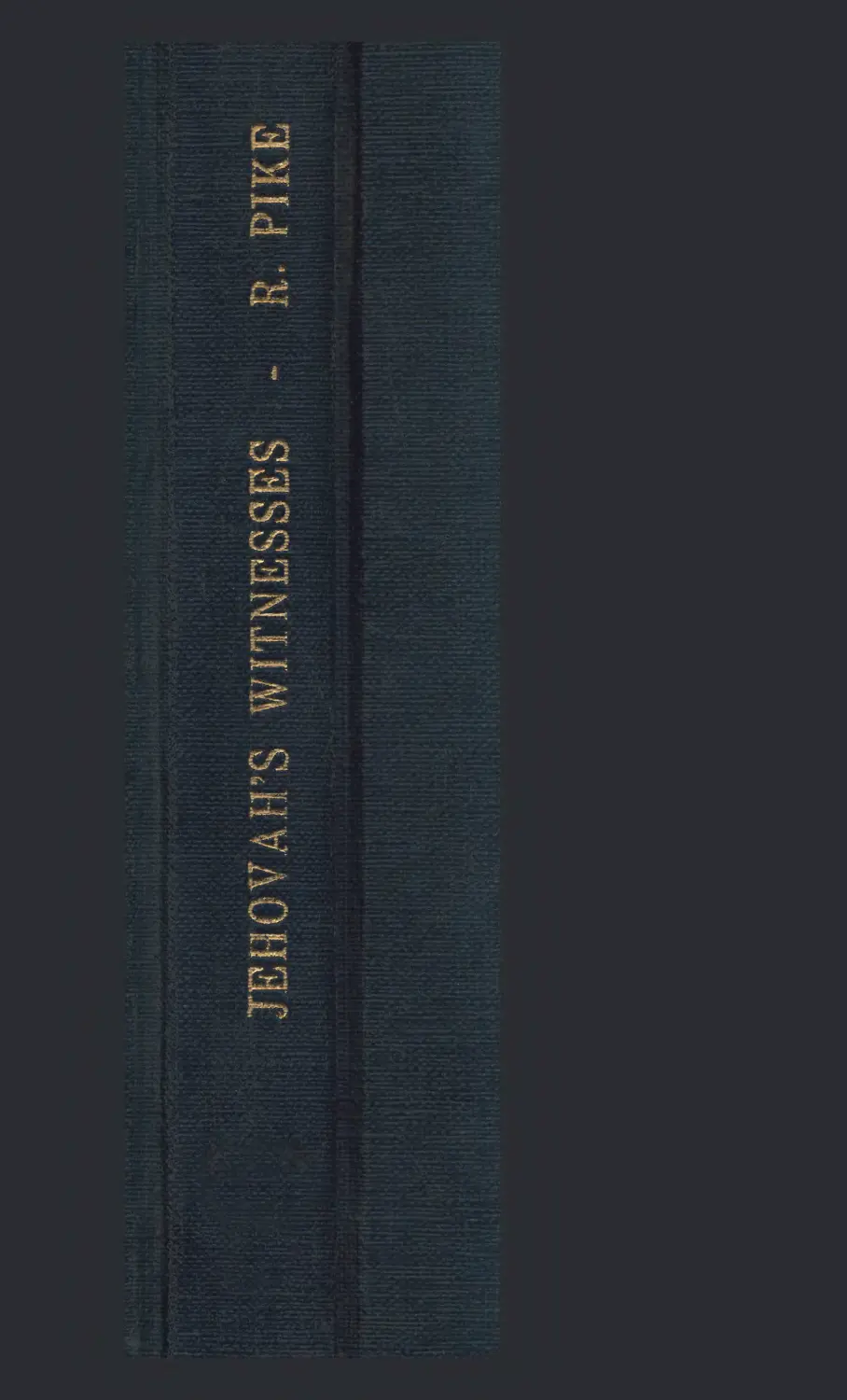
                    Jehovah’s Witnesses
By the same Author ENCYCLOPAEDIA OF RELIGION AND RELIGIONS (also American, French, and Spanish editions) FAITHS OF MANY LANDS ETIIICS OF TIlE GREAT RELIGIONS ROUND THE YEAR WITH THE WORLD’S RELIGIONS SLAYERS OF SUPERSTITION STORY OF THE CRUSADES POLrrICAL PARTIES AND POLICIES Associate Editor THE STORY OF THE BIBLE IN HIS STEPS: THE LIFE OF CHRIST NEW POPULAR EDUCATOR WONDERS OF THE PAST ENCYCLOPAEDIA OF MODERN KNOWLEDGE NEW BOOK OF KNOWLEDGE Editor TWENTIETH CENTURY ENCYCLOPAEDIA
Jehovah’s Witnesses Who They Are What They Teach What They Do BY ROYSTON PIKE WATTS & Co JOHNSON’S COURT• FLEET STREET LONDON EC4
This book is copyright under the Berne Convention. Apart from any use specffically permitted under the Copyright Act, 1911, no portion may be reproduced without written permission. inquiry should be made of the publishers. First Published 1954 Printed in Great Britain by Richard Clay and Company Ltd, Bungay, Suffolk, and published by C. A. Watts and Co Ltd, 5 and 6 Johnson’s Court, Fleet Street, London, EC4
Who they are THIS football stadium in one of London’s inner suburbs is a pretty big place. Just how many thousand people it holds I do not know, but there are very few vacant places on the wooden seats that rise, tier above tier, in the gaunt arrangement of timbers and iron girders. And although the service has begun, the flow of newcomers continues, so that very soon it must be “standing-roomonly.” Thousands upon thousands of people, assembled not to watch a “League”match or the “dogs,”a prize- fight or an evening of” dirt track,” but to demonstrate that they have a religion and are not ashamed to say so. They are a good-looking crowd, good-humoured, and thoroughly well-behaved. Often they burst into laughter at something that the speaker says, and they clap vigorously when he has finished and makes way for another. But when they stand in prayer or join in hymns led by the string orchestra over there in the corner, they are obviously very much in earnest. They look like men and women with a mission—as indeed they are. They are JEHOVAH’S WITNESSES, and on this Sunday in August they have assembled to renew their allegiance to their Sovereign Lord and to praise his holy name.
WHO THEY ARE Still they come streaming in through the gates, by bus—many of them specials, by coach and private car (already the car-park is nearly full, and it must hold several hundred), by train and on foot. All around there are posters and placards and labels announcing that this is the New World Assembly of Jehovah’s Witnesses. Every other man and woman, and nearly all of the very numerous youths and girls and children, are wearing little blue-and-yellow cards proclaiming the title of the address that is the Assembly’s keynote: “AfterArmageddon—God’s New World.” There are no entrance fees, no collections; everyone is welcome, so we arc happily assured. Just within the gates, stewards—sturdy young men for the most part—are ready to show you to a place in the stands. Here is a well-stocked book-table, here a secretary busily taking down the names of volunteers for the hundred-and-one jobs that the holding of such an assembly as this entails. Here are rest-rooms, “Ladiesonly” and “Gents,”sick bays for the indisposed, stewards’ rooms, buffets capable of serving light lunches and teas to the multitude. Today, we are told, the helpers expect to make 550 gallons of tea, and housewives and typists and charladies are combining to do the washing-up after serving 2,400 lunches. “Thereis no class distinction among our workers,” we are told by the officer in charge. “Ourhelpers are rich and poor. They come from all trades and professions. And they work for nothing, because they love their fellow-creatures.” Now a young man goes past, bearing a placard with the words, “Candidatesfor immersion this way!” A little fleet of four double-deck buses has been engaged, it is announced, to work a shuttle service between the
WHO THEY ARE stadium and the Corporation baths, specially rented for the morning, and already the candidates are begin- fling to queue up. A few minutes, and the first bus moves off, with every seat taken. From my place high up in one of the stands I look down and out on a sea of faces. A great crowd, and a highly respectable one; not a cigarette or a pipe in action—although I think I can detect a little sweet- eating. But the evidence is no more than a cheek- muscle’s slow motion, and there is none of that disgusting litter with which the ordinary crowd befouls its temporary resting-place. Now there’s a vigorous young fellow standing on a box in the arena, directing and encouraging the hymn- singing. (Is that the right word? The book, I notice, as I share it through the gracious courtesy of my neighbour, who might be one of those good ladies who are the pillars of the Methodist or Baptist or Christian Science cause, is entitled Songs to Jehovah’s Praise.) The choir-leader steps down, and now there comes a voice, multiplied by a score of loud-speakers, from a sort of little pavilion, gaily striped in yellow, that is placed on the grass beyond the flower-beds. “Jehovah—Jehovah—JEHovAH! “ringsout again and again across the vast space, echoes back from the closely crowded stands. We stand as prayers are said to Jehovah; we sit and listen devoutly as he is thanked for allowing us to assemble this day, for having chosen us as his servants and co-workers in the establishment in this world of Jehovah’s Kingdom. In this world. Not in some airy-fairy place up above the bright blue sky, but here, down here, on the earth we know, in which even now we have our home and dwelling-place. Before very long, we are given to believe, there is to be the biggest battle ever, nothing
WHO THEY ARE less than Armageddon, in which the forces of Satan (there doesn’t seem to be anybody here who doubts that there is any such person!) will grapple with those of Jehovah, captained by Christ Jesus. What a truly earth-shaking conflict that will be! So far as I can make out, we shall not be too closely involved in the struggle, but some of us at least are going to live long enough to enter into the thousand years of peace and happiness that are to follow Armageddon. When? Why, it may be only just round the corner, so to speak. The signs are clear. The Lord has spoken, and his words and ways are sure. So these are Jehovah’s Witnesses, you reflect. These are the people that young man was talking about when he knocked at the door last Sunday morning. You thought he was selling something—but not on a Sunday, surely? There was a smile on his face, and he held out his hand in friendly greeting. You noted that he was quite well-dressed, and that his manner was most pleasant. Yes, he might well be selling shaving-soap or domestic brushes, and when he started undoing the straps of his bulging brief-case you thought with a grin of resignation that you knew what was coming. And you were right: he was a salesman. But of what? “Wouldyou like a thousand years of happiness?” he asked. A thousand years of happiness! Well, who wouldn’t? But as you listened to him standing there, you could not but wonder if he can deliver the goods. Then, still smiling, he asked you to look at the literature that he whisked out of his case. And as you took it, a book perhaps or more likely a copy of The Watchtower, he really got busy with what in commercial circles is known as sales-patter. He certainly knew his stuff
WHO THEY ARE 5 you must admit that; he knew how to talk, and he “putit across” most effectively. His statements—and what statements !—were forthright, straight from the shoulder, and his arguments were marshalled like good soldiers on parade. What they boiled down to was that he was the representative of a society or body of persons who (so they say) are in exclusive possession of the message of salvation. Jehovah’s Witnesses: it’s a striking name, one easy to say and hard to forget. It stands for one of the strangest of the modern offshoots from the stem of traditional Christianity. In its present form, the Society, as we may properly refer to it, dates from the eighteen-seventies, but it is only of recent years that it has obtained prominence under the name of Jehovah’s Witnesses. It is the successor, or rather, it continues the work, of those Christians who found their inspiration and their direction first in “Pastor”Russell and then in “Judge”Rutherford, and it seems to be repeating the success of those very able evangelists of a generation or two ago. Unlike most of the Christian Churches, it has no record of decline or failure; on the contrary, it claims that its missionaries, those doorstep enthusiasts, are being blessed in their efforts by very substantial gains in membership and influence. This success is probably greater than meets the eye, for outside their own publications it is very difficult to obtain any reliable information about the Witnesses and their work. You will search in vain in the works of reference for any adequate mention of the Society—in most cases there is no mention at all. In the newest of British encyc1opadias this lack of information concerning them is put down to their being in some measure a “secret”
WHO THEY ARE society. No “outline”of literature refers to their publications, though some of these have obtained a circulation that far surpasses that of the best of bestsellers. No writer seems as yet to have made a Witness a hero or heroine, or even the villain, of a novel. So far as the BBC and the Press go, Jehovah’s Witnesses might never exist; the annual assemblies that are attended by tens of thousands of Witnesses are hardly mentioned, when they are not altogether ignored. The religious papers and the Churches of which they are the organs may be excused, perhaps, from giving publicity to a movement whose methods they dislike and many of whose doctrines they detest, and there is further excuse for their cold-shoulders in the fact that the Witnesses seldom have anything but abuse for their orthodox rivals. Without any hesitation or qualification, they denounce them as being among the spawn of Satan. But this excuse cannot be advanced to explain the very general boycott, the hush-hush attitude of the great organs of public opinion and enlightenment. Not that the Witnesses themselves are inclined to complain. They have enough on their hands as it is, and seem to be doing very well at it. Their propaganda is aimed at the ordinary people, where it is likely to bring the best results. Day in and day out, Sundays included and above all, you will find these twentieth-century colporteurs in action in suburban streets and country market-places, outside station entrances and at sports meetings and other popular gatherings. Probably not many of the better educated and well off pay much attention to what they have to say, and even less to what they have to sell. No famous figure in politics or business, the professions or the arts, seems to have joined them. Jehovah’s Witnesses is not altogether respectable as a
WHO THEY ARE 7 religious body; it still occupies a place very much like that of the Salvation Army before it was taken up by Royalty. All the same, it is providing a spiritual home for those who would like to believe something and think that they ought to believe something, but who are “putoff” by the endless squabblings of the Churches and the silly little differences about clerical costume and the number of candles on the altar and such-like trivialities. There are numbers of such people about, earnest, thoughtful, thoroughly honest and well-meaning and essentially good people. The Churches appeal to them hardly at all. The political parties likewise have failed to enlist and retain their enthusiasm and active interest: the parties are so much alike nowadays, and one is as bad as the rest, politicians are all “onthe make,” and put their party before their country and themselves before their party. Local government is similarly depreciated. A career in business smacks too much of money-grubbing. Literature, painting, music, sport of one kind or another: such things, it is felt, are really not worth the attention of a man or woman who is seriously worried about his or her position in a world which is threatened with atomization, who asks such questions as “Whyam I here? What’s the meaning of life? When I die, is it ‘finish’?Is there a God, and if so, how can we account for pain and evil in a world which the Good God is supposed to have made? And does he really care, for me and mine?” These are the questions that are being asked, and they are not being answered at all satisfactorily. “Thehungry sheep look up, and are not fed.” But Jehovah’s Witnesses say that they know the answers to these questions—so naïve some of them, so pathetic in the longing they disclose for certainty in an
WHO THEY ARE uncertain world. And while to the sophisticated their answers must seem crude and all too simple and all too sure in their dogmatism, to the questing soul they are as refreshing springs in the parched desert. Jehovah’s Witnesses have never a doubt in their make-up, and as for the differences that perturb and divide other Christians, well, a plague on the lot of them. “Youwant Christianity, the only real version, the only really true version? You want the Truth? Well, you needn’t look any farther, we have it—here it is.” There’s something catching in their positiveness, their absolute assurance that they are so altogether and so completely right. They know; and the man who knows, who is not to be moved from his position by argument and is not worried in the slightest by criticism, is at a great advantage when he comes up against people with no settled convictions. With closed minds themselves, the Witnesses know full well how to put their foot just inside the nearly closed door of the man who thinks “theremay be something in this religion business” but isn’t at all sure what. To begin at the beginning, Jehovah’s Witnesses maintain that they are the present-day representatives of a religious movement or organization which has been in existence since Abel, the second son of Adam and Eve, “offeredunto God a more excellent sacrifice than (his brother) Cain, by which he obtained witness that he was righteous” (Hebrews xi, 4). Abel was the first “witness,”as he was also the first martyr (“ martyr” means “witness“),and other valiant witnesses have been Enoch, Noah, Abraham, Moses, Jeremiah, and John the Baptist, down to and including, pre-eminent amongst them, Christ Jesus, who is, as described in Revelation Ui, 14, “Thefaithful and true witness, the
WHO THEY ARE 9 beginning of the creation of God.” Thus there stretches behind the Witnesses of today a long line of saints and seers who through the ages have preserved inviolate on earth the true and pure worship of God—ofJehovah, as the Witnesses prefer to style the Deity, or, better still, Jehovah God. This, however, is nothing more than nostalgic sentimentalism. Jehovah’s Witnesses as we know them are a religious society, organization, or movement (they themselves strongly dislike being called a “sect“)which had its origin in a Bible study circle conducted by a young American salesman, Charles Taze Russell, in a suburb of Pittsburgh some eighty years ago. Thus the first interesting fact about the Witnesses is that they are as American in their origin as Christian Science or the Mormons. And they are as unorthodox as either, as will be clear from this description of them that is given in Let God Be True, one of their officially approved textbooks of doctrine and practice. “Jehovah’switnesses,” this tells us, “constitute a body or group of persons consecrated to do the will of Almighty God, under the leadership of his Son, Christ Jesus. They have drawn together for the purpose of declaring that he whose name alone is JEHOVAH is the Universal Sovereign, and that he is the Author and Creator of earth’s permanent heavenly government of righteousness for which Christ Jesus taught his disciples to pray to Almighty God. To everyone they point out the only way to that kingdom which shall permanently take the place of all earth’s present governments that shall be destroyed soon in Jehovah’s battle at Armageddon.” Already we are brought up against the fact that the Witnesses hold theological views of a decidedly peculiar kind, but beyond noting that they omit the capital
WHO THEY ARE letter in pronouns referring to the Deity (just as they spell their own name with a small w), let us pass on to make the acquaintance of this young fellow Russell. PASTOR RUSSELL. Charles Taze Russell, or Pastor Russell as he was generally known, was born at Allegany, now a suburb of Pittsburgh, Pa., USA, in 1852. His parents, Joseph L. and Eliza Russell, were both of Scottish—Irish descent. His father was in the clothing business, and after only a very modest schooling, Charles joined him in running a chain of five shops. His mother died when he was only nine, but he found in his father a steady friend and eventual supporter. While still a boy he was received into the fellowship of the Congregational Church of which his family were ardent members, and he seems to have been exceptionally pious and orthodox. Then he began to think for himself after a fashion which he has himself described. “Webegin the narrative at the year i868, when the Editor (Russell) having been a consecrated child of God for some years, and a member of the Congregational Church and of the Young Men’s Christian Association, began to be shaken in faith regarding many long-accepted doctrines. Brought up a Presbyterian, indoctrinated from the catechism, and being naturally of an inquiring mind, I fell a ready prey to the logic of infidelity, as soon as I began to think for myself. But that which at first threatened to be the utter shipwreck of faith in God and the Bible, was, under God’s providence, overruled for good, and merely wrecked my confidence in human creeds and systems of Bible interpretations. “Iwas led gradually to see that though each of the creeds contained some elements of Truth, they were, on
WHO THEY ARE II the whole, misleading and contradictory of God’s Word. Among other theories, I stumbled upon Adventism. Seemingly by accident, one evening I dropped into a dusty, dingy hail in Allegany, Pa., where I had heard that religious services were held, to see if the handful who met there had anything more sensible to offer than the creeds of the great churches. There for the first time I heard something of the views of Second Adventism.” 1 The group to which he refers was composed of the followers of William Miller, who from 1829 indulged in millenarian prophecies which culminated in the statement that the Second Advent ofJesus Christ would occur in 1844. Many thousands of people in the eastern and middle states of America believed what he told them, and when the fateful October 22 drew near a multitude abandoned their homes and business.es, donned gowns of white muslin, and took up positions on roofs and hilltops whence they would have a good view of the approaching Lord. When the appearance did not materialize, many were woefully disappointed and fell away, but some continued in their faith and expectation. Like Miller, the youthful Russell made a long and close study of the prophetic books of Scripture, Daniel in particular, and like him he came to prophesy that the end of the world, or rather of the age, was coming before very long. Eventually, indeed, he came to the conclusion that the Lord had actually arrived, and that it was just an error in the calculations that had led Miller to suppose that the vital date was 1844; he had been just thirty years out—the actual date was 1874. Of this discovery we shall have much more to say in 1 The Watchtower, 1916, p. 170; quoted in The Finished Mystery: Series VII of” Studies in the Scriptures,” p. 53.
WHO THEY ARE due course, but here it should be mentioned that quite early in his spiritual pilgrimage Russell came to abandon a belief that was much more prominent in those days than it is now, when generations of rational and humane criticism have undermined its foundations and exposed its gaunt and horrid frame—belief in the existence of a hell of literal fire and brimstone, in whose undying flames sinners writhe in undying agony at the behest of an offended Deity. The story runs that one day he was tackled by an “infidel”in a pool-room, who challenged him to defend the doctrine of hell-fire. He did his best, quoting this passage of Scripture and that, but he had a feeling of inadequacy, so that when he got back to his room he looked up the passages in his Bible. Before long he arrived at the conclusion that the doctrine could not be defended on Scriptural grounds, and that it must therefore be rejected. After this he moved on to investigate and to question some other of the fundamental dogmas of Christianity—doctrines that he had been taught at his mother’s knee—and decided that they also were without Divine authority and approbation and must be repudiated. Since there was no church or society or movement which seemed to preach the gospel which he had now come to believe was the true Bible teaching, he and some of his friends—young men like himself engaged in the business world—formed a Bible class in Pittsburgh, in which they thoroughly thrashed out the various problems that most perplexed them. About i 874—the year which, as we have just seen, Russell had “discovered”was one of truly immense importance— he and his associates felt pretty sure of where they stood and published a pamphlet by Russell entitled The Object and Manner of the Lord’s Return, in which it
WHO THEY ARE 13 was argued that Christ’s coming, now imminent, was to be a spiritual and not a physical manifestation, and that it was quite wrong to hold that the world would be destroyed by fire on that tremendous occasion. The pamphlet had the remarkable circulation of 59,000 copies, and thus was started a work of preaching through the printed page which (so it is maintained) is quite without a rival. Five years later, in 1879, The Watchtower magazine was launched, the first number’s circulation figure being 6,ooo copies. Since that date The Watchtower has appeared without a break as the official journal of what is now Jehovah’s Witnesses, and the spearhead of its propaganda in all parts of the world. By this time the differences between the Russellites’ gospel and that taught in the Churches had widened into a gulf, and in i88i it was thought advisable to issue a booklet setting forth the Society’s fundamental beliefs—Food for Thinking Christians, it was called—and this, together with many tracts on particular aspects of doctrine, was given a very wide distribution, in America and abroad. That same year of i88i saw the formation of Zion’s Watch Tower Tract Society, with its headquarters at Allegany, Pa.; this was chartered as a non-profit- making corporation, with Russell as its president, and under the style of Watch Tower Bible and Tract Society (adopted in 1896) it has continued to this day as the central and controlling organization of Jehovah’s ‘Witnesses.In 1878 Russell had become the pastor of an independent congregation at Pittsburgh, and his fame and influence as a preacher (helped by an increasingly patriarchal appearance) and writer grew apace. Between i886 and 1904 he published six volumes of B
WHO THEY ARE Studies in the Scriptures, beginning with The Divine Plan of the Ages; these volumes were translated into some thirty languages, and the number of copies that were sold or were otherwise distributed exceeded fifteen millions by the time of Russell’s death. For a number of years a sermon of Russell’s was printed each week in some i ,500 newspapers in USA and Canada, with a combined circulation running into millions. His followers hailed Russell as the greatest and most successful preacher of the Gospel in his generation: indeed, in their enthusiastic admiration they ranked him with St Paul, St John, Anus, Waldo, Wycliffe, and Martin Luther, and they seem to have believed, and he seems to have believed himself; that he is referred to specially in Scripture as the “faithfuland wise servant” (Matthew XX1V, 4), and the “faithfuland true witness” (Revelation iii, 14) who is the messenger in the seventh and last epoch of history. Then he was chosen as pastor by 2,000 congregations in USA, Canada, Britain, and Europe; in London his chief scene of operations was the Tabernacle in Lancaster Gate, which the ignorant sometimes confused with the very much larger Spurgeon’s Tabernacle on the other side of the Thames. The pastorates made an impressive showing, but it has been alleged that a number of the “churches”were no more than rented halls or derelict places of worship, while he was not so much a” pastor” as the superintendent of the religious and semi-religious enterprises that were carried on by his agents. However, there is no denying that the movement of which he was the acknowledged head made considerable progress from year to year. At length it was thought by the directors of the Society that the time had come for an establishment in the metropolis. In 1909 a
WHO THEY ARE 15 New York corporation was formed, under the name of the People’s Pulpit Association, changed in 1939 to Watch Tower Bible and Tract Society, Incorporated, and in the same year Russell was provided with a New York pulpit—the Brooklyn Tabernacle, in what had been the Bethel chapel of Plymouth Church. Then in 1914 the International Bible Students Association was launched, with its headquarters in London, and entrusted with the particular responsibility of spreading the Russellite doctrine overseas. Russell’s position as a free-lance religionist, his incessant and bitter attacks on Christians of other persuasions, his invincible belief in his own rightness, that his message was the only true one, the only one approved by Jehovah—made him a target for much hostile criticism. Furthermore, he laid himself open to attack on other grounds. In 1879 he had married Maria Frances Ackley, and although in the early years of their union Mrs Russell was a devoted co-worker with her husband, often helping him with his extensive correspondence and addressing gatherings of female disciples in his stead, their relations deteriorated to such an extent that in 1897 there was a separation. There were no children of the marriage. Then in 1909 Mrs Russell decided to sue for a divorce, and in her plea she alleged undue familiarity on Russell’s part with women of his congregation, expressing herself with a high degree of bitterness. The divorce was granted, and in the final opinion of the State court in October 191 I it was recorded that Russell’s conduct towards his wife had been “oneof continual domination that would necessarily render the life of any sensitive Christian woman a burden and make her condition intolerable.” Russell strongly contested the decision, appealing five
WHO THEY ARE times against it, each time unsuccessfully. In fairness to him, however, it should be stated that he always maintained that there was nothing blameworthy in his conduct, and that most certainly he had never been guilty of adultery. Another matter that brought him into considerable discredit was the so-called “miracle wheat.” He was alleged to have maintained that a particular sort of seed, obtained from the western USA, was possessed of very valuable and extraordinary properties, and to have hailed its discovery as one of the many signs that were accumulating that the Lord’s blessing had already arrived on earth, that we were on the threshold of the Millennium when the earth will yield her increase to such an extent that sweat of brow will not be necessary in earning one’s living. The seed was sold in Russell’s Brooklyn Tabernacle at $6o a bushel, when it was really worth (so it was alleged) only about a dollar a bushel. The attack was mainly directed through and by the Brooklvn Dailj’ Eagle, which published a highly damaging cartoon. Russell sued the newspaper for $ioo,ooo damages—and lost.’ Yet more unpleasant notoriety was aroused by Russell’s sponsoring of a “cancercure,” which on analysis was revealed as being nothing other than a The “miraclewheat” case seems to be not dead even yet. Thus in The J47atchtower for May 15, 1953, the question is asked: Whether it is true that the Society’s first president profiteered from selling some mysteriously named wheat at $65 a bushel? The answer given is that when a new and unusually prolific strain of wheat was reported, some Watchtower readcrs bought seed and gave it to the Society to sell, the proceeds to go to its funds. The Society (so it is stated) made no claim for the wheat itself, and offered to return the purchase-price to aggrieved purchasers when it failed to come up to expectations. But no one asked for his money back. Really, the matter was “asopen and above-board as a church cake sale.”
WHO THEY ARE 17 caustic paste of chloride of zinc. Unfortunately the “cure”was not only ineffective but definitely harmful, so that some unfortunate sufferers may have had their end hastened by its application. It was while Russell’s divorce was threatening that it was decided to transfer the headquarters and principal activities of the Society from Pittsburgh, the scene of trouble, to New York, where the Pastor was not so well known. It is also alleged that, with a view to depriving his wife of the alimony which she was doubtless expecting, the Pastor transferred practically all his property to the Watch Tower Bible and Tract Society, while still keeping it under his own effective control. But again it is only fair to say that Judge Rutherford, his successor in the leadership of the movement and his trusted associate on the board of directors of the Watch Tower society, stated that he had been entrusted for many years with the payment to Mrs Russell of a sufficient alimony. Then there is the not very serious charge that Russell pretended to be able to read Greek when in fact he did not know even the letters of the Greek alphabet. This is stated to have been disclosed when he was being cross-examined in a libel suit that he brought in 1913 against the RevJ. J. Ross, a Canadian minister. One of the most scathing reviews of the Pastor’s career is to be found in a booklet entitled Russellism, byJ. A. Maynard, DD, that was published in 1926 by the Society for Promoting Christian Knowledge. “Graspingand dishonest in money matters,” writes Dr Maynard, “morbidin his approach towards the other sex, untruthful, self-satisfied, fond of litigation, Russell would have been expelled from the ministry of any decent church.” In 1910 Russell visited Palestine, and his prophetic
WHO THEY ARE conclusions were fortified by what he saw of the progress of the Zionist cause. Following the unhappy experience of the “miracle wheat” case he went round the world, and in the course of his travels visited some of the more important centres of Christian missionary enterprise in the Orient. But again his detractors were on his track, alleging that lie magnified the extent and the number of his “receptions.”“Theamount of work that Pastor Russell performed is incredible,” we are told in The Finished Mjistery, final volume of “Studiesin the Scriptures” published posthumously in 1917, “andit is doubtful whether it was ever equalled by any other human being. When he was in his twenties he was refused the lease of a property because the owner thought he would surely die before the lease had expircd. For fifty years he suffered constantly with sick headaches, due to a fall in his youth, and for twenty-five years had such distressing hmorrhoids that it was impossible for him to rest in the easiest chair; yet in the past forty years he travelled a million miles, delivered 30,000 sermons and table- talks—many 2 hours long—wrote over 150,000 pages of advanced Biblical exposition, often dictated 1,000 letters per month, managed every department of a world-wide evangelistic campaign employing 700 speakers, personally compiled the most wonderful Biblical drama ever shown [The Photo-Drama of Creation]; and with all that, he has been seen to stand by his mantel all night in prayer, in one position.” During the last eight days of his life, the writer goes on, the Pastor had appointments in California, Kansas, Oklahoma, Nebraska, and New York, and” though for several days manifestly dying, with cystitis (caused by excessive travel and speaking), he declined to cancel any engagements, and went out of this life October 3 I,
WHO THEY ARE 19 1916, On a railroad train en route to his Kansas appointment.” The train was stopped at Pampa, Texas, when he lay dying. In a newspaper account his last words are reported to have been the somewhat strange request to “pleasewrap me in a Roman toga,” and those gathered round his couch did the best they could with the sheets from the Pullman coach. In his young days Russell was reputed to have been wealthy: it is stated that by the age of thirty he had accumulated a fortune of $300,000. But he died practically penniless, leaving only about $300, “hisown fortune “—toquote from The Finished Mjstery again—” as well as all the large sums contributed to the cause, having been used up in the Master’s service.” JUDGE RUTHERFORD. The second president of the Witnesses (although they were not yet called by that name) was Joseph Franklin Rutherford, who at the time of Pastor Russell’s death was the principal legal adviser to the Society. He was born at Booneville, Missouri, in 1869, of farming stock, and became a lawyer in his native State. In the course of his career he was a special judge (for only a few days, his critics alleged) on circuit in Missouri, whence the title of “Judge”which is generally allowed him. When he joined the Society is not known for sure, but the first mention of him in The Watchtower was in 1909. According to his own account, he was practising law in the Middle West when there came into his office one day a lady, “modest,gentle, and kind,” with some books on her arm, which she asked him to buy. At that time he had little or no knowledge of the Bible and did not know that Pastor Russell was author of the books, nor indeed had he ever heard of him. He
WHO THEY ARE took the books home, however, read them, and studied them until” the wonderfully sweet, harmonious plan of God thrilled my heart and changed the course of my life from doubt to joy.” Once introduced, Rutherford soon found his way into the inner counsels of the Society. Lawyers, we may suppose, were few and far between in its ranks, and he became its legal officer or attorney, entrusted with fighting the lawsuits which were brought against its members. At the board meeting of the Watch Tower society held in January 1917, following Russell’s death, Rutherford was present as one of the directors, and he was proposed for the presidency and elected without Opposition. It cannot have been easy for a layman, and a lawyer at that, to follow in the footsteps of the deceased pastor, and in fact there was some opposition to his election in the rank and file. There were several break-away movements, whose members were of the opinion that the Judge’s message was not that of the sainted and saintly Russell who had died so unexpectedly, without seeing the dawn of that Millennium which he had prophesied so long and so eloquently. But in course of time, and sooner rather than later, the disaffected returned to the fold, and the new leader marched from strength to strength. Within a few months of becoming the Society’s president, Rutherford and seven of his colleagues in the upper directorate were indicted at Brooklyn on charges of conspiring to cause insubordination in the military and naval forces of the USA and to obstruct recruiting and enlistment. The United States had just entered the war against Germany, and war fever was running high. All the accused were found guilty of violating the Espionage Act, and Rutherford and six of the others
WHO THEY ARE were condemned on each of four counts to twenty years’ imprisonment in the Federal Penitentiary at Atlanta, Georgia. The other man was sentenced to ten years. Rutherford and his colleagues started their imprisonment inJune 1918, and they spent nine months in gaol. It is said that, like the Apostles of old, the Judge organized religious meetings from his prison cell, and that a hundred of his fellow-prisoners attended the Bible class that he conducted. Again after the apostolic pattern, he wrote weekly “letters”which were published in The Watchtower. In March 1919 the eight rere admitted to bail, and in May it was decided that a new trial should be arranged. But by now the war had ended, and the authorities thought it best to let the matter slide. From this period of gaol, Rutherford emerged with enhanced reputation, and the Witnesses obtained some very useful advertisement. For all the years between the two World Wars, Rutherford maintained and steadily improved his position as the Society’s arch-propagandist with both voice and pen. A year or two before his death he claimed that he had written ninety-nine books and pamphlets in the preceding twenty years, and he wrote several more before he died. His books were published in seventy-eight languages, and the number of copies distributed exceeded three hundred millions. Such circulations put even Russell’s in the shade, but the Pastor was now just a name, a name that was hardly ever mentioned. His books as they fell out of print were not reprinted, and it was the Judge, and not the Pastor, who was accepted everywhere as the voice of Jehovah. Mention Russell’s name to a present-day Witness, and as likely as not you will get an uncomprehending stare, for the Founder is no longer honoured
WHO THEY ARE by his foundation. And here it may be remarked that very much the same fate is now overtaking Rutherford. His books likewise are allowed to fall out of print, and his name is seldom on the lips of any save the older members of the Society. Judge Rutherford was a highly capable organizer, and whatever we may think of his literary style, there can be no two questions about his ability to “put it across.” Then as a speaker also he was first-rate, with some pretensions to oratory. Here his presence helped him considerably, since he looked “muchmore like a Senator than most Senators look,” as one newspaperman put it. He was over six feet and of heavy build, baldish, and clean-shaven. He dressed like a lawyer, with stand-up collar and black bow tie, and carried his eyeglasses on a long black silk ribbon. Photographs show him striding along between his bodyguard of two hefty young men, all carrying canes and obviously ready to tackle any thugs or gangsters who might be egged on to attack him by the Roman Catholic hierarchy or the followers of Satan in general. His heavy, booming voice carried well, and great audiences thronged to hear him in America and in Britain, where the Albert Hall was not too big for the crowds who wanted to hear him explain the statement that was blazoned on the posters outside—” Millions now living will never die! In 1931 there was a highly significant break with the past, when the movement which had at various times gone under the names of Russellites and Millennial Dawn and Bible Students now assumed the designation of Jehovah’s Witnesses. This was at the convention held at Columbus, Ohio, under Rutherford’s leadership, and we may be sure it was at his suggestion. The name is taken to be altogether appropriate, since in Isaiah
WHO THEY ARE 23 xliii, io, Jehovah himself declares, “Yeare my witnesses.” Towards the end of his life the Judge became increasingly alool and seldom made a public appearance other than at the annual assemblies, and even then he was hedged about by very efficient secretaries. He always discouraged impertinent inquiries into his private life, and he had no entry in Who’s Who in America. He was married, but his wife, Mary Rutherford, took no active part in the movement. And if their son, Malcolm G. Rutherford, was ever a full-time worker he does not seem to have held any position of importance. When at the Society’s headquarters at Brooklyn, the Judge lived in the “Bethel”hostel with the employees of the Watch Tower companies, and he is stated to have received the standard rate of pay of $io a month, plus board and lodging and travelling allowances. He sat at meals with the staff in the dining-room, and before his place at the high table stood a microphone so that any words of wisdom that fell from his lips might be heard by everyone. But sometimes the hall echoed with nothing more significant than “Pleasepass the salt.” The Judge’s last public appearance was at the international convention of the Witnesses held at St Louis, Missouri, in August 1941. Over ioo,00o people are reported to have been present in the arena when he delivered his presidential address on” Comfort all that mourn,” and at a meeting for young people he spoke on the subject of his latest book, Children, and handed out some thousands of free copies. Soon after the convention, the Judge was taken ill, and he retired to Beth Sarim, the country house or mansion belonging to the Society at San Diego, California. Here on January 8, 1942, he died. In accordance
24 WHO THEY ARE with his last wishes, he was buried in a crypt dug in the hillside adjoining Beth Sarim, but some months later his remains were re-buried in the Society’s burial plot at Rossville, New York. NATHAN H. KNORR. On January 13, 1942, the directors of the Watch Tower society of Pennsylvania, the controlling organization, and its New York companion society, met in the reception-room of the administrative building at 124 Columbia Heights, Brooklyn, and after earnest prayer and a thorough discussion of” the issues involved and the Theocratic proprieties,” unanimously elected Nathan Homer Knorr as the president of both corporations in succession to Judge Rutherford. Mr Knorr was born in Bethlehem, Pa., in 1905, and first began to associate with the Witnesses when he was a youth of sixteen, in the early days of Rutherford’s leadership. Within two years he was a full-time preacher among them, and he was appointed to a position on the headquarters staff at Brooklyn. After nine years of efficient service, he was given the post of general manager of the publishing office, and in 1934 he was elected to a seat on the board of the Watch Tower society in New York. The next year he was appointed vice-chairman. Then in 1940 he was given the same appointments in the society in Pennsylvania, so that by the time of his succession to Rutherford he must have had a very good working knowledge of the business side of the organization. To what extent he has contributed to the literature of the movement we cannot determine, since all the post-Rutherford publications are anonymous, being produced apparently by a committee. (And it may be noted that, as in Russell’s case, books by the Judge are
WHO THEY ARE 25 rapidly going out of print, and only two are now available out of the scores that he wrote.) With America in the War since the close of 1941, Jehovah’s Witnesses were in trouble, since they regarded the struggle as none of their business. They were not pacifists; they were, they bluntly declared, just neutral. They refused to be drafted into the armed forces; they refused point-blank to salute the flag, since they regarded it as an idolatrous image. They refused to take any part in the nation’s war effort. Furthermore, unlike some other Christian sects, they refused to keep quiet about their disaffection. They blazed it abroad, and in every way possible seemed to be doing their utmost to make themselves thoroughly obnoxious to patriotic citizens. Possibly many of them courted “martyrdom,”deeming that this would constitute yet another proof of Jehovah’s favour and the fulfilment of Scriptural prophecy. If this was indeed their wish, they were not disappointed. In all parts of the country they were ridiculed as ignorant fanatics, attacked as fifth-columnists, Fascists, spies, and saboteurs; and while they were being hounded by the mobs in the United States some 6,ooo of German Witnesses were suffering, and many of them dying, in Hitler’s concentration-camps. At length the American Solicitor-General, Mr Francis Biddle, felt obliged to utter a public warning against the spread of popular hysteria. “Areligious sect known as Jehovah’s Witnesses,” he said, “hasbeen repeatedly set upon and beaten. They had committed no crime, but the mob adjudged they had, and meted out punishment. The Attorney-General has ordered an immediate investigation of these outrages. There is
26 WHO THEY ARE no cause for mass hysteria, no justification for mob violence.” There can be no doubt that much of the hostility had a religious basis, since the Witnesses were on thoroughly bad terms with Christians of the traditional churches, the Roman Catholics in particular. Time after time they appealed to the American Constitution in defence of what they held to be their rights, and although the Supreme Court ruled against them when they contested the requirement that every American school child should be required to salute the flag, they won a notable case on the issue of liberty of religious propaganda. Three Witnesses, father and sons, had been advised to “moveon” when, in a street in New Haven, Conn., inhabited as to ninety per cent by Roman Catholics, they had persisted in making what were described as vicious attacks on the Catholic faith. The three took the issue to court, and lost at every stage until the question arrived at the Supreme Court. Then Mr Justice Roberts in a remarkable expression of political liberalism reversed the decisions of the lower courts. “Inthe realm of religious faith and in that of political belief” he said, “sharpdifferences arise. In both fields the tenets of one man may seem the rankest error to his neighbour. “Topersuade others to his point of view, the pleader, as we know, may at times resort to exaggeration, to vilification of men who have been or are prominent in Church and State, and even to false statement. “Butthe people of this nation have ordained in the light of history that, in spite of the possibility of excesses and abuses, these liberties are, in the long view, essential to enlightened opinion and right conduct on the part of the citizens of a democracy.”
WHO THEY ARE 27 Such victories as this were few, however. For the most part throughout the war years and since the Witnesses have been exposed to strong and sometimes violent opposition. And it can hardly be maintained that this has always been altogether undeserved. In Britain, too, during World War II (as in lesser measure in World War I) the Witnesses came into conflict with the law, and sometimes their sneering references to the War brought them something more than hard words from the crowd. But the authorities had the experience of the previous war to guide them, and they never let the situation get out of hand. In spite of their hostility to the national war effort, the Witnesses were not suppressed, and many of their members who refused service in the armed forces were directed to farm work and other non-combatant activities. All the same, the Government kept them under close observation. When in March 1942, at a particularly dark and dangerous period of the War, the attention of the Home Secretary, Mr Herbert Morrison, was called in the House of Commons to the case of a woman Witness who had refused to take employment as a wardrnaid in a hospital, stating that she had “signeda covenant with Jehovah only to preach the Gospel,” Mr Morrison replied that he had recently had to review the activities of Jehovah’s Witnesses, and while he thought it would be an exaggeration to describe the organization as a cloak for fifth-column activities, the potential dangers of its misuse, at any rate in wartime, could not be overlooked. He had recently given instructions for the internment of certain aliens of enemy nationality who were reported as having taken an active part in the organization, and he would continue to keep a careful watch on it. In the following August it was reported in the Press
28 WHO THEY ARE that the Home Secretary had issued an order, that the leader ofJehovah’s Witnesses in Britain must return to America, since his claim to be regarded as a fully ordained Christian minister had been disallowed and he had declined to comply with the order that he should report for farm work in Kent. A few weeks later a three-day conference of the Witnesses that was to have been held at Nottingham was banned under the Defence Regulations, as being “likelyto cause serious public disorder and promote disaffection.” Early in the War the Governments of Canada, Australia, and New Zealand banned the activities of Jehovah’s Witnesses on the ground that these were deemed to be prejudicial to the defence of the country or to the efficient prosecution of the War. The Witnesses protested vigorously, and were not slow to see and find in the ban the hand of their determined enemies, the hierarchy of the Roman Catholic Church. They strongly resented the charges flung against them, that they were disloyal, that they were scditionists, that they were causing disaffection and doing what they could to secure the country’s defeat and the triumph of Hitler. Very often their protests were disregarded, and throughout the War the Witnesses were subjected to much hostility. But it could not be denied that at the same time that the Society was being banned or hampered in the Democratic lands, thousands of Witnesses were suffering for their faith in Hitler’s Europe (as they suffer today in Eastern Germany and other parts of the Communist empire). They were not pacifists, they urged, and they refused to claim the advantages, such as they were, that attended a claim to be recognized as conscientious objectors. The stricter ones among them refused absolutely to bear arms in
WHO THEY ARE 29 what they held to be a foreign quarrel, but many of them did enlist, and many more performed the duties of citizens in fire-fighting and the rest. Nor with the end of the War have their troubles come to an end, since the obligation to perform national service in the armed forces has been retained. The Witnesses still refuse to render such service, or at least those who regard themselves as properly ordained ministers of Jehovah still refuse; they have taken an oath of allegiance, they assert, to the Heavenly Sovereign, and it would be treachery and disloyalty to serve another monarch. So we may read now and again of some young fellow (hopelessly misguided and unreasonably obstinate, his friends and neighbours will generally consider him) who refuses to attend for medical examination, returns or disregards his callingup papers, and in due course is fined /5 or sent to prison for a month or two. The explanation of this behaviour, so strange, so unpatriotic as most readers will regard it, will be given in a later page. Here it is stated as a fact, as one of the most important features in any account of the Witnesses in the modern world. But now let us move on from what the Witnesses are to a study of what they believe, of the ideology that is the inspiration, the driving-force, the beginning and the end of what they do and are. C
What they teach JEHOVAH’S Witnesses believe in God. They hold most strongly that the Bible is God’s Word, and that it contains the whole and the only authoritative message of salvation. In their teaching one finds frequent mention of Adam’s fall and Christ’s blood shed for a ransom, of the resurrection, the Day of Judgment, and the Second Coming. They accept the Christian ethic, and we have every reason to suppose that in their daily lives they strive to put into practice the teaching contained in the Sermon on the Mount. But in all these things they tend to adopt an interpretation which is peculiarly their own, one which often separates them from the great body of Christian believers. While they use the same terminology, they often mean something very different. So marked, indeed, are these differences in meaning and emphasis that there may sometimes be noticed a reluctance on the part of members of the long-established Christian communions to allow Jehovah’s Witnesses the Christian name. But as a matter of history, the Witnesses derived from the preaching and teaching of Christian pastors, and they themselves would seem to have no doubt that 30
WHAT THEY TEACH 31 they belong to the Christian fold. Where they differ most from other Christians is just where they are most strongly convinced that they are in the right and other Christians have gone wrong. With a certainty not to be shaken by question or moved by argument, still less affected by denial, they maintain that theirs is the really primitive belief; the really authentic practice. They are firmly persuaded that they are in the possession of truth, the Truth, in an altogether exceptional degree, measure, and manner. Thus at the outset of our inquiry we have impressed upon us that the really important thing is belief; right belief. Let no person think that he can earn the right to endless life and happiness by keeping the Ten Commandments, we are told. The man who claims that since he is doing his best to keep them is therefore all right, is deceiving himself. Obedience is the really important thing, and you cannot obey Jehovah and secure his approbation unless you know his will and purposes, and what in particular he wants you to do. JEHOVAH GOD. The ground and substance of their faith is belief in Jehovah, or Jehovah God, as they prefer to call him. They choose to employ the ancient Hebrew name for the Deity because, if the Scriptures are to be taken as a guide, it is the name that he himself has chosen to be known by. It is his personal name, the name whereby he is distinguished from other “gods.”It appears 6,823 times in the Old Testament as the name of the God of Israel, and the Witnesses are not in the least concerned about whether or not Jehovah is the correct pronunciation of the Hebrew word. Jehovah is quite certainly the divine name par excellence. From all eternity to all eternity Jehovah exists. His existence is assumed as something so obvious that no
32 WHAT THEY TEACH reasoning, no reasonable, man can possibly doubt it. How can you look up into the sky with a telescope, or even with the naked eye, and suppose for a single moment that the order, the beauty, the immensity of creation, that you see there—and remember that what you can see is but a tiny fraction of what lies beyond the powers of human perception—is due to something called Chance? Surely anyone who thinks so must be what the Scripture very rightly calls him, a fool. Jehovah is the Creator. He is the Greatest Personality in the Universe, the Great Theocrat, the Unfailing Purposer, the True and Living God, the Eternal, the Great Spirit, the Supreme Intelligence, the Great Architect of All Creation, the Divine Constructor, the Great Scientist of the Universe, the Being who is the Almighty and the Supreme One, who exercises dominion throughout all that is, and is entitled to demand and to receive the love and homage and devoted service of all his creatures. Jehovah’s four great attributes are Justice, Power, Love, and Wisdom, and we are perhaps justified in saying that the Witnesses value and revere them in this order. Of a surety, there is very much more of Jehovah’s sense of justice in their teaching than there is about his love, and his power is stressed even more than his wisdom is extolled. In their conception of God there does not seem to be very much of the Heavenly Father who is slow to anger and quick to pity his erring creatures. THE BIBLE, THE WHOLE BIBLE. This doctrine of the Godhead, and every other doctrine of their body of belief, the Witnesses draw from the Bible. They accept the Bible as God’s Word—the Bible, the whole Bible, and nothing but the Bible. In this
WHAT THEY TEACH 33 respect at least they are fundamentalists of fundamentalists. The Bible is the oldest book on earth, and by far the most precious. With the utmost confidence they affirm that in its pages Jehovah himself speaks, and that therefore it has the indelible stamp of divine truth. The sublimity of its poetry is matched by the profundity of its philosophy, the accuracy of its history by the reliability of its prophecies, some of the most important of which are finding fulfilment to the letter in our own day. For the Witnesses the generations of Bible critics have toiled in vain; the conclusions of the Higher Criticism are quietly shelved when they are not rejected with disdain as “bunk.”To them Adam and Eve are just as historical as William the Conqueror and Joan of Arc; the Patriarchs really did live so long in the land; the miracles that are recorded really happened, to real people, at a particular time in a particular place. They refuse to question statements put down on paper as fact by men (starting with Adam himself) whose pens were moved by the invisible fingers of Jehovah’s messenger. Jesus, it is clear, held the Old Testament to be God’s Word, or he would not have quoted from it as such; and where Jesus believed, what room is there for us to doubt? And with solemn assurance they quote St Paul’s saying, “LetGod be true, but every man a liar . . .“ At the same time it should be said that the Witnesses are not committed to the acceptance of any one version of the Scriptures as the only authoritative text. In their literature—which is as plentifully besprinkled with Scripture texts as were the sermons of the old Puritan divines—they quote most usually from the Authorized Version, what is generally referred to in the United States as King James’s Version, but they also very
34 WHAT THEY TEACH frequently make use of the American Standard and Revised Standard versions, the versions of James Moffat, Smith and Goodspeed, J. N. Darby, Ferrar Fenton, Monsignor Ronald Knox, and J. B. Rotherham; the “EmphaticDiaglott” New Testament, translated by Benjamin Wilson, a Christadelphian, and published in New York in 1864; the Roman Catholic Rheims and Douay version; and the “NewWorld” translation of the Hebrew and Greek Scriptures, specially made for the Witnesses, of which the New Testament volume appeared in 1950 and the first of the three Old Testament volumes in 1953. It need hardly be said that it is in the “New World “volumes that the peculiarly distinctive doctrines of the Society find especial countenance, but the “EmphaticDiaglott” also buttresses their teaching on most issues. Announcement of the publication of the successive volumes of the “NewWorld” translations is made at the international assemblies and received with sustained acclamation. Witnesses are adjured to read it themselves and to recommend it to inquirers, and large numbers of the 8oo-page volumes are sold. It is claimed on its behalf that it is the first to be published in the universal or international language of the twentieth century—English; and we read in a recent issue of The Watchtower, “Wetrust that this Bible translation will survive the coming war of Armageddon with other good Bible translations in English, besides all useful ones in other languages used by the New World society, for at least the temporary use of the Armageddon survivors of various languages.” All the same, the writer goes on, it is reasonable to await the production of a uniform translation of all the Holy Scriptures “inthe one universal language which will be created by God and taught to all earth’s
WHAT THEY TEACH 35 inhabitants.” There is no possibility that the Bible will ever become a “deadbook.” All the living will want a perfect Bible, while many of those who are to be “resurrected from the memorial tombs will be quite uninformed about much or all of the Bible and will want to learn what the Bible teaches and what God said in it and how accurately he said it.” From the Bible there is no appeal. Every teaching is checked and tested against the written word. Strange as some of their doctrines may appear to other Christians, the Witnesses are never at a loss to quote chapter and verse in their defence and justification. One of the most recent of the Society’s publications is Make Sure of All Things, a compilation of extracts from the Bible under a number of headings “toenable the searcher for truth to ascertain the fundamental doctrines and be assured thereof.” There is no question of there being a Church or any other body of persons endowed with the right and power of authoritative interpretation of God’s Word. The Bible preceded the Church, it is confidently affirmed, and the claims made by Roman Catholics for the Pope, that he is granted by Heaven exclusive powers of interpretation in matters of faith, are flatly repudiated. The Bible, and only the Bible, is the authority. This is the absolute basis of the belief and teaching ofJehovah’s Witnesses, and they are firmly persuaded that any matter in dispute is as good as settled if they can bring a text or two of Scripture to support their view. But if the infallibility of Holy Writ is questioned or denied, then they may throw up their hands in wonderment, perhaps in shocked dismay, at so perverse an attitude. CHRIST JEsus. Notwithstanding their unswerving devotion to the Bible as God’s most holy Word, the
36 WHAT THEY TEACH Witnesses are at variance with the great majority of Christians over a dogma of the very greatest importance. In effect they are Unitarians. While they believe in the historicity of Jesus of Nazareth, while they hold that he was the Christ, the Messiah who was to come, they do not elevate him to equality or identity with Jehovah. Christ Jesus was not God, but he is the Son of God. He is also the Logos, or Word. He was the first creation of God, having been brought into being long before any other created thing or person, but (it is declared) this Son of God did not consider himself to be co-equal with Jehovah; on the contrary, he showed himself subject to Jehovah when he agreed to act as his creative agent. As the firstborn of God, he was responsible for the creation of everything that is: God gave him something to do, as one of the Witnesses’ writers expresses it with more point than grace. Furthermore, he showed his subjection by allowing himself to be used as the instrument of human salvation. He” emptied himself,” in St Paul’s phrase; or, as Judge Rutherford puts it with more detail in The Kingdom is at Hand (p. 49), “thelife-force of Jesus as ‘TheWord’ in heaven was transferred from heaven to the ovum or egg-cell in the womb of the unmarried Mary, and thereby she was blessed with the privilege of supplying Jesus’ human body.” Jehovah’s Witnesses believe in the Virgin Birth of Jesus, but not in the Incarnation. When Jesus came down from heaven, he divested himself entirely of his divine character: he was not a god incarnated, a being who was at one and the same time divine and human. He became entirely and altogether a man. He was born a man, he lived as a man, he died finally as a man, being impaled on a tree or” torture stake” as a seditious
WHAT THEY TEACH 37 blasphemer and wrongdoer, calmly and completely obedient and submissive to his Father’s will. When he died, he died and was buried as a man, and he “descendedinto hell” instead of going to Paradise as a god might have been expected to do. (Incidentally, the Witnesses maintain that when Jesus was hanging on the cross he did not say to the repentant malefactor, “Isay unto thee, Today shalt thou be with me in paradise,” but “Isay unto thee today, Thou shalt . . But then on the third day he was raised from the grave to deathless life in heaven as a glorious spirit- creature, exalted above all other angels and archangels, and granted byJehovah the next highest rank to himself The dates allotted to Jesus in the Witnesses’ chrono.logical scheme indicate that he was born on the night of about October i, 2 B.C., and that he was executed on Friday afternoon, April i (i4th Nisan, in the Jewish calendar), A.D. 33. It will have been noted that the Witnesses maintain that Jesus was impaled on a tree—not crucified. They hold that it is altogether erroneous to believe that he was put to death on a post with a crossbar; the instrument was a simple upright stake, to the upper part of which he was tied. They hold further that the cross is a pagan symbol, a phallic emblem, derived from the ancient Egyptian crux ansata, that represented the male and female genital organs combined. The cross was not officially adopted by the Christians until after the Emperor Constantine (a pagan) saw it in his famous vision in A.D. 312, and its use in worship must be accounted idolatrous. Not the least strange feature of the Witnesses’ Christology is the identification of Christ Jesus with the Archangel Michael, captain of Jehovah’s hosts in the war against Satan.
38 WHAT THEY TEACH REJECTION OF THE TRINITY. Accepted by the vast majority of Christians as the fundamental dogma of their faith, belief in the Holy Trinity is repudiated by the Witnesses. The doctrine that there are Three Gods in One, God the Father, God the Son, and God the Holy Ghost, all three equal in power, substance, and eternity, is declared to be so confusing as to be obviously not of God, who is, as St Paul said, “notthe author of confusion.” But if God is not the author, who is? Well, quite obviously and certainly, Jehovah’s chief opponent. “Satanis the originator of the ‘Trinity’ doctrine,” bluntly asserts the author of Let God Be True. When the clergy are asked by their followers, he goes on, to explain how such a combination as three in one can possibly exist, they usually fall back on the plea that it is all a great mystery. Some may try to illustrate the idea by using triangles, trefoils, or images with three heads on one neck. But God-fearing persons who really want to know Jehovah and to serve him, “findit a bit difficult to love and worship a complicated, freakish-looking, three-headed God.” If we trace the doctrine back to its origins, we shall find that it first appeared among the pagans of antiquity, among the Egyptians and Babylonians who doubtless found nothing impossibly queer in three-headed divinities. It was Satan who put such ideas into circulation among the heathen, and we may be very sure that he is still at his old tricks. The doctrine of the Trinity is, indeed, one of his most successful attempts to delude the people and prevent them from attaining to a correct and worthy conception ofJehovah God and his Son, Christ Jesus. What is described as the Trinitarians’ pet text, z John v, 7, was never in the original MS., the Witnesses
WHAT THEY TEACH 39 (and they are in good company on this issue) allege, but was manceuvred into the Scripture many centuries after the Epistle was written. THE HOLY SPIRIT. Coming now to what is considered by orthodox Christians to be the third Person in the Holy Trinity—the Holy Ghost, or Holy Spirit—Jehovah’s Witnesses of course refuse to identify it in any way with the Godhead. To them the Holy Spirit is the invisible power of God that operates upon mind or matter just as he wills and directs. In particular, it is the guiding force in the preparation of God’s Word, the Holy Bible. JEHOVAH’S OTHER SON—LUCIFER. To most Christians it will come as a surprise, perhaps as a shock, to be informed that Jehovah had two sons—the Logos, who is identified with Christ Jesus, and Lucifer, whose name signifies Light-bearer or Morning Star, and is spoken of as the “Sonof the Morning.” That indeed was what Lucifer was in the ages before the creation of the world. Like Jesus, he was brought into being long prior to the creation of man, but he was junior to Jesus, of course, and Jesus indeed created him in his capacity of Logos. The Logos and Lucifer are supposed to have been the “sonsof God” who shouted for joy when the morning stars sang together, as reported in the thirty-eighth chapter of Job. As we shall see, when the first human beings were created, Lucifer was put in charge of their interests, and as such he supervised their life in the Garden of Eden. At this period in what was to prove a tragically chequered career he was what the prophet Ezekiel styled him, the “anointedcherub that covereth.” Jehovah God made other spirit creatures—He is the
40 WHAT THEY TEACH only Spirit Being—in addition to his two sons: seraphim and cherubim, archangels, and great hosts of angels of various classes and degrees, all charged with particular responsibilities. Now, with the dramatis person€e all assembled, we are in a position to watch the great Drama of Creation, whose last and crowning act was the creation of our first parents and their establishment in the gardens of Paradise. IN THE BEGINNING. In the beginning, we are told in the grandly simple language of Genesis, God created the heaven and the earth. We are also told by a much later member of the Bible team of inspired writers that “Originallythe Word was, and the Word was with God, and the Word was a god. This one was originally with God.” The reader who knows his Bible will be surprised at this rendering of the opening verses of St John’s Gospel; it is taken from the” New World “translation, and its significance will be appreciated in the light of what has been said about the Witnesses’ Christology. With the creation of the universe at large we are not here concerned; what interests us is the creation of the whirling globe that is our dwelling-place and, in the Witnesses’ belief is destined to be humanity’s eternal home. This is a subject on which Pastor Russell and Judge Rutherford have some deeply interesting pages in their books The J\few Greation and Greation respectively. In what follows I am mainly indebted to the former. If we study the Genesis account with a reverently careful eye, we shall discern that a distinction is drawn between the creation of the heaven and the earth, and the subsequent preparation of the earth for man’s habitation. How long the interval was we have no
WHAT THEY TEACH 4! means of knowing, although “afew extremists indulge in wild speculations of millions of years.” The creative process proper was concentrated in seven days, but there is no reason to suppose that these days were like our days, each of twenty-four hours in length. So far from this being so, study of the sacred record leads us to believe that each “day”extended to 7,000 years, and that the entire creative “week”comprised therefore 49,000 years. Corning now to the work of creation itself, let us first realize that whatever discrepancies may be found between the Bible testimony and the “guessesof geologists” can and must be due only to the errors of the latter, for the Bible is God’s Word, and God’s Word cannot err. Then let us take care not to follow in their delusions those savants who think and talk about “Nature”instead of God, of Nature’s works, laws, retributions, etc.—a blind and deaf God indeed! These people, Russell says, “claimthat under Nature’s regulations protoplasm evolved microbe, or maggot, which squirmed and twisted and reproduced its own species, and then finding use for a tail, developed one. Later on, one of its still more intelligent offspring concluded that oars, or fins, would be useful, and developed them. Another, later on, got chased by a hungry brother and, jumping clear out of the water, got the idea that the fins further developed would be wings, and liked the new style, so that he stayed out of the water, and then decided that legs and toes would be a convenience and developed them. “Othersof the family followed other ‘notions,’of which they seemingly had an inexhaustible supply, as evidenced by the great variety of animals we see about us. However, in due time one of these descendants of
42 WHAT THEY TEACH the first maggot which had reached the monkey degree of development, got a noble ideal before his mind: he said to himself, I will discard my tail, and cease using my hands as feet, and will shed my coat of hair, and will develop a nose and a forehead and brain with moral and reflective organs. I will wear tailor-made clothing and a high silk hat, and call myself Darwin, LLD, and write a record of my evolution.” After this piece of pleasant foolery, Russell (and Rutherford after him likewise) proceeds to outline a theory of the earth’s origins that is commended on the grounds of rationality and because it does not contradict the Bible account. This is the Canopy or Valian theory that was propounded by Professor Isaac N. Vail, an American geologist, in 1874. We start with the supposition that “inthe beginfling” the earth was a white-hot sphere—so hot that the water and minerals that it contained were ejected as gases into space, where they constituted an impenetrable canopy for miles around the earth in every direction, whirling round with the whirling globe. As the earth cooled, these gases cooled too, and were resolved into solids and liquids, the heavier ones being somewhere nearer the earth, rather like the present rings of Saturn. As the cooling process continued, these detached and distant rings were one after the other precipitated on to the earth’s surface as “deluges,”each cataclysm working vast changes in the form and constitution and inhabitants of the globe. On this theory, the coalbeds are not the result of the deposition and decomposition of masses of vegetation and animal life through ages of time, but were formed when immense deposits of carbon were returned to the earth by and through the collapse of a carbon ring. In
WHAT THEY TEACH 43 the same way, the petroleum or rock oil was originally present as a gas in the molten earth, was ejected to form a ring, and was returned to earth in solid form. But the most remarkable feature of the theory is still to come. The last ring was nothing but pure water, and in Adam’s day it had not yet broken. Thus the sun shone on the earth through a translucent, aqueous canopy which served, like the whitened glass of a hothouse, to maintain tropical conditions from pole to pole. Hence Adam never saw the sun in its full splendour, nor did any of his descendants until Noah, in whose time the last ring broke and a great mass of water was poured on to the earth, causing the Flood. Noah was the first man to see the sun directly, when he came out of the ark. He noticed with awe and admiration the rainbow in the clouds, and we are assured that there could not have been any rainbows until after the final aqueous canopy had fallen. . The first “creativeepoch-day” saw the creation of evening and morning, the second was almost wholly devoted to the production of an atmosphere, the third witnessed the launching of vegetation, and the fourth the making visible in some measure of the long-existent sun, moon, and stars. The fifth saw the coming of animal life in air and sea, and the sixth its extension to the dry ground that had now emerged from and above the waters. Then finally we may suppose that somewhere about the close of the sixth “day,”when the creative process had been in operation for about forty- two thousand yc-ars, God created man. The final act of the whole tremendous process seems to have been the division of man into two sexes. MAN NOT EVOLVED. While Russell and Rutherford and their successors are prepared to admit the
WHAT THEY TEACH possibility of something in the nature of evolution in the production of vegetable and animal life, they are resolute in rejecting any such possibility as regards man. Man was obviously of very special creation; he was made, we are told, in God’s own image, and although we are to suppose that the resemblance is not one of physical shape and appearance but of moral and intellectual qualities, we cannot and must not hold to any theory of man’s development from non-human stock. Here is the battlefield between God’s Word and Modern Science, and we need not be perturbed in the least that many leaders of thought, including professors in theological colleges, prominent ministers of religion, and perhaps the majority of the learned, bow down and worship in the temple of Evolution. “Ifthe Bible be true, as we hold,” Russell concludes, “theEvolution theory is utterly false in all its deductions as respects man.” ADAM AND EVE. So the stage was set for the drama of Eden; and to the Witnesses, as indeed to other Christians who stand firm on the absolute infallibility of the Bible text, it is no drama such as schylus or Shakespeare produced out of their genius, but a statement of all-too-plain and certain fact. It is no pretty story, no charming idyll, no delightful myth sprung from the childlike imagination of our ancient ancestors, but an explanation of the origin of evil, of the existence of pain and sin, wrong and woe, sickness and death, in a world which beyond a doubt was created by a God who is both all-good and all-powerful. Adam and Eve were historical characters of the very greatest importance, for if they had not lived we should not have been here today. What they did, the way they behaved, was likewise of the most tremendous
WHAT THEY TEACH 45 importance to all their descendants, not least to us. For if they had not acted in the particular way they did, there might be no grim spectre of Death standing at the end of life’s all-too-short road. Father Adam and Mother Eve would have been still alive, with us, in a world that had never ceased to be a Paradise. When Jehovah God made our first parents and placed them in the Garden of Eden, he fully intended that they should live there happily for ever after. Certainly there was nothing wrong with his handiwork. Adam and Eve were the finest specimens of the race that they began, and in their surroundings they were provided with everything that would enable them to live in such a way as to do credit to the intention of their Creator. The whole animal world was ready to do their bidding, while in the produce of the soil they found an ample source of sustenance. In that genial clime they had no need of clothes, and a flowery bower was all that they required for the making of a home. In the simple delights of a rustic existence they passed their days and nights, and if they knew nothing of the joys of parenthood, at least they were ignorant also of its cares and troubles. Nor were they denied the pleasures of sex. It was in the groves of Eden that a perfect man and a perfect woman came together in the first marriage, in the consummation of an idyllic love. The theory that the act of human disobedience that led to their expulsion from Eden was sexual intercourse is firmly denied by the Witnesses, who very pertinently point out that only by coition might Adam and Eve carry out Jehovah’s commandment to be fruitful and multiply. In one of the textbooks there is a charming little drawing of Adam and Eve in the Garden. Both are naked, of course, but not ostentatiously so, and their D
46 WHAT THEY TEACH embrace is an almost brother-and-sister affair. A lion stands by, wagging his tail as if in approval, and doves are feeding on the close-cropped grass. It is in truth an idyll, and one which Judge Rutherford in particular loved to dwell upon and describe. Here for instance is a typically ecstatic passage from his Creation (page 241). Eve was “themost beautiful thing that Adam’s eyes had ever beheld. She was ajoy to his heart, and he had pleasure with her. They gathered fruits and flowers and feasted upon them, while they sat upon the banks of the beautiful rivers and listened to the laughter of the gentle waves as they kissed the verdure-lined banks and hurried on again. They walked midst the trees, and were entertained by the sweet song of the feathered tribes. Hand in hand, and with royal stride, they climbed the mountain tops and delighted their souls in gazing upon the rolling hills, the majestic mountains, the beautiful valleys, the peaceful rivers, and the waving forests of evergreen and fruit-bearing trees.” A perfect man and a perfect woman in a perfect home: what more could heart desire? Yet it is now that there reappears upon the scene the figure of Lucifer, and at once it is as if a deep shadow has fallen upon the Edenic bowers. For Lucifer has been pondering his position, his past, and his possible future. He has looked on the man and the woman, so happy in their love, and has realized with a pang that in course of time they will have children (none of the heavenly creatures had been endowed with the power of propagation), and their children will likewise reproduce their kind, until the whole earth will be filled with men and women, each one of whom will be a devoted and loving servant of Jehovah! The thought galls him. Jealousy enters into his
WHAT THEY TEACH 47 heart. Why should not he have an empire of his own? Why should not he manage to enslave these new creatures and incorporate them in a realm that might before very long rival Jehovah’s? Straightway Lucifer looks around for some way of securing Adam’s disgrace and destruction, and he discovers that there is only one thing that the first man and the first woman have been forbidden to do. They may not “eatof the fruit of the tree of knowledge of good and evil which is in the midst of the garden lest ye die.” MAN NOT IMMORTAL. To appreciate the version of the Fall that follows, we should understand that Adam, though he was created perfect, was not naturally immortal. He was a combination of the “dustof the ground” and the “breathof life,” and as a living soul he was not essentially different from the animals created prior to him, which were also designated souls. Nowhere are we told in the sacred record that God made man and then gave him a soul. In fact, it is completely wrong to say that man has a soul; he is a soul. The only support for the theory that all human souls are naturally immortal is the Devil’s statement to Adam, that if he disobeyed Jehovah’s injunction he would not surely die. But Jehovah said that Adam would die. Which should we believe, Satan orJehovah? “Theclaim of religionists that man has an immortal soul, and therefore differs from the beast,” we are told in Let God Be True (p. 59), “isnot Scriptural. . . There is not one text in the Bible that states the human soul is immortal.” Only Jehovah God is naturally and essentially immortal, from and to all eternity. Even Christ Jesus was
WHAT THEY TEACH mortal when, having become transformed into a human being, he was executed on Calvary. All the same, there was nothing to prevent Adam from living indefinitely on this earth, provided he continued to please and gratify and serve his Creator. But alas, he slipped into sin, and the instrument of his fall was the woman whom he had come to love. THE FALL. To Eve one day in the Garden there came Lucifer in the guise of a serpent. We may suppose that somehow he chatted with her to put her at her ease, and then with specious talk and plausible argument undermined her simple understanding. He pooh-poohed the idea that there should be anything in the estate that was not hers and Adam’s, and assured her that she would have nothing to be afraid of even if she did eat of the fruit of the forbidden tree. You won’t die, he told her; on the contrary, you and your husband should have a very good chance of living for ever as independent gods. In taking up this attitude, it is suggested, Lucifer may have had in mind the existence of another tree in the Garden, the Tree of Life, whose fruit might be expected to open the gates of immortality. There is no evidence that Adam knew of this tree’s existence, but we may be sure that Lucifer would have told him of it in due course, whereupon Adam would indeed have had within his grasp the power of becoming, as Jehovah said, “oneof us.” Eve turned an all-too-ready ear to the Tempter, and for the first time in history—but not, alas, by any means the last—a woman resolved to exercise her sex’s rights and show her man that she really does know what is best. “Itseems quite evident,” comments Judge Ruther
WHAT THEY TEACH 49 ford somewhere, “thatwoman is an easy instrument in the hands of the Devil.” So Eve took the fruit, she ate it, and found it pleasant. Then she gave it to Adam, who ate it likewise. Of course, he should not have done it. There was no excuse for him, since he was in immediate communication with Jehovah God, while Eve depended for her information and guidance on Adam and the snake whose shape Lucifer had assumed. The suggestion is made that Adam knew that Eve’s action was only too likely to be followed by a terrible punishment, but he loved her, and he decided to share her act and her sin, and if needs be, die with her. For the Garden without Eve would no longer be Eden. No sooner had they eaten, than this first man and woman were assailed by a sense of guilt. Sin had made its entrance into the world. They discovered their nakedness, and experienced shame; with fumbling haste they designed and contrived brief garments of leaves. All to no purpose, however; they could not hide their guilt from the eye ofJehovah. SATAN THE DEVIL. Of course, Jehovah could have prevented Lucifer from carrying out his wicked scheme, says Judge Rutherford; but it did not please him to do so. Man, the perfect creature, was necessarily a free moral agent; he had to be put to the test, to show whether in the hour of temptation he would prove loyal to his Maker or would turn away from him. Nor was there any injustice on Jehovah’s part. Adam need not have accepted Eve’s invitation; he might have rejected the proffered apple and dissuaded his spouse from eating one herself. He did not do so, however, and to this day his descendants have been paying for his sin.
50 WHAT THEY TEACH What, now, does the offended Deity do? Does he in his righteous wrath expel Lucifer from heaven? Does he cast him out and down into some subterranean place of torment? Apparently not, since some twenty-four centuries later, we learn from the book of Job, he was very much at liberty, going to and fro and walking up and down the earth on his nefarious enterprises. As we shall see, the Witnesses hold that it was not until 1914 that Satan was expelled from heaven. Satan—that is his name now; no longer Lucifer, the Light-bearer, but Satan, which means Adversary, or Dragon, which means Devourer, or Serpent, which means Deceiver, or Devil, which means Slanderer. Adam has fallen from his state of pristine innocence, but Lucifer’s fall is greater, more awful, certainly more irreparable. He is the real criminal of Eden. And be it noted beyond any misunderstanding that Jehovah did not create the Devil, did not make Satan what he was. As for Adam, Jehovah gave him no time to snatch at the fruit of the Tree of Life, but with a firm promptitude had him and his wife thrust out of Eden. Our first parents thoroughly deserved their fate, and we may deplore it without letting it affect our sense of justice. Not now for them lives of perpetual ease and happiness, to last for as near as makes no matter for ever. They had been threatened with death, and now death struck at them, and through them at the human race. Nevertheless, their death was long postponed: Adam had 930 years in which to experience the baneful effects of sin, nearly a thousand years in which to earn his living by the sweat of his brow, while Eve time and again endured the pains and pangs of childbearing. Then at long last they both died. WHERE ARE THE DEAD? The word is important. “Therewas no intelligent, conscious, sentient soul
WHAT THEY TEACH 51 that survived Adam’s death to go anywhere,” it is forthrightly asserted in What Has Religion Done for Mankind?, to quote one of many such passages; “areligion that teaches otherwise is the Devil’s religion.” When Adam and Eve died, they very literally re. turned to dust, as Jehovah had said they would. When they died, they died, as all their descendants have died during all the centuries that have passed into history since the Edenic drama was played out. But this statement is nothing like so grim as it sounds. With the Bible in his hand, Rutherford declares that when the holy book speaks of death it means that the dead are asleep. The Bible abounds in expressions bearing out this interpretation, he urges. “Wemust conclude “—Iam quoting from his The Harp of God, p. 46—” from these Scriptures that the dead are wholly unconscious from the moment of death until such future time as the Lord may be pleased to awaken them out of death and give them an opportunity of life, which he purposes to do, as set forth in his great plan. Man was made of the dust. He was sentenced to return to the dust; that is, the condition of the dead. And the Lord said, ‘Theythat sleep in the dust of the earth shall arise.” If there is one thing that we can be quite certain about, it is that the dead are not in hell. It is estimated, writes Pastor Russell in The Divine Plan of the Ages, that about 143 billions of human beings have lived on the earth in the 6,ooo years that have elapsed since Adam’s creation. Of these, the most favourable estimate that could be made with reason would be that fewer than one billion were saints of God. Thus on this basis 142 billion have gone down into the grave without faith and hope in Jesus. Indeed, the vast majority of them never knew or heard of Jesus, and could not therefore believe in him.
WHAT THEY TEACH What has happened to this vast multitude? Atheism answers: They are eternally dead; they will never live again; there is no hereafter. Calvinism answers: They were not elected to be saved. God fore-ordained and predestined them to be lost—to go to hell—and they are there now, writhing in agony, where they will ever remain, without hope. Arminianism answers: We believe that God excuses many of them on account of ignorance. Those who did the best they knew how, will be sure of salvation, even though they never heard of Jesus. When Christians are taught that all these billions of humanity are on the straight road to everlasting torment, it is no wonder that they should be zealous in forwarding missionary enterprises, remarks the Pastor on another page; “thewonder is that they are not frenzied by it. Really to believe thus, and to appreciate such conclusions would rob life of every pleasure, and shroud in gloom every bright prospect of nature.” No FIELL! But it is not true that Satan will “getthousands into eternal torment to one that God saves to glory.” The doctrine of eternal torment cannot be true, asserts Judge Rutherford, in The Harp of God (p. 47), “forat least four separate and distinct reasons: (i) because it is unreasonable; (2) because it is repugnant to justice; () because it is contrary to the principle of love; and () because it is entirely unscriptural.” “Itseems strange,” he goes on, “thatmen with reasoning faculties should ever reach the conclusion that the all-wise Creator would eternally torment any of his creatures. What could be the purpose of such torment? Could it accomplish any good? Would it result to the glory of God?
WHAT THEY TEACH 53 “Therecould be no eternal torment of any of God’s creatures except by God’s will. A reasonable, loving God could not torment any of his creatures. A Creator that would put in operation a system of endless torment would be a fiend and not a reasonable God. Man is not perfect, yet he has some love. God is perfect. He is love. A man or a child would not torture his horse, his dog, or his cat. . . . Man has not as much love as God. Everything that God does for man he does for man’s good.” The doctrine of eternal torment, he concludes, is a libel upon the great and loving name of God, and Satan is responsible for it. It is a defamation of Jehovah’s character, a foul stain upon his lovable name. But does not the Bible say that men go to hell? Yes, it does, but the words translated “hell”do not mean a place of conscious torture. Wherever the words are used, they mean or refer to the condition of death. Hell is not a place, but a condition, the condition of unconscious sleep. That the Bible words sheol and hades mean the tomb, the grave, is so clear that even a little child can understand it, unless its mind has been darkened by its instructors. But the “religioustheologians” find the idea very difficult of acceptance. The “hellfirescreechers” who strain and distort the texts to prove that there is a place of conscious torture for the wicked and the unbelievers and the wrong believers: how loth they are to give up their idea of hell—for others! In the age-long history of human thought there is no doctrine more horrible, more oppressive, more calculated to demoralize the naturally good and harden the naturally evil, than that of the Christian Hell. It is to the credit of the Witnesses that, almost alone among the Churches and sects, the denominations and movements,
54 WHAT THEY TEACH of Christianity, they reject out of hand a doctrine that has distressed and poisoned and spoiled the minds and lives of millions, especially the young. No Pu RGAT 0 RY E IT H ER. With equal indignation and emphasis they reject the companion doctrine of Purgatory, of the existence of a place or state in which human souls are purged of their sins before admittance to the heavenly realm. This doctrine is one to which Roman Catholics are peculiarly attached, and in the past, and still in the more backward countries, it has been a source of immense financial gain to their Church. The Jehovah’s Witnesses will have none of it, however. It comes from the Devil, they protest, and those who support and preach it are his emissaries. To sum up this vital and deeply interesting matter, Jehovah’s Witnesses affirm that the Scriptures establish beyond question that all the billions of people who have died since Adam until now are dead—-by which is meant, however, that they are lying unconscious in their graves and know not anything. If we ask, Is there hope that they shall live again? then we shall receive the answer, Yes: it is part of God’s plan, indeed it is the plan’s principal purpose, that all men shall be brought into the way of truth. In his own good time, it is most confidently asserted, Jehovah will raise the dead to life again. This brings us to the subject of the Atonement, or what the Witnesses prefer to call the Ransom. In common with the great majority of the Christian world, they believe that in the blood of Jesus there lies salvation, but what they mean by this is not at all the orthodox view.
WHAT THEY TEACH 55 THE RANSOM. It is very important that we should understand what this word “Ransom”means, writes Judge Rutherford in The Harp of God, and so that there shall be no misunderstanding here is his definition: “Ransommeans something to loosen with; that is, a redemptive price. It is the means or price or value which can be used in loosening or releasing something that is in bondage or in restraint or imprisoned. Necessarily the ransom-price must be exactly equivalent to, or corresponding with, that which justice requires of the thing or being that is in bondage or imprisonment. Hence we say that ransom means an exact corresponding price. “Aperfect man (Adam) sinned and was sentenced to death; hence an exact corresponding price would be the death of another perfect man and the value of that life presented in place of the one who first sinned and was held in bondage” (p. 123). Surely no one who reads this can have any doubt that it was written by a lawyer. . When Jesus died upon the “tree”of Calvary he provided the ransom-price, because he was the only perfect man other than Adam who has ever been born on this earth. “Bydying he reduced his perfect human life to an asset that might thereafter be used to release Adam and his offspring from death” (p. 139). Possibly there may be some who will cavil at the sacrifice of the Man who was so great, so noble, so pure, so essentially sinless. Was there no way to avoid the killing of Jesus in such a cruel and shameful manner? No, we are assured, there was not. The first Adam, who sinned and died, was originally perfect; only the “secondAdam,” who was also perfect, could take away his sin and its effects. Only thus could the divine justice
56 WHAT ThEY TEACH of Jehovah be satisfied. “Adamwas put to death as a sinner. The one who would redeem Adam must die as a sinner, yet without sin. And all this Jesus did.” This conception of the “ransom”involves the belief that has been already referred to, that Jesus was very definitely and completely human. There were no two natures in him, divine and human; there was only one nature, and that human. He was not part-God, part- man; nor was he merely an incarnated being, God who has taken upon himself human flesh. If he had been any of these things, if he had been anything other than human, his death would have constituted a “fraud,”such as God would not have sanctioned for a moment. When he was delivered out of Mary’s womb, he was a truly human baby, and all the years of his life he lived and was a human man, capable of sinning but never actually sinning. When he hung on the “tree”he suffered and died as a man, and it was a human body that was laid in the tomb. On the third day, it is true, he rose from the dead, and proceeded to heaven, where he offered his sacrifice in person to Jehovah— what only he could do. But what happened to his human body, we cannot be sure. Rutherford surmises that Jehovah may have preserved it somewhere in order to exhibit it in the Millennial Age that is to come. But, it may well be asked, what does the Ransom do? It does not save in the sense in which the term is used by the orthodox; it does not hold out to fallen humanity a means of escaping the pains of hell and arriving at the joys of heaven, through simple trust in the redeeming blood of the Lamb of God slain on Calvary. It does not, it would seem, make man and God “atone,” at
WHAT THEY TEACH least in any clearly understandable sense. What does it mean? What, to repeat, does it do? For an answer we cannot do better than to turn again to Russell’s book, The Divine Plan of the Ages, where we shall find it plainly stated that the Ransom guarantees to every man another opportunitj or trialfrr 4fe everlasting. It affords everybody a second chance. JEHOVAH’S PLAN. Although there are some who “ignorantlymisjudge the skill and wisdom of a great architect and builder by his unfinished work,” says Russell, “soalso many in their ignorance now misjudge God by his unfinished work. But by and by, when the rough scaffolding of evil, which has been permitted for man’s discipline, and which shall finally be overruled for his good, has been removed, and the rubbish cleared away, God’s finished work will universally declare his infinite wisdom and power; and his plans will be seen to be in harmony with his glorious character” (p. 65). What is conceived to be the Divine Plan is presented in diagrammatic form as a frontispiece to Russell’s book. It is a somewhat complicated affair, composed of a number of perpendiculars and horizontals, brackets and truncated pyramids, and flanked by a pictorial representation of the Tabernacle that was carried about by the Israelites in their forty years of wandering in the wilderness. But fortunately on a later page there appears a simpler version, on which the plan given overleaf is based. This “Plan of God for bringing many sons to glory” spans, it will be seen, three great periods of time, beginning with man’s creation and stretching into the illimitable future. These three great periods or “worlds”represent three distinct manifestations of Divine Providence—three Dispensations.
WHAT THEY TEACH 58 The first reaches from the Creation to the Flood, a period which in the chronology adopted by Russell extends over i,66 years; this Dispensation was under the ministration of angels, and St Peter referred to it as “theworld that was.” The second great epoch reaches from the Flood in the time of Noah to the establishment of the Kingdom of God; it is under the limited control of Satan, “princeof this world,” and is called by St Paul “thispresent evil world.” It is divided into three ages of very HARVEST CHART OF T HE AGES, illustrating the Plan of God different lengths: the Patriarchal Age, covering the period from Noah to the death of Jacob; the Jewish Age, from Jacob’s death to the Jews’ rejection and crucifixion of Jesus; and the Gospel Age, which overlaps the previous one to some extent since it opens with the baptism of Jesus, and extends to “thecompletion of the Church, which is his Body,” i.e. the Second Advent. Each of these three “ages”is a step in God’s plan, each one a little higher than the one before, carrying the plan a stage nearer completion. In the Patriarchal Age God’s favours were granted only to a select number of individuals, the Patriarchs 0 0 0 WORLD MILLENNIAL AGES THAT WAS WTRARcNAL\I AGE \I AGE AGE TO COME AGE U DISPNSJ’TION 1 DISPENSA.TION 2 DISVENEATZO)Z
WHAT THEY TEACH 59 and their families; in the Jewish, the Twelve Tribes of Israel were singled out for special favour and encouragement as God’s chosen or peculiar people; in the Gospel Age, which is the Age of the Christian Dispensation, there have been good tidings for every man, since Jesus died for all. With the Gospel Age the Second Dispensation, the “PresentEvil World,” comes to an end, and after an interval of” harvest” the Third Dispensation—that of the “Fullnessof Times” or the “Worldto Come “—opens with the Millennial Age, or the period of the Reign of Christ, which is to endure for a thousand years. At the beginning of this Age is Christ’s Second Advent, and it will contain the “timesof restitution.” It is in this Age that men—every man, every woman —areto be given a second chance of obtaining everlasting life and happiness. The specific work of Christ’s first advent, says Russell, was to redeem men; the specific work of the second is to restore them to the perfection that was lost when Adam sinned, to bless and liberate the redeemed. It is just this that Christ’s ransom was for: to provide that in due time all may have an opportunity to believe and obey—and live. When the Millennial Age is completed, it will be followed by the “Agesto Come,” which will extend to times beyond human grasp and imagination. With that part of the Plan which covers past ages we are not immediately concerned: our attention is drawn to the period of” harvest” that lies between the second and the third Dispensations and is to see Christ’s second advent. We cannot fail to be deeply interested and concerned to know that we are living in this period now. We shall be more than surprised to learn that Christ has come already.
6o WHAT THEY TEACH WHEN CHRIST CAME AGAIN. This is indeed the most distinctive belief of Jehovah’s Witnesses, asserts Mr Knorr, the Society’s present president, that the Kingdom for which Christ taught his disciples to pray is already established, is at hand, and is operating. The statement is definite enough, but when we try to learn when the Kingdom was inaugurated—when, that is, Christ’s second advent (or presence, the word translated is Parousia) occurred—we are plunged into a chronological quagmire, a nightmare morass in which after narrowly dodging the “horns”and “beasts”described by Daniel in the most intoxicating and tantalizing volume of Bible prophecy, we glimpse through the murk the strangely assorted figures of Nebuchadnezzar and Napoleon, Nelson and Zedekiah, last of the Hebrew kings, Pope Pius VI in 1799 and the Ostrogoth invaders of Italy at the beginning of the Middle Ages. Now and again in this place of ecstatic fantasy there flutters past a will-o’-the-wisp of a date, and will-o’-the-wisps they are indeed, as we find when we try to grab them and pin them down and see what it is all about. As early as i88o, Mr Knorr tells us, The Watchtower— the official magazine of the Society—published the Bible chronology proving that 1914 marked the end of the Gentile Times (the period extending from the Jewish Captivity to the beginning of the “harvest“).But a study of Russell’s writings shows that he believed that the really crucial date was October, 1874—the year in which he and his friends published their first conclusions concerning the Second Coming. If we inquire how Russell arrived at 1874—we will not concern ourselves with October and we need not bring Napoleon and Nelson and the Pope into it—we are
WHAT THEY TEACH told by Judge Rutherford in The Harp of God (p. 229) that the “fourthbeast” spoken of in Daniel vii, 7, refers to the Satanic organization, that unholy trinity of professional politicians, great financiers, and ecclesiastical leaders, of which the Papacy is in the saddle as the directing element, that had its beginning “atthe overthrow of the Ostrogothic monarchy, which occurred in A.D. 539.” Without staying to discover where the Judge got this interesting piece of information, we turn to Daniel xii, 12, where we read that “Blessedis he that waiteth, and cometh to the thousand three hundred and five and thirty days.” Now since a day in prophetic language equals a year, 1,335 years after A.D. 539 brings us to A.D. 1874. SIGNS OF CHRIST’S PRESENCE. You are still doubtful whether i 874 was indeed so wonderful a year? Then just consider what has been happening since. The Lord is said to have prophesied that at the time of his presence there would he an increase of light, and this has indeed been so. The labouring classes have always been downtrodden and kept in subjection to the financial, political, and ecclesiastical princes, but in 1874 the “firstlabour organization” was created. Presumably the Judge has in mind the establishment of the “FirstInternational” by Karl Marx, which was in 1864, but there are further evidences “ofthe Lord’s presence” since 1874: Adding machines, aeroplanes, aluminium, antiseptic surgery, artificial dyes, automatic couplers, automobiles, barbed wire, bicycles, carborundum, cash registers, celluloid, correspondence schools, cream separators, Darkest Africa [H. M. Stanley’s book, In Darkest Africa?] disk ploughs, Divine Plan of the Ages, dynamite, electric railways, electric welding, escalators, fireless cookers, E
62 WHAT THEY TEACH gas engines, harvesting machines, illuminating gas, induction motors, linotypes, match machines, mono- types, motion pictures, North Pole, Panama Canal, Pasteurization, railway signals, Röntgen rays, shoesewing machines, smokeless powder, South Pole, submarines, radium, skyscrapers, subways, talking machines, telephones, typewriters, vacuum cleaners, and wireless telegraphy. This list of” evidences” is that originally compiled by Pastor Russell and given by Rutherford in The Harp of God, published in 1921. It is substantially repeated in Rutherford’s later book, Creation, but in the six years’ interval he had had apparently second thoughts about correspondence schools, Darkest Africa, Divine Plan of the Ages, dynamite, match machines, North Pole, Panama Canal, shoe-sewing machines, and South Pole, since all of these are omitted from the second list. In their place, however, we find elevators, television, and wireless telephony. Nowadays 1874 seems to have been dropped from the Society’s chronology: it does not appear in the “Chartof Outstanding Historical Dates” that is given at the end of the most recent of the Society’s textbooks, Jvew Heavens and a .JVew Earth. (Nor, for that matter, does A.D. 539, “overthrowof the Ostrogothic monarchy.”) Now all the emphasis is put on 1914; but if anyone is sufficiently curious to delve into the matter, he will find that the complete scheme is given sometimes and somewhere as: Second Coming of the Lord, 1874; Christ’s establishment of the Kingdom, 1914; Christ’s entry into his Temple and cleansing thereof, 1918. How did Russell arrive at 1914? Well, here is 6o6 B.C. (or it may be 607 B.C.), the year in which King Zedekiah ofJudah, last of the Hebrew kings in Palestine,
WHAT THEY TEACH 63 was overthrown by Nebuchadnezzar and with his people carried away captive, and here in Daniel iv is the figure of” seven times.” Now since each of these “times”is to be taken as a year of 360 days, seven times is 7 X 360 = 2520. Add 2520 to 6o6 B.C. and you have A.D. 1914. At least you would have if the basic date were correct. But alas for the calculation and the argument, it seems to be generally agreed that King Zedekiah was overthrown not in 6o6 B.C. but in 586 B.C., twenty years later. . However, putting aside this inconvenient fact, let us follow Judge Rutherford as he endeavours to prove that 1914 was really the date. “Weshould expect to find 1914 as the beginning of the end of the old world or order of government,” he writes in The Harp of God, and “exactlyon time. . . nation rose against nation and kingdom against kingdom in the most devastating war that man ever dreamed would come to the world. There followed in its wake a great pestilence, the Spanish influenza, which swept the earth; and the famine is still raging amongst many peoples and kindreds of the earth; and there have been revolutions, as well as many literal earthquakes in various parts of the earth. And these, said the Master, mark the beginning of the end of the world, which takes place during the time of his presence. The evidence here is overwhelming, proclaiming his presence and the end of the world” (pp. 224—246). “Allthese are the beginning of sorrows,” said Jesus, and history has borne him out. Hardly had the world recovered from the First World War than it was plunged into a second yet more terrible struggle. Once again pestilence, famine, and revolution stalked the earth, and still today the world writhes in the grip of Satan.
64 WHAT THEY TEACH You want further evidence that Christ has come? Then remember that he prophesied that at the end of the world within the time of his second presence there would be persecution of his faithful followers and that the Gospel would be preached throughout the world. Persecution—there was plenty during the first War, particularly in America and Britain, when the predecessors of Jehovah’s Witnesses, “humbleand honest and faithful Christians,” were subjected to imprisonment because of their opposition to military service. The armistice of November i i, 1918, came with such surprising suddenness because so many of the Lord’s witnesses were languishing in prison. And in the last war things were even worse; thousands of Jehovah’s Witnesses were thrust into Hitler’s concentration-camps, where numbers of them died, and in Japan, in Australia, and America there were hundreds of cases of mob violence directed against the Witnesses. Yet through it all, in times of war and of peace, the Witnesses above all people have maintained their missionary work, have continued to proclaim their message, thus fulfilling another of Christ’s prophecies— that the gospel shall be preached in all the world ere the end come. Think, for instance, of the booklet, Millions Xow Living Will J’Iever Die, that was published in 1920; within eight months two and a half million copies of it were placed in the hands of the people, and its distribution continued for long after. (Rutherford modestly refrained from mentioning that he was the author of this best-selling booklet.) Yet another sign of the Lord’s presence is afforded by the re-gathering of the Jews in their ancient land of promise. Jesus said that the return of the Jews to Palestine would be one of the most conclusive proofs of his coming, and the events of the last few years, when
WHAT THEY TEACH 65 a Jewish state has been erected in the country of Abraham and Jacob, are surely proof positive of the second coming. Yet again, Jesus declared that there would be “distressof nations, with perplexity,” and this prophecy, too, has been fully carried out, in a generation which has seen so many wars, such social strife, such revolutions in the economic and political spheres. The establishment and eventual collapse of the League of Nations, and the establishment of its successor, the United Nations, are supposed to be yet further indications of the end of the age, the end of the world, foretold long since in Daniel and Revelation. WHAT HAPPENED IN 1914. To those of us who are old enough to remember it, 1914 was in the fullest measure a year of outstanding significance and importance. The autumn months saw the opening of the Great War, the breaking of the crust of European civilization, the thrusting up into that world of ancient monarchies and golden sovereigns and individual liberty on a scale hitherto unprecedented and never repeated—the thrusting up of fierce fanaticisms that one had thought dead in the Middle Ages, of intolerant zeal, of racial and nationalistic hatreds. These things were only to be expected, say the Witnesses; they are the kind of things that mark the end of an Age. And that in very truth is what 1914 was. It marked the end of one of the great periods of God’s Plan. At about the time when the Kaiser’s men were investing Antwerp and the remnants of French’s “contemptiblelittle army” were digging themselves in around Ypres, events of even greater import were taking place in heaven. In October 1914 the “timesof the Gentiles,” mentioned in Luke xxi, 24, came to an
66 WHAT THEY TEACH end, and there began the “timeof the end” that Daniel speaks about. Secondly, Satan was hurled out of heaven down to earth in a fight that lasted at most 1260 days. Thirdly, Christ Jesus established the Kingdom of Jehovah that he is destined to rule, and is now ruling, as the Messiah. This Kingdom may be described in easily understood, if not altogether accurate, language as a two-tier structure. It is composed of two sections or planes, one in heaven and one on earth. It was the former that was established in 1914; God’s kingdom on earth, the “NewWorld,” is to be born in the not-distant future. The two sections are intimately connected, however, and the Divine Plan will not be fulfilled until both are fully operating. Let us examine first the “upperhouse” that is in heaven. THE KINGDOM OF GOD. Jehovah’s heavenly kingdom is the Kingdom of God, Zion or the “NewJerusalem” of which the government has been delegated to his beloved Son, Christ Jesus. Associated with Christ Jesus are 144,000 others—the figure being derived from statements in Revelation that “anhundred and forty and four thousand of all the tribes of the children of Israel” were “sealed,”and that the same number stood beside the Lamb on Mount Zion, “havinghis Father’s name written in their foreheads.” These associates of Christ Jesus in his rulership have not been chosen from among the angels of heaven. They are men and women who have served their time on earth and have earned a heavenly reward. They have been selected out of all the earth’s billions by the Lord since Pentecost, and their qualifications are faith in God and his promises, complete surrender to God,
WHAT THEY TEACH 67 acceptance of the merit of Christ’s sacrifice, presentation by Christ to the Father, and the determination by Jehovah—justification, this is called—that the one thus presented is now begotten by the holy spirit and become a new creature in Christ and fit for a place in heaven. This heavenly organization of Christ Jesus and 144,000 others is often referred to in the Witnesses’ literature as “God’swoman.” GOD ‘s WOMAN. Among the many strange terms in the Witnesses’ vocabulary, this is surely the strangest; some may think that it is so strange as to cross the line of the blasphemous. The term is a fairly recent arrival in the literature, and the fullest references to it are in the volume, New Heavens and a New Earth, published in 1953, although there is an anticipation of its prominence in earlier volumes, for example, The Kingdom Is At Hand. When Jehovah turned to Satan after the latter’s all- too-successful incursion into the Garden of Eden, he told him that “I will put enmity between thee and the woman, and between thy seed and her seed; it shall bruise thy head, and thou shalt bruise his heel.” From the time of this announcement, we are told in the first of the books above mentioned, “concerningthe seed of the woman, this heavenly universal organization has been compared to a faithful wife of a husband, and has been spoken of as Jehovah’s woman or wife. He, the Creator of this heavenly organization, is its husband, who fathers the seed or offspring it brings forth” (p. 32). On a later page, “faithful,theocratic Jerusalem” is taken as a type or picture of Jehovah’s “theocraticuniversal organization, his woman or wife who mothers the Seed that he promised in Eden after man’s fall into sin.” Further still, “Godwas sure of the unswerving
68 WHAT THEY TEACH loyalty of his woman, his heavenly theocratic organization; he was certain she could produce one to be a sure foundation for a new righteous world.” In due season the “heavenlyFather’s woman” did produce the first of her seed, a spiritual seed, in the person of Christ Jesus; no longer did she appear “likea wife forsaken by her husband because of having no child to show for her marriage” (pp. 127, 147, 153). After the birth of God’s first-born Son, he “openedthe womb of his heavenly Zion, his woman, to begin to bring forth many, many more sons from among the non-Jewish believers out of all families and nations of the earth.” These chosen souls from among the uncircumcised constitute the 144,000 mentioned in the previous section, and when the roll is complete, will constitute the New Creation who will live and rule as kings and priests with Christ Jesus as Chief Priest on Mount Zion. THE LITTLE FLOCK. Exploring still deeper in the Witnesses’ nomenclature, we shall find that many names are given to the select and elect body of i 44,000 saints. They are the “mysteryclass,” from Christ’s statement to his disciples that they might know the mysteries of the Kingdom of Heaven. They are the “brideclass,” who are “espousedto one husband. Christ,” as St Paul puts it in 2 Corinthians xi, 2. They are the Christ—the body of which Christ Jesus is the head and they are the members. They are the elect of God, the “anointedclass,” the Church, and in a very special and true sense, they are Christians. But the name most generally applied to them, particularly in the later literature of the Society, is “littleflock,” from the affectionate saying of Christ reported in Luke xii, 32. One thing the “littleflock” must sacrifice, in order
WHAT THEY TEACH 69 to join the heavenly host: the right to live again on earth as human beings. But what is this compared with the inestimable privilege of being born again on the divine plane as a member of the Body of Christ? No man or woman can have a more glorious hope and expectation than that. Nearly all the “littleflock” were chosen long since, and have died, and for years and centuries have been lying peacefully asleep in their graves. But following Christ’s “entryinto and cleansing of his Temple “—hisspiritual church—in 1918 they began to be raised from the tomb, thus sharing with Christ in what is called the “firstresurrection.” No one has seen them, and so we can have no idea how many have been raised or who they are. Their resurrection is a spiritual one, just as Christ’s return was an entirely spiritual matter. No earthly eye saw him entering his heavenly kingdom in triumph in saw his wrestling with and overcoming and ejecting Satan and his legions of devils. But the Witnesses do not doubt for a moment that he really did come. THE REMNANT. The process of the resurrection of the 144,000 may have been completed some time ago: we have no means of knowing for sure. But there are good reasons for believing that this is not so. It is pretty certain that the tally was not complete in 1914, and as late as 1926 Rutherford thought it probable that as many as 5o,ooo of the elect still tarried on earth. Today if any still remain among us they must be few indeed, but certain it is that there are Witnesses who sincerely and solemnly believe that they are among the “Remnant,”as the tiny band is called. As will be seen, only those with this intensely personal belief partake of the Memorial Supper, and to be able to believe
WHAT THEY TEACH that one is numbered among the 144,000 must be indeed a most sacred assurance. It is held that those of the 144,000 who have died since Christ’s second coming have gone straight to heaven, where is their eternal home. They have not had to spend even the shortest interval in the grave. Similarly, those of the Remnant who have still to die (if there are in fact any such) will be translated immediately to heaven. For them death will be no dreadful experience. In the twinkling of an eye, as the breath leaves the body, they will exchange their earthly body for an heavenly. Their glorification will complete the roll of 144,000 saints who since Pentecost have been specially selected, elected, and promoted to compose the heavenly branch ofJehovah’s kingdom. One further interesting statement about the “littleflock” may be noted, that they were the first of human beings to go to heaven. None of Adam’s descendants, we are informed, went to heaven until 1918 at the earliest. THE BATTLE OF ARMAGEDDON. The second part of Jehovah’s kingdom will be formed here on earth. It will be visible, it will be tangible, it will be definitely material, and so in strongest contrast with the altogether spiritual Kingdom of Heaven, whose only members are Christ Jesus and the elect 144,000. “God’sNew World” is coming, and there are indications that it will be here among us before very long. But before that can happen, unfortunately, some exceedingly unpleasant prophecies must be fulfilled. Before mankind can enjoy the glorious happiness of the new earth they have to face the terrible ordeal of the Battle of Armageddon, when Satan and his hordes of devils are going to contest the supremacy
WHAT THEY TEACH 71 of the world with the forces of Jehovah, captained by Field Marshal Christ Jesus. That struggle will be indeed a terrific and an awful one, but it will not involve the literal destruction of the earth. On the one side will be ranged practically all the principalities and powers, the men of wealth and influence and education, all the governments, the economic systems, the social organizations, the churches —indeed,the vast majority of mankind. Satan’s visible organization is the “dragon”of New Testament prophecy and the “beast”of the Old, and we may be sure that it will be able to put a most imposing host into the field. Against it there will stand—so far as the human eye can see—only the tiny number of those of the elect band of 144,000 who have not yet been called up into heaven. Well are these called the Remnant! Surely they can be of little avail against the enormous armies that Satan has under his command? But even these few will not be actively engaged in the battle that is soon to start. At Armageddon no Christian, we are assured, will be required to strike a blow. All the fighting is going to be done by the invisible hosts of heaven. The saints will watch the fateful struggle, and no doubt contribute to the victory by their encouragements and prayers. “Suddenlythere bursts forth a great flame of light and fire from the right hand of the little company who are singing praises to God,” says Rutherford in Deliverance (p. 289). “Thetrumpets are pealing out their terrible strains; the thunders are rolling, the mountains are quaking and trembling. . . It is the God of heaven moving into battle. The great and terrible day of the Lord has come!” On moves the Conquering Hero, his glittering
72 WHAT THEY TEACH apparel splashed with the blood of his foes. He is treading out the winepress, he is crushing the wicked vines of the earth. The sun and moon stand still to watch his progress as before him the hosts of Satan are rolled in headlong flight. The slaughter is terrible, far exceeding anything seen in the bloodiest battles in mankind’s bloodiest wars. It is all too probable that great numbers of men and women who have no part in the struggle will become casualties, especially if “‘hell’bombs and atomic bombs” are employed. Until at last a great cry goes up from the stricken field, and the stars of high heaven join in: “Victory!”THE OTHER SHEEP. Whatever the casualties suffered by earth’s inhabitants, a great number of people will survive Armageddon, some of them included perhaps among the “Remnant,”but most of them men and women who may claim to be among those “othersheep” mentioned by Jesus inJohn x, i6. These are described in This Means Everlasting Ljfe as “allothers of humankind who acknowledge Jesus as the one Right Shepherd who surrendered his soul for them to gain everlasting life. So they follow him as Shepherd and become members of his flock, though not of the Kingdom fold. They attain to eternal life on earth.” Who these “othersheep” are, we do not know, but you may be one of them, and so may I, and the man next door, and the woman who lives in the house on the corner. Thousands, perhaps millions, of them are alive at this very moment, as I tap the typewriter-keys, as you read these words. It is this belief that they may be, indeed almost certainly are, among the “othersheep” of Christ Jesus who are destined never to know death but to be carried through the ordeal of Armageddon to the
WHAT THEY TEACH 73 New World that lies beyond, that inspires and nerves the Witnesses in their campaign against the ridicule, the indifference, the active hostility of their neighbours. In the words of Judge Rutherford’s famous slogan, “Millionsnow living will never die!” J ONADABS. Another name for these faithful wit-. nesses, the “othersheep,” is Jonadabs, because they were foreshadowed by Jonadab, son of Rechab, in 2 Kings x; Jeremiah, xxxv, etc. Jonadabs are Je-. hovah’s Witnesses, who prove their faithfulness to him before Armageddon, even though they are not included among the “Remnant.”G o D’ 5 NEW W 0 R L D. Now the Ransom pro-. vided by Christ Jesus and accepted by Jehovah will really take effect. There will be a reconstruction of the human race, a gradual restoration of man to the perfection that was lost so long ago in the Garden of Eden, an establishment of righteousness throughout the length and breadth of the world. Writing in the immediate aftermath of the Great War of 1914—18, Judge Rutherford was quite certain that some of the first to be “restored”would be those who had been maimed and mutilated in the struggle. Next would come the turn of those who had inherited the grievous burden of sin and sickness that Adam’s transgression entailed. For six thousand years Satan has had it all his own way, and the world is filled with sin and debauchery, degradation and destruction. The slums, forcing beds of vice and crime, befouled with the filth and muck of hopeless poverty; the asylums, filled with those whose minds have been spoiled by Satan; the hospitals, where are the crippled and diseased, the blind and afflicted—more of Satan’s
74 WHAT THEY TEACH victims; the financial centres, where cruel profiteers hold good men in subjection; the sweat-shops, where poor women, friendless girls, and impotent men toil under appalling conditions; the brothels, where once- beautiful girls have been turned by demons into instruments of vice; the mines and pits, where poor miserable creatures labour in the dangerous dark; the streets and restaurants, dance halls and theatres, where men and women, old and young, boys and girls, are slaves to tobacco and drugs—all these will be gradually emptied of their victims, who will in course of time be restored to that state of health and happiness that their Creator has always intended they should enjoy. In the New World, we are informed in Let God Be True, aches and pains will die out, as radiant health, unmarred by cancer, or influenza, or even a toothache, implants itself in every soul. There will be no diseases. This means the dissolution of old age, with its wrinkled skin, grey hair, and feebleness. It means vigorous, energetic youth—that youth which today is so fleeting but tomorrow will be the lot of every human (p. 263). Famine and drought, together with rationing and black-marketing, will cease for all time. So will war— for why should there ever be another war? There will be no need for armies, navies, and air forces; even local police forces will be superfluous, since lawlessness and vice, crime and casualty-producing accidents, will be things of the old past that is dead. Nor will there be millions of unemployed and “displacedpersons.” Every man shall sit under his vine and his fig tree, and none shall make him afraid. For this is what Jehovah has promised, and his promises are sure. A THOUSAND YEARS OF HAPPINESS. In a purified earth, an earth swept clean of sorrow and sin,
WHAT THEY TEACH 75 rejuvenated and made new, the survivors of Armageddon will live for i,ooo years—the final thousand years of the seventh ofJehovah’s” days “ofcreation—in conditions of gradually increasing happiness, of steady improvement in their own bodies and characters and all the arts of living. If there are any deaths they will be those of the “Remnant”who have not yet gone to complete the score of the 144,000 chosen ones in heaven. And since (as we have seen) when these die they will go straight to heaven, there will be not the least occasion for mourning. Funerals will cease, so that funeral direc— tors will have to choose a more pleasant occupation, and hearses will be changed from the equipages of sorrow into the vehicles of pleasure. Gradually the people will be cleansed of the imperfections that they will have brought with them from the other side of Armageddon. There will be no instantaneous perfecting, but a perpetual growth in grace. Marriage will continue. Those who were married may still keep their wives, and the unmarried may take unto them spouses. Children will continue to be born, and these will inherit the imperfections of their parents. But they, too, will improve with the years. Infant mortality, with its overwhelming grief will be unknown. No BABIES IN HEAVEN. Since only the 144,000 go to heaven, and membership of that choice band depends on intellectual recognition of Jehovah, there will be no infants in heaven. Because Christ will have been able to carry with him through Armageddon a great multitude of the “othersheep,” the world will not be depopulated, but there will be immense gaps in the ranks of humanity caused
WHAT THEY TEACH by the death of those—” goats” they are very appropriately named—who were not of Jehovah’s organization, but preferred to join the religious and political organizations of the world (the Christian churches and UNO in particular), and never lifted a finger to succour the poor, downtrodden, and oppressed, of whom Jehovah’s Witnesses were the most deserving. As the years pass, the depleted ranks will be filled up with the natural increase of human matings, for the survivors of Armageddon will have retained in full measure their reproductive powers. But as those who are on earth receive and appreciate more and more the benefits of their state, they will think more and more of those whom they have loved and lost long ago. More and more their minds and hearts will turn back to them, and they will wish, ever so sincerely, ever so lovingly, that he were here, she were here too. Their heartfelt longings will be satisfied, for in God’s New World there is to be a general resurrection. GENERAL RESURRECTION OF THE DEAD. This is the most comforting of the doctrines taught by the Jehovah’s Witnesses, and there can be no doubt that it is received with ardour and the intensest satisfaction. There is something so cheerfully encouraging about it in the way in which the Witnesses “putit over.” There is nothing indefinite about it. There is no suggestion that the men and women and children we have loved will have been transformed into angels with wings and harps when we rejoin them. We shall know them beyond a doubt. They will not be changed beyond recognition. They will be the people we have loved, and we shall know them and love them again. Compare this admittedly earthy doctrine with the wishy-washy sentimentalism of most descriptions of the
WHAT THEY TEACH 77 heavenly realm, and the advantage of the Witnesses’ picture will be immediately apparent. In the heaven they envisage and describe the dead will be very much alive. They will be enjoying themselves quite as much as the heroes of the old pagan epics enjoy themselves in the halls of Olympus or Valhalla, and their heaven will be here, in the world we know, in which we have already our home. But it will be a world made new. The first to appear from beyond the barrier of death will be the faithful ones of old, such men as Abraham and David and Daniel, who will be brought forth from the tomb as perfect men (their trial of faithfulness being past and over) very shortly after Armageddon. A HousE FOR KING DAVID. Until a few years ago the Witnesses maintained at San Diego, in California, a house or mansion named Beth Sarim (which Hebrew words, Judge Rutherford tells us, mean “House of the Princes “),which was bought and equipped for the reception of the ancient worthies whose arrival might be expected at any moment, and as a tangible proof that there are on earth those who fully believe that the faithful men of old will soon be resurrected by the Lord, be back on earth, and take charge of its visible affairs. For these first men to come back from the grave will be elevated to the rank of Princes, and they will exercise powers of government over the earth that will be delegated to them by Christ Jesus and his associated i 44,000. So that the returning worthies should feel quite at home, Rutherford very thoughtfully arranged that the grounds of Beth Sarim should be planted with date and other palm trees. The estate was sold, however, in 1948, and thus as the San Diego Union put it, “DanielF
78 WHAT THEY TEACH and the rest when they arrive will have to arrange their own domicile.” Still, however, everyone who believes in God’s Word, confidently expects the Kingdom, and sees it now in process of being established, is adjured to watch for the arrival of Abraham and the other faithful prophets and get into communication with them as soon as possible after their return. Then they should put themselves under their orders without delay, when they will find beyond a doubt many an opportunity for happy and useful service. Thus we shall see operating the two phases or sections or planes of God’s Kingdom, Jehovah’s theocratic organization. In heaven, there will be the Kingdom of Heaven, which is invisible and spiritual; on earth there will be God’s New World in which the faithful prophets of old, the ancient worthies, will hold office and rule as the representatives of the Great Theocrat, Jehovah God, and his Vicegerent, Christ Jesus. Some little time will possibly elapse before the rest of the enormous multitudes of the dead will begin to be raised in the general resurrection, but the process will be a continuous one, extending, it would seem, throughout the period of the Millennium. FATE OF THE WICKED. As will have been gathered from what has been said earlier, all the dead are to be given the second chance, all are to receive the benefits of restoration and reconstruction. Yet it must be admitted that in some of the extensive literature of the Society there are statements which seem to indicate that the incorrigibly wicked, the really bad men and women of history, are likely to be left in their graves undisturbed for evermore. Particularly questionable is the fate of some of the
WHAT THEY TEACH 79 “goats,”who have made themselves obnoxious to the Witnesses, whether because as policemen they have arrested some of their number, as judges have condemned them to terms of imprisonment for refusing to undertake military service or salute the national flag, or they have been among the mobs which have attacked them, the men and women who have slammed the door in their faces. These “goatishhuman souls” are deemed to be in a truly sorry plight. When they die, it may well be found that they have no resurrection. Many of them, it seems likely, will be involved in the slaughter of Armageddon, or the mopping up that will follow, and will be flung into unhonoured gravcs and left to rot there to all eternity. But this is a somewhat doubtful interpretation or reading of the teaching, and the more favourable and perhaps truer view is that everybody, whatever his sins of commission and omission, is to receive the inestimable gift of a second opportunity of showing what he can do in the way of living a life worth living in Jehovah’s eyes. As the years pass, then, the dead will be raised in increasing numbers, until the vacant places left after Armageddon are all filled. Surely the time must come when the world will be uncomfortably crowded? Particularly when it is recalled that those who came through the Armageddon period alive will be in the prime of life, and may be expected to exercise their generative powers unhampered by economic considerations and with no deterioration of their natural powers and desires. WILL THERE BE ROOM FOR EVERYBODY? The question had presented itself to Pastor Russell, and he gave it careful consideration. Some have
WHAT THEY TEACH supposed, he said, that if the billions of dead are resurrected, there would not be room for them all on earth, and even if there were room, the earth would not be capable of supporting so large a population. It is even claimed by some, he went on, that the earth is one vast graveyard, so that if all the dead were awakened, they would trample upon one another for want of room. This is an important point, he admitted; it certainly would be strange if the Bible should have proclaimed a resurrection for all men only to discover that the earth wasn’t big enough to provide them with a footing! But it is not really so. Figure it out for yourself, he urges the readers of The Plan of the Ages. By guessing at the total number of people who have lived on the earth since Adam’s creation, taking an inexact figure for the area of the American state of Texas, and then dividing the one by the other, he comes to the comfortable conclusion that allowing each person ten square feet as a minimum, there will be plenty of room for everybody in Texas alone. A person standing up, he goes on, occupies only one and two-thirds square feet of space. At this rate the present population of the earth (Russell takes it as 1,400,000,000) could stand on an area of eighty-six square miles, which is much less than the area covered by London or Philadelphia (pp. i6o—r). What’s that? Food supply? Oh (we may imagine him replying to some persistent questioner), there will be no difficulty about feeding them, no difficulty at all. You must remember what the prophet Isaiah says, that in the days to come the earth will yield her increase, the desert shall rejoice and blossom like the rose, in the wilderness waters shall break out, and streams in the desert.
WHAT THEY TEACH 8i A quarter of a century later, Rutherford came up against the same set of problems, and although he made a completely different guess of the world’s total population, past and present, he agreed with Russell that there was nothing to worry about on grounds of space. As for the feeding issue, he made the useful suggestion that the reign of Christ will inevitably result in the destruction of all man’s enemies, including of course weeds, thistles, thorns, insect pests, etc. If we are still not altogether convinced, we are reminded that those who are to be resurrected, unlike the survivors of Armageddon, will not be allowed to bear children; they must have finished with that in the years when they were originally here on earth. Furthermore, the population situation is going to be kept under constant review by the Princes and their advisers in heaven, and when the King judges that the earth has been adequately filled, then childbearing by even the “othersheep” will cease, since it will have served its purpose. THE LAST JUDGMENT. For a thousand years after Armageddon, Christ Jesus is to reign as sovereign in heaven and over a rejuvenated and purified earth. Year by year the number of his earthly subjects will increase, as the dead are brought back from their graves and children are born to the citizens of the Theocratic Kingdom who have come through the time of troubles. The last to be raised will be Adam, who will thus be offered again the gift of life that he so carelessly threw away in Eden. During this thousand years Satan will be lying bound in the state in which he was thrust when Christ Jesus established his kingdom in 1914. At the end of the period, the thousand years of the Millennium, the whole
82 WHAT THEY TEACH race of mankind will, it is anticipated, have become sufficiently purified to be able to take advantage of and to appreciate the Paradise that lies ahead. This process of purification, of restoration to the pristine innocence of Eden, seems to be what in more orthodox circles is known as the Judgment. “Avery vague and indefinite idea prevails in regard to the day of judgment,” Pastor Russell writes in The Plan of the Ages. “Theview generally entertained is that Christ will come to earth, seated upon a great white throne, and that he will summon saint and sinner before him to be judged, amidst great convulsions of Nature—earthquakes, opening graves, rending rocks, and falling mountains; that the trembling sinners will be brought from the depths of everlasting woe to hear their sins rehearsed, only to be again returned to an eternal and merciless doom; and that the saints will be brought from heaven to witness the misery and despair of the condemned, to hear again the decision in their own cases, and to return” (p. 137). This is, as Russell says, a very crude conception, but any who is acquainted with the more popular conceptions of Christianity will know that it is not too wide of the mark. Russell maintains that it is not in harmony with the inspired XVord of God. He declares that the judgment will not be completed in a day of twenty-four hours, but will be spread over a long period. The dead have not yet been judged, they have not yet gone to heaven or to hell; they are asleep in their tombs, and as they are awakened into God’s New World they will be given that second chance that the Ransom secured for guilty men. The first judgment was in the Garden of Eden, and the sentence was “death.”That grim sentence has been carried out: “itmay be seen in every funeral
WHAT THEY TEACH 83 procession. Every tomb is a witness to it.” It was a sentence on the whole race of mankind through Adam, their progenitor. The second judgment will be an individual affair; each man, each woman, will be judged worthy or unworthy of Jehovah’s consideration. It must be admitted that in these cschatological excursions the teaching of the Witnesses is not easy to follow and is not always consistent, but it seems to be the consensus of opinion that the judgment or examination will be (or rather, is being) conducted here on earth in the thousand years since 1918, and that the Judge is Christ Jesus as Jehovah’s deputy. So the years of the Millennium will pass, until the period is almost ended. The work of restitution, of restoration, will have been practically completed. Mankind will have returned to the state of Adam’s innocence before Satan deluded poor trusting Eve, and the world will have recovered its appearance in the morn of creation. Every vestige of wickedness, selfishness, vice, and wrong will have been eliminated. Not a tear will remain to be wiped away. There will be happy smiles on every face. Every man, every woman, will be in a position to realize to the full every good wish, to satisfy every worthy desire. SATAN’S FINAL THROW. Why should it not remain thus? Why cannot these paradisial conditions remain undisturbed? We do not know; it is difficult even to guess; it is not for man to know what is in Jehovah’s mind. But certain it is that at the end of the Millennium there is to come the last and greatest of the trials of the human race. Satan is to be let out of the prison in which he has been confined since his defeat at Armageddon, and turned loose to work his wicked will in the world. He will muster the demons who will
.84 WHAT THEY TEACH have been released with him, and embark once again on his campaign against humanity. One would think that a thousand years of restoration would have extirpated the last evil promptings in human hearts, but he is to be given one more opportunity of deceiving the people and turning them away from Jehovah God. If still in pity we ask why, we may be told that Jehovah wishes to demonstrate to Satan that God’s children have now learnt to stand fast and not repeat the transgression of Adam. Be this as it may, there is to be a great testing-time; and, alas that it should be so, there will be some who will be led away and deluded, some who will yield to Satan’s wiles. So the battle will be joined. It will be short and sharp, and the result will be decisive. Satan’s overthrow is utter and final. What, now, of the disobedient, of those whom Satan induced to enlist under his banner? They will be judged by Jehovah, and there can be no doubt of the verdict. They will be found finally and irretrievably unworthy of life, they will be found completely worthy of” damnation.” For them there will not be another resurrection morn. Death will be no state of unconscious sleep. Even so, however, the prospect before them is better than that held out to them by the orthodox. At least there is no hell of eternal torment to receive them, nor even a purgatory in which for years and centuries they are to be exposed to the cleansing but tormenting fires. They will be dead, just dead, altogether dead, dead for always and evermore. LIFE EVERLASTING. But those who successfully withstand the tempter’s wiles, who resist Satan’s blandishments, who see through his artful manauvres and
WHAT THEY TEACH 85 detect his knavish tricks—for them there will be an ever- glorious prospect. By their integrity and courage they have proved worthy of Jehovah God’s confidence and merit his approval. Their reward will be life everlasting, on this earth, in conditions of the purest, completest, deepest, and richest happiness such as is beyond the powers of man to imagine or conceive. But we may attempt a picture, and Judge Rutherford delighted in picturing the conditions of this new heaven on earth, when the earth shall be made a heaven. It is the spring of the thirtieth century,” he writes in Deliverance. “Athousand years have passed since The Nation was born. Come to the mountain, that from there we may take a view of the valley of blessing. It is always bright in that valley. . . . The cherry trees are in bloom, likewise the orange and magnolia; the roses, the hyacinths, the carnations, the honey- suckles, line the valley, sprinkling with smiles its green velvet carpet. The air is laden with sweet perfume, wafted by the soft south wind that sings through the trees. It is the mating time, and the little birds are vying with each other in singing songs of felicitation. “Hark!There comes the sound of tramping multitudes. From every point of the compass great streams of humanity pour into the valley. They are marching in perfect order, but there is a complete absence of the military air. They are bearing neither gun nor sword nor any other instrument of defence or offence. . . See, there is but one cannon, and the bluebirds are nesting in its mouth with no fear of ever being disturbed. Mark with what buoyancy of step the people walk. There are among them no lame, no halt, no blind, no deformed ones. No, there is not even an old man among them. Where are the old folks? They have
86 WHAT THEY TEACH been restored to the days of their youth, and their flesh has become as fresh as a babe’s. “Thereare no poor there, no beggars among them, nor by the wayside. No, not now, because all have plenty. There are no sick nor afflicted there; no, because all enjoy health and strength. There are no vicious, nor cold, hard faces amongst them; no, not these, because they have all come over the highway and reached the end thereof and have been fully restored. See, their faces are all wreathed in smiles. (pp. 356—9). This is the glorious New World life that persons can now choose, we are assured in a recent booklet of the Society, Basis for Belief in a J’few World. It is a life that does not fade or wither, its day is not filled with trouble but with unspeakable joy. Yet it will not appeal to everybody, let’s admit it. “Notall persons would like such living. If their idea of pleasure is to overeat or overdrink, they would not like that new world. If they are always wanting their neighbour’s wife, or seeking to divorce their own, or wanting to steal from their fellow man, or desiring to shoot someone with a cannon, or sizzle men with flame-throwers, or blow women and children to bits with bombs, then they would not like that new world. If they yearn to see how much material wealth they can pile up at the expense of others, or how much adulation of creatures they can capture by being pompous clergymen, or how many men they can command or kill as swaggering military figures, then they would not relish the new world at all. None of those activities will exist therein.” But if you wish to make the deserts blossom, see thorns and thistles give way to coconuts and plantain trees; if your heart aches for the time when swords will be beaten into ploughshares and there will be no more bombs,
WHAT THEY TEACH 87 no more fomenters of wars, when oppressive political rule will vanish and commercial greed disappear, when all men will build their own houses and dwell in peace under their own vine and fig tree, when the earth will ring with the happy cries of children—then you will like the New World.
What they do JEHOVAH’S Witnesses is a Theocratic society— that is, it claims to be in very deed “ruledby God” in an altogether exceptional manner. It holds that it is the active visible organization ofJehovah, providing in the present age the same sort of inspired leadership that was given by the Apostles in the very early days of Christianity. Its proudest boast is that Jehovah God has appointed Christ Jesus as its King- Leader, and the sacred little band of the Remnant is contained within its directorate and membership. This visible organization consists of the three corporations mentioned in an earlier page: The Watch Tower Bible and Tract Society, of Pennsylvania; the Watch Tower Bible and Tract Society, Incorporated, of Brooklyn, New York; and the International Bible Students Association, whose principal seat is in London. Of these, the first is the senior, having been founded by Pastor Russell as long ago as 1881, and it is, in the words of Mr Knorr, its present president, “thelegal instrument and servant of the unincorporated body or society ofJehovah’s Witnesses making up the congregations scattered throughout the earth.” It has a board of seven directors, elected for three years by the members; the latter are believed to number about boo, and they 88
WHAT THEY DO 89 must have contributed a subscription of at least $10 to be entitled to vote in any year. This corporation is concerned primarily with the operation of foreign branches and the missionary service, but it seems to exercise a general oversight. The Watch Tower society incorporated in New York State directs the activity of the Witnesses in the United States, the country of their origin and still the most important centre of their work. But it also operates the headquarters of the Society as a whole. Then the International Bible Students Association operates chiefly in the British Isles and in Canada. The purposes of the three corporations are identical, viz. “Thedissemination of Bible truths by means of publication, in printed form, and other lawful means,” as stated in their charters. The names of all three always appear together on all the publications of the Witnesses. PRESIDENT. Throughout their history, the presidency of the three corporations has been vested in one and the same individual—Pastor Russell to begin with, then Judge Rutherford, and now Mr Knorr. There is nothing democratic about the President’s election. Like all the other officers and servants of the Society, he is deemed to be appointed by Jehovah God himself. There is nothing in the nature of a popular vote of members. Russell was of course the founder, and he was re-elected as a matter of course until his death. Rutherford had been for years a high officer of the societies, and no doubt he had commended himself to his fellow directors and was assured of their support before he allowed his name to go forward. Mr Knorr has graduated from the business side of the organization, and must have impressed his colleagues with his ability. The key position is the presidency of the
90 WHAT THEY DO Pennsylvania corporation; the headship of the others, and of the Society throughout the world, follows as a matter of course. The President, whatever Rutherford (who in almost his last speech insisted that he was “justone of the boys, fighting along with you “)and later writers may have said to the contrary, is the real head of the movement; he is in effect an autocrat, and what he says and decides, “goes.”He is the spokesman, the propagandist-in-chief, the leader who is very much more than a figurehead. He has his fingers on every detail of the work, and by visits to the branches in America and overseas he has an intimate knowledge of what is going on. Even though Mr Knorr has not repeated the literary feats of his predecessors, he is a much-sought-after speaker, and his personality seems to have made its impact upon the Society. His speeches and pronouncements are received with the most profound attention, even reverence. HEADQUARTER s. The headquarters of Jehovah’s Witnesses as a world-wide society are established in Brooklyn, New York. The administrative centre is a large, seven-storey building at 124 Columbia Heights, and at i i Adams Street is the nine-storey publishing and printing “factory,” where there is plant—modern rotary printing-presses, linotypcs, binding machines, etc.—to the value of a million dollars. About four hundred men and women are employed in the two blocks, and many of these live together in the “Bethel”home on Staten Island that is part of headquarters. Each member of the staff is paid a salary of about $io a month, plus board and lodging and travelling expenses when on the Society’s business. The President himself receives this basic salary. Life in the Bethel is communal, from getting up at
WHAT THEY DO 91 6.30 a.m. until lights out at 10.30 p.m. Meals are taken in the common dining-room. What leisure remains after the day’s work in office or printing-room or bindery or dispatch room is devoted to “preaching,”i.e. missionary or propaganda work, in Brooklyn and the neighbouring districts. On the outskirts of New York is a farm which provides the table of the Bethel with fresh vegetables, etc., and here is placed the Bible School of Gilead (opened in 1943), where special servants and missionaries of the Society arc trained. Also attached to headquarters is the radio station WBBR, on Staten Island, NY, which broadcasts the Witnesses’ teaching, mainly in the shape of the presidential addresses, and adjoining the radio station on the Society’s property is a burial-ground where the departed servants of the Society are laid to rest. ‘Themost romantic of the Society’s properties was the country house or mansion of Beth Sarim, at San Diego, California. This (as we have seen) was Judge Rutherford’s home, but it was built and the surrounding estate was laid out in 1925, at a cost of about $75,000, primarily as a home for Abraham, King David, and other ancient Bible worthies who were then, and still are, expected to make their return to earth any day. The house and estate were disposed of in 1948. WORLD-WIDE ORGANIZATION. While it is essentially American in its origin and direction, Jehovah’s Witnesses now operates in most parts of the world, not excluding altogether the countries within the “Iron Curtain.” At the present time there are seventy-one branches, and to some of these are attached “tern..tories” in which the membership is too small for independent organization.
WHAT THEY DO In 1953 the Society had preachers at work in 143 lands, and the number of these professed and practising Witnesses was 510,228. Here are the official figures: Lands Witnesses North America . . 12 193,568 Atlantic Islands . . 29 17,346 South America . . 12,828 Asia . . . . 20 2,62o Africa . . . 34 78,305 Europe . . . 23 174,257 Islands of Pacific . I 3 31,304 143 510,228 The largest branch is naturally that in the USA, which has its headquarters at the Society’s administrative centre in New York. The USA has been divided into six regions, and it is directly responsible for the work in seventeen territories, including Alaska, Bermuda, French West and Equatorial Africa, Jordan, Iceland, Israel, Korea, Liberia, Portugal, and Spain. All these report direct to Brooklyn, and some of them have received particular attention in the shape of personal visits from the President of the Society. Work in these outlying territories is often peculiarly difficult, what with the opposition of the governments (notably in the French colonies) to missionaries who may disrupt the native life and institutions, and the unresting hostility of the Roman Catholic Church. The Society also maintains in the West Indies the Sibia, a missionary schooner, operated by “Gilead”graduates. In those countries where the Society has been operating for some time, it possesses properties of considerable value. One of the largest and most active branches outside the USA is the British, with its headquarters at 34 Craven Terrace, London, W2. This is a substantial
WHAT THEY DO 93 brick building, containing offices, “Bethel”for the use of those workers who live in, printing department for the production of leaflets, etc. Next door is what was in Russell’s time the London Tabernacle, but is now called Kingdom Hall; it holds 200 or 300 people on the ground floor, and the spacious galleries have been divided off and are used for other purposes. The British branch is the oldest, for the first Russellite missionaries or literature-sellers arrived here in i 88o; in 1953 it had in action about 27,100 preachers. It is impossible to state the number of Witnesses throughout the world, as no membership roll is kept. But a very good indication is provided by the number of active workers that is given above. Possibly the total ofjust over half a million should be doubled if account is to be taken of those who believe in and support in some measure the Society’s teaching, without actually identifying themselves with its work. The direction of this great force comes from the headquarters at Brooklyn, where the Society’s president, Mr Knorr, and his immediate associates, the directors of the Watch Tower corporations, exercise a control that is immediate and intimate. Every aspect of the Society’s work is most carefully controlled and co-ordinated with typically American business efficiency, and this notwithstanding that the branches may enjoy some measure of autonomy. The whole of the literature is produced in New York, but some of it may be printed abroad, e.g. in Britain. We may be sure that not an article appears in the magazines but has been approved by the central board, and the great majority of the articles are actually written at headquarters. The same is true of the books: all bear unmistakeable signs of American authorship. Every month each branch is required to make a detailed 0
94 WHAT THEY DO report to headquarters, and it receives in return instructions on its forthcoming activities. Financial matters in particular are kept under constant watch. Periodically members of the overseas staffs are called to America to take courses of instruction at the administrative centre or the Bible School, and from headquarters there proceeds a stream of trained ministers, men and women whose names appear on a kind of special list given in the annual report as being available for special duties. The number of these “specialservants” is about 1,200, and they arc often appointed as circuit and district servants (see below), and to other posts of a particularly responsible character. OUTPUT OF LITERATURE. By printed book and pamphlet, magazine and tract, the Witnesses distribute their message on a scale that is altogether unprecedented. The sales of their publications are counted in millions, completely dwarfing those of even the very best-selling novelist. A printing order of two or three million copies seems to be normal for the Society’s textbooks, and each of the magazines has a circulation in the neighbnurl’ood of a million an issue. Details of the year’s output of printed matter are given in the Society’s annual report. Thus in the three years 1950—52 the Brooklyn factory produced: 1952 1951 1950 Books and Bibles . 5,281,878 4,731,329 3,742,420 Booklets . . . 7,376,041 11,666,279 6,806,775 The Watchiower . . 26,135,600 21,737,200 18,038,800 Awake! . . . 19,999,824 18,037,900 16,493,600 Convention reports . 243,927 630,000 58,793,343 56,416,635 45,7 I 1,595
WHAT THEY DO 95 In addition, in each year millions of leaflets, calendars, tracts, etc., were produced and distributed. By the close of the First World War, states Mr Knorr, the Witnesses had distributed 318,730,050 tracts and booklets and 8,993,166 bound books. In the following thirty years they distributed Bibles, bound books, and booklets totalling more than 485,000,000, printed in eighty-eight languages. These figures exclude hundreds of millions of leaflets and magazines. Not the least remarkable fact about this mighty outpouring of the printed word is that the publications were mainly sold. Publishing on a gigantic scale has been made into a paying proposition—it has had to be because it is through the literature sales that the worldwide campaigns of the Witnesses are principally financed. INTERNATIONAL ASSEMBLIES. Since 1893, when the first was held at Chicago, it has been the custom for the Society to hold assemblies or conventions. The first assembly was attended by 360 believers. The first international assembly was held in 1919. In 1935 the number present at Washington was 2o,ooo; when the assembly was held at St Louis in 1941 there were I 15,000 people present, but at Cleveland in the following year the number dropped to 8t,ooo—a reflection of the difficulties encountered during the War years. Nearly 40,000 people attended the assembly at Weinbley—the first to be held in Britain—in 1951, in addition to a great host of friends and other interested persons. But all records were broken by the assembly of 1953, held in the Yankee Stadium, New York City. This was indeed an international gathering, since there were 22,000 Witnesses present from ninety-five
96 WHAT THEY DO lands outside the USA, and Mr Knorr had an audience of i6,ooo for his presidential address on “AfterArmageddon—God’s New World”; of these, 91,000 were jammed into the Stadium itself; 25,000 heard the address in the overflow tents, and a further 49,000 were gathered at “TrailerCity,” in New Jersey, some forty miles away, to which the proceedings were relayed. Many thousands more heard the address through the broadcasts of WBBR. We are told that there were upward of 20,000 volunteers serving meals, etc., and nothing was overlooked; thus there were translations of lectures for deaf-mutes, tape-recordings for those who could not make the journey, sessions in twenty foreign languages for those who could not understand English, etc. Conducted tours were made to the radio station, the Bible School of Gilead, the Kingdom Farm, and the Brooklyn headquarters. The assembly is an annual affair, but there may be more than one gathering in a year. In Britain and other important centres of activity there may be regional assemblies, and such have been held in London, Manchester, and Leicester. In the USA separate assemblies have been held for White and Negro Witnesses. These international meetings are assemblies rather than conventions. Few, if any, matters are discussed with a view to their being put to the popular vote. The members do not decide: they come to listen, to learn, to receive instructions in the campaign against the enemy, the Devil and his emissaries. Reports are rendered of activities in various directions; there are exhortations to increase the sale of literature and enlarge the membership; Witnesses in particularly difficult areas are invited to relate their experiences. There is hymn-singing and theological instruction.
WHAT THEY DO 97 But the high light of every assembly is the speech of the president of the Society, which may be given on the gramophone, or read by the local leader. FINANCE. Very little is known about the finances ot Jehovah’s Witnesses, since no balance sheets or financial statements or reports are rendered to the membership. When the officers in New York have been asked why this should be so, they have replied that the accounts are available for inspection by responsible persons, but that the principle is not to give information to the public as in effect this would be “tellingthe enemy.” In Pastor Russell’s time it was the common belief that, like many other evangelists, he had been the beneficiary of substantial gifts and legacies from well-to- do members of his flock, and this source of income may well continue. People who believe that the” end of the world” is coming shortly may be expected to loosen their purse-strings, since in that climax money and possessions will be no advantage, but perhaps a handicap. In much the same way the superstitious Catholic believes on his deathbed that a gift in time to God’s church may stand him in very good stead when he is subjected to the pains of purgatory. The income from the sale of the enormous quantities of literature that are produced must amount to a very large sum. It is true that much of the literature is given away, or sold at cost price, or even below it. But, on the other hand, much of it is disposed of for sums in excess of the marked price. Rival publishers have stated that they could produce and sell the books, etc. at a cheaper price, but this may be doubted. There must also be a considerable income from properties and investments, which have been accumu
98 WHAT THEY DO lating since Pastor Russell’s time; the Pastor, it will be remembered, was an acute business man, and long before his death he transferred to the Watch Tower corporations his interest in all the religious enterprises of which he was the founder. Then the copyright of Russell’s books and Rutherford’s, and those of the present anonymous writers, has been transferred to the Society as a recognized procedure. No doubt those branches that can afford it are urged to remit sums to headquarters in America, but the financial state of most of the overseas branches must be such that the monetary stream is much more likely to be the other way. There does not appear to be any capitation fee such as is found sometimes in political parties, e.g. in the British Labour Party, nor is there an envelope system for regular giving such as is favoured in some churches. But the branches receive gifts from their local units, and individual Witnesses are reminded that they are trustees for Jehovah in regard to their possessions. Many years ago Pastor Russell was asked by a minister of the Reformed Church (one of the American denominations) to say how he” managed” his church: the resulting conversation is given in The Finished Mjstery. “Isaid to him, ‘Brother,I have no church.’ “Hesaid, ‘Youknow what I mean.’ I answered, ‘Iwant you to know what I mean, too. We claim th.t there is only one Church. If you belong to that Church, you belong to our Church.’ “Helooked at me in surprise. Then he said, ‘Youhave an organization; how many members are there?’ I replied, ‘Icannot tell; we do not keep any membership rolls.’ ‘Youdo not keep any list of the membership?’ ‘No,we do not keep any list; their names are
WHAT THEY DO 99 written in heaven.’ . . . I then added, ‘Wepay no salaries. We never take up a collection.’ “‘Howdo you get the money?’ he asked. “Ireplied, ‘Now,Dr , if I tell you what is the simplest truth you will hardly be able to believe it. When people get interested in this way, they find no basket placed under their nose. But they see there are expenses. They say to themselves, ‘Thishall costs something, and I see that free lunch is served between meetings, for those living at some distance. How can I get a little money into this thing? “Helooked at me as if he thought, ‘Whatdo you take me for—a greenhorn?’ I said, ‘Now,Dr , I am telling you the plain truth. They do ask me this very question, ‘Howcan I get a little money into this cause?” People “getinterested in this way” now just as they did forty or fifty years ago, and doubtless their reaction is very much what it was then. MINISTERS. Jehovah’s Witnesses constitute a society of ministers. Among them there is no clergy class, no laity class. All are on a common basis or level in their Service to Jehovah. Thus the young witness who comes knocking at your door on a Sunday morning is a minister. True he wears his collar the usual way round and there is no other clerical suggestion in his dress. There is no “Reverend“before his name, and no letters indicating theological degrees after it. True also that as likely as not, indeed much more often than not, he earns his living at quite a different job, and engages in his ministerial duties in his spare time as a labour of love. All the same, he has been “called”to the ministry by his fellow believers, and the Witnesses resent very deeply the fact that the persons whom they have called
100 WHAT THEY DO to the ministerial office are refused the recognition and denied the privileges that the Anglican parson, the Catholic priest, and the Methodist or Baptist or Congregationalist minister enjoy. There is no ordination ceremony among the Witnesses, nothing in the nature of holy orders imposed by the laying on of hands. Recognition as a minister depends upon whether a man’s teaching and preaching are in harmony with what is held to be God’s Word. Ministers are trained for their work not at theological colleges or seminaries—after all, Jesus and his disciples, it is pointed out, never went to any such— but at classes and study groups maintained by the congregations. Such training has been improved of later years, particularly since Mr Knorr succeeded to the presidency, and the Watch Tower Bible School of Gilead now provides courses lasting five and a half months for some i 00 specially selected men and women at a time. About 2,000 candidates have” passed out” since the School was established in 1943, and they have been drawn from most countries of the Witnesses’ field of activity. But the great majority of ministers are called and receive their training among their friends and fellow- workers in the local Kingdom Halls, using as their basic textbooks the Bible, in a number of versions, and two 384-page volumes, Theocratic Aid to Kingdom Publishers and Equipped for Every Good J47ork. Classes are held in London and other large cities for the candidates. Instruction is eminently practical and useful, including the writing of grammatical English, the preparation of speeches, platform delivery and street-corner oratory, organization of meetings and study circles, the Bible in its various versions, history of religion and religions, etc.
WHAT THEY DO 101 A great point is made of the correct doorstep procedure; the textbooks give instruction in the right way to follow up the questioned person’s admission that he or she is a Churchgoer, a Catholic, a Jew, etc., and also in the right rejoinder to an accusation that the Witness is unpatriotic in that he refuses to salute the flag and serve in the army. Each student who satisfactorily completes the course of study receives from the central organization a card of recognition. Among the Witnesses there may be observed a strong dislike of academic distinctions. One may hear at their meetings scornful references to clergy who have strings of letters after their names but are indifferent to the true gospel. The ministry is not confined to male Witnesses, although, as in nearly every Christian church and society, women are generally in a position of comparative subordination, not being permitted to preach or teach. But equally with men they are encouraged to share the field work, going from house to house in their missionary endeavours. With the Witnesses, as with most other religious organizations, a very large proportion of the enthusiasm and spadework is supplied by the female element in the membership. Young people, even children, are also encouraged to undertake ministerial duties. If doubt is expressed concerning the advisability of inviting and allowing youths to preach, then the cases of the Infant Samuel, Jeremiah, and Timothy are cited. It goes without saying that the children of Witnesses are supposed to be carefully instructed and nurtured in the knowledge of the Lord, and it may be noted that at meetings and celebrations the juvenile element is quite considerable. But there are no special Sunday Schools.
102 WHAT THEY DO With sex and age constituting no barriers to the ministry, it is also true to say that no man is excluded solely on account of his social class or the poorness of his circumstances. Most of the Witnesses, it would seem. come from the lower middle and the working classes, and it is probably true to say that office workers are particularly strongly represented among them. In the vast majority of cases, Witnesses are the product of our national system of education; if there are university men in their ranks, then they do not advertise the fact. PIONEERS. Ministers are divided into the two classes of Pioneers and Publishers. Pioneers are full- time workers, at least to the extent of devoting not less than ioo hours a month, or 1,200 hours a year, to the preaching of the message ofJehovah’s Kingdom. Any minister, male or female, who has been engaged in “fieldwork” for the Society over a period of at least six months may apply to become a pioneer, and if his work and references are satisfactory, he may be accepted by branch headquarters and appointed to a particular territory, generally that which he has chosen himself perhaps because it is near his home. Pioneers may be aided financially to a small extent by headquarters, but their principal source of income is in the shape of a discount on the literature they purchase from the Society and sell at street-corners or in their door-to-door encounters. Sometimes it is possible for a pioneer to combine his pioneering activities with another occupation from which he gets a livelihood. Pioneers are the nearest approach to a class of clergy among the Witnesses, but there is nothing in the least clerical or sacerdotal or priestly about them. “Theunquenchable zeal of these trained ministers has oft been commented upon,” remarks Mr Knorr; “itis due
WHAT THEY DO 103 to their covenanted obligations to God. They have consecrated to do God’s will, have studied what that will is as set forth in the Bible, and then do it unwaveringly. They are moved by love for God. They are not serving for money. The work is not commercial.” There are also Special Pioneers. These are required to devote at least 140 hours a month to their preaching activities, or i ,6oo hours a year. They receive special assignments from their headquarters, whether to start a group in a town where there is as yet no organization, or assist a congregation in need of help, or to take charge of a congregation. Pioneers who have graduated at the Bible School of Gilead may be sent overseas as missionaries, or appointed to posts in the administrative offices, or as circuit servants, or some other special job. At the present time there are about i 8,ooo pioneers engaged in the field, with about another thousand employed in the offices, etc., at H.Q. and the branches. PUBLISHERS. While the pioneers may be described as the backbone of the Society, the far more numerous class of ministers is that of the publishers. These are consecrated servants of Jehovah who cannot devote the whole or most of their time to “fieldwork,” but are ready to give their leisure; in other words, they are men and women who are engaged in other employments for a livelihood but spend all their available spare time—evenings, Saturday afternoons, Sundays—in missionary service. This service is very much the same as that of the pioneers—doorstep visiting, “back-calls,”preaching in the open air, selling literature at streetcorners, etc.; the difference is that they put in fewer hours of service.
WHAT THEY DO Publishers are not paid, but they are supplied with literature at a discount—lower than that accorded to pioneers—and they are entitled to recoup their travelling expenses. Both classes of minister sell the literature at the published price, or they may give it away if they think this necessary and they can afford to do so. They may receive contributions from their “customers,”from those who have been impressed by the truth of their message or the quality of their personal appeal. The number of publishers throughout the world is about 450,000. Obviously neither “pioneering”nor “publishing”is ajob for everybody, although many who are diffident and tongue-tied at the start soon prove capable and successful canvassers under the tuition of an experienced worker—and such tuition is the rule. Once the ice is broken, the door-to-door visitations may exercise a strong appeal. Often the reception is ungracious, possibly hostile, even offensively so, but as often as not the missionary is met with a smile, a handshake, and a cup of tea (anything stronger should be refused). In this way many a friendship may be born which otherwise would never have seen the light. Then there can be little doubt of the appeal exercised by the more active branch of the movement, particularly over young and ardent natures who perhaps have failed to find a proper opening in secular occupations. Young men—girls, too—who are tired of working at a desk or behind a counter or in a factory, gladly rise to the opportunity afforded by a job in which there may be plenty of travel at home and abroad, a touch of adventure, a chance of distinguishing oneself in what seems to be a really worthwhile cause. There’s no money in it, or not much; but there are other things which my more than make up for its deficiency.
WHAT THEY DO 105 In America, if not in Britain, the Witnesses have sometimes got into trouble with the police for “peddling”on Sunday. It is maintained, however, that distributing literature is the chosen and accepted method of preaching adopted by the Witnesses, and if the clergy may take collections in church on Sundays, then surely the Witnesses may be allowed to ask and receive some payment for what they have to offer. A record is kept of the work done by each acknowledged and authorized minister, and as long as he continues to preach and work in a satisfactory manner he remains a minister: his work as a minister is an assurance that he is still a Witness. NEITHER PACIFISTS NOR PATRIOTS. Every Jehovah’s Witness is a soldier in the army of Jehovah, captained by Christ Jesus. As such he (or she) has taken an oath of the most solemn allegiance. He is a pledged man, and to join the forces of any other sovereign would be sheer treachery—what in army law is desertion. This means in particular that Witnesses refuse as a general rule to serve in the armed forces of the Crown; when a young Witness gets his calling-up papers he ignores them, and is then in due course arrested and charged for refusal to comply with the law. A sentence of imprisonment follows almost as a matter of course, since Witnesses are not in a position to avail themselves of any conscience clause. They are not pacifists, it should be emphasized, for they glory in being soldiers ofJehovah, and the pages of the Old Testament afford plenty of evidence that Jehovah has always been a God of war. “Weare not pacifists,” declare the Witnesses, “butneutrals: we are just not concerned with the affairs of
io6 WHAT THEY DO the country in which we have our home for the time being. Your quarrels are not our quarrels, your wars are not our wars. A greater and far more terrible battle is approaching than any that has ever yet been fought in the history of the world, and of that battle we shall be privileged spectators, possibly we shall have an active part in it.” Thus it is that Jehovah’s Witnesses refuse to salute the flag (which with other patriotic symbols they regard as an “image,”an idol), to stand for the National Anthem, to sing “GodSave the Queen.” They will not be found beside the War Memorials on Armistice Sunday. They cannot share in expressions of local or national patriotic feeling. Britain or France or the USA or Russia is not their country, notwithstanding that they live within its bounds and obey those of its laws that do not conflict with their conscience. They pay taxes, they render to Casar the things that are Caesar’s, but never for a moment are they prepared to acknowledge Casar as their properly appointed Sovereign and Lord. Their only King is Jehovah. As a consequence, they take no part in the government of their community, local or national. They scorn politics, and presumably do not vote at elections. Schemes for the improvement of their villages, townships, or cities leave them cold. Nor are they particularly given to works of charity and general benevolence, since in their eyes it is all so much wasted effort. Why worry about vice and crime, juvenile delinquency, unemployment, poverty, slums, overcrowding, lack of houses, overcrowded classrooms, shortage of teachers, drains and dustbins and unsafe roads, and all the thousand-and-one matters that arise out of our confirmed habits of living together in a civilized community?
WHAT THEY DO 107 All these things are only for a time, they urge, and a very short time at that. Many of us—all of us Witnesses, we hope—will live to see a revolutionary change in our lives and their setting. The world that we know will pass away, without our doing or having to do anything about it, and a new world, the New Jerusalem, will be erected here among us, in “England’sgreen and pleasant land.” To worry our heads about mundane reform is just plain silly. When you come to think about it, there may be a close resemblance between the Witnesses and what we may suppose the first Christians to have been. They, too, believed that the “world”was soon coming to an end, within the lifetime of many then living, and they, too, held that Christians should not concern themselves with things of this world. The followers ofJesus in the Roman underworld were decidedly unpopular, disliked and despised, and occasionally feared; if the Witnesses of today can claim a similar treatment, they may take it as a really great compliment. CONGREGATIONS. The basic unit of the Society’s organization is the congregation, or the company as it is often styled. This is defined as a group of Jehovah’s Witnesses in a certain locality who meet regularly for worship and Bible study and unitedly preach the gospel in the field. A congregation is enrolled and organized by the Society—that is, by the branch headquarters acting in conjunction with local Witnesses—and it is allotted its territory and supplied with the literature and other equipment necessary for the prosecution of the duties with which it is charged. To Witnesses, the congregation is the one organization of true worship in their district, and it is incumbent upon them to support it to
io8 WHAT THEY DO their fullest extent as the place where persons of goodwill may assemble and learn to serve Jehovah in the way that he approves and desires. Each congregation has at its head an approved and experienced Witness who holds the appointment from head office of Congregation Servant; he must have been an active publisher for at least a year, and be qualified according to the Scriptural qualities required of an overseer, as defined by St Paul in his letters to Timothy and Titus. Where no male Witness is available, a female Witness—a sister—may be appointed to the oversight of a congregation of sisters only. She may then be permitted to exercise the functions of a congregation servant save that she (being a woman) may not teach or preach (St Paul’s injunction). In all congregations there is a number of appointments to be filled, and these will be reserved to the male sex if sufficient men are forthcoming; if not, then women may be welcomed to fill the vacancies. These offices usually comprise, in addition to the congregation servant, an assistant congregation servant, Bible-study servant, territory servant, advertising servant, accounts servant, stock servant, school servant, Watchtower-study conductor, and congregation book- study conductor. In large towns where there are at least 200 Witnesses the congregation may be subdivided into groups or units of a few dozen Witnesses, which will function separately under the direction of the Society at its branch headquarters, and may ultimately be elevated into congregations. Then a number of congregations (in Britain about twenty) are grouped into a circuit, under the broad supervision of a circuit servant, and circuits into districts, under a district servant.
WHAT THEY DO 109 In 1952 there were 13,942 congregations in existence throughout the world; of these 3,103 were in the USA, and 695 in the British Isles. The duties of each servant are carefully prescribed in the booklet Counsel of Theocratic Organization for Jehovah’s Witnesses, and in the Informant, a monthly journal. The congregation servant is naturally the king-pin of the local organization, entrusted as he is with the oversight of all features of the congregation ministry. All letters from the Society arc addressed to him, and he is responsible for seeing that they are dealt with properly and promptly by the respective servants. He plans the meetings, and sees that his publishers are properly employed and trains and assists them in every way possible. The assistant congregation servant is his deputy, to take charge in his absence and to lighten his load of responsibility. The Bible-study servant oversees the back-call (visits to people who have been “contacted”and have shown some interest in the work of the Society) and Bible-study activity. He strives to get Bible-study groups going in homes, and keeps a careful record of work done. The territory servant looks after the proper coverage of the district entrusted to the congregation; he assigns to the individual Witness the territory he is to cover with his doorstep visits, etc. The advertising servant looks after publicity, and handles the distribution of the Society’s magazines. The duties of the accounts and the stock servants are sufficiently obvious. The school servant is in charge of the training of ministers, and he has for his guidance an admirable textbook in Theocratic Aid to Kingdom Publishers. The Watchtowerstudy conductor presides at the weekly meetings for the reading and study of the Society’s principal fortnightly magazine, The Watchtower, while the congregation H
WHAT THEY DO book-study conductor is in charge of study groups formed to study the Society’s textbooks. KINGDOM HALLS. The place of worship of Jehovah’s Witnesses is given the name of Kingdom Hall—never is it called a church. You may find it in most towns and cities and in many villages. Always it is unpretentious; possibly it consists of a room over a shop, or it may be a rented hail, a derelict church maybe. Or the meetings may be held in a private dwelling. The Halls are regarded as churches, and usually they are not liable for rates. Some of them are licensed for marriages. Where they are separate buildings, they will be of no architectural merit or appeal. They will be of the plainest descripton. No steeples or towers, no bells, no stained-glass windows, no organ or choir stalls, no religious paintings by Old Masters or new, no altar or communion-table, no monuments to departed members of the congregation, no lectern or pulpit or holy-water stoup, no dim religious light and reverential atmosphere —nothing,indeed, to remind us of art or poetry or history or music, apart from the way in which these things are displayed in the Bible. At the end there will be a platform, perhaps, with a table and chairs; above it will be painted on a banner the text of the year, e.g. “WorshipJehovah in holy array.” On the walls will be hung charts of activities, notices from headquarters, and advertisements of new publications. In one corner may be the congregation’s little library of books, and there will also be a desk or table at which reports are made by the publishers and inquirers receive information. SERVICES. The services that are held at a Kingdom Hall match its austerity. They are usually opened and
WHAT THEY DO Iii closed with prayer to Jehovah, with the congregation standing in devotion. On Sunday evenings there is a Watchtower Study, which will be presided over by the study conductor. He will call on one of the brothers to read a passage from the main article in the current issue of The Watchtower, then he himself will read the questions which arc printed at the foot of the page. Next he will invite one of the audience, man or woman, youth or girl—very often it is a young girl—to give an answer to the question, or to make a comment, or to say what they think the passage means. Several persons may respond in this way. Then the paragraph containing the correct answer is read by the person selected, and so on until several pages of the magazine have been dealt with. This meeting is followed on Sunday evening, about 7.15 p.m., by a Theocratic Ministry school, i.e. a class of student Witnesses, people who are inquiring into the faith and who hope in due course to become accepted Witnesses and workers themselves. The tuition by experienced Witnesses is essentially practical, and reference has been made to the excellent handbook. On Tuesday evening there may be a session of the Group Bible Study, and on Thursday evening a Service meeting, which is intended and devised to improve the quality of the service rendered to the cause by the local Witnesses. Guidance from headquarters is read and considered, field experiences are related and discussed, and the little volume of Counsel studied. Then the opportunity will also be taken to increase the ministers’ working knowledge of the Bible. At services an occasional hymn is sung, perhaps accompanied by a piano. The hymnbook is Songs to Jehovah’s Praise. Meetings usually last an hour.
WHAT THEY DO “ALLWELCOME—NO COLLECTION!” Among the Witnesses the Gospel of the Kingdom is preached wherever and whenever a congregation, however small, can be obtained. This, they point out, is the method that Jesus himself adopted. Only very seldom did he preach in the synagogue, and still less often in the Temple, the cathedral of Jewry. It was in the fields and along the roads and paths, beside the lake and in the mountains, that he taught his disciples and the people at large—” not at some fixed building with steeple and bells and pulpit and the same old paying audience.” Following Jesus’s example, the Witnesses go out into the highways and hedges, seeking the people where they may be found. And one of the very best places is on the doorstep, where the housewife may be tackled with the children clutching her skirts, where the man who would never dream of going to church or chapel may be caught in his shirtsleeves and, after a good meal and while smoking his pipe, may be ready for a really good argument. And one other feature of the Witnesses’ preaching should be mentioned. It is usually stated in the most prominent and unequivocal fashion that all are welcome at their meetings and there will be no charge for admission and no collection. Jesus, we are reminded in This Means Everlasting Life, “never embarrassed his audience with holding out a money-itching palm or passing the collection-plate under their noses.” BAPTISM. Although there is absolutely no room among the Witnesses for the sacramental in their worship, although they refuse to acknowledge any outward and visible signs of an inward and spiritual grace, they do in fact practise the rite of baptism and observe
WHAT THEY DO 113 the Lord’s Supper (under another name). Nevertheless, there is nothing that may be recognized as superstitious or bordering on the magical in these observances and very little of the spiritual. With most Christian people, the Witnesses are agreed that the New Testament enjoins baptism, but they do not hold that it is an essential to salvation. Witnesses believe that—and here I am quoting from Judge Rutherford’s Salvation—” baptism is a symbol Outwardly testifying that the person thus immersed has surrendered his selfish will to do God’s will.” Water baptism, says Russell, is merely a symbol or picture of the real baptism—this real baptism being “baptisminto the death of the Lord . . . when we made the full surrender of our wills to him—consecrating our all, to follow and obey him, even unto death.” The instant of this burial or immersion of our wills into the will of Christ is followed by our emergence to newness of life—to a new nature, as members of the New Creation. Baptism into death is the real baptism for the Church and those who have not experienced it, who have not fully surrendered their wills, their all, to Christ, have not been baptized, even though as Catholics, Anglicans, Methodists, Presbyterians, Baptists, etc., they have been sprinkled or dipped or immersed. Pastor Russell strongly favoured what he called symbolical baptism, but he did not insist on the rite as a preliminary to church membership. Infant baptism or christening, however, he strongly resisted, making the very pertinent point that an infant cannot possibly be in that state of mind that would enable it to surrender its will to the will of Christ. Baptism, then, is a proper symbol of consecration, an open testimony before witnesses of the baptized one’s
WHAT THEY DO complete, unreserved, and unconditional dedication and agreement to do the will ofJehovah God. The form is complete immersion in water. All Witnesses are eligible for the rite; the only persons excluded are infants and children too young to understand what they are doing. Any Witness may perform the rite. No baptismal tanks are provided in the Kingdom Halls, and baptisms are usually performed on the occasions of the international and national conventions at municipal baths or in tanks specially installed for the purpose. No special formula is said at the time of the actual immersion, but the candidates are given an instructional and devotional talk prior to the ceremony. At baptisms of the Witnesses, non-members are likely to be surprised by the apparent lack of reverence in those taking part. But the Witnesses in fact do not regard baptism as a peculiarly solemn matter. On the contrary, they may see in it an occasion for rejoicing, even mirth. “Afterall,” they might argue, “there’snothing sad about it. It’s just a symbol, but it means that we have quite openly and definitely transferred our allegiance to the religion that preaches a gospel of joy, of unending happiness in the only world we know or are ever likely to know—this.” If we care to attend one of the baptismal sessions, we shall find the place thronged with encouraging friends and a curious public. On either side of the bath, slightly steamy and pleasantly coloured, are cubicles, from and into which move people in various stages of dress and undress, Sunday best and beach wear included. Men will be one side, women and girls the other. Up above there will be a sprinkling of onlookers leaning over the balcony rail. At the far end of the bath a group of male witnesses—
WHAT THEY DO 115 ministers—in bathing-costume (slips in most cases) are dancing up and down to keep warm, even though the water be tepid. The air is filled with chatter, there’s an occasional burst of laughter, doors swing open, naked feet go patter-patter over the tiles. Now a girl is going backwards down the steps into the tank. She is wearing a two-piece, and her hair is flowing loose. Two of the waiting ministers take hold of her, disengage the arms which in her nervousness she will put round their necks, and gently but firmly tilt her backwards into the water, into and under—-completely under. Just for a very few seconds, and with not a word said. Then she is lifted up, spluttering a little and wiping the water out of her eyes, and with bedraggled hair and clinging costume she remounts the steps to where one of the attendants puts a wrap about her shoulders and guides her back to her cubicle. Another name is crossed off the list by the minister-in- charge; yet another recruit has joined Jehovah’s army. The first converts were baptized by Mr Russell at the national convention held at Chicago in 1893, and the function was a small affair, held in a Baptist church, with the candidates garbed in white robes. Nowadays the baptisms are on a mass scale. Thus at Wembley in 1951 Ruislip Lido was hired for the purpose. Between twenty and thirty ministers were kept busy immersing the candidates at the rate of one every ten seconds, and nearly 2,000 was the total. The men were in trunks mostly, and while the older women wore nightgowns or thin summer dresses, the younger ones were in swimsuits, and after the ceremony went off for a swim at the other end of the Lido with the young men, or sunbathed on the terraces amid the deckchairs of the enthusiastic host of spectators. In the British Isles there are about 2,800 baptisms of Jehovah’s Witnesses in a year.
WHAT THEY DO THE MEMORIAL. Like other Christians, Jehovah’s Witnesses commemorate Christ’s death with a memorial meal—the Memorial Supper, they call it, or the Lord’s Memorial evening meal, or simply the Memorial; and in strict obedience to Christ’s instructions they celebrate it on the anniversary of i4th Nisan in the Jewish calendar, the night on which Jesus and his disciples shared the “lastsupper” in the upper room in Jerusalem. The date usually falls within the Passion-week of the Protestant and Roman Catholic churches, but whereas these always arrange that the commemoration of Christ’s death shall fall on a Friday (Good Friday), the celebration on x4th Nisan may be on any day of the week. The meal is partaken of in the Kingdom Hall after 6 p.m. on the day in question. The officiant at the “tableof Jehovah” may be any selected Witness, and the “emblems”used are unleavened bread and wine. As with baptism, the Witnesses do not believe that there is anything sacramental about the celebration. They hold not with transubstantiation or consubstantiation or any other conception of the transformation of the bread and wine into the flesh and blood of Jesus Christ. What the emblems are to begin with, that they remain at the end. The Memorial is what it says: it is a reminder of Christ’s death, of his sacrifice, of the ransom whereby men may be saved to eternal life, whether in heaven among the 144,000 or here on earth with the uncounted multitudes of the “othersheep.” The Witnesses as a body attend the celebration, which is a very solemn occasion, opened and closed with prayer. But very few of them actually partake of the bread and drink of the cup, since only those who feel beyond a doubt that they are of the Remnant—
WHAT THEY DO 117 that they are members of Christ’s body, of the i,ooo elect—may properly do so. Thus in 1951, we are told, 623,760 persons attended the celebration of the Memorial in all the countries where the Society is operating, but of this great host only 21,619 actually partook of the meal. The Memorial emblems were passed round to all, and everyone was at liberty to partake if he or she wished and felt worthy. But 602,141 did not do so, because (to quote from The Watchtower), after hearing the preliminary discourse and because of their self-scrutiny, they felt that they had no proof within themselves that they had been begotten by God’s spirit to a spiritual resurrection and a spirit life in heaven; they had no proof that they had been anointed with God’s spirit, and had no hopes of reigning with him and being his priests in heaven for a thousand years. They had not sacrificed their human hopes of an earthly paradise; they did not expect to be baptized with Jesus in his death and drink the cup of such experience with him. So it was that when the plate of bread and the cup of wine were passed to them, they bowed their heads and handed them on to their neighbour. For any of the “othersheep” to partake of the Memorial would be symbolizing something that is not true—that they arc members of the Lord’s body; they would be eating and drinking judgment to themselves, they would be sinning against what the body and blood ofJesus signify. Among the Witnesses, then, the Memorial—what other Christians call the Last Supper or Holy Communion or the Hoiy Eucharist or Sacrament, or (with heavily charged extra meaning) the Mass—is celebrated once a year, and only a handful actually partake. There must be many congregations where all the
WHAT THEY DO assembled Witnesses decline the bread and wine, since they do not have that inward conviction that is the essential prerequisite. SUNDAY. Like most Christians, Jehovah’s Witnesses keep Sunday, the first day of the week, as the day of rest, but they do not hold that it is a sabbath of divine appointment. There was no sabbath in the Garden of Eden, asserts Pastor Russell in The .J’few Creation, for the “day”on which Jehovah rested from his labours was some 7,000 years long. None of the Patriarchs observed the sabbath, nor did the Israelites up to the time of the exodus from Egypt. Sabbath observance began with the Israelites in the wilderness of Sinai, when it was instituted as a sign of the covenant relationship that there began between Jehovah and the Israelites. It was thus part of the Jewish law, strictly binding upon the Hebrews or Jews, but of no binding effect so far as Christians are concerned. If Christians observe Sunday—as they should—it is on other grounds than this. It is because in many lands Sunday observance is the law, instituted by the powers that be, and the Lord’s people are naturally law- abiding. Then history has proved beyond a doubt that a rest day of one in seven is to the general health and advantage; even railway metals get fatigued and require a periodical rest—how much more so, then, human beings of flesh and blood? If it be asked why one day in seven should be chosen, then it may be pointed out that nature stamps the number seven with its approval in no uncertain manner. So far from abandoning the Christian Sunday, then, says Russell, it should be retained on both natural and spiritual grounds. Praise, thanksgiving, meditation,
WHAT THEY DO 119 and religious exhortations in accord with the divine Word and Plan should be given a prominent place in its observance, but the day should not be used exclusively for such. “Nothingin the word of God supports the tyrannical bondage which has found its way into Christian homes, under the name of the Puritanical Sabbath, according to which law a smile on this day would be a sin, and to kiss one’s own child would be a crime, and to take a quiet walk, or to sit under the trees and consider Nature would be a desecration—even whilst looking up from Nature to Nature’s God.” Nevertheless, in getting away from this false conception, we must not go to the other extreme, and sanction hilarious conduct, playing of games, secular music, or labour which might be done on another day. Sunday should be kept essentially and primarily as a day of rest, a day for mental and moral improvement and social fellowship in the family and amongst members of the Lord’s family, those who belong to the New Creation of Jehovah. Kept in this rational and dignified way, the day will surely bring blessing to all. Then it need hardly be said that it is the day most suitable for the preaching of the Gospel from house to house, since it is then that most people are likely to be found at home. Clergy and ministers make use of Sunday to preach from their pulpits; the Witnesses are of a surety fully entitled and allowed to use the day for their particular form of religious teaching, even though it does involve taking money for literature instead of in a collection-plate. CHRISTMAS, ETC., NOT OBSERVED. The traditional Christian Year is made up of saints’ days and festivals, but the Witnesses religiously refuse to “keep” such days as other Christians do. As we have seen, they
WHAT THEY DO are even disinclined to accord Sunday a sabbatical prominence. Christmas, the birthday of Jesus Christ, they do not observe, since they find no instruction to do so in the Scriptures. While they may conform with the practice of their neighbours in the matter of Christmas dinner and Christmas tree, carols, presents, and the like, they do not associate these things with their religious faith but regard them as pagan survivals (as indeed most of them are). Even some of the features of the time-hallowed story of the Nativity they look askance at; thus they hold that the Three Wise Men, or Three Kings, were not devout seekers after the Truth, but emissaries of the Devil sent to discover where Jesus was born with the intention of passing on the information to King Herod, and so furthering his wicked designs. Then the Star in the East: that was not put there by God and moved by him, but it was a light operated by one of Satan’s devils—it is well known, we are told, that the Devil has the power to operate lights. Easter is observed to the extent that the Memorial is partaken o1 but there are none of the numerous, solemn, and lengthy services that we find in other Christian bodies. There is no observance beyond the evening meal on i4th Nisan, which commemorates Christ’s death on Calvary; his resurrection on the morning of 16th Nisan is not observed. Easter eggs and the like are somehow connected with phallic worship, as symbols of life or sex, and are strongly discountenanced. Lent is regarded as corresponding to the annual festival of the death and resurrection of the ancient Syrian god Tammuz, and is disapproved as a relic of heathenism. The denying oneself of meats, etc. on certain days of the year is declared not to be required of the Christian.
WHAT THEY DO 121 Similarly Advent, Whitsun, and the rest go unobserved and unhonoured among the Witnesses, who are inclined to look upon every day as being very much as good as another, since they are all Jehovah’s. SMOKING, DRINKING, ETC. Although there does not seem to be any definite prohibition of smoking, there is no doubt that among the Witnesses it is looked upon with disfavour. The inhaling of smoke from a burning vegetable is regarded as a pollution of the body which, as the Bible assures us, is made in some degree after the Divine image. Nor does there seem to be any ban on drinking intoxicating liquor, although we may be sure that any indulgence to excess would be severely reprimanded. Wine is used in the celebration of the Memorial Supper, but it may be of the unfermented kind. Many years ago Pastor Russell found himself in difficulties when, in an effort to placate the temperance campaigners and prohibition fanatics, he resolved to use only unfermented grape-juice in the Supper. So many of his followers protested against this practice as unscriptural, that the Pastor had to make further investigation into God’s Word, and ultimately decided that the wine mentioned in the story of the marriage feast at Cana really was wine. Whereupon the use of wine was restored in the Memorial Supper. In the USA, where a Puritanical streak persists in the national character, attendance by Witnesses at theatres and cinemas, concerts, etc., is discouraged without being definitely prohibited. In this country Witnesses may attend such amusements as they will, but it may be doubted that their ranks contain any considerable number of theatre or ballet “fans,”etc. Their thoughts are not on such ephemeral trivialities, but on
122 WHAT THEY DO the hugely exciting pleasures that the New World is confidently expected to bring in its train. MARRIAGE AND DIVORCE. Marriage is the means approved by Jehovah for the peopling of the earth he has made. Adam and Eve were married, and Jehovah told them to be fruitful and multiply, just as he told the survivors of the Deluge hundreds of years later to do. Adam had only one wife, and so had Noah, but some of the other Patriarchs, and many of the holy men whom we read about in the Bible, had several or many wives, not to mention concubines. In these times, however, the rule must be one of monogamy, as is generally accepted in civilized countries. Witnesses are not required to take any vow of celibacy, nor on the other hand are they expected to enter the married state. It seems to be agreed that if a man can keep single, without detriment to his health and mind, then he may be well advised to follow St Paul’s example. Young men who are just starting out as ministers in particular should think more than twice about getting married. Sometimes the advice has been given to remain single until after Armageddon. In his book The J’few Creation, Pastor Russell devotes a number of pages to the discussion of marriage and its problems, since he realized, “froma wide private correspondence, that very many of the Lord’s most faithful children live in a matrimonial furnace of affliction.” A page or so later he writes that “thequestions of sexology are amongst those which certainly give the New Creation considerable perplexity.” “Thosebegotten of the Spirit to spiritual joys and blessings, fellowship and communion, instinctively realize that fleshly or carnal intercourse is not spiritually elevating, but that its tendency is rather in the reverse
WHAT THEY DO 123 direction. It is well that all the unmarried of the Lord’s consecrated ones should weigh the subject thoroughly before entering the marriage relationship and undertaking its responsibilities.” Certainly in his description there is much to deter those who are not hopelessly head over hcels in love. He shows us husbands who have no proper conception of a husband’s duties or of a wife’s proper liberties— whose only conception of a wife is that of a drudging slave, better than any he could hire, or that of a cheap substitute for a harlot. He shows us wives who are heady, high-minded, self-opinionated, and lacking in that reverence for her husband that every woman should have—since the husband is the “headof the wife,” and no woman should marry a man to whom she cannot look up properly as her “head.”And no man should marry a woman who is his superior. But while the responsibility of headship is on the husband, he should seek her counsel—weigh, consider, balance, decide—giving proper, reasonable, benevolent consideration to her sentiments. When the pair are mis-mated—when in particular the wife is evidently the superior—there is likely to be trouble. Then care should be taken to choose “inthe Lord,” so as to be mated in spiritual matters as well as in natural. Worldly people should marry worldly people, nominal church-people should marry nominal church- people, and those who have become members of the New Creation, who are members of the Body of Christ, should marry only into the same select circle. If it be urged that then there will be fewer marriages, Russell remarks a trifle sardonically, “Thismay be so, but a large proportion of those who are now married . . would not again marry as they have done—they are wiser now.”
WHAT THEY DO An up-to-date view of marriage as seen by Witnesses may be found in the little book, Make Sure of All Things. It is a mutual agreement of a man and a woman to live together in the relation and under the duties of husband and wife, sharing each other’s lot or portion for good or bad until parted by death. It imposes on the husband the general legal duty of supporting his wife and children, maintaining a home, teaching and training his children, and protecting his wife and family from injury or insult. The wife for her part owes him the duty of living with him where he decides, and seeking to promote his interests and happiness. She has also the duty of performing domestic service in the home and caring for her children. One consideration the Witness should always have in mind is that if after all he finds himself mis-mated he must make the best of what is perhaps a very bad job. The divorce court is not open to him, as it is in many countries—America above all. When it is impossible to live together any longer, a couple may separate but they may not sue for a divorce save for one thing— adultery, the cause that Jesus himself allowed. No marriage ceremony is mentioned in the Bible, and we may suppose that in ancient times the custom was very much what it was in Scotland until not long ago, when a man and a woman mutually declared in the presence of witnesses that they took one another as husband and wife. Priests are not considered to be necessary for a valid marriage, but it is the rule among Witnesses that the law of the country shall be observed whenever possible. In Britain, Witnesses are married in the Kingdom Hall, if it is one that has been licensed for the solemnization of marriages; otherwise they have resort to places of worship of other denominations or to a register-office.
WHAT THEY DO 725 It has been stated that in America irregular unions are particularly rife among the Witnesses, and that desertions are frequent. But in the nature of things it must be very difficult to prove such allegations, and they may be no more than hearsay or a casual impression derived from a limited observation. POSITION OF WOMEN. A perfect woman is the most beautiful to look upon of all earthly creatures, writes Judge Rutherford when embarking upon one of his ecstatic descriptions of the happy pair in the Garden of Eden (Creation, p. 74). Eve was, of course, he goes on, the only perfect woman that ever lived, and since her time there has been a steady and great deterioration in feminine beauty, as in all other things. Even so, however, “Womanhas ever been the most beautiful and most dangerous amongst the creatures of earth. Her beauty and attractiveness allure man, and blind selfish man to higher and nobler things, and induce him to forget God. It was such seductive influence exercised by the charming Eve that led Adam to a criminal’s grave.” He who yields to the influence of an ambitious and selfish woman walks in the path that leads to degradation and death, but “agood and virtuous woman, wholly devoted to God, is a blessing to a good man, because she knows and keeps her proper place.” Among the Witnesses that position is not a very elevated one. There are thousands of women in their ranks, as in other religious organizations, and without women’s aid their work would be gravely hampered. But Holy Scripture keeps women in a position of comparative subordination, so that (as already noted) women are not allowed to act as preachers and teachers, at least in a mixed congregation, although they may
126 WHAT THEY DO explain and call passages to mind and fortify and encourage men and women in the faith. Although all the angels that feature in the Bible stories seem to have been male, there are declared to be no sexes in heaven, and women who go there are changed into spirit creatures, just as men are changed, and are women no longer. Those women who are to live with Christ in heaven during the thousand years of the Millennium will be members of a society in which there will be no male or female, but all will be one in and with Christ Jesus. Equally with the men, they will be “kings” who will live and rule with Christ. But those women who are still in the flesh are a different matter. Their naturally long hair is a certain sign of their natural subordination to men. Adam was created first, and then Eve; she was formed out of his body, and she learnt from him even the names that were to be given to the animals who trooped before them. She looked up to him as her master, as he looked up to Jehovah God. If she had kept her place, Adam, and through him the whole of mankind, would not have fallen. Jesus did not include any women among the Twelve who were his intimate friends and followers, and one does not have to read far in Paul’s epistles to discover that he held a very poor opinion of women as possible leaders in the Church. If they want to learn anything, he wrote, then let them ask their husbands at home, but let them keep silence in church— or the congregation, as the Witnesses prefer to have the word translated. Paul also insisted that women should go veiled and wear their hair long, but in these modern times or in lands where custom does not require women of tile community to go veiled as a sign of respectability, Christian decency no longer requires a woman to
WHAT THEY DO 127 comply with these ancient customs. “Ifa woman is of a race whose females do not naturally grow long hair, then her short hair is no reproach to her.” But it is still proper and desirable that when a woman speaks in the congregation, asking questions or making a comment, she should wear something on her head as a “signof authority.” The first woman, Pastor Russell wrote in an interesting passage, was Satan’s first ambassador, and ever since the great Adversary has found woman his most effective tool. The witches of the Middle Ages and the spirit mediums and Christian Scientists of our own times are evidences of Satan’s propaganda through women nearly as marked as his propaganda through men. All the more surprising that men have specially esteemed women in religious matters, accrediting their sex with a higher degree of spirituality, fellowship with God, and purity. This tendency was illustrated in ancient times, in Isis and Diana, Ashtaroth and Juno and Venus and Bellona, and in the “Mariolatrywhich for centuries and today dominates fully two- thirds of those claiming the name of Christ.” And this notwithstanding the most explicit indications that the Lord has chosen man as his mouthpiece and representative (The JVew Creation, pp. 265—6). BLOOD TABoos. Like many primitive peoples in different parts of the world, Jehovah’s Witnesses are peculiarly sensitive in the matter of blood. While they are advised that they are not obliged to confine themselves to the fruitarian diet of Adam and Eve in the Garden of Eden, while they may lawfully kill and eat the flesh of beasts and fowls and fish, they must not eat the blood thereof. For it is written in Genesis, “fleshwith the life thereof, which is the
128 WHAT THEY DO blood thereof, shall ye not eat.” This prohibition, which was first published in 2369 B.C. (according to the chronology of the Witnesses), is still in force. There is a practical corollary to this taboo. Vaccination and inoculation are countenanced, since they are not regarded as “feedingon blood,” but blood transfusion, i.e. transferring blood from the veins or arteries of one person to another, is obviously feeding upon blood, and as such is prohibited for Witnesses. As I write, a case is reported in the newspapers of a Jehovah’s Witness in a Yorkshire town who refused to allow his six-day-old daughter to be given a blood transfusion. At the inquest on the baby he was criticized by the coroner, but he said that he believed that “thetaking of blood is wrong according to God’s law.” But, rejoined the coroner, “Thischild was receiving blood, not taking it. Do not you have it on your conscience that the child might have been alive now if it had been given a transfusion?” The father replied, “Myconscience is quite clear,” and the coroner recorded a verdict of Misadventure, while giving his opinion that the father would have been wiser to accept medical advice. Very likely there will be greater support for the stand made by Witnesses against what are styled blood-sports, even though at the root of their objection is this blood- taboo rather than a hatred of cruelty and a feeling of sympathetic comradeship with the animal world. ATTITUDE TO OTHER FAITHS. Jehovah’s Witnesses are convinced beyond the reach of argument that theirs is the only true version of Christianity, and that to the extent that other Christians disagree with them, those other Christians are dangerously wrong and misguided. So certain are they in their own minds that
WHAT THEY DO 129 they are completely and altogether right in their interpretations, that they seem to find it difficult to understand how any earnest, thinking Christian can possibly fail to agree with them. “Look,”they say in effect, “hereis what we believe, and here are Bible texts to prove it. What more can you want?” This unshakable conviction might be accepted by other Christians with some measure of tolerant equanimity but for the fact that it is accompanied by expressions of the strongest hostility towards orthodox Christianity. “Religionis a racket,” was a favourite slogan of Judge Rutherford, and his books contain plenty of passages displaying a temper of virulence approaching the vitriolic. Russell had a good word for at least the Adventists, but Rutherford has nothing but abuse for Christians outside his fold. The clergy are constantly exposed to ridicule and opprobrium. “Duringthe World War of 1914—18 many young men were compelled to join the army and fight. They saw daily the religious clergymen swaggering about, sometimes sober and sometimes not. They observed the duplicity of these clergymen, who always mingled with the soldiers in the rear . . .“ That comes from Salvation. “Piousfrauds, called preachers or clergymen,” is one of the expressions employed in Creation, and on a later page we are told that “towear an ecclesiastical coat and a solemn and pious face, to speak with affected accent, and to sit on the platform and fold the arms and assume an attitude of silent prayer to be seen of men, is nowhere recommended in the Word of God.” But it is in the book Deliverance that the anti-clergy crusade reaches its full development. In page after page the attack is delivered with mounting force, and we are given the full text of an “indictment against the
130 WHAT THEY DO ecclesiastical element as constituting a part of the Devil’s organization” that was drawn up and adopted by a conference of Bible Students under the leadership ofJudge Rutherford in 1924. “Unfaithfulpreachers” who have designated themselves as “popes,cardinals, bishops, doctors of divinity, pastors, shepherds, reverends, etc.,” are charged with having entered into a conspiracy with Satan, in the course of which they have taught false doctrines—the Trinity, immortality of all souls, eternal torture of the wicked, etc.—and encouraged the use of crucifixes, beads, holy water, and suchlike things, to blind the people. They have used their spiritual powers to advance their own selfish interests. They have failed to preach to the people the message of Jehovah’s Kingdom, and to indicate the evidences relating to Christ’s second coming. They have endorsed the League of Nations (like the United Nations Organization a quarter of a century later) as the “politicalexpression of God’s kingdom on earth,” an assertion which is in effect the “repudiationof allegiance to Christ Jesus and the acknowledgment of the sovereignty of Satan, the god of evil.” “Thesefacts are set forth here,” Rutherford concludes, “notfor the purpose of holding men up to ridicule, but for the purpose of informing the people that the ecclesiastical systems, Catholic and Protestant, are under the supervision and control of the Devil and form a part of his visible organization, and therefore constitute an antichrist” (p. 235). In the latest of the Witnesses’ official textbooks the charge is reiterated. “Thereligious hierarchies and clergymen of Christendom are the real culprits responsible for the decline of godliness in the nation,” runs a passage in JsIew Heavens and a New Earth. Of all the Christian churches, the Roman Catholic
WHAT THEY DO is the most frequently and the most wholeheartedly and completely denounced as being not really Christian but rather belonging to the ranks of Satan’s army. It need hardly be said that this intense hostility is repaid with interest by the servants of Rome. Non-Christian religions, together with Theosophy, New Thought, Humanism, etc. are similarly looked upon as forming part of Satan’s organization. No SPIRITUAL HEALING. Jehovah’s Witnesses do not practise what is called “spiritualhealing.” They hold that Jehovah God gave to certain selected persons before Christ and in the Apostolic Age a special gift of the holy spirit that enabled them to perform miraculous cures of physical and mental sickness, even to the extent of raising the dead to life. But this gift, exercised in particular by Christ and the Apostles, was not capable of being passed on, and died with the last of the apostolic band. REPUDIATION OF SPIRITUALISM. A moment’s reflection will make it plain that Jehovah’s Witnesses must be utterly opposed to the claims made by Spintualists that they are able to communicate with the departed. Their attitude is interestingly displayed in a now seldom encountered booklet by Judge Rutherford, Talking with the Dead, published in 1920, which consists of conversations between Mr Psychic, Mr Lightbearer, and Mr Newday, whose son has just fallen on the battlefield in France. Mr Psychic quotes largely and approvingly from Sir Arthur Conan Doyle’s writings, but he is compelled to admit that Mr Lightbearer is right when he asserts that the Bible says that the dead are asleep. And if they are asleep, how can they be spoken to by mediums,
WHAT THEY DO or turn tables, or work ouij a-boards? Obviously the thing is absurd. But how, then, to explain the phenomena of the seances: they cannot all be fraudulent? Of course not, replies Rutherford; so far from being faked, they are very real. But it is not the disembodied or departed spirits that are responsible for them, but the cvii spirits who are in the employ of Satan. These demons, these fallen angels, often impersonate dead humans, we are assured, and so spiritualism or spiritism is one of the falsest of false practices. TREATMENT OF ANIMALS. “Thepromiscuous killing of animals and fowls and birds merely for sport is wrong before God,” says Judge Rutherford in Creation. “Theterms of the everlasting covenant have been broken by every people and every nation on earth, and some day God will require at the hands of the responsible ones a full account thereof.” “Ifthe people need food,” he writes in Salvation, “and‘clean’animals can be taken for that purpose, it is in harmony with God’s will that they may slay and eat the meat of such clean animals and clean fowls; but no one really consecrated to the Lord will permit himself to indulge in the chase or slaying of wild beasts or fowls merely for so-called ‘sport’or thrill.” Zoological gardens are condemned. God provided the forests as the home of wild beasts, says Rutherford again, and men have no excuse or justification for removing the beasts from their homes and confining them, nor have they the right to slay them ruthlessly and wantonly. In the New World that the Witnesses preach and look forward to with such longing, the animals are to have their place. In that glorious time the bear and the calf will lie down together, the leopard and the kid
WHAT THEY DO 133 will feed side by side, the lion will eat straw like the ox, and all of them will tamely follow the leading of a little child. Man’s command over the animal creation will be exercised not through guns and whips but through love and mutual trust. WHY THEY Do IT. In the preceding pages of this little book I have tried to present a fair and reasonably complete account of one of the strangest and most provocatively interesting of modern expressions of the religious instinct. It has not been easy, since not only is the material very extensive, but much of it is difficult to trace and more difficult still to evaluate. For this—as far as Britain is concerned, at least—is a pioneering study. But another and as formidable a difficulty is the impact that the material has made on my personal understanding. For, let me confess it if it is not (and I hope it is not) already obvious, there is very little of what the Jehovah’s Witnesses preach with which I am in agreement. Not for many years have I been able to hold to the dogma of the absolute inerrancy of I-Ioly Scripture. I do not believe that there was a “fall”in the Garden of Eden, but, on the contrary, I believe that there has been a “rise“—notcontinuous, not regular, but on the whole—from the sub-human to the human, and that this process and progress has been spread over uncountable ages. To me the doctrine of the” Ransom” has an immoral sound. I find it next to impossible to believe that all the millions and billions of humans who have had their little day on this earth and have passed into the night are just asleep in that darkness, awaiting the moment of their resurrection. I cannot believe that before very long the Battle of Armageddon will be upon us, and that millions ol us who are now
134 WHAT THEY DO alive will live to see it. And even if I thought it possible, I have little or no desire to live on and on for ever—or even for a thousand years—in a world which might be only too much like this, but somewhat duller. This is my personal confession, but I should also put on record that I hold that (if I may be allowed to quote a few sentences from my Encyclopaedia of Religion and Religions), “factsare sacred, and never more so than when they are those hallowed by religious association, and surely it is not too much to ask of the alien student that he should pursue his inquiries in a reverent spirit and with a real attempt at understanding.” So it is that “Ihave done my best to cultivate the art of th expositor rather than that of the apologist or of the critic.” Now in conclusion I should like to leave the field of fact and venture into the uncharted country of speculation, in an endeavour to find an answer to what is surely a most important question: What is the urge that lies behind the Witnesses’ activity? What is the secret of their appeal? To put it bluntly, What makes them do it? For an answer we can hardly do better than go to the Witnesses themselves. Watch them at their meetings, chat with them when they come to the door or stand on the street-corner selling The Watchtower. I think that everyone must get the impression, the conviction, that these are people who are desperately in earnest. They have probably tried one or other of the Churches, and have been disappointed. They have been repelled by the formalism, or the snobbishness, or the insistence on petty details of belief and worship, or the sheer incomprehensibility of what is taught. The gospel of the Jehovah’s Witnesses is simple and direct, there is no beating about the bush; anyone and everyone can
WHAT THEY DO 135 understand it. Furthermore, it is highly material— and most people find it distinctly difficult to imagine the spiritual. The heaven that is preached in Kingdom Hall is the sort of place that may well appeal to the man who knows what unemployment means, who has had to tighten his belt, who works at a monotonous job, who has tried to bring up a family in a smelly little box of a house. It is the sort of place that will appeal to the woman who has had to share a kitchen and has had too many children when she didn’t want them, and has had to nurse a girl with polio or mourn a baby that hardly lived to breathe. As I suggested in an earlier page, the appeal of the Witnesses is not to the well-to-do and the well-educated, but to the frustrated, the hard-pressed, the underprivileged. “Mostof the Witnesses I saw,” wrote Mr Jerome Beatty in i 940 when he was making an investigation into the Society for his magazine, “wereobviously longing for contentment, rest, and security. Some of them were beaten and helpless and ask desperately for nothing more than enough to satisfy their hunger, for shoes with no holes in them, and for a roof that doesn’t leak. Hating all political leaders, they find in Judge Rutherford a lift that helps them through their misery.” From Russell’s time until now the message of the Witnesses has been directed towards this great mass of men and women who are intensely dissatisfied with their lives but do not know what to do about it. To a great multitude, of course, political action seems to point the way to better times and things, and a much smaller number think and dream of the coming day of revolution when capitalism and imperialism and all other nasty things arc going to be swept away. But there are many thinking souls who are tired of politics,
136 WHAT THEY DO just as they are tired of the religion of the churches. For them the promised bliss of the Millennium is just what they want. With greedy ears they listen to the description of its delights. The poor are going to become rich, the downtrodden are to be raised above the mighty, the sick and frail are to be made whole, the ageing and the old are to become young again! No more rich! No more unemployment and uninteresting jobs! No more deprivation and lack of chances, but a fair deal! Everything is going to be put right—and the best of it is, that we haven’t got to do very much about it. All we have got to do is to believe and trust and hope above all things that we shall be permitted to survive Armageddon! And the Witnesses believe that they have as good a chance of that supremely happy possibility as anybody—indeed, better far than most. “Youmust admit,” said the eager young Witness who was selling The Watchtower on the corner outside the railway-station—” you must admit that things can’t go on as they are.” “Um?”I queried. “Well,you must admit that things are pretty bad now. The whole world is filled with sclflshness. Sin and evil are everywhere. There must come an end to it some time, before long.” “Andthen?” “Why,then, we shall really know what being happy means!” And as he held out the magazine to the passers-by there was a smile on his face that must have been the reflection of the glowing warmth of his quench- less faith and hope.
HINTS ON FURTHER STUDY THOSE who are disposed to pursue the matter further may have resort to the Society’s literature. There are two fortnightly papers, The Watchtower Announcing Jehovah’s Kingdom (to give it its full title) and Awake! The subscription to each is 7s. per annum post free. Both magazines are well produced, with thirty-two pages, and they are companions rather than rivals, since The Watchtower is mainly concerned with doctrine, while Awake! gives the Society’s attitude towards happenings of the day. The books issued by the Society and its predecessors number several hundred, but the great majority are out of print and are not being re-issued, and they are difficult to obtain, even secondhand. It has been suggested that orthodox Christians have been buying them up for destruction! Two of Judge Rutherford’s books only remain in print, and the present textbooks are anonymous, being produced apparently by a committee. The chief are: Let God Be True, issued in an edition of 3,500,000 copies; The Kingdom is at Hand; The Truth Shall Make flu Free; This Means Everlasting Life; TVhat has Religion Done for Mankind?; and J’few Heavens and a J’Iew Earth (2,000,000 copies). These are substantial little volumes, cloth bound, 300 or 400 pages, sometimes with rather crude illustrations in colour, and are sold at 35. 6d. each. Mention has been made of various other publications of the Society—the hymnbook, versions of the Bible, etc.—and it is to be regretted that there is no history of the Society written by a Witness. The nearest approach to a selfportrait is the article on Jehovah’s Witnesses that was contributed by Mr Knorr to the volume, Religion in the Twentieth Century, published by the Philosophical Library, New York, in 1948. ‘37
138 HINTS ON FURTHER STUDY Even when we turn to the writings of non-Witnesses we find that only one full-length study of Jehovah’s Witnesses has been published: The Jehovah’s Witnesses, by Herbert H. Stroup, of Brooklyn College, New York, i8o pp., with bibliography and index, published by the Columbia University Press, New York, in 1945, and made available in Britain through the Oxford University Press at x 6s. 6d. This is somewhat weak on the doctrinal side, but good and full on the human side of the Witnesses. Another American work that may be commended is Milton Stacey Czatt’s The International Bible Students, 43 pp., published by Yale University Press in 1933. Many pamphlets, usually critical, have been published about the Society in U.S.A. and Canada. In Britain nothing seems to have been published of a greater length and substance than pamphlets, and these are unifonrtly critical, e.g. Russellism, by Dr J. A. Maynard (SPCK, 31 pp.), False Witnesses, by Donald F. Ackland (Stirling Tract Enterprise, Stirling; 20 pp.), Jehovah’s Witnesses (Harrison Trust, 8 pp.), and A. J. Pollock’s Jehovah’s Witnesses and Judge Rutherford’s Books: An Exposure, and Millennial Dawnism Briefly Tested by Scripture (Central Bible Truth Depot, i 6 pp. and 23 pp. respectively). The authors of these pamphlets are apparently of the persuasion that they can win the argumentative battle by quoting text for text against the Witnesses. From time to time articles appear in magazines and newspapers on the Witnesses, and two of the most interesting are: Stanley High’s “Armageddon,Inc.” in Saturday Evening Post, Philadelphia, for September 14, 1940, and Jerome Beatty’s “Peddlersof Paradise,” in The American Magazine for November, 1940. In Britain very small mention is made of the Society, but reference may be made to Beverley Nichols’s’ highly critical account of the Wembley Assembly, in the Sunday Chronicle for December 16, 1951, and John Knight’s account of the Mitcham assembly (described above, in pages 1—4) in Reynolds J’Iews for August 23, 1953.
Abel, 8 Academic distinctions, sos Adam, 33, 44, 46, o, , 8s, 122 Adventists, 1 i Ages. Chart of, 8 Angels, 126 Animals, attitude towards, ss8, 532 Armageddon, 34, 70 Assemblies, 95 Atonement. See Ransom. Australia, 28 Awake! 537 Babies, none in heaven, 75 Back-calls, 509 Baptism, i 12 Basis for Belief in a flew World, 86 Beatty, Jerome, quoted, 135 “Bethel,”23, 90 Beth Sarim, 23, 77, 95 Bible, 32; versions, 33, 34 Bibliography, 137 Biddle, F., 25 Blood taboos, 127 Blood transfusion, 527 Bride Class, 68 Britain, Witnesses in, 92—93 Brooklyn Daily Eagle, s6 Brooklyn, Headquarters at, 90, 93; Tabernacle, 15 Canada, sB Canopy Theory, 42 Chart of the Ages, 58 Childbearing after Armageddon, 8s L’hildren, 23 Children, as ministers, sos Christ Jesus, 8, 3 dates of, 37; 55, 56. See Second Coming Christians, attitude towards other, 129 Christian Scientists, 127 Christmas not observed, ISO Chronology, 62 Circuits, so8 Clergy, attacked, 529 Collections, not made, 512 Congregations, 107 Creation, quoted, 46, 6, 525, 129 Creation of world, 40 Cross, a pagan symbol, 37 Crux ansata, 37 Czatt, Milton Stacey, s8 Daniel, beasts of, 6o, 63, 65 David, King, 77 Dead, where are they? 50, 54 Death enters world, o Deliverance, quoted, 71, 85, 529 Dispensations, Divine, 58 Districts, so8 Divine Plan of the Ages, 14, 55, 57, 8o, 8s Divorce, 522 Doorstep misslonarses, 4, 100, 102, 104 Drinking, 525 Easter, 520 Eden, Garden of, 45, it8, 127 Emphatic Diaglott, 34 Equipped for Every Good Work, 100 Eternal torment denied, 53 Eve, 33, 44, 48, 525, 126 Evolution, 41, 43 Ezekiel, g Faithful ones, 77 Fall, The, 48 Field work, 102 Finance, 97 Finished Mystery, s8, ig, 98 Flag, no saluting of, xo6 Food for Thinking Christians, 53 Gentile Times, 6o Gilead Bible School, 95, 94, 500, 503 Goats, 76, 78 God. See Jehovah. God’s Woman, 67 Grave, 53 Hades, 53 Hair, women’s, 126 1-tarp of God, 55, 52, 55, 6s Headquarters, 90, 93 Heaven, 70, 75, 135 Hell, 52, 52 Hitler’s treatment of Witnesses, 25 Holy Communion. See Memorial. Holy Spirit, 39 Husbands and wiVes, 523 Hymns, iii Immortality denied, 47 Incarnation denied, 36 Infant baptism repudiated, 113 International Bible Students Association, 55, 88 Jehovah (God), 9, 31—32 Jehovah’s Witnesses, defined, 9; name assumed, 22 Jesus. See Christ Jesus. Jews, in Palestine, 64 Jonadahs, 73 Judgment Day, 82 Kingdom, establishment of, 62, 66 Kingdom Halls, i io Kingdom Is At Hand, 36, 67 Knorr, Nathan Homer, 24, 60, 8g, 93, 137 Last Judgment, 8s League of Nations, 65, 530 INDEX ‘39
140 INDEX Lent, tao Let God Be True, 9, 38, 47, 74 Life everlasting, 84 Literature, 93, 94 Little Flock, 68 Logos, 36 London Tabernacle, 14, 93 Love, married, IQS Lucifer, 39, 46. See Satan. Make Sure of All Things, 55 Mariolatry, 127 Marriage, 75, 122—124 Memorial (Supper), 69, 1 t6, oat Michael. Archangel, 37 Millennial Age, 59, 74, 8z Miller, William, it Millions Now Living Will Never Die, 22, 64, Soul, doctrine of, 47 73 Ministers, 99 Miracle wheat case, i6 Morrison. Herbert, M.P., 27 National service refused, 29, 005 Negro Witnesses, g6 Net. Creation, 40, I i8, 122, 127 New Heavens & a New Earth, 6a, 67, 130 New World, 66, 73, 74, 86, isa New World Assembly, a New World version of Bible, 34 New Zealand, a8 Nisan 14th, i,6, tao Noah, 43 Obedience essential, 31 Object and Manner of the Lord’s Return, i a Officers. See Servants. Organization, world-wide, 92 Ostrogothic monarchy, 6o, 6z Other Sheep, 72, i,6, iii’ Pacifism repudiated, 105 Parousia, 6o Peddling on Sunday, 105 People’s Pulpit Association, i Persecution, 64 Photo-Drama of Creation, x8 Pioneers, 102, 003 Plan, Jehovah’s, 57. Se Divine Plan. Preaching, sia President, 89 Publishers, iou, 103, 104 Purgatory denied, S4 Ransom, 5 Religions, attitude towardi other, tag Remnant, The, 6g, 75, i i6 Restoration of mankind, 8a Resurrection, 76 Roberts, Mr. Justice, a6 Roman Catholics, a6, a8, 35, 130 Room in heaven, 8o Ros., Rev. J. J., I 7 Ruislip Lido, 115 Russell, Pastor C. T., io—ig, 8a, 89, 98, 013, 121, 122 Russellism, 07 Rutherford, Judge J. F., 19—24, 73, 8, 8g, go, g8, 129, 135 Sabbath, ti8 Salvation quoted, I 13, 132 San Diego Union, 77 Satan, the Devil, 49, 66. 6, 71, 83 Second Adventism, it Second Coming of Christ, ii, 59, 6o, 61 Servants, officers, 94, io8 Services, i to Sex, in Eden, 4 Sheol, 53 Sibia, schooner, 92 Smoking, 121 Songs to Jehovah’s Praise, 3, iii Special servants, 94 Spiritual healing denied, ii Spiritualism, 131 Statistics, 92, 94, 017 Stroup, Herbert H., 138 Studies in the Scriptures, 14, i8 Sun, first seen by Noah, 43 Sunday schools, no, 101 Sunday observance, 1o5, i i8 Talking with the Dead, 131 Temple, Christ’s entry into, 6a, 69 Theocrat, The Great, 32, 78 Theocratic Aid, 109 Theocratic organization, 78, 88 This Means Everlasting Life, 72, 112 Three Wise Men, iso Torture stake, 37 Tree of Life, 48, 50 Trinity doctrine rejected, 38 Unitarians, 36 United Nations, 65, 76, 530 United States, 92 Vail, Isaac N., 42 Virgin Birth of Christ, 36 Watchtower, The, i, i6, 19, 21, 34, III, 117, 134, 136, 137 Watch Tower Bible and Tract Society, i, 17, 20, 88 WBBR, radio station, 91, g6 Wembley, assembly at, 95 What Has Religion Done for Mankind? 51 Whitsun, 121 Wicked, fate of, 78, 84 Wilson, Benjamin, 34 Wine in Memorial Supper, 121 Witnesses, in Bible, 8 Wives, 123 Woman’s place, io8, is Woman, God’s, 67 World War, 25, 27, 129 Zedekiah, King, 6a Zionism, i8, 64 Zion’s Watch Tower Tract Society, 13