/

Теги: aviation document standardization
Год: 2001
Похожие
Текст
                    A33-WP/15
ЕХ/2
14/06/01
ASSEMBLY — 33RD SESSION
EXECUTIVE COMMITTEE
Agenda Item 16:	Enhancement of ICAO Standards
IMPROVING SARPS BY FOCUSING ON SYSTEM-LEVEL AND
PERFORMANCE REQUIREMENTS
SUMMARY
This paper presents a report by the Council on the experience gained so far in the
process of separating SARPs from detailed technical specifications and suggests
that in the long term, ICAO should focus mainly on broad system-level, functional
and performance SARPs which are not bound by specific technological solutions.
The paper is closely related to Agenda Item 21 and also recommends amendment
to Resolution A32-14 as set out in the appendix.
Action by the Assembly is in paragraph 5.
REFERENCES
Assembly Resolutions in Force (as of 2 October 1998) (Doc 9730)
1.	INTRODUCTION
1.1	The consolidated statement of ICAO continuing policies and associated practices related
specifically to air navigation as updated by the 32nd Session of the Assembly states, inter alia, that the Council
should endeavour to improve the processing, presentation and usefulness of ICAO documents containing
Standards and Recommended Practices (SARPs), Procedures for Air Navigation Services (PANS) and other
provisions, especially for complex systems and their associated applications (A32-14, Appendix A, Associated
practices, Resolving Clause 1 refers).
1.2	In line with the above, this paper presents a report by the Council on the experience gained
thus far in the development and processing of SARPs and detailed technical specifications for complex
aeronautical systems. The paper also addresses some other issues that are closely related to SARPs and
suggests that, in an era of rapid technological advances, ICAO should focus its attention on broad system-level
and performance requirements.
(9 pages)
CNS
A33-WP/15
ЕХ/2
-2 -
2	BACKGROUND
2.1	According to Assembly Resolution A32-14, Appendix A (formulation of SARPs and PANS),
Resolving Clause 1, the terms “Standard” and “Recommended Practice” shall have the following meanings:
a)	Standard — any specification for physical characteristics, configuration, material,
performance, personnel or procedure, the uniform application of which is recognized as
necessary for the safety or regularity of international air navigation and to which
Contracting States will conform in accordance with the Convention; in the event of
impossibility of compliance, notification to the Council is compulsory under Article 38
of the Convention; and
b)	Recommended Practice — any specification for physical characteristics, configuration,
material, performance, personnel or procedure, the uniform application of which is
recognized as desirable in the interest of safety, regularity or efficiency of international
air navigation and to which Contracting States will endeavour to conform in accordance
with the Convention.
2.2	Furthermore, Resolving Clauses 2 and 3 of Appendix A of the above-mentioned Assembly
Resolution state, inter alia, that SARPs shall be amended as necessary to reflect changing requirements and
techniques and that a high degree of stability shall be maintained in them to enable the Contracting States to
maintain stability in their national regulations and that to this end, amendments shall be limited to those
significant to safety, regularity and efficiency.
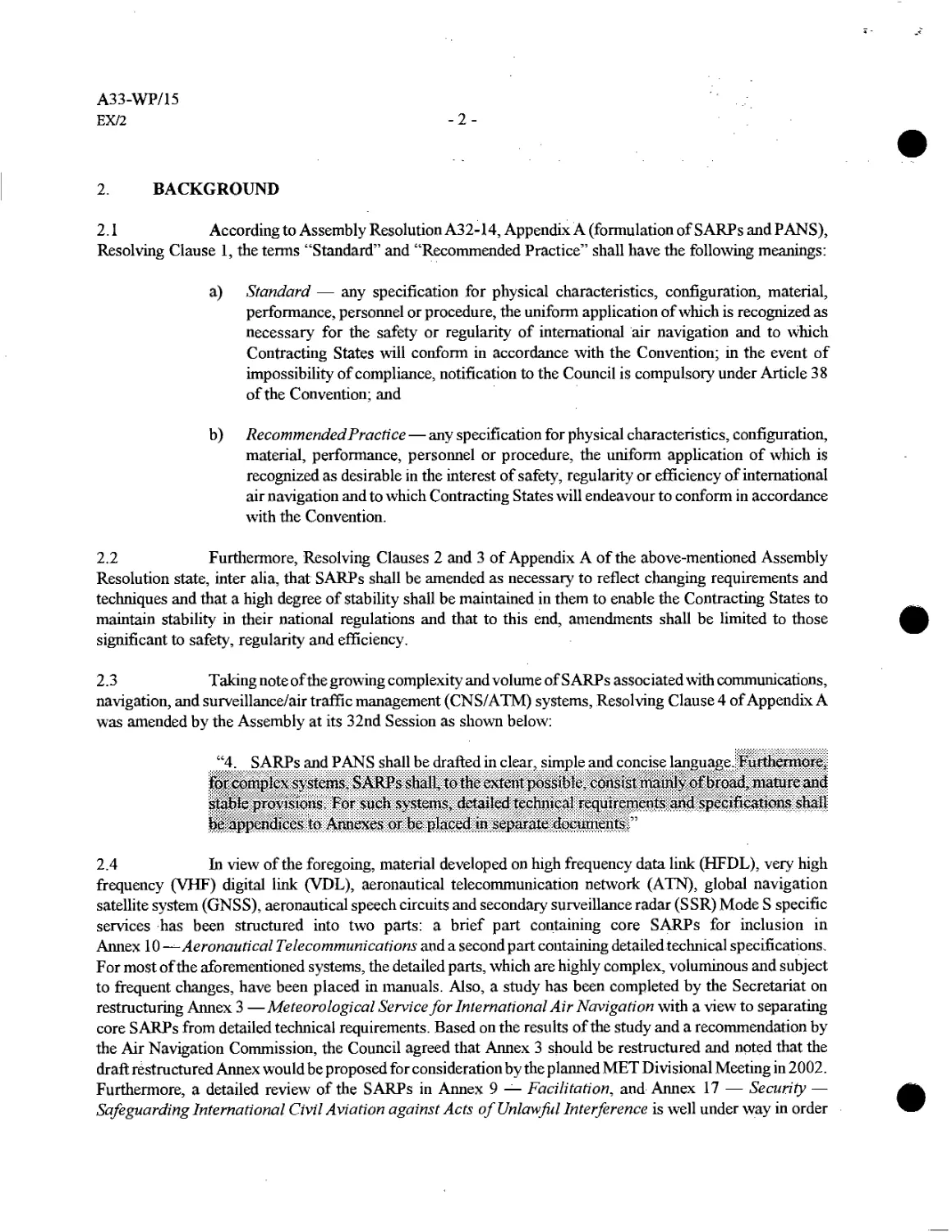
2.3	Taking note of the growing complexity and volume of SARPs associated with communications,
navigation, and surveillance/air traffic management (CNS/ATM) systems, Resolving Clause 4 of Appendix A
was amended by the Assembly at its 32nd Session as shown below:
“4. SARPs and PANS shall be drafted in clear, simple and concise language. FurtherniOfe.
Ibr coinplcx systcms, SARPs shall, to the cxtent possiblc. corisistmainly Цbroad, mature and
stable provisions. For such systems, detailed technical requirements arid specifications shall
beappcndices to Annexes or be placed in separate documents/'
2.4	In view of the foregoing, material developed on high frequency data link (HFDL), very high
frequency (VHF) digital link (VDL), aeronautical telecommunication network (ATN), global navigation
satellite system (GNSS), aeronautical speech circuits and secondary surveillance radar (SSR) Mode S specific
services has been structured into two parts: a brief part containing core SARPs for inclusion in
Annex 10 —Aeronautical Telecommunications and a second part containing detailed technical specifications.
For most of the aforementioned systems, the detailed parts, which are highly complex, voluminous and subject
to frequent changes, have been placed in manuals. Also, a study has been completed by the Secretariat on
restructuring Annex 3 — Meteorological Service for International Air Navigation with a view to separating
core SARPs from detailed technical requirements. Based on the results of the study and a recommendation by
the Air Navigation Commission, the Council agreed that Annex 3 should be restructured and noted that the
draft restructured Annex would be proposed for consideration by the planned MET Divisional Meeting in 2002.
Furthermore, a detailed review of the SARPs in Annex 9 — Facilitation, and Annex 17 — Security —
Safeguarding International Civil Aviation against Acts of Unlawful Interference is well under way in order
A33-WP/15
- 3 -	ЕХ/2
to make them easier to understand and implement. One aim of the aforementioned review is to distil, out of the
existing material, provisions that are more technical/procedural in nature, leaving in place stable core SARPs.
The detailed technical/procedural aspects of SARPs are to be moved to manuals and training documents.
2.5	The division between core SARPs and detailed technical requirements and specifications has,
in general, enhanced the presentation and usefulness of ICAO technical provisions. Furthermore, in accordance
with Resolving Clause 7 of Appendix A of A3 2-14, amendment to detailed technical specifications for complex
systems in appendices to Annexes can now be acted upon by the Council without consultation with States and
hence processed in a more timely manner.
2.6	However, it has been noted that when detailed materials have been placed in appendices to
Annexes, they had the status of SARPs, but when they were published in the form of a manual (which is
presently the most suitable form of “separate documents” in ICAO as referred to in A3 2-14, Appendix A,
Resolving Clause 4), they could only be considered as guidance material. Such disparity in the status of
technical details of various systems has been a point of concern.
3.	DISCUSSION
3.1	Examination of material developed by ICAO in the recent past for new elements of the
CNS/ATM systems clearly shows that it is difficult to standardize a related system in a brief, concise and
easy-to-understand manner. For most modem technical systems, especially those which use digital technology,
all technical characteristics, protocols and interfaces must be fully specified to ensure global interoperability
and compatibility. This is in contrast with conventional and less complex systems, such as the instrument
landing system (ILS) which, for the purpose of uniform global operation, were sufficiently standardized by
including their signal-in-space and main equipment characteristics in ICAO Annexes.
3.2	Realizing that for most modem technical systems, a full set of detailed technical specifications,
which is often bulky, complex and rather fluid (due to rapidly changing technology) is indispensable, the
following questions need to be addressed:
a)	to what level of detail should modem technical systems be standardized by ICAO; and
b)	if such systems are to be standardized by ICAO to their full level of detail, what should
be the status of such detailed technical specifications?
3.3	In general, it can be said that the decision on whether a certain provision should be called a
Standard is rather subjective. The Air Navigation Commission produced guidelines on this subject for use by
its technical panels and relies on their advice regarding the extent of standardization required as well as the
division between core SARPs and detailed technical specifications. Furthermore, experience has shown that
only highly specialized groups have the necessary expertise to scmtinize detailed technical specifications.
3.4	Considering the above and noting the definitions of Standards and Recommended Practices
(paragraph 2.1 above refers), it would be logical to conclude that SARPs should focus on broad system-level,
functional and performance requirements and should not have to include detailed technical specifications. Such
specifications would show possible means of compliance with SARPs and could be developed by either ICAO
or industry . Although there could be more than one way of meeting functional and performance requirements
A33-WP/15
ЕХ/2
-4-
stipulated in SARPs, experience has shown that industry generally responds to market forces which dictate the
need for interoperability. This, in itself, would limit or inhibit the proliferation of solutions.
3.5	Another point to consider is that the validation of detailed technical specifications, especially
for new and complex systems, is usually a long and resource-consuming process. During the course of the
development, specifications are initially agreed upon by experts and validated by simple inspection and
analysis. As the development progresses, the level of validation is gradually raised through modelling,
simulation, prototyping, testing in an actual operational environment and finally single/multiple implementation.
As a result, detailed technical specifications are in need of continuous changes as the level of validation is
gradually increased and, furthermore, those changes would have to be expeditiously agreed upon and
promulgated to all parties concerned. This is still difficult to achieve even with the abbreviated amendment
process for appendices to Annexes referred to in paragraph 2.5 above.
3.6	One possible way to publish detailed technical specifications and to further expedite the
process of their amendment would be to afford them a special status below the level of SARPs. In case the
material in question is constantly evolving and thus expected to be unstable, it could be referenced in an Annex
and could gain its special status in ICAO by, for example, being approved by the Air Navigation Commission.
States would not have to be consulted on amendments and would also not be expected to file differences thereto.
3.7	As another alternative, detailed technical specifications could be considered as another kind
of guidance material which merely show possible ways of complying with certain SARPs stating system-level,
functional and performance requirements. Thus, such material would not be subject to any formal approval
process. This would be a significant departure from the existing practice where technical systems are specified
in detail by ICAO. However, in the longer term, tire ever-increasing pace of technological advances may
necessitate the adoption of such an approach.
4.	CONCLUSIONS
4.1	The separation of core SARPs from detailed technical specifications adopted by the
32nd Session of the Assembly serves ICAO and Contracting States well. However, in the face of rapidly
changing technology and growing technical complexity of newer systems, ICAO should mainly focus on the
development and upkeep of SARPs which broadly specify system-level, functional and performance
requirements for such systems while taking due account of operational requirements as well as the state of
technology.
4.2	In certain cases, it may be necessary to supplement SARPs with detailed technical
specifications of typical compliant systems. Such technical specifications, whether produced by industry or
ICAO, should be referenced in Annexes, where necessary, by means of notes.
4.3	More experience would have to be gained in the development and further handling of detailed
technical specifications before a solid proposal could be formulated. However, as an evolutionary step towards
enhancing ICAO Standards and to pave the way for transition to a high-level standardization regime, a draft
amendment to Resolution A3 2-14 is presented in the appendix to this working paper.
A33-WP/15
ЕХ/2
-5-
5.	ACTION BY THE ASSEMBLY
5.1	The Assembly is invited to:
a)	note the information and the conclusions contained in this paper; and
b)	adopt the amendment to Resolution A32-14 as shown in the appendix.

A33-WP/15
ЕХ/2
Appendix
APPENDIX
RECOMMENDED AMENDMENTS TO THE EXISTING
ASSEMBLY RESOLUTION A32-14
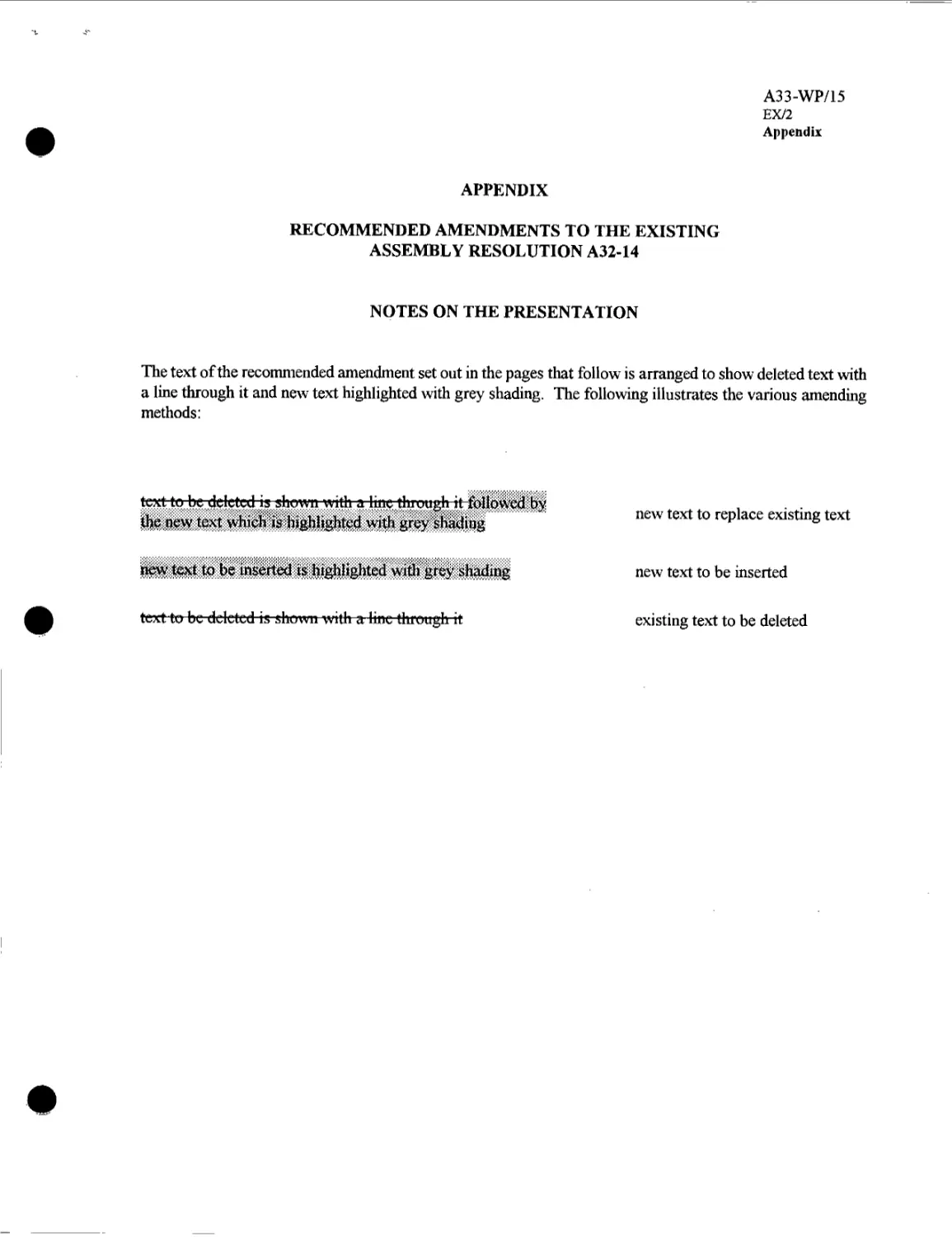
NOTES ON THE PRESENTATION
The text of the recommended amendment set out in the pages that follow is arranged to show deleted text with
a line through it and new text highlighted with grey shading. The following illustrates the various amending
methods:
text to। be deleted is shown with a line through it foilovvedby
text
new text to be inserted is highlighted with grey shading
text to be deleted is shown with a line through it
new text to replace existing text
new text to be inserted
existing text to be deleted
A33-WP/15
ЕХ/2
Appendix
А-2
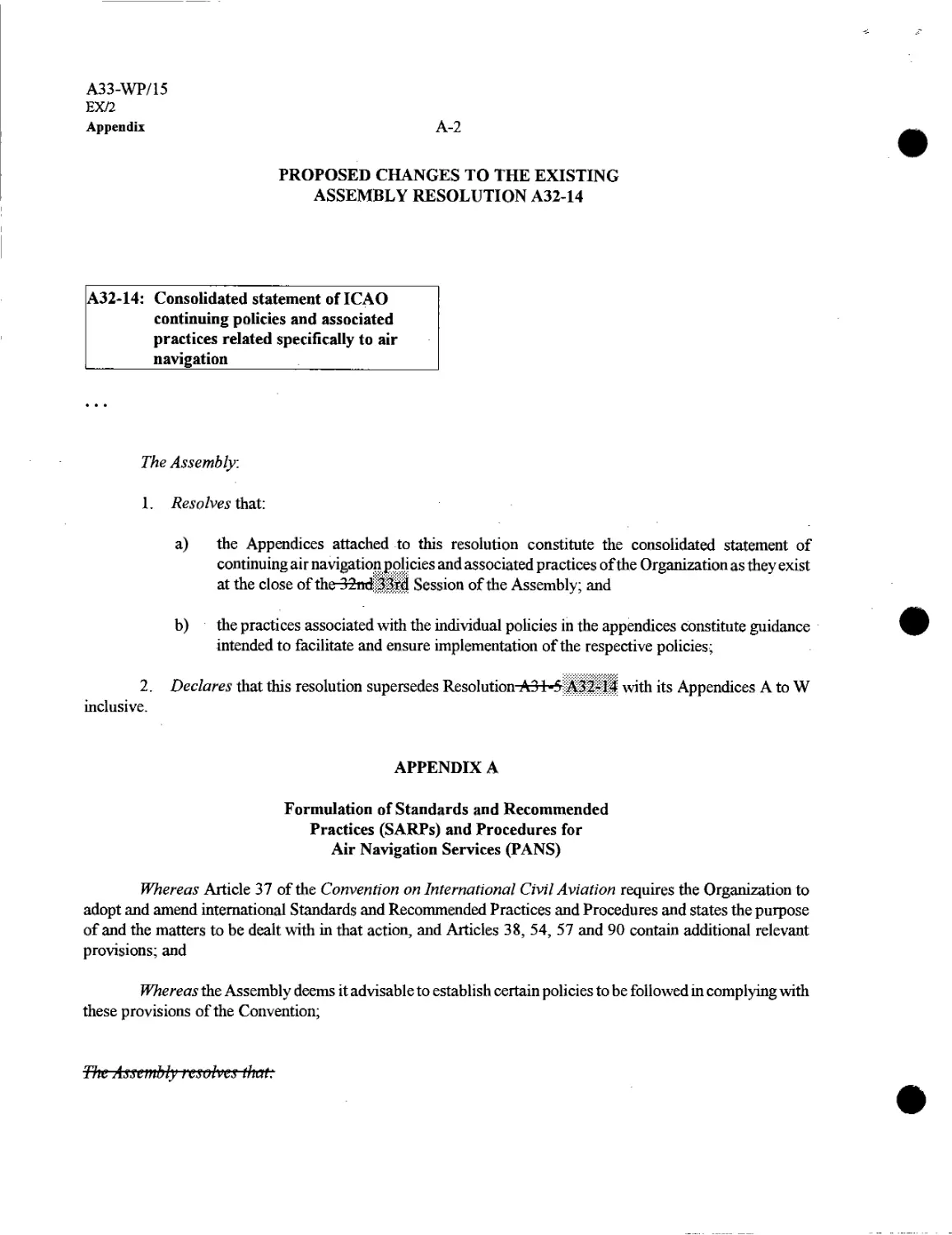
PROPOSED CHANGES TO THE EXISTING
ASSEMBLY RESOLUTION A32-14
A32-14: Consolidated statement of ICAO
continuing policies and associated
practices related specifically to air
navigation.
The Assembly.
1.	Resolves that:
a)	the Appendices attached to this resolution constitute the consolidated statement of
continuing air navigation policies and associated practices of the Organization as they exist
at the close of the 32nd 33 rd Session of the Assembly; and
b)	the practices associated with the individual policies in the appendices constitute guidance
intended to facilitate and ensure implementation of the respective policies ;
2.	Declares that this resolution supersedes Resolution-A3d-5'А32ЭД with its Appendices A to W
inclusive.
APPENDIX A
Formulation of Standards and Recommended
Practices (SARPs) and Procedures for
Air Navigation Services (PANS)
Whereas Article 37 of the Convention on International Civil Aviation requires the Organization to
adopt and amend international Standards and Recommended Practices and Procedures and states the purpose
of and the matters to be dealt with in that action, and Articles 38, 54, 57 and 90 contain additional relevant
provisions; and
Whereas the Assembly deems it advisable to establish certain policies to be followed in complying with
these provisions of the Convention;
The Assembly resolves that:
A33-WP/15
ЕХ/2
Appendix
А-3
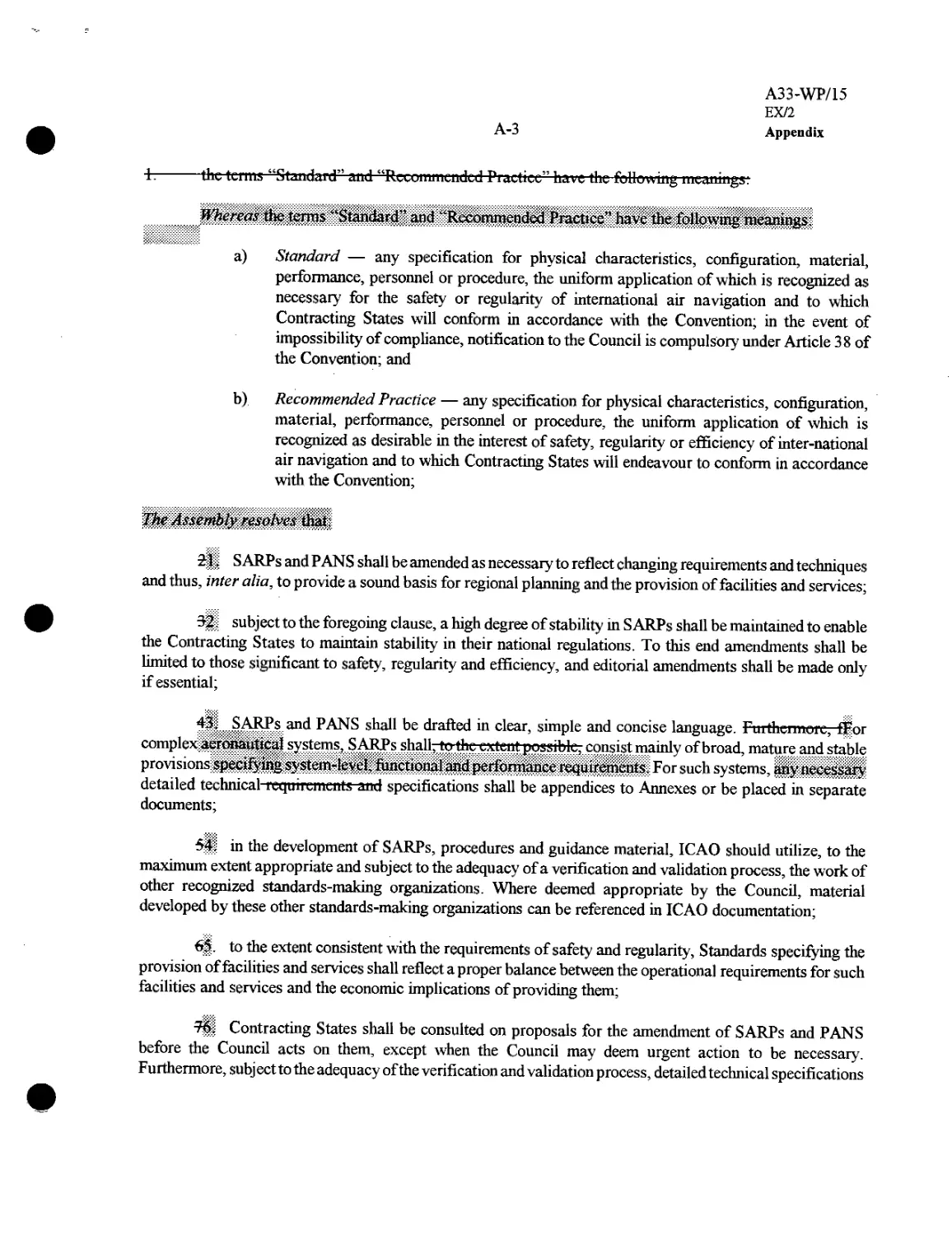
-Ь------the terms “Standard” and “RecommcndccHVactiec” haverthc following meanings:
........
a)	Standard — any specification for physical characteristics, configuration, material,
performance, personnel or procedure, the uniform application of which is recognized as
necessary for the safety or regularity of international air navigation and to which
Contracting States will conform in accordance with the Convention; in the event of
impossibility of compliance, notification to the Council is compulsory under Article 38 of
the Convention; and
b)	Recommended Practice — any specification for physical characteristics, configuration,
material, performance, personnel or procedure, the uniform application of which is
recognized as desirable in the interest of safety, regularity or efficiency of inter-national
air navigation and to which Contracting States will endeavour to conform in accordance
with the Convention;
SARPs and PANS shall be amended as necessary to reflect changing requirements and techniques
and thus, inter alia, to provide a sound basis for regional planning and the provision of facilities and services;
52. subject to the foregoing clause, a high degree of stability in SARPs shall be maintained to enable
the Contracting States to maintain stability in their national regulations. To this end amendments shall be
limited to those significant to safety, regularity and efficiency, and editorial amendments shall be made only
if essential;
43$ SARPs and PANS shall be drafted in clear, simple and concise language. Furthermore, fl|or
complex aeronaut jcul systems, SARPs shall, to the extent possible, consist mainly of broad, mature and stable
provisions specifying systein-lcveffimctionaland performance requirements. For such systems, any necessary
detailed technical requirements and specifications shall be appendices to Annexes or be placed in separate
documents;
54$ in the development of SARPs, procedures and guidance material, ICAO should utilize, to the
maximum extent appropriate and subject to the adequacy of a verification and validation process, the work of
other recognized standards-making organizations. Where deemed appropriate by the Council, material
developed by these other standards-making organizations can be referenced in ICAO documentation;
to the extent consistent with the requirements of safety and regularity, Standards specifying the
provision of facilities and services shall reflect a proper balance between the operational requirements for such
facilities and services and the economic implications of providing them;
Contracting States shall be consulted on proposals for the amendment of SARPs and PANS
before the Council acts on them, except when the Council may deem urgent action to be necessary.
Furthermore, subj ect to the adequacy of the verification and validation process, detailed technical specifications
A33-WP/15
ЕХ/2
Appendix
А-4
for complex systems may be acted upon by the Council without consultation with States. Such material shall
however be made available to States upon request;
87> the applicability dates of amendments to SARPs and PANS shall be so established as to allow
the Contracting States sufficient time for their implementation; and
Й”
unless exceptional circumstances dictate otherwise, the applicability dates of amendments to
Annexes and PANS shall be so established as to avoid the need for Contracting States to amend their national
regulations more often than twice per calendar year. In the application of the foregoing, whenever practicable,
any one Annex or PANS document shall not be amended more frequently than once per calendar year.
Associated practices
1.	The Council should ensure that provisions of SARPs and PANS are completely consistent with
each other. Furthermore, the Council should endeavour to improve the processing, presentation and usefulness
of ICAO documents containing SARPs, PANS and other related provisions, especially for complex systems
an<-i their associa ted applicat loiis . I'b tiiat.ehd lhe Council should protnotethe devblopnient and upkeep o f broad
system-level,
2.	Contracting States should comment fully and in detail on the proposals for amendment of SARPs
and PANS or at least should express their agreement or disagreement on their substance. They should be
allowed at least three months for this purpose. Furthermore, Contracting States should receive at least thirty
days of notification of the intended approval or adoption of detailed material on which they are not consulted.
3.	Contracting States should be allowed a full three months for notifying disapproval of adopted
SARPs amendments, in establishing a date for notifying disapproval the Council should take into account the
time needed for transmission of the adopted amendments and for receipt of notifications from States.
4.	In the application of the provision in Resolving Clause 9 above, the Council should ensure that,
whenever practicable, the interval between successive common applicability dates of amendments to Annexes
and PANS is at least six months.
— END —