/





















































Текст
                    Ю. Б. БОРИСОВ, Л. В. БОРИСОВА
УЧЕБНИК
АНГЛИЙСКОГО
ЯЗЫКА
ДЛЯ III КЛАССА ШКОЛ
С ПРЕПОДАВАНИЕМ
РЯДА ПРЕДМЕТОВ
МОСКВА ■ ПРОСВЕЩЕНИЕ ■ 1077

LESSON 1
1.	Read and answer:
Hullo, boys and girls!
Good morning to you all.
I am your new friend. My name is Peter. I am ten.
1 live in Moscow. I live in Lenin Street.
What is your name?
How old are you?
Where do you live?
I am a schoolboy. I go to school every day. In our English
lessons we speak, read and write. We write words and sentences.
We can spell long and short words, too. I can spell my name:
Peter.
What do you do in your English lessons?
Can you write your name in English?
When 1 come home from school, 1 have dinner. After dinner
I like to play with my friends in our yard. We play football,
badminton and hide-and-seek.
When do you have dinner?
What do you do after school?
Do you often play football?
Do you like to play hide-and-seek?
May 1 come to play with you?
My father is a worker. He works at a factory. The factory
is near our house. After supper Father likes to read an interesting
story. We all like to listen to him. In the evening my father and
1*
3

I often play chess or watch television. I like to play chess. 1 can
play well now.
Can you play chess?
Do you like to read an interesting story in the evening?
My mother is a-<l6ctor. She goes to work every day. We all
help our mother. 1 go to the shop. My sister Lucy helps Mother
in the kitchen. Lucy washes up. Father cleans the carpets.
Do you help your mother?
What do you buy in the shop?
My friend’s name is Nick. He is a schoolboy. His family is
large. They are five. His mother is not a doctor, she is a teacher.
Nick’s grandmother is old. She likes to go for a walk in the park.
She has a clever little dog. The dog’s name is Topsy. We like
Topsy and play with it.
What is your friend’s -name?
How old is he?
Is his family large or small?
Does he study well?
Now you are reading and speaking with me.
Are you at home or at school now?
Are you reading well? If not, read the lesson again.
2.	Look, copy and complete. (Use the words long and short.)..
What is the time?
It is ...
Where are the hands?
The ... hand is at six.
The ... hand is at twelve.

LESSON 2
There is a pen on the table.
There is no pencil on it.
There are two English books
on the desk.
There are no Russian books
on it.
1. Look and say. (Use there is, there are.)
5

LESSON 3
Is there a map on the wall? Yes, there is.
Is there a clock on the wall, too? No, there isn’t.
Are there three boys near the teacher? Yes, there are.
Are there three girls near the teacher? No, there aren’t. There
are two.
1.	Look, ask and answer (speak about your classroom).
2. Read:	'Is there Yes, there ^ is.	~\Yes, there л are.
'Are there -%No, there isn’t, л No, there aren’t.
3.	Read and answer:
PETER AND LUCY
Peter’s family is not large. Peter has no brothers, he has a
sister. Her name is Lucy.
Are there three children in Peter’s family?
Lucy is a little girl. She is six. She does not go to school.
7

Is Lucy a schoolgirl?
Lucy likes to play with her dolls. She has a new Teddy bear,
two balls, a toy cat, a big toy dog and many dolls. All her toys
are in a large box.
Are there many toys in Lucy’s box?
Is there a toy cat in Lucy’s box?
Peter often plays with Lucy. They like to play hide-and-seek.
They make so much noise when they play.
Does Lucy like to play with her brother?
When Peter does his homework, Lucy helps her mother in
the kitchen. There are many cups and plates in the kitchen. Lucy
can wash the cups and plates very well.
Does Peter help his mother to wash up?
4.	Make up questions and write them:
There are many toys in Lucy’s box.
There is a long bench in the yard.
There are many exercises in the book. '
5.	Learn by heart:
My Kite
High, high
Up in the sky,
My kite string waves
Good-bye!.
Good-bye!

LESSON 4
The wall is
in front of Peter.
The wall is behind
Peter.
The wall is between
Peter and Nick.
1.	Do, ask and answer:
Peter, stand near the blackboard.
Nick, go and stand in front of Peter.
Look. Who is behind Nick?
Now, Ann, stand in front of Nick.
Who is behind you, Ann?
Who is standing between Peter and Ann?
Put your bag on the teacher’s table.
Now put one book under the bag, two
books in front of the bag and four
books behind the bag.
Now look at the bag.
Are there four books in front of the
bag?
Are there two books behind the bag?
Is there one book under the bag?
2.	Read:
in 'front of the -\shop
after the л tram
behind the л boys
be'tween the 'large j houses
near the "ч tram-stop
9

3. Read and look. Say which sentences are true.
This is a street. It is a nice street. There are large houses in
it. There are many flats in the houses. Between the large houses
there is a small house. It is a shop. The shop windows are very
big.
You can see a worker. He is standing in front of the shop.
There is a cinema in the street. The street is green. There are
many trees in it.
You can see a tram in the street. A little boy is running after
the tram. The tram-stop is near the shop. There are many children
near the tram-stop. Two girls and a boy are walking in the street.
The girls have new bags in their hands. The girls have a dog.
The dog is running behind the boy. The children are going home
from school.
10

4.	Copy and complete. (Use in front of, behind, between.)
The boy is standing in front of the girl.
Where is the girl standing?
She is standing ... the boy.
The blackboard is behind the teacher.
Where is the teacher?
He is ... the blackboard.
Mike is sitting behind Peter.
Nick is sitting in front of Peter.
Where is Peter sitting?
He is sitting ... Mike and Nick.
5.	Read Exercise 3 again and write out all the words of the Bag
Family.

LESSON 5
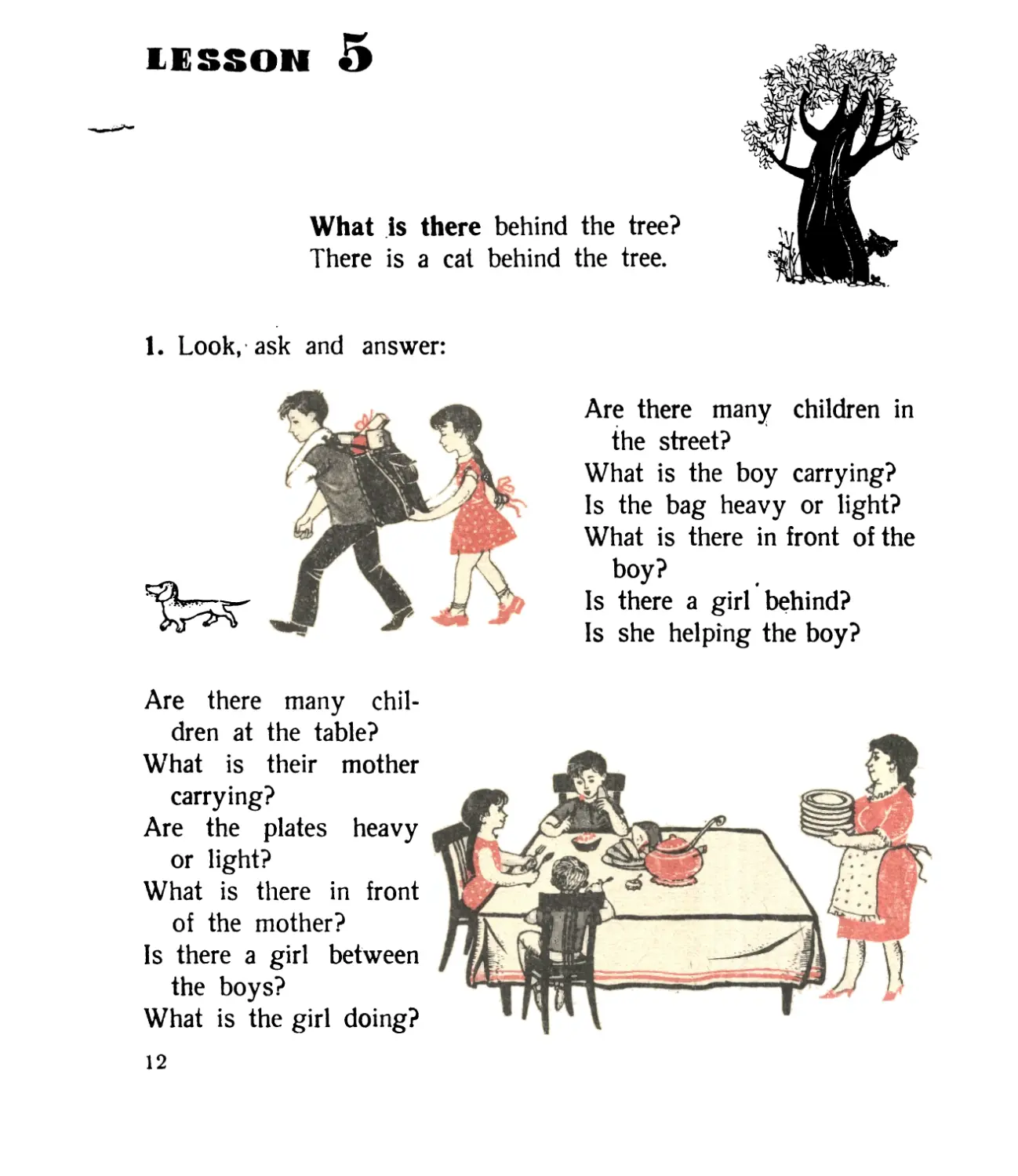
What is there behind the tree?
There is a cat behind the tree.
1. Look, ask and answer:
Are there many children in
the street?
What is the boy carrying?
Is the bag heavy or light?
What is there in front of the
boy?
Is there a girl behind?
Is she helping the boy?
Are there many chil¬
dren at the table?
What is their mother
carrying?
Are the plates heavy
or light?
What is there in front
of the mother?
Is there a girl between
the boys?
What is the girl doing?
12

2. Read:	night
right
bright
light
| bag j 'go by ^ tram
j tram ! at the % tram-stop
I'w'	1
glad with my 'bag in his ■% teeth
carry with a 'ball in her hands
3.	Read and answer:	Is Rags a clever dog?
What can Rags carry?
MY DOG
I live in Lenin Street. Nick lives near my house. In the morn¬
ing we meet at the tram-stop. We often go to school by tram.
Every morning I take my dog Rags with me. Rags is a big clever
dog. When my schoolbag is not heavy, Rags carries it for me.
13

He likes to carry the bag. If Nick and
I go by tram, Rags runs after the tram.
Near the school we meet our friends.
They all like Rags. They say, “Rags!
Rags! Bring me the stick! Carry my
bag for me, too!” But Rags does not
look at the children. He runs behind
me with my bag in his teeth. Near
the school door I say to Rags, “Give me my schoolbag!” Rags
gives me my bag. “Go home now!” And Rags runs home.
When 1 come home from school, he meets me at the door.
He is very glad to see me. After dinner I go for a walk with
Rags. We run and play in the yard. There are many cats in our
house. Rags does not like cats. When he sees a cat, he runs after
it. But I say, “Rags! Come back!” And Rags comes back.
4.	Spell the new words of the lesson.
5.	Look, copy and complete:
What is there behind you? There ... behind me.
What is there in front of you? There ... in front of me.
What is there near you? There ... near me.
6.	Dramatize:
—	Hullo, Ann! I see you are carrying a very heavy bag.
May I help you?
—	Do, please. It is very heavy.
—	What is there in it?
—	There are many books and notebooks in it.

LESSON в
13	14	15
thirteen	fourteen	fifteen
16
sixteen
17	18	19
seventeen	eighteen	nineteen
20
twenty
How many boys are there on
the bench? There are three.
1.	Ask, count and answer:
How many boys are there in your class?
How many girls are there in it?
Now put your bags on your desks.
How many bags are there on your desks?
How many bags can you carry in one hand?
How many girls are there behind you? Etc.
2.	Do, ask and answer:
Can you write the word	?
Write it in your notebook.
How many sounds are there in it?
15

Now count the letters in the word.
Ho y many letters are there in it?
Is the word long or short?
3.	Do the sums:	£
1 14
+
2 = i6 :
1 fourteen
[
plus
two is sixteen
19 +
1
=
13 +
4
=
15 +
3
=
There are 'thir ^teen.
'eighteen л letters
There are 'thirteen -%boys.
'fifteen children
'two grandfathers
5.	Read, do and answer:
Draw eight balls in your notebook.
Now colour two balls red, one ball black, and three balls yellow.
How many white balls are there?
6.	Read and find the right answer:
How many grandfathers can you have?
We can have four grandfathers.
We can have many grandfathers.
We can have two grandfathers.
We can have one grandfather.
How many letters are there in the English ABC?
There are twenty-six letters in the English ABC.
There are twenty letters in the English ABC.
There are eighteen letters in the English ABC.
16

How many hands can a clock have?
A clock can have three hands.
A clock can have four hands.
A clock can have two hands:
How many boys are there in a football team?
There are eleven	boys	in	a	football	team.
There are twelve	boys	in	a	football	team.
There are fifteen	boys	in	a	football	team.
7.	Write in words: 20, 14, 18,	15, 13.
8.	Copy and answer:
How many girls are there in your class?
How many desks are there in your classroom?
9.	Are the sentences true? If not, put them in the negative.
Sixteen plus five is nineteen.
(Sixteen plus five is not nineteen.)
Fourteen plus six is twenty.
Seven plus twelve is eighteen.
Eleven plus four is fourteen.
Thirteen plus one is fifteen.
Two plus fifteen is seventeen.
10.	Make up. sentences on these models:
j There is a carpet on the floor.
| There is	...	...	\
j There are twelve toys	in the box. j
j There are ...	...	... I

LESSON 7
1.	Do, ask and answer:
Show the children a box of matches.
(This is a box of matches.)
How many matches are there in it? Count the matches.
(One, two, three, ...)
Now put the matches back in the box.
Is the box heavy or light?
Now put the box on the table in front of your friend.
Show the children a bottle of ink.
(This is a bottle of ink.)
Is the bottle heavy?
How many bottles of ink can you carry in your hand?
(I can carry only two.) Etc.
18

4V
2. Read: jump
car
a 'cup of -%tea
just
park
a 'box of matches
jam
large
a 'bottle of vnk
jar
jar
a 'glass of water
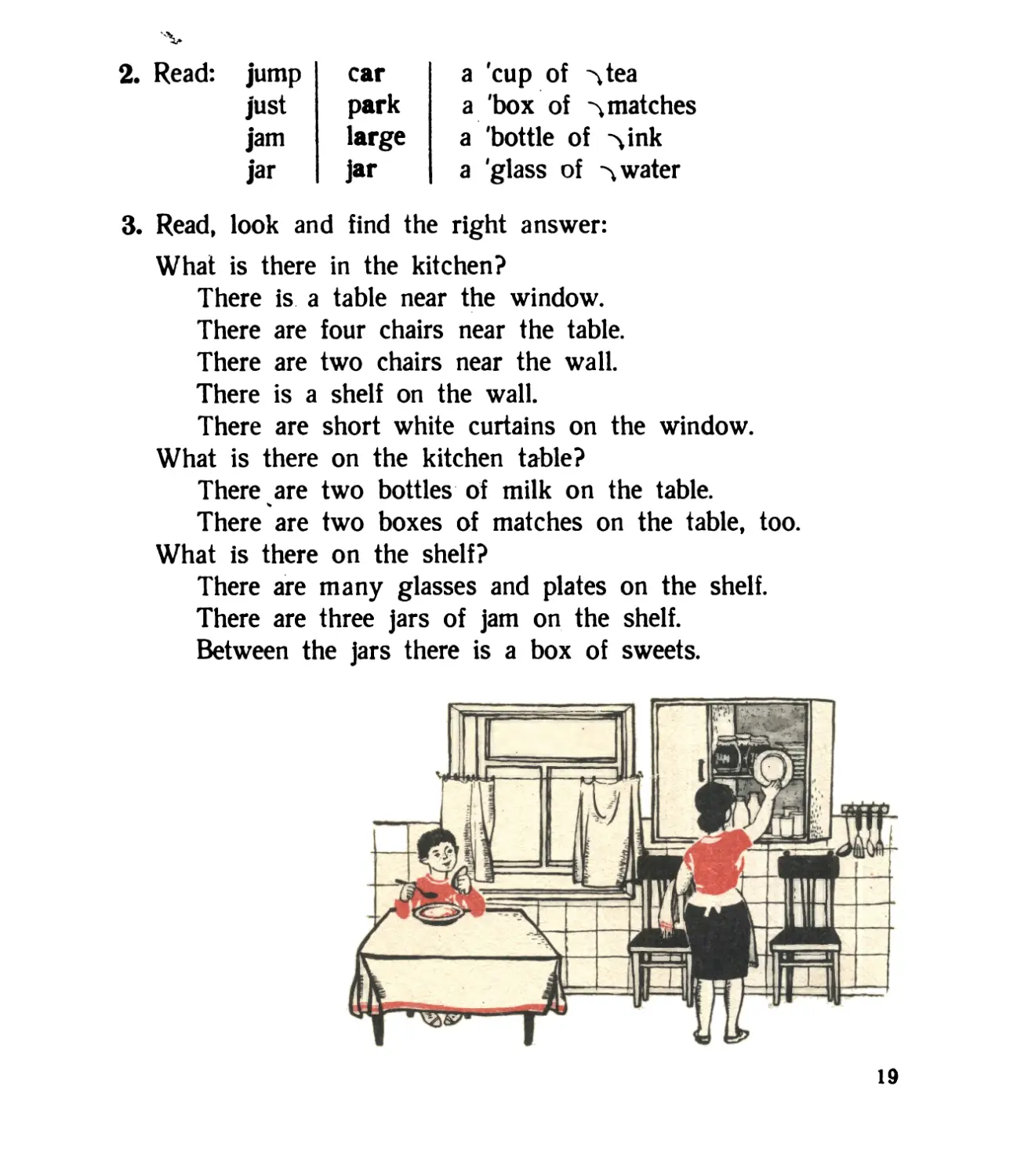
3. Read, look and find the right answer:
What is there in the kitchen?
There is a table near the window.
There are four chairs near the table.
There are two chairs near the wall.
There is a shelf on the wall.
There are short white curtains on the window.
What is there on the kitchen table?
There are two bottles of milk on the table.
There are two boxes of matches on the table, too.
What is there on the shelf?
There are many glasses and plates on the shelf.
There are three jars of jam on the shelf.
Between the jars there is a box of sweets.
19

How many bottles are there on the shelf?
There is only one bottle on the shelf.
There are two bottles on the shelf.
Are they bottles of water, milk or ink?
They are bottles of	ink.
They are bottles of	water.
They are bottles of	milk.
Who is in the kitchen?
A girl is in the kitchen.
A boy and his mother are in the kitchen.
What are they doing?
The boy is drawing in his notebook.
The boy is eating.
Mother is taking a plate from the shelf.
What is there in front of the boy?
There is a box of coloured pencils in front of him.
There is a glass of	milk in	front	of	him.
There is a plate of	soup in	front	of	him.
4.	Speak about your kitchen.
5.	Spell the new words of the lesson.
6.	Copy and complete:	j Use the words:
a box of .
a bag of ..
a cup of ..
a glass of
a box of .
a jar of ...
a bottle of
tea
sweets
water
jam
books
matches
milk

LESSON 8
§ There is some milk in the glass.
Is there any milk in the glass?
Yes, there is.
There are some coloured pencils
in the box.
Are there any pens in the box?
No, there aren’t.
1.	Look, ask and answer:
How many bottles of ink can
you see?
Is there any water in the big
bottle?
Is there any water in the small
bottle, too?
What is there in the small bottle?
How many plates are there on
the table?
Is there any butter on the small
plate?
Is there any butter on the large
plate, too?
What is there on the large plate?
21

2.	Read: some л ink some ~ywater	some -% matches
j brown bread or л white bread
3.	Read:
AT TABLE
Mother. Now close your book, Rose. Dinner is ready. Sit down at
the table. But where is Mike?
Rose. Mike is in the yard. (Rose goes to the window and
opens it.) Mike! Mike! We are having dinner.
Father. Is he coming?
Rose. No, Daddy, he is playing badminton with his friends.
(Mother gives Rose and Father some soup.)
Father. Is there any brown bread today?
Mother. Yes. Rose, go to the kitchen and bring some brown bread,
please.
(Rose brings the bread. Then they eat chops. When they
are having tea, Mike comes in.)’
Mike. I am sorry I am late.
Father. Go to the bathroom and wash your hands, Mike.
(Mike washes his hands and goes to the table. He sees
a large box of chocolates on the table.)
Mike. Oh, what a large box of chocolates it is!
Mother. Eat some soup and chops, Mike.
Mike. Thank you, Mummy. I am hungry.
Rose.	I see you are very hungry, Mike.
Mike.	And I see you like chocolate, Rose. Is there any choco¬
late for me?

Rose. There is no chocolate for you, Mike, You are late for
dinner.
Mike. Mum?!
Mother. Yes, dear. There is some for you, too.
And answer:
Who is late for dinner?
Does Father have brown bread for dinner?
What does Rose like?
-Does Mike like chocolate?
4.	Copy and complete. (Use the words some, any.)
Is there ... water in the bottle?
There are ... matches on the table.
Are there ... sweets on the plate?
There are ... chocolates in the box.
5.	Read Exercise 3 again and write out all the words of the Big
Family.
6.	Make up sentences on these models:
There is
There is
some cheese
some
on the plate.
There are
There are
some glasses
some
on the shelf.

LESSON 9
a fork a knife a spoon
meat
fish.
1. Look, ask and. answer:
sugar
What time is it?	What time is it?
What is there on the table? What is there on the table? Etc.
Is Ann having breakfast?
What is there on her plate?
Where are the fork and the knife?

What is Ann doing?	*
Is she cutting the meat with a knife?
Is there any milk in her glass?
Is there any bread on the table?
2. Read:	with a J knife	J sugar or ~%salt
with a -'spoon	-'tea or ^coffee
with a -'fork for -'breakfast or for supper
3.	Read and answer:
Do we eat soup with a fork?
Do we cut meat with a knife?
Do we take bread with a fork?
Do we eat fish with a knife?
Do we eat soup with a spoon?
Do we cut bread with a spoon?
4.	Read and find the right answer:
What do you put in your soup: sugar or salt?
I put sugar in my soup.
I put salt in my soup.
What do you put in your tea: sugar or salt?
I put salt in my tea.
I put sugar in my tea.
When do you have soup?
I have soup in the morning.
I have soup in the afternoon.
I have soup in the evening.
When do you like to have bread and butter?
I like to have bread and butter for dinner.
25

I like to have bread and butter for breakfast.
I like to have bread and butter for supper.
5.	Read and answer:
What does Lucy have for breakfast?
What does Peter put in her coffee?
Does she like the coffee?
AT BREAKFAST
Every day Lucy has tea for breakfast. She likes tea. But today
she says to her mother, “Peter is having coffee. May ■' I have some
coffee, too?” Mother says, “Have some tea, Lucy,"
“No, thank you. I want some coffee today.”
Mother gives Lucy a cup of coffee and some bread and butter.
“Peter, please put some sugar in my cup,” says Lucy.
There is salt and sugar in front of Peter. Peter puts some salt
in Lucy’s cup. The coffee tastes bad. Lucy looks at Peter and
her mother, and then she says, “Peter, do you want my coffee?
I .don’t like it.”
“No, thank you," says Peter, and he .laughs.
6.	Spell the new words of the lesson.
7.	Copy and complete. (Use the words a fork, a knife, a spoon)
We eat soup with a ...
We cut meat with a ...
We eat fish with a ...
We take sugar with a ...
8.	Read Exercises 3 and 4 again and write out all the words of
the Clean Family.
26

9. Learn by heart:
Hey, Diddle, Diddle
Hey, diddle, diddle,
The cat and the fiddle,
The cow jumps over the moon.
The little dog laughs
To see such fun
And the plate runs away with the spoon.

LESSON 10
a flower
a lake
a fire
1.	Ask and answer:
Can you make fish soup (coffee, tea)?
Can you make a paper doll (a paper ball, a paper flower)?
Do you need salt or sugar when you make soup?
Do you need any meat when you make chops?
Do you need a fork and a knife when you eat meat?
Do you need a spoon when you cut bread?
What do you need when you make chops (coffee, tea)?
Do you need a bag when you go to a shop? Etc.
letter
any
clever
story
flower
carry
water
heavy
paper
hungry
28

3.	Read and find the answers:
What do Peter and his family eat in the wood?
Who makes the fish soup?
What do they bring from the wood?
IN THE WOOD
Peter’s family like to go to the wood. They often go to the
wood on Sundays. They get up at six o’clock in the morning.
They put some bread, butter, meat, cheese, sweets, a bottle of
milk, salt and sugar in their bag. Peter takes his dog Rags with
him.
Peter’s friend Nick likes to go to the wood, too. He meets
Peter and his family at the tram-stop.

At seven o’clock they are in the wood. There is a large lake
in the wood. Peter’s father goes to fish. The children play hide-
and-seek. They hide behind the trees. Rags runs after the children.
They laugh and make so much noise.
When Father brings some fish, he makes a fire. The children
help Mother and Father to make fish soup. They are hungry. The
soup tastes good. But Rags does not want the fish soup, he
wants some meat for dinner.
After dinner Lucy and her mother pick flowers. They like to
bring home some flowers. There are many flowers in the wood.
They are white, red, yellow, and blue.
In the evening they go home. Their bag is not heavy now.
It is light. Rags carries the bag home.
4.	Retell the story.
5.	Spell the new words of the lesson.
6.	Copy and complete:
We need some wood and a box of matches to make a ...
Rags carries Peter’s bag when the bag is ...
They go to the wood to pick ...
I cannot carry the box. It is ...
They like to fish in the ...
7.	Read Exercise 3 again and write out all the words of the Box
Family.
8.	Dramatize:
—	I have no ink in my pen. Is there any ink in your ink-
bottle?
—	Yes, there is some. Here is the bottle.
—	Thank you.
—	That’s all right.

LESSON И
1.	Look, ask and answer:
Is there any jam on the shelf?
Is there a lot of jam?
Where is the jam?
Is there any butter on the shelf? Etc.
2.	Read:	A PICNIC
(Helen, Jane, Jack, Mike and Peter are walking near the
lake. Peter is carrying a big bag.)
Mike. Put down your bag, Peter. And let’s sit down under this
big tree.
Jane. All right. The boys can fish in the lake, and we can pick
some flowers.
Helen. Let’s see what we have in the bag. I am hungry.
Mike. Let’s bring some wood to make a fire, boys.
(The boys go to bring some wood. Helen opens the bag.)
Helen. Are you hungry, boys?
(Helen takes some meat out of the bag, but she does not see a
dog behind her.. The dog sees the meat, takes it quickly and
runs away.)
There is a lot of
bread on the plate.
31

Helen. Oh, Mike! Peter! Jack! Look! A dog is running away with
our meat.
(Peter runs after the dog, but the dog runs quickly. It
runs away.)
Helen. Now we have no meat, but we have a lot of cheese, and
butter, and three bottles of milk.
Mike. And some chocolate, too!
Helen. Sit down all of you.
Jane. Have we any brown bread? I like brown bread.
Peter. There is a lot of brown bread in the bag.
Jane. Who has a knife, boys? I need a knife to cut the bread
and cheese.
Jack. You can cut it with my small knife. Take it.
(Then the children play in the wood.)
And answer:
Do you often go to the wood?
Are there many flowers in the wood?
Do you pick flowers in the wood?
Do you like to fish?
Is there a lake in the wood?
Do you make a fire near the lake?
Do you like to sit near a fire?
3.	Make up sentences on these models:
j Is there
| Is there
j Is there
! Are there
i Are there
a bookcase
a
any ...
any forks
any
in the room? i
? i
_ i
on the table?
?

a dress
LESSON 12
■ ^ of trousers
a pair of shoes
What colour is
the shirt?
It is white.
1.	Do and say:
Touch your shirt.
(I am touching my shirt.)
Touch your shoes. Etc.
2.	Ask and answer:
Are you wearing a shirt?
How many shirts are you wearing?
(I am wearing only one.)
How many shirts have you at home?
Are you wearing a pair of shoes or a pair of boots?
What is Nick wearing?
Is his shirt new or old?
What colour is his shirt? Etc.
3 Учебник английского языка
33

3. Read:
a 'pair of ^ shoes
a 'pair of boots
a 'pair of trousers
4.	Read and do:
Let’s make two paper dolls.
Draw a boy and a girl.
Cut the girl out.
Cut the boy out.
Now draw a shirt and a pair of long trousers for the boy.
Colour the shirt brown and the trousers gray.
Cut out the shirt and the pair of trousers.
Draw two dresses for the girl.
Colour one dress blue and one dress red.
Cut out the dresses.
Bring the paper dolls, their dresses, shirts and trousers to your
English lesson.
5.	Spell the new words of the lesson.
6.	Copy and write the answers:
For girls
Are you wearing a blue dress?
What Colour is your dress?
What colour are your shoes?
For boys
Are you wearing gray trousers?
What colour are your trousers?
What colour is your shirt?
What colour are your boots?
34

7.	Are the sentences true? If not, put them in the negative.
Boys wear dresses.
We wear shoes on our hands.
We put on our shoes when we go to bed.
Boys take off their caps when they come home.
8.	Learn by heart:
Winter is Fun
Where is my cap?
My warm little cap,
My boots and mittens too?
I want to go, and play in the snow,
And have a lot of fun, don’t you?
3*

LESSON 13
a hat
a pocket
a hanky
a pair of gloves
1. Do, ask and answer:
How many pockets are there in your trousers (on your dress,
shirt)?
Touch your pocket.
What is there in it?
Is there a hanky in your pocket?
Show me your hanky.
What colour is it?
Is it old or new?
Do you need a new hanky?
2.	Ask and answer:
Do you put on a hat when you go to school?
Are you wearing it now?
Do you take your hat off when you come to school?
36

Do you take it off when you come home?
When do you wear your hat?
(I wear it outdoors.) Etc.
3.	Read and answer:
Hullo, friends!
It is winter now. In winter I jump out of bed at
eight o’clock. I open the window and do morning exer¬
cises.
Do you open the window when you do morning exer¬
cises?
Do you do morning exercises every day?
Then I dress. I put on my shirt, my trousers and my coat
and.go to the kitchen to have breakfast. After breakfast I go to
school. In winter I wear my overcoat, hat and gloves.
What do you wear outdoors in winter?
I don’t like my winter overcoat. It is heavy, and I cannot run
quickly in it.
Is your overcoat heavy, too?
I like summer. In summer I don’t need to wear my overcoat,
gloves and hat. I get up at seven o’clock. I run out into the
yard and do morning exercises outdoors.
Do you do morning exercises outdoors, too?
In the morning I often run to the lake to fish. When I go to
the lake, I put some bread and some cheese in my pocket and
have breakfast outdoors.
Do you like to have breakfast outdoors in summer?
Near the lake 1 meet my friends. We like to fish and swim
in the lake. We often make a fire and have fish soup for dinner.
The soup tastes good.
37

Can you swim well?
Do you like to fish in summer?
Do you fish in winter, too?
Can you make a fire in winter?
4.	Speak about your day.
5.	Copy and complete. (Use the words trousers, shoes, shirts,
dresses, coats, overcoats, hats, gloves)
What do girls wear?
Girls wear ...
What do boys wear? Boys wear ...
What do you put on when you go outdoors in winter?
I put on ...
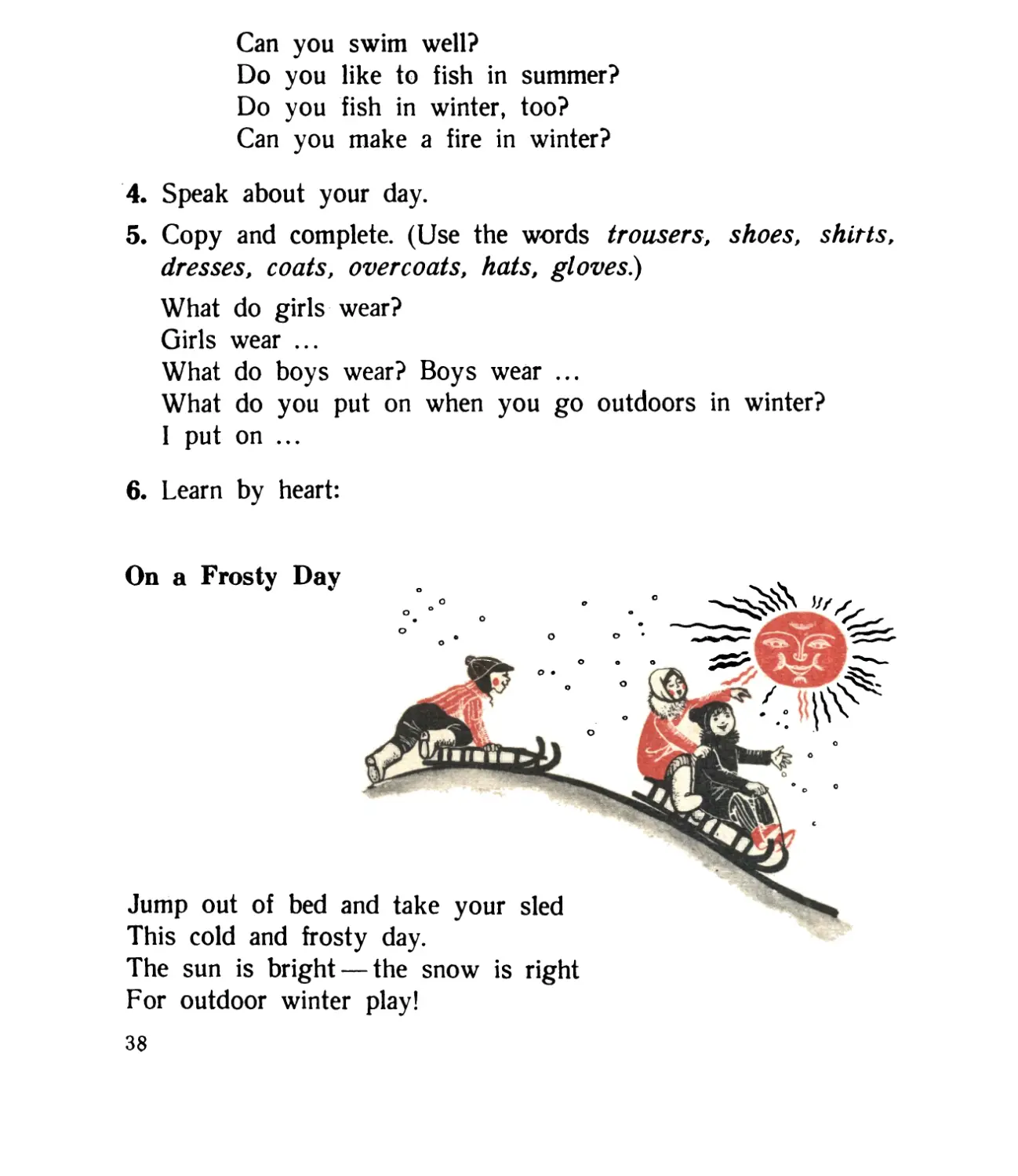
6.	Learn by heart:
On a Frosty
Jump out of
This cold and
The sun is bright — the snow is right
For outdoor winter play!
38

WORDS AND EXPRESSIONS
all
a lot of
any
badminton
behind
between
blue
boot
bottle
carry
chocolate
clever
coat
coffee
colour
coloured pencils
cut
cut out
daddy
do morning exercises
draw
dress
eighteen
exercise
fifteen
fire
fish
flower
for
fork
fourteen
glad
go by tram
gloves
grass
gray
hanky
hat
heavy
here
hide
how many
hungry
if
in front of
ink
jam
jar
knife
lake
laugh
let’s
light
listen
long
look about
look out
make
make so much noise
match
meat
meet
mummy
need
new
nice
nineteen
notebook
only
outdoors
overcoat
pair
paper
pick
plate
plus
pocket
put on
ready
salt
seventeen
shirt
shoe
short
sing
sixteen
some
sorry
sound
spell
spoon
story
sugar
summer
sweet
swim
take off
taste bad
taste good
That’s all right.
team
their
thirteen
this
tram-stop
trousers
twenty
want
water
wear
winter

LESSON 14
This is a picture of a face.
hair
an ear
an eye
a nose
a mouth
This is the right hand.
There are five fingers on the
right hand.
This is the left hand.
There are five fingers on the
left hand, too.
1.	Say and do, ask and answer:
Point to your left eye.
(This is my left eye.)
What is he pointing to?
What colour are his eyes? Etc.
2.	Ask and do:
Ask Nick to touch his nose.
(Touch your nose, please.)
Ask Nick not to touch his face.
(Don’t touch your face, please.) Etc.
3.	Say and do, ask and answer:
Ask Nick to count his fingers.
(Count your fingers, please.)
40

What is he doing?
How many fingers are there on your hands, Nick?
Ask Nick not to play with his fingers.
(Don’t play with your fingers, please.)
Is he playing with his fingers now? Etc.
4.	Say and guess:
She is a schoolgirl.
She is ten.
Her hair is black (yellow, brown).
Her eyes are black (blue).
She has a short nose and a large mouth.
She wears a brown hat and a pair of brown gloves.
Her overcoat is green.
She studies well.
She is in the classroom now.
She is wearing a brown dress and a pair of brown
Now guess who she is.
5.	Read:	a 'picture of a Mace
a 'picture of а 'чЬоу
a 'picture of a ''vdog
a 'picture of a Mat
6.	Read, say and do:
Ask your friend to close his eyes.
(Please close your eyes.)
Ask your friend to open his right eye.
Ask your friend to open his left eye.
Ask your friend to touch his hair.
Ask your friend to point to his mouth.
Ask your friend to touch his nose.

7.	Read and say:
Ask your friend to point to the boy in front of Nick.
Ask your friend to point to the girl behind Nick,
Ask your	friend	not	to	speak when he eats.
Ask your	friend	not	to	put	his	hands in his	pockets.
Ask your	friend	not	to	put	his	fingers in his nose.
Ask your	friend	not	to	put	his	pencil in his	mouth.
8.	Spell the new words of the lesson.
9.	Read, say and write:
Ask your teacher not to open the window.
(Please don’t open the window.)
Ask your teacher to repeat it.
Ask your teacher to look at your exercise.
Ask your teacher to spell the word.
Ask your teacher to tell you a story.
10.	Are the sentences true? If not, put them in the negative.
We open our mouths when we speak.
You open your eyes when you sleep.
We see with our ears.

LESSON 15
a head
a neck
an arm
a back
a leg
a foot
This is a
picture of a boy.
1. Ask and do:
Ask Nick to touch his head with his left hand.
(Nick, touch your head with your left hand, please.)
Ask Nick to touch the desk with his left foot.
Ask Nick not to make so much noise.
Ask Nick to put his right hand behind his back. Etc.
2.	Ask and answer:
When do you get up?
Do you wash your face, neck and hands?
What do you put on your feet?
What do you wear on your hands outdoors?
What do you wear on your head?
Do you carry your bag in your arms or in your hand? Etc.
3. Read:
green
pen
clock
need
dress
pick
meet
left
pocket
sweet
neck
neck
feet
leg
back
43

with my bright hand
with your "\left foot
under his 'right 'чагт
'Let s ~>read.
'Let’s write.
'Let’s “%go.
'Let’s ^draw.
'Let’s "^play.
'Let’s "'vjump.
4.	Read and draw:
Let’s draw a picture of a funny boy.
Draw a large head. Draw two big eyes, a short nose, large
ears and a large mouth. The boy is laughing. His hair is short.
Now draw a long neck and long arms. The boy is carrying
a heavy bag under his right arm.
The boy is wearing a shirt. There are two pockets on his
shirt.
Draw short legs and a pair of trousers. Now draw shoes on
his feet.
Is the boy funny?
5.	Spell the new words of the lesson.
6.	Write about your friend:
My friend’s name is ...
His eyes are ... (blue, gray, brown, green)
They are ... (large, small)
His hair is ... (long, short)
It is ... (yellow, black, brown)
He has a ... nose, (long, short)
7.	Dramatize:
—	Let’s draw.
—	All right. But I need a pencil. Can you give me a pencil?
—	Sorry, I can’t give you a pencil. I have only one. Who
has a spare pencil, girls?

LESSON 16
1.	Listen and say. (Use the words him, her, us, them, me, you)
I am speaking to you, children.
(You are speaking to us.)
Look at Nick.
(Look at him.)
Nick is sitting near Ann.
(He is sitting near her.)
Nick is sitting behind Peter and Kate.
(He is sitting behind them.)
Look, I am giving Ann a book.
(You are giving her a book.)
Ann, I am giving you a book.
(You are giving me a book.)
2.	Ask, do and say. (Use the words him, us, them, her, me,
you)
Ask Nick to take his pictures out of his bag.
(Nick, please take your pictures out of your bag.)
(I am taking them.)
Ask him to show us a picture of a fish. Etc.
3.	Read:	~%ask me	~4ask us
"%ask him	~%ask them
in J front of her or be hind her
45

4.	Read, look and find the right answer:
You can see two children, a boy and a girl. The boy’s name
is Tom, and- the girl’s name is Mary. Look at them. Is 'Tom
wearing a white shirt?
Yes, he is wearing a white shirt.
Yes, she is wearing a white shirt.
What colour is Tom’s hair? And what colour is Mary’s hair?
His hair is brown.
Her hair is black.
His hair is yellow.
Her hair is yellow.
Tom and Mary have a lot of toys. Who is playing with them?
Tom is playing with them.
Mary is playing with them.
46

Tom and Mary have a lot of books. They like to read them.
Are the books on the shelf in front of Tom or behind him?
They are on the shelf in front of him.
They are on the table behind him.
Is Mary putting the books on the shelf?
Yes, she is putting them on the shelf.
Yes, he is putting them on the shelf.
Tom and Mary have a dog. Now the dog is in the room.
Is their dog sitting near Tom or near Mary?
Their dog is sitting near him.
Their dog is sitting* near her.
Their dog is sitting between them.
Tom and Mary like flowers. There are some flowers in their
room. Where are the flowers? Are they behind Mary or in
front of her?
They are behind her.
They are in front of her.
5.	Copy and replace the names by the words Mm, her, us, them,
they, she.
Mary and her brother Tom have a grandmother. Mary and
Tom go to see Grandmother every day. Mary and Tom help
Grandmother to clean Grandmother's room and buy Grand¬
mother some bread.
Tom often says, “Grandmother, tell me and Mary a story.
You know a lot of stories.” “All right,” Grandmother says to
Tom. And Grandmother tells Mary and Tom a story.

LESSON 17
Whose dog is
It is Peter’s.
1.	Ask, do and answer:
Ask Nick to show you his hanky
(his left hand, his right hand, etc.).
Is there any ink on it?
Is Nick’s hanky clean or dirty?
What colour is the hanky?
Whose hanky is it?
Ask Nick to put his hanky in his schoolbag.
Ask him to put it in his pocket.
2.	Ask and guess:
Nick, write the name of a boy or a girl in our room. Don’t
show it to the children.
Nick, is it a girl’s name or a boy’s name?
What colour is her hair?
Is the hair long or short?
What colour are her eyes?
Is she sitting behind you or in front of you?
Is she wearing a brown dress?
Is there a pocket on her dress? Etc.
Is it Ann?
48

3. Read:
ball
bag
take
all
hat
lake
wall
match
make
small
carry
name
tall
hanky
shame
a 'new .^overcoat and a 'new
-%hat
'gray
-^eyes and 'brown
-%hair
4. Read:
WHO IS SHE?
This is a story about a little girl. The girl has gray eyes and
brown hair. She is not tall, she is short. She has a new over¬
coat and a new hat. The overcoat is brown, and the hat is red.
She likes to help her mother. She washes the cups and plates
in the kitchen.
She likes to listen to interesting stories. She often asks her
father to read an interesting story.
In summer she likes to go to the wood with her mother,
father and brother.
And she likes sweets.
She has a large box of toys. There are many toys in it.
The girl has a brother. He is a schoolboy. He studies well.
When he comes home from school, he often plays with her. The
children like to play with their dog. It is a big dog. It is clever.
And answer:
Whose sister is she?
What is her name?
4 Учебник английского языка
49

5.	Spell the new words of the lesson.
6.	Copy and complete:
Mary has a cat. The cat’s name is Pussy. Whose cat is
Pussy?
It is ...
Peter has a dog. The dog’s name is Rags. Whose dog is
Rags?
It is ...
7.	Speak about your friend.
8.	Dramatize:
The girl on duty. Nick, show me your hanky, please.
Nick (puts his hand in his pocket). I am sorry it isn’t clean
today.
The girl on duty. What a shame! And your hands are dirty,
too.

Whose bag is this?
It is the teacher’s.
It is here.
LESSON 18
Whose bag is that?
It is Jane’s.
It is there.
1.	Do, ask and answer:
Jane, come here.
Whose notebook is that?
Where is Nick’s notebook? Is it here or there?
Go there and bring me the notebook.
Now ask Nick to take the notebook.
Nick, please take off your coat.
Jack, take Nick’s coat and come here.
Whose coat is this?
How many pockets are there on Nick’s coat?
Is ijie coat heavy or light?
Nick, what is there in your pockets?
Now, Jack, give Nick his coat and say thank you.
2.	Read:
Betty and Andy live in England. Betty is a schoolgirl. She
is ten. Her brother Andy is eight. He goes to school, too. They
live with their mother and father in London. Their mother and
father are teachers. They work in a school.
4*
51

Betty and Andy like to write letters. They
want to have some Russian pen-friends.
Here is a letter to you from Betty.
Dear friends,
I am writing this letter from England. My
name is Betty Smith, and I am ten. I have only
one brother. His name is Andy: He is eight. We
live in London and go to a very large school.
There are many boys and girls in it.
My mother and father are teachers. They work in a school.
Here I want to write you about myself. I am tall, I have black
hair and gray eyes. I like to read books and to play tennis. I can
play tennis well.
My brother Andy is tall, too. He has black hair and brown
eyes. He likes to read books and to play football.
I want to have Russian pen-friends. In my letters I can write
you about English children and my school.
Now I want to write you about Minty and Dick. Minty is
our family cat. It is white-and-black. It has green eyes, small
white ears and a black nose. Dick is Andy’s dog. Dick is a large
black dog with long ears. Dick and Minty are very good friends.
I can write you interesting stories about them if you like.
With best wishes,
Betty.
And answer:
What is Betty’s letter about? (Say it in Russian.)
3.	Speak about your family.
4.	Read the letter again and write out all the words of the Pen
Family.

LESS О И 19
Whose toys are these
They are mine.
They are here.
They are yours.
They are there.
Whose toys are those?
1.	Do, ask and answer:
Come here, Nick.
Look at the coloured pencils, in my hand.
Whose coloured pencils are these?
And whose coloured pencils are those?
Where are your coloured pencils?
Are they here on the table or there on your desk?
And where are my coloured pencils?
2.	Read and dramatize the dialogue:
Helen. Are your lessons over, Ann?
Ann. Yes, they are.
Helen. Let’s go home then.
Ann. But you see, I cannot find my gloves. Please help me to
find them,. Helen. 1 want to go home with you.
WHERE ARE ANN’S GLOVES?
(Ann is in the classroom. Helen comes in.)
53

(The girls look under the desks and in the desks. Helen
finds a pair of gloves.)
Helen. Are these gloves yours, Ann?
Ann. Let me see. No, they are not mine.
Helen. Whose gloves are they, then?
Ann. I don’t know. Put them on the table.
(Helen sees a pair of red gloves in Ann’s bag.)
Helen. Come here, Ann. Look into your bag. Whose gloves are
those, my dear?
Ann. Oh, yes, they are mine.
Helen. You are looking for your gloves here and there, and they
are in your bag.
Ann. Thank you, Helen.
Helen. That ’ s all right. Let’s go now.
3.	Write in the plural:
This notebook is mine. (These notebooks are mine.)
That story is interesting.
That hat is gray.
This paper doll is nice.
4. Learn by heart:	Little Birdie
Little birdie, hopping gaily,
In the street I see you daily,
Hopping here and hopping there,
Pecking crumbs to take your nest;
Hopping here and hopping there,
You’re the one I like the best.

LESSON 20
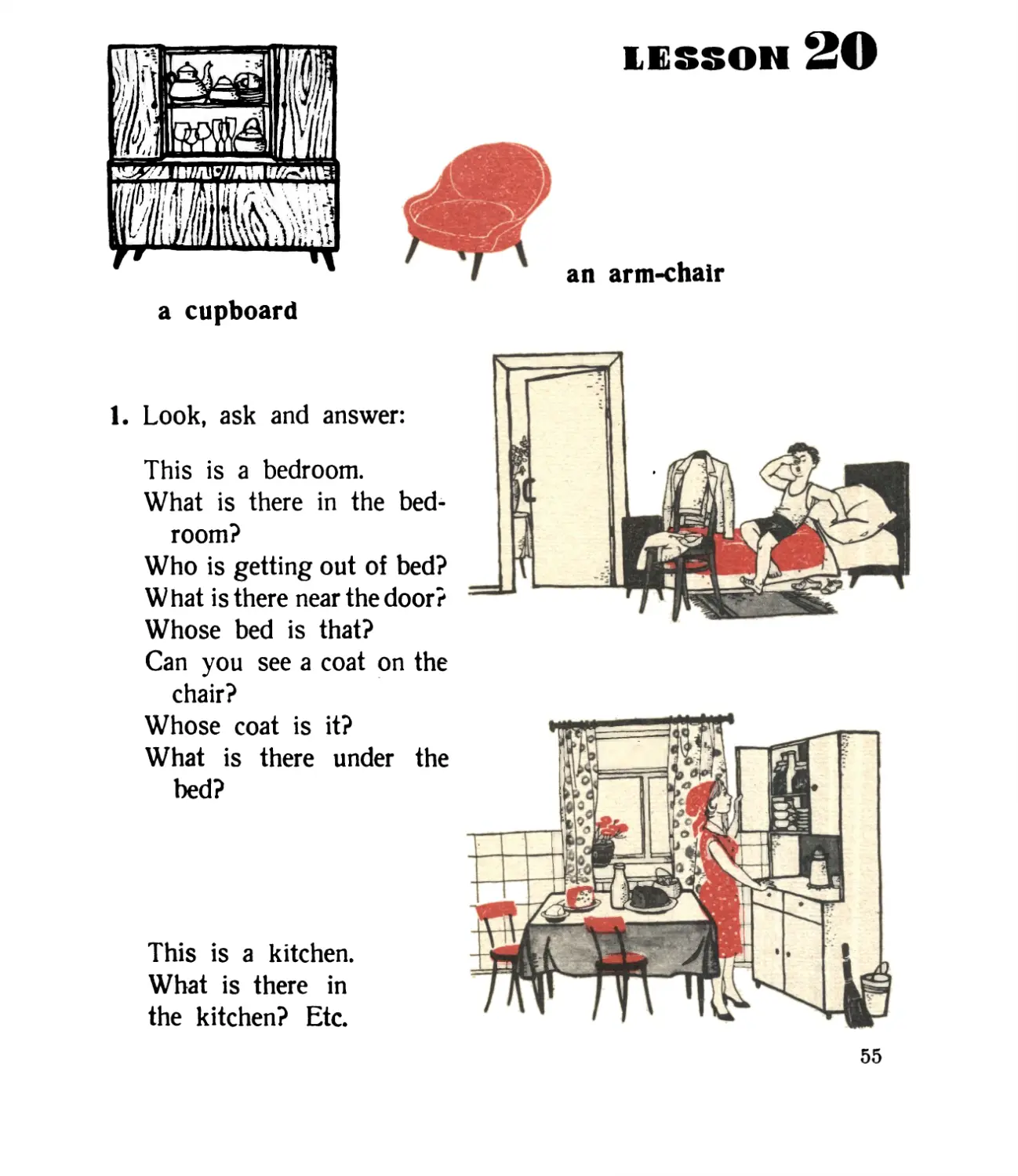
1.	Look, ask and answer:
This is a bedroom.
What is there in the bed¬
room?
Who is getting out of bed?
What is there near the door?
Whose bed is that?
Can you see a coat on the
chair?
Whose coat is it?
What is there under the
bed?
This is a kitchen.
What is there in
the kitchen? Etc.
55

This is a living-room.
What is there in the living-
room? Etc.
2. Read:
the 'other л room
the 'other л bed
the 'other notebook
the 'other % pencil
in the arm-chair
in the ^cupboard
in the bedroom
in the --'bathroom
3.	Read and answer:
t Hullo, friends! I am here again to speak to you. Let’s
speak about our flats.
I live in Lenin Street in a big house. There are many
flats in our house.
Where do you live?
Are there many flats in your house, too?
56

In our flat there is a living-room, a bedroom, a kitchen and a
bathroom. In the living-room I do my lessons, read books, play
chess with my father. I like to sit in the arm-chair when I read
books or watch television.
There are two beds in the bedroom. One is mine, and the
other is Lucy’s. Lucy cannot make her bed well. I make mine and
Lucy’s.
Do you make your bed well?
In the bathroom there is cold and hot water. Before breakfast
I like to wash in cold water. Lucy washes in warm water.
I wash my face, hands, neck and feet in cold water every day.
Do you like to wash in cold water, too?
Do you wash your feet before you go to bed?
When do you clean your teeth?
Our kitchen is very clean. The cupboard, the table and the
chairs are white. We often eat in the kitchen. In the cupboard
there are bottles, plates, cups, glasses, forks, knives and spoons.
What is there in your cupboard?
We like our flat.
Do you like yours?
4.	Spell the new words of the lesson.
5.	Speak about your flat.
6.	Write some sentences about your flat.
7.	Read Exercise 3 and write out all the words of the Nine
Family.

LESSOR
1. Say:	small — smaller
long — longer
thin —thinner
thick—thicker, etc.
2.	Point and say:
This stick is short, but that stick is shorter.
These pencils are long, but those are longer.
My picture is funny, but yours is funnier.
Your bag is old, but mine is older.
Nick’s book is thick, but Kate’s is thicker. Etc.
3.	Look, ask and answer:
Ann and Kate, come here.
Show the children your hands.
Whose hands are cleaner: Jane’s or Kate’s?
Peter and Nick, stand up.
Who is taller: Peter or Nick? Etc.
4.	Read:	'larger and heavier	'bigger and *\ thicker
'smaller and ^lighter	‘thinner and "%smaller
58

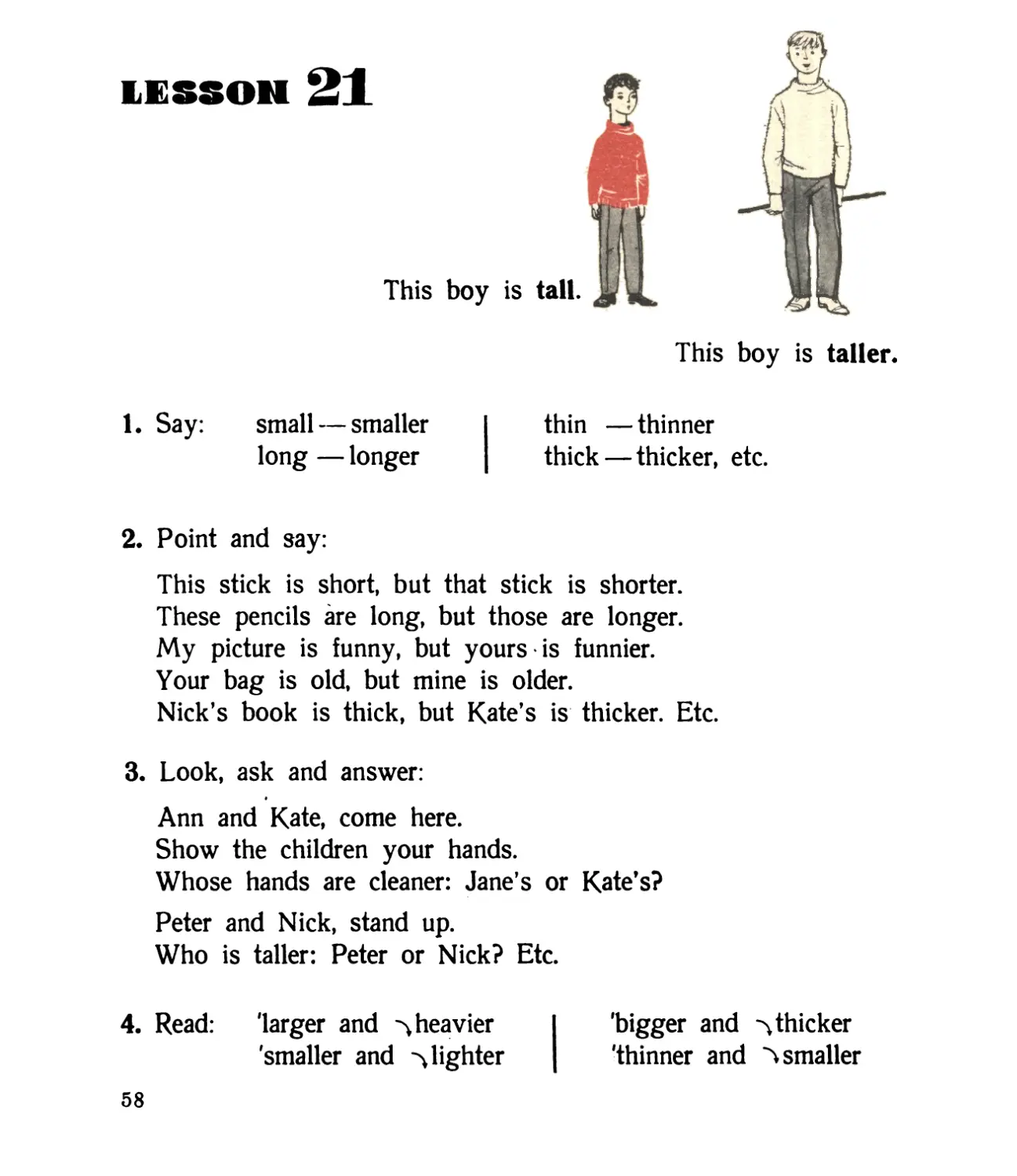
5.	Read and look. Say which sentences are true.
Look at the picture. You can see two boys in it. They are
our old friends. The boy on the left is Peter. And the boy on
the right is Nick. Look at the boys. Peter is tall, but Nick is
taller. The boys are walking home from the lake. They often go
there .to fish. They are carrying two bags in their hands. Nick’s
bag is larger and heavier. Peter and Nick have two fishes in
their hands. The fishes are big, but Peter’s fish is bigger.
There are two dogs in the picture — Peter’s dog Rags and
Nick’s dog Topsy. The dogs are running after the boys.
There are two tall trees in the picture. The tree on the right
is taller.
A girl is swimming in the lake. There are many flowers near
the lake. A, little boy is picking nice flowers. He has some blue,
yellow and red flowers in his hands.

6.	Copy and complete:
This house is big, but that house is ...
(This bouse is big, but that house is bigger.)
The paper in my notebook is thin, but the paper in your
notebook is ...
This arm-chair is large, but that arm-chair is ...
The trees in the street are tall, but the trees in the park
are ...
This flower is nice, but that flower is ...
Your schoolbag is heavy, but mine is ...
7.	Learn by heart:
My Feet
by B. Jones
Without my shoes,
Without my socks
My feet know grass,
My feet know rocks.
Grass in the field,
Rocks in the wood;
They both feel cool —
They both feel good!

LESSON
a donkey
a lion	a tiger
The bear is larger
than the fox.
61

These are an elephant and a donkey.
Is the donkey larger than the elephant?
Is the donkey stronger than the elephant?
Whose ears are longer: the elephant’s or the donkey’s?
And whose legs are tnicker?
What are the animals doing?
Is there any grass near the donkey?
Is the donkey hungrier than the elephant?
63

These are a kangaroo and a giraffe.
Is the giraffe taller than the kangaroo?
Whose neck is longer: the giraffe’s or the kangaroo’s? Etc.
64

3. Read:
'stronger than the ~\wolf
'taller than the ^kangaroo
'older than Л Jack
4.	Read and find the right answer:
What does the giraffe eat?
The giraffe eats meat.
The giraffe eats fish.
The giraffe eats grass.
What does the wolf eat?
The wolf eats fish.
The wolf eats grass.
The wolf eats meat.
What does the brown bear like?
The brown bear likes sugar.
The brown bear likes grass.
The brown bear likes milk.
What does the monkey like?
The monkey likes sweets.
The monkey likes salt.
The monkey likes bread and butter.
The lion is stronger than the bear.
The bear is stronger than the wolf.
Is the lion stronger than the wolf?
Yes, it is. The lion is stronger than the wolf.
No, it isn’t. The lion is not stronger than the wolf.
Nick is taller than Mike.
Peter is taller than Nick.
Is Peter taller than Mike?
Yes, he is. Peter is taller than Mike.
No, he isn’t. Peter is not taller than Mike.
5 Учебник английского языка
65

Jane is older than Jack.
Jack is older than Lucy.
Is Jane older than Lucy?
Yes, she is. Jane is older than Lucy.
No, she isn’t. Jane is not older than Lucy.
5.	Spell the new words of the lesson.
6.	Copy and complete:
The elephant is cleverer than the donkey.
Lucy’s shoes ... cleaner ... Peter’s.
This story ... longer ... that story.
Nick’s pockets ... larger ... Jane’s.
The ... is stronger than the ...
Grandfather	•. Father.

LESSON 23
1. Ask and answer:
Show me the picture of your cousin.
What is his name?
How old is he?
Is he older than you?
What colour are his eyes?
What colour is his hair?
Is he a tall boy?
Who is taller: you or your cousin?
Now show us the picture of your uncle.
Is he your father’s or your mother’s brother?
Who is older: your father or your uncle?
Is your uncle a tall man? Etc.
Now show us a picture of your aunt.
Is she an old woman? Etc.
2. Speak about your cousin, aunt or uncle.
3. Read:
Up
car
uncle
US
colour
Victor
cut
carry
factory
bus
cold
chocolate
uncle
cousin
overcoat
ice
face
nice
Lucy
pencil
5*
67

4. Read and answer:
How many cousins has Peter?
Where do they live?
Does Peter like to visit his cousins?
Hullo, friends! This man is my uncle.
This woman is my aunt. These children
are my cousins. Their names are Nina
and Victor. Nina is ten. Victor is older
than Nina. He is thirteen. My uncle is
my father’s brother. He is older than my father.
My uncle and his family do not live in town. They live in a
village. They live in a large village.
My uncle has a car. He often comes to town in his car and
visits us. His family come with him. We visit my uncle, too.
Sometimes Mother, Father, Lucy and I go there by bus. Sometimes
my uncle takes us to the village in his car. My aunt and my
cousins are glad to see us.
I often go to the lake with my cousins. The lake there
is larger than the lake near our town. Victor can swim very well.
He teaches me to swim. We like to make a fire and sit
on the grass near it. Victor knows a lot of funny stories. I know
some, too, but Victor’s stories are funnier than mine.
5.	Spell the new words of the lesson.
6.	Put in a or an:
... arm-chair and ... cupboard. (An arm-chair and a cupboard.)
... aunt and ... uncle.
... old man and ... woman.
... tiger and ... elephant.'.
68

... eye and ... nose.
... English word and ... Russian word.
... question and ... answer.
... text and ... exercise.
7.	Read Exercise 4 again and write out all the words with c
as [к].
8.	Dramatize:
—	Who is that woman near the Teachers’ Room?
—	Why, that is Ann’s mother. She wants to see our teacher.
—	Let’s help her to find our teacher.
9.	Learn by heart:
The Family
This is the mother so kind and dear,
This is the father so full of cheer,
This is the brother so strong and tall,
This is the sister who plays with her doll.

LESSON 24
This man	This man
is stronger.	is the strongest.
1.	Ask and answer:
How many boxes are there on the table?
Point to the largest box.
Now point to the smallest box.
Put the smallest box behind the largest box.
Is the largest box the heaviest? Etc.
Is Jack strong?
Is Peter stronger than Jack?
Is Nick stronger than Peter?
Who is the strongest of the three?
2.	Read:	the 'largest of -\all
the 'funniest of "ЧаИ
the 'longest of the "ч three
the 'shortest of the -%three
70

3. Read and look:
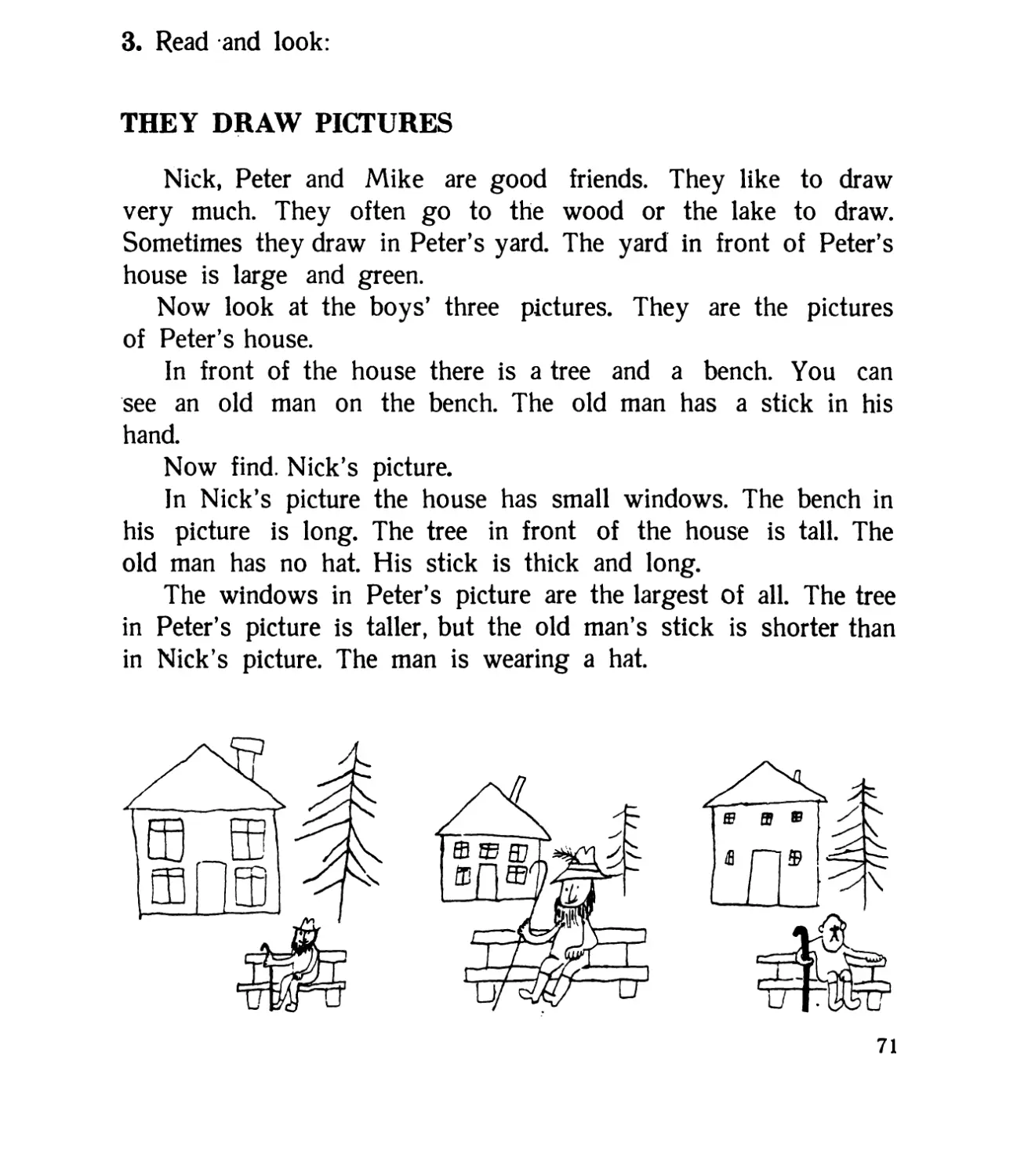
THEY DRAW PICTURES
Nick, Peter and Mike are good friends. They like to draw
very much. They often go to the wood or the lake to draw.
Sometimes they draw in Peter’s yard. The yard in front of Peter’s
house is large and green.
Now look at the boys’ three pictures. They are the pictures
of Peter’s house.
In front of the house there is a tree and a bench. You can
see an old man on the bench. The old man has a stick in his
hand.
Now find. Nick’s picture.
In Nick’s picture the house has small windows. The bench in
his picture is long. The tree in front of the house is tall. The
old man has no hat. His stick is thick and long.
The windows in Peter’s picture are the largest of all. The tree
in Peter’s picture is taller, but the old man’s stick is shorter than
in Nick’s picture. The man is wearing a hat.
71

In Mike’s picture the windows of the house are larger than
in Nick’s picture, but smaller than in Peter’s picture. The bench
in Mike’s picture is the longest of all, but the tree is the short¬
est. The old man’s stick is the longest of the three. The hat on
the old man is very funny. Mike’s picture is the funniest of all.
And answer:
Whose picture is on the left?
Whose picture is on the right?
Whose picture is between the two?
Whose picture do you like best?
Write the answers in your notebook.
The	picture	on the left is ...	j	Mike’s
The	picture	on the right is ...	!	Nick’s
The	picture	between the two is ...	j	Peter’s
4. Copy and complete. (Use the words older, the oldest; newer,
the newest.)
Peter’s grandfather is ... than his uncle.
His uncle is ... than his aunt.
Peter’s grandfather is ... of the three.
Jane’s overcoat is ... than Mary’s.
Mary’s overcoat is ... than Ann’s.
Jane’s overcoat is ... of the three.

LESSON 25
the 4th
the fourth
the 1st	the 2nd	the 3rd
the first	the second	the third
the 5th	the 6th	the 7th
the fifth	the sixth	the seventh
1.	Ask and answer:
How many letters are there in the word fox?
What is the first letter in the word?
What is the second letter?
What is the third letter?
How many letters are there in the word bear?
What is the first letter? Etc.
Now ask Nick to write the words fox, bear and elephant on
the blackboard.
Is the first word longer than the second word?
Is the third word the longest of the three?
2. Read:
big
thin
thick
fifth
sixth
nine
knife
nice
mine
tiger
girl
shirt
dirty
first
third
73

3.	Read and answer:	The first letter is S.
The fourth letter is A.
The fifth letter is R.
The third letter is G.
The second letter is U.
What is the word?
4.	Read and find the right answer:
What animal is the largest?
The lion is the largest animal.
The elephant is the largest animal.
The kangaroo is the largest animal.
What animal is the heaviest?
The elephant is the heaviest animal.
The bear is the heaviest animal.
The donkey is the heaviest animal.
What animal has the longest neck?
The kangaroo has the longest neck.
The giraffe has the longest neck.
The wolf has the longest neck.
What animal is the strongest?
The lion is the strongest animal.
The elephant is the strongest animal.
The tiger is the strongest animal.
What animal has the longest ears?
The fox has the longest ears.
The monkey has the longest ears.
The donkey has the longest ears.
What animal has the longest legs?
The kangaroo has the longest legs.
74

The giraffe has the longest legs.
The donkey has the longest legs.
What animal is the cleverest?
The fox is the cleverest.
The elephant is the cleverest.
The monkey is the cleverest.
5.	Speak about the animals at the Zoo.
6.	Copy and complete:
How many letters are there in the word arm-chair?
What are they?
The second letter is ...
The sixth letter is ...
The first letter is ...
The eighth letter is ...
The third letter' is ...
The fifth letter is ...
The seventh letter is ...
The fourth letter is ...
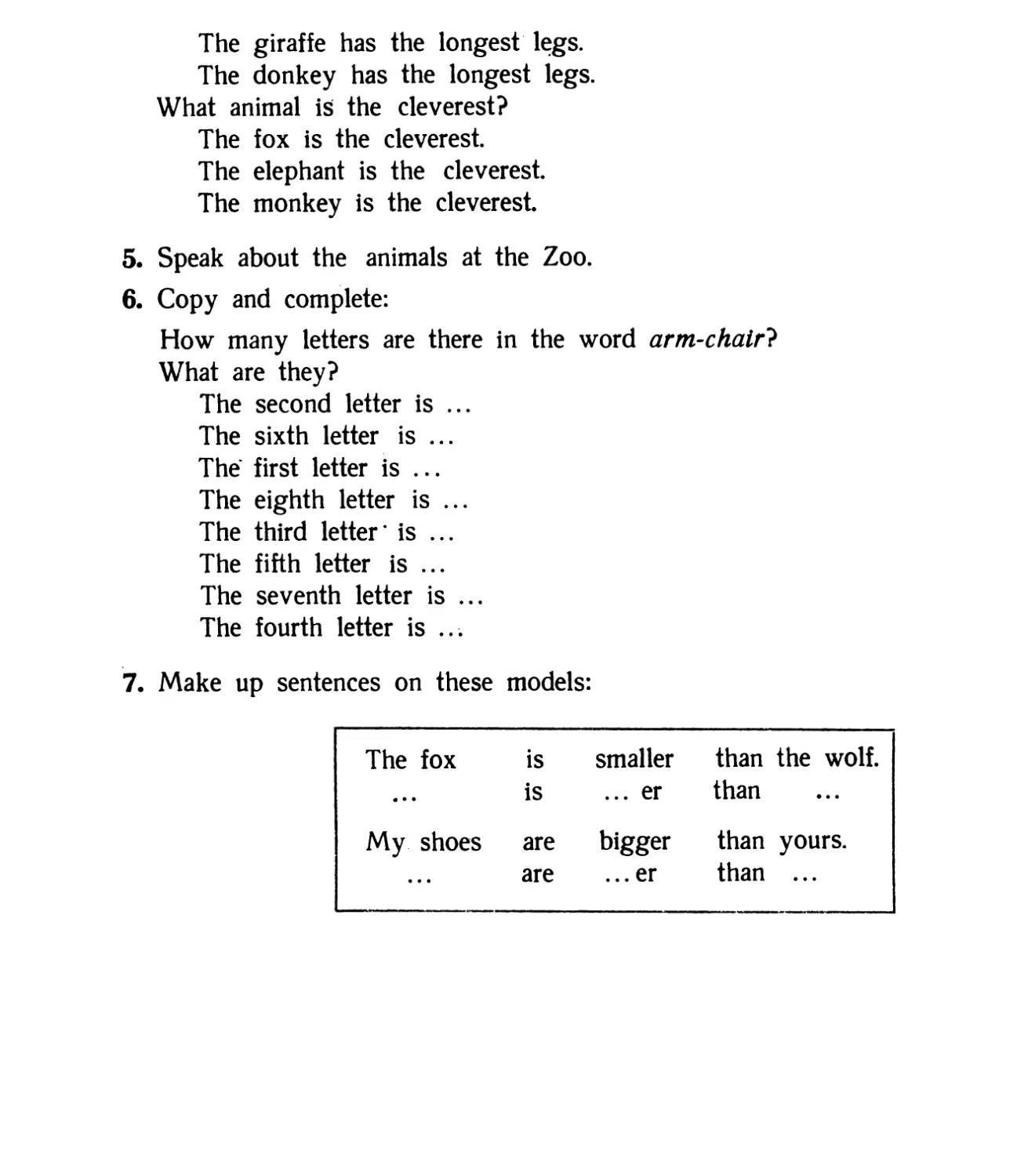
7.	Make up sentences on these models:
The fox
is
smaller
than the wolf.
• • •
is
... er
than
My shoes
are
bigger
than yours.
...
are
... er
than ...

LESSON 26
1. Look, ask and answer:
Are there many children in the school hall?
Are the children having lessons?
Is there a New Year tree in the school hall?
What are the children doing?
Is the New Year tree beautiful?
Are there many toys on it?
How many lamps are there on it?
Are there many children near it?
Are they dancing?
76

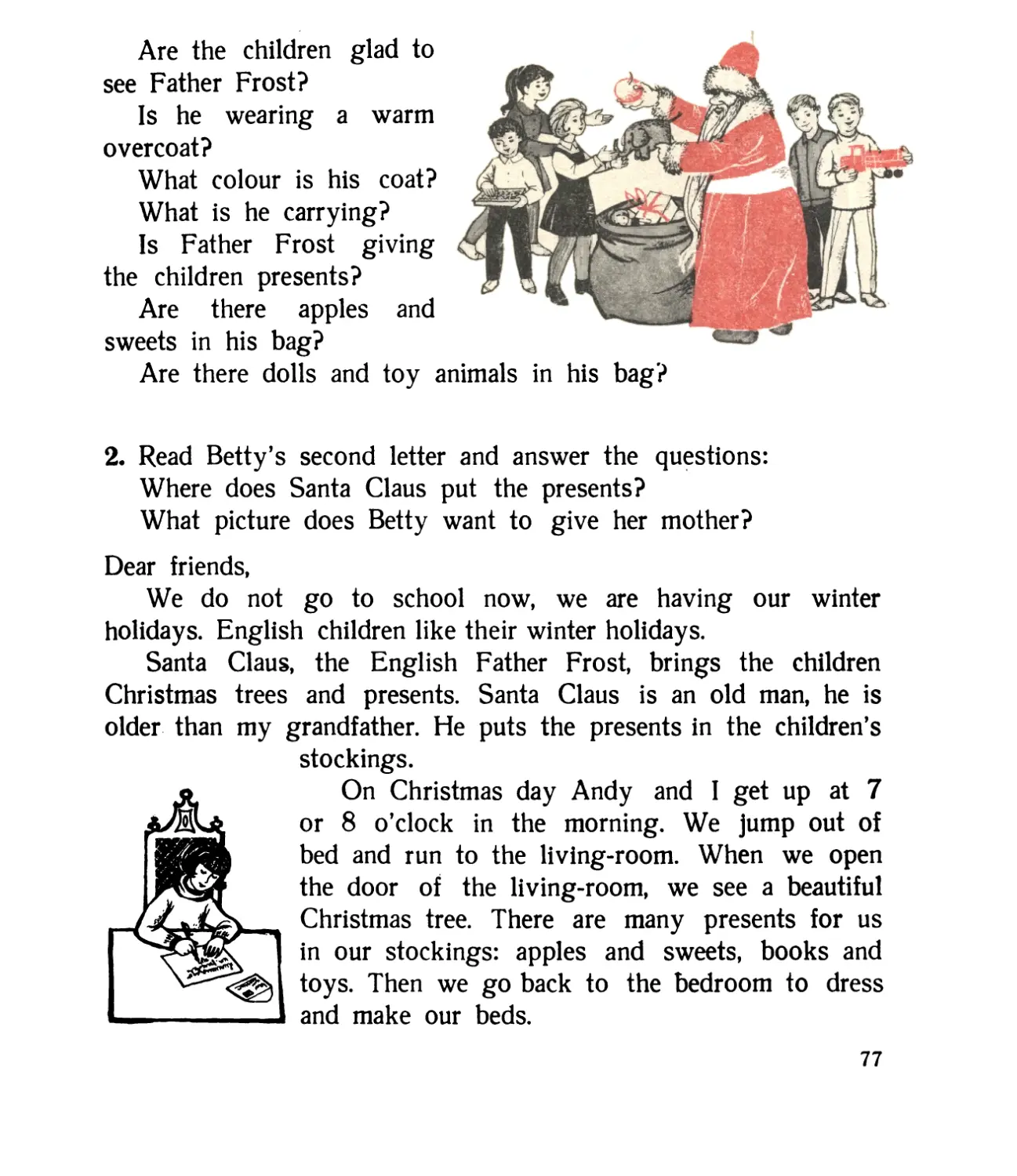
Are the children glad to
see Father Frost?
Is he wearing a warm
overcoat?
What colour is his coat?
What is he carrying?
Is Father Frost giving
the children presents?
Are there apples and
sweets in his bag?
Are there dolls and toy animals in his bag?
2.	Read Betty’s second letter and answer the questions:
Where does Santa Claus put the presents?
What picture does Betty want to give her mother?
Dear friends,
We do not go to school now, we are having our winter
holidays. English children like their winter holidays.
Santa Claus, the English Father Frost, brings the children
Christmas trees and presents. Santa Claus is an old man, he is
older than my grandfather. He puts the presents in the children’s
stockings.
On Christmas day Andy and I get up at 7
or 8 o’clock in the morning. We jump out of
bed and run to the living-room. When we open
the door of the living-room, we see a beautiful
Christmas tree. There are many presents for us
in our stockings: apples and sweets, books and
toys. Then we go back to the bedroom to dress
and make our beds.
77

Mother, Father, Grandfather, Aunt Jane and our cousin Jim
give us some presents on Christmas day. We give them presents,
too. This year I want to give Andy and Father some hankies.
They are white and blue. And I want to give Mother my best
picture. It is a picture of the largest park in London —Hyde
Park.
On the first or the second day of our holidays we visit Aunt
Jane and our cousin Jim.
With all good wishes for the New Year.
Yours,
Betty.
3.	Make up sentences, out of these words:
1)	in, we, overcoats, wear, winter
(We wear overcoats in winter.)
2)	dancing, the children, are
3)	beautiful, our, is, New Year tree
4)	brings, Father Frost, us, presents
5)	toys, on, many, there are, the New Year tree
4.	Say some sentences about your family. Write them in your
notebook.
5.	Make up sentences on these models:
This boy
is
the tallest of all.
...
is
the ...est of all.
Is
this letter
the longest of all?
Is
...
the ...est of all?
78

D EXPRESSIONS
guess
hair
hall
head
here
him
holidays
hot
if you like
kangaroo
know
lamp
left
leg
letter
lion
living-room
make a bed
WORDS AN
about
animal
apple
arm
arm-chair
ask
aunt
back
beautiful
bedroom
before
best
bus
clean
cold
cousin
cupboard
dance
dirty
donkey
ear
elephant
England
Father Frost
feet
fifth
find
finger
first
foot
get out of bed
giraffe
grass
man
mine
mouth
myself
neck
New Year
New Year tree
nose
other
over: The lesson is
to repeat
right
second
sometimes
spare
spell
stocking
strong
tall
teach
tell a story
than
that
them
there
these
thick
thin
third
those
tiger
town
uncle
us
village
visit
warm
What a shame!
whose
With best wishes.
woman
year
yours
over.
pen-friend
play tennis
point to
present

LESSON 27
OCTOBER
Sunday
Monday
Tuesday
Wed¬
nesday
Thurs¬
day
Friday
Saturd
•
•
•
•
• '
•
1
2
3
4
5
6
7
8
9
10
11
12
13
14
15
16
17
18
19
20
21
22
23
24
25
26
27
28
29
30
31
•
e
•
•
•
1.	Do and say:
Point to Monday in the calendar. (This is Monday.) Etc.
2.	Ask and answer:
How many days are there in a week?
What day is the first?
What day is the second? Etc.
What do you do on Sunday?
What do you do on Monday?
Do you go to school on Monday?
Do you go to the cinema on Monday?
Do you have an English lesson on Tuesday? Etc.
80

3. Read: in the calendar between 'Saturday and ^Monday
after Sunday 'every 'Tuesday morning
4. Read and find the right answer:
Monday.
What day comes after Sunday?
Saturday.
Thursday.
What day comes before Friday?
Tuesday.
Thursday.
Saturday.
What day comes between Saturday
Wednesday.
and Monday?
Friday.
Sunday.
5.	Copy and complete:
There are seven days in a week. What are they?
The first day is Sunday.
The second day is ...
The third day is ...
The fourth day is ...
The fifth day is ...
The sixth day is ...
The seventh day is ...
6.	Are the sentences true? If not, put them in the negative.
The word Monday is longer than the word Saturday.
The word Wednesday is shorter than the word Tuesday.
The children go to school on Sunday.
We dance in our English lessons.
Father Frost is an old man.
6 лист УчсСишк английского я зыка
81

7. Sing and show:
THIS IS THE WAY WE WASH ...
This is the way we wash our hands,
We wash our hands, we wash our hands.
This is the way we wash our hands
Every Sunday morning.
This is the way we wash our face,
We wash our face, we wash our face.
This is the way we wash our face
Every Monday morning.
This is the way we wash our arms,
We wash our arms, we wash our arms.
This is the way we wash our arms
Every Tuesday morning.

This is the way we wash our neck,
We wash our neck, we wash our neck.
This is the way we wash our neck
Every Wednesday morning.
This is the way we wash our ears,
We wash our ears, we wash our ears.
This is the way we wash our ears
Every Thursday morning. 7
This is the way we wash our hair,
We wash our hair, we wash our hair.
This is the way we wash our hair
Every Friday morning.
This is the way we wash our feet,
We wash our feet, we wash our feet.
This is the way we wash our feet
Every Saturday morning.

LESSON 28
21 22
twenty-one	twenty-two
25	26
twenty-five	twenty-six
1. Look, ask and answer:
23	24
twenty-three	twenty-four
27	28
twenty-seven	twenty-eight
■ЯН
29
twenty-nine
30
thirty
Look at the clock!
Where is the large hand?
It is at six.
Where is the small hand?
It is between three and four.
What is the time?
It is. half past three.
Look at the clock!
Where is the large hand?
It is at two.
Where is the small hand?
It is between three and four.
What is the time?
It is ten minutes past three.
Look at the clock!
Where is the large hand?
It is at ten.
Where is the small hand?
It is between three and four.
What is the time?
It is ten minutes to four.
84

2.	Do, ask and answer:
Please take the clock. Show us eight o’clock.
Where is the small hand?
Where is the large hand?
What is the time?
(It is eight o’clock.)
3.	Read and look. Say which sentences are true.
In all the five pictures you
can see your old friend Peter. In
the first picture Peter is putting
on a shirt. He is getting up. Look
at the hands of the clock. The
small hand of the clock is at seven.
The large hand of the clock is
at twelve. It is seven o’clock.
Look at the second picture. The small
hand of the clock is between eight and
nine. The large hand is at three. It is half
past eight now. Peter is at the tram-stop.
He is going to school.
85

Now look at the third pic¬
ture. The small hand is between nine
and ten. The large hand is at six.
It is half past nine. Peter is in- the
classroom. He is at his desk.
He is drawing the head of a man.
Look at the fourth picture.
Peter is having dinner. He is cut¬
ting bread with a knife. It is five
o’clock. The small hand is at six,
and the large hand is at three.
Now look at the fifth picture. It is half
past seven. The large hand is at six. The small
hand is between six and seven. Peter is at
home. He is sitting in an arm-chair in the
living-room. He is reading a book.
4. Write in words:

LESSON 29
Se/btzrnJ&ts
N
I
iltadtnQ.
JtnaiMQ
**
1
tUtadiruj,
Jl/ulfunttic,.
1.	Ask and answer:
What lessons do you have on Monday?
How many lessons do you have on Monday?
What lessons do you have on Tuesday? Etc.
What time does the first lesson begin?
Do you come to school early in the morning?
What time does the second lesson begin? Etc.
What do you do in an Arithmetic lesson?
Do you count and do sums in an Arithmetic lesson?
What do you do in a Physical Training lesson?
Do you run and play in a Physical Training lesson?
What do you do in a Drawing lesson?
Do you draw animals? Etc.
87

2. Read:
in an A arithmetic lesson
in a Drawing lesson
in a Handwork lesson
in a Singing lesson
in a 'Physical VTraining lesson
3. Read Betty’s third letter and answer her
questions.
Dear friends,
This is my third letter to you. It is eight
o’clock in the evening now. Our family is in the living-room.
Mother and Father are reading, Andy is doing his homework. He
is doing his arithmetic sums. We go to school on Monday,
Tuesday, Wednesday, Thursday and Friday. On Saturday and
Sunday we do not go to school.
In school we have lessons in
reading, writing, arithmetic, sing¬
ing, drawing. I like lessons in
physical training and drawing.
When we have a break, all the
children go to play outdoor games
in the school playground. English
children play football, tennis,
hopscotch, badminton and other
games.
Do you know what
hopscotch is? It is a game.
&¥uJ (4 urtwu
у mi схшу
<? stcoKxt o+v
yvu
''W
i 3v»
88
This girl is playing hopscotch.

Do you play hopscotch?
I like to play hopscotch, and Andy likes to play badminl
What lessons do you have in school and what games do л
play?
With best wisl
Be
4.	Spell the new words of the lesson.
5.	Copy and complete:
What lessons do you have today?
Today our first lesson is ...
The second lesson is ...
The third lesson is ...
The fourth lesson is ...
6.	Read Exercise 3 again and write out all the words with
as [0].

LESSON 30
40
forty
50
fifty
60
sixty
70	80	90	100
seventy	eighty	ninety	one hundred
100
How much is twerrty-one plus thirty? It is fifty-one.
Which is larger: fifty or fifteen? Fifty is.
1.	Ask and do:
Nick, count from one to ten.
Peter, count from ten to twenty.
Ann, count from twenty to thirty. Etc.
2.	Do, ask and answer:
Open the book at page twenty-eight.
Count the pictures on the page.
How many pictures are there?
Now open the book at page seventy-eight.
Count the words in Exercise 3. .
How many words are there?
3.	Do the sums:
40	+	20	=
forty plus twenty is
90
10
33 + 51 =
70 — 60=
75 + 25 =
ninety minus ten is
90

4.	Ask and answer:
Which is larger: thirteen or thirty? (Thirty is larger.)
Which is smaller: seventeen or seventy? Etc.
5.	Read:	'fifty minus 'thirty- one
'forty-'three plus ~\five
'fifteen plus 'sixty- seven
'one 'hundred minus 'eighty^ four
6.	Read and find the right answer:
How much is eighty-five plus seven?
Eighty-five plus seven is ninety-five.
Eighty-five plus seven is ninety-two.
How much is forty-three plus thirty-eight?
Forty-three plus thirty-eight is seventy-one.
Forty-three plus thirty-eight is eighty-one.
How much is one hundred minus fifty-six?
One hundred minus fifty-six is forty-six.
One hundred minus fifty-six is forty-four.
How much is twenty-eight minus fifteen?
Twenty-eight minus fifteen is thirteen.
Twenty-eight minus fifteen is seventeen. .
Which is later: twenty-three minutes to twelve or twenty-three
minutes to eleven?
Twenty-three minutes to twelve is later than twenty-three
minutes to eleven.
Twenty-three minutes to eleven is later than twenty-three
minutes to twelve.
Which is earlier: half past six or half past seven?
Half past six is earlier than half past seven.
Half past seven is earlier than half past six.
91

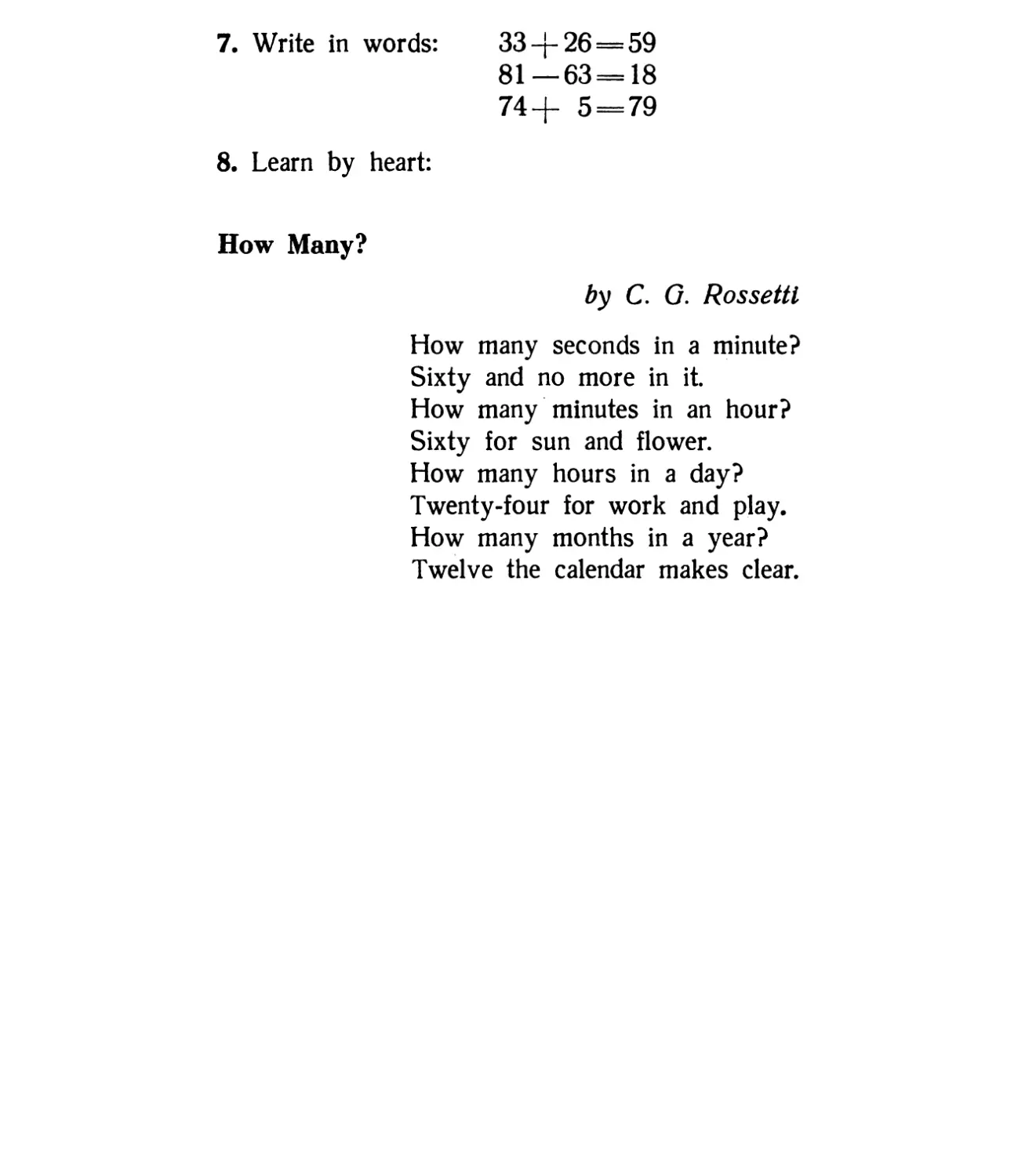
7. Write in words:
33 + 26=59
81—63=18
74+ 5 = 79
8. Learn by heart:
How Many?
by C. G. Rossetti
How many seconds in a minute?
Sixty and no more in it.
How many minutes in an hour?
Sixty for sun and flower.
How many hours in a day?
Twenty-four for work and play.
How many months in a year?
Twelve the calendar makes clear.

LESSON 31
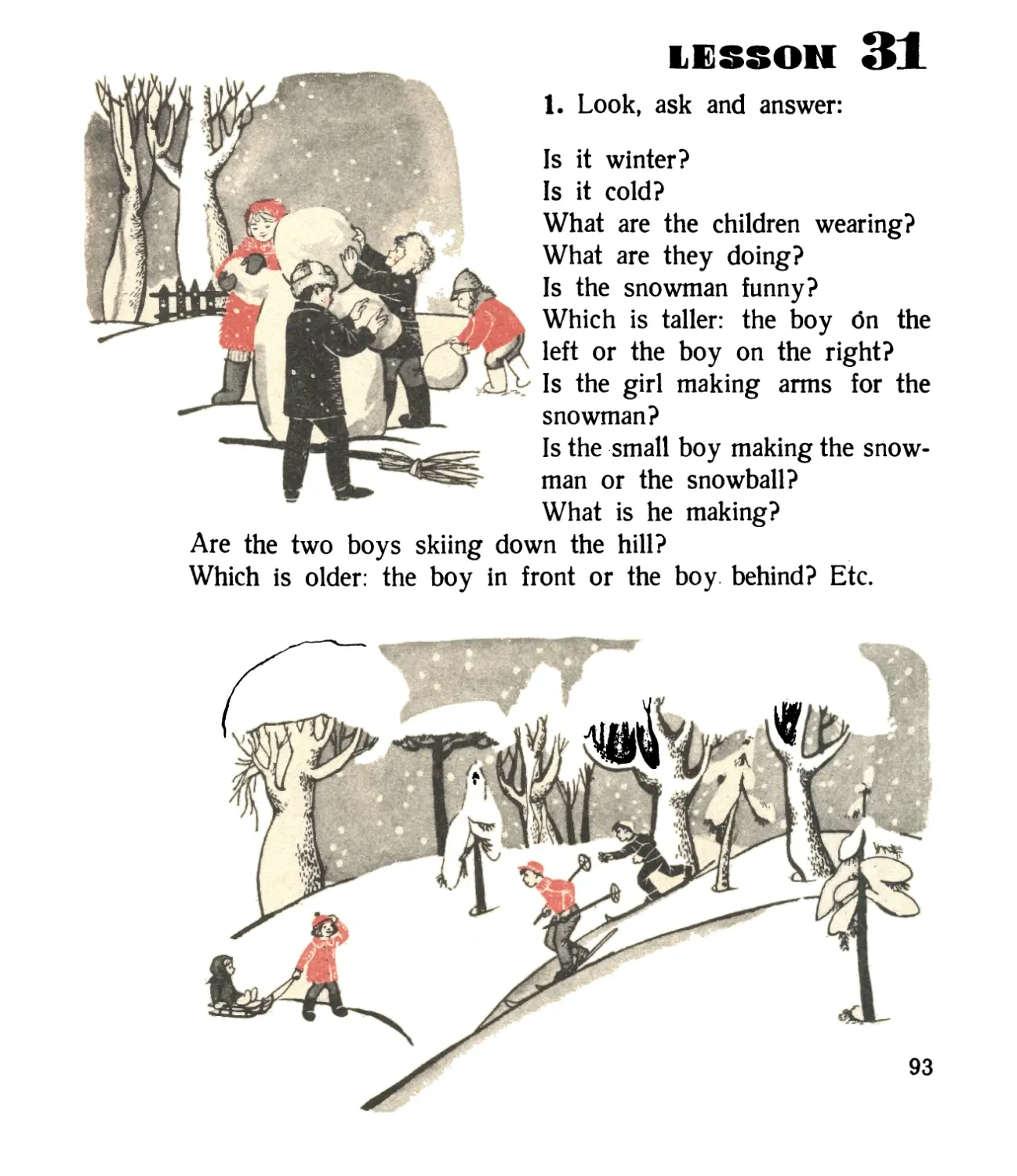
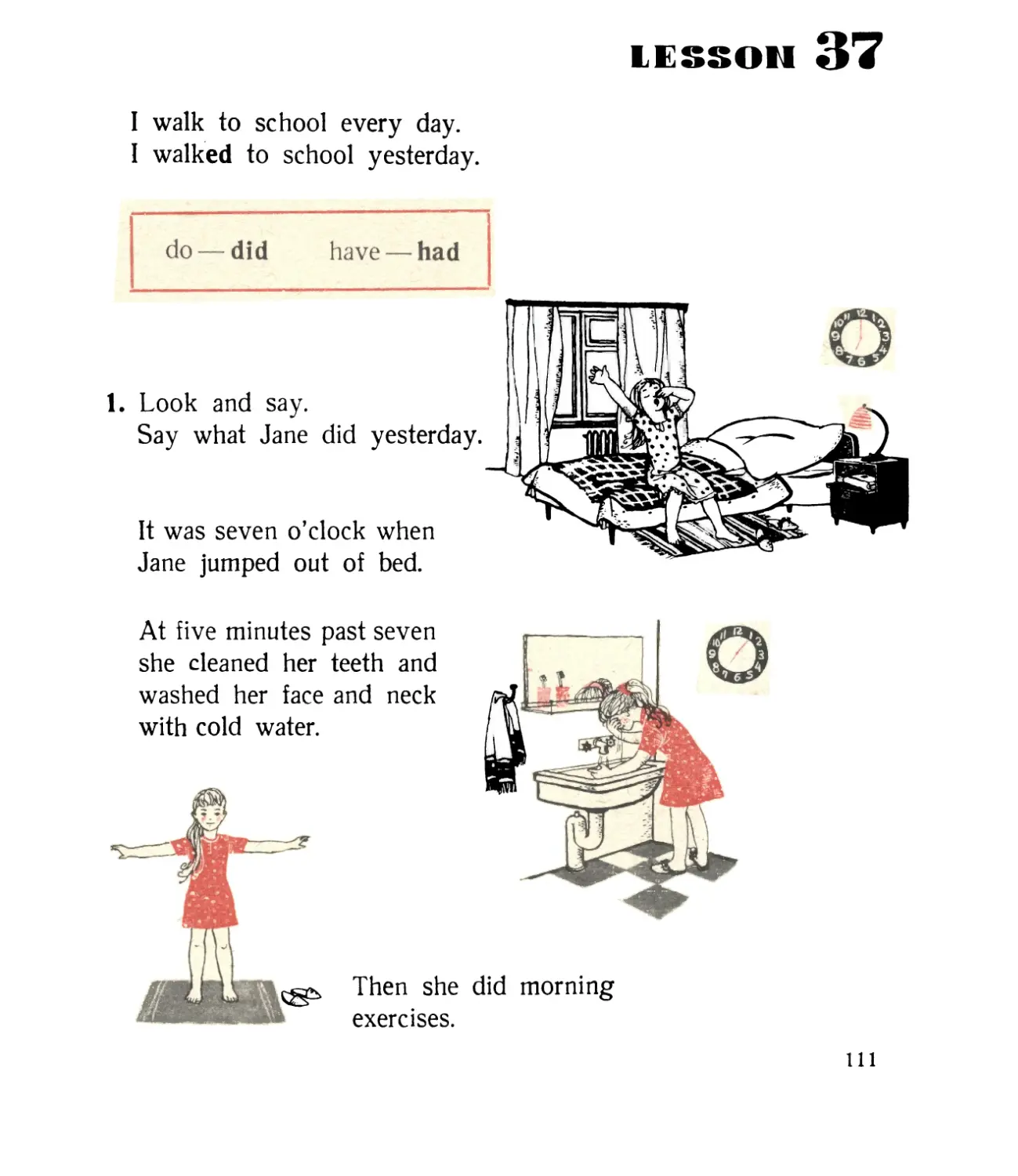
Is it winter?
Is it cold?
What are the children wearing?
What are they doing?
Is the snowman funny?
Which is taller: the boy 6n the
left or the boy on the right?
Is the girl making arms for the
snowman?
Is the small boy making the snow¬
man or the snowball?
What is he making?
Are the two boys skiing down the hill?
Which is older: the boy in front or the boy behind? Etc.
1.	Look, ask and answer:
93

2.	Speak about winter.
3. Read:	my
by
cry
try
why
hanky
happy
dirty
twenty
quickly
yes
you
your
yard
year
4.	Read and find the right answer:
Why do you like winter?
Because in	winter	we can skate and ski.
Because in	winter	we can go to the wood to pick	flowers.
Because in	winter	we can go to the lake to	swim.
Why do you	wear	an overcoat, a warm hat	and a	pair	of
gloves in winter?
Because it is cold in winter.
Because it is hot in winter.
5.	Spell the new words of the lesson.
6.	Copy and complete:
The dog is eating the meat quickly because it is ... (happy,
hungry)
I cannot carry the snowball because it is ... (heavy, light)
We cannot skate here because the ice is ... (thick, thin)
I clean my shoes because they are ... (clean, dirty)
The tea tastes good because there is a lot of ... in it. (sugar,
salt)
We don’t wear overcoats and warm hats in summer because
it is ... in summer, (hot, cold)

Where was the cat?
It was behind the cupboard.
LESSOM 32
1.	Do and say, ask and answer:
Nick, where is your hanky?
Take it out of your pocket.
Now put it in your bag.
Where is your hanky now?
Where was it before?
Whose box of coloured pencils is that?
Take all the pencils out of the box.
Put the pencils near the box.
Where are the pencils now?
Where were the pencils before?
95

2.	Read:
THEY LIKE TO DRAW ANIMALS
Mike. Hullo, Henry!
Henry. Hulio, Mike!
Mike. What’s that in your hand?
Henry. These are pictures of animals. You know I like to draw
animals.
Mike. Show me the pictures, Henry.
Henry. These are my father’s pictures. And these are mine.
My father likes to draw animals, too. He teaches me
to draw them. On Sunday we were at the Zoo.
Mike. Oh, I see your father can draw very well. And your pic¬
tures are good, too.
Henry. This is a picture of an elephant. This elephant is from
India. He is very clever and strong.
Mike. Oh, I know the elephant. I was at the Zoo on Sunday, too.
I was there with Peter and Nick. Have you a picture of
the monkeys? They are so funny.
Henry. No. When we were at the Zoo, the monkeys were not in
the cage because it was very cold. They were in their
house.
Mike. I like your father’s pictures of the lion and the tiger best.
Their coats are beautiful.
Henry. I like them, too.
Mike. Do you often go to the Zoo with your father?
Henry. Yes, we go there every Sunday.
Mike. May I go there with you, Henry? And can you ask your
father to teach me to draw?
96

Henry. Yes, I can speak to him about you.
Mike. Thank you, Henry.
Ask and answer:
Does Henry’s father draw well?
Does he teach Henry to draw?
Where were they on Sunday? Etc.
3.	Copy and complete. (Use was or were)
The children ... at the Zoo on Sunday.
The monkeys ... not in the cage, because it ... cold outdoors.
Henry’s pictures of animals ... nice.
We ... not in the playground. We ... at home.
Tom ... not in school, because he ... ill.
Betty’s first letter ... shorter than her second letter.
4.	Are the sentences true? If not, put them in the negative.
Schoolchildren do sums in their Singing lessons.
They write English in their Arithmetic lessons.
They sing in their Handwork lessons.
They jump and run in their Physical Training lessons.

LESSON 33
Was Tom at home at seven o’clock? Yes, he was.
Were the children at home at twelve o’clock? No, they
weren’t.
1. Look, ask and answer:
Where was Tom yesterday?
In bed
In the kitchen
98
Wm

In the playground
At home again
Was Tom in bed at 7 o’clock?
Was Tom in the kitchen at 8 o’clock?
Where was Tom at 9 o’clock? Etc.
2.	Read and answer:
MARY
Mary is a schoolgirl. She is eight. She goes to school every
morning. Her lessons begin at nine. She comes home at one o’clock.
Where was she at eleven o’clock yesterday?
Was she at home or in school at eleven o’clock?
Mary comes home from school at one o’clock. She has dinner
at half past one. Yesterday Mary was in school from nine till two
o’clock. She was at home at half past two.
Was she late for dinner?
Was she very hungry?
7*
99

Mary has a grandmother. Mary goes to see her grandmother
on Mondays, Wednesdays, Fridays and Sundays. Yesterday was
Tuesday.
Was Mary at her grandmother’s yesterday?
Mary has a lot of friends. But her best friend is Kate. Yester¬
day Kate was ill. She was not in school. She was in bed. Mary
was at Kate’s after school.
Was Kate glad to see Mary?
Kate and Mary like to play badminton. They often play
badminton in the school playground.
Were they in the school playground yesterday?
3.	Make up questions and write them in your notebook:
Peter’s family was in the village on Sunday.
(Was Peter’s family in the village on Sunday?)
1 was at my friend’s yesterday.
Victor’s stories were the funniest.
We were late for dinner yesterday.
You were early for school on Tuesday.
4.	Dramatize:
— I cannot find my book. It was on my desk. Where is it?
— Look, there’s a book over there. Is it yours?
—	No, it isn’t. Mine has a brown cover.
—	Oh, then this book is yours.
—	Yes, thank you.
—	That’s all right.

3.	Read:
MINNY’S VISIT TO TOWN
(A Tale)
One day Minny, a field mouse, comes to her friend. Her friend,
an old gray mouse, asks her to sit down at the table and have
some tea. She puts two cups of tea and some bread on the table
“Oh,” says the old gray mouse. “I have no sugar to put in
our tea and no cheese and butter to eat with our bread. They
say, in town a mouse has a lot of good things to eat. But here
in the fields we are very poor.”
“Yes, dear, we are poor,” says Minny. “But you know, 1 was
at my cousin’s. She lives in a big town. I was there in winter.
There Was a lot of meat, butter, cheese and sugar on the shell
in her house. And there were many boxes of sweets and choco¬
lates, too. But when we were in the kitchen, there was some
102

noise behind the door. My cousin and I were afraid because in
the house there was a big animal with large green eyes, a big
mouth and very big teeth.”
“I know, my dear, that was a cat. I am afraid of cats myself,”
says the old gray mouse.
“Yes, that was a cat,” says Minny. “You see, my dear, they
have a lot of good things to eat, but they are afraid of that
animal. It is better to have only bread and tea than to live in
fear. I don’t want to go there again.”
And answer:
Why was Minny afraid when she was at her cousin’s?
Is Minny’s cousin poor?
Why doesn’t Minny like to live in town?
4.	Retell the story.
5.	Copy and complete. (Use are or is.)
There ... two books on my desk.
There ... many small pictures in the books.
There ... a piece of paper between my books.
... there a picture of a mouse in your book?
No, there ... not. There ... pictures of other animals.
6.	Write the first three sentences of Exercise 5 again. (Use was,
were instead of is, are.)
7.	Read Exercise 3 again and write out all the words of the
Green Family.
103

8. Learn by heart:
The Kitchen Mouse
by J. Miller
Up the stairs and down the stairs,
He runs all round the house.
He eats the cheese on the kitchen shelf,
That gray and funny mouse.
He is too quick for the old black cat,
And runs to his hole to hide.
The old black cat cannot catch him there:
He can only wait outside.

LESSON 35
1.	Make up questions and answer them:
What is the weather like?
What was the weather like?
Is
Was
it
cold
warm
fine
windy
snowing
raining
today?
yesterday?
on Monday?
count
| now
j where
house
| how
j when
mouth
| town
j what
trousers
{ brown
which
ground
j flower
J
\ white
mouse
1
t
j why
3. Read and look. Say which sentences are true.
What was the weather like on Monday and Saturday?
On Monday the weather was bad. It was raining. It was not
windy. But it was very cold outdoors. It was colder than on
Saturday. It was not fine on Monday. There were no children
outdoors. There was a lot of white snow on the houses, on the
trees and the ground.
On Saturday the weather was fine. It was very warm. It was
warmer than on Monday. There were many children outdoors on
Saturday. There was no wind. It was snowing on Saturday.
105

4.	Speak about yesterday’s weather.
5.	Spell the new words of the lesson.
6.	Copy and complete. (Use am, are, was, were.)
I ... a schoolgirl. I have a friend. Her name ... Kate. She
... a schoolgirl, too. We ... good friends. We go to school
every day. But yesterday we ... not in school, because it ...
Sunday. We ... at my aunt’s yesterday. My aunt ... an old
woman. She ... sixty-one now.
106

7. Are the sentences true? If not, put them in the negative.
It was raining yesterday.
It was warm on Sunday.
It is colder in autumn than in winter.
It is snowing now.
8. Learn by heart:
Rain
by R. L. Stevenson
The rain is raining all around,
It falls on field and tree,
It rains on the umbrellas here,
And on the ships at sea.

1. Ask and answer:
When is it warmer, in spring or in winter?
When is it hotter, in summer or in spring?
When is it colder, in spring or in autumn?
When are the days longer, in spring or in winter?
When are the nights shorter, in summer or in winter?
Which are longer, the days in winter or the days in spring?
When are the nights the shortest?
When are the days the shortest?
How many months are there in a year?
(There are twelve months in a year.)
What are they?
(They are January, February, March, April, May, June, July,
August, September, October, November, December.)
108

2.	Point and say:
Look at the calendar. Point to March, August, etc.
How many days are there in July?
How many days are there in February? Etc.
Is January in spring or in winter? Etc.
3.	Read Betty’s fourth letter and answer her questions.
Dear friends,
Today is a cold day here in London. There is snow on the
ground, and all is white. January is a winter month. In England
winter begins in December. In February it sometimes rains. In
March we see some flowers and we say, “Spring is coming.”
In spring the days are longer. It is warm, but it is not hot. Three
months after that summer begins. In summer there are many
flowers. It is hot. We like to swim in summer. It sometimes
rains, but the rain is warm in summer. The weather is colder
in October. It is autumn. In October there is often fog in London.
Sometimes you cannot see a man or a car near you in the
street.
I like the month of May very much. I like this month
because my birthday is in May. I like it because it is nice and
warm outdoors. In May we do not wear our
warm overcoats and hats. There are many flowers
in May.
When is your birthday? And what month do
you like?
Do you go to your school by bus, too? What
colour are the buses in your town? The buses in
London are red.
With best wishes, Betty.
109

4.	Spell the new words of the lesson.
5.	Write the names of these months:
A month with much snow. (February)
The first month of the year.
The eleventh month of the year.
The month between October and August.
A month with thirty-one days.
A month with twenty-eight days.
The month after March.
The twelfth month of the year.
6.	Make up sentences on these models:
My friend
was
at his uncle’s yesterday.
was
yesterday.
...
were
yesterday.
Were you
in
school on Monday?
Were
on ... ?
Was
on ... ?
7.	Learn by heart:
Spring is green,
Summer is bright,
Autumn is yellow,
Winter is white.

I walk to school every day.
I walked to school yesterday.
LESSON 37
do — did have — had
1.	Look and say.
Say what Jane did yesterday.
It was seven o’clock when
Jane jumped out of bed.
At five minutes past seven
she cleaned her teeth and
washed her face and neck
with cold water.
Then she did morning
exercises.
ill

It was four o’clock in the
afternoon when Jane played
snowballs with her friends in
the yard. There were many
girls in the yard.
At six o’clock Jane was at
home. She watched television.
They showed a very funny
film. She liked the film and
laughed at the funny man.
At ten o’clock she wanted to
sleep. And at half past ten she
was in bed.
S лист Учебник английского языка
113

2.	Listen and say:
I jump out of bed at seven o’clock every day.
(1 jumped out of bed at seven o’clock yesterday.)
I clean my teeth every day.
(I cleaned my teeth yesterday.)
I wash my face with cold water every evening. Etc.
3.	Look at the pictures and say again what Jane did yesterday.
Cover the text with a piece of paper.
4.	Say what you did yesterday. (Use the words jumped, did,
cleaned, washed, dressed, had, played, watched, laughed,
danced,
wanted, was,
were.)
5. Read:
looked 1
walked '
played
wanted
stopped
watched j
skied I
tasted
asked
helped
showed I
C
visited
laughed
liked 1
cleaned j
pointed
6. Read and answer:
THE WOOD IN WINTER
How beautiful it is in the wood in winter! At this time of
the year there is some snow on the trees and there is much
snow on the ground. The snow is white and clean.
Is there a wood near your town?
Is it beautiful there in winter?
During the winter holidays Peter visited his cousin Victor
One day Peter and Victor skied in the wood. The weather was
fine. The wood was very beautiful. The boys had bags on their
114

backs. There was some bread and
meat in their bags. The boys skied
down the hills in the wood.
Was the weather cold and
windy?
Were their bags very heavy?
On their way back to the village,
Victor stopped Peter and pointed to
a tall tree. Peter looked at the tree.
There was a small squirrel there. It
had a nice gray coat and clever black
eyes. The squirrel looked at the boys
with interest. The boys looked at the
animal and laughed because it was so
funny.
Where was the squirrel?
Was it nice arid funny?
7.	Retell the story.
8.	Complete the sentences:
I do my lessons after school.
Yesterday after school I ... my lessons, too.
We count in Arithmetic lessons.
Yesterday in the Arithmetic lesson we ..., too.
I don’t go by tram, I walk home from school.
Yesterday I ... home, too.
I like to have some milk for breakfast.
Yesterday morning I ... some milk, too.
9.	Read Exercise 6 again and write out all the words of the
Ball Family.
8*

LESSON 38
Did Jane play snowballs yesterday? Yes, she did.
Did she skate yesterday? No, she didn’t.
1.	Look, ask and answer. (Look at the pictures on pages
111—113.)
2.	Ask and answer:
What time do you have your breakfast every day?
What time did you have breakfast this morning?
Do you wash your neck every morning?
Did you wash your neck yesterday morning?
Did you wash it in cold or hot water?
Do you do morning exercises every day?
Did you
do morning exercises
yesterday? Etc.
3. Read:
car
day
j 'this -%evening
jar
gray
'this „/morning
arm
May
'every J morning
March
way
'yesterday .^morning
party
stay
| 'yesterday 'afternoon
4. Read:
TWO FRIENDS MEET ;
Nick. Hullo, Mike! Glad to see you.
Mike. Hullo, Nick! Why didn’t you come to watch television
yesterday evening?
П6

Nick. I am sorry I didn’t come. I was at my cousin’s birthday
party.
Mike. Oh, I see. Did you have a lot of fun there?
Nick. Yes. There were many children. We played games and
danced. And did you watch television yesterday?
Mike. Yes, I did. They showed an interesting film about animals.
The bears played with a ball, the donkey danced, and the
elephant carried four monkeys on his back. It was funny,
and I laughed.
Nick. I am sorry I didn’t see the film. Did you ski yesterday?
Mike. No, 1 didn’t go out yesterday because Mother asked me
to stay at home with my sister. She was ill.
Nick. Is she better now?
Mike. Yes, she is better today.
Nick. Can you go out this evening?
Mike. Yes, I can.
Nick. Let’s go to ski down the hills this evening.
Mike. All right. Let’s.
Ask and answer:
Did Nick watch television yesterday?
Where was Nick yesterday?
Did Nick have a lot of fun there? Etc.
5. Make up questions and write them in your notebook:
She danced much at the birthday party.
(Did she dance much at the birthday party?)
We worked well in our Handwork lesson.
117

He skied down the hill yesterday.
They skated on the lake in the morning.
My uncle and aunt lived here in summer.
6. Learn by heart:
The Snowbird
The ground was all covered
With snow one day,
And two little sisters
Were busy at play.
A snowbird was sitting
On a very tall tree
And merrily singing
His chickadee-dee —
Chickadee-dee, chickadee-dee,
And merrily singing
His chickadee-dee!

LESSON 39
go
— went
take —took
give
— gave
put
— put
come—came
eat
— ate
1.	Ask, do and say:
Ask Nick to go to the cupboard.
(I am going to the cupboard.)
Ask him to open it.
(I am opening it.)
Ask Nick to take two bottles of ink out of the cupboard.
(1 am taking two bottles of ink out of the cupboard.)
Ask him to give you	one	bottle	of	ink.
(1 am giving you	one	bottle	of	ink.)
Ask him to put the other bottle back.
(I am putting the other bottle back.)
And answer:
What did Nick do first? (First he went to the cupboard,
he opened it.)
What did he do then?	(Then he took two bottles of ink
out of the cupboard.)
(Yes, he did.)
(He put the other bottle back.)
Did he give you a bottle?
What else did he do?
119

2.	Read:
LUCY
TASTES JAM
One day Lucy opened
the cupboard in the kitchen.
She was not hungry, but she
wanted some jam.
Lucy looked at the jars
in the cupboard. There were
many jars there. She count¬
ed them. “One, two, three, four, five. There are five jars. But
which is the jar of jam?”
Lucy put her finger in the first jar. Then she put the finger
in her mouth. “Oh! it tastes bad!” There was salt in the jar.
She put her finger in the second jar and put it in her mouth
again. “Oh, it tastes very bad, too. Is it coffee?”
In the third jar there was sugar. In the fourth jar there was
butter. She did not want any butter. She put her finger in the
fifth jar. “Oh, this is jam!” She tasted it. “It tastes very good.
I want some jam.”
She ate some jam and put the jar back in the cupboard. Then
the door of the kitchen opened, and Peter came in.
“Lucy, look at your hands and face. What is that?” asked
Peter.
“I don’t know.”
“But I know. It is jam. Now go and show Mother your
dirty face and hands.”
120

Ask and answer:
Why did Lucy open the cupboard?
How many jars were there in the cupboard?
Which was the jar of jam?
What was there in the first jar? Etc.
3.	Spell the new words of the lesson.
4.	Say in the negative:
I closed the door.
(1 didn’t close the door.)
1 went to school by bus.
I ate some jam this morning.
Mother gave me some chocolate.
He came here yesterday.
5.	Learn by heart:
The Cupboard
I know a little cupboard,
With a very little key,
And there’s a jar of lollipops
For me, me, me.
It has a little shelf, my dear,
As dark as dark can be,
And there’s a plate of tasty cakes
For me, me, me.
And when I’m very good, my dear,
As good as good can be,
There’s a tasty cake, and lollipops
For me, me, me.

LESSON 40
stand — stood	sit — sat	bring — brought
say —said	can —could
1.	Ask, do and say:
Ask Ann to stand up.
(Ann, stand up, please.)
(I am standing up.)
Now ask her to sit between Nick and Kate.
(Please sit between Nick and Kate.)
(I am sitting between Nick and Kate now.)
Ask Ann to take Kate’s coloured pencils.
Now ask her to bring you the blue pencil.
Thank Ann.
And answer:
What did Ann do first?
What did she do then?
Whose coloured pencils did Ann take?
What else did she do?
How many pencils did she bring you?
Did you thank her?
What did you say?
122

2. Read and answer:
Did the crane like the fox’s dinner?
Why did the crane put the little fishes in tall jars?
THE FOX
AND THE CRANE
(A Tale)
The fox and the
“Your long legs and bill are very nice,” said the fox..
“Thank you, Mr. Fox," said the crane. “I like your coat very
much. It is beautiful, red and thick.”
The fox was glad, and he said, “Come and have dinner with
me now, Mrs. Crane.”
“Thank you,” said the crane and went to the fox’s house.
The dinner was very good — for the fox. He liked soup, and
there was good soup for dinner. But the soup was in two large
plates. The crane had very little soup because her bill was very
long and thin.
“Did you like my dinner? Did the soup taste good?” asked
the fox and laughed.
The crane wanted to teach the fox a lesson, and she said,
“Dear Mr. Fox, come and have supper with me today.”
“All right!” said the fox.
When the fox came to the crane’s house, he was hungry. He
sat down at the table. The crane brought two tall jars with little
123

fishes. The crane had fish for supper. The fox liked fish. But
the fishes were in the tall jars.
“Have some fish. Those little fishes taste very good,” said
the crane.
The fox looked at the fishes with hungry eyes, but he could
not take the fishes.
“Did you like the supper, Mr. Fox? Did the fishes taste
good?” asked the crane after supper.
The fox went home hungry.
3.	Retell the story.
4.	Copy and complete:
He puts on his hat and overcoat when he goes out, and he
takes them off when he comes in.
Yesterday he ...
They give my cousin interesting books to read.
Yesterday they ...
1 bring Grandfather a paper, and he sits down to read it.
Yesterday I ...
5.	Read Exercise 2 again and write out all the words of the
Take Family.

LESSON 41
1.	Ask, do and say:
Ask Nick to take a piece of paper out of his bag.
(Please take a piece of paper out of your bag.)
(I am taking a piece of paper out of my bag.)
Ask Nick to stand in front of the class.
Ask him to drop the piece of paper on the floor.
Now ask him to pick up the piece of paper.
Thank Nick.
And answer:
What did Nick do first?
What did he do then?
Did he drop the piece of paper?
Did he drop it on the floor?
What else did he do?
Did you thank him?
2.	Read: their 'father’s 'old % shirts j the 'boy in his 'father’s
their 'mother’s 'old "vdress | ''vcoat
the 'girls in 'old dresses \
3.	Read:
One day Peter’s mother and father were not at home. Only
. Peter, his sister Lucy and her friend Nina were in the house. They
took a large box and opened it. There were some old dresses,
hats and shoes in it. They were their mother’s dresses, hats and
125

shoes. Then they opened a second box. There were their father’s
old trousers, coats, shirts and shoes.
Peter picked up an old gray hat. It was his father’s old hat.
Peter put it on. Then he put on an old black coat and a pair of
green trousers. The trousers were very large, and Peter looked
funny. Lucy picked up an old red dress. It was her mother’s old
dress. She put it on. Nina put on an old dress, too. The dresses
were very long. The girls put on old shoes and hats and walked
in the room. The children played a good game. Peter was Father,
Lucy was Mother, and Nina was Aunt Mary.
The door opened. Peter’s mother and father stood at the door.
They did not want to laugh, but they laughed because the chil¬
dren were very funny in those large dresses, trousers and shoes.
Draw Peter in his father’s trousers and coat, and draw the
girls in the old dresses.
4.	Look at your picture and retell the story.
5.	Copy and complete. (Use the words behind, between, under,
in front of, out of)
There is a nice garden ... the house.
The girl is taking her hanky ... her pocket.-
The little boy is sitting on a bench ... his grandfather and
grandmother.
There is a dog ... the bench.
There is a tree ... the bench.
6.	Dramatize:
—	Nick, you are making so much noise. What are you doing
there under your desk?
—	I’m sorry. I’ve dropped my notebooks. I’m picking them up.

LESSON 42
draw — drew write — wrote speak — spoke read — read
1.	Ask, do and say:
Ask Ann to draw an elephant on the blackboard.
(Please draw an elephant on the blackboard, Ann.)
(I am drawing an elephant.)
Now ask her to write the word elephant under the picture.
Ask Ann to spell the word.
Now ask her to count the letters in it.
Ask Ann to read the word.
Ask her to sound the letters in the word.
Now ask her to count the sounds.
Ask Ann to clean the blackboard.
And answer:
What did Ann do first?
What did she do then?
What did she write under the picture?
Did she count the letters in the word	Etc.
box \
1
close
count
book
r
pocket !
nose j
ground j
wood
sorry |
I those |
mouse |
foot
coffee |
; wrote |
out
took
bottle i
spoke ;
loud 1
stood
127

'work in “ч pairs
'read "4 silently
'read out Moud
during the "4 break
during the lesson
during the 'winter holidays
3.	Read and answer:
Hullo, friends!
Let’s speak about our English lessons.
In our school we have four English lessons every
week. We have them on Tuesday, Wednesday, Friday and
Saturday.
Yesterday was Tuesday, and we had our English
lesson.
First our teacher Nina Ivanovna asked us about our
winter holidays. Then she said, “Now work in pairs. Don’t
make so much noise!” I spoke with my friend Nick. I asked
him about his winter holidays, and he asked me about
mine.
Then Ann and Kate spoke before the class. They spoke very
well, and the teacher gave them fives.
Do you work in pairs during your English lessons?
During our lesson we wrote some words and sentences in
our notebooks. The teacher asked me to write the word pick on
the blackboard. Then she said, “Peter, which family does the
word belong to?” I answered, “It belongs to the Big Family."
Do you write the new words in your notebooks, too?
Then we read silently the story about Peter, Lucy and her
friend Nina. The teacher said, “Now draw Peter in his father’s
trousers and coat, and draw the girls in the old dresses.” We
gave the teacher our pictures. “Whose picture is the best? "asked
the teacher. We all said, “Henry’s picture is the best."
128

Do you read much during your lessons?
Do you like to read silently or out loud?
Do you often draw in your English lessons?
Then the teacher said, “Break!” And we all went out of the
classroom. Nick and I spoke English during the break. We often
speak English during our breaks.
Do you like to speak English during your breaks?
What did you do in your English lesson yesterday?
4.	Speak about your English lessons.
5.	Write the answers:
Why did the teacher give Ann five?
What word did Peter write on the blackboard?
Did the children read silentlv or out loud? ♦
What did the children draw?
Whose picture was the best?

LESSON 43
buy — bought	pay — paid
1.	Read and dramatize:
IN A SHOP
Jane.
Mother.
Shop-girl.
Mother.
Shop-girl.
Jane.
Mother.
Shop-girl.
Jane.
Mother.
Shop-girl.
I need a new pair of shoes, Mum. Mine are very old.
All right, dear. Let’s go to the shop and buy you a
new pair of shoes.
(Mother and Jane put on their overcoats and go out
of the house. They go into the nearest shop. The
shop-girl comes to them.)
What can I do for you?
We want a pair of shoes.
These are very nice brown shoes.
(Jane sits down and puts the shoes on.)
Oh, they are too big for me, Mum, and I don’t like
the colour. I like bright colours.
Please show us those shoes on the left.
(Mother points to a pair of bright red shoes on the
shelf.)
These are smaller and brighter. Put them on, please.
Let’s buy this pair, Mum.
How much are they?
Ten roubles.
(Mother pays ten roubles, and they go out of the
shop. Jane carries the box of shoes under her arm.
She is happy.)
130

Ask and answer:
What did Jane need?
Did Jane put on an overcoat? Etc.
2.	Spell the new words of the lesson.
3.	Complete the sentences:
Every afternoon I help Mother. Mother gives me three rou¬
bles and asks me to buy some bread, butter, cheese, sugar
and milk. I take Mother’s bag and go to the shop.
Yesterday 1 ... Mother, too. Mother ... me to buy some
bread, coffee and some salt. She ... me one rouble. I ...
Mother’s bag and ... to the shop. In the shop I ... some
bread, coffee and salt. I ... the shop-girl one rouble.
4.	Learn by heart:
There was an old woman who lived in a shoe.
She had so many children she didn’t know what to do.
She gave them some soup without any bread,
And beat them all soundly and sent them to bed.

LESSON 4-4
looked out of
saw
wanted to play
see — saw
run-
— ran
swim — swam
wear
— wore
1. Look at the pictures and tell the story
about the boy.
Ask and answer:
Where was Nick?
Did he look out of the window?
Who did he see?
Did he want to play? Etc.
played football
ran
jumped
hot
wore
132

133

2.	Read:
THE ELEPHANT
AND THE MONKEY
(A Tale)
One day an elephant said to
a monkey:
“Look how big and strong 1
am! I can carry a very heavy
tree. I am glad 1 am strong."
“Look how quick 1 am! I can
run 'quickly, and I can go up
a tree very quickly!” said the
monkey. “And I am glad I am
quick.”
But which is better: a strong
animal or a quick animal? They
did not know.
“The old owl is very clever.
Let’s go to her and ask her about
it," said the monkey.
They went to the old owl,
and the elephant said, “The mon¬
key is quick. But 1 am strong.
Which is better?”
The owl said, “Do you see
that big tree? There is a nut on
134

it. Who can bring it here? Go and pick the nut and bring it
to me.”
The elephant and the monkey ran to the tree. But on their
way they came to a river. The monkey was afraid to swim.
“I can carry you,” said the elephant. “I am big and strong.”
The monkey sat down on the elephant’s back, and the elephant
swam. When they came to the tree, they saw it was very tall.
The elephant wanted to pick the nut, but he could not, because
the tree was too tall,
“I can go up the tree," said the monkey and weift up the
tree. Then the monkey picked the nut. The elephant put the nut
in his mouth. Then they swam back to the owl and gave her
the nut.
“Now Mrs. Owl, which is better: a strong animal or a quick
animal?"
The owl looked at them and said, “I don’t know which is
better.”
And answer:
Why couldn’t the owl answer their question?
(Say it in Russian.)	#
3.	Retell the story.
4.	Spell the new words of the lesson.
5.	Read Exercise 2 again and write out all the words of the Now
Family.

LESSON 45
sing — sang	make — made
1. Read and dramatize:
A BIRTHDAY PRESENT
(Kate is ten today. She asked her friends to come to her
birthday party. Jane comes first.)
Jane. Hullo, Kate! Happy birthday!
Kate. Glad to see you.
(Jane gives Kate a box of sweets and a book of stories.)
Kate. Thank you, Jane.
(Kate opens the book.)
Oh, there are so many interesting stories in it!
(The door opens. Peter and Nick come in. They are carry¬
ing a large box.)
Nick. Hullo, girls!
Peter. Hullo, Kate! Hullo, Jane! This is a birthday present for
you, Kate. Can you guess what is in the box?
Kate. Is it a toy?
Nick. No, it isn’t.
Kate. I don’t know what it is.
Jane. How very interesting!
Peter. Then open the box.
(Kate opens the box and sees a cat. The children laugh.
Kate claps her hands.)
136

Kate. Oh, what a nice Pussy! Is it mine now?
Nick. Yes, it is yours, Kate.
Kate. I am so happy I have a cat now.
Jane. It is nice and small. It has a thick gray coat and green
eyes.
Kate. Pussy, jump out and have fun with us!
(The cat looks at the children but does not jump out.)
Nick. We are making so much noise, and the cat doesn’t like it.
It is afraid of us.
Kate. Let’s take the cat to the kitchen.
(The children carry the cat and the box to the kitchen
and come back.)
Kate. Now let’s have some tea. Mother gave me a nice birthday
cake.
Nick. The cake tastes good.
Peter. How do you know?
Nick. I took a small piece when you were in the kitchen.
(The children laugh.)
Ask and answer:
Whose birthday was it?
What did Jane give Kate?
What did the boys bring?
What was there in the box?
Did the cat jump out of the box? Etc.
bag
bag
take
take
that
ran
tale
came
man
swam
page
gave
had
lamp
skate
crane
sat
sang
cake
made
137

3.	Write the answers to the first five questions in Exercise 1.
4.	Are the sentences true? If not, put them in the negative.
Your birthday is in autumn.
You went to the cinema on Tuesday.
Your friend gave you an interesting book yesterday.
Our class skied down the hill on Saturday.
You went to bed at nine o’clock yesterday.
5.	Make up sentences on these models:
Did you
learn the poem yesterday?
Did ...
yesterday?
Did ...
on ... ?
6.	Learn by heart:
I Wish
I wish, how I wish,
That I had a little house,
With a mat for the cat
And a hole for a mouse,
And a clock going tock
In a corner of the room,
And a table, and a cupboard,
And a big birch broom.

WORDS AND EXPRESSIONS
afraid
April
Arithmetic lesson
ate
August
autumn
because
before
begin
belong
better
bill
birthday
birthday party
bought
break
brought
cake
calendar
came
clap hands
could
cover
crane
December
did
do sums
down the hill
Drawing lesson
drew
drop
during
early
else
fear
February
field
first
fog
Friday
from ... till
game
gave
ground
had
half
Handwork lesson
happy
have fun
homework
hopscotch
how
how much
hundred
interest
It is cold.
It is fine.
It is hot.
It is raining.
It is snowing.
It is warm.
It is windy.
January
July
June
look funny
made
March
May
minus
minute
Monday
month
mouse
Mrs.
November
nut
October
on their way
out loud
over there
owl
page
pay
paid
past
Physical Training les¬
son
pick up
piece
139

playground
poor
put
quick
rain
ran
river
read
rouble
said
sang
sat
Saturday
saw
September
shop-girl
silently
Singing lesson
skate
ski
snow
snowball
snowman
spoke
spring
squirrel
stay
stood
swam
tale
taste
teach a lesson
thing
thirty
This is the way.
Thursday
too
took
Tuesday
was
weather
Wednesday
week
went
were
What is the weather
like?
which
why
wind
wore
wrote
yesterday

LESSON 46
meet—met fall — fell	begin — began get out—got out

ran home
gave
a long stick
got out
was cold
Ask and answer:
Where did Harry and Tom meet?
Was The ice thin? Etc.
2.	Read Betty’s' fifth letter and answer:
Why did Betty’s mother put nine candles on the birthday cake?
Why didn’t the children wear overcoats?
Why did little Jim cry?
Dear friends,
Yesterday was my brother’s birthday. Andy is nine now. Andy’s
friends came and mine came, too. We had a lot of
fun. Mother made a nice birthday cake. We put nine
candles on the cake because Andy is nine. We
sang:
Happy birthday to you,
Happy birthday to you,
Happy birthday, dear Andy,
Happy birthday to you.
142

Did you know the song before?
Andy was happy, he had a lot of presents. Father bought him
a football. Mother gave him a pair of boots to play football.
Then'we went outdoors and played games. The weather was fine,
and we wore no overcoats. Cousin Jim ran after me. He fell down
and began to cry. We helped him to get up. Jim stood near a
tree and cried, and cried. Then we laughed and sang:
Cry, baby, cry,
Put your finger in your eye,
And tell your mother
It wasn’t I.
Jim is a small boy, he is four. He often cries.
Today Andy is ill. He ate so much cake yesterday. The cake
tasted good, and he had three large pieces. Poor Andy.
With best wishes,
Betty.
3.	Speak ahout your birthday party.
4.	Spell the new words of the lesson.
5.	Write the answers in your notebook:
How old is Andy now?
What did his father give Andy?
Did his mother make a nice birthday cake?
How many candles were there on Andy’s birthday cake?
6.	Dramatize:
—	Where is Nick?
—	He is away today. He is ill.
—	What’s the matter with him?
—	He has a bad cold.

LESSON 47
1. Read:
MOTHER’S DAY
On Mother’s Day my brother
Jack and I got up early in the morn¬
ing. Daddy got up early, too. We
wanted to celebrate Mother’s Day.
First we made our beds and cleaned
the rooms. Daddy cleaned the carpet.
We had two presents for Mum¬
my— a pair of black gloves and a
nice black bag.
“Let’s give Mummy three pre¬
sents— one from Daddy, one from
you, Jane, and one from me,” said
Jack.
We wanted to make a cake for
Mummy, but we did not know how
to make it. So we put on our over¬
coats and hats and off we went to
buy a cake.
We bought a nice cake. Then we
went to the flower shop and bought
very beautiful flowers. Mummy likes
flowers.
When we came home, Mummy
was in the kitchen. Jack took three
pieces of paper. On the first piece he
wrote: To dear Mammy from Jack.
On the second — To dear Mammy
144

from Daddy. On the third — To dear Mummy from Jane. He
put the first piece of paper near the flowers, the second piece
under the gloves, and the third piece in the bag. We put the
cake, plates, spoons, forks, knives and cups on the table.
When Mummy came in, she saw the cake and the presents.
Mummy was glad.
“Oh, how nice of you! Thank you," she said to us.
She was happy. And we were happy, too.
Ask and answer:
Did Jane and Jack get up early on Mother’s Day?
Did their father get up early, too?
Did they want to celebrate Mother’s Day?
What did they do first?
Who cleaned the carpet? Etc.
2.	How did you celebrate your Mother’s Day?
3.	Spell the new words of the lesson.
4.	Say some sentences about your mother. Write them in your
notebook.

LESSON 48
1.	Read:
THE
THREE
BEARS
(A Tale)
I
Goldilocks was a little girl. She lived with her father and
mother in a small house near the wood. Her father was a wood¬
cutter. Her mother and father gave her the name Goldilocks
because her hair was golden.
One day Goldilocks said, “May I go for a walk, Mum?”
“Of course, dear. You may run and play in the wood near the
house,” said her mother.
Goldilocks put on her hat, took a basket and ran to the wood.
There she jumped and sang. She was happy. She picked flowers
for her mother. The flowers were red, yellow, white and blue. She
played in the wood for a long time. Then behind some tall trees
she saw a house.
146

“Whose house is that?" she said.
She went to the door and opened it.
“Who lives here?” asked Goldilocks.
There was no answer. She went into the kitchen. There she
saw a large table and three chairs near it.
“Whose chairs are these?” she asked.
Goldilocks sat on the first chair and said, “This is a nice chair,
but it is too big for me." She sat on the second chair and said,
“I like this chair. It is nicer and smaller than the first." Then she
saw the third chair. It was the smallest and the nicest of the
three. She sat down on it.
“There are three plates on the table. Whose plates are they?"
said Goldilocks.
The first plate was large. There was a lot of porridge on it.
The second plate was smaller. And the third plate was the smallest
of the three. Goldilocks took a spoon and tasted the porridge
on the first plate.
“Oh, it is good."
Then she tasted the porridge on the second plate.
“This porridge is better,” she said.
But she liked the small plate and tasted the porridge on it.
“It is the best porridge." And Goldilocks ate all the porridge
on the third plate.
In the bedroom Gol¬
dilocks saw three beds.
“Whose beds are these?"
She jumped into the larg¬
est bed. But she did not
like it. “It is too large for
me," she said. She jumped
into the second bed. It
147

was smaller than the first. Then Gol¬
dilocks saw the third bed. She liked
it best. She jumped into it. It was the
smallest and the nicest bed. Goldi¬
locks went to sleep. She slept for a
long time.
And answer:
Where did Goldilocks live?
What colour was her hair?
Where did she go one day?
What did she do in the wood?
What did she see behind some tall trees?
Did she walk into the house?
What was there in the kitchen?
Which chair did she like best?
How many plates were there on the table?
Did she eat all the porridge on the smallest plate?
What did she see in the bedroom?
Where did she sleep?
Did she sleep for a long time?
2.	Read:
in a 'small 'house near the -^wood
in the 'wood near the chouse
for a 'long ~\time
for a 'short -%time
3.	Write the answers to the first six questions in Exercise 1.
4.	Read Exercise 1 again and write out all the words with th

LESSON 49
1. Read:
THE
THREE
BEARS
II
Then the three bears came into the house. They came home from
the wood. The mother bear was large and strong. The father bear
was larger and stronger. And the third bear was their baby. The
baby bear ran into the house and cried, “Oh, look! Who sat on
my chair?”
The mother bear said, “Who sat on my chair?” and the father
bear said, “And who sat on mine?”
The bears wanted to eat and took their spoons. But the father
bear cried, “Who tasted my porridge?”
“And who tasted mine?” cried the mother bear.
The baby bear cried, “Who ate my porridge? I am hungry.”
The mother bear and the father bear gave the baby some por¬
ridge. The bears ate the porridge and went into the bedroom to
sleep.
“Who slept in my bed?” said the mother bear.
“And who slept in mine?” said the father bear.
149

The baby bear saw Goldilocks in his bed. “Look!” he cried.
“There is a girl in my bed!"
Goldilocks opened her eyes and saw the three bears near her.
She jumped out of the bed, and off she ran.
When she came home, her father and mother were happy to
see her.
She said, “Oh, my dear mother and father, there is a house
in the wood. I was in that house, and I saw three bears there."
Her mother and father wanted to see the house, but they
didn’t find it.
Ask and answer:
Who came to the house?
What did the baby bear cry? Etc.
2.	Retell the story.
3.	Read: pick
cheese
they
teeth
neck
chess
then
fifth
thick
chop
them
sixth
pocket
children
that
month
ticket
chocolate
those
mouth
4. Write the answers
to the following
: questions:
Who did the baby bear see in his bed?
What did Goldilocks do?
Was her mother glad to see Goldilocks?
Did they find the bears’ house?

LESSOH SO
1. Read and play the game:
A GAME
Nick. It is raining. We cannot go outdoors now. Let’s stay at
home and play the game Mother went to the shop.
Ann. All right. 1 like the game. Do you know the game, Helen?
Helen. Yes, I do. We played it last year with our teacher.
Peter. Then let’s begin. Mother went to the shop. And what did
she buy?
Nick. Mother went to the shop and bought a bottle of milk.
Ann.	Mother went to the shop and bought a bottle of milk and
some butter.
Helen. Mother went to the shop and bought a bottle of milk,
some butter and some cheese.
Jane. Mother went to the shop and bought a bottle of milk, some
butter, some cheese and some meat.
Peter: Mother went to the shop and bought a bottle of milk,
some butter, some cheese, some meat and a box of sweets.
Nick. Mother went to the shop and bought a bottle of milk,
some butter, some cheese, some meat, a box of sweets and
some salt.
Ann. Mother went to the shop and bought a bottle of milk,
some butter, some meat, a box of sweets, some salt
and coffee.
All. Oh, you missed the cheese\ You are out. Now, let’s go on.
The children played for a long time, and Jane was the winner.
151

2. Read:
too
book
a 'bottle of -\milk
'last -\week
Zoo
took
a 'jar of -\jam
'last -%year
spoon
look
a 'box of sweets
'last month
school
good
some cheese-
'last ^Tuesday
fool
stood
some butter
'last summer
3.	Read Betty’s sixth letter from England and answer:
When is April Fool’s Day?
What did the boys in Betty’s school do that day?
Do the English children have a sports day?
Dear friends,
Yesterday was April Fool’s Day. The boys and girls in my
school like the day. It is a day when we have a lot of fun.
Some boys came to school early on April Fool’s Day. On a
piece of paper they wrote: No school today. All the teachers
are ill. They pinned that on the door of the school. Other
children came and read that. Some were happy and ran home,
but some laughed and cried, “April Fools! April Fools!”
During the break Harry Black wrote Kick me on a piece
of paper. Then he pinned it on Bill’s back. Bill did not see
it and walked in	the school	playground
with the paper on his back. It was very
funny.
Do you have much fun on April Fool’s
Day?
In April we have a sports day. In my school
it is in spring. Last spring our class was the
winner.
Do you have a sports day, too?
152

What is the weather like in your town now? We are having
spring weather today.
With best wishes,
Betty.
4.	Complete the sentences:
Our lessons begin at nine o’clock.
Last Thursday our lessons began at nine o’clock, too.
Little Dan cries when he falls down.
Last week Dan ... when he ...
Mother makes nice cakes.
Last month Mother ... a very nice cake for us.
My uncle is an old man. He gets up very early.
Yesterday he ... at five in the morning.
My brother is very strong because he does morning exercises
every day. He is not afraid to swim in cold water.
Last winter my brother ... in the lake every morning.
5.	Dramatize:
—	We can’t write on the blackboard. It is not clean.
—	I am sorry I didn’t clean it during the break. May I do it
now?
—	Do, please.

LESSON 51
1. Read:
THE FOUR FRIENDS
(A Tale)
An old donkey wanted to live in town. So he went to the
nearest town. On his way there he met a dog. The dog was his
friend. The donkey asked the dog to go with him, too. On their
way they met a cat. The cat cried, “Mew, mew.” The donkey
and the dog stopped and asked the cat, “Why are you crying?"
“I am crying, because I am old and I have no home."
“We are going to town. We want to live there. Come with us.”
154

“All right,” said the cat.
So the donkey, the dog and the cat walked on.
On their way they met a cock. The cock saw them and sang,
“Cock-a-doodle-doo! Cock-a-doodle-doo! ”
The three friends asked him to go to town with them.
In the evening the four friends came to a wood. They, were
hungry, and they wanted to sleep. The donkey and the dog sat
down under a tree. The cat and the cock went up the tree. From
there the cock saw a house.
“Whose house is that? Let’s go to the house and see who lives
there,” he said.
155

And the four friends went there. When they came to the house,
it was very late. The donkey was the tallest. He went to the
window and looked in.
“What do you see, old Long Ears?" asked the cock.
“What do I see?” said the donkey. “I see four robbers. They
are having supper. There is a lot of meat, fish and bread on their
table.”
“Listen, friends! I have a good idea!” said the cat.
The cat asked the donkey to stand near the window of the
house. The dog stood on the donkey’s back. The cat stood on
the dog’s back. And the cock stood on the cat’s back. Now
they were ready. They began to sing. The robbers were afraid,
the animals made so much noise. The robbers ran out of the
house. They ran to the wood.
The four friends came into the house and had a good supper.
Then they all went to sleep. The donkey slept in the yard. The
dog slept near the door. The cat slept on the bed. The cock
slept on the kitchen door. They liked the house and did not want
to go away. So they stayed there.
And the four friends live in that house now.
Ask and answer:
Where did the donkey go?
Who did he meet on his way?
Did the dog want to go with him?
Why did the cat cry? Etc.
2.	Retell the story.
3.	Write the answers to the four questions in Exercise 1.
156

4. Learn by heart:
A Foolish Man
I saw a man who always wore
A saucepan on his head.
I asked him what he did it for.
“I don’t know why,” he said,
“It always makes my ears so sore.
I am a foolish man.
Why didn’t I think of it before
And wear a frying-pan?”'

LESSON 52
We must study well.
Must he study well, too? Yes, he must.
1.	Make up questions:
you
be.
at home
in the afternoon?
we
there
in the morning?
he
in school
in the evening?
she
they
here
at the cinema
in time?
And answer:	Of course, I must.
Of course, not.
2.	Ask and answer:
What time do you go to school?
What time must you get up?
What time must you have breakfast?
What time must you go out of the house?
What time does the first lesson begin?
What time must you come to school?
What time do you have dinner?
What time must you come home? Etc.
3.	Read and answer:
What must you say if you meet your teacher in the morning?
Must you say please when you ask your friend to give you
a book or a pen?
158

What must you say if you meet your teacher in the evening?
Must you	say	/ am	sorry if you are	late for the lesson?
Must you	say	/ am	sorry if you are	early for the lesson?
Must you	say	That's all right when	your friend thanks you?
Must you	say	May	/ go out if you	want to go out during
the lesson?
What must you say if you want to come into the classroom
during the lesson?
4.	Make up questions:
We must come to school in time.
You can make paper dolls.
I can go to school by tram or by bus.
You may sing and dance during the break.
They must cover their books with clean paper.

LESSON S3
a banner
1.	Read and answer:
Hullo, dear friends!
I am a pioneer now.
Yesterday was a happy day for me. I got up very
early. I washed my face and neck and put on a white
clean shirt. When Mother got up, I was ready
for breakfast. I went to school earlier yesterday.
All the boys and girls were there at half past
eight.
After the lessons we went to the pioneer room.
Our pioneer leader gave us red ties. We were happy.
She said, “You are pioneers now. You must study as
Lenin studied. “Pioneers, be ready!” And we answered,
“Always ready!”
160

Are you a pioneer now, too?
Who is your pioneer leader?
Do you wear your red tie every day?
Have you a pioneer room in your school?
Our pioneer room is large. There is a red banner in the room.
There are slogans on the wall. They are Long live our Com¬
munist Party! Long live Peace! and other slogans. On the table
near the window you can see a drum and a bugle.
Speak about the pioneer room in your school.
Is it large?
Are there many slogans on the walls? What are they?
What else is there in the room?
2.	Read:
clean
bread
near
meat
head
dear
teacher
ready
fear
peace
heavy
ear
leader
weather
a pioneer -\room
a 'pioneer pleader
a 'pioneer -\tie
a 'pioneer ^drum
our 'Communist Party
3.	Spell the new words of the lesson.
4.	Write some sentences about your pioneer room.
5.	Make up sentences on these models:
Did
you
see your aunt last
week?
Did
. . .
last
...?
I
didn’t
know him last
year.
. . .
didn’t
last
. ..
11 Учебник английского языка
i6i

6. Learn by heart:
Always Ready
■by M. Lebedinskaya
Healthy and strong,
With a merry song
We pass and pass and pass.
We have friends and foes,
We are friends of those
Who are for the working class.
Healthy and strong,
With a merry song
We march into a great new life.
And if an enemy comes,
Our pioneer drums
Are ready for struggle and strife.

LESSON 54
Jack will be ten in June.
Will Jane be eleven in June? Yes, she will.
1.	Listen and complete:
Today is Monday.
Yesterday was Sunday.
Tomorrow ... (Tomorrow will be Tuesday.)
Today is Friday.
Yesterday was ...
Tomorrow ...
It is the 10th of April today.
It was the 9th of April yesterday.
Tomorrow ... (It will be the 11th of April tomorrow.)
Nick goes to. school every day.
He went to school yesterday.
Tomorrow ... (Nick will go to school tomorrow.)
Nick and Ann are ready for the English lesson every day.
They are ready for the English lesson today.
They were ready for the English lesson yesterday.
Tomorrow ... (They will be ready for the English lesson tomor¬
row.) Etc.
2.	Ask and answer:
How old are you now, Nick?
When is your birthday, Nick?
163

Ann, hoW old is Nick now?
Was he eight last year?
How old was he last year?
When is his birthday?
How old will he be next year?
Will he be a pioneer next year?
3.	Read:
'next	-%week	'next	Friday	the	'sixth of	-\May
'next	month	'next	^ March	the	'thirtieth	of April
'next	-\year	'next	summer	the	'fifteenth	of January
4.	Read and find the right answer:
Peter’s father was forty-one last year.
How old will he be next year?
He will be forty-two next year.
He will be forty-three next year.
It was the 29th of March yesterday.
What date will it be tomorrow?
It will be the 31st of March tomorrow.
It will be the 30th of March tomorrow.
Helen and her mother are in a shop now. They want to buy
half a kilogram of cheese and one kilogram of butter. How
much will they pay?
They will pay one rouble.
They will pay five roubles.
Mike does morning exercises every day, but Harry does not
do morning exercises.
Mike washes with cold water, but Harry does not like to wash
with cold water.
164

Who will be stronger: Mike or Harry?
Mike will be stronger.
Harry will be stronger.
Ann likes to speak and read English. She speaks and reads
English every day.
Kate likes English, too. She reads English every day, but she
does not speak English every day. She speaks English some¬
times.
Mary does not like to speak English. She does not read English
every day. She reads English sometimes.
Which girl will know English best?
Kate will know English best.
Mary will know English best.
Ann will know English best.
5.	Complete the sentences:
Kate always comes to school early. Yesterday she came early.
Tomorrow she ... , too.
Mary visits her grandmother every Sunday. Last Sunday she
visited her grandmother. Next Sunday she ..., too.
Every year you celebrate the First of May. Last year you cele¬
brated the First of May. This year you ..., too.
6.	Make up questions:
My cousin will come to live with us in autumn.
The summer holidays will begin in June.
You will write me a letter from Moscow.

LESSON 55
I shall be at home tomorrow morning.
1.	Listen and complete:
I come here every day.
I am here now.
I was here yesterday.
Tomorrow ... (1 shall be here tomorrow.) Etc.
We visit our aunt every summer.
We visited our aunt last summer.
Next summer ... (We shall visit her next summer, too.) Etc.
2.	Say, ask and answer:
I meet my friend at the tram-stop every day.
Did you meet him at the tram-stop yesterday?
Will you meet him at the tram-stop tomorrow?
Who will you meet at the tram-stop tomorrow?
Where will you meet your friend tomorrow?
Every week at half past ten we have a Handwork lesson.
Did we have a Handwork lesson at half past ten last week?
Shall we have a Handwork lesson at half past ten next week?
What lesson shall we have at half past ten next week?
3.	Ask and answer:
When is your birthday?
How old are you?
166

When will you be twelve?
Will you be twelve next summer or next winter?
4.	What will you do tomorrow?
I shall get up at seven o’clock. I shall do morning exercises.
1 shall wash my hands and face. Etc.
5.	Read:
to'morrow "vmorning
to'morrow	evening
to'morrow 'after ■% noon
'yesterday % morning
'yesterday ■% evening
'yesterday 'afternoon
6.	Read:
THE GOLDEN AXE
(A Tale)
I
There was an old woodcutter. He worked in the wood. Every
day he went to the wood to cut trees. He was a very poor man.
He lived in a village near the wood. His house was the oldest
and the smallest in the village. He was the poorest man in that
village.
One day the old woodcutter dropped his axe in the river. He
sat down on the ground near the water and said, “My axe! What
shall I do? How shall I work now?”
There was a noise, and a man jumped out of the water and
stood before the woodcutter.
“Is this your axe, old man?” he asked the woodcutter.
167

The woodcutter looked at the axe in the man’s hands.. It was
a golden axe. It was beautiful.
, “No, it is not mine,” said the woodcutter. “My axe was not
golden.”
.The man jumped into the water again. Then he came out with
a silver axe.
“Is this your axe, old man?” he asked.
“No, it is not mine,” said the woodcutter. “My axe was not
silver.”
Again the man jumped into the water, and he came out with
an old dirty axe.
“Is this yours?” he asked.
“Yes, that is mine!” said the woodcutter. “Thank you. How
good of you! But who are you?”
“I am Mercury,” he said. “You are a good man. Take your
axe. Take the golden axe and the silver axe, too.”
“Thank you very much,” said the woodcutter and went home.
168

Ask and answer:
Where did the old woodcutter work?
Where did he live?
Was he very poor?
Where did he work one day?
What did he drop in the water?
What did he say?
Who jumped out of the water?
What was in the man’s hand? Etc.
7.	Retell the story.
8.	Complete the sentences. (Use shall or will)
I ... learn to swim this summer.
She ... not eat the porridge because she does not like it.
They ... fish in the lake next week.
We ... not ski tomorrow because there is not much snow on
the ground.
He ... not skate on the lake because the ice is very thin.
You ... do sums during your next lesson.
9.	Read Exercise 6 again and write out all the words of the Up
Family.

LESSON 56
Will Jack be twelve next month?
No, he will not. (No, he won’t.)
1.	Say, ask and answer:
Today is Saturday.
Was yesterday Tuesday?
Will tomorrow be Friday?
Today is Thursday.
Was yesterday ... ? Etc.
Dan is six now.
Was he five last year?
Will he be ten next year?
Will he be a pioneer next year?
2.	Ask and answer:
Do you like to have a cup of black coffee for breakfast?
Did you have a cup of black coffee yesterday morning?
Will you have a cup of black coffee tomorrow morning?
3.	Read:
THE GOLDEN AXE
II
On his way home the old woodcutter met his friend Bill.
“Hullo, Bill!” he said to his friend.
Bill was a woodcutter, too. He worked in the wood. Bill saw
the golden and the silver axes and asked, “Who gave you those
axes?”
170

“Mercury. Mercury is a man who lives in the river. I dropped
my axe in the water, and Mercury jumped out of the water. He
gave me these two beautiful axes and my old axe, too."
“Oh, I see!” said Bill.
Bill wanted to have a golden axe and a silver axe.
“I shall go to that river. There 1 shall drop my axe, and Mercury
will give me three axes, too,” he said and ran to the river.
When he came there, he dropped his axe in the water, sat
down and waited. A man jumped out of the water. It was Mercury.
“Please, help me, Mercury! My axe is in the water.”
“All right, I shall help you. I shall find your axe," said Mer¬
cury, and he jumped into the water. Soon he jumped out with
a golden axe.
“Is this your axe?” he asked and showed Bill the golden axe.
“Oh, yes! Yes! That is mine!” cried Bill.
“No, it is not,” said Mercury. “It is not yours. You are a bad
man, and I shall not help you.”
171

“But my axe! My axe! Give me my old axe, please," cried
Bill.
Mercury jumped into the water, and he did not come out
again.
And' answer:
Did the old woodcutter go home?
Who did he meet?
Was Bill a woodcutter, too?
Did he work in the wood, too?
Did he like the golden and the silver axes?
Did the old woodcutter tell Bill about Mercury?
Did Bill want to have a golden axe?
Did he run to the river?
Did Bill drop his axe in the water?
Did Mercury want to help him?
Did he show Bill a golden axe?
What did Bill cry when he saw a golden axe?
Did Mercury give him his old axe?
4.	Retell the story.
5.	Spell the new words of the lesson.
6.	Say in the negative:
We shall wait for you at the tram-stop.
He will sing an English song at our school concert.
Come at five o’clock. I shall be ready at five.
The children will have fun at the picnic.
It will be warm tomorrow.
Jack plays tennis well. He will be the winner.
172

7.	Read Exercise 3 again and write out all the words with the
letter s as [z].
8.	Dramatize:
—	Will you come to the school con¬
cert tomorrow?*
—	Yes, of course. We shall dance a
flower dance.
—	What will you wear?'
—	We’ll all wear white and blue
dresses.
—	Our class will sing two English
songs. The big children will act a play.

LESSON 57
1.	Answer:
You want to write a letter.
What will you do first?
(I shall take a piece of paper and sit down at my table.)
What will you do next?
(I shall take my pen in my right hand.)
What else will you need to write a letter?
(I shall need some ink.)
Nick wants to draw a picture.
What will he do first?
(He will take a piece of paper.) Etc.
nine
big
rain
like
will
paid
nice
winter
wait
fine
swim
again
white
spring
afraid
after a 'long winter
in the 'wood near your -\town
the 'First of -\May
■%May Day
3.	Read and answer:
It is spring now. It is warm. In the wood you can find the first
flowers — snowdrops. Snowdrops are white and blue. They are nice
174

flowers. We all like them because they are the first flowers after
a long winter.
Are there snowdrops in the wood near your town?
On the lakes and rivers there is ice. But children do not skate
because the ice is thin. In summer there will be no ice there and
the water will be warm. '
Will you swim in summer?
Will you go to the lake or to the river in summer?
In spring the days are longer than in winter. It does not snow
in spring. It sometimes rains. The weather is often fine. When it
is warm outdoors, we open the windows. We do not wear our
warm overcoats and hats because it is not cold.
What do you wear in spring?
In spring we celebrate May Day. It is a holiday. It is the work¬
ers' holiday. On the First of May all our towns and villages are
beautiful. There are many flags, banners, slogans and flowers in
the streets and parks. May Day is a spring holiday. It is a happy
holiday.
Do you like May Day?
4.	Say some sentences about spring weather in your town. Write
them in your notebook.
5.	Are the sentences true? If not, put them in* the negative.
We shall play snowballs in summer.
We shall swim in the river tomorrow.
We shall pick flowers in the wood on Thursday.
We must read the exercises silently and out loud.
175

6.	Learn by heart:
May Day
by M. Lebedinskaya
Bands and banners down the street,
Thousand faces, thousand feet;
For it is a glorious day,
For it is the First of May.

LESSON 58
- 1. Dramatize:
Mike. Hullo, Tom! This is Mike speaking.
Tom. Hullo, Mike!
Mike. Tom, will you go to see the football
match in our school playground today?
Tom. Oh, I don’t know. I was there yesterday, but I didn’t like
the game.
Mike. Who played yesterday?
Tom. The boys of the fifth form and the boys of the sixth form.
They didn’t play well. They couldn’t kick the ball well.
The game wasn’t interesting. And who will play today?
Mike. Today the boys of the ninth and tenth forms will play.
They play very well. 1 shall go to see the match. I don’t
want to miss it. Will you come?
Tom. Yes, of course.
Mike. Then you must be in our school playground at five min¬
utes to six. The match begins at six.
Tom. All right, Mike. 1 shall come.
Mike. Good-bye, Tom.
And answer:
Did Tom like the football match yesterday?
Why didn’t he like it?
Who played yesterday?
Will Tom go to see the football match today?
Will Mike come, too?
When will the match begin?
12 Учебник английского языка

2.	Read:
(A Tale)
LAZY JIM
I
There was a boy whose name was Jim. He lived with his
mother in a little house. They were very poor. His mother work¬
ed much, but Jim did not like to work. Jim was lazy. He sat
under a tree in hot weather and stayed in bed when it was cold.
One Monday morning his mother said, “Jim, I am ill. I cannot
work. Go to Mr. Green. Help him in the field. He will pay you.”
“All right. I shall go there tomorrow morning,” answered Jim.
On Tuesday Jim went to Mr. Green. He worked all day, and
in the evening Mr. Green gave him a penny. But on his way
home Jim dropped the penny and could not find it.
“Oh, Jim! Why didn’t you put the penny in your pocket?”
“All right, Mother. Tomorrow I shall put it in my pocket.”
He went to help Mr. Green on Wednesday, too. In the evening
Mr. Green gave him a jar of milk. cJim put it in his large pocket.
But when he came home, there was no milk in the jar.
“Oh, Jim! Why didn’t you carry the jar of milk on your head?”
“All right, Mother. Tomorrow 1 shall put it on my head.”
On Thursday Mr. Green gave him some butter. Jim put the
butter on his head and walked home. It was very hot that day,
and when Jim came home, there was butter on his hair, shirt and
trousers. They could not eat the butter.
178

“Oh, Jim! You must not carry butter on your head You must
carry it in your hands.”
“All right, Mother,” said Jim.
And answer:
Where did Jim live?
Was his mother poor?
Was he a lazy boy?
Did Jim’s mother ask him to work?
What did Mr. Green give him on Tuesday?
Why didn’t Jim bring the penny home?
What did Mr. Green give him on Wednesday?
Where did Jim put the jar of milk?
Did he bring the milk home?
What did Mr. Green give him on Thursday?
Did Jim carry the butter in his hands?
3.	Retell the story.
4.	Write the answers to the first six questions in Exercise 2.
5.	Make up sentences on these models:
Will
Will
you
bring that book
tomorrow?
tomorrow?
I
• shall
shall
come to the playground
next time,
next time.
Mike
will
will
go to the cinema
next Sunday.

LESSON 59
On Friday Mr. Green gave him a large cat. Jim took the cat
and wanted to carry it in his hands. But on his way home the cat
ran away from Jim.
“Oh, Jim!” said his mother. “Why didn’t you take a string
and pull the cat home?”
“I shall do it tomorrow, Mother,” said Jim.
On Saturday Jim worked much, and Mr. Green gave him
a large piece of meat. Jim took a string out of his pocket and
pulled the meat after him. On his way home Jim did not look
behind, and a hungry dog ate the meat.
“Oh, Jim! Why didn’t you carry it in your hands?” asked his
mother.
180

“Because it was large and heavy, Mother.”
“Then why didn’t you carry it on your back?”
On Monday next week Jim worked very well. So Mr. Green
gave him a donkey. Jim put the donkey on his back and walked
home.
In the village there was a beautiful girl. She did not laugh
and could not speak. Her father asked all the doctors to help the
girl, but they could not. The doctors said, “The girl must laugh.
Then she will speak.”
The girl and her father lived in a large and beautiful house.
When Jim was in front of their house, the girl looked out of
the window and saw the boy with the donkey on his back. It was
funny. It was very funny. And the girl laughed. She looked at Jim
and laughed. Now she could speak. Her father was very happy.
He ran after Jim, stopped him and said:
“My dear boy, I am a happy man now because my girl can
speak. Thank you.”
He gave Jim some money.
Jim and his mother were happy.
And answer:
What did Mr. Green give Jim on Friday?
Why didn’t Jim bring the cat home?
What did Mr. Green give Jim on Saturday?
Did Jim carry the meat in his hands?
What did Mr. Green give Jim on Monday?
Where did Jim put the donkey?
Who saw Jim with the donkey on his back?
Was Jim funny?
Did the girl laugh?
181

Why was her father happy?
What did he give Jim?
Was Jim’s mother happy, too?
2.	Retell the story.
3.	Read:	sing
song
strong
spring
string
nose
show
those
shop
these
shelf' .
blouse
shirt"
please
shoes
4.	Write the answers to the first seven questions in Exercise 1.
5.	Read Exercise 1 again and write out all the words with у as [i].
6.	Learn by heart:
Twenty Froggies
Twenty froggies went to school
Down beside a little pool;
Twenty little coats of green;
Twenty shirts all white and clean.
“We must be in time,” said they,
“First we study, then we play.
That is how we keep the rule,
When we froggies go to school.”
Twenty froggies grew up fast;
Big frogs they became at last.
Not one lesson they forgot,
And they learned at school a lot.

LESSON во
Read and answer:
Hullo, boys and girls!
This is our last English lesson this year. Dur¬
ing our lessons we spoke about the weather, the
winter holidays, the animals at the Zoo, Betty’s
letters, our birthdays and about some tales.
What else did you do during your English lessons?
Did you read tales?
Did you write during the lessons?
What did you speak about?
I like to speak English very much. Henry likes to draw. He
made nice paper dolls, and his pictures of my room, the funny
boy and the animals were the best.
Can you draw well, too?
My friend Jane likes to play games. She guessed all the
names when we played the game	it?, and she was the
winner in the game Mother went to the shop.
Who was the winner in your class?
In this book we read about some animals. When we went to
the Zoo, we spoke about them. We spoke English.
Did you go to the Zoo?
183

It is spring now. The weather is fine.
What can you say about the spring in your town?
Does it often rain?
What is the weather like?
I like summer best because in summer it is hot and we can
swim. There are many beautiful flowers in the parks and in the
wood. There is a long holiday for all schoolchildren in summer.
Do you like summer best?
Will you go to a pioneer camp or to a village this
summer?
Which is better: to be in a wood or to stay at home
on a hot summer day? Why?
We know now how many months there are in a year.
What are they?
Which is the shortest month?
And how many days are there in a week?
What day will it be tomorrow?
We have a friend in England now. Her name is Betty. She
wrote us interesting letters. She wrote us about the weather in
England, April Fool’s Day, Santa Claus, her school, birthday
cakes with candles and about some games.
Can you play hopscotch?
Did you have a birthday cake with candles?
When is your birthday?
How old will you be next birthday?
We know some English tales now. 1 like them all. But I like
Lazy Jim best. It is the funniest tale in this book.
184

Did you like to read the tales?
Is the tale about Lazy Jim interesting?
I know some English poems and dialogues by heart.
How many English poems do you know?
Which dialogue did you like best?
Ask your friend to dramatize it with you.
I have a lot of English books at home. I want to read 1
in summer. I shall visit my uncle and aunt in the village, a
shall take some books with me.
Have you any English books?
Will you read them during the summer holidays?
When we come back to school in autumn, we shall s
about them. Good-bye, dear friends. Good-bye to you all.

WORDS AND EXPRESSIONS
always
go to sleep ,
play
answer
golden
act a play
axe
got out
poem
baby
have a bad cold
porridge
bad
holiday
pull
banner
How nice of you.
robber
be
ice
shall
began
idea
silver
bugle
kick
slept
camp
last
slogan
candle
lazy
snowdrop
celebrate
Long live ...
so
cock
match
song
concert
met
string
date
miss
tell
dialogue
money
tie
dramatize
must
tomorrow
drum
next
wait
fall
of course
What’s the matter with
fell
peace
him?
fool
penny
will
for a long time
pin
winner
form
pioneer
woodcutter
get out
pioneer leader
You are out.

THE PAST INDEFINITE Q
TENSE OF IRREGULAR
VERBS
be [bi:] — was [woz], were [wa:]
begin [bi'gin] — began [bi'gaen]
bring [brig] — brought [bn:t]
buy [bai]—bought [bo:t]
can [kaen]—could [kud]
come [клт] — came [keim]
cut [kAt]— cut [kAt]
do [du:] — did [did]
draw [dro:]—drew [dru:]
eat [i:t]—ate [et]
fall [fail] —fell [fel]
forget [fa’get]— forgot [fagot]
get [get]—got [gat] - ^
give [giv]—gave [geiv] '
go [gou] — went [went]
know \[nou] — knew [nju:]
make [meik] — made [meid]
pay [pei]—paid [peid]
put [put]—put [put]
run [глп]—ran [raen]
read [ri:d]—read [red]
say [sei] — said [sed]	^
see [si:]—saw [so:]	.
sing [siq] — sang [saeg] <l. $ /.
sit [sit]—sat [saet]
speak [spi:k]—spoke [spouk]
stand [staend]—stood [stud]
swim [swim] — swam [swaem]
take [teik] — took [tuk]
wear [wea]—wore [wo:] _ —
write [rait] — wrote [rout]

ENGLISH SOUNDS
Pi pen
[0] Thank you.
[h] hand
b] book
[d] they
[m] map
t] take
[s] sit
[n] no
d] desk
[z] Zoo
lOl' brinS
k] book
Ш show
[r] room
g] g°
[3] television
[1] look
f] five
[tfl chair
[w] well
v] five
[d3] Jane
[j] your
[i:] green, clean
[a:] car, class
[u:] too, spoon
[i] big, sit
[0] box, not
[л] up, under
[e] pen, desk
[d:] or
[3:] girl, curtain
[ae] bag, map
[u] book
[э] under, teacher
[ei] take, day
[oi] toy, boy
[ou] go, close
[ю] near, dear
[ai] my, nine
[sa] chair, where
[au] now, count
[из] poor

NOTES
Lesson 1
all все	badminton бадминтон {игра)
new новый	a story рассказ
to spell называть буквы слова to listen слушать
long длинный	clever умный
short короткий	if not если нет
Пояснения к чтению
ball box morning [ju:]	[э:]	[e]
all long short	new story clever
Lesson 2
to draw рисовать	to look out выглядывать
to look about осматриваться an exercise упражнение
a notebook тетрадь	to do morning exercises де¬
лать утреннюю зарядку
'Пояснения к чтению
[э] [ак]	[о:]
'exercise	draw
189

There is—There are
Когда мы хотим сказать по-английски, что в определённом
месте, например, на моём столе, в нашем классе, на улице,
дома, есть, находится что-нибудь или кто-нибудь,
например, книга, стол, мальчик, мы должны употребить слова
There is.
На моём столе есть книга.
There is a book on my table.
Когда мы хотим сказать о нахождении в определённом месте
нескольких предметов, мы должны употребить слова There are.
На моём столе три книги.
There are three books on my table.
В отрицательных предложениях со словами There is, There
are употребляется слово по.
На моём столе нет английских книг.
There are no English books on my table.
Lesson 3
so такой, так	a plate тарелка
to make so much noise сильно
шуметь
Пояснения к чтению
take
make
plate
go
so
please
noise
kite змей
high здесь высоко
up in the sky в небо
My Kite
My kite string waves... Нитка
моего змея машет ...
190

Lesson 4
in front of впереди, перед nice хороший, красивый
behind сзади, позади	tram-stop остановка
between между	their их
Пояснения к чтению
[л]	[ai]	[еэ]	green nine
in 'front of be'hind their be'tween nice
Обратите внимание на произношение слова house во мно¬
жественном числе:
[s]	[zizl
house — houses
Lesson 5
to carry носить, нести	to go by tram ехать трамваем
heavy тяжёлый	for для, за {вместо)
light лёгкий	glad довольный
to meet встречать
Пояснения к чтению
bag night green my bag bread
carry light meet by glad heavy
twenty двадцать
how many сколько
a sound звук
Lesson 6
plus плюс
to colour раскрашивать
team команда
Пояснения к	чтению
[л] [э]	now count	clean	up
'colour	how sound	team	plus
191

Числительные от 13 до 19
Числительные от 13 до 19 образуются путём прибавления
[ti:n] -teen к числам единиц:
three — thirteen	seven — seventeen
four —fourteen	eight —eighteen
five —fifteen	nine —nineteen
six — sixteen
Обратите внимание на правописание чисел 13 и 15:
three — thirteen ['0a:'ti:n] five —fifteen ['fif'tirn]
Lesson 7
a sweet конфета
a match спичка
a bottle бутылка
this этот, эта, это
a box of sweets коробка кон¬
фет
a box of matches коробка спи¬
чек
ink чернила
Пояснения
green bag	box	they
sweet match	bottle	this
a bottle of ink бутылка чер¬
нил
water вода
a glass of water стакан воды
only только
a jar банка
a jar of jam банка варенья
a box of coloured pencils ко¬
робка цветных карандашей
к чтению
car	bag	Ь>:]	[ои]
jar	jam	water	'only
Lesson 8
Some and Any
Оба слова имеют значение некоторое количество, немного.
Слово some употребляется главным образом в утвердительных
предложениях, any—в вопросительных и отрицательных. Срав¬
ните:
192

Утвердительные предложения
Вопросительные предложения
There is some milk in the
glass.
В стакане есть молоко.
I have some books in my
bag.
У меня в портфеле есть
книги.
Is there any milk in the
glass?
В стакане есть молоко?
Have you any books in
your bag?
У вас в портфеле есть
книги?
ready готов, готовый	a box of chocolates коробка
Daddy папа	шоколадных конфет
I am sorry. Простите. Изви- Mummy мама
ните.	hungry голодный
chocolate шоколад
Пояснения к чтению
[л]	[е]	[о]	[э] [i] bread	up
some any 'sorry 'chocolate 'ready 'hungry
Lesson 9
a fork вилка
a knife нож
a spoon ложка
meat мясо
fish рыба
sugar сахар
to cut резать
salt соль
coffee кофе
to want хотеть
to taste bad быть плохим на
вкус
to laugh смеяться
Пояснения к чтению
short	nine	too	clean	big	up
fork	knife	spoon	meat	fish	cut
13 Учебник английского языка
193

[Ju]
'sugar
[o:j
salt
[=1 [i]
'coffee
[ei]
taste
[wo]	[af]
want	laugh
Обратите внимание, что перед существительными в един¬
ственном числе, такими, как*fish, meat, sugar, salt, water, milk,
bread, butter, cheese, tea, coffee, артикль а не употребляется.
Do you like coffee or tea?
Hey, Diddle, Diddle
Hey, Diddle, Diddle англий¬
ские созвучия
a fiddle скрипка
a cow корова
Les
a flower цветок
a lake озеро
a fire костёр
to make делать
paper бумага, бумажный
to need нуждаться
to fish ловить рыбу
to hide прятаться
over через
the moon луна
such fun такое занятное зре¬
лище
on 10
to taste good быть хорошим
на вкус
to pick flowers рвать цветы
blue голубой
Here is... Вот...
That’s all right. Пожалуйста.
(в ответ на благодарность)
Пояснения к чтению
now take
take
green
big
nine
'flower lake
paper
need
fish
hide
[aia]
[u:]
[ia]
fire
blue
here
big
pick
they
that
194

Lesson 11
let’s давай, давайте	all of you все
A Lot of — Many
Слова many и a lot of имеют значение 'много, большое
количество.
A lot of употребляется как с существительными в един¬
ственном числе, обозначающими вещество, bread, water, cheese,
sugar, так и с существительными во множественном числе,
такими, как pens, books, boys, flowers:
a lot of water (много воды)	a lot of books (много книг)
a lot of bread (много хлеба)	a lot of boys (много мальчиков)
Слово many употребляется только с существительными
во множественном числе:
many books (много книг)
many boys (много мальчиков)
Lesson 12
a dress платье	colour цвет
a shirt рубашка	What colour... Какого цвета...
a pair пара	to wear носить
a pair of shoes пара туфель boots ботинки
a pair of trousers пара брюк to cut out вырезать
gray серый
Пояснения к чтению
pen girl	day
dress	shirt	gray
count	too
'trousers	boots
M	[u:]	M
pair	shoe	wear
13*
195

Winter is Fan
warm тёплый
snow снег
mittens варежки
don’t you? а ты?
Lesson 13
a coat пиджак; пальто
to put on надевать
an overcoat пальто
to take off снимать
a hat шляпа
outdoors на улице, на
1 откры-
a pair of gloves пара
перча- том воздухе
ток
winter зима
a pocket карман
summer лето
a hanky носовой платок to swim плавать
Пояснения к чтению
bag box bag
big Up [ou] [ou]
[л]
hat pocket hanky
winter summer 'overcoat
gloves
On a Frosty Day
sled санки
sun солнце
cold холодный
right хорош
frosty морозный
Lesson 14
hair волосы
finger палец
an ear yxo
point to показывать
пальцем,
a nose hoc
указывать
a mouth рот
to guess угадать; отгадать
left левый
to repeat повторять
right - правый
to tell сказать; рассказать
Пояснения к чтению
pair	near	close	count	pen	night	pen	[g]	log]
hair	ear	nose	mouth	left	right	tell	guess	'finger
196

Приказания и просьбы
1
Утвердительные предложения
Отрицательные предложения
'Take my pen.
Возьми мою ручку.
'Go to the "vdoor.
'Touch his -'hand, please.
'Don't take my "чреп.
He бери мою ручку
'Don’t go to the -\door.
'Don’t touch his -'hand, please.
Lesson 15
a head голова	a leg нога
a neck шея	a foot нога, ступня
an arm рука {от плена до feet ноги, ступни
кисти)	spare лишний
a back спина
Пояснения к чтению
-bread pen car book green pen [еэ]
head neck arm foot feet leg spare
Lesson 16
Местоимения
I я
me мне, меня
ту мой
he он
him ему, его
his его
she она
her ей, её
her её
it он, она, оно
it ему, ей (его, её)
its его, её
we мы
us нам, нас
our наш
you вы
you вам, вас
your ваш
they они
them им, их
their их
197

Lesson 17
whose чей
clean чистый
dirty грязный
tall высокий
What a shame! Как тебе не
стыдно!
Пояснения к чтению
[и:]
whose
ball girl take
tall dirty shame
here здесь; сюда
that тот, та, то
there там
a letter письмо
Lesson 18
myself я сам, я сама
about myself о себе
to play tennis играть в тен¬
нис
a pen-friend друг по перепи- if you like если хочешь
ске	With best wishes. С наилучши
England Англия	ми пожеланиями,
about о, про
Пояснения к чтению
they
that
English pen [d [iz]
England best 'wishes
these эти
mine мой
those те
yours твой, ваш
Lesson 19
The lesson is over. Урок окон¬
чен.
to find находить
Let me see. Дай посмотреть.
to know знать
198

Пояснения к чтению
[di:z]	close	nine	show
these	those	mine	know
My— Mine and Your — Yours
Запомните, что за местоимениями my, your всегда следуют
существительные, тогда как mine и yours употребляются без
существительных. Сравните:
It is my book. = It is mine.
It is my dog. =It is mine.
It is your book. = It is yours.
It is your dog. =lt is yours.
Little Birdie
a birdie птичка	pecking crumbs to take your
hopping gaily весело прыгаю- nest клюёшь крошки и от-
щая	носишь их в гнездо
daily ежедневно	best больше всех
Lesson 20
an arm-chair кресло	other другой
a cupboard буфет, шкаф	to make a bed стелить пос-
to get out of bed вставать с тель
постели	cold холодный
a bedroom спальня	hot горячий
a living-room общая комната before перед; перед тем, как
Пояснения к чтению
саг	['клЬэй]	[л]	[ои]	[э:]
arm-chair cupboard 'other cold be'fore
199

Обратите внимание на написание слов knife и shelf во
множественном числе:
a knife (нож) —knives (ножи)
a shelf (полка) — shelves (полки)
Lesson 21
thin тонкий thick толстый there туда
Пояснения к чтению
three	three
thin	thick
Сравнительная степень прилагательных
При сравнении двух предметов слова, обозначающие при¬
знаки (прилагательные), употребляются в сравнительной сте¬
пени, например:
This pencil is long, but that pencil is longer.
Этот карандаш длинный, а тот карандаш длиннее.
В предложении but that pencil is longer прилагательное long
в сравнительной степени имеет окончание [э]. На письме это
окончание обозначается буквами ег:
long — длинный;	longer — длиннее
Прилагательные, состоящие из одного или двух слогов,
образуют степени сравнения при помощи окончания [э] -ег,
например:
small — smaller	thick—thicker	tall —taller
short — shorter	large — larger	light — lighter
Некоторые прилагательные при прибавлении окончания -ег
изменяются в написании. Запомните:
thin — thinner	heavy— heavier
big —bigger	dirty —dirtier
funny — funnier
200

without без
socks носки
grass трава
rocks камни
My Feet
field поле
both оба, обе
feel cool чувствуют прохладу
Lesson 22
a lion лев
a tiger тигр
a kangaroo кенгуру
a giraffe жираф
an elephant слон
a donkey осёл
than чем
strong сильный
coat шубка (животного)
an animal животное
grass трава
Пояснения к чтению
[aiaj [ai]	[dsi'raf]	[f]	[э]	[ае]
lion 'tiger giraffe 'elephant 'donkey 'animal
bag	class long
than	grass	strong
Lesson 23
a cousin двоюродный брат;
двоюродная сестра
an uncle дядя
a man мужчина, человек
an aunt тётя
a woman женщина
to visit навещать
a town город
a village деревня
to come приезжать
sometimes иногда
there там
a bus автобус
to teach учить
the Teachers’ Room учитель¬
ская
Пояснения к чтению
up	bag now up clean
uncle man town bus teach
201

[л]
cousin
[а]
aunt
[u]
woman
[id3]	[л]
village 'sometimes
Существительные, оканчивающиеся на свистящие и ши¬
пящие звуки [s], lz], [$], [tj],
принимают окончание [iz]:
box — boxes [iz]
fox — foxes [iz]
bus —buses [iz]
dress — dresses [iz]
[63], во множественном числе
exercise—exercises [iz]
wish —wishes [iz]
match — matches [iz]
village —villages [iz]
На письме это окончание передаётся буквами es или только
одной буквой s, если в конце слова есть буква е:
bus —|—es== buses
village -j-s = villages
The Family
so full of cheer такой весёлый
Lesson 24
best больше всего
Превосходная степень прилагательных
Для того чтобы сказать по-английски, что один из не¬
скольких сравниваемых предметов самый большой, самый
маленький, самый высокий, то есть употребить прилагатель¬
ное в превосходной степени, нужно к прилагательному приба¬
вить окончание [ist] -est.
Перед прилагательными в превосходной степени употреб¬
ляется артикль the.
По этому правилу образуется превосходная степень прила¬
гательных, состоящих из одного или двух слогов.
202

tall	—taller	—the	tallest
высокий —выше	—самый высокий
long	—longer	—the	longest
длинный —длиннее—самый длинный
small	—smaller	—the	smallest
маленький — меньше —самый маленький
Некоторые прилагательные при прибавлении окончания из¬
меняются в написании. Запомните:
thin —thinner —the thinnest
big —bigger —the biggest
funny — funnier — the funniest
heavy — heavier — the heaviest
dirty —dirtier —the dirtiest
hungry — hungrier—the hungriest
Lesson 25
the first первый	the third третий
the second второй
Пояснения к чтению
girl	[е]	girl
first	second	third
Образование порядковых числительных
Порядковые числительные, начиная с четвёртого, образу¬
ются прибавлением к числам окончания [9] -th, например:
four — fourth
five — fifth
six — sixth
seven — seventh
eight —eighth
nine — ninth, etc.
203

Обратите внимание на написание числительных пятый и
девятый:
five — fifth [fif9]
nine — ninth [nainQ]
Lesson 26
a hall зал
a New Year tree новогодняя
ёлка
beautiful красивый
a lamp лампочка
to dance танцевать
Father Frost Дед Мороз
warm тёплый
a present подарок
an apple яблоко
holidays каникулы
Santa Claus (название Деда
Мороза в Англии)
Christmas рождество {празд¬
ник в Англии)
a stocking чулок
a year год
Hyde Park Гайд Парк {парк
в Лондоне)
Пояснения к чтению
near
year
bag
lamp
box
frost
bag
apple
[ju:]	[a]	[e]	[o][i]
'beautiful dance 'present 'holidays
[ae] [d:z]	[k]	[ai]
'Santa 'Claus	'Christmas	'Hyde Park
Lesson 27
Monday понедельник
Tuesday вторник
Wednesday среда
Thursday четверг
Friday пятница
Saturday суббота
a calendar календарь
a week неделя
this is the way вот как
204

Пояснения к чтению
green	curtain
week	Thursday
[л]	[ju:]	[n]
'Monday 'Tuesday 'Wednesday
[ai]	[эе][э] [ae]
'Friday 'Saturday 'calendar
Lesson 28
thirty тридцать
minute минута
It is ten minutes past three.
It is half past three.
It is ten minutes to four.
Десять минут четвёртого.
Полчаса четвёртого.
Без десяти четыре.
Пояснения к чтению
girl	Ш [i]	[а]	[а]
thirty 'minute half past
Lesson 29
an Arithmetic lesson урок ариф¬
метики
a Singing lesson урок пения
a Drawing lesson урок рисова¬
ния
a Physical Training lesson урок
физкультуры
a Handwork lesson урок труда
to begin начинать
early рано
homework домашнее задание
to do sums решать примеры
a break перемена
a playground спортплощадка
hopscotch игра в классы
game игра
205

Пояснения к чтению
again
'training
box
scotch
count
ground
take
game
[0]
arithmetic
['fizikl]
physical
[a:]
'early
[ei]
break
Lesson
30
a hundred сто
how much как много, сколько
which который, которая, которое
page страница
minus минус
Пояснения к
чтению
up
hundred
where
which
cage
page
[ai]
'minus
Числительные
Числительные-десятки двадцать, тридцать, сорок и так
далее образуются прибавлением [ti] -ty к числам единиц. Об¬
ратите внимание на произношение и написание следующих
числительных:
two —twenty
three — thirty
four —forty
five —fifty
How Many?
a second секунда	a month месяц
no more не больше	the calendar makes clear как
sun солнце	показывает календарь
an hour час
206

Lesson 31
It is cold. Холодно,
snow снег
a snowman снежная баба
a snowball снежный ком
to ski кататься на лыжах
Пояснения
down the hill вниз с горы
Why? Почему?
because потому что, так как
to skate кататься на коньках
It is hot. Жарко.
к чтению
show	big take
snow	hill	skate
my box
why hot
[i:l	[d]	[wo:]
ski	be'cause	warm
Lesson 32
was был, была, было	before прежде
were были
Пояснения к чтению
[woz]	[wo: ]
was	were
Lesson 33
yesterday вчера	at Kate’s у Кати (дома)
from ... till c ... до	at my friend’s у друга (дома)
at her grandmother’s у ба- over there там-
бушки (дома)	a cover обложка
Пояснения к чтению
Ш	[л]
'yesterday	cover
207

Вопросительные предложения со словами was, were
at W o'clock
She was at school
at 10 o’clock.
at adioot
at 10 o;ctot£1 [?J
Was she at school
at 10 o’clock?
<fW
at homt стг SuncUujl
at home |oa Sunday
]Ш
^>,,		,
nJfott	|at home| [on Sunday 11?|
Lesson 34
They were at home
on Sunday.
Were they at home
on Sunday?
a piece кусочек
a tale сказка
field полевая
a field поле
a mouse мышь
they say говорят
thing вещь
poor бедный
at my cousin’s у моей двою¬
родной сестры (брата)
to be afraid бояться
you see видишь ли; пони-
- маешь ли
better лучше
in fear в страхе
Пояснения к чтению
[i:] [иэ]
count	take	three	again	letter	near	piece	poor
mouse	tale	thing	afraid	better	fear	field
208

The Kitchen Mouse
stairs лестница	to catch ловить
all round по всему	to wait ждать
too слишком	outside снаружи
a hole дыра
Lesson 35
weather погода
What is the weather
like? Какая погода?
It is warm. Тепло,
line ясная (о погоде)
It is line. Ясная погода
It is windy. Ветрено.
It snows.
It is snowing.
снег.
It rains.
It is raining.
Идёт дождь.
on the ground на земле
wind ветер
Пояснения к чтению
bread	nine	big	again
weather	fine	wind rain
It falls Он падает
an umbrella зонтик
spring весна
autumn осень
a month месяц
January январь
February февраль
March март
April апрель
May май
June июнь
Rain
a ship корабль
at sea в море
Lesson 36
July июль
August август
September сентябрь
October октябрь
November ноябрь
December декабрь
fog туман
a birthday день рождения
14 Учебник английского языка
209

Пояснения к чтению
big саг	day box girl
spring March May fog birthday
[э:1	[л]	[*]	[ei]
'autumn month 'January 'February 'April
[u:]
June
[ai] [d:1	[ou]
July 'August September Oc'tober No'vember De'cember
Lesson 37
Простое прошедшее время (Past Indefinite Tense)
Говоря о прошедших действиях, мы должны употреблять
глаголы с окончаниями [t], [d] или [id]:
[t]
после глухих
согласных
washed
jumped
dressed
[d]	|
после звонких со- ]
гласных и гласных {
\
cleaned	•
played
showed
[id]
после звуков [t] и [d]
wanted
tasted
counted
На письме эти окончания обозначаются буквами d и ed.
Ряд глаголов имеет особую форму в прошедшем времени, на¬
пример:
I have a book. — У меня есть книга.
I had a book. — У меня была книга.
1 do my lessons every day. — I did my lessons yesterday.
did прошедшее время глагола
to do
had прошедшее время гла¬
гола to have
they showed показывали
how как
during во время, в течение
on their way на их пути
a squirrel белка
interest интерес
210

Пояснения к чтению
big	bag	[kw]	day
did	had	squirrel	way
[л]	[jua]
'cover	'during
Lesson 38
a birthday party день рождения* to have tun веселиться
(празднование)	to stay оставаться
Пояснения к чтению
up	day
fun	stay
Вопросительные предложения с глаголами
в прошедшем времени
I played in the yard yesterday.
14*
Did 1 play in the yard yesterday?
211

Отрицательные предложения с глаголами
в прошедшем времени
I played in the yard
yesterday.
I did not play in the
yard yesterday.
Простое прошедшее время (Past Indefinite Tense)
Утвердительные предложения
Отрицательные предложения
1 played football yesterday.
You played football yesterday.
He played football yesterday.
She played football yesterday.
We played football yesterday.
You played football yesterday.
They played football yesterday.
I did not play football yesterday.
You did not play football yester¬
day.
He did not play football yester¬
day.
She did not play football yester¬
day.
We did not play football yester¬
day.
You did not play football yester¬
day.
They did not play football yester¬
day.
212

Вопросительные
Краткие ответы 1
предложения |
утвердительные \
отрицательные
Did I play football
i
Yes, 1 did. j
No, 1 did not. (didn’t)
yesterday?
I
Did you play foot-
Yes, you did. |
1
No, you did not.
| ball yesterday?
(didn’t)
| Did he play football
Yes, he did. 1
No, he did not. (didn’t)
1 yesterday? !
; \
\
! Did she play football
1 Yes, she did.
No, she did not.
\ yesterday?
!
i
(didn’t)
j Did we play football
Yes, we did.
No, we did not. (didn’t)
yesterday?
Did you play football
Yes, you did.
No, you did not.
yesterday?
(didn’t)
Did they play football
Yes, they did
No, they did not.
yesterday?
(didn’t)
The Snowbird
a snowbird зяблик (птица)
busy занятый
covered покрыта
Less
went прошедшее время гла¬
гола to go
took прошедшее время гла¬
гола to take
gave прошедшее время гла¬
гола to give
put прошедшее время глагола
to put
merrily весело
chickadee-dee английские
созвучия (пение птички)
\
п 39
came прошедшее время гла¬
гола to come
ate прошедшее время глагола
to eat
first сначала, сперва
else ещё
to taste пробовать на вкус
213

Пояснения к чтению
pen book take take pen
went took gave came else
The Cupboard
a key ключ	tasty вкусный
a< lollipop леденец	a cake пирожное
as dark as dark can be тём- as good as good can be xopo-
ный-претёмный	ший-прехороший
Lesson 40
stood прошедшее время гла¬
гола to stand
sat прошедшее время глагола
to sit
brought прошедшее время гла¬
гола to bring
said прошедшее время глагола
to say
could прошедшее время гла¬
гола can
a crane журавль
a bill клюв
Mrs. ['misiz] миссис (сокращён¬
ное слово, употребляется
перед фамилией женщины)
to teach a lesson проучить
a jar кувшин, банка
Пояснения к чтению
book	bag * take	big
stood	sat	crane	bill
[э:]	[e]	lu]
brought	said	could
Lesson 41
to drop ронять, уронить	to look funny выглядеть смеш-
to pick up поднимать	ным
I’ve dropped я уронил
214

Пояснения к чтению
box	big
drop	pick
Lesson 42
drew прошедшее время гла- read прошедшее время гла¬
гола to draw	гола to read
wrote прошедшее время гла- to belong принадлежать
гола to write	silently тихо, про себя
spoke прошедшее время гла- out loud вслух
гола to speak
Пояснения к чтению
new	close	close	bread	nine	count
drew	wrote	spoke read	silently	loud
Lesson 43
bought прошедшее время гла- a shop-girl продавщица
гола to buy	too слишком
to pay платить	bright яркий
paid прошедшее время гла- a rouble рубль
гола to pay	happy счастливый
Пояснения к чтению
night again bag	[э:]	[u:]
bright paid happy bought rouble
There was an old woman
beat soundly сильно побила sent послала
215

Lesson 44
saw прошедшее врема глагола
to see
ran прошедшее время глагола
to run
swam прошедшее время гла¬
гола to swim
wore прошедшее время гла¬
гола to wear
quick быстрый
an owl сова
a nut орех
a river река
Пояснения к чтению
bag bag now up
ran swam owl nut
[э:]	[э:]	[i]
saw	wore	'river
Lesson 45
sang прошедшее время гла- to clap hands хлопать в ладоши
гола to sing	cake торт
made прошедшее время гла¬
гола to make
Пояснения к чтению
bag take	bag	take
sang	made	clap	cake
/ Wish
I wish that I had хочу, чтобы a corner угол
у меня был	a birch broom метёлка из бе-
а mat коврик	рёзовых веток •
216

Lesson 46
met прошедшее время глагола
to meet
fell прошедшее время глагола
to fall падать
began прошедшее время гла¬
гола to begin
to get out вытаскивать
got out прошедшее время гла¬
гола to get out
Пояснения
pen	pen	nice	bag
met	fell	ice	candle
ice лёд
a candle свеча
a song песня
a baby младенец
What’s the matter with him?
Что с ним?
to have a bad cold сильно
простудиться
к чтению
long	take	pen	bag
song	baby	tell	matter
Lesson 47
got up прошедшее время гла- so итак
гола to get up	How nice of you! Как мило
to celebrate праздновать	с вашей (твоей) стороны!
Пояснения к чтению
[е] [ei]
'celebrate
Lesson 48
a woodcutter дровосек
golden золотой
of course конечно
for a long time в течение
долгого времени
an answer ответ
porridge овсяная каша
to go to sleep засыпать, уснуть
slept прошедшее время гла¬
гола to sleep
217

Пояснения к чтению
[0U]	[э:]	['ansa]	[dj]
'golden of 'course answer porridge
Lesson 50
last прошлый	a fool дурак, глупец
to miss пропускать	a sports day день спортивных
you are out ты .вышел из игры соревнований
a winner победитель	to pin прикалывать
April Fool’s Day. «Первый to kick ударять ногой, пинать
апрель — никому не верь».
Пояснения к чтению
past	big	dinner	too	big	big
last	miss	winner	fool	pin	kick
Lesson 51
a cock петух	a robber разбойник
cock-a-doodle-do кукареку an idea идея; мысль
1 have a good idea. Я что-то
придумал.
A Foolish Man
It always makes my ears so
sore. Она всегда натирает
мне уши.
to think думать
a frying-pan сковорода
Lesson 52
must должен
218
foolish глупый
always всегда
a saucepan кастрюля
to be быть

Спряжение глагола must
Утвердительные
предложения
Отрицательные
предложения
i
Вопросительные
предложения
I must do it.
You must do it.
He must do it.
She must do it.
We must do it.
You must do it.
They must do it.
I must not do it.
You must not do it.
He must not do it.
She must not do it.
We must not do it.
You must not do it.
They must not do it.
1
Must I do it?
Must you do it?
Must he do it?
Must she do it?
Must we do it?
Must you do it?
Must they do it?
Lesson 53
a tie галстук
a drum барабан
a bugle горн
a banner знамя
a pioneer пионер
a pioneer leader пионервожа
ТЫЙ
always всегда
a slogan лозунг
Long live... Да здравствует..
peace мир
Пояснения к чтению
up
drum
bag clean clean
banner leader peace
[ai] [ju:]
tie bugle
[aia] [ia] [d:] [ou]
(pio'neer 'always 'slogan
Always Ready
healthy здоровый
merry весёлый
we pass мы идём
we march мы шагаем
great великий
life жизнь
foes враги	an enemy враг
for the working class за тру- for struggle and strife к борьбе
namuvra	И бОЯМ
219

Lesson 54
Простое будущее время (Future Indefinite Tense)
Будущее время глаголов Future Indefinite Tense в английском
языке образуется при помощи вспомогательных слов shall или
will и глагола в основной форме, например:
В июне мне будет девять лет.
I shall be nine in June.
В мае Пете исполнится десять лет.
Peter will be ten in May.
Они пойдут в кино в воскресенье.
They will go to the cinema on Sunday.
Вопросительные предложения
в будущем времени
Peter will be ten in May.
Will Peter be ten in May?
220

I shall be ten in June.
next следующий
Пояснения к чтению
window	pen	late
tomorrow	next	date
Lesson 55
Спряжение глагола to be в будущем времени
(Future Indefinite Tense)
Утвердительные предложения
Отрицательные предложения
I shall be ten in May.
You will be ten in May.
He will be ten in May.
She will be ten in May.
We shall be ten in May.
You will be ten in May.
They will be ten in May.
I shall not be ten in May.
You will not be ten in May.
He will not be ten in May.
She will not be ten in May.
We shall not be ten in May.
You will not be ten in May.
They will not be ten in May.
221

Вопросительные
предложения
Краткие ответы
утвердительные j отрицательные
Shall I be ten in May?
Will you be ten in May?
Will he be ten in May?
Will she be ten in May?
Shall we be ten in May?
Will you be ten in May?
Will they be ten in May?
Yes, I shall.
Yes, you will.
Yes, he will.
Yes, she will.
Yes, we shall.
Yes, you will.
Yes, they will.
No, I shall not.
No, you will not.
No, he will not.
No, she will not.
No, we shall not.
No, you will not.
No, they will not.
В разговорной речи в утвердительных предложениях вместо
shall и will употребляется сокращение -41 [1]:
He’ll be ten in May.
В отрицательных предложениях вместо shall not употреб¬
ляется сокращение shan’t, а вместо will not — won’t:
I shan’t [$a:nt] be nine in June.
He won’t [wountj be ten in July.
an axe топор	Mercury Меркурий
silver серебряный
Пояснения к чтению
bag	big	I'matkjuari]
axe	silver	Mercury
to wait ждать
bad плохой
Lesson 56
a concert концерт
to act a play ставить пьесу
222

Пояснения к чтению
again	box
wait	concert
Lesson 57
a snowdrop подснежник	a holiday праздник
May Day
a band оркестр	for так	как
thousand тысяча	glorious славный
Lesson 58
a penny пенни (английская
бронзовая монета)
Пояснения к чтению
short baby pen
form lazy penny
Lesson 59
a string бечевка	money	деньги
to pull тянуть
a match матч
form класс
lazy ленивый
Пояснения к чтению
spring lu] [л] [i]
string pull 'money
223

Twenty Froggies
a frog лягушка
froggies лягушата
down beside около
a pool пруд
that is how вот как
to keep the rule соблюдать
правила
grew up fast быстро вырос
became стали
at last наконец
forgot забыли
a lot много
Lesson 60
a camp лагерь	a dialogue диалог
a poem стихотворение	to dramatize инсценировать
Пояснения к чтению
bag	[ош] [aia][D]	[ж] [ai]
camp 'poem 'dialogue 'dramatize

August [a:gast] август
aunt [a:nt] тётя
autumn ['o:tam] осень
axe [aeks] топор
В
baby [’beibi] маленький ребёнок,
младенец
back [bask] спина
back [baekj назад, обратно
come back вернуться, воз¬
вратиться
bad Ibaed] плохой
badminton ['baedmintan] бад¬
минтон
bag Ibaeg] сумка, портфель,
мешок
ball [Ьэ:1| мяч
banner [Ъэепэ] знамя
bathroom [’ba:0rum] ванная
be [bi:] быть (вспомогатель¬
ный глагол)
bear [Ыэ] медведь
beautiful [’bju:tiful] красивый
because [bi'kaz] потому что, так
как
bed [bed] кровать
go to bed ложиться спать
in bed в постели
out of bed с постели
bedroom ['bedrum] спальня
before [bi'fo:] перед, прежде,
перед тем как
began [bi'gaen] прошедшее вре¬
мя глагола to begin
begin [bi'gin] начинать, начи¬
наться
behind [bi'haind] сзади, позади
belong [bi'lag] принадлежать
bench [bentj] скамья
best [best] лучший, больше
всего
better [’beta] лучше
between [bi'twi:n] между
big [big] большой
bill [bil] клюв
birthday ]'ba:0dei] день рож¬
дения
birthday party день рожде¬
ния (празднование)
black ]blaek] чёрный
blackboard ['blaekbo:d] классная
доска
blue |blu:] голубой, синий
book [buk] книга
bookcase ['bukkeis] книжный
шкаф
bookshelf ['bukjelf] книжная
полка
boot [bu:t] ботинок
bottle [batl] бутылка
bought [bo:t] прошедшее время
глагола to buy
box (baks] коробка, ящик
boy [bai] мальчик
bread [bred] хлеб
bread and butter хлеб с мас¬
лом
break [breik] перемена (в школе)
breakfast ['brekfast] завтрак
for breakfast на завтрак
226

bring [brig] приносить
brother [Ъглбэ] брат
brought [bro:t] прошедшее вре¬
мя глагола to bring
brown [braun] коричневый
bugle [bju:gl] горн
bus [bAs] автобус
but [bAt] HO
butter ['bAta] масло
buy [bai] покупать
C
cage [keidg] клетка
cake [keik] торт; пирожное
calendar ['kaelinda] календарь
came [keim] прошедшее время
глагола to come
camp [kaemp] лагерь
can [kaen] могу, можешь, мо¬
жет, можем, можете, могут
candle [kaendl] свеча
car [ка:| автомобиль
carpet |'ka:pit] ковёр
carry I'kaeri] нести
cat jkaet] кошка
celebrate ['selibreit] праздновать
chair [фэ] стул
chalk [ф:к] мел
cheese [t$i:z] сыр
chess [t$es| шахматы
children I'tjildron] дети
chocolate ['tjakalit] шоколад
chocolates [фкэкЬ] шоколад¬
ные конфеты
chop [фр] котлета (отбивная)
cinema [’sinimo] кино
clap [klaep] хлопать
clap hands хлопать в ладоши
class [kla:s] класс
classroom ['kla:srum] класс;
классная комната
clean [kli:n] стирать, чистить;
чистый
clever ['kleva] умный
clock [kbk] часы
close [klouz] закрывать
coat [kout] пиджак; пальто;
шубка (животного)
cock [кэк] петух
cock-a-doodle-doo ['kokadurdl
'du:] кукареку
coffee ['kafij кофе
cold [kould] холодный
It is cold. Холодно,
have a bad cold сильно про¬
студиться
colour ['кл1э] раскрашивать;
цвет
What colour ... .Какого цве¬
та ...
coloured pencils цветные ка¬
рандаши
come [kiun] приходить, подхо¬
дить, приезжать
concert ['konsat] концерт
copy-book ['kopibuk] тетрадь
could [kud] прошедшее время
глагола can
count [kaunt] считать
cousin [клгп] двоюродный брат;
двоюродная сестра
15*
227

cover ('клуэ| закрывать, обёр¬
тывать; обложка
crane [krein] журавль
cup [клр| чашка
cupboard ['клЬэб] буфет; шкаф
curtain [ka:tnj занавеска
cut [kAt] резать
cut out вырезать
D
daddy ['daedi] папа
dance [da:ns] танцевать; танец
date [deit] дата, число
day [dei] день
one day однажды
dear [dia] дорогой
December [di'semba] декабрь
desk [desk] парта
dialogue ['daiabg] диалог (раз¬
говор между двумя людьми)
did [did] прошедшее время гла¬
гола to do
dinner [’dina] обед
dirty l 'da:ti] грязный
do [du:] делать, выполнять
(вспомогательное слово)
do morning exercises делать
утреннюю зарядку
do sums решать примеры
doctor ['dDkta] доктор, врач
does [dAz] делает, выполняет
(вспомогательное слово)
dog [dog] собака
doll [dol] кукла
donkey ['dDgki] осёл
door [do:] дверь
down [daun] вниз
dramatize ['draemataiz] инсцени¬
ровать
draw [drD:] рисовать
drawing [drD:ig] рисование
dress [dres] одеваться; платье
drew [dru:] прошедшее время
глагола to draw
drop [drop] ронять, уронить
drum [drAm] барабан
during ['djuorig] во время, в те¬
чение
Е
ear [ю] ухо
early ['a:li] рано
eat |i:t] есть, кушать
eight [eit] восемь
eighteen [’ei'tim] восемнадцать
eighty ['eiti] восемьдесят
elephant ['elifant] слон
eleven [l'levn] одиннадцать
else [els] ещё
England ['iggbnd] Англия
English ['igglij] английский
evening ['i:vnig] вечер
every ['evrij каждый
exercise [eksasaiz] упражнение
eyes [aiz] глаза
F
face [feis] лицо
factory ['faektori] фабрика, за¬
вод
fall [b:l] падать
228

family ['faemili] семья
father ['{а:бэ] отец
Father Frost Дед Мороз
fear [fid] страх
in fear в страхе
February ['februari] февраль
feet ]fi:t] ноги (ступни)
fell [fel] прошедшее время гла¬
гола to fall
field [fi:ld] поле; полевая
fifteen [’fif'tim] пятнадцать
fifth
fifty
film
find
fif6] пятый
’fifti] пятьдесят
film] фильм
faind] находить
хорошая,
u
fine [fain] хорошая, ясная (о
погоде)
finger I'firjga] палец
fire ['faid] огонь; костёр
first [fa:st] первый; сначала,
сперва
fish ]fi$] рыба; ловить рыбу
five [faiv] пять
flat [flaet] квартира '
floor [fb:] пол
flower ['flaua] цветок
~Tog [Ьд] туман
fool [fu:l] ду.рак, глупец
foot [fut] нога (ступня)
football ['futbad] футбол
tor [fa:, fa] для, за (вместо)
fork [fd:k] вилка-
form [fo:m] класс
forty [Ъ:Ь] сорок
tour [fo:] четыре
fourteen ['fD:'ti:n] четырнадцать
fox [foks] лиса
Friday ['fraidi] пятница
friend [frend] друг, подруга
from [from, fram] из; от
from ... till c ... до
fun [fAn] веселье
to have fun веселиться
funny [1лт] смешной
game [geim] игра
gave Igeiv] прошедшее время
глагола to give
get out ['get'aut] вытаскивать
get out of bed подниматься
с постели
get up ['get 'лр] вставать
giraffe [d3i'ra:f] жираф
girl [дэ:1] девочка
give [giv] дать, давать
glad jglaed] довольный
glass [gla:s] стакан
glove IglAv] перчатка
go [gou] ходить, идти
go by bus ехать автобусом
go by tram ехать трамваем
go to sleep засыпать, уснуть
golden ['gouldan] золотой
good [gud] хороший, хорошо
Good-bye. До свидания,
got out ['got'aut] прошедшее
время глагола to get out
got up ['got 'лр] прошедшее
время глагола to get up
grandfather ['graend.fcrda] де¬
душка
229

grandmother ['дгэептлбэ] ба¬
бушка
grass [gra:s] трава
gray [grei] серый
green [gri:n] зелёный
ground Igraund] земля
guess [ges] угадать; отгадать
H
had [haed] прошедшее время
глагола to have
hair [hea] волосы
half [ha:f] половина
hall [ha:l] зал
hand [haend] рука (кисть)-,
стрелка часов
Handwork ['haendwa:k] lesson
урок труда
hanky |'haer)ki] носовой платок
happy I'haepi] счастливый
has [haez] имеет
hat [haet] шляпа
have [haev] иметь
he (hi:] он
head [hed] голова
heavy ['hevij тяжёлый
help [help] помогать
her [ha:] её, ей
here [hia] здесь
Here is ... Вот...
hide ]haid] прятаться
hide-and-seek ]'haidand'si:k]
прятки (детская игра)
hill [hil] гора
down the hill вниз с горы
him [him] ему, его
his [hiz] его, свой
holiday ['haladi] праздник
holidays J'haladiz] каникулы
home [houm] дом
homework [’houmwaik] домаш¬
нее задание
hopscotch ['hapskatj] «классы»
(детская игра)
to play hopscotch играть
в «классы»
hot [hat] горячий, жаркий
It is hot. Жарко,
house [haus] дом
how [hau] как
how many... ['hau 'теш] сколь¬
ко...
how much ... ['hau 'mAt$]
сколько...
How old are you? Сколько
тебе лет?
hullo [ha'lou] здравствуй, алло
hundred ['hAndrad] сто
hungry [Ълддп] голодный
hunter ['hAnta] охотник
I
I [ai я
ice ais] лёд; мороженое
idea [ai'dia] идея; мысль
if [if] если
ill [il] больной
in [in] в, на
in front of перед, впереди
ink [irjk] чернила
ink-well ['igk(wel] чернильница
interest ['intrist] интерес
230

interesting ['intristitj] интерес¬
ный
into ['intu, 'inta] в (внутрь)
is [iz] находится (вспомога¬
тельное слово)
it [it] он, она, оно (о предме¬
тах и о животных)
its [its] его, её
J
jam ld3aem] варенье
January ]'d3aenjuari] январь
jar [d3a:] банка; кувшин
July [d3u'lai] июль
jump [d3Amp] прыгать
June [d3u:n] июнь
just [d3Ast] как раз
К
kangaroo [ каеддэ'ги:] кенгуру
kick [kikj ударять ногой, пи¬
нать
kill [kil] убивать
kitchen [’kit$in] кухня
knife [naifJ нож
know [nou] знать
L
ilake [leik] озеро
lamp [laemp] лампочка, лампа
large [1а:бз] большой
last |la:st] прошлый
late [leit] поздно
laugh [la:f| смеяться
lazy ['leizi] ленивый
left [left] левый
on the left слева
leg [leg] нога
lesson [lesn] урок
let’s, [lets] давай, давайте
letter ['leta] письмо; буква
light [lait] лёгкий (не тяжё¬
лый)
like [laik] нравиться, любить
if you like если хочешь
lion ['laian] лев
listen [lisnj слушать
little [litl] маленький
live [liv] жить
living-room ['livigrum] общая
комната
London I'lAndan] Лондон
long [log] длинный
Long live ... Да здравствует ...
look (at) [luk] смотреть (на)
look about осматриваться
look funny выглядеть смеш¬
ным
look out выглядывать
lot: a lot of много, большое
количество
M
made [meid] прошедшее время
глагола to make
make [meik] сделать, делать
make a bed стелить постель
man [maen] мужчина; человек
many ['теш] много
map [maep] карта
March [ma:t$] март
231

match [maetj] спичка; матч
May [mei] май
May I...? Можно мне... ?
me [mi;] мне; меня
meat [mi:t] мясо
meet [mi:t] встречать
met [met] прошедшее, время
глагола to meet
milk [milk] молоко
mine [main] мой,, моя, моё, мои
minus [’mamas] минус
minute I'mimt] минута
miss [mis] пропускать
Monday {'тлпсЬ] понедельник
money ['тлш] деньги
monkey ['mAgki] обезьяна
month [тлп0] месяц
morning ['тэ:шд] утро
mother [’тлбэ] мать
mouse [maus] мышь
mouth [mau0] рот
Mr. [’mista] мистер (сокращён¬
ное слово, употребляется
перед фамилией мужчины)
Mrs. I'misiz] миссис (сокращён¬
ное слово, употребляется
перед фамилией женщины)
much [mAtJ] много
mummy ['тлпн] мама
must [mAst] должен
ту [mai] мой, моя, моё, мои
myself [mai'self] сам, сама
N
name [пени] имя
near [шэ] около, возле
neck [nek] шея
need [ni:d] нуждаться
new [nju:] новый
next [nekst] следующий; затем,
потом
nice [nais] хороший, приятный,
красивый
How nice of you! Как мило
с вашей стороны!
night [nait] ночь
nine [nam] девять
nineteen ['nain'ti:n] девятна¬
дцать
ninety ['nainti] девяносто
no [nou] нет
noise [noiz] шум
nose [nouz] hoc
not [nat] не
Not at all. He за что. (в ответ
на благодарность)
notebook ['noutbuk] тетрадь
November [nou'vemba] ноябрь
now [паи] сейчас, теперь
nut [nAt] орех
О
October [ok'touba] октябрь
of course [av'kDisj конечно
off [of] с, прочь
often [ofn] часто
Oh! [ou] О! Ox! (восклицание)
old [ould] старый
on [эп] на, в
one [wAn] один, одна, одно
only I'ounli] только
open ['оирэп] открывать
232

or [э:] или
other ['лбэ] другой; другая, дру¬
гое, другие
our 1'аиэ наш, наша, наше, наши
out [aut] вне
outdoors l'autcb:z] на улице, на
открытом воздухе
out loud I'aut'laud] вслух
out of ['aut av] из
over ['ouv9]: to be over закан¬
чиваться
over there там
overcoat ['ouvakout] пальто
owl [aul] сова
page Jpeidx] страница
paid fpeidj прошедшее время
глагола to pay
pair [psa] пара
in pairs парами
paper ['peipa] бумага; бумаж¬
ный
park [pa:k] парк
past [pa:st] после
It is ten minutes past four.
Десять минут пятого,
pay [pei] платить
peace [pi:s] мир
pen [pen] ручка
pen-friend ['penfrend] друг no
переписке
pencil [pensl] карандаш
pencil-box ['penslboks] пенал
penny ['pern] пени (английская
бронзовая монета)
physical 'training ['fizikal’trei-
шр] физкультура
pick [pik] собирать, срывать
pick flowers рвать цветы
pick up f'pik'Ap] поднять
picture ['piktja] картина, кар¬
тинка
piece [pi:s] кусок
pin [pin] приколоть; булавка
pioneer [paia'nia] пионер
pioneer leader ['paiania'li:da]
пионервожатый, пионерво¬
жатая
plate [pleit] тарелка
play [plei] играть; пьеса
act a play ставить пьесу
playground ['pleigraund] спор¬
тивная площадка
please [pli:z] пожалуйста (в от¬
вет на просьбу)
plus [pUs] плюс
pocket ['pokit] карман
poem ['pouim] стихотворение
point [point] показывать паль¬
цем; указывать
poor [pua] бедный
porridge ['poridj] овсяная каша
present [prezant] подарок
pull [pul] тянуть
put [put] положить, класть;
прошедшее время глагола —
to put
put on ['put'on] надевать
- Q
question ['kwestjan] вопрос
233

quick [kwik] быстрый
quickly ['kwikli] быстро л
R
rain [rein] дождь
It is raining. Идет дождь,
ran [raen] прошедшее время
глагола to run
read [ri:d] читать
read [red] прошедшее время
глагола to read
ready |'redi] готовый; готов
red [red] красный
repeat [ri'pirt] повторять
right [rait] правый, правильный
river I’riva] река
robber ['гэЬэ] разбойник
room [rum] комната
rouble [ru:bl] рубль
run [глп] бегать
run away убегать
Russian [гл$п] русский
S
said [sed] прошедшее время-
глагола to say
salt [so: It] соль
sang [saefl] прошедшее время
глагола to sing
sat [saet] прошедшее время гла¬
гола to sit
Saturday ['saetadi] суббота
saw |sd:] прошедшее время гла-
гола to see
say [sei] говорить, сказать
school [sku:l] школа
schoolboy [’skudbDi] школьник
schoolgirl ['sku:lga:l] школьница
second ['sekand] второй; секунда
see [si:] видеть
you see видишь ли; понима¬
ешь ли
sentence ['sentsns] предложение
September [sap'temba] сентябрь
seven [sevn] семь
seventeen ['sevn'ti:n] семнадцать
seventy ['sevnti] семьдесят
shall [$ael, $э1] вспомогатель¬
ное слово для образования
будущего времени
she [$i:] она
shelf [$elf] полка
shirt [ja:t] рубашка
shoe [$u:] туфля
shop [$эр] магазин
shop-girl Пэрдэ:1] продавщица
short f)p:t] короткий
show [jou] показывать, показать
ч silently ['sailantli] тихо, про себя
silver ['silva] серебряный
sing [sir)] петь
singing ['sirpr)] пение
sir [so:] сэр
sister ['sista] сестра
sit [sit] сидеть
six [siks] шесть
sixteen ]'siks'ti:n] шестнадцать
sixty 1'siksti} шестьдесят
skate [skeit] кататься на конь¬
ках
ski [ski:] кататься на лыжах
sleep [sli:p] спать
234

slept [slept] прошедшее время
глагола to sleep
slogan I'slougan] лозунг
small [sim:l] маленький
snow [snou] снег
It is snowing. Идёт снег,
snowball ['snoubD:l] снежный ком
snowdrop ['snoudrop] подснеж¬
ник
snowman ['snou'maen] снежная
баба, снеговик
so [sou] такой; так; итак
sofa ['soufa] диван
some [sAm, sam] некоторое ко¬
личество
sometimes ['sAmtaimz] иногда
song [sag] песня
sorry ['sari]: I am sorry. Про¬
стите. Жаль,
sound [saund] звук
soup [su:p] суп
spare [spea] лишний
speak [spi:k] говорить
spell [spel] называть буквы
слова
spoke [spouk] прошедшее время
глагола to speak
spoon [spu:n] ложка
spring [sprig] весна
squirrel [skwiral] белка
stand [staend] стоять
stay [stei] оставаться
stick [stik] палка
stocking f'stakig] чулок
stood [stud] прошедшее время
глагола to stand
story ['sta:ri] рассказ
street [strict] улица
string [strig] бечёвка
strong [strag] сильный
study ['stAdi] учиться; изучать
sugar ['$uga] сахар
sum [SAm] арифметический при¬
мер
do sums решать примеры
summer ['sAma] лето
Sunday ['sAndi] воскресенье
supper ['влрэ] ужин
swam [swaem] прошедшее время
глагола to swim
sweet [swi:t] конфета; сладкий
swim [swim] плавать
T
table [teibl] стол
tale [teil] сказка
tall [ta:l] высокий
take [teik] брать
take off снимать
taste [teist] пробовать на вкус
taste bad быть плохим на
вкус
taste good быть хорошим
на вкус
tea [ti:] чай
teach [ti:t$] учить
teach a lesson проучить
teacher [4i:t$a] учитель
team [ti:m] команда
teeth [ti:0] зубы
tell [tel] сказать; рассказать
ten [ten] десять
235

than [daen, Зэп] чем
thank [Gaegk] благодарить
that [daetl тот, та
the [eta, oi] артикль
their [dsa] их
them [dem] им; их
then [den] тогда, затем
there [d$a] там; туда
these [di:z] эти
they [oei] они
thick [0ik] толстый
thin [Gin] тонкий
thing [Gig] вещь
third [0a:d] третий
thirteen ['0a:'ti:n] тринадцать
thirty l'0a:ti] тридцать
this [dis] этот, эта, это
those [douz] те
three [0ri:] три
Thursday ['0a:zdi] четверг
ticket ['tikit] билет
tie [tai] галстук
tiger ['taiga] тигр
till [til] до
time [taim] время
What is the time? Который
час?
in time вовремя
tor a long time в течение
долгого времени
to [tu, ta] к, в
It is ten to tour. Без десяти
четыре.
today [ta’dei] сегодня
tomorrow [ta'marou] завтра
too [tu:] тоже, также; слишком
took [tuk] прошедшее время
глагола to take
touch [tAtJ] трогать
town [taun] город
toy [tai] игрушка
tram [traem] трамвай
tram-stop ['traem(stap] трам¬
вайная остановка
tree [tri:] дерево
New Year tree новогодняя ёлка
trousers ['trauzaz] брюки
Tuesday ['tju:zdi] вторник
twelve [twelv] двенадцать
twenty ['twenti] двадцать
two [tu:] два
U
uncle [лг)к1] дядя
under ['лпбэ] под
us [as] нам; нас
V
very [’veri] очень
village [Vilid3] деревня
visit [Vizit] навещать
W
wait [weit] ждать
walk [wD:k] ходить; гулять; про¬
гулка
wall [wd:1] стена
want [wont] хотеть
warm [wD:m] теплый
It is warm. Тепло,
was [wdz] был, была, было
236

wash [wdJ] мыть, мыться
wash up мыть посуду
watch [wat$] наблюдать
watch television смотреть
телевизор
water ['waita] вода
way [wei] путь, дорога
This is the way... Вот как...
we [wi:] мы
wear [wea] носить, быть оде¬
тым в...
weather ['weda] погода
What is the weather like?
Какая погода?
Wednesday [’wenzdi] среда
week [wi:k] неделя
well [wel] хорошо
went [went] прошедшее время
глагола to go
were [wa:] были
what [wot] что; какой; как
What is the matter ['maeta]
with him? Что с ним?
when [wen] когда
where [weal где; куда
which [wit)] который
white [wait] белый
who [hu:] кто
whose [hu:z] чей, чья, чьё, чьи
why [wai] почему
will |wil] вспомогательное
слово для образования бу¬
дущего времени
wind [wind] ветер
It is windy. Ветрено.
window ['windou] окно
winner ['wina] победитель
winter ['winta] зима
wish [wij] желать
With best wishes. С наилуч¬
шими пожеланиями,
with [wid] c
wolf [wulf] волк
woman ['wuman] женщина
wood [wud] лес
woodcutter [’wud,kAta] дрово¬
сек
word [wa:d] слово
wore [wd:] прошедшее время
глагола to wear
work [wa:k] работать; работа
worker ['wa:ka] рабочий
write [rait] писать .
wrote [rout] прошедшее время
глагола to write
Y
yard [ja:d] двор
year [ja:, jia] год
yellow ['jelou] жёлтый
yes [jes] да
yesterday ['jestadi] вчера
you [ju:] вы, ты; вам, вас
your [ja:] ваш, твой
yours [ja:z] ваш, твой
Z
Zoo [zu:] зоопарк

CONTENTS
Lesson 1	 3
Lesson 2 .	 5
Lesson 3	 7
Lesson 4	 9
Lesson 5	 12
Lesson 6	 15
Lesson 7	'18
Lesson 8	 21
Lesson 9	•	 24
Lesson 10	 28
Lesson 11	 31
Lesson 12	 33
Lesson 13	 36
Words and Expressions ....	39
Lesson 14	 40
Lesson 15	 43
Lesson 16	 45
Lesson 17	 48
Lesson 18	 51
Lesson 19	 53
Lesson 20	 55
Lesson 21	 58
Lesson 22	 61
Lesson 23	  67
Lesson 24 ... •	 70
Lesson 25	 73
Lesson 26	 76
Words and Expressions ....	79
Lesson 27	 80
Lesson 28	 84
Lesson 29	 87
Lesson 30	 90
Lesson 31	 93
Lesson 32	 95
Lesson 33	 98
Lesson 34	101
238

Lesson 35	  105
Lesson 36	108
Lesson 37	Ill
Lesson 38	116
Lesson 39	  119
Lesson 40	122
Lesson 41	125
Lesson 42	127
Lesson 43	130
Lesson 44	132
Lesson 45	136
Words and Expressions .... 139
Lesson 46	141
Lesson 47	144
Lesson 48	146
Lesson 49	149
Lesson 50	151
Lesson 51	154
Lesson 52	158
Lesson 53	160
Lesson 54	 163
Lesson 55	166
Lesson 56	’. . 170
Lesson 57 •	174
Lesson 58	177
Lesson 59 . . . ;	180
Lesson 60	183
Words and Expressions .... 186
The Past Indefinite Tense of
Irregular Verbs	187
English Sounds	188
Notes	189
Vocabulary	225

Юлий Борисович Борисов
Людмила Владимировна Борисова
Учебник английского языка для III класса
Редактор М. С. Паевич
Художник Т. И. Алексеева
Художествен, редактор Н. М. Ременникова
Технический редактор Г. Л. Татура
Корректор К. П. Лосева
Подписано к печати с диапозитивов 23/XI
1976 г. 70Х90У1*. Бум. офсетная Кв 2. Печ.
л. 15. Условн. л. 17,55. Уч.-изд. л. 8,82.
Тираж 67 тыс. экз.
Ордена Трудового Красного Знамени изда¬
тельство «Просвещение» Государственного
комитета Совета Министров РСФСР по де¬
лам издательств, полиграфии и книжной
торговли. Москва, 3-й проезд Марьиной
рощи, 41.
Отпечатано на ордена Трудового Красного
Знамени Калининском полиграфическом
комбинате Союзполиграфпрома пои Госу-
зенном комитете Совета Министров
по делам издательств, полиграфии и
книжной торговли, г. Калинин, проспект
Ленина, 5. Зак. 2442.
Набор сделан Ордена Трудового Красного
Знамени Ленинградской типографией № 1
«Печатный Двор» им. А. М. Горького Глав-
полигр?фпрома Комитета по печати при Со¬
вете Министров СССР, г. Ленинград, Гат¬
чинская ул., 26.
Цена 20 коп.

20 коп,