/





































































































































































Автор: Занина Е.Л.
Теги: методика преподавания учебных предметов в общеобразовательной школе английский язык
ISBN: 5-7836-0061-X
Год: 2000


Текст
с
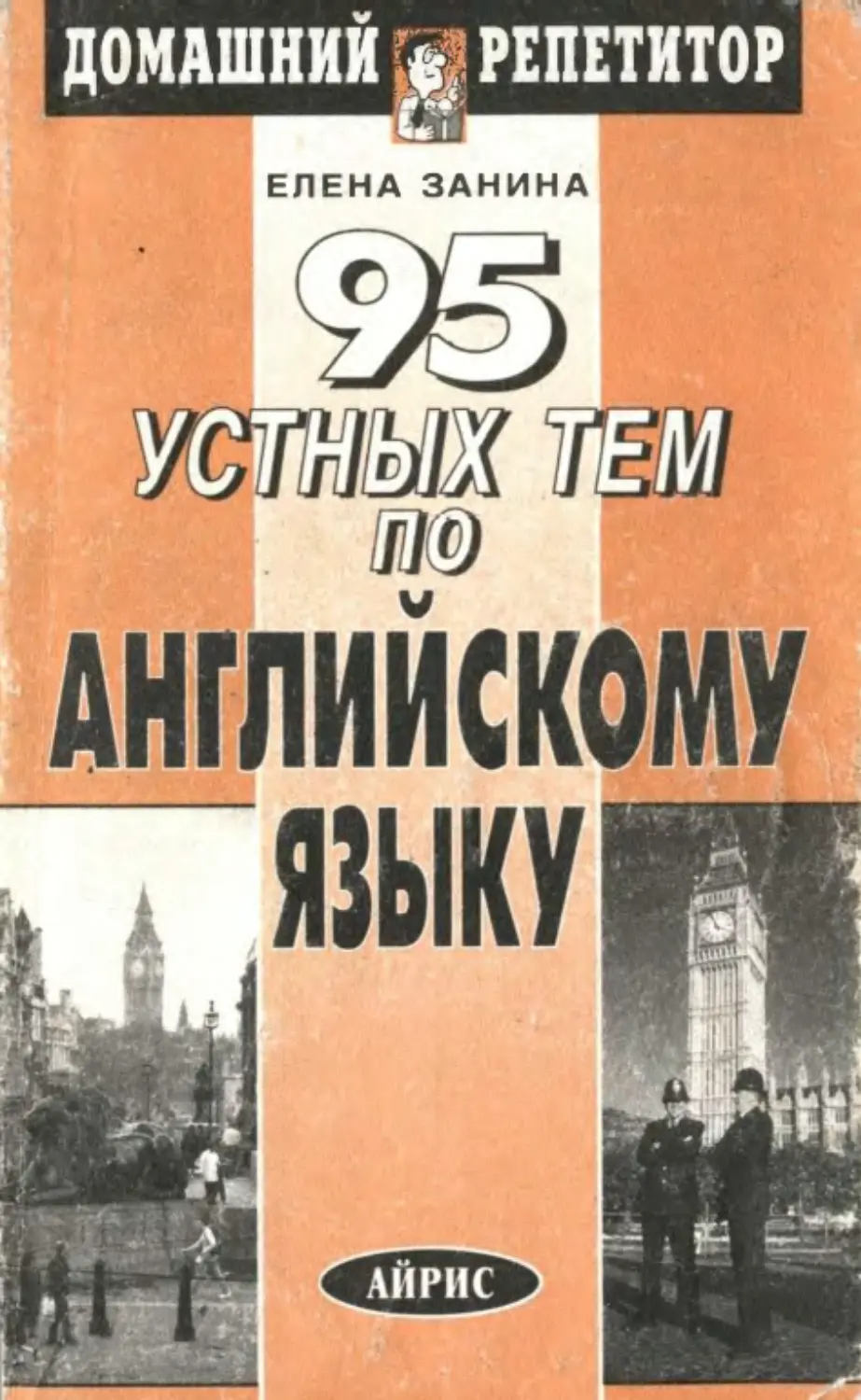
ДОМАШНИЙ РЕПЕТИТОР
ЕЛЕНА ЗАНИНА
ДОМАШНИЙ
РЕПЕТИТОР
ЕЛЕНА ЗАНИНА
АНГЛИЙСКОМУ
ЯЗЫКУ
Издание второе, исправленное
АЙРИС ПРЕСС
РОЛЬФ
МОСКВА
2000
ББК 74.261.7
3-28
Серия «Домашний репетитор»® основана в 1996 году.
Занина Е. Л .
3-28
95 устных тем по английскому языку.
-
2-е изд..
испр.
-
М.: Рольф, 2000. -
304 с.
-
(Домашний ре
петитор).
ISBN 5-7836-0061 -Х
Данное пособие рассчитано на широкий круг изучающих англий
ский язык. Основная цель пособия —помочь школьникам и абиту-
риентам овладеть устными темами, необходимыми для сдачи выпус
кных и вступительных экзаменов по английскому языку. Материал
книги можно также использовать на занятиях по английскому язы
ку, английской литературе и страноведению в рамках программы ш к а
лы, гимназии, лицея или института, а также для самостоятельного
изучения английского языка.
Пособие содержит адаптированные и неадаптированные ориги
нальные тексты двух уровней сложности - среднего (А) и продвину
того (В). Каждый текст снабжен тематическим словарем и аппара
том упражнений, включающих перевод с русского языка на
английский язык с ключами.
ISBN 5-7836-0061-Х
© Е. Л . Занина, 1998
© Рольф, Айрис-пресс, 1998
ПРЕДИСЛОВИЕ
Цели, содержание н структура пособия
Пособие рассчитано на школьников, абитуриентов и всех изучающих анг
лийский язык. Оно предназначается, в первую очередь, для подготовки к проме
жуточным и выпускным школьным экзаменам и вступительным экзаменам по
английскому языку. Основная задача пособия - помочь школьнику и абитуриен
ту освоить содержание н тематический словарь основных экзаменационных
тем и научить излагать эти темы. Кроме того, материал книги может быть
использован для докладов и обсуждений на занятиях по английскому языку,
литературе Великобритании и США, страноведению в школе (в том числе спе
циальной), лицее, гимназии или институте.
Пособие состоит из двух частей: текстов с упражнениями (texts and exercises)
и ключей к упражнениям (clues).
Тексты пособия представляют собой, за исключением текстов части «Мс and
die world I live in», адаптированные и неадаптированные оригинальные тексты,
что даст возможность подготовиться к экзаменам на хорошем языковом уровне.
Тексты объединены в следующие тематические разделы: «Language» (Язык), «The
United Kingdom of Great Britain and Northern Ireland» (Великобритания), «The
USA» (США), «Russia» (Россия), «Education» (Образование), «Arts» (Искусство),
«Customs and Traditions» (Обычаи и традиции Англии и Америки), «Science and
Technology» (Наука и техника), « Hobbies and Pastimes» (Хобби), «Problems or
Modem World» (Проблемы современного мира), «Me and the World I Live in» (Я
я мой мир). Каждый раздел состоит из текстов двух уровней сложности - средне
го А и продвинутого В.
Тексты снабжены тематическим словарем, разделенным поабзацно.
Упражнения включают вопросы к тексту (в основном в соответствии с деле
нием на абзацы). Ключи к упражнениям облегчают самостоятельную работу с
книгой.
Как работать с книгой самостоятельно
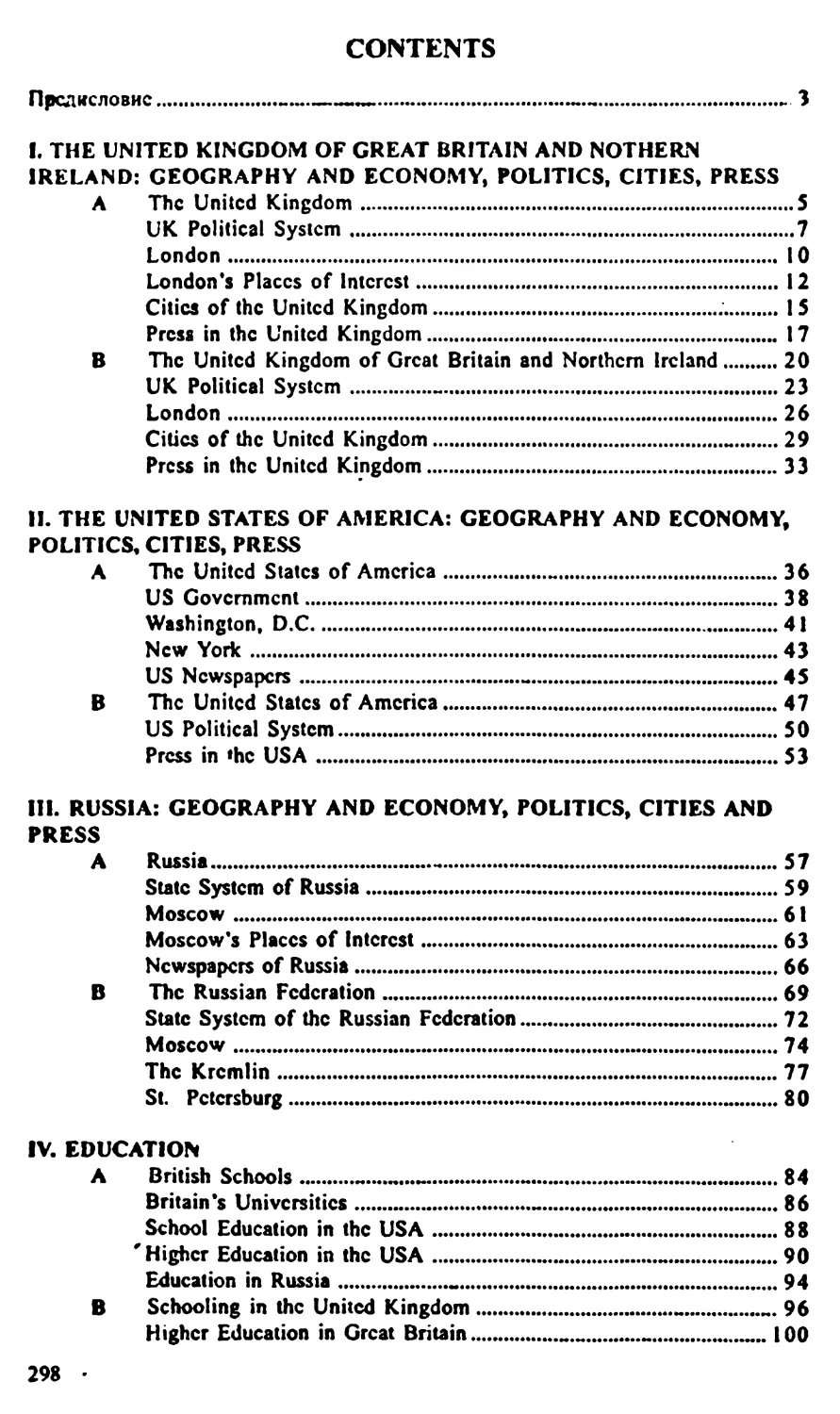
1. Чтобы найти интересующую Вас тему. Вы можете просмотреть оглавле
ние, содержащее заголовки текстов.
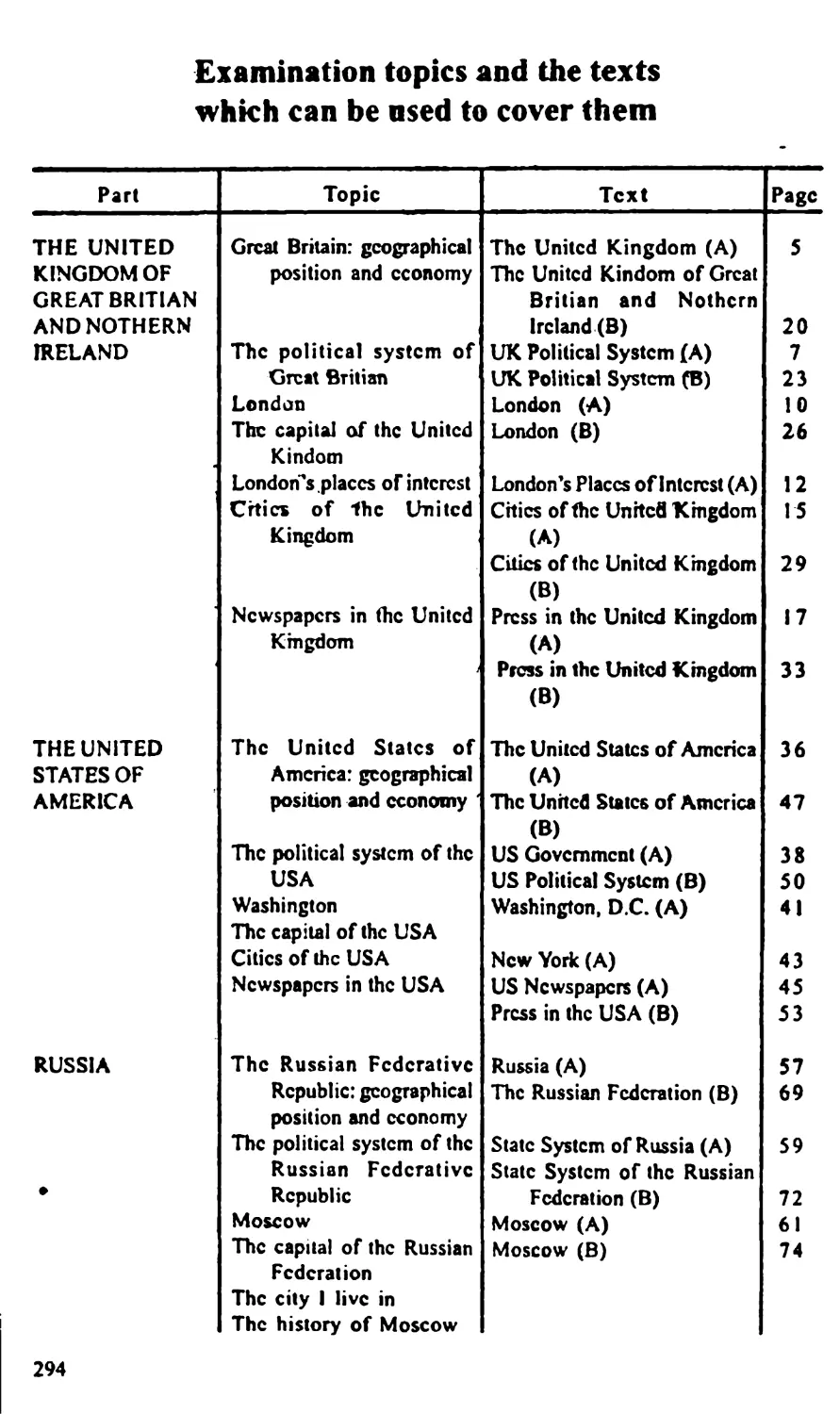
2. Если найти тему по оглавлению трудно, воспользуйтесь списком экзамена
ционных тем и соответствующих им текстов.
3. При выборе текста необходимо помнить, что тексты относятся к двум
уровням сложности - (А) и (В). Выберите текст, соответствующий Вашему
уровню владения языком.
4. Как работать с текстом:
-
прочитайте текст; при чтении и переводе текста удобно пользоваться
тематическим словарем, приводимым после каждого текста;
-
после того, как Вы ознакомитесь с содержанием текста и усвоите словарь,
попробуйте ответить на вопросы. Если это сделать трудно, обратитесь к тексту;
-
переведите предложения после текста. Чтобы перевод был более эффек
тивным, в конце книги приводятся ключи. Попробуйте воспользоваться ими
только для самоконтроля, а нс в качестве подсказки;
3
-
выделите и запишите (на русском или английском языке) тему каждого
абзаца;
-
пересказывать каждый текст следует нс менее двух раз. При п ервом'
пересказе воспользуйтесь нс самим текстом, а словарем к нему Словарь состав
лен в том порядке, в котором слова встречаются в тексте и разделен дефисами (-)
в соответствии с делением текста на абзацы;
-
второй раз текст следует пересказывать, закрыв книгу. Если это не полу
чается, вернитесь к предыдущему пункту;
-
если Вы выбрали текст сложности А и успешно справились со всеми
гаданиями, попробуйте освоить текст В по той же теме (если он есть).
УСПЕХА ВАМ!
I. THE UNITED KINGDOM OF GREAT BRITAIN
AND NORTHERN IRELAND: GEOGRAPHY AND
ECONOMY, POLITICS, CITIES, PRESS
A
The United Kingdom
The United Kingdom ofGreat Britain and Northern Ireland is situated
on the British Isles. The British Isles consist of two large islands, Great
Britain and Ireland, and about five thousands small islands. Their total
a re a is over 244 000 square kilometres.
The United Kingdom is one of the world's smaller countries. Its
population is over 57 million. About 80 percent ofthe population is urba n.
The United Kingdom is m ad e up of four countries: England, Wales,
Scotland and Northern Ireland. Their capitals are London, Cardiff, Edinburgh
and Belfast respectively. Great Britain consists o f England, Scotland and
Wales and does not include Northern Ireland. But in everyday speech
«Great Britain» is used in die meaning of the «United Kingdom of Great
Britain and Northern Ireland». The capital o f the UK is London.
The British Isles are separated from the Continent by theNorth Sea,
the English Channel and the Strait o f Dover. The western coast o f Great
Britain is washed by the Atlantic Ocean and the Irish Sea.
The surface of the British Isles varies very much. The north of
Scotland is m ountainous and is called Highlands. The south, which
has beautiful valleys and plain s, is called Lowlands. The north and
west of England are mountainous, but the eastern, central and south
eastern parts of England are a vast plain. M ountains are not very high.
Ben Nevis in Scotland is the highest mountain (1343 m). There are a lot
o f rivers in Great Britain, but they are not very long. The Severn is the
longest river, while the Thames is the deepest and the most important
one. The mountains, the Atlantic Ocean and the warm waters o f the
5
Gulf Stream influence the climate of the British Isles. It is mild the
whole year round.
The UK is a highly developed industrial country. It produces and
exports machinery, electronics, textile. One of the chiefindustries 01
the country is shipbuilding.
The UK is a constitutional m onarchy with a parliament andthe Queen
as Head ofState.
Topical Vocabulary
- the United Kingdom o f Great Britain
and Northern Ireland
to be situated on
to consist of smth.
total area
-
population
urban
-
to be made up of smth.
to include smth.
-
to be separated from .. by
to be washed by
-
surface
to vary
mountainous
a valley
a plain
to influence smth.
mild
• a highly developed industrial
country
to produce smth.
to export smth.
machinery
electronics
textile
the chief industry
shipbuilding
-
a constitutional monarchy
Соединенное Королевство Вели
кобритании и Северной Ир
ландии
быть расположенным на
состоять из чего-либо
общая площадь
население
городской
состоять из чего-либо
включать что-либо
отделяться от (чего-либо чем-либо'
омываться (чем-либо)
поверхность
варьировать, меняться
гористый
долина
равнина
оказывать влияние на что-либо
умеренный
высокоразвитая промышленная
страна
производить что-либо
экспортировать что-либо
станки
электроника
текстиль
ведущая отрасль промышленности
судостроение
конституционная монархия
б
Head of State
the Queen
глава государства
королева
Answer the questions:
1. What islands is the United Kingdom situated on?
2. What is the country’s population?
3. What is the United Kingdom made up of?
4. What is the United Kingdom washed by?
5. How can you characterize the surface of the British Isles?
6. What is the climate o f Great Britain?
7. What are Britain’s chief industries?
8. What is Britain’s political system?
Translate into English:
1. Соединенное Королевство Великобритании и Северной Ирландии
расположено на Британских островах, состоящих из двух больших и
тысяч малых островов.
2. Население Великобритании в основном (mostly) городское и со
ставляет более 57 миллионов человек.
3. Соединенное Королевство состоит из четырех частей; в Великоб
ританию входят Англия, Шотландия и Уэльс.
4. Британские острова омываются Атлантическим океаном, Ирланд
ским морем, Северным морем и проливами Ла-Манш и Па-де-Кале
5. Британские острова состоят из гористой части и низин.
6. Реки в Великобритании не очень длинные.
7. На климат Великобритании оказывает влияние Гольфстрим.
8. Великобритания производит и экспортирует станки, электронику,
текстиль, суда.
9. Великобритания - конституционная монархия.
UK Political System
The United Kingdom o f Great Britain and Northern Ireland is
constitutional m onarchy. This meflris'tfiat Great Britain is govemecfb
theParliament and the Queen is Щ я Л ofState. .
I
The legislative power in the country^ exercised by the Houses of
Parliam ent. The British Parliament consists oftwo chambers.: the House
ofLords and the House ofCommons. The House ofLordsis composed of
hereditary and life peers ana peeresses. The members ofthe House of
Commons are elected by the people. They are elected from the
constituencies in England, Scotland, Wales and Northern Ireland. The
House ofCommons is the real governing body ofthe United Kingdom.
The executive power is exercised byPrime Ministerand hisCabinet
The governmentis usually formed by the political party whichis supported
by the majority in the House ofCommons. Prime Minister isthe majority
party leader and b appointed by the Queen. Prime Ministerchooses a team
i of ministers; twenty ofthe ministers are in the Cabinet
I
The second largest party becomes the official opposition with its
own leader and the Shadow Cabinet. The two leading parties m Great
Britain are the Conservative Party (the Tories) and the Labour Party.
Thejudiciary branch of the government determines common law
and is ind epend ent of both the legislative and the executive branches.
There is no w ritten constitution in Great Britain, only precedents and
traditions.
Topical Vocabulary
-
a constitutional monarchy
the Queen
Head o f State
-
the legislative power
to be exercised by
the Houses of Parliament
the House of Lords
the House of Commons
to be composed of smbd.
hereditary and life peers
1 a peeress
j amember of
| to be elected by the people
! to be elected from a constituenc
i
i the real governing body
конституционная монархия
королева
глава государства
законодательная власть
осуществляться (чем-либо)
парламент
палата лордов
палата общин
состоять из кого-либо
наследственные и пожизненные
лорды, пэры
пэресса
член (чего-либо)
избираться народом
избираться от избирательного
округа
реальный правящий орган
исполнительная власть
- the executive power
Prime Minister
the Cabinet
_
to be formed by smth.
to be supported by the majority
the majority party leader
to be appointed by
to choose a team of ministers
-
the official opposition
the Shadow Cabinet
-
the judiciary branch of the
government
to determine common law
to be independent of smth.
-
a written constitution
a precedent
премьер-министр
кабинет
образовываться, формироваться,
чем-либо
поддерживаться большинством
лидер партии большинства
назначаться (кем-либо)
создавать команду министров
официальная оппозиция
теневой кабинет
судебная власть
определять гражданское право
не зависеть от чего-либо
«письменная» конституция
прецедент
Answer the questions:
1.What does the term «constitutional monarchy» mean?
2. What body (орган) exercises the legislative power in the country?
3. How are the chambers of the Parliament composed?
4. What body exercises the executive power?
5. How is the executive branch of the government formed?
6. What is the official opposition?
7. What does the judiciary branch of the government do?
8. Is there a written Constitution in Great Britain?
Translate into English:
1. Термин «конституционная монархия» означает, что Великобритания
управляется парламентом, а главой государства является королева.
2. Законодательная власть принадлежит парламенту, состоящему из
двух палат.
3. Члены палаты общин, реального органа управления страной, из
бираются народом.
4. Премьер-министр назначается королевой и сам назначает кабинет.
9
5. Исполнительная власть в стране осуществляется премьер-мини
стром и его кабинетом.
6. Партия, имеющая большинство в палате общин, формирует пра
вительство.
7. Члены палаты общин избираются от округов в Англии, Шотлан
дии, Уэльсе и Северной Ирландии.
8. Официальная оппозиция формирует свой теневой кабинет.
9. Судебная власть определяет гражданское право.
10. В Англии вместо письменной конституции существуют преце
денты и традиции.
ч
London
London is the capital of the United Kingdom, its economic, political
and cultural centre. It is one ofthe world’s most important ports and one
o fthe largest cities in the world. London with itssuburbs has a population
o f about 11 million peoplt.
London has been a capital for nearly a thousand years. Many of its
ancient buildings still stand. The most famous of them are the Tower o f
London, where the crow n jew els are kept, Westminster Abbey and St.
Paul’s Cathedral. Most visitors also want to see the Houses o fParliament,
Buckingham Palace (the Queen’s home with its Changing ofthe G uards)
and the many magnificent museums.
Once London was a small Roman town on the north bank of the
Thames. Slowly itgrew into one ofthe world’s m ajor cities.
Different areas of London seem like different cities. The West End is a
rich man's world ofshops, offices and theatres. TheCity ofLondonis the
district where most offices and banks are concentrated; the Royal
Exchange and the Bank of England are here, toorThe East Endis the
district where mostly working people live. The old p o rt area is now called
«Docklands». There are now new office buildings in Docklands, and
thousands of new flats and houses.
By the day the whole of London is busy. At night, offices are quiet
and empty, but the West End stays alive, because this is where Londoners
come to enjoy themselves. There are two opera houses here, several
concert halls and many theatres, as well as cinemas. In n ea rby Soho the
pubs, restaurants and night clubs are busy halfthe night.
Like all big cities, London has streets and co ncrete buildings, but it
also has many big parks, full of trees, flowers and grass. In the middle of
10
Hyde Park or Kensington Gardens you will think that you are in the
country, miles away.
Many people live outside the centre of London in the suburbs, and
theytravel to work in shops and officesby train, bus or underground
(«The Tube»).
Topical Vocabulary
>an economic, political and cultural
centre
a suburb
to have a population of
-
an ancient building
the crown jewels
Changing o f the Guards
a magnificent museum
-
a Roman town
on the north bank o f the Thames
one o f the world’s major cities
•anareaof
a rich man’s world of shops, offices
and theatres
a district
to be concentrated
the Royal Exchange
the Bank of England
working people
a port area
-
to be quiet and empty
to stay alive
to come to enjoy oneself
an opera house
nearby
a pub
a restaurant
a night club
-
a concrete building
to be full of trees, flowers and grass
экономический, политический и
культурный центр
пригород
иметь население (количество)
древнее здание
королевские драгоценности
смена караула
великолепный музей
римский город
на северном берегу Темзы
один из крупнейших городов мира
район чего-либо
мир богатых - мир магазинов,
офисов и театров
район (города)
быть сконцентрированным
Лондонская биржа
Банк Англии
рабочий класс
портовый район
быть тихим и пустынным
зд.: быть оживленным
приходить отдыхать, развлекаться
оперный театр
близлежащий
кабачок, пивная
ресторан
ночной клуб
бетонное здание
быть полным деревьев, цветов и
травы
11
-
to live outside the centre
жить вне центра
to travel to work by train, bus or ездить на работу на поезде, авто-
underground
бусе или метро
Answ er the questions:
1. What part does London play in the life of the United Kingdom?
2. What are the most famous ancient buildings of London?
3. What are different districts of London famous for?
4. Why do some districts o f London stay alive at night?
5. What has London except concrete buildings?
6. Where do many people live?
Translate into English:
1. Лондон - экономический, политический и культурный центр, один
из крупнейших портов страны и один из крупнейших городов в мире.
2. Самые знаменитые древние здания - Лондонский Тауер, Вестмин
стерское аббатство, собор Святого Павла, Парламент, Букингемский
дворец.
3. Лондон был небольшим римским городом.
4. Вест-Энд - район магазинов, офисов и театров, район богатых людей.
5. В Сити сконцентрированы банки, офисы, в том числе Лондонская
биржа и Банк Англии.
6. В Ист-Энде живут рабочие.
7. В Докланде, бывшем районе портов, сейчас много новых офисов.
8. В Вест-Энд лондонцы приезжают развлекаться.
9. В соседнем Сохо жизнь идет и ночью.
London’s Places of Interest
London is not only the political, economic and cultural centre of the
United Kingdom. It isthe main tourist attraction ofthe country. There
are a lot of places of interest in London which attract thousands of
tourists every year. They usually want to see Westminster Abbey, the
Houses of Parliament, Buckingham Palace, St. Paul’s Cathedral, the
Tower o f London.
12
Westminster is now the political centre of London. In the 11th centur)
King Edward the Confessor decided to build a great abbey church
there.There are many royal tombs in the Abbey, like the tomb of Edward
the Confessorhimself, and memorials to famous men and women. The
most popular ones are those to writers, poets and musicians in the Poet’s
Corner. William the Conqueror was crowned there, and since then all
the coronations have taken place in the Abbey.
During the reign of Edward the Confessor the Palace of Westminster
was built, too. It was the royal residence and also the country’s main
c o u rt The Parliament met here since the 16th till the 19th century. The
present Houses of Parliament were built after the fire in the Palace of
Westminster in 1834. There are two houses in the Parliament: the House
o f Lords and the House of Commons. St. Stephen’s Tower o f the Houses
o f Parliament contains the famous Big Ben.
Buckingham Palace is th e Q ueen’s official Londonrcsidence. Londoners
usually watch the Changing ofthe Guards in the forecourt of the palace. It
lasts about 30 minutes.
St Paul’s Cathedral is Sir Christopher Wren’s m asterpiece.lt was built
since 1675 until 1709. Itis crowned with a huge dome. Inside the dome there
is the famous Whispering Gallery. There are many memorials in the
Cathedral, including memorials to Wellington and Nelson.
The Tower ofLondonis associated with many important events in
the British history. It has been a fortress,a palace, a prison, a m int The
Tower o f London is famous for its prisoners, like Sir Thomas More and
Guy Fawkes. The White Tower was built by Wiliam the Conquerorto
protect the city. The Tower is guarded by «Beefeaters», theYeomen
Guards.
London is noted for its museums and art galleries. Among them are
the National Gallery, the National Portrait Gallery, the Tate, the Museum
ofLondon, the Museum ofMoving Image, Madame Tussau’s Museum
and many others.
Topical Vocabulary
-
the main tourist attraction
to attract thousands o f tourists
-
King Edward the Confessor
an abbey church
a royal tomb
главный предмет интереса туристов
привлекать тысячи туристов
король Эдуард Исповедник
церковь аббатства
гробница короля или королевы
13
memorials to famous men and women
the Poet’s Comer
William the Conqueror
to be crowned
a coronation
-
during the reign of smbd.
the royal residence
the country’s main court
to contain smth.
-
the Queen’s-official residence
the Changing o f the Guards
m the forecourt of the palace
-
a masterpiece
to be crowned with a huge dome
the Whispering Gallery
to be associated with smth.
an event
a fortress
a mint
to protect smth.
to be guarded by smbd.
a Beefeater
a Yeoman Guard
-
to be noted for smth.
an art gallery
the Museum o f Moving Image
мемориалы известных людей
Уголок поэтов
Вильгельм Завоеватель
короноваться
коронация
во время правления кого-либо
королевская резиденция
верховный суд страны
содержат» что-либо
официальная резиденция коро
левы
смена караула
перед дворцом
шедевр
быть увенчанным огромным ку
полом
Галерея шепота
быть связанным с чем-либо, ас
социироваться с чем-либо
событие
крепость
монетный двор
защищать что-либо
охраняться кем-либо
бифитер
стражник-йомен
быть знаменитым чем-либо
художественная галерея
Музей кино
Answer the questions:
1. What are the main tourist attractions in London?
2. What is Westminster Abbey noted for?
3. What is the history of the Houses of Parliament?
4. What is Buckingham Palace?
5. What is St. Paul’s Cathedral famous for?
6. What is the Tower of London associated with?
7. What world-famous museums are there in London?
.4
Translate into English:
1. Предметами интереса туристов в Лондоне являются Вестминстер
ское аббатство, Парламент, Букингемский дворец, собор Святого
Павла.
*
2. В Вестминстерском аббатстве, построенном Эдуардом Испо
ведником, находятся гробницы королей и мемориалы известных
людей.
3. Все коронации проводятся в Вестминстерском аббатстве.
4. Во время правления Эдуарда Исповедника дворец был королевс
кой резиденцией; там также располагался верховный суд.
5. Букингемский дворец - официальная лондонская резиденция анг
лийской королевы; он известен также сменой караула.
6. Шедевр сэра Кристофера Рена, собор Святого Павла, увенчан о г
ромным куполом.
7. Лондонский Тауэр, построенный для защиты Лондона, был крепо
стью, дворцом, тюрьмой и монетным двором.
8. Тауэр известен также стражниками - иоменами, или бифите
рами.
Cities of the United Kingdom
About 57 million people live in Great Britain. It has a very large
population for its size. Nine people out of 10live in towns anddjjes.
^ Bij^ish cities began to grow when ind ustries developed. Lcftsrnj^e^ple
lentne country and moved into cities to work in industry. Liferrnore
people moved to cities because farming was done mostly by machines.
Other people choose to live in a country village and trav el to w ork in the
towns.
Britain’s largest cities are: London with the population of about 7
million people, Birmingham, Leeds, Glasgow, Sheffield, Edinburgh (all
with the population less than one million)
London, the capital o f the United Kingdom, is built on the river Thames.
It is a world centre for business and money trading, it isalso the country’s
largest port and a cultural centre with numerous museums and theatres.
Plays, musical shows, operas and concerts attra ct large audiences,
including many tourists.
Birmingham is Britain’s second largest city and its engineering
centre. It produces iron and steel for making cars, ships, aeroplanes
15
'
\
and m achinery. Ledds, the third largest city in the United Kingdom,
produces woolen goods. Sheffield is a centre ofproducing steel goods.
Glasgow is famous for heavy industry. Besides, it is an important cultural
centre, ltis noted for its architecture and a rt galleries. Edinburgh is the city
o f science. It is associated with science, beautiful historic buildings and the
annual festival of arts. Edinburgh is called «The Athens ofthe North».
There are a lot of small towns in Great Britain, too. Most towns have
a busy shopping area in the centre. Now there are new suburbs around
the edges of old cities and old towns. New buildings are planned to make
the best use of space.
Topical Vocabulary
-
to have a very large population
for its size
-
industries
to develop
to move into cities
farming
to be done by machines
to travel to work in the towns
-
the population of about
-
a world centre for business and
money trading
the country’s largest port
a cultural centre with numerous
museums
to attract large audiences
-
an engineering centre
to produce iron and steel for
machinery
to produce woolen goods
a centre of producing steel goods
-
to be famous for heavy industry
to be noted for architecture
an art gallery
иметь слишком большое населе
ние для ее (страны) размеров
промышленность
развиваться
переехать в города
обработка земель
производиться машинами
ездить на работу в города
население около (примерное ко
личество)
мировой центр бизнеса и финан
сов
крупнейший порт страны
культурный центр с бесчисленны
ми музеями
собирать большую аудиторию
центр машиностроения
производить железо и сталь для
станков
производить изделия из шерсти
центр производства изделий из
стали
быть знаменитым тяжелой про
мышленностью
быть известным архитектурой
художественная галерея
16
to be associated with science
a historic building
the annual festival o f arts
«The Athens of the North»
-
a busy shopping area
a suburb
around the edges of smth.
to make the best use of space
быть связанным с наукой
историческое здание
ежегодный фестиваль искусств
Северные Афины
оживленный торговый центр
пригород
вокруг границ чего-либо
лучше всего использовать про
странство
Answer the questions:
1. Why do most people in the United Kingdom live in towns and cities?
2. What part does London play in the life o f the United Kingdom?
3. What goods are produced in Birmingham and Leeds?
4. What is Glasgow famous for?
5. What is Edinburgh famous for?
Translate into English:
1. Население Великобритании (57 миллионов человек) - большое для
страны такой величины.
2. Люди переезжали из деревни в город, так как земли стали обраба
тываться машинами.
3. Лондон - деловой и финансовый центр страны; в нем находятся
центральные учреждения различных организаций.
4. В Бирмингеме производится сталь, в Лидсе - изделия из шерсти, в
Шеффилде - изделия из стали.
5. Глазго, крупный культурный центр страны, известен также тяже
лой промышленностью.
6. Эдинбург знаменит своими историческими зданиями, фестива
лем искусств и научными учреждениями.
More daily newspaper&are sold in Britain than in most othercountries,
o f the world. Britain is bnAofthe few countriesw+rent daily newspapers
Press in the United Kingdom
17
are delivered at the door, before breakfast. There are about 135 daily
papers and Sunday papers. A lot of people buy a morning paper, an
evening paper and aSunday paper.
National newspapers have a circulation of 15,8 million copies on
weekdays and 17,9 million copies on Sundays. National newspapers are
papers which are sold in all parts of Britain. Nearly all the national
newspapers are in London. The famous newspaper street, Fleet Street,
now houses only «The Daily Express».
The newspapers are divided into two main groups: quality papers
and popular papers. Quality newspapers are: «The Times», «The
Guardian, «The Daily Telegraph», «The Independent», «The Financial
Times», «The Observer», «The Sunday Times» and «The Sunday
Telegraph». They report national and international news very thoroughly.
They also publish articles on many general subjects. The popularpapers
publish sensational news. The popular papers are «The News o f the
World», «The Sun», «The Daily Mirror» and others. They publish
« perso nal articles» which shock the reader. Many articles deal with the
private lives of people.
^Newspapers do not depend financially on political parties. But many
of them support a political party unofficially. For example, during the
general elections many editors write open letters to the readers. They
are called «leaders» and ask their readers to vote fo r this or
Most newspapers in Britain belong to financial groups.They do not
belong to the Government or political parties. ^
Topical Vocabulary
-
a daily newspaper
to be sold
to be delivered at the door
a morning paper
an evening paper
a Sunday paper
-
a national newspaper
to have a circulation of
a copy
to house (smth.)
ежедневная газета
продаваться
доставляться к дверям дома
утренняя газета
вечерняя газета
воскресная газета
общенациональная газета
иметь тираж
экземпляр
быть местом нахождения (чего-
-
a quality paper
18
либо)
серьезная газета
a popular paper
to report national and international
news
thoroughly
tb publish an article on
a general subject
a «personal article»
to shock smbd.
the private lives o f people
-
to depend financially on smbd.,
smth.
to support a political party unofficially
during the general elections
an editor .
to write an open letter to smbd.
to vote for smbd.
to belong to financial groups
Answer the questions:
популярная газета, бульварная
пресса
освещать внутренние и междуна
родные новости
подробно, тщательно
опубликовать статью по (какой-
либо теме) •
общая тема
статья на частные темы
шокировать кого-либо
частная жизнь людей
зависеть в финансовом отноше
нии от кого-либо, чего-либо
неофициально поддерживать по
литическую партию
во время всеобщих выборов
редактор
написать открытое письмо кому-
либо
голосовать за кого-либо
принадлежать финансовым груп-*
пам
1. What proves that the British are a reading nation?
2. What is a national newspaper?
3. What groups are newspapers in the United Kingdom subdivided into?
4. What kind of articles does each type o f newspapers publish?
5. Do newspapers in Britain support any political party?
6. Who do newspapers in Great Britain belong to?
Translate into English:
1. Утренние газеты в Великобритании доставляются на дом (to people’s
homes).
2. Общенациональные газеты издаются тиражами в миллионы эк
земпляров и продаются во всех частях страны.
19
3. В Лондоне издаются все общенациональные газеты.
4. Серьезные газеты публикуют статьи по внутренним и мсждуна-'
родным проблемам, а также статьи общего характера.
5. Популярные газеты публикуют статьи о частной жизни людей; ча-1
сто они шокируют читателя.
.
6. Во время выборов редакторы газет просят своих читателей голосо-«
вать за ту или иную партию.
7. Газеты в Великобритании принадлежат не правительству или поли
тическим партиям, а финансовым группам.
The United Kingdom o f Great Britain and Northern
Ireland
Great Britain lies on the Atlantic coast o f Western Europe, separate4
from France by only 34 km (21 miles) of water. It is made up of three
countries, England, Scotland and Wales. Great Britain with Northern
Ireland fo rm s the United Kingdom of Great Britain and Northern Ireland.
The capital of the United Kingdom is London, in England. The capital
o f Wales is Cardiff, and the Scottish capital is at Edinburgh.
Great Britain's largest island neighb o ur is Ireland. This is mainly
occupied by the independent Republic of Ireland. The rem aind er is
Northern Ireland which is a part o f the United Kingdom. Many small
islands are also linked with the United Kingdom.
Although a small island, Great Britain has a remarkable v ariety of
landscapes. To the north and west are highlands - the mountains of
Scotland, Cumbria and Wales, and the Pennine Chain. To the east are flat
plains, and in the south are lowlands broken by low ranges of hills. To
the Southwest are the bleak m oors of Devon and Cornwall.
The continent of Europe extends o ut below the waters of the Atlantic
Ocean, in the form of a continental shelf. Great Britain is perched on this
shelf, surrounded by the shallow w aters of the N orth Sea, the Irish Sea
and the English Channel.
A warm ocean current, the Gulf Stream, washes Britain’s western
shores. This water heats up and cools down very slowly. Britain therefore
enjoys warmer winters and cooler summers than other countries at the
В
20
same latitude. The west of the iklandhas a higher rainfall and slightly
milder climate than the east.
'
Britain has been many centuries in the making. The Romans conquered
Britain, but were unable to subdue the independent tribes in the west and the
north. Other invaders were Angles, Saxons, Jutes, Vikings and Normans.
England waged numerous colonial wars and was the empire for many
centuries. England was the first country were capitalism was established.
Great Britain is a highly developed industrial country. It isknown as
one ofthe largest producers and exporters of machinery, electronics,
textile, aircraft and navigation equipment. One of the chiefindustries of
the country is shipbuilding.
The UK is aconstitutional m onarchy. The powers ofthe British Queen
are limited by the Parliament. The British Parliament.consists of the
sovereign, the House of Lords and the House of Comment
Topical Vocabulary
-
to lie on
to be made up of smth.
to form smth.
• an island neighbour
to be occupied by
the remainder
to be linked with
-
to have a variety of landscapes
highlands
a flat plain
lowlands
a low range of hills
bleak moors
• to extend out
a continental sh elf
shallow waters of the North Sea
-
an ocean current
to wash the shores
to heat up
to cool down
находиться на
состоять из чего-либо
формировать, образовывать что-
либо
островной сосед
быть занятым (чем-либо)
остаток
быть связанным с (чем-либо)
иметь разнообразный ландшафт
горы, гористая местность
плоская равнина
низменность
низкая гряда гор
унылые торфяники, болотистые
места
тянуться, простираться
континентальный шельф
мелководное Северное море
океаническое течение
омывать берега
нагреваться
охлаждаться
21
at the same latitude
на той же широте
to have a higher rainfall
иметь большее количество осадков
- to be шалу centuries in the making формироваться в течение ряда
столетий
-
••
-
■■■
-----------------------------------ч
to conquer
to subdue the independent tribes
an invader
Angles
Saxons
Jutes
Vikings
Normans
to wage a colonial war
an empire
to establish capitalism
-
a highly developed industrial
country
a producer and exporter o f smth.
machinery
electronics
textile •
aircraft and navigation equipment
the chief industry
shipbuilding
-
a constitutional m onarchy
the powers of
to be limited by smth.
the sovereign
завоевать
подчинить независимые племена
завоеватель
англы
саксы
юты
ВИКИНГИ
норманны
вести колониальную войну
империя
установить капитализм
страна с высокоразвитой про
мышленностью
производитель и экспортер чего-
либо
станки
электроника
текстиль
оборудование для самолетов и
навигационное оборудование
отавная отрасль промышленности!
судостроение
конституционная монархия
власть (кого-либо)
быть ограниченным чем-либо
монарх
Answ er the questions:
1. Where does the UK lie?
2. What does the UK consist of?
3. What is Great Britain’s largest island neighbour?
4. What proves that Great Britain has a variety of landscapes?
5. How does the Gulf Stream influence Britain’s climate?
6. What is Britain’s history?
22
7. What are Britain’s chief industries?
8. What is Britain’s political system?
Translate into English:
1. Великобритания состоит из трех частей, Соединенное Королевство -
из четырех.
2. Ближайший островном сосед Великобритании - Северная Ир
ландия.
3. В Соединенное Королевство входит также оставшаяся часть остро
ва Ирландия и малые острова.
4. Поверхность Великобритании состоит из гористой местности и
низин, пересекаемых невысокими горными цепями.
5. Соединенное Королевство лежит на континентальном шельфе и
омывается Северным морем, проливом Ла-Манш, а также теплым
океаническим течением Гольфстрим.
6. История Великобритании насчитывает много веков.
7. Территория Британии завоевывалась англами, саксами, ютами,
викингами и норманнами.
8. Англия, которая многие века вела колониальные войны, была так
же первой страной капитализма.
9. Соединенное Королевство - высокоразвитая промышленная стра
на, которая производит и экспортирует различную продукцию.
10. Власть монарха ограничена парламентом.
UK Political System
The United Kingdom of Great Britain and Northern Ireland is a
constitutional monarchy. It means that the government of the United
Kingdom isby a hereditary sovereign, an elected House ofCommons
and apartly hereditary House ofLords.
The sovereign has the title of King (or Q ueen). The Sovereign has
very few functions that really matter, such as the function o f the arb iter
of last resort in some matters. These matters can be dissolution of
Parliament and invitations toform a government when there is no clear
m ajority. The Queen is Elizabeth II.
The suprem e legislative power is vested in the Parliament, which sits
for 5 years unless soonerdissolved. The Parliament has two chambers:
23
die House o f Lords with about 830 hereditary peers, 26 spiritual peers,
about 270 life peers and peeresses, and the House ofCommons. The House
o fCommons has 650popularly elected members. The House ofCommonsis
the real governing body ofthe United Kingdom. In orderto become a law, a
new bill proposed by the Cabinet must be approved by both houses ofthe
Parliament. The Lords cannot veto a bill, but they can delay it for a maximum
o f one year. Financial bills cannot be delayed by die House o f Lords.
The executive power ofthe Crown b exercised by the Cabinet, headed
by Prim e Minister. Prime Minister, normally the head of the party
commanding a majority in the House ofCommons, is appointed by the
Sovereign. Prime Minister appoints the rest o f the Cabinet. All ministers
must be members of one or the other houses of the Parliament. They are
individ ually and collectively respon sible to the Crown and the Parliament.
The Cabinet proposes bills and arranges business of the Parliam ent
Government in Britain since 1945 has alternated between only two
political parties, the Conservatives (the Tory) and theLabour Party. No
other party has been in office at all since 1945 and there have bees no
coalitions. The third long-established p arty, the Liberals, enjoyed
moments of success, but no member of the Liberal Party has held
governm ent office since 1945.
Topical Vocabulary
-
a constitutional monarchy
the government of
a hereditary sovereign
elected House o f Commons
partly hereditary House o f Lords
7 the title o f King (or Queen)
the arbiter o f last resort
dissolution o f Parliament
to form a government
clear majority
-
the supreme legislative power
to be vested in
to dissolve smth.
24
конституционная монархия
правительство, правление, управ
ление (чем-либо)
наследственный монарх
выборная палата общин
частично наследственная палата
лордов
титул короля (королевы)
арбитр последней инстанции
роспуск парламента
сформировать правительство
четкое большинство
высшая законодательная власть
принадлежать (чему-либо, кому-
либо) (о власти, праве)
распустить (парламент)
a chamber
a hereditary peer
a spiritual peer
a life peer or peeress
a popularly elected member
the real governing body
to propose a bill
to be approved by smbd., smth.
to veto a bill
to delay a bill for
- the executive power of the Crown
to be exercised by
to be headed by smbd.
Prime Minister
to command a majority
to appoint smbd.
to be individually and collectively
responsible to smbd., smth.
-
the Conservatives (the Tory)
the Labour Party
to be in office
a long-established party
the Liberals
to hold government office
палата
наследственный пэр
епископ - член парламента
пожизненный пэр или пэресса
член парламента, избранный все
народным голосованием
орган, обладающий реальной вла
стью
внести законопроект
быть одобренным кем-либо, чем-
либо
наложить вето на законопроект
отложить рассмотрение законо
проекта на (определенный
срок)
исполнительная власть монарха
осуществляться (чем-либо)
возглавляться кем-либо
премьер-министр
обладать большинством
назначить кого-либо .
нести индивидуальную и коллек
тивную ответственность перед
кем-либо, чем-либо
консерваторы (тори)
лейбористская партия
быть у власти
давно существующая партия
либералы
быть у власти (о правительстве)
Answer the questions:
1. What does the term «constitutional monarchy» mean?
2. What are the functions of the sovereign?
3. Who are the members of the House of Lords?
4. What are the functions of the houses?
5. What are the functions o f Prime Minister and the Cabinet o f Ministers?
6. What are the major political parties in Great Britain?
25
Translate into English:
1. Соединенное Королевство управляется (is governed by) монархом;
выборной палатой общин, а также частично наследственной палатой
лордов.
2. Монарх имеет титул короля (королевы) и является арбитром послед
ней инстанции в некоторых вопросах, таких как роспуск правительств
или его формирование.
3. Высшая законодательная атасть осуществляется парламентом; со
стоящим из палаты лордов и палаты общин
4. Палата лордов состоит из наследственных пэров, пожизненных пэ
ров и пэресс, епископов - членов парламента.
^
5. Палата общин, состоящая из всенародно избираемых членов, -
реальный правящий орган Соединенного Королевства.
6. Кабинет министров вносит законопроект; парламент может одоб
рить его или отложить его рассмотрение.
7. Исполнительная власть осуществляется кабинетом министров, ко
торый вносит на рассмотрение законопроекты и организует деятель
ность правительства.
London
London is the capital o f the United Kingdom o f Great Britain and
Northern Ireland. It is the largest city in Europe and one of the largest
cities in the world with the population of 11 million people. About a fifth
ofthe total population ofthe UK lives inthe Greater London area, that is
in London and its suburbs.
London is home for the headquarters ofallgovernment departments,
Parliament, the m ajor legal institutions and the monarch. It is the
country’s business and banking centre and the centre of its transport
network. Itcontains the headquarters ofthe national television networks
and of all the national newspapers.
The original walled city of London founded by Romans was quite
small. In the middle ages it did not contain the Parliam ent or the royal
Court, because itwould have interfered with the interests of the merchants
a n d t ra d e rs who lived there. It was in Westminster, another city outside
London’s walls, that these national institutions met. Today, both «cities»
j arejust two areas in C&ntral London. The City is home to London’s main
j financial organizations. The Royal Exchange, the Stock Exchange and
26
the Bank of England are situated there. D uring the daytime, nearly a
million people work there, but less than 8 000 people actually live there.
Other well-known areas o f London are the West End and the East
End. The former is known for its many theatres, cinemas, luxurious
hotels and restaurants and expensive shops. The latte r is known as the
poorer residential area of Central London; the Port o f London is situated
there.
The two districts of London, the City of Westminster and the West
End are the main to urist attra ctions in London. Westminster Abbey, the
Houses of Parliament, Buckingham Palace and quite a number of world-
famous museums are all located in this area.
There are many other parts of central London which have their own
characteristics, and Central London itself m akes up only a very sm all
part ofGreater London. The majority ofLondoners live in its suburbs,
millions of them trav elling into the centre each day to work. These
suburbs cover a vast area of land.
London is a cosm opolitan city. People of several races and many
nationalities live there. A survey carried out in the 1980-ies found that 137
different languages were spoken in the homes o fjust one district o f London.
Topical Vocabulary
-
the total population
the Greater London area
a suburb
-
to be home for smth.
the headquarters o f smth.
a government department
the major legal institutions
the monarch
the country’s business and banking
centre
transport network
to contain smth.
the national television network
-
the original walled city
зд.: все население
Большой Лондон
пригород
быть местом нахождения чего-
либо
центральное учреждение какой-
либо организации
власть (как часть правительства)
главные судебные учреждения
монарх
центр банковского дела и бизнеса
страны
транспортная сеть
содержать что-либо
национальная телевизионная сеть
первоначальный город, обнесен
ный стеной
27
to be founded by Romans
быть основанным римлянами
in the middle ages
в средние века
the Parliament
парламент
the royal Court
Королевский суд
to interfere with the interests of
smbd.
a merchant
a trader
a national institution
a financial org anization
the Royal Exchange
the Stock Exchange
the Bank of England
during the daytime
-
an area
the former
a luxurious hotel
an expensive shop
the latter
a poorer residential area
-
a district
the main tourist attraction
to be located in
-
to make up a small part of smth.
the majority of Londoners
to travel into the centre
to cover a vast area of land
-
a cosmopolitan city
a race
a nationality
to carry out a survey
Answer the questions:
1. What is the population of Londo
противоречить интересам кого*
либо
купец
торговец
общенациональное учреждение,
институт
финансовая организация
Лондонская биржа
Фондовая биржа
Банк Англии
в дневное время
район
первый (из двух перечисленных)
роскошный отель
дорогой магазин
второй (из двух перечисленных)
зд.: бедный жилой район
район (города)
основной предмет интереса тури
стов
быть расположенным в
составлять небольшую часть
чего-либо
большинство лондонцев
ехать в центр
быть расположенным на боль
шой площади
многонациональный город
раса
национальность
производить обзор
28
2. What part does London play in the life of the United Kingdom?
3. What is the history of Westminster and the City of London?
4. What are the West End and the East End known for?
5. What is the main tourist attraction in London?
6. Where do the majority of Londoners live?
7. What proves that London is a cosmopolitan city?
Translate into English:
1. B Лондоне, столице Великобритании, и его пригородах проживав!
примерно одна пятая часть всего населения страны
2. Население Центрального Лондона и его пригородов составляет 11
миллионов человек.
3. Центральный Лондон с его пригородами известны под названием
«Большой Лондон».
4. В Лондоне расположены все центральные органы правительствен
ных организаций страны и крупнейшие судебные организации.
5. Лондон - центр банковского дела, бизнеса и транспорта; в нем
расположены все крупнейшие финансовые организации.
6. Современные Вестминстер и Сити - это два района в Центральном
Лондоне.
7. В средние века в первом находились парламент и Королевский суд;
во втором жили купцы и торговцы.
8. В Вест-Энде, известном районе Лондона, много роскошных отелей
и магазинов, театров и кинотеатров.
9. Ист-Энд - бедный район города.
10. В многонациональном Лондоне живут люди многих рас и нацио
нальностей.
Cities of the United Kingdom
The population of the United Kingdom of Great Britain and Northern
Ireland is more than 57 million people. It is mostly urb an : nine tenth o f it
lives in towns and cities.
London, the largest city in Europe, dominates Britain. It is home for
the headquarters of all government departments, Parliament, the major
legal institutions and the monarch. It is the country’s business and
banking centre and the centre of its transport network. It contains
29
headquarters ofthe national television networks and ofall the national
newspapers. It is about 7 times larger than any other city in the country.
About a fifth of the total population of the United Kingdom lives inthe
Greater London area.
The country’s second largest city is Birmingham. During the industrial
revolution, the city and the surrounding area of the west midlands, known
as the Black country, developed into the country's m ajo r engineering
centre. Factories of Birmingham still convert iron and steel into a vast
variety ofgoods.
In northern England, there are large deposits of coal and iron ore.
They enabled this area to lead the industrial revolution in the 18th century
On the western side, the Manchester area became, in the 19th century
the world's leading producer ofcottoHgoods. Ondie eastern side, towns
such as Bradford and Leeds became the world's leading producers of
woollen goods. Furthersouth, Sheffield became a centre for the production
of steel goods. Further north, around Newcastle, shipbuilding is the major
industry.
Glasgow in Scotland is the third largest city in Britain. It is
associated with heavy industry and some of the worst housing
conditions in Britain. However, this image is one-sided. Glasgow has
a strong artistic heritage. At the turn of the last century, the work of
the Glasgow school put the city at the forefront ofEnglishdesign and
architecture.
Edinburgh, which is h alf the size of Glasgow, is the city of science
and is associated with science, law and administration. This reputation,
together with many historic buildings has led to its being called «The
Athens of the North». The annual festival of the arts is internationally
famous.
*4
Topical Vocabulary
-
urban
-
to dominate Britain
to be home for the headquarters of
all government departments
the major legal institutions
the monarch
городской
быть главным, основным в Вели
кобритании
быть местом нахождения цент
ральных учреждений всех де
партаментов правительства
основные судебные учреждения
монарх
30
the country’s business and banking
centre
a transport network
to contain headquarters of the
national television networks
the total population
the Greater London area
-
the industrial revolution
midlands
to develop into smth.
the country’s major engineering
centre
to convert iron and steel into a vast
variety o f goods
-
deposits of coal and iron ore
to enable the area to lead the
industrial revolution
the world’s leading producer of
cotton goods
the world’s leading producer of
woollen goods
a centre for the production o f steel
goods
shipbuilding
the major industry
-
to be associated with heavy
industry
housing conditions
an image
to be one-sided
to have a strong artistic heritage
at the turn of the last century
to put the city at the forefront o f
smth.
центр бизнеса и банковского дела
сграны
транспортная сеть
быть местом нахождения цент
рального офиса националь
ной телефонной сети
общее население
район Большого Лондона
промышленная революция
центральная часть Великобрита
нии
превратиться во что-либо
главный центр машиностроения
страны
производить большое количество
товаров из железа и стали
месторождения угля и железной
руды
дать возможность району лиди
ровать в промышленной рево
люции
ведущий в мире производитель
изделий из хлопка
ведущий в мире производитель
шерстяных изделий
центр производства изделий из
стали
судостроение
основная отрасль промышленно
сти
ассоциироваться с тяжелой про
мышленностью
жилищные условия
представление
быть односторонним
обладать богатым художествен
ным наследием
на рубеже прошлого века
вывести город на первый план в
области чего-либо
31
oesign and architecture
-
to be half the size of
to be associated with science, law
and administration
a reputation
«The Athens of the North»
the annual festival of the arts
to be internationally famous
дизайн и архитектура
быть в два раза меньше, чем (что-
либо
ассоциироваться с наукой, зако
ном и управлением
репутация
Северные Афины
ежегодный фестиваль искусств
быть всемирно знаменитым
Answer the questions:
1 . What is the population o f the United Kingdom?
2. What part does London play in the life of the United Kingdom?
3. What is Birmingham noted for?
v
4. What natural resources are there in northern England?
5. How can you characterize Glasgow’s image?
6. What is Edinburgh associated with?
Translate into English:
1. Население Великобритании в основном городское и составляет S7
миллионов человек.
2. В Лондоне размещаются центральные учреждения правитель
ства, телевизионных сетей, газет, центральные юридические учреж
дения.
3. Во время промышленной революции Бирмингем превратился в
крупнейший центр машиностроения и сейчас производит изделия из
стали и железа.
4. Во время промышленной революции месторождения угля и же
лезной руды сделали северные районы Англии ведущими.
5. Манчестер - ведущий производитель изделий из хлопка, Лидс -
изделий из шерсти, Шеффилд - изделий из стали.
6. Глазго ассоциируется с тяжелой промышленностью, плохими
жилищными условиями и великолепной архитектурой и дизай
ном.
7. Эдинбург ассоциируется с наукой и управлением; там также про
водится международный фестиваль искусств.
32
Press in the United Kingdom
The daily circulatio n o f papers in Britain isju st over 14 million copies,
which is about 3 papers for every 4 households.
All British papers can be classified into two majorgroups: quality and
popular papers.
A quality paper is a serious national paper that aims at the educated
reader. Quality papers contain detailed news coverage and com m ent,
authoritative editorials, a wide range of topical fe atu re s written by experts
in theirfield, arts and literary reviews and much professional advertising.
The quality papers are «The Times», «The Guardian», « The Independent».
«The Daily Telegraph» and «The Financial Times».
A popularpaperis a newspaper whoseform at and content is designed for
the undemanding read er. Most popular papers are tabloids, i.e. papers with
small-size pages (conventionally about 30 cm by 40 cm). They have briefand
direct news reports and a large number of photographs. Emphasis is p ut on
personal stories (especially when sensational, or involving a figure in th e
public eye such as a member ofthe royal family), and importance isalso given
to sports and to entertaining features such as cartoons and contests.
Newspapers in Britain a re mostly owned by individuals or by big
publishing companies called the «empires», not by die government or political
parties. The editors o f the newspapers are usually allowed co nsiderable
freedom of expression. This is not to say that newspapers are without political
bias. The political tendency of quality papers varies from conservative («The
Daily Telegraph») or independent/conservative («The Times» and «The
Financial Times») to centre («The Independent») and lib eral («The
Guardian»). Popular tabloids like «The Daily Express», «The Daily Star» and
«TheSun», for example, usually reflect conservative opinion in their commen*
and reporting, while «The Daily Mirror» has a more left-wing bias.
in addition to national daily newspapers there are nine national papers
published on Sundays. Most of«Sundays» contain more reading m atte r
than daily papers, and several of them include « colour supplem ents» -
separate colour magazines which contain photographically-illustrated
feature articles. There is also quite a number of regional p ape rs - usually
evening papers or weeklies.
Topical Vocabulary
- th e daily circulation
2-43
ежедневный тираж
-
to be classified into two groups
a quality paper
a popular paper
-
to aim at the educated reader
to contain
detailed news coverage and comment
an authoritative editorial
a topical feature
an arts and literary review
professional advertising
-
format and content
to be designed for the undemanding
reader
a tabloid
to put emphasis on smth.
sensational
a figure in the public eye
to give importance to smth.
an entertaining feature
a cartoon
a contest
-
to be owned by individuals
a publishing company
an editor
to allow smbd. considerable freedom
o f expression
without political bias
the political tendency
conservative"
independent
centre
liberal
to reflect opinion
-
a «Sunday»
reading matter
a colour supplement
a regional paper
разделить на две группы
серьезная газета
популярная газета
быть рассчитанным на образо
ванного читателя
содержать
подробный обзор новостей и
комментарии
авторитетная передовица
тематическая статья
обзор искусства и литературы
профессиональная реклама
формат и содержание
предназначаться негребовагсяьг
ному читателю
газета'небольшого) формата
придавать основное значение
чему-либо
сенсационный
популярная личность
придавать значение чему-либо
развлекательный материал
рисунок, карикатура
конкурс
принадлежать частным лицам
издательство
редактор
предоставлять кому-либо значи
тельную свободу в выражении
без политической ориентации
политическая ориентация
консервативный
независимый
центристский
либеральный
отражать мнение
воскресная газета
материал для чтения
цветное приложение
местная газета
34
a weekly
еженедельная газета
Answer the questi ons:
1. What major groups can British newspapers be subdivided into?
2. What kind or reader does each type aim at?
3. What do quality papers usually contain?
4. What is a «tabloid»?
5. Who are newspapers in Great Britain owned by?
6. What political opinion do newspapers in Great Britain reflect?
7. What other types of newspapers except daily newspapers are there?
Translate into English:
1. Ежедневный тираж газет в Англии - более 14 миллионов экземпляров.
2. Газеты в Великобритании можно подразделить на серьезные, рас
считанные на образованного читателя, и популярные, предназначен
ные для нетребовательного читателя.
3. Серьезные газеты содержат подробный обзор новостей, передови
цы, обзор искусства и литературы.
4. Формат популярной газеты - обычно около 30x40 см.
5. В популярных газетах особое внимание уделяется сенсационным
событиям, особенно если они касаются какой-либо известной лич
ности.
6. Популярные газеты содержат также развлекательный материал и
спортивные обзоры.
7. Газеты в Великобритании принадлежат не правительству и полити
ческим партиям, а крупным издательским фирмам или частным лицам.
8. Газеты обычно имеют определенную политическую ориентацию,
которая может быть консервативной, независимой, центристской или
либеральной.
9 Газетам предоставляется значительная свобода в отражении тех
или иных политических взглядов.
10. Воскресные газеты содержат много материала для чтения. Они
часто имеют цветные при зожения, содержащие иллюстрированные
статьи.
2
II.
THE UNITED STATES OF AMERICA:
GEOGRAPHY AND ECONOMY, POLITICS, CITIES,
PRESS
A
The United States o f America
The Unites States of America are situated in the central part of the
North American continent. Its western coast is w ashed by the Pacific
Ocean and its eastern coast - by the Atlantic Ocean.
The total area of the USA is over nine million square kilometres.
The population of the USA is about 250 million people; most of the
population lives in towns and cities.
g
The USA is a very large country, so it has several different climatic
regions. The coldest regions are in the north and north-east. The south
has a subtropical climate.
The United States is a land of rivers and lakes. The northern state
o f Minnesota is a land o f 10 000 lakes. The longest rivers in the USA are
the Mississippi, the Missouri and the Rio Grande. The highest
mountains are the Rocky Mountains, the Cordillera and the Sierra
Nevada.
The United States is rich in natural and mineral resources. Itproduces
copper, oil, iron ore and coal. It is a highly-developed industrial and
agricultural country.
There are many big cities in the USA, such as New York, Chicago, Los
Angeles, Philadelphia and others. The national capital is Washington,
D.C. Its population is about 3,4 million. Washington was built in the late
eighteenth century as the centre of government. It was named after
Georg e Washington.
The USA became the world leading country at thebeginning ofthe
twentieth century.
Topical Vocabulary
-
to be situated in
to be washed by
• the total area
• population
• a climatic region
subtropical
• a land o f rivers and lakes
- toberichmsmth.
natural and mineral resources
to produce smth.
copper
ой
iron ore
coal
a highly-developed industrial and
agricultural country
• the national capital
the centre of government
to be named after smbd.
• the world leading country
Answer the questions:
находиться в
омываться (чем-либо)
общая площадь
население
климатический регион
субтропический
страна рек и озер
иметь большие запасы чего-либо
природные ресуры и полезные
ископаемые
производить что-либо
медь
нефть
железная руда
уголь
страна с высоко развитой про
мышленностью и сельским
хозяйством
•голица страны
правительственный центр
быть названным в честь кого-либо
ведущая мировая держава
1. What can you say about the geographical position o f the United
States o f America?
2. What is the total area and the population of the United States?
3. What is the climate of the United States like?
4. Why is die United States called a land of rivers and lakes?
5. How can you characterize the natural and mineral resources of the country?
6. What are the major cities o f the United States?
Translate into English:
1. Соединенные Штаты Америки расположены *»центральной части
J7
материка Северная Америка и омываются Тихим и Атлантическим
океанами.
2. Население США, составляющее около 250 миллионов человек, жи
вет, в основном (mostly), в городах.
3. США - высокоразвитая промышленная и аграрная страна с бога
тыми природными ресурсами.
4. США богаты полезными ископаемыми: медью, нефтью, железной
рудой и углем.
5. Столица страны, Вашингтон, получила название в честь Джорджа
Вашингтона.
6. США - одна из ведущих стран мира.
US Government
The USA is a presidential republic. v
The legislative branch of the US Government, or the Congress,
represents all ofthe American states. It consists oftwo parts: the House of
Representatives and the Senate. Each state has two senators, who are
elected every 6 years. A senator must be at least 30 years olcH a citizen oi
the United States for 9 years, and live in the state she "or he will represent
A representative must be at least 25 years old, a citizen for 7 years, and live
m the state.
The job of the Congress is to m ake lews. The President can veto a
No11. The Congress canpass the law anyway if itgets a two-thirds majority
vote. The Congress can also d eclare w ar. The House of Representatives
can also impeach the President. This means that the House can charge
the President with a crime. In this case, the Senate will put the President
• n trial. The Senate votes to approve the justices that the President
appoints to the Supreme Court.
The executive branch ofthe government puts the counhy’s laws into
effect. The President of the United States is a member of the executive
branch. The President must be at least 35 years old, and be a natu ral
citizen of the USA. In addition, he must have lived in the US for at least
14 years, and be a civilian. The President is elected every four years and
cannot serve more that two terms. The Vice-President of the USA is
president o f the Senate. When the President receives a bill from the
Congress, he must sign it, and then the bill becomes a law. However, if he
disagrees with the law, he can veto it. The President can also ask the
Congress tc declare war. He also appoints the justices to the Supreme
18
Court. He must do his job according to the Constitution, or he may be
impeached.
Thejudicialbranch ofthe government isthesystem ofcourts in the
United States. Its job is to enforce laws. The Supreme Court is the
highest court in the country. It consists o f 9justices: one ChiefJustice
and 8 associate justices. The President appoints the justices, but the
Senate must approve them. The justices are appointed fo r life. The
Supreme Court makes sure that people obey the laws. The Suprem e
Court can also decide if a law is constitutional, that is, if it is in agreement
with the Constitution. The judicial branch works together with the
legislative and executive branches to protect the Constitution and the
rights of people.
Topical Vocabulary
- a presidential republic
• the legislative branch o fthe govern
ment
the Congress
to represent smbd., smth.
the House o f Representatives
the Senate
a senator
to be elected
to be a citizen of
a representative
• tomakealaw
to veto a bill
to pass the law
to get a two-thirds majority vote
to declare war
to impeach the President
to charge the President with a crime
to put the President on trial
to vote
президентская республика
законодательная власть
конгресс
представлять кого-либо ,чвл>-либо
палата представителей
сенат
сенатор
быть избранным
быть гражданином (какой-либо
страны)
представитель
Создавать закон
наложить вето на законопроект
провести закон
получить большинство в две тре
ти голосов
объявить войну
подвергнуть президент а импич
менту
обвинить президента в со верше
нии преступления
судить президента
голосовать
to approve the justices
to appoint a justice to the Supreme
Court
• the executive branch o f the govern
ment
to put the country’s laws into effect
to be a natural citizen of the USA
to be a civilian
to serve
a term
the Vice-President
to sign smth.
- thejudicial branch o f the government
a system of courts
to enforce laws
a justice
ChiefJustice
an associate justice
to be appointed for life
to obey a law
constitutional
to protect the Constitution and the
rights o f people
утвердить судей
назначить судью Верховного суда
исполнительная власть
приводить в исполнение законы
страны
родиться в США и быть гражда
нином США
быть штатским
служить
срок службы
вице-президент
подписать что-либо
судебная власть
система судов
проводить законы в жизнь
судья
верховный судья
судья (помощник судьи)
назначаться пожизненно
подчиниться закону
конституционный
защищать конституцию и права
граждан
Answer the questions:
1. What is the legislative branch of the US government?
2. Who can be elected a senator?
3. Who can be elected a representative?
4. What are the jobs of the Congress?
5. What are thejobs of each chamber?
6. What does the executive branch do?
7. Who can be elected the President of the USA?
8.What is the President’s term of office?
9. What can and must the President do?
10. What is the judicial branch and what is its job?
11. How are the justices of the Supreme Court appointed?
40
1. Законодательная власть США, или конгресс, состоит из палаггы пред
ставителей и сената.
2. Конгресс может объявить войну или провести закон, на который
президент наложил вето.
3.Для этого конгресс должен получить большинство в две трети го
лосов.
4. Конгресс может также подвергнуть президента импичменту.
5. Исполнительная власть состоит из президента, вице-президента и
кабинета министров.
6. Исполнительная власть претворяет в жизнь законы.
7. Президент подписывает законопроект и может наложить на него вето.
8. Президент может обратиться к конгрессу с просьбой объявить
войну, назначает судей в Верховный суд.
9. Вице-президент является президентом сената.
10. Судебная власть следит за соблюдением законов и представляет
собой систему судов.
11. Верховный суд может решить, является ли закон конституцион
ным.
12. Цель правительства - защита конституции и прав человека в США.
^Translateinto English:
Washington, D.C.
The United States is a federal union which is m ade up of fifty states
and one independent district - the District ofColumbia. The District
of Columbia is the territory of the national capital of the USA,
Washington, with its own laws and regulations. Washington, D.C. is
situated on both banks of the Potomac river, between the two states,
Maryland and Virginia.
This place was chosen by the first American President George
Washington. Thejriot of land of a hundred Square miles was bought
from private ow ners'^ the state,)In
George Washington laid
the corner-stone ofthe Capitol where the Congress sits. The place
was called the District of Columbia in honour of Columbus, the
discoverer of America. The capital got the name of Washington
after the name of its founder. Washington has been the federal
capital since 1800.
Washington is sometimes called the heart of America. It is the place
where the federal government works and where each President of
the United States lives. Washington is sm aller in size than the
largest cities of the USA, such as New York, Chicago, Detroit or Los
Angeles. The population of Washington is about 11 million people.
The buildings m Washington are not very talbbecause no building
must be teller than the Capitol. But in political sense Washington is
theeenteteof the country and the most important city of the United
States.
Topical Vocabulary
-
to be made up of smth.
independent
the District o f Columbia
with its own laws and regulations
to be situated on both banks of the
river
-
a plot of land
the state
to lay the corner-stone
the Capitol
the Congress
in honour of smbd.
a discoverer
after the name o f smbd.
a founder
the federal capital
-
to be smaller in size than
in political sense
Answer the questions:
состоять из чего-либо
независимый
округ Колумбия
. с о с в о ими собственными закона
ми и установлениями
быть расположенным по обеим
берегам реки
участок земли
государство
заложить (о городе)
Капитолий
конгресс
в честь кого-либо
первооткрыватель
по имени кого-либо
основатель
федеральная столица
быть меньше по размеру, чем
в политическом смысле
1. How many parts is the USA made up of?
2. What is the District o fColumbia?
3. How was Washington, D.C. founded?
4. What is Washington famous for?
5. In what sense is Washington the most important city in the USA?
42
Translate into English:
1. США состоят из 50 штатов и независимого округа Колумбия.
2. Округ Колумбия имеет собственные законы и установления.
3. Место для Вашингтона, расположенного по обеим берегам реки
Потомак, было выбрано Джорджем Вашингтоном.
4. Город получил свое название в честь Джорджа Вашингтона.
5. В Вашингтоне работает правительство США и живут американ
ские президенты.
6. С 1800 года Вашингтон является федеральной столицей.
7. Вашингтон - политический центр США.
New York
New York is one ofthe largest ckies in the world. It was founded three
hundredyears ago at the month ofthe Hudson river.
The centre ofNew York isMianhattan Island. In 1626 it was bought
from the Indians for a handful of trinkets that cost twenty-fourdollars.
Today Manhattan is the centre of business and finance. Numerous
skyscrapers house banks and offices o f American business. Broadway
begins here, the Stock Exchange is located here, too. Very few people
live in Manhattan, though the majo rity work here. Numerous bridges
Unk Manhattan w ith the opposite shores.
New Yorkis inhabited by people of almost all nationalities and races. It
iscalled«modern Babylon». At the turn ofthe twentieth century a lot of
people came to the USA from different countries o f the world. They entered
the USAthrough New York, the Gateway ofAm erica.
New York is one of the leading m anufacturing cities in the world.
The most important industries are those producing paper products,
vehicles, glass, chemicals, m achinery. New York has a heavy traffic. The
sea encircles many of the city areas and the ships go over or underNew
York traffic routes.
Topical Vocabulary
-
to be founded
at the mouth of
-
to be bought from the Indians
быть основанным
вустье (реки)
быть купленным у индейцев
43
for a handful o f trinkets
the centre o f business and finance
numerous skyscrapers
to house smth.
the Stock Exchange
to be located
the majority
to link (smth.) with smth.
-
to be inhabited by smbd.
nationalities and races
«modem Babylon»
at the turn of the twentieth century
die Gateway ofAmerica
• the leading manufacturing city
an industry
to produce smth.
a paper product
a vehicle
a chemical
machinery
a heavy traffic
to encircle smth.
a city area
a traffic route
за горсть безделушек
деловой и финансовый центр
бесчисленные небоскребы
размещать что-либо
Фондовая биржа
быть расположенным
большинство
связывать что-либо с чем-либо
быть населенным кем-либо
национальности и расы
современный Вавилон
на рубеже 20 века
«ворота» Америки
ведущий промышленный город
отрасль промышленности
производить что-либо
бумажное изделие
машина
продукт химической промыише»
ности
оборудование
оживленное движение
окружать что-либо
район города
маршрут, дорога, транспортный
путь
Answer the questions:
1. When was New York founded?
2. What is the centre o f the city?
3. Why is New York called «modem Babylon»?
4. What are the most important industries in New York?
1 ranslate into English:
1. Остров Манхэттен, деловой и финансовый центр Noию-Иорка, быя
куплен в 1626 году за горсть побрякушек.
44
2. В многочисленных небоскребах размещаются банки и офисы.
3. Нью-Йорк называют «современным Вавилоном», так как он насе
лен людьми разных национальностей.
4. На рубеже 20 века люди из разных стран въезжали в США через
Нью-Йорк, «в орота» Америки.
5. Основные отрасли промышленности Нью-Йорка, одного из веду
щих промышленных городов мира, - производство (producing) изде
лий из бумаги, машин, химической продукции, станков.
6. Море окружает большую часть районов Нью-Йорка.
US Newspapers
Inthe USA daily newspapers are published in 34 different languages.
The daily newspapers are of two kinds: qu ality and popular. A quality
paper is a serious newspaper which publishes articles and com m entaries
on politics. A popular paper contains many photog raph s; its articles are
often sensational and mostly deal with priv ate life of famous people.
«The Wall Street Journal» is a quality paper. It covers n ational and
international news. It is a business newspaper with the largest circulation
in the country. «The Washington Post», a serious daily newspaper, covers
the meetings o f the Congress. «US Today» has a circulation of 1,2 million.
Itwas meant tobethe only truly national newspaper. But itis not enough
for the country where state, city and local news most deeply afleet the
reader.
One can say that there is no national paper in the USA. Most papers
are distributed locally. But in another sense there is a national press in
the USA. Some ofthe largest newspapers not only p rint, but collect and
sell news, news features and photographs. «The New York Times», «The
Washington Post», «The Los Angeles Times» are the best news services
in the country. There are also newspapers in the USA which are fam ous
all over the world fo r theirquality. «The New York Times» is «the w orld’s
top daily».
Topical Y'ocabulary
-
a daily newspaper
to be published
a quality paper
ежедневная газета
публиковаться
серьезная газета
4'
a popular paper
to publish articles and commentaries
on politics
to contain photographs
sensational
to deal with private life of smbd.
-
to co ver national and>intemational
news
circulation
a truly national newspaper
to deeply affect the reader
-
to be distributed locally
to print smth.
to collect smth.
a news feature
a news service
to be famous for quality
the world’s top daily
популярная газета, желтая пресса
публиковать статьи и коммента
рии на политические темы
содержать фотографии
сенсационный
касаться частной жизни кого-
либо
отражать внутренние и междуна
родные новости
тираж
подлинно общенациональная га
зета
глубоко волновать читателя
распространяться по местному
принципу
печатать что-либо
собирать что-либо
статья, содержащая новости
агенство новостей
быть известным своим качеством
лучшая ежедневная газета в мире
Answer the questions:
✓
!. What are the two kinds of daily newspapers in the USA?
2 . What are the most important quality papers in the USA?
3. In what sense is it correct to say that there is no national press in die USA?
Translate into Eglish:
2 Ежедневные газеты в США подразделяются на серьезные и попу-
л я рные.
2 Серьезная газета освещает внутренние и международные новости;
в ней публикуются политические статьи и комментарии.
3 Популярная газета печатает сенсационные статьи о частной жизни
знаменитостей.
4 Наиболее известные серьезные ежедневные газеты в С Ш А - «Уолд
Стрит Джорнал» и «Вашингтон Пост».
5. «US Today» задумывалась как истинно общенациональная газета.
6. Ее тираж недостаточен для США.
7. Кроме того, она печатает только статьи общего содержания, что
недостаточно для страны, где читателя больше всего интересуют ме
стные новости.
В
The United States of America
The United States of America are the fourth largest country in the
world (after Russia, Canada and China). It occupies the southern part o f
North America and stretches from the Pacific to the Atlantic Ocean. It
also includes Alaska in the north and Hawaii in the Pacific Ocean. The
total area ofthe country is about nine and h alf million square kilometres.
The USA borders on Canada in the north and on Mexico in the south. It
also has a sea-border with Russia.
The USA Is made op of 50 states and the District of Columbia, a
special federal area where Washington, the capital of the country, is
situated. The population o f the country is about 250 million.
Ifwe look at the map ofthe USA, we can see lowlands and mountains.
The highest mountains are the Rocky Mountains, the Cordillera and the
Sierra Nevada. The highest peak is Mount McKinley which is located in
Alaska. America’s largest rivers are the Mississippi, the Missouri, the
Rio Grande and the Columbia. The Great Lakes on th e b o rd e r with Canada
are the largest and the deepest in the USA.
The climate of the country varies greatly. The coldest regions are in
the North. The climate of Alaska is arctic;the climate of the central part is
continental; the south has a subtropic al climate. Hot winds blowing from
the GulfofMexico often bring typhoons. The climate along the Pacific
coast is much wanner than that of the Atlantic coast.
The USA is ahighly developed industrial country. It isthe world’s
leading producer of copper and oil and the world’s second producer of
iron ore and coal. Among the most important m an ufacturing industries
are aircraft, cars, textiles, radio and television sets, arm am ents, furniture
and paper industries.
,
Though mainly European and African in o rigin, Americans are made
up of nearly all races and nations, including Chinese and native Am ericans.
47
The largest cities o f the USA are: New York, Los Angeles, Chicago,
Philadelphia, Detroit, San Francisco, Washington and others.
The US is a federal Union of 50 states;each of them has its own
government. The seat of the central (federal) government is Washington
D.C . According to the US Constitution, the government is divided into
three branches: the executive b ra nch headed by the President, thelegislative;
branch exercised by the Congress, and thejudicial branch. The Congress
consists of the Senate and the House of Representatives. There are two
main political parties in the USA: the Republican and the Democratic.
Topical Vocabulary
-
to occupy
to stretch from... to ...
the total area
to border on
-
to be made up of smth.
'
a federal area
-
lowlands
the highest peak
on the border with
-
to vary greatly
arctic
continental
subtropical
to bring typhoons
-
a highly developed industrial
country
the world's leading producer of
smth.
copper
oil
iron ore
coal
a manufacturing industry
an aircraft
textiles
занимать
протянуться от (чего-либо) до
* (чего-либо)
общая площадь
граничить с (чем-либо)
состоять из чего-либо
федеральный район
равнина
высочайшая вершина
на границе с (чем-либо)
быть разнообразным
(
арктический
континентальный
субтропический
приносить тайфуны
высокоразвитая индустриальная
страна
й
ведущий производитель чего-.
либо в мире
,
медь
нефть
железная руда
уголь
отрасль обрабатывающей про
мышленности
самолет
текстиль
4К
armaments
- in origin
a native American
• a federal union
theseat ofthe federal government
a branch (of the government)
executive
to be headed by smbd.
legislative
to be exercised by
judicial
the Senate
the House of Representatives
вооружения
по происхождению
коренной американец
федеральный союз
местонахождение федерального
правительства
власть (как часть правительства)
исполнительный
возглавляться кем-либо
законодательный
осуществляться (чем-либо)
судебный
сенат
палата представителей
Answer the questions:
1. What territory does the USA occupy?
2. What is the USA made of?
3. How can the relief (рельеф) of the USA be characterized?
4. What are the rivers and lakes of the USA?
5. What is the climate o f the country like?
6. How can you characterize the economy o f the USA?
7. What nations are Am ericans made of?
8. What is the political system o f the USA?
Translate into English:
1. США включают южную часть Северной Америки, Аляску и Гавайи.
2. США граничит с Канадой, Мексикой и Россией.
3. Общая площадь США - примерно 9,5 миллионов кв. километров;
население составляет 250 миллионов человек.
4. Самые высокие горы в Америке - Скалистые горы, Кордильеры и Сьера-
Невада, крупнейшие реки - Миссиссиппи, Миссури и Рио-Гранде.
5. Климат в стране разнообразный - от арктического до континен
тального и субтропического.
6. США - высокоразвитая промышленная страна, одна из ведущих
производителей меди, нефти, железной руды и угля.
49
oj
7. Ведущие отрасли обрабатывающей промышленности - произв<
ство самолетов, машин, текстиля, вооружений и т. д.
8. Американцы состоят из представителей многих рас и национал^
ностей, в том числе китайцев и коренных американцев.
9. Правительство США, федерации 50 штатов, состоит из трех час?
тей - законодательной, исполнительной и судебной.
US Political System
The USA is a p residential5republic.
The legislative power ofdie USisvested in the Congress ofthe USA. The
Congress was created by Article I of the Constitution, adopted in 178T. No
consists oftwochambers - th e Senateand the House ofRepresentatives.
The Senate is m ad e up of 100 membersv(2 from each state), elected fo r
a te rm of 6 years. One third of the Senate is elected every 2 years. To be
elected a Senator, a person must be at least 30 years old and have been the
citizen of the USA for at least 9 years.
The House of Representatives comprises rep resentatives from-eaclr 1
state, elected for a two-year term. The number o f representatives from*1
each state depends on its population, but every state is represented. To-
be elected a representative, a person must be at least 25 years of age and
have been a citizen of the USA fbr at least 7 years.
The presiding officer ofthe Senate isthe Vice-Presidentofthe USA.
The presiding officer of the House o f Representatives, the Speaker, is
elected by the house. The work of preparing and considering laws is
done by the committees o f both Houses. There are 15standing committees
in the Senate and 19 in the House of Representatives.
The Congress assembles at least once a year.
ч
The executive branch of the government consists ofthe President, the
Vice-President and the Cabinet. The President’s te rm o f office is four years,
together with the Vice-President, chosen for the same term. The President is
the h ead ofthe executive branch ofthe government; heappoints the members
ofthe Cabinet TheCabinet advises the President on many matters and is
composed of the heads of ten executive departments: Secretary of State,
Secretary ofTreasury, Secretary ofDefence and others.
Thejudicialbranch ofthegovernmentisheadedbytheSupreme
Court which settles disputes between the states. The Supreme Court
may veto any law passed by the Congress ifitcontradicts the Constitution
ofthe USA.
so
The United States is a federal Union, and the President is the head of
theFederal government whichdeals with international problems and
national m atters. But every state has its own constitution and-the state
government headed by the Governor and m anaging their local affairs.
Their laws and decision s must not contradict the ‘Constitution of the
USA.
The US national flag -S tars and Stripes - is red, white and blue.
Thirteen stripes represent the original 13 states o f the US; the 50 stars
representthe current number ofstates.
Topical Vocabulary
- a presidential republic
-
the legislative power
to be vested:in the Congress<afthe
USA
to be created by the Constitution
Ifr adopt (a constitution)
a chamber
toft Senate
toe House o f Representatives
•tobemadeupof
itobe elected for a term of
i
|ftbe the citizen oftheUSA for
i• to comprise representatives from
smth.
toft presiding officer o f
toe Vice-President
to prepare and consider a law
ft standing com mittee
to assemble
the executive branch of the govern
ment
ftterm of office
toe head of smth.
Ill appoint a member of the Cabinet
президентская республика
законодательная власть
осуществляться конгрессом США
быть созданным в соответствии с
конституцией
принять (конституцию)
палата
сенат
палата представителей
состоять из (кого-либо)
быть избранным на определенный
срок
быть гражданином США в тече
ние (определенного срока)
объединить представителей чего-
либо
председатель (чего-либо)
вице-президент
подготовить и рассмотреть закон
постоянный комитет
собираться
высшая исполнительная власть
срок полномочий
глава чего-либо
назначить членом кабинета
51
to advise the President on a matter
to be composed of smbd.
Secretary o f State
Secretary o f Treasury
Secretary o f Defence
• d ie judicial branch o f the govern
ment
the Supreme Court
to settle a dispute between the states
to veto a law
to be passed by the Congress
to contradict the Constitution
-
a federal Union
the Federal government
to deal with international problems
and national matters
the state government
to manage local affairs
a decision
-
the US national flag
the current number of states
давать рекомендации президенту
по вопросу
состоять из кого-либо
государственный секретарь
министр финансов
министр обороны
высшая судебная власть
Верховный суд
решать спор между штатами ^
наложить вето на закон
вноситься конгрессом
противоречить конституции
федерация
федеральное правительство
заниматься международными и
внутренними проблемами
правительство штата
заниматься местными вопросами
решение
национальный флаг США
теперешнее число штатов
Answer the questions:
1. What is the legislative power in the USA vested in?
2. What kind of person may be elected a senator?
3. How is a representative elected?
4. Who are the presiding officers o fthe Senate ad the House ofRepresentatives?
5. How does the executive branch o f the government function?
6. What is the judicial branch o f the government headed by?
7. What are the functions of state governments?
8. What does the US national flag represent?
Translate into English:
1. В США законодательная власть осуществляется конгрессом, состо
ящим из сената и палаты представителей.
52
2. Палата представителей включает представителей от каждого штата,
избираемых сроком на два года.
3. Вице-президент - председатель сената, а выборный спикер - пред
седатель палаты представителей.
4. Высший исполнительный орган состоит из президента, вице-пре
зидента и кабинета.
5. Президент; глава высшей исполнительной власти, избирается на 4
года и назначает членов кабинета.
6. Кабинет состоит из руководителей 10 исполнительных департамен
тов и дает рекомендации президенту по многим вопросам.
7. Верховный суд решает спорные вопросы между штатами и мо
жет наложить вето на закон, если он противоречит конституции.
8. Правительство штата во главе с губернатором занимается местны
ми вопросами.
Press in the USA
In 1986, a total of 9 144 newspapers (daily, Sunday, weekly) appeared
in the USA. Newspapers are publish ed in 34 different languages.
Mostdaily papers inthe USA areofthe «quality» ratherthan the«popular»
variety. Among the 20 newspapers with the largest circulation only two or
three regularly feature crime, sex and scandal. The paper with the largest
circulation, «The Wall Street Journal», is a very serious paper indeed.
It is often said that there is no «national press» in the United States as
there is in Great Britain, for instance. In one sense this is true. There are no
official orgovernment-owned newspapers in the USA There is no state
censorship, that is, court orjudges cannot stop a story from being printed
or published. Most daily newspapers are distrib ute d locally, o r regionally.
People buy one of the big city newspapers in addition to small local ones.
A few o f the best-known newspapers, such as «The Wall Street Journal»
can be found throughout the country. There has been one attempt to
publish a truly national newspaper, «US Today». But it has only a circulation
o f 1,2 million and can only offer news of general interest.
In another sense, however, there is a national press, one that comes
from influence and the sh aring of news. Some ofdie largest newspapers,
such as «The New York Times», «The Washington Post» and «The Los
Angeles Times» are at the same time new s-gathering businesses, ornew s
services. They not only print newspapers, but also collect and sell news,
news features and photographs to hundreds of other papers in the USA
53
and abroad. These newspapers have great national and international
influence, spreading far beyond their own readers.
In addition, these newspapers and others, such as «Christian Science
. Monitor», «The Baltimore Sun» or the «Milwaukee Journal» are
frequently mentioned among papers of international excellence. In a
large international survey ofnewspaper editors, «The New York Tunes»
was ranked by most as «the world’s top daily».
American newspapers get much of their news from the same source
as all newspapers in the world - the two world’s largest news agencies -
AP (Associated Press) and UP1 (United Press International). N either o f
them is owned, controlled or operated by the government. They have
thousands o f sub scrib ers —newspapers, radio and television stations
and otheragencies which pay to receive and use the news and photographs
in more than 100 countries o f the world.
Topical Vocabulary
- atotal of...
a daily newspaper
a Sunday newspaper
a weekly newspaper
to be published
-
a paper of the «quality» variety
a paper of the «popular» variety
circulation
to feature crime, sex and scandal
• n ational press
an official newspaper
a government-owned newspaper
state censorship
to be printed
to be distributed locally or regionally
local
to offer news o f general interest
-
influence
54
в количестве...
ежедневная газета
воскресная газета
еженедельная газета
быть опубликованным
серьезная газета
популярная газета
тираж
публиковать статьи о преступле
ниях, сексе и скандалах
национальная пресса
официальная газета
газета, принадлежащая правитель
ству
государственная цензура
быть напечатанным
•распространяться в определен
ной местности или районе
местный
предлагать новости общего содер
жания
влияние
the sharing o f news
a news-gathering business
a news service
to collect and sell news, news features
and photographs
to have great national and international
influence
to spread far beyond smth.
• a paper o f international excellence
an international survey
a newspaper editor
to be ranked as smth.
the world’s top daily '
-
the world’s largest news agency
to be owned, controlled or operated
by the government
a subscriber
to pay to receive and use the news
and photographs
«дележка новостями», распрост
ранение новостей
бизнес «сбора новостей»
агентство новостей
собирать и продавать новости,
статьи и фотографии
пользоваться большим влиянием
внутри страны и за ее пределами
выходить далеко за пределы чего-
либо
газета международного класса
международный обзор
редактор газеты
определяться, квалифицировать
ся как
лучшая газета в мире
крупнейшее в мире агентство но
востей
принадлежать правительству, кон
тролироваться или управлять
ся правительством
подписчик
платить за получение и использо
вание новостей и фотографий
Answer the questions:
1. What is press in the USA characterized by?
2. What are the two major kinds of daily newspapers in the USA?
3. Why do we say that there is no national press in the USA?
4. Why can we say that there is a national press in the USA?
5. What are the American newspapers o f international excellence?
6. What source do many American newspapers get their news from?
Translate into English:
1. В Америке нет правительственных или официальных газет; нет
также и официальной цензуры.
55
2. Большая часть ежедневных газет - серьезные, а не популярные
газеты.
3. Поскольку большинство газет распространяется в определенных
регионах, говорят, что в Америке нет общенациональной прессы.
4. Газета «US Today» выходит тиражом 1,2 млн. экземпляров и не
может считаться подлинно национальной газетой.
5. «The New York Times» и «The Washington Post» - это не просто
газеты, а целые компании, собирающие и продаюшие новости.
6. Их влияние распространяется за пределы круга их собственных
читателей.
7. Некоторые американские газеты считаются лучшими ежедневны
ми газетами мира.
8. Агентства новостей UPJ и АР не принадлежат правительству и не
управляются им.
9. Их подписчики покупают и используют новости, статьи и фото
графии.
III. RUSSIA: GEOGRAPHY AND ECONOMY,
POLITICS, CITIES AND PRESS
A
Russia
Russia is (me ofthe largest countries in the world. The vast territory
o f Russia lies in the eastern part of Europe and the northern part ofAsia.
Russia is washed by twelve seas and three oceans. The oceans are:
the Arctic, the Atlantic, the Pacific. The seas are: the White Sea, the
Barents Sea, the Okhotsk Sea, the Black Sea, the Baltic Sea and others.
Russia bo rders on many countries, such as Mongolia and China in the
south-east, Finland and Norway in the north-west, and so on.
The land ofRussia varies very much from forests to deserts, from
high mountains to deep valleys. The main m ountain chains are the
Urals, the Caucasus and the Altai. There are a lot of great rivers and
deep lakes on its territory. The longest rivers are the Volga in Europe
and the Ob, the Yenisei and the Lena in Asia. The largest lakes are
Ladoga and Baikal. Baikal is the deepest lake in the world and its water
isthe purest on earth.
The Russian Federation is rich in natural and mineral resources. It
has deposits of oil, gas, coal, iro n , gold and many others.
The current population ofRussia is more than 150 million people.
The European part ofthe country is densely peopled, and most population
live in cities and towns and their outskirts.
The capital of the Russian Federation is Moscow, with the population
o f about 10 million people.
Russia is apresidential republic. It is one of the leadingpowers in the
world.
57
Topical Vocabulary
• vast territory
to lie
• to be washed by
• to border on
• to vary from smth. to smth.
a desert
a valley
a mountain chain
pure
• to be rich in smth.
natural and mineral resources
a deposit of smth.
oil
gas
coal
iron
gold
• the current population
to be densely peopled
outskirts
-
th e capital
• a presidential republic
a power
Answer the questions:
обширная, огромная террито
рия
лежать, находиться
омываться (чем-либо)
граничить с (ч ем-либо)
варьировать, изменяться от чего-
либо до чего-либо
пустыня
долина
горная цепь
чистый
быть богатым чем-либо
природные ресурсы и полезные
ископаемые
месторождение чего-либо
нефть
газ
уголь
железо
золото
население в настоящий момент
быть густонаселенным
пригороды
столица
президентская республика
держава
1. Where does the vast territory o f Russia lie?
2. What oceans and seas is Russia washed by?
3. What countries does Russia border on?
4. What are the main mountain chains, rivers and lakes in Russia?
5. What mineral resources are there in Russia?
6. What is the population o f Russia?
7. What is the form of government in Russia?
5«
Translate into English:
1. Россия расположена в восточной части Европы и северной части Азии.
2. Обширная территория России омывается Северным Ледовитым,
Атлантическим и Тихим океанами.
3. Россия граничит с Монголией, Китаем, Финляндией и другими
странами.
4. Россия располагает большим количеством месторождений полез
ных ископаемых.
5. Полезные ископаемые России включают (include) нефть, газ, уголь,
железо, золото и др.
6. Форма правления (form ofgovernment) в России, одной из ведущих
мировых держав, - президентская республика.
Russia is aparliam entary republic. Head ofState in this country is
the President. The government consists ofthree branches: legislative,
executive and judicial. The President controls each of them.
The legislative power is exercised by the Federal Assembly. It consists o f
two chambers: the Council of Federation and the State Duma. Each chamber
is headed by the Speaker.A bill may be introduced in any chamber. A bill
becomes a law if itis approved by both chambers andsigned by the President
The President may veto the b ill He can make international treaties.The
President may also appoin t ministers; the Federal Assembly approves them.
The members o f the Federal Assembly are elected by the people for fouryears.
The executive power belongs to the Government, or the Cabinet of
Ministers. The government is headed by the P rim e Minister.
Thejudicial power belongs to the system of courts. It consists of
the ConstitutionalCourt, the Supreme Court and othercourts.
The national symbol of Russia is a white-blue-and-red ban ne r. The
hymn ofRussia is «The Patriotic Song» by M.GHnka.
State System o f Russia
Topical Vocabulary
-
a parliamentary republic
Head of State
the President
парламентская республика
глава государства
президент
59
to consist o f smth.
a branch
legislative
executive
judicial
to control smth.
-
to be exercised by
the Federal Assembly
a chamber
the Council of Federation
the State Duma
to be headed by smbd.
the Speaker
to introduce a bill
to become a law
to be approved by smbd., smth.
to be signed by smbd.
to veto a bill
to make an international treaty
to appoint a minister
to be elected by the people
• to belong to smth., smbd.
the Cabinet of Ministers
the Prime Minister
-
a system of courts
the Constitutional Court
the Supreme Court
• a banner
a hymn
состоять из чего-либо
власть (как часть правительства)
законодательный
исполнительный
судебный
контролировать что-либо
осуществляться (кем-либо, чем-
либо)
Федеральное собрание
палата
Совет Федерации
Государственная дума
возглавляться кем-либо
спикер
внести законопроект
стать законом
быть одобренным кем-либо
быть подписанным кем-либо
наложить вето на законопроект
заключить международный договор
назначить министра
избираться народом
принадлежать кому-либо
кабинет министров
премьер-министр
система судов
Конституционный суд
Верховный суд
знамя
гимн
Answer the questions:
1. What branches does the Government consist of?
2. What is the legislative power exercised by?
3. How is a law made?
4. What body does the executive power belong to?
5. What does the system of courts consist of?
6. What are the national symbols of Russia?
60
Translate into English:
1. Глава парламентской республики России - президент.
2. Законопроект становится законом, если президент не наложит на
него вето.
3. Законопроект должен быть одобрен обеими палатами и подписан
президентом.
4. Исполнительную власть представляет кабинет министров, возглав
ляемый премьер-министром.
5. Судебная власть осуществляется Конституционным судом, Вер
ховным судом и другими судами.
Moscow
Moscow is the capital ofRussia, its administrative, economic, political
and educational centre. It is one of Russia’s m ajor cities with the
population of about 9 million people. Its total area is about 900 thousand
square kilometres.
The city was founded by Prince Yuri Dolgoruky and was first '
mentioned in the chronicles in 1147. At that time it was a small frontier
settlement. By the 15th century Moscow had grown into a wealthy
city.
In the 16th century, under Ivan the Terrible, Moscow became the
capital of the state of Muscovy. In the 18th century Peter the G reat
transferred the capital to St. Petersburg, but Moscow rem ained the
heart ofRussia. That is why itbecame the main target ofNapoleon’s
attack in 1812. During the war of 1812 three quarters ofthe city were
destroyed by fire, but by the middle of the 19th century Moscow was
completely rebuilt.
The present-day Moscow is the seat of the governmentofdie Russian
Federation. President ofRussia lives and works here; governm ent offices
a re located here, too.
Moscow is a major industrial city. Its leading Industries areengineering,
chemical and light industries.
Moscow is known for its many historical buildings, museums and art
galleries, as well as for the famous Bolshoi, Maly and Art theatres. There
are more than 80 museums in Moscow, among them the uniq u e Pushkin
Museum of Fine Arts and the State Tretyakov Gallery, the Andrey
Rublyov Museum of Early Russian Art and many others.
6i
Moscow is a city of science and learning. There are over 80higher
education institutions in the city, including a number of universities.
Topical Vocabulary
-
an administrative, economic, political
and educational centre
a major city
total area
-
to be founded by smbd.
a prince
to be first mentioned in the chronicles
to grow into a wealthy city
-
under Ivan the Terrible
to transfer the capital to
to remain the heart o f Russia
to become the main target of
Napoleon’s attack
to be destroyed by fire
to be completely rebuilt
-
the present-day Moscow
the seat of the government
a government office
to be located
-
the leading industry
engineering
chemical industry
light industry
-
unique
-a
city of science and learning
a higher education institution
административный, экономичес
кий, политический центр, центр
образования
крупный город
общая площадь
быть основанным кем-либо
князь
быть впервые упомянутым в ле
тописях
превратиться в процветающий город
при И ване Грозном
перенести столицу в (какой-либо
.
город)
остаться сердцем России
стать главной целью нападения
Наполеона
быть разрушенным пожаром
быть полностью отстроенным
современная Москва
местонахождение правительства
правительственное учреждение
быть расположенным
ведущая отрасль промышленности
машиностроение
химическая промышленность
легкая промышленность
уникальный
город науки и образования
вуз
Answer the questions:
1. What is the role of Moscow m Russia?
2. When was Moscow founded?
3. When did it become the capital?
4. What part does the present-day Moscow play in the life o f Russia?
Translate into English:
1. Москва - административный, экономический, политический центр
России и один из крупнейших городов страны.
2. Население Москвы - около 9 миллионов человек, общая площадь -
900 000 кв. километров.
3. Москва была основана Юрием Долгоруким и впервые упомина
лась в летописях в 1147 году.
4. Из пограничного поселка Москва превратилась в процветающий
город, столицу Московии.
3. Москва осталась центром России и стала основной целью Наполе
она при нападении на Россию.
6. Москва - крупный промышленный город, город науки и образо
вания.
Moscow’s Places of Interest
Moscow is the capital of the Russian Federation. It attra cts to urists
from all over the world.
Moscow is known for its beautiful old cathedrals, churches and
monasteries. Some ofthem date from the 15th to the I7th centuries.
Before the revolution of 1917 Moscow had 350 churches, but many of
them were destroyed after the revolution.
Moscow is also noted forits art museums. The most popular ofthem
are the Tretyakov Gallery and the Pushkin Museum of Fine Arts. The
Tretyakov Gallery houses a unique collection of Russian painters. Almost
all famous Russian painters are represented there.
The Pushkin Museum of Fine Arts contains a vast collection of
antiquities and a well-known collection of m odern foreign p ainters
including Imp re ssio nists.
The oldest part of Moscow is the Kremlin. This is the main tou rist
attraction in Moscow. The Kremlin stands at the heart of the city. The
word «Kremlin» means «fortress», and the Moscow Kremlin used to be
a fortress. In 1156asmall settlement ofMoscow was surrounded by a
63
wooden wall, and became a Kremlin. The town and the Kremlin were burnt
in 1237 and 1293 during the T atar invasion, but theywere reb uilt In 1367
Prince Dmitry Donskoy built a white-stone wall around the Kremlin. In
the 15th century, by o rde r ofTsar Ivan III the Kremlin was surrounded by
a new red-brick wall.
Twenty towers ofthe Kremlin wall were constructed in the end ofthe
17th century. By that time Moscow h ad already ceased to be a fortress. The
towers were built for decoration and had no military significance. Five of
the towers were gates. The Tainitskaya Tower had a secret passage to the
Moskva river. The Spasskaya Tower is the symbol of Russia and Moscow.
It has a famous clock; one can hear its chimes on the radio. The clock
which we can see today was installed in the middle o f the 19th century.
The buildings inside the Kremlin wall were built between the 15th and
the 17th centuries. There are the Bell Tower of Ivan the G reat (16‘c), and
a famous group of churches. The Uspensky Cathedral is the largest one.
It was built in 1479; Russian tsars and emperors were crowned there. In
the Archangel Cathedral one can see tombs of Moscow princes and
tsars. Among them are the to mb s of Ivan the Terrible, his sons Ivan and
Tsar Fyodor. Blagoveshensky Cathedral was built in 1484. It is noted for
its frescoes by Andrei Rublyov and his pupils.
Granovitaya Palata is another masterpiece inside the Kremlin wall.
Moscow tsars held magnificent receptions in honour of foreign
am bassadors there. The Tsar Cannon (16 century) and the Tsar Bell
attract crowds of tourists, too.
Outside the Kremlin Wall there is the famous Red Square. Tourists
can look at the magnificent Cathedral o f Vasily the Blessed, the Lenin
Mausoleum and the monument to K.Minin and D.Pozharsky.
Topical Vocabulary
-
to attract tourists from all over the
world *
-
to be known for smth.
a cathedral
a church
a monastery
date from the 15th to the 17th
centuries
to be destroyed
привлекать туристов со всего
мира
быть известным чем-либо
собор
церковь
монастырь
относиться к 15-17 векам
быть разрушенным
64
• to be noted for smth.
an art museum
to house smth.
a unique collection of smth.
a painter
to be represented
• to contain smth.
a vast collection o f smth.
antiquities
a modem foreign painter
an Impressionist
-
the main tourist attraction
a fortress
a settlement
to be surrounded by a wooden wall
during the Tatar invasion
to be rebuilt
by order of smbd.
a tsar
a tower
to be constructed
to cease to be a fortress
to be built for decoration
to have no military significance
to have a secret passage to
chimes
to be installed
-
the Bell Tower o f Ivan the Great
an emperor
to be crowned
a tomb
a fresco
-
a masterpiece
to hold magnificent receptions
in honour of foreign ambassadors
the Tsar Cannon
3-43
быть известным ч ем-либо
художественный музей
зд.: располагать чем-либо
уникальная коллекция чего-либо
художник
быть представленным
содержать что-либо
большая коллекция чего-либо
древности
современный зарубежный ху
дожник
импрессионист
основной предмет интереса тури
стов
крепость
поселение
быть окруженным деревянной
стеной
во время татарского нашествия
быть восстановленным
по приказу кого-либо
царь
башня
быть построенным
перестать быть крепостью
быть построенным язя украшения
не иметь военного значения
иметь секретный проход к (чему-
либо)
звон
быть установленным
колокозьня Ивана Великого •
император
короноваться
гробница
фреска
шедевр
устраивать великолепные приемы
в честь иностранных послов
Царь-пушка
М
ine Tsar Bell
to attract crowds of tourists
-a
monument to smbd.
Царь-колокол
привлекать массы туристов
памятник кому-либо
Answei the questions:
1. What is Moscow known for?
2. What a re the most popular art museums in Moscow?
3. What Id the main tourist attraction in Moscow?
4. What is the history of the Kremlin towers?
5. What are the Kremlin cathedrals famous for?
fv What are other masterpieces inside the Kremlin wall?
7. What buildings and monuments attract tourists outside the Kremlin?
Translate into English:
1. Старинные церкви, соборы и монастыри привлекают тысячи тури
стов со всего света.
2. Москва знаменита своими художественными музеями, в которых
размещаются уникальные коллекции произведений русских и зару
бежных художников.
3. Кремль привлекает огромное количество туристов.
4. Когда неболылой поселок обнесли стеной, он стал крепостью.
5. Во время татарского нашествия Кремль несколько раз разрушали,
но быстро отстраивали.
6. Башни Кремля были построены для украшения, когда Москва пе
рестала быть крепостью.
7. Колокольня Ивана Великого и соборы были построены между 15 и
17 веками.
8. В соборах Кремля короновали и хоронили (bury) царей и импера
торов.
9. Великолепные соборы Кремля известны также своими фресками.
Russians are a reading nation. It is impossible to imagine our life without
newspapers. Millions of copies of them app e ar every day. Many people
66
Newspapers of Russia
subscribe to two or more newspapers, othersbuy newspapers at the news
stands.
There are national daily newspapers, such as the Uzvestiya», .he
«Segodnya», the «Komsomolskaya Pravda», the «Trud», the «Ekonomitches-
Icaya Gazeta», the «Nezavisimaya Gazeta», the «Sovetskaya Rossiya». There
are also national weekly newspapers, such as the «Argument] i Fakti», the
«Nedelya», the «Literatumaya Gazeta». Most national newspapers express .»
political opinion, and people choose them according to their political beliefs.
Most newspapers contain news, detailed articles on hom e and
international afTairs, reviews of books, art and TV shows. Many o fthem
also cover sports events.
There are local newspapers in every city and town of Russia. The most
popular local newspapers in Moscow are the «Moskovsky Komsomolets»
and the «Vechemyaya Moskva». There are also a lot offree newspapers in
Moscow. They are delivered to people's homes whetherthey like it or not.
They usually contain advertisem ents.
One can also find newspapers for teenagers and children, for sports
fans and people of different professions, and newspapers for women.
There is also a newspaper for people studying the English language,
«The Moscow News». When one reads this newspaper, he or she leams
much about everyday life in Russia and Great Britain. One also leams a
lot o f English words and phrases.
Topical Vocabulary
-
a reading nation
a copy
to appear
to subscribe to smth.
to buy newspapers at the news
stands
-
a national daily newspaper
a weekly newspaper
to express a political opinion
according to one's political belief
-
to contain news
3*
читающая нация
экземпляр
появляться, зд.: печататься
подписываться на что-либо
покупать газеты в газетных киос
ках
общенациональная ежедневная
газета
еженедельная газета
выражать политическое мнение,
оценку
в соответствии с политическими
убеждениями
содержать новости
67
а ас.tailed article on sm th
home*and international affairs
/
a review o f books, art and TV shows
to cover sports events
-
a local newspaper
a free newspaper
to be delivered to people’s homes
to contain advertisements
-
a newspaper for teenager?
a sports fan
- everyday life
подробная статья о чем-либо
BHVTpeHHHe и международные
дела, проблемы
обзор книг, искусства и телевизи
онных передач
освещать спортивные события
местная газета
бесплатная газета
доставляться 8 дома
содержать объявления
газета для подростков
спортивный болельщик
повседневная жизнь
Answ er the questions:
1. What proves that Russians are a reading nation?
2. What national daily and weekly newspapers are there in Russia?
3. What do most newspapers contain?
4. What local newspapers are there in Russia?
5. What other types of newspapers can one find in Russia?
6. What one learns when reading «The Moscow News»?
Translate into English:
1. Русские - читающая нация.
2. Многие подписываются на две и более газет.
3. Миллионы экземпляров газет покупаются каждый день в киосках.
4. Общенациональные ежедневные и еженедельные газеты выража
ют политическую оценку.
5. Большинство газет освещают новости и содержат статьи по внут
ренним и международным проблемам, различные виды обзоров,
статьи о спортивных событиях.
6. В России существуют местные газеты.
7. Бесплатные местные газеты содержат объявления и доставляются
на дом.
8. В Москве есть также газеты для подростков, женщин, болельщиков,
людей различных профессий и т. д.
68
в
The Russian Federation
In area, the Russian Federation is the largest countrj in the world. Its
total area is about 17 million square kilometres. Itoccupies most of Eastern
Europe and Northern Asia. Russia stretch es fro m the Baltic Sea in the west
to the Pacific Ocean in the East and from the Arctic Ocean in the North to the
Black Sea and the Caucasus, the Altai, and the Sayan mountains, and the
Amur and the Ussuri rivers in the South. It is bo rdered by Norway and
Finland in the north-west, Estonia, Latvia, Belarus and the Ukraine in the
West, Georgia and Azerbaijan in the south-west, and Kazakhstan, Mongolia.
China along the southern border. The federation co mprises 21 republics.
The land ofRussia varies from thick forests to barren deserts, from
high peaked mountains to deep valleys. Russian Federation is located on
two plains, Great Russian Plain and West Siberian Lowland. The longest
mountain chains are the Urals, separating Europe from Asia, the
Caucasus, the Altai. Russia’s most important rivers are the Volga, Europe’s
biggest river, flowing into the Caspian Sea, the main Siberian rivers (the
Ob, the Yenisei and the Lena), and the Amur in the Far East, flowing into
the Pacific Ocean. The total number of rivers in Russia is over two million.
The world’s deepest lake - Lake Baikal, with the depth of 1600 metres, is
situated in Russia, too.
The climate in Russia varies from arctic in the north to continental in
the central part of the country and subtropical in the south.
The current population ofRussia is about 50 million people; 82 % of
the population are Russians.
Russia is a highly-industrialized-agrarian republic. Its vast mineral
resources include oil and natural gas, CGal, iron, zinc, lead, nickel,
aluminium, gold and othernon-ferrous metals. Russia has the world’s
largest oil and natural gas resources. Three-quarters o f the republic’s
m in eral wealth is concentrated in Siberia and the Far East.
Approximately 10 million people are engaged in ag riculture and they
produce halfofthe region’s grain, meat, milk and otherdairy products.
The largest granaries are located in the North Caucasus and the Volga
and the Amur regions.
The capital of the Russian Federation is Moscow, with the population
o f about 10 million people.
Russia is a con stitutional republic, with President as Head of State.
69
T.ie legislative pow er is vested in the Federal Assembly, consisting of
>he Council o f Federation and the State Duma.
Topical Vocabulary
-
total area
to occupy
to stretch from ... t o ..
to be bordered by
to comprise smth.
-
to vary from smth. to smth
a barren desert
a high peaked mountain
a deep valley
to be located
a plain
a mountain chain
to separate Europe from Asia
to flow into
- climate
arctic
continental
subtropical
-
the current population
-
a highly-industrialized-agrarian
republic
vast mineral resources
to include oil and natural gas
coal
iron
zinc
lead
nickel
aluminium
gold
a non-ferrous metal
v
общая площадь
занимать
протянуться о т ... д о ...
граничить с (чем-либо)
включать что-либо
варьировать от чего-либо до чего-
либо
бесплодная пустыня
горная вершина
глубокая долина
быть расположенным
равнина
горная цепь
отделять Европу от Азии
впадать (во что-либо)
климат
арктический
континентальный
субтропический
население на данный период
республика с высокоразвитой про
мышленностью и сельским хо
зяйством
богатые запасы полезных иско
паемых
включать нефть и природный газ
уголь
железо
цинк
свинец
никель
алюминий
золото
цветной металл
70
mineral wealth
-
to be engaged in agriculture
to produce grain
a dairy product
a granary
-
a constitutional republic
the legislative power
to be vested in
запасы полезных ископаемых
быть занятым в сельском хозяйстве
производить зерно
молочный продукт
житница
конституционная республика
законодательная власть
осуществляться (ч ем-либо)
Answer the questions:
1. What territory does Russia occupy?
2. What countries is it bordered by?
3. What are the major plains, mountain chains and rivers o f Russia?
4. How can you characterize Russia’s climate?
5. What mineral resources does Russia possess?
6. What industries are developed in Russia?
7. What is the political system o f Russia?
Translate into English:
1.
Россия - самая большая страна в мире с общей площадью около 17
миллионов кв. км, расположена в Восточной Европе и северной ча-
| сти Азии.
| 2. Россия протянулась от Балтийского моря до Тихого Океана и от
Северного Ледовитого Океана до Черного Моря.
3. С ней граничат Норвегия, Финляндия, Монголия, Китай и бывшие
(former) республики СССР.
4. Волга, крупнейшая река России, впадает в Каспийское Море.
5. Среди крупнейших горных цепей России - Урал, отделяющий Ев
ропу от Азии.
6. Россия - страна с высокоразвитой промышленностью и сельским
хозяйством, с богатейшими запасами полезных ископаемых.
7. Три четверти запасов полезных ископаемых республики сконцент
рировано в Сибири, в том числе нефть, природный газ, уголь, золото
и цветные металлы.
8. Население, занятое в сельском хозяйстве, производит зерно, мясо и
молочные продукты.
71
9. Россия - президентская республика; законодательная власть в стра
не принадлежит Федеральному собранию.
State System of the Russian Federation
The Russian Federation is set up by the Constitution of 1993.
Under the Constitution Russia is apresidential republic. The federal
government consists of three branches: legislative, executive and
judicial. Each of them is checked and balanced by the President.
The legislative poweris vested in the Federal Assembly. It consists of
two chambers. The UpperChamber isthe Council ofFederation; the Lower
Chamber is the State Duma.
Each chamberis headed by the Speaker. Legislature may be initiated in
either ofthe two Chambers. But to become a law a bill must be approved by
both Chambers and signed by the President. The President may veto the bill.
The President iscommander-in-chiefofthe arm ed forces, he makes treaties,
enforces laws, appoints ministers to be approved by the Federal Assembly.
Tire executive power belongs to the Government which is headed by
the Prime Minister. The first action ofthe Prime Ministeron appointm ent
is to form the Cabinet.
Thejudicial branch is represented by the Constitutional Court, the
Supreme Court and the regional courts.
The members of the Federal Assembly are elected by popular vote for
a four-year period.
Today the state symbol of Russia is a three-coloured banner. It has three
horizontal stripes: white, blue and red. The white stripe symbolizes the earth,
the blue one stands for the sky, and the red one symbolizes liberty. It was the
first state symbol that replaced the former symbols in 1991. The hym n of
Russia is «The Patriotic Song» by M.Glinka. A new n ational emblem is a
two-headed eagle. It is the most ancient symbol o f Russia. It originates from
the heraldic emblem of the Ruricovitches. All these symbols are official.
They have been approved by the Federal Assembly.
Topical
-
to be set up by smth.
-
under the Constitution
Vocabulary
быть учрежденным, основанным
в соответствии с чем-либо
в соответствии с конституцией
72
a presidential republic
-
the federal government
a branch
legislative
executive
judicial
to be checked by smbd.
to be balanced by smbd.
-
to be vested in
the Federal Assembly
a chamber
the Council of Federation
-
to be headed by the Speaker
to initiate a legislature
to approve a bill
to be signed by smbd.
to veto the bill
- c o m m a nder-in-chief
the armed forces
to make a treaty
to enforce a law
to appoint a minister
-
to belong to smbd.
the Prime Minister
on appointment
to form the Cabinet
-
to be represented by smbd.
the Constitutional Court
the Supreme Court
a regional court
-
to be elected by popular vote
-
the state symbol
a banner
a hymn
a national emblem
to originate from smth.
the heraldic emblem of the Rurico-
vitches
президентская республика
федеральное правительство
власть (как часть правительства)
законодательный
исполнительный
судебный
контролироваться кем-либо
балансироваться, уравновеши
ваться кем-либо
осуществляться кем-либо
Федеральное собрание
палата
Совет Федерации
возглавляться спикером
внести законопроект
принять законопроект
быть подписанным кем-либо
наложить вето на законопроект
главнокомандующий
вооруженные силы
заключить договор
проводить закон в жизнь
назначить министра
принадлежать кому-либо
премьер-министр
после назначения
сформировать кабинет
быть представленным кем-либо
Конституционный суд
Верховный суд
региональный суд
быть избранным всенародным
голосованием
государственный символ
знамя
гимн
национальный герб
происходить от чего-либо
родовой герб Рюриковичей
73
Answer the questions:
1. What does the federal government consist of?
j
2. What part does the President play in the government?
5
3. What is the legislative power vested in?.
4. How does a bill become a law?
j
5. What are the functions of the President?
i
6. What are the executive and the judicial branches represented by?
7. What are the official symbols of Russia?
Translate into English.
1. Правительство Российской Федерации состоит из законодательной, ис
полнительной и судебной властей, подконтрольных президенту.
2. Законодательная власть осуществлятся Федеральным собранием, '
избираемым всенародным голосованием на 4 года.
3. Во главе каждой из палат стоит спикер.
^
4. Законопроект представляется на рассмотрение в одной из папах,
потом одобряется обеими палатами и подписывается президентом. |
5. Судебная власть представлена Конституционным судом, Верхов-
'
ным судом и другими судами.
6. К государственным символам относятся флаг, гимн и герб.
Moscow
j
Moscow is the capital of Russia, its political, economic, com m ercial j
and cultural centre.
Moscow is the largest m etropolitan area in Russia with the population 1
o f about 10 million people, one o f the largest cities in the world. The city j
is situated on low hills on the banks of the Mosxva River. The original i
settlement was founded where the Kremlin now stands. Because of its j
central location in the heart o fEuropean Russia, Moscow became a focal
point for important trade routes.
Moscow was first mentioned in the chronicles in 1147. It isthe official j
date of the foundation ofMoscow, though the settlement had been there
for some time before. It was fortified and became a m arket town in the j
late 12th century. The town was almost totally destroyed in 1237 and 1293 i
during the T ata r invasion. In the early 14th century Moscow became the ;
74
political and religious centre of the north-eastern part of Russia. It was
again captured by the Tatars in 1382. By the end of the 15th century,
Moscow extended its rule over most of central and northern Russia. Its
rulers continued to build fortifications around it.
The transfer ofthe capital by Peter the Great to St. Petersburg in 1712
brought a period of decline to Moscow. In 1812 came the Napoleon's
conquest and the city was destroyed by fire. The city was rebuilt within
a short period. In the 19 th century Moscow became a centre for indu stry
an d comm erce, as well as a leading cultural, scientific and political centre.
Moscow is the seat of the Government ofthe Russian Federation.
Moscow is Russia’s largest industrial city. Nearly 30 percent o f the
city’s workforce is employed in industry and industrial research. Some of
Russia’s largest plants are located in or around Moscow. M etallu rgy, metal
processing and engin eering are the largest industrial sectors. Other large
sectors are textiles, clothing and footwear, chemical and petrochemical
industries, electronic instrum ents and automation equipment.
Moscow, apart from its political, administrative and economic functions
as the capital o f Russia, is its leading cultural centre. It is the seat o f th e
Academy of Sciences. Russia’s largest University, over 80 scientific
research institutions, technical colleges and academies of music and art
are situated here. The city also contains the Russian State Library, with
one o f the largest and richest archives in the world, over 80 museums, the
famous Bolshoi and Maly Theatres, opera and b allet It is one of the w orld’s
largest publishing centres. Moscow is Russia’s m atnto o rist attraction.
Topical Vocabulary
-
a political, economic, commercial
and cultural centre
• a m etropolitan area
a settlement
to be founded
central location
to become a focal point
a trade route
-
to be mentioned in the chronicles
the official date o f foundation
to be fortified
to become a market town
политический, экономический,
торговый и культурный центр
район, где расположен город
поселок
быть основанным
центральное положение
стать фокусом, пересечением
торговый путь
упоминаться в хрониках
официальная дата основания
быть укрепленным
стать торговым городом
75
to be destroyed
the Tatar invasion
to be captured by the Tatars
to extend its rule over smth.
to build fortifications
-
the transfer of the capital to
a period of decline
the Napoleon’s conquest
a centre for industry and commerce
-
the seat of the government
- workforce
ю be employed in smth.
metallurgy
metal processing
engineering
textiles
clothing
footw car
chemical and petrochemical industries
electronic instruments
automation eguipment
-
the Academy of Sciences
a scientific research institution
an archives
a publishing centre
a tourist attraction
быть разрушенным
татарское нашествие
быть захваченным татарами
распространить свою власть на
(что-либо)
строить укрепления
перенести столицу в (какой-либо
город)
период упадка
нашествие Наполеона
центр промышленности и торговли
местонахождение правительства
рабочая сила
быть занятым в чем-либо
металлургия
металообработка
машиностроение
ткани
одежда
обувь
химическая и нефтехимическая
промышленность
электронные станки
автоматика
Академия наук
научно-исследовательский инсти
тут
архив
центр издательского дела
предмет интереса туристов
Answer the questions:
1. What part does Moscow play in the life of Russia?
.
'
2. What was Moscow’s history before the 18th century?
3. What happened to the city in the 19th century?
4. How can you prove that Moscow is the largest industrial city in the ]
country?
|
5. How can you characterize the city’s role as a cultural centre?
j
76
1
Translate into English:
1. Москва - крупнейший город в России; в Москве пересекаются
многие важные торговые пути.
2. Официальная дата основания Москвы - это дата первого упоми
нания Москвы в летописях.
3. Сначала Москва была поселком; позже город был укреплен и стал
торговым центром.
4. Из-за центрального положения Москвы в европейской части Рос
сии город стал торговым, политическим и религиозным центром
России.
5. Москва была несколько раз захвачена и разрушена: татарами в 13 и
14 веках, французами в 19 веке.
6. Перенос столицы в Санкт-Петербург привел Москву к упадку.
7. Москва - промышленный и торговый центр, местонахождение
правительства Российской Федерации.
8. Рабочая сила столицы занята в металлургии, металлообработке,
машиностроении, химической и нефтехимической промышленнос
ти и других отраслях.
9. В Москве находятся около 80 НИИ, Академия наук, Российская
государственная библиотека с крупнейшим архивом.
10. Москва - центр издательского дела.
The Kremlin
The Kremlin is the heart ofMoscow. Itis surrounded by a high wall
o f 2 1/2 kilometres long, built by the Russian builders by o rd e r of Ivan 111
(1462-150S), and supervised by the Italian architects. The twenty towers
on the Kremlin wall, which give it a unique aspect, were built for
decoration and have no military significance. They were constructed
in the seventeenth century when Moscow had ceased to be a fortress.
Among the ancient buildings in the Kremlin are the churches and a tall
bell tow er built in 1600 by Russian architects under Boris Godunov and
known as the Bell Tower ofIvan the Great. The largest cathedral, the
Uspenski (Assumption), was built in 1475-1479 by Aristotle Fiorovante.
There are some very fine old frescoes, some of which were restored in
the XX-th century. It was there that the Russian tsars and emperors
were crowned.
The Archangel Cathedral was built in 1505 by the Italian architect,
77
Aleviso Novy. The tombs of the Moscow princes and tsars are here,
among them the graves of Ivan the Terrible, o f his son Ivan, and of his
second son, Tsar Fyodor. The Blagoveshchensky (Annunciation) Cathedral
was built in 1484 by architects from Pskov. It is noted for the unusual oil
paintings done in the fifteenth and the sixteenth centuries by Andrei Rublev
and his pupils, the greatest artists of the time.
Facing the same squ are is a very beautiful building known as
Granovitaya Palata (Palace) which was built in the end o f the 15th century
by Marco Ruffo and Pietro Solari. In this palace the Moscow tsars held
magnificent receptions in honour of foreign ambassadors. The
Granovitaya Palace is connected with the enormous G rand Kremlin
Palace.
Among other historical monuments in the Kremlin are the Tsar Cannon
(sixteenth century) and the T sa r Bell (eighteenth century), both of
enormous size and made by Russian masters. In a large wing of the
Palace is the Arm oury and a museum of applied art where imperial
collections of utensils, furniture, weapon and garments of eastern and
western workmanship are on display.
In the north-eastern section of the Kremlin is a beautiful building of
classic design built by the most famous Russian architect of the
eighteenth century, M. Kazakov. In the square opposite this building is
the former Arsenal, along the facade of which are numerous cannons
captured by the Russian Army from Napoleon in 1812-1814.
Topical Vocabulary
-
to be surrounded by smth.
by order of
to be supervised by smbd.
an architect
to be built for decoration
to have no military significance
to be constructed
to cease to be a fortress
an ancient building
a church
a bell tower
Ivan the Great
a cathedral
быть окруженным чем-либо
по приказу (кого-либо)
под руководством кого-либо
архитектор
быть построенным для украшения
пе иметь военного значения
быть построенным
перестать быть крепостью
древнее здание
церковь
колокольня
Иван Великий
собор
78
a fresco
to be restored
a tsar
an emperor
to be crowned
-
the tombs o f princes and tsars
a grave
an oil painting
the greatest artist o f the time
to face the square
magnificent
to hold receptions in honour of smbd.
a foreign ambassador
the Grand Kremlin Palace
-
the Tsar Cannon
the Tsar Bell
o f enormous size
awing
the Arm oury
a museum o f applied art
an imperial collection
utensils
a weapon
a garment
to be on display
-
a building of classic design
a cannon
to be captured by...from...
фреска
быть отреставрированым
царь
император
быть коронованным
гробницы князей и царей
могила
картина маслом
величайший художник своего вре
мени
выходить на площадь
пышный
проводить приемы в честь кого-
либо
иностранный посол
Большой Кремлевский дворец
Царь-пушка
Царь-колокол
огромных размеров
крыло
Оружейная палата
Музей прикладного искусства
императорская коллекция
предметы быта
оружие
предмет одежды
выставляться, экспонироваться
здание в классическом стиле
пушка
быть захваченным кем-либо у
кого-либо
Answer the questions:
1. What is the history of the Kremlin towers?
2. When and what for were the Kremlin towers built?
3. What are the Kremlin cathedrals famous for?
4. What are the other famous buildings facing the same square?
5. What is there in the northern section of the Kremlin?
Translate into English:
1. Кремль окружен стеной с 20 башнями, построенными для украше
ния и не имеющими военного значения.
2. Древние постройки Кремля включают церкви, колокольню Ивана
Великого и относятся к 15-18 векам (date back to).
3. Церкви Соборной площади известны своими фресками и гробни
цами царей.
4. В Успенском соборе короновали царей и императоров.
5. В Грановитой палате давали приемы в честь иностранных по
слов.
6. В Оружейной палате хранятся’мебель, одежда и оружие из царских
коллекций.
St. Petersburg
St Petersburg is the second largest city in Russia and one of the
most beautiful cities in the world. It was founded in 1703 by Peter the
Great as the «Window to the West». Thousands of workmen were
brought from all parts o fRussia to build a new city on the swampy land at
the mouth ofthe Neva River. Peterthe Great was in a hurry. The work was
fast and hard, and workmendropped dead by the hundreds. Butthe work
went on. St Petersburg, a city of great beauty, with palaces, cathedrals,
churches, government buildings became the capital.
Under later rulers the new capital of the Russian Empire grew
rapidly in wealth and beauty. Architects were brought from western
Europe to lay o ut the city in harmonious squares. Buildings w ere
constructed ofgrey and rose-coloured granite. The Hermitage Palace
and the Winter Palace, the homes of the tsars, were equal to any in
Europe
When the first world war began in 1914, the Germ an-sounding name,
St Petersbourg, was changed to Petrograd. After the Great October
Revolution the city was renam ed after Lenin.
During the Great Patriotic W ar the city suffered a great deal. The
German armies laid siege to it in 1941, and for the next year and a half it
was cut off from the rest of the country. No food could be brought in,
and people died of starvation. Daily shelling and air raids destroyed
parts of the city, thousands of people were killed. Rebuilding took
years. -
80
Now St. Petersburg is an important industrial, cultural and educational
centre. The population of the city is over 5 million.
S t Peterbuig is indeed a wonderful city. A t every tu r n there is something
to catch y o u r eye. The Winter Palace, the Hermitage, the Russian Museum,
St Isaac’s Cathedral, the Peter-and-Paul Fortress, the Admiralty building
attract thousands of tourists from every comer ofthe world.
Petersburg’s many museums house some ofthe w orld’s famous art
collections. The Hermitage, for example, co ntains the richest collection
o f pictures in the world. The city is called Northern Venice because there
are 65 rivers and canals there with artistically d eco rated bridg es. It’s
also famous for its beautiful white nights.
Topical Vocabulary
-
the second largest city in Russia
to be founded in ... by
Peter the Great
a workman
a swampy land
at the mouth of
tobeinahurry
to drop dead by the hundreds
a city of great beauty
a palace
a cathedral
, a church
-
under later rulers
to grow rapidly in wealth and beauty
an architect
to lay out the city
to be constructed of granite
the Hermitage Palace
the Winter Palace
to be equal to any in Europe
• a German-sounding name
to be renamed after
второй no величине город в Рос
сии
быть основанным в ... (кем-либо)
Петр Великий
работник
болотистая местность
в устье (какой-либо реки)
торопиться
падать замертво сотнями
прекрасный город
дворец
собор
церковь
при более поздних правителях
быстро богатеть и хорошеть
архитектор
ра-збивать город
быть построенным из гранита
Эрмитаж
Зимний дворец
не уступать любому в Европе
название, звучащее на немецкий
лад
быть переименованным и назван
ным в честь (кого-либо)
4-43
81
-
during the Great Patriotic War
to suffer a great deal
to lay siege to
to be cut off from the rest ofthe country
to die of starvation
daily shelling and air raids
rebuilding
-
at every turn
to catch one’s eye
to attract thousands o f tourists
-
to house smth.
a w orld’s famous art collection
to contain
an artistically decorated bridge
во время Великой Отечественной
войны
сильно пострадать
начать блокаду (чего-либо)
быть отрезанным от остальной
части страны
!
умирать от голода
ежедневные бомбежки и воздуш
ные налеты
>
зд.: восстановление
на каждом повороте
привлекать внимание
привлекать тысячи туристов
;
размещать что-либо
всемирно знаменитая художе
ственная коллекция
содержать
мост, отделка которого имеет ху- 1
дожественную ценность
Answer the questions:
1. How was St. Petersburg built?
2. What kind of city was built by the workmen?
3. When was the city renamed?
4. What happened to the city during the Great Patriotic War?
5. What kind o f city is St. Petersbutg?
6. What museums and other sights is St. Petersburg noted for?
7. What else is St. Petersburg famous for?
Translate into English:
1. Санкт-Петербург, второй no величине город России, был основан в
1703 году.
2. Тысячи рабочих, привезенных изо всех частей России, построили
великолепный город.
3. При более поздних правителях западные архитекторы спланировали
город, рабоч ие построили здания из серого и розового гранита.
°2
4. По красоте Санкт-Петербург не уступает любому из. европейски х
городов.
5. Санкт-Петербург переименовывался несколько раз: в 1914 году зву
чащее на немецкий манер название сменили на Петроград; после
Великой Октябрьской революции город назвали в честь Ленина; в
90-е годы ему вернули его первоначальное название.
6. Город пострадал во время блокады, от бомбежек и налетов.
7. После войны Ленинград был восстановлен.
8. Великолепные дворцы, соборы и музеи Санкт-Петербурга привле
кают тысячи туристов из разных стран.
9. Санкт-Петербург знаменит также своими белыми ночами и все
мирно известными музеями, которые содержат богатейшие художе
ственные коллекции.
4
IV. EDUCATION
A
British Schools
j
All British children must stay at school from the age of 5 until they are j
16. Many of them stay longer and take final examinations when they are 4
17 or 18. Before 1965 all children of state schools had to go through
special intelligence tests. There were different types of state secondary
schools and at the age of 11 children went to different schools in i
accordance with the results of the tests.
State schools are divided into the following types:
<
Grammar schools. Children who go to grammar schools are usually, j
those who show a preference for academic subjects, although many ]
grammar schools now also have some technical courses.
Technical schools. Some children go to technical schools. Most courses
there are either commercial or technical.
\
Mod ern Schools. Boys and girls who are interested in working with j
their hands and learning in a practical way can go to a technical school
and learn some trade.
j
Comprehensive schools. These schools usually combine all types ]
o f secondary education. They have physics, chemistry, biology j
laboratories, machine workshops for metal and woodwork and also
geography, history and art departm ents, comm ercial and dom estic
courses.
There are also many schools which the State does not control.
They are private schools. They charge fees for educating children,
and many of them are boarding schools, at which pupils live during
the term time.
. A fter leaving school many young people go to colleges of further j
education. Those who become students at Colleges of Technology 1
(called «Techs») come from different schools at different ages between
15 and 17. The lectures at such colleges, each an hour long, start at
9,15 in the morning and end at 4,45 in the afternoon.
Topical Vocabulary
>to stay at school
to take final examinations
a state school
to go through special intelligence
tests
a secondary school
in accordance with the results of
tests
• a grammar school
to show a preference for academic
subjects
technical courses
-
a technical school
commercial
-
a modem school
a trade
-
a comprehensive school
a laboratory
a machine workshop for metal and
woodork
a domestic course
-
a private school
to charge fees for educating smbd
a boarding scool
a term
-
a college of further education
a College o f Technology
a lecture
зд.: учиться в школе
сдавать выпускные экзамены
государственная школа
сдавать специальный тест на уро
вень интеллектуального разви
тия
средняя школа
в соответствии с результатами те
стов
«грамматическая» школа
проявлять склонности к академи
ческим дисциплинам
технические предметы
«техническая» школа
коммерческий
«современная» школа
профессия, ремесло
общеобразовательная школа
лаборатория
мастерская с металло- и дерево
обрабатывающими станка
ми
домоведение
частная школа
брать деньги за чье-либо образо
вание
интернат
семестр
колледж дальнейшего образова
ния
технический колледж
лекция
Answer the questions:
1. At what ages must British children stay at school?
?. What groups are state schools divided into?
3. What is a private school?
4. What do many young people do after leaving school?
Translate into English:
1. Британские дети должны учиться в школе с 5 до 16 лет.
2. Учащиеся государственных школ сдавали экзамены на уровень
интеллектуального развития и шли в среднюю школу в соответствии
с его результатами.
3. В «грамматических» школах учились дети, которые обнаруживали
склонность к академическим предметам.
4. « Технические» школы предлагают (offer) коммерческие или техни
ческие курсы.
5. В «современных» школах дети получали профессию.
6. В общеобразовательных школах сочетаются все виды образования.
7. Государство не контролирует частные школы.
8. Обычные частные школы и частные школы-интернаты берут плату
за обучение.
9. После школы молодые люди могут поступать в колледжи дальней
шего образования.
Britain’s Universities
There are about 90 universities in Britain. They are divided into three
types: the old universities (Oxford, Cambridge and Edinburgh Universities),
the 19th century universities such as London and Manchester universities,
and the new universities. Some years ago there were also polytechnics.
Aftergraduating from a polytechnic a studentgot a degree, but it was not
a university degree. 31 form er polytechnicsw ere given university status
in 1992.
Fu11courses of study offer the degree of Bachelor of Arts o r Science.
Most degree courses at universities last 3 years, language courses 4
years (including a year spent abroad). M edicine and dentistry courses
are longer (5-7 years).
<6
Students may receive grants from theirLocal Education A uthority to
help pay for books, accomm odation, transport and food. This grant
depends on the income of their parents.
Most students live away from home, in flats or halls of residence.
Students don’t usually have a job during term time because the
lessons, called lectures, seminars, classes or tu to rials (small groups), are
full time. However, many students now have to work in the evenings.
University life is considered «an experience». The exams are competitive
but the social life and living away from home are also important. The social
life is excellent with a lot o f clubs, parties,concerts, bars.
There are not only universities in Britain but also colleges. Colleges
offer courses in teacher training, courses in technology and some
professions connected with medicine.
Topical Vocabulary
- a polytechnic
to graduate from
to get a degree
a university degree
former
to be given university status
a course o f study
to offer the degree of
Bachelor of Arts or Science
a degree course
to last
a medicine course
a dentistry course
-
to receive a grant
Local Education Authority
to pay for accommodation
to depend on the income of smbd.
- to live away from home
a hall of residence
a tutorial
- c o mpetitive
полихнический институт
око нч ить(ву з)
получить степень
университетская степень
бывший
получить университетский статус
курс обучения
предоставлять какую-либо степень
бакалавр гуманитарных или есте
ственных наук
курс, заканчивающийся присвое
нием степени
продолжаться, длиться
медицинский курс
курс для будущих дантистов
получать стипендию
местный орган образования
платить за жилье
зависеть от дохода кого-либо
жить вне дома
общежитие
практическое занятие
конкурсный (об экзамене)
87
-
a college
колледж
to offer a course in teacher training предлагать курс подготовки учи
телей
a course in technology
технический курс
Answer the questions:
1. What are the three types o f universities in Great Britain?
2. What degrees do students get after finishing full courses of study?
3. What grants do students receive?
4. Why don’t students have jobs during term time?
5. Why is the university life considered «an experience»?
6. What courses do colleges offer?
Tanslate into English:
1. После окончания политехнического инс плу та или университета
студент получал степень бакалавра.
2. Степень бакалавра в политехническом институте не соответствова
ла университетской степени.
3. Курс обучения в институте длится 4 года или больше.
4. Студенты получают стипендии для оплаты стоимости учебников,
жилья и питания.
5. Поскольку занятия занимают полный день, студенты работают по
вечерам.
6. Колледжи предлагают курсы подготовки учителей и технические
курсы.
School Education in the USA
The federal government pays little attention to school education in the
USA. There is neither a uniform school system in the USA, nor a uniform
curriculum . Each state has its own system of schools. But there are some
common features in the organization o f school education in the country.
Schools in the USA can be divided into state, or public schools, and
private schools. State schools are free, and private schools are fee-paying.
Elementary and secondary schools consist of twelve grades. Classes
meet for about ten months a year, five days a week and five hours a day
At elem entary school English, mathematics, science, social studies, music
sports and other subjects a re taught.
Elementary education begins at the age of six, when a child goes to
the first grade. Second ary education is offered at high schools. At the
age of 14pupils go to junior high school. At the age of sixteen children
leavejuniorhigh school and may continue their education at the upper
grades of high school.
Besides giving general education some high schools teach some
other subjects. Students choose these subjects if they want to ente r
colleges o r universities or hope to find jobs in industry or agriculture.
Many schools include classes teaching basic comp uter skills.
A growing number of young people go to colleges or universities.
Nevertheless, many students of high school don't finish it. One per cent
o f American citizens from the age of 14 can neither read nor write.
Topical Vocabulary
-
to pay little attention to smth.
a uniform school system
a uniform curriculum
a common feature
• a state school
a public school
a private school
free
fee-paying
-
a grade
elementary school
to teach a subject
-
elementary education
secondary education
junior high school
to leave school
to continue one’s education at smth.
the upper grades of high school.
-
to give general education
уделять мало внимания чему-либо
единая система школ
унифицированная программа
общая черта
государственная школа
государственная школа
ч астная школа
бесплатный
платный
класс
начальная школа
преподавать предмет
начальное образование
среднее образование -
первые классы средней школы,
или средние классы школы
окончить школу
продолжить образование в (ка
ком-либо учебном заведении)
старшие классы средней школы
давать общее образование
89
to enter a college or a university
to find ajob in industry or agriculture
classes
to teach basic computer skills
поступать в колледж или универ
ситет
найти работу в промышленности
или сельском хозяйстве
занятия
обучать элементарным навыкам
работы на компьютере
Answ er the questions:
1. How can you characterize the organization of school education in the
United States o f America?
2. What groups can schools in the United States o f America be divided into?
3. What subjects are taught at elementary school?
4. At what age do children study at a high school?
5. What kind o f education do high schools give?
Translate into E nglish:
1. В США нет единой системы школ и единой программы.
2. Школы в США подразделяются на бесплатные государственные и
платные частные.
3. Начальное образование начинается в шесть лет и включает обуче
ние математике естественным наукам, общественным наукам, му
зыке, спорту и другим предметам.
4. Средняя школа включает средние и старшие классы.
5. Дети, продолжающие образование в старших классах средней шко
лы, получают (receive) общее образование.
6. Кроме того (besides), им преподают предметы, необходимые для
поступления в колледжи и университеты или для получения работы.
Higher Education in the USA
In the United States, a student who has finished high school, may want
to continue in higher education.There are several ways to do it: universities,
colleges, community colleges, and technical or vocational schools.
A university in the United States usually has several different colleges
in it. Each has a special subject area. There may be a college of liberal arts
where hum anities, social sciences, n atu ral sciences and mathematics are
taught. There may be a college of education and a college of business. A
program for und ergraduates usually takes four years. University students
get an undergraduate degree in the arts or sciences. Ifthey complete a
course of study they get Bachelor of Arts or Science degree. Students
may leave the university at this time. They may also go on for a g rad uate
o r professional degree. The university always has program s for graduate
and professional study in many subjects.
The university may get money from several different sources. A
publicly funded university gets some money from the state government.
A privately funded university gets money only from private sources. Or
the university may be funded by a religious group .
College students usually spend four years at school, too. A college
does not have graduate or professional programs. Ifa college student
completes a course of study in arts or science, he or she gets Bachelor of
Arts or Science degree. If college students want to continue for a graduate
or professional degree, they must go to University. The college is usually
funded in one of the three ways already described.
The program o f study in the community college usually lasts two years.
Not all of the subjects taught there are the usual school subjects. The
community college may give courses in the regular academic subjects or
subjects like dental technology, sewing and othernon-academic subjects.
Not all students of the community college have a high school diploma.
They may then go to a college for two more years to get the bachelor’s
degree. Community colleges are nearly always publicly funded.
The technical or vocational school has only job training , it has no
academic program. Students may have a high school diploma, or not.
Programs may take from six months to two years and more. The technical
or vocational school gives training for w o rk in areas such as electronics,
carpentry and others.
Topical Vocabulary
higher education
-
to continue in higher education
a university
a college
a community college
высшее образование
продолжить образование в вузе
университет
колледж
месгный колледж -
technical school
vocational school
to have a special subject area
i college o f liberal arts
i humanity
i social science
a natural science
(0 teach (a subject)
a program for undergraduates
to get an undergraduate degree in
the arts or sciences
to complete a course of study
to get Bachelor of Arts or Science
degree
to go on for a graduate or professional
degree
programs for graduate and profes
sional study
-
to get money from a source
a publicly funded university
a privately funded university
from private sources
to be funded by a religious group
-
to have graduate or professional
program s
-
a course in academic subjects
a non-academic subject
to have a high school diploma
техническое училище
профессиональное училище
специализироваться в определен
ной области
колледж свободных искусств
гуманитарный предмет
общественная наука
естественная наука
преподавать (предмет)
программа для студентов
получить степень (бакалавра) в
области гуманитарных или ес
тественных наук
закончить курс обучения
получить степень бакалавра гума
нитарных или естественных
наук
продолжить обучение с целью по
лучения степени магистра или
доктора или профессиональ
ной степени
программы обучения для аспи
рантов и профессионального
обучения
получать средства из определен
ного источника
университет, финансируемый из
общественных источников
университет, финансируемый из
частных источников
из частных источников
финансироваться религиозной
общиной
предлагать программы обучения
аспирантов и профессиональ
ные программы
академический курс
неакадемический предмет
иметь диплом об окончании сред
ней школы
42
- job training
профессиональная подготовка,
обучение профессии
to give training tor work in an area обеспечить подготовку к работе
в области
Answ er the questions:
1. What are the ways to continue in higher education in the USA?
2. What colleges does a university in the United States usually consist
of?
3. What degrees are offered at universities?
4. What sources can a university get money from?
5. What programs and degrees are offered at a college?
6. What courses are given at a community college?
7. What kind of program does a technical o r a vocational school offer?
Translate into English:
1. Молодые люди, окончившие школу, могут продолжить образова
ние в университете, колледже, техническом или профессиональном
училище.
2. Колледжи университета специализируются в различных областях:
гуманитарных, общественных и естественных науках, образовании
или бизнесе.
3. Университет предлагает программу для студентов, аспирантов и
профессиональные программы.
4. Если молодой человек заканчивает курс обучения, он получает
степень бакалавра гуманитарных или естественных наук.
5. Если студент продолжает обучение, он получает степень магистра
или доктора или профессиональную степень.
6. Университеты могут финансироваться из общественных или част
ных источников, а также религиозной общиной.
7. Если студент колледжа заканчивает курс обучения гуманитарным
или естественным наукам, он получает степень бакалавра.
8. Местный колледж предлагает академические курсы и курсы неака
демических предметов.
9. Технические и профессиональные училища предлагают подготов
ку в различных областях.
93
Education in Russia
Every citizen of our country has the right to education. This right is
guaranteed by the Constitution. It is not only a right but a duty, too.
Every boy or girl must get secondary education. They go to school at the
age of six or seven and must stay there until they are 14-17 years old. At
school pupils study acad emic subjects, such as Russian, Literature,
Mathematics, History, Biology, a foreign language and others.
After finishing 9 forms of a secondary school young people can
continue their education in the 10th and the 11th form. They can also go
to a v ocational or technical school, where they study academic subjects
and receive a profession. A college gives general knowledge in academic
subjects and a p rofo u nd knowledge in one or several subjects.
After finishing a secondary, vocational, technical school or a college,
young people can start working or enter an institute or a university.
Institutes and universities train specialists in different fields. A course
at an institute or a university usually takes 5 years. Many universities
have evening and extram ural departments. They give their students an
opportunity to study without leaving their jobs. Institutes and universities
usually have gradu ate courses which give candidate o r doctoral degrees.
Education in this country is free at most schools. There are some
private p rim a ry and secondary schools where pupils have to pay for
their studies. Students of institutes and universities get scholarships.
\t many institutes and universities there are also departments where
students have to pay for their education.
Topical Vocabulary
-
a citizen o f
tne right to education
to be guaranteed by the Constitution
8 duty
to get secondary education
an academic subject
to finish... forms
tv continue one’s education
a vocational school
a technical school
to receive a profession
гражданин (какой-либо страны)
право на образование
гарантироваться конституцией
обязанность
получить среднее образование
общеобразовательный предмет
закончить... классов
продолжить образование
училище, ПТУ
техникум
получить профессию
*1
to give general knowledge in sinth.
to give a profound knowledge in
smth.
-
to enter an institute or a university
to train a specialist in smth.
a course
an evening department
an extramural department
to give an opportunity
without leaving one’s job
graduate courses
to give candidate or doctoral
degrees
- free
a private school
a primary school
to get a scholarship
to pay for one’s education
дать общие знания в какой-либо
области
давать углубленные знания в ка
кой-либо области
поступать в институт или универ
ситет
подготовить специалиста в опре
деленной области
курс обучения
вечернее отделение
заочное отделение
предоставить возможность
одновременно работая
аспирантура
присваивать степень кандидата
или доктора наук
бесплатный
частная школа
начальная школа
получать стипендию
платить за чье-либо образование
Answer the questions:
1. What does the phrase «the right to education» mean?
2. Why is education a duty, too?
3. What subjects do pupils study at school?
4. What can young people do after finishing the 9th form?
5. What subjects do young people study at technical schools and at
colleges?
6. What can young people do after finishing the 11th form?
7. What departments are there at institutes and colleges?
8. Do children and people in this country have to pay for education?
Translate into English:
1. Право на образование в России гарантируется конституцией.
2. В средней школе ученики изучают академические предметы.
..
После окончания 9 класса средней школы молодые люди могут
юйти в техникум или ПТУ.
1. Там они изучают академические предметы и получают специаль
ное образование.
5. Молодые люди могут продолжить образование в 10 и 11 классе или
колледже, дающим углубленные знания по одному или нескольким
предметам.
6. Молодые люди, поступившие в институт или университет, учатся
там 5 лет.
7. Студенты вечернего и заочного отделений могут получить образо
вание, одновременно работая.
8 Начальное и среднее образование бесплатно в большинстве школ.
9 В частных школах и на некоторых отделениях институтов и универ
ситетов нужно платить за образование.
В
Schooling in the United Kingdom
The quality of a country’s future life, commercially, industrially
and intellectually, depends on the quality of its education system.
From the end of the World War II the state in the United Kingdom
provides a full range of free educational facilities. Those parents
who prefer to send their children to private institutions, and could
afford it, are free to do so.
The organization of state schooling is not as centralized as in most
European countries. Firstly, there is no p re scrib ed c u rric ulu m . Secondly,
the types of school available and the age ranges for which they cater
vary in different parts of the country. In each area Local Education
Authority is responsible for education. At any publicly-maintained
school no tuition fees a re payable. State schooling in the United Kingdom
is financed partly by the Government and partly by local rates.
Schooling is v olu ntary under the age of five, but there is some free
nu rsery school education before that age. Prim ary education takes place
in infant schools forpupils aged from five to seven years old andjunior
schools Ifrom eight to eleven yearsl. Some areas have a different system
in which middle schools replace junio r schools and take pupils aged from
nine to twelve years. Secondary education has been available in Britain
f>
since 1944. It is compulsory up to the age of sixteen, and pupils can stay
at school voluntarily for up to three years longer.
Until 1964 children took an «eleven plus» exam at the age o f eleven. At
this exam they were selected, or «streamed» according to their current
level of academic attainm ent, for education in different types of secondary
schools. Grammar schools provided a mainly academic course for the top
20 percent; modem schools provided a general education with a practical
bias. There were also a few technical schools-academic equals of grammar
schools but specializing in technical studies.
In 1965 non-selective comprehensive schools were introduced. Most
local education authorities have now completely changed over to
comprehensive schooling.
At the age of sixteen pupils take school-leaving examinations in
several subjects at the O rdin ary level. The exam used to be conducted by
eight independent examining boards, most of them connected with a
university. This examination could also be taken by candidates at a fu rth e r
education establishment. This exam was called the General Certificate of
Education. Pupils of comprehensive school had taken the examination
called the Certificate of Secondary Education either with or instead o f the
General Certificate o f Education, Ordinary level.
A General Certificate of Education ofAdvanced («А») level was
taken two years after the Ordinary level exam. It was the standard for
entrance to University and to many forms of professional training. In
1988 both examinations were replaced by the more or less uniform G en eral
Certificate ofSecondary Education.
The private sector is running parallel to the state system of
education, there are about 2500 fee-charging indep end ent schools in
Great Britain. Most private schools are single-sex until the age of 16.
More and more parents seem prepared to tak e on the formidable extra
cost for education. The reason is the belief that social advantages are
gained from attending a certain school. The most expensive day or
boarding schools in Britain are exclusive public schools like Eton college
for boys or St.James* school for girls.
Topical Vocabulary
education system
система образованна
a full range of free educational широкий спектр бесплатных ob-
facilities
разовательных учреждений
97
srivate institution
>tate schooling
prescribed curriculum
ocal Education Authority
be responsible for smth.
publicly-maintained school
tuition fee
>be payable
)cal rates
voluntary
ree nursery-school education
irimary education
nfant school
unior school
rompulsory
• to be selected according to their
current level of academic attain
ment
to provide a mainly academic course
a general education with a practical
bias
to specialize in technical studies
-
non-selective
a comprehensive school
to completely change over to smth.
to take a school-leaving examination
in
Ordinary level
to be conducted by an independent
examining board
a further education establishment
-
a General Certificate o f Education
Advanced level
частное заведение
государственное школьное обуче
ние
обязательная программа
местный комитет по образованию
отвечать за что-либо
государственная школа
плата за обучение
подлежать выплате
местные налоги
необязательный
бесплатное дошкольное обучение,
подготовительная школа
начальная школа
начальные классы
средние классы
обязательный
отбираться в соответствии с теку
щим уровнем успеваемости
предоставить, в основном, акаде
мический курс
общее образование с практичес
ким уклоном
специализироваться по техничес
ким предметам
неселективный
общеобразовательная школа
полностью перейти к чему-либо
сдавать выпускные экзамены по
(какому-либо предмету)
обычный уровень
проводиться независимой экза
менационной комиссией
. учебное заведение дальнейшего
образования
аттестат об общем образовании,
экзамен на аттестат об общем
образовании
продвинутый уровень
98
a General Certificate o f Secondary
Education
-
to run parallel to smth.
a fee-charging independent school
to take on extra cost
a boarding school
a public school
общий аттестат о среднем обра
зовании, экзамен на аттестат
о среднем образовании
существовать параллельно с чем-
либо
платная независимая школа
взять на себя дополнительные
расходы
школа-интернат
частная школа
Answer the questions:
1„What is State schooling in the United Kingdom characterized by?
2. What are the stages of schooling in the United Kingdom?
3. According to what principles were children streamed until 1965?
4. What kind of school-leaving exams do children take at schools of
different types?
5. Why do many parents send their children to fee-paying schools?
Translate into English:
1. С конца второй мировой войны за обучение в государственных
школах не нужно платить.
2. Родители в Великобритании могут выбрать школу из ряда бесплатных
учебных заведений либо послать своего ребенка в частную школу.
3. Государственное школьное обучение в Великобритании не так цен
трализовано, как в других европейских странах.
4. Школьное обучение в Великобритании подразделяется на необязатель
ное (факультативное)-до 5 лети с 16др 19л ет - и обязательное-с 5 до 16лех
5. Начальное образование осуществляется в подготовительной школе
(с 5 до 7 лет) и начальной школе (с 8 до 11 лет); среднее образование
обязательно до 16 лет и факультативно с 16 до 19 лет.
6. До 1965 года детей в возрасте 11 лет разделяли в соответствии с
успеваемостью.
7. В зависимости от результатов экзамена «11 +» детям предоставля
лось академическое образование, техническое образование или об
щее образование с практическим уклоном.
99
8. «Всеобщие» школы предоставляют неселективное образование.
9. Выпускные экзамены сдаются по нескольким предметам в уров
нях «О» (обычный) или «А» (продвинутый).
10. Многие родители, которые могут это себе позволить, посылают
детей в платные школы.
Higher Education in Great Britain
Pupils going on to higher education or professional training usually
take «А» level examinations in two or three subjects. Universities accept
students mainly on the basis oftheir«A » level results, although they may
interview them as well. In 1971 the Open U niversity was started, where
these form al qualifications are not necessary. Nearly a quarter of all adult
part-time students follow its degree courses on radio and television.
There are forty-seven universities in Britain and thirty form er
polytechnics (now also universities), plus 350 colleges and institutes of
higher edu cation (some of which train teachers).
Undergraduate courses normally take threeyears offull-time study,
although a number o f subjects take longer, including medicine, architecture
and foreign languages (where courses include a year abroad). They lead in
most cases to a Bachelor’s degree in Arts or Science. There are various
postgraduate degrees, including Master and Doctor ofPhilosophy. The
last two are awarded for research in arts or sciences.
Degrees are awarded either by the institution itself, or by the Council
for National Academic Awards, particularly invocational areas. Students
o f law, architecture and some other professions can tak e qualifications
awarded by their own professional bodies instead of degrees.
At present, students who have been accepted by universities or other
institutions o f higher education receive a g ra n t from their local authority,
which covers th e cost o f the course, and may cover living expenses. Parents
with higher incomes are expected to m ake a contribution. Until 1990 the grant
did not have tobe paid back, but now a system ofloans has been introduced
The most famous universities are Oxford and Cambridge, called
«Oxbridge». They a re fam ous for their academic excellence.
Topical Vocabulary
higher education
высшее образование
too
-
to go on to higher education
professional training
to take one’s «А» level examinations
in
to accept students
on the basis of «А» level results
to interview smbd.
the Open University
formal qualifications
an adult student
a part-time student
to follow a degree course
-
a former polytechnic
an institute o f higher education
• an undergraduate course
to take... years
full-time study
a Bachelor’s degree in Arts or Science
a postgraduate degree
Master o f Philosophy
to be awarded for smth.
research in Arts or Sciences
- the Council for National Academic
Awards
a vocational area
to take qualifications
a professional body
-
to receive a grant
a local authority
to cover the cost of smth.
living expenses
to make a contribution
продолжить образование в вузе
профессиональная подготовка
сдавать экзамены продвинутого
уровня п о ...
принимать студентов
на основе результатов экзаменов
продвинутого уровня
провести собеседование с кем-
либо
открытый университет
формальные результаты
взрослый студент
студент-заочник или вечерник
проходить курс, ведущий к полу
чению степени
бывший политехнический институт
институт, вуз
курс для студентов
занимать... лет
дневное обучение
степень бакалавра гуманитарных
или естественных наук
ученая степень (присуждается
после обучения в аспиранту
ре или докторантуре)
магистр гуманитарных наук
присуждаться за что-либо
исследования в области гумани
тарных или естественных наук
Национальный совет по присуж
дению ученых степеней
область профессионального обу
чения
сдавать экзамены
профессиональный орган
получать стипендию
местный орган власти
покрывать расходы на что-либо
стоимость проживания
ад.: возместить часть расходов
>01
to pay smth. back
возвратить что-либо
to introduce a system of loans
ввести систему займов
- to be famous for academic excellence быть известным великолепным
качеством обучения
Answer the questions:
1. What is necessary to go on to higher education?
2. What types of higher educational establishments are there in the UK?
3. What courses o f study are offered by higher education establishments?
4. What is the procedure of a'warding degrees?
5. What are the conditions o f receiving grants?
6. What are the Oxbridge universities famous for?
Translate into English:
1. В университеты принимают студентов в соответствии с результата
ми сдачи ими экзаменов продвинутого уровня. ■
2. В открытом университете не нужны формальные результаты; курс
обучения предполагает получение степени.
3. В открытом университете учатся взрослые студенты-вечерники и
заочники.
4. Вузы Великобритании подразделяются на следующие типы: уни
верситеты (в том числе бывшие политехнические институты), кол
леджи и институты.
5. Обучение на дневном отделении обычно длится три года и более.
6. Обучение студентов обычно приводит к получению степени бака
лавра гуманитарных или естественных наук.
7. Степень магистра присуждается за исследования в области гума
нитарных или естественных наук.
8. Экзамены на присуждение степеней сдаются в вузе, Националь
ном совете по присуждению ученых степеней или в профессиональ
ных органах.
9. Студенты получают стипендии от местных органов власти, кото
рые обязательно покрывают стоимость обучения и иногда - сто
имость проживания.
10. Была введена система займов, и сейчас студенты должны возвра
тить стипендию.
102 .
11. Университеты Оксбриджа известны великолепным качеством
обучения.
Schooling in the United States
Americans have shown a great concern for education since early
colonial times. Today, there are some 43 million pupils and students in
public schools at the elementary and secondary levels, and another 6
million in p rivate schools throughout the country.
The USA does not have a national system of education. The function
o f the Federal Department o f Education is merely to gather information,
to advise and help finance some educational program s. All educational
m atters are left to individual states. 50 states are free to determine its
own system for its own public school. In 1986,50 percent o f the funds for
elementary and secondary education came from state sources, 43 from
local funds, and only 6 % from the federal government.
There are two major types of schools in the USA - public and private,
or fee-paying. Four out of five private schools a r e ru n by churches,
synagogues and other religious groups.
Most schools start at nursery level at the age of 3. Elementary
education starts at the age of6 and continues till 10-11 years. Secondary
education is provided from the age o f 11-12 years.Intermediate school
includes grades 6 through 9 for ages 11 (12) up to 14(15) years. Schools
of this stage are called interm ediate schools orju nio r high schools.
A senior high school may include grades 9 through 12 or 10 through
12. Senior high schools in the United States can be classified in 3 m ajor
categories according to program. A senior high school may be
comprehensive, g ene ral,or vocational. A comprehensive school is open
to all youths of a community area and offers a broad program of academic,
prevocational and vocational education.
A general school is also open, but it offers a more limited program.
Extensive program ofprevocational or vocational courses and advanced
courses in academic studies are usually excluded.
A vocational school is for students o f the community who are interested
in itsspecialized area oftraining and aprogram ofgeneral education.
A specialized school is for pupils with special cap abilities who are
qualified to concentrate in a particular area of study. It is for the
academically, musically, artistically gifted.
The American secondary school provides the course program of
103
school subjects and aprogram of extracurricular activities, including
organized sports. Most schools publish their own student newspapers,
have orchestras, bands, choir, theatre and drama groups, etc.
What makes American education at the secondary level so different
from most other countries is that all such programs, whether academic,
technical, or practical, are generally taught under one roof.
High school students who wish to attend a college or university go
through one of the two standard tests - SAT and ACT. They are given
by non-profit, non-governmental organizations.
Topical Vocabulary
-
to show a great concern for
education
a public school
at the elem entary and secondary
levels
a private school
-
a national system of education
to advise and help finance some
educational programs
educational matters
funds
state sources
a local fund
-
fee-paying
До be run by smth.
-
to start at nursery level
elementary education
secondary education
an intermediate school
a junior high school
-
a senior high school
comprehensive
general
придавать большое значение об
разованию
государственная школа
на уровне начального и среднего
образования
частная школа
национальная система образования
давать рекомендации и помогать
в финансировании некоторых
образовательных программ
вопросы образования
фонды
государственные источники
местный фонд
платный
управляться чем-либо
начинаться на уровне дошкольно
го образования
начальное образование
среднее образование
средние классы
средние классы (первая ступень
средней школы)
старшие классы (вторая ступень
средней школы)
общеобразовательный
общий
104
vocational
a community area
to offer a broad program o f academic,
prevocational and vocational
education
-
an advanced course in smth.
academic studies
-
a specialized area o f training
a program of general education
-
a specialized school
special capabilities
to be qualified to concentrate in a
particular area o f study
the academically, musically, artistically
gifted
-
the course program of school
subjects
a program o fextracurricular activities
to go through a test
to be given by non-profit, non
governmental organizations
профессиональный
район no месту жительства
предлагать широкую программу
академического предпрофес-
сионального и профессио
нального образования
усложненный курс по (какому-
либо предмету)
общеобразовательный курс
специальная область подготовки
общеобразовательная программа
специальная школа
особые способности
получить квалификацию в опре
деленной области знаний
академически, музыкально, худо
жественно одаренные
общая программа школьных пред
метов
программа внеклассной работы
пройти тест
проводиться некоммерческими,
неправительственными орга
низациями
Answer the questions.
1. What proves that Americans show a great concern for education.
2. Why can you say that there’s no national system o f education in the USA?
3. What are the two main kinds o f schools in the USA?
4. What are the stages (стадии) of schooling in the USA?
5. What types o f high school are there in the USA?
6. What is characteristic of American secondary education ?
7. How are students wishing to attend a university tested?
Translate into English:
1.Американцы всегда придавали большое значение образованию.
105
2. Все вопросы образования в США, где нет национальной системы
образования, решаются штатами.
3. Д ва основных типа школы в США - бесплатные, или государствен
ные, школы и платные, или частные.
4. Большинство частных школ управляются религиозными община
ми (группами).
5. Основные этапы образования в США - это начальная и средняя
школа; средняя школа включает первый этап (средние классы) и вто
рой этап (старшие классы).
6. Средняя школа может быть общеобразовательной, общей, про
фессиональной или специальной.
7. Различные типы средней школы предлагают различные программы
академической, практической и профессиональной направленности.
8. Тесты для учащихся, которые хотят поступить в колледж или уни
верситет, проводятся некоммерческими, неправительственными орга
низациями.
American Universities and Colleges
Higher education in the United States includes educational
program m es which usually req uire for admission 12years ofelementary
and secondary schooling. Itis carried on under a number offorms.
The most common type of higher education is the college. It requires
for admission graduation from a standard secondary school; its four-
yearcurriculum leads to the bachelor’s degree in arts and sciences.
The American college is known by various titles such as the college
o f liberal arts, the college o f arts and sciences, the college of literature,
science and arts. The college may be the central unit around which the
university is organized, or it may be a separate corporate entity,
independent from the University.
The university in the United States is an edu cational institution
comprising a college of liberal arts and sciences, a professional school
leading to a professional degree and a graduate college (school). A
graduate collegeprovides programmes for study and research beyond
the levels of the bachelor’s and first professional degree.
The word «university», however, is also used in a broader sense, for
almost any type of educational institution offering instruction beyond
the level o f the secondary school.
Thus in the United States there is some confusion in the use of the
106
terms «college» and «university». Some institutions that are in fact
colleges of liberal arts have been incorporated in the universities. Some
institutions incorporated in colleges are in fact universities with graduate
and professional schools.
In addition to colleges and universities there is a large number of
professional schools, separate from universities. They provide
preparation in one or more professional fields, such as law, music or
theology. Ju nio r colleges or professional schools do not offer the full
four-year curriculum leading to a degree.
An institute of technology is a degree-granting institution that
specializes in science and technology; some o f them have graduate study.
An institution offering programs of technological study only at the ju nio r
college level is known as a technical institution.
The colleges in the United States differ greatly in size - they may
include from 100 to 5 000 students and more. Most o f the larger institutions
fall into the category of universities, the largest being University of
California, State University o f New York, New York University, Columbia
University and others.
Topical Vocabulary
-
higher education
an educational program
to require for admission
elementary and secondary schooling
to be carried on
-
a college
graduation from a standard secondary
school
1
a curriculum
to lead to smth.
(he bachelor’s degree in arts and
sciences
-
to be the central unit
a separate corporate entity
-
an educational institution
to comprise smth.
a college o f liberal arts and sciences
высшее образование
образовательная программа
требовать при поступлении
начальное и среднее образование
осуществляться
колледж .
окончание средней школы
программа
приводить к чему-либо
степень бакалавра гуманитарных
и технических наук
быть центральным звеном
отдельная составная единица
образовательное учреждение
включать что-либо (в состав)
колледж свободных искусств и
наук
10/
a professional school
a professional degree
a graduate college (school)
to provide a programme for study
and research
beyond the level o f smth.
-
to offer instruction
-
to be incorporated in a university
-
to be separate from a university
to provide preparation in a professional
field
a junior college
-
an institute o f technology
a degree-granting institution
a technical institution
-
to include smth.
to fall into the category of
профессиональный колледж; про
фессиональное отделение уни
верситета
профессиональная степень
аспирантура
предоставлять программу обуче
ния и исследований
выше уровня чего-либо
давать образование
быть включенным в университет
быть независимым от универси
тета
давать подготовку в профессио
нальной области
первая ступень колледжа
технический институт
учебное заведение, присваиваю
щее степень
технический колледж
включать что-либо (в состав)
попадать в определенную кате
горию
Answer the questions:
1. What do higher education institutions in the USA require for admission?
2. What degree does a college lead to?
3. What sense is the word «college» used in?
4. What kind o f educational institution is the University?
5. What sense is the word «university» used in?
6. What kind o f preparation do professional schoools provide?
7. What is an institute o f technology?
8. What is the size of colleges and universities in America?
Translate into English:
1. Д ля поступления в университет или колледж в Америке необходи
мо закончить среднюю школу.
108
2. В США существует несколько типов вузов: колледж, университет,
профессиональный колледж и др.
3. Университет обычно состоит из колледжа гуманитарных и есте
ственных наук, профессионального отделения и аспирантуры.
4. После 4 лет в университете студент получает степень бакалавра
гуманитарных или естественных наук.
5. Аспирантура предлагает программы выше уровня степени бака
лавра и первой профессиональной степени.
6. Университет может иметь колледж в своем составе; колледж может
входить в университет или быть самостоятельной единицей.
7. Профессиональный колледж - это учебное заведение, существую
щее отдельно от университета.
8. Колледжи и университеты предлагают программы, после прохож
дения которых присваивается степень бакалавра.
9. Технические институты также присваивают степени и часто пред
лагают курс аспирантуры.
Education in the Russian Federation
Russianshave alwaysshown a great concern lo r education. The right to
education b stated in the Constitution o fthe Russian Federation. Itb ensured
by compulsory secondary schools, vocational schools,and hig her education
establishments. It is also ensured by the development of extram ural and
evening courses and the system of state scholarships and grants.
Education in Russia is compulsory up to the 9th form inclusive. The
stages ofcompulsory schooling in Russia are: prim ary education for ages
6-7 to 9-10 inclusive; secondary education includinginterm ediate school
forages 10-11 to 12-13 inclusive, ami senio r school for ages 13-14 to 14-15
inclusive. Ifapupil ofa secondary school wishes togo on in higher education,
he or she must stay at school for two more years. Primary and secondary
school together comprise 11 years o f study. Every school has a «core
cu rriculu m » o facademic subjects, such as Russian, Literature, Mathematics,
History, a foreign language and others. Lyceums and gym nasium s offer
programs giving a profound knowledge in some field of study.
After finishing the 9th form one can go on to a vocational school
which offers programmes of academic subjects and a program me of
training in a technical field, or a profession.
After finishing the 11 th form of a secondary school, a lyceum or a
gymnasium one can go on in higher education. All applicants must tak e
109
competitive examinations. Higher education institutions, that is,
institutes or universities, offer a 5-year programme of academic subjects
forundergraduates in a variety offields, as well as agraduate course. If
one finishes a graduate course and writes a thesis, he or she receives a
candidate’s degree or adoctoral degree.
Higher educational establishments are headed by Rectors. Prorectors
are in charge of academic and scientific work. An institute or a university
has a number o ffaculties, each specializing in a field of study. Faculties
have specialized councils which co nfer candidate and doctoral degrees.
The system o fsecondary and higher education in Russia is going th rough
a transitional period. The main objectives ofdie reform are: todecentralize
the higher education system, todevelop a new financial mechanism, to give
more academic freedoms to faculties and students. All secondary schools,
institutes and universities until recently have been funded by the state. Now
there is quite a number ofprivate fee-paying primary and secondary schools;
some universities have fee-paying departments.
Topical Vocabulary
- to show a great concern for education
the rightto education
to be stated
to be ensured by smth.
compulsory
a secondary school
a vocational school
a higher education establishment
an extramural course
an evening course
state scholarships and grants
• inclusive
a stage
compulsory schooling
primary education
secondary education
intermediate school
senior school
to go on m higher education
придавать большое значение об
разованию
право на образование
отмечаться, констатироваться
обеспечиваться чем-либо
обязательный
средняя школа
училище
вуз
заочное обучение
вечернее обучение
государственные стипендии
включительно
этап
обязательное школьное обучение
начальное образование
среднее образование
средние классы
старшие классы
продолжать образование в вузе
ПО
a core curriculum
an academic subject
a lyceum
a gymnasium
to give a profound knowledge
• a programme of training in smth.
-
an applicant
to take competitive examinations
a higher education institution
an undergraduate
a graduate course
a thesis
a candidate degree
a doctoral degree
-
to be headed by Rector
to be in charge of academic and
scientific work
a faculty
a specialized council
to confer a degree
• to go through a transitional period
an objective
to decentralize smth.
to develop a new financial mechanism
to be funded by the state
a private school
a fee-paying school
основная программа
академический предмет
лицей
гимназия
давать углубленные знания
программа подготовки по како
му-либо предмету
абитуриент
сдавать конкурсные экзамены
вуз
студент
аспирантура
диссертация
степень кандидата наук
степень доктора наук
возглавляться ректором
отвечать за учебную и научную
работу
факультет
специализированный совет
присваивать степень
находиться в переходном периоде
цель
уничтожить централизацию в чем-
либо
создать новый финансовый меха
низм
финансироваться государством
частная школа
платная школа
Answ er the questions:
1. What is the right to education in Russia ensured by?
2. What are the stages of compulsory schooling in Russia?
3. What programmes of study do different types of school in Russia
offer?
4. What is a vocational school?
5. What is necessary for entering a higher education establishment0
6. What degrees can one get at a higher education establishment?
7. What is the structure of an institute or a university?
8. How can you prove that education in Russia is going through a
transitional period?
Translate into English:
1. Право на образование, записанное в конституции, доказывает, что
в России придается большое значение образованию.
2. Существует два этапа обязательного школьного образования в Рос
сии: начальное образование и среднее образование.
3. Обязательное среднее образование в России состоит из двух эта
пов: средние классы и старшие классы.
4. Во всех школах есть основная программа; лицеи и гимназии пред
лагают академические программы и программы, дающие углублен
ные знания в одной из областей.
5. Поступающие в вуз должны закончить 11 классов средней школы и
пройти через конкурсные вступительные экзамены.
6. После окончания курса аспирантуры и написания диссертации
аспирант получает степень кандидата наук.
7. Во время переходного периода меняется финансовый механизм
образования: появляются частные школы и платные отделения в ин
ститутах.
V. SPORTS
.1
.
•A
Sports in Britain
The British are a sports-loving nation. Cricket, soccer, rugby, tennis,
squash, table tennis, badminton, canoeing afcd sn ook er w ere all invented
in Britain. The first rules fo r such sports as boxing, golf, hockey,
yachting and horse-racing also originated from Britain. The most
popular sports that people take p art in, rather than watching, are
angling, snooker and darts.
Cricket is very much the English game. A match can take five days -
and still end in a draw. A form of cricket was being played 250 years
ago.
Football began as a contest between neighbouring villages - with no
limit to the number on each side, no fixed pitch and almost no rules. The
Football Association drew up the rules of the modem game in 1863 and
in 1888 12 clubsjoined together to form the first Football League. England
won the W orld Cup in 1966. Rugby and football became two separate
sports when the rules laid down by the Football Association said that
only the goalkeeper could handle the balL Two kinds of rugby are played
in Britain. Rugby Union is played by am ateurs in teams of 15 in the south
o f England and in Wales (where it is the national sport). Rugby League is
played by professionals in teams of 13 in the north of England.
Golf was probably invented in Holland, but has been played in Scotland
for at least 400 years. At first, it was played with balls made of wood, then
o f leather stuffed with feathers.
The first rules for tennis were drawn up by the All-England Lawn
Tennis and Croquet Club when itheld its first tournament in the London
suburb of Wimbledon in 1877. Wimbledon is still the world’s most famous
tennis event
5-43
•13
There are a lot of sports and games which are popular both among
youngsters and grown-ups. 25 million of grownup people take part in
sports. Sports is on the programm e of all state and private schools and
universities. Nearly all schools have sports grounds and swimming pools.
Indeed, sports is a part of everyday life in Britain.
Topical Vocabulary
-
a sports-loving nation
cricket
soccer
rugby
squash
snooker
to be invented
rules for smth.
yachting
horse-racing
to originate from
to take part in smth.
angling
darts
-
toendinadraw
• a contest between
to draw up the rules
Football League
to win the World Cup
to lay down the rules
a goalkeeper
to handle the ball
to be played by am ateuis
in teams of...
a professional
-
the All-England Lawn Tennis and
Croquet Club
to hold a tournament
-
to be on the programme of
to be a part of everyday life
нация любителей спорта
крокет
футбол
регби
сквош
бильярд
быть изобретенным
правила для чего-либо
гонки на яхтах
скачки
происходить из (какой-либо стра
ны)
принимать участие в чем-либо
ловля рыбы
« дротики»
закончиться вничью
соревнование между
разработать правила
Лига футбола
выиграть Кубок мира
сформулировать правила
вратарь
касаться мяча рукой
играться любителями
командами в количестве...
профессионал
Всеанглийский клуб тенниса и
крокета
проводить турнир
входить в программу чего-либо
быть частью повседневной жизни
114
Answer the questions:
1. How can you prove that sports play an important part in Britain?
2. What is the history of football?
3. Is cricket popular in Britain?
4. What two kinds o f rugby are played in Britain?
5. Where was golf invented?
6. What was the first rules of tennis drawn by?
Translate into English:
1. Многие виды спорта были изобретены в Великобритании.
2. Футбольные правила были созданы Ассоциацией футбола.
3. Матч крокета, чисто английской игры, может продолжаться не
сколько дней.
4. Регби и футбол - две различные игры.
5. В регби играют любители и профессионалы.
6. Гольф был изобретен в Голландии. Первые правила бы .ж созданы
в 18 веке.
7. Всеанглийский клуб тенниса и крокета провел первый чемпионат
мира по теннису в 1877 году.
Sports in America
Americans pay much attention to physical fitness. Many sports and
sporting activities are popular in the USA. People p articip a te in swimming,
skating, squash and badminton, tennis, m arathons, track-and-field,
bowling, archery, skiing, skating etc. But the five m ajo r American sports
are hockey, volleyball, baseball, football and basketball. Basketball and
volleyball have been invented in America.
There is a large choice of spo rts in America. This can be explained by
the size and variety of the country. Another reason of the popularity of
sports is the people’s love of competition of any kind. One more reason is
that Americans use spo rts activities for teaching social values, such as
teamwork and sportsmanship. All this explains why Americans have
traditionally done well in many kinds of sports.
Every high school offers its students many spo rts, such as wrestling,
rowing, tennis and golf. There are no separate «universities» for sports
~
П5
m the USA. Students of any higher educational establishment are train ed
in different kinds of sports. Many colleges and universities are famous
for their sports clubs. There are sports facilities at every school.
Some unusual kinds of sports originated in America. They are wind
surfing, skate-boarding and triathlon. Triathlon includes swimming,
bicycle racing and long-distance-running. Now these sports are
becoming more and more popular in Europe.
Indeed, sports is a part of life of an average American.
Topical Vocabulary
-
to pay much attention to smth.
physical fitness
sports and sporting activities
to participate in smth.
squash
marathons
track-and-field
bowling
archery
the major sports
to be invented
-
a large choice of sports
the size and variety o f the country
a reason o f the popularity of sports
love o f competition of any kind
to use sports activities for teaching
social values
teamwork
sportsmanship
to traditionally do well in smth.
-
to offer sports
wrestling
rowing
to be trained in smth.
уделять большое внимание чему-
либо
хорошая физическая форма
спорт и физкультура
принимать участие в чем-либо
сквош
марафон
легкая атлетика
игра в шары
стрельба излука
основные виды спорта
быть изобретенным
большой выбор видов спорта
величина и разнообразие страны
причина популярности спорта
любовь к соревнованиям любого
рода
использовать спорт для обучения
социальным ценностям, стан
дартам
взаимодействие в работе
спортивный дух
традиционно добиваться успехов
в чем-либо
предлагать различные виды спорта
борьба
гребля
получать подготовку в чем-либо
N6
-
to originate in
wind-surfing
skate-bo arding
triathlon
bicycle-racing
long-distance running
-
an average American
возникнуть/появиться в (какой-
либо стране)
виндсерфинг
катание на скейте
гриатлон
велосипедные гонки
бег на длинные дистанции
средний американец
Answer the questions:
1. What kinds of sports are popular in the USA?
2. What are the reasons of popularity of sports in the USA?
3. What part do sports play in educating young people?
4. What kinds of sports originated in America?
Translate into English:
1. Американцы уделяют большое внимание поддержанию хорошей
физической формы.
2. Американцы занимаются многими видами спорта, в том числе
самыми популярными в Америке - хоккеем, бейсболом, волейбо
лом, футболом и баскетболом.
3. Разнообразие видов спорта в Америке объясняется разными при
чинами.
4. Одна из этих причин - любовь к любым соревнованиям.
5. Вторая причина - размер страны.
6. Спорт - это способ (way) обучения социальным ценностям.
7. Американцы традиционно добиваются успехов в различных видах
спорта.
8. В Америке были изобретены такие виды спорта, как волейбол,
баскетбол, триатлон, виндсерфинг и т.д.
Sports in Russia
Millions of people all over the world go in fo r sports. People in this
country are sport-lovers, too. Many sports are popular in Russia, such as
117
hockey, soccer, track-and-field , weightlifting, tennis, basketball, volleyball,
figure-skating, cross-country skiing, swimming, shooting and many
others. Sporting activities are a p a rt ofdaily life in Russia. Most Russians
growing up in the North, grow with outdoor winter sports and activities,
such as skiing and skating. In all parts o f Russia fishing is extremely popular.
All water sports are wide-spread, including swimming, diving, sailing,
water skiing, canoeing. In all schools there is a gym and a sports ground.
Sports is a subject on the curriculum of all schools and universities.
Much attention is paid in this country to organized sports. There are
different sp orting societies and clubs in Russia. Many of them take part
in different international tournaments and are known all over the world.
A great number of our sportsmen participate in the Olympic Games.
Russian athletes have won more m edals than any other team in all
Olympics since 1956. At the 1992 Barcelona Olympics the united teams o f
the former Soviet republics won 45 gold medals.
National and international matches are regularly held in Russia. They
attract large numbers of fans. There is a lot oflive breadcasting of matches
and championships in this country. Many o f them a re televised live.
Topical Vocabulary
-
to go in for sports
a sport-lover
soccer
track-and-field
weightlifting
figure-skating
cross-country skiing
swimming
shooting
sporting activities
a part of daily life
outdoor sports and activities
заниматься спортом
любитель спорта
футбол
легкая атлетика
тяжелая атлетика
фигурное катание
лыжный кросс
плавание
стрельба
физкультура
часть повседневной жизни
спорт и физкультура на открытом
to be wide-spread
diving
sailing
water skiing
canoeing
118
воздухе
быть широко распростаненным
ныряние
парусный спорт
водные лыжи
гребля на каноэ
a gym
a sports ground
a subject on the curriculum o f smth.
• to pay much attention to smth.
organized sports
sporting societies and clubs
an international tournament
to participate in the Olympic Games
an athlete
to win a medal
-
to attract large numbers of fans
live broadcasting
to be televised live
спортивный зал
спортивная площадка
предмет в программе чего-либо
уделять большое внимание чему-
либо
организованный спорт
спортивные общества и клубы
международные соревнования
принимать участие в Олимпий
ских играх
спортсмен
выиграть медаль
привлекать большое количество
болельщиков
прямая трансляция по радио
гранслироваться по телевидению
(о прямом репортаже)
Answer the questions:
1. What sports do people in Russia go in for?
2. What proves that much attention is paid to organized sports?
3. Do Russians take part in the Olympics?
4. Are there many fans in Russia?
Translate into English:
1. Многие люди в России занимаются спортом и любят спорт.
2. Многие виды спорта, такие, как легкая атлетика, футбол, хоккей, фи
гурное катание, плавание и другие, широко распространены в России
3. В каждой школе есть спортивный зал; школьники занимаются так
же спортом на открытом воздухе.
4. Большое внимание уделяется водным видам спорта: прыжкам в
воду, парусным гонкам, гребле на каноэ и т. д.
5. Российские спортсмены принимают участие в международных
чемпионатах и Олимпийских играх.
6. Российские спортсмены завоевывали золотые, серебряные и брон
зовые медали.
119
7. Международные соревнования часто транслируются по радио и
телевидению.
8. Многие болельщики смотрят международные матчи, которые про*
водятся в России.
The Olympics have a very long history. They began in 776 BBC, and
took place for nearly 1 200 years at Olympia, Greece. The citizens of all the
Greek states were invited to take p a rt indie games. The prizes werewreaths
made ofbranches o f olive trees. Ancient Olympic Games were a g reat athletic
festival and included manydifferent kinds of sports: ru nning, boxing, discus
throwing, wrestling, the pentath lo n (five different sports) and others. In 394
A.D. the games were stopped by the Roman Emperor Theodosius.
Only fifteen years later, in 1894, a Frenchman, Baron Pierre de Coubertin,
managed to persuade people from fifteen countries to start the Olympic
Games again. The International Olympic Committee was set up in 1894,
and the first of the modem series of the Games took place in Athens two
years later, in 1896. There were competitions in many kinds o f sports:
runn ingjumping, boxing. All the nations ofthe world were invited to send
their athletic teams. From then on the Olympic Games have been
international and the number ofevents on the p rogram m e have increased.
In these games only am ate urs, or non-professional athletes can take
part. Each country sends teams fo r as many different events as possible.
The winners of each event are given a certain number of points. The
International Olympic Committee decides where each Olympics will take
place. They ask a city(not a country) to be the host.
The Olympic games a re attend ed by thousands and thousands or
people every time they are held. They provide an opportunity for lovers
o f sp o rts of all nations to meet together.
The Olympic Games
Topical Vocabulary
theOlympic Games (the Olympics) Олимпийские игры
to have a long history
to take place
to take part in smth.
a prize
120
иметь большую историю
проходить
принимать участие в чем-либо
приз
a wreath
ancient
a great athletic festival
to include different kinds o f sports
running
boxing
discus throwing
wrestling
the pentathlon
- the International Olympic Committee
to set up (smth.)
a competition
jumping
an athletic team
an event on the programme
-
an amateur
an athlete
the winner
-
to be attended by smbd.
a lover o f sports
Answ er the questions:
венок
древний
большой спортивный праздник
включать различные виды спорта
бег
бокс
метание диска
борьба
пятиборье
Международный олимпийский
комитет
организовывать (что-либо)
соревнование
прыжки
спортивная команда
состязания, включенные в про
грамму
любитель
спортсмен
победитель
посещаться кем-либо
любитель спорта
1. How often and where did the ancient Olympic Games take place?
2. What kinds of sports did they include?
3. How did the modem Olympic Games begin?
4. What athletes can take part in the modem Olympic Games?
5. What are the winners in each event given?
6. Why are the Olympic Games so important?
Translate into English:
1. В течение 1200 лет Олимпийские игры проводились в Олимпии
каждые четыре года.
2. Победителям в метании диска, борьбе, пятиборье и других видах
спорта вручались венки из веток оливы.
121
3. В 1894 гаду барон Пьер де Кубертен основал Международный
олимпийский комитет.
4. В первых современных Олимпийский играх более 2 000 участников
состязались в различных видах спорта.
5. В Олимпийских играх участвуют только спортсмены-любители.
6. Количество состязаний в современных Олимпийских играх увели
чилось.
7 Команда каждой страны состоит из спортсменов, принимающих
участие в соревнованиях по различным видам спорта.
8. Международный олимпийский комитет обращается с просьбой
выбранному им городу стать хозяином Олимпиады.
9. На соревнования Олимпиады приходят тысячи людей.
В
Sports inGreat Britain
England is a spo rts-loving nation. Sports in England take many forms:
organized sportattract|iuge crowds to encourage their favourite
team to victory, athletic games played for recreation and others.
Some sports are called sp ectato r sp orts, when the number of spectators
is greater than the number of people playing in the game. Other sports are
called p articip a n t, sports attracting large crowds only on special occasions
such astournaments.
The game peculiarly associated with England is cricket. Many other
games too are English in origin, but have been accepted with enthusiasm
in other countries; cricket has been seriously and extensively accepted
only in the Commonwealth, particularly in Australia, India, Pakistan.
Cricket is slow, and a spectator, sitting in the afternoon sun after his lunch,
may be excused for having a little sleep for halfan hour. Cricket is making no
progress in popularity. Association football o r soccer is very popular Nearly
49 million spectators each yearattend matches between the greatprofessional
teams organized by the Football League. The biggest event in England isthe
Cup Final played at the Empire Stadium, Wembley, in a London suburb.
Rugby fo otball is played with an egg-shaped ball which may be carried
and thrown (but not forward). Rugby is played mainly by die am ateurs.
The games of golf and tennis are played by great numbers of people.
G o lf is played in the countryside. It consists in driving a small ball towards
122
and into holes separated by considerable distances, by means of special
«golf dubs» The aim is to go round using as few strokes as possible.
There are many tennis clubs, but every town provides tennis courts in
public parks. The world championship tennis matches are held at
Wimbledon in London, during June and July.
Next to football, the chief spectator sport in Britain is horse-racing. A lot
o f people are interested in the races and risk money on the h orse which they
think will win. Britain is also famous for m otor-car racing, boat-racing, dog
racing, and even races for donkeys. The famous boat-race between the
teams o f Oxford and Cambridge attracts large crowds of people.
Various forms of athletics, such as running, boxing, jumping, swimming
are wide-spread in England. The English weather is not always cold enough to
ski, skate, or toboggan, but winter is a good season for hunting and fishing.
Indeed sport in one form another form s an essential p a rt of daily life
in Britain.
t
..
ii. -
.
цУлм»
Topical Vocabulary
-
a sports-ioving nation
organized sports
to attract crowds
to encourage one's favourite team
to victory
an athletic game
to play a game for recreation
-
a spectator sport
participant
a tournament
- cricket
to be English in origin
to be accepted with enthusiasm
the Commonwealth
-
to make no progress in popularity
association football (soccer)
to attend a match
a professional team
to be organized by the Football League
нация любителей спорта
организованный спорт
зд.: привлекать большое количе
ство зрителей
болеть за любимую команду
спортивная игра
играть во что-либо ради отдыха
«зрительский» вид спорта
массовый (о виде спорта)
турнир
крокет
быть англнйским'по происхож
дению
приниматься с энтузиазмом
Британское Содружество
не становиться более популярным
традиционный футбол
посещать матч
профессиональная команда
организовываться Лигой футбола
123
the Cup Final
-
rugby football (rugger)
an amateur
- golf
a golfclub
a stroke
a world championship match
to be held
-
horse-racing
to risk money on the horse
motor-car racing
boat-racing
dog-racing
-
athletics
to be wide-spread
to toboggan
-
to form an essential part of daily
life
финал Кубка
регби
любитель
гольф
клюшка в гольфе
удар
матч чемпионата мира
проводиться
скачки
п оставить деньги на лошадь
авторалли
гонки на лодках
собачьи бега
атлетика (часто - легкая атлетика)
быть широко распространенным
кататься на санях, санках
составлять важную часть повсед
невной жизни
Answ er the questions:
1. What forms does sport in England take?
2. What game is associated with Great Britain?
3. What is the difference between the two kinds of football played in the
United Kingdom?
4. What kind of game is golf?
5. What are other spectator sports popular in England?
6. What forms o f athletics are wide-spread in England?
Translate into English:
1. В Англии, стране любителей спорта, получили распространение
различные виды спорта и спортивные игры.
2. Крупные соревнования по многим видам спорта привлекают ог
ромное число зрителей.
3. Крокет - чисто национальная английская игра, она получила ши
рокое распространение только в странах Содружества.
124
4. Популярность клубного футбола быстро растет.
5. Регби - в основном непрофессиональный вид спорта.
6. Многие англичане любят скачки и ставят деньги на лошадей.
7. Среди англичан популярность завоевали как спортивные игры, так и
различные виды спорта, в том числе различные виды легкой атлетики.
8. Спорт, в той или иной разновидности, играет важную роль в по
вседневной жизни англичан.
Sports in the USA
In the USA many sp orts and sp orts activities attract millions o f active
participants. One reason of the popularity of sport in America may be the
variety and size ofAmerica, providing Americans with a large choice ofsummer
and winter spots. In addition, public sports facilities have always been available
in great number for participants. Another reason might be that Americans like
competition, by teams or as individuals, o f any type. Others point out that
American schools and colleges follow Noe tradition o f all English-speaking
societies in using sports activities as a way of teaching «social values» .
In the USA much attention is given to organized sports. Hockey,
football, baseball, basketball and volleyball are the five major sports.
Football is the most popular spectator sport. What makes football in
the USA so different from its European cousins, rug b y and soccer, is not
just the size, speed and strength o f its players. Rather, it is the most
«scientific» o f all outdoor team sports. Specific rules state what each
player in each position may and may not do, and when. There are
hundreds ofpossible «plays» (or moves) for teams on offence and defence.
Baseball is now in second place among the sports people most like to
watch. Baseball is still very popular as an informal, neighbourhood sport.
Baseball and football have the reputation o f being «typically American»
team sports. This is ironic because the two most popular participant
sp orts in the world today are indeed American in origin- basketball and
volleyball. Both games were invented and first played at a YMCA in
Massachusetts. Basketball was invented as a game that would fill empty
period between the football season and the baseball season. Today, o f
course, both basketball and volleyball are played everywhere by men
and women of all ages. They are especially popular as school sports.
Professional and collegiate basketball games in the USA attra ct large
numbers of fans. Most of the important games are televised live.
Sporting activities are a part o f daily American life.There are many other
123
sports and sports activities in America which attract millions o f active
participants. Among them ar»golf, swimming, tennis, m ara tho n , trac k-an d-
field, bowling, archery, skiing, skating, squash and badminton, rowing and
sailing, weight-lifting, box ing and wrestling. 45% of all Americans take part
in some athletic activity once a day. Swimming, bicycling, fishing, jogging,
callisthenics or gym nastics, and bowling are Am erican’s favourite
participatory sports. Skating and tobogganing are wide-spread activities,
too. Fish.ng and hunting are extremely popular in all parts o f the country and
have been since the days when they were necessary activities among the
early settlers. As could be expected, all water sports and activities are very
popular, including diving, sailing, white-w ater canoeing, water-skiing.
There are also several sports in the US which were once thought o f as
being «strange», but have now gained international popularity. Among
these is skate-boarding, wind-surfing and triathlon.
Topical Vocabulary
-
sports and sports activities
a participant
to provide smbd. with a large choice
o f smth.
public sports facilities
to be available
competition by teams от as individuals
a way of teaching social values
-
to give much attention to smth.
organized sports
-
a spectator sport
rugby
soccer
an outdoor team sport
on offence and defence
-
a participant sport
спорт и физкультура .
участник
предоставлять кому-либо широ
кий выбор в чем-либо
общественные спортивные сору-
жения
иметься, быть доступным
командные или индивидуальные
соревнования
способ привить систему соци
альных ценностей
уделять большое внимание чему-
либо
организованный спорт
« зрительский» спорт
регби
футбол
спортивная игра, в которую игра
ют на открытых площадках
в нападении и защите
массовый (по количеству участ
ников) спорт
126
YMCA
Христианский союз молодых лю
дей
to be especially popular as school быть особенно популярным в
sports
a professional game
учебных заведениях
игра, в которой участвуют про
фессионалы
a collegiate game
to attract fans
to be televised live
«университетская» спортивная игра
собирать болельщиков
передавать по ТВ в прямой транс
ляции
-
marathon
track-and-field
bowling
archery
squash
rowing
sailing
weight-lifting
марафон
легкая атлетика
игра в кегли
стрельба из лука
сквош
гребля
парусный спор т
поднятие тяжестей, тяжелая атле
тика
wrestling
jogging
callisthenics
a participatory sport
tobogganing
a wide-spread activity
борьба
бег трусцой
художественная гимнастика '
массовый вид спорта
катание на санках
широко распространенный вид
спорта
diving
white-w ater canoeing
water-skiing
• skate-boarding
wind-surfing
triathlon
прыжки в воду
спуск на каноэ по горным рекам
катание на водных лыжах
катание на скейте
виндсерфинг
триатлон
Answ er the questions:
1. What are the reasons of popularity of sports in America?
2. What makes American football different from European soccer and
rugby?
3. What games have the reputation of «typically American» team sports?
127
3
4. What two participant sports originated in America?
5. What other sports and sports activities attract millions o f participants?
6. What «strange» sports originated in America and gained international
popularity?
Translate into English:
1. Существует несколько причин, по которым спорт в Америке при*
опекает миллионы активных участников.
2. Вот эти причины: размеры страны, наличие спортивных сооруже
ний, любовь к соревнованиям любого рода и т. д.
3. В Америке популярны такие спортивные игры, как хоккей, бейс
бол, волейбол, футбол и баскетбол.
4. Самые популярные из зрительских видов спорта - футбол и бейс
бол. Самые популярные массовые спортивные игры - баскетбол и
волейбол - возникли в Америке.
5. «Университетский» спорт в США собирает большое количество
болельщиков.
6. Особенно популярны матчи профессионалов: часто ведется их
прямая трансляция.
7. Многие виды спорта составляют часть повседневной жизни в Аме
рике: гольф, теннис, марафон, легкая атлетика, стрельба из лука, борь
ба, тяжелая атлетика и т. д.
8. Широко распространены катание на санях, прыжки в воду, вод
ные лыжи, гребля на каноэ, художественная гимнастика, бег трус
цойит.д.
9. Некоторые «странные» виды спорта, такие как катание на скейте,
виндсерфинг и триатлон, возникли в Америке и завоевали популяр
ность в других странах.
Sports in the Russian Federation
Russian people have always paid much attention to sport. Sport keeps
people fit and healthy and makes them better disciplined in their daily
activities.
Numerous kinds of sports, both winter and summer, are popular in the
Russian Federation. Millions o f citizens o f Russia engage in some spo rting
activities and even in competitions. «Physical training» is a subject on
(he curriculu m of schools and universities. You can hardly find a school
or a college without sports grounds. Sports facilities are available at
any university or other higher education establishments.
Sports in this country have traditionally been divided into a m ate u r
and professional. The core of professional spo rts are sporting societies.
Millions, from beginners to champions, are members of sporting clubs
and societies. There is a number of n ational sp o rts societies like the
Spartak or the Dinamo which have their local b ra n ch clubs throughout
the country. Youngsters from the age of 7 to 18 are trained in sports
schools which a re ru n by the major sports clubs. The schools cov er a
wide range of spo rts, from track-an d-field and callisthenics to boxing.
Since theirdeb uta t die Helsinki Olympic Games in 1952, Russia has been
a p a rticip a n t o f all the Olympiads. Russian sportsmen and sportswomen
have collected numerous gold, silver and bronze medals. Numerous Olympic
and world records have been broken and are still held.
There are sports clubs at many enterprises and offices. Many of them
are fee-paying now, but the membership fee is moderate. At these and
other amateur clubs and keep-fit centres people go in for aerobics, yoga,
body-building, swimming, skating, jogging.
Participation in sports in this country is massive by any standards.
Topical Vocabulary
-
to pay much attention to sport
to keep people fit and healthy
to make smbd. better disciplined in
smth.
one’s daily activities
• to engage in sporting activities
a competition
a subject on the curriculum
sports grounds
sports facilities
to be available
- am ateur
professional
the core of professional sports
a sporting society
придавать большое значение спорту
поддерживать хорошую форму и
здоровье людей
делать кого-либо более дисципли
нированным в чем-либо
повседневные дела
заниматься спортом
соревнование
предмет в программе
спортплощадка
спортивные сооружения
иметься, предоставляться
любительский
профессиональный
основа профессионального спорта
спортивное общество
129
a champion
a member of a sporting club
a national sports society
a local branch club
a youngster
to be trained in sports schools
to be run by smth.
to cover a wide range of sports
track-and-field
callisthenics
-
a debut
aparticipant ofsmth.
tocollect medals
to break Olympic and world records
to hold a record
-
fee-paying
a membership fee
moderate
a keep-fit centre
togoinfor
aerobics
yoga
body -b uilding
jogging
-
massive by any standards
Answer the questions:
чемпион
член спортивного клуба
общенациональное спортивное
общество
местное отделение
молодой человек
проходить подготовку в спортив
ных школах
управляться чем-либо
охватывать большое количество
видов спорта
легкая атлетика
художественная гимнастика
дебют
участник чего-либо
собрать медали
устанавливать олимпийские и
мировые рекорды
удерживать рекорд
платный
членский взнос
умеренный
оздоровительный центр
заниматься (спортом)
аэробика
йога
бодибилдинг
бег трусцой
массовый но любым меркам
1. Why is sport so important?
2. What proves the popularity o f sports in this country?
3. What is the core o f professional sports in this country?
4. How does the system of sporting clubs work?
5. What proves that Russia is an active participant o f the Olympic movement?
6. What sporting activities do people go in for at amateur clubs and keep-
fit centres?
130
Translate into English':
1. Миллионы людей занимаются тем или иным видом спорта, так как
спорт помогает им держаться в хорошей форме.
2. Спорт входит в программу школ и вузов.
3. Спортивные площадки и другие спортивные сооружения есть в
любой школе или университете.
4. Основу профессионального спорта составляет сеть спортивных .
клубов и обществ.
5. Общенациональные спортивные общества имеют местные отде
ления в разных городах страны.
6. Детские спортивные школы управляются местными отделениями
спортивных обществ.
7. Дети и молодые люди проходят подготовку в целом ряде видов спорта -
художественной гимнастике, легкой атлетике, плавании, боксе и т. д.
8. Членские взносы в спортивных клубах при предприятиях и органи
зациях умеренные.
9. В любительских спортивных клубах люди занимаются различными
видами спорта, это помогает им быть в хорошей форме и быть более
организованными в повседневных делах.
The Olympic Games
In 776 ВС the first Olympic were held at the foot o f Mount Olympus to
honour the Greek chiefGod, Zeus. The Greeks emphasized physical fitness
and strength in their education of youth. Therefore contests in running,
jumping, discus and javelin throwing, boxing and horse and chariot
racing were held in individual cities, and the winners competed every
four years at Mount Olympus. Winners were greatly honoured by having
olive wreaths placed on their heads and having poems sung about their
deeds. Originally these were held as games o f friendship, and any wars in
progress were halted to allow the games take place.
The Greeks attached so much importance to these games that they
calculated time in four-year cycles called «Olympiads».
In 394 AD the Games were abolished and were not renewed until
many centuries later.
Renewal o f the Games came in 1896, when the first modem Olympic
Games were held in Athens due to the French educator Baron Pierre de
Coubertin The first Olympiad was held in Athens and followed the p a tte rn
131
set by the ancient Olympic Games. Some events, like m arathon race, have
been added, and the inclusion of wom en, and also the series o f winter sports.
Otherwise, the framework elaborated for the first Games, has stood the test of
time. The modem Games have maintained the original ideal of amateurism.
In 1896the International Olympic Committee was set up. It isdie central
policy-making body o fthe Olympic movement, formedby the representatives
of participant countries. The IOC makes the ultimate decision as to the
program o f the Games, the number o fparticipants and as to where the Games
o fthe next Olympiad are to be held. The Games are allocated to a city, not to
a country. Over 150 countries are represented in the IOC at present
Much importance is attached to opening ceremony. At the opening o f the
Games the International Olympic Committee appe ars as h o st The national
anthem ofthe host country is played, and all the participants march past the
Lodge of Honour. The Head ofthehost country declares the Games open, then
the Olympic flag is raised and the Olympic hymn is sung. Then the Olympic
flame is lit that will bum till the end ofthe Games. The Olympic torch has been
carried from Olympia by torch bearers, one for each kilometre, about 340 in alL
The Olympic flag has five coloured interlaced rings, representing the
five parts of the world, on a white background. The motto ofthe Olympic
Games is «Citius, Altius, Fortius» (Faster, Higher, Stronger).
Russia joined the Olympic m ovem ent in 1952. Since then, Soviet
sportsmen and sportswomen have collected a great lot of gold, silver and
bronze medals, not to mention the numerous Olympic and world records
they have broken. In 1980 Moscow hosted the 22nd Olympic Games.
The importance o f the Olympic Games was well expressed by Coubertin:
«The most important thing in the Olympic Games is not win, but to take p a rt
just as the most important thing in life is not tire triumph but the struggle».
Topical Vocabulary
-
to honour Zeus
physical fitness and strength
a contest in discus and javelin
throwing
horse and chariot racing
to compete
to honour winners
- to attach much importance to smth.
в честь Зевса
хорошая физическая форма и сила
соревнования по метанию диска
и копья
гонки на колесницах
соревноваться
чествовать победителей
придавать большое значение
чему-либо
132
-
to be abolished
to be renewed
to follow the pattern set by smbd.
the ancient Olympic Games
a marathon race
inclusion o f women
to stand the test of time
to maintain the ideal of amateurism
- the International Olympic Committee
tobesetup
the central policy-making body
the Olympic movement
a representative o fparticipant countries
to make the ultimate decision
to be allocated to a city
-
to appear as host
the national anthem
to march past the Lodge of Honour
a host country
the Olympic hymn
to light the Olympic flame
the Olympic torch
-
a motto
-
to join the Olympic movement
to collect medals
to break Olympic and world records
to host the Olympic Games
быть запрещенным
быть возобновленным
следовать модели, установленной
кем-либо
древние Олимпийские игры
марафон
включение женщин
выдержать проверку временем
сохранять идеал любительства
(любительского спорта)
Международный олимпийский
комитет
быть основанным
центральный орган, определяю
щий политику
олимпийское движение
представитель стран-членов дви
жения
принять окончательное решение
приписываться городу
выступать в качестве хозяина
национальный гимн
пройти мимо почетной ложи
страна-хозяйка
Олимпийский гимн
Олимпийский факел
зажечь Олимпийский огонь
девиз
вступить в олимпийское движение
получить медали
установить олимпийские и миро
вые рекорды
принимать Олимпийские игры
Answer the questions:
1. What is the history of the ancient Olympic Games?
2. How and when were the Olympic Games renewed?
133
3. What was the first modem Olympiad characterized by?
4. What are the functions o f the International Olympic Committee?
5. How were the winter Games introduced?
6. What kind o f ceremony is the opening ceremony o f the Olympic Games?
7. What part does Russia play in the Olympic Games?
8. What did Pierre de Coubertin say about the importance ofthe Olympic
Games?
Translate into English;
1. Древние греки придавали большое значение физической форме.
2. Древние Олимпийские игры проводились в честь Зевса.
3. Древние Олимпийские игры включали соревнования по метанию
диска и копья и многие другие виды соревнований.
4. Когда Олимпийские игры были возобновлены, за модель были взя
ты древние Олимпиады.
5. Дух любительского спорта древних Олимпиад прошел проверку
временем.
6. Был основан МОК, центральный орган, определяющий политику
Олимпийского движения.
7. Когда МОК принимает окончательное решение о месте проведе
ния Олимпийских игр, он определяет город, а не страну-хозяйку Олим
пиады.
8. После вступления России в олимпийское движение российские
спортсмены собрали огромное количество медалей и установили
огромное количество рекордов.
_2_
VI. PERSONALITIES
A
Oliver Cromwell
One of the chief tendencies of the English history is the struggle
between the king and the people. This is a struggle to decide which of
them is supreme. One ofthe most important moments in this long struggle
came in the seventeenth century.
During this period the political parties as we know them began to form .
Charles I was on the throne. He hated the Parliament. He thought that its
only function was to vote forhis laws. At last people realized that they had
to resist him by force. In 1642the Civil War broke o ut
Most rich men and noblemen ofthe country supp orted Charles. They
were called Royalists. They were well train ed and had skilful leaders.
People who supported the Parliament, the Parlia m enta ria n s, were
Puritans. Puritans wanted a simpler religion. But their courage and
religion was not enough to win battles. They needed training and a good
leader. It was Oliver Cromwell who became their leader.
Cromwell was a country gentleman. Hegot his education at a grammar
school. Hebecame a member ofthe Parliament and was famous thereas
a rough man. He was also known for his strength of character and
sincerity. He saw that if the Parliament army wanted to win victories, it
must be as well trained as Charles’ army.
Cromwell gathered soldiers in the eastern part o f England and trained
his men. He wanted them to fight for freedom, Parliam ent and religion.
Then, when they were ready, he led them into battle. Several battles were
won by the Parliamentarians. In 1645 at Naseby the king’s army was defeated.
Cromwell was now leader o f the whole Parliamentary forces. In 1649 the
King gave himself up and was put into prison. Finally he was b ro ught to trial
in London for being an enemy to his country. He was found guilty and beheaded.
135
In the same month a Parliamentary government came to power. Cromwell
became the ruler of England, not as King, but as «Protector of the
Commonwealth».
Topical Vocabulary
-
the chief tendency of smth.
supreme
-
to form
to be on the throne
to vote fo.r a law
to resist smbd. by force
the Civil War
to break out
-
a nobleman
to support smbd.
a Royalist
to be well trained
to have a skilful leader
-
a Parliamentarian
a Puritan
a simpler religion
to be not enough to win battles
to need training
-
a country gentleman
to gelone’s education at
to become a member o f the Parliament
to be famous as a rough man
to be known for one’s strength of
character and sincerity
to win a victory
• to light for freedom, Parliament and
religion
основная тенденция чего-либо
высший, верховный, главный
образоваться, сформироваться
править (о короле или королеве)
гюлосовать за закон
оказывать кому-либо организо
ванное сопротивление
гражданская война
разразиться, начаться (о войне)
знатный человек, аристократ
поддерживать кого-либо
роялист
быть хорошо подготовленным
иметь хорошего командующего,
лидера
сторонник парламента
пуританин
более простая религия
быть недостаточным для того,
чтобы выигрывать сражения
нуждаться в тренировке, подго
товке
джентльмен из провинции
получить образование в (каком-
либо учебном заведении)
стать членом парламента
быть известным своей грубостью,
жесткостью
быть известным силой своего ха
рактера и искренностью
одержать победу
сражаться за свободу, парламент
и религию
136
to lead smbd. into battle
to be defeated
-
to give oneself up
to bring smbd. to trial forsmth.
to be found guilty
to be beheaded
-
to come to power
the ruler o f England
Protector of the Commonwealth
повести кого-либо на битву
быть разгромленным
сдаться
подвергнуть кого-либо суду за
что-либо
быть признанным виновным
быть обезглавленным
прийти к власти
правитель Англии
Лорд-Протектор Содружества
Answer the questions-
1. What is one of the chief tendencies of the English history0
2. Why did the Civil War break out?
3. Who w ere the Royalists?
4. What kind o f people were the Parlamentarians?
5. What was Oliver Cromwell famous for?
6. How did Oliver Cromwell train his men?
7. How did Oliver Cromwell become Lord Protector of England?
Translate intn English:
1. Одна из основных тенденций английской истории - борьба между
королем и народом.
2. Чарльз I хотел, чтобы парламент голосовал за его законы.
3. Во время гражданской войны аристократы и богатые л кади поддер
живали Чарльза.
4. Роялисты были хорошо обучены; у них были искусные лидеры.
5. Религии недостаточно, чтобы выигрывать битвы.
6. Кромвель был известен грубостью, силой характера и искреннос
тью.
7. Сторонники парламента сражались за свободу, парламент и рели
гию.
8. Кромвель подготовил своих солдат и повел их в бой.
9. Силы короля были разгромлены. Король сдался, был предан суду и
казнен.
10. Кромвель стал Л ордом-Протектором Содружества.
137
Abraham Lincoln
Abraham Lincoln is the most famous example of the «American
dream ». Many Americans think that in their country a man may rise
from the lowest to the highest position in their land. That was exactly
what Lincoln did.
He was b om in 1809 in a small farm in Kentucky. When Abraham was
quite young, the family moved to the wild forest land of Indiana. He
hardly had any education; he only learned to read and write and do
simple arithmetic. In 1830 Abraham left his father’s farm and went to
Springfield, Illinois. There he became a cleric in a store and worked hard to
improve his education. In 1836 he became a lawyer.
He entered politics, too, and in 1834 became a candidate to the
Parliam ent ofIllinois. He soon became a force in the political life. In
1847 he went as a Congressman to the National Assembly (National
Parliament).
Slavery was then becoming a b urning question in American politics. Many
people inthe Northern states wanted to abolish it; the Southern states opposed
the abolition. The Southerners said that itwould mean economic ruin for them.
The reason was that the pro sp e rity o fthe South was based on cotton-growing,
and only Negroes worked there. The Southerners threatened that if the North
didn’t cease its fight again st slavery, the Southern states would leave the
Union. They wanted to form an independent «Confederacy».
In 1860 Lincoln was elected President of the USA. In 1861 seven
states left the Union and elected their own President, Jefferson Davis.
The Confederacy was formed.
Lincoln was strongly against slavery and even more strongly against
the break-up ofthe Union. In 1862 the American Civil War between the
North and the South began.
At first the war went badly for the North. The Southerners headed by
General Robert Lee and Colonel Jackson won some b rillia nt victories.
But Lincoln did not lose courage. On April, 9 General Leesurrendered.
The Civil War was over. Lincoln tried to convince fo rm er enemies that
they should live in peace.
On April, 14 the President and his wife visited a theatre in Washington.
During the performance Lincoln was shot by an actor who supported
Confederacy. Abraham Lincoln died next morning.
People admire Lincoln for political moderation. They admire him
because he tried to preserve the nation. He is a symbol of American
democracy.
138
Topical Vocabulary
-
the «American dream»
to rise from the lowest to the highest
position
-
to hardly have any education
to improve one’s education
a lawyer
-
to enter politics
a candidate to the Parliament
to become a force in the political life
a Congressman
the National Assembly
-
slavery
a burning question
the Northern states
to abolish smth.
the Southern states
to oppose the abolition
to mean economic ruin
prosperity
cotton-growing
to cease one’s fight against slavery
to form an independent «Confe
deracy»
-
to be elected President
-
to be strongly against slavery
the break-up of the Union
the Civil War
-
headed by
to win some brilliant victories
not to lose courage
to surrender
to be over
former enemies
to live in peace
«американская мечта»
подняться из низов до высшего
положения в обществе
не получить почти никакого об
разования
продолжить образование
юрист
начать политическую карьеру
кандидат в парламент
стать силой в мире политики
конгрессмен
Национальная Ассамблея
рабство
больной вопрос
северные штаты
отменить, запретить что-либо
южные штаты
противостоять отмене рабства
означать экономический крах
процветание
хлопководство
прекратить борьбу против раб
ства
образовать независимую конфе
дерацию
быть избраннным на пост прези
дента
был ярым противником рабства
развал союза
гражданская война
во главе с (кем-либо)
одержать несколько блестящих
побед
не терять мужества
сдаться
закончиться, завершиться
бывшие враги
жить в мире
139
• tobeshot
быть убитым (выстрелом)
• to admire smbd. for political восхищаться чьей-либо умерен-
moderation
ной политикой
to preserve the nation
стараться сохранить нацию
a symbol of democracy
символ демократии
Answer the questions:
1. What is Abraham Lincoln noted for?
2. What kind of education did he get?
3. What positions did he get after entering politics?
4. What was a burning question in American politics at the time?
5. Why was the Congederacy formed?
6. What was Lincoln’s position in the opposition o f the North and the South?
7. What part did Lincoln play in peace-making?
8. What do people admire Lincoln for?
Translate into English:
1. Абрахам Линкольн поднялся из низов до самого высокого поста в
Америке.
2. Не имея почти никакого формального образования, он много ра
ботал над своим образованием и получил квалификацию юриста.
3. Занявшись политикой, он вскоре стал значительной фигурой в по
литической жизни страны.
4. В 1834 году Линкольн стал кандидатом в парламент штата Илли
нойс, а в 1847 году - конгрессменом.
5. Важнейшей проблемой в политической жизни Америки была от
мена рабства.
6. Южные штаты выступали против отмены р абства
7. Процветание южных штатов было построено на применении труда
негров (using Negro labour).
8. Линкольн был избран президентом США в 1860 году.
9. Семь южных штатов вышли из союза и образовали независимую
конфедерацию.
10. Линкольн выступал против рабства и распада союза.
11. В начале гражданской войны южане одерживали победы над се
верянами.
140
12. После окончания гражданской войны Линкольн старался сохра
нить мир.
13. Линкольн - символ американской демократии.
Peter the Great
Peter I, or Peter the Great was one ofthe most outstanding rulers and
reformers inRussianhistory. He wasTsar ofRussia andbecame Emperor
in 1721. First he ruled together with his brother, Ivan, and his sister,
Sofya. In 1696 hebecame a sole ruler.
He was a healthy, lively and clever child. He loved m ilitary gam es
and enjoyed carpentry, blacksmithing and printing. At the age ofl7 he
w as married.
Peter 1 is famous for drawing Russia further to the East. He also
transferred the capital from Moscow to St. Petersburg. Peter travelled
much in Western Europe and tried to carry western customs and habits to
Russia. He introdu ced western technology. He completely changed the
Russian government and military system: heincreased the power ofthe
monarch and reduced the power oftbeboyars and the church.
In foreign policy, Peter Iwaged a w a r with TUrkey(1695-1696) and the Great
Nothem War with Sweden (1700-1721), and a war with Persia (1722-1723). In
these wars, he wanted toget access to die Baltic, the Black Sea and the Caspian
Sea. He managed to get the shores ofthe Baltic Sea and the Caspian Sea.
Peter I played a great part in Russian history. After his death, Russia
was much m ore secure and progressive than it had been before his reign.
Topical Vocabulary
-
one o f the most outstanding rulers
and reformers
Tsar of Russia
to become Emperor
to rule
to become a sole ruler
• military games
to enjoy carpentry, blacksmithing
and printing
один из наиболее выдающихся
правителей и реформаторов
российский царь
стать императором
править
стать единоличным правителем
военные игры
с удовольствием заниматься плот
ницким, кузнецким и печат
ным делом
141
быть известным чем-либо
расширить границы России даль
ше на Восток
перенести столицу из Москвы в
Петербург
принести в Россию западные обы
чаи и нравы
ввести западную технику
изменить российскую систему
управления и армию
усилить власть монарха
ослабить власть бояр и церкви
вести войну против какой-либо
страны
получить доступ к (чему-либо)
отвоевать побережье (какой-либо
страны, континента)
быть значительно более защи
щенным и прогрессивным
чье-либо правление
Answer the questions:
1. What was Peter the Great noted for?
2. What kind of child was he?
3. What wars did Peter I wage?
4. What part did Peter 1play in Russian history?
Translate into English:
1. Петр 1- царь, а позднее - император России, выдающийся россий
ский реформатор. *
2. Петр 1правил сначала вместе со своим братом и сестрой, а потом
стал единоличным правителем.
3. Петр 1 известен тем, что расширил территорию России на восток,
запад и юг.
142
-
to be famous for smth.
to draw Russia further to the East
to transfer the capital from Moscow
to St. Petersburg
to cany western customs and habits
to Russia
to introduce western technology
to change the Russian government
and military system
to increase the power of the
monarch
to reduce the power of the boyars
and the churuch
-
to wage a war with
to get access to
to get the shores of
• to be much more secure and
progressive
one’s reign
4. Петр 1известен также тем, что принес в Россию западные обычаи,
ввел западную технику и перенес столицу в Санкт-Петербург.
5. Петр I, изменив систему управления Россией, усилил власть мо
нарха и ограничил (limit) власть церкви и бояр.
6. Петр 1известен своей внешней политикой, в том числе войнами с
Турцией, Швецией и Персией.
7. Россия получила выход к Балтийскому и Каспийскому морям.
8. После правления Петра 1Россия стала более прогрессивной наци
ей, чем была до него.
9. Выход к Балтийскому и Каспийскому морям обеспечил (guaranteed)
безопасность России.
В
Sir Thomas More
Sir Thomas More, an outstanding public figure of the 16th century
was a brilliant lawyer, a royal favourite and Chancellor of England.
Hewasasonofalawyer.Attheageof12hewenttoserveinthe
household ofCardinal Morton, Archbishop of Canterb u ry and Chancellor
o f England; at 14 he went to Oxford University. At 16 he returned to London
to study law and becam e im m ediate friends with the Dutch scholar
Erasmus, the leader ofthe «New Learning». He did well at his legal studies,
but his mind turned more and more to religion. After 4 years at a monastery
he began working as a lawyer and was brilliantly successful. In 1509 Henry
VIII came to the throne. Well-educated, humorous and modest, Thomas
became a royal favourite and was given imp o rtant positions. He was
knighted, made a member of the King's Council and then Speak er of the
House o f Commons. He wrote an international best-seller «Utopia» which
represented an ideal society.
At this time, Henry VIII was thinking about divorcing Catherine of
Aragon who had not produced a son. Cardinal Wolsey failed to persuade
Pope Clement that he should g ra nt a legal royal divorce. In 1529 Henry VIII
dismissed Wolsey as Chancellor and charged him with treason. Thomas
More was appointed Chancellor and became the highest judge in the
country; as ajudge, he was absolutely fair in all his judgements.
Though an affectionate hu sb and, father and son, Thomas More was
merciless to heretics. Being very religious, he believed that heretics
143
should be «trodden underfoot like ants» and made to confess by torture
if necessary. During his time as Chancellor, 6 Protestants were burnt, with
his full approval.
Trying to obtain his divorce, the King accused the English clergy of
accepting the Pope’s authority instead of the King’s. Realizing that this
threatened the unity of the Catholic Church, Thomas More gave up his
Chancello rship in 1532. The King was legally divorced and married Anne
Boleyn. SirThomas More didn’t attend her coronation. He refused to swear
a p ublic oath to accept the parliamentary act which supported the King’s
divorce. Opposing the divorce, he was still loyal to his king: he would not
give reasons o fhis refusal, because that mightweaken the King’s authority
and lead to a rebellion or aCivil war. On April 1534hewas imprisoned in die
Tower o f London without hope of release The Parliament accepted a new act
in which Henry’s title ofthe Suprem e Head ofthe Church ofEngland was
stated. Though his family was su ffering h a rd ship, Thomas More didn’t say
a word showing his agreement to Henry’s title. Thomas More was accused
o f treason and on July 1535 faced his accusers.
On July 6 he was beheaded, and his head was fixed on a spike on the
London Bridge as a dreadful warning.
In 1935, exactly 400 years after his death, the Pope officially de cla red
Sir Thomas More a saint.
Topical Vocabulary
• an outstanding public figure
a royal favourite
Chancellor o f England
-
Archbishop o f Canterbury
to become immediate friends with
the «New Learning»
to do well at one’s legal studies
to turn to religion
to come to the throne
well-educated
to be given important positions
to be knighted
the King’s Council
выдающийся общественный дея
тель
фаворит короля
канцлер Англии
архиепископ Кентерберрийский
стать близким другом
«Новое учение»
делать успехи в обучении юрисп
руденции
обратиться к религии
взойти на престол
хорошо образованный
получать значительные посты
получить рыцарское звание
Королевский совет
144
Speaker of the House of Commons
represent an ideal society
• to grant a legal royal divorce
to dismiss smbd. as Chancellor
to charge smbd. with treason
to appoint (smbd.) Chancellor
to be fair in one’s judgements
• an affectionate husband
ю be merciless to heretics
to tread smbd. underfoot like ants
to make smbd. to confess by torture
with one’s full approval
• to obtain one's divorce
to accuse the English clergy of
doing smth.
to accept the Pope’s authority
to threaten the unity
to give up one’s Chancellorship
coronation
to swear a public oath
to be loyal to one’s King
to weaken the King’s authority
to lead to a rebellion
to be imprisoned
without hope o f release
the Supreme Head of the Church of
England
to suffer hardship
• to be beheaded
to be fixed on a spike
• to declare smbd. a saint
спикер палаты обшин
представлять идеальное общество
обеспечить законность развода
короля
сместить с должности канцлера
обвинить кого-либо в измене
назначить кого-либо канцлером
быть справедливым в своих реше
ниях
любящий муж
быть беспощадным к еретикам
растоптать, как муравьев
вырвать у кого-либо признание
пытками
с полного одобрения кого-либо
получить развод
обвинить английское духовен
ство в чем-либо
признание власти Папы
угрожать единству
отказаться от поста канцлера
коронация
дать публичную клятву
быть верным своему королю
ослабить королевскую власть
привести к восстанию
попасть в тюрьму
без надежды на освобождение
Верховный глава Церкви Англии
испытывать трудности
быть обезглавленным
быть посаженным на мол
объявить кого-либо святым
Answer the questions:
1. What is Sir Thomas More famous for?
2. What kind of education did Thomas More get?
6-43
3. What positions was he given when Henry VIII came to the throne?
4. Why was Thomas More appointed Chancellor of England?
5. What was Thomas More's attitude to religion?
6. Why did Thomas M ore give up his Chancellorship?
7. Why was he imprisoned and executed?
Translate into English;
1.Когда на престол взошел Генрих VIII, Томас Мор стал королевским
фаворитом и получил значительный пост.
2. Он получил рыцарство, стал членом Королевского совета, спике
ром палаты общин, а также написал популярный роман «Утопия».
3. Кардиналу Булей не удалось уговорить Папу предоставить Генри
ху VIII законный развод.
4. Став канцлером, Томас Мор стал также Верховным судьей и про
славился справедливостью своих решений.
5. Будучи глубоко религиозным человеком, Томас Мор был беспо
щадным к еретикам.
6. Когда Генрих VIII обвинил английское духовенство в подчинении
Папе, а не королю, Томас Мор отказался от поста канцлера.
7. Томас Мор был заключен в Тауер, обвинен в государственной
измене и казнен.
Martin Luther King
Martin Luther King was a clergym an and one of the most prominent
members ofthe civil rights movement in the20th centMry.
He was bom on January 15, 1929. He became famous in the 1950 and
1960es through opposition to racial segregation in the United States of
America. King promoted non-violent methods of opposition such as
boycotts or sit-ins.
In 1963 he helped organize the march on Washington; the march drew
hundreds of thousands of civil rights supporters to Washington, D.C., for a
mass rally. At this march he delivered h is most celebrated speech. He stressed
the importance ofnon-violent protest and described a possible future ofracial ]
harmony in the United States. He said: <d still have a dream. It is a dreamdeeply
rooted in the American dream ... I have a dream that oneday on the red hills of
Georgia die sons offormer slaves and the sons offormer slaveowners will be
4ft
able to sit down together at the table ofbrotherhood. Ihave a dream that my
four little children will one day live in anation where they will notbe judged by
the colour of their skin but by die content of their character».
After this march Martin Luther King was p ut into jail; there he wrote
his famous «Letter from Birmingham Jail» which he addressed to his
fellow clergymen. In this letter he defended the civil rights movement
saying that without forceful actions like this march, equal rights for
black people would neverbe gained. He claimed that «one who breaks
an u njust law must do it openly, lovingly». Such a person, King said, is
showing respect for law because he insists that laws should be just.
In 1964 Martin Luther King received the Nobel Prize for peace. He
was assassinated by James Earl Ray in 1968. A national holiday each
January 15 commemorates his life.
Topical Vocabulary
-a
clergyman
a member o f the civil rights movement
-
to become famous through smth.
opposition to racial segregation
to promote non-violent methods of
opposition
a boycott
a sit-in
-
to draw smbd. for a mass rally
a civil rights supporter
to deliver a speech
non-violent protest
racial harmony
to be deeply rooted in the American
dream
a former slave
a former slaveowner
to sit down together at the table of
brotherhood
to be judged by the colour o fone’s skin
6*
священник
участник движения за гражданс
кие права
прославиться чем-либо
борьба с расовой сегрегацией
поддерживать ненасильственные
методы борьбы
бойкот
сидячая забастовка
привлечь кого-либо на массовый
митинг
сторонник движения за граждан
ские права
произнести речь
ненасильственный протест
расовая гармония
уходить корнями в «американ
скую мечту»
бывший раб
бывший рабовладелец
сесть за братский стол перегово
ров
быть оцененным по цвету межи
147
-
to put smbd. into jafi
«Letter from Birmingham Jail»
to defend the civil rights movement
a forceful action
to gain equal rights
to claim smth.
to break an unjust law
to show respect for law
- to receive the Nobel Prize for peace
to assassinate smbd.
to commemorate one’s life
посадить кого-либо в тюрьму
« Письмо из Бирмингемской тюрь
мы»
выступать в защиту движения за
гражданские права
сильная мера
получить равные права
требовать чего-либо
нарушить несправедливый закон
выразить уважение к закону
получить Нобелевскую премию
за мир
убить (о политическом убийстве)
кого-либо
увековечить чью-либо жизнь
Answer the questions:
1: What did Martin Luther King become famous through?
2. What kind of methods did he promote in his opposition to segregation?
3. What was King’s dream?
4. Why did he defend the civil rights movement?
5. How is his life commemorated?
Translate into English:
1. Мартин Лютер Кинг, один из выдающихся участников движения за
гражданские права в Америке, поддерживал ненасильственные и с
т о д ы борьбы с расовой сегрегацией.
2. Марш на Вашингтон, организованный Мартином Лютером Кин
гом, собрал сотни тысяч сторонников движения за гражданские права
3. В знаменитой речи, которую Мартин Лютер Кинг произнес на митин
ге, он подчеркнул важность ненасильственной борьбы с сегрегацией.
4. Кинг надеялся, что в Америке людей будуз оценивать не по цвету
кожи, а по личным качествам.
5. В «Письме из Бирмингемской тюрьмы» Мартин Лютер Кинг
подчеркнул, что равные права для черных не могут быть достиг
нуты без применения таких «силовых мер», как этот марш.
6. Он выступил в защиту движения, утверждая, что нарушить неспра
ведливый закон - значит выразить уважение к закону.
7. Мартин Лютер Кинг получил Нобелевскую премию за мир.
8. 15 января в Америке отмечается день Мартина Лютера Кинга,
увековечивающий его жизнь.
Ivan the Terrible
Probably one o f the most famous figures in Russian history is Ivan IV,
called the Terrible because o f his cruelty.
He ruled in the period when boyars, Russian hereditary landlords,
were fast losing their political power, their lands, and sometimes, due to
Ivan IV, their lives. On the other hand, more and more power was given to
dvoryane, service landlords.
The three-year-old Ivan IV became grand prince in 1533, after the
death of his father, Vasiliy 111. At first his mother, Yelena Glinsky, ruled
instead of his son. After her death in 1538 the Shuiskys and Belskys
struggled for the throne. In 1547 Ivan IY was crowned tsar of all Russia.
In 1549 the first zemsky sobor was held.
Ivan IV decided that all landowners should begin military service when
they were 15, and serve till the end oftheir lives. He created also a standing
arm y, streltsy. This was necessary because Russia had many enemies. Tatars
o f Kazan, Astrakhan and the Crimea continued to raid the territo ry of Russia.
The Livonian knights blocked Russia's access to the Baltic Sea.
Ivan first began a campaign against Kazan and defeated it in 1552. In
1554-1556 his armies to ok Astrakhan, thus getting for Russia the Volga
Valley and the way to the Caspian Sea.
The tsar’s chief interest lay in trade with the West trough the Baltic.
He began a war against Livonia which lasted 24 years and ended in nothing:
in the end Russia lost everything it had conquered earlier during the war.
In 1553, Ivan fell seriously ill. Thinking he was close to death, he wanted
boyars to give an o ath in th eir loyalty to his son Dmitry. Boyars didn’t want
to; moreover, one o f them,a close companion o f Ivan IV, suddenly escaped to
Lithuania. Ivan IV left Moscow for the town o f Alexandrov, and set u p a state
within a state, called «Oprichnina». The rest of the land was called
«Zemshchina», where the boyar duma continued togovern. He also organized
a new guard, Opritchniki, who were famous for their cruelty. They numbered
several thousands and killed many boyars and other people Ivan thought
o f as enemies. They also confiscated th eir p rop erty. The Oprichniki were
I4*>>
ordered to wipe out «treaso n» in both Oprichnina and Zemschina. Ivan's
cruelty lead to a number of risings. The Oprichnina was abolished in 1572.
Ivan IV died in 1584. Though known for his cruelty, he is also famous
for getting fo r Russia access to the Baltic and for beginning the struggle
with boyars, who were hereditary landlords, for the power o f dvoryane,
service landlords. He is undoubtedly one of the most famous figures in
Russian history.
Topical Vocabulary
-
to rule
a hereditary landlord
to lose one's political power
a serv ice landlord
• to become grand prince
to struggle for the throne
to begin military service
to serve
to create a standing army
to raid the territory of Russia
the Livonian knights
to block Russia’s access to
-
to begin a campaign against
to defeat smbd.
to take (a city)
-
one’s chiefinterest
to lie in smth.
to conquer smth.
-
to give an oath in one's loyalty to
smbd.
to escape to
to set up a state within a state
to govern
to organize a guard
править
наследственный землевладелец
потерять политическую власть
землевладелец, получивший зем
лю на время службы
стать великим князем
бороться за трон
начать военную службу
служить
создать постоянную армию
совершать набеги на территорию
Руси
ливонские рыцари
блокировать выход России к (Бал
тийскому морю) •
начать кампанию против (чего-
либо)
победить кого-либо
взять (город)
главная цель, интерес
заключаться в чем-либо
завоевать что-либо
дать клятву в верности кому-либо
сбежать в (Литву)
основать государство внутри го
сударства
править
организовать войско, гвардию
iso
to confiscate one’s property
конфисковать, отобрать собствен
ность
стереть «измену» с лица земли .
запретить
открыть для России выход к (Бал
тике)
to wipe out «treason»
to abolish
• to get for Russia access to
Answ er the questions:
l . When did Ivan IV rule?
2 When and how did he become tsar of Russia?
3. How did he reorganize the army?
4. What military campaigns did he begin?
5. What did he set up Oprichnina and create a new guard for?
6. What is Ivan IV noted for?
Translate into English:
1. Иван Грозный, известный своей жестокостью, правил в период,
когда бояре теряли политическую власть.
2. Наследственные землевладельцы, бояре, теряли власть; дворяне,
которые получали землю за службу, приобретали все большую власть.
3. Иван IV, ставший великим князем после смерти отца, был короно
ван в 1538 году.
4. При Иьане Грозном землевладельцы начинали чести службу в 15
лет и служили всю жизнь.
5. Чтобы защитить (protect) Россию от врагов, Иван Грозный создал
постоянную армию.
6. Иван Грозный начал кампанию против татар, совершавших набеги
на территорию России, и победил их.
7. Главной целью ИванаIV была организация торговли с Западом.
8. Россия начала войну с Ливонией; сначала она одержала ряд побед,
но в конце концов потеряла все, что завоевала вначале.
9. Бояре не захотели давать клятву в верности сыну Ивана Грозного.
10. Иван IV организовал новую армию, воины которой назывались
опричниками и насчитывали несколько тысяч человек; они должны
были уничтожить «измену» в опричнине и земщине.
11. Иван Грозный знаменит не только своей жестокостью, но и тем.
что он завоевал для России выход к Балтийскому морю.
VII. LITERATURE
A
Charles Dickens
Charles Dickens was bo rn in 1812 in Portsmouth, where his father
was the oldest of a large family, eight in all. He got his education at a
small day-school and from his mother, who was a well-educated woman.
In 1821 the Dickens family moved to London. Mr. Dickens w as heavily
in debt. The few possessions that they had were sold one by one, and
finally Mr. Dickens was tak en to prison for debt. Later Mrs.Dickens and
the younger children went to the prison, too, to join their father. Charles
got a job at a blacking factory in the East End ofLondon. He was lonely
and hungry and hated the coarse, rough boys with whom he had to
work.
Soonhisfortunes took a turn for thebetter. He was ableto enter
a lawyer’s office. He learned shorthand and was able to do some
reporting in the House of Commons for newspapers. In 1834 he w as
taker, on the staff of a newspaper, «The Morning Chronicle». In 1836
«Pickwick Papers» came into being. At one stride Dickens became
the most popular living novelist and held this position until his death.
The rest can be told in a few words. Hepoured out novel after novel -
«Oliver Twist», «Nickolas Nickleby», «The Old Curiosity Shop»,
«David Copperfield», «А Tale of Two Cities». At the same time he
was editing newspapers and magazines, giving readings from his
books to huge crowds of people and writing constantly. It was the
excitement of these readings and the strain ofhis continual work that
brought about his sudden death in 1870. He was buried in Westminster
Abbey.
There is no other novelist in England who has such a hold on all
classes of people. Charles Dickens’s books are read by all - by learned
IS2
and simple, by rich and poor alike. The chief cause of his p opularity is the
great-heartedness of Dickens. He was one who loved his fellow-men .
His kindly, humorous, understanding eye looked with tolerance on good
and bad alike. His characters are more real to us than the characters of
any other novelist, English or foreign.
Topical Vocabulary
-
to be bom
to get one's education
a well-educated woman
to be heavily in debt
to be taken to prison for debt
to get a job at a blacking factory
- h is fortunes took a turn for the better
to enter a lawyer's office
to learn shorthand
to be taken on the staffofa newspaper
to come into being
at one stride
the most popular living novelist
to pour out novel after novel
to edit newspapers and m agazines
to give readings from his books
to smbd.
the strain o f continual work
to bring about one's sudden death
to be buried
• such a hold on all classes ofpeople
the chief cause of one's popularity
great-hearted ness
to look with tolerance on smbd.
a novelist
родиться
получить образование
хорошо образованная женщина
иметь крупный долг
попасть в тюрьму за долги
получить работу на гуталиновой
фабрике
судьба улыбнулась ему
поступить на работу в контору
юриста
изучить стенографию
быть взятым в штат газеты
появиться
сразу
самый популярный писатель того
времени
издавать роман за романом
издавать газеты и журналы
читать отрывки из своих книг
кому-либо
напряжение постоянной работы
вызвать внезапную смергь
быть похоронены м
такое влияние на все слои населе
ния
главная причина чьей-либо попу
лярности
доброта, великодушие
быть терпимым к кому-либо
писатель-романист
Answer the questions:
1.What kind of family was Charles Dickens bom in?
2. What was his first job?
3. How was he taken on the staff of a newspaper?
4. How did he become the most popular novelist?
5. What did he do after «Pickwick papers» were published? .
6. What part does Dickens play in English literature?
Translate into English:
1. Чарльз Диккенс родился в 1812 году в семье клерка.
2. У его отца был крупный долг; поскольку он не мог его выплатить,
его в конце концов посадили в тюрьму.
3. Вскоре судьба улыбнулась ему: он стал работать в конторе юриста.
4. Сначала он иногда выполнял работу репортера для разных газет,
затем его приняли в штат одной из газет.
5. Когда вышел «Пиквикский клуб», Диккенс стал знаменитейшим
писателем того времени.
6. Диккенс постоянно работал: издавал газеты и журналы,читал от
рывки из своих книг.
7 Напряжение последних месяцев привело к внезапной смерти Д ик
кенса.
8. В Англии нет другого писателя, который оказывал бы такое влия
ние на все слои населения.
9. Главная причина популярности Диккенса заключается в том, что
он любит людей и с терпимостью относится как к хорошим, так и к
плохим людям.
William Shakespeare
William Shakespeare is the greatest of all playwrights and poets of
all times. Not much is known of his life. He was probably the son of a
businessman and was bom in 1564 in Stradford-upon-Avon. He
probably attended the local gram m ar school and got a classical
education, in 1582 he married Anne Hathaway and had three children.
Little is known o f his life before 1592, when he appeared as a playwright
in London. Soon he became an actor playing supporting roles like the
•54
ghost in «Hamlet».Jh 1599 Shakespeare became a part owner of the
Globe Theatre in London.
Shakespeare’s work as a playwright is subdivided into three periods.
Written in the first period, Shakespeare’s plays are mostly history plays
like «Henry VI», and comedies with strong elements of farce («The
Comedy of Errors»). His masterpiece of this period is «Romeo and
Juliet» .
In the second period Shakespeare wrote a number of comedies where
he moved away from farce towards romance («As You Like It»). In the
third period, after 1600, appeared his m ajor tragedies - «Hamlet»,
«Othello». Theypresented a clear opposition of order to chaos, good to
evil.
Shakespeare was a great poet and would be well known for his poetry
alone. His major achievement as a poet is his sonnets, first published in
1609. A sonnet is a poem consisting of 14 lines, with a moral at the end.
The sonnets are addressed to some «W.H.» and to the mysterious «Dark
Lady of Sonnets». The sonnets deal with the great themes of love,
friendship, death, change and imm ortality. Shakespeare looks at his own
poetry as a means of immortality. Shakespeare’s sonnets are excellent.
They are full ofharmony and music; they praise love, friendship and
beauty, though there is no sentimentality in them.
Shakespeare’s poetry is at the summit of hum an achievement. Many
centuries have passed since his death in 1616, but Shakespeare is still
considered to be the greatest of all playwrights and poets.
Topical Vocabulary
-
a playwright and a poet
to attend the local grammar school
to get a classical education
an actor
to play supporting roles
to become a part owner of smth.
-
a history play
a comedy with strong elements of
farce
a masterpiece of this period
драматург н поэт
посещать местную граммагичес-
кую школу
получить классическое образо
вание
актер
играть второстепенные роли
стать совладельцем чего-либо
историческая пьеса
комедия с сильными элементам и
фарса
шедевр этого периода
-
to move away from farce towards
romance
a major tragedy
to present a clear opposition of
order to chaos, good to evil
-
to be well-known for one’s poetry
alone
one’s major achievement
a sonnet
to be addressed to
to deal with smth.
the great themes of love, friendship,
death, change and immortality
to be full of harmony and music
to praise smth.
-
to be at the summit of human
achievement
уйти от фарса в сторону роман
тики
значительная трагедия
отражать четкое противопоставле
ние порядка хаосу, добра - злу
быть известным даже только в ка
честве поэта
чье-либо главное достижение
сонет
быть адресованным (кому-либо)
быть связанным с чем-либо, ка
саться чего-либо
великие темы любви, дружбы,
смерти, времени (букв.: изме
нения) и бессмертия
быть полным гармонии и музы
ки
воспевать что-либо
быть одним из высочайших дос
тижений человечества
Answer the questions:
1. What is Shakespeare famous for7
2. What is known o f Shakespeare’s early years?
3. What kind of plays did he write during the first period of his work?
4. What kind of comedies did he create in the second period?
5. What do Shakespeare’s masterpieces of the third period present?
6. What is Shakespeare’s major achievement as a poet?
7. How can you define a sonnet?
8. What themes do Shakespeare’s sonnets deal with?
9. Why is Shakespeare still considered the greatest o f all poets?
Translate into English:
1.Шекспир, величайший из драматургов и поэтов мира, получил клас
сическое школьное образование.
2. Шекспир был актером и играл второстепенные роли
156
3. В первый период своего творчества (work) Шекспир писал истори
ческие пьесы и комедии с элементами фарса.
4. Главным достижением этого периода была трагедия «Ромео и
Джульетта».
5. Шедевром второго периода была комедия «Как вам это понравит
ся», в которой Шекспир отошел от фарса в сторону романтики.
6. Главные трагедии третьего периода противопоставляют порядок
хаосу, зло - добру.
7. Шекспир был бы знаменит даже в том случае, если бы был только
поэтом.
8. В сонетах искусство рассматривается как средство достижения
бессмертия.
9. Его сонеты, полные музыки и гармонии, воспевают любовь, друж
бу, красоту.
10. Поэзия Шекспира - одно из величайших достижений человечества.
Edgar А. Рое
Edgar Рое is one ofthe most brilliant and original writers and poets in
American literature. He was bom in Boston in 1809 in a family o f artists. When
he was two years old, his mother and father died. His godfather and his wife
raised him. He entered the University o f Virginia but didn’t stay there long.
Edgar Poe p ublished his first book of poem s, «Tamerlane and other
poems», in 1827. Two more volumes of verse were published in 1829 and
1831. None of these books won recognition of critics or of public. After
publishing these three volumes he was an editor, a critic and a short-
story w riter for magazines and newspapers. His criticism was direct and
clever. It made him a respected and feared critic.
Edgar Poe became the editor of a literary journal, but soon lost his
position because ofhis drinking. Heedited othermagazines and newspapers
in different cities of the USA. At that time he also began writing mystery
stories. His short stories, such as «The Masque o f the Red Death» and
«The Fall ofthe House ofUsher», create a world which is real and fantastic.
He is considered the father of modern detective story. One of his most
popular stories o f this* kind is «Murders in the Rue Morgue».
His book «The Raven and Other Poems» won him fame as poet at
home and abroad. His poems («The Raven», «The Bells» and «Annabel
Lee») are rich with musical phrases, rhythm and repetition of sounds.
They are full ofimages that are not easy to forget.
Though Edgar Poe was more famous as a short-story writer, his poems
are popular all over the world and have been translated into many
languages. They are on the curriculum o f British and American schools
and colleges.
Topical Vocabulary
-
a brilliant and original writer and
poet
a godfather
to raise smbd.
-
to publish a book of poems
a volume of verse
to win recognition of critics or of
public
to be an editor, a critic and a short-
story writer
criticism
a respected and feared critic
- a literary journal
to lose one’s position
to edit magazines and newspapers
a mystery story
to create a world
the father o f modem detective story
• to win smbd. fame as poet
to be rich with musical phrases,
rhythm and repetition o f sounds
to be full of images
to be not easy to forget
блестящий и оригинальный писа
тель и поэт
крестный отец
воспитывать, растить кого-либо
выпустить, опубликовать книгу
стихов
сборник стихов
завоевать признание критиков
или публики
быть издателем, критиком и авто
ром рассказов
критика
критик, которого уважали и боялись
литературный журнал
потерять свою работу
издавать журналы
мистический рассказ
создать мир
отец современного детектива'
завоевать кому-либо славу поэта
быть полным музыкальных фраз,
ритма и звуковых повторов
быть полным образов „
оставаться в памяти
Answer the questions:
1. What kind of education did Edgar A. Poe get?
2. How did his career in literature begin?
3. What kind of stories is he famous for?
4. What were his first books of poems?
5. What are his poems characterized by?
•58
Translate into English:
1. Эдгар По - один из самых блестящих и оригинальных писателей и
поэтов Америки.
2. Он не получил высшего образования.
3. Эдгар По издавал сборники рассказов и стихов, был редактором и
критиком.
4. Его ранние сборники стихов не получили признания ни у публики,'
ни у критиков.
5. Сборник стихов «Ворон и другие стихи» принес ему славу в стране
и за рубежом.
6. В его стихах много ритмических фраз.
7. Стихи Эдгара По полны образов.
8. По считают отцом детектива.
9. Он был критиком, которого уважали и боялись.
Pushkin
Pushkin is the most important Russian w riter o f all time, like
Shakespeare in England or Dante in Italy. Pushkin provided the stand ard s
for Russian arts and literature in the 19th century.
Pushkin was born in Moscow in 1799 into an upper-class family. In
1811 he entered a tyceum at Tsarskoye Selo. The education offered at the
lyceum shaped Pushkin's life.
He graduated from the lyceum in 1817 and began to w ork in the
foreig n office in St. Petersburg.
In 1820 the foreign office transferred Pushkin to Ekaterinoslav, and
later to Odessa forw riting anti-tsarist poetry. In 1824, forhis letters against
the tsar, he was exiled to Mikhailovskoye. In 1824, Tsar Nicholas I allowed
Pushkin to return to Moscow.
Pushkin felt in love with Natalya Goncharova, who was 16 then, and
in 1830 they got married. His wife was suspected of an affair with Baron
Georges d ’Antes; this becam e the subject of gossip. Pushkin challenged
d’Antes to a duel. Pushkin was w ounded and died two days later.
Pushkin was Russia’s greatest poet. In his works he was first
influenced by 18th century poets, and then by Lord Byron. Finally he
developed his own style, which was realistic but classical in form.
His earliest long poem was the romantic «Ruslan and L y u d m il a »
П818-1820). A series of verse tales followed - «The Prisoner of the
Caucasus», «The Robber Brothers», «The Fountain of Bakhchisarai,
and «The Gypsies». They were inspired by Byron ’s poetry.
In 1823 Pushkin began writing his m asterpiece «Eugene Onegin», a
novel in verse. «Eugene Onegin» becam e the linguistic and literary
stand a rd . It is a commentary on the life of the early 19th century Russia.
Itis noted for brilliant verse.
He also wrote other long poems, including «Bronze Horseman» (1833),
the finest collection of lyrics in Russian literature.
Pushkin created also a number of masterpieces indrama and prose.
«Little Tragedies» and «The Stone Guest» are among the best works in
the world history of drama. Pushkin’s love to Russia’s past resulted in his
historical d ra m a , «Boris Godunov» (1825). «Tales o f the Late l.P.Belkiro*
«Dubrovsky», «The Captain’s Daughter» are the most important of his
prose works. Pushkin’s use o f Russian influenced the language of great
Russian writers Turgenev, Goncharov, Tolstoy.
Pushkin ’s early death shocked the country. Pushkin, called by many
«the sun of Russian literature», belongs am ong the forem ost poets and
writers of the world.
Topical Vocabulary
- to provide the standards for smbd.,
smth
- to be bom into an upper-class family
to enter a Ivceum
to offer education
to shape one’s life
- to work m the foreign office
-
to write anti-tsarist poetry
to be exiled to
-
to be suspected of smth.
an affair with
to become the subject of gossip
to challenge smbd. to a duel
:o be wounded
t*0
стать образцом для кого-либо,
чего-либо
родиться в аристократической се
мье
поступить в лицей
давать образование
оказать влияние на жизнь, сфор
мировать ее
работать в министерстве иност
ранных дел
писать стихи, направленные про
тив царя
быть сосланным в (Михайловское)
подозреваться в чем-либо
роман с кем-либо
стать предметом сплетен
вызвать кого-либо на дуэль
быть раненым
-
to be influenced by smbd.
to develop one’s own style
realistic
classical in form
a verse tale
- a m asterpiece
a novel in verse
to become the linguistic and literary
standard
to be noted for brilliant verse
the finest collection o f lyrics in
to create a number o f masterpieces
drama and prose
historical drama
to belong among the foremost
poets and writers o f the world
испытать влияние со стороны
кого-либо
создать свой собственный стиль
реалистичный
классический по форме
сказка в стихах
шедевр
роман в стихах
стать языковым и литературным
образцом для подражания
быть известным свои блестящим
стихом
лучшая лирика в
создать ряд шедевров
драма и проза
историческая пьеса
принадлежать к лучшим поэтам
и писателям
Answer the questions:
1. What part did Pushkin play in the development ofthe Russian language
and literature?
2. What part did Pushkin’s education play in his life?
3. Why was Pushkin transferred to Odessa, and later exiled to Moscow?
4. Why did Pushkin challenge D ’Antes to a duel?
5. What was Pushkin influenced by in his style?
6. How can you characterize «Eugene Onegin»?
7. What long poems did Pushkin write?
8. What can you say about Pushkin as a dramatist and a prose writer?
Translate into English:
1. Пушкин принадлежит к самым выдающимся писателям и поэтам
России всех времен.
2. Творчество Пушкина было образцом для подражания более позд
них российских писателей.
3. Образование, полученное Пушкиным в лицее, оказало влияние на
его жизнь.
16)
4. За стихи, направленные против царя, Пушкин был сначала переведен
в Екатеринослав, затем в Одессу, а позже сослан в Михайловское.
5. Поскольку предполагаемый роман Натальи Гончаровой с Данте-^
сом стал предметом сплетен, Пушкин вызвал Дантеса на дуэль.
6. Ранний стиль Пушкина сформировался под влиянием (under the]
influence of) романтизма.
7. Более поздний стиль, который выработал Пушкин, - это реалиста-'
ческий стиль с элементами классики (classical elements).
8. К шедеврам Пушкина относятся поэмы «Медный всадник», «Рус- а
лан и Людмила», роман в стихах «Евгений Онегин», великолепная 3
лирика, исторические драмы.
■
9. Стиль прозаических произведений Пушкина послужил основой 1
стиля великих русских романистов 19-20 веков.
Pickwick’s Papers
Charles Dickens’s books are read by all - by learned and simple, by rich !
and poor alike. The chief cause ofhis popularity isthegreat-heartedness of -
Dickens. He was one who loved his fellow-men . His kindly, humorous,
understanding eye looked with tolerance on good and bad alike. His characters
are more real to us than the characters o f any othernovelist, English or foreign.
In 1833 the first book by Ch.Dickens under the title «Sketches by Boz»
was published. In 1836«Pickwick Papers» were published, and Dickens
became famous at once. The story was ratherstrange. A firm ofpublishers,
«Chapman and Hall», had a number o f pictures by a humorous artist,
Seymor. They wanted to get some short articles to illustrate them and to
publish in a magazine in fortnightly parts. Someone suggested that the
young newspaper reporter, Charles Dickens, could do thejob. It was a job
after his own heart, and Dickens accepted the offer. He only asked for
m o re freedom in w riting than had been planned. The publishers agreed -
and so «Pickwick Papers» came into being. For the first fortnightly part of
the book the publishers p rinted 400 copies. But such was its popularity
that for Part 15 more than 40 000 copies had to be printed. At one stride
Dickens became the most popular living novelist.
The book is about Mr. Pickwick and his three friends, Mr. Tupman, Mr.
Snodgrass, and Mr. Winkle. Mr. Pickwick is a stout, good-natured, very
simple-hearted old gentleman. He is the General Chairman of the
Pickwick Club, and he and his friends decide to travel about England
162
and send to the Pickwick Club in London an account oftheirjourneys.
The humour ofthe book consists chiefly in the awkward situations that
Mr. Pickwick and his friends get themselves into. They are deceived, put
into prison for debt, etc. Though we laugh at Mr. Pickwick, we in fact love
him all the more. That is what wre mean by «humour». Mr. Pickwick is
perhaps the greatest comic figure in English literature.
Topical Vocabulary
- the chief cause of one’s popularity
great-heartedness
to look with tolerance on smth.,
smbd.
a novelist
-
«Sketches by Boz»
to be published
«Pickwick Papers»
to become famous
a firm of publishers
in fortnightly parts
a job after one’s own heart
to accept the offer
to ask for more freedom in writing
to come into being
to print
a copy
popularity
at one stride
die most popular living novelist
-
a good-natured gentleman
simple-hearted
The General Chairman ofthe Pickwick
Club
an account of one’s journeys
the humour of the book
to consist chiefly in smth.
основная причина чьей-либо по
пулярности
доброта, великодушие
смотреть на что-либо, кого-либо
терпимо
писатель
«Записки Боза»
быть опубликованным
« Записки Пиквикского клуба»
прославиться
издательская фирма
зд.: раз в две недели
работа по сердцу
принять предложение
зд.: попросить о большей свобо
де в написании книги
появиться
напечатать
экземпляр
популярность
мгновенно
самый популярный писатель того
времени
добродушный джентльмен
простодушный
председатель Пиквикского клуба
отчет о чьих-либо путешествиях
юмор книги
состоять в основном в чем-либо
163
to get oneself into awkward situations
the greatest comic figure
попадать в глупые ситуации
j
величайшая комическая фигура "
Answer the questions: •
1. What is the chief cause of Dickens’s popularity?
2. What is the story of publishing «Pickwick’s Papers»?
3. What is the book about?
4. What does the humour of the book consist in?
5. Why is Mr. Pickwick the greatest comic figure in English literature?
Translate into English:
1. Главная причина популярности Чарльза Диккенса в том, что он с
терпимостью относится к людям.
2. Книги этого знаменитого писателя-романиста читают все - обра
зованные и необразованные, богатые и бедные.
3. Когда были опубликованы «Записки Пиквикекого клуба», Диккенс в
одно мгновение стал самым популярным писателем того времени.
4. Одна издательская фирма предложила Диккенсу написать тексты к
комическим картинкам.
5. Работа пришлась Диккенсу по сердцу, и он принял предложение.
6. Популярность первых частей «Пиквикекого клуба» была так вели
ка, что часть 15 была напечатана в 40 000 экземплярах.
7. Мистер Пиквик, простодушный и добрый пожилой джентльмен,
был председателем Пиквике кого клуба.
8. Мистер Пиквик и его друзья посылали в Пиквикский клуб отчеты о
своих путешествиях и ситуациях, в которые они попадали.
9. Мы любим Пиквика, хотя и смеемся над ним.
В
Ray Bradbury
Ray Douglas Bradbury, a prominent American science fiction writer,
was bom in the Illinois in 1920, but mostly lived in Los Angeles, California.
164
There he graduated from high school, where he p ut o ut a school magazine
entitled «Future Fantasies». His first story was p ublish ed in 1941. Since
then he has got many national aw ards and won world-wide recognition.
Among his works we find «Dark Carnival» (1947), «The Martian
Chronicles» (1950), «Fahrenheit 451 ° » (1953) and a lot o f others. Most of
his publications are volumes of collected sh ort stories. Ray Bradbury has
also excelled him self as the author of TV and radio plays.
Bradbury's works belong to science fiction, that is fiction in which
scientific discoveries and developments form an element ofthe plot or the
background. Besides, very often works of science fiction are based on
future possibilities. In science fiction the impossible is presented as possible.
A science fiction writer may c a rry his cha racters, and consequently the
reader, into remote future and prehistoric past or to unknown worlds.
The beginning of science fiction is associated with the names of
Joule Veme in France, Herbert Wells in Britain, Edgar Poe in the United
States. The first decades were marked by the increase of science fiction
production. Gradually it formed a branch of fiction of its own. Its final
establishment as a literary genre was completed in the middle of the
century after World War II, thanks to scientific discoveries of the time.
Themes o f Ray Bradbury's writing are extremely various, they co mprise
earthly affairs and space travelling. His literary credo is «to make the
commonplace miraculous, to make the miraculous commonplace», for
«there is a bit of the known in the unknown». This approach enables
Bradbury to remain a realistic writer, no matter how fantastic the plots or
backgrounds of his stories may be. He is not so much interested in
technology and scientific developments as in m an's psychology. His dreams
of the future are actually warnings; his books are noted for their
psychological app ro ach to his characters.
Topical Vocabulary
- a prominent science fiction writer
to put out a magazine entitled
to be published
to get national awards
to win world-wide recognition
a volume of collected short stories
to excel oneself as
выдающийся писатель-фантаст
выпускать журнал под названием
быть опубликованным
получить национальные награды
завоевать всемирное признание
сборник коротких рассказов
блестяще проявить себя в качестве
(кого-либо)
165
-
science fiction
scientific discoveries and develop
ments
to form an element ofthe plot or the
background
to carry a character into remote
future and prehistoric past or to
unknown worlds
-
to be marked by smth.
the increase of science fiction
production
establishment as a literary genre
-
to comprise earthly affairs and
space travelling
one’s literary credo
to make the commonplace miraculous
to be noted for psychological
approach to smth.
научная фантастика
научные открытия и достижения
науки
составлять элемент сюжета или
фона
перенести героя книги в далекое
будущее, доисторическое
прошлое или неизведанные
миры
характеризоваться чем-либо
увеличение выпуска научно-фан
тастической литературы
утверждение в качестве литера
турного жанра
охватывать земные дела и косми
ческие путешествия
литературное кредо
сделать обычное чудесным
отличаться психологизмом под
хода к чему-либо
Answer the questions:
1. What is Ray Bradbury famous for?
2. What are Ray Bradbury’s most popular works?
3. What literary genre do Bradbury’s works belong to?
4. How can science fiction be defined?
5 . How was science fiction established as a literary genre?
6. What are the major themes of Bradbury’s writing?
7. What is Bradbury interested in?
Translate into English:
1. Рэй Брэдбери, выдающийся американский писатель-фантаст, был
награжден несколькими национальными наградами и завоевал все
мирное признание.
2. В произведениях научной фантастики научные открытия и дости
жения составляют элемент сюжета или фона.
\ьь
3. В научной фантастике, основанной на возможностях будущего,
невозможное выступает как возможное.
4. Увеличение количества произведений научной фантастики закон
чилось образованием отдельного литературного жанра.
5. Окончательно научная фантастика оформилась как жанр благода
ря научным открытиям XX века.
6. Темы творчества Брэдбери охватывают путешествия в космичес
ком пространстве и земные дела.
7. Брэдбери больше интересует психология человека, чем достиже
ния науки и техники.
8. Мечты Брэдбери о будущем - это предупреждение.
WaltWhitman
Walt Whitman is considered by many to be one of the greatest
American poets. He was bom in 1819; early in his life he worked as a
printer, a teacher, a newspaper editor, and a carpenter.
By 1841 he had become a full-time jo u rn alist, editing successfully
several papers and writing prose and verse for different journals.
In 1855hepublished a volume of 12poems that was to make his reputation
«Leaves of Grass». This book the poet continued to enlarge and revise
through a number of editions until his death. His «Leaves of Grass» are
unconventional in both content and technique. «Leaves o f Grass» was
innovative in its use o frhythmical free verse. The book was criticised because
ofWhitman’s exaltation ofthe body and sexual love, and also because ofthe
unusual verse form. The volume is prefaced by a statement of his theories of
poetry. It included the poem later known as «Song of myself». In this poem the
authorproclaims himselfas a symbolic representative of common people.
Although the book was a comm ercial failure, critics recognized a
bold new voice in poetry. Emerson was one of the few intellectuals to
praise Whitman’s w ork , writing him a famous congratulating letter. In
time the book proved the most influential volume of poems in A merican
literary history. In its own day, however, only a few recognized its genius.
During the Civil War Whitman worked as a nurse. He also published
war poetry in «Drum-Taps» and other collections of poem s. In 1873 he
had a stroke and lived in a semi-invalid state.
In his works Walt Whitman celebrated the freedom ofthe man. He
praised democracy and brotherhood of men Walt Whitman inspired
later poets to experim entation in verse
167
Topical Vocabulary
-
to be considered by many
early in one’s life
- a full-timejournalist
-
to publish a volume of poems
to make one's reputation
«Leaves o f Grass»
to enlarge and revise smth.
a number of editions
to be unconventional in both content
and technique
to be innovative in smth.
rhythmical free verse
to be criticized
exaltation o f the body and sexual love
a verse form
to be prefaced by smth.
a statement of one’s theories of
poetry
to proclaim o neself as smbd.
a symbolic representative o f common
people
- to be a commercial failure
to recognize a bold new voice in
poetry
an intellectual
to praise one's work
to prove the most influential volume
o f poems
American literary history
in its own day
to recognize one’s genius
'
-
war poetry
a collection of poems
- to celebrate the freedom o f the man
to praise democracy and brotherhood
ofmen
считаться многими
в начале жизни
журналист в штате
опубликовать сборник стихов
создать репутацию, принести славу
«Листья травы»
расширять и пересматривать что-
либо
ряд изданий
быть нетрадиционным как по со
держанию, так и по форме
быть новаторским в чем-либо
свободный ритмический стих
подвергаться критике
культ тела и сексуальной любви
стихотворная форма
предваряться предисловием
выражение чьих-либо поэтичес
ких теорий
объявить себя кем-либо
представитель простых людей
не иметь коммерческого успеха
признать смелый новаторский
голос в литературе
интеллектуал
положительно отзываться о чьем-
либо творчестве
оказаться наиболее значительной
книгой стихов
история литературы Америки
в свое время
признать чей-либо гений
военная поэзия
сборник стихов
восхвалять свободу личности
прославлять демократию и брат
ство людей
168
to inspire later poets to experimen вдохновить более поздних поэтов
tation in verse
на эксперименты в поэзии
Answer the questions:
1. What were Whitman’s occupations early in his life?
2. How was his reputation made?
3. What is «Leaves o f Grass» noted for?
4. What was the book criticized for?
5. Was the book a failure or a success?
6. What were the main ideas o f the book?
7. What part has the book played in the literary history of America?
Translate into English:
1. В начале жизни Уолт Уитмен работал учителем и редактором газеты.
2. Сборник стихов «Листья травы» создал Уолту Уитмену репутацию
прекрасного поэта.
3. «Листья травы» - произведение, новаторское по содержанию; в
нем используется свободный ритмический стих.
4. Лишь немногие интеллектуалы оценили произведение Уитмена;
многие критиковали его за создание культа тела.
5. С коммерческой точки зрения книга не имела успеха.
6. Хотя книгу и критиковали, многие признали, что в поэзии прозву
чал новый смелый голос. .
7. Книга, которую Уитмен расширял и переписывал несколько раз,
оказалась одним из значительных произведений в истории литерату
ры Америки.
8. Хотя гений Уитмена не был признан при его жизни, он вдохновлял
многих поэтов на эксперименты в стихосложении.
9. Уитмен считал себя представителем простого народа.
Lermontov
One ofRussia’s most celebrated poets o f all times, Michael Lermontov
was bom in Moscow in the family of a nobleman. He spent his childhood
and youth at Tarckany, his grandmother’s estate in the province o f Penza. In
169
1830 Lermontov entered the Moscow University, but very soon had to leave
it. Then he entered S t Petersburg School o f Cavalry Cadets. He finished it in
1834 and served inthe Hussar Regiment ofthe Imperial Guard.
In 1837 the poet was exiled to the Caucasus for his poem on Pushkin’s
death, in which he put blame for it on the ruling circles ofRussia under
Nicholas 1. In 1841 Lermontov was exiled to the Caucasus for the second
time. As a result ofthe intrigues by the officers he was provoked into a
personal q u a rrel with a schoolmate of his. The quarrel led to a duel. On
July 15,1841 the poet was killed. He was not twenty seven at the time.
Lermontov began writing when he was very young. One ofhis firstwritiigs
to be published was his verse tale «Hadji Abrek». But he won fame as a poet
after his poem on Push kin’s death was published. Lermontov’s poems
«Demon», «Mtsyri» and «Lay o fthe Merchant Kalashnikov», his innumerable
lyrics, his great novel «А Hero o fOur Time» and his play «Masquerade» are
m asterpieces of Russian literature. Whether he chose to write poetry, prose
or drama, the stamp ofhis genius was to be found on his works.
The poet was gre atly influenced in his writings by the ideas of the
Decembrist movem ent. Lermontov’s influence as a poet and a thinker on
all Russian writers can’t be overestimated.
Topical Vocabulary
-
Russia’s most celebrated poet of
all times
in the family of a nobleman
an estate
School o f Cavalry Cadets
to serve
the Hussar Regiment of the Imperial
Guard
-
to be exiled to
to put blame for smth. on smbd.
the ruling circles o f
the intrigues by the officers
to be provoked into a personal quarrel
to lead to a duel
- a writing
to publish
самый знаменитый поэт России
всех времен
в семье аристократа
поместье
Школа кавалерийских юнкеров
служить
гусарский гвардейский полк
быть сосланным (на Кавказ)
возложить вину за что-либо на
кого-либо
правящие круги (России)
интриги офицеров
спровоцировать кого-либо на ссору
привести к дуэли
работа, произведение
публиковать
a verse tale
to win fame as a poet
lyrics
a novel
a masterpiece o f Russian literature
poetry
prose
drama
the stamp of one's genius
- to be greatly influenced by smth.
the Decembrist movement
to be overestimated
сказка в стихах
прославиться в качестве поэта
лирика, лирические стихи
роман
шедевр русской литературы
поэзия
проза
драма
печать гения
испытать влияние со стороны
чего-либо
движение декабристов
быть переоцененным
Answer the questions:
1. What kind of education did Lermontov get?
2. Why was he exiled to the Caucasus?
3. What works by Lermontov do you know?
4. What was he influenced in his writings by?
Ttanslatp into Lnglish:
1. Лермонтов - один из знаменитейших поэтов России всех времен.
2. Лермонтов окончил Петербургскую школу кавалер ийских юнке
ров и служил в гвардии.
3. В стихотворении на смерть Пушкина поэт обвинял в смерти Пуш
кина правящие круги России.
4. Лермонтова дважды ссылали на Кавказ.
5. Ссора Лермонтова с одним из его школьных товарищей окончи
лась дуэлью.
6. Первым опубликованным произведением Лермонтова была сказ
ка в стихах «Хаджи Абрек».
7. Он стал популярен как поэт после публикации стихотворения на
смерть Пушкина, а также поэм.
8. На всех его работах лежит печать гения.
9. На произведения многих писателей оказало влияние творчество
(creative work) Лермонтова.
171
Gulliver’s Travels
a
r
Jonathan Swiftwas born ofEnglish parents in Dublin, Ireland in 1667.
He became a clergyman of the Church of England and later served as
Dean of St.Patrick’s C athed ral in Dublin. His works, mostly satirical, fill
20 volumes; but the story ofGulliver remains the most popular and best-
beloved of them all.
Gulliver’s travels is a story fo r all ages, though most of us meet it first
when we are very young. For, in a sense, it is a fairy tale for children-the
story of the great man in a world of tiny people, and then the tiny man in
a world of great ones. But the more understanding we can bring to
Gulliver’s adventure, the more we can get out ofthem. Children love the
bright fantasy; as we grow up, we can see more of the satire on human
custom s that Swift poured into it.
Gulliver’s Travels is a book which turns an inq uiring eye on the
habits and opinions of men by turning things topsy-turvy. In the land of
Lilliput, Lemuel Gulliver is a giant - the biggest man ever seen; in the
Kingdom o f Brobdingnag he was a pygmy. And in the country of
Houyhnms his situation was even stranger: he travels to a land where
kind, sensible horses are the «humans», and men are brute beasts. Among
these intelligent horse-like beings he was the only «man» with a notion
that he was more than astupid beast.
The story Gulliver tells o f his adventures among all these creatures is
a lively yarn thathas been a favourite with readers for almost250years.
Yet as we laugh at the odd h abits he tells about, we must sometimes feel
a little rueful-for we find we are laughing at ourselves, and our own
ways of behaving. Somehow Swift manages to give us a new look at
ourselves through alien but astonishingly clear-sighted eyes. That is
what is called «satire».
But satire alone is not enough to make a book beloved by the
generations; we read the book for the marvel of the story, to find out
what will happen next.
Topical
Gulliver’s travels
-
to be bom of English parents
a clergyman
to serv e as Dean of a cathedral
Vocabulary
«Путешествия Гулливера»
родиться в английской семье
священник
служить деканом собора
\П
satirical
to fill ...volumes
the most popular and best-beloved
ofthem all
- a story for all ages
a fairy tale
Gulliver’s adventure
bright fantasy
satire on human’s customs
- to turn an inquiring eye on smth.
habits and opinions of men
to turn things topsy-turvy
a giant
a pygmy
an intelligent horse-like b eing
a notion
a stupid beast
a lively yam
to be a favourite with readers
odd habits
to feel a little rueful
to laugh at oneself
away of behaving
a new look at ourselves
through alien but clear-sighted eyes
-
beloved by the generations
to read smth. for the marvel of the
story
Answer the questions:
сатирический
составлять... томов
самый популярный и любимый
из всех
книга для всех возрастов
сказка
«Приключения Гулливера»
яркая фантастика
сатира на человеческие обычаи
исследовать что-либо
привычки и взгляды человека
ставить все с ног на голову
гигант
пигмей, лилипут
умное существо, похожее на ло
шадь
понятие, понимание
глупое животное
живой, яркий рассказ
быть любимым читателями
странные привычки
чувствовать некоторое беспокой
ство
смеяться над собой
тип поведения
свежий взгляд на самих себя
(смотреть) со стороны, но видеть
все ясно
любимый многими поколениями
читать что-либо ради сюжета
1. What was Swift’s profession?
2. What works is he famous for?
3. Why can «Gulliver’s travels» be called a story or all ages?
4. What does Swift aim at when he is turning things topsy-turvy?
5. How can you define satire?
173
6. What makes the book beloved by generations?
Translate into English:
1. «Путешествия Гулливера» - наиболее популярная из всех сатири
ческих произведений Свифта книга.
2. «Путешествия Гулливера» - книга для всех возрастов; для детей
это - сказка; для взрослых - сатирическое произведение.
3. Детям нравится фантазия, которой полна книга; взрослые видят в
ней сатиру на человеческие нравы и идеи.
4. В книге Гулливер -гто гигант в стране лилипутов, то пигмей в стра
не гигантов, то единственное человеческое существо среди людей,
похожих на животных, и лошадей, похожих на людей.
5. История Гулливера пользуется популярностью у читателей около
250 лет.
6. Мы смеемся над героями книги, но нам не по себе, так как мы
смеемся и над своим поведением.
7. Сатира и занимательность сюжета сделали книгу любимой для мно
гих поколений читателей.
Fahrenheit 451°
Ray Bradbury’s works belong to science Action, that is fiction in
which scientiAc discoveries and developments form an element ofthe
plot or the background. Very often works of science fiction are based on
futu re possibilities. In science fiction the impossible is presented as
possible. A science fiction writer may carry his characters, and
consequently the reader, into remote future, prehistoric past, to
unknown worlds or to the sanctuary ofhuman mind.
Themes of Ray Bradbury’s writing are extremely various, they
comprise earthly affairs and space travelling. His literary credo is, as
he him self puts it, «to make the commonplace miraculous, to make the
miraculous commonplace».
He is not so much interested in mechanical contrivances as in m an's
psycholog)' and social behaviour in new and unexpected circumstances.
His dreams of future are more of warnings of the future. This makes
Bradbury turn to satire. In many o f his stories and in «Fahrenheit 451°» in
particular., he exposes to ridicule many traits of A m erican reality. The
174
novel established Bradbury's reputation as a first-rank writer, it isan
antiutopian novel and a warning. The social b ackg ro u nd is prompted by
the fascist tendencies in the post-war years in the USA, known as the
time of witch-h unting and maccartism (named so after the reactionary
senator Mac Carthy). It was a period in the history o f the USA when
progressive organizations and activities were prosecuted and surpressed.
The action of the novel takes place in not very remote future, most likely
at the beginning of the twenty-first century.
Fahrenheit 451° (about 233° Centigrade) is the burning point o f paper.
Since at the time described houses are fire-proof, the role o f firemen consists
inmaking flames instead ofextinguishingthem . People are allowed to think
or know only what is presented by the supertelevision. Books are forbidden.
The ownership o f books results in burning volumes and owners alike. The
central character o f the novel is Guy Montag, an enthusiastic fireman, who
meets a girl from a relict family, cherishing old views and traditions. A gainst
his own will and accepted views Montag begins to think.
Topical Vocabulary
- science fiction
scientific discoveries and develop
ments
to be based on future possibilities
to cany the reader into remote future,
prehistoric past, to unknown
worlds o r to the sanctuary of the
human mind
-
to comprise earthly affairs and
space travelling
one’s literary credo
- m e chanical contrivances
man’s psychology
social behaviour in new and
unexpected circumstances
a warning o f the future
to expose to ridicule American
reality
научная фантастика
научные открытия и достижения
науки
основываться на будущих воз
можностях
переносить читателя в отдален
ное будущее, доисторичес
кое прошлое, неизведанные
миры и в святую святых че
ловеческого сознания
охватывать земные дела и косми
ческие путешествия
литературное кредо
механические приспособления
человеческая психология
социальное поведение в новых и
неизвестных обстоятельствах
предупреждение на будущее
подвергнуть осмеянию амери
канскую действительность
175
to establish o ne's reputation as a
first-rank writer
an antiutopian novel
the social background
witch-hunting
to be prosecuted and surpressed
- to be fire-proof
to extinguish flames
against accepted views
утвердить репутацию первокласс
ного писателя
антиутопический роман
социальный фон
охота на ведьм
преследоваться и подавляться
быть несгораемым
гасить огонь
вопреки установившемуся мне
нию
Answer the questions:
1.What literary genre do Ray Bradbury's works belong to?
2. What is science fiction?
3. What themes did Ray Bradbury touch upon in his novels?
4. What is Bradbury’s literary credo?
5. What is the writer interested in?
6.What was the social background of «Fahrenheit 451°» prompted by?
7. What is the plot o f «Fahrenheit 451°»?
Translate into English:
1. В произведениях научной фантастики достижения науки составля
ют элемент сюжета.
2. Писатель-фантаст переносит своих героев в далекое будущее, дои
сторическое прошлое или неизведанные миры.
3. Брэдбери больше интересует поведение человека в нестандартных
ситуациях.
4. Роман «451° по Фаренгейту», в котором Брэдбери подвергает ос
меянию американскую действительность, утвердил за ним репута
цию первоклассного писателя.
5. Социальный фон книги навеян периодом «охоты на ведьм» в США,
когда все прогрессивные движения жестоко подавлялись.
VIII. ARTS
A
Mary Cassatt
Mary Cassatt is the most popular woman artist in the USA. She was
bom in 1845 in a town near Pittsburgh. She began her career at the
Pennsylvania Academy of Fine Arts, where she studied from 1861 until
1865. She studied in Paris, too.
Mary Cassatt began her career as a realistic painter. Later she started
experimenting with light and colour. In 1877 Degas invited her tojoin the
Impressionists. Mary Cassatt was the only American who exhibited with the
French Impressionists. Cassatt took p a rt in four oftheir exhibitions.
There was something o f Manet and Renoir in her works, but she
developed her own style. Itshows influence ofJapanese a rt
Cassatt never married, never had children. But she expressed in her work a
profound understanding ofthe mother and child relations. Womanhood and
motherhoodwere her favourite subjects. Her treatm ent of these themes was
characterized by tenderness. Yet her pictures are objective, direct and free
from sentimentality. She sees children as individuals. Her famous canvas
«Susan comforting the baby» shows a baby with a personality o f her own.
Mary Cassatts achievements are great,if we think of the difficulties
faced by women artists at the time. Edgar Degas wrote about her: «I am
not willing to admit that a woman can draw that well».
Topical Vocabulary
- a woman artist
to begin one’s career
-
a realistic painter
женщина-художник
начать карьеру
художник-реалист
7-43
177
to start experimenting with light and
colour
to join the Impressionists
to exhibit
to take part in an exhibition
-
to develop one’s own style
influence of Japanese art
- toexpress smth.
a profound understanding o f smth.
to be one’s favourite subject
treatment o f smth.
to be characterized by tenderness
to be free from sentimentality
a canvas
-
an achievement
to face a difficulty
начать эксперименты со светом
и цветом
присоединиться к импрессиони
стам
выставляться
принять уч астие в выставке
выработать собственный стиль
влияние японского искусства
выразить что-либо
глубокое по нимание чего-либо
зд.: быть любимой темой творчества
отношение к чему-либо, трактов
ка чего-либо
характеризоваться нежностью
быть лишенным сентиментально
сти
холст, картина
достижение
столкнуться с трудностью
Answer the questions:
1. How did Mary Cassatt’s career start?
2. Why did she start experimenting with light and colour?
3. What kind of style did she develop?
4. What was her favourite theme?
5. What did Edgar Degas say about Mary Cassatt’s works?
Translate into English:
1. Мари Кассатт - известная художница-импрессионист.
2. В ее работах было что-то от Мане и Ренуара.
3. Она создала свой собственный стиль.
4. В картинах Кассатт ощущ ается влияние японского искусства.
5. Кассатт обнаруживает глубокое понимание темы материнства.
6. Ее трактовка материнства лишена сентиментальности.
7. Д ега пригласил Кассатт принять участие в выставке импрессио
нистов.
178
8. Художница столкнулась со многими трудностями.
William Hoggart
William Hoggart is one of the greatest of English artists of the
18th century. He made his name as an artist painting «conversation
pieces». These little pictures were very popular in England during the
18th century. They represented members of the same family or close
friends having tea, playing cards, or simply talking to one another.
Hoggart said that his picture was his stage, and men and woipen his
players».
Later two ideas came to Hoggart’s mind. One idea was to paint moral
drama of life in a series of pictures. The second one was to make
engravings. His first successful m oral series was «The Harlot's
Progress». It showed a country girl in London.
The masterpiece of the series was the famous «Marriage a & Mode».
This set ofpictures describes a marriage between the daughterof a rich
man and a young lord, the son of an old Earl. The girl's father has
brought a bag lull of money with him. Their children are together but
ap a rt: the young man is watching himselfin the glass; the girl is listening
to a young Counsellor. The pictures round the room help understand the
situation. In one of the pictures Madame sits listening to the young
Counsellor, whose portrait hangs in her room. Other pictures in the series
show My Lord who amuses himself with a bad company. He returns
home tipsy. Madame wastes her money at auctions. The end isknown.
My Lord attacks the Counsellor, who kills him and is executed. Moral:
don’t listento counsellors; don't m arry a man for his rank, or a woman
for her money; don’t visit auctions unknown to your husband; don’t
have bad friends. Otherwise you will be ruined.
Hoggart’s fame is, in fact, based on these «moral» engravings. They
are full of humour. You must read them, and not look at them like other
works of art. All through his life, though, Hoggart could also paint pieces
o f superb painting.
Topical Vocabulary
-
an artist
to make one’s name as
7*
художник
прославиться как
179
to paint smth.
«conversation pieces»
to represent smbd.
a stage
-
to come to one’s mind
moral drama
a series of pictures
an engraving
successful
a moral series
-
a masterpiece
a set of pictures
to describe
an earl
to be together but apart
Counsellor
to amuse oneself with a bad compan>
tipsy
to waste one's money at auctions
to marry a man for his rank
to marry a woman for her money
to be ruined
-
to be based on smth.
to be full ofhumour
a work ofart
a piece of superb painting
рисовать (красками) что-либо
«разговорные картинки»
представлять кого-либо
сцена
прийти в голову кому-либо
моральная драма
серия картин
гравюра
успешный
«моральная серия»
шедевр
серия картин
описывать
граф
быть вместе и не вместе
советник
развлекаться в плохой компа
нии
пьяный
транжирить деньги на аукцио
нах
выходить замуж из-за положения
мужа
жениться из-за денег
погибнуть, разориться
быть основанным на чем-либо
быть полным юмора
произведение искусства
великолепная живопись
Answer the questions:
1. How did Hoggart make his name as an artist?
2. What is a conversation piece?
3. What ideas came to Hoggart's mind?
4. What does the first picture o f «Marriage a Ik Mcde» series describe
5. What do other pictures in this series describe?
6. What is the moral o f the series?
7. What is Hoggart’s fame based on?
180
Translate into English:
1. Хоггарт, один из величайших художников Англии, сделал и мя р и
суя «разговорные картинки».
2. Люди для Хоггарта - актеры, а картина - сцена.
3. Шедевром «моральных серий» был «Модный брак», изображаю
щий историю брака между молодым лордом и дочерью богатого
лондонца.
4. Молодой лорд развлекается в плохой компании.
5. Мадам транжирит деньги на аукционах.
6. Слава Хоггарта базируется на этих «моралистских» гравюрах.
London Museums and Art Galleries
London is visited by millions o f tourists every year. They come there to
see the sights of London and to visit London’s museums. There is quite a
number of museums and a rt galleries in London which are world-famous.
The National Gallery is situated in Trafalgar Square and is one of th e best-
known a rt galleries in the world. Itwas founded in 1824 and houses one of
the most important collections of Italian paintings outside Italy. It is also
famous for its Dutch collection, particularly for paintings by Rem brandt
The National Portrait Gallery is situated near the National Gallery. It is
Britain’s leading art gallery of portraits of famous people in British
history. The National PortraitGalleryis noted for representing various
kinds of portraits - from traditional oil paintings to photographs.
Founded in 1856, in 1984 it contained over 8 00 original portraits and
more than 500 000 photographs.
The famous Tate Gallery was opened in 1897with the financial supp o rt
o f Sir Henry Tate. He also gave a collection o f 65 paintings. The Gallery
contains a unique collection ofBritish painting from the 16th century to
the present day. Turner and Blake are p articularly well rep resented in the
collections. The Gallery also has many drawings and m odern sculpture.
Victoria and AlbertMuseum is a collection offine and applied arts. It
contains a great collection of miniatu re, too. It was opened in 1857 and
was named after Queen Victoria and her husband, Prince Albert.
The British Museum was founded in 1753. It contains one o f the
world’s richest collections of antiquities. It also houses the main
collection covering the history ofplants, minerals and the animal world.
There is also the Reading room o f the British Library in the museum.
181
Tliere is a number of museums m London which are neither art
museums or galleries. Nevertheless, they attra ct to urists from different} j
parts of Great Britain and of the world. You are sure to know about".
Madame Tusseau’s Museum. It contains hundreds of wax figures which
are sculpture portraits of famous personalities - political figures,
painters, musicians, sportsmen and even criminals. The Museum of
London represents the history ofthe city from its foundation to its p r e s e t
day. The Museum of Moving Image illustrates the history of cinema.
In other words, any visitor can find a museum to his taste in London*
Topical Vocabulary
-
to see the sights
an art gallery
to be world-famous
- one
o f the best-known art galleries
to be founded
to house smth.
an important collection
a painting
-
Britain’s leading art gallery
a portrait
to be noted for smth.
to represent smth.
various kinds of portraits
a traditional oil painting
an original portrait
-
with the financial support o f smbd
to contain a unique collection
to be particularly well represented
modem sculpture
-
fine and applied arts
осматривать достопримечатель
ности
художественная галерея
быть известным во всем мире
одна из известнейших художе
ственных галерей
быть основанным
вмещать, содержать что-либо
значительная коллекция
картина
известнейшая галерея Великобри
тании
портрет
быть известным чем-либо
представлять что-либо
различные типы портретов
традиционная картина маслом
оригинал портрета
при финансовой под держке кого-
либо
содержать уникальную коллек
цию
быть особенно полно представ
ленным
современная скульптура
изобразительное и прикладное
искусство
182
miniature
to be named after smbd.
-
the world’s richest collection
an antiquity
to cover the history o f smth.
-
to attract tourists
a wax figure
a sculpture portrait
a famous personality
apolitical figure
a criminal
from its foundation to its present day
-
to one’s taste
миниатюра
быть названным в честь кого-либо
богатейшая коллекция в мире
древность
иллюстрйровать историю чего-
либо
привлекать туристов
восковая фигура
скульптурный портрет
известная лич ность
политический деятель
преступник
от основания до наших дней
по вкусу
Answ er the questions:
1. What collections does the National Gallery house?
2. What is the National Portrait Gallery noted for?
3. What painters are particularly well represented in the Tate Gallery?
4. What kind o f museum is Victoria and Albert Museum? Why is it named
so?
5. What are the two departments of the British Museum?
6. What museums besides art museums and galleries can you find in
London?
Translate into English:
1. Национальная галерея-одна из известнейших художественных гале
рей в мире.
2. Национальная галерея известна своим собранием картин итальян
ских и голландских мастеров.
3. Национальная портретная галерея представляет различные виды
портретов, в том числе традиционные портреты маслом.
4. Галерея Тейта была открыта при финансовой поддержке сэра Ген
ри Тейта.
5. Галерея Тейта особенно полно представляет творчество Тернера и
Блейка.
183
6. Галерея Тейта содержит также уникальную коллекцию зарубеж
ной живописи и современной скульптуры.
!
7. Музей Виктории и Альберта содержит коллекции произведений
изобразительного и прикладного искусства.
8. Британский музей состоит из двух отделов (parts, departments).
9. Первый отдел содержит коллекцию древностей.
10. Второй отдел - это коллекция, отражающая историю раститель
ного и животного мира и минералов.
11. Музей Мадам Тюссо - это музей восковых фигу р, представляю
щих известных деятелей политики, науки и искусства.
Mozart
Wolfgang Amadeus Mozartwas one of the greatest composers ofthe
world. Schubert said that «the magic of his music lights the darkness of
our lives». Haydn believed him to be «the greatest composer». His music
ench ants and am azes music lovers.He was only 35 when he died in 1791.
He had composed some 626pieces: 24 operas, 49 symphonies, over 40
concerts, 26 string quartets. His most famous operas are «The Magic
Flute» and «The M arriage of Figaro».
Mozart was bom in Salzburg in 1756 and started his career at a young
age. His musician father taught him how to play one ofthe instruments at
the age o fthree. Two years later, he gave his son a small violin; a few days
later Wolfgang asked a group of musicians if he could join in. They
laughingly agreed, but were surprised when he played his p a rt perfectly.
Mozart's father was quick to exploit his son’s tale nt Together with his
sister, two years older and also very gifted, they toured Europe.
At the age of six, Wolfgang p erfo rm ed for Empress Maria Theresa.
By the age of eight he had toured London, Paris, Rome, Geneva, etc. Four
sonatas w ere publish ed before he was nine. He could write down complex
pieces after ju st one hearing. When he was only 14 years old, Wolfgang
was appointed director of the Archbishop of Salzburg’s orchestra. He
argued with him and left for Paris in 1977. In 1781 he settled in Vienna.
Here Mozart had his most productive years. He was very famous and met
all the great figures of his time. But then suddenly the Vienna aristocracy
grew tired ofhim. He lost pupils and contracts and had to move from his
comfortable house to a modest flat. The genius was forgotten. In 1791
Mozart died and was buried in a ditch in the Cemetery of St. Mark in
Vienna.
184
Topical Vocabulary
- to be one o f the greatest composers
o f the world
to enchant smbd.
to amaze smbd.
to compose smth.
a piece
an opera
a symphony
a concert
a string quartet
«The Magic Flute»
«The Marriage o f Figaro»
-
to start one’s career at a young age
musician father
to join in
to play one’s part perfectly
to exploit one’s talent
gifted
-
to perform for smbd.
to be published
to be appointed director of smth.
to have one’s most productive years
to lose pupils and contracts
a genius
to be buried
быть одним из величайших ком
позиторов в мире
очаровывать кого-либо
удивлять кого-либо
писать музыку
музыкальное произведение
опера
симфония
концерт
струнный квартет
«Волшебная флейта»
«Женитьба Фигаро»
рано начать карьеру
отец-музыкант
вступить
прекрасно сыграть свою партию
использовать чей-либо талант
одаренный
трать для кого-либо
быть опубликованным
быть назначенны м директоре»!
чего-либо
провеете самые плодотворные годы
потерять учеников и контракты
гений
быть похороненным
Answer the questions:
1.What kind of music did Mozart compose?
2. How many musical pieces did he compose? What are their most
important types?
3. How did Mozart start his career?
4. In what way did Mozart’s father exploit his son’s talent?
5. What were Mozart’s achievements by the age of 14?
6. What were Mozart’s most productive years?
7. Where was he buried?
18S
Translate into English:
1. Музыка Моцарта, одного из величайших композиторов, очаровы
вает и поражает.
2. Моцарт написал 626 музыкальных произведений, в том числе опе
ры, симфонии, концерты, сонаты, струнные квартеты и т. д.
3. Музыкальная карьера Моцарта началась, когда ему было три года -
его отец-музыкант научил его играть на одном из музыкальных инст
рументов.
4. В 5 лет Моцарт сам научился играть на скрипке и блестяще сыграл
свою первую партию в квартете.
5. Вместе со своей одаренной сестрой и отцом, использовавшим их
музыкальные таланты, Моцарт объехал многие страны.
6. В возрасте 14 лет Моцарт был назначен директором оркестра Ар
хиепископа Зальцбурга.
7. В Вене Моцарт провел самые плодотворные годы своей жизни.
8. Вскоре Моцарт потерял учеников и контракты; гений был забы т
В
Andrew Wyeth
Andrew Wyeth, one o f the pro min ent living American painters, was
born in 1917. The son of illu strato r N.C. Wyeth, Andrew is the leading
member ofthe dynasty of painters that includes his sisters, their husbands
and his own two sons. He won fame at the age of 12 for his illustrations of
«Robin Hood». He was 20 years old when he first exhibited his paintings.
Andrew studied with his father and was strongly influenced by him;.
His father’s style of illustration expresses sentimentality and strives for
absolute reality. But very early the young artist gravitated away from his
teacher. Wyett’s style is both precise and minute in detail; he is a realist
influenced by photography.
He painted p o rtraits, landscapes, seascapes and domestic scenery.
His favourite media are tempera and water-colour. Wyeth’s works are
easily recognized by dimly lit and deserted landscapes in tones of grey
and brown, which convey feelings of loneliness and solitude. One ofthe
keys to his works is that he creates mysteries that need resolution.
This is apparent in many of his works, such as «Inland Shell» or
186
«Christina’s World». In «Inland Shell» he painted a shell above the leafy forest
floor. The contrast between the bright shell and die dark surroundings is stark.
How the shell arrived in the forest or why it is there he doesn’t explain.
Topical Vocabulary
- a prominent living painter
an illustrator
the dynasty of painters
to win fame
to exhibit one’s paintings
- to be strongly influenced by smth.
to express sentimentality
to strive for absolute reality
to gravitate away from smth.
style
precise and minute in detail
a realist
-
to paint a portrait
a landscape
a seascape
domestic scenery
favourite media
tempera
water-colour
in tones of grey and brown
to convey feelings of loneliness
and solitude
to create mysteries that need
resolution
Answer the questions:
выдающийся современный ху
дожник
иллюстратор
династия художников
завоевать популярность
выставлять свои картины
быть под сильным влиянием кого-
либо
выражать сентиментальность
стремиться к абсолютной правдо
подобности
отойти от чего-либо
стиль
точный и четкий в деталях
реалист
написать портрет
пейзаж
морской пейзаж
интерьер, домашние сцены
любимые средства выражения
темпера
акварель
в серо-коричневых тонах
передавать чувства одиночества
и уединенности
создавать тайны, требующие раз
гадки
1. What kind of family did Andrew Wveth come from?
2. When did he win fame?
187
3. What was Wyeth’s style in his early work?
\
4. What kind of style did he develop later?
5. What were his favourite media?
6. What are his landscapes easily recognized by?
Translate into English:
1. Эндрю Вайет завоевал популярность, когда ему было 12 л ег, в 20 лет
он впервые выставил свои картины.
2. Эндрю Вайет входит в династию художников.
3. На стиль Эндрю Вайета большое влияние оказал его отец.
4. Молодой художник создал свой реалистический стиль, точный в
деталях.
5. Его стиль сформировался под влиянием фотографии.
6. Вайет писал пейзажи в серо-коричневых тонах.
7. Его картины передают чувство одиночества.
8. Его картины - это тайны, нуждающиеся в разгадке.
Levitan
Isaac Ilyich Levitan, the great Russian artist, was one o f the first
painters of the Russian scenery to reveal its beauty. He is a realpoet of
the Russian countryside. Levitan developed the traditions of painters of
the Russian realistic landscape school - Savrasov, Polenov, Serov and
others. He found poetry in what would seem daily life.
Levitan is a very special sort of painter. There is something in his
landscapes that reflects o u r own moods. He deeply felt what he wanted
to depict, and his brush transferred his feelings to the canvas.
A master of landscape, he never introduced figures into it. Though if
you look at «The Autumn Day in Sokolniki», everything seems to bring
o u t the loneliness ofthe figure in the centre: the trees losing their leaves,
the remote, indifferent sky, the path going off into the distance. But the
fact is that it was not Levitan who painted the figure. It was Checkov’s
brother Nikolai who did it.
Levitan’s art was g reatly influen ced by his travels along the Volga.
He chose Plyoss, a small provincial town on the Volga, for his place
of residence and for a subject of many ofhis canvases. His paintings
like «Evening», «Golden Plyoss», «After the Rain» depict the
scenery ofthe place. They are full of subtle feeling and tenderness,
nut there is no sentimentality in them; Levitan's pictures are truly
realistic.
In the closing years of his life Levitan made several journeys abroad.
He travelled to France, Italy and Germany where he painted many ofhis
landscapes. Levitan was only 49 when he died in 1900.
Levitan's influence over lyrical landscape painters can’t be overestimated.
His deep feeling for nature, love for his native land, his ability to reveal
the poetry of the Russian countryside have won his paintings the love
and gratitude ofpeople.
Topical Vocabulary
-
an artist
a painter of the Russian scenery
to reveal beauty
a poet of the Russian countryside
to develop the traditions o f smth.
the realistic landscape school
-
to reflect one’s own moods
to depict
one's brush
to transfer one’s feelings to the
canvas
• a m aster of landscape
to bring out the loneliness
-
to be greatly influenced by smbd.,
smth.
a subject of a canvas
to depict the scenery
to be full of subtle feeling and
tenderness
truly realistic
-
influence over smbd.
to overestim ate smth.
the love and gratitude o f people
художник
художник, изображающий рос
сийский пейзаж
отразить красоту
поэт российской деревни
развить традиции чего-либо
школа реалистического пейзажа
передавать чьи-либо настроения
отражать, передавать
чья-либо кисть, стиль
перенести чьи-либо чувства на
холст
мастер пейзажа
подчеркивать одиночество
испытать сильное влияние кого-
либо, чего-либо
предмет изображения на карти
не
изображать пейзаж
быть полным нежности
действительно реалистический
влияние на кого-либо
переоценить что-либо
любовь и благодарность людей
189
Answ er the questions:
1. What is Levitan famous for as a painter?
2. Why can he be called a very special sort o f painter?
3. What genre did he paint in?
4. What was Levitan’s art greatly influenced by?
5. Why can you say that Levitan’s influence over lyrical landscape
painters can’t be overestimated?
Translate into English:
1. Левитан, знаменитый русский художник, считается мастером рус
ского пейзажа.
2. Левитан, изображая пейзажи, передавал настроение.
3. Мастер пейзажа, Левитан развил традиции русской реалистичес-
-кой пейзажной школы.
4. Многие картины Левитана, полные нежности, но реалистичные,
изображают плес.
5. Трудно переоценить влияние Левитана на русское искусство.
Museums and Art Galleries in London
London is the main Britain’s to u rist attraction. The city is known for
its ancient cathedrals, churches and particularly for its art museums and
galleries.
The British Museum is one of the world’s greatest treasure-stores. It
was founded in 1753 on the collections of Sir Hans Sloane. The money to
house them was raised by public lottery. Today the museum has two
departments - the Museum of Mankind and the Natural History Museum.
The Museum of Mankind includes a vast collection of antiquities,
including m arbles from the Parthenon, the Rosetta Stone that provided
the key to Egyptian hieroglyphics, ancient works of a rt in stone, bronze
and gold, and collections illu strating W estern Asiatic civilizations.
The Natural History Museum contains 5 principal collections on the
history of plants, minerals and the animal kingdom. A series of new
permanent exhibitions has been opened in the museum, among them
«Dinosaurs and their living relatives».
The National Gallery was founded in 1824 and is one o f the greatest
190
museums of art in the world. It is noted for the balance ofits collections
all of the important a rt schools and almost all old masters are represented
there. The rich collection ofDutch m asters includes 19 Rembrandts.
Of all London’s great art collections, the Tate Gallery is the most
rewarding. It doesn’tcover the whole range of art, but has two distinct
collections - British painting and a m odem foreign collection. The Gallery
was opened in 1897 and built by the sugar refiner Sir Henry Tate. He also
gave to it works from his own collections o f British paintings. The Tate
covers all that is significant in British painting from the 16th century to
the present day. Ithouses superb Constables, some o f the most important
works o f William Blake and important 20-century works. It also possesses
a unique collection of Turners. The Tate owns more than 280 of his oil
paintings. The sculpture collection contains works by Rodin, Epstein,
Henry Moore.
Victoria and Albert Museum was opened in 1857 by Prince Albert and
included the collections ofMuseum of Ornamental A rt. The art collections
grew rapidly. Now they include fine and applied a rts of all kinds. They
chiefly represent European art and art of the Near and Far East.
Topical Vocabulary
-
a tourist attraction
-
a treasure-store
to be founded
on the collections
to house smth.
to raise money by public lottery
the Museum of Mankind
the Natural History Museum
to include smth.
a vast collection o f antiquities
a marble
to provide the key to Egyptian
hieroglyphics
an ancient work of art
to illustrate smth.
Western Asiatic civilizations
предмет интереса туристов
сокровищница
быть основанным
на основе коллекций
вмещать, размещать что-либо
собрать деньги по подписке
Музей человечества
Музей естественной истории
включать
огромная коллекция древностей
произведение искусства из мра-.
мора
послужить ключом к расшиф
ровке египетских иер&глифов
произведения античного искус
ства
иллюстрировать что-либо
цивилизации Малой Азии
191
a permanent exhibition
J - the balance of collections
j an art school
j to be represented
a Dutch master
-
the most rewarding
to cover the whole range of art
significant
a superb Constable
to possess a unique collection of
smth.
an oil painting
a sculpture collection
to contain
-
Museum of Ornamental Art
| fine and applied arts
art ofthe Near and Far East
постоянная выставка
Ш
сбалансированность колл екций®
художественная школа
Я
быть представленным
Я
голландский мастер
Я
самый значительный, стоящий • TM
не охватывать всего спектра про* .
изведений искусства
1
значительный
]
великолепная картина Констебля <
располагать уникальной коллек
цией чего-либо
картина, написанная маслом
коллекция скульптуры
содержать
музей декоративного искусства
изобразительное и прикладное
искусство
искусство Ближнего и Дальнего
Востока
Answer the questions:
|
I 1. What departments are there in the British Museum?
2. What does its collection o f antiquities include?
1 3. What art schools are represented in the National Gallery?
4. Why is the Tate Gallery the most rewarding London’s art collection?
5. What are the two distinct collections in the Tate Gallery?
6. What unique collection is owned by the Tate?
I Translate into English:
j
! 1. Деньги на создание Британского музея, одной из крупнейших со
кровищниц мира, были собраны по подписке.
2. Древности Британского музея включают произведения искусства
из мрамора, камня, бронзы и золота.
3. Коллекции Музея естественной истории отражает историю живот
ного и растительного мира, а также минералов.
192
4. Особенность Национальной галереи состоит в сбалансированнос
ти ее коллекций.
5. Особенно полно представлены итальянские и голландские мастера.
6. Коллекции Галереи Тейта не охватывают весь спектр произведе
ний искусства, но включают все значительные произведения Британ
ской живописи и современного западного искусства.
7. Коллекция Галереи Тейта включает работы Констебля, Блейка, Тер
нера и других британских мастеров.
8. Уникальное собрание картин Тернера содержит 280 картин, напи
санных маслом.
9. Коллекция скульптуры содержит работы Родена.
IX. CUSTOMS AND TRADITIONS
A
Bank Holidays in the United Kingdom
A bank holiday is an official holiday when all banks and post offices i
are closed. Most factories, offices and shops are closed, too. The ■
following days are bank holidays in Great Britain: New Year’s Day, Good '
Friday, Easter Monday, May Day Bank Holiday, Spring Bank Holiday,
August Bank Holiday, Christmas Day and Boxing Day.
Most of bank holidays are religious holidays. Now for most people
they are simply days on which people eat, drink and make m erry .
Christmas Day is the most popular ofbank holidays. It is celebrated
on December, 25. On this day many people go to churches, open their
Christmas presents, eat a Christmas dinner of roast turkey and
Christmas pudding. Many people watch the Queen’s Christmas
broadcast on TV. This day is a traditional family reunion day and a special
day for children.
Boxing Day is on December, 26. People usually gave «Christm as
boxes», or gifts of money, to servants on this day. Today many people
still give a Christmas gift to p aperboys and girls.
New Year’s Day is on January, 1.It is not m ark ed with any custom in
Great Britain. Traditional New Year p arties and dances are held on New
Year’s Eve. People see the old year out and the New Year in.
Good Friday is the Friday before Easter when the church m ark s the
death of Christ. On this day people eat hot-cross buns - buns marked on
top with a cross.
Easter Monday is the day after Easter Day. It is a traditional day for
the start ofthe summer tourist season.
May Day Bank Holiday is the first Monday after the first o f May (May
Day). May Day which is not a bank holiday, is a celebration of the coming
194
of spring. On May Daydifferent outdoor events are held. Usually May
Queen, the most beautiful girl of the celebration , is selected.
Spring Bank Holiday falls on the last Monday in May. August Bank
Holiday is held on the last Monday in August.
Topical Vocabulary
-
a bank holiday
-a
religious holiday
to make merry
-
to be celebrated
to go to churches
to open one's Christmas present
a Christmas dinner
roast turkey
Christmas pudding
to watch the Queen’s Christmas
broadcast
a family reunion day
- to give Christmas boxes to servants
a gift of money
paperboys and girls
-
to be marked with a custom
a New Year party
to be held on New Year’s Eve
to see the old year out
to see the New Year in
- to mark the death of Christ
a hot-cross bun
-
the start of the summer tourist
season
- a celebration o f the coming o f spring
to hold different outdoor events
a celebration
национальный праздник
религиозный праздник
веселиться
отмечаться
идти в церковь
открыть свой рождественский
подарок
рождественский обед
жареная индейка
рождественский пудинг
смотреть рождественское вы с- '
тупление королевы по телеви
дению
день встречи семьи
дарить слугам рождественские
подарки
деньги в подарок
разносчики газет
отмечаться с соблюдением каких-
либо традиций
новогодняя вечеринка
проводиться в канун Нового года
провожать старый год
встречать новый год
отмечать смерть Христа
булочка с крестом наверху
начало летнего туристического
сезона
празднование прихода весны
проводить различные мероприя
тия на открытом воздухе
праздник, празднование
195
to select May Queen
-
to fall on
выбрать Майскую королеву
приходиться на (какой:либо день\
1
Answer the questions:
1. What is a bank holiday?
2. How are bank holidays celebrated?
3. How is the most popular of all bank holidays marked?
4. What traditions are observed on December, 26?
5. What customs is New Year’s Day marked with?
6. What is Good Friday?
7. When is the coming of spring celebrated?
8. What is May Day and May Day Bank holiday?
9. What days do spring Bank Holiday and August Bank Holiday fall on?
Translate into English:
1. Во время официальных, или банковских, праздников закрыты все
банки, почтовые отделения, большая часть магазинов.
2. Сейчас официальные праздники - не религиозные праздники^ а
просто дни, когда люди веселятся.
3. Рождество, 25 декабря - это день, когда собирается вся семья.
4. Люди обычно смотрят рождественское выступление королевы,
посещают церковь, обмениваются (exchange) рождественскими по
дарками.
5.26 декабря люди дарят рождественские подарки или деньги разно
счикам газет.
6. С Новым Годом не связаны особые (particular) традиции.
7. В пятницу перед Пасхой обычно едят особые булочки с крестом
наверху.
8 .1 мая проводятся различные мероприятия на открытом воздухе и
избирается Майская королева.
Customs and Traditions in Great Britain
Some English customs and traditions are famous all over the world.
Bowler h ats, tea and talking about the weather, for example. From Scotland
196
to Cornwall, the United Kingdom is full of customs and traditions. Here
are some o f them.
St. Valentine's is the saint ofpeople in love, and S t Valentine's day is
February, 14. On that day, people send valentine card s and presents to
their husbands, wives, boyfriends and girlfriends. You can also send a
card to a person you don’t know. But traditionally you must never write
your name on it. Some British newspapers have a page for V alentine's
Day messages on February 14th.
April, 1is April Fool's Day in Great Britain. This is a very old tradition
from the Middle Ages. At that time servants were m asters for one day
of the year. Now April Fool's Day is different. It’s a day forjokes and
tricks.
May, 1 was an important day in the Middle Ages. In the very early
morning young girls went to fields and washed their faces with dew.
They believed this made them very beautiful for a year after that. Also on
May Day young men of each village tried to win prizes with their bows
and arrows, and people danced ro u nd the Maypole.
November, 5 is Guy Fawkes’s Day. All over the country people build
wood fires, or «bonfires», in their gardens. On top o f each bonfire is a
guy, this is a figure of Guy Fawkes.On Npvember, 5 ,1665, Guy Fawkes
triedtokillKingJames1.He and agroup ofhisfriendsput a bomb under
the Houses of Parliament in London. But the king's men found the bomb
and Guy Fawkes. They took him to the Tower o f London, where his h ead
was cut off. Before November 5, children use guys to m ak e money. They
stand in the street and shout: «Penny for the guy».
Topical Vocabulary
- to be famous all over the world
a bowler hat
to be full of customs and traditions
-
a saint
to send valentine cards to smbd.
a Valentine’s Day message
- A pril Fool’s Day
the Middle Ages
a servant
a master
atrick
r.
•
v
быть известным во всем мире
ксггелок
быть полным обычаев и традиций
святой ,
посылать валентинки кому-либо
послание Д ня святого Валентина
День смеха
средние века
слуга
хозяин
проделка, проказа
197
. to wash one’s face with dew
to win a prize
to dance round the Maypole
. to build a bonfire
to put a bomb under smth.
to cut one’s head off
to use a guy to make money
умывать лицо росой
выиграть приз
танцевать вокруг майского шеста
устроить костер
заложить бомбу под что-либо
отрубить голову кому-либо
использовать чучело, чтобы зара
ботать денег
Answer the questions:
|. What proves that the United Kingdom is a country of traditions?
2. How is St. Valentine’s Day marked?
3. What is April Fool’s Day?
4. What are the old traditions of May Day?
5. Why is the guy put on top of the bonfire on November, 5?
Jranslate into English:
1. Соединенное Королевство полно обычаев и традиций, известных
00 всем мире.
2. Д ень святого Валентина, святого влюбленных, отмечается 14 фев
раля.
3.1 апреля - день смеха, день шуток и проделок.
4.1 мая - праздник прихода (coming) весны.
5.5 ноября люди сооружают большие костры и сжигают (bum) чуче
ло Гая Фокса.
6. Гай Фокс жил в 17 веке и пытался подложить бомбу под парла
мент.
7. Заговор (plot) был раскрыт, Гая Фокса посадили в Тауэр и отруби
ли ему голову.
The usual meals in Britain are: breakfast, lunch, tea and supper. ;
Breakfast is generally a bigger meal than they have on the Continent,
though some English people like a continental breakfast o f rolls, butter;
198
1
Traditional Meals in Britain
and coffee. But the usual English breakfast is porridge or cornflakes
with milk or cream and sugar, bacon and eggs, marmalade made from
oranges with buttered toasts and tea or coffee. For a change, you can
have a boiled egg, cold h am or, perhaps, fish.
People in Britain generally have lunch about one o ’clock. The businessman
in London usually finds it impossible to come home for lunch, and so he goes
to a cafe or restaurant; but if he is making lunch at home, he has cold meat
(left over probably from y esterday's dinner), potatoes, salad and pickles
with a pudding of fruitto follow. Sometimes people have a m utton chop or
steak and chips followed by biscuits and cheese, and some people like a
glass of light beer with lunch.
Afternoon tea you could hardly call a meal but it is a sociable sort of
thing as friends often come in then for a chat while they have their cup of
tea with cake or biscuit.
In some houses dinner is the biggest meal of the day. In a great many
English homes people make the midday meal the chief one ofthe day, and
in the evening they have the much simpler supper - an omelette or
sausages, sometimes bacon and eggs, and sometimes ju st bread and
cheese, a cup of coffee or cocoa and fruit.
Some people also have «high tea». They say there is no use for these
afternoon teas where you try to hold a cup of tea in one hand and a piece
o f bread and butter about as thin as a sheet of paper in the other. They
have it between five and six o ’clock, and have ham ortongue and tomatoes
and salad or sausages with good stro ng tea, plenty of bread and butter,
then stewed fruit, with cream or custard and pastries or a good cake.
And that’s what an Englishman calls a good tea.
Topical Vocabulary
a traditional meal
-
a continental breakfast
a roll
porridge
cornflakes
cream
a buttered toast
a boiled egg
ham
-
a restaurant
традиционная еда
континентальный завтрак
булочка
овсянка
кукурузные хлопья
сливки
обжаренный кусок хлеба с маслом
вареное яйцо
ветчина
ресторан
199
left over from yesterday’s dinner
оставшийся от вчерашнего обеда
Answer the questions:
1. What do people eat for breakfast in Britain?
2. When do people generally have lunch? What do people eat for lunch?
3. What is afternoon tea?
4. What is the chief meal of the day? What does it consist of?
5. What do people in Britain eat for the midday meal and supper?
6 . What is high tea?
Translate into English:
1. Континентальный завтрак состоит из булочек с маслом и кофе.
2. Традиционный английский завтрак состоит из каши или кукуруз
ных хлопьев со сливками, яичницы с беконом и тостов с маслом.
3. Лондонский бизнесмен идет на обед в кафе примерно в час дня,
поскольку не может поехать домой обедать.
4. На обед англичане обычно едят котлету или бифштекс с жареной
картошкой, салатом и маринованными овощами.
5. Иногда за обедом англичане выпивают стакан легкого пива.
pickles
a pudding of fruit
a m utton chop
steak
biscuits
-
a sociable sort of thing
-
an omelette
sausages
bacon and eggs
cocoa
-
«high tea»
tongue
a tom ato
strong tea
stewed fruit
custard
pastries
маринованные овощи
фруктовый пудинг
котлета из говядины
бифштекс
печенье
зд.: повод для общения
омлет
колбаса
яичница с беконом
какао
плотный ужин с чаем
язык
помидор
крепкий чай
консервированные фрукты
сладкий заварной крем
печенье
200
6. Послеобеденный чай - скорее повод для общения, чем трапеза.
7. Обед или плотный ужин с чаем - главная трапеза английского дня.
8. С кофе или чаем англичане обычно съедают тост с маслом и сы
ром или джемом, печенье или пирожное.
Celebrations in the USA
The population of the USA is made up of people of different
nationalities. Centuries ago they brought with them their n ativ e
celebrations. Some holidays which a re m ark ed in the United States
originated in America. The number o f holidays is different in different
states - from 8 in the District o fColumbia to 20 in Oklahoma. But the most
important holidays are celebrated throughout the USA. They are: New
Year’s Day (January 1), Lincoln ’s Birthday (February 12), Washington’s
Birthday (February 22), Independence Day (July 4), Thanksgiving Day
(fourth Thursday in November), Christmas (December 25). Here are a few
words about them.
OnNewYear’s Day people see the old year oiTand the New Yearin.
Most people stay up all night, even children. At midnight many people
go outside and shout «Happy New Year»! Some people set-off firew orks
and blow automobile horns which are heard everywhere. Everybody
exchanges p resents a nd good wishes. Offices, factories, banks and stores
do not work on this day.
Lincoln’s b irthday is celebrated every year on February 12. Abraham
Lincoln was President during the Civil War(1861-1865) He led the fight
to keep the nation together and to free the slaves. His life ended tragically.
He was killed at the theatre during the performance soon afterthe victory
ofthe North. In honour ofthis great man a beautiful memorial has been
built in Washington, D.C. Lincoln’s birthday is celebrated every year on
February 12.
Washington’s b irthday is marked on February 22. George Washington
led the AmericanArmy to victory inthe W ar for Independence. Later he
was elected President of the United States and was in office for 8 years
(1789 -1797). The national capital of the United States, a state and several
towns are nam ed after George Washington.
One ofthe greatestholidays is Independence Day. On July 4,1776, the
Declaration ofIndependence was signed. Itproclaimed independence of
the thirteen British colonies from Great Britain. July 4 has become the
greatest holiday since. In the past this day was m arked with big parades
201
an d fireworks, but now it is celebrated more quietly. Cities and towns are
decorated with flags on that day, there are parades in some places, but
most peoplejust go on picnics to the countryside.
Lab o u r Day is celebrated on the first Monday in September. On this
day workers m ake a p ublic show with marches, meetings, etc. It also
marks the beginning of the school year and the end of summer.
Thanksgiving Day is marked on the fourth Thursday of November
On this day the Americans honour the memory ofthe first settlers. It
also marks the end of the harvest season. It is a long-standing tradition
to make a festive meal with a fried turkey on this day.
Christm as is a religious holiday which symbolizes the birth ofJesus
Christ. By this day people decorate fir trees with toys and candies.
Children wait for Santa Claus who comes to every house and brings them
presents. Before going to bed, children leave their shoes to find in them
what they want most of all the next morning. Some people, especially
young people, like to celebrate it in restaurants and cafes and pubs, but
most people prefer to stay at home with their family on this day.
Topical Vocabulary
-
to be made up of smbd., smth.
a native celebration
to be marked
to originate in
to be celebrated throughout the USA
-
New Year’s Day
to see the old year off
to see the New Year in
to stay up all night
to set off fireworks
to exchange presents and good wishes
-
Lincoln’s birthday
the Civil War
to lead the fight
to keep the nation together
to free the slaves
to end tragically
the victory of the North
состоять из кого-либо, чего-либо
национальный праздник
отмечаться
происходить из, возникать в
праздноваться во всех штатах
Новый год
провожать старый год
встречать новый год
не спать всю ночь
запускать фейерверки
обмениваться подарками и поже
ланиями
день рождения Линкольна
Гражданская война
возглавлять борьбу
сохранять единство нации
освободить рабов
закончиться трагически
победа северян
202
in honour of smbd.
-
Washington's birthday
to lead the army to victory
the War for Independence
to be elected President
to be in office
to be named after smbd.
• Independence Day
the Declaration o f independence
to be signed
to proclaim independence
a colony
to be marked with parades and
fireworks
to be decorated with flags
to go on picnics to the countryside
- Labour Day
to make a public show
-
Thanksgiving Day
to honour the memory o f smbd.
the first settlers
the harvest season
a long-standing tradition
to make a festive meal
- Christmas
a religious holiday
to symbolize the birth o f Jesus
Christ
to decorate fir trees with toys and
candies
to prefer to stay at home
в честь кого-либо
день рождения Вашингтона
привести армию к победе
Война за независимость
быть избранным президентом
находиться на посту, служить
быть названным в честь кого-либо
День независимости
Декларация независимости
быть подписанным
провозгласить независимость
колония
отмечаться парадами и фейервер
ками
быть украшенным флагами
отправиться на пикник за город
День труда
проводить акцию
День Благодарения
увековечить память кого-либо
первые поселенцы
сезон сбора урожая
старая традиция
устроить праздничный обед
Рождество
религиозный праздник
символизировать рождение Иису
са Христа
украшать елку игрушками и сла
достями
предпочитать оставаться дома
Answer the questions:
1. Why is the number of holidays different in different states?
2. What kind of holiday is New Year’s Day?
3. Birthdays of what political figures are national holidays?
4. What is Independence Day?
5. What is Thanksgiving Day?
203
6. What kind of holiday is Christmas?
Translate into English:
1. Люди разных национальностей принесли с собой свои нацио
нальные праздники.
2. Общенациональные (national) праздники справляются на всей тер
ритории США.
3. Во время общенациональных праздников все банки, офисы и мага
зины не работают.
4. Новый год - это праздник, когда люди провожают старый год и
встречают новый; они обмениваются подарками и пожеланиями.
5. Несколько общенациональных праздников - это дни рождения по
литических деятелей США.
6. Вашингтон возглавлял американскую армию в войне за независи
мость. После победы он был избран президентом США.
7. Линкольн был президентом США, был у власти во время граждан
ской войны и возглавлял борьбу за освобождение рабов.
8.День независимости отмечается в честь подписания (signing)Дек
ларации независимости.
9. Большинство праздников отмечается парадами и фейерверками, мно
гие устраивают праздничные обеды и отправляются на пикники за город.
10. В День Благодарения американцы чтят память первых поселенцев.
11. Рождество символизирует рождение Иисуса Христа.
В
Public Holidays in the United Kingdom
There are eightpublic holidays, or bank holidays a year in Great Britain,
that is days on which people need not go in to work. They are: Christinas
Day, Boxing Day, New Year’s Day, Good Friday, Easter Monday, May Day,
Spring Bank Holiday and Late Summer Bank Holiday. The term «bank holiday»
dates back to the 19th century when in 1871 and 1875 most of these days
were constituted bank holidays, that is, days on which banks were to be
closed. The observance ofthese days is no longer limited to banks.
All the public holidays, except Christmas Day and Boxing Day
204
observed on the 25th and 26th of December respectively, do not fall on
the same date each year. Good Friday and Easter Monday depend on
Easter Sunday which falls on the first Monday in May. The Spring Bank
Holiday is on the last Monday of May, while Late Summer Bank Holiday
comes on the last Monday in August.
Most ofthese holidays a re of religious origin, though for the greater
part of the population they have long lost their religious significance
and are simply days on which people relax, eat, drink and make merry.
Certain customs and traditions a r e asso ciated with most bank holidays.
Thereasonis that many ofthem are part ofholiday seasons like Easter
and Christmas seasons which are religious by origin and a re m ark ed by
centuries-old tradition s.
Besides public holidays, there are other festivals, an n iversaries and
simply days, on which certain traditions are observed, but unless they
fall on a Sunday, they are ordinary working days.
Topical Vocabulary
•apublic holiday
a bank holiday
Christmas Day
Boxing Day
Good Friday
Easter Monday
to date back to
to be constituted a bank holiday
observance o f smth.
to be no longer limited to banks
-
to be observed
to fall on
- to be of religious origin
to lose religious significance
to relax
to make merry
-
to be associated with smth.
официальный праздник
официальный праздник
Рождество
День подарков
пятница перед Пасхой
понедельник после Пасхи
восходить к
получить статус официального
праздника
празднование
не распространяться больше толь
ко на банки
празноваться, соблюдаться
приходиться на (какой-либо день)
быть религиозного происхожде
ния
потерять религиозное значение
отдыхать
веселиться
быть связанным с чем-либо, ас
социироваться с чем-либо
205
to be part of a holiday season
быть частью многодневного при
ди ика
to be marked by centuries-old отмечаться, быть связанным с
traditions
многовековыми традициями
фестиваль
годовщина
-
a festival
an anniversary
Answer the questions:
1. What is a bank holiday?
2. What are the bank holidays in the United Kingdom?
3. What dates do public holidays fall on?
4. What is the origin of most of these holidays?
5. How are bank holidays celebrated?
6. What other holidays are there in the United Kingdom, except bank
holidays?
Translate into English:
1. Современные официальные праздники получили сгатус «банковс
ких» в 19 веке.
2. «Банковские» праздники распространяются не только на банки.
3. Рождество и Д ень подарков справляются соответственно 25 и 26
декабря; остальные официальные праздники приходятся каждый год
на разные дни.
4. Праздники потеряли религиозное значением эти дни люди просто
отдыхают и веселятся.
5. Многодневные праздники - Рождество и Пасха - имеют релнгиоэ*
ное происхождение.
6 . Кроме официальных праздников, существуют другие дни, связан
ные с многовековыми традициями.
7. Это различные фестивали и годовщины.
Holidays and Celebrations in the United Kingdom
Besides public holidays, there are other festivals, anniversaries
and simply days, on which certain traditions are observed, but unless
206
they fall on a Sunday, they are ordinary working days. Here are some
examples.
February 14 is St. Valentine’s Day; it is a day for choosing sw eethearts
and exchanging love-tokens. Generations o fyoung people have considered
St.Valentine to be the friend and p atron oflovers and have sent gifts and
band-made valentines to their sweethearts. Valentine was a colourful card
with a shortlove verse composed by the sender. Now thousands ofready
made valentines are sent through the post every year. They are complete
with ready-made sentiments a n d decorations, brightly coloured and gilded,
and sometimes perfum ed and packed into a neat box.
Pancake Day is a popular name forShrove Tuesday - the last day of
enjoyment before the fasting of Lent. On Shrove Tuesday Christians
confessed their sins to a priest. Many people still traditionally eat
pancakes on that day. One of the main events of Shrove Tuesday is the
pancake race at Olney in Buckinghamshire. The competitors in the race
are housewives from Olney; they have to make their pancakes and run
from the village square to the church.
The fourth Sunday in Lent is Mothering Sunday - a day of small
family reunions. On this day absent sons and daughters return to their
homes and gifts are made to mothers by their children o f all ages.
April,1isknown in Britain as April Fool’s Day - the day when practical
jokes are played. Any person, young or old, important or not, may be made
an April Fool between the hours of midnight and noon. Children are, o f
course, very keen supporters of the traditions. Most of their tricks have
now become traditional. One is to tell someone that his shoe-lace is undone,
when infact all is in order. On the first ofApril you can step in the basin of
water, or receive a letter with adeceiving message o r invitation. You can
have your sleeve or trousers-leg sewn. If you are young and innocent, you
can be sent to fetch some non-existing thing 1ike pigeon’s milk.
Another popular British tradition is Hallowee’n, celebrated on October
31, the eve ofAll Saints* Day. Hallowee’n customs date back to a time
when people believed in devils, witches and ghosts. They thought that
they coulddo all kinds ofdamage to property. Somepeople tried toward
offwitchesby painting magic signs or nailing a horseshoe. Now most
people do not believe in evil spirits. Today the day is usually m a rk ed by
costume balls or fancy-dress parties and is a popular tradition with young
people and children.
On the night of Hallowee’n children or grown-ups visit houses
and ask the residents if they want «trick» or «treat». If the people in the
house give the children a «treat» (usually money or sweets), then the
207
children will not play a trick on them. Another Hallowee’n custom isto
scrape out a pumpkin, cutting eyes, nose and mouth in its side and lighting
a candle inside, this is made to scare their friends.
Topical Vocabulary
-
a festival
an anniversary
to observe a tradition
to fall on
-
to choose a sweetheart
to exchange love-tokens
the friend and patron of lovers
to send a gift
a hand-made valentine
a love verse composed by the sender
a ready-made valentine
complete
ready-made sentiments and decora
tions
perfumed
-
Shrove Tuesday
the fasting o f Lent
a Christian
to confess one’s sin to a priest
to eat pancakes
-
Mothering Sunday
a day of family reunions
-
April Fool’s Day
to play a practical joke
to be a keen supporter of a tradition
a trick
to undo a shoe-lace
фестиваль
годовщина
соблюдать традицию
падать, приходиться на (какой-
либо день)
выбрать возлюбленного(ую)
обменяться символами любви
друг и покровитель влюбленных
послать подарок
самодельная «валентинка»
стишок любовного содержант,
сочиненный автором «вален
тинки»
готовая валентинка
готовый, полный
готовые пожелания и украшения
надушенный, ароматизирован
ный
Страстной вторник
Великий пост
христианин
исповедаться в грехе перед свя
щенником
есть блины
День матерей
день, когда собирается семья
День смеха
сыграть шутку
с энтузиазмом поддерживая»тра
дицию
проделка, проказа, шутка
развязать шнурок
208
tostep in the basin of water
a deceiving message or invitation
to fetch a non-existing thing
pigeon’s milk
-All Saints’ Day
to date back to
to believe in devils, witches and
ghosts
•todo all kinds ofdamage to property
to ward off witches
to paint magic signs
to nail a horseshoe
an evil spirit
to be marked by smth.
a costume ball
a fancy-dress party
-treat
to play a trick on smbd.
to scrape out a pumpkin
to light a candle inside
to scare one’s friends
наступить в таз с водой
фальшивое сообщение или при
глашение
сходить за несуществующим
предметом
птичье молоко
День всех святых
относиться к (о времени)
верить в чертей, ведьм и приви
дения
нанести вред имуществу
отпугивать ведьм
нарисовать магические знаки
прибить подкову
злой дух
отмечаться чем-либо
бал
маскарад
угощение
сыграть шутку с кем-либо
выдолбить тыкву
зажечь свечу внутри
пугать друзей
ABgWfftfre questions:
1. What are other British holidays, except bank holidays?
2. How is St. Valentine’s Day celebrated?
3. What is Pancake Day?
'
4. How is Mothering Sunday marked?
5. What kind of practical jokes are played on April Fool’s Day?
6. What were the old Hallowee’n traditions?
7. How is Hallowee’n marked today?
Tanstafeipto English:
1. В День святого Валентина, друга и покровителя влюбленных, поди
обмениваются символами любви.
8*43
209
j 2. Самодельные валентинки содержали стишок любовного содержа*
1 ння, написанный ее автором.
| 3. Готовые валентинки содержат готовые пожелания и украшения,
1 часто позолочены и ароматизированы.
j 4. В Страстной вторник христиане исповедовались в своих грехах свя-.
! щеннику.
..
j 5. День матерей - это день, когда собирается вся семья, когда дети
j всех возрастов возвращаются домой и дарят подарки матерям.
6. День смеха - день шуток и проделок.
7. Традиционные шутки в этот день - отправить фальшивое сообще
ние или приглашение, послать кого-либо за птичьим молоком.
8 . Обычаи Хэллоуина, праздника накануне Дня всех святых, восходят
к временам, когда люди верили в злых духов.
9. Люди верили, что черти, ведьмы и привидения могут нанести вред
j их имуществу, и пытались их отпугнуть.
10. В ночь Хэллоуина дети и взрослые стучатся в двери домов и про-
,
сят их обитателей дать им угощение.
i 11. Если они его не получают, они могут сыграть с их обитателями
злую шутку.
English M eals Today
In common with other West European coutries the British diet has
changed over the last twenty years. In general, people are responding to
recent medical advice and are cutting down on fatty food, heavy pudding!
and stodgy cakes. Food such as pizza, p asta and baked potatoes arenow
commonly served in English homes in preference to heavy evening meals
during the week. People are more prepared to experim ent with different
styles of cooking.
At breakfast time it is usual to expect cereal and toast or rolls with
butter and jam insted of the «traditional English breakfast». This is
because of health considerations, the time needed for preparation and
the cost.
The main family meal of the week tends to be on Suday lunch at
which, typically, a roast joint of meat will be served with several
vegetables. You may also be served a pudding such as apple pie with
cream. This is an occasion for the family to get together to talk and relax
in a comfortable, friendly atmosphere.
210
Topical Vocabulary
-the British diet
torespond to recent medical advice
to cut down on fatty food
a heavy pudding
a stodgy cake
pizza
pasta
baked potatoes
to be served
in preference to smth.
to experiment with different styles
of cooking
- a cereal
health consideraions
the time needed for preparation
cost
- a roastjoint ofmeat
типичная английская еда, нацио
нальное меню
учитывать последние медицинс
кие рекомендации
сокращать потребление жирной
пищи
гяжелый для желудка пудинг
тяжелый для желудка торт
пицца
паста
запеченный картофель
подаваться
вместо чего-либо
экспериментировать с различными
стилями приготовления пиши
пища быстрого приготовления из
злаков
соображения здоровья
время на приготовление
стоимость
кусок жареного мяса
Answer the questions:
1. How has the British diet changed over the last 20 years?
2. What is it usual to expect for breakfast in the UK and why?
3. What is the main family meal of the week?
Translate into English:
1. Как и другие европейские народы, британцы меньше употребляют
жирную пищу и тяжелые для желудка пудинги и торты.
2. Меню в Великобритании изменилось, поскольку люди следуют
медицинским советам.
3. Исходя из соображений здоровья и стоимости, на завтрак обычно
подают пищу быстрого приготовления из злаков.
4. Британцы уже не так консервативны в еде как раньше и с готов*»!
стью экспериментируют с различными кухнями
Щ
5. Во время основной трапезы недели подается жареное мясо и овоо
щи, а также яблочный пирог со сливками.
American Holidays
Each of the 59 American states established its own holidays. The
federal governm ent, through the President and Congress, can legally
set holidays only fo r fed eral employees and for the District ofColumbia.
Most states, however, accept the federal legal holidays. Holidays for all
federal offices, most state and local government offices, and many (not
all) businesses, are:
New Year’s Day (January 1)
Martin Luther King’s birthday (third Monday in January)
Washington’s Birthday, sometimes called «President’s Day» (third
Monday in February)
Memorial Day (last Monday in May)
Independence Day (July 4)
Labo r Day (first Monday in September)
Columbus Day (second Monday in October)
Veteran’s Day (November 11)
Thank sgiving Day (fourth Thursday in November)
Christmas Day (December 25)
Most states have holidays which a re observed, but are not necessary
«legal». The name o f the holiday (e.g . Confederate Memorial Day) goes on
the calendar (last Monday in April) for a state (Alabama, Mississippi), yet
this does not mean that businesses are always closed or children let out of
school. President or Congress may p roclaim a special day o r week in order
to b ring attention to a certain concern, interest group, or problem.
The many religious holidays such as Good Friday, Hanukkah, or Ramaoan
are observed, o f course, by the religious, but they have no national, or
official legal statu s. Rather, each state sets its own laws, and whether or not
an employee is given tim e off also depends on labour agreements.
There are many traditional holidays, observed by a large numberof
Americans, which are also neither legal nor official. Among these are
St. Valentine’s Day, St. Patrick’s Day (not just people with Irish roots
celebrate it), Mother’s Day and Halloween Day (the last day ofOctober).
The three holidays which were first observed in the US, but have now
*212
spread elsewhere are Labor Day (May 1), Thanksgiving, and Mother’s
Day.
Perhaps the two «most American» o f the holidays are the Fourth of
July - Independence Day and Thanksgiving. The Fourth o f July is the day
ofsigning the Declaration o f Independence. It is like a big, nationwide birthday
party. Some towns and cities have parades with bands and flags. The nation’s
birthday is also the nation’s greatest annual summer party.
Thanksgiving is a day for families to come together. Traditional foods
are prepared for the feast - turkey or ham, com dishes, breads and rolls,
and a pumpkin pie. At the same time, Thanksgiving is a solemn occasion,
a day to remember the many who are less well ofT, in America and
throughout the world.
Topical Vocabulary
- to establish a holiday
the federal government
to legally set holidays for federal
employees
to accept the federal legal holidays
Independence Day
Labor Day
Thanksgiving Day
-
to be observed
to close a business
to proclaim a special day or week
to bring attention to smth.
*to be observed by the religious
to have no national or official legal
status
to be given time off
*to observe a traditional holiday
*to spread elsewhere
a nationwide birthday party
установить праздник
федеральное правительство
официально установить праздник
для федеральных служащих
принять официальные федераль
ные праздники
День независимости
День труда
День Благодарения
праздноваться
закрыть предприятие
объявить праздником день или
неделю
привлечь внимание к чему-либо
соблюдаться верующими
не иметь общенационального
или законного официального
статуса
получить свободное время
отмечать традиционные праздники
зд.: распространиться по всему
миру
день рождения в общенациональ
ных масштабах
21?
a parade with bands and flags
- a day for families to come together
a feast
a solemn occasion
to be less well off
парад ^оркестрами и флагами
день, в который семья собирает-
ся вместе
зд.: праздничный обед
торжественный день
быть менее обеспеченными
Answer the questions:
1. How are federal holidays set?
2. What are the holidays for federal employees and state government
offices?
3. What other kinds cf holidays are there in the USA?
4. How are religious holidays marked?
5. What are traditional holidays?
6. How is Independence Day marked?
7. What kind of holiday is Thanksgiving?
Translate into English:
1. Федеральное правительство устанавливает официальные праздники
для федеральных служащих; штаты принимают эти праздники.
2. В США празднуются многие неофициальные праздники.
3. Религиозные праздники не имеют статуса официальных.
4. К традиционным праздникам относятся День святого Валентина»
День святого Патрика, Хэллоуин и т. д.
5. Некоторые праздники, возникшие (originate) в США, подучили рас
пространение и в других странах.
6. День независимости похож на день рождения нации.
7. В День Благодарения семьи собираются на праздничный обед.
X. SCIENCE AND TECHNOLOGY
A
Science
Science is important to most people living in the modem world for a
.lumber of reasons. In particular, science is imp ortant to world peace and
understanding, to the understanding of technology, and to our
understanding of the world.
Science is important to world peace in many ways. On one hand,
scientists have helped to develop many of the modern tools of war. On
the other hand, they have also helped to keep the peace through
research which has improved life for people. Scientists have helped
us understand the problem of supplying the world with enough energy;
they have begun to develop a number of solutions to the energy
problem - for example, using energy from the sun and from the atom.
Scientists have also analysed the world’s resources. We can begin to
learn to share the resources with the knowledge provided to us by
science. Science studies the Universe and how to use its possibilities
for the benefit of men.
Science is also important to everyone who is affected by m odern
technology. Many of the things that make our lives easier and better are
the results of advances in technology and, if the present patterns continue,
technology will affect us even more in the future than it does now. In
some cases, such as technology for taking salt out of ocean water,
technology may be essential for o u r lives on Earth.
The study ofscience also provides people with an understanding
of natural worlds. Scientists are learning to predict earthquakes, are
continuing to study many other natural events such as storms
Scientists are also studying various aspects of human biology and
(heorigin and developments of the human race. The study ofthe
215
natural world may help improve life for many people all over the
world.
A basic knowledge of science is essential for everyone. It helps people
find their way in the changing world.
Topical Vocabulary
-
to be important to world peace and
understanding
- to develop the modern tools of war
to keep the peace
to improve life
the problem of supplying the world
with enough energy
to develop a number of solutions to
the energy problem
to analyse the world’s resources
to share the resources
knowledge provided to someone by
science
the Universe
to use possibilities for the benefit
of men
- to be affected by modem technology
a result of advances in technology
to be essential for one’s life
-
to provide people with an under
standing o f
to predict earthquakes
to study various aspects o f human
biology
the origin and developments of the
human race
-
a basic knowledge of science
to find one’s way in the changing
world
иметь большое значение для до- 1
стижения мира и понимания 4
(между народами)
создать современное оружие
сохранять мир
улучшить жизнь
I
проблема обеспечения мира энер
гией
j
разработать ряд решений энерге- _
тической проблемы
анализировать мировые ресурсы 3
сообща пользоваться ресурсами4'
знания, предоставляемые кому- ^
либо наукой
Вселенная
использовать возможности на
благо человека
быть связанным с современной ^
техникой
ц
результат технических достижении
иметь огромное значение для
чьей-либо жизни
давать людям понимание чего-,/
либо
,
предсказывать землетрясения . v
изучать различные аспекты био-j
логии человека
v:
происхождение и развитие чело
веческого рода '
элементарное знание науки
ориентироваться в меняющемсяjj
мире
216
Answer the questions:
1. Why is science so important in the modem world?
2. How does science help keep peace in the world?
3. How does science help solve the energy program?
4. What proves that the study of science is important for understanding
of the natural world?
Translate into English:
1. Наука помогла разработать современное оружие.
2. Наука находит все новые решения энергетической проблемы.
3. Наука помогла людям научиться использовать энергию солнца и
атома.
4. Наука помогла научиться совместному использованию ресурсов.
3. Ученые предсказывают землетрясения.
6. Наука помогла улучшить жизнь людей.
7. Знания необходимы людям, чтобы ориентироваться в изменяю
щемся мире.
Thomas Alva Edison
Most people know that Thomas Edison invented the first working
light bulb, but they do n't know anything else about him. Edison had
almost no form al schooling, yet he invented over 1 000 different things.
Among Edison’s inventions are; the phonograph (record player), the
movie camera and the movie projector.
Thomas Edison invented his electric light bulb in 1879, b ut there was
still much work to do. No one knew how to use electricity outside of a
laboratory before Thomas Edison. He and his workers had to create a
safe electric system. First they had to build a factory. Then they had to
build the dynamos (generators) to make the electricity. Next they had to
send out the electricity.
To show people that he was serious, Edison began his project in New
York City. By 1887, much o f New York City had electricity. Edison
founded the Edison Electric Light Company and continued to supply
electricity to New York and other places.
Thomas Edison lived until 1931. He continued to invent all his life.
After the War, he tried to invent a substitute for rubber because ofthe
shortage that the war caused.
Thomas Edison was a tru e genius, but he never went to a college or
university. The only time Edison attended school was when he was seven
years old. He stayed for three months and never returned. Thomas Edison
was a school dropout, yet he became one of America's most famous
and most honoured man.
Topical Vocabularj
-
to invent a light bulb
to have no formal schooling
an invention
a phonograph
a movie camera
a movie projector
• to use electricity outside of a
laboratory
to create a safe electric system
to send out the electricity
- to found the Edison Electric Light
Company
to supply electricity to New York
• a substitute for rubber
-
to be a true genius
to be a school dropout
America’s m ost famous and most
honoured man
изобрести электрическую лам
почку
не получить формального школь
ного образования
изобретение
фонограф
кинокамера
кинопроектор
использовать электричество вне
лаборатории
создать безопасную электричес
кую систему
вывести электричество
основать Электрическую компа
нию Эдисона
снабжать Нью-Йорк электричеством
заменитель резины
быть настоящим гением
быть выгнанным из школы
самый известный и почитаемый
человек Америки
Answer the questions:
1. What are Edison’s inventions?
2. What did he have to do before the electric bulb was useful to the
public?
t. What part did he play in supplying electricity to New York?
118
4. What did he do during and after World War I?
5. What education did he get?
Translate into English:
1. Эдисон - один из самых известных и почитаемых людей в Америке.
2. У Эдисона не было формального школьного образования; он ни
когда не посещал колледж или университет.
3. Эдисон изобрел фонограф, кинокамеру и кинопроектор.
4. Его главным изобретением была электрическая лампочка.
5. До Эдисона электричество никогда не использовалось вне лабо
ратории.
6. Ему нужно было создать безопасную электрическую систему.
7. Эдисон основал Электрическую компанию, которая снабжапа элек
тричеством Нью-Йорк.
8. Всю свою жизнь Эдисон изобретал.
9. Эдисон был настоящим гением.
Dinosaurs
Scientists learned about the existence of din osaurs about one hundred
and fifty years ago. An English doctor and his wife firstopened the d o o r
to this zoological study. Scientists thought that these reptiles were rather
dangerous, and they formed the word «dinosaur» from two Greek words:
«deimos» (terrible) and «sauros» (lizard s).
After studying dinosaurs for many years, scientists believe that these
animals lived on the Earth for millions of years and disapp ea red about
sixty million years ago. Not all dinosaurs were m eat eating; many ot
them were vegetarians.
Studying the bones of thesebeasts, scientists have reconstructed skeletons.
They have learned a lot about the dinosaurs’ living conditions. They have
learned that dinosaurs inhabited not only land, but also water and sky.
Topical Vocabulary
a dinosaur
-
a scientist
динозавр
ученый
the existence of dinosaurs
opened the door to this zoological
study
a reptile
a lizard
-
to disappear
m eat-eating
a vegetarian
-
a beast
to reconstruct a skeleton
living conditions
to inhabit smth.
' Answer the questions:
существование динозавров
зд.: открыли новое направление
зоологических исследовании
рептилии
ящерица
исчезнуть
плотоядный
травоядный
животное -
воссоздать скелеты
условия жизни
населять что-либо
1. When did scientists learn about the existence of dinosaurs?
2. Why were the reptiles called dinosaurs?
3. When did dinosaurs live?
4. What have scientists learned about dinosaurs?
Translate into English:
1. Когда ученые узнади о существований динозавров, они думали,*
что эти рептилии опасны.
2. Среди динозавров были и хищные, и травоядные.
3. Динозавры населяли землю, воду и небо.
4. Ученые воссоздали скелеты динозавров и изучили условия их
существования.
Plastics
Many o f us cannot imagine our life at present without plastics. But
we cannot realize what agreat part theyplay in raising our standard of
living.
You cannot go through a single day without some association with
plastics. Your toothbrush, the cap of your toothpaste tube, your comb,
the handle of your table knife, your pen, the door knob... These are but
220
few examples. Plastics are everywhere.No other material can be used as
limitlessly as plastics. Very few materials are as d u rable and simple in
prod uction as plastics.
Plastics have become the raw m aterial only since 1928. But during
that short period oftime furniture, footwear, building m aterials, textiles,
etc. have been m anufactured from plastics.
Almost all plastics are produced from coal, air and water. But each material
possesses different prop erties. Knowing the structure o fplastics you can, for
instance, produce from polyvinyl chloride a hard sheet or a soft film. Nylon is
a non-conductor o f electricity and that is very important in electrical industry.
Unlike metals, plastics require no finishing.
Topical Vocabulary
-
to play a great part in smth.
raising one’s standard of living
to be used limitlessly
to be durable
to be simple in production
- to become the raw material
footwear
building materials
textiles
to be manufactured from smth.
-
to be produced from smth.
coal
to possess different qualities
a soft film
a non-conductor of electricity
-
to require no finishing
Answer the questions;
играть большую роль в чем-либо
повышение чьего-либо уровня
жизни
неограниченно использоваться
быть прочным
быть простым в производстве
стать сырьем
обувь
строительные материалы
текстиль, ткани
производиться из чего-либо
производиться из чего-либо
уголь
обладать различными свойствами
мягкая пленка
непроводник электричества
не требовать обработки
1. What part do plastics play in raising our standard o f living?
2. What are the properties o f plastics?
3. What is manufactured from plastics?
4. What are the properties of different kinds of plastics?
221
Translate into English:
1. Пластмасса играет большую роль в повышении нашего уровня
жизни.
2. Использование пластмасс безгранично.
3. Пластмасса прочна и проста в производстве.
4. Различные виды пластмасс обладают различными свойствами.
5. Пластмасса - хороший изолятор.
6. Пластмасса не требует обработки.
В
Science and Technology
I
In recent years, scientific and technological developm ents h
drastically changed life on our planet as well as our views botl
ourselves as individuals in society and of the U niverse as a whole.
Today, science and technology are closely related. Many тоЛмЦ
technologies such as nuclear pow er and space flights depend on science
and the application of scientific knowledge and principles. Each advance in
pure science creates new opportunities for the development of new ways of
making things to be used in daily life. In turn, technology provides science
| with new and more accurate instruments for its investigation and research.
Technology refers to the ways in which people use discoveries to
satisfy needs and desires, to alter the environment, to improve their
lives. Throughout human history, men and women have invented tools,
machines, materials and techniques, to make their lives easier.
Ofcourse, when we speak oftechnology today, we are looking at it
in a much narrower sense. Generally, we mean industrial technology,
or the technology that began about 200 years ago with the developm ent
of power-driven machines, growth of the factory system, and mass
production ofgoods that has created the basis for our modem society.
Today we often say that we live in an age of science and technology.
According- to one estimate, 90 % o f all the scientists wrho ever lived,
were alive and active in the 1970-s. This increased scientific activity
has brought new ideas, processes, and inventions in ever-growing amount.
The scientific revolution that began in the 16th century was the first
; time that science and technology began to work together. Thus, Galileo,
222
who made revolutionary discoveries in astronomy and physics, also
built an improved telescope and patented a system of lifting water.
However, it was not until the 19th century that technology truly was
based on science andinventorsbegan to build on the work of scientists.
For example, Thomas Edison built on the early experim ents of Faraday
and Henry in his invention o f the first practical system o f electrical
lighting. So too, Edison carried on his investigations until he found the
carbon filament for the electric bulb in a research laboratory. This was
the first true m odern technological research .
In a sense, the history of science and technology is the history of all
humankind.
Topical Vocabulary
science and technology
technology
• scientific and technological
developments
to drastically change life
a view o f smbd., smth.
the Universe
>to be closely related
nuclear power
a space flight
application o f scientific knowledge
and principles
an advance in pure science
to create new opportunities for
smth.
an instrum ent for investigation and
research
-
to satisfy needs and desires
to alter the environment
to improve one’s life
throughout human history
to invent tools, machines, materials
and techniques
наука и техника
техника, технология
достижения науки и техники
резко изменить жизнь
взгляд на кого-либо, что -либо
Вселенная
быть тесно связанным
атомная энергия
космический полет
применение научных знаний и
принципов
прогресс в чистой науке
создать новые возможности для
чего-либо
инструмент исследований
для удовлетворения нужд и по
требностей
изменить окружающую среду
улучшить чью-либо жизнь
на всем протяжении истории 4l-
ловечества
изобретать инструменты, маши
ны, материалы, технологии
to make one's life easier
- to look at smth. in a much narrower
sense
industrial technology
development of power-driven
machines
growth of the factory system
mass production of goods
to create the basis for smth.
an age of science and technology
according to one estimate
increased scientific activity
an invention
-
the scientific revolution
to make a revolutionary discovery in
smth.
astronomy
physics
to patenfc^mth.
to be based on science
an inventor
to build on the work of scientists
early experiments
electrical lighting
to carry on an investigation
an electric bulb
a research laboratory
modem technological research
Answer the questions:
облегчить чью-либо жизнь
посмотреть на что-либо в значи
тельно более узком смысле
промышленная технология
развитие паровых машин
рост фабричной системы
массовое производство товаров
создать основу для чего-либо
век науки и техники
по одной оценке
возросшая научная активность,
деятельность
изобретение
нгучная революция
сделать революционное открытие
в какой-либо области
астрономия
физика
запатентовать изобретение
основываться на науке
изобретатель
основываться на научных работах
зд.: более ранние эксперименты
электрическое освещение
проводить исследование
электрическая лампочка
исследовательская лаборатория
современное научно-техническое
исследование
1. What role has scientific and technological development played in
m an's life?
2. What proves that science and technology are closely related today?
3. What does the term «technology» refer to?
4. What does the term «industrial technology» mean?
5. How is scientific activity in the 1970-ies estimated?
6 . What facts prove that the scientific revolution of the 16th century was
the first time that science and technology began to work together?
7. What was the first true modem technological research?
8. How can the history o f humankind be described?
Translate into English:
1. За последние годы наши взгляды на жизнь на Земле, на человека
как личность, на Вселенную резко изменились.
2. Современная техника зависит от достижений в области чистой
науки.
3. Техника дает науке более точные инструменты исследования.
4. Развитие науки делает возможным использование открытий для удов
летворения нужд и потребностей человека и улучшения его жизни.
5. На всем протяжении истории человечества люди изобретали инст
рументы, машины, материалы, технологии и изменяли окружающую
среду.
6 . Техника в более узком смысле означает промышленную технику,
создавшую основу современного общества.
7. Современная техника началась с паровых машин, развития фаб
ричной системы и массового производства товаров.
8. Научная революция, начавшаяся в XVI веке, вызвала появление
новых идей, открытий и изобретений.
9. Только в XIX веке техника стала действительно основываться на
работах ученых.
10. Первым действительно научно-техническим исследованием
было исследование Фарадея.
11. История человеческого общества - это, в некотором смысле, ис
тория развития науки и техники.
Tsiolkovsky - Founder of Austronautics
Konstantin Eduardovich Tsiolkovsky, the fo u nd er of astro n autics,
was bom in 1857, in the village of Izhevsk, in Ryazansky province. When
he was ten he had scarlet fever, and was left permanently deaf. This h ad
a great influence on his life.
Only when Tsiolkovsky reached the age of fifteen he begun to study
elementary mathematics. At about this time he first thought of
225
constructing a large balloon with a metallic envelope. Realizing that his
knowledge was not enough, he began to study high er mathematics, i
The result was that he became a mathematics and physics teacher and.
remained so for nearly forty years.
Tsiolkovsky carried out experiments on steam engines for a time,
but then he returned to the theoretical study of the metallic dirigible. In
1887, his first published p ape r on the dirigible appeared. Mendeleyev '
was interested in this work and helped Tsiolkovsky. The account of this ■
aeronautical work was submitted to the Academy of Sciences who
regarded it favourably and made Tsiolkovsky a grant of 470 roubles.
He had not given up his idea abo ut space travel. A popular report on
this subject was first published in 1895. Tsiolkovsky’s idea of a spaceship н
was based on the use of liq uid fuels.
During the next fifteen years Tsiolkovsky worked over other designs for *
spaceships. They were not meant to be working drawings for the construction "3
o fthese vessellsbut as a roughguide to the equipment. Some ofthemare now
stand ard practice in th e guided missile field. He published several articles and \
books dealing with the mathematical theory of rock et flights and space travel. .!
His calculations were used in modem theory of cosmonautics and practical 1
space flights. They showed that it would be possible to travel out into space in
rockets and even to set up manned space stations around the Earth.
Tsiolkovsky’s contribution to science is so great that he is considered
to be «Father ofCosmonautics».
■
Topical Vocabulary
-
the founder of astrounatics
to have a great influence on smth.
• to study elementary mathematics
to construct a large balloon with a
m etallic envelope
higher mathematics
-
to carry out experiments on smth.
a steam engine
a metallic dirigible
an account of smth.
основатель астронавтики
оказывать большое влияние наЗ
что-либо
■
изучать элементарную математику ]
сконструировать большой воз
душный шар с металлической '
оболочкой
*
высшая математика
i
проводить эксперименты по чему- ^
либо
5
паровой двигатель
металлический дирижабль
{
отчет о чем-либо
*
I
226
to submit to the Academy ofSciences
-
togiveup one’s ideaaboutspace
travel
a spaceship
the use o f liquid fuels
- to work over smth.
a design for a spaceship
a working drawing
a guide to the equipm ent
to be standard practice in smth.
the guided missile field
a rocket flight
calculations
theory o f cosmonautics
to set up manned space stations
-
contribution to science
«Father o f Cosmonautics»
представить на рассмотрение
Академии наук
отказаться от идеи космических
полетов
космический корабль
использование жидкого топлива
работать над чем-либо
проект космического корабля
рабочий чертеж
рекомендации по оборудованию
быть общепринятым в какой-либо
области
область управляемых ракетных
полетов
ракетный полет
расчеты
теория космонавтики
установить космические станции
с человеком на борту
вклад в науку
отец космонавтики
Answer the questions:
1. What kind o f education did Tsiolkovsky get and why?
2. How did he realize that he had to study higher mathematics?
3. What aeronautical problem was he interested in?
4.What was Tsiolkovsky’s idea of a spaceship?
5 What was the contents of Tsiolkovsky’s work during the following
fifteen years?
6 . What was the importance of his designs for spaceships?
7. Why is Tsiolkovsky called «Father of Cosmonautics»?
Translate into English;
1. Только в 15 лет Циолковский стал изучать элементарную математику.
2. Ему пришла в голову идея сооружения большого воздушного шара
с металлическим покрытием.
227
3. Циолковский представил в Академию наук отчет о теории созда
ния металлического дирижабля.
4. В докладе о космических полетах, опубликованном в 1895 году, Циол
ковский излагал свою идею космического корабля на жидком топливе.
5. Циолковский опубликовал ряд работ по математической теории
ракетных полетов.
6 . Вычисления, сделанные Циолковским, используются в теории кос
монавтики и практике управляемых космических полетов.
7. Циолковского называют «отцом космонавтики» благодаря вкладу,
который он внес в теорию и практику космических полетов.
Mikhail Lomonosov
Mikhail Lomonosov was born in 1711 in the family ofa fisherman in the
northern coastal village of Denisovka not far from Archangelsk. When he
was ten years o f age his father began to take him sea fishing. The dangerous
life of a fisherman taught him to observe the natural phenomena more
closely. During the long winter nights young Lomonosov studied his letters,
grammar and arithmetic diligently.
Being the son of a peasant, he was refused admission to the local
school. After some years, through concealing his p e asant origin, he gained
admission to the Slavonk-Greek-Latin Academy and for five yearslived a
hand -to-m o uth existence on three kopecks a day. The noblem en’s sons
studying with him made fun o f the twenty-year-old giant who, in spite of
thejeers and his own poverty, m ade rapid progress.
After five years came the chance ofentering the Academy ofSciences, as
there were not enough noble-bom students to fill the quota. His ability and
diligence attracted the attention o f die professors and as one o f three best
students he was sent ab ro ad. He spent all the time there studying the works of
leading European scientistsin chemistry, metallurgy, mining and mathematics.
On his return to Russia in 1745 he was made a professor and was the first
Russian scientist to become a member o f the Academy o f Sciences.
For versatility Lomonosov has no equal in Russian science. Many of
his ideas and discoveries only won recognition in the nineteenth century.
He was the first to discover the vegetable origin of coal, for instance, and
as a poet and scientist he played a great role in the formation of the
Russian literary language, eliminating distortions and unnecessary
foreign words. He died in 1765. His living memorial is the M oscow
University, which hefounded in 1755.
228
Topical Vocabulary
-
to be born
to observe the natural phenomena
-
to be the son of a peasant
to be refused admission to smth.
to conceal one's peasant origin
to gain admission to the Slavonic-
Greek-Latin Academy
to live a hand-to-mouth existence
noblemen
to make rapid progress
-
to enter the Academy of Sciences
to fill die quota
ability and diligence
to be sent abroad
works in chemistry, metallurgy,
mining and mathematics
-
for versatility
to have no equal in smth.
a discovery
to win recognition
the vegetable origin o f coal
to play a great role in smth.
the formation of the Russian literary
language
to eliminate distortions
one’s living memorial
to found the Moscow University
родиться
наблюдать явления природы
быть сыном крестьянина
получить отказ в принятии в (ка
кое-либо учреждение)
скрыть свое крестьянское проис
хождение
быть принятым в Славяно-греко
латинскую академию
едва сводить концы с концами
знать, знатные люди
делать быстрые успехи
вступить в Академию наук
зд.: чтобы набрать нужное коли
чество
способности и усидчивость
послать за границу
работы по химии, металлургии,
горному делу и математике
зд.: по количеству открытий
не иметь равных в чем-либо
открытие
получить признание
растительное происхождение угля
играть большую роль в чем-либо
формирование русского литера
турного языка
устранить диспропорции
«памятник», нечто, что увекове-
' чивает память
основать Московский университет
Answer the questions:
1. What kind of family was Lomonosov bom in?
2. What kind of childhood had he?
3. How did he gain admission to the Slavonic-Greek-Latin Academy?
229
4. What kind of existence did he live during his studies?
5. Why was he able to enter the Academy of Sciences?
6. What part did Lomonosov play in science?
Translate into English:
1. Когда десятилетний Ломоносов стал выходить в море ловить рыбу,
он научился наблюдать явления природы.
2. Ломоносову отказали в приеме в городскую школу.
3. В течение пяти лет ему пришлось вести нищенское существование.
4. Несмотря на возраст и бедность, Ломоносов делал быстрые ус
пехи.
5. Для заполнения вакансий в Академии наук было недостаточно
знатных молодых людей, и Ломоносов поступил в Академию.
6 . За старательность и прекрасные способности Ломоносова послали за
границу, где он изучал химию, металлургию, горное дело и магемагику.
7. Ломоносову нет равных по количеству сделанных им открытий.
8. Многие его открытия получили признание только в XX веке.
9. Ломоносов сыграл большую роль в формировании русского ли
тературного языка.
X-Rays
Have you ever thought about the time when there was no radio, when
flying was a dream, and cinema was only one year old? It was the time when
the first motor-cars had just appeared. It was in a world such as this that in
1895 a German professor Wilhelm Konrad Roentgen discovered a new kind
of invisible rays. These rays could pass through clothes, skin and flesh -
and cast the shadow ofthe bones themselves on a photographic plate. You
can imagine the impression this announcementproduced at that time.
Let us see how Roentgen came to discover these all-penetrating
rays. One day Roentgen was working in his laboratory with a Crookes
tub e. Crookes had discovered that if he put two electric wires in a glass
tube, pumped air out of it and connected the wires to opposite electric
poles, a stream of electric particles would emerge out of the cathode
(that is, the negative electric pole).
Roentgen was interested in the fact that these cathode rays made
ce rtain chemicals glow in the dark. On this particular day Roentgen was
230
working in his darkened laboratory. He put his Crookes tube in a box
made ofthinblack cardboard and switched on the current to the tube.
The black box was lightproof, but Roentgen noticed a strange glow at
the far comer of his laboratory bench. He drew back the curtains of his
laboratory window and found that die glow had come from a small screen
which was lying at the far end of the bench.
Roentgen knew that the cathode rays could make the screen glow.
But he also knew that cathode rays could not penetrate the box. If the
effect was not due to the cathode rays, what mysterious new rays were
causing it? He did not know, so he called them X-rays.
Roentgen placed all sorts ofopaque m aterials between the source of
his X-rays and the screen. He found that these rays passed through
wood, thin sheets of aluminium, the flesh of his own hand; but they were
completely stopped by thin lead plates and partially stopped by the bones
of his hand. Testing their effect on photographic plate he found that
they were darkened on exposure to X-rays.
Roentgen was sure that this discovery would contribute much for
the benefit of science. Indeed, medicine was quick to realize the
importanc e of Roentgen’s discovery. The X-rays are increasingly used
in industry as well.
Topical Vocabulary
X-rays
- to discover a new kind o f invisible
rays
pass through clothes, skin and flesh
to cast the shadow of smth. cm a
photo-graphic plate
to produce an impression
-
to discover all-penetrating rays
a Crookes tube
an electric wire
to connect the wires to opposite
electric poles
a stream of electric particles
the cathode
рентгеновские лучи
открыть новый тип невидимых
лучей
проникать сквозь одежду, кожу и
тело
отбрасывать тень чего-либо на
фотографич еской пластинке
произвести впечатление
открыть всепроникающие лучи
трубка Крукса
электрический провод
подсоединить провода к проти
воположным электрическим
полюсам
поток электрических частиц
катод
231
-
to make certain chemicals glow
black cardboard
to switch on the current to smth.
lightproof
a screen
-
to penetrate the box
to cause smth.
-
opaque materials
the source of X-rays
lead plates
to test an effect on smth.
to be darkened on exposure to X-
rays
• to contribute much for the benefit
o f science
to be quick to realize smth.
to be increasingly used in
вызы вать свечение некоторых
материалов
черный картон
подключить ток к чему-либо
светонепроницаемый
экран
проникать сквозь коробку
вызывать что-либо
непрозрачные материалы,
источник рентгеновских лучей
свинцовые пластины
проверить воздействие на что-
либо
темнеть при попадании рентгено
вских лучей
внести большой вклад в науку
быстро обнаружить что-либо
все шире использоваться в какой-
либо области
Answ er the questions:
1. How can the time of Rontgen*s discovery be described?
2. What experiment was Roentgen making when he discovered a new
type of rays?
3. How did he discover the rays?
4. What qualities do the X-rays possess?
5. In what ways arc the X-rays used at present?
Translate into English:
1. В 1855 году Вильгельм Рентген открыл новый тип невидимых
лучей, которые проникали через различные материалы.
2.0 н поместил трубку Крукса в светонепроницаемый ящик и уви
дел странное свечение в углу лаборатории.
3. Поскольку известные ему лучи не могли проникать сквозь ящик, дан
ный эффект вызывали неизвестные ему лучи; он назвал их «икс-лучи».
232
4. Рентген обнаружил, что «икс-лучи» проходят через многие
непрозрачные материалы - дерево, алюминий и т. д ., но лишь час
тично проникают сквозь кости человеческого тела и задерживаются
свинцовыми пластинами.
$. Открытие Рентгена внесло большой вклад в развитие науки и все
шире используется в промышленности.
Space Exploration
Exploration of outer space in the 20th century has produced
discoveries and inventions that will forever change the way people live,
learn and interact.
The dream of space travel is as old as history but in the 20th century
the dream became realky with astonishing swiftness. As you recall, the
first aeroplane flight occurred in 1903 and in 1926 the first liquid -
fuelled rocket was launched that travelled 200 feet.
After World War 11, the superpower opposition between the USA
and tlie Soviet Union stimulated rocket research and development.
Both nations realized that large rockets can be used to attack an enemy
from thousands of miles away and that satellites put into o rbit around
the Earth by rockets could transm it messages.
The Soviet launch ofsputnik, the firstman-made object toovercome
gravity, began the space age. The Soviet Union soon achieved many
other firsts. In 1961, the Soviet Union p ut the first m an, Yuri Gagarin,
into space. The first long space flights, a woman in space and space w alk
were all Soviet achievements. The Soviet Union still retains its leadership
in the peaceful application of space exploration. In its Salyut 6 , it
investigated such vital matters as the causes of cancer, since cells are
studied in gravity-free space. The construction of metals that can resist
gravity has resulted in tools of incredible hardness; improved seeds
have been developed in Salyut.
In the early 1960s the United States organized the Apollo space
program. This research program concentrated on landing a man on
the moon. Two Americans, Neil Armstrong and Edwin Aldrim, walked
on the lunar surface in July 1961.
Since the first moon landing, many nations have developed prog ram s
ofspace exploration. A network of communication satellites made world
wide television and telephone service possible. Space shuttles allowed
regular trips between Earth and space. Scientific satellites were p ut in
233
the E arth’s orbit. Voyages to Venus were madeby the Soviet spaceships,
voyages to Mars, Jupiter and Saturn - by the American spaceships.
This scientific progress has since resulted in hundreds ofbenefits
for m ankind , from the w eather satellites whose information we see in
our daily newspapers and on TV, to d etermining from o uter space where
fish is, where natural resources are hidden in the earth and in discovering
areas which are becoming deserts.
Topical Vocabulary
space exploration
-
exploration of outer space
to produce discoveries and inventions
-
the dream of space travel
to become reality
an aeroplane flight
to occur
to launch a liquid-fuelled rocket
-
the superpower opposition
to stimulate rocket research and
development
to attack an enemy from ... miles
away
a satellite
to put smth. into orbit by rockets
to transmit a message
-
launch o f sputnik
a man-made object
to overcome gravity
to begin the space age
to achieve a first
to put the first man into space
a long space fligh*
space walk
исследование космоса
исследование открытого космоса
вызвать открытия и изобретения
мечта о космических путеше
ствиях
стать реальностью
полет на самолете
случиться
запустить ракету на жидком топ
ливе
противостояние великих держав
стимулировать исследования и
изобретения в области ракет
ных полетов
нападать на противника с рассто
яния в ... миль
спутник
запустить что-либо на орбиту при
помощи ракет
передать сообщение
запуск спутника
искусственный объект
преодолеть земное притяжение
открыть космическую эру
сделать что-либо впервые
запустить в космос первого че
ловека
длительный космический полет
выход в космос
234
to retain one*s leadership in smth.
the peaceful application o f smth.
to investigate smth.
causes o f cancer
gravity-free space
to resist gravity
-
to concentrate on smth.
landing a man on the moon
to walk on the lunar surface
- a mo on landing
to develop a program of space
exploration
a network ofcommunication satellites
to make world-wide television and
telephone service possible
a space shuttle
to allow regular trips
a scientific satellite
to be put in the Earth’s orbit
to make a voyage to
a spaceship
-
scientific progress
to result in benefits for mankind
a weather satellite
to determine from outer space
сохранить лидерство в какой-либо
области
мирное применение чего-либо
исследовать что-либо
причины возникновения рака
пространство, где не действуют
силы притяжения
противостоять притяжению
зд.: ставить основной целью что-
либо
высадка человека на Луну
пройти по поверхности Луны
приземление на Луну
разработать программу исследо
вания космоса
сеть спутников связи
сделать возможным международ
ное телевидение и телефон
ную связь
космический корабль многократ
ного использования
сделать возможным регулярное
сообщение
научный спутник
быть выведенным на орбиту Земли
путешествовать, отправиться к
космический корабль
научный прогресс
принести человечеству выгоды
метеорологический спутник
определять из открытого космоса
Answer the questions:
1. How has the space exploration changed the life of mankind?
2. Why can you say that the dream of space travel became reality with
astounding swiftness?
3. In what way has the superpower opposition stimulated the space research?
4. What «firsts» in space exploration has the Soviet Union achieved?
235
5. What peaceful applications o f space exploration can you name?
6 . What did the US Apollo space program concentrate on?
7. What benefits for m ankind has space exploration brought?
Translate into English:
1. Мечта человека об исследовании космоса стала реальностью в
XX веке.
2. Примерно через 20 лет после первого полета на аэроплане была
запущена первая ракета на жидком топливе.
3. После второй мировой войны сверхдержавы разработали програм
мы исследований в области запуска ракет.
4. Ракеты можно использовать в целях нападения с больших расстоя
ний, спутники, запущенные на орбиту Земли, можно использовать
для передачи сообщений.
5. Эпоха освоения космоса началась с запуска Советским Союзом
искусственного спутника - первого искусственного объекта, пре
одолевшего земное притяжение.
6 . Советский Союз первым запустил человека в космос, первым
осуществил длительный космический полет и выход человека в от
крытый космос.
7. США в 1960-х годах разработали программу «Аполлон», глав
ной целью которой был выход человека на поверхность Луны.
8 . Советский Союз сохранял лидерство в области мирного использо
вания результатов исследования космоса.
9. Была создана сеть спутников связи, осуществлены полеты кос
мических кораблей на Марс, Юпитер, Сатурн, Венеру.
10. Освоение космоса принесло человечеству неисчислимые выго
ды.
11. Метеорологические спутники дают возможность предсказывать
погоду.
12. Из космоса можно увидеть, где находятся месторождения полез
ных ископаемых.
13. С помощью спутников можно проводить исследования в раз
личных областях науки.
XI. HOBBIES AND PASTIMES
A
Travelling
Millions ofpeople all over the world spend their holidays travelling.
They travel to see other countries and continents, modern cities and the
ruins of ancient towns, they travel to enjoy picture sq u e places, or just
for a change of scene. It is always interesting to discover new things,
different ways of life, to meet different people, to try different food, to
listen to different musical rhythms.
Those who live in the country like to go to a big city and spend their
time visiting museums and art galleries, looking at shop windows
and dining at exotic restaurants. City dwellers usually like a quiet
holiday by the sea or in the mountains, with nothing to do but walk and
bathe and laze in the sun.
Most travellers and holiday-makers take a camera with them and
take pictures of everything that interests them - the sights o f a city, old
churches and castles, views of mountains, lakes, valleys, plains,
waterfalls, forests; different kinds o f trees, flowers and plants; animals
and birds.
Later, perhaps years later, they will be reminded by the photos of
the happy time they have had.
People travel by train, by boat and by car.
Allmeans oftravel have theiradvantages and disadvantages. And
people choose one according to their plans and destinations.
Ifwe are fond of travelling, we see and learn a lot of things that we
can never see or learn at home, though we may read about them in books
and newspapers, and see pictures of them on TV. The best way to study
geography is to travel, and the best way to get to know and understand
the people is to meet them in their own homes.
237
Topical Vocabulary
- to spend one’s holidays travelling
the ruins of ancient towns
to enjoy picturesque places
for a change of scene
to discover different ways of life
to try different food
to listen to different musical rhythms
-
to spend one's time doing smth.
to visit museums and art galleries
to look at shop windows
to dine at exotic restaurants
a city dweller
to laze in the sun
-
a traveller
a holiday-maker
a camera
to take pictures of smth.
a sight
a church
a castle
views of valleys, plains, waterfalls
-
to be reminded by the photos of
smth.
-means
o f travel
advantages and disadvantages
according to their plans and
destinations
-
to be fond of travelling
to get to know people
проводить отпуск в путешест
вии
развалины древних городов
наслаждаться живописными мес
тами
для смены обстановки
открыть для себя разные стили
жизни
попробовать разную пищу
послушать разные музыкальные
ритмы
проводить время за чем-либо
посещать музеи и картинные га
лереи
рассматривать витрины магази
нов
обедать в экзотических рестора
нах
городской житель
нежиться на солнце
путешественник
отдыхающий, отпустник
фотоаппарат
делать снимки чего-либо
достопримечательность
церковь
крепость
виды долин, равнин, водопадов
вспоминать о чем-либо, глядя на
фотографии
способы путешествовать
преимущества и недостатки
в соответствии со своими плана
ми и конечным пунктом пу
тешествия
любить путешествия
знакомиться с людьми
238
Дгкууег the questions:
1. What do people travel for?
2. How do people living in the country spend their holidays?
3. What do city dwellers usually like?
4. What do most travellers and holiday-makers take a camera with them
for?
5. Why do people choose different means of travel?
Translate into English:
1. Многие люди любят пу гешествовать.
2. Проводя свой отпуск в путешествиях, люди видят разные страны
и континенты.
3. Люди путешествуют, чтобы увидеть новые живописные места,
познакомиться с новыми людьми, попробовать национальную еду
или просто ради смены обстановки.
4. Сельские жители предпочитают проводить врем^Гв больших го
родах - посещать музеи и обедать в экзотических ресторанах.
5. Городские жители обычно проводят отпуск у моря или в горах.
6 . Туристы и отдыхающие обычно берут с собой фотоаппарат, чтобы
делать фотографии достопримечательностей в городах, виды гор,
долин, водопадов и т. д.
7. Путешественники выбирают тот или иной способ путешествия в
зависимости от их преимуществ и недостатков, места назначения и
своих планов.
В
Hobbies
A hobby is a favourite pastime of a person. Hobbies differ like tastes.
If you have chosen a hobby to y o u r liking, lucky you are: you have
'made your life more interesting.
Numerous hobbies can be subdivided into four large classes: doing
things, making things, collecting things, and learning things.
The most popular of all hobby groups is doing things. It includes a
239
wide variety of activities, everything from gardening to travelling and
from chess to volleyball. Gardening is one of the oldest man’s hobbies,
especially in some countries (Britain, for example). A relatively new hobby
which is becoming more popular is co mputer games.
Making things includes drawing, painting, m aking sculpture,
designing costumes, and handicrafts. Some hobbyists write music.Two
o f the most famous hobby p ainte rs were President Eisenhower and Sir
Winston Churchill.
Almost everyone collects something at some period in his life: stamps,
coins, m atchboxes, books, records, postcards, toys, watches. Some
collections have no real value. Others become so large and so valuable
that they are housed in museums and galleries. Many world-famous
collections started in a sm all way with one or two items. People with a
good deal of money often collect paintings, rare books and other art
objects. Often such p rivate collections are given to museums, libraries
and public galleries so that others might tak e pleasure in seeing them.
No matter what kind of hobby a person has, he always has the
opportunity of learning from it. By reading about the things he is
interested in,He is adding to what he knows. Learning things can be the
most exciting aspect of a hobby.
Topical Vocabulary
-
a favourite pastime
to one’s liking
-
numerous
to be subdivided into
любимое времяпровождение
по чьему-либо вкусу
бесчисленные
подразделяться на (какие-либо
-
to include smth.
a wide variety o f activities
a computer game
-
to make sculpture
to design a costume
классы, подгруппы)
включать что-либо (в состав)
широкий круг занятий
компьютерная игра
заниматься скульптурой
разработать модель костюма, co
handicrafts
a hobbyist
a hobby painter
-
to have no real value
valuable
здать костюм
рукоделие, ручная работа
человек, имеющий хобби
художник-любитель
не иметь реальной ценности
ценный
240
to be housed in museums and
galleries
a world-famous collection
tostart in a small way
an item
to collect paintings
a rare book
an art object
a private collection
to take pleasure in doing smth.
-
to have the opportunity of doing
smth.
to be interested in smth.
to add to smth.
the most exciting aspect o f smth.
размешаться в музеях и галереях
всемирно известная коллекция
начинаться с малого
предмет, пункт
собирать картины
редкая книга
предмет искусства
частная коллекция
получать удовольствие от занятий
иметь возможность сделать что-
либо
интересоваться чем-либо
прибавлять, увеличивать
наиболее увлекательная сторона
; Answer the questions:
1. What is a hobby?
2. What classes can hobbies be divided into?
3. What activities does doing things include?
4. What do hobbyists who prefer making things do? ■
5. What do people collect?
6 . How do people learn from his or her hobby?
Translate into English:
1. Хобби - это времяпровождение, которое человек выбирает по
своему вкусу.
2. Четыре класса, на которые подразделяются хобби - это делать
что-либо, создавать что-либо, собирать что-либо и узнавать что-
либо новое.
3. Люди, имеющие хобби создавать что-либо, рисуют, создают скуль
птуру, костюмы и т. д.
4. Коллекции могут не иметь реальной ценности.
5. Коллекции картин, редких книг и других предметов искусства
могут быть настолько ценными, что их размешают в музеях и худо
жественных галереях.
9-43
241
6. Люди получают радость, осматривая коллекции, переданные в
музеи.
7. Возможность узнавать новое - это самая увлекательная сторона
хобби.
v
41
1
XII. PROBLEMS OF THE MODERN WORLD
A
Pollution
Man has been trying to make his life easier for many centuries. In
doing so, he invented machines and instruments. They have been
working - and p olluting the world we live in.
In this world around us, there are two things that do not belong to
any one country: air and ocean water. In both the air and the water,
there is much pollution. People are concerned about the air and the
water used by everyone, and they are also concerned about the future
o f the Earth.
One ofthe most important pollution problems is in the oceans. Many
ships sail in the ocean water - fishing ships, some ships carrying people,
some carrying oil. If a ship loses some of the oil in the water, or trash
from the ships is put into the ocean, the water becomes dirty. Many
birds and fish die because ofthepolluted water. Many fish are dying in
the sea, others are getting contaminated. Fishermen catch contaminated
fish which may be sold in markets and people may get sick from eating
them. Fish may also move to another part o f the ocean. Lakes and rivers
are getting polluted, too. Some beaches are considered dangerous for
swimming.
The second important problem is air pollution. Cars and factories
pollute the air we use. It also d estroys the ozone layer which protects
the Earth from the dangerous light o f the Sun.
Another problem is that our forests are dying from acid rain. This,
in turn, affects the balance of nature.
If we want our children to live in the same world we live in, or in a
better and healthier world, we must learn to protect the w ater, the air and
the earth from pollution.
9
243
Topical Vocabulary
-
to make one’s life easier
to invent machines and instruments
to pollute
-
to be concerned about smth.
-
to put trash into smth.
the polluted water
to get contaminated
-
air pollution
to destroy the ozone layer
-
to die from acid rain
to affect the balance o f nature
-
to protect the water, the air and
the earth from pollution
облегчить чью-либо жизнь
”
изобретать машины и инстру
менты
загрязнять
w
беспокоиться о чем-либо
1
сбрасывать мусор (во что-либо)
загрязненная вода
быть отравленным
загрязнение воздуха
разрушать озоновый слой
погибать из-за кислотных дождей
оказывать влияние на гармонию
в природе *
^
защищать воду, воздух и землю от
загрязнения
J
Answer the questions:
1. Why are people concerned about air and water?
2. What are the consequences (последствия) of water pollution?
3. What are the consequences of air pollution?
4. What should people do if they want to live on the Earth?
Translate into English:
1. Чтобы облегчить свою жизнь, люди изобретали машины и инст
рументы.
2. Люди озабочены загрязнением воды и воздуха.
3. Суда, сбрасывая отходы в океан, загрязняют воду.
4. Рыба в загрязненной воде умирает или становится ядовитой.
5. Машины и фабрики загрязняют воздух и разрушают озоновый
слой Земли.
6. Кислотный дождь нарушает баланс в природе.
7. Люди должны научиться защищать землю и воздух от загрязне
ния.
244
Women’s Liberation
И-
The Women’s Liberation Movement began in 1960s. It was started
bywomen who were concerned abo ut their identity, their role in society,
and their work, and about the view of women that many people held.
Many women want full equality with men in every aspect of life. In
marriage, they want husbands and wives to share all the work and
responsibilities o f a home and a family. In work, they want women and men
to have the samejobs and the same chance to succeed. They want women
to be paidjust as much as men for the same work. Other women agree with
some o f the ideas of women’s liberation. They want the same pay if they
bold the same job as a man. At home, however, they do not expect their
husbandsto share in the cleaning, cooking and other household jobs.
It is important to remember that the Women’s Liberation Movement
is not concerned only with concrete issues; it is also con cerned with
attitudes and beliefs. One example ofthis concern isthe issue of women’s
identity. Some women do not think they are capable of doing anything
important. The Women LiberationMovement helpsthese women improve
their views of themselves.
A second issue of the Women’s Liberation Movement is the question
o f women’s roles. Should a woman work outside the home, should she
work if she is married and has children? If a woman decides to take a
job outside the hom e there are many important questions which are
raised. Are some jobs closed to her because she is a woman? Will she be
paid as much as her fellow workers-men?
Many people agree with the ideals and goals of women’s liberation
They feel that women ought to be considered equal to men in every way.
They feel that a woman shall be able to decide to stay at home and raise
a family, or to stay at home and not raise a family, or to go out and work,
or to have a job outside the home and a family as well.
Other people are opposed to women’s liberation.
The Women's Liberation Movement is trying to give women a chance
to show what they can do.
Topical Vocabulary
- the Women’s Liberation Movement движение за освобождение женщин
to be concerned about one’s identity интересоваться вопросом инди
видуальности, личности
24:
to hold a view oi'w omer
-
full equality with men
to share ail the work and respon
sibilities
a chance to succeed
to hold the same job as
to share in the cleaning, cooking and
other household jobs
-
to be concerned with attitudes and
beliefs
the issue of women’s identity
to improve one’s view of oneself
-
the question of women’s roles
to take a job outside the home
a fellow worker
-
the ideals and goals of women’s
liberation
to be considered equal to men
to raise a family
- to be opposed to women’s liberation
Answer the questions:
придерживаться каких-либо взгля
дов на женщин
полное равенство с мужчинами
сообща выполнять работу и де
лить ответственность
шанс на успех
иметь ту же работу, что и
принимать участие в уборке, при
готовлении еды и других ра
ботах по дому
интересоваться чьей-либо пози
цией и убеждениями
проблема личности женщины
относиться к себе с большим ува
жением, лучше
проблема ролей женщины
работать вне дома
коллега
идеалы и цели женского движем
ния
считаться равной с мужчинами]
иметь семью
^
выступать против освобождения!
женщины
1. What is the Women’s Liberation Movement?
2. What are women concerned about?
3. What attitudes is the Women’s Liberation Movement concerned
with?
4. What is a question of women’s roles?
5. What do people think o f the W'omen’s Liberation Movement?
Translate into English:
1. Движение за освобождение женщин было начато женщинами, дли
которых важна роль, которую они играют в обществе.
246
2. Многие женщины хотят равенства с мужчинами во всех областях
жизни - дома и на работе.
3. Роль женщины в обществе - это ее право делать карьеру или ос
таваться дома и заниматься семьей.
4. Женщина должна получать столько же, сколько ее коллеги-муж
чины.
5. Многие люди согласны с идеалами и целями движения за освобож
дение женщин.
6. Женщины должны считаться равными с мужчинами во всех от
ношениях.
7. Некоторые выступают против движения за освобождение жен
щин.
В
Environmental Protection
Economists have long thought of the environment as an unlimited
source of resources. They have thought that the atmosphere, forests,
rivers and seas are capable of absorbing all the rubbish the economy
throws into them. In fact, the economy and the environment are closely
related. The environment supplies the economy with all its resources,
such as water, timber, minerals and oil. The environment has to absorb all
its waste products.
Nevertheless, some economists have always argued that pollution
damages the resources. For example, pumping waste gases from a power
station does not get rid of them. The waste gases cause acid rain; this
leads to forest damage an therefore reduces the resources of forestry
industry.
There are many consequences of damaging the environment. One of
them is acid rain. Anotherone iswater shortage resulting from abuse of
arab le lands in agriculture. The third one is destroying the ozone layer of
the Earth through pollution from factories and plants. The fourth problem
is damage to w ater and soils.The fifth one isdamage to wildlife: numerous
species of anim als and plants can disappear. Lastly, the most serious
danger arising from damaging the environment is the result ofthe above-
mentioned consequences. This is the danger for the life and health ofthe
man.
247
The territories of the former Soviet Union are suffering many
environmental problems. Many of theseproblemshave been caused by
economic activities. Apart from the effect ofthe Chernobyl disaster, the
worst problem is probably in the area around the Aral Sea. Cotto n growing
m the region has used huge quantities of water, and the sea’s level has
fallen by 14 yards. This destroyed fishing industry and led to a damage in
soils, crops and wildlife. Many forests in the north o f European Russia
and the Far East are under threat. A system ofdams on the Volgahas
caused damage to fish.
Ifwe are unable to learn to use the environment carefully and protect
it from damage caused by man’s activities, very soon we’ll have no world
to live m
Topical Vocabulary
environmental protection
-
environment
an unlimited source of resources
to absorb smth.
to be closely related
to supply the economy with
resources
timber
waste products
- pollution
to damage the resources
to pump waste gases
to cause acid rain
to lead to damage
to reduce the resources of smth.
-
a consequence of smth., doing
smth.
water shortage
to result from smth.
abuse of arable lands
destroying the ozone layer
damage to water and soils *
защита окружающей среды
окружающая среда
неисчерпаемый источник ресур
сов
потощать что-либо
быть тесно связанным
обеспечивать экономику ресур
сами
лес
отходы
загрязнение окружающей среды
нанести вред ресурсам
выбрасывать отработанные газы
вызвать кислотный дождь
привести к повреждениям
сократить ресурсы чего-либо
последствие чего-либо
нехватка воды
быть результатом чего-либо
неправильное исаользование
земель
разрушение озонового слоя ,
вред водам и почвам
248
damage to wildlife
species o f anim als and plants
to arise from doing smth.
- to suffer an environmental problem
to be caused by economic activities
the effect o f the Chernobyl disaster
cotton growing *
to be under threat
a system of dams
-
to use the environment carefully
to protect smth. from damage
вред дикой природе
виды животных и растений
возникать вследствие чего-либо
сталкиваться с проблемой окру
жающей среды
быть вызванным экономической
деятельностью
последствия Чернобыльской ка
тастрофы
хлопководство
быть под угрозой
система плотин
осторожно использовать окружа
ющую среду
защитить что-либо от поврежде
ний
Answ er the questions:
1. What have many economists thought of the environment?
2. Why do some economists think that pollution damages the resources?
3. What are the consequences o f damaging the environment?
4. What environmental problems do the territories o f the former Soviet
Union suffer?
5. What could happen if we don’t learn to use the environment carefully?
Translate into English:
1. Окружающая среда - это не неиссякаемый источник ресурсов.
2. Окружающая среда не может поглощать все отходы, которые эко
номика выбрасывает.
3. Окружающая среда обеспечивает экономику ресурсами.
4. Загрязнение окружающей среды вызывает кислотный дождь.
5. Загрязнение окружающей среды сокращает ресурсы промыш
ленности.
6. Чрезмерное использование земель ведет к нехватке водных ре
сурсов.
7. Выбросы отходов в воздух разрушают озоновый слой Земли.
249
8. Выбросы отходов наносят вред земле, почве и дикой природе.
9. Среди проблем окружающей среды на территории бывшего СССР -
последствия Чернобыльской катастрофы, проблема Аральского моря
и другие.
10. Мы должны научиться бережно использовать окружающую
среду.
л.
XIII. ME AND THE WORLD I LIVE IN
.A
My School
1am a pupil of the 9th form of a secondary school in Moscow. Our
school gives general education. When at school, children study Russian,
Russian Literature, History and Social Scien ces, Mathematics, Physics,
Chemistry, Geography and a foreign language. We also have classes in
crafts for boys and home economics for girls, physical education, arts
and music.
My school is not far from where 1live. It takes me a 10-minute walk to
get there. The school is not a big one. Itoccupies a m odem three-storeyed
building. On the ground floor, there is a gym, a canteen, a cloak room,
workshops for boys and a home economics room for girls, where they
learn to cook, sew and knit. Besides, there is a lot of classrooms for
younger children on the ground floor.
On the first floor, there are classrooms for Maths, which have
everything necessary for study. You can also find Physics and Chemistry
labs and a room for Biology class there. They are very well-equipped
and have all the devices and equipm ent for studying and making
experiments in thesesubject fields. We also have two computer rooms.
We have language laboratories in our school, too. English has always
been my favourite subject. I enjoy m aking up dialogues, having small-
group discussions and even learning new phrases and grammar material.
Unfortunately, my teacher says I’m not very good at communicating in
English, though I can read, translate and retell texts quite well. But she
also says I’m diligent and if I try hard, my spoken language will soon
improve. Maths and physics come easy to me; I’m on the top of the list in
our class, but these subjects are not so interesting to me.
We have classes five days a week. Classes begin at half past 8 and
251
last till 2 or 3 in the afternoon. When classes are over, I seldom go home
right away. I’m a member of the chess society and the tennis club ana
often stay after classes to train . There are other clubs and societies at
our school, too, like the drama club and the maths society, but I prefer
these two. I ’m fond o f sports because they help me keep fit.
1like my class because 1always feel at home with my classmates. We
often spend our free time together. I enjoy my studies, too. I’m sure I’ll
remember my schoolyearsfor the rest of my life.
Topical Vocabulary
-
a secondary school
to give general education
Social Sciences
classes in crafts
classes in home economics
physical education
arts
- to occupy a modem three-storeyed
building
a gym
a canteen
a cloak room
to cook, sew and knit
-
Physics and Chemistry labs
to be well-equipped
the devices and equipm ent for
smth., doing smth.
to make experiments in
a subject field
a computer room
-
one’s favourite subject
to enjoy m aking up dialogues
to have a small-group discussion
средняя школа
давать общее образование
общественные науки
занятия по обучению ручному
труду
занятия по домоводству
физкультура (школьный предмет)
зд.: рисование
занимать современное трехэтаж
ное здание
спортзал
столовая
раздевалка
готовить, шить и вязать
физическая и химическая лабо
ратория
быть хорошо оборудованным
приспособления и оборудование
для чего-либо
ставить опыты в (какой-либо об
ласти)
область (знания)
компьютерный класс
любимый предмет
с удовольствием составлять диа
логи
устраивать обсуждение в неболь
шой группе
252
to be not very good at communi
cating in English
diligent
spoken language
to improve
to come easy to smbd.
tobeonthetopofthelist
-
to have classes
to go home right away
to train
to keep fit
- to feel at home with one’s classmates
for the rest of one’s life
не очень хорошо уметь общаться
по-анпшйски
старательный
разговорный язык
улучшаться
легко даваться кому-либо
быть одним из лучших
заниматься
уходить домой сразу
тренировать, тренироваться
держаться в форме
хорошо чувствовать себя со сво
ими одноклассниками
на всю оставшуюся жизнь
Answer the questions:
1. What subjects are taught at this school?
2. What classrooms are there in the school-building?
3. What is the author’s favourite subject?
4. What can a pupil of this school do after classes?
Translate into English:
1. Я ученик 9 класса московской школы, дающей среднее образова
ние.
2. Мы изучаем русский язык, русскую литературу, историю, обще
ственные науки, труд и домоводство, рисование.
3. Наша школа находится в трехэтажном здании с физкультурным
залом, столовой и мастерскими на первом этаже, классами для за
нятий по различным предметам, физическими, химическими и био
логическими лабораториями На втором.
4. Классы хорошо оборудованы для занятий и проведения экспери
ментов.
5. Я не очень хорошо умею общаться на английском языке, но я
прилежен и поэтому уверен, что скоро все изменится к лучшему.
6. После окончания занятий я редко сразу ухожу домой; я остаюсь в
школе на тренировку.
253
7. Я предпочитаю заниматься спортом, так как спорт помогает мне
сохр анить хорошую форму.
8. В школе я чувствую себя как дома, я уверен, что буду помнить
школу и школьных товарищей всю жизнь.
В
Му School
Let me introdu ce myself. My name is Ekaterina Ivanova. I am a pupil
o f the 11th form of a secondary school in Moscow. Our school is a
gymnasium. It offers a general course of academic and non-academic
subjects, and gives secondary education. Besides, itoffers a number of
courses in a variety of fields: the humanities, mathematics, natural
sciences. My school used to be a specialized school, offering a course of
English. It had been known for its academic excellence. Some years ago
it was reorganized in a gym nasium but, fortunately, the changes haven’t
led to lower teaching standards. Moreover, better trained teachersof
Social Sciences, Russian and Literaturehave been employed. In my opinion,
the quality of teaching at our school is much better now than it used to
be.
I specialize in the hum anities. The course I take includes Russian,
Russian Literature, Social Sciences and two foreign languages - French
and English. I ’ve always liked social sciences and foreign languages.
My school is very well equipped. There are sporting facilities
including a gym and a swimming pool on the ground floor, and a sports
ground with a tennis court outside the school building. On the ground
floor, we have a library with a reading hall, a language lab, a home
economics room and a canteen. On the second floor, there is a large
assem bly hall and Physics, Chemistry and Biology labs. We have also
several computer rooms where basic computer skills are taught.
We have classes 5 days a week, from halfpast 8 in the morning till 3 or
4 in the afternoon. Afterclasses you can participate in extracurricular
activities including all kinds o f school clubs and societies. At our school
you can be a member of a choir, an orchestra, an arts club, a track-and-
field club, the English-Speaking Club and a drama club. I ’m a member
o f the English-Speaking Club aiming at giving a deeper knowledge of
the subject and developing comm unication skills. Our English-speaking
254
club has a theatre, too, staging d ra m a in English. I have enjoyed playing
all the parts I’ve been given, though they have been minor. Frankly
speaking, I’m n ot very good at acting, but 1hope things’ll improve.
English is my favourite subject. I enjoy d ram atizing texts and
dialogues, learning new words and grammar, setting up role plays o rjust
com municating in English.
I like my class, too. I always feel at home there. Everybody is friendly
and easy to get along with. I’m on good terms with most of my classmates,
and we often spend our free time together.
I hope my school education will form a basis fo r my future occupation.
It goes without saying that Г11need some extra knowledge to pass my
entrance exams to the university. That is the reason why I take a
preparatory course at the University.
Anyway, I ’m sure I ’ll always remember my school years and the
friendships I have made at school.
Topical Vocabulary
-
to introduce oneself
a secondary school
a gymnasium
to offer a general course of academic
and non-academic subjects
to give secondary education
to offer a number of courses in a
variety o f fields
the hum anitites
a natural science
a specialized school
to be known for academic excellence
to be reorganized in a gymnasium
to lead to lower teaching standards
to employ better trained teachers
.
the quality o f teaching
представиться
средняя школа
гимназия
предлагать общий курс академи
ческих и неакадемических
предметов
дать среднее образование
предлагать ряд курсов в различ
ных областях
гуманитарные науки
естественная наука
специальная школа
быть известным качеством обу
чения
быть реорганизованным в гим
назию
привести к снижению уровня
обучения
нанять лучш е подготовленных
учителей
качество преподавания
255
' to specialize in the humanitites
-
to be very well equiped
sporting facilities
a gym
a swimming pool
a home economics room
a canteen
an assembly hall
to teach basic computer skills
-
to participate in extracurricular
activities
a choir
a track-and-field club
the English-SpeakingClub
to aim at doing smth.
to give a deeper knowledge o f the
subject
to develop communication skills
to stage drama in English
to be not very good at acting
-
to dramatize texts and dialogues
to set up a role play
to communicate in English
-
to get along with smbd.
to be on good terms with smbd.
-
to form a basis for smth.
to need some extra knowledge
to pass one’s entrance exams to
to take a preparatory course at
специализироваться no гумани
тарным предметам
быть хорошо оборудованным
спортивные сооружения и поме
щения для занятия спортом
спортзал
бассейн
класс домоводства
столовая
актовый зал
обучать навыкам работы с ком
пьютером
принимать участие во внекласс
ной работе
хор
кружок по легкой атлетике
кружок разговорного английского
ставить целью что-либо
дать более глубокие знания по
определенному предмету
развить речевые навыки
ставить пьесы на английском
быть не очень хорошим актером
читать по ролям тексты и диалоги
организовать ролевую игру
общаться на английском
общаться с, иметь дело с кем-либо
быть в хороших отношениях с кем-
либо
сформировать основу для чего-
либо
нуждаться в дополнительных зна
ниях
сдать вступительные экзамены в
(какое-либо учебное заведе
ние)
учиться на подготовительных кур
сах в (каком-либо учебном за
ведении)
256
Answer the questions:
1. What kind of education does the school give?
2. What courses does Ekaterina take?
3. What classrooms are there in the school building?
4. What activities can you participate in after classes?
5. What is Ekaterina’s favourite subject?
6. What are her relations with her classmates?
7. Why does she take a preparatory course at the University?
Translate into English;
1. Школа, в которой я учусь, предлагает общий курс академических
и неакадемических предметов, обеспечивающий общее образова
ние, и ряд курсов, дающих углубленные знания в ряде областей.
2. После того как наша школа была преобразована в гимназию, ка
чество обучения улучшилось.
3. Наша школа хорошо оборудована: в ней есть спортивные соору
жения, классы, актовый зал, физические, химические и биологи
ческие лаборатории и т. д.
4. В нашей школе можно участвовать во внеаудиторных занятиях.
5. Д еятел ьность английского клуба направлена на развитие навы
ков общения и включает постановку пьес на английском языке.
6. Чтобы получить дополнительные знания в избранной мной обла
сти, я хожу на подготовительные курсы при университете.
7. Я уверена, что мое школьное образование заложит основу моей
будущей профессии.
Me and Му Plans for the Future
Let me introduce myself. My full name is Ekaterina Petrovna Ivanova,
but friends normally call me by my first name, Katya. 1 was born on
September, 8 ,1970 into a family of lawyers. I’m the only child in the family.
I’m a pupil ofthe eleventh form of a secondary school. Our school is a
gymnasium. Itoffers a general course of academic and non-academic
subjects (like sports and home economics), providing general education.
Besides, it offers a number of courses giving profound knowledge in a
variety of fields: the humanities, n atu ral sciences, mathematics.
257
I specialize in the humanities. The course I tak e includes Russian,
Russian Literature, So cial Sciences and two foreign languages - English
and French. Social Sciences and English have always been my favourites,
but my chiefinterest is law.
My dream has always been to become a lawyer. I’ve chosen this
profession as my future occupation a long time ago. As a child, I listened
to my parents discussing professional m atters. Little by little, I got
interested in the subject and began thinking of law as my prospective
occupation. For me, choosing a career is not only a matter offuture
prestige and wealth. In my opinion, a job should be interesting and
socially im p o rtant. That is the reason why I have chosen the profession
of a lawyer, which gives plenty of opportunities to help people in trouble.
1am very well aware of the fact that my interest in the subject is
insufficient, I need profound knowledge in the chosen field. That is why
my ambition isto enter thelaw department ofthe University ofMoscow.
That’s a difficult task, and I have to study twice as hard as others. I also
take a six-month preparatory course at the University ofMoscow. We
are given lectures on Literature, Social Sciences; we have seminars in
these subjects, too, and also tuto rials in English.
I hope I’ll manageto pass my school-leaving exams and entrance exams
a t the University with good and excellent marks. That’ll give me a chance o f
entering the University this year. If 1fail at the exams, I’m going to have a
try next year. I think to become a lawyer is my final choice.
Topical Vocabulary
-
to introduce oneself
to call smbd. by one’s first name
to be bom into a family of lawyers
-
a gymnasium
to offer a general course o f academic
and non-academic subjects
home economics
to provide general education
to offer a number of courses
to give profound knowledge in a
variety of fields
представиться
звать кого-либо по имени
родиться в семье юристов
гимназия
предлагать общий курс академи
ческих и неакадемических
предметов
домоводство
давать общее среднее образова
ние
предлагать ряд курсов
давать глубокие знания в ряде
областей
258
the humanities
a natural science
to specialize in the humanitites
to take a course
a social science
to be one’s favourite
to be one’s chief interest
-
to become a laywer
to discuss professional m atters
to get interested in the subject
one’s prospective occupation
to choose a career
a matter of future prestige and
wealth
socially important
to give plenty of opportunities
to be well aware of the fact that
insufficient
ambition
to enter the law department of the
University of Moscow
to take a six-month preparatory
course at
to give a lecture on
a seminar in
a tutorial in
-
to pass a school-leaving exam
to pass an entrance exam at
to fail at an exam
to have a try
o n e ’s final choice
гуманитарные предметы
естественная наука
специализироваться по есте
ственным науками
изучать курс
общ ественная наука
быть любимым (о предмете)
больше всего интересовать кого-
либо
стать юристом
обсуждать профессиональные
вопросы
заинтересоваться предметом
чья-либо будущая профессия
выбрать профессию
вопрос будущей престижности и
благополучия
социально значимый
дать массу возможностей
хорошо отдавать себе отчет в том,
что...
недостаточный
цель, мечта
поступить на юридический фа
культет Московского универ
ситета
поступить на шестимесячные под
готовительные курсы в (каком-
либо учебном заведении)
читать лекцию по какому-либо
предмету
семинар по какому-либо предмету
практическое занятие по какому-
либо предмету
сдать выпускной экзамен
сдаггъ вступительный экзамен в (ка
кое-либо учебное заведение)
провалиться на экзамене
сделать попытку
окончательный выбор
259
Answer the questions:
1. What kind of family is Ekaterina bom into?
2. What courses does Ekaterina’s school offer?
3. What does she specialize in?
4. What is her dream?
5. Why has she chosen the career o f a lawyer?
6. Why has she decided to enter the Law Department ofthe University of
Moscow?
Translate into English:
1. Разрешите представиться: мое полное имя - Екатерина Петровна
Иванова, но обычно меня называют не полным именем, а кратким.
2. Я - ученица 11 класса гимназии; наша школа предлагает общий
курс академических и неакадемических предметов и несколько кур
сов в различных областях.
3. Общий курс дает общее среднее образование, специальный
(specialized) курс дает углубленные знания по гуманитарным, есте
ственным и математическим наукам.
4. Я специализируюсь в области гуманитарных наук и прохожу курс
русского языка, русской литературы, общественных наук и иност
ранных языков.
5. Больше всего меня всегда интересовала юриспруденция (law), по
этому я выбрала профессию юриста.
6. Я стала думать о юриспруденции как о своей будущей профессии
еще в детстве, слушая профессиональные споры своих родителей.
7. Профессия юриста - не только профессия, связанная с будущим
престижем и благосостоянием, она также социально значима.
8. Чтобы стать юристом, моего интереса недостаточно, и я решила
поступить на подготовительные курсы юридического факультета
Московского университета.
9. Моя мечта - сдать вступительные экзамены на 4 и 5.
CLUES
I. THE UNITED KINGDOM OF GREAT BRITIAN
AND NOTHERN IRELAND: GEOGRAPHY AND
ECONOMICS,POLITICS,CITIES,PRESS
A
The United Kingdom : 1. The United Kingdom of Great Britain and
Northern Ireland is situated on the British Isles, consisting o f two large
and thousands small islands. 2 . The population of the United Kingdom is
mostly urban and is over 57 million people. 3. The United Kingdom is made
up of four countries; Great Britain includes England, Scotland and Wales.
4. The British Isles are washed by the Atlantic Ocean, the Irish Sea, the
North Sea, the Strait o f Dover and the English Channel. 5. The British Isles
consist of highlands and lowlands. 6. Rivers in Great Britain are not very
long. 7. The climate o fGreat Britain is influenced by the Gulf Stream. 8. Great
Britain produces and exports machinery, electronics, textile, ships. 9 . Great
Britain is a constitutional monarchy.
UK Political System: 1. The term «constitutional monarchy» means that
Great Britain is governed by the Parliament, and the Queen is Head o f State.
2. The legislative power belongs to the Parliament, consisting of two
chambers. 3. The members o f the House o f Commons, the real governing
body o f the country, are elected by people. 4 . Prime Minister is appointed by
the Queen and appoints the Cabinet. 5. The executive power in the country
is exercised by Prime Minister and his Cabinet. 6. The party, supported by
die majority in the House o fCommons, forms the government. 7. The members
o f the House o f Commons are elected from the constituencies in England,
Scotland, Wales and Northern Ireland. 8. The official opposition forms its
261
own Shadow Cabinet. 9. The legislative power determines common law. 10. In
England, instead of a written Constitution, there are precedents and traditions.
London: 1. London is the economic, political and cultural centre of
the country, one o f the country’s most important ports and one o f the largest
cities in the world. 2 . The most famous o f the ancient buildings are the
Tower o f London, Westminster Abbey, St. Paul’s Cathedral, the Houses of
Parliament, Buckingham Palace. 3. London was a small Roman town.
4. The West End is a rich man’s world of shops, offices and theatres. 5. In
the City banks and offices are concentrated, including the Royal Exchange
and the Bank o f England. 6. The East End is the district where working
people live. 7 . In the Docklands, the old port area, there are many new
offices now. 8. The West End is where Londoners come to enjoy themselves.
9. Nearby Soho stays alive at night, too.
London's Places of Interest: 1. The main tourist attractions in London
are Westminster Abbey, the Houses o f Parliament, Buckingham Palace,
St. P aul’s Cathedral. 2 . In Westminster Abbey, built by King Edward the
Confessor, there are royal tombs and memorials to famous men and women.
3. All the coronations are held in Westminster Abbey. 4 . During the reign
o f Edward the Confessor the Palace was a royal residence; the country’s
main court was located there, too. 5. Buckingham Palace is the queen’s
official residence in London; it is also famous for its Changing o fthe Guards.
6. Sir Christopher Wren’s masterpiece, S t Paul’s Cathedral, is crowned with a
huge dome. 7. The Tower o f London, built to protect the city, has been a
fortress, a palace, a prison and a m in t 8. The Tower is also noted for its
Yeomen Guards, or Beefeaters.
Cities of the United Kingdom: 1. The population of the United
Kingdom, 57 million people, is large for its size. 2. People left the country
and moved to the cities, because farming was done by machines.
3. London is a centre for business and money trading of the country;
there are central offices o f different organisations in i t 4. Birmingham
produces steel, Leeds produces woolen goods, Sheffield - steel goods.
5. Glasgow, an important cultural centre o f the country, is famous also for
its heavy industry. 6. Edinburgh is famous for its historical buildings, the
festival o f arts and scientific institutions.
262
Press in the United Kingdom : 1. Morning papers in Great Britain are
delivered to people’s homes. 2. National papers have a circulation o f millions
o fcopies and are sold in all parts ofthe country. 3. All the national newspapers
are published in London. 4 . «Quality» papers publish articles on national
and international problems, as well as articles on general subjects. 5. «Popular»
papers publish articles dealing with the private lives o f people; they often
shock the reader. 6. During die elections editors o f papers ask their readers to
vote for this or that party. 7. Newspapers in Great Britain don’t belong to the
government or political parties; they belong to financial groups.
В
The United Kingdom ofGreat Britain and Nothern Ireland: 1. Great
Britain consists of three parts, the United Kingdom consists o f four
parts. 2. Britain’s nearest neighbour island is Northern Ireland. 3 . The
United Kingdom also includes the remainder ofthe island o f Ireland and
small islands. 4. The surface o f Great Britain consists o f highlands and
lowlands broken by low ranges o f hills. 5. The United Kingdom lies on a
continental shelf and is washed by the North Sea, the English Channel, as
well as by the warm ocean current, the GulfStream. 6. Great Britain has been
many centuries in the making. 7. The territory o f Britain was conquered by
Angles, Saxes, Jutes, Vikings and Normans. 8. England which was waging
colonial wars for many centuries, was also the first country were capitalism
was established. 9. The United Kingdom is a highly developed industrial
country, a producer and exporter o f different goods. 10. The powers o f the
sovereign are limited by die Parliam ent
UK Political System: 1. The United Kingdom is governed by a
sovereign, an elected House of Commons and a partly hereditary House
o f Lords. 2. The sovereign has the title o f King (or Queen) and is the
arbiter of last resort in some matters like dissolution of Parliament or
forming a government. 3. The supreme legislative power is vested in the
Parliament, which has the House of Lords and the House of Commons.
4. The House of Lords consists of hereditary peers, life peers and
peeresses and spiritual peers. 5. The House of Commons, which consists
o f popularly elected members, is the real governing body of the UK.
6. The Cabinet of Ministers proposes a bill, the Parliament can approve
263
it or delay it. 7. The executive power is exercised by the Cabinet of
Ministers, which proposes bills and arranges business of the government
Lo n do n : 1. The population o f London, the capital ofGreat Britain, and its
suburbs, is about a filth of the total population of the country. 2 .The
population o f the Central London and its suburbs is 11 million people.
3. The central London and its suburbs are known as the Greater London
area. 4 . London is home for the headquarters o f all government departments
o f the country and the major legal institutions. 5. London is the country’s
banking and business centre and the centre o f its transport network; it
containsall the major financial organisations. 6. Today, Westminster and the
City are the two areas in Central London.7 . In the middle ages the former
contained the Parliament and die royal Court; in the latter merchants and
traders lived.8. There are many luxurious hotels and shops, theatres and
cinemas in the West End, a well-known area o f London. 9. The East End is a
poorer residential area o f the city. 10. People o f many races and nationalities
live in cosmopolitan London.
Cities of the United Kingdom : 1. The population of Great Britain is
mostly urban and is 57 million people. 2 . London is home for the
headquarters o f all government departments, headquarters o f the national
television networks, newspapers, the m ajor legal institutions. 3. During
the industrial revolution, Birmingham developed into the country’s major
engineering centre and now produces goods from steel and iron. 4. Deposits
o f coal and iron ore enabled northern England to lead the industrial
revolution. 5. Manchester is the leading producer of cotton goods, Leeds -
o f woolen goods, Sheffield - o f steel goods. 6. Glasgow is associated with
heavy industry, bad housing conditions, as well as with magnificent
architecture and design. 7. Edinburgh is associated with science and
administration; the international festival o f arts is held there, too.
Press in the United Kingdom: l.The daily circulation of papers in
England is over 14 million copies. 2 . British newspapers can be classified
into «quality» papers, aimed at the educated reader, and «popular» papers,
designed for the undemanding reader 3. «Quality» papers contain detailed
news coverage, editorials, art and literary reviews. 4. The format of a
«popular» paper is conventionally about 30 cm by 40 cm. 5. In «popular»
264
papers emphasis is put on sensational events, especially involving a figure
in the public eye. 6 . «Popular» papers contain also entertaining features
and sport reviews. 7. Newspapers in Britain are not owned by the
government or political parties, but by big publishing companies or by
individuals. 8. Newspapers usually have political bias, which may be
conservative, independent, centrist or liberal. 9. Newspapers are allowed
considerate freedom o f expression in reflecting this or another political
opinion. 10. Sunday papers include much reading matter; often they have
«c olour supplements», co ntaining illustrated feature articles.
II. THE UNITED STATESOF AMERICA:
GEOGRAPHY AND ECONOMY, POLITICS,
CITIES, PRESS
A
Tbe United States of America: 1. The United States of America are
situated in the central part o f the North American continent and are washed
by the Pacific Ocean and the Atlantic Ocean. 2. The population o f the
USA, which is about 250 million people, lives mostly in towns and cities.
3. The USA is a highly-developed industrial and agricultural country with
rich natural resources. 4 . The USA is rich in mineral resources; copper, oil,
iron ore and coal. 5. The national capital, Washington, was named after
George Washington. 6. The USA is one o f the w orld leading countries.
US Government: 1. The legislative branch of the US government, or
the Congress, consists of the House of Representatives and the Senate.
2. The Congress may declare war or pass a law vetoed by the President.
3. To do this, the Congress must get a two-thirds majority vote. 4. The
Congress can also impeach the President. 5. The executive branch o f the
government consists o f the President, the Vice-President and the Cabinet
of Ministers. 6. The executive power puts the laws into effect. 7. The
President signs a bill and can veto it. 8. The President can ask the Congress
to declare war, and appoints the justices to the Supreme Court. 9. Th e Vice-
President is the president of the Senate. 10. The job of the judicial branch
of the government is to enforce laws; it is a system of courts. 11. The
265
Supreme Court can decide if a law is constitutional. 12. The government
works to protect the Constitution and the rights o f people in the USA.
Washington, D.C .: 1. The USA ismade up of50 states and die independent
District o f Columbia. 2 . The district o f Columbia has its own laws and
regulations. 3. The place for Washington, which is situated on both sides o fdie
Potomac river, was chosen by Geoige Washington. 4. The city has got its name
after George Washington. 5. In Washington the US government works and
presidents o f the USA live. 6. Since 1800 Washington has been the federal
capital. 7. Washington is the political centre o f the United States.
New Y ork : 1. Manhattan Island, the centre o f business and finance
in New York, was bought in 1626 for a handful of trinkets. 2. Numerous
skyscrapers house banks and offices. 3. New York is called «modem
Babylon», as it is inhabited by people o f different nationalities.4 . At the
turn of the 20th century people from different countries of the world
came to the USA through New York, the Gateway of America. 5. The
most important industries ofNew York, one o f the leading manufacturing
cities in the world, are producing paper products, vehicles, chemicals,
machinery. 6. The sea encircles many o f the city areas.
US Newspapers: 1. Daily newspapers m the USA are divided into
quality and popular papers. 2. A quality paper covers national and
international news, it publishes articles and commentaries on politics. 3. A
popular paper publishes sensational articles dealing with private life of
famous people. 4 . The most popular quality daily papers in the USA are
«The Wall Street Journal» and «The Washington Post». 5. «US Today»
was meant to be a truly national newspaper. 6. Its circulation is not enough
for the USA. 7. Besides, it publishes only articles on general topics. It is
not enough for the country where local news most deeply affect the reader.
В
The United States of Am erica: 1. The USA includes the southern
part o f North America, Alaska and Hawaii. 2. The USA borders on Canada,
266
Mexico and Russia. 3. The total area o f the USA is about 9,5 million square
kilometres; its population is 250million. 4. The highest mountains in America
are the Rocky Mountains, the Cordillera and the Siena Nevada; the largest
rivers are the Mississippi, the Missouri and the Rio Grande.5. The climate o f
the country varies from arctic to continental and subtropical. 6. The USA, a
highly developed industrial country, is one o f the world’s leading producers
o f copper, oil, iron ore and coal. 7. The most important manufacturing
industries are aircraft, cars, textiles, armaments industries, etc. 8. Americans
are made up o f many races and nationalities, including Chinese and native
Americans. 9. The government o f the USA, a federal union of 50 states,
consists o f three parts - legislative, executive and judicial.
US Political System: 1. The legislative power in the USA is vested in
the Congress, consisting o f the Senate and the House o f Representatives.
2. The House o f Representatives comprises representatives from each state,
elected for a two-year term. 3. The Vice-President is the presiding officer o f
the Senate, and the elected Speaker is the presiding officer in the House o f
Representatives. 4 . The executive branch o f the government consists o f
the President, the Vice-President and the Cabinet 5. The President the
head of the executive branch o f the government, is elected for a four-year
term and appoints the members o f the Cabinet. 6. The Cabinet is composed
o f the heads o f ten executive departments and advises the President on
many matters. 7. The Supreme Court settles disputes between the states
and may veto any law if it contradicts the Constitution. 8. The state
government, headed by the Governor, manages the local affairs.
Press in the USA: 1. There are no government-owned or official
newspapers in the USA; there is no state censorship either. 2 . Most daily
papers are o f the «quality» rather than the «popular» variety. 3 . As most
daily newspapers are distributed regionally, people say there is no national
press in the USA. 4. The newspaper «US Today» has a circulation o f 1,2
million copies and can’t be considered a truly national newspaper. 5. « The
New York Timep» and «The Washington Post» are n ot only papers but
they are news-gathering businesses, collecting and selling news. 6. Their
influence spreads far beyond their own readers. 7. Some US papers are
ranked as «the world’s top dailies». 8. New agencies UP1 and AP are
neither owned, nor controlled by the government. 9 . Their subscribers
buy and use the news, articles and photographs.
267
III. RUSSIA: GEOGRAPHY AND ECONOMY,
POLITICS, POLITICS, CITIES, PRESS
A
Russia: 1. Russia lies in the eastern part of Europe and the northern
part of Asia. 2. The vast territory of Russia is washed by the Arctic, the
Atlantic and the Pacific Ocean. 3. Russia borders on Mongolia, China,
Finland and other countries. 4 . Russia is rich in deposits of minerals.
5. Mineral resources of Russia include oil, gas, coal, iron, gold and many
others. 6. The form ofgovernment in Russia, one o f the leading powers in
the world, is a presidential republic.
State System of Russia: 1. Head of the parliamentary republic of
Russia is the President. 2 A bill becomes a law if the President doesn’t
veto it. 3. A bill must be approved by both chambers and signed by the
President. 4. The executive power belongs to the Cabinet of Ministers,
headed by the Prime Minister. 5. The judicial power is exercised by the
Constitutional Court, the Supreme Court and other courts.
Moscow: 1. Moscow is the administrative, economic, political centre o f
Russia and one o f the country’s major cities. 2. The population o f Moscow
is about 9 million people; its total area is about 900 thousand square
kilometres. 3. Founded by Yuri Dolgoruky, Moscow was first mentioned
in the chronicles in 1147.4 . From a frontier settlement, Moscow turned into
a wealthy city, the capital of Muscovy. 5. Moscow remained the centre of
Russia and became the main target of Napoleon’s attack. 6. Moscow is a
m ajor industrial city, a city o f science and education.
Moscow’s Places of Interest: 1. Old churches, cathedrals and
monasteries attract thousands of tourists from all over the world.
2. Moscow is noted for its art museums, housing unique collections of
works by Russian and foreign painters. 3 . The Kremlin is the main tourist
attraction (attracts crowds o f tourists). 4 . When a small settlement was
surrounded by a wall, it became a fortress. 5. During the Tatar invasion
the Kremlin was destroyed several times, but was soon rebuilt. 6. The
Kremlin towers were built for decoration when Moscow had ceased to be
268
i
a fortress. 7. The Bell Tower of Ivan the Great and the cathedrals date
from the 15th to the 17th century. 8. In the Kremlin cathedrals tsars and
emperors were crowned and buried. 9. Magnificent cathedrals of the
Kremlin are famous for their frescoes, too.
Newspapers of Russia: 1. Russians are a reading nation. 2. Many
people subscribe to two or more newspapers. 3. Every day millions of
copies of newspapers are bought at the news-stands. 4. National daily
and weekly papers express a political opinion. 5. Most newspapers cover
news and contain articles on home and international affairs, different
kinds of reviews, articles on sports events. 6. In Russia there are local
newspapers. 7. Free local newspapers contain advertisements and are
delivered to people’s homes. 8. In Moscow there are also newspapers
for teenagers, women, fans, people of different professions, etc.
В
The Russian Federation: 1. Russia, the largest country in the world
with the total area of about 17 million square kilometres, is located in
Eastern Europe and nothem Asia. 2. Russia stretches from th e Baltic Sea
to the Pacific Ocean, and from the Arctic Ocean to the Black Sea. 3. It is
bordered by Norway, Finland, Mongolia, China, the former republics o f the
USSR. 4 . The Volga, the country’s most important river, flows into the
Caspian Sea. 5. Among the longest mountain chains o f Russia are the Urals,
separating Europe from Asia. 6. Russia is a highly-industrialized-agrarian
country, with vast mineral resources. 7. Three-quarters o f the republic’s
mineral wealth is concentrated in Siberia and include oil, natural gas, coal,
gold and non-ferrous metals. 8. The population engaged in agriculture,
produce grain, meat and dairy products. 9. Russia is a presidential republic;
the judicial power in the country belongs to the Federal Assembly.
State System of the Russian Federation: 1. The government of the
Russian Federative Republic consists o f the legislative, the executive and
thejudicial branches, checked by the President. 2 . The legislative power is
vested in the Federal Assembly, elected by popular vote for a four-year
period. 3 . Each chamber is headed by the Speaker. 4. A bill may be initiated
269
in either o f the two chambers; then it is approved by both chambers and
signed by the President. 5. The judicial power is represented by the
Constitutional Court, the Supreme Court and other courts. 6. The state
symbols include the flag, the hymn and the national emblem.
Moscow: 1. Moscow is the largest metropolitan area in Russia; Moscow
is a focal point for many important trade routes. 2. The official date of the
foundation of Moscow is the date when Moscow was first mentioned in
the chronicles. 3. First Moscow was a settlement; later the city was fortified
and became a market town. 4. Because of Moscow’s central location in
European Russia, Moscow became a commercial, political and religious
centre o f Russia. 5. Moscow was captured and destroyed several times: by
the Tatars in the 13th and 14th centuries, by the French in the 19th century.
6. The transfer o f the capital to St.Petersburg brought a period o f decline to
Moscow. 7. Moscow is a centre for industry and commerce, the seat o f the
‘government o f the Russian Federation. 8. The capital's workforce is engaged
in metallurgy, metall processing, engineering, chemical and petrochemical
industries and other industrial sectors. 9. There are about 80 scientific
research institutes, the Academy o f Sciences, the Russian State Library
with the richest archives in Moscow. 10. Moscow is a publishing centre.
The K re mlin : 1. The Kremlin is surrounded by a wall with 20 towers,
built for decoration and having no military significance. 2. The ancient
buildings o f the Kremlin include cathedrals, the Bell Tower o f Ivan the Great
and date back to the 15th - 1 8th centuries. 3. The cathedrals o f the Cathedral
Square are noted for their frescoes and tombs o fthe tsars. 4. In die Assumption
(Uspensky) Cathedral tsars and emperors were crowned. 5. In the Granovitaya
Palata receptions in honour o f foreign ambassadors were held. 6. In the
Armoury there are imperial collections o f furniture, garments and weapons.
S t Petersbu rg: 1. St. Petersburg, the second largest city in Russia,
was founded in 1703. 2. Thousands ofworkmen, brought from all parts of
Russia, built a city o f great beauty. 3 . Under later rulers western architects
laid out the city; builders constructed buildings o f grey and rose-coloured
granite. 4. In beauty, St. Petersburg is equal to any city in Europe. 5. St
Petersburg was renamed several times: in 1914 the German-sounding name
was changed to Petrograd; after die Great October Revolution the city was
270
renamed after Lenin; in the 1990-ies it was given its old name. 6. The city
suffered a great deal during the siege, because o f shelling and air raids.
7. After the war Leningrad was rebuilt. 8. Magnificent palaces, cathedrals
and museums o f St. Petersburg attract thousands o f tourists from different
countries. 9. St. Petersburg is also famous for its white nights, the world’s
famous museums, containing the richest art collections.
IV. EDUCATION
A
British Schools: 1. British children must stay at school from the age
o f five until they are 16. 2. Pupils of state schools had to go through
special intelligence tests and went to secondary schools in accordance
with its result. 3. Children who went to grammar schools were those who
showed preference for academic subjects. 4. Technical schools offer
commercial or technical courses. 5. At modem schools children learnt a
trade. 6. Comprehensive schools combine all types of education. 7. The
state does not control private schools. 8. Usual private schools and
boarding private schools charge fees for education. 9 . After leaving school
young people may go to Colleges o f Further Education.
Britain’s Universities: 1. After graduating from a polytechnic o r a university
a student got a degree of Bachelor of Arts or Sciences. 2. The Bachelor degree
at a polytechnic was not a university degree. 3. The course o f study at an
institute lasts four years or more. 4. Students receive grants to pay for books,
accomodation and food. 5. As classes are full-time, students work in the
evenings. 6. Colleges offer courses in teacher training and technology.
School Education in the USA: 1. There is neither a uniform school
system in the United States, nor a uniform curriculum. 2. Schools in the
United States are subdivided into free state and fee-paying private schools.
3. Elementary education begins at the age o f six and includes mathematics,
natural sciences, social sciences, music, sports and other subjects. 4 . A
secondary school includes junior high school and the upper grades of
high school. 5. Children, continuing their education at the upper grades o f
271
high school, receive general education. 6. Besides, they are taught subjects,
necesssary for entering colleges o r universities or finding a job.
Higher Education in the USA: 1. Young people who have finished
high school may continue at universities, colleges, technical or vocational
schools. 2. Each college of a university has a special subject area:
humanities, social sciences, natural sciences, education or business.3 . A
university has a program for undergraduates, a program for graduates and
professional programs. 4. If a young man completes a course of study, he
gets bachelor of arts or science degree. 5. If a student continues the course
o f study, he gets a graduate, or a professional degree. 6. Universities may
get money from state or private sources; they may also be funded by a
religious group. 7. If a student of a college completes a course of study in
arts or science, he gets a bachelor degree in arts or science. 8. A community
college has academic courses and courses of non-academic subjects.
9. Technical and vocational schools give preparation in different fields.
Education in Russia: 1. The right to education in Russia is guaranteed
by the Constitution. 2. At a secondary school pupils study academic
subjects. 3. After finishing the ninth form of a secondary school young
people may go to a technical or vocational school. 4. There they study
academic subjects and receive a professsion. 5. Young people can continue
their education in the 10th or 11th form or at a college, which gives
profound knowledge in one or several subjects. 6. Young people, who
have entered an institute or a university, study for 5 years. 7. Students of
evening and extramural departments can get education without leaving
their jobs. 8. Primary and secondary education is free at most schools.
9. At private schools and at some departments of institutes and
universities students have to pay for their education.
В
Schooling in theU nited Kingdom: 1. Since the end ofWorld War II no
tuition fees have been payable in state schools. 2 .Parents in the United
Kingdom may either choose from a range of free educational facilities or
send their child to a private school. 3. State schooling is not as centralized
272
in the United Kingdom as in other European states. 4. Schooling in the
United Kingdom can be subdivided into voluntary (before 5 years and from
16 to 19) and compulsory (from 5 up to 16 years). 5. Primary education takes
place in infant school (from 5 to 7) and injunior school (from 8 to 11 years);
secondary education is compulsory till the age o f 16 and voluntary from 16
to 19.6 . Until 1965 children were streamed according to their currant level o f
academic attainment. 7. According to the results o f the «eleven plus»
examination children were offered an academic course, technical education
or general education with a practical bias. 8. Comprehensive schools provide
non-selective education. 9. School-leaving examinations are taken in several
subjects at the «О» (ordinary) or «А» (advanced) level. 10. Many parents
who can afford it, send their children to fee-charging schools.
HigherEducation in G reat Britain: 1. Universities accept students on
the basis o f their «А» level results. 2. At the Open University these formal
qualifications are not necessary; its course is a degree course. 3. Students o f
the Open University are adult part-time students. 4. Higher educational
establishments in Great Britain are subdivided into the following types:
universities (including former polytechnics), colleges and institutes o f further
education. 5. Undergraduate full-time courses normally take three o r more
years o f study. 6. The courses usually lead to Bachelor’s degree in Arts or
Sciences. 7. M aster’s degree is awarded for research in the field o fhumanities
or sciences.8. Exams for a degree are taken at the institution itself, at the
Council for National Academic Awards o r at professional bodies. 9. Students
receive grants from their local authorities which cover the cost o f the course
and may cover living expenses. 10. A system o f loans has been introduced;
and now the grant has to be paid back by students. 11. The Oxbridge
universities are famous for their academic excellence.
Schooling in the United States: 1. Americans have always shown a great
concern for education. 2. All educational matters in the USA, which has no
national system o f education, are left to individual states. 3. The two main
types o f schools in the United States are: free, or public schools, and fee
paying, or private schools. 4. Most private schools are run by religious groups.
5. The major stages o f education in the USA are: elementary school and high
school; high school includes the first stage (junior high school) and the second
stage (senior high school). 6. A secondary school may be comprehensive,
general, vocational or specialized. 7. Different types o f secondary school offer
10-43
273
different programs o f academic, practical and professional programs.8 . Tests
for high school students who wish to attend a college or a university are given
by non-profit, non-govemmental organizations.
American Universities and Colleges: 1. An American college or
university require for admission secondary schooling. 2. In the USA,
there are several types of higher education establishments: a college, a
university, a professional college, etc. 3. A university usually comprises
a college of liberal arts, a professional school and a graduate college.
4. After four years at a university a student gets a bachelor of arts or
science degree. 5. A graduate college provides programs beyond the
levels of the bachelor’s and the first professional degree. 6. A university
may incorporate a college; a college may be incorporated into a university
or be a separate entity. 7 . A professional school is an educational
establishment, separate from a university. 8. Colleges and universities
offer programs leading to a bachelor’s degree. 9 . Institutes o f Technology
is a degree-granting institution, too; many of them have graduate study.
Education in the Russian Federation: 1. Theright to education, stated in
the Constitution, proves that Russians show a great concern for education.
2. There are two stages of compulsory schooling in Russia: primary education
and secondary education. 3. Compulsory secondary scooling in Russia
consists o f two stages: intermediate school and senior school. 4 . Every school
has a core curriculum; lyceums and gymnasiums offer programs of academic
subjects and programs, giving profound knowledge in a field o f study.
5. Applicants must finish 11 forms o f a secondary school and take competitive
entrance exams. 6. After finishing a graduate course and writing a thesis, a
graduate student receives a candidate’s degree. 7. During the transitional
period a new financial mechanism is being developed: private schools and
fee-paying departments o f universities appear.
V. SPORTS
A
SpO.'tsin B ritain . 1 Many kinds of sports were invented in Great,
Britain.2. The rules of football were drawn up by the Football
Asociation.3 . A match o f cricket, which is very much the English game,
can take several days. 4 . Rugby and football are two separate games.
5. Rugby is played by amateurs and by professionals. 6. G olf was
invented in Holland, its first rules were drawn up in the 18th century.
7. The All-England Lawn Tennis and Croquet Club held its first world
tennis tournament in 1877.
Sports in America: 1. Americans pay much attention to physical
fitness. 2. Americans participate in many kinds of sports, including major
American sports: hockey, baseball, volleyball, football and basketball.
3. There are different reasons of the popularity of sports in America.
4. One of the reasons is the love for competition of any kind. 5. The
second reason is the size of the country. 6. Sports is a way o f teaching
social values. 7. Americans have traditionally done well in different kinds
o f sports, 8. Such kinds o f sports as volleyball, basketball, thriatlon, wind
surfing and others were invented in America.
Sports in Russia: 1. Many people in Russia go in for sports and are
sport-lovers. 2. Many sports are wide-spread in Russia, such as track-
and-field, football, hockey, figure skating, swimming and others. 3 . There
is a gym at every school; schoolchildren engage in open-door sports and
activities, too. 4. Much attention is paid to water sports: diving, sailing,
canoeing, etc. 5. Russian athletes participate in international tournaments
and the Olympic Games. 6. Russian athletes have won gold, silver and
bronze medals. 7. International matches are often broadcast and televised.
8. Many fans watch international matches held in Russia.
The Olympic G am es: 1. For nearly 1200 years the Olympics took place
every four years at Olympia. 2. The winners in discus throwing, wrestling,
pentathlon and other kinds of sports were given wreaths made o f olive
branches. 3. In 1894 Baron Pierre de Coubertin set up the International
Olympic Committee. 4 . More than 2000 competitors competed in different
kinds of sports in the first modem Olympic Games. 5. Only amateurs take
part in the Olympic Games. 6. The number of events in modem Olympics
has increased. 7. The team o f each country consists o f athletes taking part
in competitions in many kinds o f sports. 8. The International Olympic
10*
275
Committee asks the chosen city to be the host o f the Olympic Gaines.
9. The Olympic competitions are attended by thousands of people.
В
Sports in G reat Britain : 1. In England, a country of sports-lovers,
different sports and athletic games are accepted. 2. Important competitions
in many kinds of sports attract huge crowds of spectators. 3. Cricket is a
game peculiarly associated with England; it is extensively accepted only in
the countries o f the Commonwealth. 4.Association football is making rapid
progress in popularity. 5. Rugby is mainly an amateur sport 6. A lot of
people in England are interested in horse-racing and risk money on horses.
7. Both athletic games and different kinds o f sports are popular in England,
including different kinds o f track-and-field. 8. Sport in one form or another
is an essential part o f the daily life in Britain.
Sports in the USA: 1. There are several reasons why sports in
America attract millions of active participants. 2. The reasons are as
follows: the size o f the country, availability o f sports facilities, love to
competition of any type, etc. 3. Athletic games such as hockey, baseball,
volleyball, football and basketball are popular in America. 4. The most
popular spectator sports are football and baseball; the most popular
participant sports - basketball and volleyball- are American in origin.
5. Collegiate sports in the USA attract large numbers of fans. 6. Matches
o f professional sports are especially popular, they are often televised
live. 7. Many sporting activities are a part of daily American life: golf,
tennis, marathons, track-and-field, archery, wrestling, weight lifting.
8. Tobogganing, diving, water-skiing, canoeing, callisthenicsjo g g in g and <
others are wide-spread activities. 9 . Some «strange» sports such as skate- •
boarding, wind-surfing and triathlon originated in America and have
gained international popularity.
■
Sports In the Russian Federation: 1. Millions ofpeople engage in.
this sport or another, as sports help them keep fit. 2. Sport is a subject on ■
the curriculum of schools and higher education establishments. 3. There,;
are sports grounds and other sporting facilities at any school or university.
4. The core o f professional sports is a network of sporting clubs and
societies. 5. The national sporting societies have their local branch clubs
in different towns and cities of the country. 6. Sports schools for
youngsters are run by the local sporting societies. 7. Children and
youngsters are trained in a number of sports - callisthenics, track-and-
field, swimming, boxing, etc. 8. Membership fees at the clubs at factories
and offices are moderate. 9. At amateur sports clubs people go in for
different kinds of sports; it helps them keep fit and better disciplined in
their daily activities.
The Olympic G am es: 1.People in ancient Greece paid much attention
to physical fitness.2 . The ancient Olympic Games were held in honour of
Zeus. 3. The ancient Olympic Games included competitions in discus
andjavelin-throwing and many other kinds of competitions. 4. When the
Olympic Games were renewed, the ancient Olympic Games set the pattern
for them. 5. The spirit of amateurism of the ancient Olympic Games has
stood the test of time. 6. The International Olympic Committee was set
up, the central policy-making body of the Olympic movement. 7. When
the International Olympic Com mittee makes the ultimate decision as to
where the Olympic Games are to be held, it determines a city, not the
country - host of the Olympic Games. 8. After joining the Olympic
Movement by Russia, Russian sportsmen have collected a great lot of
medals and have broken numerous records.
VI. PERSONALITIES
A
Oliver Cromwell: 1. The struggle between the king and the people is
one o f the chief tendencies o f the English history. 2 . Charles I wanted the
Parliament to vote for his laws. 3. During the Civil War noblemen and rich
men supported Charles. 4 . The Royalists were well trained and had skilful
leaders. 5. Religion is not enough to win battles. 6. Cromwell was famous
as a rough man; he was known for his strength of character and sincerity.
7. The Parliamentarians fought for freedom, Parliament and religion.
8. Cromwell trained his soldiers and led them into battle. 9. The King’s
army (fences) was (were) defeated. The King gave h im selfup, was brought
277
to trial and executed. 10. Cromwell became Lord-Protector of the
Commonwealth.
Abraham Lincoln: 1. Abraham Lincoln rose from die lowest to the
highest position in America. 2. He hardly had any formal education; he
worked hard to improve his education and qualified as a lawyer. 3. On
entering politics, he soon became a force in the political life ofthe country.
4. In 1834 he became a candidate for the Legislature (parliament) of
Illinois; in 1847 he became a congressman. 5. A burning question in
American politics was the abolition o f slavery. 6 . The Southern states
opposed the abolition o f slavery. 7. The prosperity of the Southern states
was built on using Negro labour. 8. Lincoln was elected President of the
United States in 1860. 9 . Seven Southern states left the Union and formed
an independent Confederacy. 10. Lincoln was against slavery and break
up o f the Union. 11. At first in the Civil War the Southerners won victories
over the Northerners. 12. After the Civil War Lincoln tried to preserve
peace. 13. Lincoln is a symbol o f American democracy.
Peter the Great: 1.Peter 1was a Russian tsar and later Emperor of
Russia, and an outstanding Russian reformer. 2 . First Peter 1ruled together
with his sister and brother, later he became a sole ruler. 3 . Peter 1is famous
for drawing Russia further to the East, West and South. 4 . He is also
known for bringing Western customs to Russia, introducing Western
technology and transferring the capital to St. Petersburg. 5 . Peter I, having
changed the Russian government, increased the power o f the monarch
and limited the power o f the church and the boyars. 6. Peter I is famous
for his foreign policies, including wars with Turkey, Sweden and Persia.
7. Russia got access to the Baltic and the Caspian Seas. 8. After Peter’s
reign Russia became a more advanced nation than before it. 9. The access
to the Baltic and the Caspian seas guaranteed the security of Russia.
В
SirThomas M ore: 1. When Henry VIII came to the throne, Thomas j
More became a royal favourite and was given an important position.
2 He was knighted became a member ofthe King’s Council and Speaker ,
178
o f the House of Commons; he also wrote the popular novel «Utopia».
3. Cardinal Wolsey failed to persuade the Pope that he should grant an
official royal divorce. 4 . As Chancellor, Thomas More became the highest
judge in the country and was famous for his fair judgements. 5. Being
very religious, Thomas More was merciless to heretics. 6. When Henry
VIII accused the English clergy o f accepting the Pope’s authority instead
o f the King’s, Thomas More gave up his chancellorship. 7. Thomas More
was imprisoned in the Tower o f London, accused of treason and executed
Martin Luther King: 1. Martin Luther King, one of the prominent
members ofthe civil rights movement, promoted the non-violent methods
of opposition to racial segregation. 2 . The march on Washington,
organized by Martin Luther King, draw hundreds of thousands of
supporters of civil rights movement. 3. In the most celebrated speech,
delivered by Martin Luther King at the rally, he stressed the importance
o f non-violent protest against segregation. 4. King hopetj that in America
people would not bejudged by the colour of their skin, but by die content
o f their character. 5. In his «Letter from Birmingham Jail» Martin Luther
King stressed that without forceful actions like this march, equal rights
for black people would never be gained. 6. He defended the movement,
claiming that to break an unjust law is to show respect for law. 7. Martin
Luther King received the Nobel Prize for Peace. 8. On January 15 a national
holiday in America commemorates his life.
Ivan the T errible: 1. Ivan the Terrible, famous for his cruelty, ruled m
the period when boyars were losing their political power. 2 . Hereditary
landlords, boyars, were losing power; dvoryane who got land for their
service, got more and more power. 3. Ivan IV, who became Grand Prince
after his father’s death, was crowned in 1538.4 . Under Ivan the Terrible
landowners began military service when they were 15 and served till the
end of their lives. 5. To protect Russia from enemies, Ivan the Terrible
created a standing army. 6. Ivan IV began a campaign against tatars,
raiding the territory o f Russia, and defeated them. 7. Ivan IV ’s ch ief interest
lay in trade with the West. 8. Russia began a war against Livonia; at first
Russia won a number of victories; but in the end it lost everything it had
conquered earlier. 9. Boyars didn’t want to give an oath in their loyalty to
Ivan the Terrible’s son. 10. Ivan IV organized a new guard; the guards
were called Oprichniki and numbered several thousands; they were to
279
wipe out «treason» in both Oprichnina and Zemschina. 11. Ivan the Terrible
is famous not for his cruelty alone, but also for getting for Russia access
to the Baltic.
VII. LITERATURE
A
Charles Dickens: 1. Charles Dickens was bom in 1812 in the family of a
clerk. 2. His father was heavily in debt; as he couldn’t pay it back, he was
finally put into prison. 3.Soon his fortunes took a turn for the better he
entered a lawyer’s office. 4. First he did some reporting for several newspapers,
then he was taken on the staff o f a newspaper. 5. When «Pickwick’s Papers»
came into being, Dickens became the most popular living novelist 6. Dickens
worked continually: he edited newspapers and magazines, gave readings
from his books to people. 7. The strain o f the last months brought about
Dickens’s sudden death. 8. There is no other novelist who has such a hold
on all classes o f people. 9 The chief reason o f Dickens* popularity is that he
loves fellow-men and looks with tolerance on good and bad alike.
William Shak esp eare: 1. Shakespeare, the greatest of all playwrights
and poets of the world, got a classical education at school. 2. Shakespeare
was an actor and played supporting roles. 3. In the first period of
Shakespeare’s work he wrote history plays and comedies with elements
o f farce. 4. His major achievement ofthis period was the tragedy «Romeo
and Juliet». 5. His masterpiece of the second period was the comedy «As
you like it», where he moved away from farce towards romance. 6. The
major tragedies of the third period present an opposition of order to
chaos, evil to good. 7. Shakespeare would be well known for his poetry
alone. 8. In the sonnets art is looked at as a means of immortality. 9. His
sonnets, full of music and harmony, praise love, friendship and beauty.
10. Shakespeare’s poetry is at the summit of human achievement.
E d g a r A. Poe: 1. Edgar Poe is one of the most brilliant and original writers
and poets in American literature. 2. He did not receive a higher education.
3. Edgar Poe published books o f stories and poems, was an editor and a
280
critic. 4. None o f his early collections of poems were recognised by public or
by critics. 5. His book o f poems «The Raven and Other Poems» won him
fame as a poet at home and abroad. 6. His poems are rich with rhythmical
phrases. 7. Edgar Poe’s poems are full o f images. 8. Poe is considered «father
o f the detective story». 9. He was a respectful and feared critic.
Pushldn: 1. Pushkin is one o f die most important Russian writers and
poets o f all times. 2. Pushkin provided the standards for later Russian writers.
3. The education received at the lyceum shaped Pushkin’s life. 4. For writing
anti-tsarist poetry, Pushkin was first transferred to Ekaterinoslav, then to
Odessa, and later exiled to Mikhailovskoye. 5. As Dantes’ affair with Natalya
Goncharova became the subject o f gossip, Pushkin challenged Dantes to a
duel. 6. Pushkin’s early style was formed under the influence o f Romanticism.
7. A later style, developed by Pushkin, was realistic with classical elements.
8. Pushkin’s masterpieces include long poems: «Bronze Horseman», «Ruslan
and Lyudmila», a novel in verse «Eugene Onegin», the finest collection o f
lyrics, historical drama. 9 . The style o f prose works by Pushkin formed the
basis o f the style o f great Russian novelists o f the 19 - 20th century.
Pickwick’s Pap ers: 1. The chiefcause ofCharles Dickens’ popularity
is that he looked with tolerance on people. 2. The books by this famous
novelist are read by all -b y learned and simple, rich and poor alike. 3. When
«Pickwick Papers» were published, at one stride Dickens became the most
popular living novelist. 4 . A firm o f publishers suggested that Dickens
could write texts to illustrate humorous pictures. 5. This was a job after his
own heart, and he accepted the offer. 6. Such was the popularity o f the first
parts o f Pickwick’s Papers, that part 15 was printed in 40 000 copies. 7. Mr.
Pickwick, a simple-hearted and good-natured old gentleman, was the General
Chairman o f the Pickwick club. 8. M ister Pickwick and his friends sent to
the Pickwick Club accounts of theirjourneys and o f the situations they got
themselves into. 9 . We love Mr. Pickwick, though we laugh at him.
В
Ray B rad b u ry : 1. Ray Bradbury, a prominent American science fiction
writer, has got many national awards and won world-wide recognition. 2. In
281
science fiction works scientific discoveries and developments are an
elem ent of the plot or background. 3. In science fiction, based on future
possibilities, the impossible is presented as possible. 4. The increase of
science fiction production resulted in forming a literary genre (branch of
fiction) of its own. 5. The final establishment of science fiction as a genre
was due to scientific discoveries o f the middle of the 20th century.
6. Themes of Ray Bradbury’s writing comprise earthly affairs and space
travelling. 7 . Ray Bradbury is not so much interested in the technology
and scientific developm ents, as in m an’s psychology. 8. Bradbury’s
dreams of the future are warnings.
W alt Whitman: 1. Early in his life WaltWhitman worked as a teacher
and a newspaper editor. 2. The volume of poems «Leaves o f Grass» has
made Whitman’s reputation as a poet. 3. «Leaves o f Grass» is a book,
innovative in contents; rhythmical free verse is used in it. 4 . Few
intellectuals praised Whitman’s work; it was criticised by many for
exultation of die body. 5. The book was a commercial failure. 6. Though
the book was criticised, many people recognized the appearance of a
bold new voice in poetry. 7. The book which Whitman enlarged and
revised several times, proved one o f influential works in American literary
history. 8. Though Whitman’s genius wasn’t recognized during his life,
he inspired many poets to experimentation in verse. 9 . Whitman thought
o f him self as of a representative o f common people.
Lermontov: 1. Lermontov is one ofRussia’s most celebrated poets of all
times. 2. Lermontov finished S t Petersburg School of Cavalry Cadets and
served in the imperial guard. 3. In his poem on Pushkin’s death the poet put
the blame for it on the ruling classes o f Russia. 4 . Lermontov was exiled to the
Caucasus twice. S. Lermontov’s quarrel with a schoolmate of his led to a
duel. 6. His first published work was his verse tale «Hadji Abrek». 7. He won
fame as a poet after his poem on Pushkin’s death and his long poems were
published. 8. The stamp o f genius is to be found oh all his works. 9. Many
writers have been influenced by the Lermontov’s creative work.
Gulliver’s Travels: 1. «Gulliver’s travels» is the most popular and
best beloved of all satirical works by Swift. 2. «Gulliver’s Travels» is a
book for all ages: this is a fairy tale for children and a satirical book fo r;
282
grown-ups. 3. Children love the fantasy the book is full of; grown-ups
see in it the satire on human customs and opinions.4 . In the book Gulliver
is a giant in a land ofpygmies, or a pygmy in a land ofgiants, or the only
human in every sense among humans looking like beasts, and horses
looking like humans.S. Gulliver's story has been a favourite with readers
for almost 250 years. 6. We laugh at the characters of the book, and we
feel a little rueful, as we are laughing at our own ways o f behaving.
7. Satire and the marvel of the story have made the book beloved by the
generations.
Fah renheit 451°: 1. In science fiction scientific developments form
an element of die plot. 2. A science fiction writer carries his characters
into remote future, prehistorical p asto r unknown worlds. 3. Bradbury is
more interested in m an’s social behaviour in unexpected circumstances.
4. «Fahrenheit 451*», where Bradbury exposed to ridicule American reality,
established his reputation as a first-rank writer. 5. The social background
o f the book is prompted by the period of «witch-hunting», when all
progressive movements in the USA were surpressed.
VIIL ARTS
A
Mary Cassatt: 1. Mary Cassatt is a famous woman impressionist
painter. 2. There was something ofManet and Renoir in her works. 3. She
developed a style of her own. 4 . Cassatt’paintings show a strong influence
o f Japanese art. 5. Cassatt expresses a profound understanding of the
mother and child theme. 6. Her treatment of the theme of motherhood is
free from sentimentality. 7. Degas invited Cassatt to exhibit with the
Impressionists. 8. The woman artist faced many obstacles.
William Hoggart: 1. Hoggart, one o f the greatest English artists,
made a name painting «conversation pieces». 2. For Hoggart, people are
actors, and the painting is his scene. 3. The masterpiece of this moral
series is «Marriage a la Mode», describing the history o f a marriage
between a young lord and a daughter of a rich Londoner. 4. The young
283
lord amuses him self in a very worse company. 5. Madame wastes her
money at auctions. 6. H oggart’s fame is based on this «moral engravings».
London Museums and A rt Galleries: 1.TheNational Galleiy is one ofthe
best-known art galleries in the world. 2. The National Gallery is famous for its
collections o fpaintings by Italian and Dutch masters. 3. The National Portrait
Gallery represents various kinds o fportraits, including traditional oil paintings.
4. The Tate Gallery was opened with the financial support o f Sir Henry Tate.
5. Turner and Blake are particularly well represented in the Tate Gallery. 6. The
Tate Gallery contains also a unique collection o f foreign painters and modem
sculpture. 7. Victoria and Albert museum contains collections o f fine and
applied arts. 8. The British Museum consists o f two departments. 9 . The first
department contains a collection o f antiquities. 10. The second department
is a collection covering the history o f plants, minerals and animal kingdom.
11. Madame Tusseau’s museum is a museum o f wax figures, representing
famous personalities o f politics, science and arts.
Mozart: 1. Music by Mozart, one o f the greatest composers, enchants
and amazes. 2. Mozart composed 626 pieces, including operas, symphonies,
concerts, sonatas, string quartets, etc. 3. Mozart started his musical career at
the age of three, when his musician father taught him how to play one of the
musical instruments. 4. At the age o f five Mozart learned to play the violin
and played his first part in a quartet perfectly. 5. Together with his gifted
sister and his father, who exploited their musical talents, Mozart toured many
countries. 6. At the age o f 14 Mozart was appointed director o f die Archbishop
o f Salzburg orchestra. 7. In Vienna, Mozart had his most productive years.
8. Mozart lost pupils and contracts; the genius was forgotten.
В
Andrew Wyett: 1. Andrew Wyett won fame at the age of 12; at 20 he
first exhibited his paintings. 2. Andrew Wyett is a member of a dynasty of
painters. 3. Andrew Wyett’e style was strongly influenced by his father.
4. The young artist created (developed) his own realistic style, precise
and minute in details. 5. His style formed under the influence of
photography. 6. Wyett painted landscapes in tones of grey and brown.
284
7. His paintings convey a feeling o f loneliness. 8. His paintings are
mysteries that need resolution.
Levitan: 1. Levitan, a famous Russian painter, is considered to be a
master o f the Russian landscape. 2 . Levitan, painting landscapes, reflected
our moods. 3. A master of landscape, Levitan developed the traditions of
the Russian realistic landscape school. 4. Plyoss is the subject o f many
paintings by Levitan, full o f tenderness but realistic. S. Levitan’s influence
over Russian art can’t be overestimated.
Museums and A rt Galleries in London: 1. The money forthe British
Museum, one o f the world’s greatest treasure-shores, was raised by public
lottery. 2 . Antiquities o f the British Museum include marbles, works of art
in stone, bronze and gold. 3 . Collections o f the Natural History Museum
cover the history o f plants and animal kingdom, as well as minerals. 4 . The
National Gallery is noted for the balance o f its collections.5 . Italian and
Dutch masters are particularly well represented. 6. The collections of the
Tate Gallery don’t cover the whole range of art; but they cover all that is
significant in British painting and the modem Western art. 7.The collections
of the Tate Gallery include works by Constable, Blake, Turner and other
British painters. 8. The unique collection o f Turners contains 280 oil
paintings. 9. The sculpture collection contains works by Rodin.
IX. CUSTOMS AND TRADITIONS
A
Bank Holidays in the United Kingdom : 1. During the official, or bank
holidays all banks, post offices, most offices and shops are closed. 2. Now
bank holidays are not religious holidays; they are simply days on which
people make merry. 3. Christmas, the 25th o f December, is a family reunion
day. 4 . People usually watch the Queen’s Christmas broadcast on TV, go to
churches and exchange Christmas presents. 5. On December, 26 people usually
give Christmas boxes or gifts o f money to paperboys and girls. 6. New Year’s
Day is not marked by any particular custom. 7 . On Friday before Easter
285
people usually eat special buns marked on top with a cross. 8. On May, I
different outdoors events are held, and the May Queen is selected.
Customs and Traditions inG reat Britain: 1. The United Kingdom is
full of customs and traditions, famous all over the world. 2. St. Valentine's
day, the saint of people in love, is marked on February, 14. 3. April,1 is
April Fool’s Day, the day forjokes and tricks. 4 . May, 1is a holiday of the
coming of the spring. 5. On November, 5 people build bonfires and bum
the figure of Guy Fawkes. 6. Guy Fawkes lived in the 17th century and
tried to put a bomb under the Parliament. 7. The plot was discovered, Guy
Fawkes was taken to the Tower, and his head was cut off.
T radhio o al Meals in B ritain : 1. A continental breakfast consists o f rolls,
butter and coffee. 2 . A traditional English breakfast is porridge or cornflakes
with cream, bacon and eggs, buttered toasts, etc. 3. The businessman in
London goes for lunch to a cafe or a restaurant at about one o’clock, as he
finds it impossible to com e home for lunch. 4 . Englishmen usually have a
chop o r steak and chips, salad and pickles for lunch. 5. Sometimes English
people like a glass o f light beer with lunch. 6. Afternoon tea is rather a sociable
sort o f thing than a meal. 7. Dinner or «high tea» is the chief meal of an
Englishman’s day. 8. With coffee or tea English people usually have a buttered
toast with cheese or marmalade, pastries or a cake.
Celebrations in the USA: 1. People of different nationalities brought
with them their native celebrations. 2. National holidays are celebrated
throughout the United States.3 . During national holidays all banks, offices
and stores do not work. 4. New Year’s Day is a holiday when people see the
old year off and the New Year in; they exchange presents and good ,
wishes.5 . Several national holidays are birthdays o f political figures o f the ‘
USA. 6. Washington headed the American Army in the War for ]
Independence. After the victory he was elected president o f the USA.
'
7. Lincoln was president o f the USA during the Civil War, he led the struggle j
to free the slaves. 8. Independence Day is celebrated to honour the signing j
o f the Declaration o f Independence. 9. Most holidays are marked with ■
parades and fireworks; many people make a festive meal and go on picnics i
to the countryside. 10. On Thanksgiving Day Americans honour the memory ;
o f the first settlers. 11. Christmas symbolizes the birth of Jesus Christ.
286
в
Public Holidays in the United Kingdom : 1. The modem public holidays
were constituted bank holidays in the 19th century. 2. The observance o f
bank holidays is no longer limited to banks. 3. Christmas Day and Boxing
Day are observed on December 25 and 26 respectively; other public
holidays do not fall on the same date each year. 4 . The holidays have lost
their religious significance; they are simply days on which people relax and
make merry. 5. Holiday seasons - Christmas and Easter - are o f religious
origin. 6. Besides public holidays, there are other days, marked with century-
old traditions. 7 . They are different festivals and anniversaries.
Holidays and Celebrations in the United Kingdom: 1. On St Valentine’s '
Day, the day of the friend and patron of lovers, people exchange love
tokens. 2. Hand-made valentines contained a love verse composed by the
sender. 3. Ready-made valentines contain ready-made sentiments and
decorations; they are often gilded and perfumed. 4. On Shrove Tuesday
Christians used to confess their sins to a priest. 5 . M other’s Day (Mothering
Sunday) is a day of small family reunions, when children of all ages return
to their homes and make gifts to their mothers. 6. April Fool’s Day is a day
o fjokes and tricks (practical jokes). 7. Traditional tricks on this day are to
send a deceiving message or invitation, to send somebody to fetch pigeon’s
milk. 8. Halloween customs, the holiday on die eve o f All Saints’ Day, date
back to a time when people believed in evil spirits. 9. People believed that
they could do all kinds of damage to property and tried to ward them off.
10. On the night of Halloween children and grown-ups knock at the doors
o f houses and ask the residents to give them a treat. 11. If they don’t get it,
they can play a trick on their inhabitants.
English Meals Today: 1. In common with other West European
countries, die British people are cutting down on fatty food, puddings
and stodgy cakes. 2. The British diet has changed, because people are
responding to medical advice. 3. Because o f health considerations and
die cost, a cereal is usually served at breakfast. 4. The British people are
not as conservative in their meals as they used to be, and are prepared to
experiment with different styles o f cooking. 5. During the main meal of
the week, a roast joint of m eat and vegetables are served, and also an
. apple pie with cream.
287
American Holidays: 1. The Federal government sets holidays for federal
employees; the states accept these holidays. 2. In the USA many holidays
are observed which are not legal. 3. Religious holidays have no official
legal status. 4 . Traditional holidays include St. Valentine’s Day, St. Patrick’s
Day, Halloween and others. 5. Some holidays which originated in the US,
spread elsewhere. 6. Independence Day is like a nation-wide birthday party.
7. Thanksgiving is a day for families to come together for a feast.
X. SCIENCE AND TECHNOLOGY
A
Science: 1. Science helped develop modem tools of war. 2. Science
develops more and more solutions to the energy problem. 3. Science
helped people to learn to use the energy from the Sun and from the atom.
4. Science helped people learn to share the resources. 5. Scientists predict
earthquakes. 6. Science helped improve life for people. 7. Knowledge is
essential for people to find their way in the changing world.
Thomas Alva Edison: 1. Edison is one ofAmerica’s most famous and
most honoured men. 2. He had no formal schooling; he never went to a
college or a uni\ ersity. 3. He invented the phonograph, the movie camera
and the movie projector. 4 . His main invention was the electric light bulb.
5. Before Edison electricity had never been used outside a laboratory. 6. He
had to create a safe electric system. 7. Edison formed the Electric Light
Company which supplied electricity to New York. 8 .He invented things all
his life. 9. Edison was a true genius.
Dinosaurs: 1. When scientists learned about the existence of
dinosaurs, they thought that these reptiles were dangerous. 2 . Among
them were meat-eating dinosaurs and vegetarians. 3. Dinosaurs inhabited
land, water and sky.4 . Scientists have reconstructed skeletons of
dinosaurs and studied their living conditions.
2X8
Plastics: 1. Plastics play a great part in raising our standard of living, j
v
2. Plastics can be used limitlessly. 3. Plastics are durable and simple in
production. 4 . Different plastics possess different properties. 5. Plastics
are non-conductors o f electricity. 6. Plastics require no finishing.
В
Science and Technology: 1. In recent years, our views o f life on the
Earth, o f ourselves as individuals and o f the Universe have drastically
changed. 2. Modem technology depends on advances in pure science.
3. Technology provides science with more accurate instruments for research.
4. Scientific developments create opportunities for satisfying needs and
desires of the people and for making their life easier. 5. Throughout human
history people invented tools, machines, materials and technologies and
altered the environment. 6. Technology in a narrower sense means industrial
technology, which created the basis for our modem society. 7. Modem
technology began with power-driven machines, growth o f the factory
system and mass production o f goods. 8. The scientific revolution Ihat
began in the 16th century, has brought new ideas, discoveries and
inventions. 9. It was not until the 19th century that technology began to
build on the work o f scientists. 10. The first true m odem research was
Faraday’s research. 11. Hum an history is, in a sense, the history o f science
and technological developments.
Tsiolkovsky-Founder ofAustronautics: 1. Only when Tsiolkovsky
reached the age of fifteen, he began to study elementary mathematics.
2. Tsiolkovsky thought of constructing a large balloon with a metallic
envelope. 3. Tsiolkovsky submitted an account o f the theory o f the metallic
dirigible to the Academy of Sciences. 4. In the report about space travel,
published in 1895, Tsiolkovsky explained his idea of spaceships based
on the use o f liquid fuels. 5. Tsiolkovsky published several works dealing
with the mathematical theory o f rocket flight. 6 . Calculations made by
Tsiolkovsky are used in the theory of cosmonautics and practical guided
missile flights. 7 . Tsiolkovsky is called «Father o f Cosmonautics» due to
his contribution to the theory and practice o f space flights.
Mich ail Lomonosov: 1.When Lomonosov was ten years old and began
289
sea-fishing, he learned to observe the phenomena o f nature. 2. Lomonosov
was refused admission to the town school. 3. He had to live a hand - to -
mouth existence for 5 years. 4 . In spite o f his age and poverty, Lomonosov
made rapid progress. 5. There were not enough noble-bom students to fill
the quota at the Academy of Sciences, and Lomonosov entered the
Academy. 6. For his diligence and abilities Lomonosov was sent abroad
where he studied chemistry, metalluigy, mining and mathematics. 7. For the
number of inventions (versatility) Lomonosov has no equal. 8. Many of
his discoveries only won recognition in the 20th century. 9. Lomonosov
played a great role in the formation o f the Russian literary language.
X -Rays: 1. In 1855 William Rontgen discovered a new kind o f invisible
rays which could pass through different materials. 2. He put the Crookes
tube in a lightproofbox and saw a strange glow in die comer o f die laboratory.
3. As the rays known to Rontgen couldn’t penetrate the box, the effect was
due to some unknown rays; he called them X-rays.4 . Rontgen found that
X-rays penetrated many opaque materials - wood, aluminium, ets; but
they were partially stopped by the bones o f the body and completely
stopped by lead plates. 5. Rontgen’s discovery contributed much for die
benefit o f science and is increasingly used in industry.
Space Exploration: 1. The man’s dream of the exploration of space
became reality in the 20th century. 2. Approximately 20 years after the
first aeroplane flight, the first liquid-fuelled rocket was launched. 3. After
World War II the superpowers organized research programs in the field of
launching rockets. 4 . Rockets can be used to attack an enemy from a long
distance; satellites put into orbit around the Earth can be used to transmit
messages. 5. The space age began with the Soviet launch of a sputnik - the
first m an-m ade object to overcome gravity. 6. The Soviet Union achieved
many firsts: a man in space, the long space flight, space walk. 7. In 1960-ies
the USA organized the «Apollo» program, which concentrated on landing
a man on the moon. 8. The Soviet Union retained its leadership in the
peaceful application o f space exploration. 9 . A network o f communication
satellites was created, voyages to Mars, Jupiter, Saturn and Venus were
made. 10. Space exploration has resulted in numerous benefits for mankind.
11. Weather satellites make weather forecasts possible. 12. From space you
can determine where natural (mineral) resources are. 13. With the help of
satellites you can m ake research in different fields o f science.
290
XI. HOBBIES AND PASTIMES
A
Travelling : 1. Many people are fond of travelling. 2. Spending their
holidays travelling, people see other countries and continents. 3. People
travel to see new picturesque places, to get to know new people, to try
different food, or just for a change of scene. 4. Those who live in the
country like to spend their time in the cities, visit museums and dine at
exotic restaurants. 5 .City dwellers usually spend their holidays by the
sea or in the mountains. 6. Travellers and holiday-makers usually take a
camera with them to take pictures of the sights of cities and views o f
mountains, valleys, waterfalls, etc. 7. Travellers choose means o f travel
according to their advantages and disadvantages, destination and plans.
В
Hobbies: 1. A hobby is a favourite pastime which a person chooses
to his or her liking. 2. Hobbies can be subdivided into four large classes:
doing things, making tilings, collecting things and learning things. 3. A
person, whose hobby is making tilings, can draw or paint, make sculpture,
design costumes etc. 4 . Collections may have no real value. 5. Collections
o f paintings, rare books and other art objects may be so valuable that
they are housed in museums and art galleries. 6. People take pleasure m
watching private collections given to museums. 7. The opportunity of
learning things is the most exciting aspect o f a hobby.
XII. PROBLEMS OF THE MODERN WORLD
A
Pollution: 1. To make their lives easier, people invented machines
and instruments. 2. People are concerned about water and air pollution.
3. Ships, putting trash into the ocean, pollute the water. 4 . Fish in the
polluted water die or become contaminated. 5. Cars and factories pollute
air and destroy the ozone layer of the Earth. 6. Acid rain destroys the
291
balance of nature. 7. People should learn to protect the soil and water
from pollution.
Women*» Liberation: 1. The Women’s Liberation Movement was started
by women who were concerned about their role in the society. 2. Many
women want equality with men in every aspect o f life: at home and in work.
3. The woman’s role in the society is her right to have a career or to stay home
and raise a family. 4. A woman should be paid as much as her fellow workers-
raen. 5. Many people agree with the ideals and goals of the Women’s Liberation
Movement. 6. Women ought to be considered equal to men in every way.
7. Some people are opposed to Women’s Liberation Movement.
В
Environm ental Protection: 1. Environment is not an unlimited source
o f resources. 2. Environment is not capable o f absorbing all the rubbish the
economy throws into it. 3. Environment supplies the economy with
resources. 4 . Pollution causes acid rain. S. Pollution damages the resources
o f industry. 6. Abuse o f arable land results in water shortage. 7. Pollution in
the air destroys the ozone layer of the Earth. 8. Pollution damages water,
soils and wildlife. 9. Among the environmental problems on the territory of
the Soviet Union is the effect o f the Chernobyl disaster, the problem of the
Aral Sea, etc. 10. We m ust learn to carefully use the environment.
XIII. MEANDTHEWORLD ILIVE IN
A
My School: 1 .1am a pupil of the ninth form of a Moscow school, giving
secondary education. 2. We study Russian, Russian literature,History, Social
Sciences, Crafts and Home Economics, Arts. 3 .,Our school occupies a three-
storied building with a gym, a canteen and workshops on the ground floor,
classrooms for different subjects, Physics, Chemistry and Biology labs on
the first floor. 4. The rooms are well-equipped for studying and making
experiments. 5 .1 am not very good at communicating in English, but I am
292
diligent; th at is way I am sure things will soon improve. 6. When classes are
over, I seldom go home right away; I stay to train. 7 .1 prefer going in for
sports because sports help me keep fit 8 .1feel at home at school; I am sure
1*11remember my school and schoolmates for the rest o f my life.
В
My School: 1. My school offers a general course of academic and non*
academic subjects, giving secondary education, and a number o f courses,
giving profound knowledge in some fields. 2. After our school was
reorganized in a gymnasium, the teaching standards at our school have
improved. 3 . Our school is well-equipped: there are sporting facilities,
classrooms, an assembly hall, Physics, Chemistry and Biology labs, etc.
4. At our school you can particiapte in extracurricular activities. 5. The
activities of the English-Speaking Club aim at developing communication
skills and include staging drama in English. 6. To get some extra knowledge
in the chosen field, I take a preparatory course at the University. 7 .1 am
sure my school education will form a basis for my future occupation.
Me and My Plans for the Future: 1. Let me introduce myself: my full
name is Ekaterina Petrovna Ivanova, but I am usually called not by the full
name, but by my first name. 2 . 1am a pupil o f the eleventh form o f agymnasium;
our school offers a general course o f academic and non-academic subjects
and a number o f courses in different fields. 3. The general course provides
general secondary education; specialized courses give profound knowledge
in the field ofhumanities, natural sciences and mathematics. 4 . 1specialize in
the humanities and take a course in the Russian language, Russian literature,
social sciences and a foreign language. 5. Law has always been my favourite;
that is why 1 have chosen the profession o f a lawyer. 6 . 1began thinking o f
law as my prospective occupation in my childhood, when I listened to my
parents discussing professional matters. 7. The profession o f a lawyer is not
only connected with future prestige and wealth; it is socially important, too.
8. My interest in the subject is unsufficient to become a lawyer, so I decided
to take a preparotary course at the law department o f the University o f
Moscow. 9. My dream is to pass the entrance examinations with good and
excellent marks.
Examination topics and the texts
which can be used to cover them
Part
Topic
Text
Page
THE UNITED
Great Britain: geographical The United Kingdom (A)
5
KINGDOM OF
position and economy The United Kindom of Great
GREAT BRITIAN
Britian and Nothern
ANDNOTHERN
Ireland (B)
20
IRELAND
The political system of UK Political System (A)
7
Great Britian
UK Political System (B)
23
London
London (A)
10
The capita] o f the United London (B)
26
Kindom
Londo n’s places o f interest London’s Places o f Interest (A) 12
Cities o f 1hc United Cities of the United Kingdom 15
Kingdom
(A)
Cities o f the United Kingdom 2 9
(B)
Newspapers in (he United Press in the United Kingdom 17
Kingdom
(A)
Press in the United Kingdom 33
(B)
THE UNITED
The United States of The United States of America 36
STATES OF
America: geographical
(A)
AMERICA
position and economy ' The United States o f America 4 7
(B)
The political system o f the US Government (A)
38
USA
US Political System (B)
50
Washington
The capital o f the USA
Washington, D.C. (A)
41
Cities o f the USA
New York (A)
43
Newspapers in the USA
US Newspapers (A)
45
Press in the USA (B)
53
RUSSIA
The Russian Federative Russia (A)
57
Republic: geographical
position and economy
The Russian Federation (B) 69
The political system o f the State System o f Russia (A)
59
Russian Federative State System of the Russian
•
Republic
Federation (B)
72
Moscow
Moscow (A)
61
The capital of the Russian Moscow (B)
74
Federation
The city 1 live in
The history of Moscow
294
EDUCATION
SPORTS
PERSONALITIES
LITERATURE
Moscow's places o f intcrc sr| Moscow’s Places o f Interest (A)
The iCrcmlin (B)t
Cities of the Russian
Fcdcratiqn
Education in Gre at Britain
Education in the USA
lEdacatton m Russia
Sports in Britain
Sports in the USA <
Sport in Russia
Olympic Games
British historic al figure
American historical figure
Russian historical figure
A British writer
My favourite writer
A British poet
My favourite poet
A book by a British writer
My favourite book
An American writer
My favourite writer
An American poet
St. Petersburg (B)
British Schools (A)
Schooling in the United
Kingdom (.B)
Britain’s Univesibes (A)
Higher Education in Great
к
Britian (B)
School: Education in the USA
.
(A).
Schooling- in the United
States (B)
Higher Education in the USA
(A)
American Universities and
College s (B)
Education in Russia (A)
Education' in the Russian
Federation (B)
Sports in Britian (A)
Sports in Great Britain (B)
Sports in America (A)
Snorts in the USA (B)
Sports in Russia (A)
Sports in the: Russian
Federation (B)
The Olympic Games (A)
The Olympic Games (B)
Oliver Cromwell (A) •
Sir Thomas More (B)
Abraham Lincoln (A)
Martin Luther King (B)
Peter the Great (A)
Ivan the Terrible (B)
Charles Dickens (A)
William Shakespeare (A)
Pickwick's Papers (A)
Fahrenheit 4SI (B)
Edgar A. Poe (A)
Ray Bradbury (B)
Edgar A. Poe (A)
63
77
80
84
96
86
100
88
103
90
106
94
Г09
113
122
IIS
125
117
128
120
131
135
143
138
146
Ml
149
152
154
162
174
157
164
157
295
A book by an American Walt Whitman (B)
167
writer
Fahrenheit 4S1 (B)
174
A Russian writer
Pushkin (A)
159
A Russian poet
My favourite writer '
My favourite poet
Lermontov (B)
169
ARTS
A British painter
William Hoggart (A)
179
My favourite painter
An Ancrican painter
Mary Cassatt (A)
177
My favourite painte r
Andrew Wyett (B)
186
A Russian painter
Levitan (B)
188
My favourite painte r
Museums and art galleries London Museums and Art
Galleries (A)
181
Museums and Ait Galleries in
London (B)
190
My favourite composer
Mozart (A)
184
CUSTOMS
Customs and traditions in Bank Holidays in the United
AND
Great Britain
Kingdom (A)
194
TRADITIONS
Customs and celebrations in
the United Kingdom (A)
Public Holidays in the United
196
Kingdom (B)
Holidays and Celebrations in
204
the United Kingdom (B) 206
Traditional meals in Britain (A) 198
English meals today (B)
210
Customs and traditions in the Celebrations in the USA (A) 201
USA
American Holidays (B)
212
SCIENCE AND Science
Science (A)
215
TECHNOLOGY
A scientist
Science and technology (B)
Tsiolkovsky - Founder of
222
Astronaytics (B)
225
A Russian scientist
Mikhail Lomonosov (B)
228
An inventor
Thomas Alva Edison (A)
217
An invention
Thomas Alva Edison (A)
217
Plastics (A)
220
A discovery
Dinosaurs (A)
219
X-Rays (B)
230
Space
Space Exploration (B)
233
PROBLEMS OF Environment
Pollution (A)
243
THE MODERN
Environmental Protection (B) 247
WORLD
Women’s problem
Women’s Liberation (A)
245
HOBBIES AND My hobby
Travelling (A)
237
DASTIMES
Hobbies (B)
239
2%
ME AND THE About myself
Me and my Plans for the Future (B) 257
WORLD I
My plans for the future
LIVE IN
My school
My school (A)
251
My school (B)
254
CONTENTS
Предисловие..................... .............. _
........................................................................ ... 3
I. THE UNITED KINGDOM OF GREAT BRITAIN AND NOTHERN
IRELAND: GEOGRAPHY AND ECONOMY, POLITICS, CITIES, PRESS
A The United Kin g d o m ................................................................................. 5
UK Political S y s te m ................................................................................. 7
L o n d o n ...................................................................................................... 10
London's Places o f In te re s t................................................................... 12
Cities o f the United Kingdom ................................................... ...........15
Press in the United Kingd om ................................................................. 17
В The United Kingdom of Great Britain and Northern Ireland...........20
UK Political S y s te m ...............
23
L o n d o n ..................................................................................................... 26
Cities of the United Kingdo m .....................................................
29
Press in the United Kingdo m ................................................................. 33
II. THE UNITED STATES OF AMERICA: GEOGRAPHY AND ECONOMY,
POLITICS, CITIES, PRESS
A The United States o f A m erica ....................
36
US G o ve rn m e nt....................................................................................... 38
Washington, D.C .. ... ... ... ... ... ... ... ... ... ... ... ... ... ... ... ... ... ... ... ... ... ... ... ... ... ... ... ...41
New Y o r k ................................................................................................. 43
US N ews pape rs........................................
45
В The United States o f A m e ric a................................................................47
US Political S ystem ................................................................................. 50
Press in ‘he U S A ..................................................................................... 53
III. RUSSIA: GEOGRAPHY AND ECONOMY, POLITICS, CITIES AND
PRESS
A
R u s s i a .................................................. . . ............................................................................ 5 7
S t a t e S y s t e m o f R u s s i a ............................................................................................... 5 9
M o s c o w ............................................................................................................................. 6 1
M o s c o w ’s P l a c e s o f I n t e r e s t ...................................................................................6 3
N e w s p a p e r s o f R u s s i a ..................................................................................................6 6
В
T h e R u s s i a n F e d e r a t i o n ........................................................................................... 6 9
State Sy stem o f the R ussian F ed eration ............................................................7 2
M o s c o w ............................................................................................................................. 7 4
T h e K r e m l i n ................................................................................................................... 7 7
St. P e t e r s b u r g .................................................................................................................8 0
IV. EDUCATION
A
B r i ti s h S c h o o l s ______ __________________ _____ ___ ___________ ______
B r i t a i n ’s U n i v e r s i t i e s ............................................................................................
S c h o o l E d u c a ti o n i n t h e U S A ...........................................................................
' H i g h e r E d u c a tio n i n t h e U S A ................................................... .......................
E d u c a tio n in R u s s i a ........................... .....................................................................
В
S c h o o li n g in t h e U n i te d K i n g d o m ............................................ .. ..................
H igher E ducatio n in G r e at B rita i n ................... ....... ............. .........................
.84
.86
.88
.90
.
94
.96
100
298 •
Schooling in the United States .................... —
......... ......... . .... .... .... 103
American Universities and C olleges........... .............. — ... .. ... ... ... .... .. I 06
Education in the Russian Federation..................................................109
V. SPORTS
A Sports in B rita in .............................. ......................... —
Sports in America............................................................
Sports in Russia...... .........................................................
The Olympic G a m e s .................. - ....... .......... ................
В
Sports in Great B rita in _____ ___ _____ ___ ____ ___
Sports in the U SA ................................. ........................
Sports in the Russian Fe dera tio n..... ...................... ......
The Olympic G a m es ............................. ............—
VI. PERSONALITIES
A Oliver C rom w ell...... ...........................................- ...................... - .....I 35
Abraham L in c o ln ------- ---------- ------------------------------ ------- ----- 138
Peter the G r e a t.....................................................................................141
В Sir Thomas M o r e ----------------------------- —------------------- --- ----- 1 4 3
Martin Luther K in g...... ...........................- ...................................- .....146
Ivan the T e rrib le ............................... ..................................................149
,. 113
.115
..
117
.. 120
.122
..125
..128
..131
VII. LITERATURE
A
C h arl e s D i c k e n s ....................... .. ...... ....... ...............................................I 5 2
W i llia m S h a k e s p e a r e ........................................................ ............. —
........ - ......154
E d g ar A . P o e .................................................. .. ............... - .. . .. . . .. . .. .. ——.. . .. . . .. -
157
P u s h k i n ................................................................. ..................................... .. ................ 1 5 9
P i c k w i c k ’s P a p e r s ....................................................................................................... 1 6 2
В
R ay B r a d b u r y ............................................................................. ........ - . .. .. . . .. .. . ........ 1 6 4
W al t W h i t m a n ...................................................................................
167
Lerm onto v ........................ ...........................— ................ .— ................. ~ ~ ...........169
G u l li v e r ’s T r a v e l s ............................................................................ - . . . .. . .. . .. . .. ........ I 7 2
F ah re n h eit 4 5 1 ° ...................................................
174
VIII. ARTS
A Mary C a s s a tt.............................................
177
William Ho ggart................ ....................... ...... ........ ..........................179
London Museums and ArtG alle rie s .................................................... 181
M o z a rt.................................................................................................... 1 84
В
Andrew W y e th ................... ................................. - ................... .........186
L e v ita n ................................................................................................... 1 88
Museums and Art Galleries inLondo n.................................................. 190
IX. CUSTOMS AND TRADITIONS
A Bank Holidays in the United King dom .............................................I 94
Customs and Traditions in Great B ritain ........................... ...............196
Traditional Meals in B rita in ...............................................................198
Celebrations in the U S A ........................... .......................................... 201
В Public Holidays in the United King d o m ...........................................20 4
Holidays and Celebrations in the United King do m ..........................20 6
299
English Meats T o d a y ............................................................................2 1 0
American H olid ays................................................................................ 212
X. SCIENCE AND TECHNOLOGY
A S cie n c e .....................................................................................................2 IS
Thomas Alva E d is o n ............................................................................ 21 7
Din os au rs................................................................................................ 2 19
P la s tic s .................................................................................................... 2 20
В Science and T ech n olo gy ....................................................................... 22 2
Tsiolkovsky - Founder o f Au stro na utics .......................................... 22S
Mikhail L o m o n o s o v .............................................................................22 8
X -R a y s .................................................................................................... 2 30
Space E xp lora tion .................................................................................2 33
XI. HOBBIES AND PASTIMES
A T ra v e llin g ................................................................................................237
XII. PROBLEMS OF THE MODERN WORLD
A
Po llu tio n ...............................................
Women’s Liberation ...........................
В
Environmental Protection ................
XIII. ME AND THE WORLD I LIVE IN
A My S ch o ol...............................................................
2S1
В My S ch o ol.........................................................
254
Me and My Plans for the F u tu re ........................................................ 2S7
C L U E S ........................................................................... ............................................261
EXAMINATION TOPICS AND THE TEXTS WHICH CAN BE USED TO
COVER
T H E M ............................................................................................. 294
........ 24 3
.........245
........ 247
По вопросам оптовых закупок обращаться:
тел./факс: 785-29 -25, 956-16 -84, e-mail: rolf@airis.ru
Адрес: Москва, пр.Мира, 106
Наш сайт: www.airis.ru
Вы можете приобрести наши книги
с 11м до 17м, кроме субботы, воскресенья
в киоске по адресу: пр.Мира, д. 106
Адрес редакции: 129626, Москва, а/я 66
Издательство «Айрис-пресс» приглашает
к сотрудничеству авторов образовательной
и развивающей литературы.
По всем вопросам обращаться по тел.:
(095) 785-29 -25 , 956-16 -84
Учебноепособие
Елена Леонидовна Занина
95 УСТНЫХ ТЕМ
ПО АНГЛИЙСКОМУ ЯЗЫКУ
Издание второе, исправленное
Технический редактор: С. С Каяомеец
Компьютерная верстка: Г. В.Доронина
Корректор: К. Р . Арзуманян, М. £ . Гурьянова
Подписано к печати 12.01 .98. Формат 84x108/32.
Бумага офсетная. Печать высокая. Гарнитура «Тип Таймс».
Уса. печ . л . 15,96. Тираж 15000 экз. Заказ No 43.
Гигиеническое заключение
М» 77.ЦС.00 .00 .П .5087.Т .98 от 01.09.98 г.
Налоговая льгота —общероссийский классификатор
продукции ОК—005 —93, том 2 - 953000.
ЛР No 064657от27.06 .96 г.
ООО «Рольф», г. Москва, пр. Мира, 106,
тел. (095) 956-16 -84 .
Текст отпечатан с готовых диапозитивов
в ГП Владимирская книжная типография.
600000, г. Владимир, Октябрьский проспект, д. 7.
Качество печати соответствует качеству представленных диапозитивов.
ЕЛЕНА ЗАНИН/t
Оригинальные тексты
по темам школьных
и вступительных экзаменов
Два уровня сложности
Тематический словарь
Упражнения к текстам
с ключами