/





Текст
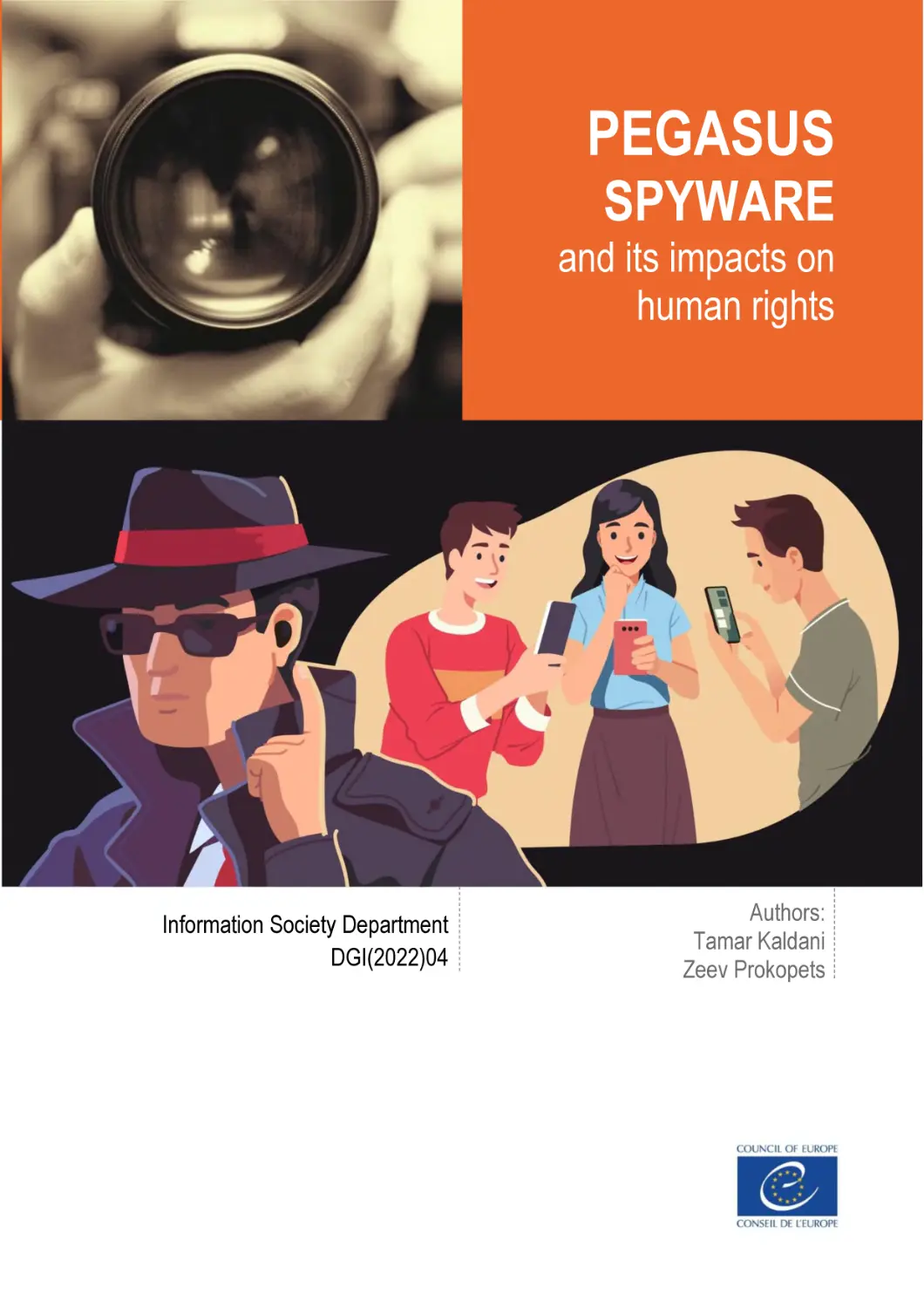
                    PEGASUS
SPYWARE
and its impacts on
human rights

Information Society Department
DGI(2022)04

Authors:
Tamar Kaldani
Zeev Prokopets

French edition:
Le logiciel espion Pegasus
All requests concerning the reproduction or
translation of all or part of this document should
be addressed to the Directorate of Communication
(F-67075 Strasbourg Cedex or publishing@coe.int).
All other correspondence concerning this
document should be addressed to the Directorate
General Human Rights and Rule of Law.
Layouts and Cover Page:
Information Society Department
Council of Europe
Images: Shutterstock
This publication has not been copy-edited by
the SPDP Editorial Unit to correct typographical
and grammatical errors.
© Council of Europe, June 2022

PEGASUS
SPYWARE
and its impacts on
human rights

Authors:
Tamar Kaldani
Introduction and
Impacts Chapters
Zeev Prokopets
Mobile phones survelliance andspyware
and Basic rules for better protection
Chapters

Council of Europe

Contents
Abbreviations and shortenings..................................................................................................2
Introduction.......................................................................................................................................3
1. Mobile phones surveillance and spyware.....................................................................5
How it works ..................................................................................................................... 7
Implications ....................................................................................................................... 8
Tells of infection .............................................................................................................. 8
2. Impact on the Right to Privacy...........................................................................................9
3. Impact on the Freedom of Expression ........................................................................ 15
4. Impact on Human Rights Defenders ............................................................................ 18
5. Impact on other Human Rights and Fundamental Freedoms ........................... 19
6. Basic rules of thumb for better protection................................................................ 21
ANNEX: More about NSO and Pegasus ............................................................................... 23

1

Abbreviations and shortenings

CoE

Council of Europe

Convention 108

Convention for the Protection of Individuals with regard to
Automatic Processing of Personal Data (ETS No. 108)

Convention 108+

Protocol amending the Convention for the Protection of
Individuals with regard to Automatic Processing of Personal
Data (CETS No. 223)

Court

The European Court of Human Rights

ECHR

The European Convention on Human Rights

EU

The European Union

PACE

The Parliamentary Assembly of the Council of Europe

UN

The United Nations

2

Introduction
Digital transformation and innovations in communication technologies enhanced
connectivity, inclusion and access to services and concurrently have also increased
opportunities for State surveillance and interference into individuals’ human rights and
fundamental freedoms. Recent revelations on the deployment of Pegasus spyware, including
in a number of Council of Europe states targeting journalists, human rights defenders and
politicians have raised a significant public outcry. Usage of such an intrusive technology not
only adversary affects the effective enjoyment of the right to privacy and freedom of
expression but also the notion of personal autonomy and even the physical integrity of
individuals. The surveillance practices disclosed so far could also damage the very principle of
the rule of law and credibility of democratic institutions.
Concerns about national security and criminal activities may justify the exceptional use of
communications surveillance technologies. Law enforcement and intelligence services have
legitimated aims to obtain necessary information, including through wiretapping and
metadata analysis or covertly directly from mobile devices, to prevent, investigate and
prosecute crime or combat threats related to national security. However, the State’s margin
for appreciation even “in the area of national security is no longer uniformly broad’.1 States
are bound by international2, regional3, and national human rights instruments. As a corollary
to the European Convention on Human Rights (ECHR) and relevant case law of the European
Court of Human Rights, member States have negative obligations, that is, to refrain from
interference with fundamental rights and positive obligations, that is, to actively protect these
rights. This includes the protection of individuals from action by non-state actors as well.4

1

Council of Europe / European Court of Human Rights, National Security and European Case-Law, 2013, page 2 168067d214 (coe.int)
2

Such as Universal Declaration of Human Rights and International Covenant on Civil and Political Rights

3

Such as the African Charter on Human and Peoples' Rights or the Inter-American human rights instruments and
system.
4

Declaration of the Committee of Ministers on Risks to Fundamental Rights stemming from Digital Tracking and
other Surveillance Technologies (Adopted by the Committee of Ministers on 11 June 2013 at the 1173rd meeting
of the Ministers’ Deputies), Paragraph 4.

3

Wide-scale usage of communication tapping, and secret surveillance always create the room
for potential arbitrariness on behalf of state authorities, threatening the effective enjoyment
of number of rights and fundamental freedoms, including the right to respect to private and
family life and communication (Article 8 of the ECHR) and freedom of expression (Article 10).
The consequences of mass or targeted surveillance tools such as Pegasus in authoritarian
regimes could be catastrophic. High-technology surveillance tools are already in use in a
number of authoritarian regimes and are used to track down opponents and to suppress
freedom of information and expression.5 Therefore, the development and deployment of
surveillance technologies must be accompanied by decent and effective legal safeguards that
ensure adequate protection for individuals and a fair balance between all interests concerned
and the rights and freedoms at stake.
Unfortunately, the Pegasus spyware scandal is not the first revelation on mass surveillance
and the use of intrusive technologies as espionage weapons against journalists, human rights
defenders, and politicians. Both large-scale and targeted intrusion practices undermine the
trust in state authorities allegedly using surveillance tools to target people against whom
there is no ground for suspicion of any wrongdoing and present substantial dangers to
democracy and the rule of law.
Allegations of arbitrary surveillance pertaining to a leaked list featuring more than 50,000
phone numbers, which was accessed by Forbidden Stories6 and Amnesty International7 in
2021, and recent alerts8 indicating widespread use of the Pegasus spyware across the world,
have triggered the launch of investigations and legal proceedings in a number of jurisdictions.

5

PACE Resolution 2045 (2015) on Mass surveillance, paragraph 8.

6

https://forbiddenstories.org/case/the-pegasus-project/

7

https://www.amnesty.org/en/latest/research/2021/07/forensic-methodology-report-how-to-catch-nsogroups-pegasus/
8

See as an example: https://www.politico.eu/article/europe-pegasus-spyware-eu-probe-nso/
https://www.euronews.com/next/2022/05/02/pegasus-spyware-spain-s-prime-minister-and-defence-ministers-phones-infected-by-spying-so
https://www.frontlinedefenders.org/en/statement-report/report-jordanian-human-rights-defenders-andjournalists-hacked-pegasus-spyware
https://www.hrw.org/news/2022/01/26/human-rights-watch-among-pegasus-spyware-targets

4

In March 2022 European Parliament established a new Committee of inquiry to investigate
the compliance of usage of Pegasus and other surveillance spyware with EU law and
fundamental rights.9 The Committee will call for relevant documents and seek testimony from
numerous stakeholders, including Member States’ intelligence services, elected politicians,
and senior officials. Within 12 months, the Committee is expected to present
recommendations for further action to be taken by the European Commission and national
governments.10 Speaking to the PACE Committee on Legal Affairs and Human Rights on the
14th of September 2021, the UN high commissioner for human rights asked states to place a
moratorium on the sale of such technology and “rein in the surveillance industry”.11
The present report is developed for the Council of Europe. It explains how Pegasus spyware
works and analyses the impact on human rights and fundamental freedoms, in particular the
right to privacy and freedom of expression. Furthermore, the report underlines the chilling
effect that Pegasus spyware has or potentially could have on other human rights and
fundamental freedoms, including the right to dignity, freedom of assembly, freedom of
religion, and even the physical and psychological integrity of an individual. The report places
a special emphasis on the legal instruments and well-established standards that the Council
of Europe has at its disposal to uphold fundamental rights and ensure stronger protections
against mass or targeted unlawful and unjustified surveillance. The report also provides basic
rules of thumb for better protection to minimise potential exposure not only to Pegasus but
also to other malicious attacks.

https://scroll.in/latest/1022972/pegasus-case-supreme-court-panel-seeks-response-from-dgps-of-all-states-onspyware-purchase
https://citizenlab.ca/tag/nso-group/
9

Press release on the launch of the EP inquiry committee - https://www.europarl.europa.eu/news/en/press-

room/20220412IPR27112/ep-inquiry-committee-for-pegasus-and-other-spyware-launched
10

https://www.aldeparty.eu/renew europe welcomes the inquiry committee on pegasus spyware scandal

11

Speech of the UN high commissioner for human rights https://www.ohchr.org/en/statements/2021/09/committee-legal-affairs-and-human-rights-parliamentaryassembly-council-europe

5

1. Mobile phones surveillance and spyware
In the last few decades, governments and associated agencies have invested enormous
efforts and substantial funds to ensure they can hack into every telecom network and device.
National security agencies used to have agreements with technology vendors under which
the companies would give the agencies special access to their products via backdoors. Some
of these agreements are still intact. Recently, awareness of digital security and privacy is rising
(Edward Snowden’s revelations about mass U.S. government surveillance was the first
wakeup call) and major companies no longer willing to provide governments with backdoors.
Companies like Apple (and many others) invest record budgets in security, develop features
like end-to-end encryption (and others) and put expert engineering teams to continuously
work on identification and timely fixes of security vulnerabilities. There are also bug-bounty
programs in which companies invite hackers to break into their products. These programs
offer quite attractive rewards for the detection of zero-day vulnerabilities,12 which can go up
to $100,000, and the problem is that zero-day vulnerabilities worth millions on the black
market.
These developments left governments unable to listen in, and desperate for a solution. The
needs of these governments and their virtually unlimited budget created an “industry” and a
market, in which hackers are continuously looking for exploitable vulnerabilities and vendors
are tirelessly working on fixing those same issues. The hackers that find the vulnerabilities sell
this information either to the vendors or to the highest bidder on the black market, the buyers
on the black market are the organisations that create spyware and then sell it to governments
and sometimes to other organisations.
This market is no different from any other market and is essentially driven by demand and
supply, as long as the demand is there (and actually growing) the supply will follow, and there
will always be someone to provide the goods. One of the most successful (and therefore
notorious) suppliers is NSO group, an Israeli spyware vendor and the creator of Pegasus.

12

Zero-day vulnerabilities are exploitable vulnerabilities that the vendor is not aware of, and therefore, there
are no patches or fixes available or underway.

6

Pegasus is a spyware that can be stealthily installed on a smartphone and gain access to
everything on it, including its camera and microphone.
Pegasus is designed for devices running Android, iOS, Windows, Blackberry and Symbian
operating systems and turns them into surveillance devices. NSO says it sells Pegasus only to
governments and only for the purposes of tracking criminals and terrorists.

How it works
The Pegasus spyware can infect the phones of targets through a variety of mechanisms. Some
approaches may involve a message (SMS, iMessage, WhatsApp, email) that includes a link to
a website. When clicked, this link delivers malicious software that infects the device.
Others use the zero-click attack or zero-click exploit where vulnerabilities in messaging
services for example allows for infection by simply receiving a message, while no user
interaction is required.
Apart from zero-click exploits, Pegasus uses “network injections”. A target’s web browsing
can leave them open to attack without the need for them to click on any malicious link. This
approach involves waiting for the target to visit a website that is not fully secured during their
normal online activities. Once they visit an unprotected site, the injection software can
intercept the transaction and trigger an infection.
However, this technique is more difficult to carry out than attacking a phone using a malicious
URL or a zero-click exploit, since the target’s cell phone use must be monitored until the
moment at which its internet traffic is unprotected. This is normally done through the target’s
mobile operator, which some governments can access or control. This reliance makes it
difficult or impossible for governments to target people outside their jurisdiction. Zero-click
exploits have no such limitations.
On top of these mechanisms, there is also a manual option, if an agent is able to gain physical
access to the target’s phone, the spyware can be installed manually. In all approaches, the
goal is to get full control of the mobile device’s operating system, either by rooting (on
Android devices) or jailbreaking (on Apple iOS devices).
Usually, rooting on an Android device is done by the user to install applications and games
from unsupported sources, or enable functionality that was blocked by the manufacturer.
7

Similarly, a jailbreak can be deployed on Apple devices to allow the installation of apps not
available on the Apple App Store, or to unlock the phone for use on alternative cellular
networks.
Rooting and jailbreaking both remove the security controls embedded in Android or iOS
operating systems and eventually allows the OS to run modified code.
In the case of spyware, once a device is unlocked, the intruder can deploy further software to
secure remote access to the device’s data and functions. The user is likely to remain
completely unaware, unless noticeable misbehaviours occur (see Tells of infection).
Earlier versions of Pegasus were installed on smartphones through vulnerabilities in
commonly used apps or by spear-phishing, which involves tricking a targeted user into clicking
a link or opening a document that secretly installs the software.
Since 2019, Pegasus users have been able to install the software on smartphones with a
missed call on WhatsApp and could even delete the log of the missed call, making it
impossible for the phone’s owner to know anything ever happened. Another way was by
simply sending a message to a user’s phone that produces no notification. Both of these
specific vulnerabilities were fixed shortly after the discovery; however, new undiscovered
vulnerabilities keep the zero-click exploit alive and kicking.
This means the latest version of this spyware does not require the smartphone user to do
anything. All that is required for a successful spyware attack is having a particular vulnerable
app or operating system installed on the device.

Implications
Once installed, Pegasus can theoretically harvest any data from the device and transmit it
back to the attacker. Pegasus can run any code it desires on the target’s device, use device’s
camera and mic by remote commands in real time, extract contacts, call logs, web searches,
web browsing history, text messages, photos, videos, settings, location records, as well as
information from apps such as iMessage, Gmail, Viber, Facebook, WhatsApp, Telegram, Skype
and others.
Pegasus also monitors the keystrokes on an infected device, all written communications,
including passwords are visible to the attacker.
8

Tells of infection
If you have a reason to believe you are being monitored, here is a list of “tells” that might
suggest your phone is infected:
1. Your phone suddenly becomes slower than usual.
2. Your phone occasionally shuts down by itself.
3. You need to charge your phone’s battery more often than usual.
4. You find unusual and unfamiliar folders or files on your device (mostly Android).
5. You’re often redirected to unknown sites.
6. Excessive pop-up ads appear while browsing.
7. Sudden increase in data usage.
8. Your phone has new/unfamiliar applications installed.
If you notice some of these behaviors on your phone, the relatively easy way to determine if
your phone is infected is to use the Amnesty International Mobile Verification Toolkit (MVT).
This tool can run under Linux or MacOS and can examine the files and configuration of your
mobile device by analysing a backup taken from the phone.
While the analysis won’t confirm or disprove whether a device is compromised, it detects
indicators of compromise, which usually provide enough evidence of infection.
In particular, the tool can detect the presence of specific software processes running on the
device, as well as a range of domains used as part of the global infrastructure supporting the
spyware network.

9

2. Impact on the Right to Privacy
As described above and according to the product description,13 the use of Pegasus does not
require cooperation with telecommunication companies, and it can easily overcome
encryption, SSL, proprietary protocols, and any hurdle introduced by the complex
communications worldwide. It enables monitoring of the voice and VoIP calls in real-time. It
provides remote, covert, and unlimited access to the target’s mobile devices and thus their
relationships, virtual identities, location, phone calls, text and voice messages, emails, photos,
videos, and other files, contacts, passwords, environmental wiretap, plans and activities that
reveal most sensitive information (inter alia about health, sexual life, political opinion,
religious or other beliefs) not only about the targeted individuals but also their children and
family members, colleagues, friends, clients, beneficiaries and other contacts.
This Modus Operandi of the Pegasus clearly reveals its capacity to be used for targeted as well
as indiscriminate surveillance. This is a prima facie interference with Article 8 of the ECHR and
undermines standards and approaches14 established by the European Court in its extensive
case law related to targeted communication surveillance and indiscriminate/bulk interception
of communication data.

13

Pegasus product description is available at: https://s3.documentcloud.org/documents/4599753/NSOPegasus.pdf
14

See also most recent cases: Big Brother Watch and Others v. the United Kingdom [GC], no. 58170/13, 25 May
2021; Centrum för rättvisa v. Sweden, [GC], no. 35252/08, 25 May 2021

10

First and foremost, any interference in privacy can only be justified under Article 8.2 if it:
a) is in accordance with the law, which should be accessible, foreseeable, precise and
sufficiently clear concerning rules, circumstances and conditions on which the
surveillance is authorised and carried out. Law must also provide adequate and
effective guarantees and supervision to prevent abuse and effective remedies for
individuals in case of abuse;15 The law must also be compatible with the principle
of the rule of law, which is expressly mentioned in the Preamble to the ECHR and
inherent in the object and purpose of Article 8.
b) pursues one or more of the legitimate aims to which Article 8.2 refers inter alia
national security, public safety … the prevention of disorder or crime,… ….”. The
notion of national security should be clearly interpreted by domestic law and
provide the scope of crimes/offences threatening the national security as well as
other severe or exceptionally severe crimes allowing authorities to use secret
surveillance measures to effectively prevent/investigate those crimes.
c) is necessary in a democratic society in order to achieve legitimate aims. State
authorities are under an obligation to ensure effective mechanisms (including
national courts, supervisory/monitoring mechanisms, public scrutiny) for avoiding
arbitrariness and securing a fair balance between the right to privacy and the
legitimate aim pursued by the interference. The strict necessity should only be
confirmed if the envisaged action is suitable to protect/preserve objectively a
democratic institution and subjectively is also susceptible to produce vital
intelligence in/for an ongoing investigation.
In the cases of Roman Zakharov v. Russia and Szabó and Vissy v. Hungary, the Court also noted
that where a power vested in the executive is exercised in secret, the risks of arbitrariness are
evident. It is therefore essential to have clear, detailed rules on secret surveillance measures,
especially as the technology available for use is continually becoming more sophisticated.

15

See also Roman Zakharov v. Russia [GC], no. 47143/06, 4 December 2015; Szabó and Vissy v. Hungary, no.
37138/14, 12 January 2016; Iordachi and Others v. the Republic of Moldova, no. 25198/02, 10 February 2009;
Rotaru v. Romania [GC], no. 28341/95, 4 May 2000; Kennedy v. the United Kingdom, no. 26839/05, 18 May 2010;
Association of European Integration and Human Rights and Ekimdzhiev v. Bulgaria, no. 62540/00, 28 June 2007.

11

The Court was firm in reiterating its standards established in earlier case law on the subject
matter that in order to effectively assess the necessity and reasonableness of any intrusion in
the private life or communication, any communication tapping or secret surveillance should
be authorized by an independent and impartial domestic authority being vested with the
relevant mandate. The authorisation authority’s must be capable of verifying the existence of
a reasonable suspicion against the person concerned, in particular, whether there are factual
indications for suspecting that person of planning, committing or having committed criminal
acts or other acts that may give rise to secret surveillance measures, such as, for example,
acts endangering national security. It must also ascertain whether the requested interception
meets the requirement of “necessity in a democratic society,” as provided by Article 8.2 of
the Convention, including whether it is proportionate to the legitimate aims pursued, by
verifying, for example, whether it is possible to achieve the aims by less restrictive means.16
When it comes to targeted communication tapping, the Court has developed the following
minimum requirements17 that should be set out in domestic law in order to avoid abuses
of power:
(i) the nature of offences which may give rise to an interception order;
(ii) a definition of the categories of people liable to have their communications
intercepted;
(iii) a limit on the duration of interception;
(iv) the procedure to be followed for examining, using and storing the data obtained;
(v) the precautions to be taken when communicating the data to other parties; and
(vi) the circumstances in which intercepted data may or must be erased or
destroyed.

16

See also Klass and Others v. Germany, no.5029/71, 6 September 1978

17

See also cases of Huvig v. France, no 11105/84, 24 April 1990; Kruslin v. France, no 11801/85 24 April 1990;
Valenzuela Contreras v. Spain, no. 27671/95, 30 July 1998, Weber and Saravia v. Germany no. 54934/00, 29
June 2006.

12

In the case of Roman Zakharov v. Russia, the Court confirmed that the same six minimum
safeguards also applied in cases where the interception was for reasons of national security;
however, in determining whether the impugned legislation was in breach of Article 8, the
Court also had regard to the arrangements for:
a) supervising the implementation of secret surveillance measures, any notification
mechanisms and
b) the remedies provided for by national law.
As to the approach of the Court in recent case law related to bulk interception,18 the Court
considers that the process must be subject to “end-to-end safeguards” to minimize the risk
of the bulk interception power being abused, meaning that, at the domestic level, an
assessment should be made at each stage of the process of the necessity and proportionality
of the measures being taken and to the legitimate aim pursued; that bulk interception should
be subject to independent authorisation at the outset, when the object and scope of the
operation are being defined; and that the operation should be subject to supervision and
independent ex post facto review. In that regard, particular emphasis was placed by the Court
on clearing and approving the selectors used by the authorities during bulk interception by
national courts or independent bodies vested with the relevant mandate. In the Court’s view,
these are fundamental safeguards which will be the cornerstone of any Article 8 compliant
bulk interception regime.19

18

See for example, Big Brother Watch and Others v. the United Kingdom [GC], no. 58170/13, 25 May 2021/

19

See also the report of the Venice Commission, which similarly found that two of the most significant
safeguards in a bulk interception regime were the authorisation and oversight of the process https://www.venice.coe.int/webforms/documents/default.aspx?pdffile=CDL-AD(2015)011-e

13

Along with Article 8 of the ECHR, European Court judgments, Resolutions of the Parliamentary
Assembly, including Resolution 2045 (2015) on Mass Surveillance20, and Declarations21 and
Recommendations22 of the Committee of Ministers, Convention 10823 - the only legally
binding international treaty in the data protection field with global relevance 24, sets the basic
principles for data protection, safeguards for individuals, and supervision over the data
processing operations, which are particularly important in the context of Pegasus or other
surveillance technologies.
Although the right to the protection of personal data is not an autonomous right among the
various Convention rights and freedoms, the European Court has acknowledged that the
protection of personal data is of fundamental importance to a person’s enjoyment of his or
her right to respect for private and family life, home and correspondence. Article 8 is the main
vector through which personal data is protected in the Convention system, even though
considerations related to this protection may also come into play under other provisions of
the Convention and its Protocols.25
Modernised Convention 108+ opened for signatures and ratifications in October 2018,
reaffirmed the importance of the original principles and laid down new ones, including
transparency, accountability, privacy by design and data protection impact assessment that
are particularly relevant in the context of Pegasus spyware. Convention 108+ requires
improved

data quality, increased protection for sensitive data, high level data security,

greater fairness, transparency and accountability from public authorities and private
companies, including developers and service providers, who should proactively demonstrate
compliance with the data protection rules.
20

http://assembly.coe.int/nw/xml/XRef/Xref-XML2HTML-en.asp?fileid=21692

21

See for example Declaration on Risks to Fundamental Rights stemming from Digital Tracking and other
Surveillance Technologies
https://rm.coe.int/CoERMPublicCommonSearchServices/DisplayDCTMContent?documentId=090000168068460
22

See for example Recommendations No. R (87) 15 Regulating the use of personal data in the police sector
https://search.coe.int/cm/Pages/result_details.aspx?ObjectID=09000016804e7a3c
23

https://www.coe.int/en/web/conventions/full-list?module=treaty-detail&treatynum=108

24

Convention 108 is ratified by 55 parties, including 9 non-Council of Europe members.

25

Guide to the Case-Law of the of the European Court of Human Rights – Data Protection, First edition 31 December 2020, page 4. Guide to the Case-Law - Data protection (coe.int)

14

It establishes stronger requirements regarding the lawfulness of the processing,
proportionality, purpose limitation and data minimisation, recalling that data processed
should be adequate, relevant, and not excessive. The proportionality principle also applies in
respect of the means and methods deployed during the surveillance.
The Convention 108+ empowers individuals with stronger control over their data and
enhanced rights. Along with other obligations, data controllers must implement the “privacy
by design” in product or service development as well as examine prior the likely impact of
data processing on human rights and fundamental freedoms.
It is important to recall that parties to the Convention 108+ will no longer be able to exclude
from the scope of application of the Convention certain types of processing such as national
security and defence. The possible exceptions to a limited number of principles such as
transparency are subject to the conditions set by the Convention, and in any case,
independent and effective review and supervision should be guaranteed. The Convention
108+ also reinforces investigative and corrective powers and the independence of the data
protection authorities. It also enhances their international cooperation and opportunities for
joint actions and investigations, including against unlawful and unjustified usage of
sophisticated surveillance technologies.
In order to protect individuals and the society as a whole from unlawful interference with
human rights and notably with the right to privacy the standards established by Convention
108+ could as of now be used and implemented by state authorities carrying out similar
activities.

3. Impact on the Freedom of Expression
An investigation report released by a global consortium26 revealed that 200 journalists
worldwide had been targeted using Pegasus spyware. The Office of the Special Rapporteur
for Freedom of Expression (SRFOE) of the Inter-American Commission on Human Rights
(IACHR) also noted the number of victims of attempted spying through Pegasus, including
Mexican journalists, human rights defenders and opposition leaders.27 “The numbers vividly
26

https://forbiddenstories.org/pegasus-the-new-global-weapon-for-silencing-journalists/

27

Press release R303/21 https://www.oas.org/en/iachr/expression/showarticle.asp?artID=1218&lID=1

15

show the abuse is widespread, placing journalists’ lives, those of their families and associates
in danger, undermining freedom of the press and shutting down critical media,” - said
Secretary-general of Amnesty International.
The right to freedom of expression and information, as guaranteed by Article 10 of the
Convention, constitutes one of the essential foundations of a democratic society and one of
the basic conditions for its progress and the development of every individual. Freedom of
expression is applicable not only to “information” or “ideas” that are favourably received or
regarded as inoffensive or as a matter of indifference but also to those that offend, shock or
disturb the State or any sector of the population. Any interference with the right to freedom
of expression of journalists and other media actors therefore has societal repercussions as it
is also an interference with the right of others to receive information and ideas and an
interference with public debate.28
While the right to freedom of expression is not absolute, an interference with this right is only
permitted if it is prescribed by law, pursues one of the legitimate aims set out in Article 10,
paragraph 2 of the Convention, is necessary in a democratic society – which implies that it
corresponds to a pressing social need – and is proportionate to the legitimate aims pursued.
The surveillance of journalists and other media actors, and the tracking of their online
activities, can endanger the legitimate exercise of freedom of expression if carried out
without the necessary safeguards. They can also threaten the safety of the persons concerned
and undermine the protection of journalists’ sources. In order for systems of secret
surveillance to be compatible with Article 8 of the Convention, they must contain adequate
and effective safeguards against abuse, including independent supervision, since such
systems designed to protect national security entail the risk of undermining or even
destroying democracy on the ground of defending it.29

28

Recommendation CM/Rec(2016) 4 of the Committee of Ministers to member States on the protection of
journalism and safety of journalists and other media actors https://search.coe.int/cm/Pages/result_details.aspx?ObjectId=09000016806415d9#_ftn1
29

Ibid

16

The European Court has always subjected the safeguards for respect of freedom of expression
in cases under Article 10 of the ECHR to special scrutiny. The safeguards to be afforded to the
press are of particular importance, and the protection of journalistic sources is one of the
cornerstones of freedom of the press. Without such protection, sources may be deterred
from assisting the media in informing the public about matters of public interest. As a result,
the vital public watchdog role of the press may be undermined, and the ability of the press to
provide accurate and reliable information may be affected adversely.
Allegations revealed that Pegasus was used to target journalists and their confidential
sources. This has a detrimental impact not only for confidential sources and whistle-blowers
but also on the media outlets, whose reputation could be negatively affected in the eyes of
future potential sources, and on members of the public, who have an interest in receiving
information imparted through anonymous sources.
The European Court in a number of decisions30 has addressed the risks related to bulk
interception through a strong selector connected to journalists. The Court considered that
such interference will be commensurate with that occasioned by the search of a journalist’s
home or workplace; regardless of whether or not the intention is to identify a source, the use
of selectors or search terms connected to a journalist would very likely result in the acquisition
of significant amounts of confidential journalistic material which could undermine the
protection of sources to an even greater extent than an order to disclose a source.
Therefore, in the case of Big Brother and others v. the United Kingdom31 the Court considered
that before the intelligence services use selectors or search terms known to be connected to
a journalist, or which would make the selection of confidential journalistic material for
examination highly probable, the selectors or search terms must have been authorised by a
judge or other independent and impartial decision-making body invested with the power to
determine whether they were “justified by an overriding requirement in the public interest”
and, in particular, whether a less intrusive measure might have sufficed to serve the
overriding public interest.

30

See, inter alia, Goodwin v. the United Kingdom, no.17488/90, 27 March 1996; Sanoma Uitgevers B.V. v. the
Netherlands [GC], no. 38224/03, 14 September 2010.
31

Ibid

17

Court also noted that even where there is no intention to access confidential journalistic
material, and the selectors and search terms used are not such as to make the selection of
confidential journalistic material for examination highly probable, there will nevertheless be
a risk that such material could be intercepted, and even examined, as a “bycatch” of a bulk
interception operation.

4. Impact on Human Rights Defenders
Along with journalists, Pegasus revelations confirm that human rights defenders are one of
the key targets being subjected to secret surveillance. Various international32 and civil society
organizations expressed deep concerns towards targeting, intimidating, and retaliating
against human rights defenders and called to provide a safe and enabling environment and
ensure their protection, which, among other recommendations, called on States to refrain
from using surveillance technologies to target human rights defenders. 33
Surveillance technologies are often used to target human rights defenders to dissuade
them from continuing their human rights work, to infiltrate their networks, and to gather
information for use against other targets. Intrusion with the privacy of human rights
defenders negatively affects not only the personal privacy of the individuals but threatens to
pose the harm to their inner and outer circle, compromise their dignity and reputation, and
expose them, their family members and beneficiaries to the greater risks of threats,
aggression and violence.
A digital forensic investigation carried out by Front Line Defenders and Citizen lab has
uncovered specific gender-related dangers. Pegasus spyware on the mobile devices of four
Jordanian human rights defenders, including a woman human rights defender, lawyer and
journalist working against corruption.34

32

Resolution adopted by the General Assembly on 16 December 2021 on the Seventy-sixth session, on the
report of the Third Committee (A/76/462/Add.2, para. 114)] 76/174. https://documents-ddsny.un.org/doc/UNDOC/GEN/N21/403/46/PDF/N2140346.pdf?OpenElement
33

https://www.frontlinedefenders.org/en/statement-report/action-needed-address-targeted-surveillancehuman-rights-defenders
34

https://www.frontlinedefenders.org/sites/default/files/jordanpegasusreport.pdf

18

Another set of cases of hacking of two women human rights defenders from MENA region
using Pegasus spyware was identified by Access Now and Front Line Defenders.35
The impact of targeted surveillance on women can be given that political, societal, and
gender power asymmetries often grant authorities opportunities to weaponize the
information they extract through defamation, blackmail, and doxing. This can include the
publishing of private and intimate photos and conversations online.36 As a result, women,
targets of surveillance, live in a perpetual state of fear and become socially isolated and
restricted in their social lives, work, and activism. As expressed by one of the victims “personal freedoms are over for me, they no longer exist. I am not safe at home, on the street,
or anywhere.”37

5. Impact on other Human Rights and Fundamental Freedoms
Human rights and fundamental rights are interconnected and mutually reinforcing.
Therefore, intrusive surveillance technologies have a chilling effect on other human rights and
fundamental freedoms and not only on the right to privacy and freedom of expression.
For example, the right to health may also be affected by digital surveillance practices as
individuals may refrain from sharing sensitive health-related data with health professionals,
fearing that confidentiality could be compromised. Freedom of religion could also be
impacted, especially if the seal of confession and privileged communication with religious
ministers are intercepted. Individuals could also refrain from exercising their right to freedom
of assembly and association with others, including the right to form or join a not-for-profit
organization with political, philosophical, religious or trade union aims.
Targeted or mass surveillance also creates a climate of self-censorship. Fearing that each
action and move is under scrutiny, people will be less likely to communicate about specific
topics online or offline. The chilling effect of surveillance could also lead to social isolation.

35

https://www.accessnow.org/women-human-rights-defenders-pegasus-attacks-bahrain-jordan/

36

Ibid

37

https://www.amnesty.org/en/latest/research/2021/11/devices-of-palestinian-human-rights-defendershacked-with-nso-groups-pegasus-spyware-2/

19

Targets, as well as their relatives and friends, might refrain from interactions in fear of being
harmed or surveilled. More importantly, real-time access to location and communication data
could also pose a life-threatening risk to the individual and endangers its physical and mental
integrity.
The growing concerns about the politically motivated use of spyware, followed by the reports
about the arbitrary detention, torture, and possibly even extrajudicial killings of political
opponents, journalists and human rights activists38 call for immediate, thorough, effective
and independent investigations and strengthened legal safeguards, including independent,
impartial, and effective supervisory mechanisms. Civil society organisations also call for a
moratorium on the sale, transfer and use of Pegasus until compliance with human rights
standards can be guaranteed. They urge states to implement legislation that imposes
safeguards against human rights violations and abuses through digital surveillance and
establishes accountability mechanisms designed to provide victims of surveillance abuses a
pathway to remedy.39

38

https://www.amnesty.org/en/documents/doc10/4516/2021/en/

39

Ibid

20

6. Basic rules of thumb for better protection
There are no absolute solutions, especially when facing zero-click exploits. There are,
however, measures you can take to minimise your potential exposure — not only to Pegasus
but to other malicious attacks as well.
1. There are indications that infections, in some cases (mostly on Apple devices) were
not persistent, meaning did not survive phone reset, but were re-introduced (as zeroclick exploits) as needed. This means that frequent reset of your phone may remove
non-persistent malware, at least temporarily.
2. Only open links from known and trusted contacts. Pegasus and other malware use
iMessage and SMS to send links that lead to the download and installation of the
spyware. The same applies to links sent via email or other messaging applications.
Especially avoid “unsubscribe” links from suspicious sources, as one of the known
methods is to send spam messages just to frustrate the target, then send another
message telling them to click unsubscribe to stop receiving the spam. Many targets
cheerfully click the unsubscribe link, which causes the actual infection.
3. Make sure your device is updated with the most recent software. These updates often
include bugs and security vulnerabilities fixes. If you use Android, don’t rely on
notifications for available updates, check for the latest version yourself, as your
device’s manufacturer may not be providing updates.
4. As obvious as it may sound, you should limit physical access to your phone by enabling
pin, finger or face-ID on the device.
5. As much as possible, avoid public and free WiFi services (including hotels). If you must
use public WiFi, use VPN while on the public network and avoid accessing sensitive
information.
6. Encrypt your device data and enable remote-wipe features where available. If your
device is lost or stolen, your data still remain safe.
7. When communicating using end-to-end encrypted messaging apps, turn on
disappearing messages.

21

8. Where possible, do not use your personal or work devices, SIM cards and email
account to contact sensitive sources. If possible, buy devices and SIM cards and create
a new email account specifically for communicating with them.
9. Your device can be used to locate you and your confidential source. If meeting in
person, leave your phones behind and meet in a neutral location (noting the possibility
of being monitored via CCTV) that cannot be associated with your or your source’s
home or work address.
10. Remove metadata from sensitive files and photos before sharing them with others. A
file’s metadata can provide information about the person who created or sent it and
the device used.

22

ANNEX: More about NSO and Pegasus
• NSO group is an Israeli company, regulated by the Israeli government. Officially
NSO group states that it sells only to government agencies, only to
preapproved countries, and only for counterterrorism and law enforcement
use.
• Countries which are known users of Pegasus (partial list): Mexico, the first NSO
customer, used Pegasus back in 2011 to track notorious drug baron Joaquín “El
Chapo” Guzmán, United Arab Emirates, Saudi Arabia, Spain, Poland, Panama,
Netherlands, Morocco, India, Israel, Germany, Hungary, Bahrain, Azerbaijan,
Armenia.
• The price point of Pegasus is quite high: an indication from 2016 suggests a
$600K annual fee on top of a $500K setup fee for a system capable of tracking
10 targets simultaneously.
• NSO group 2020 revenue was $243M

23

This report provides a technical description of the
Pegasus spyware and analyses the impact it may have
on human rights and fundamental freedoms, in
particular the right to privacy and freedom of
expression. Furthermore, the report underlines the
chilling effect that Pegasus spyware has or potentially
could have on other human rights and fundamental
freedoms, including the right to dignity, freedom of
assembly, freedom of religion, and even the physical
and psychological integrity of an individual. The report
places a special emphasis on the legal instruments
and well-established standards that the Council of
Europe has at its disposal to uphold fundamental
rights and ensure stronger protections against mass
or targeted unlawful and unjustified surveillance. It
also provides the basic rules of thumb for better
protection for individuals.
Tamar Kaldani has served as the Personal Data
Protection Inspector and the State Inspector of
Georgia and is currently the first Vice-chair of the
Consultative Committee of Convention 108.
Zeev Prokopets is an Israeli executive, product
designer, software developer and entrepreneur
(Link7).

www.coe.int

The Council of Europe is the continent’s leading human rights
organisation. It comprises 46 member states, including all
members of the European Union. All Council of Europe
member states have signed up to the European Convention on
Human Rights, a treaty designed to protect human rights,
democracy and the rule of law. The European Court of Human
Rights oversees the implementation of the Convention in the
member states.