/
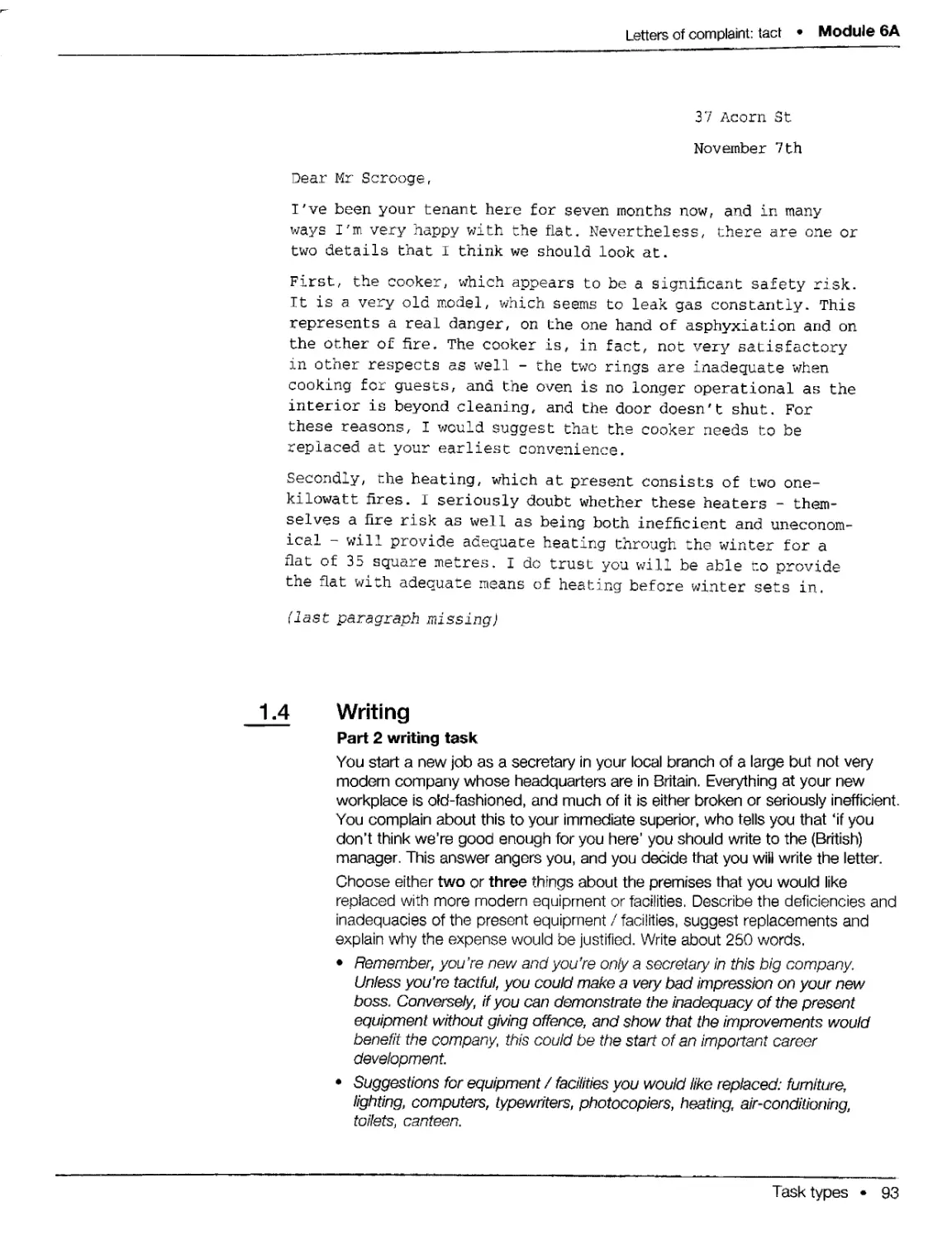
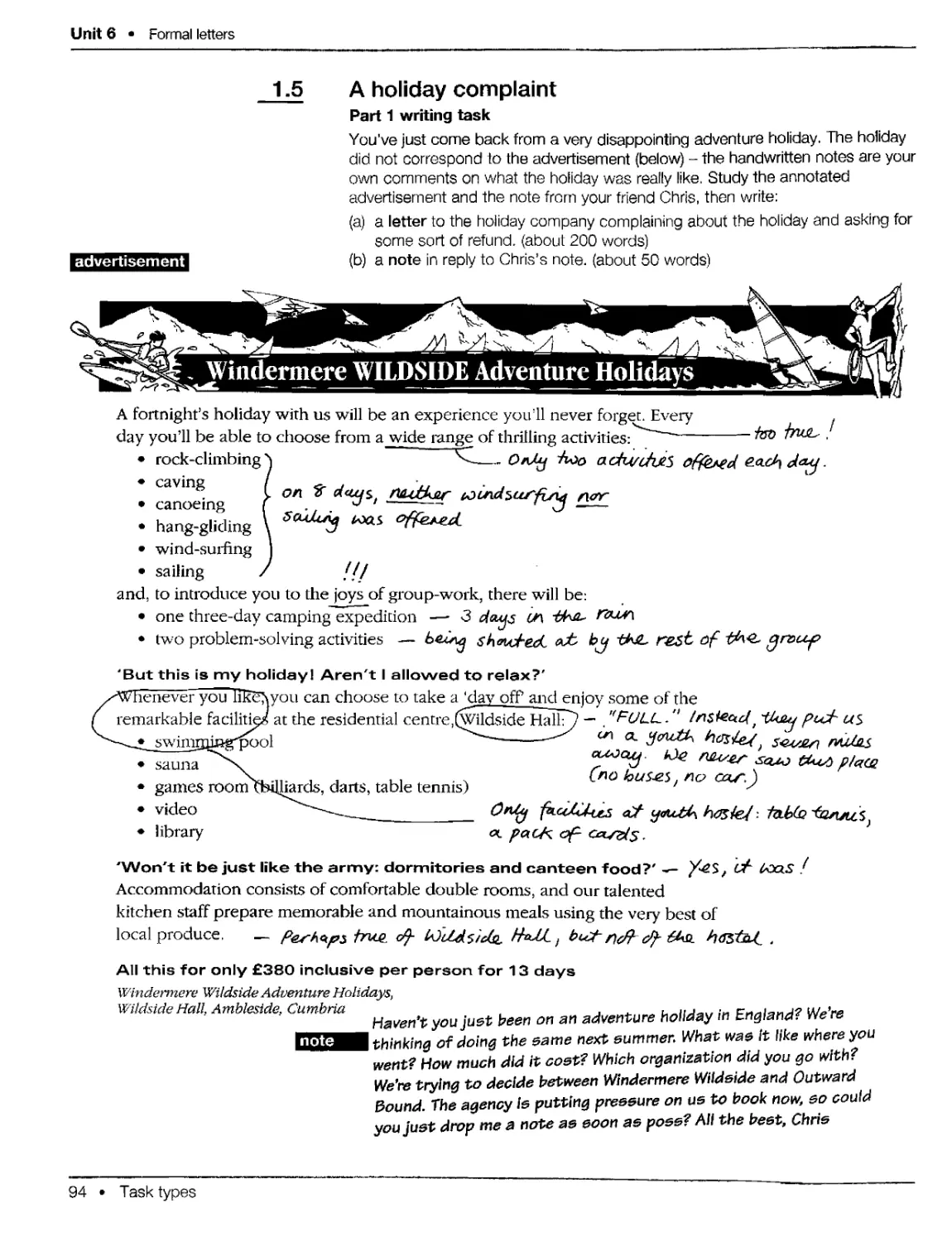
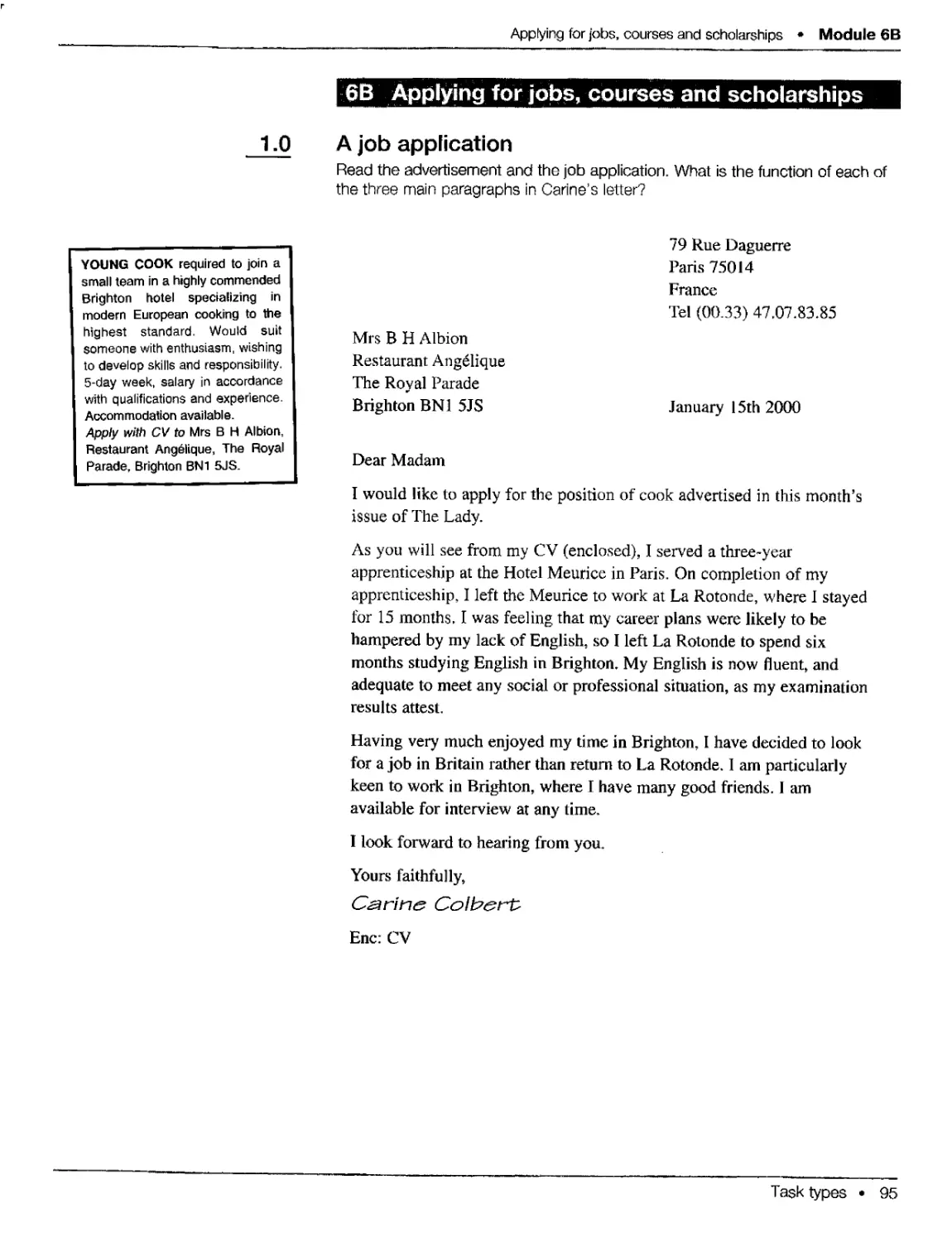
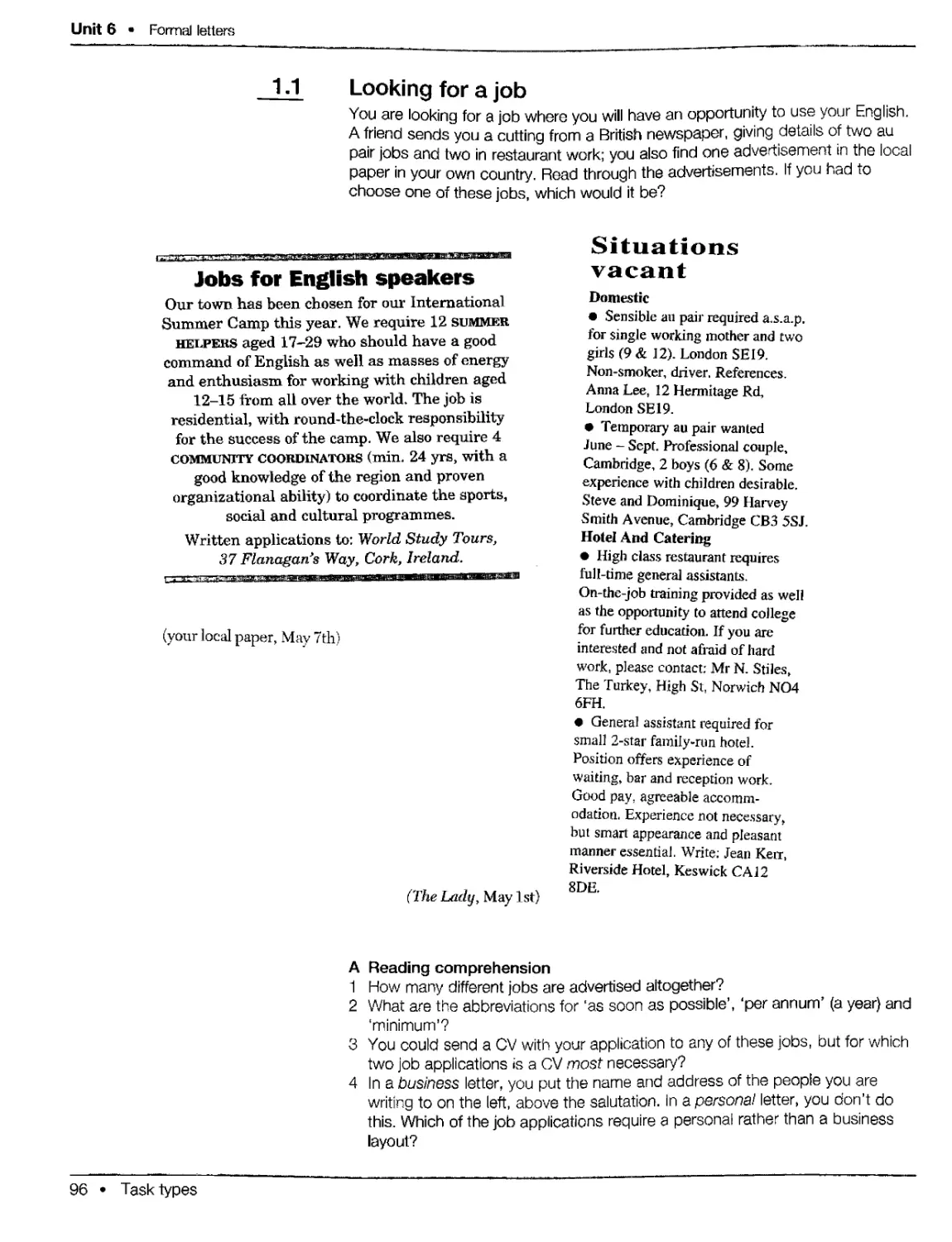

Автор: Cory H.
Теги: english english grammar english language oxford university press writing in english
Год: 1999
Текст
                    Advanced
Writing
with English in Use
CAE
Hugh Cory

Advanced
Writing
with English in Use
CAE
Hugh Cory
NEW EDITION
OXEORD
UNIVERSITY PRESS

OXFORD
UNIVERSITY PRESS
Great Clarendon Street, Oxford 0x2 6dp
Oxford University Press is a department of the University of Oxford.
It furthers the University's objective of excellence in research, scholarship,
and education by publishing worldwide in
Oxford New York
Auckland Cape Town Dar es Salaam Hong Kong Karachi
Kuala Lumpur Madrid Melbourne Mexico City Nairobi
New Delhi Shanghai Hupei Toronto
With offices in
Argentina Austria Brazil Chile Czech Republic France Greece
Guatemala Hungary Italy Japan Poland Portugal Singapore
South Korea Switzerland Thailand Turkey Ukraine Vietnam
oxford and oxford English are registered trade marks of
Oxford University Press in the UK and in certain other countries
© Oxford University Press 1999
The moral rights of the author have been asserted
Database right Oxford University Press (maker)
First published 1999
2009 2008 2007 2006 2005
10 9 8 7 6 5
No unauthorized photocopying
All rights reserved. No part of this publication may be reproduced,
stored in a retrieval system, or transmitted, in any form or by any means,
without the prior permission in writing of Oxford University Press,
or as expressly permitted by law, or under terms agreed with the appropriate
reprographics rights organization. Enquiries concerning reproduction
outside the scope of the above should be sent to the ELT Rights Department,
Oxford University Press, at the address above
You must not circulate this book in any other binding or cover
and you must impose this same condition on any acquirer
Any websites referred to in this publication are in the public domain and
their addresses are provided by Oxford University Press for information only.
Oxford University Press disclaims any responsibility for the content
ISBN-13: 978-0-19-453426-0
ISBN-10: 0-19-453426-X
Printed in China
ACKNOWLEDGEMENTS
The Publisher and author are grateful to the University of Cambridge
Local Examinations Syndicate for permission to reproduce the
assessment criteria for CAE Paper 2 on page 8.
The Publisher and author are grateful to those who have given
permission to reproduce the following extracts and adaptations of
copyright material:
The Fakirs of India and Charles Charlesworih from Tales of the Wterrd:3
by Ralph Steadman (Jonathan Cape 1990)
Getaway Car reproduced with permission, © Saatchi & Saatchi
Advertising Limited
It loves the city reproduced with permission, © Fiat Auto (U.K.) Ltd
Advertisement with kind permission of Stoves
Faxes, Phones and Foreigners, © British Telecommunications pic, by
permission
Adapted from The Right way to keep Rabbits by Roy Robinson (1980)
Song Jfom the Forest by Sue Gaisford; LA Riots Report by John
Lichfield; The golden hoard that lost its glitter by Marianne MacDonald;
The sadist who destroyed me by Danny Danziger and Raidersjiagged
down police ear, all reproduced courtesy of © The Independent
Short extracts taken from Morocco, Algeria and Tunisia by Crowther
and Findlay, © Lonely Planet
So/t Centre in a Chocolate, © Reader's Digest, by permission
Breaking Step by Luke Jennings; Killers; Genesis, Earl's Court by Adam
Sweeting: Doctor; Francis James by George Ivan Smith; How a Metal
Detector Works and How a Fire Extinguisher Works, all taken from
© The Guardian
Mentors and Tormentors by Margaret Forster, source: The Oldie
The Roots of the Blues by Samuel Charters, © Marion Boyars
Publishers Ltd London and New York
Which? Magazine (To find out more, including how to get Which? free
for 6 months, please write to Dept 3A, FREEPOST, 2 Marylebone
Road, London NW1 4DF or telephone free on 0800 252100.)
The Piano and Overall, reviews by Paul Sussman and Stir Crazy, review
by Tabitha Jeffs, © The Big Issue
Agony column by Irma Kurtz and Film review Howard's End by Derek
Malcolm couitesy of Cosmopolitan/© National Magazine Company
How is it done?, Reader's Digest, by permission
Letter courtesy of RE Potter
Leaflet produced by The Society of Homeopaths
War on Want advertisement in New Internationalist, by permission
The Chinese Gold Murders by Robert Van Gulik (1959), © Penguin
The Best of British, © Barry Norman 1993, with permission of Curtis
Brown
A bargain voyage into space by Roger Bell, © The Independent
Angella Johnson, © The Guardian
Rovaniemi Brochures
Punctuation for Now by John McDermott, with permission of
© Macmillan Ltd
Rock of Ages by Lynne Reid Banks, © The Guardian, by permission
Hunting Mr Heartbreak by Jonathan Raban
Although eveiy effort has been made to trace and contact copyright
holders before publication, this has not been possible in the following
cases. We apologize for any apparent infringement of copyright and if
notified, the publisher will be pleased to rectify any errors or omissions
at the earliest opportunity.
Prince Peter Kropotkin
Au bon coin
Welcome to Oxford, source: Southern Tourist Board
Welcome to the Landes, source: Departement du Tourisme des Landes
The Publisher and author would like to thank the following for
permission to reproduce photographs:
Agence Rapho/Robert Doisneau p42
Andes Press Agency/Carlos Reyes Manzo p65, 77
Bamaby's Picture Library p56/Gordon Loraine p57
Bridgematl Art Library/Musee D'Orsay, Van Gogh Bedroom at
Arles/Giraudon p84
Brighton and Hove Libraries/M. Sullivan p81
Finnish Tourist Board pi 36
French Picture Libraiy/Barrie Smith pl37
Hulton Getty Picture Collection/B. Hardy pBl
Magnum Photos/Rene Burn p42
Pomegranate Publications/Cherie Nutting p81
Still pictures/J. Baine p.138
Illustrations by:
Anna Brookes p49, Ray and Corinne Burrows p52, Neil Gower p94,
132, 133, Jaqueline Pestell p80, Ralph Steadman p34, Harry Venning
pl3, 19, 22, 26, 27, 41, 104, 110.
The Publisher and author would also like to thank all those who
participated in the research and development of the book, in particular
the following for their valuable advice:
Caroline Coate, Sara Evans/Cultura Inglesa Copacabana, Diane
Fleming, Rosalie Kerr, Ann Whitfield, Simon Williams.
The author would especially like to thank the following for their help and
support: my colleagues at Eurocentre Cambridge, notably Rhiannon
Williams and Claire Anderson who piloted material: my students at
Eurocentre, who were the motivation for this book and the source of
many of the ideas; the staff of Newnham Language Centre, Cambridge,
and the Cambridge Academy, Girton, for their help in piloting material;
Peta Gray, Annette Capel; Felicity O’Dell; and last but not least,
Raffaela Bonacirsa.

Introduction
Aims of the book
This book has two objectives:
1	to prepare you for the CAE exam Paper 2 (Writing)
and Paper 3 (English in Use).
2	to develop your practical writing skills to an advanced
level.
There is no conflict between these two objectives,
because CAE writing tasks are as close to real-life
situations as possible, and the examiners use
real-life criteria in assessing candidates’ work. If a piece
of writing would ‘do the job’ effectively in real life, it
should also satisfy the examiners.
Why combine Papers 2 and 3?
For those unfamiliar with the CAE exam, it may seem
surprising that this book combines Paper 3 (the
'grammar' paper) as well as Paper 2 (the ‘writing1 paper).
In fact, this combination is inevitable, given the many
areas the two papers have in common, A characteristic
of the CAE exam is that grammar is tested in context.
Paper 3 tests the ability to use grammar in order to
communicate, and focuses on many of the key areas of
written communication - including register, cohesion,
and even punctuation.
The Paper 3 exercises:
•	provide exam practice for Paper 3.
•	are integrated with the Paper 2 work, as controlled
practice in writing skills.
•	are models (well written, well organized, and usually
about 250 words long), which may be referred to when
doing the writing tasks that follow them.
•	demonstrate different registers and explore different
aspects of the theme of the Unit.
•	are usually based on authentic texts.
How the book is organized
Part 1: the first part of the book contains an introduction
to CAE Papers 2 and 3, followed by preliminary work on
three key areas of writing skills at this level: style and
register, cohesion, and punctuation, It is intended that
this part of the book should be used for preparatory
work, remedial work, and reference.
Part 2: Units 1-5 divide writing into types (descriptions,
instructions, narrative and argument), to develop the
skills specific to each type. At the same time, each Unit
looks at a variety of registers, to focus on the importance
of the context and the purpose of a piece of writing.
Part 3: Units 6-10 cover all the writing task types in the
CAE Paper 2 syllabus.
Task bank: a further selection of writing tasks, indexed to
the appropriate units.
Key: answers to all exercises and Paper 3 questions.
Model answers to Paper 2 Part 1 tasks.
Working through the book
It is suggested that you work through Units 1-5 before
going on to Units 6-10, as each writing task in Units
6-10 practises skills that have been developed in one or
more of the first five units. Nevertheless, as there is no
progression through the book in terms of difficulty, and
as Units 1-5 also contain writing tasks in the style of the
exam, the Units may be taken in any order.
Classroom work and self study
This book can be used in class, for self study, or for a
combination of the two.
In class
Each Unit is divided into modules which can be taught in
class in about 90 minutes (plus homework).
Explanations, presentations and activities are followed by
Paper 3 exercises and either mini writing tasks or full-
scale Paper 2 tasks. Suggestions for pairwork are
sometimes included when an exercise would be more
enjoyably done with a partner; many other exercises can
also be done in pairs and groups.
For self-study
Many features of the book make it especially useful for
self study:
•	the introductory units, with their thorough treatment of
register, style, cohesion and punctuation.
•	the use of Paper 3 writing tasks as controlled writing
practice, easily corrected with the key when working
without a teacher.
•	the inclusion of model texts in the form of Paper 3
tasks, and the inclusion of model answers in the key,
•	the fact that it is self-contained: it is the student's
book, the teacher’s book and the key all in one.
Non-exam use
Because of the ‘reaf-life’ nature of the CAE writing
syllabus and assessment criteria, this book can be used
just as successfully as a general writing course at
advanced level focusing on practical writing tasks.
3

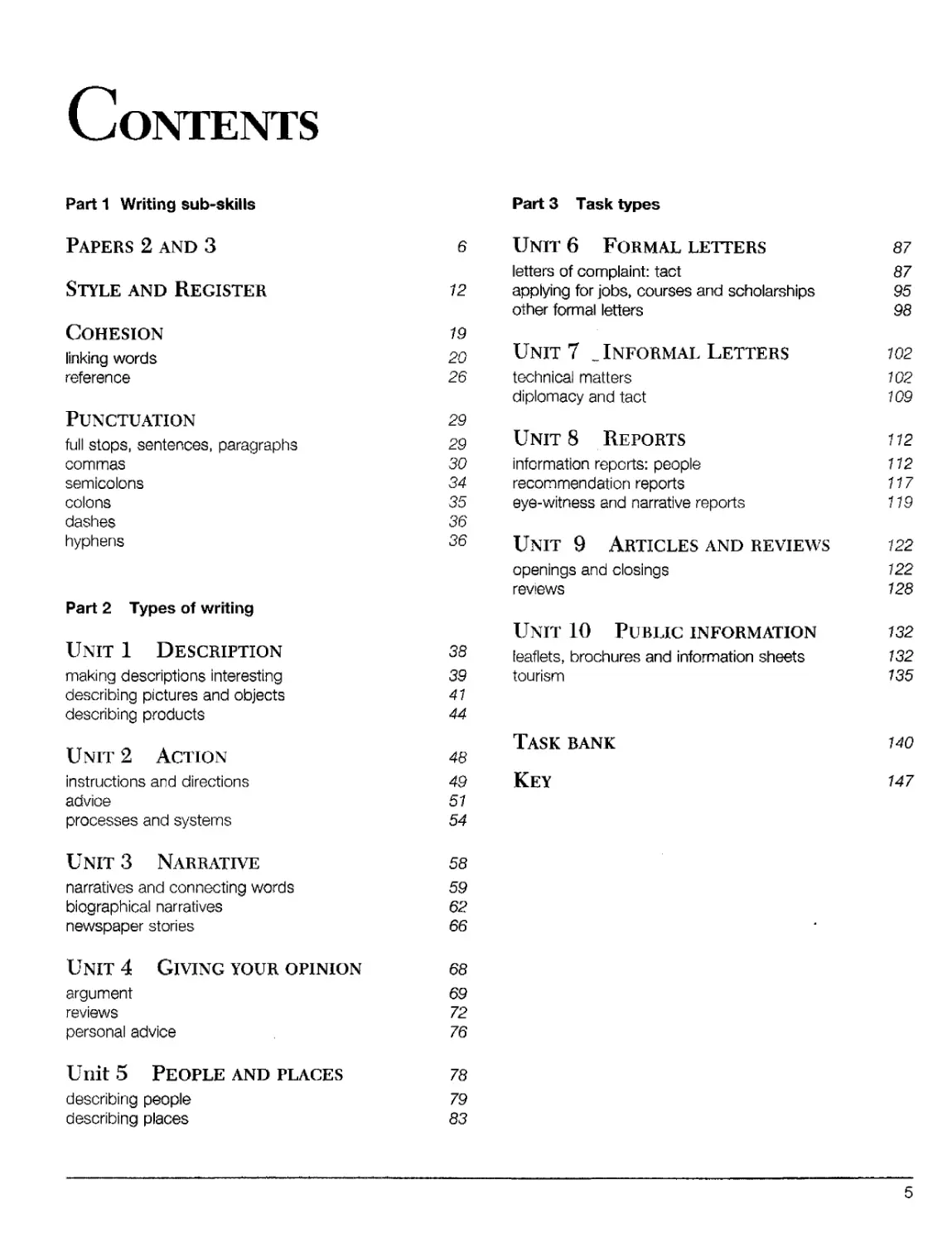
Contents
Part 1 Writing sub-skills
Papers 2 and 3
6
Style and Register
12
Cohesion
19
linking words
20
reference
26
Punctuation
29
full stops, sentences, paragraphs
29
commas
30
semicolons
34
colons
35
dashes
36
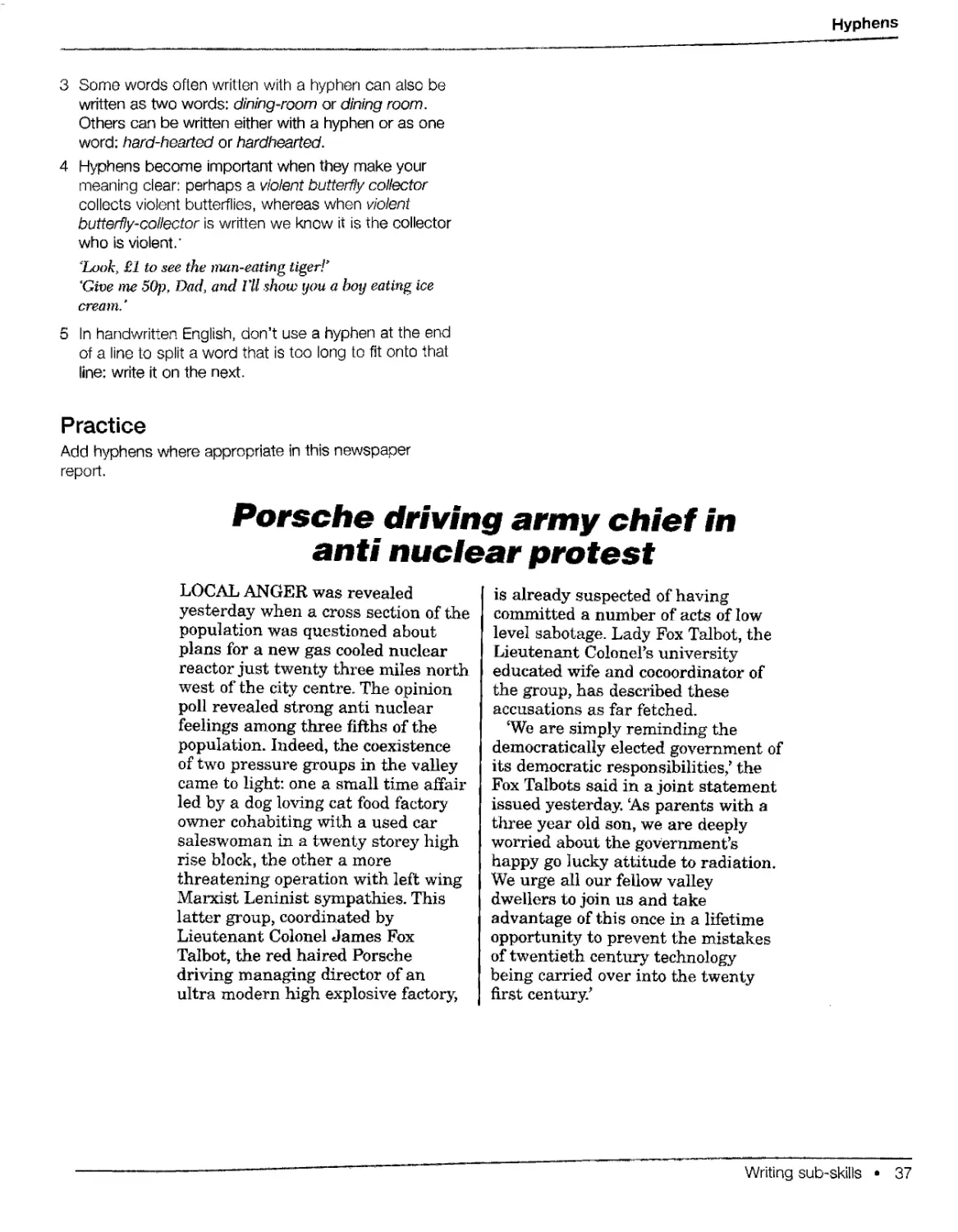
hyphens
36
Part 2 Types of writing
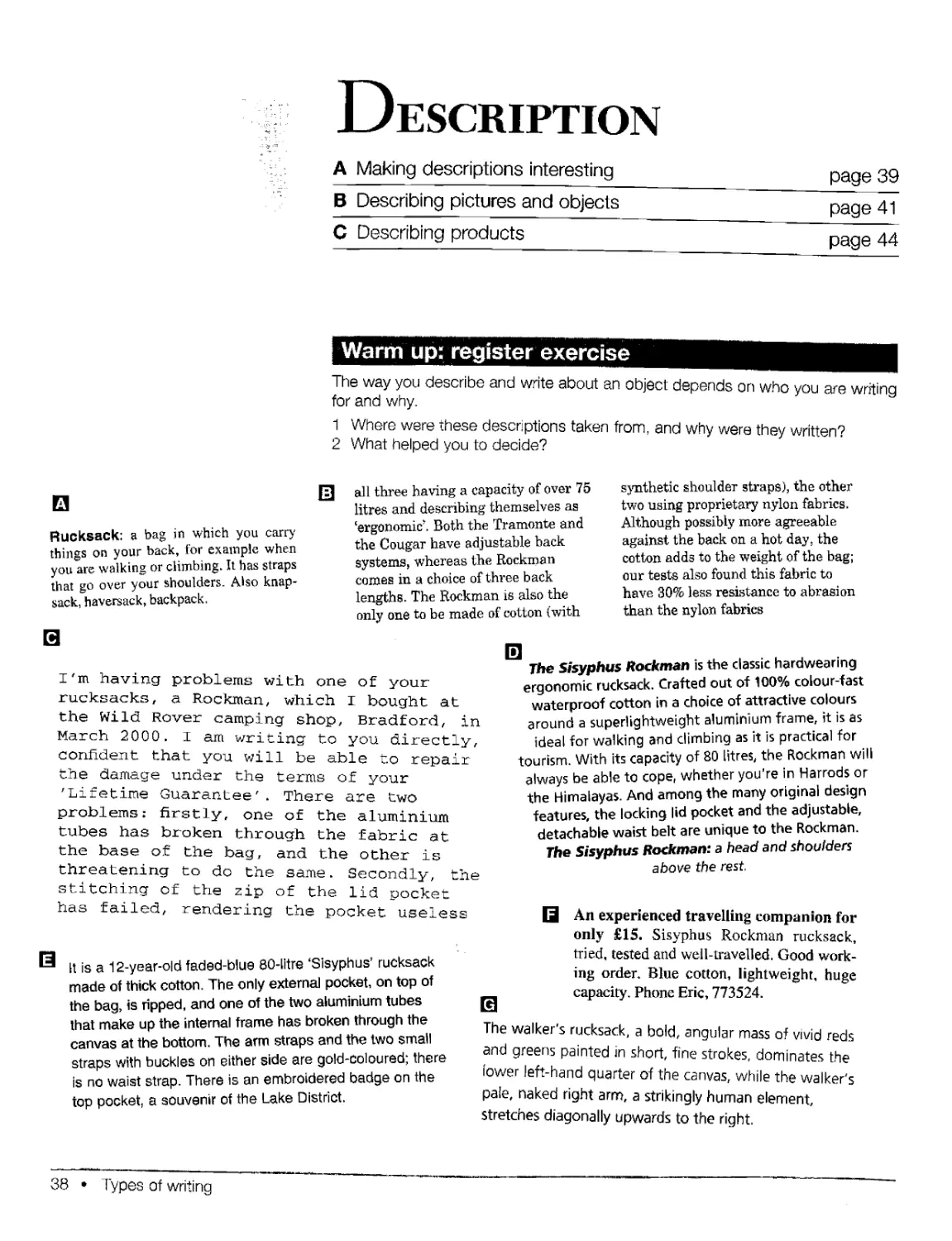
Unit 1	Description	38
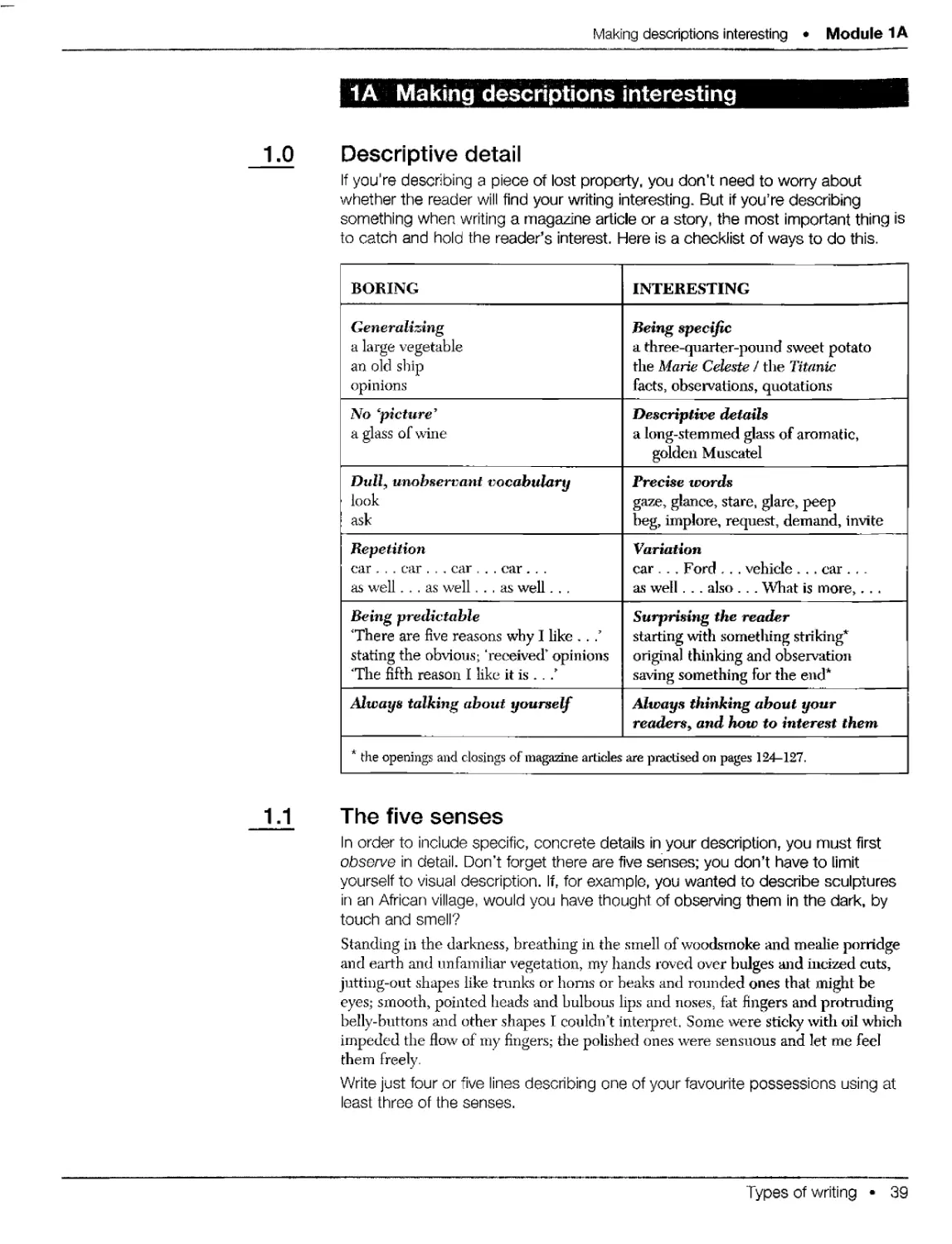
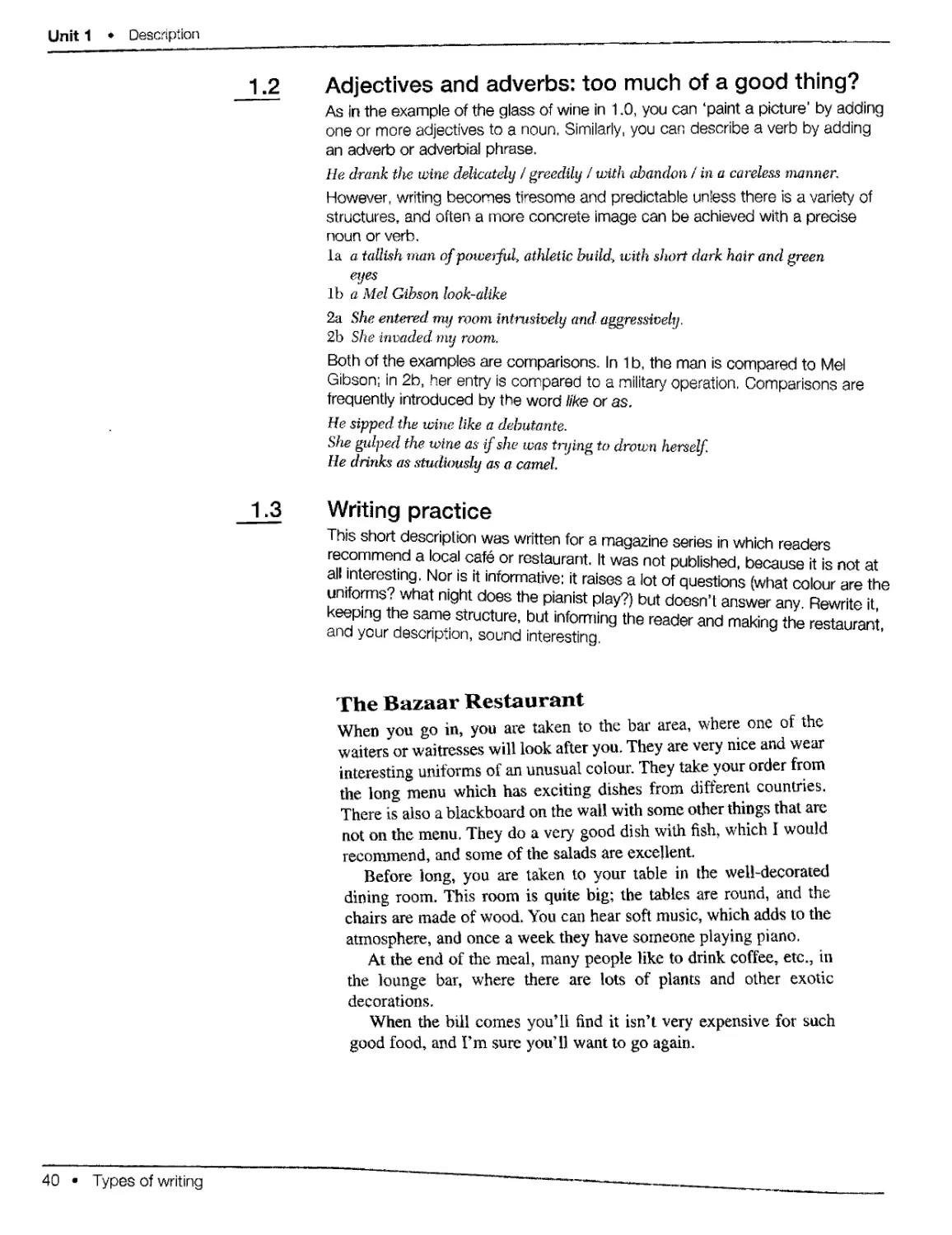
making descriptions interesting	39
describing pictures and objects	41
describing products	44
Unit 2	Action	48
instructions and directions	49
advice	51
processes and systems	54
Unit 3	Narrative	58
narratives and connecting words	59
biographical narratives	62
newspaper stories	66
Unit 4	Giving your opinion	68
argument	69
reviews	72
personal advice	76
Unit 5 People and places	78
describing people	79
describing places	83
Part 3 Task types
Unit 6 Formal letters	87
letters of complaint: tact	87
applying for jobs, courses and scholarships	95
other formal letters	98
Unit 7 _ Informal Letters	102
technical matters	102
diplomacy and tact	109
Unit 8	Reports	112
information reports: people	112
recommendation reports	117
eye-witness and narrative reports	119
Unit 9	Articles and reviews	122
openings and closings	122
reviews	128
Unit 10	Public information	132
leaflets, brochures and information sheets	132
tourism	135
Task bank	uo
Key	147
5

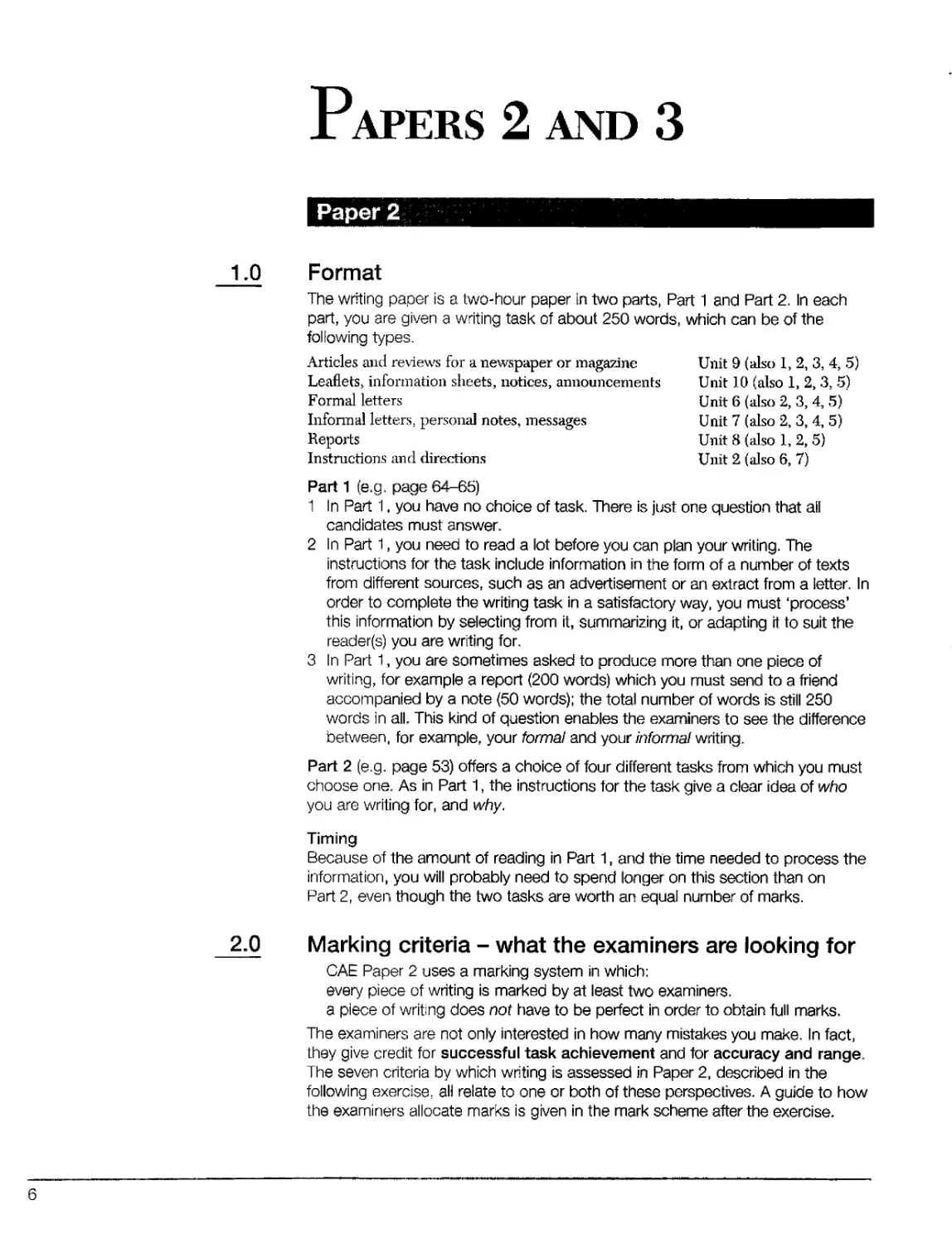
Papers 2 and 3
Format
The writing paper is a two-hour paper in two parts, Part 1 and Part 2. In each
part, you are given a writing task of about 250 words, which can be of the
following types.
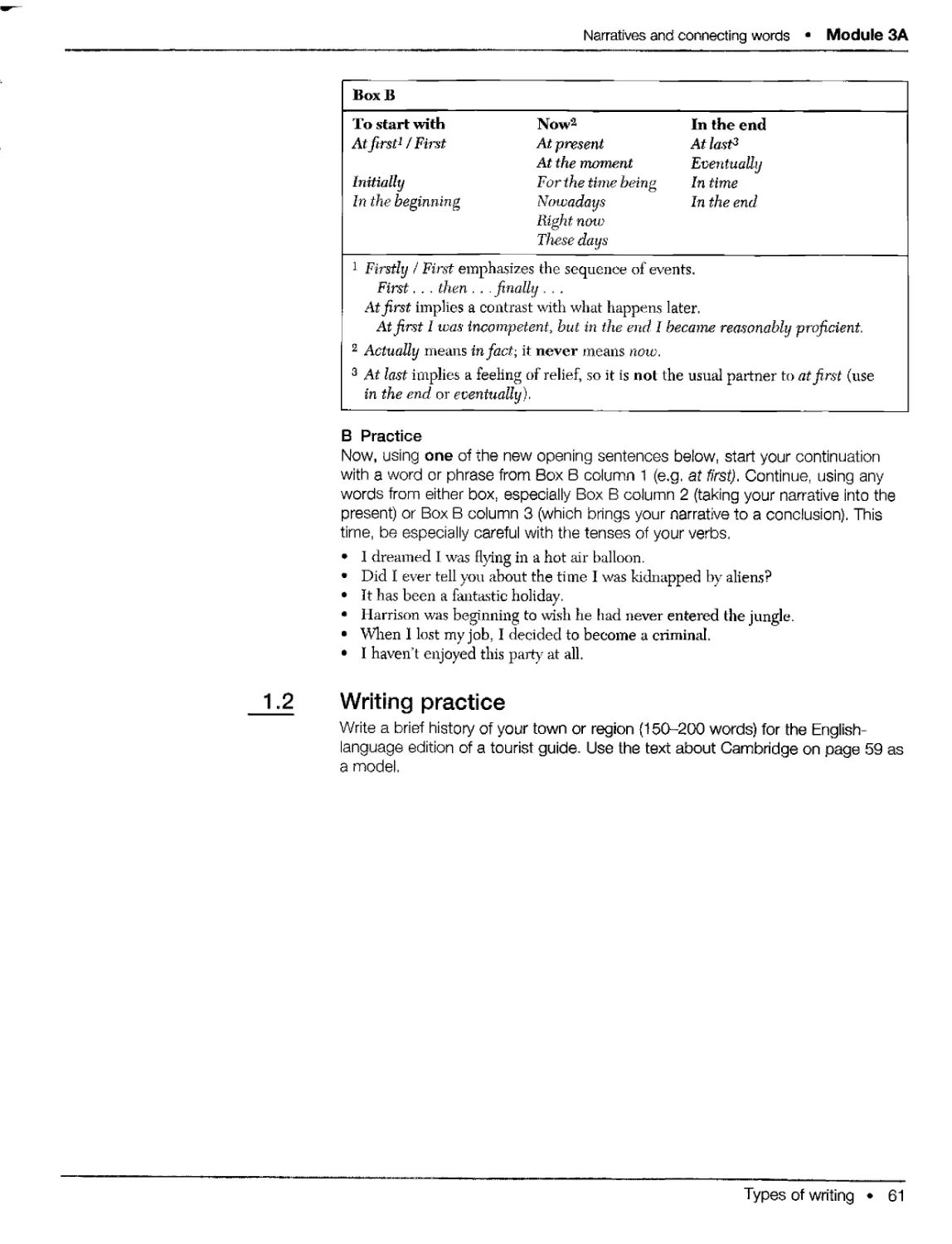
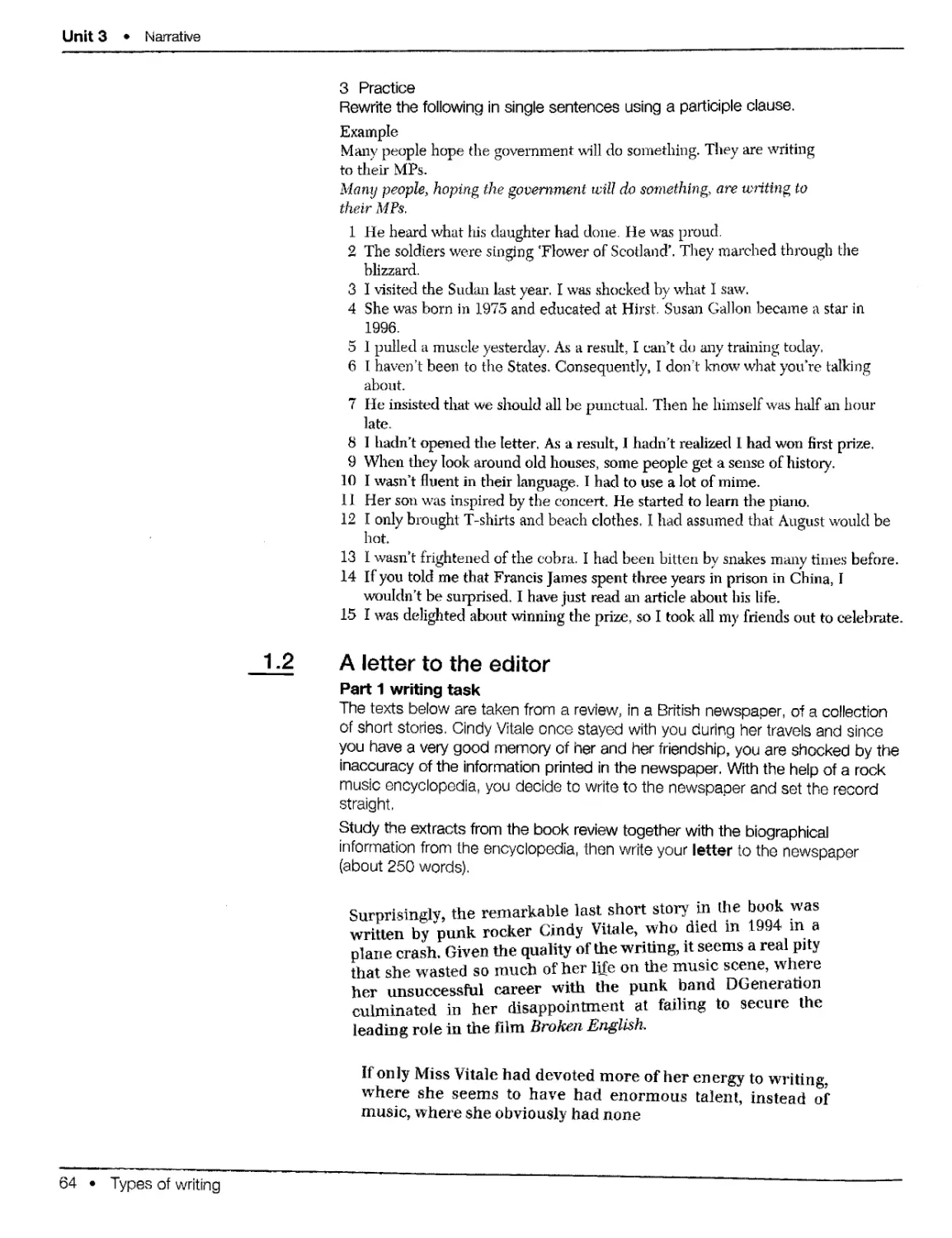
Part 1 (e.g. page 64-65)
1	In Part 1, you have no choice of task. There is just one question that ail
candidates must answer.
2	In Part 1, you need to read a lot before you can plan your writing. The
instructions for the task include information in the form of a number of texts
from different sources, such as an advertisement or an extract from a letter. In
order to complete the writing task in a satisfactory way, you must ‘process’
this information by selecting from it, summarizing it, or adapting it to suit the
reader(s) you are writing for.
3	In Part 1, you are sometimes asked to produce more than one piece of
writing, for example a report (200 words) which you must send to a friend
accompanied by a note (50 words); the total number of words is still 250
words in all. This kind of question enables the examiners to see the difference
between, for example, your formal and your informal writing.
Part 2 (e.g. page 53) offers a choice of four different tasks from which you must
choose one. As in Part 1, the instructions for the task give a clear idea of who
you are writing for, and why.
Timing
Because of the amount of reading in Part 1, and the time needed to process the
information, you will probably need to spend longer on this section than on
Part 2, even though the two tasks are worth an equal number of marks.
Marking criteria - what the examiners are looking for
CAE Paper 2 uses a marking system in which:
every piece of writing is marked by at least two examiners.
a piece of writing does not have to be perfect in order to obtain full marks.
The examiners are not only interested in how many mistakes you make. In fact,
they give credit for successful task achievement and for accuracy and range.
The seven criteria by which writing is assessed in Paper 2, described in the
following exercise, all relate to one or both of these perspectives. A guide to how
the examiners allocate marks is given in the mark scheme after the exercise.
Articles and reviews for a newspaper or magazine
Leaflets, information sheets, notices, announcements
Formal letters
Informal letters, personal notes, messages
Reports
Instructions and directions
Unit 9 (also 1, 2, 3, 4, 5)
Unit 10 (also 1, 2, 3, 5)
Unit 6 (also 2, 3, 4, 5)
Unit 7 (also 2, 3, 4, 5)
Unit 8 (also 1, 2, 5)
Unit 2 (also 6, 7)

Paper 2
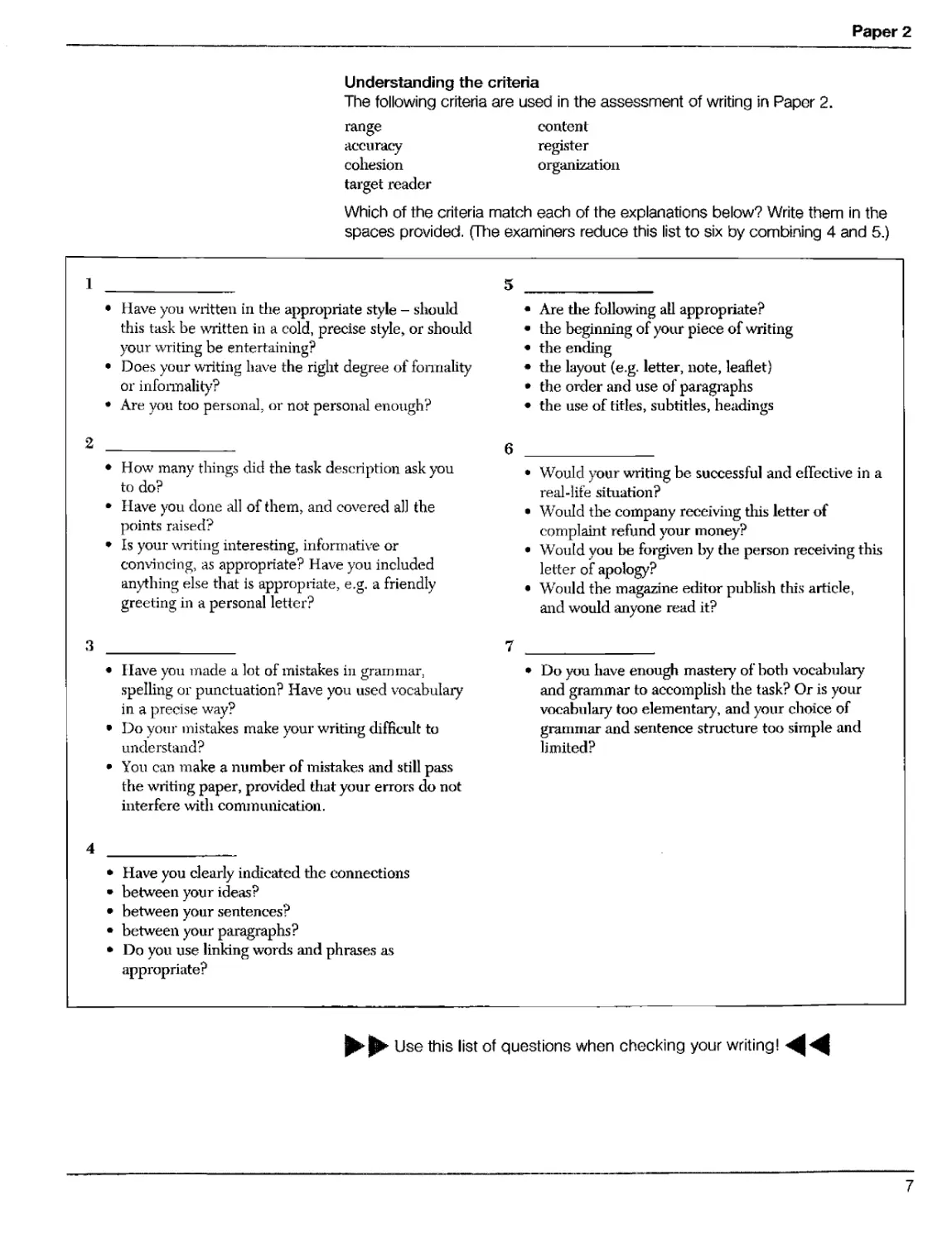
Understanding the criteria
The following criteria are used in the assessment of writing in Paper 2.
range	content
accuracy	register
cohesion	organization
target reader
Which of the criteria match each of the explanations below? Write them in the
spaces provided. (The examiners reduce this list to six by combining 4 and 5.)
1
•	Have you written in the appropriate style - should
this task be written in a cold, precise style, or should
your writing be entertaining?
•	Does your writing have the right degree of formality
or informality?
•	Are you too personal, or not personal enough?
2
•	How many things did the task description ask you
to do?
•	Have you done all of them, and covered all the
points raised?
•	Is your writing interesting, informative or
convincing, as appropriate? Have you included
anything else that is appropriate, e.g. a friendly
greeting in a personal letter?
3
•	Have you made a lot of mistakes in grammar,
spelling or punctuation? Have you used vocabulary
in a precise way?
•	Do your mistakes make your writing difficult to
understand?
•	You can make a number of mistakes and still pass
the writing paper, provided that your errors do not
interfere with communication.
5
•	Are the following all appropriate?
•	the beginning of your piece of writing
•	the ending
•	the layout (e.g. letter, note, leaflet)
•	the order and use of paragraphs
•	the use of titles, subtitles, headings
6
•	Would your writing be successful and effective in a
real-life situation?
•	Would the company receiving this letter of
complaint refund your money?
•	Would you be forgiven by the person receiving this
letter of apology?
•	Would the magazine editor publish tins article,
and would anyone read it?
7
•	Do you have enough mastery of both vocabulary
and grammar to accomplish the task? Or is your
vocabulary too elementary, and your choice of
grammar and sentence structure too simple and
limited?
•	Have you clearly indicated the connections
•	between your ideas?
•	between your sentences?
•	between your paragraphs?
•	Do you use linking words and phrases as
appropriate?
Use this list of questions when checking your writing! ◄◄
7

Papers 2 and 3
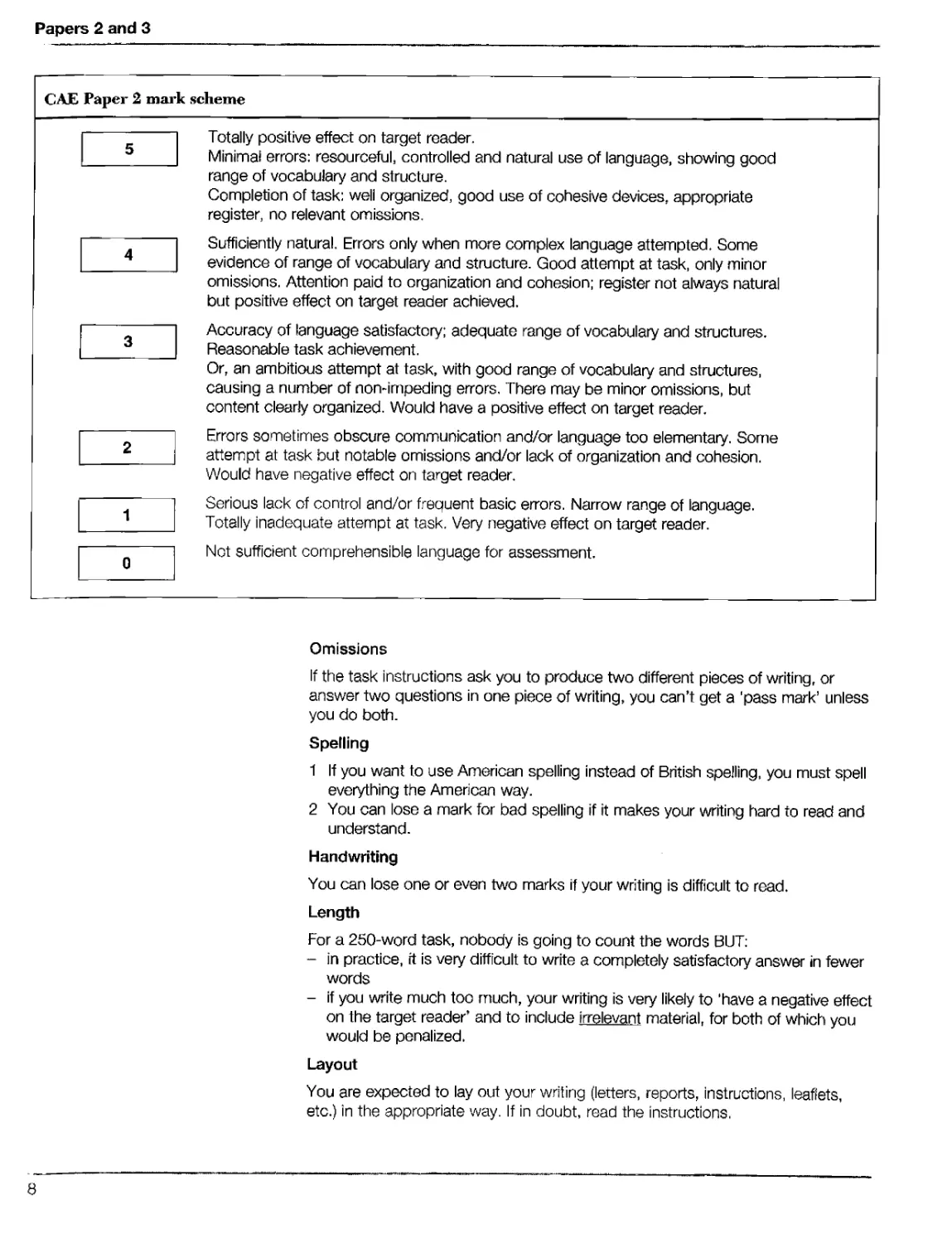
CAE Paper 2 mark scheme
5
Totally positive effect on target reader.
Minimal errors: resourceful, controlled and natural use of language, showing good
range of vocabulary and structure.
Completion of task: well organized, good use of cohesive devices, appropriate
register, no relevant omissions.
Sufficiently natural. Errors only when more complex language attempted. Some
evidence of range of vocabulary and structure. Good attempt at task, only minor
omissions. Attention paid to organization and cohesion; register not always natural
but positive effect on target reader achieved.
Accuracy of language satisfactory; adequate range of vocabulary and structures.
Reasonable task achievement.
Or, an ambitious attempt at task, with good range of vocabulary and structures,
causing a number of non-impeding errors. There may be minor omissions, but
content clearly organized. Would have a positive effect on target reader.
Errors sometimes obscure communication and/or language too elementary. Some
attempt at task but notable omissions and/or lack of organization and cohesion.
Would have negative effect on target reader.
Serious lack of control and/or frequent basic errors. Narrow range of language.
Totally inadequate attempt at task. Very negative effect on target reader.
Not sufficient comprehensible language for assessment.
Omissions
If the task instructions ask you to produce two different pieces of writing, or
answer two questions in one piece of writing, you can’t get a 'pass mark’ unless
you do both.
Spelling
1	If you want to use American spelling instead of British spelling, you must spell
everything the American way.
2	You can lose a mark for bad spelling if it makes your writing hard to read and
understand.
Handwriting
You can lose one or even two marks if your writing is difficult to read.
Length
For a 250-word task, nobody is going to count the words BUT:
-	in practice, it is very difficult to write a completely satisfactory answer in fewer
words
-	if you write much too much, your writing is very likely to 'have a negative effect
on the target reader’ and to include irrelevant material, for both of which you
would be penalized.
Layout
You are expected to lay out your writing (letters, reports, instructions, leaflets,
etc.) in the appropriate way. If in doubt, read the instructions.
8

Paper 3
Paper 3
The English in Use paper tests your ability 'to apply knowledge of the language
system, including control of the grammar, register, spelling, punctuation,
cohesion, coherence and formulaic language.’
In other words, it is a practical grammar test: it tests not so much what you
know about grammar as how well you can use it. The paper comprises six
questions, and you have one hour and 30 minutes.
Part 1
Vocabulary cloze (e.g. page 98}
Part 1 consists of an authentic text of about 250 words. There are 15 gaps in the
text. For each gap you have a choice of four words. Typically, the four words will
fit the gap grammatically, but one of the words will be much more appropriate in
the context.
Advice on answering Part 1
1	Cover up all the suggested answers.
2	Read through the whole text.
3	Read through the text again, stopping at each gap. Try to think of a suitable word
before looking at the four words suggested. If the word you have thought of is
one of the four you are offered, then choose it. Do not allow yourself to be
distracted by the others.
4	If the word you thought of is not there, it may help if you start by eliminating
those that are definitely wrong.
5	Make sure the word you choose is possible grammatically:
•	does it fit with the prepositions in the text?
•	if it is a noun, is it singular ! plural to match the verb and the article?
6	If you don’t know the answer, guess! Never leave a blank on your answer sheet.
7	When you’re doing practice exercises, don’t use the key to correct your answers.
You won’t leam much that way. Use a good English-English dictionary and look
at the ways each of the four suggested words are used. The examples given in the
dictionary will explain all the most common collocations. Only when you’ve
worked out answers should you check in the key. A more enjoyable way of
studying collocations is to read a lot of English for pleasure: magazines, fiction, or
whatever interests you most.
Part 2
Grammar cloze (e.g. page 57)
This focuses on grammar (e.g. prepositions) and cohesion (linking words, articles
and pronouns). Like Part 1, it takes the form of an authentic text of about 250
words. Again there are 15 gaps, but this time the choice is open.
Advice on answering Part 2
1	Read through the whole text first.
2	Make sure that the word you choose fits
•	grammatically with the words before it.
•	grammatically with the words after it.
•	the punctuation.
•	the meaning of the text.
3	Remember, most of the answers in this question are ‘little’ words - pronouns,
articles, prepositions, conjunctions, etc. Don’t imagine that the answer is going to
be difficult: often it’s a simple word such as the or a.
9

Papers 2 and 3
Part 3
Error correction (e.g. page 42)
This question requires you to correct mistakes in a text. You are given a text in
which there is one mistake in most of the lines. One mark is awarded per line,
whether for successfully correcting a mistake or for recognizing a correct line and
marking it with a tick (/), The mistakes are all of a similar type: the instructions
tell you what kind of mistakes to be looking out for.
The possible types are
•	one unnecessary word,
•	punctuation and spelling.
This is one of the questions in Paper 3 that can contribute most towards
developing your writing skills, Apart from the opportunity it affords for work on
grammar, punctuation and spelling, it gives practice which will help you in
correcting your own writing,
Advice on answering Part 3
1	Read the question carefully. Make sure you know what kind of mistake you’re
looking for, and how you must write it on your answer sheet.
2	Read the whole text through first.
3	Don’t make unnecessary ‘corrections’ while ignoring obvious and serious
mistakes: look for the big mistakes first.
4	About 20% of the lines are correct. Don’t forget to mark any lines where you
cannot find any mistakes with a tick (/).
One unnecessary word
1	For a word to be an error in this question it is either grammatically incorrect or it
does not fit in with the meaning of the text.
2	The grammar mistakes can include word order and prepositions or articles where
there shouldn’t be any.
3	The mistakes in meaning can include connecting words or even negatives that
seem to work grammatically, but in fact don’t make sense.
4	In every case, make sure that the sentence as a whole is correct and reads well
once the unnecessary word has been deleted.
Punctuation and spelling
1	Do the punctuation work in this book (pages 29-37). Not only will it help you
with this question, but it will also improve your writing.
2	The punctuation errors in this question are basic mistakes. Look out for:
•	missing capital letters.
•	brackets or speech marks that open but do not close.
•	questions that are not marked with a question mark.
3	If a comma is ‘optional’ (see page 33) you will usually find that there is a real
mistake elsewhere in the line, often a spelling mistake.
If you have serious problems with spelling, read more and study the rules for
English spelling (see 'Spelling’ in Michael Swan: Practical English Usage, OUP).
Part 4
Word formation (e.g. page 50)
Part 4 consists of two different texts, each with eight gaps. For each gap you are
given a ‘prompt word’. You fill the gap by changing the prompt word so that it
fits into the text.
10

Paper 3
Advice on answering Part 4
1	Read through the whole text first, for meaning.
2	Try marking each gap ‘noun’, ‘adjective’, Verb’, ‘adverb’, etc. This will help you
focus on the grammar of the word you are looking for.
3	Make sure your answer fits the meaning of the text, as well as the grammar. For
example, you might need a negative prefix (unbelievable) or suffix (hopeless). If
you write believable or hopeful, your answer will fit the grammar, but it will be
completely wrong in terms of the meaning of the text.
4	When doing practice exercises, use an English-English dictionary to correct them.
5	For further practice, make an effort to notice word formation when you are
reading English, and note down anything interesting you find. You will also find
word formation exercises in published vocabulary materials.
Part 5
Register transfer (e.g. page 17)
This question tests your command of register - in other words, your ability to
choose the appropriate style and vocabulary for a specific situation. This is a key
area of advanced writing skills and is tested throughout Papers 2 and 3, but it is
relatively unfamiliar and problematic to many candidates. For this reason a unit on
style and register is included in this book (pages 12-18), while every unit explores
a variety of registers through contrasting text types.
In Part 5 there are two texts, containing the same information but written in
different registers (one of them may be an informal letter, the other a formal
notice). The first text appears in full, while the second contains gaps. You have to
fill the gaps in the second text with information borrowed from the first, but
because of the change of register you cannot use the same words. The
instructions tell you how many words you can use for each gap.
Part 6
Phrase gap (e.g. page 46)
This question again consists of a gapped text. This time, the gaps correspond to
phrases or whole sentences which have been removed and which are printed
below the text, together with a few other phrases or sentences which do not fit.
This question focuses particularly on discourse - the way ideas are organized into
phrases, sentences and paragraphs. It is therefore a very useful exercise in the
development of writing skills.
Advice on answering Part 6
1	Read through the whole text to get an idea of the subject matter, the overall
meaning and the register. Where does the text come from? Who wrote it? Why?
2	Read through all the suggested phrases.
3	Don't make your choices too quickly. Even when a phrase looks good for a gap, it
may be wrong.
4	Work through the text slowly, making sure that the phrase you choose for each
gap matches for:
•	meaning - does your choice fit with the phrase before it and the
phrase after it? Does it fit with the meaning of the whole paragraph?
•	grammar - many of the suggested phrases may not fit grammatically.
5	Don’t get stuck on a difficult gap. Leave it and come back to it later.
6	Start by crossing out the phrase you are given as an example, then gradually cross
out the other phrases as soon as you are certain you have found their place. This
process of elimination simplifies the task.
11

Style and register
In matters of grave importance, style, not sincerity, is the vital thing.
Oscar Wilde
A Introduction
At the Advanced level, you should of course atm to write
grammatically correct English. But is that enough? For
example, it is grammatically correct to write ‘Give me a
job!', but that is not the way to write a successful job
application. In fact, the employer is more likely to forgive
a number of grammar or spelling mistakes than to
employ an applicant whose letter was too rude or too
informal. In the CAE exam, writing is assessed with this
in mind: what effect would the piece of writing have on
the person who is going to read it?
The ability to use the right style, whether you are writing
a business letter or a holiday postcard, is one of the skills
assessed in Paper 2; it is also examined throughout
Paper 3.
But perhaps style is not the best word: you do not
necessarily have to write stylishly. We could instead
speak of register: the style appropriate to a particular
kind of writing.
1.0	Story
This murder mystery in ten short texts is an exercise in
recognizing register.
1	First, identify the origin of each text by writing the
letter A-J by the descriptions of the texts. {Some of
the descriptions do not correspond to any texts
given.) What aspects of each text helped you to
decide?
Business letter
Tourist brochure
Newspaper review of restaurant
Spoken: job interview
Short newspaper report
Spoken: polite conversation
Back cover of a novel
Informal telephone conversation
Advertisement
Love letter
Police officer’s report
Recipe
Main courses at Maximilien’s range from duck in raspberry
vinegar sauce to a really excellent hare, still shedding its shot¬
gun pellets, and presented as a Gaudiesque tower: slices of
marvellously tender saddle on top of the braised leg (a little
overdone), itself resting on buttery noodles. Another speciality
of the house is the Andalucian rabbit with wild mushrooms
Q] 4 Return the rabbit to the pan. Cover with
the wine. Season. Add the fresh thyme and
simmer for 30-40 minutes with the lid on.
Add the mushrooms and stir well.
B
‘Tell me, Miss Lee, do you have any previous experi¬
ence as a waitress?’
‘Well, I did silver service at the Royal Hotel in Bognor
for five years. That was before coming to Leicester. But
since I’ve been here I’ve been assistant chef in the canteen
at International Defence Systems.’
‘And why have you given in your notice at I.D.S.?’
‘Well, to tell you the truth, it was some pictures 1 saw on
the television. And I realized that if it wasn t for the
weapons we were selling them,
|b] Dear Mr Ball
We were most impressed by your plans, which we
received last week.
Our representative in Europe, Colonel Lamont,
will be contacting you upon his arrival in London
m
How much, did you say? This must be a bad line, I
thought you said 5,000!... Sounds like an awful lot of
money for a tummy ache! Foreigners, were they?
Wouldn't trust 'em if I were you. Just you make sure
you get the money up front, in cash ... Here, you don't
think they're trying to do him in, do you? ... That'd be
worth 50, not five... Tell you what, try some on Henry
Hungerford first and see what happens.
B	,
‘Wonderful restaurant, Stefan. Do you know, I think this
is possibly the best hare I’ve ever eaten. And as for the St
Emilion: I doubt you’d find as good a bottle as this any¬
where in Paris. How are you getting on with the rabbit?’
12 • Writing sub-skills

Introduction
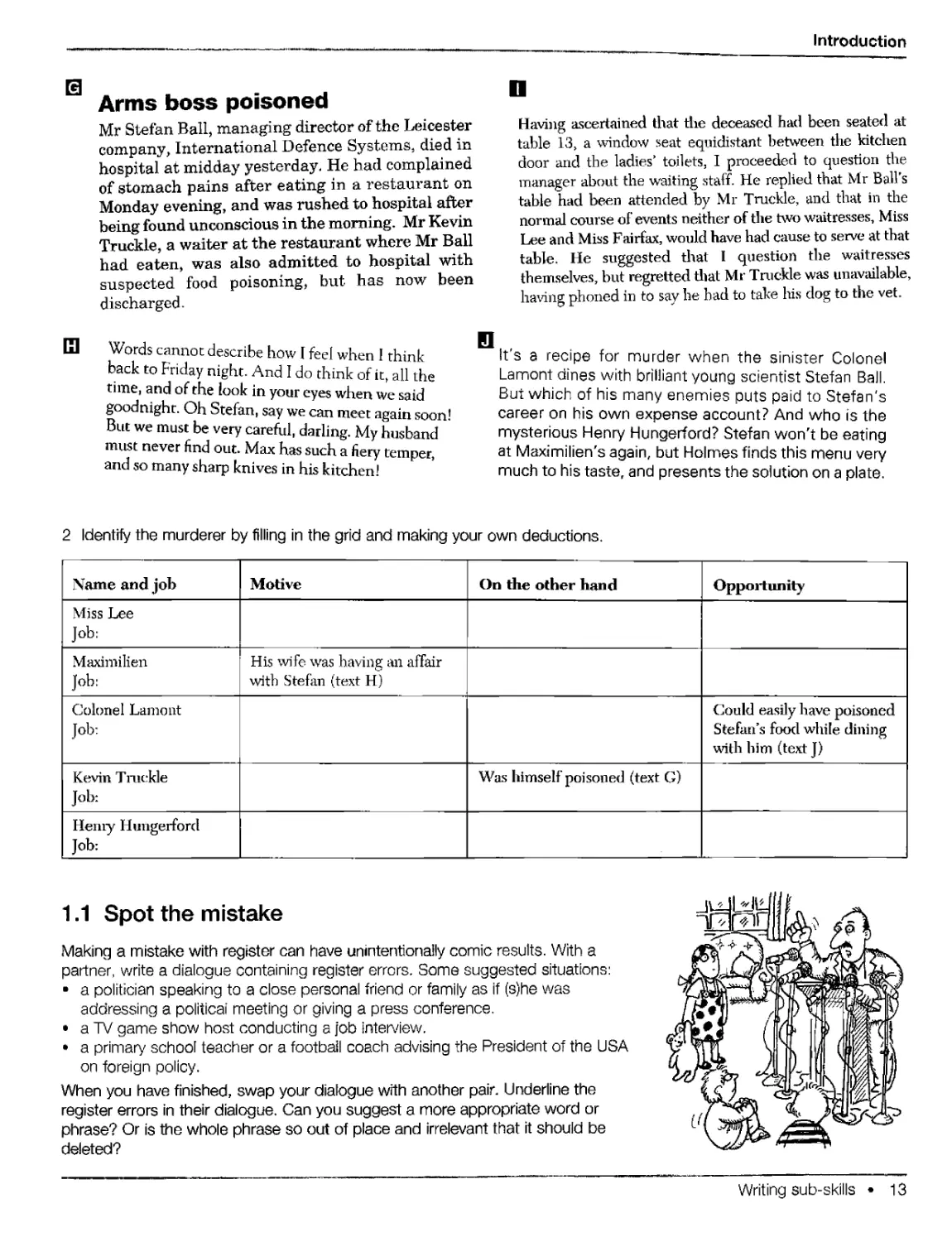
Arms boss poisoned
Mr Stefan Ball, managing director of the Leicester
company, International Defence Systems, died in
hospital at midday yesterday. He had complained
of stomach pains after eating in a restaurant on
Monday evening, and was rushed to hospital after
being found unconscious in the morning. Mr Kevin
Truckle, a waiter at the restaurant where Mr Ball
had eaten, was also admitted to hospital with
suspected food poisoning, but has now been
discharged.
HI Words cannot describe how I feel when I think
back to Friday night. And I do think of it, all the
time, and of the look in your eyes when we said
goodnight. Oh Stefan, say we can meet again soon!
But we must be very careful, darling. My husband
must never find out. Max has such a fiery temper,
and so many sharp knives in his kitchen!
2 Identify the murderer by filling in the grid and making your
n
Having ascertained that the deceased had been seated at
table 13, a window seat equidistant between the kitchen
door and the ladies’ toilets, I proceeded to question the
manager about the waiting staff. He replied that Mr Ball’s
table had been attended by Mr Truckle, and that in the
normal course of events neither of the two waitresses, Miss
Lee and Miss Fairfax, would have had cause to serve at that
table. He suggested that I question the waitresses
themselves, but regretted that Mr Truckle was unavailable,
having phoned in to say he had to take his dog to the vet.
It's a recipe for murder when the sinister Colonel
Lamont dines with brilliant young scientist Stefan Ball.
But which of his many enemies puts paid to Stefan's
career on his own expense account? And who is the
mysterious Henry Hungerford? Stefan won't be eating
at Maximilien's again, but Holmes finds this menu very
much to his taste, and presents the solution on a plate.
deductions.
Name and job
Motive
On the other hand
Opportunity
Miss Lee
Job:
Maximilien
Job:
His wife was having an affair
with Stefan (text H)
Colonel Lamont
Job:
Could easily have poisoned
Stefan’s food while dining
with him (text J)
Kevin Tmckle
Job:
Was himself poisoned (text G)
Henry Hungerford
Job:
1.1	Spot the mistake
Making a mistake with register can have unintentionally comic results. With a
partner, write a dialogue containing register errors. Some suggested situations:
•	a politician speaking to a close personal friend or family as if (s)he was
addressing a political meeting or giving a press conference.
•	a TV game show host conducting a job interview.
•	a primary school teacher or a football coach advising the President of the USA
on foreign policy.
When you have finished, swap your dialogue with another pair. Underline the
register errors in their dialogue. Can you suggest a more appropriate word or
phrase? Or is the whole phrase so out of place and irrelevant that it should be
deleted?
Writing sub-skills • 13

Style and register
B Formal and informal
One of the most important areas to master in terms of
register is the difference between formal and informal
English. Of course, there are many degrees of formality,
and most written English (including newspapers,
magazines and novels) is situated somewhere between
the two extremes.
Here is a list of some of the most characteristic features
that differentiate formal and informal English, followed by
some preliminary exercises. Many further exercises to
practise the use of different registers, and particularly to
distinguish between formal and informal usage, occur
throughout the rest of the book.
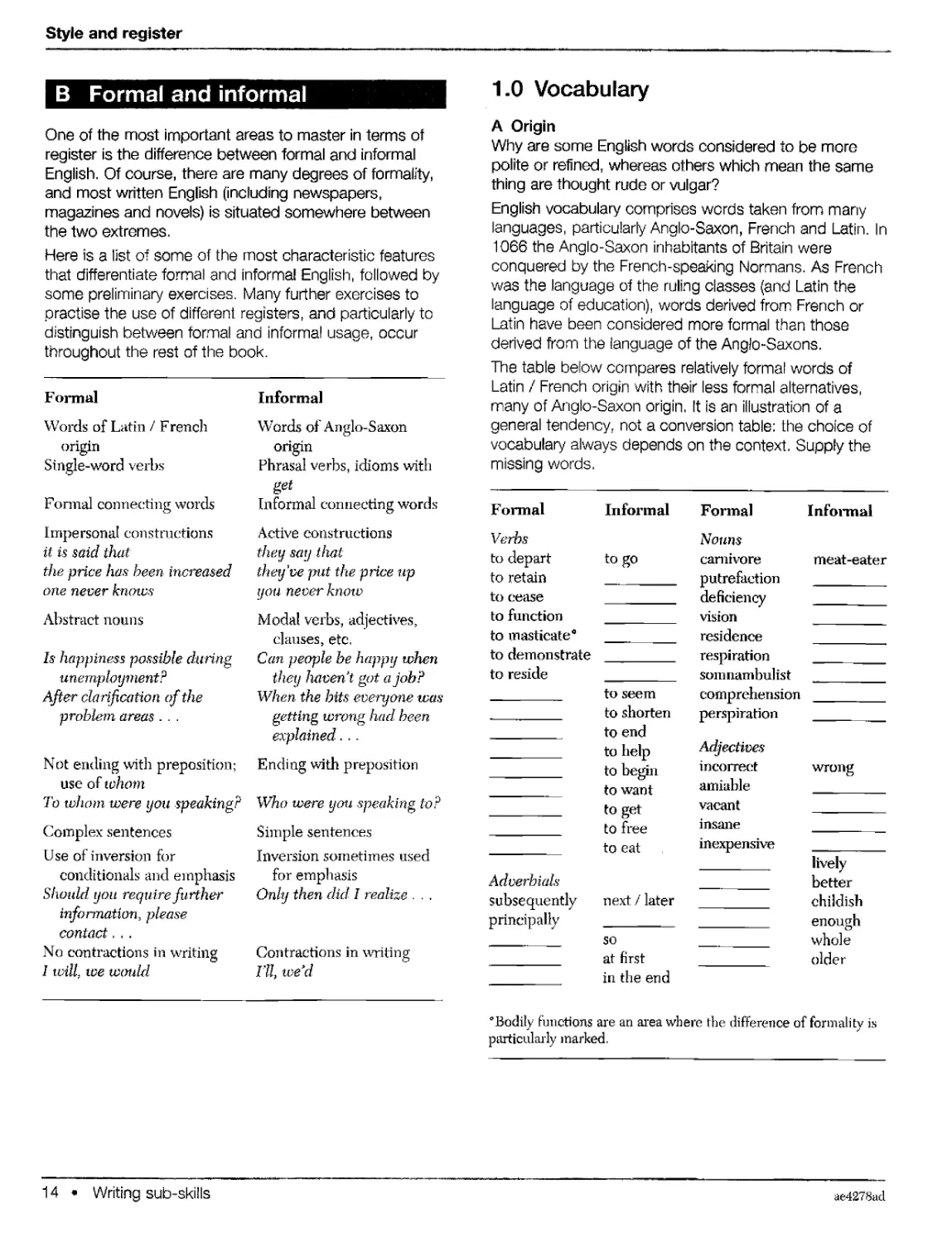
Formal
Informal
Words of Latin / F rencli
Words of Anglo-Saxon
origin
origin
Single-word verbs
Phrasal verbs, idioms with
get
Formal connecting words
Informal connecting words
Impersonal constructions
Active constructions
it is said that
they say that
the price has been increased
they've put the price up
one never knows
you never know
Abstract nouns
Modal verbs, adjectives,
clauses, etc,
Is happiness possible during
Can people be happy when
unemployment?
they haven’t got a job?
After clarification of the
When the bits everyone was
problem areas . . .
getting wrong had, been
explained...
Not ending with preposition;
Ending with preposition
use of whom
To whom were you speaking?
Who were you speaking to?
Complex sentences
Simple sentences
Use of inversion for
Inversion sometimes used
conditionals and emphasis
for emphasis
Should you require further
Only then did-1 realize . , .
information, please
contact. . .
No contractions in writing
Contractions in writing
I will, we wtmld
I’ll, we’d.
1.0	Vocabulary
A Origin
Why are some English words considered to be more
polite or refined, whereas others which mean the same
thing are thought rude or vulgar?
English vocabulary comprises words taken from many
languages, particularly Anglo-Saxon, French and Latin. In
1066 the Anglo-Saxon inhabitants of Britain were
conquered by the French-speaking Normans. As French
was the language of the ruling classes (and Latin the
language of education), words derived from French or
Latin have been considered more formal than those
derived from the language of the Anglo-Saxons.
The table below compares relatively formal words of
Latin / French origin with their less formal alternatives,
many of Anglo-Saxon origin, It is an illustration of a
general tendency, not a conversion table: the choice of
vocabulary always depends on the context. Supply the
missing words.
Formal
Informal
Formal
Informal
Verbs
to depart
to retain
to go
Nouns
carnivore
putrefaction
deficiency
vision
meat-eater
to cease
to function
to masticate*
residence
to demonstrate
respiration
to reside
somnambulist
to seem
comprehension
perspiration
to shorten
to end
to help
to begin
to want
Adjectives
incorrect
amiable
wrong
to get
to free
vacant
insane
to eat
inexpensive
lively
better
Adverbials
subsequently
next / later
childish
principally
enough
whole
so
at first
older
in the end
"Bodily functions are an area where the difference of formality is
particularly marked.
14 • Writing sub-skills
ae4278ad

Formal and informal
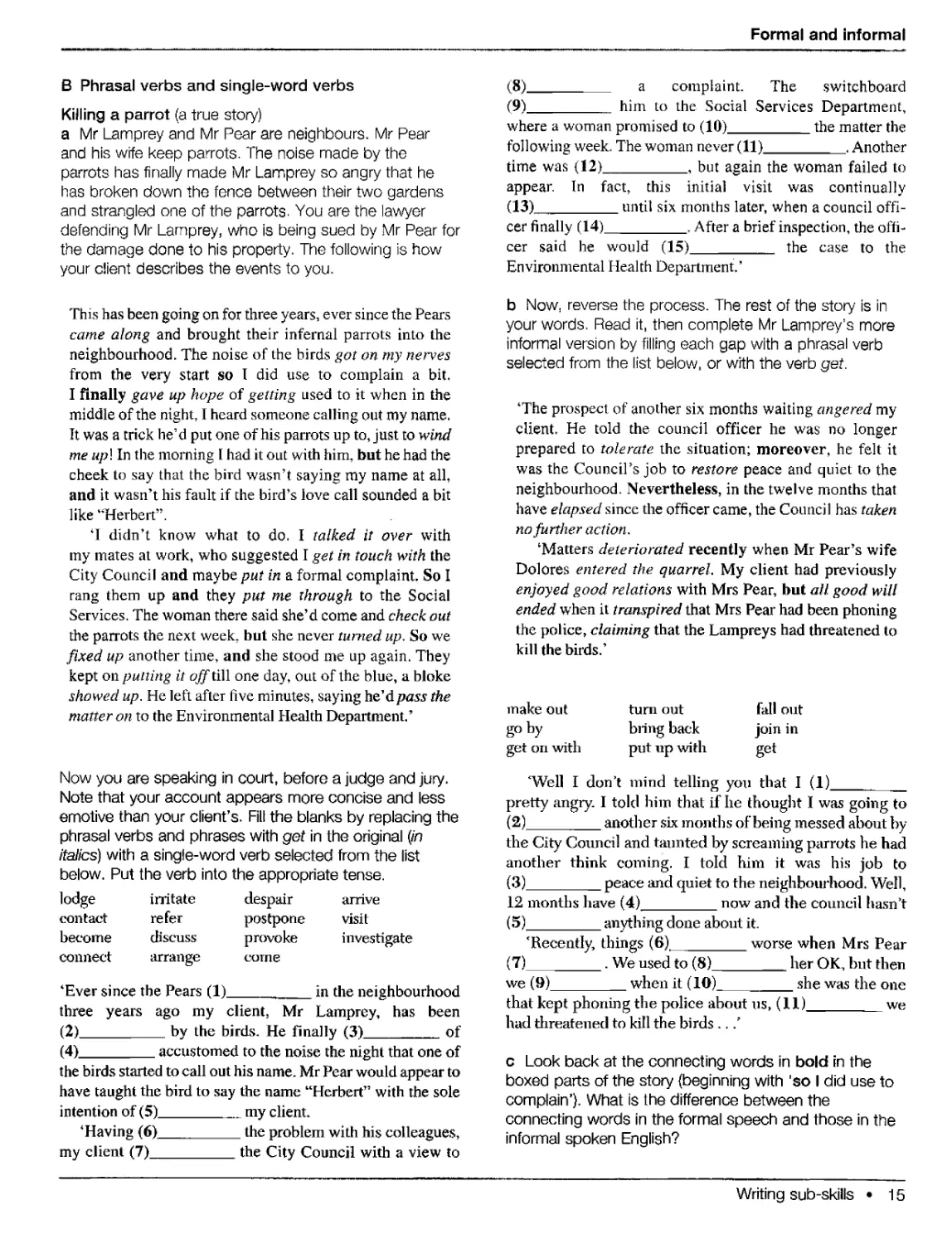
B Phrasal verbs and single-word verbs
Killing a parrot (a true story)
a Mr Lamprey and Mr Pear are neighbours. Mr Pear
and his wife keep parrots. The noise made by the
parrots has finally made Mr Lamprey so angry that he
has broken down the fence between their two gardens
and strangled one of the parrots. You are the lawyer
defending Mr Lamprey, who is being sued by Mr Pear for
the damage done to his property. The following is how
your client describes the events to you.
(8) 	 a complaint. The	switchboard
(9) 	 him to the Social Services Department,
where a woman promised to (10)	the matter the
following week. The woman never (11)	. Another
time was (12)	, but again the woman failed to
appear. In fact, this initial visit was continually
(13)	until six months later, when a council offi¬
cer finally (14)	. After a brief inspection, the offi¬
cer said he would (15)	 the case to the
Environmental Health Department.’
This has been going on for three years, ever since the Pears
came along and brought their infernal parrots into the
neighbourhood. The noise of the birds got on my nerves
from the very start so I did use to complain a bit.
I finally gave up hope of getting used to it when in the
middle of the night, I heard someone calling out my name.
It was a trick he’d put one of his parrots up to, just to wind
me up\ In the morning I had it out with him, but he had the
cheek to say that the bird wasn’t saying my name at all,
and it wasn’t his fault if the bird’s love call sounded a bit
like “Herbert”.
‘I didn’t know what to do. I talked it over with
my mates at work, who suggested I get in touch with the
City Council and maybe put in a formal complaint. So I
rang them up and they put me through to the Social
Services. The woman there said she’d come and check out
the parrots the next week, but she never turned up. So we
fixed up another time, and she stood me up again. They
kept on putting it off till one day, out of the blue, a bloke
showed up. He left after five minutes, saying he’d pass the
matter on to the Environmental Health Department.’
Now you are speaking in court, before a judge and jury.
Note that your account appears more concise and less
emotive than your client’s. Fill the blanks by replacing the
phrasal verbs and phrases with get in the original (in
italics) with a singte-word verb selected from the list
below. Put the verb into the appropriate tense.
lodge
contact
become
connect
irritate
refer
discuss
arrange
despair
postpone
provoke
come
arrive
visit
investigate
‘Ever since the Pears (1)		in the neighbourhood
three years ago my client, Mr Lamprey, has been
(2)	by the birds. He finally (3)	of
(4)	accustomed to the noise the night that one of
the birds started to call out his name. Mr Pear would appear to
have taught the bird to say the name “Herbert” with the sole
intention of (5)	my client.
‘Having (6)	the problem with his colleagues,
my client (7)	the City Council with a view to
b Now, reverse the process. The rest of the story is in
your words. Read it, then complete Mr Lamprey's more
informal version by filling each gap with a phrasal verb
selected from the list below, or with the verb get.
‘The prospect of another six months waiting angered my
client. He told the council officer he was no longer
prepared to tolerate the situation; moreover, he felt it
was the Council’s job to restore peace and quiet to the
neighbourhood. Nevertheless, in the twelve months that
have elapsed since the officer came, the Council has taken
no further action.
‘Matters deteriorated recently when Mr Pear’s wife
Dolores entered the quarrel. My client had previously
enjoyed good relations with Mrs Pear, but all good will
ended when it transpired that Mrs Pear had been phoning
the police, claiming that the Lampreys had threatened to
kill the birds.’
make out	turn out	fall out
go by	bring back	join in
get on with	put up with	get
‘Well I don’t mind telling you that I (1)
pretty angry. I told him that if he thought I was going to
(2)		another six months of being messed about by
the City Council and taunted by screaming parrots he had
another think coming. I told him it was his job to
(3)		peace and quiet to the neighbourhood. Well,
12 months have (4)	now and the council hasn’t
(5)	anything done about it.
‘Recently, things (6)	worse when Mrs Pear
(7)	. We used to (8)	her OK, but then
we (9)	when it (10)	she was the one
that kept phoning the police about us, (11)	we
had threatened to kill the birds .. .’
c Look back at the connecting words in bold in the
boxed parts of the story (beginning with 'so I did use to
complain’). What is the difference between the
connecting words in the formal speech and those in the
informal spoken English?
Writing sub-skills • 15

Style and register
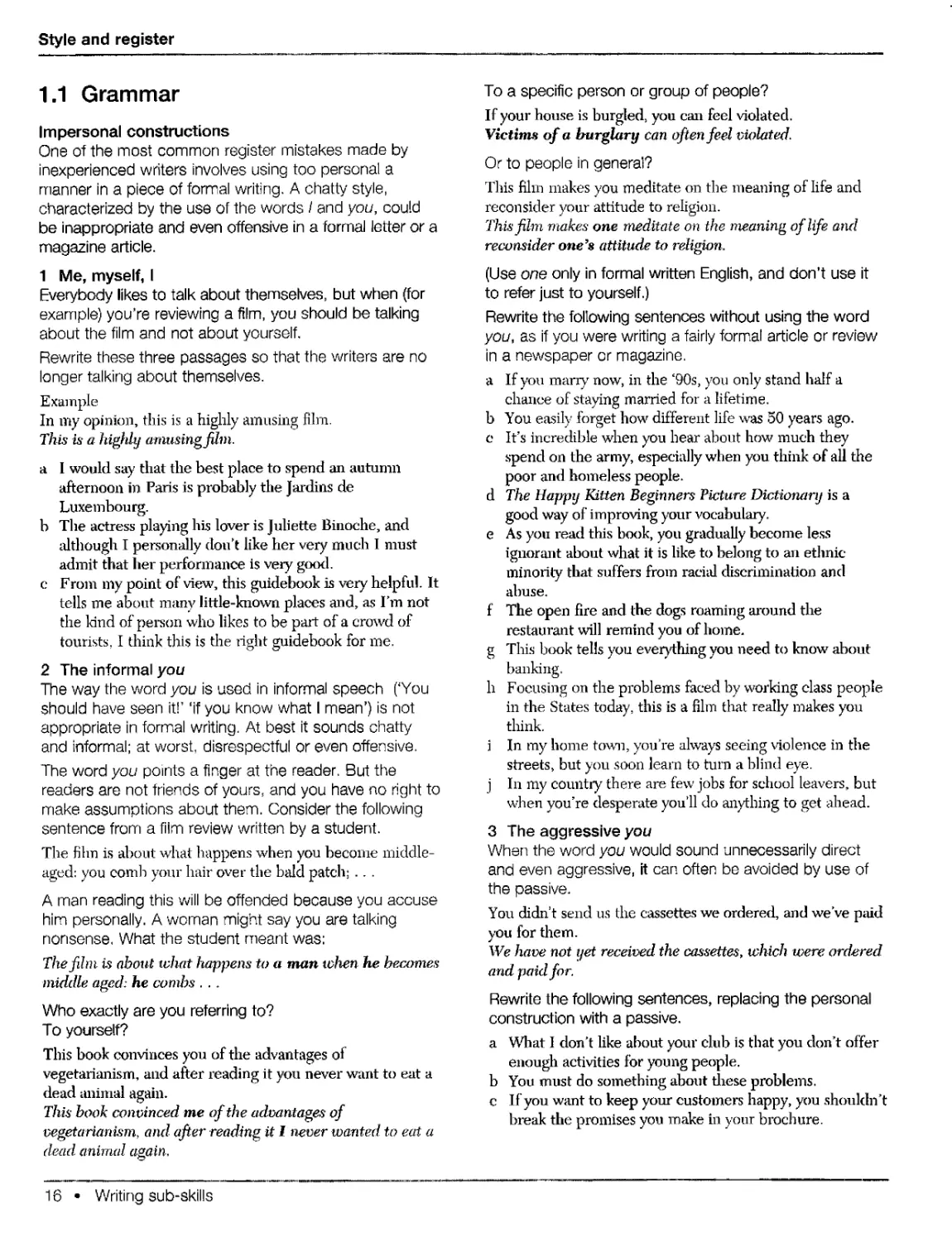
1.1	Grammar
Impersonal constructions
One of the most common register mistakes made by
inexperienced writers involves using too personal a
manner in a piece of formal writing. A chatty style,
characterized by the use of the words / and you, could
be inappropriate and even offensive in a formal letter or a
magazine article.
1	Me, myself, I
Everybody likes to talk about themselves, but when (for
example) you’re reviewing a film, you should be talking
about the film and not about yourself.
Rewrite these three passages so that the writers are no
longer talking about themselves.
Example
In my opinion, this is a highly amusing film.
This is a highly amusing film.
a I would say that the best place to spend an autumn
afternoon in Paris is probably the Jardins de
Luxembourg.
b The actress playing his lover is Juliette Binoche, and
although I personally don’t like her very much I must
admit that her performance is very good,
c From my point of view, this guidebook is very helpful. It
tells me about many little-known places and, as I’m not
the kind of person who likes to be part of a crowd of
tourists, I think this is the right guidebook for me.
2	The informal you
The way the word you is used in informal speech (‘You
should have seen it!’ 'if you know what I mean’) is not
appropriate in formal writing. At best it sounds chatty
and informal; at worst, disrespectful or even offensive.
The word you points a finger at the reader. But the
readers are not friends of yours, and you have no right to
make assumptions about them. Consider the following
sentence from a film review written by a student.
The film is about what happens when you become middle-
aged: you comb your hair over the bald patch; . . .
A man reading this will be offended because you accuse
him personally. A woman might say you are talking
nonsense, What the student meant was:
The film is about what happens to a man when he becomes
middle aged: he combs . . .
Who exactly are you referring to?
To yourself?
This book convinces you of the advantages of
vegetarianism, and after reading it you never want to eat a
dead animal again.
This book convinced me of the advantages of
vegetarianism, and after reading it 1 never wanted to eat a
dead animal again.
To a specific person or group of people?
If your house is burgled, you can feel violated.
Victims of a burglary can often feel violated.
Or to people in general?
This film makes you meditate on the meaning of life and
reconsider your attitude to religion.
This film makes one meditate on the meaning of life and
reconsider one’s attitude to religion.
(Use one only in formal written English, and don’t use it
to refer just to yourself.)
Rewrite the following sentences without using the word
you, as if you were writing a fairly formal article or review
in a newspaper or magazine.
a If you marry now, in the ‘90s, you only stand half a
chance of staying married for a lifetime,
b You easily forget how different life was 50 years ago.
e It’s incredible when you hear about how much they
spend on the army, especially when you think of all the
poor and homeless people.
d The Happy Kitten Beginners Picture Dictionary is a
good way of improving your vocabulary,
e As you read this book, you gradually become less
ignorant about what it is like to belong to an ethnic
minority that suffers from racial discrimination and
abuse.
f The open fire and the dogs roaming around the
restaurant will remind you of home,
g This book tells you everything you need to know about
banking.
h Focusing on the problems faced by working class people
in the States today, this is a film that really makes you
think.
i In my home town, you’re always seeing violence in the
streets, but you soon leam to turn a blind eye.
j In my country there are few jobs for school leavers, but
when you’re desperate you’ll do anything to get ahead.
3	The aggressive you
When the word you would sound unnecessarily direct
and even aggressive, it can often be avoided by use of
the passive.
You didn’t send us the cassettes we ordered, and we’ve paid
you for them.
We have not yet received the cassettes, which were ordered
and paid for.
Rewrite the following sentences, replacing the personal
construction with a passive.
a What I don’t like about your club is that you don’t offer
enough activities for young people,
b You must do something about these problems,
c If you want to keep your customers happy, you shouldn’t
break the promises you make in your brochure.
16 • Writing sub-skills

Formal and informal
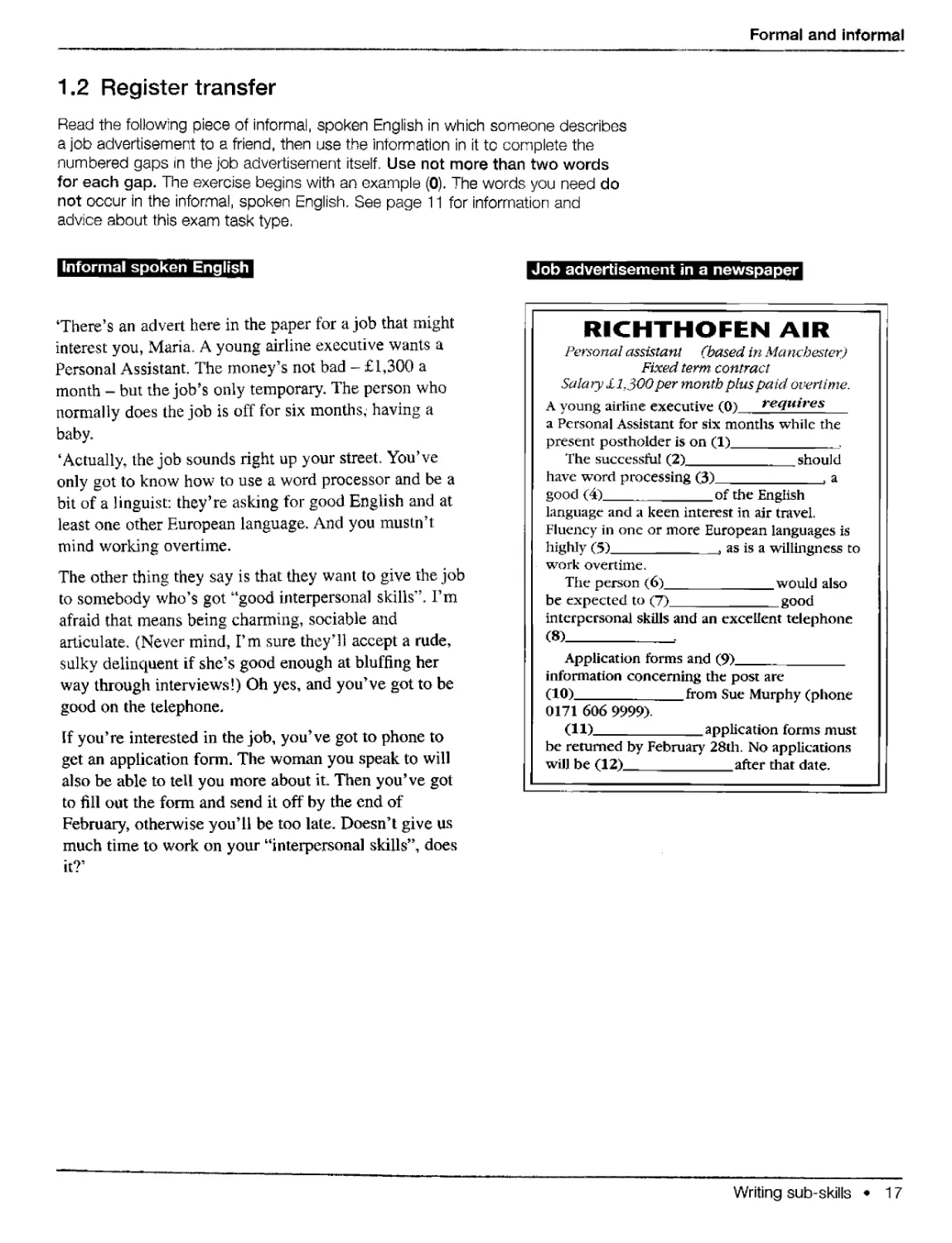
1.2	Register transfer
Read the following piece of informal, spoken English in which someone describes
a job advertisement to a friend, then use the information in it to complete the
numbered gaps in the job advertisement itself. Use not more than two words
for each gap. The exercise begins with an example (0). The words you need do
not occur in the informal, spoken English. See page 11 for information and
advice about this exam task type.
Informal spoken English
Job advertisement in a newspaper
‘There’s an advert here in the paper for a job that might
interest you, Maria. A young airline executive wants a
Personal Assistant. The money’s not bad - £1,300 a
month - but the job’s only temporary. The person who
normally does the job is off for six months, having a
baby.
‘Actually, the job sounds right up your street. You’ve
only got to know how to use a word processor and be a
bit of a linguist: they’re asking for good English and at
least one other European language. And you mustn’t
mind working overtime.
The other thing they say is that they want to give the job
to somebody who’s got “good interpersonal skills”. I’m
afraid that means being charming, sociable and
articulate. (Never mind, I’m sure they’ll accept a rude,
sulky delinquent if she’s good enough at bluffing her
way through interviews!) Oh yes, and you’ve got to be
good on the telephone.
If you’re interested in the job, you’ve got to phone to
get an application form. The woman you speak to will
also be able to tell you more about it. Then you’ve got
to fill out the form and send it off by the end of
February, otherwise you’ll be too late. Doesn’t give us
much time to work on your “interpersonal skills”, does
it?’
RICHTHOFEN AIR
Personal assistant	(based in Manchester)
Fixed term contract
Salary £1,300per month plus paid overtime.
A young airline executive (Of requires
a Personal Assistant for six months while the
present postholder is on (1)	.
The successful (2)	should
have word processing (3)	, a
good (4)	of the English
language and a keen interest in air travel.
Fluency in one or more European languages is
highly (3)	, as is a willingness to
work overtime.
The person (6)	would also
be expected to (7)	good
interpersonal skills and an excellent telephone
(8)	.
Application forms and (9)
information concerning the post are
(10)	from Sue Murphy (phone
0171 606 9999).
(11)	application forms must
be returned by February' 28th. No applications
will be (12)	after that date.
Writing sub-skills * 17

Style and register
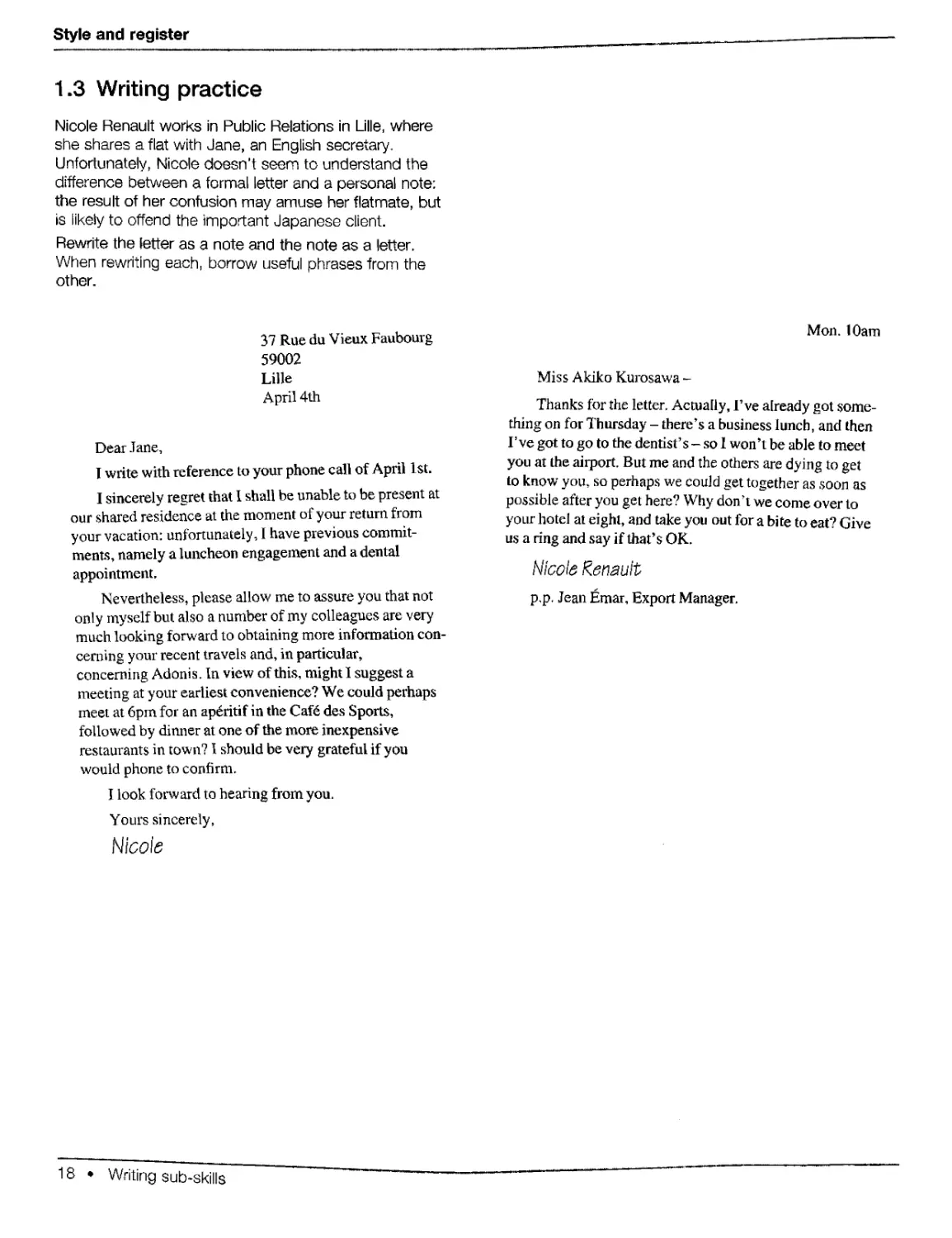
1.3	Writing practice
Nicole Renault works in Public Relations in Lille, where
she shares a flat with Jane, an English secretary.
Unfortunately, Nicole doesn't seem to understand the
difference between a formal letter and a personal note:
the result of her confusion may amuse her flatmate, but
is likely to offend the important Japanese client.
Rewrite the letter as a note and the note as a letter.
When rewriting each, borrow useful phrases from the
other.
37 Rue du Vieux Faubourg
59002
Lille
April 4th
Dear Jane,
I	write with reference to your phone call of April 1st.
I sincerely regret that I shall be unable to be present at
our shared residence at the moment of your return from
your vacation: unfortunately, I have previous commit¬
ments, namely a luncheon engagement and a dental
appointment.
Nevertheless, please allow me to assure you that not
only myself but also a number of my colleagues are very
much looking forward to obtaining more information con¬
cerning your recent travels and, in particular,
concerning Adonis. In view of this, might I suggest a
meeting at your earliest convenience? We could perhaps
meet at 6pm for an aperitif in the Cafe des Sports,
followed by dinner at one of the more inexpensive
restaurants in town? I should be very grateful if you
would phone to confirm.
I look forward to hearing from you.
Yours sincerely,
Nicole
Mon. 10am
Miss Akiko Kurosawa -
Thanks for the letter. Actually, I’ve already got some¬
thing on for Thursday - there’s a business lunch, and then
I’ve got to go to the dentist’s - so I won’t be able to meet
you at the airport. But me and the others are dying to get
to know you, so perhaps we could get together as soon as
possible after you get here? Why don’t we come over to
your- hotel at eight, and take you out for a bite to eat? Give
us a ring and say if that’s OK.
Nicole Renault
p.p. Jean Emar, Export Manager.
18 * Writing sub-skills

Cohesion
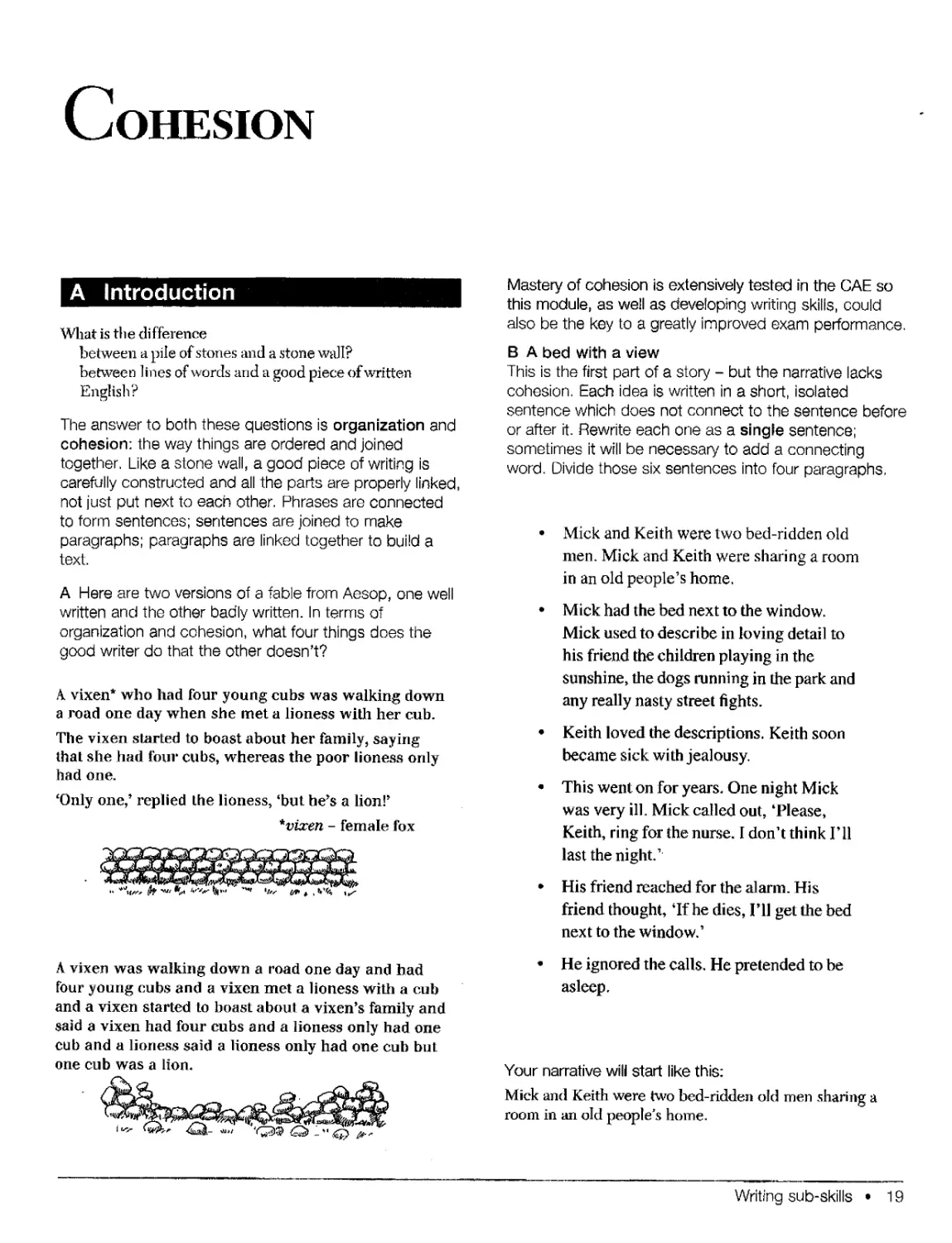
A Introduction
What is the difference
between a pile of stones and a stone wall?
between lines of words and a good piece of written
English?
The answer to both these questions is organization and
cohesion: the way things are ordered and joined
together. Like a stone wall, a good piece of writing is
carefully constructed and all the parts are properly linked,
not just put next to each other. Phrases are connected
to form sentences; sentences are joined to make
paragraphs; paragraphs are linked together to build a
text.
A Here are two versions of a fable from Aesop, one well
written and the other badly written. In terms of
organization and cohesion, what four things does the
good writer do that the other doesn’t?
A vixen* who had four young cubs was walking down
a road one day when she met a lioness with her cub.
The vixen started to boast about her family, saying
that she had four cubs, whereas the poor lioness only
had one.
‘Only one,’ replied the lioness, ‘but he’s a lion!’
*vixen - female fox
A vixen was walking down a road one day and had
four young cubs and a vixen met a lioness with a cub
and a vixen started to boast about a vixen’s family and
said a vixen had four cubs and a lioness only had one
cub and a lioness said a lioness only had one cub but
one cub was a lion.
Mastery of cohesion is extensively tested in the CAE so
this module, as well as developing writing skills, could
also be the key to a greatly improved exam performance.
B A bed with a view
This is the first part of a story - but the narrative lacks
cohesion. Each idea is written in a short, isolated
sentence which does not connect to the sentence before
or after it. Rewrite each one as a single sentence;
sometimes it will be necessary to add a connecting
word. Divide those six sentences into four paragraphs,
•	Mick and Keith were two bed-ridden old
men. Mick and Keith were sharing a room
in an old people’s home.
•	Mick had the bed next to the window.
Mick used to describe in loving detail to
his friend the children playing in the
sunshine, the dogs running in the park and
any really nasty street fights.
•	Keith loved the descriptions. Keith soon
became sick with jealousy.
•	This went on for years. One night Mick
was very ill. Mick called out, ‘Please,
Keith, ring for the nurse. I don’t think I’ll
last the night.’
•	His friend reached for the alarm. His
friend thought, ‘If he dies, I’ll get the bed
next to the window.’
•	He ignored the calls. He pretended to be
asleep.
Your narrative will start like this:
Mick and Keith were two bed-ridden old men sharing a
room in an old people’s home.
Writing sub-skills • 19

Cohesion
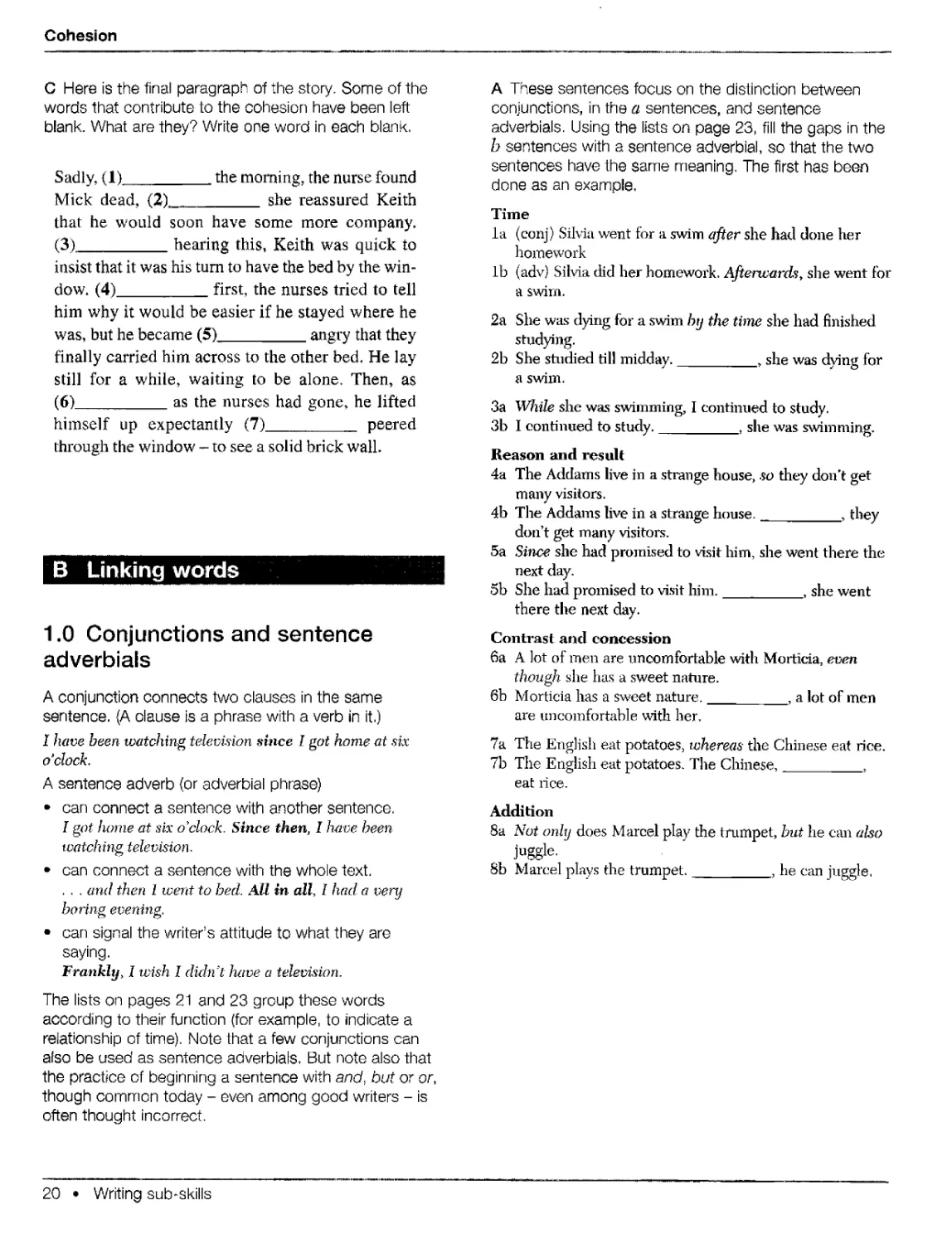
C Here is the final paragraph of the story. Some of the
words that contribute to the cohesion have been left
blank. What are they? Write one word in each blank.
Sadly, (1)	the morning, the nurse found
Mick dead, (2)	 she reassured Keith
that he would soon have some more company.
(3)	hearing this, Keith was quick to
insist that it was his turn to have the bed by the win¬
dow. (4)	first, the nurses tried to tell
him why it would be easier if he stayed where he
was, but he became (5)	angry that they
finally carried him across to the other bed. He lay
still for a while, waiting to be alone. Then, as
(6)	as the nurses had gone, he lifted
himself up expectantly (7)	 peered
through the window - to see a solid brick wall.
B Linking words
1.0	Conjunctions and sentence
adverbiais
A conjunction connects two clauses in the same
sentence, (A clause is a phrase with a verb in it.)
I	have been watching television since I got home at six
o’clock.
A sentence adverb (or adverbial phrase)
•	can connect a sentence with another sentence.
I	got home at six o’clock. Since then, I have been
watching television.
•	can connect a sentence with the whole text.
. . . and then I went to bed. All in all, I had a very
boring evening.
•	can signal the writer’s attitude to what they are
saying.
Frankly, I wish I didn’t have a television.
The lists on pages 21 and 23 group these words
according to their function (for example, to indicate a
relationship of time). Note that a few conjunctions can
also be used as sentence adverbiais, But note also that
the practice of beginning a sentence with and, but or or,
though common today - even among good writers - is
often thought incorrect.
A These sentences focus on the distinction between
conjunctions, in the a sentences, and sentence
adverbiais. Using the lists on page 23, fill the gaps in the
b sentences with a sentence adverbial, so that the two
sentences have the same meaning. The first has been
done as an example,
Time
la (conj) Silvia went for a swim after she had done her
homework
lb (adv) Silvia did her homework. Afterwards, she went for
a swim.
2a She was dying for a swim by the time she had finished
studying.
2b She studied till midday.	, she was dying for
a swim.
3a While she was swimming, I continued to study.
3b I continued to study.	, she was swimming.
Reason and result
4a The Addams live in a strange house, so they don’t get
many visitors.
4b The Addams live in a strange house.	, they
don’t get many' visitors.
5a Since she had promised to visit him, she went there the
next day.
5b She had promised to visit him.	, she went
there the next day.
Contrast and concession
6a A lot of men are uncomfortable with Morticia, even
though she has a sweet nature.
6b Morticia has a sweet nature.	, a lot of men
are uncomfortable with her,
7a The English eat potatoes, whereas the Chinese eat rice.
7b The English eat potatoes. The Chinese,	,
eat rice.
Addition
8a Not only does Marcel play the trumpet, but he can also
juggle.
8b Marcel plays the trumpet.	, he can juggle,
20 • Writing sub-skills

Linking words
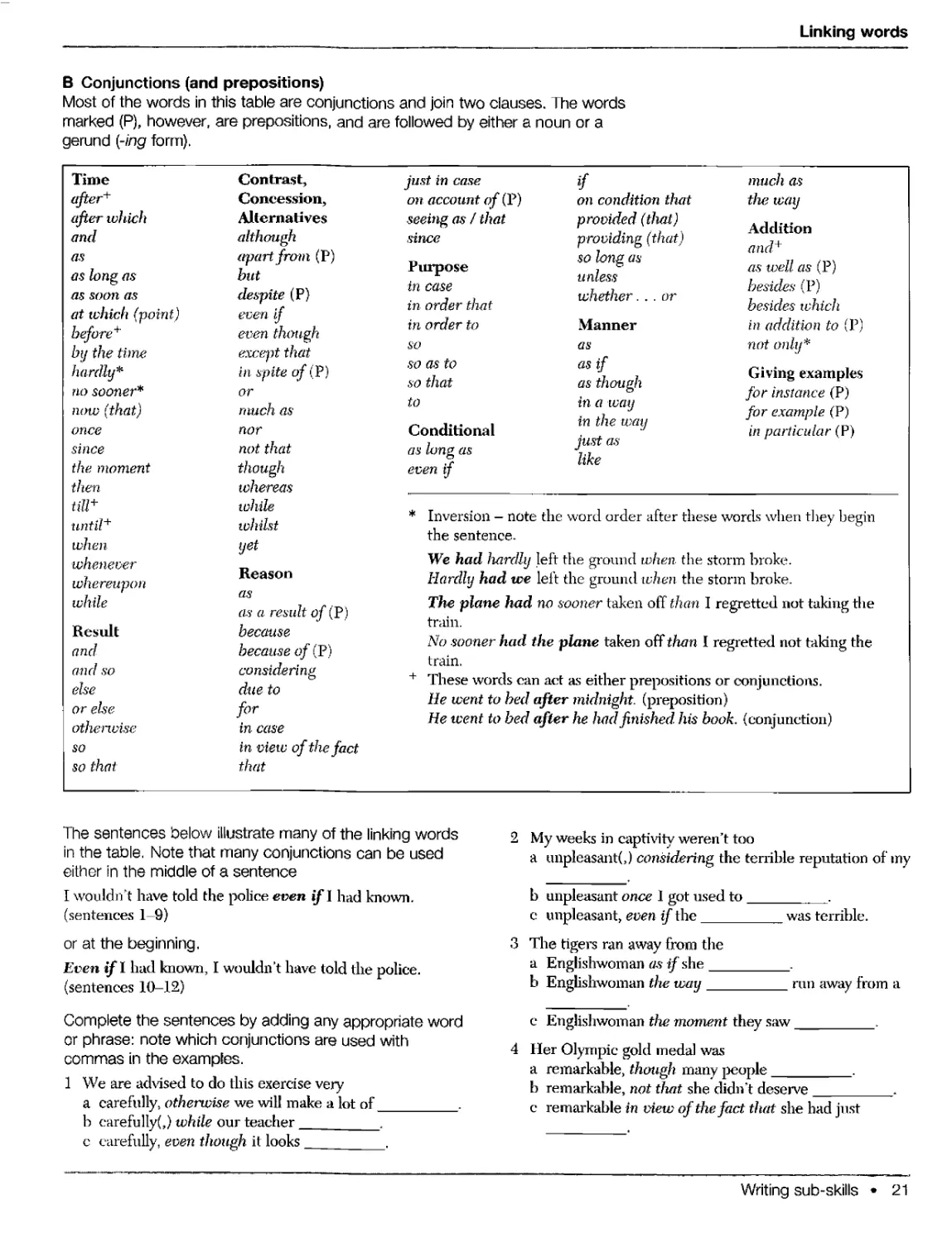
B Conjunctions (and prepositions)
Most of the words in this table are conjunctions and join two clauses. The words
marked (P), however, are prepositions, and are followed by either a noun or a
gerund (-ing form).
Time
after+
after which
and
as
as long as
as soon as
at which (point)
before+
by the time
hardly*
no sooner*
note (that)
once
since
the moment
then
till+
un.til+
when
whenever
whereupon
while
Result
and
and so
else
or else
otherwise
so
so that
Contrast,
Concession,
Alternatives
although
apart from (P)
but
despite (P)
even if
even though
except that
in spite of (T)
or
much as
nor
not that
though
whereas
while
whilst
yet
Reason
as
as a result of (P)
because
because of (P)
considering
due to
for
in case
in view of the fact
that
just in case
on account of (P)
seeing as / that
since
Purpose
in case
in order that
in order to
so
so as to
so that
to
Conditional
as long as
even if
on condition that
provided (that)
providing (that)
so long as
unless
whether... or
Manner
as
as if
as though
in a way
in the way
just as
like
much as
the way
Addition
and+
as well as (P)
besides (P)
besides which
in addition to (P)
not only *
Giving examples
for instance (P)
for example (P)
in particular (P)
* Inversion — note the word order after these words when they begin
the sentence.
We had hardly left the ground when the storm broke.
Hardly had we left the ground when the storm broke.
The plane had no sooner taken off than I regretted not taking the
train.
No sooner had the plane taken off than I regretted not taking the
train.
+ These words can act as either prepositions or conjunctions.
He went to bed after midnight, (preposition)
He went to bed after he had finished his book, (conjunction)
The sentences below illustrate many of the linking words
in the table. Note that many conjunctions can be used
either in the middle of a sentence
I	wouldn’t have told the police even if l had known.
(sentences 1—9)
or at the beginning.
Even if I had known, I wouldn’t have told the police.
(sentences 10-12)
Complete the sentences by adding any appropriate word
or phrase: note which conjunctions are used with
commas in the examples.
1	We are advised to do this exercise very
a carefully, otherwise we will make a lot of	.
b carefully(,) while our teacher	.
c carefully, even though it looks	.
2	My weeks in captivity weren’t too
a unpleasant!,) considering the terrible reputation of my
b unpleasant once 1 got used to
c unpleasant, even if the
3	The tigers ran away from the
a Englishwoman as if she
b Englishwoman the way
c Englishwoman the moment they saw
4	Her Olympic gold medal was
a remarkable, though many people	.
b remarkable, not that she didn’t deserve
c remarkable in view of the fact that she had just
was terrible.
run away from a
Writing sub-skills • 21

Cohesion
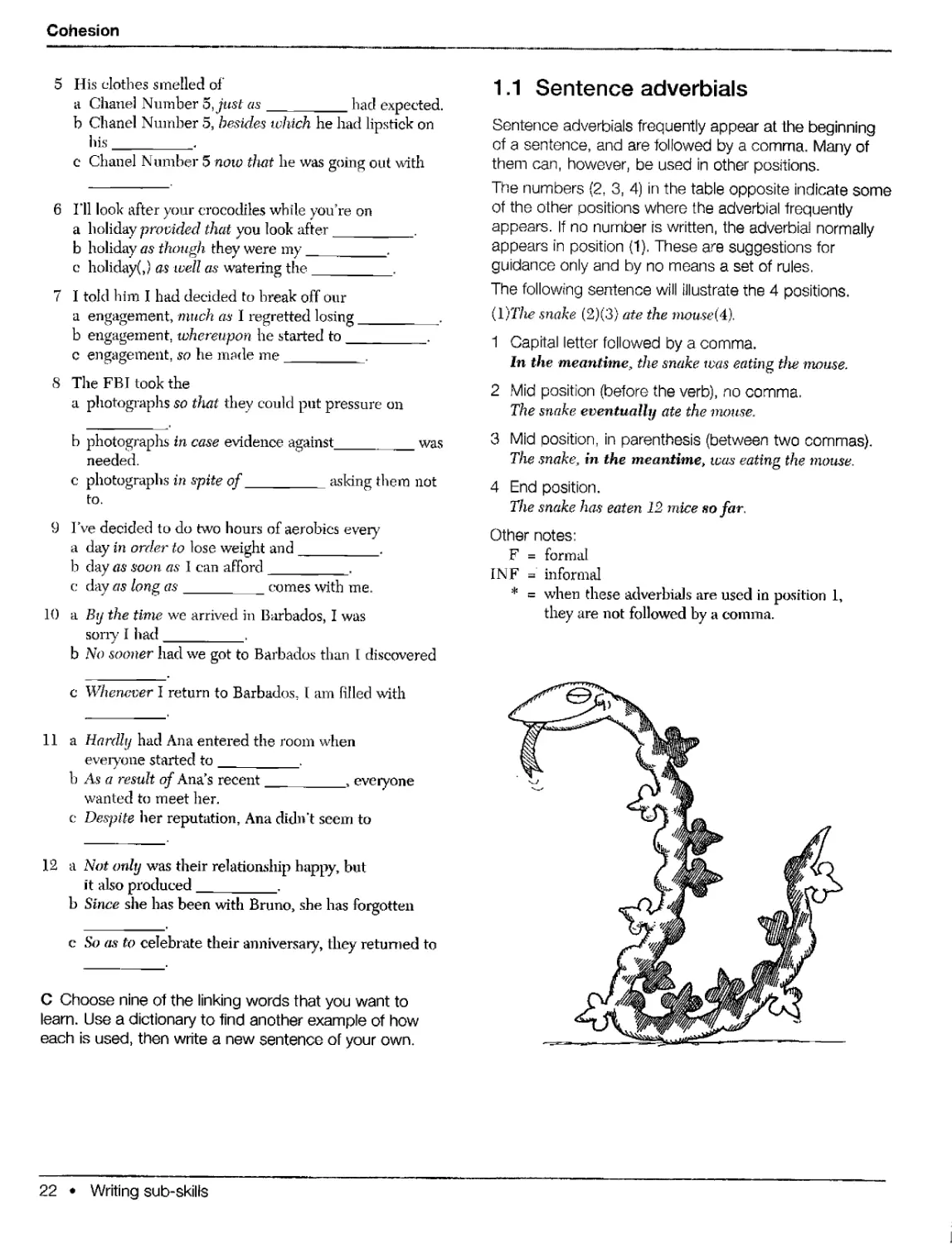
5	Ilis clothes smelled of
a Chanel Number 5, just as	had expected.
b Chanel Number 5, besides which he had lipstick on
his	p.
c Chanel Number 5 nou) that he was going out with
6	I’ll look after your crocodiles while you’re on
a holiday provided that you look after	.
b holiday as though they were my	,
e holiday(,) as well as watering the	.
7	I told him I had decided to break off our
a engagement, much as I regretted losing	.
b engagement, whereupon he started to	.
c engagement, so he made me	.
S The FBI took the
a photographs so that they could put pressure on
b photographs in case evidence against	was
needed.
c photographs in spite of	asking them not
to.
9	I’ve decided to do two hours of aerobics every
a day in order to lose weight and	.
b day as soon as I can afford	.
c day as long as	comes with me.
10	a By the time we arrived in Barbados, I was
sony I had	,
b No sooner had we got to Barbados than I discovered
c Whenever I return to Barbados, I am filled with
11	a Hardly had Ana entered the room when
everyone started to	.
b As a result of Ana’s recent	, everyone
wanted to meet her.
c Despite her reputation, Ana didn't seem to
12	a Not only was their relationship happy, but
it also produced	.
b Since she has been with Bruno, she has forgotten
c So as to celebrate their anniversary, they returned to
C Choose nine of the linking words that you want to
learn. Use a dictionary to find another example of how
each is used, then write a new sentence of your own.
1.1	Sentence adverbials
Sentence adverbials frequently appear at the beginning
of a sentence, and are followed by a comma. Many of
them can, however, be used in other positions.
The numbers (2, 3, 4) in the table opposite indicate some
of the other positions where the adverbial frequently
appears. If no number is written, the adverbial normally
appears in position (1). These are suggestions for
guidance only and by no means a set of rules.
The following sentence will illustrate the 4 positions.
(l)The snake (2)(3) ate the mouse(4).
1	Capital letter followed by a comma.
In the meantime, the snake was eating the mouse.
2	Mid position (before the verb), no comma.
The snake eventually ate the mouse.
3	Mid position, in parenthesis (between two commas).
The snake, in the meantime, was eating the mouse.
4	End position.
The snake has eaten 12 mice so far.
Other notes:
F = formal
INF = informal
* = when these adverbials are used in position 1,
they are not followed by a comma.
22 • Writing sub-skills

Linking words
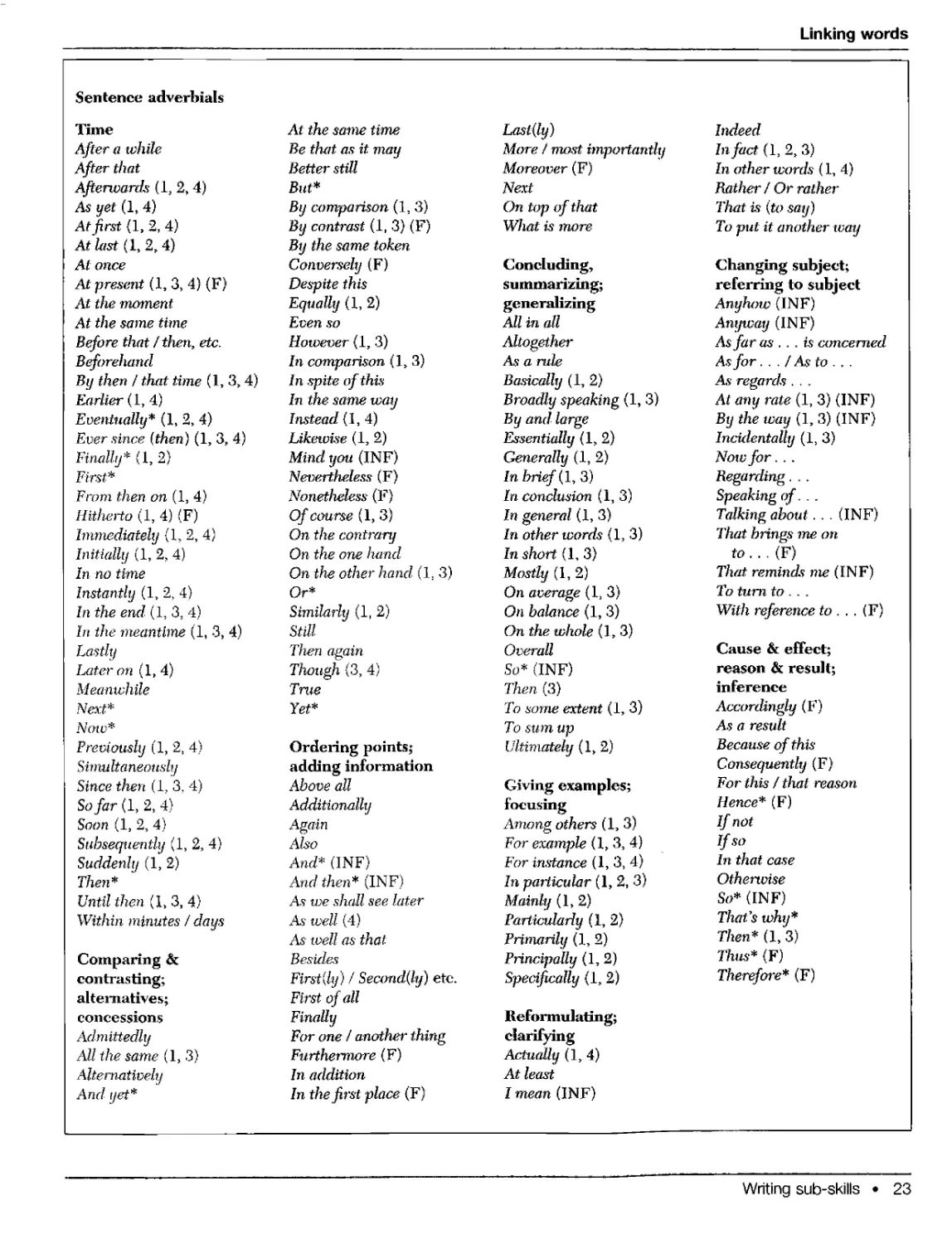
Sentence adverbials
Time
After a while
After that
Afterwards (1, 2, 4)
As yet (1, 4)
At first (1, 2, 4)
At last (1, 2, 4)
At once
At present (1, 3, 4) (F)
At the moment
At the same time
Before that / then, etc.
Beforehand
By then i that time (1, 3, 4)
Earlier (1, 4)
Eventually* (1, 2, 4)
Ever since (then ) (1, 3, 4)
Finally* (1, 2)
First*
From then on (1, 4)
Hitherto (1, 4) (F)
Immediately (1, 2, 4)
Initially (1, 2, 4)
In no time
Instantly (1, 2, 4)
In the end (1, 3, 4)
In the meantime (1, 3, 4)
Lastly
Later on (1,4)
Meanwhile
Next*
Noiv*
Previously (1, 2, 4)
Simultaneously
Since then (1, 3, 4)
So far (1, 2, 4)
Soon (1, 2, 4)
Subsequently (1, 2, 4)
Suddenly (1, 2)
Then*
Until then (1, 3, 4)
Within minutes / days
Comparing &
contrasting;
alternatives;
concessions
Admittedly
All the same (1, 3)
Alternatively
And yet*
At the same time
Be that as it may
Better still
But*
By comparison (1, 3)
By contrast (1, 3) (F)
By the same token
Conversely (F)
Despite this
Equally (1, 2)
Even so
However (1, 3)
In comparison (1, 3)
In spite of this
In the same way
Instead {1, 4)
Likewise (1, 2)
Mind you (INF)
Nevertheless (F)
Nonetheless (F)
Of course (1, 3)
On the contrary
On the one hand.
On the other hand (1,3)
Or*
Similarly (1, 2)
Still
Then again
Though (3, 4)
True
Yet*
Ordering points;
adding information
Above all
Additionally
Again
Also
And* (INF)
And then* (INF)
As we shall see later
As well (4)
As well as that
Besides
Firstly) / Secondly) etc.
First of all
Finally
For one / another thing
Furthermore (F)
In addition
In the first place (F)
Last(ly)
More / most importantly
Moreover (F)
Next
On top of that
What is more
Concluding,
summarizing;
generalizing
All in all
Altogether
As a rule
Basically (1, 2)
Broadly speaking (1, 3)
By and large
Essentially (1, 2)
Generally (1, 2)
In brief (1, 3)
In conclusion (1, 3)
In general (1, 3)
In other words (1, 3)
In short (1, 3)
Mostly (1, 2)
On average (1, 3)
On balance (1, 3)
On the whole (1, 3)
Overall
So* (INF)
Then (3)
To some extent (1, 3)
To sum up
Ultimately (1, 2)
Giving examples;
focusing
Among others (1, 3)
For example (I, 3, 4)
For instance (1, 3, 4)
In particular (1, 2, 3)
Mainly (1, 2)
Particulady (1, 2)
Primarily (1, 2)
Principally (1, 2)
Specifically (1, 2)
Reformulating;
clarifying
Actually (1, 4)
At least
I mean (INF)
Indeed
In fact (1, 2, 3)
In other words (I, 4)
Bather / Or rather
That is (to say)
To put it another ivaij
Changing subject;
referring to subject
Anyhow (INF)
Anyivay (INF)
As far as . . . is concerned
As for.. ./ As to .. .
As regards . . .
At any rate (1, 3) (INF)
By the way (1, 3) (INF)
Incidentally (1, 3)
Now for. . .
Regarding. . .
Speaking of. . .
Talking about. . . (INF)
That brings me on
to... (F)
That reminds me (INF)
To turn to .. .
With reference to . . . (F)
Cause & effect;
reason & result;
inference
Accordingly (F)
As a result
Because of this
Consequently (F)
For this / that reason
Hence* (F)
If not
If so
In that case
Otherwise
So* (INF)
That’s why*
Then* (1, 3)
Thus* (F)
Therefore* (F)
Writing sub-skills • 23

Cohesion
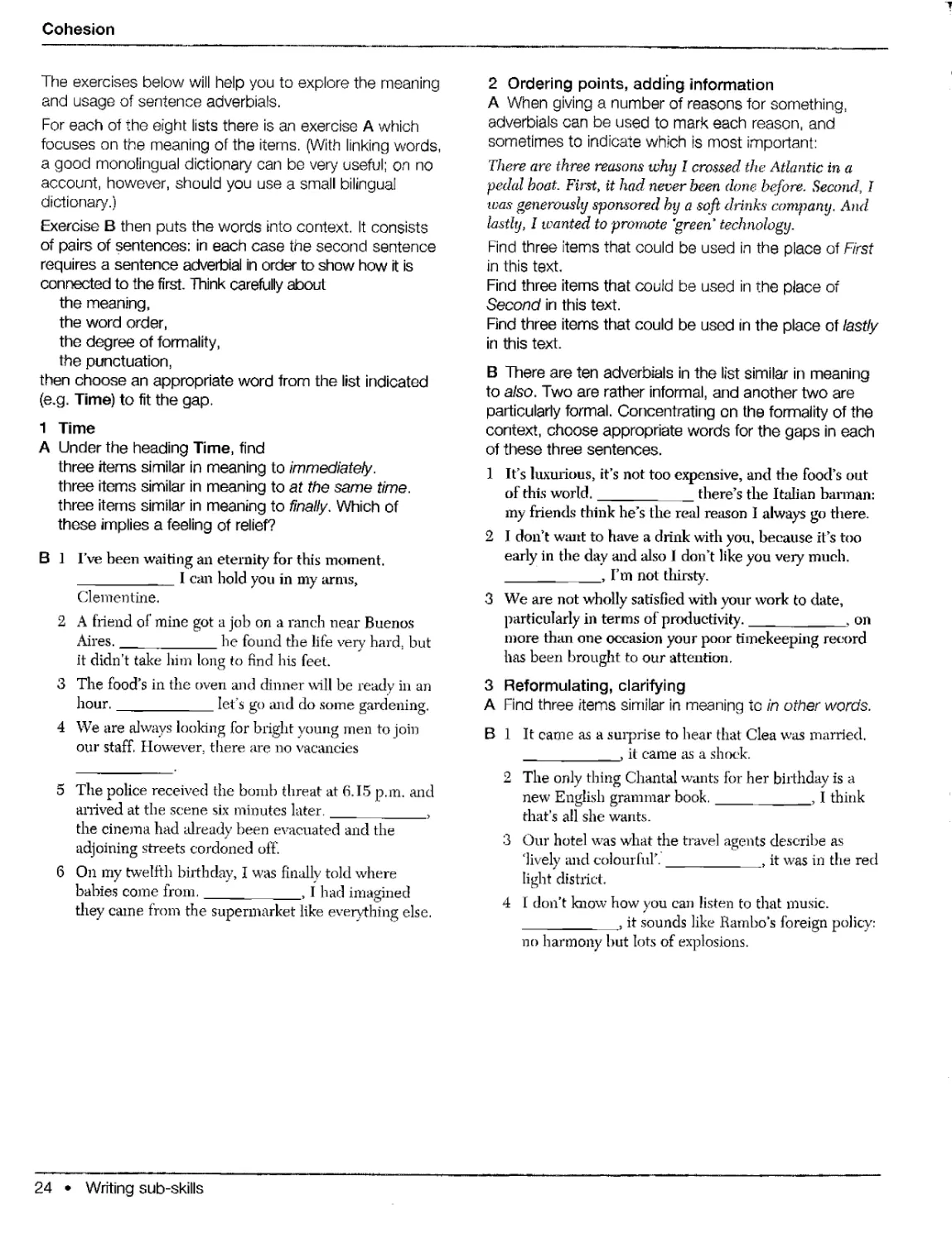
The exercises below will help you to explore the meaning
and usage of sentence adverbials.
For each of the eight lists there is an exercise A which
focuses on the meaning of the items. (With linking words,
a good monolingual dictionary can be very useful; on no
account, however, should you use a small bilingual
dictionary.)
Exercise B then puts the words into context. It consists
of pairs of sentences: in each case the second sentence
requires a sentence adverbial in order to show how it is
connected to the first. Think carefully about
the meaning,
the word order,
the degree of formality,
the punctuation,
then choose an appropriate word from the list indicated
(e.g. Time) to fit the gap.
1	Time
A Under the heading Time, find
three items similar in meaning to immediately.
three items similar in meaning to at the same time.
three items similar in meaning to finally. Which of
these implies a feeling of relief?
B 1 I 've been waiting an eternity for this moment.
		I can bold you in my arms,
Clementine.
2	A friend of mine got a job on a ranch near Buenos
Aires.	he found the life very hard, but
it didn’t take him long to find his feet.
3	The food’s in the oven and dinner will be ready in an
hour.	let’s go and do some gardening.
4	We are always looking for bright young men to join
our staff. However, there are no vacancies
5	The police received the bomb threat at 6.1.5 p.m. and
arrived at the scene six minutes later.	,
the cinema had already been evacuated and the
adjoining streets cordoned off.
6	On my twelfth birthday, I was finally told where
babies come from.	, I had imagined
they came from the supermarket like everything else.
2	Ordering points, adding information
A When giving a number of reasons for something,
adverbials can be used to mark each reason, and
sometimes to indicate which is most important:
There are three reasons why I crossed the Atlantic in a
pedal boat. First, it had never been done before. Second., I
was generously sponsored by a soft drinks company. And
lastly, I wanted to promote ’green’ technology.
Find three items that could be used in the place of First
in this text.
Find three items that could be used in the place of
Second in this text.
Find three items that could be used in the place of lastly
in this text.
B There are ten adverbials in the list similar in meaning
to also. Two are rather informal, and another two are
particularly formal. Concentrating on the formality of the
context, choose appropriate words for the gaps in each
of these three sentences.
1	It’s luxurious, it’s not too expensive, and the food’s out
of this world.	there’s the Italian barman:
my friends think he’s the real reason I always go there.
2	I don’t want to have a drink with you, because it’s too
early in the day and also I don’t like you very much.
		, I’m not thirsty'.
3	We are not wholly satisfied with your work to date,
particularly in terms of productivity.	, on
more than one occasion your poor timekeeping record
has been brought to our attention.
3	Reformulating, clarifying
A Find three items similar in meaning to in other words.
B 1 It came as a surprise to hear that Clea was married.
		, it came as a shock.
2	The only thing Chantal wants for her birthday is a
new English grammar book.	, I think
that’s all she wants.
3	Our hotel was what the travel agents describe as
lively and colourful’.	, it was in the red
light district.
4	I don’t know how you can listen to that music.
	, it sounds like Rambo’s foreign policy:
no harmony but lots of explosions.
24 • Writing sub-skills

Linking words
4	Comparing and contrasting
A 1 Find four items similar in meaning to similarly.
2	Find five items similar in meaning to by
contrast.
3	Find 12 items similar in meaning to but. (Note
the degrees of formality,)
B 1 All three films give an extremely fine grained result.
Delta,	, cannot quite match T-Max 100
for the fineness of its grain structure.
2	The Delco freezer is cheap and efficient. Sometimes,
		, it can be difficult to open.
3	Batman Returns is surely Hollywood at its most
original.	, the film has its faults.
4	He’s not much to look at, and he’s certainly no hero.
		I love him.
5	Managers are advised to avoid confrontation.
	they should encourage staff to discuss
their problems.
6	Professional cyclists do not get stomach pains, even
though they eat and drink while competing.
		, swimmers rarely suffer.
7	You say I was driving fast and dangerously.
	, I was observing the speed limit
and driving with great care.
5	Concluding, summarizing, generalizing
A Find three items similar in meaning to in brief.
Find four items similar in meaning to in general.
B 1 The earnings gap between men and women in
Europe is at its highest in Britain.	,
women in British industry receive 69 per cent of
men’s earnings.
2	The Personnel Manager interviews all job applicants
here.	, she looks for potential rather
than experience or qualifications.
3	And what was worse, it was raining all the time.
		, it was a disastrous weekend.
4	(430 students voted in favour of the motion to ban
smoking on the college premises, while 462 voted
against.)	, students at the college are
against a smoking ban.
5	At the back of the bookshelf, I found the cassettes of
the telephone calls. It was Barbara,	,
who had been tapping the Palace phone lines.
6	Giving examples, focusing
A Find two items that can mean for example.
Find two more items that can mean mainly.
B 1 My cat seems to think she’s a dog. Yesterday,
	, she bit the postman, and this morning
she jumped up and started licking my face.
2	Yes, I am studying English at the moment. It’s
	for my job, but it also means that I’ll
find it a lot easier to travel.
3	His parents said I was a bad influence on him.
	they accused me of taking him
drinking last Sunday morning; they didn’t mention
any other ways in which I was supposed to have
corrupted him.
7	Changing subject, referring to subject
A Find two items similar in meaning to anyway.
Find the item closest in meaning to by the way.
B 1 I spent the rest of the day watching the cycling on
television.	bikes, have you got yours
mended yet?
2	Darlene is as miserable as ever, and Jackie never
comes to visit us.	, I’m sure you don’t
want to hear about my problems, so let’s get back to
those holiday plans.
3	I bad a letter from Patrick Eggli the other day.
	, I don’t suppose you remember Carine
Imhof?
4	Education is still way behind the rest of Europe, and
the Health Service is in crisis.	the
economy, there’s no immediate sign of an end to the
recession.
8	Cause and effect, reason and result, inference
A Find one informal and four formal items that can mean
as a result.
Find two words that can mean in that case.
B 1 It is not advisable to drink beer after vigorous
exercise because alcohol is a diuretic - it makes you
urinate.	rather than replacing what
you have lost in sweat, it promotes dehydration.
2	Finally, I found the pricing to be as attractive as the
other features detailed above.	I
recommend purchase of the A/EUAV4CAE Mark 1.
3	With The hast of the Mohicans, Day-Lewis has found
that vital element - star quality.	, he is
a strong candidate for an Oscar.
4	Sorry I didn’t come out last night, but I was feeling a
bit under the weather,	I stayed at
home and watched telly.
5	Don’t forget to pack insect repellent.	,
you may find yourself eaten alive by the local
mosquitoes,
6	‘She’s only inviting you because you’ve got a car.’
'	I won’t go.’
Writing sub-skills • 25

Cohesion
1.2	Attitude
A Some sentence adverbials describe your attitude to
what you are saying. For example, in Luckily, it was
raining, the word luckily describes not the rain but the
way the writer feels about it. If you are expressing your
own opinion, you could say frankly or personally. If you
are expressing an idea that goes against your argument,
you can signal this by saying Admittedly it’s raining, but
I do think we ought to go to the beach.
Use the following attitude words to complete the table
below: for each word in the first column there are two
words that can mean almost exactly the same.
predictably
granted
curiously
funnily
luckily
happily
of course
frankly
true
supposedly
to my mind
incredibly
surprisingly
it seems
A admittedly
B astonishingly
C fortunately
D strangely enough
enough
enough
E naturally
F apparently
G in my opinion
Note that it is very common to say strangely enough
rather than just strangely.
The use of words to refer back to things already
mentioned or to refer forwards is a key area of cohesion.
Mastery of reference is essential as a writing skill for
Paper 2; it is also tested in Paper 3.
1.0	Various devices
Here are some of the devices that contribute towards
reference.
Determiners
a, an, the (articles)
*	my, your, his, her, their, one’s, its, our
(possessive adjectives)
this, that, these, those (demonstrative adjectives)
Pronouns
*	I, you, one, etc.,- me, her, it, etc. (personal)
mine, ijours, his, hers, its, theirs, ours (possessive)
*	this, that, these, those (demonstrative)
*	who, which, where, when, that (relative)
This and that
Both this and that can be used to refer to something that has
been mentioned before. This is preferred when talking
about something you are close to (in time as well as space),
while that refers to something more distant.
Helen says she’s fed up with her job. This doesn’t surprise
me.
Helen said she was fed up with her job. That was the last
time l saw her.
This but not that can be used to refer to something that has
not yet been mentioned.
You’re never going to believe this - Helen’s got a new job!
Words that can be used as pronouns
My brothers are very successful, but both have a girlfriend
problem. Kev hasn’t got one, and Julian has too many.
Words that can replace adverbs
I	thought the atlas was on the bookshelf but I can’t find it
there.
I	used it on Saturday, hut I haven’t seen it since then.
*So
I’m not very tidy; I’ll have to be tnore so in future.
I	don’t believe my brother is especially clever, but he
certainly thinks so.
Ellipsis
They want me to join the army, but I'm not going to. (i.e. to
join the army.)
*/ don't think I’ll be sent to prison, but I might, (i.e. be
sent to prison)
26 • Writing sub-skills

Reference
Repetition
*Use Halo washing powder. Halo washes whitest.
Synonyms and near-synonyms
I	started reading a novel last night; at dawn, the book teas
still in my hands.
^General words
I	first visited San Sebastian in ’89, and I've loved the city
ever since.
The boys ivere being unnaturally helpful and polite. I
wondered whether they were planning to trick me, but I
kept my suspicions to myself.
A man bumped, into me in the market this morning. I
thought nothing of the incident till lunchtime, when I
found that my wallet had been stolen.
The Former and the latter
The former refers to the first of two things or people
mentioned while the latter refers to the second.
Neither Reagan nor Bush could deny knowing about this
plan: the former had thought it up, while the latter had.
actively supported, it.
He ! she / they
Compare the following sentences:
a If you find a good teacher, could, you give me his address?
b If you find a good, teacher, could you give me his/her
address?
c If you find a good teacher, could you give me their
address?
All the above sentences are grammatically correct, but:
sentence a assumes that the teacher wall be a man. As the
systematic use of male pronouns to refer to either a man or a
woman has negative consequences for women, this practice
is now widely avoided.
Sentence b is a non-sexist alternative, but this style - and the
usage s/he or (s)he — can be rather clumsy.
Sentence c is another non-sexist alternative, less clumsy than
b, and now in common usage.
They can be used to refer to one person.
Someone knocked at the door, but when I opened it they
had gone.
The next’ time I see a doctor, I’ll ask them about your
problem.
If any student wishes not to have their exam results sent to
their home, could, they please have a word with the school
secretary?
Alternatively, the problem can be avoided by using a
plural noun.
If any students wish not to have their exam results sent to
their homes, could they please have a word, with the school
secretary?
1.1 It
These sentences, written by CAE candidates, all include
reference mistakes: they all use the word it
inappropriately. In each sentence, replace it with an
appropriate word or words. They may not be pronouns:
it might be appropriate to use repetition, a synonym or a
general word.
a Male employees in Japanese companies are usually
willing to be sent to another branch, but Japanese
women often refuse it.
b When democracy fails, the people’s last weapon is civil
disobedience. It means actions that disobey the
authority of the state, for instance illegal demonstrations
and refusing to pay taxes.
c There are one or two details I’m not entirely happy
about. It concerns the office furniture and the heating,
d She spent years researching the causes of cancer. I think
it is very necessary.
e I’m very satisfied with the atmosphere in the office, my
workload and the salary, but I feel, however, that there
are some ways in which it could be improved,
f Every beach in my country lias lifeguards in case you
need it.
g Increasingly, a university degree is essential. For those
who have it, there is plenty of work.
"Please send me information about Family Incotne
Supplement. I have a six-month-old baby and I didn’t
know about it until yesterday. ’
Writing sub-skills • 27

Cohesion
1.2	Practice
A This text illustrates many features of reference. It is
also one that would be very suitable for the Paper 3
‘grammar cloze' question (see page 9). Read through
the text and find at least one example of each of the
devices marked with an asterisk (*) in 'Various devices’
on pages 26-27.
Prince Peter
Kropotkin
Some years ago I came across a copy of the
1906 edition of Prince Peter Kropotkin’s
Memoirs of a Revolutionist in a second'
hand bookshop. 1 bought it for £3. As soon as I
5 started to read it I recognized a hero.
Being myself a coward and a pessimist, and
having been so as long as I can remember (and I
can remember falling out of my pram, which
confirmed me in my views), the people I most
10 admire are the bold and the optimistic - unless,
of course, they are very stupid as well.
Kropotkin, however, was as clever as he was
kind, and he had a sincere faith in the absolute
importance of reading books. In this he was
15 encouraged by his beloved elder brother, who
wrote to him when they were separated by the
exigencies of their harsh education, ‘Read
poetry; poetry makes men better.’
B Write your own test
1	Imagine that you are a CAE examiner, looking for
words to leave as gaps to test the CAE candidates. In
the first two paragraphs of the Kropotkin passage,
underline all the words that you feel you could
reasonably expect a CAE candidate to be able to
supply.
Look especially at:
the prepositions (across, in, for, out of, etc.).
the conjunctions (including and, especially in lines
6, 13 and 30).
the sentence adverbials.
the determiners and pronouns.
Kropotkin was an explorer who mapped some
of the wildest and most majestic rivers in the
world. He was an anarchist who, when he was
imprisoned in the dreaded fortress of St Peter
and St Paul in Moscow, escaped by dashing out
of the gate into a waiting carriage and galloping
through the streets waving to his friends who
were waiting at every corner to see that the way
was clear; then he shaved off his beard and spent
the evening at a smart restaurant, where no one
thought of looking for him. He was a pioneer of
the ecological movement, and in his book
Mutual Aid he uses his own observations of
nature to support his view that altruism has an
important role in evolution; he was also fond of
quoting Darwin’s description of the blind
pelican which was fed by its fellows.
Memoirs of a Revolutionist is a wonderful
adventure story, redolent of the generous spirit
and vigorous mind of its author; if it has not
already been reprinted, it should be.
2	Choose six of your gaps - a good gap is one where
only one or two answers are possible - and test a
partner.
3	Now find another English text of between 100 and
200 words. Study the way reference is used in your
text, and look closely at the prepositions and linking
words. Then turn the text into a CAE grammar cloze
for your friends (and enemies), by copying it out with
15 one-word gaps.
20
25
30
35
28 • Writing sub-skills

Punctuation
What is this thing called love?
What is this thing called, love?
What? Is this thing called love?
What is this thing called? ‘Love5?
‘What is this thing called?’ ‘Love.’
A Full stops, sentences, paragraphs
A sentence begins with a capital letter and ends with a
full stop (US ‘period’), question mark or exclamation
mark. Sentences are joined together to form paragraphs.
The sentences in a paragraph are related to each other
and have the same theme or subject. When the theme
changes, a new paragraph is used.
Sentences can be as short as two words, but one or two
lines is an average length. If you frequently write more
than three or four lines without a full stop, ask yourself:
could anyone find my sentences difficult to read?
have I joined together two sentences that should be
separate? (1,0 below)
did I write and when I should have used a full stop?
If your sentences are very short (one line or less on
average), ask yourself:
could I combine two sentences to make a complex,
but equally clear, sentence? (1.1 opposite)
1.0	Practice
A It is possible to combine two sentences in many
ways, but a comma alone cannot join two sentences.
Which of these sentences are correct? Which of them
need full stops to divide them into two or more
sentences? Insert full stops in the place of commas
where necessary.
Example
I	watched the soldiers march past, when they had gone I
went hack to my writing.
Incorrect. The correct punctuation is:
I	watched the soldiers march past. When they had gone . . .
1	One day he married a cabaret dancer, this woman
already had two daughters.
2	She was surprised to see her father, who had come
home earlier than usual.
3	I think that a teacher’s method is very' important, would
I have learned as much with another teacher?
4	I seem to have lost Naomi’s address, I wonder if you
could have a look to see if you’ve got it.
5	Cinderella was in her room, she couldn’t help thinking
about the boy who had bought her the Coke, her father
came in and asked her how the disco had been, she told
him about the boy, and how she didn’t even know his
name, finally she told her father the worst of it, that she
had forgotten her bicycle when she left the disco some
time around midnight, suddenly there was a ring at the
doorbell, it was the boy who had bought her the Coke,
and he had her bicycle with him, ‘this bike’s much too
small for you’, he said, ‘shall I adjust the saddle? Or
better still, if you’ll be my girlfriend, I’ll buy you a new
mountain bike.’
B In the following text, some commas are used
correctly, while other commas are used incorrectly in the
place of full stops. Use full stops and capital letters, then
divide the text into three paragraphs. The first paragraph
is an introduction to the theme, the second tells the
story, and the third is the writer’s (rather curious)
concluding comment.
The Fakirs of India are distinguished by their attempts
to demonstrate their resistance to pain and privation,
some have been frauds, and some have shown
remarkable powers of mind over matter, demonstrating
that all pleasure and pain is Maya, or illusion, at the
end of the 19th century Fakir Agastiya of Bengal
proved the mental control he possessed over his body
by raising his left arm above his head and leaving it in
that position until he died in 1912, gradually, the blood
circulation diminished to almost nothing and rendered
the arm completely numb and rigid, even the joint
locked, and Agastiya was laid to rest with his arm in
the same position, the only poetic touch to an
otherwise pointless exercise was the decision by a
bird to nest in the palm of his hand, whether the
accumulating bird-lime set solid over the years and
helped to support his arm is unknown and open to
after-dinner speculation,
Writing sub-skills • 29

Punctuation
1.1	Joining sentences
Writing very short sentences - like writing very long
sentences - can give a bad impression. Long sentences
are difficult to read, and only the best writers can
structure them well, Short sentences can look like a
child’s writing, or can suggest that the writer is not
capable of using more complex grammatical structures.
A Rewrite the following pairs of sentences as single
sentences in three different ways:
a using a present participle (dng)
b using a conjunction
c using a relative clause
1	Lucy saw an advertisement in Time Out. She was
immediately interested.
a Seeing an advertisement in Time Out, Luctj was
immediately interested.
b As soon as Lucy saw the advertisement in Time Out,
she was interested.
c Lucy was immediately interested, in the advertisement
that she saw in Time Out.
2	Lucy was looking for an adventure. She answered the
advertisement.
a Looking . . .
b Since . . .
c Lucy, who . . .
3	She approached the desert island. She was impressed by
its beauty.
4	They found a good place to camp. They pitched the tent
there.
5	Lucy needed to find food in order to survive. She
learned to fish.
B Another way of linking two short sentences is with a
past participle. Rewrite the following pairs of sentences
as single sentences using a past participle.
1	I was excited about the job interview. I woke up many
times in the night.
Excited about the job interview, I woke up many times
in the night.
2	He was frightened by the anonymous phone calls. He
went to the police.
3	The stamps were collected by my father. They are worth
a fortune.
4	Children must be accompanied by an adult. If they are
not, they will be refused admission.
In order to link two sentences in this way, the past
participle must have a passive meaning. In the sentences
below, it might be necessary to transform a clause into
the passive in order to achieve the link.
Greece fascinates me. I go there every summer.
I	am fascinated by Greece. I go there every summer.
Fascinated, by Greece, 1 go there every summer.
5	I found the film boring. I left the cinema and went to a
cafe.
6	A dog attacked a woman. She received no compensation
for her injuries.
7	Diana is wearing an expensive coat. Lauren Bacall wore
the same coat in The Big Sleep.
8	I won the game of chess by using a clever gambit. I had
learnt the gambit from Nigel Short.
B Commas
1.0	Parenthesis and relative clauses
A Parenthesis in the middle of a sentence
When part of a sentence appears in brackets, you can
read the sentence without the words in brackets and it
will still make sense.
Senna (more than any other sportsman) was loved by the
Brazilian people.
The main idea of this sentence is:
Senna was loved, by the Brazilian people.
Commas can be used for parenthesis in the same way
as brackets.
Senna, more than any other sportsman, was loved by the
Brazilian people.
In the following sentences, the material between the
commas is not the main idea of the sentence. Although
the words in parenthesis give extra information, the
sentence would still make sense without it.
Catherine, having set out before dawn, was the first to
reach the peak.
Main idea -
Catherine was the first to reach the peak.
More than one parenthesis can occur in a sentence.
Fabiana decided, on hearing about the deer, that she
would, after all, climb the mountain.
Main idea -
Fabiana decided that she would, climb the mountain.
1	Write the main idea in these sentences.
a We all agreed that, in view of the condition of our
feet, we would spend the next day touring the villages,
b The deer, which stood, silently gazing at us, about 30
metres away, were not disturbed by our presence,
c After many years of study, years which I believe I
have the right to describe as both long and painful,
my brother Matthew, about whom you will hear more
later, finally became a good enough trumpet player to
join the army.
30 • Writing sub-skills

Commas
2	Remember to use a pair of commas for parenthesis. If
you forget one of the two commas, the sentence can
become difficult to read. In each of the following pairs of
sentences, one is badly punctuated. Supply the missing
commas.
la She was, however tired after her expedition,
lb She was, however tired after her expedition, still
smiling.
2a Politicians have to be fair, lied the Prime Minister.
2b Politicians have to be fair, lied less this year.
3a He told me when his company was going to be taken
over by a multinational, so I quickly bought shares.
3b He told me when his company was going to be taken
over by a multinational, that he was drinking too much.
4a Jenny told the story of her husband's accident, was
angry with him.
4b Jenny told the story of her husband’s accident, laughing
till the tears ran down her face.
B Parenthesis at the beginning or end of a sentence
You only need one comma if the parenthesis comes at
the beginning or end of a sentence: the full stop, colon,
semicolon, question mark or exclamation mark takes the
place of the other comma.
Catherine was the first to reach the peak, having set out
before dawn.
The concept of parenthesis and the punctuation
appropriate to it can be applied to many different
grammatical structures,
participle phrase
My brothers being very jealous, I never invite boys home.
sentence adverb
Nevertheless, he tvas a pleasure to live with.
prepositional phrase beginning a sentence
In the Middle Ages, Amanda would have been burnt as a
witch.
Supply the necessary commas in each of the following
sentences.
1	However I decided to spend the day in the mountain
refuge.
2	We found deer near the top of the mountain the highest
in Catalonia.
3	On hearing about the deer Fabiana decided that she
would climb the mountain.
4	High in the sky an eagle soared effortlessly enjoying the
sunshine.
C Defining and non-defining relative clauses
Bearing in mind that a phrase in parenthesis can be
omitted without changing the main idea of a sentence,
note the difference in meaning between the following
sentences.
1	The girls, who went to aerobics classes, found the climb
easy.
2	The girls who went to aerobics classes found the climb
easy.
The main idea of 1 is The girls found the climb easy.
The main idea of 2 is The girls who went to aerobics
classes found the climb easy.
In other words, in 1 all the girls found the climb easy,
whereas in 2 it is only the girls who went to aerobics
classes who found it easy and the other girls didn’t.
In sentence 1, the phrase ‘who went to aerobics classes’
is written between commas because it is a non-defining
relative clause: like any phrase in parenthesis, it adds
information but it can be taken away without changing
the main idea of the sentence.
In sentence 2, the phrase ‘who went to aerobics classes’
is written without commas because it is a defining
relative clause. It tells us which of the girls found the
climb easy.
D Summary
This exercise revises the use of commas for parenthesis.
Insert any necessary commas in the following sentences.
At least one of the sentences does not need a comma.
1	My birthday which had begun with sunshine ended with
rain.
2	Cleopatra Henry’s dog or rather bitch was a nuisance
the whole day.
3	Norway being a bit cold in January I’ve decided to go to
Morocco.
4	Marion who was frightened of spiders begged us crying
to turn back.
5	What’s happened to the car you used to drive when you
were in California?
6	Henry’s brother the doctor was unable to accompany us
but his brother the guitarist did come.
7	However old as she is she has entered the London
Marathon again.
8	He told me and I know you’re not going to like this after
all the drinks you’ve bought him and all the energy
you’ve put into your attempt to sell him a Jaguar that
he's bought a Fiat.
Writing sub-skills • 31

Punctuation
1.1	Commas: verb and object
Don’t put a comma between the verb and its
object, even when the object is a noun clause.
Verb + object	I have forgotten my childhood.
Verb + noun clause	I have forgotten what...
I wonder if...
I cannot accept that...
I wish sotneone would...
Verb + two ob jects	I told the captain what I thought.
I told the captain that...
A Taking care not to separate the verb from its object, add
any commas that may be necessary in the following
sentences.
1	I asked her what time her mother expected her home.
2	I couldn’t persuade him to tell me when he had started
to indulge in this habit.
3	I told her to simplify matters that I was the boss.
4	There was no way we could have guessed who was going
to be at the party.
B The role of punctuation is to make written English
easy to read, and to make the meaning absolutely clear,
In the following exercise we see how poor punctuation
can lead to ambiguity and misunderstandings.
In each of the following pairs of sentences, one of the
sentences is well punctuated, while the other needs one
or two commas: add those commas.
la She promised to leave the ball before midnight,
lb She promised to keep her mother happy to leave the
ball before midnight.
2a If only you’d told Helen she would be welcome!
2b If only you’d told Helen she wouldn’t have been
shocked when she saw it.
3a She asked me to cut a long story short to mend her car.
3b She asked me to devote my whole weekend to working
on the engine of her Seat 127.
4a I can’t remember whether we drank five bottles or six.
4b I can remember whether you can or not.
5a It was she who chose which was unusual for her.
5b It was she who chose which film we went to see.
1.2	Commas: verb and subject
Don’t put a comma between the subject and the
verb, whether the subject is a single word or a long
noun phrase. In the following examples, the subject is
in bold.
Dancing excites me.
The only thing I have forgotten is how it ends.
The way some of her best students spoiled their
writing and confused their readers by failing to
punctuate properly was a terrible worry to Miss B rodie.
A In each of the following pairs of sentences, one of the
sentences is correctly punctuated, for the reason given
above. The other sentence is incorrectly punctuated, and
requires one comma. Decide which sentence is incorrectly
punctuated, and add the missing comma.
la When he started to play polo was when Kate stopped
loving him.
lb When he started to play polo Kate stopped loving him.
2a Whether or not you’re going doesn't interest me at all.
2b Whether or not you’re going I certainly am.
3a Where there used to be a factory now there were fields
of wild flowers.
3b Where large sums of money change hands is where
lawyers are to be found.
B Revision
Add any commas that may be necessary.
1	Wasn’t it Churchill who said that power corrupts and
absolute power corrupts absolutely?
2	Many of the students and their friends and supporters
were shot at by the police who later claimed that they
were only obeying orders.
3	My youngest sister who was a baby duxing the time I
spent in the ‘House of the Rising Sun’ was strongly
advised not to do what I had done.
4	A large number of fairly successful trials had already
been completed with laboratory animals before any
change in the behaviour of the professor who was
responsible for the project was noted.
32 • Writing sub-skills

Commas
1.3	Optional commas
As a rule, you should use a comma only if it will make
the sentence easier to read, or make the meaning more
clear by preventing an ambiguity. For example, why is
the comma useful in the following sentence?
Here’s a box to carry the cat, and the dog can sit on my lap.
A With conjunctions
Commas are often unnecessary with co-ordinating
conjunctions. As a general rule, when sentences are
joined together with and, or or but, commas are not
needed provided that both verbs have the same subject.
She saw the bank robbery and phoned for the police.
The nwther of the bride loses a daughter but gains a son.
When the verbs have a different subject, a comma is
more usual.
She saw the bank robbery, but the robbers did not see her.
In the following sentences, add any commas that may be
useful.
1	Australian footballers can kick the ball or throw it.
2	The burglars ate all our food and the baby never woke
up.
3	She thought Miss Vemer was going to be furious and
she waited all morning to be summoned to the 5th floor
but the call never came.
4	She squashed a grapefruit in Cagney’s face and walked
out of his life.
8 Subordinate clauses
Commas are generally used when a subordinate clause
begins the sentence. For example, Although I had never
seen one before is a subordinate clause. The sentence is
not finished, but must continue with a main clause.
Although I had never seen one before, I knew he was a
zombie.
When the subordinate clause follows the main clause,
commas are optional. As a rule, only use a comma when
you need one to make the meaning of the sentence
clear.
I knew he was a zombie(,) although I had never seen one
before.
I get a headache whenever I think of you.
Insert commas as appropriate in the following sentences.
1	Before he took off Lindberg made himself some
sandwiches.
2	Much as I admire his paintings I wouldn’t trust him with
my daughters.
3	I bought this bicycle so I could go to the beach every
morning.
4	Footballers dream of scoring goals and philosophy
students dream of finding the meaning of life.
1.4	Lists and sequences
Commas are used to separate items in a list.
At the school there are facilities for football, tennis,
volleyball and croquet.
Charles never drinks beer: he prefers gin and tonic, whisky
and soda, brandy and ginger, and wine.
The usual practice is not to put a comma between the
last two items of a list: they are joined instead by and.
But sometimes, when each item on the list is more than
one or two words long, a comma can make the
sentence easier to read and avoid ambiguity.
In the first sentence above, there is no need for a
comma after volleyball; in the second sentence the
comma after ginger is strongly recommended, in order to
avoid an unpleasant cocktail.
Commas are used to separate a list of nouns (as above)
but also adjectives, adverbs, etc.
The month of March was cold, wet, windy and thoroughly
English.
She got to her feet slowly, reluctantly and painfully.
I’ve looked here, there and everywhere.
They are also used to separate items in a sequence or
‘list’ of clauses (but note the conjunction between the
final two items in the following examples).
Frank packed his bags, put them in his car, closed his front
door, threw a petrol bomb through the window then drove
to the airport.
They come home late, they never clean the stairs, I’m often
woken up in the night by their noisy parties, and worst of
all they don’t go to church.
See also page 34 for the use of semicolons in lists.
Writing sub-skills • 33

Punctuation
1.5	Revision of commas
The commas have been removed from the following text,
a true story told and illustrated by Ralph Steadman. Put
the commas back in the text.
Charles Charlesworth Who Died of Old Age
at the Age of Seven.
The ageing process affects us all at different rates. Some
people of 53 like the esteemed author look a mere 35 with
sparkling brown eyes and a handsome gait. Others like the
author’s friend Colin look like little middle-aged men at 21
with middle-aged outlooks set ways and planned futures.
In women the former condition is common but women
rarely suffer from the latter being fired with the insatiable
drive of ambition for either an independent and distin¬
guished career in a still male-dominated world or a home
and seven children by the time they are 30.
No such luck for Charles Charlesworth who was born
on the 14th of March 1829 in Stafford. At the age of four
Charles had a beard and was sexually mature.
In the final three years of his life his skin wrinkled and
he developed varicose veins shortness of breath grey hair
senile dementia and incontinence. Some time in his
seventh year he fainted and never regained consciousness.
The coroner returned a verdict of natural causes due to
old age.
C Semicolons
To lose one parent, Mr Worthing, may be regarded as a
misfortune; to lose both looks like carelessness.
Oscar Wilde
Do not be afraid of the semicolon; it can be most useful.
Sir Ernest Gowers
1.0	Joining sentences
When two sentences are very closely connected in
meaning, a semicolon can be used in the place of a full
stop.
In which three of the examples below might a semicolon
be preferred to the full stop?
1	Neurotic men, from Lord Byron to Cary Grant, have
been admired for dominating their condition. Neurotic
women, notably Marilyn Monroe, have been admired for
surrendering to it.
2	Sir John was found guilty of driving with double the
legal limit of alcohol in his bloodstream. ‘You are a very
foolish man’, said the judge, ‘but on this occasion I shall
turn a blind eye to your folly.’
3	At about two in the morning, the last customers left the
bar. The next day, I was awakened early by the sound of
laughter outside my window.
4	In winter, I bring the geraniums into the house. All the
other plants I leave outside.
5	The strong kept on walking until they reached the safety
of the woods. The weak stopped to rest by the side of
the road.
6	It was good to be in Italy at last. My grandmother had
travelled a lot in Europe, but the rest of the family had
little or no curiosity about the Old World.
1.1	Lists
Semicolons are also used to separate items in a list on
occasions where commas would make the list
ambiguous or difficult to read.
The Christine Nielsen is the most successful boat fishing
from North Shields. The wheelhouse is like a video arcade:
there is screen after screen of coloured lights; sonar
equipment bleeps and. pings; radar fingers circle endlessly;
the print-out information machine chatters away to itself
Peter Mortimer, The Last of the Hunters
Could you get me a kilo of potatoes, two salmonsteaks, 5Q0g
of pasta (spaghetti or farfalle) and something fresh to make
a big salad?
Note the use of the colon in the first example to
introduce a list, also used in 1 and 3 below.
34 • Writing sub-skills

Colons
The following sentences all contain lists. Supply the
commas or semicolons, as appropriate. Make sure that
the meaning is absolutely clear and unambiguous.
1	Almost half the club will be playing in the doubles
tournament: six women including myself Peter Bates
and John Wade the twins and of course the team captain
with his partner.
2	While working at the hospital she was overworked
exploited and constantly criticized at the same time as
being underpaid undervalued and taken for granted.
3	When you come to one of our theatre workshops you
can expect a whole rainbow of activities: music and
singing circus skills including juggling vegetarian cooking
mime and acrobatics improvisation and above all a warm
group experience.
D Colons
1.0	Joining sentences
A colon can be used between two ideas that are very
closely connected. It does not separate two sentences
like a semicolon does; in fact, it acts like a linking word in
the way it connects them, so is not followed by a capital
letter. A colon can have the same meaning as a number
of linking words, as illustrated in the following exercise.
Write a phrase after the colon to complete the unfinished
sentences (numbered 1-8). in your finished sentence,
the colon should have the meaning of the linking word
given so you do not need to use the linking word.
Because
The river is polluted: there is ci paper factory upstream.
He must have been very angry: he didn’t even say
goodnight.
1	I think Mary is in love:
2	I’m sure I will pass my exams:
Indeed / in fact
He comes from an athletic family: both his parents are
Olympic gymnasts.
The river is more than polluted: it is an open sewer.
3	Silvia is interested in animals:
4	The dress was elegant, sensual and provocative:
So / as a result
But I was in disguise when I met them: of course they didn’t
recognize me.
The river is polluted: why are they swimming in it?
The river is polluted: there are no fish, and the ducks no
longer swim there.
5	He was bitten by a cobra:
6	I had a terrible hangover this morning:
Namely / and that is / in other words /
for example
Empress Wu’s eldest son came to a fast Wu-type end: she
had him murdered.
The river is polluted: don’t drink the water.
7	Suddenly I remembered my grandmother’s advice:
8	She thinks she’s a model:
1.1	Proverbs
Write your own proverbs.
Punctuation is like a referee’s whistle: too much and it
interrupts the flow; too little and the result is chaos.
Full stops are like release from prison: they come at the end
of a sentence.
1	Studying English is like	:
2	Life is like	:
3	Truth is like	;
4	Fashion is like	:
5	Money is like	:
6	Food is like	:
7		 :
8		 :
1.2	Other uses
A It is possible to follow a colon with something less
than a sentence; in this case, the colon means and that
is .. . or namely.
There’s one thing that nobody understands: death,
Often, the colon is used in this way to introduce a list.
Some astronomers are particularly interested in the bodies
that make up our solar system: the Sun, Moon, planets,
comets and. other smaller objects.
Sebastian contributes three things to the class: energy, hard
work and a sense of humour.
What goes before the colon should be able to stand
alone, like a complete sentence. A colon must not
separate a verb or a preposition from its object.
X Unfortunately, Sebastian understands nothing about:
grammar, punctuation or pronunciation. X
</ Unfortunately, Sebastian understands nothing about
grammar, punctuation or pronunciation. /
B A colon can also introduce direct speech (1) or a
quotation (2). In both cases, a comma is normally used
rather than a colon when the speech or quotation is only
one line long, or shorter (3, 4).
1 The painter who re-did the sign outside the Dog
and Duck pub teas berated, by the landlord who
told him: 'There should be equal spaces between
“Dog” and “and” and “and” and “Duck”.’
Writing sub-skills • 35

Punctuation
2	Another good point made by John McDermott is
the following: ‘American usage requires a colon in
the salutation of a letter (Dear John:) ivhere British
English prefers a comma or nothing,’
3	Greta Garbo was famous for the line, 7 want to be
alone.’
4	When asked why she was wearing grass seeds in
her hair, Garbo replied, 7 want to be a lawn. ’
1.3	Practice
Add colons and commas where appropriate to these
sentences. (Look back at 1.1 Lists on page 34 first.)
1	Rosewall no longer had the strength and energy of his
youth and so his game became more economical nothing
was wasted.
2	The string quartet I play with comprises two violins a
viola and a cello but my jazz quartet has rather an
unusual line-up double bass violin piano and tenor
saxophone,
3	But now after a bath a change of clothes and a drink the
thought returned to me how was Foxton going to react
when he found that I had escaped?
4	I’ve just decided to emigrate to Canada it sounds like
the perfect solution.
5	There are four things we would need to know more
about before we could offer you a job we would need to
question you further about your education your family
background your experience and your plans for the
future.
E Dashes
Dashes may be used in three different ways, all of them
characteristic of informal writing. They should be
avoided in formal writing.
1	A single dash can be used in the place of a colon.
The river is polluted - there’s a paper factory upstream.
2	A single dash can also be used to add an afterthought
(something you had forgotten to say).
He used to be very good at tennis — and golf too, of
course.
It can also mark a deliberate pause in order to
emphasize a final phrase which is very important to
the meaning of what went before.
lie used to be very good at tennis — or so he says.
3	A pair of dashes - like this - can be used in informal
writing to do the same job as a pair of brackets.
When I’m ready my driver - usually a member of the
band - picks me up.
Practice
Punctuate the following sentences, using dashes
wherever appropriate and any other punctuation mark
necessary.
1	Now at last here in my hands was a book whose entire
subject was railway trains in India in the 1940s
2	The people here are always happy and smiling which is
more than can be said for Edward
3	Binoculars must be held steadily which means resting
them or your elbows on a solid support
4	The writer of this novel is trying to tell us how important
it is for us to keep in touch with our own violence and
aggression at least I think that's what she’s trying to say
5	On the brink of a total breakdown he met Laurie his
fourth and greatest love who was to inspire some of his
most moving compositions
F Hyphens
1
Hyphens can join two or more words together.
green-eyed
big-headed
half-eaten
broad-shouldered
out-of-date information
state-of-the-art technology
twenty-one
nineteen eighty-four
three-quarters
seven-eighths
a Rolls-Royce
the Mason-Dixon line
the north-south divide
Hyphens can also be used to add a prefix to a word,
especially
when the word starts with a capital letter
un-American.
when the word begins with the letter the prefix ends
with
re-edit.
with the prefixes ex-, anti-, and pro-
ex-husband.
2 When an adjective is made up of two or more words
(as in the examples above) a hyphen is used, but not
when the same combination of words is not an
adjective.
She is a three-year-old girl.
but
My daughter is three years old.
He’s got a part-time job.
but
He’s working part time.
A twentieth-century problem.
but
I live in the twentieth century.
36 • Writing sub-skills

Hyphens
3	Some words often written with a hyphen can also be
written as two words: dining-room or dining room.
Others can be written either with a hyphen or as one
word: hard-hearted or hardhearted.
4	Hyphens become important when they make your
meaning dear: perhaps a violent butterfly collector
collects violent butterflies, whereas when violent
butterfly-collector is written we know it is the collector
who is violent.'
‘Look, £1 to see the man-eating tiger!’
‘Give me 50p, Dad, and I’ll show you a boy eating ice
cream. ’
5	In handwritten English, don’t use a hyphen at the end
of a line to split a word that is too long to fit onto that
line: write it on the next.
Practice
Add hyphens where appropriate in this newspaper
report.
Porsche driving army chief in
anti nuclear protest
LOCAL ANGER was revealed
yesterday when a cross section of the
population was questioned about
plans for a new gas cooled nuclear
reactor just twenty three miles north
west of the city centre. The opinion
poll revealed strong anti nuclear
feelings among three fifths of the
population. Indeed, the coexistence
of two pressure groups in the valley
came to light: one a small time affair
led by a dog loving cat food factory
owner cohabiting with a used car
saleswoman in a twenty storey high
rise block, the other a more
threatening operation with left wing
Marxist Leninist sympathies. This
latter group, coordinated by
Lieutenant Colonel James Fox
Talbot, the red haired Porsche
driving managing director of an
ultra modern high explosive factory,
is already suspected of having
committed a number of acts of low
level sabotage. Lady Fox Talbot, the
Lieutenant Colonel’s university
educated wife and cocoordinator of
the group, has described these
accusations as far fetched.
‘We are simply reminding the
democratically elected government of
its democratic responsibilities,’ the
Fox Talbots said in a joint statement
issued yesterday. ‘As parents with a
three year old son, we are deeply
worried about the government’s
happy go lucky attitude to radiation.
We urge all our fellow valley
dwellers to join us and take
advantage of this once in a lifetime
opportunity to prevent the mistakes
of twentieth century technology
being carried over into the twenty
first century.’
Writing sub-skills • 37

Description
A Making descriptions interesting
page 39
B Describing pictures and objects
page 41
C Describing products
page 44
Warm up: register exercise
The way you describe and write about an object depends on who you are writing
for and why.
1	Where were these descriptions taken from, and why were they written?
2	What helped you to decide?
□
Rucksack: a bag in which you carry
things on your back, for example when
you are walking or climbing. It has straps
that go over your shoulders. Also knap¬
sack, haversack, backpack.
m all three having a capacity of over 75
litres and describing themselves as
‘ergonomic’. Both the Tramonte and
the Cougar have adjustable back
systems, whereas the Rockman
comes in a choice of three back
lengths. The Rockman is also the
only one to be made of cotton {with
synthetic shoulder straps), the other
two using proprietary nylon fabrics.
Although possibly more agreeable
against the back on a hot day, the
cotton adds to the weight of the bag;
our tests also found this fabric to
have 30% less resistance to abrasion
than the nylon fabrics
m
I'm having problems with one of your
rucksacks, a Rockman, which I bought at
the Wild Rover camping shop, Bradford, in
March 2000. I am writing to you directly,
confident that you will be able to repair
the damage under the terms of your
'Lifetime Guarantee'. There are two
problems: firstly, one of the aluminium
tubes has broken through the fabric at
the base of the bag, and the other is
threatening to do the same. Secondly, the
stitching of the zip of the lid pocket
has failed, rendering the pocket useless
0	It is a 12-year-old faded-biue 80-litre ‘Sisyphus’ rucksack
made of thick cotton. The only external pocket, on top of
the bag, is ripped, and one of the two aluminium tubes
that make up the internal frame has broken through the
canvas at the bottom. The arm straps and the two small
straps with buckles on either side are gold-coloured; there
is no waist strap. There is an embroidered badge on the
top pocket, a souvenir of the Lake District.
The Sisyphus Rockman is the classic hardwearing
ergonomic rucksack. Crafted out of 100% colour-fast
waterproof cotton in a choice of attractive colours
around a superlightweight aluminium frame, it is as
ideal for walking and climbing as it is practical for
tourism. With its capacity of 80 litres, the Rockman will
always be able to cope, whether you're in Harrods or
the Himalayas. And among the many original design
features, the locking lid pocket and the adjustable,
detachable waist belt are unique to the Rockman.
The Sisyphus Rockman: a head and shoulders
above the rest.
B An experienced travelling companion for
only £1S. Sisyphus Rockman rucksack,
tried, tested and well-travelled. Good work¬
ing order. Blue cotton, lightweight, huge
capacity. Phone Eric, 773524.
The walker's rucksack, a bold, angular mass of vivid reds
and greens painted in short, fine strokes, dominates the
lower left-hand quarter of the canvas, while the walker's
pale, naked right arm, a strikingly human element,
stretches diagonally upwards to the right.
38 • Types of writing

Making descriptions interesting • Module 1A
1A Making descriptions interesting
1.0	Descriptive detail
If you're describing a piece of lost properly, you don’t need to worry about
whether the reader will find your writing interesting. But if you’re describing
something when writing a magazine article or a story, the most important thing is
to catch and hold the reader’s interest. Here is a checklist of ways to do this.
BORING
INTERESTING
Generalizing
Being specific
a large vegetable
a three-quarter-pound sweet potato
an old ship
the Marie Celeste / the Titanic
opinions
facts, observations, quotations
No ‘picture’
Descriptive details
a glass of wine
a long-stemmed glass of aromatic,
golden Muscatel
Dull, unobservant vocabulary
Precise words
look
gaze, glance, stare, glare, peep
ask
beg, implore, request, demand, invite
Repetition
Variation
car . . . car . . . car . . . car. . .
car . . . Ford . .. vehicle .. . car . . .
as well... as well... as well. . .
as well. . . also . . . What is more,. . .
Being predictable
Surprising the reader
There are five reasons why I like . . .’
starting with something striking*
stating the obvious; ‘received’ opinions
original thinking and observation
‘The fifth reason I like it is . . .’
saving something for the end*
Always talking about yourself
Always thinking about your
readers, and how to interest them
* the openings and closings of magazine articles
are practised on pages 124-127.
1.1	The five senses
In order to include specific, concrete details in your description, you must first
observe in detail. Don't forget there are five senses; you don’t have to limit
yourself to visual description. If, for example, you wanted to describe sculptures
in an African village, would you have thought of observing them in the dark, by
touch and smell?
Standing in the darkness, breathing in the smell of woodsmoke and mealie porridge
and earth and unfamiliar vegetation, my hands roved over bulges and incized cuts,
jutting-out shapes like trunks or horns or beaks and rounded ones that might be
eyes; smooth, pointed heads and bulbous lips and noses, fat fingers and protruding
belly-buttons and other shapes I couldn’t interpret. Some were sticky with oil which
impeded the flow of my fingers; the polished ones were sensuous and let me feel
them freely.
Write just four or five lines describing one of your favourite possessions using at
least three of the senses.
Types of writing • 39

Unit 1	• Description
1.2	Adjectives and adverbs: too much of a good thing?
As in the example of the glass of wine in 1.0, you can ‘paint a picture' by adding
one or more adjectives to a noun, Similarly, you can describe a verb by adding
an adverb or adverbial phrase.
He drank the wine delicately / greedily / with abandon / in a careless manner.
However, writing becomes tiresome and predictable unless there is a variety of
structures, and often a more concrete image can be achieved with a precise
noun or verb.
la a tallish man of powerful, athletic build, with short dark hair and green
eyes
lb a Mel Gibson look-alike
2a She entered my room intrusively and aggressively.
2b She invaded, my room.
Both of the examples are comparisons. In 1 b, the man is compared to Mel
Gibson; in 2b, her entry is compared to a military operation, Comparisons are
frequently introduced by the word like or as.
He sipped, the wine like a debutante.
She gidped the wine as if she was tn/ing to drown herself
He drinks as studiously as a camel.
1.3
Writing practice
This short description was written for a magazine series in which readers
recommend a local cafe or restaurant. It was not published, because it is not at
all interesting. Nor is it informative: it raises a lot of questions (what colour are the
uniforms? what night does the pianist play?) but doesn’t answer any. Rewrite it
keeping the same structure, but informing the reader and making the restaurant,
and your description, sound interesting.
The Bazaar Restaurant
When you go in, you are taken to the bar area, where one of the
waiters or waitresses will look after you. They are very nice and wear
interesting uniforms of an unusual colour. They take your order from
the long menu which has exciting dishes from different countries.
There is also a blackboard on the wall with some other things that are
not on the menu. They do a very good dish with fish, which I would
recommend, and some of the salads are excellent.
Before long, you are taken to your table in the well-decorated
dining room. This room is quite big; the tables are round, and the
chairs are made of wood. You can hear soft music, which adds to the
atmosphere, and once a week they have someone playing piano.
At the end of the meal, many people like to drink coffee, etc., in
the lounge bar, where there are lots of plants and other exotic
decorations.
When the bill comes youTl find it isn’t very expensive for such
good food, and I’m sure you’ll want to go again.
40 • Types of writing

Describing pictures and objects ♦ Module 1B
1B Describing pictures and objects
1.0
The order of adjectives
When a number of adjectives (and other qualifier's) go before a noun, they are
generally written in the following order.
a /one/a dozen /365/her/my teachers/too many /
Cleopatra’s / Genghis Khan’s / innumerable
favourite / adorable / stylish / priceless / charming / romantic /
usefi.il! comfortable / sophisticated
decadent / scandalous / dangerous / old-fashioned /
cheap t nasty / ug/i/ / useless / disgusting / boring
short / little / microscopic / gigantic / dwarf
antique / brand-new / ten-year-old ! second-hand-
oval l square / round / spiral / streamlined / baggy /
pointed / tapered / heart-shaped / pear-shaped-
jet black / tartan / canary yellow / shocking pink
Cherokee / Chinese / Alpine ! Renaissance / Roman / Aboriginal
gold l leather / copper / diamond-! wooden / marble / g?«ss
ear / key / wedding / electric / summer / dinner / disco
smoking / dining t religious / motor / toy / bird / tree /Jazz
ring / trumpet /jacket / shoes / shirt /skirt i table /painting / car /
boat / bath / house / teddy bear / record / hat / room
1	Number /
determiner
2	Opinion
3	Size
4	Age
5	Shape
6	Colour
7	Origin
8	Material
9	Compound
10 Noun
A The ‘compound’ describes the noun’s use, type or purpose. This word is
often itself a noun; it joins with the noun to form a compound noun (earring, key¬
ring, wedding ring). The compound noun may be hyphenated or written as one
or two words: check in a dictionary.
How many other compound nouns can you make from the compound and nom
lists (9 and 10) above?
B It is possible to use more than three or four adjectives to describe something,
but it sounds a bit unnatural if you have as many as nine adjectives in front of a
noun.
My teachers charming little antique tapered black Chinese wooden ear trumpet.
Choose five of the nouns above, and describe them using five adjectives (or
other qualifiers) for each. You may use the adjectives in the lists, or any others.
Examples
a stylish short Italian leather skirt
a cheap second-hand shocking pink disco shirt
some ugly antique diamond wedding rings
C The three strange items illustrated to the left were invented from words in the
table. Describe them, Be creative!
D Writing practice
You have just arrived by plane in an English-speaking country and the airline
seems to have lost your luggage, Write a brief but detailed description of the
luggage (either one or two items). Do not mention or describe the contents. Write
about 100 words.
Task bank: Task 1
Types of writing • 41

Unit 1	• Description
1.1	Au Bon Coin
In most lines of this description of a famous French photograph, there is one
unnecessary word - it is either grammatically incorrect or does not fit in with the
sense of the text, Write the unnecessary word in the margin. Some lines are
correct. Indicate these lines with a tick (/). The exercise begins with two
examples (0). See page 10 for information and advice about this exam task type.
0	One of Doisneau’s street scenes is taken after tire War shows a	is
0 thin house at the angle of an intersection like the point of a	/
1	wedge or the prow of a ship. The house is been surrounded by
2	the pave, which is glinting in the rain, there is a canal to the
3	one side, and a man in a beret he is walking on the
4	narrow pavement carrying slowly a small bucket. It is a
5	bleak, grimy, misshapen scene but, to anyone who can it
6	remember, it says immediately ‘France — after the War’. The
7	street is poor and foreign and pungent and too full of
8	adventurous possibilities. There is one also cheerful point in
9	the picture. In the front room of the narrow house at the
10	comer of the two streets has a faded sign, ‘Au Bon Coin’,
11 and the both net half-curtains of the cafe are gleaming	__
12	white. You know that such as you open those rickety doors
13	you will after be assailed by the noise of laughter, and by
14	blue cigarette smoke and the smell of fresh coffee and
15	fresh and bread and cheese and wine and the plat du pur,
pavd - road made of cobble stones
plat du jour - the cooked meal on the menu that day
Flow many of the five senses does the writer refer to in his description of
Doisneau's photo?
1.2	Describing a photograph
Work with a partner and choose one of these photos each. Don’t describe what
you can see, but tell your partner something about what the photo shows, or
how it makes you feel.
42 • Types of writing

Describing pictures and objects • Module 1B
Now read these two descriptions of the photos. The first is someone talking
about the family photo, and is written in an informal style. The photograph is
being exhibited in an art gallery, and the description is taken from the exhibition
catalogue. The phrases printed in italics are some that you might find useful in
your own writing.
Note also the tenses of the verbs.
•	The present continuous is used to describe what is happening in a picture
(I’m having a donkey ride; she’s wearing),
•	The present perfect can be used to describe what has just happened
(the coat she has just been given).
Fill the gaps in the two descriptions. All the missing words are adjectives. Use
your imagination! This is a ‘creative writing’ exercise, not a grammar test. Take
risks with vocabulary!
Skegness Donkey Ride
My favourite family photo is this one, taken when I
was a little girl back in the ‘30s. I’m having a
donkey ride on the beach at Skegness. That’s my
cousin Sylvia on the left of the photo, holding the
reins. We have always got on very well together,
even though she is five years older than me. And she
has never lost that (1)	gap-toothed grin.
In the photo, she’s wearing a (2)	woollen
coat she has just been given. I remember how proud
she was of it, with its (3)	collar and cuffs.
Here, the coat is almost brand new; two years later
she was still wearing it, though the sleeves stopped
just below her elbows and the black had faded to
something like the colour of that donkey. She was
very fond of the hat, too, a dark (4)	red with
a broad satin ribbon. It was meant to be a summer
hat, but she seemed to wear it almost all year round -
she said it was good at keeping the rain off.
Sao Paolo, 1960
At first we are struck by an atmosphere of
stress and oppression. The photographer
gives us a glimpse of the tension between
the individual and the faceless city,
represented as much by the uniform business
suits as by the impersonal buildings. For a
moment we believe that these four men are
the only people to be seen. But (9)
figures can be discerned in the street below.
And we know that every car has a driver,
and that behind every window in those
Over my right shoulder, also on a donkey, you
can see my cousin David, just one year older than
me, and Auntie Jessie, Sylvia’s mother. Auntie Jessie
seems to be pulling at a donkey’s ears, in the same
(5)	way she would always be pulling at my
clothes or straightening my hair. And if you look
very closely, you can just make out the edge of a hat
directly behind my head. That’s Uncle Harry. I don’t
know what he’s doing there - probably just waiting
for the pubs to open!
If you asked me why I like this photo so much, I
couldn’t really say. More than anything else, I think
the picture sums up what a (6)	, adventurous
and (7)	summer I had that year. That week
with Auntie Jessie was the first I had spent away
from my parents, but I was never (8)	, and
never homesick. Look at my style and cowboy
confidence on that donkey! John Wayne, eat your
heart out!
(10)	buildings someone is sitting. The
camera itself must have been placed high in
one of the very buildings that appear to be
so empty of life and humanity.
The contrast between the (11)
sunshine and the surrounding greyness
makes the picture work. The four
businessmen, perhaps taking a short break
from their work, are walking out of the
picture with the afternoon sun on their
backs, and we ourselves are led into the
(12)	 	distance along a line of dazzling
light.
Types of writing • 43

Unit 1 • Description
1.3	Writing practice
Whichever of these tasks you choose to do, share your writing with other
students. Perhaps you could put your writing, with the picture, on the classroom
wall or in a class magazine.
A Find, in a magazine, on a postcard or in a book, a photograph you like very
much. Describe it, and say why you like it (100-200 words).
B Describe your favourite family photo, and say why you like it (100-200 words).
C A Game
Everyone brings a family photo to class; you swap photographs with a partner
and write about the photograph as if it was your own. Invent names for the
people in the photo, pretend you know them well, and tell stories about them. (In
fact, the author of ‘Skegness Donkey Ride’ was playing this game!)
If your partner writes about the same photograph, the rest of the class can try
to guess who is telling the truth, you or your partner.
Task bank: Task 2
1C Describing products
1.0	The language of advertising
Getaway
m	up Are you torn between another
1	MEM executive saloon and something
■ with more freedom of spirit?
With the new Toyota 4Runner, you can now have
the civilisation of the former with the liberation of the lat¬
ter.
3	When you slip inside, you’ll see that the cabin’s as
slick as anything in the city. A button’s press opens the
sunroof, adjusts the mirrors and operates the windows.
Including the window on the tailgate.
4	The sound system is something you’ve got to hear
widi your own ears. With six speakers surrounding you,
be prepared to be transported even before you fire the
engine.
5	The 4Runner’s three-litre turbo-diesel delivers more
power and torque than anything else in its class. (Talking
power there’s also the option of a 3-litre, petrol V6.)
6	For life in the fast lane, you’ve got a 5-speed gear¬
box. Yet, with the flick of a lever, you can be over the
hills and far away. Even on the move, that’s all it takes to
switch from two-wheel drive to four, with both high and
low ratios.
7	Steal a day’s sailboarding and the 4Runner will go
like the wind to the surf. And if the quick way means
scaling the rocks, it will relish the climb.
8	On the road, the tilt-adjustable power steering gains
firmness as the car gathers speed.
9	Better still, it grows lighter as those alloy wheels con¬
front the furrows in the landscape. (That should keep the
furrows off your brow.)
10	In the city or in the wild, the 4Runner is a very tough
act to follow. And it’s no different when you’re towing.
11	You can hitch up over one and a half tons and this
car will never make heavy weather of it.
12	Otherwise, it’s as free of hitches as every car we
build. Which is why it comes with our comprehensive
3-year / 60,000 mile manufacturer’s warranty.
13	Dial A Trial: to arrange a test drive or for further
information on the 4Runner, call 0800 777555.
14	It’s the car in front for getting away to the back of
beyond.
The new 4Runner
The car in front is a Toyota
44 • Types of writing

Describing products • Module 1C
The Toyota advert illustrates many of the stylistic devices used when something
is described in an advertisement. The advanced student needs to be familiar with
these devices in order to be able to use them when appropriate, (e.g. when
trying to sell, persuade, convince or impress) and to be able to avoid them when
they are inappropriate.
A Organization around a theme, an image or a key idea
This advertisement is typical in that it has a central theme, suggested in the title,
which is used to structure the writing. What is that theme, and what words in
paragraphs 1,2,6,10 and 14 contribute to it?
B Playing with words: alliteration and rhyme
As in a poem, every word is carefully chosen, often for its sound as weil as its
meaning.
Dial A Trial (paragraph 13) - rhyme
as slick as anything in the city (paragraph 3) - alliteration. Slick and city sound good
together as both begin with an s sound and have the same vowel.
Find the other instance in the text where a word is chosen solely because of the
letter it begins with (this time also, the letter s).
C Playing with words: words with double meanings
Just as words can be chosen for their sound, they can also be used because of
their second meanings or their associations.
4Runner (paragraph 2) The word forerunner suggests that the car is innovative and
ahead of its time, and perhaps likely to be imitated and followed; this meaning also
corresponds to the slogan The car in front is a Toyota.
1	Why is the word spelled differently here, and what is the second meaning?
2	What are the double meanings for the following words?
getaway car (title)	life in the fast lane (paragraph 6)
transported (paragraph 4)	hitches (paragraph 12)
D Interesting or poetic vocabulary
Words that paint pictures and bring the description to life are used instead of
dull, everyday words. Supply the everyday words for these:
slip inside (paragraph 3)
fire (paragraph 4)
scaling (paragraph 7)
E Idioms, quotations, references to songs, proverbs, etc.
Over the hills and far away (paragraph 6) is an idiom that originated in a
traditional song. Here it is chosen because it fits well with the 'getaway’ theme at
the same time as describing the advantages of four-wheel drive.
go like the wind (paragraph 7), a tough act to follow (paragraph 10), make heavy
weather of it (paragraph 11), and the back of beyond (paragraph 14) are also
idiomatic phrases, chosen to give the writing a friendly, informal tone and to suggest
images which fit the theme.
F Comparatives, superlatives and ‘limit’ adjectives (unique, incredible)
Find the one sentence where the car is described as better than other cars.
G Appealing to the emotions
Many advertisements use children, animals or sexuality to appeal to the reader’s
emotions. Another common device is to write about the thing you are selling as if
it were a person, attributing to it feelings, emotions, intentions and character.
Find the two examples of this device.
Types of writing • 45

Unit 1 • Description
H Freedom with layout
The text is arranged in a visual layout; titles, subtitles and slogans may be printed
extra large and in typefaces that will catch the reader’s eye; paragraphs may be
very short.
Why are long sentences and long paragraphs unusual in advertisements?
I	Freedom with grammar
Sentences are usually short, and may not contain a main verb.
Find the two examples here of a sentence with no main verb.
Note also the number of sentences beginning with And or But, a practice that is
sometimes considered incorrect in formal writing.
Other common features of the language of advertising, not illustrated in this
advert, are:
J Use of statistics, scientific words or foreign languages
K References to how ‘natural’ or ‘pure’ the product is
References to traditions and the past, or to progress and the future, are also very
frequent.
L Repetition (either of key words or of the name of the product)
Practice
Read through the following advertisement and then choose from the list A-K the
best sentence to fill each of the blanks. Some of the suggested answers do not
fit at all. The exercise begins with an example (0). See page 11 for information
and advice about this exercise type.
nLOVBiTHecny
No wonder the Cinquecento gets on so well with the
city. (0) F
It's attractive. Who could resist its good looks?
Reliable, too. (1)	(Or into one, come to think of it.)
(2)—Side impact beams protea your body, whilst
100% galvanization of all external steel panels keeps its
own body looking good for years.
Like them sporty? (3)	And stops when you want it
to. (Thanks to servo-assisted brakes.)
(4)	At 42.8 mpg in the urban cycle, you won't
have to spend a fortune every time you take it into
town.
A non-smoker. Fiat fit a catalytic converter as standard.
It won't even embarrass you in company. Despite being
so compact, it seats four adults comfortably.
(5)		Now,
To make a date with the new Fiat Cinquecento call
0800 717000 or visit your local Fiat dealer.
(6)
A You never know, it could be love at first sight.
B To sum up, you should buy one.
C You can always rely on a Cinquecento to get you out of a tight spot.
D It's good with money.
E The car in front is a Toyota.
F It has everything anyone could wish for in a partner.
G It will get you where you want to go.
H And, best of all, it’s available.
I The Cinquecento may be small, but it performs brilliantly.
J Like any good mate, it’s protective.
K It is a small Italian car.
46 • Types of writing

Describing products • Module 1C
1.2	Summarizing
This exercise practises two skills:
•	recognizing the language of advertising and avoiding it when inappropriate.
•	summarizing a text (also known as precis).
A Here is a summary of the Toyota advertisement. It expresses, in a third of the
length, all the factual information given there. Compare the summary with the
advertisement, and find the one place where the summary has omitted important
factual information.
The Toyota 4Runner has the advantages of an executive saloon ear, but it is also
good off the road. Like an executive car, its sunroof, mirrors and windows (including
the back window) are electronically operated. The sound system has six speakers,
The three-litre engine (a choice of either turbo-diesel or petrol V6) is very powerful.
There’s a five-speed gearbox, and you can change easily to four-wheel drive even
when moving. Off the road, it’s good for going uphill. It lias power steering and alloy
wheels. It s fully guaranteed for three years or 60,000 miles. For a test drive or more
information, call 0800 777555.
B In a simple, factual manner, summarize the following advertisement in about
75 words.
Britain does make Europe's
finest ovens.
The proof is in the pudding.
Merseyside. Once it gave rise to the best music and football. Now it’s
giving rise to the best lemon souffld.
How come? Because it’s the home of Stoves, who have been
producing ovens there since the 1920s.
And at Stoves we invest millions to make sure they are always the right ones. You see, we
believe in delving deeply to find out precisely what people want from a cooker.
We then combine this research with the latest technology cooked up by our boffins. Add the
process of continuous improvement which is a way of life at Stoves - and quality is built in.
In the Stoves range, you’ll find single and double cavity ovens, gas and electric ovens,
fanned and non-fanned ovens. All have Powercool, which keeps doors safe to touch, even
during roasting.
While gas models have the unique
Maxigrill, which gives a totally even heat.
And naturally, we’ve taken care of the
worst part of cooking any meal: the cleaning-
up. All our ovens are stay-clean. In addition,
they’re designed so that there are no nooks
and crannies where grime can gather.
But, of course, all of this really adds up
to one thing. While France may be able to
claim they have Europe’s finest cooks,
Britain can definitely claim to have Europe’s	OVES
finest cookers.	fine ovens
Types of writing • 47

Action
A Instructions and directions
B Advice
C Processes and systems
page 49
page 51
page 54
Warm up: register exercise
0
accelerates rapidly until
|t is travelling as fast as
the wave. The surfer
then pushes himself up,
hirst kneeling and then
standing on his board.
What is the origin of each text? Who is it
achieve?
it addressed to and what is it trying to
0
• Help young children
with language by
spending time talking to
them, reading to them
and encouraging them to
use language. And
remember, parents
should still be parents
and not behave like
teachers.
• Expect children to do
their best, offer rewards of
extra attention such as
0
m
Mix one teaspoon of
cocoa with one teaspoon
of sugar, add a little cold
milk and mix to a smooth
paste. Pour on boiling
milk, stirring all the time.
0
g.	Finally, the muscles will relax,
although the casualty will
remain unconscious for a few
minutes or more.
h.	After the fit is over, the casualty
will regain consciousness but
may feel dazed and confused.
This feeling can
m
Coffee is delivered to the manufacturer ready
roasted, blended and ground. It is then
percolated in batches of up to 900 kilos at a
tune. Some of the water is evaporated from
the coffee to leave
ra
Put the cooked chick peas, oil, lemon
juice garlic and tahini (sesam^ pasted
mnder With enou§h water to
allow the mixture to nur£e
satisfactorily. Add saltto taste and more
lemon mice or tahini as necessar^
4 Be direct. Americans, Germans,
Dutch and Scandinavians think we’re
vague in business because they’re used
to straight talking.
5 Be specific. Germans are likely to
want specific figures, whereas the
British think in approximations. Fax
the hard figures ahead and use the
telephone to
Parachute Jumping for
Beginners
1	Put a book on the floor.
2	Climb on a chair and raise your
arms.
3	Aiming at the target, jump
shouting 'Banzai!' Your friends
will be impressed.
n
First make afetwithyour right W.
Steady the foot with your left hand
and with the knuckles of your right
hand massage the sole. Move your
knuckles in small circles-, press
hard. Be sure to
'Sit down, shut up and get
on with your work. And do
try to act your age: this
isn't a kindergarten.'
a
Wet the hair and apply a small
amount of the shampoo. Gently
work to a lather. Rinse. Repeat as
necessary.
48 • Types of writing

Instructions and directions • Module 2A
\ Instructions and directions
1.0	Neither too many words nor too few
A These two sets of instructions refer to the same keep-fit exercise. Neither is
perfect, but which ft
1	You start this exercise by standing upright. Now
make sure that your bottom is tucked in and that
your knees are slightly bent. Also, your hips
should be slightly forward.
2	Bend sideways at the waist, to your left. Let your
left arm slide slowly down your leg. At the same
time, bring your right arm up above your head.
All this time, you should be breathing out.
3	Hold that position for a moment, then start going
upright again as you breathe in,
4	Repeat this process a total of five times on the
left. Afterwards, do the same exercise another five
times on the other side.
B A good set of instructions avoids any misunderstanding, without being too
long. The first set could have been written using fewer words without losing any
of the details. Rewrite each step in a single sentence, using fewer words.
1.1	Writing practice
When giving instructions, you should explain anything that the other person
might not understand, and adapt your instructions to suit your reader. It is better
to give too much information than not enough.
Write a set of instructions, numbering them step by step (four or five steps), for
one of these activities. Imagine you are talking to a friend from a country (or
planet) where they don’t do these things.
Buying bread Turning on a television Shaking hands
1,2	Imperatives
Instructions on shampoo bottles, in recipes and so on, are often given like
commands, in the imperative: Rinse and repeat; Add 200g of chocolate.
Useful language
Do it.
Don’t do it
Examples
Remember to ...
Take care not to ...
Punctuate your writing.
Don’t forget to ...
Be sure not to ...
Do punctuate your writing.
Do remember to ... (for emphasis)
Be careful not to ...
Remember to use paragraphs.
Be sure to ... / Be sure you ...
Never, ever do it.
Never, ever use obscene language in an exam paper.
Make sure that ... /Make sure you ..
Try not to ...
Make sure your writing is legible.
See that... / See that ijou ...
Avoid doing it.
Try to ...
eatures make the first set better?
1	Stand up straight.
2	Bend left five times,
breathing out, with one
arm going down your leg
and the other in the air.
3	Bend right five times, etc.
Related structures used for giving advice can be found on page 51,
Types of writing • 49

Unit 2 • Action
1.3	Word formation
Use the words in the box to the right of the text to form one word that fits in the
same numbered space in the text. Write the new word in the correct box below
the text, The exercise begins with an example (0).
OPERATING INSTRUCTIONS
0 ELECTRICITY
Warning
1	APPLY
2	MOIST
To reduce the risk of fire or (0) ... shock, do not expose this (1) ... to rain or (2)....
3 PERFORM
To maintain good (3) ...
4 EXTREME
- Do not keep the unit in places which are (4) ... hot, cold, dusty or humid. In particular, do
5 HUMID
not keep the unit in an area of high (5) ... such as a bathroom.
Note on listening with the headphones
6	MODERATION
7	HEAR
- Listen at a (6) ... volume to avoid damage to (7) ... .
8 SAFE
- To ensure (8) ..., do not wear the headphones while (9) ... .
9 DRIVE
Usable power sources
10 POWER
This unit can be (10) ... by two R6 (size AA) batteries or AC house current using an (11)...
11 OPTION
AC (12) ... .
12 ADAPT
Maintenance
13 REGULAR
Clean the playback/recording head (13) ... (every 10 hours of use) for optimum sound quality.
14 LIGHT
Use a cotton swab (14) ... moisturized with (15) ... fluid.
15 CLEAN
0
electric
8
1
9
2
10
3
11
4
12
5
13
6
14 .
7
15
1.4	Writing practice
A For a magazine, write your favourite recipe (about 100 words).
B A Scottish friend is staying with you, She promised to phone her family in
Scotland tonight, but your phone’s not working. You won't see her until very late,
so you leave a note telling her where to find the nearest public call-box and how to
use it to phone Scotland. Write the note (about 100 words).
C Translate the fire notice on the wall of your classroom into English. If you are in
an English-speaking country, translate it into your first language.
Task bank: Tasks 5, 29 and 47
50 • Types of writing

Advice • Module 2B
2B Advice
1.0 Advice for travellers
In most lines of the following text, there is one unnecessaiy_won± It is either
grammatically incorrect or does not fit in with the sense of the text. Find the
unnecessary words and write them in the margin. Some lines are correct.
Indicate these with a tick (✓). The exercise begins with three examples (0).
What to do if you get a stomach upset
0	It’s possible that at some stage in your holidays you will have be struck	 have
0	down with diarrhoea, maybe just as a result of a change of food or water,	 S
0	but more often also because of a bug of some sort.	 also
1	Don’t go and pumping yourself full of antibiotics at the first sign of trouble.
2	This is not a good way to treat your stomach and you can often do more of 	_
3	harm than good by destroying all the useful intestinal flora in your gut as
4	well as the nasties that are giving all you the problems.
5	The best course of action is to try starve the little devils out. Rest, eat
6	nothing and drink only unsweetened tea, citrus juice and clean water. Make 	_
7	sure you drink plenty of fluids, as though diarrhoea can dehydrate you very
8	quickly. It is also important to take after salt to help your body retain water.
9	If you must eat, stick to simple foods such as boiled vegetables, plain bread
10	or toast, and yoghurt. Keep them away from dairy products (other than
11	yoghurt), anything to sweet and non-citrus fruits.
12	If it’s not practical to stick to this diet, you may have to take something or
13	to block you up for a while yourself. Lomotil is effective; codeine phosphate
14	tablets are another alternative. If at the end of all this happens you
15	are still suffering, you may have dysentery and should see a doctor.
1.1 Avoiding the imperative
Imperatives may be used when giving advice, but in many circumstances they
can be impolite. Often it is more appropriate to use one of these ‘softer’
structures. Try to find examples of them in the ‘stomach upset’ text.
You put you in front of the verb.
You go to the end of the street and turn left.
You could use a modal verb.
You must try to write legibly.
You don't have to write perfectly.
You may want to work on your handwriting.
You could, try changing pens.
You might like to look again at the unit on punctuation.
An impersonal construction can be used.
The best / worst thing to do isto...
It would, be easier / advisable / preferable / useful / a good
idea to .. .
It helps to . . . ! It pays to . . .
It’s worth buying a good . . .
It’s no good ! no use using a cheap substitute,
(Doing) this will be appreciated t useful! a good start.
Good, writing is / should be t must be punctuated ivith care.
Working with a partner, write seven sentences using these structures to give
advice on one of the following subjects.
How to avoid catching a cold. How to overcome shyness.
How to learn to swim.	How to succeed in class without doing any work.
Types of writing • 51

Unit 2 • Action
1.2	If, to, by
A Punctuate the following text and divide it into two or three paragraphs.
HOW TO pick up a BABY RABBIT
There are somewhat different methods of picking up a baby or half
grown rabbit as opposed to an adult a young rabbit can be easily
picked up by sliding a hand under the belly and lifting bodily
before it has a chance of jumping away the trick is to have the
animals body nicely balanced in the palm of the hand a very young
rabbit being picked up for the first time may struggle a little so
transfer it to your chest and soothe it by gentle stroking
alternatively bring up the other hand and cuddle it gently hold the
animal firmly but not tightly otherwise it may struggle all the more
vigorously most young rabbits quickly adapt to being picked up in
this manner and correctly held rarely struggle however they must
have the opportunity to become accustomed to the human
hand and it is advisable to handle youngsters of about five to six
weeks onwards on a regular basis spare a few moments at feeding
time to fondle the youngsters while they are eager for food.
B This exercise practises three structures that are common in giving instructions.
If If you want to pick up a rabbit, If
slide a band under its belly.
To To pick up a rabbit, slide a	To
hand under its belly.
By You can pick up a rabbit by	By
sliding a hand under its belly.
If the rabbit struggles, hold it
against your chest. This will soothe it.
To soothe a rabbit that struggles,
hold it against your chest.
Soothe a rabbit that struggles by
holding it against your chest.
Rewrite these sentences using structures with to and by.
1	If you want to turn right, move the steering wheel clockwise.
2	If yon want it to work, kick it,
3	If this is a problem, use cold milk, (use avoid)
4	If you want to interrupt the speaker, raise your hand.
5	If you blow harder, you will get a higher note.
6	If you let go as soon as it gets hot, you won’t be burnt, (use avoid)
7	You may find that your handwriting improves if you write more slowly,
C Practice
Write six sentences giving instructions on how to behave with a new employer or
teacher using if, to and by (two sentences using each structure).
2.0	An ‘advice’ article
The text beiow is a model answer to this CAE writing task:
Write, for publication in an English-language magazine, a set of tips (pieces
of advice) for students who are preparing to take the CAE exam. Your article
should be about 250 words.
1	Write subtitles (A-E) for those paragraphs that don’t have them.
2	Write a suitable introduction (between 20 and 40 words recommended).
3	The article is a bit too long. Cut anything that you feel is irrelevant or
unimportant.
52 • Types of writing

Advice • Module 2B
HOW TO PREPARE FOR THE CAE
(Introduction missing)
Know the exam
As soon as you start working for the exam, make sure
you have a clear idea what is tested in each of the five
papers. When you know what you are aiming for, you
can plan your preparation more effectively and work
on your weaknesses.
Take responsibility for your work
You’re probably not in a class full of highly-motivated
students whose English is exactly the same level as
yours, with a teacher you like and whose methods suit
you perfectly. But three-quarters of the work you need
to do can be done outside the classroom, so the
progress you make is your responsibility (and lack of it
is not the fault of others). If you have time for more
homework than you are given, your teacher will
probably be delighted to recommend books for self
study and to correct any extra writing you do.
(A)
Babies spend a year listening to spoken language
before they start to speak; yet some CAE students
expect to be able to write English when they never
read any! A lot of what you need to know for Papers 1,
2 and 3 can be learned simply by reading widely and
extensively, from literature and magazines to song
lyrics and food labels.
O)
It’s possible to get plenty of reading practice in English
without having to buy books, but everyone needs to
have a good dictionary. A small bilingual dictionary
has its uses, but a medium-sized English-English
dictionary is essential at CAE level because it tells you
how and when the word is used. A good grammar
book, a vocabulary book and a self-study writing skills
book can also be very helpful.
(C)
If you’re lucky enough to have the chance of spending
some time in an English-speaking country, this is a
good way of making quick progress, particularly in
listening and speaking. If you’ve got a lot of time and
come from an EU country, it’s not hard to get a low-
paid job in Britain (e.g. hotel work). Alternatively, if
you can afford it, come to Britain and follow a CAE
exam course.
(D)
Listen to as much English as possible (BBC World
Service and other radio and TV broadcasts, films in
English, songs, novels on cassette, etc.) and speak
English whenever you can. Talking to your partner or
friends in English is just as good speaking practice as
talking to a native speaker.
(E)
In some exams, the questions are so predictable that
you can learn to pass simply by spending a lot of time
doing practice tests instead of studying properly.
Happily, this is not the case with CAE. Nevertheless,
some exam practice is recommended (using practice
tests) in order to familiarize yourself with the format of
the questions and, above all, to get the timing right.
2.1	Writing
Part 2 writing task
An English language magazine for young adults (aged 16-18) in your country
runs a series of articles entitled How to get the best out of.. . The articles are
sometimes serious, and sometimes light-heated. Write an article of about 250
words for the magazine on the subject of your choice. (Some ideas: how to get
the best out of being a student / your family / your creativity / your television.)
Task bank: Tasks, 6, 7, 41a and 41b
Types of writing • 53

Unit 2
Action
2C Processes and systems
1-0 The passive voice
A Here are two explanations of the workings of a fire extinguisher. The first is
from a talk given by a fireman. The second is from a school text book. The main
stylistic difference is that the second is impersonal - the words T and ‘you’ are
not used - and the verbs are often in the passive.
Put the verbs in the second text into the appropriate form. More than one word
may be required. Some of the verbs may be participles (stopping or stopped)
rather than full tenses (were stopping, had been stopped). The first one has been
done for you as an example.
HOW A FIRF. F.XTTNGI JfSHER WORKS
‘This one, painted red, is a water-filled fire
extinguisher. As you can see, it’s a steel cylinder
with a hose coming out of the top. This lever here,
where the hose joins the cylinder, is what you use
to make it work. The cylinder’s almost full of
water, and inside the water there’s a cartridge of
carbon dioxide gas at high pressure.
To make it work, you just pull out this safety pin
here and squeeze the lever. When you pull down
the lever, it pushes a pin down which makes a hole
in the carbon dioxide cartridge. And that lets out
the gas into the space above the water in the
cylinder. The gas, which is still of course under
high pressure, pushes down on the water and makes ^
it go up the tube in the middle, through the hose
and out through the nozzle at the end. The nozzle is
smaller than the tube, to make the water come out
faster. This means it’s going to send the water far
enough so you can stand back from the fire.’
The CO2-§*ropeUed
water-filled
fire extinguisher
A water-filled fire extinguisher comprises a
red-painted steel cylinder (connect)
connected to a hose and (control)
	by an operating lever. The
cylinder (fill)	almost to the top
with water. Inside the cylinder is a cartridge
(contain)	C02 gas at high
pressure.
When the safety pin (remove)	,
the operating lever can (squeeze)
	, pushing a pin down to
(pierce)	the C02 cartridge. The
high-pressure gas (release)
into the space above the water in the cylinder.
The gas (push)	down on the
water, which (force)	up the
discharge tube to a hose (connect)
		to a nozzle.
Safety pin
Prevents the operating lever being
accidently squeezed.
i	ne nozzle is narrower than the discharge
tube, so the speed at which the water (leave)
	is increased. The water
(throw)	far enough so that the
operator can (stand)	back from
the fire.
B Apart from the verbs, there are other differences between the two texts.
1	Are there any words or phrases in the first text which would be out of place in
the second?
2	In the second text, what words and structures replace the phrases with the
word you?
54 • Types of writing

Processes and systems • Module 2C
1.1	The organization of a process description
This model is taken from a travel book describing a journey down the Mississippi.
The author has visited a button factory. The organization of the passage is
exemplary; what is more, although the process is described in the past (the
factory visit is seen as an event in the writer's journey), the writer uses the
passive voice in the characteristic manner.
A Read through the text and choose the best phrase (A-K) to fill each of the
gaps. Write one letter in each gap. JFoyr.Qf.tiie suggested answers do not fit at
all, The exercise begins with an example (0).
© Making buttons ©
The whole process of button making was nicely contained
and comprehensible. It started (Qj G of the factory
and rose, machine by machine, to the top. On (1)	,
the liquid plastic was poured into an oil drum, mixed with
dye and hardener, and slopped into a centrifuge like a big
spin-drier, where (2)	formed an even, translucent
sheet of soft rubbery stuff. The sheet was passed into the
machine that punched it into a thousand or so round
button blanks; (3)	were fed on a conveyor belt into
an oven where they were baked hard; then they were cooled
and sent on up (4)	. Here more machines drilled
needle holes in them and carved patterns on (5)	.
They were polished in a tumbling vat of wooden shoe pegs,
and (6)	they were sorted into cardboard boxes.
A to the next floor
B upstairs again
C die first floor
D the top floor
E up the path
F their fronts and backs
G at the bottom
I I the blanks
I	it was whirled around until it
J the sheet
K pieces of soft stuff
B Can you find three words in the text that the writer would not have used if he
had been writing this for a scientific study of manufacturing industries?
1,2	Writing practice
Write a short description of one of these processes. Write in a fairly formal style,
using the previous two texts as models.
•	The production of milk, from grass to table
•	How the human body works
•	The greenhouse effect
•	A Star is Born - the process of stardom from birth to death, in one field of
your choice (rock music, sport, film, etc.)
Types of writing • 55

Unit 2 • Action
2.0
Putting the
soft centre
in a chocolate
The secret of putting creamy
centres into chocolates is that the
centres are made into solid shapes
first, covered with liquid
5 chocolate, then made creamy
inside the chocolate coating.
Organization and cohesion
How are soft centres put into chocolates? Can you or your partner answer that
question before reading the text below?
Soft-centred chocolates contain
fondant, which is made by mixing
sugar with a quarter of its own
10 weight of water. The solution is
heated slowly until the sugar
dissolves, and then the syrup is
boiled until it reaches 115°C. The
hot, sticky, clear solution is then
15 poured out and left to cool to 38°C,
when it becomes a mass of tiny
sugar crystals.
The fondant is re-heated to
43°C, when it is soft enough for
20 natural or artificial colours or
flavours to be kneaded* in. At the
same time, another ingredient is
added - an enzyme called invertase.
The next step is to mould the
25 kneaded fondant into fancy shapes,
by re-heating it until it is just liquid
and pouring it into cornflour
moulds. A shallow flat bed of
cornflour passes under a machine
30 which stamps indentations for the
shapes, which are then filled with
the liquid fondant. As it cools and
hardens, the fondant centres pull
away from the cornflour slightly,
35 and are then turned out onto
another conveyor.
This carries the fondants through
a bath of melted chocolate, which
covers the base, while a curtain of
40 melted chocolate covers the rest of
the shape. When the chocolate has
hardened, the covered sweets are
heated to 30°C, which is not hot
enough to melt the chocolate but
45 activates the invertase. Invertase
breaks down the sugar in the
fondant into its two main
components — glucose and
fructose. These are both more
50 soluble than sugar, and they
combine with the water in the
fondant to liquefy the centres and
make them creamy. The process
takes several days.
*to knead = to mix
A The words in bold in the text help to signal the chronological order of the
process (note that the word after is not needed). Apart from these words, what
else contributes to the chronological ordering of the description?
B The underlined words all refer back to a word or idea that has been
mentioned before. In each case, say exactly what the underlined word is
referring to.
EXAMPLES
which (line 8) refers to fondant (line 8).
the kneaded fondant (line 25) refers to the fondant which now contains colours,
flavours and invertase (lines 20-23).
C What is the function of the first paragraph in relation to the rest of the text?
D How are the following ideas expressed in the text?
•	The hot, sticky, clear solution is then poured out. When it has been poured
out, it is then left to cool until it reaches 38°C. When it reaches that
temperature, it becomes a mass of tiny sugar crystals.
•	Tlie next step is to mould the kneaded fondant into fancy shapes. In order to
achieve this, the kneaded fondant is re-heated until it is just liquid, then
immediately poured into cornflour moulds.
Which are better, the sentences here or those in the text? Why?
56 • Types of writing

Processes and systems • Module 2C
2.1
How a
metal
detector
works
More on cohesion
This text was written for school science students. The exercise focuses on
cohesion, including the features studied in 2.0. Complete the text by writing the
missing word in each gap. The exercise begins with an example (0). See page 9
for information and advice about this exercise type.
Electronic metal detectors use the
principle of electromagnetic
induction. (0)	This
means that, if an object is placed in
a changing magnetic field, an
electrical yoltage is created in
(1)		object. In	a
metal detector, an electrical	current
is passed through a coil of wire,
called the search coil,
(2)		create a
magnetic field. (T)
alternating current (AC) generator
converts the direct current (DC)
from the battery into the AC
needed to drive the coil.
(4L , t t y AC regularly
reverses direction, it produces the
necessary ever-changing magnetic
field.
Currents are generate4 in a
metal object (5)	_
comes within the magnetic field by
a process known as induction.
When a current is induced in a
metal object (for example, a buried
coin), (6)	, in turn
produces its own magnetic fields.
(7) j 	(	, magnetic fields
are capable of inducing a small
amount of electricity in the
detector’s search coil itself.
The simplest kind of metal
detector is the pulse induction
type. A powerful current is passed
from the battery through the search
coil and (8)
switched off. The pulse of
magnetism causes currents to flow
in any target objects below the
ground. (9) 	,	 unlike
4
the current in the search coil, the
current in the object cannot be
switched off; it (T0~)
to die away naturally. As it fades,
the current in the object reactivates
the search coil. This voltage is
(11)	amplified to
indicate with a sound or a flashing
light that an object has been found.
2.2	Writing practice
The following advertisement appeared in the newsletter of The Green Cross, an
organization dedicated to promoting more efficient use of the world’s natural
resources and to reducing pollution.
A thousand and one ways to save the planet
Is everything in your town 100% efficient? ThTnk of
rubbish collection, transport, office hours, recycling,
etc. Whatever system you choose, get together with
some friends and find ways in which it could be made
more efficient, either saving energy or reducing
pollution. Remember, “small is beautiful” - even if your
idea only saves a few calories, it’s still part of a giant
step for mankind! Then write to us, describing the
present system in detail, and outlining your plans for
improvement. The best ideas we receive will be
included in our new publication, 1,001 Ways To Save
The Planet, and should be about 250 words long.
Work in a group to choose an appropriate system and make it more efficient,
then write your ideas so they can be included in the book.
Task bank: Tasks 8, 9, 35 and 40
Types of writing • 57

Narrative
A Narratives and connecting words
page 59
B Biographical narratives
page 62
C Newspaper stories
page 66
Warm up: register exercise
Read the following descriptions (A-H) then match them
which they were taken (1-8).
1	Obituary
2	Accident report
3	Letter of complaint
4	Job application
□
After graduating from Newcastle University in 1987,
I	spent two years travelling around the world (Europe,
India, Malaysia, Australia, South America), In the
course of the second year, I became fluent in
Portuguese and worked as an aerobics instructor and
tennis coach for six months in Sao Paulo. As you will
see from my CV (enclosed) I returned to Newcastle in
June ’89 and worked as Community Liaison Officer
on the Byker Community Arts Programme
G
There’s this new man working at Cape Canaveral.
It’s his first day at work. He sits down at the
microphone. ‘Fifty-four thousand, three hundred
and twenty-one ... Sorry, 111 read that again ...
Five, four, three, two, one.’
G ‘I cannot understand why a lioness should step
over some of my mates to have a go at me,’ he
said. Snoring was one of the reasons put forward
by his colleagues. But London Zoo expert Doug
Richardson said: ‘Lions are not terribly brave and
would more likely have gone for someone quiet.’
with the contexts from
5	Film review
6	Joke (spoken)
7	Local history section of a guide book
8	Newspaper stoiy (from ‘popular’ press)
ID
The oncoming car had taken the corner too fast
and was on the wrong side of the road. The car
in front of me, a Ford Escort, tried to pull
in to the side of the road to avoid being hit.
The Ford managed to avoid a head-on collision,
but nevertheless the driver's door was ripped
off by the glancing impact. The speeding car
was also damaged, and lost a wheel; it
rebounded towards me, sideways on. I swerved
to the left in an attempt to avoid it
m
Born Frederic Bulsara in Zanzibar, he
moved to London with his family in
1959, and took his first exploratory
step into music with a group called
Wreckage. He joined Queen in 1970,
while studying Art and Design and
running a stall at Kensington Market.
He also met Mary Austin, manageress
of Biba’s boutique. They lived together
for seven years, and she remained a
close friend.
58 • Types of writing

Narratives and connecting words
Module 3A
In addition to this, on one gloomy morning the landlady
asked me to switch off the light in thg room where I was
having breakfast, claiming that electricity in England was
too expensive. On two other occasions, she came into my
room in the morning and turned the light off before even
saying ‘Good morning’.
Q
During the English Civil War, Lyme Regis remained a staunch
supporter of Cromwell, and was besieged by royalist forces.
Heavily outnumbered, the men of Lyme held back the 5,000-
strong force of Prince Rupert until, after two months of
skinnishes, the royalist forces gave up and
0
Charlie, a young New York tax consultant
on the verge of promotion, walks out of
a diner without paying for his lunch. He is
challenged on the street by a strange girl
in a black wig, reminiscent of the silent
movie star Louise Brooks. She offers him
a lift back to his office, but once he is in
her car she throws his portable telephone
out of the window, puts her foot down
and heads into the Holland Tunnel and
the distant reaches of New Jersey. He is so
startled he does not even notice that she
robs a liquor store on their journey.
3A Narratives and connecting words
1.0	Telling the story of a town
In most lines of this text, there is one unnecessary word. It is either grammatically
incorrect or does not fit in with the sense of the text. Find the unnecessary words
and write them in the margin. Some lines are correct. Indicate them with a
tick(/). The exercise begins with three examples (0).
Cambridge
0 Cambridge was important long before the University has existed. In the	has
0 first century BC an Iron Age tribe built a settlement on what is now known	known
0 Castle Hill. This site was taken over by the Romans around 40 AD;	S
1	the Saxons had followed, then the Normans under William the Conqueror, 	^
2	who he raised a castle on a steep mound as a base for fighting the Saxon
3	rebels at Ely. The earthworks of William’s castle are still stand, and
4	Ely Cathedral is visible from the top on a clear day.
5	The first scholars didn’t there arrive until 1209, and another 75 years
6	passed before Hugh de Balsham founded Peterhouse, the first college. Five
7	more colleges were being established in the first half of the 14th century,
8	then another ten during the 15th and 16th centuries were.
9	Henry VI took off nearly a quarter of the medieval city for King’s
10	College; after Henry VIII united two existing colleges to make Trinity	_____
11	grand enough to rival Christ Church in Oxford. But these women didn’t have
12	a proper college building until Girton was first founded in 1869.
Types of writing • 59

Unit 3 • Narrative
1.1
Connecting words
This exercise looks at words that are useful for connecting sentences in a
narrative, and aims to develop your range of linking words and practise the
tenses that accompany them.
Box A
Next
After a while
After that
Afterwards2
At once
Before long
Later on
Soon
Immediately
At that moment
Instantly
Suddenly
Then
Within seconds / days / etc.
1	The six words and phrases in this column are often followed by the
past perfect tense.
She started work in Geneva yesterday. Previously she had. worked, in Rome.
I first met him in VI. By then, he had already mastered the flute and piano.
2	After should not be used to mean next, then or aftenvards.
After can be used in the following structures:
After + gerund (After meeting them, . . .)
After + clause {After he had introduced himself, . . .)
After + noun {After her birthday, . . .)
Earlier1	Meanwhile
Before that t then	At the same time
Beforehand	In the meantime
Previously	Simultaneously
By that time / by then
Until that time i until then
A Practice
Starting with one of the sentences given below, work with a partner to continue
the narrative for as long as possible. Take it in turns to add one or more
sentences to the story. Each time, use one of the linking words given in Box A
before adding your sentences.
Example
Soon after midnight, the sound of gunfire echoed across the desert.
A Then we heard screams coming from the prisoner’s tent. It sounded as if he was
in terrible pain,.
B Until that moment, he had been so quiet we had been afraid he was dying. He
hadn’t even told us his name or what he had done with the steering wheel of our
jeep.
A At once we ran over to investigate.
B Within seconds, we realized it was a trap.
•	Everything went well for the first 20 minutes, and even the tiger seemed friendly.
•	Amy managed to escape, leaving her mechanic a prisoner on the island.
•	After 13 days their rations were exhausted and they were dying of hunger.
•	Ablaze with fiery emotions, Jane walked self-consciously away.
•	The spacecraft was immediately surrounded by small green creatures.
•	Marvelling at her beauty, the prince kissed her sleeping face.
•	I was in the Tupinamba, having a bizcocho and coffee, when this girl came in.
60 • Types of writing

Narratives and connecting words
Module 3A
Box B
To start with
Now2
In the end
At first1 /First
At present
At last3
At the moment
Eventually
Initially
For the time being
In time
In the beginning
Nowadays
Right now
These days
In the end
1	Firstly / First emphasizes the sequence of events.
First. . . then . . . finally . . .
At first implies a contrast with what happens later.
At first I was incompetent, but in the end I became reasonably proficient.
2	Actually means in fact-, it never means now.
3	At last implies a feeling of relief, so it is not the usual partner to at first (use
in the end or eventually).
B Practice
Now, using one of the new opening sentences below, start your continuation
with a word or phrase from Box B column 1 (e.g. af first). Continue, using any
words from either box, especially Box B column 2 (taking your narrative into the
present) or Box B column 3 (which brings your narrative to a conclusion). This
time, be especially careful with the tenses of your verbs.
•	I dreamed I was flying in a hot air balloon.
•	Did I ever tell you about the time I was kidnapped by aliens?
•	It has been a fantastic holiday.
•	Harrison was beginning to wish he had never entered the jungle.
•	When I lost my job, I decided to become a criminal.
•	I haven’t enjoyed this party at all.
1.2	Writing practice
Write a brief history of your town or region (150-200 words) for the English-
language edition of a tourist guide. Use the text about Cambridge on page 59 as
a model.
Types of writing * 61

Unit 3 • Narrative
3B Biographical narratives
1.0	The story of a life
Six phrases have been removed from this text. Match the gaps (1-6) with the
phrases (A-H) given below. Two of the suggested phrases do not fit at all.
OBITUARY:
Francis James	25
1 Had there been Olympics to select a
champion eccentric, the gold would have
been won for Australia by the journalist
and former fighter pilot Francis James, 30
5 who has died in Sydney at the age of 74.
We were at the same New South
Wales country school in the late
twenties. His brilliance shone tit
Then, without the knowledge of the staff, 35
10 he founded a school newspaper with help
from local advertisers, but that admirable
initiative was marred by the fact that his
editorials accused the staff of practically
every criminal act. He knew it was 40
15 untrue but felt that society needed an
external stimulus. His expulsion was
dramatic. His father, (2)	, came to
the school to thrash Francis in public.
The family moved to Canberra to a 45
20 new life and a new school. There he
exploded another laboratory in a failed
experiment and dared Gough Whitlam,
(3)	, to climb a high tree with the
help of a ladder. Francis removed the
ladder and left Gough in the stratosphere
for the best part of a day before a search
party found him.
Francis became (4)	. He thought
officers should fraternize with the lower
ranks and emphasized the point by flying
our most powerful fighter aircraft along
the main streets of Melbourne almost
below roof level. Expelled again, he took
ship to England and joined the RAF as an
aircraftsman in 1939.
By 1942 he had become a Spitfire pilot
and I was at the BBC in London. I asked
him how he had managed to get into the
firing line. ‘Easy, dear boy. Forged my
log books to prove 1 had been flying
fighters in China.’ Weeks later he was
shot down over France and badly burned.
Taken prisoner, he was asked his name
and rank and replied ‘Group Captain
Turtledove’. He tried to escape from a
Stalag five times, once in a hot air
balloon he had made. It crashed back into
the compound, setting it alight.
In 1944 I had, (5)	, a telephone
50 call from Francis. ‘Dear boy, I am in
London. I shall be with you in half an
hour.’ He was. In the biggest staff car I
had ever seen. How, I asked. ‘Easy, dear
boy. I was at RAF HQ, just repatriated
55 from Germany as wounded, and I said to
the desk “A car please for Air Vice
Marshal James of Australia”, and as you
see it came.’
He was given a scholarship to Balliol,
60 Oxford. I used to visit but once found
him absent. The porter explained, ‘Mr
James has left. A fellow student had not
paid his gambling debts and Mr James
took him to the river to explain that he
65 must do so, but unfortunately took a
loaded pistol to explain.’
Many years later he became the owner
/ editor of Sydney’s Anglican Times, had
a profound effect on Church leaders with
70 blistering editorials, and joined
Australia’s Sydney Morning Herald as
Religious Editor, writing many of his
pieces on a typewriter (6)	parked
in Sydney’s main streets.
A to my astonishment
B a fellow student and future prime minister
C in the back of a 1936 Rolls Royce
D but he was a very good rugby player
E the youngest cadet in the Australian Air Force
F although lie once wrecked a laboratory in an explosion
G a six-foot-two amateur boxer and Anglican priest
H while riding a police horse
1.1	Narrative technique
The obituary of Francis James manages to tell his life story clearly yet retain a
sense of drama. The writer is able to give so much information without his writing
becoming heavy and slow by using short sentences and participle clauses.
A Short sentences
Look back to see how these two ideas were actually written in the text.
1	And indeed he did arrive just half an hour later. What is more, he came in the
biggest staff car I had ever seen. I asked him how he had obtained such a car.
(line 52-3)
2	From time to time I used to visit him there, hut on one occasion when I went to
see him I found that he wasn’t there, (line 60-1)
62 • Types of writing

Biographical narratives • Module 3B
B Participle clauses
Can you remember how these ideas were expressed - in single sentences and
fewer words - in the text? Do your best to express the ideas more economically,
then compare your ideas with the original.
1	As a result of this exploit he was expelled, as he had been from his school. Then
he took ship to England, (line 33-4)
2	He was taken prisoner. When he was asked his name and rank, he replied ‘Group
Captain Turtledove’, (line 43-5)
3	It crashed back into the compound. The crash set the compound alight.
(line 47-8)
4	‘I was at RAF HQ. I had just been repatriated from Germany as I had been
wounded. I said to the desk . . . ’ (line 54-6)
1	An alternative to linking words.
Participle clauses are often used to imply reason or result, so they can have the
same function as linking words such as consequently, because, which is why,
and so.
Never having learned to swim, I rarely go to the seaside.
implies I have never learned to swim, which is why I rarely go to the seaside.
Defeated in the debate, the Prime Minister resigned.
implies She was defeated in the debate, and as a result she resigned.
2	Structure
Three different structures may be used, depending on the tense.
Present participle - relates to present tenses, past continuous, and past simple when
two events are more or less simultaneous.
In the first scene Travis is crossing the Mojave desert. He looks like a tramp.
In the first scene Travis is crossing the Mojave desert, looking like a tramp.
I was dying of thirst. I drank water from the river.
Dying of thirst, I drank water from the river.
He turned his back on his problems and took a long holiday in the sun.
Turning his back on his problenis, he took a long holiday in the sun.
OR He turned his back on his problems, taking a long holiday in the sun.
Past participle - relates to past simple passive.
He was shot down over France. He was interned in a camp.
Shot down over France, he was interned in a camp.
Having + past participle - relates to present perfect, past simple, and past perfect.
I’ve worked very hard for this exam. I’m confident that I’ll do well.
Having worked very hard for this exam, I’m confident that I’ll do well.
I had never eaten raw fish. I had mixed feelings about the invitation.
Never having eaten raw fish, I had mixed feelings about the invitation.
As a child, he had been attacked by a dog. He was terrified of them all his life.
Having been attacked by a dog as a child, he was terrified of them all his life.
Types of writing • 63

3	Practice
Rewrite the following in single sentences using a participle clause.
Example
Many people hope the government will do something. They are writing
to their MPs.
Many people, hoping the government will do something, are writing to
their MPs.
1	He heard what his daughter had done. He was proud.
2	The soldiers were singing ‘Flower of Scotland’. They marched through the
blizzard.
3	I visited the Sudan last year. I was shocked by what I saw.
4	She was born in 1975 and educated at Hirst. Susan Gallon became a star in
1996.
5	1 pulled a muscle yesterday. As a result, I can’t do any training today.
6	I haven’t been to the States. Consequently, I don’t know what you’re talking
about.
7	He insisted that we should all be punctual. Then he himself was half an hour
late.
8	I hadn’t opened the letter. As a result, I hadn’t realized I had won first prize.
9	When they look around old houses, some people get a sense of history.
10	I wasn’t fluent in their language. I had to use a lot of mime.
11	Her son was inspired by the concert. He started to learn the piano.
12	I only brought T-shirts and beach clothes. I had assumed that August would be
hot.
13	I wasn’t frightened of the cobra. I had been bitten by snakes many times before.
14	If you told me that Francis James spent three years in prison in China, I
wouldn’t be surprised. I have just read an article about his life.
15	I was delighted about winning the prize, so I took all my friends out to celebrate.
A letter to the editor
Part 1 writing task
The texts below are taken from a review, in a British newspaper, of a collection
of short stories. Cindy Vitale once stayed with you during her travels and since
you have a very good memory of her and her friendship, you are shocked by the
inaccuracy of the information printed in the newspaper. With the help of a rock
music encyclopedia, you decide to write to the newspaper and set the record
straight,
Study the extracts from the book review together with the biographical
information from the encyclopedia, then write your letter to the newspaper
(about 250 words),
Surprisingly, the remarkable last short story in the book was
written by punk rocker Cindy Vitale, who died in 1994 in a
pl ane crash. Given the quality of the writing, it seems a real pity
that she wasted so much of her life on the music scene, where
her unsuccessful career with the punk band DGeneration
culminated in her disappointment at failing to secure the
leading role in the film Broken English.
If only Miss Vitale had devoted more of her energy to writing,
where she seems to have had enormous talent, instead of
music, where she obviously had none

Biographical narratives • Module 3B
CINDY VITALE
1952 Born SSo Paulo, Brazil. Irish
mother, Brazilian father. Mother
singer in nightclub, father jazz
guitarist.
1957 Starts classical piano.
1968 Appears on Brazilian TV
(piano: Chopin, Liszt).
1969-70 Leaves home, travels
(USA, Caribbean, Africa). Studies
drums and percussion.
1971-74 LAMDA Drama School,
London. Continues drums and
percussion with leading African,
Brazilian and jazz musicians.
1974-75 Theatre: 18 months
with Royal Shakespeare Company.
1976	Travels in Africa and Asia,
studying percussion, folklore,
Buddhism.
1977	London. Beginning of punk
rock. Forms band, DGeneration. In
TV interview, describes classical
music and theatre as ‘the dead
culture of the middle classes’ while
punk is ‘the living folk music of the
people'.
1979	Dissolves DGeneration after
two and a half years touring
Britain, Europe and USA, five Top
40 singles and two albums.
1980	Refuses leading role in punk
rock film Broken English because
film ‘doesn’t understand punk - our
ideals, our lifestyle or our art; we’re
not cinema, we’re for real.’
Major role as punk rocker in
Derek Agios’s independent film
Street Party. Critical success.
1981-82 Travels around world,
studying music and theatre.
1981	Marriage to Diego Aguirre,
Cuban writer. Moves to Cuba.
1981 -94 Successful career as
performer and music teacher in
Cuba.
Music (dance orchestras, jazz
quartet), theatre and TV work.
Starts to write in ‘86: many short
stories published, one novel.
1994 Death (car accident).
Useful words and phrases
I was shocked ! horrified /
deeply offended / angered /
surprised to read . . .
defamatory / ill-informed /
unprofessional
contrary to Mr Bacon’s
allegations / despite Mr Bacon’s
assessment
not, as your reviewer
suggests,. . , / far from being
‘unsuccessfd’. . .
a scandalous misrepresentation
of the remarkable career of ...
Guidance
1 First, read the question very carefully and think:
Who am I going to write this letter for? (target reader)
Why am I going to write it? (task achievement)
When you write to a newspaper you write to the editor, but your letter is in
fact intended for publication in the newspaper. Your ‘target reader’ is therefore
the reader of the newspaper. Don’t expect a reply or an apology from the
editor. Your main task is calmly to correct the false information and thus clear
Cindy's name.
2 Study the information in detail, underlining all the inaccuracies in the review.
Some of these errors may be harmless mistakes and perhaps not worth
mentioning, while others may be extremely offensive.
3 Plan your letter. It should include:
First paragraph
Middle section
Last paragraph
•	clear reference to newspaper article (title of article and
date); in tasks when these are not given, you may invent
them.
•	explanation of your connection to this story (brief details
of your personal acquaintance with Cindy).
•	expression of your reaction to the article.
•	paragraphs dealing with the most important errors. Give a dear
account of the facts, perhaps in the form of a
biographical narrative. Point out where the reviewer
gives false information, and correct the false overall
impression of Cindy’s career and qualities.
•	a conclusion which summarizes your whole letter.
4 Don’t accuse the writer of the article of ‘lying’. If somebody doesn’t have a
good grasp of the facts, they are ‘mistaken’ or ‘misinformed’.
5 This kind of writing task is in fact a role-play. You can use your imagination
but you mustn’t change any of the facts you are given.
Task bank: Tasks 26 and 28
Types of writing • 65

Unit 3 • Narrative
3C Newspaper stories
1.0	Model
Newspaper stories are good examples of economical narrative writing. The writer
tells the story clearly in as few words as possible.
Divide the following report from the Guardian into five short paragraphs and
punctuate it, taking particular care to mark any direct speech,
a doctor who came across a mock rail
disaster exercise thought it was the real
thing and joined in the rescue effort robert
lamboum realized his mistake when he
gave one of the injured a painkilling
injection and the surprised actor looked up
to ask do we really have to go that far the
volunteer patient explained to the doctor
that the 40 casualties lying around the crash
scene were all acting then he was
stretchered away to sleep off the effects of
the injection in hospital doctor lamboum
had inadvertently joined in an exercise with
police fire and ambulance services at
choppington northumberland he was
thought to be part of the medical team and
was allowed through the police cordon
doctor lamboum was not available for
comment yesterday but his colleague in
ashington northumberland dr john
Campbell said my colleague acted with the
very best intentions
1.1	Organizing a story
News reports are usually written in short paragraphs: the first generally
summarizes the whole story, while the last often includes a quotation. Narrative
tenses and linking words for time are key features,
A Putting events in order
1	Rearrange the following sentences to make a newspaper story.
2	Comment on the tenses of the two verbs in italics.
3	Write a title, or headline, for the story by summarizing it in 12 words or fewer.
a He pulled onto the hard shoulder and hobbled off for help with the aid of his two
walking sticks.
b ‘I was very surprised when the police phoned.’
c But he never returned.
d Absent-minded husband Tom Brown sparked off a police search after he left his
wife in their broken-down Skoda on the M5, and forgot to collect her.
e Soon afterwards, Mrs Brown was picked up by a police patrol and a manhunt was
launched, with a helicopter and sniffer dogs,
f ‘I suppose I must have got confused,’ Mr Brown said,
g He was discovered five hours later having tea at home,
li Police found that Mr Brown, a retired British Rail worker, had taken a bus to
Bristol and a train home to Tewkesbury, Gloucester,
i Mr Brown, aged 73, and his wife Catherine, aged 84, were heading for Totnes,
Devon, on Saturday when the car stuttered to a halt at Clevedon, near Bristol.
66 • Types of writing

Newspaper stories • Module 3C
B Write a suitabie first paragraph for this
whole story in one sentence.
(First paragraph missing)
Iain and Sue Baughan, who
have 4 children, said 19-year-old
Johan Egelstedt was perfect for the
post.
He was detained at Heathrow
airport when he arrived on
Monday, and immigration officials
were to fly him back to Sweden
until the Baughans intervened, Mr
Egelstedt was then allowed to stay
newspaper report by summarizing the
for seven days with the couple at
their home in Leicester.
‘We are all outraged that the
authorities have to deport him,’
said Mrs Baughan, aged 38. The
only reason he cannot stay is
because he is a man.’
Mr Egelstedt said: ‘I’ve a friend
who went to France as a male au
pair without any trouble. I don’t
see why I cannot do the same here.’
The immigration service states
that an au pair must be ‘an
unmarried girl aged 17-27
inclusive without dependants.’
C Here you have the first and last paragraphs of a newspaper story, but the
middle section is missing, Taking the three preceding stories as your models, use
your imagination to complete the story by writing a few paragraphs giving all the
details.
The Golden Hoard That Lost
	 	 Its Glitter
The retired Suffolk gardener who will
become a millionaire after finding a
hoard of Roman gold and silver now
wishes it had never happened.
(Middle paragraphs missing)
‘We expect the next thing will be
begging letters, and what are we
supposed to do about them? There are
times we wish this had never
happened.’
Types of writing • 67

Giving
YOUR OPINION
A Argument
page 69
B Reviews
page 72
C Personal advice
page 76
Warm up: register exercise
El
Read the following extracts (A-G), then match them with the contexts from
which they were taken (1-7).
® What a shame all this technology couldn’t
make the music even slightly interesting.
Although recent pieces like ‘No Son Of Mine
at least have a tune, a trip down Genesis s
interminable memory lane is like being
locked in a musical-aversion chamber, where
synthesizers plonk aimlessly, and guitars huff
and bluster until they’re blue in the face, but
bear no relation to anything going on around
them. And they called this ‘progressive rock ?
B No matter where in the
world you go, you’ll find
some deranged Brit setting
up a donkey sanctuary. Isn’t
it time we tuned the dial to
a better reception, started
caring a bit more about
humanity, a bit less about
donkeys?
We ought, as a nation, to
grow up and stop trying to
pretend that Peter Rabbit is
still our best friend. In the
greater scheme of things,
the worst of humanity is
worth considerably more
than the best of bunnies.
B There are three different ways of buying a
second-hand car: privately, from a dealer, and
at an auction. Each has its advantages and
disadvantages.
Buying Privately
This is usually cheaper than buying from a
dealer, but your legal protection is weaker. It's
a good idea to take someone along with you
when you go to look at a car, as a witness to
what the seller tells you about it.
I	was both surprised and saddened to read your recent
publication of a letter from V, Meldrew regarding what
was described as the ‘appalling conditions that exist at
Jericho Hospital’. Direct reference was made to Ward C9.
I	feel very strongly that I should reply to the criticisms.
I	was recently a patient on Ward C9, where I received a
liver transplant. I have the utmost admiration and
appreciation for the professionalism, dedication and
patient care I received.
0	Louis Sarno’s account of his strange
journey away from modern civilization is
disarmingly frank and completely lacking
in self-importance. Longing to be accepted
by these people, but ashamed at his lack of
basic skills, he appears to be the ultimate
innocent in paradise.
1	A concert review
2	A magazine article
3	Consumer advice in a consumer rnagazi ne
4	A book review
5	An informal letter
6	The advice page of a magazine
7	A letter to a newspaper
I wasn’t at all surprised to hear that Mum and Dad are against
the marriage. The thing is.Jutta, both of you are really much
too young to get married. What’s the harm in waiting, at least
until Mike has finished college? And how do you two plan to
set up home together, when neither of you has a job?
0
don’t blame your father if,
knowing your mother is
there for him, he uses her.
Remember that she too
must take responsibility for
the position in which she
finds herself. In other
words, be very careful not
to take sides.
I think the best thing you
can do is to urge them both
to help themselves and
possibly find help outside
68 • Types of writing

Argument • Module 4A
4A Argument
1.0	Arguments for and against
Here we look at the type of writing where the writer argues a case, or expresses
an opinion, by looking at a problem from two sides. In this type of writing, the
way ideas are connected is very important; this is achieved by the use of
connecting words, by the way the ideas are grouped together into paragraphs,
and by the way the paragraphs themselves are ordered. The following mini¬
composition is an example of the basic structure.
Telling the truth may be a virtue, but is it not more important to know how to tell lies?
Obviously, modem civilized society couldn’t exist if everybody lied all the time. But at
the same time, would it not be equally disastrous if everybody always told the truth? So
it seems to me that lying is an essential skill, and that schools are quite right to teach
children how to do it.
This expresses the whole argument in four sentences. A longer piece of writing
would develop the ideas in each of these sentences into four (or more) paragraphs,
but the same basic structure would be retained.
Use your imagination and creativity to complete the sentences in the mini¬
compositions below. Note that A-E look at both sides of the argument, whereas
F and G are one-sided and simply list reasons.
A Students often wonder whether it’s worth going to Britain to study English.
I would say it depends on
Some students
Others, however,
All in all,
B This is only the third time I’ve	and I still don’t know if I
really enjoy it.
In some ways,
Also,
But at the same time,
By and large, I think
C I’m often told I’m lucky to be a man / woman, but in fact it’s a mixed blessing.
While it is true to sav that
v		 —
	, I nevertheless
On balance, I suppose
Types of writing • 69

Unit 4 • Giving your opinion
D Many young actors and actresses dream of becoming stars, but in reality stardom
has its drawbacks as well as its attractions.
On the one hand,
Also,
On the other hand,
Not only that, but
also
Ultimately,.
E As an Olympic Gold Medallist, I am often asked what is the best way to spend
the night before a big race.
On the one hand,
On the other hand,
Personally, though,
F There are many reasons why I love
One reason is
Another
What is more,
Above all,
G Of all the soap powders in the world, I would recommend that you use.
In the first place,
More importantly,
On top of that,
In short,
70 • Types of writing

Argument * Module 4A
1.1	Expanding your argument
Below is the mini-composition on page 69 developed into a magazine article.
A The connecting words that signal the structure of the argument have been
removed. For each of the numbers (1, 2, 3) which four of the following adverbials
would be appropriate?
a
Admittedly
b By and large
c Then again
d
Of course
e All in all
f But in the same way
g
Granted
h Conversely
i Naturally
j
To sum up
k On the other hand
l Ultimately
1
2
3
B What is the function of each paragraph?
(1)		modern civilized society couldn't exist if
everybody lied all the time. Before a business
deal could be concluded, lawyers would have to
be brought in to make sure there was no
trickery; but the lawyers themselves would be
lying, and leave both companies bankrupt. And
how could democracy operate unless politicians
occasionally kept at least some of their electoral
promises?
(2)		 would it not be equally disastrous if
everybody always told the truth? How many
families depend for their stability on the little
white lie? How much unhappiness, how many
wars are avoided simply because people have the
good taste to hide the hatred and contempt they
feel for other people? And as for love and desire,
could these emotions not be ultimately more
destructive to society than any negative
feelings?
(3)		it seems to me that lying is an essential
skill, and that schools are quite right to teach
children how to do it. And if the editor of this
magazine wonders why this article reached her
so late this week, please note that 1 did in fact
write it on time, but unfortunately the dog, the
cat and the baby ganged up together, mugged
me and buried the article in the garden.
The importance
of not being earnest
Telling the truth may be a virtue, but is it not
more important to know how to tell lies?
Any idiot can tell the truth, but lying is a
skill, a science, an art, Fortunately schools, with
the unrealistic expectations that they have of
young people, provide early training in the art
of lying. For example, is it realistic to expect a
15-year-old to write a 250-word composition
and spend six hours watching television in the
same evening? So we watch television but tell
the teacher we did our homework, but that the
dog / cat / baby got hold of it. .. Then, later in
life, when the really uncomfortable questions
come, like 'I know you're 18 years old now, but
wouldn't it be nice if we all went on a family
holiday together, with grandma and grandpa?',
we know better than to say that frankly it would
be our idea of hell. Instead, we're really sorry we
can't come but we've got that project to finish
for school, plus fitness training, piano practice,
or even English grammar exercises.
Note that in this article the key sentences (‘topic sentences’) are the first
sentences in each paragraph; this is often, but not always, the case. Similarly,
many adverbial connecting words are not necessarily written at the beginning of
a sentence.
Types of writing • 71

Unit 4 • Giving your opinion
1.2	Writing
Opinions are like belly buttons: everybody has got one, but do other people want to
hear you talk about yours?
This writing of opinions only becomes interesting when the writer has something
to say. Your opinion will not be interesting or worth expressing until you have
thought about the subject. So the first stage in writing your opinion happens in
your head, while you get your ideas straight. Many of the best writers find it
useful to make notes of all their ideas before they start writing.	>
Part 2 writing task
Choose one of the mini-compositions A-E on pages 69-70, and develop it into a
full-length magazine article (about 250 words) using The Importance of Not Being
Earnest as a model.
Task bank: Tasks 13, 14 and 15
4B Reviews
Consumer reviews
A When reviewing a consumer product, whether for publication in a magazine or
in a letter to a friend, it is necessary to look at the product’s bad points as well
as its good points. What does this product do, and what does it not do? What
are the advantages of one particular dictionary? Are there any ways in which
other .dictionaries are preferable?
In this review of a new car:
what is the function of the first sentence?
what does the rest of the first paragraph do?
what does the second paragraph do?
There are two schools of thought about -multi-purpose
vehicles. (MPVs) such as the Mitsubishi Space Wagon. Critics
dismiss them as marketing ploys with no sound technical
merit. Why waste energy pushing a tall, van-like body
through the air when a lighter, lower, more penetrating one
is so much more efficient and stable? Why create space
above your head where it is not wanted?
Advocates point to the lofty MPV’s down-to-earth
advantages. You get a better (and safer) view - over hedges
and blind brows, for instance. Sitting upright, the need for
leg-stretching space is reduced. Versatility comes into the
reckoning, too, especially when you can squeeze a third row
of seats into a vehicle that is no longer than a family car.
72 • Types of writing

Reviews * Module 4B
B Modelling your writing very closely on the Space Wagon review, use these
notes to write two paragraphs looking at the advantages and disadvantages of a
new mountain bike called the Lamia Anboto. Start your review, 'There are two
schools of thought about mountain bikes such as . .
Against the Lamia Anboto
•	expensive (£400)
•	21 gears: unnecessary in cities
of mountain bikes used
only in cities)
•	attractive to thieves, so
seldom used
For the Lamia Anboto
•	useful in city
•	shock absorbers, thick tyres: good (95%
for rough surfaces and potholes
of city roads
•	can climb onto pavement
•	ecology: car owners tempted into
cycling by fashionable machine
1.1	Film review
A Complete the review by writing the missing word in each gap. Use only one
word for each space. The exercise begins with an example (0).
B This film review is mainly the writer's opinion, but he never says T or ‘in my
opinion’. How does he convey such a strong opinion without using the first
person?
FILM REVIEW
High Heels
Pedro Almodovar, almost a national institution in
Spain and certainly the only Spanish director
everybody knows, comes up with a nasty surprise
in High Heels. (0)	This	is that he's no
longer capable of surprising us.
moments in his
.has made a
There are, (1)	!—
new film, (2)	 _
mountain of pesetas in Spain, when things happen
(3)	„ 		 are, to say the least, odd.
(4)		as when Victoria Abril, as a
television newscaster, announces the murder of her
husband on the box, calmly adding that it is she
who is the culprit.
Almodovar's film is stylish, garishly decorated,
and dressed with great and fashion-conscious
aplomb. It is (S)	 „	equipped with a
real capacity to allow its two splendid stars to
display (6)		 .	acting and other assets.
But it doesn't exactly roll along in the
(7)		fluent way as Women On
The Verge Of A Nervous Breakdown,
(8)		.	,	does it contain the frissons of
Tie Me Up, Tie Me Down. (9)			fact,
it is not above a certain flatness in places and is
distinctly (10)		long.
(11)_
. some funny jibes at the
media and some suitably eccentric minor
characters, this is a melodrama that not only lacks
real emotion, but, dare one say it,
(12)			 	hasn't a lot of real flair. It is
(13)		worth seeing; Almodovar
would have to grow a different skin actually to be
dull. (14)	j	the inspiration isn't
(15)	any means consistently there,
and it shows in the film's slightly disorganized and
spray-gun approach.
Types of writing • 73

Unit 4 • Giving your opinion
1.2
In a fickle world, one certainty
remains. Every year at this time Eric
Clapton returns to the Albert Hall
for a dozen shows sold out months
in advance. (1)	,	 It
could easily become a cosy ritual, an
annual report from that ever-
reliable trading , company, Clapton
PLC. (2)	,	It began as
expected, then developed into an
extraordinary, emotional blend of
the tragic and triumphant.
lie and his band strolled on in
immaculate grey suits and
bultoned-up shirts, with only the
Concert review
A Six sentences have been removed from this extract from a review of a
concert. Match the gaps (1-6) with the sentences (A-H) given beiow. Note that
two of the suggested sentences do not fit at all.
B How many words can you find which show how the writer feels without him
needing to say 'In my opinion'?
dark granny glasses of percussionist
Ray Cooper providing a clue that
this wasn’t a meeting. of smart city
executives. (5)	 Not
great songs, any of them, but the
playing was tight and the guitar
solos as effortless and perfectly
crafted as ever.
(4)		Clapton has
had more publicity for his painful
private life than his music since
he last played here, as he
acknowledged with three songs
about the death of his four-year-old
son.
‘My Father’s Eyes’ had speed,
attack and melody that was almost
welcome as defence against the
anguished,	thoughtful	lyrics.
(5)		 His	finger¬
picking was rolling and slick, now
with a Spanish edge, but the lyrics of
‘The Circus Left Town’ were at
times almost unbearably painful.
This wasn’t a blues but a lament
with the personal heartfelt intensity
of a great blues, and it quite literally
reduced some of the audience to
tears. (6)
(The review continues)
A But then he sat down and switched to acoustic guitar.
B They kicked off with a trio of bluesy pieces from the ‘89 album, Journeyman.
C ‘Tears In Heaven’ had much the same effect.
D Ticket touts line the entrances, and ‘Crossroads’ is the encore.
E What a change from those wild days of the sixties.
F But the first night this year was unforgettable.
Gin fact, it’s one of my favourite songs.
H Suddenly, the noisily soporific, easy-going mood changed.
1.3	Writing a book review
A This review of the novel Heat and Dust is spoiled by a number of weaknesses.
Underline examples of where the writer fails to follow each of the numbered
pieces of advice given below.
1	Write for the reader.
Always bear in mind who you are writing for. If you're writing for a magazine,
think of the kind of people who read that particular magazine. A book review
is intended for people who have not read the book, so don’t assume that your
readers already know the story.
2	Don't talk about yourself.
When giving your opinion, whether in a review or elsewhere, be careful not to
fall into the trap of talking about yourself. Try to be objective. One way of
testing for objectivity is to check your writing for the words /, me, my, myself.
Similarly, phrases such as in my opinion, to my mind, I think should be used
as little as possible; any more than once in the first paragraph and once in the
last, and your review seems to focus on yourself, not your subjept.
3	Write in an impersonal style.
Many students spoil their articles and reviews by writing in a chatty, informal
style as if they were talking to a friend. On the contrary, essays, articles and
74 • Types of writing

Reviews ■ Module 4B
reviews should be relatively impersonal. Your readers are not particularly
interested in you: they need information, description and narrative more than
they need your opinion. Finally, you don't know your reader, so be careful
about using the word you.
4	Use precise, descriptive vocabulary.
Generalizations such as This book is boring communicate very little to the
reader. Specific observations and concrete facts, on the other hand, help the
reader to share your experience, if you have strong feelings about your
subject, this should make your writing more interesting - but be careful!
Strong feelings must be given form and coldly translated into precise words.
Heat and Dust,
by Ruth Prawer Jhabvala
‘A writer of genius ... a writer of
world class - a master storyteller . . .’
it says on the dustjacket. Can they
really be talking about the same
writer, the same book? Personally, I
can’t see what distinguishes Heat
And Dust from any of those cheap
romantic novels that you get at
railway stations.
What on earth is so remarkable
about the story of a bored expatriate
who leaves a dull husband for
someone richer, more intelligent and
totally exotic? In my opinion, if
Jhabvala was really a good writer
she would have written instead about
a much more interesting
phenomenon, the typical colonial
who dings absurdly to the
behaviour, traditions and even dress
of his mother country. Alternatively,
Olivia could have really ‘gone
native’, instead of just being seduced
by a Nawab with a Rolls-Royce, an
Alfa Romeo and an intimate
knowledge of the best hotels of Paris
and London.
The plot too is corny: the idea of
someone retracing someone else's
life, and then (surprise, surprise!)
finding parallel events happening in
their own lives. Thousands of writers
have used this device, and to much
better effect. So what makes
Jhabvala such a great writer? It can’t
be her prose, surely, which is quite
boring. The words ‘heat' and ‘dust’
appear frequently, but I for one
certainly never get any impression of
heat or dust. I don’t know about you,
but the impression I get is of a very
literary, upper-class woman sitting at
her typewriter drinking tea.
Finally, what really annoys me
personally about this book is the
writer’s morality. You can see she’s a
romantic and a moralist: she looks
down on her narrator with a
patronizing attitude, and paints a
degrading picture of modern love by
giving her narrator a kind of abject
promiscuity in the place of a love
life. And incredibly, the message of
the book seems to be that the best
thing that can happen to a woman -
even an unmarried woman, without
a boyfriend, travelling abroad - is to
get pregnant. I’m sorry, but if you
think that, you’re living in another
world.
B Rewrite the last 26 lines from ‘It can’t be her prose . . .’, bearing in mind the
four paragraphs of advice,
1.4	Writing
Part 2 writing tasks
A A friend of yours is thinking of buying a consumer item (e.g. a personal stereo,
a bicycle, a tennis racket, a pair of shoes, a musical instrument, an English
dictionary). Your friend knows that you have one, and writes to you asking if the
one you have is a good model to buy, or whether you would advise them to
choose a different model. Write your reply in about 125 words.
B A British friend of yours is studying your language. Using a satellite dish, they
are capable of receiving TV programmes from your country. Write a letter of
about 250 words recommending two programmes your friend should watch to
help improve their language, bearing in mind that your friend’s level in your
language is about the same as your level in English.
Task bank: Tasks 16, 42, 43 and 44
Types of writing • 75

Unit 4 • Giving your opinion
! 4C Personal advice
Writing advice - to friends, or in a magazine - is another opportunity to express
an opinion. But what distinguishes this from most of the other writing in this unit
is that you are often writing on a person-to-person basis. Unlike in the argument
and the review, the writer addresses the reader as you - and the reader is often
just one individual.
1.0	Problem page
The following advice was prinfed on the ‘Problem page’ of a women’s magazine,
in response to a reader’s letter. Study the advice, and decide what the reader’s
problem is.
In a partnership where both of you expect to
do well, success almost never comes for two
people at the same time. You are at the
crucial breakthrough stage of your career, so
it’s only natural to feel unsure. Your
boyfriend must also be feeling vulnerable as
he is building his career, too. No matter how
much men may accept intellectually that
women are entitled to succeed, it can still be
hard for them when we push ahead.
Talk this over honestly and establish
precisely what is bothering him. Reassure
him of your confidence in him and remind
him, too, that it’s much better to be with a
successful woman than with a dissatisfied
one. Make sure he reaps the benefit of your
new prosperity in the form of fun and treats,
so that he sees a tangible reward for his loyal
support. Then give him time to adjust. But
don’t let his problem of confidence
undermine you. If he can’t cope with a
woman who makes money, you may have to
look for someone who can.
1.1	Advice structures
When giving advice, a range of structures may be used. Some of them are
stronger than others - Do this! - whereas others are more tentative suggestions
-1 wonder if you've ever considered doing this. Your choice of structure should
suit the situation rather than just your strength of character. Two of the following
are particularly strong and should only be addressed, in moments of anger and
frustration, to a close friend or relative.
Grade the advice structures on a scale of 1-5: 1 for very weak or tentative; 5 for
aggressive or authoritarian,
a I’d recommend that you join the army.
b It’s not for me to say, of course, but I don’t suppose you’ve ever considered
looking into the possibility of a military career?
c I wonder if you’ve ever thought about joining the army?
d You must join the army,
e Perhaps you could join the army,
f My advice is to join the army,
g Well, what do you think you should do?
h You pathetic worm! If you had any pride, you’d join the army,
i I think you’d be wise to join the army,
j I strongly recommend that you join the army,
k Join the army.
1	I really think that you should join the army.
m It’s high time you stopped feeling sorry for yourself, got off your backside and
joined the army.
76 • Types of writing

Personal advice • Module 4C
1.2	Giving advice
Someone has a problem, and asks us for advice. But note that this gives us
neither a licence to run that person’s life nor an opportunity to talk about
ourselves and how we solve our own problems. The best advice comes not from
someone who has all the answers, but from someone who has listened with care
and empathy to the other person’s problem.
A Work in a group of four and read the letters below.
1	Discuss each problem. Do you fully understand it? What do you know, and
what can you guess about the writer?
2	Discuss the possible solutions.
3	Decide what advice structures you would use.
B Each write an answer to a different one of the letters.
Task bank: Tasks 17, 18 and 32
'Jt
tat*
This may not seem to be a problem,
but my flatmate is too tidy. She
arranges cans so the labels all face
the same way and straightens the
bathroom mat every morning. Her
mother is the same - she spends
hours cleaning and ironing when
she visits. Pm not untidy, but this is
hard to live with.
How can I make my daughter see
how unacceptable her boyfriend is?
Everyone comments on his
appearance and asks what my
daughter sees in him. He looks
dreadful, unshaven and with long
hair. He’s unemployed and has a
| criminal record. My daughter, who’s
18, has had everything she’s ever
I wanted and lacks for nothing. After
excellent results at college, she now
has a good job with prospects.
In the two years she’s been going
steady with this boy, she’s dropped
her own friends and only sees his,
who are much older.
We’ve pointed out to her their
different lifestyles, but to no avail.
i We live in an exclusive part of town
and my husband is a company
director. I don’t want to tell my
daughter not to see this boy again as
I’m afraid she may leave home.
Please advise me.
I have just started my first job and
do not object to working overtime
because I am prepared to put in the
effort to get on. But from the
beginning I have found that I
regularly work till 6.30 at night or
later. This is because my boss is
completely disorganized and leaves
the most important items until very
late afternoon. As the most junior
person in the department, 1 feel
powerless to change things,
I am halfway through a course at
college and I’m sick to death of it
My parents bulldozed me into
taking this place and I’ve been
unhappy since Lhe beginning. 1
realize that a degree will stand me
in good stead, but I want to give it
up. 1 know that this means I will
have wasted the last year, and could
also jeopardize any future chances
of higher education. But why should
I struggle on to please my parents?
All T want to do is start work.
m
w
PiH
m
ISI
m
[jlS*
■ I
n.
■fW
Esjv*
Types of writing • 77

People and places
Describing people	page 79
Describing places	page 83
Warm up: register exercise
Read the descriptions (A-G), then match them with the contexts (1-7) from
which they were taken.
□ Her features, dark-eyed and pale, have a
nervy mobility; her voice, like that of many
dancers, gives the false impression of
breathlessness. She sits with her long legs
disposed beneath her and turns her hands
as she speaks
rn The taller boy was aged about 13
and 5 ft 1 in tall, slim with short,
dark, straight hair. He was
clean-looking and very pale with
brown eyes, black eyebrows, a
long nose and a long face. He
was wearing a light-coloured
three-quarter-length jacket with
no belt, and his trousers were a
dark colour. His companion
looked younger, and was about 4
ft 9 in. He was chubby but not
overweight, with a rounded,
cherub-like, flat face and a small
nose. His hair was very short
and dirty. He was wearing...
H English teacher, Miss P. Wynne, terrified ail of m
us. But she had great presence. She never smiled U
and hadn’t the slightest interest in popularity or
even in getting to know us. There was total silence
for every lesson. These lessons were inspired. She
could take a poem and have us, a class of grubby
fourteen-year-olds, completely entranced.
At the end of the room, a bouncer about my age was counting
his knuckles. He didn’t wear a clip-on bow-tie like Jack a
Modesto’s, just grey slacks and a green polo shirt that made
his biceps squeeze out from the sleeves like apge, inb
constrictor. On the edge of bis jaw was an old ribbed scar the
colour of bad hamburger.
0 For one thing, she hadn’t expected him to be so tall - at least
six feet - and the impressive breadth of chest and shoulders
suggested a muscular solidity. Yet his face had a lean and
hungry look - all sharp angles and hollow cheeks as if he
never had enough food. His hair was very dark, almost black,
its straight wiry thickness tamed by a stylish cut. But he
wasn’t tamed. The photograph had made him look like a
suave sophisticate, but Tiffany had only to look into those
black fathomless eyes to sense the savage in him.
I am very pleased with the way Jane's
character has been developing. There has
been no recurrence of the antisocial
behaviour of her first year; she is now
integrating well and showing a lot more
consideration for her peers. She has been
very much involved in the Music
Department and we believe that, even
while her tastes in music remain
surprising, her interest in music
deserves to be encouraged and supported.
g 1 can c°nunend Andrea’s motivation and participation
in her English studies. She is a bright, pleasant, hard¬
working student whose attendance, punctuality and
homework are excellent. She would undoubtedly have
a lot to contribute on a university course.
1	A detective story
2	A crime report in a newspaper
3	A reference (written by a teacher, to support a
college application)
4	A school report
5	A magazine article
6	A newspaper profile (an article about a person,
usually based on an interview)
7	A romantic novel
78 • Types of writing

Describing people • Module 5A
5A Describing people
A checklist of details to mention
Age
She was in her late teens; he was in his early twenties; she
was about thirty years old; his twelve-year-old son; a
middle-aged woman; a man in his mid sixties
Height
Estimating someone’s height is more useful than
describing them as tall, short or average height. Use either
metres or feet and inches (12 in = 1 ft).
1 m 50 = 4 ft 11 in 1 m 60 = 5 ft 3 in
lm 70 = 5 ft 7 in	lm 80 = 5ft 11 in
Build
Plump, corpulent, overweight,
muscular, athletic, powerful, stocky, chunky,
broad-shouldered
skinny, slim, long-legged, loose-limbed
a well-built man; a woman of medium, average,
normal build
Hair
length, style and colour (normally in that order)
He’s got long airly black hair.
She’s got copper-coloured hennaed hair that comes down to
her waist, and which she often wears tied with a scarf,
hanging loosely down her back.
Eyes
size, shape and colour; eyebrows and eyelashes
My attacker had. small round, grey eyes.
He’s got astonishing bright blue eyes and, long dark
eyelashes.
You could describe the light in someone’s eyes: sparkling,
twinkling, flashing, brilliant
You can also describe eyes in a way that may be a comment
on the person behind them: cold grey ei/es; calm, dreamy
eyes; inquisitive, shifty, worried eyes
Clothes
Describing someone’s clothes is sometimes easier but just
as effective as describing the rest of their appearance.
Using adjectives (see page 41) you could mention your
opinion of the garment, its age, shape, colour, origin,
material and make (usually in that order).
a romantic low-cut crimson satin Laura Ashley
evening dress
sexy skin-tight Italian leather trousers
Mention also jewellery and make-up.
Face
a long thin face with narrow Ups and high cheekbones
a round face with a little tumed-up nose and chubby pink
cheeks
a bald man, with a huge forehead and no chin
a pretty face with small regular features and a
pointed chin
Skin
colour: white, pale, tanned, suntanned, olive,
Oriental, dark, black
a smooth complexion, a pale complexion,
a dark complexion
clear skin, greasy skin, a spotty face,
a fresh-faced youth
age: wrinkled, lined, laugh-lines, crow’s feet
Distinguishing features
glasses, scar, beard, birthmark, mole, wooden leg, tattoo
speech : stutter, stammer, lisp, deep voice,
a squeaky voice
Character
Some aspects of people’s character are also part of their
physical appearance, betrayed in their expressions or the
way they move.
jumpy, highly-strung, anxious
self-assured, confident, determined
smug, self-satisfied, arrogant
cheerful, relaxed, sociable, aggressive, sensual
Impression
He looked like a football hooligan; Keanu Reeves.
He looked as if he was waiting for someone.
She might have been a student.
She seemed very confused.
I got the impression that the child teas his accomplice.
Types of writing • 79

Unit 5 • People and places
1.0	Model
This description of laundrymen in Mali, West Africa, doesn’t describe any
individual person, but gives a lot of specific detail.
A Complete the description by writing the missing words in the gaps. The
exercise begins with an example (0).
B How many of the categories in the checklist on page 79 can you recognize?
The Laundrymen of Bamako
One thing that had struck many of the travelers throughout the
Bambara area was the muscular symmetry of the men's bodies.
I (0)	had	read over and (1)		again
something like 'As the oarsmen drove their canons through the
surging current one could not help admiring the strength of
biceps and shoulders, (2)	^ 	gave the dark bodies
a kind of rude poetry 13)		they leaned into
their task . . .'
(4)
^	the incongruity of the work they were
doing, the men's bodies had this kind of wiry strength. Most
of them (5)	tall .and wide-shouldered, their
upper bodies tapering (6)	thin waists. Their
skin was very dark, almost black in tong. The exercise they
got swingling wet shirts (7)	the stones gave
(8)		the same supple muscularity they had
had a hundred years ago (9)_	warriors.
Beyond them I (10)
wide-shouldered bodies (11),
gee the same lean,
		boatmen as
they stood in their log canoes pulling at brushwood tangled in
the grass of a small island close (12)	.	the
bank. Except (131		all that laundry spread
out (14)		the grass, the scene resembled
the exaggerated romance of (15)
19th century engraving from a travel book.
1.1	Writing practice
You were involved in a shipwreck, and your life was saved by another survivor
who kept you alive in the water. When you come out of hospital, you want to find
your rescuer and thank them, but you realize that you don’t even know the
person’s name. A journalist offers to help you find them: write the description you
give to the journalist (about 75 words).
80 • Types of writing

Describing people • Module 5A
2.0
Describing someone in a picture
You can make a description more interesting by going beyond the surface of the
picture. You might speculate about some of these ideas.
•	Where was the photo taken (or picture painted)? When? Why? By whom?
•	Who is this person? (Character, job, social situation, family, past, future)
•	What are they doing? What have they just been doing? What are they just about
to do? What are they thinking about?
•	What is your personal reaction to this picture / to this person? Do you find them
attractive, interesting, depressing? Why? How do you feel about what they are
doing in the picture? Why?
Here is a description of one of the pictures on this page.
a Underline the phrases where the writer is speculating about the picture:
the phrases where the writer is looking for the story behind the two-
dimensional image.
b Find the paragraphs that describe the writer’s personal reaction to the picture.
Why do these paragraphs come at this stage of the description?
c Now write your own description of one of the other two photographs.
It’s a black and white photograph of a man
holding a trumpet. He’s holding it as if he’s just
waiting for the moment to raise it to his lips. Both
the man and the trumpet look like they’re old,
worn and used: the man’s face is very lined and
wrinkled, while the enamel is flaking off the
trumpet. It’s very hard to guess the man’s exact
age, but I would say he was in his late fifties, early
sixties.
Judging by his clothes, he’s probably a jazz
musician: he’s wearing an open shirt and a ‘smart
but casual’ sports jacket The open shirt reveals a
strong neck which appears weather-beaten, as if
the man had spent all his life in the sun. We can’t
see the lower half of his body: apart from his head
and shoulders, we can only see his hands. The
fingers are surprisingly thick and strong, in
contrast to the bony, rather haggard face.
The photo seems to have been taken during a
concert: to judge by his tight lips and open mouth
he is either just about to play or he could be
singing, though we can’t see a microphone. The
sweat-soaked strands of hair across his forehead
and left ear imply that he is on stage and hasn’t
posed for this photo.
There is a lot of atmosphere, thanks to the way
the light has caught the lines on the musician’s
face. This face and this expression - is he
suffering, or is he enraptured? - is, for me, the
face of an old man retelling the finest and most
tragic moments of his life.
I	wish we could hear the music.
Types of writing * 81

Unit 5 • People and places
2.1	Formative years
This extract is from a magazine article taken from a series where people write
about someone who has been influential in their life. Notice the writer’s use of
physical description: how does this contribute to the description of the new
headmaster’s personality? Notice, too, that the writer tells stories, which are
much more interesting than generalizations.
•	Does the story remind you of anything in your life?
•	If not, how has your experience of teachers been different?
•	Apart from teachers (and parents), who has had the most influence on your life?
I	can remember my
first sight of Dr Hughes;
it was on the assembly
hall stage. He swept in
with his big black gown behind him. This guy
meant business, He looked at us all, stared at
us silently for quite a few minutes. I remember
it clearly, that tight crinkly hair, how it was
combed straight back with Brylcreem. He had
vicious eyebrows, a cruel, tight mouth, a sharp
nose, as though it had been specially formed
to make a sting at the end of it, and he was so
dark that he always looked ill-shaven. I was
intimidated by his very appearance.
One event in his first week put the fear of
God into us. There was a dirty poem that had
The New
Headmaster
been circulating, as they do in schools, and he
caught a girl with it. Her name was Amanda
Evans.The whole school was assembled, and he
brought her up on stage by her ear, with the
poem in his other hand, and he held it out as if
it was covered in filth. He humiliated the girl in
front of us, turned her round, showed us this
creature. It was such a humiliating form of
punishment; and we were all guilty, that was the
worst thing. If we’d all said we’d read it, would
we all have been punished? I wish I had dared
stand up in that hall. The girl was expelled and
her life was totally crushed by that.
He ran the school with iron authority of a
calibre that was much more than the average
child could take. We lived in fear of this man.
2.2	Writing
Part 2 writing tasks
A A British magazine runs a regular feature called 'Heroes and Villains'. Each
week, someone writes about either a person they very much admire or, on the
contrary, a person they detest or despise. The people written about may be
either dead or alive, famous people or personal friends of the writer, so long as
the writer can show why they are either a ‘hero’ or a ‘villain’.
Your local English-language magazine (or school magazine) has decided to
adopt the same feature, and has invited readers to submit their articles of about
250 words. Write your article.
B You’re on holiday, and in the past few days you've met two people, both of
whom have made a strong impression on you - one positive, the other negative.
Write a letter to a friend of yours, telling about these two people (about 250
words).
Task bank: Tasks 11, 12, 19, 20, 21 and 22
82 • Types of writing

Describing places • Module 5B
1.0	Varying your sentences
A Prepositions of position (behind, in front of, next to) can be very useful when
describing a scene, but they are not the only way to describe spatial
relationships, You can improve your writing by using a variety of structures.
Compare these two descriptions.
trees all round the lake.
1	Is there any difference between the two scenes described?
2	What structures are repeated in the first text?
3	Which feature of the landscape is the ‘organizing principle’ of the second text?
4	What replaces prepositions of place in the second text?
B In this description, the writer describes Officer B’s cabin and the other facilities
on a transatlantic cargo ship.
His cabin was a roomy studio apartment furnished with book¬
cases, a refrigerator, a kingsized bed, a comfortable sofa, a long desk of
varnished pine, a cabinet for drinks and glasses, a coffee table and his
own lavatory and shower.
Just down the hall, Officer B could swim in the heated pool, put in
a sweaty half an hour on the squash court, work out in the gym and
open his pores in the sauna, before showing up in the officers’ Bar and
Lounge, where Scotch was lOp a glass, and where a new film was
shown on the video at 8.15 each night.
This excellent and economical description is written in two sentences.
1	Are the two sentences structured in the same way?
2	Why are there no prepositions of place in the first sentence?
3	What does the second sentence have in common with the sentence
beginning The river flows down past a church . . .?
4	Is the writer trying to tell us that Officer B is an athletic film-lover with a taste
for strong drink? How do we know the second sentence is not a narrative?
1.1	Writing practice
A Using as your model the example above beginning The river flows down past
a church . . . write a description, in two sentences, of a landscape organized
around something (an animal, a vehicle, the rain, etc.) moving across the
landscape.
B Using as your model the ‘Officer B' text, write a two-sentence description of a
place where you once stayed on holiday. In the first sentence you could, for
example, describe your room, and in the second other facilities. Make sure your
description does not sound like a narrative.
There is a church next to the river,
and below the church there are the
last houses in the village. After the
houses there are fields, and in the
distance there is a lake. There are
The river flows down past a
church, then snakes around the
last house in the village before
cutting across the fields towards
a lake surrounded by trees.
Types of writing • 83

Unit 5 • People and places
1.2	Precision
This description of a room comes from a detective story set in ancient China. As
so often in murder mysteries, the description of the scene of the crime needs to
be clear and precise: it holds a clue which will eventually solve the crime. (This is
a ‘locked room’ mystery. There is no apparent way the murderer could have
entered the room, or left. Nevertheless, the victim was murdered, with poison.)
A Read the description and draw a plan of the room. At the same time, try to
guess how the murder was committed.
Judge Dee opened the door. Holding his lantern high,
he surveyed the small square room, simply but
elegantly furnished. On the left was a high narrow
window; directly in front of it stood a heavy ebony
cupboard, bearing a large copper tea stove. On the
stove stood a round pewter pan for boiling the tea
water. Next to the stove he saw a small teapot of
exquisite blue and white porcelain. The rest of the
wall was entirely taken up by bookshelves, as was the
wall opposite. The back wall had a low broad
window; its paper panes were scrupulously clean, In
front of the window stood an antique desk of
rosewood with three drawers in either end, and a
comfortable armchair, also of rosewood and covered
with a red satin cushion. The desk was empty but for
two copper candlesticks.
B How is the description organized? In what order are the features of the room
mentioned? From left to right? Clockwise? By reference to a key feature?
C The detailed description begins, On the left was . . . directly in front of it. . .
Underline the other prepositional phrases and the other occasions where was
and there was are used.
D Where the writer doesn’t use prepositions, what alternative structures are
used? Underline them. (For example, rather than on top of the cupboard there
was a fea sfove he uses the word bearing.)
Similarly, the writer doesn’t reiy on there was to list the contents of the room.
Underline the alternative structures used, such as stood.
1.3	Writing practice
As an exercise to develop your ability to write an interesting, lively description,
use what you have learned in this module to write a description (about 150
words) of Vincent Van Gogh’s bedroom in Arles (illustrated here). To make the
exercise more challenging, don’t use the same
viewpoint as the painter. Instead, imagine you’re
looking in through the window. Write your
description as if, like the Judge Dee description, it
came from a piece of fiction - either literature,
detective fiction or romantic fiction.
84 • Types of writing

Describing places • Module 5B
2.0	Guide books
A In this text, from a travel guide to Morocco, the writer describes some of the
places in Mekn£s that a tourist might like to visit. The function of the text is to
recommend (on the basis of the writer’s opinions) and to inform.
Read through the text and choose the best phrase or sentence, given below, to
fill each of the gaps. Write one letter (A-K) in each gap. Some of the suggested
answers do not fit at all. The exercise begins with an example (0).
Meknes
The focus of the old city is the massive gate of
Bab el Mansour, the main entrance to Moulay
Ismail’s 17th century Imperial City. The gate is
exceptionally well preserved and is highly
decorated, with (faded) zellij tiles and
inscriptions which run right across the top.
The gate faces onto the Place el Hedim.
fO) B this square is the Dar Jamai, a
palace built in the late 19th century which has
recently been turned into a very good museum.
(1)	museums housed in historic
buildings, the building itself is as interesting as
the exhibits. The domed reception room
upstairs is fully furnished in the style of the
time, complete with plush rugs and cushions.
It is open daily, except Tuesday, from 9am to
12 noon and 3pm to 6pm. Entry costs Dr 3.
The medina proper stretches away to the north
behind the Dar Jamai. The most convenient
access is through the arch to the left of the Dar
Jamai. (2)	as extensive or as
interesting as the medina at Rs it is,
nevertheless, worth a visit and you won’t be
hassled by ‘guides’. (3)	are the
carpet souks, which are just off to the left of
the main medina streets, about five minutes
walk from Dar Jamai. (4)	Meknes is
not a bad place, as the shopkeepers are a little
bit more relaxed than elsewhere. Bargains are
still as rare as hen’s teeth, but at least the
bargaining starts at a reasonable level.
Further along the covered main street is the
Bou Inania Medressa. (5)	it was built
in the mid 14th century. It is not all that
conspicuous apart from the dome over the
street, which is easy to spot. It has the same
layout,and features as the Fes medressas.
(6)	you are allowed up onto the roof,
as it has all been restored at one time or
another. The Bou Inania Medressa is open
daily from 9am to 12 noon and 3pm to 6pm.
Entry costs Dr 3.
A One of the most original
B On the far north side of
C Most interesting, perhaps,
D Somewhere in that direction
E As is often the case in
F Like the one of the same name in Fes,
G If you are looking for rugs to buy,
FI Though nowhere near
J In some ways, I suppose
K It’s about the only one where
B Look again at the content of the Meknes text. Which of the following does the
writer mention? Why only these?
a)	personal adventures and
experiences
b)	architecture, mosques, museums
c)	layout, geography, distances
d)	founding and origins of the city
e)	population (size, races, languages)
f)	society (industry, jobs, politics)
g)	theatre, cinemas, live music
h)	restaurants, hotels, discos,bars
i)	opening times and admission
charges
j)	public transport
k)	places to watch or play sports
l)	sounds, smells, temperatures
m)	shopping advice
n)	what not to do, where not to go
C If you were to write a very brief tourist guide to your town, what would you
include? Use the headings in B to help you choose the most important
information.
Types of writing • 85

Unit 5 • People and places
2.1	Atmosphere
This dramatic description of New York harbour, taken from a travel book by
Jonathan Raban entitled Hunting Mr Heartbreak, evokes an atmosphere - a very
different style from the dry description in a guide book.
A In most lines of the text there is either a spelling or a punctuation error. Write
the correctly spelled words or show the correct punctuation in the spaces in the
margin. Some lines are correct: indicate these lines with a tick (✓). The exercise
begins with two examples (0). See pages 9-10 for information and advice about
this exercise type.
0 Manhattan was a dozen glittering sticks, of light,	sticks of
0	through which livid storm clouds were rolling. There	S
1	was Brooklyn Bridge, a sweeping curve of white lights
2	too the north; there, on her rock, was Liberty, weirdly
3	floodlit in leprechaun green. Manhattans freakish
4	heigth and narrowness, rising in front of the low dark
5	industral sprawl of the Jersey shore, defied gravity,
6	proportion, nature. It was brazen in it’s disdain for the
7	ordinary limits of human enterprise I watched the
8	storm and the city battling it out, high in the sky. For
9	a few moments, the sailing clouds, exposed a large, low
10	moon. It was drifting over the Boroughs like a huge
11	corroded gilt medallion. Given, the air of high melodrama
12	in the surounding landscape, I would have been only
13	mildy surprised to see the moon come crashing out
14	of heaven and set the hole of Queens on fire.
Note; Manhattan, Brooklyn Bridge, (the Statue of) Liberty, the Jersey shore,
the Boroughs, and Queens are all features of New York’s geography.
B When you have corrected your answers, look at the style of the description.
What details contribute to the sense of drama and atmosphere?
2.2	Writing
Part 2 writing task
Your local Tourist Information Centre is planning a brochure which will introduce
the town or region where you live to English-speaking visitors. Other people will
be writing articles on tourist facilities such as hotels and restaurants, transport,
‘things to do’ etc. so you should avoid those areas. You have been asked to
write the physical description, including the location, layout, geographical and
architectural features. Some reference to history may be appropriate. Your
description should make your area sound interesting and attractive at the same
time as delivering a maximum of precise information in about 250 words.
Task achievement: which of the points you listed in 2.0C (page 85) must you
not mention?
Task bank: Tasks 23, 24, 25, 31,36 and 46
86 • ' Types of writing

F ORMAL LETTERS
A Letters of complaint: tact
page 87
B Applying for jobs, courses and scholarships
page 95
C Other formal letters
page 98
Layout of a formal letter
Writing a formal letter is like going to a wedding: there are certain conventions
that you should respect. The ‘formal dress’ of a letter is the layout; you may also
be expected to use certain fixed ‘politeness’ phrases. If you do not respect these
conventions, your letter will certainly be taken less seriously and will possibly
offend, upset or confuse your correspondent. The letter below illustrates the
standard layout. There are notes about the layout on the next page.
7	Dear Sir or Madam
8	On 23 June I ordered 16 copies of ‘In at the Deep End’ by Vicki Hollett,
to be sent to me at the above address.
9	Two months later, these books have not yet been received.
10	I would be grateful if you could look into this matter and ensure that the
books reach me as soon as possible.
11	Yours faithfully
1	Open Door School of English
2	Rua Boa Morte 2181
13400-140 Piracicaba
Est. de Sao Paulo
Brazil
3	tel. (0194)22-3487
4	The Manager
5	Boatrace International Bookshop
37 Morse Avenue
OXFORD OX3 3DP
6 24 August 1999
12	Celia SkiraCoelho
13	CELIA SILVEIRA COELHO
14	Director
15
Task types • 87

Notes on the layout of a formal letter
1	Your address, but not your name.
2	When writing by hand, make sure your address is legible. To someone who
doesn’t know your countiy or language, your address will appear to be a
meaningless jumble of letters and numbers.
3	Your telephone number may be important - remember, you’re trying to
communicate with these people.
4	The name of the person you’re writing to (if you know it) followed by their
position. The Manager is a good all-purpose option.
5	The address of the people you’re writing to.
6	The date.
7	If you don’t know the name of the person you’re writing to, you can use Dear
Sir, Dear Madam, Dear Sir or Madam, Dear Sir/ Madam.
If you do know the name, use it. But make sure you spell it correctly. Then use
Dear Mr Blair (never Mister); Dear Mrs Peacock (a married woman); Dear Miss
Ball (an unmarried woman); Dear Ms Metcalfe (a woman who chooses not to
advertise her marital status, or whose marital status you don’t know); Dear Mr
and Mrs Bessin. If your correspondent has a title other than these, use it.
Dear Dr Jekyll Dear Professor Heger
8	Reference. This sentence should tell your correspondent exactly what you are
writing about. If you are replying to a letter, mention the date of that letter.
9	The substance of your letter.
10	How you want your correspondent to respond to your letter.
11	Yours sincerely if you started with a name: Dear Mr Smith
Yours faithfully if you didn’t know the name: Dear Sir or Madam
12	Your signature, always written by hand.
13	Your name, in capitals when writing by hand. It must be legible because this is
the only place your name is written: it appears neither at the top of the letter nor
on tire back of the envelope.
14	Position. Only used when writing from a business.
15	On this line you may write:
Enc or Eucs (followed by a list of enclosures - documents which you are sending
together with the letter.)
P.S. (followed by information that you forgot to include in tire main body of the
letter — not a sign of a well-organized piece of writing!)

Letters of complaint: tact
Module 6A
1.1	Communication task
This exercise involves writing a letter of connplaint, then replying to one. It is best
done with a partner, so you can write to each other then repiy. If you’re working
alone, you can reply to your own letter.
Copy the first letter below, laying it out correctly, with addresses. Fill the gaps
with any details that your imagination (or your real grievances) might supply.
(Note that this is a very formal letter, appropriate for an employer on the verge of
sacking an employee, or a business person about to break off a business
relationship. The use of the word you is particularly direct, and indicates the
writer’s anger.)
Dear
As you wall be aware, there have been many occasions during the past
(period of time ) when I have had cause to complain about your	.
Unfortunately, despite your repeated assurances that the situation would he
resolved, you	.
Clearly, tliis situation cannot be allowed to continue and, unless you can
ensure that		, I shall be obliged to	. It is my hope that such a
drastic step will not be necessary.
Yours sincerely
Now, having changed letters with your partner if you have one, write a reply. You
may use this ‘skeleton’ if it is appropriate,
Dear
Thank you for your letter of,	(date), drawing my attention to	.
Your dissatisfaction with my apparent	is quite understandable.
Nevertheless, I can assure you that if my	has continued to appear
unsatisfactory it is only because	. Please accept my assurance that I
have now	, and am confident that my	will give you no further
cause for concern.
Yours sincerely
1.2	Models
A Fill the gaps in this letter with words from the list.
convenient repair carry out replaced bought faithfully
grateful guarantee found arrange appears assured
Dear Sir/Madam
Repair to washing machine
On December 2nd your maintenance man called at my home to (1)		 the
washing machine, a Wytaswyt Aquaslosh which I (2)	 from you on January
7th of this year and which is still under (3)	. When your man
finished, he (4)	 me that the machine was now working.
The following day I tried to use the machine but (5)	 that it was
still not working properly. Again, it flooded the kitchen. I know little about
these machines, but the problem !6) 	 to be that the rubber seal around
the door needs to be (7)	.
I should be (8)	 if you would (9)	 for a competent person to
call and (10)	 the necessary repairs. A convenient time for me would
be Thursday or Friday morning, Dec 11 or 12, any time between 8 and 12.
Please telephone me immediately if these times are not (11) _	.
Yours (12)
Task types • 89

Unit 6 • Formal letters
B Fill the gaps in these two letters with words from the list.
claims sorry must convenience ordered response hearing
recover returning refund ensuring failure replace receiving
Dear Sir or Madam,
On August 2nd I bought a tin of Miracle Oven
Cleaner in (1)	to your television
advertisement, which (2)	that this
product will clean ‘all the stains that ordinary
oven cleaners leave behind’ and leave ‘even the
dirtiest oven as clean as new’.
In the light of the (3)	of the Miracle
Oven Cleaner to clean my oven in anything
resembling the manner you describe, I am
(4)		it to you, and ask you to
(5)		the full cost price of £2.12 plus the
postage of 64p.
I	look forward to (6)	a cheque for
£2.76 from you at your earliest (7)	■
Yours faithfully,
Dear Sir,
I received today the ‘Hendrix Junior’ guitar
that l (6)	from you on February
23th.
I am (9)	to have to teil you that
when I opened the parcel I found the guitar
broken. The neck was detached from the
body, and the body itself was shattered.
1	(10)	ask you, therefore, either to
(11)		the damaged guitar -
(12)		, on this occasion, its safe
delivery - or to refund the price I paid for it,
£59.99. Should you wish to (13)_
the broken guitar, I will hold it at your
disposal until the end of next month.
I look forward to (14)	from you.
Yours faithfully,
C Many of the phrases needed for a wide range of letters of complaint appear in
the letters you have read so far in this unit. Here are a few more.
Beginning
I am writing to complain about. . .
Further to my letter of May 13th in connection with . . .
I am writing to express my dissatisfaction with . . .
Demand
I would be grateful to receive a cheque for the outstanding sum withotit further
delaij.
I must insist that you deliver the piano with no further delay and at no additional
expense to myself.
. . . would be appropriate compensation for the inconvenience caused to my family.
In view of the many ways in which it did not match the claims made for it in your
publicity, l expect a substantial refund.
Under the circumstances, I feel that an apology should be offered.
Threat (optional)
I shall have no alternative but to put the matter in the hands of my solicitors should
your cheque not be received by May 1st.
Unless I hear from you within ten days, I shall have to take legal advice on the
matter.
If I do not hear from you before 3 May, I shall be obliged to take matters a step
further.
90 • Task types

Letters of complaint: tact
Module 6A
1.3	Tact: how to influence people
You are a student, and have very little money. You were fortunate enough to find
a very cheap and convenient flat to rent. Naturally, the flat has its disadvantages:
if it didn't, it would be much too expensive for you. Now, with winter coming on,
it is time to try to persuade the landlord to improve the flat (without, of course,
increasing the rent).
Read the two letters overleaf (the second one is unfinished) and decide how you
would react to each of them if you were the landlord.
1	Are there any differences of fact between the two letters, or is the difference
only one of tone?
2	(a) How is the first sentence of the first letter expressed in the second letter?
(b)	In view of all the facts you are given, would you say the opening of the
second letter was:
(i)	hypocritical?
(ii)	untruthful?
(iii)	deceitful?
(iv)	tactful?
Whichever of the above you decide the fact is that this is an aspect of
language, culture and communication, and not a question of morality. This
kind of politeness is much the same in all English-speaking countries, and
breaking these rules is a much bigger language mistake than breaking
grammar rules.
3	In the first letter, Oliver describes the problems as if he was telling a friend
about the flat: he uses dramatic and strong words to express his emotions,
and perhaps exaggerates a little, In a formal, written complaint, emotive
language is inappropriate. Exaggeration must also be avoided because if the
landlord can show that something you have said is not factually true, this
destroys the credibility of your other claims as well.
Find examples of emotive language and exaggeration in the first letter, and
see how it is avoided in the second.
4	A letter like this should not become a personal attack on someone. Find
instances in the first letter where Oliver becomes offensive when he addresses
his landlord in too personal a way.
5	Write the last paragraph of the second letter. Try, as in the first three
paragraphs, to make the landlord:
•	think what a polite, reasonable, articulate (and therefore dangerous) person
you are.
•	believe fhat your complaints are truthful and accurate.
•	believe that your requests are reasonable.
•	really want to spend money on the flat.
•	act with some urgency.
Task types • 91

n
Unit 6 • Formal letters
37 Acorn Street
November 7 th
Dear Mr Scrooge,
I've been your tenant here for seven months now, and I've got
lots of things to complain about.
First, the gas cooker, which is an absolute death trap. It is
an antique model - some would say a museum piece - that leaks
gas constantly. Quite apart from the fact that the gas is
liable to poison me, there is a good chance the cooker will
one day explode and burn your house down. What's more, its
meagre two rings are slow and inadequate, while the oven (which
doesn't close properly because of the huge dent in the door)
is so thick with dirt that it is beyond cleaning. So, as you
can see, a new cooker is urgently needed, and it's you who
should pay for it since I'm renting the flat as 'furnished'.
Secondly, the heating: two one-kilowatt electric fires in the
whole flat. This has been incredibly expensive and totally
insufficient throughout the autumn. Now, with winter coming on,
I'm in danger of freezing to death while you take a holiday in
the Bahamas paid for with my rent money. I shall expect an
adequate heating system to be installed before the end of
November.
Finally, the windows. They don't shut properly (for that
matter, neither do the doors) so there's always a howling
draught blowing through the house. Actually, so many of the
panes are broken that it wouldn't make much difference if the
windows did shut. Please do something about this, preferably by
replacing the whole lot with double glazing. If you don't do
this before winter sets in, I'll be obliged to spend my rent
money on making the house fit for human habitation instead of
giving the money directly to you.
Yours sincerely,
Oliver Twiat
92 • Task types

Letters of complaint: tact
Module 6A
37 Acorn St
November 7th
Dear Mr Scrooge,
I've been your tenant here for seven months now, and in many
ways I'm very happy with the flat. Nevertheless, there are one or
two details that I think we should look at.
First, the cooker, which appears to be a significant safety risk.
It is a very old model, which seems to leak gas constantly. This
represents a real danger, on the one hand of asphyxiation and on
the other of fire. The cooker is, in fact, not very satisfactory
in other respects as well - the two rings are inadequate when
cooking for guests, and the oven is no longer operational as the
interior is beyond cleaning, and the door doesn't shut. For
these reasons, I would suggest that the cooker needs to be
replaced at your earliest convenience.
Secondly, the heating, which at present consists of two one-
kilowatt fires. I seriously doubt whether these heaters - them¬
selves a fire risk as well as being both inefficient and uneconom¬
ic0^ - will provide adequate heating through the winter for a
flat of 35 square metres. I do trust you will be able to provide
the flat with adequate means of heating before winter sets in.
(last paragraph missing)
1.4	Writing
Part 2 writing task
You start a new job as a secretary in your local branch of a large but not very
modem company whose headquarters are in Britain. Everything at your new
workplace is old-fashioned, and much of it is either broken or seriously inefficient.
You complain about this to your immediate superior, who tells you that ‘if you
don’t think we’re good enough for you here’ you should write to the (British)
manager. This answer angers you, and you decide that you will write the letter.
Choose either two or three things about the premises that you would like
replaced with more modern equipment or facilities. Describe the deficiencies and
inadequacies of the present equipment / facilities, suggest replacements and
explain why the expense would be justified. Write about 250 words.
•	Remember, you’re new and you’re only a secretary in this big company.
Unless you're tactful, you could make a very bad impression on your new
boss. Conversely, if you can demonstrate the inadequacy of the present
equipment without giving offence, and show that the improvements would
benefit the company, this could be the start of an important career
development
•	Suggestions for equipment / facilities you would like replaced: furniture,
lighting, computers, typewriters, photocopiers, heating, air-conditioning,
toilets, canteen.
Task types • 93

Unit 6
Formal letters
1.5	A holiday complaint
Part 1 writing task
You've just come back from a very disappointing adventure holiday. The holiday
did not correspond to the advertisement (below) - the handwritten notes are your
own comments on what the holiday was really like. Study the annotated
advertisement and the note from your friend Chris, then write:
advertisement
(a)	a letter to the holiday company complaining about the holiday and asking for
some sort of refund, (about 200 words)
(b)	a note in reply to Chris’s note, (about 50 words)
— im irujs J
A fortnight’s holiday with us will be an experience you’ll never forget. Every
day you’ll be able to choose from a wide range of thrilling activities:^ ’
rock-climbingh	V	Ondy Aoo acfwiheS offered d<pj
caving	f g- dcujS' ruuikar to end surfing n. <rr
ScuLuiy toas offej^eA.
•	canoeing
•	hang-gliding
•	wind-surfing
•	sailing
///
and, to introduce you to the joys of group-work, there will be:
•	one three-day camping expedition —■ 3 days un,
•	two problem-solving activities — beAy s hatched, odb by TPjL rest of group
'But this is my holiday! Aren't I allowed to relax?'
'Won't it be just like the army: dormitories and canteen food?' — Y^t ^ boas !
Accommodation consists of comfortable double rooms, and our talented
kitchen staff prepare memorable and mountainous meals using the very best of
local produce. — Pesh*p$ trite df iOUdsidii tfaJJL, bud ndf dp hastnL .
All this for only £380 inclusive per person for 13 days
Windermere Wildside Adventure Holidays,
Wildside Hall, Ambleside, Cumbria
Haven’t you just been on an adventure holiday in England? Were
thinking of doing the same next summer. What was it like where you
went? How much did it cost? Which organization did you go with?
We’re trying to decide between Windermere Wildside and Outward
Bound. The agency is putting pressure on us to book now, so could
you just drop me a note as soon as pose? All the beet, Chris
94 • Task types

Applying for jobs, courses and scholarships
Module 6B
6B Applying for jobs, courses and scholarships
1.0	A job application
Read the advertisement and the job application. What is the function of each of
the three main paragraphs in Carine’s letter?
YOUNG COOK required to join a
small team in a highly commended
Brighton hotel specializing in
modern European cooking to the
highest standard. Would suit
someone with enthusiasm, wishing
to develop skills and responsibility.
5-day week, salary in accordance
with qualifications and experience.
Accommodation available.
Apply with CV to Mrs B H Albion,
Restaurant Angelique, The Royal
Parade, Brighton BNl 5JS.
79 Rue Daguerre
Paris 75014
France
Tel (00.33) 47.07.83.85
Mrs B H Albion
Restaurant Angelique
The Royal Parade
Brighton BNl 5JS	January 15th 2000
Dear Madam
I	would like to apply for the position of cook advertised in this month’s
issue of The Lady.
As you will see from my CV (enclosed), I served a three-year
apprenticeship at the Hotel Meurice in Paris. On completion of my
apprenticeship, I left the Meurice to work at La Rotonde, where I stayed
for 15 months. I was feeling that my career plans were likely to be
hampered by my lack of English, so I left La Rotonde to spend six
months studying English in Brighton. My English is now fluent, and
adequate to meet any social or professional situation, as my examination
results attest.
Having very much enjoyed my time in Brighton, I have decided to look
for a job in Britain rather than return to La Rotonde. I am particularly
keen to work in Brighton, where I have many good friends. I am
available for interview at any time.
I	look forward to hearing from you.
Yours faithfully,
Carine Colbert
Enc: CV
Task types • 95

Unit 6
Formal letters
1-1 Looking for a job
You are looking for a job where you will have an opportunity to use your English.
A friend sends you a cutting from a British newspaper, giving details of two au
pair jobs and two in restaurant work; you also find one advertisement in the local
paper in your own country. Read through the advertisements. If you had to
choose one of these jobs, which would it be?
Situations
vacant
Domestic
•	Sensible au pair required a.s.a.p.
for single working mother and two
girls (9 & 12). London SE19.
Non-smoker, driver, References.
Anna Lee, 12 Hermitage Rd,
London SE19.
•	Temporary au pair wanted
June - Sept. Professional couple,
Cambridge, 2 boys (6 & 8). Some
experience with children desirable.
Steve and Dominique, 99 Harvey
Smith Avenue, Cambridge CB3 5SJ.
Hotel And Catering
•	High class restaurant requires
full-time genera] assistants.
On-the-job training provided as well
as the opportunity to attend college
(your local paper, May 7th)	for ^urt*ler education. If you are
interested and not afraid of hard
work, please contact: Mr N. Stiles,
The Turkey, High St, Norwich N04
6FH,
• General assistant required for
small 2-star family-run hotel.
Position offers experience of
waiting, bar and reception work.
Good pay, agreeable accomm¬
odation. Experience not necessary,
but smart appearance and pleasant
manner essential. Write: Jean Kerr,
Riverside Hotel, Keswick CA12
(The Lady, May 1st)
A Reading comprehension
1	How many different jobs are advertised altogether?
2	What are the abbreviations for ‘as soon as possible’, ‘per annum’ (a year) and
‘minimum’?
3	You could send a CV with your application to any of these jobs, but for which
two job applications is a CV most necessary?
4	In a business letter, you put the name and address of the people you are
writing to on the left, above the salutation, in a persona! letter, you don’t do
this. Which of the job applications require a personal rather than a business
layout?
Jobs for English speakers
Our town has been chosen for our International
Summer Camp this year. We require 12 SUMMER
helpers aged 17-29 who should have a good
command of English as well as masses of energy
and enthusiasm for working with children aged
12-15 from all over the world. The job is
residential, with round-the-clock responsibility
for the success of the camp. We also require 4
COMMUNITY COORDINATORS (min. 24 yrs, with a
good knowledge of the region and proven
organizational ability) to coordinate the sports,
social and cultural programmes.
Written applications to: World Study Tours,
37 Flanagan’s Way, Cork, Ireland.
96 * Task types

Applying for jobs, courses and scholarships
Module 6B
B Writing
Imagine that you are interested in one of the jobs advertised, and that you have
suitable qualities and / or experience. Write a letter applying for the job.
You should mention:
•	what job you are applying for (get the job title exactly right).
•	where you saw the advertisement or where you heard that a job might be
available.
•	your relevant qualifications and experience.
•	why you are interested in the job. Be positive, confident and enthusiastic.
•	that your English is good enough.
Do ask questions about any aspects of the job that aren’t clear to you - but be
careful not to sound completely ignorant of the work the job involves.
It may be appropriate to refer to your enclosed CV. In an exam situation,
however, you won’t need to produce a CV to support a job application.
Use the letter on page 95 as a model, and adapt phrases from the box below as
appropriate.
Useful phrases
Paragraph 1
I wish to apply for the post of. . . which was advertised in todays 'Daily
Telegraph’.
With reference to your advertisement in the ‘Guardian’ of January 5th,
1 should like to apply for the position of. . .
Paragraph 2
As you will see from my enclosed CV, I have four years’ experience in hotels
and catering
At present I am employed as a ... by the local Tourist Office, a position I have
held for three years.
In the course of my present job, I have been responsible for the planning and
organization of.. .
My duties have included secretarial work as well as .. .
I graduated in Business Administration from Dundee University in 1990.
I was employed as a cashier with Barclays Bank from 1988 to 1992.
1 attended the Lycee Paul Bert, where 1 obtained the baccalaureat in 1989.
During my apprenticeship I obtained practical training in all aspects of the
catering trade.
I am used to working under pressure / working to a deadline / working as part
of a team.
I am familiar with Word for Windows / recent developments in the industry . . .
I also have some knowledge of accountancy, having kept the books for my
father’s business . . .
Paragraph 3
I believe the post you offer will give me the opportunity to , . .
I am especially keen to work in an organization such as yours which has a
reputation for. . .
1 feel that my present position offers little prospect of promotion
I will be glad to supply you with any further information you may need.
. . . have agreed to act as my referees.
Task bank: Task 26
Task types • 97

Unit 6 • Formal letters
6C Other formal letters
1.0	Letters to the editor
Sometimes people who are not journalists wish to express their opinions in a
newspaper or magazine, and they do this by writing a letter to the editor,
Although their letters speak to the readers of the paper, the convention is that
the letter is actually addressed to the editor. This means that the word you must
be used with care (and courtesy), as it addresses the editor in person.
A 1 Decide which word (A, B, C or D) best fits each space in the model below.
Write the letter in the gap. The exercise begins with an example (0). See
page 9 for information and advice about this exercise type.
2	The writer of this letter has at least two purposes in mind. What are they?
Sir,
Recent letters in your columns about insurance companies prompt me to (0)	*L_
this example. Some months ago a car' (1)	 to my daughter was (2)	 from
outside her house in Birmingham.
As a doctor in daily (3)		 of her car, she was surprised when her (4)	 said
she would have to wait six weeks for (5)	 .
To her annoyance they managed, by all kinds of (6)	, to drag this out to
three months; and then only after a (7)	 of lengthy, rather unpleasant phone
calls would they pay a penny.
My daughter was then (8)	 to find that there would be no refund, or no
extension of the period of insurance, to (9)	 the three months lost. A full
premium (no (10)	 sum for (11)	 cover in Birmingham), had to be paid for a
quarter of a year, when no cover was (12)	 at all.
Surely this is another example of the way insurance companies (13)	 money,
perhaps legally but to my mind immorally, which gives them such a bad image.
If any of your readers know of a way (14).	this difficulty, I would (15)
their advice.
Yours faithfully,
R.R.E. Potter
0
A instance
B cite
C resurrect
D say
1
owning
pertaining
trusted
belonging
2
stolen
robbed
nicked
broken
3
use
necessity
utilization
need
4
assurers
insurers
ensurers
insurance
5
retribution
premium
compensation
payment
6
reluctance
slowness
haste
procrastination
7
number
range
lots
heap
8
appalled
intimidated
shocking
impressed
9
refund
cover
return
reward
10
little
bad
lesser
mean
11
complete
integral
comprehensible
comprehensive
12
done
made
provided
affected
13
obtain
extort
earn
win
14
with
round
about
avoiding
15
receive
welcome
take
embrace
Task bank: Tasks 13 and 28
98 • Task types

Other formal letters • Module 6C
Word formation
B 1 Use the words in the box to the right of the text to form one word that fits
in the same numbered space in the text. Write the new word in the correct
box below the text. The exercise begins with an example (0).
Dear Dr Wallace,
Thank you very much for your letter of November 5th, (0) ... my (1) ... to send the (2) ...
fee for the (3) ... talk you gave to our English Society.
I would like to apologize most (4) ... for this (5) ..., which I must confess was the result of
(6) ... on my part. I trust this has not been too much of an (7) ... for you.
I should also like to take this opportunity to apologize for any (8) ... that I may have given in
the course of my (9) ... speech by my joking remarks about the Scottish. I now realize that
my words may have been ill-chosen and (10) ... but I can assure you that no (11) ... was
intended.
Thank you again for your (12) ... talk. I know I am speaking on behalf of all our members
when I say it was as profound and (13) ... as it was (14) ... .
Please find (15) ... the cheque for £200, together with a copy of the new issue of our English
magazine, which I hope you will find of interest.
Yours sincerely,
0	CONCERN
1	FAIL
2	AGREE
3	FASCINATE
4	SINCERE
5	OMIT
6	FORGET
7	CONVENIENT
8	OFFEND
9	INTRODUCE
10	APPROPRIATE
11	RESPECT
12	WONDER
13	MEMORY
14	ENTERTAIN
15	ENCLOSE
0
concerning
8
1
9
2
10
3
11
4
12
5
13
6
14
7
15
Task bank: Task 27
Task types • 99

Unit 6 • Formal letters
1.1
Reservations and bookings
A Model
Dear Sir or Madam,
This letter is to confirm the reservation I made
by telephone this morning, for one single room
with shower, for the nights of 11 May to 16 May
inclusive.
As agreed, I enclose a cheque for £50 as a
deposit. Could you please acknowledge receipt?
Yours faithfully
B Part 1 writing task
You are working in the London office of an international organization called The
Happy Planet. You have to make arrangements for a conference at a hotel. Read
the note from Julia, the letter from Claus and the message from Paulo, and use
the information they contain to write your letter to the Royal Hotel (about 250
words).
Monday Feb 3th, 11 a.m.
I phoned the hotel the tourist board recommended, to check the
prices and see if they could take us. They sounded ideal, so I
made a provisional booking for the three nights (Sat Sept 3rd -
Mon Sept 5th). It’s The Royal Hotel, Severn St, Cardiff, and the
Conference Manager is called Mrs Lumley.
When you get the rest of the details from Claus, could you write
to them and tell them exactly what we need? Save me the room
with the biggest bath!
Julia
f just had a phone call from Chantal who’s the
French co-ordinator. First of all, one of her
delegates (Marcel dlainville) is disabled, so
could you mention to the hotel that he’ll be
coming in his wheelchair? Secondly, six of the
French delegates are very keen to see the
international rugby football match at Cardiff
Arms Fark that Saturday afternoon - so could
you ask the hotel to try to get them some
tickets?
Fauio
100 • Task types

r
Other formal letters
Module 6C
7 February 1999
The planning committee has asked me to pass on all
the details to you so you can make the booking as
soon as you find a suitable hotel in Cardiff.
First, we’ve finally decided not to start till the
Saturday afternoon (that’s September 3rd) with a
session at 4.30 where all the delegates come
together. So we’ll need the conference room then.
That will finish some time before 7.00, then we’ll all
have dinner together then maybe go out to explore
Cardiff. After breakfast on Sunday morning we’ll
have seminars from 10.00 till 1.00, then lunch at
one o’clock, then seminars again from 2.30 to 4.00,
then tea. We’ll need four different seminar rooms, so
people can choose which talks they go to. Then on
Sunday evening we’ve decided to set off in groups
to try out some of the restaurants around the town.
After all, we don’t want to be stuck in the hotel
every evening, especially if their food’s not much
good.
Monday’s programme will be just the same as
Sunday’s, except we’ll eat out again for lunch on
Monday. Then in the evening we’ll have another big
meeting in the conference room with everyone
together (same time as Saturday) and then a big
dinner together in the hotel in the evening.
Actually, I’m a bit worried about the hotel food. We
had enough problems at the East European
conference, when all the vegetarian dishes came
with either ham or tuna. You’d better tell them that a
third of us prefer to eat vegetarian. Then at least we
won’t all be eating sausages and chips!
I forgot to mention that in the conference room
we’ll need a video recorder and a TV screen for Dr
Schumacher’s talk. In the seminar rooms, we’ll
probably be OK with just whiteboards.
The other thing I haven’t told you about is numbers.
At the moment, it stands at 36 delegates, six of
whom are also bringing husbands or wives who
won’t be involved in the talks but will take part in
every other respect. So that makes a total of 42, in
26 single rooms and 8 double rooms.
I	hope this isn’t too muddled - I’m glad it’s you
who’s doing the organizing!
All the best,
C\aue
1	Part 1 tasks like this often involve a careful selection of information. The
following are details from the letters. After careful consideration of the purpose
of the letter and the 'target reader’, mark whether the details should be
mentioned in your letter: are they absolutely essential (A), not essential (B), or
completely irrelevant (C).
1	the Conference Manager is called Mrs Lumley
2	Save me the room with the biggest bath!
3	then maybe go out to explore Cardiff
4	We’ll need four different seminar rooms
5	a third of us prefer to eat vegetarian
6	at least we won’t all be eating sausages and chips!
7	a video recorder and a TV screen for Dr Schumacher’s talk
8	he’ll he coining in his wheelchair
2	Write the letter to The Royal Hotel (about 250 words). You will probably need
to start by re-reading the information and underlining everything you need to
include, then making notes. You may lay out your requirements in any suitable
way.
Task bank: Task 26
Task types • 101

Informal letters
A Technical matters	page 102
B Diplomacy and tact	page 109
7A Technical matters
1.0	Layout of informal letters
The layout of this model is appropriate for any informal letter. It is also
appropriate for any personal letter, even one that is formal in tone, such as a
letter of apology to your boss.
1	36 Shaston Drive
2	Shaftesbury
3	Dorset SH2 3A5
4	tel (0747) 5236
5	Mon Sept 4th
6	Dear Arantxa,
7	Thanks very much for lending me your flat while
you were away. I hope you enjoyed your holiday in
Morocco as much as I enjoyed my stay in Vitoria.
(I'll tell you all about it when I see you at my
party on Nov 5th -1 do hope you haven’t changed
your mind about coming!)
Now you’ve probably been wondering what has
happened to your goldfish. (I’m sorry, I meant to
leave a note about this, but I forgot.) You will have
noticed that they are a bit smaller and, I think,
redder than they used to be. This may have come
as a bit of a surprise to you, but I expect you
have guessed what happened. It’s bad news, I’m	10 Rachel
afraid. The fish you've got now are a pair I bought
to replace yours which, i’m sorry to say, were both
dead when I arrived in your flat on Aug 10th.
If I’d arrived on the 3th as planned I don’t suppose
this tragedy would have happened, but the thing is,
I got caught up in the strike and had to spend a
couple of days at Heathrow. That’s life, t suppose,
but I stilt feel rather bad about it, both for myself
(4&h at Heathrow is no joke) and for the fish.
Perhaps I should sell my story to the newspaper -
‘Innocents Suffer In Heartless Strike!’, ‘Holiday
Chaos Hits Heathrow: Two Die!’
8 Anyway, thanks again for the loan of the flat.
I hope I left everything in the right place, and
enough money by the phone to cover the few local
calls I made - I’m sure you’ll tell me if there are
any problems. I’m really looking forward to seeing
you again, so I do hope you can make it to the
party. If not, see you in Siibao at Christmas.
102 • Task types

Technical matters • Module 7A
1	Why did Rachel write this letter? What are the three different subjects she
covers?
2	The letter says three different things, or contains three different elements.
What are they?
3	What features of informal style can you find in the letter? Consider the
following: vocabulary, grammar, punctuation and sentence structure,
cohesion / linking words, tone (what aspects of the writing show that
Arantxa is a friend?).
Notes
1	Don’t write your name here.
2	The house number of a British or American address is written before the name
of the street, but write your own address in the way you normally do.
3	Include your postcode and, if you like, your telephone number (not to do so can
be a real and unnecessary way of losing a friend).
4	Don’t write the name or address of the person you’re writing to on the left. This
is only done in letters that are formal and impersonal.
5	Date. These abbreviations are commonly used for the days and months: Mon,
Tubs, Weds, Thurs, Fri, Sat, Sun; Jan, Feb, Aug, Sept, Oct, Nov, Dec.
6	Dear is always appropriate - for family, intimate friends and even enemies. My
dear and Dearest are also possible, but very affectionate.
7	Most letters start with a reference to the most recent contact you have had with
the other person:
Thanks very much for your letter, which canie this morning.
It was great to see you again last weekend - and looking so fit and slim!
Some people’s letters always begin:
Sorry it's been so long since I last wrote, but. . . followed by the excuses for not
having written.
8	Most letters end with a reference to the next contact with the other person:
I‘m looking forward, to seeing you / hearing from you.
Do write again soon.
I hope to see you again in June, if not before.
9	Love is a suitable ending for an intimate friend of either sex.
More affectionate: All my love, Love and kisses, Lots of love
For a friend or colleague (not intimate): All the best, Best wishes
For a personal letter, but not to a personal friend: Yours, Regards
10	Remember that tins is the only place either on the letter or the envelope that
your name appears. Does your correspondent know who you are? Make sure
your signature is legible. You may even need to write your surname.
Task bank: Task 27
Task types • 103

Unit 7
Informal letters
U_ Layout of a note
In the letter above, Rachel says ‘I meant to leave a note, but I forgot’. This is the
note she might have left.
1	Friday morning, Sept 1st
2	Arantxa -
Just a quick note to say thank you. Staying in your flat
has been fantastic.
I’m afraid I got here 2 days late (strike at Heathrow) &
both your goldfish had died. Very sorry, but hope that you
like the new fish.
3	Don’t forget my party on Nov 5th - I’m so looking forward
to seeing you & hearing all about Morocco.
I’m off now to the airport. See you soon.
4	Rachel
FS I’ll leave the keys with Josune.
1	Where did Rachel leave this note?
2	Why is the note shorter than the letter?
3	How did Rachel manage to include all the important points of the letter in a short
note? What did she leave out in terms of (a) information (b) grammar?
Notes
•	It is often appropriate to put the time rather than the date, especially when you
expect the person to read the note the same day.
• It is acceptable, but not necessary, to write Dear.
• It is acceptable, but not necessary, to write Love, Best wishes, Yours, etc.
104 • Task types

Technical matters • Module 7A
2.0
Technical devices
A How to sound informal
Your writing will sound much more informal if you:
1 remember you’re writing to a friend. Imagine a real person.
•	Be friendly and jokey.
How's your diet goingP
•	Refer to common friends,
Have you heard from Sybilla?
Saiy hello to Edward for me.
Give my love to the hahy.
•	Refer to things your friend already knows.
I’m sure you’ll remember. . .
As you know . . .
Just like you said.. . .
2 write in ‘spoken’ English.
• Use personal constructions (phrases with / and you).
I know this sounds silly, hut. . .
I	hope you don’t mind my saying this, hut, . .
You’ll never guess . . .
. . . if you know what I mean.
3	use informal vocabulary, including phrasal verbs and informal linking words
such as those below.
•	Expressing your opinion
To be quite honest	To tell you the truth	As I see it
To my mind	From my point of view	In my experience
Frankly	Actually	I’d say
•	Expressing surprise
Believe it or not	Funnily enough
To my surprise	You’ll never believe this, but
This may surf)rise you, but Guess what!
* Changing the subject
Anyway,. . .	Talking of which,. . . That reminds me,. . .
Incidentally,...	By the way, . . .	Before I forget, . . .
• Listing reasons
To start with	First of all	What’s more
And another thing	And besides	Plus
B Find examples of these technical devices in Rachel’s letter and note. Can you
find any other techniques which Rachel uses to sound informal?
Task types ■ 105

Unit 7 • Informal letters
C Practice
Read the formal letter, written by a job applicant to the head teacher of a school,
and use the information to fill the gaps in the informal letter to a friend who works
in that school. Use no more than two words for each gap. The exercise begins
with an example (0). The words you need do not occur in the informal letter. See
page 11 for information and advice about this exercise type.
Formal letter
Dear Dr Cox,
I very much regret that, as the result of an injury, 1 shall not be able to
attend the interview on August 15th for the post of Sports Teacher.
Having suffered an injury on July 1st while playing tennis in the
Wimbledon tournament, I am at present undergoing hospital treatment
to my knee. Consequently, I fear that I shall not be sufficiently mobile
to make the journey to Sevenoaks until late August.
Doubtless this will be most inconvenient for you, and I will of course
understand if you are unable to await my recovery before appointing
someone to the post. Nevertheless, should you remain interested in my
application, I fully expect to be available for interview by September 1st
at the latest.
I look forward to hearing from you.
Yours sincerely,
Informal letter
Dear Pat,
I’m (O')
01
(2).
really sorry	but it looks as if I won't be able to
	to the job interview at your school in August.
	J’H eee if! can persuade them to interview me in September
instead. A pity if I’ve missed my chance, because I’m sure it would’ve been fun working
with you. The thing is, i (3)			_ hurt playing tennis at Wimbledon,
and (4)_			I’m in hospital (5)		 my knee
sorted out - (6)_
to be fit (&)_
I’m (7)_
	I’m not going
to come down to Sevenoaks till the end of August.
As far as the interview goes, this is obviously going to be a
(g)		 for them, i expect they’ll (10)
someone else the (11)
(12)
without waiting to see me.
I’ll try and persuade your Dr Cox to interview me i1
in
Sept - at worst, she’ll say no.
See you at Christmas if not before.
(13)			•
106 ■ Task types

Technical matters • Module 7 A
2.1	Informal punctuation
A Exclamation marks
Formal English is written in sentences, not in a series of exclamations. Thus
exclamation marks are used almost exclusively when presenting direct speech.
*Get lost!’ she shouted.
In informal writing, exclamation marks are much more widely used and are
characteristic of a very chatty, conversational style:
No wonder she left him!
How awful!
B Dashes
Dashes are highly characteristic of informal writing; they are used in two different
ways.
a A pair of dashes - as in this sentence - is used for parenthesis.
In formal writing, a pair of brackets (like this) or a pair of commas, like this, are
usually preferred.
b A single dash can have the same function as the (more formal) colon, and can
mean because, so, namely, etc. (see page 35).
Look at the examples below which show how a single dash is used. In the first
sentence of each pair, the dash is followed by an exclamation or a surprising
statement (hence the exclamation mark). In the second sentence no exclamation
mark is required.
Don’t bother to bring an overcoat — it’s 40° in the shade out here!
Don't bother to bring an overcoat - I’ve got a spare one you can use.
Her teeth are like stars — they come out at night!
Her teeth are like stars — they are white and shiny.
After studying the examples above, punctuate the sentences below, using
dashes and exclamation marks as and where appropriate.
1	I’m fed up with this stupid job my new boss is even worse than the last one
2	I’m fed up with this stupid job I want to live
3 I was amazed to see John at the party I thought he was in prison
4 I was amazed to see John at the part)' he’s normally very unsociable
5	The wild pig didn’t attack Emily it was Emily who attacked the wild pig
6	The wild pig didn’t attack Emily it was just trying to escape
Complete the following sentences, using the examples above as models.
7a He’s always badly dressed -
7b He’s always badly dressed -
8a She’s had too much to drink -
8b She’s had too much to drink -
9a It’s too cold to go camping -
	!
9b It’s too cold to go camping -
Task types • 107

C Practice
Punctuate this informal letter.
dear mum guess what youll never believe this but im going to be famous at last my
new life starts tomorrow in poland on tour with U21 it all happened so suddenly we
were just doing a gig2 in a small town in the north when bono walked in you should
have seen the look on kemals face anyway to cut a long story short bono loved our
music and it just happened that he needed a support band for U2s east european
tour so were all off to poland next week by the way hows your polish can you still
speak the language if so why dont you come with us im sure youd really enjoy it its
not all sex drugs and rock n roll you know must dash weve got a rehearsal in half an
hour and my bagpipes are out of tune your loving son edmund.
] U£ - a rock band, led by Bono
2 concert
Abbreviations, contractions and ellipsis
Ellipsis, abbreviations and contractions are three features of informal writing. They
all involve writing less.
A Abbreviations
. . . the Vatican and all the other important sights.	. . . the Vatican, etc.
From Monday morning until Tuesday afternoon	Mon a.m. - Tues p.m.
Many people abbreviate their names in informal contexts: Michael —* Mike.
B Contractions
I will; she will not; we did not I’ll; she won’t; we didn’t
C Ellipsis
It was nice to hear from you
I’ve just read your note
I was glad you could come.
Do you remember me?
D Examples
Find examples of abbreviations, contractions and ellipsis in the letter from Rachel
to Arantxa on page 102.
E Practice: a covering note
This covering note was included with a report describing what happened at an
anti-racist demonstration. Punctuate it, and introduce abbreviations and
contractions where appropriate. There is also one occasion where you should
use ellipsis.
michael here is my account of what happened at the demonstration i have described
everything i saw from when we set off from oxford street to the moment we arrived
in trafalgar square i know you will not agree with me about everything especially the
order of events i am pretty sure i saw people throwing stones before the first baton
charge but the important thing is to clear jennifer of the charges against her and i
think my evidence here will help a lot i hope to see you again at next months
meeting of fight racism penelope
Writing
Write a letter (about 250 words) to an English-speaking friend, telling them of
your recent problems and successes in your work / studies and in your private
life and inviting them to go on holiday with you.
Task bank: Tasks 4, 9, 10, 18, 25, 29 and 47
Nice to hear from you
Just read your note.
Glad you could come.
Rememljer me?

Diplomacy and tact • Module 7B
7B Diplomacy and tact
Introduction
Whether you're asking for money or declaring your love, you never write without
a purpose. Sometimes the purpose is simple, but often it is complex:
•	refusing an invitation without offending someone.
•	cancelling something you’ve arranged with a friend without damaging your
friendship,
•	expressing your anger with a friend without losing them.
The following writing task also calls for a certain degree of tact. Read it, then
work through the exercises that follow before writing the letter.
You looked after a friend's pet animal, Attila, while she was away on
holiday last summer, but the two weeks were one disaster after the
other, so you are not at all keen to look after the creature again this
year. You have told your friend this, so she has asked someone else
(someone you don’t know, called Agatha) to take care of it while she is
away this summer. Unfortunately Agatha has heard something about the
problems you had with the animal, and has written to you:
... I’m sure it wasn’t really as awful as I heard. I wonder
if you could put my mind at rest by telling me exactly
what happened when you were looking after Attila last
summer? And please do tell me if you think I’m letting
myself in for too much trouble ...
Write a letter to Agatha (about 250 words), giving an objectively true
account of the disastrous two weeks, but describing your experience in
a sufficiently positive way so that she doesn’t change her mind about
taking the animal.
1.1	Planning the effect of your letter on the reader
You are an honest person, and you know that you must not tell lies.
Nevertheless, you do want Agatha to look after Attila, otherwise you might be
asked to do so again. What effect would letters giving each of these impressions
have on Agatha?
1	The animal is very easy to look after and a pleasure at all times.
2	The animal is a dangerous monster that should be kept in a zoo.
3	The animal wasn’t always easy, but any trouble was well worth while.
4	You did have problems with Attila, but they were all your own fault - the animal
is certain to behave better for someone who understands him.
Which wouid persuade her to take the animal?
Which would be completely dishonest (and therefore unacceptable, both in
society and within the terms of this writing task)?
Task types • 109

Unit 7 • Informal letters
1.2	Being economical with the truth
It is obvious that Agatha has heard some true stories about what happened last
summer. You don't know what she has heard, and you cannot deny the stories
(because they are true) but you can present them in a much more positive light.
A Understatement - the opposite of exaggeration
1	He is incredibly noisy. (True, but tactless.)
2	He is not the quietest of animals. (An understatement, but true.)
1	He ate three pairs of my most expensive shoes.
2	He showed an interest in my footwear.
B Look on the bright side
1	Looking after Attila was a full-time job and caused me a nu mber of
problems.
2	Despite some small inconveniences, I can truly say that 1 never had a
dull moment while Attila was around.
1	He kept jumping up on me with his dirty paws and. knocking me ove r.
2	He's so affectionate — sometimes it takes your breath away!
There is no factual difference between sentences 1 and 2. The only difference is
that sentence 2 describes the same facts in a more positive light.
C Think positive!
Stress all the animal’s qualities (big brown eyes, good temper, good appetite,
courage) or, if the animal has no qualities, think of the vices it doesn’t have
(doesn’t bite, doesn’t smell bad).
D Practice
Rewrite the following problems, using the ideas in A-C, to make them more
appropriate for your letter,
1	He destroyed the garden.
2	He was always getting into fights with other animals.
3	He was very noisy at nights.
4	He insisted on sleeping on my bed.
5	He was very tiling, and always doing stupid things.
6	If he wasn’t taken for two long runs every day he became unmanageable.
7	If I didn’t let him out as soon as he wanted, he made a mess on the
carpet.
1.3	Planning the content
Either on your own or with a partner, invent a list of the problems you had with
Attila, and which Agatha may have heard about, You can use ideas from the
preceding exercises or invent your own. Then decide how you are going to
describe them to Agatha.
110 • Task types

Diplomacy and tact • Module 7B
1-4 Starting the letter
The following are the first paragraphs of four CAE students’ attempts at this
writing task. Which one is best? What is wrong with each of the others'?
0
I am an honest person, and I know that I must not
tell lies. Nevertheless, I do want you to look after
the animal. So here is an objectively true account
of the two weeks Attila stayed with me last
summer. I’m sure that you'll see you have nothing
to worry about, and so you won't change your
mind about taking the animal.
Thanks for your letter. I don’t know what you’ve heard about
Q] my experience with Attila last summer, which certainly wasn’t
‘awful’ -1 can’t imagine who you’ve been talking to!
Admittedly, those two weeks were eventful, but all in all I
think it would be fair to say that Attila and I spent a
memorable and at times enjoyable fortnight together. So let
me tell you exactly what happened - I’m sure you will realize
that Attila could not possibly be held to blame either for my
father’s heart attack or for the damage to the police car.
0 Thank5 VGfy ™ch for your letter asking for advice about how to
look after Attila. I think you’ll find he’s no problem at all once you
get used to him, even though this may take two or three days.
Just so that you don’t have any surprises, I’d better tell you
everything you need to know about all his habits: eating, sleeping,
exercise and, above all, his sense of humour.
Thank you very much for your letter, which I
0 received this morning. In reply to your question
concerning the fortnight during which I looked after
Attila last summer, I hasten to reassure you that
the experience was by no means as ‘awful’ as it
would appear to have been painted by some; please
allow me to clarify the situation by describing in
full the events of those two weeks.
1.5	Writing
Write your reply to Agatha (about 250 words).
Task bank: Tasks 17 and 32
Task types • 111

Reports
Information reports: people
page 112
Recommendation reports
page 117
Eye witness and narrative reports
page 119
Appraisal report
A Read the following conversation, in which a hospital administrator, Gary, gives an
informal, spoken report on a clerical worker. Use the information in the conversation
to fill the numbered gaps in the more formal report written by his colleague Annette.
Use no more than two words for each gap. The words you need do not occur in
the spoken version. The exercise begins with an example (0).
Annette I wonder if you can help me, Gary, I’ve been asked to write a
report on one of our new clerical workers, but I’ve been away
for three months and I hardly know where to start. She’s called
Chan Kit Yu. I think she came in January.
Gary Well, first of all I’d say Kit’s been fantastic, especially in the
circumstances. I mean, I think you’ll remember that, what with
the epidemic, then the nurses’ strike, there have been a lot of
problems; so everyone in the hospital’s been getting pretty tired
and fed up, and there’s been a lot of lateness and absenteeism.
Anyway, Kit’s been one of the few who hasn’t let the pressures
affect her. She’s always on time, and she’s never been off sick.
I’ve even managed to get her to work overtime once or twice,
on the rare occasion when she didn’t have any rehearsals to go
to.
Annette I remember now. Isn’t she some kind of pop singer?
Gary Something like that. She used to talk about it all the time, but I
had to put a stop to it. In her first few weeks she’d spend the
whole morning telling everyone about her music and her
adventures - everybody loved it, of course, and nobody got any
work done, so I had a word with her and now she toes the line.
Annette And her work?
Gary As I say, she’s serious and hardworking. Oh yes, we did have
one teething problem. At first she was pretty hopeless on the
computer and she didn’t seem to know any of the software. But
we sent her on a course, and now she’s fine.

Information reports: people • Module 8A
Appraisal Report: Chan Kit Yu
I am pleased to report that Kit has performed
(Q) exceptionally well in her duties as Administrative
Assistant since (1)		us on 5 January.
The hospital has been beset with a (2)
of difficulties during this time and I have been particularly
impressed by the manner in which Kit has not
(3)		these to affect the quality of her
work.
Kit was quick to develop a good working relationship with
(4)		, and if at first her
(5)		life threatened to intrude into the
workplace, she soon learned where to draw the line.
So far as her administrative skills are concerned, the only
question mark has been over (6)	of
familiarity with some of our computer software. This has,
(7)	, been remedied by a recent training
course.
Her (8)	and attendance have been
excellent, and she has been (9)	to work
overtime when the situation has required it.
In sum, a most satisfactory start.
B Language study
To understand the difference in style between the two versions, you must bear in
mind that the written report is a permanent record which will have an important
influence on the employee’s career. It will be referred to when promotion or
dismissal are being considered, or as the basis for a reference.
1	What aspects of Gary’s assessment would be inappropriate in a written
report?
2	What changes has Annette made?
Consider (a) the choice of details to be included / omitted
(b)	the vocabulary
(c)	the organization
(d)	the length
(e)	the ‘tone’: what impression do we get of the writer?
what makes this report sound formal?
Task types * 113

Unit 8 • Reports
1.1
Character references
When writing a character reference, whether as an employer, as a teacher or as
a friend, the first thing to mention is how long you have known the person and in
what capacity. After that, there are a number of areas that may be worth
mentioning, depending on the job or course your employee, student or friend has
applied for. This list suggests some of those areas, together with a few adjectives
and phrases describing positive qualities. In a written reference these qualities will
be illustrated with concrete examples and facts.
Reliability
punctual, her timekeeping is good
reliable, dependable, conscientious
responsible
Attitude to people
works well in a team
a natural leader
competitive
considerate, understanding
friendly, helpful, generous
tolerant, patient, considerate
gets on well with those around her,
sociable, integrates well
Disposition / Personality
easy-going, relaxed, laid-back
self-confident, self-assured
good-hitmou red, good-natured
self-reliant, independent
shows initiative
positive, enthusiastic, optimistic
qitiat, introverted,
outgoing, extroverted
The spoken word
articulate, eloquent, persuasive
well-spoken
discreet, diplomatic, tactful
Personal appearance
tidy, neat, presentable
well-dressed
Attitude to work
meticulous, thorough, methodical
diligent, industrious, assiduous
ambitious, determined
adaptable, flexible
willing, keen, enthusiastic
Thinking
imaginative, creative, has a capacity
for original ideas, innovative
rational, logical
intelligent, brilliant
Honesty
truthful, sincere
trustworthy, honest
a person of great integrity
Deciding and Doing
confident, decisive, dynamic
energetic, adventurous, spontaneous
competent, practical
well-organized, level-headed
Other areas that may be worth considering include academic ability,
practical skills, qualifications, interests.
114 • Task types

Information reports: people • Module 8A
Practice
A Negative aspects of a person’s character must also be mentioned, whether as
a matter of honesty or in order to give more credibility to an otherwise
implausibly glowing reference. In either case, negative points are usually
expressed in as positive a way as possible. The following phrases, all taken from
character references, describe negative qualities. For each phrase, find a word or
words in the list above that expresses the opposite. The first has been done as
an example.
Attitude to people
1	can be a little impatient with other people’s weaknesses (OPPOSITE: tolerant)
2	although her critics see her as a bit of a troublemaker,
Disposition
3	as yet, she is lacking in self-confidence, but
4	he takes himself very seriously
5	while it is true that she is easily led,
6	he tends to keep himself to himself
Attitude to work
7	though he doesn’t always show a total commitment to his work.
8	can give the impression of carelessness when finishing a piece of work
The spoken word
9	has a very frank way of expressing himself
10	though occasionally she has trouble expressing herself clearly.
11	her regional accent and occasional use of dialect may not be immediately
comprehensible to some
Thinking
12	his arguments are not always entirely coherent
13	though he has been accused of a lack of imagination.
14	rather slow at times / not especially quick-witted
B Study the example below, as well as those in A, then write similar positive
descriptions of five of the ten negative qualities given in the list below,
impulsive, impetuous
When it comes to taking decisions, no one could accuse her of being hesitant.
dresses very casually
His clothes, while unconventional, are always interesting.
has a criminal record
Although she mat/, in the past, have found, herself on the wrong side of the laic,. . .
1	fussy / a perfectionist
2	a workaholic
3	unscrupulous / ruthless
4	authoritarian / bossy
5	arrogant
6	impatient
7	a cloek-watcher
8	unsociable and disruptive
Task types • 115

1.2	Writing
Part 1 writing task
You have just completed a three-year academic course at a college in Britain. A
friend of yours, John Kino, has now applied for the same course, and he has
asked you to write a character reference for him. You are willing to write the
reference because you think the course would be a wonderful opportunity for
him and you feel that, despite his faults, he has a reasonable chance of
successfully completing it.
Read the extracts from three letters: the first from John, the second from
someone who took the course with you, and the third from the college, then
write:
(a)	your reply to Dr Flode, a letter in which you write a (sufficiently positive)
character reference for John (about 175 words),
(b)	a short letter in reply to John (about 75 words).
From John
Do you think you could write a reference for me? I'm not
sure exactly what they'll want to know, so I suggest you
just tell them the whole truth about my magnetic
personality, intellectual genius, impeccable manners,
magnificent physique, endearing modesty, etc.!
Actually I'm counting on you, because I've already given
them your name as a referee. The thing is, there was a
deadline for the applications, and yours was the first name I
thought of, since you've just finished the course and you've
always been such a good friend to me. I would've asked you
first but I'd lost your phone number.
From a classmate
Have you heard that John is hoping to get onto the course next year? He must be
mad — I mean, it was much too hard for me, and even you found it difficult. He
asked me if I’d write him a reference, but how could I? Frankly, I think he d be a
disaster in Britain. His English isn’t very good so he’d have problems with the
course. And for all his intelligence, I’m sure he’d be too lazy to get through all the
work. I mean, we’re talking about a guy who gets out of bed around midday, but
doesn’t wake up until the discos open .. .
Anyway, I suggested he ask you to write the reference instead, firstly because
you’re a better liar than me, and secondly because your opinion of John has always
been a lot higher than mine. I know there are a lot of things to admire about him:
his voluntary work in Rwanda, his physical courage, the way he always wants to be
the best, his brains, the way he can talk himself out of any difficult situation, his
ability to ‘always look on the bright side’, his smile, his guitar-playing, and most of
all his dazzling displays on the dance floor! But for all this, I just see him as a
waster: arrogant, lazy, spoilt and vain!

Recommendation reports • Module 8B
From the college
. . . We are considering Mr John Kino for a place on the course
which you have just completed so successfully. He has given us
your name as a reference and I would be most grateful for your
opinion of his suitability for the course.
Every year, as you yourself will be aware, a high percentage of
students from abroad drop out of this course for a number of
reasons: problems of adaptation to the British environment and
culture; the difficulty of finding new friends and building a social
life in Britain, and the consequent loneliness and homesickness;
the heavy workload on the course and the frequent exams; the
difficulty of studying exclusively in English. For this reason - to
minimise wastage and suffering on our courses - we particularly
appreciate character references that are a fair assessment of an
/ individual's potential.
Yours sincerely,
LFlode
Dr L. Flode
Task bank: Task 33
8B Recommendation reports
1.0	A consumer report
This recommendation report from a consumer magazine is based on tests of five
cars. In most lines of the text there is one unnecessary word. It is either
grammatically incorrect or does not fit in with the sense of the text. Write the
unnecessary words in the space in the margin. Some lines are correct: indicate
these lines with a tick (/). The exercise begins with two examples (0).
0	The Peugeot struck the best balance between the performance and	the
0 being easy to live with. It was very rewarding to drive and practical	S
1	for everyday use. It wasn’t so good drive at low speeds, but this was
2	easily outweighed by the car’s too many virtues. The Ford Fiesta and
3	Rover Metro rated both well in our secondary' safety assessments.
4	Tire Metro is £1,000 pounds cheaper than the Fiesta and is the better
5	buy if always you don’t often carry passengers in the back. If you
6	need the extra space and can put up with the bumpy ride, the
7	Fiesta is worth a look. We can’t to recommend the Fiat: it didn’t have
8	the handling to complement the high performance. The Suzuki was
9	noisy and uncomfortable and, though cheap, but can’t be recommended
10	either. We cannot recommend any of all these cars for those with		__ __
11	little or limited in driving experience. They require a higher degree
12	of responsibility, skill and experience than you have need just to pass the driving test. _ i
Task types • 117

Unit 8 • Reports
1.1	Organizing a recommendation report
The first paragraph of this recommendation report is missing. Read the report,
then choose the most appropriate first paragraph from the three given.
PROPOSED SUBSCRIPTION TO
A BRITISH NEWSPAPER
(First paragraph missing: choose from a, b and c
below)
Tabloids
There was general agreement that, despite their
low price, none of the tabloid newspapers (also
known as the ‘popular’ press) could be
recommended, for the following reasons:
1	the inappropriacy of the prose as a model of
written English.
2	the limited coverage of international news, the
arts, business, etc.
3	a tendency towards sexism, racism and insularity.
Quality press
It was unanimously agreed that only the
Independent and the Guardian merited close
scrutiny, the other quality papers holding too little
appeal for a readership of students and young
professional people.
The Independent
(Monday-Saturday, £93.47 for 13 weeks)
All agreed to commend
•	the quality of the writing.
•	the proportion of international news.
•	the broad spectrum of arts coverage.
•	the independence of the political stance.
The air mail price appeared to be good value, but
there was some disappointment that the Saturday
colour supplement was not included.
The Guardian
(Monday-Saturday, £127 for 13 weeks)
It was felt that the Guardian, although comparable
to the Independent in most other respects, had a
significant advantage in the strength of its Tuesday
supplement, Guardian Education. This supplement
is written in tabloid form and includes excellent
articles written to be of interest to secondary school
students; there are also articles addressing matters
of interest to teachers. The Guardian’s other
advantage was the inclusion on Saturday of a
supplement entitled Guardian Weekend, more than
eighty pages long and illustrated in colour.
Recommendation
Both the Guardian and the Independent contain a
wealth of reading matter that would be a most
valuable resource for teachers and students alike.
The question was raised whether they would in fact
contain too much: would the students and teachers
find time to read them? Should this be seen to be a
problem, the cheaper and apparently thinner
Independent may be preferred. If, however, the
students and teachers have a large appetite for
quality journalism, and if the price of the Guardian
is within a schools budget, then a subscription to
the Guardian is recommended.
a There are many newspapers in Britain, but not all of them would be useful for
foreign students. Some of them contain little other than scandal and football,
while others are only read by stockbrokers or the landed gentry. We’re going to
look at the different papers and see which would be best for your school.
b This report is the product of a working party of five members of the ELT
Department of Wessex University whose brief was to identify which British daily
newspaper would be most appropriate as a resource for CAE students at
language schools in Alava. After a week of individual research, a meeting was held
in order to share findings and reach a conclusion.
c A working party led by James Bigglesworth (myself) was requested, on 3
February 1993, to undertake a survey of the current daily press in Britain and to
report their findings to the English Language Teaching Association of Alava.
After a long and fascinating week's work during which we ploughed through an
enormous quantity of newsprint, here is what we decided.
118 • Task types

Eye-witness and narrative reports • Module 8C
1.2	Writing
Part 2 writing task
You are studying English in a school where there are a number of classes,
ranging from beginners to advanced. The school has been given an exceptional
grant of £2,500 to spend on new resources. The decision as to how the money
should be spent will be taken by a committee of five, including one
representative of the students - yourself.
You have been asked to conduct a survey of the students’ wishes and to submit
to the committee a report based on your findings. Write the report (about 250
words).
You might like to conduct the survey in class before writing this report.
Task bank: Tasks 34, 35 and 36
8C Eye-witness and narrative reports
1.0	Two styles of eye-witness report
News stories in newspapers are also described as reports, but are written in a
very different style from the other reports in this unit; the style of newspaper and
magazine writing is examined in the next unit.
A Newspaper report
One of the objectives of an eye-witness account in a newspaper is to bring the
events to life in the imagination of the reader. This is achieved by the tight
organization of the narrative and the inclusion of 'concrete' details that help the
reader visualize the scene. What details in the following text contribute to the
success of the writer’s description of the Los Angeles riots of 1992?
He was about 15 years old, a good-looking
boy in a blue woollen hat. He had jumped
out of a yellow Cadillac next to my rental car
at a traffic light. Now he was standing at my
window pointing a shiny, new-looking revolver
at my head. ‘Open the door’, he said.
The car radio had just announced: ‘It’s a
bright, breezy day in Los Angeles, apart from
the smoke drifting over the Hollywood hills.’ I
mumbled the first foolish thing that came into
my mind. ‘I can’t open the door.’
This was Manchester Boulevard and Van
Ness Avenue in the epicentre of the riots. On
every second comer a building burned. But the
cars were still stopping for red lights. We were
hopelessly boxed in. All over town white
motorists were being dragged from cars and
beaten or shot.
The boy, looking puzzled and scared,
smashed the window with the gun butt,
covering me in glass splinters. My companions
shouted, ‘Get out of here’, which is exactly
what you should not do when a scared child
points a gun at your head.
I pressed the accelerator and rammed the
car in front; turned the wheel and, bumping
into another car, jerked forward into the
oncoming traffic.
B Writing practice: a statement to the police
If the writer of the piece of journalism above had to describe the incident in a
statement to the police, the statement might begin like this.
I stopped my car at a traffic light in the centre of the riot zone. While I was waiting
at the lights, a boy got out of a yellow Cadillac next to my car and pointed a gun at
me.
Complete the statement, using the relevant information from the newspaper
article but omitting any details that would not be of interest to the police.
Task types • 119

Unit 8 • Reports
1.1 Planning a formal eye-witness report
Part 1 writing task
Yesterday you and a friend set off for a stay in Britain. Your friend was due to
begin an English course in Oxford, whereas you are on an ecological study
visit to the remote Shetland Islands. You both travelled on the same plane,
but had to separate on arrival in Britain: you were in a hurry to catch your
connection, but your friend was held up in Customs.
Just after you had checked in at the airport in your own country, a stranger,
apparently an American student on the same flight, had started a
conversation with your friend. This is part of the conversation you heard.
Stranger Have you bought any duty-free goods yet?
Friend What do you mean?
Stranger Well, alcohol and tobacco are very expensive in Britain, so you
can save a lot of money by taking some with you. Even if you
yourself don’t smoke or drink, it’s a good idea to take some as a
present.
Friend I don’t think I’ll bother. I’ve got enough to carry already.
Stranger You’re crazy! Don’t you know that cigarettes are about S5 a
packet in Britain? I’m going to be staying four weeks, so that’s
more than $100. And I’m only a student.
Friend. Well if you smoke that much, you’d better bring your own
cigarettes with you.
Stranger That’s just the problem. They only let you carry 200 duty-free
cigarettes in. I’ve taken a risk, I’ve got 400. But if they catch
me at Customs I’ll have to pay a fine, and I couldn’t afford that.
Friend Look, why don’t you give me 200 of them and I’ll take them
through Customs for you . . .
A British lawyer representing your friend has just phoned you at your hotel in
the Shetlands to tell you that your friend is being held by the police in London:
the package your friend offered to carry contained not cigarettes but drugs.
The stranger has not been caught; indeed, the police have no reason to
believe your friend’s story.
The lawyer asks you to fax him a statement within the next hour in which you
report what happened. Write the statement (about 250 words).
A Planning
As with every CAE writing task,
1	be certain not to change any of the facts you are given.
2	remember what you are trying to achieve - in this case, to get your friend out
of a police cell.
3	don't include irrelevant details, and don't write too much.
What should you include in your report and in what order? Consider the following
list, and delete anything irrelevant.
a your opinion of drug dealers
b what you think happened
c description of your feelings about your friend’s arrest
d a plea to the British authorities’ sense of fair play and justice
e a heading or title
f direct quotation of the dialogue
g descriptive details that bring your narrative to life
h a sentence testifying to your friend’s good character
120 • Task types

Eye-witness and narrative reports
Module 8C
i what you saw and what you heard
j a description of the stranger
k an explanation of who you are and why you are writing this
I a description of the airport
Having deleted everything irrelevant, put the remaining elements in a suitable
order and arrange them in paragraphs. Compare your paragraph plan with the
one suggested in the key on page 159.
B Vocabulary
In this type of task, it is particularly important to distinguish between facts (which are
known) and suspicions, accusations, etc. There are a number of words that can be
used to achieve this, whether in the form of a verb, an adjective or an adverb.
The stranger appeared to be an American.
My friend’s apparent involvement in drug-smuggling . . .
Apparently, the stranger tricked my friend.. . .
Supply the adjectival and adverbial forms in the table below.
Verb	Adjective	Adverb
to appear	apparent	apparently
to suspect	suspected	—
to seem
to presume
to suppose
to allege
to be certain
C Writing
Write your statement (about 250 words).
Task bank: Tasks 10, 28 and 37
Task types • 121

Articles and reviews
A Openings and closings	page 122
B Reviews	page 128
At least one of the tasks in Paper 2 can be expected to involve writing for
publication. Such tasks include an article, a review and a piece of writing for a
competition, all for publication in an English-language magazine. The publication
is sometimes described not as a magazine but as a newspaper, or sometimes as
a newsletter (a thin, home-made magazine, sent to members of a club or
society). Always read the instructions for the task carefully to get a clear idea of
who you are writing for.
Other writing tasks for publication include articles for guide books and tourist
brochures, and leaflets and information sheets: these are all dealt with in Unit 10.
9A Openings and closings
1.0	Model
The following article appeared in the Radio Times magazine, to introduce a TV
season of British films from the 1960s, The first and last paragraph have been
removed. Read the article, then choose the best first paragraph and last
paragraph from those printed opposite. Make sure that the opening, the text and
the closing all fit together.
1	(First paragraph missing)
2	There was a sudden flowering of new
acting talent; there were new writers
and directors; there was an outbreak of
movies that looked, sharply and wittily,
at aspects of British working-class life
that had rarely been explored before.
Films were churned out in remarkable
numbers - 76 of them in 1968, for
example, compared with the annual 25
or so that we can manage these days.
3	Before the 1960s British actors were, or
anyway had to appear to be, middle-
class unless they were content to play
servants or provide comic relief. But
now this was no longer true, and we
saw the burgeoning of stars from other
sectors of society, people like Michael
Caine and Terence Stamp. Along with
them came an energetic generation of
directors and writers to introduce strong
elements of social consciousness into
British films.
4	The great flurry of activity that such
people provoked brought its artistic
rewards. Darling, for instance, won
Oscars for its Star, Julie Christie, and
writer, Frederick Raphael, and a
nomination for its director, John
Schlesinger. Oh, believe me, optimism,
confidence and euphoria ran high -
until the very end of the decade when,
all at once, the whole house of cards
collapsed.
5	What we had failed to realize was that
this apparent rebirth of the British film
industry was funded almost entirely by
American money. And though the
movies did pretty well in Britain and
were greatly respected throughout the
world, they fared rather badly where it
really counted - at the American box
office.
6	Some films succeeded there, of course -
Darling and Tom Jones among them, to
say nothing of the James Bond pictures,
which presented Sean Connery to an
appreciative international audience.
Generally speaking, however, the
returns were less than the bean counters
had expected.
7	All in all, then, backing Britain had not
been a very lucrative venture for the
Hollywood studios, and in the end they
withdrew their financial support,
leaving us to reflect ruefully that what
had once seemed a new awakening was
after all no more than a false dawn.
3	The cinema here has never really
recovered from that setback. True, the
‘60s unearthed a rich crop of people,
many of whom are still around, but no
British money was forthcoming to make
up for the loss of American backing,
and so the indigenous movie industry
began its slide towards the sorry state
we see today.
9	(Last paragraph missing)
122 • Task types

Openings and closings • Module 9A
Openings (first paragraph)
A It was at some time near the end of the ‘60s that the
Americans stopped investing money in British films,
and that was more or less the end of the British film
industry. A pity, because the ‘60s had been a good
time for British cinema. Today, we are only making
about a third of the number of films we were
making then.
B The 1960s were, from the British film industry's
point of view, the best of times and yet, in the end,
close to being the worst of times as well.
C The purpose of this article is to look briefly at the
way in which British cinema in the 1960s enjoyed a
renaissance which continued until the end of the
decade, when the Americans ceased to invest in the
industry. The article will go on to look at the
negative effect that the ‘60s collapse of the industry
has had up to the present day.
Closings {last paragraph)
A To sum up, the ‘60s seemed to be good for the
British cinema until the very end of the decade:
many good films were made, acting became a more
‘classless’ profession, and morale was high. On the
other hand, the decade ended with the collapse of
the industry, from which it has never recovered. In
conclusion, then, perhaps the ‘60s were not such a
good time for the British film industry.
B Throughout the ‘90s we have been making fewer
and fewer movies in Britain. Fortunately, many
British directors are very successful in the USA, and
British television too is a success, both commercially
and artistically, around the world.
C A fascinating decade, certainly. Such a pity that for
film-makers, as perhaps for many others, it all
turned out to be a fool’s paradise.
1.1	Writing for magazines: things to remember
Don’t talk about yourself
You’re writing for the public, not
for your friends. Your opinions are
only interesting if you can explain
them, justify them, or make them
entertaining.
Be interesting
People don’t buy magazines in
order to be bored. If your article
isn’t interesting, they won’t read it
- and the magazine won't publish
your writing again. To be
interesting, you should:
•	give your article a good title.
•	start with a good opening.
•	use concrete images and facts,
not concepts and generalizations.
•	use precise and interesting
vocabulary.
•	surprise the reader - or at least
say something new.
•	know when to finish - and finish
in style.
Remember who you’re
writing for
Who reads this magazine? How old
are they? What nationality? What
do they already know about the
subject of the article, and what will
you need to explain?
What are you trying to
achieve?
Are you trying to persuade the
reader to do something? To inform?
To advise? To recommend? To
entertain? Or a combination of
these?
Layout
Your article should normally have a
title and be written in paragraphs.
Some magazine articles include lists
- lists of instructions, lists of ‘tips'
or advice - which require a
graphic layout such as that used
in ‘Be interesting’ above. Note also
the use of subtitles on this page
and in certain magazine articles.
Organization and planning
Try to say just one thing in a
250-word article. Make notes, then
summarize what you want to say
in one sentence. You could write a
plan based on that one sentence;
the rest of the article would explain
and illustrate what you want
to say.
Relevance
Make sure that your article is
relevant to the title, and that
everything within the article is
relevant to your main idea.
Length
If a magazine or an English exam
asks for ‘about 250 words’, don’t
write 500. The magazine wouldn’t
print the article; the examiner may
only read the first half of it, and
you will certainly be penalised,
perhaps severely.
Accuracy and libel
Don’t present opinions, guesses and
rumours as if they were facts. Such
carelessness, apart from making
your article inaccurate,
untrustworthy and valueless, can
also be illegal when printed in a
magazine. Distinguish between fact
and rumour by adding a simple
word or phrase: the alleged
murderer, the suspected mafioso,
I’ve heard it said that . . ., there is a
rumour that. . ., the minister is said
to have / rumoured to have /
supposed to have taken bribes.
Task types • 123

Unit 9
Articles and reviews
2.0 Openings
A Which of these eight openings would you choose to begin an article entitled
‘Openings and Closings of Magazine Articles’?
n
The ‘opening’ is the beginning of a piece of writing
(either the first sentence or the first paragraph);
the ‘closing’ is the way the piece of writing ends
(the last sentence, or the last paragraph).
El Doo-be-doo-be-doo-wa, shawop bam boom!
Does it matter how a magazine article starts.
B
Two students of mine used to be great rivals at
tennis, but recently Laura has become too good for
her rival. 'The only difference is my service', she
confided in me. 'Helena's service is so predictable
that I can always return it. But mine is now stronger
and more varied. She never knows what to expect.'
The service in tennis has a similar role to the opening
of a piece of writing - and many writers could
'improve their game' by developing a range of
different openings.
□
To light a fire, take a few big logs and a box of
matches. Strike a match and the logs will easily
catch fire. Later, when the fire is burning well,
add some smaller wood, which must be very dry.
Finally, for a big blaze that will last all evening,
throw a small twist of paper on top of the fire.
Is that how to light a fire? Of course not Yet
how few writers start their articles with the ‘twist
of paper’, the inflammable opening that would
bring it to life!
|H This article is about how to begin and how to end
a piece of writing.
□ There are at least 15 different ways of beginning
a magazine article, and a good dozen ways of
ending. Not all of them are possible in every style
of writing, but the ability to choose interesting
and appropriate openings and closings is a very
useful skill for a writer to have.
g Kane and Peters, in their authoritative work 'Writing Prose
include a five-page essay entitled ‘Beginnings and Closings’!
The essay begins ‘The British essayist Hilaire Belloc - who
knew, if anyone did, how to begin and how to end an essay
- once wrote that “To begin at the beginning is, next to
ending at the end, the whole art of writing .’’’Kane and Peters
close their essay with an epigram of their own: ‘Anyone can
stop writing. Only writers can finish.’
B
'just take the horn out of your mouth. This
was Miles Davis’s advice to a fellow jazz
musician who didn't seem to know how to
end his lengthy solos. But when you want to
end a piece of writing, is it enough to 'just
put your pen down'?
B Purpose
The opening of a magazine article has one or more purposes, in descending
order of importance.
•	to catch readers’ attention and make them want to read the rest.
• to tell readers what the article is going to be about (the topic).
• to tell readers what the article is going to say (the content).
•	to tell readers how the article is going to be organized (the structure).
1	Which of the openings in A best achieves the first purpose? (In other words,
which one would you most want to read?)
2	Do any of the openings leave you in doubt about the topic of the article?
3	Which of the openings gives you the clearest idea of what the writer is going
to say and how the article is going to be organized?
124 * Task types

Openings and closings • Module 9A
C Nine ways of opening an article
1	Match the openings 1-8 in A with the following categories a-i. Some of the
categories may have more than one example; others may have none.
a A surprising fact, perhaps including statistics.
b A surprising, shocking or bizarre statement. The reader keeps reading out
of curiosity: how are you going to continue? Do you really believe that? What
on earth are you talking about?
c A question. This helps to define the subject of a piece of writing. It also starts
readers thinking about the subject, making them want to read what you have
to say.
d A quotation.
e A story that illustrates what you are going to say. It may be a story about the
subject itself; it may be a story about another topic that has something in
common with the subject of your article,
f A statement of the topic. The statement mentions what the topic is, and
often summarizes what you are going to say. This opening is often the key to
the organization and paragraphing of the article,
g A definition of the topic (sometimes a dictionary definition). This opening
may be appropriate, but is one of the least interesting,
h A description or image that evokes a suitable atmosphere or symbolizes the
whole question.
i A reference to a well-knoicn phrase from literature, a song, a proverb, etc.;
an allusion or ‘rewritten’ quotation.
2	Here are five more openings, all of them introducing an article on the same
subject. What subject?
u	SE
As Mark Twain might have put it, reports of the	it’s 6.00 in the evening and Jason has just cooked dinner for
death of the family have been greatly exaggerated.	two. He’s sitting in the kitchen, waiting. He’s had a long day.
ED
Jane Smith is a junkie because both her parents
are in the police force. She had problems at
school, but when she got home she found no one
to talk to. The day she broke up with her boyfriend,
both her parents were working late. Jane's parents
were never there when she wanted them. If they
had been, would she have needed to turn to drugs?
In theory women are free, yet everywhere they are still
in domestic chains.
He got up at 7.30, ate breakfast alone, did the washing-up
and made his bed. He still hadn’t seen or spoken to
anybody when he left home at 8.30. Jason is 12 years old.
He’s waiting for his dad to come home from work.
EE Forty years ago, 75% of wives in Britain were
housewives whose husbands were working: today
only 20% of British families fit this model. What
factors have led to this change, and what effect has it
had on society, in particular the upbringing of
children?
3	Match these openings to the categories a-i above.
4	Which of the openings 1-13 use quotations or direct speech? Would these
openings be just as good without the quotations or direct speech?
5	Some of the openings (e.g. 8) only use words and ideas. Would you agree
that it is more interesting to use images and pictures? Which openings do
this, and which of them is most successful?
Task types • 125

D Writing practice
At a time when many people are taking exams, your college’s English-language
newsletter invites you to submit a 250-word article on the subject of exams. Are
they useful? Are they necessary? Do exams help students to study, or do they
obstruct a student’s wider education?
Do Not Write the Article. Just write two openings for your article, of no more
than two sentences each
a)	a very bad one, so that no one will read beyond the opening
b)	a very good one, so that everyone will want to read the rest of your article
Task bank: Task 38
Closings
A piece of writing is like a film: a weak or unsatisfying ending spoils all the good
things that went before. The ending of a good film gives you a feeling of
satisfaction. The film feels whole, complete.
How do we always recognize the end of the film before the words the end come
up on the screen? What signals does the film give out to tell us it is finishing?
What makes a film feel complete? Think of the plot, the musical score and the
images.
Referring to specific films you have seen, how many different kinds of ending can
you think of?
A Six ways of closing an article
1	Return to the beginning: a conclusion paraphrasing the opening, or a return to
the imagery or words of the opening.
2	A Summary or conclusion.
3	A Question.
4	A Quotation.
5	An Image / picture, symbolizing the end (sunset, death) or a new beginning
(dawn, birth).
6	A short sentence to signal a break with what went before, or to indicate the
intention to finish.
The closing of a piece of writing is also often signalled by certain linking words:
All in all; then; to sum up. There is a list on page 23.
B Examples
Here is the opening of an article attacking education.
I	don’t believe in education. In most cases it does more harm
than good. In the words of Oscar Wilde, ‘Ignorance is like a
delicate exotic fruit - touch it, and the bloom is gone.’

Openings and closings • Module 9A
Here are some possible closings for the same article. Match them with the six
different types of closing referred to on page 126. Some of the closings (a-g)
may illustrate more than one of the categories (1-6); some of the categories may
be illustrated by more than one closing.
0
They say that education promotes civilized
values, tolerance and understanding-. They
say that education opens the doors to
happiness and success. Education, as I have
shown, does precious little of this. School
education does even less.
H
In short, it is high time we questioned the law requiring
all children to be educated. This law is an abuse of a
fundamental human right, the right to innocence and
individuality.
m
To quote from the song by Pink Floyd, ‘Teacher! Leave
those kids alone!”
B And in this brave new world that I envisage, education
will be a minority interest, rather like the hobby of
growing stunted bonsai trees. A new generation will
spring up, a virgin rainforest bearing the exotic fruit of
blissful ignorance.
B
In the light of all this evidence, who could still believe
in education? Who but an educated fool?
Q No, I do not believe in education.
[g As the poet so rightly says, 'Where ignorance is
bliss, 'tis folly to be wise.'
C Practice
This is the opening of an article. Choosing from the six ways of closing an article,
write two different closings. You will have to imagine the five short paragraphs
that haven’t been written.
‘The best things in life are free,5 they used to say, but for
most of us having fun usually means spending money. And
yet, even in a city, there are at least five ways you can enjoy
yourself without putting your hand in your pocket.
2.2	Writing
Using the opening given at the top of the page and one of the seven closings
above, write an article attacking education. Your article should have four or five
paragraphs, and be about 250 words long. Alternatively, write an article
defending education, using your own opening and closing. The article is for
publication in the magazine of your school, university or language school.
Task bank: Tasks 14, 15, 39 and 40
Task types • 127

Unit 9
Articles and reviews
9B Reviews
Magazines and newspapers publish a wide range of reviews, covering all the arts
as well as other areas. Most reviews have two functions: description and
information on the one hand, judgement, opinions and recommendations on the
other,
Reviews are generally based on the following structure.
1	The subject of the review is clearly identified, with all the essential information
(What? Who? Where? When? How much?) This is done either in the heading or
the first lines of the review, or both.
2	A detailed description and analysis, including the reviewer’s opinions. A review of
a book or a film should summarize the plot, telling the stoiy in the present tense,
but should not reveal the ending.
3	A conclusion in which the reviewer makes either a judgement or a
recommendation.
1.0	Reviews - punctuating and writing conclusions
Capital letters Capital letters are used for the first letter of every word in the title
of a film, book, play, opera, record, etc. The only words that do not have to start
with a capital are small words like a, the, of, to, when they come in the middle of
the title: you can write either The Discreet Charm Of The Bourgeoisie or The
Discreet Charm of the Bourgeoisie.
Inverted Commas In handwriting, it is necessary to put inverted commas
around the title.
Have you eeen ‘The Jungle 3ook’?
Brackets When telling the story of a film or play, are you going to use the names
of the actors / actresses or the names of the characters they portray?
When Jack Sommersby returns to his wife and son in rural Tennessee after fighting
in the Civil War, he seems a changed man. The question is whether Sommersby
(Richard Gere) is or is not the man that Laurel (Jodie Foster) married years ago. His
transformation has been so great that many people wonder whether Sommersby* is
an impostor. Laurel*, too, is bewildered by her rediscovered husband, who seems
too good to be true.
* In a film review, Gere and Foster could be written instead of the names of the
characters. This is not done in theatre reviews.
Practice
These are ail conclusions of film reviews. Punctuate them.
1	this is a film for every age bracket and is highly recommended for all those who
enjoyed julie andrews earlier film the sound of music
2	if you like your thrillers moody atmospheric pessimistic and spine chillingly
bloodthirsty then this is the film for you
3	the piano is essential viewing as diverse and tuneful as the instrument of its title
4	youll laugh youll cry youll love every second of sleepless in Seattle sentimental
who cares
5	this is the most tedious of road movies and when the fugitive lovers finally come
to the end of the road shot dead by cynical detective eddie mars clint eastwood
the few people in the cinema still awake applauded recommended for insomniacs
only
6	overall however the films faults do not spoil an exciting and stylish piece of film
making well served by an intense script and fine performances from its cast
128 • Task types

Reviews • Module 9B
1.1	Book review
Some lines in this review have one unnecessary word. Delete it and write it in the
margin. Some lines are correct. Indicate each of these lines with a tick {/). The
exercise begins with two examples (0).
Katharina Hedinger’s Christmas Cookbook (Goose Press)
0 Christinas is coming soon with all its secrets, festivities and the	the
0	traditional dishes. Right on time, Goose Press have published		•/_
1	Katharina Hedinger’s sumptuously illustrated book, which containing
2	many a suggestions for the preparation of gifts, decorations and
3	food. In each case, step-by-step instructions and detailed lists of
4	ingredients are given, making Christmas preparations easy even for the beginner.
5	The first chapter, 'Early Preparations’, starts with explain all the
6	things that can to be prepared about two months before Christmas,		__
7	such as homemade gifts, candles, wrapping paper and Christmas puddings.
8	In the second hand chapter, ‘Countdown to Christmas’, Hedinger
9	describes how to make decorations that need with fresh ingredients
10	such as leaves, twigs and flowers. Here you will also have find
11	suggestions on how to get decorate the tree. The last chapter -‘Last
12	Minute Preparations' - again concentrates on all sorts of gift
13	wrappings, special Christmas dishes and table of decorations.
14	You will enjoy reading this marvellously illustrated book and as much as
15	you enjoy Christmas itself. Well worth at the price of £12.99, it turns
16	to preparation for Christmas into an art form.
Book reviews
Non-fiction
Fiction
Stories
Genre
Technical
People
biography, autobiography, history, reference book, manual
novel, short story, play, bestseller, sequel
setting, plot, climax, theme
romantic novel, detective story, science fiction, spy story, thriller
paperback, hardback, cover, chapters, illustrations, preface
novelist, playwright, biographer, author, writer, poet, editor,
publisher
You may also need to write reviews about music. These follow the same structure.
Music reviews
Classical
Rock
Bad music
Recordings
concert, recital, chamber / symphony orchestra, concert hall,
opera house
concert, live performance, gig
jazz band, blues band, rock band, folk group, pop group
sharp, flat, out of tune, discordant, tuneless, inaudible, out of time
CD (compact disc), video disc, cassette, single, album
Task types • 129

Unit 9 • Articles and reviews
1.2	Film review
Complete the review by writing the missing words in the gaps. Use only one
word for each space. The exercise begins with an example (0).
Howard’s End
The partnership of James Ivory, director, and Ismail
Merchant, producer, has been making films for
almost 30 years. But (0)	it	has
seldom managed a more successful literary
adaptation (1)	that of E. M.
Forster's Howard's End.
It is (2)		of those elegant period
pieces CV) ( .	which the
Merchant-Ivory team is famous (the book
(4)	written in 1910) and is their
third Forster adaptation, following Room With A
View (5)	Maurice. It is also their
best — beautiful to look (6)	,
subtly scripted by Ruth Prawer Jhabvala, the
novelist (7)	is their regular
collaborator, and acted with panache by a
distinguished cast.
The book is (8)		story of two
families: the Schlegels are cultured and liberal, the
Wilcox family prosperous and conventional. Its
theme concerns the breaking (9)
of barriers between people who find it impossible
to understand (10)_ 	 	other in
normal circumstances.
Emma Thompson and Helena Bonham Carter
play the two Schlegel sisters whose fates become
inextricably linked with (11)		of Mr
and Mrs Wilcox (Anthony Hopkins and Vanessa
Redgrave). Helen (Bonham Carter) falls in love
(12)		their son; Margaret
(Thompson) is befriended by Mrs Wilcox and,
(13) _		 she dies, marries Mr Wilcox.
Each performance makes its mark. James Wilby,
Prunella Scales and Samuel West are also involved,
but it is Hopkins, (14)			the
puritanical Wilcox, (15)	heart is
softened by Margaret, who is most notable.
Film reviews
Types of film	feature film, documentary, box office success / failure,
blockbuster, art movie, thriller, Western, horror film,
comedy (romantic, block), cartoon, love story
People	director, producer, cameraman, cast, actor / actress (the lead,
star, co-star),
Technical	camerawork, camera angles, on location, in the studio, subtitled,
dubbed, screenplay, script, soundtrack, special effects, stunts
Narrative	storyline (plot), final scene, climax, flashback
Theatre reviews
Shows
People
Roles
Words
Things
Organization
play, tragedy, comedy, farce, musical, cabaret, ballet,
modern dance
director, set designer, costume designer, stage manager,
audience, prima ballerina, principal dancer, choreographer
the title role, a leading part, a. walk-on part
a speech, a monologue / soliloquy, dialogue
stage, scenery, backstage, box office
The curtain rises on Act 1 Scene 1; it falls at the interval and at
the end - the final cu rtain.
Television reviews
Programmes current affairs, nature programme, the news, a documentary, an
educational programme, a soap opera, situation comedy, drama,
game show, chat show, variety shore, children’s programmes
130 • Task types

Reviews
Module 9B
1.3	Restaurant review
Restaurant reviews use the same structure.
A Read the review and choose the best phrase given below to fill each of the
blanks. Write one letter (A-J) in each gap (1-6). The exercise begins with an
example (0).
buys you f5) .
The stir fry retains its flavour and
crispness, is really tasty and for
some reason feels healthy. The
starters (all £1.75) are mediocre,
but (4) , Dave’s mum makes
the pancakes with hot cherries and
ice cream. The cherries are not too
sweet, the vanilla ice cream is as
good as Haagen-Dazs and (5)	.
There’s something to be said for
picking raw ingredients, seeing
them cooked before you and
(6)_ 	. What Dave lacks in taste
he’s made up for in common sense.
He’s given something back to the
diners of Camden. He’s empowered
the people. ■
A the back of the restaurant
B that sort of thing
C the restaurant’s glaringly tasteless decor
D carrying them back to your table
E more than half as much
F the desserts are something else
G finely sliced raw beef and chicken, prawns and fish
H unlimited servings
I the pancakes are fresh
J they made me feel sleepy
B Read the review again then answer these questions.
1	Why do you think the restaurant is called ‘Stir Crazy’ if the phrase means
‘mad from being in prison’?
2	What kind of opening and what kind of closing does the reviewer use?
3	How does she express her opinions without using the words / or me?
1.4	Writing
Part 2 writing task
For an English-language magazine for students in your country, write a review of
one of the following (about 250 words). Make use of the three models you have
just studied.
a book (either fiction or non-fiction) that you have read recently
a film, play, dance performance or other show that you have seen recently
a restaurant where you have eaten recently
a record or CD you have heard recently
Task bank: Tasks 16, 42, 43 and 44
STIR CRAZY
31 Camden High St, London,
The Concise Oxford Dictionary
defines stir-crazy as ‘mentally
deranged from long imprisonment’.
Dave, the slightly balding manager
of Stir Crazy, didn’t look off his
head. The only clue that he might
have been out of circulation for a
while was 101 C . But perhaps
the lacky cartoons on a duck
theme, the incredibly bright
lighting and the gingham
tablecloths were just irresistibly
cheap.
OK, so Dave’s not the enfant
terrible of Camden cuisine. But he
has got a trick up his sleeve: a
Mongolian barbecue. A flat, semi¬
circular hotplate the size of a small
sofa adorns (i)^	. Diners pick
up a bowl and choose raw
ingredients from the buffet:
bamboo shoots, chick peas,
mushrooms, pineapple and
peppers lie adjacent to (2)	.
Herbs, spices and chopped nuts sit
in tiny pots, while tall vessels hold
ladles and a selection of sauces.
You pick and mix - a blackboard
recommends what goes with what
- and Dave slaps the selection onto
the barbecue. In two minutes
you’ve got a stir fry. One trip up
and down costs £4.95, while £8.95
Task types • 131

Public information
Leaflets, brochures and information sheets	page 132
Tourism	page 135
10A Leaflets, brochures and information sheets
Leaflets and brochures are printed documents, usually illustrated, distributed free.
Their functions can include commercial advertising, persuasion (political, religious,
etc.) and information.
Brochures tend to be thicker, highly illustrated booklets.
Leaflets are often single sheets of paper, often folded in three, with a balance of
text and illustrations.
Information sheets are also usually single sheets of paper, not folded, with few
or no illustrations.
The word handout can refer to a leaflet or an information sheet.
For the purposes of the exam, you are not required to illustrate your work. In real
life, however, illustrations and diagrams can, of course, be very appropriate.
1.0	Model
A Read this model information sheet and choose the best phrase given below it
to fill in each of the blanks. Write one letter (A-L) in the gaps. Some of the
suggested answers do not fit at all. The exercise begins with an example (0).
HOMEOPATHY is an effective and scientific
system of healing which assists the natural
tendency of the body to heal itself. It recognizes
that all symptoms of ill health are expressions of
disharmony (0) B , and that it is the patient
who needs treatment not the disease.
What is homeopathy?
In 1796 a German doctor, Samuel Hahnemann,
discovered a different approach to the cure of the
sick which he called homeopathy (from the Greek
words meaning ‘similar suffering’). Like
Hippocrates two thousand years earlier, he
realized that there were two ways (1)	, the
way of opposites and the way of similars.
Take, for example, a case of insomnia. The way
of opposites is to treat this by giving a drug
(2)		. This frequently involves the use of
large or regular doses of drugs which can
sometimes cause side-effects or addiction.
The way of similars, the homeopathic way, is
(3)		a minute dose of a substance which in
large doses causes sleeplessness in a healthy
person. Surprisingly, this will enable the patient
132 • Task types

Leaflets, brochures and information sheets • Module 10A
to sleep naturally. Because of the minute dosage,
no side-effects or addiction will result.
How does it work?
Homeopathic remedies work by stimulating the
body’s own healing power. This power is very
great (4)	, but when the healing process is
faulty, blocked, or slow, the homeopathic remedy
acts as a stimulus to the curative powers of the
body. To provide this stimulus, your homeopath
must prescribe (5)	the right dosage for you.
What will my homeopath need to know
In order to find the right remedy, your
homeopath will want to know all about you. You
will be asked many questions about yourself as
well as your illness (6)	, both present and
past. The initial consultation will probably last
an hour or more.
What will the treatment be like?
Your homeopath will give you a remedy, often in
the form of pills which should be allowed to
dissolve under the tongue. Nothing else should
be put in the mouth for at least 20 minutes
(7)	, not even toothpaste or cigarettes.
What can I expect to happen?
After taking the remedy, you should notice some
changes. For instance, (8)	your symptoms
appear worse for a short time. This is the remedy
taking effect, and you should feel the beginnings
of recovery when this period has passed.
Alternatively, patients often experience a period
of exceptional well-being and optimism.
A what you personally need
B within the whole person
C the right remedy and
D before or after taking the remedy
E some people complain
F to give the patient
G to bring on an artificial sleep
H of treating ill health
I it occasionally happens that
J to achieve the desired effect
K and also about the health of your family
L and many complaints heal themselves unaided
B What was the purpose of the homeopathy information sheet? Who do you
think the target reader is, and where would the information sheet be distributed?
Task types • 133

Unit 10
Public information
1.1 How to write a leaflet
A This advice is written and set out in the manner of a leaflet.
How to write a leaflet
What makes a good leaflet?
A good leaflet is one that makes people want to pick it up and
read it.
So it must look good.
*	TITLE AND HEADINGS - give your leaflet an eye-catching title;
break the text into short sections with appropriate headings.
*	TEXT - short and light; avoid very heavy, complex sentences and
long blocks of prose.
*	LETTERING - headings and titles should be BIG and attractive.
*	LAYOUT - should be visual. Lists can be presented in columns,
with items either numbered or marked, as here, with an asterisk.
Before you write
Make sure you know who you’re writing the leaflet for, and why.
Are you trying
*	to sell them something?
*	to persuade them to do something?
*	to warn them about something?
Making notes and writing
1	Write down everything you want to include.
2	Group these ideas into sections.
3	Give each section a heading; reject any ideas that don’t fit.
4	Decide on the order of the sections.
5	Think of a good title (or do this at the end - but leave space!).
6	Write.
7	Check and revise. If you have time, rewrite.
B This is the text of an appeal by the British charity War on Want, which
campaigns against world poverty, Copy the text, punctuating it and adopting the
layout of a leaflet,
human rights begin with breakfast at a time when the world community is
considering how to promote universal human rights war on want is launching a new
campaign called a human right to development war on want believes that it is time
that equal attention should be given to social cultural and economic rights alongside
civil and political rights universal human rights will never exist while one in three of
the world’s children are malnourished one in four people worldwide are without
adequate homes lack of decent healthcare means every year 40 million children
worldwide never see their first birthday 80% of all sickness and disease is due to
unsafe water and sanitation globally £1.5 million is spent every minute of every day
on arms and armies for more information on war on wants work please contact us at
War on Want, Fenner Brockway House, 37-39 Great Guildford St,
London SE1 OYU
134 ♦ Task types

Tourism • Module 10B
r
i
i
1.2	Writing
Part 2 writing task
Next year, for the first time, a large group of English-speaking people will be
joining your school / college / workplace for one yea". On behalf of the students /
workers, write an information sheet (about 250 words) that welcomes them and
tells them briefly something about the organization and the facilities it has to
offer. Include some advice about how they can best fit in and enjoy their stay.
Task bank: Task 45
10B Tourism
1.0	Writing for a tourist brochure
A A tourist brochure combines information with advertising. The brochure
informs tourists about a town or region, but above ail it aims to persuade tourists
to come and, when they have come, to enjoy themselves (and spend their
money). Which of these two texts is the introduction to a tourist brochure?
Welcome to Oxford
♦
Oxford has many old buildings (in one square mile, there are
over 900) but no tall monuments from which you can see the
whole city. The University consists of 35 colleges in different
parts of the town. Many good bits of architecture, as well as the
entrances to some of the colleges, may be hard to find.
B
to Oxford
Wfelcome
|r f Many periods of English spread amidst a tangle of 35
history are impressively
documented in Oxford's streets,
houses, colleges and chapels.
Within one square mile alone,
the city has more than 900
buildings of architectural or
historical interest.
For the visitor this presents a
challenge - there is no single
building that dominates Oxford,
no famous fortress or huge
cathedral that will give you a
short-cut view of the city. Even
Oxford's famous University is
different colleges and halls in
various parts of the city centre,
side by side with shops and
offices. Nor does Oxford flaunt its
treasures; behind department
stores lurk grand Palladian
doorways or half-hidden cmnnies
of medieval architecture. The
entrance to a college may be
tucked down a narrow alleyway,
and even then is unlikely to be
signposted.
Persevere, and you will be
amolv rewarded . . .
a What is the difference between the first and the second text?
b thfT second text include any facts that are absent in the first text?
c Why is the second text so much longer than the first?
Task types • 135

Unit 10 • Public information
B Now read the following text, welcoming visitors to Rovaniemi (in Finland, on
the Arctic Circle) and rewrite it in a purely factual style - that is, in the style of the
first Oxford text.
The Warm Embrace
of the North
In a sheltered spot among hills and rivers nestles
Rovaniemi. A place to relax in contentment;
between the hills of Ounasvaara and Korkalovaara,
enclosed by the rivers Ounasjoki and Kemijoki.
Close to the heart of Mother Nature.
The countryside around Rovaniemi releases
warmth, or reddens the cheeks in the winter frost
At die height of summer the sun shines, sultry, for
a whole month, and the never-ending light
confuses night with day. Towards Christmas Eve the
sun offers only the briefest glimpse of itself, but the
light of the stars and the Northern Lights glisten in
the pure white snow. Even throughout the winter
darkness, nature cares for its children.
What is there to be found in the shelter of these
hills, by the murmuring streams, right in the heart
of nature? Electricity, traffic, the bustle of people,
the laughter of children, the greetings of friends.
An expressive, vital city and its inhabitants bid
you welcome. Rovaniemi offers you a place in
its heart.
Rovaniemi - a winter wonderland
136 • Task types

Tourism • Module 10B
1.1	Making the most of your region
A In most lines of the text, there is either a spelling or a punctuation error. For
each numbered line 1-15, write the correctly spelt words or show the correct
punctuation in the margin. Some lines are correct. Indicate these lines with a
tick(/). The exercise begins with three examples (0).
A limitless coast
0 Seventy sun drenched miles of fine sand, Wide-open spaces of natural	sun-drenched
0 countryside and freedom. Peacefull freshwater lakes for the enjoyment	Peaceful
0	of all the family. Recently-built resorts in perfect harmony with the		_/
1	surrounding landscape. The coast of the Landes, unique in Europe.
All the emotions
2	The festivals which give rythm to the year in the Landes find new
3	conoisseurs each year. From the flamenco art festival to the festival
4	of the abbeys, emotions can be guarantee. Likewise, in the numerous
5	inns, whether highly reputed or little, known, the visitor is offered all
6	the genrosity of the Landes, the hospitality of a region which has maintained
the ancient traditions.
Space for action
7	The open spaces, available here have everything for those who are
8	looking for action. The ocean offers some of the best waves in Europe,
9	where fans of the surfboard can surf along side the champions. Golfers
10	will find outstanding courses desinged by the best architects. And the
11	countless forest paths, invite the visitor to explore the forest on foot or by bicycle.
A culture to savour
12	In the Landes, culture can be found at eveiy turning The marks of
13	history are to be seen and felt at the heart of each town and village.
14	And the unique charm of the culture is enhanced as the froce of the
15	ocean, the calm off the Adour river and the tranquillity of the forest mingle
together in a harmonious landscape.
B Who was this leaflet produced by? Who was it written for? What is its
purpose?
In what ways is it different from the homeopathy information sheet on page 132?
(Think of the grammar the sentence structure, and the choice of vocabulary.)
Task types • 137

Unit 10
Public information
1.2	Word formation
Use the words in the box to the right of the text to form one word that fits in the
same numbered space in the text. Write the new word in the correct box below
the text. The exercise begins with an example (0).
0	DEPEND
1	CULTURE
2	CENTRE
3	SWEEP
4	CONTINUE
5	CULTURE
6	EUROPE
7	RACE
8	TOLERANT
9	NATURE
10	SPAIN
11	SLAVE
12	LABOUR
13	DEVELOP
14	POPULATE
15	DECIDE
16	COMBINE
15	DECIDE
16	COMBINE
17	DEPEND
TRINIDAD Am TOBAGO
The nation of Trinidad and Tobago nestles close by the coast of South America -
either the first among Caribbean islands, or the last word, (0) ... on your direction.
Once part of the mainland, these islands decided they wanted their own identity and
drifted north. Geologically, they remained as exotic as Brazil. (1) they became a
law unto themselves!
A mere 21 miles separates Trinidad and Tobago, daily spanned by plane and feny.
Trinidad is the larger of the twins - a riot of nature’s exuberance, from the mountains
of the Northern Range, to the (2) ... plains, to the soft, green hills of the south.
Tobago is a masterpiece in minature, with a spine of forested hills steepling down to
wind-(3)... shorelines.
Visit a rainbow
T & T is ethnic diversity. Name a people, and they’re probably here, (4) ... creating
mid re-creating their rich (5) ... stew. African and Indian descendants dominate the
mix but throw in Chinese, Lebanese, (6) ... and Amerindian, and you have a very
special blend. (7) ... and religious (8) ... comes (9) ... . All are proud citizens of a
place known, since the earliest times, as ‘The Land of the Hummingbird’.
Two histories, one destiny
Amerindian spirits linger at Guayaguayare, Tunapuna, and Cocorite. ‘Trinidad’, itself,
was Columbus’ name for the island with three hills that he espied in 1498. The (10)
... settled in Sangre Grande, San Fernando and Port of Spain. French planters,
uprooted by the Revolution in 1789, gave us Sans Souei, Blanchisseuse, Matelot.
With the evil of (11) ... abolished in 1833, indentured (12) ... were brought to
Trinidad, predominantly from India. As the irrepressible African and Indian
influences permeated, modem Trinidad was bom.
Tobago’s biography, too, is told by names. British rule gave us towns called
Scarborough, Plymouth and Roxborough, while its (13) ... into the richest sugar
island in the Caribbean led to a modern (14) ... of mostly African descent.
It was the inspired (15) ... of a British bureaucrat that created the magic (16) ... we
are blessed with today. Thus, it was as one nation that Trinidad and Tobago gained
(17) ... from Britain in 1962, and, in 1976, declared itself a republic.
138 • Task types

Tourism
Module 10B
0
depending
9
1
10
2
11
3
12
4
13
5
14
6
15
7
16
8
17
1.3	Writing
Your local tourist board produces an eight-page brochure which presents your
town (or region) to English-speaking tourists. The brochure comprises eight
sections, each of 250 words.
1	A general introduction to the town, mentioning one or two key features but
above all deseribing the whole town in very positive terms.
2	A ‘walking tour’ - a guided tour following a route around the town and pointing
out some of the monuments, churches and places of interest. This section may
include architectural information.
3	Hotels, restaurants, pubs, discos and clubs - a brief guide to accommodation
and entertainment. The Arts are not mentioned in this section.
4	The Performing Arts - a brief guide to music, theatre, dance and cinema.
5	The Visual Arts - a brief guide to museums, galleries, public sculpture.
6	Traditions and customs that the tourist can enjoy.
7	Famous local people, either historical or living - a brief article summarizing the
person’s life, achievements and contribution to the town.
8	Industry and employment - a brief article written for two purposes: to paint a
picture of a modern town which is thriving economically and not just living in the
past; to attract industry and investment to the town.
Task 1 Write section 1 (a genera! introduction).
Task 2 Write one other section.
Class activity Produce the whole brochure. You may think of alternatives to the
above plan.
If you are studying in Britain, research and then write the brochure for the town /
region / country you are studying in. Your target readers are foreign students
coming to study there, like you, in the future.
Task bank: Tasks 7 and 46
Task types • 139

Task bank
r
Task 1
You saw a car leaving the scene of a crime at high
speed. You got a good view of the car, but you saw
neither the number plate nor the people inside. The
police have asked you to write a description of the car.
Write 100-150 words.
Task 2
An English-language magazine is running a series
entitled The Eye of the Beholder. Each week an article is
published in which a reader describes an object or a
work of art that they find particularly beautiful. In the
articles that have been published so far, the writers have
usually included a physical description of the object
before giving a personal commentary on why they find
the object beautiful. Write about 250 words.
Task 3
You have arranged a house (or flat) exchange with
someone from New Zealand. This means that, for the
month of July, you will be living in their home in New
Zealand, and they will be living in your home.
The New Zealanders have just written to you, telling you
everything you need to know about the house you will be
staying in (including the plumbing problems, and how to
turn off the water supply in an emergency; the broken
washing machine, and where to find the launderette; the
cat, what it eats and where it hides; the local shops and
facilities).
Reply, in about 250 words, telling the New Zealanders
what they need to know about your house,
Task 4
You are on holiday and next week some friends are
coming to join you, but you are not staying where you
had expected to be, as you have found somewhere
much better. Write a short letter to your friends, (about
250 words) telling them that you have moved and
persuading them that you have made a good choice.
Then explain where they will find you, giving them
instructions how to get there by public transport.
Task 5
An American couple, friends of friends of yours, will be
passing through your town one day next July, You will be
away on holiday when they come, but nevertheless you
have promised to write them a brief guided tour. They
are only planning to be in your town from mid morning to
early evening, so they just want to see a few of the most
interesting sights, have lunch somewhere and maybe a
coffee or a drink later. You have never met them before,
their names are Walter and Phyllis and they are in their
early thirties. In about 250 words, write the couple a
letter in which you give them directions for a guided tour
of your city / town / village.
Task 6
For a young people's English-language magazine in your
country, write an article of about 250 words giving advice
on the following subject:
Healthy eating: some sensible advice for teenagers
Task 7
People in your country are frequently upset by the
behaviour of some tourists. Tourists sometimes do things
that are acceptable in their country, but shock, surprise
or offend in your country; conversely, they sometimes fail
to do things that in your society they are expected to do.
Your local tourist office asks you to produce a sheet of
advice addressed to English-speaking tourists giving
them advice on how to behave in your country. Write the
sheet of advice, suggesting what the tourists should and
should not do if they wish to be well received in your
country. Write about 250 words.
Task 8
For an educational magazine aimed at 16-18 year olds in
Britain, describe either the educational or the political
system in your country (250 words).
Task 9
An English-speaking friend living in your country,
impressed by the amount of enjoyment you get out of
your favourite sport (and possibly by your skill and
success), has decided to take up the same sport. A
complete beginner, your friend writes asking you to
explain the rules / techniques of the sport, where to do it
and who with, to detail all the necessary equipment and
to give any other advice that may be appropriate. Write a
letter answering your friend’s request (250 words).
140

Task 10
As a result of a misunderstanding, you were arrested by
the police (either in your own country or abroad) and
kept prisoner for three days, You have a friend who is a
lawyer. Write a letter to your friend (about 250 words),
describing exactly what happened - why you were
arrested, and how you were treated by the police - and
asking if you are entitled to any kind of apology or
compensation.
Task 11
A locai English-language magazine runs a regular feature
entitled No One Is An Island in which readers are invited
to describe a relationship that has been important in their
life. Write an article (about 250 words) for publication in
this series.
Task 12
For the English-language edition of a tourist guide to
your town / region, write the life story (about 250 words)
of one of the famous people associated with your town /
region.
Task 13
An American national newspaper has invited people from
around the world to write an ‘open letter’ to the
President of the United States, for publication in the
newspaper. Write your letter (about 250 words).
• The content and style of your letter is left very open here, giving
you a lot of scope to demonstrate your skills and creativity. To
succeed in this task you should write a letter that the people
who buy the newspaper would enjoy reading. You might criticize
the President, or you might praise him. More constructively, you
might draw his attention to one or more of the many ways in
which he could use his immense power to make the world a
better place. Are there any injustices in the world, or threats to
the future of the world, that you would like him to do something
about?
Task 14
NO JOKING MATTER!
Unemployment is increasing throughout the developed world,
and its effect on individuals and families can be tragic. Do you
have a solution to the problem of unemployment? Consider the
causes of unemployment, and how work could be better shared.
Write an article (about 250 words) entitled ‘A Solution to the
Problem of Unemployment’. P.S. Magazine will publish the best
article received.
Task 15
The problem of famine in the Third World is ever present
- but easily forgotten from the comfort of our homes.
What should we be doing as individuals to help the
people who are dying of hunger? What should our
governments be doing? Write an article of about 250
words for your school magazine.
Task 16
For your school magazine, write a review (250 words) of
the worst film, concert or "TV programme you have seen
recently.
• You have a good reputation as a critic, and you will maintain this
reputation by offering a balanced judgement. Mention the
positive points as well as the negative aspects, and justify your
opinions.
Task 17
You have just received the following letter from a 19-
year-old friend who is working in New Zealand. Write a
reply to her letter (about 250 words).
Help! I need your advice!
Things with Gary just got worse and worse, and
I’m not going out with him any more. I can’t believe I
came ail this way just to be near him! The trouble is,
I’m still working in his parents’ factory, so I still see
him most days, and he always makes sarcastic,
hurtful comments. I’ve been offered two other jobs,
one in a bar and the other in a pharmaceutical
factory. But as you know, I don’t approve of drinking
or drugs, so ! turned them both down. Oh yes, one
more job offer (much more interesting!) I met a man
who is looking for crew to sail around the Facific in
his yacht. 3ut I haven’t seen him again.
Anyway, without Gary and his friends I don’t
know anybody here. I never go out any more, but
spend my evenings at home thinking of the good
times we all had together last summer.
I had so wanted to explore these islands, the
mountains, the beaches, the Maori culture. But that
dream has gone now, together with my hopes of
improving my spoken English (I hope you don't mind
my practising my written English on you, by the
way). There are only two reasons why I haven’t come
home already. First, I’m having trouble changing the
date of my flight. And second, I haven’t really got a
lot to go back to: when I came out here I had to give
up my job and my fiat, and it cost me all my savings.
Fiease write and tell me what I should do! Your
advice would bring a ray of sunshine into my
confused life!
Love,
Anita
141

Task bank
Task 18a
You are sharing a flat with two other people, and the
arrangement isn't working very well. Write a letter to a
friend {about 250 words) describing some of the
problems you are having with your two flatmates and
asking for advice on how to improve things.
Task 18b
Exchange letters with another student. Reply to your
friend’s letter (about 250 words).
Task 19
Just before setting off by train on a foreign holiday, you
see someone leave a bag underneath a bench in the
railway station. The following day, you learn that a bomb
exploded in the station at about that time. You feel it is
just possible, though very unlikely, that the bomb was in
the bag you saw being left under the bench - in which
case, you also saw the terrorist who planted the bomb,
and would be able to describe them to the police. You
write a letter to the police describing what you saw.
Don’t write the whole letter. Write only your description
of the person who left the bag, the bag itself, and the
location of the bench. (About 150 words.)
Task 20
Your good friend Alex is flying to Britain, and will be
picked up by another friend of yours (who lives there).
The two have never met, but Alex has a photo of the one
in Britain; unfortunately, you haven’t got a photo of Alex.
So write the description of Alex that you send to your
friend in Britain in order to help them find each other at
the airport. (About 100 words.)
Task 21
PS. Magazine Writing Competition:
A Dinner Party
If you could invite any two famous people to
dinner at your house one night, who would you
choose? The people may be dead or alive, from
history or from fiction.
•	Say why you choose these people
•	You may also briefly discuss your plans for
the evening
LENGTH about 250 words
PRIZE $100 cash plus a dinner for four at the
restaurant of your choice.
Task 22
You are either a private detective, a secret agent, a
political extremist or an outlaw. One of your contacts
needs to get a false passport made, in a hurry. You
know that there is only one person in town who can do
it, This person can always be found at a certain time in a
certain bar, and will be prepared to negotiate the job
with a stranger so long as they can give the password.
Write a note for your contact, telling them where to go,
when, how to recognize the forger, and the password.
(Having written the note, you will, of course, put the note
inside a folded copy of the Herald Tribune, and throw the
newspaper into the rubbish bin beside the park gates at
midday precisely.) (About 150 words.)
Task 23
Write a magazine article that takes a critical look at your
town as seen through the eyes of a dissatisfied tourist.
Your article should be enjoyable to read, but make a
number of valid criticisms.
• Suggested approaches:
•	Write the article in the form of a letter written by a dissatisfied
tourist.
•	Write the article in your own voice, after hearing from a
dissatisfied tourist.
Task 24
P.S. Magazine Competition: memories
that take you back!
Our memories and dreams often return to a
beautiful place we once visited - childhood
memories of visits to a farm or to the city,
adolescent settings of first romances, adult
memories of beauty spots, holidays in the
mountains, beaches ... In about 250 woids,
describe that place, and P.S. Magazine will take
you back there, as well as giving you a £-250
cash prize, if your article is selected for
publication in our April edition.
Task 25
You are on holiday and the place you have come to is
extremely disappointing. An English-speaking friend of
yours is planning to come to the same place next month.
Write a letter to your friend (about 250 words), describing
the unsatisfactory accommodation, amenities and
facilities, and suggesting that they change their holiday
plans.
142

Task bank
Task 26
You spent last summer working on a fruit farm in
England. The farmer, John Ambridge, has written to you
asking you to come and work for him again next
summer, this time as a ‘team leader’. You would like to
accept the job, but only if he makes some improvements
to the conditions. You have also received a letter from
James, an English boy you worked with last summer
who feels the same way as you do.
Read the job advertisement below, and the extract (right)
from James’ letter. Then, using the information given,
write the letter and the note listed below.
Job advertisement
looking for a working holiday
IN BRITAIN?
Then spend July and August
PICKING FRUIT
at Archer Farm, Evesham
FREE ACCOMMODATION in the ‘bunk house’ -
one dormitory for the boys, and one for the
girls - with good washing and cooking facilities.
MINIMUM AGE 16. Fmit pickers are organised
in 3 teams of 6, each with a team leader. The
team leader is responsible for the welfare of the
younger members of the team.
PAY is by piece work: you are paid according
to the amount of fruit you pick.
SOCIAL LIFE - meet and work with people
your own age from all over the world. Your
team leaders will help organize games and
activities on rainy days, and there's a mini-bus
for excursions and cinema trips.
PLUS ALL THE FRUIT YOU CAN EAT!
Write (a) your reply to the farmer’s letter mentioning the
points suggested by James (about 200 words),
(b) a note to James that you include when you
send him a copy of your letter to the farmer
(about 50 words).
You must lay these out in an appropriate way but it is
not necessary to include addresses.
Extract from James’s letter
'... I just got a letter from John Ambridge - I expect
you have too. He says he wants us both back again
next summer ...
These are the notes I’ve been making about the
things I want to mention - I think it’ll be really
effective if you put the same things in your letter:
The bunk house: two cookers not enough for 13
people to cook on. We need 4-& one more big fridge.
One shower not enough — at least 2 needed
(preferably 5).
Social: mini-bus not working ail last summer —
must be repaired. More games and activities
needed: disco in bunk house? table tennis for rainy
days? volleyball?
Young people: too many aged 14 & 15 last
summer (you remember the problems1.) Minimum age
16 to be enforced if I’m in charge of the little
darlings!
Actually, I’d be really grateful if you sent me a
copy of your letter - to make sure were both asking
for the same things, and also to help me write mine!’
Task 27
Is there an English-speaker that you have offended at
any time in the past, but you have never apologized to
them? Did you ever do something wrong, and it’s still on
your conscience today? Have you ever (accidentally or
otherwise) caused problems for someone, and you
would like to apologize to them?
(With a partner) Explain to your partner exactly who you
would like to apologize to, and for what. Your partner
must write the letter for you; you will write the letter your
partner asks for. Then read the letters together and
decide whether they are good enough apologies - and
whether to send them!
(Working alone) Write that letter of apology in English. Kill
two birds with one stone! Practise your writing at the
same time as getting something off your chest!
Task 28
You were on holiday with a friend in the USA three
weeks ago when your friend had his wallet stolen by a
pickpocket. The two of you, obstructed by an old man,
chased after the thief, and finally your friend caught him
in a side-street, bringing him down by diving and
catching his legs. Unfortunately, the thief was carrying an
open knife in his trouser pocket which cut him when he
143

Task bank
fell. You were joined by a young American woman who
had seen the robbery and called the police. You
recovered the wallet from the thief’s pocket and waited
for the police. The thief was taken to hospital, while you
all went with the police to make a statement.
This morning, you receive a letter from the American
woman. Here is an extract from her letter.
‘. Poyou remember me? I'm Annie, the one who
called the police when your friend had hi( wallet ftolen.
Anyway, I'm writing to tell you that laft week I read a
letter in our local paper from that old man who (aw
your friend catch the pickpocket- He obviou(ly
mi(under(tood everything. The(e are the thing( he
claim( we did:
•	attack an innocent victim (three again(t one)
•	(tab him in the leg
•	rob him of all hi( money
•	leave him to die.
He even think( I wa( an accomplice, when we'd never
even met before. He (ay( were were (cruffily dre((ed and
looked like profe((ional thieve(. He reckon( that touri(t(
vifit place( to attack and (teal before moving on. The
trouble i(, now lot( of people have been writing to the
paper in (upport of hi( letter, complaining about
touri(t(. I'd be really grateful if you could write to the
new(paper (aying what really happened. In a (mall
way, your letter would help fight again(t ignorance and
prejudice.'
Write a letter to the newspaper setting the record straight
(about 200 words) and an appropriate post-card to the
American woman (about 50 words).
Task 29
You are alone at home, waiting for your two English-
speaking guests to come back with the shopping. When
they arrive, you are going to show them how to prepare
a special meal that is traditional in your country. Suddenly
the phone rings, and you are unexpectedly called out for
a couple of hours. Before you go out, write a note for
your friends giving them instructions on how to cook the
meal you were planning (including any necessary advice
on where to find everything necessary in your kitchen,
and how to use your kitchen equipment),
Write the note (100-200 words).
Task 30
Last time you saw a friend, they did something that made
you very angry. You haven’t spoken to them since. Now,
two months later, you’re still a bit angry but you want to
renew your friendship. Write your friend a letter (about
250 words) that succeeds in both expressing your anger
(and ensuring that your friend doesn’t behave that way
again) and renewing your friendship.
Task 31
You are on holiday and you have discovered a wonderful
place and a wonderful person. You want to stay in this
place for the rest of your holiday, but you had promised
to spend a week with an English-speaking friend of
yours. Write a letter to your friend (about 250 words)
describing the place you have discovered and the
person you have met, and trying to persuade your friend
to come and join you. Tell your friend what a difficult
choice you will have if they don’t come to join you. At the
same time, be careful not to offend them.
Task 32
Here is an extract from a letter written to you by Shane,
an Australian friend who is at present living in Britain:
Next month is my 19th bin May, and I'm going
to have to take a big decision. In fact, I d
really appreciate it if you wrote and gave me your
advice. You see, I'm in the position of having to
choose between three things. First, I could realize
my dream of becoming a professional footballer
I've been offered a contract by Bristol Hovers!
CK, so they're only in the Fourth Division, but
everyone has to start sanewhere. Alternatively, I
could go to University: I've got a place to study
Engineering at Leicester, and I would get a small
scholarship to enable me to ccnplete the course m
three years. My third choice is to do what my ^
father really wants me to do - to go back to Alice
Springs and help him run the family hotel	(
(He'd probably also like me to marry the Willards
daughter from next door - and give up all my other
girls1) Do write and tell me what you think,
because whichever I choose, I'm sure to lose the
other two opportunities.'
Write your reply (about 250 words).
Task 33
You recently spent six months in an English-speaking
country working as an au-pair. Now a friend of yours
wants to go and work for the same family. The family
have written to you asking if you think your friend would
be suitable for the job. (The work involves child-minding
for three children aged 3, 6 and 8; some housework,
including vacuuming and washing-up; and the choice of
either gardening, cooking or walking the dog.)
Write a letter to the family, recommending your friend.
Your letter should be sufficiently positive to ensure that
your friend gets the job, but you should at least pretend
to give a balanced judgement. Write about 150 words,
of which about 100 words should be the ‘reference’.
144

Task bank
Task 34
The International Health Council is collecting information
about eating habits around the world. They invite you to
submit a report of about 250 words to cover:
•	the availability and affordability of fresh vegetables,
fruit, fish and meat in your area.
•	the typical diet of people in your area and the factors
(financial, seasonal, traditional, advertising, etc.)
influencing that diet. If appropriate, this section should
be subdivided to cover different social groups within
your society.
•	any observations you may have as to how people in
your area could take better advantage of the available
resources to improve their diets.
Write your report.
Task 35
The British Centre is researching English language
teaching in schools around the world. They already have
information supplied by the teachers and management of
schools, but recognize that this information is only half
the story. In order to obtain a more balanced picture of
the schools, the British Centre invites all advanced
students to write a 250-word report on their school. As
an incentive, the Centre is offering study grants worth
£2,000 each to the writers of the best three reports.
Your report should cover all the relevant aspects of your
school/English Department, from classrooms and
facilities to teachers, management and methodology.
You should also mention what you perceive to be the
strengths and weaknesses of your school.
Task 36
You work for a multinational company whose head office
is in an English-speaking country. Every year in the first
week in July an international training week is held in a
different country from among the twelve countries where
the company operates. A total of 200 employees attend,
from all 12 countries. Activities include lectures, seminars
and workshops, but recreation (including nightlife,
swimming, sightseeing, eating out, etc.) is in fact the
most important aspect of the week, as selection to
attend the week is seen as a reward for the company’s
outstanding employees.
Next year the training week is to be held in your country,
but it remains to be decided in which city. You are asked
to prepare a report on possible venues. Write the report
(about 250 words) recommending two suitable locations
and showing the advantages and disadvantages of each.
Task 37
Write a magazine report of 250 words describing a major
disaster, either natural (fire, flood, earthquake, volcanic
eruption), or man-made. You may write from experience
or use your imagination, but the report is to be written as
an eye-witness account.
Task 38
You have been invited to write a 250-word article for an
international English-language magazine in your country.
The subject of the article is Television in my country
today. The editor has asked you to:
•	give your article an interesting title.
•	briefly summarize the TV channels available and the
kind of programmes they show.
•	comment on the positive and negative effects of TV,
whether on society or on the individual or both.
•	suggest ways in which TV programming could be
improved in the future.
DO NOT WRITE THE ARTICLE.
1	Write three different first paragraphs for the article, all
of them good. Each first paragraph should use a
different kind of opening from the nine listed on page
125.
2	Write three different titles for the article, to match the
three openings. The title, like the opening, should do
two things: indicate the content of the article, and
make people want to read it.
Task 39
Your local English-language magazine is running a series
entitled Formative years, in which readers are invited to
write about someone who had an important influence (for
good or bad) on the way they grew up. Write your article
(about 250 words).
•	Beware of self-indulgence. The reader of the magazine doesn’t
know you, and probably doesn’t want to hear about your
teacher or your family unless you have something interesting to
say about them. In particular, try to start your article in a way
that will make the reader want to read more.
Task 40
In Britain, there is some debate about whether the
political system is a good example of democracy. For
instance, there is a democratic body (‘The House of
Commons’) elected to govern the country - but any
decisions that the Commons make must be approved by
an unelected body of aristocrats, bishops and former
politicians (The House of Lords’) and also by the Queen.
Similarly, the electoral system is sometimes criticised, as
is the reluctance of the government to hold referendums.
As a contribution to this debate, a British newspaper has
invited you to submit, for its weekly supplement aimed at
17-18 year-olds, a 250-word article in which you
describe your own country’s political system and
145

Task bank
comment on its strengths and weaknesses. Write the
article.
Task 41 a
For a young people’s English-language magazine in your
country, write an article giving advice on one of the
following subjects:
•	How to make the most of your time as a student.
•	'The best things in life are free' - five ways of enjoying
life for free.
Task 41 b
For a national English-language magazine targeting the
18-36 age range, write an article giving advice on one of
the following subjects:
•	Things to remember when buying clothes: tips for
successful shopping.
•	How to succeed at work: tips for the office worker
and the young executive.
Task 42
An English-language magazine is running a series of
articles in which famous people choose 3 records that
they would take with them if they were going to spend
the rest of their life living atone on a desert island. Some
weeks, the article is written by someone who is not so
famous. This week, it's your turn (if your article is
interesting enough). Write the article (250 words)
explaining which three records you would take, and
why.
•	It will probably be more appropriate to tell interesting stories
about your personal reasons for choosing the records than to
write the whole article as if you were a music critic.
Task 43
P.S. Magazine Writing Competition:
Win a Free Holiday in the U.S.A.
Imagine that next summer you are going to
spend a month touring the U.S.A. You will be
travelling with a friend. You don’t want to carry
much luggage so you decide that, apart from
any maps, dictionaries, grammars and religious
books, you will take just three books with you.
What books will you take, and why?
Write a 250-word article for this magazine,
answering that question. The writer of the
article we publish will win a holiday travelling
around the U.S.A.
Task 44
An Australian media company is offering to donate 40
English-language videos to your school, for use in or out
of class, and also a scholarship for one student to study
for a month in the States. In order to decide what videos
to send, the Australian company has invited every
student in the school to choose two videos that they
think would be interesting and suitable, and to write an
article of about 250 words explaining their choice. The
videos should be of any feature film, documentary or TV
programme that you have seen: preferably they should
have been made in English. The articles will be read by
the representative of the Australian company, who will
send 40 of the videos chosen and award the scholarship
to the writer of the best article. The article itself will be
printed in the company’s magazine, in Australia. Write
your article.
Task 45
You are working at an International Summer Camp for
children aged 12-16. Every member of staff has been
put in charge of one sport or activity and asked to write
a short leaflet in English introducing the children to the
sport/activity, describing the equipment, rules,
techniques and safety procedures, and giving any
appropriate advice to beginners. You are lucky enough
to be able to choose a sport/activity that you know a lot
about. Write the leaflet (about 250 words).
Task 46
A small travel company specializing in holidays for British
people over 65 years old is planning to expand its
operation to include your country. You have been asked
to help prepare the holiday brochure. Since many of the
old people may still have an image of your country that
they formed 20 or more years ago, you are asked to
write a 250-word article for the brochure describing the
ways your country has improved as a place for tourists.
• You will probably aim to show, as far as possible, that your
country has retained all the positive qualities it used to have,
lost any negative qualities, and created wonderful new
opportunities and facilities for tourism.
Task 47
You are going away on holiday for three weeks. You
have a pet animal at home, and a friend of yours is
going to look after it while you’re away, You don’t get a
chance to see your friend personally before you go
away, so you write a set of instructions in the form of a
note for your friend, explaining how to feed and look
after the animal. You will leave this note on the kitchen
table: your friend has a key.
Write the note (75-100 words),
146

Answer key
PAPERS 2 AND 3
Name and job
Motive
On the other hand
Opportunity
Miss Lee
Job: Waitress
(Text I)
Grudge against
Stefan’s company
I.D.S. (Text C)
Shouldn’t have been
serving Stefan's table
(Text))
Could have slipped
something into the
food (Text I)
Maximilien
Job: Restaurateur
(Texts A,J)
His toife was having
an affair with Stefan
(Text H)
Doesn't want a death
from poisoning in his own
restaurant (Text A)
Could have put
something into the
cooking rabbit
(Texts A, B, F)
Colonel Lamont
Job: Anns Dealer
(Text D,G)
Something to do with
the arms trade
(Text D,G)
Can’t risk damaging his
career, which depends on
appearing totally
trustworthy (Text D)
Could easily have
poisoned Stefan's food
while dining with
him (Text ])
Kevin Truckle
Job: Waiter
(Text G)
None - unless he
was paid by someone
else (Text E)
IVns poisoned
himself (Text C)
Served Stefan’s food
(Text I)
Henry Hungeiford
Job: Kevin’s dog
Paper 2
2.0 page 7
1	register 2 content 3 accuracy
4 cohesion S organization 6 target reader
7 range
STYLE AND REGISTER
A Introduction
1.0 page 12
Business letter	D
Tourist brochure	-
Newspaper review of restaurant	A
Spoken: job interview	C
Short newspaper report	G
Spoken: polite conversation	F
Back cover of a novel	J
Informal telephone conversation	E
Advertisement	-
Love letter	II
Police officer’s report	I
Recipe	B
Kevin Truckle is the murderer. It isn't bard to
imagine someone paying him to poison Stefan,
considering Stefan's line of business. Kevin first
tried out the poison on his dog to assess the
strength, then ate a small amount himself to
simulate food poisoning and clear himself of
suspicion.
B Formal and Informal
1.0 page 14
VERBS
NOUNS
to depart
to go
carnivore
meat-eater
to retain
to keep
putrefaction
rot
to cease
to stop
deficiency'
lack
to function
to work
vision
sight
to masticate
to chew
residence
home
to demonstrate
to show
respiration
breathing
to reside
to live
somnambulist
sleep-walker
to appear
to seem
comprehension
understanding
to abbreviate
to shorten
perspiration
sweat
to terminate
to end
to assist/aid
to help
ADJECTIVES
coi nmence/initiate
to begin
incorrect
wrong
to desire/require
to want
amiable
friendly
to obtain
to get
vacant
empty'
to liberate/release
to free
insane
mad
to consume.'
to eat
inexpensive
cheap
vivacious/an i m ated
livelv
ADVERBIALS
superior/improved
better
subsequently
next/later
infantile/ juvenile
childish
principally
mostly/mainly
hnmature/piierile
consequently/therefore
SO
sufficient
enough
initially
at first
entire/complete
whole
ultimately/finally
in the end
senior
older
B a 1 arrived 2 irritated 3 despaired
4	becoming 5 provoking 6 discussed
7	contacted 8 lodging 9 connected
10	investigate 11 came 12 arranged
13 postponed 14 visited 15 refer
b 1 got 2 put up with 3 bring back
■ 4 gone by 5 got 6 got 7 joined in
8	get on with 9 fell out 10 turned out
11	making out
c Connecting words in informal spoken
English are usually one-syllable words such
as and, but, so, which are used
repetitiously. In formal speech the
connecting words are more complex.
1.1 page 16
1	a The best place to spend an autumn
afternoon in Paris is probably the Jardins
de Luxembourg.
b The actress plating his lover is Juliette
Binoche, and her (or whose) performance
is very good.
c This guidebook is very helpful. It tells
about many little-known places, and is the
right guidebook for tourists who don’t like
to be part of the crowd.
147

Answer key
2	a Those marrying now, in the ‘90s, only stand
half a chance ...
b One easily forgets ... (or, It is easy to forget
...)
c It’s incredible how much they spend
(better, “is spent") on the army, especially
in view of all the poor and homeless
people.
d ... is a good way for beginners to improve
their vocabulary.
e As one reads this book, one gradually
becomes less ignorant abotit what it is like
to belong to an ethnic minority that suffers
from racial discrimination and abuse,
f ... create a homely atmosphere,
g This book tells the layman (the ordinary
person) everything he needs ...
h ... made me think / makes one think,
i In my home town, we’re always seeing
violence in the streets, but we ,,, / one is
always ... but one learns ...
j ... when people are desperate, they ... /
when one is desperate, one ...
3	a ... not enough activities for young people
are offered.
b Something must be done about these
problems.
c Greater customer satisfaction could Ire
achieved if the promises made in the
brochure were respected.
1.2	page 17
Job advertisement in a newspaper
1	maternity leave 2 candidate / applicant
3	skills 4 command 5 desirable
6 appointed 7 have 8 manner 9 further
10 available 11 Completed
12	considered / accepted
1.3	page 18
Tues 9am
Jane -
Thanks for phoning to say when you’d be
back. Sony I won’t be in when you arrive -
I’m going nut to lunch, and then I’ve got to go
to the dentist’s. But me and the others are
dying to hear about your holidays (especially
about Adonis!), so perhaps we could get
together as soon as possible after you get
back. Maybe we could all meet up for a drink
in the Cafe des Sports at 6, then go out for a
bite to eat? Give us a ring and say if that’s
OX
- Nicole
37 Rue du Vieux Faubourg
59(X)2
Lille
April 4th
Dear Miss Kurosawa,
I write with reference to your letter of April
1st.
I sincerely regret that I shall be unable to
meet you at the airport on Thursday:
unfortunately I have previous commitments,
namely a luncheon engagement and a dental
appointment.
Nevertheless, please allow me to assure you
that not only myself but also a number of my
colleagues are very much looking forward to
meeting you. In view of this, might I suggest a
meeting at your earliest convenience? Could
we perhaps meet at your hotel at 8pm and
take you out to dinner in one of the finest
restaurants in Lille? 1 should be very grateful
if you would phone to confirm.
I look forward to hearing from you.
Yours sincerely,
Nicole Renault
p.p. Jean Emar, Export Manager


COHESION
A Introduction page IS
A The good writer
-	writes in sentences and uses punctuation
-	writes in paragraphs
-	organises the writing by putting the ideas in
order
-	connects the ideas by using:
a conjunction (When)
a reporting verb (replied)
B Mick and Keith were two bed-ridden old men
sharing a room in an old people’s home. Mick
had the bed next to the window, from which
he used to describe in loving detail to his
friend the children playing in die sunshine,
the dogs running in the park and any really
nasty street fights.
At first, Keith loved the descriptions, but soon
he became sick with jealousy.
Tliis went on for years until one night (when)
Mick was very ill and called out, ‘Please,
Keith, ring for die nurse. I don't think I’ll last
the night.’
Ilis friend readied for the alarm, but then
thought, ‘If he dies. I'll get the bed next to the
window.’ So he ignored the calls, pretending
to be asleep.
C 1 in 2 but 3 On 4 At 5 so 6 soon
7 and
B Linking words
1.0 page 20
A 2b By diat time / By then
3b Meanwhile / In the meantime / At the
same time
4b As a result / Because of this /
Consequently / For this reason / On
account of this / Therefore
5b Accordingly (the words suggested for 4b
are also possible)
6b Despite diis / In spite of this /
Nevertheless / Nonetheless / All the same
Even so / Be that as it may / However
7b on the other hand / by comparison / by
contrast / however / though
8b What is more / Also / In addition / On top
of that / As well as that (aho possible:
Furtliermore and Moreover, but these
words are a hit formal)
B (The punctuation suggested is what this book
recommends, hut is not always the only
possibility. The commas in brackets (,) are
optional.)
1	We are advised to do tliis exercise very
a carefully, otherwise we will make a lot
of mistakes.
b carefully!,) while our teacher is in the
pub.
c carefully, even though it looks easy.
2	My weeks in captivity weren’t too
a unpleasant!,) considering the terrible
reputation of my kidnappers.
b unpleasant once I got used to the
conditions.
c unpleasant, even if the food was
terrible.
3	The tigers ran away from the
a Englishwoman as if she was going to
eat them.
b Englishwoman the way mice run away
from a cat.
c Englishwoman the moment they saw
her.
4	Her Olympic gold medal was
a remarkable, though many people
criticized her for her arrogance.
b remarkable, not that she didn’t deserve
it.
c remarkable in view of the fact that she
had just had a baby.
5	His clothes smelled of Chanel
a Number 5, just as she had expected,
b Number 5, besides which be had
lipstick on his collar,
c Number 5 now that he was going out
with Vanessa.
6	I’ll look after your crocodiles while you’re
on
a holiday provided that you look after my
grandparents next August.
b holiday as though they were my very
own children.
c holiday!,) as well as watering the
pineapple plants.
7	1 told him I had decided to break off our
a engagement, much as I regretted losing
the opportunity to live in a castle.
148

Answer key
b engagement, whereupon he started to
cry.
c engagement, so he made me give him
back the ring.
8	The FBI took the
a photographs so that they could put
pressure on the minister.
b photographs in case evidence against
the President was needed,
c photographs in spite of the CIA asking
them not to.
9	IVe decided to do two hours of aerobics
every
a day in order to lose weight and look
good on the beach.
b day as soon as I can afford the clothes,
c day as long as mtj boyfriend comes with
me,
10	a By the time we arrived in Barbados, I
was sorry I laid married him.
b No sooner had we got to Barbados than
1 discovered his secret.
e Whenever I return to Barbados. I am
filled with nostalgia.
11	a Hardly had Ana entered the room
when everyone started to applaud.
b As a result of Ana’s recent Hollywood
success, everyone wanted to meet her.
e Despite her reputation, Ana didn’t
seem to be interested in the men,
12	a Not only was drear relationship happy,
but it also produced two children.
b Since she has been with Bruno, she has
forgotten all her old friends,
c So as to celebrate their anniversary,
they returned to Barbados.
1.1 page 22
1
A Suggested answers
Immediately — At once, Instantly, Now
At tile same time - Simultaneously,
Meanwhile, In the meantime
Finally - At last, Eventually, In the end
At I^ust implies a feeling of relief
B Suggested answers
1	I’ve been waiting an eternity for this
moment, At last I can hold you in my arms,
Clementine.
2	A friend of mine got a job on a ranch near
Buenos Aires. At first (,) he found the life
very hard, but it didn’t take him long to
find his feet.
3	The food’s in the oven and dinner will be
ready in an hour. In the meantime let’s go
and do some gardening.
4	We are always looking for bright young
men to join our staff. However, there are
no vacancies at present.
5	The police received die bomb threat at
6.15pm and arrived at the scene six
minutes later. By then, the cinema had
been evacuated and the adjoining streets
cordoned off.
6	On my twelfth birthday, I was finally told
where babies come from. Until then, I had
imagined they came from the supermarket
like everything else.
2
A Suggested answers
First - Firstly, First of all, In the first place
Second - Secondly, Next, In addition
Lastly - Finally, Furthermore, On top of that
B Suggested answers
1	It's luxurious, it’s not too expensive, and
the food’s out of this world. On top of that
there’s the Italian barman: my friends dunk
lie’s the real reason I always go there.
2	I don’t want to have a drink widi you,
because it’s too early hi the day and also I
don’t like you very much. Besides, I’m not
thirsty.
3	We are not wholly satisfied with your work
to date, particularly in terms of
productivity. Moreover* nil more than one
occasion your poor timekeeping record has
been brought to our attention.
3
A That is (to say), To put it another way, 1 mean
B ft came as a surprise to hear that Clea was
married. In fact, it came as a shock.
The only thing Chantal wants for her birthday
is a new English grammar book. At least, I
think that’s all site wants.
Our hotel was what the travel agents describe
as ‘lively and colourful’. In other words, it
was in the red light district.
1	don’t know how you can listen to that music.
I	mean, it sounds like Rambo’s foreign
policy: no harmony but lots of explosions.
4
A 1 Similarly - Equally, In the same way,
Likewise, By the same token
2	By contrast - By comparison, Conversely,
In comparison, On the contrary, On the
other hand.
3	But - All the same, And yet, Be that as it
may, Despite this, Even so, However,
Nevertheless, Nonetheless, Still, Then
again, Though, Yet
B Suggested answers
1	All three films give an extremely fine
grained result. Delta, however, cannot
quite match T M;l\ 100 for the fineness of
its grain structure11.
2	The Delco freezer is cheap and efficient.
Sometimes, though, it can be difficult to
open.
3	‘Batman Returns’ is surely Hollywood at its
most original. Nevertheless, the film has its
faults.
4	He's not much to look at, and he’s certainly
no hero. But 1 love him.
5	Managers are advised to avoid
confrontation. Instead., they should
encourage staff to discuss their problems °.
6	Professional cyclists do not get stomach
pains, even though diey eat and drink
while competing. Likewise, swimmers
rarely suffer.
7	You say I was driving last and dangerously.
On the contrary, I was observing the speed
limit and driving with great care.
5
A In brief - In short, In conclusion, To sum lip
In general - As a rule. Generally, Broadly
speaking, By and large
B Suggested answers
1	The earnings gap between men and
women in Europe is at its highest in
Britain. On average, women in British
industry receive 69 per cent of men’s
earnings.
2	The Personnel Manager interviews all job
applicants here. On the whole, she looks
for potential rather than experience or
qualifications.
3	And what was worse, it was raining all the
time. AU in all, it was a disastrous
weekend.
4	(439 students voted in favour of the motion
to ban smoking on the college premises,
while 462 voted against.) Overall, students
at the college are against a smoking ban.
5	At the back of the bookshelf, I found the
cassettes of the telephone calls. It was
Barbara, then. who had been tapping the
palace phone lines.
6
A For example — For instance, Among others
Mainly - Primarily, Principally
B Suggested answers
1	My cat seems to think she’s a dog.
Yesterday, for instance, she bit the
postman, and this morning she jumped up
and started licking my face.
2	Yes, I am studying English at the moment.
It's primarily for my job, but it also means
that I’ll find it a lot easier to travel.
3	His parents said I was a bad influence on
him. In particular they accused me" of
taking him drinking last Sunday morning;
they didn’t mention any other ways in
which I was supposed to have corrupted
him.
7
A Anyway - Anyhow, At any rate
By the way - Incidentally
B Suggested answers
1	I spent the rest of the day watching the
cycling on television. Talking about bikes,
have you got yours mended yet?
2	Darlene is still as miserable as ever, and
Jackie never comes to visit us. Anyway, I’m
sure you don’t want to hear about my
problems, so let’s get back to those holiday
plans.
3	I had a letter from Patrick Eggli the other
day. By the way, I don’t suppose you
remember Carine Imhof?
4	Education is still way behind the rest of
Europe, and the Health Service is in crisis.
As for the economy, there’s no immediate
sign of ail end to the recession.
8
A As a result - informal: So
— formal: Accordingly,
Consequently, Hence, Thus
In that case - For this / that reason,
Because of this
149

Answer key
B Suggested answers
1	It is not advisable to drink beer after
vigorous exercise because alcohol is a
diuretic - it makes you urinate. Thus rather
than replacing what you have lost in sweat,
it promotes dehydration.
2	Finally, I found the pricing to be as
attractive as the other features detailed
above. Accordingly I recommend purchase
of the AW/EU/4CAE Mark 1.
3	With 'The Last of the Mohicans’, Day-
Lewis has found that vital element - star
quality. As a result, he is a strong candidate
for an Oscar.
4	Sorry' I didn’t come out last night, but I
was feeling a bit under the weather. That’s
why 1 stayed at home and watched telly.
5	Don't forget to pack insect repellent.
Otherwise, you may find yourself eaten
alive by the local mosquitoes.
6	‘She’s only inviting you because you’ve got
a car.’ “In that case 1 won’t go.’
1.2
page 26
A
admittedly
true
granted
B
astonishingly
incredibly
surprisingly
C
fortunately
lucidly
happily
D
strangely
enough
funnily
enough
curiously
enough
E
naturally
of course
predictably
F
apparently
it seems
supposedly
G
in my opinion
to mv mincl
frankly
C Reference
1.1	page 27
Suggested answers
a ... often refuse to; to go / to move, etc
b This means ...
c These concern ...
d I think this research is ...
e ... my working conditions
f ... need rescuing (from the sea) / to be rescued
/ lifesaving
g ... have one, there ...
1.2	page 28
A 1 Some years ago I came across a copy of
the 1906 edition of Prince Peter
2	Kropotkin’s ‘Memoirs of a Revolutionist’
in a second-hand bookshop. I bought
3	it for £3. As soon as I started to read it I
recognized a hero.
4	Being myself a coward and a pessimist,
and having been so as long as 1 can
5	remember (and 1 can remember falling
out of my pram, which confirmed me in
6	my views), the people I most admire are
the bold and the optimistic - unless of
7	course they are very stupid as well.
Kropotkin, however, was as clever as he
8	was kind, and he had a sincere faith in the
absolute importance of reading
9	hooks. In this he was encouraged by his
beloved elder brother, who wrote to
10	him when they were separated by the
exigencies of their harsh education,
11	‘Read poetry; poetry makes men better.’
12	Kropotkin was an explore]' who mapped
some of the wildest and most majestic
13	rivers in the world. He was an anarchist
who, when he was imprisoned in the
14	dreaded fortress of St Peter and St Paul in
Moscow, escaped by dashing out of
15	the gate into a waiting carriage and
galloping through the streets waving to his
16	friends who were waiting at every corner
to see that the way was clear; then lie
17	shaved offliis heard and spent the evening
at a small restaurant, where no-one
18	thought of looking for him. lie was a
pioneer of the ecological movement, and
in
19	his book 'Mutual Aid' he uses his own
observations of nature to support his
20	view that altruism has an important role in
evolution; he was also fond of
21	quoting Darwin's description of the blind
pelican which was fed by its fellows.
22	‘Memoirs of a Revolutionist’ is a
wonderful adventure story, redolent of the
23	generous spirit and vigorous mind of its
author-, if it has not already been
24	reprinted, it should he.
PUNCTUATION
A Full stops, sentences,
paragraphs
1.0 page 29
A Sentence 2 is correctly punctuated. The
others should read;
1	One day he married a cabaret dancer. This
woman already had two daughters.
3	I think that a teacher’s method is very
important. Would I have learned as much
with another teacher?
4	I seem to have lost Naomi's address. I
wonder if yon could have a look to see il
you’ve got it.
5	Cinderella was in her room. She couldn’t
help thinking about the hoy who had
bought her die Coke. Her father came in
and asked her how the disco had been. She
told him about the boy, and how she didn’t
even know his name. Finally she told her
father the worst of it, that she had
forgotten her bicycle when she left the
disco some time around midnight.
Suddenly there was a ring at the doorbell.
It was the boy who had bought her the
Coke, and he had her bicycle with him.
This hike’s much too small for you,’ he
said. 'Shall I adjust the saddle? Or better
still, if you’ll be my girlfriend, I'll buy you a
new mountain bike.'
B The Fakirs of India are distinguished by their
attempts to demonstrate their resistance to
pain and privation. Some have been frauds,
and some have shown remarkable powers of
mind over matter, demonstrating that all
pleasure and pain is Maya, or illusion.
At the end of the 19th century. Fakir Agastiya
of Bengal proved the mental control he
possessed over his body by raising his left arm
above his head and leaving it in that position
until he died in 1912. Gradually, the blood
circulation diminished to almost nothing and
rendered the arm completely numb and rigid.
Even the joint locked, and Agastiya was laid
to rest with his arm in the same position. The
only poetic touch to an otherwise pointless
exercise was the decision by a bird to nest in
the palm of his hand.
Whether the accumulating bird-lime set solid
over the years and helped to support his arm
is unknown and open to after-dinner
speculation.
1.1 page 30
A Suggested answers
2a Looking for an adventure, Lucy answered
the advertisement.
2b Since she was looking for an adventure,
Lucy answered the advertisement,
2c Lucy, who was looking for an adventure,
answered the advertisement.
3a Approaching the desert island, she was
impressed by its beauty.
3b As she approached the desert island, she
was impressed by its beauty.
3c She approached the island, whose beauts’
impressed her.
4a Finding a good place to camp, they
pitched the tent.
4b When they found a good place to camp,
they pitched the tent.
4c They' found a good place to camp, where
they pitched the tent.
5a Needing to find food in order to survive,
Lucy learned to fish.
5b Since she needed to find food in ol der to
survive, Lucy learned to fish.
5c Lucy, who needed to find fotxl in order to
survive, learned to fish.
B 2 Frightened by the anonymous phone calls,
he went to the police.
3	The stamps collected by my father are
worth a fortune.
4	Children not accompanied by an adult will
be refused admission.
5	Bored by the film, I left the cinema and
went to a cafe.
6	A woman attacked by a dog received no
compensation for her injuries.
7	Diana is wearing the expensive coat worn
by Lauren Bacall in The Big Sleep’.
8	I won the game of chess by using a clever
gambit learnt from Nigel Short.
B Commas
1.0 page 30
A la We all agreed that we would spend the
next day touring the villages,
lh Hie deer were not disturbed by our
presence.
lc My brother Matthew finally became a
good enough trumpet player to join the
army.
150

Answer key
la She was, however, tired after her
expedition.
2b Politicians have, to he fair, lied less this
year.
3b lie told me, when his company was going
to be taken over by a multinational, that
he was drinking too much.
4a Jenny, told the stoiy of her husband’s
accident, was angry with him.
(The other sentences are correct,)
B 1 However, I decided to spend the day in the
mountain refuge.
2	We found deer near the top of the
mountain, the highest in Catalonia.
3	On hearing about the deer, Fabiana
decided that she would climb the
mountain.
4	High in the sky, an eagle soared
effortlessly, enjoying the sunshine.
D 1 My birthday, which had begun with
sunshine, ended with rain.
2	Cleopatra, Henry’s dog, or rather bitch,
was a nuisance the whole day.
3	Norway being a bit cold in January, I've
decided to go to Morocco,
4	Marion, who was frightened of spiders,
begged us, crying, to turn back.
5	What’s happened to the car you used to
drive when you were in California?
6	Henry's brother the doctor was unable to
accompany us(,) but his brother the
guitarist did come.
7	However, old as she is, she has entered the
London Marathon again.
8	He told me, and I know you’re not going to
like this{,) after all the drinks you've
bought him and all the energy you’ve put
into your attempt to sell him a Jaguar, that
he's bought a Fiat.
1.1	page 32
A 1 I asked her what time her mother expected
her home.
2	I couldn’t persuade him to tell me when he
had started to indulge in this habit.
3	I told her, to simplify matters, that I was
the boss.
4	There was no way we could have guessed
who was going to be at the party.
B lb She promised, to keep her mother happy,
to leave the ball before midnight.
2b If only you’d told Helen, she wouldn’t
have been shocked when she saw it.
3a She asked me, to cut a long story short, to
mend her car.
4b I can remember, whether you can or not.
5a It was she who chose, which was unusual
for her.
1.2	page 32
Alb When he started to play polo, Kate
stopped loving him.
2b Whether or not you're going, l certainly
am.
3a Where there used to be a factory, now
there were fields of wild flowers,
B 1 Wasn’t it Churchill who said that power
corrupts and absolute power corrupts
absolutely?
2	Many of die students and their friends and
supporters were shot at by the police, who
later claimed that they were only obeying
orders.
3	My youngest sister, who was a baby during
the time 1 spent in the 'House of the
Rising Sun’, was strongly advised not to do
what I had done.
4	A large number of fairly successful trials
had already been completed with
laboratory animals before any change in
the behaviour of the professor who was
responsible for the project was noted.
1.3 page 33
To avoid giving the impression, halfway through
the sentence, that both the cat and the dog go in
the box.
A 1 Australian footballers can kick the ball or
throw it.
2	The burglars ate all our food, and the baby
never woke up.
3	She thought Miss Verner was going to be
furious and she waited all morning to be
summoned to the 5th floor, but the call
never came.
4	She squashed a grapefruit in Cagney’s face
and walked out of his life.
B 1 Before be took off, Lindberg made himself
some sandwiches.
2	Much as I admire his paintings, I wouldn’t
trust him with my daughters.
3	I bought this bicycle so 1 could go to the
beach every morning.
4	Footballers dream of scoring goals, and
philosophy students dream of finding the
meaning of life.
1.5 page 34
CHARLES CHARLESWORTH, Who Died of
Old Age at the Age of Seven.
The ageing process affects us all at different
rates. Some people of 53, like the esteemed
author, look a mere 35, with sparkling brown
eyes and a handsome gait. Others, like the
author’s friend Colin, look like little middle-
aged men at 21(,) widi middle-aged outlooks,
set ways and planned futures. In women the
former condition is common, but women
rarely suffer from the latter, being fired with
the insatiable drive of ambition for either an
independent and distinguished career in a still
male-dominated world, or a home and seven
children by the time they are 30.
No such luck for Charles Charlesworth, who
was born on the 14th of March 1829 in
Stafford. At the age of four(,) Charles had a
beard and was sexually mature.
In the final three years of his life(,) his skin
wrinkled and he developed varicose veins,
shortness of breath, grey hair, senile dementia
and incontinence. Some time in his seventh
year(,) he fainted and never regained
consciousness.
Tile coroner returned a verdict of natural
causes due to old age.
(N.B. The commas in brackets are possible but
not very useful.)
C Semicolons
1.0	page 34
1, 4, 5.
1.1	page 34
1	... tournament: six women including myself;
Peter Bates and John Wade; the twins; and, of
course, the team captain with his partner.
2	While working at the hospital she was
overworked, exploited and constantly
criticized at die same time as being
underpaid, undervalued and taken for
granted.
3	... activities; music and singing; circus skills,
including juggling; vegetarian cooking; mime
and acrobatics; improvisation; and, above all, a
warm group experience.
O Colons
1.0 page 35
Suggested answers
1	I think Mary is in love; she hasn't bitten
anybody today.
2	I’m sure I’ll pass my exams; I’m going out
with the examiner.
3	Silvia is interested in animals: she has
hundreds of wildlife videos.
4	The dress was elegant, sensual and
provocative: tonight she would be irresistible.
5	He was bitten by a cobra: he died at once.
6	1 had a terrible hangover this morning: I
stayed in bed till midday.
7	Suddenly 1 remembered my grandmother’s
advice: never trust a man whose eyebrows
meet in the middle.
8	She thinks she’s a model: she spends all her
time dressing up and posing in front of the
mirror.
1.3 page 36
1	Rosewall no longer had the strength and
energy of his youth and so his game became
more economical: nothing was wasted.
2	The string quartet 1 play with comprises two
violins, a viola and a cello, but my jazz quartet
has rather an unusual line-up: double bass,
violin, piano and tenor saxophone.
3	But now', alter a bath, a change of clothes and
a drink, the thought returned to me: how was
Foxton going to react w'hen he found that I
had escaped?
4	I’ve just decided to emigrate to Canada: it
sounds like the perfect solution.
5	There are four things wc w'ould need to know
more about before we could offer you a job:
we would need to question you further about
your education, your family background, your
experience!,) and your plans for the future.
E Dashes
Practice page 36
1	Now at last - here in my hands - was a book
whose entire subject was railway trains in
India in the 1940s.
151

Answer key
2	The people here are always happy and smiling
— which is more than can be said for Edward.
3	Binoculars must be held steadily, which
means resting them — or your elbows - on a
solid support.
4	The writer of this novel is trying to tell us how
important it is for us to keep in touch with
our own violence and aggression - at least(,) I
think that’s what she's trying to say.
5	On the brink of a total breakdown, he met
Laurie - his fourth and greatest love — who
was to inspire some of his most moving
compositions.
F Hyphens
Practice page 37
PORSCIIE-DR1VING ARMY CHIEF IN
ANTI-NUCLEAR PROTEST
Local anger was revealed yesterday when a
cross-section of the population was questioned
about plans for a new gas-cooled nuclear
reactor just twenty-three miles north-west of
the city centre. The opinion poll revealed
strong anti-nuclear feelings among three-fifths
of the population. Indeed, the coexistence of
two pressure groups in the valley came to
light: one a small-time affair led by a dog-
loving cat food factory-owner cohabiting with
a used-car saleswoman in a twenty-storey
high-rise block, the other a more threatening
operation with left-wing Marxist-Leninist
sympathies. This latter group, co-ordinated by
Lieutenant-Colonel James Fox-Talbot, the
red-haired Porsche-driving managing director
of an ultra-modern high explosive factory, is
already suspected of having committed a
number of acts of low-level sabotage. Lady
Fox-Talbot, the Lieutenant-Colonel’s
university-educated wife and co-coordinator
of the group, has described these accusations
as ar-fetclied.
‘We are simply-Teminding the democratically-
elected government of its democratic
responsibilities,’ the Fox-Talbots said in a joint
statement issued yesterday. 'As parents with a
three-year-old son, we are deeply worried
about the government's happy-go-lucky
attitude to radiation. We urge all our fellow
valley-dwellers to join us and take advantage
of this once-in-a-lifetime opportunity to
prevent the mistakes of twentieth-century
technology being carried over into the twenty-
first century.’
1	DESCRIPTION
Warm up: register exercise
J and 2 page 38
A A dictionary definition, (heading, e.g., ‘also...’)
B An extract from a ‘consumer advice’ article in
a magazine, (details, figures, ’our tests’)
C An extract from a letter of complaint, (I'm
having problems’, ‘I’m writing’, ‘firstly’..,)
D A magazine advertisement, (adjectives -
‘classic’, ’attractive', ‘ideal’, 'practical' ...)
E A description, taken from a letter to a lost
property office, (factual description)
F A personal advertisement, either from the
'small ads’ column of a newspaper or from a
card pinned on a noticeboard or in a shop
window, (name and tel. no.)
G An extract from a description of a painting.
(Teds and greens', ‘strokes’, canvas’ ...)
1B Describing pictures and
objects
1.0	page 41
A Use a dictionary to check that the compounds
you have written exist.
1.1	page 42
I	been 2 the 3 he 4 slowly 3 it
6 / 7 too 8 also 9 S 10 has
II	both 12 such 13 after 14 /
15 and
Three senses described - sight, sound and smell
1.2	Describing a photograph page 43
]usl for ijourown interest, the following words
are the original ones from both texts.
I	impish 2 black 3 fur 4 plummy
5 annoying 6 happy 7 independent
8 frightened 9 tiny 10 forbidding
II	bright 12 polluted
1C Describing products
1.0	page 44
A The theme of freedom and escape is
introduced in the title (‘Getaway car’),
continued in paragraph 1 (freedom),
paragraph 2 (liberation), paragraph 6 (far
away) and paragraph 10 (in the wild), and in
paragraph 14 (getting away to the back of
beyond).
B paragraph 7 - 'Steal a day’s sailboarding’
C 1 The word ‘forerunner’ is given the strange
spelling 4Runner in order to convey a
second meaning, that it is a 4-wheel-drive
vehicle (and presumably runs well, or fast).
2 • A ear which city people can drive to get
away from the city; a car used for escape
by criminals.
•	mentally taken to another place / world;
physically taken to another place.
•	an exciting life, full of adventure; strip of
road marked out for fast traffic.
•	a caravan or trailer is ‘hitched’ (attached)
to a car; a ‘hitch’ is a disadvantage.
D get in; turn on / switch oil / start;
climbing / driving over
F Paragraph 5 - 'more power and torque than
anything else in its class’
G * Paragraph 7 - ‘It will relish the climb’ -
cars are not in fact capable of enjoyment.
* Paragraph 11 - 'this car will never make
heavy weather of it’ - cars are not capable
of making a task more difficult than it is.
H • Because no-one would read them.
1	• Paragraph 12 - '"Which is why it comes with
... warranty.’ A relative clause, not a
'grammatical' sentence.
* Paragraph 3 - 'including the window on the
tailgate.’ A participle clause, not a
'grammatical' sentence.
1.1	Practice page 46
1C 2 J 3 G 41 5 H 6 A
1.2	page 47
A The missing information is 'it can tow a load
of over one and a half tons.’
B Stoves have produced ovens in Merseyside
since the 1920s. They spend a lot of money on
market research and product development.
The ovens they make can be single or double,
gas or electric, and with or without a fan; all
have a system to keep the door cool. The gas
ovens have a grill that gives an even heat. All
the ovens are designed to stay clean. (Stoves
ovens are the best in Europe.)
2	ACTION
Warm up register exercise page 48
Suggested answers
A Article about surfing - people interested in
sport
B Packet of cocoa - consumer
C Business advice - businessman, administrator
D Article, advice leaflet - parents
E Article about coffee - student
F Christmas cracker, cigarette packet - general
audience
G First Aid advice - people learning First Aid
techniques
H Recipe - people interested in cooking
I Direct speech from teacher - students
J Article about massage - people interested in
massage techniques
K Shampoo bottle - consumer
Telling you to do something - F, I
Telling you bow to do something - B, II, J, K
Giving advice on how to do something - C, D
Describing a process - A, E, G
2A Instructions and directions
1.0	page 49
A The first set is much more detailed, and
would he adequate to explain the exercise
even to someone who had never done the
exercise before and who didn’t have the
picture.
Stand upright with your bottom tucked in,
your knees slightly bent and your hips slightly
forward. Bending sideways at the waist to
your left, bring your right arm up, letting your
left arm slide slowly down your leg as you
breathe out. Hold and start going uptight as
you breathe in. Repeat five times and then on
the other side five times.
Ilello magazine - ’Beauty: Focus on Exercise’,
ed. Vickie Bramwell.
152

1.3	page 50
1	application
2	moisture
3	performance
4	extremely
5	humidity
6	moderate
7	hearing
8	safety
9	driving
10	powered
11	optional
12	adaptor
13	regularly
14	lightly
15	cleaning
2B Advice
1.0	page 51
1	and 2 of 3 / 4 all 5 tiy 6 /
7	though 8 after 9 / 10 them 11 to
12 or 13 yourself 14 happens 15 /
1.2	page 52
A There are somewhat different methods of
picking up a baby or half-grown rabbit as
opposed to an adult. A young rabbit can be
easily picked up by sliding a hand under the
bel!y(,)° and lifting bodily before it has a
chance of jumping away. The trick is to have
the animal's body nicely balanced in the palm
of the band. A very young rabbit being picked
up for the first time may struggle a little, so
transfer it to your chest and soothe it by
gentle stroking.
Alternatively, bring up the other hand and
cuddle it gently. Hold the animal firmly but
not tightly, otherwise it may struggle all the
more vigorously.
Most young rabbits quickly adapt to being
picked up in this manner and, correctly held,
rarely struggle. However, they must have the
opportunity to become accustomed to the
human handf,)* and it is advisable to handle
youngsters of about five to six weeks onwards
on a regular basis. Spare a few moments at
feeding time to fondle the youngsters while
they are eager for food.
* The commits in brackets are possible, but
not necessary. If you have used any commas
apart from those shown above, return to the
section on commas on pages 30 to 34.
B 1 To go right, move the steering wheel
clockwise. / (You can) go right by moving
the steering wheel clockwise.
2	To make it work (To get it to work), kick
it. / (You can) make it work by kicking it.
3	To avoid this problem, use cold milk. /
(You cart) avoid this problem by using cold
milk.
4	To interrupt the speaker, raise your band. /
(You can) interrupt the speaker by raising
your hand.
5	To get a higher note, blow harder, / (You
can) get a higher note by blowing harder.
6	To avoid getting burnt, let go as soon as it
gets hot. / (You can) avoid getting burnt by
letting go as soon as it gets hot.
7	To improve your bandwriting, write more
slowly. / (You can) improve your
handwriting by wilting more slowly.
2.0 page 52
Suggested answers
.1 A Read as much as possible
B Use a good dictionary
C Visit an English-speaking country
D Use the language
E Get used to the exam
2	Introduction should include
acknowledgement of the difficulties of the
exam, but be positive that students can do a
lot to improve their chances of passing,
3	Suggested answers
Paragraph 2: You’re probably ... perfectly.
Paragraph 3: Babies ...
Paragraph 4: It’s possible ... dictionary.
Paragraph 7: In some ... CAE.
2C Processes and systems
1.0	page 54
A A water-filled fire extinguisher comprises a
red-painted steel cylinder connected to a hose
and controlled by an operating lever. The
cylinder is filled almost to the top with water.
Inside the cylinder is a cartridge containing
C02 gas at high pressure.
When the safety pin is removed; the operating
lever can be squeezed, pushing a pin down to
pierce the COS cartridge. The high-pressure
gas is released into the space above the water
in the cylinder. The gas pushes down on the
water, which is forced up the discharge tube
to a hose connected to a nozzle.
The nozzle is narrower than the discharge
tube, so the speed at which the water leaves is
increased. The water is thrown far enough so
that the operator can stand back from the fire.
B I As you can see / This lever here / this
safety pin here / And that / of course
2 the passive voice / in the last sentence, ‘the
operator’
1.1	page 55
A IC 21 311 4A 5F 6B
B nicely, slopped, stuff
2.0 page 56
A The order of the paragraphs: apart from the
first paragraph, which summarises the whole
process, die paragraphs reflect the Ol der of
the process. Within each paragraph, a similar
oi’der is respected.
B its (1.9) - sugar; solution (1.10) - the mixed
sugar and water; the syrup (1.12) - the
heated solution; it (1.16) - the hot, sticky,
dear solution; it (1.19) - the reheated
fondant; which (1.31) - the indentations in
the cornflour (or, the shapes stamped into the
cornflour); the liquid fondant (1.32) - the
fondant which has now been further reheated;
it (1.32) - the liquid fondant; This (1.37) -
the conveyor; tvhicli (1.38) - the bath of
melted chocolate; the covered- sweets (1.42) -
Answer key
the fondant centres covered in chocolate;
which (1,43) - 30°C; These (1.49) - glucose
and fructose.
C In the first paragraph, the writer summarizes
the process in a simple way. This makes the
more detailed process description much
easier to follow, as we already have a general
idea of what is happening and why. The first
sentence of paragraph 4 has a similar function
in relation to the rest of paragraph 4.
D The version in the text is better because it is
equally dear and precise even though it uses
fewer words. Here, as in most writing,
economy is a great virtue.
2.1	page 57
1	the / that / this 2 to 3 An
4	As / Since / (Because) 5 which / that
6	this/it/that 7 These / Such / Those
8	then / (immediately) 9 But / However
10 has / needs 11 then
3	NARRATIVE
Warm up: register exercise page 58
A 4 B 2 C 6 D 1 E 8 F 3 G 5
II 7
3A Narratives and connecting
words
1.0 page 59
I	had 2 he 3 are 4 </ 5 there 6 /
7	being 8 were 9 off 10 after 11 these
12 first
3B Biographical narratives
1.0	page 62
IF 2 G 3 B 4 E 5A 6C
1.1	page 62
B
3	1 Having heard / hearing whal his daughter
had done, he was proud.
2	Singing ‘Flower of Scotland', the soldiers
marched through the blizzard.
3	Visiting the Sudan last year, I was shocked
by what I saw.
4	Bom in 1975 and educated at Hirst, Susan
Gallon became a star in 1996.
5	Having pulled a muscle yesterday, 1 can’t
do any training today.
6	Not having been to the States, 1 don’t
know what you're talking about,
7	Having insisted that we should all be
punctual, be himself was half an hour late.
8	Not having opened the letter, 1 hadn’t
realised that I had won first prize.
9	Looking around old houses, some people
get a sense of histoiy.
10	Not being fluent in their language, I had
to use a lot of mime.
11	Inspired by the concert, her son started to
le;un the piano.
153

Answer key
3C Newspaper stories
1.0 page 66
A doctor who came across a mock rail disaster
exercise thought it was the real thing and joined
in the rescue effort.
Robert Lamboum realised his mistake when he
gave one of the injured a painldlling injection
and the surprised actor looked up to ask, 'Do we
really have to go that far?’
The volunteer patient explained to the doctor
that the 40 casualties lying around the crash
scene were all acting, then he was stretchered
31 Coleridge Road
Cambridge CBX ITT
The Editor
The Daily Correspondent
77 Fleet Street
London WC 1PP
12 February 1996
Dear Sir
I was very surprised to read the ill-informed references to the musician, actress and
writer Cindy Vitale in the review of ‘Turn of the Century: 6 Stories for the ‘90s’ which
appeared in your issue of February I2th. Writing as someone who knew Cindy in her
post-punk days - we met in 1981 hr Bali where she was studying gamelan, and remained
in touch till her tragic death in a car accident in 1994 - I would like to correct the very-
false impression of Cindy that your readers may have after reading Eric Bacon's review.
Your reviewer, who for a literary critic is surprisingly willing to assess the artistic ability
of a musician, claims that Cindy’s musical career was ‘far from distinguished’. He also
claims that, because Cindy showed great ability as a writer, she was wasting her talents
in the years before she started to write. A more responsible journalist would not have
made such sweeping statements without first ascertaining the facts, which paint a very
different picture.
Cindy was a woman of many parts who, after an early start as a classical pianist (she was
playing Chopin and Liszt on Brazilian TV at the age of 16), developed a passion for
drums and percussion which took her around the world during a distinguished career as
a performer, teacher and student of her chosen instruments. She was also an
accomplished actress who trained at LAMDA, spent 18 months with die RSC, achieved
critical success with her film role in Derek Agios’s ‘Street Party’, and found regular TV
work throughout the ‘80s in Cuba.
Not content with reducing Cindy’s entire artistic career to ‘punk rocker’, your reviewer
describes even that period as unsuccessful’ - if 5 Top 40 singles and 2 albums in just
two and a half years is unsuccessful, then who needs success! Mr Bacon further claims
that she was ‘disappointed’ not to land the leading role in the film ‘Broken English’: she
was, in fact, offered the role, hut refused to participate in the commercial exploitation of
a culture she believed in; she chose to make 'Street Party’ instead.
By publishing this letter, you will restore both the reputation of a remarkable woman
and this reader’s faith in the integrity of your newspaper.
Yours faithfully,
Junlit Szilbereky
12	Having assumed / Assuming that August
would be hoi, I had only brought T-shirts
and beach clothes.
13	1 laving been bitten by snakes many times
before, I wasn’t frightened of the cobra.
14	Having just r ead an article about the life
of Francis James, I wouldn’t be surprised
if you told me that he spent three years in
prison in China.
15	Delighted about winning the prize, I took
all my friends out to celebrate.
1.2	page 64
Suggested answer
away to sleep off the effects of the injection in
hospital.
Doctor Lamboum had inadvertently joined in an
exercise with police, fire and ambulance services
at Choppington, Northumberland. He was
thought to be part of the medical team and was
allowed through the police cordon.
Doctor Lamboum was not available for
comment yesterday, but liis colleague in
Ashington, Northumberland, Dr John Campbell,
said, ‘ My colleague acted with the very best
intentions.’
1.1	page 66
A 1 d, i, a, c, e, h, g, f, b (g, h also possible)
2	‘bad taken’ makes the order of events clear
/ 'were heading’ helps set the scene.
3	Suggested answers
Absent-minded runaway found safe at
home - having tea!
73-year-old Tom abandons wife, 84, for a
cuppa.
B Suggested answer
A Swedish au pair has been sent back home -
for being a man.
C Middle paragraphs should include:
•	the name of the gardener
•	when, where and how he discovered the
hoard
•	how much it is worth
•	details of the problems it has caused
4	GIVING YOUR
OPINION
Warm up: register exercise page 68
A 5 B 3 Cl D 7 E 6 F2 G4
4A Argument
1,0	page 69
A Students often wonder whether it’s worth
going to Britain to study English. I would say
it depends on how much money you have,
and whether or not you have a taste for
adventure. Some students make very good
progress when studying in Britain, and enjoy
themselves enormously. Others, however,
acquire near-perfect English without ever
visiting an English-speaking country. All in
all, it depends very much on the individual.
B This is only the third time I’ve been to a
football match, and I still don’t know if 1
really enjoy it. In some ways, being part of
such a big crowd is rather a frightening
experience. Also, I must admit that I don’t
understand all the rules. But at the same
time, it is an exciting and fairly inexpensive
way of spending an afternoon. By and large,
I think I do find football matches enjoyable,
and I probably will go again.
C I’m often told I’m lucky to be a woman, but in
fact it's a mixed blessing. While it is true to
say that women are stronger than men in
many ways, I nevertheless feel that society
154

Answer key
tends to be prejudiced in favour of men. On
balance, 1 suppose that although I am botli
proud and happy to be a woman. I think that
it is the men who are 'lucky'.
D Many young actors and actresses dream of
becoming stars, but in reality stardom has its
drawbacks us well as its attractions. On the
one hand, stars can earn a lot of money.
Also, they can travel a lot and have an
exciting social life. On the other hand, stars
become public property, and lose a lot of
their privacy. Not only that, but they also
lose much of their freedom: they am no
longer walk in the streets without having to
talk to strangers and sign autographs.
Ultimately, the young actor who dreams of
stardom is in danger of becoming a star who
dreams of the wonderful freedom he enjoyed
when he was anonymous.
E As an Olympic Gold Medallist, I am often
asked what is the best way to spend the night
before a big race. On the one hand, it’s a
good idea to stick to your normal routine. On
the other hand, some athletes find they
cannot sleep properly unless they use some
special relaxation techniques. Personally,
though, I like to go out for a meal with my
husband, then get an early night.
F There are many reasons why I love chocolate.
One reason is that I have a sweet tooth.
Another is that chocolate gives me energy
when I’m feeling tired. What is more, they
say that chocolate contains a drug that acts on
the brain like morphine: I don’t know if I
believe this, but I am certainly addicted.
Above all. 1 love chocolate because I know 1
could never be happy without it.
G Of all the soap powders in the world, 1 would
recommend that you use Halo. In the first
place, it is concentrated, so you only have to
use very little of it. More importantly, it is
100% biodegradable, and therefore does no
harm to the environment. On lop of that, as
everyone knows, Halo washes whitest. In
short, Halo is your wisest washday choice.
1.1	page 71
Ala, d, g, i
2	c, f, h, k
3	b, e,j, I
B Paragraph 1: Introduces the subject with
examples
Paragraph 2: Disadvantages of lying
Paragraph 3: Disadvantages of telling the
truth
Paragraph 4: Conclusion
4B Reviews
1.0	page 72
A 1 The first sentence informs the reader that
two different points of view follow,
2	It offers the critic’s view.
3	It offers the advocate's view.
B There are two schools of thought about
mountain bikes such as the Lamia Anboto.
Critics dismiss them as expensive toys with no
real justification. Why buy a mountain bike
with 21 gears if you’re only ever going to use
it in the city? Why spend £400 on a bike that
you will seldom use, knowing drat if ever you
park it in the street it is liable to be stolen?
Advocates point to the Anboto mountain
bike’s urban advantages. The shock absorbers
and thick tyres are very' effective at coping
with the rough surface and potholes between
the car lane and the pavement, for instance.
With it being able to climb rocks, you can
always get out of trouble by' mounting the
pavement. Ecology comes into the reckoning
too, especially when car owners can he
tempted into cycling by the styling and
technology of this fashionable and prestigious
machine.
1.1	page 73
A Suggested answers
1 however 2 which 3 which 4 Such
5 also 6 their 7 same 8 nor 9 In
10 too 11 Despite 12 it 13 hardly
14 But 15 by
B Using understatement, and by contrasting this
film to previous films by the same director.
1.2	page 74
AID 2 F 3 B 4 H 5A 6E
B It began as expected ... extraordinary'...
triumphant; Not great songs ... as ever;...
speed ... thoughtful lyrics;... rolling and slick;
... unbearably painfirl.
1.3	page 74
A Personally, I can’t see what distinguishes; in
my opinion; but I for one; what really annoys
me; I don’t know about you; the impression I
get; the plot too is corny.
B It can’t be her prose, surely: although the
words ‘heat’ and dust’ appear frequently, no
impression of heat or dust is given. Indeed,
the careful, well-organized sentences convey
instead the impression of a veiy literary,
upper-class woman sitting at her typewriter
drinking tea.
Finally, what is particularly annoying about
this book is the writer’s morality. She’s a
romantic and a moralist: she looks down on
her narrator with a patronizing attitude, and
paints a degrading picture of modem love by
giving her narrator a kind of abject
promiscuity in the place of a love life. And
incredibly, the message of the book seems to
be that the best thing that can happen to a
woman - even an unmarried woman, without
a boyfriend, travelling abroad - is to get
pregnant. It is not just that Jliabvaln is writing
about a different continent: it would appear
that she’s also living in a different world.
1.0	page 76
The problem is that the boyfriend is unhappy
with the woman’s success. He’s lost confidence
in himself.
1.1	page 76
1	b, c, g 2 e, i, 1 3 a, f, j 4 d, k 5 h, in
5	PEOPLE AND
PLACES
Warm up: register exercise page 78
A 6 B 2 C 5 D 4 El F 3 G 7
5A Describing people
1.0	page 80
The laundrymen of Bamako
A 1 over 2 which 3 as 4 Despite
5	were 6 into 7 against / onto 8 them
9 as 10 could 11 of 12 to 13 for
14 on 15 a
B height, build, skin, character
2.0	page 81
A a Suggested answers
as if lie’s just waiting; look like they're old;
I would say he was in; he’s probably; as if
the man had spent: The photo seems to
have been taken; he is either just about to
play or he could lie; sweat-soaked strands
... imply that
b Paragraphs 4 and 5 describe the writer's
personal reaction. Personal reactions are
often used as a method of summing up.
5B Describing places
1.0	page 83
A l No 2 diere is / are 3 The river
4 ’then’/‘before’
B 1 Both are lists.
2	It’s a description of a room and its
contents. Position of the contents is not
important.
3	It focuses on the ’organizing principle’ of
the description and sets the scene.
4	No. The sentence says ’Officer B could
swim’ and al 8.15 each night’.
1.2	page 84
B The left hand side is described in detail first
then very brief mention of the right hand wall
is made and finally a detailed description of
the back wall.
C Next to ... In front of...
The rest of the wall was ... The desk was ...
D Taken up by ... but for two ...
he saw ... The back wall had ...
2.0	page 85
A 1 E 2 II 3 G 4 G 5F 6 K
B h, c, d, i, in
The other details are not appropriate here; they
are not relevant, not factual etc.
2.1	page 86
A ] /	2 to 3 Manhattan’s 4 height
5	industrial 6 its 7 enterprise. 8 /
9	clouds exposed 10 </ 11 Given the
12 surrounding 13 /	14 Whole
155

Answer key
B glittering sticks; livid storm clouds ... rolling;
sweeping curve; weirdly; freakish; defied
gravity ...; brazen; battling; large, low moon;
huge ... medallion; high melodrama; crashing;
set... on fire.
6	FORMAL LETTERS
6A Letters of complaint; tact
1.2	page 89
A 1 repair 2 bought 3 guarantee
4 assured 5 found 6 appears
7 replaced 8 grateful 9 arrange
10 cany out 11 convenient 12 faithfully
B 1 response 2 claims 3 failure
4 returning 5 refund 6 receiving
7 convenience 8 ordered 9 Sony
10 must 11 replace 12 ensuring
13 recover 14 hearing
1.3	page 91
A 1 There are no differences of fact between
the two letters.
2	(a) Positively and politely
3	Suggested answers
‘an absolute death trap'
'A museum piece’
‘Liable to poison me’
‘I’m in danger of freezing to death while
you take a holiday in the Bahamas’
4	Suggested answers
‘It’s you who should pay for it ...’
‘While you take a holiday in the
Bahamas ...’
‘If you don't do this before winter sets in,
I’ll be obliged ...*
The heating problem is, in fact, aggravated by
the third and, happily, last small problem that I
am confident you will wish to resolve. Three of
the windows do not close properly; two at the
front of the house, and one at the back. This,
combined with a number of broken and cracked
window panes, contributes to an enormous heat
loss, not to mention the deterioration of the flat
caused by the cold and the rainwater entering
through the cracks and broken windows.
Obviously the windows, like the cooker and the
heating, are a matter that requires immediate
attention. Perhaps double glazing (the solution
adopted by the proprietors of most of the other
houses in the street) would be a worthwhile
investment: it would certainly protect the value
of the property.
1.5 page 94
Isokaari 38B
00200 Helsinki
Finland
The Manager	26 June 1996
Windermere Wildside Adventure Holidays
Ambleside
Cumbria
Dear Sir or Madam
I am writing to express my dissatisfaction with tire adventure holiday 1 have just had with your
organisation, from the 12th to the 25th of this month. The holiday, for which 1 paid £380,
failed significantly to live up to the promises made in your advertisement.
First, although the holiday was advertised as being based at Wildside Hall, I found mysell
instead at a youth hostel seven miles away. This meant that, with no car or buses available, 1
bad no access to the Hall’s facilities (pool, sauna, etc); at the hostel, the only leisure facilities
were a tabic tennis table and a pack of cards.
Furthermore, at the hostel there were neither ‘comfortable double rooms' nor ‘talented
kitchen staff: there were four people in a room, and the food was very ordinary indeed.
Finally, the choice of activities was not as advertised. Whereas you claimed that every day we
would be able to choose from ‘a wide range’ of activities, in reality there was only ever a
choice of two. I had planned to spend the whole fortnight sailing and windsurfing, but fr¬
eight days of the holiday neither of these was on offer.
In view of the many ways in which the holiday failed to live up to your advertisement, which
can only be described as extremely misleading, I feel that a refund of at least £190 would be
appropriate. Should this refund not be forthcoming, 1 shall be obliged to refer the matter to
the British Tourist Board,
Yours faithfully,
Samanta drunoni
b
Chris -
I’m glad you asked me about adventure
holidays because I can tell you, DON’T GO
WITH WINDERMERE WILDSIDE! They
were the ones I went with last summer (£380
per person per fortnight), and it was a
nightmare. So if you do go, choose Outward
Bound. I’ve heard they’re good, but I can’t
tell you about their prices.
All the best,
6B Applying for jobs, courses and
scholarships
1.0	page 95
Paragraph 1: Reason for writing the letter
Paragraph 2: Relevant information from her CV
Paragraph 3: Why she is applying tor the job
1.1
page 96
A 1
At least 21.
2
a.s.a.p.; p.a.; min
3
2 jobs for English speakers
4
The au pair jobs since an an
i pair is part of
the family more than an era
ployee.
6C Other formal letters
1.0	page 98
A l ID 2A 3D 4B 5C 6D 7A 8A
9B 10D 11D 12C 13A 14B 15B
2 To complain about insurance companies;
tell the story of the writer’s daughter; to
ask for advice on how to deal with
insurance companies.
156

Answer key
B 1 failure 2 agreed 3 fascinating 4 sincerely
5 omission 6 forgetfulness 7 inconvenience
8 offence 9 introductory 10 inappropriate
11 disrespect 12 wonderful 13 memorable
14 entertaining 15 enclosed
1.1	page 100
B
1	IB 2C 3B 4A 5A 6C 7A 8A
2
7	INFORMAL LETTERS
7A Technical matters
1.0	page 102
1	To thunk Arantxa for letting her stay in her
flat.
I	ler stay in the flat; the death of two goldfish
and then' replacement; a plane strike at
Heathrow airport.
2	Thank-you; apologies for goldfish and
explanation; reminder about party'.
3	This question is answered by the rest of the
unit.
1.1	page 104
1	In Arantxa's flat, possibly on the kitchen table.
2	She is in a hurry.
3	By including nothing else. She leaves out all
unnecessary information. In terms of
grammar she uses abbreviations, contractions
and ellipsis.
2.0	page 105
B (letter) Thanks very much; I’ll tell you all
about it; Now; It’s bad news; the thing is;
That’s life; ... is no joke; Anyway
(note) Just a quick note; Very sorry; I’m off
now
The use of parentheses; no pronoun (Very
sorry; see you soon); PS; contractions (I’m)
2.0	page 106
C Suggested answers
1	make it / get 2 Anyway 3 got 4 now
5	having / getting 6 so 7 afraid 8 enough
9 problem 10 give 11 job 12 Anyway / Still
13 Love / Best wishes
2.1	page 107
B 1 I’m fed up with this stupid job - my new
boss is even worse than the last one.
2	I’m fed up with this stupid job - I want to
live!!!
3	I was amazed to see John at the party -1
thought he was in prison!
4	I was amazed to see John at the party -
lie’s normally very unsociable.
5	The wild pig didn’t attack Emily - it was
Emily who attacked the wild pig!
6	The wild pig didn’t attack Emily - it was
just trying to escape.
C Suggested answer
Dear Mum,
Guess what! You'll never believe this, but I'm
going to be famous at last! My new life starts
tomorrow, in Poland! On tour with U2!
It all happened so suddenly. We were just
doing a gig in a small town in the north(,)
when Bono walked in. You should have seen
the look on Kemal’s face! Anyway, to cut a
long story short, Bono loved our music and it
just happened that he needed a support band
for U2’s East European tour. So we’re all off
to Poland next week. By the way, how’s your
Polish? Can you still speak the language? If
so, why don’t you come with us? I’m sure
you’d really enjoy it - it’s not all sex, drugs and
rock ‘n’ roll, you know!
Must dash. We've got a rehearsal in half an
hour, and my bagpipes are out of tune.
Your loving son,
Edmund.
The Happy Planet Association
6-3 Crimscott St
London SE1
The Conference Manager
Mrs Lumley
The Royal Hotel
Severn St
Cardiff	February 7th 1996
Dear Mrs Lumiey
Further to our telephone conversation yesterday morning, I would like to confirm our
booking for a conference at your hotel from Saturday Septeinlier 3rd to Monday September
5th of this year, leaving on the morning of the 6th.
The details (subject to amendment) are as follows;
ACCOMMODATION
Sat 3rd, Sun 4th, Mon 5th :	26 single rooms
8 double rooms
Please note that one of the delegates is disabled and requires accommodation with good
wheelchair access.
CONFERENCE FACILITIES
ONE CONFERENCE ROOM on Sat 3rd and Mon 5th (not on Sunday), 4.30 - 7.00p.m.,
equipped with VCR and monitor, to accommodate up to 40 people in space and comfort.
4 SEMINAR ROOMS on Sun 4th and Mon 5th: 10a.m. — 1.00p.m. and 2.30 — 4.00p.tn.,
equipped with whiteboards, to accommodate up to 12 people each.
CATERING
Provisionally, our requirements (for up to 42 guests) are as follows:
Sat 3rd	dinner only
Sun 4th	breakfast; lunch	(lp.m,); tea (4p.m.)
Mon 5th	breakfast; tea	(4p.m.);	dinner (8p.m.)
Tues 6th	breakfast
Approximately one third of the delegates will prefer a vegetarian menu.
One last request: we understand that there is an international rugby match at Cardiff Anns
Park on the Saturday afternoon, and would be grateful if you could obtain 6 tickets for us.
Should this be inconvenient for you, please advise how we might obtain them,
I look forward to hearing from you with confirmation of our booking.
Yours sincerely,
Christine Upton
Christine Upton
Association Secretary
157

Answer key
2.2	page 108
D Sept, thanks, Nov, Aug, 48h; 1*11, you’ve, I’m,
I’d, (etc.); had to, see you.
E
Mike -
Here’s my account of what happened at the
deino, I've described everything 1 saw from
when we set off from Oxford St to the
moment we arrived in Trafalgar Sq. I know
you won’t agree with me about everything,
especially the order of events - I’m pretty
sure I saw people throwing stones before the
first baton charge - but the important thing is
to clear Jenny of the charges against her, and
I think my evidence here will help a lot.
Hope to see you again at next month’s
meeting of Fight Racism!
Penelope
7B Diplomacy and tact
1.1	page 109
1	Would make Agatha think that the animal was
very easy to look after.
2	Would persuade Agatha not to take the
animal,
3	Would make Agatha aware that there were
potential problems but looking after it isn’t all
had.
4	Would make Agatha feel that she may not
have any problems with the animal as it will
be in a different home and with different
people.
1.3	& 4 may all persuade her to take the animal,
but 1 is completely dishonest.
1.2	page 110
D 1 He enjoyed playing in the garden.
2	He can be a little excitable.
3	lie’s very vigilant at nights, so you won’t
need to worry about burglars.
4	lie was very companionable at nights.
5	He was always full of energy and high
spirits,
6	He kept me very fit.
7	He always tells you when he needs to go
out.
1.4	page 111
B is best
A Terrible. This student has not understood that
this is a ‘real-life’ task — a bit like a role-play.
Also, it is never a good idea to copy phrases
from the question at the best of times; here, it
is most inappropriate.
B Fine (though this student will have to use all
his/her charm in order to ‘explain away’ the
two disasters mentioned).
C Rather inappropriate. Agnes didn't ask for
advice about how to look after Attila.
D Too formal.
8	REPORTS
8A Information reports: people
1.0	page 112
A Suggested answers
1	joining; 2 number; 3 allowed /
permitted; 4 her colleagues / the staff;
5	private; 6 her lack; 7 however;
8	punctuality; 9 willing
B 1 All the things mentioned below, lint
especially his tendency to exaggerate by
using superlatives and absolutes in a casual
and inexact maimer.
2	a No mention of the epidemic, the strike
or Kit’s music, all of which are irrelevant
in a report that is an appraisal of Kit’s
work.
b The exaggerations have been replaced
by more measured, moderate language;
more formal vocabulary throughout,
e Annette’s report, unlike Gary’s speech, is
strictly organized. The 5 paragraphs fulfil
the following functions:
1	An overall assessment;
2	Comment on Kit's social integration at
work (note the discreet negative
comment);
3	Comment on Kit's work;
4	Punctuality, attendance, etc;
5	Conclusion (not strictly necessary in a
report, especially where the
conclusion appears in the opening
paragraph),
d Shorter, more economical,
e (i) an anonymous manager
(ii) all of the above, but especially the
impersonal tone and the impression
of balance' as opposed to
exaggeration.
1.1	page 114
B Suggested answers
1	... his attention to detail sometimes verges
on the excessive . . .
2	... she allows her work to occupy a
disproportionate amount of her time . ..
3	... her ambition is such that sometimes it
is almost as if she is determined to
succeed at any price .. .
4	... a natural leader who has yet to learn
the value of teamwork . . .
5	... a very confident person who has been
known to underestimate his colleagues . . .
6	. . . finds it difficult to control his eagerness
for immediate results . . .
7	... she shows a certain reluctance to work
more than the mininuun of hours . . .
8	... a free spirit whose provocative
contributions do not always promote
harmony. . .
1.1A page 115
2	works well in a team / integrates well
3	self-confident / self-assured
4	has a good sense of humour
5	has a strong character
6	sociable / integrates well
7	industrious / diligent / assiduous
8	meticulous / thorough
9	discreet / diplomatic / tactful
10	articulate / eloquent
11	well-spoken
12	logical / rational
13	imaginative / has a capacity for original
ideas
14	intelligent
1.2	page 116
a See top of next page
b
I	luntingdon 1 loose
20 North St
Brighton BNI 1EB
Oct. 9th
Dear John,
I’ve just written the reference for you, though
I’m sure you don’t deserve it. I expect you
only asked me because you don't know
anybody else stupid enough to think you're
worth it, hut intelligent enough to be able to
write a reference in English. Was I really the
first person you thought of? And what's this
about losing my phone number? You never
were a very convincing liar.
Anyway, good luck with the course. And don't
forget. I’ve told them what a good student
you’re going to he. SO DON’T MAKE ME
INTO A LIAR!!!
Love,
Dominique
8B Recommendation reports
1.0	page 117
1	drive 2 too 3 both 4 pounds 5 always
6 /' 7 to 8 </" 9 but 10 all 11 in
12 have
1.1	page 118
Paragraph b is the most appropriate.
158

Answer key
Huntingdon House
20 North St
Brighton BN1 1EB
Dr L. Flode
Exeter University
Exeter	9 October 1994
Dear Dr Flode,
I write in reply to your request for a reference for John Kino.
I have known John for eight years, having been in the same class as him throughout High
School and having remained in touch with him during the three immensely profitable years
I spent at Exeter University'.
You mention the problem of students who find it hard to adapt to a new environment and to
make new friends. In John's case, there is absolutely no cause for concern. John’s recent
voluntary work in Rwanda is evidence of his ability to adapt, and as for making friends, there
are few people as sociable as John. He has a bright, positive nature which, together with his
many social skills, would quickly win him a large number of friends in any new environment.
1 also believe that John has the intelligence to handle the workload on the course. And if at
times he seems to be less dian industrious, I am convinced that, given his competitive spirit
and high self-esteem, he will manage to excel in the examinations.
The only question mark, in iny mind, would be over John's level of English, which was never
his strongest point. However, his natural eloquence and communicative nature would soon
remedy this if he were living in England. Perhaps, indeed, this weakness no longer exists; his
recent letter to me was written in faultless English.
Yours sincerely,
Dominique Schwarzenbach
PARA 1 k - who you are and why you’re
writing this.
PARA 2 i - your eye-witness statement,
objective and factual. Don't
include opinions or emotive
language.
j - your description of the stranger,
as detailed as possible.
PARA 3 b - your Interpretation of the
events. Include, for example,
how you think the 'cigarette
package’ came to contain drugs,
h - a sentence of ‘character
reference’ to justify and support
you I' supposition of your
friend’s innocence.
FINISH with: die DATE, your SIGNATURE
and your NAME AND ADDRESS.
B seeming
presumable
supposed
alleged
certain
seemingly
presumably
supposedly
alledly
certainly
C Suggested answer
8C Eye-witness and narrative
reports
1.0	page 119
A Paragraph 1 - the boy with the gun ’becomes
real’ because of the concrete details: 15,
good-looking, blue woollen lutt; similarly,
descriptive details of the two cars and the gun
are given (yellow; Cadillac; rental; shiny; new-
looking)
Paragraph 2 - the direct quotation from the
car radio
Paragraph 3 - short sentences comprising
nothing hut facts and concrete details
Paragraph 5 - four action verbs in past simple
- pressed, rammed, turned and jerked -
making for fast, dramatic narrative.
B The boy looked about 15 years old and was
wearing a blue woollen hat. He told me to
open the ear door. I refused, and he smashed
the window. Fearing that my companions and
1 would be beaten or shot, I accelerated away
from the scene of the incident, colliding with
two other cars in my escape.
1.1	page 120
A HEADINGS e - Start with the heading,
TO WHOM IT MAY CONCERN - this
means that your statement is not addressed to
one person but written for the benefit of any
interested party (lawyers, police, Customs,
etc), then a subheading describing die
contents of the report, e.g. A STATEMENT
DESCRIBING EVENTS WITNESSED BY
MYSELF, (NAME), AT (NAME OF
AIRPORT) ON (DATE) AT (TIME).
TO WHOM IT MAY CONCERN
The following is a statement describing events witnessed by myself, Komelia Ties, on
7 October 1993, at 5.00p.m. at Franz-Josef Strauss Aiqiort, Munich, Germany. 1 am writing
this statement to confirm the innocence of my friend Miss Doris Pescosta of Bolzano, Italy,
who I understand is being held in London on suspicion of involvement in drug smuggling.
While Miss Pescosta and myself were waiting in the departure lounge of the airport in
Munich, a boy struck up a conversation with her. I presumed he was American because of his
accent, lie was about 24 years old, lm 90 tall and well-built. He had short, dark, curly hair
and dark eyes. He was wearing Wrangler jeans, brand-new Nike trainers, a white T-shirt with
‘.Endless Caverns, Virginia’ printed on it, and an old denim jacket with green paint marks on
the right elbow. 1 heard the boy ask Doris if she was going to buy any duty-free goods before
take-off. She told him she wasn't interested as she already had enough to carry. Then lie
started talking about the cost of cigarettes in Britain. He claimed that he was only a student,
that he was planning to spend four weeks in Britain, and that he wouldn’t be able to afford the
cigarettes. He said that to save money he had bought 400 duty-free cigarettes, but he was
worried he would get caught at Customs, where the allowance is only 200. Doris, believing she
was saving money for a poor student, offered to take 200 of the cigarettes through Customs for
him, and he gave her a carton of Marlboro in a carrier bag that seemed to come from the
duty-free shop. 1 did not see the other 200 cigarettes he had supposedly bought.
I now believe that everything the boy said was a trick to persuade Doris to carry this packet,
which presumably he had prepared in advance and filled with drugs. [ am absolutely certain,
however, that Doris would never have accepted the packet if she had thought it might contain
drugs. 1 have known Doris Pescosta since we were both children, and she has never in her life
had anything to do with drugs or any other criminal activity; her university' tutor will confirm
that she is a model student of impeccable character.
(signature)
Komelia Ties, llamnavoe, Shetlands, 9 October 1993
(name and home address here)
159

Answer key
9	ARTICLES AND
REVIEWS
9A Openings and closings
1.0	page 122
Opening - B
Closing - C
2.0	page 124
A 1, 6 and 7 - because the other good ones
either refer to openings or closings and the
article is about both.
C 1 a-6 b-3 o-8 d-7 e-2 f—5
g-1	h-4 i-3
2	Something to do with changes in the family
3	9-i lO-li, e 11-e 12-a 13-b
4	2, 7, 8. No, they would not be as good
otherwise.
5	2, 4, 10, 1L, 13.
2.1	page 126
B A-l B-4,6 C-5 D-2 E-3 F-l, 6
G-4.6
9B Reviews
1.0	page 128
1	This is a dim for every age bracket!,) and is
highly recommended for all those who
enjoyed Julie Andrews’ earlier film, The
Sound of Music’.
2	If you like your thrillers moody, atmospheric,
pessimistic and spine-chillingly bloodthirsty,
then this is the film for you,
3	'The Piano’ is essential viewing, as diverse and
tuneful as the instrument of its title.
4	You'll laugh, you’ll cry, you’ll love every
second of’Sleepless in Seattle’. Sentimental?
Who cares?
5	This is the most tedious of road movies and
when the fugitive lovers finally come to the
end of the raad, shot dead by cynical
detective Eddie Mars (Clint Eastwood), the
few people in the cinema still awake
applauded. Recommended for insomniacs
only.
6	Overall, however, the film’s faults do not spoil
an exciting and stylish piece of film-making,
well served by an intense script mid fine
performances from its cast.
1.1	page 129
1 which 2 a 3 / 4 / 5 explain 6 to
7/8 hand 9 with 10 have 11 get
12 / 13 of 14 and 15 at 16 to
1.2	page 130
1 than 2 one 3 for 4 was 5 and 6 at
7 who 8 the 9 down 10 each 11 those
12 with 13 when 14 as 15 whose
160
1.3	page 131
A 1 A 2 G 3 II 4 F 5 1 6 D
B ) ‘Stir Crazy’ is a pun on ‘Stir Fry’.
2	Opening: a quotation. Closing: an image /
picture.
3	Impersonal constructions: The stir retains
its flavour.., The starters are mediocre...
The vanilla ice-cream is...
10	PUBLIC
INFORMATION
10A Leaflets, brochures and
•information sheets
1.0	page 132
A 1 H 2 G 3 F 4 L 5C 6K 7D
8 I
B To provide information for people interested
in homeopathy. Distributed by homeopathic
clinics.
1.1	page 134
B HUMAN RIGHTS BEGIN WITH
BREAKFAST
At a time when the world community is
considering how to promote universal human
rights, War on Want is launching a new
campaign called A Human Right to
Development’.
War on Want believes that it is time that
equal attention should be given to social,
cultural and economic rights alongside civil
and political rights.
Universal human rights will never exist while
•	One in three of the world’s children are
malnourished.
•	One in four people worldwide are without
adequate homes.
•	Lack of decent healthcare means every
year 40 million children worldwide never
see their first birthday.
•	80% of all sickness and disease is due to
unsafe water and sanitation.
•	Globally £1.5 million is spent every minute
of every day on arms and armies.
For more information on War- on Want’s work
please contact us at:
10B Tourism
1.0	page 135
A The second text,
a The first text is purely factual,
b No
c To make Oxford sound more interesting
and mysterious and worth visiting.
1.1	page 137
A 1 /	2 rhythm 3 connoisseurs
4	guaranteed 5 little known / little-known
6 generosity 7 spaces available 8 /
9	alongside 10 designed 11 paths invite
12 turning. The 13 /	14 force 15 of
B A tourist organisation produced the leaflet for
potential visitors lo the Landes. The purpose
is to encourage tourists to go there. It differs
from the homeopathy leaflet in that it uses
short sentences, lots of adjectives, and is very
positive in the choice of vocabulary.
1.2	page 138
1 Culturally 2 central 3 swept
4 continually 5 cultural 6 European
7 Racial 8 tolerance 9 naturally
10 Spanish 11 slavery 12 labourers
13 development 14 population
15 decision 16 combination
17 independence

NEW EDITION
ADVANCED WRITING WITH ENGLISH IN USE
Through a unique, integrated approach. Advanced Writing with English
in Use provides a thorough training for CAE Papers 2 & 3. Foeusing on
the application of accurate grammar for effective writing, it develops the
skills needed bv students to tackle the range* ol tasks required for the
exam. This new edition incorporates all the relevant changes made to the
exam (1999 and 2000 revisions).
As well as addressing the key areas of register, cohesion and punctuation,
the book also emphasizes the importance of context and purpose when
writing for Paper 2.
Kev features
•	Comprehensive studv of writing techniques, from essential sub-skills to
full-scale exam tasks.
#	Innovative combining of English in Use and Writing work: grammar is
studied as a route to better writing; writing is used to contextualize
grammar.
#	Advice, training and practice, providing full exam preparation.
#	Realistic and stimulating activities.
•	Relevant and accessible reference material.
•	Complete kev to Paper 3 questions, and model answers to Paper 2
Part 1 tasks.
This lively, varied and comprehensive book gives enjoyable and practical
training for exam and general writing purposes. Used alongside Advanced-
Listening and Sjwaking, the two offer in-depth skills work to supplement
Advanced Masterclass.
OXFORD
UNIVERSITY CRESS
ISBN 0-1 9-453426-X
9 780 94 534260
www.oup.com