/



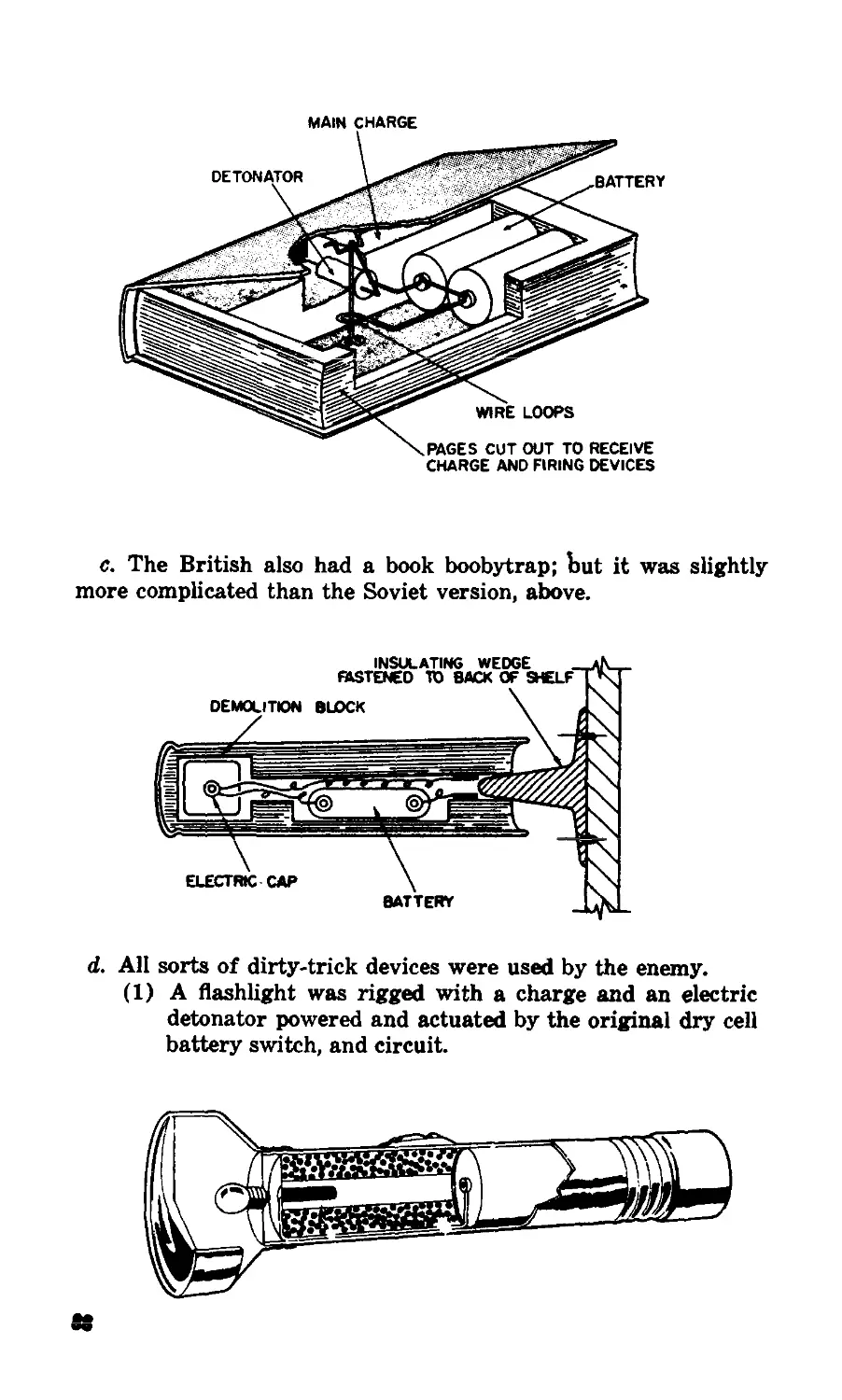
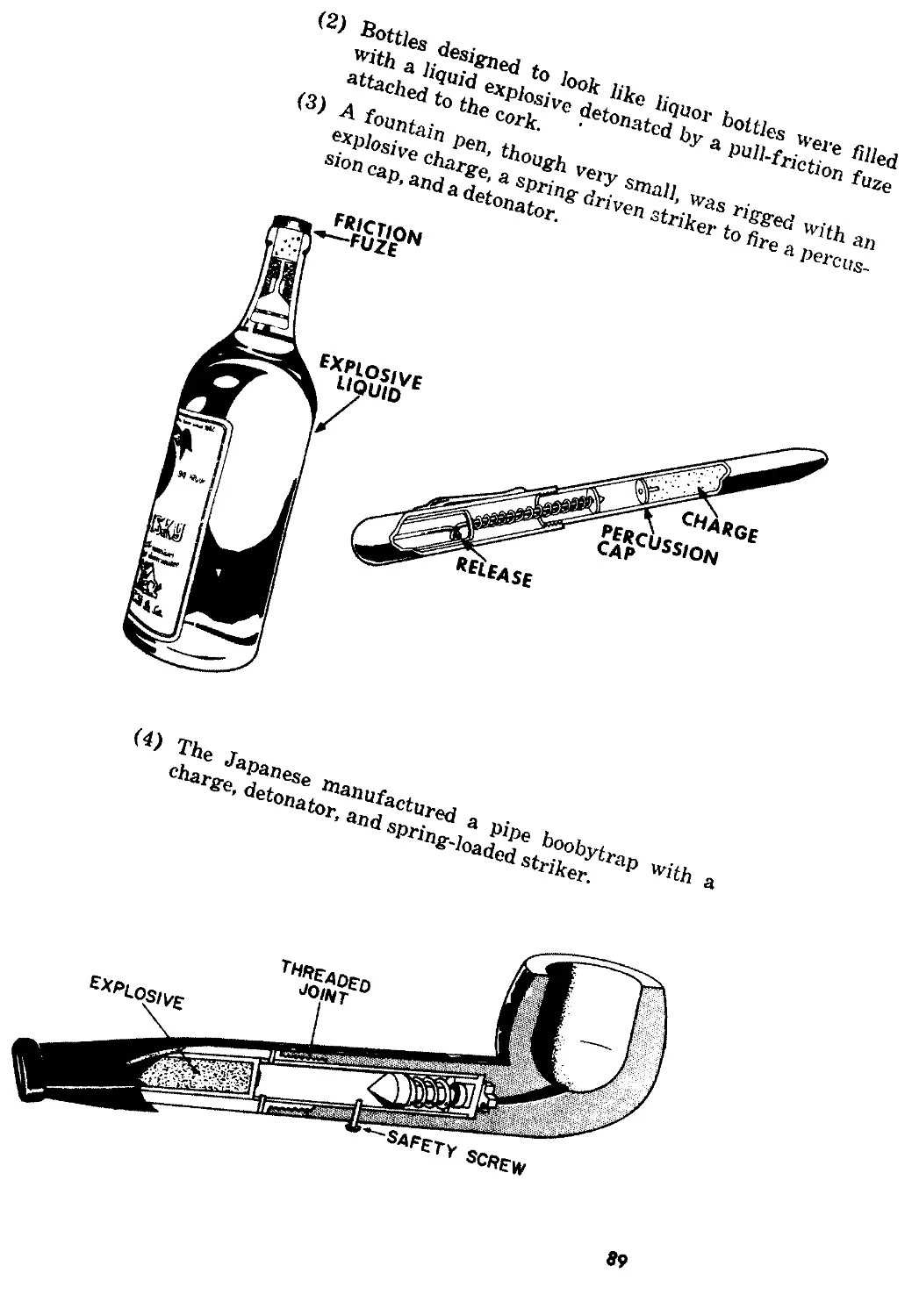
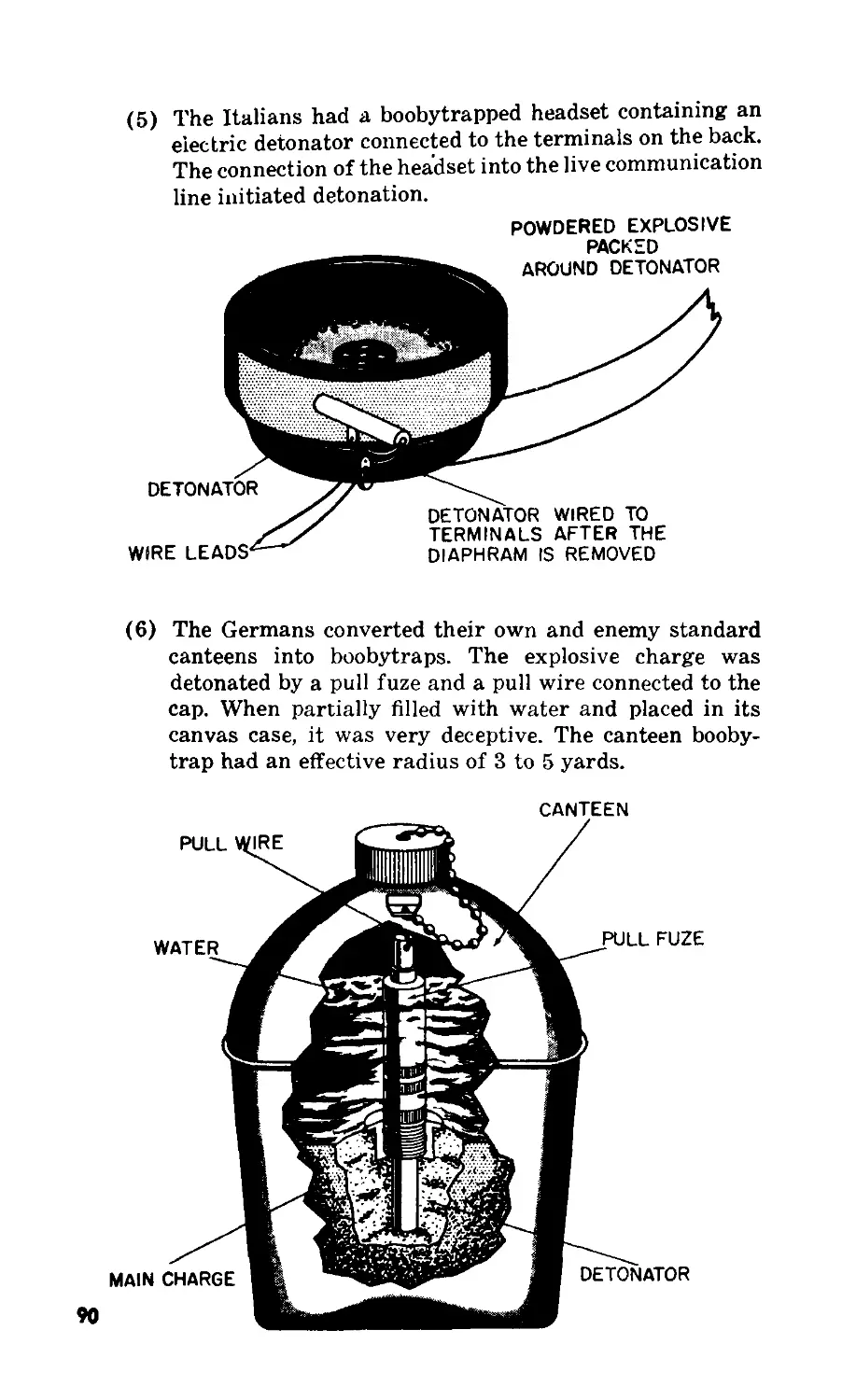
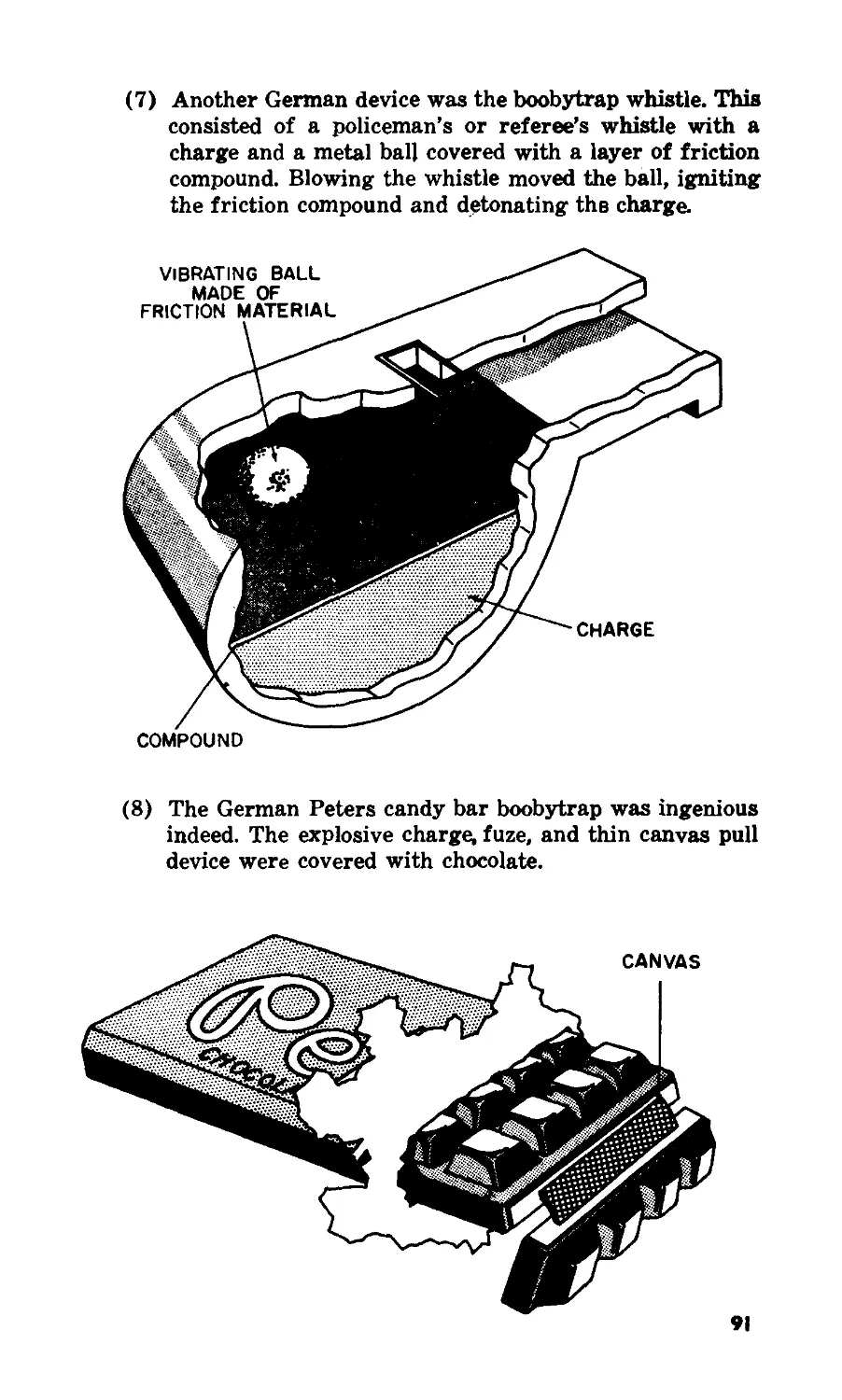


Теги: boobytraps. warfare
Год: 1965
Текст
                    FM 5-31
DEPARTMENT OF THE ARMY FIELD MANUAL
BOOBYTRAPS
HEADQUARTERS, DEPARTMENT OF THE ARMY
SEPTEMBER 1965
*FM 5-31
Fdeld Manual
No. 5-31
HEADQUARTERS
DEPARTMENT OF THE ARMY
Washington, D.C., Ц September 1965
BOOBYTRAPS
Paragraphs Page
Снлрткв 1. CHARACTERISTICS OF BOOBYTRAPS
Section I.	Introduction__________________________________ 1-2	3
II.	Principles of operation_______________________ 3-7	3
Снагткв 2. USE OF BOOBYTRAPS
Section I.	Basic doctrine________________________________ 8-9	9
П.	Planning____________________________________ 10-14	9
III.	Installation________________________________ 15-17	14
Chaftkb 3. BOOBYTRAPPING EQUIPMENT
Section I.	Firing devices______________________________ 18-26	19
II.	Demolition materials________________________ 27-30	35
III.	Missiles____________________________________ 31-36	45
Chaptkb 4. CONSTRUCTION TECHNIQUES
Section I.	Boobytrapping mines in minefields__________  37-39	51
П.	Ronbytmpping building»_____________________  40-44	61
III.	Terrain_____________________________________ 45-48	79
Chaptkb 5. MISCELLANEOUS BOOBYTRAPS
Section I.	Standard boobytraps_________________________ 49-50	87
II.	Improvisations______________________________ 51-62	92
Снлгткп 6. BOOBYTRAP DETECTION AND REMOVAL
Section I.	Clearing methods____________________________ 63-68	119
II.	Disarming methods___________________________ 69-72	123
Appkndix I. References_______________________________ ________ 127
*Thi« mansol suponodas FM 5-31, 31 January 1956, including С 1, 16 Ds reader
1957, and C 2, 21 August 1959.
TAGO S732-B—SoptMnbor
CHAPTER 1
CHARACTERISTICS OF BOOBYTRAPS
Section I.	INTRODUCTION
1.	Purpose and Scope
a.	This manual contains procedures, techniques, and expedients
for the instruction of the soldier in the assembly, use, detection, and
removal of boobytraps in combat.
b.	Included are descriptions and discussions of the design and
functioning characteristics of standard demolition items — firing
devices, explosives, and accessories — and missiles, such as hand
grenades, mortar ammunition, artillery ammunition, and bombs.
c.	This manual also contains information on a variety of items
and indigenous materials useful for improvising firing devices,
explosives, and pyrotechnic mixtures for guerrilla warfare appli-
cations.
d.	Factory-produced boobytraps (dirty trick devices) are
described. Most of these have been developed and used in the field
by foreign armies.
e.	Safety measures pertinent to boobytrapping operations are
provided for the protection of troops from casualty.
/. The contents of this manual are applicable to nuclear and non-
nuclear warfare.
2.	Comments
Users of this manual are encouraged to forward comments or
recommendations for changes for improvement. Comments should
be referenced to the page, paragraph, and line of text. The reason
for each coipment should be given to insure proper interpretation
and evaluation. Forward all comments directly to the Commandant,
U.S. Army Engineer School, Fort Belvoir, Virginia 22060.
Section II.	PRINCIPLES OF OPERATION
3.	Types of Boobytraps
A boobytrap is an explosive charge cunningly contrived to be
fired by an unsuspecting person who disturbs an apparently harm-
less object or performs a presumably safe act. Two types are in use
—improvised and manufactured. Improvised boobytraps are assem-
bled from specially provided material or constructed from materials
generally used for other purposes. Manfactured boobytraps are
dirty trick devices made at a factory for issue to troops. They
usually imitate some object or article that has souvenir appeal or
that may be used by the target to advantage.
3
4.	Assembling Boobytraps
A boobytrap consists of a main charge, firing device, standard
base (not always used), and detonator. Another item, the universal
destructor, is an adapter for installing a firing device assembly in a
loaded projectile or bomb to make an improvised boobytrap. Also,
firing device assemblies are often attached to the main charge by
means of a length of detonating cord.
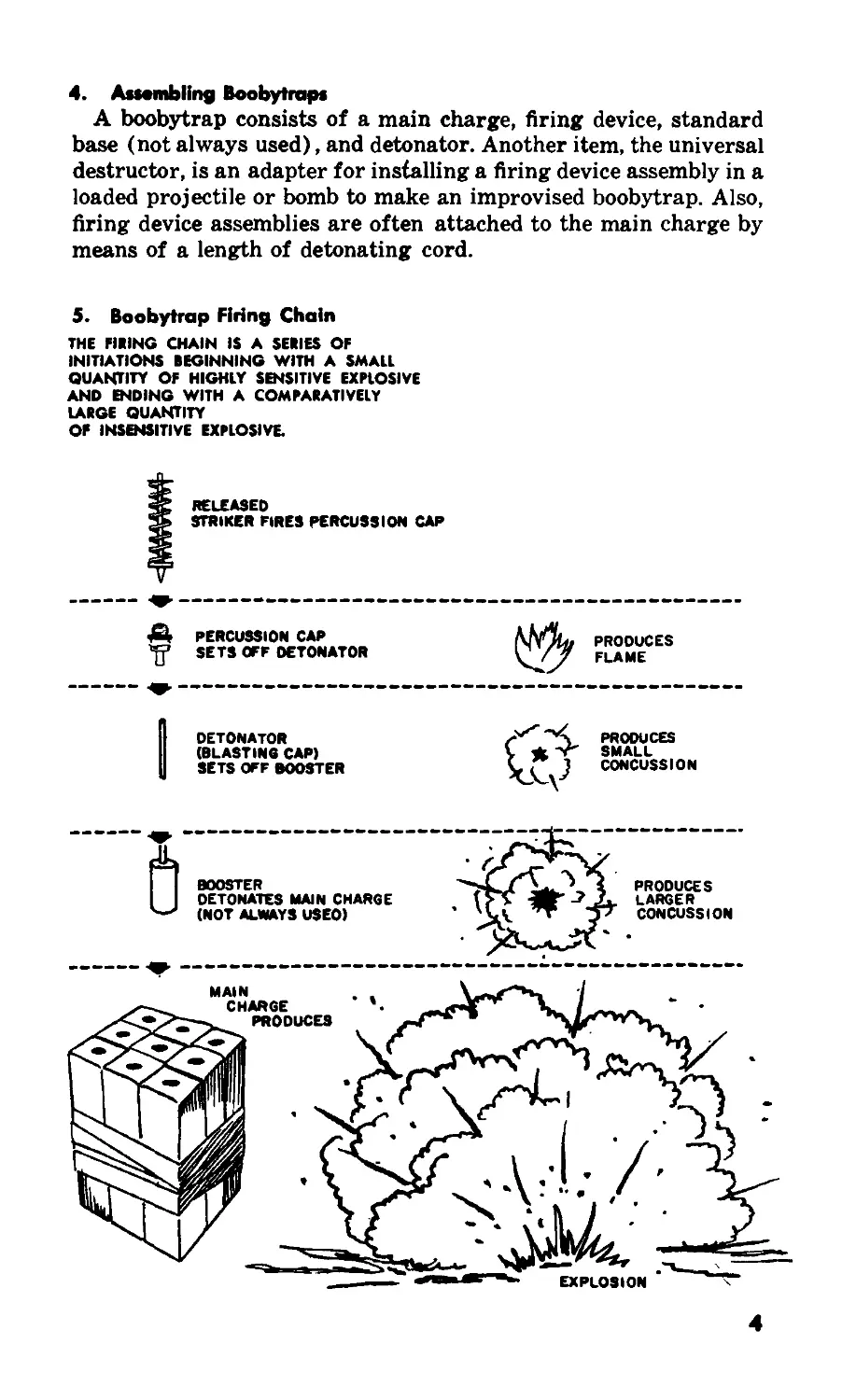
5.	Boobytrap Firing Chain
THE FIRING CHAIN IS A SERIES OF
INITIATIONS BEGINNING WITH A SMALL
QUANTITY OF HIGHLY SENSITIVE EXPLOSIVE
ANO B4DING WITH A COMPARATIVELY
LARGE QUANTITY
OF INSB4SITIVE EXPLOSIVE.
RELEASED
STRIKER FIRES PERCUSSION CAP
& PERCUSSION CAP
‘g’ SETS OFF DETONATOR
PRODUCES
PRODUCES
SMALL
CONCUSSION
DETONATOR
(BLASTING CAP)
SETS OFF BOOSTER
4
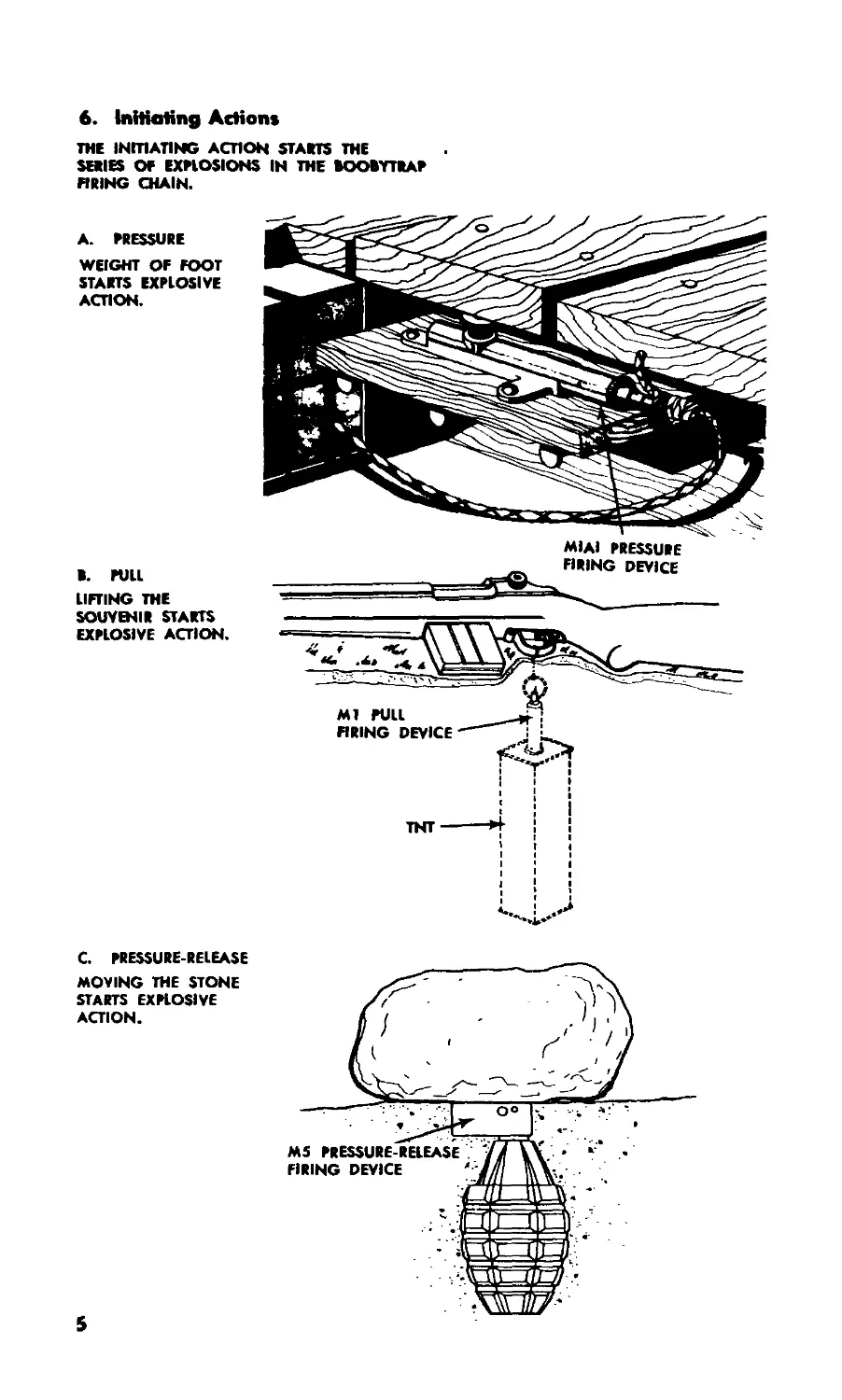
6.	Initialing Action*
THE INITIATING ACTION STARTS THE
SERIES OF EXPLOSIONS IN THE BOOBYTRAP
HRING CHAIN.
A.	PRESSURE
WEIGHT OF FOOT
STARTS EXPLOSIVE
ACTION.
B.	PULL
LIFTING THE
SOUVENIR STARTS
EXPLOSIVE ACTION.
C. PRESSURE-RELEASE
MOVING THE STONE
STARTS EXPLOSIVE
ACTION.
5
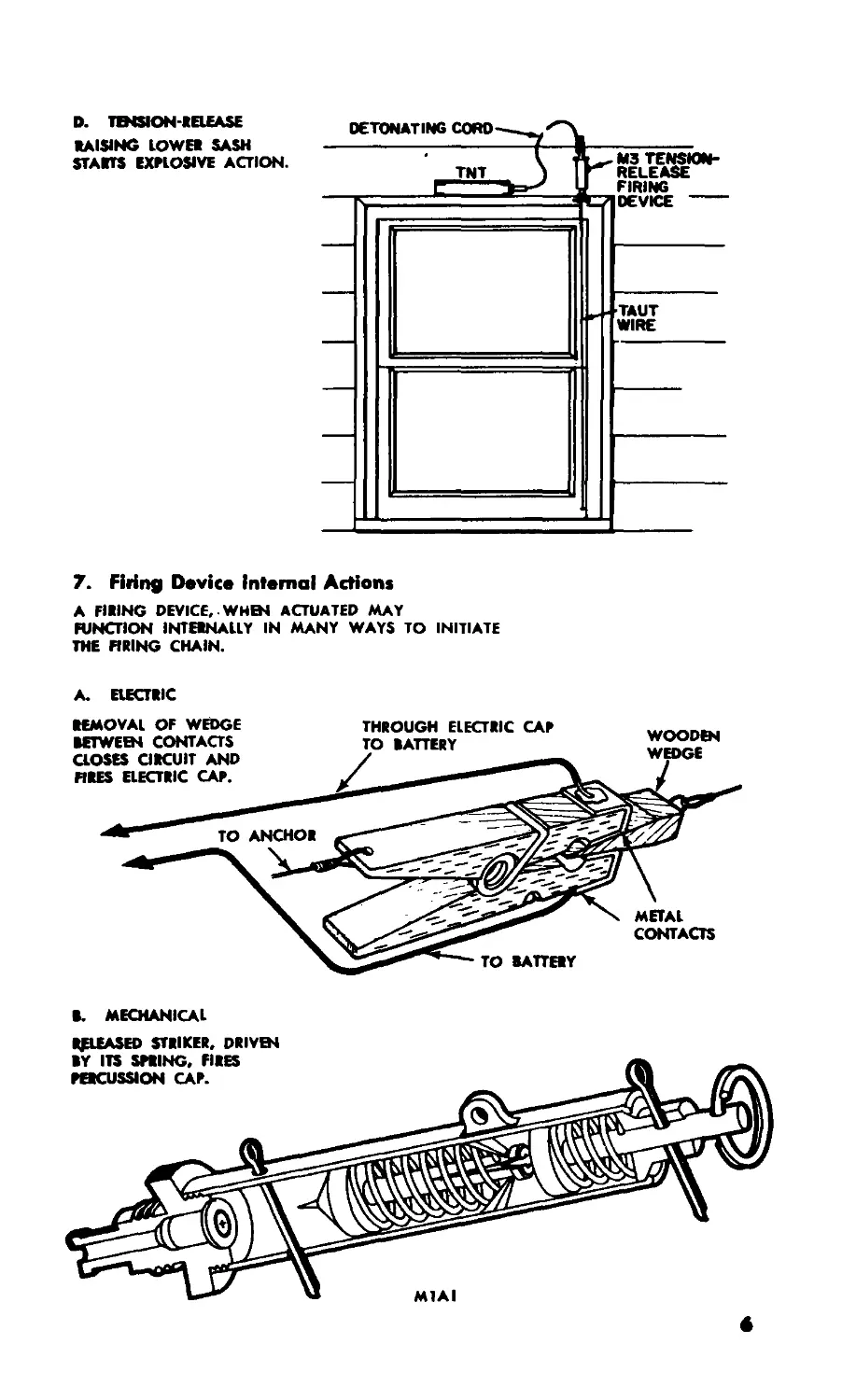
0. TENSION-RELEASE
RAISING LOWER SASH
STARTS EXPLOSIVE ACTION.
7. Firing Device Internal Actions
A FIRING DEVICE,. WHEN ACTUATED MAY
FUNCTION INTERNALLY IN MANY WAYS TO INITIATE
THE FIRING CHAIN.
A. ELECTRIC
B. MECHANICAL
RELEASED STRIKER, DRIVEN
BY ITS SPRING, FIRES
PERCUSSION CAP.
M1AI
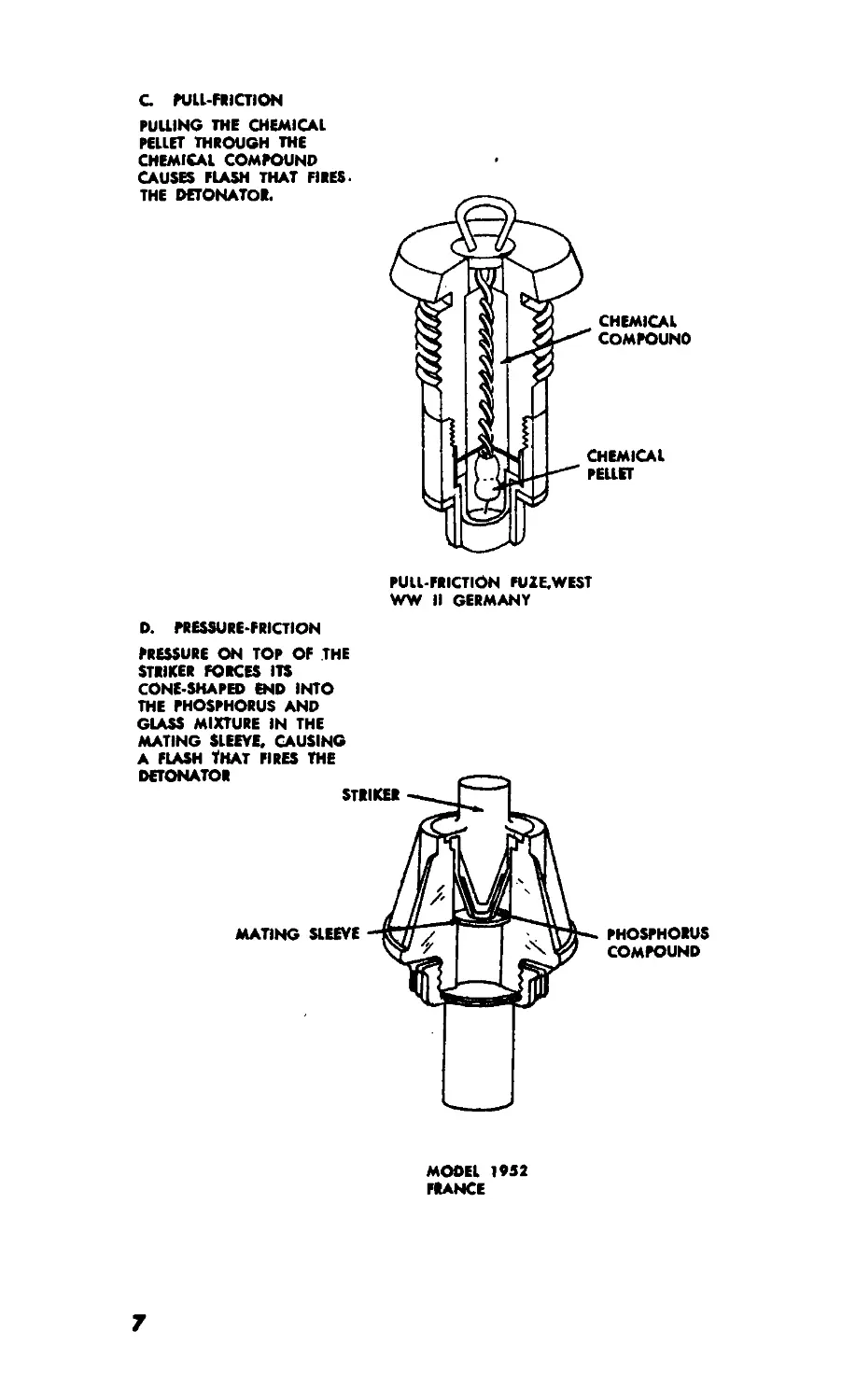
G PULL-FRICTION
PULLING THE CHEMICAL
PELLET THROUGH THE
CHEMICAL COMPOUND
CAUSES FLASH THAT FIRES.
THE DETONATOR.
PULL-FRICTION FUZE.WEST
WW II GERMANY
D. PRESSURE-FRICTION
pressure on top of the
STRIKER FORCES ITS
CONE-SHAPED END INTO
THE PHOSPHORUS AND
GLASS MIXTURE IN THE
MATING SLEEVE. CAUSING
a flash That fires the
PHOSPHORUS
COMPOUND
MODEL 1952
FRANCE
7
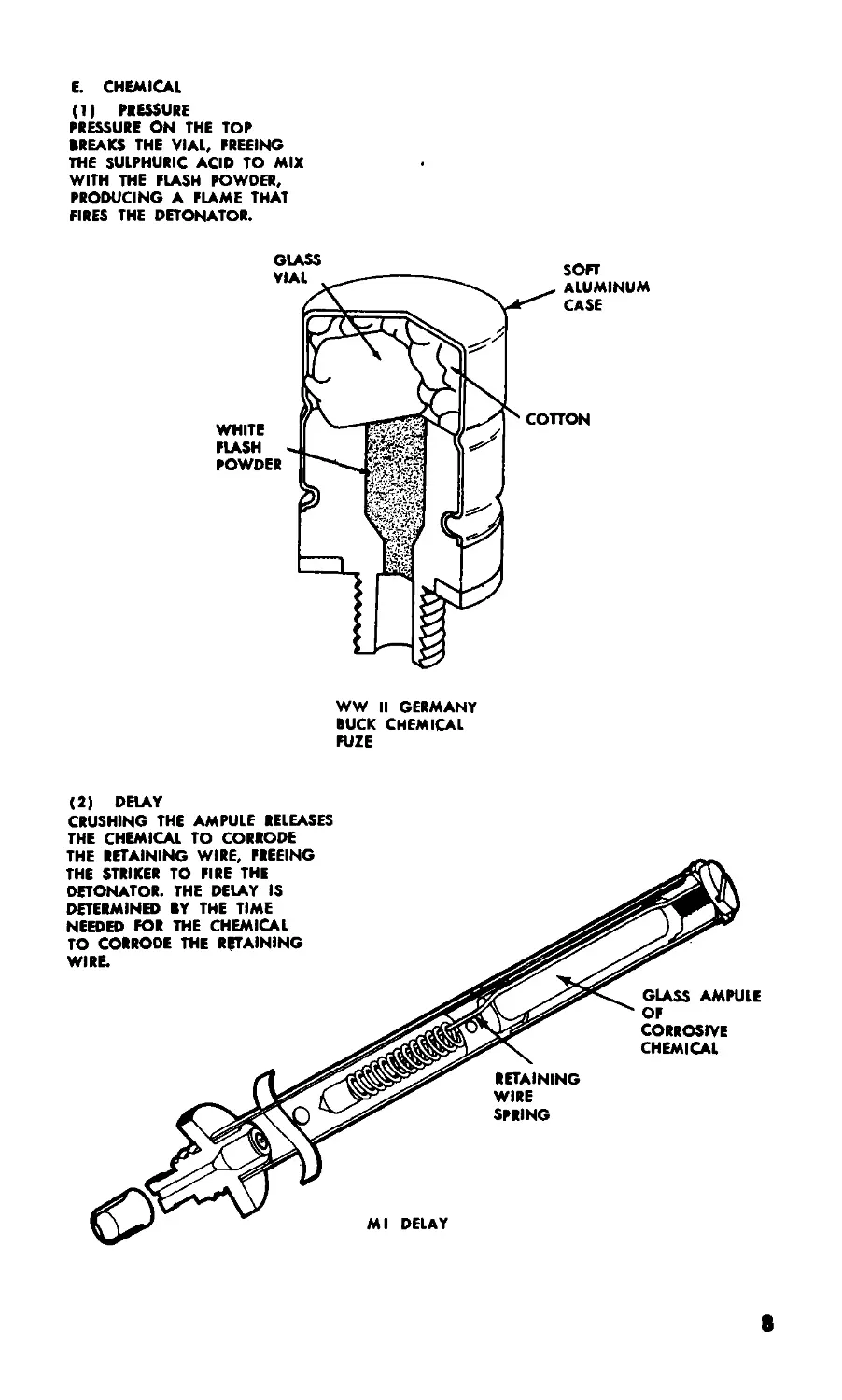
E. CHEMICAL
(1) PRESSURE
PRESSURE ON THE TOP
BREAKS THE VIAL, FREEING
THE SULPHURIC ACID TO MIX
WITH THE FLASH POWDER,
PRODUCING A FLAME THAT
FIRES THE DETONATOR.
WW II GERMANY
BUCK CHEMICAL
FUZE
AMPULE RELEASES
TO CORRODE
Ml DELAY
RETAINING
WIRE
SPRING
GLASS AMPULE
OF
CORROSIVE
CHEMICAL
(2) DELAY
CRUSHING THE
THE CHEMICAL
THE RETAINING WIRE, FREEING
THE STRIKER TO FIRE THE
DETONATOR. THE DELAY IS
DETERMINED BY THE TIME
NEEDED FOR THE CHEMICAL
TO CORRODE THE RETAINING
WIRE.
8
CHAPTER 2
USE OF BOOBYTRAPS
Section I. BASIC DOCTRINE
B.	Tactical Principle*
Boobytraps supplement minefields by increasing their obstacle
value. They add to the confusion of the enemy, inflict* casualties,
destroy material, and lower morale. Boobytraps are usually laid
by specialists. All military personnel, however, are trained in han-
dL xplosives and other boobytrapping material, so that they
may, ii necessary, boobytrap a mine or install a simple boobytrap.
9. Authority
a.	Army commanders issue special instructions for the use of
boobytraps within their command. Supplies are authorized and pro-
vided as required to meet boobytrapping needs.
b.	Army and higher commanders may delegate authority to lay
boobytraps to as low as division commanders. All higher command-
ers, however, may revoke this authority for a definite or indefinite
period, as the tactical situation may require.
c.	Records of all boobytraps laid are prepared and forwarded
to higher headquarters.
d.	Enemy boobytraped areas, as soon as discovered, are reported
to higher headquarters to keep all interested troops advised of
enemy activities. If possible, all boobytraps are neutralized; other-
wise they are properly marked by warning signs.
Suction II. PiANNING
10.	Tactical Effects
a.	The ingenious use of local resources and standard items is
important in making effective boobytraps. They must be simple
in construction, readily disguised, and deadly. They may produce
unexpected results if conceived in sly cunning and built in various
forms. Boobytraps cause uncertainty and suspicion in the mind
of the enemy. They may surprise him, frustrate his plans, and
inspire in his soldiers a fear of the unknown.
b.	In withdrawal, boobytraps may be used in much the same way
as nuisance mines. Buildings and other forms of shelter, roads,
paths, diversions around obstacles, road blocks, bridges, fords,
and similar areas are suitable locations for concealing boobytraps.
c.	In defense, boobytraps, placed in the path of the enemy at
strategic locations in sufficient numbers, may impede his progress,
prevent detailed reconnoissance, and delay disarming and removal
of minefields.
9
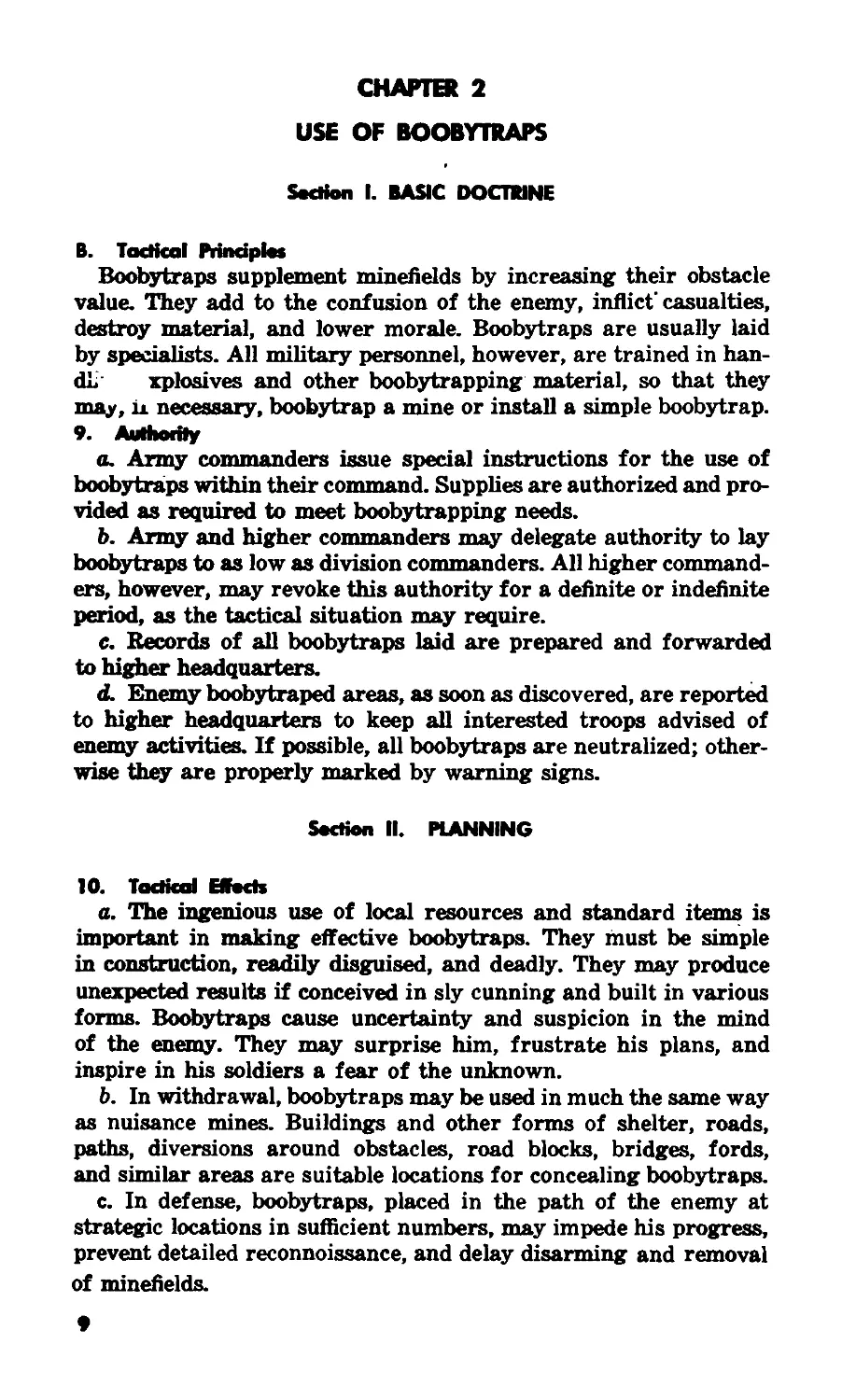
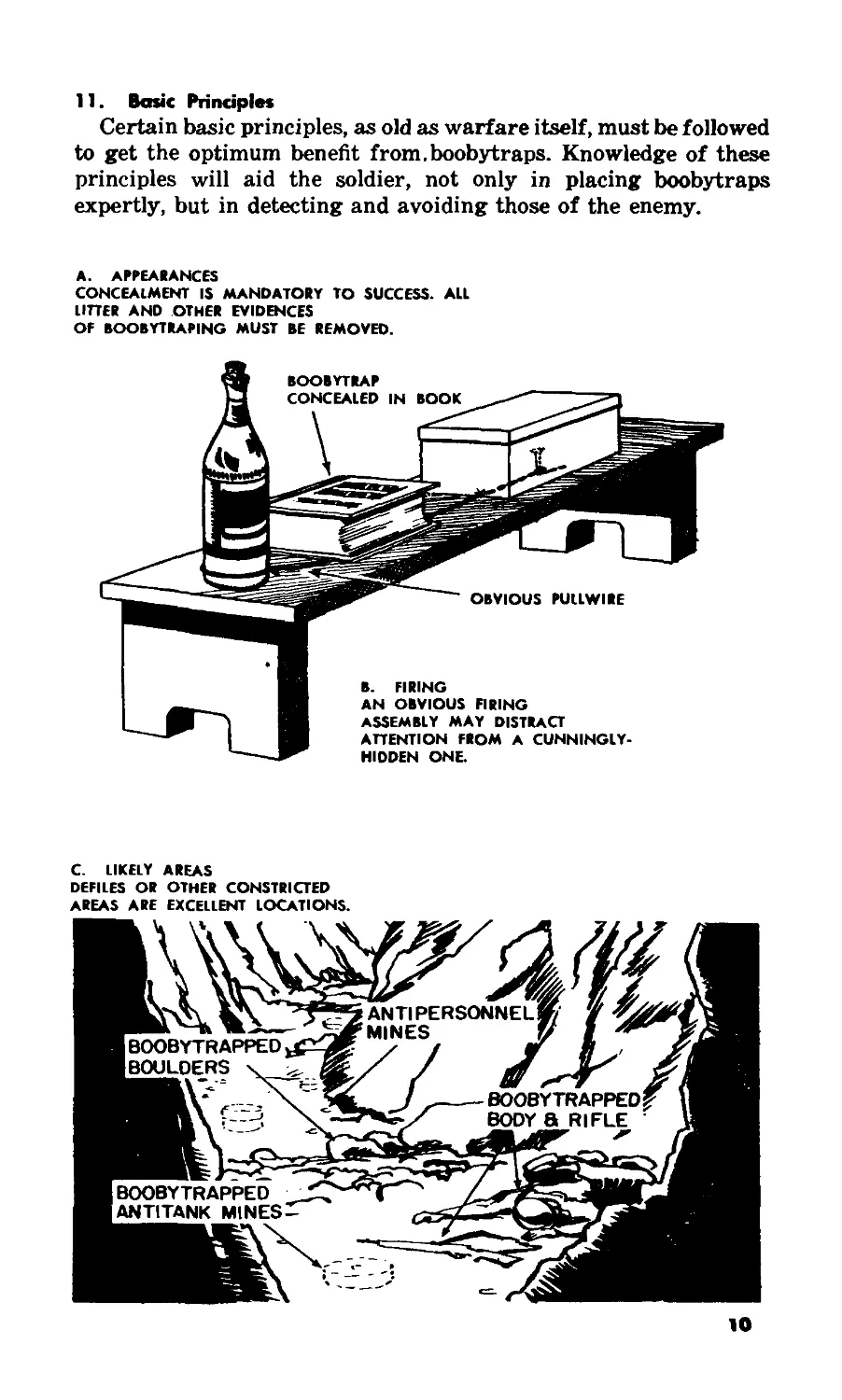
11.	Basic Principles
Certain basic principles, as old as warfare itself, must be followed
to get the optimum benefit from.boobytraps. Knowledge of these
principles will aid the soldier, not only in placing boobytraps
expertly, but in detecting and avoiding those of the enemy.
a. appearances
CONCEALMENT IS MANDATORY TO SUCCESS. ALL
UTTER AND OTHER EVIDENCES
OF BOOBYTRAPING MUST BE REMOVED.
10
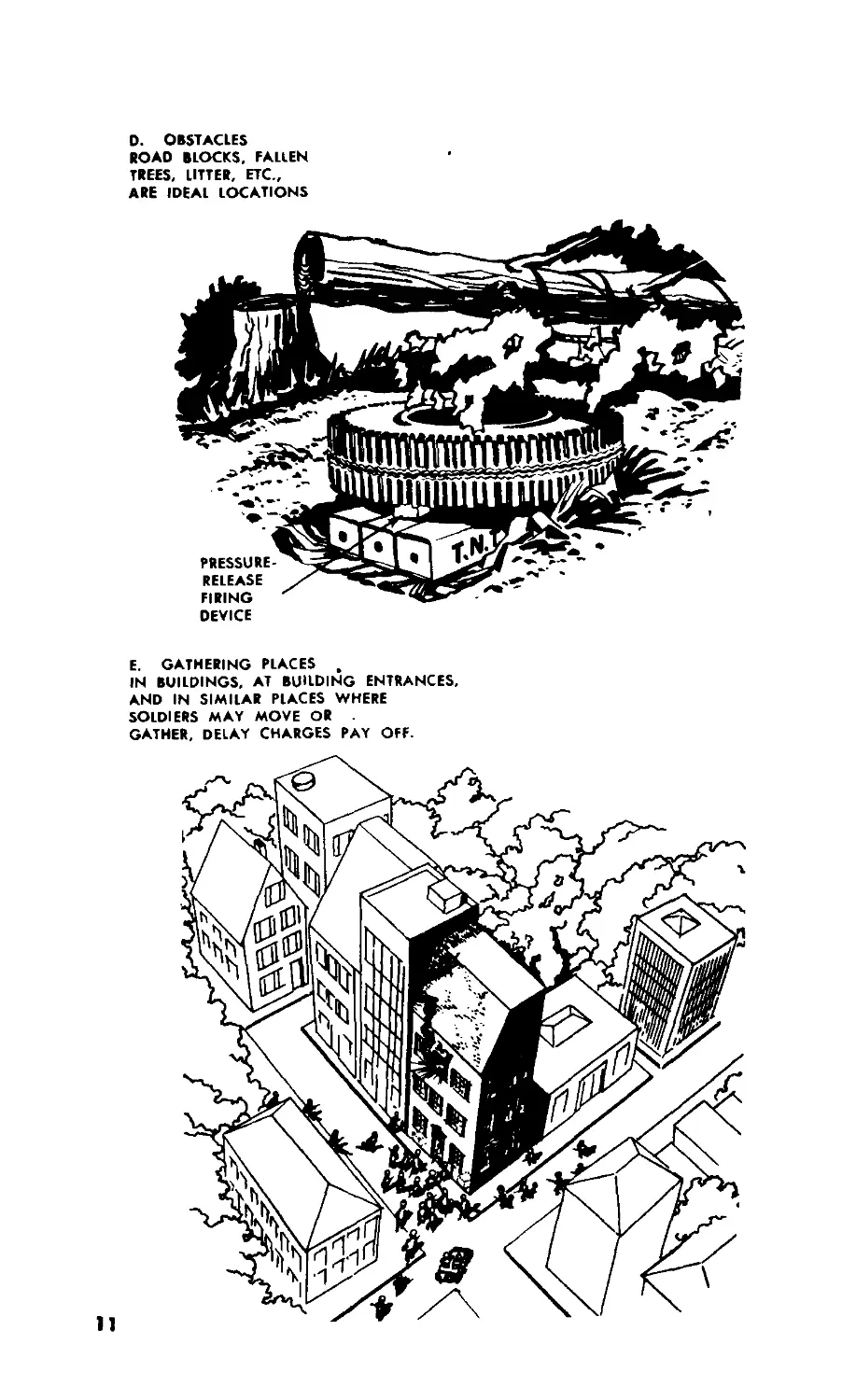
0. OBSTACLES
ROAD BLOCKS, FALLEN
TREES, LITTER, ETC.,
ARE IDEAL LOCATIONS
DEVICE
E.	GATHERING PLACES .
IN BUILDINGS, AT BUILDING ENTRANCES,
AND IN SIMILAR PLACES WHERE
SOLDIERS MAY MOVE OR .
GATHER, DELAY CHARGES PAY OFF.
11
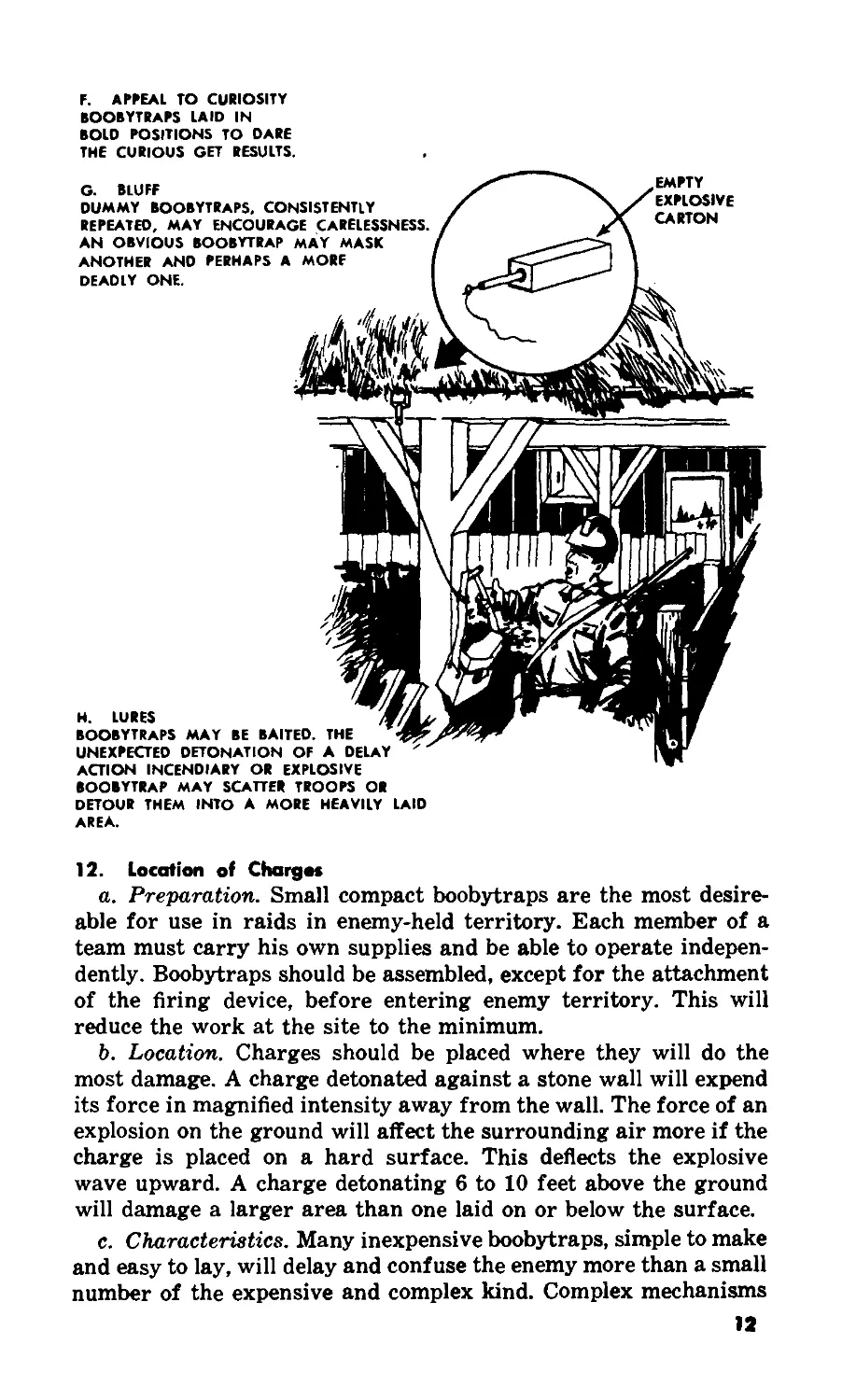
F.	APPEAL TO CURIOSITY
boobytraps laid in
BOLD POSITIONS TO DARE
THE CURIOUS GET RESULTS.
EMPTY
EXPLOSIVE
CARTON
G.	BLUFF
DUMMY BOOBYTRAPS, CONSISTENTLY
REPEATED, MAY ENCOURAGE CARELESSNESS.
AN OBVIOUS BOOBYTRAP MAY MASK
ANOTHER AND PERHAPS A MORE
DEADLY ONE.
H.	LURES
BOOBYTRAPS MAY BE BAITED. THE
UNEXPECTED DETONATION OF A DELAY
ACTION INCENDIARY OR EXPLOSIVE
BOOBYTRAP MAY SCATTER TROOPS OR
DETOUR THEM INTO A MORE HEAVILY LAID
AREA.
12.	Location of Charges
a.	Preparation. Small compact boobytraps are the most desire-
able for use in raids in enemy-held territory. Each member of a
team must carry his own supplies and be able to operate indepen-
dently. Boobytraps should be assembled, except for the attachment
of the firing device, before entering enemy territory. This will
reduce the work at the site to the minimum.
b.	Location. Charges should be placed where they will do the
most damage. A charge detonated against a stone wall will expend
its force in magnified intensity away from the wall. The force of an
explosion on the ground will affect the surrounding air more if the
charge is placed on a hard surface. This deflects the explosive
wave upward. A charge detonating 6 to 10 feet above the ground
will damage a larger area than one laid on or below the surface.
c.	Characteristics. Many inexpensive boobytraps, simple to make
and easy to lay, will delay and confuse the enemy more than a small
number of the expensive and complex kind. Complex mechanisms
12
cost more, require more care in laying, and offer little more advan-
tage than the simple type.
13.	Reconnaissance
Complete reconnaissance of an area is essential to good planning.
Without this and the preparation of a program, boobytraps may
not be used effectively. Boobytrap teams are best suited to survey a
combat area to determine its boobytrapping possibilities.
14.	Plan of Operation
a.	The commander with authority to use boobytraps coordinates
his plans with other tactical plans. Timing of boobytrap operations
with movement plans is extremely essential. Boobytraps should
not be laid in areas where friendly troops will remain for any
appreciable length of time. Plans will indicate what is to be done,
where and when it will be done, and the troops to be used. Generally,
trained troops are assigned such tasks.
b.	The plan authorizes the use of boobytraps and the types and
densities required in specified areas, depending on the terrain, time,
personnel, and material available. The completion of the detailed
plan is delegated to the commander responsible for installation.
Materials are obtained from unit supply stocks on the basis of the
proposed action.
c.	Complete coordination between the troop commander and the
officer supervising boobytrap activities is essential. The area should
be evacuated immediately following the completion of the job.
d.	The commander installing boobytraps prepares a detailed plan
indicating the site and the location, number, type, and setting. He
assigns boobytrap teams to specific areas and the laying of speci-
fied types. The plan covers arrangements for supplies and transpor-
tation and designates the location where all preliminary work on
boobytraps will be done. Time tables are established to insure com-
pletion of the work to comply with withdrawal phases of tactical
plans.
e.	In hasty withdrawal, when there is no time for planning, each
team will be given a supply of material with instructions for making
the best possible use of it in the time allowed.
f.	Boobytrap planning must give proper consideration to all
known characteristics of the enemy. Members of teams should study
the personal habits of enemy soldiers, constantly devising new
methods to surprise them. Repetitions may soon become a pattern
easily detected by an alert enemy.
g.	Withdrawal operations are the most desirable of all for laying
boobytraps. When an enemy meets a boobytrap at the first obstacle,
his progress throughout the area will be delayed even though no
others have been laid. A few deadly boobytraps and many dummies,
laid indiscriminately, can inspire great caution. Dummies, however,
should be unserviceable or useless items. Never throw away mater-
ial that may return to plague friendly forces!
13
Section III. INSTALLATION
15.	Responsibilities
a.	A commander authorized to use boobytraps is responsible for
all within his zone of command. He will keep adequate records
showing their type, number, and location, and prepare information
on those laid and on practices followed by the enemy.
b.	Management of boobytrap services may be delegated to the
engineer staff officer.
c.	Unit commanders must know the location of all boobytraps
in their areas and keep all subordinates so advised. Subordinates
are also responsible for reporting to higher headquarters all new
information obtained on enemy boobytraps.
d.	Officers responsible for laying boobytraps prepare plans,
supervise preliminary preparations, and direct their installation.
They forward to proper authority a detailed report of their pro-
gress, advise all concerned when changes are made, and report
to engineer intelligence units the discovery of any new enemy
devices or low-cunning practices.
e.	Engineer and infantry units, with special training, have the
responsibility of installing and neutralizing boobytraps. Since
adequate numbers of trainees may not always be available, all
troops are given familiarity instruction in boobytrapping.
16.	Procedures
Like all activities involving explosives, boobytrapping is dan-
gerous only because of mistakes men make. Prescribed methods
must be followed explicitly in the interest of personal safety and
overall effectiveness.
a.	Before assemblying a boobytrap, all components should be
inspected for serviceability. They must be complete and in working
order. All safeties and triggering devices must be checked to insure
proper action, and for rust or dents that might interfere with me-
chanical action.
b.	If a boobytrapping plan is not available, one must be prepared
on arrival at the site, so that the material obtained will be required
items only. A central control point should be established in each
boobytrap area where supplies may be unloaded and from which
directions may be given. In areas where many boobytraps are con-
centrated, safe passage routes from the control point to each loca-
tion must be marked clearly. Lines or tape may be useful where
vegetation is heavy. The control man is the key man.
c.	Several teams may operate from one control point. Each
team (rarely more than two men) is assigned to a specific area
and supplies are issued only as needed. Each detail commander
must make certain that every man knows his job and is competent
to do it. Teams will remain separated so that one may not suffer
from the mistake of another. When a job is completed, all teams
14
must report to control man before going elsewhere.
d.	One person in each team is designated leader to direct all work.
If possible, members of a team will avoid working close together
when a boobytrap is assembled. One member should do all technical
work and the other be a helper to carry supplies, provide assistance
needed, and learn the skills needed.
e.	Boobytraps laid during raids into enemy held territory should
be small, simple, and easily installed. Each member of a party must
carry the supplies he needs. The use of boobytraps under these
conditions, when accurate records are impossible, may be a hazard
to friendly troops if raids into the same area should become neces-
sary.
/. Procedure for installing boobytraps is as follows:
(1)	Select the site that will produce the optimum effect when
the boobytrap is actuated.
(2)	Lay the charge, then protect and conceal it.
(3)	Anchor the boobytrap securely, with nails, wire, rope, or
wedges, if necessary.
(4)	Camouflage or conceal, if necessary.
(5)	Teams arm boobytraps systematically, working toward
a safe area.
(6)	Leave the boobytrapped area clean. Carry away all items
that might betray the work that has been done, such as
loose dirt, empty boxes, tape, and broken vegetation.
Obliterate footprints.
17.	Reporting, Recording, and Marking
Boobytraps are reported and recorded for the information of
tactical commanders and the protection of friendly troops from
casualty. Boobytrap installations are reported and recorded as
nuisance minefields, whether the area contains both boobytraps
and mines or boobytraps alone.
a.	Reports
(1)	Intent. This is transmitted by the fastest means available
consistent with signal security. It includes the location of
the boobytrapped area selected, the number and type of
mines to be laid (if antitank mines are boobytrapped),
boobytraps to be laid, the estimated starting and complet-
ing time, and the tactical purpose. The report is initiated
by the commander authorized to lay the field and for-
warded to higher headquarters.
(2)	Initiation of Laying. This report is transmitted by the
fastest means available consistent with signal security.
It contains the location and extent of the field, total num-
ber of mines and boobytraps to be laid, and estimated
time of completion. The commander of the unit installing
15
1*
the field sends the report to the commander that directed
him to lay it.
(3)	Completion. The report of completion is transmitted by
the fastest possible means. It contains the number and
type of boobytraps laid, location and extent of the field
or area and the time of completion. The report is for-
warded to army level. When boobytraps are laid, either
alone or with mines, the report of intent and the report
of initiation of laying' will include the estimated number
of boobytraps to be placed and the report of completion,
the number placed.
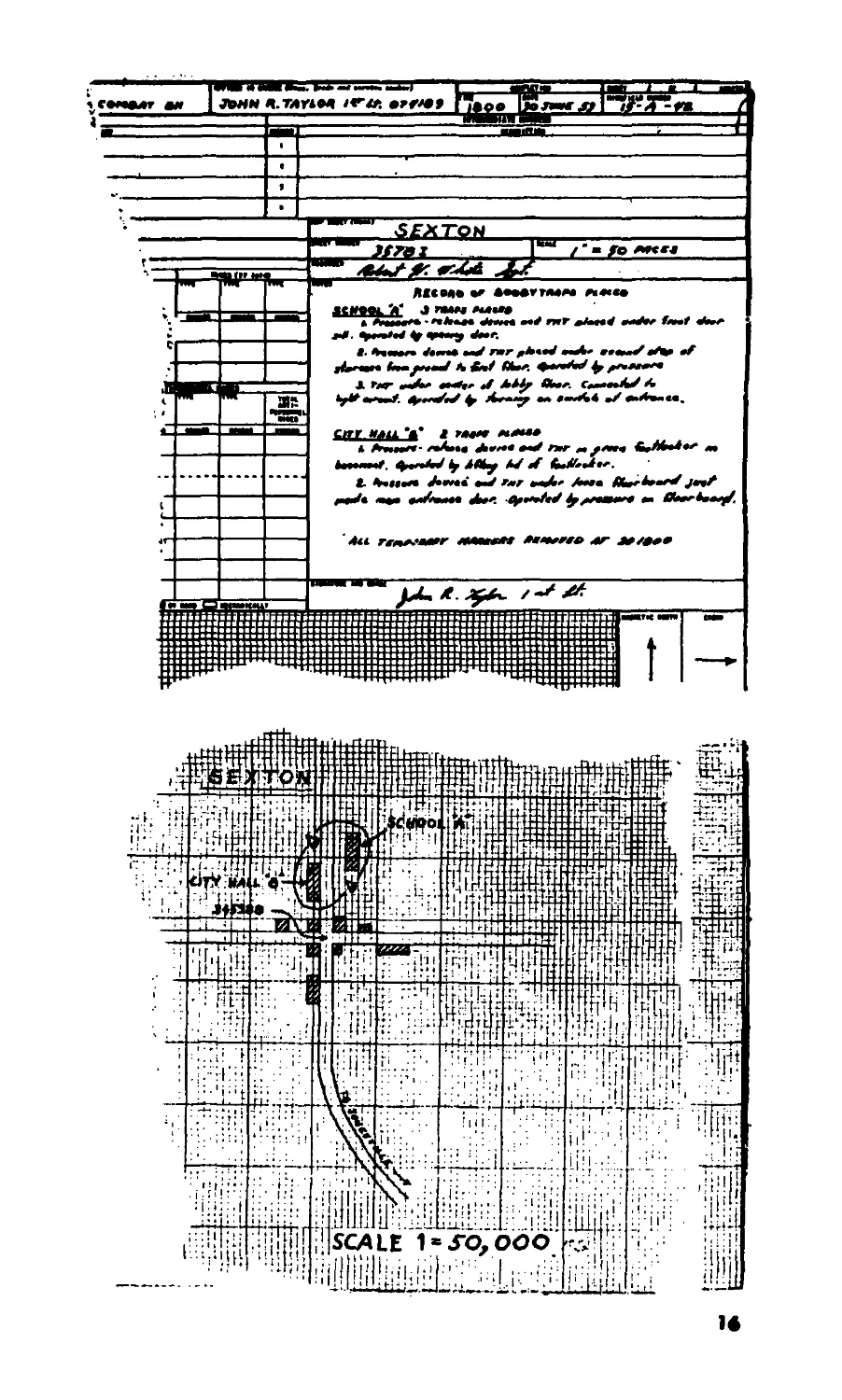
b.	Record». Boobytraps are recorded as nuisance mine fields on
the standard mine field record form. It is filled in as follows:
(1)	The general locations are shown on the sketch, using the
appropriate symbol. Boobytrapped areas or buildings are lettered
serially, "A" being the nearest to the enemy.
(2)	The number, types, locations, and methods of operation of
boobytraps are entered in the NOTES section of the form. If space
is lacking, additional sheets may be attached. If the boobytrap can-
not be adequately described in a few short sentences, a sketch of
minimum details will be included.
(3)	The record is prepared simultaneously with the laying of
the boobytrap and forwarded through channels to army level with-
out delay. If a standard form is not available, the data required
must be entered and submitted on an expedient form.
(4)	Nuisance mine fields containing both mines and boobytraps
are recorded as prescribed in FM 20-32. When the specific locations
of boobytraps and manufactured devices cannot be accurately re-
corded (scattered laying in open areas) their number and type are
entered in the notes section of the form and identified by grid coor-
dinates.
c.	Marking. Boobytraps are marked by special triangular signs
painted red on both sides. On the side facing away from the danger
area, a 3-inch diameter white disc, is centered in the triangle and
the word BOOBYTRAPS is painted in white across the top in 1-
inch letters. The STANAG or new sign is similar except for the 1-
inch white stripe below the inscription. Signs may be made of metal,
wood, plastic, or similar material. They are placed above ground,
right-angled apex downwards, on wire fences, trees, or doors, win-
dows, or other objects or by pushing the apex in the ground. These
working signs are used by all troops to identify friendly boobytraps
during the period preceding withdrawal from an area, or to warn
friendly forces of the presence of active enemy boobytraps.
17
11 К-IN.
d.	Abandonment. When abandoning a boobytrapped area to the
enemy, all markers, wire, etc., are removed.
e.	Signs. Signs are also used to mark enemy boobytraps or booby-
trapped areas.
CHAPTER 3
BOOBYTRAPPING EQUIPMENT
Section I. FIRING DEVICES
18.	Introduction
Many triggering devices are available for use in boobytraps. They
include fuzes, igniters, and firing devices. All U.S. standard firing
devices have the following advantages over improvisations; estab-
lished supply, speed of installation, dependability of functioning,
resistance to weather, and safety. All have a standard base coupling
by which they may readily be attached to a variety of charges. For
more detailed information see TM9-1375-200.
19.	Ml Al Pressure firing Device
a.	Characteristics.
Dimensions
Cose	Color	0	L	Infernal Action	Initiating Action
Malol	OD	% in	2% in	Spring-driven striker with keyhole sial release	20 lb pressure or more
Safeties	Accessories	Packaging
Safety clip and positive safety pin	3-pronged pressure heod and extension rod	Five units with standard bases packed in cardboard carton. Thirty cartons shipped in wooden box.
b.	Functioning.
A pressure of 20 pounds or more on the pressure cap moves the
trigger pin downward until the striker spindle passes through the
keyhole slot. This releases the striker to fire the percussion cap.
BEFORE ATTACHING
BLASTING CAP
19
SLOT
c.	Installing.
(1)	Remove protective cap from base and crimp on a non-
electric blasting cap. Crimper jaws should be placed no
farther than Ц inch from open end of blasting cap.
(2)	Assemble 3-pronged pressure head and extension rod and
screw in top of pressure cap, if needed.
(3)	Attach firing device assembly to standard base.
(4)	Attach firing device assembly to charge.
NOTE. If lop pressure board is used* allow doarance space
between it and top of prongs or pressure cap.
d. Arming. Remove safety clip first and positive pin last.
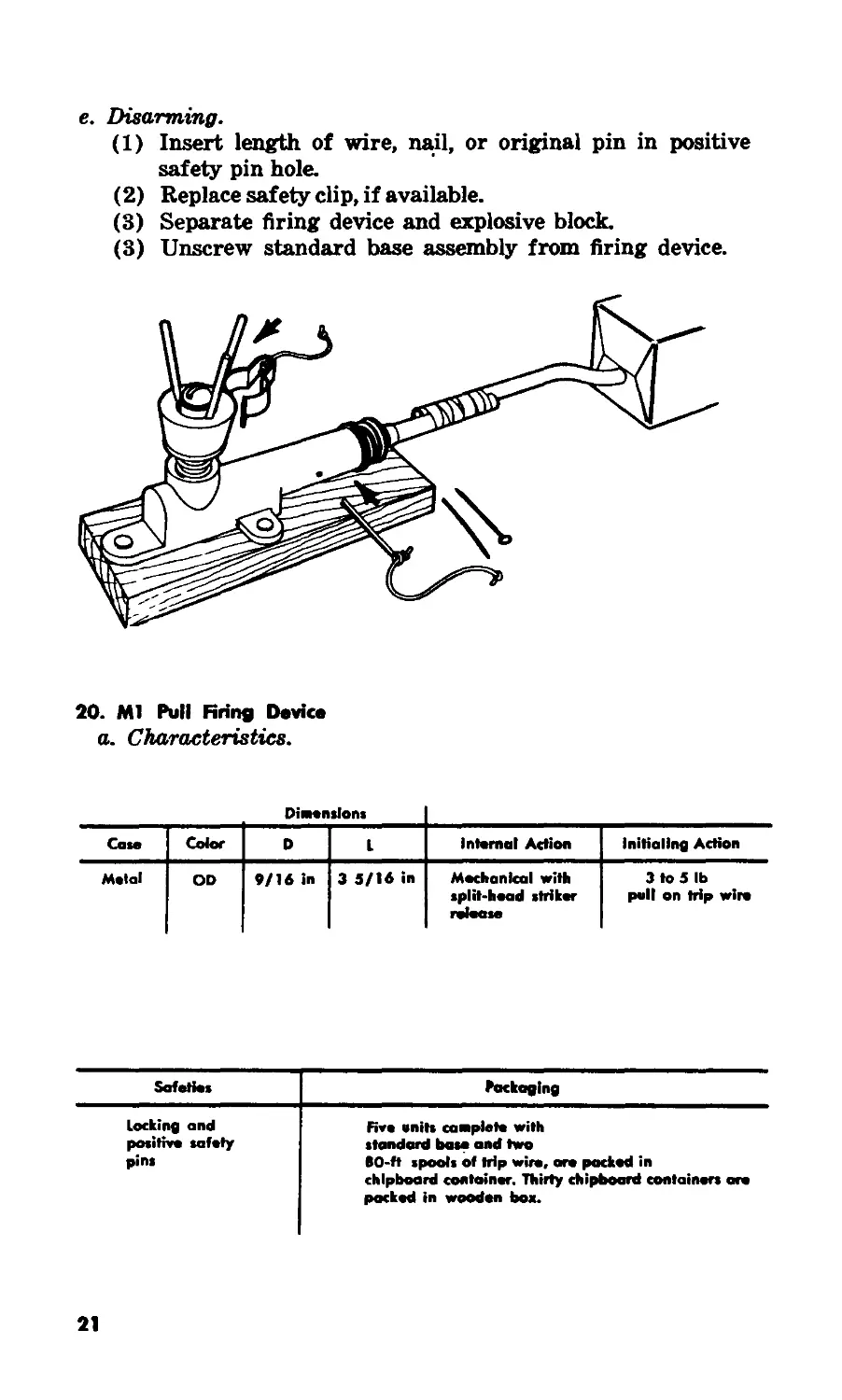
e. Disarming.
(1)	Insert length of wire, nail, or original pin in positive
safety pin hole.
(2)	Replace safety clip, if available.
(3)	Separate firing device and explosive block.
(3)	Unscrew standard base assembly from firing device.
20. Ml Pull firing Device
a. Characteristics.
Dimensions
Case	Color	0	I	Internal Action	Initialing Action
Metal	OD	9/16 in	3 5/16 in	Mechanical with split-head striker release	3 to 5 lb pull on trip wire
Safeties
Locking and
positive safety
pins
Packaging
Five units complete with
standard base and two
BO-ft spools of trip wire, are packed in
chipboard container. Thirty chipboard containers are
pocked in wooden Ьож.
21
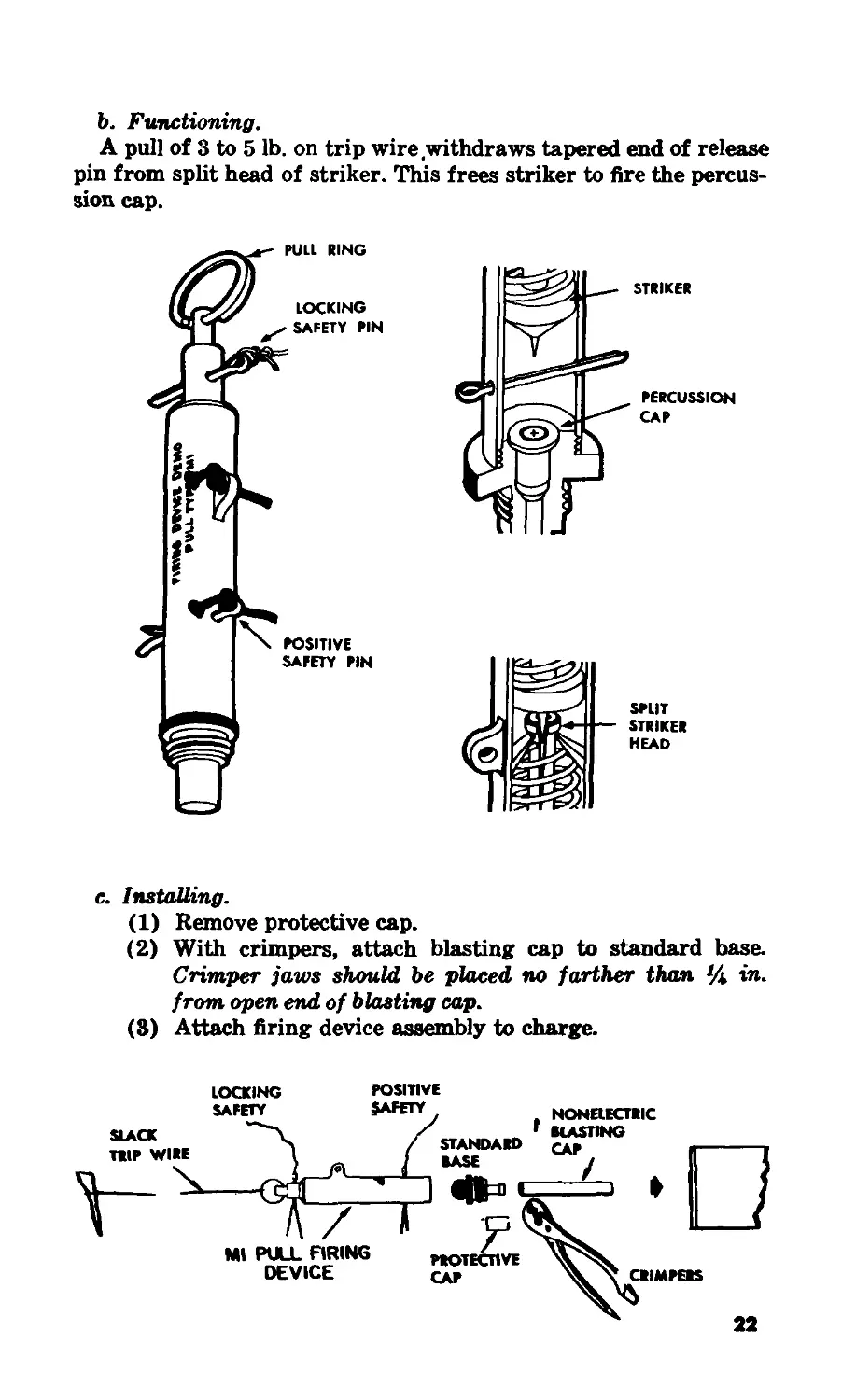
b.	Functioning.
A pull of 3 to 5 lb. on trip wire .withdraws tapered end of release
pin from split head of striker. This frees striker to fire the percus-
sion cap.
SPLIT
STRIKES
HEAD
c.	Installing.
(1)	Remove protective cap.
(2)	With crimpers, attach blasting cap to standard base.
Crimper jaws should be placed no farther than t/i in.
from open end of blasting cap.
(3)	Attach firing device assembly to charge.
LOCKING
SAFETY
POSITIVE
SAFETY ,
SLACK
TRIP WIRE
STANDARD
BASE
. NONELECTRIC
' BLASTING
CAP
CRIMPERS
PROTECTIVE
CAP
Ml PULL FIRING
DEVICE
22
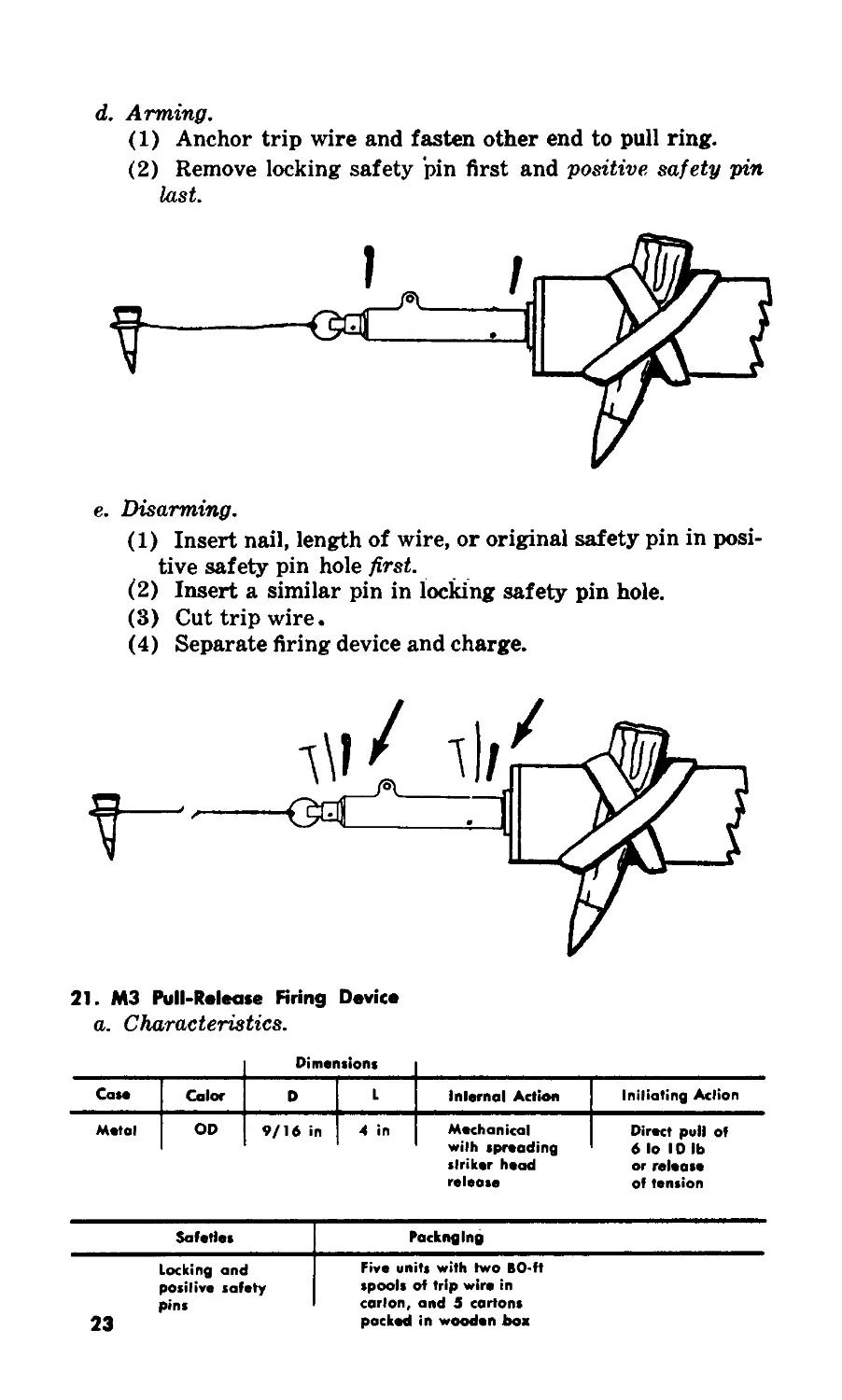
d.	Arming.
(1)	Anchor trip wire and fasten other end to pull ring.
(2)	Remove locking safety pin first and positive safety pin
last.
e.	Disarming.
(1)	Insert nail, length of wire, or original safety pin in posi-
tive safety pin hole first.
(2)	Insert a similar pin in locking safety pin hole.
(3)	Cut trip wire.
(4)	Separate firing device and charge.
21. М3 Pull-Release firing Device
a. Characteristics.
Internal Action
Iniliating Action
Mechanical
with spreading
striker head
release
Direct pull of
6 Io ID lb
or release
of tension
Safeties
Locking and
positive safety
pins
Packaging
Five units with two BO*ft
spools of trip wire in
carton, and 5 cartons
pocked in wooden Ьож
23
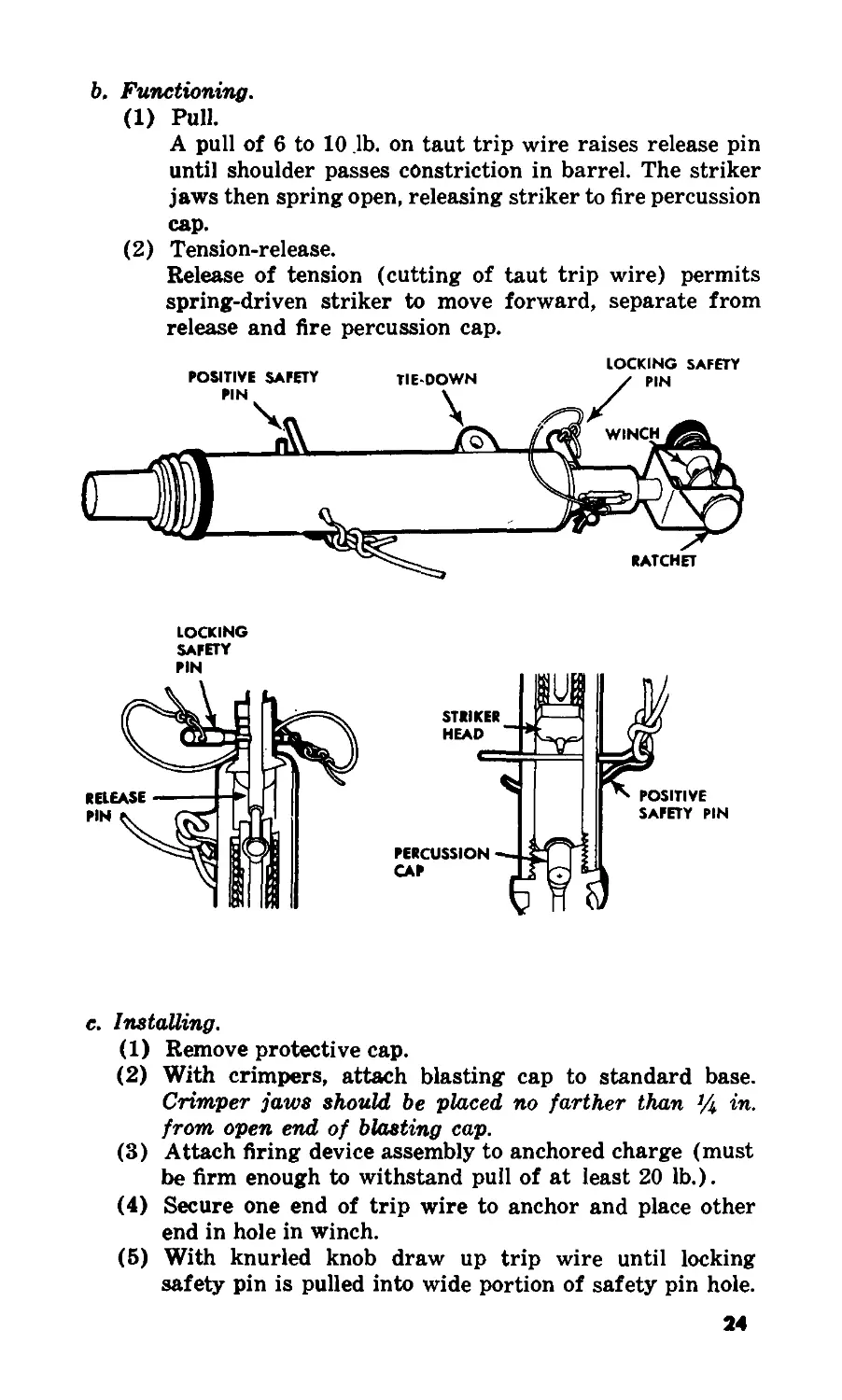
b.	Functioning.
(1)	Pull.
A pull of 6 to 10,1b. on taut trip wire raises release pin
until shoulder passes constriction in barrel. The striker
jaws then spring open, releasing striker to fire percussion
cap.
(2)	Tension-release.
Release of tension (cutting of taut trip wire) permits
spring-driven striker to move forward, separate from
release and fire percussion cap.
c.	Installing.
(1)	Remove protective cap.
(2)	With crimpers, attach blasting cap to standard base.
Crimper jaws should be placed no farther than in.
from open end of blasting cap.
(3)	Attach firing device assembly to anchored charge (must
be firm enough to withstand pull of at least 20 lb.).
(4)	Secure one end of trip wire to anchor and place other
end in hole in winch.
(5)	With knurled knob draw up trip wire until locking
safety pin is pulled into wide portion of safety pin hole.
24
d.	Arming.
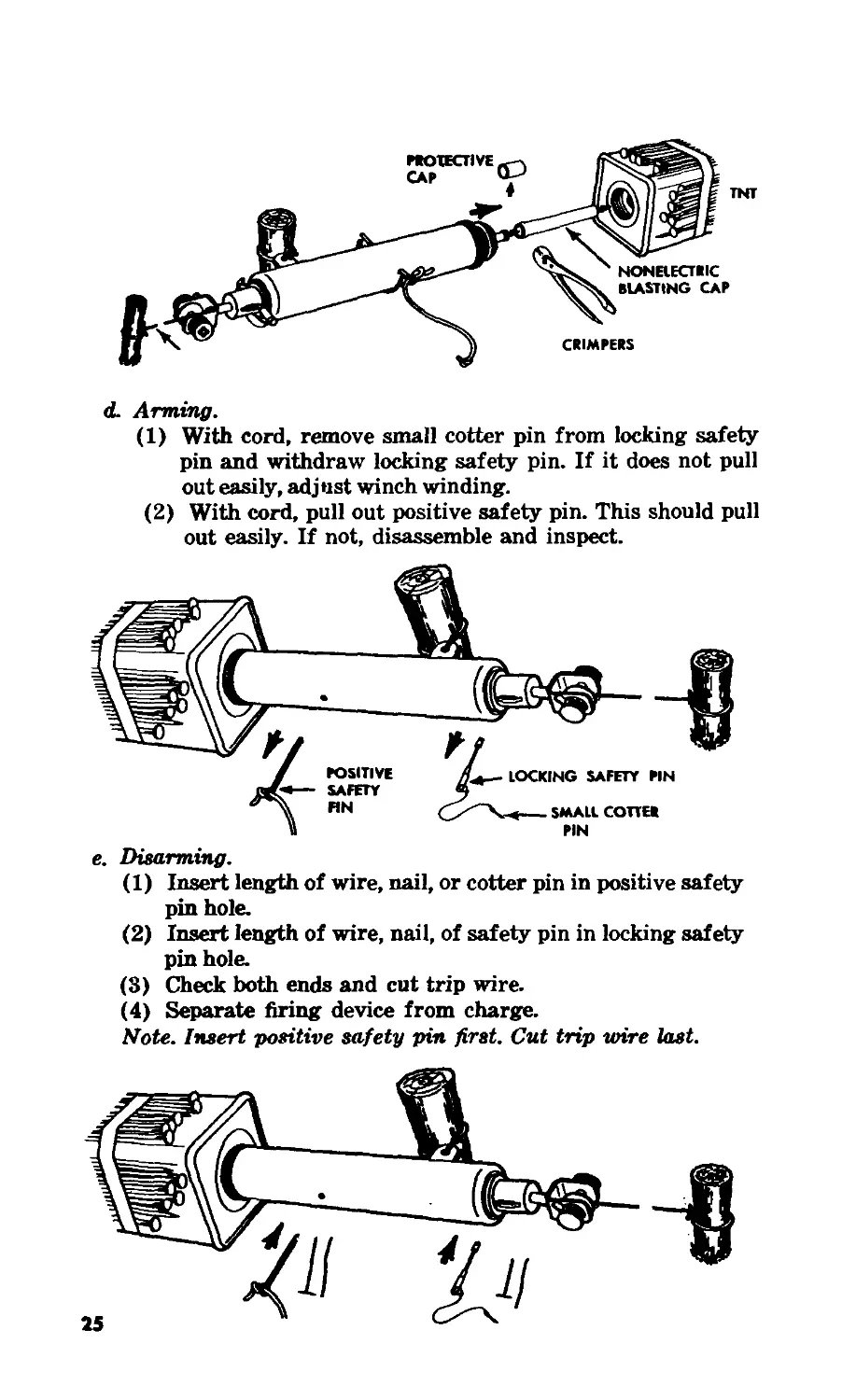
(1)	With cord, remove small cotter pin from locking safety
pin and withdraw locking safety pin. If it does not pull
out easily, adjust winch winding.
(2)	With cord, pull out positive safety pin. This should pull
out easily. If not, disassemble and inspect.
e.	Disarming.
(1)	Insert length of wire, nail, or cotter pin in positive safety
pin hole.
(2)	Insert length of wire, nail, of safety pin in locking safety
pin hole.
(3)	Check both ends and cut trip wire.
(4)	Separate firing device from charge.
Note. Insert positive safety pin first. Cut trip wire last.
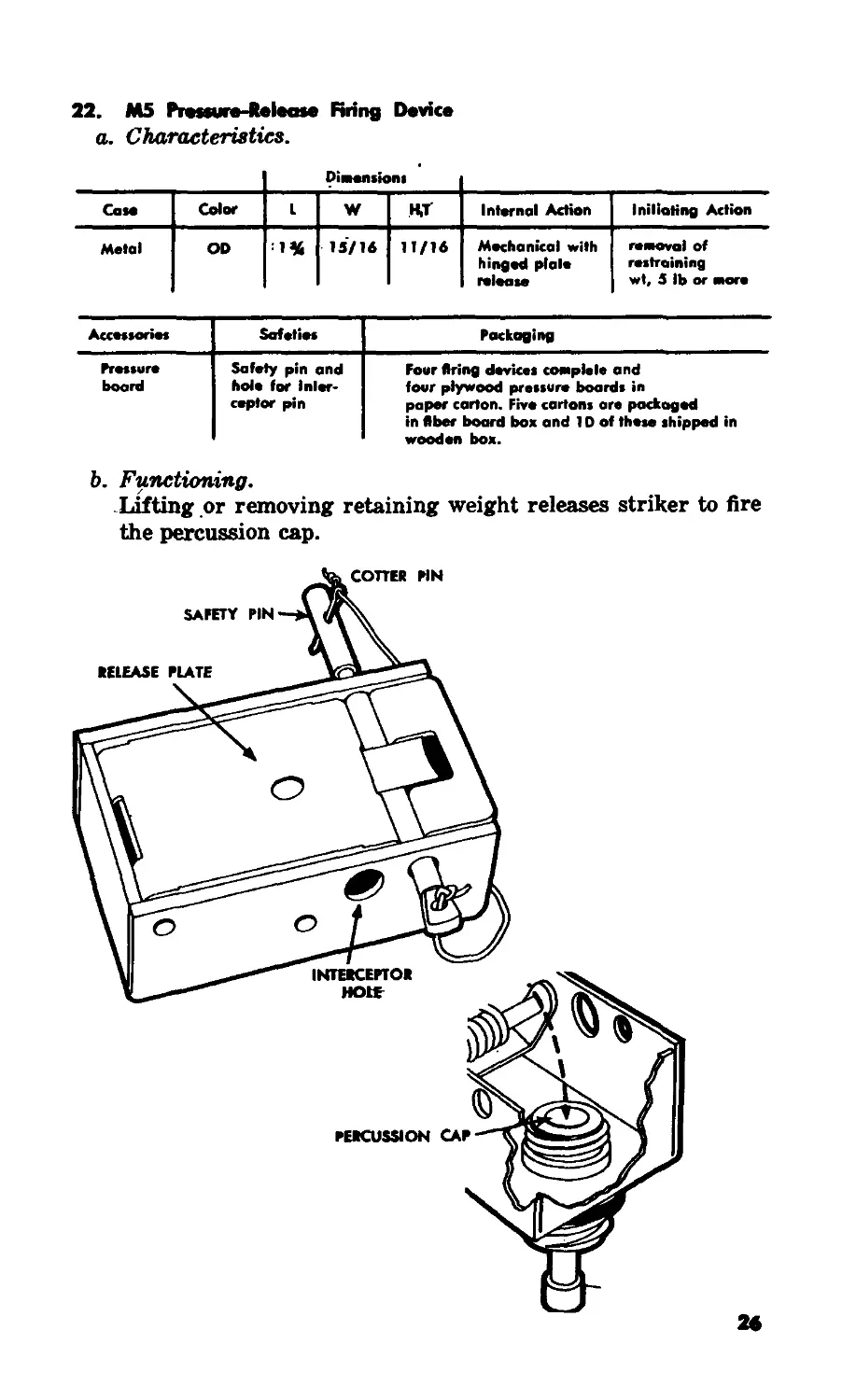
22.	М5 Pre**ure-telea*e Firing Device
a. Characteristics.
		Dimensions
Com	Color	L	w	НГ	Internal Action	Initiating Action
Metal	OO	1%	15/16	11/16	Mechanical with hinged plale release	removal of restraining wt, 5 lb or more
Accessories	Safeties	Packaging
Pressure board	Safety pin and hole for Inter- ceptor pin	Four Aring devices complete and four plywood pressure boards in paper carton. Five cartons ore packaged tn fiber board box and ID of these shipped tn wooden box.
b.	Functioning.
Lifting or removing retaining weight releases striker to fire
the percussion cap.
2C
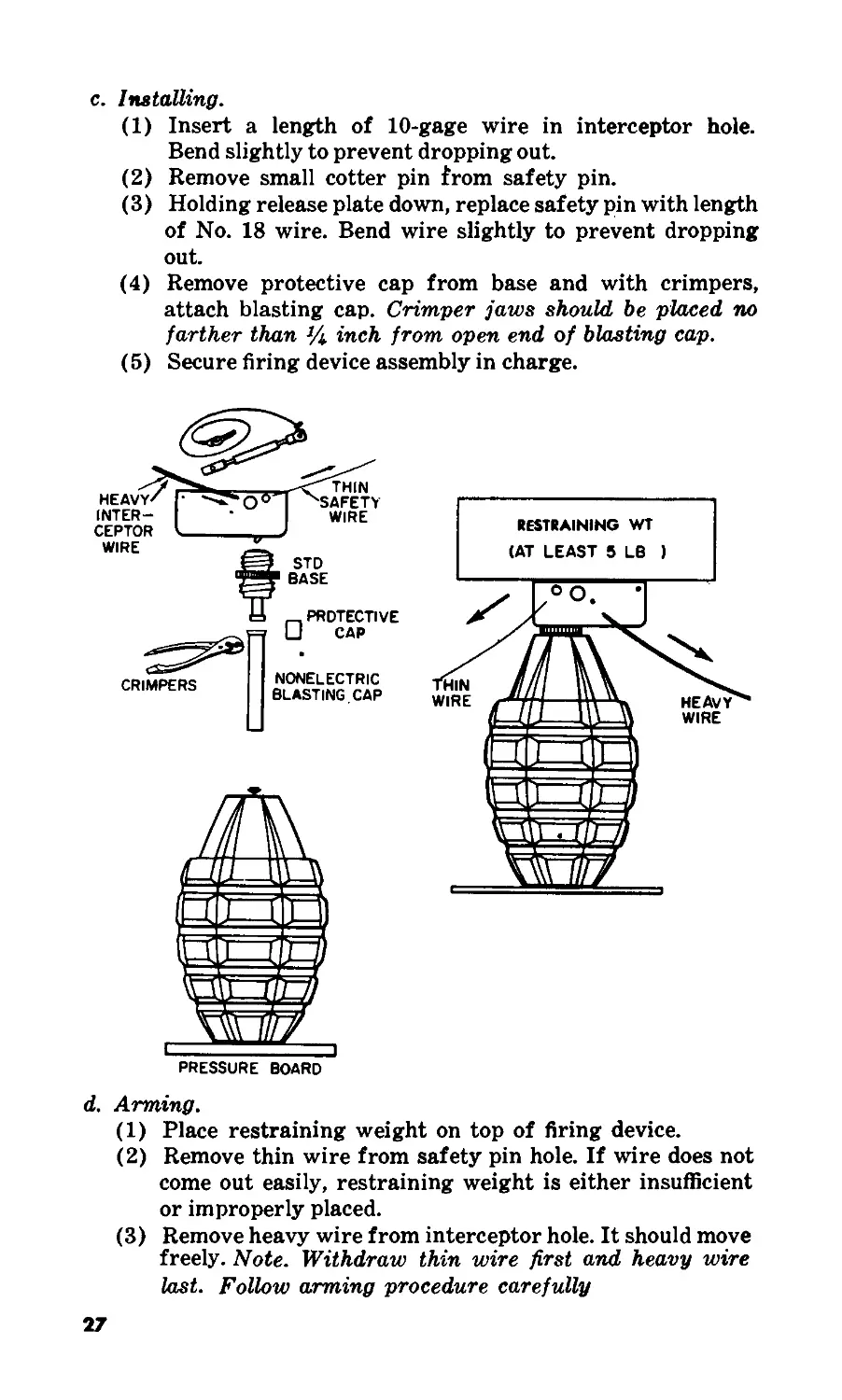
c.	Installing.
(1)	Insert a length of 10-gage wire in interceptor hole.
Bend slightly to prevent dropping out.
(2)	Remove small cotter pin from safety pin.
(3)	Holding release plate down, replace safety pin with length
of No. 18 wire. Bend wire slightly to prevent dropping
out.
(4)	Remove protective cap from base and with crimpers,
attach blasting cap. Crimper jaws should, be placed no
farther than Уь inch from open end of blasting cap.
(5)	Secure firing device assembly in charge.
d.	Arming.
(1)	Place restraining weight on top of firing device.
(2)	Remove thin wire from safety pin hole. If wire does not
come out easily, restraining weight is either insufficient
or improperly placed.
(3)	Remove heavy wire from interceptor hole. It should move
freely. Note. Withdraw thin wire first and heavy wire
last. Follow arming procedure carefully
V
e.	Disarming.
(1)	Insert length of heavy gage wire in interceptor hole.
Bend wire to prevent .dropping out. Proceed carefully,
as the slightest disturbance of the restraining weight
might initiate the firing device.
(2)	Separate firing device from charge-
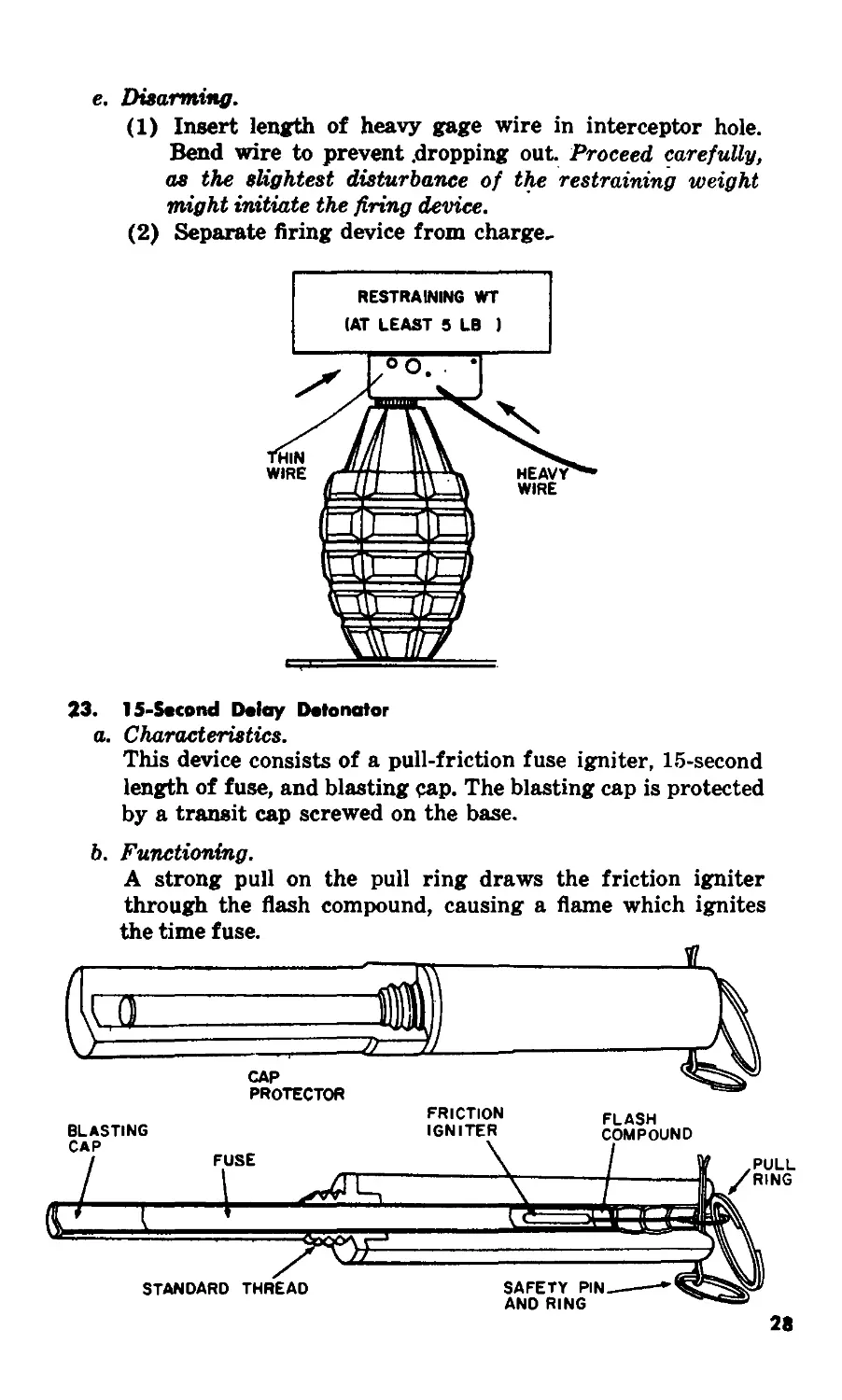
23.	15-Second Delay Detonator
a.	Characteristics.
This device consists of a pull-friction fuse igniter, 15-second
length of fuse, and blasting pap. The blasting cap is protected
by a transit cap screwed on the base.
b.	Functioning.
A strong pull on the pull ring draws the friction igniter
through the flash compound, causing a flame which ignites
the time fuse.
28
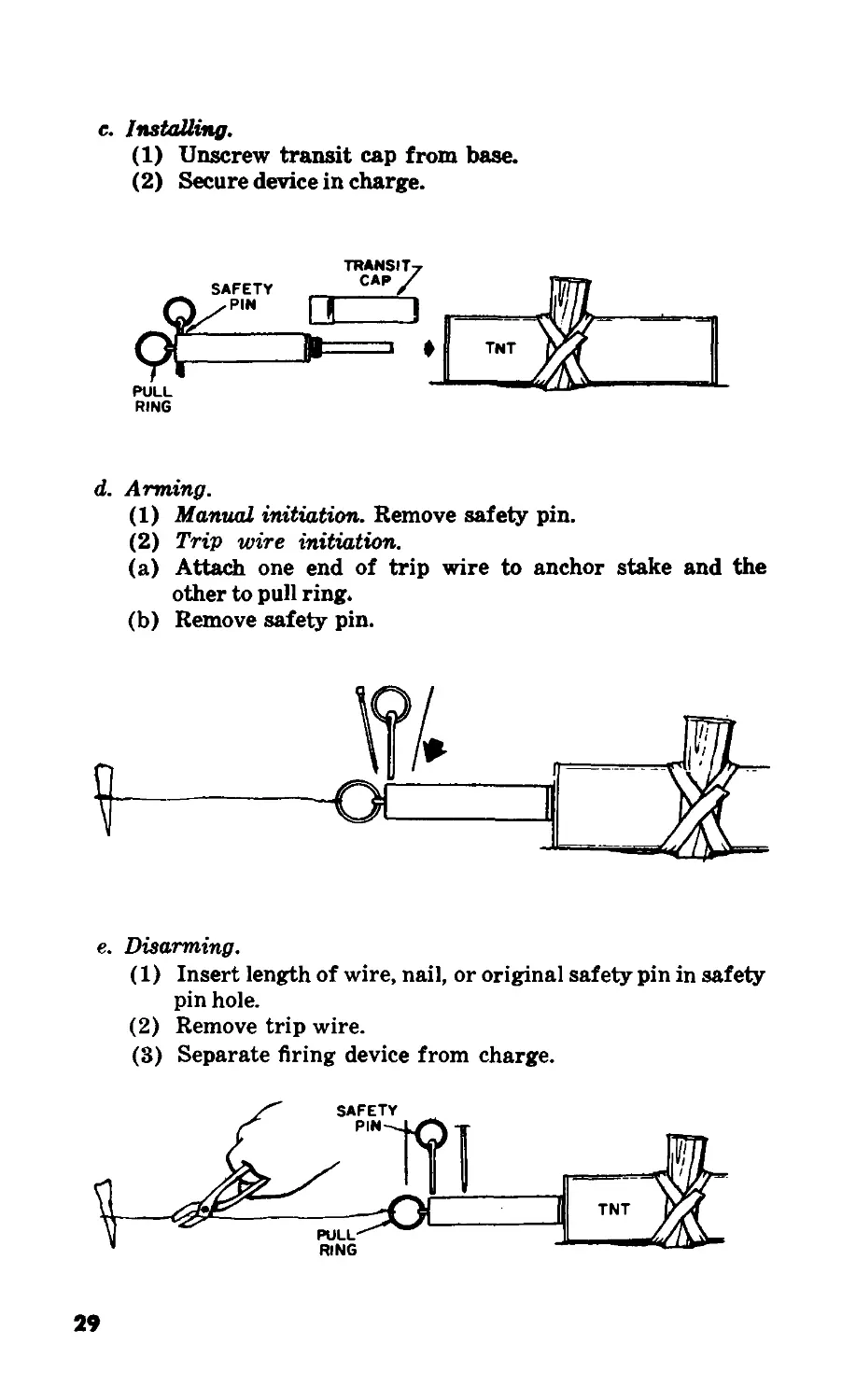
c.	Installing.
(1)	Unscrew transit cap from base.
(2)	Secure device in charge.
d.	Arming.
(1)	Manual initiation. Remove safety pin.
(2)	Trip wire initiation.
(a)	Attach one end of trip wire to anchor stake and the
other to pull ring.
(b)	Remove safety pin.
e.	Disarming.
(1)	Insert length of wire, nail, or original safety pin in safety
pin hole.
(2)	Remove trip wire.
(3)	Separate firing device from charge.
29
24.	8-S«cond May Detonator
a.	Characteristics.
This device consists of a pull-type fuse lighter, 8-second length
of fuse, and a blasting cap. The blasting cap is protected by a
transit cap, screwed on the base.
b.	Functioning.
A strong pull on the T-shaped handle draws the friction
igniter through the flash compound, causing a flame that
ignites the time fuse.
c. Installing.
(1) Unscrew transit cap from base.
(2) Secure device in charge.
d.	Arming.
(1)	Manual initiation: Remove safely pin.
(2)	Trip wire initiation.
(a)	Attach one end of trip wire to anchor stake and the other
to pull ring.
(b)	Remove safety pin.
30
e.	Disarming.
(1)	Insert length of wire, nail, or safety pin in safety pin
hole.
(2)	Remove trip wire.
(3)	Separate firing device from charge.
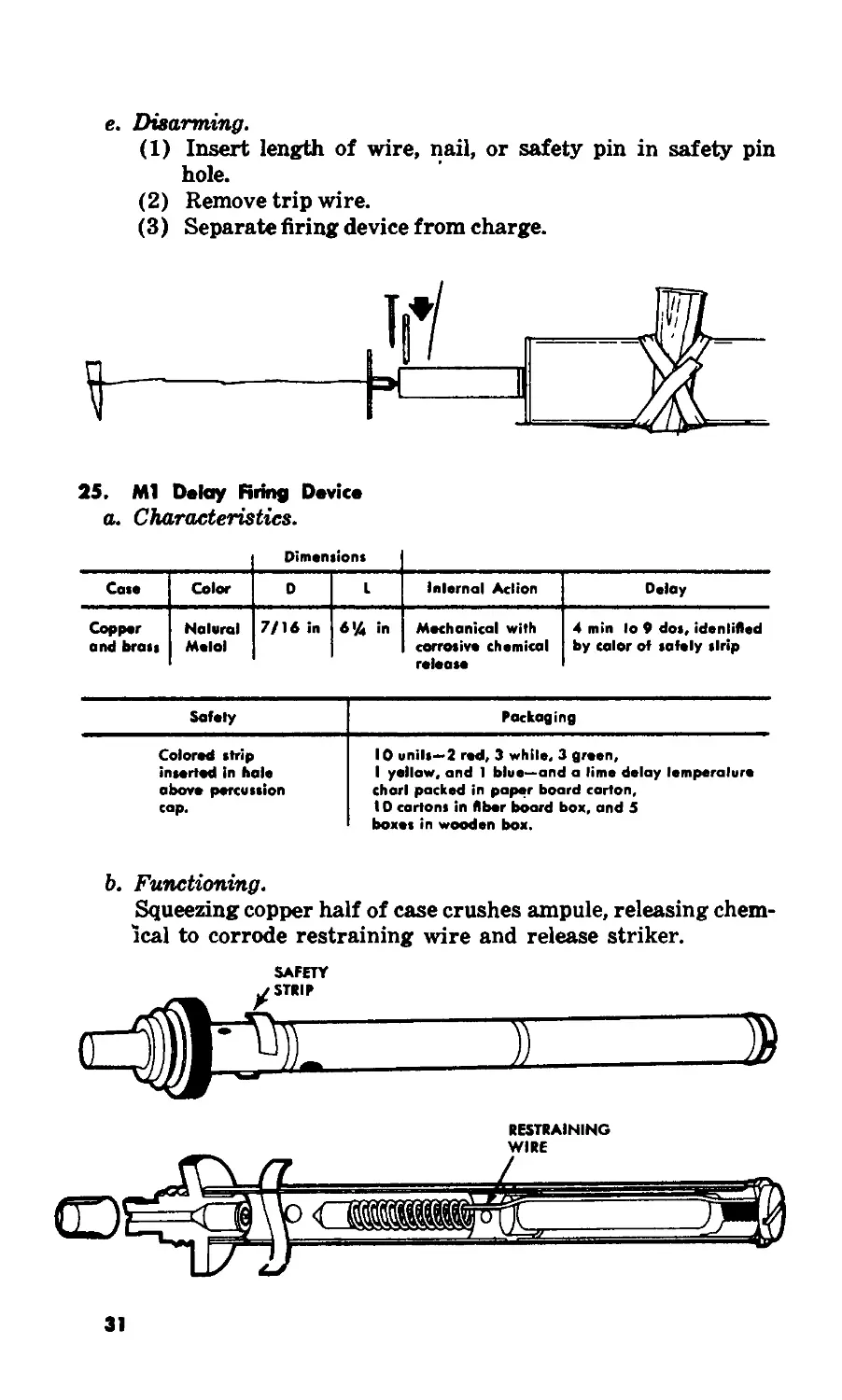
25.	Ml Delay Firing Device
a. Characteristics.
Dimensions
Case	Color	D	L	Internal Action	Delay
Coppar and brass	Nalvral Melol	7/16 in	6% in	Mechanical with corrosive chemical release	4 min Io 9 dos, identified by color of safely strip
Safety
Colored strip
inserted in hale
above percussion
cap.
Packaging
10 unils—2 red, 3 while, 3 green,
I yellow, and 1 blue—-and a lime delay temperature
ch ar I packed in paper board carton,
ID cartons in Aber board box, and 5
boxes in wooden box.
b.	Functioning.
Squeezing copper half of case crushes ampule, releasing chem-
ical to corrode restraining wire and release striker.
SAFETY
RESTRAINING
WIRE
31
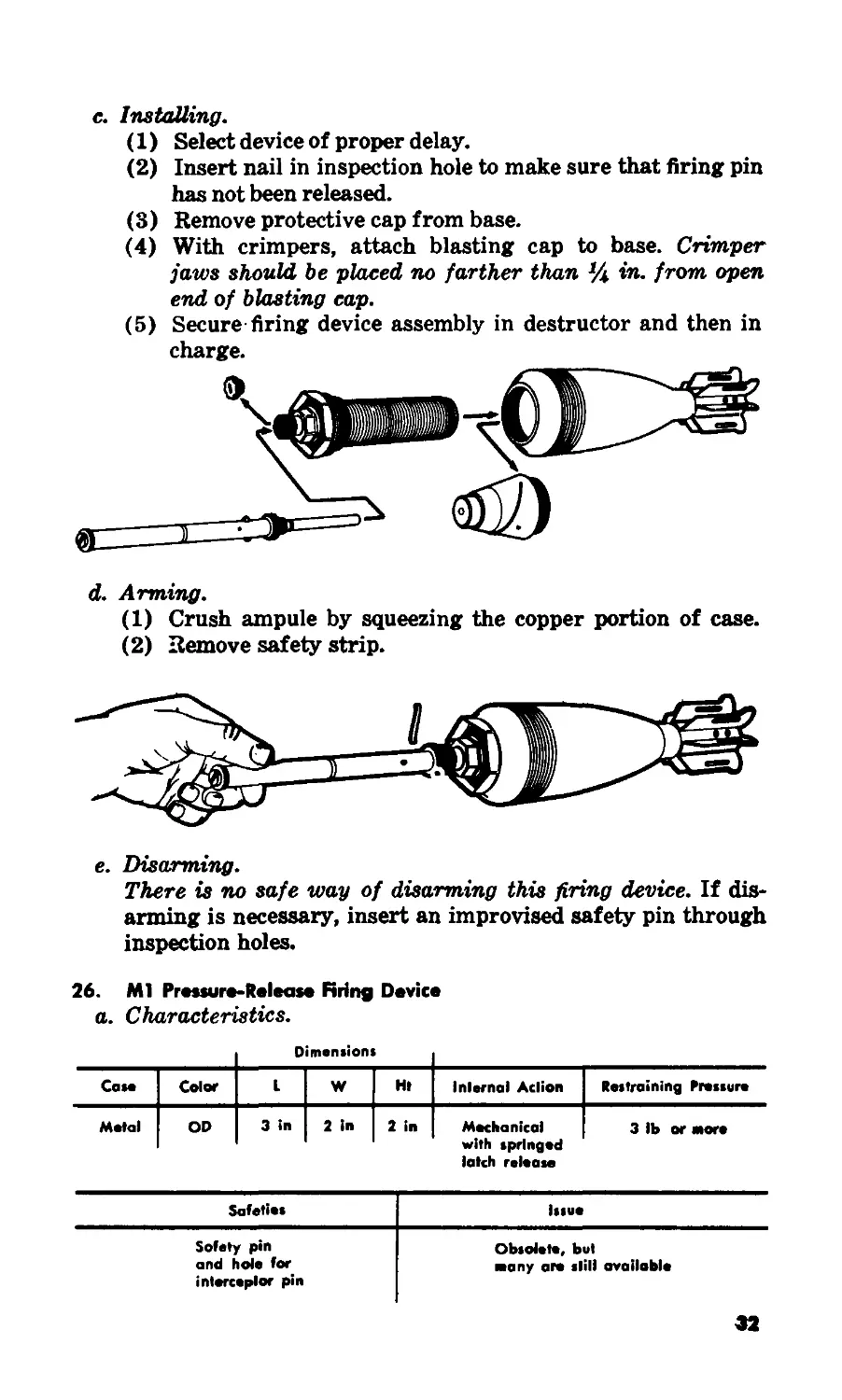
c.	Installing.
(1)	Select device of proper delay.
(2)	Insert nail in inspection hole to make sure that firing pin
has not been released.
(3)	Remove protective cap from base.
(4)	With crimpers, attach blasting cap to base. Crimper
jaws should, be placed no farther than % in. from open
end of blasting cap.
(5)	Secure firing device assembly in destructor and then in
charge.
d.	Arming.
(1)	Crush ampule by squeezing the copper portion of case.
(2)	Remove safety strip.
e.	Disarming.
There is no safe way of disarming this firing device. If dis-
arming is necessary, insert an improvised safety pin through
inspection holes.
26. Ml Pressure-Release Firing Device
a. Characteristics.
Dimensions
Case	Color	I	W	Ht	Internal Action	Restraining Pressure
Metal	OD	3 in	2 in	2 in	Mechanical with sprlnged	3 lb or more
latch release
Safeties
Issue
Safety pin
and hole for
interceptor pin
Obsolete, but
many are slill available
32
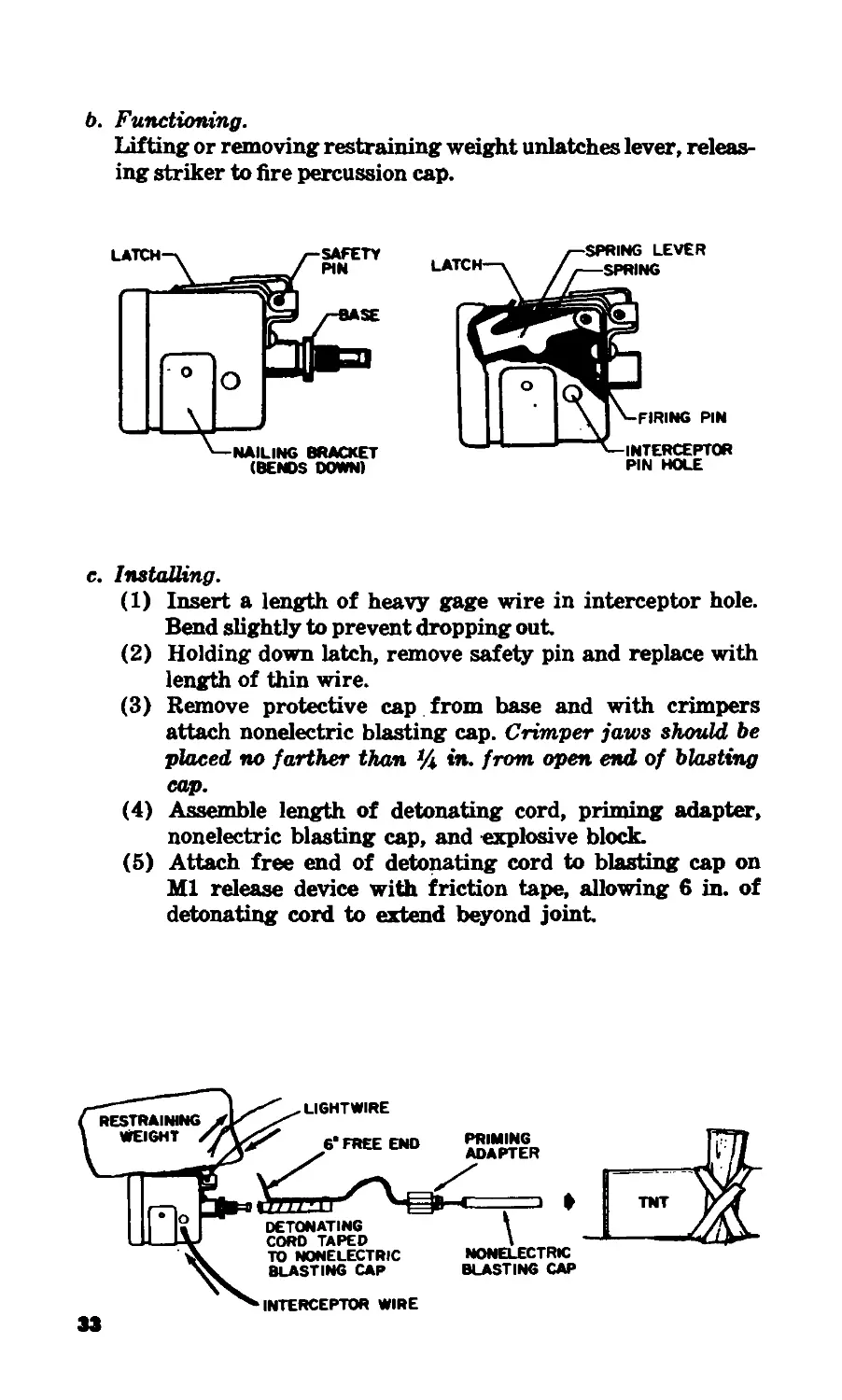
b.	Functioning.
Lifting or removing restraining weight unlatches lever, releas-
ing striker to fire percussion cap.
c.	Installing.
(1)	Insert a length of heavy gage wire in interceptor hole.
Bend slightly to prevent dropping out
(2)	Holding down latch, remove safety pin and replace with
length of thin wire.
(3)	Remove protective cap from base and with crimpers
attach nonelectric blasting cap. Crimper jaws should be
placed no farther than in. from open end of blasting
cap.
(4)	Assemble length of detonating cord, priming adapter,
nonelectric blasting cap, and explosive block.
(5)	Attach free end of detonating cord to blasting cap on
Ml release device with friction tape, allowing 6 in. of
detonating cord to extend beyond joint
33
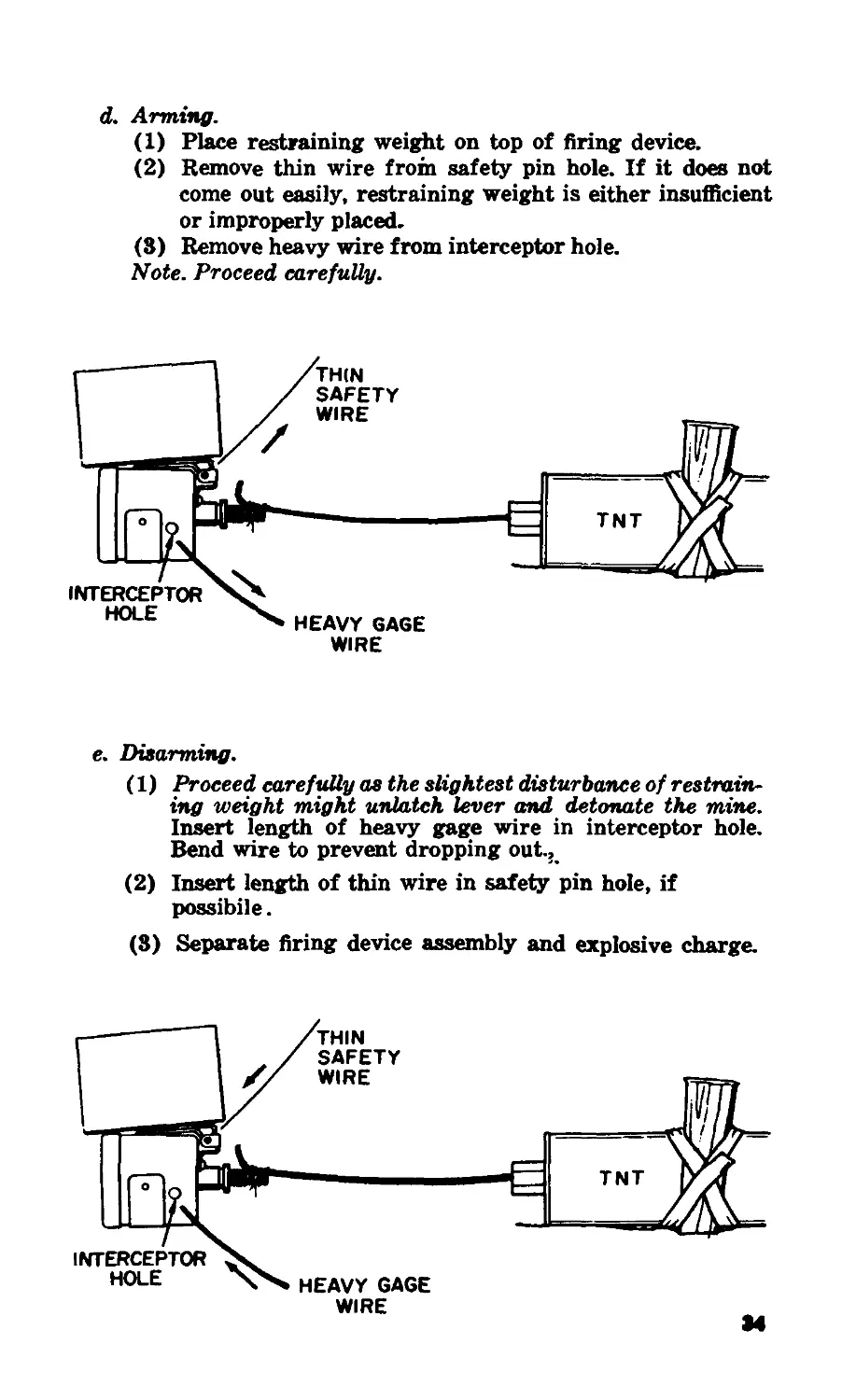
d.	Arming.
(1)	Place restraining weight on top of firing device.
(2)	Remove thin wire from safety pin hole. If it does not
come out easily, restraining weight is either insufficient
or improperly placed.
(3)	Remove heavy wire from interceptor hole.
Note. Proceed carefully.
e.	Disarming.
(1)	Proceed carefully as the slightest disturbance of restrain-
ing weight might unlatch lever and detonate the mine.
Insert length of heavy gage wire in interceptor hole.
Bend wire to prevent dropping out.,
(2)	Insert length of thin wire in safety pin hole, if
possibile.
(3)	Separate firing device assembly and explosive charge.
WIRE
M
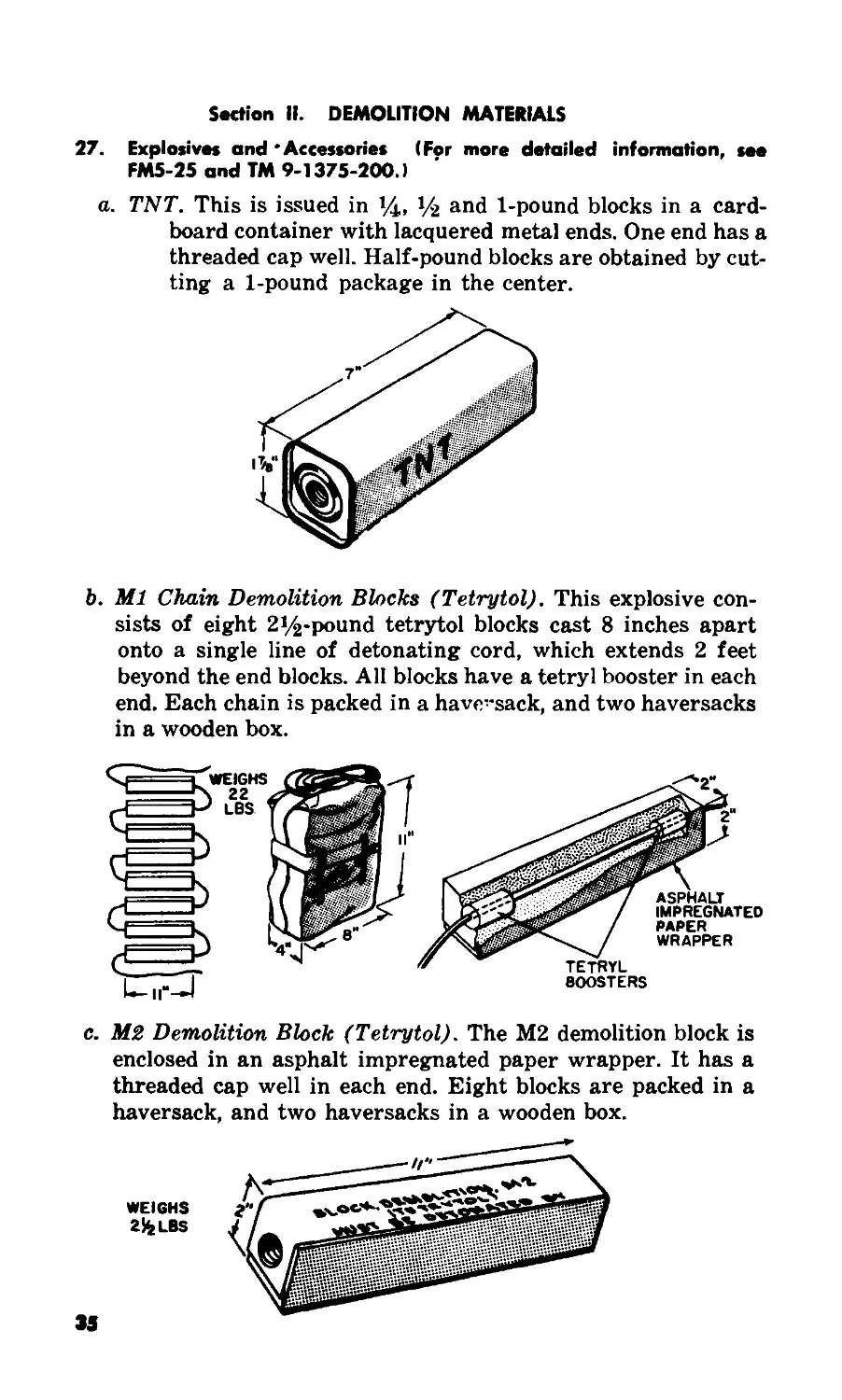
Section II. DEMOLITION MATERIALS
27.	Explosive* and * Accessories (For more detailed information, see
FM5-25 and TM 9-1375-200.)
a.	TNT. This is issued in Vi> Ц and 1-pound blocks in a card-
board container with lacquered metal ends. One end has a
threaded cap well. Half-pound blocks are obtained by cut-
ting a 1-pound package in the center.
b.	Ml Chain Demolition Blocks (Tetrytol). This explosive con-
sists of eight 214-pound tetrytol blocks cast 8 inches apart
onto a single line of detonating cord, which extends 2 feet
beyond the end blocks. All blocks have a tetryl booster in each
end. Each chain is packed in a have-sack, and two haversacks
in a wooden box.
с.	М2 Demolition Block (Tetrytol). The М2 demolition block is
enclosed in an asphalt impregnated paper wrapper. It has a
threaded cap well in each end. Eight blocks are packed in a
haversack, and two haversacks in a wooden box.
WEIGHS
2^ LBS
33
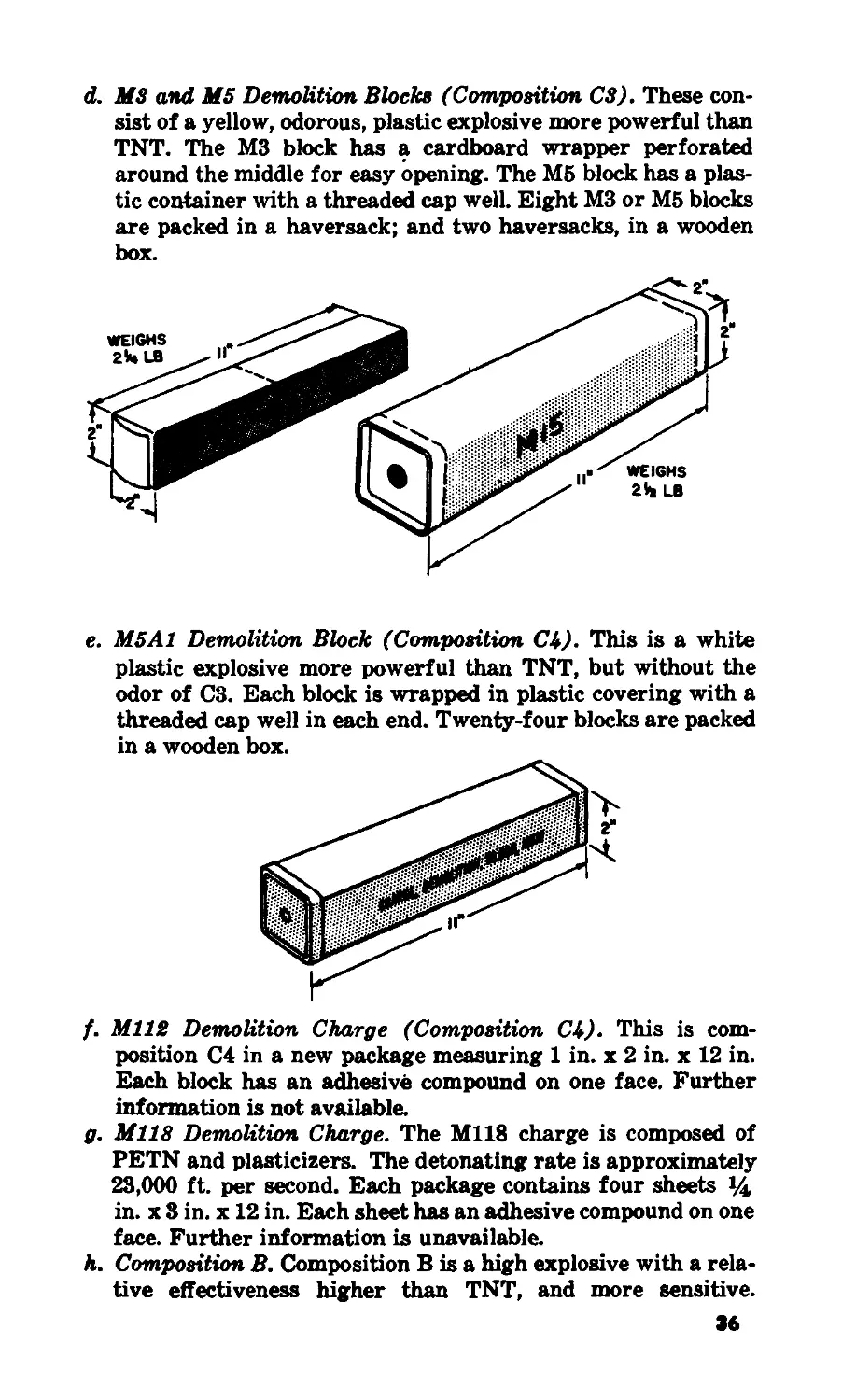
d.	MS and M5 Demolition Blocks (Composition CS). These con-
sist of a yellow, odorous, plastic explosive more powerful than
TNT. The М3 block has a cardboard wrapper perforated
around the middle for easy opening. The M5 block has a plas-
tic container with a threaded cap well. Eight М3 or M5 blocks
are packed in a haversack; and two haversacks, in a wooden
box.
e.	M5A1 Demolition Block (Composition Ci). This is a white
plastic explosive more powerful than TNT, but without the
odor of C3. Each block is wrapped in plastic covering with a
threaded cap well in each end. Twenty-four blocks are packed
in a wooden box.
f.	M112 Demolition Charge (Composition Ci). This is com-
position C4 in a new package measuring 1 in. x 2 in. x 12 in.
Each block has an adhesive compound on one face. Further
information is not available.
g.	M118 Demolition Charge. The M118 charge is composed of
PETN and plasticizers. The detonating rate is approximately
23,000 ft. per second. Each package contains four sheets 14
in. x 3 in. x 12 in. Each sheet has an adhesive compound on one
face. Further information is unavailable.
h.	Composition B. Composition В is a high explosive with a rela-
tive effectiveness higher than TNT, and more sensitive.
3«
Because of its high dentonation rate and shattering power, it
is used in certain bangalore torpedoes and in shaped charges.
t. PETN. This is used in detonating cord. It is one of the most
powerful military explosives, almost equal to nitroglycerine
and RDX. In detonating cord, PETN has a velocity rate of
21,000 feet per second.
j.	Amatol. Amatol, a mixture of ammonium nitrate and TNT,
has a relative effectiveness higher than that of TNT. Amatol
(80/20) is used in the bangalore torpedo.
k.	RDX. This is the base charge in the M6 and M7 electric and
nonelectric blasting caps. It is highly sensitive, and has a
shattering effect second only to nitroglycerine.
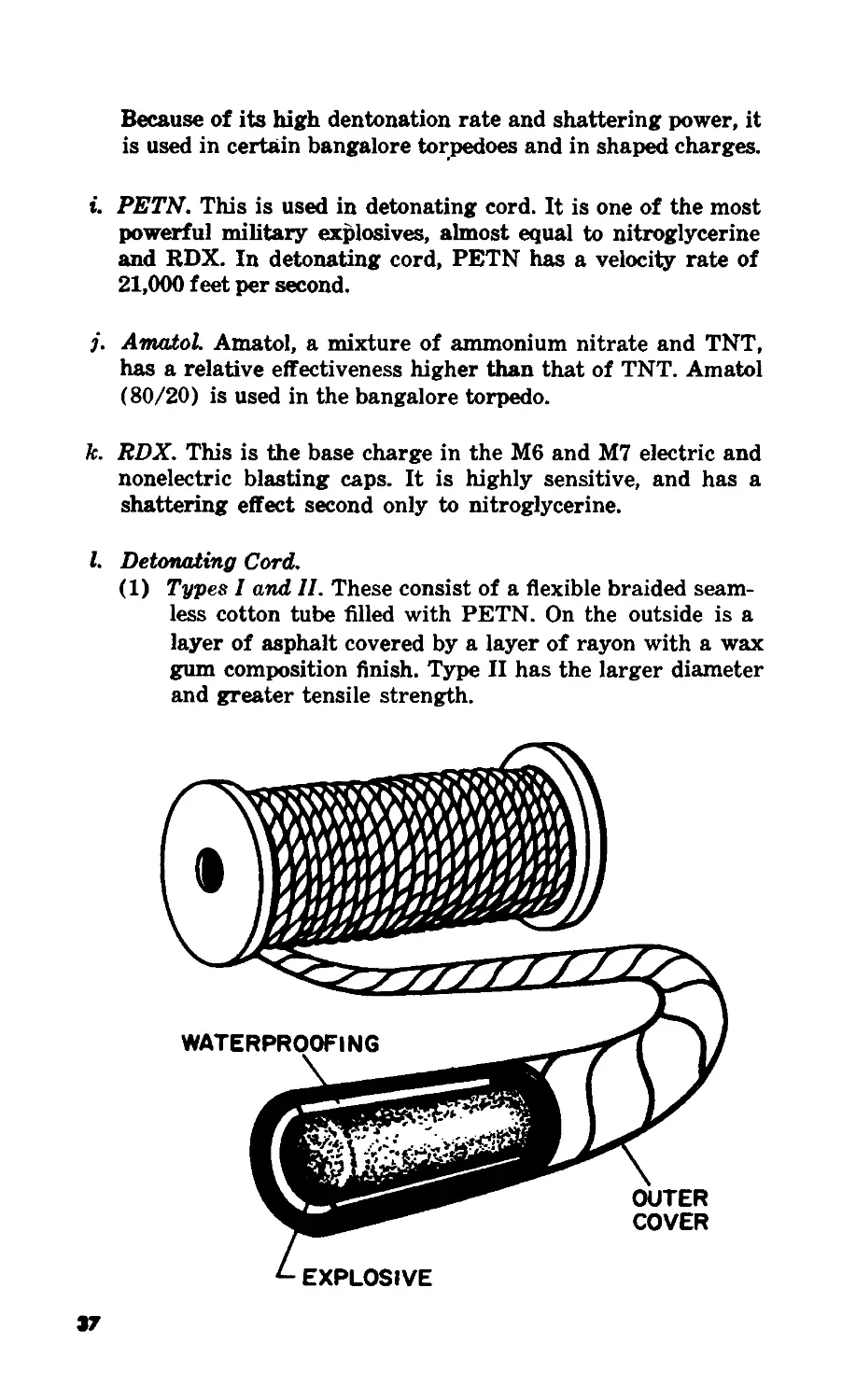
I.	Detonating Cord.
(1)	Types I and II. These consist of a flexible braided seam-
less cotton tube filled with PETN. On the outside is a
layer of asphalt covered by a layer of rayon with a wax
gum composition finish. Type II has the larger diameter
and greater tensile strength.
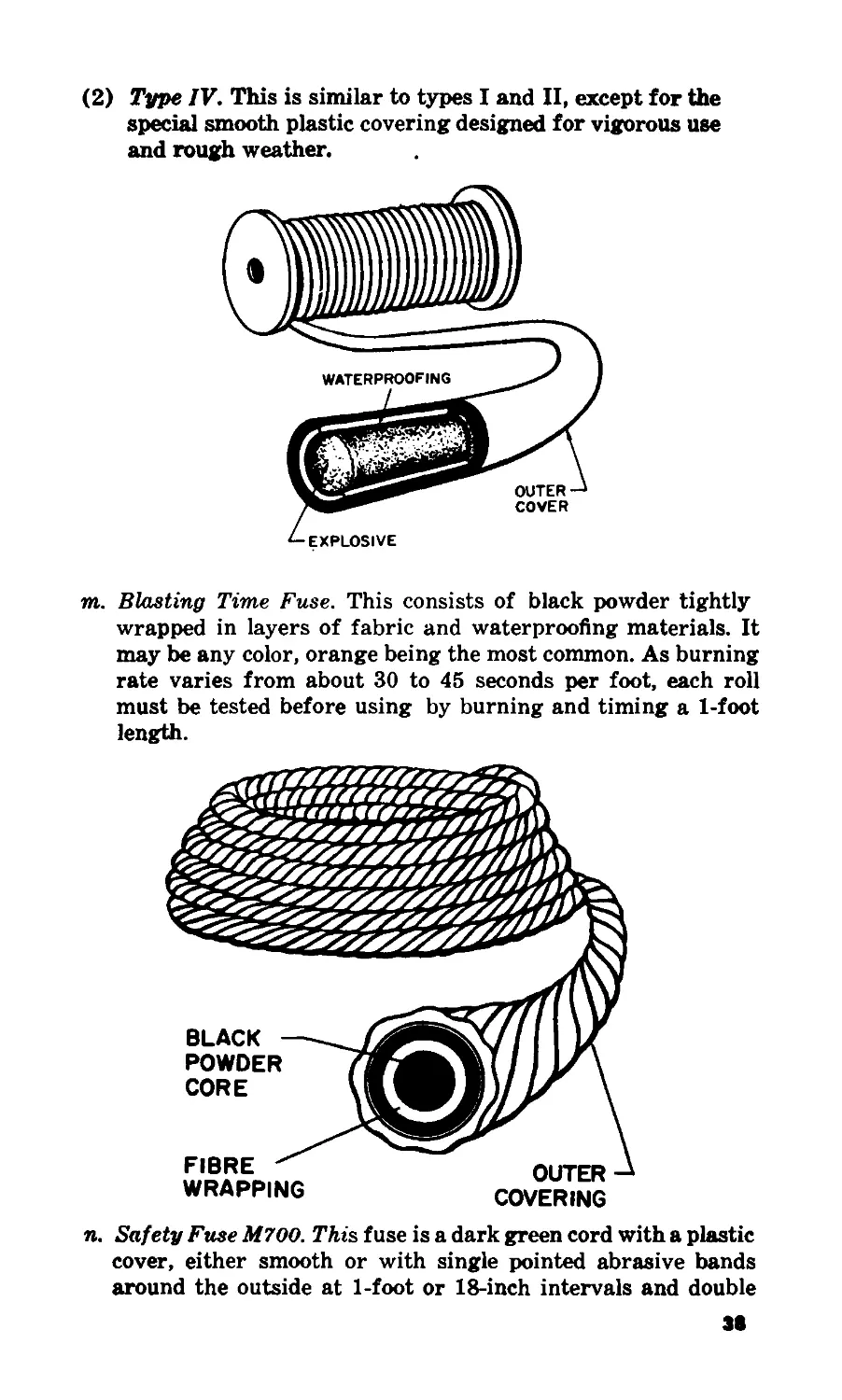
(2)	Туре IV. This is similar to types I and II, except for the
special smooth plastic covering designed for vigorous use
and rough weather.
m.	Blasting Time Fuse. This consists of black powder tightly
wrapped in layers of fabric and waterproofing materials. It
may be any color, orange being the most common. As burning
rate varies from about 30 to 45 seconds per foot, each roll
must be tested before using by burning and timing a 1-foot
length.
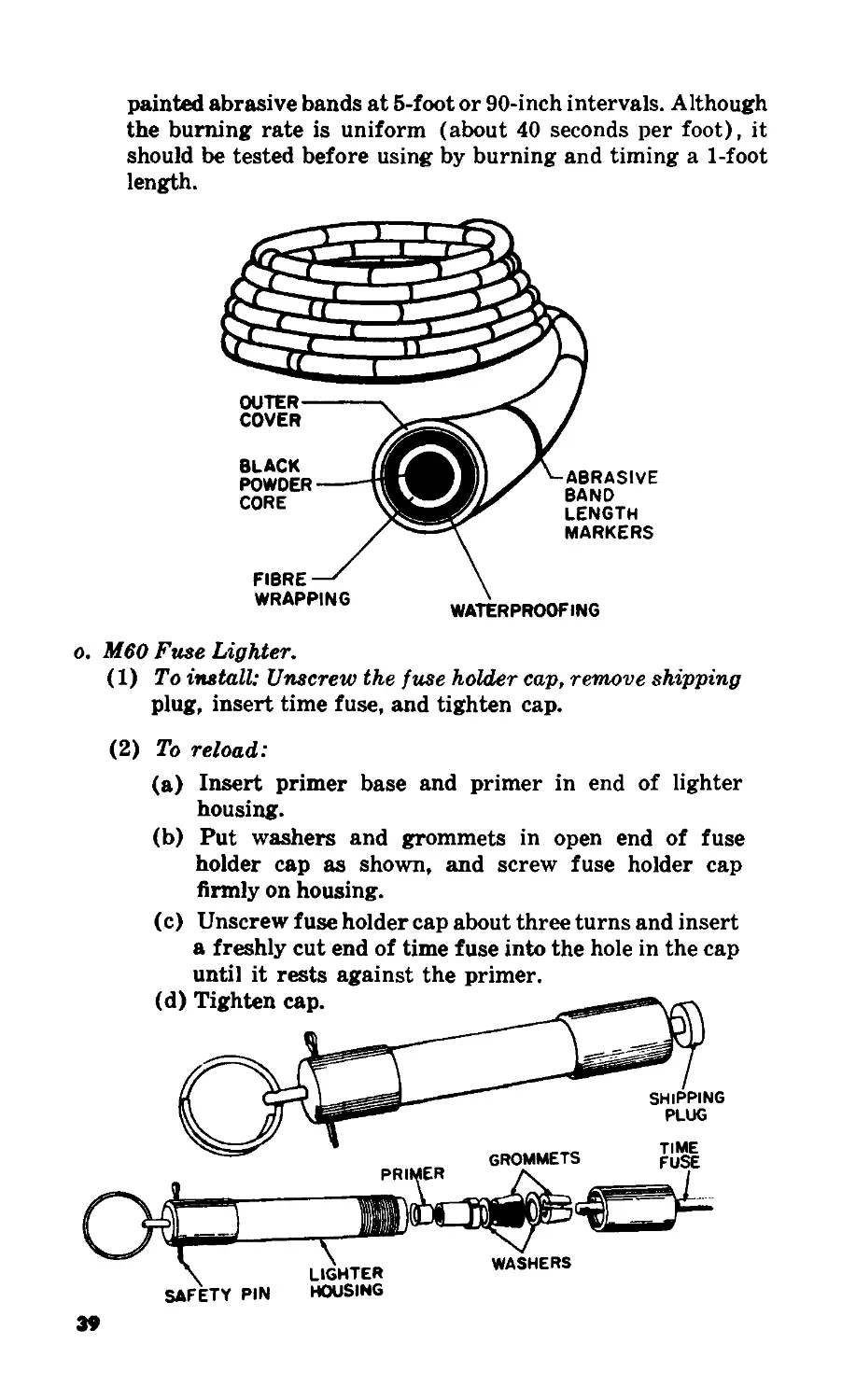
n. Safety Fuse M700. This fuse is a dark green cord with a plastic
cover, either smooth or with single pointed abrasive bands
around the outside at 1-foot or 18-inch intervals and double
38
painted abrasive bands at 5-foot or 90-inch intervals. Although
the burning rate is uniform (about 40 seconds per foot), it
should be tested before using by burning and timing a 1-foot
length.
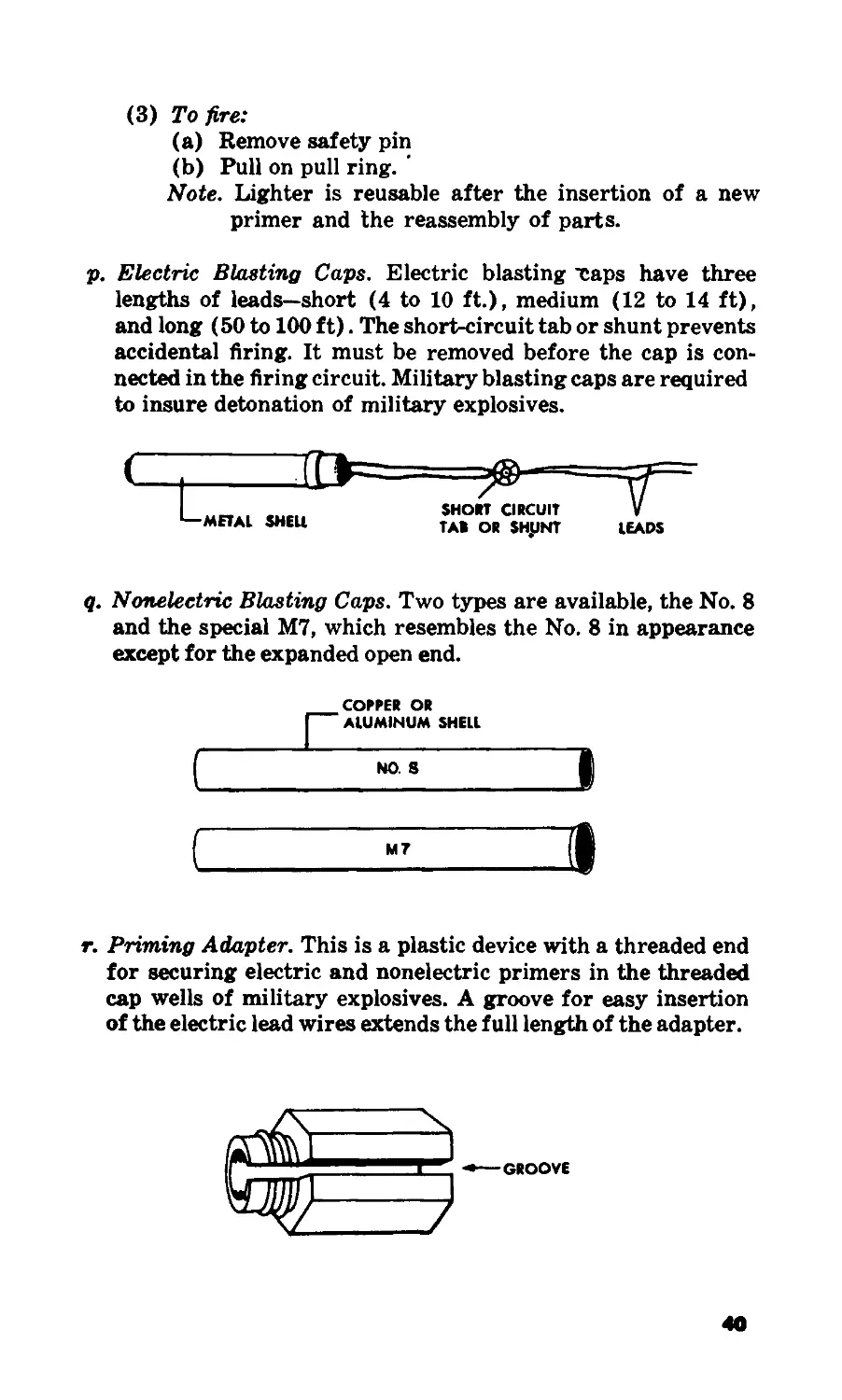
о.	M60 Fuse Lighter.
(1)	To install: Unscrew the fuse holder cap, remove shipping
plug, insert time fuse, and tighten cap.
(2)	To reload:
(a)	Insert primer base and primer in end of lighter
housing.
(b)	Put washers and grommets in open end of fuse
holder cap as shown, and screw fuse holder cap
firmly on housing.
(c)	Unscrew fuse holder cap about three turns and insert
a freshly cut end of time fuse into the hole in the cap
until it rests against the primer.
39
(3)	To fire:
(a)	Remove safety pin
(b)	Pull on pull ring. '
Note. Lighter is reusable after the insertion of a new
primer and the reassembly of parts.
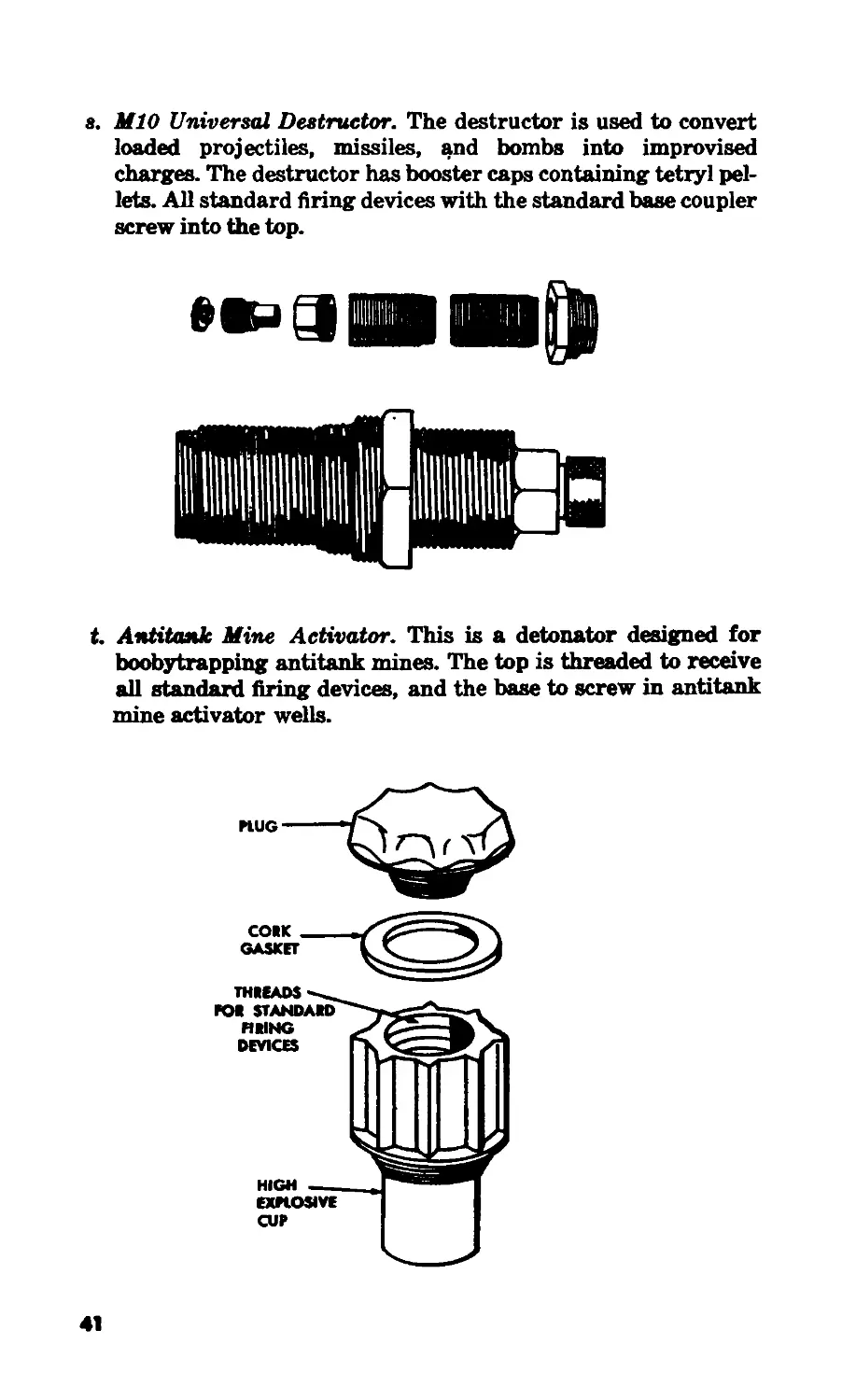
p.	Electric Blasting Caps. Electric blasting Taps have three
lengths of leads—short (4 to 10 ft.), medium (12 to 14 ft),
and long (50 to 100 ft). The short-circuit tab or shunt prevents
accidental firing. It must be removed before the cap is con-
nected in the firing circuit. Military blasting caps are required
to insure detonation of military explosives.
METAL SHELL
LEADS
SHORT CIRCUIT
TA* OR SHJJNT
q.	Nonelectric Blasting Caps. Two types are available, the No. 8
and the special M7, which resembles the No. 8 in appearance
except for the expanded open end.
r.	Priming Adapter. This is a plastic device with a threaded end
for securing electric and nonelectric primers in the threaded
cap wells of military explosives. A groove for easy insertion
of the electric lead wires extends the full length of the adapter.
40
a. MIO Universal Destructor. The destructor is used to convert
loaded projectiles, missiles, and bombs into improvised
charges. The destructor has booster caps containing tetryl pel-
lets. All standard firing devices with the standard base coupler
screw into the top.
Щ [J
t. Antitank Mine Activator. This is a detonator designed for
boobytrapping antitank mines. The top is threaded to receive
all standard firing devices, and the base to screw in antitank
mine activator wells.
41
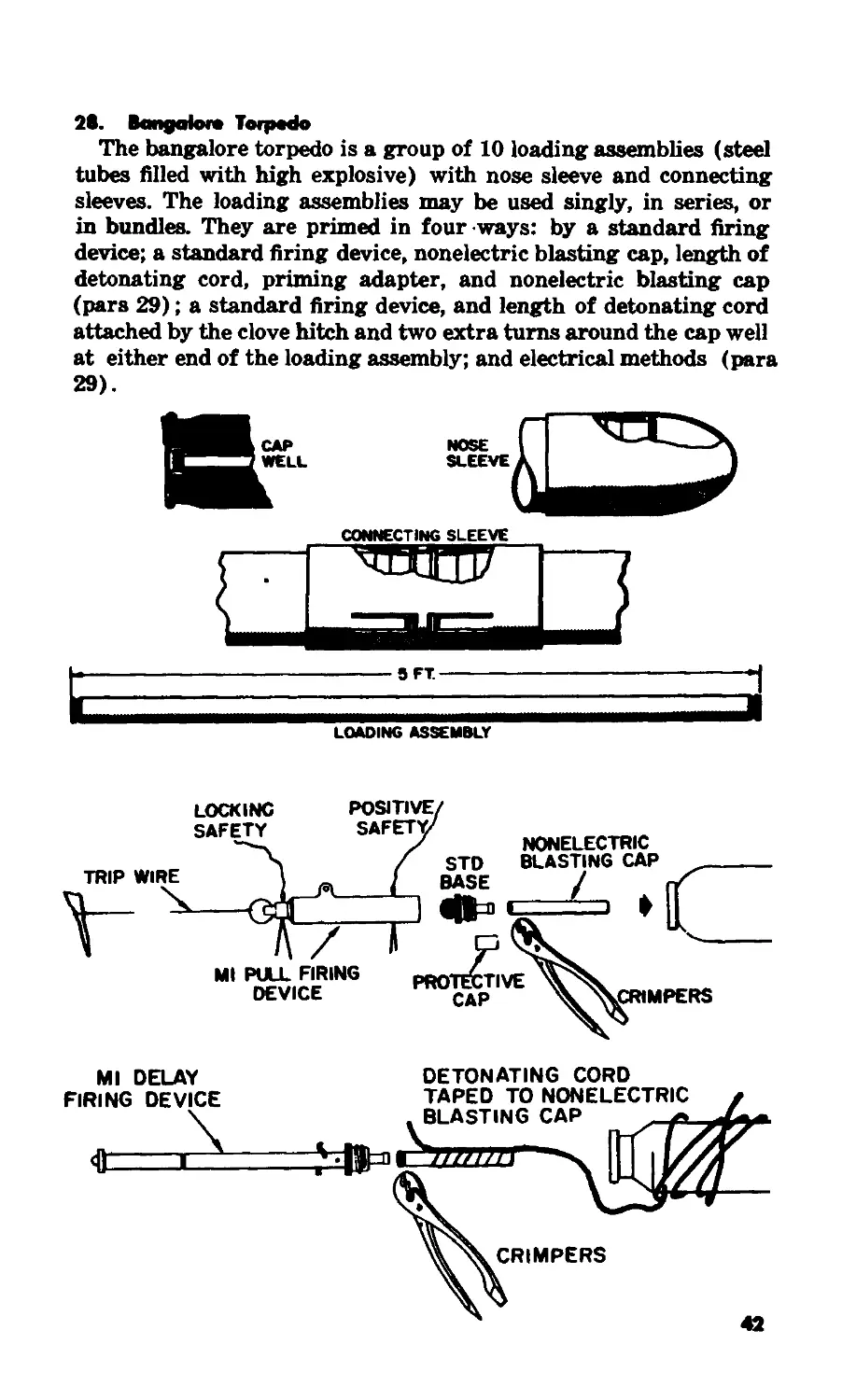
28.	Bangalore Torpodo
The bangalore torpedo is a group of 10 loading assemblies (steel
tubes filled with high explosive) with nose sleeve and connecting
sleeves. The loading assemblies may be used singly, in series, or
in bundles. They are primed in four ways: by a standard firing
device; a standard firing device, nonelectric blasting cap, length of
detonating cord, priming adapter, and nonelectric blasting cap
(pars 29); a standard firing device, and length of detonating cord
attached by the clove hitch and two extra turns around the cap well
at either end of the loading assembly; and electrical methods (para
29).
S FT.
LOADING ASSEMBLY
DETONATING CORD
TAPED TO NONELECTRIC
BLASTING CAP
Ml DELAY
FIRING DEVICE
*2®Hc5ZZEZZT
CRIMPERS
42
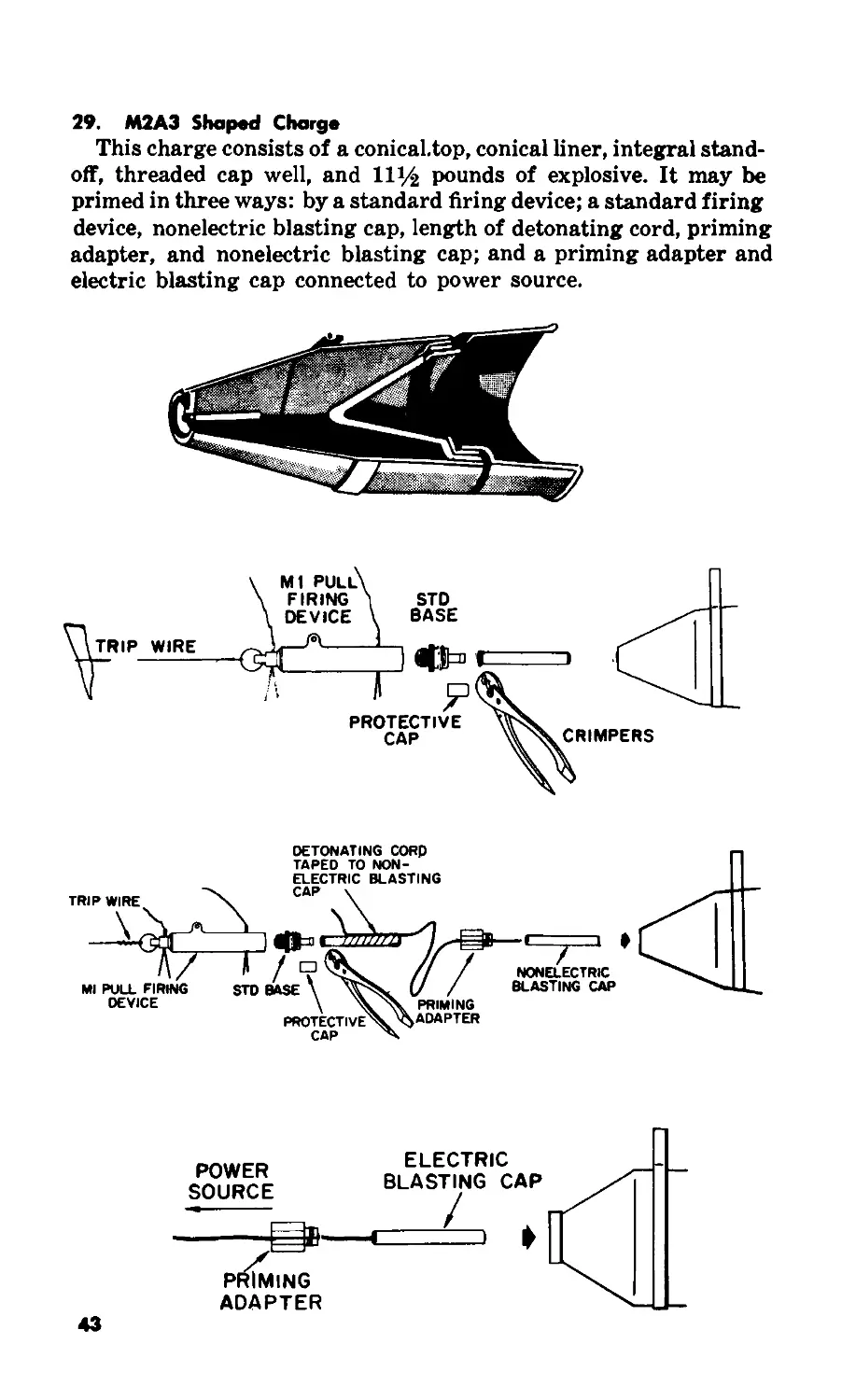
29.	АА2АЗ Shaped Charge
This charge consists of a conical.top, conical liner, integral stand-
off, threaded cap well, and Ц14 pounds of explosive. It may be
primed in three ways: by a standard firing device; a standard firing
device, nonelectric blasting cap, length of detonating cord, priming
adapter, and nonelectric blasting cap; and a priming adapter and
electric blasting cap connected to power source.
\\TRIP WIRE
T —
DETONATING CORP
TAPED TO NON-
ELECTRIC BLASTING
Г
NONELECTRIC
BLASTING CAP
43
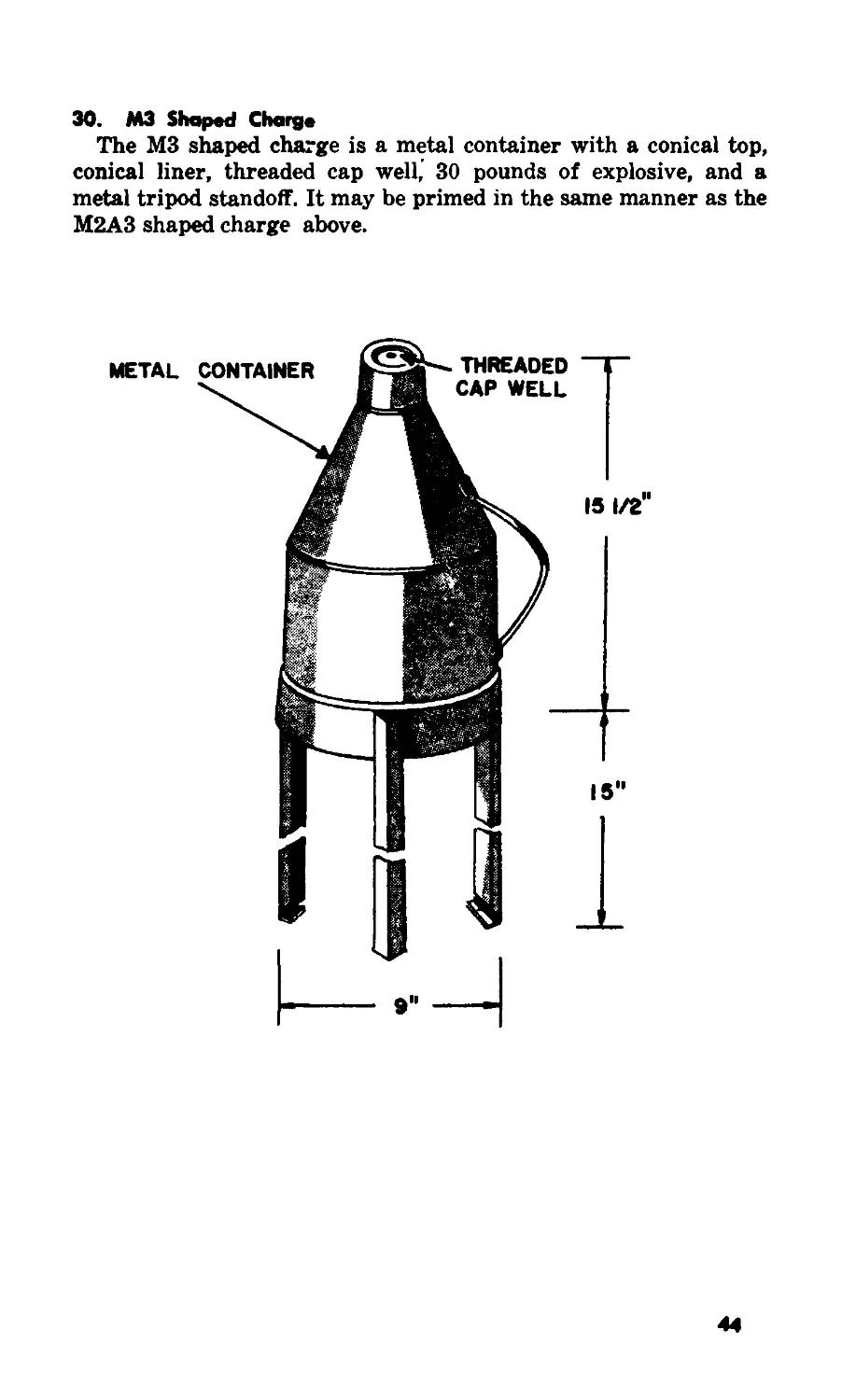
30.	М3 Shaped Charge
The М3 shaped charge is a metal container with a conical top,
conical liner, threaded cap well, 30 pounds of explosive, and a
metal tripod standoff. It may be primed in the same manner as the
M2A3 shaped charge above.
44
Section III. MISSILES
31.	Introduction
Hand grenades, bombs, and mortar and artillery ammunition
have wide application as improvised explosive charges. The only
portion of these useful in boobytrapping, however, are the container
and its explosive filler. The fuze is replaced by a standard firing
device and an MIO universal destructor—an adapter designed espe-
cially for this purpose. The number and type of missiles useful in
boobytrapping, however, are not limited to the examples given
below.
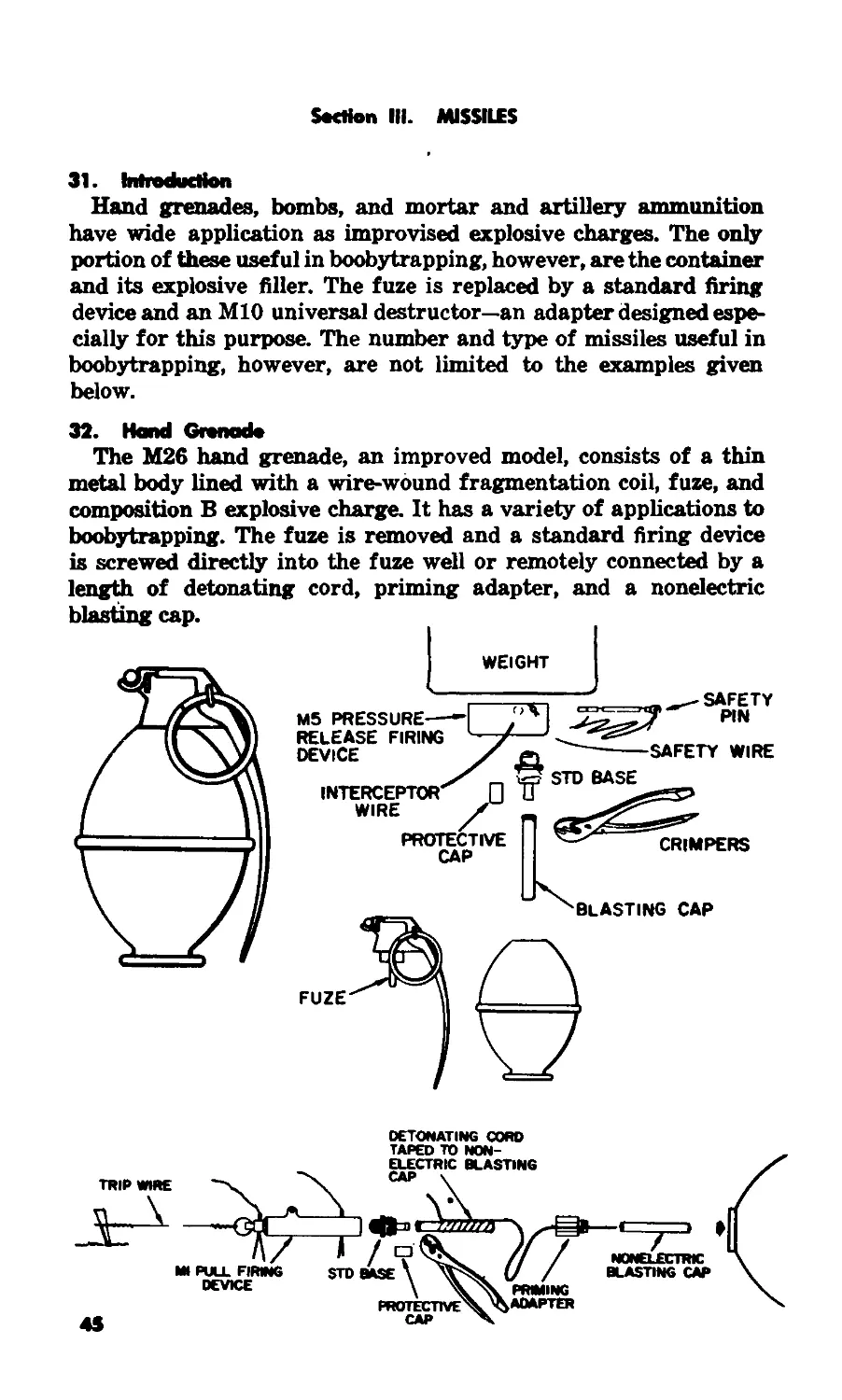
MHond Gronod*
The M26 hand grenade, an improved model, consists of a thin
metal body lined with a wire-wound fragmentation coil, fuze, and
composition В explosive charge. It has a variety of applications to
boobytrapping. The fuze is removed and a standard firing device
is screwed directly into the fuze well or remotely connected by a
length of detonating cord, priming adapter, and a nonelectric
blasting cap.
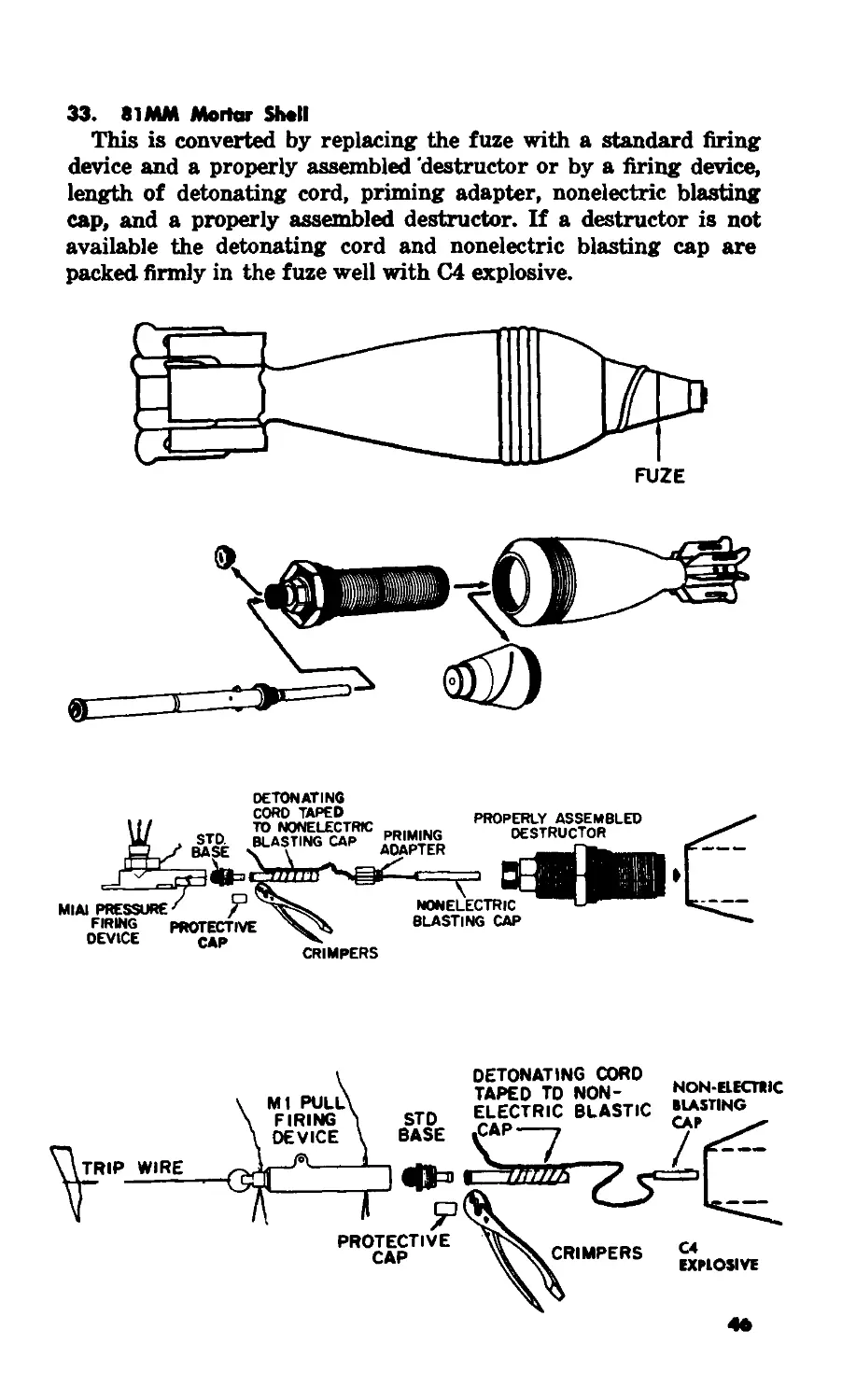
33.	81ММ Mortar Shell
This is converted by replacing the fuze with a standard firing
device and a properly assembled 'destructor or by a firing device,
length of detonating cord, priming adapter, nonelectric blasting
cap, and a properly assembled destructor. If a destructor is not
available the detonating cord and nonelectric blasting cap are
packed firmly in the fuze well with 04 explosive.
FUZE
\\TRIP wire
T
40
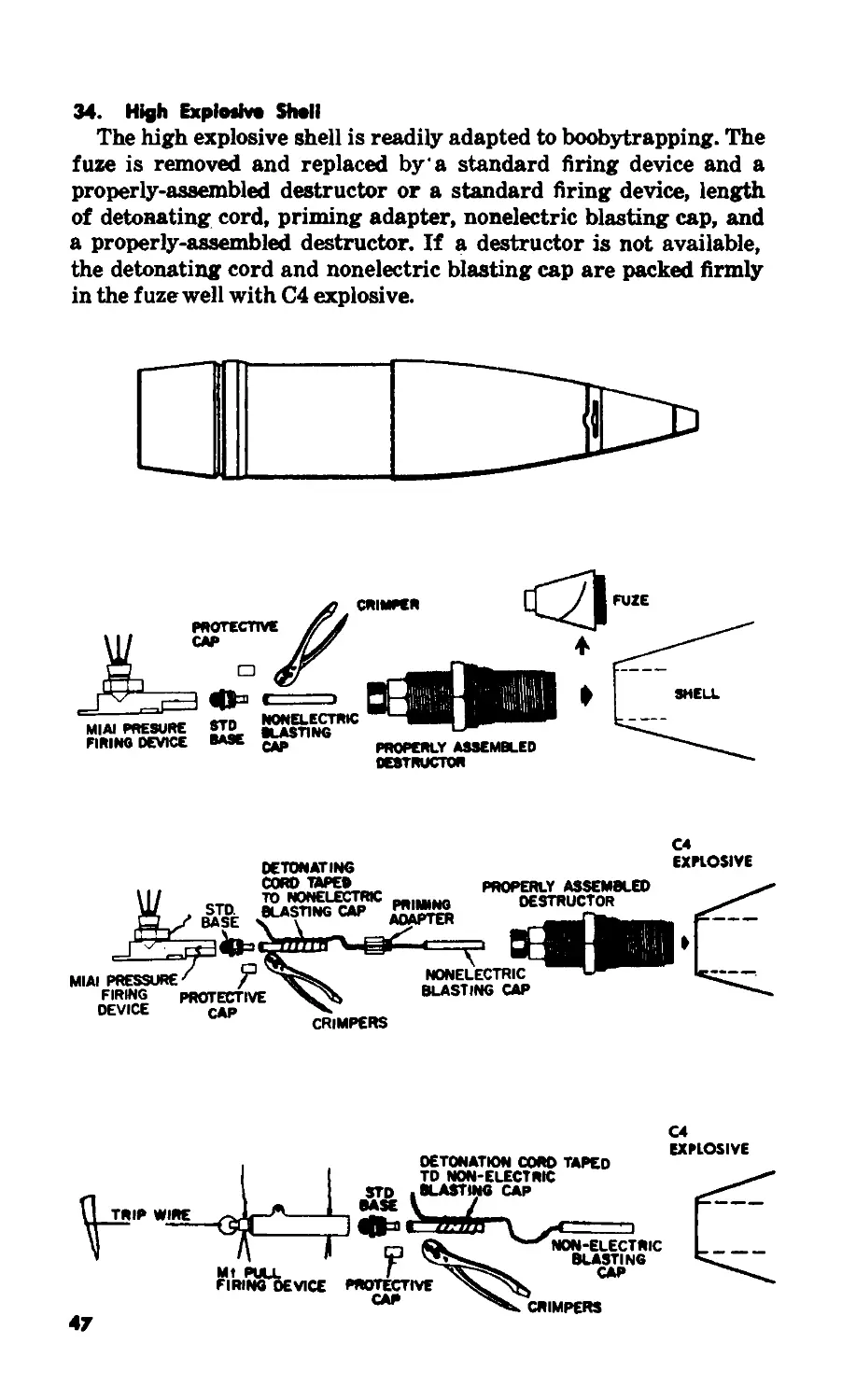
34.	High Expletive Shell
The high explosive shell is readily adapted to boobytrapping. The
fuze is removed and replaced by'a standard firing device and a
properly-assembled destructor or a standard firing device, length
of detonating cord, priming adapter, nonelectric blasting cap, and
a properly-assembled destructor. If a destructor is not available,
the detonating cord and nonelectric blasting cap are packed firmly
in the fuze well with C4 explosive.
DESTRUCTOR
47
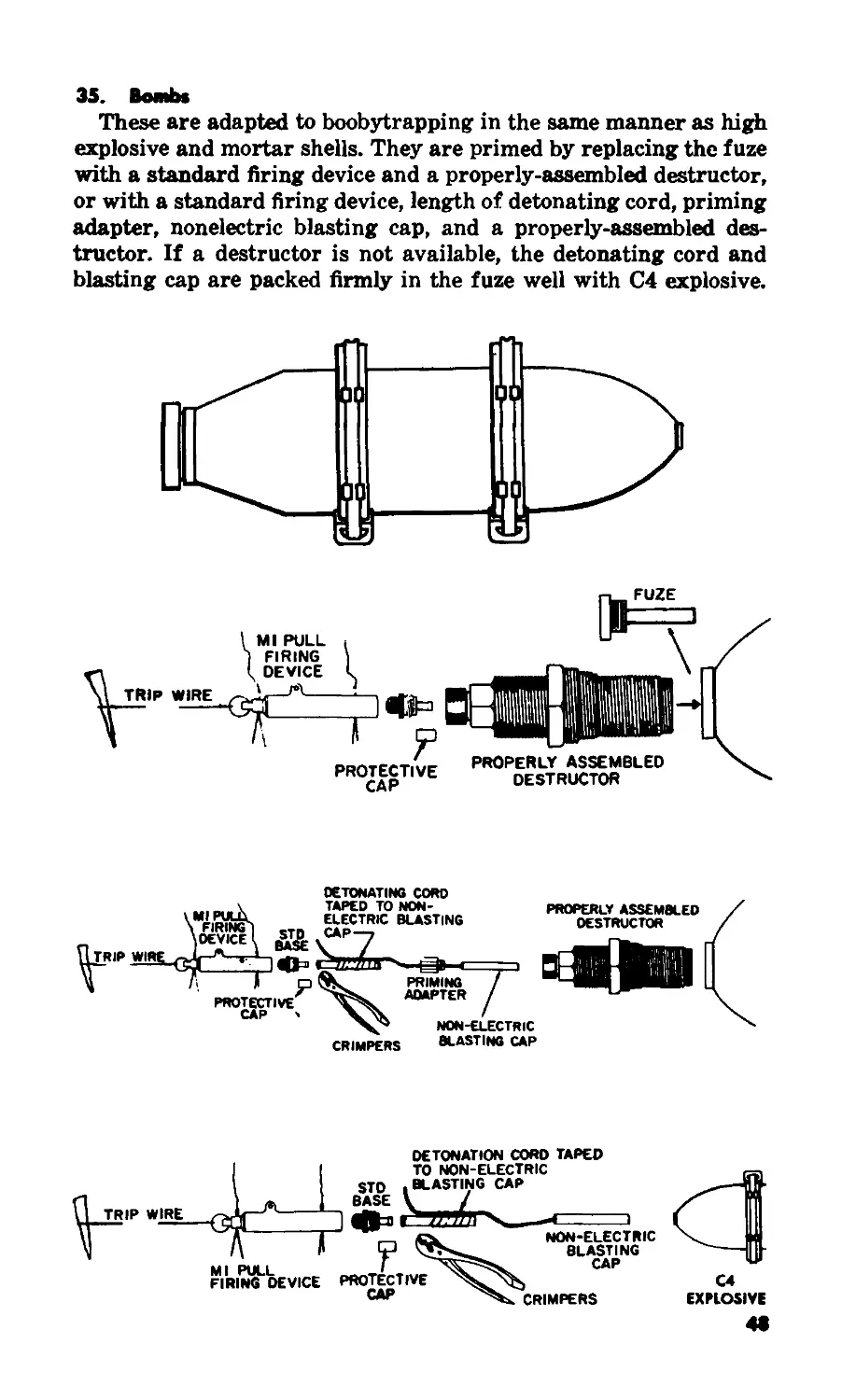
35.	Bomb*
These are adapted to boobytrapping in the same manner as high
explosive and mortar shells. They are primed by replacing the fuze
with a standard firing device and a properly-assembled destructor,
or with a standard firing device, length of detonating cord, priming
adapter, nonelectric blasting cap, and a properly-assembled des-
tructor. If a destructor is not available, the detonating cord and
blasting cap are packed firmly in the fuze well with C4 explosive.
DETONATING CORD
DETONATION CORD TAPED
TO NON-ELECTRIC
C4
EXPLOSIVE
43
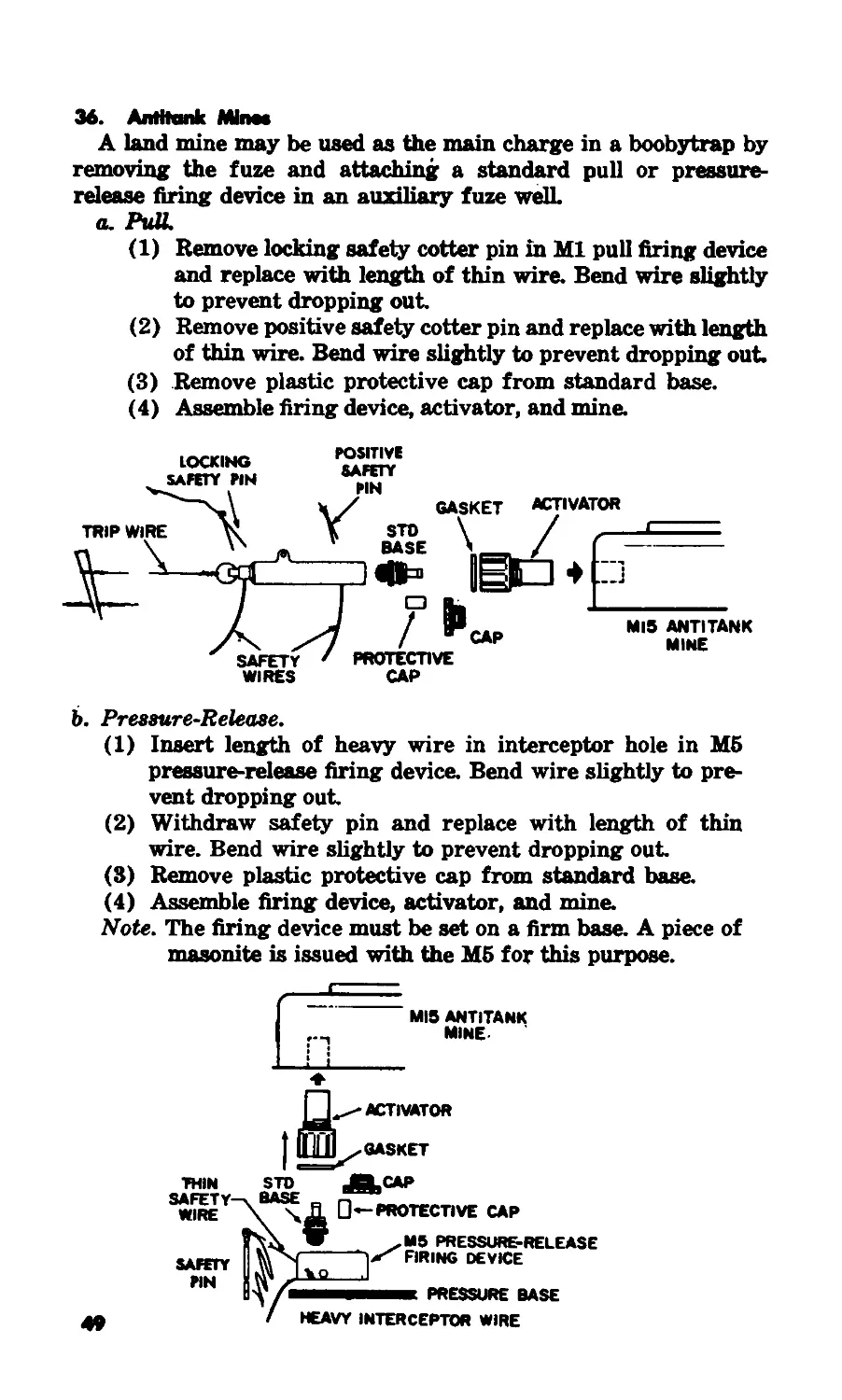
36.	Antitank Mine*
A land mine may be used as the main charge in a boobytrap by
removing the fuze and attaching a standard pull or pressure-
release firing device in an auxiliary fuze well.
a.	Pull.
(1)	Remove locking safely cotter pin in Ml pull firing device
and replace with length of thin wire. Bend wire slightly
to prevent dropping out
(2)	Remove positive safely cotter pin and replace with length
of thin wire. Bend wire slightly to prevent dropping out
(3)	Remove plastic protective cap from standard base.
(4)	Assemble firing device, activator, and mine.
b.	Pressure-Release.
(1)	Insert length of heavy wire in interceptor hole in M5
pressure-release firing device. Bend wire slightly to pre-
vent dropping out
(2)	Withdraw safety pin and replace with length of thin
wire. Bend wire slightly to prevent dropping out
(3)	Remove plastic protective cap from standard base.
(4)	Assemble firing device, activator, and mine.
Note. The firing device must be set on a firm base. A piece of
masonite is issued with the M5 for this purpose.
INACTIVATOR
GASKET
MIS ANTITANK
MINE
THIN STD
SAFETY^ BASE
WIRE \ \
□—PROTECTIVE CAP
SAFETY
PIN
-M5 PRESSURE-RELEASE
IX^ firing device
PRESSURE BASE
HEAVY INTERCEPTOR WIRE

CHAPTER 4
CONSTRUCTION TECHNIQUES
Section I. Boobytrapping Mino* in Minefield*
37.	Tactical Purpose
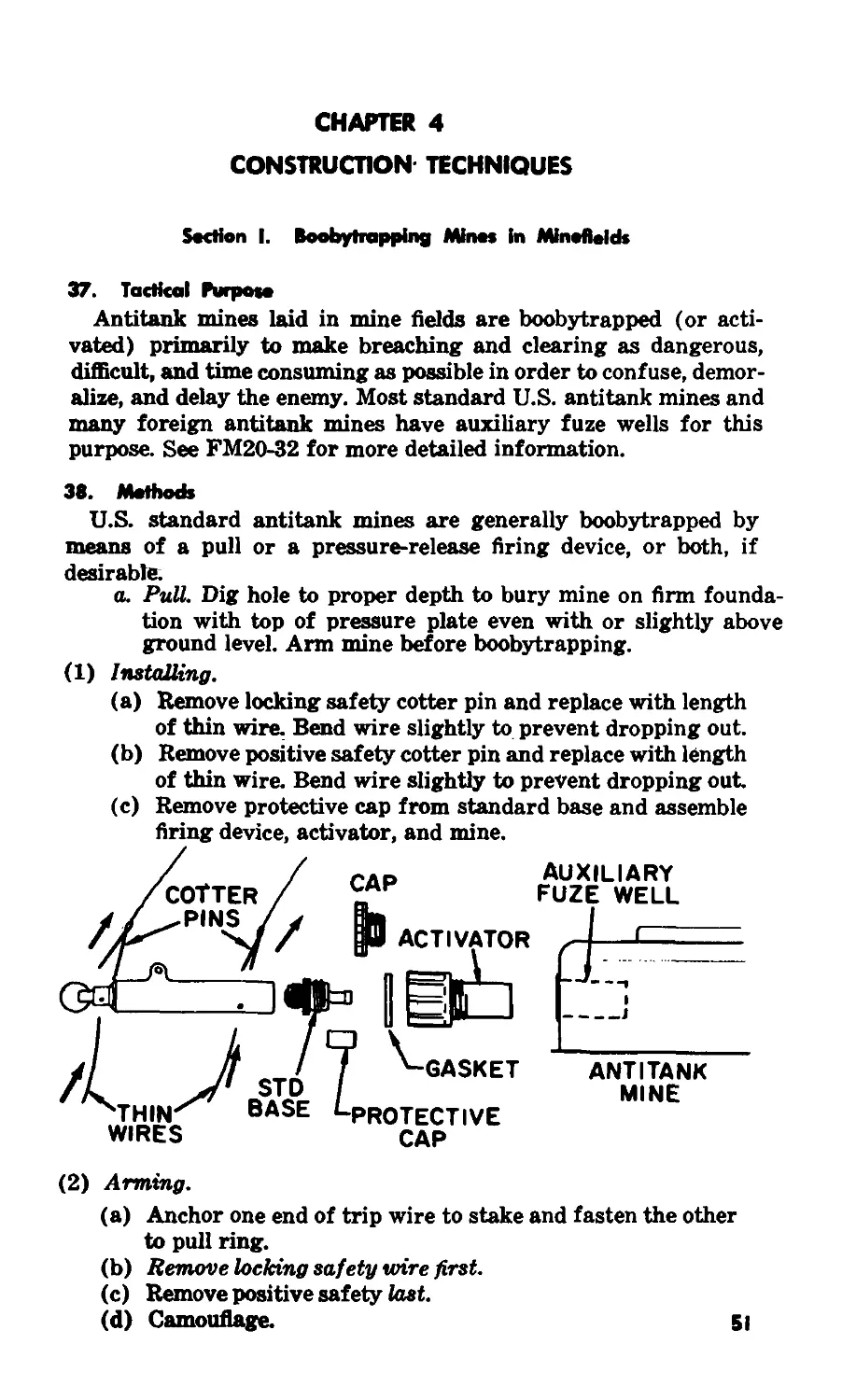
Antitank mines laid in mine fields are boobytrapped (or acti-
vated) primarily to make breaching and clearing as dangerous,
difficult, and time consuming as possible in order to confuse, demor-
alize, and delay the enemy. Most standard U.S. antitank mines and
many foreign antitank mines have auxiliary fuze wells for this
purpose. See FM20-32 for more detailed information.
38.	Method*
U.S. standard antitank mines are generally boobytrapped by
means of a pull or a pressure-release firing device, or both, if
desirable.
a. Pull. Dig hole to proper depth to bury mine on firm founda-
tion with top of pressure plate even with or slightly above
ground level. Arm mine before boobytrapping.
(1) Installing.
(&) Remove locking safety cotter pin and replace with length
of thin wire. Bend wire slightly to prevent dropping out.
(b) Remove positive safety cotter pin and replace with length
of thin wire. Bend wire slightly to prevent dropping out
(c) Remove protective cap from standard base and assemble
firing device, activator, and mine.
(2) Arming.
AUXILIARY
FUZE WELL
ANTITANK
MINE
(&) Anchor one end of trip wire to stake and fasten the other
to pull ring.
(b)	Remove locking safety wire first.
(c)	Remove positive safety last.
(d)	Camouflage.	51
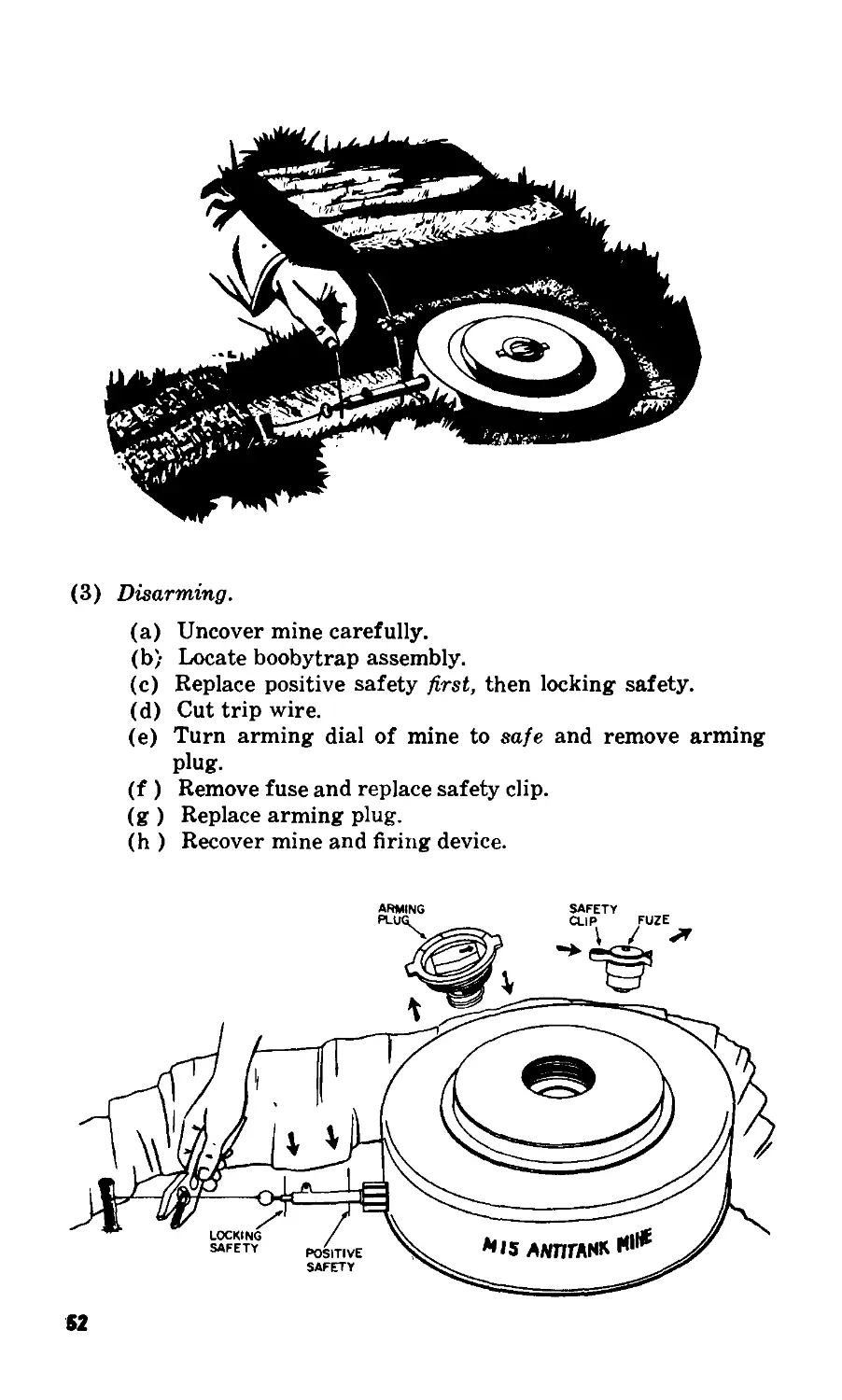
(3)	Disarming.
(a) Uncover mine carefully.
(b> Locate boobytrap assembly.
(c)	Replace positive safety first, then locking safety.
(d)	Cut trip wire.
(e)	Turn arming dial of mine to safe and remove arming
plug.
(f ) Remove fuse and replace safety clip.
(g ) Replace arming plug.
(h ) Recover mine and firing device.
52
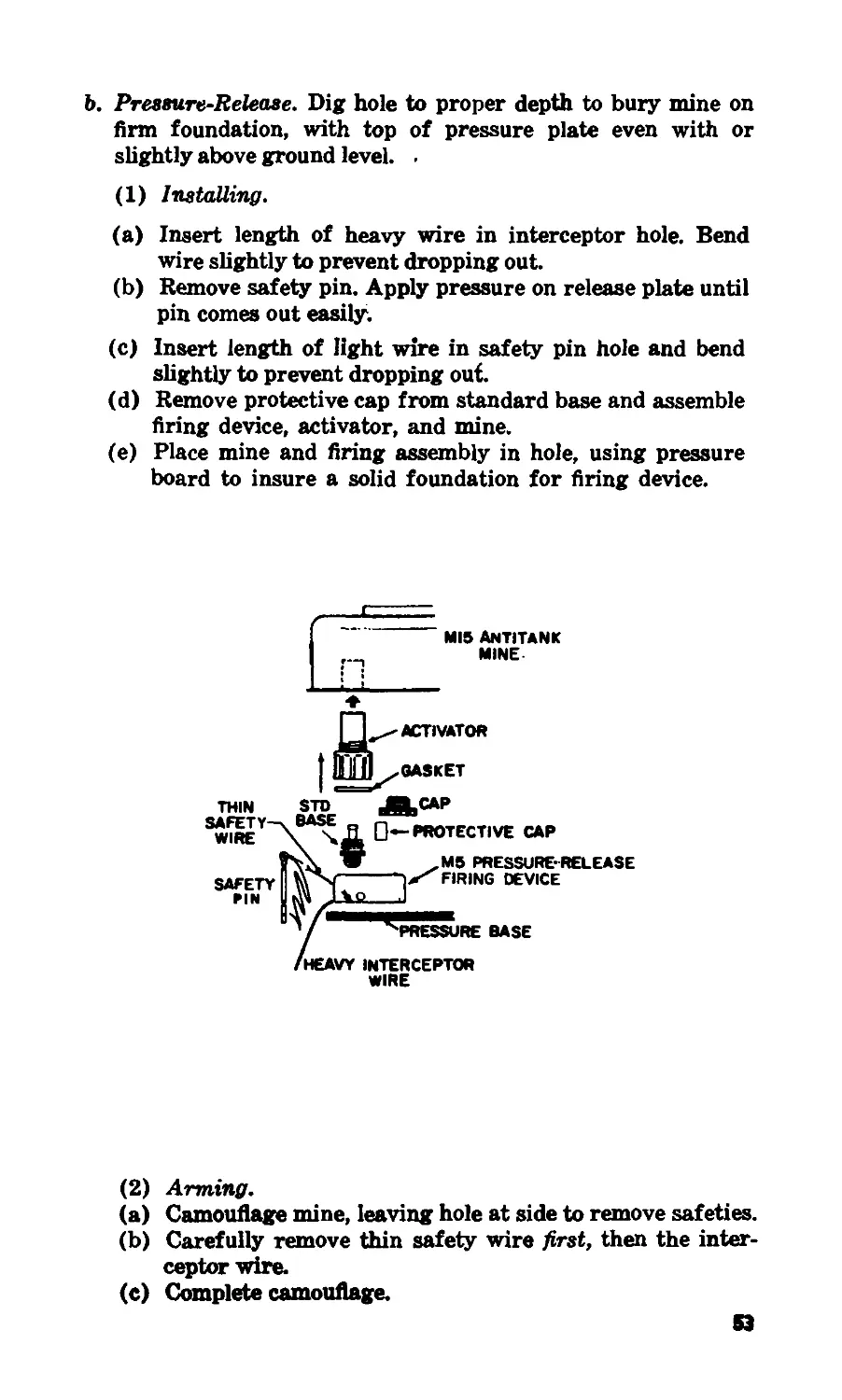
b. Pressure-Release. Dig hole to proper depth to bury mine on
firm foundation, with top of pressure plate even with or
slightly above ground level.
(1)	Installing.
(a)	Insert length of heavy wire in interceptor hole. Bend
wire slightly to prevent dropping out.
(b)	Remove safety pin. Apply pressure on release plate until
pin comes out easily.
(c)	Insert length of light wire in safety pin hole and bend
slightly to prevent dropping out.
(d)	Remove protective cap from standard base and assemble
firing device, activator, and mine.
(e)	Place mine and firing assembly in hole, using pressure
board to insure a solid foundation for firing device.
mis Antitank
mine
ACTIVATOR
GASKET
THIN
SAFETY
WIRE
STD J^CAP
BASE
° □—PROTECTIVE CAP
SAFETY
PIN
PRESSURE BASE

.MS PRESSURE-RELEASE
IX^ FIRING DEVICE
HEAVY INTERCEPTOR
WIRE
(2)	Arming.
(a)	Camouflage mine, leaving hole at side to remove safeties.
(b)	Carefully remove thin safety wire first, then the inter-
ceptor wire.
(c)	Complete camouflage.
S3
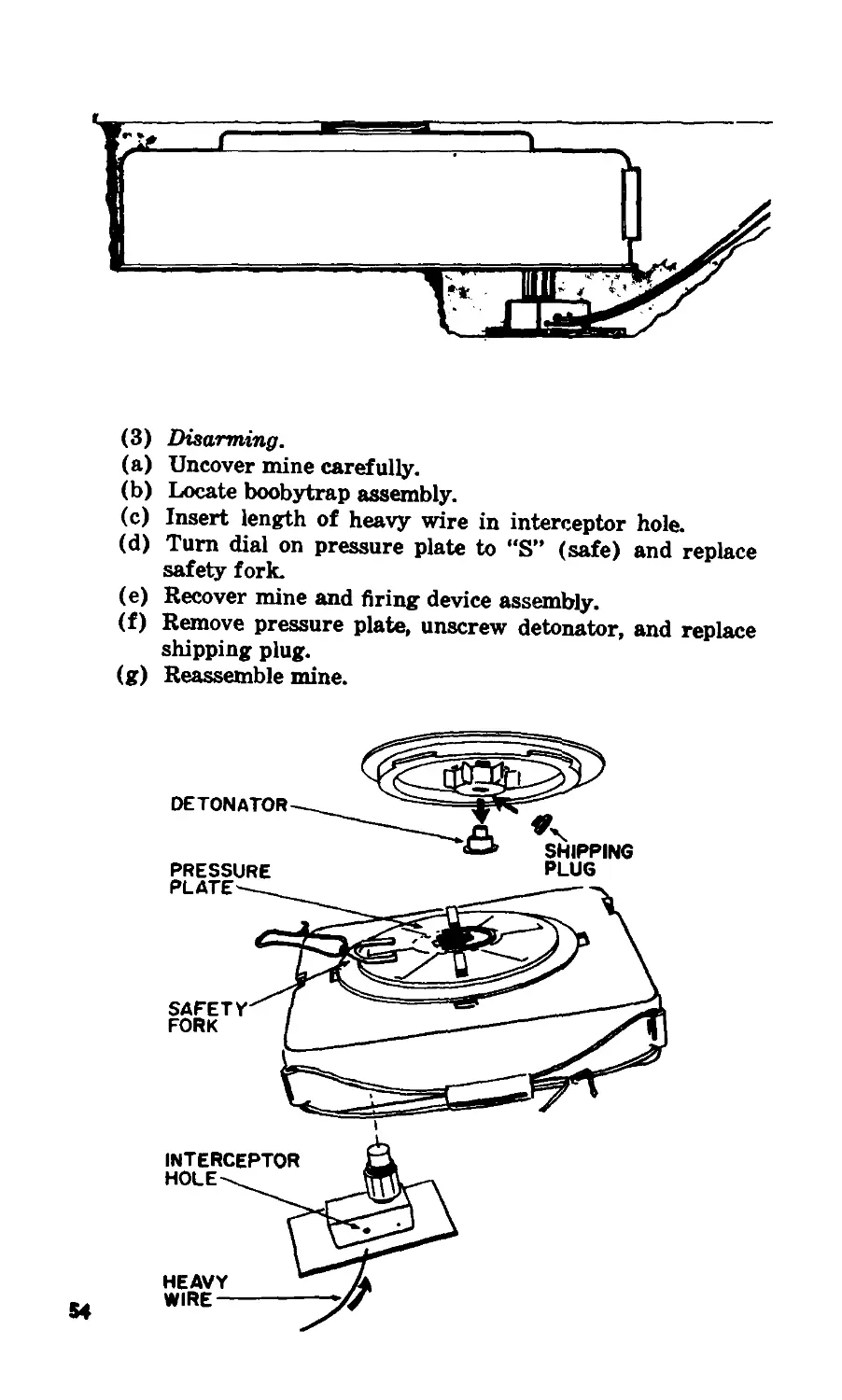
(3)	Disarming.
(a)	Uncover mine carefully.
(b)	Locate boobytrap assembly.
(c)	Insert length of heavy wire in interceptor hole.
(d)	Turn dial on pressure plate to “S” (safe) and replace
safety fork.
(e)	Recover mine and firing device assembly.
(f)	Remove pressure plate, unscrew detonator, and replace
shipping plug.
(g)	Reassemble mine.
54
39.	Boobytrapped Foreign Mino*
a. Antitank Mines.
The Communist European and Asiatic armies boobytrap mines
in a much different fashion from that of the U.S. and other NATO
countries. The Germans in World War II used both special antilift
devices and antidisturbance fuzes, one of which has been copied by
the French.
(1)	Antilift devices.
(a)	Russia
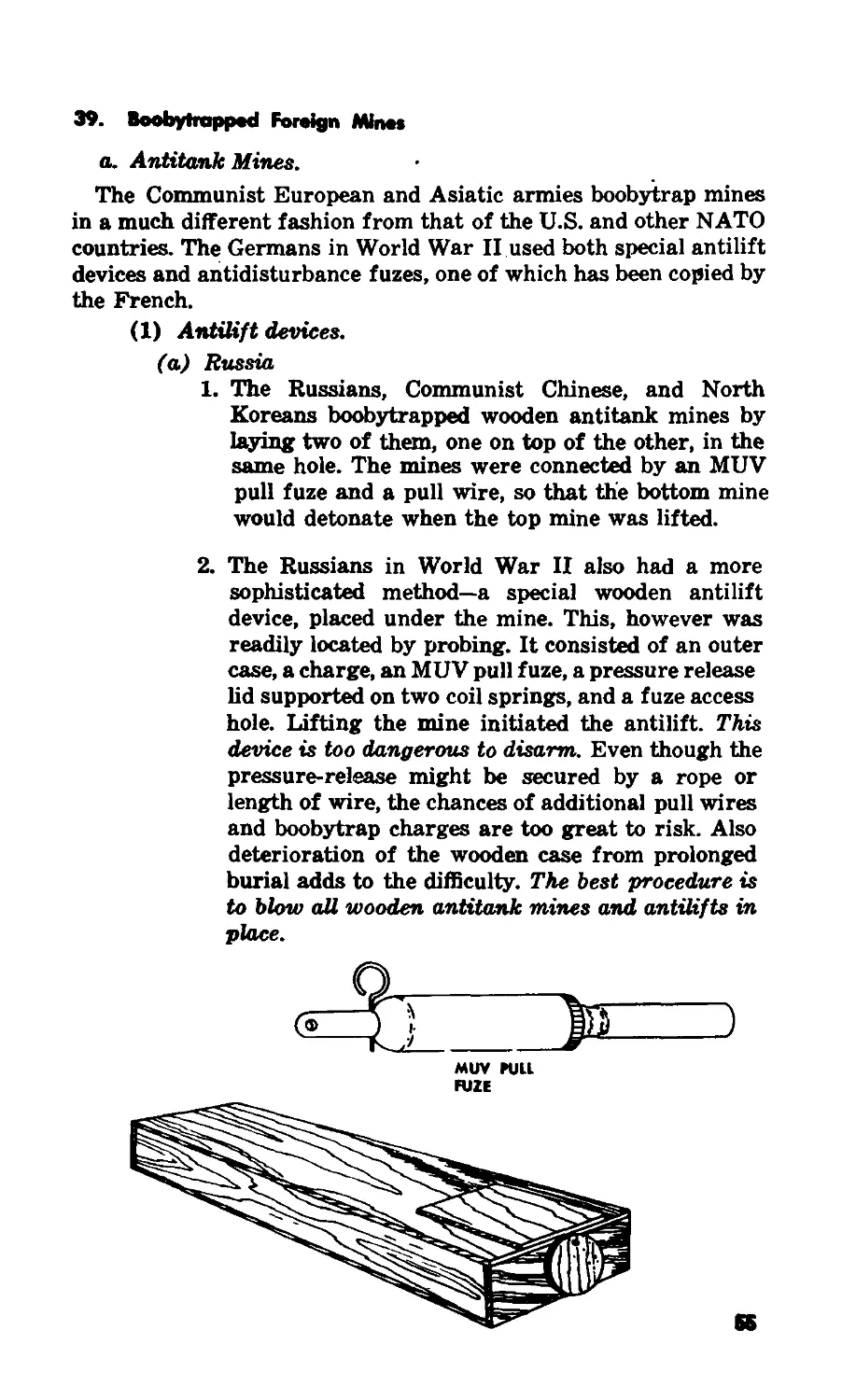
1.	The Russians, Communist Chinese, and North
Koreans boobytrapped wooden antitank mines by
laying two of them, one on top of the other, in the
same hole. The mines were connected by an MUV
pull fuze and a pull wire, so that the bottom mine
would detonate when the top mine was lifted.
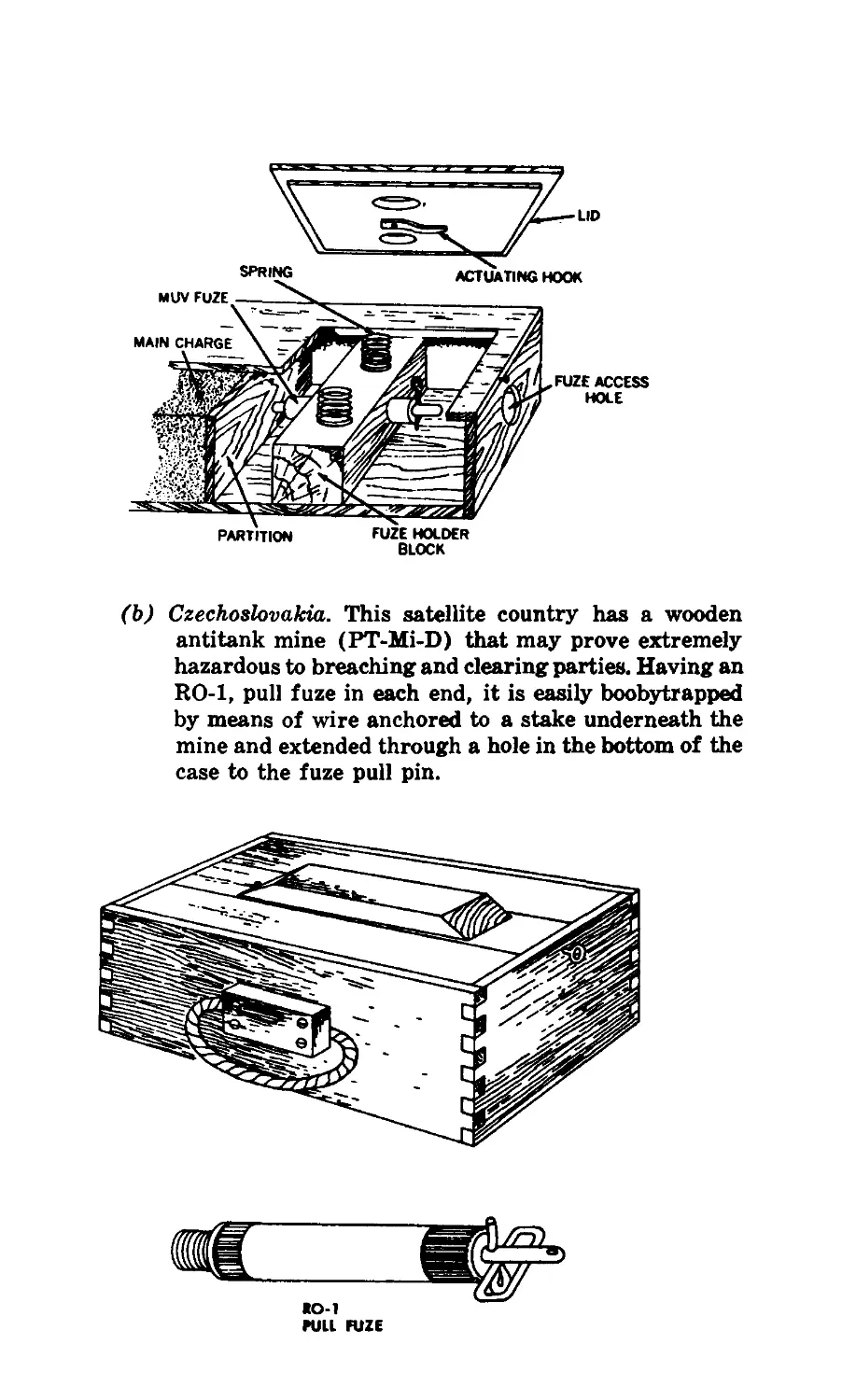
2.	The Russians in World War II also had a more
sophisticated method—a special wooden antilift
device, placed under the mine. This, however was
readily located by probing. It consisted of an outer
case, a charge, an MUV pull fuze, a pressure release
lid supported on two coil springs, and a fuze access
hole. Lifting the mine initiated the antilift. This
device is too dangerous to disarm. Even though the
pressure-release might be secured by a rope or
length of wire, the chances of additional pull wires
and boobytrap charges are too great to risk. Also
deterioration of the wooden case from prolonged
burial adds to the difficulty. The best procedure is
to blow all wooden antitank mines and antilifts in
place.
6Б
LID
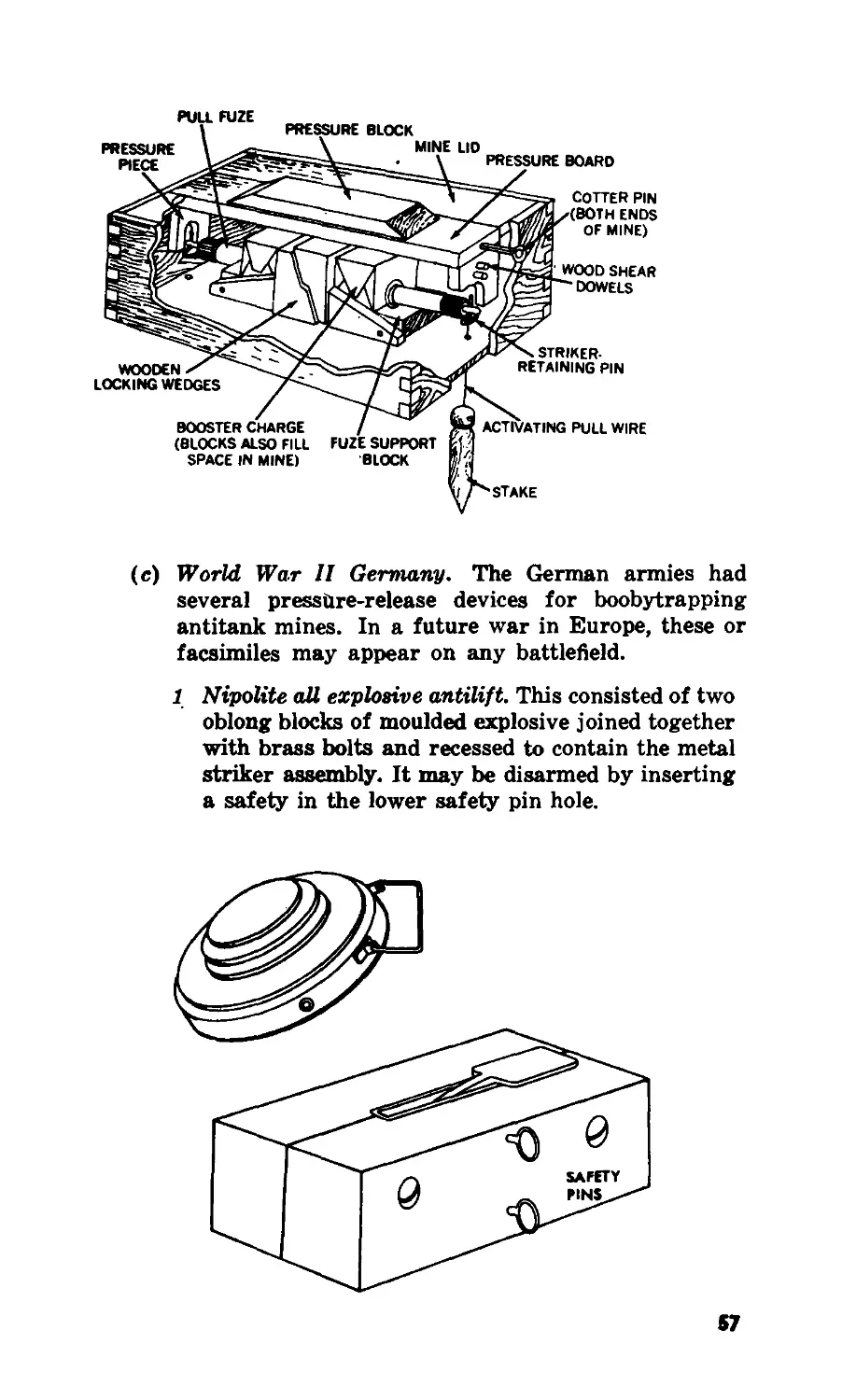
(b)	Czechoslovakia. This satellite country has a wooden
antitank mine (PT-Mi-D) that may prove extremely
hazardous to breaching and clearing parties. Having an
RO-1, pull fuze in each end, it is easily boobytrapped
by means of wire anchored to a stake underneath the
mine and extended through a hole in the bottom of the
case to the fuze pull pin.
10-1
Mill FUZE
PULL FUZE
PRESSURE
PIECE
PRESSURE BLOCK
MINE LID
PRESSURE BOARD
STAKE
BOOSTER CHARGE
(BLOCKS ALSO FILL
SPACE IN MINE)
WOOD SHEAR
DOWELS
COTTER PIN
(BOTH ENDS
OF MINE)
STRIKER-
RETAINING PIN
WOODEN
LOCKING WEDGES
ACTIVATING PULL WIRE
(c)	World War ll Germany. The German armies had
several presstire-release devices for boobytrapping
antitank mines. In a future war in Europe, these or
facsimiles may appear on any battlefield.
1 Nipolite all explosive antilift. This consisted of two
oblong blocks of moulded explosive joined together
with brass bolts and recessed to contain the metal
striker assembly. It may be disarmed by inserting
a safety in the lower safety pin hole.
57
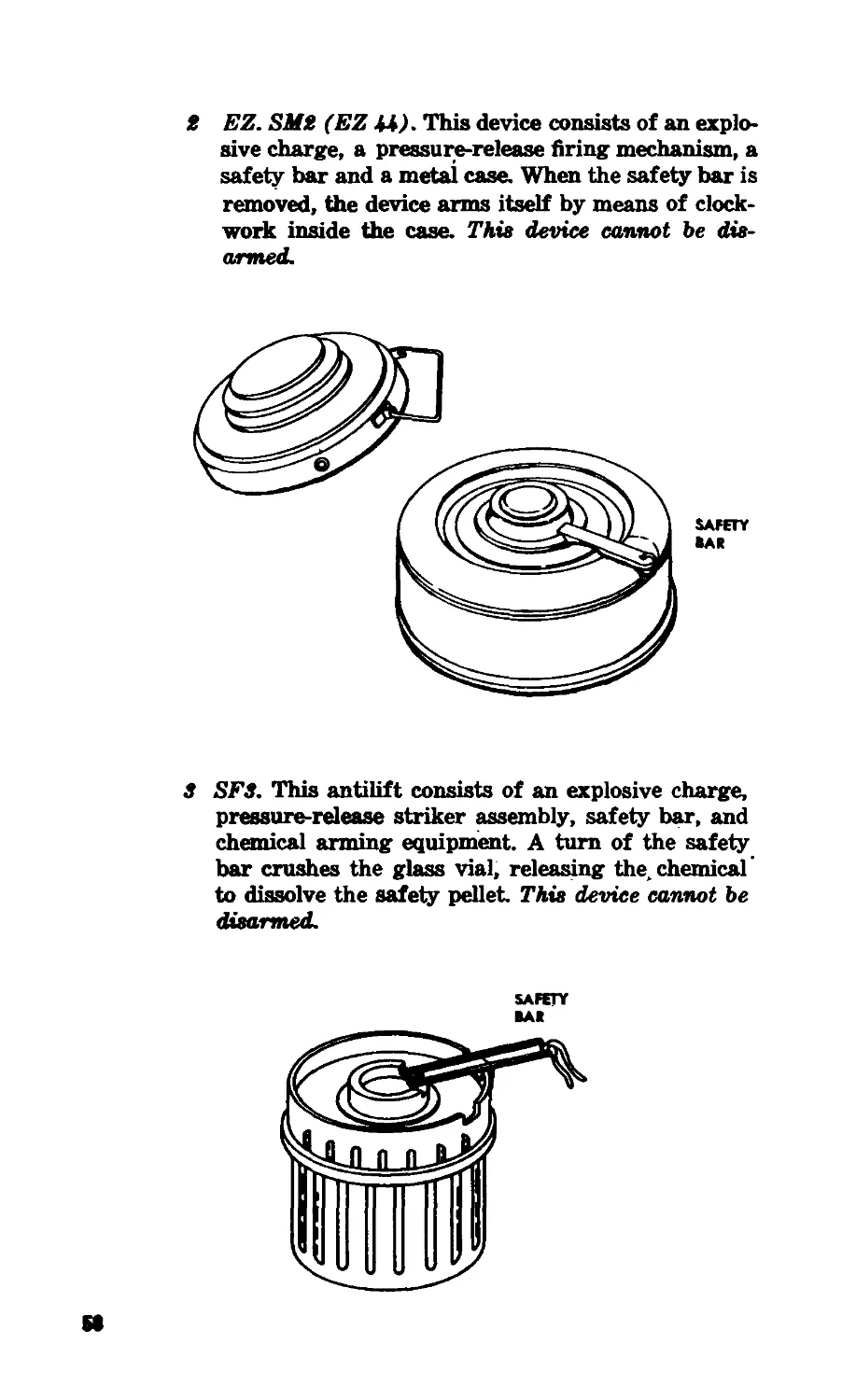
2 EZ. SM2 (EZ 44). This device consists of an explo-
sive charge, a pressure-release firing mechanism, a
safety bar and a metal case. When the safety bar is
removed, the device arms itself by means of clock-
work inside the case. This device cannot be dis-
armed.
S SFS. This antilift consists of an explosive charge,
pressure-release striker assembly, safety bar, and
chemical arming equipment. A turn of the safety
bar crushes the glass vial, releasing the, chemical
to dissolve the safety pellet This device cannot be
disarmed.
St
(2) T. Mi. Z 43 and T. Mi Z 44 antidisturbance fuzes.
(a)	Germany. In addition to several antilift devices, the
Germans developed two antidisturbance fuzes initiated
by pressure or pressure-release for activating Teller
mines 42 and 43. To arm, the fuze is placed in the
fuze well and the pressure plate screwed down on top
of the fuze, shearing the arming pin. Removal of the
pressure plate initiates the pressure-release mecha-
nism and detonates the mine. Although the T. Mi. Z
44 was an experimental model that never reached the
field, copies of both fuzes are now in use in several
European armies. Mines armed with these fuzes can
neither be identified by size, shape, marking, or color
of the case, nor be disarmed.
T. Mi. Z 44
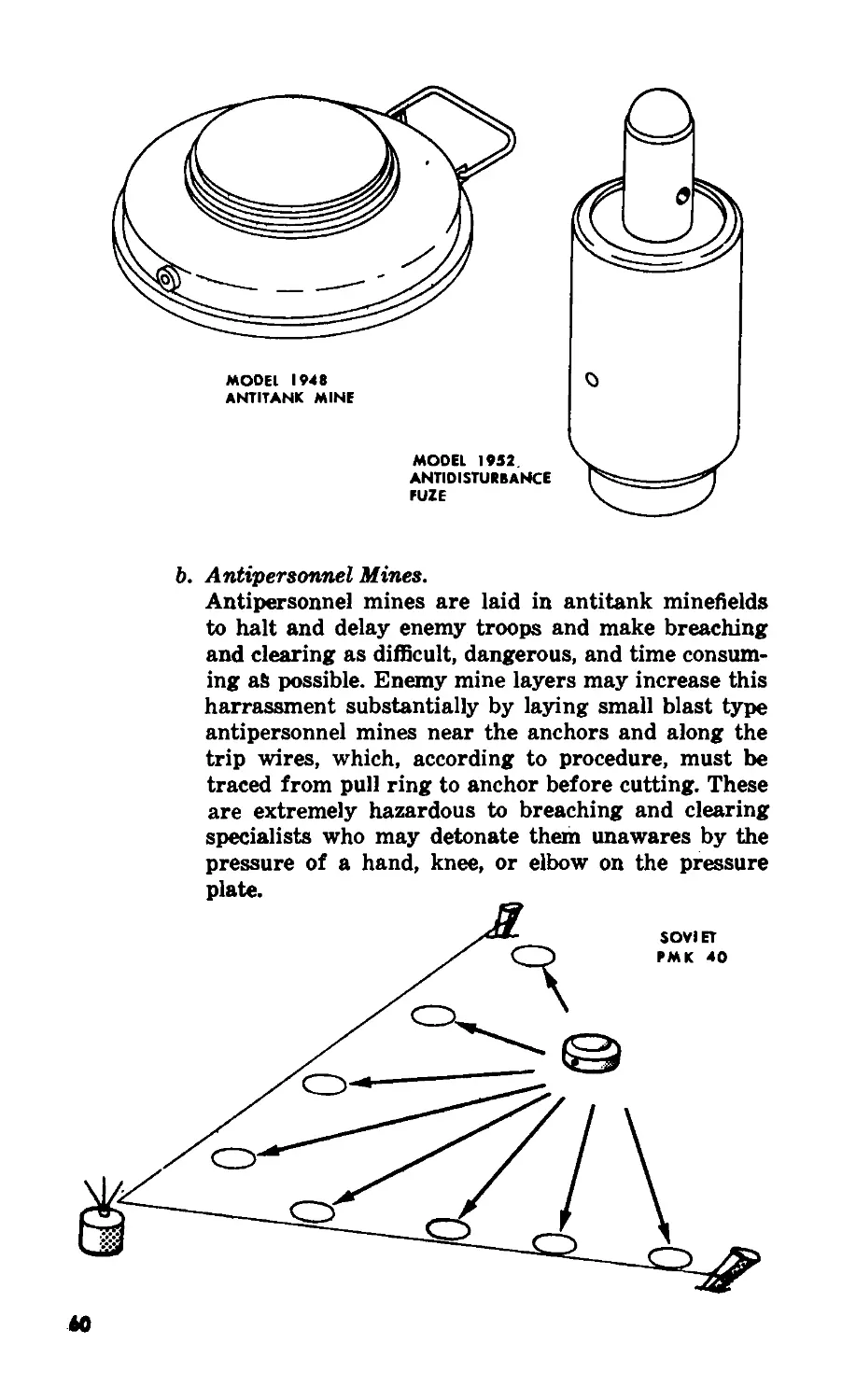
(b)	France. The French have a copy of the T. Mi. Z 43 anti-
disturbance (pressure and pressure-release) fuze,
and Teller mine 43, named models 1952 and 1948
respectively. The fuze is placed in the fuze well and
the pressure plate screwed down on top, shearing the
arming pin. Removing the pressure plate actuates the
pressure-release element, detonating the mine.
W
b. Antipersonnel Mines.
Antipersonnel mines are laid in antitank minefields
to halt and delay enemy troops and make breaching
and clearing as difficult, dangerous, and time consum-
ing aS possible. Enemy mine layers may increase this
harrassment substantially by laying small blast type
antipersonnel mines near the anchors and along the
trip wires, which, according to procedure, must be
traced from pull ring to anchor before cutting. These
are extremely hazardous to breaching and clearing
specialists who may detonate them unawares by the
pressure of a hand, knee, or elbow on the pressure
plate.
60
Section II. BOOBYTIAPWNG BUILDINGS
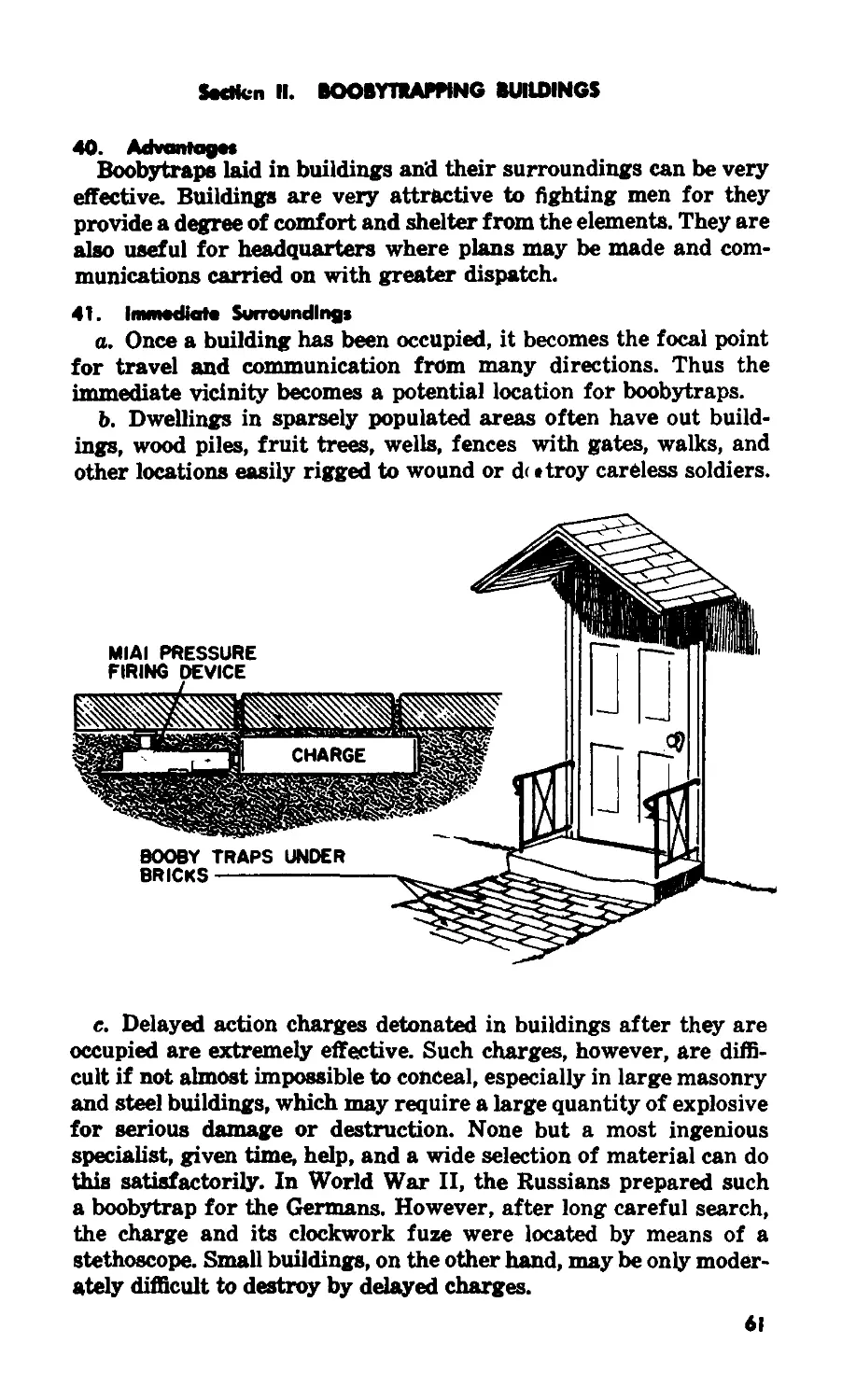
40.	Advantage*
Boobytraps laid in buildings and their surroundings can be very
effective. Buildings are very attractive to fighting men for they
provide a degree of comfort and shelter from the elements. They are
also useful for headquarters where plans may be made and com-
munications carried on with greater dispatch.
41.	Immediate Surrounding*
a.	Once a building has been occupied, it becomes the focal point
for travel and communication from many directions. Thus the
immediate vicinity becomes a potential location for boobytraps.
b.	Dwellings in sparsely populated areas often have out build-
ings, wood piles, fruit trees, wells, fences with gates, walks, and
other locations easily rigged to wound or d< «troy careless soldiers.
c.	Delayed action charges detonated in buildings after they are
occupied are extremely effective. Such charges, however, are diffi-
cult if not almost impossible to conceal, especially in large masonry
and steel buildings, which may require a large quantity of explosive
for serious damage or destruction. None but a most ingenious
specialist, given time, help, and a wide selection of material can do
this satisfactorily. In World War II, the Russians prepared such
a boobytrap for the Germans. However, after long careful search,
the charge and its clockwork fuze were located by means of a
stethoscope. Small buildings, on the other hand, may be only moder-
ately difficult to destroy by delayed charges.
61
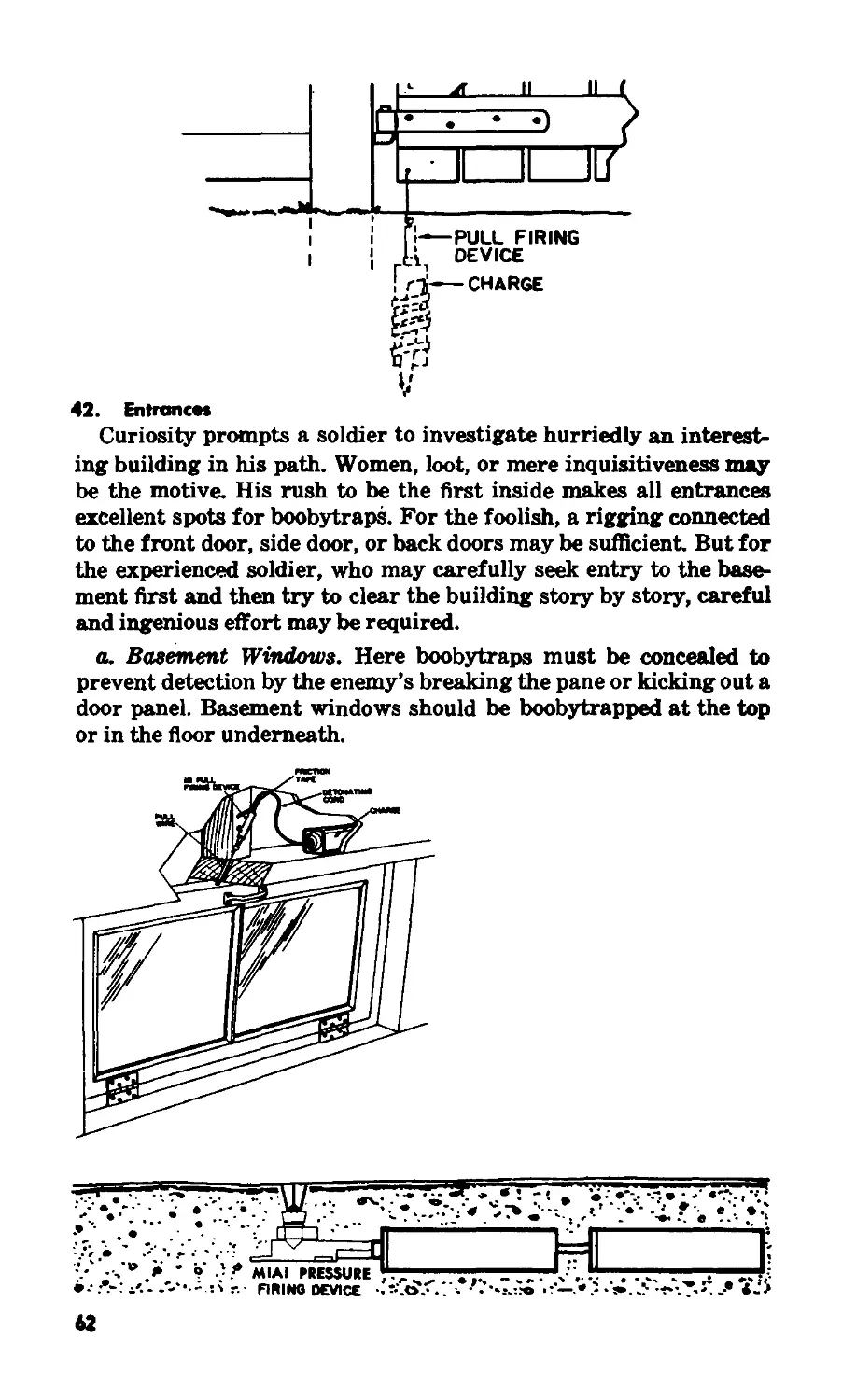
42.	Entrance»
Curiosity prompts a soldier to investigate hurriedly an interest-
ing building in his path. Women, loot, or mere inquisitiveness may
be the motive. His rush to be the first inside makes all entrances
excellent spots for boobytraps. For the foolish, a rigging connected
to the front door, side door, or back doors may be sufficient But for
the experienced soldier, who may carefully seek entry to the base-
ment first and then try to clear the building story by story, careful
and ingenious effort may be required.
a.	Basement Windows. Here boobytraps must be concealed to
prevent detection by the enemy’s breaking the pane or kicking out a
door panel. Basement windows should be boobytrapped at the top
or in the floor underneath.
62
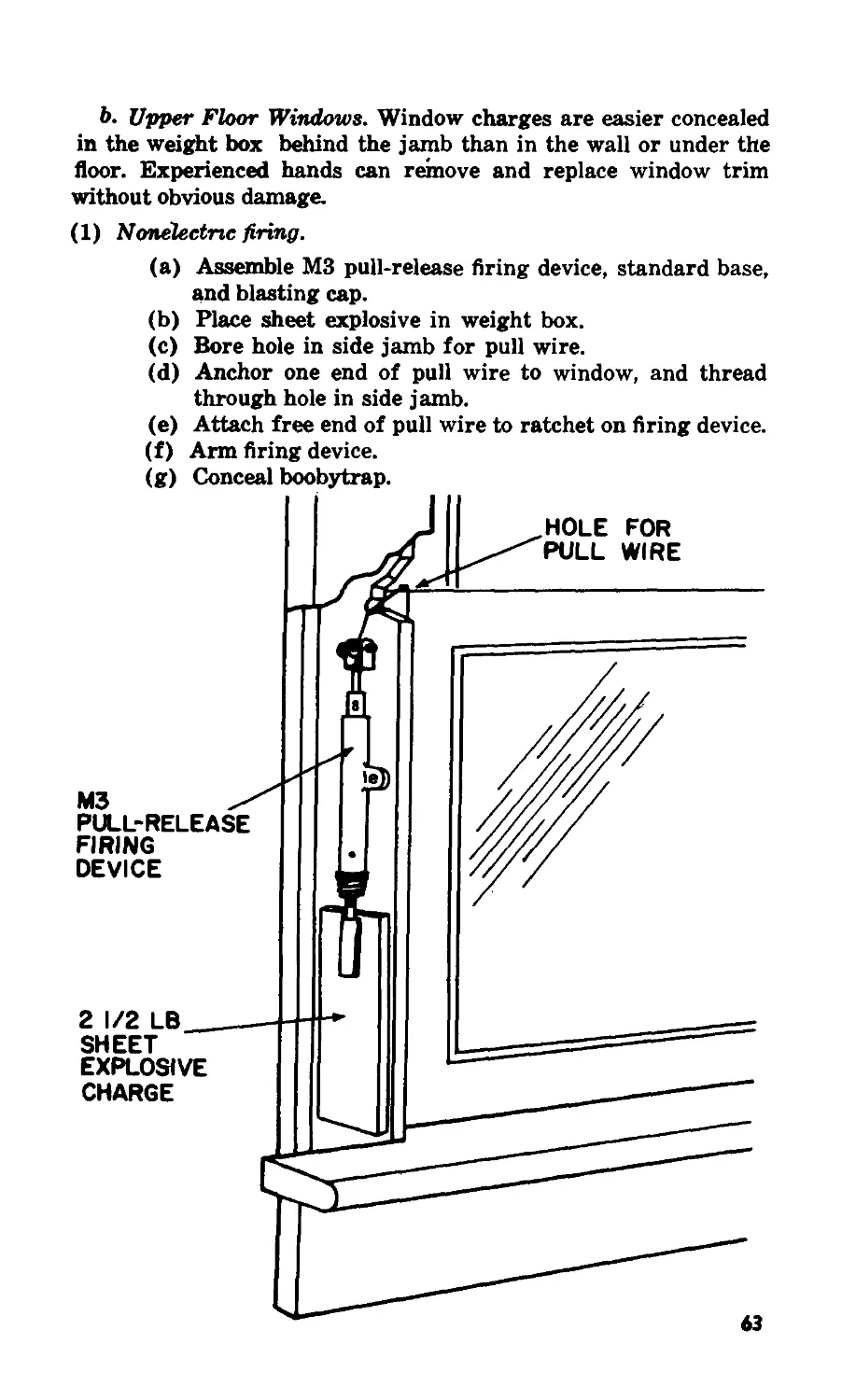
b.	Upper Floor Windows. Window charges are easier concealed
in the weight box behind the jamb than in the wall or under the
floor. Experienced hands can remove and replace window trim
without obvious damage.
(1)	Nonelectric firing.
(a)	Assemble М3 pull-release flring device, standard base,
and blasting cap.
(b)	Place sheet explosive in weight box.
(c)	Bore hole in side jamb for pull wire.
(d)	Anchor one end of pull wire to window, and thread
through hole in side jamb.
(e)	Attach free end of pull wire to ratchet on flring device.
(f)	Arm flring device.
63
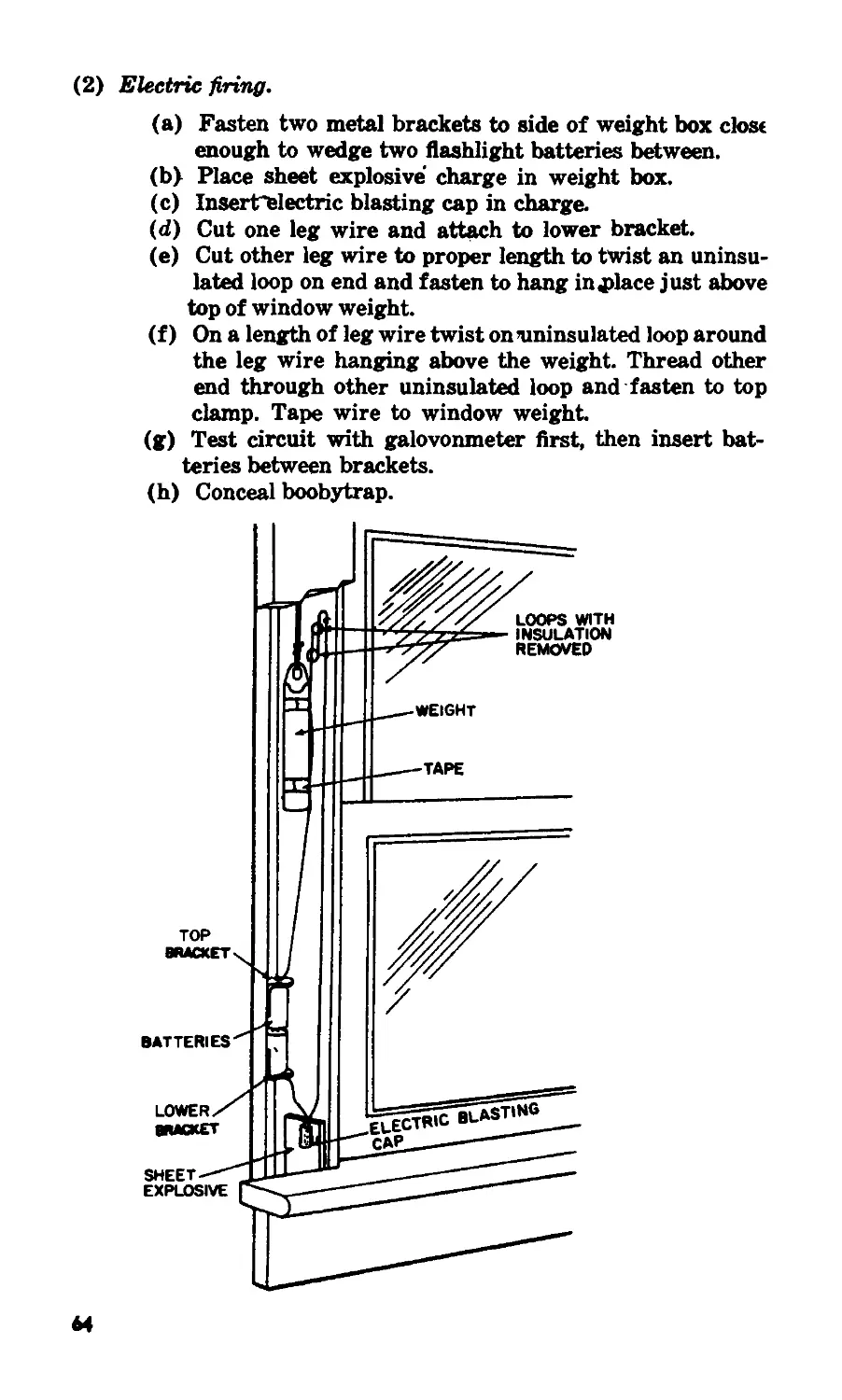
(2)	Electric firing.
(a) Fasten two metal brackets to side of weight box dost
enough to wedge two flashlight batteries between.
(b> Place sheet explosive charge in weight box.
(c)	Inserirelectric blasting cap in charge.
(d)	Cut one leg wire and attach to lower bracket.
(e)	Cut other leg wire to proper length to twist an uninsu-
lated loop on end and fasten to hang in j>lace just above
top of window weight.
(f)	Ona length of leg wire twist on ’uninsulated loop around
the leg wire hanging above the weight. Thread other
end through other uninsulated loop and fasten to top
clamp. Tape wire to window weight
(g)	Test circuit with galovonmeter first, then insert bat-
teries between brackets.
(h)	Conceal boobytrap.
64
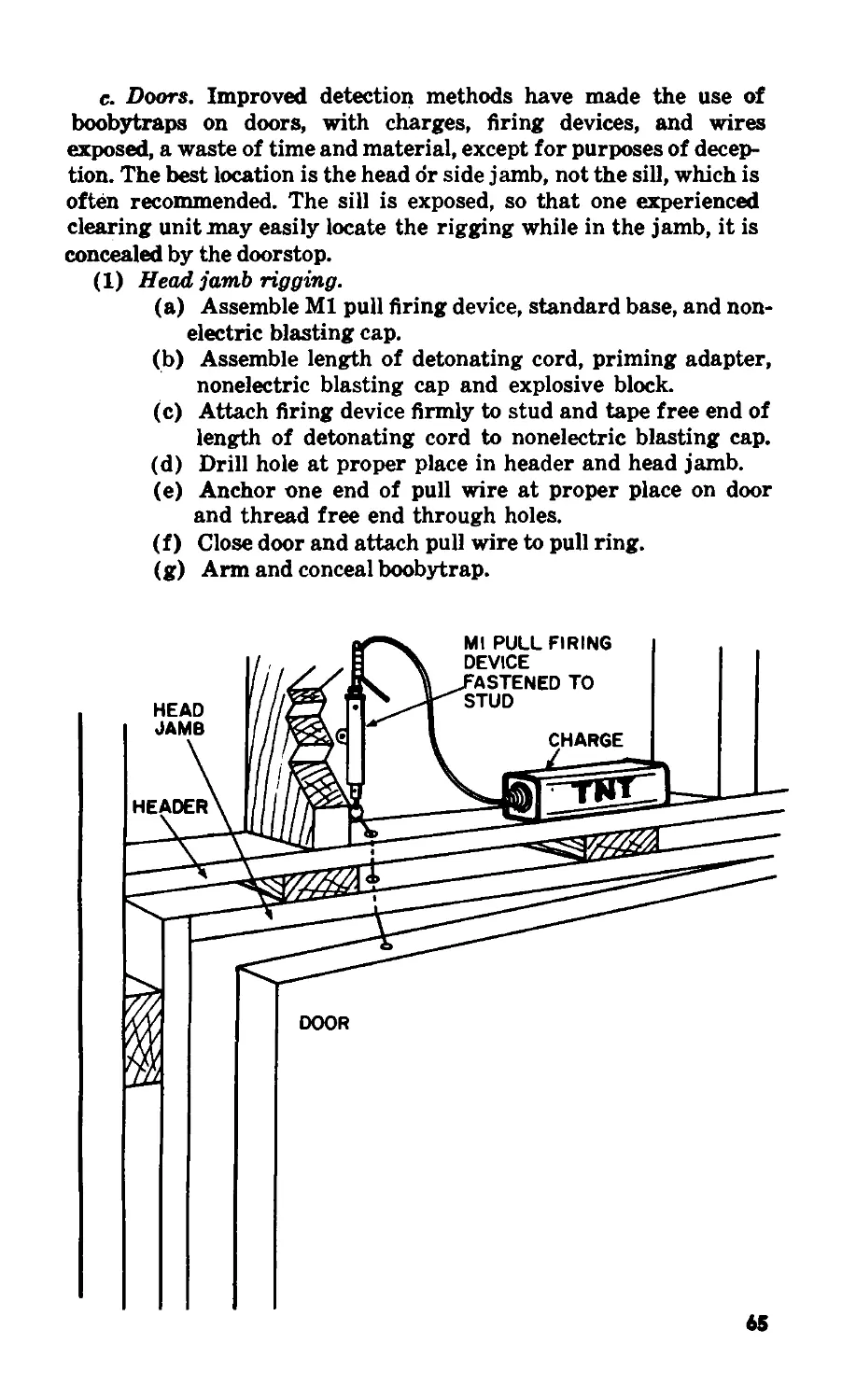
c. Doors. Improved detection methods have made the use of
boobytraps on doors, with charges, firing devices, and wires
exposed, a waste of time and material, except for purposes of decep-
tion. The best location is the head dr side jamb, not the sill, which is
often recommended. The sill is exposed, so that one experienced
clearing unit may easily locate the rigging while in the jamb, it is
concealed by the doorstop.
(1)	Head ja,mb rigging.
(a)	Assemble Ml pull firing device, standard base, and non-
electric blasting cap.
(b)	Assemble length of detonating cord, priming adapter,
nonelectric blasting cap and explosive block.
(c)	Attach firing device firmly to stud and tape free end of
length of detonating cord to nonelectric blasting cap.
(d)	Drill hole at proper place in header and head jamb.
(e)	Anchor one end of pull wire at proper place on door
and thread free end through holes.
(f)	Close door and attach pull wire to pull ring.
(g)	Arm and conceal boobytrap.
65
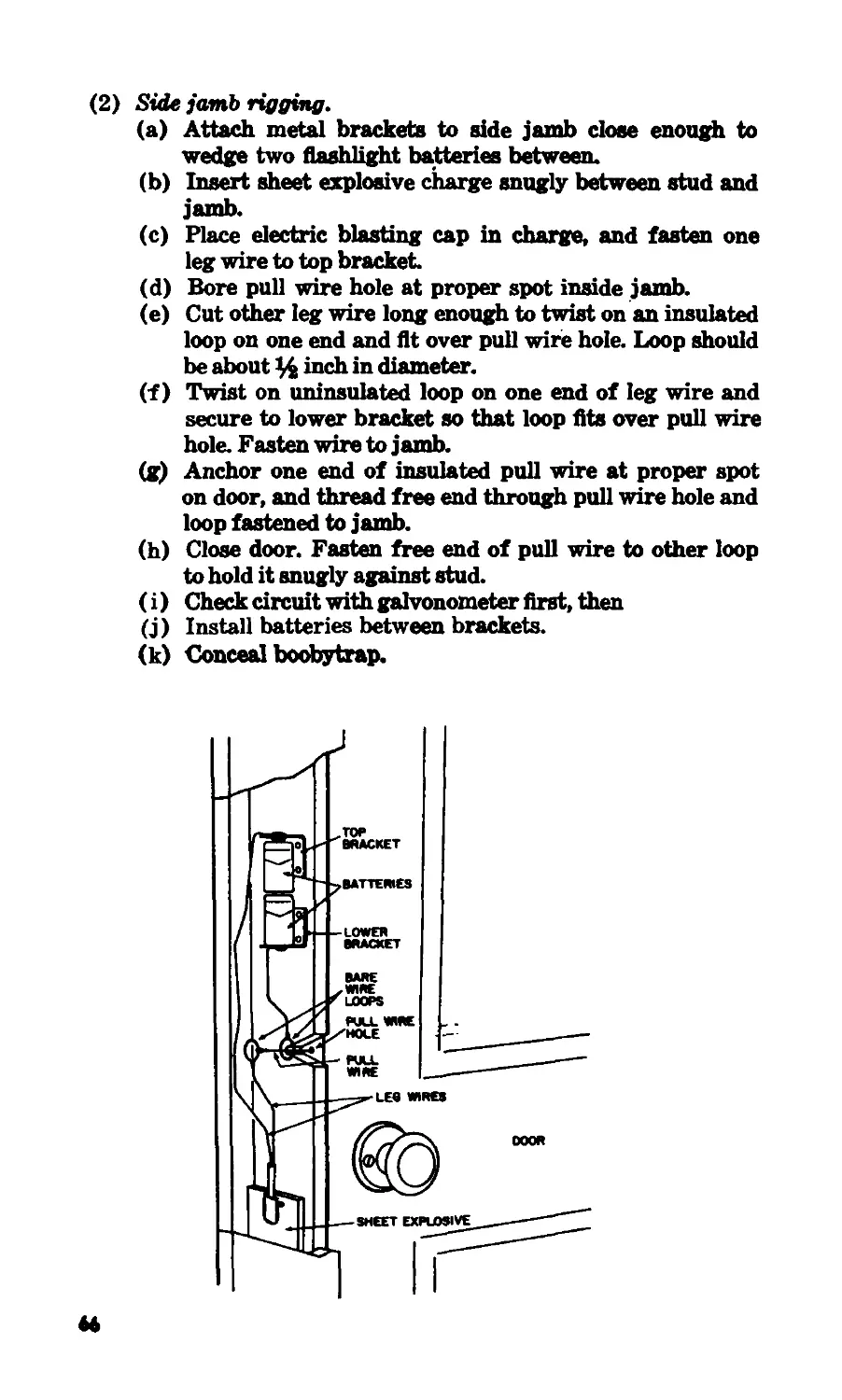
(2)	Side jamb rigging.
(a)	Attach metal brackets to side jamb dose enough to
wedge two flashlight batteries between.
(b)	Insert sheet explosive charge snugly between stud and
jamb.
(c)	Place electric blasting cap in charge, and fasten one
leg wire to top bracket
(d)	Bore pull wire hole at proper spot inside jamb.
(e)	Cut other leg wire long enough to twist on an insulated
loop on one end and flt over pull wire hole. Loop should
be about Ц inch in diameter.
(f ) Twist on uninsulated loop on one end of leg wire and
secure to lower bracket so that loop fits over pull wire
hole. Fasten wire to jamb.
(g)	Anchor one end of insulated pull wire at proper spot
on door, and thread free end through pull wire hole and
loop fastened to jamb.
(h)	Close door. Fasten free end of pull wire to other loop
to hold it snugly against stud.
(i)	Check circuit withgalvonometer first, then
(j)	Install batteries between brackets.
(k)	Conceal boobytrap.
M
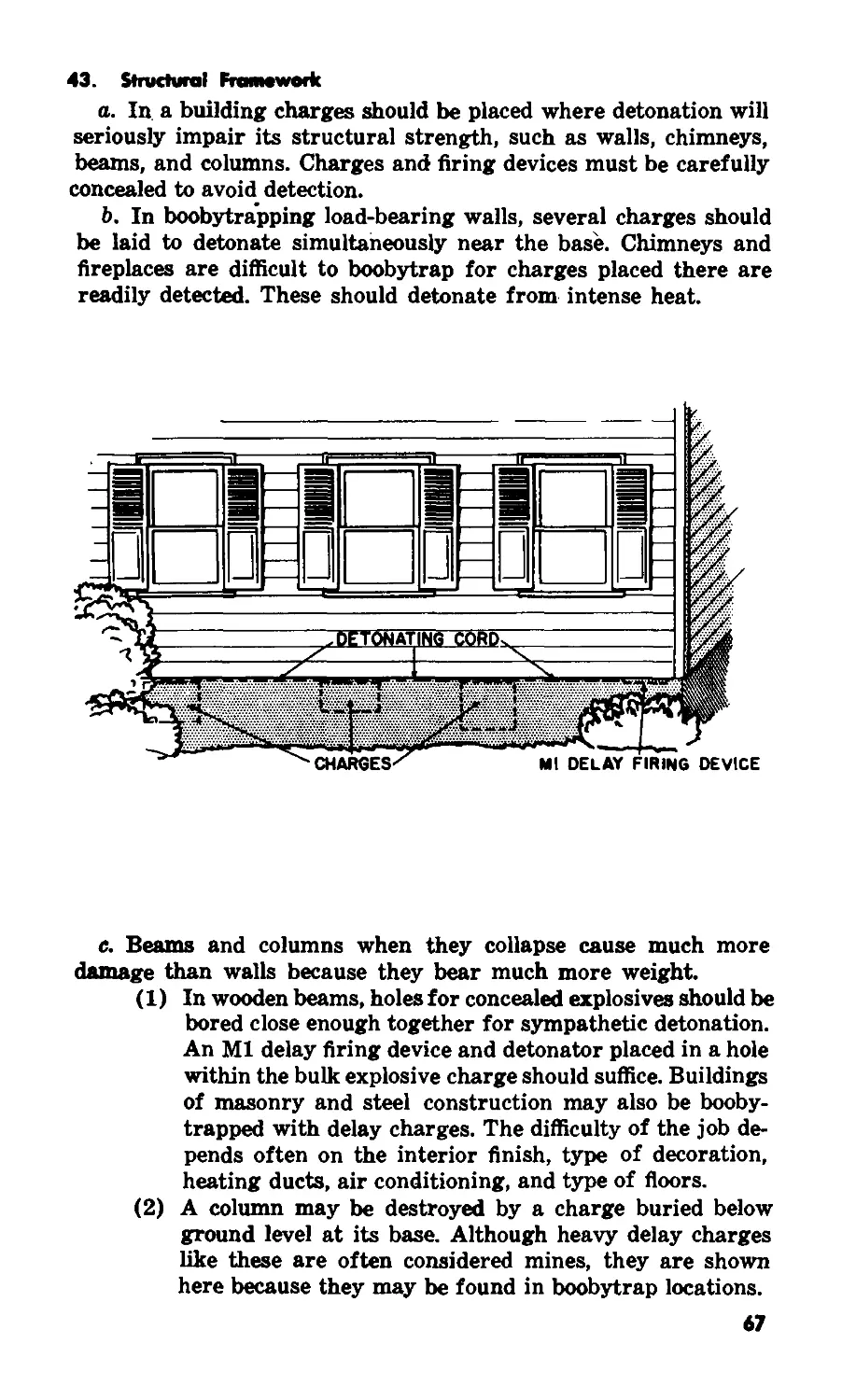
43.	Structural Framework
a.	In a building charges should be placed where detonation will
seriously impair its structural strength, such as walls, chimneys,
beams, and columns. Charges and firing devices must be carefully
concealed to avoid detection.
b.	In boobytrapping load-bearing walls, several charges should
be laid to detonate simultaneously near the base. Chimneys and
fireplaces are difficult to boobytrap for charges placed there are
readily detected. These should detonate from intense heat.
c.	Beams and columns when they collapse cause much more
damage than walls because they bear much more weight.
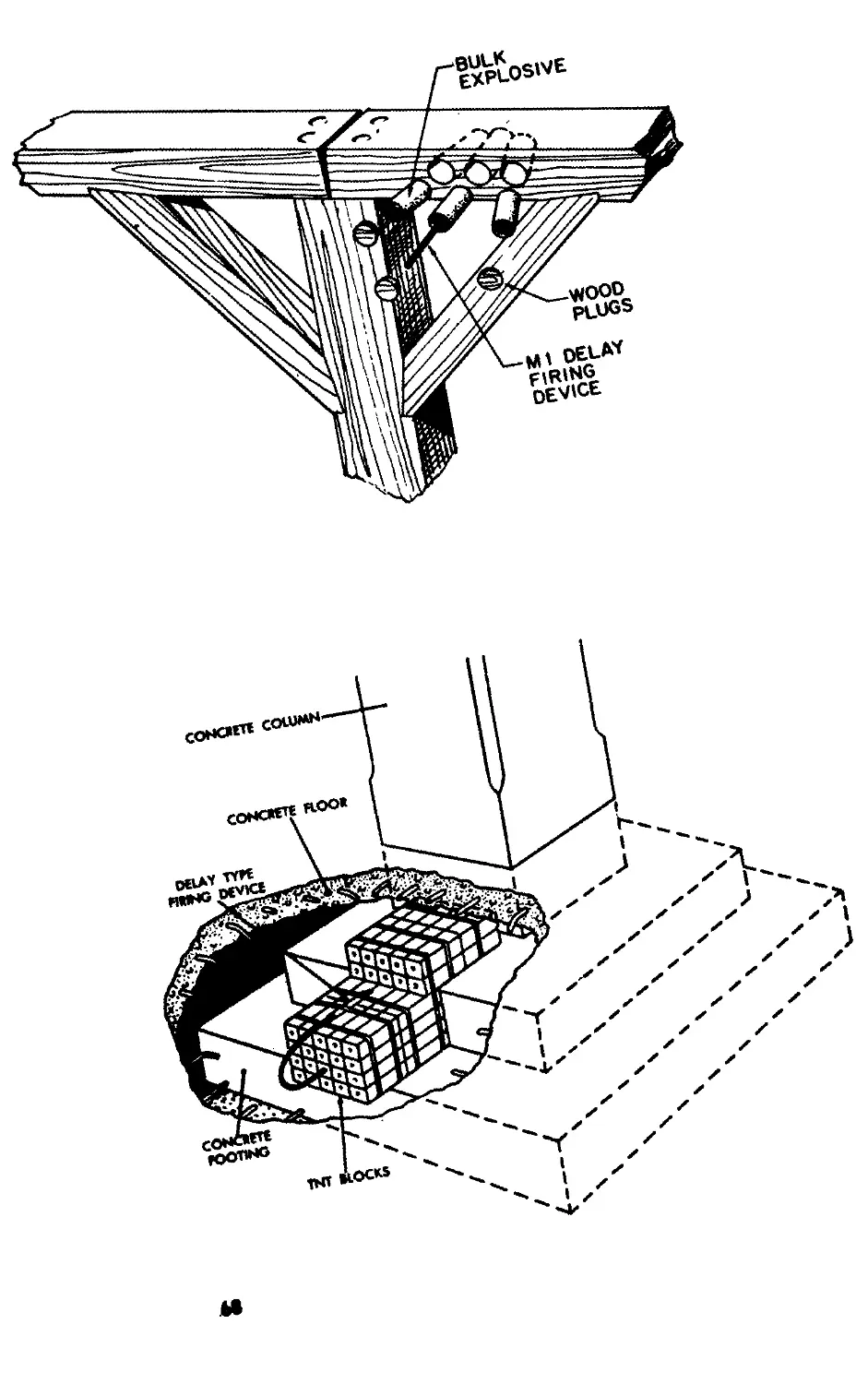
(1)	In wooden beams, holes for concealed explosives should be
bored close enough together for sympathetic detonation.
An Ml delay firing device and detonator placed in a hole
within the bulk explosive charge should suffice. Buildings
of masonry and steel construction may also be booby-
trapped with delay charges. The difficulty of the job de-
pends often on the interior finish, type of decoration,
heating ducts, air conditioning, and type of floors.
(2)	A column may be destroyed by a charge buried below
ground level at its base. Although heavy delay charges
like these are often considered mines, they are shown
here because they may be found in boobytrap locations.
67

d.	Loose floor boards sometimes are excellent objects for booby-
trapping. The rigging must escape detection, however; otherwise,
it will be ineffective. This rigging might be harder to detect if the
support underneath is chiseled out to let the floorboard sink
about inch when tramped on.
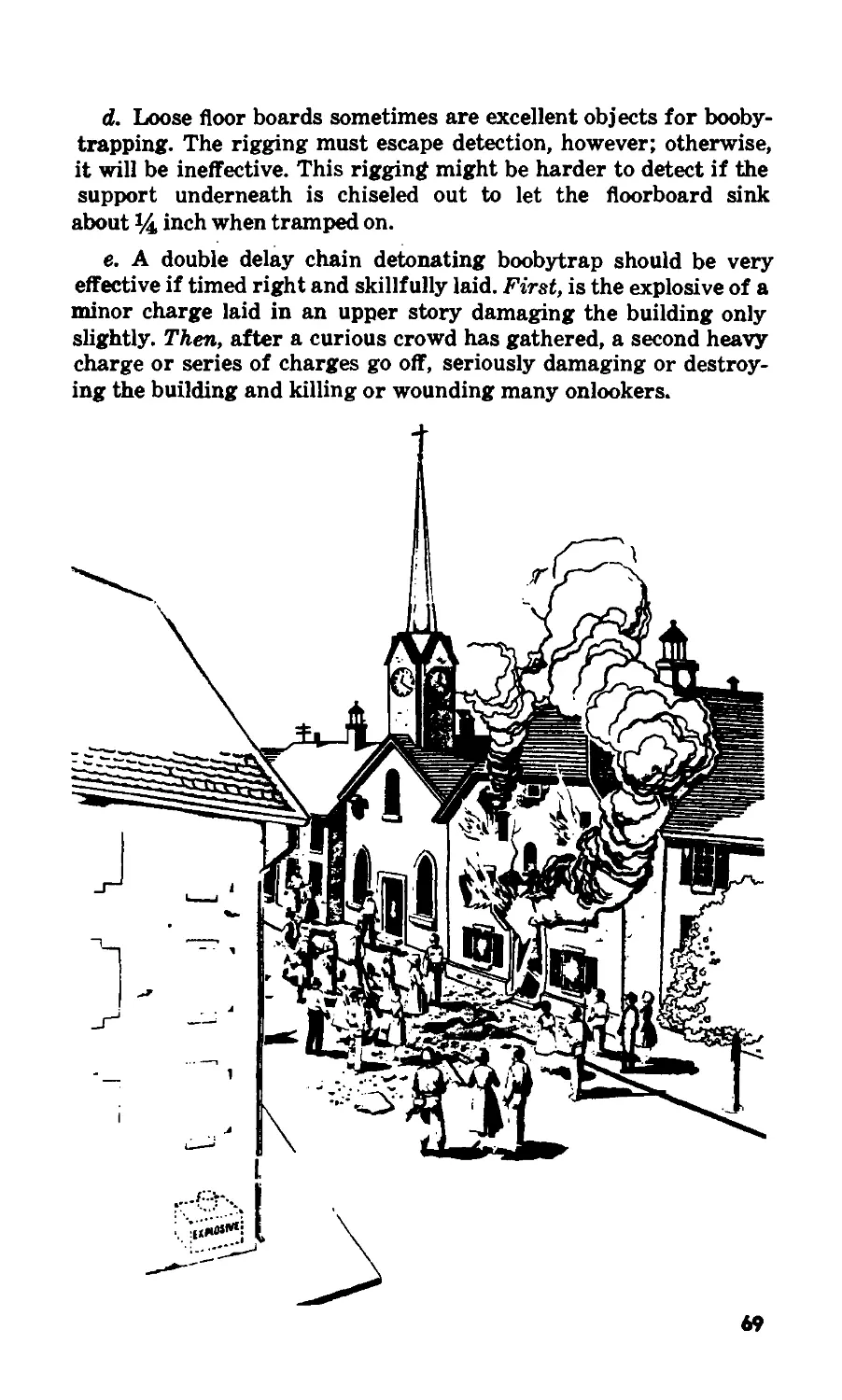
e.	A double delay chain detonating boobytrap should be very
effective if timed right and skillfully laid. First, is the explosive of a
minor charge laid in an upper story damaging the building only
slightly. Then, after a curious crowd has gathered, a second heavy
charge or series of charges go off, seriously damaging or destroy-
ing the building and killing or wounding many onlookers.
69
44.	Interior Furnishing*
Vacated buildings provide much opportunity for boobytrapping.
Hurriedly departing occupants usually leave behind such odds and
ends as desks, filing cases, cooking utensils, table items, rugs, lamps,
and furniture. Electric light and power fixtures are also exploitable.
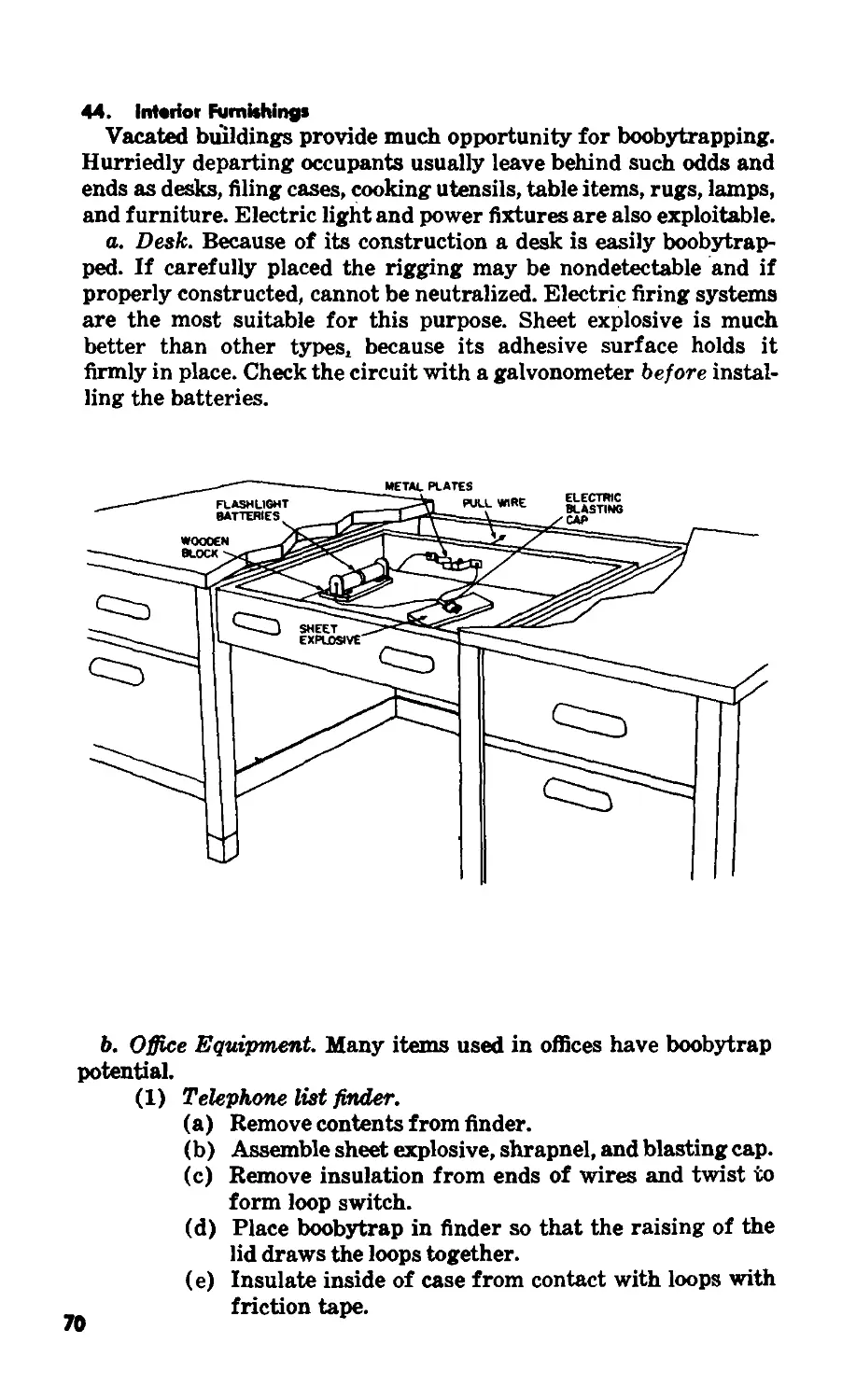
a.	Desk. Because of its construction a desk is easily boobytrap-
ped. If carefully placed the rigging may be nondetectable and if
properly constructed, cannot be neutralized. Electric firing systems
are the most suitable for this purpose. Sheet explosive is much
better than other types, because its adhesive surface holds it
firmly in place. Check the circuit with a galvonometer before instal-
ling the batteries.
b.	Office Equipment. Many items used in offices have boobytrap
potential.
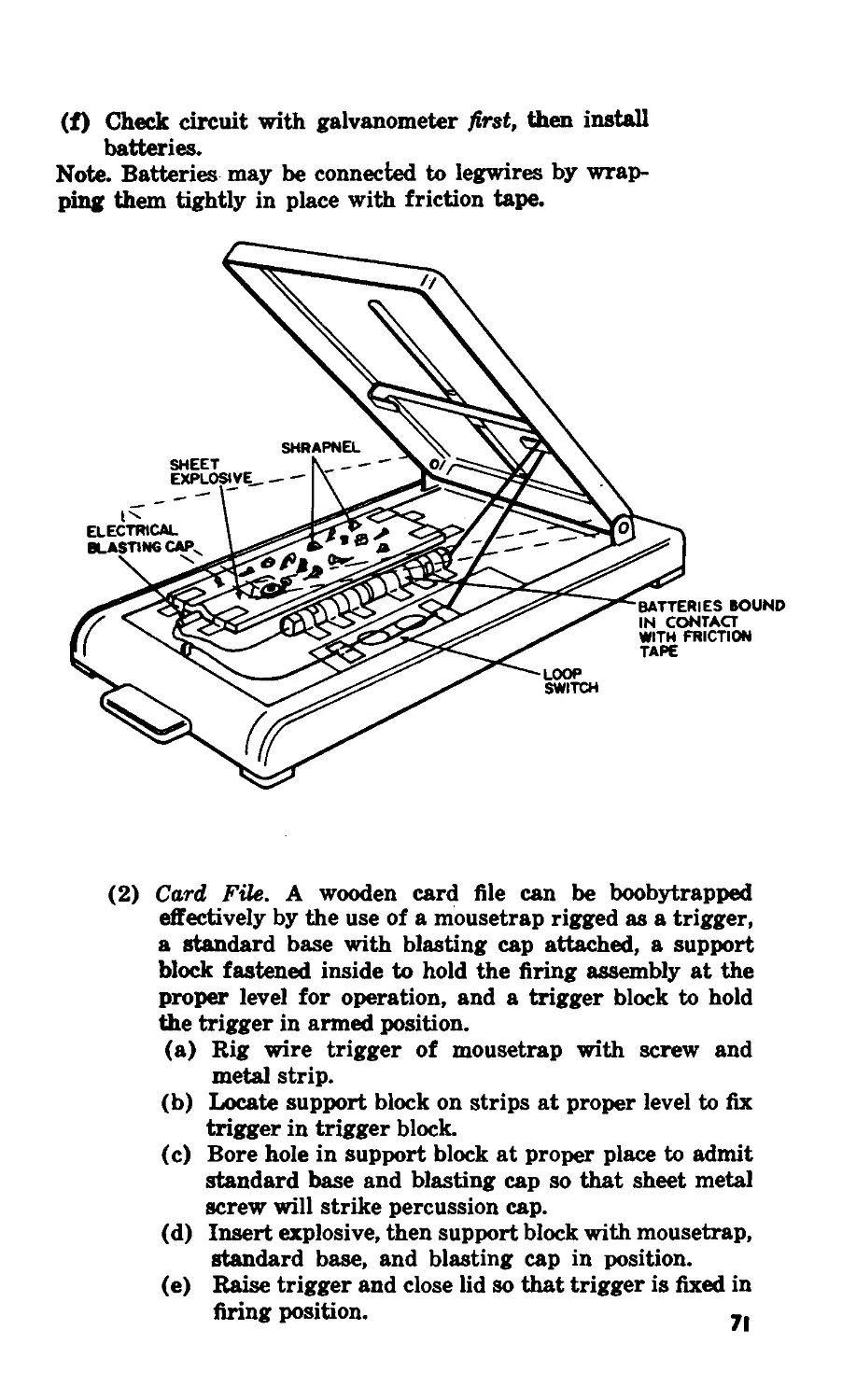
(1)	Telephone list finder.
(a)	Remove contents from finder.
(b)	Assemble sheet explosive, shrapnel, and blasting cap.
(c)	Remove insulation from ends of wires and twist to
form loop switch.
(d)	Place boobytrap in finder so that the raising of the
lid draws the loops together.
(e)	Insulate inside of case from contact with loops with
friction tape.
/0
(f) Check circuit with galvanometer first, then install
batteries.
Note. Batteries may be connected to legwires by wrap-
ping them tightly in place with friction tape.
(2)	Card File. A wooden card file can be boobytrapped
effectively by the use of a mousetrap rigged as a trigger,
a standard base with blasting cap attached, a support
block fastened inside to hold the firing assembly at the
proper level for operation, and a trigger block to hold
the trigger in armed position.
(a)	Rig wire trigger of mousetrap with screw and
metal strip.
(b)	Locate support block on strips at proper level to fix
trigger in trigger block.
(c)	Bore hole in support block at proper place to admit
standard base and blasting cap so that sheet metal
screw will strike percussion cap.
(d)	Insert explosive, then support block with mousetrap,
standard base, and blasting cap in position.
(e)	Raise trigger and close lid so that trigger is fixed in
firing position.	71
c.	Electric Iron.
(1)	Remove bottom plate.
(2)	Insert bulk explosive and electric blasting cap.
(3)	Attach shortened leg wires to power inlet.
sheet
EXPLOSIVE
72
d. Teakettle.
(1) Assemble sheet explosive, electric blasting cap and mer-
cury element in teakettle.
(2) Check circuit with galvanometer first, then install bat-
teries.
Note. Batteries may be bound tightly in circuit with friction
tape. For safety and ease of assembly, use a wrist watch delay
in circuit (para 60d).
MERCURY
ELEMENT
ELECTRIC
BLASTING
TAPE
e.
Pressure Cooker.
(1)	Antidisturbance circuit.
(a)	Assemble sheet explosive, mercury element, and elec-
tric blasting cap in cooker.
(b)	Check circuit with galvanometer first, then install
batteries.
Note. Batteries may be bound-tightly in circuit with friction
tape. For safety and ease of assembly, use a wrist watch delay
in circuit (para 60d).	n
FRICTION
TAPE
(2)	Loop switch.
(1)	Assemble sheet explosive and electric blasting cap.
(2)	Cut leg wires to proper length. Remove insulation
from ends and twist to form loop switch.
(3)	Check circuit with galvanometer.
(4)	Fasten one leg wire (insulated) to lid to serve as
pull wire.
(5)	Secure batteries in circuit by wrapping tightly with
friction tape.
SHEET BATTERIES
EXPLOSIVE
74
f. Radio and Television Sets. Both sets may be boobytraped by
assembling a charge and an electric blasting cap inside the case.
The leg wires are connected in the circuit for detonation at turning
of off-on switch.
Extreme care is required in connecting leg wires to prevent pre-
mature explosion.
g. Bed. Two methods may be used—a charge, nonelectric blasting
cap, and pull firing device or a charge, batteries, electric blasting
cap, and a mercury switch element.
(1)	Nonelectric rigging.
(a)	Assemble pull wire, Ml pull firing device, blasting
cap, and sheet explosive charge.
(b)	Anchor pull wire so that a person sitting or lying on
bed will initiate firing device.
(c)	Conceal boobytrap.	7S
(2)	Electric rigging.
(a)	Assemble sheet explosive charge, electric blasting
cap, and mercury element.
(b)	Check circuit with galvanometer.
(c)	Place boobytrap on bed to initiate when its level
position is disturbed.
(d)	Install batteries in circuit by wrapping tightly with
friction tape.
(e)	Conceal boobytrap.
Note. For safety and ease of assembly, use a wrist watch delay
in circuit (para 60d).
76
Л. Chairs and Sofas. These may be boobytrapped nonelectrically
and electrically as in f above. For nonelectric rigging the M1A1
pressure firing device, nonelectric blasting cap and sheet explosive
charge are probably the most suitable. The sofa because of its size
should have more than one rigging. If the electrical method is used
the circuit should be tested with the galvanometer before the bat-
teries are installed.
i.	Book. A book with an attractive cover is sure to invite exam-
ination.
(1)	Cut hole in book large enough to accommodate the rig-
ging.
(2)	Assemble sheet explosive, electric blasting cap, mercury
element, and shrapnel.
(3)	Test circuit with galvanometer first, then
(4)	Secure batteries in circuit by wrapping tightly with fric-
tion tape.
77
/
ELECTRIC
BLASTING CAP
SHEET
EXPLOSIVE
MERCURY
ELEMENT
NO. 9’2
BATTERIES
TAPE
SHRAPNEL
П
Sectton III. TERRAIN
45. Highways, Trails, and Paths
Boobytraps used along roads are a great help in slowing down
enemy traffic, especially if they are laid in and around other obstruc-
tions. Those placed on paths and trails are excellent against raid-
ing parties that must operate under cover of darkness.
46.	Locations
Boobytraps in roadway obstructions should be concealed on the
enemy side. If the obstruction is heavy, requiring force to remove
it, boobytraps concealed underneath will increase its effectiveness.
Fragmentation charges are very destructive against personnel.
These include hand grenades; bounding antipersonnel mines with
their own special fuzes actuated by pressure or trip wire; ordinary
explosive charges covered with pieces of scrap metal, nails, gravel,
lengths of wire, nuts and bolts; and the like. The latter may be
actuated by any of the standard firing devices—by pressure,
pressure-release, pull-release, and pull.
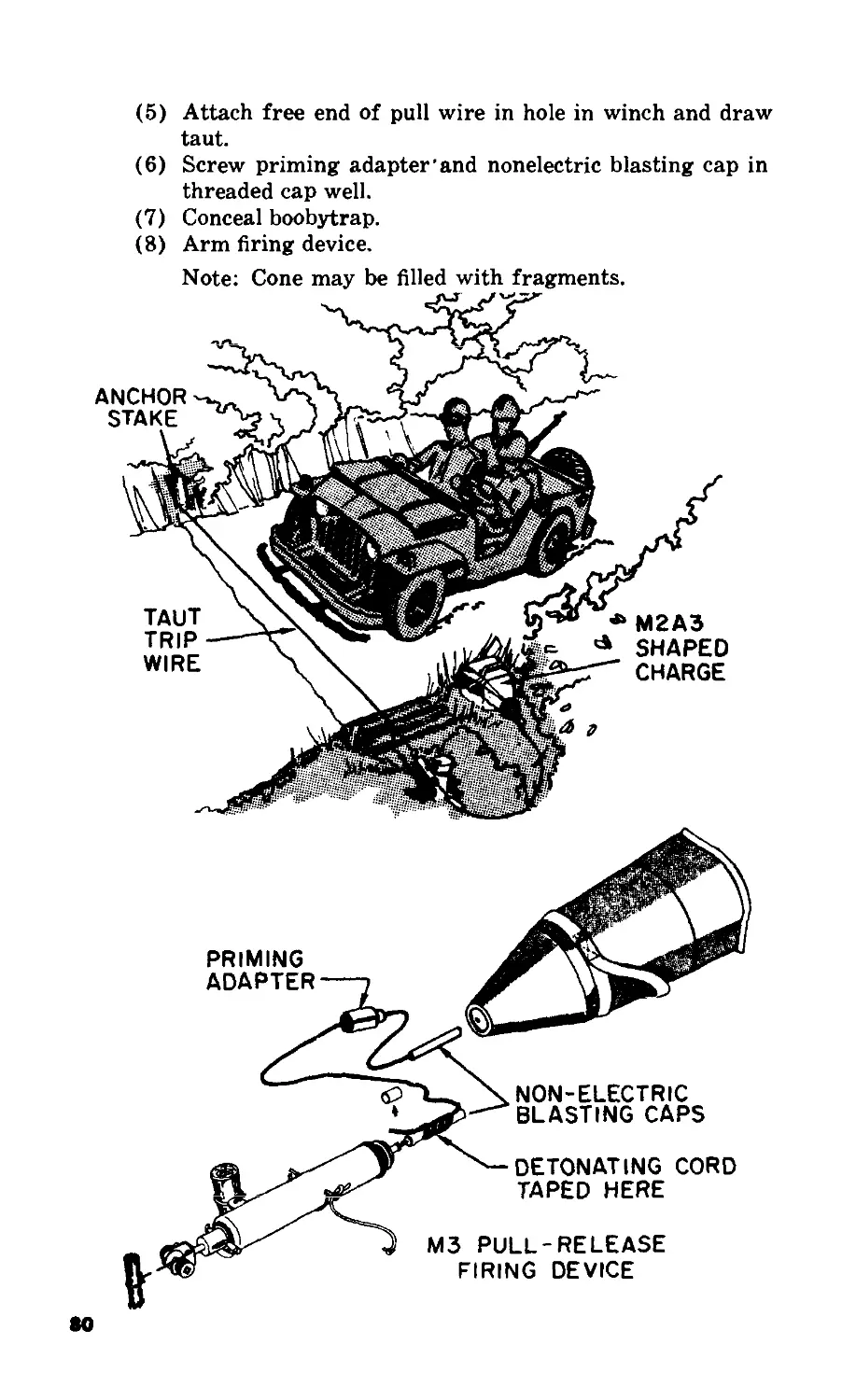
a.	The jet of the M2A3 shaped charge from the roadside directed
into a moving vehicle is very destructive.
(1)	Assemble an М3 pull-release firing device and detonator,
Jeqgth of detonating' cord, priming adapter, and non-
electric blasting cap.
(2)	Drive anchor stake in berm at side of road and attach
pull wire. Drive stake or lay log, stone, or other object
on other side to support pull wire at proper height off
ground.
(3)	Attach firing device assembly to stake at proper position.
(4)	Fix shaped charge in position to direct explosive jet into
vehicle when front wheels hit trip wire.
7»
(5)	Attach free end of pull wire in hole in winch and draw
taut.
(6)	Screw priming adapter’and nonelectric blasting cap in
threaded cap well.
(7)	Conceal boobytrap.
(8)	Arm firing device.
М3 PULL-RELEASE
FIRING DEVICE
W
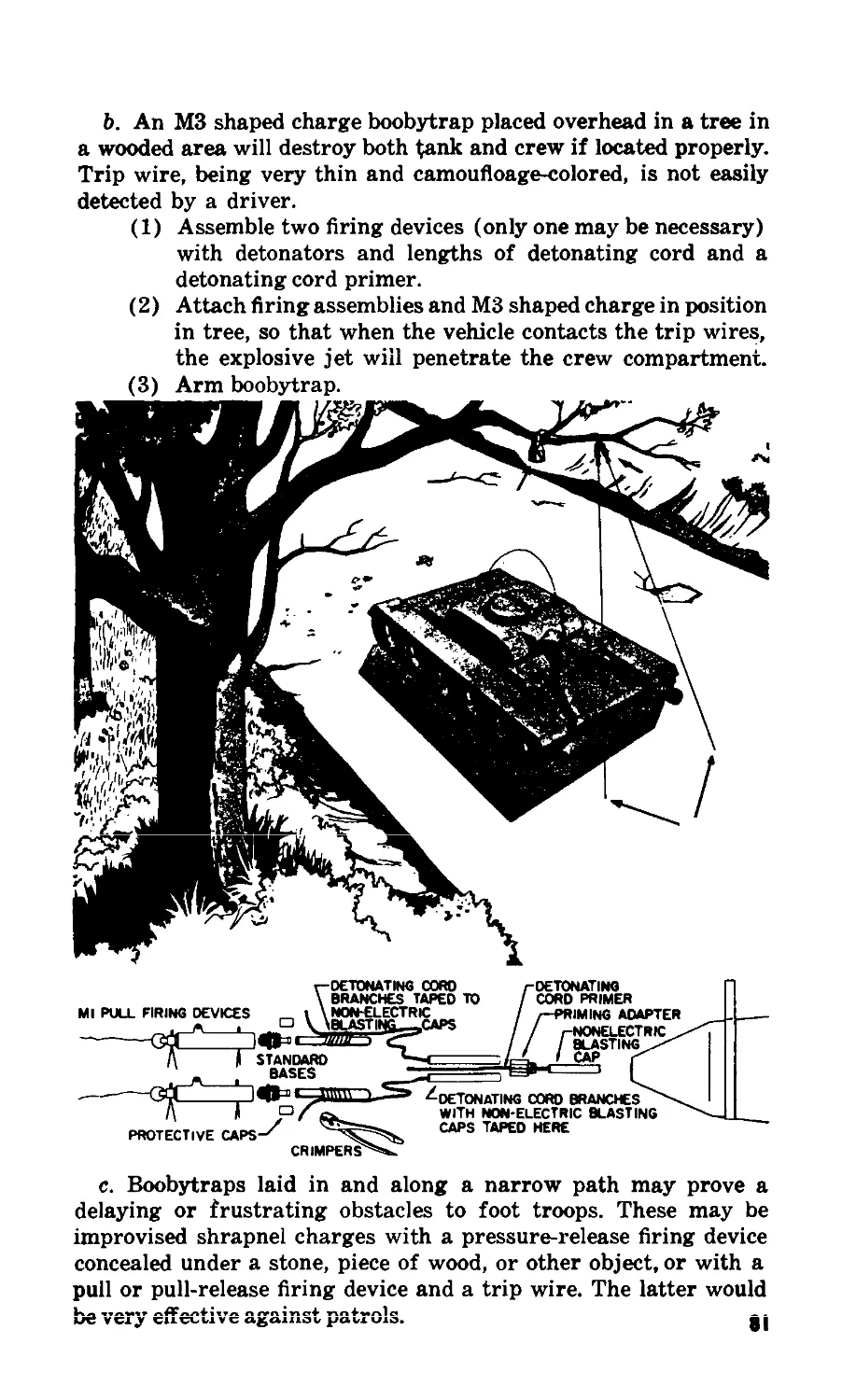
b.	An М3 shaped charge boobytrap placed overhead in a tree in
a wooded area will destroy both tank and crew if located properly.
Trip wire, being very thin and camoufloage-colored, is not easily
detected by a driver.
(1)	Assemble two firing devices (only one may be necessary)
with detonators and lengths of detonating cord and a
detonating cord primer.
(2)	Attach firing assemblies and М3 shaped charge in position
in tree, so that when the vehicle contacts the trip wires,
the explosive jet will penetrate the crew compartment.
(3) Arm boobytrap.
Ml PULL FIRING DEVICES
STANDARD
BASES
PROTECTIVE CAPS-
CRIMPERS
DETONATING CORD
BRANCHES TAPED TO
NON-ELECTRIC
iBLASTI
DETONATING
----1 PRIMER
IMING ADAPTER
NONELECTRIC
BLASTING
CAP
WITH NON-ELECTRIC BLASTING
CAPS TAPED HERE

c.	Boobytraps laid in and along a narrow path may prove a
delaying or frustrating obstacles to foot troops. These may be
improvised shrapnel charges with a pressure-release firing device
concealed under a stone, piece of wood, or other object, or with a
pull or pull-release firing device and a trip wire. The latter would
krt	лАРлл+i 1 гл nrvninc’+ Пп1мл1с1	_ .
utvcij chcvuvc ftgainoi panvio.
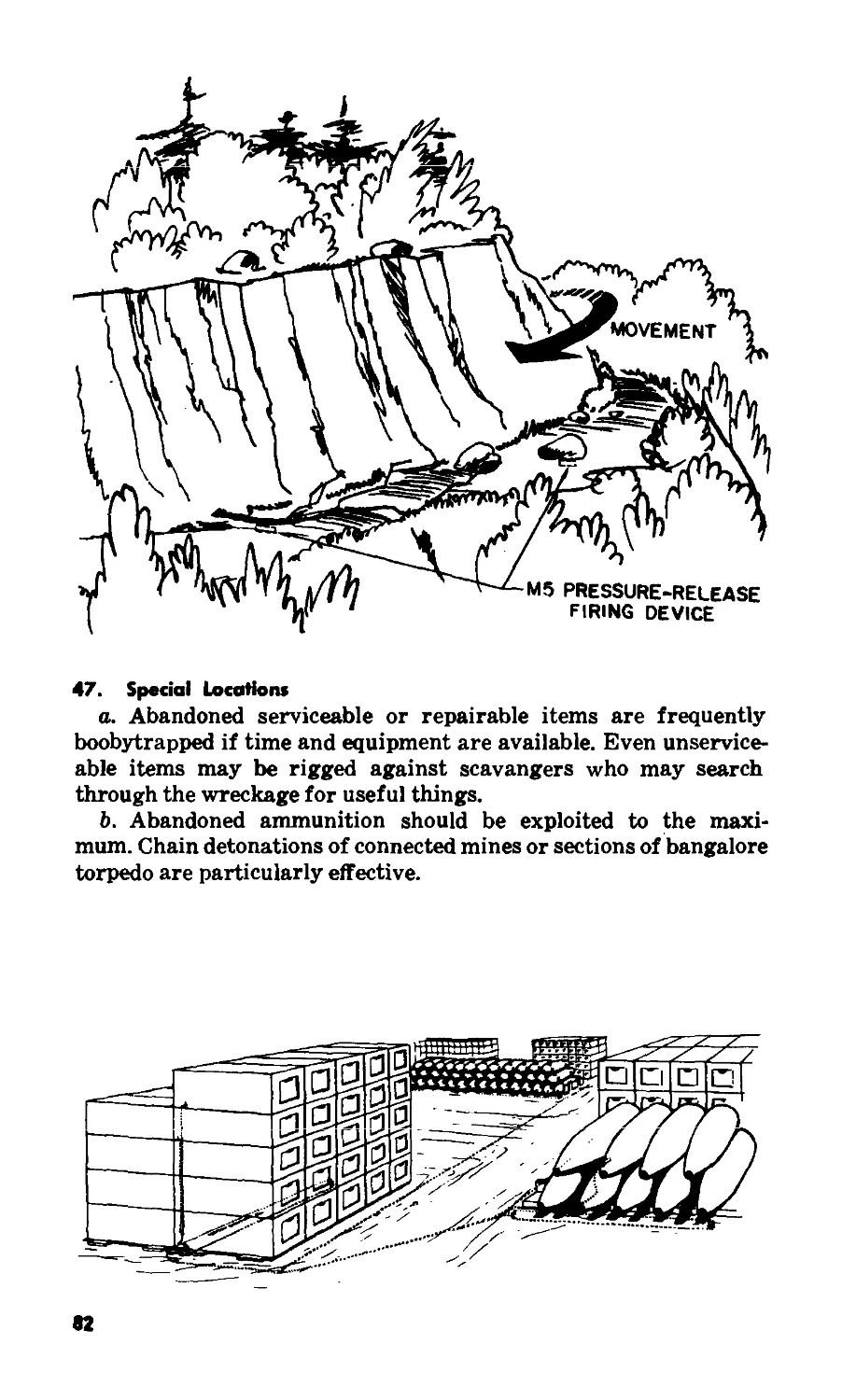
47.	Special Location*
a.	Abandoned serviceable or repairable items are frequently
boobytrapped if time and equipment are available. Even unservice-
able items may be rigged against scavangers who may search
through the wreckage for useful things.
b.	Abandoned ammunition should be exploited to the maxi-
mum. Chain detonations of connected mines or sections of bangalore
torpedo are particularly effective.
82
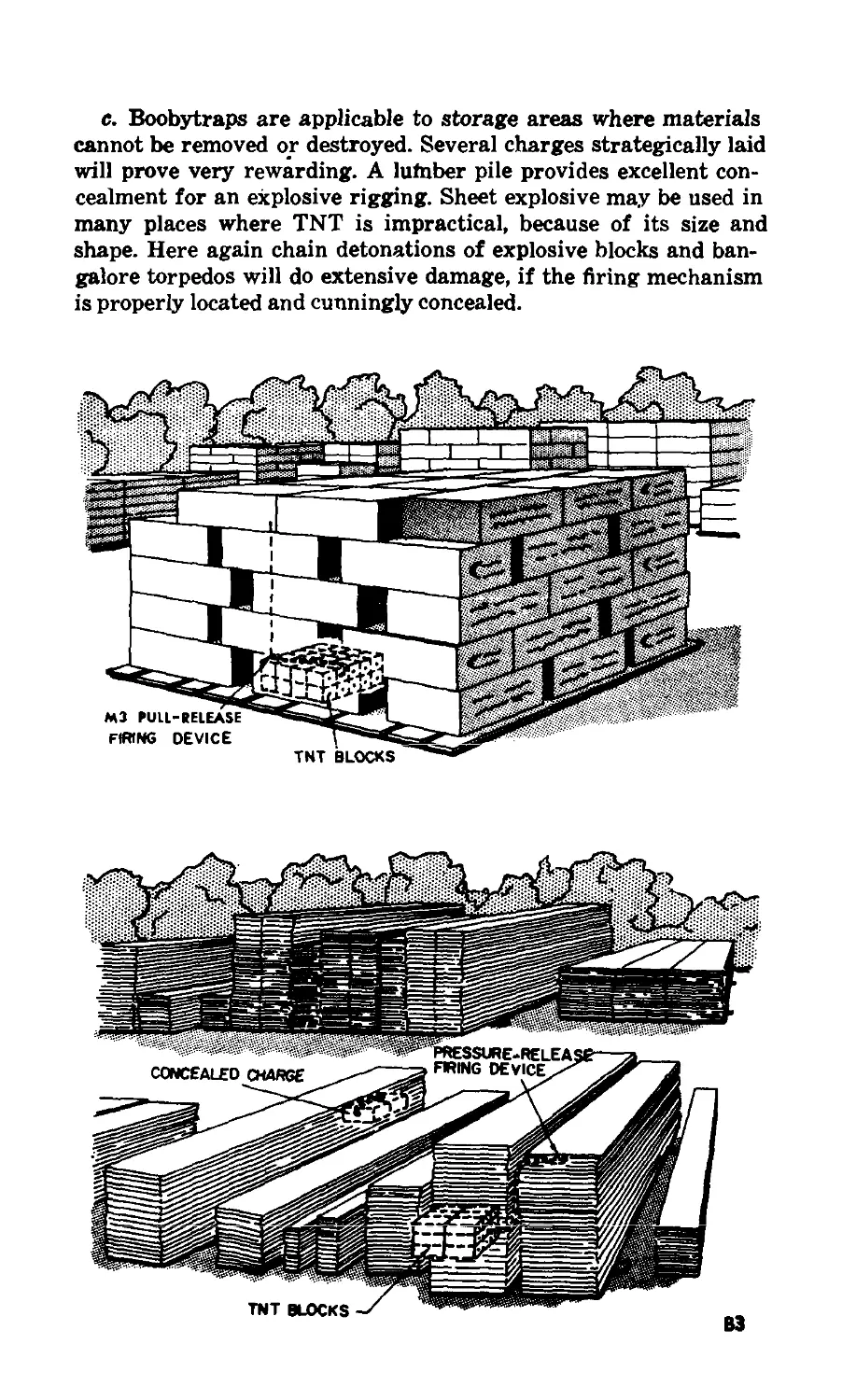
c.	Boobytraps are applicable to storage areas where materials
cannot be removed or destroyed. Several charges strategically laid
will prove very rewarding. A lufnber pile provides excellent con-
cealment for an explosive rigging. Sheet explosive may be used in
many places where TNT is impractical, because of its size and
shape. Here again chain detonations of explosive blocks and ban-
galore torpedos will do extensive damage, if the firing mechanism
is properly located and cunningly concealed.
48.	Abandoned Vehicle*
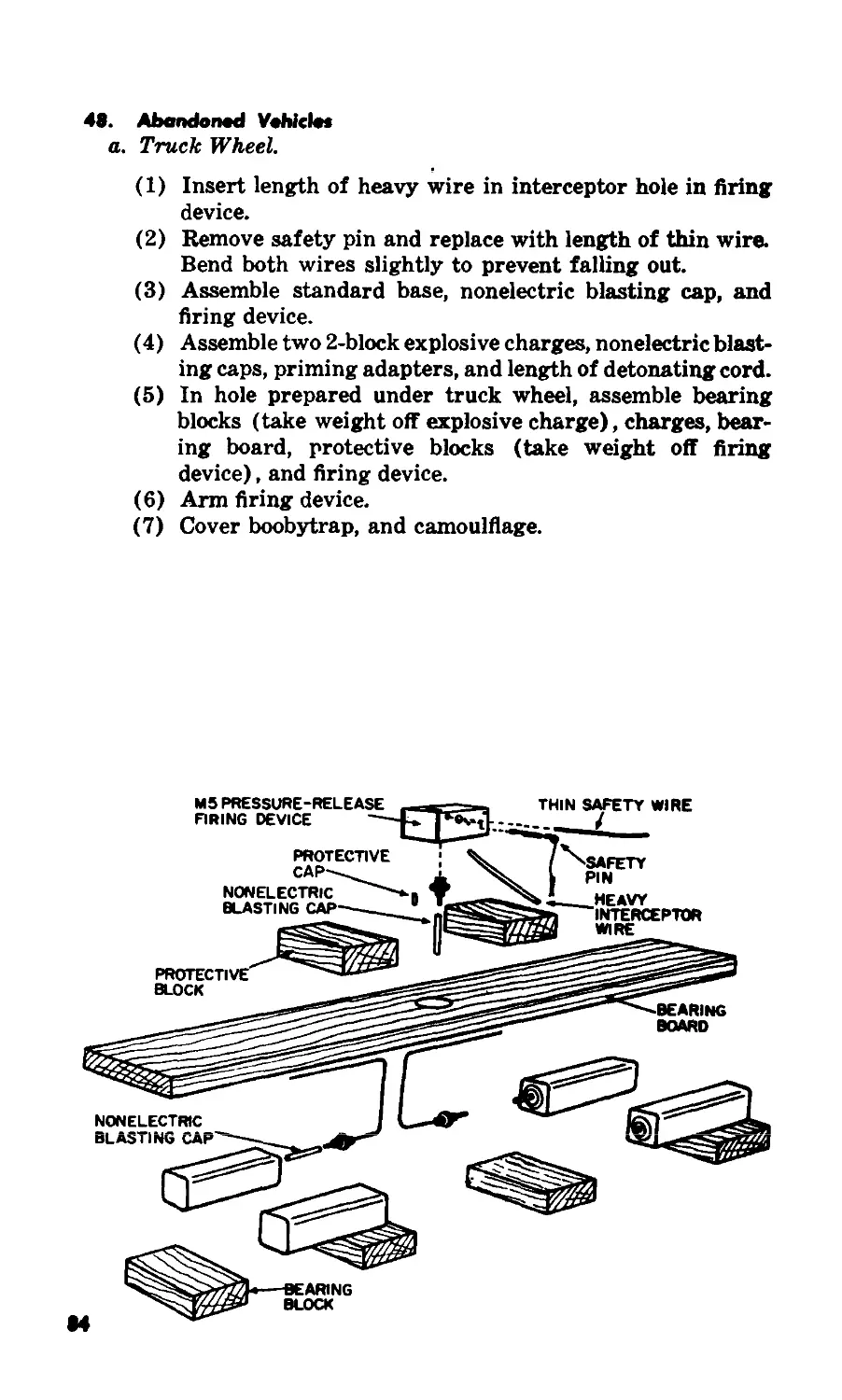
a.	Truck Wheel.
(1)	Insert length of heavy wire in interceptor hole in firing
device.
(2)	Remove safety pin and replace with length of thin wire.
Bend both wires slightly to prevent falling out.
(3)	Assemble standard base, nonelectric blasting cap, and
firing device.
(4)	Assemble two 2-block explosive charges, nonelectric blast*
ing caps, priming adapters, and length of detonating cord.
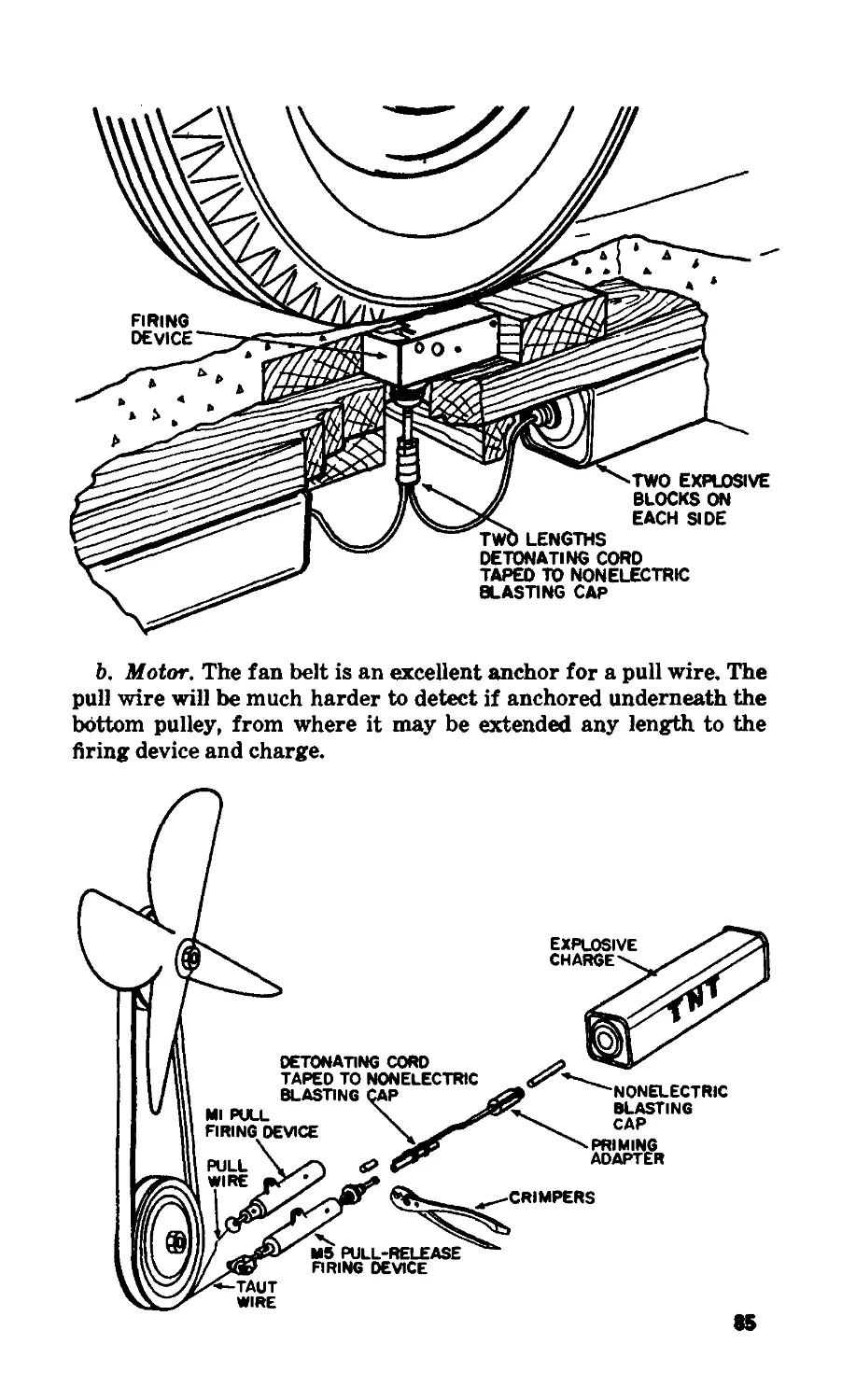
(5)	In hole prepared under truck wheel, assemble bearing
blocks (take weight off explosive charge), charges, bear-
ing board, protective blocks (take weight off firing
device), and firing device.
(6)	Arm firing device.
(7)	Cover boobytrap, and camouflage.
b.	Motor. The fan belt is an excellent anchor for a pull wire. The
pull wire will be much harder to detect if anchored underneath the
bottom pulley, from where it may be extended any length to the
firing device and charge.
85
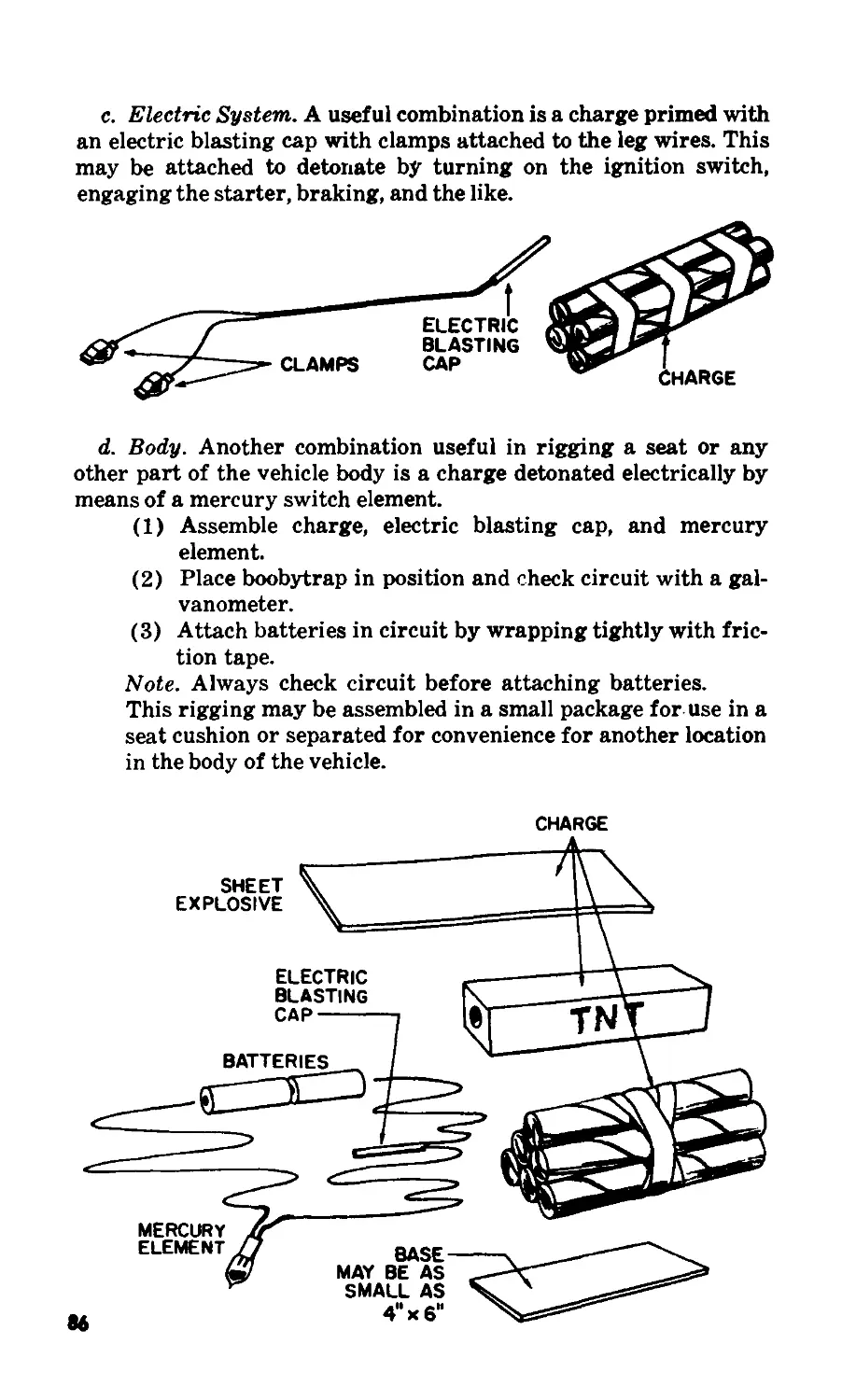
c.	Electric System. A useful combination is a charge primed with
an electric blasting cap with clamps attached to the leg wires. This
may be attached to detonate by turning on the ignition switch,
engaging the starter, braking, and the like.
d.	Body. Another combination useful in rigging a seat or any
other part of the vehicle body is a charge detonated electrically by
means of a mercury switch element.
(1)	Assemble charge, electric blasting cap, and mercury
element.
(2)	Place boobytrap in position and check circuit with a gal-
vanometer.
(3)	Attach batteries in circuit by wrapping tightly with fric-
tion tape.
Note. Always check circuit before attaching batteries.
This rigging may be assembled in a small package for use in a
seat cushion or separated for convenience for another location
in the body of the vehicle.
CHAPTER 5
MISCELLANEOUS BOOBYTRAPS
Section I. STANDARD BOOBYTRAPS
49.	Tactical Um
In World War II, every major power manufactured boobytraps
to use against the enemy. Most of them were charged imitations of
useful objects, which maimed or killed helpless soldiers that handled
them. The defect common to all standard boobytraps however, is
that after the first or second explosion, all others of the same type
become ineffective. A “one-shot” job hardly justifies production
costs.
50.	Foreign Types
a.	The Soviets used more standard boobytraps in World War II
than any other combatant. A weird assortment of charged imita-
tions of items issued to German soldiers were dropped from Soviet
planes. Some of these were:
(1)	Cartridge boxes, apparently filled with ammunition, con-
taining high explosives and detonators.
(2)	Bandage packets containing detonators and shrapnel.
(3)	Bandage cases with Red Cross insignia rigged as mines.
(4)	Rubber balls, about twice the size of a fist that detonated
upon impact.
(5)	Silver-grey light metal boxes or flasks that exploded when
the lid was raised.
(6)	Cognac bottles filled with incendiary liquid.
(7)	Small red flags marked with an M and attached to mines
that detonated when the flag was removed.
(8)	Imitation earth-grey colored frogs that detonated when
pressed on.
(9)	Flashlights containing high explosive which detonated
when the switch was moved.
(10)	Mechanical pencils, watches, cigarette cases, cigarette
lighters, salt cellars, and similar items that detonated
when handled.
b.	Knowing the German interest in books, the Soviets prepared
a book boobytrap. The charge inside detonated when the cover was
raised.
MAIN CHARGE
c.	The British also had a book boobytrap; but it was slightly
more complicated than the Soviet version, above.
d.	All sorts of dirty-trick devices were used by the enemy.
(1)	A flashlight was rigged with a charge and an electric
detonator powered and actuated by the original dry cell
battery switch, and circuit.
(2)	Bottles designed to look like liquor bottles were filled
with a liquid explosive detonated by a pull-friction fuze
attached to the cork.
(3)	A fountain pen, though very small, was rigged with an
explosive charge, a spring driven striker to fire a percus-
sion cap, and a detonator.
(4)	The Japanese manufactured a pipe boobytrap with a
charge, detonator, and spring-loaded striker.
89
(5)	The Italians had a boobytrapped headset containing an
electric detonator connected to the terminals on the back.
The connection of the headset into the live communication
line initiated detonation.
POWDERED EXPLOSIVE
(6)	The Germans converted their own and enemy standard
canteens into boobytraps. The explosive charge was
detonated by a pull fuze and a pull wire connected to the
cap. When partially filled with water and placed in its
canvas case, it was very deceptive. The canteen booby-
trap had an effective radius of 3 to 5 yards.
CANTEEN
PULL WIRE
MAIN CHARGE
WATER
PULL FUZE
DETONATOR
90
(7)	Another German device was the boobytrap whistle. This
consisted of a policeman’s or referee’s whistle with a
charge and a metal ball covered with a layer of friction
compound. Blowing the whistle moved the ball, igniting
the friction compound and detonating the charge.
(8)	The German Peters candy bar boobytrap was ingenious
indeed. The explosive charge, fuze, and thin canvas pull
device were covered with chocolate.
91
Section II. IMPROVISATIONS
51.	Ingenuity
a.	Through information on military operations in World War
II, the U.S. soldier has been well-prepared for the dangerous mis-
sion of laying, detecting, and disarming boobytraps in conventional
warfare. However, he now is virtually a novice in comparison with
the cunning and ingenious present day guerrilla, who at the start
was almost totally lacking in material and equipment.
b.	Experience has shown that in guerrilla warfare, carried on
by illy-equipped native populations, boobytrapping success depends
largely on ingenuity. Explosive, a necessary element, is either
improvised from commercial ingredients or captured from the
enemy. Captured mines, ammunition, and other similar material
are disassembled and every ounce of explosive saved.
52.	Training
Every soldier should have some training in the lessons learned
from the guerrillas, for many items they have improvised and the
way they have used them are also applicable to conventional war-
fare. With little effort, a soldier may be trained so that with no mili-
tary equipment whatever but with ample funds, he may prepare
himself to fight effectively witfi materials available from merchants,
junk piles, and salvage.
53.	Application
The improvisations included in this section are gathered from
numerous sources. Some may have wider application to boobytrap-
ping than others. How the guerrilla may use them, however, is
unpredictable. All are presented to stimulate initiative and arouse
enthusiasm to out-do backward enemy peoples in devising and
placing boobytraps and to develop a higher level of proficiency
than ever before in their detection and removal.
54.	Improvised Time Fuze and Explosive Caps
a.	Fast burning fuse (iO inches per minute).
(1)	Braid three lengths of cotton string together.
92
(2)	Moisten fine black powder to form a paste. Rub paste into
twisted string with fingers and allow to dry. If a powder
is not available, mix 25 parts potassium nitrate (salt-
peter) in an equal amount of water and add 3 parts pul-
verized charcoal and 2 parts pulverized sulphur to form
a paste. Rub paste into twisted string and allow to dry.
(3)	Check burning rate before using.
b.	Slow burning fuse (£ inches per minute) .
(1)	Wash three lengths of string or three shoelaces in hot
soapy water and rinse.
(2)	Dissolve 1 part potassium nitrate or potassium chlorate
and 1 part granulated sugar in 2 parts hot water.
(3)	Soak string or shoelaces in solution and braid three
strands together. Allow to dry.
(4)	Check burning rate.
(5)	Before using, coat several inches of the end to be inserted
into cap or material to be ignited with black powder
paste (a (2) above).
c.	Electric Blasting Cap.
(1)	With file or other instrument make hole in end of light
bulb.
(2)	If jacket is not available, solder or securely fasten two
wires to bulb—one on metal threads at side and other
at metal contact on bottom.
(3)	Fill bulb and empty portion of blasting cap with black
powder. Tape blasting cap on top of bulb.
93
d.	Percussion Cap Assembly.
(1)	Remove projectile, but not powder, from small arms
cartridge.
(2)	Tape nonelectric blasting cap securely in cartridge.
I	~~l
NONELECTRIC
BLASTING CAP
c ill
SMALL ARMS
CARTRIDGE
FRICTION TAPE
55.	Pull Firing Device*
a.	Tube and Striker.
Assemble tube, spring, striker shaft with hole or with hex nut,
soft wood or metal top plug, pull pin, and improvised percussion
cap assembly.
Note. Always assemble firing device before attaching the impro-
vised percussion cap assembly.
b.	Clothes Pin.
(1)	Wrap stripped ends of leg wires around clothes pin jaws
to make electrical contact.
(2)	Assemble charge, adapter, electric blasting cap, and
clothes pin.
(3)	Insert wooden wedge, anchor clothes pin, and install trip
wire.
(4)	Check circuit with galvonometer first, then connect bat-
teries.
94
WEDGE
c.	Stake or Pole Initiator.
(1)	Assemble stake or pole, container, metal contact plates,
charge, electric blasting cap, and pull cord.
(2)	Check circuit with galvonometer first, then connect bat-
teries.
(3)	Fasten down top of container and seal hole around stake
with friction tape.
d.	Rope and Cylinder.
(1)	Cut leg wires to proper length.
(2)	Prepare wooden end plugs and bore hole in one to receive
leg wires.
(3)	Thread leg wires through hole in block.
(4)	Strip end of one leg wire and twist into loop, and secure
other leg wire in position.
(5)	Test circuit with galvonometer.
(6)	Assemble metal cylinder, contact bolt, pull cord, charge,
blasting cap, end blocks, and batteries.
95
e.	Trip Lever and PuU Pin.
(1)	Flat placement.
Assemble container, charge, improvised pull firing device
(a above) and trip lever.
(2)	Sloping placement.
Assemble container, charge, improvised firing device
(a above) and stake.
96
М. Freswre Firing Devices
a.	Mechanical Concussion.
(1)	Force striker into hole in pressure board.
(2)	Insert wood or soft metal shear pin in shear pin hole.
(3)	Assemble striker, metal tube, and improvised blasting
cap (para 54).
METAL TUBE
STRIKER (NAIL)
COPPER
«	—> SHEAR PIN
97
b.	Electrical.
(1)	Lever arm.
(a)	Attach contact blocks to ends of wooden levers.
(b)	Assemble wooden levers, rubber strip, and plastic
sponge.
(c)	Attach leg wire contacts.
(2)	Flexible side.
(a)	Attach metal contact plates to bearing boards.
(b)	Thread leg wires through holes in lower bearing
board and attach to contact plates.
(c)	Attach flexible sides.
CONTACT PLATES
98
(8)	Springed pressure board.
(a)	Assemble metal contacts, springs, bearing board,
and* pressure board.
(b)	Attach leg wires to metal contacts.
(4) Wooden plunger.
(a)	Assemble box, leaving one side open.
(b)	Assemble contact plate and three spacing blocks
inside box.
(c)	Drill holes in spacing block for leg wires.
9*
(d)	Assemble plunger, metal release, contact block,
metal contact, and contact screw.
(e)	Thread leg wire through holes in spacing block and
attach to contacts.
(5) Metal box.
(a)	Attach metal contact to wooden contact block.
(b)	Assemble contact block and metal contact, brackets,
metal release, plunger, and wooden box lid.
(c)	Bore hole in side of box for leg wires.
(d)	Thread leg wires through hole in box.
(e)	Attach one leg wire to plunger, the other to metal
contact.
Note. Batteries may be placed inside box if necessary.
57.	Tension-Release. Firing Device
Attach stripped ends of circuit wires to ends of clothes pin to
form contacts. Attach taut trip wires below contacts.
100
S8.	PrMMire-R«lMM
a. Double Contact.
(1)	Bore holes in top of mine body to accommodate long
contacts.
(2)	Assemble pressure board, coil springs, wooden contact
board and metal contacts.
(3)	Attach circuit wires.
b. Clothes Pin.
(1) Attach stripped ends of circuit wires to clothes pin to
make contacts.
(2) Place mine on top, keeping contacts apart.
STRIPPED ENDS
Circuit wire
101
c.	Bottom Plunger.
(1)	Bore hole in bottom of mine case to admit plunger.
(2)	Attach lower metal contact over hole.
(3)	Assemble mine, pressure block, upper metal contact,
and nonmetallic plunger.
(4)	Attach circuit wires.
d.	Mousetrap.
(1)	Mechanical
See para 44 b (2)
(2)	Electrical
(a)	Remove triggering devices from mousetrap.
(b)	Assemble trap, contact plate, and circuit wires.
(c)	Place weight on top with striker in armed position.
102
STRIKER
59.	AnH-Uft Device*
a.	Loop Contact.
(1)	Drill hole in bottom of mine to admit insulated pull wire.
(2)	Assemble plunger, metal release, and contact plate.
(3)	Attach circuit wires and bare loop to plunger contact and
contact plate.
(4)	Thread anchored insulated trip wire through holes in
bottom of mine and contact plate and attach to bare loop.
b.	Double Detonator.
(1)	Drill three holes—one in bottom, one in partition, and
one in side—to admit nonmetallic plunger and two electric
blasting caps.
(2)
(3)
(4)
Assemble blasting cap, leg wires, contact plates, plunger
and pressure block.
Check circuit with galvonometer first. Then connect bat-
teries with friction tape.
Install blasting cap connected to pressure firing device
c.	Sliding Contact.
(1)	Assemble metal cap, nonmetallic tube or carton, sliding
contact, wooden plug, and leg wires at contacts.
(2)	Check circuit with a galvanometer first, then connect bat-
teries with friction tape.
(3)	Install assembly in tube.
60.	Delay Firing Devices
a. Cigarette Timer.
(1)	Test burning rate of time fuze and cigarette. (A cigar-
ette usually burns at the rate of 1 inch in 7 to 8 minutes.)
(2)	Cut sloping end on length of time fuze.
(3)	Assemble sloped end of time fuze, match head, and cigar-
(2) Place in jar and add water.
(3) Assemble jar, lid, circuit wires, metal contacts, and metal
disk and secure with friction tape.
104
CIRCUIT WIRES
c.	Alarm Clock Timers.
(1)	Electric.
(a)	Assemble base, metal contacts, and alarm clock.
(b)	Tie knot in one end of string. Thread other end
through metal contacts and attach to alarm winding
stem, which winches string and closes circuit.
Note. An alarm clock, being a very versatile delay, may be con-
nected in many other ways.
105
(2)	Nonelectric.
(a)	Drill hole in board of proper size to hold standard
base tightly.
(b)	Remove standard safety pin from firing device and
replace with easily removed pin.
(c)	Remove protective cap from standard base and
crimp on nonelectric blasting cap.
(d)	Screw standard base with blasting cap into firing
device.
(e)	Assemble alarm clock and firing device on board.
(f)	Attach one end of length of string to eye in safety
pin and the .other to alarm winding stem, which
winches string and removes safety pin.
d.	Wrist Watch Timer.
(1)	One-hour delay or less.
(a)	Drill small hole in plastic crystal and attach circuit
wire with screw of proper length to contact minute
hand.
(b)	Attach other circuit wire to case.
(2)	Twelve-hour delay or less.
(a)	Remove minute hand.
(b)	Drill small hole in plastic crystal and attach circuit
wire with screw of proper length to contact hour
hand.
(c)	Attach other circuit wire to case.
IM
61. Bomb*
a.	Pipe Bomba.
(1)	Grenade.
(a)	Drill hole in cap or plug to admit length of time
fuze.
(b)	Crimp nonelectric blasting cap to length of time
fuze.
(c)	Assemble pipe, caps or plugs, time fuze primer, and
explosive charge.
(2)	Antidisturbance bomb.
(a)	Drill hole in end cap to admit length of burnt time
fuze to make a bomb look like a “dud.”
(b)	Attach electric cap and mercury element on base.
(c)	Test circuit with galvonometer first, then connect
batteries with friction tape.
(d)	Assemble bomb.
Caution: If possible, assemble bomb in place, as the mercury
element, when disturbed, may cause premature explosion. To as-
semble more safely and easily, attach wrist watch timer in circuit.
107
(3)	Shotgun bomb.
(a)	Close one end of pipe with hammer, allowing open-
‘ ing for detonating cord primer or electric blasting
cap.
(b)	Remove protective cap from M1A1 pressure or Ml
pull firing device and crimp on nonelectric blasting
cap.
(c)	Screw standard base with blasting cap into firing
device.
(d)	Assemble pipe, shrapnel, wadding, explosive, non-
electric primer or electric blasting cap (for con-
trolled firing), and proper firing device.
Note. The force of the explosive and the strength of the pipe are
important in calculating the size of the charge.
HAMMER
10*
ELECTRIC BLASTING
CAP
b.	Nail Grenade.
Attach nails to top and sides of charge by means of tape or string.
Undet certain conditions, nails may be required on only two sides,
or even on one side.
c.	Delay Bomb.
(1)	Chemical delay.
(a)	Crimp nonelectric blasting cap on base of appropri-
ate Ml delay firing device.
(b)	Assemble firing device and charge in package.
(c)	Crush copper end of firing device with fingers.
(d)	Place package in suitcase or container.
Note. Use this bomb only when delay is necessary but accuracy
is secondary, as the delay time of any chemical firing device varies
considerably according to temperature.
109
(2)	Alarm clock delay.
(a)	Drill hole in wooden base of proper size to hold stan-
dard base firmly.
(b)	Remove standard safety pin from M5 pressure-
release firing device and replace with easily-re-
moved pin.
(c)	Crimp nonelectric blasting cap on standard base
and attach to firing device.
(d)	Assemble alarm clock and firing device on wooden
base.
(e)	Attach one end of string in eye in pull pin and the
other to the alarm winding stem so that its turning
will winch the string and withdraw the pin.
(f)	Place assembly in suitcase or container.
CRIMPERS
M5 PRESSURE-RELEASE
FIRING DEVICE
fSTD
BASE
110
STRING
d.	Envelope Bomb.
(1)	Cut leg wires of electric blasting cap of proper length to
make circuit.
(2)	Strip insulation off ends of circuit wires and twist into
14.-inch loops to make loop switch.
(3)	Test circuit with galvonometer first, then attach bat-
teries.
(4)	Assemble cardboard base, batteries, electric blasting cap,
and explosive as package.
(5)	Attach one end of string to loop switch so that it will
pull the bared loops together to close circuit.
(6)	Cut hole inside of envelope under flap.
(7)	Fix package in envelope firmly and thread string through
hole.
(8)	Attach string firmly but concealed to underside of flap.
(9)	Close envelope with elastic band.
e.	Hot Shrapnel Bomb.
(1)	Remove protective cap from standard base and crimp on
nonelectric blasting cap.
(2)	Screw base with cap in Ml pull firing device.
(3)	Crimp nonelectric blasting cap on one end of length of
detonating cord, and install in Claymore mine.
(4)	Attach firing device to detonating cord with tape.
(5)	Assemble Claymore mine with priming and firing ac-
cessories and drum of napalm.
(6)	Arm firing device.
CRIMPERS
/. Rice Paddy Bomb.
(1)	Remove protective cap from standard base and crimp on
nonelectric blasting cap.
(2)	Screw standard base with cap into Ml pull firing device.
(3)	Assemble firing device, detonating cord, priming adapter,
nonelectric blasting cap, and explosive charge.
(4)	Attach charge to drum of napalm.
(5)	Arm firing device.
112
CRIMPERS
EXPLOSIVE
BLOCK
OR
MORTAR
ROUND
DRUMS OF NAPALM
SPACED INTERMITTENTLY
g. Tin Can Bomb.
(1)	Cut a notched metal contact disk to provide clearance for
length of stiff insulated wire and Ц to 14 in. from walls
of can.
(2)	Cut stiff insulated wire of proper length to support disk
and strip insulation from both ends. Bend hook on one
end to hold bare suspension wire.
(3)	Bend stiff wire to proper shape.
(4)	Assemble can, explosive, contact to can, blasting cap,
insulated support wire, suspension wire and contact disk.
(5)	Check circuit with galvonometer first, then connect bat-
teries.
113
62.	Mbceltanaout Charge*
a.	Improvised Shaped Charge.
(1)	Cut strip of thin metal to make cone of 30° to 60° angle
to fit snugly into container.
(2)	Place cone in container.
(3)	Pack explosive firmly in container to a level of 2x height.
(4)	Attach standoffs to set charge above target at height of
of cone.
2x diameter of cone.
(5)	Attach blasting cap at rear dead center of charge.
b.	Improvised Antipersonnel Mine.
(1)	Assemble container, explosive, separator, and shrapnel.
Explosive must be packed to uniform density and thick-
ness (should be >4 weight of shrapnel).
(2)	Remove protective cap from standard base and crimp on
nonelectric blasting cap.
114
(3)	Screw standard base with blasting cap into proper firing
device.
(4)	Secure firing device in* place.
(5)	Fix primer in rear center of explosive and tape to firing
device.
(6)	Arm firing device.
EXPLOSIVE
CONTAINER
(METAL, PAPER.
BAMBOO, ETC.)
SEPARATOR
(CARDBOARD, COTTON WADDING, ETC.)
c.	Platter Charge.
(1)	Assemble container, charge, and platter. .Charge should
weigh same as platter.
(2)	Place primer in rear center of charge.
(3)	Align center of platter with center of target mass.
(4)	Attach and arm firing device.	ц
NONELECTRIC PRIMER
CONTAINER
(METAL, PAPER,
BAMBOO, ETC.)
_________ELECTRIC BLASTING CAP
~	— T
d.	Improvised Claymore.
(1)	Attach shrapnel to convex side of base and cover with
cloth, tape, or screen retainer.
(2)	Place layer of plastic explosive on concave side of base.
(3)	Attach legs to concave side of base.
(4)	Attach electric blasting cap at exact rear center.
(5)	Attach firing device to firing wires at proper distance
from mine for safety.
CONVEX BASE
(TIN, METAL,
CARDBOARD)
PLASTIC EXPLOSIVE
1/4 WT OF SHRAPNEL
116 LEGS
117
CHAPTER 6
BOOBYTRAP DETECTION AND REMOVAL
Section I. CLEARING METHODS
63.	Technician*
a.	Although engineer and infantry specialists are responsible
for boobytrap detection and removal, all military organizations as-
signed to combat zone missions must provide trained men to assist
them.
b.	If possible, trained engineer, infantry, or explosive ordnance
disposal units will search out and neutralize all boobytraps in front
of friendly troops or prepare safe passage lanes. When discovered,
boobytraps will either be disarmed immediately or marked by
warning signs. Only the simple ones will be disarmed during attack.
Those more complicated will be marked and reported for removal.
c.	To avoid casualty, boobytrapped areas, especially villages and
other inhabited places, should be bypassed, to be cleared by special-
ists later. Tactical units will neutralize boobytraps only when
necessary for continued movement or operation.
64.	Clearance Team*
Men who clear boobytraps are organized into disposal teams and
assigned to specific areas according to their training and experi-
ence.
a.	Direction and control is the responsibility of the person in
charge of clearance activities, who will-
(1)	Maintain a control point near at hand and remain in close
contact with his clearance parties.
(2)	Give assistance to disposal teams when required.
(3)	Preserve new types of enemy equipment found for more
careful examination by engineer intelligence teams.
b.	Searching parties will be sufficient in number to cover an area
promptly, without interfering with each other.
c.	In clearing a building, one person will direct all searching
parties assigned.
d.	Open area clearance will be preceded by reconnaissance if
the presence of boobytraps is suspected. Once boobytraps are
found, search must be thorough.
e.	Searching parties must be rested frequently. A tired man,
or one whose attention is attracted elsewhere, is a danger to him-
self and others working with him.
65.	Tool* and Equipment
a.	Body Armor. Armor of various kinds is available. Special
boots and shoe pacs, also issued, will give greater protection
against blast than boots generally worn.
119
b.	Mine Detectors.
(1)	Three mine detectors useful in the removal of boobytraps
are issued: AN/PRS-3 (Polly Smith) and the transistor-
ized, aural indication model, designed for metal detection,
and AN/PRS-4 for nonmetallic detection. Of the metal
detectors, the transistorized model is the lighter and
more powerful. All three models have the same de-
ficiences. They may signal a small piece of scrap as well
as a metal-cased explosive or signal an air pocket in the
soil, a root, or disturbed soil generally.
(2)	Operating time should not exceed 20 minutes to avoid
operator fatigue. Tired operators often become careless
operators.
c.	Grapnels. These are hooks attached to a length of stout cord
or wire, long enough for the operator to pull a mine or boobytrap
from place from a safe distance or from at least 50 meters behind
cover.
d.	Probes. Lengths of metal rod or stiff wire, or bayonets, are
good probes for locating buried charges. Searching parties some-
times work with rolled-up sleeves better to feel trip wires and
hidden objects.
120
e.	Markers. Standard markers are carried by disposal teams to
designate the location of known boobytraps, pending their removal.
<BOOBYTRAPS/
f.	Tape. Marking tape is useful fbr tracing safe routes and
identifying dangerous areas.
g.	Hand Tools. Small items, such as nails, cotter pins, pieces of
wire, friction tape, safety pins, pliers, pocket knife, hand mirror,
scissors, flashlight, and screw driver are very useful in booby-
trap clearance.
66.	Detection
a.	The most careful observation is required for the detection of
boobytraps. Soldiers must be trained and disciplined to be on guard,
especially when moving over an area previously held by the enemy.
Although a soldier may not be assigned the responsibility for their
detection and clearance, he must be alert for any sign that may
indicate their presence. He must also discipline himself to look
carefully for concealed boobytraps before performing many Acts
of normal life.
b.	Often prisoners of war through interrogation give informa-
tion on new or unknown boobytrap devices that may aid in their
identification and handling later on. Local inhabitants also often
provide information on boobytraps laid in the neighborhood.
c.	Searching for boobytraps and delayed charges is difficult
and tedious, particularly when intelligence is lacking or inadequate.
The extent of search required, the ease of placing and camouflag-
ing, and the great number of devices available to the enemy make
the clearance of all charges Almost impossible. Searching parties,
before being sent out, will be briefed on all that is known about
enemy activities in the area.
67.	Outdoor Seorching Technique*
As boobytraps are so deadly and as a rule cunningly conceived
and hidden, outdoor searching parties should be suspicious of -
a.	All moveable and apparently valuable and useful property.
b.	All disturbed ground and litter from explosive containers.
c.	Marks intentionally left behind to attract or divert attention.
d.	Evidence of former camouflage.
121
e.	Abrupt changes or breaks in the continuity of any object, such
as unnatural appearances of fences, paint, vegetation, and dust.
f.	Unnecessary things like nails, wire, or cord that may be part
of a boobytrap.
g.	Unusual marks that may be an enemy warning of danger.
h.	All obstructions, for they are ideal spots for boobytraps.
Search carefully before lifting a stone, moving a low hanging limb,
or pushing aside a broken-down wheelbarrow.
i.	Queer imprints or marks on a road, which may lead a curious
person to danger.
j.	Abandoned vehicles, dugouts, wells, machinery, bridges, gul-
lies, defiles, or abandoned stores. Also walk carefully in or around
these as pressure-release devices are easily concealed under relative-
ly small objects.
k.	Areas in which boobytraps are not found immediately. Never
assume without further investigation that entire areas are clear.
I." Obvious trip wires. The presence of one trip wire attached to
an object does not mean that there are no others. Searching must be
complete.
69. Indoor Searching Technique*
Those in charge of disposal teams should:
a.	Assign no more than one man to a room in a building.
b.	Indicate the finding of a large charge by a prearranged sig-
nal. All teams except those responsible for neutralizing large
charges must then vacate the building immediately by the original
route of entry.
c.	Examine both sides of a door before touching a knob. Observe
through a window or break open a panel. If doors and windows
must be opened and both sides cannot be examined, use a long rope.
d.	Move carefully in all buildings, for boobytraps may be rigged
to loose boards, moveable bricks, carpets, raised boards or stair
treads, window locks, or door knobs.
e.	Never move furniture, pictures, or similar objects before
checking them carefully for release devices or pull wires.
f.	Never open any box, cupboard door, or drawer without care-
ful checking. Sticky doors, drawers, or lids should be pulled with a
long rope.
g.	Not sit on any chair, sofa, or bed before careful examination.
h.	Never connect broken wires or operate switches before check-
ing the entire circuit. Such action may connect power to a charge.
i.	Remove all switch plates and trace all wires that appear for-
eign to a circuit. Examine all appliances.
j.	Investigate all repaired areas. Look for arming holes. Enlarge
all wall and floor punctures. Cavities may be examined by reflecting
a flashlight beam off a hand mirror. (This is also applicable for
searching under antitank mines.)	122
к.	Empty all fire boxes, remove the ashes, check fire wood, and
move the coal pile.
I.	Always work from the basement upward. Check, move, and
mark everything movable including valves, taps, levers, controls,
screens, and the like. A clockwork delay may not be heard if it is
well hidden.
m.	Double check basements and first floors—especially chimney
flues, elevator and ventilator shafts, and insulated dead-air spaces.
Check straight flues and shafts by observing from one end against
a light held at the other. Dog-leg flues may be checked by lowering a
brick from a safe distance.
n. Guard all buildings until they are occupied.
o. When possible and only after a thorough check, turn on all
utilities from outside the building.
Note. A soldier by training can develop his sense of danger. Also
by experience and careful continuous observation of his surround-
ings while in a combat area, he can develop an acute instinct that
warns him of danger—a most valuable asset toward self-protection.
Section II. DISARMING METHODS
69.	Neutralization
a.	This is the making of a dangerous boobytrap safe to handle.
If this is not possible, however, it must be destroyed. Neutralization
involves two steps—disarming or replacing safeties in the firing
assembly and defuzing or separating the firing assembly from the
main charge and the detonator from the firing assembly.
b.	Although types of boobytraps found in conventional warfare
in a combat zone vary greatly, equipment used by most armies is
basically similar except in construction details. Accordingly, a
knowledge of the mechanical details and techniques in the use of
standard U.S. boobytrapping equipment in conventional warfare
prepares a soldier to some extent for dealing with that of the
enemy. This, however is not true in guerrilla warfare. Most enemy
boobytraps found recently in guerrilla infested areas, were cun-
ningly and ingeniously improvised and laid. Such boobytraps can
rarely be neutralized even by the most experienced specialists.
These are discussed and illustrated in chapter 5.
c.	Boobytraps may be neutralized by two methods. (1) When-
ever the location permits, they may be destroyed by actuating the
mechanism from a safe distance or detonating a charge near the
main charge. These should be used at all times unless tactical con-
ditions are unfavorable (2) When necessary, boobytraps may be
disassembled by hand. As this is extremely dangerous, it should be
123
undertaken only by experienced and extremely skillful specialists.
Note. Complete knowledge of the design of the boobytrap should
be obtained before any neutralization is attempted.
d.	In forward movements, all complicated mechanisms found
are bypassed. These are marked and reported for neutralization
later, when more deliberate action may be taken without harrass-
ment by enemy fire.
e.	All boobytraps exposed to blast from artillery fire or aerial
bombing should be destroyed in place.
f.	Boobytraps with unrecognizable or complicated firing ar-
rangements should be marked and left for specialists to disarm.
(1)	Electrically fired boobytraps are among the most dangerous
of all. Though rare in the past, they now turn up frequently in
guerrilla warfare. Some may be identified by the presence of elec-
tric lead wires, dry cells, or other batteries. Some are small con-
tainers with all elements placed inside which actuate at the slightest
disturbance. These can hardly be disarmed even by experts.
(2)	Another difficult type has delay fuzing—a spring-wound or
electric clockwork for long delay periods or chemical action firing
devices. As the time of detonation is uncertain, such boobytraps
should be destroyed in place, if possible or tactically fesasible.
70.	Rules of Conduct
a.	Keep in constant practice by inspecting and studying all
known boobytrap methods and mechanisms.
b.	Develop patience. A careless act may destroy you and others
as well.
c.	Remember that knowledge inspires confidence.
d.	Let only one man deal with a boobytrap. Keep all others out
of danger.
e.	If in doubt, get help from an expert.
f.	Never group together when there is danger.
g.	Be suspicious of every unusual object.
h.	Regardless of nationality, consider every enemy a ruthless,
cunning and ingenious killer.
71.	Detailed Operations
a.	Destruction in Place.
(1)	If damage is acceptable, which is generally the case out of
doors, the operator may initiate boobytrap riggings by their own
mechanism or by a rope from a safe position (at least 50 meters
away).
(2)	The easiest method of getting rid of a boobytrap is to deton-
ate a pound of high explosive adjacent to the main charge.
b.	Removal of Main Charge (Antitank Mine).
Careful probing or search around the charge is necessary to
locate and neutralize all antilift devices. Recognition of the type of
firing mechanisms used is necessary to avoid casualty. All safety
124
devices must be replaced. If complete neutralization seems doubt-
ful, the charge should be pulled from place by a grapnel or rope
from a safe location. After the charge is pulled, the operator should
wait at least 30 seconds as a safeguard against a concealed delay
action fuze.
c.	Hand Disarming. None but trained specialists should under-
take this job, unless the boobytrap’s characteristics and disarming
techniques are well known. Trained specialists only should inspect
and destroy all unusual or complicated mechanisms for safety rea-
sons and for information on new enemy devices. The following pro-
cedures for hand neutralization are for guidance only, as the exact
sequence depends on the type of device and the manner of place-
ment.
(1)	Do not touch any part of a boobytrap before examining it
thoroughly. Locate all firing devices and their triggering mechan-
isms.
(2)	When tracing wires, look for concealed intermediate devices
laid to impede searching. Do not disturb any wires during the exam-
ination of the boobytrap.
(3)	Cut loose trip wires only after careful examination of all
connecting objects and their functions and replacing all safeties.
(4)	Trace taut wires and disarm all connected firing devices by
replacing safeties. Taut wires should be cut only when the danger at
both ends has been eliminated.
(5)) Replace safeties in all mechanisms, using nails, lengths of
of wire, cotter pins, and other objects.
(6)	Never use force in disarming firing devices.
(7)	Without disturbing the main charge, cut detonating cord or
other leads between the disarmed firing devices and the main
charge.
(8)	Cut wires leading to an electric detonator—one at a time.
(9)	When using a probe, push it gently into the ground. Stop
when you touch any object. It may be a pressure cap or plate.
(10)	Once separated, boobytrap components should be removed
to a safe storage or disposal area.
d. Special Precautions.
(1)	Be very cautious in handling delay mechanisms. Although
there may be little danger before the appointed time, auxiliary fir-
ing devices may be present. All complicated and confusing devices
should be destroyed in place or marked for treatment by specialists.
(2)	Explosive containers of wood or cardboard, buried for long
periods are dangerous to disturb. They are also extremely danger-
ous to probe if in an advanced state of decomposition. Deteriorated
high explosives are very susceptible to detonation. Thus destruc-
tion in place of a boobytrap and in a concentrated area long exposed
to moisture may detonate many others simultaneously.
13S
(3)	Metallic explosive containers, after prolonged burial, are
often dangerous to remove. Oxidation may make them resistant to
detection. After a time the explosive may become contaminated,
increasing the danger in handling. Explosives containing picric
acid are particularly dangerous as deterioration from contact with
metal forms extremely sensitive salts readily detonated by handling.
(4)	Fuzes of certain types become extremely sensitive to dis-
turbance from exposure to wet soil. The only safe method of neu-
tralizing or removing such deteriorated boobytraps is detonation in
place.
72.	Explosive Disposal
a.	Usually, explosive items recovered by hand neutralization are
destroyed by specially-trained explosive ordnance disposal units.
Should untrained troops be required to do this, they should follow
established procedures with great care. Explosives to be detonated
should be buried in a pit at least 4 feet deep under 2 feet of earth,
free of rocks or other matter that may become flying debris.
b.	Components should be placed on their side or in position to
expose their largest area to the force of the initiating explosive.
Demolition blocks should be used for destruction of these compo-
nents, if available; but bangalore torpedoes or dynamite may be
substituted. Primed charges should always be connected to firing
mechanisms by detonating cord, so that blasting caps may be con-
nected at the last minute. This eliminates opening the pit in the
event of a misfire. All persons engaged in disposal should take
cover when explosive components are detonated. Despite the 2-foot
layer of earth, fragments may be thrown at high velocity for sev-
eral hundred yards.
124
APPENDIX I
REFERENCES
1. Field Manual*
FM 5-25	Explosives and Demolitions.
FM 20-32	Land Mine Warfare.
2. Technical Manuals
TM 5-280	Foreign Mine Warfare Equipment.
TM 9-1345-200	Land Mines.
TM 9-1375-200	Demolition Materials.
127
By Order of the Secretary of the Army:
HAROLD K. JOHNSON,
General, United States Army,
Official:	Chief of Staff.
J. C. LAMBERT,
Major General, United States Army,
The Adjutant General.
Distribution:
Active Army:
DCSPER (2)
ACSI (2)
DCSLOG (2)
DCSOPS (2)
ACSFOR (2)
CORC (2)
CRD(l)
СОА (1)
CINFO(l)
TIG (1)
TJAG (1)
CNGB (2)
CofEngre (2)
USACDCEA (2)
USCONARC (5)
USACDC (2)
ARADCOM (2)
ARADCOM Rgn (1)
OS Maj Comd (5)
MDW (1)
Armies (5)
Corps (3)
Div (2)
Div Arty (1)
Engr Bde (2)
Engr Gp (2)
Engr Bn (2)
Engr Co (2)
Engr Det (2)
USATC (2)
USMA(l)
Svc Colleges (2)
Br Svc Sch (2)
PMS Sr Div Units (1)
USAECFB (2)
Instl (1)
NG: State AG (3); units—same as active Army.
US AR: Units—same as active Army except allowance is one copy to each unit.
For explanation <A abbreviations used, see AR 320-50.
TAGO S732-B
INDEX
Paragraph
Abandoned.materiel, boobytrapping of:
Ammunition_________________________________________________ 47b
Lumber_____________________________________________________ 47c
Serviceable items........................................   47e
Vehicles..............................................    48a-d
Activator, A/T mine________________________________________     271
Adapter, priming_____________________________________________   27r
Antilift devices:
Double detonator ____________________________________ 59b
Moveable contact...................-....................... 59a
Sliding contact______________________________________ 59c
Antitank mine, boobytrapped:
Pull.....................................................   38a
Pressure-release.-........................................  38b
Armor, body_________________________________________________    55a
Authority, boobytrapping__________._______________________ 9
Bangalore torpedo..............................................      28
Blasting cape:
Electric_______________________________________________     27p
Electric, improvised_______________________________________ 54c
Nonelectric________________________________________________ 27g
Bomb charge_____________________________________________________ 35
Bombs, improvised:
Antidisturbance_________________________________________ 61a(2)
Delay bombs__________________________________________  61c(lX2)
Envelope_________________________________________.—	61d
Hot shrapnel bomb__________________________________________ 61c
Pipe grenade__________________________________________   61a(l)
Bice paddy bomb__________________________________________   61f
Tin can bomb_______________________________________________ 61g
Buildings, boobytrapping:
Beams and columns________________________________________   43c
Doors..__________________________________________________   42c
Dwellings__________________________________________________ 41b
Entrances................................................... 42
Floor boards.............................................   43d
Load-bearing walls______________________________________    43b
Windows______________________________________________ 42a, b
Potential_______________________________________________     40
Surroundings_______________________________________________ 41a
Pa*e
82
83
82
84
41
40
103
103
104
51
53
119
9
42
40
93
40
48
107
107
111
112
107
112
113
07
65
61
62
63
63
62,63
61
61
TAGO 6732-B
Psraersph
Charge*, delayed action........................................ 41c
Charge*, improvised:
Claymore.......................................................  62d
Platter charge............................................. 62c
Shaped charge.............................................. 62a
Shrapnel charge.________________________________________    62b
Clearance team*................................................  64
Component*, boobytrap..........................................   4
Curiosity...................................................... 11/
Charge*, demolition («See Demolition chargee.)
Definition...________________________________________________________   3
Delay firing device*:
Alarm clock___________________________________________60e(l), (2)
Cigarette timer...........................................  60a
Dried seed_____________________________________________     60b
Wristwatch.............................................     60d
Demolition chargee:
Amatol..___________________________________________________      27/
Composition В...................................«.—	27Л
Ml chain................................................    27b
М2....................................................      27c
М3 and M5.............................................      27d
M5A1 (Composition C4)...................................    27e
М112....................................................... 27/
М118....................................................... 27g
PETN.................................................       27»
RDX.....................................................    27k
Destruction in place......................................      71a
Destructor, universal M10__________________________________     27*
Detonating cord:
Types I, П.—..............................................    271(1)
Type IV..............................................    271(2)
Detonator:
8-second delay..............................................      24
15-second delay............................................. 23
Disarming methods............................................    69
Disposal, explosive..........................................    72
Distraction_______________________________________________      11b
Effects, boobytrapping........................................   10
Electric blasting caps.....................................     27p
Enemy boobytrap*...........................................      9d
Firing chain..._____________________________________________      5
Firing devices, standard:
Ml deUy.......................................................    25
M1A1 pressure.............................................   19
Ml pressure-release______________________________________    26
M5 pressure-release........................................  22
Ml puD___________________________________________________    20
М3 pull-release__________________________________________    21
Foreign mines, boobytrapped:
Antipersonnel mines...........................................   39b
CsechoslovakU....................................     39a(l)(b)
France_____________________________________________   39a(2)(b)
Раве
61
116
115
114
114
119
4
12
3
105,106
104
104
106
37
36
35
35
36
36
36
36
37
37
124
41
37
38
30
29
123
126
10
9
40
9
4
31
19
32
26
22
24
60
56
59
TAGO 5732-B
Paragraph
Foreign mines, boobytrapped—Continued
Soviet............................................   39a(lX<>)
WW II Germany...................................      39a(lXc)
Furnishings, interior, boobytrapped:
Bed.......................................................        44g
Book.................................................      44»
Cardfile.............................................   446(2)
Chairs and sofas......................................     446
Desk....................................................   44a
Electric iron........................................      44c
List finder, telephone................................  446(1)
Pressure cooker......................................      44c
Radio......—........................................—	44/
Teakettle............................................      44d
Television..............................................   44/
Fuse:
Safety M700...........................................     27n
Time....................................................   27m
Pass
59
57
75
77
71
70
70
72
70
74
75
73
75
38
37
Grapnels.......................................................     65c	120
Hand disarming..................................................... 71c	125
Hand grenade (charge)..............................................  32	45
Hand tools.......................................................   65g	121
High explosive ehell (charge)......................................  34	47
Improvised boobytrap...............................................   3	3
Ingenuity.......................................................     51	107
Initiating actions.................................................   6	5
Internal actions......................................    ..	7	6
Laying boobytrape:
Methods...................................................    16	14
Teams________________________________________________ 16c, d 14,15
Responsibility...........................................     15	14
Lighter, fuse, M60__________________________________________     27o	35
Locations, boobytrap.........................................  llc-e	10
Lures, boobytrap.............................................    116	12
Manufactured boobytrape......................................   3,50	3
Markers.......................................................   65e	121
Marking_________________________________________________________ 17c	17
Mine, antitank (charge).......................................... 36	49
Mortar shell, 81 MM (charge)....................................  33	46
Neutralisation___________________________________________ 9d, 64c,	9, 119,
69,	71c 123, 125
Nonelectric blasting caps....................................... 27g	40
Path, boobytrapped............................................   46c	81
Percussion cap, improvised...................................    54d	119
Planning____________________________________________________   14a-/	13
Pressure-release firing devices, improvised:
Bottom plunger................................................   58c	102
Clotheepin...............................................    586	101
Double contact...........................................    58a	101
Mousetrap..............................................      58d	102
TAOO S7M-B
Р*м<мрЬ Pass
Poll firing devicee, improvised:
Clothespin---------------------------------------------------     55Ь	M
Rope and cylinder________________________________________     55d	85
Stake or pole initiator______________________________________ 55c	85
Trip lever and pull pin___________________________________    55e	96
Pressure firing devicee, improvised:
Electrical
Flexible side..__________________________________________  56b(2)	88
Lever arm_______________________________________________   565(1)	88
Mechanical concussion ___________________________________      №a	97
Metal box_______________________________________________   56b(5)	100
Springed pressure board________________________________    565(3)	88
Wooden plunger____________________________________________ 56b(4)	88
Probes, springed wooden___________________________________________ 65d	120
Reconnaissance_____________________________________________________ 13	13
Recording_______________________________________________________   175	17
Records__________________________________________________________   9c	8
Reports:
Completion____________________________________________ 17a(3)	17
Initiation____________________________________________     17a(2)	15
Intention_______________________________________________   17a(l)	15
Revocation of authority____________________________________ 9a, 5	9
Safety rules__________________________________________________      70	124
Searching techniques:
Indoor........................................................     68	122
Outdoor___________________________________________________     67	121
Shaped charges:
M2A3______________________________________________________________ 29	43
М3_________________________________________________________    30	44
Specialists, trained__________________________________________      63	119
Standard boobytraps:
British_______________________________________________________ 50c	88
Italian---------------------------------------------------- 50d(5)	90
Japanese_________________________________________________   50d(4)	88
Soviet...................................................      50a	87
wwn Germany.......................................     50b,	d(l>- 87,88,90
(3), (6>-
(8)
Tape, marking-----------------------------------------------------  65/	121
Team, clearance_________________________________________________      64	119
Tension-release firing device, improvised__________________________ 57	100
Temin, boobytrapping_______________________________________ 45,46	78
Time fuse, improvised______________________________________ 54a, b 92,83
TNT____________________________________________________________    27a	35
Training______________________________________________________      52	92
Types oi boobytraps_______________________________________________   3	3
Usee of boobytraps_____________________.___________________ 8	8
Withdrawal...................................................      14p	13
taoo «там