/


Автор: McElhearn K.
Теги: informatics computer technology operating systems unix operating system
ISBN: 0-7821-4354-7
Год: 2005

Текст
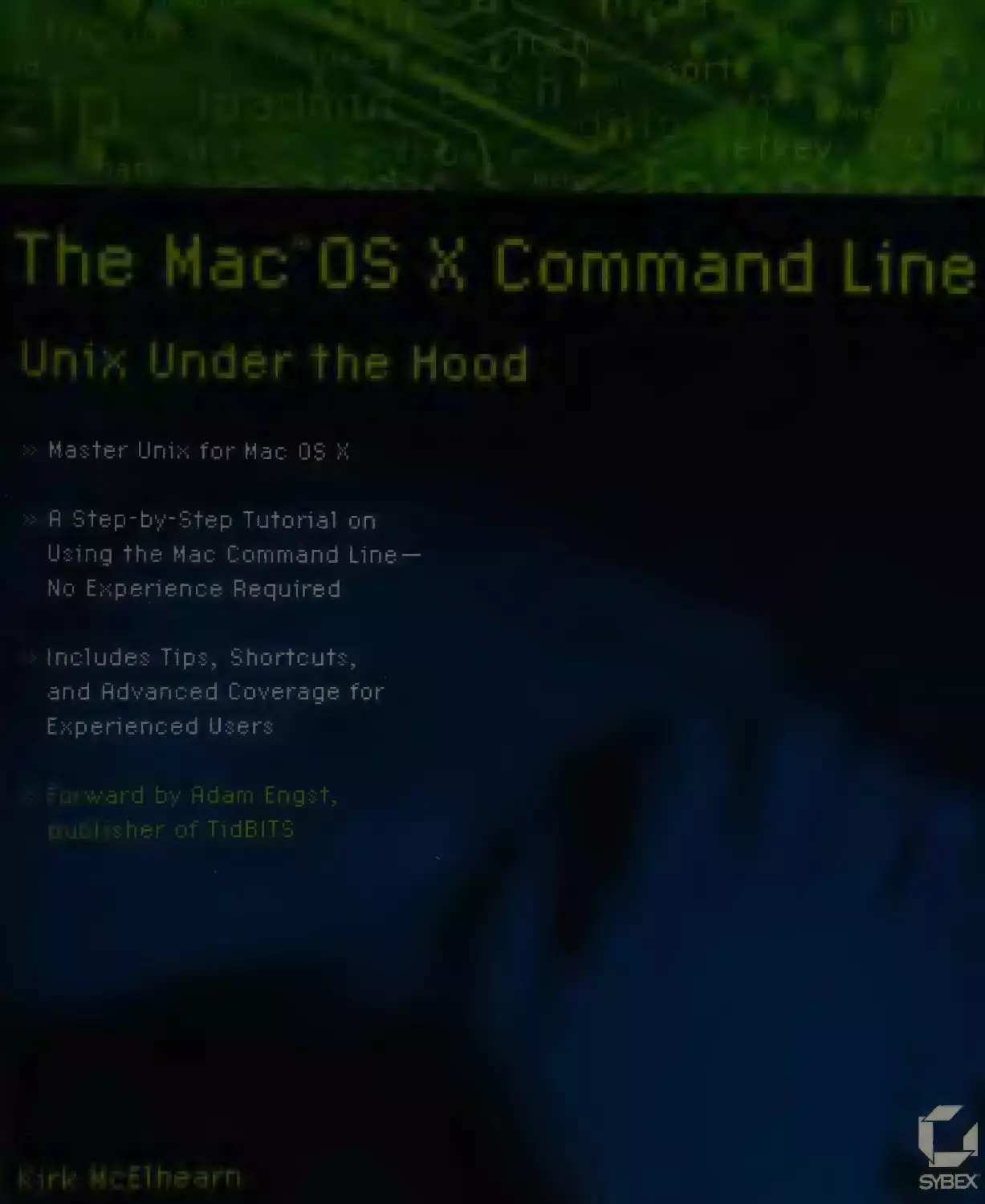
The Mac’0S ® Command Line
Unix
Under
» Master
Unix for Mac
the Hood
OS
» A Step-by-Step Tutorial on
UWeing the Mac Command
No Experience
Line—
Required
» Includes Tips, Shortcuts,
and Advanced Coverage for
'. Experienced Users
> Forward
by Adam
Engst,
— publisher of TidBITS
Kirk McElhearn
ee
The Mac OS X
Command Line
Unix Under the Hood
Kirk McElhearn
Associate Publisher: Joel Fugazzotto
Acquisitions Editor: Elizabeth Peterson
Agatep
Developmental Editors: Heather O’Connor, Brianne
Production Editor: Elizabeth Campbell
Technical Editor: James Bucanek
Copyeditor: Suzanne Goraj
Compositor: Laurie Stewart, Happenstance Type-O-Rama
Rama
Graphic Illustrator: Jeffrey Wilson, Happenstance Type-OProofreaders: Nancy Riddiough, Ian Golder
Indexer: Nancy Guenther
Book Designer: Judy Fung
Cover Designer and Illustrator: Richard Miller, Calyx Design
be
CA 94501. World rights reserved. No part of this publication may
Copyright © 2005 SYBEX Inc., 1151 Marina Village Parkway, Alameda,
or other record,
magnetic,
,
photograph
photocopy,
to
limited
not
but
including
way,
stored in a retrieval system, transmitted, or reproduced in any
without the prior agreement and written permission of the publisher.
Library of Congress Card Number: 2004109302
ISBN: 0-7821-4354-7
Inc. in the United States and/or other countries.
SYBEX and the SYBEX logo are either registered trademarks or trademarks of SYBEX
Inc. All rights reserved.
Screen reproductions produced with Snapz Pro. © 1994-2004 Ambrosia Software,
trademarks from descriptive terms by following the capTRADEMARKS: SYBEX has attempted throughout this book to distinguish proprietary
italization style used by the manufacturer.
upon final release software whenever possible.
The author and publisher have made their best efforts to prepare this book, and the content is based
author and the publisher make no
Portions of the manuscript may be based upon pre-release versions supplied by software manufacturer(s). The
accept no liability of any kind
and
herein
contents
the
of
accuracy
or
completeness
the
to
regard
with
kind
any
of
representation or warranties
or damages of any kind caused or alleged
including but not limited to performance, merchantability, fitness for any particular purpose, or any losses
to be caused directly or indirectly from this book.
Manufactured in the United States of America
10987654321
Acknowledgments
If you bother reading this page, you are probably aware that writing a book like this is not an individual
effort. While my name goes on the cover, many people were involved at different steps of the project
to produce this book. It’s important to give these people the kudos they deserve for supporting me and
helping make this book as good is possible. Naturally, any weaknesses remain my responsibility, but
many of the good parts of the book result from ideas, collaboration, and feedback from others.
Every book begins with an idea, and when an author believes in an idea, he or she needs to then
convince a publisher that it is worthy of their time and investment. The first person who took this
idea and helped me make it coherent was my agent, Neil Salkind, who has provided me with unfailing
support over the years. Thanks to Neil, as well as to all the other people at Studio B who help manage
contracts and other details.
Next, the fine people at Sybex came into the picture. First Iwant to thank Joel Fugazzotto, associate
publisher, and Elizabeth Peterson, acquisitions editor, who believed in this project and carried it through
to its final form.
Sybex’s excellent production department made this book look nice: Elizabeth Campbell managed
the book’s production, keeping me on schedule and watching over the rest of the team at Sybex.
Brianne Agatep took control of the nitty-gritty, until she decided to leave to enlarge her family, when
Heather O’Connor grabbed the reins and insured that everything went smoothly. The wonderful
team of Suzanne Goraj, Nancy Riddiough, and Ian Golder, copyeditor and proofreaders, made me
look good by fixing my mistakes and correcting my typos.
Books aren't finished when an author completes his manuscript. One of the most important mem-
bers of this team was James Bucanek, who is the best technical editor I’ve had the fortune to work
with. James's understanding of Unix and the Mac is astounding, and the details he pointed out, both
by e-mail and in many audio chats via iChat, helped ensure the accuracy of this book. However, any
errors or omissions that remain are naturally my responsibility.
Thanks to Adam Engst not only for writing the Foreword to this book, but also for publishing
excerpts of the book in TidBITS (www. tidbits. com). Thanks also to Scholle Sawyer McFarland for
finding this interesting enough to publish an excerpt in Macworld magazine just after publication.
Thanks to Mike Bombich for his permission to adapt tips on cloning a Mac OS X startup volume.
Special thanks to Mark Willan, who provided a friendly ear on the telephone as this project progressed, and whose ideas and opinions were very helpful. Thanks also to Philippe Devallois and
Stéphane Sudre for their assistance above and beyond the call of duty.
Thanks to the members of the X-Unix mailing list (ww. themacintoshguy.com/lists/X.htm1),
who often gave useful advice and shared their knowledge, and thanks to Eric Prentice, The Macintosh
Guy, for hosting the list. Special thanks to Paul Dubois, Victor Eijkhout, Scott Kramer, Eugene Lee
and William Magill, whose advice has been very helpful.
Thanks also to Rob Griffiths of Mac OS X Hints (ww.macosxhints.com), who has provided
valuable input during many discussions over iChat, and has maintained one of the most useful Web
sites for Mac OS X power users.
Thanks to Steve Jobs for making Mac OS X interesting, by building it on a Unix foundation, and
giving Mac users a chance to discover the command line.
IV
ACKNOWLEDGMENTS
manuscript, even though she
Thanks to Marie-France, who read and commented on the entire
s of changes throughout. And
knows nothing about using the command line, and suggested hundred
thanks to Perceval for making life fun.
booksellers who live to share
I'd also like to thank the unsung heroes of the book channel: all the
the book they need. And a final
their enthusiasm for the books they love, and who help readers discover
day of computers and the Internet,
thought for all the trees that gave their lives for this book; in this
nt to realize that each page
printed books are still the best way to provide information, and it is importa
comes from a tree.
G4 iBook, using TerThis book was written on an 800 Mhz G3 iBook, then on a 933 Mhz
(as well as lots of Terminal
minal, iTerm, Microsoft Word, SnapzPro, and Photoshop Elements
Brad Mehldau,
commands). iTunes and my iPod provided a soundtrack, and music by Bill Evans,
Bach, Schubert, and
the Grateful Dead, Leftover Salmon, moe, the Durutti Column, Iron & Wine,
many others kept me going.
I reflected on
The view of the French Alps from my office window provided welcome respite as
some of the stickier issues.
line with
Check out my blog Kirkville (www.mcelhearn. com) for more about using the command
or sugMac OS X, and for more about my other books. If you have any comments on this book
gestions for future editions, you can contact me at kirk@mcelhearn.com.
Foreword
When Apple first started talking about how Mac OS X would be based on a notoriously powerful
and unfriendly Unix core, many long-time Macintosh devotees cringed with fear. Would the Mac’s
ease of use be compromised with the need to work on an obscure command line?
Happily, although Apple stuck with their plans to base Mac OS X on Unix, they also remained
true to the Macintosh ethic of keeping it easy to use. The Unix command line is there, but it’s stashed
away in a back cupboard, accessible only via the Terminal program Apple provides. Converts to the
cult of Macintosh from Unix use the command line all the time, and many of those who swore they’d
never touch it have grudgingly given it a try when given a command to paste into Terminal.
The power of those occasional commands from friends, like “Here, just run this command to delete
that file the Finder can’t trash.” were like a taste of the forbidden fruit. Was it possible to do stuff—
cool stuff, even—from the command line that wasn’t possible from the Mac’s graphical interface? For
many Mac users, it became clear that the command line could be a useful adjunct to the Finder and
Apple’s other utilities, and to view it as anything other than a potentially useful tool was merely spiteful.
But there’s a big difference, it turns out, between accepting that the command line could have some
utility, and internalizing enough of the cryptic commands that they could be used quickly at appropriate times. The command line and the Mac’s graphical interface are both languages for communicating with the Macintosh, and those of who understood the graphical lingo needed a translator to
make sense of inscrutable commands like 1s, rm, mv, and so on.
That’s where Kirk McElhearn steps in. You may not realize this, but he’s a translator, a real one,
who translates documents from French to English when he’s not writing books or articles. Being a
good translator requires a certain mindset, an understanding of what the words in one language mean,
since it’s meaning that must come through in a translation, not merely the results of a lookup table
that finds matching words (if you don’t believe me, try one of the online translation sites, like Alta
Vista's Babelfish, for truly amusing results),
Kirk clearly understands what it is to be a Macintosh user, and he also has a strong grasp on the many
and varied Unix commands (all little programs in their own right). But rather than just list them out, like
so many other beginning Unix books, Kirk introduces them in the context of using a Macintosh, making
sure to mention any Macintosh-specific details that are relevant, and generally making you feel at home.
Whether you'll end up using the command line enough to memorize all these commands isn’t really
important. What doesn’t matter is that you'll know that the command line is a useful Macintosh tool
that’s at your disposal, and thanks to Kirk’s efforts in these pages, you'll never be at a loss for the Unix
command that will solve your particular problem.
—Adam Engst
Publisher of TidBITS (ww. tidbits. com)
Contents at a Glance
Frapodsichet oe
Chapter
ROMER
Moc eh ore
xix
Farr ene
TTI OREPle i EG
eG
? 1
1° A Guided Tour of the Command Line .........-+-s-cerercereessee
toh Coe
Chapter 2 * Using Mregiiltialscaa
Interlude 1 * Command Syntax 1...
ee
Oh
ee
ee 9
nee stile 1 ae Hee
oe Ne
ene oe
oe eg ee vee wy cee seeus 35
eeeceecees 41
ee .....
0sereecec
Chapter 3 ¢ Getting Help while in Terminal ......
Interlude 2 © Names and! Paths’
W220...
lo as ie ae 50
sere wal
ne
UST
v ect eee rete ceuee ny
Chapter 4 * Navigating the File System ©... 0s 6 00 tee
Interlude 3 * Redirecting Input and Output ....... 6... e seers eee renee eter ees 88
y’.ee 97
em Bete.
at etl
Chapter 5 * Working with Files and Diwectoriesty giawkw
<2 ceeee 24
Interlude 4 * Cloning Your Mac OS X Startup Molise dciFocatennt=tadt
Chapter 6 * Saving Time on the Comiunand, Lingedkwé
cree 129
wieduiene arte hepa tac
Interlude 5 * The Versatile open Command. ...... 00. eeee eee ee ee ee re eee eeees 154
Chapter 7 * Finding Files, Directories, and Everything Else, ..« c2ous ages + 04 eee 161
Interlude 6 © Wildcards and Globbing 0.7) 4. 6.6 feng
pe
os tose nee ee ee
Chapter S* Viewing Piles @.). cis os $4 ies oes edie * = bel ue eo ies
Chapter 9°? Editing Text...
crus
Gas c ete uss yee cs oN nd a
Chapter 10 © Printing’ 20. sass wets
eens eee cc ateeee
197
ere
199
eee
241
aetna ee
245
es
ane
ee
Chapter 11 * Compressing, Decompressing, and Archiving PiléSas, Ree eee 261
Chapter 12 * Working with Users, Groups, and Permissions ............+++++++
Interlude 7 * Using sudo...
crag s.06 misuse nett te Rap oneness
Chapter 13 ¢ Using the Network
Aero
ee
Zea.
306
CONTENTS AT A GLANCE
Chapter 14 ° Managing Programs and Processes .......... A
MR
IIe os8 0 0 361
Chapter 15 * System Maintenance from the Command Line .............00000- 375
Interlude 8° Wsing:the Developer Tools « oc ssc% «ek
Chapter16.° (Configuring the Shell
incemudeD tintomating Gominands
oe eds Cos nent ngagonn ses 394
fae (ches acu ienen Reeeer nr osc ashte brad 401
1.2. <a csi a2 5 alot aaa ros
tN
PApPcvidIXGate HUET MELANIN UNS, Cau tecat reek Melia ea aN AW Ocean RANA
aes 418
aie 425
Vil
See What’s on the Command Line
Page
Command
alias. .
apropos
+ * .
bzip2 .
. . . + *
SON,
INDE
cancel .
+ . + . . -
alee
DMM
. - . *
. . . .
* . +
. . .
. .
Red
SIRE
* +
. . . .
.
idred crn
ee
. .
. . . .
+
.
. .
. *
. .
.
+ * + +
NE
OCT
eer
.
ee
EA
ete fen
Me
SEOCONE BAIR ele SCR
ee
ok
estods sk civice-d-s 4 coals 04 So 4 PSA iA?
oii cc tia hecitte ata Wiese CAAA
CpMac
. + + .
.
+
OO.
Oo
rine
- . . .
. .
+ .
LIME
cements
Fi
ack
See
eae
ee
en
eee
. . er
.
a
2
ihe See
oe
.
+ . . . .
. . +
. . . .
. + +
.
+ . + .
.
. . . +
.
. . . .
. . . . >
. .
395
. . . . . + +
Ti
rer
eet
rr
le
ee
rr
d; ey
. + . . .
. . . . + . + . . .
.
+
.
=
=
.
. . + . . +
+
+ . .
.
.
+ + .
+
5
+ . + . .
+ .
ZI,
CC
+ +
a
Te PRIMA
RE
+
. .
. . .
Eee
- .
ee
*
. . +
.
. .
. . *
- .
Ue
.
. .
+ .
*
Peace
AOR
.
+
.
. .
.
. *
+ .
.
.
. . .
.
. . + . +
+ Rey)
.
. .
nse seme
cevauk
eae ee
ak
GaP ilelinfo x vise an 6s n 5 os 0s Ge « se oh ORME Sie@ bain slg eiele 8 24
oF ES MOEN
OU
. . .
groups.
+ . . .
. . .
. .
. . . + . .
. . . . > . . *
* . . + .
.
+ +
. . .
.
. .
+ + + + .
. . +
.
. .
Sm
ee
A ne
St
cere Ff
ey A TaUmR eer
rae
Toh ae
eT
. . . . *
+ - + .
ee
288
265
eae
Oe
. . . .
eee
Sia
ifconfig Ns
.
+
+ . I
. .
+
.
+
.
.
+
WISUAUEY
installe aicic can dnd Codd Web cho au bs OPER AILIE ee
wine o OLE
kill
le.
ey
WSCA ERR awe
S rate ack praeuine eiisis eee
Ronee
ee
SY
eae
eee
ar
cena
ee
eee
ee
see
Te
et
ee)
ee
tS
rte
A
IN
Sat
en
SS
USS
SEE WHAT’S ON THE COMMAND LINE | 1X
lpg.
* . * . + . + . . * + . . . . +
eee
IVA
en
. +
kee
.
SKIERS
lots a).e oleks oherstsuekclele
4)os
CCS
ae
. + + . .
ee ee
Cac
NOS
TLV ohit Rv
eR Rae
I
ne
Bis GO
aN
TUSTEDONE -iolke Koes eNotatc teiW
PISO
Pi Me
REI A We
BME
eH
CSAIL,
BEC
A.
eR
PUMA
OO
.
. * *
. . . + . + . . + *
oe
ep
Se
PIRES
RETR
G2
. . . . .
RAE
kat
3 Noir
ate
RAS
+ . .
re
. . .
cocks
wut
Oe
iin
.
.
gg
od
re
I
ee
AME,
hile.
a
eee
SO
eh
ate
OREO
al
ee
Ce
ee
NELLGES Tet Hake a
NOI
top. .
SC
. . . Oe
+ + .
A
gen
Be
NE
ee
unalias. +
sicls
ve
«oo
HES
AE,
PNT
5
se Bisisie #6 6 8 % oes
. + + + . . . .
We ste’
. . . . .
WG:
. * +
whatis.
+ .
whois .
. . + +
. .
o
cin
+
. . . . . . *
+ * . .
ea
LOO
Oe.
BG
ckevejerse
a wh
OAD
hake
se
ealhOD
aguas
s
ak
eG
BOS
ue
3d Gs s Sis cng
OOO
oatg
Oe.
. + + . + . + . .
. + + . . . . . .
sine
dawns
oc asses oe
Pe
.
ne
AEA
6 8
OES
OS
OE
eon
oo
hae
vs
OAL
enw
Pert.
Ob
akan | ee
one aitor terme aaiiess Ge iae ns
6%
+ . . +
8
ee
I
he
eee
p aoe Ros a gar ee eNO
Ee
2
FA
whe
os
ee
He
6
0)
Sens
ee
Pee
5)
HEH
A
PO
Ore
rae
HEHE
eke
At
SA
Oe
tre
EHH
EH
aa
eee
re
oy
oc,
es
egeee
8
oe
eR Rod
eS
DS
e
6.5%
EF
2.
eas
HEHEHE HEHEHE HEHEHE
HEH
POA OL,
ee
HHH
5 ieee
ee
des atOLO
rh shad
PES
IOs
ee
ee
oYA
LOG
TE
ee
MRA
eee
eH
ED
es ges ds Se Dele REDON
eee NRE eee CRP
eek) e
AG
ee
rey,
5 inet yeh
2
Hage
AE
er eee
rt
ee rn
Oe
. + . * . + . eee
+ . PEE
wos
2 ee
Mf
cs fa
Mart
eee
eee
Pe
Pee
ee
ETACETOULE
o
e Ol
PEN
a on hiny nieone tea
Sg
ee
Ee
ROI
DOOR
Feet
ee I
ere
csOOS
HAR eC, Qu AOMOO Se OTLEY
ed
hs
SUNN
LOG
aeen
ce Wat Sc fn aced Galo RE RE RATA ig aE erage? Maes Aenea
OP
ae
ee
dl ie Re
RRR
kone
. 5 . + + . . . . + . + . + . +
EP URE
25s
© Ae
Mh
8
osGOA
dhs steered
Gti
Ae
Com
Ble ace atavlanle
. . . . + . . . . . . . . . + * * . . .
REE
SOE
cc
Te ON NS oO ishie ge ES CON CRE BER
Ce
EEN
ch veShe, RR
Ee ee
ee
system
ah
LS
i
Bs
os
s Mae
gee
Cenc: care
RNa
eA
ee
. . + . . * . .
MIGpees «eS ek
RN
Gh waa
np
or
INR
. . + . + . . + + >
4 02's ANERE
rt ane
MS
RED
A
eb
ieo
PIN
AOR
osteo
POT
bo
at
AEA ESTAE Wea
ge
caeee
SME ERENT
vlweueernstenn
.
ON
Pe
OO
NOS
RTS
es
PE
MN
avelss
Ries
Dic
A
ARON
A
Ne.
RYO iment
Me
OER
a « CatrReran
9;5,!, 6
.
es
Be
NT
Ae
eG, in
hag
eee
RE ened
SRE
. . . . * . . + . + .
IEA
cs
5
ns
SSA
Mintere: isi shire iad
Te
op
RAIN
et
ON HES ca ETE
Tete
Od Aare STG
sie Kine MO,
be cE
>
OR
Re
550
Row
. . +
SOM ATCUPAALC eRe, WR cE
OE ee
a
MA
ere) tN EM Awa tal Bray, Bt do
ee
bn
URE
+ + + . .
ideo
I
1st acre
eee Roe
te I CHOWEL94.8)5:4/91 © ie Koogsuion he
Ray
ERE REARS
. . + + .
ce. lo
bh
I
ins ks
Ac
Tee
Oe
Pee
rerum
o45)Gohc <9 2 ws
tennciscn
§ ASS tyashy
ene
ee
hod
Hod 1 «RD cS
ih
PR PUNE Er
bane Sarl
yale, Seater eS. oe
ood
A
RE
ONC acura
gE
Ee
I
Pence
OMS
meee tenes
acer
oi
CRO
ee
ae
Pate
g
emeke ACERT
ENC
6 AU OURO
Ae
SOR
Bete
eee todos Nae
eI
ARTES
ey ROP ON
Brat
WTIOUTUE evan sincncrts koe) e.ahena ees) 4 wis 9)
+ SPT
sot
ou
bs
La
6 Sas
868
LOO
6452800
HEHEHE
ec
EE
416
24D
42
351
Contents
TasraducHon acsvg a bos cond oD ante
1h
oe EO
eee
een
rae
nn
ee
a
xix
eeeeeseseceeeeel
Chapter 1 e AGuided Tour of the Command Line .........see
Ban tier eee sos 1 EE), oS eae
ek
Opening Terminal . Be
a
ere
6
Typing Your First Command "ons A 8 pe GRIEG ev TUE ice A ed Each
eee
ears
he
ROT
lees
er
Reka
eh
Home
eens
Reading Directory Contents yo {Na Sees
. . .
+ . +
.
. +
.
....--++.++++ SERS OAR AROGEE .
ng
a New Directory
Creati
Sees
£5,
ree
eae
File
New
a
Creating
meses tty, «9:28 oan
Writing Text toa File .......+.++ee eee Jeers Penn vatedMertetia oppi
ng s.
eti
DelFiles
and Directorie
ng
SummiUp
....... ates
52s
earns
¢oasticwe ts om renrcare + 48 sonst
a te SAM
A AEN WSR HS ck hole o ans
AT
Zio ae
©
ROE
.
.
er nee OCNUD
eeeed
Chapter 2 © Using Terminal..........seceeeeccccescsececcesccesessc
ee
a
en Geek Waite ee
We ed eee Ware
pacts
..... :
t
Is Terminal?
Wha
ee
lee
The Nest Level ablnesacionthe stall Mae keueeene
How the Shell Processes Commands ..........-- Fe Oe oe ee! okt, a a
Setting Up Terminal, .....05+s0asesreresrenenenuananereereunsnes pee Nati: © 245 negiee
Customizing Terminal Settings ........--. BEN regen arses eye Se 5 a I ee resi)
eet
CE
Pe
otoa RD eee
Shell Seetings £6.05. -ey> cespce sees ag
ie
Process Settings ...:ss+ dec ssevaseedusvasney scree sopge yer et eames
ere
Ce
Kesh
hee
ee
ee
ee
050
.+—
ess
Emulation Settings», 2: .<1.se
es ae <4 RRL,
c-..ta
rete a ae ee ae Leto Tee BO AA cr, a Lh
Butter Settingss.....oe
ts Sette tema mae le)
ise thho
chinps
+9.5% peskiomboths eRe
Display Settings .....2.
een Veree Megars, Aare oe anh,3,CSR aoe,
dksvaitts eect
Color Settings eo. xx. «tae ens
toe fo
In FAN HET SUN
RN
See
ORC
are
Window Settings RAR
Keyboard Settings 1... :cuy ae oom see seersa Ses dcAen OS ieaes ie siatate akon eT ee
:
os
d
Terminal Preferences ........
AS
oNisdingayidu Temel Wanders hen eget SS seein nensytins Dar eee tee SRY. ERR
oS
Pr
et
via
ee
Raa:
re
ert
..........-..+.
New Windows
Opening
Running Individual Commands ............++++- ee
oc irs.fe
net ee
Working with Multiple Windows
............+-. RA ae Ree neeet titi ort
i!
The File Menu ......... ip:
Bre
ENS
Whe Edit Menus... ses er
ocean haart ctor oueicrc Snonmoll
Nee Ea
The Scrollback Menu
The Font Menu ........
Using tern Files nc. ns pieoe arepereds RN oe
ee ree eA ER ee ia alata
boas ee Oe
Oe
Saving .term Files .......
we
Shes
ae
ae
Opening
term Files: ..... cwewoe se eas onan ER
Using .term Files to Run Commands
Using a Different Terminal
HNIET ETI: cise, on gris eee
Col ernit wos sete
Summing Up .....
eee
een
ee
ss
Phas anne <b oo
MRE
«aces oem
..
4h oaGdebusl Oe Sener Ao raeRereaee ote eacerete ere cant ae
BEEP
IP
But Peo
LRceo
Cees
eer ce: Oe
CONTENTS
Interlude 1 ¢ Command
Commanus
Commands
Commands
Commands
Uhat
That
That
That
Syntax...........cceecccscccccccccccceccceessee 35
Function Alone...
sc0c oc 5c kets keh
cee ilen viele sth oben. 35
Require Araumentss ni... ie sete vee on cites «oes CO
der eee tan Ree ee 36
Include Ophons ne
tos ae ee ee KG) SAA ort eR
en Tee, 36
Include Opaonsand Arguments cant
pate
Salat: wie Aansasees 37
eens
Chapter 3 ¢ Getting Help while in Terminal.............0cccccccesssccceesGl
Findme Out What 4 Command Does with whats ih. ied se dtamitvecciss svsse-cbesvedeseese Al
iain Bat AOS Dae. at aman
vee SAN Eb: ane Sheree BAIN Wks 6 SR NES eens piarancr 43
Reading man 1ST
Bees ts a AS
Fangs Rn olla44
A OR, ORM
Moving through man Pages: 4... sah che 46 acta
WP a oes Y ~ BencBieaA ten ekeMeier en ates: AS
eau 46
CAM setieaaee! oy fens
Finding Text in man PAGES Secale Net a aptsiius eNO
SPR R EDS EWAN URI man oPERRbonare ia), facts A. 49
Tt
Summming Op). keas
vas «© ie ERE BI OD, betAE
+50
and Paths ........ccccccscccccvcccscssccsccccecees
2 ¢ Names
Inter
lude
File and Directory Names
i aca SW a 4g
...... su agra eet BL
AbbsoluteandilWelativesPaths mus jee
cites det Stee
A
ee
aieai ss bane
ORES A 50
enes ee
ad 53
Chapter 4 ¢ Navigating
the File System ..........cccccccsccccccccccescees57
About ine Ming OS
Pile System ere vis vac sidive sie) wihia sbielegeysholopies os viesew 9 « Sc aanegert 58
Param our Way Around sas gobi xe 005/55 0. + « 5 aa
pla e es 6.8 40 oe Shen ores 59
Poadiagayyrcte 0G Are wit ipyid brea.
ai te os oo
Ney ae ha + soe 2 os oe eee 60
Using gore to Resolve Symbolic Laakso.
0a a ccs shale Me nme ge soe sss vee s vase d 62
icistuse (etectory Contents with ts anc 1.6 est 8 ae gia tates cars + a oo 9iont View oa 8 62
Naewitge Long Iniormation. Jos, 5 1.s.<h asec elacetals ee Me EE
eee eee 65
DOr eHOOGIONS LOE IS aya csascin.5 + onefuter pane TARO
Sees BON
ak OR eee BPO
care 68
Changing Directories swith 6d a. cee an cess Glan ania pebble oss v0 6 ne ne + ae hoo 75
Using the Finder ta save Vimesnsetminal iyo
ary
pariases 6 92 6+ «4s ee we vieve 77
DIitisrd NOEL EUUES a Bsehcrs oe raahaenc thee tuea ee
acu aden Ad als yokes o who 2 winain2 oR ah
Jumping Around the File System with CUS NOONE co oi tinin sis 9 <9 53:54 Sala eww 83
MLCEICHE SIP
NSE AIG ORG Locate ie daarte Oi
Eas oe
recs 5 eased
eS Og 85
SFeaphers) ys)0 tyArgh ABS do lekcis Cras CeO” Ses oRaRNnn oc secon ortega ROC ra ease irae 87
Interlude3 « Redirecting Input and Output. ..........cccecccccccsccceeees38
Redirecrits
Redirecting
Redirecting
Redirecting
Using Pipes
Redirecting
Output «0.0.06 66s oe wreniin cite ofan o Malate 6 5A REMR es seo ee ever
Input oj. i+.sis¢ «nnisins/eoe
bio mslahn gee Sagida
0 Oe REE age SR
Input and Output .............5. PRE
so 5.0.6 0-0-0) SE
a
Error Messages .........++sesseeeeeeess ads ati hsRis Oa eats ee ae
,....s... Wviasleaia cen sisatiobitaain fie faible. AMAR ORIS coe sso eee
ee
Output to Two Places iariNid?? & RS aos Gon 6 PTA Coe AO
beeen’
ere
ee
cae
e sees
eee
88
89
90
91
92
94
Chapter5 * Working with Files and Directories ...............sseeeeeee00+97
RaGNr Cette MM reget A. oss eee case e saad 99
Copying Files Wit ace dlatl ONG
VEas cc en sso bese mea nes 99
OC COEY. ROO
Er
Using Wildcards to Copy iles eee
none totes tence eaten 101
ema
oe
fone
ee
ccc.
©
Name.
Its
Changing
and
File
a
Copying
Copying Directories GAL EWGD. 9. 3 Toe epee SOI Ora er eS
a7
roe
eae
ee ea 102
Xl
Xl
CONTENTS
bores) 4 ehlepsieh > one eee esr 104
Moving Files and Directories with inveesesua
105
ee
2
nea
GO
Creating Directories Wit MEAN. oe sii ad ip
107
oe
eee
>
ey
deansin
e
dcr
Ganesan
Removing Directories WALT PIN? 6s v.sccncne
108
ere
e
ori
teem
cP
canst
ae
ab
aah
tenth
Gis
y
smcnmenet
<ewies
Removing Files With Fi sca
108
oS
5
2
Ors
1
Rc tint
A Safer Way to Remove | eae eae ee RN EWS PRUNE
109
Sone
ares
Glen
#
Sua
ie's
ncrinisians
Getting More Bicecdback WIL Ff ciccc pacs'e dnvshe wii be ofKv
110
Te AIP
ee ar meer
OE
ee
ee ee
Removing Directories SE
1
a
alee
mare
mane
Sind,
ee
t
passan
arn
4
aimua
coke
og
igs
‘Aliases ard LIBKS a vat cng Deer
0 Wate oa on hts)
46
bee
tains
Nice
een
eee
Ht
Linea
c
Symboli
Creating
119
aR irra ramen Re iard Atricorel\ glee mr wk ee RN
Copying Directories Ee Ot it Ra
120
eee
icles
cers
tz,
ere
ate
Ren
nS
Copying Applications UIE AHO Mare
eens atom 121
Backing Up Your Biles Withitaithd te ore rote te ttn eens ore ess ges. A> kishoot
Summing Up
.silicne tote
Citas a
ne CoM
a sreaa fins2) ae
ta ececng
or een
123
++++124
Interlude4 ¢ Cloning Your Mac OS X Startup Volume ..........+-++++++
124
Considerations for Cloning a Mac OS X Startup NOLEITIC® anew axed 405.cce Ree ree eae
..reesecees 125
cece rece
sees...
Preparing to Clone a Mac OS X Startup Volume ......
ete 125
Ge
oie
late
Sos
orcs
one
toe
oe
tor
Cloning a Mac OS X Startup Wolumie With GhiO
d ..........+-++++eeeeeeeees 129
Chapter6 ¢ Saving Time on the CommanLine
Using Filename Completion 7. 0idcc cee ceba sees eges «nem vagme gs © cee mae vanes tae 130
a naa leit
cera
ewe ee er sae te ees
Capitals, Count (972 foe lei dea vests ween
oi... eons tates sans cane aes ae cae 132)
Going Further with Filename Completion,
ahd hed etme 2 aA: Meng mer eae oie on.S ile
ostdg Ohl(een
Using Multiple Completions |
Refreshing Your Completion Memory ........+ 0+ 00ss sees recente rece sree erees 134
ecence cens 136
eene eee eeer00
....
sceseecrete cence
Using Command Completion ........
Using Command History oy... 0r es 1 ese ee es ine ener nw etc eens sete e seco eu ees aan 138
re tens van coe eee cise os ecee a nam 140
Modifying Commands from the History:
Editing Commands from the History ........ 050+ e seers eee treet eet n ence eee es 140
Displaying the Command History ......... +0. eee e eee e eee teen eee e cence een e ee es 143
eames 144
Running a Specific Command from thelFistory vere cs vs task oats ae oe)
06... cece c cece nee eee eee ene e tense een e nee cees 144
Command History with bash...
Setting the Command History Variable ....... 26... cece cece ee eee eee eee neces 147
Clearing the Command History ... 2... 0. 0sese cesses ences ccc te ese ncsteseneoeess 148
Keyboard
Arrow
Other
Suimamaing-
Shortcuts in Terminal . 2.20... . cece cece cece eee e eet n te
Key Shortcuts, ..1.....cecsoes nee ninieiai eneind gee MNOuN Rs 3
Editing Shortcuts «cuss aries vaiiew stereos Aaigtee SUNS MIAOM as
Ups iho sisiecsyscsea! ora base shotynte MM
AS SEEN SIONS 5
tee tence en ee ne tes 150
Wee sos
Coe nente 150
clea ase cowl wineoeerer 151
4.iy os wie ise eae SS
Interlude 5 « The Versatile open Command.........sceeescccvcsscccceees
154
Opening Directories with open”. sace<~ nc wares ss oh re oe atinraetereoniwier eystesanreee @-egrenrn eines 154
Opening Applications with: ope tcc). eisGeorienvete oinisesgapna sist ieee
Cie Sesh 155
OpenmipyFiles with pei caaie oct
«s+ wevyrecans Merny say's a ceeomann pee nace ae ee
156
Opening Files with a Specific Application
Opening URLs. wath: opert <5...)
Ba
oe at aoeSete ae
ied« ER Michael) iorara Kini see
158
CONTENTS
Chapter 7 ¢ Finding Files, Directories, and Everything Else................. 161
Pere Meese lac OS Gash
aotee Sener ee ete
rete
otek venprandivhs thas161
Eres eletc yitnns avgte Wp, 5)ul a OGL Ce A teareser te MEN MN
ace 6 clvachonutie%s Seared fen 166
Tiere ety
eninS Wathitrld Montes |. cstese et Caelk eaten hee cet stim
trier etAone dae aincaraSerndl 170
Esau Hew byt arte eh At. et we abeor Aiea oe to tte nee meee loeinanaoresaesrnl QE 170
Rete Vpecleaiclsntcy. Pini WEST,
SAC cea
ee aie een
ores Mh ait itera nection {71
RCRD eyed PPE i6.s'i ts. utente pec eee
ML OT ENS is funcrsisleet iE 7s
EeenOak 1165 oy aCe PP etal t TA
SOM
ne eek eM
RAM
her ie chew seesnasyoieecn rah 174
MN Lote rc) asewsarnikren arses 175
ler eer
Fee
PATE Les DY SIeer rae IT Me
Finding Files That Belong to a Specie: Wiser Of Gieip Ht. wten artes os Suomi datets oe a 176
Finding Files That Belong to No User or ASO ie a et bbe karReoRecent tell Nor don Goeth 176
eR Mme Neteeta FahWerOat ce een tar esd Vaid Seentcc 176
Gluing Together Several RDPULOTS<rarersesie
Displaying File Information for find Results?"
A OBA.. ccaccs c enen HY
BT
Pinging Pile Contenta: with prep os hugotno de eee A ENR
ns 2 ie 5 ade 180
RIN
EO.
I
Rindine Pileswwithy preps. auc. <nic Ohta
oaks Sa a ow onde 181
et
Searching ford wo, Strings with orci)
Pe
Oe WeMee Ae
ee scab nae ewe ene 184
Saving srep Resales tor) File: c.0...cecomig ee
oe ca nats ato eek 184
al ee Oe
ROD
wg ea ene 2 185
Sessching con(haratter|Patternsiwithi prep’.
Rs AP eee OOo
SERN Di xp cede
GAs ait pone ota
A
SLs
Sod noes Euckewe 191
Interlude 6 ¢ Wildcards
and Globbing ............cccceccvcsccccccecsess
192
tg eC
TEN SeOia: UE a tyQR eae ree Rane 8 “Dt 8 Uae A elAe SA. Capt nh
en
192
SUVA BART Gitian eovig STEN cases tice cag Cnet, tokok MOM
a TANS ake as oishE Behe HE 193
dir
LAWib
erectRahated. corm mdiae siiien eres). ~ertmaniah, eaten GM ik Ny: @ APRON
are a 193
rete} Meatactets taxa onssoteces tebe cists Solebaragane eo
NORE
5.5 sale gues ouncee 194
sles NVsldcatdig, Sciengn ei opebuctcisrair orate
Ot th
IR
tee in.& 0,a:40e soln 9 Sa 195
ESCM sings VVACABAS, reper Oi, MEW IDA) RINE Ne Se NMR
a a Fo eS ences oo seidlevees196
Wyaldcatd Seite ay? <stexssccrscesstaieies kerejere vr NRA
GENES MIMO, oo wooo ac 888 197
Chapter.
Se Viewing Files icy. suc sccvonels tit sialelaeslele Selle esi co sccceesvcss
199
Pinang Out Wav Kind OF Piles’ Vou Edave with file rtea w letecttte Mtg targinssteson's Vokes Shyole Ws 199
AVSaay WEL ICN calCaee oe WOME Cialies CCP AR or68 pcoscicictal ae case oat
Catala ealhel TobelataoN 201
VYsewing die Deginaing OF al ie witinnrad arte ere ee viet ne ohoetme stateGatae)aio! oletnteleatg ave 9 203
IN/wecn
tana Medes eat ed Pile yA ChNeit
Bata caresctatotais atehyamthors Maerker oe oa“ lebpiolone othe205
Wee wisng Fithes yiChn es
Se
EK ae ane oieoo ay oats Senne halt tana 674 6541s00awien onerets206
erramemuca eM rete
team csctooteiete = ona ciniatarosePa teeel olehcasey etertahrTc BilsYaotelareiateraneaeres 210
Chapter 9 « Editing Text........csceeececesccsccccees Msloias piss ekelegun
& revere EL
Counting Words, Lines, AMC Maracters Witlhwraeatas
tere
ote ree est errs ae ok kes ss ae rates Dale
Sorting Limes with Sot...
05.2 eee see rece eee teeters entree tenes enc een eens 213
IE aa DIYs)
tara RAL
edo. as
tort Sear
Removing Repeated Lines ly WE: Be Ace
2... 05sec cce eee c eee ec e ence ene cee nner t nen n ees 218
Comparing Files with diff...
29
BeEOP TO. cesSac CALS 0 BRR
Replacing Characters Sgn LitsMeat teen AL
Formatting Files with fit ...... 002. scs secs eee ee esc e nec en eee e cc ence een eeen nent ees 221
228
Ae OTT
Bi
EE
Editing Text with CTL cinSutvienchBexde Reo se CaSO
225
es
ae
ow
AT
Mahonareebaiierals
DT
Ao
civ
eh
oN
Hee
PREG
REA
a
ieee
Xill
KIV
CONTENTS
226
d2 See
«os
walt goth aldo Sentemte
Editing Text with Pico...... eee geht).
227
&,
OS
Rear
a
re
e
e
Editing Files WUTEH DCO) andiNey eccrine taePe
eh 231
ote
E
P
eS
ee
Shere
Ser
Pe
en
Creating Files PNG, a
eet PA 233
to he eo
OR
Editing Text Withwd near arrose oiharee ETI,
eee eS
a
AEE er
A Burst Laste Of View rue nenrte oars So is Re
237
ee
pes
Editing Text Biles with Vieg bw -coo « 0s asta peer une sen
238
ae
ie
eer,”
4.3
neers
catia
ged
ooegebaaet
<
4268
Searching for Text SiitluWis iicte,+ a cce.0:3
8S:241
so
meee
n
rrr.
Pete
Sree
ein
r
e
Replacing Text oo he
cnadt = ©4,975.0, tie eed 242
Editing Text vith Pexeacs. sb «sates this.a.c5-+ tla kine etal he Ornate
Siumming Up: <dia.2¥ a5 Seoepareean ig pi
aa
aE
wean
eee
ceeeceseececese ss |
Chapter 10 © Printing........seeseeeeeeeeeeceteee
8 seer is ohotsishe hehetoetens
cate aeBere civewrees er ee notre
About Printing with Mac COS)
Pe SF
, SE
e
F
Oe
a
alslaar
ncet
ons
tian
ge
gave
una
nye
aca0acele
Printing Files with Ip caserest
AR
4
StS
Pageant
Bae
dots
Ra
Fy.
iT
with
Advanced Printing Options
tes
Han
net
Checking the Printer Queue with bigs Weev dommnides S Pieth Setew iad
244
ZAG
245
246
247
252
ess 253
Canceling Print Jobs with cancel ....+sescvesevenertnnsiecccseesccrccressrerssecc
= alee
erase. oc copier ideoe -,222-200
Managing Printers Gomi the: Gommiand Linemdys
se
oe
<2
ARNE:
>
ene!
sprue.
vghin
vivescoibia-v.
a+
4-41
Printing from "Vermairial
eee
Printing with the lpCommand Sex, Seeeeiene a ee one oes Pee
e ee ree
Using the Print Menu Item: «sft oid deme alee 2 EE oe GURGNGRIE «+++ eer
eS
eee
RET
oe
GAR
d
e
r
a
b
aaa
ders
ovo
sen
coke
Somming, Up .6.. ste reese buses
255
255
255
Zon
259
Chapter 11 ¢ Compressing, Decompressing, and Archiving Files..........+.. 261
261
About Compressed Eiles) jcc + «eter hrmeis.sers horse Gree mates pe Osos # Hina
262
amram
45s
soe
RS
SRREO
De
SEES
hats
tot
rceint
since
osesesscyeieses
i
9219
WHR
Files
Compressing
..ceseeee ence cence reese ece een eeececes 264
Decompressing gzip Archives with gunzip...
265
epi BE+ 45 8)<i ae
Compressing Files with bZIP son.sasinlas win ~.sp0:0.0:0.0,8 URED
266
SS
eho
hulmsco
mG
nce
Tra
OF
EN
Ce
os
Decompressing bzip2 Pht
BRGRERATE + + ever eee es eenae 267)
Creating Archives with tar. ....00.4 0+ 0 +00 -Wuldll-GEReR GE
eee 270
Managing Disk Image Archives ‘With Radi laa eeteG shatl nscale acct <a eet aera
see 212
44414045
ttresaste
<a
cease sete:
Mounting and Unmounting Disk Tapes...
ee 22)
sv
OA
Pe
aan
neues
218+
sha
so
[mages
Disk:
Compressing and Decompressing
nee 276
ea wince
lee
Summing Up o.« a cle diets Me ice on gate sharin wR Ro ae
Chapter 12 ¢ Working with Users, Groups, and Permissions ...........++++++277
a etn rae eae eral ome rein tape aetna ste onepep eee Pipi
About: Usets: oe fcek, sete Sass fe Gi
vebare vinea tole ees278
User Account Types. ¢asscey ca teiad oma eeenemee om SeRIR MM
0 ee eee 279
Creating User Accounts’ . 1.» nes :ccunareeatp uacis gnaie® sss er alae gat
1rd ahctor ier eee 280
Beant
orto
we
sed
ss4
ssi
Wetme
Gosmmamd
the
from
Creating User Accounts
Deleting User Accounts) 4 ¢.i%2.03-F:sne Capes «nei parce spake 5 ois Sinan Wie So ape am nrereN 284
About: Groups ss 5. aww da er areahgsiaiy a8 4a erential aaa oe I ace tue aati
aha ees ee 288
Creating Groups...
0%... nocd k huine ¢ sapien Cds aes SNS aarti tease aa ee 289
Adding Users toa. Group 2%. 60k yams, «salads
tae
ee
292
Removing Users froma Group 5.04454 cute 0 Unrate eee
aos ee
eee 292
CONTENTS
Deleting Groups? ot
eee
.
.
About Permissions ...... ey
lee! Fics: Sisal aStvkel cme,
Sore dese
What File Beacon Mean ....
i
Changing the Owner of a File .........
. . . .
Changing Ownership Recursively ..... . + . .
Changing File Permissions .... Vso
ee, 0 He
eee wees
Changing File Permissions with Symbolic Mode
Changing File Permissions with Absolute Mode
Changing Permissions Recursively ...... oe ee eee
Setting a Directory’s Sticky, Bit 1.7 x60 Re a
parmUp. a0 caene More enter oes peewee
peewee
.
eee
tee
eee
4)14) e549)6
eee
eee
eee
a
a
oe
eens
ey
Interlude 7 ¢ Using sudo...........
Chapter 13 © Using the Network ....
Local Network Tools
......... woes
Connecting to Other Computers
}
.......
Logging in to a Remote Computer Securely with ssh .......
Logging in to a Remote Computer with telnet .. .
Copying Files Remotely with scp
beer
een ene
Synchronizing Files and Directories with rsync
Internet* Fools 74 ave eis deere ee oe . . oe
Downloading Data from the Internet with curl .
Transferring Files with fip......... nay
INetworkaWtilities!e yen
cone
Getting Network ieee eerae ifconfig sees ee
Getting Network Status Information with netstat .
oe
Checking Machine Availability with ping
Checking Domain Information with nslookup ....
Following the Trail of Your Packets with traceroute .
see eee
Getting Domain Information with whois
Getting User Information with finger ...
Scanning Ports WALI GOY? Aoacudoosee
Securing Your Mac with the ipfw Prva: bee ae RE
Creating Firewall Rules: () Shieeeer:
Summing
Up ..........+..- Ne noe
Chapter 14 ¢ Managing Programs and Processes......
Getting System Information with top......
Other Ways to Run top ........sssseeeees
Getting System Information with ps ......
Shutting Down Processes imide Wl! 35 om ocoeee
Summing
Up ....-.-sssseeeeseeeeeeees
tee ee eee
tee
tee
eee
ee
.
.
te
+
eee
ene
ee)
oe
W186
6 ws
O18)
538.18)
eee
eee
.
enne
a
eee
tee
6 +e
9 aloe
0. «0
ee
ee
ene
ee
e ns
.
eee
tee
.
.
eee
sree
eres
ewes
ee
sees
eee
Denne
Le ace
seer
tee ee een
eee
oe
eae
eee
XV
XVI
CONTENTS
++++++++375
from the Command Line ....--++
Chapter 15 * System Maintenance
375
et
pee are eens Smee en
Getting System finforinakiotn: snp ade nearer
375
Rate
A
oI
aioe
he
APE
PRM
s
tli eiceitor
Getting Hardware Information with system git
378
oer
oe
2's
he
So
les
a
Sie
tenet
ga
eee
geren
Getting Disk Usage Informations ‘with Apple,
379
nee
te
ofWet Te Mitre. a ee
nee
Getting Free Disk Space Laformation withtap
nee tioene 380
iChat be ooo
oe
Renee
ints
diskut
with
Managing Disks and Volumes:
a ere 381
oe
es
ee
© Pee
Getting Disk Tato with diskulll vahcotcctone Oe
aii ae 381
oe
ae
«0s
E
BURN
6921.5
Getting a List of Mourited Dishes iti dishiilenty
382
a
8
RSTINE f RIB RR oe i 8 9x ae
EADS. CUM
Using disbestil sok
tert oyna ae eine © 2:0
r
errrea
Tp
«.
fsck’
Repairing Disk Peoblemis-withs
a 384
at 2
386
Pea
Ro
oo
EE
A etree St
Blessing a System Beslan with: bless..-sa:at.
387
s
escene
eeeenc
esse
t
eee
seer
0.
.....
Running Periodic Maintenance Routines with periodic
2 ae ora 389
tina
77
222
es
animal
Oa
fatten
ere
oe
Updating dnd Tnistalling Soltwatle -ts<.cu
hs ar ae 389
Cae i Oo
ees oe PU
Installing Software with dastaller <9 accents ORR
steses391
ersse
cacet
dees
d
cind deewwei
Updating Mac OS X with softwaneupdate «0.00 ++vnlnn
ee
Summing Upp. 52.055 ose
4 a a oiatenoth sigedan
ar
cena
ESS
TAS
Se
393
seeeeeerceccreescree ss 2394
Interlude 8 » Using the Developer Tools .....--+-+
oes rer tas 394
Manors Baines 9
Command-Line Developer Tools -..0 ic «1s -Mitael>
re 395
ar
>
25
Foo
geet
aa
)pinlats
rs
viasigwa
Copying Files with CoMae . .........
396
cee
<9
9
2
pie tiie © 2 nae
Moving Files wiitly Mu Mataaice Ge arusnadood ) Agomehe com> ay
397
as
eewonra
«Feo
+++
ed
agh Rrenegy
Getting File Info with GABlnfe gauss h atanon
ar os +5 alee oe area 398
Setting File Tnfo with Setilexcoun.ccusncstbow igseunten Maeeek alawiteew
eereseecceceeee ss 402
Chapter 16 ¢ Configuring the Shell .......+++++eeeeeeee
reg ase sss oesselina 401
id
RN
SE
Working with the Halk “Ween Aaeee Peer steed
402
Os nas 1 sig
ERIS
MIRE
So
Mh
PERE
nS
osu
The bash Shell: Seartup Process <.-.-c
Raines ome 404
one
BES
nde
ene
PREM
osteo
rests
Processsvasc..
wn
Shutdo
The bash Shell
«25 eas 7 on ie Bieoa 404
The tesb- Shell Startup, Process’ My Se Ee Mw Cae tne Set Eien
san ates eee mini 405
ka
nee
ee
Pees
ves
The tsb Shell Shucdowm Processor
rae e+ one28 e o 406
ot
ents
ee
Si
URIs
SN
Pe
cece eT
Configuring the Strela
So ee wee « «er umietes 406
5
wrens
ewe
ee
cele
es
eile
as
oot
bash
for
es
Variabl
ment
Setting Environ
ne Sisaol or rears 410
fore
tars
rete
b COnticsbis tees: cake ees ote cate
Setting Environment Weartales
oa 412
69S
ts
ns
me
ite
tate
CaM
ee eee
Setting Shell Variables 7. Fete Bee
414
Ue
win
o's
e6
BREI
eS
SPR
Es
ONE
tee
Wap
st,
Setting Shell: Aliases %:.0sp./s. 0
Saga 417
aie)
clas
=
aromrs
Saree
ee
tirre
cer
ete
ena
comer
«decry
eter
ov
vides
g
Up:
Summin
Interlude 9 ¢ Automating
Commands
- eebieal, EEO
ORI
ook
« sale ese eer een
RMN MERA ScrciIGas &418
e,
Belen RANEUEAES
Automating Command Execution SeLST 1 Th Ee
ee 420
oe
a aa
tse. ones uns ao pens Ao
Combining Commands’...
etree 421
cetera
tionttar
iemras
wire
cet
vee
Creating Double-Clickable Command’ Piles hot hee
ns 422
ences
neers
cece
e
eee
eee
cece
6.0...
AppleScript
Automating Commands with
About Shell Scripting .r.c-.rsscscrs va sterwrsinta aieStarts tenes so ames ne areaie Ges Rie A423
CONTENTS
Appendix A ¢ Further Reading
ONS
BS et rae eee Cerrar
Bee
COOKE aay ecers Atanas
Shell SET
OI Ge
ARERR
Bolen perine Unix Tools...
y<
de
ee
bane oer
se
ee
oa see eee Me
ete
icc
TEC
eTseals Wanted cd Ohot
ee eee
x cee hee ee
ee
he
ne:
45)
425
wee425
426
re. 426
ol
XVII
hed dah &
Bue
a
2
ag if
Penh
bs
ah
ele
Haveee
:
pene
4
oT
:
Taal 2 ¢% 2
i
;
k.
Ea
pare
LT
To
ee
7
ee
a
, ul
=
el"
a
oe oo
-
my
‘=
=
¢paweua
Introduction
When I bought my first computer in 1991—a PowerBook 100—I chose a Macintosh because
it
tan an operating system I was familiar with, but, most of all, because it was easy to use.
I had
worked with computers before that, from using punch cards in computer math classes
in Jamaica
High School, in New York City, in the 1970s, to using terminals connected to an IBM mainframe
when I worked for an actuarial consulting firm. I had seen how computers worked, and didn’t like
what I saw. I didn’t want, for my first personal computer, to have to learn arcane codes and commands, and especially to spend my time typing—something at which, back then, I was not very
proficient.
In 1991, I was working in a bookstore that had a couple of Macs, and I used them to create flyers, book lists, and other documents. I found the point-and-click interface so easy to use that I
thought I would never want to work any other way.
Until Apple released Mac OS X.
The marriage of a Unix-based foundation and an attractive graphical user interface was something I hadn’t expected. Here was the best of both worlds. I could point and click to my heart’s
content, but I could also muck around with what was under the hood. For between my PowerBook
100 and the release of Mac OS X, I had developed a fair amount of experience with various Linux
distributions, and was no longer allergic to typing commands.
While I didn’t want to use the command line all the time, I did appreciate that this minimalist
interface gave me access to things that windows and icons couldn’t touch. In some ways it was like
when I used ResEdit to hack the system under previous versions of Mac OS. Now, with the command line in Mac OS X, I could not only find plenty of things to fiddle with, but I could also use
the power of the command-line tools included with this system.
Mac OS X is a marriage of two types of operating systems: on the one hand, it is an extension
of previous versions of Mac OS, and in spite of the novelty of the Aqua interface and brushed-metal
windows, is not very different from what came before. But under the hood, everything is new. The
Unix underpinnings of Mac OS X are based on Darwin, Apple’s open-source foundation. Darwin
is a full implementation of BSD Unix derived from the original 4.4BSD-Lite2 Open Source distribution. In addition to the many new (for Mac OS) technologies this offers—such as pre-emptive
multitasking, symmetric multiprocessing, support for multiple file systems, and protected memory—one of the main advantages of this choice is that it makes Mac OS X rock-solid.
For a lot of long-time Mac users, the availability of the command line comes as a surprise. Many
people began using Macs the way I did, out of a desire to have computers that were easy to use.
Most Mac users will never see the command-line interface; it’s only visible if you go looking for
XX
INTRODUCTION
me—you're interested in the power of the
it. But if you've started reading this book, you're like
managing your Mac.
command-line tools and the flexibility they offer in
Mac OS X and FreeBSD
it contains many technologies
Mac OS X is a revolutionary operating system in many ways. While
ty of Unix to the desktop.
reliabili
and
that are available in other operating systems, it brings the power
many users never see its
though
even
ever,
In fact, Mac OS X is the best-selling desktop Unix system
a pretty face on top
such
put
to
managed
Unix foundation. This in itself is commendable; Apple has
first Unix-based
the
it’s
Also,
hood.
the
of this foundation that users don’t need to know what's under
productivbusiness
and
r
consume
of
system that can run both command-line tools and a wide range
ity, graphics, and game software.
of two main
Mac OS X is based on FreeBSD, one of many Unix operating systems. It is one
developed at
was
it
because
named
(so
branches of Unix: BSD is the Berkeley Software Distribution
operating
these
of
Both
branch.
V
System
the University of California—Berkeley); the other is the
ons,
distributi
many
of
one
in
wrapped
systems are different from Linux, which is actually a kernel
users with
though there are numerous similarities between Unix and Linux systems. In fact, Linux
strong command-line experience will find Mac OS X easy to adapt to. Some of the key system functions are radically different, but the majority of the commands are similar, and they'll find the same
shells they are used to using on their favorite Linux distributions.
As I said above, Mac OS X does a good job of hiding its Unix-based foundation. Many of the
essential system files are not normally visible in the Finder, so users who don’t need to know about
them will never see them. But with the command line and Terminal—the application you use to interact with the command line—you can see all these files, edit them, and configure your Mac in ways
you can’t from the Aqua interface.
Nothing but Text
The main focus of a command-line system is text: everything 1s displayed as text. Files, folders, and
applications all display as lines of text in Terminal windows. This is less visually stimulating than windows, menus, and icons, but it can save a lot of time for many tasks.
What may seem daunting if you're discovering the command line for the first time is the vast
number of commands available. Not only are there hundreds of commands, but most of them have
options, sometimes dozens of them. To give you a hand with this rich toolkit, all Unix-based systems—Mac OS X included—offer extensive help files that you can call up instantly so you can
find out what the different commands do.
Using the command line does involve memory, though. You need to memorize commands and
their functions. But this is much easier than it seems. You don’t need to make lists or flashcards, but
you learn by doing; as you progress, you'll begin to recall what the different commands do. Some of
the commands may seem to have cryptic names, but these short names result from economy: when
using the command line it is best to type as little as possible. You'll soon learn that the cp command
means copy, the 1s command means list, and the rm command means remove.
INTRODUCTION
Who this Book Is For
The best way to start learning the command line is to jump into it. I’ve
written this book for Mac
users like myself who want to dig under the hood but who don’t want
to sweat too much. I’ve tried
to present real-world examples for every command, and I’ve structur
ed the book so it progresses from
the basics to more complex tasks.
Among other things, I’m a translator, and have also been a teacher of English
as a foreign language. Because of this, I have approached presenting the command line as a
language. Learning a new
language can be an intimidating experience, but if you move ahead in small
steps you'll find that,
before long, you can attain fluency. What you need most is practice. Learn the
commands from my
examples then try them out in other contexts.
This is not to say that I’ve neglected more advanced users in this book. While no book can
be
everything to everyone, I've tried to be sensitive to the needs of users with experience
on other Unixbased Operating systems. Whenever necessary, I point out differences in concept and usage
between
Mac OS X and “standard” Unix systems. While there are not a great many differences, they are most
obvious in areas such as user and group management, which are radically different under Mac OS
X
than other Unix systems.
Using this Book
There are two ways to use this book. The first, for those unfamiliar with the command line, is to read
through it sequentially, with your Mac in front of you and a Terminal window open. If you've never
used the command line before, read through Chapter 1, A Guided Tour of the Command Line, which is a
simple tutorial that will help you become comfortable with typing commands on your Mac. Then go
through the next few chapters to learn how to navigate the file system, move and copy files, find files,
view and edit text, and more. After you
ve read through these chapters and learned the fundamental
commands, you're ready to move on to the more advanced chapters, which cover such things as users,
groups, and permissions; networking; and system maintenance and management.
If you already have some command-line experience, you'll probably not want to read the earliest
chapters, but you may find in this introductory material some differences between the Unix-based system you are familiar with and Mac OS X. The later chapters, which focus on more advanced topics,
will certainly be of interest to you and again you'll discover many differences, albeit small, between your
favorite flavor of Unix and the Mac.
Here’s an overview of the chapters and what they cover:
@
Chapter 1, A Guided Tour ofthe Command Line, is a simple, step-by-step tutorial for users who have
never worked on the command line. If you are approaching the command line for the first time,
take a few minutes to work through this tutorial with a Terminal window open, typing the
commands it presents, so you can become familiar with a text-based interface.
@
Chapter 2, Using Terminal, talks about Apple’s Terminal application, included with Mac OS X,
and tells you how to work with it and configure it. This application is your gateway to the command line, and it’s a good idea to understand what it offers and how you can customize it.
XXI
XXII
INTRODUCTION
getting help for the many commands
Chapter 3, Getting Help while in Teninal, tells you all about
of documentation on your Mac.
pages
of
ds
thousan
you use in Terminal, and how to access the
around on your Mac, how to list
Chapter 4, Navigating the File System, shows you how to move
files, and how to get information on your files.
out these essential actions
Chapter 5, Working with Files and Directories, shows you how to carry
from the command line.
built-in features of Terminal
Chapter 6, Saving Time on the Command Line, explains how to use the
and easier.
and your selected shell to make your work on the command line faster
about anything
Chapter 7, Finding Files, Directories, and Everything Else, shows you how to find just
on your Mac using the command line.
d line.
Chapter 8, Viewing Files, tells you how to view text files from the comman
how you can inteChapter 9, Editing Text, examines command-line text editors, and talks about
line.
grate graphical text editors with the command
line.
Chapter 10, Printing, looks at printing and managing printers from the command
Chapter 11, Compressing, Decompressing, and Archiving Files, tells you about the many commands
that accomplish these tasks.
Chapter 12, Working with Users, Groups, and Permissions, presents the important concepts of users,
groups, and permissions, tells you how permissions work, and explains how to manage users
and groups from the command line.
Chapter 13, Using the Network, looks at managing Mac OS X network functions from the command line, connecting to other computers from Terminal, and using the Internet.
Chapter 14, Managing Programs and Processes, examines command-line tools to manage the programs running on your Mac.
Chapter 15, System Maintenance from the Command Line, looks at the many tools used to maintain
and manage Mac OS X from the command line.
o
Chapter 16, Configuring the Shell, tells you how to configure the bash or tcsh shell to suit
your needs,
When writing this book, I was confronted with the difficulty of presenting a vast amount of
material in a somewhat progressive order. Many key Unix concepts—filenames and paths, wildcards, input and output redirection, regular expressions, and more—could fit in almost any chapter,
because they apply to many different commands. Since these recurring concepts transcend any kind
of chapter-oriented breakdown, I decided to give each of them their own short chapters that I call
interludes. While these interludes are loosely related to the chapters that precede them, they focus on
precise concepts that apply across the board. Especially if you are a new user, you'll want to come
back to these interludes from time to time as your command-line expertise grows, to delve deeper
INTRODUCTION)
into their subjects. Some of them are about specific tasks or comman
ds—the interludes about the
open and sudo commands, for example—and others about concepts that
you can’t do without—this
is the case for the basic rules of filenames and paths, wildcards, or
regular expressions.
Here’s an overview of the Interludes and what they cover:
@
Interlude 1, Command Syntax (follows Chapter 2), presents the essential
concept of what order
the different parts of commands must follow. Commands are like language, with
rules describing their word order—to compose commands correctly, you need to know
the basics of their
syntax.
Interlude 2, Names & Paths (follows Chapter 3), presents the notions of filenames
and file paths.
Interlude 3, Redirecting Input & Output (follows Chapter 4), tells you how to send command
output to files and other commands, and how to send input into commands from files and
other
commands.
@
Interlude 4, Cloning your Mac OS X Startup Volume (follows Chapter 5), explains how to make a
bootable backup of your Mac OS X startup volume using command-line tools.
@
Interlude 5, The Versatile open Command (follows Chapter 6), tells you all about the open command, a tool that is specific to Mac OS X, and that offers a bridge between the command line
and the Finder.
@
Interlude 6, Wildcards & Globbing (follows Chapter 7), looks at how the shell uses wildcards, and
how wildcards can save you time when running certain commands.
@
Interlude 7, Using sudo (follows Chapter 12), looks at the sudo command, which lets you perform tasks that require special authorization.
@
Interlude 8, Using the Developer Tools (follows Chapter 15), looks at the command-line tools
included with the Mac OS X Developer Tools.
@
Interlude 9, Automating Commands (follows Chapter 16), looks at various ways to run commands
automatically.
What this Book Isn’t
No book can be everything to everyone, and this book is no exception. It is not intended to be an exhaustive inventory of the command-line tools available for Mac OS X. When I began writing this book I
started from a simple premise: this book covers what's in the box, and with some very tiny exceptions,
only what’s in the box. There are thousands of programs out there that you can download and install
to use withTerminal, but it seemed logical to limit this book to what is included with Mac OS X.
For this reason, also, my examples cover the bash shell, which Apple has chosen as the default
shell for Mac OS X 10.3, or Panther. But since Apple only made bash the default shell starting with
Panther, I also cover the tcsh shell, which was the default in previous versions of Mac OS X. If you
have previous Unix experience and are used to using another shell, you can probably use it right
xxi
XXIV
INTRODUCTION
such as csh and zsh. But if you are familiar
away: Mac OS X Panther includes other popular shells,
ure it already. For additional information,
with a different shell, you probably know how to config
see the man pages for the specific shells.
nal—and there are hundreds—I try to
While I can’t cover every command accessible from Termi
ne needs to know about. Many general
cover the most important commands, the ones that everyo
ghly. In my opinion, It 1s best to get
thorou
less
them
Unix books cover more commands, but cover
tools available.
myriad
the
into
deeply
a solid grounding in the basics before delving
; I won't ever suggest that the
zealotry
d-line
comman
One thing you won't find in this book is any
suggest the opposite. While I use
command line is the best way to use a computer. In fact, I’ll often
the GUI if the latter is more
eschew
to
reason
no
see
I
the command line, and actually enjoy doing so,
rather than command-line
,
example
for
editors,
text
efficient. For this reason, I often use graphical
e on Mac OS X. As
availabl
tools
many
the
of
one
text editors. The command line is a tool for me,
times when the
many
are
There
time.
the
all
tool
with any good toolkit, you shouldn't use the same
times when the
more
far
are
there
but
e,
effectiv
more
command line is more efficient and, especially,
GUI is the way to go.
Typographical Conventions
reason, there
Unlike the other Macintosh books I’ve written, this one is mostly about text. For this
and a few
Terminal,
are very few screen shots in this book. With the exception of Chapter 2, Using
a few typoother locations, this is all text, nothing but text. It is therefore important to present
graphical conventions.
When you use the command line, you have both input and output: input ts what you type in Terminal, and output is what commands return and Terminal displays. When you type in Terminal, you
always type after the prompt, which, for the bash shell, is the $ character (if you're using the tcsh shell,
the prompt character is %). For example, if you are in your home directory and want to move to your
Documents directory, you type this command:
$ cd Documents
You never type the $ character, but type everything that follows. At the end of the line, you press
Return or Enter to execute the command. Each time I give an example of a command, the line is
shown as above, with the prompt character. To distinguish between your input and the command
output, the line you type is in bold. Here’s an example:
$ 1s ~
Desktop
Documents
Library
Movies
Music
Pictures
Public
Sites
The above command lists the contents of my home directory. When I type the 1s command, this
command returns the two lines of text below it.
Also, whenever I refer to a command in the body text of the book, I put its name in a monospace
font. The same is true for any output I refer to.
INTRODUCTION
System Requirements
To use this book you need any Mac running Mac OS X. One of the
beauties of the command line
is that, at least with the commands I present in this book, you'll
rarely tax your processor; text, by
its very nature, demands few resources, and even the slowest Mac that
can run OS X is sufficient.
If you start’compiling software from the command line, this changes;
you can spend hours waiting
for code to compile.
To use the command line, you must have installed the BSD Subsystem when you installed
Mac OS X.
If you didn’t do so, you can run the installer and update your system. Click the Customize
button in the
installer to choose this. Also, you'll want to install the Developer Tools to access some
of the commands
that Apple includes only with this part of the installation. There aren’t many command-l
ine tools in the
Developer Tools, but some of them are very useful and are specific to the Mac. If you're short
on disk
space, don’t install the Developer Tool documentation—it takes up several hundred megabytes.
You'll need an administrator account to do many of the tasks and run many of the commands in this
book. You're already an administrator if you are the only user of your Mac. For users working on shared
Macs, or on networks in companies or schools, if you don’t have an administrator account there are
many commands you simply cannot access. If you have any doubts, ask your system administrator.
Some of the commands, especially in Chapter 13, Using the Network, require network access either
to the Internet or to other computers on a local network. If you have a standalone Mac, don’t worty;
you won't need to use commands that involve local networking, but you can still use those that access
the Internet.
Finally, you'll need a good amount of curiosity and a bit of perseverance. The command line is
different from what you may be used to, and while I do my best to make sure you can learn this new
language in a relaxed, enjoyable way, it’s up to you: practice makes perfect.
I look forward to receiving your comments, criticism, and suggestions for improving this book.
Feel free to e-mail me at kirk@mcelhearn.com, but make sure you put “Command Line” in the subject
of your message so it doesn’t get filtered into my spam folder.
Also, for more on using the command line, stop by my blog, Kirkville (http: //www.mcelhearn. com).
I've got a special section on using the command line with Mac OS X, and will regularly add articles about
new techniques using the command line with Mac OS X.
XXV
euil Ta i +”
ee ie re
ey
hale ¢ i a @
eet Aee ~ i, io
‘Aw
iat S-Series
ie oh ma ie
:
z
Diem ; eae
9a 3
i
wren alneukoe we “
e natal TRE
=
rudbatey VEaETIIA
acne: at
sed 01das
pant wines Adopened
eee
Rive ied
ave jie
7
al
* omtyg peal «vis vaca
wines Seng
ers
rt
fee ait Vi ATTnAe
sy!
LP <~)
6
si
a
.
_ wee!
Bar"
S
it
Fiizs
re E
i
et te
“<< wy
ad)
Ws
7
cy Syl
SW
fae"
ge
Peay ere
o>
ane
er
‘SS Tu
ae
ee
et
?
ws:
» Sane ie
dey
iwip
' quie
4
yr
A
hin
“.,
oheyae?
_
4
MG
Were
oe
ier
pov
1
ho
re
See
~—
Oe
a
.
Ah
ere
fiiteee
Hath dre
+P cay
OF) Se
WL rete ee Fr ens
#
Y
‘ihe
ure wi
aL
Pevilit hy
evbtaw
Peery
eel)
)
0
ll
= en * te
qui
der EW
Ps: his
ine
1
beveu wal tip
a!
el oie v7 i
Se s
Sed a
Tish Hace tees ald
i
Wiela (vi
tl
an dues vlogs
nang
of
ut
aie
WO pad,
eat
lermeges Igy
) plier
cra bes
or
_
veece
,
:
_
ww
an
vest
’
>
a
bel
vou
bat
¢ a
ae
Chapter
1
A Guided Tour of the
Command Line
When learning something new, the first step is usually the hardest. You need to take the plunge and
dive right into a new way of thinking. Working with the command line is like learning a new language—you have to start with simple tasks and take small steps before you can move ahead to the
real nitty-gritty.
When you visit a city you have never been to, it can be useful to take a guided tour. Your tour guide
can show you the main landmarks and give you basic explanations of what you see. This is what I’m
going to do in this chapter. Think of it as a bus tour of a foreign city, where you'll see the sites but
you won't get off and wander on your own.
If you have never used the command line, this chapter gives you a brief introduction to entering
commands and using Terminal, the Mac OS X program you use to run these commands. This tutorial
introduces a few basic commands, and shows you what happens when you run those commands, but
I don’t give thorough explanations of any of the commands used here. Don’t worry; I'll go into detail
about all of them in later chapters. The goal of this chapter is to walk you through a few commands
and show you that using the command line is not really as difficult as you may have thought. To get
the most out of this chapter, sit down in front of your Mac and follow me as I take you on a guided
tour of the command line.
NOTE
Ifyou are familiar with the command line, you can skip this chapter; you probably know everything that’s
presented bere.
Opening Terminal
Terminal is the program Apple includes in Mac OS X to provide the interface between the commands
you type and the operating system. Terminal itself doesn’t do much—it merely passes commands and
data on to a shell (another program that interprets these commands) and displays the results of these
commands.
Start by opening Terminal (see Figure 1.1). This program is located in the Utilities folder of
your Applications folder (or, to use the Unix convention, /Applications/Utilities). Double-click
the Terminal icon.
CHAPTER
1
AGUIDED TOUR OF THE COMMAND LINE
like Figure iL,
The Terminal window displays, showing something
The text in this window tells you several things:
login, followed by the terminal device
@ The first line shows the date and time of the last
(“ttyp1”) being used.
message of the day for Mac OS X (as
@ The second line is the Message of the Day. The default
of the Mac implementation of
of version 10.3) is Welcome to Darwin!, Darwin being the name
BSD Unix.
@
The third line is the prompt. It contains several parts:
@
@
@
@
FIGURE
This name comes
It first shows the name of the computer being used—in my case, Walden.
from the Sharing panel in the System Preferences.
computer name.
The current directory or folder is shown after the colon (:) following the
represented
When you open a new Terminal window, this is by default your home folder,
by the ~ shortcut.
is the
The next part of the prompt ts the name of the user, kirk, who is logged in. This
are
user
and
name
computer
your
y,
short user name, not the user’s full name. (Obviousl
different than mine, which are shown in this example.)
The final part of the prompt is the actual prompt character, or $. If you're using the tcsh
shell, you'll see % here instead.
1.1
The Terminal icon
in the Utilities folder
of your hard disk
:
Terminal
FIGURE
1.2
e886
Terminal
A new Terminal
Last login: Wed Apr 21 09:16:06 on ttypl
window
Welcome to Darwin!
Walden:- kirk$
©
TYPING YOUR FIRST COMMAND
The entire line containing
Walden:~
kirk$
is known as the prompt; it indicates that you can type commands.
If Terminal is working on a command or displaying certain Processes, you don’t see a prompt. In that
case, you can always open a new
Terminal window to type commands; you can open an unlimited number
of Terminal windows,
called sessions, at any time.
Typing Your First Command
Now that we’ve gotten through the basics, you're ready to type your first command.
Let’s start with
echo, a simple command that displays what follows the command name in the Terminal
window.
(Note: the commands and text you are to type are shown following the prompt character,
$, but
without the computer name and user name. You don’t type the prompt text; just type what
follows
the $ character. )
Type the following:
$ echo Hello
then press Enter or Return.
Terminal displays each character as you type it. The echo command writes arguments to the standard output—in this case, Terminal. After you press Return, it displays the following line:
Hello
then displays the prompt again, showing that Terminal is ready to go on to its next task, as in Figure 1.3.
Your Mac just said hello to you! Now, you can go even further—after all, you don’t know who
it was saying hello to. Try this command:
$ echo Hello SUSER
My Mac says:
Hello
kirk
What does yours say? It should say Hello
FIGURE
1.3
A Terminal window
-
showing the echo
Hello command
and its results
| Welcome
to Darwin!
|Walden:~ kirk$ echo Hello
| Hello
jWalden:-
kirks
[your user name].
3
4
CHAPTER
1
AGUIDED TOUR OF THE COMMAND LINE
nd with the Mac OS X Terminal. This
That was easy, wasn’t it? You've just run your first comma
Terminal works, and you have used basic
was certainly a simple command, but you have seen how
command syntax.
this is often just
All commands use a specific syntax; for simple commands,
command
argument
argument ts what the order acts on.
The command is the order you give to your computer, and the
with no arguments. In the line of
Arguments are required for some commands; other commands run
the text you wanted Terminal to
text you typed above, the command was echo and the argument was
are shown in monospace font, and
display. (Note that when presenting commands in this book, they
conyention for presenting
phical
typogra
d
standar
a
is
This
arguments follow in the same typeface.
commands. )
The syntax for the echo command is as follows:
echo
string...
This command
This means that to run the command, you must type echo, then a string of text.
in the above
as
Terminal,
be
it
whether
writes arguments (the text string) to the standard output,
the echo
typing
try
now
can
You
below).
example, or any other output specified, such as a file (see
command with other text if you want.
Reading Directory Contents
Let’s explore some other things you can do with Terminal. In the following series of commands, you will
1. Create a new directory (the Unix word for folder).
2. Examine the contents of the directory.
3. Create a new file.
4. Tell your computer to write some text to that file.
5. Read the file.
6. Delete the file and directory.
The Terminal prompt shows that you are in your home (~) directory. Each user has a home directory that contains their personal files. In the Finder, you can go to this directory by clicking the Home
icon (Figure 1.4) in a Finder window sidebar.
FIGURE
1.4
The home folder
icon in a Finder
window sidebar
chi kirk
TYPING YOUR FIRST COMMAND
’
cl
:
elt
ai
Let’s see what’s in thiserdirectory. If you recall from looking
;
at it in Finder windows, it. contains
a
few folders. Type the following (remember, only type what is after the prompt)
:
$ 1s
(This is the letter 1, not the digit 1.) The Is command lists the contents
of a directory. Terminal displays the following:
Desktop
Documents
Library
Movies
Music
Pictures
Public
Sites
This is a list of everything in your home folder. (You may see a different list if you
have added files
or folders to your home folder.)
Unlike when viewing files and folders in the Finder, this list doesn’t tell you which of
the above
items are files or folders. You can find out by typing the following:
$ 1s -F
Terminal displays this list:
Desktop/
Library/
Music/
Public/
Documents/
Movies/
Pictures/
Sites/
In the above example, -F is an option for the 1s command; it is also case-sensitive: -F is not the same
as -f. Options tell certain commands to do things in a slightly different way. This option tells Terminal to display a slash (/) immediately after each pathname that is a directory, an asterisk (*) after
each executable (application), etc. The slashes here show us that these are directories. If any of the
above items were files, there would be nothing after their names.
Creating a New Directory
Now you're going to create a new directory called Test. Type the following:
$ mkdir Test
The mkdir command, as its name suggests, makes new directories. Let’s check to make sure that
this directory has been created by repeating the 1s -F command:
$ 1s -F
Desktop/
Documents/
Library/
Movies/
Music/
Pictures/
Public/
Sites/
Test/
There it is: Test/, the directory that you just created.
Now we are going to move into that directory, using the cd command:
$ cd Test
CHAPTER
1
AGUIDED TOUR OF THE COMMAND LINE
this is similar to double-clicking a folder
The cd command changes the current working directory;
changes to show that we are now in the Test
in the Finder. After running this command, the prompt
directory:
Walden:~/Test
kirk$
already seen, ~ 1s a shortcut for your
This is the part after the colon showing ~/Test. As we have
is inside the home directory.
home directory, and the slash means that the following directory
Creating a New File
Type this:
Let’s now create a new, empty file inside the Test directory.
§ touch
testfile
tion times, but it can also
The touch command is typically used to update file access and modifica
file.
the
to
giving
create a new file; the argument, testfile, is the name we're
g:
Let’s check to make sure the file was created. Type the followin
$ 1s -F
which should display:
testfile
it shows nothRemember that the -F option for the 1s command shows a / following a directory;
just
ing for files. So we now have a new, empty, file called test file sitting in the Test directory,
waiting for something to do.
Writing Text to a File
Since this file is doing nothing, you might as well write something to it. How about writing Hello
[username] in this file? To do so, you can use the echo command that you learned above. Type the
following:
$ echo
Hello
SUSER
> testfile
This tells Terminal to echo the text Hello [username] to the file called test file. Let’s check and
make sure it worked. Several commands are available to display the contents of your files; one of them
is cat. Type this:
§ cat testfile
Terminal should display:
Hello
[your user
name]
But since we only see this in the Terminal window, we don’t have the same impression as when we
open a window in an application. Let’s see how the text looks in this file. Type:
$ open
.
(Make sure you type open, then a space, then a period.)
TYPING YOUR FIRST COMMAND
This tells the Finder to open the current directory (the . is a shortcut for that) in a new
window.
You should see a new Finder window, entitled Test, with a file, called testfile, inside it.
Double-click this file, which should open with TextEdit (a simple text editor that comes
with
Mac OS X) and display the text Hello [username], as in Figure 1.5.
Quit TextEdit to close the file, then switch back to Terminal by clicking its icon in the Dock.
Deleting Files and Directories
Now that we have finished our brief demonstration, we need to clean up a bit. We don’t really need
to keep that file and folder, so let’s delete them.
WARNING — Using the command line can be risky. Unlike working in the Finder, some tasks you carry out on the com-
mand line are absolute and cannot be undone. The command I am about to present, rm, is very powerful. It removes files
permanently and completely, There is no getting them back after running this command, so use it with great care, and
always use the -7 option, as explained below, so Terminal asks you to confirm deleting each file.
Your prompt should now look something like this, showing that you are still inside the Test directory you created earlier:
Walden:~/Test
kirk$
Type the following:
$ rm -i testfile
The rm command removes files and directories. In the above example, it removes the file called
testfile. Be careful with this command; it doesn’t just put files in the trash, it removes them completely. The -i option tells Terminal to run the rm command in interactive mode, asking you to make
sure you want to delete the file. Terminal asks:
remove
testfile?
Typey, for yes, then press Return or Enter, and the file is removed. If you wanted to leave it there,
you could just type anything other than y or press Return.
We should check to make sure the file is gone:
$ 1s
FIGURE
1.5
The Hello
[username]
text as displayed
by TextEdit
i
8
CHAPTER
1
A GUIDED TOUR OF THE COMMAND LINE
that the directory is empty,
After typing 1s, you should just seen prompt. Terminal doesn’t tell you
but it shows what's in it: nothing.
Now, move up into your home folder. Type:
$ cd ..
tells Terminal
This is the same command we used earlier to change directories. Here the command
directory )—
parent
the
for
shortcut
a
is
to go up in the directory hierarchy to the next directory (the ..
in this case, your home directory.
Type 1s again to see what’s in this directory:
$ Is
You should see something like this:
Desktop
Documents
Library
Movies
Music
Pictures
Public
Sites
Test
The Test directory is still there. It’s easy to delete this directory using rm. Type the following:
S$ rm -d -i Test
The -d option tells this command to remove directories.
When Terminal displays:
remove
Test?
Type y, then press Return or Enter. (If you didn’t remove testfile, as explained above, the rm
command cannot delete the directory. It will not delete directories that are not empty.)
Make one final check to see if the directory has been deleted.
$ Is
Desktop
Library
Music
Public
Documents
Movies
Pictures
Sites
Summing Up
If you worked through this brief demonstration, you successfully typed commands in Terminal using
the Unix command line. You created a directory (folder), created a file, wrote text to it, then deleted the
file and the directory. And all that with some very simple commands, While you have not accomplished
anything extraordinary, you have seen that using Terminal is not really that complicated. All it requires
is a bit of time to learn the different commands and their arguments and options. If you move ahead
slowly, learning as you go on, rather than trying to memorize dozens of commands, you'll soon find that
you are not only comfortable with the command line, but that you can do things that help you save time
and give you much more power than when working with windows and icons.
Chapter
2
Using Terminal
The Terminal application is the gateway to the command line in Mac OS X. This simple program
provides an interface with a shell, or command interpreter, which does the real work when you enter
commands. In this chapter, youIllearn how to set up Terminal, how to change its display and preferences, how to use keyboard shortcuts to save time, and how to get help.
Terminal (or Terminal.app) is the program Apple provides so you can run commands in Mac OS X.
Terminal is one part of a chain that lets you access the Unix underpinnings of Mac OS X. When you
enter commands in Terminal, they are funneled through to a shell (the default shell is bash, but you can
use others), which interprets these commands and sends them on to the appropriate parts of the BSD
subsystem, or the rest of the Mac OS X operating system.
In some cases, commands you run are executed directly by the shell—this is what happens with many
commands, such as those used to navigate the file system, control jobs, or manage processes. In other
cases, the shell invokes different Unix commands, which are designed to do one or several functions. The
shell sends information to these commands, tells them to run, and, if necessary, gets information back
from them. The shell can also redirect data from one command to another, or from a command back
to the shell, or to files. The shell can even run programs within itself, displaying their data in Terminal.
What Is Terminal?
In the old days of computing, when personal computers weren't even a dream, all computer access was
to mainframe computers: large, cumbersome machines in air-conditioned rooms, connected to the
outside world by cables that were, in turn, linked to terminals. These devices were initially Teletype
machines with rolls of paper; later, in the 1970s, they became simple monitors with keyboards either
connected or attached to them. Using a terminal, a user could interact with a computer in another part
of the building or, if they had a modem or acoustic coupler (a curious device that looked like an
instrument of torture, into which you inserted a phone receiver), anywhere in the world.
These terminal devices were used to enter data, send commands, and receive output from
frame computers. When typing ona terminal, each character was echoed through the cables
wires to the computer itself, giving users control over sessions initiated from their remote
(Users in the computer room worked on terminals as well; at this point in time, this was the
to work with computers. But it was already an improvement from the days of punch cards.)
the mainor phone
devices.
only way
Since the
10
CHAPTER
2
USING TERMINAL
was required was simple
computers of the time didn’t work with audio, video, or graphics, all that
ASCII text input and output.
of them worked in
Hundreds, even thousands of different types of terminals were created, and each
they needed a file
later,
drivers;
hardcoded
have
a certain way. At first, computer systems were required to
to correctly
them
allowed
which
and
terminals
called termcap that contained information about these
interface with the computer.
but it
Apple's Terminal application emulates Digital Equipment Corporation’s VT100 terminal,
standard
and
menus
with
emulator
terminal
combines both the Spartan interface of an old-fashioned
(window
interface controls. It offers several ways to customize its environment, with some elements
commands
by
set
be
must
that
others
and
size, fonts, colors, etc.) that are accessible from menu items
entered in Terminal.
At first glance, Terminal may look like a blast from the past, but as you become familiar with it
you will realize that using the command-line interface can let you do certain tasks faster and easier
than with the mouse. In addition, you may be impressed to know that, once you have mastered the
command line on your Mac, you will have the know-how to pilot most any of the millions of Unixbased computers around the world. You may not need that knowledge right now, but who knows
when it will come in handy?
HANDS ON: GETTING QUICK ACCESS TO TERMINAL
If you’re planning to use Terminal a lot and you probably wouldn’t be reading this book otherwise—it’s a
good idea to put the Terminal icon in the Dock so you can open it with a click whenever you want. This way
you won’t have to open folders to get to the application—a single click in the Dock launches it.
There are two ways to do this:
@
Find the Terminal icon (in the Utilities folder, which is in the Applications folder) and drag it to
the Dock.
@
Open Terminal by double-clicking its icon, then click and hold its icon in the Dock. Select Keep in
Dock. Now, after you quit Terminal, its icon will remain in the Dock, giving you instant access to it.
If you don’t want to keep the Terminal’s icon in the Dock, you can make an alias of it and place it on your
desktop, or in any other frequently used folder. To do this, select the Terminal icon, then select File >
Make Alias (or press 3-L). Place the alias wherever it will be handy—on the desktop, in your home folder—
and double-click it whenever you want to launch Terminal.
The Next Level of Interaction: The Shell
Terminal is merely a wrapper around another program: a shell. Terminal provides a visual interface
and little more. When you open Terminal, it calls another program and tells it to open. This program,
the shell, runs inside Terminal. When you type commands in Terminal, it is Terminal that sends your
input to the shell, and sends the shell’s output to the Terminal window. While Terminal is a funnel
that sends data in and out, the shell is a command interpreter that takes your commands and changes
them to data that the computer can understand. (See Figure 2.1.) When returning information to you,
it takes computer data and turns it into characters that you can read.
WHAT IS TERMINAL?
FIGURE 2.1
How Terminal
interacts with other
parts of the operat-
Terminal
ing system
Shell
tesh, csh,
bash, zsh, etc.
BSD subsystem
Mac OS X
Shells have their own built-in commands for basic operations, and they can invoke other commands
stored in various places on your computer. They can also take input or output from different sources
(Terminal, files, commands you run) and redirect it to other locations (files, other commands). While
a shell’s built-in commands are used for many things, much of the work the shell does involves invoking
other programs.
There are many shells available for Unix systems. Some of the best known are bash, csh, tcsh, and
zsh. Apple has decided to use the bash shell by default; when you open Terminal the first time, this
is the shell it uses, though you can change this and use a different shell (see “Customizing Terminal
Settings” later in this chapter).
Since a shell is a program, it is invoked like any other Unix command; you can launch a shell by
merely typing its name in Terminal and pressing Enter. You can even open a shell within a shell by
entering its name as a command.
How the Shell Processes Commands
A shell is an interactive program. When you type text, then press Enter or Return, the shell goes to
work, processing that text, looking for the appropriate commands, passing data from one location to
another, and returning output, either to the Terminal window or to a file or other program.
In its simplest usage, the shell merely reads the words you type and performs the operations you tell
it to do. But it goes much further than that. Depending on the complexity of the command you enter,
the shell may perform a number of actions (not necessarily all of these actions, nor in this order):
@
Break your text into individual “words,” which include commands, redirection operators, file
and directory names, options, and more.
11
12
CHAPTER
2
USING TERMINAL
computer,
Analyze these words, one by one, comparing them with programs or data on your
to ensure that they are valid references.
Parse your history list to use a previous command, if your command includes a reference
the
to your history list. Command history is discussed in Chapter 6, “Saving Time on
Command Line.”
Search your alias list to see if the command you entered is an alias. Aliases are discussed in
Chapter 16.
Check the shell’s built-in commands to see if the text you type contains one of these
commands.
Check the search path to find the commands you entered. If the shell doesn’t find all the
commands you typed, it will tell you, Command not found. For more on setting the search
path variable, see Chapter 16.
Perform command, variable, or filename substitution if necessary.
Run the actual commands contained in your text.
Redirect input or output as specified.
Return output from the command to the selected output device (Terminal, a file, etc.)
Display error messages as returned by the command or commands in your text.
Update command history.
SODClUM
ODUM
¢hlU
¢-¢
As you can see, the shell does a lot of work. This list is not exhaustive, because within simple
commands you type after the Terminal prompt, you may have calls to scripts, processes, or programs that set off a complex chain of interactions. In addition, if your command calls part of the
Mac OS X operating system, other programs may be called as well, leading to interaction between
the shell, the BSD subsystem, and Mac OS X.
Setting Up Terminal
Like any Macintosh application, Terminal has windows, menus, preferences, and shortcuts. You
can customize some of the ways Terminal works, but this customization only affects the actual
Terminal application, not the shell for which it provides an interface. You can also customize the
shell itself, by changing its environment variables, adding aliases to commands, and much more.
Shell customization is explored in Chapter 16. Just as with any other application, each user has
their own preferences for both Terminal and the shell they use.
SETTING UPTERMINAL|
WHICH Is YOUR DEFAULT SHELL?
With Mac OS X 10.3, Panther, Apple changed the default shell used by Terminal.
In the first iterations of
Mac OS X, the tcsh shell was used by default, but with the arrival of Panther,
this was changed to bash.
If you update your Mac OS X system from an earlier version to Panther, your user
account will retain the
tcsh shell. But if you create new accounts, or if you install Panther for the first time,
you’ll get bash.
You can tell which shell you’re using by checking the prompt character that displays in Terminal.
Thebash
shell has a $ prompt, and tcsh uses %.
If you don’t work often with Terminal, you’ll probably not care one way or another which shell you use;
for
most operations, they offer similar functions and features. But if you want to change shells, you can
do so
easily. The chsh (change shell) command lets you do this. Run the command as follows:
$ chsh
-s /bin/tcsh
username
where /bin/tcsh is the path to the shell you want to use. If you’re not sure of the full path, run thewhich
command like this:
$ which
tcsh
/bin/tcsh
The result is the full path of the shell you entered as an argument with the which command.
It is important to know which shell you are using if you want to make any configuration changes to the
shell. You’ll find out all about configuring both bash and tcsh in Chapter 16, “Configuring the Shell.”
Customizing Terminal Settings
When you first open Terminal, a new window appears, similar to that shown in Figure 2.2. This
window shows some introductory text, then shows a prompt after which you can enter text at the
location of the cursor.
Terminal’s Window Settings or Terminal Inspector window lets you change many of Terminal’s
visual elements, from the size of its windows to the type of cursor it uses, and more. To change these
settings, select Window Settings from the Terminal menu. (The Terminal Inspector can also be
invoked by selecting Show Info from the File menu, or by pressing $#-I on the keyboard.) The Terminal Inspector displays Shell options, as shown in Figure 2.3.
FIGURE
2.2
A new Terminal
window
7ee©e...
o Teoma
oc
jiast login: Thu May 20 11:19:03 on ttypl
| Welcome to Darwin!
| Walden:~ kirks
el
13
14
CHAPTER
2
USING TERMINAL
FIGURE 2.3
The Terminal
Inspector, showing
Shell options
|
TTY:
/dev/ttyp2
Shell: bash
When the shell exits:
© Close the window
© Don't close the window
® Close anly if the shetl exited cleanly
Use Settings as Defaults}
The Terminal Inspector displays a pop-up menu at the top, a middle section for setting options,
and a bottom section with a button, Use Settings As Defaults. Select one of the groups of settings
from the pop-up menu to make changes. The changes you make apply only to the current window.
If you wish to use them as defaults, click the Use Settings As Defaults button.
There are eight groups of settings, each corresponding to the menu items in the pop-up menu at
the top of the Terminal Inspector window (see Figure 2.3):
0
Shell
Process
Emulation
Buffer
Display
Color
Window
©
¢-¢
©¢—6UOem™mUSOUCUM
Keyboard
The Terminal Inspector is a dynamic window. It changes according to Terminal’s frontmost
window, and floats above its windows. If you have several windows open and click on different ones,
you may see the information in the Terminal Inspector change to reflect differences in the windows.
Shell Settings
If you select Shell from the Terminal Inspector's pop-up menu, you can choose from several shell
settings. This window shows the TTY device used by the currently active window, as well as its
SETTING UP TERMINAL}
shell. Figure 2.3 shows these as /dev/ttyp2 and bash, but your window may
be different, especially
if you have changed the default shell.
Three options are available for actions that occur when the shell exits. The
shell will exit when
you type exit or logout, and some commands or scripts may tell the shell to
exit. You have three
choices:
Close the Window
If you choose this option, the Terminal window will
close when the shell exits,
Don’t Close the Window
If you choose this option, the window won't close and
Terminal will display the following:
% exit
logout
[Process
Close Only if the Shell Exited Cleanly
completed]
This option means that the window only closes when
the shell exits normally, following an exit or logout
command.
Process Settings
If you select Processes from the Terminal Inspector pop-up menu, the window displays process
options, as shown in Figure 2.4.
The Terminal Inspector shows the currently running processes—in this case, login and bash,
the current shell. These processes are running in the frontmost window. If you have several windows open and run processes in the background, this can be useful to remember which window is
running a specific process.
FIGURE 2.4
Process options
in the Terminal
Inspector
fo.
Terminal inspector
| Processes
Currently Running Processes:
login
bash
Prompt before closing window:
©) Always
© Never
# \f there are processes other than:
riogin
telnet
ssh
siogin
a
15
16
| CHAPTER
2
USING TERMINAL
to
The second part of this window, Prompt before Closing Window, lets you tell Terminal
remind you that processes are active. You have three options:
Always
If you choose this, Terminal will always display a
dialog when you close windows.
Never
If you choose this, Terminal will never display a
dialog when you close windows.
If There Are Processes Other Than
If you choose this, Terminal will only display a dialog
when you close windows with processes other than
those in the list. To add a process to the list, click Add
and enter the name of the command you wish to add.
The dialog Terminal displays is a sheet that is attached to the window in question. It looks like
Figure 2.5.
This dialog reminds you that specific processes are running. In some cases, terminating these processes
abruptly may not pose any problems, but some processes need to be shut down in a specific manner.
FIGURE 2.5
A Close Window
Close Window
:
sheet, alerting yi
ou
i
|
i
|
Closing this window will terminate the following
processes inside it: login, bash, top
that closing the
current window will
shut down the processes it is running
Emulation Settings
If you select Emulation from the Terminal Inspector pop-up menu, the window displays input and
output options, as shown in Figure 2.6.
FIGURE 2.6
Emulation options
in the Terminal
Inspector
iD
(Emulation
CO Escape non-ASCil characters
calOption click to position cursor
~ Paste newlines as carriage returns
| Strict VT- i100 keypad behavior
“A Reverse linewrap
M Audible belt
<_ Visual bell
(__Use Settings
SETTING UPTERMINAL;
These options affect input and output, from the way you edit text to the way
Terminal responds,
Input Options
Description
Escape Non-ASCII Characters
If you need to enter Unicode characters in
Terminal, this option is important. If you
use tcsh or bash, check this option. If you
use zsh, don’t check it. You can then drag
files or folders from the Finder or type text
with high-bit characters correctly. (tcsh and
bash will show the escaped form of the character;
zsh will show the actual character.) You may
need to uncheck Use Option Key As Meta Key
for this to work correctly, and select Unicode
(UTF-8) from the Character Set Encoding
pop-up
menu.
Option Click to Position Cursor
If you set this option, you can move the cursor to
any location in the command line by pressing
Option and clicking.
Paste Newlines As Carriage Returns
This converts Unix newline characters to returns
when you copy text from Terminal and paste it
into another Macintosh application.
Strict VT-100 Keypad Behavior
This alters the way keyboard output is passed on
to different applications. Only check this if you
have problems with key bindings in certain
programs such as Emacs.
Reverse Linewrap
This lets you move back up a wrapped line.
Audible Bell
This tells Terminal to use your Mac’s default alert
sound as an audible alert.
Visual Bell
This flashes Terminal when sending you an alert.
Buffer Settings
Select Buffer from the Terminal Inspector pop-up menu to change buffer options, as shown in
Figure 2.7.
17
18
CHAPTER
2
USING TERMINAL
FIGURE 2.7
Buffer options in the
Terminal Inspector
Ao Si
Terminal inspector
Ce
|
Buffer Size:
@® Unlimited scroltback
g
~~
fines
©) Disabled
Scrollback:
Wi Wrap lines that are toc tong
a Rewrap lines on window resize
a Scroll to bottom on input
Use Settings as Defaults)
a
The buffer and scrollback options tell Terminal how much text to keep.
Buffer Size
Description
Unlimited Scrollback
This keeps as many lines in the Terminal buffer as it has
displayed. If you use Terminal for a long time and it has
a large enough scrollback in its buffer, you may have
problems with the application quitting. But in most
cases, this is the best choice.
A specific number of lines
If you don’t want an unlimited scrollback buffer, enter
the number you want here. By default, Terminal uses
3,000 lines.
Disabled
This turns the scrollback buffer off. There’s not much
reason to do this, unless you have a process running that
is constantly generating text (such as a detailed log) and
you need to leave it on for a long time. If you do this,
Terminal will no longer show a scrollbar at the right
side of its windows.
Scrollback
Description
Wrap Lines That Are Too Long
This causes lines that are wider than the Terminal
window to wrap to the next line. If you want each long
line to go beyond the window’s edge, uncheck this.
SETTING UPTERMINAL}
Scrollback
Description
Rewrap Lines on Window Resize
This tells Terminal to rewrap lines when you change
the size of the window. This provides better display. If
you uncheck this, you'll have lines that are cut off
when you make your windows smaller.
Scroll to Bottom on Input
If you check this option, Terminal will jump to the
bottom of the window when you start typing, no matter
what you are viewing in the scrollback. This saves you
having to scroll back down to the prompt if you are
looking at something higher up in the scrollback.
Display Settings
If you select Display from the Terminal Inspector pop-up menu, the window shows display options,
as seen in Figure 2.8.
FIGURE 2.8
Diol
isplay
‘
:
options
IP ‘d r
pO
r
in the Terminal
Inspector
Se
:
Terminal inspector ou
pes
Smee
Display
peri
|
.
)
por low gs SENS atch =
Cursor Style:
SM Block
@ Blink
©. Underline
1 Vertical Bar
Text:
al Anti-aliasing
=" Wide glyphs for Japanese/Chinese/erc.
_? Wide glyphs court as 2 columns
W Enable blinking text
wa Enable drag copy/paste of text
Character Set Encoding:
(inicade gitiaey Seen a as
€
Ne
wD
Use Settings as Defaults
Display options let you choose how the cursor and text are displayed in Terminal.
Cursor Style
Description
Block
This uses a block cursor, which, as shown in the Terminal Inspector, is a
gray rectangle.
Underline
This uses an underscore character for the cursor.
19
20
|CHAPTER
2
USING TERMINAL
Cursor Style
Description
Vertical Bar
This uses a vertical bar for the cursor.
Blink
If you check this, the cursor blinks, making it easier to find in the
Terminal window.
TEXT
text field shows you
This is where you choose the font and character size for the Terminal display. The
displays, as
window
Font
the
and
Font,
Set
click
this,
the current selection, and if you wish to change
in Figure 2.9.
from this dialog. .
Choose the font you want to use, the typeface (regular, bold, etc.), and the size
in Terminal,
lists
read
to
easter
it
makes
which
Courier,
as
It is best to choose a fixed-width font, such
as in a word
tabs
than
rather
characters
of
number
a
to
since these lists are always aligned according
in the
reflected
ly
immediate
are
they
window,
Font
the
in
processing program. As you make changes
attributes
other
and
size,
font,
selected
your
what
exactly
see
current Terminal window, so you can
look like. But in the end, you'll probably find that there are very few fonts that are really adapted for
reading in Terminal: Courier, Geneva, and Monaco are probably the best choices, but there is no
accounting for taste.
You can go further with fonts to get the display that is most comfortable. Remember, since Terminal
displays nothing but text, it helps to optimize this display for easy reading. You can adjust the character
spacing in both width and height.
When you have decided which font you wish to use, click the Save This Setting As My Default
Font button, or close the Font window and click Use Settings As Default in the Terminal Inspector.
FIGURE 2.9
[he Font dialog,
which lets you
choose font,
typeface, size,
and more
p Rasnily
eaten
Se
al CS
as
century Gothic
4 Regular
8 Cochin
© Bold Oblique
| Comic Sans MS
+e
| Century Schoolbao = Oblique
1 Chicago
Bold
; Courier
wn
Width
Height
ZA
SETTING UPTERMINAL!
The Display options also contain several settings that you can turn on or off
by checking their
checkboxes. Table below presents these settings and explains their
functions.
Additional Text Settings
Description
Anti-aliasing
If you check this option, Terminal will smooth
the edges of your fonts to make the screen
display better. Actually, this blurs the edges of
the characters; some people like this, others
don’t. Try it out with your selected font to see
if it improves the display. Note that on some
slower Macs this might make display take a bit
longer. This might not be noticeable unless you
have a very long display, or if Terminal is
updating something in real time.
Wide Glyphs for Japanese/Chinese/etc.
This uses wide glyphs (characters) for
languages with ideograms.
Wide Glyphs Count As 2 Columns
This makes wide glyphs take up two columns
in lists. If you are working in Japanese, Chinese,
or a similar language, try this to see whether
you prefer this type of alignment.
Enable Blinking Text
This allows you to set certain types of text to
blink in the Terminal window.
Character Set Encoding
Select from the pop-up menu the character
encoding that corresponds to the language(s)
you work with. In most cases, it is best to
choose Unicode, since this theoretically
supports character sets in all other encodings.
If you are working in a specific language
that requires different encoding (Japanese,
Chinese, Russian, etc.), select the appropriate
encoding from this pop-up menu. You may
need to try several encodings if you work with
non-ASCII characters to find the one that
displays these characters correctly,
Enable Drag Copy/Paste of Text
If this is checked, you can drag text to and from
a Terminal window. You can drag text into
other application windows, onto the desktop,
or into a Finder window to create a clipping file;
or you can drag text from other applications or
from clipping files into a Terminal window.
21
22
CHAPTER
2
USING TERMINAL
Color Settings
color options, as
If you select Color from the Terminal Inspector pop-up menu, the window shows
seen in Figure 2.10.
individual
Maes have always been highly customizable, and choices of colors are an expression of
personal
own
taste. Terminal gives you free rein as far as colors are concerned. You can choose your
ng. To
colors for the window background, the cursor, normal text, bold text, and selection highlighti
a new color
change any of these colors, click the color box next to one of the item names and select
a purple
and
from the color picker that displays. Nothing is stopping you from choosing yellow text
t as
background, and in fact some people find such colors more readable. You are free to experimen
As
much as you want, and when you have decided which colors you want to use, click Use Settings
Defaults to save them.
Bear in mind that if you select a different color for your cursor, this will have little effect, unless
you have selected a block cursor. Choosing a different color for selection highlighting may be useful,
since it makes selections stand out from black text more easily.
You can choose a background color or image, but if you do the latter, note the comment in the
Terminal Inspector window: youll find it much slower to resize windows. But if you absolutely must
have a background picture, and you don’t change your window size often, go for it.
This window also lets you set transparency for the Terminal window. At the default setting, the Terminal window is fully opaque; you can see nothing through it. If you increase the transparency, you will
notice that you can see other application windows through Terminal’s background. While this is a cool
feature of Mac OS X, and some people will want to use it, transparency slows down the display of slower
Macs, especially those with less than 16MB of video RAM. I personally find transparency useless for
Terminal. However, it does let you keep an eye on what’s going on in another window behind it. Say you
are using an FTP program to download files and you want to follow the progress while working in Terminal. Instead of switching back and forth, you could set the transparency to a level that allows you to
see the FTP program’s progress bar. But you'll still find that Terminal text is harder to read this way.
FIGURE 2.10
Color options in the
Terminal inspector
Terminal Inspector
Standard color selections.
(Custom
| Cursor
Norma? Text
8
Selection
Bold Text
© Disable ANSI color
Background Settings “rr
-memmmennamn
| poe: |
@ Use this background color |... |
©) Use an image for the background
| Cee)
Note: Setting a background image may
adversly affect window resize speed.
Transparency, Girone
{
5
SETTING UPTERMINAL}
Window Settings
If you select Window from the Terminal Inspector pop-up menu,
you can change window options,
as seen in Figure 2.11.
DIMENSIONS
While you can resize a window at any time by clicking its lower-right corner
and enlarging or
reducing it, this part of the Terminal Inspector lets you set the exact size for current
or new
windows. Window dimensions are very important in Terminal, because some
commands only
display correctly with a minimum width of 80 columns. This is the case for command
s such as top,
which displays active processes, or man, which displays manual pages. The number of
rows in the
window also affects certain commands. Using top as an example again, if you run this in
a window
with only 10 rows, you'll only see a few processes (though you can resize the window manually,
changing the display).
-A good choice is to use 80 columns and 35 rows, though if your screen resolution allows it, a
higher number of rows is better. You can also choose a specific window size for individual commands
or processes, and save them as . term files, as explained in the “Using .term Files” section later in this
chapter.
TITLE
The Terminal Inspector gives you several options for changing the title in your Terminal windows.
By default, this is the name of the application: Terminal. You can change the title for all of your
Terminal windows by entering a different text in the Title field and saving this as the default. Or
you can change the title of a specific window by entering a different title in the Terminal Inspector
and then closing it. The custom name will remain on the selected window until you close the window or quit Terminal.
FIGURE 2.11
Window options,
which let you adjust
window size and
Terminal window
titles
Sata
oe
I
os.
( Active Process Name
* Shell Command Name
<> TTY Name
£3 Dimensions
©? rerm Filename
{ Command Key
(Use Settings as Defaults
23
24
CHAPTER
2
USING TERMINAL
Other Title Options
in the Terminal title bar. You can select
The following six options place additional information
them; all of your selections appear in the
any of them alone, any combination of them, or all of
enough to contain all this information.
title bar separated by dashes, provided the title bar is long
and an ellipsis prefaces the information
If not, the title bar text is truncated from the beginning,
that can fit.
Options
Description
Active Process Name
This displays the active process after the title in the
Terminal window’s title bar.
Shell Command Name
This displays the command name for the active shell (such
as tcsh).
TTY Name
This displays the name of the TTY device you are logged
in on.
Dimensions
This displays the window size, such as 80 x 35.
.term Filename
This displays the name ofa .termfile, if you have used one
to create the window.
Command Key
This displays the command key shortcut for switching to
each Terminal window. See “Working with Multiple
Windows” below.
Keyboard Settings
If you select Keyboard from the Terminal Inspector pop-up menu, you can change keyboard options,
as seen in Figure 2.12.
You can also set specific key mappings, which is where you specify that certain keys (for example
the Delete key or the F keys) should perform the action of another key or combination of keys. Select
one of the existing key mappings, then click Edit to change it, or click Add to create anew key mapping.
If you check Delete Key Sends Backspace, Terminal sends a backspace character (ASCII BS/ 8)
when you press the Delete key. If this is unchecked, it sends an ASCII DEL/127 character.
If you check Use Option Key As Meta Key, this sets the high-order bit of the character pressed
at the same time if you hold down the option key. This may be useful to users of the Emacs text
editor.
Terminal Preferences
It may be a bit confusing, but the previous section, which talks about Terminal settings, deals with
settings that are accessed by the Window Settings menu item in the Terminal menu. If you select
Terminal > Preferences you get a different dialog (see Figure 2.13), which only offers a few choices
that affect Terminal and how it acts when it opens, or when it creates new windows.
TERMINAL PREFERENCES
FIGURE 2.12
Keyboard options,
which let you set key
mappings and other
keyboard options
Key Mappings:
jKey'
TAcion
contro! cursor i [5D
contro! cursor r [SC
del (forward del [3~
,
scroli to end of buffer | |
op
0Q
OR
os
FIGURE 2.13
Terminal preferences
only give you a few
choices that affect
how Terminal acts
when it opens.
920
ou...
Terminal Prefer
When creating a new Terminal window:
@) Execute the default fogin shell using /usr/bin/login
© Execute this command (specify complete path):
7din/bash
Open a saved .term file when Terminal starts:
~/Library/Apptication Support/Terminal/white_on_gray.term FSelect... %
See
oeeeneed
Terminal preferences let you choose the following:
When Creating a New Terminal Window
You can choose between executing the default
login shell, which is specified in NetInfo and read by /usr/bin/login, or a command. If you
choose the latter, either you can run a shell, with a simple command such as /bin/tcsh or /bin/
bash, or you can have the shell open with a much more complex command, including one that sets
specific environment variables.
Declare Terminal Type ($TERM) As
You can choose from several terminal types, and this
tells Terminal to declare itself as that specific type of terminal. This can affect the way Terminal
displays text. In most cases, you'll find that it’s probably best to stick with xterm-color, the default
choice, but you may need to choose a different terminal type.
Open a Saved .Term File when Terminal Starts If you choose this option, you can have
Terminal open a .term file of your choice when starting up. Click Select File and choose the
.term file you want to use. For more on .term files, see later in this chapter.
25
26
CHAPTER
2
USING TERMINAL
Working with Terminal Windows
of the same commands and
Terminal has windows like any other Macintosh application, and most
so seamlessly integrate
shortcuts apply. This is a bit of a paradox, having a command-line interface
Mac OS. There are,
the
of
with a graphical interface, but this has always been one of the strengths
new windows are not
however, some differences in the way windows work in Terminal, partly because
shell) as soon
selected
(the
empty in the sense of most other applications, but already run a command
as they open.
Opening New Windows
selecting
When you open a new window in Terminal, you begin running a new shell. You do this by
your
uses
and
window,
new
a
in
shell
default
the
File > New Shell, or by pressing 3-N. This opens
etc.
colors,
default window settings for the window size, font,
Terminal windows work just like other Macintosh windows: you can close them by pressing
$8-W or by clicking the red close button, minimize them (send them to the Dock) by clicking the
yellow button, and zoom them by clicking the green button. You can resize them by dragging the
lower-right corner of the window, and they have scrollbars like most other windows.
Running Individual Commands
Terminal gives you the possibility of running individual commands without typing them ina Terminal window by selecting File > New Command or pressing $6-Shift+N. This opens a small
dialog (Figure 2.14) in which you can enter a command.
If you click Run, the command is executed in a new Terminal window and the results displayed.
Running the 1s command, as shown in Figure 2.14, gives the following output:
Desktop
Music
[Process
Documents
Pictures
Library
Public
Movies
Sites
completed]
When you run a command in this manner, it 1s the same as running a shell script. However,
built-in commands (commands that are built into the shell, and not separate commands that can
be called up) won't run in this manner. One example is the cd command, which doesn’t work from
this dialog.
If you check Run Command inside a Shell in the Run Command dialog, the behavior is different.
Running the 1s command, as in the example above, gives the following results:
Last login: Thu May 20 11:54:48
ls; exit
Welcome to Darwin!
Walden:~ kirk$ 1s; exit
Desktop
Movies
Documents
Library
logout
[Process completed]
on ttyp1
Pictures
Music
Sites
Public
WORKING WITH TERMINAL WINDOWS|
FIGURE 2.14
‘The Rua Goaunsad
dialog, which displays
after selecting the
;
Bie
eee
ee
Command: Is
— Run command inside a shell.
New Command
menu item from
the File menu
The Run Command dialog sends the command to the shell (including an exit command,
which
it added); the shell opens, displaying its standard welcome message; the 1s command
runs; then the
exit command causes the shell to log out.
One thing to note is that the shell provides much of the syntax you use in commands. For example,
if you were to run a command such as 1s * or 1s ~ from the Run Command dialog, you wouldn’t
have much luck, because it is the shell that expands the * wildcard or the ~ shortcut to make these
commands work.
HANDS ON: OPENING WINDOWS AND RUNNING COMMANDS FROM THE DOCK
Ifyou clickand hold the Terminal icon in the Dock, you'll see
anumber of menu items. In addition to the stan-
dard Show in Finder, Hide, and Quit menu items, you’ll notice several others. Two of them, New Shell and
New Command, open new windows or open the Run Command dialog. These are alternatives to using the
File menu or keyboard shortcuts, but you’1l probably find using the keyboard to be faster and more practical.
The Dock menu also contains a list of windows (for switching among active windows) and a Connect to
Server menu item, which 1’ll discuss later in this chapter.
Working with Multiple Windows
Like most applications, Terminal lets you work with several windows at a time. But Terminal goes much
further, because each window can run a different command, program, or process, allowing you to work
in several places from one program. By default, all Terminal windows have the word Terminal in their
title bar, but you can change this to help you identify which window is running which process. (See
“Window Settings” earlier in this chapter.) If you often use multiple windows, adding the process name
to the title bar will make switching from one window to another much easier.
SWITCHING WINDOWS FROM THE WINDOW MENU
There are several ways to switch windows in Terminal. The simplest is to merely click in an inactive
window, bringing it to the front. But if you have many windows, you may not see all of them. You
can select a window from the Window menu to activate it. But, as you can see from Figure 2.15,
unless you have set the title bars to show the current processes, or the command key shortcuts, you
won’t know which window to select.
Switching windows is much easier if they have clear titles, as in Figure 2.16.
27
28
CHAPTER
2
USING TERMINAL
FIGURE 2.15
Minimize
The Window menu,
showing four win-
Zoom
dows with process
names in their titles
tes raked
Previous Terminal
Return To Default Size
Bring All to Front
Terminal
¥ Terminal
Terminal
® Terminal
FIGURE 2.16
The Window menu,
showing four open
windows, but all
with the same name
Re
~
-
bash
perl
softwareupdate
top
Help
Minimize
Zoom
aM|
Return To Default Size
Next Terminal
Previous Terminal
se |
Be |
Bring All to Front
| ¥ Terminal
Terminal
;
#2
Terminal
Terminal
Windows with active processes have bullets before their names, and the frontmost window has a
check mark before its name. You can see that one window is running bash, which is the shell. This
window has no current process running; the prompt ts visible, and the shell is waiting for a command
to be entered. If you have several windows like this, they are not differentiated in the Window menu.
HANDS ON: CHANGING A WINDOW TITLE ON THE FLY
Terminal
you need
Terminal
title, and
window titles can be set from the Window settings window of the Terminal Inspector, but if
to change the title of awindowina hurry, just press #-Shift+T on your keyboard. This opens the
Inspector to the Window settings window, and selects the window title text. Just type your new
press d6-W to close the Terminal Inspector.
SWITCHING WINDOWS FROM THE KEYBOARD
As you can see in the Window menu, each window shows a keyboard shortcut—you can switch to
any window by pressing this keyboard shortcut. You can also move through all open windows by
pressing #&-— or 3-<. If you choose to display the command key in the windows’ title bars (see
“Window Settings” earlier in this chapter), these command keys are displayed both in the title bars
of the windows (see Figure 2.17) and in the Window menu.
WORKING WITH TERMINAL WINDOWS!
FIGURE 2.17
OO Oo
A Terminal window
title bar, showing the
a, Jerminal—-top 83
name of the application (Terminal), the
current process (top)
and the command
key shortcut (3-3)
Since processes shown in the Terminal title bar may not be indicative, using the command
key
shortcuts may be more practical. Terminal numbers windows sequentially, so the first window
gets
the #-1 shortcut, the second 38-2, and so on.
HANDS ON: SELECTING WINDOWS WHENTERMINALISHIDDEN
If you launch processes in Terminal and then hide the Terminal application by pressing 3-H, you can
quickly access any of your Terminal windows from the Dock. Just click the Terminal icon in the Dock and
hold the cursor down until the Dock menu displays. This menu shows the names of all open Terminal windows. As long as your Terminal windows have recognizable names, you can select the one you need from
the Dock menu.
Of course, you can use the Dock to switch windows even if Terminal is not hidden.
The File Menu
Terminal’s File menu offers the standard suite of menu items that you find in just about every
graphical application: Open, Close, New (here it is New Shell and New Command), Save, Print,
and others. Figure 2.18 shows this menu.
FIGURE 2.18
co
:
=|
New Shell
The Terminal
|
New Command...
DEN
File menu
|
Connect to Server...
OBK
Library
Open...
Close
Save
Save As...
Save Text As...
Save Selected Text As...
Show info
Set Title...
Use Settings As Defaults
Send Break (Ctrl-c)
Send Reset
Send Hard Reset
Secure Keyboard Entry
Page Setup...
Print...
|
|
laa
BO
|
29
30
CHAPTER
2
USING TERMINAL
a bit of explanation.
Most of the menu items are self-explanatory, but some call for
network
This menu item opens a dialog that shows the servers available on your
Connect to Server
for certain services.
O28
Service
‘Secmanee ee
so Conpect
ta:server a5oisnauss also ee
ee
oe
Secure File Transfer (sftp) »
File Transfer {ftp}
>
Remote Login {reinet)
Server
ais took
sine
Kirk's IMac
»
Using Apple’s Rendezvous network discovery technology, this shows you which servers are
accessible, and automatically generates the appropriate commands to connect to one of them
using the selected service. You can add services by clicking the + button at the left of the window,
and you can add servers by clicking the + button at the right. This way you can add servers that
Rendezvous does not detect.
If you save .term files (see later in this chapter), the Library menu item lets you access
Library
them easily.
As you can see in Figure 2.18, there are several Save menu items. You can save a window
Save
as a .term file by selecting Save, save a window under a different name by selecting Save As, save
all the text in the current window by selecting Save Text As, and save text you've selected in the
window by selecting Save Selected Text As.
This displays the Terminal Inspector. See “Customizing Terminal Settings” earlier
Show Info
in this chapter.
If you select this, the Terminal Inspector opens to the Window settings, where you
Set Title
can quickly set a title for the current window.
Send Break, Reset, or Hard Reset _If you select one of these menu items, Terminal sends the
corresponding metacharacters to the shell.
Secure Keyboard Entry
If you turn this on, other applications on your computer or network
cannot detect the keys you type in Terminal.
WORKING WITH TERMINAL WINDOWS
The Edit Menu
The Terminal Edit menu offers the standard functions, such as cut, copy, and paste,
though cut is
never enabled since you cannot remove text from Terminal windows. In addition, there
is no undo
function as there is in most Macintosh applications.
You can copy text from Terminal and paste it in any other application; you can also copy
text from
other applications and paste it in Terminal, if you need to.
You can use the Copy Style and Paste Style menu items to copy the font and style settings from
one window and paste them to another,
The Find submenu offers useful functions for searching for text in the scrollback. If, for example, you
are reading a long man page, or a command you run returns a long text, you can search for specific strings
easily, and move to the next or previous occurrence of your search string. See Chapter 3, “Getting Help
while in Terminal,” for more information about finding text in man pages and using Terminal’s Find
function.
The Scrollback Menu
Terminal can keep an unlimited number of lines of text in its scrollback buffer, or you can select the
number of lines you wish to save. (See “Buffer Settings” earlier in this chapter.) This scrollback is
practical, because you can return to the output of previous commands without having to save it. Terminal gives you several ways of navigating this scrollback; these functions are available from the
Scrollback menu (Figure 2.19).
As you can see from Figure 2.19, the Scrollback menu lets you move up and down in the scrollback
buffer. Next to the menu items are keyboard shortcuts, and learning these will save you time working
with long text output in Terminal.
To move to the top or bottom of the scrollback, select Scroll to Top or Scroll to Bottom, or press
the Home or End keys on your keyboard. If you have checked Scroll to Bottom on Input in the Buffer
settings of the Terminal Inspector, you can jump to the bottom of the scrollback just by typing any
character. (See “Buffer Settings” earlier in this chapter.)
To move up or down a page (the number of lines visible in Terminal), select Page Up or Page
Down, or press the page up or page down keys on your keyboard.
To move up or down one line, select Line Up or Line Down, or press $ and the up or down atrow
key on your keyboard. (Note that the up and down arrow keys alone invoke the shell’s command history.
See Chapter 6 for more on command history.)
If you select Clear Scrollback, or press $-K on your keyboard, the scrollback buffer is cleared, and
Terminal again displays nothing but a prompt.
FIGURE 2.19
.
|
Scroll To Top
The Scrollback
|
Scroll To Bottom
menu in Terminal
pace Up
Page Down
Line Up
Line Down
Clear Scroliback
31
32
CHAPTER
2
USING TERMINAL
The Font Menu
selecting Show Fonts), which allows you
The Font menu gives you access to the Fonts dialog (by
use this even while a process is running to
to change the font, size, and style for any window. You can
change the font, size, or style of its output.
g Bigger or Smaller (or pressing
This menu also lets you change font size incrementally by selectin
when your output is longer than you
98-+ or $-— on your keyboard). Again, this can be useful
expected and you wish to change it to make it easier to read.
You can drag color swatches from
If you choose Show Colors, the standard color palette displays.
text (standard, bold, italic, etc.).
this palette to Terminal, applying those colors to different types of
Using .term Files
l windows. While you can
Earlier in this chapter, I examined how to apply custom settings to Termina
in special files called
settings
these
save
also
use these settings as the default for new windows, you can
n . term. But you
extensio
the
by
followed
be
.term files; they are called this because their names must
commands in
save
also
can
ou
files—y
can do much more than just save window settings in these
files.
the
open
you
them, so that these commands run automatically when
Saving .term Files
this file with
To save your Terminal settings as a .term file, select Save from the File menu. Save
this file
save
can
you
While
extension.
.term
the
use
to
sure
whatever name you want, but make
if you
erminat:
Support/T
cation
/App1i
~/Library
in
it
saving
anywhere, there 1s an advantage to
create
to
have
will
You
menu.
File
s
Terminal’
from
them
open
save .term files here, you can easily
run
just
or
Finder
the
from
it
do
either
can
You
default.
by
exist
this directory, since it does not
the following command:
% mkdir
~/Library/Application\
Support/Terminal
It is probably much easier to do this from the command line, but note the use of the backslash to
escape the space in “Application Support.” See Interlude 2, “Names and Paths,” for more on typing
special characters in Terminal.
Opening .term Files
If you save . term files in the location mentioned above, they are available from Terminal’s File menu.
To open one of these files, select File > Library. A submenu displays, showing a list of all the .term
files saved in this directory. To open one of these files, just select it from the submenu.
There are other ways to open . term files, both from Terminal and from the Finder. Since the Finder
recognizes the . term extension, you can open a .term file by double-clicking it in the Finder. This opens
Terminal, if it is not open, and displays the window according to the settings in the .term file.
You can also open a . term file using the open command, which is Terminal’s equivalent of a doubleclick in the Finder. Run the command like this:
% open
~/Desktop/window.
term
USING .TERM FILES
The open command is very flexible; for more on this command, see Interlude
5, “The Versatile
open Command.”
Using .term Files to Run Commands
A .term file is an XML file containing a series of keys and strings, each of which correspon
ds to one
setting. If you opena . term file with a text editor, either in Terminal with vi , emacs, or another
editor
or in the Finder with BBEdit or a similar text editor, you will be able to edit these strings.
(If you have
installed the Developer Tools, the Property List Editor application makes this even easier, allowing
you to edit this type of file in a graphical interface. See Interlude 8, “Using the Developer Tools,”
for
more on using the Property List Editor.)
The key you need to look at is this:
<key>Executi onString</key>
<string></string>
You can see that there is nothing between the two string tags. If you want to run a command when
launching a .term file, enter a command between these two tags.
<key>ExecutionString</key>
<string>cd ~/Desktop</string>
You can enter several commands sequentially, as long as you separate them by semicolons (;).
<key>ExecutionString</key>
<string>cd ~/Desktop; 1s -1;
cd ~; 1s -1</string>
Placing the above command in a .term file returns the following when the file is opened:
% cd ~/Desktop;
total 15480
-rw-r--r-drwxr-xr-x
drwxr-xr-x
-rw-r--r-drwxr-xr-x
total 320
drwx-----drwx-----drwx-----drwx-----drwx-----drwx-----drwxr-xr-x
drwxr-xr-x
1
27
54
1
8
1s -1;
kirk
kirk
kirk
kirk
kirk
38 kirk
kirk
kirk
kirk
kirk
kirk
38
67
6
20
10
8
8
kirk
kirk
cd ~; Is -1
staff
staff
staff
staff
staff
staff
staff
staff
staff
staff
staff
staff
staff
137430 20 May 11:25 Picture 1.pdf
918
9 May 23:00 Reading
1836 14 May 17:40 Stuff
580640 19 May 13:24 Walden.txt
272
9 Feb 09:35 Writing
1292
1292
2278
204
680
340
272
272
20 May
May
Apr
Feb
Mar
Apr
20
29
5
21
29
14
24
13:56
11:34
23:01
20:47
21:34
23:22
May 17:39
Feb 16:15
Desktop
Documents
Library
Movies
Music
Pictures
Public
Sites
One thing you notice here is that the different commands are not separated by prompts, so the output
runs together.
34
CHAPTER
2
USING TERMINAL
file is to log in automatically to a server.
One of the best reasons to use a command ina .term
tion when the file opens:
connec
Entering the following allows me to set up an ETP
<key>ExecutionString</key>
<string>ftp kirk@10.0.1. 201</string>
Terminal displays this:
[Walden:~] kirk% ftp ki rk@10.0.1.201
Connected to 10.0.1.201.
220 10.0.1.201 FTP server ready.
331 Password required for kirk.
Password:
All I have to do is enter my password and the FTP session begins.
Using a Different Terminal
line in Mac OS X. But
Apple supplies its own terminal program, Terminal.app, to access the command
Apple’s Terminal has
While
instead.
programs
terminal
other
there’s nothing stopping you from using
are two of the
Here
features.
ng
compelli
offer
may
programs
many advantages, third-party terminal
programs.
ent
most interesting terminal replacem
iTerm
to the
My favorite terminal application is 1Term. This open-source program takes a novel approach
have
can
terminal: it offers tabbed windows, similar to those used on some web browsers, so you
keeps
it
multiple terminal sessions open with just one window. If you use lots of terminal sessions,
your desktop from getting messy. It has many other interesting features, but this one is a strong selling point for me.
For more information on iT erm, go to http://iterm. sourceforge.net.
GLTerm
This program solves one of the weaknesses of Apple’s Terminal, which is its relatively slow display.
It takes a different tack on the terminal: it uses OpenGL 3D rendering to display text, making output
appear almost instantly on any OpenGL-compatible Mac. However, it doesn’t allow you to choose
from more than a handful of built-in fonts, so your display options are limited. But it sure is fast.
For more on GLTerm, go to http://www.pollet.net/GLterm.
Summing Up
When you work in Terminal, you combine two programs: the Terminal application and the shell.
Like any graphical application, Terminal offers you a full range of customization features, such as
window size, fonts, colors, and more. Setting up Terminal to fit your working style helps you be more
productive and lets you adapt the application to your needs.
Interlude 1: Command
Syntax
When working on the command line, you are bound by certain rules: you must
enter the different parts
of a command in a specific order. Commands you enter on the command line
are a kind of language,
and the appropriate word order is essential for them to work correctly. Some commands
function very
simply, with just a single word necessary to run them. Others offer additional options,
allowing you to
change the way they run. And some commands cannot run without arguments such
as filenames or
other specific data.
Command syntax varies greatly from one command to another. For the most basic commands,
syntax
is easy to understand, but it can get complex when you start working with complex commands, adding
redirection operators or pipes, or gluing several commands together to make complex commands.
Unix commands can contain several parts:
Command
The command is, in some cases, the only item that is required. Many commands can
run in a basic form with no options or arguments. Commands are always case-sensitive. In most
instances they are all lowercase, but there are some notable exceptions, such as the MvMac and CpMac
commands, which are part of the Mac OS X Developer Tools. (See Interlude 8, “Using the Developer Tools,” for more on the Developer Tools.)
Options
Options, also known as flags or switches, change the way a command works, or tell the
command to return additional information. In most cases they are written as letters or words following a dash (-) or double dash (--). Single dashes are used with letter options (such as -i) and
double dashes are used with word options (such as --version); there are exceptions to this, such
as the find command, which uses single dashes before primaries, which are words used to tell the
command to search for specific criteria. Letter options can usually be combined.
Arguments
Arguments usually come at the end of the command and are often filenames or
directory names, indicating the data on which the command operates,
Redirection Symbols or Pipes
You can string commands together with pipes, or redirect input
or output using specific characters.
Each command has its own syntax, which is presented in this form:
command
-options
arguments
Each command’s man page (see Chapter 3, “Getting Help while in Terminal,” for more on using
man pages) tells you the syntax required under the “SYNOPSIS” heading.
Commands That Function Alone
Some commands are so simple that they have no options and require no arguments. One such
command is whoami. If you look at the man page for this command (see Chapter 4 for more on
36
|INTERLUDE 1: COMMAND SYNTAX
you need to enter, other than the command
viewing man pages), you see that there is nothing
itself, when running it:
NAME
whoami
- display
effective
user
id
SYNOPSIS
whoami
command tells you that there is
The fact that the SYNOPSIS shows nothing following the
surprising, because when you run
not
is
This
effectively no syntax other than the command itself.
much:
the whoami command you can see that it doesn’t do very
§ whoami
kirk
user’s name. This type of
As the man page says, it displays “offective user id’”—that is, the current
more options, or require
or
one
least
at
offer
s
command is relatively rare, however; most command
arguments.
Commands That Require Arguments
an argument following
The next level of complexity is found in the type of command that requires
from its man page:
command
locate
the
of
syntax
the
example:
it, and nothing else. Here is a simple
locate
pattern
but here you can
You can find out more about the locate command in Chapter 9, “Editing Text,”
this pattern is
However,
it.
following
pattern
a
than
see that this command runs with nothing more
page:
man
the
in
this
like
presented
be
not optional; if it were, the command’s syntax would
locate
[pattern]
The brackets indicate an optional part of a command.
A command such as locate cannot do anything on its own, and can only locate what you tell it
to look for. This pattern, or search string, is the word or expression that you want it to find.
Some commands allow for multiple arguments. One example is the whatis command, whose syntax
is as follows:
whatis
keyword
...
This means that you can run the whatis command with one or more arguments; the first keyword
is required, and additional keywords are optional.
Commands That Include Options
As I pointed out above, commands always include the command name and may include options
or arguments, Some commands, such as those mentioned in the previous section, run with just
INTERLUDE 1: COMMAND SYNTAX
the command name and one or more arguments. Other commands offer
options that alter the
way the command runs, or that change the output the command
returns. Options are, as their name
indicates, optional; most commands that use options never require that an
option be used.
One such command is the jobs command, which is built into the bash shell.
This command has
the following syntax:
jobs
[-1]
In its basic form, without the -1 option, this command returns a list of currently
active jobs. If the
-1 option is added, it also lists process IDs.
There are only a handful of commands like this that offer options but do not use arguments
.
Commands That Include Options and Arguments
The majority of commands available include both options and arguments, and their level of complexity
can vary greatly, as the examples below show:
cat
[-benstuv]
man
[-adfhkotw]
[-]
[file
...]
[-m machine]
[-S list][section]
touch
find
[-acfhm]
[-H
| -L
[-r file]
| -P]
[-p string]
name .
[-M path]
[-t [[CC]YY]MMDDhhmm[.SS]]
[-EXdsx]
[-f pathname]
[pathname
[-P pager]
file
...]
...
expression
Most commands are not as complex as man and find, but many commands have a large number
of options.
WORKING WITH OPTIONS
The options available for commands change the way they run, or change the information they return.
Options must be separated from commands by at least one blank space, and you can usually combine
several options to combine their effects. A good example of this is the 1s command, which lists the
contents of a directory, and which is presented in depth in Chapter S, “Navigating the File System.”
Its syntax is as follows:
1s
[-ACFLRSTWacdfgikInogrstux1]
[file
...]
The 1s command has 25 options, and allows for one or more arguments to be added to it. When
running a command with several options, you have two choices: you can either indicate each option
with a dash preceding it:
stisawai
tee
or you can combine the options after a single dash:
ls
-alF
37
38
| INTERLUDE 1: COMMAND SYNTAX
Both of these
following is incorrect, and
1s commands return the same information. Note that the
returns an error:
ls-alF
, the following command will
because there is no space between the command and dash. However
separating the command and options:
work, because Unix commands can have any number of spaces
1s
-alF
commands require that options
The 1s command allows you to add options in any order, but some
options. The man page for 1s
other
out
cancel
may
that
be in a certain order, or have certain options
other:
each
mentions some options that override
The -1, -C, -1, and -x options all override each other;
the last one specified determines the format used.
the rightmost (or
Options, like commands, are read from left to right. Whenever options conflict,
last) option takes precedence.
with the find
Some commands offer options that must be followed by arguments; this ts the case
are called
words,
whole
by
specified
are
which
options,
these
command, and, with this command,
primaries,
other
primary;
next
the
before
arguments
by
followed
be
primaries. Some primaries must
such as -empty, are entered alone. Look at the following example:
$ find ~ -mtime
1 -name
"*.plist"
-user
kirk
-size
-10
In the above example, the primaries are -mtime, -name, -user, and -size. Each of these primaries
followed by
must be followed by a string in the appropriate form: -mtime would 5 not work if it were
5
;
:
:
a9
ys
6
nothing.
return
will
command
find
the
or
name,
user
one” instead of “1”; -user will only work with a
Also, in this type of command, each primary and its respective string must have spaces before the
primary, between the primary and the string, and after the primary (if another primary follows).
WORKING WITH ARGUMENTS
Arguments used with commands, except those following primaries as in the example above, are usually
files or directories but may also be device names. When arguments represent input files or directories,
commands can often accept several arguments. Take the 1s command, which allows you to list the contents of a directory or, if you specify one or several filenames, only the information for those files:
S$ 1s -1 cashbl10.txt rhoutl0. txt
-rw-r--r-1 kirk
staff
-rw-r--r-1 kirk
staff
170512
319080
Feb 20 11:30
Feb 20 11:31
cashb10.txt
rhout10.txt
Adding two filenames as arguments returns information about both of these files.
Some commands, however, only accept one argument for input. A good example of this is the cd
command, which changes the current working directory:
$ cd Documents Pictures
cd: Too many arguments.
INTERLUDE 1: COMMAND SYNTAX | 39
Attempting to run this command with two arguments returns an error message.
When commands can accept several arguments, these arguments may be individual file or directory
names, or expressions using wildcards that the shell interprets as one or several files or directories. For
more on using wildcards in commands, see Interlude 6, “Wildcards and Globbing.”
Command syntax is simple for the most commonly used commands, though for some of them—
such as find—it can be quite complex. The best way to find out a command’s syntax is by checking
its man page. But command syntax is not an absolute science. As one user pointed out to me, “The
path to being a real Unix user includes the acceptance that the question of how to define command
syntax has no answer.
<command>
<some
stuff>
...
is about as good as it gets.”
HANDS ON: GROUPING COMMANDS
The above section on command syntax focuses on the structure within a given command: the command
itself, its options, and its arguments. When you have written a command correctly, you press Enter or
Return and the shell runs the command. After the command is run and any output is returned, the shell
displays a prompt showing you that the command has completed. You can then enter another command.
If you want to run several commands sequentially, you don’t have to wait for the prompt to appear. You
can string several commands together on one line and separate them with semicolons (;). This tells the
shell to execute each command, one after another, until it reaches the end of the line. Only when one
command is completed does another begin; this shortcut is just like waiting for the prompt and typing a
new command. Here is an example:
$ 1s -1;
cd ..
; pwd ; Is -1 > file2.txt
This simple command does four things: it lists the contents of the current working directory (Is -1),
moves up to the parent directory (cd ..), prints the name of the current working directory (pwd), then
saves the contents of the directory to atext file(is -] > file2.txt).
You can combine any kind of command in this way, and this is especially useful if you know that one
command is going to take a long time and want to launch a string of commands without waiting for it to
finish.
“re severe
Lorne
ine
plead Se Wyre
ied
frawe
apna
i
lurren
ia
ae-ran jue Saul ay
Ss
fern m
Tie
Sa] wWiooF
ee 40>
aah
»
~ Oe
ping
2
= -
oe
a
€
ia
7
paar
4
ix
meee
air
™
}
nw
wh yet wo ta
+ ‘Noed. ne
RA shoes trata
nacre
sata ait =P
~‘=a
le yd
ye
greg Nt 2°
A etrt
“oe
wating et tinidpen ip p
2
a
—
ah va
eaters
ae
ch wala?
oh 16 Heavy
dieweiiy
ea? ’ DOHe
heey
Loli
<o”
ari
Wo
jeny eles
me —
Sar Paciter
ae
; wide
Het ry Aine.
, an ane van
qe"
\
eo
oe
a
eee
auialy
eileen
oi AS af Le
el |tay hagigenas
Let pore
oot een
fPivaerva®
bees
ay
.
Yo
> ave,
-
velia
bale¥ qe
Si
vee
ede ribo
valet
Guz
‘
,
|
~
i pasaet ae
‘
“f
PI
lo
7
Me
|
#:
alhep
J engmeo
yr
®
ob
i
Pa
ial
_
( ih esae? ul Bue: ake
«ty
%
& sy
x
Saged ‘Sia
af)4
oy
ts
qe tneg By wr eh
f
vente a”
oes Wh 16 phn
PGT. aphds: >
7
5.ne
er
MGR On were Spee
me
remSotite=
er
A
ovityre vo 49 06 bnnatayos (ie S10 sare a
Tm
ot) seen
ale we wasres
aie
Bs os
a
ret
rs -pace elena Piao Gyrbh Sartell iste
cana
wh
Aw yd) ap ids'a tung.20 wits Pi aygtraga |Wong SIM TENen BRON AI
arm ergs
“tt
oS
7
Nie
bos Meeps Pere
wor leads
”
eesti
enaweiiitiee soteate ahi vane
ro eo ee
Mio
Depth low, hhya's fanrareaniee Samraica ingen
essa
STK
=
ce
7
Oe sania
+ Py,
ee
-
lal
ae
|ees
then.
“i
ec
ri
Win
ee
Sh
“
ba
hag
wt ois sine recone
i
tem
Chapter
3
Getting Help while in Terminal
The huge number of commands available in any Unix system is matched only by the vast amount of
documentation that these systems contain. By default, several dozen megabytes of documentation are
installed on your Mac, giving you almost instant access to a wealth of information about the many
command-line tools on your system. While I cover as much of the basics as possible in this book, the
man pages cover everything about each command available.
But before looking at using the man pages, or manual pages, the heart of the Unix documentation,
there are a couple of other very useful commands for finding out about what’s hidden in the Unix
underpinnings of Mac OS X.
Finding Out What a Command Does with whatis
One of the commands you can use to find out what a command does is whatis. Its name is selfexplanatory—it tells you what a command is—but an example is worth a thousand words:
$ whatis
ITs
1s(1)
- list
directory
contents
As this example shows, whatis gives a one-line summary of what a command does, taken from the
first line of the command’s man page.
Sometimes whatis returns several lines of text, and you have to look for the command you want.
$ whatis
whatis
apropos(1),
whatis(1)
- search
the whatis
database
getNAME(8)
- get NAME sections from manual
whatis/apropos data base
makewhatis(8)
- create
As you can see here, the word whatis
a whatis.db
source
for
database
is included in three command descriptions: two of them are com-
mands that contain that word, and one has a description that contains it. For other commands, whatis may
return dozens of lines, because the keyword you include as an argument is inmany command descriptions.
The previous example shows that there is another command, apropos, that also searches the whatis
database. The advantage to using apropos ts that you can use regular expressions when searching the
whatis database; whatis only searches for whole words. For more on using these regular expressions,
type man grep in Terminal.
42
|CHAPTER
3
GETTINGHELP WHILE IN TERMINAL
ON THE COMMAND LINE
~ Overview of the whatis and apropos Commands
COMMAND
SYNTAX
whatis [keyword]
apropos [keyword]
FINDER EQUIVALENT
None.
OVERVIEW OF OPTIONS FOR WHATIS AND APROPOS
whatis
apropos
of system
The whatis command searches a database file containing short descriptions
matches.
word
complete
displays
only
It
result.
the
commands for keywords and returns
system comTheapropos command searches a database file containing short descriptions of
expressions.
regular
for
search
can
command
This
result.
the
returns
and
keywords
mands for
GETTING MORE INFORMATION
man apropos in
To display the manual page and learn more about whatis and apropos, type man whatis or
Terminal. The two commands share a man page.
HANDS ON: BUILDING THE WHATIS DATABASE |
When you first install Mac OS X, it doesn’t have awhatis database—without this file, you cannot use the
whatis or apropos commands. This database is automatically built the first time one of Mac OS X’s
weekly maintenance scripts runs. Unfortunately, this script only runs in the wee hours on Sunday morning, so if your Mac is not running 24/7, it won’t get built.
You can build this database manually, though, and you should not only do it now, so you can use whatis
and apropos, but you should also do it regularly. (For more on these maintenance scripts, see Chapter 15.)
Only a user with administrator access can run this command, so you need to precede it with sudo. (For
more on sudo, see Interlude 7, “Using sudo.”) Run the command as follows:
$ sudo periodic
weekly
Terminal will ask you to type your administrator’s password. Do this, then press Enter. It may take a few
minutes for this command to complete, and the periodic weekly command generates the whatis data-
base (among other tasks it performs). You can check by running the whatis command for any command
you know is on your Mac.
You can also save this database to a text file, if you want to browse through it and see what commands are
available. To do this, you again need administrator access using sudo. Run the following:
$ apropos
. > ~/Desktop/whatis.
txt
This saves the contents of the whatis database ina text file on your desktop. If you open this file, you'll see that
many of the lines are not commands that you can call in Terminal, but are programming tools and functions.
USING MAN PAGES}
Using man Pages
The online help system included in the BSD subsystem of Mac OS X is made up of several
thousand
manual pages, or man pages. These text files are stored in /usr/share/man, together with
the whatis
database (see the sidebar “Building the whatis Database”). This directory contains a series of numbered
subdirectories named man1 through mang. Theoretically, these nine directories break the man files up
into
a coherent organization (see Table 3.1), though in practice this is not always the case. In addition, not
every command has a man page in Mac OS X; some of Apple’s own commands lack man pages.
While in most cases you won't need to know which man directory contains a given command’s documentation, this may be important if you are a programmer and need information on using functions and
libraries. If you type man chmod, for example, the man command will display the man page for chmod(1).
The number in parentheses indicates which man directory contains the command. But since the chmod
function is in man2, you need to run the man command differently to get the man page for chmod(2):
$ man 2 chmod
This tells the command to only look in directory man2.
TABLE 3.1: CONTENTS OF THE NINE MAN DIRECTORIES
DIRECTORY
CONTENTS
manl
User commands: these are the most common commands for navigating the file system,
managing files and directories, etc. This contains such commands as pwd, whatis, Cd, etc.
man2
System calls: information on APIs and other information for programmers. It also contains
such system calls as setuid and symlink.
man3
Subroutines or library functions: mostly of interest to programmers.
man4
Devices: more information for programmers regarding using and programming device drivers.
man5
File formats: information on system configuration files.
man6
Games: information on games installed by the Unix subsystem. Mac OS X contains no
command-line games; this directory is empty.
man7
Miscellaneous: whatever doesn’t fit in one of the other categories.
System administration: commands used to manage the system. This is where you find such
man8&
commands as fsck and reboot.
Kernel interfaces: information for programmers on interfacing with the kernel.
man9
You can use the whatis command, presented earlier, to find out which commands and man pages
exist. This command returns all of the commands, functions, libraries, etc. that are referenced in the
man directories, showing the directory number in parentheses.
$ whatis
chmod
- change
chmod(1)
chmod(2),
fchmod(2)
file modes
- change mode of file
43
44
CHAPTER
3.
GETTING HELP WHILE IN TERMINAL
second the funcIn this example, there are two references to chmod: the first is the command, the
numbers.
tion, as shown by the man directory
Reading man Pages
the name of the
To read the man page for a given command, just run the man command followed by
command you want to learn about. If you run this command:
$ man apropos
the corresponding man page displays in Terminal:
APROPOS(1)
System
Commands
General
APROPOS(1)
Manual
NAME
apropos,
whatis
- search
the whatis
database
SYNOPSIS
apropos keyword ...
whatis keyword ...
DESCRIPTION
apropos searches a set of database files containing short
descriptions of system commands for keywords and displays
the result on the standard
complete word matches.
keyword
grep(1)
really
manual
BSD
whatis
displays
is a regular expression, please
page for more information about
DIAGNOSTICS
The apropos utility
keyword matched.
SEE ALSO
grep(1),
output.
exits
makewhatis(1),
0 on
success,
and
only
read
its format.
1 if no
man(1)
January
15,
1991
BSD
Each man page includes a series of sections, though not all of these sections are present in every man page:
Command
Name
In this case, it is apropos(1), showing that this is the apropos command and
it is located in the man1 directory.
Name
Here, it is apropos, whatis - search the whatis database. [his is also the
short description that the whatis command displays.
Synopsis
This shows how you run the command. In most cases, this is command
Loption(s)]
[Largument(s)], though some commands have no options and
others have no arguments. In the present case, it is merely command keyword.
USING MAN PAGES
Description
This is the meat of the man page,
to understand, depending on the
the various options do, and how
is a very simple command; many
Options /
Arguments
Some commands have a separate section for options or arguments. (This
section is not present in the example.)
Environment
Variables
This discusses which environment variables, if any, affect the operation of the
command, (This section is not present in the example.)
History
This tells when the command first appeared, and in which version of Unix.
(This section is not present in the example.)
Files
This tells which files are used, read, or created. (This section is not present in
the example.)
Examples
These are examples of configurations or sample commands. (This section is
not present in the example.)
Diagnostics
This tells what the command returns if successful or if errors occur.
Compatibility
This discusses questions of compatibility with Posix standards. (This section
is not present in the example.)
See Also
This tells you some other commands that may be related, or that may help
you understand the current command.
Standards
Like the Compatibility section, this discusses compatibility with any
standards. (This section is not present in the example.)
Bugs
This lists known bugs, if any. (This section is not present in the example.)
Author(s)
This gives the name(s) of the author(s) of the program. (This section is not
present in the example.)
Notes
This gives additional notes, as required. (This section is not present in the
example.)
Date
This final line shows the last update to the man page, as well as the operating
a description (which may be more or less easy
command) of how the command works, what
to use arguments. The example I have chosen
commands have several pages of description.
system.
Moving through man Pages
When using the man command, the shell displays the man pages via the less command; Jess is a
pager, a command designed to present text one page at a time, When you type man [command name]
and press Enter, the man command automatically pipes its output through less to the shell.
The first page (as much as will fit in your window) ts displayed immediately after you call the man
command. If this is not the only page in the file, you will see a colon (:) at the bottom of the Terminal
window indicating that there is more text to come. To move to the next page, just press the spacebar.
You can keep doing this until you reach the end of the man page.
46
CHAPTER
3
GETTING HELP WHILE IN TERMINAL
HANDS ON: MAKING IT EASY TO READ MAN PAGES
In Chapter 2 (“Using Terminal”), when talking about setting display options in Terminal, 1 pointed out
howit is best to use a monospace font (such as Courier) for maximum readability of lists and other Terminal output. Another setting to consider is the number of columns your Terminal displays in its window.
The man pages are set to fill 78 columns (though some pages wrap to 65 columns), and if your window is
narrower than this, they will be hard to read. If you use a smaller window, you can always enlarge it when
you need to read a man page, by dragging the lower-right corner. Or you can use a separate window for
man pages, set to the right size.
To move back up in the man page, use the Terminal window’s scrollbar. You can scroll down one
line by pressing Enter or Return, and scroll up one line by pressing K on your keyboard. (There are other
key bindings, or keyboard shortcuts, that you can use with less: see Chapter 9, “Viewing Files,” for
more on this command, or type man less in Terminal, or type h when using less to view its help screen.)
You can jump up one page (or screen) by pressing Control+B, and you can jump down one page
by pressing Control+P.
When you reach the end of the man page, Terminal displays (END) at the bottom of the window;
this text is highlighted in black. To continue, and exit the less program, press the spacebar a final
time: this causes a prompt to be displayed.
If you find yourself in a long man page and want to stop displaying it (say you typed man cd, and
the bui1t in man page is showing), just press the Q key on your keyboard. This exits less and displays
a prompt.
Finding Text in man Pages
The less pager, used to display man pages, lets you find text in these documents so you don't have
to read through them entirely. Just like a find function in any word processor, the find function in
less allows you to search for a specific string either forward or backward in the text.
To search for text in a man page, use the following search form:
/[search
string]
Why DOES THE BUILTIN MAN PAGE OPEN?
1 mentioned earlier that if you type man cd, the builtin man page opens. In fact, there are many such
commands—called built-in commands because they are built into the shell itself—that cause thebui Itin
man page to open. (This is the case with the bash shell; if you use the tcsh shell, you’ll see the tsch man
page open.)
For these commands, the man pages in the man1 directory are nothing
the bui 1tin man page to open. This can be a bit annoying, because the
finding information on specific commands can be arduous. But see the
for text in man pages—when the bui 1t in man page opens, you won’t
more than a kind of alias that tells
bui 1t in man page is very long and
next section to learn how to search
be frustrated anymore.
USING MAN PAGES
_ ON THE COMMAND LINE
_ Overview of the man Command
COMMAND SYNTAX
man
[option(s)]
[-P
[pager]]
[section]
command
name
(This syntax is simplified; man offers many more options.)
FINDER EQUIVALENT
Similar to the Finder’s online help function, which uses Apple’s Help Viewer, but only provides help for
command-line tools.
OVERVIEW OF OPTIONS FOR MAN
man
command
name
This displays the man page for the command specified.
-P [pager]
This option tells man to use the specified pager.
[section]
This tells the man command to only lookin a specific man directory. See Table 3.1
for the contents of these directories.
GETTING MORE INFORMATION
To display the manual page and learn more about man, you can naturally typeman
only shown the most common options here, but there are many others.
manin Terminal. I have
When you type the slash (/), the colon at the bottom of the window changes to show the slash.
Enter your search string immediately following the slash, then press Enter or Return. The less command finds the next occurrence of your search string, highlights it, and scrolls the text of the man page
to display it.
To find the next occurrence of the same search string, just press N on your keyboard.
If you want to search backward in the man page, use the following search form:
?[search
string]
Just as when you search forward, you can find the next occurrence by pressing N on the keyboard.
For a full list of key bindings and options available under less, type the following in Terminal:
$ less --help
This displays the less command's online help, which is a summary of the many shortcuts and
options available. Note that many of these shortcuts offer several key bindings. For example, the key
bindings available to move forward or backward are as follows:
e
*E
j
“N
CR
*
Forward
one
line
47
48
| CHAPTER
3
GETTING HELP WHILE IN TERMINAL
y
‘Y
.k
*K>
4P
..*
Backwarduone
line
Choose the one you prefer, or the one that is easiest to remember. For more on less navigation
shortcuts, see Chapter 9.
"HANDS ON: SAVING MAN PAGES AS TEXT FILES
The Unix documentation system, with online help available for almost every command just a few keystrokes away, is a boon for novices and experts alike. But negotiating some of the longest man pages can be
a headache. For these pages, especially if you need to look at them often, the best idea is to save them as
text files. The bash man page, for example, takes up dozens of screens; the find and grep man pages are
long and include many options. Saving them as text files lets you read through them with any text editor
and use more efficient text searching.
You cannot simply save a man page from its source file—man pages contain special formatting characters for
bold text, underlined text, etc., which the man program converts when displaying in Terminal. To save a man
page asatext file, run the following command (this example shows how to save thebash man page asa text file):
$ man bash
| col
-b > bash. txt
You can name the result file whatever you want, and set a location to save it. If you want to save it to the
desktop, you would run the command as follows:
$ man bash
| col
-b > ~/Desktop/bash.
txt
Note that these text files will not be formatted perfectly. There are extra spaces interspersed throughout
the file, but this does not pose any problem of readability.
If you have installed the X11 package with Panther, you’ll have a command called rman, which lets you
reformat man pages in many formats including HTML. You can run the following command to save aman
page as a neatly-formatted HTML page, complete with hyperlinks to the different sections of the file:
$ man
bash
| /usr/X11R6/bin/rman
-f HTML
> ~/Destkop/bash.
html
Note that the above command uses the full path of the rman command. By default, when you install X11,
its bin directory is not added to your PATH variable. To add this directory to your PATH variable so you don’t
need to enter the full path of the command, see Chapter 16, “Configuring the Shell.”
OTHER TOOLS FOR VIEWING MAN PAGES
While it’s easy to view man pages in Terminal, it is useful to use a separate program for displaying them to
keep your Terminal windows free for entering commands. Sure, you can open as many Terminal windows
as you want, but you need to find the ones containing man pages.
There are a few programs that you can use to view man pages, some of which offer useful features that
Terminal doesn’t have.
Continued on next page
SUMMING UP}
_ OTHER TOOLS FOR VIEWING MAN PAGES (continued)
Xcode (or ProjectBuilder, if you’re running Jaguar), part of Apple’s Developer Tools,
provides a man page
display function. If you have installed the Developer Tools, this program is
found in /Developer/
Applications. Select Help > Open man Page and enter the name of the man page
you want to read. You
can search for text in man pages, and ProjectBuilder displays clickable links that take you to other
parts of
the page or to other pages.
ManOpen, a freeware available for Mac OS X, Mac OS X Server, and OpenStep, offers a simple display
of
man pages. You select File > Open Title, then enter the name of the page to display. You can choose
which
section to lookin, if you know where the page is, and you can choose from recent items in the File menu
as
well. The program’s find function lets you search for text strings in the man pages; clickable links to other
pages, when they occur, open new windows with these pages. This program is available from http: //
www.clindberg.org/projects
Summing Up
e
Terminal gives you instant access to thousands of pages of documentation on the command-line tools
included in Mac OS X. Learning to use this documentation efficiently can save you time when trying
to understand how a command works or how to implement its options. These man pages are easy to
use and easy to search, providing you with a wealth of documentation just a few keystrokes away.
49
Interlude 2: Names and Paths
When working with the command line, there are certain rules of the road that you must follow. Unlike
when you work in the Finder, the command line gives no quarter; if you make a typing error or indicate
a filename or path incorrectly, you'll see the soon-to-become-familiar Command not found or No such
file or directory error message. In order to avoid these messages and make sure your commands
work correctly, you need to know the correct way to name files and directories and how to work with
filepaths.
File and Directory Names
Mac users have long been able to name their files and folders with just about any characters they want.
But with Mac OS X and its Unix base, there are some limits to how you name your files and folders.
While you can still use almost any character, it is much easier to avoid certain characters if you are going
to work on the command line often. New users need to be aware of the constraints imposed by the
two layers of the operating system. Both layers allow you to enter filenames up to 255 characters long,
and the Unix layer is very forgiving: there is only one forbidden character, the slash (/). You are not
allowed to use this character for filenames because it is the directory separator.
However, the graphical layer of Mac OS X does allow you to enter slashes in filenames. If you do
this, you'll find it very difficult to work with these files in Terminal. If you name a file with slashes
in the Finder, Terminal does not see the slashes and instead shows you the filename with colons. This
is because the Finder actually changes the name, or at least changes what you see in Finder windows.
A file named Plans/Projects in the Finder displays like this in Terminal:
Plans:Projects
Historically, Mac OS has long used colons as directory separators; in fact, if you try to name a
file Plans:Projects, the Finder will display an alert saying that this name cannot be used. If you name
a file Plans:Projects in Terminal, nothing will stop you—but the Finder will show you the file as
Plans/Projects. Because of this confusion, it’s best to avoid using either slashes or colons in filenames.
Since Mac filenames were never limited to the 8.3 DOS file format (eight characters followed by
a three-character extension), Mac users have long used spaces in their filenames and were free to use
more descriptive filenames, such as “Third Quarter Report” or “Picture of my dog on the beach.”
You can use spaces in Unix filenames, but this leads to greater difficulty when entering names for
these files in Terminal.
Unix has a number of characters that have special meanings (see the sidebar “Using Special Characters in Unix” below); these characters are used as wildcards or control characters. To enter one of
these characters on the command line, you must escape it with a backslash (\), or enclose the entire filename in quotes.
INTERLUDE 2: NAMES AND PATHS|
Using the 1s (list directory contents) command as an example, here are two ways
to enter a filename that contains spaces:
$ 1s -1
'Final
-rw-r--r--
Report’
1 kirk
$ 1s -1 Final\ Report
-rw-r--r-1 kirk
staff
0 Feb 23 15:13
Final
Report
staff
0 Feb 23 15:13
Final
Report
In the first example, the filename is surrounded by single quotes; this tells the shell to treat the
contents of the quotes literally, to ignore any special meaning that the characters in quotes have. The
second example uses a backslash to escape the space in the filename. Both versions work the same,
but both require that you do more than just enter the filename as you see it.
If you avoid using these special characters in filenames, you'll save time in Terminal when typing
their names, and also when trying to find files.
HANDS ON: USING SPECIAL CHARACTERS IN UNIX
Unix shells give special meanings to certain characters, using them as wildcards or other control characters. Unix file systems give special meaning only to the / character. While you can use these characters in
filenames, as long as you escape them or enclose the filenames in quotes (see above), it is probably best to
avoid them.
Here is a list of these special characters:
Ol
NG
e
ee tspacesnewiines
tab
The newline and tab characters are very difficult to use in filenames; in fact, you cannot use them when
naming files in the Finder.
One special character that should only be used in certain positions is the tilde (~) character. If you use this
character, which is a shortcut for the current user’s home directory, at the beginning of a file or directory
name, the shell will substitute the home directory for the tilde. You can, however, use it in other locations.
This is fortunate, because you may have files whose names contain this character. This is what Mac OS
used in the past to indicate truncated filenames when copying files with long names from Windows:
questi
1.doc
If you have such files on your Mac, and want to work with them from the command line, you don’t need to
escape the tilde.
Another character to be careful with is the dash (-). While this won’t cause problems with most commands, some might interpret a filename beginning with a dash as an option. If you don’t use this character
at the beginning of file or directory names you should be safe.
51
52
| INTERLUDE 2: NAMES AND PATHS
HANDS ON: WORKING WITH SPECIAL CHARACTERS IN ANOTHER WAY
to
As 1 pointed out above, when entering filenames containing special characters, you generally need
characters
special
the
all
Escaping
escape these characters using a slash, or type the filenames in quotes.
can be annoying if there are a lot of them.
If you work with languages other than English, you may also have problems using accented characters in
Terminal.
But there is a simple way to get around this: use the ? wildcard to replace any special characters in filenames. This is safe as long as you don’t have more than one file that can match the name containing the
wildcards.
Here is an example. For the file named “Picture of my dog on the beach,” you could type its name as:
Picture?0f?my?dog?0n?the?beach
The same is true of files with names such as these:
Persée
Final
(draft)
Whose
book?
report
which you can type like this:
Pers?e
Final??draft??report
Whose?book?
The ? wildcard matches any character, including itself.
If you are sure there are no other files in your directory containing the same characters at the beginning of
the file you want to access, you can also use the * wildcard. Here are examples for the three files above:
Per*
Final*
Whose*
See below for more on using the ? and * wildcards.
The standard convention for naming files in Unix is to separate words with the underscore e
character, which results in filenames such as these:
Third_Quarter_Report
Picture_of_my_dog_on_the_beach
They have the advantage of showing a clear separation between words, yet remaining unbroken by
spaces.
If, in spite of all this, you still have to work with filenames that contain spaces or other special characters, there are still ways to make this easier. One way is to use filename completion (see Chapter 6,
“Saving Time on the Command Line”) to have the shell complete the names for you. The other way
INTERLUDE 2: NAMES AND PATHS
_ HANDS ON: MAKING HIDDEN FILES.
As | pointed out above, any file whose name begins with a dot is hidden, and is invisible
to the Finder. So,
if you ever want to hide a file or directory, just change its name via Terminal to have a dot
in front of it. You
can use the following command:
$ mv
filename
.filename
The mv command, used in this way, merely renames the file. (For more on the mv command, see Chapter
5,
“Working with Files and Directories.”)
To make the file visible again, invert the command:
$ mv
.filename
filename
You can also make directories invisible in the same way.
is to drag files, folders, or applications from the Finder directly into Terminal to have the shell enter
their names for you (see Chapter 2, “Using Terminal”).
The only other filename constraint when in the Finder is that you cannot use a dot (.) at the beginning of a filename. If you attempt to name a file with a leading dot, you'll see an alert telling you,
“These names are reserved for use by the system.” This is because files whose names begin with dots
are “invisible” —well, sort of. They are invisible to the Finder, and invisible to Terminal if you don’t
use specific options for commands to display them. However, you can create files and directories
whose names begin with . from Terminal.
If you run the 1s command to display the contents of a directory without using the -a option, you
won't see any files with . at the beginnings of their names. But create a file via the command line with
a name beginning with a dot, and run the 1s -a command to see all these invisible files and directories:
$ 1s -a
.file
As you can see, the above directory contains nothing but “invisible” files and directories: the . and
.. directories (see Chapter 4, “Navigating the File System”) and a file created manually with a dot
at the beginning of its name.
Absolute and Relative Paths
Whenever you enter commands in Terminal that act on files or directories, you must specify the paths
of the target items. There are two ways to specify paths: you can use either absolute or relative paths.
The way you specify a path depends on the type of command you are running and where you are in
the file system. If you are running a command on files in the current working directory, it is easiest
to use relative filepaths. If, however, you are running a command on a file in a distant location, use
its absolute path: there is less chance for error.
The difference between absolute and relative paths is simple, and a telephone number analogy
makes this clear. If J am in a phone booth in Manhattan and I want to call my friend Jay, I can dial
his number, which is 555-6789. This is a relative phone number, which looks for a subscriber with
that phone number in the current area code (in this case, 212). But if I’m in San Francisco, I need to
53
54
| INTERLUDE 2: NAMES AND PATHS
dial Jay’s number preceded by its area code: 212-555-6789. This is the absolute number. No matter
where I am, I can call Jay using the full number with the area code, while dialing the relative number
only connects me with whoever has that number in the area code I’m calling from.
Working on the command line, you are always in a given directory (see Chapter 4). Relative paths
begin from that point, the current working directory, which you can find by entering the pwd command in Terminal; they never begin with a /. Absolute paths, however, always start from the root level
of your file system, which is represented by /, and always begin with that character. And absolute
paths are always the same no matter where you are in the file system.
ABSOLUTE PATHS
As I mentioned above, absolute paths always begin with /, the root level of the file system, and always
contain the entire path of the file or directory being specified. Say I have a file called Walden.txt in —
my home directory. If I want to read that file with the less command, using an absolute path, | must
run the command like this:
$ less
/Users/kirk/Walden.
txt
You might be tempted to consider this as an absolute path:
$ less
~/Walden.txt
In a way, this is absolute, but only for user kirk. If Iadd a command that refers to a file using the
~ shortcut to my home directory in a script, for example, and give the script to another user, it may not
work; they need to have the same file at the same location in their home directory. You can consider
paths starting with ~ as absolute if you are the only user on your computer, but they are not absolute
for every user.
Absolute paths are precise, yet to use them you must know the exact path to the file or directory
you want to refer to. This is usually easy to find out, but can be long to type. In some cases you will
have to navigate through the file system to find the exact location of a given file. But remember that
Terminal and the Finder can work hand in hand: if you need to enter the full path of a file or directory, just drag it from the Finder onto the Terminal window, and Terminal automatically enters its
absolute path. For more on using Terminal and the Finder together, see Chapter 2.
RELATIVE PATHS
Since relative paths begin at the current working directory, you can often run commands by entering
nothing more than the name of a file, if you are in its directory. If I have a file called Walden. txt in
my home directory, and I have moved into that directory, I can read that file by running the following
command:
$ less
Walden.txt
Since the path does not begin with a slash, the shell looks no further than the current working
directory. But if the file Walden. txt is in the Documents directory, inside my home directory, and Iam
in the home directory, running the same command does not work:
$ less Walden. txt
less: Walden.txt: No such
file or directory
INTERLUDE 2: NAMES AND PATHS
In that case, I would need to run the command as follows:
$ less Documents/Walden.txt
This tells the shell to look inside the Documents directory for a file named Walden. txt
and read the file.
Every directory contains two directory shortcuts: . (dot) and .. (dot dot). (See
Chapter 4 for an
explanation of these shortcuts.) You can use these shortcuts in relative filepaths to indicate
the current working directory (.) or the parent directory of the current working directory
(.. ).In the same
directory as for the above examples, you can reference the Walden.txt file as follows:
./Walden.txt
and the less command shown above becomes:
$ less
./Walden.txt
Using .. to refer to the parent directory can save time when you know that a file is in this directory.
In the above examples, Walden.
txt is in the ~/Documents directory. If I know there is a file called
thoreau. txt in my home directory (~), I can view this file by running the following command while
remaining in the ~/Documents directory:
$ less
../thoreau.txt
I can refer to files by using the .. shortcut several times; all of the following commands refer to
the same file:
$ less
../Documents/Walden.txt
$ less
../../kirk/Documents/Walden.txt
$ less
../../../Users/kirk/Documents/
Walden.txt
It is very unlikely that you would want to refer to files in this manner when working from the command line; it is so much easier to either move into the file’s directory and use a relative path or simply
use an absolute path. In fact, the last command in the above example is merely an absolute path preceded by three .. shortcuts. However, this type of path may be useful if you write shell scripts and
you know exactly what the hierarchical relationship is among certain files.
55
ag
ai
en
ot
Ge
Ge
i
a.
ae
Wasted
:
sh caf, ver erent hi
matt at yToss satir® 2 , en ee
aan
2
ee
cieveales
ee
RdWH
;
ia
ES
gather tet veneny Pe
Gia
5
aoe a
Or woe eet
i
Re @ wept
wil
ay,
thy,
p\ich le teeles “ern ~os ned pore iile wena seine wna ot.< got
a.
Netra
meen
EY
me wee
vt il
bgober oy
Ge ON=s “pe aa
secs wURW
oul
salicd a tex, Able
ait)
ire
gAtend
silt
tals.
—
cei
Sly wei
Sie
]
pts?
ae ’
da
ty cats eta qe Mes
Ipes ater «
.
bere a
fet wae
1 yworvanll ~sanarh Wer
= errands aerating ~ ‘os esigpioratig aan
TAS seer... -zzal &
=
DBP
a
|
ero
’
.
Es
i
'
Sars.
tHe
et
a
nat
‘aa
Pes Jee
ee
Psy
aise
ee es
Pinarese
ye pew
Ri
i
whe.'
popNeamt ae
ihe
+.»
Ad) pb Np ee
pew tT
©
ok
9-0
ot
.
Pet
,
Ih
erm
ants
ae
ip bey Sriive Aad ipa
we
eb ee
en
ree matty
gt axle
a).
@
,
erge
7
eae
Pl
©
a
ms
f
*
eae
GOR
poet
att
e.
we ee
aed nh ce: see?
neh Th erie
\eanwe
oY
Rite
ed oe OP
ey
‘
ea
eich etarteentsiok aot each Sin:
erent,
Meg
nore cet
6
pe
te
:
?
+oen
i
at
induals Jetilersadee isle cara yi :
eer
i
wing cindetawsy fs py
faery
credt
tT
» be
‘ney
-ovcpamtls qebicghona De ety
qeit®
aye
Pew
Aa
Chapter 4
Navigating the File System
The first thing you need to learn about traveling in any new land is how to get from one place to
another. In the land of the command line, you need to learn how to use Terminal to get around your
Macintosh’s file system. As you have already discovered (especially when you couldn’t find where you
saved a file), your files are organized in a complex hierarchy of directories (the Unix word for folders).
When moving around in the Finder, you open folders—which display other folders and files—and
you drag, copy, and paste files and folders among the windows that the Finder displays. In the Unix
world, you navigate directories using commands, displaying lists of files and directories, moving and
copying files and directories by typing commands.
In most cases, you're probably better off using the Finder for your everyday activities, But navigating
the file system with Terminal has several advantages:
Sd
It’s fast. You can jump from one directory to another in a split second, as long as you know
its path. There is no need to open window after window to get where you want. You can also
get information about the contents of a directory without actually moving to that directory.
It gives you more information about your files and directories, and more easily. While you can
access most of the same information from the Finder—such as file permissions— Terminal
shows you this information more quickly. For example, if you want to know the permissions
for an entire folder of files, you can use the Finder’s Get Info window to find it out. But you
need to do this individually for each file. With Terminal, you can display a list showing all this
information almost instantly.
You can access hidden or invisible files and directories. While in most cases you're better off leaving these files and directories alone, you may sometimes want or need to access them. If you need
to see which hidden or invisible files and directories are on your computer, or if you need to work
with them, Terminal is the quickest way to go. (There are some third-party programs that can
show you invisible files and directories in the Finder, but using Terminal is quicker and easier.)
Some system commands or functions can only be accessed from Terminal. This includes commands for maintaining the system as well as for configuring certain parts of it.
Finally, Terminal can be the only way to delete recalcitrant files. Sometimes the Finder won’t
let you delete certain files from the Trash; Terminal will. Be careful, though; this kind of operation is irreversible.
58
CHAPTER
4
NAVIGATING THE FILE SYSTEM
e and Terminal’s commandAs you can see, there is a place for both the Finder’s graphical interfac
each task you need to accomplish.
line interface. It’s up to you to choose which is best suited for
system, how to list the contents
In this chapter, I'll show you how to find out where you are in the file
y to another. I'll look at the
director
one
from
move
to
how
and
of your directories in a variety of ways,
and most important things you'll
commands you use for these tasks, which are among the most common
do on the command line.
About the Mac OS X File System
folders, and applications.
Mac OS X, like all other operating systems, uses a file system to organize files,
is a single point
hierarchy
the
The basic principle behind this system is that of hierarchy: at the top of
a tree strucpoint,
that
below
(called the root of the file system, indicated by / under Unix systems), and
possible.
branches
of
number
ture spreads out from directory to subdirectory, with an almost unlimited
in
window
a
at
looking
In the Finder, you can easily see how this tree structure is organized by
column view, as seen in Figure 4.1.
though they
The computer in this example has several volumes (partitions of a single hard disk,
called
folder,
home
My
could also be individual disks), each of which contains a number of folders.
eight
for
parent
a
as
well
kirk, is selected, and you can see that it is a subfolder of the Users folder, as
is
folder
Each
on.
so
and
other folders. Each of these subfolders can contain other files and folders,
branch.
considered to be a node in the tree structure, and each new subfolder another
Under previous versions of Mac OS, such as Mac OS 9, which you may be familiar with, the folder
in the above figure would have a path of Panther:Users:kirk. Under Mac OS X, at least in Terminal,
this path is /Users/kirk/. (Curiously, the Finder still uses this colon-separated filepath when displaying the path in the Get Info window.) As you can see, the difference is not only in the characters
used to separate the names of the folders or directories, but also in the beginning of the path itself.
When looking at this structure in the Finder, as in Figure 4.1, the user is led to believe that the partitions shown in the left-hand column of the above window are at the top of the tree. Mac OS X uses
an abstraction to present these volumes in a manner that is familiar to Mac users. (To complicate
things, the Finder window sidebar also displays an iDisk, if you have a Mac account, and a Network
icon, which allows you to access network volumes quickly.)
FIGURE 4.1
,
Looking at a user
SS
folder in the Finder,
Fl column
ae
Lace oe
“eee
) ) Documents
:
q-
¢ > henrydthoreau
5 Documents
;
»
§% jsbach
G@ Library
3
>
eee
:
|
_esninumanmnesel
®
Desktop
oA emerson
»
@
| @ kirk
ie
’
» Developer
| (@ Library
i
aed
| ie Desktop
a
a Appiications
«> mariefrance
>
(> perceval
() samuelpepys
®
>
©) Shared
» > Applications ©
s,
Bitem
ii
able”
4.17 GaBvail
>!
ig Movies
>
= Pictures
US Public
mi
®
Music
G2 Sites
i
:
|
i
ABOUT THE MAC OS X FILE SYSTEM
In reality, the boot volume (in the above example, the partition named Panther)
is mounted at
the root mount point (/) and the other partitions are at a lower level, ina directory
called /Volumes.
The root level also contains a group of standard Unix directories that the Finder hides
from view.
To see the same structure in Terminal, you need to think in a different manner. The
following
sequence of commands moves among the directories, listing their contents, ending with
the contents
of my home directory (my username is kirk), which is shown in the right-hand column of Figure
4.1.
(I have added some line breaks to make this easier to visualize. )
in
S'ed 7
$ 1s
AppleShare PDS
Applications
Desktop DB
Desktop DF
Desktop Folder
Developer
File Transfer Folder??
Network
Network Trash
System
Users
Volumes
automount
bin
Folder
etc
mach
mach.sym
mach_kernel
private
sbin
tmp
Icon?
cores
usr
Library
dev
var
oe
$ cd Users
$ 1s
Shared
emerson
henrydthoreau
jsbach
kirk
mariefrance
perceval
samuelpepys
Bi
$ cd kirk
$ 1s
Desktop
Library
Music
Public
Documents
Movies
Pictures
Sites
In the first command of this example, I moved to the root level of the file system, or /.] then listed
its contents; this directory includes the Users directory. (I'll explain all the commands I used in the
above example later in this chapter.) In the second command, I moved into the Users directory; listing
its contents shows eight directories. Then, in the third command, I moved into my home directory,
and lists its contents. These directories are the same as the folders in Figure 4.1. (But as you can see,
the root level of the file system, or /, contains some folders that you don’t see in the Finder. Don’t
worry about this right now; this is another example of the way Mac OS X hides things from you in
the Finder to make the system easier to use.)
Finding Your Way Around
In the rest of this chapter I’ll show you how to move around in your computer's file system using Terminal, You'll learn how to list the contents of a directory, how to change directories, and how to find
the current path to where you are in Terminal.
60
CHAPTER
4
NAVIGATING THE FILE SYSTEM
WHAT ARE ALL THOSE DIRECTORIES?
perplexed by the many directories with
When you look at the root level of your file system, you may be
es are all part of the standard Unix file
short, cryptic names: dev, var, bin, etc and others. These directori
command in Terminal:
system. If you’re curious and want to know what they contain, type this
$ man hier
directory and subdirectory inthe
The hier man page gives “A sketch of the filesystem hierarchy,” listing each
discuss directories specific to
not
does
standard Unix file system and explaining what they contain. This list
Mac OS X, suchas Applications, Library, and System.
One thing you need to bear in mind is that when you open Terminal you are at a specific location
you will
in the file system. Unless you have made changes to the way Terminal acts when it opens,
Terminal,
in
do
you
what
always begin in your home directory, the one with your username. No matter
you are
and
system,
file
you are always someplace. Terminal is like a window looking at a map of your
each
case,
that
In
windows.
always at a given point on that map. (You can work in multiple Terminal
points.)
different
window is at a given point on the map. They may be at the same point or at
Finding Where You Are with pwd
Just like when you are traveling and you look at a map to find where you are, you may sometimes need
to know where you are in Terminal. The pwd (print working directory) command does just that; it
is like a You Are Here! balloon pointing to your current location. It tells Terminal to print the current
working directory. (When we say a Unix command prints, it does not always mean that it is sending
something to a printer; it often means that it is displaying something in Terminal. This convention
dates back to the days when all command output was actually printed.)
The pwd command is one of many Unix commands that does just one thing, and does it well.
When you enter this command and press Enter or Return, Terminal shows the full path to the current
working directory on the following line:
Walden:~
kirkS$ pwd
/Users/kirk
Ihave left the complete prompt visible in this example to show you the difference between the directory information visible in the prompt (the ~) and what pwd displays. The only difference, as you can
see in the above example, is that my user's home directory is replaced by the ~ shortcut. In this example:
Walden:~/Documents
kirk$
pwd
/Users/kirk/Documents
you can see that I am in the Documents folder, within my home directory. The ~ shortcut is again used
to replace /Users/kirk.
But look at the next example. When I’m outside my home directory, there is no difference between
what is shown in the prompt and what pwd returns.
Walden:/Library/Preferences
/Library/Preferences
kirk$
pwd
FINDING WHERE YOUARE WITH PWD!
If you use the tcsh shell, the prompt may not always display the complete path
to the current
directory. Look at the following prompt:
Walden:2/3/4
kirk$
The prompt here shows that I am in directory 2/3/4. But when I type pwd, it tells me more:
$ pwd
/Users/kirk/Documents/1/2/3/4
In this example, I am in a folder that is several levels down in the hierarchy of my Mac’s file system.
The tcsh prompt limits the length of its display to three levels of hierarchy, no matter how long the
names of the directories, (The bash prompt displays the entire path, no matter how long, by default.)
In the case of long directory names, the prompt may cover several lines, as in this example:
Walden:A very long folder name/A much longer folder
A really, really long folder name, much longer than
first two kirk$
name/
the
So, if you have many nested folders and use tcsh, pwd will give you more information than the
prompt—tt tells you both where you are (the current working directory) and how to get there (the
full path to that directory). In most cases, the information given in the prompt is sufficient; you won't
need to use pwd unless you need to find out a long directory path.
ON THE COMMAND LINE
Overview of the pwd Command
COMMAND
pwd
SYNTAX
[option]
FINDER EQUIVALENT
None (the Finder displays the name of the current folder in the title bar of every window, but not its path;
if you have a Path button in the Finder window toolbar, this will show you the logical path).
OVERVIEW OF OPTIONS FOR PWD
pwd
Thepwdcommand prints (displays) the current working directory. By default, this is the physical
path to the directory.
-L
This option displays the logical path to the current working directory. This is only different if
you have entered a directory through a symbolic link.
GETTING MORE INFORMATION
To display the manual page and learn more about pwd, type man
pwd in Terminal.
61
62
CHAPTER
4
NAVIGATING THE FILE SYSTEM
Using pwd to Resolve Symbolic Links
of. (There are some important differSymbolic links are the Unix equivalent of Finder aliases—sort
Directories,” for a discussion of
and
Files
ences between the two. See Chapter 5, “Working with
lets you preserve symbolic links.
that
aliases and symbolic links.) The pwd command has an option
shows you the path you folpwd
link,
c
When you have moved into a directory through a symboli
the logical path, or the actual route
lowed: the physical path. But if you run pwd -L, Terminal returns
Look at the following:
link.
c
to the original directory that you entered through a symboli
Walden:~/Current kirk$ pwd
/Nolumes/Files/Current
Walden:~/Current kirk$ pwd -L
/Users/kirk/Current
directory. In
I entered the Current directory through a symbolic link that I created in my home
alone shows
both cases, the prompt shows that I am in ~/Current. In the first example, running pwd
s how I
remember
Terminal
example,
second
the
In
in.
am
I
directory
the
the actual physical path to
directory
got there, and displays the logical path to the same directory. If I had moved to the Current
two.
the
between
difference
no
be
would
there
link,
without using a symbolic
Listing Directory Contents with Is
sysThe 1s (list directory contents) command is one of the most useful commands for navigating the file
contents
tem, and is probably the command you will use the most. You are certainly used to seeing the
of folders when opening new windows in the Finder; when you move to a new directory in Terminal, you
see nothing. Terminal only displays the contents of a directory after you tell it to with the 1s command.
When you are in your home directory, and run the 1s command, you should see something like this:
§ ls
Desktop
Documents
Library
Movies
Music
Pictures
Public
Sites
The 1s command returns a simple list of the current working directory’s contents, but nothing in
this list tells you anything about what these items are. There may be directories, files, or applications,
but the basic 1s command does not give you any clues about which are which. This is one case when
the Finder is far more efficient—its visual clues tell you immediately if a given item is a file, folder,
or application.
Compare the above list to Figure 4.2, which shows what you see in a Finder window when looking
in your home folder:
It’s clear that these are all folders, and their names and icons help you know at a glance what's
inside them. (Of course, these icons are specific to the contents of your home folder; other folder
icons are plain, unless you have added your own custom icons.)
In addition, if you get info for an item in the Finder, you get more details on what it is and what
it contains.
Figure 4.3 shows the results of the File ® Get Info command performed on my Documents folder.
It tells the kind of item, its size, its file path, and its creation and modification dates. By clicking the
triangles at the bottom of the Info window, you can also find out more about the item, including its
ownership and permissions.
FINDING WHERE YOU ARE WITH PWD
FIGURE 4.2
The contents of my
home folder, seen in
a Finder window
Pictures
: | oP» Applications
7 © Documents
1) & Movies
& Music
© Pictures
FIGURE 4.3
(OOO Documents
info
Examining the
Documents folder
with the Get Info
command
Kind: Foider
Size: 420.3 MB on disk (427,607,361
es)
Where: Mac OS X:Users:kirk:
4
Created: Tuesday, November 14, 2000 10:
5 PM
Modified: Thursday, May 6, 2004 8:56 AM
Ownership
&Permissions:
: » Comments:
The 1s command gives you a plethora of options for displaying the contents of a directory and for
the type of information it returns. As you will see, you can find out much more about any file, folder,
or application on your computer by using the command line than you can from the Finder.
VIEWING EVERYTHING IN A DIRECTORY
The basic 1s command displays the contents of a directory in a simple manner. But what this command
doesn’t tell you is that there are other items in the directory. In fact, every Mac OS X directory contains
hidden items, either files or folders. To view the entire contents of a directory, use the 1s command with
the -a option.
$ 1s -a
. CFUserTextEncoding
.DS_Store
.Network Trash Folder
. Trash
-gimp-2.0
.gimp-2.0-etc
.history
. inputrc
.java
. links
.Xnap
Desktop
Documents
Furthur
Library
Movies
63
64
|CHAPTER
4
NAVIGATING THE FILE SYSTEM
.Xauthority
.bash_history
.bash_profile
.fonts.cache-1
.furthur
.giFT
. lpoptions
.mysql_history
.ssh
.tcshre
. thumbnails
.viminfo
Music
Pictures
Public
Sites
are the same as in
Your home directory will probably contain different files, but many of them
All files and
(dot).
.
with
beginning
names
the example. As you can see, many of these files have
including
files,
all
displays
command
-a
1s
the
directories beginning with . are invisible files, but
touch
shouldn’t
probably
(you
files
these
of
these invisibles. While you won't need to access most
g the
examinin
when
chapter,
this
in
Later
there.
some of them), you can see them and know they are
anatory:
self-expl
are
s
directorie
or
files
the
of
cd command, we will see what . and .. do. Some
encoding
.Trash is a trash directory; .CFUserTextEncoding stores information about the type of text
running
are
you
(if
Terminal
in
entered
have
used; and .bash_history is a record of commands you
the default bash shell).
But 1s -a still doesn’t tell you if these items are files, directories, or applications. You can use the
-F option, in addition to -a, to get additional information about the contents of your directory. (When
running commands with multiple options, you can string them together following the dash; you can
also type each option with its own dash. So, for the following example, you could type 1s -aF or 1s
-a -F. For more on command syntax, see Interlude 1, “Command Syntax.”)
$ 1s -aF
eof
ate
.CFUserTextEncoding
.DS_Store
.Network Trash Folder/
.Trash/
.Xauthority
.bash_history
.bash_profile
. fonts.cache-1
.furthur/
Oi ral/,
.gimp-2.0/
.gimp-2.0-etc/
history
. inputrc
.java/
. links/
. lpoptions
.mysql_history
.ssh/
.tcshrec
. thumbnai
1s/
.Vviminfo
.xnap/
Desktop/
Documents/
Furthur/
Library/
Movies/
Music/
Pictures/
Public/
Sites/
The display here is slightly different: directories are now shown with slashes (/) after their names,
and you have a much better idea of what your home directory contains. In addition, items with an
asterisk (*) following their names are executables.
VIEWING THE CONTENTS OF A SPECIFIC DIRECTORY
The 1s command displays the contents of the current working directory (the one Terminal is in) if you
do not add the name of a directory to the command as an argument. You can list the contents of any
directory on your computer, as long as you know its path. To do this, you must specify the full path
FINDING WHERE YOU ARE WITH PWD
of the directory. For example, if you want to list the contents of the /Li brary/Fon
ts directory, you
must enter the following:
$ 1s /Library/Fonts
AmericanTypewriter.dfont
Apple Chancery.dfont
Apple Symbols.ttf
Arial
Arial Black
Arial Narrow
Arial Rounded Bold
Baskerville.dfont
[etc.]
Hoefler
Lucida
Lucida
Lucida
Lucida
Lucida
Lucida
Lucida
Text.dfont
Blackletter
Bright
Calligraphy
Fax
Handwriting
Sans
Sans Typewriter
When you run this command, you have to use the complete path of the directory /Library/Fonts/,
because you are specifying an absolute filepath. (For more on absolute and relative paths, see Interlude 2,
“Names and Paths.”)
You can also use 1s to display the contents of directories using relative filepaths. When in my home
directory, I can display the contents of the Pictures directory without moving into that directory, by
simply entering the following:
Walden:~ kirk$
iPhoto Library
1s Pictures/
As you can see from the prompt, I am still in my home directory (~). If you don’t specify an
entire filepath, beginning with /, the shell considers that you want to run the 1s command starting
in the current working directory. If, however, no directory corresponds to the name you add to the
1s command, the shell returns an error message, saying that there is no such directory.
Viewing Long Information
So far, we have only seen the 1s command present the names of files and directories. Another option to
this command, -1 (that’s the letter|in lowercase), returns much more complete information about the contents of a directory, going much further than what you can find out from the Finder's Get Info command.
If run 1s -1 in my home directory, Terminal returns the following information:
§ Is -1
total
320
drwx------
17 kirk
staff
578
drwx------
36 kirk
staff
1224
drwx-----drwx-----drwx-----drwx-----drwxr-xr-x
67
6
20
10
8
kirk
kirk
kirk
kirk
kirk
staff
staff
staff
staff
staff
8 kirk
staff
drwxr-xr-x
8 May 12:11 Desktop
Documents
2278 29 Apr 23:01 Library
204
5 Feb 20:47 Movies
680 21 Mar 21:34 Music
340 29 Apr 23:22 Pictures
272
6 May 10:59 Public
272
6 May 08:56
24 Feb
16:15
Sites
65
66
CHAPTER
4
NAVIGATING THE FILE SYSTEM
When using the -1 option, the following information ts displayed:
¢
¢
directory.
The first line shows the number of 512-byte blocks used by files in the
on permissions,
The first part of each line shows the file or directory’s permissions. For more
see Chapter 12, “Working with Users, Groups, and Permissions.”
have addiThe next part is the number of file system links the file or directory uses. When files
no
with
Files
references.
directory
of
tional hard links, this count reflects the total number
etc.
2,
show
link
hard
one
additional hard links show a count of 1, files with
belong
Then comes the username. In the example, I am in my home directory, so all the files
to me.
Next is the group the file belongs to. In this case, the files belong to staff, which I am a member of.
The next number is the size of files in bytes. This number ts useful for files; the directory number
is less useful.
The date and time shown correspond to the last time the file or directory was modified. If the
file has not been modified in the last year, the date and year are shown.
5
Finally, the name of the file or directory is shown.
Let’s look at another example, to see some of the other information this command can display. If
I run the same command, 1s -1, at the root level of my file system, I get the following:
$ 1s -1
total
13025
-rwxr-xr-x
drwxrwxr-x
-rw-r--r--rw-r--r-drwxr-xr-x
drwxrwxr-x
-rw-r--r-drwxrwxr-x
drwxr-xr-x
drwx---rwx
drwxr-xr-x
drwxrwxr-t
drwxrwxrwt
drwxr-xr-x
drwxr-xr-x
drwxrwxr-t
dr-xr-xr-x
Trwxr-xr-x
Trwxr-xr-x
1
130
1
1
3
12
1
47
1
3
5
12
7
4
35
3
2
1
1
kirk
root
root
root
kirk
root
kirk
root
root
root
root
root
root
root
root
root
root
kirk
root
unknown
admin
admin
admin
unknown
admin
admin
admin
wheel
nobody
wheel
admin
admin
admin
wheel
admin
wheel
staff
admin
3
208896
8
4420
372224
8
6
1661106
102 29
408 20
OV29,
1598 10
512
8
102 29
170 23
408 28
238
8
136 29
1190 16
102 12
512
7
11 25
9 7
Feb
May
May
May
Jul
Feb
July
Mar
May
Jul
Apr
Jan
May
Oct
Mar
Sep
May
Feb
May
2002
10:45
11:49
16:01
2003
12:09
2003)
18:46
14:53
2003
08:12
11:36
11:33
2003
12:56
2003
10:22
19:46
10:22
AppleShare PDS
Applications
Desktop DB
Desktop DF
Desktop Folder
Developer
Leon?
Library
Network
Network Trash Folder
System
Users
Volumes
automount
bin
cores
dev
etc -> private/etc
mach -> /mach.sym
FINDING WHERE YOU ARE WITH PWD}
-r--r--r--rw-r--r-drwxr-xr-x
drwxr-xr-x
Trwxr-xr-x
1
1
5
61
1
drwxr-xr-x
Trwxr-xr-x
11 root
1 kirk
root
root
root
root
kirk
admin
wheel
wheel
wheel
staff
wheel
staff
568124
7 May 10:22 mach.sym
3832636
5 Mar 23:23 mach_kernel
170
7 May 10:22 private
2074
4 May 12:36 sbin
11 25 Feb 19:46 tmp -> private/tmp
374 13 Sep 2003 usr
11 25 Feb 19:56 var -> private/var
HANDS ON: ANOTHER WAY TO VIEW THE CONTENTS OFA DIRECTORY 2 os
The 1s command is the standard command for viewing the contents of a directory. But another command
canalso show you what is ina directory, and give you different and perhaps more useful information about
its contents. The fi 1e command, which attempts to determine the type of file or files specified in the com-
mand, is a practical tool. Here’s what the fi 1e command returns when I run it followed by the * wildcard
in my Documents directory:
$ file *
AppleWorks
User
Data:
Data.dmg:
data
Inspiration
Data:
Other:
Windows
directory
Shared
Folder:
Work:
cashb10.txt:
iChats:
main. htm]:
pepys.txt:
rhout10.txt:
directory
directory
directory
empty
English text
directory
HTML document
English text
English text
text
As youcan see, this displays the names of the files and directories, and also tells which files are empty. (The
file named Work is a Finder alias, but since the fi 1e command uses a database of common Unix file types,
many Macintosh files appear as empty.)
This command does not show hidden files, though—files whose names begin with . (dot). You can run the
command as follows to display only hidden files and directories:
$ file
.*
:
directory
ay
directory
.DS_Store:
data
To display both hidden and visible files at the same time, you can run the command as follows:
Sahalewac
This returns all the information the first two examples display. For more on the file command, see
Chapter 8, “Viewing Files.”
67
68
CHAPTER
4
NAVIGATING THE FILE SYSTEM
directory:
Several of these items display information that is not seen in my home
@
root user, see
There are items belonging to an additional user, root. (For more on the
Chapter 12.)
@
and admin,
There are more groups than in my home directory—you can see whee], unknown,
12.)
in addition to staff. (For more on groups, see Chapter
@
aliases. For
Some items contain -> in their names. These are symbolic links, similar to Mac OS
(For more
example, var -> private/var is a symbolic link pointing from var to private/var.
on symbolic links, see Chapter oo.)
just about
While you don’t need to see this information all the time, the 1s -1 command tells you
everything you could ever want to know about your files.
More Options for Is
When you only have a few items in a directory, the basic options just discussed are the most useful.
But the 1s command has many other options, some of which can help you better view the items
contained ina directory. Just as you can in the Finder, you can sort the items by size, in alphabetical
order, or by the last time they were accessed; you can even display a list containing the contents of
any subdirectories. Here are a few useful options to use with 1s.
SORTING ALPHABETICALLY
By default, 1s returns an alphabetical list of the items in a directory. But if you use the -r option, this
sort is inverted, and the items are shown in the opposite order. Running 1s -r in my home directory
returns the following:
§$ Is -r
Sites
Pictures
Movies
Documents
Public
Music
Library
Desktop
When running 1s with a short display, the order is top-to-bottom, left-to-right. If I run the same
command with a long display, the following displays:
$ Is -Ir
total 320
drwxr-xr-x
drwxr-xr-x
drwx-----drwx-----drwx-----drwx-----drwx-----drwx------
8
8
10
20
6
67
36
17
kirk
kirk
kirk
kirk
kirk
kirk
kirk
kirk
staff
staff
staff
staff
staff
staff
staff
staff
272
272
340
680
204
2278
1224
578
24
6
29
21
5
29
6
8
Feb
May
Apr
Mar
Feb
Apr
May
May
16:15
10:59
23:22
21:34
20:47
23:01
08:56
12:11
The reverse alphabetical order is more obvious here.
Sites
Public
Pictures
Music
Movies
Library
Documents
Desktop
FINDING WHERE YOU ARE WITH PWD
DISPLAYING FILE SIZE
While the 1s -1 command shows the size of files, there are some cases where this figure
is incorrect.
Using the -s option adds a column at the left of the list, showing the number of 512-byte
blocks each
file takes up on disk. Look at the following example:
$ 1s -1s
328 -rw-r--r-64 -rw-r--r--
1 kirk
1 kirk
staff
staff
30819
30819
Nov 14 18:06
Nov 14 18:07
Perceval.jpg
PercevalCopy.jpg
These two files seem to have the same size (30,819 bytes) but the first file takes up much more
space on disk: the number of 51 2-byte blocks for each file shows this difference (328 for the first file,
but only 64 for the second). This is because the first file, a picture, has an additional resource that
Terminal does not see. This thumbnail takes up much more space than the actual file, and the Finder
clearly shows the difference in size. But Terminal does not, unless you use the -s option.
SORTING BY SIZE
In some cases, you may want to display the contents of a directory in size order. The -S option does
that, showing the largest item first.
$ Is -S
Library
Documents
Pictures
Desktop
Public
Music
Sites
Movies
But this doesn’t give you much useful information. Combining -S with -1, however, does. Here are
the first few entries from a directory inside my iPhoto Library directory:
$ Is -1S
total 19464
-rw-r--r-SRVSIPasir==
-rw-r--r-=FW-P--r=—
-rw-r--r-[etc.]
1
1
1
1
1
kirk
kirk
kirk
kirk
kirk
staff
staff
staff
staff
staff
73463 Oct
69554 Oct
68790 Oct
66221 Oct
64024 Oct
2
2
2
2
2
17:53
17:54
17:54
17:54
17:53
P1010013.jpg
P1010017.jpg
P1010014.jpg
P1010015.jpg
P1010038.
jpg
As we saw above, the -r option lets you reverse the sort order. So, in this same directory, I can run
1s -1Sr to have the files sorted from smallest to largest.
$ Is -1Sr
total 19464
-rw-r--r-=fW-n=="=—
SIANE[PSa=—
-rw-r--r--rw-r--r-[etc.]
1
1
1
1
1
kirk
kirk
kirk
kirk
kirk
staff
staff
staff
staff
staff
24890
31733
32076
33301
33676
Oct
Oct
Oct
Oct
Oct
2
2
2
2
2
17:53
17:54
17:53
17:53
17:54
P1010036.
jpg
P1010071.jpg
P1010057.jpg
P1010059.jpg
P1010091.jpg
This is especially useful if you have a long list of files and want to find which are the smallest.
69
70
CHAPTER
4
NAVIGATING THE FILE SYSTEM
SORTING BY TIME MODIFIED
modified item is displayed
The -t option sorts the results by the time modified; the most recently
first.
$ Is -t
Desktop
Library
Documents
Pictures
Public
Music
Sites
Movies
modified:
Combining this with the -1 option gives you long information, sorted by time
§ 1s -1t
total 320
drwx-----drwxr-xr-x
drwx-----drwx-----drwx-----drwx-----drwxr-xr-x
drwx------
17
8
36
10
67
20
8
6
kirk
kirk
kirk
kirk
kirk
kirk
kirk
kirk
staff
staff
staff
staff
staff
staff
staff
staff
578
272
1224
340
2278
680
272
204
8
6
6
29
29
21
24
5
May
May
May
Apr
Apr
Mar
Feb
Feb
12:11 Desktop
10:59 Public
08:56 Documents
23:22 Pictures
23:01 Library
21:34 Music
16:15 Sites
20:47 Movies
You can tell at a glance which are the most recently modified directories.
DISPLAYING PRECISE TIME INFORMATION
The above examples showing the long information merely show abbreviated times—they show the
month, day, and time (in hours and minutes). If you need more detailed time information, you can
use the -T option. (Note that this option only works if you are using the -1 option; if you run 1s alone,
with short results, adding -T won't change anything.)
$ 1s -1T
total 320
drwx-----drwx-----drwx-----drwx-----drwx-----drwx-----drwxr-xr-x
drwxr-xr-x
17
36
67
6
20
10
8
8
kirk
kirk
kirk
kirk
kirk
kirk
kirk
kirk
staff
staff
staff
staff
staff
staff
staff
staff
578
8 May
1224
6 May
2278 29 Apr
204
5 Feb
680 21 Mar
340 29 Apr
272
6 May
272 24 Feb
12:11:13
08:56:43
23:01:38
20:47:26
21:34:52
23:22:02
10:59:52
16:15:13
2004
2004
2004
2004
2004
2004
2004
2004
Desktop
Documents
Library
Movies
Music
Pictures
Public
Sites
As you can see, this command only adds the seconds to the time, and adds the year. This additional
information is not useful in many cases, but you can compare two files and see, to the second, which
is the more recent.
FINDING WHERE YOU ARE WITH PWD!
SHOWING USER AND GROUP ID NUMBERS
If you add the -n option to the 1s command, when displaying information in long format, Terminal displays
the users and groups as numbers. The following example shows my home directory after running 1s -1n:
§ Is -In
total 320
drwx-----drwx-----drwx-----drwx-----drwx-----drwx-----drwxr-xr-x
drwxr-xr-x
17 501
36 501
67 501
6 501
20 501
10 501
8501
8501
20
20
20
20
20
20
20
20
578
1224
2278
204
680
340
272
£272
8
6
29
5
21
29
6
24
May 12:11
May 08:56
Apr 23:01
Feb
Mar
Apr
May
Feb
20:47
21:34
23:22
10:59
16:15
Desktop
Documents
Library
Movies
Music
Pictures
Public
Sites
You can see that all these files are owned by user 501, who is a member of group 20. This option
can be useful when you have files owned by many users; it can be easier to see who owns them by their
numbers than by their names, in some cases.
Running the same command on your / directory shows several group numbers:
$ Is -In
total 13025
-rwxr-xr-xX
drwxrwxr-x
-rw-r--r-=rw-r=--r-drwxr-xr-x
drwxrwxr-x
-rw-r--r-drwxrwxr-x
drwxr-xr-x
drwxr-xr-x
drwxrwxr-t
drwxrwxrwt
drwxr-xr-x
drwxr-xr-x
drwxrwxr-t
dr-xr-xr-x
| rwxr-xr-x
Trwxr-xr-x
1501
130 0
0
ab)
3 501
12 0
1 501
99
80
80
80
99
80
80
208896
3 Feb
4420
8 May
372224
8 May
1661106
6 May
102 29 Jul
408 20 Feb
0 29 Jul
2002
10:45
11:49
16:01
2003
12:09
2003
AppleShare PDS
Applications
Desktop DB
Desktop DF
Desktop Folder
Developer
Icon?
47 0
80
1598
10 Mar 18:46
Library
10
520
T2250
6 0
40
35 0
3 0
220)
0
0
80
80
80
0
80
0
512
170
408
204
136
1190
102
512
8
23
28
8
29
16
12
7
Network
System
Users
Volumes
automount
bin
cores
dev
1501
a0)
20
80
May
Apr
Jan
May
Oct
Mar
Sep
May
15:08
08:12
11:36
15:07
2003
12:56
2003
10:22
11 25 Feb 19:46
9 7 May 10:22
etc -> private/etc
mach -> /mach.sym
=f==f--f=—
ew
80
568124
7 May 10:22
mach.sym
-rw-r--r-drwxr-xr-x
il, (9)
50)
drwxr-xr-x
Trwxr-xr-x
3832636
170
2074
5 Mar 23:23
7 May 10:22
4 May 12:36
mach_kernel
private
sbin
drwxr-xr-x
61 0
1501
110
0
0
0
20
0
Trwxr-xr-x
1 501
20
11 25 Feb 19:46
2003
374 13 Sep
tmp
usr
-> private/tmp
11 25 Feb 19:56 var -> private/var
71
72
CHAPTER
4
NAVIGATING THE FILE SYSTEM
As you saw earlier, there are many files that belong to groups other than group 20, such as admin
(group 80) and wheel (group 0)
DISPLAYING INFORMATION FORA
We have looked at
can also display the
for a single file, but
command as above,
and options. Here’s
SINGLE FILE
how the 1s command displays information about the contents of a directory; it
same information about just one file. You may want to find out the permissions
not want to display the entire contents of a directory. To do this, just run the 1s
using whatever options you need, adding the name of the file after the command
an example:
$ Is -1 P1010096.
jpg
-rw-r--r-1 kirk
staff
53269
Oct
2 17:53
P1010096.jpg
DISPLAYING INFORMATION FOR SEVERAL FILES
The 1s command allows you to enter several arguments: as in the above section, where you saw how
to display information for a single file, you can specify the names of as many files as you want and
the command will display information for only those files.
§ Is -1 P1010090.
jpg p1010093.jpg p1010096.
jpg
-rw-r--r-1 kirk
staff
41365 Oct
2 17:54 P1010090.jpg
-rw-r--r-1 kirk
staff
40014 Oct
2 17:54 P1010093.jpg
-rw-r--r--
1 kirk
staff
53269 Oct
2 17:53
P1010096.jpg
You can also use the * wildcard character to display information about files whose names fit
certain criteria. In the example below, I want to see information for all files whose names begin with
P101009:
$ 1s -1 P101009*
-rw-r--r-1 kirk
-rw-r--r-1 kirk
-rw-r--r-1 kirk
-rw-r--r-1 kirk
-rw-r--r-1 kirk
staff
staff
staff
staff
staff
41365 Oct
33676 Oct
40014 Oct
42302 Oct
53269 Oct
2
2
2
2
2
17:54
17:54
17:54
17:53
17:53
P1010090.
jpg
P1010091.jpg
P1010093.jpg
P1010094.jpg
P1010096.jpg
(For more on using wildcards in commands, see Interlude 6, “Wildcards and Globbing.”)
If you use multiple directory names as arguments for 1s, the command returns the contents of each
directory, formatted in a way that is easy to read:
§ Is Music Sites Public
Music:
Dead
Songs.rtf
Public:
Drop Box
Sites:
iTunes
Network
Trash
Folder
TheVolumeSettingsFolder
FINDING WHERE YOU ARE WITH PWD
HANDS ON: DISPLAYING Ls OUTPUT IN COLOR
By default, Terminal displays its output in whatever color text you set in its preferences (see Chapter 2,
“Using Terminal” for more on Terminal preferences). You can set the 1s command to display different
types of items in different colors—this works best when you use black text on a white background, but you
can adjust the colors to fit your Terminal settings.
If you haven’t changed your terminal type in the Terminal preferences, the default is xterm-color, which
allows you to run the 1s command like this to get color output:
$ Is -G
If you use another terminal type, such as vt100 or xterm, you can do the same thing by adding the three
following lines to your .bash_profi1e
file:
CLICOLOR=1
LSCOLORS=ExFxCxDxBxegedabagacad
export
CLICOLOR
LSCOLORS
(See Chapter 16, “Configuring the Shell,” for more on setting variables and adding items to your .bash_
profi le file.)
If you use tcsh, you’ll need to add the following two lines to your . tcshrc file:
setenv
CLICOLOR
1
setenv
LSCOLORS
ExFxCxDxBxegedabagacad
»
Now, when yourun 1s, you'll get color display, with different items showing as different colors. See the 1s
command’s man page for more on setting and changing these colors.
You will notice that Sites is listed even though it is empty; since it was one of the arguments used
in the command, it is shown.
Going one step further with multiple directories, you can use the asterisk wildcard to get a neat list
of all the contents in each of your home directory’s subdirectories by running this command when in
your home directory:
§$ 1s
*
This returns a long list of files and directories.
And if you want to list everything from the current working directory down to the furthest of its subdirectories, run this command:
$ 1s -R
This recursively lists all the subdirectories contained by the current working directory, or by another
directory if specified as an argument. Each file in each directory is listed, as are the contents of each
_
subdirectory.
But we won't examine what this command returns to Terminal—it can be very long. Try this, if
you want, and see all the files you have in your home folder.
73
74
CHAPTER
4
NAVIGATING THE FILE SYSTEM
ON THE COMMAND LINE
Overview of the Is Command
COMMAND
Is
—
SYNTAX
[option(s)]
[directory(s)/file(s)]
FINDER EQUIVALENT
Standard Finder window display, with some additional information.
OVERVIEW OF OPTIONS FOR LS
1s
The 1s command displays all visible items contained in a directory. If the directory is empty,
nothing is returned.
This option tells the shell to display invisible items as well; invisible items have names that
begin with . (dot).
This option displays a slash (/) after each pathname that is a directory, an asterisk (*) after each
executable, an at sign (@) after each symbolic link, a percent sign (%) after each whiteout (which
is a special directory entry that hides the original filename—this is unique to BSD Unix), an
equal sign (=) after each socket, and a vertical bar (|) after each FIFO.
This option (lowercase 1) displays information in long format.
When used with -1, this option shows users and groups as their ID numbers rather than their
names.
This option reverses the sort order. If used alone, it reverses the alphabetical order; if used with
other sort options (-t, -S), it reverses their order (time, size).
This option recursively lists the contents of all subdirectories. Every file and directory
contained in the directory listed is shown. The output can be very long.
This option adds a column to the left of the list, when used with the -1 option, showing the
number of 512-byte blocks each file takes up on disk.
This option returns information sorted by size.
This option returns information sorted by time modified.
This option returns precise time information (seconds and year).
GETTING MORE INFORMATION
To display the manual page and learn more about 1s and the many options available, typeman
Terminal. The 1s man page is long, since this command has more than two dozen options.
1s inthe
CHANGING DIRECTORIES WITH CD
HANDS ON: SAVING THE CONTENTS OF A DIRECTORY TOA TEXT FILE
When you run the 1s command, you see a list of items ina directory. If you need to save a
list of files, you
can use the 1s command, witha few additional arguments, to save this list to a text file. Run the following
simple command to do this:
$ 1s > files.txt
You can give the file any name you want. (The > symbol is the output redirection operator. For more on
redirection, see Interlude 3, “Redirecting Input and Output.”)
When you run 1s again in the same directory, you will see that fi les. txt has been created.
$ 1s
Desktop
Library
Music
Public
Documents
Movies
Pictures
Sites
files.txt
Open this file, and you will see a list of files in the directory. This procedure is especially useful for long lists
of files. You can use any of the additional options with 1s to fine-tune this list to meet your needs.
Changing Directories with cd
When navigating your computer’s file system under the Finder in Icon view, you have two choices: you
can have the Finder either open a new window when you open a folder or open the folder and remain
in the same window. When working in this second way, you always have just one window open; you can
go backward and forward in your file system hierarchy, but always within the same window.
Moving around in Terminal works in this second way: no matter where you move to, you are
always in one window. As we saw above, the Terminal prompt tells you which directory you are in,
and the pwd command tells you where you are in the file system hierarchy.
The cd (change directory) command moves you from one directory to another. In Unix lingo, it
changes the working directory; this is the directory in which you are located, and the one in which you
can act on files without specifying a filepath.
Let’s start by looking at the following:
Walden:~
Desktop
kirk$ 1s
Library
Documents
Movies
Music
Pictures
Public
Sites
This shows the contents of my home directory after executing the 1s command. (Yours will be
similar, though you may have more items in it.)
To move to the Library directory, enter the following:
$ cd Library
The prompt changes to reflect the current working directory:
Walden:~/Library
kirk$
75
76
|CHAPTER
4
NAVIGATING THE FILE SYSTEM
Then, to see what it contains, type 1s and press Enter.
$ Is
Address Book Plug-Ins
Application Support
Assistants
Audio
FontCollections
Fonts
Icons
Indexes
Internet Plug-Ins
Keyboard Layouts
Keychains
Caches
Calendars
ColorPickers
Cookies
Logs
Mail
Mirrors
Documentation
Favorites
PreferencePanes
Preferences
Printers
Recent Servers
Safari
Snapz Pro X
Sounds
StickiesDatabase
iMovie
iTunes
You can move into one of these directories with cd:
S$ cd Calendars
and look at its contents using 1s:
$ Is
French Holidays.ics
Home.ics
US Holidays.ics
Work.ics
By this time, you may have forgotten where you are in your file system. Run the pwd command to
find out exactly where you are:
$ pwd
/Users/kirk/Library/Calendars
You can now use the cd command to move back up in the hierarchy, running cd with the complete
filepath of the folder you want to move to. Say you want to go back to the Users directory; just run
the following:
$ cd /Users
Walden:/Users
kirk$
The prompt shows that you are in the Users directory.
And if you want to go back to the Library directory, where you were before, you could type the
following:
$ cd /Users/kirk/Library/
Walden:~/Library kirk$
If you attempt to move into a directory that does not exist, or if you misspell the name of a directory,
the following message is returned:
S$ cd Proust
Proust: No such
file
or directory.
The shell doesn’t search for the directory you specify; if the directory is not where it’s supposed
to be, the shell just tells you that and nothing else.
CHANGING DIRECTORIES WITH CD
Using the Finder to Save Time in Terminal
While you may think that the Finder and Terminal are mutually exclusive, they can work together to
save you time. Sometimes you may need to type a lot to get into a deeply nested directory, but it’s a
cinch to navigate there in the Finder. If you want to move into a directory using cd, type cd [space]
in Terminal. Then switch to the Finder, look for the folder you want to move to, and drag that folder
into the Terminal window, as shown in Figure 4.4.
The Terminal adds the path of the item you dragged to the command you just typed.
Walden:~
kirk$
cd /Users/kirk/Documents
Press Return, and the Terminal moves to that directory.
You can do the same thing to act ona file. Just type the beginning of the command you want to
use (don't forget to type a space before dragging the file), then locate the file in the Finder and drag
it to the Terminal window.
Navigation Shortcuts
The cd command offers several ways for you to quickly move to certain locations, or to move back
and forth between directories. Instead of typing the path of the directory you want to move to, use
these shortcuts to save time.
THERE’S NO PLACE LIKE HOME
The cd command, in its basic usage, lets you move to any directory by specifying either its relative filepath (the path starting from the current working directory) or its absolute filepath (the entire filepath,
beginning with the root (/) of your file system).
FIGURE 4.4
Drag a folder from
a Finder window to
the Terminal—the
Terminal displays
the folder’s com-
aLA
Terminal
i
jWelkirk
cd ~
den:
2)
plete path.
q @ ivisk
© @® Network
» Tl panther
Desktop
Backup
Tunes
t
oe
>» Applications ©
| ©) Documents |
: i Movies
iq
_ & Music
.
| ij pictures
:
ia
Movies
Pictures
al
Public
NI
LLL
a
of 8selected, 4.17 GBavailabie
ad
78
CHAPTER
4
NAVIGATING THE FILE SYSTEM
also offers many
But cd, which is a command built ike the bash shell (and into most other shells),
shortcuts to let you navigate quickly and easily through the file system.
The most useful shortcut is to type cd and press Enter.
S$ cd
Walden:~
kirk$
character
As you can see from the prompt, this takes you to your home directory. (Remember, the tilde
home,
back
get
to
way
quick
(~)isa shortcut for the current user’s home directory.) This gives you a very
only
will
users
most
that
ts
even faster than clicking your heels three times. The logic in a Unix system
following:
be working in their home directory or one of its subdirectories. If you type the
Seeds
Walden:~
kirk$
you will also be taken immediately to your home directory. There is no reason to type the tilde
character to get there, as we saw above, but the tilde is a shortcut that lets you move easily to subdirectories within your home directory. If you want to move to your Documents directory, you can
type the following:
S$ cd ~/Documents
Walden:~/Documents
kirk$
This saves you typing the full filepath of the Documents directory:
/Users/your_user_name/Documents
This not only saves time, but also keeps you from having to retype the command if you make a typo.
Note that the ~ shortcut works with any command you use in Terminal and is not limited to just
the cd command.
MOVING TO A USER’S HOME DIRECTORY
While the tilde character (~) is a shortcut that can take you to your home directory, you can also use
it with cd to move to any other user’s home directory, as in:
$ cd ~samuelpepys
Just enter the user’s short name after the tilde (with no space between them).
You can combine this with any subdirectory, or any filepath within a user’s home directory as well:
$ cd ~samuelpepys/Documents
/Users/samuelpepys/Documents:
Permission
denied.
But as you can see above, you'll need to have the permission to move into this directory; you need to
be a superuser or root to do this. (For more on the superuser and root, see Chapter 12.)
CHANGING DIRECTORIES WITHCD}
MOVING BACK AND FORTH
The cd command has a few other interesting shortcuts to make it much easier for you to move up and
down in the file system, as well as back and forth. The first is the use of a dash (-) following the cd
command. Look at the following as I move through a few folders in my file system:
Walden:~ kirk$ cd Documents
Walden:~/Documents kirk$ cd Walden:~ kirkS cd Walden:~/Documents kirk$ —
the first line shows that I am in my home directory (the prompt shows ~). I type cd Documents to
move into my Documents directory; the prompt then shows that I moved there.
I then type cd - to move back to the previous directory; again the prompt shows that I am back
in my home directory. ‘Typing cd - again takes me back to my Documents directory. In a way, it toggles
between two directories.
In the previous example, I am merely moving from one directory to a subdirectory. But as you can
see below, this option works with directories at any location in the file system.
Walden: /Applications/Utilities
Walden:~ kirkS$ cd Walden: /Applications/Utilities
Walden:~ kirk$
kirk$ cd
kirk$
cd -
I first begin in the Applications/Utilities directory. If I move there in the Finder, this would be
the Utilities folder inside my Applications folder. I then type cd to move to my home directory, then
cd - to go back to the Utilities directory. Typing cd - again takes me back to my home directory.
The advantage of using this option is that you can toggle between two directories; the disadvantage
is that you can only move back and forth between two directories. There are other commands that
let you move through a stack of directories that you have already visited. (See below for information
about these commands, pushd and popd.)
MOVING UP AND DOWN
Every directory in your file system contains at least two entries. When you create a new, empty directory,
these two “files” are automatically added to them. They are . (dot) and .. (dot dot).
Look at the following:
$ mkdir New Directory
$ cd New Directory
$ Is -a
In the first line above, I created a new directory, and in the second line, I moved into that directory.
I then ran the 1s -a command, which displays the contents of that directory; the -a option shows
invisible files. You can see that the only files in this new directory are . (dot) and . . (dot dot).
79
80
CHAPTER
4
NAVIGATING THE FILE SYSTEM
HANDS ON: MOVING QUICKLY TO YOUR FAVORITE DIRECTORIES
can add a folder to the favorites
Youare probably familiar with the way the Finder works with favorites—you
or Save dialog.
Open
and move to it more quickly by selecting it from the Favorites menu in any
to add these favorites. The
Well, Terminal lets you do something similar, though it’s a bit more work
tcsh), that contains a list
(for
cdpath
or
bash)
bash and tcsh shells use a variable, called CDPATH (for
When this varicommand.
cd
the
run
you
time
each
ally
automatic
of directories that the shell checks
directory’s
current
the
as
well
as
list
this
check
will
shell
the
directory,
a
from
cd
run
able is set and you
subdirectories.
or ~/.tcshrc file.
You set this variable like other shell variables, by adding it to your ~/.bash_profi le
follows:
as
variable
the
(For more on using these files, see Chapter 16.) You must set
For the bash shell:
CDPATH=:directoryl1:directory2:
Each directory name must be separated by a colon, and there is no colon at the end. Here’s an example:
CDPATH=:~:~/Documents:~/Pictures:/Volumes
For the tcsh shell, use the following:
set
cdpath
= (directory1
directory2
...)
The directory names are separated by spaces. Here’s an example:
set
cdpath
= (~ ~/Documents
~/Pictures
/Volumes)
In the above examples, running cd causes the shell to check the following directories to see if the directory
you entered as an argument is inside them:
a
Your home directory
~/Documents
The Documents directory in your home directory
~/Pictures
The Pictures directory in your home directory
/Volumes
Any mounted volumes
The first entry, ~, means that any directory in your home directory will be found if used as argument for the
cd command. You can type the following to go directly to your Documents directory:
$ cd Music
The next two arguments tell the shell to look in both your Documents and Pictures directories. Any
directories you place in these two locations will also be examined.
The final argument is an extra time saver. Every volume mounted on your computer is found in
/Volumes/. If you add this argument to the CDPATH or cdpath variable, you can easily move to any volume on your computer, any mounted network volume, or any removable medium mounted on your
computer.
CHANGING DIRECTORIES WITH CD
These two files are very useful. The first one, ., represents the current working directory. This can
save you time in certain commands involving files within that directory. The second one, .., is a
shortcut to the parent directory, or the next directory up in the file system. No matter where I am, I
can always type the following:
Walden:~/Documents/New_Directory
Walden:~/Documents kirk$
kirk$ cd ..
As you can see from the prompts in this example, typing cd .. takes me up to the parent directory
of New_Di rectory, or Documents.
Any time you move into a subdirectory using the cd command, you can back up by using cd . .. But you
can also move up the file system from the current directory until you reach the top. Look at the following:
Walden:~/Documents
Walden:~
kirk$
cd
..
kirkS cd ..
Walden: /Users kirkS$ cd
Walden:/ kirk$
..
As you can see in the prompts, I was in my Documents folder, then moved up three times to reach the
root level of the file system, or /.
You can now combine the cd .. command with cd - to move up and down in the file system—
but remember, the cd - command only moves back one step. There is no simple equivalent (in the
cd command) to move down the file system to where you started.
Walden:/Users kirkS cd
Walden:/ kirk$ cd Walden:/Users kirk$
..
In the first line, Imoved up from /Users to /; in the second line, I moved back to the ptevious working directory, /Users.
The . and .. shortcuts have many other uses on the command line, such as specifying the parent
directory of a directory in a script or other command.
OPENING A DIRECTORY IN THE FINDER
Sure, Terminal lets you move around quickly and easily, but sometimes you yearn to see icons again.
Wherever you are in Terminal, no matter what directory you are in, you can run the following command
at any time to open the current working directory in the Finder:
$ open
.
You will recall that . (dot) represents the current working directory. The open command lets you
open many kinds of items just as if you're double-clicking them. This command even lets you open
directories that are normally hidden from view by the Finder. (For more on the open command, see
Interlude 5, “The Versatile open Command.”)
81
82
CHAPTER
4
NAVIGATING THE FILE SYSTEM
MOVING
TO OTHER VOLUMES
drives (both
While many people only have one hard drive on their computer, others may have multiple
split into
be
can
drive,
hard
external
any
or
drive,
internal and external), partitions (your internal hard
and
network
a
via
connected
computers,
other
several volumes), or network volumes (hard disks on
mounted on a different Mac).
If you look at a Finder window (Figure 4.5), of your computer (the iMac icon), you will see that any
network volumes show up in the same location as any other disks or partitions you have on your computer.
In Figure 4.5, my iMac has two partitions, and another volume, Backup, is mounted from another
computer on the network, as is my iDisk.
But in Terminal, network volumes don’t show up in the same place. We already saw that Mac OS
X moves things around, showing you the startup volume (in the above example, Panther) in the same
location as other volumes, whereas it is actually mounted elsewhere in the file system. Or, more accurately, the startup volume 1s mounted at the root (/) level of the file system, and the other partitions
are mounted elsewhere.
ON THE COMMAND LINE
Overview of the cd Command
COMMAND
—
SYNTAX
cd [directory]
FINDER EQUIVALENT
None (this is similar to navigating folders in Finder windows).
OVERVIEW OF OPTIONS FOR CD
cd [directory]
This moves you into the directory whose name is specified. If no directory with
the name specified exists, the following error message is returned: No such file or
directory.
cd
Running the cd command alone takes you to your Home directory.
(fo)
This also takes you to your Home directory.
refol ee
This takes you to the next level up in the file system.
cd -
This takes you back to the previous working directory. Repeating this command
toggles between two directories.
GETTING MORE INFORMATION
There is no man page for cd; information about this command is included in the bash shell man page. If
yourunman cd, the bash man page opens; you have to scroll through it to find the short section on cd.
CHANGING DIRECTORIES WITH CD
FIGURE 4.5
A Finder view of the
,
OO:
:i
:
f B kirkes iMac
volumes mounted on
an iMac
i %& Applications ei
+
Documents
> im Movies
| & Music
|
Panther
:
ats Pictures
Sitems
The same goes for network volumes. In the file system, all other volumes show up in /Volumes. If
I move to that directory and look at its contents, I see the following:
Walden:/Volumes
Backup
Panther
kirk$ 1s
Tunes
iDisk
You can see that this is the same as Figure 4.5, with the exception of the Network icon. But your
startup volume (Panther, in my case), is not really mounted in /Volumes—it is mounted at the root
level of the file system, even though it shows up in /Volumes. Running 1s -1 shows you that the startup volume is a symbolic link:
$ 1s -1 /Volumes/
total 12
drwx-----26 kirk
Trwxr-xr-x
1 root
drwxr-xrwx
99 kirk
dr-x-----18 kirk
admin
admin
unknown
unknown
840
8 May 15:26 Backup
1 29 Apr 18:02 Panther
3366 15 Apr 09:34 Tunes
612
8 May 11:31 iDisk
-> /
When you want to examine files on other volumes—whether hard disks, partitions, or network
volumes, including your iDisk, if you have one—you must remember that their location in the file
system always begins with /Volumes.
Jumping Around the File System with pushd and popd
While the cd command is practical and useful, it has limits: moving back and forth between distant
directories is not very simple. Say you are working on a project whose files are in the Documents directory
of your home directory, but you need to switch often to another directory, such as one in /Library. The
pushd and popd commands let you store a stack, or list of directories, and switch between them much more
easily than with cd.
83
84
|CHAPTER
4
NAVIGATING THE FILE SYSTEM
moves to it as well.
You can use pushd instead of cd; it not only stores the directory in a stack but
a new card, with
pushd,
Think of a stack as apile of file cards. Each time you move to a directory with
the name of the directory, is added to the stack. Look at the following:
ls
Walden:~
kirk$ pushd Documents
~/Documents
~
Par
Walden:~/Documents
~ ~/Documents
kirk$ pushd
..
~
35
Walden:~ kirk$ pushd Library
~/Library ~ ~/Documents ~
4:
Walden:~/Library kirk$ pushd Preferences
~/Library/Preferences ~/Library ~ ~/Documents
~
You can see that I started in my home directory (~) and moved to my Documents directory using
pushd (1). Section 2 shows, in the prompt, that I am in ~/Documents, and Terminal then printed a
line showing three directories: my home directory, followed by ~/Documents, followed by my home
directory again. This is the stack that has been stored by pushd.
I then moved to the ~/Library directory (3), then to the ~/Library/Preferences directory (4).
Each time, pushd prints a line showing the list of directories in the stack.
Now, pushd on its own is not very useful; adding these directories to a stack is only interesting if
there is a way to get them back out. This is where popd comes in.
Remember, pushd works like cd, but stores the directories in a stack. The popd command also
works like cd, but takes its directory from the top of the stack.
If I continue from the above example, entering popd several times, look at what happens:
Walden:~/Library/Preferences
~/Library ~ ~/Documents ~
Walden:~/Library
~ ~/Documents
Walden:~
kirk$ popd
~
kirk$ popd
~/Documents
~
Walden:~/Documents
Walden:~
kirk$
kirk$
popd
kirk$
popd
CHANGING DIRECTORIES WITH CD|
(Again, I have added line breaks and left the prompt text visible for clarity.)
Each time popd is run,
the topmost directory in the stack is called, and Terminal moves into that directory, then
prints a line
with the remaining directories in the stack.
Silencing pushd and popd
One disadvantage to using pushd and popd is the fact that they litter the Terminal window with lines
showing the directory stack. If you use the tcsh shell, you can turn this off by setting the pushdsilent
shell variable. To do this, run the following command:
$ set pushdsilent
The pushd and popd commands will no longer return a line showing the directory stack. However,
if you want to see this line, run the pushd or popd command with the -1 option.
If you have set the pushdsilent variable and want to know what directories are in the stack, you
can always run the dirs command, which returns the same line you turned off above.
$ dirs
“/Library/Preferences
/Library
/ ~
Finally, if you want pushd and popd to again display the directory stack, run the following:
$ unset
pushdsilent
When setting the pushdsilent variable in this manner, the shell will only remember this change
during the current session. If you quit Terminal or quit your shell session, the next time you start a
session this variable will be reset to the default, which is for pushd and popd to return the directory
stack. For more on setting shell variables, and making them stick, see Chapter 16.
HANDS ON:
JUMPING FROM DIRECTORY TO DIRECTORY—ANOTHER WAY
While pushd and popd are useful commands, there is another way to move quickly from one directory to
another distant directory. The default shell, bash, and the tcsh shell have a built-in command history. If
you type acomman4d, you can later press the up arrow on your keyboard to backtrack through this history.
When you find the command you want to run again, just press Enter or Return.
If you use cd with absolute paths, this command history will allow you to move into directories without
retyping long names.
Say you want to move back and forth between the following directories:
/Volumes/Backup/Files/Docs/Web\
/Library/Desktop\
pages
Pictures/Abstract
If you move to these directories using their full paths, as above, rather than moving into one directory,
then using cd to move into a subdirectory, and so on, the commands you run are recorded in the command
history. To move back to one of these directories, press the up arrow until you find the right cd command,
then press Enter or Return. (For more on using command history, see Chapter 6, “Saving Time on the Command Line.”)
85
86
CHAPTER
4
NAVIGATING THE FILE SYSTEM
ON THE COMMAND LINE
Overview of the pushd, popd, and dirs Cone
COMMAND
pushd
SYNTAX
[option(s)]
[directory]
popd
dirs
FINDER EQUIVALENT
and
In a way, this is similar to the Finder’s Recent Items, accessible from the Apple menu. The Forward
Back buttons in a Finder window toolbar can also move you through your navigation history.
OVERVIEW OF OPTIONS FOR PUSHD, POPD, AND DIRS
pushd
[directory]
This command adds the current directory to the directory stack, then moves
you into the directory whose name is specified. lf no directory with the name
specified exists, the following error message is returned: No such
directory.
file
or
The pushd command run alone takes you to your home directory and adds
that directory to the directory stack.
This command takes you to your home directory and adds that directory to
the directory stack.
This command takes you to the next level up in the file system and adds that
directory to the directory stack.
This command takes you back to the previous working directory, and adds
that directory to the directory stack. Repeating this command toggles between two directories.
This option tells pushd to display the directory stack if the pushdsi 1 ent variable has been set. (Used only with the tcsh shell.)
popd
This command takes you to the directory at the top of the directory stack.
dirs
This command displays the directory stack.
set pushdsi lent
This command tells the shell to not print a line with the directory stack after
running pushd or popd. (Used only with the tcsh shell.)
unset
This command resets the pushdsi lent shell variable to its default, which is
to print a line with the directory stack after running pushd or popd. (Used only
with the tcsh shell.)
pushdsi lent
GETTING MORE INFORMATION
There are no man pages for pushd, popd, or dirs; information about these commands is included in the
bui 1tin man page. Ifyourunman pushd, popd, or dirs, the bui 1tin manual page opens (or the tcsh
man page, if you use tcsh).
SUMMING UP}
Summing Up
This chapter presented some of the most useful and commonly used
commands: those needed to
navigate the file system. Commands such as 1s and cd are the basics for
finding your way around,
pwd for finding where you are, and pushd and popd for helping you move around
more quickly. You
will find that these commands are the foundation of your work in Terminal
, and becoming familiar
with them will help you feel comfortable on the command line.
87
Interlude 3: Redirecting
Input and Output
small tools, each of
One of the basic principles of Unix 1s that the operating system includes many
way of working
some
have
must
tools
these
which usually does just one thing. The corollary is that
certain text in
with
files
find
to
able
be
to
together so complex tasks can be carried out. It’s no good
and output
Input
files.
these
process
them if you cannot then move, copy, concatenate, or otherwise
can tell You
want.
you
way
any
about
redirection is the glue that lets you combine these tools in just
you
or
file;
a
from
input
its
get
to
a command to send its output to a file; you can tell a command
another.
can pipe the output of one command into the input of
Every Unix system uses three channels for input, output, and error messages:
@
stdin: standard input, or whatever gives data to a command. This can be Terminal, or it can
be a file or other command.
@
stdout: standard output, or what a command returns. This can be sent to Terminal, to a file,
or to another command.
@
stderr: standard error, or error messages returned by a command, This can be sent to Terminal,
to a file, or to another command.
If you only use Unix commands individually, you will never need to know how to glue them
together using input and output redirection and pipes. But if you want to harness the full power of
these commands, understanding what you can redirect and how is essential.
Note that the following examples discuss redirecting input and output using both the bash and
tcsh shells. I'll specify whenever input or output redirection differs between these two shells, but if
you use another shell, redirection may function differently. See the appropriate documentation for
your shell.
Redirecting Output
The most basic operation involving redirection ts that of sending the output of a command, or stdout,
to a file. This is extremely common, and can be very useful when you run a command, such as a find
or grep command, that returns a great deal of data. If you run such a command normally, the output
is sent to Terminal. But if you use the > character after your command, you can redirect the output to
a file.
Here is a simple command, 1s -1, that displays long information on the contents of a directory.
The command is run in my home directory and returns the following:
$ Is -1
total
1456
drwx-----drwx-----drwx------
14 kirk
35 kirk
69 kirk
staff
staff
staff
476
1190
2346
22 Jun 10:06
20 Jun 14:52
21 Jun 17:58
Desktop
Documents
Library
INTERLUDE 3: REDIRECTING INPUT AND OUTPUT|
drwx-----drwx------
6 kirk
ZK tes
staff
eeltt
204
408
drwx-----drwxr-xr-x
drwxr-xr-x
10 kirk
8 kirk
8 kirk
staff
staff
staff
340 29 Apr 23:22
272 27 May 15:02
272 24 Feb 16:15
5 Feb 20:47
3 Jun 09:30
Movies
Music
Pictures
Public
Sites
This is not much information, since my home directory only contains eight subdirector
ies. But if the
contents were very long, or if I needed a list of its contents in a file, I could run the following
command:
$ 1s -1 > file.txt
where file.txt is the name of the file I want the output written to. You can see here that after running
the above command, the file called file.txt is now seen in my home directory:
$ 1s -1
total 1464
drwx-----drwx-----drwx-----drwx-----drwx-----drwx-----drwxr-xr-x
drwxr-xr-x
-rw-r--r--
14
35
69
6
12
10
kirk
staff
kirk
staff
kirk
staff
kirk
staff
kirk
staff
kirk
staff
8 kirk
staff
8 kirk
staff
1 kirk = staff
476
1190
2346
204
408
340
272
272
628
22
20
21
5
3
29
27
24
22
Jun
Jun
Jun
Feb
Jun
Apr
May
Feb
Jun
10:06 Desktop
14:52 Documents
17:58 Library
20:47 Movies
09:30 Music
23:22 Pictures
15:02 Public
16:15 Sites
12:25
file.txt
If I open that file in a text editor, I can see that it contains the exact same text as Terminal displayed
when running the 1s -1 command.
When redirecting output to a file, the shell creates the file if it does not exist. But beware: if the
file does exist, the shell just overwrites its contents without warning. If you want to append the output
of a command to a file, run the command like this:
$ Is -1 >> file.txt
If the file following >> does not exist, it is created. Opening the file in a text editor, I can see that
it now contains two lists of files in my home directory. Try this and see what happens.
Deciding whether to overwrite a file’s contents or not depends on what you are planning to use the
file for. If it contains log data, you probably want to save the history and not overwrite the file, but
if it is a list of files in a directory, it may be more logical to overwrite it so the file contains only the
latest data.
Redirecting Input
Sometimes you want to redirect input, or send data into a command from a source other than the
standard input or Terminal. In this case, you can use the < character. The simplest example of redirecting input is using mail, which is a command-line e-mail program:
$ mail
me@mydomain.com
< file.txt
9
90
| INTERLUDE 3: REDIRECTING INPUT AND OUTPUT
HANDS ON: PROTECTING FILES WITH THE NOCLOBBER VARIABLE
protects existing files from
The bashand tcsh shells both have a variable called noc] obber, which, when set,
character tells
>
being overwritten when redirecting output to a file. If this variable is not set, the redirection
one if none
create
to
and
exists,
command
the
in
a command to overwrite a file, if one with the name used
exists.
is redirected
lf the noclobber variable is set, however, the shell returns an error message if the file output
to exists; if the file does not exist, the shell creates it.
Using the >> characters to append output to a file appends normally if the file exists and the noclobber
variable is set, but if the file does not exist, the shell returns an error message.
or by
You can override the noclobber variable by adding a | after the redirection characters, with bas h,
adding ! after the redirection characters with tcsh:
$ Is >| file.txt
$ Is >>|
% Is >!
% Is >>!
file.txt
file.txt
file.txt
In the first example in each set above, the file is overwritten if it exists. In the second example, it is created
if it does not exist.
For more on setting shell variables, see Chapter 16, “Configuring the Shell.”
This sends file.txt to me@mydomain.com using the mail command. But few people use commandline e-mail any more. Actually, input redirection is not very common, since most commands take their
input from filenames that are entered as arguments. The following two commands do the same thing:
$ sort < pepys.txt
$ sort pepys.txt
because the sort command gets its input from the filename that follows it.
As you can see from the above example, which is just a hint of what redirection can do, you can
use output from different commands that has been redirected, or saved in files, and make it function
as the input for other commands.
Redirecting Input and Output
You rarely need to redirect both input and output, since commands that can use input from files
almost always get that input from arguments, as we saw above with the sort command. So, running
this command:
$ sort < pepys.txt
> pepys_sort.txt
INTERLUDE 3: REDIRECTING INPUT AND OUTPUT]
is the same as running this command:
$ sort pepys.txt > pepys_sort.txt
One way input and output redirection are used together is in a command
such as this:
$ tr '\r'
'\n' < pepys.txt > pepys_unix.txt
In the above command, the file I have called pepys.txt was created on a Macintosh and
uses Mac
line breaks, Unix commands, however, only understand Unix line breaks. To be able to work
with this
file from the command line, I must translate these line breaks using the tr command. This
command
gets its input from pepys. txt, translates Mac line breaks (\r) into Unix line breaks (\n),
and saves
the output as pepys_unix.txt. For more on tr, see Chapter 9, “Editing Text.”
Redirecting Error Messages
When commands generate error messages, they write these messages to standard error. In some shells,
you can redirect standard error, or stderr, to a file. In bash, this is easy to do. The find command,
when not run using sudo or as root, generates a number of “Permission denied” errors when it tries
to move into directories that the user does not have privileges for.
To redirect only error messages with bash, use the following:
$
find / -name
pepys
2> errors.txt
This runs the find command and sends any errors to a file called errors.txt. You can append error
messages to an existing file like this:
$
find / -name
pepys
2>> errors.txt
If you simply want to ignore errors, you can send them to /dev/nu11, the Unix bit-bucket (/dev/
null is a “device” that contains nothing, and swallows anything that is sent to it):
$
find / -name pepys 2> /dev/null
This displays the results of the find command and tosses all the error messages into the ether.
The tcsh shell can do this as well, but only with a bit of tweaking. Here’s a find command where
the results are displayed in Terminal and the error messages are sent to a file:
%
(find / -name
pepys
> /dev/tty)
>& errors.txt
The above command sends those errors into a text file and only displays the results of the search.
Here is another way to work with the same command, this time sending the error messages to
/dev/nul1:
% (find / -name
pepys
> /dev/tty)
>& /dev/null
Running this command makes the find part of the command run in a subshell; the results of the
search are sent to Terminal while the error messages, sent to /dev/nu11, just disappear.
91
92
| INTERLUDE 3: REDIRECTING INPUT AND OUTPUT
type of command while sending error messages
You can also redirect output to a file using the same
to /dev/nul1:
% (find / -name
pepys
> file.txt)
>& /dev/null
nd in a file. Naturally, you can also save the
This lets you save only the results of the find comma
results to one file and error messages to another:
% (find / -name
pepys
> file.txt)
>& errors.txt
s to another file:
Or you can save results to one file and append error message
% (find / -name
pepys
> file.txt)
>>& errors.txt
example, you have a full range of
Using redirection of results and error messages, as 1n the above
options for dealing with the results of any command.
Using Pipes
a file or redirecting outWe saw above how to redirect input and output separately, getting input from
ed by the | character.
represent
this
pipe;
a
called
ts
output
and
input
put to a file. Another way to redirect
any two commands
pipe
can
You
another.
of
input
the
into
A pipe redirects the output of one command
by the first
returned
data
of
type
the
with
work
can
pipe
the
together, as long as the command following
command. Here are a few examples:
$ Is
| we -1
then pipes
The above command first gets a list of the contents of the current working directory,
of lines
number
the
returns
option
-1
the results into the we (word count) command; this command's
in the input. The result is the number of items in the directory.
$ locate
string
| wc -1
The above command searches the locate database for string, then sends the results to the we
command. The result is the number of occurrences of string in the locate database.
$ ps -aux
| grep kirk
The above command uses the ps (process status)command to find running processes, then looks
through them to find which ones contain kirk.
Pipes are useful in find and grep commands to refine results. Here is one example:
§ grep
-wr ball
~/Documents/*
| grep
-w pitcher
The above command uses grep to look for the word “ball” in any file in my Documents directory.
After finding occurrences of this word, it pipes the data to grep, which searches, this time, for the
word “pitcher”. The final result is any line containing both “ball” and “pitcher”.
INTERLUDE 3: REDIRECTING INPUTAND OUTPUT)
You can combine a pipe and output redirection. Using the above command, if you wanted
to save
the results to a file, you could run the following:
$ grep
-wr ball
~/Documents/*
i grep
-w pitcher > results.txt
You are not limited to using just one Pipe in a command. You can pipe together several
commands,
each time sending the output of one command into another. Here is an example with two pipes:
$ grep
-wr ball
~/Documents/*
| grep
-w pitcher
| sort
| less
The above command does the same search as the previous example, then passes this on to sort,
which sorts the lines in alphabetical order, then passes that on to less, so you can view the results one
screen at a time.
HANDS ON: REDIRECTING INPUT AND OUTPUT WITH PBCO
AND PY
PBPASTE
In addition to the standard ways of redirecting input and output, Mac OS X offers two unique tools that
send output to the clipboard (pbcopy) or redirect input from the clipboard (pbpaste). Actually, calling
these redirection tools is perhaps not correct, but functionally they can work as such.
These two commands provide a link between the Finder’s clipboard and Terminal. You can use them in
one-line commands or in shell scripts to manage data and move it in either direction. For example, as |
write these words in Microsoft Word, I can copy this sentence and insert it into Terminal using pbpaste:
$ pbpaste
For example, as I write these words
I can copy this sentence and insert
using pbpaste:
in Microsoft
Word,
it into Terminal
Admittedly I could do the same thing by simply pasting the text into Terminal with #-V, but the pbpaste
command lets you use data in the clipboard within a command without having to worry about escaping
characters, or without worrying about how long it is.
In the same manner, pbcopy lets you send output to the clipboard, after which you can paste it into any
application. For example, say you want to be able to convert characters in text you have copied to the clip-
board. If you want to turn all the text into uppercase characters, you can copy the text in any application,
then run this command:
$ pbpaste
| tr 'a-z'
'A-Z'
| pbcopy
This pipes the data from the clipboard into the tr command, which, here, changes lowercase characters to
uppercase characters and pipes it into pbcopy, which puts it back into the clipboard.
These two commands are inherited from NeXTStep, which used a pasteboard, hence their names. You can
find out more about them by typing man pbpaste and man pbcopy in Terminal.
You’ll notice that pbpaste can paste text in PostScript and RTF formats as well as ASCII text.
93
94
| INTERLUDE 3: REDIRECTING INPUT AND OUTPUT
HANDS ON: PIPING OUTPUT AND ERROR MESSAGES
d; any error messages are displayed in Terminal. To
Pipes only pass standard output into the following comman
(the first example is forbash, the second for tcsh):
pipe both standard output and standard error, use this form
$ find / -name
% find / -name
"pepys*"
"pepys*"
2>&1 | grep ‘pepys'
|& grep ‘pepys'
and error messages to the following command,
The 2>&1 _ or |& operator tells the shell to redirect output
ng only the results of the fi nd command.
displayi
and
s
and grep then filters them, removing error message
messages (for directories that I don’t have
denied
ion
Permiss
many
Since in this case the command returns
to those containing my search string.
permissions to search), this command limits the number of results
you use tcsh:
You can also send standard output and standard error to a file, if
% find / -name
"pepys*"
>& file. txt
This allows you to save both your output and errors to examine later.
Redirecting Output to Two Places with tee
This command
Another tool that can be useful when redirecting output with pipes ts the tee command.
send output to
to
you
allows
It
directions.
two
in
water
sends
which
pipe,
gets its name from a T-shaped
can use tee:
you
how
of
example
one
is
Here
command.
another
into
a file while piping the same output
$ Is ~/Library/Preferences
| sort
-r
| tee prefs.txt
| grep
apple
| less
Looking at this command from left to right, here 1s what it does:
1. First, it uses 1s to get a list of the files in ~/Library/Preferences.
2. It pipes this into sort, which sorts the list in reverse alphabetical order (the -r option tells sort
to sort in reverse order).
3. Next, it pipes this through tee; tee ts always used with a pipe preceding it. The tee command
saves its input (the results of the sort command) in a file called prefs. txt, then pipes it on
to the next command.
4. The grep command obtains its input from the previous ptpe. This input is the sorted list of
preferences. If the | tee section of the command were not there, the rest of the command
would not change; grep would have the same input.
5. The grep command then searches for lines containing “apple”.
6. The results of the grep command, lines containing “apple”, are piped into less so they can
be viewed in Terminal, one screen at a time.
As you can see from the
command, sending its data
edge of plumbing certainly
The tee command offers
above example, tee creates a file but does not stop the “flow” of the
on, without altering it in any way, to the next pipe. Some basic knowlhelps in understanding this kind of command.
an -a (append) option, which works like a >> redirection operator. If you
use this option, output is appended to a file. If not, and the file exists already, tee overwrites the file.
INTERLUDE 3: REDIRECTING INPUT AND OUTPUT | 95
ON THE COMMAND LINE
Overview oftheteeCommand
COMMAND
tee
SYNTAX
foption(s)]
[file
...]
FINDER EQUIVALENT
None.
OVERVIEW OF OPTIONS FOR TEE
tee
The tee command copies standard input to standard output, making a copy in zero or more
files.
-a __ This option tells the tee command to append its output to the specified file, rather than overwriting the file if it already exists.
GETTING MORE INFORMATION
To display the man page and learn more about tee, typeman
tee in Terminal.
a
‘
5 Neo written Sater sscavenigk
Rapiaed jorte
het
ee
,
os
anneal
pseetarefeetmaireirse
att PoP oye trot
7
koe
rss
sei ne
:
Ge
2s
a
ps
:
ee:
:
jw
1
si.
‘
et Gee
Oe
‘tee
ve
qilb
fas ale biatch 4 panacea
eh
:
ny,
_a
ag
‘
| ooap sagte, |. tage
thee
“Pere
\"
iF che
i Ape
¢
a
‘bat?
ak
?
a
ray ity
oh peewee tie
7
=
“4
ip
4
Chapter
5
Working with Files
and Directories
One of the strongest features of the Mac OS X Finder, and of other graphical user interface
operating
systems, is its ability to make file management actions so intuitive that they seem effortless. When
you
drag a file from one window to another, for example, the Finder is merely putting a graphical face
on
a basic action, that of issuing a command to move a file from one location to another. Figure 5.1 is
an example of what you see in the Finder.
But what you would type to carry out this same operation from the command line is this:
$ mv ~/My\
Folder/My\
File.txt
~/My\ Other\
Folder
FIGURE 5.1
Moving a file in
the Finder
ara
4 @
ia
iDisk
2, & Network
_ & Panther
ro
© Tunes
peat
it Desktop
8
oOi
3
+i Movies
| & Music
Dp
4
|W Kirk's IMac
— © iDisk
Ss
© Network
Shereapaeed :
Pictures
ETS
eemNRN
©
Documents
4 i Movies
= § Music
|
i
i
©) Pictures
“1 of1 selected, 4.37G8a
98
| CHAPTER
5
WORKING WITHFILES AND DIRECTORIES
ws!
for dragging and dropping filesin Finder windo
You have to admit, there’s something to be said
ng
deleti
using the Finder for moving, copying, or
But the command line offers many advantages over
files and folders. Here are just a few:
ory to a distant directory, without having to open
@ You can copy or move files from one direct
any windows.
@
wildcards. You can even select which files to
You can easily copy or move multiple files using
filenames or extensions.
copy according to certain attributes, such as parts of
You can copy or move files that are hidden by the Finder.
@
@
@
You can make files invisible with one simple command.
and rename a file or directory
You can rename files and directories in a jiffy. You can even move
with just one command.
section “Removing Files
You can delete files or directories quickly (but irreversibly—see the
files).
with rm” below for a warning on deleting
ant file that you
Youcan delete files that the Finder refuses to delete. Occasionally, a recalcitr
can eliminate it
you
have placed in the Trash just won't go away. Using the command line,
for good,
more advantages
As you get more familiar with working via the command line, you will discover
to using Terminal.
A CAVEAT ON MOVING AND COPYING FILES
fork
Mac OS has historically used a unique way of saving files. Many files are in two parts, called the data
and the resource fork. Back in the days of Mac OS 9 and earlier, the data fork contained data (the contents
of a file, or code for applications) and the resource fork contained settings, icons, and other information.
Most files used this two-part system; if you have ever copied files to a PC disk and looked on a Windows
computer, you have seen additional folders copied together with your files.
When copying or moving files containing a resource fork, this can be a problem: some files still contain
information in their resource fork, especially those files used by Mac OS 9 or Classic applications.
Ifyou are using files with Mac OS 9 or Classic, the cp andmv commands may strip any resources the files contain. (The mv command is usually safe, and only strips resource forks when moving a file to another volume;
this is, in essence, copying the file, since it creates a new copy of the file on the other volume and then
deletes the original.) Some applications need these resource forks, and stripping them may cause files
you’ve moved or copied with these commands to be unusable. But Apple created some additional commands, called CpMac and MvMac (the capitalization is important here), to resolve these issues. CpoMac and
MvMac are installed with the Developer Tools. (For more on using the Developer Tools, see Interlude 8,
“Using the Developer Tools.”) These command-line tools allow you to retain resource forks when copying
and moving files and applications, ensuring that everything you copy or move with them remains usable.
COPYING FILES WITH CP}
Copying Files with cp
The cp (copy) command does
exactly what its name suggests: it copies files from one
location to
another, At its simplest implementation, cp copies a file (specif
ied by its filename, with either a relative
or absolut
e path) toa directory (also specified by its name, with
either a relative or absolute path). The
basic form is as follows:
cp source
destination
With this in mind, let’s look at a few examples of
copying files.
$ cp ~/Documents/MyFile.rtf
~/Public
In the above example, I copied a file from the Documents director
y in my home directory to the
Public directory, a location where any user can access files. As you
can see in the command, the first
part, cp, is the command, the second, ~/ Documents/MyFile.rtf,
is the source, and the third, ~/Public,
is the destination. Both the source and destination in this example
use absolute filepaths; I could be
anywhere in the file system when running this command.
However, if I were already in the Documents directory, I wouldn’t need
to use an absolute filepath
for the source. Since it’s perfectly legal to mix absolute and relative filepaths
in a command, I could
merely type the following:
$ cp MyFile.rtf
~/Public
Let’s say I’m in my Documents directory and want to copy a file there from my
Public directory.
I could use the following command, using the . and .. shortcuts:
$ cp
../Public/MyFile.rtf
.
The source, . ./Public/MyFile.rtf, tells the shell to look at the Public directory, which is a subfolder of the next directory up in the hierarchy (.., or my home directory), and to copy the file called
MyFile.rtf. The destination, ., is the shortcut for the current directory.
When copying files in this simple form, the source is a filename and the destination a directory.
(The destination can also be a filename; see below for more ways to use cp.) But the source can also
be multiple filenames. When executing this command, the shell checks the contents of the directory
you refer to, making sure that the file or files exist. If there are several files listed and they all exist,
then the shell goes ahead and copies them all to the destination. You can run a command like this:
$ cp MyFilel.rtf MyFile2.rtf MyFile3.rtf ~/Public
and copy the three files after the cp command to the destination directory.
Using Wildcards to Copy Files
For an even shorter version of this command, you can use a wildcard and save your typing fingers:
$ cp MyFile*
~/Public
99
100
CHAPTER
5
WORKING WITH FILES AND DIRECTORIES
EXISTING FILES
WARNING: COPYING FILES REPLACES
the Finder, which
like-named files in the destination—unlike
By default, the cp command replaces any
and (see the
comm
themv
for
to replace them. The same goes
gives you analert, asking if you really want
command
the
using
of
rs
dange
the
of
mv” below). This is one
section “Moving Files and Directories with
to use the
is
ands
comm
two
these
with
work
to
the safest way
line. New actions call for new habits, and
t. When
presen
to ask you if any files with the same name are
-i (interactive) option, which tells the shell
files) and n for no.
using this option, type y for yes (to replace
Here’s an example:
$ cp -i MyFilel.rtf
overwrite
New
New_Di rectory/
Directory/MyFi lel.rtf?
y
$
te the file. If 1 typed n, or pressed Return, at the
I typed y when Terminal asked me if 1 wanted to overwri
overwrite question, the command would stop.
begin with MyFile and copy them
The * wildcard tells the shell to look for all files whose names
be copied. If you only want the first
to ~/Public. Of course, if you have 10 files like that, all 10 will
could use the following command:
three copied, you need to enter each name individually, or you
$ cp MyFile[1-3].rtf
~/Public
the following:
If you want to copy all .rtf files from the source directory, you can use
§ cp *.rtf
~/Public
asterisk wildcard
This will copy all files ending with .rtf to the Public folder. You can use the
used.
be
can
1t
ways
some
tes
demonstra
5.1
Table
at any location in a filename.
”
For a more thorough presentation of wildcards, see Interlude 6, “Wildcards and Globbing.
TABLE 5.1: EXAMPLES OF USING THE ASTERISK AS A WILDCARD
WILDCARD USAGE
WHAT THE SHELL MATCHES
MyFile*. rtf
This string tells the shell to look for any file beginning with MyFi |e and ending with
. rtf. It will copy, for example, MyFile1. rtf, as well as MyFi leBackup. Rote
My*. rtf
This string tells the shell to look for any file beginning with My and ending with . rtf.
It will also copy MyReport.rtf orMyBicycle.rtf.
*File.rtf
This string tells the shell to look for any file ending with File. rtf. It will copy
OldFile.rtf, NewFile.rtf, etc.
My*1le[1-3] .rtf
This string tells the shell to look for any file beginning with My, followed by any
characters, then
by 1e1, 1e2, or 1e3, then . rtf. It will copy MyVeryO1dFilel.rtf,
but not MyFi
leBackup1.
rtf.
COPYING FILES WITH CP
__HANDS ON: COPYING ALL THE FILES INA DIRECTOR
Y
As seen in Table 5.1, wildcards save you from typing
lots of filenames. You can go the
ultimate distance
with the * wildcard and use it to copy all the files
froma directory to another directory. To copy all
the files
from the current working directory (the directory
Terminal is currently in), run the following:
$ cp * [destination]
For example, to copy all the files in your Pictures
directory to your home directory, you can run this while
in the Pictures directory:
$ cp *~
If you are not in the directory you want to copy from, you
merely need to specify that directory in the
source, like this:
$ cp ~/Pictures/*
~
Not only does this save you a lot of keystrokes, but you’ll find that
it can be even quicker than using the
Finder.
Copying a File and Changing Its Name
In the above examples, the sources used were files and the destinations directories,
But the destination can
also be a filename. This is useful if you want to copy a file and change its name at the same
time. For example, to copy MyFile.rtf to your Public folder, renaming it MyFilel.rtf, run the following
command:
$ cp MyFile.rtf
~/Public/MyFilel.
rtf
Unless you want to change the name, you won't need to specify a filename in the destination
; a
directory will do.
You can do the same thing to make a copy of a file, with a different name, in the same folder. Just
run the command like this:
S$ cp MyFile.rtf
MyFilel.rtf
The system will make a copy of the file, with the new name.
PRESERVING FILE INFORMATION WHILE COPYING
When you copy a file with cp, some of the information about the file may be lost or changed. This notably
includes the file’s modification date and time. The cp command normally updates this information when
copying, but if you run this command with the -p (preserve) option, this will be preserved. This is very
useful when you are concerned about knowing which of your files is the newest or most recently modified.
In the following example, I had a file called test file, which I copied normally as test fi1e1, then
again using cp -p as testfile2. You can see that in the first case the modification time was changed
and in the second it was preserved.
-rw-r--r--
1 kirk
-rw-r--r--
1 kirk
staff
staff
0 Jan
0 Jan
=rw-r--r=-
1 kirk
staff
0 Jan 13 09:49 testfile2
13 09:49
13 10:19
testfile
testfilel
101
102
CHAPTER
5
WORKING WITH FILES AND DIRECTORIES
page, it
modification time. According to the cp man
This option preserves more than just the
mode,
file
,
flags
file
time,
s
acces
the modification time,
“causes cp to preserve in the copy as many of
cases.
all
in
rved
prese
1s
n
matio
ssions. ” Not all this infor
user ID, and group ID as allowed by permi
page.
For more on using this option, see the cp man
Copying Directories with cp
but it works a bit differently. For cp to work with
You can use cp to copy directories as well as files,
tells the command to copy not only the directory
directories, it needs the -R (recursive )option. This
any other contents. To copy a directory, you need
specified, but all subdirectories it contains as well as
to run the following:
$ cp -R [source]
[destination]
for files, work the same with direcAll the other options and ways of copying, shown above
ry while copying—giving the new directories. Note, however, that while you rename the directo
name of its subdirectories or other
tory a different name than the original—you cannot change the
contents.
ON THE COMMAND LINE
COMMAND
SYNTAX
cp [option(s)]
source
destination
FINDER EQUIVALENT
Copy and Paste.
OVERVIEW OF OPTIONS FOR CP
cp
This command copies the source argument to the destination. You can use multiple sources or
-p
This option causes cp to preserve in the copy as many of the modification time, access time, file
flags, file mode, user ID, and group ID as allowed by permissions.
-R
If the source is a directory, with this option tells cp to copy the directory and all its subdirectories.
-i
wildcards. You can specify a directory as the destination, or specify a path containing a file
name, if you wish to change the name of the file being copied.
Thisis the interactive option. The shell will ask you to confirm before copying a file that would
overwrite an existing file. If you type y, the copy will continue. If you type n, it will stop.
GETTING MORE INFORMATION
To display the man page and learn more about cp, and the options available, type man
Several options are available that can be useful in certain situations.
cp in Terminal.
COPYING FILES WITH CP}
‘THE INCREDIBLE SHRINKING FILES
The cp command does not copy the resource forks of files. For
most files, this doesn’t make a difference,
but some programs still put information in resources. One example
is graphics programs that may put
thumbnail images in the resources of picture files.
You can use cp to remove these resources, making the files much smaller,
so you can send them more easily
by e-mail or just save space. (If you have a lot of pictures, you can save
several megabytes by removing these
thumbnails.)
To do this, just copy a file, giving it
anew name.
$ cp Perceval.
jpg PercevalCopy. jpg
In the above example, I copied a picture of my son Perceval, renaming it, in the same
directory. If you look
in the Finder, you can see the difference, as shown here:
10.00 ie Pures oO]
Perceval.jpg
PercevalCopy.jpg
The original file displays a thumbnail and the copy just shows a standard JPEG icon.
Curiously, when examining the file info in Terminal, there seems to be no difference:
$ 1s -1
-rw-r--r--rw-r--r--
1 kirk
1 kirk
staff
staff
30819
30819
Nov 14 18:06
Nov 14 18:07
Perceval.jpg
PercevalCopy.jpg
But as you can see here, the Finder shows that the difference is significant:
“pate Modified
Today
Today
This is because Terminal does not see the resource fork of the files, and calculates the size only by looking
at their data. However, running 1s -1s shows the difference (the -1s option adds a column at the begin-
ning of the line with the number of 512-byte blocks each file takes up):
§$ Is -ls
Continued on next page
103
104
CHAPTER
5
WORKING WITH FILES AND DIRECTORIES
"THE INCREDIBLE SHRINKING FILES (continued)
1 kirk
1 kirk
328 -rw-r--r-64 -rw-r--r--
staff
staff
30819
30819
Nov 14 18:06
Nov 14 18:07
Perceval.jpg
PercevalCopy.jpg
If you are sending a number of pictures by
Removing this thumbnail reduces the size of the file fivefold.
resource forks from many files at once, you
strip
to
want
you
e-mail, this can save a lot of time. However, if
Run the command like this:
can use the cp command to copy the files to another folder.
$ cp *.jpg /folder
to match all filenames witha jpg
sending the copies to another folder. In this manner using the* wildcard
removed.
are
files
the
all
of
forks
extension the resource
Moving Files and Directories with mv
these locaThe mv (move) command moves files or directories from one location to another. When
to
window
Finder
one
from
files
drag
you
when
as
same
the
tions are on the same volume, mv works
their
from
removed
are
directories
or
files
the
volumes,
another. If you run the mv command across
ste
original location, whereas the Finder merely copies them. The mv command acts like a cut-and-pa
This
location.
new
its
in
it
pasting
and
location,
original
its
from
operation, cutting the file or directory
command works almost exactly like the cp command, the main exception being that you never have to
use the -R option to move directories. To run this command, do the same things as described in the
previous section, substituting mv for cp.
§ mv MyFile.rtf
~/Public/MyFile.
rtf
In this example, the file called MyFile. rtf is moved to my Public folder. The operating system
first writes the file then, after checking to make sure the copied file was written correctly, deletes the
original,
HANDS ON: RENAMING FILES IN A JIFFY
As we saw earlier, the mv command lets you choose a new name for a file at the destination. But you can
also quickly rename a file with this command. All you need to dois move a file to the same directory it’s in
while changing its name. Run the following:
S$ mv OldFileName
NewFileName
The mv command takes 01dFi1eName and replaces it with NewFi 1eName in the same directory (since no
different path is specified in the destination). But it gets even better: this command does not differentiate
between files and directories, and you can usemv to rename a directory, retaining all its contents, no matter how many subdirectories or files it contains.
$ mv Photos
Photos-copy
But be warned: as with many Unix commands, there is little room for error. You are safest copying files and
directories if you want to change their names. When doing this, you are left with both the original and the
copy, whereas mv leaves you with only the copy.
CREATING DIRECTORIES WITH MKDIR|
I must warn you that by default, the mv command (like cp discuss
ed earlier) replaces any likenamed files in the destination, unlike the Finder, which gives you
an alert asking if you really want to
replace them. You can run the my command with the -i (interac
tive) option, as with many commands,
to protect against this. If you run the command in the following manner, you
will get an alert if a file
exists with the same name:
$ mv -i MyFile.rtf ~/Public
/Users/ki rk/Public/MyFile.rtf?
overwrite
y
Type y to overwrite the file, or type n or Return to stop the move operation
and keep the file in
the destination.
ON THE COMMAND LINE
Overview ofthe mvCommand
COMMAND
mv
_
SYNTAX
[option(s)]
source
destination
FINDER EQUIVALENT
Cut and Paste; changing filenames by clicking and editing them.
OVERVIEW OF OPTIONS FOR MV
mv
This command moves the source argument to the destination. You can use multiple sources or
wildcards. You can specify a directory as the destination, or specify a path containing a filename,
if you wish to change the name of the file being moved.
-1 _ This is the interactive option. The shell will ask you to confirm before moving a file that would
overwrite an existing file. If you type y, the move operation will continue. If you type n, or press
Return, it will stop.
GETTING MORE INFORMATION
To display the man page and learn more about mv, and the options available, type man mv in Terminal.
Creating Directories with mkdir
We have seen above how to move and copy files from one directory to another, but you will also need
to create directories to put these files in. The mkdir (make directory) command is very easy to use.
Here’s an example:
S$ mkdir
Test
This command creates a new directory, called Test, in the current directory. Since the filename
does not begin with a /, the shell knows that you are specifying a relative path. If you want to create
105
106
CHAPTER
5
WORKING WITH FILES AND DIRECTORIES
could run the above command after using
the same directory in, say, your Documents directory, you
anywhere:
cd to move to that directory, or run the following from
§ mkdir ~/Documents/Test
If you want to create three direcThe mkdir command can also make several directories at a time.
g:
followin
the
run
can
you
tories, called Testi, Test2, and Test3,
$ mkdir Testl Test2 Test3
To do the same
This command will create the three directories in the current working directory.
using absolute paths, the command looks like this:
$ mkdir
~/Documents/Testl
~/Documents/Test2
~/Documents/Test3
is that
If you want to create directories in hierarchy, mkdir can help as well. The only condition
y,
subdirector
the
before
you set up your command in hierarchical order, creating the parent directory
ies
subdirector
and
and before the sub-subdirectory, etc. If you want to create a series of directories
like this:
Test1/Test2/Test3
you need to run the command as follows:
$ mkdir
-p Testl1/Test2/Test3
ON THE COMMAND LINE
- Overview of the mkdir Command
a
COMMAND
mkdir
SYNTAX
directory
...
FINDER EQUIVALENT
New Folder.
OVERVIEW OF OPTIONS FOR MKDIR
mkdir
This command creates a new directory. You can specify either a relative or an absolute path
for the directories you create.
-p
This option tells mkdir
directories.
to create all intermediate directories when you specify a hierarchy of
GETTING MORE INFORMATION
To display the man page and learn more about mkdir, and the options available, typeman mkdir in Terminal.
There are several options involving permissions for the directories created, which may be useful in some cases.
REMOVING DIRECTORIES WITH RMDIR!|
The -p (path) option tells the command to create each intermediate directory
as required, The
command first creates the Test1 directory, then the Test2
subdirectory, and finally, further down in
the hierarchy, Test3.
Removing Directories with rmdir
The rmdir (remove directories) command ts self-explanatory: it
lets you remove directories, deleting
them forever. Like the rm command (covered in the next section), which
works on files, rmdir is very
powerful: once you remove a directory in this manner, there is no getting
it back. (See the section “A
Safer Way to Remove Files” below for a way to safeguard this command.)
However, rmdir only works with empty directories. You may find it easier
to use rm for both files
and directories in all cases—after all, it’s much easier to use just one command
instead of two, and
if you apply the safeguard shown below, you need only set it for one command
: rm.
To delete an empty directory, run the following:
$ rmdir
Files
If you try to remove a directory that contains files or other directories, Terminal will display
the
following:
$ rmdir Files
rmdir: Files:
ON THE COMMAND
Directory
not
empty
LINE
Overview of the rmdir Command
COMMAND SYNTAX
rmdir
[option]
[directory1l]
[directory2]
...
FINDER EQUIVALENT
Move (Folder) to Trash (though rmdir
deletes the directory immediately).
OVERVIEW OF OPTIONS FOR RMDIR
rmdir
This command removes directories. You can specify a single directory or several directories
as arguments.
-p
This option tells rmdir to remove all intermediate directories when you specify a hierarchy
of directories. All the directories in the hierarchy must be empty.
GETTING MORE INFORMATION
To display the man page and learn more about rmdir and the options available, typeman
There is one option that can be useful in certain situations.
rmdirin Terminal.
107
108
CHAPTER
5
WORKING WITH FILES AND DIRECTORIES
Just separate their names with single
You can remove several empty directories in one command.
g directory) or
e paths, within the current workin
spaces, specifying either just their names (for relativ
their paths (for absolute paths). Here’s an example:
§ rmdir
~/Documents/01dDocuments
Files
. ./Video
as long as all the directories are empty.
You can also use rmdir to remove a hierarchy of directories,
Use the -p option as follows:
$ rmdir
-p Directoryl/Directory2/Di rectory3
rm command, it has no -i
One disadvantage to using the rmdir command is that, unlike the
(verbose) option ; these
-v
no
and
deletion,
the
(interactive) option, which asks you to confirm
deficiencies limit its value.
Removing Files with rm
can use in
The rm (remove) command is one of the most powerful and dangerous commands you
recovery
file
Terminal. Be forewarned: when you remove a file with rm, it is deleted forever. While some
eliminated
programs may be able to find files deleted in this manner, it is safest to assume that what is
with rm is gone for good.
While many Unix commands are safe to run, even if you have little experience, rm is like a loaded
gun. For this reason, you should use this command with the utmost care. However, there is a simple
way to apply a safeguard to this command (and others); see the next section for a safety measure that
will take the worry away.
Running the rm command is relatively simple. Look at the contents of this directory:
$ Is
Filel
File2
File3
To remove one of these files, run the following:
S$ rm Filel
You can check to make sure it worked:
$ Is
File2
File3
You can see that the file you removed is indeed gone; it no longer shows up in the list.
A Safer Way to Remove Files
The first way of removing files, as shown above, is really for those people who are totally confident
with the command line. It’s working without a net, though; as I said above, rm is very powerful, but
there is a safeguard you can use to protect yourself. The rm command has an option, -i (for interactive),
which tells Terminal to ask you to confirm that you really want to delete each file.
To use this option, run the command as follows:
$ rm
-i File2
REMOVING FILES WITH RM
Terminal will ask you to confirm.
remove
File2?
Type y for yes or n for no.
remove
File2?
y
If you type y, the file will be deleted. If you type n, or press Return, the
file will not be touched,
In both cases, Terminal will display a new prompt; it gives no other informati
on, and you need to run
the 1s command again to see what’s in the directory.
A good thing to do is set rm -i as an alias for rm, so you can type rm and use the
interactive option
without needing to remember it or typing those extra characters. See Chapter
16, “Configuring the
Shell,” for an explanation of how to do this.
AN EVEN SAFER WAY TO REMOVE FILES
There is one good thing about deleting files in Mac OS X (and in previous versions of Mac OS):
file deletion
is always a two-step procedure. You first move files to the Trash, then you delete them (unless you
are
deleting files on a remote volume; they are deleted immediately when you move them to the trash).
With the command line, this is much more radical. You remove files, and they are gone.
But there’s a safeguard you can use, combining the best of both worlds. Instead of removing files with the
rm command, you can use the mv command to move them to the Trash. This lets you work witha safety net
to make sure you haven’t goofed and deleted the wrong file.
To do this, use the following command:
$ mv
filename
~/.Trash
If you lookin the Trash, you’ll see the file you moved. You can later empty the Trash when you are sure you
want to delete the file.
There is one thing to note, however. Unlike when you drag or send files to the Trash in the Finder, the above
command replaces any like-named file that is in the Trash. So make sure that you don’t want to get back
other files that are already in the Trash and that may have the same name.
You can also create your own command alias to do this more easily. See Chapter 16 for instructions on
creating this alias.
Getting More Feedback with rm
The rm command has another option, -v (verbose), which shows the names of files as it removes them.
If you use this option, Terminal will show the following:
$ rm -v File3
File3
$
109
110
CHAPTER
5
WORKING WITH FILES AND DIRECTORIES
in Terminal. All
I have added the prompt after the file removal to illustrate how this is displayed
file has been
which
exactly
confirm
to
serve
can
this option does is show the name of the file, but it
now!
late
too
it’s
file,
wrong
the
removed. Of course, if you made a typo and removed
Removing Directories with rm
the rm command
While there is a special command for removing empty directories (rmdir; see above),
s this comdangerou
how
enough
often
repeat
cannot
I
also lets you do this through the -d option.
best safethe
see
to
above
section
Files”
Remove
to
Way
Safer
mand is. Don’t forget to check the “A
deletions.
l
guard to protect against accidenta
To remove a directory, use the following:
$ rm -d Directoryl
You can use the -i and -v options, as mentioned above, for additional security:
$ rm -div Directoryl
"HANDS ON: SHREDDING FILES WITH RM.
There are many programs on the market that shred files: what they do is not only delete files but overwrite
the disk space they used to make sure that file recovery programs cannot get them back. This is a useful
security measure for many people, and it’s no surprise that there is a Unix command that can do this without the need for additional software.
The trick is to use the -P option with rm. This overwrites files first with the byte pattern oxff, then 0xoo,
and then oxff again; this triple protection may seem overkill, but if you are really concerned about shredding your files it’s reassuring to know that you’re covering all bases.
The command is run as follows:
$ rm -P fileName
(fileName2
...)
Naturally, you can also use the -i option, presented above, to confirm removal of the file(s), or the -v
option to show the names of the files being removed.
Note that the rm command’s three-pass deletion is good, but not the best way of shredding your files. The
Finder offers a U.S. Department of Defense—approved system of deletion offering seven passes, which is
guaranteed to prevent recovery. Some companies or government agencies may need to use this system,
and in such cases, the rm command’s secure deletion is insufficient.
The rmcommand can also remove directories recursively, using the -r (recursive) option, deleting
a directory and all its subdirectories, as well as any files they contain. This is like dragging a folder
that contains subfolders and files to the Trash in the Finder, except you can’t drag it back out of the
Trash if you want to keep it.
Let’s look at how this works, and how you can use the -i option for minimal protection.
First, create a few nested directories:
’
$ mkdir
.
Directoryl
.
Directoryl/Directory2
.
.
Directoryl/Di rectory2/Directory3
.
REMOVING FILES WITH RM | 111
ON THE COMMAND
LINE
_ Overview of the rm Command
COMMAND
rm
SYNTAX
[option(s)]
filel/directory1
file2/directory2
...
FINDER EQUIVALENT
Move to Trash (though rm deletes the files or directories immediat
ely).
OVERVIEW OF OPTIONS FOR RM
rm
This command removes (deletes) the file(s) and/or directory(ies) specified
in its
arguments. This deletion is quick and painless. It is also permanent: when removing
files or directories, there is no way to get them back.
-7
This is the interactive option. The shell will ask you to confirm before removing a file
that would overwrite an existing file. If you type y, the deletion will continue. If you
type n, it will stop.
-V
This is the verbose option. It tells the shell to display the name(s) of files or directories
removed after running the command.
-d
This option removes directories.
=P
This option shreds files by overwriting them. This overwrites files first with the byte
pattern oxff, then oxoo, and then oxff again.
-r (or -R)
Thisis the recursive option. It removes directories and files recursively, starting from
the directory specified, it removes every subdirectory and file within that directory.
GETTING MORE INFORMATION
To display the man page and learn more about rm and the options available, type man
Several additional options can be useful in certain situations.
rmin Terminal.
Then, to remove all three of these directories, run the following:
$ rm -ir Directoryl
remove
remove
remove
Directoryl? y
Directoryl1/Directory2? y
Directory1/Directory2/Directory3?
y
Obviously, if you don’t use the -7 option, the command will just remove all the directories without any feedback.
But what if you decide that you don’t want to remove one of the directories? You can type nat any
point to keep it. Watch what happens then:
$ rm -ir Directoryl
remove
Directoryl?
y
112
CHAPTER
5
WORKING WITHFILES AND DIRECTORIES
remove
Directoryl/Directory2? y
remove Directory1/Directory2/Directory3? n
rm: Directoryl/Directory2: Directory not empty
rm: Directoryl: Directory not empty
If at any point in the hierarchy you don’t want to delete a file or directory, the system cannot let you
keep an item without its parent directory. In the above example, the decision to not remove Directory3
means that Di rectory? (its parent directory) could not be deleted; Directory] (the parent of Directory2)
could also not be deleted, so none of these three directories will be removed. However, if they contain files,
and you answer y to the rm command's confirmation requests for these files, they will be removed.
Aliases and Links
When the Finder sees an alias or a symbolic link, it treats them both the same—they will be displayed
the same, and double-clicking on either one will take you to its source (if a folder) or will open the
file or application. Prior to Mac OS X 10.2, aliases maintained references to files or folders through
their unique identity first and their filepath second. Beginning with Mac OS X 10.2, the filepath was
given priority. This means that from 10.2 on, you can delete the original file or folder and create a
new one with the same name and the alias will still work. The advantage to aliases is that the Finder
can keep track of the original if it is moved.
_ CAN’T EMPTY THE TRASH?
While in the Finder, you’ll occasionally find that you cannot fully empty the Trash. There may be one or more
files that you cannot empty because of their permissions, or because they are locked. The rm command lets
you empty the Trash easily.
The first thing you need to know is that there are several Trashes. Each user has their own Trash directory
(~/. Trash) and each volume has one (/. Trashes). So, if you have several volumes, you’ll have one Trash
directory to empty for your user account and one per volume. Run these commands to empty all the Trash:
$ sudo
rm -rfi
~/.Trash/*
$ sudo
rm -rfi
/.Trashes/*
$ sudo
rm -rfi
/Volumes/<volumename>/.Trashes/*
The first command empties your user Trash, the second the startup volume’s Trash, and the final one
empties the trash for any other volume (enter the name of the volume where the command shows
<volumename>.
Since these commands use the -i (interactive) option, Terminal will ask you to confirm deletion of each
file. If you’re sure you want to delete all these files, you can leave this option out.
The second and third commands empty the Trash for all users. So only use them if you really need to do
this. If you just want to empty the Trash for your user account, run these commands:
$ sudo
rm -rf /.Trashes/*id
$ sudo
rm -rf /Volumes/*/.Trashes/*id
-u>/*
-u’/*
The above commands get your user ID number and delete the contents of the appropriate Trash subdirectories.
ALIASES AND LINKS
Symbolic links work strictly according to filepaths. If you move the
original, the symbolic link
is broken. But only symbolic links work in Terminal—you cannot
do anything with aliases from the
command line.
Creating Symbolic Links with In
The In (link) command creates links from Terminal. As mentioned above,
these symbolic links function
like Finder aliases (though if the original is moved, the link breaks). Its
syntax is very similar to that of
the cp or mv commands: you type the command followed by a source
and target path.
$ In -s /Vol umes/Files/Current
~/Current
In the above example, I created a link for the Current directory, located in the
Files partition, and
placed it in my home directory. Inspecting this directory shows the followin
g:
$ 1s -F
Current@
Documents/
Movies/
Desktop/
Library/
Music/
Pictures/
Sites/
—_ Public/
Remember, 1s -F shows the directory contents in short form, but adds a slash after a directory and
an @ after a symbolic link.
You can also run 1s -1 to get more information:
$ 1s -1
total 0
Trwxr-xr-x
drwxr-xr-x
drwxrwxrwx
drwxr-xr-x
drwxr-xr-x
drwxr-xr-x
drwxr-xr-x
drwxr-xr-x
drwxr-xr-x
DeiGinkeea
7
17
43
2
5
10
7
4
Statt
kirk = staff
kirk = staff
kirk
staff
kirk = staff
staff
kirk
kirk = staff
kirk = staff
kirk = staff
33 Nov
238
578
1462
68
170
340
238
136
Nov
Nov
Nov
Jan
Sep
Jun
Nov
May
21 09:42
Current
20
20
20
10
24
25
20
28
Desktop
Documents
Library
Movies
Music
Pictures
Public
Sites
22:24
22:23
21:17
2002
01:02
19:26
22:12
16:56
-> /Volumes/Files/Current
As you can see, Current points (->) to /Volumes/Files/Current and the entry type flag is 1, showing that it is a link.
Now that you have a symbolic link in this directory, you can use cd to move into it:
Walden:~ kirk$ cd Current/
Walden:~/Current kirk$
The prompt treats the symbolic link like a directory—it does not show the actual path. But if you
run the pwd command, you will see where you really are:
$ pwd
/Volumes/Fi
les/Current
113
114
CHAPTER
5
WORKING WITH FILES AND DIRECTORIES
whereas running pwd -L shows the logical path to the directory, or how you got there:
S$ pwd -L
/Users/kirk/Current
(For more on pwd, see Chapter 4, “Navigating the File System.”
ABSOLUTE VERSUS RELATIVE PATHS FOR SYMBOLIC LINKS
Unlike Finder aliases, symbolic links are not updated when you move their targets in your file system.
If you create an alias to a file using the Finder and move the file somewhere else on the same volume,
the Finder will still know where it is and be able to open it. (The Finder won't follow aliases copied
to other volumes, because when moving a file to another volume you copy it. It only follows the original file the alias points to.) If you copy the alias somewhere else (even to another volume), it will still
find the original file.
With symbolic links created in Terminal, the situation is a bit different. If you create a symbolic
link then move the original, the link breaks. But if you create a new file with the same name as the
original, in the original location, the symbolic link will work again.
If you move the symbolic link, there are two possibilities for what will occur: if you specified a
relative filepath as the source, the link may break. But if you used an absolute filepath when creating
the link, it will still work. In this example:
$ In -s Current
~/Current
I created a link with an absolute filepath. I told the shell to make a link to /Volumes/Files/Current and
place it in ~/Current. If I were in my home directory and ran the following command:
$ In -s /Volumes/Files/Current
~/Current
it would have the same effect, at least at first. I would have a link in my home directory that points
to /Volumes/Files/Current. But since this link has a relative filepath, it would break if I decided to
move it anywhere else.
ALIASES AND THE COMMAND LINE
Most Mac users are familiar with aliases—they allow you to create virtual pointers to files or folders that
can be placed anywhere on your computer. When you double-click an alias to an application, the application opens; when you double-click a file alias, that file opens; and when you double-click a folder alias, a
window opens displaying the contents of that folder.
Aliases are very practical on the Mac for organizing frequently used files, folders, and applications in different locations. You can put aliases to all your common applications in one folder, and, instead of opening
lots of windows to get to the applications, can open them easily with just a double-click. You can also use
file and folder aliases to group pointers to common files and folders, again saving time.
Continued on next page
ALIASES AND LINKS
_ ALIASES AND THE COMMAND LINE (continued)
Unix systems don’t grok Mac OS aliases. (But note
that an alias under Unix has a totally different meanin
g.
See Chapter 16 for information on shell aliases.) Unix
systems have an equivalent to Mac OS aliases called
symbolic links. These are pointers to files, directories,
or applications that work from the command line
almost the same as aliases work in the Finder.
If you try to use cd to move into a directory alias, you
will see the following:
$ cd Current
Current:
Not
a directory.
When running 1s to lookat the contents ofa directory, there
is nothing to indicate that Current is analias:
$ Is
Current
Library
Pictures
Desktop
Movies
Documents
Music
Public
Sites
Butifyourun1s
-1 youcansee the difference:
$ 1s -1
total 320
SW hte
drwx-----drwx-----drwx-----drwx------
Kink
17 kirk
36 kirk
Stath
staff
staff
staff
drwx------
67 kirk
6 kirk
20 kirk
staff
drwx-----drwxr-xr-x
10 kirk
8 kirk
staff
staff
drwxr-xr-x
8 kirk
staff
staff
O 21 Nov
578
8 May
1224
6 May
2278 29 Apr
10:06
16:29
Current
Desktop
08:56
23:01
Documents
Library
204
5 Feb 20:47 Movies
680 21 Mar 21:34 Music
340 29 Apr 23:22 Pictures
272
6 May 10:59 Public
272 24 Feb 16:15 Sites
Terminal sees Current, the alias to another folder, as a kind of file. Note the flags at the left of this line:
= Wete
eel eKainKemes
tat:
0 21 Nov 10:06 Current
The first flag, the entry type flag, shows whether the item is a directory (the d flag), a symbolic link (the
| flag), or one of several other types of special items. Since this flag is blank, Terminal sees it as just
another file.
ALIASES, SYMBOLIC LINKS, AND HARD LINKS
Symbolic links are very similar to Finder aliases though they react differently when moved, depending
on whether you used absolute or relative filepaths when creating them.
Unix systems offer another kind of link, called hard links. A hard link is more than an alias, and
different from a symbolic link, because it links directly to the original file’s location in the file
115
116
CHAPTER
5
WORKING WITH FILES AND DIRECTORIES
you delete the
target remains in its original location. When
system. When you delete a hard link, the
with the content of the file.
target of a hard link, the hard link remains,
frame (the
ne a puppet held by several strings to its
An example may help you clarify this. Imagi
even three
two,
one,
cut
could
you
links were strings,
wooden piece that the puppeteer holds). If hard
ng on
holdi
string
one
still
1s
there
as
are) and, as long
of these strings (depending on how many there
falls.
t
puppe
the
and
. Cut the last string
to the puppet, it remains attached to the frame
links. Each bit of data that makes up a file is
hard
ly
actual
are
m
syste
Filenames in the file
you aren’t moving its data, just its name within
referenced by a filename. When you move a file,
delete the reference to that data, not the data
the file system tree. When you delete a file, you
itself.
same thing as its target file; unlike symbolic
For all intents and purposes, a hard link is the exact
the file. It is more like giving a file several |
links or aliases, deleting the target does not actually delete
the file system maintains the file and only
names. As long as there is at least one hard link to a file,
addition, you can move a hard link or its
deletes the file when there are no more hard links to it. In
to another volume, it becomes a file—
target and the link will still work, and if you move a hard link
the original file and can be edited
no longer linked to the original target, 1t 1s exactly the same as
accordingly.
hard links a bit confusing. The
If you are used to working with aliases, you may find the concept of
lead to confusion. The other
fact that you can delete the original file, yet not actually delete it, may
be used to refer to files on
cannot
problem with hard links is that they cannot refer to directories and
a network. In most cases,
on
r
other volumes, whether on the same computer or a different compute
symbolic links will be sufficient.
properties and
As you can see in Table 5.2, aliases, symbolic links, and hard links have different
it.
with
different usages. The one to use depends on how you need to work
When looking at links in Terminal, you can tell which type they are by using the 1s -1 command.
Here are three files: a normal file, a hard link, and a symbolic link.
-rw-r--r--rw-r--r-Trwxr-xr-x
2 kirk
2 kirk
1 kirk
staff
staff
staff
0 Jan 13 10:51
0 Jan 13 10:51
8 Jan 13 10:51
testfile
hardlink
symlink -> testfile
The first file is a normal file, but you can tell by looking in the second column that a hard link to
this file exists. If the file had no hard links, the directory link count in this column would be 1; since
it is 2, you know there is a hard link, though you don’t know where.
The second file, a hard link to the first file, shows the same information except for its name. The
only way you know it was created as a hard link is because of its name.
The third file is a symbolic link, and this shows in two ways. First, the file mode section at the
beginning of the line starts with the letter 1, indicating this is a symbolic link. Second, the filename
shows both the name of the link and the file it points to, with the -> symbol between them. Also,
the size of this file is equal to the length of the file it links to; since testfile 1s 8 letters, symlink
has a size of 8 bytes.
ALIASES AND LINKS|
TABLE 5.2: PROPERTIES AND USAGE OF ALIASES, SYMBOLIC LINKS, AND HARD LINKS
FINDER ALIASES
Aliases can link to files, directories,
or applications.
SYMBOLIC LINKS
HARD LINKS
Symbolic links can link to files
or directories. They can link to
command-line applications as
Hard links can only link to files.
(The only exceptions are the . and
. . hard links, which are created
well, and when created to Finder
with each new directory, but only
the mkdir command can create
applications, appear and work
like Finder aliases.
The Finder resolves aliases when
files are dragged onto them.
The Finder resolves aliases when
you double-click them.
Aliases can refer to items across
volumes.
Aliases can be moved and still
work. The targets of aliases can
also be moved and still work.
The Finder resolves symbolic
links when files are dragged
onto them.
these links.)
You cannot create hard links to
directories or applications, so
there is no reason to drag items
onto them.
The Finder resolves symbolic
links when you double-click them.
The Finder resolves hard links to
Symbolic links can refer to items
across volumes.
Hard links cannot refer to items
Symbolic links can be moved and
still work (if absolute filepaths
are used). If you use a relative
filepath, the link breaks when
Hard links can be moved on the same
volume and still work, whether you
use an absolute or relative filepath
when creating them. If moved to
moved. (However, a relative link
another volume, they become copies
of the original files.
using . . / at the beginning of its
files when you double-click them.
across volumes.
path will still work if it is moved
to another directory that is one
level below its target.)
Aliases give visual indications
Symbolic links give visual
in the Finder (the alias icon has
indications in the Finder (the
showing nothing about what they
an arrow), and the Get Info
symbolic link icon has an arrow),
window shows their paths. They
also maintain any custom or
application icons the item has.
and the Get Info window shows
their paths. They also maintain
any custom or application icons
the item has.
are. They do not take on specific
custom or application icons.
Aliases give no indication of what
they are in Terminal.
Hard links are blank file icons,
Symbolic links show clearly
Hard links give no indication of
what they are in Terminal, but they
in Terminal; a link name is
shown like this: link_name
original_file.
->
are equivalent to their targets.
You cannot follow aliases in
You can open (if links to files) or
You can open hard links (or, more
Terminal.
follow (if links to directories)
correctly, the files they point to)
from Terminal.
symbolic links from Terminal.
117
118
CHAPTER
5
WORKING WITH FILES AND DIRECTORIES
DEVELOPER TOOLS
HANDS ON: USING LINKS TO WORK WITH THE
access some of
ed with Mac OS X, you probably want to
If you have installed the Developer Tools provid
Interlude 8.)
see
Tools,
oper
Devel
the
on
CpMac. (For more
their special commands, such as MvMac and
t specifying
withou
them
invoke
cannot
you
s,
/Tool
loper
Since these commands are located in /Deve
more on the
your shell’s PATH variable. (See Chapter 16 for
their entire path, unless you add this path to
PATH variable.)
into /usr/
to the commands you use often and put them
Another way to do this is to create symbolic links
e, but it
variabl
PATH
your
ng
changi
from
y. This saves you
local/bin, where the shell looks automaticall
comthese
move
ally
physic
could
you
h
Thoug
.
belong
also ensures that the commands remain where they
e.
install the next Developer Tools upgrad
mands, they would be in the wrong place when you
To create these links, run the following commands:
§ sudo
In -s /Developer/Tools/CpMac
/usr/local/bin/cpmac
§ sudo
In -s /Developer/Tools/MvMac
/usr/local/bin/mvmac
else that will make using these Developer Tools
If you run the commands as above, you’ll do something
you won’t need to remember that the
commands a bit easier: by naming the links in lowercase letters,
se and lowercase. (These names are
upperca
both
of
original commands actually contain a combination
case-sensitive.)
by simply typing their names instead of
Once you have created these links, you can use these commands
use tcsh, run the rehash command so
their full paths. If you use bash, runthe hash -r comman4; if you
them.
use
the system finds the new links in /usr/loca] /binand you can
ON THE COMMAND
;
LINE
Overview of the In Command
COMMAND
In
SYNTAX
[option(s)]
source
[target]
FINDER EQUIVALENT
Make Alias.
OVERVIEW OF OPTIONS FOR LN
In
This command creates a link between a source (original) file or directory and a target file or
directory. If you don’t use the -s option, this is a hard link.
-s
This option creates a symbolic link.
GETTING MORE INFORMATION
To display the man page and learn more about 1n, and the options available, type man 1n in Terminal.
COPYING DIRECTORIES WITH DITTO
Copying Directories with ditto
As we saw earlier, the cp command copies both files and
directories but has one important disadvantage:
it does
not copy resources and certain other file information that
is required by the Finder.
Because of
this, Apple has provided a special command-line tool
with its Developer Tools: CpMac copies files so all
Finder information is maintained. Together with MvMac,
which is an enhanced version of the mv command, these two tools offer “safe” copying of files and applica
tions. (For more on using these tools, see
Interlude 8.)
There is another program included in the basic OS X installa
tion for copying directories and their
contents: ditto. This command is most useful for
two things:
®
Copying Mac OS X resources and metadata. The di tto comman
d correctly copies Mac OS X
applications, which are stored as a kind of folder, and also
copies other metadata that the
Finder uses,
@
Backing up data. The ditto command can back up your data
safely, keeping all attributes the
Finder needs, and can also make a bootable clone of your startup
volume.
This command works in two ways. In the first form, you can copy
a directory to another location,
specifying the source directory and the name of the new target directory
. You can run the command
like this:
$ ditto directoryl
directory2
The command creates the new directory and copies the source directory to the destination
, which
can have either the same name as the source (if in a different parent directory) or
a different name.
To use ditto to copy Mac OS X resources and metadata (this includes Mac OS aliases
and custom
icons),you must use the -rsrcFork option. If the destination is ona file system that
does not support
resource forks, ditto will store this data in AppleDouble files.
$ ditto
-rsrcFork
directoryl
directory2
If you specify the name of the destination directory and it does not exist, ditto creates it. In the
following command, this works more like the cp command:
$ ditto
-rsrcFork
~/Documents
~/Desktop/DocumentsBackup
As you can see, I copied my Documents directory to the desktop. Since I specified the name of the
destination (DocumentsBackup), ditto created this directory, then copied the contents of my
Documents directory into it.
But ditto becomes very interesting when copying into an existing directory. In this case, the
ditto command copies the contents of the source directory into the destination directory. This is very
different from how cp works. As the ditto man page says, “If the destination directory does not exist
it will be created before the first source is copied. If the destination directory already exists then the
source directories are merged with the previous contents of the destination.”
119
120
CHAPTER
5
WORKING WITH FILES AND DIRECTORIES
contents are copied to the destination
When copying a directory with cp, the source directory and its
seven files (Monday, Tuesday, etc.)
directory. If you have a directory called dailyFiles that contains
and you run the following command:
§ cp -R dailyFiles
Backup
you end up with the following structure:
§ 1s Backup
dailyFiles
The dailyFiles directory was copied to the Backup directory.
But when doing this:
§ ditto dailyFiles
Backup
the result is as follows:
$ 1s Backup
Monday
Friday
Saturday
Sunday
Thursday
Tuesday
Wednesday
As you can see, ditto did not copy the dailyFiles directory to Backup, but only its contents.
This difference is both subtle and tricky. On the one hand, it allows you to copy or back up the
contents of a directory or volume to another directory or volume, maintaining the exact same structure
as the original, without replacing the parent directory. If you back up your entire Users directory to a
Backup volume, for example, you will not see a Users directory after the backup, but rather a group of
directories with the names of each user. The structure is that which was inside the source directory.
But this is also tricky. You are probably used to copying a directory and finding that directory
inside the destination. So you need to make sure that if you want to back up all your user folders, you
run ditto with the Users directory, not each individual user directory, as the source.
Finally, ditto overwrites all existing files, symbolic links, and directories in the destination, but
ensures that all these items have the same mode, owner, and group as the source items. Files cannot
overwrite directories or vice versa, so if you have a directory with the name of a file, it will not be
copied,
Copying Applications with ditto
As I mentioned earlier, only ditto and CpMac can copy applications correctly under Mac OS X. If you
haven't installed the Developer Tools, ditto is the only way you can do this.
When copying items with ditto, remember that ditto copies the contents of a directory. You may
also recall that Mac OS X applications are actually directories masquerading as single items. So, with
this in mind, you can probably imagine what will happen if you try to copy an application with ditto.
$ sudo
ditto
-rsrcFork
/Applications/Calculator.app
~
(Notice the use of sudo before this command—in many cases, you will get a "Permission denied"
result from Terminal if you run ditto on an application without sudo, For more on using sudo, see
Interlude 7, “Using sudo.”’)
COPYING DIRECTORIES WITH DITTO
In the above example, I tried to copy the Calculator
application to my home directory. But when
I look in my home directory, I see the
following:
Saiisig
Contents
Documents
Desktop
Library
Movies
Pictures
Music
Sites
Public
There's nothing called Calculator, but there is something called
Contents. If you recall from the
section on the cp command, copying an application has
surprising consequences (at least copying
native Mac OS X applications, which are, in fact, directories
containing other files and directories).
The cp command strips the resources and metadata that the
application needs to appear as an application, leaving behind nothing but a directory called Contents. But
ditto, with the -rsrcFork option,
is supposed to keep this data, right?
Well, it does, but you need to run ditto differently. Instead of
specifying a source (the application) and a destination (the directory to which you want to copy
the application), you need to
run ditto like this:
$ ditto
-rsrcFork
/Applications/Calculator.app
~/Calculator.app
When done in this manner, ditto copies the application as is, and it works fine.
One final note: I have used the -rsrcFork option here, but if you run the above
command without
it, 1t will work just fine. Most of Apple's own applications (such as Calculator) have
no resource forks,
but other applications may have them. It is safer to use this option, though if you copy
an application
without it you'll probably find out right away whether it works or not.
Backing Up Your Files with ditto
As we saw above, ditto is the safest way to copy Mac OS X files and applications. If you want to
regularly back up your files, you can use ditto to do this.
Start by choosing a location for your backups. The best way ts to have a separate partition or hard
disk for backups. But if you haven't partitioned your hard drive, you could also use an external
medium such as a Zip drive.
To use a removable medium such as a Zip drive, insert your Zip cartridge and run the following
commands:
$ cd /Volumes
$ Is
The first command moves you to the Volumes directory, which contains the names of all mounted
volumes. The second lists these volumes. Use the exact name of the Zip cartridge or other medium,
as shown here. When I insert a 250MB Zip cartridge in my drive, it shows up as ZIP 250.
If you have a partition dedicated to backups, you can copy everything to this location. If not, create
a directory on this partition with the same name as your user name. (I'll show the following commands
with my user name, kirk; replace this with your user name.)
$ cd /Volumes/'Zip
$ mkdir
kirk
250'
121
122
CHAPTER
5
WORKING WITHFILES AND DIRECTORIES
Why USE DITTO?
The ditto command is the command-line equivalent of a Finder drag-and-drop copy. So why use ditto
instead of copying in the Finder? The main reason to use this command is so you can add it to scripts, or have
it run automatically using cron. (For more on cron, see Interlude 9, “Automating Commands.”) Otherwise,
unless you cannot access the Finder (because of problems on a computer, or because you have logged in
remotely) there is little reason to use it. Drag-and-drop copies are generally faster and easier than commandline copies.
However, there is one thing you can do with ditto that you cannot do from the Finder: you can use it to
create a bootable backup of your startup volume, and one reason you would want to do this is to copy
invisible files. For a complete explanation on cloning your startup volume, see Interlude 4, “Cloning your
Mac OS X Startup Volume.”
If you are backing up your home directory, first make sure there is enough room on the destination;
if there isn’t, you will have to back up something that will fit—your Documents directory, for example.
Run the following command, changing partitionName to the name of your partition or external backup
medium:
§ ditto
-rsrcFork
/Users/kirk
/Volumes/partitionName/kirk
If I run this command to my backup partition (called Backup), it would be as follows:
$ ditto
-rsrcFork
/Users/kirk
/Volumes/Backup/kirk
If Irun this command to my Zip cartridge, it would be as follows (note the use of quotes, because
of the space in the name of the Zip cartridge):
§ ditto
-rsrcFork
/Users/kirk
/Volumes/'Zip
250'/kirk
Backup may take a few minutes, depending on how many files you have in your directories. The
copy will be finished when Terminal displays a prompt.
When running this command, you may see some messages like this:
/Users/kirk/Library/Preferences/com.apple.loginwindow.plist:
Permission denied
This means that there is an issue with permissions that you don’t have. These files are not copied,
but the rest of your files and directories are copied. (To copy every file, you can run the command
using the sudo command. For more on sudo, see Interlude 7)
SUMMING UP]
ON THE COMMAND LINE
Overview of the ditto Command
COMMAND SYNTAX
ditto
[option(s)]
[source]
[destination]
FINDER EQUIVALENT
Copy.
OVERVIEW OF OPTIONS FOR DITTO
ditto
This command copies the source argument to the destination. If
the destination
directory does not exist, it will be created before the copy is made.
If it does exist,
the contents of the source are merged in the destination directory.
-rsrcFork
Thisis the resource fork option. It tells ditto to copy Mac OS resource
forks and metadata.
GETTING MORE INFORMATION
To display the man page and learn more about di tto, and the options available,
typeman ditto in Terminal.
This command has several options that can be useful in certain situations.
_ HANDS ON: BACKING UP FILES ACROSSA NETWORK
__ -
The ditto command is a great tool for backing up files locally, but if you want to back up
files and synchronize directories across a network, the rsync command is what you need. This command can
set up a
secure connection and copy files and directories to another computer, maintaining an exact copy of
the
source directory on both sides—it can delete any files in the destination that are not in the source.
For more on the rsync command, see Chapter 13, “Using the Network.”
Summing Up
This chapter has shown you the essential commands for copying, moving, and deleting files and
directories, as well as creating directories. These commands—cp, my, rm, mkdir, rmdir, and ditto—
do similar things as drag-and-drop copying in the Finder but, as some of the examples show, offer more
power and flexibility. While the Finder remains easier to use for most operations, these commands give
you a powerful alternative and in some cases provide tools that the Finder cannot offer.
123
Interlude 4: Cloning Your
Mac OS X Startup Volume
While backing up your personal files is essential to make sure you don’t lose any data in case of a crash
or hardware problem, backing up your startup volume is purely optional, yet can be useful as insurance.
If you do this from time to time, such as before making any new system upgrades, you can always revert
to a working system if you encounter any problems. It can take a long time to reinstall the system and
all its upgrades if you do have problems; a clone of your startup volume lets you get up and running in’
a short time.
Under previous versions of Mac OS, you could merely copy your System Folder to another volume
to make a backup and recopy it to your startup volume in case of problems. You could even boot off
this backup easily, as long as your backup System Folder was blessed, or set to be bootable (usually, it was
sufficient to open the System Folder for this to occur).
Under Mac OS X, you cannot just copy your startup volume to another disk. Well, you can, but
you won't be able to boot from this backup. There are many files that don’t get copied if you doa
drag-and-drop copy, and many of the Unix permissions and links are either changed or damaged
during copy. To make a useful copy of your Mac OS X startup volume, you must clone it, making
an exact copy not only of all the files, but also of the permissions and settings.
While you can use third-party tools to clone your Mac OS X startup volume (using a program
such as Mike Bombich’s shareware Carbon Copy Cloner, http://www. bombich.com/software/
ccc. html, or Intego Personal Backup X, http://www. intego. com), you can also accomplish this task
using the command line.
Note: this procedure covers Mac OS X 10.3 (Panther) and 10.2 (Jaguar) and does not work with
older versions of Mac OS X.
Considerations for Cloning a Mac OS X Startup Volume
Several issues must be considered when cloning a Mac OS X startup volume. The following is adapted
from Mike Bombich’s “Guide to Backing Up Mac OS X,” found at http: //ww.bombich.com/mactips/
image.html.
File Permissions Must Be Preserved
Many files belong to the root user, so you cannot simply
copy these files from the Finder. There are other issues with permissions, such as the setuid bit,
a feature of a file that, when executed, gives the file or application the same privileges as the owner
of the file; if the owner of the file is root, then root privileges are granted during the execution of
this file. Copying via the Finder sets the owner of the new files to the user who copied them and
assigns a default set of permissions. Many applications and system files will not work properly
with the default Finder settings.
The Invisible Unix System Files Must Be Copied
Some of the essential directories for Mac OS X
are invisible: these are /private, /bin, /usr, and /sbin. These directories hold critical files that allow
INTERLUDE 4: CLONING YOUR MAC OS X STARTUP VOLUME
the computer to boot and operate. There are also other invisible files at
the root level of the file system
that the Finder cannot copy.
Unix-Style Links Must Be Preserved
Symbolic links and hard links are different from Mac
aliases, and the Finder does not copy them correctly. Because there are
some critical symbolic links
ona Mac OS X volume, the integrity of these files must be preserved when
you clone the volume.
Special Directories
Some directories are populated by the system. For example, the Volumes
directory is populated with directories corresponding to the names of volumes
you have on your
system. These directories are called mountpoints and are created on the fly by
Apple’s
autodiskmount utility. Because these directories do not contain data on your startup
volume, they
do not need to be copied during a clone operation. The Volumes directory is just a placehold
er (and
Mac OS X recreates the Volumes directory on startup). The /dev directory is also a placehold
er,
for system devices such as disk drives, output devices, and communications devices. The
list of
devices in this directory is created each time the computer is started up and when new hardware
is added, so it is unnecessary to copy the items in this directory. Because this is a Unix system directory, however, you will not have a bootable volume unless this directory is recreated on the cloned
disk. Creating an empty directory is sufficient. Likewise, it is important to back up mach_kerne]
(the most important file in the system), but mach and mach. sym are destroyed and recreated each
boot by the /etc/rc boot script. Finally, the Network folder at the root level does not need to be
backed up because it is populated by the system on startup.
Resource Forks Must Be Preserved
While Apple is trying to move away from resource forks,
many applications and documents still use them. Because of this, any backup or cloning utility
must preserve the resource forks. If you try to clone a Mac OS X disk without preserving resource
forks, many of your personal documents will be damaged.
Preparing to Clone a Mac OS X Startup Volume
Do the following before cloning your Mac OS X startup volume:
@
Make sure the Ignore Ownership on This Volume setting ts not checked for your target volume.
To check this setting, click on the target volume’s icon in the Finder, select File > Get Info, then
click the disclosure triangle next to Ownership and Permissions. Make sure the box at the bottom
is not checked, otherwise permissions and ownership settings will not be preserved, no matter how
you copy files.
@
Run Disk Utility on the target and source volumes before cloning. This is not required, but
is a good idea to avoid disk- or directory-related problems during cloning. If you are cloning
to an external FireWire device, it’s a good idea to reformat (not simply erase) the drive with
Disk Utility prior to cloning.
Cloning a Mac OS X Startup Volume with ditto
The ditto command preserves permissions when run as root and preserves resource forks when run with
the -rsrcFork option. (For more on ditto, see Chapter 5, “Working with Files and Directories.” This
command is easy to use to clone a Mac OS X startup volume, and you can clone a disk with just a few
steps. Here’s what you need to do to clone your startup volume. (Note: use the following procedure at
125
126
INTERLUDE 4: CLONING YOUR MAC OS X STARTUP VOLUME
your own risk. Make sure, before erasing your original volume, that you are able to boot from the clone
and that no files are missing.)
In the following procedure, the volume used for the clone is called /Volumes/Backup. Change this to
reflect the name of the actual volume you are using, Also, you must have an administrator password to
run these commands. Terminal will ask you to enter that password after you type the first command.
Note that some of these commands may take a while to run, and the commands don’t give you any
feedback in Terminal. You may have a couple hundred megabytes of files in your /Applications
folder, for example, and this takes a long time to copy.
1. Use ditto to copy each of the visible directories from your startup volume to your backup
volume. You need to repeat this step for each of these files or directories at the root level of
your drive:
$
§
$
$
§
§
sudo
sudo
sudo
sudo
sudo
sudo
ditto
ditto
ditto
ditto
ditto
ditto
-rsrcFork
-rsrcFork
-rsrcFork
-rsrcFork
-rsrcFork
-rsrcFork
/Applications /Volumes/Backup/Applications
/Developer /Volumes/Backup/Developer
/Library /Volumes/Backup/Library
/System /Volumes/Backup/System
/Users /Volumes/Backup/Users
/System\ Folder /Volumes/Backup/System\ Folder
If you have not installed the Mac OS X Developer Tools, you won't have a Developer directory;
if you haven't installed Mac OS 9 on the same volume as Mac OS X, you won't have a System
Folder.
If you have installed Mac OS 9, you'll also want to copy the Mac OS 9 Applications folder
(the following command should all be on one line):
% sudo ditto -rsrcFork '/Applications (Mac OS 9)'
'/Volumes/Backup/Applications (Mac OS 9)'
You don’t need to back up any of these files or directories at the root level of your file system:
dev
Volumes
Network
etc
tmp
var
automount
.vol
mach
mach.sym
.DS_Store
Cleanup
At Startup
INTERLUDE 4: CLONING YOUR MAC OS X STARTUP VOLUME
TheVolumeSettingsFolder
File Transfer Folder
Trash
. Trashes
TheFindByContentFolder
However, if you find any other files or directories there, you should copy them.
Use the same
syntax as above to copy these additional items.
2. Use ditto to copy your system files:
sudo ditto -rsrcFork
sudo ditto -rsrcFork
sudo ditto -rsrcFork
sudo ditto -rsrcFork
sudo ditto -rsrcFork
sudo ditto -rsrcFork
sudo ditto -rsrcFork
MH
NY
AA
MINA
/cores /Volumes/Backup/cores
/private /Volumes/Backup/private
/usr /Volumes/Backup/usr
/bin /Volumes/Backup/bin
/sbin /Volumes/Backup/sbin
/mach_kernel /Volumes/Backup/mach_kernel
/.hidden /Volumes/Backup/.hidden
3. Recreate symbolic links and empty directories:
$
$
$
$
$
cd /Volumes/Backup
In -s private/etc
In -s private/var
In -s private/tmp
mkdir dev Volumes
etc
var
tmp
Network
4. Bless the system (Mac OS X) and System Folder (Mac OS 9), if copied, on the target:
$ sudo bless
$ sudo bless
-folder /Volumes/Backup/System/Library/CoreServices
-folder9 /Volumes/Backup/System\ Folder -bootBlocks
The last step is required if you want to be able to boot from your clone. Another way to accomplish
this is to select it as the startup disk in the Startup Disk pane of the System Preferences.
You should now have a bootable clone of your Mac OS X startup volume. To check that it works,
select this volume as the startup disk in the Startup Disk pane of the System Preferences and restart.
If all went correctly, you'll be able to start up from this volume.
If you ever need to copy this clone back to your startup volume, repeat the procedure using the
volume containing the clone as the source and the desired startup volume as the destination.
127
resi 7
- ) Sin Pia abita
t
=
\
Sate
=
sinh
ee
,
favs fou an a’
= ate
UeAn i ee
"Va"
.
ofits.
* ithe n red
3 et io
:
veyed*3
capeeenee
=arnt ame
vo § a
_
Ee ape
ee
"ale
shy Merwe
~
97
ty
.i
“
ow? 1 GF,
a
se
eed
+S
rly
hv3eds 0)
dul
BY Sess)
be
a
vw
Meg
wee) ad
Jee
See
ee a Ae
l< ‘C\got pte
ee
Aen dia
ay
=,
may)
*
SY?”
CON
ff
coe
wey
LF.
Mott
ot
wheal
vz0'o@
Chu
Db
?
oentad ones
z
?
«
fa
>? wert & ring bes
Te
Asal
Steg
Ts
ie
You tly
ere)
con
heh I
A
I
felt
wily
jiew*
wie
fete
d
.
ivy
acs
(
Saat CEU
i
ae
aw
ee
aa!
tg
0 eb od ay ealy
oallherces Monel ie¥
«sapelhowy auly jontep
lee
are dey
Vy.
= ihe
lye,
Testo:
aero
bel
;
ng
aly fy
eter! rps
hele
erie
mar?
Rie ly
aed ete
Hapeed
It
dey:
wrew
Me Al
a. are
pe
crue
> menue
.
Chapter
6
Saving Time on the
Command Line
One of the main reasons Mac users may shy away from using the command line is the time it takes
to type in commands, Since we are all so familiar with the ease of pointing and clicking in our WIMP
(window, icon, mouse, pointer) interfaces, typing arcane commands may seem like moving back to
the Stone Age of computing. But as you have seen in the other chapters of this book, the command
line and Terminal can give you quicker access to many functions, and provide a way to access hidden
features of Mac OS X.
But time is certainly an issue. For users who don’t type fast, it seems like a burden to open Terminal
and start typing commands and long filepaths. It may seem daunting to have to type a filepath like this:
/Library/Preferences/ByHost/com.apple.SoftwareUpdate.003065c6ecSe. plist
Not only is it long, but it is arcane. Look at those numbers and letters at the end of the filename,
just before the .plist extension. Those characters don’t inspire you to type in Terminal, and it’s easy
to make mistakes when typing such long filenames.
In this chapter, I'll show you how to save lots of time when working in Terminal. I'll show you
how you can get around typing long filenames and filepaths, how to recycle commands you've already
run, and how to use keyboard shortcuts to save even more time. I'll look at both the default bash shell,
and the tcsh shell, for those users who prefer using the latter.
WHICH SHELL?
In this chapter, I discuss a number of techniques and variables that are different for the bash shell and the
tcsh shell. 1 point out, each time, which command or variable to use for each shell, but to make sure you
know which shell you’re using, just check the prompts shown in the commands. The tcsh shell uses the %
prompt and the bash shell uses the $ prompt.
130
CHAPTER
6
SAVING TIME ON THE COMMAND LINE
Using Filename Completion
bash and
Fortunately, you don’t need to type out those long, complex filepaths and filenames. The
first few
the
only
type
to
you
allows
.
This
completion
tcsh shells provide a nifty feature called filename
you.
for
rest
the
in
fills
l
letters of a filename you need—Termina
home
Let’s start with a simple example. If I look at my Users directory (the one that contains the
following:
the
see
I
directories of all the users on my computer),
§ Is
Shared
henrydthoreau
jsbach
kirk
mariefrance
perceval
samuelpepys
The first directory, Shared, 1s exactly what it looks like: a directory that is shared by all users—
any user can place files or directories in it. The other directories are the home directories for the users
on my Mac.
If I want to move to one of these home directories—say, the one belonging to Henry D. Thoreau—
I could type the following:
$ cd henrydthoreau
But using filename completion, I can save keystrokes and get there in a jiffy:
§ cd henry [TAB]
$ cd henrydthoreau/
The above notation, which I'll use for the rest of this chapter, means that after typing henry I
pressed the Tab key. (I do not type a space before the Tab key; I only show a space to make these
examples more readable.) When I do this, Terminal (or, more correctly, the shell) expands the text
I typed to display the next line. So, each time [TAB] is in an example, the following line is displayed
automatically; you don’t have to type it. You can see in the above example that the shell not only
entered the name of the directory but also added a slash after it. This is another time-saving feature:
the shell always adds slashes after directory names and spaces after filenames. The assumption is that
you may need to continue typing your command with a subdirectory, or you may have another argument to add after the filename.
Using filename completion, I just type henry, press Tab, then, after the shell expands the filename,
press Enter or Return and the command is run.
The shell is always aware of what is in the current working directory. When you start typing a
command that requires a file or directory name as an argument, the shell looks through the directory
and reacts immediately when you press Tab—you don’t need to wait, even if there are lots of files
or directories. Since these completions only work from the beginnings of file and directory names
(you type the first few characters, not characters in the middle or at the end), it’s a very rapid process
of elimination.
But the fewer items you have in the directory, the less you have to type. In the above example, I
typed “henry” before pressing Tab. I could just as well have typed the following:
$ cd h [TAB]
$ cd henrydthoreau/
USING FILENAME COMPLETION
Since there is only one directory beginning with “h,” I don’t
need to give the shell any more information for it to figure out what I want. But if there were
two or more directories whose names begin
with “h,” I would have to type more. Look at what is in
my home directory:
ee
2
”
E
i
_
$ 1s
Desktop
Documents
Library
Movies
Music
Pictures
Public
Sites
You can see that there are two directories whose names begin with
“D” and two that begin with
P.” To move into one of those directories, I have to type more than the
first letter. For example, to
move to the Pictures directory, I have to type the first two letters:
“ee
”
.
$ cd Pi
.
.
[TAB]
$ cd Pictures/
The shell just needs enough information to differentiate which item is being asked for. Once
it has
that bare minimum, it can do the rest.
Filename completion can save you the trouble of typing backslashes (\), which you need
to use
when entering spaces in filenames. (For more on using spaces in filenames, see Interlude 2, “Names
and Paths.”) When inthe Pictures directory, within my home directory, I can save time moving
into
my iPhoto Library directory by typing the following:
$ cd iP [TAB]
$ cd iPhoto\
Library/
The shell correctly expands the name of this directory, adding the backslash before the space as required,
Capitals Count
You may have noticed that capital letters do not always count when using Terminal. If you're in your
home directory and you want to move into your Documents directory, either of the following will take
you there:
$ cd Documents
$ cd documents
In addition, if you type the lowercase word, the prompt will show it as the name of the current
working directory (though it incorrectly shows it as having a lowercase name):
Walden:~/documents
kirk$
When using filename completion, however, capitals do count (it is case-sensitive).If you type the
following from the same location, Terminal will beep, indicating that it can’t find any match for what
you have typed:
$ cd doc[TAB]
Bear in mind, therefore, that to use filename completion, the characters you type must match the
case of the files or directories you are searching for. (You can turn off case-sensitivity; see the sidebar
below, “Turning Off Filename Completion Case-Sensitivity,” and, for a more permanent change, see
Chapter 16, “Configuring the Shell.”)
131
132
CHAPTER
6
SAVING TIME ON THE COMMAND LINE
Going Further with Filename Completion
to move around a lot more quickly. Say
Once you get the hang of filename completion, you'll be able
directory:
Mail
my
to
move
I want to execute the following command and
$ cd /Users/kirk/Library/Mai1
less:
I could, of course, type out the entire path, but I could also type much
§ cd /U [TAB]k
[TAB]L
[TAB]M
[TAB]
bit at a time:
That’s a bit difficult to read, so let’s see how the shell expands the directory names one
$ cd /U [TAB]
$ cd /Users/
$ cd /Users/k [TAB]
$ cd /Users/kirk/
$ cd /Users/kirk/L
[TAB]
$ cd /Users/kirk/Library/
$ cd /Users/kirk/Library/M [TAB]
$¢ cd /Users/kirk/Library/Mai1/
Each step corresponds to one tab, which is one completion.
Using Multiple Completions for Files
The above examples showed a pretty simple situation, where the names of the items in the directory are
different enough that you only need to type two letters before pressing Tab to have the shell complete the
filenames. But even if you have lots of files, with very similar names, filename completion can help.
Say you want to copy a picture from your iPhoto Library directory. If you look in this directory,
you will see it is divided into many subdirectories—one for each month—which have another level
of subdirectory for each day of the month that you imported pictures. Since most digital cameras save
files with an incremental number in the filename, all the files are similar. Here’s what one of my
{Photo directories contains:
$ Is
Data
P1010022. jpg
P1010009.
jpg
P1010010.
jpg
P1010012.jpg
P1010013.jpg
P1010023.jpg
P1010024.
jpg
P1010033.jpg
P1010034.
jpg
P1010061.
jpg
P1010062.
jpg
P1010063.
jpg
P1010064.
jpg
P1010066.
jpg
P1010086.
jpg
P1010088.jpg
P1010089.
jpg
P1010090.
jpg
P1010091.
jpg
[etc. ]
To copy a file from this directory, I can use filename completion, but since the names are very similar,
it works a bit differently. Say I want to copy P1010086. jpg. I can start by typing the following:
$ cp P [TAB]
$ cp
P10100
USING FILENAME COMPLETION|
Since all the files begin with P10100, the shell begins completing the
filename as muchas it can until
there are differences, After displaying P10100 it beeps.
Next, I type 86 (after what is already displayed) and press
Tab:
$ cp P1010086 [TAB]
$ cp P1010086.
jpg
and the shell completes the filename.
HANDS ON: TURNING OFF FILENAME COMPLETION CASE-SENSITIVITY
Remember earlier when | said that capitals count? Well, what this heading means
is that you can set the
shell so you don’t need to worry about typing capital letters to have file and directory
names completed.
To do this for bash, you must add the following line to the ~/. inputrc file (which you can
create, if you
don’t already have one):
set completion-ignore-case
On
This turns on a variable for the Readline library, which bash uses for some ofits functions. The change will
take effect the next time you launch a shell.
For tcsh, you can type the following command, or add it to your~/. tcshrc file:
% set
complete
= enhance
and press Enter or Return.
Now, if you type this when in your home directory:
$ cd do [TAB]
the shell will expand it like this:
$ cd Documents/
This not only searches for completions in both uppercase and lowercase, but also displays the correct case
after the completion.
You can turn case-sensitivity on again for bash by simply removing the line you added to ~/.inputrc, or
by running this command to turn it off temporarily:
$ bind
'set completion-ignore-case
off'
Or for tcsh, run this command:
% unset
complete
and press Enter or Return.
However, if you think this option is useful all the time, you can add either of these lines to your . inputrc
file or your .tcshrc file. For more on using these files, see Chapter 16.
133
134
CHAPTER
6
SAVING TIME ON THE COMMAND LINE
Refreshing Your Completion Memory
When entering file or directory names, you may not remember which items are actually in the directory you are working in. You can, of course, run the 1s command to get a list, but you have to drop
out of your current command and start retyping it again. Fortunately, there is another time-saving
shortcut to display the items available for completion.
Say you want to move into a directory in your Library directory, but you're not sure exactly what
its name is. You begin by typing cd, then the beginning ofthe path (/Users/kirk/Li brary/) but you
want to know what your choices are. Just press Tab twice (with bash) and Terminal displays a list of
possible completions, then again displays the prompt and whatever you had typed before.
§ cd /Users/kirk/Library/ [Tab Tab]
.DS_Store
.nisus
.rdb.stkdc-itrwcdadvxth.cdit.1cf
.rdb.stkdc-itrwcdadvxth.pvtci.Icf
Acrobat
User
Data
Internet Search
Keyboards
Keychains
LauncherItems
Sites
Logs
Address Book Plug-Ins
Addresses
Application Support
Assistants
Audio
[etc.]
$ cd /Users/kirk/Library/
Mail
Mirrors
Open With Items
Plug-ins
PreferencePanes
Note that with bash, the second Tab press only lists completions if the results of the first Tab press
were ambiguous and did not expand anything, completely or partially. If there is only one possibility,
the first Tab press completes this possibility; if this occurs, the second press won't give a list, since there
is nothing to list. If a partial completion occurs, the first Tab performs this partial completion, the
second Tab fails, and pressing Tab a third time gives a full list.
If you use tcsh, the technique is slightly different. Press Control+D to view a similar display.
% cd /Users/kirk/Library/
Acrobat User Data/
Address
Book
Addresses/
Application
Assistants/
Audio/
Books/
Bundles/
Caches/
Plug-Ins/
Support/
[etc.]
% cd /Users/kirk/Library/
[Ctr1+d]
Keychains/
LauncherItems/
Logs/
Mail/
Mirrors/
Open With Items/
Plug-ins/
PreferencePanes/
Preferences/
USING FILENAME COMPLETION
When displaying the completion list, the tcsh shell uses 1s -F, which appends slashes
to directory
names, and other characters to certain types of files. (For an explanation of 1s
-F, see Chapter 4,
“Navigating the File System.”) You can see that after displaying this list, the shell redisplays what
you
had typed before, so you can continue where you left off.
The bash shell, however, gives a different display. It uses 1s -a, showing invisible files,
but not
indicating directories with slashes, (But if you don’t want this display of hidden files, you can
add set
match-hidden-files Off to your ~/.inputrc file.)
It doesn’t matter how many possible completions there are; the shell displays them all. Look
at the
following:
$ cd /Users/kirk/Library/P [Tab Tab] or [Ctr1+d]
PreferencePanes/ Preferences/
Printers/
Walden:~/Library kirk$ cd /Users/kirk/Library/P
After I’ve narrowed down my choice by adding P to the path, then pressed Tab Tab or Control+D,
Terminal displays all the possible completions that begin with P.
_ HANDS ON: SETTING COMPLETION AUTOLIST WITH TCSH
As you saw above, bash and tcsh both offer filename completion, but do it in a different manner. With
bash, you press Tab Tab, and with tcsh, you press Control+D. If you set the autol ist variable in tcsh, you
can simplify this operation: you’ll only need to press Tab. Granted, this is not a major difference, but you
may find it easier to press Tab than Control+D.
To set this variable, type the following:
% set autolist
In the example below, I was in my Library directory and wanted to go to a directory whose name starts
with S. 1 typed the following:
% cd S [TAB]
Screen Savers/
Scripts/
Services/
Snapz Pro X/_—_
Sounds/
Spel ling/
$ cd S
After I pressed Tab, the shell displayed a list of possibilities then redisplayed what I had typed.
You can do the same thing when you need to by pressing Control+D, but if you think it’s good to have
Terminal display this list all the time, you canadd the set autolist command toa .tcshrc file. Ifyou
want to have this display all the time in bash, add set show-al1-if-ambi guousto your . inputrc file.
For more on using these files, see Chapter 16.
135
136
CHAPTER
6
SAVING TIME ON THE COMMAND LINE
FILENAME COMPLETION VARIABLES
Filename completion is not a command, but a function of the shell. There are many variables that change
the way filename completion works. The following list presents just a few of these.
FILENAME COMPLETION VARIABLES
Complete
(tcsh) When set to enhance, this tells the completion function to ignore
the case of what you type. Capitals and lowercase letters are treated as
equal, and the shell can complete file and directory names no matter
which you type.
completion-ignore-case
(bash) When set to on, this tells the completion function to ignore the
case of what you type. Capitals and lowercase letters are treated as
equal, and the shell can complete file and directory names no matter
which you type.
show-al1-if-ambiguous
(bash) If you set this variable, the shell automatically lists all possible
completions whenever it is unable to expand the characters you have
typed. After Tab is pressed, the shell displays this list, then redisplays
the previously typed command.
Autolist
(tcsh) Ifyou set this variable, the shell automatically lists all possible
completions whenever it is unable to expand the characters you have
typed. After Tab is pressed, the shell displays this list, then redisplays
the previously typed command.
GETTING MORE INFORMATION
To learn more about variables that affect filename completion, typeman bash or tcsh to read the man
pages for these shells. Since both of these are very long, it is easiest to open them in a word processor and
search for “completion” to find these variables. See Chapter 16 to learn how to save these man pages to files
that you can use with any word processor.
Using Command Completion
Just like filename completion, the bash and tcsh shells offer a command completion function. This
allows you to type the first few letters of a command, press Tab, and have the shell expand the command for you. Let’s say you want to run the command-line version of Apple's Software Update tool,
but you're not sure how it’s written (it might have capital letters, or be separated with an underscore).
Type the following:
$ soft
[TAB]
which the shell expands to:
$ softwareupdate
USING COMMAND COMPLETION
A completion list is also available, as for filename completion, by pressing Tab
(tesh) or Tab Tab
(bash) after you have begun typing a command name.
% set
set
% set
[Tab]
setenv
setkey
setregion
settc
setty
setkey
setregion
settc
setty
$ set [Tab Tab]
set
setenv
$ set
After displaying the list of possible completions, the shell redisplays what you had already typed.
You can also use this, if you're curious, to browse through the available commands. If you want
to know which commands exist that begin with the letter m, type either of the following:
$ m [Tab Tab]
% m [Tab]
and the shell will provide you with the following list:
m4
mDNS
mDNSResponder
mac
mach_init
machine
mai |
mailgq
mai lstat
make
makedbm
makeinfo
malloc_history
man
manpath
md
md5
md5sum
merge
mesg
metaflac
mib2c
mig
mk-amd-map
mkafmmap
mkbom
mkdep
mkdir
mkextunpack
mkfi fo
mkfile
mklocale
mknod
mks lapdconf
mktemp
mmroff
more
mount
mount_afp
mount_cd9660
mount_cddafs
mount_devfs
mount_fdesc
mount_ftp
mount_hfs
mount_msdos
mount_nfs
mount_ntfs
mount_smbfs
mount_synthfs
mount_udf
mount_volfs
mount_webdav
mountd
msgs
mtree
mv
The shell only looks at the directories set in the path variable when attempting to complete
commands. If you have installed the Developer Tools and want the shell to use the /Developer/
Tools/ path as well, you need to add this to your path variable. For more on setting your path variable,
see Chapter 16.
137
138
CHAPTER
6
SAVING TIME ON THE COMMAND LINE
HANDS ON: VIEWINGALISTOFEVERYCOMMANDAVAILABLE
ss
Are you curious? Do you want to get a list of every single command that you can run from Terminal? If you
use bash, just press Tab Tab at a prompt; you'll see the following:
Display
all
1045
possibilities?
(y or n)
Press y to list all the commands or n to bail out. If you want to view the list, bash displays them one screen
at a time, with --More-- at the bottom of the screen. Press the spacebar to see the next screen, or press
Control+C to exit the list.
If you’re using tcsh, press Control+X, then Control+D. The tcsh shell is not as polite; it doesn’t give you
a chance to repent for your error if you, in fact, did not really want to see this long list. It just dumps a list
of all available commands in Terminal.
Note that you may have more or fewer commands than the 1,045 possibilities shown above, depending on
whether you have installed additional commands or the Developer Tools.
Using Command History
Do you remember that long filepath I showed you at the beginning of the chapter? It went like this:
/Library/Preferences/ByHost/com.apple.SoftwareUpdate.003065c6ec5e.plist
Imagine that you type this filepath, then move around to a few other directories and run a few
commands, then realize you need it again. You don’t really want to have to retype it, even though,
as we saw above, you can use filename completion to make it a bit easier.
Well, there's another way to save time when working in Terminal: it’s called command history.
The shell keeps a record of the commands you run, and you can access this history with a few simple
keystrokes to run commands again, or edit them, so you don’t have to retype them.
DIFFERENCES BETWEEN BASH AND TCSH COMMAND HISTORY
While most command history functions work the same between the two shells, there are a few differences.
The variables used to set history length are different, and bash offers some additional history functions that
allow you to access commands in your history more easily. I’ll point out whenever the command history
functions are specific to one shell, but all the rest work the same with both bash and tcsh.
In the following example, I move around in a few directories and list files and directories. (I have
added line breaks to make the commands easier to read.)
$ ls
Desktop
Library
Music
Public
Documents
Movies
Pictures
Sites
S$ cd..
USING COMMAND HISTORY
$ 1s
Shared
henrydthoreau.
jsbach
kirk
mariefrance
perceval
samuelpepys
$ cd kirk
$ 1s
Desktop
Library
Documents
Movies
Music
Pictures
Public
Sites
$ cd Pictures
$ 1s
35.jpg
ford. jpg
gandalf.jpg
hobbiton. jpg
iPhoto Library
pepys.jpg
shire. jpg
thoreau.gif
white background.
jpg
I issued the following commands, in this order:
$ Is
cd.
1s
cd kirk
Is
cd Pictures
Is
Fh
HF
PHF
The command history is saved in last-in-first-out order, which means that the first command in
the history list is the last command issued. If I want to run the 1s command again, all I have to do is
ptess the Up arrow key and the shell displays the last run command at the prompt.
$ 1s
Press Enter and the command will run.
If you want to run this command again:
$ cd kirk
you can access it in the history by pressing the Up arrow key four times (since it is the fourth command
back in the list). As you press the arrow key, the shell cycles through your last commands, displaying
each one at the prompt. If you go too far, you can then press the Down arrow key to move forward
through the history list until you find the command you want to use. If you decide that you don’t want
to use a command in the history list, just press the Delete key to erase what the history added after the
prompt and enter a different. command.
Another way to run the last command in the history is to enter the following:
$!!
While this does the same thing as pressing the Up arrow key, it allows you greater flexibility. You can
use this in conjunction with other operators, or to run the previous command while appending something to the beginning of the command.
139
140
|CHAPTER
6
SAVING TIME ON THE COMMAND LINE
HANDS ON: USING A USEFUL COMMAND HISTORY SHORTCUT
useful is the ! $ shortcut. This
There are many shortcuts for using command history, but one of the most
current command. Here’s an
takes the last argument from the previous command and substitutes it in the
example of how this works:
§ mkdir
Documents/Archives
$ mv pepys.txt
mv pepys.txt
!$
Documents/Archives
$ Is -1 !§
1s -1 Documents/Archives/
total 6640
-rw-r--r--
1 kirk
staff
6796982
Feb 14 22:04
pepys.txt
Inthe first line, |create an Archives directory in my Documents directory. Then 1 move a file (pepys . txt)
into this directory, but the ! $ shortcut lets me call up the directory name from the previous command. The
next line shows the substitution made, and the shell executes the mv command.
Finally, |want to check to make sure the file is there, so 1 use the 1s -1] command with the same shortcut
to view the contents of that directory. Again, the shell makes the substitution, then displays the contents
of the directory.
Modifying Commands from the History
Using the command history, you can rerun previous commands, but you can also modify commands
and run them with different arguments. One of the simplest ways to do this is using the !! command
to run the previous command, appending new information to it. Let’s say you want to list the contents
of a directory, like this:
$ 1s /Users/kirk/Library/Preferences/ByHost
and then, after reading the list, decide you want to save this list to a file. You can run the following:
§ !! > list.txt
This is the same as running this command:
$ Is /Users/kirk/Library/Preferences/ByHost
> list.txt
but it saves you a few keystrokes. There are many possibilities for modifying commands in this manner,
using substitution modifiers.
Editing Commands from the History
As we saw above, you can move up and down the command history by pressing the Up and Down
arrow keys. The advantage is that each command is displayed in Terminal, at the prompt. You can
then edit the command, or add arguments to it, as you wish. This saves time when you need to run
a command that is very similar, yet not exactly the same.
USING COMMAND HISTORY|
Say you want to copy a file; you type the following
command:
$ cp /Users/kirk/Pi ctures/P101068.jpg
/Users/shared
and Terminal returns this:
cp:
/Users/kirk/Pictures/P101068.
jpg:
No such file or directory
But you're sure the file exists. When you go to the directory and check, you see that
there is
indeed a file with a similar name, but you had left out a zero and it should be P1010068.
jpg. Using
the command history, you can press the Up arrow and have the same command displayed
after the
prompt. Use the left arrow to move the cursor to the location where you need to add the
zero, type
O, then press Enter (you don’t need to move the cursor back to the end of the line). The
command
now works fine.
You can use command editing to change commands and run them on different files, for example.
If you have several files in your Pictures directory, as above, you can use the Up arrow to redisplay
the previous command, change the filename, and run the new command each time.
$ cp /Users/kirk/Pictures/P101068.jpg
$ [up arrow;
move
cursor;
change
/Users/shared
name]
Move the cursor with the left arrow, change the filename by pressing the Delete key and entering
a new name, then press Enter. Continue this for each file:
$
$
$
$
cp /Users/kirk/Pictures/P101053.jpg /Users/shared
[up arrow; move cursor; change name]
cp /Users/kirk/Pictures/P101047.jpg /Users/shared
[up arrow; move cursor; change name]
$ cp /Users/kirk/Pictures/P101026.
jpg /Users/shared
In this example, the change is just in the last two characters before the .jpg extension, but you
could change the entire filename as well.
You can also use command editing to change a command's arguments, Using the above example
again, I copied some pictures into my /Users/shared directory. But I could run the command to copy
one of the files to a different location without retyping the entire line:
$ cp /Users/kirk/Pictures/P101068.
jpg /Users/shared
$ [up arrow]
Here, you don’t need to move the cursor, but can just use the Delete key to erase shared and
replace it with your user directory followed by Desktop:
$ cp /Users/kirk/Pictures/P101068.jpg
/Users/kirk/Desktop
In the first line I copied a picture to the /Users/shared directory, and in the second I changed the
destination of the file to the desktop.
141
142
|CHAPTER
6
SAVING TIME ON THE COMMAND LINE
Say you list the files
Command editing is also a way of changing the options issued in a command,
need to retype this
No
list.
long
in a directory, then decide you want to use the -1 option to display a
command either:
$ Is /etc/periodic
daily
monthly
weekly
§ [up arrow; move cursor;
type option]
After pressing the Up arrow, move the cursor to the left and add -1:
§ Is -1 /etc/periodic
total 0
4 root
drwxr-xr-x
3 root
drwxr-xr-x
3 root
drwxr-xr-x
wheel
wheel
wheel
136 Jul
102 Jul
102 Jul
daily
monthly
weekly
14 13:33
14 13:33
14 13:33
The shell now displays the directory contents in long list form.
Oops! FORGOT SUDO?
|
:
a |
There are many commands you cannot run without root user privileges; there are many areas on your
computer you cannot access without these privileges as well. If you have administrator rights to your computer, you can use the sudo command to prompt you for a password to run these commands or access
these files or directories (see Interlude 7, “Using sudo,” for more on sudo).
e
But it can be annoying to type along command only to have Terminal dourly reply "Permission denied":
$ periodic
daily weekly monthly
/usr/sbin/periodic:
/var/log/daily.out:
/usr/sbin/periodic:
/usr/sbin/periodic:
/var/log/weekly.out: Permission denied
/var/log/monthly.out: Permission denied
Permission
denied
If you forgot to prefix the command with sudo, you can use a shortcut to run it again:
$ sudo
!!
This is the command history operator that tells the shell to run the previous command. By adding sudo
before it, you tell the shell to run the previous command as sudo. Terminal displays the following:
$ sudo
!!
sudo periodic
Password:
daily weekly monthly
Enter your password at the prompt, then press Enter, and the command will run as sudo without you
needing to retype the command.
USING COMMAND HISTORY
Displaying the Command History
You can check to see what commands are in your history at any
time by running the following command:
$ history
Terminal displays a list of the commands in the history list; it looks something
like this:
$ history
OE 13
el
2 10 Sale!
3} Ally, aI}
4 10: Ts}
Se le 13
6 10: 13
Zé alte 13
8 410: 13
OREO: 24
Is
ed’ =
Is
cd kirk
Is
cd Pictures
Is
Is -1
history
[etc.]
You can see that it shows the number of the command (from the first to the last), the time you
ran the command, and the command you entered. It includes the history command you just ran, and
includes all commands, whether or not they were successful. This means that erroneous or misspelled
commands are contained in the history.
The history command displays the entire history list by default; this list is limited to a certain
number of commands, according to your shell settings. When this list gets very long, you're better
off not displaying the entire list. There are several ways of displaying just a part of your history list.
In most cases, you want to see the most recent commands. One way to do this is to run the history
command with an argument telling how many commands you want to display.
$ history
5
329
10:47
locate
330
33155
10:49
10249
history
1s
Cae
ls -a
332
10:49
333
10:49
walden
This tells the shell to display the last five commands in the history list. You can enter any number
as an argument for the history command; if your history list is shorter than the number you specify,
the shell will display the entire list:
$ history 10
il ilabealy
LZ
ALOb
alii 72
‘laksa lye
wm
rN
Pw
cd /
ls -a
cdma
Is -al
history
10
143
144
CHAPTER
6
SAVING TIME ON THE COMMAND LINE
Running a Specific Command from the History
is the
As we saw above, you can move up or down your history list by pressing the arrow keys. This
in
easiest way to rerun a command that you recently executed. But if your command is farther back
the list, there are other ways to tell the shell which command to run.
If you have displayed your history list, and part of it is like this:
328
329
330
331
32
333
10:44
10:47
10:49
10:49
04 9
10:49
334
10:49
Sis)
IREKO).
336
10:50
S30
50s
2history
locate walden
history
Is
SCC.
Is =a
history
ete)
Is -a
alse
you will know the number of the command you want to run. Say you want to re-execute command
number 329, locate walden. Just enter the following:
$ 1329
The exclamation point (!) is a shortcut for a command in the history list; if you enter a number
with it (with no space between them), it runs the command with that absolute number in the history.
Another way to specify a previous command is using a relative number, or the nth command back
from the end of the list. If you want to run the fifth command back, enter this:
S35
You can also tell the shell to run the last command beginning with a specific string of characters.
Again using the history list above, you could run the locate walden command by typing the following
(again, with no space after the exclamation point):
$ !loc
You can enter as few characters as you want after the exclamation point, but the shell will stop at the
first occurrence of a string that matches these characters. In the example above, I could have entered 10
since there were no other commands that begin with those letters. But if I had merely entered 1, it would
have run command 337, the 1s -1 command, because this would have been the first match.
Command History with bash
So far, the command history information I’ve given is the same for both bash and tcsh. This
section will look at some history commands and techniques that are specific to bash. In fact,
the way bash lets you work with your command history is a compelling reason for using bash.
It offers much more flexibility, and lets you work a lot faster, providing valuable shortcuts to
recent commands.
USING COMMAND HISTORY}
. One of the most useful history functions in bash is the ability
to run the last command beginning
with a specific string. Say you ran the following comman
d a few hours ago:
$ pico /Vol umes /Backup/Texts/Transcendentali st/Wald
en.txt
If you want to run it again you could scroll through your history list, only to
find it was 207
commands ago, find its number, then call it up using the history shortcuts
mentioned earlier. Or you
can use the bash way.
If you add the following two lines to your .bash_profile file, you'll set up a powerful
history
search shortcut:
bind
bind
'"\M-[A":
'"\M-[B":
history-search-backward'
history-search-forward'
After you've done this, exit your shell and open a new Terminal window. To find the previous
commands you ran that began with a specific string, you can use these shortcuts with the arrow
keys:
type pico, then press the Up arrow. This brings to the prompt the last command you ran that began
with pico.
If you have run many commands beginning with pico, just press the Up arrow again to see other
commands you've run. Or you can type more before pressing the Up arrow. For the above command,
you could type pico /Vol and then press the Up arrow, if you know that you haven’t run any other
commands with pico and files beginning with that path.
You can also use this technique to move back to another directory (if you specified the full path)
by typing cd and pressing the Up arrow. You can use this with any command you have run, as long
as you type a few letters it began with.
QUICKLY SEARCHING YOUR COMMAND
HISTORY
There is another way to find commands you’ve run recently that are stored in your history file. With
bash, press Control+R to bring up a reverse search prompt. When you do so, the following displays:
Creverse-i-search)
'':
Type a few characters—the beginning
matically fills in the rest. If the command
If not, you can press Control+R to run
This is the same as pressing the Up arrow
of the command you're looking for—and the shell autoshown is the one you want, press Enter to run it.
through other commands that begin with the same string.
in the previous technique.
THE FC COMMAND
One command that is specific to bash is the fc command. This built-in command (it’s part of the
shell, not a separate command) lets you edit and interact with your history in many ways.
.
First, the fc -1 command lists the last 16 entries in your history file. This is the same as running
history 16, so it’s not really special:
$ fc -1
500
501
exit
bash
145
146
|CHAPTER
6
SAVING TIME ON THE COMMAND LINE
502
503
504
505
506
507
508
509
510
sjilal
512
513
514
515
516
history 10
1s
1s
Is
| we
history
Is
man bash
history -10
history 10
man fc
fc
man fc
fc
man fc
fc -1
command.
But the fc command becomes more valuable when you begin to use it to edit a previous
this:
like
Say you've typed a long command
§ tr
-d
'\015'
< Walden.txt
{ $1 = $1; printf
"%s\r",
| awk
'BEGIN
{ RS =
"";
OFS=
"
"}
$0}' > Walden2.txt
The above command (which is run all on one line) seems to invite typing errors. And suppose you
did make a mistake in the command, in either a filename or one of the argument references or a quote.
There are several ways to edit this command, including simply pressing the Up arrow to bring it
back to the prompt and making changes, as I explained earlier in this chapter. But the fc command lets
you edit commands in your favorite text editor, which, for complex commands, can be much easier than
doing so on the command line.
When you run the fc command with no arguments, it opens the previous command in your text
editor. You can then make any changes, save them, and exit the text editor. The bash shell then runs
the command as you edited it.
You can run the fc command with arguments, such as a number (fc loads the command with that
number in your history list) or a string (fc loads the last command you ran beginning with that string).
HANDS ON: SETTING THE FCEDIT VARIABLE
The fc command uses the text editor you have set with your EDITOR variable or, if you want to use a different
one for fc, the editor set with the FCEDIT variable. Enter the following in your .bash_profi le file if you
want to use pico, for example:
FCEDIT=/usr/bin/pico
If you’ve already set your EDITOR variable and want to use the same text editor, then you don’t need to set
the FCEDIT variable, but this allows you to use a simpler text editor for the fc command than for other text
processing.
USING COMMAND HISTORY
Setting the Command History Variable
The command history records an almost unlimited number of commands, Dependin
g on how you use
Terminal, you may want the history to record a large number of command
s or just a few. There are
several variables that let you choose how large your history file is, and whether the
file saves duplicates.
SETTING HISTORY VARIABLES IN BASH
The bash shell records your history by default; unlike tcsh, where you have to set a variable
to record
history, this is automatic. This history file, by default, contains the last 500 commands
you have run.
But you may not want to store 500 commands: you may only want to save the last few dozen commands, or you may want to store thousands. You can change this value by setting the HISTSIZE variable.
To do this, add the following line to your .bash_profile file:
export
HISTSIZE=n
where n is the number of commands you want to save.
You can also choose to have the history file ignore duplicate commands, or at least sequential
duplicates. To do this, add the following line to your .bash_profile file:
export
HISTCONTROL=ignoredups
You'll have fewer commands in your history because any time you run the same command twice or
more it will only appear once in your history file. This makes it easier to go back and find old commands
and run them again.
SETTING HISTORY VARIABLES IN TCSH
To save your command history with tcsh, you first need to turn on the savehist variable. If you do this,
the shell saves a .history file in your home directory, adding each new command you execute to this file.
If you log out and later begin a new shell session, the shell reads this file and uses the command history
it contains in its current history list.
To set this variable, add the following to your ~/.tschre file:
set
savehist
In this form, the shell saves the entire history list. You can also tell the shell to only save the last
n history events:
set
savehist
=n
where n is any number.
If you often work in multiple shell sessions or Terminal windows, you might want to merge your
command history into a single file. This doesn’t affect the way the history displays in each individual
window as you work, but when you log out the history lists of all the windows are merged, in time
order, into your .history file. To do this, set the savehist variable as follows:
set
savehist
= (n merge)
147
148
CHAPTER
6
SAVING TIME ON THE COMMAND LINE
save. No matter how many windows you have
where n is the number of history events you want to
list after logout. In the example below, running
open, your history list will be merged into a single
this:
history in a window where I have run five commands shows
% history
dees SS
Dm {ales
3) aS
cd
Ws =e)
eel a
Ay
5
1s
5
11:56
history
But another window I just opened merely shows this:
% history
eps OMe Gdn,
2 11:56
Is -al
3 11:56
history
shell returns the
If I log out of both windows now, then run the history command again, the
following:
% history
eeteS 5a
Zee Ss
ey} AGI
cd
Seeelise—a
ele is
At 55
5 11:56
Ga
56
7 11:56
8 11:56
aS
history
cdn/,
Is -al
history
9
logout
logout
hitstory
panyoO
1
11:56
11:56
156
You can see that the lists have been merged, in time order (including two logout commands), and
I can now access any of the commands that were run in either window.
For mote on setting shell variables, see Chapter 16.
Clearing the Command History
Most of the time it is useful to record the last few hundred commands you have run. But occasionally
you may find a shorter command history list to be more practical. As we saw above, you can display
just part of your history list by running the history command followed by a number; this displays
the last n commands you have run.
But if you want a shorter history list while still keeping your command history, you can clear the
list Terminal displays without actually erasing the history list itself. To do this, run the following:
$ history
-c
USING COMMAND HISTORY|
HANDS ON: CALLING COMMANDS FROM A SHORT HISTORY FILE
As you’ve seen above, you can set your history to store the number
of commands you want. But be careful
if you set it to a small value. If you use 10 commands, for example,
then run the history command to see
what has been recorded, you’ll see something like this:
$ history
CAIN
43
is
8
10:43
more
9
10:43
history
.tcshrc
107
a
£02437
20343
Is
sis: =all
12
10:43
cd kirk
13
14
10:43
10:44
who
history
15
10:44
locate
16),
10244)
Is
tcsh
You can see that it shows 10 commands, but numbers them starting at 7 and ending at 16. The
last 10
commands are shown, but each command is still recorded with its incremental number.
You need to
remember this if you want to rerun a command using its number. If you are used to running commands
from your history in this manner:
$15
which means the fifth command in the history, the shell will return the following if there is no command
number 5 in the history:
5:
Event
not
found.
So you need to bear in mind that once your command history exceeds the value set for thehisto ry variable
the command count no longer begins at one, and you have to display your history to know the actual number
of a given command.
Your history list will be erased, but only for the current session (if you are running bash, or if
you use tcsh and have set the savehist variable). If you run the history command again, you'll see
something like this:
$ history
ies
AD a
NgStOny,
This shows that the latest command is number 17; the list is not reset to zero, but the previous
entries have been erased from the history. If you open a new session in another window, or log out
of Terminal and log back in again, this history list is saved, and running the history command will
show the entire list, including what the history -c command cleared.
If you don’t set the savehist variable, your history is not saved across sessions.
149
150
|CHAPTER
6
SAVING TIME ON THE COMMAND LINE
si
ON THE COMMAND LINE
Overview ofthe historyCommand
COMMAND
history
SYNTAX
-[option(s)]
[number
of events ]
FINDER EQUIVALENT
None.
OVERVIEW OF OPTIONS FOR HISTORY
This displays all the commands recorded in the command history.
history
history
[n]
This displays the last n commands in the command history.
'[n]
This runs the command number n in the command history.
!-[n]
This runs the nth previous command in the command history.
1$
This substitutes the last argument of the previous command in the current command.
history
-c
Clears the command history buffer.
GETTING MORE INFORMATION
To display the man page and learn more abouthistory, typeman history in Terminal. This opens the bash
bui 1tin man page for bash, or the tcsh man page, since history isa command built into the shell. The sec-
tion on history is long and thorough, and explains many additional ways to call previous commands.
Keyboard Shortcuts in Terminal
Like most graphical user interface programs, Terminal—or the shell, actually—offers a wide range of
keyboard shortcuts to make things quicker and easier. The Unix world calls these key bindings. In addition to using the Up and Down arrow keys to move through the history and using the Left and Right
arrow keys to move through commands for editing, there are dozens of other shortcuts available, some
of which are essential, others merely useful.
While I won't present them all—you can get a list in Terminal by typing bind -P with bash or
bindkey with tcsh—I will discuss some of the most useful and practical shortcuts. (In sticking with
the Macintosh tradition, I'll call these shortcuts, rather than key bindings.)
Arrow Key Shortcuts
The arrow keys serve two purposes: the Up and Down arrow keys are used to move up and down the
command history; the other arrow keys are used to navigate within commands when editing. Shortcuts using the Control key are also available for the same actions. (See Table Gt.)
KEYBOARD SHORTCUTS IN TERMINAL
_ HANDS
ON: CLEARING
THETERMINAL BUFFER
Terminal retains a number of lines of its display, called
a buffer. You set this buffer size in the Window
Settings dialog of the Terminal application. (See Chapter
2, “Using Terminal,” for more on Terminal
settings.)
Itis generally practical to set this buffer to Unlimited, but
there are times when you will find it gets in your
way. If you want to clear this buffer, just press Command+K
on your keyboard. Terminal empties its buffer
and puts a new prompt at the top of the window. This does
not delete the history, so you can still access
previous commands; it just gives you a nice empty window.
Other Editing Shortcuts
Both bash and tcsh offer emacs and vi key-binding modes. These allow
you to use the standard key
bindings for those two common text editors. By default, emacs mode is
used, and the following
shortcuts, which are the same as those used by emacs, let you edit text on
the command line. They
all use the Control key, and some of them accomplish the same actions
as the arrow key shortcuts.
(See Table C2)
The bash and tcsh man Pages give you lots of information on using these two
modes, as well as
long lists of default key bindings.
GETTING MORE INFORMATION
For more on the bash shell, see Learning the bash Shell, 2nd ed. by Cameron Newham and Bill
Rosenblatt
(O'Reilly, 1998). For more on the tcsh shell, see Using csh & tesh by Paul Dubois (OReilly, 1995).
For an excellent overview of the five main Unix shells—c, Bou rne, Korn, bash, and tcsh—see
Unix
Shells by Example, 4th ed. by Ellie Quigley (Prentice Hall, 2005).
TABLE 6.1: COMMAND HISTORY KEYBOARD SHORTCUTS _
KEYS
ACTIONS
Down
Moves down the command history
Up
Moves up the command history
Left
Moves to the left when editing commands
Right
Moves to the right when editing commands
Shift+Home
Moves to the beginning of the line
Shift+End
Moves to the end of the line
152
|CHAPTER
6
SAVING TIME ON THE COMMAND LINE
TABLE 6.2: COMMAND EDITING SHORTCUTS FOR TCSH AND BASH
KEYS
ACTIONS
Ctrl+N
Moves down the command history.
Ctrl+P
Moves up the command history.
Ctrl+B
Moves one character to the left.
Ctrl+F
Moves one character to the right.
Delete
Deletes one character to the left.
Ctrl+D
Deletes one character to the right.
Ctrl+A
Moves to the beginning of the line.
Ctrl+E
Moves to the end of the line.
Ctrl+W
Deletes an entire word to the left of the cursor in bash. Deletes the
entire line, from the cursor to the beginning of the line, in tcsh.
Esc, then Ctrl+H
Deletes an entire word to the left of the cursor in tcsh.
Ctrl+U
Deletes the entire line in bash.
Ctrl+K
Deletes from the cursor to the end of the line.
HANDS ON: CORRECTING TYPOS ON THE FLY
When you type commands, you sometimes make typos. It’s only natural to misspell names of files, especially
when they are complex. When these names are embedded in long commands, it’s a hassle to go back and edit
the commands, even though the tcsh shell allows this.
There’s a quick way to correct typos and run the corrected command with just a few keystrokes.
Say | want to copy a file called testfi le, and misspell its name in my command:
$ cp testfille
cp: testfille:
~/Desktop/testfile
No such file or directory
Terminal soberly points out my mistake. But 1 can easily correct my typo and run the command by doing
the following:
$ “testfille“testfile
Type a caret, then the incorrect spelling, then a second caret followed by the correct spelling, then press
Return. The shell runs the command again, substituting the second term for the first term, displaying the
corrected command.
$ cp testfile
~/Desktop/testfile
You can also use this technique to run the same command on several different files or directories. Just
substitute the new filename for the old one each time.
SUMMING UP}
Summing Up
One thing that keeps many people from using the command
line is the amount of time it takes to type
commands. But, as we have seen in this chapter, there are
many ways to save time when working in
Terminal: filename completion, command completion, comma
nd history, and command editing can
speed up your work on the command line. These simple yet powerfu
l functions are essential to using
Terminal efficiently.
153
Interlude 5: The Versatile
open Command
The open command is one of the handful of commands that are specific to Mac OS X and aren't
found in other Unix-based operating systems. Inherited from the NeXTStep operating system, the
open command is extremely versatile and crosses the breach between the graphical Finder interface
and the text-only interface of the command line. Experienced Unix users may find this command
a bit strange, even useless; more traditional Macintosh users, familiar with the graphical metaphors
of the Finder interface, will find the open command to be the ideal tool for integrating the graphical
with the command line. With this command, you can open files, folders, directories, applications,
and more. It is the command-line equivalent of double-clicking an icon in the Finder.
Opening Directories with open
The first thing you can do with the open command is open directories in the Finder. This can be useful
when you are working on the command line and want to switch over to the Finder to move, copy, or
delete files manually. You can open a directory by using the open command followed by the directory’s
name, as follows:
$ open ~/Documents
This opens my Documents folder in the Finder.
You can also open more than one directory by using several directories as arguments for the open
command:
$ open
~/Documents
/bin /Users/kirk/Library
One advantage to using the open command is that it can open directories that the Finder normally
hides. Many of the directories at the root (/) level of your file system are hidden—directories such as /bin,
/usr, /tmp, and others. The open command can allow you to view these directories and their contents in
the Finder. But be careful what you do when viewing these directories; you are not really meant to play
around with their files. (Note that you can access these directories from the Finder; select Go > Go to
Folder and enter the name of the directory you want to open in the sheet that displays, then click Go.)
You can open the current working directory, the one you are in in Terminal, by using this command:
$ open
.
The . (dot) shortcut represents the current working directory. (See Chapter 5, “Working with
Files and Directories,” for more on the . shortcut. )
You can also open the parent directory of the current working directory with the following command:
$ open
..
The . . (dot dot) shortcut represents the directory immediately above the current working directory
in your file system. (See Chapter 5 for more on the .. shortcut.)
INTERLUDE 5: THE VERSATILE OPEN COMMAND
Opening Applications with open
The open command can open applications, and does
so very easily. You just need to use the -a
(application) option and enter the application’s name
as argument for the command:
$ open -a TextEdit
After you press Return, it may take a second or two before
TextEdit opens and comes to the
front. You can Open any application in this manner, as long
as it is in the “right” place: for OS X
applications, this is the /Applications folder or the /Appli
cations/Utilities folder, and for
Classic applications this is the /Applications (Mac OS 9) folder.
But in most cases, you must
enter the exact name of the application as shown in the Finder,
In the following example, the open
command cannot launch Acrobat Reader:
$ open -a "Acrobat Reader"
2004-05-08 12:18:40.196 open[16931]
Couldn't launch application:
Acrobat
Reader
This problem arises because the program’s actual name is Acrobat Reader
6.0.
If you have Mac OS 9 installed on your computer and want to open an applicati
on that exists in
both OS 9 and OS X versions, you may need to run the command like this:
$ open
-a iTunes.app
If you don’t add the .app extension, you may find the OS 9 application opening
in the Classic
environment.
When opening an application whose name contains a space, you must put the name in quotes.
If
you don't, the following is returned to Terminal:
$ open -a Activity Monitor
2004-05-08
10:46:22.468
open[7433]
No such
file:
/Users/kirk/Monitor
In the above example, the open command did not find the Activity Monitor application. The correct
way to run this command is as follows:
$ open -a "Activity Monitor"
You can also use a backslash to escape the space:
$ open
-a Activity\
Monitor
Note that you can also open Classic applications using the open command. If the Classic environment is not running, it will launch and the application you open from the command line will launch
after Classic has booted.
You can also launch the Classic environment from the command line. Hidden in your Mac is an
application called Classic Startup that does nothing more than launch Classic. You can use the following:
$ open
-a "Classic Startup"
This only boots the Classic Environment, but later when you want to open a Classic application
it will open much faster. If you want to boot the Classic Environment and open an application, just
use the open command to launch the application, as explained above.
156
|INTERLUDE 5: THE VERSATILE OPEN COMMAND
HANDS ON: USING THE OPEN COMMAND AS AN APPLICATION LAUNCHER
As we saw above, you can open any application from the command line using the open command no matter
where it is on your Mac. Just type:
$ open
-a [application]
to open any application that is in its expected location. If you use Terminal regularly, and often have
a Terminal window open, it can be quicker to open applications this way than to move through Finder
windows to eventually double-click an application’s icon.
You can even use shell aliases to make the job quicker. Say you want to open a program such as Safari from
the command line. You could create an alias like this:
alias
safari='open
-a Safari'
and add it to your ~/.bash_profi 1e file. Then, to open Safari from the command line, just type this:
§ safari
You canalso create aliases using the open command to open several applications at once. Here’s an example
that opens Mail, Safari, and iCal with one command:
alias
myapps='open
-a Mail
; open
-a Safari
; open
-a iCal'
Add that line to your~/. bash_profi le file then type the myapps alias on the command line to see all
three programs open immediately.
For more on using shell aliases, see Chapter 16.
Opening Files with open
You can use the open command to open files from the command line, using the following syntax:
open
[filename]
This opens files as if you double-click them in the Finder, with the application that created them
or the application that is registered to open them.
You can open several files at once like this:
$ open
filel.txt
file2.txt
file3.txt
If the default application allows you to open more than one file, they will all open. If not, usually
only the last file in the list will open.
You can also use shell wildcards to open multiple files. To open all PDF files in a directory, use
the open command like this:
$ open
*.pdf
And you can open files created by different applications. Remember, the open command works
exactly like double-clicking files in the Finder: if you select multiple files and double-click them, they
each open with the application that created them.
$ open
Walden.txt
Walden.doc
Walden. pdf
INTERLUDE 5: THE VERSATILE OPEN COMMAND
If you try to open a file and the Finder cannot find an
application to open it, Terminal returns a
long error message (I’ve added line breaks in the
example below):
$ open songs. puz
2004-05-08 09:40:30.846 open[21528] LSOpenFromUR
LSpec() returned
-10814 for application (null) path /Users/kirk/
Documents/songs.puz.
2004-05-08 09:40:30.848 open[21528] Couldn't open
file: /Users/kirk/Documents/
songs.puz
When you try opening the same file in the Finder, an alert displays
telling you “There is no default
application specified to open the document,” and asking you to choose
an application.
If you use the open command to open text files, they open by default
with TextEdit.
$ open ~/.bash_profile
You can open your .bash_profile file with TextEdit in this manner, and
edit it using a graphical
interface. (For more on editing this file, see Chapter 16.) If you want to open
files with a different
application, see below.
Opening Files with a Specific Application
There are times when you want to open a file with an application other than the default
application,
or with a different application than the one used to create the file.
You can force any file to open with TextEdit by using the -e option with the open command.
$ open -e walden.txt
Even if the Finder shows that this file has a different icon and would open it with a different
application when double-clicking it, this forces it to open with TextEdit. This is the same as
dragging the file’s icon onto the TextEdit icon in the Finder.
HANDS ON: UNZIPPING ZIP ARCHIVES QUICKLY FROM THE COMMAND LINE Since Panther includes a built-in zip archive function, you can compress files from the Finder, creating zip
archives. To open these zip archives in the Finder, you merely need to double-click them and they expand
automatically.
Well, you can probably see that, since the open command works like a text version of a double-click, you
can use this command to expand any zip archives you have. Just type the following:
$ open archive.zip
replacing archive with the name of your zip archive. If you have many zip archives in one directory, just run
this command to expand them all:
S$ open
*.zip
Bingo! Fast unzipping with a single command!
157
158
INTERLUDE 5: THE VERSATILE OPEN COMMAND
You can also open any file with a specific application by specifying that application in the command, using the following syntax:
open
-a
[application]
[filename]
For example, to open a PDF file with Preview (if you have set Acrobat Reader as the default
application), use the following:
$ open
-a Preview Walden. pdf
You don’t need to specify the full path for the application; the open command interacts with the
Finder, which keeps track of where your applications are. However, if you have both Classic and
OS X versions of applications you must enter the full path, specifying the exact name of the appli-.
cation as it appears in the Finder. The following does not work, because while Across Lite is the
name of the application, it is not the exact name shown in the Finder:
$ open -a "Across
Lite"
2004-05-08 10:18:09.911 open[26080]
Couldn't launch application:
Across
Lite
Running the command as follows does work however:
$ open
-a "Across
Lite OS X v1.2"
If you plan to use the open command as an application launcher, you could create shell aliases to
open some of your applications without having to type their entire names. See Chapter 16 for more
on shell aliases.
Opening URLs with open
The open command can also open URLs in the appropriate application as defined by your system
preferences. To open URLs you must enter the full URL, which includes the beginning with the
protocol information. For example, ww.apple.com won't work, but http://www. apple.com will.
$ open ww.apple.com
2004-05-08 13:50:31.919 open[21847]
No such file: /Users/kirk/ww.apple.com
Without the protocol information the command looks for a file, and in the example above finds
no file with that name. Typing the following opens the URL in your default browser:
$ open http://ww. apple.com
You can open any type of URL, including, for example, FTP URLs. Here’s an example:
$ open
ftp://ftp.apple.com
This opens Apple’s FTP site as a network volume in the Finder.
You can open an iDisk in the Finder using this command:
$ open
afp://idisk.mac.com
INTERLUDE 5: THE VERSATILE OPEN COMMAND
The Finder displays a connection dialog where you
must enter your username and password, then
mounts your iDisk on the desktop.
You can also tell your e-mail program to create a new messag
e with a specified e-mail address using
the command as follows:
$ open mailto:name@domain.com
While many of these usages are no quicker than typing URLs
directly into web browsers or other
programs, they can be useful to integrate into shell scripts. (For
more on shell scripting, see Interlude 9,
“Automating Commands.”)
ON THE COMMAND LINE
-
Overview of the open Command i
COMMAND
SYNTAX
open
[-a application]
open.
[-e]
[file
[file
...]
...]
FINDER EQUIVALENT
Open (double-clicking directories, applications, or files, dragging files onto application
icons).
OVERVIEW OF OPTIONS FOR OPEN
open
The open command opens files, directories, applications, or URLs.
-a
This option, followed by the name of an application and file, tells the open command to
open
the specified file with the specified application.
-e
This option tells the open command to open the file with TextEdit.
GETTING MORE INFORMATION
To display the man page and learn more about open, type man
open in Terminal.
159
_
—
_
1
ae
7 (Om
user
en
eth ia
;
q
=
ane
aye
A
Sain
a8 48 aHOTTEO NOWITEERND.
oe
:
7
open
ners Y. ine
aemmaitn es ——ae
’
ciiry
:
ere m3? “ee, hatch
2
ifs
ony hassreyon
neyo ady
is
oH
eye
it a dane csiohc
1a
Pink
PITS 4c,
oy
LG
;
BG iad ns
botee‘oomph
a a
elk
ti bee Toor heaamang
eam
Ta,a acer
EVIDAT sche ti eld age ot femmnny tiny juve
OETA
AA E
PT AMGN
finwiat
91%
e
Lies
PID
TMA
OW
a ine! Dae
b
Oia)
sth 5
a@
—
CD
ate
=
OY
:
an cana
egg
i
¢
=
che hanna
=a oe
-
><es
abn
a
-¥
Chapter
7
Finding Files, Directories, and
Everything Else
Computers are full of files, directories, and applications. That’s what they're for:
collecting files, working
with them, sorting them, and processing them. Gone are the days of compact operating
systems that
took up just a few dozen megabytes (and further gone are the days of single floppy-di
sk operating
systems).Today's computers use intricate operating systems that require hundreds of
megabytes of disk
space and thousands of files.
While you probably store your files in a limited number of places—if you follow Apple’s
lead,
you'll have most of your files in your home folder—you may still want or need to find other files that
are scattered all over your hard disk or disks, as well as on network volumes.
In this chapter, you'll learn how to find any kind of file on your Mac, and learn about three different tools that find files in different ways. You'll also learn how to find text within your files, and
how to use regular expressions that match specific types of search strings.
Finding Files in Mac OS X
A basic Mac OS X installation takes up well over a gigabyte of hard disk space, and contains several tens
of thousands of files. If you add the Developer Tools and a few applications, this can bring you to over
50,000 files and more than 2 gigabytes, and that’s before you start saving your own files. You can easily
understand why Apple provides a powerful find function in the Mac OS X Finder.
To efficiently work with a computer, you need to organize your files. Figure 7.1 shows the eight
folders included in your Mac OS X home directory, which gives you a good way to organize personal files.
These eight folders help you organize your files in a logical manner, storing your personal files
in the Documents folder, your movies, music, and pictures in their respective folders, and providing
a Public folder to share files and a Sites folder for website files if needed. The Library folder is a
catchall for system files and preferences, and the Desktop is, well, the desktop, where you can toss things
like recently used files and aliases. In addition to these folders, Mac OS X suggests that you store
your applications in the Applications folder, located higher up in the file system, which is accessible to all users of your computer.
162
|CHAPTER
$
7
FINDING FILES, DIRECTORIES, AND EVERYTHING ELSE
FIGURE 7.1
The eight folders ina
user's home folder
>
Kirk's iMac
| @ ivisk
Pictures
Public
Pictures
The Finder’s built-in find function offers a powerful tool for searching for files. In its simplest
form, as in Figure 7.2, you can search for files by name.
But you can also add a variety of criteria to fine-tune your search, as in Figure 7.3.
This is sufficient for searching for most files, directories, or applications on your computer, at least
for “normal” items that the Finder can work with.
FIGURE 7.2
The Finder’s Find
dialog
Ae
ecemnan
Siemens
jae
Searc
f
But once you start working with the command line you will find that there are plenty
of other
files—tens of thousands, actually—that you may want to access to find informatio
n, change system
settings, or configure applications. The Finder’s find function is excellent for searching
for your word
processing documents, pictures, MP3 files, and movie trailers, but it’s
not as good at finding many
of the files you want to use from Terminal.
Here’s an example: I wanted to find a file called locate. database, which
I know is hidden in some
corner of my Mac. I searched in the Finder for files whose names contain
the text “locate”. As you
can see in Figure 7.4, the Finder found some files, but not the one I
was looking for.
But when I added invisible files to my search criteria, it did find
what I was looking for. Look at
Figure 7.5.
FINDING FILES INMACOSX/|
FIGURE 7.3
The Find dialog
showing all possible
:
SS
. ee eee
tak Chica
search criteria
Search
for items whose:
pce
irateIre
rneecieer tir iecreteeermma
FIGURE 7.4
ances
The results of a
files whose names
contain
6;
”
“locate
ematsaedesns
Results
Searc
ee h
a for
a Yocate”
Saatii
Finder search for
ni
arte eds aert
enters
x Parent
ei
:
ems -
:
Bate Madified 0 «fe wk Size ofKind
mani
8 KB
Document
dlocate-0.5-2.info
3/13/04, 2:36 AM
4KB
utils
Document
) diocate-0.5-2.info
11/13/03, 10:58 PM
utils
4KB
) diocate-0.5-2.info
11/13/03, 10:58 PM
4 KB
Oocument
utils
11/13/03, 10:58 PM
4KB
Document
_ distocate.1
© diocate-0.5-2.info
bin
3/13/04, 2:36 AM
11/13/03, 10:59 PM
Document
Document
When you look for files in the Finder you need to specify whether to look for invisible files, but
when searching for files from Terminal all files are checked, regardless of their visibility to the
Finder. This is a good thing, because, as you will see, many of the files you need to work with from
the command line are invisible to the Finder.
163
164
CHAPTER
7
FINDING FILES, DIRECTORIES, AND EVERYTHING ELSE
FIGURE 7.5
- ee
ir
The results of a
Finder search for
a
sg NAG
eae
_> locate.database
invisible files whose
locate
Pee
ee
“Ic
in”
3/26/04, 9:00 AM
2 MB
lisp
10/31/01, 6:55 PM
20 KB
locate
bin
db
3/16/04, 9:45 AM
16 KB
ee locate.bigram
1
for
* locate.el
:
ad
a!
ar Resultsforeats fePantha
nsimnnninn ATOR... Date Modified
Raia
* locate.code
libexec
-3/16/04, 9:45 AM
3/16/04, 9:46 AM
16 KB
focate.elc
® XtAllocateGC.3.html
@ dislocate
™ relocated
“ relocated.5
‘ XdbeAllo...e.3.html
xtallocateGc.3
lisp
htm
bin
postfix
mans
html
man3
8/21/03, 8:23 PM
9/15/03, 3:29 AM
3/13/04, 2:36 AM
9/23/03, 5:22 AM
9/23/03, 5:22 AM
9/15/03, 3:29 AM
12/18/03, 3:13 AM
12 KB
12 KB
& KB
8 KB
8 KB
8 KB
8 KB
>
dislocate.2
libexec
cecmmag MAN
3/13/04, 2:36 AM
16 KB
RE
Document
Document
Document
Document
Document
Document
HTML document
Document
Document
Document
HTML document
Document
Document
*”
Isaid earlier that the Finder hides some directories. The following shows the contents of your startup
volume
in the Finder:
There are only five folders shown in the startup volume (four,
if you haven’t yet installed the Developer
Tools). But when you lookin Terminal, you see many more:
$ 1s -F
AppleShare PDS*
Applications/
Desktop
DB
Desktop DF
Desktop Folder/
Developer/
Network/
System/
mach. sym
mach@
Users/
mach_kernel
Volumes/
automount/
private/
bin/
tmp@
sbin/
Continued on next page
FINDING FILES INMACOSX|
_ WHAT THE FINDER HIDES FROM YoU (continued) _
File
Transfer
Folder??/
cores/
Icon?
usr/
dev/
Library/
var@
etc@
While this list shows you more than what the
Finder does, it only shows the files and directories that are
not invisible. Running 1s -aF shows all the
items at /:
$ 1s -aF
a/f
any A
Desktop
Desktop
DB
DF
cores/
dev/
- DRM_Data*
Desktop Folder/
.DS_Store
etc@
Developer/
. TechToo1lProItems/
- Trashes/
mach@
Icon?
-audacity_temp/
mach_kernel
Library/
hidden
private/
Network/
sbin/
-hotfiles.btree
System/
tmp@
File
Transfer
Folder??/
mach.sym
.vdb
Users/
usr/
-vol/
Volumes/
var@
AppleShare
PDS*
Applications/
automount/
bin/
We have seen that a file or directory whose name begins with a dot (.) is normally
invisible to Terminal as
well (running 1s with the -a option displays these items). But how does the Finder
know not to show you
the rest of them?
Do you see the file called .hidden? Run the following command to see what it contains:
$ cat
. hidden
Terminal displays its contents:
automount
bin
cores
Desktop DB
Desktop
DF
Desktop
Folder
dev
etc
lost+found
mach
mach_kernel
mach.sym
opt
private
sbin
tmp
Trash
Continued on next page
165
166
|
CHAPTER
7
FINDING FILES, DIRECTORIES, AND EVERYTHING ELSE
WHAT THE FINDER HIDES FROM YOU (continued) _
usr
var
VM Storage
Volumes
This list corresponds to the items that the Finder does not display. The . hidden file is nothing more than
a list that the Finder parses to know what not to show. The . hidden file only works for the current system,
telling the Finder to hide files and directories at the root of the file system.
%
Finding Files with locate
The command line offers several tools for finding files, the simplest of which is locate. As its name
suggests, this program locates files, directories, and anything else on your computer. It is lean and
mean, and works in a jiffy. Here’s a simple example of how it works:
$ locate locate
/private/etc/postfix/relocated
/private/tmp/locate. list.5421
/private/var/db/locate.database
/usr/bin/locate
/usr/libexec/locate.bigram
/usr/libexec/locate.code
/usr/libexec/locate.updatedb
/usr/share/doc/postfix/examples/sample-relocated.cf
/usr/share/emacs/21.2/lisp/locate.e]
/usr/share/emacs/21.2/lisp/locate.elc
/usr/share/man/man1/locate.1
/usr/share/man/man5/relocated.5
/usr/share/man/man8/locate.updatedb.8
/usr/X11R6/1ib/X11/doc/htm1/XdbeA1 locateBackBufferName.3.htm]
/usr/X11R6/1ib/X11/doc/htm1 /XdbeDeal locateBackBufferName.3.htm]
/usr/X11R6/1ib/X11/doc/htm1/XtAllocateGC.
3.html
You can see that these are the same items the Finder found after searching for
“locate” among
invisible files. The files themselves are not invisible, but their directories (/privat
e and /us r) are, so
the Finder, in normal search mode, didn’t look there.
The locate command does not offer any options, and its usage is among
the simplest of all command-line programs. Its syntax is:
locate
pattern
where pattern is any text string: this string can be either whole words
or other strings and may contain
wildcards such as * or ?, but any wildcards must be escaped with
a backslash (\), or surrounded by
quotes ('').
The locate command performs a quick-and-dirty search on
the filepaths in its database, returning
a list of files and directories containing the search pattern in
their paths. This can be very useful to
FINDING FILES WITH LOCATE!
~How Many Hits?
In the previous example, I mentioned that locate returned
24,949 occurrences of “kirk” in my file system.
Since this is my username, this is no surprise. But you may be
wondering how |know that number. The
locate command does not give you that information.
It’s a simple trick, actually. Since you can pipe data from one command
to another, I used the wc (word
count) command, with the -1 option (to count lines; each filename
is on one line), to give me that figure.
The command | ran is as follows:
$ locate kirk
| we -1
The locate command sent its results to wc, and alll saw in Terminal
was the number of lines. For more on
using the wc command, see Chapter 9, “Editing Text.” For more on pipes
and redirection, see Interlude 3,
“Redirecting Input and Output.”
find files stashed away in the nether depths of the file system, but in other cases may provide
you with
more than you can handle.
If I search for my name, kirk, locate returns a list of thousands of files. These files don’t
all have
my name in them, but my name does appear in the path for every file in my home directory. Here
are
a few lines of this list:
/Users/kirk/Public
/Users/kirk/Public/.DS
Store
/Users/kirk/Public/Drop Box
/Users/kirk/Public/Drop Box/.DS Store
/Users/kirk/Public/Icon?
/Users/kirk/Public/Network Trash Folder
/Users/kirk/Public/TheVolumeSettingsFolder
/Users/kirk/Sites
/Users/kirk/Sites/.DS
Store
[etc.]
You can see that this is not much help in finding a file whose name contains kirk, since there are
so many of them. Actually, when I ran the locate command searching for kirk, it returned 24,949
occurrences—far too many to look at in Terminal.
One thing to remember is that the pattern you use with the locate command is case-sensitive.
Running the following:
$ locate Kirk
with my name capitalized returned only 899 files.
The locate command is more effective at finding unique filenames. For example, if I want to look
for files containing bash (the name of the default shell that Terminal uses), I get the following list:
$ locate
bash
/bin/bash
/Library/Documentation/Commands/bash
/private/etc/bashrc
167
168
|CHAPTER
7
FINDING FILES, DIRECTORIES, AND EVERYTHING ELSE
/Users/henrydthoreau/.bash_history
/Users/kirk/.bash_history
/Users/kirk/.bash_profile
/usr/bin/bashbug
/usr/share/emacs/21.2/etc/emacs.bash
/usr/share/info/bash.
info
/usr/share/man/man1/bash.1
/usr/share/man/man1/bashbug.1
/usr/share/zoneinfo/Africa/Lubumbashi
/usr/share/zsh/4.1.1/functions/bashcompinit
/usr/share/zsh/4.1.1/functions/_bash_completions
This shows the location of the bash command, as well as some of the essential files for configuring
the bash shell. (These files are examined in Chapter 16, “Configuring the Shell.”)
ON THE COMMAND LINE
_ Overview of the locate Command
COMMAND
locate
SYNTAX
[pattern]
FINDER EQUIVALENT
Similar to the Finder’s find command, yet much more limited in scope.
OVERVIEW OF OPTIONS FOR LOCATE
The
locate command has no options.
GETTING MORE INFORMATION
To display the manual page and learn more about 1 ocate, typeman
shortest man pages, since the command has no options.
locate in Terminal. This is one of the
HANDS ON: CREATING THE LOCATE DATABASE
Using the locate command is very simple, as we saw in the precedin
g example. However, you may be
surprised when you try it for the first time and get no results
from your search, no matter what you look
for. This is because locate searches for files ina database,
which is found here:
/private/var/db/locate. database
When you install Mac OS X, this database is installed, but
the file is empty. Insome cases, this file is updated
regularly, but if your computer is not running in the wee
hours of Sunday morning this won’t occur.
(For
more on these periodic system tasks, see Chapter 15,
“System Maintenance from the Command Line.”)
Continued on next page
FINDING FILES WITH LOCATE
HANDS ON: CREATING THE LOCATE DATABASE (continued)
You can run the following command to create or update
your locate database:
$ sudo /usr/1 ibexec/locate.updatedb
(You need to use the sudo command, and enter an administ
rator password, to run this script. For more on
sudo,
see Interlude 7, “Using sudo.”) This command may take
a few minutes to run; Terminal displays a
prompt when it has completed.
Itis useful to run this command occasionally, if you don’t run the
periodic system tasks. Since
locate only
searches its database, which is a list of all the filepaths for all the
files on your computer, it can only find
files that existed on your computer the last time the update was
performed. Each search only reflects the
state of your computer at the time of the last update. If you need
to look for files or directories and want to
use locate, remember to update the database first.
HANDS ON:
FINDING COMMANDS WITH WHATIS, WHEREIS, AND WHICH
While these three commands are limited in their actions, they can be useful for finding
information
about other commands. The first command, whatis, searches a database
of commands installed on your
computer, and returns a line for each command found describing the command.
For example, if you
want to find a command that works with a calendar, you can run the following:
$ whatis
cal(1)
calendar
calendar(1)
- displays
a calendar
-
service
reminder
This command returns one line for each command that contains the keyword you enter as an argument.
For more on what's, see the section “Finding Out What a Command Does with whatis” in Chapter 3,
“Getting Help while in Terminal.”
The whereis command is different: it tells you the location of a given command. Similar to locate, or
find, this command returns the full path of the command whose name you enter as argument:
$ whereis
locate
/usr/bin/locate
As the program’s man page specifies, the whereis utility checks the standard binary directories for the
specified programs, printing out the paths of any it finds.
The which command tells you something else about a command but gives you different information. It
looks through the directories defined in your shell’s PATH variable, as well as any aliases you have defined
in your ~/.bash_profi |e file, to find the location of the command given as an argument. This is useful
when you want to find out exactly which version of a command is being used. Here’s an example:
$ which
/bin/1s
1s
This tells you that when you use the 1s command, itis /bin/1s
if a specific command is a shell builtin.
that is run. This command will also tell you
Continued on next page
169
170
|CHAPTER
7
FINDINGFILES, DIRECTORIES, AND EVERYTHING ELSE
HANDS ON: FINDING COMMANDS WITH WHATIS, WHEREIS, AND WHICH (continued)
==
If you have aliases in your~/. bash_profi1e file, the which command won’t help you, at least if you’re
using bash. If you use tcsh, the which command will tell you what your aliases represent:
% which
rm
rm:
aliased
to
rm -i
Inthe previous example, the rmcommand is set to run an alias, rm -1, so each time the rmcommandis run,
the interactive option is used. The equivalent command for bash is type; it shows whether the argument
you run after the command is an alias:
$ type rm
rm is aliased
to
'rm -I'
While the whi ch command works in bash for commands other than aliases, the type command will also
tell you where other commands are to be found:
$ type which
which
is hashed
(/usr/bin/which)
For more on using shell aliases, see Chapter 16, “Configuring the Shell.”
Finding Anything with find
The find command is everything you would want a find tool to be: it is a Swiss-army knife for finding
just about everything on your computer. You can use it to find files by name, by size, by modification
date, by user, by type, or almost anything else you can think of. While its options may seem endless,
it is surprisingly easy to start using. Its basic Operation ts relatively simple, and its options can
be seen
as add-ons that extend its capabilities.
Finding Files by Name
At its simplest, the find command uses the following syntax:
find
path
[option(s)]
expression
...
This means that you type the find command, then a filepath where the
search begins, then any
options that allow you to refine your search, and finally the string you are
searching for. Here’s a simple
example:
$ find ~ -name "Pictures"
/Users/kirk/Library/Launche rItems/_Folders/Pi
ctures
/Users/kirk/Pictures
In this example, the find command starts searching in my
home directory (~), and looks for files
or directories whose names are Pictures. It searches for the exact
name; partial names are not returned.
(The example does not return files or directories called My Picture
s, School Pictures, or any other
variant.)
FINDING ANYTHING WITH FIND | 171
The path argument for this comma
nd can be any directory. The find command “walks
a file
hierarchy” starting at that path. If you specify, as in the
example, your home directory (~), it will
search that direct
ory and all of its subdirectories. If you want to search
your entire file system, use
a slash (/) as the path. (Remember that this path (/)
also includes the /Volumes directory, which
is where any other volumes are mounted. This can includ
e internal partitions, external devices and
disks, and network volumes. If you use / as the search path,
your search may take a long time. However, if you use the -x option with the find command,
only the current volume will be searched. )
You can also specify any directory as the path for find to start
with, or specify the current directory
by using the dot (..) shortcut.
The find command only searches in directories you have permiss
ion to read. If you try to run the
same command in another uset’s directory, youll be turned
away coolly:
$ find /Users/samuelpepys -name "Pictures"
/Users/samuelpepys: /Users/samuelpepys/.Trash: Permissi
on denied
/Users/samuelpepys: /Users/samuelpepys/Desktop: Permissi
on denied
/Users/samuelpepys: /Users/samuelpepys/Documents:
Permission denied
/Users/samuelpepys: /Users/samuelpepys/Library: Permissi
on denied
/Users/samuelpepys: /Users/samuelpepys/Movies: Permissi
on denied
/Users/samuelpepys: /Users/samuelpepys/Music: Permission
denied
/Users/samuelpepys/Pictures
/Users/samuelpepys: /Users/samuelpepys/Pictures: Permission denied
/Users/samuelpepys: /Users/samuelpepys/Public/Drop Box: Permissio
n denied
As you can see, each of the first six directories returned a Permission denied message. Then
the
Pictures directory was shown as a result of the search, but the Permission denied message
appeared
again as the command attempted to look inside it. The find command then looked into the Public
directory (which you can access) but couldn’t go any further. If you have administrator tights on your
Mac, you can run the command using sudo:
$ sudo find /Users/samuelpepys
/Users/samuelpepys/Pictures
-name
"Pictures"
The find command returns the only occurrence of "Pictures", which is the Pictures directory,
and shows no Permission
denied messages,
The -name option is case-sensitive. This means that searching for “pictures” and “Pictures” is
different. While there are times you want to use case-sensitivity, in most cases you probably don’t. To
avoid having to run the command once for each case (or even more often, if you suspect that filenames
may have capitals in several locations), use the -iname option instead of -name. It works the same but
doesn’t care about case.
Using Wildcards to Find Files
The power and flexibility of the find command increase exponentially when you learn to use wildcards in your commands, Instead of looking for an exact name (after all, you can’t remember exactly
what you called that file), you can use standard wildcards to look for partial filenames. (Note that you
must surround search strings containing wildcards with quotes so the shell does not expand them.)
172
|CHAPTER
7
FINDING FILES, DIRECTORIES, AND EVERYTHING ELSE
If, for example, you want to find all the PDF files in your home directory (assuming their names end
in .pdf; file extensions can be useful), run the following:
$ find ~ -name
"*.pdf"
/Users/kirk/Music/Misc
/Users/kirk/Music/Misc
/Users/kirk/Sites/Web
/Users/kirk/Sites/Web
/Users/kirk/Sites/Web
/Users/kirk/Sites/Web
[etc.]
Music stuff/staff_paper_double.pdf
Music stuff/staff_paper_single.pdf
pages/perceval1.
pdf
pages/perceval2.pdf
pages/perceval3.pdf
pages/perceval4.pdf
_ HANDS ON: GETTING RID OF PERMISSION DENIED MESSAGES
If you try to run the find command in directories you don’t have read permission for, you will see a string
of Permission denied messages, one for each directory the command attempts to enter. This can be
annoying, especially if you runa find command starting at the root level of the file system (/), because you
need to sift through the results to find the hits that interest you.
There are three ways to get rid of these messages. The first is to preface your find command with sudo, to
give yourself permission to access every directory on your computer. But this only works if you are indeed
authorized to use the sudo command.
There is another way to avoid these messages. If you’re using bash, run a find command like this (you
can’t do this with tcsh):
$ find /Users
-name
"pepys*"
2> /dev/null
| grep
'pepys'
This sends error messages to /dev/nu11, a special “bit-bucket” directory where you can send anything
you don’t want to see or keep, using the 2> error redirection argument; it then pipes the results through
grep, which, in this case, returns all lines containing the string between single quotes. With this command, Terminal only displays the lines containing matches, saving you from sifting through a long list of
Permission denied messages. (For more on grep, see later in this chapter.)
See Interlude 3, “Redirecting Input and Output,” for more on the 2> error redirection argument.
As you can see, the command found several PDF files in my home directory. This list shows
just
a few of them.
You can use the asterisk (*) wildcard either before or after your search string; you
can even use it
in both locations to find any file or directory containing the search string at any point
in its name.
Here's an example looking for any file or directory containing “bash” in its name:
$ sudo find / -name "*bash*"
/bin/bash
/Library/Documentation/Commands/bash
/private/etc/bashrc
/private/var/root/.bash_history
/Users/henrydthoreau/.bash_history
FINDING ANYTHING WITH FIND!
/Users/kirk/. bash_history
/Users/kirk/.bash_profile
[etc.]
The command returns the bash command (/bin/bash), but
also my .bash_profile file, as well as
several others. There are many other ways you can use wildcar
ds with the find command. For more
on using wildcards, see Interlude 6, “Wildcards and
Globbing.”
Finding Files by Type
When running a find command, you may only be interested
in finding a certain type of item: files,
directories, symbolic links, etc. The ~type option lets you limit your
search to a given type of file. If,
for example, you want to find directories whose names include “cache”,
run the following:
$ find ~ -type d -iname "*cache*"
/Users/kirk/.java/deployment/cache
/Users/kirk/Documents/AppleWorks User Data/Starting Points/C
ache
/Users/kirk/Library/Application Support/AddressBook/Imag
es/CachedMacDotComPhotos
/Users/kirk/Library/Caches
/Users/kirk/Library/Caches/iPhoto Cache
/Users/kirk/Library/Preferences/Software Update/Software Update
Cache
In this example, I used asterisks to find any occurrence of cache as part of a string, and the
-iname
option to run the search as case-insensitive. As you can see, it returned a list of directories
containing
the word cache. Since this word is in a large number of filenames, running it without the -type
d
option results in a much larger number of results (379 to be exact), which must be read through
if
you only want to find the directories.
Table 7.1 shows the different file types you can look for with this option.
TABLE 7.1: FILE TYPES SEARCHABLE WITH THE -TYPE OPTION
TYPE FLAG
FILE TYPE
b
block special
c
character special
d
directory
iF
regular file
1
symbolic link
p
FIFO
Ss
socket
Note that, unlike other options added to commands, you cannot combine these file type arguments.
You can use this option to find all the files of a certain type. For example, to find all the symbolic
links within your home directory, run this command:
$ find ~ -type
1
173
174
CHAPTER
7
FINDING FILES, DIRECTORIES, AND EVERYTHING ELSE
this option; you can
You don’t need to specify a name when running the find command with
search for all occurrences of any type of item in this manner.
Finding Files by Date
to find
Sometimes you want to find files modified on or after a certain date, such as when you want
is not
it
but
this,
do
you
recent files on your computer. The -mtime (modification time) option lets
were
that
directory
the most efficient way to do so. Let’s say you want to find all files in your home
modified two days ago. This command will return such a list:
S$ find
~ -mtime
2
With the -mtime option, the number following the command represents a 24-hour period ending
now (the time you run the command). So, in this example, the command looks for files modified
between 48 hours ago and 24 hours ago (the second 24-hour period), This is not extremely intuitive,
because it does not look for actual days, but rather 24-hour periods. If you run it at 10 a.m. on
Wednesday, it doesn’t tell you what was updated on Monday, but returns a list of files modified
between 10 a.m. Monday and 10 a.m Tuesday.
Another way to find files by date is to compare them to the modification date of a reference file.
You can do this with the -newer option. First, find a file with a modification date that you want to
use as a reference. Then run the find command like this:
§ find
~ -newer
filename
where fi 7ename is the name of your reference file or directory. The command returns a list of everything in your search path that is more recent.
The problem with this option is finding a file or directory that was modified at the date and time
that you want as a reference. Rather than search through your files for one with the right date and time,
there is a way to create a file with the modification date and time you want. The touch command, which
is used to update the modification date and time of a file, creates a file if one doesn’t exist, and you can
use it to make a new file with the exact modification date and time you want.
Run the touch command with the -t option, and follow it with the date and time you want in the
following format: mmddhhmm, where mm is the month in two digits, dd is the day in two digits, hh is the
hour in two digits and mm is the minutes in two digits. To create a file with a modification date and
time of February 10, at 12:00, run the following command:
§ touch
-t 02101200
ref_file
If you run the 1s -1 command, you can check that this file indeed shows this date and time:
$ 1s -1
-rw-r--r--
1 kirk
staff
0 Feb 10 12:00
ref_file
You can then run your find command with this file as your reference file. It will find any files
modified after its date and time:
$ find ~ -newer
ref_file
If you often need to find files using the -newer option, you could name your reference files with
their date and time (such as calling the file I just made 02101200), and save them in a special directory.
FINDING ANYTHING WITH FIND
_ ABETTER WAY TO FIND NEWER FILES _
In the previous section I told you how to find files with the -newer argument added to the find
command.
While this is an effective way to find files newer than a certain date and time, it’s not the
best way. The find
command offers another way to do this, which, while a bit more complex, is more efficient in the
long run.
The -newerXY <file>argument lets you look for files accessed, changed, or modified after a certain date.
(The difference between changed and modified is as follows: changed means that the file’s inode
was
altered; this occurs when you move, link, or unlink a file, or when you change its ownership or permissions. Modified means that a file was updated, that you modified data in a file.) The X parameter of this
argument is a, c, or m, specifying whether you want find to search for accessed, changed, or modified
dates and times. The Y parameteris a, c, m, or t. The first three options are the same as for the X parameter,
and the t option specifies a CVS date specification. These dates can be ISO 8601 dates (such as 2004-06-04
06:00), RFC 822 dates (June 4, 2004 06:00 AM), or even relative dates (such as “1 month ago”, “4 hours
ago”, or “yesterday.”
You can therefore check, for example, to find any files modified since last Saturday like this:
$ 'find ~ -newermt
"last
Saturday"'
Or you could run the following command to find all files last modified before January 1, 2002:
‘find
~
-not
-newermt
"2002-01-01"'
Once you get the hang of this argument, it’s a mighty powerful way to search for files according to their
access, changed, or modification date or time.
Finding Files by Size
Another way to look for files is by their size. You may want to find files that are larger than a certain
size, smaller than a given size, or exactly a specific size. You can use the -size primary and enter the
file size in bytes, followed by the letter c (without a space between the two). So, to find files that are
exactly S00 kilobytes, run the following:
$ find ~ -size
50000000c
Chances are that you won't find any such file, unless you know the exact size of the file you are
looking for. An easier way is to look for files that are bigger than SO megabytes; this command does
the trick:
$ find ~ -size +50000000c
/Users/kirk/Library/Mi rrors/000a95bc0684/kirkmc.dmg
/Users/kirk/Movies/Cat Story.mov
/Users/kirk/Movies/Perceval
.mov
Naturally, you can use a minus sign before the number of blocks to look for a file that is smaller
than the given size, and you can also use two -size arguments to find files that are between two sizes.
Here’s an example:
§ find ~ -size
-500000c
-size
+100000c
This command finds all files between 100 kilobytes and S00 kilobytes.
175
176
CHAPTER
7
FINDING FILES, DIRECTORIES, AND EVERYTHING ELSE
y the number of multiples of 512 kilobytes.
You can also use the -size primary without c to specif
For example:
$ find ~ -size +10000
searches for files greater than 5 megabytes in size.
Finding Files That Belong toa Specific User or Group
nd is -user, which allows you to find
Another of the many options available with the find comma
won't get very far with this comfiles that belong to a specific user. However, in most cases you
other users’ files. If you look
read
to
mand unless you prefix it with sudo to give you permission
your home directory, but to
in
for your own files you won't need to, as long as you search only
You can run the command
.
account
find any other user’s files you will need either sudo or a root
as follows:
§ sudo find /Users
-user
samuelpepys
can also enter a user’s
This finds all files belonging to samuelpepys in the /Users directory. You
ID number instead of their name as argument after the -user option.
the name or ID
You can do the same with groups, using the -group option and entering either
number of the group you want to use.
Finding Files That Belong to No User or Group
that belong to
If you add and remove users often, you may find that there are files on your computer
orphaned
these
all
find
you
lets
deleted users. Running the find command with the -nouser option
you
groups,
or
users
specific
to
files and clean up your computer. As when looking for files belonging
be.
may
files
these
where
locations
need to prefix this command with sudo to have access to all the
removed:
were
accounts
user
when
Running this command will show a few files that were not deleted
§ sudo find / -nouser
/Library/Caches/com.apple.dock.iconcache.alice
/Library/Caches/com.apple.Int1DataCache.502
/Library/Caches/com.apple.Int1DataCache.sbdl .502
/Library/Caches/Desktop Pictures/alice.4270140
To find files belonging to no groups, use the -nogroup option instead of -nouser.
Gluing Together Several Options
We have seen how to use a number of options with the find command, and, as you have probably
guessed, these options can be glued together to make very complex searches. You can use as many
options as you want in a find command, and, as long as you respect the basic syntax of this command
(find path [option(s)] expression ... ), you are free to stick them together as you want. Here’s
one example:
$ find ~ -mtime
1 -name
"*.plist"
-user
kirk
-size
-10
FINDING ANYTHING WITH FIND
_FINDING FILES THAT DO NOT MEET YOUR SEARCH CRITERIA
So far, we have only looked at how to find files meeting certain criteria: their name, their
modification
date, their owner, their size, etc. But there isa simple way to find files that do not meet
these criteria. You
can find files that are not newer than a certain date or time, or that do not belong to a given
user.
The find command includes a not operator: \!. (Actually, the operator is !, but you must use the \
(backslash) escape character before it.) If you include this in your command, it will only return files that do
not
meet your criteria. For example, to find a file that is older than a reference file, run the command as follows:
$ find ~ \! -newer
ref_file
The not operator turns the search criteria into their opposite, and, in this example, returns files older than
the reference file. You can use this not operator with any find command.
This command searches in my home directory (~) for files modified in the past 24 hours (-mtime 1)
whose names end with .plist (-name "*.plist") belonging to me (-user kirk) that are less than SKB
in size (-size -10).
The complexity of find statements is limited only by your imagination and the precision you need
to use when searching for files.
Displaying File Information for find Results
In its basic form, the find command returns only the names of files or directories it finds, with their
full filepaths. This is often insufficient, since you may want to know more about these files and not
want to have to run the 1s -1 command on each one individually. If you use the -1s option in a find
command, the command returns a long line of information for each file found.
This option returns the following for each file: its inode number, size in 512-byte blocks, file permissions, number of hard links, owner, group, size in bytes, last modification time, and pathname. If the
file is a block or character special file, the major and minor numbers will be displayed instead of the size
in bytes. If the file is a symbolic link, the pathname of the linked-to file will be displayed preceded by
->. The display is the same as if you run 1s -dgils. It looks like this (I have inserted a line break before
the file’s pathname, since this line is too long to fit on the page):
235189
60 -rw------I kairk
staff
25570 Feb 11 21:24
/Users/kirk/Library/Preferences/com.apple.iTunes.plist
This is a lot of information, but it has the advantage of telling you just about everything you could
ever want to know about your files.
There is another way to get the find command to return a line of information, and you can
adjust the information returned by using whatever options you want for the 1s command. Here's
an example:
$ find ~ -name "*pdf*" -exec Is
-rwxrwxrwx
1 kirk
staff
500
-rwxrwxrwx
1 kirk
staff
4872
-rwxrwxrwx
1 kirk
staff
10219
-1
20
20
20
"{}" \;
Jan
2001 intro
Jan
2001 percevall
Jan
2001 percevall.pdf
177
178
CHAPTER
7
FINDING FILES, DIRECTORIES, AND EVERYTHING ELSE
-rwxrwxrwx
-rwxrwxrwx
-rwxrwxrwx
-rwxrwxrwx
-rwxrwxrwx
-rwxrwxrwx
[etc.]
1
1
1
1
1
1
kirk
kirk
kirk
kirk
kirk
kirk
staff
staff
staff
staff
staff
staff
36863
40163
13504
19547
32229
34447
20
20
20
20
25
25
Jan
Jan
Jan
Jan
Aug
Aug
2001
2001
2001
2001
2001
2001
perceval2
perceval2.pdf
perceval3
perceval3.pdf
perceval4
perceval4. pdf
the
This example looks in my home directory for files whose names contain “pdf” and displays
you
lets
option
-exec
The
find.
for
option
-1s
the
than
results using 1s -1, which is more concise
at
execute any command on the results of the find command (and for this reason, must be located
option,
this
with
further
any
go
won't
I
options).
find
the end of the find statement, after any other
but you can obviously run just about any command on find results using -exec. You could delete
files, move them, copy them, change their permissions, and more. Here’s just one example to show
you what this option can do:
$ find ~ -name
"*pdf*"
-exec
cp "{}"
~/Desktop
\;
This command finds files whose names contain “pdf” and copies them to the desktop. The find
part of the command looks in my home directory (~) for files whose names contain “pdf” (-name
"*pdf*") and then runs (-exec) the copy command (cp) on the files found (“{}" represents the filename returned, and must be in quotes; each filename 1s processed one at a time), places the copies on
the desktop (~/Desktop) and exits (\;).
HANDS ON: USING OPERATORS WITH
In addition to the many options available with the find command, you can use logical operators, such as
and, or, and not. We have already seen how to find files that do not meet your search criteria; this uses the
! character, escaped with a backslash (\) in front of it, such as the following:
$ find
~ \! -name
test
The -and and -or operators (or -a and -o) allow you to create find commands that combine different
criteria and evaluate the results according to their combinations. The following example shows how you
can use the -and
(or -a) operator:
$ find ~ -iname
"Kirk"
/Users/kirk
/Users/kirk/Library/Keychains/kirk
$ find ~ -iname
"Kirk"
-a -type
d
/Users/kirk
The first find command looks for any item with “Kirk” in its name, and is case-insensitive. It returns two
results: the first is a directory, the second a file.
Continued on next page
FINDING ANYTHING WITH FIND _
_ HANDS ON: USING OPERATORS WITH (continued)
The second command looks for any item with “Kirk” in its name, case-insensitive,
which is also a directory
(-type d).Inthis simple example, the -a operator is not actually necessary; the
find command evaluates
each option as they are presented in the command. Running this command would offer
the same results:
$ find ~ -iname
"Kirk"
-type d
But the -and operator can be useful when creating more complex find commands, or when
using findin
shell scripts, to evaluate criteria which find cannot check on its own.
The -or (or -0) operator is more interesting. It lets you search for items that meet one or another
criteria.
Here is a simple example:
$ find ~ -name
hello
-o -name
goodbye
This searches for any items whose names are either hello or goodbye. You can use the -and and -or
ators with any combination of criteria, allowing you to cover a wider range of searches.
oper-
ON THE COMMAND LINE
_ Overview of the find Command _
COMMAND
find
SYNTAX
path
[option(s)]
expression
...
FINDER EQUIVALENT
Find.
OVERVIEW OF OPTIONS FOR FIND
find
=X
Searches a file hierarchy for files and directories containing the search string.
This option restricts the search to the current volume, and does not search through
volumes found at /Volumes/.
-name
This option tells the find command to search for files whose names are specified following the option. It is case-sensitive.
-iname
This option is the same as -name but is case-insensitive.
-type
This option tells the find command to search for files whose types are specified following
the option. See Table 7.1 for a list of types.
-mtime
This option tells the find command to search for files whose modification times are specified following the option.
Continued on next page
179
180
7
|CHAPTER
_
FINDING FILES, DIRECTORIES, AND EVERYTHING ELSE
ON THE COMMAND LINE
~ Overview of the findCommand (continued)
=
ss
a reference file,
This option tells the find command to search for files that are newer than
-newer
whose path is specified following the option.
-newerXY
This option tells the find command to search for files that have been accessed, changed,
or modified since a certain time.
are
This option tells the find command to search for files whose sizes, in 512-byte blocks,
to
specified following the option. Using a value followed by c tells the find command
look for the size in bytes.
-size
-user
This option tells the find command to search for files belonging to the user whose name
or ID number is specified following the option.
-group
This option tells the find command to search for files belonging to the group whose name
or ID number is specified following the option.
-nouser _ This option tells the find command to search for files belonging to no user.
-nogroup
This option tells the find command to search for files belonging to no group.
-exec
This option runs a command on the results of the find command. The -exec option must
be placed after all other options used with this command.
OPERATORS FOR USE WITH FIND
Operator
-and
-or
-a
-O
Usage
The -and operator (or -a) lets you find items that meet a first criterion and a second
criterion (or more).
The -or
operator (or -0) lets you find items that meet a first criterion or a second criterion
(or more).
\!
The ! operator lets you find items that do not meet specific criteria.
GETTING MORE INFORMATION
To display the manual page and learn more about find and the many options available, typeman
Terminal. This man page is long, since find has a great deal of options.
findin
Finding File Contents with grep
The grep (globally search for the regular expression and print) command is an extremely powerful
command that searches for strings within files of all kinds. It can return results to Terminal, displaying either the lines containing the search string, the files containing it, or other results, or it can be used
together with other commands. The grep command is often used to process output from other commands, or to process text and input it into different commands.
Unlike the find command, grep lets you find what is inside files. On a basic level, this is useful
when you don’t remember the name of a file but remember something that’s in it. This is similar to
FINDING FILE CONTENTS WITH GREP
the content criteria of the Finder’s find function. On a higher level, grep
returns the string you search
for and the complete line of text that contains it. You can therefore see where
the string appears and
act accordingly. Say you have a list of names and phone numbers; with grep,
you can find anyone's
phone number quickly, Finally, at a much higher level, grep lets you act on text,
taking the results of
one command and Passing it on to another.
It is important to note that, while grep under Mac OS X works the same as it does on
most other
versions of Unix, many Mac files are formatted differently than under Unix, which changes
the way
you should use this command.
Finding Files with grep
The first use of grep is to find a file by its contents. Say you can’t recall which file you saved something in, but you are sure it’s somewhere within your Documents folder. If you remember part
of its
contents—ideally something unique enough that won't be in many files—you can use grep to find
it. The grep command’s syntax is simple:
grep
[options]
[search
string]
[file...]
A simple search in one directory looks like this:
$ grep baseball
~/Documents/*
The asterisk indicates that grep should look in every file in the directory. The command returns this:
grep: /Users/kirk/Documents/Servers: Is a directory
/Users/kirk/Documents/cashb10.txt:for playing baseball,
like the big clubs they have in
/Users/kirk/Documents/cashb10.txt:place as captain of the
baseball club.
He says that
/Users/kirk/Documents/cashb10.txt:baseball club.''
[etc.]
As you can see, there are three occurrences of the search string “baseball”, each in the same file. So
only one file contains that string. The grep command also tells me that there are directories; since I
didn’t use a recursive option, it didn’t go into those directories looking for any other files.
To tell grep to look inside all subdirectories, use the -r (recursive) option.
$ grep
-r baseball
~/Documents/*
The grep command is case-sensitive by default. To run it case-insensitive, use the -i option.
$ grep
-i baseball
~/Documents/*
This command finds additional lines, such as the following:
/Users/kirk/Documents/rhout10.txt:Worcester
Baseball
Club,
as
the
newspapers
In some cases, you only want to know that a given file contains your search string; you don’t need
to see it displayed. The grep command offers an option, -c (count), which returns the number of
occurrences of the search string in each file, and nothing more.
181
182
CHAPTER
7
FINDING FILES, DIRECTORIES, AND EVERYTHING ELSE
$ grep -c baseball ~/Documents/*
/Users/kirk/Documents/Writing:0
/Users/kirk/Documents/cashb10.txt:3
grep: /Users/kirk/Documents/iChats: Is a directory
/Users/kirk/Documents/iChats:0
/Users/kirk/Documents/main.htm]:0
/Users/kirk/Documents/music reviews:0
/Users/kirk/Documents/rhout10.txt:95
[etc. ]
But this gives you a lot of files that show the number 0. You can use another option, -1 (list) to
only display the names of files containing your search string. In the following example, it is combined
with the -r option:
$ grep -Ir baseball ~/Documents/*
/Users/kirk/Documents/cashb10.txt
/Users/kirk/Documents/rhout10. txt
This command only returns the names of the files found, with their full paths if you specify an absolute path in your grep command, or with relative paths if you specify a relative path. The example given
shows how to get grep to return full paths. You could get it to return relative paths by moving to the
Documents directory, then using just * as the path in the grep command. Either way, if you need to open
the files, you know where to find them.
Another option, -h (no-list), only displays the lines of text, and does not return the filenames
(again combined with the -r option):
§ grep -hr baseball ~/Documents/*
for playing baseball, like the big clubs they have in
place as captain of the baseball club.
He says that
baseball club.''
league baseball.
It was Delaney's pride, as it was
[etc.]
To look for the search string as a whole word, you can use the -w (word) option. This only matches
search strings that are not part of a longer word.
$ grep -wr ball ~/Documents/*
/Users/kirk/Documents/rhout10.txt:When the gong rang at the ball grounds there
/Users/kirk/Documents/rhout10.txt:O0f course what Red did off the ball grounds
/Users/kirk/Documents/rhout10.txt:cover off the ball.
[etc. ]
In this example, searching for “ball” does not return “baseball”.
.
FINDING FILE CONTENTS WITH GREP|
_ THE SPECIAL CASE OF MACINTOSH FILES
The grep command was designed to work on Unix files, which
use standard formatting and, above all,
Unix line breaks. Macintosh files are different. Mac text files use
different line breaks, and files created by
most applications are not formatted ina way that grep can work
with them.
The basic grep command can still find text in these files, though it
doesn’t
return the same information,
such as the line of text containing the search string. For these binary files,
it will, however, indicate which
files contain the string.
In the following example, I have a folder of classical music CD reviews I have written
with Microsoft Word.
I want to find which files mention Tobias Hume, an English composer who lived
in the 16th and 17th cen-
turies. While some of the files contain Hume in their names, others don’t, since they
are reviews of discs
containing music by other composers as well. So I can use this command to find which
files contain the
word Hume:
$ grep Hume *
Binary
file
Pill.doc
Binary
file
dowland_v_hume.doc
matches
Binary
Binary
file
file
hume.doc matches
hume_poeticall_savall.doc
Binary
file
ostinato.doc
Binary
file
queens_goodnight.doc
Binary
file
two_ground.doc
matches
matches
matches
matches
matches
The grep command returns a list of files containing my search string. The asterisk (*) tells grep to search
all the files in the directory, and each match is shown on one line. Since these are not normal text files, it
prefaces the results with “Binary file” and follows it with “matches”.
But there are other problems with text files, at least with those created by Macintosh applications. Different
platforms use different characters for line breaks, and the grep command does not recognize Macintosh
line breaks. It uses line breaks to display the results of its search—one result per line—but if these lines are
too long, it returns useless data.
There are several ways to get around this problem. The first is to use a program that saves text files with
Unix line breaks. Many text editors, such as Apple’s TextEdit and BBEdit, can do this. The second is to add
extra commands to your grep command to replace Macintosh line breaks by Unix line breaks. To do this,
run the grep command like this:
$ tr
'\r'
'\n'
< file
| grep string
The tr (translate characters) command works like a find and replace command, and changes Macintosh
line breaks (\r) for Unix line breaks (\n) from the file specified after the< sign. The results of this command
are then piped into grep, which searches for the specified string. This does not change the file at all, but
merely reads its data, changes it, and runs grep. With this technique, you can use grep to search for text in
any Macintosh text file without needing to convert it. This is especially practical if you have a large number of files to search, which would take a long time to convert.
183
184
CHAPTER
7
FINDING FILES, DIRECTORIES, AND EVERYTHING ELSE
Searching for Two Strings with grep
In the preceding sidebar (“The Special Case of Macintosh Files”), you saw how you can pipe data into
a grep command, Since you can pipe data from any command into grep, you can also pipe the results
of one grep command into another. This allows you to search for two (or more) strings in the same text.
Earlier in this chapter, we saw this example:
$ grep -wr ball
~/Documents/*
which looks for the string “ba11” in all the files in a directory. But suppose you want to look for any
lines that contain both “ball” and “pitcher”? You can run the following command:
§ grep
-wr ball
~/Documents/*
| grep
-w pitcher
The first part of the command, before the pipe ( |), is the same as our previous example. The pipe
passes the results of this command on to the second part, which looks for the string “pitcher”. This
second part has no filename, since it is getting its input from the pipe, rather than from a file. Also, it
doesn’t need the -r (recursive) option, since it is not searching within a directory. This command returns:
/Users/kirk/Documents/rhout10.txt:handed
pitcher whose most
effective ball for them
/Users/kirk/Documents/rhout10.txt:pitcher let the ball go,
Ash was digging for
/Users/kirk/Documents/rhout10.txt:pitcher.
There was only
one kind of a ball that
/Users/kirk/Documents/rhout10.txt:ball.
got it now.
Boys,
it's
See,
the
pitcher's
all
/Users/kirk/Documents/rhout10.txt:Doran hit to the pitcher.
The ball caromed
/Users/kirk/Documents/rhout10.txt:As Wayne received the ball
in the
pitcher's
box,
All of these lines contain both search strings. You can combine as many grep statements as you
want, in order to narrow down your search—this is like doing a search with an Internet search engine,
entering several key words, and telling the search engine to only return those pages that contain all the
words.
Saving grep Results to a File
There may be times when you want to go fishing for certain text in a bunch of files and save the results
to another file. Just as when you piped the results of a grep search to another grep command, you can
redirect its output to a file.
Starting from the example used in the previous section, you merely add a redirection symbol to the
command followed by the name of the file you want to save the data to:
$ grep
-wr ball
~/Documents/*
> file.txt
You need to make sure the file does not exist, unless you want to overwrite it—the command writes
the results to the file but doesn’t ask you to confirm if it already exists. Saving results to a file can have
FINDING FILE CONTENTS WITH GREP!
several advantages: you have a clear record of your search that you
may want to use elsewhere; it can
be easier to read if it is long; and it can be quicker, since Terminal does
not have to display each line.
If you already have a file and want to append the results of your grep search
to the end of that file,
use the following format:
$ grep -wr ball
~/Documents/*
>> file.txt
The double angle bracket (>>) tells the shell to append the data to the file.
For more on redirection, see Interlude 3.
_ HANDS ON: SEARCHING FOR TEXT IN COMPRESSED ARCHIVES
If you use the gzip or compress commands to create compressed archives, and
want to search for text
inside these compressed files, you can use the zgrep command to pass grep searches on
to files in .gz
archives. This can save you from having to decompress and recompress archives if you store
files in this
format.
Asimilar tool, bzgrep, is available for passing grep searches on to .bz2 archives, created with bzi
p2.
Searching for Character Patterns with grep
While the grep command is useful for finding which file contains a certain text string, or locating a word
within a file, its real power comes from its ability to find just about anything. Macintosh users may be
familiar with grep in several programs which use similar search capabilities: BBEdit offers a grep feature
in its find box, and Nisus Writer has long offered PowerFind, which is an implementation of grep-like
searching. Those familiar with these functions know just how powerful this type of searching can be. For
example, you could search for any words that begin with a “c” and end with “g’; you could search for
phone numbers with the pattern “nnn-nnnn”; or you could find any strings that contain letter-digit-letterdigit. The power of grep is almost unlimited, and works because of its wide range of wildcard characters.
One tmportant thing to remember about using regular expressions in grep statements is that the
wildcards that represent any character match not only letters and numbers but also spaces and punctuation. For this reason, it is best to use the -w (whole word) option whenever you are searching for
a string that is to be a whole word, though this works best when you aren’t using wildcards in your
search string—that is, when your search string is a complete word.
Below is an overview of regular expressions, as well as many examples of using them with grep
commands, Mastering this type of grep search involves learning a series of wildcards and what they
represent. Table 7.2 shows some of these wildcards. (Note: the wildcards used for grep regular
expressions are also used in other programs such as sed and awk, but differ from those used in basic
shell commands such as cp and mv. For more on these wildcards, see Interlude 6.)
The grep command comes in two flavors: grep and egrep (extended grep). The egrep command
allows you to use some extra operators when creating regular expressions, but it might be easier to just
run grep followed by the -E option (which does the same thing) instead of having to remember to
type a different command if you want to use those operators. The wildcards for extended regular
expression are specified in Table 7.3.
185
186
CHAPTER
7
FINDING FILES, DIRECTORIES, AND EVERYTHING ELSE
FOR USE WITH THE GREP COMMAND
TABLE 7.2: REGULAR EXPRESSION WILDCARDS
:
MATCHES
WILDCARD
. (dot)
Matches any single character, except a new-line.
*
Matches the preceding character zero or more times.
[abc]
f[a-z],
f*a=z],
[135]
Matches any single character in the list enclosed in the
brackets.
[Imnop]
[A-Z],
[*A-Z],
[0-9],
etc.
[40-9],
ete.
Matches any character in the range specified in brackets.
Matches any character not in the range specified in brackets.
Matches the beginning of a line, with the following
A
character(s).
$
Matches the end ofa line, with the preceding character(s).
\<
Matches the beginning of a word, with the following
character(s).
\>
Matches the end of a word, with the preceding character(s).
TABLE 7.3: EXTENDED REGULAR EXPRESSION WILDCARDS
WILDCARD
MATCHES
?
Matches the preceding character zero or one times.
aE
Matches the preceding character one or more times.
|
Matches either the expression before the pipe or the expression after
the pipe.
{x}
Matches the character or regular expression preceding this pattern x
times.
{x, }
Matches the character or regular expression preceding this pattern x or
more times.
{x,y}
Matches the character or regular expression preceding this pattern
from x to y times.
QC)
Used to group expressions.
EXAMPLES OF REGULAR EXPRESSION MATCHES
The examples in Table 7.4 show how the regular expressions presented in Table 7.2 can be applied
in grep command statements. Expressions that require egrep or the -E option are noted with (egrep).
While some of these patterns may work without quotes, many of them will not. It is therefore
assumed that all these patterns take quotes around them.
FINDING FILE CONTENTS WITH GREP}
HANDS ON: USING CHARACTER CLASSES WITH GREP
In addition to the many wildcards, you can search for text with grep
by specifying character classes, which
are also sometimes called bracket expressions. These are special predined
sets of characters, whose names
are generally self-explanatory:
<alphanumeric
<alphabetic
<blank
_
° = oO a
veseses.
(eC
wa
wa,
ale
to's)
liea
ew
ajnl
characters>
<control
characters>
<numeric
characters>
<graphic characters>
<lower-case alphabetic
characters>
<printable characters>
<punctuation characters>
<space characters>
tupper:]
<upper-case
:xdigit:]
<hexadecimal
ons
Re?
ee
eS
Se
characters>
characters>
characters>
characters>
Make sure you specify class names as [:classname:]. You’ll find some examples of using character
classes in Table 7.4.
If you want to use any of the wildcard characters for their real value, you must escape them by preceding them with a backslash (\). In Table 7.4 below, the “Match as is” column shows what specific strings
match when run with grep in the standard way, with no special options. In the “Match with -w option”
column, the table shows what the search patterns match when run with the -w (whole word) option.
TABLE 7.4: EXAMPLES OF REGULAR EXPRESSIONS USED WITH THE GREP COMMAND
PATTERN
MATCH AS IS
MATCH WITH -W OPTION
grail
Finds the string grail, but also
Finds the string grail.
grails, grail’s, etc.
[Gg] rail
Finds Grail or grail, but also grails,
Finds Grail or grail.
Grail’s, etc.
(oan
||
Finds grail, but also grails, being
Finds grail, but also any other whole
well, gentleman, cosmogonal, etc.
word beginning with g and ending
with I, such as girl, grill, etc.
gr[aeiou]il
Finds grail, or any other string
containing gr[any vowel|il, such as
grails.
gr[“eiou]il
Finds grail, but no words with any
other vowel in the same position,
Finds grail, or any other string
containing gr[any vowel Jil.
Finds grail, but no words with any
other vowel in the same position.
but also grails.
Continued on next page
187
188
CHAPTER
7
FINDINGFILES, DIRECTORIES, AND EVERYTHING ELSE
WITH THE GREP COMMAND (continued) |
TABLE 7.4: EXAMPLES OF REGULAR EXPRESSIONS USED
PATTERN
MATCH AS IS
MATCH WITH
[a-z]rail
Finds grail, or any word containing
-rail, and preceded by one lowercase
Finds grail, or any word ending with
-rail, and beginning with one
[: lower: ]rail
-W OPTION
letter, such as trail, frail, trailer,
frailness, etc.
lowercase letter, such as trail, frail,
Find any line that begins with a
capital letter and ends with a
Find any line that begins with a
period.
period.
Finds grail, or any string containing
-rail, preceded by a-g, such as frail,
Finds grail, or any word ending with
-rail and beginning with a—g, such
frailness, etc.
as frail, etc.
Finds grail, or any word containing rail and not preceded by a—f, suchas
Finds grail, or any word ending with
-rail and not beginning with a-f,
trail, railroad, etc.
such as trail, etc.
[a-z] [a-z] [a-z] [a-z] [a-z]
Finds any five-letter string, with all
letters in lowercase.
Finds any five-letter word, with all
[A-Z] [a-z] [a-z] [a-z] [a-z]
Finds any five-letter string
containing a capital letter followed
by four lowercase letters, such as
Finds any five-letter word
beginning with a capital letter, such
“[A-Z] .*\.$
[a-g]rail
[*a-f] rail
[[:upper:]][[:lower:]]
[[: lower: ]][[:lower:]]
[[: lower:]]
etc.
capital letter and ends with a
letters in lowercase.
as Bronx.
abcDefghijk, Bronx, etc.
Finds any five-letter string
containing either a lowercase or
uppercase letter followed by four
lowercase letters.
Finds any five-letter word, with or
without initial capitalization.
Finds grail at the beginning of any
Finds grail at the beginning of any
line, but also grails, etc.
line.
grail$
Finds grail at the end of any line, but
also any string ending with grail at
the end of a line.
Finds grail at the end of any line.
Agrail$
Finds grail alone on any line.
Finds grail alone on any line.
\<gra
Finds any word beginning with gra.
Finds the string gra on its own.
aeN
Finds any word ending with ail.
Finds the string ail on its own.
[A-Za-z] [a-z] [a-z] [a-z]
[a-z]
[[:alpha:]][[: lower] ]
[£: lower: ]][[: lower:]]
[{: lower: ]]
“grail
Continued on next page
FINDING FILE CONTENTS WITH GREP|
TABLE 7.4: EXAMPLES OF REGULAR EXPRESSIONS USED WITH THE GREP COMMAND
(continued)
PATTERN
grail|trail
MATCH AS IS
MATCH WITH -W OPTION
Finds either grail or trail anywhere
ina line, but also footrail, or any
other word containing grail or trail
Finds either the word grail or trail.
(egrep).
(egrep).
grail|trail|frail
Finds any string containing grail,
Finds grail, trail or frail. (egrep)
trail or frail, including grails, trails,
etc. (egrep)
happ(y|ier|iest)
Finds any string containing happy,
happier, or happiest, including
unhappy, unhappier, etc. (egrep).
[0-9] [0-9] [0-9]-[0-9]
[0-9] [0-9] [0-9]
Finds any string containing three
digits followed by a dash followed
Finds happy, happier or happiest
(egrep).
Finds any number in the form 555-
1234.
by four digits, such as 555-1234,
12345-12345, etc.
[0-9] {3}-[0-9] {4}
Finds any string containing three
digits followed by a dash followed
Finds any number in the form 555-
1234 (egrep).
by four digits, such as 555-1234,
12345-12345, etc. (egrep).
[0-9] {9}
Finds any string containing [nine
digits (egrep).
[abc] [123] [a-z] [0-9]
[abc] [123] [[:alpha:]]
[[:digit:]
Finds any string containing a letter
followed by a digit followed by a
letter followed by a digit, such as
Finds any string containing exactly
nine digits (egrep).
Finds any word of the type a1b1,
c3po, etc.
aib1, c3po, Doppler.jar7£7cc2b8.idx, etc.
Finds any line containing exactly
five characters.
Finds any line containing exactly
five characters.
Finds any line containing a dot
followed by exactly four characters.
Finds any line containing a dot
followed by exactly four characters.
[a-z] [a-z] [a-z]\. [a-z]
Finds any string containing three
Finds any word made up of exactly
[a-z] [a-z]
lowercase letters, a dot (.), and
three lowercase letters, a dot (.), and
another three lowercase letters, such
another three lowercase letters.
as Walden. txt, Credits.mpeg, etc.
Continued on next page
189
190
CHAPTER
7
FINDING FILES, DIRECTORIES, AND EVERYTHING ELSE
(continued) ae
TABLE 7.4: EXAMPLES OF REGULAR EXPRESSIONS USED WITH THE GREP COMMAND
PATTERN
MATCH AS IS
[a-z]+\.
[a-z] [a-z] [a-z]
Finds any string containing one or
[a-z]+\.txt
MATCH WITH -W OPTION
Finds any word consisting of one or
more lowercase letters, a dot (.),
more lowercase letters, a dot (.), and
and another three lowercase
another three lowercase letters,
letters, such as a filename in the
form filename.txt, filename.doc,
Background image.tiff, etc. (egrep).
such as a filename in the form
filename.txt, filename.doc, etc.
Finds any string containing one or
Finds any word containing one or
more lowercase letters, a dot (.), and
more lowercase letters, a dot (.), and
txt, such as a filename in the form
txt, such as a filename in the form
filename.txt, Who’s on First.txtn,
filename.txt (egrep).
(egrep).
etc. (egrep).
[a-z] [a-z] [a-z] [a-z]
[a-z] [a-z]*
Finds any string containing five or
more lowercase letters.
Finds any word containing five or
more lowercase letters.
[a-z] {10}
Finds any string containing ten or
Finds any word containing exactly
more letters (egrep).
ten letters (egrep).
As the examples in Table 7.4 show, you can find literally anything with grep and regular expressions. While this may seem complex at first, trial and error will help you refine your understanding
of these wildcards.
HANDS ON: USING FGREP TO FIND EXACTLY WHAT You TYPE
You saw earlier in this chapter how the grep command can find just about anything, but you’ve also seen
that it can be complex to set up the correct regular expression for certain strings of characters. In addition
to using wildcards, you need to escape these wildcards when you want to use them for their exact value.
Enter the fgrep, or fixed
grep, command.
The fgrep command is useful when you want to find something that’s really hard to find, and when you
want to be able to type it exactly as it is, without scratching your head to figure out which characters need
to be escaped.
Using fgrep, you can search for the most complex and weird strings easily. Say you want to find 4/16/1904*Bloomsday(1:2]* ina file. As you can see, it contains some characters that are annoying at best when using
grep: the * and the / characters, among others. Using fgrep, you can search by simply running this:
$ fgrep
'4/16/1904-*Bloomsday[1:2]*'
file.txt
No need to worry about escaping the characters correctly, since fgrep only looks for what it sees: and
exactly what it sees.
SUMMING UP;
ON THE COMMAND LINE
_ Overview of the grep Command 2
COMMAND
grep
SYNTAX
[options]
search
string
file...
FINDER EQUIVALENT
Find by content, on steroids.
OVERVIEW OF OPTIONS FOR GREP
grep
Searches a file hierarchy for files and directories containing the search string.
-r
This option, the recursive option, tells the
the target directory.
-7
This option tells the
-c
This option tells the grep command to only return a count of the number of occurrences of
the search string in each file examined.
-1
This option tells the
grep command to only return a list of files containing the search string.
-h
This option tells the
grep command to only return lines of text containing the search string.
-W
This option tells the
than within words.
grep command to only look for the search string as a whole word, rather
-E
This option tells the
using egrep).
grep command to use extended regular expressions (this is the same as
grep command to lookat all subdirectories within
grep command to look for the search string as case-insensitive.
GETTING MORE INFORMATION
To display the manual page and learn more about grep and the many options available, typeman grep in
Terminal. The best book available on the subject is Mastering Regular Expressions, 2nd ed., by Jeffrey Friedl
(O’Reilly, 2002).
Summing Up
The commands in this chapter, locate, find, and grep, are powerful tools for finding files and text.
A thorough understanding of these commands not only helps you find anything on your Mac, but also
opens the door to more complex commands, where you act on the results of these commands with
other tools. The grep command is commonly used in shell scripts to filter input and output, or to find
specific files or text strings to process for other purposes, and is the most powerful tool available for
finding text. Combined with wildcards, you can find just about anything with grep.
191
Interlude 6: Wildcards
and Globbing
When working on the command line, you can use wildcards in many different contexts to help you
find files or expressions. There are several types of wildcards or metacharacters used on the command
line; unfortunately, the same wildcard can have different meanings when working with different tools.
Commands such as grep, sed, and awk use wildcards in certain ways, and, in these commands, the patterns created using wildcards and metacharacters are called regular expressions. This section deals with |
the type of wildcards used in the shell for filename matching, in combination with such commands
as 1s, find, cp, mv, rm, or other basic commands.
You may be wondering what globbing means. This strange word comes from the name of an old
Unix program called glob, which expanded wildcards in early versions of the Unix shell. Globbing
means expanding wildcards or metacharacters in filenames, and in certain shell options.
There are only a handful of wildcards that you can use to match filenames, but they are very powerful.
Unlike regular expressions (see Chapter 7, “Finding Files, Directories and Everything Else”), these
wildcards only allow you to match characters within a given string, rather than matching the location
of a search pattern in a line or at other locations.
The * Wildcard
Wildcards help you locate files whose names match specific strings, or perform operations on a number of files with similar names. The simplest example is displaying information about selected files,
limiting the display to files with specific strings in their names. If you have a directory that contains
a large number of files and only want information about the ones whose names end with .txt, you
can run the following command:
$ 1s -1 *.txt
-rw-r--r--
1 kirk
staff
170512
-rw-r--r--
PS kTitiic
staff
6796982
-rw-r--r--
1 kirk
staff
319080
Feb
20 11:30
cashb.txt
Feb 14 22:04
pepys.txt
Feb
rhout.txt
20 11:31
As you can see, this command returns only files with the .txt extension. (For more on the 1s command, see Chapter 4, “Navigating the File System.” )The * (asterisk) wildcard matches zero or more
occurrences of any character, except for . (dot) at the beginning of a file or directory name and / (slash),
since these two characters have important meanings for the system. (The . at the beginning of a filename indicates that the file is hidden; the slash is the directory separator in file paths.) The * is the
most commonly used wildcard, since it is the most flexible. Since it can match any number of characters, you don't need to specify how many characters you are looking for.
The * wildcard alone matches every item in the directory specified by the command. This can be useful
when copying or removing files, for example, to not have to enter every filename. Here is one example:
$ cp * ~/backup/
INTERLUDE 6: WILDCARDS AND GLOBBING|
The above command copies the contents of the current working director
y into ~/backup, which
must exist before the command is run. (Note that the cp command, in this
form, only copies files and
not directories or their contents. See Chapter S, “Working with Files and
Directories”, for more on
the cp command.) Using the * like this is a big time-saver, since you don’t
need to type any filenames
at all.
The ? Wildcard
Another common wildcard is the ? (question mark) character. This matches any character
(except a leading . and /), but exactly once for each time it is used. To get information on the file pepys.txt,
using
the 1s -1 command as in the above example, you would need to run one of the following
commands:
Is -1 ?epys.txt
1s -1 ??pys.txt
1s -1 ???ys.txt
1s -1 ????s.txt
1s -1 ??2??.txt
1s -1 ?22??2?txt
Is -1 pepys????
MH
MmMmMNUYNY
Any of the above commands returns the following:
-rw-r--r--
1 kirk
staff
6796982
Feb 14 22:04
pepys.txt
The ? wildcard is also useful for replacing characters such as accented characters or others that are
difficult to type.
The [ ]Wildcard
While the [] characters are not really wildcards themselves, what they contain acts like wildcards, in
a way. The [] characters let you match any of the characters contained within the brackets. Here is
an example of how to use this wildcard:
$ 1s -1 [mnop]epys.txt
-rw-r--r-1 kirk
staff
6796982
Feb 14 22:04
pepys.txt
This matches any file that begins with m, n, 0, or p and ends with epys.txt. You can use these
brackets at any location in a filename. Here is another example:
$ 1s -1 pepy[clmstv].txt
-rw-r--r--
1 kirk
staff
6796982
Feb 14 22:04
pepys.txt
Combining this with the * wildcard, you can list, for example, all commands beginning with the
letter a that are in the /usr/bin directory:
$ 1s /usr/bin/[a]*
/usr/bin/a2p
/usr/bin/aclocal
/usr/bin/at_cho_prn
/usr/bin/atlookup
193
194
|INTERLUDE 6: WILDCARDS AND GLOBBING
Jusr/bin/aclocal-1.6
/usr/bin/addftinfo
/usr/bin/addr
/usr/bin/aexml
/usr/bin/afmtodit
/usr/bi n/atos
/usr/bin/atprint
/usr/bin/atq
/usr/bin/atrm
/usr/bin/atstatus
[etc. ]
Note the construction of this command: an absolute path is used, followed by the specified directory
(/usr/bin) and the string that the 1s command must look for ([a]*).
You can also use the [] wildcard to look for items that do not contain specific characters. To do
this, use an ! (exclamation point) at the beginning of the list of characters:
$ 1s /usr/bin/[!a]*
/usr/bin/CFInfoPlistConverter
/usr/bin/malloc_history
/usr/bin/b2m
/usr/bin/man
/usr/bin/banner
/usr/bin/manpath
/usr/bin/basename
/usr/bin/md
/usr/bin/bashbug
[etc. ]
/usr/bin/merge
NOTE
The bash shell uses the | character to negate a bracketed list of characters. Other shells may use different char-
acters, such as the * character, which the tcsh shell uses for the same purpose.
You can specify a range of characters when using the [] wildcard. To find only those commands
beginning with a letter from a to e, use the following form:
$ Is /usr/bin/[a-e]*
/usr/bin/a2p
/usr/bin/aclocal
/usr/bin/aclocal-1.6
/usr/bin/addftinfo
/usr/bin/addr
[etc.]
/usr/bin/checknr
/usr/bin/chflags
/usr/bin/chfn
/usr/bin/chgrp
/usr/bin/chpass
You can also use ranges of numbers, such as [1-5], in this string.
It is important to remember that all such strings are case sensitive. While the above command,
using [a-e], returned dozens of results, the following returns only one:
$ Is /usr/bin/[A-E]*
/usr/bin/CFInfoPlistConverter
Since almost all Unix commands are in lowercase letters, this is no surprise. Apple, however, has
named its proprietary commands using capitals to set them apart.
The {} Characters
Similar in effect to the [] wildcard examined above, the {} characters let you specify a number of possibilities, any of which are acceptable. They work something like an either/or wildcard. (The { } characters
INTERLUDE 6: WILDCARDS AND GLOBBING
tell the shell to perform a textual transformation before any
globbing occurs. But the way they work
allows you to use them something like a wildcard.)
To use these brackets, you separate your arguments with commas,
as in this example:
$ Is -1 {pe
james,
pys
thoreau}
,
.txt
The above command, 1s -1 {pepys, james, thoreau}.txt, is equivalent
to the command 1s -1
pepys.txt james.txt thoreau. txt; it will list information for any file named
pepys.txt, james.txt,
or thoreau.
txt.
$ 1s -1 {pepys, james, thoreau}.txt
Is: james.txt: No such file or di rectory
-rw-r--r-1 kirk
staff
6796982 Feb 14 22:04
-rw-r--r-i kaimkeeees
taht;
580764 Feb 28 15:33
pepys.txt
thoreau.txt
Since there was no file called james. txt, the 1s command returned a not found message, but
went
on to display information for the files it found.
These {} characters can also be combined with wildcards to expand a single argument into a series
of similar wildcard patterns:
$ cp image/*.{jpg,jpeg,gif,tiff}
~/Desktop
would be the same as running this command:
$ cp image/*.jpg
image/*.jpeg
image/*.gif
image/*.tiff
~/Desktop
These brackets are a time-saving shortcut that allow you to limit the number of matches to a specified range of strings.
Testing Wildcards
While you only use a few wildcards for matching filenames, these wildcards are very powerful, and,
with a little bit of practice, allow you to match just about any filenames you want. One word of advice,
however: when using these wildcards with certain commands (such as rm, the remove command), you
should test them first. The rm command is irreversible, and if you make a mistake in your use of wildcards, the consequences could be serious.
The best way to test wildcards is using the echo command. Running the following command in
my Documents directory checks which filenames end with “txt”, and returns the following:
$ echo *.txt
cashb.txt
pepys.txt
pepys_diary.txt
thoreau.txt
roget.txt
This reassures me that if I want to do something to these files—copy them, move them, or delete
them—only these files will be acted on. I use the *.txt argument in a command.
It is best to be safe whenever you are running a command that erases, moves, or otherwise acts on
a lot of files. You can never undo a command you run on the command line, though in some cases you
can reverse its operations.
195
196
|INTERLUDE 6: WILDCARDS AND GLOBBING
Escaping Wildcards
meanings when used in fileThe wildcard characters we have looked at so far (* ? [] {}) have special
metacharacters are part of
other
or
these
names on the command line. Yet there may be times when
value. When talking
wildcard
their
for
a filename, and you need to enter them for their real value, not
should be avoided
that
s
character
of
about filenames earlier in this interlude, I mentioned a number
when naming files:
> SINR?
CVTTTY<
1
eee
5 &
space
newline
tab
use them for
These characters all have special meanings when used in commands, and in order to
used to turn
be
must
their actual values they must be escaped. This means that other special characters
off the special meanings of these characters.
The basic escape character is the \ (backslash). This character turns off the special meaning of the
character that immediately follows it. For example, to view a file named my file. txt (note the space
in the filename; the space is a special character), you must do the following:
§ less my\ file.txt
Sometimes a filename contains several special characters; in this case, you need to use the backslash
for each one:
$ less
Abbott\
\&\ Costello.txt
In the above example, three characters (two spaces and the & character) must be escaped.
The more special characters a filename contains, the more complicated it can be to escape them.
If there are just one or two special characters, this is easy, but files with complex names, such as the
following, present a real challenge:
My long and **exciting** vacation
Quarterly Report CUS/UK;EU;ASIA)
The "Olde" Pub!
Each of the above filenames contains several special characters, and making sure you get the backslashes in the right place is not simple. There are two ways of dealing with filenames like this. The
first is to use filename completion. The bash shell has a powerful function that enters filenames for
you after you type the first couple of letters and press Tab. See Chapter 6, “Saving Time on the Command Line,” for a detailed explanation of using filename completion.
The other way of working with these filenames is to use quotes. The first two filenames above can
be entered on the command line as follows:
'My long and **exciting** vacation'
‘Quarterly Report CUS/UK;EU;ASTIA) '
But the third name contains a special character that is truly special: the !. Even in quotes, this character retains its special meaning (in tcsh, but not in bash), and, if you use tcsh, you must use the backslash character, as follows:
'The
"Olde"
Pub\!'
INTERLUDE 6: WILDCARDS AND GLOBBING
In the above examples, I have used single quotes. I could have used double
quotes as well, but there
are differences between the two. If single quotes are used, only the ! character
retains its special meaning in tcsh, but if double quotes ("") are used, the !, $, and * character
s retain their special meanings
and must be escaped with a \.
_ USING THE FINDER TO HELP YOU ENTER FILENAMES | 2
Entering the names of files with special characters can be quite a challenge,
though filename completion
can help. There is another way to enter complex filenames in Terminal: you
can get help from the Finder.
If you drag a file or folder from the Finder onto the Terminal window, Terminal
enters its filename at the
current location in the command. If a file or folder name contains special characters,
these are immediately translated into the appropriate form.
Begin by typing the first part of your command, and when you get to the point where you
need to enter the
file or directory name, type a space (to separate the file or directory name from the command,
options, or
arguments), and drag the item from the Finder onto Terminal.
Dragging a file with this name:
The
*Long*
and Winding(!!!)
File Name with many
$trange
Characters...
makes Terminal immediately convert it to this:
The\ \*Long\*\
and\ Winding\(\!\!\!\)\
File\ Name\ with\ many\ \$trange\
Characters...
So if you have strange filenames, save yourself time with the help of the Finder.
Wildcard Summary
Table Int. 6.1 is a summary of the filename wildcards presented above.
TABLE INT. 6.1: FILENAME WILDCARDS
WILDCARD
FUNCTION
ua
Matches any zero or more characters (except . (dot) or / (slash).
?
Matches any character (except . or /).
{]
Matches any of the characters [abc] or ranges [0-9] inside the brackets.
{}
Expands the contents of the strings within the curly brackets. These strings must be separated
by commas, such as: {1,2, 3}.
Ea
Matches all but the characters [ ! abc] or ranges [! 0-9] inside the brackets. (For the tcsh
shell,
the equivalent is the ~.)
Remember that these wildcards are not used in exactly the same way for regular expressions, such
as those used with grep, sed, and other commands. For more on regular expressions, see Chapter 7.
197
:
or
,
:
wee)
iz ARR H eae seu
>
:
|ene nares
ae
ay:
7
ct
!
Rie)
nt webanen
<bigeuspagh inatiesd hatha
a
Te
0
ighteet
Aes
i °
: doa Aisa
v
’
eT tis pga
ith)
CBSA
Maks
:
ae
REO
,
—
oe
p
_ =
:
sv>
tc liter
consniceni2 basobW
(a
.
arts
2a
a
(lf
ole te vere
te Te anh Wee To
ena
eer
Te
oe a
ot yall
“ag nF are Ds ‘tats " a
fi
‘ac.
me:
.
f
4
;
nen
ed
foustt
f
sant
it
ca
1
EY) Perey
MIME
a8bay
Srerprgia gree
s\itwae lo
:
o agyhas
a
;
aq
>
Re
|
‘
\
{
Tiet
i
yer
eu
Mis
baie
;
E
1
ene
:
. Derm ai quer
18
‘
3
ie
1
tee ohcnt hg hag
eg clin lames
”
:
7
m7
4
at
Adieu al roo veto
we
aay
1
Ate et
~ a
ms
ne ew pF deeds
uk Mh witoee enka
oe
ae
pity
Pitre oes vinbage t
. 2) et
eb
dreds vette?
i
7
cont.
?
i}
Chapter
8
Viewing Files
When you work in the Mac OS X Aqua environment, you have a variety of options as to which programs you can use to view files. For many files you must use the program that created them, but for
plain text files you can use Apple's TextEdit or any other text editor or word processor. Yet not all
of these programs can let you view files used by the Unix part of Mac OS X.
Working with Terminal, you often need to look inside files to see what they contain. You may
want to read log files, man pages, text files, or configuration files. Mac OS X’s Unix subsystem contains a full suite of tools for viewing files, including programs that let you see entire files screen by
screen or just the beginning or end of a file.
In this chapter, you'll learn about the different tools available for viewing the contents of files. (I'll
tell you about programs to edit files in Chapter 9, “Editing Text.”) It helps to be familiar with all
these tools, since each one is designed to display files in a specific way, and they can save you a lot of
time when you only need to read some information in a file.
Finding Out What Kind of Files You Have with file
When using the Finder, you depend on icons to tell you which program files were made with, or file
extensions to tell you which type of files they are. When working with the command line you'll discover that most files don’t need extensions, and they certainly don’t have icons. Viewing the contents
of a directory may not tell you much about specific files; you'll see their names, dates of creation and
modification, permissions, and other information that has nothing to do with the files’ contents, but
you won't be able to tell what’s inside them.
The file command looks at the contents of a file and attempts to return the type of file it is.
While this does not work for all files, it works for several thousand different file types, ranging from
simple text files to graphics files, audio files, video files, and many others. A complete list of file
types is found in /etc/magic, which is some 4,500 lines long and lists many file types you have never
heard of.
To run the file command on a file, use the following syntax:
file
filename
200
|CHAPTER
8
VIEWINGFILES
Here is an example:
$ file /usr/share/man/manl1/file.1
troff or preprocessor
/usr/share/man/man1/file.1:
input
text
The file I examined above is the file command’s man page. Here are some other examples:
Ssh.bin:
backup.txt:
bison.simple:
cron:
page. htm! :
pepys_diary.txt:
data
Bourne shell script text
C program text
Mach-O executable ppc
HTML document text
English text
report.pdf:
PDF document,
whatis.db:
English
version
1.4
text
You can see that in some cases fie returns very precise information, such as for cron or report . pdf.
It also knows that the text in certain files is English, spots HTML tags, and shows that one is a C
program.
You can get this information on all the items in a directory by using the * wildcard as the command's
argument. Running the file command in my home directory shows the following:
$ file *
Desktop:
Documents:
Library:
Movies:
directory
directory
directory
directory
Music:
Pictures:
Public:
Sites:
testfile:
directory
directory
directory
directory
empty
It tells me that some items are directories, and that one, testfile, is an empty file.
The fi1e command is not very good at spotting what's in binary files, though. The three files below
have extensions that tell you what types of files they are, but the /etc/magic file does not contain infor-
mation about them:
file_sharing.doc:
invoice.xls:
report.cwk:
data
data
data
While the /etc/magic file does have entries for Word and Excel files, they are for older versions, and
the command cannot recognize current versions of these files. If you're willing to try compiling the
source code for the program, a much more recent version of file is available at ftp: // ftp.astron.com/
pub/fi le.
VIEWING FILES WITH CAT
ON THE COMMAND LINE
_
oy
_ Overview
of the file Command
COMMAND
file
SYNTAX
[option(s)]
filename
...
FINDER EQUIVALENT
Similar information is available from the Finder’s Get Info window.
OVERVIEW OF FILE
file
The filecommand attempts to determine the file types for the file(s) included as argument(s).
GETTING MORE INFORMATION
To display the manual page and learn more about file, typeman
several options.
file in Terminal. This command has
Viewing Files with cat
The cat (concatenate) command is one of the easiest to remember because of its name. But it doesn’t
meow; it is designed to concatenate (join) and display files, though it is often used to view short files.
To view a file with cat, run the command as follows:
$ cat
.bashrc
FCEDIT=/usr/bin/pico
export HISTCONTROL=i gnoredups
The cat command displays the entire contents of the file whose name is included as an argument.
For files that are no longer than one screen in Terminal, this is an easy way to view their contents. But
for longer files, cat is not very useful. Running the cat command on a longer file causes the contents
of the file to zip by in Terminal, much too fast to read. If the file is only a few screens long, you can
move up and down in Terminal with the scroll bar. But anything longer is not meant for viewing with
cat. Pagers such as less and more are much more appropriate (see later in this chapter).
The main usage for cat, as I mentioned above, is to concatenate files. You can use cat like this to
join two or more files and display the results in Terminal:
$ cat filel file2 file3
...
If you want to save the concatenated file, you can use output redirection as follows:
$ cat filel file2 file3 > newfile
And if you want to append the concatenated files to another file, you can run the command like this:
$ cat filel
file2
file3 >> oldfile
201
202
CHAPTER
8
VIEWING FILES
ON THE COMMAND LINE
Overview ofthe catCommand _—
COMMAND
cat
SYNTAX
[option(s)]
filel
file2
...
FINDER EQUIVALENT
None.
OVERVIEW OF OPTIONS FOR CAT
cat
The cat command concatenates and prints files.
-n __ This option tells the cat command to number the lines in its output.
-b
This option is the same as -n but does not number blank lines.
GETTING MORE INFORMATION
To display the manual page and learn more about cat, typeman
cat in Terminal.
When using output redirection, make sure that, in the first case, no file already exists with the same
name. For more on output redirection, see Interlude 3, “Redirecting Input and Output.”
The cat command offers several options that may be useful when using this command to view long
files (more than one screen) in Terminal. The -n (number) option displays the text with numbers at
the beginning of each line:
§ cat -n Walden. txt
WALDEN
Or Life In The Woods
by Henry David Thoreau
ECONOMY
When I wrote the following pages, or rather the bulk
of them, I lived alone, in the woods, a mile from .
DU
OMAN
BRWN
any neighbor, in a house which I had built myself,
10 on the shore of Walden Pond, in Concord, Massachusetts,
[etc.]
And using the -b option does the same thing, but does not number blank lines:
$ cat
-b Walden. txt
WALDEN
NB Or Life In The Woods
3 by Henry David Thoreau
4
ECONOMY
VIEWING THE BEGINNING OF AFILE WITH HEAD|
5
6
7
8
]
When I wrote the following pages, or rather the bulk
of them, I lived alone, in the woods, a mile from
any neighbor, in a house which I had built myself,
on the shore of Walden Pond, in Concord, Massachusetts,
The cat command is useful to learn because of its multiple applications: from viewing
short files
to combining several files and numbering lines, it’s one of the most commonly used
Unix commands.
Viewing the Beginning of a File with head
Sometimes you only want to see the first few lines of a file to find out what it contains. The
head
command lets you do this. By default this command displays the first 10 lines of a file:
$ head Walden. txt
WALDEN
Or Life In The Woods
by Henry David Thoreau
ECONOMY
When I wrote the following pages, or rather the bulk
of them, I lived alone, in the woods, a mile from
any neighbor, in a house which I had built myself,
on the shore of Walden Pond, in Concord, Massachusetts,
You can use the -n option to tell head to display the exact number of lines that you want:
$ head
-n 6 Walden. txt
WALDEN
Or Life In The Woods
by Henry David Thoreau
ECONOMY
Blank lines count as lines when using head.
You can run the head command with more than one file as argument. In this case, the command
returns the first 10 or n lines of each file with a header specifying the filename:
$ head -n 6 Walden.txt
==> Walden.txt
<==
WALDEN
Or Life In The Woods
by Henry David Thoreau
ECONOMY
==>
CivDis.txt
<==
CivDis.txt
203
204
|CHAPTER
8
VIEWINGFILES
Civil
Disobedience
ent is
[1] I heartily accept the motto, That governm
see
to
like
should
I
and
best which governs least;
ly.
atical
system
and
rapidly
more
to
it acted up
Carried out, it finally amounts to this, which also
head command as follows:
If you need to see the beginnings of all the files in a directory, you can run the
$ head *
This returns a list of filenames followed by the first 10 lines of each file.
example below,
The head command does not distinguish between files and directories, and in the
run in my home directory, it returns the following:
S$ head *
==>
Desktop
<==
——>
DOCUMENTS
<>>
==>
Library
<==
==>
Movies
<==
==>
Music
==>
Pictures
<==
<==
==> Public <==
==>
Sites
<==
It attempts to read the beginning of each of these directories—to a Unix system, directories are
just another type of file—but finds nothing and returns only their names.
HANDS ON: SAVING PaRT OF A FILE TO ANOTHER FILE
As we saw above, you canrun the head command with the -n option to specify the number of lines it displays.
If you want to see the first 50 lines of a file, you can run the following:
§$ head
-n 50 file.txt
If you want to save these 50 lines ina file, you can do so by redirecting the output of the head command as
follows:
§ head
-n
50 file.txt
> 50lines.txt
You can also do this with the tai 1 command (see below) to save the last n lines in a file.
VIEWING THE END OFAFILE WITH TAIL|
ON THE COMMAND LINE
Overview
of the head Command
COMMAND
head
SYNTAX
[-n count]
[file
...]
FINDER EQUIVALENT
None, though the Finder’s preview function in column view displays the first few lines of text files.
OVERVIEW OF OPTIONS FOR HEAD
head
The head command displays the first 10 lines of a file.
-n
This option tells the head command to only display the number of lines following the
-n option.
[count]
GETTING MORE INFORMATION
To display the manual page and learn more about head, type man
head in Terminal.
Viewing the End of a File with tail
The tail command is similar to the head command, except that it displays the last few lines of a file.
This command is commonly used to view the most recent entries in a log file. Run tail as follows
on a log file to see the last ten lines of your system.
log file:
§ tail /private/var/log/system.
log
The tail command includes an option, -f, that keeps a file open and appends new lines to its
display in Terminal as they are added to the file. If you want to observe a log and always see the latest
entries as they are added, run the command like this:
$ tail
-f /private/var/log/httpd/access_log
You can keep a Terminal window open in the background and check it occasionally to see what
activity has occurred. To stop tail from displaying entries to this log, press Control+C on the
keyboard.
Like head, tail lets you choose the number of lines to display using the -n option. To see the last
line of the system. 1og file, run this command:
§$ tail -n 1 /private/var/log/system.
log
Apr 23 10:21:35 Walden WindowServer[188]: CGXDisableUpdate:
Updates disabled by connection 0xd103 for over 1.000000 seconds
You can use any number following the -n option.
205
206
|CHAPTER
8
VIEWINGFILES
ip
ON THE COMMAND LINE
Overview ofthetailCommand
COMMAND
tail
=
SYNTAX
[option(s)]
[file
...]
FINDER EQUIVALENT
None.
OVERVIEW OF OPTIONS FOR TAIL
tail
The tai] command displays the last 10 lines of a file.
-f
This option tells the tai 1 command to display the last lines ofa file, and to display any
additional lines as they are written to the file.
-n
[count]
This option tells the tai] command to only display the number of lines following the
-n option.
GETTING MORE INFORMATION
To display the manual page and learn more about tail, type man
tai] in Terminal.
Viewing Files with less
Unix systems come with several pagers, or programs that allow you to view the contents of long files
one screen at a time. The first pager you will become familiar with is less, because this is the default
pager for man pages under Mac OS X. The less command—defined on its man page as “opposite
of more,” since less is an enhanced version of more—allows you to move through text screen by
screen, and also to move backwards in the text, something more does not allow you to do. (Note that
on Mac OS X, more is less. That’s not just some advertising slogan; the original more program is
replaced by less, so even if you run more, less will open.) In practice, moving backward is not a problem in Apple’s Terminal, since you can always scroll back up in its display, unless your Terminal
buffer is set very short.
The first and simplest way to see less in action is to view a man page. I'ry typing man less in
Terminal to see this page. See the section “Moving through man Pages” in Chapter 3, “Getting Help
while in Terminal,” for more on using less. You can also search for text within the less command's
display. For more on how to find text in less, see “Finding Text in man Pages” in Chapter 3.
To use less on other files, simply run the less command followed by a filename:
$ less
Walden. txt
WALDEN
Or Life In The Woods
by Henry David Thoreau
VIEWING FILES WITH LESS
ECONOMY
When
I wrote
the following
pages,
or rather
the bulk
of them, I lived alone, in the woods, a mile from
any neighbor, in a house which I had built myself,
on the shore of Walden Pond, in Concord, Massachusetts,
[etc.]
Press the spacebar to move to the next screen, and press Q to quit the display.
Earlier in this chapter, we saw how the tail command can be used to display a growing file, one
that is continually added to, such as a log file. The less command can do this as well, using the -F
option. Run the command like this:
$ less
-F /pri vate/var/log/httpd/access_log
and new lines are added to the end of the display as they are written to the file.
You can enter several filenames as arguments for less; this displays the first file, then, when it has
ended, displays the next file, and so on.
$ less Walden.txt CivDis.txt
The less command displays the first screen of text, and, instead of displaying a : as prompt at the
bottom of the screen, displays this:
Walden.txt
(file 1 of 2)
This prompt will continue to tell you which file you are viewing. This is very practical for viewing
a group of files in a directory. You can run the command like this to view the contents of all the files
in a directory:
$ less
*
The first file displays in Terminal. When you get to the end of the file, the prompt shows this:
Archives
(file
1 of 12)
CEND)
- Next:
CivDis.txt
WHEN You NEED TO EDIT FILES YOU ARE VIEWING
The tools used for viewing files are practical for this purpose because they are designed to be simple and
fast, and in most cases are easier to use for viewing files than text editors, such as vi, Pico, or Emacs.
But at times, you may be viewing a file and then decide that you want to edit it. If you view a file with less
ormore, you can switch to vi quickly by just pressing the V key. This opens the file in vi, allowing you to edit
it immediately at the current location. When you are finished editing the file, you can quit vi (by pressing
:Q and Return) and return to less, continuing to view it as you started. (The
1ess andmore commands use
the VISUAL and EDITOR variables to know which editor to open. If you set either of these variables to
another editor, it will open that editor instead. By default, if nothing is specified, 1ess and more open vi.)
For more about setting your EDITOR environment variable, see Chapter 9.
207
208
|CHAPTER
8
VIEWING FILES
HANDS ON: VIEWING MACINTOSH TEXT FILES WITH LESS
Macintosh text files use Mac line breaks, and Unix programs do not interpret these line breaks as breaks.
Displaying a Macintosh text file in Terminal is not very practical, since the lines do not break, and include
control characters. Here is what a Mac file looks like when viewed with less:
WALDEN Or Life In The Woods “Mby Henry David Thoreau *M*MECO
NOMY*M4MWhen I wrote the following pages, or rather the bulk
of them, I lived alone,*Min the woods, a mile from any neig
hbor, in a house which I had built myself,*Mon the shore of
Walden Pond, in Concord, Massachusetts, and earned my living
While this is readable, it is not very comfortable. In addition, any file where the line breaks should break
lines, sending the following text to a new line, will not display correctly. To view a Mac text file in Terminal,
you need to combine an additional command with less:
$tr'\r'
'\n'
< file
| less
This translates the Mac line breaks (\r) to Unix line breaks (\n) before passing the data througha
pipe to less.
For more on the tr command, see Chapter 9. For more on input and output redirection, see Interlude 3.
ON THE COMMAND LINE
Overview of the less Command
COMMAND
less
SYNTAX
[option(s)]
[file
...]
FINDER EQUIVALENT
None.
OVERVIEW OF LESS
less
The less command displays the contents of a file or standard output one screen at a time.
-F
This option tells the less command to display a file, and to display any additional lines as they
are written to the file.
GETTING MORE INFORMATION
To display the manual page and learn more about less, typeman less in Terminal. This command has
dozens of options, and has a full range of commands for navigating and searching for text strings.
The less program is regularly updated by its creator, Mark Nudelman. As of press time, under Mac OS X
10.3.4, the version of less included is 378, and the latest version available is 382. You can get the latest version
at http: //ww.greenwoodsoftware.com/less/, if you want to compile it yourself.
VIEWING FILES WITH LESS
To move to the next file, press : (colon) then press n. The less command
displays the first screen
of the next file, and the prompt at the bottom of the screen shows which file is displayed
:
CivDis.txt
(file
2 of 12)
If you press : (colon) then press @ while viewing a group of files, the prompt changes
to Examine:
and you can enter the name of a file here. Filename completion works here; you can type the
first few
letters of a filename and press Tab to complete its name. After typing the filename, or completing
it
with Tab, press Enter to view it. You can view any file in the group like this, whether it is before
or
after your current position in the group of files.
The less command offers a full range of keyboard shortcuts, or key bindings, to navigate files.
Table 8.1 is a summary of some of the most useful shortcuts.
,
TABLE 8.1: KEYBOARD SHORTCUTS FOR LESS
SHORTCUT
FUNCTION
Space
Moves ahead one screen.
Return
Moves ahead one line.
d
Moves ahead one-half screen.
b
Moves back one screen.
Moves back one-half screen.
Moves back one line.
Moves to the beginning of the text.
Moves to the end of the text.
Moves to the beginning of the next file (if several filenames are used as arguments to the
command).
Displays the Examine: prompt. Enter a filename to view that file (if several filenames are
used as arguments to the command).
Moves to the beginning of the previous file (if several filenames are used as arguments to the
command).
/{string]
Searches forward for a search string. Press Return or Enter to search after entering your
string.
?[string]
Searches backward for a search string. Press Return or Enter to search after entering your
string.
Displays the next occurrence of the search string. This goes forward for a search run with /,
and backward for a search run with ?.
Displays the previous occurrence of the search string. This goes backward for a search run
with /, and forward for a search run with ?.
Displays help.
Quits less.
209
210
|CHAPTER
8
VIEWING FILES
HANDS ON: PIPING DATA TO A PAGER
While pagers such as less or more are useful for viewing existing files, they are also excellent tools for
viewing the results of commands in Terminal. Some commands may return very long results, and if this
data is sent to Terminal as is, it will scroll on for a long time without you being able to find the salient information it contains.
By piping data to a pager, you can control the way you view it. In the following command:
$ Is -1 ~/Library/Preferences
| less
1 want to see the contents of my Preferences directory, but 1 know it contains a couple hundred files.
Using less to page the output of the 1s command allows me to view this data screen by screen, making it
much easier to find a specific file.
For more on pipes and redirection, see Interlude 3.
HANDS ON: PIPING OUTPUT TO A PAGER
As you saw above, in the sidebar “Viewing Macintosh Text Files with less,” you can pipe, or send, output
to the less command. You can naturally do this to any pager, and this is useful when you want to view the
long results of other commands in a Terminal window.
For more on using pipes, see the section “Using Pipes” in Interlude 3.
Summing Up
This chapter has looked at some common and useful commands for viewing files in different ways:
looking at the beginning or end ofa file, or paging through longer files. These commands are practical
for examining files because they are much faster than using a text editor or other program.
Chapter
9
Editing Text
The Unix part of Mac OS X includes many programs for working with text. In Chapter 8, “Viewing
Files,” we saw how to view files, and how specific programs let you view the beginning or the end of
a file, while others let you page through files. There is another set of programs for editing and changing the text in files. Whether you want to edit text files that you have created or edit configuration
files to change the way your Mac works, these programs are essential. There is also a wide range of
single-use command-line tools for working with text: for formatting and sorting text files, counting
the number of words or characters they contain, replacing certain characters with others, and making
changes to text files.
In this chapter, I'll show you how to do lots of things with text files. I'll present some simple tools
that do limited but valuable tasks, such as counting words. I'll look at other tools that format and sort
text. I’ll show you the basics of the text editors that work from the command line, and I’ll look at how
you can use graphical user interface text editors to work with the Unix files in your Mac.
But I won't go into a lot of detail on these commands. For the simple commands—those that carry
out single tasks—it is important to know that they exist and what their basic functions are. For text
editors, I'll give a brief introduction. These are complex programs that take some time to master; it’s
up to you to go further if you want to work with them regularly. I'll also show you how to edit text
quickly and easily by combining the command line and graphical programs.
Counting Words, Lines, and Characters with wc
The we (word count) command is a simple tool that counts the number of lines, words, characters,
and bytes in a file. Its basic syntax is straightforward:
wc
[filename]
Run the wc command on a text file and it returns, in this order, the number of lines, words, and
bytes followed by the filename:
$ wc pepys_diary.txt
129095 1301379 6796982
pepys_diary.txt
212
CHAPTER
9
EDITING TEXT
In the preceding example, the file pepys_diary.txt is 129,095 lines long, contains 1,301,379
—
words, and takes up 6,796,982 bytes.
informaspecific
only
return
to
it
tell
they
and
command,
wc
the
for
available
are
options
Several
only
display
to
we
tells
option
-1
The
displayed.
is
bytes
of
number
the
only
option,
-c
the
tion. With
the
tells
option
-m
the
And
words.
of
number
the
only
displays
option
-w
The
lines.
of
the number
command to show only the number of characters:
$ wc -m pepys_diary.txt
6796982
pepys_diary.txt
Note that for text files the number of characters is the same as the number of bytes.
You can run the wc command on multiple files. If you do, the command returns the statistics for
each file, plus a total for all the files examined:
$ wc pepys_diary.txt
CivDis.txt
129095
1301379
6796982
1102
9372
51249
130197
1310751
6848231
pepys_diary.txt
CivDis.txt
total
Using the * wildcard, you can have we return data for all the files in a directory:
$ we *
1102
17436
8153
129095
155786
9372
122066
106718
1301379
1539535
51249
711193
580640
6796982
8140064
CivDis.txt
Leaves_of_Grass.txt
Walden.txt
pepys_diary.txt
total
See Interlude 6, “Wildcards and Globbing,” for more on using wildcards.
Other than counting words or characters in text files, this command is useful for counting the
number of entries in log files, or for counting the number of items in a directory without displaying
its contents. If you run the command
$ Is | we -1
9
the output from the 1s command is piped into the wc command. Since 1s returns its output with one
item per line, the wc command counts the number of lines in that output, which corresponds to the
number of items in the directory.
This command only counts the visible items in the current working directory; it does not count hidden files whose names begin with . (dot). The -a option tells 1s to display all files, including these
hidden files. So, running the command with that option gives a higher number of files:
$ Is -a
| we -1
34
You can find the total number of items in a directory and all its subdirectories using the following:
$ Is -R | we -1
5426
SORTING LINES WITH SORT|
The -R option to the 1s command is the recursive option, which
tells 1s to scan and list information on all subdirectories of the target directory. This command only
tells you the number of visible
items, those whose names do not begin with . (dot). You can add the
-a option to the 1s command
to include hidden items; this will include items named both . and .., which appear
in every directory
and subdirectory beginning with the current working directory.
ON THE COMMAND LINE
Overview ofthe wcCommand
COMMAND
wc
SYNTAX
[option(s)]
[file
...]
FINDER EQUIVALENT
Word count function in a word processor or text editor.
OVERVIEW OF OPTIONS FOR WC
wc
Thewc command displays the number of lines, words, characters, and bytes contained in a file.
-c_
This option tells the wc command to display only the number of bytes with the filename.
-1_
This option tells the wc command to display only the number of lines with the filename.
-m
This option tells the wc command to display only the number of characters with the filename.
-w_
This option tells the wc command to display only the number of words with the filename.
GETTING MORE INFORMATION
To display the manual page and learn more about wc, type man
wc in Terminal.
Sorting Lines with sort
The sort command sorts the lines in text files, and offers many options for both the way it sorts and
the type of output it generates. In its basic form, it sorts lines in alphabetical order from a to z. Beginning with this list:
Thoreau, Henry David
Emerson, Ralph Waldo
Pepys, Samuel
Bach, Johann Sebastian
James, Henry
555-1542
555-9210
555-2945
555-1685
555-8307
Joyce,
555-8844
James
Handel, Georg
Hume, Tobias
Friedrich
555-1699
555-2498
213
214
|CHAPTER
9
EDITING TEXT
running the sort command alone returns the following:
$ sort telephone.
txt
Bach,
Johann
Sebastian
555-1685
Emerson, Ralph Waldo
Handel, Georg Friedrich
Hume, Tobias
555-9210
555-1699
555-2498
James,
Henry
555-8307
Joyce,
Pepys,
James
Samuel
555-8844
555-2945
Thoreau,
Henry David
555-1542
By default the sort command returns its output to Terminal. This is only useful if the file you are ©
sorting is short and you want to see the output. To redirect this output to a file, run the command
with the -o (output) option:
$ sort
-o sorted_telephone.txt
telephone. txt
Or, to overwrite the existing file, run the command like this:
$ sort
-o telephone.txt
telephone. txt
You can also sort anything in reverse order, running from z to a, by using the -r option.
§ sort
-r telephone.
txt
Thoreau, Henry David
Pepys, Samuel
Joyce, James
James, Henry
Hume, Tobias
Handel, Georg Friedrich
Emerson, Ralph Waldo
Bach, Johann Sebastian
555-1542
555-2945
555-8844
555-8307
555-2498
555-1699
555-9210
555-1685
Sometimes you want to sort files where certain lines begin with blank spaces. The -b option tells
the sort command to ignore leading blank spaces when sorting:
$ sort -b telephone.
txt
Bach, Johann Sebastian
Emerson, Ralph Waldo
Handel, Georg Friedrich
Hume, Tobias
James, Henry
555-1685
555-9210
555-1699
555-2498
555-8307
Joyce,
James
555-8844
Thoreau,
Pepys, Samuel
Henry David
555-1542
555-2945
The sort command displays the result with the spaces, but sorts only on the first character after
the spaces.
The sort command has many options that allow you to specify the significance of input fields,
which characters are used to separate fields, and much more.
REMOVING REPEATED LINES WITH UNIQ;}
ON THE COMMAND LINE
verview
of the sort Command
COMMAND
sort
SYNTAX
[option(s)]
[file
...]
FINDER EQUIVALENT
Sort function in a word processor, text editor, or spreadsheet.
OVERVIEW
OF OPTIONS FOR SORT
sort
The sort command sorts the lines ina
-O
This option, followed by the name of a file, tells the sort command to save
its output in the
specified file.
-r
This option tells the sort command to sort in reverse order.
-b
This option tells the sort command to ignore leading spaces when sorting.
file.
GETTING MORE INFORMATION
To display the manual page and learn more about sort, typeman
sort in Terminal.
Removing Repeated Lines with uniq
The unig (unique) command is a filter that removes any identical adjacent input lines. If you have,
for example, a list of names, items or words, you can first sort it with sort, then filter it with uniq
so only one occurrence of each line remains.
If you have a file containing this:
0)
tell
me
all
about
Anna
Livia
il
want
to
hear
all
about
Anna
Livia
215
CHAPTER
9
EDITING TEXT
you can run the following command to sort it and then remove doubles:
§ sort list.txt
| uniq
Anna
I
Livia
0
about
all
hear
me
tell
to
want
You can use the -c option to display each line, counting how many instances of each line are in the file:
§ sort list.txt
| uniq -c
2 Anna
I
Livia
0
about
all
hear
me
tell
to
PRREPRPPNNEFENE
want
Or you can use the -d option to print only duplicate lines:
$ sort list.txt
| uniq -d
Anna
Livia
about
all
You can redirect the results of the uniq command to a file like this:
$ sort
list.txt
| uniq > new_list.txt
The unig command is a very powerful tool for working with logs or databases. It offers an option
that let you ignore the first n characters or fields of each line, allowing you to remove duplicate lines that
appear, for example, at different times. In a file containing data like this:
10.0.
10.0.
10.0.
10.0.
10.0.
10.0.
tbAO
aly AOL
1.201
ZO
1.201
1.201
[28/May/2004: 16:42: 23)
[28/May/2004: 16:42: 32]
[28/May/2004: 16:42: 33]
[28/May/2004 1:16:42: 33]
[28/May/2004: 16:42 :33]
[28/May/2004: 16:44: 05]
"GET / HTTP/1.0" 304 TGE Hit P/O es 04 re
"GENe/ HiiP/ae0"3045—
"GET /apache_pb.gif HTTP/1.0"
‘GET / HiiP/is0" 304) =
"GET / HTTP/1.0" 304 -
304 -
REMOVING REPEATED LINES WITH UNIQ|
ml -201
sale 202
cial. 202
sale 201
ce 201
wake 201
SOD
OOCO
So ale 201
[28/May/2004:
[28/May/2004:
[28/May/2004:
[28/May/2004:
[28/May/2004:
[28/May/2004:
[28/May/2004:
16: 45
16 746
16: 46
16: 47
16: 47
16% 48
16: 48
S78
726]
:26]
741]
242]
aabshy
S17.)
"GET
"GET
"GET
"GET
"GET
"GET
"GET
./ HTTP/1.0" 304 / HTTP/1.1" 200 1456
/apache_pb.gif HTTP/1.1" 200 2326
/ HTTP/1.0" 304 / HTTP/1.0" 304 /“kirk HTTP/1.0" 301 293
/“kirk/ HTTP/1.0" 200 647
you can run the uniq command with the +n option, entering the number
of characters to ignore in the
place of n. Here, I enter +38 to ignore the first 38 characters (the IP address of the server and
the date
and time) to weed out the duplicates regardless of date or time:
$ uniq +38 http_access_log
10.0.1.201
LO502 12201
10.0.1.201
10.0.1.202
10.0.1.202
TOCORI= 201
10.0.1.201
LOT021 2201.
[28/May/2004: 16: 42 123]
[28/May/2004: 16: 42 a3]
[28/May/2004: 16: 42: 33]
[28/May/2004: 16: 46: 26]
[28/May/2004: 116 46: 26]
[28/May/2004: 1164 47: 41]
[28/May/2004: 16: 48 sabe}
[28/May/2004: 16: 48: 17]
"GET / HTTP/1.0"
304 HTIP/1.0" 304 / HTTP/1.0" 304 / HITP/1.1 200 1456
/apache_pb.gif HTTP/1.1" 200 2326
/ HTTP/1.0" 304 /“kirk HTTP/1.0" 301 293
/“kirk/ HTTP/1.0" 200 647
"GET /apache_pb.gif
"GET
"GET
"GET
"GET
"GET
"GET
The uniq command offers many other options that can be useful when examining database and log
files. See the program’s man page for more.
ON THE COMMAND LINE
_ Overview of the uniq Command
COMMAND SYNTAX
uniq
[option(s)]
[file
...]
FINDER EQUIVALENT
None.
OVERVIEW OF OPTIONS FOR UNIQ
uniq
Theunig command removes duplicate lines in a file.
=¢€
This option tells uni q to display each unique line once preceded by the number of occurrences
of that line.
-d
This option tells uniq to display duplicate lines once each, but not unique lines.
+n
This option tells uni q to ignore the first n characters of each line when examining for duplicates.
GETTING MORE INFORMATION
To display the manual page and learn more about uniq, typeman
uniq in Terminal.
217
218
CHAPTER
9
EDITING TEXT
Comparing Files with diff
The diff (difference) command lets you compare two files or directories and find the differences
between them. When comparing files, di ff examines individual lines and returns the lines that contain differences—it doesn’t highlight individual words or strings. The diff command is an excellent tool for comparing versions of files, such as an original and an edited version, but it only works
on text files, and will not compare binary files in proprietary formats from word processors or
other programs.
To use the diff command, you must specify a from-file (the original) and a to-file (the edited file).
Here’s an example of how to use diff:
$ diff Song_of_Myself.txt
Song_of_Myself_edit.txt
4c4
< I celebrate
myself,
and sing myself,
> I celebrate
myself,
and sing of myself,
6c6
< For every
atom
belonging
> For every
atom
that
to me as good
belongs
to me also
belongs
to you.
belongs
to you.
14c14
< I, now
thirty-seven
years
old
in perfect
health
> I, now thirty-seven years old, in perfect health
51c51
< Have you practis'd so long to learn to read?
> Have
you
practiced
so long to learn
begin,
begin,
to read?
As you can see, the diff commands returns a list of lines that have changed. Let’s look at the first
of these and see what the output tells us.
4c4
< I celebrate
myself,
and
sing myself,
> I celebrate
myself,
and
sing of myself,
First, 4c4 tells us that line 4 of the second file has a change (c) when compared with line 4 of the
first file. It then displays the line of the first file, beginning with a < symbol. After a separator (---)
it displays the line in the second file, following a > symbol. Examining the two lines you can see that
the text in the second file contains one added word: of.
If any lines were added or deleted, these would display as follows:
71a72
> The fault
is not
in your
stars
but
84d84
< I and this mystery
here we stand.
in yourself.
REPLACING CHARACTERS WITH TR | 219
The first line (72) is added in the to-file (>); its text is shown followi
ng 71a72, which means that
line 72 is added (a) following line 71. The second line is deleted
(d) from line 84 of the from-file (<)
and this is shown by 84d84.
Note that diff returns nothing if there are no differences between the
two files.
The diff command has dozens of options to let you ignore spaces, blank
lines or case, display
additional context, or work with multiple files. See the command’s man
page for more. This is a difficult command to work with, and if you often need to compare files,
you may prefer to use BBEdit’s
Find Differences function, which does the same thing more easily and
more flexibly.
ON THE COMMAND
LINE
;
Overview of the diff Command
COMMAND
diff
SYNTAX
[options]
from-file
to-file
FINDER EQUIVALENT
Compare file function in a word processor or text editor.
OVERVIEW OF OPTIONS FOR DIFF
diff
The diff command compares files and displays differences between them.
GETTING MORE INFORMATION
To display the manual page and learn more about diff, typeman
diffin Terminal.
Replacing Characters with tr
The tr (translate) command copies standard input to standard output after substituting or deleting
selected characters. This works like a find/replace function on the character level; if you want to
replace, for example, every occurrence of $ with %, you can run the following command:
Srtrne
S'S!
<" file
Since the tr command acts on standard input, you must use input redirection (< fi Te) if you want
it to act on a file. In addition, tr returns its changed text to standard output—Terminal by default—
so, if you want the changes saved, you need to write it to a new file:
§$ tr
'$'
'%'
< file > file2
In addition to single characters, you can use character ranges with the tr command. One common
use of this command is to change the case of characters. The following command changes all uppercase characters to lowercase:
§ tr
'A-Z'
'a-z'
< file
220
CHAPTER
9
EDITING TEXT
ON THE COMMAND
LINE
Overview of the tr Command
COMMAND
tr
SYNTAX
[option(s)]
stringl
string2
FINDER EQUIVALENT
Find/replace function, for individual characters, in a word processor or text editor.
OVERVIEW OF OPTIONS FOR TR
tr
The trcommand replaces specific characters by other characters.
-d_
This option tells the
tr command to delete the specified characters.
GETTING MORE INFORMATION
To display the manual page and learn more about tr, type man
tr in Terminal.
You can use the tr command to change special characters, such as returns, tabs, etc. For example,
if you have a text file formatted by a Mac, with Macintosh line breaks, and want to view it or edit it
with Unix tools, you need to change these line breaks:
$ tr
'\r'
'\n'
< fileMac
> fileUnix
This translates the Mac line breaks (\r) to Unix line breaks (\n).
Other special characters are as follows:
\a
\b
<alert character>
<backspace>
\f
\n
\r
\t
\v
<form-feed>
<newline>
<carriage
<tab>
<vertical
return>
tab>
If you use the -d (delete) option, you can delete selected characters instead of replacing them. To
delete all $ characters in a file, run this command:
$ tr -d
'S' < file
You can also use classes in tr commands, Classes are predefined sets of characters; the
following
classes are available:
alnum
alpha
blank
<alphanumeric characters>
<alphabetic characters>
<blank characters>
cntrl
<control
characters>
FORMATTING FILES WITH FMT|_
digit
graph
lower
print
punct
Space
<numeric characters>
<graphic characters>
<lowercase alphabetic characters>
<printable characters>
<punctuation characters>
<space characters>
upper
<uppercase
xdigit
<hexadecimal
characters>
characters>
Make sure you specify class names as '[:classname:]'. For example, to remove
all digits from a
file, run this command:
$ tr -d
'[:digit:]'
< file
You can use these classes as both find and replace arguments. Another way to change
case in files
is to run this command:
$ tr '[:upper:]'
'[:lower:]'
< file
These classes give you a great deal of flexibility in using the tr command. They may provide some
surprising results as well. Here’s one example of what a class can change:
$ echo
'0123456789'
| tr '[:digit:]'
'[:punct:]'
| "HGYR! O*
The second line shows the “equivalent” of the digits in the punctuation class. Here is the same
thing using a string of all the letters of the alphabet, from a to z:
$ echo
'abcdefghijkImnopqrstuvwxyz'
I"#$%&'()*+,-./:3<=>?@[\]*
| tr
'[:lower:]'
'[:punct:]'
You can see that the first 10 characters in the punct class are the same whether translated from digits
or letters.
See the command’s man page for more on using classes,
Formatting Files with fmt
The fmt (format) command reformats text files by realigning their lines as close to the goal length as
possible without exceeding the maximum. This command is useful for reformatting running text to
fit in windows of a certain width. If you have a text that is formatted in 80-character lines and try to
read it in a 65-character window, it looks like this:
WALDEN
Or Life In The Woods by Henry David Thoreau
ECONOMY
When I wrote the following pages, or rather the bulk of them, I 1
ived alone,
in the woods, a mile from any neighbor, in a house which I had bu
ilt myself,
on
the shore
d my living
of Walden
Pond,
in Concord,
Massachusetts,
and
earne
221
222
CHAPTER
9
EDITING TEXT
ON THE COMMAND
LINE
Overview of the fmt Command
COMMAND
fmt
SYNTAX
[goal
[maximum]]
filename...
FINDER EQUIVALENT
Wrap text command in some text editors.
OVERVIEW OF OPTIONS FOR FMT
fmt
[goal
The fmt command formats one or several files, producing a version of its input
with lines as close to the goal length as possible without exceeding the maximum.
[maximum]]
If you enter a goal length, the fmt command formats lines as close as possible to
that length. If you enter a maximum length, the lines do not exceed that length.
GETTING MORE INFORMATION
To display the manual page and learn more about fmt, type man
fmt in Terminal.
This is difficult to read. While you can change the width of your Terminal window, you may want
to print the text, or you may need texts formatted to a certain width for other reasons.
The fmt command, by default, uses a goal length of 65 characters and a maximum of 75. If you
run the command with no goal or maximum specified, as follows:
$ fmt Walden.txt
> Waldenfmt.
txt
it breaks lines so the text is between 65 and 75 characters long. If you want to be more precise, you
can specify a goal and maximum length:
$ fmt 60 65 Walden.txt
> Waldenfmt.txt
The resulting text looks like this:
WALDEN
Or Life In The Woods
by Henry David Thoreau
ECONOMY
When I wrote the following pages, or rather the bulk of them,
I lived alone, in the woods, a mile from any neighbor, ina
house which I had built myself, on the shore of Walden Pond,
in Concord, Massachusetts, and earned my living by the
labor
The fmt command is mainly useful for formatting text to view in Terminal
or in text editors. If
you want to view text ina Macintosh word processor, you are better off
removing line breaks to create
EDITING TEXT WITH SED
paragraphs, either using a command such as tr to replace Unix
line breaks with Mac line breaks or
using a program such as BBEdit, whose Remove Line Breaks
command does it ina jiffy. See the sidebar “Formatting Text Files” later in this chapter.
Editing Text with sed
The sed (stream editor) command is one of those command-line tools that shows
just how much you
can do from Terminal. Much more than a simple command, sed can carry
out some of the most complex tasks on files. The principle behind sed is that it reads a stream of
data from the input file (or
standard input), processes it according to the commands or arguments specified
, then writes the processed data to standard output. The sed command does not change the original
file, and it can work
on its own or in pipelines with other commands.
OTHER USEFUL TEXT EDITING COMMANDS
There are many other useful commands for editing and formatting text. Here isa list
of some of them, with
brief descriptions of what they do. See the individual commands’ man pages for more. See
also Chapter 8
for a presentation of commands for viewing files in Terminal.
col
Filters out reverse (and half reverse) line feeds and escape characters; useful for formatting man pages.
colrm
Removes columns from a file.
column
Formats input into multiple columns.
cut
Selects portions of each line of a file.
enscript
Converts files to PostScript so you can print or save as a . ps file.
expand
Converts tabs to spaces or vice versa.
fold
Like fmt, this command formats files to a certain line length, but fold breaks lines exact-
ly at the specified length, even if it has to separate words.
hexdump
_ Displays a file as ASCII, decimal, hexadecimal, or octal.
indent
Formats C program source code.
look
Displays lines beginning with a specific string. By default this command searches ina dictionary file stored at /usr/share/dict/words.
merge
Merges files.
paste
Merges corresponding or subsequent lines of files.
pr
Formats files with headers, footers, and page numbers for printing.
rev
Reverses lines of a file.
split
Splits files to a given length.
All these commands perform limited operations, but combined with other commands through pipes or in
scripts, they can help increase your command-line toolbox.
223
224
CHAPTER
9
EDITING TEXT
its use. I won't
and entire books have been written on
The sed command is a complex program,
ble functions
be used, but I'll look at one of the most valua
go into the many ways this command can
in a file.
it offers: that of finding and replacing text
further and
ce characters ina file. But sed can go much
repla
can
and
As you have seen, the tr comm
. Here’s
words
whole
fy
speci
t
canno
ce characters, you
replace entire strings. When using tr to repla
Henry
ining
conta
file
ina
e”
“Goos
den” by the word
an example: if I want to replace the word “Wal
tr can do the job and run this command:
David Thoreau’s Walden, I might think that
'Walden'
$ tr
'Goose'
< Walden.txt
> Goose. txt
But the results are not what I wanted:
GALDEN
Or Life
Ie The Gooss
by Heery
Thoreou
Dovis
ECONOMY
the buok of them,
Ghee I wrote the foooowieg poges, or rother
eeighbor, ie 0
oey
from
mioe
o
I oives oooee, ie the wooss,
Goosee Poes,
of
shore
the
oe
myseof,
buiot
hos
I
house which
by the oobor
oivieg
my
eorees
oes
s,
husett
Mossoc
,
Coecors
je
moeths.
two
oes
yeors
of my hoess oeoy. I oives there two
strings. So the “G” replaces
This is because tr sees the characters as a list of characters, not entire
on.
so
the “W,” the “o” replaces the “a,” and
“Walden” with
With sed you can replace the words you want. Here’s how you can replace
Goose
“ec
”
:
$ sed
's/Walden/Goose/g'
Walden.txt
> Goose.txt
The results of this command are:
WALDEN
Or Life
In The Woods
by Henry David
Thoreau
ECONOMY
When I wrote the following pages, or rather the bulk of them,
I lived alone, in the woods, a mile from any neighbor, ina
house which I had built myself, on the shore of Goose Pond,
As you can see, the only change in the lines shown is “Goose Pond” in the last line; the title,
WALDEN, was not changed because replacements with sed are case-sensitive. But if I look through
the file I'll see that every occurrence of Walden has been changed to Goose (I’ve put these words in
bold to make them stand out more easily):
dry tongue, who used to come to bathe in
when the water was warmest, and at such
me, told me that many years ago he took
and went out for a cruise in Goose Wood;
Goose once every year
times looked in upon
his gun one afternoon
and as he walked the
TEXTEDITORS|
The syntax for replacing strings with sed is simple:
sed
's/string/replacement/g'
File > output_file
If you don’t use the trailing g, sed only replaces the string once on
each line.
ON THE COMMAND LINE
.
_ Overview of the sed Command
COMMAND SYNTAX
sed
[option(s)]
command
[filename...]
FINDER EQUIVALENT
Powerful search and replace function in a word processor or text editor.
OVERVIEW OF OPTIONS FOR SED
sed
sed
The sed command edits text input from standard input or from
one or more files.
's/string/replacement/g'
Using sed in this way replaces “string” by “replacement” in
the entire input.
GETTING MORE INFORMATION
To display the manual page and learn more about sed, type man sed in Terminal. The standard book on
sed is sed & awk, 2nd ed. by Dale Dougherty and Arnold Robbins (O’Reilly & Associates, 1997).
Text Editors
Sooner or later, if you work on the command line, you will need to edit text files. Whether these
files contain text that you read or send to others, or whether they are configuration files that you
need to add information to or change, text files are at the heart of every Unix system. All the files
used to configure your system are text files, and for this reason can be edited from the command
line. This includes the simplest file, such as .bash_profile, the file containing default settings and
other information for the bash shell, as well as more complex files, such as those used to configure
a web server or mail server.
In Chapter 8 I presented tools for viewing text files: commands such as less, more, and cat
let you view the contents oftext files but not change them. In this section, I’ll look at text editors,
programs that let you not only view text in files but also change their contents or create new text
files.
225
226
|CHAPTER
9
EDITING TEXT
. Each
available on Mac OS X are Pico, vi, and Emacs
The three main command-line text editors
antages:
of these text editors has advantages and disadv
Pico
vi
Emacs
functions.
Easy to use, easy to learn, but limited in its
available on almost every Unix
More powerful and more complex than Pico, but
system.
most powerful text editor. Not
Extremely complex, difficult to learn, yet by far the
present on all Unix systems.
, and these include “improved”
There are many other text editors available for Unix systems
ed with Mac OS X Panther is vim, or
versions of vi and Emacs. (In fact, the version of vi includ
other programs, but start by checking
ViiMproved.) If you want to go further, check the Web for
nt the main types of programs
out these three. They are installed on your Mac, and they represe
available.
They are complex applications,
Text editors are different than most other command-line tools.
with options and arguments.
with multiple functions and commands, rather than single commands
from scratch, and they save
files
text
create
you
let
they
,
contents
They open files so you can edit their
command-line tools,
these files. It is better to think of these programs as applications rather than
.
abilities
which generally have more limited
text editors, Pico
For this reason, I will only give you a brief overview of how to use two of these
to this program
justice
do
to
way
no
is
there
since
Emacs,
about
and vi. I won't try to tell you much
chapter.)
this
in
later
Emacs”
“About
in just a few pages. (See the sidebar
Editing Text with Pico
as
The Pico (pine composer) text editor is one of the simplest to use. Unlike other text editors, such
text
graphical
with
familiar
yiand Emacs, it has a clear interface and should be unthreatening to users
editors. The program’s man page says it is “a simple, display-oriented text editor based on the Pine
message system composer. As with Pine, commands are displayed at the bottom of the screen, and
context-sensitive help is provided. As you type characters Pico immediately inserts them into the text.
Editing commands are entered using control-key combinations.”
The Pico text editor is the easiest to learn, thanks to its contextual help and on-screen commands.
The version of Pico included with Mac OS X (as of press time, this was Mac OS X 10.2) is relatively
old, version 2.5, but you can get a precompiled copy of a newer version for Mac OS X at http://
www.osxgnu.org/software/Email/pine/. This comes as a package that installs both Pine and Pico,
and uses the standard Mac OS X installer, so you don’t even need to use the command line to set it
up. You can also download the source code from http: //ww.washington.edu/pine/getpine/
unix.htm1 if you want to compile it yourself.
EDITING TEXT WITH PICO}
Editing Files with Pico
To open an existing file with Pico, use the following
command:
$ pico filename
The Pico editor displays in Terminal, as shown in Figure
9.1.
GRAPHICAL TEXT EDITORS
Ihave a confession to make: with the exception of when |edit very
short files, such as my . bash_profile
file, |rarely use Terminal to edit text files. |don’t see any reason to use
command-line tools for editing text
when there are so many good graphical tools available. Some users may
think this is heresy, but in my
opinion it’s just logic. |work better with graphical tools for editing
text.
However, you may not always have access to these tools. If your Mac won’t start
up correctly, and you have
to boot in single-user mode, you may not have a choice but to use the command
line. Or if you log on to
another Mac with ssh, the only way you can edit files is from Terminal. But
for most uses, graphical text
editors are the way to go.
Even if you feel the same as I do, you should nevertheless become familiar with at least
one command-line
text editor. The best choice is Pico, since it is the easiest to use. You never know when you’ll
only be able
to work from the command line.
Here are a few choices for good graphical text editors for Mac OS X. Allof these tools can be used
to edit files
on your Mac, but you need to make sure of one thing: you need to check their preferences and
set line
breaks to Unix to make sure your files work. If the programs save files with Macintosh line breaks,
the Unix
underpinnings of your Mac may not be able to read them correctly.
TextEdit is Apple’s simple text editor that is installed with Mac OS X—you’ll find it in the Applications
folder. It can save files in text, RTF, and .doc (Microsoft Word) formats, and can be used to edit text files on
your Mac. With the open command (see Interlude 5, “The Versatile open Command”), you can open text
files in TextEdit from the command line. It lets you use Unix line breaks so you can be sure that any files
you edit with TextEdit are readable by other Unix tools.
BBEdit (http: //ww. barebones .com) is the Swiss-army knife of text editors. It is excellent for coding
HTML or other languages (its built-in syntax coloring is a boon for developers), editing text files, searching
for and replacing text in multiple files, and much more. This program has hundreds of features and takes
a while to learn. Its little brother, TextWrangler, is a simplified version of the program, and BBEdit Lite is
even simpler, but free. Both BBEdit and TextWrangler install command-line tools that let you open files in
their programs.
TexEdit Plus (http: //ww. tex-edit.com) is a venerable program that has been popular on the Mac for
many years. With strong Apple-scripting capabilities, and a powerful grep function built in, this inexpensive tool is perfect for those who want more than Apple’s TextEdit but don’t want to pay a lot.
Emacs (http: //ww.porkrind.org/emacs)is a graphical version of the Emacs command-line text editor. It
opens in its own terminal-type window, and looks similar to Emacs on the command line, but it offers
menus to access many of its commands.
227
228
CHAPTER
9
EDITING TEXT
FIGURE 9.1
The Pico text
editor displayed in a
5
WALDEN
3
Or Life
In The Woods
by Henry David Thoreau
Terminal window
| ECONOMY
the bulk of them, I lived alone,
When I wrote the following pages, or rather
which I had built myself,
in the woods, a mile from any neighbor, in a house
tts, and earned my living
on the shore of Walden Pond, in Concord, Massachuse
two years and two months. At
jby the labor of my hands only. I lived there
I should not obtrude my
present I am a sojourner in civilized life again.
very particular inquiries had
if
jaffairs so much on the notice of my readers
of life, which some would call
Jnot been made by my townsmen concerning my mode
all impertinent, but,
jJimpertinent, though they do not appear to me at
Some have asked
considering the circumstances, very natural and pertinent.
I was not afraid; and the
if
lonesome;
feel
not
did
I
jwhat I got to eat; if
of my income I devoted to
jlike. Others have been curious to learn what portion
how many poor children
| charitable purposes; and some, who have large families,
who feel no particular
readers
my
of
those
I maintained. I will therefore ask
of these questions
interest in me to pardon me if I undertake to answer some
in this it
jin this book. In most books, the I, or first person, is omitted;
q
Get Help
Exit
WriteOut
¥ Justify
f Read File
iM Where is
Prev
Next
Pg
Pg
fj
Cut Text
Uncut Textfy
Cur Pos
To Spell
The top line of the screen shown in Figure 9.1 contains the version of Pico and the name of the
file being edited. At the bottom ts a list of commands available. The third line from the bottom—
here “Read 8153 lines,” showing how many lines the file contains—gives additional contextual
information.
The main advantage to using Pico is that the available commands are displayed at the bottom
of the screen. Each command is shown with its shortcut (such as “G) and its name (Get Help).
The * symbol means the Control key, so to get help you press Control+G. (Note: you don’t need
to press the Shift key with any Pico shortcuts, even though capital letters are shown for these
shortcuts.)
You can move around the file with the arrow keys: press the Right arrow key to move to the right,
press the Left arrow key to move to the left, press the Down arrow key to move down one line, and
press the Up arrow key to move up one line. You can move forward or backward in your file by pressing Control+V to go to the next screen, or Control+Y to go to the previous screen. You'll notice
cursor changing position as it moves—you should use either a block cursor or underscore cursor
in Figure 9.1, under the first letter in the file); they are easier to see than a bar cursor.
You can edit text in Pico just as you do in a word processor: start typing to add text, or press
backspace key to delete text. If you add or delete enough text to unbalance the lines in your file,
the
(as
the
you
can justify the paragraphs by placing the cursor in the paragraph you want to justify (see Figure 9.2)
and pressing Control+J. This moves the words around and adds new line breaks to balance the lines.
You can cut and paste text in files with Pico, but you cannot copy text. To cut text, move the cursor to the beginning or end of the text you want to cut then press Control+”. (This is a strange shortcut indeed; the “ character is Shift+6 on a QWERTY keyboard.) The information line displays
Mark Set (see Figure 9.3). Then use the arrow keys to select text. Figure 9.3 shows a word selected.
EDITING TEXT WITH PICO}
FIGURE 9.2
Text with a tooshort first line
WALDEN Or Life
by Henry David
In The Woods
Thoreau
| ECONOMY
When I wrote the following pages I lived alone,
in the woods, a mile from any neighbor, in a
house which I had built myself,
jon the shore of Walden Pond, in Concord, Massachusett
s, and earned my living
by the labor of my hands only. I lived there two
years and two months. At
present I am a sojourner in civilized life again.
I should not obtrude my
j affairs so much on the notice of my readers if very
particular inquiries had
not been made by my townsmen concerning my mode of life,
which some would call
impertinent, though they do not appear to me at all impertinent,
but,
considering the circumstances, very natural and pertinent.
Some have asked
what I got to eat; if I did not feel lonesome; if I was
not afraid; and the
like. Others have been curious to learn what portion of my income
I devoted to
charitable purposes; and some, who have large families,
how many poor children
I maintained.
I will therefore ask those of my readers who feel no particular
interest in me to pardon me if I undertake to answer some of
these questions
in this book. In most books, the I, or first person,
is omitted; in this it
Get Help
Exit
ff] WriteOut
3] Justify
(MM Read File
Wj Where is
$M] Prev
[MY Next
Pg
Pg
i Cut Text
y Cur Pos
i UnCut Textiy To Spell
FIGURE 9.3
Text selected in Pico
WALDEN
Or
by Henry
Life
In The
David
Yoods
Thoreau
ECONOMY
When I wrote the following pages, or rather the bulk of them, I lived alone,
jin the woods, a mile from any neighbor, in a house which I had built myself,
jon the shore of Walden Pond, in BaiiiseaeWaGlerts
+, and earned my living
by the labor of my hands only. I lived there two years and two months. At
present I am a sojourner in civilized life again. I should not obtrude my
affairs so much on the notice of my readers if very particular inquiries had
not been made by my townsmen concerning my mode of life, which some would call
jimpertinent,
{considering
what
I got
though
the
they do not appear
circumstances,
to eat;
if
I did
very
not
feel
to me at all
impertinent,
but,
natural and pertinent.
Some have asked
lonesome; if I was not afraid; and the
jlike. Others have been curious to learn what portion of my income I devoted to
| charitable purposes; and some, who have large families, how many poor children
I maintained. I will therefore ask those of my readers who feel no particular
jinterest in me to pardon me if I undertake to answer some of these questions
jin this book. In most books, the I, or first person, is omitted; in this it
f) Get Help
ff WriteOut
[#9 Read
File
ad Exit
yy Justify
i) Where
is
Prev Pg
i Cut Text
Next
i UnCut
Pg
Text
@ Cur Pos
To
Spell
229
230
CHAPTER
9
EDITING TEXT
HANDS ON: EDITING SYSTEM FILES
can access their own files, and
As you know, Mac OS X works with permissions for its files. Each user
line, you can use the sudo
administrators can access certain other files. When working on the command
users.
other
command to access system files, or those owned by
your command
To edit system files with Pico, or any other text editor, such as vi or Emacs, you must prefix
with sudo, like this:
$ sudo pico filename
are
The shell asks you to enter your administrator’s password, then lets you access the file. Actually, you
won’t
you
them,
save
to
try
and
changes
make
you
if
but
sudo,
allowed to view some system files without
be able to because you don’t have write privileges. But make any such changes with care. One mistake,
even one incorrect character, and you may not be able to restart or use your Mac.
To cut the selected text, press Control+K. Move the cursor to the new location, then press Control+U to paste the text (or UnCut it, in Pico lingo). To cut an entire line, move the cursor to the
line you want to cut but don’t select any text. Then press Control+K to cut it. You can paste it in
another location using Control+U as earlier.
You can search for text ina file by pressing Control+W. The information line prompts you to
enter your text. Press Enter to find the next occurrence of your string.
You cannot undo any operations in Pico, so you should make sure you save your files often. To
do this, press Control+O (WriteOut). This displays File Name to write: in the information line,
followed by the original filename (Figure 9.4). If you want to save the changes to this file, press Enter.
If not, enter a new filename.
FIGURE 9.4
Saving a file in Pico
WALDEN Or Life
by Henry David
In The Woods
Thoreau
| ECONOMY
| When I wrote the following pages, or rather the bulk of them, I lived alone,
jin the woods, a mile from any neighbor, in a house which I had built myself,
fon the shore of Walden Pond, in Concord, Massachusetts, and earned my living
iby the labor of my hands only. I lived there two years and two months. At
jpresent I am a sojourner in civilized life again. I should not obtrude my
affairs so much on the notice of my readers if very particular inquiries had
not been made by my townsmen concerning my mode of life, which some would call
impertinent, though they do not appear to me at all impertinent, but,
considering the circumstances, very natural and pertinent. Some have asked
jwhat I got to eat; if I did not feel lonesome; if I was not afraid; and the
like. Others have been curious to learn what portion of my income I devoted to
ij charitable
purposes;
and
some,
who
have
large
families,
how
many
poor
children
{I maintained. I will therefore ask those of my readers who feel no particular
j interest in me to pardon me if I undertake to answer some of these questions
in this
ile
book.
Name
to
i Get Help
In most
write
books,
Walden,
My To Files
the
tst
I,
or
first
person,
is omitted;
in
this
it
EDITING TEXT WITH PICO | 231
If you press Control+T from the save prompt, you enter the Pico file browser.
(See Figure 0155)
This lets you move around on your file system without quitting Pico.
Move around by pressing the arrow keys. When you want to enter a directory, press
Enter.
You'll be asked to confirm that you really want to enter that directory; press Enter
again. In this
manner you can move around easily, chose the location to save your file, and copy,
rename, or
delete files on your Mac.
When you have finished working with Pico, press Control+X to exit the program. If you
haven’t
saved your file, Pico asks you if you want to. Follow the procedure given earlier to save
the file.
Creating Files with Pico
There are two ways to create a new text file with Pico. The first is to simply open the Pico editor by
running this command:
$ pico
The second is to run the pico command with the name of your file as an argument. If the file does
not exist, Pico does not actually create it until you save it, but it does store the name of the file in its
buffer (see Figure 9.6):
$ pico newfile
When you create a new file, as in Figure 9.6, your Terminal display looks like a blank page, just
as in any word processor.
Just start typing your text in this file, then follow the instructions given earlier for cutting and pasting text and for saving files.
FIGURE 9.5
;
sa
erminal
The Pico file
browser lets you
.
navigate your file
.
system without
quitting the editor.
:
| Library
| FrPict clues
éGet Help
[Select]
(dir)
dir)
er)
Desktop
(dir)
Documents
Movies
(dir)
Music
Public
dir)
iy)
Exit Brysr iRename
BE Goto
Dir
Where
Sites
Back Pg
is
Fwd Pg
fj Del File
J Make Copy
232
CHAPTER
9
EDITING TEXT
ON THE COMMAND LINE
_ Overview of the pico Command
|
ee
COMMAND SYNTAX
pico
[option(s)]
[file]
FINDER EQUIVALENT
Basic text editor such as TextEdit.
KEYBOARD SHORTCUTS FOR PICO
Shortcut
Command
Ctrl+F; Right arrow key
Move forward one character.
Ctrl+B; Left arrow key
Move backward one character.
Ctrl+P; Up arrow key
Move up one line.
Ctrl+N; Down arrow key
Move down one line.
Ctrl+A
Move to the beginning of the current line.
Ctrl+E
Move to the end of the current line.
Ctrl+V
Move forward one page.
Ctrl+Y
Move backward one page.
Ctrl+W
Search for text.
Ctrl+L
Refresh the display.
Ctrl+D
Delete the character at the cursor position.
Ctrl+*
Begin selecting text at the cursor.
Ctrl+K
Cut selected text or current line.
Ctrl+U
Paste last cut text at the cursor position.
Ctrl+1
Insert a tab at the current cursor position.
Ctrl+J
Justify the current paragraph.
Ctrl+T
Spell-check the text. (This does not work in the version supplied with
Mac OS X 10.2.)
Ctrl+R
Insert a file at the cursor position.
Ctrl+O
Save a file.
Ctrl+G
View Pico’s online help.
Ctrl+X
Exit Pico.
Continued on next page
EDITING TEXT WITH VI}
ON THE COMMAND LINE
_ Overview
of the pico Command (continued) _
GETTING MORE INFORMATION
To display the manual page and learn more about pico, type man pico in Terminal.
The pico man page
is not very helpful; if you search for “Pico tutorial” on the Web you’Il find many
documents that give more
thorough explanations of the program.
Editing Text with vi
In the continuum of text editors, vi (visual interface to the ex editor), pronounced vee-eye, stands
in
the middle. More complex and with more functions than Pico, it has fewer functions than Emacs. But
the advantage to learning vi is its ubiquity—you'll find it on just about every Unix or Linux system.
While it was possible to cover the majority of the functions available in Pico earlier in this chapter,
I can only give you a brief introduction to vi. It has dozens of functions, and learning vi is similar to
learning the command line; you need to learn a whole new set of commands that only work with vi.
But if you want to edit text in Terminal, this steep learning curve will pay off. Using vi you can do
just about anything you want to text files. (Note: the version of vi included with Mac OS X Panther
is vim, or Vi iMproved, one of the many vi “clones” available, but I will refer to it as vi.)
FIGURE 9.6
A new file in Pico
1
Get Help
Exit
ff WriteOut
) Justify
i] Read File
Wi Where is
Prey
Next
Pg
Pg
aM Cut Text
MJ cur Pos
i UnCut Textiy To Spell
233
234
CHAPTER
9
EDITING TEXT
_ HANDS ON: SETTING A DEFAULT TEXT EDITOR
OS
a)
ns ae
oes
The tcsh shell, used by default under Mac OS X, has an environment variable called EDITOR. This variable
tells the shell which text editor to use when another command or program wants to edit text files. When
viewing files in less, for example, you can press v to move into your default text editor; this is vi, unless
you choose a different editor by setting this variable.
To set this variable you must edit your .bash_profi le or . tcshrc file (depending on which shell you use),
found in your home directory. (See Chapter 16, “Configuring the Shell,” for more on editing this file.)
If you are using the bash shell, you need to enter two lines in your .bash_profi le file:
export
FCEDIT=[name
of editor]
export
EDITOR=[name
of editor]
So, to use Pico, you’d add the following:
export
FCEDIT=/usr/bin/pico
export
EDITOR=/usr/bin/pico
If you’re using tcsh, you need to enter the following line to your . tcshrc file:
setenv
EDITOR
[name
of editor]
If you want to use Pico, for example, add this:
setenv
EDITOR
pico
You can also set your default editor to use BBEdit, via its command-line tool. Add the following to your
.bash_profileor .tcshrc file. For bash:
export
FCEDIT=/usr/bin/bbedit
export
EDITOR=/usr/bin/bbedit
For tcsh:
setenv
EDITOR
/usr/bin/bbedit
Finally, if you want to use TextEdit, you can add the following. For bash:
export
export
FCEDIT=/Applications/TextEdit.app/Contents/MacOS/TextEdit
EDITOR=/Applications/TextEdit.app/Contents/MacOS/TextEdit
For tcsh:
setenv
EDITOR
/Applications/TextEdit.app/Contents/MacOS/TextEdit
You must use the full path for TextEdit to work correctly. Make sure you quit TextEdit when you’ve finished working with your file.
EDITING TEXT WITH VI}
One thing that’s important to know about vi is that it is a modal editor.
This means that it has different modes of usage, and you must be in one of these modes to
issue the appropriate commands.
The three modes of vi are:
Command Mode _ In this mode you can issue commands instructing vi
to do specific tasks in
your files.
Insert Mode
ex Mode
In this mode you can insert or delete text in files.
In this mode you can send commands either to vi or to the shell.
A First Taste of vi
To start off, here’s a brief tutorial that will show you the absolute basics of vi: launching vi, creating
a new file, entering some text, saving it, and exiting vi.
To launch vi, run the following:
$ vi test
This displays the vi interface in the entire Terminal window, as shown in Figure 9.7. (I’ve used
test as an example here, but you can enter any name you want to create a new, empty file.)
At the bottom of the window shown in Figure 9.7 you can see the name of the current temporary
file that vi uses, then “new file,” since the file hasn’t yet been saved.
At this point, you are in the vi command mode. To enter text in vi, you must first enter insert mode
by typing i. You can now enter text as you would in any text editor. Figure 9.8 shows the results of this.
As you can see in Figure 9.8, vi automatically wraps text at the end of a line (for display purposes
only; it does not add line breaks), but does so without respecting word breaks.
FIGURE 9.7
Terminal
SSC
Si
What you see when
you launch vi
SSE
RT
ee
AE
CU
ae
Re
aT
re:
a "test"
[New File]
ea
Un
ae een
235
236
|CHAPTER
9
EDITING TEXT
FIGURE 9.8
:
, e006
:
Entering text in the
.
.
vi editor
:
BLS
Faw Heine epi te ene ctv
The
fault,
dear
Brutus,
is not
=
Spilelie
ake
Beacatl
ce
:
si
in our ate me in pirusives
=
ve
that - areunderi
8
a
(Rees
2
y
Yaa
er
Tat
dees
ee
et
We,
ee
se
eee
wy
te
Car
¢|
i:
a7:
To save this file and exit vi, press Esc (Escape) to leave insert mode and return to command mode,
then type : (colon) to enter ex mode. This tells vi that you are going to enter a command. The colon
displays like a prompt. Type the following after the colon:
w test.txt
This tells vi to save the file as test. txt. Press Enter, and vi displays the name of the file at the bottom
of the Terminal window along with the number of lines and characters it contains. (See Figure 9.9.)
To exit vi, type :q. Since you saved your file and have not made any more changes to it, vi exits
and Terminal displays a shell prompt.
FIGURE 9.9
Saving a file with vi
Terminal
"test.txt"
[New]
1L,
85C written
EDITING TEXT WITH VI!
Editing Text Files with vi
To open a file with vi, run the following command:
$ vi filename
This opens your file in vi in a full Terminal window, as in Figure 9.10.
As you can see in Figure 9.10, vi displays as much of the file as it can
in the Terminal window. A
line at the bottom of the window shows the filename (Walden. txt), and the number
of lines the file
contains (here, 8153) as well as the number of characters (580640),
You can move around the file with the arrow keys: press the Right arrow key to move
to the
right, press the Left arrow key to move to the left, press the Down arrow key to
move down one
line, and press the Up arrow key to move up one line. You can move forward or backward
in your
file by pressing Control+F, to go to the next screen, or Control+B, to go to the previous
screen.
You can move to the next word by pressing W, to the previous word by pressing B, to the end
of
the line by pressing $, and to the beginning of the line by pressing 0 (zero).
To edit a file in vi you must go into insert mode. Press I to enter this mode. The vi editor shows
you, at the bottom of the window, that you are in insert mode. To add text to your file, position the
cursor in the location where you want to add text, then begin typing, or move the cursor to the location where you want to delete text. The characters you type appear at the cursor location and the cursor moves forward with each one (see Figure 9.11), or they disappear as you delete them.
If you want to add a return, and continue typing from the next line, just press Return. Most operations to edit text are similar to what you're used to doing in graphical text editors.
After you have made changes to your file, press Escape to exit insert mode, then type :w, and press
Enter. This saves your file. A line displays at the bottom of the Terminal window (Figure 9.12)
showing the name of the file, the number of lines, and the number of characters as well as the word
“written.”
FIGURE 9.10
The vi text editor
|WALDEN Or LifeIn The Woods
displaying a file in
jby Henry David Thoreau
Terminal
7 ECONOMY
When I wrote the following pages, or rather the bulk of them, I lived alone,
jin the woods, a mile from any neighbor, in a house which I had built myself,
on the shore of Walden Pond, in Concord, Massachusetts, and earned my living
yby the labor of my hands only. I lived there two years and two months. At
present I am a sojourner in civilized life again. I should not obtrude my
qatfairs so much on the notice of my readers if very particular inquiries had
qnot been made by my townsmen concerning my mode of life, which some would call
’ impertinent, though they do not appear to me at all impertinent, but,
considering the circumstances, very natural and pertinent. Some have asked
what I got to eat; if I did not feel lonesome; if I was not afraid; and the
like. Others have been curious to learn what portion of my income I devoted to
charitable purposes; and some, who have large families, how many poor children
I maintained. I will therefore ask those of my readers who feel no particular
interest in me to pardon me if I undertake to answer some of these questions
"Walden. txt" 8153L, 580640C
237
238
|CHAPTER
9
EDITING TEXT
1
Adding text to a
file with vi (the
added text follows
the heading
“ECONOMY”)
—
.
FIGURE 9.11
cece
eeee
Pa dS eee
WALDEN Or Life In The Woods
ve
sect
bce Solem
Sic
Terminal.
by Henry David Thoreau
ECONOMY or How I Built my Cabin_
I lived alone,
jWhen I wrote the following pages, or rather the bulk of them,
I had built myself,
in the woods, a mile from any neighbor, in a house which
my living
earned
and
,
Massachusetts
Concord,
don the shore of Walden Pond, in
months. At
by the labor of my hands only. I lived there two years and two
obtrude my
present I am a sojourner in civilized life again. I should not
had
affairs so much on the notice of my readers if very particular inquiries
some would call
inot been made by my townsmen concerning my mode of life, which
impertinent, though they do not appear to me at all impertinent, but,
‘considering the circumstances, very natural and pertinent. Some have asked
what I got to eat; if I did not feel lonesome; if I was not afraid; and the
to
liixe. Others have been curious to learn what portion of my income I devoted
charitable purposes; and some, who have large families, how many poor children
particular
no
feel
who
readers
my
of
11 maintained. I will therefore ask those
jinterest in me to pardon me if I undertake to answer some of these questions
-- INSERT --
To quit vi, type :q, then press Enter. Terminal displays a normal shell prompt. If you wish to quit
without saving changes, type :q!, then press Enter. (If you have already saved changes in your session
by pressing :w, this will not undo those changes.)
Searching for Text with vi
Just like any good text editor or word processor, vi lets you search for text in files. Very often, when editing files, you need to find the exact text or string you want to change. You can do this easily with vi.
To search in vi you must be in command mode. If you're not sure, press Escape twice to make sure
you are in this mode. Type / (slash), and vi displays a slash at the bottom of the Terminal window.
Type the string you want to find, then press Enter. (Figure 9.13.)
FIGURE 9.12
Information at
the bottom of the
Terminal window
for a file saved in vi
ae
WANN Or Lize'in ye yoods an
py Henry David Thoreau
aoa:
oir)
ae
When I wrote the following pages, or rather the bulk of them, I lived alone,
in the woods, a mile from any neighbor, in a house which I had built myself,
on the shore of Walden Pond, in Concord, Massachusetts, and earned my living
by the labor of my hands only. I lived there two years and two months. At
jpresent I am a sojourner in civilized life again. I should not obtrude my
affairs so much on the notice of my readers if very particular inquiries had
not been made by my townsmen concerning my mode of life, which some would call
impertinent, though they do not appear to me at all impertinent, but,
considering the circumstances, very natural and pertinent. Some have asked
aa
aan
aaa
mramautsrscienenitiel
semertiaiunman
jwhat I got to eat; if I did not feel lonesome; if I was not afraid; and the
like. Others have been curious to learn what portion of my income I devoted to
charitable purposes; and some, who have large families, how many poor children
q I maintained. I will therefore ask those of my readers who feel no particular
jinterest in me to pardon me if I undertake to answer some of these questions
"Walden. txt"
8153L,
580640C
written
EDITING TEXT WITH VI}
FIGURE 9.13
jase
ee
z search
string 1N V1
,
(ieee
ee
:
e In The Woods
by Henry
David
ee
eee
aa
ca
Thoreau
4 ECONOMY
When I wrote the following pages, or rather the bulk of
them, I lived alone,
in the woods, a mile from any neighbor, in a house which
I had built myself,
on
the
shore
of
Walden
Pond,
in Concord,
Massachusetts,
and
earned
my
living
by the labor of my hands only. I lived there two years and
two months. At
present I am a sojourner in civilized life again. I should not
obtrude my
affairs so much on the notice of my readers if very particular
inquiries had
jnot been made by my townsmen concerning my mode of life, which
some would call
j impertinent, though they do not appear to me at all impertinent,
but,
considering the circumstances, very natural and pertinent. Some
have asked
7¥hat I got to eat; if I did not feel lonesome; if I was
not afraid; and the
like. Others have been curious to learn what portion of my income
I devoted to
charitable purposes; and some, who have large families, how many
poor children
I maintained. I will therefore ask those of my readers who feel no particular
interest in me to pardon me if I undertake to answer some of these
questions
/Walden
When you press Enter, vi searches for the next occurrence of the search string, and moves the cursor to the beginning of that string. You may want to set your cursor to flash, or to use a box cursor,
if you search a lot; otherwise it might be difficult to spot the cursor. As you can see in Figure 9.14,
the cursor is under the word “Walden” in the third line of the first paragraph,
To go to the next occurrence of the search string, press n. (You may recall that this is the same way
you search with less. See Chapter 8.) To move to the previous occurrence, press N (that’s Shift+n).
When there are no more occurrences of the search string, vi returns to the beginning of the file and
displays a message saying Search hit Bottom, continuing at TOP. If vi finds no occurrences of the
search string, it displays Pattern not found.
FIGURE 9.14
The cursor in vi
shows the location
of the search string
that - found.
jy Henry David Thoreau
cae
When I wrote the following pages, or rather the bulk of them, I lived alone,
in the woods, a mile from any neighbor, in a house which I had built myself,
jon the shore of Walden Pond, in Concord, Massachusetts, and earned my living
by the labor of my hands only. I lived there two years and two months. At
present I am a sojourner in civilized life again. I should not obtrude my
jaffairs so much on the notice of my readers if very particular inquiries had
jnot been made by my townsmen concerning my mode of life, which some would call
: impertinent,
though they do not appear to me at all impertinent, but,
| considering the circumstances, very natural and pertinent.
Some have asked
{what I got to eat; if I did not
j like. Others have been curious
j| charitable purposes; and some,
{1 maintained.
I will therefore
interest in me to pardon me if
/Walden
feel lonesome; if I was not afraid; and the
to learn what portion of my income I devoted to
who have large families, how many poor children
ask those of my readers who feel no particular
I undertake to answer some of these questions
239
CHAPTER
9
EDITING TEXT
ON THE COMMAND LINE
Overview of the vi Command
COMMAND
vi
SYNTAX
[option(s)]
[file
...]
FINDER EQUIVALENT
Word processor or powerful text editor.
KEYBOARD SHORTCUTS FOR VI
Shortcut
Command
Escape
Enter command mode.
i
Enter insert mode.
h; Right arrow key
Move forward one character.
1; Left arrow key
Move backward one character.
k; Up arrow key
Move up one line.
j; Down arrow key
Move down one line.
0
Move to the beginning of the current line.
$
Move to the end of the current line.
Ctrite
Move forward one screen.
Ctri+B
Move backward one screen.
Co)
Insert new line.
/
Search for text (in command mode).
vs
Search for text backward (in command mode).
s/search_string/replacement_string/
Replace text in the current line.
1,$ s/search_string/replacement_string/g
Replace all.
x
Delete the character at the cursor position.
X
Delete the character to the left of the cursor.
:w filename
Save a file.
7q
Exit vi.
:q!
Exit vi without saving.
Continued on next page
EDITING TEXT WITH VI
" ON THE COMMAND LINE
fare
sear
crs
GETTING MORE INFORMATION
To display the manual page and learn more about vi ,typeman vi in Terminal.
The vi man pageis not very
complete, and is at best an overview for users already familiar with the program. To find
out more about vi,
go to the VI LOVERS HOME PAGE (http://www. thomer. com/vi/vi.htm1), where you'll find
everything
you could ever want to know about vi, and more. You can also read the book Learning
the vi Editor, 6th ed.
by Linda Lamb and Amold Robbins (O’Reilly & Associates, 1998).
Replacing Text with vi
In addition to searching for text, as explained in the preceding section, you may want to replace a specific
string with vi. To do this, you must be in command mode. If you're not sure, press Escape twice to make
sure you are in this mode.
To replace a search string, type the following:
:S/search_string/replacement_string/
Press Enter and vi replaces the first occurrence of the search string in the current line with the
replacement string.
If you want to replace all the occurrences of your search string with the replacement string, type
the following:
:%S/search_string/replacement_string/g
As you can see in Figure 9.15, vi makes the change then shows how many occurrences were
changed at the bottom line of the Terminal window.
FIGURE 9.15
Th
heer of
€ number
|_}-| . nr
0
have
changes made is
four
°
ground
for
complaint
shown in the bottom
interpretation.
line of the Terminal
window.
endeavor
7
ee
different
'
semsez,
PF3.
illusion,
spirit,
ee ee eT
intellect,
and
eee OTS
the exoteric
doctrine of the Yedes"; but im this part of the world it is considered a
:
ania
to cure
if 2 men's
writings
While England endesvors
the braimrot,.
which
admit
of more
than one
to cure the potato-rot,
prevails
so much more
will not any
widely
and
I do not suppose that I here attained to obscurity, but I should be proud if
no more fatal fault were found with my pages on this score than was found with
the Goose ice.
Jowtherm customers objected to its blue color, which is the
evidence of ite purity, #2 if it were muddy, and preferred the Cambridge ice,
which is white, but testes of weeds.
The purity men love is like the mists
which envelop the <erth, emi mot like the azure ether beyond.
Some are dimming im cour eers thet we Americans, and moderns generally, are
intellectual dyvarts comered with the ancients, or even the Elizabethan men
But what is that to the purpose? & living dog is better than a dead lion.
Shall a man go and hemo himself because he belongs to the race of pygmies, and
not be the biggest pramy that he can? Let every one mind his own business, and
84 substitutions
om 42 limes
241
242
CHAPTER
9
EDITING TEXT
This program has dozens of commands, and
This introduction to vi is just the tip of the iceberg.
interested in exploring this program further,
youve only gotten a glimpse of its abilities. If you are
you'll find lots of interesting functions and capabilities.
Editing Text with Emacs
too complex or just right for their
Depending on whom you ask, Emacs (editor macros) is either
complicated (they sometimes seem
needs. Its commands are difficult to learn, its keyboard shortcuts
that other text editors cannot
to have been designed for people with three hands), but it does things
zable, self-documenting realdo, As the Emacs manual says, this program is “the extensible, customi
m is capable of the following:
time display editor.” To again quote the Emacs manual, this progra
two or more files at once;
“controlling subprocesses; automatic indentation of programs; viewing
sentences, paragraphs, and
editing formatted text; and dealing in terms of characters, words, lines,
languages.”
pages, as well as expressions and comments in several different programming
le with. Forcomfortab
become
to
while
a
take
can
and
taste,
acquired
an
is
Emacs
A program like
Emacs with the
tunately, Emacs offers a built-in tutorial, and this is the best place to start. Launch
following command:
$ emacs
Terminal displays Emacs in its entire window (Figure 9:16).
- EMACs FANS: BE KIND!
Please, dear reader who is a fan and regular user of Emacs, be kind to me. I haven’t neglected to say more
about your favorite text editor because of any personal opinion, but simply because it would take too long
to truly do it justice. Entire books—and thick ones—have been written about Emacs, and the built-in tuto-
rial gives a good overview of the program. For readers who do want to go further, see the section “Getting
More Information” in the “Overview of the emacs Command” sidebar further on.
FIGURE 9.16
What you see when
you open Emacs
Welcome to GNU Emacs
41Get help
C-h
(Hold down CTRL and press h)
1 Undo changes
C-x u
Exit Emacs
C-x C-c
Get a tutorial
C-h t
Use Info to read docs
C-h i
Ordering manuals
C-h RET
Activate menubar
Fi0
or
ESC ©
or
MN(°C-' means use the CTRL key.
~“M—' means use the Meta (or Alt) key.
If you have no Meta key, you may instead type ESC followed by the character.)
4GNU Emacs 21.2.1 (powerpc-apple-darwin7.0)
of 2003-10-29 on localhost
Copyright
(C)
2001
Free
Software
Foundation,
Inc.
GNU Emacs comes with ABSOLUTELY NO WARRANTY; type C-h C-w for full details.
Emacs is Free Software--Free as in Freedom—so you can redistribute copies
jof Emacs and modify it; type C-h C-c to see the conditions.
-Fi
For
‘%scratch*
information
about
(Lisp
the GNU Project
Interaction)—-L1--Top—-
and
its goals,
type C-h C-p.
EDITING TEXT WITH EMACS|
ON THE COMMAND LINE
_ Overview
of the emacs Command
COMMAND
emacs
SYNTAX
[option(s)]
[file
...]
FINDER EQUIVALENT
Word processor or powerful text editor.
OVERVIEW OF OPTIONS FOR EMACS
emacs
Control+H,
The Emacs program is a powerful text editor.
T
Use this option to access the Emacs tutorial.
GETTING MORE INFORMATION
To display the manual page and learn more about Emacs, typeman
emacs in Terminal. To go further with
Emacs, read the Emacs manual on-line (http: //ww. gnu.org/software/emacs/manual/), or download
it in several formats (PDF, HTML, text, PostScript, etc.). Or you can look for one of the many books about
Emacs, such as Learning GNU Emacs, 2nd ed. by Debra Cameron, Bill Rosenblatt and Eric S. Raymond
(O’Reilly & Associates, 1996).
;
To access the on-line tutorial, press the following keys: Control+H, then T. Follow the tutorial
to get a taste of Emacs and see if it fits your needs. Note: when Emacs tells you to press the Meta key,
you must use the Escape key on your Mac. (Though if you use Emacs a lot, you should set the Use
Option Key As Meta Key option in the Terminal emulation settings. See Chapter 2, “Using Terminal,”
for more on these settings.) But you don’t press the Escape key at the same time as another key. To
move forward one screen in Emacs, press Control+V at the same time. To move back one screen,
press Escape then press V.
When you've finished working with the tutorial, or just want to quit Emacs, press Control+X,
then Control-+C.
HANDS ON: GETTING A LOAD OFF YOUR MIND WITH EMACS.
Have you had a long day? Got problems? Annoyed trying to learn Emacs? Well, Emacs thoughtfully comes
with a built-in psychotherapist program, eliza. To access eliza from Emacs, first press Escape. Then type
xdoctor and press Return. The eliza program displays the following:
I am the psychotherapist.
you are finished talking,
Please, describe
type RET twice.
your
problems.
Each time
Start by telling eliza what’s wrong, then press Return twice. You can continue talking to your online shrink
and answering the questions eliza asks. Just remember, it’s not real.
243
244
| CHAPTER
9
EDITING TEXT
Summing Up
with text from the command line.
This chapter has looked at the many ways you can edit and work
characters to complex commands
From simple commands to format text, count words, or replace
and flexibility.
such as sed and awk, the command line gives you extraordinary power
user-friendly Pico through
The command line also provides several text editors, from the simple,
editors such as TextEdit
text
l
the more complex vi to the ultimate text editor Emacs. While graphica
how to use at least
know
or BBEdit can do the same thing, and often do so more easily, it is useful to
one command-line text editor, and Pico is a good choice for beginners.
Chapter
10
Printing
While you generally print from graphical interface applications, you may want to print from the
command line for specific purposes; to print certain types of files or Terminal output. You can print to a
printer connected directly to your Mac, or you can share a printer across a network with the Mac OS X
built-in printer sharing.
In this chapter, I'll show you how to print certain types of files, how to manage printers and printer
queues, and how to set custom printing parameters. While you can’t print all types of files from the
command line, you can save a lot of time using these commands with some kinds of files.
About Printing with Mac OS X
Mac OS X uses the Common Unix Printing System (CUPS), which is based on the Internet Printing
Protocol (IPP). This system resides in the underbelly of Mac OS X; most users never see it, since
Apple's Print Center utility provides a graphical interface to its setup and management functions.
You can directly access the CUPS interface through a web browser by entering this URL:
http://localhost:631
The page that opens lets you add and remove printers, manage jobs and printers, and access the
thorough online help for CUPS. The CUPS system works like a web server, and interfaces seamlessly
with Mac OS X’s printer sharing—if you have a printer shared on one Mac running OS X, CUPS
sees this printer and lets you print to it from the command line, or via a GUI application.
But to be able to use your printer, you need drivers that work with Mac OS X. While Apple
includes drivers for dozens of printers in Mac OS X, not all third-party printer manufacturers
provide Mac OS X drivers for their printers. One solution, if your printer is not supported, is to
use Gimp-Print, an open-source package of printer drivers for several hundred popular printers
(http://gimp-pri nt.sourceforge.net/MacOSx. php3).
246
CHAPTER
10
PRINTING
Printing Files with [p
is used to send files to the currently
The 1p (line print) command is part of the CUPS system, and
to 1p but has fewer options. For
active printer. (There is an additional command, 1pr, which is similar
certain types of files: text files,
most uses the two are equivalent.) You can use this command to print
You cannot, however, use it
graphics files (JPG, GIF, TIFF, PNG), PDF files, and PostScript files.
to print proprietary file formats such as .doc, .rtf, and others.
To print a file with 1p, the syntax ts simple:
$ Ip filename
text confirming
When running g this command, , Terminal displays
play a line of
the currently
active
printer:
$ Ip Walden.txt
request id is HL_1440_series-1
(1 file(s))
If there is no printer available, the 1p command returns the following:
1p: unable
to print file:
client-error-bad-request
or, if there is no default printer set, the 1p command returns this message:
1p: error
- no default
destination
available.
You can print several files with the 1p command by adding their names as arguments. To print
three files named File, File2, and File3, run the command as follows:
$ Ip Filel File2 File3
If the files are not in the current working directory, you need to specify full paths for the files,
either absolute or relative:
$ Ip ~/Documents/Filel
../File2
/Applications/MyApp/File3
You can use shell wildcards to specify which files to print. Say your current working directory contains several other directories as well as a group of text files you want to print, all of which have the
.txt extension; you can print them with this command:
$ Ip *.txt
Or, if you use this command, you can print all the files in a directory that can be printed:
$ Ip *
Terminal returns something similar to the following:
request
id is HL_1440_series-1
(9 file(s))
In this example I have one file and eight directories in the current working directory. Even though
the 1p command tells me that it is printing nine files, it only prints one file; it cannot print the direc-
tories and they are ignored.
PRINTING FILES WITH LP
You can combine the 1p command with other commands, such
as the find command, which
can
allow you to tell 1p what to print. For example, to print all the JPEG
files in your home directory, or
its subdirectories, run the following command:
$ Ip “find ~ -name
'*.jpg'’
This tells 1p to print all files found by the command in single quotes.
In this case, it finds all files
whose names end with . jpg and sends them to the printer. For more on
finding files, see Chapter 7,
“Finding Files, Directories, and Everything Else”; for more on using
pipes, see Interlude 3, “Redirecting Input and Output.”
Advanced Printing Options with Ip
There are many advanced options available for printing jobs with the 1p command:
you can choose the
number of copies to print, you can direct your printing job to a specific printer,
or you can change the
layout or page size. You can do almost everything from the command line that you
can in a normal
Print dialog, though you cannot access printer-specific options with this command.
PRINTING MULTIPLE COPIES
The 1p command only prints one copy of your files by default. To tell this command to print
multiple copies, use the -n (number) option with the following syntax:
$ Ip -n
[number
of copies]
filename
‘HANDS ON: PRINTING PDF FILES MORE QUICKLY
__
If you often need to print PDF files, you know how time-consuming it can be: you need to open the files
with Preview or Acrobat Reader, then tell each one to print. It takes these programs a long time to spool
each file, and if you have more than just a couple of files you can spend a long time waiting for them to
spool before being able to launch another one.
Using the 1p command you can send as many PDF files as you want to your printer in just a couple of seconds. Make sure they are all in one directory, move to that directory in Terminal, then run the following
command:
$ Ip '*.pdf'
This tells the
1p command to print all files whose names end with .pdf; if the files don’t have the . pdf
extension, or there are no other files in the directory, you can simply use this command, which tells 1p to
print all files in the current working directory:
$ Ip*
The command launches the print job in seconds, and, while the actual printing is no faster than if you use
a GUI application, you don’t need to wait for each file to spool before sending the next one to the printer.
If you have a lot of files to print, you can save a great deal of time this way.
The same is true for graphics files, such as TIFFs, JPGs, and GIFs. Using the
saves having to open each file and select the Print command.
1p command in this manner
247
248
CHAPTER
10
PRINTING
to collate documents, add the -o
This prints multiple copies one page at a time. If you want
Collate=True option, as follows:
$ Ip -n [number of copies]
-o Collate=True
filename
so on.
This prints one copy of the entire document, then another, and
CHOOSING WHICH PAGES TO PRINT
to print, but you need
You can use the 1p command to select which pages of a document you want
printing in this way.
when
out
laid
be
will
pages
's
document
the
to first make sure that you know how
find it more useful
may
you
s
document
text
other
for
but
easy,
is
this
For documents such as PDF files
to print from a GUI application.
To specify a page range for printing, use the -o page-ranges= option:
§ Ip -o page-ranges=1-3,7,13-17
filename
You can specify individual pages, a range of pages, or a combination of both, with each page or
range separated by commas.
You can also choose to print only odd or even pages, but you need to be aware of which pages will
be odd and which will be even. To do this, use the -o page-set= option:
$ Ip -o page-set=odd
$ Ip -o page-set=even
filename
filename
SETTING MEDIA SIZE, TYPE, AND SOURCE
Just as you can choose different paper sizes from a Print dialog, the 1p command has an option, the
-o media= option, to let you choose media size, type, and source for your print jobs.
$ Ip -o media=Letter,Upper, Transparency
filename
You can string together several of these options, separated by commas, after media=; none of these
options are case-sensitive. Table 10.1 shows the main media options available.
TABLE 10.1: MEDIA OPTIONS FOR THE LP COMMAND
OPTION
TYPE, SIZE, OR SOURCE
Letter
US Letter (8.5 X 11 inches, or 216 X 279mm)
Legal
US Legal (8.5 X 14 inches, or 216 X 356mm)
A4
ISO Aq (8.27 X 11.69 inches, or 210 X 297mm)
COM10
US #10 Envelope (9.5 X 4.125 inches, or 241 X 105mm)
DL
ISO DL Envelope (8.66 X 4.33 inches, or 220 X 110mm)
Transparency
Transparency media type or source
Upper
Upper paper tray
Lower
Lower paper tray
Continued on next page
PRINTING FILES WITH LP|
“TABLE 10.1: MEDIA OPTIONS FOR THELP COMMAND (continued)
OPTION
TYPE, SIZE, OR SOURCE
Mu1tiPurpose
Multipurpose paper tray
LargeCapacity
Large capacity paper tray
Note that while not all printers support multiple Paper trays or sources, these
options work with
many printers, Additionally, if a particular option, such as a source or paper
tray, is not available, the
job generally ignores the specific settings and falls back to whatever defaults
the printer uses.
HANDS ON: GETTING MORE INFORMATION ABOUT YOUR PRINTER
There is a group of additional commands that provide information about your printer. The
Ipstat command gives you information about the current classes, jobs, and printers. If you want to
find out which
printers are available, run this command:
$ Ipstat -p
printer AdobePDF
printer
printer
printer
is idle.
enabled
since
Jan 01 00:00
HL-1440
series is idle.
enabled since Jan 01 00:00
HL-1440_series@Kirks-iMac.local is idle.
enabled since
Internal_Modem@Kirks-iMac.local is idle.
enabled since
Jan 01 00:00
Jan 01 00:00
As you can see in this example, I have printers in two locations. The first two printers are local: one is the
Adobe Acrobat print driver and the second a laser printer. The second two are connected to my iMac; one
is the same as the second local printer and the otheris my iMac’s internal modem, which allows meto send
faxes via the iMac. Curiously, all of these printers seem to have been enabled since Jan 1 at 00:00.
Going further, you can run this command to get more information about each printer:
$ Ipstat -1 -p
printer
HL-1440
series
is idle.
enabled
since
Jan
01 00:00
Form mounted:
Content
types:
types:
Printer
Description:
Alerts:
any
unknown
HL-1440
series
none
Location:
Connection:
Kirk's
iBook
direct
Interface: /private/etc/cups/ppd/HL-1440_series.ppd
On fault: no alert
After fault: continue
Users allowed:
(all)
Forms allowed:
(none)
Banner
required
Continued
on next page
249
250
|CHAPTER
10
PRINTING
HANDS ON: GETTING MORE INFORMATION ABOUT YOUR PRINTER (continue D
Charset
sets:
Default
pitch:
Default
page
size:
Default
port
settings:
(none)
l’ve displayed the information for only one printer in the previous example; you can see that many of the
information fields are blank, because the printer does not provide this information. You’ll see a different
output if you have other types of printers. Note that, in the preceding command, you cannot use Ipstat
-1p; for this command, you need to specify each option with a preceding dash.
You can use another command to find out about options available for your printer:
$ Ipoptions
-1
PageSize/Media Size: *BrLetter BrLegal BrExecutive BrA4 BrAS BrB5 BrJISB5
BrCom10 BrDL BrA6 BrMonarch Br3x5 BrOrgJ BrOrgK BrOrgL BrHagaki BrYoukei4
BrC5
BrYoukeiMax
PageRegion/PageRegion: BrLetter BrLegal BrExecutive BrA4 BrA5 BrB5 BrJISB5 BrC5
BrCom10 BrDL BrA6 BrMonarch Br3x5 BrOrgJ BrOrgK BrOrgl BrHagaki BrYoukei4 BrYoukeiMax
This command returns whatever options the printer offers, so each printer returns different information.
In the previous example, my Brother laser printer only offers paper sizes and regions, but it offers a wide
range of them. As a comparison, here are the options provided by another printer, a LaserWriter 360:
InstalledMemory/Memory
Configuration:
OptionalCassettel/Cassette
(250/500
Resolution/Choose Resolution: *600dpi
Smoothing/FinePrint(TM): True *False
TraySwitch/TraySwitch: True *False
PageSize/Media Size:
Com10 Monarch C5 DL
*Letter
Legal
16Meg
True
*False
Preferred
300dpi
A4 B5 Executive
PageRegion/PageRegion: Letter Legal
LegalSmal1 Com10 Monarch C5 DL
InputSlot/Media Source:
ManualFeed/Manual Feed:
*7Meg
Sheets):
A5 LetterSmall
A4 B5 Executive
*StandardCassette
True *False
AS LetterSmall
Multipurpose
A4Smal1
LegalSmal1
A4Sma11
OptionalCassette
In most cases, printing from the command line is a stopgap solution; you have more options, and access
them more easily, from the standard Print dialogs in Mac OS X. When you need to print anything using
specific options, you’ll probably find it easier to do so from the GUI.
SETTING PRINT ORIENTATION
By default, all jobs are printed in portrait orientation, where the top of the page is the shorter side of
the paper. To change this and print in landscape orientation, use the -o landscape option:
$ Ip -o landscape
fi7ename
You can combine this option with the previous ones for media size and type, or for multiple copies.
PRINTING FILES WITH LP]
ON THE COMMAND LINE
_ Overview ofthe Ip Command
COMMAND
SYNTAX
lp [Loption(s)]
[file
...]
FINDER EQUIVALENT
Print files.
OVERVIEW OF OPTIONS FOR LP
lp filename
-n
[number
The 1p command prints files to the default or selected printer.
of copies]
This option, followed by a number, tells the
number of copies of your file(s).
1p command to print that
-o Collate=True
This option tells the
-O page-ranges=[pages]
This option tells the 1p command to print your file using the pages and
ranges that you specify.
-O page-set=even
This option tells the 1p command to print only even-numbered pages.
-O page-set=odd
This option tells the
-o media=[media]
This option tells the 1p command to print jobs using the specified media
size, type, or source. See Table 10.1 for a list of media.
-o
This option tells the
1p command to print in landscape orientation.
This option tells the
1p command to print using the specified printer.
landscape
-d [printer
name]
1p command to collate the copies of your print job.
1p command to print only odd-numbered pages.
GETTING MORE INFORMATION
To display the manual page and learn more about |p, typeman 1|pin Terminal, or check the online CUPS
help by entering http: //localhost:631/sum. htm] in any web browser.
PRINTING TO A SPECIFIC PRINTER
If you have more than one printer available, either connected to your Mac or accessible on a network,
you can use the -d option with the 1p command to choose which printer to use:
$ Ip -d [printer name]
filename
To find out the names of printers available, run the Ipstat command (see the sidebar “Getting
More Information about Your Printer”).
251
252
CHAPTER
10
PRINTING
Checking the Printer Queue with [pq
Since the 1p command doesn’t give you any progress reports as you print, you may want to check the
status of your print jobs, especially if you are printing to a network printer that is not near your Mac.
The 1pq (line printer queue) command shows all the jobs that have been sent to your printers, as well
as a fair amount of information about them.
$ Ipq
HL_1440 series@Walden2.local. is ready and printing
Total Size
File(s)
Job
Owner
Rank
active
kirk
Walden. txt
652785 bytes
1
1st
kirk
2
Report.pdf
37200 bytes
1300048 bytes
2nd
3
Pepys_diary
samuelpepys
3rd
kirk
4
2748 bytes
server_log
As you can see, the first line shows the name and location of the printer and tells whether it is ready
and printing. (In this example, a printer called HL_1440_series is connected via a network; it is on
a host called Walden2.1o0ca1.) The next line is a series of column headers:
Rank
This shows the order in which the jobs will be printed.
Owner
Job
This is the user who sent the print job.
This is the job number.
File(s)
This is the name of the file or files being printed.
Total Size
This is the total size of the print job in bytes.
If you have more than one printer connected to your Mac or your network, you can use the -a (all)
option with 1pq to get information on all printers. In this case, the list will show each printer, followed
by the active or queued jobs.
The 1pq command has only a few options; one useful option is the +interval option, which tells
the 1pq command to refresh its display at the time interval you specify. If you run the following:
$ Ipq +10
the 1pq command refreshes its display every 10 seconds, updating its print job list until there are no
more jobs to display. While this fills the Terminal screen with text, it lets you follow the progress of
print jobs. To stop this command from returning information, press Control+C.
HANDS ON: FORMATTING TEXT FILES WITH PR
If you want to print long text files but want some control over how they are printed, the pr command is
what you need. It is a formatting command that lets you convert text into pages with a fixed number of
lines, add headers and footers, and choose precise multicolumn formats. Its plethora of options lets you
adjust pretty much everything you need: tabs, spaces, columns, pages, and more.
For more on the pr command, read the command’s man page by typingman
pr in Terminal.
CANCELING PRINT JOBS WITH CANCEL!
ON THE COMMAND LINE
_ Overview ofthelpqCommand
COMMAND
Ipq
__
SYNTAX
[option(s)]
[+interval ]
FINDER EQUIVALENT
Displays the contents of the print job queue.
OVERVIEW
OF OPTIONS FOR LPQ
lpq
The 1pq command displays the contents of the print job queue.
+interval
This option tells the 1pq command to refresh its display every interval seconds until
there are no more print jobs in the queue.
GETTING MORE INFORMATION
To display the manual page and learn more about 1 pq, typeman
1pqin Terminal.
Canceling Print Jobs with cancel
After you have sent jobs to a printer with the 1p command, you can use the cancel command if you
want to stop those jobs from printing. The cancel command is very simple; its syntax is as follows:
cancel
[job number]
There are two ways to find out the job number. The first is to look at the text returned when you
run the 1p command. Here’s what Terminal displays when you send a job to the printer with 1p:
$ Ip test_file
request id is HL_1440_series-1
(1 file(s))
The job number is shown following the dash after the printer name; in the preceding example it
is job number 1.
The other way to find out a job number is to run the 1pq command (see the sidebar “Overview
of the yg Command”). This returns a list of all jobs waiting in the printer queue.
$ Ipq
HL_1440_series
Rank
Owner
active
1st
2nd
3rd
is ready and printing
Job
File(s)
kirk
kirk
samuelpepys
kirk
al
2
3
4
Walden. txt
Report.pdf
Pepys_diary
server_log
Total Size
652785 bytes
37200 bytes
1300048 bytes
2748 bytes
Here, the job number is shown in the job column.
253
254
| CHAPTER
10 =PRINTING
ON THE COMMAND LINE
Overview of the cancelCommand
COMMAND
cancel
SYNTAX
[job number]
[-a]
[destination-id]
FINDER EQUIVALENT
Cancel print jobs using Print Center.
OVERVIEW OF OPTIONS FOR CANCEL
cancel
[job number]
cancel
[destination-id]
The cancel command cancels the specified print job.
[job number]
This tells the cancel command to cancel the specified print job on the specified printer.
This option tells the cance] command to cancel all
jobs in the print queue sent by the user.
GETTING MORE INFORMATION
To display the manual page and learn more about cancel, type man
cancel in Terminal. The
lprmcom-
mand offers the same function as the cancel command.
To cancel a print job, run the cancel command as follows, using the appropriate job number:
$ cancel
3
This cancels job number 3, but not the other jobs in the printer queue.
The cancel command returns no output, so if you want to make sure your job has been cancelled,
run the 1pq command again to see what jobs remain in the printer queue. If you want to cancel all jobs
you have sent to the print queue, use the -a (all) option:
$ cancel
-a
If you have more than one printer connected to your Mac or network, you can specify which
printer's job you want to cancel when using the Cancel command. The syntax for this is as follows:
cancel
$ cancel
[destination-id]
[job number]
HL_1440_series@Walden2.
local 21
In this example, the printer’s destination-id is HL_1440_series@Walden2.1ocal and the job number
is 21.
PRINTING FROM TERMINAL
Managing Printers from the Command Line
In addition to being able to print and manage print jobs from
the command line, the CUPS system
includes a suite of command-line tools to manage printers. There
are three such commands:
Ipadmin
This command configures CUPS printers and classes.
Ipinfo
Tpoptions
This command shows available devices or drivers.
This command lets you set printer options and defaults.
These commands provide similar results to what you can do from the Print
Center application:
you can add new printers, configure existing printers, and set options and defaults,
For more information on these commands, see the online CUPS help file at http: //localhost:631/
sum. htm],
Printing from Terminal
Terminal, like any other GUI application, lets you print its display. This can be used to print
out
lists of files, the results of commands, or texts such as man pages. There are two ways to print
from
Terminal: the first uses the 1p command and the second uses the Print menu item in Terminal’s
File menu.
Printing with the Ip Command
As I mentioned earlier in this chapter when discussing the 1p command, you can pipe the results of
any command into the 1p command. This sends these results to your default printer. You might, for
example, need to print a list of files in a certain directory. To print such a list, use the following:
$ Is - 1 ~/Documents
| Ip
In this example I asked for a long list (1s -1) of the Documents directory in my home directory (~/
Documents )then piped the list (|) to the 1p command, which sends it to the printer. Terminal does
not display the results of the 1s -1 command, since output is directed to the 1p command.
You can print the results of other commands as well. The following command prints out the
results of the vm_stat command:
$ vm_stat
| Ip
This command gives you information on your computer’s use of virtual memory. For more on vm_
stat, see Chapter 14, “Managing Programs and Processes.”
You may need to use special options to print the results of certain commands. The top command,
for example, which gives a real-time view of your computer's process, can only be printed if a certain
option (the -1 option) is used. If you are unsuccessful when attempting to print the results of a command, see that command’s man page; there may be special options available to allow the command’s
results to be printed, (For more on the top command, see Chapter 14.)
256
|CHAPTER
10
PRINTING
“HANDS ON: MANAGING PRINTERS AND JOBS WITHA WEBBROWSER
The cups system provides a web browser interface to manage and administer printers and print jobs. It
can be much easier to use this point-and-click interface than to use the command line.
To access this web browser interface, just enter the following in your browser:
http: //localhost:631
The following shows this page in Safari. Click any of the links in the banner at the top of the page, or click
the text links below it to access the available functions. Any changes you make through this web interface
are saved automatically.
Layout
Output Options
Scheduler
Paper Handling
ColorSyne
You can manage your printers, make some configuration changes to them, add new printers, and manage
print jobs all from your browser. You can also access networked printers, if you have the appropriate privileges, by entering the corresponding address. On my network, when sending a print job to my networked
printer, the address for the printer is:
HL_1440_series@Walden2.local.
To access the CUPS configuration page on that computer, I must enter this address in my browser:
http: //walden2.local:631
This is a Rendezvous-based DNS name. This only works if the remote computer has been set up to allow
remote administration. See the online help in the CUPS administration system for more on this.
Note: As of this writing, the CUPS system has a problem with Panther’s shadowhash passwords, and many
users will not be able to log in to the Administration section of CUPS using the links on the web page shown
earlier in this sidebar. To resolve this—at least temporarily, until Apple fixes the problem—you need to do
the following:
Edit the /etc/cups/cupsd.
$ sudo
conf file with any text editor:
pico /etc/cups/cupsd.
conf
Go to the end of the file and look for this section:
#Encryption
<Limit GET>
AuthType
Required
Basic
Continued on next page
PRINTING FROM TERMINAL|
_ HANDS ON: MANAGING PRINTERS AND JOBS WITH A WEB BROWSER (continued)
AuthClass
System
</Limit>
</Location>
Comment out the part beginning with<Limit
#Encryption
#<Limit
GET> and ending with </Limit>, so it looks like this:
Required
GET>
#AuthType
#AuthClass
#</Limit>
Basic
System
</Location>
Save this file, then restart the CUPS demon:
$ sudo killal1
-HUP cupsd
You will now be able to access the CUPS administration functions, but there will no longer be any password
protection. This solution should only be used temporarily if you are on a network and want to prevent
other
users from accessing the CUPS administration functions.
Using the Print Menu Item
If you select File > Print when in Terminal, you can print out the Terminal display. This works like
almost any GUI application. However, several options are available so you can choose how much of
the display gets printed.
If you merely click the Print button (or press Enter or Return) when the print sheet displays,
Terminal sends the contents of its window to the printer. This is only what you see in Terminal;
it does not include the scrollback buffer (text that is accessible by scrolling up in the window, but
that is not visible in the window). To print more or less than what you see in the Terminal window,
you must select Terminal from the pop-up menu in the print sheet. (See Figure 10.1.)
FIGURE 10.1
Select Terminal
Sirhan Poms Sadbieeras<tes aon
from the options
Presets: (Standard1
Py eee
access Terminal
print options.
|
:
—————{vCoplesaragess
Layout
Copies: |
Output Options
Scheduler
Paper Handling
ColorSync
Terminal
Summary
257
258
CHAPTER
10
PRINTING
Three Terminal printing options are available (see Figure 10.2),
Print Visible Range
window.
This ts the default option, and prints only what is visible in the Terminal
Print Entire Scrollback Buffer This prints the entire contents of the scrollback buffer. Be careful: this can be very long, especially if you have set the scrollback buffer to unlimited. You may find
hundreds of pages spewing from your printer! If you want to print a long amount of Terminal output, a good idea is to clear the scrollback buffer first before running the command whose output
you want to print. You can do this by selecting Scrollback > Clear Scrollback in Terminal, or by
pressing 98-K.
This prints only the text selected in the Terminal window. As you can see
Print Selected Range
in Figure 10.2, one sentence is selected. If you click Print Selected Range, only that sentence is
printed.
You can change any of the other options available in the print sheet, just as when you are printing
from any GUI application.
As with other Mac OS X applications, Terminal allows you to save files as PDFs (by clicking Save
As PDF on the Print sheet) or to fax documents. If you ever need to fax a man page to a friend or
colleague, it’s easy to do: just click the Fax button and enter the fax number and other information.
FIGURE 10.2
Terminal print
options let you
choose how much
of its text is printed.
© Print visible range
© Print entire scrollback buffer
@ Print selected range
@)
2
(Preview) (Save
AsPOF...) (Fax...)
ave
if
S
ea
|
So
ord
ity
cone
“GEVSTtSa
oil
charitable purposes; and some, who have large families, how many poor children
: I maintained. I will therefore ask those of my readers who feel no particular
jinterest in me to pardon me if I undertake to answer some of these questions
in this book.
t
uitted
thisits
| commonly
, after all, always
is speaking.
sn.
txt
I should
oO
|
not
talk
so much
about
myself
if
irst person that
there
were
anybody
else
SUMMING UP
_ PRINTING MAN PAGES
The main documentation for the Unix commands of Mac
OS X is in man pages. (See Chapter 3, “Getting
Help while in Terminal,” for more on man pages.) You can
print out man pages if you want a hard copy of
them for easier reading. Here’s an example:
$ man
Ip | col
-b | Ip
This tells Terminal to take the man page for the 1p command, pass it through
the col command, which filters the text, and send it to the printer. Since man pages need special
formatting to be displayed or
printed—which the man command does when displaying these pages in Terminal
—this is the best way to
get printed copies of them. You cannot simply print out the man page from
its text file, or by piping it
directly to 1p—well, you can, but you won’t like what you see.
Summing Up
The group of commands to print and manage printers and print jobs lets you do almost everything
from the command line that you can from Mac OS X’s graphical interface. However, you cannot
print all types of files with these commands: you are limited to nonproprietary formats that the Unix
underpinnings of Mac OS X can understand. Terminal also offers ptinting options so you can make
hard copies of the data returned by commands, printing out all or part of what Terminal displays.
259
Zz
ei
tara Le eeUME
Ns
ee
nse
ing
i heaicripinaprint cern
bhae Heed 2c Lyi debi shankRehr apert
ne it etila
cine ey
ditkeoll
Ye
ae
fi isinta i?aig
Maud ey
di
ed
i
ti=~
Md
a ee
’
ae
i i
en ga
¢ Garyas
D9e
aera
, oe here
2
vi
2
a
aay
hie
A
ws
gions ar anPrcot gy cto wl Ribiede oaninacthnidacpedy qo dasa 2
ee
ls.
7 en alt ote
|
|
; spied
a)
.
r
~
7
=?
-
ly
4
Jee
:
.
Steel ectty AGL 5
Fe
Five?
ing:
me
eat
9
ery
Tee
o.
ww
;
7
a,
teen!
1
ity
7) * ie | ;
Win ry
eile Weegee
aa pil
bv Ch) Sh
ah
2 fees 4 { aah 127ey rt
Ay 18S Me Lea ergy?
hh
Ps ach
NEE
>
7
‘a,
7
¥
tan’aN
eae?
speed
taiavatece
“—
a
_
ne
tat . OG? wen
“woe
»
-_
‘
oe
ne
Say
aay
al
ane
hi
;
*,
e}
7
Z
pte
a
+i
S.
;
a
a
am
=¢
>
2
i
=
e
-
-
eh
?
:
oe
e-
oa
i»
mat. her yas
a
ile
et
vf F geecasPe Cheb
ee
a?”
—
ua Tees
4
a
-
fi
Chapter
11
Compressing, Decompressing,
and Archiving Files
Compressed files are very common: they are used to distribute software, to send attachments by e-mail,
and to store infrequently used files to save space. Even though the price of hard disks has dropped
greatly in recent years, everyone needs to compress files occasionally,
On Mac OS X, the standard for compressed files was long Aladdin’s Stufflt; their free StuffIt
Expander is included with the operating system, and this powerful program can decompress every
common type of compressed file. But when Apple released Panther, they added a built-in zip
archive tool. You can Control+click any file or folder and select Create Archive Of Filename, and
the Finder zips up the file or folder. But there are other ways to do this, in zip and other formats,
using the command line.
Mac OS X also includes several command-line tools for archiving files. You can back up some or
all of your files, and you can even make a bootable backup (a clone) of your startup volume.
In this chapter, I'll look at the different command-line tools for compressing files and creating
archives, for expanding archives, and for creating disk image files so you can archive your files and
send compressed files over the Internet.
About Compressed Files
File compression can seem almost magical: programs can reduce the size of files, without losing any
data, by exploiting repetitions in the files’ internal bits and bytes. Compression can shrink some files
by as much as 80 percent, while other files may only be compressed slightly. The difference in compression depends on the type of file: images tend to compress well, especially if they have large areas
of colors where many pixels have the same values. Some kinds of text files compress well also, with
the actual amount of compression depending on the type of text they contain.
There are two types of compression: lossy compression and lossless compression. These types of
compression are used for different purposes. Some types of files, such as MP3 or JPEG files, use
lossy compression, which allows them to contain the essential data in the files at a much smaller size.
MP3 files can be very small compared with their originals, but only because some of the sound data
is lost. This is acceptable for files such as music or images, where the loss is not generally noticed;
there’s a trade-off between file size and quality.
262
CHAPTER
11
COMPRESSING, DECOMPRESSING, AND ARCHIVING FILES
ns, dataBut when compressing files containing data that must remain intact—text files, applicatio
same
exact
the
in
result
must
files
the
sing
decompres
on;
bases, etc.—you cannot use lossy compressi
then
d
compresse
you
time
every
if
have
would
you
that
data as the originals. Imagine the problems
comlossless
is
files
of
kind
this
for
used
on
Compressi
words.
few
uncompressed a text file you lost a
it.
into
put
you
data
the
as
same
the
is
archive
an
of
out
get
pression, which ensures that the data you
your
that
ensuring
compression,
lossless
use
chapter
this
in
present
All the compression tools I
data remains the same.
Different compression tools result in different amounts of compression. To see the difference in
how much compression you can expect from text files, Itook a copy of Henry David Thoreau’s
Walden and compressed it using a half-dozen different formats. Of the formats I looked at, compress,
gzip, and bzip2 are available via the command-line under Mac OS X; Zip is the standard Windows |
compression format; and StuffIt and Stufflt X are proprietary formats used by the Stufflt program.
Table 11.1 shows the results of this test.
TABLE 11.1: COMPRESSION RESULTS FOR A TEXT FILE
FILENAME
COMPRESSION TYPE
SIZE
% SAVED
Walden.txt
None
568 kb
—
Walden.txt.Z
compress
232 kb
59%
Walden.txt.gz
gzip
228 kb
60%
Walden.txt.zip
Zip
220 kb
61%
Walden.txt.bz2
bzip2
180 kb
68%
Walden.txt.sit
Stuffit
176 kb
69%
Walden.txt.sitx
Stuffit X
152 kb
73%
As you can see in Table 11.1, the amount of savings ranges from 59 to 73 percent depending on
the type of compression used. This was not a scientific study, because I only tried it on one file, and
it was a text file; text files usually compress well. To really judge which compression algorithm is the
most efficient, one should try it on all types of files: text files, graphics, applications, etc. But this gives
an idea of the level of compression that can be expected from the different formats.
Compressing Files with gzip
The most common Unix compression tool is gzip (GNU zip), and both gzip and gunzip (the equivalent tool to decompress gzip files) are found on many types of Unix systems. If you need to distribute
files to users on other Unix or Linux platforms, you can be pretty sure that they'll be able to work with
gzip files. Even Mac OS 9 users will be able to decompress them if they have a recent version of Stufflt
Expander. However, this is not the same as the Zip format used on Windows. Mac OS X does include
zip and unzip command-line tools if you need to compress files to send to Windows users.
Compressing a file with gzip is easy. Use the following syntax:
gzip filename
COMPRESSING FILES WITH GzIP|
The gzip command compresses the file, then, if compression is successful, deletes the
original. If
a problem occurs and the file can’t be compressed (if you run out of disk space, for example)
gzip
won't delete the original file.
If I want to compress this file:
-rwxr-xr-x
1 kirk
staff
580640
Mar
28 16:09
Walden.txt
Mar
28 16:09
Walden.txt.gz
I run the following command:
$ gzip Walden.txt
Checking with 1s -1, I see the results:
-rwxr-xr-xX
1 kirk
staff
232522
As you can see, gzip compressed the file and added the .gz extension to the filename. You can see
that the file size was reduced by more than half. To see how much the file was compressed, run the
gzip command with the -1 option:
$ gzip -1 Walden. txt.gz
compressed
232522
uncompr.
580640
ratio uncompressed_name
59.9% Walden.txt
You can run gzip with several files as arguments, and the result is the same number of files in compressed versions. If you run this command:
$ gzip Walden.txt
pepys_diary.txt
you end up with these two compressed files:
-rwxr-xr-x
-rw-r--r--
1 kirk
1 kirk
staff
staff
232522
2467675
Mar 28 16:09
Feb 14 22:04
Walden.txt.gz
pepys_diary.txt.gz
Note in this example that the time stamps for the two files are different, even though they were
compressed at the same time: by default, gzip uses the original file’s time stamp for the compressed
file and maintains this time stamp when decompressing it.
Compressing several files at the same time does not result in a single compressed file, but if you
use the -c (concatenate) option, you can include more than one file in an archive. However, the
syntax is slightly different when using this option, because it sends the results of the command to
standard output, which is, by default, Terminal. You therefore need to redirect the output into a
new file:
$ gzip -c Walden.txt
pepys_diary.txt
> archive.gz
This file, archive.gz, contains the two files that were compressed. You can add files to it easily
with the following syntax:
$ gzip -c filename
>> archive.gz
This appends (>>) the output of the gzip command to the archive file (archive.gz), adding files
to the archive.
263
264
|CHAPTER
11
COMPRESSING, DECOMPRESSING, AND ARCHIVING FILES
Another way to combine several files into a single archive is to use the tar command (see the sidebar later in the chapter). This is more practical when you are archiving entire directories.
The gzip command has a wide range of options, including a choice of either faster or better compression. This is useful if you are compressing very large files and speed is more important than the
final size.
HANDS ON: DECOMPRESSING ZIP ARCHIVES
As you saw earlier, the Finder offers a way to create zip archives by Control+clicking a file or folder and selecting Create Archive From Filename. This results in zip files that the Finder can open with a double-click.
If you ever need to decompress these archives from the command line, there are two ways to do so. The
first uses the unzip command:
$ unzip archive.zip
The second is even easier: just use the open command:
$ open archive.zip
Since the open commanzdis the equivalent of a double-clickin the Finder, this unzips the archive immediately.
Decompressing gzip Archives with gunzip
Decomprtessing gzip archives is simple: the gunzip command restores files to their original form:
$ gunzip Walden. txt.gz
The gunzip command decompresses the resulting file to the same directory as the archive, then
deletes the archive.
HANDS ON: DECOMPRESSING GZIP ARCHIVES WITH GZIP__
While you can decompress gzip archives using gunzip, youcan also use another command, gzip -d. There
is no difference between the two commands.
HANDS ON: COMPRESSING FILES WITH RESOURCE FORKS
Some Macintosh files use resource forks, which contain metadata for the files. Just as when
you copy files
with cp or move them with mv, compressing files with any of the command-line tools
presented in this
chapter removes the resource forks.
There is one exception to this: Stufflt’s stuff command-line tool, which is part of the
Stufflt Deluxe program.
The stuff command automatically saves resource forks if you use Stufflt compressi
on (see the sidebar
“Other Compression Commands” later in the chapter).
If you’re sure that your files don’t have resource forks, you don’t need to worry.
But it is best to test them
before you discover that they don’t work correctly. Try compressing a few files
and decompressing them
to make sure they work.
COMPRESSING FILES WITH BZIP2|
ON THE COMMAND LINE
:
|
_ Overview of the gzip and gunzip Commands
COMMAND
SYNTAX
gzip [option(s)] file...
gunzip [option(s)] file...
FINDER EQUIVALENT
The Create Archive command, in the File menu.
OVERVIEW OF OPTIONS FOR GZIP AND GUNZIP
gzip
The gzip command compresses the file(s) used as argument(s) into archives containing the
- gz suffix.
-1
This tells the gzip command to list the contents of a . gz archive.
=-C
This option tells the gzip command to concatenate multiple files into a single archive and
sends the results to standard output. To create an archive file, these results must be redirected
into a file.
-d
This option tells the gzip command to decompress a .gz archive. This is the equivalent of
using gunzip.
gunzip
The gunzip command decompresses the archive(s) used as argument(s).
GETTING MORE INFORMATION
To display the manual page and learn more about gzip or gunzip, typeman
gzip in Terminal; the two
programs share the same man page.
Compressing Files with bzip2
The bzip2 compression tool is becoming popular because of the level of compression it offers: this
can be 10 to 20 percent better than gzip (see Table 11.1 for an example of this difference). However,
not all Unix systems have bzip2 or bunzip2 installed to decompress these files. If you are planning
to compress files only for your own usage, or if you are providing these files to people who have bzip2,
then this may be a better solution.
You invoke bzip2 the same way as gzip:
bzip2
filename
Archives made with bzip2 have the .bz2 extension.
$ bzip2 Walden. txt
$ Is -1
-rwxr-Xr-X
1 kirk
staff
176789
Mar
28 16:09
Walden.txt.bz2
265
266
|CHAPTER
11
COMPRESSING, DECOMPRESSING, AND ARCHIVING FILES
The bzip2 command uses many of the same options as gzip. See the bzip2 man page for more on
using these options.
Decompressing bzip2 Archives
Decompressing bzip2 archives is simple, and works just like gzip: the bunzip2 command restores files
to their original form:
$ bunzip2 Walden. txt.bz2
The bunzip2 command decompresses the resulting file to the same directory as the archive, then
deletes the archive.
HANDS ON:
DECOMPRESSING BZIP2 ARCHIVES WITH BZIP2
While you can decompress bzip2 archives using bunzip2, you can also us the bzip2 -d command. There is
no difference between the two commands.
_ ON THE COMMAND LINE
a,
_ Overview of the bzip2 and bunzip2 Commands
COMMAND
SYNTAX
bzip2 [option(s)] file...
bunzip2 [option(s)] file...
FINDER EQUIVALENT
The Create Archive command, in the File menu.
OVERVIEW OF OPTIONS FOR BZIP2 AND BUNZIP2
bzip2
The bzip2 command compresses the file(s) used as argument(s) into archives containing
-d
This option tells the bzip2 command to decompress a .bz2 archive. This is the equivalent
of using bunzip2.
bunzip2
The bunzip2 command decompresses the archive(s) used as argument(s).
the .bz2 suffix.
GETTING MORE INFORMATION
To display the manual page and learn more about bzi p2 orbunzip2, typeman
programs share the same man page.
bzip2 in Terminal; the two
CREATING ARCHIVES WITH TAR
a HANDS ON: USING WILDCARDS WITH COMPRESSION
COMMANDS
While the previous compression commands (gzip and bzip2) work on single
or multiple files, you can also
use shell wildcards to compress files. Say you want to compress all the files in
a directory. Move to that
directory with cd, then run the following command:
$ gzip *
This makes individual compressed archives for each file.
Ifyou only want to compress certain types of files, use the * wildcard with a file extension. To
compress all
the . tiff files in a directory, run this command:
$ gzip *.tiff
The same is true for decompressing archives. If you want to decompress all the archives in a directory, run
this command:
$ gunzip
*.gz
This only affects files that can be decompressed; gunzip ignores any files that it cannot process, and
returns messages like this:
$ gunzip
*
gunzip:
Documents
gunzip:
Leaves_of_Grass.txt:
is a directory
--
unknown
ignored
suffix
--
ignored
In this manner, you can be sure that gunzip won’t affect any files that are not compressed archives.
Creating Archives with tar
The tar (tape archive) command was designed, as its name suggests, to create archives on tape devices.
It concatenates a group of files—a directory or directory tree—into a single file, which can then be
copied or compressed, While compression commands, such as gzip and bzip2, only compress individual files (though you can use the concatenate option to add files to an archive), only tar allows you
to retain a directory tree structure correctly.
Another advantage to using tar is that you can compress the resulting archive with gzip (or
compress)in the same command. This saves time, and lets you save a compressed backup of an entire
directory with a single command.
When using tar you must make sure to apply the correct options—this command is more complex
than gzip, for example. Here’s a tar command that backs up a directory ina tar archive and compresses
it using gzip at the same time:
$ tar -czf Texts.tgz Texts
When run from my home directory, this command saves a tar gzip archive called Texts .tgz in the
home directory. Here are the different parts of the command:
tar
The tar command.
=
The option indicator.
267
268
CHAPTER
11
COMPRESSING, DECOMPRESSING, AND ARCHIVING FILES
The create option. This tells tar that you are creating a new archive file.
You must use one of five options: c (create a new archive), r (append to
an existing archive), t (table of contents—this displays a list of the files
in an existing archive), u (update—this updates new or modified files in an
archive), or x (extract—this extracts files from an archive).
This tells tar to compress the archive with gzip.
This tells tar that you are specifying a filename for your archive. This must be
the last option.
Texts.tgz
The name of the archive. The .tgz extension means that the archive is tarred
and gzipped.
Texts
The directory being archived.
You can also use multiple directories with the tar command; this places all the directories in one
archive:
§$ tar
-czf Archive.tgz
Texts
Files
~/Documents/Books
If you create a tar archive without compression, called a tarball, you can examine its contents using
the -t (table of contents) and -v (verbose) options. Here’s an example of this option:
$§ tar -tvf texts.tar
drwxrwxrwx
-rwxrwx rwx
-rw-r--r--rw-r--r--rwxr-Xxr-x
-rw-r--r--rwxr-xr-x
2
1
1
1
1
1
1
kirk
kirk
kirk
kirk
kirk
kirk
kirk
= staff
= staff
= staff
staff
staff
= staff
staff
0
6148
51249
711193
6796982
664
580640
May
May
Feb
Mar
Feb
Mar
Mar
9
9
28
28
14
28
28
15:20 Texts
15:20 Texts/.DS_Store
16:40 Texts/CivDis.txt
16:08 Texts/Leaves_of_Grass.txt
22:04 Texts/pepys_diary.txt
16:51 Texts/Song_of_Myself.txt
16:09 Texts/Walden.txt
To extract files from a tar archive, use the x option, If the archive is compressed, run this
command:
$ tar -xzf Texts.tgz
If the archive is compressed, run this command:
$ tar
-xf Texts.tgz
The tar command decompresses or unpacks the archive and places it in the current working
directory.
WARNING
Ifyou already have a directory with the same name in the current working directory, the tar command
overwrites existing files with those in the archive that have the same name. So, ifyou need to unpack or decompress a
tar
archive, use a separate directory to be safe.
CREATING ARCHIVES WITHTAR|
__ON THE COMMAND LINE
Overview of the tar Command
COMMAND
tar
SYNTAX
[-crtux]
[option(s)]
directory...
FINDER EQUIVALENT
No Finder equivalent.
OVERVIEW OF OPTIONS FOR TAR
tar
[-crtux]
The tar command creates an archive (asingle file) of the directory or directories used
as arguments. You must use one of the following options: c (create a new archive), r
(append to an existing archive), t (table of contents—this displays a list of the files in
an existing archive), u (update—this updates new or modified files in an archive), or
x (extract—this extracts files from an archive).
-f
This option (file) tells the tar command to create an archive ina file, as opposed to
a device. You cannot create archives on tape devices currently with Mac OS X. When
using this option, it must be the last option and must be followed by the name of the
archive file to be created.
-V
This option (verbose) tells the tar command to display filenames as it operates.
-Z
This option tells the tar command to compress the archive while creating it, using
gzip. If you are extracting, listing, or verifying an archive, this option tells the tar
command to first decompress it using gunzip.
GETTING MORE INFORMATION
The tar command has many options. To display the manual page and learn more abouttar, typeman tar
in Terminal. You can also use gnutar, a GNU version of this command, which supports large files and very
long filenames. Seeman gnutar for more on this command.
OTHER COMPRESSION COMMANDS
There are other compression commands available from the command line: the main command is
compress. This command is not used very much these days, since a major computer manufacturer
claimed a patent to the compression algorithm.
Another way to compress files from the command line is to use Aladdin’s Stufflt command-line compression tools. If you purchase a copy of Stufflt Deluxe (http://www. stuffit.com), you can install two
command-line programs: stuff and unstuff. The stuff command lets you create any of a dozen different
types of archives and has a wide range of options for compression, encoding, encryption, and more. The
unstuff command can decompress about two dozen different archive types, and offers several options
concerning its behavior.
269
270
|CHAPTER
11
COMPRESSING, DECOMPRESSING, AND ARCHIVING FILES
Managing Disk Image Archives with hdiutil
Another way to pack files together for archiving or for sending to other users is to use disk images.
A disk image is a single file that mounts on the desktop as a virtual volume when double-clicked. Disk
images can be encrypted, password protected, and/or compressed.
There are several advantages to using disk images to archive files or to send files to other users:
@
Any Mac OS X user can opena disk image, even if it is compressed or encrypted and password
protected (if they know the password). Double-clicking a disk image tells Mac OS X (actually
a program called DiskImageMounter) to process the image and mount it.
@
When you create a read-write disk image you can add or remove files from the archive easily,
either from the Finder or from the command line. A disk image works exactly like any other
type of volume.
@
When you compress a disk image, users don’t need any decompression tool to access the
files. When Mac OS X mounts the disk image, it automatically decompresses the files.
@
Files stored in a disk image can be copied individually. With other compression formats, you
often need to decompress the entire compressed archive to access any of its contents (though
some command-line or GUI tools let you extract individual files).
The easiest way to create and modify disk images is by using Disk Utility, which is located in
/Applications/Utilities. This GUI tool is easy to use: you can create disk images by drag and
drop. But there is also a way to access the DiskImages framework, which Disk Utility uses, from
the command line. The hdiutil tool, which is an Apple command-line program, gives you access
to every option and action that Disk Utility can perform. This is a complex program, with many
options, but the basic tasks—creating, mounting, and unmounting disk images—are easy to
accomplish.
The hdiutil program requires options for just about every action it performs. Here’s an example
of a command that creates a new SOMB read/write disk image on the desktop:
$ hdiutil
create
-size
50m -fs HFS+
Initialized /dev/rdisk3s2
/usr/bin/hdiutil: detach:
/usr/bin/hdiutil: detach:
/usr/bin/hdiutil: detach:
-volname
Test
~/Desktop/Test.dmg
as a 50 MB HFS Plus volume
"disk3s1" detached successfully.
"disk3s2" detached successful ly.
"disk3" detached successfully.
The command returns several lines of text showing its progress.
Let’s look at each of the different words in this command:
hdiutil
The name of the command.
create
This verb tells hdiutil to create a new disk image.
MANAGING DISK IMAGE ARCHIVES WITH HDIUTIL
-size 50m
The -size option tells hdiuti1 the size of the new disk image. This can
be any of the following: b, k, m, g, t, p, ore (respectively, 512-byte sectors,
kilobytes, megabytes, gigabytes, terabytes, petabytes, or exabytes). If you
are planning to compress the disk image, the size can be anything larger
than the size required for the files you place in it. Compressing a disk
image removes all empty space from the final disk image file; it gets
compressed to almost nothing.
-fs HFS+
This tells hdiutil to format the disk image in HFS+ (the standard
Mac OS file system). Other options are HFS, MS-DOS, or UFS.
-volname Test
This tells hdiutil to give the name “Test” to the volume. By default,
if you don't add this option, volumes mounted on the desktop are
called “Untitled.”
~/Desktop/Test.dmg
This is the name of the disk image file. You should always use the . dmg
extension, and this name can be relative or absolute.
There are many more options available for hdiutil. Type man hdiutil to see the program’s
man page.
ABOUT SPARSE DISK IMAGES
Sparse images are a special kind of disk image that are created at a given size, but that can grow if
you add more files to them. When you create a sparse image, you set it to a logical volume size, which
is the maximum size it can grow to. You can add files to the sparse image until it reaches that size, but
no more.
You can create a sparse image that will grow to 50 MB using the following command:
§ hdiutil
create
-size
50m -fs HFS+
-volname
Test
~/Desktop/test.sparseimage
You’ll notice that this command differs from the first example only by the . sparseimage extension of the
disk image’s name. While there is a verb to use with hdiuti 1 (-type S PARSE), adding the extension to the
resulting disk image name is enough—this tells hdiuti 1 to create a sparse image.
As you add files to a sparse image, it grows. But when you remove files, it does not shrink; to make a sparse
image smaller, you must use a command like this:
$ hdiutil
compact
test.sparseimage
This removes any empty space from the sparse image, but if you add files to the sparse image it will grow
again as necessary.
Seeman
hdiuti1 for more on sparse images.
271
272
CHAPTER
11
COMPRESSING, DECOMPRESSING, AND ARCHIVING FILES
Mounting and Unmounting Disk Images
Once you have created the disk image, you need to mount it so you can copy files to it. You can either
double-click the disk image or use this command to mount disk images:
§ hdiutil
mount ~/Desktop/test
.dmg
This is a simple command. You merely need to use the mount verb and add the name of the disk
image as argument. The command returns information such as this:
/dev/disk2
/dev/disk2s1
/dev/disk2s2
Apple_partition_scheme
Apple_partition_map
Apple_HFS
/Volumes/Test
This shows the different partitions in the volume. The first two are a partition scheme and partition map, which tell your computer how to read the volume, and the third one is the actual partition
name. As you can see in the previous example, it is mounted at /Volumes/Test.
Once your disk image is mounted on the desktop, you can copy files to it. Again, this can be done
in the Finder, with simple drag and drop, or via the command line. If you want to copy via the command
line, you need to specify the volume. As you saw in the results of the hdiuti1 mount command, the disk
image’s volume is mounted in /Volumes/; here, it is /Volumes/Test.
When you are finished with the volume, you must unmount it to be able to copy or move the .dmg
file. This command unmounts disk images; you must specify the path of the disk image volume:
$ hdiutil
"disk2s2"
unmount /Volumes/Test
unmounted successfully.
As you can see, you again use the volume name that the hdiuti]
mount command returned.
_ HANDS ON: CREATING A DISK IMAGE FROM A DIRECTORY
Apple’s Disk Utility program, located in /Application/Utilities, lets you create a disk image from a
folder by selecting Images > New > New Image From Folder. You can accomplish the same thing from the
command line, in just one step, using an option to the hdiuti 1 command.
Just run the command as follows:
$ hdiutil
create
-srcfolder
Folder
Folder.dmg
The -srcfolder option tells hdituti1 to create a disk image from a folder, automatically finding the
folder’s size to know how big the disk image should be. Folder is the name of the source folder, and
Folder. dmg is the name of the final disk image.
Note that this creates a compressed disk image, though the hdiutil
man page does not specify this.
Compressing and Decompressing Disk Images
Once you have created a disk image file you can either use it as is or compress it. If you compress
a disk
image it becomes read-only; this means you can copy files from it but not add any to it. But the
advantage of a compressed disk image file is that the decompression is automatic. You can use compressed
MANAGING DISK IMAGE ARCHIVES WITH HDIUTIL
disk images to send files to other Mac OS X users over the Internet and not worry about which compression tools they have, or even whether they know how to use them.
To create a compressed disk image, you must convert an existing disk image. Also, the disk image
must not be mounted during conversion; if it is, hdiutil returns an error message. Use the following
command to convert it to a compressed disk image (the following command should all be on one line
in Terminal):
$ hdiutil
convert
-format
UDZO test.dmg
-o test_compressed.dmg
The command returns a few messages as it progresses:
Preparing imaging
Reading DDM...
CCRC32
engine...
$C2690752:
DDM)
Reading Apple_partition_map (0)...
(CRC32 $503FAC62: Apple_partition_map
Reading Apple_HFS (1)...
(CRC32 $4580A89B: Apple_HFS
Apple_Free (2)...
(0))
(1))
Reading
(CRC32 $00000000: Apple_Free
Terminating imaging engine...
Adding resources...
(2))
Elapsed Time:
9.409s
(1 task, weight 100)
File size: 7297347 bytes, Checksum: CRC32 $DD250A1C
Sectors processed: 102400, 37257 compressed
Speed: 1.9Mbytes/sec
Savings: 86.1%
created: test_compressed.dmg
These messages are not very useful, but if an error occurs they may help you understand its cause.
image,
In addition, the savings shown 1s purely theoretical; it is based on the size of the original disk
17.3MB
containing
not on the size of the files it contains. This example took a SOMB disk image,
so, in
of files, and compressed it to 6.9MB. The compression process removes all the empty space,
this case, the actual saving was only about 40 percent.
This means
When you mount a compressed disk image, Mac OS X decompresses it automatically.
sed. You
uncompres
that a large disk image may take a while to mount, but when it does its files are all
can copy them to another location with no further processing.
you can do so
If you want to convert a compressed disk image to a normal read/write disk image,
with the following command:
§ hdiutil
convert
-format
UDRW
test_compressed.dmg
-o test.dmg
uncompressed disk image.
This creates a read/write disk image that is the size of the original
273
274
|CHAPTER
11
COMPRESSING, DECOMPRESSING, AND ARCHIVING FILES
ON THE COMMAND
LINE
Overview of the hdiutil Command
COMMAND
SYNTAX
hdiutil
verb
[options]
FINDER EQUIVALENT
The Disk Utility program.
OVERVIEW OF OPTIONS FOR HDIUTIL
hdiutil
The hdiutil command uses the Disklmages framework to
create and manipulate diskimage files. Different verbs tell the
command to carry out different tasks.
create
This verb tells the hdiuti1 command to create a disk image.
Several options are available to specify how the image is to be
created.
-size
When used with the create verb, this option specifies the size
of the disk image being created. It must begin with a number
and be followed by b, k, m, g, t, p, or e (respectively, 512-byte
sectors, kilobytes, megabytes, gigabytes, terabytes, petabytes
or exabytes). Example: -size 50m tells hdiutil to createa
50MB disk image.
-fs
This option (file system) tells hdiuti1 to create a disk image
with the specified type of file system. You can use HFS+ (the
standard Mac OS file system), HFS, MS-DOS, or UFS.
-volname
[name]
-srcfolder
mount
This option tells the hdiuti1 command to name the resulting
disk image volume using the name specified as an argument.
[name]
This option tells the hdiuti 1 command to create a disk image
from a specified source folder.
[name]
unmount
[path]
convert
[source]
This verb tells the hdiuti 1 command to mount a disk image.
This verb tells the hdiuti 1 command to unmount a disk image.
[destination]
This verb tells the hdiuti] command to convert a disk image.
There are several conversion formats available, such as compressed, encrypted, read-only, and read/write.
-format
internet-enable
When used with the convert verb, this option specifies the
format of the disk image being converted. See the hdiutil
man page for a list of formats.
-yes
[path]
This tells the hdiuti 1 command to create an Internet-enabled
diskimage from the source disk image file specified as argument.
Continued on next page
MANAGING DISK IMAGE ARCHIVES WITH HDIUTIL}
ON THE COMMAND
LINE
_ Overview of the hdiutil Command (continued)
internet-enable
-no
[path]
This tells the hdiuti 1 command to create a normal disk image
file from an Internet-enabled disk image using the source disk
image file specified as argument.
internet-enable
-query
[path]
This tells the hdiuti] command to check the Internetenabled status of a disk image file specified as argument. It
returns enab1ed if the disk image file is Internet-enabled or
disabled if not.
GETTING MORE INFORMATION
The hdiutil command has many options. To display the manual page and learn more about hdiuti1,
typeman hdiutil in Terminal.
HANDS ON:
CREATING INTERNET-ENABLED DISK IMAGES >
There is a special kind of disk image, called an “Internet-enabled” disk image, that works somewhat like
aself-extracting archive. When a user double-clicks these diskimages, they automatically convert themselves into their contents, cleaning up after themselves and leaving nothing else behind. The original
disk image is deleted and all the user sees is its contents, which may bea
file, folder, or installation pack-
age. Apple designed Internet-enabled disk images for distributing software over the Internet, providing
users with a simple way to download software and not get confused by the type of file they find on their
computers.
The only way you can create an Internet-enabled disk image is from the command line. To do this, first create
a disk image either as explained earlier or by using Disk Utility. (You can only convert read-only disk image
files into Internet-enabled diskimages. You cannot convert read-write diskimages, nor can you convert older
. img and . smi files.) Then run the following command:
§ hdiutil
internet-enable
-yes
image.dmg
If the operation is successful, Terminal displays the following:
hdiutil:
internet-enable:
enable
succeeded.
Disk
Now, check your disk image by double-clicking it in the Finder. If the conversion worked correctly,
file to the
Utility will change the disk image file into the files it contains, and move the original disk image
the Trash and
Trash (but this original file is no longer Internet-enabled, so you cannot remove it from
reuse it).
this command:
To convert an Internet-enabled disk image file to a normal disk image file, run
§ hdiutil
internet-enable
-no
image.dmg
command:
And to check whether a disk image is Internet-enabled, use this
§ hdiutil
internet-enable
-query
image. dmg
is no way to tell from the Finder.
This is the only way to find out if a disk image file is Internet-enabled; there
+275
276
|CHAPTER
11
COMPRESSING, DECOMPRESSING, AND ARCHIVING FILES
Summing Up
Compressing files is useful for sending them over the Internet, providing them on FTP servers, or for
backing up your data: the amount of disk space saved can be very large. The command-line tools
included with Mac OS X make compression and decompression easy, but you must be careful not to
use them on files with resource forks. You can use a command-line tool to create and manipulate disk
images, using them for archives or to send files to other users.
Chapter
12
Working with Users, Groups,
and Permissions
As you have surely discovered, Mac OS X is a multiuser operating system. While you could work
without noticing this—when you install Mac OS X you create one user, and if you have no need for
other user accounts you will never have to create any others—the underlying structure remains. In
fact, even if you create only one user, your Mac has other user accounts that you never see.
Mac OS X offers simple graphical tools for creating, editing, managing, and deleting user
accounts, and these are certainly easy to use and efficient. In fact, it is likely that you will never need
to use the command line to manage user accounts, but the possibility exists, and, as with many other
functions of Mac OS X, it can be useful to know how to do so in case other parts of your system do
not work correctly.
In this chapter, I’ll explain what user accounts are and how they work, what groups are, and what
it means to belong to different groups. I'll show you the commands that give you information about
users and groups and let you create and modify them. I'll also tell you about permissions, one of the
key concepts of any multiuser operating system, and how they affect you and your files.
About Users
Unix systems were originally designed to accommodate users who were in different physical locations.
A central system was used with users logging in from terminals, which could be in the same room, the
start as
same building, or a different country. Because of this, Unix systems were designed from the
multiuser operating systems. What good would it be to offer first-come first-served access, when
many users needed to run jobs and access files?
fact,
Not only can different users access a Unix computer, but they can do so simultaneously. In
way
the
between
difference
any
see
don’t
they
system
Unix
a
with
when users begin remote sessions
same
the
at
working
are
users
other
hundred
one
when
and
alone
are
the computer reacts when they
accounts, but
time (though system response may be slower). Sure, they know that other users have
they don’t see these users.
278
CHAPTER
12
WORKING WITH USERS, GROUPS, AND PERMISSIONS
The use of home folders or directories is one way of segregating users’ files. On Mac OS X, your
home folder contains
use these folders, nor
and other application
another volume—but
several subfolders designed to hold specific types of files. You are not required to
are you required to use your home folder for anything other than preference files
support files—you can very well store your personal files in another folder or on
the existence of this home folder helps you understand the way the Mac is struc-
tured, (See Chapter 4, “Navigating the File System,” for a description of the Mac OS X file system.)
Macintosh computers have offered multiple user functions for many years, through the Multiple
Users and File Sharing control panels in previous versions of the Mac OS. But this implementation
of multiple users was not an integral part of the system; it was a layer added on top of the basic Mac
OS to allow file sharing.
In Mac OS X, every file belongs to a user. Unix systems use special information for all these files’
to record which user owns the files, which group the files belong to, and who can have access to the
files. (For more on permissions, see the section “About Permissions” later in this chapter.)
While much of Mac OS X is based on the FreeBSD Unix operating system, its user and group
management system is a heritage from NeXTStep, the operating system used for NeXT computers.
This is a bit of a shame, since proven tools for managing users and groups exist in the Unix world,
and the NetInfo system, used with Mac OS X, can be confusing.
User Account Types
Mac OS X offers three types of user accounts: normal user accounts, administrator accounts, and the
root user. Each Mac OS X computer has at least one account, and there must be at least one administrator account. Other accounts can be either normal user accounts or administrators. [he root user
is a special user that has privileges to do anything and access all the files on your computer.
Normal user accounts have limited rights: these users can access the files in their home directories or
folders, read files at the top level of any user’s home directory, read and copy files from any user’s Public
folder, and add files to any user’s Drop Box (located inside their Public folder). Normal users cannot
access any other files, cannot change certain preferences that affect the entire computer, and cannot
install software on their computer that ts to be made available to all users. Some programs are off-limits
to normal users: they cannot run Disk Utility or NetInfo Manager. Normal users generally cannot run
the sudo (substitute-user do) command on the command line, unless an administrator grants them specific rights in the /etc/sudoers file. (See Interlude 7, “Using sudo,” for more on sudo and the /etc/
sudoers file.)
WHAT ARE ALL THESE TYPES OF ACCOUNTS?
I said that there are three types of user accounts: normal, administrator, and root. But this is not exactly
true. If you look at the Accounts pane of your System Preferences, you may see other account types: managed and simplified. These two types of accounts are special types of normal accounts. A managed account
is a normal account with limitations, and a simplified account is a normal account where the limitations
are set so the user can only access a simple Finder. But other than these limitations, these two types of
accounts are really just normal accounts with some extra blinders.
CREATING USER ACCOUNTS
Administrators have greater tights. They can install software for all users and set all preferences,
run programs such as Disk Utility and NetInfo Manager, create, edit, and delete user accounts, and,
using sudo, run any command under Mac OS X. In fact, administrators can, after authenticating,
access any file on a Mac running OS X.
Administrators can also limit normal users’ access to their Macs using the Limitations tab in the
Accounts preference pane. They can prevent users from changing their password, removing items
from the Dock, and accessing the System Preferences, and can limit their use of applications and set
certain user accounts to use a simple Finder.
The root user is a special user that exists on every Mac running OS X. This is the tiber-user who
can do anything, access anyone’s files, and run any command, It’s not a good thing to log in as the
root user, since any mistake can have disastrous effects. Under Mac OS X, the sudo command
allows you to run any command as root, but prevents you from making mistakes when working
in the GUI interface; if you log in as root, you won’t get any warnings when changing or deleting
key files.
If you want to be able to log in as root, you must first enable the root user. To do this, open NetInfo Manager, found in /Applications/Utilities. Click the lock and enter an administrator's user
name and password. From the Security menu, select Enable Root User. If you haven't set a password
for the root user, you'll see an alert saying “NetInfo Error,” indicating that the password is blank.
Click OK.
Enter a password for the root user, then click Set. Enter the password again to verify it and click
Verify. The root user is now enabled. Note that enabling the root user can be a security risk, and is
generally considered dangerous. Don’t do this unless you really need to.
You can log in as root by clicking the Other button on the login screen and entering “root” as
the user name, and the root password as the password. Do be careful, though; if you make any mistakes moving or deleting any files, or changing the settings in certain files, your Mac may become
unusable.
Creating User Accounts
The principal way to create new users under Mac OS X is to use the Accounts pane of the System
Preferences. You can access the System Preferences from the Apple menu; click the Accounts icon to
access this preference pane. (See Figure 12.1.)
Creating a new user from the System Preferences is simple: the + button creates a new, blank user
and displays the same screen as in Figure 12.1, but with all fields blank. You then enter the necessary
information. This is the safest way to create new users, since you don’t have to interact directly with
the NetInfo database.
Another way to create users is through the NetInfo Manager. This program, found in /Applications/
Utilities/, is an interface to the NetInfo database. You can create new users through the NetInfo Manhave
ager, but you must be very careful—if you write incorrect information in your NetInfo database, you'll
comthis
use
Don’t
all.
at
up
it
difficulties ranging from problems using your Mac to an inability to start
mand if you're not sure of what you're typing.
279
280
|CHAPTER
12
WORKING WITH USERS, GROUPS, AND PERMISSIONS
FIGURE
12.1
su
The Accounts
88,
Oia
sacuisiabidtansda tiakaicl
pane in the System
Preferences shows
all current user
|
accounts,
peepee
L serrecemercerrereere nr as
Short Name; |kirk
Bec
Psa orn
Standard
Henry
‘
=
D Thoreau
Scartard
7
ae Paoys
Johann $ Bach
i
Verify: ***°e**
Password Hint:
(Optional) :
Managed
oy
ee eee,
a
Address Book Card:
‘Aj Login Options
et)
|
Click the lock to prevent further changes.
Creating User Accounts from the Command Line
A third way of creating new users is via the command line. This should be your last resort—you
should use the System Preferences to create users if possible, and only use the command line if you
cannot access the GUI of a Mac.
There are many steps required to create a new user from the command line. This uses the niload
(NetInfo load) command together with a few other commands to create the new user’s account and
all necessary settings. Here is how to do it, creating a new user named Ralph Waldo Emerson, with
a short name of emerson.
First, you need to run a command to populate the NetInfo database with the appropriate information for a user account. The following command uses the niload command to load information
directly into NetInfo. It uses the format of a standard passwrd file, which is that of a series of fields
separated by colons (this command must all be on one line):
$ echo ‘emerson: :512:512::0:0:Ralph
| sudo niload -v passwd /
Waldo
Emerson: /Users/emerson:/bin/bash'
The shell asks for your password, since the second part of the command contains the sudo command, then displays information regarding the additions it has made to the NetInfo database:
1 items
read
Netinfo
/users
Processing
from input
contains
input item:
_writers_passwd:
change:
class:
0
emerson
22 items
CREATING USERACCOUNTS|
expire: 0
gQrdse 512
home: /Users/emerson
name: test3
passwd:
realname: Ralph Waldo
shell: /bin/bash
UiGee
Emerson
5.12
writing
new
directory
/users/emerson
Let’s look at the different information you need to enter in the command shown in the example.
Each “field” is a bit of text separated by colons. The command contains ten fields:
T2343
526: “eos 9s 10
emerson: :512:512::0:0:Ralph
@
Waldo
Emerson:/Users/emerson:/bin/bash
Field 1: The user’s short name—in this case, emerson.
Field 2: The uset’s password; we'll set this later with another command.
@
Field 3: The user ID number. See the sidebar “Choosing a User ID” later in the chapter for
more on this.
@
Field 4: The group ID number. For Panther, this is the same as the user ID number; for Jaguar,
use 20 to put the user in the staff group.
Field 5: A comment field; you don’t need to enter anything here.
Field 6: The user’s class; not used by NetInfo.
Field 7: The user’s password change time; not used by NetInfo.
Field 8: The user’s full name.
Field 9: The user’s home directory path.
¢Oo
=e
Oe
6.
Field 10: The user’s default shell.
Next, you need to set the uset’s password. Run this command, then enter the password twice:
$ sudo passwd emerson
Changing password for emerson.
New password:
Retype new password:
which
Finally, you need to create a group for the user; Panther uses individual groups for each user,
have the same GID as the user’s UID:
§ echo
'emerson:*:512:emerson'
| sudo niload
-v group /
281
282
|CHAPTER
12
WORKING WITH USERS, GROUPS, AND PERMISSIONS
HANDS ON: BACKING UP AND RESTORING YOUR NETINFO DATABASE
As I mentioned previously, the NetInfo database is a delicate file. Any mistakes in this database can have
disastrous consequences. If you are planning to make any changes to this database—either with NetInfo
Manager or from the command line—you should first back up the database just in case. In fact, it’s a good
idea to back it up regularly anyway.
The easiest way to back up your NetInfo database is by running the periodic daily command. (See
Chapter 15, “System Maintenance from the Command Line,” for more on the peri odic command.)
Unless your Mac is on 24 hours a day, this command does not get executed; the periodic daily command is set to run at 3:15 a.m. every day.
$ sudo periodic daily
This saves a backup of your NetInfo database to /var/backups and names it local .nidump. However, if
the database was corrupted before periodic ran, then you'll be out of luck.
You can also back it up manually—if you often make changes to it, this might be the best choice. Your NetInfo database is this directory: /private/var/db/netinfo/local .nidb. Backing it up is as simple as just
making a copy of it. Move to the /private/var/db/netinfo/ directory with cd, then copy the file with a
new name:
$ cd /private/var/db/netinfo/
$ sudo cp -R local.nidb
local.nidb. backup
If you back up this file regularly, you can number your backups such as .backup1, . backup2, etc. or you
can add a date to them: .backup6_05.
Restoring your backup is a bit more complex. You first need to boot into single-user mode. To do this, start
up your Mac while pressing #-S until you see a black screen with text.
It is recommended that you run a file system check whenever you boot into single-user mode. Run this
command (note that single-user mode assumes a U.S. English keyboard layout; if you are used to working
with a different layout, you’ll need to figure out which keys are which):
# /sbin/fsck
—fy
(Note: This command assumes that your startup volume has journaling turned on. If this is not the case,
-y.)
use /sbin/fsck
After this has completed, run the following command to mount your file system:
# /sbin/mount
-uw /
If you are restoring a NetInfo database backed up by the periodic command, use the following
procedure;
first, run these commands:
# cd /var/db/netinfo
# mv
local.nidb
local.nidb.bad
# /usr/libexec/create_nidb
Continued on next page
CREATING USERACCOUNTS|
_ HANDS ON: BACKING UP AND RESTORING YOUR NETINFO DATABASE (continued)
This makes a copy of your damaged NetInfo database. Then run these commands to load the database
backed up by the periodic command:
# /usr/libexec/kextd
# /usr/sbin/configd
# /sbin/SystemStarter
# /usr/bin/niload
-d -r
-t / localhost/local
< /var/backups/local .nidump
Then restart your Mac:
# reboot
If you are restoring a NetInfo database backed up manually, use the following procedure;
first, run these commands:
# cd /var/db/netinfo
# mv local.nidb local.nidb.bad
# mv local.nidb.backup local.nidb
In the third command, substitute the name of your backup for the first argument. Then restart your Mac:
# reboot
If nothing else works, you can restore from defaults.
If you have to get to this point, you either didn’t back up your NetInfo database or your backup was
corrupted. Running these commands tells your Mac to rebuild the database using default information—
you’ll need to reenter your user account info and start over.
# cd /var/db/netinfo
# mv
local.nidb
local.nidb.bad
# rm /var/db/.AppleSetupDone
# reboot
After rebooting, the Setup Assistant displays, just like when your Mac was brand new. Make sure to enter the
same short user name in this assistant so you can recover access to your home directory and your files. You’ll
then need to recreate any user accounts you had before, and you’Il need to reset a bunch of system preferences.
If, however, you still have problems after this procedure, your NetInfo database was not the cause and you
can rename the . bad database to restore it when you find out what the problem was.
This command creates the group named “emerson,” gives tt the GID of 512, and adds emerson
.
to the group, all in one step. (Don’t run this command if you're using Jaguar.)
e
administrativ
have
they
so
group
admin
the
of
member
Finally, you may want to make the user a
group:
admin
the
to
access. Run this command to add the user
§ sudo
niutil
-appendprop
/ /groups/admin
users
emerson
always
If you do this, your new user is an administrator and has all administrative rights. You can
change this later in the Accounts preference pane.
283
284
CHAPTER
12
WORKING WITH USERS, GROUPS, AND PERMISSIONS
~ CHOOSING A USERID
Inthe commands shown earlier, you create a user and give that user a user ID. But you must first make sure
that this user ID has not already been given to another user. There are several ways to find which user IDs
have been given; one way is to run the ni report command as follows:
$ nireport
nobody
-2
root
0
daemon
unknown
1
99
smmsp
25
Ip
postfix
26
27
www
70
eppc
71
mysql
sshd
74
75
qtss
76
cyrus
77
mailman
78
. /users
appserver
79
perceval
503
mariefrance
henrydthoreau
samuelpepys
kirk
501
jsbach
507
504
506
505
name uid
This command returns a list of all users on your Mac. As you can see, the user IDs 501 and 503-507 have
been used. You can therefore give Ralph Waldo Emerson the user ID 512, as in the example earlier,
At this point you have created the user account. You can check in the Accounts preference pane
(Figure 12.2) to see whether the user has been created. (If the System Preferences are open, quit the
application first, then relaunch it to see the new user. )
However, even though the account has been created, the new user does not yet have a home directory. All you need to do is log in under the user’s account, and the system creates the actual home
directory at first login. This directory is created froma directory template found in /System/Library/
User
Template.
Deleting User Accounts
While the easiest way to delete user accounts is through the Accounts preference pane, you can do this
task from the command line:
$ sudo
niutil
-destroy
. /Users/emerson
CREATING USERACCOUNTS}|
FIGURE
12.2
The new account
created for Ralph
Waldo Emerson
appears in
See
;
& a
hher
Name: Ralph Waldo Emerson
Accounts
fa
the Accounts
i
copie
preference pane.
| BBN Marie-France
ii
/
Standard
i
Henry D Thoreau
i
4
Standard
Samue! Pepys
|
BibJohannSBach
:
Admin
:
“
Short Name:
emerson
Password;
cesccee
Veriny—
etree
=
oa
Fi
|
|.
Managed
Password Hint:
{Optional)
;
:
+ Ralph Waldo Emers¢
ag£ a Admin
=
Login Options
i i
if)
id Click the lock to prevent further changes.
This deletes the information about the user account in the NetInfo database, but it does not delete
the user’s home directory. When you delete a user through the Accounts preference pane, this creates
a disk image of the user’s home directory and places it in a Deleted Users directory in the /Users
directory. But when running this command, you need to delete the user's home directory manually:
§ sudo
rm -rf /Users/emerson
Make sure you enter the right user name. You can add the -i (interactive) option if you want as
protection (see Chapter 5, “Moving, Copying, and Deleting Files and Folders,” for more on running
the rm command with the -i option), but you will then have to approve the deletion of each file, one
by one.
HANDS ON: CHANGING THE SHORT USERNAME
Let’s say you’ve got a user account, created using either the Accounts preference pane or the command
line, and for some reason you want to change the short username. You might find it too long (when you create an account from the Accounts preference pane, the default short username is actually your first name
and last name, which can be pretty long), or you just don’t like it.
and, while
Changing the short username is not simple; you can’t do it from the Accounts preference pane,
process.
risky
and
complex
a
it’s
line,
command
you can do it from the
applet)
If you want to do this, check outa great script (a combination ofa shell script and AppleScript Studio
(2nd ed., Sybex, 2004)
that can do it for you easily. Dan Frakes, author of the great Mac OSX Power Tools book
can find it at http: //
and James Bucanek, the technical editor for this book, wrote the script, and you
carefully.
instructions
the
follow
and
www.macosxpowertools.com/. Look for ChangeShortName
285
286
|CHAPTER
12
WORKING WITH USERS, GROUPS, AND PERMISSIONS
ON THE COMMAND LINE
Overview of the niload Command
COMMAND
niload
—
SYNTAX
verb
[option(s)]
domain
FINDER EQUIVALENT
Accounts preference pane for user account creation; NetInfo Manager for other tasks.
OVERVIEW OF OPTIONS FOR NIUTIL
niload
Theniload command loads text or flat file format data into the NetInfo database.
GETTING MORE INFORMATION
To display the manual page and learn more about ni load, type man
ni loadin Terminal.
DIFFERENCES BETWEEN MAC OS X AND OTHER UNIX SYSTEMS
While much of Mac OS X is based on a FreeBSD Unix system, there are some important differences, one of
which is the way user accounts are managed. In most Unix systems, accounts are managed via the /etc/
passwd file. This is much simpler than the NetInfo database approach used by Mac OS X.
Mac OS X does have an /etc/passwd file, but this file is only used when you start up your computer in singleuser mode (pressing 6-S at startup). The file contains an explanation:
$ cat /etc/passwd
##
H User Database
#
# Note that this file
# single-user mode.
is consulted
when
the system
is running
in
#
#
#
#
At other times this information is handled by one or more of:
lookupd DirectoryServices
By default, lookupd gets information from NetInfo, so this file will
not be consulted unless you have changed lookupd's configuration.
# This file is used while in single user mode.
#
# To use this file for normal authentication,
# /Applications/Utilities/Directory Access.
##
you may enable
it with
nobody: *:-2:-2:Unprivileged
User: /:/usr/bin/false
Administrator:/var/root:/bin/sh
daemon: *:1:1:System Services:/var/root:/usr/bin/false
smmsp:*:25:25:Sendmail User:/private/etc/mail:/usr/bin/false
root:*:0:0:System
1p:*:26:26:Printing
Services:/var/spool/cups:/usr/bin/false
Continued on next page
CREATING USERACCOUNTS|
DIFFERENCES BETWEEN MAC OS X AND OTHER UNIX SYSTEMS (continued)
postfix:*:27:27:Postfix
www:*:70:70:World
Wide
eppc:*:71:71:Apple
User: /var/spool/postfix:/usr/bin/false
Web
Events
mysql:*:74:74:MySQL
sshd:*:75:75:sshd
Server: /Library/WebServer: /usr/bin/false
User:/var/empty:/usr/bin/false
Server:/var/empty:/usr/bin/false
Privilege
qtss:*:76:76:QuickTime
cyrus:*:77:6:Cyrus
separation: /var/empty:/usr/bin/false
Streaming
Server:/var/empty:/usr/bin/false
User:/var/imap:/usr/bin/false
mai lman:*:78:78:Mailman
user:/var/empty:/usr/bin/false
appserver:*:79:79:Application
unknown: *:99:99:Unknown
Server:/var/empty:/usr/bin/false
User:/var/empty:/usr/bin/false
As you can see, this file only contains information for a few system users. If you start up in single-user
mode you cannot log in as any user whose account you have created.
HANDS ON: FINDING WHICH USERS ARE LOGGED IN
There are a few commands you can use to find which users are currently logged in to your Mac. These commands each show you the same thing in different ways, offering different amounts of information.
The simplest such commangd is users. It returns a line showing the current users separated by spaces:
$ users
emerson
henrydth
jsbach
kirk
The who command tells you a bit more, showing the user names, which device they are connected on, and
when they logged in:
$ who
kirk
kirk
henrydth
emerson
jsbach
console
ttypl1
Jun 10 15:37
Jun 10 19:33
ttyp2
ttyp3
Jun
Jun
ttyp4
11 09:23
11 09:24
Jun 11 09:30
(10.0.1.201)
Finally, the w command shows you the most information. It displays a summary of the current activity on
the system, including what each user is doing if they are running jobs with Terminal. It also shows, in the
first line, CPU load averages over 1, 5, and 15 minutes.
S$ w
9:30AM
up 17:55,
5 users,
TTY FROM
USER
co!)kirk
pl kirk
henrydth p2 emerson
jsbach
load
0265,20501,50273
averages:
LOGIN@
TueO3PM
Tue07PM
9:23AM
IDLE
17:54
0
0
WHAT
-
p3 -
9:24AM
0 -
p4 10.0.1.201
9:30AM
0 -
from, if they are working in
In addition, the who and w commands show you where users are logged in
remote sessions (here, 10.0.1.201 in both cases for user jsbach).
287
288
CHAPTER
12
WORKING WITH USERS, GROUPS, AND PERMISSIONS
About Groups
On a multiuser operating system, user accounts allow you to segregate and protect the files belonging
to each user, and groups allow you to share files among different users. File permissions (see later in
this chapter) are applied to all files at three levels: for the files’ owner, their group, and others.
By default, Mac OS X gives read-only privileges to the group that a file’s owner belongs to, but
these users can only access files that do not belong to them if these files are in directories they have
permissions for. A user cannot enter another user's Documents folder, so any files it contains are offlimits, even if this user has read privileges for the files.
If you want to share files among a group, you have two options: use the Shared directory, located
in the /Users directory, or create other directories at another location in the file system (you could .
create other directories in the /Users directory as well) or on other volumes. Say your hard disk has
two partitions, a startup partition and a partition for files. This latter partition can be shared so your
group can have access to its contents. To ensure that all of the correct users have this access, they must
be in the same group.
To find out which groups a given user belongs to, run the groups command followed by a user name:
$ groups
staff
kirk
wheel
admin
You can get more information with the id command, which returns both the user’s ID and the
names and IDs of the groups they belong to:
§ id kirk
uid=501(kirk)
gid=20(staff)
groups=20(staff)
O(wheel)
80(admin)
ON THE COMMAND LINE
_ Overview ofthe groupsCommand
COMMAND
groups
SYNTAX
[user]
FINDER EQUIVALENT
NetInfo Manager.
OVERVIEW OF OPTIONS FOR GROUPS
groups
The groups command returns a list of groups that the user, specified as argument, belongs to.
GETTING MORE INFORMATION
To display the manual page and learn more about groups, type man
groups in Terminal.
ABOUT GROUPS;
ON THE COMMAND LINE
_ Overview of the id Command
COMMAND
id
SYNTAX
[option(s)]
[user]
FINDER EQUIVALENT
NetInfo Manager.
OVERVIEW OF OPTIONS FOR ID
id
Theidcommand returns a list of groups and group IDs that the user, specified as argument,
belongs to.
GETTING MORE INFORMATION
To display the manual page and learn more about id, typeman
idin Terminal.
The default group for normal users under Mac OS X is “staff.” In these examples, you can see that
user kirk is a member of three groups: staff, wheel, and admin. To share files with other members of
the staff group, you need simply ensure that this group has full privileges to the files in the Files partition. (See later in this chapter to learn how to set permissions from the command line.) But if you
want to limit the users who can access these files, you can create a new group and add the users you want
to this group.
Creating Groups
Unlike for user accounts, there is no way to create groups from the System Preferences. Apple obviously considers this a task that is beyond normal usage of Mac OS X. (Actually, they’re right; it’s
something you do when administering a server, and Mac OS X, while it can function as a server, is
not designed to be one. That’s why they sell Mac OS X Server software.) You can create groups using
NetInfo Manager, but you can also easily create groups from the command line. (Note: The same
warning applies that I gave earlier about creating users and the risk this entails. Back up your NetInfo
database to be safe.)
First, you want to find out which group IDs have been used. As with user IDs, which I presented
applied to an
earlier, you need to make sure that the group ID you give to a new group is not already
existing group.
To see a list of groups and their IDs, run the following:
§ nireport
nobody
-2
nogroup
-1
wheel
daemon
0
1
. /groups
name
gid
289
290
|CHAPTER
12
WORKING WITH USERS, GROUPS, AND PERMISSIONS
kmem
2
sys
tty
4
3
operator
mai |
bin
staff
smmsp
Ip
5
6
7
20
25
26
postfix 27
postdrop
28
guest
31
utmp
45
uucp
66
dialer
68
network 69
www
70
mysql
74
sshd
75
qtss
76
mailman 78
appserverusr
admin
80
79
appserveradm
unknown
special
81
99
327
You can see all the groups and their IDs in the list that this displays. Another command shows you
groups, their IDs, and the members of the groups:
$ nidump group
.
nobody: *:-2:
nogroup:*:-1:
wheel:*:0:
root, kirk
daemon: *:1:root
kmem:*:2:root
SYS:
23 2root
tty:*34: root
operator: *:5:root
mail:*:6:
Dili
73
staff:*:20: root
smmsp:*:25:
lipiea2OF
postfix:*:27:
postdrop:*:28:
guest: *:31:root
utmp:*:45:
ABOUT GROUPS
uucp:*:66:
dialer:*:68:
network: *:69:
www: *:70:
mysql:*:74:
sshd:*:75:
qtss:
"76:
mai lman:*:78:
appserverusr:*:79:
admin:*:80:root,kirk,samuelpepys,
emerson
appserveradm:*:81:
unknown: *:99:
special:*:327:root,
jsbach
This information is a bit incomplete. You saw earlier that group 20, the staff group, is the “normal” users’ group. This command shows only root as a member of this group, even though all my
normal users are in the group.
It may be practical to use group IDs in a certain range when you create groups, so you can remem-
ber that they are indeed groups you created rather than groups Mac OS X or other programs create.
For this example, let’s use group ID 499. Here’s how to create a group called “concordians” with
group ID 499:
§ sudo niutil
§$ sudo niutil
§ sudo niutil
-create / /groups/concordians
-createprop / /groups/concordians
-createprop . /groups/concordians
gid 499
passwd '*'
The first line creates the group; the second applies a group ID to the group; and the third line sets
a null password for the group.
ON THE COMMAND
LINE
Overview of the nireport Command
COMMAND
SYNTAX
nireport
[ -t ] domain
directory
[ property
wie
FINDER EQUIVALENT
NetInfo Manager.
OVERVIEW OF OPTIONS FOR NIREPORT
nireport
Thenireport command returns information from the Netinfo database.
GETTING MORE INFORMATION
To display the manual page and learn more about nireport, typeman
nireport in Terminal.
291
292
|CHAPTER
12
WORKING WITH USERS, GROUPS, AND PERMISSIONS
ON THE COMMAND
LINE
Overview of the nidump Command
COMMAND
nidump
SYNTAX
[-t ] {-r directory
| format
} domain
FINDER EQUIVALENT
NetInfo Manager.
OVERVIEW OF OPTIONS FOR NIDUMP
nidump
The nidump command returns information from the NetInfo database.
GETTING MORE INFORMATION
To display the manual page and learn more about nidump, typeman
nidump in Terminal.
Adding Users to a Group
Once you have created a group, you'll want to be able to add users to it. Here’s how to add two users
to the new group that I created in the previous example:
$ sudo
$ sudo
niutil
niutil
-appendprop
-appendprop
/ /groups/concordians
/ /groups/concordians
users
users
emerson
henrydthoreau
You can check to see that these changes were made by running the groups command as follows:
$ groups henrydthoreau
staff concordians
$ groups emerson
staff concordians
Henry David Thoreau and Ralph Waldo Emerson are now members of the “concordians” group.
Removing Users from a Group
To remove a user from a group and no longer allow them to access the files that the given group has
permissions for, use the niutil command in this way:
$ sudo niutil
-destroyval
. /groups/concordians
users
emerson
The user emerson will no longer have access to any files that have permissions for the transcendentalists group that belong to other users. He will, however, still have access to all the files
that
belong to him, even those that have permissions for the transcendentalists group.
ABOUT PERMISSIONS|
_ HANDS ON: ADDING USERS AND GROUPS WITH MORECONTROL
__
The examples | have shown for adding users and groups are the simplest possible methods to do these tasks
from the command line. If you want more power, and more control over your users and groups, you can
find two
excellent
shell scripts written
by Wilfredo
Sanchez
here: http: //cocoa.mamasam.com/
MACOSXDEV/2002/12/1/51614.
php.
These scripts let you specify much more than what I’ve shown in the examples and offer an interactive
mode where the script prompts you for data, such as the user name, groups, shell, etc.
Deleting Groups
If you want to delete a group, run the niutil command as follows:
$ sudo niutil
-destroy
. /groups/concordians
This removes the group from the NetInfo database. If you have set permissions for any files to
allow this group access, the files then belong to no group at all (since the group no longer exists).
However, if you create a new group with the same GID, this group will have access to files that were
previously owned by the group with the same GID, regardless of the new group’s name. You'll need
to change permissions manually for all the files to allow another group to access them.
About Permissions
As I mentioned earlier in this chapter, Mac OS X is a multiuser operating system; one advantage of
this is the ability to segregate files, allowing certain users access to files and preventing others from
viewing, reading, copying, or changing them. The mechanism used to provide and block access ts that
of permissions (or privileges), which tell the operating system that a given file belongs to a specific user,
and also tell which other users can access the file and what kind of access they can have.
You see the permissions for files when running the 1s -1 command:
$ 1s -1
total 1136
drwxrwxrwt
-rwxrwxr-drwxr-xr-x
drwxr-xr-x
drwxr-xr-x
drwxr-xr-xX
drwxr-xr-x
drwxr-xr-x
drwxr-xr-x
root
kirk
emerson
henrydth
jsbach
kirk
mariefra
perceval
samuelpe
wheel
admin
staff
staff
staff
staff
staff
staff
staff
fea
18)
580640 19
374 27
544 19
408 29
1224 24
510756
442
7
408 29
May
May
Sep
May
Jul
May
Mar
Feb
Jul
16:57 Shared
13:24 Walden.txt
2003 emerson
15:36 henrydthoreau
2003 jsbach
16:28 kirk
15:30 mariefrance
11:39 perceval
2003 samuelpepys
of letters and dashes
The first column in the listing is the permissions column. This combination
n.
applicatio
or
directory,
file,
each
to
tells the operating system who can do what
293
294
CHAPTER
12
WORKING WITH USERS, GROUPS, AND PERMISSIONS
HANDS ON:
SOLVING PERMISSION PROBLEMS
While permissions are essential for any Unix-based operating system, they can lead to problems. Users
may change permissions for certain files, denying you access or preventing you from running certain programs, because support files are not available. Or permissions can get corrupted if you have disk problems;
after all, permission settings each represent just a few bytes, and if one or more bytes gets written incorrectly it can change the access you have to files or directories.
It’s pretty difficult to find out whether faulty permissions are the cause of your problems. If you try to open
a specific file and you get an alert in the Finder, telling you “You do not have sufficient access privileges,”
or if Terminal tells you Permission denied, then the cause is clear. If you think you should have access
to the files or directories in question, try examining their permissions and change them if necessary, making sure not to block any other users. If you do not have an administrator account, check with someone
who does.
Other permission problems are more difficult to detect. If you cannot open or run a program or application, there may be a permission problem. For graphical applications that depend on dozens or even hundreds of files, you may not be able to find out if the permissions for one file are incorrect. The best way to
resolve that kind of problem is to reinstall the application.
At the system level, permissions can be problematic as well, and for this reason Apple includes a Repair
Disk Permissions tool in the Disk Utility program. Open this program, which is found in /Applications/
Utilities, clickthe First Aid tab, then click your startup volume in the left-hand column to select it. Click
the Repair Disk Permissions button to repair permissions. This checks all the system files on your startup
volume and compares them to a permissions database, correcting any permissions that diverge from this
database. Curiously, no matter how often you repair permissions, the program always finds something to
fix. It displays information like this as it makes changes:
User
differs on ./private/var/db/locate.database,
should be 0, owner jis -2
Permissions
should
Owner
differ
and group
Permissions
on
./private/var/db/locate.database,
be -rw-r--r-corrected
corrected
on
, they are
on
-r--r--r--
./private/var/db/locate.database
./private/var/db/locate.database
Naturally, there is a command-line equivalent for the Repair Disk Permissions tool. Run this command:
$ sudo
diskutil
repairPermissions
/
Many people run this tool regularly, at least after every system update, and even more often. It can solve
many unexplained system problems and should be a part of any regular maintenance routine.
If you’re curious about the erroneous and harmless error messages you see when repairing permissions, or
wonder why certain permissions get repaired every time you do this, check this Apple technical note:
http://docs.info.apple.com/article.htm] ?artnum=106712. It covers many of these issues.
ABOUT PERMISSIONS}
Let’s look closely at one line of the example:
-rwxrwxr--
1 kirk
admin
580640
19 May 13:24 Walden.txt
This file, Walden. txt, belongs to user kirk and group staff. Its permissions are:
-rwxrwx--These 10 characters can be broken down as in Figure 12.3.
FIGURE 12.3
The permission bits
of a file and what
they represent.
- PWX rwx - = ee
il
Other permissions
Group permission
Owner permission
File type
These 10 characters are read in four groups: first the file type, then the permissions for the owner
of the file, the group, and others. The different letters in the permissions list represent the following:
r
read permission
w
write permission
x
execute permission
File Types
direcThere are several types of files on a Unix system, but you'll usually only encounter two: files and
d.
a
by
directories
and
character
type
file
tories. Files are indicated by a - (dash) in the
drwxr-xr-x
8 kirk
staff
272
-rwxrwx---
1 kirk
staff
580640
24 Feb
16:15
19 May 13:24
Sites
Walden.txt
In this listing, the first line is a directory and the second a file.
But what about something like this:
-r-xr-xr-x
1 root
wheel
348068
16 Mar
12:56
/bin/tcsh
, or applications, are
This is the tcsh shell; it shows as a file. Well, in a Unix system, even executables
three times in the permissions
files, and are differentiated only by the executable bit (the x that appears
e bits:
for tcsh) and the code they contain. While text files can have executabl
-rwxrwXx---
1 kirk
staff
580640
19 May 13:24
Walden.txt
bit means something different for files.
they contain no code, and cannot be run. In fact, the executable
on a Unix system.
Table 12.1 shows the different types of files you may find
-.
or
1,
d,
than
You won't often see anything other
295
296
CHAPTER
12
WORKING WITH USERS, GROUPS, AND PERMISSIONS
TABLE 12.1: FILE TYPE INDICATORS
LETTER
FILE TYPE
d
Directory
b
Block-type special file
Cc
Character-type special file
]
Symbolic link
p
Pipe
Ss
Socket
=
File
What File Permissions Mean
There are three types of file permissions: read, write, and execute. Here’s a brief explanation of what
these three types of permissions allow or prohibit:
Read Permission
When you have read permission for a file, you are allowed to view the file or
open it in an application. You can also copy a file if you have read permission. If you have read
permission for a file but not write permission, you can copy the file to a directory you own, and
this process gives you ownership. You can then write to the file, make changes, or delete it. If it
is a directory, you can enter the directory and list the files it contains, as well as copy files from it
if you have read permissions for those files. If it is an application, you can read it, and therefore
run the application.
Write Permission
When you have write permission for a file, you can make changes to it and
save it. If itis a directory, you can copy files to it and delete and rename files it contains. You
can
also change the permissions of any files you own.
Execute Permission
When you have execute permission for an application or command, that
means you can run that application or command, The same is the case for script files, such
as shell
scripts or Perl scripts. If it is a directory, you can enter the directory with the
cd command and
you can also specify or do things with files in the directory, if you have the appropriate
permissions
for the files.
Changing the Owner of a File
To provide access to certain files or directories, you may want to change
their ownership instead of
changing permissions. The chown (change owner) command lets you
do this. When you change the
owner of a file or directory, the new owner and group inherit the current
permission settings of that
file or directory. You can change the group on any files you own
to a group you belong to, but to
change the owner or to change to any groups you are not a member
of, you must preface the chown
command with sudo. Here’s a file that is owned by kirk and group
staff:
-rwxrwx---
1 kirk
staff
580640
19 May 13:24
Walden.txt
CHANGING THE OWNER OF A FILE
_ DEFAULT PERMISSIONS FOR NEW FILES
When you create new files, they get a default set of permissions. Here’s what a file looks like when I create it:
-rw-r--r--
1kirk
staff
O 24 May 18:41 file
This file is owned by me (kirk) and my group (staff) and it grants me read-write permission and grants
read permission to my group and to others. This default permission is based on aumask value that is hardwired into Mac OS X. To view the umask value, run this command:
$ umask
0022
The umask number is subtracted from 666 (for files) or 777 (for directories); these numbers are the octal
representation of the maximal permission settings, or read, write, and execute permissions for the user,
group, and others. (See the section “Changing File Permissions with Absolute Mode” later in this chapter
for an explanation of octal permissions representations.) To figure out which umask number to use, sub-
tract the octal value of the permissions you want for new files from 666 or 777. You can change the umask
value temporarily if you want to create new files or directories with specific permissions by running this
command; in this case, the permissions for new files would be 600 (666 — 66), which gives full access to the
user and no access to the group or others:
S$ umask
066
Orif you want to change it permanently, you can adda
“Configuring the Shell,” for more on this file):
umask
line to your ~/.bash_profi 1e file (see Chapter 16,
066
Since Mac OS X lets all others read your files, you might want to change this value. Using 066 means that
you have full privileges but neither your group nor others have any access to files you create; and for direcsearch pertories it means that you have full permissions and the group and others only have execute or
with
create
you
files
any
line;
command
the
from
created
files
affects
mission. But this umask only
allow
which
example,
preceding
the
in
as
permissions,
standard
with
created
are
applications
graphical
your group and others to read them.
If I run the following command I can change both the owner and group:
§$ sudo chown
henrydthoreau:concordians
Wal den. txt
Checking the file information, I can see that the change is made:
-rwxr-xr-X
1 henrydth
concordi
580640
19 May 13:24
Walden.txt
one of the following:
To use the chown command, you must enter the command name, then
owner
owner: group
:group
g. In this example I changed both the
then the name of the file(s) or directory(ies) you are changin
owner (henrydthoreau) and the group (concordi ans).
297
298
CHAPTER
12
WORKING WITH USERS, GROUPS, AND PERMISSIONS
ON THE COMMAND
LINE
Overview of the chown Command
COMMAND SYNTAX
chown
[option(s)]
owner
chown
[option(s)]
:group
[:group]
file
file
...
...
FINDER EQUIVALENT
Ownership & Permissions section of the Info window.
OVERVIEW OF OPTIONS FOR CHOWN
chown
The chown command changes the owner of files, directories, or applications. It can change
the user, the group, or both.
-R
The -R (recursive) option changes ownership of the specified directory as well as its contents
and all subdirectories and their contents.
GETTING MORE INFORMATION
To display the manual page and learn more about chown, typeman chown in Terminal. Many options are
available that allow you to change the owner of multiple filesina hierarchy, follow symbolic links, and more.
You can use shell wildcards with the chown command. The command
$ sudo
chown
henrydthoreau
*.txt
changes all files ending with txt to belong to the user henrydthoreau.
Changing Ownership Recursively
The chown command offers a useful option, -R (recursive), which changes the ownership of all files
and directories below the specified directory. If you want to change the ownership of the directory
Transcendentalists, as well as all the files and subdirectories it contains, run the chown command
as
follows (you'll need to preface this command with sudo):
$ sudo chown
-R henrydthoreau
Concordians
This lets you quickly change ownership for both the directory and all its contents.
Changing File Permissions
As you saw earlier in this chapter, file permissions are shown when listing directory
contents, and they
consist of nine characters: three for the file’s owner, three for the group the
file’s owner belongs to,
and three for others (see Figure 12.3). These permissions are of three
types: read, write, and execute.
CHANGING FILE PERMISSIONS
You can change the permissions of any files that belong to you (or with the sudo command if you are
an administrator) using the chmod (change file modes) command.
There are two ways to use this command: with either absolute or symbolic mode. Absolute mode uses octal
numbers that represent the different permissions. Each permission has a value, and the permissions set for
each group of three bits are added. Symbolic mode uses letters for the permissions, and also uses letters to
represent the owner, group, and others. I'll look at both of these modes of changing file permissions.
Changing File Permissions with Symbolic Mode
Symbolic mode uses letters to indicate permissions, and the basic syntax of the chmod command in symbolic mode is as follows:
chmod
who operator
permissions
filename
Following the chmod command you must specify whose permissions you are changing (user, group,
or others), what the new permissions are, and the name(s) of the file(s) you are changing. Table 12.2
shows the letters used with the chmod command.
Running the chmod command in symbolic mode involves combining one item from each of these
columns. This is best understood by looking at a few examples using the following file:
-rwxr-xr-x
staff
1 kirk
580640
19 May 13:24
Walden.txt
This file, Walden. txt, gives the user read-write-execute permission, gives the user’s group readexecute permission, and gives all other users read-execute permission. First, let’s see how to change
this so only the user has access to this file:
$§ chmod go-rx Walden.txt
This results in the following (in subsequent examples I won't show the line with the
$ 1s -1 Walden.txt
1 kirk
-fwx------
staff
580640
19 May 13:24
1s -1 command):
Walden.txt
TABLE 12.2: SYMBOLIC MODE VALUES FOR THE CHMOD COMMAND
u__—sCUsser
PERMISSION
OPERATOR
WHO
+
Add some permissions
r_
g
Group
-
Remove some permissions
w
o
Others
=
Setall three permissions
x
a
All
Read permission
_~Write permission
Execute permission
u _—User’s current permission
g __ Group’s current permission
Oo
Others’ current permission
299
300
|CHAPTER
12
WORKING WITH USERS, GROUPS, AND PERMISSIONS
The chmod go-rx command states that for the group and others (go) it is to remove (-) read and
execute permissions (rx).
To add read and write permissions for this file for my group, I can run this command:
§$ chmod gtrw Walden. txt
-rwxrw----
1 kirk
staff
580640
19 May 13:24
Walden.txt
To give the user, group, and others full permissions, the command is as follows:
$ chmod a=rw Walden.txt
-rwxrwxrwx
1 kirk
staff
580640
Jun
10 14:39
Walden.txt
Here, a is a shortcut for all (you could also use ugo), = tells chmod to set permissions rather than
remove or add, and rw grants read and write permissions.
The next example uses the = operator to set all permissions to off for the group and others:
§$ chomod go= Walden. txt
-rWX------
1 kirk
staff
580640
19 May 13:24
Walden.txt
In this example, you can see that putting nothing after the = operator is the same as removing
permissions.
Using chmod in symbolic mode is relatively simple: you don’t need to calculate anything (as with
absolute mode; see the next section), and you can either add, remove, or set permissions. In many cases
you can set permissions, instead of adding or removing them: if the new permissions differ, they are
changed; if not, they remain the same.
Changing File Permissions with Absolute Mode
Absolute mode uses numbers to indicate permissions, and the basic syntax of the chmod command in
absolute mode is as follows:
chmod
permissions
filename
The permissions part of the chmod command is a three-digit number, where the first digit represents
user permissions, the second represents group permissions, and the third represents others’ permissions.
These digits are octal (base-eight) numbers created by adding up the decimal equivalents of the
binary numbers that represent the different permissions. Execute permission equals 1, write permission equals 2, and read permission equals 4. Table 12.3 shows the octal numbers and their equivalent
permissions.
It’s important to understand the different levels of abstraction that come into play here. Permissions are indicated by bits: these binary markers have two settings, on and off, or 1 and 0. Each group
of three bits represents one octal digit, and the decimal values of the three bits are added together to
create the octal number shown in Table 12.3.
;
;
Let’s use the same file as in the previous examples and make changes to permissions using absolute mode:
-rwxr-xr-x
1 kirk
staff
580640
19 May 13:24 Walden.txt
CHANGING FILE PERMISSIONS
TABLE 12.3: ABSOLUTE MODE VALUES FOR THE CHMOD COMMAND
BINARY
NUMBER
EQUIVALENT
PERMISSION
R
WwW
xX
0
0
0
0
None (the equivalent of a dash)
it
0
0
1
Execute permission only
2
0
1
0
Write permission only
3
0
1
il
Write and execute permission
4
al
0
0
Read permission only
5
al
0
1
Read and execute permission
6
il
al
0
Read and write permission
7
il
il
1
Read, write, and execute permission
One thing to remember about absolute mode is that you never add or remove permissions; you
only set them. So, to set permissions to allow only the user to have access, and to give the group and
others no access, you run this command:
$ chmod 700 Walden.txt
-Pwx------
1 kirk
staff
580640
19 May 13:24 Walden.txt
To grant read and write permissions to the group and others, and to grant all permissions to the
user, run this command:
$ chmod 766 Walden.txt
staff
1 kirk
-rwxrw-rw-
580640
19 May 13:24 Walden.txt
And to provide read-write-execute permissions to the user and group, and nothing to others, use
this command:
$ chmod
770 Walden.txt
-rwxrwx---
1 kirk
staff
580640
19 May 13:24
Walden.txt
While absolute mode may be a bit more difficult to get a handle on at first, you'll find that you
often change permissions to only a handful of settings, and it could be easier, in this case, to memorize
(or write down) the three-digit numbers for the permissions you use regularly.
Changing Permissions Recursively
The chmod command offers a useful option, -R (recursive), which changes permissions to all files and
using this option,
directories below the specified directory. You can set any permissions recursively
While you want
but if you change permissions on files and directories, you may run into problems.
execute permissions for directories, you don’t want these permissions for files.
302
CHAPTER
12
WORKING WITH USERS, GROUPS, AND PERMISSIONS
ON THE COMMAND
LINE
Overview of the chmod Command
COMMAND
chmod
SYNTAX
[option(s)]
mode
file
.
FINDER EQUIVALENT
Ownership & Permissions section of the Info window.
OVERVIEW OF OPTIONS FOR CHMOD
chmod
Thechmod command changes the permissions for files, directories, or applications. It can change
permissions for the user, the group, and others.
-R
The -R (recursive) option changes the permissions for the specified directory as well as its
contents and all subdirectories and their contents.
GETTING MORE INFORMATION
To display the manual page and learn more about chmod, typeman chmod in Terminal. Many options are
available that allow you to change the owner of multiple files in a hierarchy, follow symbolic links, and more.
If you want to change the permissions for the directory Concordians, as well as all the files and subdirectories it contains, run the chmod command as follows:
$ chmod
-R u+rwX
Concordians
This uses a special execute bit that sets execute permissions for directories only (this doesn’t affect
files) so you can correctly access these directories. Using the special +X execute bit, you can set execute
permissions for directories and not files, and you can even do this recursively.
The command in this example sets read, write, and execute permissions for all files and directories
within the Concordians directory and its subdirectories. But it only sets the executable bit to execute
for directories, not files.
HANDS ON:
HOW THE FINDER WORKS WITH PERMISSIONS
While you can change file owners, groups, and permissions from the Finder, you cannot set the full range of
permissions in this way. To change ownership and permissions, click any file in the Finder to select it, then
select File > Get Info, or press 98-1. Click the disclosure triangle next to Ownership & Permissions. You need
to be an administrator to make changes here; click the lock icon and enter your password if necessary.
Continued on next page
CHANGING FILE PERMISSIONS
; HOW THE FINDER
WORKS WITH PERMISSIONS (continued)
As you can see in the following graphic, you can only set permissions to Read & Write, Read Only, or No Access.
i
©}
Bie ae DCT curNST nAsON One) Sats SUS)
RUC NST
we) Picture
Startup Items ~
Name: [Kirk
Other Accounts
Perceval
Short Name:
Standard
y
Security
Marie-France
Standard
Henry D Thoreau
Standard
Samuel Pepys
kirk bettas x
Password:
sseseee
a
**seeee
Verify:
Password Hint
Admin
Johann S Bach
{Optional}
Managed
Address Book Card:
fer Login Options
a Click the lock te prevent further changes.
You can change any file’s owner or group from the Info window, and set some permissions, but you cannot set
execute permission for any file, which means you cannot set read-execute permission, a common permission
setting for shell scripts and Unix executables.
The permissions settings are a bit different for folders. As the next graphic shows, you have an additional
option, Write Only (Drop Box), anda button lets you apply permissions to all the items contained in the folder.
|“7 Concordians
Ee
Kind: Folder
Size: Calculating Size
|
Where: Desktop:
Created: Monday, May 24, 2004 6:47 PM
Modified: Monday, May 24, 2004 6:47 PM
BS
tecked
4 “¥ ‘Ownership & Permissions:
You can {Read
&Wr
Others: Read
only}
Continued on next page
303
304
|CHAPTER
12
WORKING WITH USERS, GROUPS, AND PERMISSIONS
HANDS ON: HOW THE FINDER WORKS WITH PERMISSIONS (continued) —
After setting permissions for a folder, you can click Apply To Enclosed Items to apply those permissions to
all the contents of the folder; this is the equivalent of the recursive option with chown and chmod. Permis-
sions set through these info windows are applied immediately; you don’t need to close the info window for
them to take effect.
While you cannot apply the full range of permissions with these info windows, it can be a quicker, simpler
way to change permissions for files and folders.
Setting a Directory’s Sticky Bit
!
When examining permissions, we saw that there are 10 characters that indicate, in a list displayed in
Terminal, which permissions are applied to files or directories. There is an additional permission
available called the sticky bit: if the sticky bit is set on a directory, users cannot delete or rename files
belonging to other users in that directory even if they have write access to the directory. Any user can
set the sticky bit on a directory for which they are the owner or have the appropriate permissions.
Since write access to a directory allows both writing and deleting, the sticky bit is an extra protection.
There are two ways to set the sticky bit on a directory: using symbolic mode or using absolute mode.
Symbolic mode is easier to use, since you merely add the sticky bit to the directory’s permissions:
$ chmod +t Concordians
You can see the change by running 1s -1:
drwxr-xr-t
2 kirk
staff
68 24 May 18:47
Concordians
The t in the final position of the directory’s permissions indicates that the sticky bit has been set.
If execute permission had not been granted before setting the sticky bit, this would show as a T.
To set the sticky bit using absolute mode, you must first calculate the octal equivalent of the directory’s permissions, then set the permissions by adding a 1 before the three-digit permissions value:
$ chmod
1777 Concordians
To remove the sticky bit using symbolic mode, run this command:
$ chmod
-t Concordians
And to remove the sticky bit using absolute mode, reset the permissions without the preceding 1:
$ chmod
777 Concordians
You can use directories with the sticky bit set as drop boxes or FTP directories when you are sure
that files will only be added or deleted by their owners. This protects unauthorized users from deleting
or renaming files that belong to other users, ensuring the integrity of files added to these directories.
SUMMING UP}
Summing Up
Users, groups and permissions are key elements of any multiuser operating system, especially Unix or
Unix-based systems. Mac OS X offers the same robustness as other Unix systems, allowing you to
create as many user accounts and groups as you need, and offering the security of file permissions that
prevent users from accessing files they are not authorized to use. Mac OS X offers both graphical and
command-line alternatives for working with user accounts, groups, and permissions, and these tools
are essential for managing your user accounts and files.
305
Interlude 7: Using sudo
As you have certainly noticed, unless you've just started reading this book in this section, I have
often said things like “Run this command with sudo” or “Use sudo with this command.” The sudo
(substitute-user do) command is a useful command to allow you to access files and run commands
that are otherwise off-limits. In fact, it gives you the ultimate power over your Mac—that of running commands as root.
To understand sudo, you must first understand the concept of the root user. In Unix systems,
including Mac OS X, there are several types of users who have permissions to access files and run commands according to their status (see Chapter 12, “Working with Users, Groups, and Permissions,” for more on users and permissions). The root user is almighty on a Unix computer and can
do anything they want with no restrictions, but also with no safeguards. Using the sudo command,
you temporarily become root and have the same powers, but also the same risks.
Not all users can run the sudo command. By default under Mac OS X, all users who are part of
the admin group (administrators) can run commands using sudo. This is both practical and dangerous. It is practical because any administrator can accomplish tasks such as changing permissions for
files and directories, removing files that don’t belong to them, or installing software; it is dangerous
because any of these users can potentially disable a computer by making a false move. One small typing mistake when running an rm command, for example, can have disastrous consequences.
By default, if you are not an administrator, you cannot use sudo. However, an administrator can
grant users the right to ran commands with sudo by editing the /etc/sudoers file (see the “Configuring the /etc /sudoers File” section later in this Interlude). This should be done with care, however,
since any user with full sudo rights can effectively become root. This is not a problem when you have
a Mac at home and just a few users, but any Mac on a network that is accessible to many users, or that
is connected to the Internet, could be a potential security risk if too many users have sudo rights. All
it takes for someone to “get root,” or total access to your Mac, is a user name and password for any
account with sudo rights.
How to Use sudo
The sudo command is very easy to use—you merely prefix other commands with it:
$ sudo periodic daily
The first time you use sudo on your Mac, the command displays the following warning:
We trust you have received the usual
Administrator. It usually boils down
lecture from
to these two
#1) Respect the privacy of others.
#2) Think before you type.
It then asks for your password:
Password:
the local
things:
System
INTERLUDE 7: USINGSUDO)}
Type your password, then press Enter or Return to execute the command. If you enter your
password incorrectly, sudo gives you a total of three tries before exiting:
Password:
Sorry, try again.
Password:
Sorry, try again.
Password:
Sorry, try again.
sudo: 3 incorrect
password
attempts
The system logs all uses of sudo in /var/log/system. log. You can check this file to see if any users
have run commands with sudo by issuing this command:
$ sudo less /var/log/system.
log
The system also logs all failed attempts to use sudo, and you can check this in /var/log/system. log
or in the console. log file using the Console application to see if anyone attempted to run commands
with sudo:
May 30 12:22:24 Walden sudo: kirk : 3 incorrect
TTY=ttyp3 ; PWD=/Users/kirk ; USER=root ;
COMMAND=/usr/sbin/periodic daily
password
attempts
;
The sudo command sets a timestamp each time you run it, and after you correctly enter your password you can run sudo again for five minutes without having to enter your password again. (You can
change this time period; see the sudo man page for more on this. )
WHEN TO USE SUDO
You need to use sudo for
other users or commands
require sudo, but the shell
out sudo, the shell returns
Permission
certain types of commands, especially those involving files belonging to
used to configure the system. Over time, you'll learn which commands
will always inform you if this is the case; if you run such a command withthe following message:
denied
Many types of commands may return this message. You may get this message when running a find
command, especially if you start the search at the root level (/) of the file system:
S$
/:
/:
/:
/:
/:
find / -name Walden
/.Trashes: Permission denied
/private/etc/cups/certs: Permission denied
/private/var/backups: Permission denied
/private/var/cron: Permission denied
/private/var/db/dhcpclient: Permission denied
[etc.]
307
308
| INTERLUDE 7: USING SUDO
You need to use sudo to run certain system or maintenance commands, such as the periodic command, which performs maintenance routines:
$ periodic daily
/usr/sbin/periodic:
/var/log/daily.out:
Permission
denied
You must use sudo to install or uninstall files from the command line. If you want to remove the
Mac OS X Developer Tools, for example, you can only run this command if you have sudo rights:
$ sudo /Developer/Tools/uninstal1l-devtools.p1
And you need to run sudo to edit system files or files in directories where you do not have write
permissions. While you can open these files, text editors cannot save your changes and will return
messages like this one when you attempt to do so:
;
[Cannot
open
file
for writing
]
You need to use sudo to copy volumes, such as when cloning your startup volume (see Interlude 4,
“Cloning Your Mac OS X Startup Volume”), to ensure that all files are copied:
$ sudo
ditto
-rsrcFork
/Applications
$ sudo
$ sudo
$ sudo
$ sudo
[etc.]
ditto
ditto
ditto
ditto
-rsrcFork
-rsrcFork
-rsrcFork
-rsrcFork
/Developer /Volumes/Backup/Developer
/Library /Volumes/Backup/Library
/System /Volumes/Backup/System
/Users /Volumes/Backup/Users
HANDS ON:
/Volumes/Backup/Applications
USING SUDO TO EDIT SYSTEM FILES
One thing you may need to use sudo for is to edit system files. You can use sudo asa prefix to any text editor
command, and run the text editor as root. For example, to create or edit the configuration file for the
Apache web server, run this command:
$ sudo pico /etc/httpd/httpd.
conf
The Pico text editor opens the file, and you are allowed to make changes and save the file. Without using
sudo you can open the file in Pico, but you cannot save your changes.
If you want to edit system files in a graphical text editor, such as TextEdit, you can do so if you launch the
program the correct way. To edit the Apache configuration file with TextEdit, you might think that using
sudo with the open -eoropen -a TextEdit commands would do the trick, but this is not the case. You
must call the actual executable of the program (the following should all be on one line):
$ sudo
"/Applications/TextEdit.app/Contents/MacOS/TextEdit"
/etc/httpd/httpd. conf
You will notice that when running this command TextEdit opens in the background, and that the shell
does not give you a prompt until you quit TextEdit.
TextEdit does not give you much feedback when you do this—it neither asks you to confirm that you are
working on a file owned by root, nor does it ask for your password when writing the changed file. But if you
want to avoid using command-line text editors, this is an easy way to edit any file you need to change.
INTERLUDE 7: USING SUDO
.
:
If you don’t use sudo in these commands, you cannot copy all the files in the different
directories.
You also need to use sudo if you want to list or access files in directories belonging to other users
for which you do not have read permissions:
$ less /Users/henrydthoreau/Walden.
Documents/: Permission denied.
txt
You also need sudo to run any commands that set or change user privileges, such as chmod, chown,
and others. You need sudo for just about every command that affects the configuration of your Mac.
WHAT SUDO CAN’T Do
The sudo command only works with other independent commands—it has no effect on any commands built into the shell you use. If you try to use sudo with the cd command, for example, you get
the following message:
$ sudo cd /Users/henrydthoreau
Password:
sudo: cd: command not found
/Documents
The sude command first asks for your password, then looks for the cd command, which it does
not find. While you can list files in another user’s directories, or even open them, you cannot move
to their directories, at least not in the usual way.
There are two ways around this: the first is to run the cd command in a subshell, such as in the
following command:
$ sudo
3360
1136
64
0
0
0
0
0
sh -c "cd /Users/henrydthoreau
Library
; du -s * | sort
-rn"
Public
Sites
Pictures
Music
Movies
Documents
Desktop
This command is shown as an example of using a subshell. You can substitute any command or
series of commands after the ; or |.
BECOMING ROOT
Another way to access shell commands is to become root by running sudo with the -s (shell) option.
Warning: This is dangerous and you should handle Terminal with great care when doing this. Running
the command
$ sudo -s
Password:
Opens a new shell as root after you enter your password. You can see this by the prompt that displays:
root#
309
310
| INTERLUDE 7: USING SUDO
LOGGING IN AS ANOTHER USER
In the earlier section “What sudo Can’t Do,” you saw that sudo cannot execute commands that are built
into a shell. While running a root shell is one workaround, another way is to simply log in as the user whom
you want to run the command. If you are an administrator you should know your users’ passwords, so this
is easy.
To log in as another user, run the
login command:
$ login
login:
henrydthoreau
Password:
Last login: Wed May 19 15:40:38
Welcome to Darwin!
Walden:~ henrydthoreau$
on
ttyp4
Enter the user’s name at the login: prompt, then their password. Terminal displays the usual welcome
message, but if the user is set to use the tcsh shell, Terminal tells you that the shell is “using dumb terminal settings.” (If the user has bash as their default shell, this won’t happen.) This occurs because Terminal
cannot access the appropriate files. In this case, you can’t use shell history and auto-completion, for example, but you can execute any commands you want as this user.
There is another way to log in as a different user and retain that user’s environment settings:
$ su perceval
Password:
perceval%
As you can see from the prompts in both of these examples, you are logged in as the other user and can
access any of their files or directories. You also have the same rights they have regarding the use of sudo or
other commands—if the user does not have administrative access or sudo access, you’Il be limited in the
commands you can run.
If you run the
su command with no user name, you log inas root, if you have enabled the root account (see
the sidebar “Enabling the root Account”). This is the same as the
sudo -s command (see the earlier section
“Becoming root”).
When you are finished, run the exit command to close the session.
If you run commands as root, make sure to use the exit command to shut down the shell as soon
as you are finished.
root#
exit
exit
kirk$
As you can see, the exit command returns you to the previous shell in its user account. Whenever
you see the # prompt, you are acting as root, so beware.
INTERLUDE 7: USINGSUDO!
ENABLING THE ROOT ACCOUNT _
When you install Mac OS X, the root account is disabled by default. If you’ve heeded my warnings
in this
Interlude, you’ll understand why: logging in as root, or even running individual commands as root,
can be
dangerous.
While you can use the sudo command if the root account is disabled, you cannot “become” root, use
the
su command, or log in as root unless you enable this account. You can, however, become root
by running
the sudo -s command.
Here’s what you need to do to enable root. (Warning: root is dangerous. Use this at your own risk.)
First, open NetInfo Manager, located in your / Applications/Uti lities folder. Then select Security >
Enable Root User. NetInfo Manager asks you to enter your password; only administrators can activate the
root account.
Enter a password for the root user in the next dialog; you might want to enter a different password than
your administrator’s password, just to make sure you are aware that you are using root. Click Set, then
enter the password again and click Verify.
If you want to disable the root account, select Security > Disable Root User in NetInfo Manager. Enter your
administrator’s password, then click OK. The root user is disabled.
You can also log in as root from the Login screen of your Mac. Either at startup, if you have not
set your Mac to log in automatically with a specific user, or after selecting the Apple menu > Log
Out, or after selecting Login Window from the Fast User Switching menu, this screen displays. Click
the Other button, then enter root as the user name and the root password in the password field. This
logs you in as root not only in Terminal, as when you use the sudo -s command, but also in the
Finder—all actions you make are run as root, and you can view, move, or delete any files you want.
Again, be careful; any false moves could have disastrous consequences.
FINDING OUT WHAT YOU CAN DO WITH SUDO
While administrators can run all commands as root using sudo by default under Mac OS X, you can
configure the /etc/sudoers
file so specific users can or cannot run certain commands with sudo. To
find out what you can do with sudo, run this command:
kirk$ sudo -1
Password:
User kirk may
(ALL) ALL
run
the following
commands
on this
Some users may not be allowed to run sudo at all:
perceval$
Sorry,
sudo -1
user
perceval
may
not
run
sudo on Walden.
host:
311
312
| INTERLUDE 7: USING SUDO
ON THE COMMAND
LINE
Overview of the sudo Command
COMMAND
sudo
SYNTAX
[option(s)]
command
FINDER EQUIVALENT
Performing actions logged in as root.
OVERVIEW
OF OPTIONS FOR SUDO
sudo
The sudo command runs the command(s) that follow it as root, or as another user.
-s
This option tells the sudo command to open a root shell.
-u user
This option tells the sudo command to execute the command included as argument as the
user specified by user name or user ID.
-]
This option tells the sudo command to display a list of commands that the current user
can access with sudo.
GETTING MORE INFORMATION
To display the manual page and learn more about sudo, type man
sudo in Terminal.
But other users may only be allowed to run certain commands:
henrydthoreau$
sudo -1
Password:
User henrydthoreau may run
(root) /sbin/periodic
the
following
commands
on this
host:
In this example, user henrydthoreau is only allowed to run the periodic command as sudo. See the
section “Configuring the /etc/sudoers File” further on in this interlude for more on setting user restrictions for sudo.
RUNNING SUDO AS A DIFFERENT USER
The sudo command runs as root by default, but if you want to run a command as another user you
can invoke the sudo command with the -u option:
$ sudo -u user command
You can enter either the user’s name or their user ID. With this option, if you want to launch a
print job as another user, you could use the following:
$ sudo
-u henrydthoreau
Ip /Users/henrydthoreau/Documents/Walden.
txt
You could launch the job as your own user, but this lets you run it as henrydthoreau.
INTERLUDE 7: USING SUDO
Configuring the /etc/sudoers File
By default, all users with administrators’ accounts can run sudo under Mac OS X, which gives them the
equivalent of root access. This is not a problem for home users, but for users in professional or academic environments this could be a source of worry. Fortunately, you can limit this access to the sudo
command, blocking access to certain users, and even giving individual users the right to only use sudo
with specific commands,
The sudo command treads the /etc/sudoers file each time it is run and uses the configuration set
in this file to determine whether the current user can or cannot use sudo in connection with specific
commands.
To configure the /etc/sudoers file you can use a special command, visudo, as follows:
$ sudo visudo
The visudo command opens the /etc/sudoers file with the vi text editor by default, but if you
have set your shell’s EDITOR variable to another text editor, vi sudo will use this editor if possible. (The
visudo command contains a hard-coded list of text editors that it can use.)
The visudo command has built-in checks and protections: only one user can edit the file at a time,
and when you save an edited /etc/sudoers file, visudo checks its syntax to make sure there are no
errors. [his is a safety net, since a small mistake in the /etc/sudoers file can prevent any user from
accessing sudo, and therefore editing this file. (Note: Some versions of Unix include a man page for
the sudoers file; this is not the case in Mac OS X 10.2, but 10.3 does contain one. You can see this
man page at http: //www.courtesan.com/sudo/man/sudoers .htm1. There is also a sample sudoers file
on this site, which shows you many different ways to configure users’ sudo access.)
The sudoers
file allows you to configure many options. I’m including the entire list here to show
the extent of detail you can use when configuring sudo (you can display this list by running sudo -L
in Terminal):
LISTING INT. 7.1: AVAILABLE OPTIONS IN A SUDOERS “DEFAULTS” LINE
always_set_home:
authenticate:
Always
Require
set
users
$HOME
to the target
to authenticate
user's
home directory
by default
badpass_message: Incorrect password message
editor: Path to the editor for use by visudo
env_check: Environment variables to check for sanity
env_delete: Environment variables to remove
env_editor: Visudo will honor the EDITOR environment variable
env_keep: Environment variables to preserve
env_reset: Reset the environment to a default set of variables
exempt_group: Users in this group are exempt from password and
fqdn: Require fully-qualified hostnames in the sudoers file
ignore_dot: Ignore '.' in $PATH
insults: Insult the user when they enter an incorrect password
lecture:
Lecture user the first time they run
When to require a password for 'list'
log_host: Log the hostname in the (non-syslog)
log_year: Log the year in the (non-syslog) log
listpw:
sudo
pseudocommand
log file
file
PATH
requirements
313
314
INTERLUDE 7: USING SUDO
logfile: Path to log file
loglinelen: Length at which to wrap log file lines (0 for no wrap)
long_otp_prompt: Put OTP prompt on its own line
mail_always: Always send mail when sudo is run
mail_badpass: Send mail if user authentication fails
mail_no_host: Send mail if the user is not in sudoers for this host
mail_no_perms: Send mail if the user is not allowed to run a command
mail_no_user: Send mail if the user is not in sudoers
mailerflags: Flags for mail program
mailerpath: Path to mail program
mailsub: Subject line for mail messages
mailto: Address to send mail to
passprompt: Default password prompt
passwd_timeout: Password prompt timeout
passwd_tries: Number of tries to enter a password
path_info: Allow some information gathering to give useful error messages
preserve_groups: Don't initialize the group vector to that of the target user
requiretty: Only allow the user to run sudo if they have a tty
root_sudo: Root may run sudo
rootpw: Prompt for root's password, not the users's
runas_default: Default user to run commands as
runaspw:
Prompt
for the
runas_default
user's
password,
not
the
users's
set_home: Set $HOME to the target user when starting a shell with -s
set_logname: Set the LOGNAME and USER environment variables
shell_noargs: If sudo is invoked with no arguments, start a shell
stay_setuid: Only set the effective uid to the target user, not the real uid
syslog: Syslog facility if syslog is being used for logging
syslog_badpri: Syslog priority to use when user authenticates unsuccessfully
syslog_goodpri: Syslog priority to use when user authenticates successfully
targetpw: Prompt for the target user's password, not the users's
timestamp_timeout: Authentication timestamp timeout
timestampdir:
Path
to authentication
timestamp
tty_tickets:
Use a separate
timestamp
umask:
to use
to use
Umask
use_loginclass:
verifypw:
When
or 0777
for each
dir
user/tty
combo
user's
Apply defaults in the target user's login class
to require a password for 'verify' pseudocommand
if there
is one
As you can see in Listing Int. 7.1, you have a great deal of latitude when configuring sudo. Since
sudo is such a sensitive command—any user who has full sudo access has the equivalent of root
access—the level of configuration depends on your need for security. I'll only go over the basics
here; if you need to go further, you should carefully read the sudoers man page on your Mac or
at http://www. courtesan. com/sudo/man/sudoers.html.
INTERLUDE 7: USINGSUDO|
THE DEFAULT /ETC/: SUDOERS FILE
Mac OS X provides the following default /etc/sudoers file:
# sudoers
This
file.
file
MUST
be edited
See the sudoers
man
page
with
the
'visudo'
for the details
command
as
root.
on how to write
a sudoers
file.
Ht
+
+
HH
# Host
alias
specification
# User
alias
specification
# Cmnd
alias
specification
# Defaults
# User
root
specification
privilege specification
ALL=(ALL) ALL
%admin
ALL=(ALL)
ALL
As you can see, the User privilege specification contains two lines: the first grants access to all
commands for the root user; the second grants access to all commands for the admin group.
Lines beginning with # are comments; any lines in this file beginning with # are not read by sudo,
so you can add your own comments if you need to. Several headings are included as comments to
show you the basic structure of the file:
# Host
alias
specification
# User
alias
specification
# Cmnd
alias
specification
# Defaults
# User
specification
privilege
specification
You can enter your own aliases under any of these headings, though the actual headings are here
merely as a guide.
CONFIGURING
USER ALIASES
You can add any number of user aliases to the
following:
username/%group
MACHINE
= (RunAs)
/etc/sudoers file. The basic form of a user alias is the
Command(s)
315
316
| INTERLUDE 7: USING SUDO
For example, if you want to allow user henrydthoreau to only be able to run the reboot command,
from any machine, add the following line:
henrydthoreau
ALL=(ALL)
/sbin/reboot
This gives henrydthoreau access from any machine (in case he has to log in remotely) only to the
reboot command. If this user tries to run any other command with sudo, he sees the following message:
henrydthoreau$
Password:
sudo visudo
Sorry, user henrydthoreau is not allowed to execute
'/usr/sbin/periodic' as root on Walden. local..
To allow user henrydthoreau to only be able to run commands in a specific directory, you can add
this line:
henrydthoreau
ALL=(ALL)
/sbin/
If you want to limit the users who can run commands as sudo, you can change this line in the
default sudoers file:
xadmin
ALL=CALL)
ALL
Instead of allowing anyone in the admin group to have unlimited access, you could change it to
one or several users:
kirk,henrydthoreau
ALL=(ALL)
ALL
You can also set a group to have this access:
*staff
ALL=(ALL)
ALL
See the sudoers man page for more on user aliases.
ADDITIONAL SUDOERS CONFIGURATION
There are many things you can configure in the /etc/sudoers file. In addition to specifying which
users can run which commands, you can configure some of the behavior of the sudo command.
By default, the sudo command has a password timestamp that asks you to enter your password
every five minutes. If you want to change this timeout, add the following line to the /etc/sudoers
file:
Defaults
timestamp_timeout
= 10
This tells sudo to allow ten minutes before asking for a password. If you want sudo to ask users
for their password each time they run the command, add the following line:
Defaults
timestamp_timeout
= 0
If you want to have sudo save a separate log file (instead of writing sudo usage to /var/log/
system.1og), add the following line:
Defaults
logfile
= /var/log/sudo.
log
INTERLUDE 7: USINGSUDO|
You can change the name or location of this file as you wish.
Several defaults allow you to have e-mail messages sent when users attempt to use sudo, use it, or
enter incorrect passwords:
mail_-always: Always send mail when sudo is run
mail_badpass: Send mail if user authentication fails
mail_no_host: Send mail if the user is not in sudoers
for this host
mail_no_perms: Send mail if the user is not allowed to run a command
mail_no_user: Send mail if the user is not in sudoers
mailerflags: Flags for mail program
mailerpath: Path to mail program
mailsub: Subject line for mail messages
mailto: Address to send mail to
To have an e-mail message sent when user authentication fails, enter the following line:
Defaults
mail_badpass
=
"name@domain.com"
You also need to specify the path to the mailer:
Defauits
mailerpath
=
"/usr/sbin/sendmail"
This assumes that you are running Sendmail.
317
Chapter
13
Using the Network
Mac OS X is designed to connect to several types of networks out of the box. Using the Internet is
a cinch; setting up file sharing on a local network is as easy as clicking the mouse; and sharing files
with Windows or Linux or Unix computers is simple. “The network is the computer,” says one major
computer vendor, and this is certainly the case today: computers are designed to connect to each
other, and—to paraphrase Robert Metcalfe—their value increases exponentially when they work
together over a network.
Unix-based operating systems have long been ideal for connecting to other computers. Originally
designed to allow remote access for users, Unix systems are the most robust network computers around.
With such powerful tools as mail servers, FTP servers, and the Apache web server, any computer running a Unix-based system can be a server. With strong capabilities for connecting to other computers,
using the ubiquitous TCP/IP networking protocol, these computers can act as clients just as easily.
Mac OS X has brought powerful networking tools to the desktop, and the graphical interfaces to
these tools make such tasks as web serving as easy as clicking a button. Naturally, to fully exploit the
power of these networking tools you need to dig deeper, and many Unix tools available only on the
command line let you unleash the full capabilities of your network.
In this chapter, I'll talk about how to use your Mac on a network, how to use the command line
to control and configure networking tools, and how command-line tools can help you better understand your network. I’ll talk about how you can access the Internet from the command line, getting
web pages and downloading files from FTP servers with simple commands. And I'll look at some of
the basics of network security and configuring a firewall from the command line.
Local Network Tools
The old distinction between local networks and wide-area networks has faded away in recent years,
thanks to the omnipresence of the Internet. You can connect to any computer that is on the Internet—
as long as you know its IP address—just as if it were next door. But I'll retain that distinction in this
chapter for simplicity’s sake. In this section, I’ll talk about tools that let you connect directly to another
computer and copy files across a network. In the next section, “Internet Tools,” I’ll talk about connecting to FIP servers (even though you can use FTP ona local network) and using commands to
retrieve web pages and other data. In the final section, “Networking Tools,” I'll look at tools to diagnose network problems and get information on other hosts.
320
CHAPTER
13
USING THE NETWORK
Connecting to Other Computers
Mac OS X offers you many ways to connect to other computers: you can mount remote volumes on
your desktop using the AppleShare protocol; you can mount volumes on Windows computers using
the Samba protocol; you can mount volumes on Unix computers with a variety of file systems; and
you can even mount an iDisk from the command line.
There are two ways to connect to a remote computer. The first is to mount a volume from the
remote computer on your Mac. This allows you to copy files that you have permission to access. The
second way is to open a session on a remote computer. This is the same as logging in to a user account
through Terminal. You can carry out most of the same tasks in a remote session as you can when actually working on the computer itself, as long as they run from the command line.
MOUNTING A REMOTE APPLESHARE VOLUME FROM THE COMMAND
LINE
While it is certainly easy to mount a remote AppleShare volume from the Finder, there is a way—
albeit complex—to do so from the command line. The mount command mounts an AFP volume
specified by this URL:
afp://[user[;AUTH=uamname] [:password]@]host[:port]/node
at the mount point indicated by node.
The full syntax is as follows:
mount
[-o options]
-t afp afp_url
node
But first, in order to be able to mount an AppleShare volume in this manner, you must create a
node, or an empty directory, which functions as a mount point. Run this command to create an empty
directory:
$ mkdir
/temp
This can be any name, and it can be at any location. Next, give full permissions to the directory:
$ chmod
777 temp
Then run the mount command as follows:
$ mount
-t afp afp://kirk:password@10.0.1.201/Files
/temp
In this example, I connect to a remote computer, specified by its IP address (10.0.1.201), and
mount the volume Files. Replace user with the user name and password with the actual user’s password. The volume name can be either a volume on the remote computer or a user name. In the latter
case the user's home directory is mounted.
When you mount a remote volume in this way, it appears in the Finder window sidebar, or on the
desktop, the same as a volume mounted through one of the Finder’s methods for connecting to an
AFP server (using the Network icon or the Connect To Server dialog). You can access the volume
through the Finder or through Terminal if you prefer.
When you have finished working with this volume, you need to unmount it. Use the following:
$ umount
/temp
LOCAL NETWORK TOOLS
When you unmount the node, you delete the directory.
You should be aware that this procedure is inherently insecure. You have to enter your password
in clear text, which means that anyone who can access your history file can see your password. See the
section “Logging in to a Remote Computer Securely with ssh,” later in this chapter for a more secure
way to access remote volumes.
£
“ee
°
.
.
.
.
MOUNTING A SAMBA VOLUME FROM THE COMMAND LINE
Mac OS X includes the Samba protocol for networking with Windows computers; some Linux and
Unix systems can also share files with this protocol as well. You can easily mount a shared Samba volume using the mount command. To mount a Windows shared folder, first follow the procedure for
creating a mount point. Then run the command as follows:
$ mount
-t smbfs
//kirk@kirkspc/shareddocs
/temp
In this command, kirk is my user name, kirkspe the name of my Windows computer, and
shareddocs the name of the shared folder. The mount point, /temp, is a directory that must exist for
the shared folder to be mounted. This directory can be anywhere on your file system. (See the earlier
section “Mounting a Remote AppleShare Volume from the Command Line” for more on setting up
the /temp directory.)
When you run the command, Terminal will ask you to enter your password. If you have no password set on the Windows computer, just press Enter or Return. If there is a password, enter it and
press Enter.
To unmount a Windows shared folder, run the following:
$ umount /temp
You can also use the mount command to mount volumes running other file systems, such as UFS.
See the mount man page for more.
MOUNTING
AN IDISK FROM
THE COMMAND
LINE
An iDisk is a network volume like any other. Apple has integrated the iDisk into Mac OS X, so you
can mount an iDisk from any Mac as long as you have your user name and password. You can easily
mount your iDisk from the Finder, but here’s how to do it from the command line.
As in the preceding examples, you must have a directory ready to serve as a mount point. Then run
this command:
$ mount
-t afp afp://username: password@idisk.mac.com/kirkmc
/temp
In this command, username is my user name and password is my password (you enter your actual
password here). The iDisk mounts at /temp, and also mounts on your desktop. To unmount your
iDisk, run this command:
$ umount
/temp
As with mounting AppleShare volumes, this procedure is intrinsically insecure, because you must
type your password in the command.
321
322
CHAPTER
13
USING THE NETWORK
ON THE COMMAND LINE
|
Overview of the mount Commands
COMMAND
mount
SYNTAX
[option(s)]
umount
[-t type]
[option(s)]
remote_volume
node
node
FINDER EQUIVALENT
Mounting network volumes by selecting Go > Connect to Server.
OVERVIEW OF OPTIONS FOR MOUNT COMMANDS
mount
Themount command mounts a file system.
umount
The umount command unmounts a file system.
GETTING MORE INFORMATION
To display the manual page and learn more aboutmount or umount, typeman mount orman umountin Terminal.
Logging in to a Remote Computer Securely with ssh
If you want to run commands on a remote computer running Mac OS X or another Unix-based operating system, you must log in to a user account on that computer. When you log in to a remote computer, it is as if you open a session in Terminal on that computer; distance makes no difference. You
can run just about every command from the remote Terminal, regardless of which operating system
it is running. (You must, of course, be aware of any differences in commands if it is a different Unixbased system. )
First, however, remote login must be enabled on the host computer. Under Mac OS X, this is done
by checking Remote Login in the Sharing preference pane. This allows users to access your Mac using
the ssh (secure shell) program, which provides secure encrypted communications between two hosts
over a network. In addition, you must not have a firewall blocking port 22 to use this login method.
The ssh command is simple to use. Its syntax is the following:
ssh
username@host
where username is the name of a user account on the host machine and host is the IP address or host
name of the remote computer.
To log in to a Mac with an IP address of 10.0.1.201, run the following command:
Walden:~
kirk$
ssh kirk@10.0.1.201
Terminal displays this warning:
The authenticity of host '10.0.1.201 (10.0.1.201)' can't be established.
RSA key fingerprint is 58:35:46:c9:de:c6:81:17:d2:97:d1:83:f5:b6:9a:02.
Are you sure you want to continue connecting (yes/no)?
LOCAL NETWORK TOOLS
HANDS ON: OPENING GRAPHICAL APPLICATIONS ON A REMOTE MAC _
When you log in to a remote Mac via ssh, you have access via the command line and can run any
commands from Terminal as if you were sitting in front of that computer. You cannot, however, do anything
with graphical interface applications.
But you can open applications on a remote Mac from the command line. The Open command lets you do
this. Say you want to open iTunes on a Mac on your network to allow MP3 files to be shared on your local
network. After connecting with ssh, just run this command:
$ open
-a iTunes
You can open any other graphical application you want from the command line using the open command,
though this is not always very useful; this is only interesting if the application in question can do something
on its own, as soon as it’s run, or if it can accept connections or commands from the Mac you are using.
For more on using the open command, see Interlude 5, “The Versatile open Command.”
Type yes to allow access or no to stop the connection. Terminal then displays the following:
Warning: Permanently added '10.0.1.201'
kirk@10.0.1.201's password:
(RSA)
to the list of known
hosts.
Enter your password, then Terminal shows the standard welcome message you see when opening
a new [erminal session:
Last
login:
Welcome
Fri
Jun 13 12:17:42
2004
from 10.0.1.202
to Darwin!
Walden2:~
kirk$
As you can see, the prompt shows the name of the computer I have connected to (Walden2), and
the Last Login shows that I have connected from 10.0.1.202.
By default, ssh connects on port 22. If for any reason you need to connect using a different port,
you can use the -p option with ssh and specify the port number:
$ ssh -p 2000 kirk@10.0.1.201
While connected to another Mac like this, you can run commands from Terminal as if you were sitting in front of it. This is very useful for troubleshooting or system management. Say you have a stuck
process on one Mac and you cannot force-quit it. You can log on to that Mac and find out what the process is, using the top command, and shut it down using the ki11 command. (See Chapter 14, “Managing
Programs and Processes,” for more on managing processes.)
You can also connect to a remote computer, then connect back to the computer you are on. This
may seem strange, but it can be useful to diagnose network problems. Look at the following:
Walden:~
kirk$ ssh 10.0.1.201
kirk@10.0.1.201's
password:
Last login: Fri Jun 13 12:23:03
Welcome to Darwin!
Walden2:~ kirk$ ssh 10.0.1.202
kirk@10.0.1.202's password:
2004 from 10.0.1.202
324
CHAPTER
13
USING THE NETWORK
Last
login:
Fri
Jun 13 12:16:15
2004
Welcome to Darwin!
Walden:~ kirk$
In this example I connected from Walden to Walden2, then opened a connection, in the same
session, back to Walden. If I’m having network problems in just one direction—say, from Walden2
to Walden—I can run tools such as Ping and Traceroute to try and solve them.
To end an ssh session, just type exit.
_ ON THE COMMAND LINE
:
Overview of the ssh Command
COMMAND
ssh
SYNTAX
username@host
[command]
FINDER EQUIVALENT
None.
OVERVIEW OF OPTIONS FOR SSH
ssh
The ssh command creates a secure (encrypted) shell session with a remote
computer.
-p
[port_number]
This option tells the ssh command to connect using the specified port.
GETTING MORE INFORMATION
To display the manual page and learn more about ssh, typeman
RUNNING SINGLE COMMANDS
sshin Terminal.
REMOTELY
With ssh you can also run single commands on a remote computer. Instead of opening a session, you
merely tell the computer to execute the command and return its output to you. This can be any type
of command you can run from Terminal. For example, to see which user accounts exist on a remote
computer, run this command:
$ ssh kirk@10.0.1.201 nireport
kirk@10.0.1.201's password:
nobody
-2
root
daemon
unknown
smmsp
Ip
postfix
www
0
1
eppc
71
99
25
26
27
70
. /users
name
uid
LOCAL NETWORK TOOLS}
mysql
74
sshd
ie)
qtss
76
cyrus
77
mailman 78
appserver
kirk
501
thoreau 502
samuelpepys
bach
504
79
503
After you type the command and press Return or Enter, there may be a bit of a delay while the
remote computer checks that you are authorized to access it. Then you must enter your password, and
the command is run, with its output sent to standard output.
Logging in to a Remote Computer with telnet
The Telnet protocol (according to the original specifications cited in RFC 854) is an older protocol
designed to “allow a standard method of interfacing terminal devices and terminal-oriented processes to
each other.” Unlike ssh, Telnet is not enctypted, and therefore is much less secure. In the past, Telnet was
used for bulletin board servers (BBSs), game servers, and other types of servers where security is not essential. It is not often used today, because it is not secure, but some servers do provide services via Telnet.
To connect to a server with Telnet, use the following syntax:
§ telnet
hostname
ON THE COMMAND LINE
_ Overview of the telnet Command
COMMAND
telnet
SYNTAX
hostname
[port]
FINDER EQUIVALENT
None.
OVERVIEW OF OPTIONS FOR TELNET
The telnet command creates a shell session with a remote computer.
telnet
telnet
port_number
Specifying a port number tells the te]net command to connect using that
port instead of the default port.
GETTING MORE INFORMATION
To display the manual page and learn more about telnet, type man
telnet in Terminal.
325
326
CHAPTER
13
USING THE NETWORK
This attempts to connect to the server via the default Telnet port, which is port 23. If you need
to connect via Telnet to another port, use this syntax:
$ telnet hostname port
Here’s an example of a Telnet session beginning. In this example, I connect to nngs.cosmic.org
(the NNGS Internet Go server) using a special port, number 9696:
$ telnet nngs.cosmic.org 9696
Trying 198.36.217.60...
Connected to nngs.cosmic.org.
Escape character is '*]'.
Copyright
1995-2001
by Erik
H. Van
| aaa sata EERE CS Ee ke ig
Ga aE
| Welcome to the No Name Go Server!
|
| Glad you could visit to play or
| watch some Go and meet with
| friends.
ee
ee
ee
Riper,
all
rights
reserved.
/~~\_
Invented in China some 4000
|__|
years ago, known there as
|
"WeiQi," as "Baduk" in Korea,
|
and as "Go" in Japan, this
|
delightful game combines simple
forms with an amazing depth of
strategy. Now you too can enjoy
|
|
playing
elite liveconnthesintennete
We enjoy getting your email questions/comments at wgc@nngs.cosmic.org
To connect as a guest, please log in with an unusual name that is probably
not being used by another player.
Login:
The server asks for a login; after you enter this login and press Return, it asks for a password. Since
playing Go does not require any special security, this is relatively safe. But the password is sent as clear
text, making it simple for anyone packet-sniffing to find out what it is.
Copying Files Remotely with scp
When you are connected to a remote computer, the way you copy files across the network depends
on the connection method. If you have simply mounted a network volume, you can use the standard
copy commands, cp and ditto; see Chapter S, “ Working with Files and Directories,” for more on
these commands.
To copy a file from a mounted network volume into my home directory, I just run this command:
$ cp /Volumes/Files/Walden.txt
~/Walden.
txt
Regardless of where the volume is located, the command works in the same manner.
If, however, you want to copy files from a network volume securely, you can use a special command
called scp (secure copy). But to use this, you must make sure that Remote Login is turned on on the
remote computer.
LOCALNETWORK TOOLS|
HANDS ON: ENABLING TELNET
When you enable Remote Login in the Sharing preference pane, only ssh is turned on. You may want to
also run Telnet on your Mac to provide Telnet access to others. (You can still run Telnet as a client to connect to other computers running it without enabling it on your Mac.)
To enable these services, you must edit the
/etc/xinetd.d/telnet file as root. You can do this with Pico
by running the following command:
$ sudo pico /etc/xinetd.d/telnet
This file contains information for the Telnet service. To turn on Telnet, change thedisable
disable
= yes lineto
= no.
{
disable
= yes
socket_type
wait
= stream
= no
user
= root
server
= /usr/libexec/telnetd
groups
flags
= yes
= REUSE
}
Next, restart xinetd:
§ sudo
kill
-HUP
“cat /var/run/xinetd.pid-
Remember that Telnet is not encrypted, and therefore is not secure.
You can enable other services, which you’Il see in the
as that described here.
/etc/xinetd.d directory, using the same technique
The syntax for the scp command is similar to the cp command:
scp
source
destination
However, since scp copies from one computer to another, you need to specify both the user name
and the host in the source or the destination, depending on which computer you are logged in on:
scp
[user@host:]source
[user@host:]destination
Here’s an example of the scp command:
txt
§ scp kirk@10.0.1.201:~/Walden.txt ~/Walden.
kirk@10.0.1.201's password:
NOOR |r es teestes se ae aie eS, |
Walden. txt
OvaKB
00:01
This copies the file Walden. txt from user kirk’s home directory on 10.0.1.201 and places the file
in my home directory on the computer I’m logged in on. After asking for my password, the command
runs; the line of asterisks acts as a progress bar. At the end of the line, the total size of the file copied
and the amount of time the copy took are displayed.
327
328
|CHAPTER
13
USING THE NETWORK
The scp command creates an encrypted connection using ssh, and sends files encrypted as well.
If you are already logged in on the remote computer using ssh, then you run the command differently:
$ scp Walden.txt
kirk@10.0.1.202:~/Walden. txt
kirk@10.0.1.202's
password:
Walden. txt
LOO Rime[tee
se eee eae eras |
567 KB
00:00
In this case, I am actually on the remote computer, having initiated a connection with ssh, so I send
the file to the computer where I am physically located, which is 10.0.1.202.
If you want to copy a directory from one computer to another with scp, you must use the -r
(recursive) option. Here’s an example:
$ scp -r Texts
kirk@10.0.1.202:~/Desktop/
kirk@10.0.1.202's
A
password:
Week
655
KB
00:01
422
KB
00:00
Civile Disobedience.h” 100% |*ettaereeee
eee rer se 2910
Dispersion, Of Seeds 100% | "eset se ean reer aie ae SA 2 KE
Life without Princip 100% | == =raxwer
ess ss eet eerie sags3
00:00
00:00
00:00
Walden
100%
00:01
Walking. htm
1Q0G. | BAF PF RP ESE SAS SR ewes (EO F3OR
Cape
Cod
100%
[PRCA
100%
[| RRR
eee
RAE sesh esa test Ace
EER
Se SS SERGE aA
ae rene ae eee
sei]
567
KB
00:00
The command executes, and displays one line for each file with its progress, its size, and the
amount of time it took.
ON THE COMMAND
LINE
Overview of the scp Command
COMMAND
scp
SYNTAX
[user@host:]source
[user@host: ]destination
FINDER EQUIVALENT
Copy to a network volume, though scp offers a secure (encrypted) copy.
OVERVIEW OF OPTIONS FOR SCP
scp
The sshcommand copies files securely to a remote computer.
-r
This option tells the scp command to copy directories and all their contents.
GETTING MORE INFORMATION
To display the manual page and learn more about scp, type man
scp in Terminal.
LOCAL NETWORK TOOLS
_ HANDS ON: ANOTHER WAY To Copy FILESREMOTELY
__
There is another way to copy files from a remote computer, though it’s not always useful. Remember that
you can run commands ona remote computer, either after initiating an ssh connection or by running oneliners with ssh. If you run a one-liner, and your command involves output redirection, you can redirect
output to the computer you are working on very simply.
Here’s an example. This simple command uses cat to read a file and redirect its output to my computer:
$ ssh kirk@10.0.1.201
cat Walden.txt
> ~/Desktop/Walden.
txt
As you can see, the command starts with ssh kirk@10.0.1.201, which is required for a one-liner with
ssh. It then issues the cat command for Walden. txt. Since this command is being issued to the remote
computer, the cat command on that computer reads the file, then redirects output (>). But since this is a
one-liner—I haven’t actually opened an ssh session with the remote computer—any output redirection is
sent to my computer. If] ran cat on this file without redirection it would go to standard output, my Terminal, but I can redirect it to a file anywhere on my computer.
So, when is this useful? It can save you a step in complex commands sent to a remote computer where you
may otherwise have to save a file then copy it. Or you can use it to examine the latest entries in a log file,
such as this command:
§$ ssh user@server.com
grep
ssh /var/log/system.
log > ~/Desktop/RemoteLog.
txt
Using scp is best for most copies, but this tip can provide another way to get data across the network.
Synchronizing Files and Directories with rsync
The rsync (remote synchronization) command lets you copy directories and their contents from one
computer to another over a network (you can also use it locally, copying to another directory on your
computer). You don’t need to mount any network volumes, and it can create a secure connection,
encrypting the file transfer. It goes much further than the scp command (see the sidebar “Overview
of the scp Command”), which merely copies files; rsync compares the contents of the source and destination directories and only copies files from the source directory that are new or have been updated.
It also lets you delete files on the destination directory that are no longer in the source directory,
allowing you to create a mirror image of one directory on a remote computer. Since rsync only copies
new or changed files, the copy procedure is much faster than if you copied an entire directory.
There are two reasons to use rysnc:
@
Tobackup files and directories to a remote computer, maintaining the exact same files on both
sides.
@
To synchronize files and directories across computers.
However, rsync does not synchronize files the same way as some commercial backup programs—
if files have been changed on both sides, rsync deletes those in the destination (ifyou use the --delete
option; see the sidebar “Overview of the rsync Command”) and replaces them with files from the
source. Some programs can keep both copies, renaming them, so you can be sure not to lose any
synchronizaupdated files. For this reason, you should only use rsync for unidirectional backups or
computer,
another
on
directory
backup
a
to
regularly
files
your
up
tions. For example, you can back
329
330
CHAPTER
13
USING THE NETWORK
or you can update a directory containing HTML files from a development computer to a production
computer. If you want to put the latest versions of files in a directory on another computer, you can
run rsync in that direction, where the source is a remote directory and the destination a local directory, but rsync will overwrite any local files that have changed in the source.
One other note: in all cases, at least one of the source or destination directories must be a local
directory. You cannot use rsync to copy from one remote computer to another. However, if you initiate an ssh session on a remote computer you can run rysnc from that computer to another remote
computer.
Here’s an example of how to use rsync to copy the contents of a directory to a remote directory:
$ rsync -e ssh -avz Concordians kirk@10.0.1.201:Public
rsync: open connection using ssh -1 kirk 10.0.1.201 rsync
--server -vlogDtpr . Public
kirk@10.0.1.201's password:
rsync: building file list...
rsync: 3 files to consider.
Concordians/
Concordians/Walking.txt
Concordians/Walden.
txt
wrote 587084 bytes
read 52 bytes
35584.00
total size is 586788
speedup is 1.00
bytes/sec
As you can see, there are a lot of options with this command. The -e ssh option tells rysnc to use
a secure shell connection; the -a (archive) option tells rsync to use a preset group of options (-vlogDtpr)
to preserve file information such as permissions, owner and group; the -v option is the verbose option,
which tells rsync to return detailed information about the copy process; and the -z option tells rysne
to compress files using gzip during the transfer.
Since this command uses the verbose option, rysnc displays all the files it copies, as well as a summarty at the end, with the amount of data transferred and the throughput. In this example, there were
only two files in the Concordians directory: Walking. txt and Walden. txt. (The directory counts as
a file as well, which is why rsync said “3 files to consider”.
If I add two files to this local directory then run the rsync command again, here’s what happens:
$ rsync -e ssh -avz Concordians kirk@10.0.1.201:Public
rsync: open connection using ssh -1 kirk 10.0.1.201 rsync
--server -vlogDtpr . Public
kirk@10.0.1.201's password:
rsync: building file list...
rsync: 5 files to consider.
Concordians/
Concordians/CivDis.txt
Concordians/Song_of_Myself.txt
wrote 139500 bytes
read 52 bytes
9003.35 bytes/sec
total size is 725978
speedup is 5.20
LOCALNETWORKTOOLS}
ON THE COMMAND LINE
_ Overview of the rsync Command
—
COMMAND SYNTAX
rsync
[option(s)]
[user@host:]source
[user@host:]destination
FINDER EQUIVALENT
None. Some third-party backup programs have similar functions.
OVERVIEW OF OPTIONS FOR RSYNC
rsync
The rsync command synchronizes a directory and its contents between a source and
destination. It can work locally or between a local and remote computer.
-e ssh
This option tells the rsync command to make a secure connection with ssh.
-a
This option tells the rsync command to use a set of defaults that retain owner, group,
permissions, and more. This is equal to using the -vlogDtpr options.
-V
This option tells the rsync command to be verbose and provide detailed information
about what it copies.
=Z.
This option tells the rsync command to compress files with gzip during the copy process.
--delete
This option tells the rsync command to delete any files in the destination that are not in
the source.
GETTING MORE INFORMATION
To display the manual page and learn more about rsync, typeman rsyncin Terminal. The rysnc command
is extremely powerful, and has dozens of options allowing you to exclude files, delete files, ignore files
updated in the destination, add specific suffixes to files copied, and much more. The preceding examples
show merely the basics of using rysnc; avisit to the rysnc man page will be very useful if you plan to work
with this command.
In this example, rsync examines five files, compares them with the destination, and copies only the
two new files.
But since Walt Whitman, the author of “Song of Myself,” didn’t live in Concord, and was therefore not a Concordian, this file doesn’t belong. If I remove it from the source directory, then run
rsync again, adding the --delete option, here’s what happens:
$ rsync -e ssh -avz --delete
rsync: open connection using
delete . Public
kirk@10.0.1.201's password:
Concordians kirk@10.0.1.201:Public
ssh -1 kirk 10.0.1.201 rsync --server
-vlogDtpr
--
331
332
CHAPTER
13
USING THE NETWORK
rsync: building file list...
rsync: 4 files to consider.
deleting Concordians/Song_of_Myself.txt
Concordians/
wrote 181 bytes
read 20 bytes
17.48 bytes/sec
total size is 638037
speedup is 3174.31
The rysnc command here checks four files and deletes the file that was removed from the source
directory.
Internet Tools
As I mentioned at the beginning of this chapter, the tools in this section are not limited to use over
the Internet; most of them can be used on local networks as well. But they are more commonly used
with Internet servers, and this separation helps group the different commands logically. Tools for
transferring files by FTP, for example, can be just as practical ona local network, but more users work
with FTP programs to upload and download files between computers on the Internet and their Macs.
Downloading Data from the Internet with curl
While you probably won’t want to browse the web with Terminal tools (though you can; see the sidebar “Using a Text-Based Browser’), you often need to download data from the web or other Internet
sites. Using Terminal for this can be both faster and easier than using some browsers. The cur] (client
for URLs) command is a powerful tool that can download anything that can be referenced by a URL.
The curl command covers a wide range of protocols, such as FTP, TELNET, LDAP, GOPHER,
DICT, FILE, HTTP and HTTPS. While cur] is not a substitute for web browsing, it is an easy way
to download files or web pages.
The curl command also provides “a busload of useful tricks like proxy support, user authentication, FTP upload, HTTP post, SSL connections, cookies, file transfer resume and more,” as the
program’s man page says. This command is truly a Swiss-army knife for using the Internet.
The cur] command's syntax is simple:
curl
[option(s)]
URL
In its most basic form, cur] gets a URL and returns it to standard output. So if I run this command:
$ curl
http://ww.mysite.com/index.htm]
T'll see a lot of text displayed in Terminal:
<!DOCTYPE
HTML
PUBLIC
<HTML>
<head>
<title>Title</title>
[etc.]
"-//W3C//DTD
HTML
4.0
Transitional//EN">
INTERNET TOOLS
This is because cur] gets the data that resides at that URL, and does nothing with it; cur] is not
an interpreter. For this to be useful, you must save the data as a file. There are two ways to do this.
The first is to use the -0 (output; this is a capital letter O) option with curt:
$ curl -O0 http://ww.mysite.com/index.htm]
%
Total % Received % Xferd Average Speed
100 18291 0 18291
00
Dload
13260
Upload
0
Total
--t--1:--
Time
Current
0:00:01
Left
--:--:--
Gurr:
Speed
8532
As curl downloads the file, it displays dynamic information about the percentage of the file
received, the time, the speed, and more, and saves the file in your current working directory.
The other way to save a file is to simply redirect the output to a file in the location you want:
$ curl
http://ww.mysite.com/index.html
> ~/index.htm]
You can do this with any type of file, so if you want to download an archive or disk image file, for
example, you just need to know its exact URL:
$ curl
http://ww.mysite.com/archive.gz
> archive.gz
The cur! command can be useful for getting parts of a page as well. If you know there is, say, a
JPEG graphic embedded in a page, you can find its exact URL using grep, then download it:
$ curl
http://ww.mysite.com/
| grep jpg
ON THE COMMAND LINE
Overview of the curl Command
COMMAND SYNTAX
curl
[option(s)]URL
FINDER EQUIVALENT
None. Reproduces functions found in web browsers, FTP programs, and more.
OVERVIEW
OF OPTIONS
FOR CURL
curl
Thecurl command retrieves URLs and files accessible with a URL.
-0
This option tells the cur] command to save the data as a file, with the same name as the remote file.
-S
This option tells the cur] command to not display progress meters or error messages.
GETTING MORE INFORMATION
To display the manual page and learn more about the many features of cur], typeman
cur] in Terminal.
334
CHAPTER
13
USING THE NETWORK
This returns each line of the page that contains the text jpg. You can look at these URLs and, when
you find the one you want to download, use cur] to get just that file:
$ curl
http://ww.mysite.com/graphic. jpg
The cur] command is an excellent tool for getting files from FTP servers. If Iwant to download
a copy of Henry David Thoreau’s Walden from Gutenberg.org’s FTP server, I merely go to their website and find the exact URL for the text. Then, using cur1, I can download it from their FTP server,
decompress the archive, and save it as a text file on my desktop:
$ curl ftp://sailor.gutenberg.org/pub/gutenberg/etext95/waldn10.gz
| gunzip > ~/Desktop/Walden.txt
The curl command allows you to resume FTP downloads that were cut off, making it an excellent
tool for that type of file transfer. That busload of useful tricks includes cookie control for HTTP
servers, form fill options, proxy use, and even the ability to upload files. You can also use cur] for
transferring files on a local network. See the program’s man page for information on these options.
HANDS ON:
GOING FURTHER WITH CURL
In the preceding example, |used a web browser to find the URLI wanted to download from the Gutenberg.org
FTP server. But 1 could do all of this without a web browser. Combining the cur] command with grep, I can
limit the amount of text I have to search through to find what I want. Here’s how:
First, go to the main page of the site with cur]. Since 1 know there is a link to a listing by author, I can get
that URL with the following command:
$ curl
-s http://ww.gutenberg.org
<LI><A
| grep author
HREF="/index/by-author.html">Listings
by Author</A>
(In these examples 1use the -s (silent) option to prevent the display of progress information and statistics.)
This first command shows me the address of the Listings By Author page; this is a relative URL, so I have to
append this to the site name when I run the next command, which looks for the name Thoreau in that page:
$ curl -s http://ww.gutenberg.org/index/by-author.
htm] | grep Thoreau
<1i><strong><A href="by-author/th4.htm1">Henry David Thoreau</a></strong>
Now that I have found the page with Thoreau’s works, | can look at what that page contains:
$ curl -s http://www. gutenberg.org/index/by-author/th4.html
<title>Books by Henry David Thoreau</title>
</head>
<body>
Author:
<strong>Henry
David
<head>
Thoreau</strong>
<ul>
<li> Entry: 1022
<strong>Walking</strong><br>
note:
[Thoreau
#3]<br>
<ul>
<li><a
href="ftp://sailor. gutenberg.org/pub/gutenberg/etext97/w1
kng10.txt">
Continued on next page
INTERNET TOOLS;
HANDS ON: GOING FURTHER WITH CURL (continued)
plain
text
format</a>
<li><a href="ftp://sailor.gutenberg.org/pub/gutenberg/etext97/wlkng10.gz">
Gnu gzip format</a>
<li><a
Unix
href="ftp://sailor.gutenberg.org/pub/gutenberg/etext97/wlkng10.Z">
Compress
format</a>
<li><a href="ftp://sailor.gutenberg.org/pub/gutenberg/etext97/wlkngl0.zip">
info-zip/pkzip format</a>
</ul>
<li> Entry: 205
<strong>Walden</strong><br>
note:
[Thoreau
#2]<br>
<ul>
<li><a href="ftp://sailor.gutenberg.org/pub/gutenberg/etext95/waldn10.txt">
plain text format</a>
<li><a href="ftp://sai lor.gutenberg.org/pub/gutenberg/etext95/waldn10.gz">
Gnu gzip format</a>
<li><a href="ftp://sailor.gutenberg.org/pub/gutenberg/etext95/waldn10.Z">
Unix
Compress
format</a>
<li><a href="ftp://sailor.gutenberg.org/pub/gutenberg/etext95/waldn10.zip">
info-zip/pkzip format</a>
</ul>
[etc.]
This command returned a lot of information, including the URLs for four different types of files of Walden.
Note that if 1had used the grep command to display only lines containing “Walden” I would have seen
only this line:
<strong>Walden</strong><br>
Now, to download the file, I can use this command:
$ curl
ftp://sailor.gutenberg.org/pub/gutenberg/etext95/waldn10.gz
> walden.gz
1 could download any of the four types of files, and, if |wanted to read the file directly, could even just
download the text file and pipe it into a pager or text editor.
Admittedly, this is a bit more work than clicking links in a web browser, but if you don’t have access to a
browser it can be a lifesaver when you need to get a file and can only use the command line.
USING A TEXT-BASED BROWSER OR E-MAIL PROGRAM
In the old days, before graphics were prevalent and when you could only connect to the Internet with a
9600-baud modem, a text-based browser could be useful. If you merely wanted to find simple information, you could use a browser such as Lynx to view pages and get what you needed.
But those days are gone. Fortunately, not many of us have to connect at 9600 bauds. Unfortunately, many
websites are so graphic-laden that even with broadband it may take a while to view pages.
Continued on next page
335
336
CHAPTER
13
USING THE NETWORK
USING A TEXT-BASED BROWSER OR E-MAIL PROGRAM (continued)
__
So, why would you need to use a text-based browser today? The only reason I can see is to access technical
information if your Mac’s graphical interface isn’t working. If you want to have a backup tool for this purpose, you can download and install Lynx. One place to get it is from the GNU Mac OS X Public Archive
(http: //www.osxgnu.org), where you can download a precompiled package that you install using the
Mac OS X installer. (And if your Aqua interface is dead, you canstill install this package from the command
line using the installer command. See Chapter 15, “System Maintenance from the Command Line,” for
more on installing packages from the command line.)
Another
text-only browser is Links (not the homonym), available from http://links.sourceforge.net. Some people find this easier to use, since you can navigate HTML links to other pages using the
arrow keys on your keyboard.
The same comments apply to text-based e-mail programs, such as Pine. These programs are much more
limited than graphical programs in their ability to manage e-mail. Sure, they work fine, and if you’re used
to using an e-mail program like Pine in Terminal, continue doing so. But the vast majority of users find a
graphical program simpler and more attuned to their needs.
Transferring Files with ftp
FIP (File Transfer Protocol) is a widely used protocol for transferring files both locally and across
the Internet. FTP servers let both registered users and guests access files for download, and offer the
possibility of accepting files for upload as well. You can use any Mac running Mac OS X as an FTP
server; just turn on FTP Access in the Sharing preference pane. The ftp command is easy to use, and
offers every imaginable option for transferring files.
I'll use a local server here for my examples, but the procedure is the same when using ftp to download or upload files to servers on the Internet. The syntax for the ftp command is as follows:
ftp server
where server is either an IP address or a domain name. When you connect to an FP server, the ftp
command “takes over” the Terminal window, and remains active until you close the connection or
the remote server does so.
Here’s an example of opening an FTP session with a local server:
$ ftp 10.0.1.201
Connected to 10.0.1.201.
220 Kirks-iMac.local FTP server
Name (10.0.1.201:kirk): kirk
331 Password required for kirk.
Password:
(lukemftpd
230Welcome to Darwin!
230 User kirk logged in.
Remote system type is UNIX.
Using binary mode to transfer
ftp>
files.
1.1)
ready.
INTERNET TOOLS
In this example, I connected to another Mac on my network. The server asked for my name and
password, then opened a session.
Getting information from an FTP server is simple: you can use many of the same commands you
are familiar with for navigating the server and listing its contents. The 1s command lists contents, the
cd command changes directories, and so on. You can also use other commands, such as dir to list
directories; the FTP protocol offers compatibility with both Unix- and DOS-type commands.
The FTP prompt is ftp>; when you see this, you can enter commands.
ftp> Is
229 Entering
150 Opening
total 2
drwx-----drwx-----drwx-----drwx-----drwx-----drwx-----drwxr-xr-x
drwxr-xr-x
226 Transfer
Extended Passive Mode (|| |49162|)
ASCII mode data connection for '/bin/1s'.
11 kirk
kirk
27 kirk
kirk
35 kirk
kirk
5 kirk
kirk
5 kirk
kirk
8 kirk
kirk
5 kirk
kirk
Sekarke
kirk
complete.
374
918
1190
170
170
272
170
170
Jun
Apr
May
Mar
May
Mar
Nov
Oct
2
13
10
17
13
17
10
30
09:11
11:30
09:35
14:16
10:50
12:20
2003
2003
Desktop
Documents
Library
Movies
Music
Pictures
Public
Sites
In this example, I sent the 1s command to list the contents of the current directory; since I’ve
logged in to my home directory on another Mac, you can see there are familiar directories. (I’ve not
displayed all the other files that appear in this list; unlike when you run 1s in a normal Terminal session, the 1s command when in ftp returns a list of all files, even those that are normally invisible since
their names are preceded by a dot [. ]. This command is therefore the equivalent of Is -a.)
To change to another directory, I can use the cd command:
ftp> cd Texts
250 CWD command
successful.
Then I can list its contents with 1s:
ftp> Is
229 Entering Extended Passive Mode (|| |49163|)
150 Opening ASCII mode data connection for '/bin/1s'.
total 1
staff
22 kirk
drwxrwxrwx
226 Transfer complete.
748 Jan 28
2002
Thoreau,
Henry David
Since I want to get a text from the Thoreau directory, I move into that directory, then list its contents:
ftp>
250
ftp>
229
150
cd Thoreau,\ Henry\ David
CWD command successful.
Is
Entering Extended Passive Mode C| | 149165|)
Opening ASCII mode data connection for '/bin/1s'.
total
7
337
338
CHAPTER
13
USING THE NETWORK
-rwxrwxrwx
1
-rwxrwxrwx
Srwxrwxrwx
-rwxrwxrwx
-rwxrwxrwx
-rwxrwxrwx
-rwxrwxrwx
226 Transfer
1
1
1
1
1
1
staff
671100 May 21
2000 A Week
staff
kirk
staff
kirk
staff
kirk
staff
kirk
staff
kirk
staff
kirk
complete.
433002 May 21
52310 Juni18,
44883 May 21
578298 May 21
580650 Nov 17
69301 May 21
2000
91999
2000
2000
2002
2000
kirk
Cape Cod
Civil_Disobedience.htm
Life_without_Principle.htm
Maine Woods
Walden.txt
Walking.htm
command:
The command to retrieve a file is get; to retrieve the file Walden. txt, I run the following
ftp> get Walden. txt
local: Walden.txt remote: Walden.txt
|)
229 Entering Extended Passive Mode C| | [49167
150 Opening BINARY mode data connection for 'Walden.txt!
100%
ee
he
fee
eS
complete.
received in 00:00
226 Transfer
580650 bytes
567
|
KB
589.17
KB/s
(580650
00:00
bytes).
ETA
KB/s)
(579.45
The ftp command displays a “progress bar” as the transfer occurs, and shows statistics, such as the
file’s size, the transfer speed, and the time remaining. When the transfer is completed, it shows a summary of this information.
Uploading a file is just as simple. The put command lets you send files to an FTP server. Here’s
how it works:
ftp> put ~/Journal.txt
local: /Users/kirk/Journal.txt
229
Entering
150 Opening
100%
Extended
BINARY
Passive
mode
data
remote:
Mode
/Users/kirk/Journal.txt
(|| |49169|)
connection
[##eeeteerreeeeeeeaeeeeeeee | 17340
226 Transfer complete.
11613001 bytes sent in 00:21
(531.91
for
'/Users/kirk/Journal.txt'.
KB
534.12
KB/s
00:00
ETA
KB/s)
Just use put followed by the path of the file you want to send; or type put, then drag the file from
the Finder into Terminal, and Terminal automatically enters its full path. Again, the ftp command
displays a progress bar and statistics.
If you want to either download or upload multiple files, ftp uses different commands: mput lets
you upload several files at once, and mget lets you download several files. Here’s an example:
ftp>
mget
229
150
100%
mget Walden.txt Maine\ Woods Walking.htm
Walden.txt [anpqy?]? y
Entering Extended Passive Mode (|| |49173|)
Opening BINARY mode data connection for 'Walden.txt'
FEROS
Ee
EC RT A RAZOR
Lesh a
567
KB
539.47
226 Transfer complete.
580650 bytes received in 00:01 (533.76 KB/s)
mget Maine Woods [anpqy?]? y
229 Entering Extended Passive Mode (|| |49174])
KB/s
(580650
00:00
bytes).
ETA
INTERNET TOOLS
150 Opening
100%
BINARY
mode
PREP REAEASERSRES
data
okie
a
connection
RAK
|
564
for
‘Maine
Woods!
KB
511233
KB/s
226 Transfer complete.
578298 bytes received in 00:01 (471.23 KB/s)
mget Walking.htm [anpqy?]? y
229 Entering Extended Passive Mode (|| |49175])
150 Opening BINARY mode data connection for 'Walking.htm'
100%
| SFSRERELAERAEAAARAEA
AAA HES
226 Transfer complete.
69301 bytes received in 00:00
69301
(332.60
336.05
KB/s
(578298
00:00
(69301
00:00
bytes).
ETA
bytes).
ETA
KB/s)
I entered mget followed by three file names. The ftp command asked me to confirm that Iwanted
to get the first file; I typed y to say yes (I could have typed a to answer yes for all files, or no to answer
no). It then downloaded the file, and did the same for the two other files.
To find out which commands are available within the ftp command, type a ? at the prompt. The
ftp command returns this list:
ftp> ?
Commands
may
be abbreviated.
Commands
are:
!
get
nmap
$
glob
ntrans
runique
account
append
ascii
bell
hash
help
idle
image
open
page
passive
pdir
send
sendport
set
site
binary
bye
case
cd
cdup
chmod
close
cr
debug
delete
dir
disconnect
edit
lcd
less
lpage
pwd
ls
macdef
mdelete
mdir
mget
mkdir
mls
misd
mist
mode
modtime
more
mput
msend
newer
nlist
pls
pmlsd
preserve
progress
prompt
proxy
put
pwd
quit
quote
rate
rcvbuf
recv
reget
remopts
rename
reset
restart
rhelp
rmdir
size
sndbuf
status
struct
sunique
system
tenex
throttle
trace
type
umask
unset
usage
user
verbose
xferbuf
?
epsv4
exit
features
fget
form
ftp
gate
rstatus
339
340
|CHAPTER
13
USING THE NETWORK
ON THE COMMAND LINE
Overview of the ftp Command
COMMAND
:
:
i
ek
PS
SYNTAX
ftp server
FINDER EQUIVALENT
drag and drop, but these
The Finder can mount FTP servers as volumes on the desktop, and transfer files by
read and write files.
both
you
lets
and
options
more
many
has
command
volumes are read-only. The ftp
OVERVIEW OF COMMANDS
FOR FTP
ftp
The ftp command opens a session with an FTP server.
Is
The 1s command lists the contents of the current working directory.
cd directory
The cd command changes the current working directory to that specified
as argument.
get file
The get command retrieves the specified file from the FTP server.
put file
The put command sends the specified file to the FTP server.
mget
filel
file2
...
Themget command retrieves the specified files from the FTP server.
mput
filel
file2
...
Themput command sends the specified files to the FTP server.
quit
The quit command ends the session with the FTP server.
GETTING MORE INFORMATION
To display the manual page and learn more about ftp, typeman ftpin Terminal. Ifyou want to know more
about the FTP protocol, you can read the RFC document defining this protocol: http://www. ietf.org/
rfic/rfc959. txt.
The message Commands may be abbreviated means that you can just type the first few letters of
any command to run it. For example, rm is the equivalent of rmdir; you need only type enough letters
for the command to be unique. For help on a given command, type ? followed by the command:
ftp> ? mdelete
mdelete
delete
multiple
files
The ftp command gives a succinct description of what the command does.
To end an ftp session, type quit. This may give you some information, such as the amount of traffic
or a goodbye message, then returns you to the shell prompt.
NETWORK UTILITIES;
ftp> quit
221-
Data traffic for this session was 13421900 bytes in 5 files.
traffic for this session was 13429933 bytes in 14 transfers.
221 Thank you for using the FTP service on 10.0.1.201.
[Walden:~] kirk$
Total
The ftp command offers many options, such as the ability to choose file transfer mode (ASCII
or binary), the use of filename expansion and globbing with some servers, and the ability to resume
interrupted downloads (depending on the server), You can also create and delete directories on the
remote server, if you have the appropriate permissions, and rename and delete files.
FTP is not a secure protocol, however, and other programs exist, such as sftp, which accomplish
the same tasks but do so through a secure connection. If you need this security, use sftp, which works
in a similar way but has fewer commands.
Network Utilities
Mac OS X comes with a set of network utilities that are useful for diagnosing problems with networks or that provide specific information about network hosts. Apple put a graphical interface
around several command-line tools to create their Network Utility program (see Figure 13.1),
found in /Applications/Utilities.
Each of the tabs in the Network Utility corresponds to a command-line tool that you can use to
get network information. While you can use the Network Utility to get all this information, it can
be helpful to know how to use the command-line equivalents. I’ll go over these tools briefly here, and
also mention some other commands useful for getting information on your network.
FIGURE 13.1
,
Apple’s Network
Utility gives you
graphical access
Mepaork. Ullpyi
to a number of
command-line tools
useful for network
diagnosis and
information.
[Gihemet interface (nt) 9
|.
Interface information
- ardware Address 00:02:95:16:9b:38
IPAddress(es) 10.0.1202
Link Speed 11 Mb
Link Status Active
S
Vendor Apple
Model Wireless Network Adapter
(802.119)
Transfer Statistics
"Sent Packets 1010904
Send Errors0
_ Recy Packets 1157077
_—— Recv Errors 0
oe
:
Collisions 0
341
342
| CHAPTER
13
USING THE NETWORK
Getting Network Information with ifconfig
systems to configure a netThe ifconfig (interface configure) command ts used on most Unix-based
other tools are used for
work interface, such as an Ethernet card or other interface. Under Mac OS X,
interface settings.
this purpose, and it is best not to attempt to use ifconfig to make changes to network
interfaces. Run ifconfig
But you can use the ifconfig command to get information on your network
this:
-a (the -a option returns information for all available interfaces); it returns information similar to
$ ifconfig -a
mtu
P,
RUNNING,MULTICAST>
LOOPBACK,49<U
100: flags=80
inet6 ::1 prefixlen 128
inet6 fe80::1 prefixlen 64 scopeid Ox1
inet 127.0.0.1 netmask Oxff000000
gif0: flags=8010<POINTOPOINT ,MULTICAST> mtu 1280
stf0: flags=0<> mtu 1280
en0:
flags=8822<BROADCAST ,SMART, SIMPLEX, MULTICAST>
ether
enl:
fwl:
16384
mtu
1500
00:0a:95:bc:06:84
flags=8863<UP, BROADCAST ,SMART , RUNNING, SIMPLEX,MULTICAST>
mtu
1500
inet6 fe80::20a:95ff:fef6:9b38 prefixlen 64 scopeid 0x5
jnet 10.0.1.202 netmask Oxffffff00 broadcast 10.0.1.255
ether 00:0a:95:f6:9b:38
media: autoselect status: active
supported media: autoselect
ST> mtu 2030
ADCAST
, SMART, SIMPLEX,MULTICA
flags=8822<BRO
95:
lladdr 00:0a:
ff: fe:bc:06:84
media: autoselect <full-duplex> status: inactive
supported media: autoselect <full-duplex>
ON THE COMMAND
LINE
Overview ofthe ifconfig Command
COMMAND
SYNTAX
ifconfig
[option(s)]
interface
FINDER EQUIVALENT
The Info tab of the Network Utility.
OVERVIEW OF OPTIONS FOR IFCONFIG
ifconfig
The ifconfig command returns information about your network interfaces and allows
you to configure some aspects of these interfaces.
-a
This option tells the ifconfig command to return information on all available interfaces.
GETTING MORE INFORMATION
To display the manual page and learn more about ifconfig, typeman
ifconfig
in Terminal.
NETWORK UTILITIES|
As you can see in this example, I have two network interfaces: enO is an Ethernet card and is off; en
is an AirPort card and is active. You can see information such as the MAC addresses of the different
interfaces, the IP address of the computer (inet 10.0.1.202), and more. The remainder of the information presented here is beyond the scope of this book; the ifconfig man page will explain most of it.
Getting Network Status Information with netstat
The netstat (network status )command provides a wealth of information about your network, network
traffic, and routing tables. The most useful part of what netstat returns is the first part of its output:
$ ne tstat
Active Internet connections
Proto Recv-Q Send-Q
Local Address
tcp4
0
0 10.0.1.202.56018
tcp4
10.0.1.202.55980
10.0.1.202.55702
106021. 202.5570:
10.0.1.202.55544
localhost.55543
localhost.netinfo-loca
localhost.925
localhost.63052
* svrloc
* mdns
10.0.1.202.netbios-dgm
10.0.1.202.netbios-ns
* netbios-dgm
localhost .49167
tcp4
tcp4
tcp4
tcp4
tcp4
tcp4
udp4
udp4
udp4
udp4
udp4
udp4
udp4
udp4
udp4
udp4
udp4
*. pp
Foreign Address
idisk.mac.com.http
205.188.8.42.a0]
idisk.mac.com. http
idisk.mac.com. http
10.0.1.201.ipp
localhost.ipp
localhost.925
localhost.netinfo-loca
localhost.63052
(state)
CLOSE_WAIT
ESTABLISHED
CLOSE_WAIT
CLOSE_WAIT
CLOSE_WAIT
CLOSE_WAIT
ESTABLISHED
ESTABLISHED
* o*
+
+
localhost.1023
*
*O%
* netbios-ns
localhost.1022
localhost.49158
localhost.1022
localhost.49157
OPOLOre
Sf
CO
oo
Co
O70
Oo.
OO
62
©
>
ONS
Oso,
OFeto
1S
(OVO
OnOsOrOtete
OO
[etc.]
As you can see, there are a lot of connections open. Many of them are to localhost, and represent
local services, but the first line shows a connection to my iDisk, the second a connection to an address
that ends with .ao1; that’s iChat connecting to the AIM service. This command will tell you who is
connected to your Mac, if you are running it as a server, and you can use it to find out which connections are open locally as well.
Following this information is a long list of lines showing the active sockets for each protocol used.
If you run netstat -s, you'll see a long list of network statistics for each protocol. This tells you
how many packets were sent, how many were dropped, and much more:
$ ne tstat
-s
tcp:
1378093
packets sent
564773 data packets (327385740 bytes)
1122 data packets (395496 bytes) retransmitted
0 resends initiated by MTU discovery
418464 ack-only packets (128218 delayed)
343
344
|CHAPTER
13
USING THE NETWORK
1574689
0 URG only packets
15 window probe packets
238155 window update packets
155597 control packets
packets received
452360 acks (for 327253504 bytes)
53868 duplicate acks
0 acks for unsent data
1091904 packets (883106867 bytes) received in-sequence
17906 completely duplicate packets (5229078 bytes)
21 old duplicate packets
398 packets with some dup. data (250813 bytes duped)
67829 out-of-order packets (84649026 bytes)
89 packets (121794 bytes) of data after window
0 window probes
700 window update packets
785 packets received after close
30 discarded for bad checksums
0 discarded for bad header offset fields
0 discarded because packet too short
74491 connection requests
30372 connection accepts
8 bad connection attempts
0 listen queue overflows
96361 connections established (including accepts)
106946 connections closed (including 21228 drops)
642
642
connections
updated cached RTT on close
connections updated cached RTT variance on close
87 connections updated cached ssthresh on close
5209 embryonic connections dropped
451626 segments updated rtt (of 443920 attempts)
13917 retransmit timeouts
95 connections dropped by rexmit timeout
16 persist timeouts
1 connection
dropped
by persist
timeout
90 keepalive timeouts
6 keepalive probes sent
15 connections dropped by keepalive
99636 correct ACK header predictions
883499 correct data packet header predictions
I’ve left the full display of TCP data here to show you the level of detail this command returns.
Not all protocols return this much data.
If you run netstat -r, you'll see the routing tables for your Mac:
$ netstat -r
Routing tables
NETWORK UTILITIES
Internet:
Destination
default
10.0.1/24
1OLOR eT
TOTO 1. 200
LOR 01202
10.0.1.255
27
localhost
169.254
Gateway
MORO) st aL
Tink#5
0:3:93:21:76:1d
O:a:27:b1:9b:74
localhost
Tink#5
localhost
localhost
Tink#5
Flags
UGSc
UCS
UHLW
UHLW
UHS
UHLWb
UCS
UH
UCS
Refs
6
3
6
2
0
1
0
58
0
Use
434
0
2427
5358
530
34
0
479613
0
Netif Expire
enl
enl
enl
889
enl
203
100
enl
100
100
enl
Internet6:
Destination
localhost
Gateway
localhost
fe80::%100
fe80: :1%100
Fe80: :%enl
fe80::20a:95ffF:fef
irom:
FF02::%100
Ff02: :%enl1
fe80: :1%100
Tink#1
Tink#5
0:a:95:f6:9b:38
localhost
localhost
Tink#5
ON THE COMMAND
Flags
UH
Uc
UHL
UC
UHL
U
UC
UC
Netif
100
Expire
100
100
enl
100
100
100
enl
LINE
- Overview of the netstat Command
COMMAND
netstat
SYNTAX
[option(s)]
...
FINDER EQUIVALENT
The Netstat tab of the Network Utility.
OVERVIEW OF OPTIONS FOR NETSTAT
netstat
Thenetstat command returns information about your network activity.
-s
This option returns statistics for each active network protocol.
=r
This option returns routing tables for your Mac.
GETTING MORE INFORMATION
To display the manual page and learn more about netstat, typeman
netstat in Terminal.
345
346
| CHAPTER
13
USING THE NETWORK
moving through a specific network
You can also use netstat to check on the number of packets
interface, and see how many errors occur.
§ netstat
-I enl -w 5
Cen1)
input
packets
bytes
errs
packets
5
841
0
6
93
92428
0
104
147
79194
0
141
80
78730
0
93
161
84388
0
148
32
59966
0
Bil
output
errs
0
0
0
0
0
0
bytes
colls
0
0
0
0
0
0
230
15901
43021
8223
19096
2006
(here en1), and the -w
In this command, the -I option is used to specify the network interface
every five seconds
updated
is
display
The
seconds.
five
here
option is used to indicate a wait period,
with a new line.
very specific. The
The netstat command can give you lots of information, some general and some
do.
can
it
things
many
the
of
overview
good
command’s man page gives you a
Checking Machine Availability with ping
netThe ping command is very simple: it sends ICMP ECHO_REQUEST packets to the specified
a
work host, in order to verify its availability. You can use it to check whether a specific machine—
computer, printer, router, firewall, etc—is on and working.
The basic syntax is the following:
ping host
where host is an IP address or domain name. For example, you can send a command like this:
§ ping 10.0.1.201
PING
10.0.1.201 (10.0.1.201): 56 data bytes
64 bytes from 10.0.1.201: icmp_seq=0 tt1=64 time=9.204 ms
64 bytes from 10.0.1.201: icmp_seq=1 tt1=64 time=3.051 ms
64 bytes from 10.0.1.201: icmp_seq=2 ttl=64 time=2.856 ms
[etc.]
--- 10.0.1.201 ping statistics --20 packets transmitted, 20 packets received, 0% packet loss
round-trip
min/avg/max
= 2.81/3.289/9.204
ms
This checks the machine at 10.0.1.201 by sending a series of packets and informs you how long
it takes to get a response. By default, the ping command keeps on sending these packets until you stop
it. When you stop the command, by pressing Control+C, the last three lines in the previous example
display. This shows you overall statistics.
If you want to only send a certain number of packets, you can use the -c (count) option and specify
how many packets to send:
$
ping -c 5 ww.apple.com
PING ww.apple.com.akadns.net
(17.112.152.32):
56 data
bytes
NETWORK UTILITIES}
ON THE COMMAND LINE
Overview ofthe pingCommand
COMMAND
ping
—sT
SYNTAX
[option(s)]
host
FINDER EQUIVALENT
The Ping tab of the Network Utility.
OVERVIEW
OF OPTIONS FOR PING
ping
The ping command sends packets to a specified host and waits for their return.
-c count
This option tells the ping command to only send the number of packets specified as
argument.
GETTING MORE INFORMATION
To display the manual page and learn more about ping, typeman
64
64
64
64
64
bytes
bytes
bytes
bytes
bytes
from
from
from
from
from
17.112.152.32:
17.112.152.32:
17.112.152.32:
17.112.152.32:
17.112.152.32:
icmp_seq=0
icmp_seq=1
icmp_seq=2
icmp_seq=3
icmp_seq=4
ttl=48
ttl=48
ttl=48
ttl=48
ttl=48
ping in Terminal.
time=224.506
time=222.435
time=223.476
time=224.212
time=231.774
--- ww.apple.com.akadns.net ping statistics --5 packets transmitted, 5 packets received, 0% packet
round-trip min/avg/max = 222.435/225.28/231.774 ms
ms
ms
ms
ms
ms
loss
In this example, I sent five packets to www. apple.com. As you can see, the command resolved the
IP address for this host and then began sending packets.
There are several options available for ping that let you determine the size of packets, their timeto-live, and more.
Checking Domain Information with nslookup
The nslookup (name server lookup) command checks the DNS server you have set in your
Network preferences and looks up the IP address for the domain name you specify. First it
displays your DNS server and its IP address, then it displays the DNS information for the
host you check.
$ nslookup www.apple.com
Note:
nslookup is deprecated and may be removed from future
releases. Consider using the ‘dig' or “host' programs instead.
347
348
|CHAPTER
13
USING THE NETWORK
Run nslookup with the *-sil[ent]'
from appearing.
O38 e2520193
Server:
193.252.19.3#53
Address:
Non-authoritative
option
to prevent
this message
answer:
net.
canonical name = ww.apple.com.akadns.
www.apple.com
www.apple.com.akadns.net
Name:
Address: 17.112.152.32
g, saying that it may be removed from
As you can see, the nslookup command returns a warnin
check box so you can use dig instead of
future releases. The Network Utility program offers a
ation:
nslookup; running that command returns more inform
§ dig apple.com
_ <<>>
res
;;
+;
;;
ws
DiG 8.3 <<>> apple.com
options: init recurs defnam
dnsrch
got answer:
->>HEADER<<- opcode: QUERY, status: NOERROR, id:
flags: gr rd ra; QUERY: 1, ANSWER: 1, AUTHORITY:
QUERY SECTION:
apple.com, type = A, class = IN
;; ANSWER
2
6, ADDITIONAL:
SECTION:
54m26s
apple.com.
;; AUTHORITY
apple.com.
apple.com.
apple.com.
apple.com.
apple.com.
apple.com.
SECTION:
1d23h59m11s
1d23h59m11s
1d23h59m11s
1d23h59m11s
1d23h59m1ls
1d23h59m1ls
175254232183
IN A
IN
IN
IN
IN
IN
IN
NS
NS
NS
NS
NS
NS
nserver4.apple.com.
nserver.asia.apple.com.
nserver.euro.apple.com.
nserver.apple.com.
nserver2.apple.com.
nserver3.apple.com.
:+ ADDITIONAL SECTION:
nserver.aSia.apple.com.
nserver.euro.apple.com.
nserver.apple.com.
nserver2.apple.com.
nserver3.apple.com.
23h59ml1ls IN A 203.120.14.5
17.72.133.64
23h59mlls INA
4d23h59m1l1s IN A 17.254.0.50
4d23h59m11s IN A 17.254.0.59
4d23h59m11s IN A 17.112.144.50
nserver4.apple.com.
4d23h59m11s
IN A
17.112.144.59
6
NETWORK UTILITIES
;; Total
3; FROM:
query time: 221 msec
Walden.local. to SERVER:
;; WHEN:
Thu
;; MSG
SIZE
Jun
19 19:07:39
sent:
27
rcvd:
default
--
193.252.19.3
2003
284
This command returns the domain’s IP address and its name servers and their IP addresses. The
main reason for using these commands is to find whether a host you are trying to connect to is
unavailable for DNS reasons—either they didn’t renew their registration (it happens) or your DNS
server cannot find them.
The host command is more concise, and gives you merely the IP address for the domain you are
checking, as well as any aliases:
$ host ww.apple.com
www.apple.com is an alias for ww.apple.com.akadns.net.
ww.apple.com.akadns.net has address 17.112.152.32
As with the other network utilities, these commands have many options, including the possibility
to search for specific types of information. See the nslookup man page for more.
ON THE COMMAND LINE
Overview of the nslookup Command |
COMMAND
SYNTAX
nslookup
dig
host
[option(s)]
[option(s)]
[option(s)]
host
host
host
FINDER EQUIVALENT
The Lookup tab of the Network Utility.
OVERVIEW
OF OPTIONS FOR NSLOOKUP
nslookup
Thenslookup command returns DNS information about the specified host.
dig
The dig command returns DNS information about the specified host.
host
The host command returns DNS information about the specified host.
GETTING MORE INFORMATION
To display the manual page and learn more about these commands, typeman
Terminal.
command_name in
349
350
|CHAPTER
13
USING THE NETWORK
route
Following the Trail of Your Packets with trace
is traceroute. This command sends packets
Another useful tool for diagnosing network problems
host, and returns the IP address and time it takes
to every hop between your computer and the selected
e:
for each of these machines to respond. Here’s an exampl
1e0e8
a
“Netstat
~ Ping
‘AppleTalk
Lookup
Traceroute
Whois
Finger
a
Port Scan \
Please select a network interface for information
“Ethernet Interface (eni)
18)
Transfer Statistics
«=.
Interface Information
"Gent Packets 1010904
Hardware Address 00:0a:95:f6:9b:38
IP Address(es) 10.0.1.202
:
Link Speed 11 Mb
___ Send Errors 0
Rec Packets 1157077
Recv Errors 0
Link Status Active
Vendor Apple
Collisions 0
i
Model Wireless Network Adapter
{802.119}
final
In this example I ran a traceroute for www.google.com. Each hop along the way replies, but the
packets.
traceroute
to
one does not—this is probably because there is a firewall set to not respond
The traceroute command can be very useful for finding where a network problem is occurring.
is
If you cannot get data beyond a certain point, there is obviously a problem at that location. This
useful for diagnosing problems with the Internet and with local networks.
|
LINE
ONTHECOMMAND
Overview of the traceroute Command
COMMAND
SYNTAX
traceroute
[option(s)]
host
FINDER EQUIVALENT
The Traceroute tab of the Network Utility.
OVERVIEW OF OPTIONS FOR TRACEROUTE
traceroute
Thetraceroute command returns information about the path data takes between two hosts.
GETTING MORE INFORMATION
To display the manual page and learn more about traceroute, typeman
traceroute in Terminal.
NETWORK UTILITIES
Getting Domain Information with whois
The whois command lets you find information about a host, such as who owns a domain name, what
their name servers are, and more. The whois command is very simple and returns limited information.
Here’s an example of the whois command in action:
$ whois
Whois
apple.com
Server
Version
1.3
Neco
Domain
Name:
APPLE.COM
Registrar:
Whois
EMARKMONITOR
Server:
INC.
DBA MARKMONITOR
whois.markmonitor.com
Referral URL: http://ww.markmonitor.com
Name Server: NSERVER2
. APPLE.COM
Name Server: NSERVER.EURO.APPLE.COM
NSERVER.APPLE.COM
NSERVER.ASIA.APPLE.COM
Name Server: NSERVER3.APPLE.COM
Name Server: NSERVER4. APPLE.COM
Status: REGISTRAR-LOCK
Updated Date: 20-may-2004
Creation Date: 19-feb-1987
Expiration Date: 20-feb-2007
[etc.]
ON
Name
Server:
Name
Server:
THE COMMAND
LINE
_ Overview of the whois Command
COMMAND
whois
SYNTAX
[option(s)]
host
FINDER EQUIVALENT
The Whois tab of the Network Utility.
OVERVIEW OF OPTIONS FOR WHOIS
whois
The whois command returns domain name registration information for the specified host.
GETTING MORE INFORMATION
To display the manual page and learn more about whois, typeman
whois in Terminal.
351
352
CHAPTER
13
USING THE NETWORK
(Apple’s had
that the domain was registered
y
:
As you can see, this tells you little more than theS10date
the registrar and the domain’s
.
.
’
expiration date, as well as
their domain for a long time!), updated and the
as IP
on to provide more specific information, such
name servers. The data returned by whois goes
addresses for name servers and more.
Getting User Information with finger
users who have accounts on your system. Its syntax is:
The finger command provides basic information about
finger
user
Here’s what it says about me:
§ finger kirk
Name: Kirk McElhearn
Login: kirk
Shell: /bin/bash
Directory: /Users/kirk
, idle 1 day 21:17
console
On since Mon 31 May 13:23 (CEST) on
ttypl
on
(CEST)
2 Jun 08:58
On since Wed
2 Jun 10:32 (CEST) on ttyp2
Last login Wed
(messages
off)
No Mail.
No Plan.
server is running
You can get similar information for any other user on your system, or, ifa finger
user, run the
remote
a
on
on
informati
get
To
computer.
another
on a remote host, about a user of
command like this:
finger
user@host
Most organizations turn off the finger server, so you'll not often be able to get remote information
Telon users like this. This is the case for Mac OS X. If you want to turn it on, see the sidebar “Enabling
sidebar.
that
in
described
technique
same
the
using
net” earlier in this chapter. You can enable finger
ON THE COMMAND LINE
_ Overview of the fingerCommand
COMMAND
finger
SYNTAX
user@host
FINDER EQUIVALENT
The Finger tab of the Network Utility.
OVERVIEW OF OPTIONS FOR FINGER
finger
The finger command returns information about the specified user.
GETTING MORE INFORMATION
To display the manual page and learn more about finger, typeman
finger
in Terminal.
NETWORK UTILITIES}
Scanning Ports with stroke
Apple includes a port scan tool with their Network Utility—this is surprising, because this kind of
tool is often used by hackers to find which ports are open on computers so they can attempt to connect through these open ports. But port scanning can be useful for two reasons. First, you can find
what vulnerabilities exist on your computer. Under Mac OS X you don’t have to worry too much,
since most ports are closed by default, but some applications may open ports for their own use without telling you. The second use is to check whether a computer on your network is available for
remote connections, such as ssh, or for ftp or http services.
Just like all the other command-line tools presented in this chapter that correspond to tabs in Network Utility, there is a port scan tool. However, Apple has hidden it from normal view. It is called
stroke, and is located inside the Network Utility program at this location:
$ /Applications/Utilities/Network\
Utility.app/Contents/Resources/stroke
To use this tool to scan ports from the command line, you must use the following syntax:
stroke
host
start_port
end_port
Here’s an example (the following command must all be on one line):
$ /Applications/Utilities/Network\
10.0.1.201
Port Scanning
host:
Open
Port:
Open
Port:
Utility.app/Contents/Resources/stroke
1 3000
Open
Port:
Open
Port:
Open
Open
Port:
Pott:
10.0.1.201
21
22
139
as
548
631
ftp
ssh
netbios-ssn
printer
afpovertcp
ipp
As you can see, this shows the ports open between port 1 and port 3000.
__ HANDS ON: USING NETSTAT TO CHECK FOR OPEN PORTS
If you want to scan the ports of another computer on your network, the easiest way is to use Network Utility or the stroke command (see the sidebar “Overview of the stroke Command”). This will tell you which
ports are open and which services are available. But this only tells you some of the ports that are open. If
you want to check your own computer, or if you can connect to another computer via ssh and want to
checkit, you can use the netstat -acommand to look for open ports:
$ netstat
Active
Proto
tcp4
tcp4
tcp4
tcp4
-a
Internet
Recv-Q
0
0
0
0
connections (including
Local Address
Send-Q
0
0
0
0
10.0.1.202.56018
10.0.1.202.55980
* 5298
10.0.1.202.55702
servers)
Foreign Address
idisk.mac.com.http
205.188.8.42.a01
(state)
CLOSE_WAIT
ESTABLISHED
Fa
LISTEN
idisk.mac.com.http
CLOSE_WAIT
Continued on next page
353
354
|CHAPTER
13
USING THE NETWORK
(continued)
HANDS ON: USING NETSTAT TO CHECK FOR OPEN PORTS
tcp4
tcp4
tcp4
tcp4
tcp4
tcp4
tcp46
tcp46
tcp46
Or Orla 202 eso AOL
Ome
0 10.0.1.202.55544
0 localhost.55543
Oma 72g.
0
0
0
0
0
0
*.svrloc
0
0
0
0
0
0
0
0)
*.afpovertcp
*.afpovertcp
*.ssh
a ariete)
localhost. ipp
CLOSE_WAIT
CLOSE_WAIT
CLOSE_WAIT
8
LISTEN
idisk.mac.com.http
10.0.1.201.ipp
po
LISTEN
pest
ai
ad!
a3
LISTEN
LISTEN
LISTEN
LISTEN
interested in those connections that are listed
Thisis the beginning of the results that netstat returns. We're
are open:
example you can see that several services are running and
as LISTEN or ESTABLISHED. In this
ftp (file transfer), and ssh (secure shell).
svrloc (Server Location), afpovertcp (AppleShare over TCP),
is open. This port is opened by Microsoft
One interesting thing you can see in this example is that port 3791
active on the local network. This could,
is
Word
of
Word, and the program is listening to see if another copy
X and have not updated it since it was
v.
Office
Microsoft
have
you
if
y
in fact, be a security risk, especiall
Utility Scan Port tool norstroke
released (a security update fixes a potential danger). Neither the Network
sees this port as open, though, because this is a UDP port.
on Windows) try to use common
Many ports have standard uses, though some Trojan horses (especially
vices file with a pager
/etc/ser
the
examining
by
are
ports. You can find out what many of these ports
such as less or more.
Overview of the stroke Command
COMMAND
stroke
SYNTAX
host
start_port
end_port
FINDER EQUIVALENT
The Port Scan tab of the Network Utility.
OVERVIEW OF OPTIONS FOR STROKE
stroke
The stroke command lets you scan the ports of a host finding which ports are open.
GETTING MORE INFORMATION
There is no man page for stroke.
SECURING YOUR MAC WITH THE IPFW FIREWALL
Securing Your Mac with the ipfw Firewall
Computer security is a key issue today, with so many computers connected via the Internet with always-
on connections. These computers are accessible to the rest of the world, and not protecting your com-
puter with a firewall is like not locking your front door. We'd all like to live like that, but the reality is
that there are always people who want to come in that door, out of either curiosity or malice.
Macintosh computers are inherently safer than certain platforms, and the basic security policy of Mac
OS X is relatively effective: no services are activated out of the box; you must turn on any services (such
as file sharing) that you want to make accessible. It has been said that no computer can be fully secure
unless it is in a locked vault, protected by armed guards, and, especially, never turned on. But without going
that far—after all, you do want to use your Mac—there are precautions you can take to make it safer.
The main risk with a computer ts that services are activated or ports are open without your knowledge. You can check which services are on fairly easily; under Mac OS X you turn on most services
from the Sharing preference pane, though there are ways to turn on services from the command line,
or even from within malicious applications. But some applications may open ports, without your
awareness, for the purpose of communicating with other applications or for piracy prevention. For full
security, you need to make sure that no traffic can go through any ports that you do not want to use.
Apple includes an industrial-strength firewall, ipfw (Internet protocol firewall) with Mac OS X.
This firewall is based on a relatively simple principle: traffic is either allowed or denied according to
certain rules. These rules cover ports, IP addresses, address ranges and more. Unfortunately, ipfw is
a complex tool to configure; this is why Apple includes basic configuration tools in the Sharing preference pane. The Firewall tab of this preference pane (see Figure 13.2) lets you turn on or off firewall
protection by port or service; it does not let you set addresses or address ranges, but for most users
this is sufficient. If you click Start, the firewall becomes active and blocks all services and ports other
than those enabled in the list.
FIGURE 13.2
:
eo
The Firewall tab of
the Sharing pteference
aa
;
Riacadaliy
eee mL
Ce ewe
Computer Name:
pane.
Kirk's iBook i
Other computers on your local subnet can reach your
computer at Walden.tocal
€
rome
Services” Pirewall | Internet meme
Firewail Off
= Start
SNE
Click Start to prevent incoming network communication to all services and
ports other than those enabled below.
cor ibuciripuneqroreaytene mare oe
‘Y. Personal File Sharing (548, 427)
/
Windows Sharing (139)
Personal Web Sharing (80, 427}
Remote Login - SSH (22)
FTP Access (20-21, 1024-65535 from 20-21)
Remote Apple Events (3031)
Printer Sharing (631, 515)
fl
rr| Click the lock to prevent further changes.
355
356
CHAPTER
13
USING THE NETWORK
‘HANDS ON: LISTENING IN ON YOUR NETWORK TRAFFIC
Mac and the network? Run the tcpdump command:
Do you want to see what really goes on between your
$ sudo tcpdump
goes out over your network. Admittedly, the
This command shows you every packet that comes in and
and want to see all the activity on your netdata it returns is a bit hard to sift through, but ifyou’re curious
work, this is the only way to go.
See the tcpdump man page for more on using this command.
firewall from the command line.’
To get customized protection from ipfw, you must configure the
up your Mac; this means that it 1s
The ipfw firewall is loaded as a kernel extension when you start
ce pane you merely flush its
actually always on, and when you turn it off from the Sharing preferen
Mac. You can see this rule
rules, creating a single rule that allows all traffic to enter and leave your
by running the following command with the firewall off:
$ sudo ipfw list
65535
allow
ip from
any to any
this command:
Whenever you turn the firewall off in the Sharing preference pane, it runs
§ sudo ipfw flush
example, which
which deletes all rules and replaces them with the default rule, the one shown in the above
rules, run that
firewall
your
reset
to
want
you
Whenever
Mac.
your
allows all traffic to enter and leave
command.
The syntax for firewall rules is the following (all the parts of a rule should be on one line):
[rule number 1-65535] action [log [logamount number]]
from source to destination [interface] [options]
protocol
As you can see in this example, the contents of the rule are as follows:
65535
The rule number
allow
The action
ip
The protocol
from any to any
The from source and the to destination
Now look at what you see if you turn on the firewall with all services off in the Sharing preference pane:
$ sudo ipfw list
02000 allow ip from any to any via lo*
02010
02020
02030
02040
deny ip from 127.0.0.0/8 to any in
deny ip from any to 127.0.0.0/8 in
deny ip from 224.0.0.0/3 to any in
deny tcp from any to 224.0.0.0/3 in
SECURING YOUR MAC WITH THE IPFW FIREWALL|
02050
02060
12190
65535
allow
allow
tcp
tcp
deny tcp
allow ip
from any to
from any to
from any to
from any to
any out
any established
any
any
You can see that the system has added a set of rules, some allowing traffic and some denying traffic.
If I turn on file sharing, remote login, and FTP access, I can see that different rules are active:
$ sudo ipfw list
02000
02010
02020
02030
02040
02050
02060
02070
02080
02090
02100
02110
12190
65535
allow
deny
deny
deny
deny
allow
ip from any to any via 1lo*
ip from 127.0.0.0/8 to any in
ip from any to 127.0.0.0/8 in
ip from 224.0.0.0/3 to any in
tcp from
tcp from
allow tcp from
allow tcp from
allow tcp from
allow tcp from
allow tcp from
allow tcp from
deny tcp from
allow ip from
any
any
any
any
any
any
any
any
any
any
to 224.0.0.0/3 in
to any out
to any established
to any 548 in
to any 427 in
to any 20-21 in
20, 21 to any 1024-65535
to any 22 in
to any
to any
in
Here are some of the rules—the first two are present in both examples:
02050
This lets you send outgoing traffic. If this were not here, you could not connect
to any remote
02060
servers.
This is an important rule: it allows incoming traffic in response to any outgoing
connections you initiate.
02070
This allows incoming activity to port 548, the AppleShare port, so other Macs
can access your network volumes.
02080
This port, 427, is also used by AppleShare.
02090
Ports 20 and 21 are used for FTP.
02100
This range of ports is also used for FTP.
02110
Port 22 is used for ssh connections (remote login).
If you want to configure the firewall manually, you must remember several things:
@
You should not combine use of the firewall in the Sharing preference pane and manual rule
configuration. This can only cause confusion, especially if you have to diagnose network problems. If you set rules with one and change them with the other, you may lose all your rules
(turning off the firewall in the Sharing preference pane flushes all active rules).
357
358
CHAPTER
13
USING THE NETWORK
@
@
ent; if you want to use them after rebooting,
Manually configured firewall rules are not persist
to set up a startup script. You can find
you need to reconfigure them. One way to do this is
. sympatico.ca/dccote/firewall. html.
a good example of a startup script here: http: //www3
them in a file so you don’t have to
Ifyou gotoa lot of trouble setting up firewall rules, save
rules from a file by running sudo
load
can
retype them each time you reset the firewall. You
ipfw filename.
@
traffic. If you have network
Incorrect configuration of your firewall can block your network
problems and think this is the cause, run sudo ipfw flush.
Creating Firewall Rules
u to transfer files and comLet’s look at a few examples of creating firewall rules. Say you use Timbukt
traffic to enter and leave via
municate on a network. Timbuktu uses port 407, so you need to allow
that port. Here’s the command you want to run to create that rule:
§ sudo
ipfw add allow
tcp from any to any 407
in
port 407 incoming
This adds a rule allowing TCP traffic from any source to any destination via
is to create a rule
only. You also need to allow the same traffic to go out of your Mac; the easiest way
like this:
§ sudo
ipfw add allow
tcp from any to any out
let
This should be one of the first rules in your list, since rules are read sequentially. This rule will
activity.
network
any
for
this
need
you
computer;
your
of
out
you run any kind of TCP traffic
THIRD-PARTY TOOLS FOR MANAGING IPFW
Managing ipfw from the command line is no mean feat. For this reason, several developers have released
freeware or shareware programs that provide a graphical interface to rule creation and management.
sunShield (http: //ww. sunprotectingfactory .com) is a free program that installs as a preference
pane. It lets you view and create rules, provides network interface information, and installs a startup
item so your firewall settings are loaded at each boot. It can also export your settings as a shell script
so you can create a configuration on one computer and easily apply it to another. Even if you want to
use the command line to configure i pfw, this free tool can save you time in setting up your rules.
Impasse (http: //ww.glu.com/products/impasse/index .htm1) is a shareware program that also
installs as a preference pane and lets you create rules and view logs. It installs a startup item to automatically apply your rules on boot, and offers two modes: Easy and Advanced.
BrickHouse (http: //personalpages.tds.net/~brian_hil1/brickhouse.htm1) is a shareware
application that provides the most powerful control over ipfw. Its Quick and Expert modes let you
create rules either via its graphical interface or by writing them in text. It also has an assistant that lets
you choose the services you want active in a jiffy. And, like the first two programs, it installs a startup
item to activate your rules each time you boot your Mac.
SUMMING UP;
ON THE COMMAND LINE
Overview of the ipfw Command
COMMAND
ipfw
—
SYNTAX
[option(s)]
command(s)
FINDER EQUIVALENT
The Firewall tab of the Sharing preference pane.
OVERVIEW OF OPTIONS FOR IPFW
ipfw
The ipfwcommand lets you set rules for the internal firewall in Mac OS X.
flush
This option resets all firewall rules.
GETTING MORE INFORMATION
To display the manual page and learn more about ipfw, typeman ipfwin Terminal. Since the ipfwcommand comes from FreeBSD, you can find several tutorials and how-to documents on the Web. Here are
two such documents:
http://www. freebsd-howto. com/HOWTO/Ipfw-HOWTO
http://www. freebsd-howto. com/HOWT0/Ipfw-Advanced-Supp1ement-HOWTO
Note that Apple’s implementation of ipfw is not exactly the same as the FreeBSD version; for example,
FreeBSD reads an rc.conf file on startup. This file gives information as to where the firewall rules are
stored, but Mac OS X doesn’t use this file. Nevertheless, these how-to documents give you detailed infor-
mation on how to create rules.
For a comprehensive book on security issues with Mac OS X, see Mac OS XMaximum Security, by John Ray
and William C. Ray (Sams, 2003).
Rolling your own firewall is a difficult and risky procedure; most users will never need to do this,
and will be sufficiently protected with Apple’s built-in firewall. If you really want to create your own
rules, see the section “Getting More Information” in the sidebar “Overview of the ipfw Command”
for some tutorials and how-tos on using ipfw.
Summing Up
Mac OS X’s networking capabilities are as powerful as any operating system's, and there is a full range
of command-line tools that let you use the network, get network information, diagnose problems, and
manage network interfaces. Security is a key issue in any connected computer, and the Mac OS x
toolkit,
built-in firewall is a powerful tool to protect your Mac. With all these commands in your
you'll have full control over networking activities.
359
‘
a4
worrannacasd
—
Coy! TS aed Tem
1
ahele
neve
it
re
a
ag eal! wot aul on Prairie)
ra ssnoat Haowoyystr aah
“is ie
i
lenaat 9
: otis in? 0, ent
aizennaned dak at
a
_—s
url
aft sehs -3 itor
(hiews tad
ppt
J
ve
hg
hey)
SPR
regent!
ea
-<Dadeayt wore Ligrie
se sl wl
hp DAG es
ar!
@riehh
Web ee ett
, enen
iwi
u
fe
eh
sakes! Heal vant, ny Oia Seay
Ot
260)
als?
MGs
rR
"S
ven
=siitrersh
ai!
an vie ro 6
cileiie
4ee?,
Ae ee
ey
&s
TEN
at
Le
“promises wih?
«gr
rae
;
t
~~
Pe) ros
ret
i
:
hit
tre
a
wh gt
‘ValeAe
RS
+
a
~\
A
‘
Sf
a
e.nlhivie
rect wage ¥ geen P
Ra
Take ree aii SRR
¥ 20 oll,
Nalvot
whole
tavern)
tert.
rien
Pasrtietr
bh
tia
.
Mia! tinh 2
wont bet
am.
bas
:
al e A) a
'
A
Vin jertty
io
(ragtarn thet &
Osatey (rem tae
Pi grivniiue
ott. weisdivlteey peelriepe 70D Sat
ot vty seat ceneye arta
hil
oar
es, re
hw
iS
>
oat)
Ae: VS
ee
We
MENT LATE mal ey Se
’
gone fast
en
Ee
>
Hee o>
"
ATS 9 UR
‘
:
pee Se
Hewat
7
are soky en Ets Fits
wai
ag Roe d prsreewlay iy ye
cif
Caaee”
ye
GS aha st
5
a:
had
_
-
beneeredie
igh «aig
vES eat yo Reet entra
Pig
yirereneaatenl high:
oe
rs
34,
TN ete
1a
QT
yey
-hedee" it er
a
:
~
ty
LP
STa ey ine
Lp utr
PNR
ys Risse Wihetinty
tnt ar) ee Airy Si
cawuy Hye
Vial met’ Pe
et Oe a
a heteg
: pi
Chapter
14
Managing Programs
and Processes
Mac OS X offers preemptive multitasking, which lets the operating system dynamically adjust processing priorities among tasks, processes, and applications. Unlike earlier versions of Mac OS, which
used cooperative multitasking, this makes the user experience much smoother and more efficient.
Each application, process, and task gets its share of processor time, and the system makes sure that
this is shared correctly.
Your Mac runs dozens of processes at all times. In addition to the applications you use, the system
runs many daemons and services that you never see (at least not in the Aqua interface). Many of these
processes merely wait for actions to occur—one example is the cupsd process, which is a background
daemon for the CUPS printing system. While you are working on your Mac, this process waits for
you to call it to work, which occurs whenever you print a file. But the rest of the time it lies in the
shadows, just watching to see if it is needed, and this passive activity uses very little processor time
or memoty.
Looking at my Mac as I write these words, I can see that there are 64 processes running: 29 of these
are user processes, which are launched when I log in or open applications. These may be programs,
support processes for programs, or background processes for hardware devices or other programs. The
remaining 35 processes are administrator processes, which are launched by the system; most of these
are truly system processes (such as cupsd, other processes required for sharing files, and processes
needed for networking), and the remainder are processes started by other programs.
You don’t need to know what all these processes are, but it is useful to have an idea of the most
help you
important processes and how to manage them. An understanding of these processes will
your
hog
either
that
better manage your Mac, find potential problems, and shut down processes
programs
managing
for
tools
processor or slow down your computer. In this chapter, I'll present
you how
and processes, getting information on processes, and shutting down processes. I'll also tell
to change the processor time allocated to processes and programs.
362
|CHAPTER
14
MANAGING PROGRAMS AND PROCESSES
Getting System Information with top
and its operations, the top comOf all the commands you can use to get information on your system
happening on your Mac, top
mand is the most useful and practical. Whenever you want to see what's
given moment or a real-time
a
at
activity
of
t
gives you a quick overview, which can be either a snapsho
picture of what your Mac is doing, updated regularly.
Running the top command is simple:
$ top
entire Terminal
The top command gives you a lot of information, and its display takes up the
window, as you can see in Figure 14.1.
see the »
When you run top in this way, the display 1s live, and is updated once every second, You'll
proof
numbers
the
and
figures changing in Terminal as CPU usage varies, memory usage changes,
top
the
in
see
you
what
of
n
cesses and threads at the top of the window change. Here is an explanatio
display. The first six lines give you general system information:
@
Processes: This is the number of total processes, the number that are active (running), the
number that are waiting in the background (sleepi ng), and the number that are stuck or that
are zombies, if any. Threads are the number of actual memory threads being used. The last data
on this line is the current time, or the time that top ran.
FIGURE 14.1
2
mand
shows
the processes
:
you
GtiE=
rently running on
your Mac.
23
cee
;
Terminal
oe
ere ce
9 total, 2 running, 1 stuck, 76 sleeping... 247 threads
:
The top com
28.9% user, 21.1% sys, 50.0% idle
CPU usage:
0.86, 0.53, 0.62
g
\SharedLibs: num =
118, resident = 27.2M code, 2.86M data, 7.10M LinkEdit
159M shared
151M + 14.7M private,
MemRegions: num = 10942, resident =
PhysMem:
82.0M wired,
210M active,
286M inactive,
578M used, 61.4M free
| YM: 5.466 + 82.2M
COMMAND
top
pmIool
Activity
ichat
ical
bash
login
Transmit
Safari
bash
176325(0) pageins,
*CPU
iz.
TIME
o 108.
#TH
131302(0) pageouts
#PRTS
#MREGS
M
login
eo0eceoecac0fo00
RPRYT
376K
492K
4.27M+
4.82M
5.81M
216K
144K
5.41M
13.1M
144K
144K
;
,
i
F
F
RSIZE
748K
3.12M
22.8M
YSIZE
27.1M
27.1M
124M
140M
125M
18.2M
26. 9M
131M
137M
18.2M
26. 9M
Terminal
Microsoft
Microsoft
Microsoft
tail
120M
196M
101M
211M
17. 6M
tail
AppleSpell
17. 6M
36. 3M
SystemUISe
ichatagent
System Eve
Snapz Pro
mount_webd
S@¢hScreens
TechToolPr
MouseWorks
X-Tunes Da
icalAlarms
teleportd
Universala
Transport
PowerMateD
126M
69. 4M
103M
147M
30. 4M
65, 0M
106M
94.7M
106M
96. 7M
410M
107M
99. 5M
97.
4M
eee
cCconpmooeoeoe
eoOOrFCOOMFPONDGOOFCOCOSCOrDe
SCOWPTFONSZDWOWTTORODONOKRS
BWNUWNNNFFPANWNWHWRFPFPAINODFPPOWRP
ADORE
UMAONAAAIN
RF
NFPNNFNRP
GETTING SYSTEM INFORMATION WITH TOP|
@
Load Avg: This is the average system load over the past 1, 5, and 15 minutes. This is a global
measurement of how your system is working; it is based on the number of processes that are
ready to run, or active, at any instant in time. Running processor-intensive activities will raise
this figure drastically: this includes such tasks as displaying complex video or ripping MP3
files. There is no standard amount of load average that is good or bad; suffice it to say that if your
Mac slows down, it’s working hard and your load average is high. If you're not running many
applications, your most recent load average may be around 1; if you run several applications
that are very active it may go as high as 4 or 5.
@
CPU usage: This is the percentage of CPU usage that is currently being used by user processes
(user), being used by system processes (sys), and unused (idle). If you see that your CPU
usage stays high, you are either running too many applications or one of your applications is
using too much CPU time. This is the most valuable reason to run top: if your Mac slows
down, you can find out which program is hogging the CPU and slowing you down. See %CPU
below.
@
SharedLibs: The number of shared libraries your system is using, and the amount of memory
they use.
@
MemRegions: The number of virtual memory regions being used, and the amount of memory
they use.
¢@
PhysMem: The amount of physical memory being used. This is broken down into several types:
@
Wired memory cannot be written to the swap file, and is generally used by core system
processes.
Active memory is currently being used by programs and processes.
Inactive memory is in a “holding pattern” waiting to be used; it contains something
(application code and data) that has not been recently accessed, or cached data (recently
accessed disk blocks) that is being held for possible reuse at a later time.
@
Used memory is the total amount of memory used, the sum of wired, active, and inactive
memory.
@
Free memory ts the amount of unused memory.
Unlike under previous versions of Mac OS, such as Mac OS 9, you don’t need to worry if you
see that all your physical memory 1s being used. In many cases most of it will be used, and due
to the way Mac OS X uses virtual memory, this is not a problem.
@
VM: This is virtual memory. Mac OS X uses an advanced virtual memory system to allow you
to use more memory than you have. It’s like a free lunch, but it has its limits. Data from memory
when
is paged, or written, to swap files when it’s not being used, and is paged in to active memory
from
out
paged
is
needed. This is normal. But when you need more memory than you have, data
your
on
file
swap
a
the swap file to physical memory. This causes your Mac to read data from
hard disk instead of from your RAM, slowing down performance drastically.
363
364
|CHAPTER
14
MANAGING PROGRAMS AND PROCESSES
is working. The first numbers
The pageins and pageouts statistics show how virtual memory
eses are the current
are cumulative figures since the last startup and the numbers in parenth
period if you run top with
numbers (pageins or pageouts in the last second, or the last refresh
a period of time, you
a different refresh period). If the numbers in parentheses remain high over
your RAM can handle,
should install more RAM. This means that you are doing more than
for your bank account,
nately
Unfortu
.
memory
for
space
disk
and your Mac has to use hard
y the maximum that
generall
is
amount
ideal
the
and
RAM,
of
lot
a
Mac OS X runs best with
though its price
years,
recent
in
d
droppe
have
prices
RAM
ely,
your Mac can handle. Fortunat
Q.
NASDA
the
fluctuates even more than
addiWhen you get to the stage that virtual memory writes a lot of pageouts, your Mac writes
you .
If
needed.
as
created
are
tional swap files. A first file is created at startup and other files
RAM
use an older Mac that is not capable of using Quartz Extreme graphics, your CPU and
files
swap
few
a
quite
open
do a lot of the graphics rendering. In this situation, your Mac may
if you carry out any graphically-intense operations.
The second part of the output from the top command is a series of columns and rows. Each row
represents a process, or program, and each column gives specific information about it.
4
PID: the Unix process id.
¢
COMMAND: the Unix command name or the name of the program; this column only displays 10
characters, and abbreviates longer names.
%CPU: the percentage of CPU consumed (kernel and user). If this is consistently high, the
program or process ts slowing down your Mac. This could be normal—say, with a graphics
rendering program or a process that is compiling source code—but it could be a sign of an
application that’s not written well, using more CPU time than it should.
TIME: the absolute CPU consumption (mins:secs.hundreths).
#TH: the number of threads in the process.
#PRTS: the number of Mach ports.
#MREGS: the number of memory registers.
RPRVT: the amount of resident private memory; the amount of memory used by this process.
RSHRD: the amount of shared private memory; the amount of memory shared by this process
¢
¢-¢
@hlUHDUlCUM
with others. This figure is not very useful since you have no way of knowing which other
processes are sharing this memory.
RSIZE: the amount of resident memory; the total amount of physical memory used by the
process. This figure may sometimes show a + or — following it; this means that the amount
has increased (+) or decreased (—) since the last update.
4
VSIZE: the amount of virtual memory used, or the total address space an application uses or
requests. If this figure is very high, it can indicate an application with a memory leak.
When you want to quit top, just press Q; Terminal displays a normal shell prompt.
GETTING SYSTEM INFORMATION WITH TOP
_ How Many Swap
FILES?
AsImentioned above, one reason why your Mac may slow downis because it has too many swap files open.
When your Mac boots, it creates one swap file and stores it in /var/vm. You can check this directory to find
how many swap files are open:
$ 1s -1 /var/vm
total
1048576
drwx--x--x
-rw------ T
12 root
1 root
wheel
wheel
408 20 Apr 10:15
67108864 21 Apr 10:22
app_profile
swapfileO
-rw------ T
1 -root
-rw------ T
1 root
wheel
67108864
21 Apr 11:22
swapfilel
wheel
134217728
21 Apr 14:29
-rw------ T
1 root
wheel
swapfile2
268435456
21 Apr 15:10
swapfile3
If you see more than a few files whose names contain swapfi 1e, your Macis using a lot of virtual memory
on disk. In some cases poorly written applications with memory leaks can cause your Mac to open swap
files until you have no more disk space. The only solution is to restart to get rid of them, or to quit and
relaunch the application that’s using all the memory, if you know which it is.
In some cases, your Mac will reclaim virtual memory and shut swap files, but there is no hard and fast rule
as to when or how often this happens. | regularly find up to five swap files open on my G4 iBook, and they
only tend to close when I’ve quit a lot of applications. (One culprit I’ve found that uses lots of virtual mem-
ory is Safari. If you use this browser, you might want to quit it every now and then to free up memory.)
Another way to monitor swap files is by using Matt Neuberg’s freeware MemoryStick (found at http: //
www. tidbits.com/matt). This small, unobtrusive program shows you a graphical representation of your
memory usage, and can give you either visual or audible indication of when your Mac is paging memory
to disk and how many swap files are open.
Other Ways to Run top
When you run top as explained above, it displays as many processes as it can fit in your Terminal
window and refreshes its display once every second, with the top processes displayed in reverse ID
number order. Here are several other ways to run top.
SORTING BY CPU USAGE
You can run the top command so its displays shows processes in reverse order by CPU usage, with
the process using the most CPU time at the top of the list. To do this, run top as follows:
$ top -u
This is useful because it shows you which processes are the most demanding, But since the display
to
changes every second and CPU usage is dynamic and changes frequently, you'll find it difficult
at
always
1s
usage
highest
the
so
changes,
usage
CPU
their
as
lines
read; the processes keep changing
command
the
run
can
you
so
remains,
display
the
however,
the top. When you press Q to exit top,
then exit it immediately to see processes in CPU order at a given time.
365
366
CHAPTER
14
MANAGING PROGRAMS AND PROCESSES
MORE INFORMATION ABOUT VIRTUAL MEMORY
virtual memory, another command, vm_stat,
While the top command gives you some information about
system startup. There are two ways to run
since
usage
memory
virtual
gives you cumulative statistics on
ts, gives you a summary of virtual memthis command. The first, running the command with no argumen
ory statistics:
$ vm_stat
Mach Virtual Memory Statistics: (page
15931.
Pages free:
53144.
Pages active:
73687.
Pages inactive:
21078.
Pages wired down:
57469857.
"Translation faults":
1061441.
Pages copy-on-write:
45109196.
Pages zero filled:
671521.
Pages reactivated:
bytes)
176421.
Pageins:
131421.
Pageouts:
Object
size of 4096
cache:
lookups
hits of 355476
164264
(46% hit
rate)
The second, running vm_stat with a number as argument, tells the command to update its display every
nseconds. The first display is a cumulative display and subsequent lines show activity over the pastn seconds, as shown here.
(O00
eee
a
eminl
ree
ei
Processes:
79 total, 2 running, 1 stuck, 76 sleeping... 247 threads
11:40:33
qLoad Avg:
0.86, 0.53, 0.62
CPU usage:
28.9% user, 21.1% sys, 50.0% idle
SharedLibs: num =
118, resident = 27.2M code, 2.86M data, 7.10M LinkEdit
MemRegions:
PhysMem:
VM: 5.466
num
PID COMMAND
10442 top
110429 pmTool
410428 Activity
10368 iChat
10343 ical
10122 bash
10121 login
10085
=
10942,
resident
=
151M
+ 14.7M
private,
82.0M wired,
210M active,
286M inactive,
578M
+ 82.2M
176325(0) pageins, 131302(0) pageouts
Transmit
M
%CPU
12.2%
0.0%
1.2%
0.0%
0.6%
0.0%
0.0%
TIME
0:08.45
0:05.47
0:08.74
0:05.95
0:08.36
0:00.00
0:00.05
0.0%
0:09.64
#TH #PRTS #MREGS
4
16
26
1
21
25
3
73°
«#179
8
233
342
4
107
242
4
12
18
1
13
37
92
218
3
159M
used,
RPRYIT
RSHRD
376K
428K
492K
376K
«#4.27M+ 13.2M
4.82M
21.2M
5.81M
20.0M
216K
876K
144K
420K
S.414M
23.2M
=
shared
61.4M free
RSIZE
748K
3.12M
22.8M
30.4M
32.3M
832K
S00K
26.6M
YSIZE
27.1M
27.1M
124M
140M
125M
18.2M
26.9M
131M
The vm_stat command will continue displaying a new line every five seconds until you press Control+C
to exit it.
For information on the data returned by vm_stat, see the vm_stat man page.
CHANGING THE UPDATE INTERVAL
By default, top updates its display every second. You can use the -s option to set your own interval;
this is especially useful combined with the -u option (see above), so you have more time to view the
display before it changes. Run this command:
$ top -s 5
GETTING SYSTEM INFORMATION WITH TOP!
The top command updates every five seconds. To have top display its output sorted by CPU
usage, and updated every five seconds, run this command:
§ top -s 5 -u
When you run top in this way, you may see the first display showing only 0.0% in the CPU usage
column; it sorts immediately according to usage but does not display a percentage in its first display.
Wait for it to refresh to see the CPU usage in percent.
DISPLAYING FULL PROCESS INFORMATION
The top command only displays as much information as it can in your Terminal window. If you have
very small fonts and a very large screen, you might be able to see all your processes in the list. Another
way to get a full list of processes is to use the -1 option:
§ top -1 1
(That's a lower-case L followed by the digit 1.) This tells top to run once in logging mode, return
all its information, then exit. You can set the number of times you want top to run by changing the
number following -1; this is most useful if you want to monitor system activity over a period of time.
You can also redirect output into a file, running the command like this:
$ top -1 20 > top_log.txt
This lets you save the output of the top command to check later.
MONITORING A SINGLE PROCESS
You may want to monitor the activity of a single process without needing to see the entire output
from the top command. You can use top in conjunction with grep to do this. First you need to know
the name or process ID of the process you want to monitor. Run the top command once to find this.
Say you want to monitor the activity of the Window Manager. Run this command:
$ top -1 20 | grep Window
Figure 14.2 shows what this command returns.
ACTIVITY MONITOR: A GRAPHICAL WAY TO VIEW PROCESSES
—
Apple includes a graphical tool that gives you much of the same information as top or ps, but which does
not give you all the statistics that top shows in its first six lines. Activity Monitor, found in /Applications/
Utilities, is an easy-to-use tool that displays information about all your processes and lets you quit prothe
cesses (by clicking a process to select it then clicking the Quit Process button) if you need to. This does
same thing as the ki 11 command.
on the comActivity Monitor offers additional features, and you may find it more useful than working
monitor
you
lets
Monitor
Activity
command,
top
the
in
see
you
information
mand line. In addition to the
disk activity, disk usage, and network activity.
367
368
|CHAPTER
14
MANAGING PROGRAMS AND PROCESSES
FIGURE 14.2
@00...
The top command
iyi fancies
i
205 WindowSery
0.0%
68:05.39
3
362
205 WindowServ
2.3% 68:05.47
3
362
205 WindowServ
2.3% 68:05.53
205 WindowServy
showing only ia
process—here, the
205 WindowServ
:
Window Manager
205
205
205
205
205
205
205
WindowServ
WindowServ
WindowServ
WindowServ
WindowServ
WindowServ
WindowServ
3.7% 68:05.44
3
2.4% 68:05.50
3
2.3%
5.5%
2.3%
3.1%
3.0%
5.4%
5.5%
cal ceases
Ae Al TORN
Walden:~ kirk$ top -1 20 | grep Window
68:05.56
68:05.63
68:05.66
68:05.70
68:05.74
68:05.81
68:05.88
3
3
3
3
3
3
3
3
5
1391
362
1390
5.71M~ 56-8Mt 60-5M-
362
1390
5.71M
56.8M
6.94M+
7.02M+
7.11M+
7.23M+
7.34M+
8.61M+
9.40M+
56.8M
56.8M
56.6M~
56.6M
56.6M
56.6M
56.6M
362
362
362
361
361
361
361
361
5.71M
1390
56.8M
6.84M+ 56.8M
1392
1395
1397
1398
1401
1403
1405
1407
60.5M
60.5M
61.6M+
61.7M+
61.8M+
61.7M~
61.8M+
61.9M+
63.2M+
64.0M+
184¢—~
184m
164M
185+
185M+
185M+
185M185M+
185M+
186M+
187M+
for lines conThis tells top to run 20 times, and pipes its results through grep, which searches
and you'll be
second,
per
once
displayed
line
this
have
You'll
them.
taining Window, then displays
process.
Manager
Window
the
for
activity
able to see the changes in
ON THE COMMAND LINE
verview ofthetopCommand
COMMAND
top
—T
he
oe
SYNTAX
[option(s)]
FINDER EQUIVALENT
Process Viewer.
OVERVIEW OF OPTIONS FOR TOP
top
The top command displays information on processes and their activity.
-u
The -u option tells the top command to display its results sorted by CPU activity in
decreasing order.
-s
[number]
The -s option tells the top command to update its display every number seconds.
-]
[number]
The -1 option tells the top command to return a full display of all processes, number
times, then exit.
GETTING MORE INFORMATION
To display the manual page and learn more about top, type man
top in Terminal.
Getting System Information with ps
Just as the top command gives you an overview of your system’s activity—its currently running processes
and programs—the ps (process status) command gives you detailed information on all the processes
running on your Mac. The two commands overlap, providing much similar information, and the top
GETTING SYSTEM INFORMATION WITH PS;
command is easier to use since it offers real-time, dynamic output. But the ps command goes much
further and displays more detailed information about your active processes. For many users the ps
command may be overkill; it displays many columns of information, and offers a vast number of
possibilities for the data it returns. But for others it is exactly what is needed, because of its granularity and detail.
To display all the active processes on your Mac, run this command:
$ ps -ax
The -a option tells ps to display all running processes, not just those that you initiated, and the
-x option tells it to include processes that are not controlled by a terminal. This command returns
the following:
REDS
lili osSAI
172
2m
ee
i
Ete
Tite
847?
1.
1a
189
194)
7aByey
289
300s
[etc.]
TIME COMMAND
"Ss
aSs
SS
SS
Ss
0:00.02
0:10.69
0:02.77
0:07.64
0:00.00
727 aSs
22
SS
??
Ss
922) «Ss
te OSS
??
Ss
225nSs
4:04.03
0:03.89
2:57.70
18:54.13
0:10.37
0:00.35
0:00.00
/sbin/init
/sbin/mach_init
kextd
update
dynamic_pager -H 40000000
configd
/System/Library/CoreServices/Security
/System/Library/Frameworks/Applicatio
/System/Library/CoreServices/WindowSe
/sbin/autodiskmount -va
syslogd
/usr/libexec/crashreporterd
I've only shown the first dozen lines of its output in the above example. I have also shortened the
lines: some of them are very long, since they contain the full path for the command, program, or process they represent. As you can see in this example, the ps command shows the process ID number
(PID), together with other information about the process, the time it has been running, and the full
path of the command.
If you add the -c option, ps returns the actual executable name, rather than its full path:
$ ps -acx
PID TT STAT
eS
S.
(de ih ISS
Sh Be SS
Hib ite. SS
ass
Sipe cr
Titi 27.95
SS
22
14
?? Ss
189
19AS S22. SS
TIME
0:00.03
0:20.66
0:03.20
0:14.09
0:00.00
8:33.07
0:06.41
5:13.94
31:58.81
COMMAND
init
mach_init
kextd
update
dynamic_pager
configd
SecurityServer
ATSServer
Window Manager
the command,
These examples show the simple level of output from ps. If you add the -u option to
you get much more information. Figure 14.3 shows output from the ps -aux command.
369
370
|CHAPTER
MANAGING PROGRAMS AND PROCESSES
14
FIGURE 14.3
The ps -aux com;
mand gives you
detailed informa.
tion on your
1ki
q
.
PID %CPU %MEM
9698 12. e
205
1839
9810
106
107
112
136
138
142
154
168
176
183
195
196
199
206
213
217
223
227
241
260
305
315
319
321
327
329
347
368
369
375
377
387
388
active processes.
ysz
242584
710540
129044
647448
RSS TT
74356
61552
Wed02PM
6472
24060
STAT STARTED
10:10AM
$
Wed10AM
Ss
7
10:17AM
ay
TIME COMMAND
/Applications/Microsoft J
95:51.59
/System/Library /Framewo {)
72:09.93
OTs
/System/Library /CoreSer
|)
/Applications/Utilities |
/usr /sbhin/contigd
'
30064
2040
Wed10AM
/usr /sbin/diskarbitrati |)
27880
Wed10AM
/usr /sbin/notifyd
i
18676
Wed10AM
netinfod -s local
27672
Wed10AM
update
l
18056
Wed10AM
dynamic_pager -F /privaly
18080
Wed10AM
/System/Library /CoreSer [|
53100
Wed10AM
/Library /StartupI tems /M j|
27908
?
Wed1 0AM
/usr /sbin/distnoted
27752
?
Wed10AM
/usr /sbin/KernelEventag
27340
Wed10AM
/System/Library /CoreSer
ji
28896
Wed10AM
/usr /sbin/mDNSResponder |~
28068
Wed10AM
cron
:
27612
Wed10AM
/usr /libexec/ioupsd
27336
Wed10AM
/System/Library /Framewo ©
105360
?
Wed10AM
/System/Library /CoreSer ©
100120
?
Wed10AM
/Library /S¢hScreenSaver
18084
2?
Wed1 0AM
/usr /sbin/DirectoryServ ©
—
32244
2?
Wed10AM
/usr /libexec/crashrepor :
27844
Wed10AM
/usr /sbin/lookupd
31284
?
wed10AM
nfsiod -n 4
20120
?
Wed1 0AM
rpc.lockd
-wW
18112
2?
Wed10AM
/usr/sbin/automount -f
29760
Wed10AM
ntpd -f /var/run/ntp.dr18320
2?
Wed10AM
/usr /sbin/cupsd
29016
Wed10AM
/usr/sbin/automount -f£ |
28976
?
Wed10AM
/usr /sbin/AppleFileServ ©
32508
2?
Wed10AM
xinetd -inetd_compat -p_
27484
Wedi 0AM
fusr /sbin/httpd
30840
?
Wed1 0AM
/usr /sbinéhttpd
30836
Wed10AM
(Library /Intego/integod
a
57992
?
Wed10AM
slpd -£ /etc/slpsa.conf |
31184
?
Wed10AM
/System/Library /CoreSer ~ |
eoOrRDO
eee
eoorooocee
46180
?
Wed10AM
FOOD
eCeC
FCF
OBO
OoOrF
oO
oOWr
eo
OF
eOOOO
OOO
Oe
OOOO
OO
DOR
NFNOCCOFRFNONTOWSNOROTDSORFNORFRFROORRKAWNOHYW
a
DODO
BOO
OK
OONW
OOOO
OOOO
OOO
OOO
CODD
In Figure 4.3, I have cut off both the line length and the number of lines. This display shows many
things, including CPU usage, memory usage, and much more. The length of the lines depends on the
width of your Terminal window, up to a maximum of 132 characters. If you want to see as much as
possible of the commands’ paths, widen your Terminal window to this width—but it still might not
be enough for some commands if they have very long paths.
As with the top command, you can use ps in conjunction with grep to search for specific processes
or programs. For example, to find whether iChat is running and, if so, which process ID it has, run
this command:
S$ ps -acx
17 06maa
10368
??
| grep
SS
S
iChat
0:10.41
0:08.21
iChatAgent
iChat
You can see that the command returns two lines: the first is iChatAgent, the iChat background
process, and the second is the iChat application itself. This information is most useful when you want
to quit a process from the command line; you need to know its process ID to run the ki11 command.
See the next page for more on quitting processes using the ki1] command.
SHUTTING DOWN PROCESSES WITH KILL
ON THE COMMAND LINE
Overview of the ps Command
COMMAND SYNTAX
ps
[option(s)]
FINDER EQUIVALENT
Process Viewer.
OVERVIEW OF OPTIONS FOR PS
ps
Theps command displays information on processes and their activity.
-a
The -a option tells the ps command to display information about all active processes.
-u_
The -u option tells the ps command to display the following for each process: user, pid, %cpu,
ymMem, VSZ, rss, tt, state, start, time, and command.
-x
The -x option tells the ps command to display information about processes without controlling
terminals.
-c
The -c option tells the ps command to display the actual executable names of processes rather
than their full paths.
GETTING MORE INFORMATION
To display the manual page and learn more about ps, typeman ps in Terminal. This command offers many
other useful options.
Shutting Down Processes with kill
This ominous-sounding command, ki11, does what its name suggests: it shuts down processes and
programs, just as you quit or force-quit a program from the Finder. The ki11 command offers several
ways to quit applications.
To run the ki11 command, you need to know the PID of the process you want to shut down. To
find this out, use either the top or ps command, as explained earlier in this chapter. Once you know
this PID, you can run the ki11 command as follows to quit a process:
§ kill
PID
The kil] command gives you no feedback; it just sends you to the shell prompt, whether it has
worked or not. This way of running the ki11 command issues a SIGTERM signal. This means that the
process should terminate “gracefully,” if possible. Note that if you have any unsaved files open in an
application and run the kil] command, you'll lose your work; that’s why the ki11 command should
be a last resort.
371
372
CHAPTER
14
MANAGING PROGRAMS AND PROCESSES
ee
WAY TO KILL PROCESSES
__ ANOTHER
es
d that lets you shut down processes. The
In addition to the ki11 command, there is another comman
es at once if you run it without an arguprocess
all
kill
will
,
suggests
ki11al11 command (which, as its name
you still need to know the exact name of the
ment) shuts down processes by name rather than by PID. But
on the ps command) to find the correct name.
process; forthis you needtorunps -acx (see above for more
To kill a process with the ki11a11 command, run the following:
$ killall
process_name
:
So, to shut down TextEdit, | would need to run this command
§ killall TextEdit
the command returns
If no processes are found with the name you use following the ki11a11 command,
for more on using
page
man
1
theki11a1
See
found.
were
processes
matching
no
that
you
a message telling
this command.
processes,
Using the normal quit, as above, the kil] command does not always work: with some
to use
way
another
is
there
reason
this
For
won't.
it
others
with
but
work,
may
it
s,
usually application
KILL
a
issuing
power,
extra
it
gives
command
kil]
the
with
option
-9
the
Using
the kil] command.
processes:
recalcitrant
most
the
even
down
shutting
process,
the
nuking
and
signal
$ kill
-9 PID
You can run the kil] command like this for any process that you have launched; for system processes you must preface the command with sudo. (For more on sudo, see Interlude 7, “Using sudo.”)
The kil] command is useful when you have a process that is stuck, or that is relentlessly hogging
CPU cycles because of a memory leak. You can usually spot this kind of process by running top and
looking for something that has constantly high CPU usage. If it is not an application—which you
could force-quit from the Finder by selecting the Apple menu > Force Quit or by selecting Force
Quit from the application’s Dock icon menu—then the only way to shut it down is from the command line. I have seen problems force-quitting the Finder from the Finder's Force Quit dialog; the
only way to do so is sometimes from Terminal.
Another reason for using the ki1] command is because your Mac ts totally frozen. If you have
another Mac on your network and have enabled Remote Login, you can connect to the frozen Mac
using ssh. (See Chapter 13, “Using the Network,” for more on ssh and remote login.) If you can connect, you can run top and find which processes might be the culprits, then try and shut them down
using the kil] command, Again, this has worked for me many times when running alpha or beta software that has taken over one of my Macs.
You can also use the ki11 command with other signals, such as STOP to pause a process and CONT
to resume it. To see the full list of signals, run this command:
Sekailite =
1) SIGHUP
5) SIGTRAP
9) SIGKILL
13) SIGPIPE
2)
6)
10)
14)
SIGINT
SIGABRT
SIGBUS
SIGALRM
3)
7)
11)
15)
SIGQUIT
SIGEMT
SIGSEGV
SIGTERM
4)
8)
12)
16)
SIGILL
SIGFPE
SIGSYS
SIGURG
SHUTTING DOWN PROCESSES WITH KILL|
17)
21)
25)
29)
SIGSTOP
SIGTTIN
SIGXFSZ
SIGINFO
18)
22)
26)
30)
SIGTSTP
SIGTTOU
SIGVTALRM
SIGUSR1
19)
23)
27)
31)
SIGCONT
SIGIO
SIGPROF
SIGUSR2
20) SIGCHLD
24) SIGXCPU
28) SIGWINCH
For more on these signals (though not all of them are listed), type man sigaction in Terminal.
ON THE COMMAND LINE
Overview of the kill Command
COMMAND
kill
SYNTAX
[option(s)]
PID
FINDER EQUIVALENT
Force Quit.
OVERVIEW
OF OPTIONS FOR KILL
kill
Thekill command shuts down processes and programs.
-9
The -9 option tells the ki 11 command to forcibly shut down the specified process.
GETTING MORE INFORMATION
To display the manual page and learn more about kil1, typeman
_ HANDS ON:
ki11 in Terminal.
STARTING AND STOPPING CLASSIC FROM THE COMMAND LINE
In Interlude 5, “The Versatile open Command”, I showed you how to open the Classic environment from
the command line with this command:
$ open -a "Classic Startup"
You can also stop the Classic environment from the command line, using the tools presented in this
chapter. This is less useful in Panther than it was in previous versions of Mac OS X, where the only other
way to shut down Classic was via the Classic preference pane. But even if you are running Panther, you
may need to kill Classic if it gets frozen.
When Classic is running, you’ll notice that no process called “Classic” is listed when you run top or ps.
That’s because the process is not called Classic, but TruBlueEnvironment:
$ ps -acx
824
7?
| grep TruBlue
R
0:12.50
TruBlueEnvironme
So, to shut down Classic, find the TruBlueEnvironment process ID using top or ps, then send akil1
command as explained above.
373
374
|CHAPTER
14
MANAGING PROGRAMS AND PROCESSES
Summing Up
on your Mac allows you to know if any
The ability to manage the programs and processes running
that are blocking your Mac. The tools
of them are eating up CPU time, and also to shut down any
and let you change priorities and
presented in this chapter let you find out what your Mac is doing
shut down processes whenever you need to.
Chapter
15
System Maintenance
from the Command Line
Just as Mac OS X comes with graphical utilities to maintain your computer and perform certain tasks—
such as update its software, install software, and manage hard disks—1t also includes a set of commandline tools to carry out these essential operations. Some of these are standard Unix tools, which also exist
on other flavors of Unix, but many of them are Apple programs, specific to Mac OS X. In this chapter,
I'll present the most useful tools to perform system maintenance operations: you'll learn how to update
Mac OS X from the command line by downloading software updates and installing them; you'll learn
how to manage hard disks and perform disk maintenance operations; and you'll see how to get information about your system from the command line.
.
Getting System Information
Part of any system maintenance operation involves analyzing information. This can be specific information regarding your computer's hardware, information about its software, or information about its
actual operation. Mac OS X includes tools that provide much of this information for you.
Getting Hardware Information with system_profiler
One of the graphical tools Apple provides is System Profiler, an application found in /Applications/
Utilities. This tool is very useful for troubleshooting hardware problems: for example, you can check
whether a USB or Fire Wire peripheral is recognized, or you can find how much RAM your Mac sees.
If you cannot use the graphical version of this program, a command-line alternative exists: system_
profiler. However, if the graphical program ts not installed, or is not working, the command-line tool
will not function.
This command does only one thing: it generates a report of your Mac’s hardware, software, and
logs. If you run the command like this:
$ system_profiler
376
CHAPTER
15
SYSTEM MAINTENANCE FROM THE COMMAND LINE
ng system in Terminal. This report begins
it displays a full report on your computer and its operati
as follows:
Hardware:
Hardware
Overview:
Machine Model: iBook G4
(3.3)
CPU Type: PowerPC G4
Number Of CPUs: 1
CPU Speed: 933 MHz
L2 Cache (per CPU): 256 KB
Memory: 640 MB
Bus Speed: 133 MHz
Boot ROM Version: 4.7.7f0
Serial Number: UV34632QQE
Software:
System
Software
Overview:
System Version: Mac OS X 10.3.4 (7H63)
Kernel Version: Darwin 7.4.0
Boot Volume: Mac OS X
Computer Name: Kirk's iBook
User Name: Kirk McElhearn (kirk)
[etc.]
The report includes a number of different sections:
Hardware
This tells which model Mac you have, its speed, the amount of cache memory, and more.
This tells which version of Mac OS X you are running, the name of your boot volume,
Software
the kernel version, and your username.
Network
address.
This tells what your currently active network interface is, including its hardware
Memory
This tells how much RAM you have and what type of DIMMs it is.
PCI/AGP Cards, ATA, SCSI, USB, FireWire, etc. These sections give a list of all active internal
and external devices and volumes, including PCI cards, USB devices, and FireWire devices. It also
tells you the type, model, and size of your hard disk(s), and information on each volume, if your hard
disk is partitioned.
Applications
This is a list of all applications (other than Classic applications) installed on your
Mae. Note that this only lists applications installed in your Applications folder; if you have applications elsewhere they are not included.
GETTING SYSTEM INFORMATION|
Frameworks
Extensions
This is a list of software frameworks available.
This is a list of kernel extensions available.
Logs These are logs for the system and individual applications. The crash logs shown here are generally only useful to developers, providing them with details on when an application crashed and what
occurred at that moment. You can also view these logs in the Console, found in /Applications/
Utilities.
If you want to save the system_profiler report, you can redirect the command's output like this:
$ system_profiler > report.txt
This saves a text file with the contents of the report, the same as what displays in Terminal.
You can also save this report in XML format, which results in a special file with an .spx extension.
If you double-click this file in the Finder it will open with the System Profiler application, providing
an easier-to-read report. To do this, run the command as follows:
$ system_profiler
-xml1
> report.spx
ON THE COMMAND LINE
ae
_ Overview of the system_profilerCommand
COMMAND
~
SYNTAX
system_profiler
[option(s)]
FINDER EQUIVALENT
The System Profiler utility.
OVERVIEW OF OPTIONS FOR SYSTEM_PROFILER
system_profiler
The system_profiler command returns a report of information on your hardware and software.
-xm]
This tells the system_profi ler command to save its output in XML format. This
should then be redirected into a file with an .spx extension, so the resulting report
can be read by the graphical System Profiler application.
-detailLevel
This can be -2, -1, 0, or 1, with each level generating different amounts of information in its report. With level 1, the command returns a full report; this is the
same as running the command with no specified level of detail.
GETTING MORE INFORMATION
To find out more about the system_profiler command, typeman
system_profiler
in Terminal.
377
378
CHAPTER
15
SYSTEM MAINTENANCE FROM THE COMMAND LINE
detail, which allow you to generate shorter
The system_profiler command offers several levels of
, if you run the following command,
example
For
tion.
reports, covering just the most essential informa
display:
only the first two sections (as shown in the first example earlier)
$ system_profiler
-detailLevel
-2
for your Mac, but nothing about
The next level of detail returns complete hardware information
its software:
-detailLevel
$ system_profiler
-1
complete hardware inforFinally, the “short report,” as the command's man page calls it, returns
also includes frameworks
mation and a list of applications (this is shorter than the full report, which
and logs):
-detailLevel
$ system_profiler
0
You can save any of these reports as text or XML files as necessary.
Getting Disk Usage Information with du
direcThe du (disk usage) command tells how much disk space a given directory uses (though if the
tory contains files with resource forks, it won’t include the resource forks). Here’s one example:
$ du -sk ~
1309800
/Users/kirk
I’ve used two options in this example: the -s option tells du to display only the total space used
for the directories and its subdirectories; if I hadn’t used that option, the command would have
returned a long list of all the subdirectories and their space used. The -k option tells du to display its
results in kilobytes.
As you can see in this example, my home directory takes up over 1.3 GB of disk space. To get more
detailed information on this directory and its immediate subdirectories, Ican run the command as follows:
§ du -sk
81000
421592
251808
309364
33916
192620
32
5216
~/*
/Users/kirk/Desktop
/Users/kirk/Documents
/Users/kirk/Library
/Users/kirk/Movies
/Users/kirk/Music
/Users/kirk/Pictures
/Users/kirk/Public
/Users/kirk/Sites
Again, using the -s option tells the command to display only totals. The * wildcard tells du to
return information on every directory and file in my home directory.
You can use the du command prefaced by sudo to get disk usage information for your entire file
system, or for directories belonging to other users. If you run this command:
$ sudo du -sk /
20226798
/
GETTING SYSTEM INFORMATION|
the command traverses all the directories in your file system and returns the total space used. This can
take a few minutes, and it includes any volumes that are mounted, whether they are external volumes
or network volumes. You can limit the results to the current file system by using the -x option.
The du command has several options allowing you to choose whether or not to follow symbolic
links and to vary the level of detail of the information it returns.
ON THE COMMAND LINE
Overview of the du Command
COMMAND SYNTAX
du
[option(s)]
directory(ies)
FINDER EQUIVALENT
Size section of the Info window.
OVERVIEW OF OPTIONS FOR DU
du
Theducommand returns the amount of disk space used by a directory or file.
-s
This option tells the du command to display only totals for the specified directories.
-k_
This option tells the du command to display its results in kilobytes.
-x
This option tells the du command to examine only the current file system.
GETTING MORE INFORMATION
To find out more about the ducommand, typeman
du in Terminal.
Getting Free Disk Space Information with df
Just as the du command gives you information on the amount of disk space used by given directories,
the df (disk space free) command tells you how much free space is on your disk. When you run this
command, it tells you the free space on the disks available on your file system:
$ df -k
Filesystem
/dev/disk0s10
devfs
fdesc
<volfs>
/dev/disk0s12
Used
1K-blocks
15596160 11768992
95
95
1
il
512
512
42741024 40237256
Avail Capacity
76%
3671208
100%
QO
100%
0
100%
0
94%
2503768
Mounted on
/
/dev
/dev
#£=/.voil
/Volumes/Backup
The three lines beginning with devfs, fdesc, and <volfs> are special pseudo partitions used by
Mac OS X. The other two lines show the actual partitions on my Mac. The startup partition,
mounted on /, is 76 percent full, and my Backup partition 1s 94 percent full.
379
380
CHAPTER
15
SYSTEM MAINTENANCE FROM THE COMMAND LINE
ry:
You can also run the df command specifying a directo
$ df -k ~
Filesystem
/dev/disk0s10
1K-blocks
15596160
Used
11769012
Avail
3671188
Capacity
76%
Mounted
/
on
ing the specified directory.
In this case, df returns only information for the disk contain
in kilobytes. The df command
results
its
display
to
df
In these examples, I used the -k option to tell
of file systems.
types
or
systems
file
offers additional options that let you select specific
ON THE COMMAND LINE
- Overview of the df COmmand
COMMAND
SYNTAX
df [option(s)]
[file
system(s)]
FINDER EQUIVALENT
Available section of the Info window.
OVERVIEW OF OPTIONS FOR DF
df
The dfcommand returns the amount of free disk space for the specified file system(s).
-k
This option tells the df command to display its results in kilobytes.
GETTING MORE INFORMATION
To find out more about the df command, type man
df inthe Terminal.
Managing Disks and Volumes with diskutil
Apple’s Disk Utility, located in /Applications/Utilities, is a tool for managing disks and volumes.
This graphical program lets you format, erase, and partition disks, mount and unmount volumes,
repair disks and privileges, work with disk images, and manage RAID volumes. Its command-line
equivalent, diskuti], lets you do all these operations from the Terminal.
To see what diskuti1 can do, run the command with no arguments. It returns a list of its options
and their functions:
§ diskutil
Syntax for diskutil is as follows:
diskutil
verb
[option(s)]
Most of the commands require the use of sudo. Table 15.1 shows the commands available with
diskutil.
MANAGING DISKS AND VOLUMES WITH DISKUTIL!|
Getting Disk Info with diskutil
To get information on a disk, run diskutil info with the disk’s mount point; this is / for your Mac
OS X startup volume or /Volumes/volume_name for other volumes.
$ diskutil
info /
Device Node:
/dev/disk0s10
Device Identifier:
disk0s10
Mount Point:
/
Volume Name:
Mac OS X
File
System:
Permissions:
Partition Type:
Bootable:
Media Type:
Protocol:
Journaled HFS+
Journal size 8192
Enabled
Apple_HFS
Is bootable
Generic
ATA
Total Size:
Free Space:
14.9 GB
3.5 GB
Read Only:
Ejectable:
No
No
k at offset
0x1a8000
An you can see, this tells you basic information about the disk, including its mount point, volume
name, the type of file system and partition, the protocol, its size and free space, and whether the disk is
read only or ejectable. It also tells you if its permissions are enabled (they can be disabled for non-startup
volumes), whether the disk is bootable, and whether journaling is turned on.
Getting a List of Mounted Disks with diskutil
The diskuti] command can return a list of all mounted disks, which can help you when using
diskutil by showing you what kinds of disks are mounted and where. Run this command:
$ diskutil
/dev/disk0O
#:
list
type
0: Apple_partition_scheme
al
Apple_partition_map
Apple_Driver43
2
Apple_Driver43
32
Apple_Driver_ATA
4:
Apple_Driver_ATA
5
Apple_FWDriver
6
Apple_Driver_IOKit
7
Apple_Patches
8
Apple_HFS
9
Apple_HFS
10:
name
Mac OS X
Backup
size
*55.9
31.5
28.0
28.0
28.0
28.0
256.0
256.0
256.0
14.9
40.8
GB
KB
KB
KB
KB
KB
KB
KB
KB
GB
GB
identifier
diskO
disk0Os1
disk0s2
disk0s3
disk0s4
disk0s5
disk0Os6
disk0s7
disk0s8
disk0s10
disk0s12
381
382
CHAPTER
15
SYSTEM MAINTENANCE FROM THE COMMAND LINE
/dev/disk3
type name
#:
heme
0: Apple_partition_sc
Apple_partition_map
il
Apple_Driver43
2
Apple_Driver43
35
Apple_Driver_ATA
4:
Apple_Driver_ATA
5
Apple_FWDriver
6
Apple_Driver_I0Kit
7
Apple_Patches
8:
Apple_HFS FW160
9:
/dev/disk4
type name
#:
heme
tition_sc
0: Apple_par
Apple_partition_map
ks
Apple_HFS KeyDrive
De
size
*153.4 GB
31.5 KB.
28.0 KB
28.0 KB.
28.0 KB
28.0 KB
256.0 KB
256.0 KB.
256.0 KB
153.2 GB
identifier
disk3
disk3s1
disk3s2
disk3s3
disk3s4
disk3s5
disk3s6
disk3s7
disk3s8
disk3s10
size
*124.0 MB
31.5 KB
123.9 MB
identifier
disk4
disk4sl1
disk4s2
As you can see, there are three disks mounted. The first one, an internal hard disk, has two partitions: Mac OS X and Backup. The second, an external FireWire disk, has only one partition. And the
third is a USB key drive, again with just one partition.
But all these disks have multiple partitions, even if you don’t see them when examining the disks
themselves: these partitions hold drivers and ‘mapping information. The partitions that you can
mount are the ones with names in the Name column.
Using diskutil
As you can see in Table 15.1 below, diskuti1 lets you do a lot to your disks and volumes. But be
forewarned: diskutil can be dangerous. Partitioning a disk deletes all its data; using the eraseDisk
or eraseVolume options and making a mistake in the disk’s name or device node can have serious
consequences. Make sure you know what you are doing with this command.
The diskuti] command lets you handle many disk maintenance operations from the command
line. You can verify and repair disk structure, and you can verify and repair permissions. Running disk
structure repairs is a good thing to do from time to time, even though Mac OS X does this automatically on startup. As for repairing permissions, this can solve many problems with Mac OS X, and
many people do it every time they run a system upgrade.
To repair permissions on your startup volume, run this command:
§ sudo diskutil
repairPermissions
/
You'll notice that this command finds something to fix almost every time it runs.
To repair a disk’s structure, run this command:
§ sudo
diskutil
repairDisk
/Volumes/Backup
In this example, I ran diskutil on a volume called Backup.
MANAGING DISKS AND VOLUMES WITH DISKUTIL!
The diskutil command lets you do everything that you can do using Disk Utlity, as long as you
use it correctly. Be careful before erasing or partitioning disks, though, since there is no safety net.
Make sure you've got a full backup of all your disks before you perform any such operations.
TABLE 15.1: VERBS FOR USE WITH DISKUTIL
VERB
FUNCTION
list
List the partitions of a disk.
info
| information
Get information on a disk or volume.
unmount
Unmount a single volume.
unmountDisk
Unmount an entire disk, all volumes.
eject
Eject a disk.
mount
Mount a single volume.
mountDisk
Mount an entire disk, all mountable volumes.
rename
Rename a volume.
enableJournal
Enable HFS+ journaling on a mounted HFS+ volume.
disableJournal
Disable HFS+ journaling on a mounted HFS+ volume.
verifyDisk
Verify the structure of a volume.
repairDisk
Repair the structure of a volume.
verifyPermissions
Verify the permissions of a volume.
repairPermissions
Repair the permissions of a volume.
repairOS9Permissions
Repair the permissions of the selected Classic System Folder and
Applications folder.
eraseDisk
Erase an existing disk, removing all volumes.
eraseVolume
Erase an existing volume
eraseOptical
Erase an optical media CD/RW, DVD/RW, etc.
zeroDisk
Erase a disk writing zeroes to its media.
randomDisk
Erase a disk writing random data to its media.
partitionDisk
Repartition a disk, removing all volumes.
createRAID
Create a RAID set on multiple disks.
destroyRAID
Destroy an existing RAID set.
checkRAID
Checka RAID set for errors.
enableRAID
Convert a disk to an unpaired mirror RAID set.
repairMirror
Repair a damaged RAID mirror set.
383
384
CHAPTER
|
15
SYSTEM MAINTENANCE FROM THE COMMAND LINE
ON THE COMMAND
LINE
Overview of the diskutil Command
COMMAND
SYNTAX
diskutil
verb
[option(s)]
FINDER EQUIVALENT
Disk Utility.
OVERVIEW OF OPTIONS FOR DISKUTIL
diskutil
for a list of
The diskutil command lets you manage disks and volumes. See Table 15.1
verbs and functions.
GETTING MORE INFORMATION
To find out more about the df command, typeman
diskutil in Terminal.
Repairing Disk Problems with fsck
While hard disks are mechanically reliable, up to a certain point, it is not uncommon for them to
become corrupted. Disks use directories, which store the names and locations of files on disk. If a
disk’s directory gets corrupted, your disk can no longer find its files; if corruption is serious, you may
lose access to all your files,
Each time you start up your Mac, the boot process includes a file system check, which may repair
small problems with the directory if your computer has crashed or been shut down incorrectly, or if
you disconnected an external drive without first ejecting it. In addition, if you have a kernel panic (a
crash requiring you to restart your Mac), the boot process is longer as fsck runs a more thorough check
and repair. (While Mac OS X can run for a long time without reboots, this alone is a good reason to
restart from time to time.)
But if you have more serious problems, your best bet is to boot from a Mac OS X Install CD first,
and run Disk Utility by selecting it from the Installer menu. Naturally, you may not always have an
Install CD handy; in this case, you can run the fsck (file system check) command to repair them. While
this command cannot repair all disk corruption, it does a good job with basic directory problems.
MANAGING DISKS WITH DISKTOOL
In addition to diskutil, another command lets you manage disks: disktool
lets you mount and
unmount, rename, and eject disks and control certain disk parameters. But disktool has fewer options
than diskuti1, and can be more complicated to use.
The disktool command has no man page; to find out what it can do, just type disktool in Terminal with
no arguments: the command returns a summary of its functions and options.
REPAIRING DISK PROBLEMS WITH FSCK!
To run this command, you first need to boot your Mac in “single user” mode. This starts up your
Mac in the simplest possible manner, with no graphical interface; all you see is a black screen with
white text. This is like the Terminal, without the window and menus.
To book in single user mode, press 2 38-S at startup. You will quickly see the minimal console
interface. Some messages display, then you see a # prompt. (Note: if you use a non-QWERTY key-
board, you'll be a bit confused; in this interface, your Mac reads keys as ifyou were typing on a
QWERTY keyboard, so it may take some time for you to find which keys are which.)
Start by typing the following:
# /sbin/fsck
-y
The -y option tells fsck that you are answering “yes” to all its questions. As fsck runs, the command
displays a few messages. When it has completed, it says “The volume [volume name] appears to be
OK.” If, however, it finds problems, fsck returns “FILE SYSTEM WAS MODIFIED”; in this case, it is best to
run fsck again, until this message no longer displays.
If you are using a journaled file system, you need to run fsck with the -f (force) option for it to
check the file system.
If fsck fixes anything, restart your Mac by running this command:
# restart
-n
If not, type exit and press Enter; your Mac will continue booting and display the graphical interface at the end of the boot process.
ON THE COMMAND LINE
_ Overview of the fsck Command >
COMMAND
fsck
SYNTAX
[option(s)]
FINDER EQUIVALENT
Disk Utility’s disk repair function.
OVERVIEW OF OPTIONS FOR FSCK
fsck
The fsck command lets you check the consistency of file systems, and makes repairs if possible.
-y
This option tells fsck that you are answering “yes” to all its questions.
-f
This option forces a file system check; you need to use this if you are running a journaled file
system.
GETTING MORE INFORMATION
To find out more about the fsck command, typeman
fsck in Terminal.
385
386
CHAPTER
15
SYSTEM MAINTENANCE FROM THE COMMAND LINE
to repair them. If so, you'll need to
In some cases, your disk problems may be too severe for fsck
at TechTool. As ofthis
run a third-party disk repair tool, such as Alsoft Disk Warrior or Microm
AppleCare protection, try
have
you
writing, TechTool ts included with AppleCare contracts, so, if
running that program to fix any disk problems you encounter.
Blessing a System Folder with bless
you can start up your
Volumes on Macintosh computers must be “blessed,” or set to be bootable, so
System Folder,
Classic
your
move
and
Mac
your
on
volumes
computer with them. If you have several
e pane does
preferenc
Startup
the
that
or
it,
see
not
does
pane
e
you may find that the Classic preferenc
for a vol-_
booting
enable
To
volumes.
X
OS
Mac
with
occur
not allow you to select it. The same may
command.
bless
the
use
ume or System Folder, you can
This command works in three modes: folder mode, device mode, and info mode. In folder mode
device
you select a System Folder (yes, even under Mac OS X) and bless it for startup. You usually use
which
you
tells
mode
info
And
time.
first
the
for
volume
a
up
mode only when formatting and setting
volumes or folders are blessed.
In my case, I have my Classic System Folder on a separate partition. Running bless in info mode
on both partitions shows me the following:
§ bless -info /
finderinfo[0]: 104794
0
finderinfo[1]:
finderinfo[2]:
0
finderinfo[3]:
0
finderinfo[4]:
0
finderinfo[5]: 104794
64-bit VSDB volume id:
=>
=>
=>
=>
=>
=>
Blessed System Folder is /System/Library/CoreServices
No Startup App folder (ignored anyway)
Open-folder linked list empty
No OS 9 + X blessed 9 folder
Unused field unset
OS X blessed
folder
is /System/Library/CoreServices
0x4762A70348707693
§ bless -info /Volumes/Backup/
finderinfo[0]:
0 => No Blessed System Folder
finderinfo[1]:
0 => No Startup App folder (ignored anyway)
finderinfo[2]:
0 => Open-folder linked list empty
finderinfo[3]:
21 => OS 9 blessed folder is /Volumes/Backup/System
finderinfo[4]:
0 => Unused field unset
finderinfo[5]:
0 => No OS 9 + X blessed X folder
64-bit
VSDB
volume
id:
Folder
Ox48BOF1B788BAB952
The first case shows the blessed System Folder on my startup volume, and the second shows me
the blessed Classic (OS 9) System Folder.
To bless a Mac OS 9 volume, to boot in OS 9 only, run this command, replacing vol_name with
the name of your volume:
§ bless
-folder9 "/Volumes/Mac OS 9/System
"/usr/share/misc/bootblockdata"
Folder"
-bootBlockFile
RUNNING PERIODIC MAINTENANCE ROUTINES WITH PERIODIC
ON THE COMMAND LINE
_ Overview ofthe blessCommand
_
COMMAND SYNTAX
bless
[option(s)]
directory
FINDER EQUIVALENT
None.
OVERVIEW OF OPTIONS FOR BLESS
bless
Thebless command lets you make volumes and System Folders bootable.
GETTING MORE INFORMATION
To find out more about the bless command, typeman
bless in Terminal. This is a complex command,
and can be dangerous, so read this man page carefully.
To bless a Mac OS X volume, to boot only into OS X, run this command, replacing vol_name with
the name of your volume (this should all be one line):
$ bless -folder "/Volumes/vol_name/System/Library/CoreServices"
-bootinfo "/Volumes/vol_name/usr/standalone/ppc/bootx.bootinfo"
To bless a volume containing either Mac OS X or OS 9, run this command:
§ bless
-mount
"/Volumes/Mac
OS"
-setBoot
Use this command with care; if you make a mistake, you may not be able to boot your Mac.
Running Periodic Maintenance Routines with periodic
Your Mac regularly runs a set of maintenance routines, using the periodic command, archiving logs,
deleting old logs, and updating the locate database. Or does it? Since Unix computers are designed
to be on 24 hours a day, these routines are run in the wee hours; if you turn your Mac off at night,
they will never be run.
The periodic command is set to run at specific times as a cron task. You can change the times this
is run by editing the crontab file, (for more on cron, see Interlude 9, “Automating Commands”) or
you can run the periodic command manually.
Since the periodic weekly command creates and updates the locate database, it is important to run
it at least once to be able to use the locate command; running it regularly ensures that the database is
up to date. (See Chapter 7, “Finding Files, Directories and Everything Else” for more on locate.)
387
388
CHAPTER
|
15
SYSTEM MAINTENANCE FROM THE COMMAND LINE
ON THE COMMAND LINE
of the periodic Command
Overview
COMMAND
SYNTAX
periodic
[daily
| weekly
| monthly]
FINDER EQUIVALENT
None.
OVERVIEW OF OPTIONS FOR PERIODIC
periodic
The periodic command runs daily, weekly, and monthly maintenance routines.
GETTING MORE INFORMATION
To find out more about the periodic command, typeman
periodic in Terminal.
You can run the periodic command as follows:
§ sudo periodic daily weekly monthly
You can run any or all of the three periodic tasks (daily, weekly, month] y). The week1y task is the longest, and may take several minutes to update the locate database, depending on the size of your hard disk(s).
How IMPORTANT ARE THESE MAINTENANCE TASKS?
A great deal of pixels get used on the Internet as Mac users tell each other how important it is to run these
tasks, and how much not doing so can slow down their Macs. Unfortunately, the received wisdom on this
issue is incorrect.
While these tasks are important, they are far from essential; if they were essential, Apple would have set
them to run at other times. In fact, by setting them to run in the wee hours of the morning and on weekends, Apple has clearly shown that they are only important for computers that run 24/7.
Why is this so, even though many developers have created applications to run these tasks? Quite simply
because for most users they do nothing important. When you look at the scripts that the periodic command runs, you can see that they do little more than rotate log files and update the locate database. The
latter is useful only if you use the locate command, and the former if you need to examine your logs.
Sure, if your logs get long they can be a hassle to check, but since log information is merely appended to
text files, they can be any length and not slow down your system.
The only truly useful thing these maintenance tasks do is back up your NetInfo database; as for the rest,
you can live without them.
If it makes you feel better, you can run these tasks occasionally, especially the daily maintenance routine
(which backs up the NetInfo database). But if you’re not using your Mac as a server (where you would want
to examine your logs from time to time), they really won’t make any difference.
UPDATING AND INSTALLING SOFTWARE
Updating and Installing Software
Apple releases regular updates to Mac OS X, and to other Apple software, and makes them available
through its Software Update application. This application can automatically check Apple’s servers at
regular intervals and inform you of any new updates. You can then choose whether you want to install
the available updates.
Other software you add or update uses Apple's Installer application. This program installs software, optimizes your hard disk, and restarts your Mac if necessary.
Naturally, there are command-line tools that can do both of these operations. This is especially
useful if you administer a group of Macs; you can initiate remote connections to them and download
and install updates or install new software easily.
Installing Software with installer
The installer command provides the same functions as Apple’s Installer application, allowing you
to easily install software from the command line. This command can install non-system software on
any volume, or it can install system software on a non-booted volume. To run this command you need
to be an administrator, and run it as root or using sudo.
Since many installation packages are in disk images, you need to mount the disk image first to be able
to install the software. Here’s an example of installing a version of Apple’s Backup on a remote Mac.
First, the remote computer must have Remote Login turned on in the Sharing preference pane.
Next, if the software you want to install is not present on the remote computer, and you have it
in the form of a disk image or package, you need to copy it to that computer. You can use the scp
command (see Chapter 13, “Using the Network,” for more on this command):
$ scp /Volumes/Backup/Backup_2.0.1.dmg
Backup_2.0.1.dmg
100%
kirk@10.0.1.201:/Users/Shared
|**eeFee
see eeen ess) 15247 KB
00:00
The scp command shows the progress of the copy and when the copy is complete returns you to
the prompt.
Then, use ssh to connect to the remote computer. (See Chapter 13 for more on ssh.)
§ ssh kirk@10.0.1.201
Next, mount the disk image you just copied:
§ hdiutil mount /Users/Shared/Backup_2.0.1.dmg
Verification completed...
verified
CRC32 $5D02223D
Attaching...
Finishing...
Apple_partition_scheme
/dev/disk3
Apple_partition_map
/dev/disk3s1
/Volumes/Backup
Apple_HFS
/dev/disk3s2
2.0.1
The last line shows you the name of the disk image volume. List this volume’s contents to find the
name of the package you want to install:
§ 1s /Volumes/Backup\ 2.0.1/
Backup.pkg
About Backup
389
390
|CHAPTER
15
SYSTEM MAINTENANCE FROM THE COMMAND LINE
ON THE COMMAND
LINE
Overview of the installer Command
COMMAND
SYNTAX
installer
[option(s)]
-pkg <pathToPackage>
-target
<pathToTarget>
FINDER EQUIVALENT
Installer utility.
OVERVIEW
OF OPTIONS FOR INSTALLER
.mpkg files.
installer
The installer command installs software from .pkg or
-pkginfo
The -pkginfo option lists the contents of the specified .mpkg file.
GETTING MORE INFORMATION
To find out more about the instal
1er command andits many options, typeman 7 nstal lerinthe Terminal.
Now, run the installer command. You need to specify -pkg followed by the name of the package,
and -target followed by the target location.
$ sudo installer -pkg /Volumes/Backup\ 2.0.1/Backup.pkg
Package name is Backup Software
Upgrading volume mounted at /.
The upgrade was successful.
-target
/
installer:
installer:
installer:
The installer command tells you the results of its operation, In the preceding example, I upgraded
existing software. In other cases, the installer command will tell you that the installation was successful.
Next, unmount the disk image.
§ hdiutil
"disk3s2"
unmount /Volumes/Backup\
unmounted successfully.
2.0.1/
Then type exit to end the remote ssh connection.
$ exit
In some cases you will want to install .mpkg files, which contain multiple packages. To find out
which packages they contain, run the installer command like this:
$ installer -pkginfo
DevSDK.pkg
DevDocumentation.pkg
DevExamples.pkg
BSDSDK. pkg
MacOSX10.1.pkg
-pkg /Volumes/Developer\
Tools/Developer.mpkg
UPDATING AND INSTALLING SOFTWARE
MacOSX10.2.pkg
MacOSX10.3.pkg
gcc2.95.2.pkg
X11SDK.pkg
You can then specify which packages you want to install by listing them after the -pkg option.
One thing the installer command does not tell you is whether you need to restart the computer
after installing software. It’s best to try out the installation using the graphical installer to know if this
is necessary. If it is, restart the remote computer using the reboot command:
§ sudo reboot
But first make sure that no users are going to be affected by this restart.
Updating Mac OS X with softwareupdate
The softwareupdate command is the command-line equivalent of Apple’s Software Update program,
which checks Apple’s servers for updates to Mac OS X and other Apple programs. The command-line
tool offers less flexibility and fewer functions than the graphical program, but it can be useful for
updating software on remote computers.
The main differences are that you cannot set the softwareupdate command to make periodic
checks of Apple’s servers (though you could create a cron task that does this; see Interlude 9 for more
on cron), and you cannot save updates from the command line, you can only install them. You can
also ignore specific updates; this is useful if you don’t need to install a certain update and don’t want
it to display each time you run the softwareupdate command.
The softwareupdate command is very easy to use. Just run the command like this to find out what
updates are available:
$ softwareupdate -1
Software Update Tool
Copyright 2002-2003 Apple Computer,
Software Update found the following
ARDClient124Update-1.2.4
Inc.
new or updated
software:
Apple Remote Desktop Client, 1.2.4, 832K [required]
1Gal=1.5.2
iCal, 1.5.2, 7852K [required]
iChatAV21-2.1
iChat Update, 2.1, 5040K [required] [restart]
7 PodWeb2004-04-28-3.0
iPod Update 2004-04-28, 3.0, 8112K [required]
iTunes4-4.5
iTunes, 4.5, 8372K [required]
MacOSXUpdateCombo10.3.4-10.3.4
Mac OS X Update Combined, 10.3.4,
83412K
* AirPortSW-3.4.1
AirPort
Software,
3.4.1,
9152K
[restart]
[required]
[restart]
391
392
CHAPTER
15
SYSTEM MAINTENANCE FROM THE COMMAND LINE
and tells you which
As you can see in this output, the command lists the updates that are available
Desktop Client,
Remote
Apple
the
in
as
case,
the
be
are required (though this seems to not always
need in order
you
which
sudo,
Using
restart.
a
require
which is not essential for Mac OS X) and which
one of the
install
to
g
followin
the
like
d
comman
a
run
to install any software from the command line,
available updates:
$ sudo softwareupdate -i iTunes4-4.5
Software Update Tool
Copyright 2002-2003 Apple Computer, Inc.
URE SH MO nied Ol
eZ
Onur
On rere
As the softwareupdate command downloads and installs the update, it displays a line such as this ~
one, showing the progress of the update. When it has finished it displays the following:
Optimizing
system
performance.
This
may take
a while...
Done.
Depending on the update, the “optimizing system performance” part may take from a few seconds
to quite a while. For major updates it can take over 15 minutes.
ON THE COMMAND LINE
Overview of the softwareupdateCommand
COMMAND
SYNTAX
softwareupdate
[item]
FINDER EQUIVALENT
Software Update utility.
OVERVIEW OF OPTIONS FOR SOFTWAREUPDATE
softwareupdate
The softwareupdate command checks for updates to Mac OS X or other Apple
software and installs them.
-1
This option tells the softwareupdate command to list available updates.
=i
This option, followed by the name of an update, tells the softwareupdate
command to install the selected update. This requires the use of sudo.
GETTING MORE INFORMATION
To find out more about the softwareupdate command, typeman
softwareupdate in Terminal.
SUMMING UP|
If you wish to install more than one update, just add the names of all the updates you want to
install as arguments. You can simplify this by running the software update command with the -a
option, to install all available updates, or the -r option, which installs all required updates.
If the update in question requires that you restart the Mac you've installed the software on, you'll
see the following:
You have installed one or more updates
computer.
Please restart immediately.
that
requires
that
you
restart
your
If this is the case, you can restart the remote computer using the reboot command:
$ sudo
reboot
But first make sure that no users are going to be affected by this restart.
Summing Up
Mac OS X comes with many tools that allow you to manage your system. From getting hardware and
software information to installing and updating your system software, the command-line tools at
your disposal are powerful and efficient. In many cases they do the same things as Apple’s utilities,
such as Disk Utility, Software Update, and Installer. These tools offer extra advantages to those
administering many Macs, since you can use them to manage their systems remotely.
OTHER USEFUL SYSTEM MANAGEMENT COMMANDS
Here is a selection of other commands that can be useful for system administration:
The asr (Apple Software Restore) command copies disk images onto volumes and restores software
from disk images. It is the command-line equivalent of the Apple Software Restore program.
The pmset (Power Manager set) command reads and changes power management settings such as idle
sleep timing, wake on administrative access, automatic restart on power loss, etc. It is the commandline equivalent of the Energy Saver preference pane.
The nvram (non-volatile RAM) command manipulates Open Firmware NVRAM variables. It can be
used to print a list of variables or set variables.
The shutdown command provides an automated shutdown procedure for superusers to nicely notify
users who are working in Terminal on their computers when the system is shutting down. It won’t say
anything to users working in the GUI, however.
SIGThe halt and reboot commands flush the file system cache to disk, send all running processes a
TERM (and subsequently a SIGKILL), and, respectively, halt or restart the system.
The screencapture command lets you take screen shots from the command line.
393
Interlude 8: Using the
Developer Tools
tion for use
Mac OS X comes with a set of Developer Tools—programs, templates, and documenta
CD, if you
separate
a
on
available
are
tools
These
X.
OS
Mac
for
by developers who create software
a new
with
X
OS
Mac
got
you
if
CDs,
installation
the
of
one
on
or
purchased Mac OS X ina box,
computer.
You can also get the Developer Tools, and updates to these tools, by joining the Apple Developer
the
download
you
lets
and
free,
is
membership
Basic
).
.apple.com
Connection (http: //developer
Developer Tools over the Internet, but to get regular CDs containing updates and other tools and
documentation, you must subscribe to one of Apple’s fee-based services.
While these tools are most useful for those developing software, some of the command-line tools
they install are very practical for other users as well. If you haven't installed the Developer Tools yet,
you might want to do so to access certain commands they offer. In addition, check the Apple web site
for updates to the Developer Tools; since the Panther release, there was one major update, Apple
updates these Developer Tools from time to time.
Command-Line Developer Tools
When you install the Developer Tools, a Developer directory is created at the root level of your file
system. This directory contains several subdirectories, and includes applications, documentation,
samples, and much more. The command-line tools are installed in /Developer/Too1s:
% 1s /Developer/Tools/
Bui IdStrings
CpMac
DeRez
GetFileInfo
MergePef
MvMac
ResMerger
Rez
RezWack
SetFile
SplitForks
UnRezWack
WSMakeStubs
agvtool
cvs-unwrap
cvs-wrap
cvswrappers
pbhel pindexer
pbprojectdump
pbuti1
pbxcp
pbxhmapdump
sdp
uninstall-devtools.p1
To use these tools, you should first add /Developer/Tools to your shell’s path variable. (See
Chapter 16, “Configuring the Shell,” for more on this.) If you do this, you'll be able to invoke these
commands by using just their names; you won't need to type their full paths.
I won't look at all of these tools, which are useful mainly to developers, but will examine the following
commands, which can be helpful to anyone using the Mac OS X command line:
CpMac: This command works like the cp (copy) command, but preserves resource forks.
@
GetFileInfo: This command returns file information, such as creator and type, and other file
attributes.
INTERLUDE 8: USING THE DEVELOPER TOOLS
@
MvMac: This command works like the mv (move) command, but preserves resource forks.
@
SetFile: This command sets HFS+ file attributes.
Copying Files with CpMac
The CpMac (copy Macintosh file) command works like the cp command, with one exception: it retains
resource forks and file metadata that the cp command ignores, When you copy a file with cp, this
metadata is lost, which means that you cannot use cp to correctly copy files used by older Macintosh
applications.
Mac OS has historically used a unique way of saving files: many files are in two parts, called
the data fork and the resource fork. Back in the days of Mac OS 9 and earlier, the data fork contained data (the contents of a file, or code for applications) and the resource fork contained settings, icons, and other information. Since Mac OS didn’t use filename extensions (such as .txt),
this information is what told the Finder what type a certain file was, and what application could
open it. Most files used this two-part system, and if you have ever copied files to a PC disk and
looked on a Windows computer, you have seen additional folders copied together with your files;
these are the resource forks.
ON THE COMMAND LINE
Overview of the CpMac Command
COMMAND
CpMac
SYNTAX
[-p]
[-r]
source
destination
FINDER EQUIVALENT
Copy and Paste, or drag and drop copy.
OVERVIEW OF OPTIONS FOR CPMAC
CpMac
This command copies the source argument to the destination, retaining resource forks. You
can use multiple sources or wildcards. You can specify a directory as the destination, or spec-
ify a path containing a filename, if you wish to change the name of the file being copied.
-p
This option causes CpMac to preserve in the copy as many of the file attributes as allowed by
-r
If the source is a directory, CpMac copies the directory and all its subdirectories.
permissions such as modification time, access time, file flags, file mode, user ID, and group
ID as allowed by permissions.
GETTING MORE INFORMATION
To display the manual page and learn more about CpMac and the options available, type man
Terminal.
CpMac in
395
396
INTERLUDE 8: USING THE DEVELOPER TOOLS
d to copy files with this
For this reason, Apple includes in the Developer Tools a special comman
g syntax:
information. To copy files with the CpMac command, use the followin
$ CpMac source
destination
Files and
This is exactly like the cp command (see Chapter 6, “Moving, Copying and Deleting
type
must
you
tive;
case-sensi
is
name
Folders”) with two exceptions: the first is that the command
fewer
has
CpMac
that
is
exception
second
CpMac with the correct upper- and lower-case letters. The
options.
Moving Files with MvMac
resource forks
The MvMac (move Macintosh file) command works like the mv command, but it retains
mv, this
with
file
a
move
you
When
understand.
not
does
and file metadata that the mv command
Macintosh
older
by
used
files
copy
correctly
to
mv
use
cannot
you
that
metadata is lost, which means
applications.
For this reason, Apple includes in the Developer Tools a special command to move files with this
information. To move files with the MvMac command, use the following syntax:
§ MvMac
source
destination
This is exactly like the mv command (see Chapter 6) with two exceptions. The first exception is
that the command name is case-sensitive; you must type MvMac with the correct upper- and lowercase
letters. The second exception ts that MvMac has no options.
ON THE COMMAND LINE
- Overview of the MvMac Command
COMMAND
MvMac
SYNTAX
source
destination
FINDER EQUIVALENT
Drag and drop move.
OVERVIEW OF OPTIONS FOR MVMAC
MvMac
This command moves the source argument to the destination, retaining resource forks.
You can use multiple sources or wildcards. You can specify a directory as the destination, or
specify a path containing a filename, if you wish to change the name of the file being moved.
GETTING MORE INFORMATION
To display the manual page and learn more about MvMac, type man
MvMac in Terminal.
INTERLUDE 8: USING THE DEVELOPERTOOLS|
Getting File Info with GetFileInfo
Many files on an HFS-+ file system contain a set of flags, called Finder flags, which indicate whether
certain settings are on or off. While this information is used less often under Mac OS X than previous
versions of Mac OS, some of these attributes are still common: whether a file is invisible, whether it
is an alias, whether it is a stationery file, and more.
The GetFileInfo tool returns the specific attributes for any file or files, showing which flags are
on and which are off. It can also return the type and creator of a file, if this information exists, and
the file’s creation and modification dates,
The syntax for this command is as follows:
GetFileInfo
[option]
file
...
To get a list of attributes for a file, run the command like this:
% GetFileInfo
~/Walden.txt
file: "/Users/kirk/Walden.txt"
type: ""
creator:
""
attributes: avbstclinmed
created: 03/15/2003 15:53:45
modified: 05/30/2003 15:24:37
As you can see, the command displays, by default, all the information it can return.
The attributes section of the list shows, for each attribute, whether the flag is on or off. Lowercase
letters indicate attributes that are off, and uppercase letters indicate attributes that are on. The
attributes are shown in Table Int. 8.1:
TABLE INT. 8.1: ATTRIBUTES SHOWN BY THE GETFILEINFO COMMAND
SET
UNSET
ATTRIBUTE
A
a
Alias file
B
b
Has bundle
C
Cc
Custom icon (allowed on folders)
D
d
Located on the desktop (allowed on folders)
E
e
Extension is hidden (allowed on folders)
I
7
Inited—Finder is aware of this file and has given it a location in a window (allowed on folders)
E
1
Locked
M
m
Shared (can run multiple times)
N
n
File has no INIT resource
S
Ss
System file (name locked)
il,
its
Stationary file
V
Vv
Invisible (allowed on folders)
397
398
| INTERLUDE 8: USING THE DEVELOPER TOOLS
only specific information:
You can also use the GetFil atnfo command with five options to return
-a: returns only attribute information
@
-c: returns only creator information
@
-d: returns only the file’s creation date
@
-m: returns only the file’s modification date
-t: returns only the file type
For example, to return just the file’s creation date, run the command like this:
% GetFileInfo
03/15/2003
-d ~/Walden.txt
15:53:45
Note that you cannot combine options with the GetFileInfo command; you must run it either
with no options, to return all of its information, or with a single option. You can, however, run it so
it returns only an indication for a specific attribute. Use the -a option followed by the letter representing the attribute. Here’s an example:
% GetFileInfo
-aE ~/Walden. txt
1
This command checks to find whether the Extension (E) attribute is set; the command returns 1,
which shows that the attribute is indeed set. If the GetFileInfo command returns 0, this shows that
the attribute is not set.
Setting File Info with SetFile
Just as the GetFileInfo command returns HFS+ file attributes, the SetFile command allows you to
set any of these attributes. The syntax and options for the command are the same:
SetFile
[option]
file
...
You can use the SetFile command to set any of the attributes shown in Table Int. 8.1:
% SetFile
-a L ~/Walden.txt
This command locks the file Walden. txt in the Finder. To unlock the same file, run this command:
% SetFile
-a 1 ~/Walden.txt
You can set multiple attributes for a file in a single command:
% SetFile
-a LVE
~/Walden.txt
You can also use the SetFile command with five options to set specific information:
@
-a attribute: sets the specified attribute
@
-c creator: sets the creator code
INTERLUDE 8: USING THE DEVELOPERTOOLS|
ON THE COMMAND LINE
_ Overview of the GetFileInfo Command
COMMAND SYNTAX
GetFileInfo
[option]
file
FINDER EQUIVALENT
None, though some of this information is displayed in Finder Info windows.
OVERVIEW OF OPTIONS FOR GETFILEINFO
GetFileInfo
The GetFileInfo command returns HFS+ file attributes for the specified file.
-a
This option returns only attribute information for the specified file.
=€
This option returns only creator information for the specified file.
-d
This option returns only the file’s creation date.
-m
This option returns only the file’s modification date.
—t
This option returns only the file type.
GETTING MORE INFORMATION
To display the manual page and learn more about GetFileInfo and the options available, type man
GetFileInfo in Terminal.
@
-d date: sets the file’s creation date
@
-m date: sets the file’s modification date
@
-t type: sets the file type
For example, to set the file’s creation date, run the command like this:
% SetFile
-d "6/4/2003
16:00"
~/Walden.txt
Unlike with GetFileInfo, which can only use one option at a time, you can set as many options
as you want with SetFile. For example, to change an individual PDF file so it opens with Preview,
run this command:
% SetFile
-t
"PDF
" -c PREV Walden. pdf
Note the use of quotes around PDF; the type is PDF followed by a space, and the quotes are
needed to set the correct type including that space.
399
:
afit Towa)
SOR Ie
=
Roget! Sagithenaletaii emnammtgately eA
ih obits
oie SIO MOT ENORTIO TOWER
7
A
Tehinana atitn
'
|
2a
anigin
unites ot «Fat
aif
Mikes
»
he
wintal
.
eiapabs
at
Ww yh foul
“ps
'
i
eu
rae
Tam
denen
itl
GF)
been
wi
Vliet)
coy
G.
te oolos
Se
Pe
yal
ee
ne ure
2
aa
°-
1
a
ier
wh
ep eo THM OMIT.
ashe,
#
rrntel
>
@
nara:
it
4$u4%
‘
i
ai!
|
Ari
ay!
’
Fee
sev
ise
(= 18D)
MY
5-
©
Wie
¢
Par
Me
a
a
3
fl
¢
:
mm?
By
bi
dypy’S
oie
Vials
;
fone
| wt
vy
:
aT
;
‘Tr
ets
aul)
}
hei
of
fe)
44
‘>
7
Pe)
iw
f.@
4,1
er
tited
7
GA
thoe
lLesnioee,
:
Wey.2
eal? (03
.
n
i}
a
if
otf
VAR9
>
4
9s
a Poe
F
--,
os
_s
;
je
wie
Ak
atk
is
1
wtthioc
ietqavnra
“op
Aaya
Hipeanptle ogee.
ATS Fae oa baboon
“
ae
@tty ogeg teucge of? yaienin oF
al
@
onde
‘i
gow
7) + lewd
b
net qu Ri
wall
ea
ly 6,Re
| Oe
felep ati
iat preter
COR Ae ee
‘-
be,
a
’
yet
a
wh
ise.
font
io ;ane re aii avr :
unnelit aedhias
oN
Ay)
bon.
valyoulh
at
:
;
908 aay
j
Chapter
16
Configuring the Shell
In Chapter 2, “Using Terminal,” I explained how the Terminal application is “the gateway to the
command line in Mac OS X.” Terminal provides an interface to a shell, which is the actual program
that you send commands to, that interprets them and that returns the results of those commands to
the Terminal window, passes them on to other commands, or redirects them to files or other output.
While Mac OS X Panther (10.3) comes with several shells installed, it uses the bash shell by
default. You can use this shell, or you can choose to launch a different shell when you open Terminal,
such as tcsh, which was the default shell before Panther. In this chapter, I’ll look at how you can configure both the bash and tcsh shells: how to define shell variables and environment variables, how to
create and use shell aliases, and how to configure other shell functions, such as command history, filename completion, and more.
Working with the Shell
In Chapter 2, I explained how you can set preferences and display settings for the Terminal application.
You set all these preferences in windows by checking radio buttons, by selecting items from pop-up
menus, or from other user interface controls.
The shell you use lets you set other preferences and settings, all of which are made from the command line or by editing a special file. Since Mac OS X uses the bash shell by default, I'll look at how
to configure this shell. But since the default shell before Panther was tcsh, and many users still work
with this shell, I'll look at tcsh as well. For more on which shell you are using, and how to change
shells, see the sidebar “Which Is Your Default Shell?” in Chapter 2.
You can naturally use other shells with Mac OS X: you can use any of the shells that are included
with the operating system or other shells that you install. (See the sidebar “Using Different Shells”
later in the chapter.) You configure other shells in a manner similar to the way you configure bash
or tcsh; see the shell’s man page for information on this.
When working on the command line, the shell is the single most important tool you use. You issue
all commands through the shell, and the shell manages the output of those commands.
402
CHAPTER
16
CONFIGURING THE SHELL
FOR YOUR SHELL
HANDS ON: SAVING OR PRINTING THE MAN PAGE
as a text file so you can search it more
As 1 mentioned, it’s a good idea to save the man page for your shell
you cannot simply save them as text files
easily, or even print it. Since man pages have special formatting,
a text file, run the following command:
to
page
without doing a bit of manipulation. To save the bash man
§ man bash
| col -b > bash. txt
adable. You’ll find that there are
This reformats the man page correctly so the text it displays is human-re
understanding the page. To print
of
way
some extra spaces throughout the file, but nothing that gets in the
command:
following
the
run
and
the bash man page, open a new Terminal window
$ man bash
| col
-b
(It says Copies & Pages
Then choose File > Print, and click the unnamed pop-up menu in the Print sheet.
entire text as it is disthe
print
To
Buffer.
Scrollback
Entire
Print
by default.) Select Terminal and check
As PDF; this might
Save
clicking
by
file
PDF
a
as
it
save
can
You
Print.
click
window,
played in the Terminal
man pages in
be better, since the bash man page is quite long. (You can find out about other ways to view
Chapter 3, “Getting Help while in Terminal.”)
Finally, there is an even easier way: download a copy of thetcs h manual in PDF format from the program’s
web site: http://mirrors.tcsh.org/tcsh-book/tcsh. pdf.
Youcan download acopy of the Bash Reference Manual, written by Chet Ramey and Brian Fox, the original developers of GNU Bash, in PDF format (or purchase a paper copy) from http: //ww.network-theory.co.uk/
bash/manual /.
Note, however, that the versions of the shells installed by Mac OS X may beslightly different than the version
documented at these URLs; there may therefore be minor differences in the documentation.
For more on getting help and viewing man pages, see Chapter 3.
While it may come to seem transparent after a while, the shell is always there, and the way you configure it affects your work and productivity. For this reason, it is important to get to know your shell.
One way to do this is by reading its man page, though this can often be a daunting experience. The
bash man page, for example, is more than 33,000 words long. This length makes it more difficult to
read in Terminal than most commands, and you may find it useful to save a copy of it to search with
your word processor or text editor, or to print out the file.
The bash Shell Startup Process
Configuring the bash shell requires an understanding of how the shell works when it starts up. The
bash shell reads specific files on your computer, looking for information on which settings and variables to use, and whether it is a login or non-login shell.
When bash starts up, it reads certain files, and does so in a specific order:
First, bash reads the /etc/profile file, which contains systemwide environment and startup
commands and variables, including the important PATH variable. This file contains the following
(in Mac OS X 10.3);
# System-wide
.profile
for
sh(1)
PATH="/bin:/sbin:/usr/bin: /usr/sbin"
WORKING WITH THE SHELL
_ LOGIN
Vs.NON-LOGIN SHELLS |
When you invoke a shell, it is either a login or non-login shell. A login shell is, simply, a shell that you use
to log in as a specific user. Under Mac OS X this is not related to the login process, which you carry out in
the login window when starting up your Mac. Login shells are “normal” shells, as you see when you open
a Terminal window or log in to a remote machine with ssh or te] net.
A non-login shell is either a subshell (invoked by running the shell within another shell, such as typing
tcsh at the bash prompt in Terminal), or shells invoked by shell scripts. Login shells read different files
than non-login shells to find out what settings to use and variables to set.
export
PATH
[ -r /etc/bashrc
] && source
/etc/bashrc
The information in this file tells bash what the default PATH is, then tells bash to export PATH (which
makes this variable available to other processes you start from the current session), then tells bash to
source, or read, the /etc/bashrc file, if it exists (which is the case in the default Panther installation).
The bash shell then reads the /etc/bashrc file, which contains a number of systemwide functions
and aliases as well as the default prompt that bash displays in Terminal. This file, under Mac OS X 10.3,
contains the following:
# System-wide .bashrc file for interactive bash(1) shells.
PS1='\h:\w \u\$ |
# Make bash check its window size after a process completes
shopt -s checkwinsize
The prompt is set on the line beginning with PS1; then, as the comments explain, bash checks its
window size after a process completes.
Next, bash reads one of three files, in the following order:
~/.bash_profile
~/.bash_login
~/.profile
When bash finds and reads one of these files, it stops looking for the other, so it’s important to
be aware of this order and to not place aliases or other settings in multiple files unless you're sure you
‘
want to do so.
You can use any of these files for your environment and configuration settings and aliases, but it’s
best to just use one of them. My recommendation is that you use ~/.bash_profi le, since it’s the first
one bash looks for. Also, putting your settings and aliases in this file rather than in ~/. profile prevents potential problems with shell scripts that use sh, since sh reads ~/. profile. If, by chance, you
use ~/.profile and for some reason a ~/.bash_profile file were to be added to your home folder,
bash wouldn’t read your settings.
The bash shell reads one other file, but only if you launch it as a non-login shell: ~/. bash re. If
you plan to use bash in this manner, you may need to duplicate some of your settings and aliases in
this file.
403
404
|CHAPTER
16
CONFIGURING THE SHELL
The bash Shell Shutdown Process
when shutting down, and only
While bash reads many files when starting up, it only reads one file
commands it contains. You
if it’s a login shell: ~/.bash_logout. If that file exists, bash executes the
shutdown.
on
can create this file and add any commands you would like bash to run
Non-login shells exit without reading or writing any files.
The tcsh Shell Startup Process
order, and these files
Like the bash shell, the tcsh shell reads a certain number of files, in a specific
up as a login shell
starts
it
whether
on
g
tell it which settings and variables are to be applied, dependin
or a non-login shell.
When tcsh starts up as a login shell, it first reads the following files:
/etc/csh.cshrc
/etc/csh. login
These files provide systemwide settings, since the tcsh shell reads them no matter which user runs
the shell. If you examine the contents of these files, you can see the type of information they contain.
The /etc/csh.cshrc contains this:
# System-wide
.cshrc
file for csh(1).
if ($?prompt) then
set promptchars = "%#"
if ($?tcsh) then
"[%m:%c3]
set prompt
%n%H
"
else
set prompt
= "[%m:%c3]
“id -nu %#
"
endif
endif
This file is used to set the prompt for the tcsh shell when run as a login shell, but can also be used
for the csh shell—this is why there is an if statement checking to see if the shell is tcsh.
_ SHELL CONFIGURATION BEFORE JAGUAR
In Mac OS X before Jaguar, or Mac OS X 10.2, Apple used a nonstandard way of configuring the tcsh shell.
This was very confusing for some users who were familiar with Unix, and the changeover became even
more confusing for Mac users who suddenly found things working differently in Terminal.
The /usr/share/tcsh/examp1es directory contains a group of files used for this configuration, and if you
have continued to use these files according to Apple’s pre-Jaguar configuration method, you need to be
aware that the files I describe in this chapter do not work the same way.
The README file in the /usr/share/tcsh/examples directory explains how these files are set up. It is
probably a good idea to abandon this system, since it does not correspond with the normal Unix way of
configuring your shell.
WORKING WITH THE SHELL]
The /etc/csh. login file contains the following:
# System-wide
setenv
PATH
.login
file
for csh(1).
"/bin:/sbin:/usr/bin:/usr/sbin"
This sets the PATH variable so the login shell knows where to look for commands.
You can add configuration information to the /etc/csh.cshrc file if you wish. The main reason
to use this file for shell configuration is if you administer a system with many users and want to maintain the same settings for all the users.
After reading the two files located in /etc, the tcsh shell then reads the following files:
~/.teshre (or if ~/.tcshrc is not found, ~/.cshrc)
~/ history (or the value of the histfile shell variable)
~/. login
~/.cshdirs (or the value of the dirsfile
shell variable)
As you can see from these paths, the files are in the user's home (~) directory and all information
in these files is user-specific.
@
The .tcshrc file contains configuration information, shell variables, shell aliases, and more.
This is the main file to use for all your custom settings. While this file can get long if you add
a lot of variables and aliases to it, it has the advantage of keeping all your configuration information in a single file.
@
The .history file contains your command history, if you have set the savehist shell variable
to save your command history across sessions. See Setting Shell Variables for more on setting
the savehist variable.
The .login
file contains any settings you want to apply only to login shells.
The .cshdirs file contains your directory stack, if you have set the savedirs shell variable. See
Setting Shell Variables for more on setting the savedirs variable.
Non-login shells read only /etc/csh.cshre and ~/.tcshrc or ~/.cshrc on startup.
The tcsh Shell Shutdown Process
While there are many files involved in the tcsh startup process, the shutdown process ts simpler. The
tcsh shell reads ~/. logout, if it exists, to look for any commands that must be performed on logout.
It writes ~/. history, if the savehist shell variable is set, and writes ~/.chsdirs if the savedirs shell
variable is set.
Non-login shells exit without reading or writing any files.
405
406
CHAPTER
16
CONFIGURING THE SHELL
HANDS ON: USING DIFFERENT SHELLS
use other shells if you wish: you
While Apple has chosen the bash shell as the default for Mac OS X, you can
or you can use one of the other
can use tcsh, if you became comfortable with it under Jaguar or earlier,
available shells, or install your own.
If you want to change your shell, just run this command:
$ chsh
-s /bin/tcsh
username
and username by the name
where you would replace /bin/tcsh with the path of the shell you want to use,
of the user whose shell you want to change.
Configuring the Shell
up
As you saw in the “Working with the Shell” section, your shell reads certain files when it starts
the
or
file
ile
looking for configuration information. The main file used is either the ~/.bash_prof
~/.tcshrc file (hereinafter referred to simply as the .bash_profile file or .tcshrc file). While there
are other ways to configure your shell (see the sidebar “Shell Configuration before Jaguar”), using one
of these files is probably the best way to set user-related configurations.
You can add all kinds of configuration information to these files: shell variables, environment variables, aliases, and more. You can even put shell scripts in this file if you want them to run each time
you open a shell—but bear in mind that they will run each time you invoke your shell.
Configuring these files is simple: they are merely text files, and you create and edit them with any
text editor, You can use a command-line text editor, such as Pico, vi, or Emacs, or you can use a
graphical editor such as TextEdit, BBEdit, or others. For more on editing text files, see Chapter 10,
“Editing Text.”
One thing to note is that you will not find these files in your home directory by default. You must
create the file you want using your text editor.
Setting Environment Variables for bash
There are two types of variables that you can set for your shell: environment variables and shell variables. When you configure a shell variable, it is only available to the shell itself; when you configure
environment variables, they are also available to processes that the shell invokes. There are fewer environment variables than shell variables, though you could create your own environment variables to use
in your own programs.
I’ve recommended earlier that you use your .bash_profi Te file for any personal configurations, so
I'll look at what you can put in this file and how to correctly set variables.
The bash shell uses two different commands to turn variables and options on or off, and to set
their values. Each of these commands—set and shopt—works with different variables, and you'll
generally find that you need to use both if you want to personalize your bash environment.
To find which environment variables have been set, run the set command alone:
$ set
BASH=/bin/bash
BASH_VERSINFO=([0]="2" [1]="05b" [2]="0" [3]="1" [4]="release"
CONFIGURING THE SHELL}
[5]="powerpc-apple-darwin7.0")
BASH_VERSION='2.05b.0(1)-release'
CLICOLOR=1
COLUMNS=80
DIRSTACK=()
EDITOR=/usr/bin/pico
EUID=501
FCEDIT=/usr/bin/pico
GROUPS=( )
HISTCONTROL=i gnoredups
HISTFILE=/Users/kirk/.bash_history
HISTFILESIZE=500
HISTSIZE=500
HOME=/Users/kirk
HOSTNAME=Walden.
local
HOSTTYPE=powerpc
IFS=$' \t\n'
LINES=39
LOGNAME=kirk
LSCOLORS=ExFxCxDxBxegedabagacad
MACHTYPE=powerpc-app1e-darwin7.0
MAILCHECK=60
OPTERR=1
OPTIND=1
OSTYPE=darwin7.0
PATH='/bin:/sbin:/usr/bin:
/usr/sbin: /Developer/Tools'
PIPESTATUS=( [0]="0")
PPID=16777
PS1='\h:\w \u\$ |
PS2='> '
PS4='+ '
PWD=/Users/kirk
SECURITYSESSIONID=213ef0
SHELL=/bin/bash
tor
SHELLOPTS=braceexpand: emacs: hashal1:histexpand:history: interactive-comments:moni
SHLVL=1
TERM=vt100
TERM_PROGRAM=App1le_Terminal
TERM_PROGRAM_VERSION=100
UID=501
USER=kirk
_=.bash_profile
:0:0
__CF_USER_TEXT_ENCODING=0x1F5
long list of variables, most of
As you can see in the previous example, the set command returns a
need to change. Some of
don’t
you
that
which are set by the system, or by Terminal preferences, and
user ID, and others.
your
shell,
default
these include your username, your home directory path, your
407
408
|CHAPTER
16
CONFIGURING THE SHELL
you set
While the set command returns a list of environment variables when run alone, it also lets
change
can
you
options
which
out
find
To
specific options that affect the way the bash shell works.
with the set command, run the following:
§ set -o
allexport
off
braceexpand
on
emacs
on
errexit
of F
hashall
on
histexpand
on
history
on
ignoreeof
off
interactive-comments
keyword
off
monitor
noclobber
on
of F
noexec
noglob
nolog
notify
nounset
onecmd
physical
posix
privileged
verbose
vi
xtrace
of f
of F
off
of F
of F
of F
of f
off
of f
off
of f
off
on
You can find out about all of these options in the bash man page. To set any of these variables,
use the following syntax:
set
-o option
To unset a variable, use this syntax:
set +o option
This may seem a bit counterintuitive; it would probably be more logical to set something with the
+o and unset with the -o, but that’s just the way it works.
:
:
:
ae
Here's one example. To set the noclobber option, which tells your shell to not overwrite existing
files with the same name when redirecting output to a file, add this line to your .bash_profile file:
set
-o
noclobber
CONFIGURING THE SHELL!
Adding this line to your .bash_profile
file tells bash to activate the option each time you start a
session with the shell (as a login shell). You can also run this as a command if you only want to set
it temporarily:
§$ set -o noclobber
Then turn it off with this command:
$ set +o noclobber
The second type of options you set using the shopt command. This command turns on or off
other options that affect the way the bash shell works. You can run the following to see a list of available options:
$ shopt -p
shopt
shopt
shopt
shopt
shopt
shopt
shopt
shopt
shopt
shopt
shopt
shopt
shopt
shopt
shopt
shopt
shopt
shopt
shopt
shopt
shopt
shopt
shopt
shopt
shopt
shopt
shopt
-u
-u
-u
-s
-s
-u
-u
-s
-u
-u
-u
-u
-s
-u
-s
-u
-s
-u
-u
-u
-u
-s
-s
-u
-u
-s
-u
cdable_vars
cdspell
checkhash
checkwinsize
cmdhist
dotglob
execfail
expand_aliases
extglob
histreedit
histappend
histverify
hostcomplete
huponexit
interactive_comments
lithist
login_shel1
mailwarn
no_empty_cmd_completion
nocaseglob
nullglob
progcomp
promptvars
restricted_shel]
shift_verbose
sourcepath
xpg_echo
preceded by -s are
In the previous example, options preceded by -u are unset (or off) and options
set. To change these options, use the following syntax. To set an option:
shopt
-s option
409
410
CHAPTER
16
CONFIGURING THE SHELL
SETTING THE PATH VARIABLE FOR BASH
to look for command
One important variable to set is the PATH variable. This variable tells the shell where
to use commands in
want
you
if
but
sufficient,
is
default
the
cases,
most
In
Terminal.
in
type
names you
here.
directories
these
nonstandard directories without typing their full paths, you should add
One useful change you can make to your PATH variable is to add the path for the command-line developer
/Developer/
tools, if you have installed Apple’s Xcode developer software. These commands are found in
tools:
these
find
can
bash
so
file
1e
bash_profi
.
your
to
line
Tools. Add the following
export
PATH="$PATH: /Developer/Tools"
/Developer/Too1s
This adds the
directory to the PATH variable that has already been declared ($PATH).
You can add as many directories as you need to the PATH variable, so if you have command-line tools in
other locations, add the paths of their enclosing directories here.
To unset an option:
shopt
-u option
As with options set by the set command, you can run these as commands or simply add the lines
to your .bash_profile file so they are activated when you start a bash session.
Finally, you can set environment variables for your bash sessions using the export command. With
bash, you must declare your variables and then export them, so other processes can use them. Here's
an example, using the EDITOR variable, which tells the shell what your default text editor ts:
export
EDITOR=/usr/bin/pico
In this example, the export command exports the declaration that follows. Here, EDITOR is
declared as being /usr/bin/pico; hence all processes know that the default text editor is pico.
You'll find a full list of options and variables in the bash man page. Check these out; you'll find
that some of them are useful.
Setting Environment Variables for tcsh
As with bash, there are two types of variables that you can configure in your .tcshrc file: environment variables and shell variables. The tcsh shell uses two different commands for the different types of variables.
To see which environment variables are set, run this command:
% setenv
HOME=/Users/kirk
SHELL=/bin/tcsh
USER=kirk
LANG=en
PATH=/bin:/sbin:/usr/bin:/usr/sbin:/usr/local/bin:
/Developer/Tools: /Users/kirk/Documents/bin
__CF_USER_TEXT_ENCODING=0x1F5
:0:0
TERM=vt100
TERMCAP=\277\377\330
CONFIGURING THE SHELL
TERM_PROGRAM=App1e_Terminal
TERM_PROGRAM_VERSION=81
LOGNAME=kirk
HOSTTYPE=macintosh
VENDOR=apple
OSTYPE=darwin
MACHTYPE=powerpc
SHLVL=1
PWD=/Users/kirk
GROUP=staff
HOST=Walden. local.
EDITOR=pi
co
As you can see, there are many environment variables set, but not all of them are set from the .tcshrc
file. My .tcshrc file contains the following (note that the PATH variable line is one line without a break):
#environment
variables
setenv
EDITOR
#shel!
variables
set
set
set
pico
history = 500
savehist = (500 merge)
autolist
set path = ( $path
/Developer/Tools
~/Documents/bin
)
#aliases
alias note 'touch ~/Desktop/\!$'
alias rm 'rm -i'
alias safari ‘open -a Safari'
I have separated my .tcshre file into three sections: environment variables, shell variables, and
aliases. Using the # symbol marks lines as comments, so the text of these three headers is not read. You
can comment your .tcshrc file as much as you want; this can be helpful to make sure you remember
why you added a certain line to it.
To set environment variables, add a line like this to your .tcshrc file:
setenv
NAME
value
As you can see in the preceding example, I have the EDITOR variable set to pico; if a command such
om
as a pager calls an editor to make changes to a file, Pico opens automatically. :
be set when you
will
it
and
file
.tcshre
your
to
line
a
add
simply
variable,
nt
To set any environme
(see the tcsh man
invoke the tcsh shell. While there are a couple of dozen environment variables
the system takes care
page), you'll probably only need to consider setting the EDITOR variable, since
unless you are sure
of setting most of the others. You should avoid making changes to other variables,
and they may lead to unexwhat they affect; the changes you make only apply when running tcsh,
pected consequences.
411
412
|CHAPTER
16
CONFIGURING THE SHELL
HANDS ON: SETTING THE PATH VARIABLE FOR TCSH
is very important, since
As you saw in the sidebar “Setting the PATH Variable for bash,” the PATH variable
tcsh.
for
it
set
to
how
Here’s
commands.
it tells the shell where to look for your
my PATH variable:
Again using my ~/.tcshrc file as an example, note that I have two additional entries in
/Developer/Tools
/Users/kirk/Documents/bin
(see
The first is the location of the command-line tools included with the Mac OS X Developer Tools
where
directory
a
is
second
the
and
tools),
these
on
more
for
Tools,”
Developer
the
“Using
Interlude 8,
I store shell scripts.
To set your path variable, add a line to your ~. /tcshrc file with this syntax:
set path = ( $path directoryl
directory2
etc.)
You can add as many directories as you need to the path variable.
Since the environment variables set in the .teshrc file only affect operations that run through the
shell, any changes you make will have no effect on programs run from the Finder. If you need to set other
environment variables (and if you're sure you know what you are doing), you can do so by creating a
~/.MacOSX/environment.plist file. See http: //developer.apple.com/qa/qa2001/qa1067 . htm] for
information on creating and setting up this file.
Setting Shell Variables
There are far more shell variables than environment variables, and setting shell variables is similar to
setting preferences in a graphical application. To see which ones are set, run this command:
% set
addsuffix
argv
QO)
autolist
cwd
/Users/kirk
dirstack
/Users/kirk
echo_style
bsd
edit
gid
20
group
staff
history 500
home
/Users/kirk
loginsh
owd
path
(/bin /sbin /usr/bin /usr/sbin /usr/local/bin
/Developer/Tools /Users/kirk/Documents/bin)
CONFIGURING THE SHELL
prompt
[%m:%c3] %n%#
prompt2 %R?
prompt3 CORRECT>%R (y|n|e]a)?
promptchars
%H
savehist
(500 merge)
shell
/bin/tcsh
shlvl
Al
status
0
tcsh
6.10.00
term
vt100
tty
ttypl
uid
501
user
kirk
version tcsh 6.10.00 (Astron) 2000-11-19
(powerpc-apple-darwin) options 8b,nls,d1,al,sm,rh,color
As you can see in this example, many of the shell variables come from system information, provided through the NetInfo system: these include gid, group, home, uid, user, and she11. But other
variables, such as autolist, path, and savehist, are defined in my .tcshrc file.
There are three ways to set shell variables, depending on the type of variable:
set
set
set
variable
variable
variable
= value
(valuel,
value2,
etc.)
HANDS ON: SETTING AND UNSETTING VARIABLES TEMPORARILY —
As you saw eatlier, you can set environment and shell variables by adding lines to your .bash_profileor
.tcshrc file. When you open Terminal, the shell reads these files and executes these lines as commands.
For some of these variables or shell options, you may want to try them out before adding them to your inicomtialization files, or you may want to turn them on or off temporarily. This is very simple, because the
to
example,
For
Terminal.
in
run
can
you
that
commands
are
mands you use to set and unset variables
bash:
In
commands.
these
of
one
run
just
variable,
noclobber
the
off
or
temporarily turn on
§ set
-o noclobber
§ set +o noclobber
The first command turns the option on; the second turns it off.
In tcsh:
% set
noclobber
% unset
noclobber
The first command turns the option on; the second turns it off.
their results, but also means you don’t
Setting and unsetting variables in this way lets you not only try out
effects.
their
see
to
need to open a new shell session
413
~
414
CHAPTER
16
CONFIGURING THE SHELL
sets variables that
You use the first example to set variables that have on/off values. The second
Here are some
values.
multiple
have values that you can choose. And the third is for variables that take
examples:
set
set
autolist
history = 500
set path = (/bin /sbin /usr/bin /usr/sbin /usr/local/bin
/Developer/Tools /Users/kirk/Documents/bin)
These three examples show the three different ways of setting variables. In the first, the autolist variable has an on/off condition; using the set autoTist line turns it on. In the second example, the history
variable takes a value; using set history = 500 sets the variable to that value. The third example shows
a variable that takes multiple values. Here, the values are separated only by spaces. You can add as many ~
directories as you wish to your search path.
You can find a full list of shell variables in the tcsh man page; there are dozens of them, listed in
the Special Shell Variables section, and many of them are good to know about.
Setting Shell Aliases
Shell aliases are nothing like Macintosh Finder aliases. They are command shortcuts—similar, perhaps,
to keyboard shortcuts or abbreviations. With shell aliases you can invoke long, complex commands by
typing very short commands.
You can set shell aliases in your .bash_profile or .tcshrc file so they are available all the time,
or you can set one temporarily, just as you set shell variables, from the command line. To set an alias,
use the following syntax. For bash:
alias
alias
aliasname=command
aliasname='command
argument(s)'
And for tcsh:
alias
alias
aliasname
aliasname
command
‘command
argument
(s)'
As you can see, the methods of declaring aliases are very similar between the two shells; the only
difference is the use of the = character instead of a space.
For simple commands, you can use the first forms in the example—you would do this to set a long
command name to a short one. For example, to set an alias to the softwareupdate command, use one
of these (remember, the first one, with =, is for bash and the second one is for tcsh):
alias
alias
sw=softwareupdate
sw softwareupdate
This works as an abbreviation for the longer command name.
To set an alias for a more complex command, or even a group of commands, use this form:
alias
rm='rm
aldasenme
ohm
-i'
=a
CONFIGURING THE SHELL
This alias is a safety net for the rm command. Each time I run the rm command with this alias active,
it runs the rm -i command, which asks me to confirm the deletion of each file.
A similar safety net is the following:
alias
alias
rm='mv \!* ~/.Trash/'
rm 'mv \!* ~/.Trash/'
This moves files to the Trash, rather than deleting them. You can then empty the Trash from the
Finder.
When you set aliases, you may, at times, want to use the original, unaliased version of the command.
If you set one of the preceding aliases for rm, you can use the real version of rm by running the command
like this:
$ \rm
The backslash tells the shell to turn off aliasing.
HANDS ON: CHECKING ALIASES AND COMMANDS
While you can check which aliases are active by running the alias command, as previously explained, you
can also check an individual alias to find what it refers to. The which command tells you which command
an alias refers to in tcsh:
% which
rm
rm:
aliased
to
rm -i
Ifthe command you specify as argument forwhi chis not analias, it returns the full path for the command:
% which
Is
/bin/1s
And if the command is a built-in shell command, which tells you this as well:
% which
cd:
cd
shell
built-in
command.
is
The equivalent command for bash is type; it shows whether the argument you run after the command
an alias:
$ type
rm
rm is aliased
to
'rm -I'
command will also
While the which command works in bash for commands other than aliases, the type
found:
be
to
are
commands
other
tell you where
$ type which
which
is hashed
(/usr/bin/which)
the type command, see the
For more on the which command, see the command’s man page. For more on
bash man page.
415
416
CHAPTER
16
CONFIGURING THE SHELL
VIEWING ALIASES
hre file or manually,
To view a list of all the aliases you have set, either in your .bash_profile or~/.tcs
tcsh:
and
bash
both
in
works
run the alias command. This
$ alias
note
touch ~/Desktop/!$
rm
rm
safari
open
-7
-a Safari
This list shows all your active aliases.
REMOVING ALIASES
While the easiest way to remove an alias is to delete it from your .bash_profile or ~/.tcshre file,
you may also want to turn certain aliases off temporarily, or you may want to remove aliases you have
set manually without quitting your shell session. To do this, use the unalias command:
$ unalias
aliasname
ON THE COMMAND LINE
Overview of the alias and unaliasCommands
COMMAND SYNTAX
alias
unalias
FINDER EQUIVALENT
None.
OVERVIEW OF OPTIONS FOR ALIAS AND UNALIAS
alias
The alias command returns a list of active shell aliases.
alias
aliasname=command
alias
aliasname
command
To set an alias, run the alias command followed by an aliasname
and a command; the command must be in single quotes if it contains
more than one argument. For bash, use the = character between the
alias name and the command; for tcsh, use a space.
unalias
The unalias command removes an alias.
GETTING MORE INFORMATION
To find out more about the alias and unalias commands, type man
These commands are built into the respective shells.
tcshor
man
bash in Terminal.
SUMMING UP}
This works with both bash and tesh, and removes whatever alias you have manually set for the alias
aliasname, or temporarily turns off an alias you have set in your .bash_profile or .tcshrc file.
Summing Up
The shell you use is a powerful program that offers many types of customization, from shell variables
to aliases. It depends on certain files that you can edit to set customizations when the shell launches.
To go beyond basic command-line tasks, a good understanding of how you can configure the shell
can not only save you time, but also make the shell better adapted to the way you work.
417
Interlude 9:
Automating Commands
In the many chapters of this book you have seen how to run commands manually, from Terminal, one
at a time. Now it’s time to take a brief look at how you can combine commands and run them automatically. The Unix underpinnings of Mac OS X feature several ways you can group commands, run
them at specified times, and, using other parts of Mac OS X, make double-clickable commands that
even those with no command-line experience can use.
From automating commands with cron, to combining commands in shell scripts, to using AppleScript, the Mac OS X systemwide scripting language, you have many ways to extend your use of the
commands I’ve presented in this book. In this interlude, I’ll show you how you can do all these things
to increase the reach and flexibility of your work with the command line.
Automating Command Execution with cron
As you saw in Chapter 15, “System Maintenance from the Command Line,” there are several maintenance commands that run at regular times. The periodic command runs a set of clean-up scripts,
and its execution is regulated by the cron daemon, a process that runs in the background, checking
certain files once per minute to see if it should run preset commands,
The cron command checks in several places to run commands automatically: the first is the /etc/
crontab file, which is owned by root and which contains entries for commands that are generally run
for the entire system. Here’s what the default Mac OS X /etc/crontab file looks like:
# /etc/crontab
SHELL=/bin/sh
PATH=/etc:/bin:/sbin: /usr/bin:/usr/sbin
HOME=/var/log
#
#minute hour
mday
month
wday
#
#*/5
s
cy
ze
i
#
# Run daily/weekly/monthly jobs.
15
3
bi
a
i
30
4
u
Gi
6
30
5
it
8
ia
who
command
root
/usr/libexec/atrun
root
root
root
periodic
periodic
periodic
daily
weekly
monthly
The lines beginning with # are comments, and are not read; they help you understand the file. As
you can see, there are headers showing what the different fields are before the first command line:
@
minute: from 1 to 60
¢@
hour: from 1 to 24
INTERLUDE 9: AUTOMATING COMMANDS
mday: the day of the month, from 1 to 31
month: from 1 to 12
wday: the day of the week, from 1 to 7
who: the user running the command
¢—6UOlUM
¢-¢
command: the command to run
An asterisk in any of these columns is a wildcard that represents all valid values for that field. If
you were to put asterisks in every column, the cron job would run once every minute.
When discussing the periodic command in Chapter 15, I mentioned that this command runs
automatically during the wee hours and that if your Mac is not running, it will not execute. As you
can see, in the /etc/crontab file, the periodic command is set to run at the following times:
@
daily: 3:15 a.m.
@
weekly: Saturday at 4:30 a.m.
@
monthly: the 1st of the month at 5:30 a.m.
You can change these times by editing this file with any text editor. You must use sudo to do this;
run this command to edit /etc/crontab with Pico:
§ sudo pico /etc/crontab
(If you don’t use sudo, you can view the file, but not edit it.) Make any changes you want in your
text editor and save the file. Here’s how I’ve set my /etc/crontab file:
15
30
30
16
10
11
e
3
1
S
a
a
o
5
iS
root
root
root
periodic
periodic
periodic
daily
weekly
monthly
This ensures that the periodic command runs when my computer is on: daily at 4:15 p.m., weekly
on Fridays at 10:30 a.m., and monthly at 11:30 a.m. on the Ist of the month.
If you are an administrator, you can add commands to /etc/crontab to run them automatically.
All you need to do is follow the template shown in the file: set up the date and time information, the
user and the command name (if you are running a shell script, enter its full path, unless you are sure
that it is in a directory included in your PATH variable; see Chapter 16, “Configuring the Shell,” for
more on the PATH variable).
For example, to add an automatic command that runs a shell script called backup, located in
/Users/kirk/bin, every day at 6 p.m:
cc
18
8
&
es
root
/Users/kirk/bin/backup
ts off, the
As long as the computer is on at that time, cron will run the script. But if the computer
script is not run at a later time.
419
420
INTERLUDE 9: AUTOMATING COMMANDS
SETTING USER CRON TASKS
settings that affect the entire
The /etc/crontab file is a systemwide file, and should only be used for
they want to run automatis
command
any
setting
computer. Each user can also have a crontab file,
cally under their user accounts.
the crontab system.
By default, users have no crontab files; they must create them and load them into
following:
the
running
by
them
Each user can check to see if there is a crontab file for
henrydthoreau$
crontab
-1
for henrydthoreau
no crontab
crontab:
In this example, user henrydthoreau checked to see if he had a crontab file; as you can see, he
didn’t. To create this file, use any text editor and save the file with any name you want.
§ pico hdt_crontab
You'll find it easiest to type in these headers to help you place your data in the right place:
#minute
hour
mday
month
wday
command
Add any tasks you want to run to this file:
#minute
#
ee
hour
12
mday
9
month
ie
wday
B
command
~/bin/backup
In this example, a shell script called backup is set to run every day at noon.
Save the file with the text editor, then run this command to add it to the crontab system:
§ crontab
hdt_crontab
You don’t need to keep the file you saved, since loading it into the crontab system copies it to
/var/cron/tabs. If you look in this directory, you'll see a list of crontab files for each user who has
set one:
$ sudo Is /var/cron/tabs
henrydthoreau
jsbach
kirk
root
If you are an administrator, you can edit any of these files by running a command like this:
$ sudo
crontab
-u
username
-e
You can check what your users have set and make any changes you want.
Combining Commands
There are several ways you can combine commands to run them together as a single command. Shell
scripting is one such way (see About Shell Scripting), but another way is to simply use the built-in
shell functions that allow you to run more than one command on a line in Terminal, then set an alias
to a complex command.
INTERLUDE 9: AUTOMATING COMMANDS|
Say you often want to get a list of the contents of some of your users’ Documents directories and
save them to a file. This involves, for each user, a command like the following:
$ sudo
1s /Users/username/Documents
> files.txt
You can put several commands together, separating them with semicolons (the following must be
all on one line in Terminal);
$ sudo
Is /Users/henrydthoreau/Documents > files.txt
sudo Is /Users/jsbach/Documents >> files.txt ;
sudo Is /Users/emerson/Documents >> files.txt
;
This gets a list of the specified user’s Documents directory, then, for the first user, writes it (>) to
a file, and, for the other users, appends it (>>) to the same file.
But to go even further, you can create an alias to that complex command, so when you need to run
it you merely type a short name. You could add the following alias to your .bash_profile file (all
the text must be on one line):
alias list_files='sudo 1s /Users/henrydthoreau/Documents
files.txt ; sudo 1s /Users/jsbach/Documents >> files.txt
sudo Is /Users/emerson/Documents >> files.txt'
>
;
With this alias, you can run this complex command with just the following:
§ list_files
This saves you a lot of time having to retype the commands, You can string together as many
commands as you want in this manner.
For more on setting shell aliases, see Chapter 16.
Creating Double-Clickable Command Files
There is a very simple way to create command files that you can double-click in the Finder to run
complex commands, such as the 1ist_files command in the previous section, or shell scripts. All you
need to do is save the command or script in a text file, and add the . command extension to it.
For example, if I save the 1ist_files command, to create a list of files in my users’ Documents directory, as list_files.command, all I need to do is double-click this file to run the command. Terminal
opens, if it is not already open, or comes to the front if it is open; the command runs; and the process
exits, logging out from the Terminal session:
$ /Users/kirk/Desktop/list_files.command;
logout
[Process completed]
exit
If you have a sudo command in this file, Terminal will ask you to enter your password.
line. For
This is an excellent way to provide commands to users who are unfamiliar with the command
you
folder;
s
example, you may want them to copy a specific file to a location, such as their Preference
that
commands
save
to
can use a .command file to execute this command easily. It’s also a good way for you
from
it
invoke
or
you want to use repeatedly. You can either double-click the . command file in the Finder
421
422
|INTERLUDE 9: AUTOMATING COMMANDS
full path, or it is ina directory in your
the command line like any other command (as long as you give its
PATH variable).
Automating Commands with AppleScript
AppleScript you can autoAppleScript is a system-level scripting language used in Mac OS X. With
around for many years;
been
has
mate tasks in the Finder or in scriptable applications. AppleScript
Apple has ensured that
X,
OS
it was introduced with System 7, back in the early 1990s. With Mac
can invoke commandyou
AppleScript and the command line can work together, and in both ways:
the command line.
from
ipts
line commands from within AppleScripts and you can invoke AppleScr
USING APPLESCRIPTS FROM THE COMMAND
LINE
The osascript command (OSA means Open Scripting Architecture) provides a bridge between the
command line and AppleScript. With this command you can run AppleScripts from the command
line, either in Terminal or in shell scripts.
When using the osascript command, you can either put the AppleScript in the command (ifso, you
must use the -e option) or run it from a file. Here’s an example of running an AppleScript to tell a user
that you are going to shut down the computer they are on (this command must be all on one line):
$ osascript -e 'tell Application "Finder" to display dialog
"Please save your work. This computer must be shut down."'
If this AppleScript were in a script file, I could run it with this command:
§ osascript
script_file
For one-line AppleScripts, you can easily run them from Terminal, but for longer scripts it’s better
to use a script file.
RUNNING COMMAND-LINE COMMANDS
FROM WITHIN APPLESCRIPTS
Just as you can run AppleScripts from the command line, you can run command-line commands and
shell scripts from within AppleScripts. To do this, you use the do shel] script command in AppleScript, telling Terminal to execute the desired command:
do shell
script
"1s"
You can enter a simple command in quotes following do shel] script, or a more complex command, or the name of a shell script. If you save the script as an application, users can run it by simply
double-clicking it.
COMPILING APPLESCRIPTS FROM THE COMMAND LINE
Inaddition to running AppleScripts from the command line, you can also compile them, using theosacompi le
command. But Script Editor is much better for this purpose, especially since it has syntax checking.
However, if you’re used to using a text editor such as BBEdit to write AppleScripts, you may find it easier
to compile them from the command line. See the osacompi 1e man page for more on this command.
INTERLUDE 9: AUTOMATING COMMANDS/
ON THE COMMAND LINE
Overview of the osascript Command
COMMAND
SYNTAX
osascript
FINDER EQUIVALENT
AppleScripts run in the Script Editor or as double-clickable applications.
OVERVIEW OF OPTIONS FOR OSASCRIPT
osascript
Theosascript command lets you run AppleScripts from the command line.
GETTING MORE INFORMATION
To find out more about the osascript command, typeman
osascript in Terminal.
You can learn more about AppleScript by reading the documentation included with the Developer
Tools, if you have installed this documentation, at /Developer/Documentation/AppleScript. Or you
can check out Apple’s AppleScript website at http: //www.apple.com/applescript/ and The AppleScript Sourcebook at http://www. applescriptsourcebook. com.
About Shell Scripting
One of the most common ways of automating command-line commands is via shell scripting, or shell
programming. This involves writing scripts using the wide range of commands accessible in Terminal,
which may or may not include commands in other languages, such as Perl. Given the vast number of
commands you can use, as well as the possibilities of integrating such languages as Perl or other scripting languages, you have an unlimited toolkit.
Naturally, shell scripting can range from very simple, with one-line scripts or simple combinations
of basic commands, to very complex, with long scripts that work with data arrays, variables, if-then
statements, and more. The advantage of using shell scripts lies in their scalability: you can begin with
simple commands and build on them as you learn more about working with the command line. The
disadvantage, however, is that when writing shell scripts you are not working ina “language” and have
no borders. It may be a bit more complicated to figure out how to do something when you have a
nearly unlimited fount of commands.
Shell scripts allow both beginners and experienced programmers to write scripts that meet their
needs. Whether you merely paste together a few simple commands to create, delete, and copy files or use
scripts.
awk, sed, and per] to write complex database management scripts, you can do a lot with shell
While it is beyond the scope of this book to look at shell scripting in depth, I'll give a brief overview of how you can use shell scripts with Mac OS X.
423
424
INTERLUDE 9: AUTOMATING COMMANDS
USING SHELL SCRIPTS
saving such commands as scripts
Shell scripts can be as brief as one-line commands. The purpose of
don’t have to type them over.
is to save time: if you are planning to reuse the same commands, you
make a shell script that lists
For example, to use the command from earlier in this interlude, you could
file and enter the following:
the contents of certain users’ Documents directories. To do so, create a text
#!/bin/bash
sudo 1s /Users/henrydthoreau/Documents > ~/files.txt
sudo 1s /Users/jsbach/Documents >> ~/files.txt
sudo 1s /Users/emerson/Documents >> ~/files.txt
it tells your comThe first line of this script, #!/bin/bash, is called the shebang. This line is essential, for
the computer
tells
which
puter which program is interpreting the script. In this example I use /bin/bash,
and
arguments
and
question,
al
to use the bash shell. Which shell to use for scripting is a very controversi
tcsh
the
criticized
have
people
flame wars can break out when people begin defending their choices. Many
shell for scripting; some people find fault with other shells. The bash shell is a good shell for scripting,
but for most scripts you can use whichever shell you are most comfortable with.
Once you have entered this text in a new file, you must save it. Give it any name you want, but make
sure it is not the same name as any other command accessible from the command line. After you have
saved the file, you must make it executable by running the chmod command:
$ chmod
+x script_file
Your script is ready to run. To invoke it, either call it by its full path or put the file in a directory
that is in your PATH variable. If you add it to a directory that is in your PATH variable, you must then
run the hash -r command (bash) or the rehash command (tcsh) so your shell updates its internal
command list and can find it quickly:
$ hash
-r
% rehash
I have a bin directory inside my Documents directory; I use this directory to store shell scripts, and
have added this to my PATH variable in my .bash_profile file (see Chapter 16 for more on the PATH
variable.) You can put shell scripts anywhere, but if you are going to use them often, it’s best to keep
them in a specific directory.
You can create and edit shell scripts with any text editor, either a command-line editor or a graphical editor. I personally use BBEdit to write shell scripts, because of its syntax coloring and other use-
ful features. One thing to make sure of if you use a graphical editor is that it uses Unix line breaks
when saving files:. See Chapter 10, “Editing Text,” for more on line breaks.)
LEARNING MORE ABOUT SHELL SCRIPTING
Shell scripting is a huge subject, and many books have been written about it. If you want to look into
shell scripting, see the Appendix, “Further Reading,” for a few books that will help you write even
the most complex scripts.
While shell scripting uses the basic commands you have seen throughout this book, you can write scripts
with other languages, such as Perl, Python, and Ruby, which are included with Mac OS X. These languages
use their own internal commands, but you can combine them with other commands in shell scripts.
Appendix
A
Further Reading
No book can cover every aspect of a subject as vast as Mac OS X, or even cover all the commands
accessible from the Terminal. The following is a list of books I recommend if you want to delve more
deeply into the various subjects I have explored in this book.
Mac OS X
Mastering Mac OS X, 3rd ed. by Todd Stauffer and Kirk McElhearn (Sybex, 2003) is a thorough
coverage of the GUI side of Mac OS X. This comprehensive book covers things from the Finder
to web serving, from networks to security.
Mac OS X Power Tools, 2nd ed. by Dan Frakes (Sybex, 2004) is a collection of tips, tricks, and
troubleshooting techniques for Mac OS X. Many of the techniques in this book use the command line.
Mac OS X Power Hound by Rob Griffiths (O'Reilly, 2004) is a collection of hints from Rob’s web
site, http: //www.macosxhints.com. A lot ofthese hints show how you can hack your Mac with the
command line.
General Unix Books
Teach Yourself Unix in 24 Hours, 3rd ed. (Sams, 2001) and Teach Yourself Unix System Administration
in 24 Hours (Sams, 2002), both by Dave Taylor, give a good introduction to Unrx in general. Dave's
a Mac user as well as a Unix geek, and the system administration book gives clear explanations of the
differences between Mac OS X and other Unix flavors.
FreeBSD,
FreeBSD Unleashed, 2nd ed. by Michael Urban and Brian Tiemann (Sams, 2003) covers
but
systems,
operating
two
the
between
differences
many
which is at the heart of Mac OS X. There are
book.
this
in
you'll find some good explanations of some of the finer points
426
|APPENDIX
A
FURTHER READING
and Mike Loukides
Unix Power Tools, 3rd ed. by Shelley Powers, Jerry Peek, Tim OReilly,
Most of the informasystems.
Unix
of
types
all
for
tricks
and
tips
(O'Reilly, 2002) is a huge book of
mine of information.
gold
a
is
This
X.
OS
Mac
in
available
s
tion in this book applies to the command
Shell Scripting
only gives you
Unix Shells by Example, 3rd ed. by Ellie Quigley (Prentice Hall PTR, 2001) not
gives a good
also
but
tcsh),
an overview of the five main Unix shells (C, Bourne, Korn, bash, and
introduction to shell scripting with bash.
with bash,
Linux Shell Scripting with Bash by Ken O. Burtch (Sams, 2004) looks at shell scripting
the default shell under Mac OS X 10.3.
Wicked Cool Shell Scripts by Dave Taylor (No Starch Press, 2004) is a compendium of ready-made
scripts, with explanations that will help you better understand scripting. While most of the scripts
are for any flavor of Unix, the book has a chapter on scripts written specifically for Mac OS X.
Teach Yourself Perl in 21 Days by Laura Lemay (Sams, 1999) is an excellent book on Perl for
beginners.
Books on Specific Unix Tools
Using csh & tcsh by Paul DuBois (OReilly, 1995) is the only book that focuses entirely on the
tcsh shell, and tells you just about everything about how to get the most out of this shell.
Learning the bash Shell, 2nd ed. by Cameron Newham and Bill Rosenblatt (O’Reilly, 1998)
focuses on configuring and using the bash shell.
Mastering Regular Expressions, 2nd ed. by Jeffrey E. F. Friedl (O'Reilly, 2002) is the most complete
book on this complex subject.
sed & awk, 2nd ed. by Dale Dougherty and Arnold Robbins (O'Reilly, 1997) is a thorough
examination of these two essential tools for shell scripting and advanced command-line usage.
Learning the vi Editor, 6th ed. by Linda Lamb and Arnold Robbins (O'Reilly, 1998) tells you
everything you need to know about this command-line text editor.
Learning GNU
Emacs, 2nd ed. by Debra Cameron, Bill Rosenblatt, and Eric S. Raymond
(O'Reilly, 1996) gives you the lowdown on Emacs, a complex yet awesomely powerful text editor.
Index
Note to the reader: Throughout this index boldfaced page numbers indicate primary discussions of a topic. Italicized page numbers indicate
illustrations.
Symbols
A
- (dash), in file names, 51
absolute mode for chmod command, 299
changing permissions, 300-301
and sticky bit, 304
absolute paths, 53-55
!$ shortcut, for substituting arguments, 140
!! command, 140
! (exclamation point)
for negating commands, 194
as shortcut for commands, 144
# symbol for comments
in /etc/sudoers file, 315
for cd command, 77
for symbolic links, 114
accented characters, in file names, 52
Activity Monitor, 367
in .tcshre file, 411
administrator accounts, 278-279
in we command, 212
- (dot)
for current directory, 7
as initial directory file, 79, 81
leading, in file names, 53, 64
and sudo command, 306
administrator processes, 361
Aladdin's Stufflt, 261, 269
alerts, bell or flashing window as, 17
aliases,
in Terminal window, 45
? (question mark) as wildcard, 193
for special characters in file names, 52
[ ] (brackets) as wildcards, 193-194
and command line, 114-115
with open command, 156
properties and usage, 117
for users, in /etc/sudoers file,
315-316
viewing listing, 416
Alsoft Disk Warrior, 386
anti-aliasing, 21
appending
command output to file, 89
concatenated files to another file,
201-202
\ (backslash) as escape character, 196
\! (not) operator, for find command, 177
Apple Developer Connection, 394
‘ (caret)
Apple Developer Tools. See Developer
for Control key, 228
for typing corrections, 152
al(underscore), in file names, 52
Tools
Apple Software Restore (asr) command,
393
{ } characters as wildcards, 194-195
AppleCare protection, 386
~ (home) directory, 4
AppleDouble files, 119
AppleScript, 422-423
~ (tilde)
in file names, 51
for navigation shortcuts, 78
tar to create, 267—269
arguments for commands, 4, 35, 38-39
command editing to change, 141
shortcut for substituting, 140
arrow key shortcuts, 150
ast (Apple Software Restore) command, 393
asterisk (*) as wildcard, 52, 192-193
cp (copy) command with, 100 -101
in find command, 172
112-118
for rm command, 109
setting shell, 414416
for Terminal, 10
: (colon)
and file names, SO
finding text in compressed, 185
in Is listing, 64
for combining commands, 420-421
.. (parent directory), 8, 5S
/ (slash), 50
in Is listing, 64
overview, 42
archives
adding multiple files to, 264
disk images for, 270-275
startup volume, 126
removing, 416
opening in Finder, 154
man page for, 44
password for cloning Mac OS X
.. (dot dot), as initial directory file, 79, 81
moving to, 81
apropos command, 41
active memory, 363
in crontab file, 418
$ (prompt character), 2, 13
% prompt, 13
* (asterisk) as wildcard, 52, 192-193
cp (copy) command with, 100 -101
in find command, 172
in Is listing, 64
Applications folder, 161
utilities subfolder, 1
applications
ditto command to copy, 120-121
< (input redirection operator), 89-90
open command for, 155-156
> (output redirection operator), 75, 89
report on, 376
in wc command, 212
attributes for files
GetFileInfo command to return,
397-398
SetFile command for, 398
audible bell, 17
autodiskmount utility, 125
autolist variable (tsch), 135, 136
automating commands, 418-424
with AppleScript, 422-423
combining commands, 420-421
creating double-clickable command
files, 421-422
B
backups
across network, 123
ditto command for, 119, 121-122
of NetInfo database, 282-283
rsync command for, 329
Bash Reference Manual, 402
bash shell, 9, 11, 401
CDPATH variable, 81
command completion, 136-138
command history, 85, 138, 144-146
environment variables for, 406—410
escaping non-ASCII characters, 17
history file, 147
information about, 151
.BASH_LOGIN FILE
* COMMANDS
*.
closing Terminal windows, 26
noclobber variable, 90
Cc
prompt, 61
setting default editor, 234
shutdown process, 404
cancel command, 253-254
overview, 254
Carbon Copy Cloner, 124
startup process, 402—403
caret (), for typing corrections, 152
turning off case sensitivity for filename
carriage returns, newlines as, 17
completion, 133
.bash_login file, bash shell use of, 403
-bash_profile file, 406
bash shell use of, 403
case sensitivity, 131
of command options, 5, 35
for filename completion, 131
turning off, 133
HISTCONTROL variable, 147
of grep command, 181
history search shortcut setup, 145
of locate command, 167
HISTSIZE variable, 147
symbolic links and, 118
settings for ls command color display,
73
shell aliases in, 414
BBEdit, 227
and grep, 185
setting as default editor, 234
BBEdit Lite, 227
bell as alert, 17
cat (concatenate) command, 6, 201—203
overview, 202
cd (change directory) command, 5-6, 8,
38-39, 75-86
with ftp, 337
navigation shortcuts, 77-83
to home directory, 77—78
moving back and forth, 79
binary files, file command and, 200
bind command (bash), 150
bindings. See keyboard shortcuts in
Terminal
bindkey command (tcsh), 150
“bit-bucket” directory, sending error
messages to, 172
bless command, 386-387
overview, 387
blinking cursor, 20
blinking text, 21
block cursor, 19
Bombich, Mike, 124
boot process, 384
in single user mode, 385
boot volume, mounted position, 59
bracket expressions in grep, 187
brackets ({ }) as wildcards, 193-194
BrickHouse, 358
buffer in Terminal
clearing, 151
moving up and down, 79, 81
overview, 82
CDPATH variable for bash shell, 81
cdpath variable for tcsh shell, 81
character classes
in grep, 187
in tr command, 220-221
character set encoding, 21
characters
replacing, 219-221
we command to count, 212
chmod command, 299, 424
absolute mode, 300-301
overview, 302
recursive permission changes, 301
symbolic mode, 299-300
chown (change owner) command,
296-298
overview, 298
chsh command, 13, 406
classes
printing, 258
in grep, 187
settings, 17-19, 18
in tr command, 220-221
builtin man page, 46
bunzip2 command, 266
overview, 266
byte count, from we command, 211, 212
.bz2 file extension, 265
bzgrep command, 185
bzip2 command, 265-266
overview, 266
Classic Environment, 155
open command for applications, 155
starting and stopping from command
line, 373
clearing command history, 148-149
cloning, startup volume, for Mac OS X file
system, 124-127
Close Window alert, 16, 16
collating printed documents, 248
colon (:)
and file names, SO
in Terminal window, 45
color output, from ls command, 73
color settings for Terminal display, 22
.command extension, 421
command history, 138-150
with bash, 144-146
fe command, 145-146
quick search, 145
clearing, 148-149
displaying, 143
editing commands, 140-142
modifying commands, 140
numbers for short list, 149
running specific command, 144
shortcut, 139
variable, 147-148
command-line interface, 10
alias and, 114-115
commands from within AppleScripts,
422
compiling AppleScripts from, 422
for file management, 98
for printer management, 255
for quitting processes, 371-373
for user account creation, 280-281
command mode in vi, 235
“Command not found” error message, 50
commands
aliases for shortcuts, 414
arguments for, 38-39
required, 36
automating, 418-424
with AppleScript, 422-423
combining commands, 420-421
creating double-clickable
command files, 421-422
with cron, 418—420
completion, 136-138
grouping, 39
listing all, 138
options for, 37-38
parts, 35
piping results to pager, 210
printing results, 255
running single remotely, 324-325
shell processing of, 11-12
syntax, 4, 35-39
.term files to run, 33-34
without options, 35—36
COMMON UNIX PRINTING SYSTEM (CUPS) * DOSHELLSCRIPT COMMAND]
Common Unix Printing System (CUPS),
cursor
245
web browser interface, 256-257
compiling AppleScripts, 422
complete-ignore-case variable (bash), 136
complete variable (tsch), 136
compress command, 269
compressed archives, finding text in, 185
compressed files, 261-262
with bzip2 command, 265-266
decompressing, 266
ditto command to copy, 119-123
display settings, 19-20
execute permission for, 302
moving in command line, 17
hierarchy of, 58
cut and paste in Pico, 228, 230
316
D
in Mac OS X home directory, 161,
dash (-) in file names, 51
with gzip, 262-265
database
for locate command, 168-169
open command for, 154
periodic weekly command to
opening current working in Finder, 81
create and update, 387
permissions, 303, 303-304
for whatis command, building, 42
reading contents, 4—5
decompressing
using wildcards with commands, 267
disk images, 273
variations, 262
zip archives, 264
concatenating files, 201-202
default shell, 13
Connect to server dialog, 30, 30
opening in new window, 26
deleting
control characters, 50
162
moving, 104-105
names, 50-51
data fork, 98, 395
decompressing, with gunzip, 264
disk images, 272-273
limiting users to commands in specific,
sticky bit, 304
synchronizing, 123, 329-332
for term files, 32
in Unix file system, 60
viewing contents. See Is (list directory)
command
copy and paste in Terminal, 31
directories, 107—108
dirs command, 85
copying. See also cp (copy) command
applications with ditto, 120-121
files and directories, 7-8
overview, 86
disk images for archives, 270-275
compressing and uncompressing,
directories with ditto, 119-123
files across network, 326-328
Courier font for Terminal display, 20
cp (copy) command, 99-104
and changing file name, 101-102
to copy directories, 102
overview, 102
and resource forks, 103—104
and resources, 98
with wildcards, 99-101
CpMac (copy Macintosh file) command,
98, 119, 394, 395-396
CPU usage, as part of system information,
363
crash logs, 377
creation date for files, setting, 399
creator code for files, setting, 398
cron, 418-420
periodic command as task, 387
.cshdirs file, for tcsh shell, 405
CUPS (Common Unix Printing System),
245
web browser interface, 256—257
cupsd process, 361
curl command, 332-336
overview, 333
current directory
as basis for relative paths, 54
opening in Finder, 154
period (.) for, 7
in Terminal prompt, 2
groups, 293
user accounts, 284-285
Desktop, 161
272-273
Developer Tools, 394-399
creating from directory, 272
command-line interface, 394-395
Internet-enabled, 275
CpMac command, 98, 119, 394,
mounting and unmounting, 272
395-396
GetFileInfo command, 394, 397-398
sparse, 271
Disk Utility, 270, 380
MvMac command, 395, 396
to create disk image, 272
Repair Disk Permissions tool, 294
SetFile command, 395, 398
symbolic links to, 118
Xcode, 49
device mode for bless command, 386
df command, free space information from,
379-380
DiskImageMounter, 270
disks
du command for information on
usage, 378-379
repairing
diff command, 218-219, 219
diskutil tool for, 382
dig command, 348-349
Digital Equipment Corporation, VT100
fsck command for, 384-386
terminal, 10
dimensions of Terminal windows, 23
directories. See also folders
. (dot) and .. (dot dot) files in, 79, 81
changing for ftp, 339
disktool command, 384
diskutil tool, 380-384
for disk information, 381
list of options, 380, 383
for mounted disks list, 381-382
changing name, 104
overview, 384
display settings in Terminal, 19, 19-21
for command completion, 137
ditto command, 119-123
comparing, 218-219
for applications, 120-121
copying all files, 101
for backups, 121-122
cp (copy) command for, 102
to clone Mac OS X startup volume,
creating, 5—6, 105-107
creating disk image from, 272
deleting, 7-8, 107-108
with rm command, 110-112
125-127
overview, 123
sudo command with, 120
do shell script command, 422
429
DOCK
¢ FILE SHARING CONTROL PANEL
configuring user access to sudo, 311
uniq command to remove repeated
Dock
opening windows from, 27
running commands from, 27
Terminal icon on, 10
Dock menu, for selecting window, 29
lines, 215-217
overview, 217
vi (text editor), 233, 233-242, 235,
236
overview, 240-241
replacing text, 241-242
searching for text, 238-239, 239
Documents folder, 161
domain information, from whois command,
351—352
dot (.)
for current directory, 7
as initial directory file, 79, 81
leading, in file names, 53, 64
dot dot (..), as initial directory file, 79
double-clickable command files, creating,
421-422
downloading data with curl command,
332-336
overview, 333
drag and drop
for copying, 122
text to and from Terminal window, 21
we (word count) command, 21 1-213
overview, 213
EDITOR variable (bash), 146
Emacs (editor macros), 242,
242-243
overview, 243
fmt command to format files,
221-223
overview, 222
Pico (pine composer), 226-231, 228,
229,
creating files, 231
sed command, 223-225
overview, 225
sort command, 213-215
overview, 215
text editors
basics, 225-226
setting default, 234
tr (translate character) command to
replace characters, 219-221, 220
setting options, 15
export command, for environment variables
overview, 243
emacs key-binding mode, 151
emulation settings,
16, 16-17
environment variables
for bash shell, 406-410
eraseDisk option for diskutil, risk, 382
erase Volume option for diskutil, risk, 382
Edit menu in Terminal, 31
editing text, 211
diff command, 218-219, 219
exit command, 310
eliza, 243
Emacs (editor macros), 242, 242-243
graphical version, 227
for tcsh shell, 410—412
to write text to file, 6—7
execute permission, 295, 296
for directories, 302
exiting shell, settings for, 15
setting temporarily, 413
e-mail
for failed attempts to use sudo, 317
text-based program, 335-336
echo command, 3
to test wildcards, 195
executables, in Is listing, 64
egrep (extended grep) command, 185
drivers for printers, 245
E
user aliases, 315-316
/etc/xinetd.d/telnet file, 327
ex mode in vi, 235
exclamation point (!), as shortcut for
commands, 144
EDITOR variable (tcsh), 234
du command, disk usage information from,
378-379
default, 315
error messages
“Command not found”, 50
“error - no default destination
available”, 246
“Files: Directory not empty”, 107
“NetInfo Error”, 279
“No such file or directory”, SO, 76
“Permission denied”, 122, 171, 307
getting rid of, 172
piping and, 94
redirecting, 91-92
sending to “bit-bucket” directory, 172
“unable to print file:
client-error-bad-request”, 246
“error - no default destination available”
error message, 246
escaping
control characters, 50
wildcards, 196-197
/etc/bashre file, 403
/etc/crontab file, 418
in bash session, 410
extensions, report on, 377
F
fc command (bash), 145-146
FCEDIT variable (bash), 146
fgrep (fixed grep) command, 190
file command, 67, 199-201
overview, 201
file management
aliases and links, 112-118
command line advantages, 98
cp (copy) command, 99-104
and changing file name,
101-102
to copy directories, 102
overview, 102
and resource forks, 103-104
with wildcards, 99-101
with Finder, 97, 97
mkdir command, 105—107
overview, 106—107
mv (move) command, 104-105
overview, 105
and resources, 98
organization, 161, 162
rm command, 108-112
overview, 111
rmdir command, 107—108
overview, 107
File menu, 29, 29-30
> Get Info, 62, 63, 302
/etc/csh.cshre file, for tcsh shell, 404, 405
> Make Alias, 10
/etc/csh.login file, for tesh shell, 404, 405
/etc/passwd file, 286-287
/etc/profile file, for bash shell, 402
/etc/sudoers file, 306
> New Command, 26
> New Shell, 26
available options, 313-314
configuring,
313-317
> Print, 257-258
> Show Info, 13
making .term files available in, 32
File Sharing control panel, 278
FILE SIZE * HASH COMMAND (BASH)
file size, ls command to display, 69
“FILE SYSTEM WAS MODIFIED”
message, from fsck command, 385
information display for results,
177-178
with locate, 166-170
fsck command, 384-386
overview, 385
by name, 170-171
G
available commands, 339
-newerXY argument, 175
Geneva font, for Terminal display, 20
changing directories, 337-338
overview, 179-180
get command (ftp), 338
ending session, 340-341
primaries for, 38
get command, 338
by size, 175-176
mget command, 339
mput command, 338
text in man pages, 46-47
GetFileInfo command, 394
Gimp-Print, 245
globbing, 192
by type, 173-174
GLTerm, 34
opening session, 336-337
using logical operators, 178-179
GNU Mac OS X Public Archie, 336
overview, 340
using wildcards, 171-173
graphical applications
put command, 338
with whatis, whereis, and which,
file transfer with ftp, 336-341
file types, 295-296
command to return, 199—200
listing, 199
setting, 399
filenames, 50-51
completion, 130-135
opening on remote Mac, 323
text editors, 227
169-170
graphics files, removing thumbnail images
Finder
from, 103
copying, vs. ditto command, 122
Defense Department-approved
deletion system, 110
directories hidden by, 164-165
grep command, 180-187
character classes, 187
curl command with, 334—335
Find dialog, 162, 163
and Mac OS X file system, 183
displaying options, 134-135
Force Quit dialog, 372
overview, 191
for similar names, 132—133
opening directories in, 154
pipe with, 92
case sensitivity, 131
turning off case sensitivity, 133
variables overview, 136
files. See also permissions; saving; text files
appending command output to, 89
comparing, 218-219
compressed, 261—262
copying across network, 326-328
creating, 6
default permissions for new, 297
deleting, 7-8
finding. See also find command
contents with grep, 180-187
GetFileInfo command to return
attributes, 397-398
Is information display, 72
open command for, 156-157
using application different from
ps command with, 370
current working directory, 81
saving results to file, 184-185
and permissions, 302-304, 303
for saving time in Terminal, 77, 77
user folder display, 58, 63
view of mounted volumes, 83
finding text
in compressed archives, 185
in Pico, 230
and replacing
in sed, 224
with tr, 219-221
in vi, 241, 241-242
in vi, 238-239, 239
to search for 2 strings, 184
searching for character patterns,
185-186
top command with, 367-368
group ID numbers
listing, 289-291
Is results, 71-72
grouping commands, 39
groups, 288-293
adding users to, 292
creating, 289-291
deleting, 293
finding files by ownership, 176
finger command, for user information, 352
firewall (ipfw), 355-358
rules, 356-358
fixed-width font, 20
removing users from, 292
for user account, 281, 283
flags (options) for commands, 35, 37-38
groups command, overview, 288
ownership, changing, 296-298
protecting from overwriting, 90
fmt command, 221-223
gunzip command, 264
sharing with group, 288
folder mode for bless command, 386
folders. See directories
Font dialog, 20
font for Terminal display, 20-21
Font menu in Terminal, 32
frameworks, report on, 377
default, 157-158
synchronizing, 329-332
writing text to, 6-7
“Files: Directory not empty” error message,
107
find command, 161-166
belonging to no user or group, 176
belonging to specific user or group,
176
by date, 174
gluing multiple options, 176-177
overview, 222
free memory, 363
free space, df command for information on,
379-380
FreeBSD Unix operating system, 278
frozen computer, troubleshooting, 372
overview, 265
Gutenberg.com FTP server, 334
.gz archives, finding text in, 185
.gz file extension, 263
gzip command, 264
overview, 265
H
halt command, 393
hard links, 115—116
properties and usage, 117
Hard Reset (File menu), 30
hash command (bash), 424
431
432
HDIUTIL TOOL
© LS(LIST DIRECTORY) COMMAND
get command, 338
mget command, 339
mput command, 338
opening session, 336-337
hdiutil tool, 270-275
to mount and unmount disk image,
PP
overview, 274-275
head command, 203-205
overview, 205
counting results from, 167
put command, 338
database for, 168-169
periodic weekly command to
Internet-enabled disk images, 275
Internet Printing Protocol (IPP), 245
HFS+ file system, Finder flags, 397
invisible files
. (dot) for, 53
backups, 124-125
shidden file, 165-166
hidden files, displaying, 63
hier man page, 60
load avg, as part of system information, 363
locate command, 36, 166—170
overview, 340
help in Terminal, 41—49. See also man pages
with whatis command, 41-42
hidden directories, opening in Finder, 154
In (link) command, 113-116
overview, 118
including in Find, 163, 164
create and update, 387
log in to server, .term files for, 34
logging in
as another user, 310
to remote computer
with ssh, 322-325
history command, overview, 150
ipfw firewall, 355-358
overview, 359
rules, 356-358
third-party management tools, 358
history file (tsch), 147-148, 40S
IPP (Internet Printing Protocol), 245
178-179
login command, 310
HISTSIZE variable (bash), 147
iTerm, 34
login file, for tcsh shell, 405
hierarchy of Mac OS X file system, 58
HISTCONTROL variable (bash), 147
home (~) directory, 4, 58, 278
cd command to return to, 78
Home icon, 4
host command, 349
HTML page, saving man pages as, 48
1
ICMP ECHO_REQUEST
packets, ping
command to send, 346
id command, 288
overview, 289
ifconfig (interface configure) command,
342-343
overview, 342
Impasse, 358
inactive memory, 363
info mode for bless command, 386
input
emulation settings, 16-17
redirecting, 89-90
with pbcopy and pbpaste, 93-94
input redirection operator (<), 89-90
insert mode in vi, 235, 237
installer command, 389-391
overview, 390
Intego Personal Backup, 124
interactive mode, for rm command, 7,
108-109
Internet, 319
curl command for downloading data,
332-336
overview, 333
file transfer with ftp, 336-341
available commands, 339
changing directories, 337—338
ending session, 340-341
with telnet, 325-328
logical operators, with find command,
login shell, vs. non-login, 403
J
logout command, setting options, 15
job number for print jobs, 253
logs
jobs command, 37
K
kernel panic, 384
key bindings, 47-48, 150
report on, 377
of sudo uses, 307
tail command to view, 205
wc command to count items, 212
key mappings, 24
lossless compression, 261
lossy compression, 261
keyboard
Ip (line print) command, 246-250
settings for, 17, 24
to switch Terminal windows, 28—29
keyboard shortcuts in Terminal, 150-152
arrow key shortcuts, 150
for less command, 209
kill command, 323, 370, 371-373
overview, 373
signals, 372-373
killall command, 372
L
landscape orientation for printing, 250
less command, 45, 206-209
overview, 208
shortcuts for, 209
Library (File menu), 30
Library folder, 161
line breaks
converting for less command, 208
conyerting Macintosh to Unix, 220
grep command and, 183
lines of text
removing repeated, 215-217
we command to count, 211, 212
wrapping in Terminal, 18-19
Links, 336
media size, type, and source, 248-249
multiple copies, 247—248
orientation, 250-251
overview, 251
selected pages, 248
to specific printer, 251
Ipadmin command, 255
Ipinfo command, 255
Ipoptions command, 255
Ipq command, 252
overview, 253
Ipstat command, 249-250, 251
Is (list directory) command, 5, 37-38,
62-75
complete directory contents, 63-64
with file names containing spaces, 51
file size display, 69
with ftp, 337
long information display, 65—68
output in color, 73
overview, 74
precise time information display, 70
saving result to text file, 75
several files information display,
72-73
single file information display, 72
LYNX * OPENCOMMAND]
sorting
alphabetically, 68
MemRegions, as part of system information, 363
by size, 69
Message of the Day, 2
by time modified, 70
metadata
user and group ID numbers display,
M
Mac OS X 10.3 (Panther), 13
overview, 106—107
modal editor, vi as, 235
modification time
preserving when copying file,
setting, 399
101-102
report on, 376
scp to copy files remotely, 326-328
synchronizing files and directories,
329-332
network utilities, 341-354
finger for user information, 352
ifconfig for getting information,
342-343
Monaco font, for Terminal display, 20
overview, 342
netstat, 343-345
more command, ys. less, 206
to check for open ports,
mount command, 322
vs. other Unix systems, 286—287
for disk images, 272
pushd and popd to jump around,
for remote AppleShare volume,
83-85
353-354
overview, 345
nslookup, 347-349
320-321
pwd for current location, 60-62
report on, 376
iDisk, 321
Samba volume, 321
opening graphical applications
remotely, 323
mkdir command, 5, 105—107
file command to list contents, 67
grep command and, 183
Is command. See Is (list directory)
command
to resolve symbolic links, 62
AppleShare volume, 320-321
MyMac command and, 396
mget command (ftp), 339
Micromat Tech Tool, 386
Microsoft Word, open port, 354
cd command, 5—6, 8, 38—39, 75—86
moving to other volumes, 82-83
with Telnet, 325-328
mounting remote volumes, 320-321
ditto command to copy, 119
CUPS and shadowhash passwords,
256-257
Mac OS X file system, 58-60
with ssh, 322-325
CpMac command and, 395
71-72
viewing specific directory, 64-65
Lynx, 336
logon
overview, 349
for Samba volume, 321
ping, 346-347, 347
stroke for scanning ports, 353-354
mounted disks, diskutil for listing,
maintenance. See system maintenance
381-382
mountpoints, backups and, 125
moving cursor in command line, 17
moving through man pages, 45—46
Network Utility, 341, 341
man command, 44
MP3 files, compression, 261
Neuberg, Matt, 365
.mpkg files, installing, 390-391
newlines, as carriage returns, M7;
mput command (ftp), 338
NeXTStep, 278
nidump command, 290
startup volume, cloning, 124-127
mach_kernel, backup, 125
overview, 47
man pages, 43-49
for command syntax, 39
finding text in, 46—47
hier, 60
man directory contents, 43
multiple copies, printing, 247-248
Multiple Users control panel, 278
multitasking, preemptive, 361
mv (move) command, 104-105
moving through, 45—46
overview, 47-48
overview, 291
Nisus Writer, PowerFind, 185
“No such file or directory” error message,
N
managed accounts, 278
ManOpen, 49
media size, when printing, 248-249
memory leaks
kill command to stop, 372
and swap files, 365
memory, report on, 376
MemoryStick, 365
overview, 286
and resources, 98
for shell, 402
quitting display of, 46
for shell, 402
as text files, 48
tools for viewing, 48-49
overview, 292
niload command, 280-281
nireport command, 289
MvMac command, 98, 395, 396
saving
whois, 351-352
overview, 105
printing, 259
reading, 44-45
traceroute, 350
NetInfo database
backup and restore, 282-283
removing group from, 293
“NetInfo Error” error message, 279
NetInfo Manager
to activate root user, 311
to create user account, 279
netstat (network status )command,
343-345
to check for open ports, 353-354
overview, 345
network connections
backups across, 123
50, 76
noclobber variable, 90, 408
non-login shell, vs. login, 403
normal user accounts, 278
not a) operator, for find command, 177
nslookup (name server lookup command),
347-349
overview, 349
numbering lines, in cat command, 202
nyram (non-volatile RAM) command, 393
O
open command, 6-7, 81, 154-159
for applications, 155=1156
433
OPENING .TERM FILE « PUSHD COMMAND
for directories, 154
for files, 156-157
for files using application different
from default, 157-158
scanning with stroke command,
paths
absolute vs. relative, 53-55
for symbolic links, 114
command to determine, 13
353-354
for ssh, 323
for Telnet, 326
opening .term file, 32-33
for Is command, 65
pbcopy command, 93-94
pbpaste command, 93—94
portrait orientation for printing, 250
Power Manager set (pmset) command, 393
pr command, 252
Option key as meta key, 24
options for commands, 35, 37-38
PDF files
printing more quickly, 247
preemptive multitasking, 361
overview, 159
for URLs, 158-159
orientation of printing, 250
osascript command, 422
overview, 423
output
appending to file, 89
emulation settings, 16-17
redirecting, 88-89
with pbcopy and pbpaste, 93-94
to two places with tee, 94
output redirection operator (>), 75, 89
saving man pages as, 402
performance, typing and, 129
period (.). See dot ©)
periodic command, 282, 308, 418-419
for system maintenance, 387-388,
388
“Permission denied” error message, 122,
171, 307
getting rid of, 172
permissions, 293-296, 295
overwriting existing files
with cp command, 100
preventing, 408-409
changing, 298-301
with absolute mode, 300-301
with symbolic mode, 299-300
P
default for new files, 297
file types, 295-296
paged memory, 363
Finder and, 302-304, 303
pageins statistics, 364
pageouts statistics, 364
preserving in backups, 124
pagers, 206
recursive changes, 301
Is command to display, 293
piping data to, 210
repairing on startup volume, 382
pages
solving problems, 294
formatting text in, 252
presenting text by, 45
selecting to print, 248
Panther (Mac OS X 10.3), 13
CUPS and shadowhash passwords,
types, 296
physical memory, use of, 363
PhysMem, as part of system information, 363
Pico (pine composer), 226-231, 228, 229,
primaries, 38
Print Center utility, 245
printer, getting information about, 249-250
printing, 245
cancel command, 253-254
overview, 254
command line to manage, 255
with Ip (line print) command,
246-250
media size, type, and source,
248-249
multiple copies, 247-248
orientation, 250-251
overview, 251
selected pages, 248
to specific printer, 251
in Terminal, 255
Ipq to check queue, 252
overview, 253
man pages, 259
for shell, 402
from Terminal, 255-259
Print menu, 257, 257-258, 258
privileges. See permissions
processes, 361
displaying running, 15, 15—16
partitions, 382
ping, 346-347, 347
killing all, 372
monitoring single, 367-368
name in Terminal title bar, 24
quitting from command line, 370,
371-373
sorting in top by CPU usage, 365
passwords
administrator, for Mac OS X startup
volume cloning, 126
for mounting shared Windows folder,
pipes
total, as part of system information,
308
256-257
creating files, 231
parent directory (..), 8, 5S
moving to, 81
opening in Finder, 154
321
for root user, 279
for sudo command, 307
for Telnet, 326
for user account, 281
passwrd file, 280
path variable, and command completion, 137
PATH variable
for bash shell, 402, 410
for tcsh shell, 405, 412
saving files, 230
setting as default editor, 234
Pine (e-mail program), 336
for commands, 35
with grep command, 184
with Ip (line print) command, 255
redirecting with, 92-93
and error messages, 94
pmset (Power Manager set) command, 393
popd command, 83-85
overview, 86
silencing, 85
port
netstat to check for open, 353-354
opened by applications, 355
362
profile file, bash shell use of, 403
ProjectBuilder, 49
prompt character ($), 2
prompt in Terminal window, 2—3
vs. pwd display, 61
ps (process status) command, 368-370, 370
with grep command, 370
overview, 371
Public folder, 161
pushd command, 83-85
overview, 86
silencing, 85
PUSHDSILENT SHELL VARIABLE
pushdsilent shell variable, in tsch shell, 85
replacing text. See finding text, and replacing
put command (ftp), 338
Reset (File menu), 30
pwd (print working directory) command,
60-62
resource forks, 98
© SHREDDING FILES
for firewall rule configuration, 358
scrollback in Terminal, 18
printing, 258
backup, 125
Scrollback menu in Terminal, 31
overview, 61
compressing files with, 264
searches. See find command; grep command
to resolve symbolic links, 62
and cp (copy) command, 103-104
Secure Keyboard Entry (File menu), 30
Q
question mark (?), as wildcard, 193
quitting processes from command line, 370,
371-373
quotes, for filenames with special characters,
196-197
R
read-only privileges, default setting for
group, 288
read permission, 295, 296
reading
directory contents, 4—5
man pages, 44-45
reboot command, 393
recovery of deleted files, 108
recursive ownership changes, 298
redirecting
error messages, 91-92
input, 89-90
with pbcopy and pbpaste, 93-94
input and output, 90-91
output, 88-89
CpMac command and, 395
MyMac command and, 396
resources, ditto command to copy, 119
restoring NetInfo database, 282-283
reverse search prompt in bash, 145-146
reverse sort order, 214
rm command, 7, 108-112
alias as safety net for, 415
overview, 111
wildcards with, 195
rules, 356-358
overwriting file space, 110
sed command, 223-225
overview, 225
Send Break (File menu), 30
sessions, 3
set command, 406-409
Set Title (File menu), 30
setenv command, 410-411
rmdir command, 107—108
SetFile command, 395, 398
overview, 107
root of file system, 58
root user, 278, 279, 306
sftp command, 341
shadowhash passwords, CUPS and,
256—257
enabling account, 311
Shared directory, 288
sudo command to become, 309
SharedLibs, as part of system information,
routing tables, 344-345
363
rsync command, 123, 329-332
Sharing preference pane, Firewall tab, 355,
overview, 331
Run Command dialog, 27
Run Command inside a Shell, 26—27
shebang, 424
355
shell, 9, 10—11. See also bash shell; tcsh shell
command processing, 11-12
S
configuring, 401, 406-416
Safari, and swap files, 365
to two places with tee, 94
Samba volume, mounting from command
in grep, 185-186
ipfw firewall, 355-358
rman command, 48
with pbcopy and pbpaste, 93-94
with pipes, 92-93
redirection symbols
> (output redirection operator), 75
for commands, 35
reference file, for comparing file modification date, 174
regular expressions, 192
in apropos command, 41
security
environment variables for bash,
406-410
line, 321
Save (File menu), 30
default, 13
savehist variable (tsch), 147-148
exiting, settings for, 15
saving
login ys. non-login, 403
grep results to file, 184-185
Is results to text file, 75
before Jaguar, 404
name in Terminal title bar, 24
saving or printing man page for, 402
Mac OS process, 98
for scripting, 424
man pages
using different, 406
for shell, 402
for cd command, 77
in Pico, 230-231
for symbolic links, vs. absolute paths,
system_profiler report, 377
shell aliases, 414-416
shell scripts, 423-424
shell variables, 410
setting, 412-414
for session, 85
temporarily, 413
.term files, 32
shopt command, 406, 409-410
examples, 186-190
rehash command (tesh), 424
relative paths, 53-SS
114
remote login
with ssh, 322—325
with telnet, 325—328
removing. See deleting
repairing disks
diskutil tool for, 382
fsck command for, 384-386
as text files, 48
output of top command, 367
part of file to different file, 204
schedule for automatic commands. See
periodic command
scp (secure copy) command, 326-328, 389
overview, 328
screencapture command, 393
scripts
for adding users and groups, 293
shortcuts
for less command, 209
for substituting arguments, 140
with sudo, 142
show-all-if-ambiguous variable (bash), 136
Show Info (File menu), 30
shredding files, 110
435
SHUTDOWN COMMAND
e TERMINAL
shutdown command, 393
Stufflt Expander, 261
shutdown process, for bash shell, 404
su command, 310
SIGTERM signal, 371
simplified accounts, 278
single user mode, booting Mac in, 385
Sites folder, 161
size of font for Terminal display, 20-21, 32
System Profiler, 375
system_profiler command
142, 172, 279, 306-317
to access system files, 230
available commands for, 311
with ditto, 120
size of Terminal windows, 23
for man pages, 46
slash (/), 50
in Is listing, 64
to edit system files, 308-309
software, updating and installing, 389-393
timeout configuration, 316
softwareupdate command, 391-393
overview, 392
sort command, 213-215
overview, 215
sorting
Is results
alphabetically, 68
by size, 69
by time modified, 70
processes in top by CPU usage, 365
spaces in file names, SO, oil
limitations, 309
overview, 312
running as different user, 312
when to use, 307-309
sunShield, 358
swap file, 363, 365
switches (options) for commands, 35,
37-38
switching windows in Terminal, 27—28
from keyboard, 28-29
symbolic links, 68,
112-118
absolute vs. relative paths for, 114
backups and, 125
ys. hard links, 116
sparse disk images, 271
.sparseimage file extension, 271
In (link) command to create,
special characters
replacing or deleting, 220
in Unix, 51-52
.spx file extension, 377
ssh command, 389
properties and usage, 117
for bash shell, 402—403
for tcsh shell, 404-405
startup volume for Mac OS X file system
cloning, 124-127
repairing permissions, 382
stderr (standard error), 88
redirecting to file, 91-92
stdn (standard input), 88
308-309
System Folder
backup, 124
bless command for, 386-387
system information, 375—380
ps command for, 368-370, 370
system_profiler for, 375-377
top command for, 362, 362-368
system maintenance
df command for free space information, 379-380
stdout (standard output), 88
du command for disk usage infor-
sticky bit for directories, 304
strings, finding. See grep command
stroke, for scanning ports, 353-354
importance of, 388
stuff command, 269
system_profiler for system infor-
Stufflt compression, and resource forks,
264
Stufflt Deluxe, 269
overview, 206
tar command, 264, 267—269
overview, 269
tarball, 268
tcpdump command, 356
tcsh shell, 13, 401
% prompt, 2
cdpath variable, 81
command completion, 136-138
command history, 138
completion autolist in, 135
downloading PDF manual for, 402
EDITOR variable, 234
environment variables, 410—412
escaping non-ASCII characters, 17
startup process, 404-405
and sticky bit, 304
system files, sudo command to edit, 230,
startup process
130=13 15132
tail command, 204, 205-206
changing permissions, 299-300
running single commands remotely,
standard output, writing argument to, 3
Tab key, for filename completion,
pwd to resolve, 62
symbolic mode for chmod command, 299
for remote secure logon, 322-325
324-325
1!
information about, 151
noclobber variable, 90
savehist variable, 147-148
setting default editor, 234
113-116
synchronizing files and directories,
329-332
overview, 324
overview, 377
system information from, 375-377
sudo (substitute-user do) command, 42,
mation, 378-379
periodic command for, 387-388, 388
mation, 375-377
System Preferences, Accounts pane, 279,
280, 285
turning off case sensitivity for filename
completion, 133
.tcshre file, 405
# symbol for comments, 411
set autolist command, 135
settings for ls command color display, 73
shell aliases in, 414
tee command, 94
overview, 95
Telnet
enabling, 327
overview, 325
remote login with, 325-328
.term files, 23, 32-33
name in Terminal title bar, 24
opening when starting Terminal, 25
to run commands, 33-34
Terminal
case sensitivity in, 131
clearing buffer, 151
creating new directory, S—6
creating new file, 6
deleting files and directories, 7-8
TERMINAL INSPECTOR
Finder for saving time in, 77, 77
setting default, 234
getting help, 41—49. See also man pages
vi (text editor), 233, 233-242, 235,
with whatis command, 41—42
overview, 240-241
interaction with other operating
replacing text, 241-242
system parts, 11
searching for text, 238-239, 239
keyboard shortcuts, 150-152
multiple windows, 27-29
switching between, 27-28
switching from keyboard, 28-29
window title changes on the fly, 28
opening, 1—3
printing from, 255-259, 257, 258
text files
changing length of line, 221-223
saving Is results to, 75
saving man pages as, 48
TextEdit, 227
setting as default editor, 234
TextEdit Plus, 227
with Ip (line print) command,
255
quick access, 10
TextWrangler, 227
reading directory contents, 4-5
tilde (~)
thumbnail images, removing from graphics
file, 103
replacement programs for, 34
in file names, 51
setting up, 12-24
for navigation shortcuts, 78
customizing settings, 13-14
typing first command, 3-8
what it is, 9-12
typing
corrections on the fly, 152
speed of, 129
236
icon, 2
U
umask value, 297
umount command, 320-321
“unable to print file:
client-error-bad-request” error message,
246
unalias command, 416
underline cursor, 19
underscore (_), in file names, 52
Unicode characters, escaping non-ASCII
characters, 17
uniq command
to remove repeated lines, 215—217
overview, 217
Unix
time, Is precise information display, 70
directories in, 60
time stamp, for compressed files, 263
hard links,
title bar of Terminal windows, 23-24, 29
ys. Mac OS X, 286-287
115-116
network connections, 319
window title changes on the fly, 28
window, 2, 13
special characters in, 51-52
as wrapper for shell, 10
top command, 323, 362, 362-368, 368
writing text to file, 6-7
displaying full process information,
unmounting disk images, 272
367
with grep command, 367—368
unstuff command, 269
Buffer settings, 17-19, 18
Color settings, 22, 22
overview, 369
Display settings,
sorting by CPU usage, 365
update interval, 366-367
Terminal Inspector, 14
19, 19-21
Emulation settings, 16, 16-17
Keyboard settings, 24, 25
touch command, 6, 174
Process settings, 15, 15-16
tr (translate character) command, 183,
Shell settings,
14, 14-15
Windows settings, 23, 23-24
Terminal menu
>> Preferences, 24
>> Window Settings, 13
219-221, 220
traceroute, 350
transparency for Terminal window, 22
alias to move files to, 415
difficulty emptying, 112
terminals, 9-10
text-based browser, 335-336
removing files to, 109
text editors
basics, 225-226
Emacs (editor macros), 242,
242-243
overview, 243
graphical, 227
to open .term files, 33
opening commands in, 146
Pico (pine composer), 226-231,
228, 229
creating files, 231
unzip command, 156, 264
updating Mac OS X, 391-393
uploading files with ftp, 338
uppercase characters, converting to lowercase, 219
URLs
for CUPS interface, 245
downloading from, 332-336
for mounting remote AppleShare
volume, 320
Trash
Terminal Preferences dialog, 24—25, 25
text, display settings, 20-21
¢ USERS|
Trojan horses, port use by, 354
troubleshooting
frozen computer, 372
hardware, 375
TruBlueEnvironment, 373
tsch shell
command history, 85
path in prompt, 61
pushdsilent shell variable, 85
shutdown process, 405
TTY devices, settings, 14-15
type command, 415
open command for, 158-159
used memory, 363
user aliases, in /etc/sudoers file, 315-316
user ID numbers
Is results, 71-72
selecting, 284
user name, in Terminal prompt, 2
users, 277-279
account creation, 279-287
from command line, 280-281
account types, 278-279
adding to groups, 292
changing short username, 285
crontab file for, 420
deleting accounts, 284-285
determining those logged in, 287
437
USERS COMMAND
e ZSH SHELL
escaping, 196-197
finding files by ownership, 176
logging in as another, 310
Ww
on network, information about, 352
we (word count) command, 92, 167,
removing from group, 292
running sudo as different, 312
users command, 287
/usr/share/man directory, 43
/var/crondirectory, 420
/var/vm directory, 365
variables. See also environment variables; shell
variables
setting temporarily, 413
vertical bar cursor, 20
vi key-binding mode, 151
vi (text editor), 233, 233-242, 235, 236
opening file from less command, 207
overview, 240-241
replacing text, 241-242
searching for text, 238-239, 239
viewing files, 199
with cat command, 201-203
file command to indicate file type,
199-201
head command for beginning,
203-205
less command, 206-209
vim (vi iMproved), 226
virtual memory (VM), 363-364, 366
visudo command, 313
VM (virtual memory), 363-364
ym_stat command, 366
volumes
bless command for, 386-387
managing, 380-384
moving to other, 82-83
and globbing, 192-197
in grep, 185-186
211-213
for lp command, 246
with open command, 156
summary, 197
testing, 195
overview, 213
web browser
for printer management, 256-257
text-based, 335-336
Vv
for finding files, 171-173
w command, 287
web sites
for AppleScript, 423
for downloading tcsh manual in PDF
Window menu, 28
windows
multiple in Terminal, 27-29
switching between, 27-28
format, 402
on error messages when repairing per-
missions, 294
for Gimp-Print, 245
GNU Mac OS X Public Archie, 336
for graphical text editors, 227
for Pico text editor, 226
for shell scripts, for adding users and
groups, 293
for third-party ipfw management
tools, 358
whatis command, 41—42, 169-170
building database, 42
overview, 42
whereis command, 169-170
which command, 13, 169-170, 415
who command, 287
whoami command, 35—36
switching from keyboard, 28-29
window title changes on the fly,
28
size for man pages, 46
Windows shared folder, mounting from
command line, 321
wired memory, 363
word count, from we command, 211, 212
word wrap in Terminal, 18-19
write permission, 295, 296
writing text to file, 6-7
Xx
Xcode, 49
XML files
saving system_profiler report as, 377
.term files as, 33-34
whois, 351-352
wide glyphs, for Terminal display, 21
wildcards, 50
* (asterisk), 52, 192-193
? (question mark), 193
[ ](brackets), 193-194
{ } characters, 194-195
for commands to compress files, 267
cp (copy) command with, 99-101
|
X11 package, rman command, 48
Z
zgrep command, 185
zip archives
decompressing, 264
unzipping from command line, 156
Zip drive, for backups, 121
zsh shell, escaping non-ASCII characters, 17
_
OO
ih.
i
a
¥=
as
* New to the Command
Line?
s Learn How the Command
No Problem
Line
Makes Managing
Your Mac Easier
> Between-Chapter “Interludes” Provide Special Perspectives
aly
fide Range of Command-Line Principles and Tasks
Work
More
and
Quickly
Learn
The Mac command
New
way to use
The Mac 05 * Command
introduction
packed
many
Line:
easier way to accompligh
commands
that aren’t
Unix Under the Hood
to 41] the major functionality
with information
Easily—
tric kes
line offers a faster,
It’s also the only
and
that experienced
by the
users need,
shortcuts 4nd several chapters devoted to advanced
YOU started,
Coverage
accessible
it 4 clear,
provided
many tasks.
fram the
concise,
tutoarial-stvle
command
including
GUI.
line.
It’s also
little-known
topics. This is a book to get
but also 4 book you won't soon outgrow.
includes:
»Using
the gateway
“Making Terminal
easier to use
Terminal,
command line
Configuring your
to
shell: bash
the
“Finding any kind of file or content
simple cammands
with shortcuts
and tesh
Printing
from the command
eArchiving,
Navigating your file system in Terminal
“Moving and copying files from the
compressing,
using
line
and decompressing
files
*Managing users, groups, and permissions
aa
Accessing network volumes and the Internet
command line
using simple commands
»Accessing hidden files with Terminal
»Managing programs
sEditing
*Usin g s¥stem
co nfiguration
files
with
command
and processes
maintenance
commands
line teat editors
7 4
4
Be
About
Kirk McElhearn
4a half-dozen
=) (=) 9,4
Visit our website
Mastering
for
eresal r
tae
Ka
; . fed
the Author
US#34.99
Fi
CAN#48.95
Uk£24.99
ISBN
0-7821-35ueu
has written or co-written more than
books
Mac
As a journalist,
0S
o in the Macintosh,
%, Third Edition,
he has written
including
alsa from
articles
70000
Sybex
for a variety
af publications, including Macworld magazine and
ae
NdBiITS.
A native New Yorker,
Kirk has lived in
France
for almost two decades. Presently, he
lives in Guillestre, 4 village in the French
Alps
OU
MeseLL yyssyils = gllgag7aelayasuL