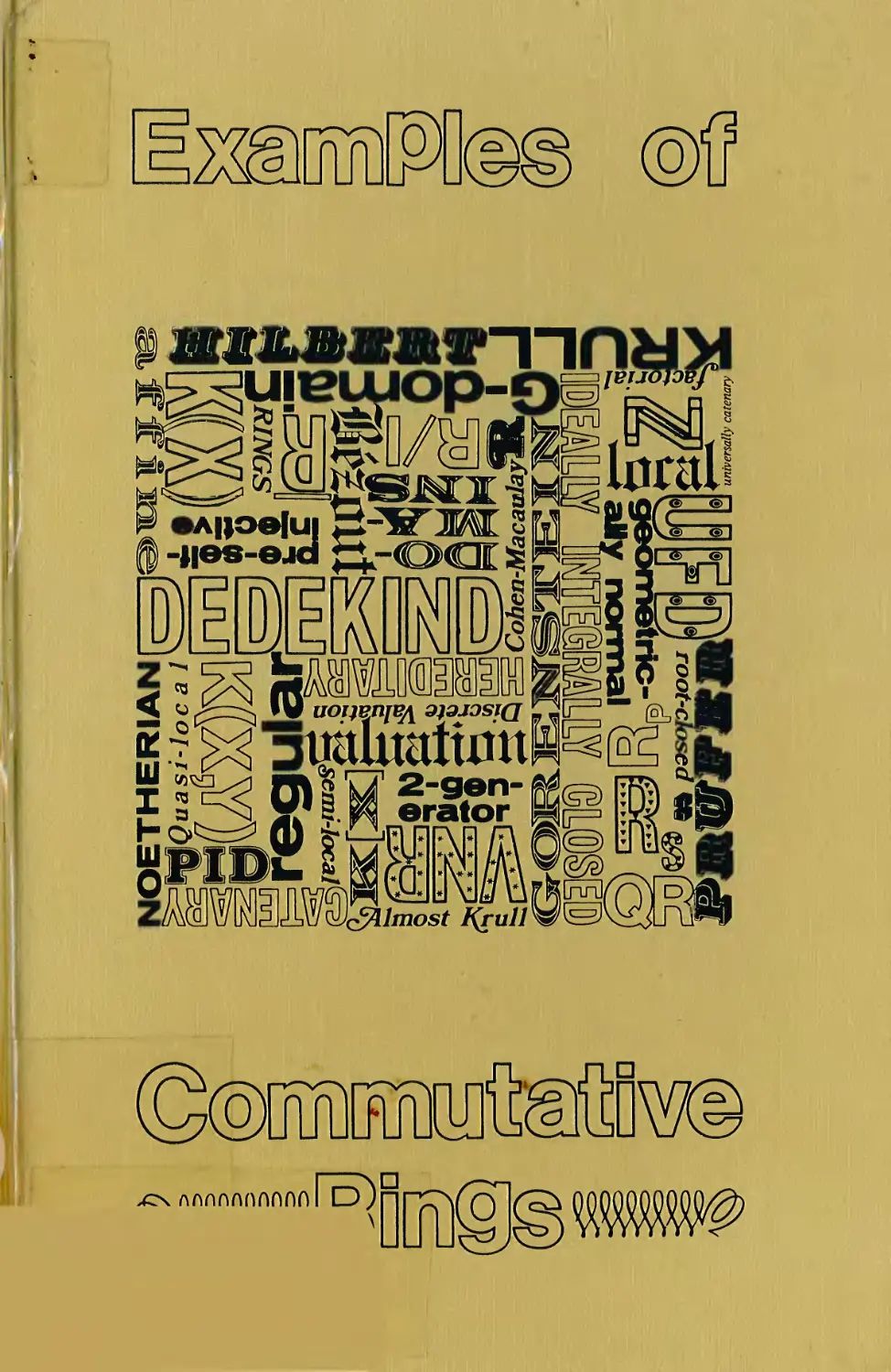


Автор: Hutchins H.C.
Теги: mathematics algebra abstract algebra polygonal publishing house examples commutative rings ring theory mathematical structures
ISBN: 0-936428-05-8
Год: 1984


.
@mmLQ)
@@ @
'1- 1 [ I il L ] ( J t [1) "
,[ V , ,'1 , . t ) )
UI _
ll!!':IOPl1.r
M
DI I
:
'
(QJm'
lnrall
-
, ,= S.N"Ill
.
AI'
UI =-P.IJNi1(
rW' iii
-Iles-e.ld .... -«()(Q[
u;nj
-; .. Alli]WlL
@
lli]
[){]
I 8 .
un uattnU-
@5
---
IIJ
"'''
2-gen-
(57) : y:
..
I: ::I
W'
.
erator
u= : : I.,
!pm! [i:o: :**: fk o
: : $
Alli]W
lLW@c5Il
;t
UlJ
(;) 0
@mm[fffi)QJJ
@
OW@
nnnnnnoOOO rD<oITU@@
mm @@ @
@mmmmlliJ Dw@
D[fiJ@@
oo@[[[[W o OO(ill @GuDITD@
[F)@ W @ITD@ [F)lliJ[2)O @Gu ITD [}{]@(ill@@
@ @@@l1@ W@ITDlli]@
m@@@ @ cJJ @7100 (UJ
@ 1981 by Harry C. Hu tchins
All rights of publication reserved
Calligraphy on pages 21 and 22 by Rita Danzig
Library of Congress Cataloging in Publication Data
Hutchins, Harry C.
Examples of commutative rings.
Bibliography: p.
Includes indexes.
1. Commutative rings. I. Title.
QA251.3.H87 512'.4
ISBN 0-936428-05-8
81-13780
AACR2
Manufactured in the United States of America
by Braun-Brumfield
CORRECTION
SHEET
Note to the Reader
This is a list of corrections (and a few comments)
to Ex les of Commutative Ri , published in 1981 by
Polygonal Press. I offer my apologies to all who have
purcllased or perused this book for the necessity of" issu-
ing tl1is corrections sheet at all. It was, of co'urse, my
intention that the book should not contain any errors;
nonetheless, it did contain some misp ints and some mis-
takes. I hope that I have found and corrected all such
errors in the present list.
I ,yrould like to of"fer my tharu<.s to Willi.alTI Heinzer,
Daniel AlldeI'son, Hale Trotter, and Robe ...t GilTner for their
valuable assistance in preparing this list. Heinzer, in
particula , compiled a detailed list of answers to ques-
tions, misprints, and other mistakes, which has been ex-
tremely" u3ef'ul.
If'" any reader should find any more errors in Exalnples
of' Commutative Rings , I would be grateful to be informed
of' tllern.
Chicago, Illinois
J'uly', 1983
Harry c. H'utchins
MisQrints
"R(X)" should be "R[X]"
"oridinary" should be "ordinary"
"any any" should be "and any"
"1972a, Exercise 21" should be "1972a, p. 321,
Exercise 21"
"actlllally" should be "actually" r
Let x, Y1' Y2' ... be the images of' X'!Y1'" Y2'
..., respectively. The indicated ideals sl10uld
be described in terms of x, Y1' Y2' ... rather
tha n X, Y l' Y 2' ... ·
(c) lines 1-2. "V" shou ld be "vip"
p
(d) 1 ine 2. "ans" should be "and"
(e) lines 1-2. "Example 102" should be "Example 101"
line 2. "LP" should be "L 2 "
(a) line 2. "M" should be "the pre image of" M in K[U, V, WJ"
(d) 1 i.1e 1. "T is thus" shou ld be "R is t11us"
Ex. 126 (e) line 1. "Nagata 1977" should be "Nagata 1970"
Ex. 155 (d) line 2. "The" s110uld be "(The"
Ex. 158 line 2. "v(Y) = 2" should be "v(Y) = the square root
of 2" (Or v(Y) = allY irrational nUInber.)
p. 5 line -12.
p. 6 line -10.
p. 39 line 16.
Ex. 2 ( f) line 1 .
Ex. 4 (a) line 1 .
Ex. 26.
Ex. 36
Ex. 67
Ex. 78
Ex. 80
Ex. 114
Answers to Questions
p. 19 note 14. W. Heinzer and J. Ohm have given an example of
an almost Krull domain which is not pseudo-Pru-
fer in Can. J. 1ath. 25 (1973), no. 4, 856-861.
p. 31 lines 23-24 J. Arnold has shown, in Pac. J. Math. 93 (1981),
no. 1, 31-33, that if R is a discrete valuation
dOJnain of ran1< n, then dim(R[[X 1 , ..., xmJJ) =
nm + 1. Thus if RO is a discrete valuation do-
mainofd"1mension2 and R = RO[[X, YJ], then we
have dim(R) = 5 and dim(R[[ZJJ) = 7.
Ex. 48 (f) lines 1-2. Of course, R does have finitely generated
prime ideals, such as (X 3 2 - X 1 X 2 ).
Ex. 80 (g) line 3. The completion of S is T and so is factorial.
Ex. 114 (d) lines 1-2. R is indeed geometrically normal.
Ex. 123 (a) lines 1-2. The rings R are not NoetI1erian and not
m
integrally closed.
Ex. 126 (d) line 1. R is factorial for n 5 and mayor may not be
factorial for n = 3 and 11 = 4, dependtng 011 K.
(The question is trivial for n = 1 and n = 2.)
Ex. 170 (j) lines 1.-2. T is regular. If we localtze 1=0 the c se
in Wl1ich only the two interesting nlaxirrla] .tc1cals
survive, tilen tIle :r sulting rirlg wi.ll cc:rtD.iniy
be factorial. Is'r Gorenstei.n?
Ex. 175 (e) line 1. R is not catenary but T is Bezout.
p. 4. line 6.
p. 17 line -10.
p. 24 lines 9-100
p. 25 lines 19-20.
p. 31 lines 14-15.
p. 33 line 10.
p. 37 lines 7-8.
Out rtRh t-1:1 i st:al(c s
Irreducibl(- idea18 ar0 primary in a Noet11erJ.a11
ring but not rlnCeSS::ll:,i 1y other'.Jise.
In a defilltng fanlt ly for a Krull donl in R, rIot
every V i must be of the forn1 HI); howevcr , i.c R
is a Krull dOI;.airl, therl the set of all Hp fOJ:"
prime ideals of !1et[ 11t 1 is a defintI18 faInily.
In defining I C, \-J( nf)cd to aSSllme that P Q
as well as P n R = Q n R.
Gi\'en a prirne P of R, i11fj ni.t l many' pl...tn1eR
of R[X] lie over P, namely PRLx-, and (p, f),
where f is a polynomial il"reducible modulo P.
PR[[X]] i.s 110t necessarily a prime ideal in
R[[XJ], but p[[X]] is prinlef p[[XJJ consists
of' all power seri.es Ila"ing all coefficients in
P. p[[X]J is usually much larger than PR[[X]].
If R is Noetherian and I is contained in the
Jacobson ragical of R, ther1 for any ideal J or
R, we have J n R = J.
In the defini.tion of basis of a fre.e n10d111e, we
need not only that a.R n a.R = (0) for i j,
1. J
p. 46 lines 8-9.
p. 48 line -11.
Ex. 1 (f) line 1.
I
}.: x. 3 7 (e ) ti
p - 2 .
Ex. 76 (c) - Cd ) .
(f).
Ex. 93.
Ex. 162 (d) -T ( e) .
Ex. 172 (a) line 1.
Ex. 174 (c) line 1.
Ex. 177 (b) line 3.
(f) line 3.
but also that aiR n (e =l= I ,ajR) = (0) for i =1= j.
J 1
If R[X] has a maximal ideal M with M n R = (0),
then certainly K
R[X]/M, but they need not be
equa 1.
If R is VNR, then every f'initely generated idea 1
is projective, but not necessarily every finite-
ly generated module. See [Rotman 1970, Chapter 4J.
R is Hilbert if and only if K is uncountable.
The easiest way to prove this is to use the fact
that in a countably generated algebra over an
uncountable field, t11e Jacobso
radical is a
nil ideal, i.e., every element is nilpotent.
Delete the parenthetical remark.
If m - 1 or m + 1 is_divisible by 9, then either
R = Z[s, tJ or R = ZLsJ. If m = 10, then R =
Z[s], and if m = 19, then R = Z[s, tJ.
Notice that other cases such as m = 20, or in
2
general m = ab , have not been covered.
The existence of the element a cannot be ta
en
for granted; there are integrally closed domains
which are not completely integrally closed in
which no such element can be found. If R is a
2-dimensional valuation domain, however, we
definitely can find such an element. See a
paper by J. Ohm in Trans. A.M.S. 122 (1966),
321-333.
The generators of the free abelian groups in
question are the mO!lic irreducible polynomials
in X (or in X and Y, respec
ively) with non-
zero COI1stant terms.
R is not quasi-local.
T is not a Hilbert ring. This corresponds to
an error in theorem 3.3 of [G i Irne1." 1971 J.
MD[[XJJ is not necessarily a prime ideal. In
[Arnold 1973J, it was shown that if a domain
R possesses a prime ideal P with p[[XJJ ,&
rad(PR[[X]]), then dim(RQ[XJJ} = 00.
11. Dp is a Noetherian valuation domain and
p*' = PD[[XJJ, then D[[XJJp
': is also a
valuation domain.
(Q;@ITi) @ITi) @
Preface v
Notational Conventions vii
Part I Definitions and Exposition 1
Chapter 1 Preliminaries 2
A. Noetherian Rings 2
B. Domains 5
C. Quasi-local Rings 7
Chapter 2 Domains 12
A. Valuation Domains 12
B. The Group of Divisibility 15
C. The Divisor Class Group 16
D. Miscellaneous Properties 18
Chapter 3 Ring Extensions 23
A. Definitions 23
B. Localization 24
C. Polynomials 25
D. Integral and almost Integral Extensions 27
E. Power Series 31
F. \ Completions 32
G. Miscellaneous Constructions 34
Chapter 4 Homolgical Dimension 37
A. Various Types of Modules 37
B. Projective Dimension 40
C. Injective Dimension 41
Chapter 5 Rings without 1 43
A. What is a Ring without I? 43
B. Disadvantages of a Ring without 1 44
Chapter 6 Miscellaneous Topics 46
A. G-domains 46
B. Hilbert Rings 47
C. von Neumann Regular Rings 48
Part II The Examples 49
Bibliography 150
Further References 154
Index of Notations 162
Index of Definitions 164
[J@ @@@
For many years, in algebra as in other branches of mathematics, there has ex.
isted a trend toward abstraction. Likewise, there is a tendency to prefer polished
elegant accounts of structure theory. Onfortunately, such accounts, however
lucid and beautiful they may be, sometimes conceal the roots of the subject,
and they are frequently poor in explicit examples. What is gained in coherence
and readability is often lost in concreteness.
However, it is difficult to imagine anyone reading or listening to such an
account without becoming curious:
"Are there non-Noetherian Krull domains?"
"How hard is it to build a 4-dimensional valuation domain?"
"What is the completion of Z in the 10-adic topology?"
A serious student's study of theory must be accompanied by at least some
acquaintance with examples; one does not spend a lifetime studying the hy.
pothetical anatomy of curiously absent unicorns. In addition, research is fre-
quently motivated by examples. If all known examples of A.rings are B-rings,
this suggests a conjecture; and conversely, attempts to prove the conjecture may
result in a counterexample.
One hypothetical user of this book might be a student attempting to learn
comm tative ring theory from some standard textbook, such as [Kaplansky
1974b] or [Matsumura 1970]. I hope these examples may help to illustrate
theory and distinguish between concepts. Others, perhaps, may enjoy brow-
sing; the zoo of commutative rings includes a number of strange beasts.
In Part I, I have presented a large body of information about commutative
rings and their ideals. Although I have omitted the proofs, I have tried to pro.
vide references to proofs elsewhere.
As for the examples, I have attempted to maintain a uniformity of presen.
tation. In many cases, not all of the statements made are proven; in some cases,
the proofs would be trivial or repetitive, and in other cases, they would add too
many pages. I have tried to include explicit examples, rather than theorems
which establish the existence of examples (using, say, transfinite induction
and someone's proven-to-exist-but-never.constructed example of a peculiar
abelian group). I have not attempted to draw a distinction between examples
and counterexamples, as the difference is mostly one of attitude; one man's
pathology is another man's normalcy.
VI
PREFACE
All of the rings discussed herein are assumed to be commutative, and (save
in Chapter 5) all are assumed to contain 1.
As with any work of this sort, the choice of topics has been personal and
idiosyncratic. I am making no claim to encyclopedic coverage of the subject,
nor even to completeness in my coverage of the topics included. I am assuming
that the reader is familiar with the concepts of ring, ideal, prime ideal, unit
element, module, and a certain amount of field theory. In Chapter 3, Section F,
some terminology of point-set topology is used; in Section G of the same chap-
ter, tensor products are used. Chapter 4 is a brief account of homological dim-
ension.
An earlier draft of this work constituted my Ph. D. dissertation at the Oni-
versity of Chicago in 1978. I would like to express my sincere gratitude to my
advisor, Irving Kaplansky, whose advice and assistance have been extremely
valuable. Several individuals, including Daniel Anderson, Graham Evans, Robert
Gilmer, and Jack Ohm, read the earlier draft and offered helpful remarks. I
would also like to thank the Oniversity of Chicago and Northern Illinois Oniver-
sity for their support and aid, and I would like to thank Michael Weinstein.
Dekalb, lllinois
June, 1981
Harry C. Hu tchins
@ @ D@ITi)@D @ITi)W@ITi)lto@ITi)@
Z is the ring of integers, occasionally regarded only as an additive group.
Q is the field of rational numbers, occasionally regarded only as an additive
group.
R is the field of real numbers.
C is the field of complex numbers.
Indetermina tes will be represented usually by uppercase letters near the end
of the alphabet, such as U, V, W, X, Y, Z, or by such letters with subscripts,
such as Xl, X 2, X 3, . .. .
R [X, Y, . . . ,Z] is the ring of all polynomials in the indeterminates X, Y,
. . . , Z with coefficients in the ring R.
R [[X]] is the ring of all formal power series in the indeterminate X with co-
efficients in the ring R.
K(X, Y, . . . , Z) is the field of all rational functions in the indeterminates X,
Y, . . . , Z with coefficients in the field K.
Mul tiplication has usually been denoted by juxtaposition, Le., the product
of a and b is ab; but in a few instances it has been denoted using parentheses,
(a)(b), and occasionally with a dot, a- b. The dot - has also been used to indicate
a principal ideal; when several rings are present, (t) may be ambiguous, but
t- R is not.
If we have a subring R of a ring T and an element a of T, R [a] denotes the
subring of T generated by R and a. Thus, for instance, R [2X] is a sub ring of
R [X]. If I is an ideal of T, then we will denote by R + I the sub ring of T con-
sisting of all elements r + i, where r E Rand i E I Thus, e.g., Z + X -Q[ [X] ]
is a subring of Q [[X] ] . (In a few cases, the larger ring T may not be explicitly
specified. )
[P@[f 0
[Q)@ DmJD D@mJ@
@mJ@ [W@@D D@mJ
[J@ ormuOITU@[JO@@
/ko [f{]oetherian ings
Historically, the study of commutative rings commenced with the consider-
ation of rings of polynomials having coefficients in Z or in an arbitrary field.
These rings, among others, have the following extremely useful property.
A ring R is said to be Noetherian if it satisfies either one of the (equivalent)
conditions:
(i) Every ideal of R is finitely generated as an R-module.
(ii) The ideals of R satisfy the ascending chain condition, I.e., any chain
II C 1 2 C 13 C . . . must terminate.
The term honors E. Noether, whose papers helped found the theory of com-
mutative rings.
Chains of prime ideals are of particular interest. A prime ideal P of a ring is
said to be of height n, or ht(P) = n, if there exists a chain Po C PIC . .. C P n =
P of prime ideals of R, and no longer such chain exists. In particular, a prime
ideal is of height 0 if it contains no other prime ideals.
An ideal I is said to be principal if it is generated by a single element x,
written I = (x).
If R is a Noetherian ring, x is a nonunit in R, and P is a prime ideal minimal
among all prime ideals containing (x), then ht(P) 1. Specifically, if x is nil-
potent (that is, x m = 0 for some m > 0), then ht(P) = 0, and if x is not a zero-
divisor, then ht(P) = 1. This extremely powerful result, the principal ideal
theorem, is due to W. Krull. There is a more elaborate version: 1
If R is a Noetherian ring, I is a proper ideal of R generated by n elements,
and P is a prime ideal of R containing I, with P/! of height k in R/I, then the
height of P is at most n + k.
It follows from the principal ideal theorem that any prime ideal of a Noether-
ian ring is of some finite height.
In a non-Noetherian ring, even the simple version of the principal ideal the-
orem can fail spectacularly. Moreover, it is quite possible that a given prime ideal
may not be of any finite height. If P is such a prime ideal, we say that ht(P) = 00.
A ring R is said to be of Krull dimension n, written dim(R) = n (possibly in-
finite), if n = the supremum of ht(P) for all prime ideals P of R.
Even a Noetherian ring may be of infinite Krull dimension. Likewise non-
Noetherian rings can be found in any dimension. Of course, the simple version of
the principal ideal theorem holds trivially in any ring of dimension 1.
An ideal I of a ring R is said to be radical if, whenever x E R and x k E I for
some k 1, then x E l Clearly any prime ideal is radical. Any intersection of
radical ideals is again a radical ideal. Since not every intersection of prime ideals
is a prime ideal, it follows that not all radical ideals are prime.
In fact, any radical ideal is the intersection of all prime ideals containing it. If
I is any ideal of a ring R, we define a related ideal rad( I), called the radical of
I, by rad(I) = the intersection of all prime ideals containing I An alternate (and
equivalent) definition is that x E rad( I) if and only if xk E I for some k I.
The ideal rad((O)) is the smallest radical ideal of the ring, and is sometimes
called the nil radical; it consists of all of the nilpotent elements of R.
If I is a radical ideal and we want to represent I as an intersection of prime
ideals, we clearly can discard any prime ideals which are not minimal among all
prime ideals containing I (that is, we can discard any prime ideals not minimal
over I). It is convenient if there should happen to be only finitely many prime
ideals minimal over l
If R is Noetherian (or, in fact, if R merely satisfies the ascending chain con-
dition on radical ideals, a weaker condition), then there are only finitely many
I For proofs of both versions of the principal ideal theorem, see [Kaplansky 1974b, Theorems
142 and 154]; also see [van der Waerden 1970, p.147].
4
CHAPTER 1
prime ideals minimal over I. The converse to this theorem is not quite true. 2
An ideal I of a ring R is said to be irreducible if I is not the intersection of
two properly larger ideals. Prime ideals are irreducible; indeed, a prime ideal is
precisely an irreducible radical ideal.
An ideal I of a ring is said to be primary if, whenever a E R, b E R, and ab E
I, then either a E I or b k E I for some k 1. Irreducible ideals are primary. 3 If
I is a primary ideal, rad( I) is a prime ideal. However, primary ideals may be re-
ducible, and there are nonprimary ideals I for which rad( I) is a prime ideal.
If I is a primary ideal and P = rad( I), we say that I is P-primary. If I and J are
both P-primary ideals, then I n J is also P-primary. If M is a maximal ideal of a
ring R and I is any ideal of R with M k C I for some k 1, then I is M-primary.
In a Noetherian ring, any ideal is an intersection of finitely many irreducible
ideals. (This fact has little to do with rings; it is really a statement about lattices,
specifically the lattice of ideals of a ring.) Such a representation, of an ideal as an
intersection of finitely many irreducible ideals, may fail (in any of several ways)
to be unique.
Thus, suppose that R is Noetherian and I is an ideal, so I = L 1 n L 2 n . . .
(1 Lm. Each ideal L i is irreducible, and so each L i is Prprimary, for prime ideals
Pi = rad(L i ). Some of the L i may be redundant in the sense that, e.g., L 1 is re-
dundant if it contains L 2 n . . . n Lm. Therefore, some of the ideals L i may be
discarded. Also, the prime ideals Pi may not be distinct. For each prime ideal
Pi, intersect together all of the L i which are Prprimary. Thus we obtain (possibly
reducible) primary ideals K 1, . . . , Kn such that
(i) K i is Qrprimary, for Qi = rad(K i ),
(ii) the prime ideals Qi are all distinct,
(iii) I=K 1 nK 2 n... nK n ,
(iv) the intersection in (iii) is irredundant.
The ideals K i are called the primary components of I. If, for a given i, the prime
ideal Qi is minimal over I, then the component K i is uniquely determined, and
Qi is called an isolated prime of I Otherwise, O i is called an embedded prime of
I, and the component K i may not be unique. In any case, the number n and the
prime ideals Q 1, Q2, . . . , Qn are uniquely determined by the ideal I.
2 See [Kaplansky 1974b, Theorem 88] for a proof of the theorem. A partial converse can be
found in [Kaplansky 1974b, p. 65, Exercise 25] .
3S ee [van der Waerden 1970, p. 127 ff.] for a thorough discussion of primary decomposition
of ideals.
PRELIMINARIES
5
It follows that in any Noetherian ring, there are only finitely many prime
ideals minimal over a given ideal. In a non-Noetherian ring, this property, and
almost any of the other familiar features of primary decomposition, may fail.
F or the ideal I above, the prime ideals Q 1, Q2, . . . , Qn are called the asso-
ciated primes of I, and the set {Ql, . . . , Qn} is denoted by Ass(I).
Suppose M is a finitely generated module over a Noetherian ring R. It is
possible to discuss primary decomposition for submodules of M. If x E M, we
define the annihilator of x, denoted by Ann(x), to be the ideal of R consisting
of all t E R with tx = O. A prime ideal of R is an associated prime of M if P =
Ann(x) for some nonzero element x of M. The set of all associated primes of M
is denoted by Ass(M).
If 0 -7 N -7 M -7 M/N -7 0 is a short exact sequence of R-modules, then the
following is true: Ass(N) C Ass(M) C Ass(N) U Ass(M/N). The containments may
be proper. 4
fD) I[)\ omains
tEJo L0
Let R be an integral domain with quotient field K. R is said to be integrally
closed if, whenever an element x of K satisfies an equation x n + al Xn - 1 + . . .
+ an = 0, with all coefficients a; from R, x is necessarily an element of R. An
equivalent definition is that R is integrally closed if R contains all elements x
of K such that Rex) is a finitely generated R-module.
While fields are obviously int grally closed, most domains are not. The inter-
section of any family of integrally closed domains, all contained in some large
given field, is integrally closed.
For Rand K as above, R.is said to be completely integrally closed if, when-
ever elements a and x of K are such that a =1= 0 and ax k E R for all k 1, x is
necessarily an element of R. An equivalent definition is that R is completely in-
tegrally closed if it contains all elements x of K such that R [x] is contained in a
finitely generated R -module.
Completely integrally- closed domains are integrally closed. The intersection
of any family of completely integrally closed domains, all contained in some
large given field, is completely integrally closed.
4 See [Matsumura 1970, pp.49-57] for a discussion of primary decomposition of submodules,
including the connection between the two notions of associated prime. Also see [Kaplansky
1974b, pp. 54-58] .
6
CHAPTER 1
A ring R is Noetherian if and only if every submodule of any finitely gener-
ated R-module is finitely generated; thus an integrally closed Noetherian domain
is completely integrally closed. However, not all completely integrally closed
domains are Noetherian.
An element a of a domain R is said to be irreducible if it cannot be written as
a product a = bc of nonunit elements band c of R. The nonzero element a of R
is said to be a principal prime if the ideal (a) is prime. Any principal prime el-
ement is irreducible, but not every irreducible element is a principal prime. In
any domain with the ascending chain condition on principal ideals, there must
be irreducible elements; but even in a Noetherian domain, it is possible that
there might not be any principal prime ideals.
. A domain R is said to be factorial (or a unique factorization domain) if R
satisfies either of the (equivalent) conditions:
(i) Any nonzero element of R can be written as a product of principal primes
and units.
(ii) Any nonzero prime ideal of R contains a principal prime ideal. 5
In any factorial domain, every prime ideal of height 1 is principal. Since there
are domains which are not fields, but which nonetheless have no prime ideals of
height 1, this condition is not equivalent. However, a Noetherian domain is fac-
torial if and only if every prime ideal of height 1 is principal.
Any factorial domain is completely integrally closed and satisfies the simple
version of the principal ideal theorem. However, a domain may be Noetherian
and integrally closed and still not be factorial. A domain may be factorial and
still fail to be Noetherian.
Let R be an integral domain with quotient field K. An R -submodule of K is
called a fractional ideal of R. Ordinary ideals are clearly fractional ideals; these
are sometimes referred to as integral fractional ideals. (Occasionally the term
"fractional ideal" is used with a more restrictive definition; for instance, one
might say that an R-submodule I of K is a fractional ideal if it is finitely gener-
ated, or if there is a nonzero t E R with tI C R.)
If I is a fractional ideal of R, we define 1- 1 = {x I xl C R}. If I and J are frac-
tional ideals of R, we define their product IJ = {a 1 b 1 + a2 b 2 + . . . + am b m ,
with ai E I and b j E J for all i and J}. A fractional ideal I is said to be invertible
if II - 1 = R. Notice that for any fractional ideal I we have 11- 1 C R.
If I is a fractional ideal generated as an R-module by one element (a cyclic
5 One elegant proof that these conditions are equivalent can be found in [Kaplansky 1974b,
Theorem 5] . There are also many other conditions equivalent to factoriality.
PRELIMINARIES
7
R-module), I is called a principal fractional ideal. We have (x)- 1 = (x- 1), so any
principal fractional ideal is invertible. In general, invertible fractional ideals are
not necessarily principal. For each n 1, there is a domain in wpich some in-
vertible ideal may require n generators. If R is a factorial domain, however, in-
vertible fractional ideals are principal. 6 This useful property also holds in some
other classes of domains.
In any case, an invertible fractional ideal is always finitely generated as an R-
module. The notion of "invertible fractional ideal" can be thought of as a gen-
eralization of that of "principal ideal."
o @uaSi-Iocal ings
A ring R is said to be quasi-local if it has exactly one maximal ideal; and is
said to be local if it is Noetherian and quasi-local. By convention, one does not
usually consider a field to be a quasi-local ring.
Quasi-local and local rings have useful properties, among which is that in gen-
eral any ring can be made quasi-local, by a procedure known as localization.
Let R be a ring and let S be a multiplicatively closed subset of R. Let us
assume that 0 tf=. S. We may also assume that S contains all of the units of R, and
that S is saturated, Le., S contains all divisors of elements of S. (The first as-
sumption is necessary; the other two are harmless.)
Now we can construct a new ring, Rs, in which all of the elements of Shave
become units. Rs consists of equivalence classes of formal quotients a/s, where
a E Rand s E S, and a/s bit if and only if u(at - bs) = 0 for some element u
of S. Rs becomes a ring once we define multiplication and addition (on typical
representatives of equivalence classes) by a/s · bit = ab/st and a/s + bit = (at +
bs)/st There is a homomorphism R -7Rs, defined by sending each x ER to x/I
in Rs. This map may not be one-to-one and is surjective only in trivial cases.
Any proper ideal I of R which has an empty intersection with S "survives"
in Rs, that is, there is an inclusion-preserving correspondence between such
ideals of R and all of the proper ideals of Rs, where I corresponds to the ideal
Is of Rs generated by the image of I.
The ring Rs is called the localization of R at S. If R is a domain, Rs is actual-
ly a sub ring of the quotient field of R, and the inclusion of R into Rs is obvious-
6 See [Kaplansky 1974b, p. 42, Exercise 15]. In fact, a stronger theorem is that in a pseudo-
Bezout domain, invertible fractional, ideals are principal.
8
CHAPTER 1
ly one-to-one. In any ring R, there are several standard kinds of multiplicatively
closed sets S:
(i) S = {x, x 2 , x 3 , . . .}, for some nonnilpotent element x of R. If x is a non-
zero-divisor, Rs is in this case sometimes denoted by R [x - 1 ] .
(ii) S = the set-theoretic complement of a prime ideal P of R. In this case,
Rs is often denoted by R p and is called R localized at P.
(iii) S = the intersection of S 1, 8 2 , . . . , Sm, where each Sf is the complement
of a prime ideal Pi.
If P is a prime ideal in R, the correspondence of ideals described above shows
that R p is a quasi-local ring, having as its maximal ideal P p . If R is Noetherian,
then R p is a local ring.
If PI, . . . , Pm are prime ideals of Rand S is the intersection of their com-
plements, then Rs has at most m maximal ideals, namely PIS, . . . , Pm s. (There
might be fewer if, say, PI C P 2 .) This fact follows from the following lemma:
If PI, . . . , Pm are prime ideals in R and I is an ideal of R such that I C PI U
P 2 U . . . U Pm' then in fact I C Pi for some i. 7 This lemma can be strengthened
somewhat, but not in the direction of replacing "finitely many prime ideals"
with "infinitely many prime ideals."
In any ring R, a fourth kind of multiplicatively closed set is
(iv) S = the set of all non-zero-divisors in R. In this case, Rs is called the
total quotient ring of R.
Some rings are already their own total quotient rings, i.e., every nonunit is
a zero-divisor. Any ring of dimension 0 is its own total quotient ring,8 but not
conversely.
(Often in the literature the term "localization" is reserved for R p , while Rs
is referred to as a quotient ring.)
A ring having only finitely many maximal ideals is called a semi-quasi-local
ring. If it is Noetherian as well, it is called a semi-local ring.
Let R be a domain with quotient field K. Then K = R(O)' since (0) is a prime
ideal. There may be many sub rings of K which are not localizations of R. In gen-
eral, a subring of K which contains R is called an overring of R.
7This is a standard theorem. See [Kaplansky 1974b, Theorem 81], or [Matsumura 1970,
p.2] for a proof. See also [Quartararo and Butts 1975] for more information.
S See [Kaplansky 1974b, Theorem 91] for a proof.
PRELIMINARIES
9
If R is a semi-quasi-Iocal domain, all invertible fractional ideals of R are prin-
cipal. In fact, an ideal I of a domain R is invertible if and only if I is finitely gen-
erated and 1 M is principal for every maximal ideal M of R. 9
If R is a semi-local ring, then R is of finite Krull dimension, namely the su-
premum of the heights of all maximal ideals.
Suppose R is a quasi-local ring with maximal ideal M and suppose A is a fi-
nitely generated R-module. If MA = A, then A = (0). This result is called the
Nakayama lemma (and various other names).10 It is very useful; some versions
of it hold even in the noncommutative case.
Suppose R is a I-dimensional, integrally closed, local domain. Then R has pre-
cisely one nonzero prime ideal, M, which turns out to be principal. 11 Such a
ring is called a Noetherian valuation domain: it is in many ways the very nicest
possible I-dimensional ring. There is a generalization of this "niceness" to higher
dimensions.
Let R be a local ring with maximal ideal M Then M/M2 is a module over
R/M. Actually, R/M is a field, so M/M2 is a vector space over R/M, of some fi-
nite dimension d. If aI, . . . , ad are elements of R, then M = (a 1, . . . , ad) if and
only if the images of aI, . . . , ad span M/M2 over R/M (One way to prove this is
by way of the Nakayama lemma.)
It. follows from the fancier version of the principal ideal theorem that
dim(R) d. If d = dim(R), we say that R is a regular local ring. A Noetherian
valuation domain is simply a regular local ring of dimension 1.
Any regular local ring is a factorial domain, 12 and thereby is integrally closed.
By no means are all local domains, or even all local factorial domains, regular.
Various attempts have been made to define regularity in the non-Noetherian
quasi-local case .13
9 Part of this theorem is trivial; see [Kaplansky 1974b, Theorem 62] for a proof.
IOProofs of the Nakayama lemma can be found in [Kaplansky 1974b, Theorem 78], or in
[Matsumura 1970, p. 11], or in [Nagata 1962, p. 12]. See [Nagata 1962, p. 212] for a discussion
of the lemma's history.
11 See [Kaplansky 1974b, Theorem 95] for a proof.
12 This is not easy to prove, although there are several weaker statements which are not as
difficult: the I-dimensional case, or the proof that a regular local ring is a domain. For a proof,
see [Kaplansky 1974b, Theorem 184], or [Matsumura 1970, p. 142], or [Nagata 1962, p. 99].
13 See item # 1 in the Further References section.
10
CHAPTER 1
Let R be any ring and let A be any R-module. An ordered sequence Xl, X2,
. . . , X m of elements of R is said to be an R-sequence on A if
(i) (XI,. . . ,xm)A =l=A, and
(ii) X I is not a zero-divisor on A and for each i 2, Xi is not a zero-divisor on
A/(x 1, . . . , Xi- 1 )A.
The order of the elements is quite significant; in general, a permutation of an R-
sequence is not an R-sequence. If, however, R is local and A is finitely generated,
then any permutation of an R-sequence on A is also an R-sequence. 14
If R is Noetherian, any R-sequence on A can be extended to an R-sequence of
maximal length (still finite). If, in addition, I is an ideal of R, A is finitely gen-
erated, and IA =1= A, then any two R-sequences on A contained in I, which are
maximal, are necessarily of the same length, which we shall denote by-Gr(I, A)
and call the grade of I on A.
If R is a local ring, with maximal ideal M, we denote Gr(M, R) by Gr(R) and
call this the grade of R. It is true in general that dim(R) Gr(R). If dim(R) =
Gr(R), we say that R is a Cohen-Macaulay local ring.
Any regular local ring is Cohen-Macaulay, but the converse is quite false. A
local ring R which is Cohen-Macaulay may not be a domain; if it is a domain, it
may not be integrally closed; if it is an integrally closed domain, it may not be
factorial; and even if it is a factorial domain, it may not be regular. On the other
hand, there are local factorial domains which are not Cohen-Macaulay.
If R is any Noetherian ring, we say that R is regular if RM is a regular local
ring for every maximal ideal M Likewise, R is Cohen-Macaulay if RM is a
Cohen- Macaulay local ring for every maximal ideal M
If R is a regular ring and t is a nonunit in R, then R/( t) is regular if and only
if t is not in the square of any maximal ideal. Likewise, if R is Cohen-Macaulay,
then R/I is Cohen-Macaulay if I is generated by an R-sequence. These facts are
useful in showing that various specific rings either are or are not regular or
Cohen-Macaulay.
If R is a Noetherian ring, then for an ideal I, I-I = R if and only if Gr(I, R)
2.
Any regular ring is Cohen-Macaulay. A regular ring may not be a domain,
but at least it will be a direct sum of regular domains. 1s Regular domains need
not be factorial, but they are integrally closed.
14 For a discussion on R-sequences and grade, see [Kaplansky 1974b, p. 84 ff.] .
15 This is a special case of [Kaplansky 1974b, Theorem 168].
PRELIMINARIES
11
Any integrally closed Noetherian domain of Krull dimension 2 or less is
Cohen-Macaulay. This cannot be improved, even to dimension 3.
It is useful here to notice that the Cohen-Macaulay property is defined only
for Noetherian rings. If R is not Noetherian, the concept of grade becomes very
intractable. There may be maximal R-sequences on a module which are of
different lengths, or even of infinite length. 16
Let R be any ring, and let P and Q be prime ideals of R with P contained in
Q. A chain of prime ideals of R, all lying between P and 0 is said to be saturated
if no additional prime ideals can be inserted to make a longer chain. The ring R
is said to be catenary if, for any two such prime ideals P and Q, any two sat-
urated chains of prime ideals starting with P and ascending to 0 are of the
same finite length.
Any ring of dimension 2 or less is catenary, and any Cohen-Macaulay ring is
catenary.17 It is fairly easy to construct noncatenary rings with zero-divisors, or
even integrally closed quasi-local domains which are not catenary. At much
greater effort, Noetherian domains can be found which are not catenary; but the
problem of constructing a noncatenary, integrally closed, Noetherian d'Omain
h,as only recently been solved. 18
A ring R is said to be universally catenary if every polynomial ring R [XI,
. . . , Xm] in a finite number of indeterminates is catenary. If R is universally
catenary, it is catenary, but the converse is false. There are examples of I-dim-
ensional rings R (which are trivially catenary) for which R [X] is not catenary.
16 See [Hochster 1974] for information on the notion of grade for non-Noetherian rings.
17 "Catenary" is but one of several available chain conditions on saturated chains of prime
ideals. See [Kaplansky 1974b, Theorem 138]; also see [Nagata 1962, p. 122 ff.].
18 See item #2 in the Further References section.
OOITl])@OITD@
/f0.o Waluation [Q)omains
Let R be an integral domain with quotient field K. R is said to be a valuation
domain if it satisfies either of the (equivalent) conditions:
(i) F or any two elements x and y of R, either x divides y or y divides x.
(ii) F or any element x of K, either x E R or X-I E R.
Valuation domains are integrally closed. 1 A valuation domain is completely
integrally closed if and only if it is I-dimensional. A Noetherian valuation do-
main is I-dimensional; but not aU I-dimensional valuation domains are Noether-
ian. Of course, any valuation domain is quasi-local; the maximal ideal consists
of all nonunits, as in any quasi-local ring.
The ideals of a valuation domain R (in particular, the prime ideals) are lin-
early ordered by inclusion. Any finitely generated ideal of R (in particular, any
1 For a proof that pseudo-Bezout domains are integrally closed, which is a stronger statement,
see [Kaplansky 1974b, Theorem 50]. For material on valuations, see [Gilmer 1972a, Chapter
III] or [Bourbaki 1972, Chapter VI] .
invertible ideal) is principal. Radical ideals of R are prime ideals. The principal
ideal theorem fails spectacularly in any valuation domain of dimension at least
2; if P is a nonzero nonmaximal prime ideal and x f/=. P, then any prime ideal
minimal over (x) must have height at least 2 (assuming x is not a unit).
The name "valuation domain" comes from the fact that classically valuation
domains arise from the study of valuations on fields. If K is a field, a valuation
on K is a map v:K --* G U {oo}, where G is a linearly ordered abelian group, writ-
ten additively, and 00 is defined to be greater than any element of G, such that
for all elements a and b of K,
(i) v(ab) = v(a) + v(b),
(ii) v(a) = 00 if and only if a = 0, and
(iii) v(a + b) the lesser of v(a) and v(b).
The group G is called the value group of the valuation v. If R = {x I x E K and
v(x) O}, R is a valuation domain, sometimes denoted Rv. Its maximal ideal
ispreciselyM= {xl xEKandv(x»O}.
There is an extensive theory of valuations, largely due to W. Krull. It is quite
possible to obtain the same valuation domain by way of several distinct val-
uations.
Valuation domains exist in abundance. In particular, suppose R is a domain
contained in a field K, and M is a maximal ideal of R. Then there is a valuation
domain V with quotient field K and maximal ideal N such that N n R = M 2
If R is a Noetherian valuation domain, its value group is isomorphic to Z.
If R is I-dimensional, then it is Noetherian if and only if its value group con-
tains a least positive element, or if and only if the maximal ideal M of R has
M =1= M 2 . R is l-dimensional if and only if its value group is isomorphic, under an
order-preserving isomorphism, to a subgroup of the linearly ordered group of
real numbers.
(A Noetherian valuation domain is often called a "discrete" valuation do-
main. Another usage of "discrete" is that a valuation domain R is discrete if,
for any prime ideals P and Q of R with P C Q and Q/P of height 1 in R/P,
(R/P)Q/p is Noetherian. I will continue using "Noetherian," which is unmis-
takable. )
Just as the notion of "regular local ring" was globalized to "regular ring," so
the notion of "valuation domain" has been globalized. A domain R is said to be
a PrUfer domain if it satisfies either of the (equivalent) conditions:
2 See [Kaplansky 1974b, Theorems 55 and 56, and p. 44, Exercise 34] for a proof.
14 CHAPTER 2
(i) Any finitely generated nonzero ideal of R is invertible.
(ii) RM is a valuation domain for every maximal ideal M of R.
There are dozens, perhaps hundreds, of conditions equivalent to "Prtifer": con-
ditions on ideals, on prime ideals, on modules, etc. 3
Prtifer domains are integrally closed and catenary, and I-dimensional Prtifer
domains are completely integrally closed. Any overring of a Prtifer domain is
Prtifer.
A Noetherian Prtifer domain is called a Dedekind domain. There are again
many equivalent conditions: A domain R is a Dedekind domain if and only if
(i) R is Noetherian, integrally closed, and I-dimensional, or
(ii) every nonzero ideal of R is invertible, or
(iii) every (proper) ideal of R is a product of prime ideals, or
(iv) R is I-dimensional and regular.
A domain R !s said to be Bezout if every finitely generated ideal of R is prin-
cipal. Any valuation domain is Bezout. Since principal ideals are invertible, any
Bezout domain is Prtifer. There are Bezout domains which are not valuation do-
mains, and there are Prtifer domains which are not Bezout. A semi-quasi-local
Prtifer domain is Bezout, but this sufficient condition is not necessary.
A Noetherian Bezout domain is called a principal ideal domain. Here are
several equivalent definitions:
(i) Each ideal of R is principal and R is a domain.
(ii) R is I-dimensional and factorial.
(iii) R is Prtifer and factorial.
(iv) Each prime ideal of R is principal and R is a domain.
Clearly, any principal ideal domain is a Dedekind domain. Both kinds of
domains arise naturally and frequently in algebraic number theory. It is of con-
siderable interest to know which Dedekind domains are principal ideal domains.
In any Oedekind domain, any ideal I can be generated by two elements, Le.,
I = (a, b) for some a and b. The parallel question for Prtifer domains-whether
finitely generated ideals require no more than two generators 4 -has only recent-
ly been settled, in the negative. 5
3 See [Gilmer 1972a, Chapter IV] for much material on Prilfer domains.
4 This is called the 2-generator property.
5 See items #3 and 4 in the Further References section.
DOMAINS
15
Suppose R is an integral domain and x and yare nonzero elements of R. Then
an element z is said to be the greatest common divisor of x and y, denoted z =
g.c.d.(x, y), if z divides both x and y, and for every element t which divides both
x and y, t divides z. Of course, greatest common divisors are only unique up to
multiplication by units of R.
If g.c.d.(x, y) exists for every x and y in R, R is said to be pseudo-Bezout 6
Bezout domains and factorial domains are pseudo-Bezout. There are pseudo-
Bezout domains which are neither factorial nor Bezout, in dimensions greater
than 1; but a I-dimensional pseudo-Bezout domain is actually Bezout. 7
Pseudo-Bezout domains are integrally closed. If R is Noetherian and pseudo-
Bezout, it is factorial; indeed, R is factorial if and only if it is pseudo-Bezout and
satisfies the ascending chain condition on principal ideals. If R is pseudo-Bezout,
its invertible ideals are principal. (If g.c.d.(x, y) exists, then ((x, y) - 1) - 1 =
(g.c.d.(x, y)).) If R is pseudo-Bezout, irreducible elements of R are principal
primes, but there are domains which are not pseudo-Bezout but in which all
irreducible elements are principal primes.
One can define the least common multiple of x and y, or l.c.m.(x, y). In a
domain (with I), the existence of g.c.d.(x, y) for all x and y is equivalent to the
existence of l.c.m.(x, y) for all x and y, and their product is xy. There are
domains in which for some specific elements x and y, g.c.d.(x, y) exists, but
l.c.m.(x, y) does not exist.
I g o lJh e @roup of [Q)ivisibility
Suppose R is a domain with quotient field K. Let R* and K* be the mul-
tiplicative groups of units of Rand K respectively. The groups R* and K* are
abelian, and R * is a subgroup of K*. The group of divisibility of R is the factor
group K*/R*, denoted by G(R).
Notice that the value group of a valuation domain R is isomorphic to G(R).
For any domain R, there is a natural partial order on G(R), defined, for non-
zero elements a and b of R, by a* b* if and only if a divides b in R, where a*
and b* are the images of a and b, respectively, in G(R). This order is then ex-
6 See [Kaplansky 1974b, pp. 32-33] or [Gilmer 1972a, p. 75 ff.] for material on g.c.d.s.
7 See [Sheldon 1974]. This is a nice little result. It actually suffices to prove that a I-dimen-
sional, quasi-local, pseudo-Bezout domain is a valuation domain.
16
CHAPTER 2
tended to all of G(R). Since a and b each divide ab, always, this js actually a
directed partial order. (A partial order is directed if, for any two elements u and
v, there is an element w with u, v w_) It is not necessarily a lattice, however.
(A partially ordered group is lattice-ordered if each finite subset has a least up-
per bound.)
Suppose R is integrally closed. Then G(R) is a torsion-free group. (An abelian
group is torsion-free if every element except the identity is of infinite order.)
Actually, the precise condition needed is not integral closure; what is needed is
root-closure; a domain R with quotient field K is root-closed if for any x E K
such that x n E R for some n > 0, then x E R. This condition is weaker than
integral closure.
Many of the properties of the domain R are related to the properties of G(R).
R is a valuation domain if and only if G(R) is linearly ordered. R is pseudo-
Bezout if and only if G(R) is lattice-ordered. R has the ascending chain con-
dition on principal ideals if and only if G(R) has the descending chain condition
on elements; that is, if and only if any chain al a2 a3 . . . must termin-
ate. Putting together two of these statements, it can be shown that R is factorial
if and only if G(R) is a sum of copies of Z. If T is any overring of R, then G(T)
is a homomorphic image of G(R). 8
Suppose Go is any lattice-ordered abelian group. Does a domain R exist hav-
ing G(R) "'-' Go? The answer is yes, and one construction for such a domain is as
follows:
Let K be any field, and let T = K [t;K for all g E Go] , where t;K · t!' = t;K+ h . Thus
T is the group ring of Go over K. A typical element of T is of the form x =
al tgt + ... + amt gm , where at,... am EK and gt,..., gm E G o - Let S be
the subring of T consisting of all such elements x for which inf(gl, . . . , gm)
O. Let R = S u, where U is the multiplicatively closed set consisting of all ele-
ments of S having nonzero constant terms. (Notice that to = 1.)
This domain in Bezout and has G(R) "'-' Go. The construction and its prop-
erties are due variously to Krull, Kaplansky, Jaffard, and Ohm.
o U he [Q)ivisor lass @roup
Let R be a domain with quotient field K. A fractional ideal I of R is said to
8 See [Gilmer 1972a, Chapter III] for a great deal of material on G(R); also see [Mott 1973]
and [Mott 1974] .
DOMAINS
17
be divisorial if (I - 1)- 1 = I Equivalently, a fractional ideal I is divisorial if and
only if I is the intersection of all principal fractional ideals containing I.
Clearly, principal ideals and invertible ideals are divisorial; but in general,
divisorial ideals are not invertible, and the intersection of even as few as two
principal ideals, while it must be divisorial, does not have to be principal, in-
vertible, or even finitely generated.
Let D(R) be the set of all divisorial ideals of R. We define the product of two
divisorial ideals I and J to be I-J = ((IJ)- 1)- 1 . Then D(R) is an abelian monoid
with R as its identity.
R is completely integrally closed if and only if D(R) is a group. In any case,
D(R) contains a subgroup Prin(R), consisting of all principal fractional ideals.
Suppose D(R) is a group. Then the factor group D(R)/Prin(R) is called the
divisor class group of R and is denoted by CI(R). 9
There is another way to obtain D(R) which explains the name "divisor class
group." For any fractional ideal I of R, define the divisor of I to be div(I) =
the intersection of all principal fractional 'ideals containing I. (Or equivalently,
div(I) = (I - 1)- 1 .) Thus div(I) is the smallest divisorial ideal containing I. De-
clare two fractional ideals I and J to be equivalent if div(I) = div(J). D(R) can
be thought of as the set of all such equivalence classes, each represented by a
divisorial ideal.
The divisor class group is of most interest in studying one particular class
of domains. Let R be a domain with quotient field K. R is said to be a Krull
domain if there exists- a family of Noetherian valuation domains, {Vi liE S},
each containing R and contained in K, such that R is the intersection of the
Vi and each nonzero element of R is a unit in all but finitely many of the Vi.
If R is a Krull domain and the Vi are as above, then each Vi is R p for some
prime ideal P of R of height 1, and conversely, if P is a prime ideal of R of height
1, then R p is a Noetherian valuation domain, one of the Vi.
An equivalent definition is that R is a Krull domain if and only if it is com-
pletely integrally closed and it satisfies the ascending chain condition on div-
isorial ideals. If R is a Krull domain, D(R) is generated by the divisor classes of
the prime ideals of height 1.
There are various generalizations available of the notion of Krull domain.
For instance, the valuation domains Vi might be required to be merely I-dim-
ensional, not Noetherian. There is a limit to this sort of generalization, how-
9 For material on divisors, Krull domains, and Cl(R), see [Bourbaki 1972, Chapter VII] or
[Fossum 1973] .
18
CHAPTER 2
ever, since any integrally closed domain is the intersection of all valuation do-
mains containing it-and there are integrally closed domains which are very far
from being Krull.
Krull domains exist in abundance. Any Noetherian integrally closed domain
is Krull, and so is any factorial domain.
A Dedekind domain is simply a I-dimensional Krull domain. A domain R is
factorial if and only if R is a Krull domain and CI(R) = (0). Thus the divisor
class group can be thought of as a way to measure how far a domain is from be-
ing factorial. For a Krull domain to be factorial, every divisorial ideal must be
principal; it is not sufficient for every invertible ideal to be principal.
One fact, frequently useful in working with divisors, is the following: If I
is an ideal of a domain Rand Gr(I, R) 2, then I-I = R. If R is Noetherian,
then the converse is also true. 10
Just as with groups of divisibility, it is natural to ask which abelian groups
can occur as divisor class groups. This important question was answered by L.
Claborn in 1966: Let Go be any abelian group. Then there exists a Dedekind do-
main R having CI(R) "'-' Go. 11
The original proof of this theorem is rather involved and is not nearly as ex-
plicit as the previous construction for groups of divisibility. It is in some ways
the best such theorem one could want. (It is also true that Go could be realized
as CI(R) for a Krull domain R of arbitrary dimension.)
If R is a Priifer domain, R may fail to be completely integrally closed, so
D(R) may fail to be a group. Let I(R) be the set of all invertible ideals of R
(which is to say, all the finitely generated ideals). Then I(R) is a subgroup of
D(R), containing Prin(R), and the quotient group I(R)jPrin(R) is called the
class group of R. (It is also true that any abelian group can be realized as the
class group of a suitable Priifer domain.)
)D [MJiscellaneous roperties
Let R be a domain with quotient field K. An element J of D(R) is called a
10 See [Kaplansky 1974b, p. 102, Exercises 1-2] .
11 See [Claborn 1966]; or see [Fossum 1973, Chapter III] for a lucid account of Claborn's
theorem. In recent years, several alternate constructions have been discovered; for instance see
[Eakin and Heinzer 1973] and Further References, item #9.
DOMAINS
19
finitely generated divisor if J = div(I) for some finitely generated fractional
ideal 1
Suppose that R is not completely integrally closed. Then D(R) is not a
group, but merely a monoid. If every finitely generated divisor J is regular in
D(R), Le., if JeLl = JeL2 implies L 1 = L 2 for all L 1 and L 2 in D(R), then R
is said to be regularly integrally closed. 12
Since invertible elements of a monoid are regular, it follows that a completely
integrally closed domain is regularly integrally closed. If R is regularly inte-
grally closed, then it is integrally closed.
If the set of all finitely generated divisors is actually a subgroup of the mon-
oid D(R), then R is said to be pseudo-PrUfer. 13 Any pseudo-Prtifer domain is
regularly integrally closed. Any Krull domain or Priifer domain or pseudo-
Bezout domain is pseudo-Priifer. None of these statements can be reversed; in
fact, it is possible for a domain to be completely integrally closed but not
pseudo-Priifer.
Suppose R is a pseudo-Bezout domain. Then G(R) is a lattice under its nat-
ural order. R is said to be pseudo-principal if it satisfies one of the (equivalent)
conditions:
(i) G(R) is a complete lattice, Le., any nonempty bounded subset has a
supremum
(ii) Any nonempty set of nonzero elements of R has a greatest common
divisor.
(iii) CI(R) is a group, namely (0).
(iv) Every divisorial fractional ideal of R is principal.
By definition, any pseudo-principal domain IS pseudo-Bezout and com-
pletely integrally closed. Any factorial domain is pseudo-principal, but not
conversely.
A domain R is said to be almost Krull if RM is a Krull domain for each max-
imal ideal M of R. An almost Krull domain is completely integrally closed, but it
need not be a Krull domain. (The difference is a rather delicate one.)14
12 For material on regularly integrally closed, pseudo-Pnifer, and pseudo-principal domains,
see [Bourbaki 1972, Chapter VII (exercises)] .
13 [Gilmer 1972a] refers to pseudo-Prtifer domains by the name "Pru fer v-multiplication
rings. "
14 See [Gilmer 1972a, Chapter VI] for material on almost Krull, almost Dedekind and 1T-do-
mains. Is every almost Krull domain pseudo-Prtifer?
20
CHAPTER 2
Likewise, a domain R is said to be almost Dedekind if R p is a Noetherian val-
uation domain for each nonzero prime ideal P of R.
If R is almost Dedekind, it is very easy to see that it is I-dimensional, Priifer,
and almost Krull. If R is I-dimensional and almost Krull, then it is almost
Dedekind. For Noetherian domains, "almost Krull" and "almost Dedekind"
become "Krull" and "Dedekind" respectively.
There are various generalizations of factorial domains. Here are two of
them:
A ring R is said to be locally factorial if RM is factorial for each maximal
ideal M of R.
A domain R is said to be a 1T-domain if it satisfies one of the (equivalent)
conditions:
(i) R is Krull and locally factorial.
(ii) R is Krull and each prime ideal of height 1 is invertible.
(iii) Each principal ideal of R is a product of prime ideals.
By definition, any 1T-domain is locally factorial. Any factorial domain or
regular domain is a 1T-domain. There are domains which are locally factorial,
but not Krull and thus not 1T-domains. A locally factorial domain is clearly
almost Krull, but the converse is false.
One observation to be made with regard to the definitions above is that in
a Krull domain an invertible prime ideal is necessarily of height 1.
DOMAINS
21
f1IOet ria.:n,
vaCua.tion dOnutin-
I I I
..,
i-di-mensionaC -' p;rim-ipa,,[
1'aC'Ua-tion clin1UUn 1, a£ dbma;'tn
t I it I L
11a(uat-um -dimensiona£ actoria.C
.{m, l -Sizou:t..
-sizi-t' !
j - -'
1£r r
aCmosf( r
cUli:{,--ruL
t
reauCa"..
Ckac
l £ I I
I
I
1-,uCa.r
:
7r- domai11., I
I
1 J [
aCmost' x-rufC
-L-
COm1'Cm 1I- -
c? erf
(a.rC1f in-
aCf' t(ose£
1 i mS cCcJ
-:JJ uCaj
t I
:NOeth£r-ia/tt
1t -r
f ..se:u -,prt:tt-
t I
t
jse-u4 -1iiwu:tf'
J'se-uao-1>
1. - dimensionaC
:NOetlUrta,n-
I
1.-dime
1
Ca: rn.4r:J
t
i-Coca[
Properties of Domains
jinc!JF ikf dimuun
etheria,'t1,
'\1RC-ua.tion, cGm.a.in
I I
of
",.. COcaf ri
of
defitu{
- Ztcima 11,
1- ciilJ1l£'nSiOnaf dOmain
7r- in
1- t
Coca£C"{ _ r :KruCC
Jactorta,t, dOmain.
Coli£r
cate
Cre
Semi - CocaC
dim( )<oo
Properties of Noetherian Domains
D[fU@ lt@[fU@D@[fU@
o [Q)efinitions
A large portion of commutative ring theory deals with situations of the fol-
lowing type: Suppose Rand T are rings, related in some fashion (perhaps R is a
subring of T, or T is a homomorphic image of R). If R has some property, does
T also have it?
F or most of this chapter, except where otherwise stated, we shall assume that
Rand T are rings and that R is a subring of T. In this case, the question above is
referred to as the ascent question. The parallel question, namely, whether
R must have some given property, given that T has it, is called the descent
question.
Often we want to relate the prime ideals of R to the prime ideals of T. If
Q is a prime ideal of T, then Q n R is always a prime ideal of R. Can every
prime ideal of R be obtained in this way from a prime ideal of T? There are
several variations on this question.
We say that lying-over (abbreviated LO) holds for a pair of rings, R, T if for
every prime ideal Qo of R, there is a prime ideal Q of T with Q n R = Qo .
We say that going-up (abbreviated GO) holds for the pair R, T if whenever
Po and Qo are prime ideals of- R, Po C Qo, and P is a prime ideal of T with
P n R = Po, then there exists a prime ideal Q of T with P C Q and Q n R = Qo.
24
CHAPTER 3
It is interesting to notice that if P is a minimal prime ideal in R (Le., minimal
over rad((O)), or of height 0), then there is always a prime ideal in T lying over
P (pick any ideal of T which is maximal with respect to excluding the com-
plement of P in R; it will be prime). Because of this, LO holds for any pair of
rings whenever GO holds.
We say that going-down (abbreviated GD) holds for the pair R, T if when-
ever Po and Qo are prime ideals of R, Po C Qo , and Q is a prime ideal of T with
Q n R = Qo, then there exists a prime ideal P of T with P C 0 and P n R = Po.
We say that incomparability (abbreviated INC) holds for the pair R, T if
whenever P and Q are prime ideals of T with P n R = 0 n R, then P = O .
fD) n ocalization
o LS
Here we consider the pair R, T where R is a ring, S is a multiplicatively
closed subset of R, and T = Rs .
If R is Noetherian, integrally closed, factorial, regular, Cohen-Macaulay,
Krull, Priifer, Bezout, pseudo-Bezout, or a valuation domain, then Rs also has
the same property.
In general, GD and INC hold for localizations, but LO (and therefore GO)
fails. Since there is a one-to-one inclusion-preserving correspondence between
the prime ideals of Rs and those prime ideals of R which have empty inter-
sections with S, it is easy to see that dim(Rs) dim(R). If Rs = R p for some
prime ideal P of R, we have dim(Rs) = ht(P).
Suppose R is a completely integrally closed domain, but not Krull. Rs may
fail to be completely integrally closed.
If R is any domain, then Rs is a domain, an overring of R, and G(Rs) is a
homomorphic image of G(R). On the other hand, not every overring of R is a
localization (Le., R need not satisfy the QR property), or even an intersection
of localizations (i.e., R need not satisfy the QQR property), unless R has var-
ious properties, such as being Priifer; specifically, Bezout implies QR, which im-
plies Priifer, which implies QQR. 1 If R is QQR and either finite-dimensional
or integrally closed, then it is Priifer. If R is Priifer and has a torsion class group,
then it is QR; but not all QR domains have torsion class groups. (An abelian
group is torsion if it has no elements of infinite order.)
1 See [Gilmer 1972a, pp. 334-340] and [Gilmer 1973].
RING EXTENSIONS
25
There are relatively few descent results available for localizations. This
should be obvious; if R is any domain whatsoever, R(O) is its quotient field
and therefore has all sorts of nice properties.
Suppose R is a domain satisfying the ascending chain condition on principal
ideals, and S is a multiplicatively closed subset of R, generated by a set of prin-
cipal primes. Then if Rs is integrally closed, completely integrally closed, Krull,
or factorial, R has the same property. 2
Suppose R is semi-quasi-Iocal and RM is Noetherian for each maximal ideal
M of R. Then R is Noetherian. Suppose R is a semi-local Krull domain and RM
is factorial for each maximal ideal M of R. Then R is factorial.
If R is not a domain, Rs may well be a domain, and different localizations
may even have different characteristics.
o [polynomials
Here we consider the pair R, T where R is a ring and T is the ring of all poly-
nomials in some indeterminates. We shall be concerned primarily with the
simplest case, T = R [X] .
R is Noetherian, integrally closed, completely integrally closed, Krull, pseudo-
Bezout, factorial, Cohen-Macaulay, or regular, if and only if R [X] also has
each property respectively. 3
In general, if P is a prime ideal of R, there are exactly two prime ideals of
R [X] which lie over P; namely PR [X] and (P, X). Since PR [X] C (P, X), INC
fails for polynomial ring extensions. However, GD and LO always hold for the
pair R, R [X] ; and GO, except for the trivial case of dim(R) = 0, usually fails.
If P is a prime ideal of R, then (as seen above) there is in R [X] a chain of
two prime ideals Ql and Q2 such that Ql C Q2 and Ql n R = Q2 n R = P.
However, no chain of three such prime ideals can exist in R [X]. From this,
one can deduce that if dim(R) = n, then n + 1 dim(R [X]) 2n + 1. It is
quite possible for dim(R [X]) to attain the bounds in this inequality. In sev-
eral nice cases, we have dim(R [X] ) = n + 1; specifically, if R is Noetherian or
2 For a proof, consult [Kaplansky 1974b, Theorem 177] and [Gilmer 1972a, pp. 555-556,
Exercise II] .
3The various parts of this statement are each more or less standard; proofs can be found scat-
tered throughout [Bourbaki 1972] , [Gilmer 1972a] , and [Kaplansky I 974b ] .
26
CHAPTER 3
O-dimensional, or if R is a Priifer domain.
If R is any ring, we define the dimension sequence of R to be ao, aI, a2,
. . . , where 00 = dim(R) and an = dim(R [XI, . . . , X n ]), for n > O.
If R is Noetherian (or O-dimensional or a Priifer domain), the dimension
sequence of R is simply a sequence of consecutive positive integers. If R is not
Noetherian, the situation is much more chaotic. 4 We always have ao + n an
(ao + 1 )(n + 1) - 1, but there are other conditions as well. For instance, for
any ring R, the differences an + 1 - an are eventually constant (Le., for n > N,
these differences are all equal), but this eventual constant difference need not
be 1.
If R is a Krull domain, then CI(R) "'-' CI(R [X]). In R [X], each divisorial
ideal is div(P) for some prime ideal P of height 1. 5 This latter statement need
not be true in an arbitrary Krull domain. (These two facts are both useful in
one proof of Claborn's theorem.)
Suppose R is any ring. An element f of R [X] can be written as f = aoXn +
al X n - 1 + . . . + an. We can consider f as a function from R to R, where f(c) =
aoc n +. . . + an. It is true, in general, that X - c dividesfif and only if f(c) = 0;
but unless R is a domain, f may have more than n linear factors, or more than
n roots, in R [X] .
Suppose R is an n-dimensional ring. Let Rm = R [XI, . . . , Xm] . It is true, in
general, that m + n dim(Rm) (m + 1)(n + 1) - 1, and there may be, in
Rm, a chain of m + 1 prime ideals, all lying over the same prime ideal in R.
However, it is quite possible that maximal ideals in Rm, or even in R 1 , may be
of various heights, even if R is Noetherian or local.
Rings of polynomials over a field are of especial interest. Let K be a field
and let R = K[X 1 , X 2 , . . . , X m ]. R is called an affine ring, and so is any homo-
morphic image of R (for any value of m). Affine rings are clearly Noetherian
and catenary, and occur naturally and abundantly in algebraic geometry. In the
ring R, all maximal ideals are of the same height, namely m. This makes it easy
to find dim(T) for any affine domain T. Express T as T = R/P; then dim(T) =
m - ht(P). What is often easier is to find the transcendance degree of the quo-
tient field L of T over K. (Note that L must contain K.) Then we have dim(T) =
tr. deg.(L/K).6 (The transcendance degree of Lover K is n, which is denoted
4 See [Arnold and Gilmer 1974a] for a discussion of the possible dimension sequences for a
ring.
S For proofs, see [Fossum 1973, p. 36 and p. 63] .
6 A somewhat stronger statement of this sort can be found in [Matsumura 1970, pp. 84-85] .
RING EXTENSIONS
27
tr. deg. (L/K) = n, if L is isomorphic to an algebraic extension of K(Y 1, Y 2, . . . ,
Y n ).)
Much research has been done on the question of which sub rings of an affine
ring are affine, or in particular, which subrings of a polynomial ring are poly-
nomial rings.
I t is possible to have two nonisomorphic rings Rand T such that R [X] and
T[X] are isomorphic.
[Q)o Dntegral and almost Dntegral xtensions
Suppose T is a ring and R is a subring of T. An element t of T is said to be
integral over R if it satisfies one of the (equivalent) conditions:
(i) t is the root of a monic polynomial with coefficients in R.
(ii) The subring R [t] is a finitely generated R-submodule of T.
The ring T is said to be integral over R if every element of T is integral
over R. The set of all elements t of T which are integral over R is a subring of
T, called the integral closure of R in T.
Notice that any idempotent (an element t is idempotent if t 2 = t) or nilpotent
element of T is integral over R. Thus, it is quite possible for a ring with zero-div-
isors to be integral over a domain. Of course, if T is a domain, so is R.
It is quite possible for R to be Noetherian, but not T, or for T to be Noether-
ian, but not R.
One of the most useful properties of integral extensions is that if T is integral
over R, then LO, GO, and INC hold for the pair. 7 It follows from these that for
any prime ideal P of R, there is a prime ideal Q of T with Q n R = P and ht( 0 ) =
ht(P). To obtain such a Q, pick a chain of prime ideals Po C PI c . .. C P, of
length ht(P), and use LO to find a prime ideal Qo of T lying over Po. Then use
GO to find a prime ideal Ql lying over PI , and likewise Q2, . . . , 0 lying over
P 2, . . . , P respectively. On the other hand, there may be several (or infinitely
many) prime ideals Q in T lying over P. In any case, ht(Q) ht(P) and dim(T) =
dim(R).
Suppose T is an arbitrary integral extension of R. Aside from dimension,
there are few if any properties of R which must be shared by T. As for descent
7 See [Kaplansky 1974b, Theorem 44] or [Matsumura 1970, pp. 33-34] .
28
CHAPTER 3
questions, if T is a domain or quasi-local or semi-quasi-Iocal, R must have the
same property. Many other properties may fail; T may be (for instance) a reg-
ular factorial domain while R is neither integrally closed nor Noetherian.
If T is integral over R and is also a finitely generated R-algebra, then it is
actually a finitely generated R-module. In this case, it is easy to see that if R
is Noetherian, then so is T. It is a result of Eakin (and of Nagata, independently)
that if T is Noetherian, so is R. 8 In addition, if P is a prime ideal of R, there are
in T only finitely many prime ideals lying over P. Aside from these few facts,
Rand T still may have very different properties.
Suppose R is a domain and K is its quotient field. Let T be the integral
closure of R in K. T is usually called the integral closure of R. T is never a lo-
calization of Runless R = K or T. T is an integrally closed domain, so T = R if
and only if R is integrally closed to begin with. If R is Noetherian, T must be
a Krull domain, but need not be Noetherian. If R is l-dimensional and Noether-
ian, then T is actually a Dedekind domain. If R is 2-dimensional and Noetherian,
then T must be Noetherian, but there may be a non-Noetherian ring contained
in T and containing R. If R is Noetherian, regardless of dimension, and P is a
prime ideal of R, then there are only finitely many prime ideals of T lying
over P.
I t is worth noticing that not every Krull domain is the integral closure of
a Noetherian domain.
T is the intersection of all valuation domains containing R and contained in
K. If R is not Noetherian, T may fail to be a Krull domain. If T is Cohen-
Macaulay, R may not even be Noetherian, much less Cohen-Macaulay.
Let R be a domain with quotient field K. Let L be a field containing K. Let
T be the integral closure of R in L. The precise relationship between Rand T
depends very much on the extension L of K.
If K is algebraically closed in L, then T is just the integral closure of R in K.
For this reason, this situation is usually studied with the further assumption
that R is integrally closed. (One can then separately study the relationship be-
tween a domain and its integral closure.) Let us assume that R is integrally
closed. 9
Suppose that L is an algebraic extension of K, possibly infinite-dimensional.
If R is Noetherian, T may nonetheless fail to be Noetherian. In fact, even if R
is a Noetherian valuation domain, T may fail to be Noetherian. Thus if R is a
8S ee [Eakin 1968] or [Kaplansky 1974b, p. 54, Exercise 15].
9 Most of this material can be found in [Bourbaki 1972, Chapters V, VI, and VII (exercises)] .
RING EXTENSIONS
29
Krull domain, T may fail to be a Krull domain. On the other hand, if R is
Prtifer, so is T. If R is Bezout, T must be Prtifer, but need not be Bezout; this
can fail even in the I-dimensional case, Le., R may be a principal ideal domain
while T is not Noetherian or factorial (or Bezout or pseudo-Bezout).
Conversely, if T is Krull and K 1 is any subfield of L, then T n K 1 is a Krull
domain (specifically R is Krull). Thus, if T is a Dedekind domain, so is R. In
general, however, T may be Noetherian or factorial while R is not.
In any case, T is completely integrally closed if and only if R is.
Next, let us assume that L is a finite-dimensional algebraic extension of K.
This is the case that has received the most attention. If R is a Dedekind domain,
then so is T. Even so, T may fail to be a finitely generated R-module. If R is a
Krull domain of any dimension, then T is also a Krull domain. It is possible
for either R or T to be a principal ideal domain while the other is not; thus in
any dimension, either R or T may be factorial while the other is not. In any
dimension, if R is Noetherian and L is a separable extension of K, then T is a
finitely generated R-module and so is Noetherian. If L is not separable, T may
not be a finitely generated R- odule. 10
The special case in which R = Z and K = Q is of great interest. L is a finite
algebraic extension of Q and T is a Dedekind domain. It was the study of this
situation which led to a great deal of classic algebraic number theory. Even if
T is a simple extension of Q, so L = Q[t] , T need not be generated ovcr Z by
only one element-not an obvious fact. In this case, it is also true that CI(1)
is a finite group, which is emphatically not true of all Dedekind domains. Of
course, CI(Z) is trivial.
For any arbitrary field extension L of K, there is an intermediate field K 1
such that K C K 1 C L, L is algebraic over K 1 , and K is algebraically closed in
Kl.
There is an analogous theorem for affine rings. If R = K [x 1, X 2, . . . , X n ]
is an affine ring, then there are elements Yl, Y2, . . . ,Ym in R such that R is
integral over K[yl' . . . , Ym] and the elements Yi are algebraically independent
over K. ll
Suppose R is an integrally closed domain and T is a domain integral over R.
Then GD holds for the pair R, T: that is to say, GO, GD, LO, and INC all hold
10 Also see item #13 in the Further References section.
11 This is often called the normalization theorem, and is due originally to E. Noether. See
[Matsumura 1970, p. 91] for a proof.
30
CHAPTER 3
for the pair R, T. 12 Thus, if P is a prime ideal of T, ht(P) = ht(P n R), and
given a chain of prime ideals in R, a chain of prime ideals in T lying precisely
over it can be constructed starting from either end.
Integral extensions are of great interest in commutative ring theory. The re-
lated concept of an almost integral ex tension has not been studied as exten-
sively. If R is a subring of T, an element t of T is said to be almost integral
over R if t satisfies one of the (equivalent) conditions:
(i) There is a non-zero-divisor b E R such that bt n E R for all n > o.
(ii) The subring R [t] is contained in a finitely generated R-submodule of T.
Notice that any element of R is almost integral over R, and any element of
T which is integral over R is certainly almost integral over R.
Clearly, if R is Noetherian, the concepts of "integral" and "almost integ-
ral" coincide. On the other hand, it is quite possible to have T = Rs, a local-
ization (very far from an integral extension), and have every element of T al-
most integral over R.
If every element of T is almost integral over R, T is said to be almost in-
tegral over R. The set of all elements of T which are almost integral over R is
a subring of T, called the complete integral closure of R in T.
If R is a domain with quotient field K, let us denote the complete integral
closure of R in K by R'. It is unfortunately true that R' may fail to be com-
pletely integrally closed. In fact, if R(2) = (R')' and in general R(n + 1) = (R(n))',
then R( n) may fail to be completely integrally closed. 13
Because almost integral extensions include both integral extensions and
some localizations, very different phenomena, they have few useful properties.
The prime ideals of T may have little to do with the prime ideals of R; GD, GO,
LO, and INC may each fail. If dim(R) is finite, dim(1) may be infinite or any
positive integer. If dim(R) is infinite, dim(T) may be infinite or any nonnegative
integer.
If R is a valuation domain, then R' is completely integrally closed. Specifical-
ly, if R has a prime ideal Q with ht(Q) = 1, then R' = RQ. Otherwise, R' is the
quotient field of R.
12 This fact is known as the going-down theorem. See [Matsumura 1970, pp. 31-34].
13 See item #5 in the Further References section.
RING EXTENSIONS
31
D ower eries
Let R be a ring and let T = R [[X] ]. We shall be concerned primarily with
rings of power series in only one variable.
A typical element of T is of the form b = ao + a 1 X + a2 X 2 +. . . , where
each ai is an element of R. It is important to remember that this is a formal sum;
there is no convergence involved. If the ring R is a topological ring (perhaps a
field with a valuation), then a ring of convergent power series can be defined,
but in general this is not R [[X] ] .
R is Noetherian, Cohen-Macaulay, regular, Krull, or completely integrally
closed if and only if R [[X]] has each property respectively. If R [[X]] is fac-
torial, pseudo-Bezout, or integrally closed, then R also has each property re-
spectively; for each of these, the converse fails. But R is a regular factorial do-
main if and only if R [ [X]] is also a regular factorial domain.
Suppose P is a prime ideal of R. There are always at least two prime ideals
of R [[X]] lying over P, just as in the polynomial case, namely (P, X) and
PR [[X] ]. There may be many others as well; in fact, there may be an in,fin-
ite chain of prime ideals of R [[X] ] , all lying over P. Thus INC fails for power
series extensions. Just as with polynomial rings, GD and LO always hold for
the pair R, T, and GO always fails unless dim(R) = O.
Let us consider dim(1). It is always true that dim(1) dim(R) + 1. If R is
Noetherian or O-dimensional, then dim(1) = dim(R) + 1. In contrast to the
case of polynomial rings, it is possible for dim(1) to be infinite even if R is
Prufer or a valuation domain or even a I-dimensional valuation domain. 14
It seems to be an open question whether there exists a finite-dimensional
ring R for which dim(R [[X] ] ) is finite but not dim(R) + 1.
Suppose R is a domain with quotient field K. K [[X]] is a Noetherian val-
uation domain with maximal ideal (X). Its quotient field is K[ [X] ] [X - I],
which is called the field of Laurent series in X over K. This field is denoted by
K((X)).
The quotient field of R [[X]] is usually much smaller than K((X)). (It obvi-
ously contains K(X).) In fact, these are equal if and only if each countable fam-
ily of nonzero ideals of R has a nonzero intersection. There is a valuation do-
main known which satisfies this rather strong condition. IS
14 See [Gilmer 1975J for information on dim(R [[X] ]).
IS See [Gilmer 1967b] .
32
CHAPTER 3
In recent years, a considerable amount of work has been done toward char-
acterizing the zero-divisors of R [[X] ], or the nilpotent elements of R [[X] ] ,
or the au tomorphisms of R [ [X]] which leave fixed all of the elements of R. 16
0 ompletions
The subject of completions can be treated in very great generality, but we
shall be concerned primarily with one case. 17
Suppose R is a ring and I is a proper ideal of R such that n In = (0). Then we
can define a topology on R by defining I, 1 2 , 1 3 , . . . to be open neighborhoods
of 0, and taking cosets b + In to be open neighborhoods of b, for each b E R.
Osing these sets as basic open sets, a topology is generated such that:
(0 R, with this topology, is Hausdorff.
(iO The operations of addition, multiplication, and negation are continuous.
Thus, R is a topological ring. This topology is called the I-adic topology on R.
It is used most often when R is local and I is its maximal ideal, or when R is
semi-local and I is its Jacobson radical. (The Jacobson radical of a ring is the in-
tersection of all of its maximal ideals, and may be much larger than the nil rad-
ical. )
The set of all (equivalence classes of) Cauchy sequences of elements of R
- -
is denoted by R and bears a natural ring structure; R is called the completion
of R. R is said to be complete in the I-adic topology if R = R. It is sometimes
necessary to consider the completions of R with respect to several different
topologies; these usually yield nonisomorphic rings.
R is a subring of R in a natural way, by considering each b ERas a constant
sequence. (This is one of several points that go awry if nI n = J =1= (0); if J =1=
(0), and one follows through the usual construction, what one obtains is the
completion of R/J in the I/J-adic topology.)
16 As with polynomial rings, it is possible to have two nonisomorphic rings Rand S for which
R [[X]] and S[ [X]] are isomorphic. (Curiously, in this case, the Jacobson radicals of Rand S
must be nonzero.)
17Material on completions may be found in [Dieudonne 1967] and in [Matsumura 1970].
Material on point-set topology may be found in [Dugundji 1966] .
RING EXTENSIONS
33
If I is a nilpotent ideal, Le., I k = (0) for some k> 0, then the I-adic topology
on R is discrete, so R is automatically complete with respect to the I-adic
topology.
Even if R is Noetherian, it is quite possible that n In =1= (0). However, if R
is a Noetherian domain and I is any (proper) ideal, or if R is semi-local and I
is contained in the Jacobson radical of R, or if R is local and I is any (proper)
ideal, then n In = (0).
Suppose R is a ring, I is an ideal of R, and T is the completion of R in the 1-
adic topology. Then R is dense in T, topologically. If J is an ideal of R, let J
- - -
be the closure of J. Then J is an ideal of T and J n R = J. In particular, I is
an ideal of T, and T is complete in the I-adic topology.
If u is a unit in R and a E I, then u + a is invertible in T. I is contained in
the Jacobson radical of T; thus the only maximal ideals of R which survive in
T are those which contain I
If R is Noetherian, so is T. Assume R is Noetherian. Then T is Cohen-
.
Macaulay or regular if and only if R is Cohen-Macaulay or regular, respectively.
If T is a domain, so is R, but the converse of this is false.
Suppose furthermore that R is Noetherian and I = (aI, a2,..., am). Then
the structure of T = R is easy to describe: T is isomorphic to R [ [X I , . . . ,X m ] ] /
(X I - a I, . . . , X m - am), an dim(1) = the supremum of ht(P) for all prime
ideals P containing I Even though R is Noetherian, we may have dim(1) <.
dim(R), and LO may fail for the pair R, T. However, GD always holds.
Suppose R is a semi-local ring and I is the Jacobson radical of R. Then T is
isomorphic to R I EB R 2 EB.. . EB Rm, where R has m maximal ideals MI' . . . ,
M m , and R i is the completion of R in the Mcadic topology. Other information
about T can be gathered by studying the rings R i , each of which is a complete
local ring.
This brings us to the case in which R is a local ring with maximal ideal M and
T is the completion of R in the M-adic topology. T is a local ring, with maximal
ideal M , and M n R = M Since GD holds, we find that dim(T) = dim(R), and in
fact LO also holds for R, T in this case.
If T is an integrally closed domain, or a Krull domain, or a factorial domain,
then R is also, respectively, integrally closed, Krull, or factorial. On the other
hand, it is possible for R to be an integrally closed domain while it completion
T may have nilpotent elements, or T may have more than one prime ideal of
height O. It is also possible for R to be factorial while T is not factorial.
If R is any ring, R [[X]] is the completion of R [X] in the (X)-adic topology.
This illustrates the fact that a non-Noetherian ring might be finite-dimensional
while its completion (in some I-adic topology) might be infinite-dimensional.
34
CHAPTER 3
Also, in some cases, R [X] might be integrally closed while R [[X]] might fail
to be integrally closed.
@o iscellaneous onstructions
In addition to the types of ring extensions described in the preceding sec-
tions, there are various other frequently encountered constructions. Suppose S 1
and S2 are two rings, each containing R as a subring. Then S 1 and S2 are R-
modules, and we can form their tensor product T = S 1 (g)R S2. T is an R-module,
and it can also be considered as a ring, with the multiplication defined on basis
elements by (s (g) t)(s' (g) t') = ss' (g) tt' .
This definition obviously encompasses many possibilities. T can be considered
as the "smallesf' ring containing both S 1 and S2 as subrings. (Or, rather, T con-
tains homomorphic images of S 1 and S2, by the mappings Sl SI 00 1 and
S2 1 (g) S2 .) It is not essential that R actually be a subring of S 1 and S2 ; it is
sufficient that S 1 and S2 be R-algebras. (In the language of category theory, T
is the coproduct of S 1 and S2 in the category of R-algebras.)
We are concerned here with the observation that even if R, S 1 , and S2 are
very "well-behaved" rings, T may have a more complicated structure. Even if
R, S 1, and S2 are fields, T may have zero-divisors, or even nilpotent elements.
In particular, the tensor product of two fields is not generally a field. If R is a
field and S 1 and S 2 are affine rings over R, then T is certainly an affine ring.
In algebraic geometry one frequently deals with rings which are localizations
of affine rings over a given field K_ If R is such a ring, it contains K as a subfield;
and it is often necessary to enlarge the sub field K to some larger field L. The
ring T = R (g) K L is then of interest. An integrally closed domain R is said to
be geometrically normal ("normal" is, in one of its too many usages, a syn-
onym for "integrally closed") if T is an integrally closed domain whenever
L is a finite algebraic extension of K. (It is actually necessary to consider only
finite inseparable algebraic extensions.) Likewise, a regular domain R is said to
be geometrically regular if T is a regular domain whenever L is a finite algebraic
extension of K. (Again, only inseparable extensions need be considered.)18
As the existence of the terms geometric normality and geometric regularity
implies, there are integrally closed domains (in characteristics other than 0)
180ne account of geometric normality and geometric regularity is in [Murthy 1976] .
RING EXTENSIONS
35
which are not geometrically normal, and there are regular domains (not of
characteristic 0) which are not geometrically regular.
I t is worth noticing that many rings can be constructed in a variety of ways.
For instance, if K is a field, then K[X, Y] can be considered as K[X] [Y] , or
as K[X] (g) K[Y] , or as a semigroup algebra over K, or as K[X, Y, Z] /(Z).
Sometimes it is useful to study the union T of an ascending chain R 1 C R 2 C
. \. . of rings. 19 Almost any ring T which is sufficiently "large" can be represented
(nontrivially) as such a union, so there is little one can say about ascent and de-
scent questions that holds in every case. If each R i is a domain or a field, then T
is clearly a domain or a field, respectively.
Suppose each ring R i is a domain. If also each R i is integrally closed, Prtifer,
Bezout, or a valuation domain, then T has the same property, respectively. On
the other hand, it is possible for all of the rings R i to be Noetherian while T is
not Noetherian, or for T to be Noetherian while none of the rings R i are. The
union of an ascending chain of factorial domains is not necessarily factorial, or
even completely integrally closed.
If one assumes a bit more about the relationships between the rings, more
results are available. The union of a chain of integral extensions is still an in-
tegral extension. If, for i > 0, R i is a factorial domain and the irreducible ele-
ments of R i are also irreducible in R i + 1, then the union T is also a factorial
domain.
Suppose dim(R i ) n for all i > 0; then dim(1) n. If the set {dim(R i )} is
unbounded, then T may be of any dimension, finite or infinite.
Instead of a union of rings, let us consider an intersection. Suppose we have
a descending chain of rings, R 1 R 2 R3 ... . Let T be the intersection of
the rings R i . Any ring T can be represented as such an intersection (by using
suitable polynomial rings in infinitely many variables).
Clearly the intersection of any family (not necessarily a chain) of domains
(or fields) is a domain (or a field, respectively). If each of the domains R i is in-
tegrally closed, completely integrally closed, or a valuation domain, then T also
has the same property, respectively. On the other hand, it is possible for each
ring R i to be Noetherian while the intersection T is not Noetherian.
If each ring R i is n-dimensional, then dim(1) may be n or less than n. If n >
0, then dim(1) > n is possible. Even if R i is integral over R i + 1 , for each i > 0,
19 Some of the material on unions and intersections of chains of rings can be found in [Bou"rbaki
1972], and some of it is folklore.
dim(1) may still be less than n. (That is, R i might not be integral over T, for
any i.)
Without further information on the rings R i and their relationships (perhaps
involving LO or INC), there is not a great deal more that can be said about
arbitrary intersections and unions.
Intersections of rings (not necessarily in a chain) occur in several contexts.
Any Krull domain is the intersection of all of its localizations at prime ideals
of height 1. Another instance is the following situation.
Let R be a ring and let G be a group of au tomorphisms of R. If g E G, let
Rg be the subring of R consisting of all the elements of R left fixed by g. Let Rc
be the subring consisting of all elements left fixed by every element of G. Clear-
ly then Rc is just the intersection of all the rings Rg.
Suppose g EGis of finite order, i.e., gn = the identity automorphism for
some positive integer m. Then R is integral over Rg. Why? Let t E R, and let
ai = i(t), for 1 i m. Then t is a root of the monic polynomial (X - al)-
eX - a2) . . . (X - am) over R. In fact, all of the coefficients of this polynomial
are in Rg, since they are symmetric functions of aI, . . . , am. Therefore, t is
integral over Rg, so R is integral over Rg.
It follows that R is integral over Rc if G is finite. Onder appropriate con-
ditions, Rc may inherit various properties from R. For instance, if R is in-
tegrally closed and G is finite, then Rc is also integrally closed. It is possible
for R to be Noetherian while Rc is not. This whole situation has been studied
in detai1. 2o
20See [Bourbaki 1972, Chapter V] , or [Gilmer 1972a, p. 114 ff.].
[X]@UUU@ @@O@@
[Q)OUUU@[R)@O@[R)
&.0 Warious U ypes of [MJ0dules
The subject of homological algebra is best approached by dealing with mod-
ules over not necessarily commutative rings. The structure of the rings is of great
importance, since homological algebra of vector spaces over a field collapses in-
to triviality. The following discussion is quite limited. I
Let R be a ring and let M be an R-module. M is said to be a free R-module if
it is the direct sum of copies of R. That is, a finitely generated free R-module M
has a basis aI, a2,..., am such that M = aIR + a2R +... +amR, and aiR n
ajR = (0) for i =1= j. A map f of M into another R-module N is thus determined
completely by the values f(a I), f(a2), . . . , f(a m ), which may be chosed arb-
itrarily. This sort of mapping property is characteristic of free algebraic ob-
jects in general.
It is well known that if R is a field, then any R-module whatsoever is free,
Le., any vector space has a basis. If R is any other ring, not a field, then there
are R-modules which are not free.
1 General references for this chapter are [Kaplansky 1974a] , [Kaplansky 1974b] , and [Rotman
1970] . See [Nichols 1972] .
38
CHAPTER 4
Consider the following property of a module F:
(*) Whenever M is an R-module with a sub module N, and g is a mapping
from F into M/N, there is a mapping h from F to M such that the composite
F M M/N is precisely g.
A module that satisfies (*) is called projective. Free R-modules are pro-
jective, as can be seen by considering the fate of each basis element, but not
all projective modules are free. An equivalent definition is that M is a projective
R-module if and only if M is a direct summand of a free R-module.
It is of considerable interest to ask for which rings all projective modules
are free, or all finitely generated projective modules are free, or all ideals are
projective, or all finitely generated ideals are projective. An imposing quantity
of algebra, commutative and otherwise, has resulted from studying these ques-
ti 0 ns.
If R is a principal ideal domain or a local ring, then every projective module
is free.
If R is a domain, then an ideal I is projective if and only if I is invertible (and
therefore finitely generated). A ring R is called hereditary if every ideal is pro-
jective, and is called semi-hereditary if every finitely generated ideal is pro-
jective. It follows that a hereditary domain is precisely a Dedekind domain, and
a semi-hereditary domain is precisely a Prtifer domain. (These concepts are of
more interest in the noncommutative case, referring to, say, left ideals; or in
the presence of zero-divisors.)
Suppose R is a ring such that every R-module is projective. Then R is pre-
cisely the direct sum of a finite family of fields; if R is a domain, it must be a
field.
In category theory, one often studies the dual of a statement or concept. We
therefore have the following property of a module E: (dual to (*))
(**) Whenever M is an R-module with a submodule N, and g is a mapping
of N into E, there is a mapping h from Minto E such that the composite N
M E is precisely g.
A module that satisfies property (**) is called injective. Explicit examples of
injective modules are few and far between, save in more or less trivial cases. In
particular, R itself is not usually injective as an R-module. (If R is injective over
itself and Noetherian, it is called quasi-Frobenius.)
If E is an R -module and for any non-zero-divisor r E R and any x E E there is
an element y E E with ry = x, then E is said to be a divisible R-module. Notice
that r may be a zero-divisor on E; we may have ry = x and rx = o.
HOMOLOGICAL DIMENSION
39
Injective R-modules are divisible, but the converse is quite false.
If R is a domain, an R -module M is said to be torsion-free if for r E R and x E
M, rx = 0 implies r = 0 or x = o. (The concept clearly makes sense only if R is
a domain.) If R is a domain, then a torsion-free R-module M is injective if and
only if it is divisible.
If R is a domain, then R is Dedekind if and only if every divisible R-module
is injective.
It is somewhat interesting to notice that while finitely generated projective
modules are commonplace (R itself, for one), one does not often encounter
finitely generated injective modules. Of course, if R is a field, then every R-mod-
ule is injective.
Let F be an R-module and suppose that we have an exact sequence 0 L
I
M N 0 of R-modules. F is said to be a flat R-module if for every such
sequence of modules, the induced sequence 0 F OOR L F OOR M F OOR N
o is exact. F is said to be faithfully flat if it is flat and F OOR P = 0 implies P = O.
R itself is clearly faithfully flat. Any projective module is flat, a any free
module is faithfully flat, but flat modules are not, in general, projective or
faithfully flat.
Suppose R is a domain. Then a flat module M must be torsion-free. R is
Prufer if and only if every torsion-free module is flat. For any ring R and any
flat R-module M, an element a of R is a zero-divisor on R if and only if it is a
zero-divisor on M.
Suppose R is a ring and T is an extension of R. If T is flat as an R-module,
then GD holds for the pair R, T. 2 It is therefore useful to know when T is flat,
for different types of extensions.
If R is a ring, and S is a multiplicatively closed subset of R, then Rs is a flat
R-module, but may not be faithfully flat. If X is an indeterminate over R, then
R [X] is a free R-module, and therefore faithfully flat. If R is a Noetherian ring,
I is an ideal of R, and T is the completion of R in the I-adic topology, then T
is a flat R-module. It follows that if R is Noetherian, R [[X]] is flat as an R [X] -
module, and for that matter as an R-module.
A considerable amount of work has gone into studying when various types
of extensions, such as R [X] /1, yield flat R-modules. 3
2 See [Matsumura 1970, p. 33] for a proof.
3S ee [Vasconcelos 1970] for material on this.
40 CHAPITR4
I g5 0 rojective [Q)imension
Let R be any ring. If M is any R-module, M can be represented as a homo-
morphic image of a free R-module. This is very easy: Let F be the free R-mod-
ule having as its basis elements f m , where m ranges over all elements of M
There is an obvious mapping of F onto M
This gives us an exact sequence 0 -7 K -7 F -7 M -7 0, where K is the kernel
of the mapping F -7 M. However, K can also be represented in the same way,
giving us another such sequence. These sequences can be pieced together to
produce an exact sequence of the form . . . -7 F 3 -7 F 2 -7 F 1 -7 M -7 0, where
each of the modules' F i is free. This is called a free resolution of M It is one way
to obtain a projective resolution of M; a projective resolution is an exact se-
quence of the form . . . -7 P 3 -7 P 2 -7 PI -7 M -7 0, where each of the modules
Pi is projective.
Since infinite sequences are awkward to handle, it is convenient if the pro-
jective resolution of M terminates after some finite number of steps, Le., if
there is such a resolution having Pi = 0 for i > n, for some positive integer n.
If this is the case, and M admits a resolution of length n, but no shorter res-
olution, then n is the projective dimension of M, denoted pd(M), or pd R (M) if
we want to specify the ring R. If M is not of any finite projective dimension,
we have pd(M) = 00.
Notice that pd(M) = 0 if and only if M is projective, and pd(M) = 1 if and
only if M is of the form P/Q, where both P and Q are projective and M itself
is not projective.
Suppose we have a short exact sequence 0 -7 A -7 B -7 C -7 0 of R-modules,
each of finite projective dimension. Then we have the following relationships:
(i) If pd(B) > pd(A), then pd( C) = pd(B).
(ii) If pd(B) < pd(A), then pd(C) = pd(A) + 1.
(iii) If pd(B) = pd(A), then pd(C) pd(B) + 1.
All of these possibilities can occur.
I t is quite possible for a single ring to have modules of various projective
dimensions. We define the global dimension of R to be GD(R) = the supremum
of pd(M) for all R-modules M. We have Gd(R) = 0 if and only if R is the direct
sum of finitely many fields. If R is a domain, Gd (R) 1 if and only if R is
Dedekind.
The most important question concerning Gd(R) seems to be not its actual
value, but whether it is finite or infinite. If R is a local ring, Gd(R) is finite if
and only if R is regular. (This is one way to show that any localization of a
HOMOLOGICAL DIMENSION
41
regular ring is regular, since Gd(R) Gd(R p ) for any prime ideal p.)4 Spec-
ifically, if R is local and Gd(R) is finite, then Gd(R) = dim(R).
In defining Gd(R), it is sufficient to consider only finitely generated mod-
ules, or even only modules of the form R/ I for all ideals I.
o njective [Q)imension
Let R be any ring and let M be an R-module. Just as M can be expressed as
a homomorphic image of a free module, it can also be embedded as a sub-
module of an injective module. In fact, there is a module E(M), which is in-
jective, which contains M as a submodule, and which is the smallest such mod-
ule in the sense that any injective module containing M must contain an iso-
morphic copy of E(M). E(M) is called the injective envelope of M proving its
existence is not trivial. 5
This gives us an exact sequence 0 M E(M) E(M)/M O. However,
E(M)/M can be embedded in E(E(M)/M), giving us another such sequence. These
sequences can be pieced together to obtain an exact sequence 0 E 1 E 2
E 3 ..., where each module E'i is injective. This is called an injective res-
olution of M
Just as in the case of projective dimension, we define the injective dimen-
sion of M, id(M), to be n if E i = 0 for all i > n, for some positive integer n, and
at least one such injective resolution of M exists (and no shorter resolution ex-
ists); and id(M) = 00 if no such n exists.
Global dimension was defined in terms of pd(M), and it is clear that instead
a concept of global dimension could be defined in terms of id(M). However, it
is a beautiful and interesting fact that whether Gd(R) is defined in terms of
projective dimension or injective dimension, the same number is obtained.
Suppose R is a local ring. R is said to be Gorenstein if id(R) is fi ite, where
R is considered as a module over itself. Since id(R) Gd(R), it is clear that
a regular local ring is Gorenstein. It is also true that Gorenstein local rings are
Cohen-Macaulay, but there are local rings which are Cohen-Macaulay but
4 For a proof, see [Kaplansky 1974a] and [Kaplansky 1974b]. This is an instance of a re-
current phenomenon: there are various ring-theoretic facts concerning regular local rings which
appear to require the use of at least some homological machinery to prove.
S See [Rotman 1970] for an existence proof.
not Gorenstein, and there are local rings which are Gorenstein but not regular
(and not even domains). If R is Gorenstein, then id(R) = dim(R).
Suppose R is a Noetherian ring. Then R is said to be Gorenstein if RM is
Gorenstein for every maximal ideal M of R. Again, regular rings are Gorenstein
and Gorenstein rings are Cohen-Macaulay. If R is a Gorenstein ring, then so
is any localization, so is R [X], and so is R [[X] ] . If R is Gorenstein and I is
an ideal of R generated by an R-sequence aI, a2, . . . , am, then R/I is also
Gorenstein. This last fact is useful in generating examples of Gorenstein and
non-Gorenstein rings.
If R is an arbitrary ring and M is an R-module, pd(M) and id(M) may not
have much in common. For instance, if R is considered as a module over it-
self, we have pd(R) = 0, but id(R) might be anything. If R is a local ring and we
require id(R) = 0, then in fact R must be Gorenstein (by definition, since 0 is
finite), and O-dimensional. Thus, the maximal ideal of R must be nilpotent.
Quasi-Frobenius rings must be Gorenstein and O-dimensional.
There are more theories of homological dimension available than we ha'l:e
outlined in this and the previous sections. For instance, "weak dimension"
is defined in terms of flat modules.
ffijDITU @ wD GiJ@(ill
/ko What is a ing without I?
In all of the preceding chapters, it has been assumed routinely that all of
the rings had multiplicative identity elements, Le., it has been assumed that if R
is a ring, R must contain an element 1 such that for any x E R, l.x = x.
It is by no means essential to make this assumption. Rings which arise in the
study of algebraic geometry are invariably rings with 1; however, there are plen-
ty of rings without 1, such as infinite direct sums of rings, or some rings of
functions. There are various weaker assumptions that can be made. Consider the
following properties:
(i) R has 1.
(ii) For each x E R, there.is ayE R with xy = x.
(iii) R 2 = R.
Property (i) implies (ii), and (ii) implies (iii), and neither converse is true.
There are other properties also of interest. 1
lSee [Gilmer 1972a, pp. 31-32] for a longer list of not all equivalent statements relating to
whether a ring has 1.
44
CHAPTER 5
If R is a ring with 1, there is a large body of theory available discussing the
structure of R. For rings without 1, much less can be said. One way to study a
ring R without 1 is to embed it in a larger ring T which has 1. There are several
ways available to do this.
Suppose R is any ring. We define a new ring T 1 to be R EB Z, with operations
defined by (x, m) + (y, n) = (x + y, m + n) and (x, m)(y, n) = (xy + nx + my,
mn). Then Tl is a ring with identity (0, I) and Tl is integral over R. (If R is an
algebra over K for some ring K with 1, a similar construction yields a ring T 1 '
which contains Rand K .)2
If R is a ring in which not every element is a zero-divisor, then R has a total
quotient ring Rs, where S is the set of all non-zero-divisors of R. Let T 2 be the
sub ring of Rs generated by Rand 1.
If R is a domain,3 let T3 be the intersection of all nontrivial localizations of
R (considered as subrings of the quotient field of R).
These are three of the different ways to adjoin 1 to a ring R, and the three
rings Tl' T2' T3 may be all distinct. For instance, T 1 is always of characteris-
tic 0, and T3 may be considerably larger than T 2 .
rD) rc5' isadvantages of a lD)ing without]
oL0 LfU
There are many theorems of commutative ring theory which fail to hold true
if the rings involved are not assumed to have 1. Here are a few samples:
If R is a ring with 1 in which every prime ideal is principal, then every ideal
is principal. If R is a ring without 1, it is possible that every prime ideal may be
principal, but not every ideal.
Suppose that R is a sub ring of T, and T is integral over R. If R has 1, then
INC holds for the pair R, T. If R does not have 1, this may fail, and dim(R) may
not be dim(1).
If R is a principal ideal domain with 1, then it is necessarily a Dedekind do-
main, so that any nonzero ideal is the product of (finitely many) prime ideals.
However, if R is a domain without 1, it is possible to have every ideal principal
without every ideal being the product of prime ideals.
2S ee [Arnold and Gilmer 1974b] for a discussion of dim(R) and dim(T 1 ).
3 In this chapter we will use the word "domain" to mean a commutative ring without zero-
divisors, Le., a domain might not have an identity.
RINGS WITHOUT 1
45
If R is a Noetherian ring with 1, then R [X] is also Noetherian. If R does not
have 1, then R [X] is never Noetherian. (It is a rather curious fact that if R [X]
is Noetherian, then R is Noetherian and has 1.)4
Since any finite domain is a field, any ring without 1 must either have zero-
divisors or be infinite in cardinality. I t is possible to have a ring R without 1 in
which there are no prime ideals other than R itself. In such a ring, there may be
maximal ideals which are not prime.
4 This theorem is the title and purpose of [Gilmer 1967a] .
D@@@ @ITU@@lliJ@
U@[WO@@
o @-dOmains
Let R be an integral domain with quotient field K. R is said to be a G-domain
if it satisfies any of the (equivalent) conditions. 1
(i) K is finitely generated as a ring over R.
(ii) K is generated by one element over R, Le., K = R [u- 1] for some non-
zero u ER.
(iii) There is a nonzero element u E R such that any nonzero prime ideal of
R contains u.
(iv) R [X] has a maximal ideal M satisfying M n R = (0). (In this case, K "'-'
R [X] /M.)
It follows from the definition above, especially (i), that any overring (in
particular, any localization) of a G-domain is a G-domain. On the other hand,
R [X] is never a G-domain for any ring R.
1 See [Kaplansky 1974b, pp. 12-19] and [Gilmer 1972a, p. 374 ff.] for material on G-do-
mains and Hilbert rings.
Any finite-dimensional valuation domain is a G-domain, and so is any 1-
dimensional semi-quasi-Iocal domain. It follows that G-domains may fail to be
integrally closed. A Noetherian domain R is a G-domain if and only if it is semi-
local and I-dimensional.
A prime ideal P of a ring R is called a G-ideal if it satisfies any of the (equiv-
alent) conditions:
(i) R/P is a G-domain.
(ii) P = M n R for some maximal ideal M of R [X] .
(iii) For some nonzero element u E R, P is maximal among all ideals with re-
spect to excluding the powers of u.
Clearly, any maximal ideal is a G-ideal, but it is definitely not true that
every G-ideal is maximal. (This fact adds much to the complexity of commuta-
tive ring theory.) In fact, a G-ideal may be of any height; in a finite-dimensional
valuation domain every prime ideal is a G-ideal.
Any radical ideal (hence, any prime ideal) is the intersection of all G-ideals
containing it.
fD) rulilbert rD)ings
o Lr1.J Ln:l
A ring R is said to be a Hilbert ring if it satisfies any of the (equivalent) con-
ditions:
(i) Every G-ideal is maximal.
(ii) Every prime ideal is an intersection of maximal ideals.
(iii) Every radical ideal is an intersection of maximal ideals.
(iv) Every G-ideal is an intersection of maximal ideals.
(v) If M is a maximal ide£il in R [X] , then M n R is a maximal ideal in R.
(vi) The Jacobson radical of R/P is (0) for every prime ideal P of R.
A Noetherian ring R is a Hilbert ring if and only if for each prime ideal P
dim(R/P) = 1, P is contained in infinitely many maximal ideals.
If R is a Hilbert ring having only finitely many maximal ideals, then these
are all of the nonzero prime ideals of R. (Or, more ponderously, any semi-quasi-
local Hilbert ring must be O-dimensional.) If R is Hilbert and dim(R) > 0, then
R must have infinitely many maximal ideals.
In general, localizations of a Hilbert ring are usually not Hilbert, but any
homomorphic image of a Hilbert ring is Hilbert. A ring R is Hilbert if and only
if R [X] is Hilbert. Thus, any affine ring is Hilbert.
Only fields are both Hilbert rings and G-domains.
The concept of a Hilbert ring is also of interest for noncommutative rings.
(For instance, conditions (ii) and (vi) are of interest.)
o yon [f!]eumann egular ings
Let R be a ring. An element a E R is said to be von Neumann regular (which
we shall abbreviate to VNR) if there is an element x E R with axa = a. A ring
is said to be VNR if each of its elements is VNR. 2
The concept of von Neumann regularity is of great interest, but more for
noncommutative than for commutative rings. The term honors J. von Neumann,
who used this concept for studying rings of operators.
For commutative rings, von Neumann regularity is a very strong property.
The commutative ring R is VNR if and o'nly if
(i) R is O-dimensional and rad(R) = (0), or
(ii) RM is a field for every maximal ideal M of R, or
(iii) R is Bezout and each principal ideal is generated by an idempotent ele-
ment, or
(iv) every R-module is flat.
If R is /a VNR ring, then R is its own total quotient ring, Le., each element
a E R is either a unit (ax = 1) or a zero-divisor (a(xa - 1) = 0). A VNR domain
is a field, and any Noetherian VNR ring is the direct sum of a finite number
of fields.
If R is VNR, the Jacobson radical of R is (0). This is a partial converse to (i).
If R is VNR, then any localization of R is also VNR. The direct sum of a
finite number of VNR rings is VNR.
If R is VNR, then every finitely generated R-module is projective.
2 See [Gilmer 1972a, p. 111 ff.] or [Kaplansky 1974a, p. 110 ff.] for information about von
Neumann regularity.
CID[J DO
u[fu@ l1CID[[{U[Q) @@
50
EXAMPLES
Example 1
Let R = K [X 1, X 2 , . . . ], where K is a field. R is called the free algebra on
countably many generators over K.
(a) R is not Noetherian. Specifically, the ideal M generated by Xl, X 2 , . . .
is not generated by any finite set of generators.
(b) R is of infinite Krull dimension. The ideal M above is maximal, and we
have (0) C (Xl) C (XI, X 2 ) C . . . C M, so ht(M) = 00.
(c) R is a factorial domain, so it satisfies the ascending chain condition on
principal ideals.
(d) If Q is a finitely generated prime ideal of R, the generators of Q are poly-
nomials in finitely many of the Xi, say XI, . . . , X m. Then R Q is a localization
of K(X m + 1, X m + 2, .. .)[X 1 , . .. , X m ], so RQ is a regular local ring. Spec-
ifically, ht(Q) is finite.
(e) R is not catenary, since there are noncatenary rings which are countably
generated over a field, and any such ring is a homomorphic image of R, for
some field K. See Example 28.
(f) R is not Hilbert for reasons exactly like those given in (e).
(g) For variants of this example, instead of the field K we could use Z. In-
stead of countably many generators, we might have uncountably many. Any
ring is a homomorphic image of an appropriate free algebra over Z.
00000
Example 2
Let R = Z[2 2r, 2X 3 , . . .], a subring ofZ[X].
(a) R is not Noetherian. Specifically, the ideal P generated by 2X, 2X 2 , . . .
is not finitely generated.
(b) Consider the ideals A = (2X) and B = (2.r). The ideal A n B is generated
by 4X 2 , 4X 3 , . . ., and is not finitely generated. Thus, even though A and Bare
principal ideals, A n B is not even finitely generated. (It is, of course, divisorial.)
In a factorial domain, the intersection of two principal ideals must be prin-
cipal; therefore R is not factorial.
(c) The maximal ideal M = (2, 2X, 2.r, . . .) is minimal over the principal
ideal (2). We have (0) C P C M, so ht(M) = 2, and the principal ideal theorem
fails for R.
EXAMPLES
51
(d) RM is a 2-dimensional valuation domain, and R = RM n Z [X] , so R is
integrally closed. If N is any other maximal ideal of R, then E R N , so RN is
a localization of R [ ] = z [ , X] , which is 2-dimensional. Therefore R is 2-
dimensional.
(e) R is not completely integrally closed since 2X n E R, and X is in the
quotient field of R, but X R. 1/ t t{
(f) This example is from [Gilmer 1972a(Exercise 21].
00000
Example 3
Let R = K[Y, XY, X 2 Y, X 3 Y, . . .], a subring of K[X, Y] , where K is a field.
(a) This ring has almost precisely the same properties as the ring of Example
2. Thus, the maximal ideal M = (Y, XY, X 2 Y, . . .) is minimal over the prin-
cipal ideal (Y), Le., minimal among all prime ideals containing (Y), so the prin-
cipal ideal theorem fails for R, and R is neither Noetherian nor factorial. R is
integrally closed and 2-dimensional, and is not completely integrally closed.
R is a nonaffine subring of K [X, Y] .
(b) One difference between this example and the ring in Example 2 is that
here char(K) may be nonzero. Both rings are special cases of the following
construction:
Let To be a principal ideal domain. Let t be a principal prime element of
To and let T = To [tX, t 2 X, t 3 X, .. .]. (It is interesting to notice that with all
of the other properties, T satisfies the ascending chain condition on principal
ideals. )
(c) This example is due to G. Evans, and is from [Kaplansky 1974b, p. 114,
Exercise 8] .
00000
Example 4
Let K be a field. Let R = K[X ll , X 21 , X 22 ,. . . , X n1 , X n2 ,. . . , X nn ' . . .]. For
each n > 0, let Pn = (X n1 , ... , X nn ). Let S be the complement of PI UP 2 U
52
EXAMPLES
P 3 u. .. . Let T = Rs.
(a) T is actulijly a Noetherian ring. (Notice that each of its prime ideals is
finitely generated.)
(b) Nonetheless, dim(T) = 00. The ideals P n are each maximal, with h t(P n) =
n, and these are all of the maximal ideals of T.
(c) T is a regular domain, since each T p is a regular local domain.
n
(d) T is factorial since R is.
(e) T is not Hilbert. Consider the prime ideal J = (X 22). We have dim(T/J) =
1 and T/J is local; thus J is contained in only one maximal ideal, and is not an
intersection of maximal ideals.
(f) This example is from [Nagata 1962, p. 203].
00000
Example 5
Let R = K[X, Y], where K is a field
(a) The ring R is a 2-dimensional, regular, factorial Hilbert domain.
(b) Let M = (X, Y). M is a maximal ideal, so M 2 = (.;r2, XY, y2) is an M-
primary ideal. However, M 2 is reducible: M 2 = (X, y2) n (.;r2, Y).
(c) The ideal I = (X 2 , Y) is M-primary, since M 2 C I C M; but I is not a
power of a prime ideal.
(d) The ideal J = (.;r2, XY) is not primary, but rad(J) = (X) is a prime ideal.
(e) One primary decomposition of J is J = (X) n M 2 . Here (X) is prime and
M 2 is M-primary. Thus the associated primes of J are (X) and M: M is an embed-
ded prime of J and (X) is an isolated prime.
(D J has many other decompositions. For instance, J = I n (X). If c E K,
J = (Y + cX, .;r2) n (X), where (Y + cX, .;r2) is M-primary. Thus the compon-
ent of J belonging to the embedded prime M is not unique.
(g) This example is from [Northcott 1953, pp. 29-30], [van der Waerden
1970, vol. 2, pp. 130-131], and [Zariski and Samuel 1958, pp. 154,208, and
210].
00000
EXAMPLES
53
Example 6
Let R = K[X, Y, Z], where K is a field.
(a) The ring R is a 3-dimensional, regular, factorial Hilbert domain.
(b) Let M = (X, Y, Z). M is a maximal ideal. The ideal I = (X, y2, Z3) is M-
primary, but it is not a power of a prime ideal.
(c) Let P = (11,12,13), where II = y2 - XZ, f2 = YZ - X 3 , and 13 = Z2 -
.;r2 P is a prime ideal, and not maximal, since P C M. For an element g of
R, g EP if and only if g(t 3 , t 4 , t S ) = o.
(d) p2 is not P-primary. To see this, notice that X(X S - 3X 2 YZ + Xy3) =
f - flf3 E p2 . For p2 to be P-primary, we would have to have X n E p2 for
some n, or X S - 3.;r2 YZ + Xy 3 E p2 , both of which fail. Of course, p2 does
have a P-primary component.
(e) This example is from [Northcott 1953, pp. 29-30].
00000
Example 7
Let R = K[X, Y, Z] /(XY - Z2), where K is a field. Let x, y, z denote the images
of X, Y, Z, respectively.
(a) R is Cohen-Macaulay, 2-dimensional, integrally closed, and a domain.
(b) R is not regular. To see this, let M = (x, y, z). M is a maximal ideal of
height 2. If R were regular, RM would have to be factorial; but consider the
ideal P = (x, z). P is prime, of height 1, contained in M, and P is not principal
in R, nor is PM principal in R M . Therefore RM is not factorial, and R is not
regular (nor factorial).
(c) p2 is not P-primary, since xy = Z2 E p2 , but X t/=.p2 and yn t/=.p2 for any
n >0.
(d) We have p2 = (x 2 ,xz,xy) = (x) n (x 2 ,xy,y), where (x) isP-primary and
(x 2 , xy, y) is M-primary. Here M is an embedded prime of p2 .
(e) A somewhat less arduous way to show that R is not regular is to observe
that XY - Z2 is in the square of a maximal ideal, namely (X, Y, Z). If T is a reg-
ular ring and t E T is in the square of a maximal ideal of T, then T/(t) will not
be regular.
(0 This example is from [Zariski and Samuel 1958, p. 154].
00000
54
EXAMPLES
Example 8
Let R = Z [X] .
(a) R is a 2-dimensional, regular, factorial Hilbert domain.
(b) Let I = ( , 2X). I is not primary, since 2X E I, X tf=. I, and 2 n tf=. I for
any n > O. However, (X)2 C I C (X), and (X) is a prime ideal; thus rad(I) is a
prime ideal, even though I is not primary.
(c) Let J = (4, 2X, ). J is M-primary for the maximal idealM = (2,X), but
J is reducible: J = (4, X) n (2, ).
(d) Let L = (9, 3X + 3). One primary decomposition for L is L = (3) n
(9, X + 1), where (3) is a prime ideal and (9, X + 1) is N-primary for the max-
imal ideal N = (3, X + 1). Thus the associated prime ideals of L are (3) and
(3, X + 1), respectively an isolated and an embedded prime ideal of L.
(e) This example is from [van der Waerden 1970, vol. 2, pp. 122, 126, and
130] .
00000
Example 9
Let R = Z[3X, X 2 , X 3 ].
(a) R is Noetherian and 2-dimensional.
(b) R is not integrally closed; its integral closure is Z [X] .
(c) Let P = (3X, X 2 , X 3 ). P is a prime ideal, but not maximal. p2 is not
primary, since 9X 2 E p2 , but tf=. p2 and 9 n tf=. p2 for any n > o.
(d) R is not Cohen-Macaulay. If M = (3, 3X, , X 3 ), then the single ele-
ment 3 by itself is a maximal R-sequence in R M . (For any b EM, 3Xb = 3d for
some d EM.)
(e) This example is from [van der Waerden 1970, vol. 2, p. 123] .
00000
Example 10
Let R be any integral domain, not a field. Let P be a nonzero prime ideal of R.
EXAMPLES
55
(a) The sequence 0 P R R/P 0 is exact. We have Ass(R) = {(O)},
and Ass(R/P) = {P}. Thus the inclusion Ass(R) C Ass(P) U Ass(R/P) is proper.
(b) This example is from [Matsumura 1970, p. 51] .
00000
Example 11
Let R = K [ [X 2 , X 3 ] ] , where K is a field.
(a) R is a I-dimensional local domain.
(b) R is not integrally closed. Its integral closure is K[[X]], a Noetherian
valuation domain.
(c) R is a G-domain. Specifically, R [X - 1] is the quotient field of R, namely
K((X)).
(d) This example is from [Kaplansky I974b, p. 41, Exercise 5].
00000
Example 12
Let R = K[X, Y] /(y 2 - X 3 -.r), where K is a field.
(a) R is a I-dimensional, Noetherian, Hilbert domain.
(b) R is not integrally closed. Its integral closure is T = K [y /x] , where x, y
are the images of X, Y, respectively. Notice that (Y/X)2 = x + 1. T is a prin-
cipal ideal domain.
(c) This example is from [Dieudonne 1967, p. 12] .
00000
Example 13
Let R = Z + 2iZ (i = .J"=i) .
(a) R is a I-dimensional, Noetherian, Hilbert domain.
56
EXAMPLES
(b) R is not integrally closed. Its integral closure is T = Z + iZ. T is a prin-
cipal ideal domain.
(c) This example is from [Kaplansky I974b, p. 41, Exercise 4].
00000
Example 14
Let R = K[X, Y] /(.;r2 - y3), where K is a field. Let x, y be the images of X,
Y, respectively.
(a) R is a I-dimensional, Noetherian, Hilbert domain.
(b) R is not integrally closed. Its integral closure is T = K [x/y] . Notice that
(X/y)2 = y. T is a principal ideal domain.
(c) This example is from [Zariski and Samuel 1958, p. 262].
00000
Example 15
Let R = Z[VS].
(a) R is a I-dimensional, Noetherian, Hilbert domain.
(b) R is not integrally closed. Its integral closure is T = Z [t], where t =
(1 + VS)/2. Notice that t 2 - t - 1 = O. T is a principal ideal domain.
(c) Notice that T is the integral closure of Z in Q(VS) and is not just Z(VS).
However, Q(VS) = Q(t).
00000
Example 16
For each n > 0, let Rn = K[X, Y/X n ], where K is a field. We have R 1 C R 2 C
R3 c. . . . Let R = the union of the Rn.
EXAMPLES
57
(a) For each n > 0, Rn is isomorphic to K [X, Y] , and is therefore a 2-dim-
ensional, regular, factorial, Hilbert domain. In particular, Rn is completely in-
tegrally closed.
(b ) R = K [X, Y / X, Y / X 2 , Y / X 3 , . . .] .
(c) R is not completely integrally closed. Its quotient field is K(X, Y). We
have YER and X-I R, but Y(X- 1 )n ER for every n > o.
(d) R is 2-dimensional and integrally closed, since Rn is 2-dimensional and
integrally closed for each n > O.
(e) R is therefore not factorial nor Noetherian.
(D Note the similarities between this example and Example 3.
(g) This example is from [Gilmer 1972a, p. 145, Exercise 12] .
00000
Example 17
Let R = K[X, Y, Z, U, V] /(XY + Z2 + lf2 + V2), where K is a field such that
char(K) =1= 2. Let x, y, z, u, v be the images of X, Y, Z, U, V, respectively.
Let M = (x, y, z, u, v). M is a maximal ideal. Let T = R M .
(a) T is a 4-dimensionallocal domain.
(b) T is not regular since XY + Z2 + U 2 + V 2 E (X, Y, Z, U, V)2 , but T is
Cohen-Macaulay.
(c) T is factorial. To see this, notice that T/(x) is a domain, so x is a prin-
cipal prime. Now T[x- 1] is isomorphic to K[X, Z, U, V] N [X - 1 ], where
N = (X, Z, U, V), which is factorial. Since T is Noetherian, x is a principal prime,
and T[x - 1 J is factorial, T.is also factorial.
(d) Notice that Rand T would not even be domains if char(K) = 2.
00000
Example 18
For each n > 0, let Rn = R[XiX j for 1 i, j n] . Let s = Xi + xl + . . . + X .
Let Dn = Rn [s- 1 ] .
(a) Rn is an n-dimensional, integrally closed, Cohen-Macaulay domain.
58
EXAMPLES
(b) Dn is also an n-dimensional, integrally closed, Cohen-Macaulay domain.
(c) Let An = the ideal of Dn generated by the monomials XI X j for 1 j n.
Now An is invertible, since A = (Xi). (An is also prime.)
(d) An has no basis of fewer than n elements. The proof is topological: non-
zero functions on the n-sphere are induced from nonzero elements of Dn.
(e) Since An is a nonprincipal prime ideal of height 1 in Dn, Dn (and there-
fore also Rn) is not factorial, for n > 1.
(f) This example is from [Gilmer 1969a] .
DDDDD
Example 19
Let K be the field of two elements. Let R = K[X, Y] j(..f'2, XY, y 2 ). Let x, y be
the images of X, Y, respectively.
(a) R is a O-dimensional, local, Cohen-Macaulay ring, with maximal ideal
M = (x, y). (R is thus trivially a Hilbert ring.)
(b) We have M c: (x) U (x + y) U (y), but M is not contained in anyone of
these ideals. This phenomenon (an ideal contained in a finite union of ideals
but not contained in anyone of them) cannot happen if all of the ideals are
pnme.
(c) Instead of using the field of two elements, we could have used any finite
field and devised a similar example.
(d) This example is from [Gilmer 1972a, p. 43].
DDDDD
Example 20
Let Z be the ring of integers.
(a) Let Pi range over all (proper) prime ideals of Z. Let I = (5). The ideal
(3,I) is all of Z, so (3,1) CZ the union of the Pi, but for each i E I, 3 + i E the
union of the Pi.
(b) This example is from [Kaplansky 1974b, p. 103, Exercise 17] .
DDDDD
EXAMPLES
59
Example 21
Let R = Z(p} where p is a fzxed prime integer.
(a) R is a Noetherian valuation domain, with maximal ideal (p). R is triv-
ially a G-domain, as R [p - 1] = Q.
(b) Let M = Q = the quotient field of R. M is a flat, injective, faithful R-
module.
(c) M is not finitely generated as an R-module.
(d) We have (P)-M = M Thus the Nakayama lemma can fail if the module
involved is not finitely generated. Notice that n (p)n -M = M.
(e) This example is from [Matsumura 1970, p. 22].
00000
Example 22
Let R = K [X, Y, Z] , where K is a field.
(a) R is a 3-dimensional, regular, factorial, Hilbert domain.
(b) The sequence X, Y(I - X), Z(I - X) is an R-sequence of (maximal)
length 3.
(c) The sequence Y(I - X), Z(I - X), X is not an R-sequence. Thus the
order of an R-sequence cannot be changed at will.
(d) Let I = (Y(I - X), Z(I - X)) and let J = (X). We have Gr(I, R) = 1,
Gr(J) = 1, and Gr(I + J, R) = 3.
(e) This example is from [Kaplansky 1974b, p. 102, Exercise 7].
00000
Example 23
Let T = R [X], where R is a Noetherian valuation domain with maximal ideal
(P) (for example, R might be Z(3)).
(a) T is a 2-dimensional, regular, factorial domain.
(b) The sequence X, p is a maximal R-sequence, of length 2. The sequence
pX - 1 is also a maximal R-sequence, of length 1. Thus there may be maximal
60
EXAMPLES
R-sequences of different lengths.
(c) Notice that the ideals (X, p) and (pX - 1) are both maximal, of heights
2 and 1, respectively.
(d) R is a G-domain and not a field, so it is not Hilbert, and therefore T is
not Hilbert either.
(e) This example is from [Kaplansky 1974b, p. 103, Exercise 16] .
00000
Example 24
Let R = K [X, Y] /(X 2 , XY), where K is a field. Let x, y be the images of X, Y,
respec tively.
(a) R is a I-dimensional, Noetherian, Hilbert ring.
(b) Let M = (x, y). M is a maximal ideal, of height 1 and Gr(M, R) = O. Thus
R is not Cohen-Macaulay.
(c) On the other hand, R/(x) is isomorphic to K [Y], which certainly is
Cohen-Macaulay.
(d) This example is from [Kaplansky 1974b, p. 102, Exercise 6].
00000
Example 25
Let R = K[X, Y, Z] /(X n + yn + Zn), where K is a field of characteristic p and
n is a positive integer not divisible by p. Let x, y, z be the images of X, Y, Z,
respectively. Let S = R [U, V]. Let T = K [x (1, y(1, zU, x V, y V, z V] . Thus T
is a subring of s.
(a) R is a 2-dimensional, integrally closed, Cohen-Macaulay do ain.
(b) S is a 4-dimensional, integrally closed, Cohen-Macaulay domain.
(c) T is a Noetherian integrally closed domain.
(d) T is not Cohen-Macaulay. Specifically, if M is the ideal (xU, yU, zU,
xV, y zV), then M is maximal and TM is not Cohen-Macaulay. The sequence
x(1, y V is a maximal R-sequence in M, and in fact Gr(M, T) = 2.
EXAMPLES
61
(e) T M is 3-dimensional. To see this, notice that T is an affine ring, and so
catenary. Therefore T M is catenary. Notice that (0) C (xU, yU, zU) C (xU, yU,
zU, x yV - zV) C M is a saturated chain of prime ideals contained in M
Therefore, ht(M) = 3 and dim(T M ) = 3.
(f) T M is obviously local.
(g) In fact, T is also 3-dimensional, and T Q is regular for any maximal ideal
Q=I=M
(h) Thus T M is a 3-dimensional, local, integrally closed domain which is not
Cohen-Macaulay.
(i) This example is from [Murthy 1976, vol. 2, p. 37] .
00000
Example 26
For each n > 0, let Rn = K[X, Y 1 , Y 2 , . . . , Y n ] /(XY 1 , XY 2 , . . . , XY n ), where
K is a field.
(a) For each n > 0, Rn is n-dimensional and Noetherian.
(b) For n 2, inside the ring Rn, let M = (X, Y 1 , Y 2 ,. . . , Y n ). Then (Yl'
. .. , Y n) C M an d (X) C (X, Y 1 ) C (X, Y 1, Y 2 ) C . . . C (X, Y 1, Y 2, . . . , Y n - 1 )
C M are both saturated chains of prime ideals contained in M, of lengths 1 and
n respectively. Notice that the prime ideals (X) and (Y 1, Y 2, . . , Y n) are min-
imal.
(C) In spite of this, Rn is catenary, for all n > 0, since Rn is an affine ring.
00000
Example 27
Let R = K(Y)[ [X] ] , where K is a field. Let T be the subring consisting of all
elements of R whose constant terms are in K: that is, T = K + X. K(Y) [[X] ] .
(a) T is a I-dimensional, integrally closed, quasi-local domain.
(b) T is neither Noetherian nor a valuation domain.
(c) T[Z] is 3-dimensional. To see this, consider the following diagram of
mappings, each of which corresponds to a prime ideal, its kernel.
62
EXAMPLES
T[Z]
!Z=O
z=y
) K[Y] +X-K(Y)[[X]]
! x= 0
T
x= 0
) K (
Y=o
K[Y]
One side of this diagram is of length 3, corresponding to a chain of prime
ideals of length 3, so dim(T[Z]) = 3. (Of course, since T is I-dimensional,
T[Z] can be of dimension at most 3.)
(d) Also, the left side of the diagram is of length 2, corresponding to a chain
of prime ideals of length 2. The diagram commutes, so both chains of prime
ideals are contained in the same maximal ideal. Both chains are saturated;
therefore, T[Z] is not catenary.
(e) T[Z] is integrally closed. If we want, we can make it quasi-local as well,
retaining the interesting features listed above.
(f) Neither T nor T[Z] is completely integrally closed, since X and Yare in
the quotient field of T and Xy n E T for all n, yet Y tF T.
(g) Any domain satisfying (a) and (b) satisfies (c).
(h) The statement in (g) is from [Kaplansky 1974b, p. 42, Exercise 18].
00000
Example 28
Our construction of this example will be in several parts.
Part I. Let W o = K[X, Y] , where K is a field, and let I = (X - 1, Y). I is a
maximal ideal of W o . Let W = (W 0)/.
(a) W is a 2-dimensional, regular, local ring with maximal ideal 1/.
(b) Notice that K is mapped isomorphically onto the residue field W/I/.
Part II. Let V be a Noetherian valuation domain, containing K[X, Y] and
contained in K(X, Y), such that if J is the maximal ideal of V, then J n K[X, Y]
= (X, Y), and K is mapped isomorphically onto the residue field V/J.
(c) One way to obtain such a V is as follows: Let s be an element of K[[t]]
which is transcendental over K(t) and which is of the form s = t + a2 t 2 +
a3 t 3 + ... . Map W o isomorphically into K[ [t]] by sending X to t and Y to
EXAMPLES
63
s (and sending K identically onto itself). This map can be extended to the quo-
tient fields of W 0 and K [[ t] ] . V will be the inverse image of K [[ t] ] .
Part III. Let T = V n W.
(d) T has just two maximal ideals, M and N, such that T M = V and TN = W.
(e) Since T is semi-quasi-Iocal and each localization of T at a maximal ideal is
Noetherian, T is Noetherian.
(f) T is integrally closed.
(g) Tis 2-dimensional. Specifically, ht(M) = 1 and ht(N) = 2.
(h) Notice that K C T, and K is mapped isomorphically onto both residue
fields T/M and T/N
Part IV. Let R = K + (M n N).
(i) R is a quasi-local ring with maximal ideal M n N
G) R is 2-dimensional. To see this, let P be a prime ideal of T of height 1,
contained in N. That is, (0) C P C N In R, we have (0) C M n PC M n N, so
dim(R) 2.
(k) T is finitely generated as an R-module. In fact, T = R [e] for any element
e of N that is not in M To see this, observe that T = K + N = M + N = R + N
As an R-module, T/R (R + N)/R N/N n R = N/M n N (M + N)/M =
T/M K; thus T is generated as an R-module by R and one more element.
(1) In particular, T is integral over R. T is actually the integral closure of R.
Since T is Noetherian and a finitely generated R-module, R is also Noetherian.
This reaffirms dim(R) = dim(T) = 2.
(m) R [Z] is not catenary. Why? Let Q be the kernel of the map of R [Z] on-
to T defined by sending Z to e (for some particular choice of e in (k) above).
Q is a principal prime ideal in R [Z] , so ht(Q) = 1. Let Mo be the inverse im-
age, under this mapping, of M M 0 is a maximal ideal in R [Z] .
However, there can be no prime ideals lying between Q and Mo in R [Z] ,
since the image of Mo in T is just M, which is of height 1. On the other hand,
R [Z] /Mo is precisely T/M, so Mo n R must be precisely M n N. Therefore, we
have (0) C (M n P)-R[Z] C (M n N)-R[Z] C Mo, and (0) C 0 C Mo, both
saturated chains, of different lengths.
(n) Notice that the choice of e is fairly arbitrary, so there are many ideals
Q available. Likewise, there are many choices available for P. Thus, there are
many saturated chains of each length.
(0) Notice that if K is countable, R [Z] is also. Then R [Z] is a homomor-
phic image of the ring of Example 1. Any finite ring is necessarily catenary,
as a homomorphic image of Z [X 1, X 2, . . . , X n ] , for a large enough n.
64
EXAMPLES
(p) This example is from [Nagata 1962, pp. 203-205] ; also see [Matsumura
1970, pp. 87-88] and [Kaplansky 1976, pp. 19-21] .
00000
Example 29
This example is a more elaborate version of the preceding example. Let W o =
K[X, Y 1 ,..., Y m , Zl,..., Zy], where K is a field. (We allow m = 0 here;
but r 1.) Let I = (X - 1, Y 1 ,..., Y m , ZI,..., Zy). I is a maximal ideal of
W 0 0 Let W = (W o )/.
Notice that W is an (m + r + 1 )-dimensional, regular, local domain, and
that K is mapped isomorphically onto the residue field of W/I/.
Let K 1 be the quotient field of W. Let V be an (m + 1 )-dimensional, reg-
ular, local domain such that W o eve Kl' and if J is the maximal ideal of V,
then J n W o = I, and K is mapped isomorphically onto the residue field V/J.
(One way to obtain V is to pick algebraically independent elements SI,
S2, . . ., Sy in K [[X] ], such that each si is transcendental over K(X) and is
of the form Si = X + a2 X2 + a3X3 +... . We then map W o isomorphically
into K[[X]] [Y 1 , ..., Y m ] by sending K identically onto K, X to X, Y i to
Y b and Zi to Si. Extend the map to the quotient fields and let V be the in-
verse image of K[[X]] [Y 1 ,. . . , Y m].)
Let T = W n v: T has two maximal ideals, M and N, such that T M = Vand
TN = W. Let R = K + (M n N).
(a) T is an (m + r + I)-dimensional regular domain. Specifically, ht(N) =
m + r + 1 and ht(M) = m + 1.
(b) R is a local domain with maximal ideal M n Nand dim(R) = m + r + 1.
(c) T is a finitely generated R-module. In fact, T = R [e] , for any element e
of N that is not in M
(d) Let U be an indeterminate over K. The domain R [U] is not catenary.
Why? Let Q be the kernel of the map of R [U] onto T defined by sending U
to e. Let M 0 be the inverse image of M under this mapping. Let (0) C PIC
P 2 C . . . C Pm C M be a saturated chain of prime ideals in T, and for each i,
let Pi 0 be the inverse image of Pi. Then (0) C Q C PI 0 C . . . C Pm 0 C Mo is a
, , ,
saturated chain of prime ideals of R [U] , of length m + 2. On the other hand,
Mo contains (M n N)-R [U], which is of height m + r + 1. Thus R [U] admits
two saturated chains of prime ideals lying between (0) and Mo, of lengths
EXAMPLES
65
...
m + r + 2 and m + 2.
(e) Notice that in the case m = 0 and r = 1, Le., if we omit the Y i through-
out the discussion and have only one Z, then we are left with Example 28.
(f) This example is from [Nagata 1962, pp. 203-205] .
00000
Example 30
Let K be a field and for each n > 0, let Kn = K(X 1 , . . . , X n ).
For each n, m > 0, let Rm n = K + YIKn [[Y 1 ]] + Y 2 K 2n ((Y l ))[[Y 2 ]] +
,
Y 3 K 3n ((Y 1 , Y 2 ))[[Y 3 ]] + ...+ YmKmn((Yl,...,Ym-l))[[Ym]]. Let
T m n = R [Z 1, Z2, . . . , Zn] .
,
(a) Rm n is an m-dimensional quasi-Ioc,al domain.
,
(b) Rm n is integrally closed but not completely integrally closed, and is
,
therefore not Noetherian; nor is it a valuation domain.
(c) T m n is of dimension (m + 1 )(n + 1) - 1 and is not catenary. Let M ° be
,
the maximal ideal of Rm n (which consists of all elements having zero constant
,
terms). Then M = (M o , Z 1, . . . , Zn) is a maximal ideal of T m ,n, and is of height
(m + 1 )(n + 1) - 1. T contains saturated chains of prime ideals lying between
(0) and M of lengths (m + 1 )(n + 1) - 1 and m + n.
(d) Let us consider the case m = 1, n = 2, and the following diagram of
mappIngs:
T 1 2
,
22 = X 2
) K[ZI' X 2 ] + Y 1 K 2 [[Y 1 ]] [Zl]
! 2 1 = XI
! 2 2 = 0
R 1 ,2[ZI]
K[X 1 , X 2 ] + Y 1 K 2 [[Y 1 ]]
Rl 2
,
Yl=O x 1 =o
) K (
! Y 1 = 0
K[X 1 ] ( X2 = 0 K[X 1 , X 2 ]
! 2 1 = 0
These mappings should indicate the kind of arithmetic maneuvering that
must occur to construct a long chain of prime ideals.
66
EXAMPLES
(e) Lastly, let us consider the case m = 2, n = 1. (The case m = n = 1 is Ex-
ample 27.)
T 2 1
,
21 = X2
) K[X 2 ] + YI K I [[Y 1 ]] [X 2 ] + Y 2 K 2 ((YI ))[[Y 2 ]]
! Y2 = 0
! ZI = 0
R 2 1
,
K[X 2 ] + Y 1 K 1 [[Y 1 ]] [X 2 ]
! Y2 = 0
! X2 = XI
! YI=O
K[X 1 ] + Y 1 K 1 [[Y 1 ]]
! YI=O
K+Y 1 K 1 [[Y 1 ]]
K <
Xl=O
K[X 1 ]
00000
Example 31
Let R = K[X, Xl/2, Xl/3, X 1/4 , . . .], where K is a field. Let Q be the ideal
(X, Xl/2, Xl/3 , . . .). Q is a maximal ideal in R. Let T = RQ.
(a) R is the integral closure of K[X] in the field K(X, Xl/2, Xl/3 , . . .),
which is algebraic over K(X). Therefore, R is a I-dimensional Prtifer domain,
and T is a I-dimensional valuation domain.
(b) In fact, R is the union of K[X] C:K[X 1 / 2 ] C:K[X 1 / 6 ] c:... C:K[X 1 / n !] c:
. . . , an ascending chain of principal ideal domains, so R is actually Bezout.
(c) The value group of Tis G(T) Q.
(d) Thus T is not Noetherian, and neither is R.
(e) T is completely integrally closed, but not a Krull domain; and it is not
pseudo-principal, since the set {x p / q : (P/q)2 > 2} has no least common mul-
ti pI e.
00000
EXAMPLES
67
Example 32
Let R = Z + X-Q[X]. Let P = (2,X, Xj2, Xj3,Xj4, . . .). P is a maximal ideal
in R. Let T = R p .
(a) R is a 2-dimensional Bezou t domain.
(b) T is a 2-dimensional valuation domain.
(c) Neither T nor R is Noetherian, since the ideal (X, Xj2,Xj3, . . .) is not
finitely generated.
(d) T and R are both integrally closed, but neither is completely integrally
closed, since ( )n X E R, for all n > 0, but tF R (and likewise for T).
(e) Notice that P is actually a principal ideal, P = (2).
(f) The value group of T is isomorphic to Z EE> Z, with the lexicographic
ordering (a, b) > 0 if and only if a > 0 or a = 0 and b > O.
00000
Example 33
Let K be a field. Let n be a positive integer. Let G be the group Z EE> Z EE>. . . EE>
Z (n summands). Let G have the lexicographic ordering, i.e., (al,. . . , an) > 0
if and only if the first of the ai which is nonzero is > O. G is thus a linearly or-
dered group. Let R be a valuation domain having G as its value group and K as
its residue field.
(a) R is n-dimensional. To see this, notice that the only convex subgroups of
G are of the form (0) EE> (0) EE>. . . EE> Z EE> Z EE>. . . EE> Z, where m of the n sum-
mands are not (0). If H is one of these, H corresponds to a prime ideal P of R,
namely, P = the ideal generated by all nonzero elements of R whose images in
G(R) do not lie in H. These are all of the prime ideals of R -a chain of length n.
(b) R is Noetherian if and only if n = 1.
(c) Since R is a valuation domain, all of its radical ideals are prime. Since
dim(R) is finite, R has the ascending chain condition on prime ideals, hence on
radical ideals, butR is not Noetherian (for n > 1).
(d) R is completely integrally closed if and only if n = 1.
(e) Let T = R [X] . T is an (n + 1 )-dimensional pseudo-Bezout domain.
(f) T is neither Bezout nor, for n > 1, Noetherian. To see this, let t be any
nonunit in R. Then the ideal (t, X) is not principal. Therefore, T is not Bezout.
If T were Noetherian, R would also have to be.
68
EXAMPLES
(g) For n > 1, T is not pseudo-principal nor factorial, since it is not com-
pletely integrally closed.
(h) T contains maximal ideals of various heights. To construct these, let
(0) = Po, PI, P 2 , ..., Pn be the prime ideals of R, of heights 0,1,2, ..., n,
respectively. Let ai be an element of Pi that is not in P i - 1 , for I i n. Then
for such i, the ideal (1 - aiX, P i - I) is maximal and of height i. The ideal (P n , X)
is maximal and of height n + 1.
(i) In Chapter 2, Section A, the term "discrete valuation domain" was de-
fined. In this example, R is a discrete valuation domain, by that definition.
If G 1 , G 2 , ..., G n are (any) subgroups of the additive group of real num-
bers and G = G 1 EB... EB G n , with the lexicographic ordering, then we can
use the same construction to produce a valuation domain V which will be
discrete if and only if G i is isomorphic to Z or is (0) for each i.
00000
Example 34
Let K be a field and let G be the additive group of real numbers. G is well-
known to be a linearly ordered group and complete as a lattice. Let R be a
valuation domain having G as its value group and K as its residue field.
(a) R is I-dimensional but not Noetherian.
(b) Since G is a complete lattice (complete in the sense that bounded sets
have glbs and lubs), R is pseudo-principal (and therefore is also completely
integrally closed).
(c) R is not factorial (since any I-dimensional factorial domain is Noether-
ian).
(d) Let T = R [X] . T is pseudo-principal and 2-dimensional , but is not Bezout
or factorial.
00000
Example 35
Let K be a field and let G be a linearly ordered abelian group having no max-
imal convex subgroups. Let V be a valuation domain having G as its value group
EXAMPLES
69
and L = K(X 1 , X 2 , . . .) as its residue field.
(a) One such group G can be obtained as follows:
Let Z- be the set of all nonpositive integers. Let G be the set of all functions
from Z- into Z having finite support, i.e., if g E G, then g(m) = 0 for all but
finitely many elements m of Z-. Define addition in G pointwise; this makes G
into an abelian group. Give G the lexicographic ordering: for g E G, g > 0 if
and only if there is an integer m such that g(m) > 0 and g(n) = 0 for n < m.
G can be pictured as G = . .. EB Z EB Z EB Z. The convex subgroups of G are
of the form H = . . . EB (0) EB (0) EB . . . EB (0) EB Z EB Z EB . . . EB Z, so h E H if
there is mo such that h(m) = 0 for all m < mo. Letting mo = 0, -1, -2, -3, . . . ,
we get an infinitely ascending chain of convex subgroups. Notice that GjH is
isomorphic to G, for any of these subgroups H
(b) V has no prime ideals of height 1, since any such prime ideal would
correspond to a maximal proper convex subgroup of G . Vacuously, every prime
ideal of height 1 is principal; but V is not actoriaI.
(c) The complete integral closure of V is its quotient field. V is obviously
infini te-dimensional.
(d) If P is a nonzero prime ideal of V, then VjP is finite-dimensional. That
is, P is of finite coheight. The value group of VIP is isomorphic to one of the
subgroups H. On the other hand, V p is infinite-dimensional, with value group
isomorphic to Gj H for some subgroup H In fact, V p is isomorphic to v:
(e) One reason we required L to be the residue field of V was to ensure
that V p would be isomorphic to v:
(f) This example is from [Gilmer 1972a, p. 254, Exercise 20] .
00000
Example 36
Let K be a field and let G be a linearly ordered abelian group having no min-
imal proper convex subgroups. Let V be a valuation domain having G as its
value group and L = K(X 1 , X 2 , . . .) as its residue field.
(a) One way to obtain such a group G is as follows:
Let Z + be the set of nonnegative integers. Let G be the set of all functions
from Z+ into Z having finite support, Le., if g E G, then g(m) = 0 for all but
finitely many elements m of Z + _ Define addition in G pointwise; this makes
70
EXAMPLES
G into an abelian group. Give G the lexicographic ordering: for g E G, g > 0
if and only if there is an integer m such that g(m) > 0 and g(n) = 0 for n < m.
G can be pictured as G'= Z EB Z EB Z EB . .. . The convex subgroups of G are
of the form H = (0) EB (0) EB . . . EB (0) EB Z EB Z EB . .. . Notice that H is iso-
morphic to G, for any of these subgroups H.
(b) V has no prime ideals lying just below its maximal ideal, Le., none of co-
height 1, since such a prime ideal would correspond to a minimal proper con-
vex subgroup of G. V is obviously infinite-dimensional.
(c) Let P be a nonzero, nonmaximal prime ideal of V p is finite-dimen-
sional; that is, P is of finite height. The value group of V p is isomorphic to
GjH for one of the subgroups H. On the other hand, VjP is infinite-dimen-
sional, with value group isomorphic to H. In fact, V p is isomorphic to v:
(d) Let PI be the unique prime ideal of V of height 1. V PI is the complete
integral closure of v:
(e) Compare this example to Example 35.
00000
Example 37
Let R = Z[ yCS ], whose quotient field is K = Q(y - 5 ).Let T=R + X-K[ [X]] .
(a) R is the integral closure of Z in K, so R is a Dedekind domain.
(b) T is a Prtifer domain. To see this, suppose P is a prime ideal in T. If P =
(0), then T p is a field. If P =1= (0), we must examine P* = P n R. If P* = (0),
then T p = K[[X]]. If P* =1= (0), then R p * is a Noetherian valuation domain,
and T p = R p * + X-K[[X]]. It is easy to see that T p is a 2-dimensional val-
uation domain. This also shows that dim(1) = 2.
(c) T is not Noetherian, since the ideal (X, Xj5,Xj25, . . .) is not finitely
generated. (Or since T p is a valuation domain of dimension> 1.)
(d) T is not Bezout, since the ideal (2, 3 + A ) is finitely generated and
not principal.
(e) T is not completely integrally closed, since X(1/5)n E T for all n > 0,
but lIS tF T. (Or since T p is a valuation domain of dimension> 1.)
(f) This example is from [Gilmer 1972a, p. 305, Exercise 8] .
00000
EXAMPLES
71
Example 38
Let R = K[X, Xl/2, Xl/3,. . . , Y, yl/2, yl/3,.. .], where K is a field. Let PI =
(X, XI/2, Xl/3 , . . .) and let P 2 = (Y, yl/2, yl/3 , . . .). Let S = the complement
of PI UP 2 . Let T=Rs.
(a) T is I-dimensional and semi-quasi-local, with just two maximal ideals
M.and N, where TM = R p1 and TN = R p2 .
(b) T is Prufer, since T M and TN are valuation domains. In fact, Tis Bezout,
since T is also semi-quasi-local.
(c) T is not Noetherian, since neither M nor N is finitely generated.
(d) T is completely integreally closed, since T = T M n TN, and both T M and
TN are completely integrally closed.
(e) T is not pseudo-principal, since the set {x m / n : (m/n)2 > 2} has no least
common multiple.
(f) T is a G-domain, since T[(XY)- 1] is a field.
00000
Example 39
Let R = C[X o , Xl, X 2 , . . .] . Let I be the ideal generated by all of the elements
X - Xn-l, for n 1. Let T = R/I, Let xo, XI, X2, . . . be the images of X o ,
XI, X 2 ,. . . , respectively.
(a) T is I-dimensional, since it is the union of I-dimensional domains T 111 =
C[XO,Xl'...' x m ], where To C TI C T 2 C _.. . (Or since T is integral over
C [x ° ] .)
(b) T is Bezou t, since each of the domains T m is a principal ideal domain,
and therefore Bezout. (Notice that T m = C [xm] .)
(c) T is not Noetherian, since the ideal (xo, Xl, X2, . . .) is not finitely gen-
era ted.
(d) In fact, T does not satisfy the ascending chain condition on radical ideals.
Specifically, (x ° - 1) C (x 1 - 1) C (x 2 - 1) C . .. is a properly ascending chain
of radical ideals. Why are these ideals radical? If M is a maximal ideal of T con-
taining (xm - 1), M is of the form (xo - eo, x I - el, . . .), where eo = el =
. . . = em = 1, and for n > m, en is a 2 n - m th root of 1. There are uncountably
many such maximal ideals, and (xm - 1) is the intersection of them. Thus
(x m - 1) is a radical ideal.
72
EXAMPLES
(e) T is not almost Dedekind, since if N is the maximal ideal (xo, Xl, . . .),
TN is not Noetherian.
(f) T is completely integrally closed, since it is I-dimensional and Bezout.
(g) Since T is I-dimensional, Bezout, and not Noetherian, it is not factor-
ial, and therefore does not satisfy the ascending chain condition on principal
ideals.
(h) T is not pseudo-principal, since the set {x /n : n is a power of 2 and
(m/n)2 > 12 } does not have a least common multiple.
(i) This example was suggested by C. Weibel.
00000
Example 40
Let K be the field of all algebraic numbers, i.e., the algebraic closure of the
field Q. Let R be the integral closure of Z in K.
(a) Since R is integral over Z, it is clearly I-dimensional.
(b) R is not Noetherian, since, for instance, the ideal generated by all ele-
ments 7 m / n , where (m/n)2 > 5, is not finitely generated.
(c) R is Bezout. (It is easy to prove that R is Prtifer; that R is Bezout is
somewhat more difficult.) Since R is I-dimensional, it is therefore also com-
pletely integrally closed.
(d) R is not pseudo-principal, since, for instance, the elements mentioned
in (b) have no greatest common divisor.
00000
Example 41
Let L be the field of all meromorphic functions from C into itself For simplic-
ity's sake, let us assume that two such functions are equal if they differ only by
removable discontinuities. Let R be the ring of all entire functions from C into
itself, i. e., fER iff ELand f has no poles.
(a) If g is an en tire function having no zeroes, the 1/ g i also en tire, so g is a
unit in R. Thus, the zeroes of an entire function are of interest. For each g E R,
EXAkfPLES
73
let Z(g) be the set of zeroes of g.
(b) For each a E C, let Pa = the set of all g E R such that g(a) = o. Pa is a
maximal ideal of R, of height 1. These are not all the maximal ideals of R.
(c) If g E Rand g =1= 0, Z(g) is a countable, closed, discrete subset of C. For
each a E Z(g), the order of a as a zero of g is ng(a) = the largest integer n for
which g E P:. Conversely, given a countable, closed, discrete subset W of C, and
given a positive integer m(a) for each a E W, then [rom the Weierstrass theorem
of complex analysis, there is an entire function g such that Z(g) = Wand ng(a) =
mea) for each a E W.
One consequence of this is that the quotient field of R is L, which is not an
obvious fact (except to analysts).
(d) Suppose g, hER, both nonzero. We can find u E R such that Z(u) =
Z(g) n Z(h) and nu(a) = the lesser of ng(a) and nh(a), for each a E Z(u). If
g and h have no zeroes in common, u has no zeroes and is a unit. It can be
shown, using the Mittag-Leffler theorem of complex analysis, that u E (g, h),
so R = (g/u, h/u), and (u) = (g, h).
Thus R is Bezout and u = g.c.d.(g, h).
(e) R is also pseudo-principal. If we have a set S of nonzero elements g of R,
we can let W = the intersection of all the sets Z(g), and let m(a) = the infimum
of ng(a) for all g in S, for each a E W. Then the Weierstrass theorem assures us
of a greatest common divisor of S.
(f) R is actually infinite-dimensional. This is not at all a trivial fact. What is
easy to see is that R must have prime ideals other than the maximal ideals Pa.
For each n > 0, let In be an entire function such that Z(ln) = {n, n + 1, n + 2,
. . .}, and n + k is a zero of In of order n for each k O. The ideal 1= (11,
12, 13, . . .) is not contained in any of the ideals Pa. I can be enlarged to a max-
imal ideal N which is not Pa for any a E C.
(g) Let S be the multiplicatively closed subset of R consisting of all fE R for
which Z(/) is finite. Then Rs is not completely integrally closed. To see this,
let g E R have zeroes at 2, 3, 4, . . . , of orders 1, 2, 3, . . . , respectively. Let
h E L have poles at 1, 2, 3, . . . , each of order 1. Then gh n has poles at 1, 2,
... ,n, ofordersn,..., 2, l;sogh n ERs, buth f/=,Rs.
Since there are entire functions g for which Z(g) is infinite, Rs is not all of
L. However, L is the complete integral closure of Rs.
(h) Thus we have a domain which is pseudo-principal, but for which some
localization is not pseudo-principal, nor even completely integrally closed.
(i) This example is from [Gilmer 1972a, pp. 146-148, Exercises 16-21]
and from [Bourbaki 1972, pp. 356-357]. See [Mott 1974] for an account
of the infinite Krull dimension of R.
00000
74
EXAMPLES
Example 42
Let D be a principal ideal domain and let K be its quotient field. (For instance,
we might have D = Z and K = Q.) Let R = D + Y.K(X)[[Y]].
(a) R is 2-dimensional and integrally closed.
(b) R is not pseudo-Bezout. Specifically, the elements XY and X 2 Y do not
have a least common multiple in R.
(c) The irreducible elements of R are precisely the principal primes from D
(up to multiplication by units in R). The units of R are of the form u + Yg,
where u is a unit in D and g E K(X)[ [Y] ] .
(d) Notice that the principal primes in D remain principal primes in R.
(e) R is not completely integrally closed, since YX n E R for all n > 0, but
X f/=,R ; and thus R is not Noetherian either.
(f) This example is from [Gilmer 1972a, p. 432, Exercise 18] .
00000
Example 43
Let S be a nonempty set of prime integers. Let K be a field. Let A = the set
of all nonnegative elements of Zs, Let R = K [A] , the semigroup ring of A over
K.
(a) A typical element of R is of the form y = doX ao + .. . + dnx an , where
do, . . . , d n E K and ao, . . . , an EA.
(b) R is Bezout and I-dimensional. We can write A = the union of an ascend-
ing chain of cyclic subsemigroups Ale A 2 C . . . ; and likewise R is the union
of an ascending chain of rings Rl C R 2 C .. . , where R i = K[A;]. Since Ai is
cyclic, R i is a principal ideal domain, for each i, and is therefore I-dimensional
and Bezou t. R inherits these properties.
(c) The element X is not a finite product of irreducible elements of R. Spec-
ifically, X itself is not irreducible, and neither is X a for any a E A. If R were
Noetherian, it would be a principal ideal domain, and every nonunit element
would be a product of irreducible elements. Therefore, R is not Noetherian.
(If A contained a least positive element a, R would be Noetherian, R = K[X a ] .)
(d) R does not satisfy the ascending chain condition on principal ideals. If
pES, then (X) C (X 1 / P ) C (X 1 /P 2 ) C (X 1 /P 3 ) C . . . is an infinite properly
ascending chain of principal ideals.
EXAMPLES
75
(e) This example is from [Gilmer 1972a, p. 80, Exercise 15].
00000
Example 44
LetR =Z[X 2 , X 3 ].
(a) R is 2-dimensional, Noetherian, and Hilbert.
(b) R is notjntegrally closed and is therefore not factorial; its integral closure
is Z [X] .
(c) The greatest common divisor of the elements X 2 and X 3 is 1, but their
least common multiple does not exist in R (l.c.m.(X 2 , X3) =1= X S since each of
them divides X 6 , and X S does not divide X 6 in R). The greatest common div-
isor of X S and X 6 does not exist in R, and neither does their least common
multiple. All of these l.c.m.s and g.c.d.s do exist, of course, in Z [X] .
(d) This example is from [Gilmer 1972a, p. 76, Exercise 1] .
00000
Example 45
LetR =Z[ H ].LetT=R[X].
(a) R is the integral closure of Z in Q( H ), so R is a Dedekind domain.
(b) The greatest common divisor of 3 and k = 2 + y' - 5 is 1, but the ideal
(3, k) is not principal; Le., 1 cannot be written as 3a + kb for any a, b E R. The
elements 9 and 3k do not have a greatest common divisor in R.
(c) Thus R is not factorial, so it is not a principal ideal domain. R is a I-dim-
ensional1T-domain.
(d) T is a 2-dimensional regular domain. Since R is not factorial, neither is
T. Thus T is an example of a 2-dimensional1T-domain which is not factorial.
(e) This example is from [Gilmer 1972a, p. 77, Exercise 4] .
00000
76
EXAMPLES
Example 46
Let Go = Z EB Z Let G be the subgroup consisting of all elements (a, b) with
a + b even. Give G the partial order defined by (a, b) 0 if and only if a 0
and b O.
(a) G is a partially ordered abelian group.
(b) G is torsion-free.
(c) G is directed; given two elements (a, b) and (c, d), the element (2 - max(a,
c), 2 -max(b, d)) is clearly an upper bound for both.
(d) G is not the group of divisibility of any domain R. In order to examine
the reason for this, we need some terminology.
Suppose K is a field and H is a. partially ordered abelian group. A mapping
w: K -r H U {oo}, where 00 is defined to be greater than any element of H, is
called a semivaluation if it satisfies the following:
(i) w(O) = 00.
(ii) w(ab) = w(a) + w(b), for all a, b E K:t-.
(iii) w( -1) = O.
(iv) For all a, b E K* with a =1= -b, and all g E H, if w(a), w(b) g, then
w(a + b) g.
(If H is lattice-ordered, condition (iv) simply says that w(a + b) the lesser
of w(a) and web ).)
If R is a domain with quotient field K and divisibility group G(R) = K*/R*,
then the mapping w : K -r G(R) U {oo}, where w(a) = a*, is a semivaluation,
in which w(t) 0 if and only if t E R. Conversely, if w : K -r H U {oo} is a semi-
valuation, then K contains a domain R for which H = G(R).
Now let us consider our group G. Suppose G "'-' G(R) for some domain R;
let R have quotient field K and let w : K -r G U {oo} be a semivaluation.
G contains the elements (2,2) and (3,1). For some a, b E R, w(a) = (2,2)
and w(b) = (3,1). Let w(a + b) = (m, n). Since (1,1) and (2,0) are both smaller
than (2,2) and (3,1), we must have (m, n) larger than both (1,1) and (2,0).
Thus c 2 and d 1.
If c = 2, then d 2 since c + d must be even and d 1. If d = 1, then c
3, likewise. In either case, w(a + b) w(a) or w(a + b) w(b). Hence, either
(a + b) C (a) or (a + b) C (b), so either (a) C (b) or (b) C (a). That is, either
a divides b or b divides a, so either w(a) or w(b) is larger. However, (2,2) and
(3, 1) are not comparable. This is a contradiction. Thus G is !lot G(R) for any
domain R.
(e) Of course, any partially ordered group Go which is not torsion-free can-
EXAMPLES
77
not be the group of divisibility of any integrally closed (or even root-closed)
domain.
(f) This example is due to Jaffard ([Jaffard 1956]). Also see [Mott 1973],
from which this account is borrowed. The proof is due to Paul Hill.
00000
Example 47
Let R = Z[X, V2X].
(a) R is a 2-dimensional, Noetherian, integrally closed, Hilbert domain. (So
it is Cohen-Macaulay.)
(b) Let P = (X,.J2X). P is a prime ideal of height 1. Since P is not prin-
cipal, R is not factorial. If M = (2, X, .J2X), M is a maximal ideal of R, and PM
is not principal in R M . Therefore, RM is not factorial, and R is not regular
(or a 1T-domain).
(c) P 2 is not divisorial. Specifically, P 2 = (2X, X V2X, X 2 ), so I = P- 1 =
R [ V 2/ Xl , and 1- 1 = P. Thus ((p2) - 1 ) - 1 =1= p2 , so p2 is not divisorial. This is
in contrast to the I-dimensional case; in a Dedekind domain, every nonzero
ideal is divisorial.
(d) This example is from [Gilmer 1972a, p. 554, Exercise 2] .
00000
Example 48
Let T = K[X 1 , X 2 , . . .] where K is a field and let R = K[XiX j for all i and j
ranging over 1, 2, 3, . . .] ; so R is a subring of T.
(a) T is the ring of Example 1, so it is infinite-dimensional and factorial. In
particular, each prime ideal of T which is of height 1 is principal. The ideal
P = (Xl) is a prime ideal of T of height 1.
(b) R = T n L, where L = K(XiX j for all i and j). L is a subfield of the quo-
tient field of T, so R is a Krull domain. R is not the integral closure of any
Noetherian domain, since R has maximal ideals of infinite height, such as,
e.g., M = (XiX j for all i and j). Notice that (P n R)2 = (Xl )Jt{
78
EXAMPLES
(c) T is integral over R, so R is also infinite-dimensional. The prime ideal
P n R is a prime ideal of R of height 1. However, P n R = (XI X j for j = 1,2,
. . .).
(d) Thus we have a Krull domain R containing a prime ideal P which is of
height 1, but which is not finitely generated, much less invertible or principal.
(e) Also see Example 18.
(f) I do not know whether R has any finitely generated nonzero prime ideals.
(It seems unlikely.)
(g) This example is from [Eakin and Heinzer 1968] .
DDDDD
Example 49
Let R = K[X, Y, U, V] /(XU - YV), where K is a field. Let x, y, U, v be the
images of X, Y, U, V, respectively.
(a) R is a 3-dimensional, Noetherian, Hilbert domain.
(b) R is a Krull domain. To see this, let P = (x, y). P is a prime ideal of R of
height 1. R = R p n K[x, y, v/x] , where R p is a Noetherian valuation domain and
K[x, y, v/x] is a regular domain. Since R is an intersection of Krull domains, it
is Krull.
(c) Since P is not principal, R is not factorial. The divisor class group of R is
CI(R) "'-' Z. Cl(R) is generated by the divisor class of P.
(d) It is worthwhile to notice that if char(K) =1= 2 and A E K, R is iso-
morphic to K[X, Y, U, V] /(X 2 + y 2 + U 2 + V 2 ). R is one of the simplest non-
factorial domains.
(e) This example is from [Fossum 1973, pp. 65-66].
DDDDD
Example 50
Let R be an arbitrary Krull domain. Let I be a nonempty set. Let T = R [X b Y b
U b Vi for all i E I] /(XiU i - Y i Vi for all i E I).
(a) T is a Krull domain.
EXAMPLES
79
(b) T is not factorial. Its divisor class group is CI(T) "'-' CI(R) EB ZI, where
ZI is the free abelian group on the set I.
(c) If R is factorial, then CI(T) "'-' Z I. If R is a field and I is a singleton set,
then this is precisely Example 49.
(d) T is not Noetherian unless R is Noetherian and the set I is finite. T is not
finite-dimensional unless dim(R) is finite and the set I is finite.
(e) This example, like Example 49, is from [Fossum 1973, pp. 65-66]. See
also [Claborn 1966]. Osing this example, in the case in which R is a field, we
can realize any free abelian group as CI(T). Of course, T is not a Dedekind do-
main; to prove that there is a Dedekind domain with the same divisor class
group is not easy.
DDDDD
Example 51
Let K be a field and let m be an integer 2. Let R = K[X 1 ,. . . ,X m , Y 1 ,
. . . , Y m] /(XiY j - XjY i for 1 i < j m). Let Xb yj be the images of X b Y j ,
respectively, for all i and l
(a) R is a Noetherian domain of dimension m + 1.
(b) R is a Krull domain.
(c) If P = (x 1, . . . , X m), P is a prime ideal of R of height 1. Since P is not
principal, R is not factorial. In fact, CI(R) "'-' Z. CI(R) is generated by the div-
isor class of P.
(d) If m = 2, this is precisely Example 49.
(e) This example can be expanded, in the same fashion as Example 49 was
expanded to obtain Example 50.
(f) This example is from [Fossum 1973, p. 67] .
DDDDD
Example 52
Let K be an algebraically closed field of characteristic =1= 2. Let R = K[X, Y, Z] .
Let T = R/(X2 + y 2 + Z2). Let x, y, z be the images of X, Y, Z, respectively.
80
EXAMPLES
(a) T is a 2-dimensional, integrally closed, Cohen-Macaulay, Hilbert domain.
(b) Let i E K, i 2 = -1. Let u = y + iz, v = Y - iz. Then uv = y2 + Z2 , and uv +
x 2 = O. T = K[u, v, x] .
(c) Let P = (u, x). P is a prime ideal of T of height 1. Thus T is not factorial.
We have P C M = (x, u, v), and PM is not principal in T M, so T M is not factorial,
and T is not regular or a 1T-domain.
(d) p2 = u(x, u, v) = uM, so div(P2) = ((P2) - 1) - 1 = (u), which is principal.
Thus div(P) is of order 2 in CI(T). In fact, CI(1) "'-' Z/2Z. CI(T) is generated by
div(P).
(e) If K is not algebraically closed, T may be factorial. Instead of the poly-
nomial X 2 + y 2 + Z2 , we could use any nondegenerate quadratic form F in
R. The precise condition is that CI(1) "'-' Z/2Z if and only if there is a non-
trivial solution to F(X, Y, Z) = 0 in K. Otherwise, T is factorial.
(f) This example is from [Fossum 1973, p. 51].
DDDDD
Example 53
Let K be a field of characteristic =1= 2. Let F be a nondegenerate quadratic
form in K[X, Y, Z, W]. Let T = K[X, Y, Z, W] /(F).
(a) T is a 3-dimensional, integrally closed, Cohen-Macaulay, Hilbert domain.
(b) The question of the factoriality of T depends on the precise choice of
K and F. In general, CI(T) is either (0) or isomorphic to Z.
(c) If K is algebraically closed, T = K [s, t, u, v] , where st = uv, and s, t, u, v
are appropriately chosen linear combinations of the images of X, Y, Z, W.
This is just Example 49, so CI(1) "'-' Z.
(d) Let K be the field of real numbers. If F(X, Y, Z, W) = X 2 + y 2 + Z2 +
W 2 , then CI(1) "'-' Z. If F(X, Y, Z, W) = X 2 + y 2 + Z2 - W 2 , then CI(T) = (0).
If F(X, Y, Z, W) = X 2 + }T2 - Z2 - H/ 2 , then CI(1) "'-' Z.
(e) Let K be the field of rational numbers. If F(X, Y, Z, W) = X 2 + y 2 +
Z2 + 2W 2 , then CI(T) = (0). If F(X, Y, Z, W) = X 2 + y 2 + 2Z 2 + 2W 2 , then
CI(1) "'-' Z.
(f) This example is from [Fossum 1973, pp. 52-53] .
DDDDD
EXAMPLES
81
Example 54
Let K be a field of characteristic =1= 2. Let F be a nondegenerate quadratic
form in K[X 1 ,.. . ,X n ] .Let R =K[X},... ,X n ] /(F).
(a) For n 3, R is an integrally closed, Cohen-Macaulay, Hilbert domain
of dimension n - 1.
(b) If n = 2, R is I-dimensional, Cohen-Macaulay, and Hilbert, but may
not be a domain, unless F is irreducible. If R is a domain, it is not integrally
closed.
(c) If n 5, R is factorial.
(d) The case n = 3 is treated in Example 52. The case n = 4 is treated in Ex-
ample 53. If n = 2 and R is a domain, its integral closure is a principal ideal do-
main.
(e) This example is from [Fossum 1973, p. 50].
DDDDD
Example 55
Let K be either the field of real numbers or the field of complex numbers. Let
n be a positive integer. Let R = K[X o , . . . , Xn] /(X + . . . + X - 1).
(a) R is an n-dimensional, integrally closed, Cohen-Macaulay, Hilbert do-
main.
(b) Let K be the field of complex numbers. If n = 1 or n 3, R is factorial.
If n = 2, CI(R) "'-' Z.
(c) Let K be the field of real numbers. If n 2, R is factorial. If n = 1,
CI(R) "'-' Z/2Z.
(d) In either case, if n = 0, R is not a domain.
(e) This example is from [Fossum 1973, p. 53].
DDDDD
Example 56
Let K be a field of characteristic p > O. Let q be a power ofp. Let R = K[Xq,
XY, yq].
82
EXAMPLES
(a) R is a 2-dimensional, integrally closed, Cohen-Macaulay, Hilbert domain.
Notice that R = K[X, Y] n K(Xq, XY, yq).
(b) R is not factorial. The ideal P = (xq, XY) is prime, of height 1, and not
principal. CI(R) is cyclic of order q, generated by div(P). Notice that pq =
X q I, where (xq, XY, yq)q -} CI; and div(Pq) = (X q ).
(c) Instead of a field, we can allow K to be any factorial domain of char-
acteristic p.
(d) This example is from [Waterhouse 1971]. See also [Fossum 1973, p.
103] .
DDDDD
Example 57
Let Ko be a field of characteristic 2, let L = Ko(t 1 , t 2 , . .), and let K = Ko (ti,
t , . . .). Let Ro = K[X, Y] . Let R = L [[X, Y] ] . For each i> 0, let d i = t 2i X +
t 2 i-} Y. Let T=R o [d}, d 2 ,...] and let Lo =K(d}, d 2 ,.. .)((X, Y)).
(a) Ro and Rare 2-dimensional, regular, local domains.
(b) R is integral over T and T is integral over Ro. Therefore T is quasi-local
and 2-dimensional.
(c) T is not Noetherian, since the ideal (t 1 , t 2 , . . .) is not finitely generated.
(d) T is a Krull domain, since T = R n Lo = the intersection of a Krull do-
main with a sub field of its quotient field.
(e) Thus T is a 2-dimensional, non-Noetherian, quasi-local Krull domain,
not the integral closure of a Noetherian domain. (The integral closure of a 2-
dimensional Noetherian domain must be Noetherian.)
(f) This example is from [Eakin and Heinzer 1970] .
DDDDD
Example 58
Let Ro = Q[X, Y] . LIt R be the subring of Ro consisting of all elements whose
constant terms lie in Z. (So R = Z + XRo + YRo.)
(a) R is 3-dimensional and integrally closed.
EXAMPLES
83
(b) R is not regularly integrally closed. To see this, consider the ideal I =
(X, Y). I is finitely generated, so div(I) is a finitely generated divisor. If J =
Q[X, Y], J is a fractional ideal of Rand IJ = I, so div(I) + div(J) = div(IJ) =
div(I), but div(J) is not the identity element div(R) in the monoid D(R). There-
fore, div(I) is not a regular element of D(R), so R is not regularly integrally
closed.
(c) Of course, R is not Noetherian.
(d) For each n > 0, let Rn = Z[X/n!, Y/n!] . Then each Rn is factorial, and
R 1 CR 2 C R3 C . .. .
(e) R is the union of the Rn. Thus, the union of an ascending chain of fac-
torial domains need not be even regularly integrally closed.
(f) This example is from [Bourbaki 1972, pp. 554-555, Exercise 30, and
pp. 561-562, Exercise 19] .
DDDDD
Example 59
Let PI, P2, . .. be the sequence of all prime positive integers, and let K be the
field containing Q and generated over Q by all pith roots of 1, for all i > O.
Let R be the integral closure of Z in K.
(a) R is I-dimensional and integrally closed.
(b) Let Kn be the subfield of K containing Q and generated over Q by all
pith roots of 1 for 1 i n. Let Rn be the integral closure of Z in Kn. Then
each Rn is a Dedekind domain, and R 1 C R 2 C . . . , and R is the union of
this chain.
(c) R is Prtifer, since it is the integral closure of a Prtifer domain in an al-
gebraic extension of its quotient field.
(d) In fact, R is an almost Dedekind domain, Le., R p is a Noetherian val-
uation domain for each maximal ideal P of R. This is a rather deep fact.
(e) Each principal prime element of Z is contained in infinitely many prime
ideals of R. Thus R is not Noetherian; so it is an almost Dedekind domain which
is not Dedekind. One proof involves study of the relationship between prime
ideals of Rn and prime ideals of R.
(f) This example is from [Nakano 1953].
DDDDD
84
EXAMPLES
Example 60
Let N be the set of all positive integers. Let G be the set of all functions from N
to Z such that f(n) is constant for all n greater than some integer, i. e., f takes on
only finitely many values. G is an abeUan group under pointwise addition,
and G is lattice-ordered under the order f 0 if and only if f(n) 0 for all
n > O. Let R be a domain having G as its group of divisibility.
(a) One such domain can be obtained by the method outlined in Chapter
2, Section B; this method actually gives us a Bezout domain with G as its group
of divisibility.
(b) Since G is lattice-ordered, R is certainly pseudo-Bezout.
(c) R is almost Dedekind, that is, for each nonzero prime ideal P of R, R p is
a Noetherian valuation domain. To show this, we need to determine all such
prime ideals P. The nonzero prime ideals of R correspond one-to-one to the
proper convex sublattice subgroups of G. These subgroups are as follows: For
i > 0, let Hi = the subgroup generated by all f E G such that f 0 and f(i) =
O. Let Ho = the subgroup generated by all f E G such that f 0 and the event-
ual value off is O. These are all of the proper convex sublattice subgroups.
For i 0, let Pi be the prime ideal of R corresponding to Hi. The group of
divisibility of R p . is G/Hi (up to isomorphism), and for each i 0, G/Hi is iso-
I
morphic to Z. Therefore each R p . is a Noetherian valuation domain.
I
(c) R is not Noetherian, so it is not a Dedekind domain. (One way to show
R is not Noetherian is to show it does not satisfy the ascending chain con-
dition on principal ideals, by producing an infinite descending chain of ele-
ments of G.)
(d) The polynomial ring R [X] is an almost Krull domain that is not Krull.
R [X] is also pseudo-Bezout.
(e) This example is from [Heinzer and Ohm 1971] .
00000
Example 61
Let R be any ring. Let T = R [X, Y/X] .
(a) T lies between R [X, Y] and its total quotient ring, but T is not a local-
ization of R [X, Y] . This is in contrast to QR domains.
(b) This example is from [Gilmer 1972a, p. 22].
00000
85
Example 62
Let E, FI' F2' and G be fields, such that E C F 1 C G, E C F 2 C G, and E =
FI n F 2 . (So FI =1= F 2 .) Let R = E + X-G[[X]], and let Vi = F i + X-G[[X]],
for i = 1,2.
EXAMPLES
(a) R, VI, and V 2 are each quasi-local and I-dimensional. Also R C VI, V 2
andR = VI n V 2 .
(b) Although VI and V 2 lie between R and its quotient field, VI and V 2 are
not localizations of R.
(c) We can arrange for R, VI, and V 2 to be integrally closed, by requiring
E to be algebraically closed in FI and F 2 and requiring FI and F 2 to be al-
gebraically closed in G.
(d) This example is from [Kaplansky I974b, pp. 78-79] .
DDDDD
Example 63
Let m, n be nonnegative integers. Let R I = Z/(m) and let R 2 = Z/(n). Let R =
R 1 ffiR 2 .
(a) R I and R 2 are both O-dimensional, Noetherian, Hilbert rings. If m (or n)
is prime, then RI (or R 2 ) is a domain. If m (or n) is square-free, then RI (or
R 2 ) has no nilpotent elements and is von Neumann regular.
(b) R is also a O-dimensional, Noetherian, Hilbert ring, and definitely not a
domain, provided m =1= 1 =1= n.
(c) Let S be the set of all elements (a,O) of R such that a is a unit in R I .
Let T = Rs. T is isomorphic to R I . If m is a prime integer, T may be a domain
even though R is not. If m and n are relatively prime, Rand T will be of differ-
en t characteristics.
DDDDD
86
EXAMPLES
Example 64
Let R = Zj(16) and let T=R[X].
(a) R is a O-dimensional local ring with a nilpotent maximal ideal, gener-
ated by 2, the image of 2.
(b) T is a I-dimensional Noetherian ring with a unique prime ideal, namely
rad(T) = (2).
(c) The polynomial X 2 is in T. It is of degree 2, but it has 4 distinct roots
in R, namely the images of 0, 4, 8, and 12. Therefore X 2 has several factor-
izations in T: (let n denote the image of n in R) X 2 = X. X = (X - 4 ) (X - 12 ) =
(X - 8 ) 2 .
(d) Notice that this sort of behavior cannot occur in a domain.
(e) This example is from [van der Waerden 1970, vol. 1, p. 85].
DDDDD
Example 65
Let p be a prime integer and let K = Zj(P). Let R = K[XP, xp+ 1 ], and let
T=R[Y-XYP, yP].
(a) R is a I-dimensional, Noetherian, Hilbert domain. Its integral closure
is K[X] .
(b) T is 1 2-dimensional, Noetherian, Hilbert domain. Its integral closure
is K[X, Y] .
(c) The rings R [ V] and T[ W] are isomorphic. To see this, consider the
mapping h: R [ V] T[W] defined by mapping R identically onto itself,
mapping U to U' = Y - X(Y + XW)P, and mapping V to V' = W + (Y + XW)P .
Notice that W = V' - (U' + XV')P, so the mapping is onto. In fact, this map-
ping h is an isomorphism.
(d) In spite of (c), T is not isomorphic to R [U] . This is a delicate nonisomor-
phism; for instance, (R [U])P is isomorphic to TP = RP [YP] , and R [U] [X - 1 ]
is isomorphic to T[X - 1] = K[X, X-I, Y] .
(e) This example is from [Hamann 1975a] .
(f) It has been shown that it is possible to have isomorphic power series
rings with nonisomorphic rings of coefficients. See [Hamann 1975b] .
DDDDD
EXAMPLES
87
Example 66
Let K be a field of characteristic 2. Let R = K[X 2 , X 3 , Y] /(y 2 ) and let T =
K[X 2 , X 3 + YZ, Y] /(y2). Let x, y, z be the images of X, Y, Z, respectively,
in either ring.
(a) R is a I-dimensional, Noetherian, Hilbert ring, obviously not a domain.
(b) T is a l-dimensional, Noetherian , Hilbert ring also; in fact, T is isomor-
phic to R.
(c) Notice that both Rand Tare subrings of K[X, Y, Z] /(y2), but R =1= T.
The element z is algebraically independent of T.
(d) Let Ro = R [x] and To = T[x]. Ro and To are not isomorphic, since
rad(Ro) is principal and rad(To) is not. However, Ro [z] = To [z] = K [x, y, z] .
The element z is algebraic over To.
(e) This example is from [Eakin and Kubota 1972] .
DDDDD
Example 67
Let K be the field of real numbers. Let Ro = K[X, Y, Z] /(X 2 + y 2 + Z2 - 1)
and let x, y, z be the images of X, Y, Z, respectively. Let R = Ro [P, Q] , and let
T = Ro [ W]/(xU + yV + zW). Let u, v, w be the images of U, v, W, re-
spectively in T.
(a) Ro is a 2-dimensional, Cohen-Macaulay, Hilbert domain.
(b) Rand T are both 4-dimensional, Cohen-Macaulay, Hilbert domains.
(c) Rand T are not isomorphic. (This is nontrivial.)
(d) However, R [t] and T[ t] are isomorphic, by the mapping h: R [t]
T[t] which maps Ro identically onto itself ans sends u to u' = yP - z O , v to
v' = zt - xP, w to w' = xQ - yt, and t to t' = yQ + xt + zP. This mapping is
. P , ' + ' Q , ' + ' d ' ' + '
onto, SInce = yu - xv zt , = xw - zu yt , an t = zv - yw xt.
(e) In fact, R 0 is factorial, as in Example 55. Therefore, R, R [t], T[ t] ,
and T are all factorial; it is not obvious at first glance that T is factorial. Thus
we have a pair of 4-dimensional, factorial, Cohen-Macaulay, Hilbert domains,
in characteristic 0, which are not isomorphic, but such that the polynomial
rings over them are isomorphic.
(f) This example is from [Hochster 1972] .
DDDDD
88
EXAMPLES
Example 68
Let p be a prime integer and let K = Z/(p). Let L = K(X 1 , X 2 , . . .). Let R =
L P + Y. L [[ Y]] and let T = L [[ Y] ] .
(a) R is a I-dimensional quasi-local domain.
(b) T is a Noetherian valuation domain.
(c) T is the integral closure of R. Thus, T is Noetherian and integral over R,
which is not Noetherian. Notice that T is not finitely generated over R as an R-
module; if it were so, the two rings would have to be either both or neither
Noetherian.
00000
Example 69
Let R = Z[X] and let T = R/(2X, X 2 - X). Let x be the image of X
(a) T= Z[x], wherex 2 =x and 2x = 0; thus Tis integral over Z.
(b) T is therefore a I-dimensional, Noetherian, Hilbert ring.
(c) Let P = (2, X-I) in R, and let P' = (2, x-I) in T, so P' is the image
of P. P' is maximal in T, and ht(P') = 0, while ht(P' n Z) = 1. If 0 = (2, X) in
R, and Q' = (2, x) is its image in T, then Q' is maximal in T, and ht( O ') = 1 =
ht( O ' n Z). Also, P' n Z = Q' n Z = (2).
(d) Thus GD fails for the pair Z, T. This shows that in the going-down the-
orem, it is not sufficient to have a ring (with zero-divisors) integral over an in-
tegrally closed domain; both rings must be domains.
(e) Also notice that we have two prime ideals P' and Q', both lying over the
same prime ideal (2) in Z, but of different heights.
(f) This exam pIe is from [Gilmer I972a, p. 109, Exercise 7] .
00000
EXAMPLES
89
Example 70
Let K be a field and let T = K[X]. Let Xl = X(X - 1) and X2 = X 2 (X - 1).
LetR=K[xI,x2].
(a) T is a principal ideal domain.
(b) R is a I-dimensional Noetherian domain.
(c) T is the integral closure of R, so T[ Y] is the integral closure of R [Y] .
However, GD fails for the extension T[Y] of R [Y]. Let 0 = (X - 1, Y) in
T[ Y], and let P = (Yx I - X 2) in R [Y] . P and Q are both prime ideals. 0 lies
over the prime ideal Q n R [Y] = (XI, X2, Y) in R [Y], and P C (Xl, X2, Y);
but there is no prime ideal of T[ Y] contained in 0 and lying over P.
(d) The going-down theorem does not apply in this case, because R is not
integrally closed.
(e) This example is from [Matsumura 1970, pp. 32-33] .
00000
Example 71
Let T = K[X, Y, Z] /(X 2 , XY, XZ, YZ - Y, Z2 - Z), where K is a field. Let x,
y, z be the images of X, Y, Z, respectively. Let R = K[x, y] .
(a) Rand T are both I-dimensional Noetherian rings; clearly not domains.
(b) R is integrally closed in its total quotient ring of fractions.
(c) T is integral over R. However, GD fails for the pair R, T. In R, let P =
(x) and Q = (x, y). In T, let Q' = (x, y, z). Then Q', 0, and P are all prime ideals,
Q' lies over Q, P C Q, but there is no prime ideal P' of T, contained in 0 ' and
lying over P.
(d) In this case, the going-down theorem does not apply because R is not a
domain.
(e) This example is from [Bourbaki 1972, p. 366, Exercise 13] .
00000
Example 72
Let R = K[X, Y, Z] /(y 2 - X 2 - X 3 ), where K is a field of characteristic O.
90
EXAMPLES
Let x, y, z be the images of X, Y, Z, respectively. Let T = K [x, y/x, z] .
(a) T is a 2-dimensional, integrally closed, Cohen-Macaulay, Hilbert domain.
(b) R is a 2-dimensional, Cohen-Macaulay, Hilbert domain.
(c) T is the integral closure of R. However, G D fails for the pair R, T. In R,
let P = (xz - y, Z2 - 1 - x) and let Q = (x, y, z - 1). P and 0 are prime ideals
of R. In T, the maximal ideal Q' = (x, I + Y lx, z - 1) lies over 0 ; but there is
no prime ideal P' of T, such that P' is contained in Q' and lies over P.
(d) Notice the similarity between this example and Example 70.
(e) This example is from [Bourbaki 1972, p. 365, Exercise 13] .
00000
Example 73
Let R be any integral domain containing a maximal ideal M of height n = dim(R)
> O. Let (0) = Po C PI C. . . C Pn = M be a chain ofpYime ideals in R. For each
integer k, 0 k n, let Rk = R/P k . Let T = Ro ffi R I ffi . . . ffi Rn.
(a) T is clearly not a domain, and dim(T) = dim(R).
(b) We can embed R in T by the map R T defined by sending each x E R
to (xo, X I, . . . , x n ), where x k is the image of x in R k , for 0 k n.
(c) Tis integral over R. To see this, notice that TisgeneratedoverR by the
elements ek = (0, . . .,0, l k , 0, .. .,0), where lk is the identity element of R k ,
and each e k is idempotent.
(d)ForO k n, letMk=Roffi ...ffiR n - k - 1 ffi(M/Pn-k)ffiRn-k+l ffi
. . . ffi Rn. Then M k is a maximal ideal of T, M k lies over M, and ht(M k ) = k.
Thus GD fails for R, T.
(e) By omitting some of the summands R k , we could obtain an integral ex-
tension of R having maximal ideals lying over M of precisely the heights we
want.
(f) This example is an expanded version of [Kaplansky 1974b, p. 43, Exer-
cise 25] .
00000
EXAMPLES
91
Example 74
Let R = K[X, Y] /(X 3 - X 2 + y2), where K is an algebraically closed field. Let
x, y be the images of X, Y, respectively. Let T = K [x, y /x] .
(a) T is a principal ideal domain, since actually T = K[y/x]. (Notice that
1 _(y/X)2 =x.)
(b) R is a I-dimensional Noetherian domain.
(c) T is the integral closure of R.
(d) Let P = (x, y) in R. Then P is a maximal ideal in R, and p2 is P-primary.
Also, p2 T n R = p2 . However, no primary ideal of T lies over p2 in R. Thus
LO fails for primary ideals.
(e) Notice the similarity between this example and Example 72.
(f) This example is from [Gilmer 1972a, p. 113, Exercise 27].
00000
Example 75
Let R be the integral closure of Z in Q(.Jd), where d E Z is square-free, i.e.,
not divisible by a square.
(a) R is a Dedekind domain.
(b) If d - 1 is not divisible by 4, then R = Z[.Jd].
(c) If d - 1 is divisible by 4, then R = Z[t] , where t = (1 + .Jd)/2.
(d) Notice that R is in all cases a simple integral extension of Z, i.e., gen-
erated over Z by one additional element.
00000
Example 76
Let R be the integral closure of Z in Q(t), where t 3 = m and m E Z is square-
free.
(a) R is a Dedekind domain.
(b) If neither m - 1 nor m + 1 is divisible by 9, then R = Z [t] .
(c) If m - 1 is divisible by 9, then R = Z[s, t], where s = (1 + t + t 2 )/3.
92
EXAMPLES
(d) If m + 1 is divisible by 9, then R = Z[u, t] , where u = (1 - t + t 2 )/3.
(e) Notice that in cases (c) and (d), R is not a simple integral extension of
Z. This is in contrast to the situation with fields; any finite-dimensional exten-
sion of Q is simple.
(f) This example does not cover all cube roots of integers. For instance,
if t 3 = 4, this is not covered since 4 is divisible by a square. However, if t 3 = 4,
then Q(t) = Q(t'), where (t')3 = 2. Here t' = t 2 /2.
00000
Example 77
Let K = Z/(p), where p is a prime integer. Let L = K(X I , X 2 , . . .).Notice that
LP = K(Xf, xf, . . .). Let G be the set of all fields La such that LP La L
and La is a finite algebraic extension of LP. For each such field La, let Ra =
La [[ Y] ] . Let T = L [[ Y] ] .
(a) Each ring Ra is a Noetherian valuation domain, with maximal ideal
Ma = (Y).
(b) T is also a Noetherian valuation domain, with maximal ideal N = (Y).
(c) Let R be the union of the domains Ra. Then R is a ring. (To add or mul-
tiply s, t E R, we have s E Rj, t E R k ; for some c, Rc contains Rj and R k , so
the sum or product of sand t lies in Rc R.) Notice that R =1= T, since, for
instance, the element r = Xl Y + X 2 y 2 + . . . is in T but not in R.
(d) In fact, R is a Noetherian valuation domain, with maximal ideal M = (Y)
and residue field F = union of the fields La. To see this, observe that TP C
Ra eRe T, and T is obviously integral over TP , so T is integral over R and over
each ring Ra. Thus R is quasi-local and I-dimensional, by inheritance from T.
The maximal ideal M is the union of the maximal ideals Ma of the rings Ra ;
each Ma = Y -R a ; so M = Y-(the union of the rings Ra) = Y -R = (Y). The other
parts of the statement are similarly easy to see.
(e) Let L I be the quotient field of R, and let R 1 be the integral closure of
R in L 1 (r), for r as in (c). Notice that r E R I , so the quotient field of R 1 is
L 1 (r). L 1 (r) is a finite algebraic extension of L I .
(f) In fact, R 1 is a Noetherian valuation domain, with maximal ideal (Y).
Why? Since T is integral over Rand R C R 1 C T, T is also integral over R I .
Therefore, R I is I-dimensional and quasi-local. It is integrally closed by defini-
tion. Suppose M 1 is the maximal ideal of R 1 . Then if gEM 1, g EN, so g = Y f
EXAMPLES
93
for some fE T. Then f= g/Y ELI (r). Since fE T, fis integral over R 1 , so fE Rl
since R 1 is integrally closed. Hence M 1 = y. R 1 and R 1 is actually Noetherian.
(g) R 1 is not a finitely generated R-module. To see this, notice that R 1 =
R + y. R 1 , and Y is in the Jacobson radical of R. If R 1 were a finitely gen-
erated R-module, Nakayama's lemma would imply that R = R 1 , which is a
con tradiction.
(h) The whole point of this example is in (g); that R 1 is the integral clo-
sure of R, a domain, in a finite algebraic extension of the quotient field of R,
and yet R 1 is not a finitely generated R-module. What makes this possible is
the fact that L 1 (t) is not a separable extension of L 1 . It is also singularly nice
that all of the domains involved are Noetherian valuation domains, which are
ra ther well-behaved rings, in most ways.
(i) This example is from [Murthy 1976, vol. 1, pp. 88-90] .
00000
Example 78
Let T = K[ [X] ] , where K is a field of characteristic 2. Let u E T, and let L 1 =
K(X, u) and letL 2 =K(X,u 2 ).LetR l =TnL l andR 2 =TnL 2 .
(a) T, R 1, and R 2 are all Noetherian valuation domains. For T, this is ob-
vious; for R 1 , notice R 1 is the intersection of a Krull domain with a subfield
of its quotient field, so R 1 is a Krull domain. Its group of divisibility is a sub-
group of the value group of T, and is therefore infinite cyclic; thus R 1 IS a
Noetherian valuation domain. The same remarks hold for R 2 .
(b) R 1 is the integral closure of R 2 in L 1 .
(c) Either L 1 = L 2 or L 1 is 2-dimensional as an algebra over L 2 . If we choose
u = X, then L 1 = L 2 . If u is transcendental over K(X), then u tF L 2 , and L 1 is
definitely 2-dimensional over L 2 .
(d) If L 1 is 2-dimensional over L 2 , then R 1 is not a finitely generated R 2 -
module.
(e) I is actually possible to pick u transcendental over K(X); see Example
102.
(f) This example is from [Kaplansky 1974b, Theorem 100] .
00000
94
EXAMPLES
Example 79
Let Ko = Zj(p), where p is a prime integer. Let T = L[[Y, W]] and let Ro =
L P [ [Y, W]] 00 LP L.
(a) T is a 2-dimensional, complete, regular, local domain.
(b) Ro is a 2-dimensionallocal domain whose completion is T. T is integral
over Ro.
(c) For n > 0, let C n = XnY + X n + 1 YW + X n + 2 YW 2 +... . Eachc n E T.
LetR 1 =Ro[co] andletR 2 =R O [CO,CI,C2,.. .].
(d) R 1 and R 2 are both integral over Ro, and T is integral over each of them.
Therefore R 1 and R 2 are both 2-dimensional and quasi-local.
(e) R 1 is Noetherian, since it is finitely generated over Ro, which is Noether-
ian. R 2 is not Noetherian, since (co) C (co, Cl) C (co, Cl, C2) C ... is an in-
finite properly ascending chain of ideals.
(f) R 1 is not integrally closed, since, for instance, co/Y is in the quotient
field of R 1, not in R 1, and (co/Y)P is in R 1. R 2 is integral over R 1 , clearly,
since it is integral over Ro C R 1. R 2 is contained in the quotient field of R 1
since c n W n - Co is an element of Ro C R 1 .
(g) Thus R 2 , which is not Noetherian, lies between R 1 , which is Noetherian,
and its integral closure, which must be Noetherian. This is in contrast to the be-
havior in the I-dimensional case.
(h) This example is from [Bourbaki 1972, p. 359] , and is due to Nagata
([Nagata 1962, p. 207] ).
00000
Example 80
Let Ko = Zj(2). Let L = Ko(Xo, Xl, .. .). Let T = L[[U, V, W]] and let Ro =
L P [ [U, V, W]] (g) LP L.
(a) T is a 3-dimensional, complete, regular, local domain.
(b) T is integral over Ro, so Ro is 3-dimensional and quasi-local. It can be
shown that R 0 is actually Noetherian, and that T is the completion of Ro.
Notice that if J = (u, W), then Ro contains To =L[U, V, W]J, with the max-
imal ideal of Ro lying over the maximal ideal of To; the completion of To is
T also.
(c) Let b = U(X o + X 2 W + X 4 W 2 + . . .) + V(X 1 + X 3 W + Xs W 2 + . . .).
EXAMPLES
95
Let R = Ro [b] . R is Noetherian, since it is finitely generated over Ro, which is
Noetherian, and R is 3-dimensional and quasi-local, since T is integral over R.
(d) Let S = the integral closure of R. It is easy to see that S is 3-dimensional
and quasi-local. In fact, S = Ro [b o , b 1, b 2 , . . .] , where b o = b and for n > 0,
b n =U(X 2n +X2n+2W+X2n+4W2 +.. .)+ V(X 2n + 1 +X2n+3W+X2n+sW2
+ . . .). Since (b o ) C (b o , b 1 ) C (b o , b 1, b 2 ) C . . . is an infinite properly ascend-
ing chain of ideals, S is not Noetherian.
(e) Thus R is a 3-dimensionallocal domain, of characteristic 2, whose integ-
ral closure is quasi-local but not Noetherian.
(f) It has been proven that in this example S is actually a factorial domain.
Thus S is 3-dimensional, quasi-local, and factorial, but not Noetherian.
(g) This example is from [Bourbaki 1972, pp. 359-360], and is due to
Nagata [Nagata 1962, p. 208]. See [David 1972] for the proof that S is fac-
torial. (I do not know whether the completion of S is factorial.)
00000
Example 81
Let T = K[X, Y] , where K is a field and let R = K[X 2 , y2, XY, X 3 , y3, Xy2,
X 2 Y] .
(a) T is a 2-dimensional, regular, factorial, Hilbert domain.
(b) R is a 2-dimensional, Noetherian, Hilbert domain.
(c) T is the integral closure of R.
(d) Even though T is regular and is integral over R, R is not even Cohen-
Macaulay. Specifically, let M = (X, Y) n R; M is a maximal ideal in R. Consider
R M . We have X 4 tF (X 3 ) in R, but X 4 M C (X3). Therefore, if X 3 is the first
term of an R-sequence, there can be no second term from M Thus RM is not
Cohen- Macaulay, and neither is R.
(e) This example is from [Matsumura 1970, p. 109].
00000
96
EXAMPLES
Example 82
Let K = Q(V -5 ) and let L = Q( A , A ). Let R be the integral closure of
Z in K. Let T be the integral closure ofZ in L.
(a) R is a Dedekind domain, but not a principal ideal domain; e.g., the ideal
(3, 2 + A ) is not principal.
(b) T is a principal ideal domain.
(c) Notice that T is integral over R, and T is factorial, but R is not factorial;
and R is integral over Z, which is factorial.
(d) This example is from [Gilmer 1972a, p. 505, Exercise 3] ; also see [Cohn
1962, p. 236].
00000
Example 83
Let R = K[X 2 - 1] , where K is a field and let T = K[X] .
(a) Rand T are both principal ideal domains.
(b) T is integral over R. Let M = (X 2 - 1) in R and let N = (X - 1) in T.
These are both maximal ideals and M lies over N.
(c) TN is not integral over R M . The integral closure of RM in TN is Ts,
where S is the complenlent of M in R. Thus TN is a localization of Ts, so there
are elements of TN which are not integral over R M , such as (X + 1)- 1
(d) This example is from [Bourbaki 1972, p. 314] , and from [Gilmer 1972a,
p. 132, Exercise 14] .
00000
Example 84
Let K = Q( H ).Let R be the integral closure ofZ in K.
(a) R is a Dedekind domain and integral over Z.
(b) Let M = (3, 2 + A ) in R. M is a maximal ideal in R and lies over the
ideal J = (3) in Z.
(c) RM is not integral over ZJ, since there are elements of RM which are not
EXAMPLES
97
integral over ZJ, such as (1 + h )- 1 .
(d) Notice the similarities between this example and Example 83.
00000
Example 85
Let R be a ring containing nonzero elements u, v such that (u) n (v) = (0).
Let T = R [X, Y] /(uX, v Y). Let x, y be the images of X, Y, respectively.
(a) One way to obtain such a ring R is to let R = K [U, V] /1, where K is a
field and I = (U) n (V).
(b) R is a sub ring of T. The elements x and yare algebraic over R, since
ux = vy = 0; but the element x + y is not algebraic over R.
(c) It is because of the phenomenon in (b), i.e., that the sum of elements
each algebraic over a ring may not be algebraic, that ring theorists deal with
integral extensions rather than the more general algebraic extensions.
(d) This example is from [Gilmer I969b] .
00000
Example 86
Let T = K[X, Y] /(X 2 , XY), where K is a field. Let x, y be the images of X, Y,
respectively. Let R = K[x] .
(a) R is a O-dimensionallocal ring.
'b) T is a I-dimensional Noetherian ring. Thus T is not integral over R; R
is integrally closed in T.
(c) No element of T is algebraically free over R. This sort of behavior-that
T is an algebraic extension of R, but R is integrally closed in T -cannot occur
in domains. (If T and R were domains and t E T is algebraic over R, so ao t n +
a 1 t n - 1 + . . . + an = 0, with all ai E R, then ao t is integral over R. In this case,
we have xy = 0, n = 1.)
(d) This example is from [Bourbaki 1972, p. 370, Exercise 2].
00000
98
EXAMPLES
Example 87
Let R = K[X: YX 2 , y 2 X 3 , y 3 X 4 , . . .] , where K is a field.
(a) R is a 2-dimensional integrally closed domain. To see these facts, notice
that R is isomorphic to the ring of Example 3, since R = K[X, X(XY),X(XY)2 ,
X(XY)3 , . . .] .
(b) R is not completely integrally closed, since XY is in the quotient field
K(X, Y) of R, and is almost integral over R, but XY f/. R. That is, R [XY] is con-
tained in the finitely generated R-module X-I R, but is not itself a finitely gen-
erated R-module; thus XY is almost integral, but not integral, over R.
(c) Of course, R is not Noetherian.
(d) This example (or Example 3) is about as simple and explicit as one
can find, to see that a submodule of a finitely generated module need not be
finitely generated.
(e) This example is from [Bourbaki 1972, p. 355, Exercise 2].
DDDDD
Example 88
Let L = K(X 1 , X 2 , .. .), where K is a field. Forn >O,let Ln =K(X 1 , X 2 ,...,
X n ). Let R = K + Y.L[[Y]]. Let T=R[X 1 , X 2 ,...]. Forn >O,let Rn =K +
Y · L n [ [Y] ] , and Ie t Tn = R n [XI, . . . , X n ] .
(a) R and each of the rings Rn are I-dimensional, quasi-local, non-Noetherian
domains.
(b) T is almost integral over R, and for each n > 0, Tn is almost integral over
Rn. However, dim(Tn) = n + 1 and T is infinite-dimensional. Thus dim(R) <
dim(T) and dim(Rn) < dim(Tn), in contrast to integral extensions.
DDDDD
Example 89
Let V be a valuation domain with no prime ideals of height 1. (For instance,
see Example 35.) Let K be the quotient field of Let V o = V, and for n > 0,
let V n = V[X 1 , . . . , Xn] and let Rn be the complete integral closure of V n .
EXAMPLES
99
(a) For n > 0, V n is an infinite-dimensional integrally closed domain.
(b) Ro = K (as in Example 35), so for n > 0, Rn is just K[X 1 , X 2 , . . . , Xn] ,
which is an n-dimensional, regular, factorial domain.
(c) For n > 0, Rn is almost integral over V n . However, dim(Rn) = n.
(d) This example and Example 88, together, indicate that in an almost in-
tegral ring extension, the dimensions of the rings are not related in any ob-
vious fashion.
DDDDD
Example 90
Let R = Z + X-Q[X]. Let T = Q[X].
(a) T is a principal ideal domain.
(b) R is a 2-dimensional integrally closed domain.
( c) The complete integral closure of R is T. Notice the similarity between
this example and Example 88.
(d) This example is from [Gilmer 1972a, p. 144, Exercise 2] .
DDDDD
Example 91
Let T = K[X, Y], where K is a field. Let S = K[X, XY, Xy 2 , . . .] . Let R =
K [X, X 3 Y 3 , . . . , X 2 n + 1 Y n( 2 n + 1), . . .] .
(a) T is a 2-dimensional, regular, factorial domain.
(b) S is the ring of Example 3; 2-dimensional, integrally closed, and not
completely integrally closed.
(c) R is a 2-dimensional domain, but not integrally closed and not Noether-
Ian.
(d) R, S, and T all have the same quotient field, namely K(X, Y).
(e) The complete integral closure of R is S, and the complete integral clo-
sure of S is T. Thus R is a domain whose complete integral closure is not com-
pletely integrally closed.
(f) This example is from [Gilmer and Heinzer 1966] .
DDDDD
100
EXAMPLES
Example 92
Let H = Z EB Z, with the lexicographic order, i. e., (a, b) > 0 if a > 0 or if a = 0
and b > O. Let Z+ be the set of nonnegative integers. Let G be the set of all
functions from Z+ to H having finite support, i.e., iffE G, then f(n) = 0 for all
but finitely many n E Z+. G is an abelian group with addition defined pointwise,
and G is lattice-ordered by defining f 0 if f(n) 0 for all n E Z+. Let R be a
domain having G as its group of divisibility. Let K be the quotient field of R.
(a) In fact, we can require R to be a Bezout domain, by using the construct-
ion given in Chapter 2, Section B.
(b) Each nonzero element x of K corresponds to a function x' from Z+ to H,
where x'(n) = (f/g)(n) = f(n) - g(n), for some f, g E R.
(c) R is infinite-dimensional.
(d) Let S be the complete integral closure of R in K. The nonzero elements
of S consist of all the x E K which are not 0 and such that x'(n) = (an, b n )
with an 0 for all nand b n 0 for all but finitely many n.
(e) S is not completely integrally closed, since if y E K has y' (n) = (0, -1)
for all n, then y is almost integral over S, but is not in S.
(f) Let T be the complete integral closure of S in K. The nonzero elements
of T consist of all the x E K which are not 0 and such that x'(n) = (an, b n )
with an 0 for all n.
(g) For n 0, let V n = the subring of K consisting of all x E K such that
x = 0 or x'(n) (0,0) in H Let W n be the subring of K consisting of all x EK
such that x = 0 or x'(n) = (an, b n ) with an o.
(h) For each n 0, V n is a 2-dimensional valuation domain, and W n is the
unique I-dimensional valuation domain containing V n and contained in K.
R is the intersection of all the V n , and T is the intersection of all the W n. There-
fore T is completely integrally closed.
(i) This example is from [Heinzer 1969]. See also item #5 in the Further
References section.
DDDDD
Example 93
Let R be a domain which is integrally closed, but not completely integrally
closed. Let K be the quotient field of R. Let a be a nonzero noninvertible ele-
EXAMPLES
101
ment of R such that there is a nonzero element d of R with da- n E R for all
n > o. (For instance, R might be a 2-dimensional valuation domain, and a might
then be any element of the maximal ideal which is not in the (unique) prime
ideal of height 1.) Let T = R [[X] ] .
(a) There is, in the quotient field of T, an elementfsatisfyingf2 -af+ X =
0, but which is not in R [[X] ] . Thus R [[X]] is not integrally closed. (Specif-
ically, if char(K) =1= 2, we have f = d- 1 (da - dX/a + 2dX 2 /a 3 - . . .). Notice
that every coefficient is in R. If char(K) = 2, we have f = d- 1 (da + dX/a +
dX2/a 3 + dX 4 /a 7 + . . .). Again, every coefficient is in R.)
(b) This example demonstrates that if R is a domain which is not completely
integrally closed, then R [[X]] is definitely not integrally closed.
(c) This example is from [Bourbaki 1972, p. 361, Exercise 27] .
DDDDD
Example 94
Let R = K(U)[ [X, Y, Z]] , where K is a field. Let f = X 2 + y 3 + UZ 6 . Let T =
R/(f).
(a) T is a 2-dimensional, factorial, complete, local domain.
(b) T[ [V]] is not factorial. This (a factorial domain having a nonfactorial
power series ring) is in contrast to the corresponding situation involving poly-
nomials.
(c) Let To = K(U)[X, Y, Z, V] /(f). Let x, y, Z, v be the images of X, Y, Z, V,
respectively. Let M = (x, y, Z, v). T is the completion of the local domain (To)M
in the M-adic topology. Thus (To)M is a local factorial domain whose com-
pletion is not factorial.
(d) Suppose i and j are both odd positive integers, not both equal to 3;
then the domain S = K(U)[[X, Y,Z]]/(g), where g = X 2 + y i + UZ 2 i, is
factorial, but S [[ V]] is not factorial.
(e) This rather famous example is from [Fossum 1973, pp. 116-117], and
is originally due to Salmon ([Salmon 1966]).
DDDDD
102
EXAMPLES
Example 95
Let R = Q[X, Y, Z] /(2X 3 + 4y 3 - 3Z 3 ). Let x, y, z be the images of X, Y, Z,
respectively. Let M = (x, y, z) and let T = R M .
(a) T is a 2-dimensional, factorial, local domain.
(b) If T is the completion of T in the M-adic topology, then T is also fac-
t 0 rial.
(c) However, T[ [ U]] is not factorial.
(d) Let To = K [x, y, z, U] and let N = (x, y, z, U). Then (To)N is a local
factorial domain whose completion (in the N-adic topology) is T [[ U] ] , which
is not factorial.
(e) In this example and in Example 94, the ring T is 2-dimensional. If S is
a I-dimensional factorial domain, then S must be regular, and the power series
ring S [ [V]] must also be regular and factorial. On the other hand, if S is a com-
plete, local, factorial domain which is of grade at least 3, then S [ [V]] is also
factorial.
(f) In this example, there are many alternate choices available in place of the
polynomial2X 3 + 4y 3 - 3Z 3 .
(g) This example is from [Fossum 1973, p. 117] and is originally due to
Danilov ([Danilov 1970]).
DDDDD
Example 96
Let R = Z [[X] ] . Let K be the quotient field of R.
(a) K is a proper sub field of Q((X)) = Q[ [X] ] [X - 1 ] . K does contain Q(X)
and R [1/n] for every n. Specifically, let b = 1 + X/2 + X 2 /3 + X 3 /4 + X 4 /5 +
. .. . Then b E Q((X)), but b f/=. K.
(b) In fact, there are elements of Q((X)) which are integral over R, but which
are not in K. Since R is integrally closed, this also shows K =1= Q((x)). Specific-
ally, let t = 1 - X/2 - X 2 /8 - X 3 /16 - X 4 /32 - . . . ; then t 2 = 1 - X, so t
is integral over R.
(c) In fact, if we let T = Z(2) [[X] ] , then t is integral over T, is in Q((X)),
and is not in the quotient field of T.
(d) It would be interesting to know what the integral closure of R in Q((X))
looks like.
DDDDD
EXAMPLES
103
Example 97
Let A be a well-ordered set whose ordinal type is that of [0, Q). (That is, up to,
but not including, the first uncountable ordinal.) For each a E A, let G a = Z.
Let G be the direct sum of the groups G a; a typical element is a function from A
to Z having finite support, i.e., f(a) = 0 for all but finitely many a EA. Define a
linear order on G by declaring f > 0 if and only if there is a E A with f(a) > 0
and f(b) = 0 for b > a. (This is reverse lexicographic order.) G is a linearly or-
dered abelian group. Let V be a valuation domain whose value group is iso-
morphic to G.
(a) V is infinite-dimensional.
(b) The intersection of any sequence of nonzero ideals of V is nonzero. It
is enough to prove this for a sequence of principal ideals. If t 1 , t 2 , t3, . . . are
nonzero elements of V, these correspond to gl, g2, g3, . . . , nonzero positive
elements of G. Since each gi has finite support as a function from A to Z, and
since the set A is sufficiently large, there is an a E A with gi(a) > 0 for all i >
O. There is a positive element h E G with h(a) > 0; then h > gi for all i' > O.
The element h corresponds to s E and s is divisible by ti for all i > O. There-
fore s E (t 1 ) c (t 2 ) c (t 3 ) c . .. .
(c) Let K be the quotient field of v: The quotient field of V[ [X]] is pre-
cisely K((X)). If f E K [[X] ] , then f = (so/to) + (SI /t 1 )X + (S2/ t 2 )X 2 + . . . ,
for suitable elements Sb t i of v: Let s be a nonzero element of V divisible by ti
for all i > o. Then f = sf/s, where sf E V[ [X] ] , so f is in the quotient field
of V [ [X] ] .
(d) In general, if R is a domairr with quotient field L, then the quotient field
of R [[X]] is much smaller than L((X)). For these two fields to be equal, it is
necessary and sufficient for the intersection of any sequence of nonzero ideals
of R to be nonzero. (That is, it must be possible to rationalize a sequence of de-
nominators all at once.) This is a very strong, unusual condition; it fails in any
Noetherian domain not a field.
(e) This example is from [Gilmer 1967].
DDDDD
Example 98
Let K = Zj(p), where p is a prime integer. Let R = K[X o , Xl, X 2 , . . .] j(XC,
xi, xf, . . .). Let Xi be the image of Xi, for each i. Let T = R [[Y]] .
104
EXAMPLES
(a) Let f = x 0 + XI Y + x 2 Y 2 + . .. . For n > 0, let fn = x 0 + XI Y + . . . +
X n yn. Notice that fP = 0, and for n > 0, f = o. However, the ideal I = (xo,
XI, X 2, . . .), which is generated by the coefficients of f, is not nilpotent, since
for n > 0, XOXI. . .x n is not 0 and is in I n + ] .
(b) Although fP = 0, there is no element r E T with rf= O. However, for each
n-l n-l n-l
n > 0, we can let r n = X 0 Xl... X n ; then r nfn = O.
(c) This is in contrast to the parallel situation involving polynomials. If S is
a ring, and g E S [Y] , g is nilpotent if and only if each of its coefficients is nil-
potent, which in turn implies that the coefficients generate a nilpotent ideal.
(d) This example is from [Fields 1969].
DDDDD
Example 99
Let R = Q[X o , XI, X 2 , . . .] /(X , X , X , . . .), where n > 1. Let Xi be the
image of X b for each i. Let T = R [[ Y] ] .
(a) Let f = Xo + XI Y + X2 y2 + . .. . For k 0, let fk = Xo + XI Y + . . . +
Xk yk. For each k, Xk is nilpotent and fk is nilpotent. However, f is not nil-
potent.
(b) T is a complete, local, I-dimensional ring in which fo, fl' f2, . . . is a
Cauchy sequence of nilpotent elements whose limit is f, which is not nilpotent.
(c) This example is from [Fields 1969].
DDDDD
Example 100
Let S be any ring. Let R = S[Y, X o , XI, X 2 , . . .] /(X o Y, Xo - XI Y, XI - X 2 Y,
. . . , Xi - X i + 1 Y, .. .). Let y, Xo, Xl, X2, . . . be the images of Y, X o , XI, X 2 ,
. . . , respectively. Let T = R [[Z] ] .
(a)Letf=y-Zandg=xo +XIZ+X2Z2 +... . Thenfg=O. All of the
coefficients of g are zero-divisors, but f has a unit coefficient.
(b) This is in contrast to the parallel situation involving polynomials. If S is
a ring, and h E S [Y] , h is a zero-divisor if and only if there is a nonzero element
EXAMPLES
105
s E S with sh = O.
(c) This example is from [Fields 1969] .
00000
Example 101
Let R = K[ [X] ] , where K is a field.
(a) Let u = alX + a2X2 + a3X6 +. . . + aiXi! + . . . , where infinitely many
of the coefficients are not O. Then u and X are algebraically independent over
K. That is, there is no polynomial f with f(X, u) = 0; if there were, it could be
shown that u could not have so many zero coefficients.
(b) This is similar to the usual examples of transcendental real numbers,
such as 0.101001000100001... , which have increasingly large gaps between
nonzero digits.
(c) We used the existence of elements such as u in Example 28.
(d) The transcendence degree of K((X)) over K(X) is uncountably infinite;
this is not hard to see, especially if K is countable (so K(X) is countable and
K((X)) is uncountable).
(e) This example is from [Gilmer 1972a, p. 507, Exercise 15] .
00000
Example 102
Let R = K[X, Y] /(XY - Y), where K is a field. Let x, y be the images of X, Y,
respec tively.
(a) R is a I-dimensional, Noetherian, Hilbert ring.
(b) Let M = (x, y). Then nM n = (y), so the M-adic topology on R is not
Hausdorff.
(c) In forming the completion R of R, two Cauchy sequences are equivalent
if their limits cannot be separated by open sets; thus the inclusion of R into R
is not one-to-one, with (y) as its kernel.
(d) Thus R is actually Hausdorff.
00000
106
EXAMPLES
Example 103
Let R = K[X, y]/(y 2 - X 3 - X 2 ), where K is a field with char(K) =1= 2. Let
x, y be the images of X, Y, respectively.
(a) R is a I-dimensional, Noetherian, Hilbert domain.
- -
(b) Let R be the completion of R in the (x, y)-adic topology. R is not a
domain, since it is isomorphic to K[ [X, Y]] /(y 2 - X 3 - X2), and y 2 - X 3 -
X 2 factors in K[ [X, Y] ] .
(c) This example shows that the completion of a domain need not be a
domain.
(d) This example is from [Nagata 1962, pp. 55-56] .
DDDDD
Example 104
Let R = K [...-Y, Y] /(f), where K is an algebraically closed field with char(K) =
o and f= X(X 2 + y2) + (X 2 - y2). Let x, y be the images of X, Y, respec-
tively.
(a) R is a I-dimensional, Noetherian, Hilbert domain.
(b) Let M = (x, y). Let R be the completion of R in the M-adic topology.
Just as in Example 103,R is not a domain.
(c) This example is from [Bourbaki 1972, p. 249, Exercise 15] .
DDDDD
Example 105
Let R = Zs, where S is the complement of (2) U (3).
(a) R is a principal ideal domain having precisely 2 maximal ideals, namely (2)
and (3).
(b) The Jacobson radical of R is 1= (2) n (3) = (6). Let R be the completion
of R in the I-adic topology. R is not a domain...:.. In fact, if R 1 and R 2 are the
complenons of Z(2) and Zi 3 ), respectively, then R = R 1 EB R 2 .
(c) It is also true that R is isomorphic to R [[X]] /(X - 6). This demonstrates
the interesting fact that X - 6 can be factored in R [[X] ] , but not in R [X] .
EXAMPLES
107
InR[[X]],X-6=(-I)(2-X-X 2 +.. .)(3 +X+2X 2 +.. .).
(d) Although R is not a domain, it is still Noetherian, Cohen-Macaulay,
regular, and I-dimensional.
(e) This example is from [Nagata 1962, pp. 55-56].
DDDDD
Example 106
Let T = K[[X, Y]], where K is a field with char(K) =1= 2. Let w E K[[X]] be
w = alX + a2X2 + a3X3 +..., such that w is transcendental over K(X).
Letul =u =(Y+ W)2, andfori>I, letu i+l =X-1(u-(Y+a1X+a2X2 +
. . . + a i-I xi - 1 ) 2 ). Let R 0 = K [X, Y, u 1, U 2, U 3, . . .]. Let M = (X, Y, u 1 , U 2,
U3, . . .). Let R 1 = (RO)M. Let R = R 1 [Z] /(Z2 - u).
(a) Clearly, R 1 is a quasi-local domain containing K [X, Y] with MM lying
over (X, Y) in K[X, Y]. Therefore, the completion of R 1 is K[ [X, Y]] (since
it is certainly contained in K[ [X, Y] ]).
(b) Thus R 1 is actually 2-dimensional.
(c) In fact, R 1 is Noetherian, and therefore is regular, since its completion
is regular.
(d) Thus R is 2-dimensional and Noetherian. Since u is not a square in R 1,
R is an integrally closed domain. R is also local, with the image of (M, Z2 - u)
as its maximal ideal.
(e) The completion of R is K[ [X, Y] ] [Z] /(Z2 - u), which is not a domain,
since Z2 - u factors in K[[X, Y]] [Z], namely as (Z - Y - w)(Z + Y + w).
Thus the completion of R has two distinct minimal prime ideals.
(f) Thus R is a 2-dimensional, local, integrally closed domain whose com-
pletion is not a domain.
(g) This example is from [Nagata 1962, pp. 209-211] .
DDDDD
108
EXAMPLES
Example 107
Let Ko = Z/(p), where p is a prime integer. Let K = KO(XI' X 2 , X 3 , . . .).Let T =
K[[Y]]. Let R = KP [[Y]] OOKP K. Let c = Xl Y + X 2 y 2 + X 3 y 3 +. .. .
Let R 1 = R [c] .
(a) R is a Noetherian valuation domain whose completion is T.
(b) R I is a I-dimensional Noetherian domain. If d = c P , we can consider R I
as R [W] /(WP - d). Thus R 1 is local, with the image of (Y, WP - d) as its max-
imal ideal. Notice that WP - d is irreducible over R.
(c) The completion of R 1 is therefore isomorphic to T[W]/(WP - d).How-
ever, WP - d factors over T[ W] , so in the completion of R 1 , the image of W - c
. il . (W - ) p - W p d - 0
IS n potent, l.e., c - - - .
(d) Thus R 1 is a I-dimensional local domain whose completion contains non-
zero nilpotent elements.
(e) This example is from [Nagata 1962, p. 206] .
DDDDD
Example 108
Le t K 0 = Z/ (2). Let K = K 0 (X I, X 2, X 3, . . .). Le t To = K [ [Y, Z] ] . Let R =
K 2 [[Y, Z]] fZ)K 2 K. Let d = (XI Y + X 3 y 2 + Xs y 3 + ...) + (X 2 Z + X 4 Z 2 +
X 6 Z 3 + . . .). Let R I = R [d] .
(a) R is a 2-dimensional, regular, local domain whose completion is To.
(b) R 1 is integral over R, since d 2 E R, so R I is 2-dimensional and Noether-
Ian.
(c) If c = d 2 , then R I is isomorphic to R [W] /(W 2 - c). R 1 is local, with the
image of (Y, Z, W 2 - c) as its maximal ideal. Let T be the completion of R 1 .
(d) T has nonzero nilpotent elements, since it is isomorphic to To [W] /(W 2 -
c) and (W-d)2 =W 2 -c=o.
(e) R I is actually integrally closed, although this is not easy to prove. Thus
R I is an integrally closed domain whose completion has nonzero nilpotent
elements.
(f) This example is from [Nagata 1962, p. 208] .
DDDDD
EXAMPLES
109
Example 109
Let R = R[X, Y]. Let P = (X 2 + y 2 - 1). Let T be the completion of R in the
P-adic topology.
(a) R is a 2-dimensional, regular, factorial domain.
(b) R/P is a Dedekind domain, with CI(R/P) isomQrphic to Z/2Z. (See Ex-
ample 55.)
(c) T is a 2-dimensional regular domain with P contained in its Jacobson rad-
ical. T is not factorial; in fact, Cl(T) is isomorphic to Z/2Z.
(d) This seeming coincidence, that Cl(R/P) and Cl(T) are isomorphic, is not
a coincidence. Onder appropriate conditions on a domain S and a prime ideal
Q, Cl (S) is isomorphic to Pic(S/Q), where S is the completion of S in the 0 -
adic topology and Pic(S/ O ) is the Picard group of S/Q. (The Picard group of a
domain S is the subgroup of Cl(S) generated by the classes of invertible ideals.
For a Dedekind domain S, Cl(S) = Pic(S).)
(e) This example shows that the completion of a factorial domain need not
be factorial. See also Example 95.
(f) This example is from [Fossum 1973, p. 113] .
DDDDD
Example 110
Let L 1 = K(X) and L 2 = K(Y), where K is a field. Let T = L lOOK L 2 .
(a) L 1 and L 2 are both fields and T can be considered as a subring of K(X, Y).
(b) T is not all of K(X, Y). In fact, T is not a field. Specifically, the element
X + Y, or more precisely X 00 1 + 1 00 Y, is not invertible in T. Elements of
K [X, Y] have inverses in T if they are of the form fg, where f and g are nonzero
elements of K [X] and K [Y] , respectively.
(c) Since T lies between K(X)[Y] and K(X, Y), it can be shown that T is
actually a principal ideal domain. This example shows that the tensor product
of two fields may be a domain without being a field.
DDDDD
110
EXAMPLES
Example 111
Let K = KO(X2), where Ko is a field. Let L 1 and L 2 be two isomorphic copies
ofK o (X).LetT=L 1 OO K L 2 .
(a) T is isomorphic to K[Y, Z] /(y 2 - X 2 , Z2 - X 2 ). Lety, z be the images
of Y, Z, respectively. T is therefore a I-dimensional Noetherian ring.
(b) T is not a domain, since (y - z)(y + z) = O. If char(Ko) = 2, we have
(y - Z)2 = 0, so T may even have nilpotent elements.
(c) This shows that the tensor product of two fields may have zero-divisors,
or even nilpotent elements. Notice that L 1 (or L 2 ) is a finite inseparable alge-
braic extension of K. It is not essential that L 1 and L 2 are isomorphic; we could
easily enlarge each by a finite algebraic extension to obtain nonisomorphic
fields L3 and L4 such that L3 OOK L4 is not a domain.
DDDDD
Example 112
Let K = Ko (X 2 ), where Ko is a field with char(Ko) = 2. Let R = K[Y, Z] /(y 2 +
X 2 Z + Z3). Let L = Ko(X). Let T = R OOK L.
(a) R is a Dedekind domain, Le., a I-dimensional, Noetherian, integrally
closed domain.
(b) T is isomorphic to L[Y,Z]/(y 2 + X 2 Z + Z3). Lety, z be the images of
Y, Z, respectively. We have y 2 = X 2 z + z 3 = z(X + Z)2 . The element Y/(X + z)
is in the quotient field of T and is integral over T, but is not in T. Thus T is not
integrally closed.
(c) T is a I-dimensional Noetherian domain.
(d) R is an example of a regular domain which is not geometrically regular
or geometrically normal. Notice that L is a purely inseparable finite algebraic
extension of K.
DDDDD
111
Example 113
Let Ko be a field with char(Ko) = p > 2. Let K = Ko(XP). Let L = Ko(X).
Let R = K[Y, Z] I(f), where f= y 2 - ZP - XP. Let T = R OOK L.
EXAMPLES
(a) R is a Dedekind domain.
(b) T is isomorphic to L [Y, Z] I(f), so it is I-dimensional and Noetherian.
Let y, z be the images of Y, Z, respectively. We have y 2 = zP + XP = (z + X)P.
Since p =1= 2, the polynomial f does not factor in L [Y, Z] , so T is a domain.
(c) T is not integrally closed, since the element y I(z + X) is in the quotient
field of T and is integral over T, but is not in T.
(d) R is an example of a regular domain which is not geometrically regular
or geometrically normal. Notice the similarities between this example and Ex-
ample 112. As in that example, L is a purely inseparable finite algebraic exten-
sion of K.
(e) This example is from [Bourbaki 1972, p. 360, Exercise 23] and from
[Dieudonne 1967, p. 99] .
DDDDD
Example 114
Let Ko be a field with char(Ko) = 2. Let K = KO(X2) and L = K(X).Let Ro =
K[ W] I(f), where f = U 3 + V 3 + W 2 + X 2 . Let u, v, w be the images of
U, W, respectively. Let M = (u, v, w 2 + X 2 ), a maximal ideal in Ro. Let R =
(RO)M. Let T = R OOK L.
(a) R is clearly a 2-dimensionallocal ring. Since fis irreducible in K[ V, W] ,
R is a domain. Since fE M, but ff/=. M 2 , R is actually a regular domain.
(b) T is a 2-dimensional semi-local domain. This is easy to see, since T is in-
tegral over R and the polynomial f is irreducible over L [ V, W] .
(c) T is not regular. It contains a maximal ideal N = (u, v, w + X), which lies
over M Since f = u 3 + v 3 + (w + X)2, f is in the pre-image of N 2 (where we
consider T = (L [ V, W] l(f))N); so T is not regular. It is integrally closed,
however.
(d) T is thus a regular local domain which is not geometrically regular. I
don't know whether R is geometrically normal. Since a I-dimensional Noether-
ian domain is regular if and only if it is integrally closed, one must consider
112
EXAMPLES
rings of dimension at least 2 to find a regular domain which is geometrically
normal without being geometrically regular.
DDDDD
Example 115
Let S 1 = K[X 1 ] , where K is a field. For i > 1, let Si = Si- 1 [Xd /(X i 2 - X i - 1).
For each i, let Xi be the image of Xi, and let R i = (SaM, where M = (Xi).
(a) For each i, R i is a Noetherian valuation domain. For i > 1, R i is integral
over R i - 1 .
(b) We have R 1 C R 2 C R3 C . . . , an ascending chain of domains. Let T =
the union of this chain. T is a I-dimensional non-Noetherian valuation domain,
whose maximal ideal is generated by the images of XI, X 2, X 3 , . .. .
(c) Thus the union of an ascending chain of Noetherian factorial domains
does not have to be Noetherian or factorial. Notice that the irreducible ele-
ments of R i (there actually only is one) do not remain irreducible in R i + 1 .
ODD DO
Example 116
For i > 0, let R i = K[X 1 , X 2 , . . . , Xd , where K is a field.
(a) For i > 0, R i is an i-dimensional, regular, factorial domain.
(b) We have R 1 C R 2 C R3 C . . . , an ascending chain of domains. Let T =
the union of this chain. T = K [X 1, X 2, X 3, . . .] , so T is an infinite-dimensional
factorial domain. (In fact, it is the ring of Example 1.)
(c) Notice that the irreducible elements of R i remain irreducible in R i + 1 .
For i > 0, R i + 1 and R i together satisfy LO and GD, so T satisfies LO and GD
with respect to R i , for each i. Specifically, if P = PI is a prime ideal of R 1 , we
can find, for each i > 1, a prime ideal Pi of R i , lying over P i - 1 . Then PI C P 2 C
P 3 C . . . , and if Q = the union of this chain, then Q is a prime ideal of T lying
over P.
DDDDD
EXAMPLES
113
Example 11 7
For i > 0, let K i = K(X 1 , X 2 , . . . , Xi), where K is a field. Let R 1 = K[X 1 ] ,
and for i > 1, let R i = K i - 1 [Xd .
(a) For i> 0, R i is a principal ideal domain.
(b) We have R 1 C R 2 C R3 C . .. . Let L = the union of this chain. Then
L = K(X 1 , X 2 , X 3 , . . .), a field. Thus the union of an ascending chain of I-dim-
ensional domains may be a field, i.e., O-dimensional. Since R i + 1 contains the
quotient field of R i , all this example really involves is the fact that L is the
union of an ascending chain of subfields K C K 1 C K 2 C . .. .
(c) By adjoining more indeterminates, we could construct an m-dimensional
domain which is the union of an ascending chain of (m + 1 )-dimensional do-
mains. By grouping the indeterminates differently, such as K/ = K(X 1 , . . . , X ni )
and R/ = K/[X ni + l' Xni+2' ..., X ni + n ], we can represent the field L as the
union of an ascending chain of n-dimensional domains R/.
DDDDD
Example 118
For i > 0, let K i = K(X 1 , X 2 , . . . ,Xi), where K is afield. Let R 1 =K[X 1 , X 2 ,
X 3 , . . .]. For i > 0, let R i + 1 = Ki[X i + l' X i + 2, X i + 3' . . .].
(a) For each i > 0, R i is an infinite-dimensional factorial domain.
(b) We have R 1 C R 2 C R3 C . . . , an ascending chain of domains. Let L =
the union of this chain. Then L = K(X 1, X 2, X 3, . . .), a field. Thus it is poss-
ible for the union of an ascending chain of infinite-dimensional domains to be
a field, Le., O-dimensional.
(c) Notice that none of the rings R i are Noetherian, but their union, L, is
Noetherian. For each i > 1, R i + 1 is a localization of R i . Thus this example
amounts to a sequence of localizations of R 1, each of which leaves the dim-
ension unchanged, but all of which taken together yield the quotient field of
R 1 , namely L.
DDDDD
114
EXAMPLES
Example 119
For i > 0, let K i = K(X 1 , ..., Xi), whereK is afield. Let R 1 =K[X 1 , Yl,...,
Y n] . For i > 1, let R i = K i-I [X iJ Xi + l' . . . , X 2 i - b Y 1, Y 2, . . . , Y n] .
(a) For i > 0, R i is an (n + i)-dimensional, regular, factorial domain.
(b) We have R 1 C R 2 C R3 C . . . , an ascending chain of domains. Let T =
the union of this chain. Then T = L [Y 1, Y 2, . . . , Y n] , where L is the field
L = K(X 1, X 2, X 3, . . .). T is an n-dimensional, regular, factorial domain.
(c) Here the set {dim(R i )} is unbounded, yet the union of the rings R i
is of a dimension smaller than dim(R i ) for any i.
DDDDD
Example 1 '20
For m > 0, let Sm = Z[X/m!], and let Rm = (Sm)N, where in each ring Sm'
N is the maximal ideal N = (2, X/m!).
(a) For m > 0, Rm is a 2-dimensional, regular, local domain.
(b) We have R 1 C R 2 C R3 C . . . , an ascending chain of domains. Let T =
the union of this chain. Then T is a 2-dimensional valuation domain of the form
T = Z(2) + X(Q[X] )(X).
(c) Thus the union of an ascending chain of regular local domains does not
have to be factorial or Noetherian or even completely integrally closed, al-
though it must be quasi-local and integrally closed.
DDDDD
Example 121
Let R be any ring. For i > 0, let R i = R [Xi, X i + 1, X i + 2, . . .].
(a) Each of the rings R i is infinite-dimensional and non-Noetherian, regard-
less of the structure of R.
(b) We have RId R 2 d R3 d . . . , a descending chain of rings, and R = the
intersection of this chain. Thus any ring whatsoever is the intersection of a de-
EXAMPLES
115
scending chain of infinite-dimensional non-Noetherian rings.
DDDDD
Example 122
Let R be any ring. For i > 0, let R i = R [X2i 1 ] .
(a) For i > 0, R i is integral over R i + 1. The rings R i are all isomorphic; if
dim(R) = n, then dim(R i ) 2n + 1.
(b) We have RId R 2 d R3 d . . . , a descending chain of rings, and R =
the intersection of this chain. Thus any ring whatsoever is the intersection of
a descending chain of integral extensions.
(c) Nonetheless, none of the rings R i are integral over R.
DDDDD
Example 123
Let PI, P2, P3, ... be the sequence of positive prime integers. Let T = Z[X 1 ,
X 2 , X 3 , . . .] /(X i 2 - Pi for all i). Let Si be the image of Xi, for all i. For m > 0,
let Rm = Z[sm, Sm+ l' Sm+2'...].
(a) For m > 0, Rm is a I-dimensional domain. I don't know if it is Noetherian
or integrally closed, for any m; the latter at any rate seems unlikely.
(b) For m > 0, Rm is an integral extension of R m + l' so we have R 1 dR2 d
R 3 d. . . , a descending chain of domains.
(c) We have Z = nRm. Onlike the situation of Example 122, each of the rings
Rm is integral over Z.
DDDDD
Example 124
i-I
Let K be a field. Let K 1 = L = K(X) and for i 1, let K i = K(X 2 ). Let R 1 =
K 1 [[ Y]] and for i > 1, let R i = K i + y. L [ [Y] ] .
116
EXAMPLES
(a) R 1 is a Noetherian valuation domain. For i > 1, R i is a I-dimensional
local domain. To see this, notice that L is a finite-dimensional algebraic exten-
sion of K i . Therefore R 1 is a finitely generated integral extension of R i .
(b) We have R 1 d R 2 d R3 d . . ., a descending chain of domains. Let T =
the intersection of this chain. Then T = K + Y. L [[ Y] ] . T is a I-dimensional,
integrally closed, quasi-local, non-Noetherian domain. None of the rings R i are
integral over T, since L is a purely transcendental extension of K.
(c) Thus the intersection of a descending chain of Noetherian rings does not
have to be Noetherian.
DDDDD
Example 125
Let K be a field and let n be a positive integer. Let T = K[X 1 , . . . , Xn] . Let G
be the group of all permutations on n elements; G is called the symmetric
group. Each permutation g E G acts on XI, . . . , X n by g(X i ) = X k , where k =
g(i), and this induces an automorphism on T, also denoted by g. G can there-
fore be considered as a group of au tom orph isms on T. Let R = T c.
(a) T is an n-dimensional, regular, factorial domain.
(b) R = K[SI, S2, . . . , sn] , where SI, . . . , Sn are the n elementary symmetric
functions of XI, . . . , Xn. (For instance, SI = XI +. . . + X n and Sn = X 1 X 2 . . .
Xn.)
(c) Since Sl, . . . ,Sn are algebraically independent over K, R is just a poly-
nomial ring in n variables over K; in fact, R is isomorphic to T. Since each ele-
ment of G is of finite order, T is integral over R.
(d) This example is from [Samuel 1969]. (The elementary symmetric func-
tions are of course well known.)
DDDDD
Example 126
Let K be a field of characteristic =1= 2. Let n be a positive integer. Let T = K[X 1 ,
. . . , X n ]. Let G be the group of all even permutations on n elements; G is
EXAMPLES
117
called the alternating group. Each permutation g E G acts on XI, . . . , X n by
g(X i ) = X k , where k = g(i), and this induces an automorphism on T, also de-
noted by g. G can therefore be considered as a group of automorphisms on T.
LetR=Tc.
(a) T is an n-dimensional, regular, factorial domain.
(b) R = K[SI, . . . , Sn, D], where SI, . . . , Sn are the n elementary symmetric
functions of XI, . . . , X n and D = the product of all (Xi - Xj) with i < j. Since
R is an affine ring, it is certainly Noetherian. Since T is integrally closed and G
is a finite group, R is integrally closed.
(c) Since D 2 is left fixed by all permutations whether even or odd, R is a
finite integral extension of the ring of Example 125.
(d) I do not know whether R is factorial.
(e) This example is from [Nagata 1977, pp. 45-53].
DDDDD
Example 127
Let L = K(X 1 , X 2 , . . . , Y 1 , Y 2 , .. .), where K is the field of two elements.
Let T = L [[W, Z] ] .
(a) T is a 2-dimensional, regular, local domain.
(b) Let s be the unique automorphism of T such that s(W) = W, s(Z) = Z,
s(X i ) = Xi + Z(X i + 1 W + Y i + 1 Z), and s(Y i ) = Y i + W(X i + 1 W + Y i + 1 Z), for
each i > O.
(c) Let R be the sub ring of T consisting of all elements left fixed by s. Since
S2 is the identity automorphism, T is integral over R. Specifically, each t E T
is a root of a monic quadratic polynomial over R.
(d) Thus R is 2-dimensional and quasi-local.
(e) Let Lo be the quotient field of R. Then R = T n Lo, so R is a Krull do-
main. I don't know whether R is factorial or regular or complete. (T is com-
plete. )
(f) For i > 0, let b i = WX i + ZY i , then s(b i ) = b i , so b i E R. The ideal (b 1 ,
b 2 , b 3 , ...) is not finitely generated over R, so R is not Noetherian. Thus T
is a Noetherian Krull domain which is integral over R, which is Krull but not
Noetherian.
(g) Obviously, R contains K[ [W, Z] ], but R also contains the elements
118
EXAMPLES
Ci = XiS(X i ) = X i 2 + ZXib i + 1 and d i = YiS(Y i ) = y i 2 + WYib i + l' which are
units in T and in R.
(h) This example is from [Nagarajan 1968]. Notice the resemblance to Ex-
ample 57.
DDDDD
Example 128
LetR o =Z[X 1 , X 2 ,..., Y 1 , Y 2 ,.. .].LetK=(R o )(2) LetT=K[[ V]].
(a) K is a Noetherian valuation domain (not a field).
(b) T is a 3-dimensional, regular, factorial domain.
(c) Let s be the unique automorphism of T such that s(U) = - s(V) =
s(X i ) = -Xi + b i + 1 and s(Y i ) = Y i + b i + 1 for each i > 0, where b i = Xi Ji" +
Yi for such i. Notice that for such i, s(b i ) = -b i .
(d) Let R be the sub ring of T consisting of all elements left fixed by s. Since
S2 is the identity automorphism, T is integral over R.
(e) Thus R is 3-dimensional. Since T is integrally closed and s is of finite or-
der, R is integrally closed.
(0 R is not Noetherian; this is easy to see, since RI(2) and TI(2) are the
rings of Example 127.
(g) This example is from [Chuang and Lee 1977]. It was invented as a char-
acteristic 0 version of Nagarajan's example (Example 127).
Chuang and Lee proved that if T is a Noetherian ring containing and s
is an automorphism of T of order 2, then the fixed sub ring R is Noetherian.
Notice that in this example, and in Example 127, neither ring T contains .
DDDDD
Example 129
Let K be a field with char(K) = p > O. Let n be a positive integer. Let T =
K[X 1 , . . . , X n ]. Let g be the automorphism of T defined by g(a) = a for a E
K, g(X n ) = X n , and g(X i ) = Xi + X i + 1 for i < n. Let R = Tg = the subring of
T consisting of all elements left rrxed by g.
EXAMPLES
119
(a) T is an n-dimensional, regular, factorial domain.
(b) Since g is of finite order, T is integral over R. Therefore dim(R) = n.
Since T is finitely generated as an algebra over K, it is finitely generated as an
algebra over R; so T is finitely generated as a module over R. Therefore, R is
Noetherian since T is Noetherian, by a theorem of Eakin. Since T is integrally
closed and g is of finite order, R is integrally closed, for any n.
(c) Suppose n = 2. Let U = (Xl + X 2 )(X I + 2X 2 ). . .(X I + pX 2 ). Then
g(u) = u and R = K[u, X 2 ] . Since u and X 2 are algebraically independent over
K, R is factorial and regular.
(d) Suppose p = 2 and n = 3. Let UI = X 3 , U2 = X 2 g(X 2 ), U3 = X 1 g(X I )-
g2(X I )g3(X I ), and U4 = X I X 3 (X I + X 3 ) + Xi(X 2 + X 3 ). Then g(Ui) = Ui
for each i, and R = K[UI, U2, U3, U4]. In this case, R is factorial and Cohen-
Macaulay.
(e) Suppose p = 2 and n =- 4. As in the earlier cases, but at much greater
effort, it is possible to define elements U I, U2, U3, U4, X, and y, such that R
is the integral closure of K[Ul, U2, U3, U4, X, y] in its quotient field. Since
dim(R) = 4, there are, of course, various algebraic identities satisfied by'u I,
U2, U3, U4, X, and y. In this case, R is factorial, but not Cohen-Macaulay.
(f) If the ring of part (e) is localized appropriately, we have a 4-dimensional,
local, factorial domain which is not Cohen-Macaulay. It has been shown that
the completion of this local ring is still factorial.
(g) This example is from [Bertin 1967]. See also [Fossum 1973, pp. 86-
88], [Fossum and Griffith 1975], and item #18 in the Further References
section.
DDDDD
Example 130
LetR =Z[X]/(2X, X 2 ).
(a) Z is a principal ideal domain.
(b) R is an integral extension of Z, so R is I-dimensional. Clearly, it is also
Noetherian. The unique minimal prime ideal of R is nilpotent, generated by the
image of X
(c) The prime ideals of R and of Z are in one-to-one correspondence. Each
ring has a unique minimal prime ideal and countably many maximal ideals,
each of height 1. Thus GO holds for the pair Z, R.
120
EXAMPLES
(d) Since there are zero-divisors of Z on R, R is definitely not a flat Z-mod-
ule.
(e) If we have two rings Sand T, with S a sub ring of T and T a flat S-module,
GO must hold for the pair S, T. (See [Matsumura 1970, p. 33] for a proof.)
This example demonstrates that the converse is false.
(f) An S-module M is flat if and only if it is flat locally, Le., if and only if
for each prime ideal P of S, the Sp-module M p = M <Z> Sp is flat over Sp. In
this example, R passes this test for every prime ideal of Z except (2).
00000
Example 131
Let Sand T be any two rings. Let R = S EB T.
(a) S can be identified with S EB (0), an ideal of R. S is thus an R-module,
and since S is a summand of R, a free R-module, S is a projective R-module.
(b) Since S is projective, it is flat. However, S is not faithfully flat, since S OOR
(R/(S EB (0)) = O.
(c) If M = R EB R EB R EB . . . , then S EB M is isomorphic to M, since S M =
S EB ((S EB T) EB (S EB T) EB . . .), which is isomorphic to S EB (T EB S) EB (T EB S)
EB . . . , which is isomorphic to (S EB T) EB (S EB T) EB . . . = M Thus S is a direct
summand of a free module, with a free complement.
(d) By the same device, any projective module can be shown to have a free
complement, as a summand of a free module. To require the complement to
be finitely generated and free is a much stronger condition.
(e) This example is from [Matsumura 1970, p. 17] .
00000
Example 132
Let R = Z[ R ].
(a) R is a Dedekind domain.
(b) Let P = (3, 2 + A ). P is a prime ideal of height 1, and is invertible,
since every nonzero ideal of R is invertible.
EXAMPLES
121
(c) Since P is invertible, it is projective as an R -module. However, P is not
principal, so it is not free. (In a domain, an ideal is free if and only if it is prin-
cipal and invertible if and only if it is projective.) Thus P is a projective R-
module which is not free.
DDDDD
Example 133
Let S be the set of all continuous functions from the closed interval [0, 1] in-
to the real numbers. S is a ring under pointwise addition and multiplication.
Let J be the set of all f E S such that for some e > 0, f is identically 0 on the
interval [0, e] .
(a) J is an ideal of S.
(b) J is a faithful S-module, Le., the annihilator of J is just (0).
(c) J is projective. To prove this, we shall see that J is a direct summand of
M = S EB S EB S EB . . . = the free S-module on countably infinitely many gen-
erators. Elements of M are sequences (ao, aI, a2, . . .), with all but finitely
manyai = O.
For n > 0, let fn(t) = 0 for 0 t I/(n + 1), fn(t) = n(n + 1 )(t - I/(n + 1))
for Il(n + 1) t Iln, andfn(t) = 1 otherwise. Let go = V!: and for n > 0, let
gn=Vfn+l-fn .Thenforn O,gg +gi +... +g =fn+l,andeachgiEJ.
Let p : M -* J be p(ao, aI, . . .) = aogo + algI + . . . , and let q : J -* M be
q(h) = (hg o , hg 1 , . . .). Then for h E J, we have p(q(h)) = h. This gives a split
short exact sequence 0 -* J M -* M/q(J) -* 0, so J is a summand of M, and J
is projective.
(d) J is an example of a projective ideal which is not finitely generated. In a
domain, any projective ideal must be finitely generated.
(e) This example is from [Cohen 1969] ; also see Example 180.
DDDDD
Example 134
Let K be a field. Let Ro = K[X 2 , X 3 ] and let Mo = (X 2 , X 3 ). Mo is a maximal
ideal of Ro. Let R = (RO)Mo .
122
EXAMPLES
(a) R is a I-dimensional local domain and is therefore a G-domain.
(b) There is a homomorphism from R [Y] onto R [X - 1] = K(X) sending
Y to X-I. Let Q be the kernel of this mapping. Then Q is an ideal of R [Y] ,
and Q is not principal, since X 2 y 2 - 1 and X 3 y 3 - 1 are in Q and their g.c.d.
is 1.
(c) Q is actually invertible (and therefore projective) . To show that Q is in-
vertible, we observe that it is finitely generated (since Rand R [Y] are Noether-
ian) and that QN is principal in R [Y] N for each maximal ideal N of R [Y] .
Thus Q is a projective R [Y] -module which is not free.
(d) This example is from [Kaplansky 1974b, p. 75, Exercises 20-21].
00000
Example 135
Let Z be the ring of integers and let Q be the field of rational numbers.
(a) Q is, of course, the quotient field of Z. Since Z is a domain and Q is a
torsion-free divisible Z-module, Q is an injective Z-module. In fact, Q is the in-
jective envelope of Z as a Z-module.
(b) Consider Q/Z as a Z-module. Q/Z is divisible, but every element is of
finite order. Since Z is a Dedekind domain, divisible Z-modules are injective,
so Q/Z is injective.
(c) For each prime integer p, let Hp be the subgroup of Q/Z consisting of
all elements annihilated by some power of p. Then Hp is the injective envelope
of Zj(p), and Q/Z is isomorphic to the direct sum of the subgroups Hp for all
primes p.
00000
Example 136
Let R be a domain with quotient field K.
(a) K is a torsion-free divisible R-module, so K is injective as an R-module.
(b) If R is Dedekind, then K/R is an injective R-module. If R is not Dedekind,
then K/R is still divisible as an R-module, but may fail to be injective.
00000
EXAMPLES
123
Example 137
Let K be any field. Let R be the group algebra ofZ/(2) over K.
(a) R can be described as K[a], where a 2 = 1. Thus R is a O-dimensional
Noetherian ring with at most two prime ideals, (a + 1) and (a - 1). (Of course,
if char(K) = 2, these are identical.)
(b) Since R is isomorphic to K[X] /(X 2 - 1), where K[X] is a regular domain
and X 2 - 1 is a non-zero-divisor, R is Gorenstein. Therefore id(R) = dim(R) =
0, so R is injective as a module over itself, Le., R is quasi-Frobenius.
(c) In fact, if H is any finite abelian group and T is the group algebra of H
over K, then T is quasi-Frobenius. One way to prove this is to observe that any
finite abelian group is the direct sum of finitely many cyclic groups. Suppose
H = HI ffi H 2 EB.. . EB Hn, where each group Hi is cyclic. Then T is isomorphic
to K [XI, . . . , Xn] / I, where I is a suitable ideal generated by an R-sequence of
length n, and the image of Xi is a generator for Hi. It follows then that R is
Gorenstein and dim(R) = O.
(d) See [Rotman 1970, pp. 91-92] for a proof that the group algebra of
any (not necessarily abelian) finite group over any field is quasi-Frobenius.
DDDDD
Example 138
Let K be a field. Let R = K[X, Y] and let B be the R-module B = R/(X).
(a) R is a 2-dimensional, regular, factorial domain.
(b) B is not a flat R-module, since a flat module over a domain must be
torsion-free, and B, by its construction, has torsion: XB = O.
( c) One of the useful properties of flat modules is that if M is a flat S-module
(for some ring S) and I, J are ideals of S, then (I n J)M = 1M n JM. This prop-
erty can also be used to show that B is not a flat R-module.
Let I = (X + Y) and J = (Y) be ideals of R. Then (I n J)B = (XY + y 2 )B =
y 2 B, and IB n JB = (X + Y)B n (Y)B = (Y)B. The sequence (0) In J R
(R/I EB R/J) (0) is exact, but the sequence (0) B 00 (I n J) -* BOOR
B 00 (R/I EB R/J) (0) is not.
(d) This example is from [Matsumura 1970, p. 23] .
DDDDD
124
EXAMPLES
Example 139
Let K be a field. Let R = K[X, Y] , and let B be the R-module K[X, Y/X] .
(a) R is a 2-dimensional, regular, factorial domain.
(b) B is not a localization of R, although B lies between R and its quotient
field. (If T is a principal ideal domain, or any QR domain, then any ring lying
between T and its quotient field is a localization of T.)
(c) B is obviously a torsion-free R-module, but is not a flat R-module. To see
this, let I = (X) and J = (Y), and observe that B(I n J) =1= BI n BJ. By part (c)
of Example 138, B is not flat.
(d) This example is from [Matsumura 1970, p. 24] .
00000
Example 140
Let S = Zj(2) EB Zj(2) EB Zj(2) EB. .. be the direct sum of countably infinitely
many copies of Zj(2). Then S is a ring without 1. Let R = S EB Z, with the op-
erations (a, m) + (b, n) = (a + b, m + n) and (a, m)(b, n) = (ab + na + mb, mn),
for all a, b E Sand m, n E Z .
(a) R is a I-dimensional ring (with 1) which is not Noetherian and not a
domain.
(b) Let f = (0,2). The ideal (f) is flat as an R-module. To see this, one shows
that (f)M is flat as an RM-module for every maximal ideal M of R, as in Ex-
ample 130, part (f).
(c) Clearly (f) is not faithfully flat, since (f) 00 S = 0, where S is consider-
ed as an R -module, and S =1= o.
(d) In fact, (f) is not projective, either. Thus we have an example of a prin-
cipal ideal of a ring (with zero-divisors) which is not even projective, much less
free. A principal ideal of a domain is clearly a free module over the domain.
(e) This example is from [Vasconcelos 1969] .
00000
EXAMPLES
125
Example 141
Let R = K[X, Y] , where K is a field. Let M = (X, Y).
(a) R is a 2-dimensional, regular, factorial domain.
(b) M is an ideal of the domain R, so M is torsion-free as an R-module.
(c) M is not flat. To see this, consider the exact sequence (0) M R
R/M (0). The sequence (0) MOO M ROOM (R/M) M (0) is not ex-
act, since M 00 M is isomorphic to M 2 , ROOM is isomorphic to M, and (R/M) 00
M = (0). M is not isomorphic to M 2 , so the sequence is not exact.
(d) Notice that since R is not Pnifer, there must be torsion-free R-modules
which are not flat. M is one such module.
(e) This example is from [Bourbaki 1972, p. 41, Exercise 3].
00000
Example 142
Let A be the Z-module A = Zj(2). Let S = Zj(4).
(a) A can be considered as either a Z-module or as an S-module. Z is a prin-
cipal ideal domain. S is a O-dimensionallocal ring.
(b) Since Gd(Z) = 1, pdZ(A) must be either 0 or 1. Since a projective module
over a principal ideal domain must be free, and A is certainly not a free Z-mod-
ule, A is not projective, so pdZ(A) is not 0, and must be 1. A projective resolu-
tion for A might be (0) (2) Z A.
(c) Since dim(S) = 0 and S is not a field, S is not regular, so Gd(S) = 00. Since
S is local and projective modules over a local ring are free, and A is certainly
not a free S-module, A is not projective. Therefore pds(A) is not O. In fact,
pds(A) = 00. One projective resolution for A is . . . S S S A, where
each map S S is just multiplication by 2.
(d) Thus the same abelian group, A, is of projective dimension lover Z and
00 over S. The projective dimension of an abelian group as a module over a
given ring depends on the ring as well as on the abelian group.
(e) This example is from [Cohen 1969] and from [Kaplansky 1974a, p.
169] .
00000
126
EXAMPLES
Example 143
Let K be a field. Let So = K[[all x p / q for rational numbers p/q 0]]. Let S
be the subring consisting of all elements ao + al X n1 + a2 Xn2 +. . . for which
the sequence nl, n2, n3, ... is well-ordered and increasing. Let R =S/(all X p / q
with p/q > 1).
(a) S is a I-dimensional non-Noetherian valuation domain.
(b) R is a O-dimensional quasi-local ring whose ideals are linearly ordered.
(c) It can be shown that Gd(R) = 00.
(d) Consider the principal ideal I = (x), where x is the image of X in R. I
is not a free R-module; in fact, pd(I) = 2. To show this, we construct a (min-
imal) projective resolution for I. Let R -* I be the map which is multiplication
by x. The kernel of this map is the ideal J = (x, X 1 / 2 , X 1 / 3 , 1/4 , . . .). Let M be
a free R-module on countably infinitely many generators Y 1 , Y 2 , Y 3 , . .. .
Now there is a unique map of M onto J for which the image of Y i is Xl /i, for
each i > O. If N is the kernel of this map, we have an exact sequence (0) -*
N -* M -* R -* I -* (0). It can be shown that N is a free R-module, generated by
the elements W n = Y n - x en Y n + 1, where en = l/n - 1/(n + 1), for n > O.
Thus pd(I) = 2.
(e) One reason why this example is of interest is that a quasi-local ring of
finite global dimension whose ideals are linearly ordered must be a domain.
Compare this example to Example 142. It would be interesting to know pd(A)
for some other principal ideal A, say A = (x 1 /2).
(f) This example is from [Osofsky 1968] .
00000
Example 144
Let R be an n-dimensional, regular, local ring with maximal ideal M
(a) R is of course a free R-module. It can be shown, by induction on n,
that pd(M) = n - 1. In the case of n = 1, this is true since M is principal and
therefore free. For the inductive step, one uses various theorems relating pdy(N)
and pdT/(t)(N/tN), where N is a T-module and t is not a zero-divisor on either
T or N.
(b) By considering the exact sequence (0) M R -* R/M (0), one can
show that pd(R/M) = n. Conversely, one can show that a local ring is regular
EXAMPLES
127
if the projective dimension of its residue field is finite.
(c) For the change-of-rings theorems referred to in (a), see [Kaplansky
1974a]. For the statements in (b), see [Kaplansky 1974a] and [Kaplan sky
1974b].
00000
Example 145
Let T = K[X] /(X 6 ), where K is a field. Let x be the image of X in T and let
R = K [x 2, X 3] .
(a) T and R are both O-dimensionallocal rings, with T integral over R.
(b) T is Gorenstein, since X 6 is a non-zero-divisor in the Gorenstein do-
main K[X] .
(c) R is not Gorenstein. That is to say, id(R) is not finite. If it were (inite,
it would have to be 0; so to show that R is not Gorenstein, it is enough to
show that it is not injective as a module over itself. We shall use the definition
of injectivity. R is a submodule of the R-module T, and we can map R onto
itself by the identity map. There is no map of T into R for which the com-
posite R -* T -* R is the identity map. (Specifically, there is no suitable image
for x in R.)
(d) Another way to show that R is not injective over itself is to show that it
is not a summand of the R -module T. A module is injective if and only if it
is a direct summand of every module containing it.
00000
Example 146
Let T=K[X] and let R =K[X 3 , X 4 , X S ], whereK is afield.
( a) T is a principal ideal domain and R is a I-dimensional Noetherian do-
maIn.
(b) T is integral over R.
(c) T is regular, and R is Cohen-Macaulay, but R is not Gorenstein. If R
were Gorenstein, then R 0 = R/(X6) would be also since X 6 is a non-zero-
128
EXAMPLES
divisor in R. To show that Ro is not Gorenstein, we can use the definition of
injectivity, as follows:
Let x be the image of X in Ro. Since Ro is O-dimensional, it is enough to
show that it is not injective as a module over itself. The ideal (x 8) is a sub-
module of Ro. Define a map f: (x 8) -+ Ro by f(x 8) = X 7 . Then there is no
way to extend f to a map Ro -+ Ro; specifically, there is no suitable choice
for f(x 3 ).
(d) Thus T is a regular domain, integral over R, and R is not Gorenstein,
but R is Cohen-Macaulay. Also see Example 129.
DDDDD
Example 147
Let R = K[X 3 , X 2 Y, Xy 2 , y3], where K is a field.
(a) R is a 2-dimensional, integrally closed, Noetherian domain. Therefore
it is Cohen-Macaulay.
(b) R is not Gorenstein. To show this, we observe that X 6 , y6 is an R-
sequence. If R were Gorenstein, then T = R/(X 6 , y6) must also be. T is 0-
dimensional and local. T is injective if and only if it is injective as a module
over itself. To show that it is not injective over itself, we could use the same
methods as in Examples 145 and 146.
DDDDD
Example 148
Let R = Z EB Z EB Z EB... be the direct sum of countably infinitely many
copies ofZ.
(a) R is a ring without 1. That is, there is no element e with xe = x for all
xER.
(b) R does have the property that for each element y E R, there is an element
x with xy = y. To see this, consider y as a sequence (b 1 , b 2 , b 3 , .. .), where
b i = 0 for all but finitely many i One choice for x is x = (a 1 , a2, a3, . . .), where
ai = 1 for all i for which b i =1= 0, and ai = 0 otherwise.
EXAMPLES
129
(c) R is I-dimensional. The minimal prime ideals of R are of the form P =
Z EB Z EB . . . EB Z EB (0) EB Z EB . .. . Then R/P is isomorphic to Z, which is 1-
dimensional.
(d) R is obviously not Noetherian. However, for each prime ideal P of R,
R p is a field or a regular local ring. Thus R is locally a Noetherian factorial
domain, but has none of these properties before localization.
DDDDD
Example 149
Let K = Z/(p), where p is a prime integer. Let R = K[X, Xl/2, Xl/3, Xl/4 , . . .] .
Let N be the maximal ideal generated by X, Xl/2, Xl/3, Xl/4, . .. . Let T =
RN. Let M be the maximal ideal ofT.
(a) Consider M as a ring without 1. Then M 2 = M
(b) The only prime ideal of M is (0), unless we consider M itself as a prime
ideal. Thus dim(M) = O. A O-dimensional "domain without 1" (Le., a commut-
ative ring with no zero-divisors) is not necessarily a field.
(c) M is not Noetherian, since ideals of T are also ideals of M, and T is not
Noetherian.
(d) Let S be the sub ring of T generated by 1 and M. If K is the field of p
elements, as above, then S = T and dim(S) = 1 = dim(M) + 1. If K = Q (and the
construction is otherwise the same), then S = Z + M and dim(S) = 2 = dim(M) +
2.
(e) In any case, S is integral over M If K = Q, this shows that INC fails for
integral extensions (although this does involve assuming that M is itself a prime
ideal.)
(f) Although T is a valuation domain, M may not be. For instance, if K = Q,
then of the two elements X and 2X, neither divides the other in M
(g) Let L be the quotient field of T. Then for any nonzero element t of M,
M[t- 1] = L. Therefore, any nontrivial localization of M is all of L, and the
intersection of all nontrivial localizations of Mis L, which is much larger than S.
(h) This example is from [GilmerI972a, p. 270, Exercise 7] .
DDDDD
130
EXAMPLES
Example 150
LetT=Z[[X]] andletR = (X).
(a) R is a prime ideal of T. We shall consider R as a ring without 1.
(b) Notice that R 2 =1= R, and in general, for x E R , there is no y E R with xy =
x.
(c) Not every ideal of R is principal. For instance, the ideal I = (2X, X3) is
not principal.
(d) It can be proven (using, say, [Kaplansky 1974b, Theorem 70]) that
every proper prime ideal of R is principal; indeed (0) and (pX) are the only
proper prime ideals, where p ranges over the prime integers. Thus every prime
ideal of R is principal, but not every ideal. This situation is not possible in a
ring with 1.
(e) Notice that in a ring without 1, not every element of a principal ideal
(f) is a multiple of f. For instance, if g = 8X + 4X 2 + 2X 3 , then g = 2X +
2X + 2X + 2X + 2X(2X + X2), so g E (2X), but g is not a multiple of 2X since
4 R.
(f) R is I-dimensional and R is Noetherian since every ideal of R is an ideal
of T and T is Noetherian.
(g) This exam pie is from [Gilmer 1969c] .
DDDDD
Example 151
Let R = (2) C Z. Let T = R [X] .
(a) Rand T are rings without 1.
(b) Every ideal of R is principal (this is trivial, since R is additively an in-
finite cyclic group and any subgroup of a cyclic group is cyclic).
(c) The prime ideals of Rare (0) and (2p), where p is a prime integer other
than 2 or -2. Thus R is I-dimensional.
(d) Not every ideal of R is a product of prime ideals. For instance, the ideal
(18) is not. In a principal ideal domain (with 1), every ideal is a product of
prime ideals.
(e) T is 2-dimensional, but not Noetherian. For instance, the ideal (2X,
2X 2 , 2X 3 , . . .) is not finitely generated. (Notice that X T.)
(f) Obviously, instead of R = (2), we could use (n), where n is any integer
EXAMPLES 131
except -1,0, or 1.
(g) Thus R is Noetherian and without 1, and T = R [X] is not Noetherian.
This is not possible if the ring of coefficients has 1.
(h) This exam pie is from [Gilbert and Butts 1968] .
DDDDD
Example 152
Let R = K[X] /(X 3 ), where K is a field. Let x be the image of X and let T be
the ideal (x) in R.
(a) T is a ring without 1. Every element of T is nilpotent of order 3 or less.
(b) If the field K is finite, then T is finite (as a vector space of dimension 2
over K) and hence Noetherian. If K is infinite, then T is not Noetherian, since
the ideal (alX2, a2X2, a3X2, . . .) is not finitely generated, where aI, a2, a3,
. . . are distinct elements of K. (If K = Q, we can use ai = l/i.)
(c) Let K be the field of p elements, for some prime integer p. Then the
ideal M = (x 2 ) is a maximal proper ideal of T, but is not a prime ideal since
T/M is not a domain. In a ring with 1, every maximal proper ideal is prime.
DDDDD
Example 153
Let R be the subring of Q generated by the elements 2/3, 2/9, 2/27, 2/81, . .. .
(a) R is a ring without 1, consisting of all rational numbers m/n for which
2 divides m and n is a power of 3.
(b) R is not Noetherian, since (2/3) C (2/9) C (2/27) C (2/81) C .. . is an
infinite properly ascending chain of ideals. Alternately, the ideal (4/3, 4/9,
4/27, . . .) is not finitely generated.
(c) Notice that any sub ring of Q which contains 1 is necessarily Noetherian.
(d) The only prime ideal of R is (0). Thus dim(R) = O.
(e) Let us consider Q with its usual absolute-value topology, and give R the
subspace topology as a subset of Q. Then R is a topological ring, and the com-
pletion of R contains 1, since 1 = 2/3 + 2/9 + 2/27 + .. . in this topology.
132
EXAMPLES
This is not an I-adic topology for any ideal I of R.
(f) Instead of using 2 and 3 to construct R, we could use any other pair of
prime integers to construct a similar example.
DDDDD
Example 154
Let Ro be any quasi-local ring. Let M be its maximal ideal. Let R = Ro [X] I(X 2 ,
mX for all m EM). Let x be the image of X
(a) R is integral over Ro, since it is generated over Ro by 1 and the nilpotent
element x. Therefore dim(R) = dim(Ro).
(b) R is its own total quotient ring. That is, any element t of R which is not
a unit is a zero-divisor. In fact, tx = 0 if t is not a unit.
(c) Thus one many have a ring of any dimension which is its own total
quotient ring (a property which is automatic in dimension 0).
(d) If Ro is Noetherian, so is R. R is trivially integrally closed in its own
total quotient ring. Suppose Ro is the ring of Example 28, Noetherian but not
catenary. Then R is Noetherian and integrally closed in its own total quotient
ring, but not catenary.
DDDDD
Example 155
Let K be a field. Let R = K[X, Y, Z] II, where I = (X, Y) n (Z). Let x, y, z be
the images of Y, Z, respectively.
(a) R is a 2-dimensional Noetherian ring.
(b) Consider the principal ideal (x). By the principal ideal theorem, the prime
ideals of R which are minimal over (x) may be of height 0 or 1. These include
(x, y), which is of height 0, and (x, z), which is of height 1.
(c) Consider the ideal J = (x, y + z), generated by two elements. The only
prime ideal of R which contains J is the maximal ideal (x, y, z), which is of
height 2.
(d) Thus in comparing (x) to J, we see that the number of generators in-
EXAMPLES
133
creases by 1, while the height of the ideal increases by 2. The "height" of an
ideal, in this sense, is the minimum value of ht(P) for all prime ideals P con-
taining it.)
(e) This example is from [Eisenbud and Evans 1976] .
DDDDD
Example 156
Let R = K[ [W, X, Y, Z] ] j(WX - YZ), where K is a field.
(a) R is a 3-dimensional, integrally closed, complete, local Gorenstein do-
maIn.
(b) Let w, x, y, z be the images of W, X, Y, Z, respectively. Let I = (w, y)
and J = (x, z). Then I and J are both prime ideals, each of height 1. (Since
neither one is principal, this shows that R is not factorial and therefore not
regular.)
(c) The ideal I + J = M = (w, x, y, z) is the maximal ideal of R and there-
fore is of height 3.
(d) Thus ht(I) + ht(J) < ht(I + J). This phenomenon could not occur in
a regular local ring. (If T is a regular local ring, then it is a factorial domain and
its prime ideals of height 1 are principal. If p, q are principal primes of T and
(p) =1= (q), then p, q is an R-sequence, and the ideal (p, q) is of grade 2. In a
Cohen-Macaulay ring, the grade of an ideal and its height are the same.)
(e) This example is from [Eisenbud and Evans 1976] .
DDDDD
Example 157
Let R be a non-Noetherian domain. (For instance, Example 1.) Let I be a non-
finitely generated ideal of R. Let T = R [X 3 , X 4 , X S ] .
(a) Let 10 = (X 3 , X 4 , aX s , for all a E I). Then 10 is not finitely generated
since I is not.
(b) 15 = (X 6 , X 7 , X8) so, in particular, 15 is finitely generated.
(c) Let S = T[Y]. Let So be the sub ring So = T[aY for all a EIo].
134
EXAMPLES
(d) In So, the ideal P = (a Y for all a E 1 0 ) is not finitely generated and is
pnme.
(e) p2 = (X 6 y2, X 7 y2, X 8 y2) so, in particular, p2 is finitely generated.
(f) Thus it is possible for an ideal (even a prime ideal) to be non-finitely
generated while its square is finitely generated.
(g) This example is from [Gilmer 1972b] .
DDDDD
Example 158
Let K be a field. Define a valuation v on K(X, Y), taking on values in the additive
group of real numbers, by defining v to be trivial on K, and v(X) = 1, v(Y) = 2.
Let V be the valuation ring ofv. Let M be the maximal ideal of Let n be an
integer greater than 1 and let t = X 1 / n . Let R = V[t] .
(a) The ideal N = (t, M) is a maximal ideal of R.
(b) Notice that t i E N i for i > 0 and that t i f/- N i - 1 for i < n. However, t n =
X E N n . Since X EM and M = M 2 , N n already contains t n + 1 = Xl + l/n .
(c) It follows that N n = N n + 1 = N n + 2 = . .. . Thus the powers of N are all
distinct until N n is reached, after which they are all equal.
(d) This phenomenon cannot occur in a Priifer domain. That is, if A is an
ideal of a Prtifer domain and A m = A m + 1 for some m > 0, then A = A 2 . In
this example, V is a I-dimensional, non-Noetherian valuation domain and R
is a simple integral extension of V, and not Prtifer.
(e) This example is from [Arnold and Gilmer 1967] .
DDDDD
Example 159
Let K be a field with char(K) = O. Let L = K(X), L 1 = K(X 2 ), and L 2 = K(X +
X2). Let T = L [[Y]]. Let M be the maximal ideal ofT. Let R 1 =L 1 + M, R 2 =
L 2 + M, and R = K + M
(a) T is a Noetherian valuation domain. Since T is integral over either R 1 or
R 2 , and since L is a finite-dimensional extension of either L 1 or L2' R 1 and R 2
EXAMPLES
135
are both I-dimensional local domains.
(b) R is a I-dimensional, quasi-local, non-Noetherian, integrally closed do-
main. Since L 1 n L 2 = K, we have R = R 1 n R 2 .
(c) Thus we have two Noetherian domains, neither integrally closed, whose
intersection is an integrally closed non-Noetherian domain. All of this takes
place within the same quotient field, namely L((Y)).
(d) This example is from [Gilmer 1972a, p. 493, Exercise 18] .
DDDDD
Example 160
Let K be a field. Let L be the field L = K(Z, X + YZ) and let Lo = K(X, Y). Let
R =L o [Z] .Let T=R nL.
(a) R is a principal ideal domain with K(X, Y, Z) as its quotient field.
(b) T is a Krull domain, since it is the intersection of a Krull domain with a
subfield of its quotient field. Notice that L n Lo = K. Actually we have T =
K [Z, X + YZ] .
(c) Thus T is a 2-dimensional, regular, factorial domain. (Notice that Z and
X + YZ are algebraically independent over K.)
(d) Notice that K(X, Y, Z) is a transcendental extension of L, and T is in-
tegrally closed in K(X, Y, Z). In particular, R is not integral over T.
(e) This example is from [Gilmer 1972a, p. 504, Exercise 2] .
DDDDD
Example 161
Let K = Zj(2) and let L = Zj(3). Let R be the group algebra of K (as an additive
group) over K (as a field).
(a) R is a local ring whose group of units is isomorphic to the additive group
K, i.e., the group of two elements.
(b) L is a field and therefore is trivially a local ring. The group of units of
L is also isomorphic to K.
(c) Thus we have two nonisomorphic local rings with isomorphic groups of
136
EXAMPLES
units.
(d) This example is due to Steve Landsburg.
DDDDD
Example 162
Let R = K[X, Y] (X, Y) and T = K[X] (X), where K is any field.
(a) Rand T are both local factorial domains.
(b) Rand T are clearly not isomorphic since dim(R) = 2 and dim(T) = 1.
(c) The units of T are polynomials in X with nonzero constant terms, and
quotients of these. Each unit in T can be factored uniquely into a product of
a nonzero element of K and powers of monic irreducible polynomials in X,
possibly using negative exponents.
(d) It follows that the group of units of T is the direct sum of the group of
units of K and a free abelian group. The generators of the free abelian group
are the monic irreducible polynomials in X
(e) Likewise, the group of units of R is also the direct sum of the group of
units of K and a free abelian group. The generators of the free abelian group
are the monic irreducible polynomials in X and Y.
(f) In fact, there are just as many monic irreducible polynomials in X and Y
as there are in X alone; thus the groups of units of Rand T are isomorphic.
(g) Obviously, similar remarks could be made about the group of units of any
factorial domain.
(h) The groups of divisibility of Rand T are not isomorphic.
(i) Let S = R(X). Then Sand T are both Noetherian valuation domains,
with isomorphic value groups and isomorphic groups of units, but Sand Tare
not necessarily isomorphic. Specifically, if K = Q, then Sand T are not iso-
morphic because their respective maximal subfields Q(Y) and Q are not iso-
morphic.
DDDDD
EXAMPLES
137
Example 163
Let R be any ring which is not its own total quotient ring. Let pER be neither
a unit nor a zero-divisor. Let A be the free R-module on countably many gen-
erators x, Yl, Y2, Y3, ... . Let B be the submodule generated by x -PYl,
X-p2Y2,X-p3Y3,... .LetM A/B.
(a) Consider the submodules (p)nM Since pn Yi = X if n = i, (p)nM is gen-
erated by x and pn Yi for n > i.
(b) Therefore, n (p)nM = the submodule generated by x alone. Let N =
n (p )n M
(c) It follows that (p)N =1= N, since p is not a unit. This phenomenon cannot
occur for a finitely generated module over a Noetherian ring.
(d) To be more precise, if T is a Noetherian ring, I is an ideal of T, 0 is a
finitely generated T-module, and Qo = nInQ, then we have IQo = Qo. This is
called the Krull intersection theorem.
(e) This example is from [Anderson 1975].
DDDDD
Example 164
Let R be a Dedekind domain which is not a principal ideal domain. Let K be
the quotient field of R. Let T = R + XK[ [X] ] .
(a) T is a 2-dimensional Prtifer domain.
(b) Since R is a Dedekind domain, each of its ideals can be generated by only
two elements. In T, as in most known examples of PrUfer domains, any finitely
generated ideal can be generated by only two elements. (Only very recently
have examples requiring more than two generators been produced.)
(c) In a Dedekind domain, in picking two suitable generators for an ideal,
the first generator may be chosen at random from the nonzero elements of the
ideal. (The choice of the second generator requires extreme care.) T does not
have this property, which is sometimes called the lYz-generator property.
Let J o = (t, u) be a nonprincipal ideal of R. Let J be the ideal of T generated
by t and u. Then XK[ [X]] is contained in 1. If m E XK[ [X] ], there is no
element a of T with (a, m) = (t, u).
(d) It is possible to show that what has gone wrong is that m E XK [[X] ] ,
which is the Jacobson radical of T.
138
EXAMPLES
(e) This example is from [Gilmer and Heinzer 1970]. See also item #4 in
the Further References section.
00000
Example 165
Let R = K[ [X 2 , X 3 ] ] [Y] , where K is a field.
(a) R is a 2-dimensional Noetherian domain.
(b) Let M = (X 2 , X3) and I = (X 2 y 2 - 1, X 3 Y - X2). Notice that I is not
a principal ideal and 1M = (XY - I)M
(c) Let [ : I (f) M -7 R be the map [(a, b) = a + b. Since [(1 - X 2 y2, X 2 y2)
= 1, this map is onto. Since R is projective as a module over itself, it can be
shown that I EB M must be isomorphic to R (f) (the kernel of f). Now the kernel
of [consists of all elements (a, -a) with a E I. Now I n M = 1M = (XY - I)M
is isomorphic to M as an R-module. Therefore the kernel of [is isomorphic to M
(d) Thus I (f) M is isomorphic to R (f) M Since I is not a principal ideal, it
is not isomorphic to R as an R-module. This shows that if A, B, and Care
modules (over some ring) and A (f) B is isomorphic to A ffi C, we cannot con-
clude that Band C are isomorphic by cancelling the summand A.
(e) The ideal I is actually invertible. (See Exam pie 134, which involves an
almost identical ring and ideal.)
(f) This example is from [Vasconcelos 1967] .
00000
Example 166
Let PI, P2, P3, . . . be the sequence o[positive prime integers. Let R = Z[X/Pl'
X/P2, X/P3, . . .] .
(a) For n > 0, let Rn = Z[X/PIP2P3. . .Pn]. Each ringR n is a 2-dimensional,
regular, factorial domain. R is the union of the ascending sequence R 1 C R 2 C
R 3 C . .. , so R is 2-dimensional and integrally closed.
(b) R is not Noetherian, since the ideal generated by X/PI, X/P2, X/P3, . . .
is not finitely generated.
EXAMPLES
139
(c) Maximal ideals of R are of two sorts: those of the form (p, f), where p
is a prime integer and the image of f is irreducible in Z/(p ) [X/p ] , and those of
the form R n fQ[X] , where fER and f is irreducible over Q (plus some con-
ditions on f). Maximal ideals of the form (X - k) for k E Z are (X + 1) and
(X - 1). It can be shown that each of these maximal ideals is finitely generated.
(d) If M is a maximal ideal of R, then RM is isomorphic to a localization of
either Q[X] or Z/(p) [X/p ], where p is a prime integer. In either case, RM is
Noetherian.
(e) Thus R is not Noetherian or a polynomial ring over any subring of R,
but it is locally Noetherian, locally a polynomial ring, and locally factorial.
(f) R is not a Krull domain. To see this, notice that the element X has in-
finitely many prime divisors, namely (p 1 ), (P2), (P3), . .. .
(g) This example is from [Eakin and Silver 1972] .
00000
Example 167
Let R = K[X 1 , X 2 , X 3 , . . .] , where K is a field.
(a) Let I be the ideal (X 1 X 2 , X 3 X 4 , . . . , X 2n X 2n + l' . . .).1 is a radical ideal.
(R/I has lots of zero-divisors but no nilpotent elements.)
(b) The prime ideals of R which are minimal over I are those of the form P =
(X 1 + dl' X 3 + d3' . . .), where for each odd positive integer i, d i is either 0 or 1.
I is precisely the intersection of all such prime ideals P.
(c) However, anyone given prime ideal P of this form is redundant in the in-
tersection of all such.
(d) It is slightly interesting to notice that if P is a prime ideal of R minimal
over I, then ht(P) = dim(R/P) = dim(R) = 00.
(e) This illustrates the pathological behavior of primary decomposition in
an infinite-dimensional non-Noetherian ring.
(f) This example is from [Onderwood 1969] .
00000
EXAMPLES
Example 168
Let K be a field. Let L = K(X 1 , X 2 , X 3 , . . .) and for m > 0, let Lm = K(X 1 ,
. . . , X m ). Let n be a positive integer. Let V m be an n-dimensional valuation do-
main of the form V m = Lm + Mm, where M m is the maximal ideal of V m. Let
V be an n-dimensional valuation domain of the form V = L + M, where M is
the maximal ideal of V Let R = K + M, and for m > 0, let Rm = K + M m .
140
(a) Rm is an n-dimensional, integrally closed, quasi-local domain. R is also
an n-dimensional, integrally closed, quasi-local domain.
(b) A domain T is said to be of valuative dimension n (possibly infinite)
if n is the maximum of the Krull dimensions of all valuation domains lying
between T and its quotient field. This is denoted by dimv(T) = n.
(c) Notice that V lies between R and its quotient field. Therefore dimv(R) >
n. Since L is also contained in the quotient field of R, and there may be an in-
finite-dimensional valuation domain (or one of any finite dimension) lying
between K and L, actually dimv(R) = 00. Likewise, V m lies between Rm and
its quotient field, which must contain Lm, and there may be a valuation do-
main of any dimension n contained in Lm and containing K. Because of
this, dimv(Rm) = m + n.
(d) Suppose m = n = 1. Then one construction for VI is VI = K(X 1 ) +
X 2 K(X 1 )[X 2 ] (X 2 ). Then R 1 = K + M 1 , where M 1 = X 2 K(X 1 )[X 2 ] (X 2 ).
We have dimv(R 1 ) = 2 since, for instance, the domain T=K[X 1 ](X 1 ) +M 1
is a 2-dimensional valuation domain contained in K(X 1, X 2), which is the
quotient field of R 1 .
(e) Notice that if we wish, we can arrange that the quotient field of Rm is
always Lm + n .
(f) This example is from [Gilmer 1972a, p. 372, Exercise 17] .
00000
Example 169
Let K be a field having char(K) = O. Let R be the group ring of Q over K.
(a) Elements of R can be thought of as polynomials in some indeterminates,
having coefficients in K and exponents in Q.
(b) R is clearly integral over K [X, X-I] , which is a principal ideal domain,
so R is a I-dimensional domain.
EXAMPLES
141
(c) In fact, if L is the quotient field of R, R is the integral closure of K [X,
X-I] in L. It follows that R is a Prtifer domain.
(d) For each positive integer n, let G n be the subgroup of Q generated by the
element l/n!. Let Rn be the group ring of G n over K. Since G n is cyclic, for
each n, G n is isomorphic to Z. Therefore, Rn is isomorphic to K[X, X-I],
for each positive n.
(e) Since Q is the union of the ascending chain G 1 C G 2 C G 3 C . . . of sub-
groups, R is the union of the ascending chain R 1 C R 2 C R 3 C . . . of subrings.
Since each ring Rn is a principal ideal domain, Rn = K [X l/n !] , and thus Bezout,
R is also a Bezou t domain.
(f) R is actually almost Dedekind. Notice that R is not Noetherian, since Q
is not finitely generated, so R is not Dedekind.
To prove that R is almost Dedekind is decidedly nontrivial. A I-dimensional
Prtifer domain is almost Dedekind if and only if it contains no idempotent
maximal ideals, Le., if M is a maximal ideal, then M =1= M 2 .
(g) Let Q+ be the semigroup of nonnegative rational numbers. Let R+ be the
semigroup ring of Q+ over K. Then, just as with R, R+ is I-dimensional and
Bezout; but is certainly not almost Dedekind, since the maximal ideal M gen-
erated by all X a for a E Q+ is definitely idempotent. R+ M is a non-Noetherian
valuation domain. R can be regarded as R+ with this objection removed, Le.,
R=R+[X- 1 ].
(h) Suppose K = C. Let us, in this specialized case, prove that R is almost
Dedekind.
Let P be a maximal ideal of R. Let Po = P n C[X, X-I]. For n > 0, let
Pn = P n Rn. Then P is the union of the ascending chain Po C P 1 C P 2 C ... .
Since, for each n, Rn is a principal ideal domain, P n must be a principal ideal,
say Pn =(tn). Since C is algebraically closed, tn must be of the form tn =
X 1 / n ! + b n , up to multiplication by a unit. Notice that b ! = b o .
Suppose P = p2 . Then to E P, so to E p2 . Now p2 is the union of pJ C
P; C pi C . . . , so to E P?n for some m > O. Since Rm is a principal ideal do-
main and Pm = (t m), P = (t;;), so t;; must divide to in Rm.
Since C is of characteristic 0, all of the field extensions inyolved are sep-
arable. This makes it absurd for t,; to divide to . (Another way to look at it is
that (X 1 / n ! + b n )2 must divide (X1/n!)n! + b !, or if we relabel everything,
(y + Z)2 must divide yY + zY, inside a ring of polynomials in characteristic 0.)
Therefore P =1= p2 and R must be almost Dedekind.
(i) One obvious question about the ring in (h) is: Since R p is a Noetherian
valuation domain, its maximal ideal is principal; what element generates the
maximal ideal? The answer is that any of the elements tn will do.
142
EXAMPLES
G) If K is some other field of characteristic 0, the above proof can be carried
through, although we might have to deal with nonlinear irreducible polynomials.
If char(K) =1= 0, inseparability problems arise and the entire situation becomes
quite complex.
(k) This example is from [Gilmer and Parker 1974] .
00000
Example 1 70
Let Ro = K[ [X] ] , where K is a field. Let R = Ro [Y] . Let M = (X, Y) and N =
(X, Y + 1).M and N are maximal ideals of R. Let S = R - (M UN).
(a) Ro is a complete, Noetherian, valuation domain. R is a 2-dimensional,
regular, factorial domain.
(b) Rs is a 2-dimensional, regular, factorial domain having precisely two max-
imal ideals, namely Ms and N s.
(c) The only prime ideals of R contained in M n N are (0) and (X). (To see
this, suppose p' is such a prime ideal and consider P' n Ro. It is to rule out
the possibility of P' n Ro = (0) and P' =1= (0) that the completeness of Ro is
needed. )
(d) Therefore, the only prime ideals of Rs which are contained in Ms n N s
are (0) and (X).
(e) Let L be the quotient field of Rs. Let b = Y(Y + 1). Then b is inMs n
N s, but not in (X), and no prime ideal of Rs of height 1 contains both X and b.
Let Q = (Z - b/X)L [Z] n Rs [Z] . Then Q is a prime ideal of Rs [Z] of height
1 and XZ - b is in Q.
(f) In fact, Q is the only prime ideal of Rs [Z] of height 1 which contains
XZ - b. (To see this, suppose Q' is such a prime ideal and consider Q' n Rs.)
(g) Notice that X E (X) C Ms n N s and that b EMs n N s . Let us denote
MsRs[Z] andNsRs[Z] by M'andN', respectively.
(h) Notice that Q is contained in M' n N', so Q is contained in (M', Z) n
(N', Z). In fact, if P is a prime ideal of Rs [Z] and Q C P C (M', Z) n (N', Z),
then Q = P. This can be proven by examining P n Rs, which must be either
(0) or (X). If P n Rs = (X), then X E P. Since Q C P, we have XZ - b E P.
Therefore b E P so b E P n Rs = (X), which contradicts the earlier statement
that no prime ideal of Rs of height 1 can contain both band X. If P n Rs =
(0), then (Rs [Z])p is a localization of L [Z] , and so is I-dimensional. Yet Q C
EXAMPLES
143
P; therefore, Q = P.
(i) Let T = Rs [Z] /Q. T is a Noetherian domain with dim(T) = 2. The images
of (M', Z) and (N', Z) are each maximal ideals of T, of height 2. From (h), it
is clear that the intersection of these two maximal ideals does not contain any
prime ideal of T of height 1.
G) Notice that T is actually Cohen-Macaulay. I don't know if it is regular
or factorial.
(k) This example is from [McAdam 1976].
00000
Example 171
Let Ro = K[ [X] ] , where K is a field of characteristic p > O. Let R be the sub-
ring R = K[ [X 2 , X 3 ] ] .
(a) Ro is a Noetherian valuation domain. Ro therefore has group of div-
isibili ty G(R 0) "'-' z.
(b) R is a I-dimensional local domain. Its integral closure is Ro.
(c) Since Ro is an overring of R, Z must be a homomorphic image of G(R).
What is G(R)? Consider the elements a + X, which are in Ro, and therefore in
the quotient field of R. We have (a + X)P = a P + XP , which is in R and is a
unit. Therefore, G(R) has some elements of finite order, and is not torsion-free.
(d) In fact, it can be shown that G(R) is isomorphic to Z EB K!. +), where
K< +) is the additive group of the field K. In G(R), an element (n, b) is pos-
itive if and only if n 2.
(e) We could use an appropriately localized polynomial ring instead of a
power series ring, if we wished, to obtain this example of a ring which is not
root-closed.
(f) This example is from [Gilmer 1972a, pp. 186-187, Exercise 19] .
00000
144
EXAMPLES
Example 1 72
Let L be the algebraic closure of Q. Let K be the subfield of L consisting of all
elements whose minimal polynomials over Q can be solved by radicals. Let R =
K + XL [X] .
(a) R is a l-dimensional quasi-local domain.
(b) K is not algebraically closed in L since there are polynomials (e .g., of
degree 5) which cannot be solved by radicals over Q . Thus R is not integrally
closed.
(c) R does contain each element t of its quotient field L(X) for which some
power t n is in R. Therefore, the group of divisibility of R is torsion-free, even
though R is not integrally closed. (This illustrates that root-closure is strictly
weaker than integral closure.)
(d) This example is from [Gilmer 1972a, p. 184, Exercise 6] .
00000
Example 1 73
Let R = K [X, Y] /(X 2 , XY, y2), where K = Z/(2). Let x, y be the images of X,
Y, respectively, so R = K [x, y] .
(a) R is a O-dimensionallocal ring.
(b) Let A be a 3-dimensional vector space over K. Let a, b, c be a basis for
A. Make A into an R-module by defining xa = yb = xc = yc = 0 and xb = ya =
c. Notice that (x + y)(a + b) = O. A is a faithful R-module; Le., there is no
nonzero element r E R such that rA = O. However, each element of A has a
nonzero annihilator.
(c) This example was relayed to me by I. Kaplansky.
00000
Example 174
Let Ro = C [X] . Let S be the multiplicatively closed set generated by X - a for
a E C, a 1=- Z. Let R = (Ro)s.
EXAMPLES
145
(a) R is a I-dimensional, Hilbert, principal ideal domain having countably
many maximal ideals, all of which are of the form (X - i) for some i E Z.
(b) Notice that for each maximal ideal (X - i) we have R/(X - i) "'-' C.
(c) Now let T = R [Y i for all i E Z]. T is a Hilbert ring, as a ring of poly-
nomials over R.
(d) In T, let M = (Yi(X - i) - 1 for all i E Z). M is a maximal ideal, so that
T/M is a field.
(e) Specifically, T/M is isomorphic to C(X). However, M n R = (0). Thus
R is Hilbert, T is a (large) polynomial extension of R, and M is a maximal ideal
of T, but M n R is not a maximal ideal in R.
(f) This would be impossible if T were a polynomial ring in only finitely
many variables.
(g) This example is from [Gilmer 1971] .
DDDDD
Example 175
Let K = KOeXl' X 2 , X 3 , . . .), where Ko is any field. Let VI be a i-dimensional
valuation domain with quotient field K, of the form VI = Ko + Ml' where
M 1 is the maximal ideal of VI. (One way to construct VI is to define a real-
valued valuation v on K by choosing the numbers v(XJ to be algebraically in-
dependent transcendental numbers and requiring v to be trivial on Ko.) For
each integer n 2, let Ln be the field Ln = K(X 1 , . . . ,X n , X 2n , X 2n + 1, . . .).
Thus K = Ln(X n + l' . . . , X 2n - 1), and tr. deg.(K/Ln) = n - 1.
Now VI n Ln is a valuation domain with quotient field Ln. We can find a
valuation domain V n with quotient field K, satisfying the following conditions:
(i) V n n Ln = VI n Ln,
(ii) dim(V n ) = n,
(iii) V n = Ko + Mn, where M n is the maximal ideal of V n .
(For instance, to construct V 2 , we can consider S2 = L 2 [X 3 ] , and let N be the
maximal ideal of (S2 )(X 3). Then V 2 = VI + N satisfies the above conditions.)
Now let P = the intersection of all the M i and let R = Ko + P. Let T be the
integral closure of R.
(a) R is a quasi-local domain with maximal ideal P. R is infinite-dimensional.
(b) It can be shown that T is actually a Priifer domain with quotient field
146
EXAMPLES
K, and that T = the intersection of all the valuation domains Vi. Since dim(R) =
00, T is also infinite-dimensional.
(c) It can be shown that any valuation domain lying between T and K is
contained in some one of the Vi; thus any such valuation domain is finite-
dimensional.
(d) Thus T is integral over R, and R has a single maximal ideal, of infinite
height, while the maximal ideals of T are all of finite height. This would be im-
possible if R were finite-dimensional.
(e) I don't know whether R is catenary or T is Bezou t.
(f) This example is due to [Heinzer 1971].
00000
Example 176
Suppose Fl' F2' F3, . .. are fields. Let R = the direct product of the F i .
(a) R is a O-dimensional non-Noetherian ring with no nonzero nilpotent
elemen ts.
(b) Thus R is von Neumann regular and every R-module must be flat.
(c) In particular, if I is a non-finitely generated ideal of R, e.g., I = (0) X F 2 X
F3 X . . . , then R/I is flat over R, and so is R [X] 1(1, X).
(d) One reason this is of interest is that if T is a domain and T[X] If is flat
over T, then f must be finitely generated.
(e) R is a rather typical example of a (commutative) von Neumann regular
ring; any such ring can be embedded into a suitable direct product of fields.
00000
Example 177
Let D be a countable almost Dedekind domain which is not Dedekind. Let M
be a maximal ideal of D which is not finitely generated, so that M = (ml' m2,
m 3, . . .). Let T = D [ [X] ] .
(a) One way to produce D is to use the ring of Example 59.
(b) In T there are (at least) several prime ideals which lie over M in D. One
EXAMPLES
147
of these is M* = M[ [X] ] , which contains all power series in X all of whose
coefficients are from M Another is MD [[X] ], which is smaller, containing
all linear combinations al t 1 + ... + an tn, where the ai are from M and the
ti are from T.
(c) Consider the element f = mIX + m2 X2 + m3 X3 + . .. . Clearly, fE
M* and f tf:. MD [ [X] ] . Thus M* is definitely of height> 1.
(d) In fact, dim(T) = 00 and dim(T/M*) = I.
(e) Notice that DM is a Noetherian valuation domain. On the other hand,
T M * is not a valuation domain.
(f) It can be shown that for a domain D and a prime ideal P, if D[ [X] ] p*
is a valuation domain, where P* = P[ [X] ] , then D p is also a valuation do-
main. If PD[ [X]] = P*, then D[ [X] ] p* is a valuation domain.
(g) This example is from [Arnold and Brewer 1973] and [Arnold 1973] .
DDDDD
Example 178
Let Ro = Q[X, Y]. Let M = (X, Y). Let T = (RO)M.
(a) Ro is a 2-dimensional regular domain and T is a 2-dimensional, regular,
local domain.
(b) Since Q is a countable field, Ro and T are countable. Since T is count-
able, it has only countably many principal prime elements, and therefore only
countably many prime ideals of height 1. (Of course, T is factorial, since it is
a regular local domain.)
(c) Let PI, P 2 , P 3 , . .. be the height-l prime ideals of T. For each positive
integer n, letS n =P 1 UP 2 U... UP n and let Tn = Ts .
n
(d) Suppose N = MM is the maximal ideal of T. Then N = the union of all the
Pn. Thus each ring Tn is of dimension 1, and we have Tl =:) T 2 =:) T3 =:) . .. .
The prime ideals of each ring Tn are precisely those corresponding to PI, . . . ,
Pn.
(e) The intersection of all the Tn is T itself. Thus the intersection of a de-
scending chain of I-dimensional rings may be of dimension 2.
(e) Clearly, a similar construction could be devised to produce a descending
chain of rings of dimension n whose intersection is a ring of dimension n + k,
for given positive integers nand k.
(f) This example was suggested by K. Goodearl.
DDDDD
148
EXAMPLES
Example 1 79
Let K be a field. Let Z+ be the set of all nonnegative integers. Let R be the set
of all eventually constant functions f: Z+ K, i.e., functions f such that there
is some N E Z+ with f(N) = f(N + 1) = f(N + 2) = . .. . R is a ring under
pointwise operations.
(a) R is von Neumann regular. Why? If fER, we can define g : Z+ K by
g(n) = 0 if f(n) = 0, and g(n) = (f(n))- 1 if f(n) =1= O. Since f is eventually
c.onstant, so is g, and g E R. Then fgf= f.
(b) Since R is von Neumann regular, it is O-dimensional. Let us examine its
maximal ideals. For each n E Z+, there is a maximal ideal M n consisting of all
fER with f(n) = O. In addition, there is one more maximal ideal M*, con-
sisting of all fER which are eventually O. These are all of the maximal ideals
of R. Notice that for each n E Z+, M * contains M n n M n + 1 n M n + 2 n . .. .
(c) An additive group whose additive structure resembles that of R was used
in Example 60.
(d) Notice that R is von Neumann regular and is not isomorphic to a direct
sum of fields, unlike Example 176.
00000
Example 180
Let S be any topological space. Let R be the set of all continuous functions
S R, where R is given the usual topology. With the usual pointwise operations,
R is a ring, often denoted by C(S).
(a) Notice that R always exists; in particular, constant functions are always
continuous. Thus R contains an isomorphic copy of R .
(b) The topological structure of S and the ring structure of R are intimately
related. Here are some instances:
S is connected, Le., is not a disjoint union of any two proper open subsets,
if and only if R is not a non trivial direct sum of any two rings.
If S is completely regular and contains more than two points, then R is not
a domain.
R is von Neumann regular if and only if S is a P-space, Le., if and only if
every countable intersection of open sets is open and S is completely regular.
(c) In some cases, S can be recovered from R. More precisely, if Sand S'
EXAMPLES
149
are two compact Hausdorff spaces, then C(S) and C(S') are isomorphic if and
only if Sand S' are homeomorphic.
(d) On the other hand, if Sand S' are two sets, having different numbers of
elements, and given the indiscrete topologies, then C(S) and C(S') are both iso-
morphic to R, since the only continuous functions on an indiscrete space are
the constants.
(e) In any case, regardless of S, some statements about the ring structure of
R hold; for instance, each prime ideal of R is contained in a unique maximal
ideal.
(0 Also see Example 133.
(g) The rings C(S) have been studied in great detail. See [Gillman and J erison
1960] . For material on point-set topology, see [Dugundji 1966] .
00000
150
BIBLIOGRAPHY
D(2)DD( Jr@[9)Guw
D. D. Anderson, 1975. The Krull intersection theorem, Pacific J. Math. 57,
11-14.
J. Arnold, 1973. Krull dimension in power series rings, Trans. Amer. Math.
Soc. 177, 299-304.
J. Arnold and J. Brewer, 1973. When D[[X] ]P[[X]] is a valuation ring, Proc.
Amer. Math. Soc. 37, 326-332.
J. Arnold and R. Gilmer, 1967. Idempotent ideals and unions of nets of Prtifer
domains, J. Sci. Hiroshima Oniv., Ser. A-I, 31, 131-145.
J. Arnold and R. Gilmer, 1974a. The dimension sequence of a commutative
ring, Amer. J. Math. 96, 385-408.
J. Arnold and R. Gilmer, 1974b. Dimension theory of commutative rings with-
out identity, J. Pure and Applied Algebra 5, 209-231.
M.-J. Bertin, 1967. Anneaux d'invariants d'anneaux de polynomes, en caracter-
istique p, C. R. Acad. Sci. Paris 264, 653-656.
N. Bourbaki, 1972. Commutative Algebra, Paris, Hermann, translated by the
author.
H. S. Butts and R. C. Phillips, 1965. Almost multiplication rings, Canad. J.
Math. 17,265-277.
C. L. Chuang and P. H. Lee, 1977. Noetherian rings with involution, Chinese
J . Math. 5, 15 -19 .
L. Claborn, 1966. Every abelian group is a class group, Pacific J. Math. 18,
219-222.
J. Cohen, 1969. A note on homological dimension, J. Algebra 11,483-487.
H. Cohn, 1962. A Second Course on Number Theory, New York, Wiley.
V. I. Danilov, 1970. On a conjecture of Samuel, Math. OSSR-Sb.12, 368-386.
J. David, 1972. A non-Noetherian factorial ring, Trans. Amer. Math. Soc. 169,
495-502.
J. Dieudonne, 1967. Topics in Local Algebra, Notre Dame, Notre Dame Press.
J. Dugundji, 1966. Topology, Boston, Allyn and Bacon.
P. Eakin, 1968. The converse to a well-known theorem on Noetherian rings,
Math. Ann. 177, 278-282.
P. Eakin and W. Heinzer, 1968. Some open questions on minimal primes of
Krull domains, Canad. J. Math. 20,1261-1264.
P. Eakin and W. Heinzer, 1970. Non-finiteness in finite-dimensional Krull do-
mains, J. Algebra 14,333-340.
BIBLIOGRAPHY
151
P. Eakin and W. Heinzer, 1973. More noneuclidean PIDs and Dedekind domains
with prescribed class group, Proc. Amer. Math. Soc. 40, 66-68.
P. Eakin and K. Kubota, 1972. A note on the uniqueness of ring coefficients in
polynomial rings, Proc. Amer. Math. Soc. 32, 333-341.
P. Eakin and J. Silver, 1972. Rings which are almost polynomial rings, Trans.
Amer. Math. Soc. 174,425-449.
D. Eisenbud and E. Evans, 1976. A generalized principal ideal theorem, Nagoya
Math. J. 62, 41- 53 .
D. Fields, 1969. Zero divisors and nilpotent elements in power series rings,
Proc. Amer. Math. Soc. 27,427-433.
R. Fossum, 1973. The Divisor Class Group of a Krull Domain, New York,
Springer-Verlag.
R. Fossum and P. Griffith, 1975. A complete local factorial ring of dimension
4 which is not Cohen-Macaulay, Bull. Amer. Math. Soc. 81,111-113.
J. Gilbert and H. S. Butts, 1968. Rings satisfying the 3 Noether axioms, J. Sci.
Hiroshima Oniv., Ser. A-I, 32, 211-224.
L. Gillman and M. Jerison, 1960. Rings of Continuous Functions, Princeton,
Van Nostrand.
R. Gilmer, 1967a. If R [X] is Noetherian, R contains an identity, Amer. Math.
Monthly 74, 700.
R. Gilmer, 1967b. A note on the quotient field of D [[X] ] , Proc. Amer. Math.
Soc. 18, 1138-1140.
R. Gilmer, 1969a. A note on generating sets for invertible ideals, Proc. AlTIer.
Math. Soc. 22,426-427.
R. Gilmer, 1969b. Integral dependence in power series, J. Algebra 11, 488-502.
R. Gilmer, 1969c. Commutative rings in which each prime ideal is principal,
Math. Ann. 183,151-158.
R. Gilmer, 1971. On polynomial rings over a Hilbert ring, Mich. Math. J. 18,
205-212.
R. Gilmer, 1972a. Multiplicative Ideal Theory, New York, Marcel Dekker.
R. Gilmer, 1972b. On factorization into prime ideals, Comment. Math. Helv.
47,70-74.
R. Gilmer, 1973. Prtifer-like conditions on the set of overrings of an integral do-
main, in Conference on Commutative Algebra, New York, Springer-Verlag.
R. Gilmer, 1975. On polynomial and power series rings over a commutative
ring, Rocky Mountain J. Math. 5, 157-175.
R. Gilmer and W. Heinzer, 1966. On the complete integral closure of an in-
tegral domain, J. Austral. Math. Soc. 6, 351-361.
R. Gilmer and W. Heinzer, 1970. On the number of generators of an invert-
152
BIBLIOGRAPHY
ible ideal, J. Algebra 14, 139-151.
R. Gilmer and T. Parker, 1974. Semigroup rings are Prtifer rings, Duke Math.
J.41,219-230.
E. Hamann, 1975a. On the R-invariance of R [X] , J. Algebra 35, 1-16.
E. Hamann, 1975b. On power-invariance, Pacific J. Math. 61,153-159.
W. Heinzer, 1969. Some remarks on complete integral closure, J. Austral.
Math. Soc. 9, 310-314.
W. Heinzer, 1971. Integral ring extensions and prime ideals of infinite rank,
Proc. Amer. Math. Soc. 28, 344-346.
W. Heinzer and J. Ohm, 1971. Locally Noetherian commutative rings, Trans.
Amer. Math. Soc. 158,273-284.
M. Hochster, 1972. Nonuniqueness of coefficient rings in a polynomial ring,
Proc. Amer. Math. Soc. 34, 81-82.
M. Hochster, 1974. Grade-sensitive modules and perfect modules, Proc. London
Math. Soc. 29,55-76.
P. Jaffard, 1956. On contre-exemple concernant les groupes de divisibilite,
C. R. Acad. Sci. Paris 243, 1264-1268.
I. Kaplansky, 1974a. Fields and Rings, second edition, Chicago, Oniv. of Chicago
Press.
I. Kaplansky, 1974b. Commutative Rings, revised edition, Chicago, Oniv. of
Chicago Press.
I. Kaplansky, 1976. Topics in Commutative Ring Theory, Chicago, Oniv. of
Chicago Math. Dept.
M. Larsen and P. McCarthy, 1971. Multiplicative Theory of Ideals, New York,
Academic Press.
H. Matsumura, 1970. Commutative Algebra, New York, Benjamin.
S. McAdam, 1976. A Noetherian example, Comm. in Algebra 4,245-247.
J. Mott, 1973. The group of divisibility and its applications, in Conference
on Commutative Algebra, New York, Springer-Verlag.
J. Mott, 1974. Convex directed subgroups of a group of divisibility, Canad. J.
Math. 26, 532-542.
M. P. Murthy, 1976. Commutative Algebra, vols. 1 and 2, Chicago, Oniv. of
Chicago Math. Dept.
K. R. Nagarajan, 1968. Groups acting on Noetherian rings, Nieuw. Arch. Wisk.
72,25-29.
M. Nagata, 1962. Local Rings, New York, Interscience.
M. Nagata, 1970. Field Theory, New York, Marcel Dekker.
M. Nakano, 1953. Idealtheorie in einem speziellen unendlichen algebraischen
Zahlkorper, J. Sci. Hiroshima Oniv., Ser. A-I, 16,425-439.
BIBLIOGRAPHY
153
J. Nichols, 1972. Remarks on homological dimension, Rocky Mountain J.
Math. 2, 25-29.
D. Northcott, 1953. Ideal Theory, Cambridge, Cambridge Oniv. Press.
B. Osofsky, 1968. Global dimension of commutative rings with linearly order-
ed ideals, J. London Math. Soc. 44,183-185.
P. Quartararo and H. Butts, 1975. Finite unions of ideals and modules, Proc.
Amer. Math. Soc. 52,91-96.
J. Rotman, 1970. Notes on Homological Algebra, New York, Van Nostrand.
P. Salmon, 1966. Su in problema posto da P. Samuel, Atti Acad. Naz. Lincei.
Rend. Cl. Sci. Fis. Mat. Natur. 40, 801-803.
P. Samuel, 1969. Onique factorization, Amer. Math. Monthly 75,945-952.
P. Sheldon, 1974. Prime ideals in GCD domains, Canad. J. Math. 26, 98-107.
D. H. Onderwood, 1969. On some uniqueness questions in primary represen-
tations of ideals, J. Math. Kyoto Oniv. 9-1,69-94.
W. Vasconcelos, 1967. Ideals and cancellation, Math. Z. 102,353-355.
W. Vasconcelos, 1969. On finitely generated flat modules, Trans. Amer. Math.
Soc. 138, 505-512.
W . Vasconcelos, 1970. Simple flat extensions, J. Algebra 16, 105-107.
B. L. van der Waerden, 1970. Algebra, vol. 1, seventh edition, vol. 2, fifth
edition, New York, Frederick Ongar, translated by F. Blum and J. R.
Schulenberger.
W. C. Waterhouse, 1971. Divisor classes in pseudo-Galois extensions, Pacific
J. Math. 36, 541-548.
O. Zariski and P. Samuel, 1958. Commutative Algebra, vol. 1, New York, Van
Nostrand.
154 FUR THER
[?lliJ[J Gu@[? @I]@[J@ITi)@@@
In the search for examples of commutative rings, many were encountered
which have not been included in this collection, for various reasons; some
were too obscure, too specialized, or too complex. In addition, there are some
theorems which establish the existence of examples without providing an ex-
plicit method of construction.
The following is an admittedly incomplete list of papers which contain
examples of commutative rings. In some cases, the papers were written to
announce examples; in other cases, the examples are incidental. In addition,
there are many examples, interesting and otherwise, to be found in [Bourbaki
1972], [Gilmer 1972a], and [Fossum 1973], and in many of the papers and
books listed in the Bibliography.
# 1 T. Kabele, 1971. Regularity conditions in non-Noetherian rings, Trans.
Amer. Math. Soc. 155, 363-374.
This paper contains, among other things, an example of a quasi-local ring
whose maximal ideal M is finitely generated and has pd(MJ < 00, but M is not
generated by an R-sequence. There is also an example of a quasi-local domain
in which a permutation of an R-sequence may fail to be an R-sequence.
In Noetherian rings, neither of these situations is possible. In non-Noetherian
rings, the various definitions of regularity fail in various ways; conditions which
are equivalent for Noetherian rings may fail to be equivalent for non-Noetherian
rings. For instance, if R is a I-dimensional non-Noetherian valuation domain
with maximal ideal M, then M 2 = M, so M/M2 is of dimension 0 as a vector
space over R/M
#2 T. Ogoma, to appear. Non-catenary pseudo-geometric normal rings, Japan
J.ofMath.
R. Heitmann, to appear. A non-catenary normal domain.
For many years after the construction by Nagata of a noncatenary Noether-
ian domain (Examples 28 and 29), the question of whether such a 'ring could
also be integrally closed remained open. Very recently-so recently that at
the time of this writing, neither of these papers has yet been published-Ogoma
has constructed a domain which is three-dimensional, integrally closed, and
REFERENCES
155
local. Heitmann's paper provides an alternate construction of Ogoma's example.
#3 H. -W. Schulting, to appear. Ober die Erzeugendenanzahl invertierbarer
Ideals in Priiferringen.
For some years it was conjectured that in any Priifer domain, any finitely
generated ideal could actually be generated by only two generators. Various
weaker statements have been proven (see #4) but the main conjecture has only
recently been disproven. In this paper, Schulting presents an example of a 2-dim-
ensional Priifer domain containing a finitely generated ideal that requires three
generators. The ring in question is a subring of R(X, Y).
#4 R. Heitmann and L. Levy, 1975. 1 and 2 genera tor ideals in Priifer do-
mains, Rocky Mountain J. Math. 5, 361-373.
In any Dedekind domain, any ideal can be generated by at most two gener-
ators, and in fact, a stronger statement is true: one of the two may be chos n at
random from among the nonzero elements of the ideal (while the second must
be chosen with great care). These facts have given rise to the conjecture mention-
ed it the preceding item, and to the following question: For which Priifer do-
mains is it true that any finitely generated ideal I can be generated by at most
two elements, one of which may be chosen at random from I - If, where f is
the Jacobson radical of the ring? (This is the 1 generator property. See also
Example 164.)
In this paper, it is proven that any I-dimensional Priifer domain has the 1
generator property (which corroborates the theorem on Dedekind domains,
as any Dedekind domain with a nontrivial Jacobson radical is semi-local and
therefore a principal ideal domain).
There is also an example of a 2-dimensional Priifer domain and an ideal
which requires two "honest" generators. Thus, not all Prtifer domains, even in
dimension 2, have the 1 generator property.
#5 P. Hill, 1972. On the complete integral closure of a domain, Proc. Amer.
Math. Soc. 36,26-30.
D. Lantz, 1975. Finite Krull dimension, complete integral closure and
GCD-domains, Comm.A1g. 3,951-958.
Let R be a domain. Let R' denote the complete integral closure of R, and
define R(n) inductively by R(n) = (R(n - 1))' for n > 1. It is well known that we
156
FURTHER
may have R' =1= R(2); see Examples 91 and 92, for instance.
In Hill's paper is a construction for a family of Bezout domains Tn which
are such that Tn' C Tn (2) C Tn (3) C . . .C Tn (n) = Tn (n+ 1) = . .. . There is
also a Bezout domain S for which the overrings S(n) are all distinct (for all
positive integers n).
Lantz provides a stronger construction; he constructs, for each countable
ordinal 0, a 2-dimensional Bezout domain Do such that Do(o) =1= Do(o+ I) =
Do(o+ 2). He also proves that D(Q) is completely integrally closed for any do-
lnain D, where n denotes the first uncountable ordinal.
All of these constructions are done by means of constructing suitable lattice-
ordered abelian groups to be the groups of divisibility, and then using the con-
struction given in Chapter 2, Section B (or an equivalent construction).
#6 J. David, A characteristic-zero non-Noetherian factorial ring of dimension
three, Trans. Amer. Math. Soc. .180, 315-325.
R. Gilmer, 1974. A two-dimensional non-Noetherian factorial ring, Proc.
Amer. Math. Soc. 44, 25-30.
J. Brewer, D. Costa, and E. Lady, 1975, Prime ideals and localization in
commutative group rings, J. Alg. 34, 300-308.
These three papers, as well as [David 1972] , give examples of non-Noetherian
factorial domains, in various characteristics and dimensions. For some years
there was considerable speculation that factorial domains of low Krull dimen-
sion were necessarily Noetherian. (Of course, Example 1 demonstrates that an
infinite-dimensional factorial domain need not be Noetherian.) (Also see Ex-
ample 80.)
#7 K. Fujita, 1977. Three-dimensional unique factorization domain which is
not catenary, J. Alg. 49,411-414.
Even after the construction of non-Noetherian factorial domains (see the
preceding items), a similar conjecture remained open for some time. Specific-
ally, examples were sought of noncatenary factorial domains of low Krull dim-
ension. (Again, Example 1 demonstrates that, in general, factorial domains
need not be catenary.) It was proven that a 3-dimensional, Noetherian, factor-
ial domain was also catenary.
This paper presents an example (as the title states) of a 3-dimensional factor-
ial domain which is not catenary, and therefore necessarily not Noetherian.
REFERENCES
157
Since any 2-dimensional domain is catenary, this is as good an example as one
could want.
#8 M. Hochster, 1969. Prime ideal structure in commutative rings, Trans.
Amer. Math. Soc. 142,43-60.
W. Lewis, 1973. The spectrum of a ring as a partially ordered set, J. Alg.
25, 419-434.
The spectrum of a commutative ring R, denoted Spec(R), is the set of its
prime ideals. This set is partially ordered by inclusion and usually is viewed
as a topological space, with a topology derived from the partial order. The
spectra of commutative rings are of tremendous interest in algebraic geometry.
It is reasonable to ask which partially ordered sets are eligible to be Spec(R)
for some commutative ring R. Hochster's paper provides a tremendous amount
of information on this matter; for instance, he shows that any finite partially
ordered set is eligible. Lewis provides an explicit construction, by means of in-
duction, of a ring having any given finite partially ordered set as its spectrum.
#9 C. P. Leedham-Green, 1972. The class group of Oedekind domains, Trans.
Amer. Math. Soc. 163,493-500.
This paper provides an alternate proof of Claborn's theorem, which states
that for any abelian group A, there is a Oedekind domain D for which A "'-'
CI(D). Specifically, it is shown that D may always be constructed as a quad-
ratic extension of a principal ideal domain.
See also Example 50, and also [Eakin and Heinzer 1973] . In the latter paper,
a construction is given by which any finitely generated abelian group is iso-
morphic to CI(R) for some domain R, lying between Z[X] and Q(X).
Claborn's construction, of course, is given in [Claborn 1966] .
# lOP. Eakin, 1972. A note on finite-dimensional subrings of polynomial
rings, Proc. Amer. Math. Soc. 31,75-80.
By definition, any homomorphic image of a polynomial ring over a field is
an affine ring. It is reasonable to ask which sub rings of a polynomial ring are
affine. It is easy to see that finitely generated sub rings are all affine; thus the
interesting subrings are all infinitely generated.
In this paper, it is shown that if K is a field, then any I-dimensional sub-
ring R of K[X, Y] is affine, and if R is integrally closed, then R = K[f] for
158
FURTHER
some f E K [X, Y]. There are also some partial results in the 2-dimensional case;
for instance, an example is given of a subring of K[X, Y] which is a Noetherian
Krull domain, but is not affine. (See also Example 3.)
#11 W. Hodges, 1974. Six impossible rings, J. Alg. 31, 218-244.
This paper is an investigation of the pathological phenomena which can occur
in commutative rings in the absence of the axiom of choice.
#12 L. Roberts, 1973. An example of a Hilbert ring with maximal ideals of
different heights, Proc. Amer. Math. Soc. 37,425-426.
W. Heinzer, 1974. Hilbert integral domains with maximal ideals of pre-
assigned height, J. Alg. 29, 229-231.
The simplest examples of Hilbert rings are all rings of polynomials over fields,
and the next simplest are the affine rings, which are homomorphic images of
such polynomial rings. These rings, especially if they are domains, tend to have
the property that all the maximal ideals are of the same height. Thus it is in-
teresting to discover Hilbert domains having maximal ideals of different heights.
The first of these papers exhibits a Hilbert domain which is 2-dimensional,
but still contains an uncountable number of maximal ideals of height 1. The
ring involved is a suitable localization of C[X, Y].
Heinzer's paper presents a procedure for the construction of a Hilbert do-
main having maximal ideals of precisely the heights rl < r2 < . . . < r n , where
the ri are any n given positive integers.
It should be recalled that in general a localization of a Hilbert ring is not
Hilbert.
Also see Example 174 and [Gilmer 1971a] .
#13 H. Butts and R. Yeagy, 1976. Finite bases for integral closures, J. Reine.
Angew. Math. 282,114-125.
This paper gives examples of (a) a non-Noetherian almost Dedekind domain
R with quotient _ field K which is such that the integral closure of R in any
finite separable algebraic extension L of K is a finitely generated R-module;
and (b) a non-Noetherian almost Dedekind domain R with quotient field K
such that there exists a finite separable algebraic extension L of K for which
the integral closure of R in L is not a finitely generated R-module.
These examples should be considered in light of the behavior of Dedekind
REFERENCES
159
domains in such circumstances; see Chapter 3, Section 0 and Example 77.
#14 P. Cohn, 1968. Bezout rings and their subrings, Proc. Camb. Phil. Soc.
64,251-264.
An integrally closed domain R is said to be a Schreier domain if any two
factorizations of any given element have a common refinement (in the sense
that 30 = (6)(5) and 30 = (3)(10) can be refined 30 = (2)(3)(5)). Clearly, any
factorial domain is Schreier.
This paper deals with Schreier domains and Bezout domains. Among other
things, it gives an example of a Schreier domain which is not pseudo-Bezout
and an example of a domain which is not Schreier.
# 15 J . Eagon, 1969. Exam pies of Cohen- Macaulay rings which are not
Gorenstein, Math. Z. 109, 109-111.
The title is self-explanatory; the rings involved are localizations of approp-
ria te affine rings.
#16 D. Ferrand and M. Reynaud, 1970. Fibres formelles d'un anneau local
Noetherian, Ann. Sci. Ecole Norm. Sup. 3,295-311.
Suppose R is a local domain with quotient field K. Let T be the completion
of R. Then T may not be a domain (see Examples 103 through 109). For some
time, it was unknown whether in T the ideal (0) might have embedded primes.
This paper gives an exam pie of a 2-dimensional local domain R, such that
in the completion T of R, (0) has an embedded prime (obviously the maximal
ideal). There is also an example of a I-dimensional local domain R with quotient
field K, such that if T is the completion of R, then T OOR K is not Gorenstein.
# 17 R. Gilmer and W. Heinzer, 1967. Intersections of quotient rings of an
integral domain, J. Math. Kyoto Oniv. 7,133-150.
This paper deals with the QQR property and the concept of a unique min-
imal overring. (T is the unique minimal overring of R if T is a proper overring
of R which is contained in all other proper overrings of R.) In this paper one
can find an example of a QQR-domain which is not Priifer and an example of
a quasi-local QQR-domain having a unique minimal overring which is not a
valuation domain. (This is of interest inasmuch as the integral closure of a
160
FURTHER
QQR-domain is Priifer and, for many domains, the unique minimal overring,
if it exists at all, turns out to be the integral closure.)
Also see [Gilmer 1973] .
#18 M. Hochster, 1973. Contracted ideals from integral extensions of reg-
ular rings, Nagoya Math. J. 51, 15-43.
A domain R is said to be ideally integrally closed (I .I.C.) if IS n R = I for
each of its integral extensions S and each of its ideals I An I.I.C. domain is
integrally closed, but the converse is false.
This paper examines the situation in which S is an integral extension of R,
and asks when every ideal I of R is contracted from S (i.e., IS n R = I). One
result is that the example constructed in [Bertin 1967] of a 4-dimensional,
factorial, Noetherian domain which is not Cohen-Macaulay (see Example 129)
is not I.I.C.
One related fact is that if S is a faithfully flat extension of R (e.g., a flat
integral extension), then every ideal of R is contracted from S.
# 19 G. Klatt and L. Levy, 1969. Pre-self-injective rings, Trans. Amer. Math.
Soc. 137,407-419.
A ring is said to be selfinjective if it is injective as a module over itself. A
ring is said to be pre-selfinjec tive if all of its proper homomorphic images are
self-injective.
This paper characterizes rings which are self-injective or pre-self-injective,
giving examples of most of the major possibilities, some of which are rather
surprising. For instance, there are self-injective rings of dimension greater than o.
#20 T. Nakayama, 1942 and 1946. On Krull's conjecture concerning complete-
ly integrally closed integrity domains, Part I. Proc. Imper. Acad.
Tokyo 18 (1942), 185-187, Part II, ibid., 18 (1942), 233-236,
Part III, ibid., 22 (1946), 249-250.
This paper gives an example of a completely integrally closed, infinite-dim-
ensional, Bezout domain, none of whose overrings is a I-dimensional valuation
domain.
A similar example was later given by Ohm. See [Gilmer 1972a, pp. 236-
238] .
REFERENCES
161
#21 B. Osofsky, 1969. A commutative local ring with finite global dimension
and zero-divisors, Trans. Amer. Math. Soc. 141,377-385.
This paper gives an example of a quasi-local ring (with 1) which is of finite
global dimension and is not a domain. Of course, the ring is not Noetherian,
since any local ring of finite global dimension is necessarily regular (and there-
fore a domain).
#22 J. Sally, 1972. A note on integral closure, Proc. Amer. Math. Soc. 36,
93-96.
This paper is concerned with the following question: If R is an integrally
closed domain and x, yare nonzero elements of R, when is R [xjy] integrally
closed? Examples illustrate some of the possibilities.
#23 J. Sally, 1972. Regular overrings of regular local rings, Trans. Amer.
Math. Soc. 171, 291-300.
Su ppose R is a regular local ring and T is an overring of R, say for instance
T = R [xjy], where x, yare nonzero elements of R. It is reasonable to ask
whether such a ring T is integrally closed or regular. This paper contains var-
ious examples of regular local rings and overrings which either are or are not
integrally closed or regular.
#24 P. Sheldon, 1971. How changing D [[X]] changes its quotient field,
Trans. Amer. Math. Soc. 159,223-244.
Among other matters, this paper considers the question of whether, for a
domain R, the quotient field of R [[X]] is determined entirely by the com-
plete integral closure of R. Among other examples in the paper is an example
of two distinct valuation domains V and W, having the same quotient field K,
such that K is the complete integral closure of either one, but also that V[ [X] ]
and W[ [X]] have unequal quotient fields.
(There is more use made, in this discussion, of almost integral extensions
than anywhere else I know.)
162
Ann(x)
Ass( I)
CI(R)
dim(R)
div(I)
D(R)
g.c.d.(x, y)
GO
Gd(R)
C(R)
Gr(I, A)
Gr(R)
GO
ht(P)
I-I
id(M)
INC
I(R)
K((X))
l.c .m.(x, y)
LO
pd(M)
Prin(R)
R
R*
R'
R(n)
rad( I)
Rg
Rc
R p
Rs
SI (Z)R S2
INDEX OF
DITi)cQ]@ @ @ @ D@JU@
annihilator of an element x
set of associated primes of an ideal I
divisor class group of a completely integrally closed domain R
Krull dimension of a ring R
divisor of a fractional ideal I
monoid of all divisorial ideals of a domain R
greatest common divisor of two elements x and y
going-down
global dimension of a ring R
group of divisibility of a domain R
grade of an ideal I on a module A
grade of a local ring R = Gr(M, R), where M is the maximal
ideal of R
gOing-u p
heigh t of a prime ideal P
inverse of a fractional ideal I
injective dimension of a module M
incomparability
group of all invertible fractional ideals of a domain R
field of Laurent series in X over a field K
least common multiple of two elements x and y
lying-over
projective dimension of a module M
group of all principal fractional ideals of a domain R
completion of a topological ring R
group of units of a ring R
complete integral closure of a domain R
(R(n- 1 ))'
radical of an ideal I
subring of a ring R left fixed by an automorphism g
subring of a ring R left fixed by a group C of automorphisms
localization of a ring R at a prime ideal P
localization of a ring R at a multiplicatively closed set S
tensor product of two rings over a common sub ring R
NOTATIONS
tr. deg.(LjK)
VNR
(x)
163
transcendance degree of a field L over a sub field K
von Neumann regular
principal ideal generated by x
164 INDEX OF
DITi)cQ]@ @ [Q)@ DITi)D D@ITi)@
affine ring 26
almost Dedekind domain 20
almost integral element of a ring over
a sub ring 30
almost integral ring extension 30
almost Krull domain 19
alternating group 117
annihila tor of an element 5
ascent question 23
associa ted prime of a module 5
associated prime of an ideal 5
Bezout domain 14
catenary ring 11
class group of a domain 18
coheight of a prime ideal 69
Cohen- Macaulay local ring 10
Cohen-Macaulay ring 10
complete integral closure of a sub ring
in a ring 30
complete lattice 19
completely integrally closed domain 5
complete topological ring 32
completion of a topological ring 32
contracted ideal 160
cyclic module 6
Dedekind domain 14
descent question 23
dimension sequence of a ring 26
directed partial order 16
discrete valuation domain 13
divisible module 38
divisor class group 1 7
divisorial fractional ideal 17
divisor of a fractional ideal 17
domain,
almost Dedekind 20
almost Krull 19
Bezout 14
completely integrally closed 5
Dedekind 14
discrete val ua tion 13
factorial 6
G- 46
geometrically normal 34
geometrically regular 34
ideally integrally closed 160
integrally closed 5
Krull 1 7
Noetherian valuation 9
1 -generator 137
1T- 20
principal ideal 14
Prufer 13
pseudo-Bezout 15
pseudo-principal 19
pseudo-Prufer 19
QQR 24
QR 24
regularly integrally closed 19
root-closed 16
Schreier 159
2-genera tor 14
unique factorization 6
valuation 12
element,
idempotent 27
irreducible 6
nilpotent 3
principal prime 6
DEFINITIONS
embedded prime of an ideal 4
factorial domain 6
faithfully flat module 39
faithful module 144
finitely generated divisor 19
flat module 39
fractional ideal of a domain 6
free algebra 50
free module 37
free resolution 40
G-domain 46
geometrically normal domain 34
geometrically regular domain 34
G-ideal 47
global dimension of a ring 40
going-down (GO) 24
going-up (GO) 23
Gorenstein local ring 41
Gorenstein ring 42
grade of a local ring 10
grade of an ideal on a module 10
greatest common divisor of two ele-
ments 15
group,
alternating 11 7
class 18
divisor class 1 7
lattice-ordered 16
Picard 109
symmetric 116
torsion abelian 24
torsion-free abelian 16
value 13
group of divisibility of a domain 15
group ring 16
height of a prime ideal 2
hereditary ring 38
Hil bert ring 47
I-adic topology on a ring 32
165
ideal,
contracted 160
divisorial fractional 17
fractional 6
G- 47
idempotent 141
in tegral fractional 6
invertible fractional 6
irreducible 4
nilpotent 33
P-primary 4
primary 4
principal 2
principal fractional 7
radical 3
ideally integrally closed domain 160
idempotent element 27
idempotent ideal 141
incomparability (INC) 24
injective dimension of a module 41
injective envelope of a module 41
injective module 38
injective resolution 41
in tegral closure of a domain 28
integral closure of a sub ring In a
ring 27
integral element of a rIng over a
sub ring 27
integral fractional ideal 6
integrally closed domain 5
integral ring extension 27
invertible fractional ideal 6
irreducible element 6
irreducible ideal 4
isola ted prime of an ideal 4
Jacobson radical of a ring 32
Krull dimension of a ring 3
Krull domain 1 7
lattice-ordered group 16
166
Laurent series 31
least common multiple of two ele-
ments 15
localization 7
locally factorial ring 20
local ring 7
lying-over (LO) 23
minimal over 3
module,
cyclic 6
divisible 38
faithful 144
faithfully flat 39
flat 39
free 37
injective 38
projective 38
torsion-free 39
nilpotent element 3
nilpotent ideal 33
nil radical of a ring 3
Noetherian ring 2
Noetherian valuation domain 9
1 -generator property for a do-
main 137
o verring 8
Picard group of a domain 109
1T -domain 20
P-primary ideal 4
pre-self-injective ring 160
primary components of an ideal 4
primary ideal 4
principal fractional ideal 7
principal ideal domain 14
principal prime element 6
projective dimension of a module 40
projective module 38
projective resolution 40
Prufer domain 13
INDEX OF
pseudo-Bezout domain 15
pseudo-principal domain 19
pseudo-Prufer domain 19
P-space 148
QQR property for a domain 24
QR property for a domain 24
quasi-Frobenius ring 38
quasi-local ring 7
quotient ring 8
radical ideal 3
radical of an ideal 3
redundant intersection of ideals 4
regular divisor 19
regular local ring 9
regularly integrally closed domain 19
regular ring 10
nng,
affine 26
catenary 11
Cohen-Macaulay 10
Cohen-Macaulay local 10
complete topological 32
Gorenstein 42
Gorenstein local 41
group 16
hereditary 38
Hilbert 47
local 7
locally factorial 20
Noetherian 2
pre-self-injective 160
quasi-Frobenius 38
quasi-local 7
quotient 8
regular 10
regular local 9
self-injective 160
semi-hereditary 38
semi-local 8
DEFINITIONS
semi-quasi-Iocal 8
topological 32
total quotient 8
universally catenary 11
von Neumann regular 48
root-closed domain 16
R-sequence on a module 10
saturated chain of prime ideals 11
saturated multiplicatively closed sub-
set 7
Schreier domain 159
self-injective ring 160
semi-hereditary ring 38
semi-local ring 8
semi-quasi-Iocal ring 8
semivaluation on a field 76
simple integral ring extension 91
spectrum of a ring 157
167
square-free integer 91
symmetric group 116
topological ring 32
torsion abelian group 24
torsion-free abelian group 16
torsion-free module 39
total quotient ring of a ring 8
transcendance degree of a field over a
subfield 26
2-generator property for a domain 14
unique factorization domain 6
unique minimal overring of a ring 159
universally catenary ring 11
valuation domain 12
valuation on a field 13
valuative dimension of a domain 140
value group of a valuation 13
von Neumann regular ring (VNR) 48
ISBN 0-936428-05-8