/


Теги: history historiography ancient egypt history of the world africa history of africa
Год: 2023



Текст
NEW
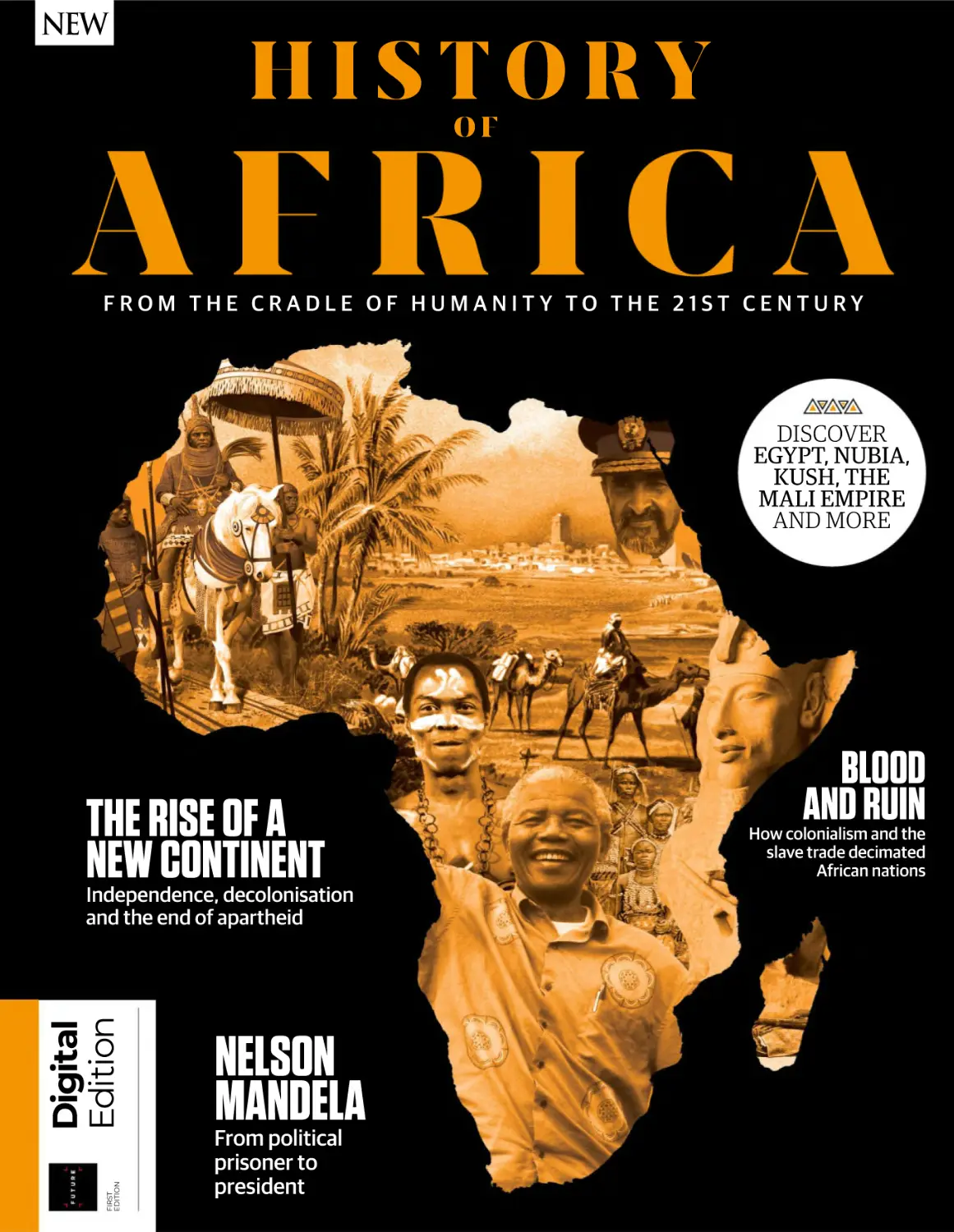
HISTORY
OF
FROM THE CRADLE OF HUMANITY TO THE 21ST CENTURY
DISCOVER
EGYPT, NUBIA,
KUSH, THE
MALI EMPIRE
AND MORE
THE RISE OF A
NEW CONTINENT
FIRST
EDITION
Digital
Edition
Independence, decolonisation
and the end of apartheid
NELSON
MANDELA
From political
prisoner to
president
BLOOD
AND RUIN
How colonialism and the
slave trade decimated
African nations
HISTORY
OF
AFRICA
No single book could ever cover the history of Africa in its entirety.
Even the great libraries of Timbuktu would be hard pushed to sum
up the long, complex, sometimes brutal history of the continent that
holds both humanity’s oldest home and the world’s youngest country.
Africa’s history is ancient, nuanced and complicated. This book,
then, is by way of an introduction. You’ll notice that some events you
might be expecting aren’t present – the Boer Wars for example. While
this book does address the beginnings of and the ongoing legacy
of colonialism, it prioritises shining a light on the histories of Black
heroes and civilisations from antiquity and medieval history, and
how their modern-day descendents are working to decolonialise their
continent and help Africa to once again become the shining beacon
of civilisation that it was before. On this journey through some of the
highlights of African history from prehistory to the present, you’ll
meet powerful kings, wicked sorcerers, pirates, pharaohs, forgotten
kingdoms, warrior women and much more.
ANCIENT
08 The birth of humanity
Our ancient ancestors first lived in the fertile
region of the Horn of Africa
10
10 Kingdoms of
Ancient Egypt
Discover some of the long history of Africa’s
most famous ancient civilisation
18 Kingdom of Kush
The story of Ancient Egypt’s southern
neighbours intertwines with theirs
42
22 Kingdom of Aksum
Once the most powerful state between the
Roman Empire and Persia
48 From Equals to Enslaved
MEDIEVAL
28 10 Forgotten
African Empires
How colonial slavery first arrived on West
Africa’s rich shores
52 The Barbary Coast
Between the 15th and 19th centuries,
pirates terrorised the North African coast
Discover ten incredible civilisations
you may never have heard of before
34 The Lion King
COLONIAL
Founder of the Mali Empire
36 The Richest Man
in History
Meet medieval Malian multi-billionaire
Mansa Musa
42 The Lost City of Benin
An advanced civilisation that was all but
forgotten during the colonial era
66 Origins of the
Transatlantic
Slave Trade
A dark period of history begins
70 The Transatlantic Slave
Trade Timeline
An in-depth look at the era
28
36
78 Impact of Slavery
How slavery impacted the development of
Africa from the 15th century to today
82 Beware the Mino
The iconic women warriors of Dahomey
86 The Scramble for Africa
How Victorian technologies ushered in a new
era of colonialism and conquest
88 Shaka
How an exile used cunning and guile to
become an iconic African king
MODERN
100Haile Selassie
The Ethiopian emperor who became a
religious icon
88
102 Apartheid
South Africa’s policy of racial segregation
104 The Year of Africa
How 1960 transformed the continent with
independence and democracy movements
106 Mandela’s Revolution
18
How one iconic ANC activist went from
political prisoner to president
118 Africa’s Forgotten War
The conflict between Ethiopia and Eritrea
106
124 South Sudan’s
Brutal Birth
The world’s newest nation
100
08 The birth of humanity
Our ancient ancestors first lived in the
fertile region of the Horn of Africa
10 Kingdoms of
Ancient Egypt
Discover some of the long history of
Africa’s most famous ancient civilisation
18 Kingdom of Kush
The story of Ancient Egypt’s southern
neighbours intertwines with theirs
22 Kingdom of Aksum
Once the most powerful state between
the Roman Empire and Persia
18
10
08
22
Ancient
The
of
Modern humans first evolved in the Horn of
Africa region, before making their way across the
continent and throughout the world
Written by April Madden
8
The birth of humanity
n the mid-eastern coast of the
African continent, a peninsula juts
out into the sea. The Red Sea and
the Gulf of Aden separate it from
the Middle Eastern countries of
Saudi Arabia and Yemen, while thousands of miles
eastwards across the ocean lies India. Behind it to
the west, the vast width of the African continent
stretches towards the South Atlantic. Here, in a
landscape of mountains and plains, where the
weather can vary between monsoon rains and dry
trade winds, where the lowland heat can hit 50C
(122F) in places but the plateaus can offer sunny
green climes, is the crucible in which humanity
was formed.
It’s thought that homo sapiens, modern
humans, evolved in the Horn of Africa region
between 200,000 and 300,000 years ago. Some
of the earliest fossils of our ancestors have been
O
unearthed in the region. The Omo remains,
named for their discovery near the Omo river in
southwestern Ethiopia, is a collection of ancient
human bones in which modern human features
can be found alongside features from an earlier
species of human. In 2022, the Omo remains
were dated to approximately 233,000 years old.
The earth layer around them suggests these early
modern humans enjoyed a lush, rainy climate in
which the Nile and the nearby Omo river flowed
high and freely, while the scant traces of tools
that accompanied them suggest a technological
level in eastern Africa’s Middle Stone Age. During
this era, the local human population would have
benefitted from abundant food, which they hunted
and gathered with a range of stone and bone tools
that showcase the planning, abstract thinking
and innovative behaviours that characterise the
evolution of modern humans. They were also
creative, making art by carving stones and shells,
painting with red ochre, and even adorning
themselves with beads. Needles and hide-working
tools suggest early modern eastern African humans
from this period were creating shelters or clothing
from the skins of the animals they hunted with
arrows and spears, and making fishing nets to take
advantage of the rich food sources in the nearby
rivers and seas. It’s likely that at this point they
were using complex spoken language to describe
and plan their activities, thoughts and feelings.
While the ‘Out of Africa’ hypothesis for the
spread of modern humans across the world is now
thought of as a long, drawn-out series of migratory
events that happened in waves rather than one
significant dispersal, this – the place the ancient
Egyptians called Ta Netjeru, the ‘land of God’
– is where the people that went on those worldchanging migrations first began their lives.
The verdant shores of Ethiopia’s Omo
river are the site of one of the earliest
fossil records of modern humans
9
Ancient
“Ancient Egypt
became an epicentre
for culture and
religion”
10
Kingdoms of Ancient Egypt
of
Spanning many eras, the New, Middle and Old
Kingdoms would see the pharaohs reach the
peak of their power and Egyptian culture soar
Kingdom that iconic structures that have endured
or 3,000 years the Ancient Egyptian
millennia were built. The Middle Kingdom was
empire endured. It emerged, like so
when a nation was unified and forged anew. Then
many other independent kingdoms,
the realm was aggressively expanded and culture
from the ruins of warring and
fostered like never before in the New Kingdom.
fragmented fiefdoms and grew into a
Ancient Egypt wasn’t just an era of military
nation that shook North Africa and the surrounding
conquest and expansion, it was a time of
world to its core. It became an epicentre for
innovation too. The Egyptians invented
culture and religion, where science and
early forms of cosmetics, including
magic were intertwined as one. But
The invasions
eye makeup; they were one of
those golden ages, those heights
the first civilisations (alongside
of human achievement that
of Egypt led to
Mesopotamia) to evolve a robust
challenged even those of Greece
new cultural aspects
written language; they created
and Rome at their peaks, were
being embedded into
papyrus thousands of years
not achieved in a day.
society, such as the
before the Chinese produced
Before the Assyrians came,
paper;
they designed the basic
before the Persians invaded,
use of horses and
calendar structure that we still use
before the Greeks conquered
chariots
today; they can even lay claim to
and the Romans annexed, the
inventing bowling and early forms of
Egyptians rose and fell all by
breath mints.
themselves. While darker periods
In short, they were a nation the like of which
would form between them (three in fact,
we’ve never seen before or again. Gods, pharaohs,
known as the Intermediate Periods), the timeline of
pyramids, mummification, agriculture and much
Ancient Egypt has been defined by three distinct
more helped to define the Ancient Egyptians
eras: the Old Kingdom, the Middle Kingdom and
as one of human history’s most fascinating and
the New Kingdom. A time of cultural rebirth and
intelligent civilisations.
monumental construction, it was during the Old
F
11
Ancient
FAMOUS FACES
THROUGH TIME
Uncover the celebrities of each
kingdom of this great civilisation
The Old Kingdom
Djoser c. 2670 BCE
Of all the kings that ruled Egypt in the infant years of
the Old Kingdom, the pharaoh Djoser is perhaps the
most influential. He may not have been the man who
united Egypt as one in Narmer, but he typified two
characteristics that would go on to define
Ancient Egypt. He conducted
military campaigns that
solidified and expanded
the borders of the
empire while nurturing
the growth of his
nation’s culture. He
also commissioned
the first pyramid
on Egyptian soil;
the Step Pyramid
at Sakkara was the
blueprint for pharaonic
splendour and inspired
future generations to build
even greater examples.
Fourth Dynasty pharaoh Khufu oversees
construction of the Great Pyramid of Giza
The Middle Kingdom
Mentuhotep II 2061 BCE – 2010 BCE
The kingdom splintered after the prosperity and
expansion of the Old Kingdom. This mini dark age of
sorts was known as the First Intermediate Period and
saw Egypt divided by two competing dynasties. Lower
Egypt was controlled by the Tenth
Dynasty and Upper Egypt
by the Theban Dynasty.
About 14 years into his
reign, Mentuhotep II
had grown tired of
the stalemate and
attacked the Lower
Egypt capital of
Herakleopolis. He
eventually broke the
rival dynasty, unified
the two realms and
effectively founded the
era now known as the
Middle Kingdom.
The New Kingdom
Ramesses II 1279 BCE – 1213 BCE
Tutankhamun may be the most recognisable pharaoh, but
King Tut’s reign was a speck of Egyptian sand compared
the power, influence and achievement of Ramesses II. The
third pharaoh of the 19th Dynasty, Ramesses II took an
already prosperous kingdom
and made it greater and
grander than it had ever
been. He expanded its
borders, conquering
Canaan and subduing
everyone from the
Nubians to the
peoples of the
Levant. He was also
a prolific builder
of monuments
and temples and
even went as far as
constructing his very own
capital city, Pi-Ramesses.
12
Tomb art from the Old Kingdom
The Old Kingdom
A time of rebirth, the Old Kingdom saw the introduction of the first
pharaoh, dynasty and pyramid to the world
rior to the Old Kingdom, in an era
known as the Predynastic, Prehistoric or
Protodynastic Period, Egypt was going
through something of a transformation.
The nation was divided into colonies, each with
their own lords and rulers. The north and south of
the country were also distinct in both practices and
culture, with Hierakonpolis the capital of the south
and Bes the capital of the north.
Excavations over the last century have radically
changed the way we view Egypt prior to the Old
Kingdom, including the fact that the First Dynasty
and the rise of Narmer was not an overnight
process. Upper Egypt, the more affluent of the
two states, had three main cities – Thinis, Nekhen
and Naqada. One by one, these states conquered
one another or merged, and by about 3100 BCE,
Egypt emerged as one whole state with the
warrior pharaoh Narmer at its head. Two dynasties
followed his founding during a period known as
the Early Dynastic Period, and it was here that
the blueprint for the Old Kingdom was forged.
Memphis became the capital and Abydos the
religious epicentre. Even architecture and the arts
began to approach the classical Egyptian form at
P
this time. The Old Kingdom began in about 2686
BCE, with the formation of the Third Egyptian
Dynasty. The term ‘Old Kingdom’ was introduced
by 18th-century historians and is used broadly
to signify the first of three peaks of Egyptian
civilisation. Often referred to as the ‘Age of the
Pyramids’, the Old Kingdom saw Egypt nurture
every aspect that would make it great. From the
Third Dynasty and its first pharaoh, Djoser, to the
apparent last king of the Sixth, Netjerkare Siptah,
the nation was transformed into a cultural and
military powerhouse.
The pyramids are a symbol of this era, and the
template for these monumental icons began in
the reign of Djoser. His vizier and closest adviser,
Imhotep (who would be deified in generations
to come as a demigod and god of healing) was
the architect behind the Pyramid of Djoser, and
his designs were a significant leap in engineering
in Ancient Egypt. Prior to Djoser, kings were
buried in rectangular, flat-roofed tombs called
mastabas, but the Third Dynasty’s founder desired
immortality in death by means of a tomb worthy
of a divine ruler. Imhotep’s revolutionary design,
stacking squared versions of mastabas on top of
Kingdoms of Ancient Egypt
The Great Sphinx of Giza is believed
to have been built in the time of
Fourth Dynasty pharaoh Khafra
ANCIENT EGYPT’S
FIRST PHARAOH
Who was the man who unified two
distinctly different halves of the same
realm and set the stage for the Old
Kingdom period?
The Old Kingdom was the first true age of prosperity
and progress for Egypt, but it would have been nothing
without the two dynasties that came before it and the
man who founded the pharaonic line to begin with. That
man was Narmer and, much like many of the leaders
and radicals who changed history in the post-neolithic
world, he is a man steeped in myth, legend and mystery.
Nevertheless, his actions and decisions at the beginning
of the First Dynasty set the precedent for the 29 others
that would follow.
Narmer ruled sometime during the 31st century
BCE and became the first man to unite the states of
Upper Egypt and Lower Egypt. Of course, for an event
that happened so far back in prehistory, most of the
information we have comes from references found in
tombs and the conclusions drawn by Egyptologists and
historians, but there are some intriguing details we can
take from them.
Seal impressions found in tombs at Abydos linked to
the pharaohs Qa’a and Den (both of whom ruled, to the
best of our knowledge, after Narmer during the First
Dynasty) cite a list of ancient kings that name Narmer as
the first. There have even been stone vessels (elaborate
vases) found in the Step Pyramid tomb of Djoser that
pay tribute to Narmer, perhaps expressing an intended
connection with the founder and his way of life. Some
historians argue that a ruler by the name of Menes was
in fact the founder of founders, while others theorise
Narmer and Menes were one and the same.
the pinnacle of pyramid design in Egypt and it
one another to create a pyramid, created the jewel
would remain the tallest man-made structure for
in the king’s rebuilt kingdom. A grand necropolis,
a staggering 3,800 years. It served as a testament
a symbol of the enduring Ancient Egyptian
to the power of the pharaohs and the enduring
reverence for death, surrounds it and the finished
potency of the many Egyptian gods.
article would go on to inspire pharaohs for
The Fifth Dynasty of Ancient Egypt (2498
generations to come.
BCE – 2345 BCE) saw an evolution of theological
The grandeur of the Step Pyramid (the Pyramid
practices across the entire nation, with certain
of Djoser) at Sakkara wasn’t lost on those who
cults growing in prominence (gods rose and fell
followed in Djoser’s footsteps. By the time that
in popularity, and usually those favoured by
the Fourth Dynasty kings were ruling over
a particular dynasty or geographically
Egypt (2613 BCE – 2498 BCE), a new
important location were able to
set of pyramids were forming. The
survive obscurity). The Cult of Ra
Fourth Dynasty is considered the
The Old
(god of the noon sun) and the
‘golden age’ of the Old Kingdom,
Kingdom boasted
Cult of Osiris (god of the afterlife)
the very peak of prosperity.
rose significantly in popularity
The economy was thriving
a strong centralised
during this period of time.
thanks to a peaceful realm
administration
The Egyptian economy was
and open trade routes with its
from the capital of
also booming, with the influx of
neighbouring nations. As with
Memphis
goods like ebony, gold, myrrh and
every peaceful period of Ancient
frankincense growing all the time.
Egypt, a spree of construction
The Egyptians pushed their trading
swept the nation.
boundaries even further with agreements
Khufu, the second pharaoh of the
with Lebanon and modern-day Somalia. In short,
Fourth Dynasty, was the man to create a
it was a time of enterprise without the fear of
monument so grand it would eventually be named
invasion or war. This economic strength bled into
one of the Seven Wonders of the Ancient World:
the Sixth Dynasty (2345 BCE – 2181 BCE), as did
the Great Pyramid of Giza. Built over a two-decade
the growing popularity of the inscription of spells
period, the 146.5 metre-high structure was a feat of
and incantations inside burial chambers and tombs.
engineering that put even Imhotep’s Step Pyramid
Known commonly as the Pyramid Texts, these
in Sakkara to shame. Giza would become the site
inscriptions would form the basis of the Book of
of many more pyramids and temples, known as
the Giza Necropolis. The Giza Pyramid became
the Dead.
There’s even an argument that Narmer is a
pseudonym for the mysterious monarch King
Scorpion, but currently no evidence exists to
corroborate this claim
13
Ancient
The Middle Kingdom
Once again divided and once again whole, Ancient Egypt rose from its own ashes
to become a military and cultural powerhouse
or every period of greatness and
monumental achievement in Ancient
Egypt’s history, there is a stretch of time
where governments crumbled, territories
divided and the nation fell into a dark lull. As the
royal hold on the country fell apart towards the
end of the Old Kingdom, Egypt was plunged into
an era of uncertainty that is referred to as the First
Intermediate Period.
To make matters worse, the power of the
pharaoh was splintered when two rival dynasties
began vying for power – the Tenth Dynasty (based
in Herakleopolis, the principal city of Lower Egypt)
and the 11th Dynasty (centralised in Thebes, Upper
Egypt). This period of conflict and dissention lasted
for 125 years, until the reign of Theban pharaoh
Mentuhotep II.
Ascending to the Upper Egypt throne in 2055
BCE, Mentuhotep II watched as the Tenth Dynasty
began to destabilise with in-fighting and regular
riots. In his 14th year of regnal rule, the Theban
F
king took full advantage of revolt and attacked
Herakleopolis. By the time of his arrival, there was
barely a battle to be had, and the city, and the rest
of the region as a result, were taken. He quelled
what little resistance could be offered by the
remaining rulers of the decaying Tenth Dynasty
then set about reunifying the kingdom as one.
Such a task was not quick, taking a staggering
21 years to bring the Lower and Upper regions into
line. He began by conducting a series of military
campaigns to regain the territories lost during
the dark time of the First Intermediate Period. He
travelled south to the Second Cataract in Nubia,
a region that had gained independence from its
masters. Mentuhotep II brought the Nubians to heel
before restoring Egyptian authority in the Sinai
region. It was a ruthless expression of power in an
era when authority was a long forgotten force.
His consolidation of power in Egypt and efforts
towards unifying the nation ushered in what
we now know as the Middle Kingdom, and that
Rock tombs of Beni Hasan, an Ancient
Egyptian burial site primarily used
during the Middle Kingdom
14
effort was continued by his son and successor
Mentuhotep III. His rule was brief by pharaonic
standards (a mere 12 years) but he further
accelerated the unification, including an expedition
to retake Punt (an old trading partner of Egypt). The
throne then passed to Mentuhotep IV, whose reign
remains something of a mystery. His name is often
omitted from lists of kings found in tombs through
the Middle and New Kingdoms, suggesting his rule
was a short one and ended abruptly.
The Turin Papyrus (otherwise known as the
Turin King List) is one such document; it describes
the period following Mentuhotep III’s death as
“seven kingless years”. Information regarding the
‘missing king’ remains frustratingly scarce, but
some details suggest a coup of sorts may have
taken place.
Records found at Wadi Hammamat, a large
mining region in ancient times, do attest to his
reign and make reference to expeditions to quarry
stone for monuments. The records name a vizier,
Kingdoms of Ancient Egypt
rule with his successor, Senusret II. The new
Amenemhat, as its commander. Whether or not
this is the same Amenemhat that would eventually pharaoh focused mainly on the maintenance of
the realm, building a pyramid at el-Lahun as well
assume the throne, we cannot know for sure.
as attempting to convert the Faiyum oasis into
However, it certainly seems likely.
workable farmland.
So began the next dynasty with Amenemhat I
Under the sole rule of his successor Senusret
at its head. He began by moving the capital back
III, the Middle Kingdom enjoyed the peak of its
to Memphis (the capital during the Old Kingdom),
power and influence. The new warrior king was
as well as forming a standing army (an asset his
unlike anything the era had seen before –
successors would maintain for the rest of
he represented a mind-set from a long
the dynasty).
During
forgotten era, an aggressive hunger to
The new king began fortifying
expand the kingdom and conquer
the country’s borders, especially
the Middle
new lands. He moved a huge
those between Egypt and Asia,
Kingdom the
army north of the kingdom and
where he erected the Walls
elevated flood levels
attacked the Nubians relentlessly,
of the Ruler in the East Delta.
punishing them into surrender
In fact, Amenemhat I rebuilt
of the Nile boosted
before claiming considerable
or built new fortifications all
agriculture and
Nubian territories.
around Egypt, transforming
buoyed the
His successor, Amenemhat III,
military strategy from
economy
is famed for his radical approach to
expansion to simple defence.
construction. He took advantage of the
Amenemhat I would eventually
country’s limestone and sandstone quarries
begin a co-regency with his son,
like never before, beginning a huge programme of
Senusret, before the elder king was assassinated
building that spread across the entire kingdom.
– supposedly by his own guards. His successor,
His son, Amenemhat IV, has a poorly recorded
now Senusret I, began a more expansive series
rule but his successor, Sobekneferu, became
of military campaigns before eventually entering
the first recorded female Egyptian ruler in the
a co-regency with his own son, Amenemhat II.
country’s history (although her reign lasted only
His son enjoyed a relatively peaceful reign of his
four years).
kingdom and eventually chose a traditional joint
Ancient Egyptian men building
a wooden coffin in a Middle
Kingdom carpentry shop
The Pyramid of Amenemhat I
began construction in Thebes. It is
not known why it was relocated,
along with the capital, to Lisht
THE FEUDAL
GOVERNMENTS
OF THE MIDDLE
KINGDOM
In the Old Kingdom before it and the New Kingdom that
followed, the pharaoh’s rule was absolute. Priests, nobles
and even the queen herself could act, with consent,
on the king’s behalf, but the for the most part, the
pharaoh answered to no one but the gods. However, that
definitive rule came under threat when the Old Kingdom
crumbled and splintered into two separate realms.
With two dynasties now vying for power, the normal
authoritative structure of the kingdom was in ruins.
Prior to the rise of the pharaohs, the entire country
was divided into small administrative colonies known as
nomes. Each nome had an appointed leader (nomarch),
and it was these independent city states that the first
pharaoh had to unite in order to establish Egypt as a
single nation.
Even after unification, the nomarchs – 20 of whom
were based in Lower Egypt and 22 in Upper Egypt
– remained. However, they existed more as regional
officials who would report directly to the royal court. As
the country entered the First Intermediate Period, these
nomes began to assume autonomy once again. By the
time of reunification, new sole pharaoh Amenemhat I
found these states unwilling to bend the knee entirely.
The position of nomarch was considered hereditary
(rather than being subject to the king’s discretion), an
issue made all the worse by marriages that created
powerful alliances between multiple nomes. In order to
maintain peace in the kingdom, Amenemhat was forced
to agree to an alliance of sorts, creating a bizarre feudal
system that lasted until the reign of Senusret III.
15
Ancient
The New Kingdom
The last great age of Ancient Egypt was its grandest
yet – an era of economic enterprise, domestic
beautification and military expansion
tributaries that led into the Mediterranean Sea).
asting from the 16th to 11th century BCE,
By the time the pharaoh in Thebes realised
the New Kingdom saw Ancient Egypt
what was happening, it was too late. The Hyksos
transformed. Its kings and queens both
were fearsome warriors who used advanced
looked ahead at the promising
weaponry – mainly cavalry, chariots
future of the realm and back in the
and powerful compound bows
hope of emulating the monarchs
Mortuary
– and who were comfortably
of the past. The empire was
beliefs
settled. The 15th Dynasty was
expanded by the sword of
developed during
established and lasted for more
warrior kings, while the realm
than 150 years, but the Hyksos
itself was rebuilt from the
this era, leading to an
presence divided Egypt in two,
ground up by a new economic
influx of talismans
with the invaders controlling
prosperity. This was Ancient
and amulets for
Lower Egypt while the Thebans
Egypt at its peak, as reflected
ruled Upper Egypt. Kings made
in the resultant boom in arts
protection in the
many
efforts to defeat the Hyksos,
and culture.
afterlife
but the tribesman were seasoned
The New Kingdom was preceded
warriors and weren’t so easily deterred.
by another fracture known as the
It wasn’t until the time of Ahmose I, the
Second Intermediate Period. Towards the
first pharaoh of the 17th Dynasty, that everything
start of the 16th century BCE, a small warrior
changed. Having watched his family fail to
tribe known as the Hyksos had begun settling in
banish the Hyksos, Ahmose I raised a huge
the fertile land of the Delta (a group of rivers and
L
16
A statue of Akhenaten from
his Aten Temple at Karnak
Kingdoms of Ancient Egypt
army and met the Hyksos with unrelenting force.
Over many years he pummelled the borders,
slowly driving the Hyksos back. Eventually, the
Theban pharaoh drove the occupying forces from
his homeland and set about restoring Egypt to its
former glory.
With Egypt unified, the 17th Dynasty’s founder
began an expansive series of military campaigns
that added new territories to the realm while
regaining lands lost in the Second Intermediate
Period. These conquests brought new wealth into
the economy – it re-energised the construction of
temples and monuments and enabled Ahmose I to
rebuild the decorated nation of old.
Ahmose I’s desire to restore Egypt to its former
greatness would be reflected in the actions of the
kings and queens who followed. Amenhotep III
rebuilt monuments, tombs, and statues on a scale
never seen before, solidifying the bubbling new
culture of arts and expression.
Queen Hatshepsut was the first woman to take
the title of pharaoh, and she helped nurture the
country’s economy, including expeditions to Punt
and other trading posts. Thutmose III created one
of the most impressive armies ever assembled by a
pharaoh and used it to expand Egypt’s borders with
conquest after conquest. The 18th Dynasty was a
time of achievement on multiple fronts, but like any
age of success, there was also a catch.
That blip came in the form of Amenhotep IV,
also known as Akhenaten. A religious zealot who
despised the power of the Church of Amun (the
patron god of the Theban kings), Akhenaten did
not believe in the polytheistic practices that had
defined Egyptian theology since the country’s
earliest times. He outlawed the worship of any god
other than his chosen deity, Aten, and forced the
country into massive religious upheaval.
The Amarna Period, as it would come to be
known, only lasted 16 years, but the damage was
already done. The upheaval was so universally
despised that Akhenaten was branded the
‘Heretic Pharaoh’, even by his own son and future
pharaoh Tutankhamun. His legacy was summarily
expunged from many future histories and a course
was set to bring Egypt back to its former glory.
The dynasty that followed pushed Egypt’s
prosperity to new heights. The most notable
pharaoh of the period, Ramesses II, took the great
armies formed by Thutmose III and weaved a
military campaign that moulded Egypt into its
most powerful form. He sired a considerable
number of children (most of whom he outlived)
and built a huge tomb and necropolis in the Valley
of the Kings.
Like the 19th Dynasty, the 20th was also defined
by the legacy of one man: Ramesses III. However,
while Ramesses II would strengthen his nation,
his descendent would ultimately weaken it by
draining the treasury with unsuccessful military
campaigns and defensive operations. It was his
mismanagement of the crown that eventually set
about the slow decline of the New Kingdom and
the native pharaonic line as a whole.
WHAT
HAPPENED
NEXT?
Following the end of the
New Kingdom and its final
golden age, what was next
for this ancient civilisation?
While the period we know as Ancient
Egypt officially ended with the death
of Cleopatra VII and its addition to
the Roman Empire in 30 BCE, its
true demise could be attributed to
the death of Ramesses XI. The span
of time that followed, the Third
Intermediate Period, saw the power
of the pharaohs start to deteriorate
as political in-fighting took hold. The
period lasted about 350 years and
was split into three stages: the first
saw the rule of the country divided
between the 21st Dynasty (which
controlled Lower Egypt) and the High
Priests of Amun at Thebes (which
ruled most of Middle and Upper
Egypt). The two states existed in
relatively peaceful harmony.
The second period saw the
country reunited thanks to the rise
of the 22nd Dynasty and new king
Shoshenq I – the Libyan monarchy
came to power in about 945 BCE,
expanding out from the East Delta to
control the entire nation. Once the
country’s bitter enemy, the Libyans
now ruled Egypt as native Egyptians.
The country began to destabilise
once again under the rule of the 22nd
Dynasty in 850 BCE, and by 818 BCE,
a rival 23rd Dynasty had risen, which
then caused the nation to fragment
into warring states.
The country would eventually fall
to a Nubian invasion, lasting 25 years.
This marked a trend for the coming
centuries as Egypt’s grand native
history was buried by an Assyrian,
Persian and eventual Greek invasion
during the subsequent Late Period.
In short, the nation had fragmented
so far from the stable centralised
structure of the three kingdom eras
that it ultimately benefited from the
stability outside rule brought with it.
When the New Kingdom
era drew to a close with the
death of Ramesses XI, Egypt
would never again prosper
under native Egyptian rule
17
Ancient
of
Egypt’s southern neighbours forged an empire that lasted
for more than a thousand years, establishing the Twentyfifth Dynasty of Egypt as they pushed northwards
Written by Will Lawrence
18
Kingdom of Kush
hen Rome was nothing more
than a village on the River
Tiber and the Greek citystates ruled tiny tracts of
land, the mighty Kingdom
of Kush held sway over an empire that stretched
from central Sudan to the Palestinian borderlands.
Its rulers flourished for a millennium, outlasted the
golden ages of Athens, Sparta and Macedonia, and
witnessed both the growth and much of the decline
of the Roman Empire.
And yet here is a kingdom that to history
has been perennially overshadowed by the
ancient Egyptians, their famous neighbours to
the north, even though, for a time, Egypt too fell
under Kushite control. When the Kushites were
finally expelled from Egypt at the hands of the
Assyrians, their homeland dwindled to a place of
peripheral influence and, says one leading historian,
“increasingly found itself at the end of a cul-de-sac
in the Nile valley, the exit to which was always
blocked by a strong power to the north.” Yet still it
endured, and its inhabitants prospered. Today, the
area that made up the Kingdom of Kush is more
commonly known as Nubia, which derives its name
W
from the people who moved into the vacuum that
formed when the Kushite state finally collapsed in
the 4th century CE.
The Kingdom of Kush finds its origins in a
powerful state that formed in the 3rd millennium
BCE, taking advantage of its position on the Middle
Nile where it stood as a gateway for trade, ferrying
the rich materials from the south, like gold and
jewels, to the consumer markets in the north. The
state through which this trade route flowed held
its capital at Kerma, just upstream of what is now
cited as the Third Nile Cataract. Kerma enjoyed a
prosperous reign until, during the period around
1750-1650 BCE, a people called the Hyksos rose to
power in the Nile Delta.
Initially, the people of Kerma forged an alliance
with the Hyksos and pushed further north, taking
the Egyptian fortresses of the Second Cataract.
Eventually, however, the pharaohs rallied, and
Amosis (1570-46 BCE) reunited Egypt and
defeated the Hyksos in battle. The New Kingdom
of Egypt then exacted vengeance for the Kerma
land-grab, and the kingdom was crushed; the
pharaohs Thutmose I and Thutmose III enforced
an Egyptian military presence in the area. It was to
commemorate Thutmose I’s campaigns that his son
oversaw the famous inscription that speaks of his
return from overthrowing the “wretched Kush”.
Under Egyptian control, a syncretistic culture
arose in Kush, influenced by trends in Egypt to the
north and by the culture of the African peoples to
the south. Kush’s position on the trade routes from
Egypt to the Red Sea, and from the Nile to the
south and west, continued to bring considerable
wealth to the region.
Egypt could not maintain control indefinitely,
however, and by the 9th century BCE there
was little remaining evidence of the pharaohs’
colonisation; the major cult centre at Napata had
certainly fallen into ruin, and it is from this time
that archaeologists begin to record data from a
separate Kushite state. Gifts from the pharaoh to
the Temple of Karnak in 827 BCE included gold
from the region around Napata, which then became
the seat of early Kushite kings, and this suggests
that the two kingdoms were enjoying cordial
diplomatic and trading relations despite the former,
more precarious association.
The early Kushite rulers are difficult to identify,
and prior to Kashta, who led the Kushite expansion
19
Ancient
the female ruler of Kush. Clearly, some confuse the
generic name with the name of an actual ruler.
With regard to the succession, it seems that the
most suitable candidate was chosen from a select
band, who may or may not have been related to
their predecessor, while the Ancient Greek historian
Diodorus reports that the candidates were
chosen by the priesthood from the most valorous
Kushites before their god made the final choice.
It appears that there were conflicts between the
Amenirdis I, as the presumptive God’s Wife of
Amun in Thebes. Indeed, Kashta went on to extend rulers and the priesthood in Kush, and Diodorus
records that the priests of Meroë (the later seat of
Kushite control into Thebes and also Elephantine.
the rulers) were able to dictate the date
His successor, Piye, then led the great Kushite
of the ruler’s death. Throughout Kushite
push into Egypt, which established the
history, the political system remained
Twenty-fifth Dynasty of Egypt. This
monarchic.
period of Kushite pre-eminence is
Meroë,
The army was of keen
often referred to as the Napatan
importance – the Egyptians
Empire, named after the state
the capital
appear to have regarded the
capital, and the Kushite kings
of the Kingdom
denizens of the Kushite state
ruled Egypt (in its entirety or
of Kush, became a
as good bowmen and horse
in part) from 744 until 656
UNESCO World
warriors – though not much is
BCE.
known about its composition
Given its proximity to and
Heritage Site
and whether it was a
long historical connection with
in 2011
professional body
its northern neighbour, it is not
or a citizen militia
surprising that Kushite culture at
called upon in times
this stage greatly resembled that of the
of need. There is evidence that
Egyptians. And, certainly, the Kushite kings
some leaders did not fight with
appear to have entered Egypt “not as conquering
barbarians,” one notable historian and archaeologist the army, while others such as
Taharqo (690-664 BCE) and
writes, “but as champions of the age-old traditions
Akinidad (dates unknown,
of the pharaohs.” The Kushite state’s great god, at
though he fought the
least during the Twenty-fifth Dynasty, was Amun,
Romans) appear as battlethe great god of Egypt who had ruled almost
unopposed since the 2nd millennium BCE.
Though most rulers were male, there is a clear
indication that queens too sat on the Kushite
throne, and there is no reason to believe they were
While an Egyptian god,
Amun was also worshipped
not rulers in their own right; the Bible in Acts 8:27
by the Kushites
speaks of “Candace, queen of the Ethiopians”, while
there are further sources that record the Kandake,
“Piye led the Kushite push into Egypt,
which established the Twenty-fifth
Dynasty of Egypt”
into Egypt during the 8th century BCE, we know
only of Alara and Ary, and it seems as though
they may be the same person. Kashta ruled Kush
from Napata, which is around 300 miles north
of Khartoum, the modern capital of Sudan, and
he enjoyed considerable influence in Egypt, as
evidenced by the installation of his daughter,
KINGS OF KUSH
Many Kushite rulers are
shadowy figures, though we
know something of a few
great kings
Kashta
Mid 8th century BCE
The second king of the Napatan Empire of the
Kushites, Kashta proved pivotal in the expansion
into Egypt, and he laid the foundations for what
would become the Twenty-fifth Dynasty. His only
known wife was Pebatjma, and he was buried in
the royal pyramid at el-Kurru.
Piye
c.752-c.721 BCE
Kashta’s successor completed the invasion of
Egypt, and became the first pharaoh of the
Twenty-fifth Dynasty, which ruled Egypt until the
Assyrian invasion. The length of his rule cannot
be precisely dated, but it likely did not exceed 31
years.
Taharqo
690-664 BCE
The son of Piye, Taharqo oversaw a prosperous
period in the Kushite history, and he proved a
capable warlord, fighting as best he could the
invasion of Egypt by the iron-wielding Assyrians.
Despite inferior weapons, his troops recorded at
least one famous victory.
Tanwetamani
664-653 BCE
The nephew of his predecessor, Tanwetamani
sought to wrestle control of Egypt back from the
Assyrians, and reoccupied all of Egypt including
Memphis. The Assyrian response was swift and
lethal, their re-conquest effectively ending Kushite
influence over Egypt.
Aspelta
c.600-580 BCE
Kushite history becomes shadier after the fall
of the Twenty-fifth Dynasty, but Aspelta left
monuments carved with historical details, and it’s
been suggested that Assyrian incursions from the
north encouraged Aspelta to move the Kushite
capital from Napata to Meroë.
20
Apedemak, pictured here with three heads
and four arms, was the Kushite god of war
Kingdom of Kush
A bas-relief found on the ruins
of a temple dedicated to Amun
ready warlords.
Herodotus records the presence of Kushite
soldiers in the army of Xerxes that invaded Greece
in the early 5th century, claiming they fought
with javelins and knotted clubs, and that before
battle they smeared their bodies with chalk and
red ochre. Historians think the Kushite army may
have used war elephants, like the Carthaginians,
and the elephant does appear in Kushite art. The
efficacy of the Kushite army is difficult to assess,
though while the clashes between Kushites and
Assyrians saw their expulsion from Egypt and
the toppling of the Twenty-fifth Dynasty, the
warriors of Kush did record at least one notable
victory, defeating the iron-wielding Assyrians in
674 BCE. Like many armies that faced Rome, the
Kushites seem to have recorded little success, and
the historian and geographer Strabo noted that
they fled, badly beaten at the Battle of Pselchis in
23 BCE.
The artistic evidence that survives suggests
that the people of Kush were dark-skinned, and it
seems that by the later Kushite period, size was
a desirable attribute for mortal women at least,
and while the goddesses remained slim in their
depictions, the earthly women are shown with
considerable girth. Life expectancy was typical of
the region during the period, and while Taharqo
reigned for more than 25 years, dying at the age
of 46 or 47, typical mortality would not have
broached much more than 30 years of age.
Once forced from Egypt by the Assyrian
invasion, the Kushites ruled the Middle Nile for
more than 800 years and, protected as it was by
the barren hills of Aswan, it retained its unique
Egyptian-Nubian culture, while that of Egypt
fell prey to Persian, Greek and Roman influence.
The Kushites developed and retained their own
language, which has confused linguists ever since
its discovery, and they preserved their own gods –
like Apedemak, Sebiumeker and Arensnuphis – as
well as adopting the great Egyptian deities. Their
funerary rites involved burying their rulers in
pyramids, though their construction was somewhat
different to that of the Egyptians.
Following their expulsion from Egypt, the
Kushite capital was moved from Napata southward
to Meroë near Shandī. The subsequent history of
Kush, however, is one of gradual decline, ending
with the kingdom’s final fall coming in 350 CE
when the king of Aksum moved down from the
Ethiopian highlands and destroyed Meroë before
plundering the towns along the Nile. The once
mighty Kingdom of Kush was no more.
The Meroë pyramids
© Getty Images. Creative Commons; Sven-Steffen Arndt, Jeff Dahl, Clemens Schmillen, Fabrizio Demartis
Amanitore, one of the queens of Kush
Ancient
measured
sumite obelisk
The largest Ak
ated from
cre
t),
fee
8
(10
33 metres
, one of the
ite
an
gr
of
ce
a single pie
nt world
hs of the ancie
largest monolit
“The Aksumites
became the first subSaharan kingdom to
mint its own coins”
Among Aksum’s more
curious legacies were the
enormous granite obelisks,
built to mark notable tombs
22
The Kingdom of Aksum
The
of
Uniquely situated between the Western and Asiatic worlds, the
sub-Saharan kingdom of Aksum grew into the most powerful
state between the Roman Empire and Persia
Written by Hareth Al Bustani
city grew, it developed a civilisation of its own, with
n the 1st millennium BCE, sub-Saharan
an outward-looking perspective.
Africa was in a state of great migration. The
Though the port of Adulis on the Red Sea coast
east was transformed as Arabs crossed over
of modern Eritrea was a 12-day journey away, the
the Red Sea, settling down with Kushite
Aksumites grew wealthy trading with the Roman
farmers, bringing with them the Semitic
Empire, South Arabia, India, Sri Lanka and even
script. They established trading settlements along
China. Naturally the polity began to dominate its
the Horn of Africa, buying ivory and shipping it
neighbours, expanding its political sphere as far as
across to Persia and further east via the Indian
the Red Sea, where it acted as gatekeeper for luxury
Ocean – bringing back textiles, spices and silk.
goods coming in and out of Africa. By the middle
The city of Aksum was founded in the 1st
of the 2nd century, Aksum was described by a
century CE in the northern highlands of modern
Greek geographer as the seat of a king’s
Ethiopia. With two annual rainy seasons,
palace.
this fertile land soon drew scores
Aksum
Having taken Egypt around the
of settlers from the south to rear
same
time as Aksum was born,
cattle and farm. Cereal grew
was described
the Roman Empire became a
on the hillsides for up to nine
by a contemporary
natural trading partner. The
months of the year, and the
Persian writer
Red Sea was the only source
uniquely nutritious Ethiopian
capable of meeting Rome’s
grain, teff, flourished even in
as one of the
demand
for incense, spice, ivory,
the absence of rain. Its forests
four greatest powers
cinnamon, pepper, cotton cloth,
were rich in timber, used
in the world at
iron and steel. Pliny the Younger
to produce charcoal, and the
the time
also mentioned the trade of slaves,
Aksumites terraced hilltops, dug
hippopotamus hides and apes. During
canals, and built dams and cisterns.
the 3rd century, as Roman power waned,
Shortly after its foundation, a visiting
the East African and Indian Ocean trade routes
Greek described the city as a “metropolis” – the first
were controlled by the Arabs and Persians – with
recorded use of the word, which means a large,
the Aksumites dominating their side of the Red Sea
highly developed and significant city.
coast down to Cape Guardafui.
According to local oral tradition, the indigenous
To commemorate its rising status, Aksum
inhabitants of the region were the Nilo-Saharanbecame the first sub-Saharan kingdom to mint
speaking Kunama, who lived in Aksum alongside
its own coins, in gold, silver and bronze. Early
Semites before being expelled west. The name
coinage was adorned with crescents and discs,
‘Aksum’ probably derives from the Kunama words
perhaps inspired by the civilisation’s South Arabian
‘aya’ and ‘gusma’, meaning ‘hill’ and ‘climb’. As the
I
roots. Gold coins were minted to Roman weight
standards, and adorned with Greek – specifically for
international trading purposes. Silver and copper
coins, on the other hand, were decorated with the
Semitic Ge’ez script. At this time, a Persian religious
leader referred to Aksum as one of the world’s four
great empires.
The Aksumites projected this prestige through
monumental obelisks, built to mark the royal
necropolis. Their carved designs resembled multistorey buildings, a fitting tribute to the royals,
who lived their lives in three-storey stone palaces.
Almost 120 of these adorn the royal graveyard –
looming over stone tombs – complete with false
doors and horseshoe brick arches. The largest of
the obelisks towered some 33 metres high, carved
from a single 550-ton block of granite. One of the
ancient world’s largest monolithic structures, it was
carried four kilometres to its site, perhaps with the
help of elephants.
At its peak, the city spanned 75 hectares, and
was a thriving centre complete with industrial
zones, palaces and two-story residential buildings.
Palaces boasted stone walls lined with lime
or mud, and reinforced with dressed beams.
Central pavilions featured paintings and columns,
surrounded by courtyards and smaller buildings.
Meanwhile, commoners lived in mud houses with
thatched roofs.
With no fortified walls, a ceremonial entrance
marked the eastern gate, leading to a central
temple, with a residential area to the west and a
royal cemetery to the north and east. The whole
city was surrounded by minor cemeteries and
23
Ancient
THE CATHEDRAL
OF OUR LADY
MARY OF ZION
With the adoption of
Christianity, church
construction got underway –
but one of the new buildings
quickly became steeped in
myth and legend
Among the churches built after King Ezana’s
adoption of the Christian faith was Aksum’s own
Cathedral of Our Lady Mary of Zion, a rectangular
basilica built upon a stepped podium. Facing the
church is a set of granite thrones, symbolising
either 12 Aksumite judges, or the Nine Saints and
some Christian kings. The Patriarch of Alexandria
elected an Egyptian Copt as the Archbishop
of the Ethiopian Church, a tradition that has
continued to this day. Rebuilt as a crenellated
Gondarine-style building in the 17th century, it
hosts a sacred room, with doors depicting angels
with swords, said to hold the Ark of the Covenant
– the fabled chest believed to contain the original
tablets inscribed with the Ten Commandments.
Ethiopian legend claims the Ark was brought
there by Menelik – the lovechild of King Solomon
and the Queen of Sheba, who formed the
country’s Solomonic dynasty. Today it is watched
over by a guardian monk – appointed for life.
During the annual festival of Timkat, celebrating
Christ’s baptism, Ethiopian priests parade replicas
of the Ark. Aksum remains a pilgrimage site, with
worshippers travelling to a body of water known
as Sheba’s Bath, where the Queen was said to
bathe.
First constructed in the
4th century CE, the church
has been rebuilt several
times since then
“The Aksumites mastered the arts
of basic smelting and forging”
suburbs. Roughly 20,000 people called it home,
an economic war with its northwestern neighbour,
with the king at the top of a hierarchical society,
the kingdom of Kush.
followed by nobles, priests and then the common
Aksum reached its peak in the 4th century under
craftsmen and farmers.
the reign of King Ezana who defeated the desert
Traditional Aksumite pottery was handmade
tribe of Beja, deporting them to distant lands. He
and poorly fired, but slipped and finely burnished.
went on to conquer Yemen before taking down
Wheel-thrown vessels were imported from the
the Kushite capital of Meroë where, in his own
Mediterranean, Arabian Gulf and Nile Valley rather
words: “I carried war against them when they
than produced at home. Locals did their
had rebelled… I burnt their towns of stone and
best to replicate foreign goods, such
their towns of straw. At the same time
as glassware, using parts of broken
my men plundered their grain, their
imports. They also crafted
bronze, their iron and their copper,
Orthodox
standardised flaked stone tools,
destroyed the idols in their homes,
used to process raw materials
their stocks of corn and of cotton;
Christianity
from ivory to hides. The
and they threw themselves into
was fully embraced
Aksumites mastered the arts
the river.”
by Aksum in the
of basic smelting and forging,
His kingdom became an empire,
4th century CE by
crafting an array of specialist
with a dozen cities stretching
metal tools used to produce
from the Nile valley to the Yemeni
King Ezana
ivory artefacts, often adorned
highlands. Long inscriptions written
with intertwined vines and
in Greek and Semitic celebrated his
animals with distinctive features.
conquests at great length, as well as
Pieces such as the Venus of Aksum,
his bold decision to depart from Aksum’s
found in a 3rd-century elite grave, hint at an uppertraditional religion. Early Aksumites practised an
class appreciation of Graeco-Roman aesthetics.
indigenous, monotheistic faith, worshipping the god
Ivory was immensely popular across the Roman
Mahrem, from whom their kings were descended.
Empire, Arabia, India and China, and with the
Animism and ancestor-worship also played a role
North African elephant on the brink of extinction,
in spirituality, with sacrifices such as a dozen oxen
Aksum was well-positioned to capitalise on its
offered to their spirits alongside Mahrem and Ares,
own abundant elephant population – with herds of
his equivalent, the Greek god of war.
reportedly up to 5,000. However, this pushed it into
However, in around 330 Ezana was baptised
by the Syrian monk Frumentius of Tyre. Aksum
became one of the earliest Christian states,
The Cathedral of Our
converting just five years after Constantine
Lady Mary of Zion
is now an Ethiopian
made it Rome’s official religion at the Council
Orthodox Church
of Nicaea. Christianity quickly took root among
royals and traders before funnelling down to the
commoners. The state later sent missionaries to
the neighbouring Kingdom of Alwa.
The conversion led to a transformation of
Aksumite coinage, pottery, burial traditions and
Revellers celebrate
the annual Timkat
festival, commemo
rating Christ’s bap
tism
The Kingdom of Aksum
Aksum’s first settlers were a mix
of Kunama and Semites, who were
drawn north to the fertile highlands
international trade, were strangled – confining
architecture. Coins were now adorned with the
them to their agricultural highlands, coinciding
Christian cross, along with the king’s likeness, an
with a massive drop in rainfall. Before long the
image of the teff and the inscription: “May the
area was abandoned, decaying into a handful
country be satisfied.”
of villages and monasteries as power
Others said “Joy and peace to the people”
shifted southwards, where Aksumite
and “He conquers through Christ”.
King Ezana and his brother Saizana were
aesthetics were reborn in the
Aksumite minters began replacing
converted to the Christian faith by Saint
Medieval rock-hewn churches of
gold coins with copper ones,
Frumentius shortly after the Council of Nicaea
Lalibela, now in modern-day
innovating gilding methods to
Ethiopia’s Amhara Region.
decorate crowns and other
While Aksum began as
symbols with gold leaf.
a self-sufficient farming
In the 5th century, despite
community, when it rapidly
the collapse of the Western
blossomed into a merchant
Roman Empire, the kingdom
kingdom its greatest source of
enjoyed a rapid development
Aksum became the first substrength eventually became its
boom – attributed by later
Saharan power to begin minting
its own coins, depicting kings and,
greatest weakness. As a uniquely
Ethiopians to the ‘Nine Saints’,
later, Christian imagery
powerful sub-Saharan civilisation
who founded the churches and
dependent upon the international status
monasteries outside the kingdom’s capital.
quo and the movement of goods and peoples
Emboldened, the 6th-century king Kaleb sent
around the ancient world, perhaps its reach
an army to Yemen to liberate Christians from
exceeded its grasp – like its greatest obelisk, which
persecution. While this resulted in new territories
came tumbling down under its own weight, the
and a closer bond with the Byzantine emperor
foundation simply was not strong enough.
Justin I, it had proved a costly enterprise, marking
the start of the kingdom’s steady decline. Things
were only made worse by the trade disruptions
caused by the Persian invasions of Yemen,
Roman, Persian, Ind
Jerusalem and Alexandria.
ian and Chinese
demand for precio
us ivory transform
With the arrival of Islam, the Aksumites and
ed
Aksum from a cit
y to a kingdom
Muslims briefly enjoyed an amicable
relationship – with an Aksumite
king granting refuge to a group of
Muslims during the First Hijra in
around 615. However, as the religion
flourished the Arabians took total
control of the Red Sea and cut it off
from the Mediterranean. Shortly after,
the Aksumites were forced to move
their capital eastwards, with Aksum
itself surviving into the modern age as
a religious and coronation site.
With the ensuing Arab destruction
Aksum’s first church, the Cathedral of Our
Lady Mary of Zion, is home to a 1,000-year-old
of Adulis, the Aksumites, whose
goat-skin bible, written in Ge’ez
entire economy was modelled on
© Alamy, Getty Images
Aksum’s farmers
made the most of
their
fertile land, utilisi
ng terraced farmi
ng to
grow wheat and the
endemic grain, tef
f
25
28 10 Forgotten
African Empires
Discover ten incredible civilisations
you may never have heard of before
34 The Lion King
Founder of the Mali Empire
36 The Richest Man
in History
36
Meet medieval Malian multi-billionaire
Mansa Musa
42 The Lost City of Benin
An advanced civilisation that was all but
forgotten during the colonial era
48 From Equals to
Enslaved
How colonial slavery first arrived on West
Africa’s rich shores
52 The Barbary Coast
Betweein the 15th and 19th centuries,
pirates terrorised the North African coast
28
42
48
52
“The purpose of Mansa Musa
taking nearly half a billion
dollars’ worth of gold on one
pilgrimage was charity”
The most powerful and expansive kingdoms
that have been lost to time
Written by Jonathan Gordon
hanks to a combination of factors, the history of
the continent of Africa is a relatively unexplored
and underserved area of study. This is due in
part to the nature of the evidence that might be
available to us to analyse. Even for the relatively
well-researched history of Ancient Egypt, massive gaps and
question marks exist. Thanks to conquest and colonisation,
much of the history of the continent has been lost. But there is
still much there to learn that has simply been ignored, relegated
© Getty Images
T
28
to footnotes, or prologues to other fields of study considered to
be of greater importance.
In this feature we hope to bring some of this forgotten history
to the surface. It is by no means comprehensive, but it will
highlight some of the most interesting and diverse episodes in
the history of Africa that might not have caught your attention
before. The re-evaluation of the history of Africa is a live project
that is revealing more and more fascinating stories with each
passing year. This is an introduction to that exploration.
Image source: wiki/Rama
Don Miguel de
Castro was an
envoy of Kongo
sent to the
Netherlands
KINGDOM OF KONGO
Taking its name from the Kikongo language
spoken in west-central Africa, south of the
Congo River, a federation of Kikongo-speaking
people was formed through the marriage of
Nima a Nzima, of the Mpemba Kasi, and Luqueni
Luansanze, of the Mbata, in 1390. From this, a
monarchy was gradually established.
The Portuguese made contact with the
Kingdom of Kongo, now established with Mbanza
Kongo as its capital, in 1483. In 1491, both the
manikongo (king), Nzinga a Nkuwu, and his
son, Mvemba a Nzinga, were baptised, taking
the Christian names João I Nzinga a Nkuwu
and Afonso I Mvemba a Nzinga. Thereafter,
the fate of the kingdom was heavily tied to the
Portuguese and Europe, such as when warriors,
called the Jagas, overran the country in 1568 and
the Portuguese were needed to assist in their
expulsion. In return, the colony of Angola was
allowed to be formed. Kongolese ambassadors
were also sent to Europe to ingratiate the
kingdom with foreign powers.
Ultimately, the two could not coexist peacefully
forever, coming to a head at the Battle of Mbwila
on 29 October 1665, where manikongo António I
Nvita a Nkanga was killed in battle. From then
the kingdom began to fracture, and
descended into civil war for the
rest of the 17th century, holding
together as a looser, more
fractious kingdom until it
was finally subsumed by
Portugal in 1914.
Image source: wiki/Statens Museum for Kunst
Tangled up in Europe
1390 – 1914
29
Medieval
Image source: wiki
Gallica Digital Library
SONGHAI EMPIRE
© Getty Images
By land and by water 1460 – 1591
Image source: wiki/Paul R Burley
The Songhai people are thought to
have become established in their
capital of Gao around 800 CE. They
began to flourish from the 11th
century until it became part of the
Mali Empire from 1325, though the
city was never taxed.
As the Mali Empire declined,
the Songhai ascended under the
leadership of Sonni Ali the Great. He
used his fleet of canoes and expert
cavalry to great effect, conquering
the lands around the Songhai. His
reputation was so great that it was
rumoured he had magical powers.
After his death, one of his generals,
Mohammed Ture, took power in
1493. Being a devout Muslim, his
expansions of the empire took on a
more religious character.
Engaging more with the Muslim
world, such as the Caliph of Egypt,
Mohammed Ture was made the
Caliph of Sudan. Trade saw a massive
improvement, and during the 16th
century, the empire became rich
thanks to the export of gold, nuts
and slaves. However, as the century
unfolded, the empire fell into civil
war as drought and disease had the
cumulative effect of chipping away
at its riches and health. Finally, the
Moroccan army
invaded,
looking to
control
the gold
trade
of the
region.
MALI EMPIRE
A kingdom of commerce 1235 – 1670
When looking for great African empires, Mali and the great Mansa
Musa are often mentioned. Credited as the richest man to have
ever lived, the King of the Mali Empire had a seismic impact on
the region around him, but the story of his empire started earlier.
It actually goes back to the rebellion of Sundiata Keita,
sometimes known as the ‘Lion King’, who overthrew Susa control
with the Malinké people in 1230 and set up a new independent
nation in western Africa. They secured the gold-rich lands around
them, and united the other Malinké communities too. Thanks to
its gold (and salt) trade, it became a commercial hub for the region.
This is what Mansa Musa inherited as king in 1307, but he still
managed to double the size of the empire during his reign. His
cultural contribution was also significant. Mali was a Muslim
nation, and Musa is said to have given away his
gold on a pilgrimage to Mecca. On his way
back he also founded religious learning
centres and schools, creating a lasting
legacy for the region.
Ultimately, the empire became
overstretched. After Mansa Musa’s death,
infighting and poor leadership saw the
empire decline until major cities like Gao
and Timbuktu were lost.
KINGDOM OF AKSUM
One of the four Great Kingdoms c.100 CE – 940 CE
© Alamy
“There are four great kingdoms on earth: the first is the Kingdom of Babylon and Persia; the second
is the Kingdom of Rome; the third is the Kingdom of the Aksumites: the fourth is the kingdom of the
Chinese.” So said the Persian prophet Mani in the 3rd century CE. Located where modern Ethiopia
and Eritrea now stand, the Aksumites grew rich and powerful thanks to their control of Red Sea
trade, particularly in ivory and gold, and was thought to be the greatest market in the north east. It
grew enough in strength to conquer the Kushites and burn the capital, Meroe, in the 4th century.
Interestingly, the kingdom converted to Christianity under King Ezana around 330 CE, making it
one of the world’s earliest Christian states, and meaning it was closely tied with Byzantine Egypt.
Within the Ethiopian orthodox church, it is believed that the Ark of the Covenant was brought to
Menelik I, son of King Solomon and
The procession of
the Queen of Sheba, in Aksum.
Abuna Yemata as
The influence of South Arabia
Aksumite Saints
would see the dominance of Aksum
watch from above
challenged in the 7th and 8th
centuries. Combined with its fertile
lands drying up and trading routes
blocked by emerging
powers in the Middle
East, the kingdom
gradually declined.
30
10 Forgotten African Empires
ASANTE EMPIRE
Image source: wiki/British Library
Image source: wiki/Centro
editor de América Latina
The golden kingdom 1701 – 1902
In the late 17th century, a leader called Osei Tutu emerged and led
successful campaigns to unify the Asante and other Akan peoples under
his rule. Named Asantehene, meaning ‘paramount chief’, he organised
his new state by centralising the trade of the new Asante Empire’s most
important export, gold. The metal was so common that gold dust was
used in ornaments and to decorate the clothing of all its citizens, not
just the wealthy.
However, later in the 18th century, the slave trade took hold in the
region, with an estimated 6,000-7,000 people a year sold into bondage
from the Gold Coast. Asante was not excluded from this, and enslaved
people became a massive export for the fledgling nation, often in
exchange for firearms with which control and conquest of neighbours
could be secured.
Britain banning the trade of enslaved people in 1807 resulted in
trade disputes and further conflicts. The Asante defeated the British
in 1824, but tensions flared again in 1863, ending with the occupation
of the capital Kumasi in 1874 (but only for a day).
The embarrassment of this defeat led to groups
seceding from the empire, and ultimately the
Asante were annexed into the British Gold
Coast colony in 1902.
KINGDOM OF KUSH
In the shadow of Egypt 1069 BCE – 350 CE
Sitting just south of the famous civilisation in what is now the
Republic of Sudan, the history of the Kushites is dominated by
their relationship with Ancient Egypt. However, as Egyptian
power declined in the 11th century BCE, an independent
monarchy was established. Thanks to gold and emerald mines,
as well as the kingdom’s location on the trade routes from
Egypt to the Red Sea, and from the Nile to the south and west,
it grew in wealth and influence.
Eventually, the Kingdom of Kush would begin to invade
Egypt, starting with the reign of Kashta, and then his son Piye,
who conquered the entire country right up to the coast of the
Mediterranean. The Kushite kings became the pharaohs of the
25th dynasty, lasting a century. Yet, the
Kushites remained distinct, with their
own hieroglyphs, language and culture.
They did, however, share the funerary
custom of burying kings in pyramids, and
shared some of the same gods.
Ultimately, the rising Assyrian influence in the region
caused ongoing conflict between the two, and eventually the
Kushites were expelled from Egypt in 656 BCE by Psamtik,
who established the last native dynasty of Egypt. The
Kingdom of Kush lasted for another 700 years until it was
conquered by the Kingdom of Aksum in 350 CE.
Image source: wiki/Voyage a Meroe
The Kushite Pyramids
were inspired by those of
the Egyptians
31
Image source: wiki/Le Livre de Marco Polo
Emperor Yagbe’u
Seyon battles the
Sultan of Ada
ETHIOPIAN EMPIRE
The endless kingdom c.1270 – 1769
From the Aksumite Empire to the overthrow of Haile Selassie,
you could almost draw one unbroken line for the history of
Ethiopia, sometimes also referred to as Abyssinia. What we’re
interested in is the Solomonic dynasty started by Yekuno
Amlak that succeeded the brief Zagwe dynasty and claimed
to reestablish its lineage to King Solomon and the Queen
of Sheba.
Trade along the Blue Nile was this nation’s main source
of income, though it also competed for access to the Red
Sea with surrounding Muslim peoples. Under the leadership
of Amda Seyon I from 1314 to 1344, the empire doubled in
size, conquering communities to the south and east and
establishing heavy taxes on the export of gold, ivory and
enslaved people.
Conflict arose again in the mid-16th century with the rise
of the Adal Sultanate. However, greater European interest in
the Red Sea saw aid arrive from Portugal as 400 musketeers
arrived to train Ethiopian troops, and their subsequent hit-andrun tactics managed to break the Muslim army.
Near its end, the Ethiopian Empire enjoyed something
of a cultural renaissance under the leadership of Empress
Mentewab, who co-ruled with her son and then grandson.
However, growing regional divisions saw the kingdom collapse
in 1769 and enter an era of feudalism.
MUTAPA EMPIRE
Image source: wiki/tirage original
Lord of plundered lands
c.1430 – 1760
32
The Mutapa Empire is an interesting example of a
kingdom that seems to have essentially migrated
in order to achieve success. Originating as the
Kingdom of Zimbabwe, it’s understood that food
shortages forced the warrior prince, Nyatsimba
Mutota, to seek out salt and other resources to help
his people. Identifying and conquering a portion
of the Zambezi River Valley as a rich new home,
he set up a new Empire of Mutapa some 300km to
the north of his original domain.
We’re somewhat reliant on the accounts of
European travellers through the region for the
details of how this new kingdom operated, but it’s
understood that Mutota ruled with a light touch,
and that it was his son, Mwene Matope, who
ultimately expanded the empire to include the
entire Zambezi River Valley, as well as what
is now Angola, Zambia, Zimbabwe and part of
Mozambique, all the way to the Indian Ocean.
Matope took the title mwenemutapa, meaning
‘lord of the plundered lands’.
From this vast expanse he levied taxes as well
as establishing trade, most likely including goods
from India and China, which would have been
very lucrative. However, the empire began to
decline after his reign in the mid1500s, thanks in part to the
growing interest of Portugal,
which deposed the king in
1629 and imposed their
own ruler.
10 Forgotten African
Xxxxxxxxxxx
Empires
ALMOHAD
CALIPHATE
Cross-continental empire
1121 – 1269
BENIN
EMPIRE
The empire of Benin began in an almost
mythological fashion, passed down through
oral history, of the Edo people of southern
Nigeria asking the neighbouring kingdom
of Ife if one of their princes could take over
from the Ogisos kings, known as ‘rulers of
the sky’. The first oba (king) of Benin would
be Eweka, the son of this prince.
Later, it was under Ewuare the Great from
1440 to 1473 that Benin would grow as a major
power as he conquered territory and built up the city
of Benin itself with walls and a new royal palace. The
successive kings of Benin would take on near god-like
standing within the community, developing their own
cults among the people that included human sacrifice.
Like many of the most successful African empires, gold and ivory were
key exports, which Benin was able to sell through Portuguese traders. The
nation’s artisans and artists were also important thanks to their ivory, brass
and wood creations. Soon, however, Benin would also begin capturing
adults and children in neighbouring communities to sell into slavery with
American and European traders.
Ultimately, infighting among the royal family would see Benin begin
to fracture and foreign influence increase until Britain finally saw an
opportunity to invade in 1897 and captured the region, burning
the city of Benin.
Image source: wiki/Met Museum
A land of gods and art
c.1180 – 1897
Image source: wiki/LACMA
Image source: wiki/Gallica Digital Library
This Berber confederation looked to challenge a
number of standing powers when it emerged in 1121
under the leadership of Ibn Tumart. A religious teacher,
he sought the moral reform of the ruling Almoravids, who controlled
much of North Africa, as well as Islamic Spain. Supported by some of
the most powerful Berber tribes, the self-proclaimed mahdi (meaning
well guided, a messianic monicker in Shia Islam) attempted to unite
the region on stronger religious principles. Ultimately, his successors
would finally conquer the region in 1147 and capture Marrakech, which
became the new Almohad Caliphate’s capital.
In 1172, the Caliphate conquered Sevilla and took control of Islamic
Spain. With Marrakech and Sevilla as its two capitals and with ports
across the Mediterranean and Atlantic coast, the Almohad Empire
was able to build its wealth and reinvest in the arts and architecture,
which thrived. Urbanisation increased, with fortifications, gardens and
elaborate religious buildings established.
Ultimately, rebellion in the east and the Christian
threat to the north would dog the empire for the
next 40 years until it was defeated at the Battle of
Las Navas de Tolosa in 1212, forcing
a retreat out of Spain and back
into North Africa. Its power
waned until Marrakech
was conquered by the
Marinids in 1269.
The polymath
Averroes was a
chief judge to
the Almohad
Caliphate, as well
as a philosopher,
theologian,
mathematician,
astronomer and
much more
33
Medieval
The Mali Empire’s legendary founder was
reputedly as strong as a lion, but what is fact and
what is fiction in his origin story?
Written by April Madden
Malian griots, or praise singers,
have recounted the Epic of
Sundiata, the country’s founding
myth, since the 13th century
The Lion King
A key plot point in the Epic of
Sundiata is the capture of a magical
musical instrument that’s now
central to Mali’s culture
he Mali Empire is famous for being
ruled by the richest man in history.
But further back in its history, its
founder, Sundiata Keita, is the
subject of a legendary epic that could
rival Britain’s iconic King Arthur for drama,
magic and destiny.
The Epic of Sundiata is a rich oral history
sung by successive generations of griots, West
Africa’s incredible musician-historians. It tells
the tale of a handsome prince who is given a
prophecy: if he marries an ugly woman, their
son will grow up to be a mighty king. The prince
does so, but the child that is born, Sundiata, is
disabled, and the prince’s other wives plot to
remove the boy from the line of succession in
favour of their own sons. Cast out into exile,
Sundiata learns to walk with the aid of a baobab
branch. Meanwhile, after their father’s death,
his usurping half-brother’s rule is threatened
by a powerful sorcerer-prince. The people
send for their rightful ruler, Sundiata, who has
become “as strong as a lion”. Sundiata defeats
the wicked prince with an arrow fletched with
a white rooster feather, while his griot advisor
captures the prince’s magical balafon (a type of
T
In the story, the disabled
and exiled Sundiata learns
to walk with help of a
branch of baobab
xylophone made with gourds). The invasion is
repelled, Sundiata assumes his rightful throne,
and a musical tradition that is key to Malian
culture is established.
The Epic of Sundiata sounds like a fairy tale,
but Sundiata Keita was a real person, the greatuncle of the famous Mansa Musa. He is recorded
in contemporary histories, as is his wizardly
enemy, the 13th century Sosso king Soumaoro
Kanté, who in reality has a much more nuanced
historical reputation than the Epic of Sundiata
gives him. Their fateful clash was the Battle
of Kirina in around 1235, at which the real,
historical Sundiata led a force made up of a
coalition of smaller kingdoms to rout an invader
that had been emboldened by the collapse
of the Ghana Empire. Sundiata may not have
really captured a magical musical instrument
(although it is claimed to exist, and to be in the
possession of a family in the Guinean village of
Niagassola) but what he did manage to grab was
first a kingdom and then, as his newly created
army ventured further, an empire – one that
would shortly become so wealthy and powerful
that its most famous ruler would be unrivalled
in the annals of history.
35
Medieval
MANSA MUSA
The
in
The Emperor of Mali was the wealthiest man on the planet –
but you’ve probably never heard of him
Written by Jem Duducu
the 14th century emperor of Mali and the world’s
richest-ever man.
The Mali Empire (which in the West African
Manding languages is known as Manden
Kurufaba) was founded in the early 1200s and
lasted into the late 1600s. It started in Niani, a
town in the very east of modern-day Guinea,
located on the banks of the River Niger. In the
early part of the first millennium, the West
36
African Ghanian Empire declined to the point
where territories on its fringes felt emboldened
to make a move for independence.
This was, of course, to the detriment of the old
regime. At the same time, trade routes started
to change in favour of the region around Niani
which had been a Muslim region for centuries.
It was positioned at the end of a vast trade
network, which spread from Spain to Persia
The Richest Man in History
THE RICH LIST
How does Mansa Musa compare to other historical billionaires?
Marcus Licinus Crassus
c. 115-53 BCE
Roman politician
$100 billion
Augustus Caesar
27 BCE - 14CE
Roman emperor
$1 trillion
Shenzong of Song
1048-1085
Chinese emperor
$750 billion
In this Spanish portrayal from 1375,
Mansa Musa inspects a gold coin,
surrounded by the mosques he had built
and whose epicentre was the Persian capital of
Baghdad. Another important place was Cairo,
the seat of the Muslim Caliph, as well as the
economic centre of Egypt.
Trade plus growing territories enabled a new
dynasty of rulers to emerge. The first of these
was Sundiata Keita, also known as the Lion
of Mali, who ruled from roughly 1235-1255 as
‘Mansa’. This is a local word for emperor.
The mansas increased their influence and
power in the traditional way by conquering new
territories, but they were successful in other
ways as well. Mansa Uli, Sundiata Keita’s son,
increased agricultural productivity in the empire.
Others ensured that the city of Timbuktu had a
first class university, attracting scholars from all
over the Islamic world, who came to share their
ideas in the fields of mathematics and astronomy.
By the early 1300s, things were going so
well for the empire that Mansa Abubakari II
led an expedition to ‘explore the limits of the
ocean’ (the Atlantic). It is alleged that he fitted
out thousands of seaworthy vessels and set off
on his travels, leaving a man named Musa, the
great-nephew of Sundiata, as his regent. This was
not the first time a reigning monarch had left a
designated deputy in charge. The mansas were
Muslims, and as one of the pillars of Islam is that
every good Muslim should go on pilgrimage to
Mecca, pious mansas could be gone for a year or
more in pursuit of their religious obligations. So,
as Abubakari II headed off into the ocean sunset,
Musa became the ruler in all but name. Exactly
how far the emperor went or where he might
have visited are still hot topics of discussion, but
we know for certain that he never came back.
Musa was crowned Mansa Musa I in 1312.
Rolling In It
However, the most remarkable story of the
empire is that of Mali’s gold. By the time of
Mansa Musa, historians have estimated that
Mansa Musa
1280-c.1337
Malian emperor
$2 trillion
Jakob Fugger
1452-1525
German merchant
$300 billion
John D. Rockefeller
1839-1937
American oil tycoon
Net worth: $363 billion
Jeff Bezos
1964- present
Amazon CEO
Net worth: $157.4 billion
Mark Zuckerberg
1984- present
Facebook CEO
Net worth: $67.1 billion
500
billion
about half of the known world’s gold (not
including that of the Americas) was held by the
empire. Mali was dripping in the stuff.
The great Sankoré Mosque in Timbuktu is now
a World Heritage site, and it was paid for by Mansa
Musa, who hired the famous architect Abu Ishaq
al-Sahili to come all the way from Andalusia (a
Muslim territory in modern-day Spain) to design
and build it. For his hard work, the architect
was rewarded with about 200 kilograms of gold.
That’s about $8,000,000 in today’s money, so
it’s safe to say his fee probably took care of his
travel expenses.
Mali’s reputation as a source of gold was so
widespread that a Spanish map of 1375 depicts
Mali with a picture of the mansa holding a gold
coin. Putting values on historic wealth is
notoriously tricky. We can work out exchanges
and inflation, but that often doesn’t represent
the whole picture. What we can say is that at
this time and in this place, gold was a very rare
commodity, far rarer than today, which probably
means equivalent amounts were worth much
1 Trillion
1.5 trillion
2 Trillion
more in the 1300s than they are today. Add
to that Mali’s lucrative trade in salt – another
surprisingly rare commodity in the Middle Ages
– and we see a degree of affluence that puts
contemporary England’s wool production riches
in the shadows. Mansa Musa was the richest man
on the planet, dwarfing the personal wealth of
everyone from the Holy Roman Emperors to the
Mongol Khans.
But the outside world knew almost nothing
about this at the start of Mansa Musa’s reign.
Located in sub-Saharan Africa, Mali was remote
from the rest of the Islamic world, and while
traders knew that certain commodities were
coming out of Africa, they don’t seem to have
been tied to a specific power. This all changed
with Mansa Musa’s pilgrimage to Mecca, the
defining event of his reign. Before he left, Musa
followed his predecessor’s example and appointed
a deputy to make decisions while he was away
and to succeed him if he didn’t come back. This
time Mansa Musa’s son, Magha, was chosen.
While the fulfilment of a religious requirement
37
Medieval
Timbuktu has always been
synonymous with the middle
of nowhere, but it was at the
heart of Mansa Musa’s empire
was the primary purpose of the journey, Musa
also intended to put Mali on the map of the
Muslim world. It could, therefore, be argued that
Mansa Musa’s pilgrimage was the most expensive
and the most successful PR campaign in history.
Enroute to Mecca
In 1324, Mansa Musa set off from Niani on the
nearly 5,500-mile journey to Mecca. This means
that by the time of his return in 1325, he had
travelled at least 11,000 miles, an impressive feat
in the 14th century, even for a rich man.
Musa travelled up through the Sahara desert
to the shores of the Mediterranean in Algeria
and, from there, headed along the coast to Egypt
and then Cairo. Though this might sound like an
arduous journey even for a seasoned adventurer,
Musa made sure to take all his home comforts
with him. For starters, he had 80 camels for the
sole purpose of transporting gold, each carrying
up to 136 kilograms, meaning that the camels
alone had (again, in modern terms) about $400
million worth of gold bullion. The chronicles
record that this entourage further consisted of
60,000 slaves, plus Musa’s personal retinue of
12,000 female servants, each of them allegedly
carrying 1.8 kilograms of gold, so another $15
million. The vanguard of the procession was
headed by 500 slaves, each carrying a goldadorned staff, and members of the entourage were
dressed in fine brocades and Persian silks.
While these figures alone are stunning, it must
also be remembered that all of these 72,000
people (plus Musa) had to be fed every day for
about a year. The cost of that alone would have
been eye-watering, especially since Mansa was
used to dining most lavishly.
The purpose of taking nearly $½ billion worth
of gold on pilgrimage was not for fees or bribes,
38
but for charity. Another pillar of Islam is Zakat, the
giving of 2.5 per cent of one’s assets each year to
benefit the poor. While it is tempting to claim that
the gold destined for Mecca was therefore just
2.5 per cent of Mansa Musa’s wealth, it was more
likely a grand gesture, perhaps to compensate for
the years he hadn’t got around to fulfilling his
religious obligations. Musa was full of generosity,
and he changed some people’s lives with the
number of gifts to the poor that he distributed.
His grand tour was virtually paved with gold. It
was also said that every week, wherever he found
himself for Friday prayers, he paid for a mosque
to be built. As he was away for about a year, that’s
roughly 52 mosques to add to the bill.
Musa was warmly received by the Mamluk
Sultan of Egypt, al-Nasir Muhammad, during his
layover in Cario. However, their meeting got off
“A Spanish map of 1375 depicts
Mansa Musa holding a gold coin”
Musa’s entourage crossed
the Sahara Desert in their
thousands to make their
way to Mecca
The Richest Man in History
to a rocky start. Musa initially refused even to see
the sultan, and once in his presence refused to
kneel before him. Fortunately he was persuaded
to do so, and an unpleasant diplomatic incident
was averted.
The sultan had been brought up in the dying
days of the Crusades and had faced attacks not
only by rival Muslim powers, but even by the
Mongols from Persia. Indeed, by the time he met
Musa, he had been on and off the throne three
times (but this time he stayed in power until his
death in 1341), so Musa was a welcome distraction
from more immediate and dangerous challenges.
Mali was too far away to be a threat, and its ruler
was a pious man, who insisted on showering the
sultan – along with every other court emir and
royal office holder – with gifts. What was not to
like about him?
Gold was of crucial importance to
the economy of the Mali Empire
Credit Crunch
Unfortunately, all of this generosity had
unintended consequences, which ended up
being a greater threat than all the Mongols in the
East. When everyone had gold, naturally prices
went up. When there were more gold coins than
anything else, the price of essential items such as
MUSA’S EMPIRE
SALT MINES
TIMBUKTU
TRADE ROUTES
Rock salt was also a hugely profitable export, used in food
preparation and preservation. Its value was at times literally worth
its weight in gold. It was mined by slaves in salt flats throughout
the Sahara desert, most notably at Taghaza.
Timbuktu, although its name is now synonymous with a place in
the middle of nowhere, was once a thriving hub of wealth and
people in the Mali Empire. Its mud brick buildings were home to a
plethora of shops, universities, mosques and opulent homes.
Trade was the key to Mali’s wealth. Merchants would pack up
their camels with gold, salt and other items, then embark on long
journeys across the Sahara desert to reach cities as far away as
Tripoli and Cairo – on the other side of Africa.
Tunis
Algiers
M
cc
oro
M e d it e r
o
Tripoli
ra nea n
Asia
Sea
Marrakech
Ar
Cairo
In Salah
ab
ia
Taghaza
R iv
er
Sahara
Desert
Ni
le
Mecca
Re
d
Se
a
Timbuktu
Ni
an O
cea n
Mali
r
ive
rR
iop
ia
R iv e r
Eth
Key:
Gold Mines
Z a ir e
ATLANTIC
OCEAN
Africa
I nd i
ge
Niani
Salt Mines
Trade Route
Mansa’s Route To
Mecca
MALI’S CAPITAL CITY
GOLD MINES
Niani was the capital of the empire during the reign of Mansa Musa
and continued to be the capital in the 1600s. It was the centre
of the government and commerce making it one of the most
important cities on the continent. During the reign of Mansa Musa,
Niani had a population of approximately 100,000. London at the
time by contrast only had a population in the tens of thousands.
It is thought that much of Mansa Musa’s gold came from the
rich deposits in the Ashanti region of modern-day Ghana. This
is an area so rich with gold that it became known simply as
‘the Gold Coast’ during British imperial rule, and continues
to be one of the world’s largest exporters of gold, producing
100,000 kilograms a year.
RIVER NIGER
Africa’s longest river after the Nile and the Congo,
the 4,200-kilometre (2,600-mile) Niger flows from
Timbuktu to the Atlantic Ocean. As well as irrigating
fields used for farming, this made it an excellent route
for transporting goods around the Malian Empire.
39
Medieval
bread increased exponentially. The economy of the
entire Maghreb region was broken, and suffered
hyperinflation as an inadvertent result of Mansa’s
good intentions.
The impact of all this was greatest in Cairo.
On his return from Mecca, Musa recognised the
economic chaos that he had wreaked. He tried to
fix it by ordering his retinue to borrow all the gold
they could from money-lenders in Cairo. This was
to be done at a high rate of interest. So now Musa
created debt for himself on a trip that had already
cost nearly $½ billion. While the gesture helped,
it didn’t get rid of the problem. Musa’s borrowing
in an attempt to adjust gold prices makes him the
only man in history to directly control the price of
gold in the Mediterranean region.
Meanwhile back in Mali, Gao, a city that was
prone to rebelling, had risen up against the empire.
By the time Musa was on the return leg of his
journey, his son Magha had brought it to heel, but
was still a hotbed of defiance. Musa decided to
detour his returning entourage through the city –
some 1,000 miles east of his capital at Niani – not
to gloat over the empire’s victory in defeating the
rebels, but to wow the locals with displays of the
piety and riches of their benevolent and powerful
Life in Timbuktu
01 GOLDEN
CITY
02 SANKORÉ
Timbuktu became a permanent
settlement in the 10th century
CE. Its purpose was a regional
trade centre, where caravans met
to exchange salt from the Sahara
desert for gold, ivory, and slaves
from what would become the
Mali Empire. It was connected to
trade routes via camel caravans
and the Niger River.
04
Because Timbuktu was a
crossroads between Sub-Saharan
African culture and Middle
Eastern trade networks it became
a centre of Islamic learning too.
This is why Timbuktu was chosen
as the site for Sankoré Madrasah,
rather than Niani, which was too
remote from the Middle East.
ruler. It worked. The city remained part of the
Mali Empire for more than 100 years. Musa also
invested in great architectural projects in the city
to impress its residents and remind them what it
meant to be part of the great empire.
While Christianity didn’t feature in the Mali
Empire (that would come much later from
European missionaries), there existed local
shamanistic traditions that might have had the
power to rival Islam. As a devout Muslim, Musa
wanted to ensure that nobody would be distracted
by these pagan temptations. It is, therefore,
unsurprising that while he was responsible for
It has a reputation for being remote and desolate,
but what was it really like under Musa’s reign?
03 MOSQUE
SCHOOL
04 BUILT FROM
MUD
The Sankoré site is a religious
complex including multiple
mosques and centres of
learning. It was an Islamic
university where the focal point
was faith. It had approximately
25,000 students and over 180
Qur’anic schools.
The Djinguereber Mosque is made
from the local building materials
of mudbricks and mud. However,
unusually for the region it has a timber
frame allowing it to be repaired and
rebuilt during the rainy season. This
makes it one of the oldest extant mud
structures in the world.
05 THE LIBRARY
When studying in the madrasah, the
first course is about Qur’anic and
religious studies. However the second
one can be on all kinds of topics from
mathematics to the copy of texts.
Today more than 700,000 texts can
be found there, many dating back to
the era of the Mali Empire.
02
01
06
40
The Djinguereber
Mosque, which was
funded by Musa,
still looms large
over the Timbuktu
landscape today
An Islamic manuscript found in Timbuktu,
the intellectual hub of Musa’s empire
03
05
many impressive architectural achievements,
mosques and madrasahs figured the most heavily
among them.
While it’s tempting to focus on construction
and trade, it shouldn’t be forgotten that Niani is
a long way from the African coast, which meant
there was a lot of land to be conquered before the
Malians could access the seas. And cities like Gao
and Timbuktu were far away from the capital,
which shows expansion in every direction. This
meant inevitable rebellions, armies and wars
to maintain control, so the Mali Empire wasn’t
exactly a peaceful paradise. Many of the wars have
been forgotten, but the opulence, and architecture
have lingered in the memory to produce a legacy
any ruler would be proud of.
After a long reign ruling an empire at the
height of its power, spending vast amounts of
money to support the sciences, and financing the
construction of innumerable religious and other
buildings, no one knows how or when Mansa
Musa died. There are no records, which is a
strange omission.
We know more about his son and his reign
than we do about the man who put Mali on the
map. There are stories that he simply abdicated
in favour of his son, and the fact that there are
no reports of a palace coup or assassination
strongly imply that Mansa Musa died peacefully
in his bed. Whatever happened to this fabulously
wealthy emperor in the last days of his life, no one
disputes that Mansa Musa ruled for 25 years and
that he was a great leader.
When the famous Moroccan traveller Ibn
Battuta arrived in the empire in the 1350s, about
20 years after the death of Mansa Musa, he was
surprised by the affluence, the scholarship and the
piety of Mali’s people.
But the Mali Empire, like all empires,
declined over time. However, contrary to natural
assumptions, it wasn’t European colonists that
took advantage of its vulnerability, but a central
West African empire known as the Bamana
Empire. They superceded the mansas of Mali.
Though Mali may have faded into obscurity,
the legacy of the fantastic Mansa and his vast
wealth lives on. As we’ve said, the value of his
riches is hard to quantify, but the best estimates
put it at $2 trillion. So far no one has amassed
more – not a mighty king or queen, or a titan of
industry - meaning Mansa Musa is not only the
richest person in history, but the richest person of
all time.
Diarist Ibn
Battuta visited
the Mali Empire
on his travels
© Nicholas Forder, Alamy, Getty Images
06 AT THE MARKET
The marketplace was where riches from
distant parts of the Mali empire came to be
exhibited. Manuscripts were traded outside
the walls of the madrasah, but perhaps of
greater interest to Timbuktu’s residents was
the salt from the north, gold from the south,
as well as agricultural produce such as cattle
and grain.
“Mansa Musa recognised the
economic chaos he had wreaked”
41
Medieval
The
Lost City
A royal procession in
Benin City recorded by
Dutch explorers in 1668
of
The capital of Africa’s Benin Empire astonished Europeans
with its beauty, so why is there nothing left?
reat Benin, where the king resides,
is larger than Lisbon; all the streets
run straight and as far as the eye can
see,” wrote Portuguese ship captain
Lourenço Pinto in 1691. He added,
“The houses are large, especially that of
the king, which is richly decorated and has fine
columns. The city is wealthy and industrious. It is
so well governed that theft is unknown and the
people live in such security that they have no
doors to their houses.”
Located in the depths of the jungle but
connected to other African kingdoms and the
Atlantic Ocean by the Niger River, Great Benin City
was the imperial capital of an empire that, at its
peak, stretched from Lagos in the west to beyond
the Niger in the east – an area that equates to
approximately one-fifth of modern-day Nigeria.
Benin made contact with Europeans in the
1480s when Portuguese traders happened upon it
G
42
WRITTEN BY TOYIN FALOLA
A Nigerian historian and professor of
African Studies, Toyin Falola holds the
Jacob and Frances Sanger Mossiker
Chair in the Humanities at the
University of Texas at Austin. He is
the author of Key Events in African
History: A Reference Guide.
while seemingly trying to find a way around the
traditional Sahara trade routes. Dutch merchants
arrived 100 years later and, over next 200 years,
more traders came from England, France, Germany
and Spain. They all returned home with amazing
stories to rival Pinto’s but today, if you mentioned
the Benin Empire to a Westerner – even someone
from Portugal, which maintained regular contact
with the kingdom for 400 years – they are likely to
stare at you blankly. So what happened to the great
city of Benin and why did it disappear without a
trace?
Ornamental
masks made
up part of
an Oba’s
regalia
The Lost City of Benin
Legend
claims Prince
Oranmiyan
introduced
horses to
Benin
THE ALL-MIGHTY OBA
Benin’s political, military and religious leader was an autocratic king
SHELTERED LIFE
CORAL CROWN
GOD-LIKE STATUS
The Oba rarely appeared in
public but when he did an
attendant who would shelter
him from the Sun. No one else
was allowed to be shaded in this
way within the city.
The Oba wore a headdress and tunic woven of
red coral beads. While only the king and his
closest companions were allowed to wear the
beads, they were so rare and valuable – traded
from as far away as the Mediterranean – that
few others could have afforded them anyway.
As well as being the highest
political authority, the Obas were
the spiritual leader of his people.
Religious cults would often develop
around them and many would even
claim to have supernatural powers.
PENDANT MASK
One of the most iconic symbols
of the Benin Empire is the finely
carved ivory mask depicting Queen
Idia, created for her son, Oba Esigie.
However, rather than being worn
over the face, these were worn at
the waist or around the neck.
ROYAL GUARD
Day to day, most Obas only
carried ceremonial weapons
such as a fan-shaped sword
called an eben or a switch.
Instead, they were protected
by royal guards, who would
be armed with swords, spears
and, in later years, firearms.
The beginnings of Benin
According to the oral history of the Edo people,
Benin was originally called Igodomigodo, named
after Igodo, founder of the Ogiso (meaning ‘rulers of
the sky’) dynasty. Although Igodomigodo would go
onto have around 31 Ogiso rulers who governed a
formidable kingdom, the Benin Empire didn’t begin
in earnest until the 12th century.
After years of political discord, Igodomigodo sent
emissaries to the neighbouring kingdom of Ife to ask
Oduduwa, the father of the Yoruba, for one of his sons
to be their ruler. Oduduwa sent his son Oranmiyan
and he became the first Oba, or king. He had a son,
Eweka, but Oranmiyan found it hard to rule and he
eventually renounced his position, saying that the
politics of the people made his leadership intractable.
Oranmiyan called Igodomigodo “ile Ibinu”, or
land of anger, and left Eweka behind with palace
guardians to instruct him in the art and mysteries
of the Benin so he could govern his own people.
Eweka’s eventual reign started the Oba era. Oba
Ewedo, who took over after Eweka’s death in 1255,
changed the name of the kingdom from Ile Ibinu to
Ubini and it was later contact with the Portuguese
that changed the name again to Bini, from which we
get the name Benin.
With the Oba established, the social hierarchy of
the Benin Empire began to take form. Apart from the
king, the political elite consisted of the titled chiefs
– the Uzama n’Ihinron – and the royal family. The
Uzama were powerful, and their role in customs and
royal administration was gnomic. There were also
the palace chiefs who oversaw palace administration,
and the town chiefs who carried out regular
administrative work such as tribute collection and
the conscription of soldiers. Other officials carried out
various duties that ranged from hunting to astrology
while there were also craftsmen who were like a caste
– guilds of artists produced art for the king and his
royal court.
ROYAL GUARD
Day to day, most Obas only
carried ceremonial weapons
such as a fan-shaped sword
called an eben or a switch.
Instead, they were protected
by royal guards, who would
be armed with swords, spears
and, in later years, firearms.
KING OF THE JUNGLE
The leopard was a symbol of
royal power in Benin. As well
as wearing leopard skins, the
king used to keep several of
the big cats as pets, which
were paraded on important
occasions like mascots.
STANDING ARMY
Ruling over many cities, towns and
villages, Dutch sources claimed that
the Oba could mobilise 20,000 soldiers
in a day and raise an army of 80,000
to 180,000 soldiers.
43
Medieval
Wish you were here…
European travellers often wrote home about the
wonders they’d seen in the Medieval metropolis
CRUISE TO TIMBUKTU
THE LIGHT FANTASTIC
Benin City lay deep inside the jungle but it was not
cut off from other places. The River Niger connected
it to Timbuktu, the capital of the wealthy Mali
Emprie, and other African kingdoms in the north.
The river also flowed south to the Atlantic Ocean,
which is how Europeans sailed to the city.
One of the first cities to have a semblance
of street lighting, huge metal lamps fuelled
by palm oil (one of the empire’s greatest
exports) were placed all around the city,
though especially near the royal residence,
to illuminate traffic.
DISCOVER THE
OTHER GREAT
WALL
Huge walls, which The
Guinness Book of World
Records describes as the
world’s second largest
man-made structure after
the Great Wall of China,
protected Benin City. The
defensive fortifications
included over 10,000
kilometres of earthen
ramparts, some of which
were over nine metres
tall. As if that wasn’t
enough, the walls were also
encircled by a moat.
MIND-BOGGLING MATHEMATICAL DESIGN
While 16th-century visitors often described Benin City’s layout as
disorganised, American mathematician Ron Eglash has suggested
that the city’s architecture – from the arrangement of its districts, to
the design of its houses, and even individual rooms in those houses –
carefully repeated the same symmetrical patterns.
44
The Lost City of Benin
TOUR THE RAINFOREST VILLAGES
Beyond the city limits, many people lived in villages in clearings
in the jungle, farming yams, peppers and other vegetables as
well as cotton. The French explorer Reynaud des Marchais noted
how carefully the fields were cultivated in the 1720s, producing
three to four harvests a year. In imitation of the city’s defences,
many of these villages were ringed with protective moats.
ROYAL PALACE
The grounds of the royal palace made up a great
part of the whole city, with Dutch writer Olfert
Dapper claiming it was the size of the Dutch town
of Haarlem. It included the royal residence of the
Oba, various reception courts, quarters for his
courtiers and the royal harem. The main palace
was square-shaped with a wood-shingled roof, and
from the 17th century it was decorated inside with
bronze plaques.
VISIT THE
BENIN BROADWAY
© Nicholas Forder
SHOP IN THE ARTISAN MARKETS
Many of the city’s inhabitants were craftspeople who
were organised into guilds. While the all-important brass
casters’ guild worked exclusively for the Oba, Europeans
purchased goods from the wood carvers, ivory carvers,
leather workers, blacksmiths and weavers.
According to Dapper, the first
thing you saw on entering
Benin was a six-kilometrelong thoroughfare: “a great
broad street, which is not
paved and seems to be seven
or eight times greater than
Warmoesstraat in Amsterdam.
The street is straight and does
not bend ay any point.” Each
of the city’s nine gates led to
broad streets like this, which
crisscrossed the city.
45
Medieval
Imperial
golden age
Between the late 13th
century and the 15th century,
Benin’s empire grew sporadically under
the expansionist wars of conqueror
kings. The fascination with and the
Brass bracelets
known as ‘manillas’
formidability of the empire are built
were made in the
around various historical artefacts such modern Netherlands,
as the impressive range of artworks,
traded throughout
West Africa and
their advanced trading networks and
melted down by
the military strategies by which the
bronze workers
in Benin
warrior kings expanded and defended
Benin. Benin had a large army of welltrained and disciplined soldiers, and the king was the
supreme ruling authority over them.Oba Ewuare I,
who reigned between about 1440 and 1473, is largely
credited with the transformation of the kingdom
into a modern state structure. He reorganised the
political structures through reforms that minimised
An attack on a British caravan was
the uneasy relationship between the Oba and the
used as an excuse to launch the
chiefs, and it enabled him to monopolise military
Punitive Expedition of 1897
power with the latter factor being responsible for his
imperialist expansion. He is also noted for promoting
Idia and the Benin ivory mask. The Bronze Head is a
art and artefact production – namely the bronze
dedicatory piece in honour of Queen Idia, the mother
casting, ivory and wood that Benin would be known
of Oba Esigie, the king who reigned in the early 16th
for around the world.
century. Queen Idia was the first Iyoba, or Queen
The craftsmen produced a distinct style of art
Mother, and she played a hugely significant role in
that included heads, figurines, brass plaques and
his kingship.
other items of royal adornment. Artistry was used
As Iyoba, Idia was a titled chief in her own right
to celebrate royal omnipotence and to legitimise the
and she had a district, Iyekuselu, where she presided.
king’s power and glory. As the Oba was believed to
She could raise the levies necessary to fund the
embody the country and its continuity, art was used
army she oversaw. Although women were typically
to communicate his divinity and possibly to also
banned from certain professions – the army included
subjectify his people who rarely saw or had access
– she went to war and recorded numerous victories.
him as he was believed to be a divine being.
She was described as both possessing military
Oba Ewuare was also associated with architectural
acumen and sorcery with which she helped her son
innovation, city planning, grand festivals and the
Esigie to defeat his brother Arhuanran, a contender
introduction of royal beads. He built on the efforts
for the throne.
of Oba Oguola and completed the first and second
As she was the king’s mother, the Iyoba already
moats, a network of ramparts that walled the city
commanded prestige. But Idia revolutionised the
against external aggressors. The moat was an
position, allowing future Iyobas to wield actual
impressive part of national defence covering roughly
political power. The position demanded, among
16,000 kilometres and enclosing 6,500 square
other qualities, the holder to possess metaphysical
kilometres of community land. It was built over
power to help her son overcome other contenders
the course of six centuries and it was a work of preto the throne. Queen Idia was said to have magical
mechanical engineering marvel.
healing powers, and was depicted in
In 1974, The Guinness Book
many sculptures and art works
of World Records described
commissioned in her honour,
the Benin Moat as the largest
such as the Benin ivory mask.
earthwork in the world prior to
This was a small-scale ivory
mechanical inventions and it
sculpture, made in honour of
is considered to be the largest
Idia. The mask was worn as a
man-made invention, second
pendant by Esigie.Today, the
only to the Great Wall of China.
mask is a stark reminder of the
Oba Oguola was also believed
unsavoury circumstances in
to be the one who first sent his
which artworks left the shores
craftsman, Igueghae, to Ife to
of Africa. The mask was chosen
learn the art of bronze casting.
as an emblem of FESTAC ‘77, a
festival that took place in Nigeria
and drew people from every part
Of the many artworks from the
of Africa to celebrate black culture.
Benin Empire, two of them are
The Benin Empire
The Nigerian government tried to
expanded through a mix
iconic: The Bronze Head of Queen
secure the mask on a loan from the
Iconic art
of trade and conquest
46
Bronze of Idia,
the 16th-century
queen mother
who led troops
into battle
British Museum, which refused claiming that it was
too fragile to transport. The Museum also requested
a hefty $3 million as an indemnity. A sign that things
might be improving, last year the British Museum
held talks to discuss the return of the Benin Bronzes.
Bloodthirsty demise
Portuguese explorers made contact with Benin
in the 15th century and they quickly started
trading. The relationship between Portugal and
Benin was so cordial that Oba Esigie was said to
have sent ambassadors to Portugal, an exchange
The Lost City of Benin
Exiled Oba Ovonramwen and his
wives Queen Egbe (left) and Queen
Aighobahi (right) in Calabar
British soldiers surrounded by
looted Benin treasures in 1897
“She was described as both
possessing a military acumen
and sorcery”
Eresonyen but it was not to last. The
kingdom was starting to shrink as
former territories began to move away
from the old empire to towards the
British both for trade and protection.
In the mid-19th century, Benin began
to trade in palm oil and as the product
became more important to the British, they sought
to make Benin a protectorate. The Oba took refuge
in isolationism and since Benin’s political power
had declined, the king took to making human
sacrifices to reignite his sacral authority. In 1892,
vice-consul HL Gallwey pushed Oba Ovoramwen
to sign his now diminished empire to the British
as a protectorate. There was some doubt about
whether the Oba indeed signed the treaty as he
was unsure if the British had good intentions. By
making Benin a British protectorate, the treaty
would have facilitated commerce, ceased slave
trading and ended human sacrifice.
Benin eventually fell during the punitive
expedition of 1897. The Oba sensed that the British
intended to depose him so his chiefs, against his
knowledge, ordered a pre-emptive attack on a
caravan carrying unarmed British officers. Two of
the officials managed to escape but that incident
sealed Oba Ovoramwen’s fate. Realising that his
kingdom would be invaded, he ramped up the rate
of human sacrifices to appease his ancestors.
The news of the Oba’s increasing
bloodthirstiness, coupled with the deaths of the
British officials, became a justification for the
invasion of 1897 and Britain summoned its forces
to descend on Benin. The Oba, his chiefs and
their followers fled, although they came back
and eventually surrendered. The Oba apparently
approached the British with the pomp and
pageantry of his position but he was humiliated
and deposed. He was eventually sent to exile in
Calabar, in the southeastern region of Nigeria,
where he died in 1914.
Setting out to destroy what remained, the British
set Benin on fire – but they moved the royal
treasures to a safe place first. They sold some of
the priceless artefacts in Lagos and transferred
others to Europe, where they made their ways into
private collections and museums. The sales were
meant to cover the cost of the expeditions. In 1914,
the throne was restored to Eweka II, Ovoramwen’s
son, although under the supervision of the British
colonial officers. What was left of Benin was
nothing but a shadow of its former glory and today
no signs remain of its mighty walls or moats.
Benin’s looted cultural heritage is making its way
home, however. In November 2022, the Horniman
Museum in London signed its Benin Bronzes
back to Nigeria. Other institutions including the
Church of England, Jesus College Cambridge,,
the Smithsonian in Washington DC and a slew
of museums across Germany have all repatriated
Benin Bronzes from their collections to their
rightful African home.
© Getty Images, Joe Cummings
that resulted in European influences on Benin’s
art. Esigie was reputed to have been literate in
Portuguese and this boosted his interaction with
the Portuguese traders. Meanwhile, the initial
Portuguese missionary effort yielded some fruits
as some churches sprang up in Benin. Trade
continued between Portugal and Benin, with
items including ivory, pepper and a limited supply
of slaves.
During this period, there wasn’t really a major
drive for a slave trade, because it was mainly
women were sold into serfdom in Benin.
Those who were enslaved – either because
they were captured in war or forced to
pay off their debts with hard labour – were
arguably held more for the royal court’s
prestige than actual economic proceeds.
Trade in slavery was therefore marginal,
as enslaved men were more useful to
boost Benin’s military might than as
a means of exchange. Besides, Benin
was enjoying such an economical and
military high that they didn’t need the
proceeds from the Atlantic slave trade.
It’s also worth noting that Benin’s
relationship with the Europeans went
beyond trading goods to warfare and
mercenary services.
But by the 17th century, the kingdom
had begun to decline as a result of a
lack of leadership, internal fractures
and indiscipline among members of
the ruling class. When the slave trade
was abolished and the price of ivory
fell, it hit Benin hard. In the mid-18th
century,
An ivory saltcellar
the empire
showing European
traders and their ship
got a boost
from 17th-century Benin
under Oba
47
Medieval
48
From Equals To Enslaved
From
to
Toby Green discusses his Wolfson History Prizenominated book A Fistful Of Shells and the way
in which resource-rich West Africa was depleted
by trade and slavery
Written by Jonathan Gordon
t was German philosopher Georg Wilhelm
Friedrich Hegel who once claimed that
the continent of Africa was “no historical
part of the world; it has no movement or
development to exhibit”. This dismissal of
the contribution of this entire region to the history
of the globe is patently ridiculous, and yet for many
the history of this continent is largely a blank space
in time.
In his Wolfson History Prize-nominated book,
A Fistful Of Shells, Toby Green focuses on the
history of West Africa in the same way that so
many historians might have previously written
about the history of Western Europe. His broad
investigation into the economic and social changes
that took place from the before the Atlantic slave
trade to the age of revolution delves back in time to
reveal truths about the rich and diverse nature of
events in this region.
As we learn from Green, this particular region
of Africa was standing toe-to-toe with Europe as it
entered the 16th century.
“I think it’s no exaggeration to say that certainly
Mali, for example, was richer and better globally
connected than most places in Europe at that time,”
he tells us. Mansa Musa, sultan of the Mali Empire
during the 14th century, has been estimated to
have been the richest man who ever lived, which
goes some way to supporting the notion of West
Africa’s wealth and status. “The gold that was
mined in different parts of West Africa, like the
Gold Coast but also Senegambia, was the gold
I
that financed the expansion of coinage in North
Africa. The name, for example, of gold coins in
Spain in the 16th century, the maravedi, derived
from al-Murabitun, which was a gold coin in
Western Sahara. So this was the source of gold.
Its rulers were, according to some estimates, the
richest people who have ever lived, and they were
connected to places like China, Iraq and so on,
which European states weren’t.”
So how did these two massive geographic and
economic regions begin to diverge? This is one of
the key questions that Green’s book investigates.
“European trade in Africa starting in the late-15th
century has traditionally been depicted in historical
writing as Europeans turning up with baubles and
getting what they wanted, and it wasn’t like that,”
he says. What they were trading in was currency,
which in West Africa in this time took a number
of different forms, including cowries, a small shell
from which Green’s book takes its title. “Cowries
were one of the major currencies in West Africa
from the 13-14th centuries, right through to the
late-19th century and the end of the pre-colonial
period,” he says. “Cowries were initially brought
EXPERT BIO DR TOBY GREEN
Dr Toby Green is a historian who received his PhD from the
Centre of West African Studies at Birmingham University. He was
the recipient of the British Academy Rising Star Engagement
Award in 2015 and is currently senior lecturer in Lusophone
African History and Culture at King’s College London.
49
Medieval
WEST AFRICA
BEFORE
SLAVERY
The major powers that stood
toe-to-toe with Europe
Ghana Empire
Dates: c.500–c.1200
Area at largest known point: 1,600 km2
Thanks in part to the introduction of the camel
into the western Sahara, which had enhanced
trade routes throughout the region, the Ghana
Empire, or more properly known as Wagadou,
grew rich from gold and salt and expanded.
Mali Empire
Dates: c.1230–1670
Area at largest known point: 1,294,994
km2
Also known as the Manden Kurufaba, the Mali
Empire is most famous for its incredible wealth,
but it also played a massive role in shaping the
legal, linguistic and cultural landscape of West
Africa at the time.
Songhai Empire
Dates: c.1000–1592
Area at largest known point: 1,400,000
km2
One of the largest states in African history,
the Songhai Empire was born out of the
city of Gao and was part of the Mali Empire.
However, as that power declined Gao surpassed
it, swallowing up much of its territory in the
process.
were part of the slave trade. What was happening
was that while the value of African currencies was
declining, through the process I’ve just described,
the major exports, which were gold and captive
human beings, were themselves producing value
outside of Africa.”
So on the currency side the relative value of gold
was rising, giving European traders more spending
power, while simultaneously enslaved people were
being used as a labour force, generating more value
or what economically we would call a surplus. “So
while the currencies within Africa were declining
“Gold coins in Spain in the 16th
century, the maravedi, derived
from al-Murabitun, which was a
gold coin in Western Sahara”
there isn’t an increase in manufactured goods and
trading with it, that tends to lead to inflation. That’s
what classic economic theory tells us. That increase
of manufactured goods being transported into
and out of Europe from China and India was
happening in Europe, but it wasn’t happening
to the same degree in Africa. The trade was in
currencies, and that essentially began to create
inflation in African currencies.”
And then came the transatlantic slave trade,
which feeds even more into this cycle. “A lot of
this trade and the currencies that were coming in
in value, its exports were producing value outside
of the continent which exacerbated this process,”
explains Green.
It’s easy to see how the cycle of decline might
continue from there and it was made even worse
by the new element of slavery that the transatlantic
trade introduced: that being enslavement could
be a heritable state. “Here’s where the term or the
concept of slavery has led to a lot of confusion
because we have one concept that actually covers a
huge range of relationships between human beings,”
says Green. Slavery as it had existed in West Africa
The suffering of enslaved
Africans helped to build up the
wealth of Western nations while
the former riches of West Africa
gradually lost value, creating an
ever more vicious cycle
Image source: wiki/Library of Congress
A common tale of Mansa Musa
was that he was so rich that
massive inflation occurred in
Cairo as he passed through on his
pilgrimage to Mecca
in through the caravan trade from along the Silk
Road and then down across the Sahara.” They were
also a very practical currency, as Green explains:
“They were a useful form of currency because
you could assess them by weight, but they were
also very small, so you could use them for minor
transactions, which you couldn’t necessarily do
with gold, which is too valuable.”
This is the first step of the disparity opening up
between the continents. “The African markets were
also being flooded with new currencies. One of the
big differences is that if you bring in currency and
50
From Equals To Enslaved
Cowries continued to have
significance, such as being
an important element in
Afro-Cuban religion
Image source: wiki/ETH Library
previously had been mostly about outsiders to
the community being incorporated into society.
According to Green: “They might be war captives,
they might be migrants, but the key thing was they
had no kinship relationships. It was by making
kinship relationships over a couple of generations
that those people might become incorporated into
a community.” The trade that enslaved African
men and women and forced them to work in the
fields and mines of the New World now introduced
the concept that the children of these enslaved
people would themselves be born into bondage
with no clear means of emancipation.
But as Green points out, a singular concentration
on slavery can be a disservice to West African
history where advancements and human ingenuity
continued to be expressed, even if figures like
Hegel dismissed them. “One of the chapters of
my book points out that the history of Africa is
often being studied through the lens of slavery,
particularly outside the continent, but that
doesn’t give much scope to look at the history
of art or music and the enormous artistic and
musical achievements that took place in the
same period of time. So we have to take
stock of that.”
The journey to bring us these stories
and this local history that includes
The tomb of Askia the
Great, one of the rulers of
the Songhai Empire in the
late- 15th century
but also goes beyond the transatlantic slave trade
proved to be a challenging one for Green. “It was a
bit of an odyssey, to be honest, putting together this
book. Unlike a lot of historical topics, the materials
for West African history in the pre-colonial period
are not all gathered in one place or one or two
places. They’re scattered around the world. And
in a way that’s a testament to elements of African
history. I used archives in different European
countries, Spain, Portugal, the Netherlands, as well
as Britain, but also in Latin America, in Brazil, Peru,
Chile and Colombia.”
But these Western records are only one part of
the story. “If you were to just use these written
sources, you would come away with the idea that
the most important or the only really important
3x © Getty Images
A shrine in Kaba Kangaba,
the former capital of the
Malinke kingdom that
went on to form part of
the Mali Empire
issues in African history were slavery, trade and
African-European relations,” explains Green. “But in
West Africa you get a very different view of what
matters in history. In fact, a lot of history in most
parts of West Africa (not all parts, but most parts)
is an oral genre. And in that oral record the Atlantic
slave trade appears very little, and if you were
to just use those sources you would come away
thinking well, the important things in African
history are histories of kingship, religion, migration
and family relationships. The reality is that all of
this is important, but you need both perspectives
to try and produce something that reflects the
balance of that history.”
In this way A Fistful Of Shells looks to both
tackle the issues of slavery and the triangular trade
that gradually stripped West Africa of its enormous
wealth and power, as well as look deeper into
what continued to happen in the region after the
trade. Through both approaches we can begin to
debunk the notion of Africa as a continent without
any history. “I think you just have to look at any
chapter of the book to have this idea overturned,
because it’s clear that African societies transform
themselves in many different ways,” explains
Green. “Once you look at any aspect of this in
detail, you see how completely false that view
is, but also how insidious it actually is.”
A Fistful Of Shells
by Toby Green
is available now
from Allen Lane and
was nominated for
the 2020 Wolfson
History Prize.
51
Medieval
The
Explore North Africa’s notorious den of pirates that
terrorised the high seas raiding ships and taking slaves
52
The Barbary Coast
The Anatomy of
A BARBARY
CORSAIR
NORTH AFRICA,
15TH-19TH
CENTURY
CURVED SWORD
CUTTING DOWN
THE ENEMY
The most popular sword used by the
Barbary corsairs was a type of scimitar
called a kilij – a short sword with an
acutely curved, single-edged blade.
Its flared tip was called a yalman and
significantly added to the sword’s
cutting power. The kilij also had a
distinct T-shaped cross-section to the
back of the blade, which added to the
weapon’s stiffness without adding
unwanted weight.
HIDDEN ARMOUR
JUST IN CASE
Depending on their rank or perhaps how
cautious they were, a corsair might also
have worn protective armour. This would
have most likely been a composite of
mail with small plates covering the torso,
which was frequently worn either under
or sandwiched between layers of fabric.
TURBAN
MARK OF
DISTINCTION
The corsairs wore
turbans not only
as a symbol of their
religion, but also as a mark
of distinction from the
Christians. In particular,
European renegades
wore white turbans that
indicated they were
Muslim converts.
FLANGED
MACE
A BLOODY BUSINESS
Risking their lives every day,
Barbary corsairs could never
have too many weapons. In
addition to a sword and pistol,
popular choices included
daggers, axes and even a
flanged mace, which was a
type of bludgeon that was
particularly useful against
armoured enemies.
FLINTLOCK PISTOL
TAKE THE SHOT
An American eyewitness of an Algerian attack
on the merchant ship described how the
corsairs boarded the ship with “sabers grasped
between their teeth and their loaded pistols
in their belts”. This was most likely a flintlock,
procured at the bustling markets of Tangiers.
This pistol, which was also associated with
English highwaymen, proved particularly
handy when it came to boarding
and taking over ships.
OTTOMAN DRESS
© Kevin McGivern
TRADITIONAL CLOTHING
The corsairs had no formal uniform but would
have worn the everyday apparel of the Maghreb,
such as a collarless vest or jacket, possibly with
baggy salvar trousers. Due to the nature of their
work, they would have likely tucked a weapon
in their kusak sash and worn sturdy basmark
boots rather than Ottoman slippers.
GOVERNMENT
EMPLOYEE
LICENSED TO STEAL
The corsairs were issued a license to plunder from the coastal
states – on the condition they split their profits with the local bey,
dey or pasha, of course. However, the corsairs didn’t always get
on with their overlords – in 1624, a group of captains proclaimed
Salé a republic independent of the Moroccan sultanate.
53
Ancient
Medieval
Rise and fall of the Barbary Coast
RALLY
AGAINST THE
RECONQUISTA
Discover how
the corsairs
came to rule the
waves – but only
with the support
of the Ottoman
Empire
BARBAROSSA
BEGINS
Oruç Barbarossa
captures two papal
warships off the
coast of Tuscany,
establishing the
Barbary pirates
as a serious threat
and shocking
Christendom.
Ottoman sultan Bayezid II
encourages Kemal Reis
and other privateers to
establish themselves in
the Barbary ports, so they
can support the Iberian
Moors being forced out by
Christian forces.
1487
1504
THE SLAVE’S LOT
1 MILLION
The number of
captives converting
to Islam between
1580 and 1680
2
1
black loaves
are given to
each slave to
eat each day
Barbarossa
means ‘Redbeard’
in Italian, establishing
the trend of naming
pirates after their facial
hair long before Edward
Teach became
Blackbeard
Europeans are
enslaved by Barbary
pirates between
1530 and 1780
15,000
WESTERN EUROPE
ATTACKED
THE EXPULSION OF
THE MORISCOS
Partly due to the coastal
populations of the Mediterranean
being greatly depleted and the
rise of the ‘Salé Rovers’ on the
Atlantic, England, Ireland and
even Iceland are targeted by
Barbary slave hunters.
Philip III decrees the thousands
of descendants of the Iberian
Moors are banished from Spain.
Many settle in the Moroccan
port of Salé and turn to
privateering to get their revenge.
‘TURNING TURK
After making peace with the
Spanish, James I of England
bans privateering, prompting
many English sailors to turn
to outright piracy operating
out of the Barbary ports.
change of
clothes is given
to each slave
every each year
1650
ENGLAND
STRIKES
BACK
The
British fleet
fired over 50,000
rounds and 960
explosive mortars at
Tunis in just
11 hours
Oliver Cromwell’s
‘General at Sea’
Robert Blake is sent
to the Mediterranean
to get compensation
from the Barbary
states. When Tunis
refuses, Blake
destroys their
squadron off the
coast of Porto Farina.
1655
54
54
1609
1625
1604
US PAYS PROTECTION
130 $1.25 MILLION
The amount the United States pays
to Morocco and Algiers to ‘protect’
merchant ships and free prisoners
between 1786 and 1794 is
US seaman are
captured by
Barbary pirates
36
guns are on a
warship ‘gifted’ to
Algiers to delay
payments in 1796
1786
1801
BARBARY WARS
Unwilling to pay further
tributes, President Thomas
Jefferson sends
the US Navy to
wage a 14-year
war against
Tunis, Algiers
and Tripoli,
which ultimately
secures fair
passage for
American
vessels.
Kingdoms
The
ofBarbary
Ancient Egypt
Coast
CAPTURE OF ALGIERS
Oruç and his brother Hayreddin
liberate Algiers from Spain, killing the
local ruler Sālim al-Tūmī for conspiring
with the foreign power. Oruç rules
Algiers until his death in 1518.
1516
MAN THE
BARRICADES
85
Genoese towers are
built in Corsica between
1530 and 1620 to defend
against pirates
Miguel
de Cervantes,
famed author of Don
Quixote, was kidnapped
in 1527 and kept as a
slave in Algiers for
five years
1530
2-6
FRANCO-OTTOMAN ALLIANCE
King Francis
I allies with
Suleiman the
Magnificent
against
Holy Roman
Emperor
Charles
V. As well
as raiding
Italian and Spanish coasts in support of his cause,
Hayreddin Barbarossa helps the French recapture
Nice in 1543 and winters in Toulon.
guards
watch
each
tower
18
METRES
Typical
height of
watchtowers
1536
RENEGADE PIRATES
TAKING BACK TUNIS
BATTLE OF PREVEZA
A list of 35 privateer captains operating out of the Algiers
in 1580s shows how varied their nationalities are.
Uluj Ali and Sinan Pasha successfully
recapture Tunis from the Spanish.
Spain abandon all other attempts to
conquer North Africa and called for a
truce with the Ottomans in 1580.
Despite being heavily outgunned,
Hayreddin defends Ottomanoccupied Actium from the combined
forces of Venice, Spain, Portugal,
the Papal States and the Knights of
Malta assembled by Pope Paul III.
10 TURKS
6 GENOESE
3
2
1
Greeks, Sons of
Christian renegades
Venetians, Spaniards,
Albanians
Sicilian, Calabrian, Jewish,
Neapolitan, French,
Hungarian, Corsican
1580
1574
1538
BOMBARDMENT OF ALGIERS
BATTLE OF NAVARINO
ALGIERS CONQUERED
An Anglo-Dutch fleet lays siege to Algiers until the
Algerian leader signs a treaty agreeing to no longer
enslave Europeans. 1,200 slaves are freed but the
corsairs remain a menace.
The Ottoman Navy is crushed by the
combined power of British, French
and Russian fleets that are defending
Greece during its war of independence
from the Turkish empire.
France invades
Algiers before
formally
annexing it,
ending 313
years of
Ottoman rule
in the territory.
Slavery
continues in
the Ottoman
Empire until
1890 but
declines on the
Barbary Coast.
27 August 1816
1827
1830
55
55
Medieval
Hall of Fame
PIRATE KINGS AND QUEENS
The notorious corsairs who ruled the Barbary Coast’s seas
ORUÇ BARBAROSSA
OTTOMAN C.1474-1518
Along with his younger brother Hayreddin,
Oruç is one of the founding fathers of the
Barbary Coast. They captured the city of
Algiers in 1516, executed its ruler, Selim bei
Tumi, and expelled the Spanish. While the
brothers received support from the Ottomans,
after becoming the new governor of Algiers,
Oruç was determined to remain independent
of the empire. The following year, he
destroyed a Spanish fleet of 7,000 soldiers but
failed to capture the Spanish tributary cities in
North Africa. He was killed at the hands of the
Spanish in 1518 while fighting them at the city
of Tlemcen.
Oruç is one of the
most legendary
Barbary pirates
HAYREDDIN
BARBAROSSA
OTTOMAN C.1478-1546
Renowned as a military genius, Hayreddin
became the governor of Algiers following the
death of his brother. Unlike Oruç, who sought
some independence from the Ottomans,
Hayreddin forged a stronger relationship with
the sultanate in return for men and equipment.
With this support, he built a powerful fleet to
fight against Christian Europe, conducting a
series of raids along the Mediterranean coast.
Some of Hayreddin’s most famous naval
victories include the capture of El Peñón, a
Spanish fortress, in 1529 and the conquest of
Tunis in 1534, which he achieved while leading
the Ottoman fleet of Suleiman the Magnificent.
Sayyida was
ultimately
overthrown
by her sonin-law
56
Barbarossa
is also
known by
his Arabic
name, Khair
ad-Din
Dragut’s body is buried in
the mosque he founded
DRAGUT
OTTOMAN 1485-1565
A skilled sailor, Dragut joined Hayreddin
Barbarossa’s fleet and quickly became his
right-hand man. As chief lieutenant, he
took part in a number of raids and
successfully captured a series
of coastal fortresses. After
Barbarossa’s death, Dragut
MOROCCAN 1485-1561
Sayyida was last
succeeded him as the
Nobody had more reason to despise the Spanish
leader of the Ottoman
woman in Islamic
than the pirate queen of the Barbary Coast,
fleet and as the governor
history to legitimately
Sayyida al-Hurra. Originally from Granada,
of Algiers two years later.
Sayyida and her family were forced to flee
hold the title of ‘alA force to be reckoned
following the Reconquista in 1492. She married
with, he secured an
Hurra’, or queen
the governor of Tétouan, a family friend, and
array of naval victories,
through him assumed a position of power. After
particularly the seizure
his death, Sayyida inherited the position of governor
of Tripoli – here he built the
and allied with Oruç Barbarossa to attack the Spanish and
Dragut Mosque, which is still used
Portuguese – together they controlled the Mediterranean
today. He died during the failed Siege of Malta,
Sea. Sayyida remarried to the sultan of Morocco, Ahmed
wounded by splinters caused by a cannonball.
al-Wattasi, but famously refused to travel to Fez to marry him,
instead insisting he come to her.
SAYYIDA AL-HURRA
MURAT REIS THE ELDER
Uluç
followed
in the
footsteps
of Dragut
ALBANIAN 1534-1609
Murat Reis was one of the greatest captains of the
Ottoman Navy. Having played a role in the fleets of
Hayreddin Barbarossa and Dragut, he made a name
for himself after he captured two treasure-filled
papal galleys along the shores of Tuscany in 1580.
Five years later, he led the first expedition by Barbary
pirates into the Atlantic Ocean, where he successfully
seized some of the Canary Islands – and he achieved
the same again in 1587.
Murat was a
popular figure in
Spanish Golden
Age literature
JOHN WARD ENGLISH C.1553-1622
Captain John Ward was one of the most notorious
pirates to have ever lived. Originally a fisherman, he
became a privateer for Queen Elizabeth I, raiding
Spanish ships. Losing his privateer’s license after
the accession of King James I, John briefly returned
to the fishing industry before he turning to a life
of piracy. Acquiring a ship with his men, many of
whom were English or Dutch, he set up a base
in Tunis and proceeded to capture and
plunder merchant ships. He eventually
John’s
converted from Christianity to
life inspired
Islam, adopting the name ‘Yusuf
the English play
Raïs’, and he eventually enjoyed a
wealthy retirement.
A Christian Turned
ULUÇ ALI REIS
SPANISH C.1519-87
Uluç started his piracy career as a galley slave,
captured by the Barbary pirates of Hayreddin
Barbarossa. He converted to Islam and joined
Dragut’s fleet, taking part in a number of naval
battles. Present at the Siege of Malta, Uluç
succeeded Dragut as the governor of Tripoli
after the latter’s death and proved to be a capable
commander. He became governor of Algiers in
1568 and three years later he was named the
Grand Admiral of the Ottoman fleet.
Siemen was also known
as ‘Simon the Dancer’
John had a number of
aliases, including ‘Birdy’
and ‘Sparrow’
SIEMEN
DANZIGER
Turk, written by Robert
Daborne and based on
his conversion
to Islam.
DUTCH C.1579-C.1615
A Dutch privateer like Murat Reis the
Younger, Siemen also chose the life of
a Barbary pirate. His motives remain
a mystery but he quickly became one
of the most famous renegades to join
the Barbary Coast, notably forming
a partnership with John Ward. He
eventually abandoned piracy and
settled in Marseilles, France, where he
helped the French work against his
former comrades. He is said to have
been captured in Tunis and beheaded.
Mulai Ahmed er Raisuli was not
a typical Barbary pirate
MULAI AHMED ER
RAISUNI
MURAT REIS
THE YOUNGER
DUTCH C.1570-C.1641
MOROCCAN 1871-1925
Born Jan Janszoon van Haarlem, Murat was
a Dutch privateer from Haarlem who led his
ship to the North African coast, settling in
Salé, Morocco. While still bearing the Dutch
flag, he began attacking other ships, namely
those belonging to the Spanish. Murat became
a slave after he was captured by the Barbary
pirates, during which time he converted to
Islam. Becoming a Barbary pirate himself, he
plundered vessels across the Mediterranean and
lived a wealthy life.
Despite the fact that piracy along the Barbary
Coast ended during the 19th century, Mulai
Ahemed er Raisuni is often referred to as ‘the
last corsair’. Embracing banditry, he was both
loved and feared in Morocco as he opposed the
government and the sultan. He conducted a
series of kidnappings, including the abduction
Walter Harris, a correspondent for The Times
newspaper, and maintained a fleet of boats for
piracy activities at sea.
‘Reis’ was an Ottoman
military rank akin to a
naval captain
57
Medieval
How to
BARBARY BATTLE TACTICS TO MAKE
YOUR FORTUNE MEDITERRANEAN,
15TH-19TH CENTURY
RAID
A SHIP
Barbary pirates were principally
slave hunters and their aim was to
kidnap people they could sell into the
Ottoman slave trade. This gave them
two targets: the coastline of Christian
countries and unsuspecting ships.
But as the 16th century wore
on, coastal towns around the
Mediterranean became less populated
as villagers moved inland or highly
fortified their homes to better defend
themselves. This sent some pirates
further afield, raiding Britain, Ireland
and even Iceland. However, most
privateers focused on raiding vessels
at sea, where scarcity of victims
was less of a problem as shipping
continued to be big business.
WHAT YOU’LL
NEED…
Easy targets
While the corsairs preferred to target
merchant ships with large crews and lots
of booty on board, they were not above
grabbing lone fishermen.
Fighting for freedom
Many attacked ships surrendered quickly
but some fought back, hoping that the
pirates would go in search of easier prey.
Mixed crew
A Barbary ship would be staffed by a
combination of experienced seamen,
janissaries supplied from a sultan’s own
army and slaves to pull the oars.
Fire power
Galiots offered a speed advantage over
lumbering merchant ships but they
could only carry limited cannon power.
Fortunately, janissaries came armed with
muskets that worked just as well when
fighting in close quarters.
Seasonal work
During the winter months the
Mediterranean is prone to storms, so
Barbary corsairs only operated from midspring to late autumn, usually making
their first sorties in April.
GALIOT
CREW
CANNONS
01 HEAD TO THE
HUNTING GROUNDS
SHACKLES
58
The best place to find a merchant ship is on a trade route
between the Mediterranean’s bustling ports. However, rather
than target a vessel in open water, find a bottleneck where it
can’t easily escape, such as the Strait of Messina. Tuck your
galiot behind a headland so you can ambush the ship.
02 KEEP A LOOKOUT
Once you’re in position, you just need to wait for a potential
victim to appear. This could be done by either by posting a
lookout to watch the horizon from the masthead or else from
the high ground of an island lair. In 1504, when the Barborossa
brothers captured two papal galleys, they posted lookouts on
the island of Elba.
Raid a Ship
4 FAMOUS…
COASTAL
ATTACKS
How not to… hunt as a lone wolf
It was only when they were
summoned to join an Ottoman
fleet for a specific campaign
that larger numbers of Barbary
vessels worked together – they
preferred to work alone or in
small squadrons. This was mostly
a case of logistics as larger crews
needed more food and water.
Oared ships also had to put
in somewhere safe at night. The
Mediterranean coast offered
numerous bays where streams or
springs could be found but most
inlets couldn’t conceal a large
group and it took a dangerously
long time to fill all the barrels
from a single water source.
The same was true of
provisions – while the crew
of a single galiot could put in
somewhere and kill a few goats,
this was not an option for a larger
force. This limited how far the
pirates could range and therefore
their opportunities to plunder.
INVASION OF GOZO
JULY 1551
Turgut Reis attacked Malta and
Gozo, temporarily seizing the
latter for himself before leaving
with most of its population.
CORSICA
JUNE 1501
03 FIRE A WARNING SHOT
04 BOARD THE SHIP
Once a target is in your sights, you could fly false colours and
dress as Christian seamen to get close to it. But once you’re
in range the aim is to intimidate your victim so that they
surrender without putting up a fight. Fire a warning shot across
their decks with your guns while your crew yell abuse at them
and bang drums.
Once you’re alongside the vessel, send over a boarding party.
Your janissaries should go across first as few European crews
will be willing to battle these elite Ottoman soldiers hand-tohand. While English and Dutch sailors are known to put up
more of a fight, most boarding actions end quickly with the
defenders throwing down their weapons.
Napoleon’s birthplace was often
raided by Barbary slavers like Kemal
Reis while his navigator nephew
charted the isle’s coastline.
ICELANDIC RAID
20 JUNE - 19 JULY 1627
A series of raids led by European
renegados including Murat Reis
abducted over 400 Icelanders to
sell in Salé and Algiers.
06 CELEBRATE YOUR VICTORY
Once you control the vessel, search it for any valuables that
might be on board or beat the crew to tell you where they’ve
hidden it. However, don’t fatally injure them – the passengers
and crew are your main prize. The wealthiest will be ransomed
back to their families for a high sum, while poor seamen will be
sold into slavery.
Depending on the value or size of your loot, you can either
scuttle the captured ship or sail it back to port. In either case,
make sure your return to Algiers or Tripoli is a triumphant
affair. It’s tradition for successful raiders to fly flags and fire guns
in celebration when they return home, both to show off and to
let slave traders know you’re looking to sell!
SACK OF
BALTIMORE
20 JUNE 1631
Reis seized 107 men, women and
children from a village in County
Cork. Only two or three ever
returned to Ireland.
© Ed Crooks
05 SORT THE PLUNDER
59
Medieval
BARBARY
GALIOT
HIGH-SPEED SLAVE
SHIP, 15TH-17TH
CENTURY
Barbary corsairs used a variety of ships to prey on
enemy vessels sailing across the Mediterranean.
One of the most popular was the galiot, a small
galley boat that was primarily propelled by oars
but also had a sail. It could be rowed with great
speed, which allowed the pirates to get in and
out quickly during raids as well as easily chase
down the lumbering merchant vessels that were
weighed down with cargo. The galiot’s small size
also allowed the pirates to hide, swiftly breaking
cover once lookouts located easy prey. However,
they could only be used during the calm seas
of summer as they sat quite low, making them
susceptible to taking in water in rough seas.
Although the galiots were the corsairs’ favourite
ship, longer galleys with 25 pairs of oars were also
used. These carried more guns and crew and so
had greater fighting potential – for example, for
when the privateers were enlisted in an Ottoman
naval attack. Occasionally, however, the corsairs
would use the smaller barca longas that, with
one rower per oar, proved particularly useful for
scouting and short-range raiding.
One of the most iconic Barbary ships was the
three-masted xebec, which was powered mainly
by sail rather than rowing. It had as many as 16
guns and it could sail close hauled to the wind,
making the ship effective when in pursuit.
Carrying three lateen-rigged sails, however, it
was mostly used for trading.
Less versatile were the polaccas, which tended
to carry cargo. Meanwhile, the felucca was more
of a sailing vessel. Corsairs particularly liked the
single-masted tartans that often fooled enemies
into thinking they were fishing vessels. But just
the sheer fact that the Barbary pirates had so
many different kinds of ships showed how well
equipped they were.
60
Great numbers
Single mast
As a hugely popular ship, the Barbary
pirates had many galiots. According to
sources, as many as 50 gailots – and
several other larger galleys – were based
in Algiers during the mid-16th century.
From there, they would travel towards the
Balearic Islands or the Strait of Gibraltar in
search of vessels to prey on.
The Barbary galiots had a
single mast and these were
fitted at an angle with a large
triangular sail set on a long
yard. The benefit of such a
lateen rig was to allow the
craft to sail at speed close into
the wind but they were never
used in combat. Nearly all
vessels were lateen rigged
after 1500 as Ottoman
shipbuilders adopted the
design and construction
methods of the Portuguese.
Serious firepower
A large gun was mounted at the centre
of the ship’s bow and it would have fired
cannon balls of between 5.4 and 11.8
kilograms. These would typically have
been blasted at the hull of the enemy
crafts, causing extreme damage. The
pirates would then be in a position to seize
the ship, its crew and any loot on board.
Swivel shooters
The Barbary galiots had a
platform at their bow on which
swivel-mounted shooters were
placed. Ranging from two to ten
per ship and firing either 450gram balls or bags of shrapnel,
these guns were for targeting
enemy personnel on the deck of
an opposing ship, clearing the
way for the pirates to board.
Keeping it clean
The pirates would ensure their vessel
was well maintained by clearing the
lower hulls of barnacles and weeds
and coating the body of the ship with
a wax. This allowed it to better reach
speeds of up to 15 kilometres an hour
under sail and up to 22.5 kilometres
an hour rowing.
Barbary Galiot
Short length
There are no records of the exact size of a Barbary galiot
but Venetian shipbuilding sources suggest they were three
metres wide and 27 metres in length, including the spur at
the bow. As such, they were one-and-a-half times as long as
a British double-decker bus (and roughly the same width).
The vertical distance between the waterline and the
bottom of the hull – the draft of the ship – was two metres.
Vital supplies
To operate the galiot, the ‘alla scaloccio’
system was used. It meant that two rowers
were placed on each oar and it came with
the benefit of not needing to find lots of
well-trained oarsmen. That’s because only
the inbound oarsmen – the ones who guided
the stroke – needed to be skilful. The others,
who would have been slaves, only had to be
strong and provide extra power.
Sitting low
The distance from the waterline to the
upper deck of the ship was short, which
meant the galiot was able to sit low in
the water. This reduced the drag and
weight of the craft, allowing it to move
more quickly through the sea, but it
also meant that Barbary galiots were
not suitable for lengthy voyages in open
water and the hull was rather cramped.
Numerous oars
Galiots were historically small galley
ships – the type that are propelled
mainly by rowing. To that end, they
needed to have sets of oars and this
particular type of ship had between 16
and 20 pairs (although typically they had
18), all neatly lined up on both sides of
the boat.
© Adrian Mann
Slave-powered rowing
Given that the pirates would have been
at sea for weeks, it was important that
there were sufficient supplies on board,
especially given the scorching hot weather
of the Mediterranean. About 1,800 gallons
of water were taken on board and this
would have lasted a crew of around
140 roughly 20 days. The pirates would
have bases where they could gain extra
refreshments, however.
Medieval
Day in the life
US MARINE
THE CORPS THAT DEFINED
THE BARBARY WARS; DERNA,
TRIPOLI, 27 APRIL 1805
The US went to war with the Barbary States from 1801 to 1805 and
then again in 1815 in an effort to curtail corsair attacks. The Battle
of Derna was the decisive skirmish of the First Barbary War, led
by Lieutenants William Eaton and Presley O’Bannon. Tasked
with restoring a deposed pasha of Tripoli, Hamet Caramelli,
in the belief that he would be more favourable to American
ships, they trekked from Alexandria, Egypt, to Derna,
in modern-day Libya. Though their success was
undermined when the US signed a peace treaty that
saw Caramelli removed again in return for hostages,
the battle led to the line ‘To the shores of Tripoli’
being added to the Marine’s Hymn as well as the
adoption of the Mameluke sword by the Corps.
SETTING UP
On the day of the battle, the US warships Argus,
Nautilus and Hornet all converged ready to launch
the attack on Derna, with Nautilus anchoring
close to the shore. Eaton had led his troops 800
kilometres through the North African desert to
Derna, only to be refused entry by the governor –
who tauntingly challenged Eaton to attack.
COMMUNICATION
The ships opened up communication with each
other to discuss their plan of attack. The night
before, Eaton told Nautilus that he wanted to
launch an offensive as soon as possible once the
field artillery had been landed. Cover provided by
the ships would be crucial to the success of the
assault as the US Marines were outnumbered.
LOGISTICAL PROBLEMS
Eaton sent a message to the Marines
on board Argus requesting that they
land their field artillery as soon as
possible, so that he could begin
his march on the city. However,
Argus struggled to land its guns
on the shore and in the end only
one arrived. To avoid wasting
time, Eaton decided to continue
with the assault regardless.
62
Presley O’Bannon, the lieutenant
who raised the American flag
inside the enemy fort
Day in the life: US Marine
BEGIN THE
ATTACK
Once the
field artillery
was ready,
Eaton ordered
the start
of the land
offensive.
Lieutenant William Eaton led the
In the meantime,
charge during the battle
the three ships took
up their positions along
the shore and began to fire heavily on the city.
While all of this was happening, enemy fire rained
down from the fort for around an hour, making it
difficult for the United States to advance.
TAKING CONTROL
Using the ship’s heavy fire as cover, the American
soldiers bravely charged towards the Berber fort.
As the enemy fled in terror, members of Argus,
including Lieutenant O’Bannon, ran inside and
removed the native flag. In its place, they raised
the Stars and Stripes and took control of the fort’s
guns, which were primed and ready for immediate
use thanks to the vacated Berbers who had been
firing them beforehand.
SECURE THE VICTORY
The US forces managed to successfully capture
both the city and the fort. They then sent in boats
to deliver ammunition for the soldiers as well
as to recover those Marines who were wounded
and needed medical attention. Eaton left orders
with the fort and he personally made his way to
Derna in order to make sure that everything was
organised, and that security had been arranged
for the evening.
A WAR HERO
After ensuring that the city was secure, Eaton
returned to one of the ships in order to receive
medical attention himself. During the battle, he
had been seriously injured when he was hit in the
left wrist by a musket ball while leading the charge.
Nevertheless, Eaton survived and he returned to
his home country a hero along with O’Bannon and
the rest of the troops.
The Barbary Wars
lasted 14 years
With Derna firmly under the control of the United
States after two hours of bloody fighting, it was
time for the troops to rest and savour their victory.
While the American forces ultimately suffered
minimal losses, approximately 800 Tripolitans
were killed by the end of the skirmish and 1,200
were wounded, with many more forcibly driven
out of the city.
© Getty Images
REST AND RECUPERATE
63
66 Origins of the
Transatlantic
Slave Trade
A dark period of history begins
70 The Transatlantic Slave
Trade Timeline
An in-depth look at the era
78 Impact of Slavery
How slavery impacted the development of
Africa from the 15th century to today
82 Beware the Mino
The iconic women warriors of Dahomey
86 The Scramble for Africa
How Victorian technologies ushered in a new
era of colonialism and conquest
88 Shaka
How an exile used cunning and guile to
become an iconic African king
66
70
82
“Shaka has
become
entwined with
those who
wanted to make
use of his tale”
88
Colonial
Origins
Transatlantic
Slave Trade
of the
Uncover the little-known genesis of
history’s darkest trade
66
Origins of the Transatlantic Slave Trade
W
slavery came to an end 400 years later, more
than 12 million Africans had been forcibly
shipped across the ocean. This is
the dark story of the transatlantic slave trade’s
murky beginnings.
Despite its relative proximity, the African
continent beyond the Mediterranean coast was
little known to Europeans at the turn of the
15th century. Only when Castilian and
Portuguese seafarers began to understand the
regular patterns of the Atlantic’s currents and
winds could they begin to explore to the south
in small but manoeuvrable caravels. Castilians
began the conquest of the Canary Islands in
1402; Portuguese explorers discovered the
uninhabited islands of Madeira in 1419, the
Azores in 1427 and Cape Verde in 1456.
The new islands had a climate and fertile
soil that were perfect for the production of
wine and sugar, and were soon settled by
pioneering colonists. However, the hard,
manual graft required to carve a living on the
islands was reserved for others. Although the
native Canary Islanders, the Guanches, were
an ideal source of labour, it was a limited pool
of workers. An alternative source of labour
was soon found. In addition to mapping the
waters of the east Atlantic, navigators moved
down the coast of Africa, pushing beyond the
previously known limit of Cape Bojador to
reach Cape Blanco in 1441, the Bay of Arguim
in 1443 and Cap-Vert in 1444. There they
stumbled across a centuries-old trade network
in which West African states sold slaves to
Arab merchants who transported them across
the Sahara to North Africa.
The profits of the trans-Saharan slave trade
meant that the West Africa that the Europeans
discovered was extremely affluent. By the 14th
century the Mali Empire had grown larger than
The transatlantic slave trade was born when
Europeans trafficked enslaved Africans across
the Atlantic as labour in the New World
Image: Alamy
hen Francisco de Rosa
looked out on the New
World from the deck of
the Santa Maria de la
Luz, the mariner was
satisfied with a job well done. Setting out from
Arguim, a tiny island off the coast of what is
now Mauritania in West Africa, de Rosa had
crossed the Atlantic Ocean and made it safely
to Puerto Rico with a valuable cargo. Among
the goods he carried to sell on the other side of
the Atlantic were at least 54 African slaves.
De Rosa’s voyage in 1520 was the second
known to have been undertaken by a slave
ship that sailed direct from Africa to the
Americas; he may also have commanded the
first slave crossing a year earlier, in which at
least 60 slaves were transported. They were
among the first voyages in a horrific trade in
human beings. By the time that transatlantic
67
N
Slavery was already endemic in African societies
when European explorers first came down the
west coast. Slaves may have been punished for
a crime or debt or were members of a rival tribe
who had been captured in war or kidnapped
by a raiding party. However, African slaves may
have held a different status to those who were
unfortunate enough to be chattel slaves on the
other side of the Atlantic – they may have had
some rights, like owning property and holding
public office. When Islam began to spread into
Africa in the 7th century, Muslim traders began
to range south in search of new markets and
partners. Pioneers discovered routes through
the Sahara Desert that passed life-preserving
oases, often concluding their journeys at
Sijilmasa or Kairouan in modern Morocco
and Tunisia. Thousands of slaves were taken
across the desert each year for use as workers,
domestic servants and concubines in North
Africa and the wider Islamic world.
Arab slave traders bought and
transported African slaves for
centuries before the European arrival
Western Europe. When its leader Mansa Musa
visited Cairo on his hajj pilgrimage in 1324, his
procession reportedly included 60,000 men, of
whom 12,000 were slaves carrying gold bars to
pay his way. So vast was his fortune that Musa’s
party inadvertently caused inflation as prices
rocketed in response, devaluing gold for more than
a decade after his visit. Emperor Askia the Great of
the Songhai Empire completed a similarly opulent
hajj more than a century later, while the Kingdom
of Kongo was an affluent trading state of half a
million people with an impressive capital
at M’banza-Kongo.
It was tales of such prosperity and gold that
drew European explorers to the African coast like
moths to a light, eager to trade with the rich rulers.
In 1445 the Portuguese established a trading post
on a small island in a sheltered bay just off the
coast of modern Mauritania. Arguim gave the
68
S
Africa’s other
slave trade
merchants a base from which they could acquire
gold and other commodities, including slaves,
who could fetch a decent price in Europe or the
island colonies of the east Atlantic. By 1455 up to
800 slaves a year were being transported from
Arguim to Portugal; by the turn of the century
some 81,000 slaves had been transported from
the African coast on Portuguese ships and as
much as ten per cent of the population of Lisbon
may have been African or of African descent.
The use of Africans as labour in Europe
and her colonies provided a steady but small
flow of slaves from West African trading ports.
However, demand for slaves rocketed after the
first explorers returned from the other side of the
ocean with tales of vast, unclaimed lands.
When Christopher Columbus discovered
Hispaniola – the island containing modern
Haiti and the Dominican Republic – in 1492, it
was probably home to hundreds of thousands
of indigenous inhabitants, the Taíno. However,
Spanish colonisation was violent. Any natives
who opposed the conquerors were mercilessly
cut down, while European diseases for which
the Taíno had no immunity cut through the
population; the first smallpox epidemic in
Hispaniola and Puerto Rico may have claimed
the lives of around two-thirds of the native
population. Within just 30 years, the number of
natives plummeted by around 85 per cent. By
1514, according to a Spanish census, there were
only 26,000 Taíno left under Spanish control.
The rich gold mines and agricultural fields that
the Spanish had discovered in the New World
would be useless if there was nobody to work
in them.
It was a situation repeated across the Caribbean
– millions of native inhabitants of the islands
may have died in the first two or three decades
of Spanish expansion. With no local workforce,
slaves were shipped from the west coast of Africa
to Europe, and from there onto the New World.
The first African slaves known to have landed in
the Americas reached Hispaniola in 1502, while
four African slaves are known to have been
shipped from Europe to Cuba in 1513. The Spanish
had lost one workforce; their solution was to ship
another in from the other side of the ocean.
On 18 August 1518, King Charles I of Spain
made the new transatlantic slave trade ruthlessly
efficient when he issued a new document
that authorised the transportation of slaves
direct from Africa to the Americas. The charter
E
W
Colonial
SLAVE CENTRES
1. ARGUIM
One of the first European slave
trading bases off the coast of
Africa, established in 1445.
2. SAO TOME
An island trading base that was
a hub for slaves trafficked to the
Americas from the Kingdom
of Kongo.
3. ELMINA
CASTLE
Built in 1482, the slave-holding
castle is now the oldest European
building south of the Sahara.
4. CANARY
ISLANDS
The earliest European demand for
African slaves arose from a need
for workers in the island colonies
of the east Atlantic.
5. HISPANIOLA
The first known African slaves
in the Americas arrived in
Hispaniola in 1502 after a
circuitous passage via Europe.
6. SAN MIGUEL
DE GUALDAPE
Founded in 1526 by Lucas
Vázquez de Ayllón, the 600
colonists of the first Spanish
attempt to colonise the mainland
included a number of slaves.
Slaves were usually captured
by fellow African tribes
“Demand for slaves rocketed after
the first explorers returned from
the other side of the ocean with
tales of unclaimed lands”
THE
TRANSATLANTIC
TRIANGLE
The early transatlantic slave
trade arose from other, older
slave trading networks
3
2
3
1
6
1
4
OTHER ROUTES
1. TRANSSAHARA
700-1900
1
2
2. CRIMEAN
KHANATE
3
700-1900
2
SLAVE
ROUTES
Besides the transatlantic slave triangle, there were also slave routes prior to
European colonisation of the Americas, such as the Arab trade across the Sahara
1. TRIANGULAR
TRADE BEGINS
The first part of the triangular trade
saw European manufactured goods
taken to Africa where they could be
exchanged for slaves.
2. MIDDLE PASSAGE
The infamous leg of the slave trade,
the six to eight week voyage across the
Atlantic saw slaves kept in cramped
and unsanitary conditions, with much
loss of life.
allowed Lorenzo de Gorrevod, a trusted advisor
and member of the king’s council of state, to
transport “four thousand Negro slaves both male
and female” to “the Indies, the islands and the
mainland of the ocean sea, already discovered or
to be discovered” by ship “direct from the isles of
Guinea and other regions from which they are
wont to bring the said negros”.
The charter was a reward to de Gorrevod for
good service, a chance to make a fortune by
granting him the first chance to profit from a new
trade route, but he had no intention of involving
himself directly in human trafficking. The rights
granted to him were subcontracted and resold
a number of times until they fell into the hands
of a Genoese merchant, Domingo de Fornari;
two Castilian merchants, Juan de la Torre and
Juan Fernandez de Castro, and a Seville-based
Genoese banker, Gaspar Centurion. They arranged
for various seafarers to carry out the work of
transporting 4,000 African slaves from one side
of the Atlantic to the other. At least four voyages
took place, in 1519, 1520 – the voyage under the
3. CLOSING
THE TRIANGLE
The raw materials produced by
slaves on plantations – cotton,
sugar, rubber and tobacco – were
shipped back to Europe’s factories.
command of Francisco de Rosa – May 1521
and October 1521. Each departed from Arguim
and landed in Puerto Rico, although it is likely
that other ships carried slaves from Arguim to
Hispaniola. There were also at least six slave
voyages from Cape Verde to the Caribbean
between 1518 and 1530.
By 1522 direct slave voyages had begun from
another starting point: the island of São Tomé
some 2,000 miles along the African coast,
opposite what is now Gabon. Among these
voyages was a ship carrying 139 slaves that
voyaged across the Atlantic in 1522, and another
with as many as 248 in 1529. The first enslaved
Africans to reach mainland North America
arrived in 1526 as part of an ill-fated Spanish
attempt to colonise San Miguel de Gualdape,
while African burials at a cemetery in Campeche,
Mexico, suggest that African slaves may have
been shipped to Central America almost as soon
as Hernán Cortés had subjugated the Aztec and
Mayan empires. The colonisation of the New
World was inextricably linked to slavery.
The Crimean successors of the
vast Mongol Empire traded with
the Ottoman Empire, supplying
them with captured prisoners
from eastern Europe and
northwest Russia.
3. VARANGIAN
VOLGA
800-1100
Vikings who lived in northern
Europe enslaved Slavs in their
raids along the Volga River
and sold them in the south to
Byzantine or Muslim buyers.
The transatlantic slave trade was born. From
relatively humble beginnings, the number of
slaves crossing the ocean would grow and
grow. British slave ships would soon eclipse the
deeds of their Iberian predecessors, transporting
millions of slaves in the 18th century.
The scars of the slave trade still remain
today. While slave labour in the colonies helped
European powers to become rich, industrial
nations, the African population and economy
stagnated and fell behind the rest of the world.
Ever-increasing European demands meant
that slave-trading African rulers needed to have
a growing, ready supply of slave labour, triggering
raids and wars that unsettled the continent and
left a legacy of tribal conflict and civil wars. An
African diaspora exists throughout North and
South America, but long-held racial prejudices
have simmered well beyond the end of the
slave trade and into the 21st century, especially
in the United States. The ill effects of the 400year transatlantic slave trade were unintended
consequences of the Age of Discovery.
Images: Getty Images (African tribes, map)
5
Muslim traders used oases in the
Sahara Desert to transport slaves
from the Wagadou and Mali
Empires to the Arab kingdoms in
modern Morocco and Tunisia.
69
Colonial
The
Transatlantic
Timeline
European economic development and the
exploitation of resources in the Americas fuelled
the emergence of the African slave trade
THE PORTUGUESE
INITIATE
TRANSATLANTIC
SLAVE TRADE
1526
Trade route from
Africa to Brazil
SIR JOHN HAWKINS ESTABLISHES
ENGLISH SLAVE TRADE
1562-69
Trade routes from England to
Africa and the New World
Conducting three voyages from England to Sierra Leone on the coast of
West Africa and then to the island of Hispaniola, Sir John Hawkins is the
first Englishman considered to be actively involved in the transatlantic
slave trade. His voyages establish the triangular trade route, standard
for more than two centuries. Ships depart ports in England and other
European countries laden with goods to be traded for slaves on the African
coast. The slaves are then transported across the Atlantic Ocean via the
notorious Middle Passage and sold as labourers to plantation owners in the
New World. Completing the triangle, ships transport commodities such as
cotton, sugar, rum, tobacco and coffee back to Europe.
The first known English slave
trader, Sir John Hawkins, also
established the transatlantic
triangular trade route
Portuguese slave traders pay
respects to an African king as
they ply their trade
70
The Transatlantic Slave Trade Timeline
Prominent Boston
landmark Faneuil
Hall was built by
slaver Peter Faneuil,
who conducted slave
auctions nearby
KING JAMES I CHARTERS THE
COMPANY OF ADVENTURERS
OF LONDON TRADING TO THE
PORTS OF AFRICA
1618
London, England
Of Human
Bondage
Slavery or involuntary servitude
has been an element of civilisation
for thousands of years
10 December 1641
Boston, Massachusetts
A slave owner himself, Governor John Winthrop is a
principal author of the Massachusetts Bodies of Liberty,
the first collection of laws that legalise the institution of
slavery in North America. Samuel Maverick, an owner
of two slaves, had brought them to the English colony
in 1624, while the first slaves imported directly to
Massachusetts from Africa made their arrival in 1634.
In 1638, the slave ship Desire had brought enslaved
Africans from Barbados in the Caribbean, and these were
exchanged for members of the Pequot tribe captured in
New England and placed in bondage. Between 1755 and
1764, the number of slaves in Massachusetts rises to 2.2
per cent of the total population.
Massachusetts governor John Winthrop
was a slaveholder and contributor to
laws legalising slavery in the colony
SLAVES INTRODUCED
AT JAMESTOWN
20 August 1619
Jamestown, Virginia
Sailing from the Caribbean, an English privateer, the White Lion, reaches Point
Comfort, now Hampton Roads, not far from Jamestown, Virginia, the first
permanent English-speaking colony in North America. They trade 20 African
slaves for food and other provisions. These are the first slaves imported to
Britain’s North American colonies. During a span of four centuries, an estimated
12 to 13 million enslaved Africans are brought to North and South America by
European traders to toil as field workers, house servants and labourers.
Arriving at Jamestown, Virginia,
aboard the White Lion in 1619,
African slaves cower near the shore
In colonial Virginia, tobacco became
a lucrative cash crop. Slave labour
was instrumental in its production
Trudging along in chains, Roman
slaves are led toward an ancient
and uncertain future
Image: Jun/CC BY-SA 2.0 (Roman slaves)
MASSACHUSETTS
LEGALISES SLAVERY
From earliest recorded history, the
concept of slavery or involuntary
servitude has existed, transcending
cultural or ethical conditions and
enabling those who have exploited
human suffering to build immense
wealth and exert control over
subservient peoples.
With the emergence of social
classes, slavery developed in
Sumeria and Mesopotamia, even
being referenced in the Code of
Hammurabi as an institution with its
purpose and place in society. The
development of slavery in civilisation
stemmed from the need for labour,
simply the performance of functions
that contributed to the augmentation
of wealth or the increase of status.
Slaves were either captured during
raids and transported to markets
to be sold as commodities, taken
prisoner during battles among rival
kingdoms or empires and cast into
bondage as the spoils of war, sold
or surrendered by next of kin to
serve a monarch or person of high
social status, or punished for some
egregious crime.
From 3,500 BCE forward, records
of slave enterprises in Sumeria
have survived. Biblical references
to slavery abound, particularly that
of the Hebrew people delivered
by God from bondage in Egypt.
Slavery cast its shadow across the
glory of the Roman Empire and the
magnificence of classical Greece.
Examples of slavery and involuntary
servitude in ancient China and
other Asian cultures attest that the
institution has not been confined
only to Western civilisation, and that
the transatlantic slave trade was an
extension of a practice that predated
its horrors for centuries. Numerous
African kingdoms, in fact, held
slavery in high regard, even revered
the concept of enslaving
the vanquished of neighbouring
empires following military victories.
Slavery, therefore, is as old as
civilisation itself, a symptom of the
human condition – and one of its
basest elements.
71
Colonial
GRANVILLE SHARP INITIATES
LEGAL CHALLENGE TO BRITISH
SLAVE TRADE
1765
London, England
TOUSSAINT L’OUVERTURE
LEADS SLAVE UPRISING IN
SAINT DOMINGUE
ROYAL AFRICAN
COMPANY
CHARTERED
1791
French Caribbean colony
of Saint Domingue
24 September 1672
London, England
King Charles II grants a charter to the Royal
African Company, effectively a monopoly of the
English slave trade on the west coast of Africa
from the Cape of Good Hope to the western
reaches of the Sahara Desert. The Royal African
Company is led by the Duke of York, the future
King James II and brother of King Charles II.
Financed by numerous aristocratic investors,
the enterprise will transport more African slaves
to the Americas than any other in the history of
the transatlantic trade.
INVENTION OF THE
COTTON GIN
1794
Savannah, Georgia
King Charles II granted his brother,
future King James II, leadership of
the Royal African Company
FIRST MAROON WAR
1728-40
Jamaica
While the Caribbean island of Jamaica is under Spanish
rule, slaves sometimes escape, reaching the mountains
and isolated areas, blending with indigenous peoples, and
maintaining a degree of freedom. However, after Britain
wrests control of Jamaica from Spain in 1655, revolts
erupt and the number of so-called ‘maroons’ increases.
British attempts to quell the unrest and control the entire
island escalate into the First Maroon War. Although Britain
commits substantial numbers of troops to the pacification
effort, a stalemate results in an agreement allowing
the maroons to live in certain areas without British
interference. In exchange, the maroons are to assist in
returning escaped slaves and protecting Jamaica from
outside threats.
Jamaican Maroons fire on a
detachment of British soldiers
marching through the jungle
This armed Jamaican Maroon
is typical of those who opposed
British pacification efforts
72
STONO
REBELLION
ERUPTS
9 September 1739
South Carolina
Jemmy, a literate slave also known
as Cato, leads a group of 20 slaves
in rebellion along the coast of
the South Carolina Lowcountry.
From the owner’s plantation
on the Stono River, Jemmy and
his cohorts grow to more than
80 in number, killing up to 25
colonists as they march toward
Florida, where the Spanish have
promised freedom to slaves who
escape the British. However, the
South Carolina militia meets the
escapees near the Edisto River
and suppresses the uprising,
killing 35-50 slaves.
The Broadway show Drumfolk
was inspired by the events of
the Stono Rebellion
The Transatlantic Slave Trade Timeline
SLAVE TRADE ACT
25 March 1807
London, England
Largely due to the efforts of William Wilberforce and his associates, who had taken
up the cause of abolishing slavery in Great Britain 20 years earlier, Parliament passes
the Slave Trade Act of 1807. Although the act prohibits the slave trade in the British
Empire, it does not abolish the practice of slavery; however, Britain urges other
nations to consider abolishing its sanction of the slave trade as well. At the time the
act is passed, the slave trade remains one of the most profitable business ventures
in the Empire, although the institution is not formally ended in Britain until the
Slavery Abolition Act of 1833.
In this engraving slave
insurrectionist Nat Turner is
captured on 30 October 1831
NAT TURNER’S REBELLION
21-23 August 1831
Southampton County, Virginia
Slave and preacher Nat Turner leads perhaps the most famous slave
uprising in American history. Armed with axes and clubs, Turner and
about 70 other slaves began their short-lived rebellion with a murderous
rampage, killing more than 50 White people. Although the rebellion is
put down at Belmont Plantation within days, Turner remains at large
for two months. He is captured and executed amid a wave of retaliation
in which approximately 160 Black people are executed by the state of
Virginia or murdered.
William Wilberforce championed the
effort to abolish slavery in Great Britain
This woodcut depicts the events of the
Nat Turner slave rebellion in Virginia
THE UNITED STATES BANS
AFRICAN SLAVE TRADE
SPAIN ABOLISHES
THE SLAVE TRADE
PARLIAMENT PASSES
SLAVERY ABOLITION ACT
1808
1820
1833
Washington, DC
Madrid, Spain
London, England
Images: Alamy (Royal African Company logo, armed Jamaican Maroon, Drumfolk), Getty Images (Jamaican Maroons in jungle)
This poignant medallion became the
symbol of the British Anti-Slavery Society
73
Colonial
SLAVES SEIZE THE
SHIP AMISTAD
Identities of
slavery
Slavery and involuntary servitude
have existed in numerous forms
through the centuries
Slavery is, at its most elementary
level, the involuntary coercion or
detention of an individual to perform
some function for the benefit of
others. It has taken many names and
has been shrouded in circumstance
and suspect justification as well.
While some may have offered
the dubious argument that
slavery actually has benefitted an
enslaved people that otherwise
were disadvantaged and unable to
competently determine their own
future, others have contended that
the institution was a necessary tool
for the good of society. Therefore,
varied genres of slavery have
emerged across the millennia.
Slavery encompasses those who
were simply seized and sold, those
who were captured during wartime
and made to serve the victors,
and those whose families even
considered it a privilege to give their
children over to the ruling regime for
a lifetime of servitude.
Beyond these concepts, during
the colonial era, indentured
servitude allowed individuals to
seek their own fortune after paying
for passage to America with a
specified period of work, usually
seven years, for the benefit of
another. Prisoners, paying their
supposed debt to society, have
often been employed as labourers,
while those who have amassed
considerable debt and defaulted
have, at times, been sentenced into
bondage as a result.
Even today, slavery persists.
Although chains may not be visible,
millions of people, young and old,
are held against their will around
the world. Human trafficking for
the purposes of cheap labour and
illicit sex trade flourishes despite the
best efforts of government and law
enforcement to eradicate the ageold scourge.
1839
Atlantic, near coast
of North America
BRAZIL BEGINS
ENFORCING LAWS
AGAINST SLAVE
TRADE
1850
Rio de Janeiro, Brazil
DRED SCOTT DECISION
6 March 1857
Washington, DC
Dred Scott, a slave whose owner transported him from the slave state of Missouri
to the free states of Illinois and Wisconsin, sues for his freedom after returning
to Missouri, asserting that since he had been transported to free territory he
was no longer a slave. After defeat in Missouri state court and US federal court,
LEFT Slave Dred Scott’s quest for
freedom reached the United States
the case is appealed to the US Supreme Court, which rules 7-2 against Scott.
Supreme Court
In the landmark decision, Chief Justice Roger B Taney writes that Blacks “are not
ABOVE Chief Justice Roger B Taney
included, and were not intended to be included, under the word ‘citizens’ in the
wrote the majority opinion in the
landmark Dred Scott decision
Constitution…” and therefore could claim none of the rights of US citizens.
The fire engine house at Harpers
Ferry has been reconstructed on
the original site
Abolitionist firebrand John
Brown led the ill-fated raid
on the federal arsenal at
Harpers Ferry, Virginia
JOHN BROWN RAID
16-18 October 1859
Harpers Ferry, Virginia
This haunting image titled ‘The
Slave Market’ depicts the despair
of those sold into bondage
74
Abolitionist John Brown leads 22 men on a raid to seize
the federal arsenal at Harpers Ferry, Virginia. Previously
involved in other acts of anti-slavery related violence,
Brown and several of his men are trapped in the arsenal
fire engine house by US Marines under the command of
future Confederate General Robert E Lee. One Marine is
killed and another wounded, while ten raiders die, seven
are captured and five escape. Brown is convicted of
treason and executed on 2 December 1859.
The Transatlantic Slave Trade Timeline
EMANCIPATION
PROCLAMATION
1 January 1863
Washington, DC
In the midst of the Civil War and following the
tenuous strategic victory on the battlefield of
Antietam, President Abraham Lincoln issues
the Emancipation Proclamation, ostensibly
freeing the slaves held in territories then
in rebellion against the United States. The
proclamation does not free slaves in the border
states of Maryland, Kentucky and Missouri,
which remain in the Union, and since the
rebellious territories are not fully under Union
control, the document serves primarily to add
another dimension to the war. Now, not only is
the conflict being prosecuted to preserve the
Union, but also to end the institution of slavery
in the United States.
President Abraham Lincoln
issued the Emancipation
Proclamation on 1 January 1863
Scars on the back of a slave
named Gordon are indicative
of the brutality of slavery
UNITED STATES
ABOLISHES SLAVERY
6 December 1865
Washington, DC
JUNETEENTH
COMMEMORATES
END OF SLAVERY
19 June 1865
United States
The 13th Amendment to the United States Constitution is
ratified by 27 of the 36 US states, abolishing slavery and
involuntary servitude in the country unless as punishment
for a crime. The amendment had been initially proposed
on 8 April 1864 and passed the Senate by a vote of 38 to
6. However, it failed in the House of Representatives with
a tally of 93 in favour and 65 against, 13 votes short of the
two-thirds majority required for passage.
PORTUGAL ENDS
LAST SLAVE ROUTE
TO AMERICAS
1870
Lisbon, Portugal
BRAZIL BECOMES THE
LAST COUNTRY IN THE
AMERICAS TO END
SLAVERY
1888
Rio de Janeiro, Brazil
MAJOR CONFEDERATE
ARMIES SURRENDER,
EFFECTIVELY ENDING
AMERICAN CIVIL WAR
1865
Appomattox Court House
Virginia; Bennett Place,
Durham, North Carolina
Representative James Mitchell
Ashley of Ohio had proposed a
Constitutional amendment to
abolish slavery in 1863
The 13th Amendment was just
the first of three amendments
to be established following the
end of the American Civil War
Image: MamaGeek/CC BY 3.0 (John Brown Fort)
Members of the US House of
Representatives celebrate the
ent
ratification of the 13th Amendm
75
Colonial
SLAVE SHIP’S
HUMAN CARGO
SLAVE
%
TRADE 47
FACTS 26% 26%
men
Revealing some of
the shocking statistics
behind the horrors of the
transatlantic slave trade
80 Days
woman
children
6
were
taken to
Brazil and
Spanish South
America
35 Caribbean
% the
%
the Middle Passage
76
1514-1866
%
Africa to the New World
of slaves died during
between
America
the length of the journey from
UP
TO
slaving expeditions
% North
55
36,000
million enslaved
Africans were
transported across
the Atlantic
,
Over
miles
the length of the Middle Passage
3.1-3.4
million enslaved
people transported by
BRITISH SHIPS
Slave Trade Facts
250-600
,
average cost
of a slave
in the American South
in today’s money
SLAVES PER BOAT
Black population in early
America/United States
27,817 1700
757,208 in 1790
in
4,441,830
1/3 of newly
arrived slaves
would die
within three years
in 1860
3.9 million of whom
were slaves
Mortality rates were
£20
million
(*£17 billion in
today’s money)
compensation
paid to British
slave owners
following abolition in 1833
£0
compensation
paid to the enslaved
or their descendants
since abolition
2015
The year British taxpayers
paid off the last instalment
of the bank loan used to
compensate slave owners
Images: Getty Images, Alamy (coffin)
of all enslaved children died
in their first year of life
twice as high
among enslaved
children as among
Southern White
children
77
Colonial
of
What became of those left behind, the family
members and village-mates of the kidnapped
enslaved who were shipped across the Atlantic?
t is clear to many the impact that the slave
trade had for Europe and the Americas,
helping them to grow rich and to finance
the Industrial Revolution. In Europe, a
middle class began to emerge, enjoying
greater leisure time, drinking tea and coffee with
sugar, indulging in chocolate, exotic spices, fabrics
and stories of travel and adventure in foreign
lands. In the Caribbean and Americas, we know
that Indigenous people experienced unspeakable
decimation and disease, almost wiped out as lush
landscapes were broken into plantation land upon
which African slaves harvested sugar, cotton,
tobacco, rice and many other crops that were
quickly becoming essentials in Europe. But the
story that is less well known, barely touched upon
in comparison even to the lives of slaves once they
made landfall overseas, is what was happening
I
during this time in Africa while human beings
were stolen on a daily basis.
West Africa had a rich history before European
slavers arrived, with a complex political, economic,
linguistic and cultural landscape. Just like in Europe
during this period, the balance of power was
constantly changing. Wars were fought, kingdoms
and dynasties toppled, city-states destroyed as new
ones emerged. It is difficult to even categorise West
Africa as a singular place, so diverse was it. Indeed,
West Africans had been trading with Europe for
centuries, via merchants in North Africa. The first
European traders to set foot on African land were
the Portuguese in the 15th century. Other European
powers quickly began to follow.
There were four simultaneous slave trades
occurring across Africa at this time. The TransSaharan trade saw people taken from the south, up
Bunce Island, in the Sierra
Leone River, was run by the
British commericial forms and
was a major source of slaves
A mural depicting
the capture of slaves
through the Sahara Desert, and sold in Northern
Africa. The Red Sea trade took people from inland
and shipped them to the Middle East and India.
And the Indian Ocean trade included the sale
of East Africans to the Middle East, India and
plantation islands across the Indian Ocean.
The Transatlantic slave trade, however, was,
without a doubt, the most expansive, populous,
systemic and brutal of all. It marked a significant
expansion of the African slave system from
anything that had been seen before on the
continent, as economies and ways of life began
to be structured around it. It was the largest longdistance coerced migration in history.
Before the slave trade became destructive
and toxic, West African ports were dynamic and
diverse marketplaces with goods sold from all
over the world. Europeans wanted gold, ivory
and spices – mainly pepper. They kidnapped
and traded Africans from the beginning, but
it remained a small, fringe trade until the 17th
century, when the demand for gold in Europe
A slavery fortress used to
hold and
guard captives before boa
rding ships,
on Goree island, Dakar, Sen
egal
“A mentality emerged in which people
felt they must either take or be taken”
needed to sell slaves. Thus, villages were constantly
violently preying on and attacking one another to
steal human beings. Much blood was shed.
Some kingdoms and city-states were decimated
as a result of this. Others, like the Asante and
Dahomey, grew rich and powerful. In Dahomey,
which emerged around 1600, raiding for slaves was
a way of life, inherent in the very founding of the
state by the armed elite. This created huge rivalries
and tensions between different states, and constant
war reduced the possibility of political stability
emerging. Ethnic fractionalisation that continues to
this day almost certainly has its roots in this period.
The slave trade was not a planned strategy
to impoverish the continent; it was the result of
centuries of participation in the trade on all sides. It
is difficult and complex to try and understand the
extent to which African societies were complicit
in the slave trade and contributed to the sale and
torture of human beings. There is much evidence
to suggest that many African states, such as
Angola, strongly resisted becoming involved in
the economic system of trading in slaves. Africans
often damaged slaving vessels and rose up in revolt
and rebellion against the system.
However, as the trade eclipsed every other in
value, it became impossible not to. It was either
sell slaves or get left behind. Those that didn’t
join in would become impoverished. A mentality
emerged in which people felt they must either take
or be taken. With a whole economic system built
on the sale of human flesh, it is less a question of
Images: Seyllou Diallo/AFP via Getty Images (Goree island), Alamy (Bance Island, mural)
slowed. The slave trade boomed, replacing gold
as the focus of commerce and becoming the
dominant trade in the region. The impacts that
this had on West Africa, and indeed the continent
of Africa, as well as Europe and the Americas, is
truly immense.
Sophisticated networks of trading alliances
collected groups of people for sale. Often, these
were people kidnapped or captured as prisoners of
war in battle, or they were convicts sold away as
punishment for crimes or to pay off debt. One of
the main commodities that the Europeans sold in
return for slaves was guns and firearms.
The result of injecting metal guns and weapons
into African society was devastating. Communities
began using them as self-defence against both
European slave traders and other African tribes
and villages, who may attempt to wage war or
steal their villagers to sell as slaves. A vicious
cycle emerged, in which West Africans needed
guns to prevent their village members from being
captured and sold, but in order to buy guns, they
79
Colonial
complicity than of need and survival, of ordinary
people and everyday lives turning as small cogs in
an epic system.
But it seems to be that African societies without
a state or government were less prone to violence
and raiding. Those with chiefs and a prominent
elite would be targeted by the Europeans and
influenced, offered rewards and wealth in return
for slaves. Their sons were sent to Europe to study,
and the nature of statehood changed. So much
so, at the time of abolition, many African chiefs
were dismayed. They did not wish to see the end
of an industry that was their main function and
source of wealth. This is one of the reasons that the
Europeans were so keen to find alternative goods
“African states
became deeply
dependent on
selling human
beings”
to trade in Africa other than slaves after abolition,
particularly oil. It would allow them to keep African
chiefs in a state of indebtedness and dependency.
Africans were not so much partners, but servants
and facilitators of the European slave trade.
The slave trade fundamentally changed the
demographic landscape of many parts of West
Africa. Sometimes, entire villages were stolen or
killed. Whole areas were practically emptied of
their human presence. Scholars have determined
that the region faced a sustained and consistent
depopulation. According to historian Patrick
Manning, by 1850, Africa’s population was only
half of what it would have been had the slave
trade never taken place. This was compounded by
deaths caused by diseases brought in by European
imperialists such as syphilis, smallpox, typhus
and tuberculosis, to which Africans had little to no
immune resistance having never encountered such
illnesses before.
This depopulation and instability created a major
global imbalance in the ability of West Africa to
recover from the pilfering and plundering of its
population. Once a thriving economic centre, West
Africa was being stripped dry, and the profits were
setting Europe far ahead economically, where
before Europe had been on a similar footing, if not
even less economically developed. The African
economic model at the time was labour and
agriculture intensive, and required a large number
of people to work the land. It simply could not
thrive under so great a population loss, nor the
reallocation of resources away from agriculture and
towards slave raiding.
Evidence shows a relationship between areas
in which greater numbers of people were taken
80
ALTERED SOCIETIES:
GENDER, CLASS AND ETHNICITY
A chain of slaves travelling
from the interior to the coast
In places where only some were taken, a gender
imbalance was created. More men were kidnapped,
leaving behind women, who were seen as less
useful. They remained to keep the village running,
and came under huge pressure to rebuild, care for
and support their villages.
But there were suddenly too many women and
not enough men to marry, and so in some societies,
men began to take multiple wives in a practice
known as polygyny. Tensions and instability emerged
with these new lifestyles, and this practice actually
decreased the fertility of women, compounding
population stagnation even further.
It wasn’t only women whose roles were changing
and developing as a result of the trade; a new class
of ‘merchant princes’ found they could become rich.
The children of chiefs and kings, many of whom had
either been granted a European education or were
A Gambian mural
depicting the slave trade
of mixed race and could speak European languages,
discovered a new niche.
Given their ambiguous place in society – Black
but wealthy, educated and somewhat respected
by the White men – these merchant princes could
act as intermediaries and army commanders aiding
the Europeans, and extract sizeable profits for
themselves. Indeed, the slave trade opened up a
wealth of new employment opportunities at all
levels, with workers needed as porters, interpreters,
guards, soldiers and peddlers.
But while this may seem like a positive outcome
for the African peoples, in reality these jobs were
only available for the privileged. Only a small number
of African villagers were involved directly in servicing
the trade. And yet the impact and scale of human
loss inflicted on peaceful and innocent villagers is
immense and unimaginable.
Impact on Africa
A mural showing bartering
over the price of a slave in
Ghana, West Africa
suddenly saw the building of factories, forts and
holding prisons and new languages spoken. A
region that once traded primarily overland was now
part of growing sea routes and networks, and small
villages became globally recognised ports.
Of course, we cannot say that 500 years’ worth
of change in West Africa is attributable to the slave
trade; change occurs as part of slow and complex
processes in every society. Moreover, these impacts
were not uniform. West Africa is a vast region,
almost as large as the US, and some places were
largely uninvolved with Europeans. One reason the
impact of the slave trade in West Africa has been
explored in so little depth compared to other places
is the lack of reliable statistical evidence. Another
reason is simple historical amnesia. Very few
people have thought it a worthy subject to address.
Images: Alamy
as slaves, and lower rates of economic and social
development, according to typical outward or
Western markers of development. For instance,
lower literacy rates still exist in Nigeria and Ghana,
where the slave trade was particularly prolific.
Other studies show that, ironically, areas of West
Africa with particularly rugged and inaccessible
terrains today perform better economically than
those that are open or coastal. Enclosed and remote
inland areas were more difficult to raid for slaves,
and thus had lower rates of depopulation as the
terrain hindered trade and protected vulnerable
communities. Interestingly, everywhere else in
the world, ‘rugged’ regions are generally more
economically impoverished, but in Africa, the
phenomenon is undoubtedly linked in some part to
the history of slavery.
It was also easier to raid and kidnap slaves when
the weather was cooler, as enslaved people were
less likely to die of heatstroke, exhaustion or other
diseases, and less money had to be spent to keep
them alive. Colder areas were more likely to see
many people captured and sold. New data analysing
weather patterns at the peak of the slave trade show
that areas with colder weather during those years
are the poorest today. It seems that once again
depopulation due to the slave trade continues to
have a negative effect on modern African economies
even today.
African states became deeply dependent on
selling human beings and buying guns for survival.
Although Africa did not experience official or
direct colonial rule on the ground until the 1860s,
the slave trade can be seen as imperial rule by
commerce, taking its inceptions back to the 16th
century. The slow impoverishing of Africa in these
years paved a convenient way for the colonial
‘Scramble for Africa’ that was to follow after slavery
was finally abolished.
Coastal societies saw the greatest change, as
previously quiet fishing and salt-producing villages
And yet a major lasting impact is, of course,
the construction of Black peoples in the Western
imagination as inferior, backwards and worthy of
enslavement. Racism as we know it today certainly
did not begin with the slave trade: racialised
thinking and classing people on the bases of
physical characteristics has a long history. However,
the role of a racial characterisation of Black people
in justifying and sustaining the legality of slavery,
was crucial.
As the successful West African economic
landscape fell further and further into disrepair
as a result of all that was happening, Europeans
chose to interpret this as evidence of African
savagery, backwardness and an inability to
function successfully in contrast to the West. They
interpreted Europe’s enrichment from enslavement
and extraction as proof of their superiority, while
Africa remained outside of history and progress.
Over the years, it became natural to believe
that Africa and its people have made no major
contributions to history, no crowning achievements,
no role in shaping our modern world. It was
attributed to Africans’ innate nature, rather than the
path that history took. This unjust representation
may be the biggest impact of all.
And what of the emotional toll? The trauma and
loss experienced by people living in constant fear
for centuries is likely to have greatly negatively
impacted the overall mental health of the region,
diminishing productivity and motivation. This is
a trauma that will have been inherited through
the generations. Studies and explorations of West
African art and literature shows that the constant
fear of kidnap, survivor’s guilt and the importance
placed on community and travelling in groups
is still prevalent within the public consciousness
of the region. The past endures and clues of this
can be found in cultural forms, even if it is not
preserved in written historical documents.
A 1772 map depicting the
West African ‘Slave Coast’
81
All images: © Alamy
Beware the Mino
the
Who were the ‘Dahomey Amazon’ warriors
who struck fear into the hearts of men?
he Mino warriors were brave and
ruthless. A formidable
all-female military regiment in the
Kingdom of Dahomey, West Africa
(modern-day Benin), these women
struck fear into the hearts of their enemies
and those who observed them.
There are a couple of different
stories regarding the founding of
the kingdom, with one tradition
claiming that it was founded
around 1625 by Do-Aklin.
Likewise, there are several
theories about the origins of the
Mino warriors themselves, stories
that have been passed down
either through oral history or
taken from the written sources of
contemporary European colonists.
These Europeans referred to the
Mino as the ‘Dahomey Amazons’,
taking the name from the race
of women warriors in Greek
mythology. However, the term
‘Mino’, the word for ‘our mothers’
in their native Fon language, is
used to refer to these women today.
It is frequently claimed that the Mino was
formed when women became bodyguards to either
King Houegbadja or to his younger son, King Agaja,
sometime during the 17th century. Women were an
T
ideal choice to serve as bodyguards because men
were not permitted in the royal palace with the
king at night. The decision to train female soldiers
may have also been inspired by the Gbeto, the
female warriors who hunted elephants. Another
theory argues that the Mino was established during
Agaja’s war against the Oyo Empire, in which
his army contained women
dressed as male warriors at
the back.
However, oral history
suggests that Houegbadja’s
daughter Tassi Hangbe, who
briefly ruled Dahomey after
the death of her twin brother
King Akaba, may have created
the all-female unit before she
was deposed by Agaja. Clearly,
the origins of the Mino are
disputed, but we do know that
they were integrated into the
army by King Gezo, who ruled
Dahomey from 1818 to 1858.
It was during his reign that
around half of the kingdom’s
armed forces were comprised
of the Mino alone.
One of the reasons why women were likely
recruited as soldiers was because of the lack
of men available to join the army. Not only
had numerous men been lost in previous
“Their training
was also
designed to
expose them
to death and
to ensure that
they could
kill without
hesitation”
83
Colonial
The Mino attacked the Egbas’
capital of Abeokuta in 1851
The French enter Abomey
in November 1892
“As ferocious as the Mino were,
they were unable to match the
French in terms of weaponry and
sheer numbers”
conflicts, but the economy of Dahomey relied
heavily on the slave trade. Lots of men were sold
off as slaves to European traders, so it became
necessary to train women as soldiers to fill the gap.
In fact, Queen Victoria sent Royal Navy Captain
Frederick E Forbes to Dahomey twice, in 1849
and 1850, in an attempt to persuade King Gezo to
stop participating in the slave trade. Forbes was
ultimately unsuccessful, although he did write an
account of his time in Dahomey that provides one
of the insights we have into the Mino warriors.
Women were usually recruited to become
A group of warriors
hunting elephants
soldiers for the Mino as teenagers. Many of
them chose to join the regiment voluntarily but,
sometimes, girls and women were sent to join the
Mino by their fathers or even their husbands for
being too unruly or headstrong. And it was not just
women of the Fon who joined the Mino – female
prisoners of war and girls who were seized during
village raids were also trained.
As part of their training, the Mino took part
in a series of drills and weapons training – the
surviving bas-reliefs on the royal palaces in
Abomey, once Dahomey’s capital, show that the
Left Mino warriors were renowned for
their bloodthirsty fearlessness in battle
women used weapons such as machetes, clubs and
muskets. To build their endurance, trainee warriors
would climb a wall covered in thorns over and over
again, until they could no longer feel the pain.
Their training was also designed to expose
them to death and to ensure that they could kill
without hesitation. In a test designed to assess their
capacity for cold-blooded brutality, the recruits
had to lift prisoners of war, tied up and unable to
escape, above their heads and drop them from a
height that would instantly result in their death.
In December 1889, French naval officer Jean
Bayol wrote an account of a teenage recruit
undergoing a similar test, in which a prisoner sat
tied up in a basked was brought in front of her.
According to Bayol, she “walked jauntily up, swung
her sword three times with both hands, then
calmly cut the last flesh that attached the head to
the trunk… She then squeezed the blood off her
weapon and swallowed it”.
The Mino lived within the walls of the royal
palace and were considered married to the
king. However, they were sworn to celibacy,
as pregnancy would have prevented them
from fighting. When the women travelled
outside of the palace, they were followed
by a slave girl who would ring a bell to
warn people of their approach, so they
could avert their eyes. Men were not
supposed to look at the Mino and if
Beware the Mino
the Mino warriors were impaled in turn by
French bayonets.
As ferocious as the Mino were, they were unable
to match the French in terms of weaponry and
sheer numbers. The series of attacks by Dahomey
failed and by October, Béhanzin was forced to
cede Cotonou to the French and accept Porto-Novo
as a French protectorate. Nevertheless, the king
quickly began to re-arm his soldiers with modern
weapons with the expectation of confronting the
French again. The Mino being equipped with
Winchester rifles.
Two years after the war ended, the Second
French-Dahomean War broke out when Dahomey
attacked villages in the Ouémé Valley, where the
French had territorial claims. France declared
war and a series of battles ensued as their troops
moved closer to the capital of Abomey. The Mino
were on the frontline, and in the final battle at
Cana in November 1892 they fought the French
with everything they had. However, it was not
enough and after two days they were forced to
withdraw, with Abomey falling to the French.
The fall of Abomey marked the end of the
Kingdom of Dahomey, which was subsequently
incorporated into French West Africa. Béhanzin
chose to burn all of the royal palaces, leaving them
in ruins, before fleeing northwards. He finally
surrendered himself to the French in 1894 and
was exiled to Martinique, bringing the Second
Franco-Dahomean War to an official end.
The Mino was disbanded with the collapse
of Dahomey. Although the regiment ceased to
exist, oral tradition suggests that some of the
women continued to secretly protect Agoli-Agbo,
Béhanzin’s brother. He had been given the throne
by the French in return for agreeing to Dahomey’s
surrender, remaining as king until France took
direct control in 1900.
Even though the Mino came to an end over a
century ago, interest in their lives has grown in
recent years, as comparisons have been drawn
between them and the Dora Milaje, the allfemale bodyguards and warriors who serve the
character Black Panther, in the Marvel Comics.
More importantly, however, the Mino traditions
– including their songs, dances and legends – are
still being kept alive by their female descendants
today, ensuring that their legacy lives on.
Mino warriors were
mostly recruited
as teenagers
Image source: wiki/Stanley B. Alpern,
Amazons of Black Sparta
they dared to touch one, they would be sentenced
to death.
The Mino comprised of different units, including
the riflewomen, the reapers, the archers, the
gunners and the huntresses, with the latter
inspired by the Gbeto. Each of these units had their
own uniforms, battle songs and dances, which
they would also perform during parades for t
he king.
Although their military prowess is the focus of
most attention, these women also had a political
role too. They participated in the Grand Council
and debated policy, in particular speaking against
Dahomey’s continued involvement with the slave
trade. Ultimately, being a Mino warrior offered
these women a form of independence, something
that was not available to other, ordinary women in
the kingdom.
Of course, the Mino participated in many battles.
For example, in 1727, during the reign of King
Agaja, their involvement helped Dahomey conquer
and annex the Kingdom of Whydah. They notably
fought during the battle at Abeokuta against the
Egba in 1851, to capture people who could then be
sold as slaves. They were led by Seh-Dong-HongBeh, who commanded an army consisting of
6,000 Mino warriors.
These warrior women were determined to
be better than the men and, devoted to their
king, they would fight to the death rather than
accept defeat. Indeed, European sources claimed
that the Mino were a lot braver than their male
counterparts, with Forbes stating, “what the males
do, the amazons will endeavour to surpass.”
The Mino proved this during the first FrancoDahomean War in 1890 and the Second FrancoDahomean War from 1892 to 1894. Africa was
carved up among the European powers and the
United States at the Conference of Berlin of 188485, which excluded African leaders and their
people. The conference legitimised and formalised
the European colonisation of the African continent,
with France becoming the dominant colonial
power in West Africa.
France had already established commercial
treaties with King Gezo, which allowed them to
place traders and missionaries in Whydah and
the port of Cotonou. However, this partnership
began to turn sour when France gave the kingdom
of Porto-Novo, a Dahomean tributary, protection
against the British in 1863. King Glele, Gezo’s son
who succeeded him in 1858, resented French
involvement in Porto-Novo, as well as France’s
increasing claims to Cotonou.
Glele died in 1889 and he was succeeded by
his son, King Béhanzin, who believed that the
French were compromising his own sovereignty.
The situation reached a boiling point in March
1890, and the First Franco-Dahomean War began
when Behanzin ordered his army to attack the
French at Cotonou. The Mino warriors were able
to enter the protected forts and engage the French
soldiers in hand-to-hand combat, reportedly
decapitating some of them. Meanwhile, some of
Photograph of a
Mino warrior from
around 1890
The Dora Milaje
bodyguards in Marvel
film Black Panther (2018)
85
Colonial
The Scramble
for Africa was
propagandised
to Europeans at
home as a heroic
adventure, full of
brave heroes and
mighty deeds
86
The Scramble for Africa
A common tactic
of colonial powers
was to label their
imperial conquests as
“protectorates”. This
is the Ashanti Empire,
in modern-day Ghana,
being forced to declare
fealty to Britain
The technological advance of the railway
meant journeys into inland Africa, like
this one to Umtali in the then Rhodesia
(now Zimbabwe) were faster, carried a
higher volume of passengers, and didn’t
rely on horses, who were vulnerable to
the climate and terrain
The
for
When technical and medicinal advances meant a
European push inland became possible, colonial powers
doubled down on their conquest of the African continent
Written by April Madden
he African continent had already
experienced centuries of colonial
exploitation when Victorian
technologies started to really make
the world a smaller place. Until then,
the African interior had been comparatively
impervious to the march of imperial globalisation,
with most outposts of European empires
concentrated around the more accessible
coastline. European colonists were highly
susceptible to mosquito-borne malaria, which
was prevalent in the African interior, but the 19th
century discovery and production of quinine from
Peru, which was used to prevent and treat the
disease, emboldened explorers like the famous
Dr David Livingstone, and soon adventurers,
prospectors and missionaries were all making
their way inland, often sponsored by wealthy
T
companies or European governments. This helterskelter grab for land and assets became known as
the Scramble for Africa.
European countries and companies were
chiefly interested in exploiting Africa’s vast
natural resources. Rubber and tin were essential
to Victorian industry, while diamonds and ivory
were highly covetable luxury goods. Tea, the
social fuel of the British Empire, grew fast and
well in the climates of Kenya, Malawi, Tanzania
and Zimbabwe. Intensively farmed palm oil was
used in everything from food to detergents to
cosmetics. And not only were European capitalists
interested in taking resources out of Africa, they
were also interested in selling goods back to it,
both to the colonists on the ground and to the
people whose land they were exploiting. These
were typically food items for which there was a
European trade surplus, caused by technological
advances in production, preservation and
transportation. Fortunately for the producers,
Europeans abroad were all keen to purchase a
taste of home.
An even darker theme underlay the Scramble
for Africa. The spectre of war between imperial
Germany and the rest of Europe had been
on the horizon long before hostilities began.
Europe’s empires were all scoping out the tactical
advantages African territory could bring them,
from alternative trade routes to India, to filling
up their war chests through colonial gain. When
the Scramble For Africa began in 1870, around
ten per cent of the African continent was under
European control. By 1914, when it ended with the
beginning of the First World War, only Liberia and
Ethiopia were still independent African nations.
87
Rise of the Zulu Empire
Illustration by: Joe Cummings
How an exile used war and
political guile to become
Africa’s conquering king
88
Zulu wedding ceremonies
continue to be a massive event
W
Before Shaka
Shaka was born into a region dominated by clans,
large and small, working on a kind of tributary
system. When his father, Senzangakhona, was
chief of the Zulu they were a lower level chiefdom
situated in the valley of the White Mfolozi River,
paying tribute to the Mthethwa to their southeast.
The Mthethwa were one of three major chiefdoms
to whom everyone else was paying tribute, the
others being the Ngwane (later the Swazi) and the
Ndwandwe. These three groups primarily all spoke
Nguni and they vied with each other through the
late-18th century into the beginning of the 19th
century for control of the region nestled in the south-
east of the continent. It was a region with a vast array
of terrain and soil types, ideal for farming a variety of
crops and grazing animals.
As the new century began new chiefs began to
emerge that would shape the next decades. Zwide
became the leader of the Ndwandwe around 1805
and would reign for about 15 years before he fatally
crossed paths with Shaka, as we’ll explain later, and
Dingiswayo became the chief of the Mthethwa in
1806, someone who would become integral to the
life of the future Zulu king. Around the same time as
Dingiswayo, Senzangakhona reached maturity and
was able to take the seat of his father Jama as chief of
the Zulu (a regency was put in place run by his sister
Zulu warrior traditions
lasted for many years, as
this 1868 image shows
© Getty Images
ho was the real Shaka
kaSenzangakhona? Despot?
Illegitimate usurper?
Moderniser? Skilled
diplomat? Bloody tyrant?
Any exploration of the history of the first king of
the Zulu has to inevitably come to the conclusion
that we’re not entirely sure. The history of Shaka
has become so entwined with the motives of those
who wished to make use of his tale. One source
for the life of Shaka are notes taken by Western
colonisers and traders, often looking to push the
agenda of a savage African king or hoping to boost
book sales through salacious accounts of atrocity
after atrocity. Our other source is the oral history
of the people themselves, often recorded many
years after the event and sometimes quite clearly
coloured by the people who succeeded Shaka,
hoping to raise or diminish him depending on
their own agenda.
So, is there anything about the life of Shaka we
can be assured is true? Thankfully, yes. There’s
enough detail scattered through all of these
sources to see an image of a king emerge, albeit
one packed with caveats and requiring some
amount of scepticism. What we can certainly do
is deflate and explain some of the myths around
Shaka and, just as interestingly, explain why they
exist. Shaka has become an icon, used to this day
as a pillar of Zulu identity. His legend has value
to people and that in itself is worth examination.
Hopefully by the end of this you will have a better
understanding of who Shaka really was and why
other depictions of him have existed for the last
200 years.
Image source: Wellcome Collection
Shaka
89
Colonial
Relatively small homesteads with
extended family units like this
were the main mode of collective
living, with everyone helping out
with farming or hunting
2x © Alamy
We have no
authoritative
description of what
Shaka actually looked
like and most Western
depictions tend to get
details wrong, such as
the size of this shield
90
Mkabayi since their father had died in 1781).
While the Zulu were a junior partner in the
Mthethwa confederacy, this new generation
of leaders sought to bring in a number of
modernising changes to the society they
inherited. Organising men and women into
age regiments, or amabutho, is one element
that became common, essentially structuring
people into work groups by age rather than
regionality. It also appears that the Mthethwa,
and by extension their tributary chiefdoms like
the Zulu, did away with the ritual circumcision
of men to mark their transition to maturity
and marked this moment instead by use of
head rings. This appears to have been for very
practical reasons since the ceremony naturally
involved adult men being out of action for several
weeks as they recovered from the process (as
well as schooling elements of the ceremony that
happened beforehand) and they were entering a
more modern and fast-paced world that required
quick deployment of manpower. It’s worth noting
here that some of these most significant changes
have sometimes been credited to the reign of
Shaka, but the evidence would suggest that
the reforms were coming into effect long
before his time and that his contribution was
either to accelerate or expand upon them.
Society more widely remained driven by the
family unit, which typically involved a single
patriarch at its head, often with multiple wives. The
homestead, or umuzi, would involve a single hut
structure for the head of the family with further
huts arcing on either side for each of the wives to
form a horseshoe shape. In the centre would be
a kraal, meaning an animal pen. Collectively the
family would be expected to meet the needs of
everyone in the homestead, with women often
farming the land and men typically hunting.
Royal households were not much different,
adding military considerations into the mix. They
recruited men from the age regiments and had
their own special groups dedicated to defending
their interests. When not fighting, however, they
still had to help out with the crops and hunting
like everyone else.
A mysterious birth
It was into this relatively fractious but structured
world that Shaka was born to his father
Senzangakhona of the Zulu and mother Nandi, the
daughter of the Langeni chief. The how and when
of this rather pivotal event remains a matter of
great debate. Most commonly, Shaka’s birth is said
to have been sometime in July 1787, but Dan Wylie
in his work on Shaka estimates that something like
Shaka
THE KINGMAKING AUNT
One of Shaka’s nephews,
Utimuni, depicted in 1849
1781 makes as much sense. That would have made
Shaka about 35 when he finally took over as chief
of the Zulus. The how is the more complex element.
Claims over Shaka’s legitimacy are integral to his
claim to the Zulu leadership and debunking that
2x © Getty Images
Exploring the importance of Mkabayi
Having not taken a wife of his own, Shaka relied heavily on his
extended family, particularly the women, to run key parts of
his kingdom. His own mother, Nandi, was chief among these
figures for much of his life, but of near equal importance was
the sister of Senzangakhona and Shaka’s aunt, Mkabayi.
Mkabayi had acted as regent on behalf of Senzangakhona
when their father Jama had died, and it’s said she had even
found her father the wife that bore him his son in the first
place. Senzangakhona had still not reached the age of maturity
and so Mkabayi had to step in to maintain the continuity of
the family line. She and many of her sisters never married,
preferring to remain princesses among the Zulu people rather
than be married off to rival groups. In this position they had
more autonomy and power than they would have done as the
wife of a different chief.
While Nandi and Shaka were thought to be in exile, or at
least living away from the Zulu, it had been the sisters like
Mkabayi who had kept in touch and visited with the young
Shaka, which may have helped build a strong bond between
them. When Senzangakhona passed away, it was notable
that Mkabayi gave her blessing to Shaka to return and usurp
the chosen heir, helping to smooth things over with the
people beforehand.
Mkabayi was no less important to Shaka’s downfall,
however. After the death of Nandi and military setbacks,
she plotted with his brothers Dingane and Mhlangana to
assassinate him. She then helped to orchestrate Dingane
take the throne by plotting against Mhlangana.
story is that Nandi was an isingodosi, or betrothed
maiden, to Senzangakhona and while sex between
them was prohibited before he came of age, they
were permitted to be intimate with one another.
The pregnancy therefore broke taboo, but merely
“This new generation of leaders sought
to bring in a number of modernising
changes to the society they inherited”
claim became important to many who followed
him, both inside and outside the kingdom.
The most popular story is that Shaka was
conceived out of wedlock, to the great shame of
both Senzangakhona and Nandi. The pregnancy
was hidden and blamed on itshati (a type of
intestinal bug) and this is possibly where the name
‘Shaka’ came from. Mother and child were exiled to
assuage the shame and the couple never married.
However, the evidence doesn’t really support
this tale. For a start, Nandi and Senzangakhona
had at least two children together, the other being
Shaka’s sister Nomcoba. So, the more believable
The Zulu were a highly
patriarchal people,
but women could still
hold a lot of power and
political influence
meant that the rites needed to be rushed through
and ultimately they did marry. It should also be
remembered that Nandi was not Senzangakhona’s
only wife. In fact he had 15 of them and at least
18 sons between them in his lifetime. In any
case, Shaka’s legitimacy carried with it enough
ambiguity to allow others to fill in the gaps
as they wished.
As for the exile portion of the story,
that comes up again and again, even if
the legitimacy question is put to rest. Some
degree of travel between family units
seems reasonable to expect and given the
91
Colonial
The forging of Shaka
It’s clear that it was under the tutorship of
Dingiswayo that Shaka grew and learned most of
what would serve him in taking the Zulu chiefdom
and turning it into a kingdom – perhaps arguably
even an empire. Shaka is said to have risen quickly
through the ranks of the military thanks to his
intelligence and initiative to become a respected
general in the Mthethwa army, helping to win
many victories for his chief. He was even given the
honorary name, ‘uSitshaka ka sitshayeki’ meaning
‘he who beats but is not beaten’.
Dingiswayo himself was one of the more
progressive and reforming chiefs of the period, and
it’s from him that a few key innovations can be
© Alamy
Farewell’s arrival and
establishment of Port Natal
offered Shaka the trade link
to Europe that he hoped
would secure his legacy
92
Photos from
years after
Shaka’s reign
show how the
traditional
ceremonies and
rights continued
to be integral to
the kingdom
The ox-hide
shields of the
Zulu have
become an
iconic symbol
of the people
2x Image source: The Metropolitan Museum of Art
long distances and lack of any modern transport
methods, such trips might well cover long periods
of time. Still, Nandi is said to have been a fiery and
strong-willed woman who had no fear of standing
up to her husband even as one of the lesser wives
and it’s possible that Shaka’s parents clashed
frequently. Still, when he was old enough Shaka
was initiated into his father’s key age regiment, the
iWombe ibutho, so he wasn’t completely ostracised
when growing up.
We have records of Nandi and her son leaving
to live with other groups on multiple occasions,
whether her own Langeni or others, and being
visited by extended family. Eventually Shaka found
himself with the Mthethwa, the chiefdom to whom
Senzangakhona, along with around 30 other clans,
paid tribute.
traced back that Shaka took on in later years. For
instance, he moved further towards age regiments
and away from regional work groups than other
chiefs, which Shaka expanded. He also took
tighter control of things like marriage, mandating
when the men of his amabutho could take a
wife. Marriage generally was an important tool
in his arsenal as he also made strategic marriage
arrangements with rivals, such as with his greatest
enemy Zwade of the Ndwandwe, whose sister he
took as a bride.
On the whole the leadership of Dingiswayo
looks fairly similar to that of Shaka, with a mix of
diplomacy, innovative thinking and occasionally
brutal violence and single-mindedness. In coming
to the throne he had killed his own brother and
this is another lesson Shaka seems to have taken
on board. He would also have taken into account
the way in which placing the right ally at the
head of a chiefdom could help maintain your own
power, as Dingiswayo did when he backed Shaka
to claim the Zulu chiefdom.
Senzangakhona fell ill and died in 1816, leaving
his heir Sigujana to take over the Zulu. There
are many tales from the region that tell of Shaka
bewitching or poisoning his father, but the details
are unclear on this point. Sigujana was only a little
younger than Shaka, but belonged to his father’s
senior and eighth wife Bhibhi. As his first-born
son, however, Shaka would have a strong claim
to take his place and thanks to the backing of
Dingiswayo of the more powerful Mthethwa, that
wasn’t likely to be a problem. A plot appears to
have been hatched in concert with another son of
Senzangakhona named Ngwadi. Having brought
Sigujana into his confidence Ngwadi killed his halfbrother while he bathed in the river and then sent
word to Shaka to return to their father’s capital city
of Siklebheni.
From chief to king
What’s the difference between a chief and a
king? Possibly it’s somewhat semantic, but the
key difference between the role played by Shaka
and that played by his father is that Shaka ended
up at the head of the chiefdom pyramid and
arranged what might previously have been a loose
confederacy into a much more organised state. And
he wasted no time in asserting his position even
when he was still technically working under the
umbrella of the Mthethwa.
Shaka moved closer towards having a full-time
standing military force, making it the very centre
of his political and social structure. They would be
put through regular military training and would
be sent out on regular raids to intimidate unruly
tribes and take cattle from them, maintaining a
base level of fear of the wrath of their king. These
warriors would live in their own barracks and a
strict prohibition on marriage without the king’s
Shaka
Family units were the heart of the
Zulu state and all the structure
came from small household
communities, often with a single
patriarch and multiple wives
authority remained. Shaka would personally
never take a wife, which in turn has fuelled much
speculation about his sexuality or impotence, but
the fact remains that his homestead was full of
women and there’s evidence he fathered children.
This in turn led to stories that he would kill
women who became pregnant by him, but again
such stories may have been politically motivated,
so it’s unclear.
Women generally were a massive part of Shaka’s
political structure in the years to come. Nandi,
killed by longtime rival, Zwide of the Ndwandwe.
This event would likely have been a massive blow,
not least since Dingiswayo had backed his claim
with the Zulu and been an important influence
on him going into adulthood. Shaka refused to
yield to Zwide and stood his ground, giving Shaka
the first big chance to prove his leadership to his
own people and to implement some of his more
profound tactical changes.
Zwide is thought to have attacked with perhaps
more than twice as many men as Shaka was able
“The leadership of Dingiswayo looks
fairly similar to that of Shaka, with a
mix of diplomacy and brutal violence”
Image source: New York Public Library
his mother, was now queen mother and as such
in charge of all palace household affairs, making
her very influential. Much against her earlier
reputation, she is said to have been a calming voice
in the ear of the young leader. The other women in
his family, such as his aunts and the many other
wives of his father, would go on to positions as
the heads of other chiefdoms, acting as political
emissaries to be a symbol of his power and control.
However, it was early in Shaka’s time as chief
that his benefactor Dingiswayo was captured and
Image sources: wiki/Allen Francis Gardiner, wiki/The Kings of the Zulu, wiki/Frances Ellen Colenso
THE ZULU SUCCESSORS
DINGANE
to muster, and yet the smaller chiefdom managed
to beat back their enemy on several occasions,
each time retreating back to safer land, rebuilding
and training. A key tactical change actually came
about through a change in primary weapons for
the Zulu. At this point throwing spears, or assegai,
were common, but Shaka moved his men to using
a two-foot, long-bladed single-handed spear called
an iklwa. Combined with their famous isihlangu
shields, Zulu warriors would look to knock the
enemy off balance with a shield strike and then
How the house of Senzangakhona continued
Reign: 1828-1840
Reign: 1840-1872
MPANDE
CETSHWAYO
The son of Senzangakhona’s sixth wife and
half-brother of Shaka conspired to kill the
Zulu king and take his place with the help
of some of his other half-brothers. Without
Shaka in charge, however, some of the small
communities on the outer edges of the
kingdom began breaking away. Dingane was
ultimately killed by his brother Mpande, who
then took over.
With the support of the Boers, Mpande
looked to overthrow his brother in 1840.
He was the son of Senzangakhona’s ninth
wife and may have been persuaded to seek
the throne against his better judgement.
As it was his son, Cetshwayo, would end up
doing most of the heavy lifting of ruling after
he defeated his brother to gain supremacy
within the family.
Son of Mpande and grandson of
Senzangakhona, Cetshwayo was the last
king of an independent Zulu kingdom. He
defeated and killed his younger brother
Mbuyazi, who was his father’s favourite, to
secure his path to the throne in 1856 and was
more or less in charge from that point. His
reign ended with defeat in the Anglo-Zulu
War, after which he was exiled.
Reign: 1873-1879
93
Colonial
stab them in the midriff. It was a vicious method
of fighting, and in concert with their bull-horn
formation that would encircle the enemy, it’s easy
to see why Shaka built a reputation as a particularly
ruthless and bloody military leader.
It’s interesting to note here that despite this
effective fighting style there was seen to be a cost
to the warriors in fighting this way and it was
important for returning soldiers to undergo ancient
cleansing traditions to rid them of an umnyama, or
dark omen. Ceremonies for this cleansing could last
four days before they could finally meet with the
king, at which time the battle would be reviewed
and honours handed out. Poor performance or
cowardice could be punished by execution.
When Zwide’s army attacked on their third
assault in 1819 Shaka’s forces retreated into the
Nkandla mountains, using the difficult terrain to
even out the fight against the superior Ndwandwe
numbers. Having routed them, Shaka moved his
men back across the Black Mfolozi in a surprise
advance into Zwide’s territory and forced them into
retreat. Any defeat for a ruler in this region and
era could be seen as delegitimising their right to
rule. Defeat brought great shame upon Zwide and
some of the smaller chiefdoms who had formerly
paid tribute to him began breaking away. Some,
The Anglo-Zulu War brought
Zulu independence to an end
“Shaka was not averse to doing much
as his mentor had done for him and
had chiefs assassinated in favour of
more agreeable heirs”
but not all, turned to Shaka and the Zulu, who now
inherited much of the Mthethwa region as theirs
as well.
As mentioned earlier, some of these chiefdoms
were given overseers in the form of members of
the royal family, and others might be allowed a
certain amount of autonomy (especially if they
were on the outskirts of Zulu territory). But Shaka
was not averse to doing much as his mentor had
done for him and had chiefs assassinated in favour
of more agreeable heirs to their lands.
A good example of this is the Qwabe, who were
another large power on the coast and seemed to
be growing again. It’s possible Shaka and their
chief Phakathwayo had known each other in their
youth and fought often, building a substantial
enmity. Either way, the Zulu were victorious
over the Qwabe at Hlokohloko Ridge, capturing
Phakathwayo and executing him. The rest of the
Qwabe submitted to Shaka and Phakathwayo’s halfbrother Nqetho was brought out of exile to take
his place. But the Qwabe would remain a threat,
whether real or imagined, since Shaka would blame
them for an assassination attempt on him some
years later.
Trade and tragedy
With his greatest adversaries dead or in retreat,
Shaka went about building his kingdom into
something that would last for the next 60 years.
As tight central control was practically impossible,
Shaka relied on regular raids and intimidation
to maintain order, as well as strategic placing of
family. To avoid the fate of Zwide he also needed to
Shaka
The ferocity and
speed of Zulu warriors
seems to have been
key to their victories,
as well as their use of
stabbing spears
2x © Getty Images
keep winning victories and he apparently worried
about seeming old, plucking out the white hairs
that emerged on his head. A defeat of Zulu forces
by the Mpondo in 1824 was the first sign that
Shaka’s rule might crack.
Still, matters of justice were decided by Shaka,
not local chiefs, as were diplomatic relations with
those outside the Nguni- speaking world. When
traders landed on Zulu land in a bay they named
Port Natal, Shaka saw the opportunity he’d been
waiting for. The Cape Colony to the south had
been established by the British in 1814 and he had
long wished to establish a trade route with them,
but was blocked by the distance and rival tribes in
his way. The arrival of Lieutenant Francis George
Farewell and Henry Francis Flynn to his kingdom
in June 1824 could be the diplomatic opening he
needed to enrich his kingdom far beyond anything
his forebears had achieved.
Shaka granted them an audience, allowed them
the right to stay in the bay, and almost like another
small chiefdom they remained under his ultimate
rule. Still, the situation was unsettled and later
that year there was an attempt on Shaka’s life by
assassins. While he blamed the Qwabe, it’s said
that he suspected his half-brothers Dingane and
Mhlangana. He sent forces to crush any embers
THE BEAST’S HORNS
Analysing the famous Zulu battle formation
One Zulu battle tactic was the use of a formation
known as the impondo zankomo, or The Beast’s
Horns, sometimes also referred to popularly as
the Bull’s Horns formation. The structure looks a
little like the head of a bull, and with cattle being
so integral to Zulu culture you might guess it was
symbolic more than practical – but there was
much more to it.
1. CENTRAL FORCE
The isifuba was the ‘chest’ of the
beast and would charge at the
enemy directly and with great
ferocity, hoping to knock them off
balance and get them on their heels.
2. FLANKING
The izimpondo were the ‘horns’
of the manoeuvre and they flanked
the enemy on both sides, rushing
out from the middle and hoping to
encircle them.
1
2
2
3. SUPPORT
The umava, or the ‘loins’, were the
reserve force, leaping forward to
cover the fallen in the front. They
might even start facing away from
the enemy to dissuade anyone
from moving too soon.
3
95
Colonial
A ZULU WARRIOR
What made them unique?
HEADDRESS
Zulu regiments
wore distinguishing
headdresses so their
commanders could
orchestrate battles
from a distance.
ISIHLANGU
A Zulu war shield was made
from cowhide, and when
beaten with a spear made
a loud intimidating noise.
IKLWA
Equipped with
a pointed blade,
this spear was
used to stab
enemies from
behind the large
shield. A longer
throwing spear
called an assegai
was also utilised.
of Qwabe resistance and chase down possible
suspects. He even took the step of moving his
capital into Qwabe territory to stamp his authority
on them. Meanwhile, the Ndwandwe were building
in strength once again under the leadership of
Zwide’s son, Sikhunyana. Shaka personally led
the attack in October 1826, backed by some of
the white settlers, and achieved a comprehensive
victory, followed by the slaughter
of many of the civilians. The
Ndwandwe would not rise
again, with the survivors
swearing allegiance to the
Zulu or scattering to the
safety of other chiefdoms.
Shaka hoped that trade
through Port Natal and possibly the
introduction of firearms into his army
would prove to be the decisive path
to more sustainable power. In 1827 he
chose James Saunders King, the leader
of a group that had shipwrecked in 1825,
to lead his embassy to the Cape Colony.
In the meantime, though, his mother
Nandi died.
The downfall of Shaka really starts to
accelerate from here and we can be fairly
confident of this because the stories about
his behaviour, genuine or not, become more
Today the
symbols and
customs of
the Zulu,
many of
which Shaka
helped to
establish, are
an important
part of South
African
culture
MODERN
FIREARMS
Shaka wasn’t
averse to using
firearms, but
during his reign
they were mostly
useful for shock
value and sowing
chaos. They were
used a little more
in later years.
COWHIDE
96
2x © Getty Images
STAMINA
With no supply train or heavy
armour, Zulu forces could cover
over 30 kilometres in a day. Shaka
is thought to have had them run
barefoot rather than in sandals to
improve their speed.
The cowhide
used to make the
shields was made
extra durable by
drying it in the
sun, burying it
under manure
and then hitting
it with rocks.
Shaka
Mhlangana were plotting against him and set
“It was suggested by leaders that
aside their rivalry to succeed Shaka to first depose
him. Shaka’s aunt, Mkabayi, who had helped his
succeeded shaka that he killed his
ascension, now backed this coup as well, perhaps
Shaka for the death of Nandi or even being
mother Nandi himself, perhaps in a rage” blaming
the creator of that legend. They were also backed
and more extreme. It was suggested by leaders
that succeeded him that he killed Nandi himself,
perhaps in a rage that she had hidden a son he had
fathered, but we do know that a period of mourning
was established and he directed his rage at the
Qwabe once again. Further stories claim he ordered
all pregnant women and their husbands to be
killed, but it does seem his chief advisor Ngomane
kaMqomboli forbade harvesting or milking for a
year, which was a rather impractical measure.
The trader and explorer Nathaniel Isaacs tells us
that Shaka began to see things were getting out of
hand in the wake of Nandi’s death and doubled his
efforts to secure a partnership with the British.
James King’s embassy in early 1828 failed as
he tried to convince the British to take control of
Port Natal, circumventing Shaka’s authority, and
this simply confused the matter. Shaka’s attack
on the Mpondo immediately to the colony’s north
likely didn’t ease the growing tensions. The final
stage of mourning required a war to cast out the
umnyama and they were the perhaps inopportune
targets. However, a second embassy was arranged
in September, this time led by members of the
original traders and a man named John Cane. Alas,
while Cane would prove successful and a treaty
was prepared, Shaka would be assassinated before
it could arrive.
The last days
Shaka ordered another campaign, this time
heading north against the Gaza kingdom. Already
an unpopular move so soon after a campaign
heading south, it proved disastrous, with his army
decimated by malaria and dysentery before they
even reached the enemy. Forced to withdraw,
what could have been a bolstering victory became
a humiliation and was all that was needed for
Shaka’s enemies to see an opening. Much as
he had suspected, his brothers Dingane and
by one of his advisors, Mbopha.
On 23 or 24 September 1828 Shaka was killed
by his brothers as he sat in his personal quarters.
Mbopha created a distraction, scattering the many
women and attendants around the king, and then
one or all of the three men, although it’s unclear
how it played out exactly, stabbed him. It’s said that
his last words were, “What is the matter my father’s
children?” Ultimately Dingane would emerge as
king, turning on Mhlangana as well.
So we come back to the question of who was
the real Shaka kaSenzangakhona? Even to this
day the Zulu nation is said to have been ‘born
out of Shaka’s spear’ and that description seems
accurate. War and bloodshed were never far from
this warrior-king’s thoughts, but he may not have
been the crazed murderer that later tales made him
out to be. He was capable of incredible cruelty and
violence, but it would be fair to say no kingdoms in
history have been built on anything less. The very
fact that he is surrounded by so much myth makes
him all the more intriguing and the nation he left
behind so unique.
The 1986 TV series Shaka Zulu,
starring Henry Cele in the title role,
is one of the most iconic depictions
of the Zulu king, although not
necessarily the most accurate
97
100Haile Selassie
The Ethiopian emperor who became
a religious icon
102 Apartheid
South Africa’s policy of racial segregation
104 The Year of Africa
How 1960 transformed the continent with
independence and democracy movements
118
106 Mandela’s Revolution
How one iconic ANC activist went from
political prisoner to president
118 Africa’s Forgotten War
The conflict between Ethiopia and Eritrea
124 South Sudan’s
Brutal Birth
The beginnings of the wor;d’s youngest nation
100
106
124
“Mandela hadn’t
had a photo
taken in 27
years and this
added to his
legend”
Modern
Haile
Selassie
Under Emperor Haile Selassie’s leadership,
Ethiopia rose to international prominence, and
he became a god to men in the process
he legend of the last emperor
of Ethiopia is one shrouded in
mystery and religious mysticism,
that elevated him to a status greater
than a mere man or ruler. Before
he was named Haile Selassie, he was known
as Tafari Makonnen. He was born in a hut on
the outskirts of the country on 23 July 1892, in
Ejersa Goro. Makonnen was the great-grandson
of former ruler Sahle Selassie of Shewa. His
father Ras (Prince) Makonnen was a senior
adviser to Emperor Menelik II.
Originally, Tafari Makonnen was not the
next in line to succeed the Ethiopian throne.
Menelik II’s heir was his grandson Lij Iyasu. In
1913, Menelik died, leaving the throne and the
country in disarray. Seen as an outsider of the
Ethiopian monoculture and national religious
zeal, his grandson was not very popular. For one,
Lij Iyasu was a Muslim in a majority Christian
T
Queen Elizabeth II with
Selassie at Tissisat Falls during
a royal visit to Ethiopia, 1965
nation. He was also considered to be unreliable
and a poor leader. For about three years, the
Christian majority worked to depose him. The
throne was essentially emptied, leaving Zauditu,
Menelik’s daughter, to serve as empress in 1917.
Tafari Makonnen was named heir apparent.
Zauditu died on 2 April 1930, and Makonnen
was crowned emperor under the regnal name
Haile Selassie (‘Might of the Trinity’) seven
months later. In terms of politics, he was far
more progressive than Zauditu. Makonnen
ushered in a new, modern age in Ethiopia by
primarily attempting to gain international
recognition from foreign powers. He worked
tirelessly to gain admission to the League
of Nations despite not ending slavery in the
country – a League requirement.
Under his rule, the new emperor expanded
the rights of citizens by spearheading the
creation of Ethiopia’s first modern constitution
The Global
Rastafarian
Movement
The creation of the Rastafarian faith was
spearheaded by activist, businessman
and pan-African scholar Marcus Garvey.
Garvey once prophesied: “Look to Africa
where a Black king shall be crowned,
he shall be the Redeemer.” That man
was Emperor Haile Selassie, also known
as Ras Tafari Makonnen. Notably, the
religious movement that spread across
the Caribbean and influenced pop
culture hinged on the idea of a Black
king being the reincarnated messiah and
God on Earth.
All emperors of Ethiopia were believed
to be descendants of the Israelite King
Solomon, and Abyssinian Queen Sheba.
On a visit to Israel, Solomon and Sheba
fell in love during what was meant to
be a diplomatic meeting of two ancient
leaders of states. Sheba returned to
Abyssinia (now Ethiopia) with a child
that would lead to a divine line of future
kings and queens.
For many Rastas, Ethiopia was seen
as a religious paradise. The hope was to
return and escape the ‘hell’ that was the
Caribbean. Terms like ‘Lord of Lords’,
‘King of Kings’, and ‘Conquering Lion of
the tribe of Judah’ were synonymous
with Haile Selassie. Notably, the Emperor
did not publicly acknowledge the faith,
but the new world religion is a popculture phenomenon.
Crowds of Rastafarians await the arrival of
Haile Selassie in Kingston, Jamaica, 1966
100
Emperor Haile Selassie is a
descendant of Menelik I of
Ethiopia, the alleged son of the
Biblical King Solomon of Israel
on 16 July 1931. But in order to do this, he had
to challenge some of the cultural and political
norms in Ethiopian society. Throughout his
reign, Selassie was constantly challenged by
nobles and other high-ranking rivals. The
constitution, in effect, gradually decreased the
traditional power of the nobility.
Selassie’s leadership pushed for the country’s
modernisation – factories, cars, and more
technological advances – because he believed
that if Ethiopia did not do so, it would succumb
to European imperialism and colonialism. “We
need European progress only because we are
surrounded by it,” he said. “That is at once a
benefit and a misfortune.”
This proved to be true. The 1930s were a
time of political progress and darkness, as the
fascist Italian army under Benito Mussolini
began its invasion into Ethiopia. Mussolini saw
it as a chance to avenge the Italian defeat in the
war of 1895-96, and the conquest of Ethiopia
would provide a bridge between Italy and its
Somaliland possessions. The invasion began in
December 1934, and in the war that followed,
Ethiopia’s forces were outmatched by Italy’s air
force and superior weaponry. In 1936, Mussolini
declared an ‘Italian Empire’ and withdrew from
the League of Nations.
After two years of fighting, Selassie was forced
into exile and left with no choice but to seek
the aid of the League of Nations in Geneva. He
managed to build an international coalition and
alliance with the British to launch a counterinvasion. Together, they inspired insurgents to
rebel as forces liberated the country. By May
1941, the Italians were defeated. He said of the
invasion: “Throughout history, it has been the
inaction of those who could have acted; the
indifference of those who should have known
better; the silence of the voice of justice when it
mattered most; that has made it possible for evil
to triumph.”
Near the end of his reign, Selassie’s popularity
began to dwindle. Nobles were losing power
under his new constitution created in 1955.
While slavery was officially abolished in 1942,
the quality of life for many was still poor.
By the 1960s and 1970s, there was rising
unemployment and administrative failures,
leading to the rise of a new communist regime
called the Derg. Selassie was deposed on 12
September 1974 and imprisoned. He died the
following year, supposedly of respiratory failure,
but it was later discovered to be an assassination
ordered by the new leadership.
Selassie’s legacy is a complicated one. He was
one of the founding members of the African
Union. He put Ethiopia on the world stage and
managed to create political stability for decades.
However, his rule was one of pain too. Human
rights violations were common and there were
tendencies towards megalomania. The emperor
was one of the world’s most interesting leaders –
for better or worse.
© Getty
Haile Selassie
101
Modern
Everywhere from
shops and schools
to outdoor spaces
was segregated in
apartheid South
Africa, with signs
such as this common
102
Apartheid
South Africa’s policy of racial segregation made it an
outcast on the world stage until the 1990s
Written by April Madden
n the 1980s, South Africa was a pariah
state. Vilified in the global media and
with protests a regular occurance
outside many of its embassies, its
government and people were the
subject of trade embargoes from countries
around the world, with the sale of everything
from guns to well-known brands forbidden to
the embattled nation. The reason was South
Africa’s racist authoritarian policy of apartheid.
Apartheid was enacted in 1948, at a time
when other countries that had employed
segregationist policies were beginning to
rethink them in the wake of World War
II. The USA, which had begun its process
of desegregation in the 1950s, was one of
South Africa’s keenest critics, despite having
only fully ended its own racial separation
policies in 1964. Under apartheid, the rights
and privileges of white people in South
Africa were prioritised over those of others.
I
Whites were at the top of the social food
chain, followed by the Indian immigrants
and their families who had been so vital to
South Africa’s industrialisation. Those who
were called ‘Coloureds’ were next – this wide
grouping encompassed everyone from those
of mixed race to a range of non-white, nonAfrican nationalities. At the bottom of the pile,
disenfranchised and dispossessed, were Black
people.
Apartheid was divided into two kinds: petty,
which governed public spaces like shops,
beaches, and social settings; and grand, which
codified the kind of job you could get or
house you could live in based on your race. In
practice, it meant that white people had access
to the best schools, jobs, goods, healthcare,
neighbourhoods and leisure spaces, while
Black people lived in poverty, with poor
educational outcomes, few employment
opportunities other than menial service, and
little to no healthcare or entertainment. People
were forbidden to mix, to make friends, or to
form romantic or sexual relationships outside
of their racial group.
Under increasing pressure from the
international community, the South African
government finally began to discuss
dismantling apartheid with the predominantly
Black African National Congress party
in 1987. In 1990, one of the ANC’s most
prominent activists, Nelson Mandela, was
freed from prison, and in 1991 South Africa
finally repealed apartheid legislation.
Today South Africa has a democratically
elected government, which since the 1990s
has been dominated by the ANC. The last
white president of South Africa was FW de
Klerk, under whose presidency apartheid
was abolished, and who served as a deputy
president to Nelson Mandela after his landslide
election win in 1994.
103
Modern
The
of
1960 was a momentous year for the African continent,
as independence movements made a key push towards
liberation and equality
Written by April Madden
Barricades in the streets of
Algiers during the Algerian
War of Independence,
when the North African
country sought its freedom
from France, January 1960
104
The Year of Africa
he wind of change is blowing through
this continent. Whether we like
it or not, this growth of national
consciousness is a political fact.” So
said British prime minister Harold
Macmillan in his famous ‘Winds of Change’
speech to the South African parliament in Cape
Town in February 1960. It was actually the
second time he’d made the speech, but here in
apartheid South Africa it had much more impact
on the watching world than it did when he
originally voiced this opinion in Accra, Ghana
over a month before. In Cape Town it was met
with stony silence from the authoritarian white
minority that governed the segregated nation.
In Accra, however, it was an acknowledgement
of a movement that had begun to electrify the
African continent.
From country to country, the Pan-African
movement had swept across the land, with its
T
message of unification amongst the African
diaspora at home and abroad. Its message was
to unite, and to rise up against the colonial
shackles that had oppressed Indigenous Africans
for so long. In 1960 that dream became a reality.
Guinean politician Caby Sory’s reaction to
Macmillan’s notorious speech was to say “Guns
and bayonets can no longer prevail in the face
of the strong conscience of the populations of
Africa, which are determined to put an end to
colonialism.” This opinion was echoed across
the continent. By the end of 1960 17 African
nations had achieved independence from France,
Britain and Belgium. Ghanaian president Kwame
Nkrumah addressed the United Nations on the
subject, saying that Africa didn’t seek to punish
the nations that had colonised it, but that it did
demand its freedom:
“Africa does not seek vengeance. It is against
her very nature to harbour malice. Over two
million of our people cry out with one voice
of tremendous power. And what do they say?
We do not ask for death for our oppressors;
we do not pronounce wishes of ill-fate for our
slave-masters; we make an assertion of a just
and positive demand; our voice booms across
the oceans and mountains, over the hills and
valleys, in the desert places and through the vast
expanse of mankind’s inhabitations, and it calls
out for the freedom of Africa. Africa wants her
freedom. Africa must be free.”
The events of 1960 – which became known as
the Year of Africa – changed how the continent
and its nations were perceived around the
world for the better, and while many countries’
post-colonial struggles are still ongoing, the
events of 1960 lit a beacon not just for Africa,
but for oppressed peoples across the globe to
strive towards equality and independence from
colonialism. That journey continues today.
105
Before he became a
prisoner of conscience
and a beloved Nobel
laureate, young Nelson
Mandela abandoned the
ideals of non-violence for
a guerilla revolution
106
Mandela’s Revolution
n 26 May 1948, roughly one
million white South Africans
went to the polls to cast ballots
in parliamentary elections.
Their decision was between
the incumbent Union Party, which had thrust
South Africans into a wildly unpopular World
War II, and an upstart coalition of right-wing
nationalists called the Reunited National Party
(NP). Although no blacks and few mixed-race
South Africans participated, the vote was a
naked referendum on race. D F Malan, the NP
O
leader, ran on a platform of institutionalized
apartheid or ‘apart-hood’, an aggressive credo
of racial segregation and white dominion. Jan
Smuts, the sitting prime minister, fumbled
over the ‘black question’, proposing a series of
murky ideas involving racial integration. White
Afrikaners, the descendants of Dutch-speaking
settlers who fought two bloody land wars
with the British, were sick of supporting the
Crown and saw the Union Party as itslackeys.
It’s no accident that apartheid is an Afrikaans
word – racial segregation was key to Afrikaner
107
Modern
The laws that
divided a country
Educational apartheid
Education under apartheid was
separate and wildly unequal. Under the 1953
Bantu Education Act, schools and universities
were labelled either ‘white’ or ‘tribal’ and all
were put under direct government control.
Spending on black schools was one-tenth of
that invested in white education, resulting in
hundreds of black schools without electricity
or running water. National Party leaders saw
no need to spend money on an education
that black South Africans would never use.
A 1974 law forcing black students to learn
Afrikaans as well as English was the spark
that ignited the 1976 Soweto Uprising that
resulted in hundreds of deaths, many of
them high school students.
Medical apartheid
From the early days of Dutch and
British colonial rule, there were two medical
systems in South Africa: one for whites and
one for blacks. The segregation of hospitals
was so entrenched by 1948 that the
National Party didn’t need to write it into
law; it was already the policy at every public
medical facility in the country. When medical
facilities were finally integrated in 1990,
only 10 per cent of South Africa’s five million
whites were using public hospitals compared
with 90 per cent of the country’s 27 million
blacks. The result was a huge surplus of
beds in white hospitals and dangerous
overcrowding in black facilities.
Sexual apartheid
Fears surrounding sexual
‘impurity’ have always fuelled the argument
for segregation of the races. In white South
Africa and elsewhere, the black man was
portrayed as a deviant sexual animal with
an insatiable appetite for white women.
The South African parliament passed the
Immorality Act in 1927, outlawing sexual
relations between whites and blacks with a
punishment of five years in jail for men and
four years for women. Mixed marriages were
banned outright in 1949 and amendments
to the Immorality Act in 1950 and 1957
extended the prohibition to all coloured
races and increased the jail time to seven
years for anyone convicted of ‘immoral or
indecent acts.’
A young black man, in an act of resistance to
apartheid, rides a bus reserved for whites
108
Nelson Mandela grabs some refreshments during
a break in the Treason Trial in Pretoria, 1958
“Mandela was handsome and
unabashedly vain, insisting on the best
suits from exclusive white tailors”
nationalism and its fervent belief in a white state.
Apartheid won the day. The conservative NP
joined forces with the ultra-nationalist Afrikaner
Party to take an eight-seat majority in parliament
and Malan ascended to prime minister. Afrikaners
saw the victory as nothing short of a declaration of
independence, from Britain and from blacks. “For
the first time since Union,” declared Malan, “South
Africa is our own.” By 1948, the oppression and
subjugation of the black majority in South Africa
was already a centuries-old story, but the rise of
apartheid would further raise the stakes and set the
scene for a confrontation between the government
and those who believed that their country should
be for all – people like Nelson Mandela.
Mandela was speechless when he first heard
the election results. The 29-year-old activist and
law student had believed that South Africa was
on the cusp of a very different kind of change. In
America, legal challenges to segregation were being
organised and in India Ghandi and his followers
had used the tools of non-violent resistance and
civil disobedience to overthrow centuries of British
rule. Even with the NP in power, Mandela refused
to assume the worst from the nationalist regime,
but this meant that he initially underestimated
the fervour with which the white power structure
would clamp down on black freedoms.
Raised in a tiny Xhosa village in the remote
Transkei region, Mandela had arrived in the black
townships of Johannesburg only seven years before
those fateful 1948 elections, a college dropout
escaping an arranged marriage. After a brief stint
as a night watchman in the mines, Mandela the
country boy had the good fortune to meet Walter
Sisulu, a young real-estate agent who would grow
to become one of Mandela’s greatest mentors,
supporters and, ultimately, his prison companion.
Sisulu got Mandela a job as a clerk in a progressive
Johannesburg law firm, one of the few that served
both black and white clients and even introduced
him to his future wife, when Mandela met his
young cousin Evelyn; the couple married in 1944.
It was in Sisulu’s home in the black suburb of
Orlando where Mandela first met the outspoken
Zulu activist Anton Lembede, who would recruit
the young idealist studying for a law degree and
dreaming of his own practice to an organisation
that would shape the rest of his life: the African
National Congress (ANC).
The ANC was founded in 1912 to unify feuding
African tribes in the struggle for black rights
in the newly christened Union of South Africa.
Decades before apartheid, the small, underfunded
organization fought racist laws like the Urban Areas
Act of 1923, which forced all black men to carry
passbooks proving their identity. Failure to show
your pass when entering a white district meant
arrest and expulsion from the city. Right from the
formation of the ANC there was internal debate
Mandela’s Revolution
over the most effective way to fight for change.
In 1919, the ANC supported a militant strike of
70,000 miners north of Johannesburg, which was
ultimately crushed by police and armed white
civilians. In the aftermath, the ANC leadership
chose a more diplomatic path, but these efforts
were equally fruitless.
The ANC languished through much of the
Twenties and Thirties as a stuffy, ineffective oldboys club. Anton Lembede planned to change
all of that. He recruited Mandela and Sisulu to
help him found a new youth wing of the ANC,
a radically rebooted civil-rights organisation
dedicated to the ideals of African nationalism.
The group called for taking the fight to the
streets in mass demonstrations and coordinated
acts of civil disobedience. ANC president Alfred
Xuma appreciated the enthusiasm of the young
firebrands, but didn’t want to scare off his
supporters in white society as he was still trying to
play the political game.
Despite some resistance from the ANC’s old
guard, the ANC Youth League officially launched
in April 1944 with Lembede as president and
Mandela, Sisulu and Oliver Tambo – a brilliant
young teacher and organizer that Mandela knew
from his school days – on the executive committee.
Mandela wasn’t a leader yet, just a tall, whip-smart
activist swept up in the infectious personality of
Lembede, the camaraderie of his friends, and the
justness of the cause. The Youth League grew in
prominence and influence within the ANC, but
Mandela and his ideologue companions weren’t the
only organisation vying for the minds and hearts of
oppressed South Africans. Communists and Indian
groups were staging their own strikes and mass
actions and recruiting some of the brightest young
black activists to their cause. Mandela counted
communists and Indians as friends, but fervently
opposed any attempt to muddy the clear nationalist
agenda of black Africans with ‘foreign’ ideologies.
Then came 1948 with Malan and his National
Party coalition sweeping to power on a platform of
harsh racial segregation. While the Youth League
and ANC leaders quibbled over joining forces with
rival opposition groups, the NP regime set out to
legalise a far-reaching system of institutionalised
apartheid. Malan and his ministers set the
groundwork for a nationwide system of racial
classification. Every citizen would be categorised as
white, black, coloured or Indian and required to live
and work in racially ‘pure’ sections of every city.
As the full scope and intensity of apartheid law
became clear, Mandela and his Youth Leaguers
acted with a new urgency. Together, they drew
up plans for an ambitious Programme of Action.
Despite the Youth League’s resistance to foreign
influence, the Programme of Action was inspired
by passive resistance campaigns of the Indian
Conference in 1946 and mine strikes organised by
the communists. The Programme of Action called
for an end to passive negotiation with the enemy
and the launch of an active resistance campaign
using tactics of non-violence, civil disobedience,
boycotts and strikes. Mandela and the Youth
League were vehement about non-violence as the
only viable force of opposition. They knew that any
attempt at armed insurgency would be brutally
crushed by the regime and pave the way for even
harsher apartheid restrictions. Mandela believed
Mozambique
Botswana
Thohoyandou
Giyani
Lebowakgomo
KwaMhlangu
Mmabatho
Pretoria
Johannesburg
Phuthaditjhaba
South Afria
Umtata
Cape Town
that passive resistance could apply the political
and moral pressure to topple tyranny without
resporting to violence.
The annual ANC conference in 1949 marked a
dramatic shift from the ANC as an association of
old-guard liberalism into a radical revolutionary
machine. The Youth Leaguers staged a coup,
deposing the staid ANC president Xuma with a
no-confidence vote and replacing him with a handpicked successor. Mandela’s good friend Sisulu was
elected secretary-general of the revolutionised ANC
and Tambo and other Youth Leaguers were called
to executive roles. Mandela would soon join them
Bantustans
The National Party government viewed black and coloured
South Africans as a political ‘problem.’ Apartheid created
separate rules for whites and non-whites governing
every sphere of life, but the ultimate goal was to drive
all non-whites out of the country. In 1951, parliament
passed the Bantu Authorities Act to create eight new
‘homelands’ called Bantustans where blacks could live in
‘freedom.’ Over the next three decades, 3.5 million people
were forced from their homes to live in impoverished
rural communities ruled by hand-picked tribal chiefs. By
becoming citizens of a Bantustan, blacks gave up their
rights to live and work in South Africa proper.
Ulundi
Lesotho
Bisho
Swaziland
Mandela was a staunch critic of apartheid and gave
many speeches detailing its injustice
East London
Port Elizabeth
Indian Ocean
Bophuthatswana
Ciskei
Transkei
Venda
Qwaqwa
Gazankulu
KwaZulu
KwaNdebele
Lebowa
KaNgwane
Former Bantustan
boundaries
Current political
boundaries
109
Modern
on the ANC’s front lines.
Today’s public perception of Mandela is of a
patient peacemaker and master strategist who
wrought unthinkable concessions from his worst
enemies and displayed amazing forgiveness
towards them. However, it is worth noting that the
Mandela of the late Forties and early Fifties was
a mere player in a much larger struggle for black
freedom – but that’s not to say that he didn’t stand
out. At 183 centimetres tall (6 feet), he towered
over the other black intellectuals, jazz musicians,
artists and activists packing the thriving cultural
Johannesburg district of Orlando West. Mandela
was handsome and unabashedly vain, insisting on
the best suits from exclusive white tailors. He ran
daily and trained as a boxer to improve his strength
and physique, which became imposing.
Friends and associates from those early
days describe him as supremely confident and
charming, but also somewhat distant and aloof. He
didn’t drink with the other activists in the raucous
underground bars called shebeens and spoke
with a reserved formality fitting of his chiefly
upbringing in the Transkei. But Mandela’s polite
formality belied an innate fearlessness. The same
fearless streak that drew him into the boxing ring
would suit Mandela well during the increasingly
heated opposition to the apartheid regime.
In 1951, Mandela was elected national president
of the Youth League, his first taste of real power.
At the ANC convention, Mandela’s friend Sisulu,
still the secretary-general, proposed a non-violent
Defiance Campaign against the flood of oppressive
race laws. The ANC would demand that the
government repeal certain laws that made black
South Africans feel like prisoners in their own
country. When the regime refused, they would take
to the streets in mass actions of passive resistance
and civil disobedience. By this point, both Mandela
and the larger ANC had abandoned their fierce
African nationalism and embraced the idea of
a united front against apartheid that included
a coalition of leading communist and Indian
opposition groups. When Mandela spoke of South
Africa’s future, he spoke of freedom for all “nonEuropean” people, not just the black majority.
Mandela had high expectations for the Defiance
Campaign and offered to serve as Volunteer-inChief. In this role, he travelled for months across
black South Africa, knocking on doors and giving
speeches to rally the masses to powerful acts of
civil disobedience. The plan was simple; to organise
groups of people to peacefully violate minor
apartheid laws like curfew, get arrested and clog
the prisons with the cause. The Defiance Campaign
lasted six months, during which more than 8,000
people were arrested and jailed for non-violent acts
of civil disobedience. Getting arrested became a
badge of honour. Membership in the ANC exploded
and Mandela was awarded much of the credit for
the best-organised and most effective campaign in
ANC history. His standing continued to grow.
However, the celebrations were short-lived.
The Sharpeville
Massacre
The passbook was one of the most hated signs of white
rule in apartheid-era South Africa, with all black people
required to carry and present the ID to authorities. The
ANC decided to hold a mass demonstration against the
pass on 31 March 1961, but a splinter group called the
Pan Africanist Congress (PAC) wanted to steal the ANC’s
thunder. The PAC hastily organized its own non-violent antipass demonstration on 21 March, calling for supporters to
leave their passbooks at home and march on police stations
to be arrested en masse. The PAC was less influential than
the ANC, but organisers went door-to-door on the morning
of 21 March, conscripting people to join the cause. By
midday, a crowd of roughly 5,000 demonstrators marched
on the Sharpeville police station south of Johannesburg.
4. Tension rising
5. Massacre
The police grew
increasingly nervous.
Only weeks earlier, nine
policemen were killed by
a mob of protestors near
Durban. Witnesses say that
no arrests or attempts at
arrest were made.
Without warning, a
gunshot rang out, followed
by a barrage of automatic
weapons fire. Bodies
crumpled to the streets
as the crowd fled. Police
continued firing, shooting
protestors in the back.
Key
Life lost
CS Gas
Barricade
Police
1. Peaceful
protest
110
2. Police line
3. Sabre jets
Instead, protestors
were met by a line of
300 policemen and
five armoured vehicles.
Low-flying jets roared
overhead in an attempt
to disperse the crowd,
but it pressed forward.
Singing protest songs,
the crowd of men,
women and children
hoped to be arrested,
clogging up the jails and
grinding the machinery
of the city’s bustling life
to a grinding halt.
The aftermath of the Sharpeville massacre
in which 69 people lost their lives
Aftermath
Sixty-nine people were killed at Sharpeville and 180
wounded. Rather than admit fault, the government banned
public gatherings, outlawed both the PAC and ANC, and
passed a law that indemnified all police from civil lawsuits.
In 1996, Mandela chose Sharpeville as the site to announce
the signing of South Africa’s first democratic constitution,
and in 2012, work was completed on a memorial garden
that contains the names of all who lost their lives.
Mandela’s Revolution
Key players in the battle
for South Africa
Oliver Tambo
Oliver Tambo was a lifelong leader of the ANC
and one of Mandela’s most loyal partners in
the fight against apartheid. With Mandela,
Tambo helped found the ANC Youth League
and create the 1949 Programme of Action
that transformed the ANC from an isolated
political organisation into a radical liberation
movement. Tambo and Mandela founded a
law firm to advocate for the poor and were
arrested countless times for staging protests
and breaking apartheid laws. After the 1960
Sharpeville Massacre, Tambo and the ANC
went into exile, forging key partnerships with
other African nations. Tambo headed for
London to mobilise opposition to apartheid.
He lived there until he retuned to South
Africa in 1991, to attend the first ANC national
conference inside South Africa in three
decades, where he was elected National
Chairperson. He died from a stroke in 1993.
Daniel Francois Malan
DF Malan was a leading figure in the
National Party’s rise to power in South
African politics and a founding father of
apartheid. An Afrikaner, Malan fought hard
for the rights of white South Africans, both
against the remnants of Dutch and British
colonial rule and the black ‘natives.’ Malan
was the first editor of Die Burger, the NP
newspaper, and held high government
posts when the party seized power in the
Twenties. Malan defected to form his own
‘purified’ nationalist party, campaigning on
a platform of institutionalised apartheid
in 1948, winning 86 of the 150 seats in
parliament. During his six and a half years
as prime minister Malan passed numerous
apartheid laws and when he eventually
retired in 1954, aged 80, apartheid had
been firmly established and his successors
carried on down the same path.
Joe Slovo
The Jewish communist was
a close ally of Mandela and a
commanding officer in the Spear
of the Nation. Slovo first met
Mandela at Wits University,
when a young Mandela wanted
nothing to do with communists
and other ‘foreign’ influences.
The two ended up fierce allies
in the fight of ‘the people’
against the oppressive rule
of apartheid. Both men were
repeatedly arrested and banned
from public appearances and
went underground to plan acts
of sabotage against the regime.
When Mandela was imprisoned,
Slovo went into exile in Britain
and elsewhere, returning in 1990
to negotiate an end to apartheid.
Hendrik Verwoerd
Known as the chief architect of apartheid,
HF Verwoerd served as minister of native
affairs under Malan and eventually as the seventh
prime minister of South Africa. As minister of native
affairs, Verwoerd was instrumental in crafting the most
insidious apartheid laws, including the Population Registration
Act, the Group Areas Act and the Pass Laws Act. As prime minister,
he engineered the forced relocation of blacks in ‘homelands’ and the
reclassification of white South Africa as its own Republic. After surviving two
bullets to the face in 1960, Verwoerd was fatally stabbed six years later.
111
Modern
The National Party responded to the insolence
of the opposition with mass arrests — Mandela
included — on charges of ‘communism’. Found
guilty, the men received a suspended sentence
of nine months of hard labour, which they never
served. However, the government imposed strict
bans on Mandela and 51 other ANC leaders. They
were forbidden to attend meetings with more than
one person or even leave Johannesburg without
police permission. Meanwhile, parliament passed
new laws against deliberate lawbreaking carrying
sentences of years in prison and even flogging – a
brutal punishment that illustrated just how archaic
the white government was.
The bans effectively sidelined Mandela from
active involvement in the ANC for the next two
years and he fell back on his day job. Somehow,
while dedicating countless hours to the Youth
League, Mandela managed to earn his law degree.
In August 1952, together with Oliver Tambo,
Mandela rented a cramped space in downtown
Johannesburg and opened the law offices of
Mandela & Tambo, the first and only black law
partnership in South Africa. The pair swapped
fighting the cruelties and absurdities of apartheid
from the streets to the courts.
The stairs leading to their office were packed
day and night with poor Africans desperate for an
advocate against unjust laws. As Mandela recounts
in his autobiography, Long Walk to Freedom: “...it
was a crime to walk through a Whites Only door,
a crime to ride a Whites Only bus, a crime to use
a Whites Only drinking fountain, a crime to walk
on a Whites Only beach, a crime to be on the
streets past eleven, a crime not to have a pass book
and a crime to have the wrong signature in that
book, a crime to be unemployed and a crime to
be employed in the wrong place, a crime to live in
certain places and a crime to have no place to live.”
Mandela proved a capable and charismatic
courthouse lawyer, while Tambo – the more
reserved and studious of the two – handled the
legal research. With his tailored suits, imposing
physical stature and handsome grin, Mandela the
crusading lawyer earned a celebrity following in
black Johannesburg and an army of enemies in
the white establishment. He was routinely followed
by plainclothes government security officers and
barred from leaving Johannesburg for important
cases. Despite Mandela and Tambo’s pioneering
legal work, the police state was hugely effective
at smothering organised opposition. Isolated from
other banned ANC leaders, Mandela feared an
all-out ban on its existence. The ANC, he decided,
needed to have a plan to go underground. In 1953,
Mandela crafted the so-called ‘M-Plan’ that called
for an underground network of secret ANC cells
across South Africa. While the M-Plan was never
implemented, it set the groundwork for the not-toodistant day when Mandela and his freedom fighters
would be driven into the shadows.
When Malan’s National Party strengthened its
position in parliament in the 1953 general election
it became clear that the United Party were failing
to propose a viable alternative to apartheid. The
ANC called for all enemies of apartheid, regardless
of race or creed or political ideology, to convene in
a massive Congress of the People. The mission of
this Congress was to produce a Freedom Charter,
a ‘constitution’ that called for racial equality and
liberty in South Africa. The Congress met in 1955
with Mandela in secret attendance.
As the Freedom Charter was read in three
languages, approving cries of “Afrika!” reverberated
from the 3,000 delegates in attendance. However,
Mandela’s Prisons
1. Robben Island 1962-1982
3. Victor Verster Prison 1988-1990
For 18 excruciating years, Mandela slept on a thin straw
mat on the concrete floor of a bare cell measuring 2.1 by
2.4 meters (7 by 8 feet). After the Rivonia trial, where
Mandela and nine ANC compatriots were found guilty
of sabotage, the men were flown to Robben Island,
a remote prison for political enemies and common
criminals since the mid-16th century. For the first year,
Mandela was woken at 5:30am, given a bucket of cold
water to wash, fed a breakfast of corn mush and led
into the courtyard, where he would spend all day —
with breaks for two more bowls of mush and grisly
meat — hammering stone into gravel. Conversation was
forbidden, but Mandela was allowed to read law texts at
night before retiring under the perpetual
blaze of a naked 40-watt bulb. In
1965, Mandela began labouring in
the lime quarry in the relentless
heat of summer and the bonechilling cold of winter. The
burning glare from the quarry
walls damaged his eyesight.
Arriving at Pollsmoor, Mandela complained about the
prison’s damp conditions. By 1988 he was regularly
suffering coughing fits and unexplained vomiting.
Transferred to a whites-only hospital and housed on his
own floor, Mandela underwent an emergency operation
to remove dark fluid from his lungs, an early sign of
tuberculosis. Fearing that Mandela would become a
worldwide martyr for the anti-apartheid cause if he was
to die in prison and the news coverage it would cause,
the authorities allowed him to recuperate in an expensive
private hospital. Then, instead of shipping him back
to Pollsmoor, the regime transferred Mandela to the
low-security Victor Verster Prison outside Cape Town.
The conditions were vastly different to those he had
experienced since 1962. Mandela wasn’t confined to a
cell, but given one of the guard’s private cottages which
afforded him much more space than he was used to. Still,
even though it had all the trappings of home, nothing
could hide the fact that his cottage was still a prison.
Gratefully, it would be his last.
2. Pollsmoor Prison 1982-1988
Despite the backbreaking labour and wretched conditions
on Robben Island, Mandela was initially disappointed to be
transferred to the modern mainland fortress of Pollsmoor
Prison. During his 18 years on the island, Mandela had
formed deep friendships with fellow prisoners and guards
and missed the fresh air and camaraderie denied by the
steel doors and closed quarters of Pollsmoor. But there
were major improvements, too. Mandela was transferred to
Pollsmoor with three close friends, including Walter Sisulu,
and the four lived in a shared cell with a separate reading
room and even a television. Eventually, the men were
allowed to spend a portion of each day on a rooftop, where
Mandela convinced the warden to give him steel drums and
soil to plant a vegetable garden.
112
Two men hide from the police in Johannesburg, 1955. If
caught without a pass, black citizens were subject to arrest
“The government tried to paint
the accused as communist plotters
aiming to topple the regime through
violent uprising”
on the second day of meetings, armed Afrikaner
detectives raided the meeting hall and seized the
microphone, telling all in attendance that they were
part of an investigation into acts of treason. Most in
the ANC dismissed this as a publicity stunt and few
took the investigation seriously. However, early on
a December morning in 1956 Mandela awoke to the
banging of fists on his door and was met with three
white policemen with a warrant for his arrest on
charges of high treason. It wasn’t an isolated event.
Over 155 ANC leaders and Congress attendees of all
races were rounded up, arrested, and held for two
weeks before the infamous Treason Trial began.
Using more than 12,000 documents collected
during a three-year investigation, including
snippets of public speeches and the text of the
Freedom Charter itself, the government tried to
paint the accused as communist plotters aiming
to topple the regime through violent uprising.
The trial was rife with incompetent testimony
and flimsy evidence, ultimately failing to convict
Mandela and his co-defendants, but the criminal
proceedings stretched on for an interminable five
years and the ANC directed much of its efforts to
raising money for their defence.
Early in the Treason Trial, Mandela returned
home from the courtroom to find that his personal
life was also in turmoil as Evelyn, his wife and
mother of his two young children, had left. Soon
after the divorce, Mandela fell in love with a
charming 22-year-old social worker named Winnie
Nomzamo Madikizela. Sixteen years younger than
Mandela, Winnie was exceptionally bright — the
first black social worker hired at Baragwanath
Hospital — and fascinated by fashion, not politics.
She was smitten by Mandela the handsome
lawyer, not Mandela the political firebrand. Winnie,
who also grew up in the Transkei, was in awe of
Mandela’s chiefly carriage. Despite objections from
Winnie’s family the two married in 1958 during a
break in the Treason Trial. Unlike Evelyn, Winnie
would eventually be drawn deeply to politics and
earn her own fame and controversy.
In 1958, Hendrik Verwoerd, minister of
native affairs under Malan and proud architect
of apartheid, took over as prime minister and
parliament passed the Promotion of Bantu SelfGovernment Act in 1959, which aimed to drive
blacks entirely out of white South Africa. As this
move to further segregate the country played out,
the Treason Trial involving Mandela and other
ANC leaders droned on and ideological rifts in
the ANC – never far from the surface – broke out
between those who saw black statehood as the
ultimate goal and those who believed in a free and
equal South Africa for all. This eventually led to
leading Africanist Robert Sobukwe splitting from
the ANC to form the Pan Africanist Congress (PAC)
in 1959. The rivalry between the two opposition
groups would lead to the hasty organisation of
a PAC-sponsored protest march in Sharpeville, a
Johannesburg suburb, in 1960, which ended in the
police massacre of unarmed black protestors.
The Sharpeville Massacre brought the
simmering conflict between the NP regime and
the black opposition to a boiling point. Expecting
an outpouring of anger against the killings,
Verwoerd took the offensive, issuing a State of
Emergency and detaining 18,000 people deemed
enemies of the state. In the process, both the
ANC and PAC were banned outright. If there was
ever a time to implement Mandela’s M-Plan and
go underground, this was it, but with 2,000 ANC
leaders among the detained, there was too much
confusion to do so.
The Treason Trial finally ended in March 1961
with all charges dropped against Mandela and
the 29 others accused. Faced with the constant
threat of bans, arrests and more trumped-up
charges, Mandela decided that he would be most
effective to the cause by going underground. After
a tearful goodbye with Winnie, he left his home
and family and entered one of the darkest and
113
Modern
Nelson Mandela emerges from the court
after his acquittal in the Treason Trial
“For Mandela, the struggle for a free
South Africa was no longer political: it
was a matter of life and death”
most transformative phases of his life. Moving
from safehouse to safehouse, Mandela put all of his
efforts into organising a peaceful, three-day stay-athome strike and arranged secret meetings with the
South African press, who began to recognise him
as the unofficial mouthpiece of the underground
revolution. When the day of the strike arrived,
however, the regime responded with an impressive
military show of force. Crushed, Mandela cancelled
the strike after a single day.
Soon after this the despondent 43-year-old
was interviewed by a journalist and warned: “If
the government is to crush by force our nonviolent demonstrations, we will have to seriously
reconsider our tactics. In my mind, we are closing a
chapter on this question of non-violent policy.”
For Mandela, the struggle for a free South Africa
was no longer political; it was a matter of life and
death. If the regime was going to respond to strikes
and protests with bayonets and machine guns, the
opposition had a simple choice: take arms or die.
Non-violence alone had reached its limits. White
South Africa would need to be blasted out of its
complacency. With a warrant out for his arrest,
Mandela was branded as an outlaw, a label he wore
with pride. From his safehouse he embraced his
newfound militancy with a lawyer’s zeal. He read
every book he could find on armed revolution and
guerrilla warfare but despite his change in attitude
the practicalities were different; Mandela had never
114
held a gun, let alone fired one.
Mandela’s new militancy reflected other parts
of the nation. By 1961, the PAC already had its own
militant squad, as did the communists. Mandela
was adamant that the time was ripe to organize
a militant wing of the ANC. Publicly, the ANC
would admit no ties to the guerilla organisation,
but the armed rebels would act in accordance
with ANC leadership to achieve strategic political
goals. Mandela the amateur military commander
was now in charge of the ANC’s fledgling sabotage
squad, Umkhonto we Sizwe or ‘Spear of the Nation,’
best known by the initials MK.
Mandela recruited Walter Sisulu and their white
communist friend Joe Slovo as joint commanders
of MK. The communists were crucial to the MK’s
success, since many of them had fought in WWII
and had experience with guns and explosives.
Wolfie Kodesh, another white communist ally,
remembers accompanying Mandela on their first
bomb test. Deep inside a Johannesburg brickworks,
the men gingerly detonated a homemade canister
bomb built by an experienced ‘desert rat’ named
Jack Hodgson. After a misfire, the force of the
explosion produced a mushroom cloud of dust.
Convinced they would be caught by police,
Mandela and Kodesh sped away in their ’48 Chevy,
giggling like schoolboys.
The first act of sabotage personally planned by
commanders Mandela, Slovo and Sisulu occurred
on 16 December 1961. The ragtag group of MK foot
soldiers still knew very little about military tactics,
but were anxious to make their presence felt. They
vowed not to kill anybody, if possible, but to target
the most visible institutions of apartheid. In three
separate bombing attacks, MK targeted government
offices across the country. The only casualty was
one of the saboteurs, and the attacks did little to
strike fear in the white populace, but Mandela
thought it was a tremendous success.
The regime condemned the MK as communist
terrorists and Mandela the activist lawyer was
now effectively an underground rebel commander.
With a price on his head, he went deeper into
hiding, favouring a remote farm called Lilliesleaf
in the Johannesburg suburb of Rivonia. When he
travelled to meet ANC leaders and Winnie, he did
so in disguise, sometimes as a chauffeur, a night
watchman or a mechanic. The swooning press
dubbed him the ‘Black Pimpernel.’
With the blessing of the banned ANC leadership,
Mandela slipped out of South Africa in late 1961 to
garner support for the armed struggle. He received
a hero’s welcome at the Pan-African Freedom
Conference in Ethiopia. In London, Tambo begged
Mandela to stay there or travel to America, but he
was insistent that he wanted to face his enemy
head on. Mandela was as good as his word and
returned to Africa to attend an intensive sixmonth military training camp in Ethiopia where
he handled a pistol and automatic rifle for the first
time and learned to make explosives.
While Mandela was away, back in South
Africa, the PAC military wing had begun to
assassinate whites out of retaliation for government
crackdowns, something Mandela and the MK had
vowed never to do. In response, the parliament
passed the Sabotage Act in 1962, making any act
of political sabotage, no matter how petty, a capital
Mandela’s Revolution
Mandela boxing on a Johannesburg rooftop
during a break at the Treason Trial in 1957
Jubilant scenes at Mandela’s first ANC rally after his release
Mandela with Congolese politician Emmanuel Dungia in 1997
115
Modern
Road to freedom: Why Mandela was freed
FreedomFest 11 June 1988
In 1988 more than a billion people worldwide
tuned in to watch a star-studded 11-hour
concert celebrating Mandela’s seventieth
birthday. Live acts included some of the
biggest pop stars of the day and several
prominent African musicians. Promoter Tony
Hollingsworth and the British Anti-Apartheid
Movement spearheaded the organisation of the
event at London’s Wembley Stadium, which
proved a logistical and political nightmare. At
first, musicians refused to commit unless the
bill was stuffed with A-list acts. Once the acts
were booked, Hollingsworth had to negotiate
between ANC leaders demanding a politicallycharged event and Western broadcasters who
wanted to strip the concert of any overtly
anti-apartheid messaging. In the end, the
concert was promoted as a pro-freedom rally
celebrating Mandela’s birthday, but political
speeches were banned. With violent clashes on
the news, the viewers clearly understood the
political significance of the concert. The event
helped bring the anti-apartheid movement into
the world’s living rooms.
While Mandela was imprisoned
O Assassination of Verwoerd
Prime minister Hendrik Verwoerd, the
architect of apartheid, is assassinated
in the House of Assembly by an
enraged parliamentary messenger.
His National Party successors would
gradually soften the regime’s vice-like
grip on power.
6 September 1966
1966
1970
1980
O Soweto Uprising
20,000 students take to the
streets to protest the obligatory
use of Afrikaans in classroom
instruction alongside English.
Heavily armed riot police kill
hundreds, mostly teenagers. In the
aftermath, the ANC rises to power
as a student-organising group.
16 June 1976
116
1981
For South Africans, Mandela’s imprisonment was symbolic
of the larger oppression and subjugation of blacks under
apartheid. As Mandela rose to prominence as a prisoner
of conscience, his name and image were invoked by
organisations intent on toppling the racist regime. Student
groups like the South African Students’ Movement were
some of the first to stage mass protests and strikes like the
Soweto Uprising of 1976, in which police shot 23 students
dead in a mass revolt against the decree that black students
learn Afrikaans in school. Labour unions were another
force of internal resistance, particularly after black trade
unions were legalised in 1979. Unions could effectively fill
the vacuum left by banned political organisations and since
unions met inside factory walls, they were immune to public
meeting laws. Churches and religious coalitions were another
powerful anti-apartheid force. Anglican bishop Desmond
Tutu led the outcry as secretary-general of the South African
Council of Churches, helping to earn him the Nobel Peace
Prize in 1984 for his international call to conscience. Some
white South Africans also rallied against apartheid. In
parliamentary elections during the Seventies and Eighties, 15
to 20 per cent of whites voted for the Progressive Party, the
only South African political party opposing apartheid.
O Kennedy visit
U.S. senator Edward
Kennedy, brother of JFK
and RFK, visits South
Africa and meets with
anti-apartheid leaders
like Winnie Mandela
and Desmond Tutu,
the Nobel Peace Prize
recipient in 1984.
January 1985
O Release Mandela campaign
ANC president Oliver Tambo, still
in exile, launches an international
campaign to free Mandela. The
Sunday Post of Johannesburg
circulates a public petition for his
release, which is signed by dozens
of South African opposition groups.
9 March 1980
1975
Internal resistance to apartheid
Seventies and Eighties
1982
1983
1984
1985
O Release of first political prisoner O Coetsee meets Mandela
Minister of justice Kobie Coetsee appears
Breyten Breytenbach, a white antiat Mandela’s hospital bed while the
apartheid activist convicted of treason,
imprisoned leader recovers from prostate
is released early from his life sentence
surgery. Together, they begin to forge
after a massive international campaign.
a compromise by which the ANC would
The Botha government starts to
retreat from violence in exchange for
quietly reassess its strict policy on
relaxing apartheid laws.
political prisoners.
15 August 1985
2 December 1982
Economic sanctions 1986
F W de Klerk 2 February 1990
The United Nations were an early and vocal opponent of
apartheid and in 1963 called on all member states to stop
shipments of arms, ammunition and military vehicles.
However, calls for further economic sanctions met resistance,
particularly from the US and UK, which held longstanding
political and economic ties with the ruling regime. British
prime minister Margaret Thatcher labelled the ANC and
its supporters “terrorists.” The Eighties saw increased
TV news coverage of apartheid resistance, and many US
corporations, colleges and universities pulled investments.
The most devastating economic blow came when the US
Congress passed the Comprehensive Anti-Apartheid Act in
1986. President Ronald Reagan claimed they hurt the very
people the US was trying to help and vetoed the bill, but the
Congress voted to override his decision. The South African
economy lost hundreds of millions of pounds each year in
global investment until sanctions were repealed in 1991.
In his first address to parliament after assuming the presidency de
Klerk shocked his supporters and critics by unbanning the ANC
and other opposition groups and announcing the imminent release
of Mandela from prison. De Klerk was an unlikely ally for the ANC.
Born to National Party royalty he rose to prominence as an oldschool Afrikaner politician but ultimately came to see apartheid
as an unsustainable solution. De Klerk initially supported the
Bantustan campaigns to relocate blacks to ‘native’ homelands, but
admitted that whites made a mistake by retaining too much land.
As sanctions mounted and shifting global politics threatened to
further isolate the country economically, he decided that the only
way to save his country was to transition to an open democratic
society. In negotiations with Mandela, before and after his release,
de Klerk fought hard against the socialist-communist factions
within the ANC and won support for a free-market economic
policy. In 1993 he shared the Nobel Peace Prize with Mandela for
his role in ending apartheid.
A crowd of demonstrators calling for the
release of Nelson Mandela from prison
O US sanctions
After a delegation of 13
US congressmen is denied
permission to visit Mandela, the
Senate passes a comprehensive
sanctions bill aimed at crippling
the South African economy.
President Reagan tries to veto
it, but is overruled.
July 1986
1986
1987
O Mandela’s mentor freed
The new president of South Africa, de Klerk,
releases Mandela’s political mentor, Walter Sisulu,
and seven other prominent Robben Island prisoners
a month after succeeding Botha. Their release is
a clear sign that the South African government
realises the current situation in their country is
untenable and that the ANC has to be allowed to
reenter the political system.
October 1989
1988
O Mandela has tea with Botha
The world’s most famous prisoner
is snuck through the back door of
the president’s residence for tea and
conversation. Botha serves Mandela,
a remarkable gesture in apartheid
South Africa, and the path to peace
is begun.
5 July 1989
Mandela released from prison
11 February 1990
By 4pm, thousands of ecstatic supporters packed the small
plaza outside of Victor Verster prison where Mandela had
been kept since 1988. The crowd were there to catch a
glimpse of their ‘king,’ but few even knew what he looked
like anymore. The 71-year-old Mandela hadn’t had a photo
taken in 27 years and this unknown quality has added to
his legend. Then, a tall, stately figure with salt-and-pepper
hair, wearing a prim grey suit, stepped through the prison
gates and into the blazing South African summer sun.
At first, Mandela looked overwhelmed; after nearly three
decades in solitude, he was thrust into the spotlight,
watched by millions the world over. Then with one hand
clasped in Winnie’s, Mandela raised a fist into the air in a
defiant and proud ANC salute. The crowd roared, Mandela
smiled, and the prisoner took his first steps on a journey to
becoming South Africa’s first black president.
1989
O De Klerk lifts ban on the ANC
After months of secret negotiations
with Mandela, president de Klerk
addresses parliament and calls for
the immediate lifting of the ban
on the ANC, an end to the state of
emergency and the release of Nelson
Mandela.
2 February 1990
crime. Mandela knew that a return to South Africa
meant almost certain arrest or even death, but he
made little effort to disguise his identity when he
crossed the border, wearing only military khakis
and a patchy beard of a Sixties revolutionary.
As he must have known would happen, on 5
August 1962, Mandela’s transport from Durban to
Johannesburg was overtaken by police and he was
arrested and charged with incitement to strike and
leaving the country without a passport. In one of
the most memorable and theatrical moments of his
public life, he appeared in the Pretoria courthouse
bare-chested wearing his native Xhosa garb, a
leopard-skin kaross draped over one shoulder.
Mandela freely admitted to his crimes, but
used the platform to deliver an hour-long speech
justifying his actions in the name of revolutionary
democracy. He was found guilty and sentenced
to five years of imprisonment, at the time the
harshest sentence handed down for a political
offence in South Africa. After six months in
Pretoria prison, Mandela was transferred to Robben
Island. While serving his sentence of hard labour
there, police investigators hunted down his MK
co-conspirators at the farm hideout in Rivonia.
The careless revolutionaries, Mandela included,
had left a treasure trove of documents implicating
themselves in the planning and execution of acts of
sabotage and guerilla warfare against the regime.
Mandela was transferred from the Robben
Island prison back to the same Pretoria courtroom
in October 1963 to face capital charges related to
221 acts of sabotage. He was joined in the Rivonia
Trial by Sisulu and nine other MK members. The
evidence against the saboteurs was overwhelming,
but the most damning testimony came from Bruno
Mtolo, a former saboteur who struck a plea deal and
recounted detailed conversations with Mandela and
1990
his co-conspirators.
In lieu of a defence strategy, Mandela delivered
one of the most famous speeches of his life.
Mandela’s ‘Speech from the Dock’ lasted four
unbroken hours, detailing his beatific life in
the Transkei, the blind nationalism of his early
activism, his evolution to all-inclusive opposition,
and his ultimate abandonment of the principles of
non-violence in the face of brutal oppression.
Mandela famously concluded his speech with
the following words: “During my lifetime I have
dedicated myself to this struggle of the African
people. I have fought against white domination,
and I have fought against black domination. I have
cherished the ideal of a democratic and free society
in which all persons live together in harmony and
with equal opportunities. It is an ideal, which I
hope to live for and to achieve. But if needs be, it is
an ideal for which I am prepared to die.” Mandela
did not ultimately die for that ideal, but he would
lose the next 27 years of his life to imprisonment
because of it before he could take his first faltering
steps as a free man. His steps may have been
shaky, but he was walking out to a South Africa
that was on the cusp of a seismic change, and a
change that would see him at its very heart.
© Corbis; Alamy; Getty; Mary Evans
Mandela’s Revolution
117
For two years Ethiopia and Eritrea fought over a rugged border in what
became the 20th century’s last great conventional war.
But the question remains: who won?
he 1990s offered little respite for
Africa, with bloodshed and disorder
carving a destructive path from
Freetown to Mogadishu. As the
decade neared its end one of the
continent’s youngest states was proving to be a
difficult neighbour. Eritrea gained its independence
in 1993 after 32 years of struggle against Ethiopia,
which had itself almost collapsed following the
overthrow of its Soviet-backed Marxist Derg regime
in 1985 and the subsequent internal conflicts that
followed.
When Eritrea’s tough freedom fighters, clad in
their iconic leather sandals, seized the colonial
city of Asmara in 1991, a new state was cobbled
T
118
together under the People’s Front for Democracy
and Justice (PFDJ) and its taciturn strongman Isaias
Afwerki. But as ideal as the country’s territory
looked on the map – flanked by the Red Sea on
one side and a tranquil land border with Sudan
on the other – Eritrea was soon bickering with
neighbouring countries over unclaimed land, first
with Djibouti over their overlapping geography, next
with Yemen because of uninhabited islands, and
then with its former nemesis Ethiopia, as a new
border couldn’t be drawn up between them.
The borders of Eritrea and Ethiopia did resemble a
jagged scrawl on any map. Stretching almost 1,000
kilometres (621 miles) from end to end, it followed a
colonial-era boundary that didn’t reflect the region’s
demographics. During the 1970s the Eritrean
People’s Liberation Front (EPLF), which was
perhaps the finest guerrilla army since the Viet
Minh, sought to roll back the Derg regime’s control
over its homeland. Eritrean resistance began as
a revolt against the late Emperor Haile Selassie’s
inept governance over the former Italian colony.
The EPLF emerged from a collection of rebel
groups with a pan-Eritrean nationalist agenda.
Even the Australian novelist Thomas Keneally,
who undertook a precarious trip to Eritrea in
the 1980s, couldn’t stop himself from praising
the organisation’s civic virtues and unfailing
discipline. The Eritrean patriots he met dug caves
out of mountainsides to turn them into hospitals
To prosecute the war, Ethiopia
mobilised thousands of
reservists and militiamen,
who were thrown straight into
battle. Many perished during
the conflict
and provided free schooling for the fighters, whose
apparel was often made form sacks and assorted
clothing.
As the EPLF’s power grew in the fortified
mountains of northern Eritrea, it slowly forged
an alliance with the Tigray dissidents in Ethiopia
who were also chafing under the Derg’s harsh rule.
When the EPLF finally drove back the Derg forces
from Eritrea’s cities, the Tigrayan rebels launched
the final push that drove the hated dictator
Mengistu Haile Mariam into exile and supplanted
the regime dominated by the Amhara ethnic group.
In that moment of tumult, two new countries
were fashioned, and the near future looked
promising. Prospects for trade and co-operation
“In what proved the most intense
fighting in East Africa since
WWII, the Ethiopians sought
to drive away the entrenched
Eritreans with Soviet-vintage
tanks and artillery, but these
efforts were blunted by
determined resistance”
were good and Eritrea could possibly assume the
role of transit hub for landlocked Ethiopia, which
was now governed by Tigrayan reformists.
But the once-budding relationship soured over
a town called Badme, located along the western
edge of a border region known as the Yirga
Triangle. Exactly where did this bothersome
settlement fall? In the Eritrean capital Asmara the
regime made it clear, through official statements
and the local press, that Badme was Eritrean.
Whatever the arguments, in May 1998 thousands of
Eritrean troops converged on the town to enforce
Asmara’s will just days after Ethiopian guards
shot a delegation of visiting Eritrean officers. To
nobody’s surprise, the arrival of thousands of
Eritrean soldiers triggered a belligerent response
from Ethiopia, and a protracted battle was soon
underway. Within weeks the meagre air forces of
both countries struck each other. Ethiopian jets
attacked the airport in Asmara while the Eritreans
bombed a school in the city of Mekelle.
In what proved the most intense fighting in East
Africa since WWII, the Ethiopians sought to drive
away the entrenched Eritreans with Soviet-vintage
tanks and artillery, but these efforts were blunted
by determined resistance. The Eritreans, whose
veteran leadership had fought in the long and
difficult struggle for independence, were not going
to back down, and sent thousands more troops to
the front. As the fighting dragged on for weeks,
119
Modern
the international community barely mustered a
response to this latest African quagmire. It had
been just four years since the Rwandan genocide
and in 1998 the drama of Kosovo’s own struggle
against Serbia commanded Western primetime
news coverage.
But at the very least the United States, through
its State Department, tried in vain to diffuse the
war. A ceasefire drawn up with help from the
Rwandan government sought to cool Asmara and
Addis Ababa’s grievances. Yet a settlement couldn’t
be agreed on beyond the promise of an ‘air strike
moratorium’, where both capitals swore to avoid
bombing each other’s populated areas.
Fighting continued for the rest of the year as
the armies hurled artillery rounds at each other
from fixed positions, with the Eritreans using
captured stocks of howitzers seized during the war
of independence. As a means of further retaliation,
mass deportations were carried out on Eritreans
living in Ethiopia. Of course, Eritrea responded in
kind by forcing Ethiopians to leave the country.
Operation Sunset
As the war dragged on for months, the penury of
the belligerents had a strange effect on the actual
An Ethiopian soldier carries a
PSL sniper rifle as he moves
along the disputed border
fighting. At the time Eritrea was ranked among
the ten poorest countries in the world. This was
understandable, since its underdevelopment
was caused by decades of civil strife. But to put
its economy in perspective, Eritrea’s only rail
network – a late 19th-century relic from its colonial
past under Italian administration – was revived
by the persistent efforts of elderly workers with
help from the army. Local industries were little
more than sweatshops for basic goods and so little
infrastructure was usable.
At the outbreak of the war, neighbouring
Ethiopia had an annual GDP below $10 billion and
half its population lived in poverty, but its size
and positive demographics compensated for its
underdevelopment. Under the leadership of Meles
Zenawi and the Ethiopian Peoples Revolutionary
Democratic Front (EPRDF) relations with the West
were restored and Addis Ababa was seen as a key
actor in regional stability. But the unexpected
border conflict with Eritrea dimmed its aspirations,
and the state’s precious supply of foreign exchange
went to arms shipments from China and Eastern
Europe. The biggest expense went to 14 advanced
Sukhoi Su-27 multirole fighters. These twin-engine
aircraft were seen as critical investments at a time
when the Ethiopian air force’s assorted MiGs were
showing their age.
In 1999 the war entered a new phase, as
Ethiopia had sufficiently mobilised its reserves
and replenished its arsenal. It now had, on paper,
250,000 soldiers ready with hundreds of tanks and
armoured vehicles. Not to be outdone, the Eritreans
mustered an equal number and fielded heavy
weapons cannibalised from leftover stocks from
the war of independence. True to the egalitarian
values of their independence movement, women
were deployed alongside men in the Eritrean
military, and foreign journalists grew a habit of
mentioning how one-fifith of those conscripted
for national service were women. Asmara also
scrambled to strengthen its arsenal and imported
vast quantities of munitions from Eastern Europe.
Little could be done, however, to blunt Ethiopian
airpower on the frontlines since there weren’t
sufficient anti-aircraft weapons available.
But Ethiopia’s war plans quickly bogged down
owing to its shabby logistics. Fleets of trucks had
to be commissioned for transporting its manpower,
who were often ill-trained and carried no rations,
and when motor transport was lacking thousands
of pack animals were gathered in long caravans
AREAS CLAIMED BY
ETHIOPIA BUT FOUND TO LIE
WITHIN ERITREA
AREAS CLAIMED BY ERITREA
BUT FOUND TO LIE WITHIN
ETHIOPIA
ASMARA
BADME
TSERONA
Above: Eritrean President
Isaias Afwerki has been in
power since 1993. Known for
his prickly disposition, under
his leadership Eritrea became
a regional pariah
ZALAMBESSA
OM HAJER
ADIGRAT
“It was difficult to
ascertain the war’s
definitive outcome
beyond the hysterical
propaganda spread
by the belligerents”
ETHIOPIA
ASSAB
BURE
COUNTING LOSSES
To this day it remains unclear if the conflict should
be called the ‘Eritrean-Ethiopian War’ or vice versa.
Which country emerged victorious is still unclear.
With press access tightly controlled before the UN
finally forced a ceasefire and a peace treaty, it was
difficult to ascertain the war’s definitive outcome
beyond the hysterical propaganda spread by the
belligerents.
An even thornier issue is accurate figures for
losses on both sides. The Eritreans never hesitated
to publicise the immense casualties they inflicted
on the Ethiopians during battles from 1998-1999.
But the Ethiopian military also insisted Eritrean
manpower was so depleted that their border
defences almost collapsed.
The UN reports that the war killed 80,000100,000 and displaced 1 million people. But
unverified claims from Ethiopian and Eritrean
sources suggest actual losses were two or even
three times as high as estimated.
Modern
The dismal economies of
the belligerents meant the
war was punctuated by
many long pauses where
neither side could afford to
attack the other
to haul food and ammunition. Despite the modern
weaponry it moved against the Eritreans, the
forthcoming battles seemed closer in spirit to the
doomed Italian campaigns against the Abyssinian
empire in the late 19th century.
In what was named Operation Sunset, on 23
February 1999 thousands of troops were thrown
into battle against the Eritreans in the Yirga
Triangle, who had put their own knowledge to
good use by building elaborate fortifications along
the border. After four days of combat, Addis Ababa
made sure to inform the international press that the
offensive had resulted in an overwhelming victory.
But there was scant evidence of this on the
frontlines, which were unchanged. One of the
curious encounters of the battle was a minor air
engagement. As neither country had sizable air
forces, the few jets that were utilised often played
cat and mouse over the sun-drenched terrain. In
one particular duel, an Ethiopian Su-27 intercepted
a MiG-29UB and shot it out of the sky with its
cannon. Upon landing, the Sukhoi pilot was hailed
for a unique distinction: Captain Aster Tolossa
became the first woman to confirm an air-to-air
kill in a fighter jet. Distinctions were scarce on
the ground, however, as the fighting usually left
staggering body counts and murky outcomes.
A much larger assault took place a month
after Operation Sunset in a different location 100
kilometres (60 miles) east of the Yirga Triangle. The
objective this time was another border settlement
Old Soviet T-55 medium tanks proved
invaluable in the gruelling stalemate of
the 1998-2000 war. Both sides used tanks
as mobile fortifications to shore up their
ever-shifting defensive lines
named Tsorona. Once again, the Eritreans held fast.
A precise account of the events in this battle has
yet to surface, but what has been pieced together
from disparate reportage offers up a chilling
chronicle. Like Operation Sunset before it, the
Ethiopians massed their forces and sent them in
waves against the enemy. The outcome was grisly,
as the Eritreans – young men and women with
just weeks of training – witnessed the first human
wave get annihilated by land mines. The assaults
that followed were mowed down by artillery and
machine-gun fire. During the night and early
morning the combat moved to close quarters, and
when the Eritreans began their counterattack they
wiped out the remaining Ethiopian units, including
their baggage train of donkeys and horses.
The battle for Tsorona may have seen the
complete loss of several Ethiopian divisions.
Apparently, the high command in Addis Ababa
never conceived a plan of using their attack
aircraft, helicopters and tanks to pierce the Eritrean
lines. Groups of journalists who were given tours
around the Tsorona front witnessed the carnage.
Thousands of uncollected bodies were left strewn
on the sand and rocks, sometimes piled in dreadful
rows, baking under the unforgiving heat. The
Ethiopian army didn’t have a proper system for
collecting its war dead, and the horrific losses
were broadcast and published by the world’s press
agencies.
Both sides were loathe to admit how crucial
Strong discipline and coordination
allowed the Eritrean military to hold
their own against the numerically
superior Ethiopians. An offensive by the
latter in February 1999 collapsed within
days in the face of determined resistance
the Tsorona campaign was. If the Ethiopians
had prevailed, their army would have seized
the roads leading to Asmara, allowing them to
threaten the very existence of the Eritrean state.
While the Ethiopian commanders did fail to meet
any objective, once a new round of peace talks
was opened the Eritreans were more receptive
than during the previous year. Owing to the
impenetrable propaganda broadcast by Eritrean
television and government-controlled newspapers,
it’s still a matter of speculation if the Eritrean
military was indeed broken in Tsorona – having
suffered their own crippling losses during the days
of hard fighting, and no longer having enough
supplies to prosecute the war.
As the months dragged on the Eritreans seemed
overjoyed at symbolic instances such as collecting
prisoners of war or downing the occasional enemy
aircraft. In the middle of 1999 an Ethiopian Mi-24
attack helicopter was destroyed over the eastern
border running parallel to the Red Sea. Journalists
were immediately transported to the site and
shown the burnt wreckage, including the charred
bodies of its crew. The Eritrean soldiers present,
attired in their motley uniforms, danced around the
fallen helicopter and celebrated as if a mortal blow
had been dealt to their foes.
A reluctant peace
The fighting did come to a halt after the UN
successfully brokered a ceasefire in Algiers on
ERITREAN
EXODUS
One of the war’s unexpected outcomes was
to entrench a peculiar siege mentality in the
Eritrean government that led to it imposing
indefinite national service. This required all
adult citizens to serve in the military for at least
18 months, and often longer. Although national
service was useful during the 1998-2000 war, its
overall impact on society has been negative.
With so many students and professionals
trapped in uniform, the Eritrean state has
managed to cripple its economy and free
enterprise. The resulting stagnation, matched
with often-brutal recruitment practices, left
many citizens with no choice but to flee.
Eritrean men and women now risk life and limb
to reach either Europe or the United States, even
if this constitutes a serious brain drain for their
homeland. The UNHCR reported that there were
474,296 Eritrean asylum seekers and refugees
scattered across the globe in 2015. It’s ironic how
165,000 fleeing Eritreans have sought refuge
in Ethiopia since the war ended. This exodus is
significant considering Eritrea’s population is
less than five million people.
18 June 2000 and a token unit of peacekeepers
arrived in Ethiopia to separate the belligerents. On
12 December that same year a peace agreement was
signed, ending the war. An absurd condition of the
agreement was keeping the useless arms embargo
on Eritrea and Ethiopia in place. In Ethiopia, for
example, the embargo was shelved a few years later
when Addis Ababa agreed to help the US military
pacify Somalia as part of the Bush administration’s
‘War on Terror’. This meant Ethiopia could import
weapons again and even receive free deliveries
sanctioned by the US, and had a mandate to send
its army abroad.
As part of the Algiers agreement a small
peacekeeping force was deployed to Badme and
other disputed areas to guarantee that both sides
demobilised. The effort had limited success. Even
when the Hague ruled that Badme was inside
Eritrean territory an Ethiopian garrison remained
in the town. This frustrated the work of the 5,000
peacekeepers who formed the UN Mission to
Ethiopia and Eritrea (UNMEE). The unit’s mission
was to preserve the Algiers agreement and
demilitarise the shared border. But as logistical
support from Eritrea and Ethiopia dwindled, so
did the project’s long term feasibility. UNMEE was
ended in 2008, and since then the border has
become tense once more.
One of the war’s more problematic outcomes is
ascertaining who won. To this day, Eritrea insists it
emerged victorious because its troops slaughtered
thousands of Ethiopians, and Eritrean propaganda
claims that armed citizens blunted a full-scale
invasion to re-occupy their land. But Eritrea fared
worse in the years after the war. Isaias Afwerki’s
iron grip on the PFDJ allowed him to rule as a
dictator for life, and the country embraced a bizarre
economic program focused on self-sufficiency.
The oppressive national service led to widespread
discontent as many Eritreans were torn from their
families and jobs, disappearing for years in the
dreadful conscription system.
But Ethiopia prospered in the ensuing decades
as a magnet for foreign investment and a model of
stability in a rough region. It was Eritrea that turned
rogue, keeping its army mobilised for years on
end and burning its bridges with the international
community. In what amounts to a complete failure
to reconcile, 20 years after the Badme question
neither Asmara or Addis Ababa bothered to
convene and establish new borders, which means
the same conflict could erupt again at any point.
This already happened in June 2016 when a
pitched battle was fought in Tsorona, the same
settlement that was the site of the last war’s most
gruelling battle. The clash couldn’t have come at
a worse time, as both Eritrea and Ethiopia were
– and still are – reeling from domestic troubles.
In the latter’s case, decades of one-party rule by
the EPRDF inflamed tensions between ethnic
Amhara and Oromo, who feel they’ve been harshly
marginalised by the current Tigray-dominated
government.
In 2018 the spectre of widespread civil unrest
spreading across Ethiopia’s cities forced the
EPRDF to fast-track the rise of a new leader, Prime
Minister Abiy Ahmed, who is tasked with charting
a way out of the current crisis. Unfortunately, in
what amounts to a standard ploy by less-thandemocratic regimes, the EPRDF has also assigned
some blame to Eritrea for its present troubles.
The ultimate consequence of the bloody two
years Ethiopia and Eritrea spent fighting each other
was how much was left unresolved despite the
losses incurred by each side. Like so many other
frozen conflicts, the murky borderlands separating
Eritrea and Ethiopia will likely remain a flash point
for years to come.
Images: Alamy, Getty
Eritrean migrants gathered in
huge numbers in ‘The Jungle’
camp in Calais, fleeing
poverty and repression in
their home country
123
Modern
SOUTH SUDAN’S
The world’s newest nation emerged from five
decades of separatist war only to be plagued
by renewed ethnic violence that has killed
thousands and threatens famine
he latest news from Africa’s bloodiest
conflict does not bode well for the
future. Already the four year conflict,
ostensibly between the two largest
ethnic groups, the Dinka and Nuer, is
creating famine conditions.
In February 2017, General Thomas Cirillo Swaka,
a member of the Bari ethnic group, resigned as
deputy chief of staff of South Sudan’s Army. He
has accused President Salva Kiir, a member of the
Dinka group, of recruiting militias and engaging
in ethnic cleansing. Now Cirillo plans to join the
Nuer-dominated rebellion, and some estimates put
the number of fighters in his new militia at 30,000,
potentially a force for terrible destruction.
In theory, Africa’s longest-running civil
war ended in 2005 with the signing of the
Comprehensive Peace Agreement (CPA), which
allowed autonomy for the ten southernmost states
of Sudan.
Bordered by six nations and rich in oil, the
region is ethnically diverse; over 60 languages are
spoken. Aside from the Dinka and Nuer, the region
T
SUDAN’S
VIOLENT
HISTORY
124
is inhabited by such groups as the Murle, Luo, Bari
Shilluk and Azande.
On 9 July 2011, after six years of autonomy, the
world’s youngest nation came into being with
street parties in every town and jubilation among
its 11 million people. But border clashes with Sudan
persisted along with internal ethnic clashes. In
late 2013, Kiir fired his entire cabinet, accusing his
former Nuer deputy Riek Nuer of fomenting a coup
against him.
Violence spread out from the capital, Juba as the
Dinka-dominated ruling Sudan People’s Liberation
Movement (SPLM) clashed with Riek’s largely
Nuer SPLM In Opposition (SPLM-IO) and its allied
‘White Nuer’ militia. Over 400,000 civilians were
displaced in the first month of conflict alone. Kiir
controversially called in Ugandan troops to assist in
suppressing the uprising. Since 2011, approximately
12,500 troops and staff have been deployed as part
of the United Nations in South Sudan (UNIMISS).
Although a peace deal was worked out in
August 2015, and Riek temporarily rejoined the
government as vice president, violence flared
1956
1969
1972
Sudan becomes
independent of Britain.
Deep divisions are
evident between the
Muslim north and the
Christian and Animist
south. Southern
rebellion gets underway.
Military officers led by
Colonel Jafaar Mohammed
Numeiri seize power
in Khartoum. Initially
espousing a socialist and
Pan African ideology, the
regime promises southern
autonomy.
A peace deal in
Addis Ababa
agrees to southern
autonomy and ends
the first phase of
the war. Oil is later
discovered in the
region.
in Juba on the eve of the fifth anniversary of
independence. Around 300 people, including two
UNIMSS staff, were killed and 40,000 displaced.
Riek once again fled the capital and resumed
leading the SPLM-IO.
At the start of 2017, conservative estimates put
the death toll at 100,000. One in three members of
the population has been displaced and 1.5 million
have fled to neighbouring countries, particularly
Uganda; South Sudan has the world’s third biggest
refugee population after Syria and Afghanistan. In
camps for the displaced, an estimated 70 per cent
of women have been raped. With famine conditions
now reported in some areas, this new African
nation has had a truly nightmarish infancy marked
by hatred and suffering.
Long road to independence
An old local saying goes: ‘Aktul al-abid bil abid’ (kill
the slave through the slave) and this illustrates
how the seeds of the current conflict were planted
in the long struggle for independence from the
Islamic north. Under Anglo-Egyptian colonial rule,
the Muslim north and the Christian and Animist
south were ruled as two distinct entities. By 1947
they were unified, but the south has been badly
neglected; even today, the new nation has very
little infrastructure. Many towns and air strips
become inaccessible in the rainy season. One in
seven children dies before the age of seven.
Promises by the newly independent Sudan to
create a federal system of government were never
honoured. The first civil war broke out in 1955
“Cirillo
plans to join
the Nuerdominated
rebellion,
and some
estimates put
the number of
fighters in his
new militia
at 30,000,
potentially
a force for
terrible
destruction”
Founded as a guerilla
movement in 1983, the
SPLA is thought to be
around 150,000 strong
Modern
and ended with the 1972 Addis Ababa Agreement.
Fundamental to the peace was a promise to grant
autonomy for the south. But such promises were
shelved after oil was discovered near Bentui in the
Upper Nile region in 1978. The American company
Chevron eventually spent $1 billion on exploration
and two large oil fields were established, called
Unity and Heglig respectively.
Around the same time, President Jafaar Numeiri
sought to consolidate his support among northern
Muslims by bringing two prominent Islamic
politicians into government. The first was Umma
Party leader Sadiq al-Mahdi, great-grandson of the
famous Mahdi who had fought the British during
the 19th century. The second was Hasan al-Turabi,
leader of the Muslim Brotherhood and founder of
the Islamist National Islamic Front (NIF).
In 1983, Numeiri declared an Islamic revolution,
imposing curbs on western fashions and music. On
one occasion, he publicly poured $11 million worth
of alcohol into the Nile.
A regional government in the south was
dissolved and south Sudan split into three regions,
effectively terminating the 1972 agreement.
Mutinies now broke out in army garrisons in the
southern towns of Bor and Pibor. Many southern
troops deserted and regrouped across the eastern
border in Ethiopia, where they formed the SPLM.
The SPLM was led by Colonel John Garang
de Maboir, a Dinka officer with a doctorate in
agricultural economics from Iowa State University
and military training at Fort Benning Georgia. But
Garang sought not southern succession but the
creation of a secular socialist regime for all
of Sudan.
He found many willing recruits for his military
wing, the Sudan People’s Liberation Army (SPLA)
and remarked that: “The marginal cost of rebellion
in the south became very small, zero or negative;
that is, it pays to rebel.”
This was no glib remark. As with other African
conflicts, foreign powers were quick to intervene.
The Ethiopian Mengistu Haile Mariam and Libyan
Muammar Gaddafi regimes backed the SPLM in
revenge for Khartoum’s sponsorship of separatist
and opposition groups on their soil. Despite its grim
reputation for human rights violations, Washington
poured aid into Numeiri’s regime to the tune of
$1.5 billion as a bulwark against the pro-Soviet
Ethiopian junta and the reviled Gaddafi.
During the 1980s, the Sudanese regime
attempted to boost agricultural production by
investing heavily in mechanization. But the effort
back-fired and the nation accumulated debts of $12
126
billion. Drought struck in 1983-84, causing mass
hunger. This hastened the overthrow of Numeiri in
1986, bringing to power Sadiq al-Mahdi as prime
minister. As the head of a northern coalition, he
was fully committed to the further ‘Islamisation’
of Sudan.
Not surprisingly, the SPLM refused to enter
a ceasefire. Thus Sadiq’s regime armed Baggara
Arab militias from western Sudan. Known as
murahalin, they were licensed to attack Dinka and
Nuer areas. By this time, Chevron had ceased its
activities at Unity and Heglig. The oil fields were
largely in Dinka and Nuer areas and the murahalin
committed ethnic cleansing in the territories
around them.
The predominantly Dinka SPLM was opposed
by rival factions that acted both independently and
with Khartoum’s support. Among the Nuer, some
factions supported the SPLM and others opposed it.
The consequence of such internecine warfare was
entirely predictable. In 1988, Sudan was wracked
by the worst famine seen in modern times. At least
250,000 people perished due to starvation and
three million were displaced.
Food was used as a weapon of war. Both sides
attacked cattle herds, destroyed crops and blocked
convoys of foreign aid. When aid did get through
to the south, it was frequently commandeered
by SPLA guerillas. Combined with the military
aid they were already receiving, the SPLM soon
controlled much of the southern countryside. With
the army forced back into garrison towns, Sadiq
was forced to negotiate with Garang. This was too
much for Islamic hardliners in the north and the
Army was discontent with his handling of the war:
a coup took place on 30 June 1989 that put General
Omar al-Bashir in power.
Enter Riek Machar
The SPLM-IO leader, Riek Machar has described
himself as “a political animal” whose formative
years witnessed the “betrayal” of the South after
the failed peace of 1972. He was born in 1952, the
26th son of a village headman in Ler, Unity State
in the Upper Nile region. Attending college in the
UK in the 1980s, he married his first wife Angelina,
now a prominent politician.
By 1984 he had relocated to Ethiopia to be
trained by John Garang. But he was leery of
Garang’s ideological project, which essentially
involved emulating the Marxism of his Ethiopian
patron, Colonel Mengistu. In August 1991, Machar
and two other SPLA commanders, Lam Akol and
Gordon Kong, attempted to seize control of the
An SPLA soldier salutes
during celebrations held in
Juba to mark three years of
independence in July 2014
1983
30 June 1989
August 1991
July 2002
January 2005
In response to growing
Islamic influence, the
South Sudan Liberation
Movement (SPLM) renews
the separatist struggle led
by John Garang. Ethiopia
and Libya provide military
support.
With famine raging
and the SPLM gaining
ground in the south,
General Omar al-Bashir
stages a coup. Splits
form within the SPLM
over the movement’s
objectives.
Nuer commander
Riek Machar and
others attempt to seize
control of the SPLM.
Thousands of ethnic
Dinka are slaughtered
by Riek’s brutal forces
in Bor that November.
Under the terms
of the Machakos
Protocol signed in
Keyna, the South is
granted the right to
self-determination.
Riek Machar rejoins
the SPLM.
The Comprehensive Peace
Agreement (CPA) is signed,
which allows for a six
year period of autonomy
ahead of a ballot on full
independence. Disputes
over the oil-rich border
areas ensue.
South Sudan’s brutal birth
The body of a dead rebel killed
by South Sudanese soldiers
lies next to a wrecked military
vehicle near Bor Airport
movement. Known as the SPLA-Nasir faction, after
their main stronghold, the split turned Dinka-Nuer
tensions into outright war. Weeks later, Machar’s
forces slaughtered over 2,000 Dinka in the town
of Bor and displaced 100,000 more. Once again
warfare and famine wiped out thousands.
By 1997 Machar had broken away from the SPLM
altogether and reached an accommodation with
Khartoum, forming his own independent militia.
There were hints of a share in oil revenues should a
lasting peace be realized in the South.
Meanwhile, Sudan’s neighbours were becoming
alarmed by Bashir’s vision of international Jihad.
Since Uganda acted as a conduit for most of the
arms to Garang’s forces, Bashir’s regime funnelled
money to the odious Lord’s Resistance Army led by
Joseph Kony. This militia kidnapped and brutalised
children, forcing them to participate in further
attacks throughout rural Uganda.
After the 9/11 attacks, Bashir found himself under
even more pressure from the Bush administration
to curb Islamic radicalism. Sudan had been a haven
for the Osama bin-Laden in the early 1990s before
his departure for Taliban-ruled Afghanistan.
The same month as the attacks, Bush appointed
the former Missouri Senator John Danforth as his
special envoy in Sudan. The peace process was
criticised at the time as focusing too much on the
NIF-dominated government and the SPLM and
excluding other factions. But by 2002, the year a
protocol was signed in Machakos, southern Kenya,
2 million South Sudanese were dead and 4 million
displaced. The Machakos Protocol allowed for a
ceasefire and a ballot on independence.
Thus, in January 2005 the CPA was signed and a
six year period of autonomy commenced. It ended
with scenes of national exhilaration in July 2011
after 98 per cent of the electorate voted to secede.
But the joy was tempered by the loss of Garang,
killed in 2005 when the Ugandan Mi-172 helicopter
returning him from a meeting with his long-time
ally Ugandan President Yoweri Museveni, crashed
near the Kenyan border.
Troubled independence
South Sudan has one of
the most heavily armed
populations on Earth,
with weapons flooding in
from around the world
Like many other resource-rich nations, the
discovery of oil has almost seemed more of a curse
than a blessing. In the late 1990s, the Khartoum
government arranged for the setting up of a new
oil consortium called the Greater Nile Petroleum
Operating Company. In defiance of southern
objectives it did not set up a new refinery on
Southern soil but built a 1,540-kilometre pipeline to
a specially constructed Red Sea marine port. Since
August 2005
March 2008
9 July 2011
6 May 2012
July 2013
SPLM leader John
Garang, recently
sworn in as first vice
president, dies in
a helicopter crash
while returning
from Uganda.
Arab militias from
Sudan and the
SPLA clash over
the oil-rich Abyei
region, an area
disputed since the
signing of the CPA.
South Sudan
becomes the world’s
youngest nation
after 98 per cent of
the population vote
for independence.
Salva Kiir Mayardit is
elected president.
A peace conference
convenes in
Bor following
several years of
intermittent clashes
between the Murle,
Lou-Nuer and
Dinka groups.
President Kiir
dismisses the cabinet,
having stripped
Riek of powers as his
deputy. Key SPLM
party structures
are dissolved in
November.
15 December
2013
Clashes erupt in
the capital Juba
between Dinka
and Nuer fighters.
Kiir accuses Riek
and others of
attempting a coup.
127
Modern
independence, South Sudan has accused Sudan of
charging exorbitant transport costs for use of the
pipeline. The fighting has caused oil production to
decline by one-third since 2013.
Moreover, under the terms of the CPA, there
would supposedly be a referendum on secession
for two disputed areas still held by Sudan: the
provinces of South Kordofan and Blue Nile, along
with the oil-rich Abyei regions. But the votes have
been repeatedly postponed and clashes between
the two armies have taken place in Abyei.
To make matters worse, the period leading up
to the outbreak of the civil war was characterised
by endemic corruption by Kiir’s regime. An
independent report in 2012 estimated that at
least $4 billion in government funds had simply
disappeared into the ether.
The SPLA military hierarchy continued to
dominate government. South Sudan’s political
culture was weakened by the lack of an effective
opposition and a constitution that was unclear
about the distribution of power among the various
government departments.
And so it was that in December 2013 a political
struggle within the movement degenerated into
outright warfare.
Ethnic clashes and
a failed peace
Along with weapons built
in Sudan, arms have been
imported from Israel,
China, and South Africa
among other states
“In April, the SPLM-IO captured
Bentiu and went from house to
house, separating Dinka from other
groups and slaughtering them”
On 16 December 2013, President Kiir addressed
the nation on television. Significantly, he had
swapped his trademark suit and cowboy hat for
military fatigues. He announced that a coup led by
Riek Machar had been foiled and that the plotters
had also included John Garang’s widow, Rebecca
Nyandeng de Maboir. The initial rebellion had
begun four days earlier when gunmen clashed
with the Presidential Guard in Juba. Kiir’s generals
then ordered the ‘Tiger’ battalion to disarm, but
once this happened weapons stores were raided by
Dinka soldiers. The SPLA split along ethnic lines
and Nuer soldiers occupied the capital’s military
headquarters before being dislodged.
Fighting raged around Juba throughout
December and 13,000 civilians took refuge in two
UNIMISS compounds there. Kiir declared a state of
emergency in Jonglei and Unity State, where the
SPLM-IO held the capitals. By January, the town of
Bor had changed hands three times between the
government and rebels.
By now three V-22 Osprey aircraft were airlifting
US nationals from Bor. Fighting erupted in Malakal
and Bentiu in January 2014 as the first attempt at a
ceasefire was negotiated with the help of an eight-
128
January 2014
15 April 2014 August 2014
16 May 2015
April 2016
November 2016
December 2016
A ceasefire is signed
but it is repeatedly
broken over the next
few weeks. Hundreds
of thousands of
people are displaced.
Fighting spreads
outside of Juba.
Nuer forces
massacre hundreds
of civilians in
Bentiu after
capturing the
town. Riek Machar
denies the SPLM-IO
were responsible.
Assisted by the
Shilluk warlord
Johnson Olony, the
SPLM-IO capture
the second largest
city, Malakal, and
destroy most of its
infrastructure.
Riek Machar returns
to Juba following
a peace deal and
is sworn in as
vice president. By
July, amid further
violence, he is again
sacked.
The UN Secretary
General sacks the Kenyan
commander of the United
Nations Mission in South
Sudan (UNMISS) over the
failure to protect civilians
during the Juba clashes.
A UN commission
of human rights
concludes that ethnic
cleansing is occurring
throughout South
Sudan, although
the government
vehemently denies this.
Peace talks
begin in Ethiopia
but drag on for
weeks over the
conditions for
a transitional
government of
national unity.
South Sudan’s brutal birth
Bearing tribal markings, a
South Sudanese riot policeman
watches over the 2011
independence celebrations
nation African trade bloc known as
the Intergovernmental Authority on
Development (IGAD).
In April, the SPLM-IO captured Bentiu and went
from house to house, separating Dinka from other
groups before mercilessly slaughtering them. They
also killed civilians found sheltering in a hospital,
mosque and Catholic church.
The horrendous brutality of the SPLM-IO
prompted two commanders, Gabriel Tang and
Peter Gadet, to realign with Kiir after August 2015,
although Tang was killed in an ambush in early
2017. Another militia, the South Sudan Democratic
Movement, drawn from the Murle group, also rose
in rebellion although its leader, David Yau Yau,
who later reconciled with Kiir in return for Murle
autonomy in Pibor State. However, a splinter group
known as the ‘Cobra’ faction has allied itself with
Riek Machar since September 2016.
In August 2015, again with IGAD mediation,
a peace deal was worked out: Uganda agreed to
withdraw its troops and Riek Machar was offered
the post of vice president. But over the next few
months, Kiir appointed staunch loyalists to his
cabinet. His plan to increase the number of states
from ten to 28 caused tensions with the Shilluk
and Azande groups.
By July 2016 violence returned to Juba, and
two months later Machar again called for the
SPLM-IO to take up arms against Kiir. Throughout
2016-17 fighting has spread through the Equatoria
and Greater Upper Nile regions. In addition to the
original rebellion, there is now increasing violence
within the Nuer community between those loyal to
Riek Machar and those supporting his replacement
as vice president, Tabang Deng Gai, also a Nuer.
Famine
Already afflicted by two years of drought, famine
conditions in Unity State were reported by the
UN in February 2017. UN officials have also accused
Kiir’s regime of blocking attempts to deliver
food aid, a charge the President denies. In any
case, attempting to mediate peace or conduct a
humanitarian operation has been difficult
and dangerous
A possible way forward could be the
renegotiation of the 2005 CPA, this time worked
out to be more inclusive and far-sighted. The
removal of the two antagonists, Riek Machar and
Salva Kiir, also seems imperative. The former is
now in exile in South Africa, and although there is
talk of disillusionment with his rule of the SPLMIO, and with the rebels running out of weapons,
there are enough ethnic opportunists like Carillo
to reignite the violence. Salva Kiir, meanwhile, has
postponed a 2015 election for at least three years.
When South Sudan became independent in 2011,
amid justifiable optimism and joy, the new nation
adopted South Sudan Oyee as its national anthem.
Contained in the song are the lines: “South Sudan/
The land of great abundance/Uphold us united in
peace and harmony.”
While there is no doubting the country’s
potential abundance, peace and harmony remain a
long way off.
DANGEROUS MISSION
SPLA soldiers occupied
Sudan’s main oil field at
Heglig for ten days in
April 2012, nearly
triggering a wider conflict
20 February 2017
The United Nations declares
famine conditions are
afflicting Unity State and
spreading to other areas.
Up to 5.5 million people,
half of the population, may
experience food shortages
within six months.
2
CHINESE UN
PEACEKEEPERS
WERE KILLED
IN A ROCKET
ATTACK IN JULY
2016 IN JUBA
3
5
RUSSIANS KILLED WHEN
REBELS SHOT DOWN A
MI-8 HELICOPTER
INTERNATIONAL AID WORKERS
GANG RAPED WHEN DOZENS OF
SPLA SOLDIERS ENTERED THE
TERRAIN HOTEL IN JUBA
Images: Alamy, Getty
79
AID WORKERS HAVE BEEN
KILLED BY REBELS OR
GOVERNMENT FORCES
129
HISTORY
OF
AFRICA
Future PLC Quay House, The Ambury, Bath, BA1 1UA
History of Africa Editorial
Editor April Madden
Designer Perry Wardell-Wicks
Senior Art Editor Andy Downes
Head of Art & Design Greg Whitaker
Editorial Director Jon White
All About History Editorial
Editor Jonathan Gordon
Art Editor Kym Winters
Editor in Chief Tim Williamson
Senior Art Editor Duncan Crook
Cover images
Alamy, Getty images
Advertising
Media packs are available on request
Commercial Director Clare Dove
International
Head of Print Licensing Rachel Shaw
licensing@futurenet.com
www.futurecontenthub.com
Circulation
Head of Newstrade Tim Mathers
Production
Head of Production Mark Constance
Production Project Manager Matthew Eglinton
Advertising Production Manager Joanne Crosby
Digital Editions Controller Jason Hudson
Production Managers Keely Miller, Nola Cokely,
Vivienne Calvert, Fran Twentyman
Printed in the UK
Distributed by Marketforce, 5 Churchill Place, Canary Wharf, London, E14 5HU
www.marketforce.co.uk Tel: 0203 787 9001
History of Africa First Edition (AHB5065)
© 2023 Future Publishing Limited
We are committed to only using magazine paper which is derived from responsibly managed,
ƬƺȸɎǣˡƺƳǔȒȸƺɀɎȸɵƏȇƳƬǝǼȒȸǣȇƺٮǔȸƺƺȅƏȇɖǔƏƬɎɖȸƺِÁǝƺȵƏȵƺȸǣȇɎǝǣɀƫȒȒǸƏɿǣȇƺɯƏɀɀȒɖȸƬƺƳ
and produced from sustainable managed forests, conforming to strict environmental and
socioeconomic standards.
All contents © 2023 Future Publishing Limited or published under licence. All rights reserved.
No part of this magazine may be used, stored, transmitted or reproduced in any way without
the prior written permission of the publisher. Future Publishing Limited (company number
דזזזא٣ǣɀȸƺǕǣɀɎƺȸƺƳǣȇ0ȇǕǼƏȇƳƏȇƳáƏǼƺɀِ«ƺǕǣɀɎƺȸƺƳȒǔˡƬƺيªɖƏɵRȒɖɀƺًÁǝƺȅƫɖȸɵً
Bath BA1 1UA. All information contained in this publication is for information only and is, as far
as we are aware, correct at the time of going to press. Future cannot accept any responsibility
for errors or inaccuracies in such information. You are advised to contact manufacturers and
retailers directly with regard to the price of products/services referred to in this publication. Apps
and websites mentioned in this publication are not under our control. We are not responsible for
their contents or any other changes or updates to them. This magazine is fully independent and
ȇȒɎƏǔˡǼǣƏɎƺƳǣȇƏȇɵɯƏɵɯǣɎǝɎǝƺƬȒȅȵƏȇǣƺɀȅƺȇɎǣȒȇƺƳǝƺȸƺǣȇِ
Future plc is a public
company quoted on the
London Stock Exchange
(symbol: FUTR)
www.futureplc.com
Chief Executive Jon Steinberg
zȒȇٮ0ɴƺƬɖɎǣɮƺ!ǝƏǣȸȅƏȇ Richard Huntingford
!ǝǣƺǔIǣȇƏȇƬǣƏǼƏȇƳ³ɎȸƏɎƺǕɵ ǔˡƬƺȸ Penny Ladkin-Brand
Tel +44 (0)1225 442 244
Part of the
bookazine series
HISTORY
OF
9001
FROM THE CRADLE OF HUMANITY TO THE 21ST CENTURY
EARLY HUMANS
POWERFUL KINGDOMS
Discover prehistoric humanity’s
ancestral home in the Horn of Africa
Meet the civilisations that flowered
in ancient and medieval Africa
COLONIAL TERROR
PAN-AFRICAN REVOLUTION
Slavery, exploitation and the Scramble
for Africa’s impact on the continent
How independence movements
ushered in African democracy