/




Текст
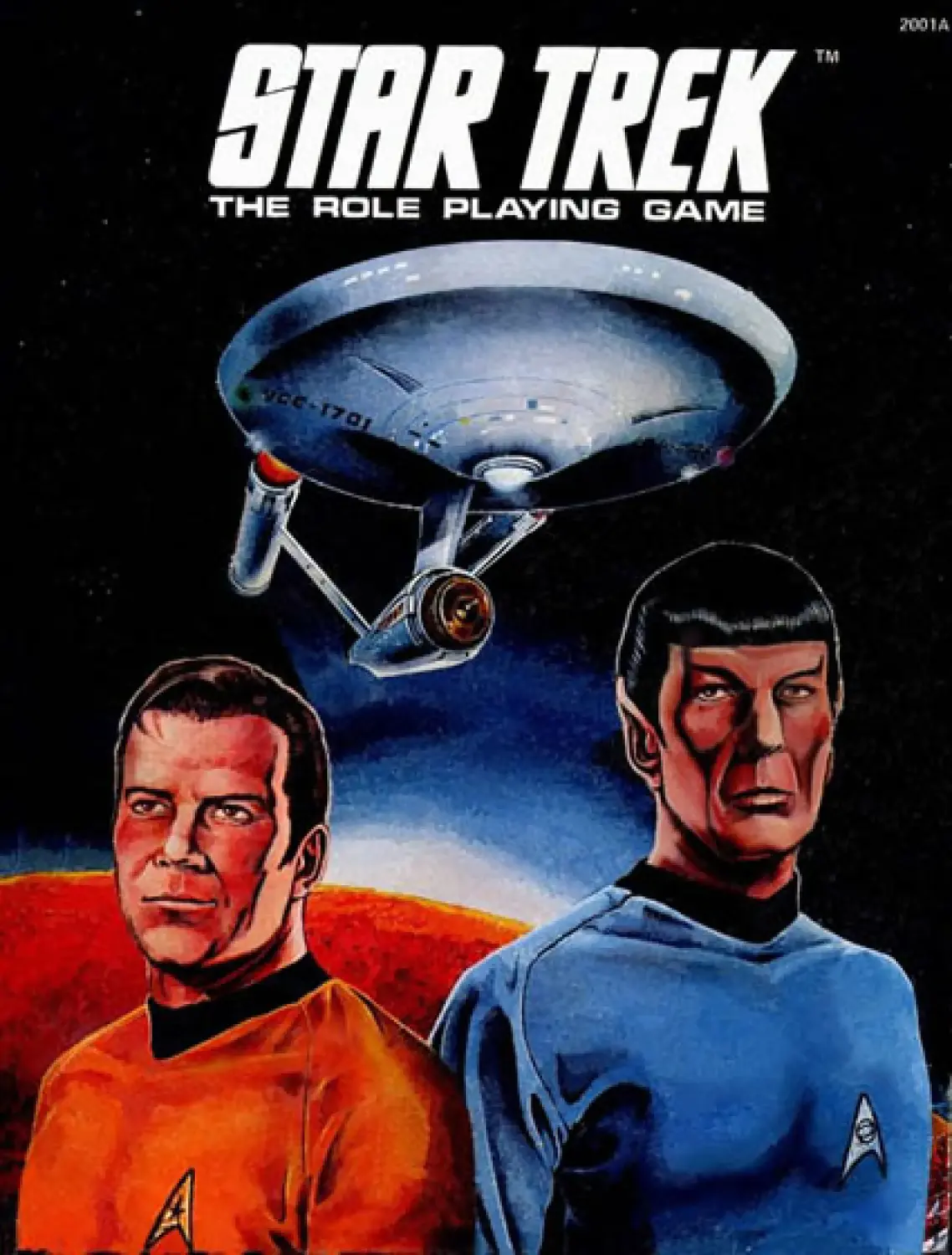
                    STAR TREK: The Role Playing Game

version 1.1

FASA Corporation

2001A

Game Design by Fantasimulations Associates
Designers:
Guy W. McLimore, Jr.
Greg K. Poehlein
David F. Tepool
Additional Development: Jordan Weisman
Ross Babcock
Original Artwork: Mitch O'Connell
Graphic Design: Jordan Weisman
Mitch O'Connell
Editors: Ross Babcock
Helena Szepe
Box Art: Mitch O'Connell
Ship Deck Plans: Dana Knutson
Ross Babcock
Mitch O'Connell
Jordan Weisman
Copyright ©1966, 1983 Paramount Pictures Corporation
All Rights Reserved
Printed in the United States of America
STAR TREK

TM

is a trademark of Paramount Pictures Corporation

No part of this book or the contents of the basic game may be reproduced in any form, or by any means without permission in writing from the
publisher.
TM

STAR TREK : The Role-Playing Game is manufactured by FASA Corporation under exclusive license from Paramount Pictures Corporation,
the trademark owner.
Manufactured by Patch Press, Inc.
Published by FASA Corporation
P.O. Box 6930
Chicago, Illinois
60680-6930
Play tested by:

Chris Fell
Sam Lewis
Michael McAuliffe
Dave Fell
Lawrence Leeper
Karen VanderMey

2

STAR TREK: The Role Playing Game

version 1.1

FASA Corporation

2001A

Table of Contents

Introduction
Glossary
Defining a Being
Player Character Races

Vulcan Telepathic Techniques

5
7
10
13
15

Familiar Characters

18

Non-Player Character Races

26

Creating Player Characters

Combat and Tactical Movement
Action Point Table
Map Symbols

30
37
38
44
45
48

To Hit Table (with adjustments)

52

Weapon Range and DamageTable

54

Player Character Record Sheet
Skills and Skill Levels

Medical Aid and Recovery

62
MedicaI Glossary

Equipment
Weapons
Planetside Adventures
New Life and New Civilizations:

Life Form Creation
Planetary/Cultural Designation Index
Animal Creation

Historical Update-United Federation of Planets
Shipboard Systems
Starship Combat
Encounters in Space: A Handbook for Star Vessel
Protocols
Starship Data
Gamemaster Hints and Suggestions
Designers' Notes

66
70
74
77
81
83
85
88
96
102
116
119
123
126

3

STAR TREK: The Role Playing Game

version 1.1

FASA Corporation

2001A

ACKNOWLEDGEMENTS
With three independent-minded authors, it is inevitable that this work have three independent dedications:
To my mother, Lula McLimore, who passed away 10/29/82 during the development of this work. With love and memories...
Guy McLimore, Jr.
To my mother, Carolyn, who may not have understood me, but who supported me nonetheless...
Greg K. Poehlein
To my wife, Joan, for tolerating the long nights of work, and to my son, Jason, whose future was my fiction...
David F. Tepool
Finally, a combined vote of thanks to Gene Roddenberry, the cast and crew of STAR TREK, and the millions of STAR TREK fans
everywhere, who have kept its spirit of adventure alive for so very long.

4

STAR TREK: The Role Playing Game

version 1.1

FASA Corporation

2001A

Introduction
challenges set by the gamemaster and cooperate toward common
goals. As they meet challenges set by the gamemaster and
overcome them, they learn new skills and become better at what
they do. The gamemaster's job is therefore not to constantly block
the player's progress, but rather to set up challenging situations.
Within the framework of the rules, the gamemaster must provide
enough challenge to make the game interesting, but not boring and
frustrating.
In this game you will play
characters who are officers and
crew of a spacecraft of the United
Federation of Planets. The setting
is the rich fictional universe of
STAR TREK, television's most
popular science fiction series.
During three seasons on
the air, the STAR TREK television
series created a fascinating
universe
of
science
fiction
adventure that captured the
imagination of its viewers in a way
no television series before or since
can rival. Despite the fact that it
has not appeared on network
television since 1969 (except for
an all-too-brief revival as an
animated cartoon series in 197374), STAR TREK is more alive in
the hearts, minds and imagination
of its fans than ever before. The
series has spawned two feature
motion pictures, several series of
popular novels, toys, collectibles,
and the most well organized and
devoted fan organization in the
history of creative endeavor.
In this game, players are able
to take the role of Captain James Kirk, Science Officer Spock, Lt.
Uhura, and any of the other familiar characters from the series. If
you prefer, you may create new characters to play aboard the
famous USS ENTERPRISE, or on any other Star Fleet vessel.
The basic game rules provide for all characters to be Star
Fleet officers. In later expansions to these rules, material will be
provided for creating other types of player-controlled characters,
including Klingons and Romulans -STAR TREK villains! For now,
such Bad Guys and other non-Starfleet individuals will be played by
the gamemaster as non-player characters (NPC's).
Star Fleet officers as player characters may be human beings
like Kirk and Dr. McCoy, Vulcans like those of Spock's home world,
or members of any of four other major United Federation of Planets
cultures. Humans tend to be more numerous in Star Fleet and have
some advantages in play because they are familiar. Playing an alien
character can be extremely rewarding, however, because it

STAR TREK: The Role-Playing Game is not a standard family
boardgame; it doesn't feature a board around which players move
playing pieces, with dice rolls determining movement and random
events. This game uses a board (at times), dice, and playing pieces,
but these are used differently than in standard boardgames.
Those familiar with the popular pastime of role-playing games
(RPG for short) need not continue reading this section, which
describes the procedures for this
type of game. Experienced players
may wish to review the mini-glossary
at the end of this section before
continuing or can move on to the
system
overview.
Those
unfamiliar with how role-playing
games are organized and played
should read on.
Role-playing
games
(RPG's) differ in a number of
ways from boardgames or card
games. In an RPG the rules
define situations and conditions
in a fictional world of the players'
choosing. Many RPG's derive
from the fictional worlds of myth,
such as Camelot of the Legends
of the Knights of the Round
Table; or from the universes of
heroic fantasy such as Professor
J. R. R. Tolkien's Middle Earth
from his Lord of the Rings series
of books. Other fictional settings
include the swashbuckling era of
the Three Musketeers, the
ingenious combat of World War II,
comic book worlds populated by
superheroes, and many others.
The object of role-playing
games is to follow the rules in establishing a character that might
have lived in the fictional world being used and to play that character
during the game, much as an actor plays a role on stage or in the
movies. To succeed in the game, one must think like the character
would think and react to situations just as that character would,
inhabiting that fictional world.
Unlike most plays or movies, however, there are no set lines
and characters don't know what will happen until it occurs. RPG's
are like improvisational theater in this regard. The situations
characters will encounter are set up in advance by a referee, known
as a gamemaster, who uses the rules to structure the adventure
situations. The gamemaster does not play a specific character
himself, but sets up the adventure and plays any people or animals
met by the characters in the fictional world. There are no set
winners or losers in a role-playing game. Instead of competing with
each other, players cooperate toward common goals. As they meet

5

STAR TREK: The Role Playing Game

version 1.1

FASA Corporation

2001A

combat. (Fortunately, in a game, such a calamity only results in
developing a new character for the player!)
Combat between Star Ships is simulated in this game as
well, using a unique system of Starship control consoles. Unlike
many science fiction games, this Starship combat system involves
all the players in the action, recalling the exciting scenes on board
the bridge of the Enterprise in episodes of the STAR TREK TV
Series!
Players during a game will try to take on the personality of
their favorite STAR TREK character, or develop a new character's
personality in interesting ways. The adventure possibilities are as
unlimited as the Universe itself with STAR TREK: The Role-Playing
Game.

encourages players to develop a whole new way of thinking and
acting within the game.
Game characters have various strengths and weaknesses
defined by the rules, the gamemaster and the players themselves.
Within personal limitations they try to accomplish tasks set forth by
the gamemaster as part of Star Fleet's mission to "explore strange
new worlds...seek out new life and new civilizations...and to boldly
go where no man has gone before!"
When combat between players and non-player characters is
called for, it is done on Star Ship deck plans, in buildings or on the
surfaces of alien worlds, as drawn up by the Gamemaster on a grid
of squares. The characters are represented by cardboard markers
(or metal miniature figures, if the players have them) which are
moved about the board according to the rules to simulate combat.
A character can be injured (or rarely, killed outright) in such

6

STAR TREK: The Role Playing Game

version 1.1

FASA Corporation

2001A

Glossary
The following is a mini-glossary of words, phrases and
abbreviations that have special meanings in this set of rules for the
game. Many of these will be familiar to already experienced roleplaying game enthusiasts. Some terms may be new to most of you.
Take a few minutes to look over this list and refer to it later if any
explanation of role-playing terms is required.

CHARACTER CREATION SYSTEM
The procedure (explained in this book) by which player
characters are developed before play. This is a method of
determining attributes, skills and pre-game experience.
CHARISMA
A character attribute governing the amount of personality,
force and attractiveness possessed by a character. Charisma is not
the same as physical beauty, though physical attractiveness can
add to charisma.

ACTION POINTS
A number that varies with a character's dexterity and
represents the number of things or actions the character can do in
one 1 a-second combat turn. Often abbreviated "AP".

COUNTER
A cardboard square used to represent a character, animal,
or other moving object on the tactical combat map.

ADVENTURE
One mission, designed to stand alone or as part of a
continuing campaign. Usually a single adventure or mission will
only take one or two game sessions to complete.

D10
Short for "10-sided die". Usually preceded by a number
indicating how many dice are to be rolled. For example, "1D10"
means roll one 10-sided die, "2D10" means roll two 10-sided, dice
(or roll one twice) and add the number together, etc. If something
like "roll 1D10+5" is indicated, it means roll one 10-sided die and
add 5 to the result.

AP
See ACTION POINTS.
ARCHAIC
Ancient or outdated. An archaic skill is one that hasn't much
use anymore (like buggy whip making). In STAR TREK's time,
many common skills, weapons, and even languages used today
are outmoded and considered archaic.

DAMAGE ROLL
A roll of dice that indicates how much damage is done to a
character by an attack during combat. The number of dice rolled
varies according to the weapons used in the attack.

ATTRIBUTE
A number representing a character's potential in a certain
area of physical or mental development. In this game, basic
attributes are Strength, Endurance, Dexterity, Intellect, Charisma,
Luck, and Psionic Potential. See listings under each of these for
specific information.

DEPARTMENT HEAD
A position of top responsibility on a starship. Department
heads
on
Constitution-class
starships
include
Chief
Communications Officer, Chief Medical Officer, Chief Engineer,
Chief of Security, Chief Helmsman, Chief Navigator, and Science
Officer.

BLAST RADIUS
The area of destruction created by an explosion, such as a
phaser overload.

DEX
See DEXTERITY.

CAMPAIGN
A series of missions or adventures using the same cast of
player characters and important non-player characters. In a
campaign characters grow, develop and change, learning new skills
and rising in rank and responsibility. Campaigns can last a long
time or only a few adventures, as the gamemaster and players see
fit.

DEXTERITY
A character attribute governing a character's physical control,
speed and accuracy.
DIE MODIFIER
A number which is added to or subtracted from a roll of the
dice to make an adjustment to that roll. Modifiers are sometimes
used to make a saving roll harder or easier.

CHA
See CHARISMA.

DIE ROLL
The number generated by throwing one or more dice. (In this
game, special 20-sided dice are used.) There are various types of
die rolls made in this game. (See D10, PERCENTILE DICE).

CHARACTER
The fictional identity taken on by a player for the game, as
opposed to the player himself.

7

STAR TREK: The Role Playing Game

version 1.1

FASA Corporation

2001A

PERSONAL COMBAT

END
See ENDURANCE

Combat between characters, either hand-to-hand or using
non-ranged weapons.

ENDURANCE
A character attribute denoting the amount of physical
punishment, deprivation or abuse a character can absorb without
losing consciousness or dying.

PHYSICAL ATTACK
See PERSONAL COMBAT.
PHYSICAL COMBAT

GAMEMASTER
The referee of a role-playing game. He is responsible for
writing the background for adventures, much as a television writer
prepares a script. Sometimes abbreviated "GM".

See PERSONAL COMBAT.
PLAYER
A person who plays this game (as opposed to a character) .

GAMETURN
A complete round of movement and actions for all players
during the combat sequence.

PLAYER CHARACTER
A character operated by a player, not the gamemaster.
PLAYER TURN
The actions of a single player during a combat sequence.

HAND-TO-HAND
Combat between characters using just fists or other natural
extensions like claws; no weapons. Sometimes abbreviated "HTH".

POSITION
The job held by a Star Fleet Officer. This has nothing to do
with rank, except on some ships an officer must be of a certain rank
or higher to hold a specific position. Positions are such titles as
Science Officer, Helmsman, or First Officer.

INT
See INTELLECT.
INTELLECT
A character attribute reflecting the mental processing ability,
memory retention and the reasoning power of a character.

RACE
A group of sentient beings separated by species. All Earth
humans, along with all inhabitants of human colonies, are
considered to be of the Human race. Natives of Vulcan and Vulcan
colonial worlds are of the Vulcan race. Races are usually separated
by significant differences in physical structure (internal or external).
Some races are denoted as humanoid or human-like (including
Vulcans, Andorians, Klingons, etc.) Others are totally alien to the
human form (such as the Tholians, Horta, and the true form of the
Organians). Within each race are relatively insignificant differences
of form or features (such as skin color, epicanthal folds, eye color,
etc., among humans and humanoids). These minor differences
have no effect on the game.

LINE-OF-SIGHT
A direct line between a character and a potential target. A
clear line-of-sight, with no obstructions, must exist for the character
to fire a ranged weapon at the target. Often abbreviated as "LOS".
LOS
See LINE-OF-SIGHT.
MODIFIER
See DIE MODIFIER.
NON-PLAYER CHARACTER
A character in the game who is played by the gamemaster,
not a player. Sometimes abbreviated "NPC".

RANGED ATTACK
See RANGED COMBAT.
RANGED COMBAT
Combat or attacks made with weapons used at a distance,
whether they be phasers or crossbows.

OPPORTUNITY ACTION
A combat action taken at a time other than the character's
own turn.

RANK
OPPORTUNITY FIRE
Weapons fire done as part of an opportunity action.

A denotation of military standing. Rank has nothing to do with
position, except that some positions on some ships must be filled by
someone of a certain rank or higher.

PERCENTILE DICE
A dice roll involving two 10-sided dice. One die is
designated as showing the tens digit of a two-digit number. The
other is the ones digit. Rolling these dice generates a number from
01 to 00 (read as one hundred). Such a roll is sometimes
abbreviated as "% dice".

ROUND DOWN
Adjust a fraction number of the next lower whole number.
For example, if told to divide 23 by 5 and round down, you would
perform the division (23 divided by 5 is 4 and 3/5, or 4.6), then
drop the fraction part (for a final result of 4).

8

STAR TREK: The Role Playing Game

version 1.1

FASA Corporation

2001A

SPECIALTY
A general area of concentration in which a character will
probably center his efforts in gaining skills and increased skill
levels. This area also determines the position (but not the rank) a
character is likely to hold. Also known as "Specialty Area".

SAVING ROLL
A roll of dice (usually percentile dice) which is compared to
either a character attribute or a skill level. If the die roll is higher
than the attribute or skill level tested, the saving roll fails. If the roll,
however, is the same or lower than the score being tested, the roll
succeeds.

STATISTICS
Another word for ATTRIBUTES. Also known as "Stats".

SCENARIO
A single adventure or mission on which characters work
toward one overall goal.

STR
See STRENGTH.

SIDE

STRENGTH
A character attribute describing relative physical power.

One group of related characters acting toward the same goal
in a combat. This may be a group of player characters or a group of
non-player characters (like a Klingon landing party) operated by the
gamemaster. It is possible in some unusual situations to have more
than two sides in a combat.

"TO HIT"
A score or number denoting the roll necessary on percentile
dice to hit a target with a ranged weapon, or hit a foe with a weapon
or fist. TO HIT rolls are made in a similar manner to saving rolls, in
that any score on the dice which is equal to or less than the TO H
IT number is successful. Any number rolled on the dice higher than
the TO H IT number denotes an unsuccessful attack.

SKILL
A learned ability in a specialized area, such as instrumental
music, marksmanship, or transporter operational procedures.
SKILL LEVEL
A numerical score showing the relative expertise of a
character in a skill. Also known as "Skill Points" or "Skill Rating".

9

STAR TREK: The Role Playing Game

version 1.1

To play the role of either a familiar character from STAR
TREK (like Captain Kirk, Mr. Spock, or Lt. Uhura) or a created
character based in the same setting, a way of defining their relative
strengths and weaknesses must be determined. Using humanity as
a base (with one exception, see PSI), this game will define the
capabilities of a character by a series of skills in various areas
possessed by the character.
The attributes in this game are based on a scale of 1 through
100, 1 being the minimum score possible for a human, and 100
being a practically unattainable maximum for a human being. Nonhuman races may have more or less range in an area, and so have
their possible range adjusted somewhat. It is possible to have a
non-human character (or an extremely unusual human character)
with a score of over 100 in an attribute.
Of course, the player characters, and many of the non-player
characters, are not average human (or non-human beings). Only
the best and the brightest get through Star Fleet Academy and
survive the dangers inherent in space exploration. Therefore, the
character creation system for this game is designed to produce the
better-than-average character. Non-players who are not of Star
Fleet or equivalent programs designed to weed out the less
competent should be created by the gamemaster with this thought
in mind.
At times in the game, it may be necessary to determine the
character's ability to perform an action; the success or failure of
which depends on the score in one or more attributes. To test a
character's capability in an area a saving roll is usually made.
A saving roll in this game is made with % dice; the player
tries to roll a number that is the same or lower than the character's
score in the attribute being tested. Success means that the
attribute was high enough to allow the character to perform the
task desired. If not, the task cannot be completed by the character
in that manner, at that time.
Saving rolls are called for by the gamemaster, and the
requirements may be modified by him for tasks that are easier or
harder than average. In the case of an easy task, the gamemaster
may specify a modifier which subtracts from the saving roll,
making it smaller and hence making it easier' to score under the
attribute being tested. On the other hand, for particularly hard
tasks, the gamemaster may wish to add to the die roll, making it
harder to roll low.
Such modifications should be consistent, and must be
announced before the roll is made. (Exception: Where the
circumstances of a saving roll are not obvious to the player.-For
example, when rolling a saving roll to affect the situation the player
is not aware exists. The gamemaster may make the roll for the
player secretly. He then tells the player nothing at all about the roll
or modifiers, only the results.)
The basic attributes, and what they are used to describe,
are presented here:

FASA Corporation

2001A

ATTRIBUTE EXPLANATIONS

STRENGTH (STR):
STR refers to a character's physical power-the ability to lift,
carry, and apply force. It affects unarmed physical combat and is to
some extent a measure of physique and size. A character with a
STR score of 50 can carry about 50 lbs. at length without tiring, lift
about three times that without strain and drag a 200 lb. weight for a
short time without exhausting himself. This is about the minimum
performance for a Star Fleet cadet, but is pretty good as humans go.
During the game, STR does not decrease from injury. It is a
measure of potential based on a well-operating body. It may be
reduced by other factors, or at gamemaster's option as the result of
a debilitating injury that limits the character's potential.
A saving roll on STR might be made when something heavy must be
moved, or when a character must force open a door or perform other
physical feats of power.

ENDURANCE (END):
END is a measure of how much abuse and neglect the body
can stand; the body's defenses against adversity. Combat damage is
removed directly from this statistic, as would be penalties for
ingestion of poison, for the effects of disease, and exhaustion.
Reductions to END from exhaustion (and similar appearing
effects such as a Vulcan nerve pinch and phaser stun) are regained
quickly. Damage done to the body in combat, however, regenerates
much more slowly, depending on the level of medical aid available
(see Damage Effects and Recovery and Medical Aid sections of the
rules.)

10

STAR TREK: The Role Playing Game

version 1.1

FASA Corporation

2001A

DEXTERITY (DEX):
DEX is a measure of the physical control a character
possesses in terms of agility, aim, balance, etc. DEX affects how
well a character uses a weapon, how clumsy the character is, how
quickly he or she can physically react to danger or opportunity, etc.
A saving roll on the DEX attribute might have to be made for
the character to perform an act requiring physical coordination (like
walking over a slippery rope bridge) or quick physical reactions and
reflexes (such as playing a game of zero-gravity handball, one of
Kirk's favorites!) It also affects (along with weapons skills) use of
hand weapons, projectile weapons, and other combat styles. (See
combat rules).

Players and the gamemaster should keep a separate record of END
loss for injury and for exhaustion, stun effect, etc. These effects may
combine, however, to incapacitate a character and reduce the
character to unconsciousness.
An END saving roll could be made to determine how long a
character can undergo adversity, such as holding one's breath
underwater, or undergoing torture at the hands of the Klingons.

INTELLECT (INT):
INT measures the character's mental processing potential
just as STR measures the physical potential. INT scores determine
how well a character can store and process information; that is,
how well the character can think and reason. Some of this potential
is genetically determined and some is determined by environment.
Even in Star Trek's time, scientists and educators do not agree on
which is more important.
A saving roll on INT may be made whenever the character
needs to reason out a problem or gather and process new
knowledge not fitting into an existing skill description. (Example:
Puzzling out the operation of a totally alien device beyond their
experience). If a skill on the skills list would be of help in such an
effort, the skill score and the INT score should be added together
and averaged (divided by 2) and a saving roll made on the result. (If
the character's score in that skill is zero, use ½ the INT score to
make the saving roll. This is one time when the gamemaster may
want to make the roll secretly, as if a player does not know the
function of a device, the character should not be told which skill
affects his roll to figure it out!)

CHARISMA (CHA):
This attribute is not merely a measure of physical
attractiveness. Physical attractiveness is meaningless when dealing
with members of other races from other worlds. Alien standards of
attractiveness may be quite different. Physical attractiveness may
enter into the charisma of an individual, but more important is force
of personality (or will).
Ahh… character with a lower than average charisma IS not
necessarily plain or ugly. The character may be a handsome man or
woman who does not possess as much personal magnetism or force
of personality as some others. Conversely, a high charisma
character may be physically average but a dynamic, forceful
speaker. The interpretation of the CHA attribute score is up to the
player to decide and the gamemasters to interpret. Players and
gamemasters are reminded of the Vulcan philosophy of the IDIC Infinite Diversity in Infinite Combinations. Beauty is in the differences
in people and cultures, not in conformity to standards.
A CHA saving roll might be required to catch the eye and
attention of a member of the opposite sex (as Captain Kirk was often
doing, sometimes as a requirement of his duty to protect his ship
and crew, but more often because he has little resistance to a
charming woman!).

11

STAR TREK: The Role Playing Game

version 1.1

FASA Corporation

2001A

PSIONIC POTENTIAL (PSI):
This statistic reflects the potential psionic power of an
individual character. Note that this does not mean that a person
with a high PSI score will necessarily have psionic abilities in
evidence. Cultural development and training are of prime
importance in developing psionic powers, and most cultures do not
place educational emphasis on such training.
Earth and Human culture is mostly lukewarm toward psionic
development. We know that Star Fleet tests all personnel for
psionic potential (see the episode Where No Man Has Gone
Before), but most of the rest of humanity has no idea what psionic
potential they possess. Even Star Fleet has no formal training in
psionics offered at the Academy, though especially promising
students may get the opportunity to study on Vulcan (gamemaster's
option-such a character would probably adopt Vulcan ways and
attitudes. See the episode Is There in Truth No Beauty?) Vulcan
culture, on the other hand, trains all Vulcan children in certain
psionic disciplines, such as mind linking. It is part of the Vulcan
heritage. Actually, Vulcans as a race probably started out with no
more psionic potential than humans. Their cultural emphasis on
mental control has acted as a form of natural selection for
centuries. The psionically gifted are more likely to survive and have
children on Vulcan.
Thus, Vulcan player characters may realize their psionic
potential to a greater extent, using PSI saving rolls to judge
succession applying Vulcan psionic techniques. (See racial data for
Vulcan characters for details). Humans and most other races will
apply PSI saving rolls only as resistance to unwanted PSI prying by
others into their minds, and as modifiers to other types of psionic
activity and attack.

CHA is averaged with the leadership skill score to saving
rolls when attempting to lead or influence an unfamiliar or hostile
group, but CHA is used alone when trying to influence individuals.

LUCK (LUC):
When it comes right down to it, luck is a part of all
endeavor. Cmdr. Spock has observed that human history is a
series of lucky breaks, as human society survived crisis after
crisis despite great odds against survival. For this reason, and
because so many times luck has saved the life or career of one or
more of the Star Trek characters, this statistic must be part of the
game.
Luck seems to affect humans more than any other race, as
Spock observes. Somehow, being a human being (that is, of Earth
ancestry) gives an edge during a crisis. Of course, such luck is
unpredictable and capricious, and lucky breaks can happen to
anyone (as simulated to some extent by the use of dice in this game
to add the random fact to the interactions of beings within their
environment and each other).
LUC saving rolls are used in this game when the
gamemaster believes situations may be affected by pure chance
and coincidence. The object of this game for the gamemaster is
not to kill off player characters, and setting up a total adversary
relationship between players and the gamemaster limits the
enjoyment of the game. Therefore, the gamemaster should use a
LUC saving roll attempt at times to give a player a chance to bail
himself out of a tricky situation. A saving roll of this type should
always be given to a player character (or a non-player who is an
established STAR TREK character) who is in imminent danger of
death or other tragedy. Temper the use of such saving rolls with
common sense, but do use them when necessary. Sure, it
hampers realism, but STAR TREK should reflect television
realism, not reality.
On the other hand, the breaks go both ways. At crisis
points, LUC rolls should be applied, with things going badly if the
rolls are failed. This is a good way for a gamemaster to introduce
another plot complication to a scenario if players are getting
bored.
One important use of the LUC attribute saving roll is to limit
damage from energy weapons. Thus, a fatal shot should be
reduced to a Graze from energy weapons if a LUC save can be
made by the victim.
In reference to the large LUC penalty given in the rules to
Vulcan characters, observation shows only that Vulcans are
logical, strong, and psionically gifted. They do not seem to be
lucky. Such is the price you pay for higher than average attribute
scores in STR, END, and INT.

12

STAR TREK: The Role Playing Game

version 1.1

FASA Corporation

2001A

Player Character Races
unimportant variations in height, weight, skin coloration, sensory
enhancement, etc. Note also that not all "Human" cultures are part
of the Federation. Thus "Humans" may turn up as a non-player or
even an enemy race at times.

There are six Federation races commonly found as starship
crewpersons. Actually, there are many, many starfaring groups
among Federation-affiliated populations, but quite a number are of
these six basic types and the character creation system in this
game centers on these groups.
Each player character race has its own set of unusual
physical and psychological peculiarities. Humans are, by far, the
easiest to play. After all, you have plenty of experience! It is
suggested that new players start with a human character,
especially if the player is not already intimately familiar with the
STAR TREK universe.
When playing non-human characters, the role-playing aspect
of the game is more important than ever. Gamemasters must insist
that non-humans act like non-humans! Emotional Vulcans, meek
Tellarites and life-of-the-party Edoans should not be tolerated in a
game situation.

Remember that though Humans are basically the same
physically, their motivations and backgrounds may be very
different. Each character's personality and actions should be
developed by the player based on the background he creates. A
person who grew up on a small agricultural world will have a
different point of view than one who grew up in the cities of Earth.
VULCANS

HUMANS

Vulcans were the first alien species encountered by Humans
that were significantly different in physiology and psychology from
people of Earth. They are humanlike in many respects, but in other
ways they're totally different.
Vulcan (the home planet, as translated from their tongue) is
a harsh world, dry and hot with higher gravity and a thicker
atmosphere than Earth. These conditions affected the Vulcan
physical development.
Vulcans are stronger than Humans, with more physical
endurance. Their blood chemistry is based on copper (rather than
iron) as a carrier of oxygen. This makes their blood greenish in
color, and gives them a somewhat greenish-yellow complexion.
Their eyes are protected from the harsh Vulcan winds and sand by
a thin transparent membrane, much like a second eyelid.
Vulcan's culture is far older than Earth's own. In prehistory,
Vulcans were tribal and warlike and savage as early Humans, if not
more so. Their savagery threatened to bring about their extinction
through constant warfare.

Humanity is the most numerous sentient species in the
Federation. Besides Earth-born humanity, there are also thousands
of human colony worlds. On some of these worlds, particularly those
long colonized, the human population has changed and evolved to
better adapt to local conditions.
Besides Earth colonies, there are a number of civilizations
with no known ties to Earth that have never the less produced
native species identical to Earth humans in virtually all respects.
Scientists have not answered the questions this raises, nor have
they explained why even some definitely non-human races
(Vulcans and Klingons, to name only two) still bear so many
resemblances to Humans.
It is believed by some scientists that all of these races are
offshoots from some common space-travelling race in the distant
past. This theory is not proven, however, and is widely disputed.
At any rate, all planetary cultures with basically Human
physiology are considered as Human in this game, despite

13

STAR TREK: The Role Playing Game

version 1.1

FASA Corporation

2001A

VULCAN PSIONIC TECHNIQUES
Eventually the ancient Vulcan philosopher Surak turned
the people of Vulcan away from violence by introducing a
philosophy of rejection of emotional expression. Today's Vulcans
refrain from expressing all emotions, letting logical thought and a
rational decision-making process rule their lives.
A commonly held misconception among Humans is that
Vulcans have no emotions. This is not true, but it is so widely
believed that some Vulcans believe it themselves. Actually,
Vulcans suppress emotional reactions, depending on mental
discipline to keep emotions from affecting their thinking and
actions. This process is so ingrained in Vulcan tradition and
society that it is almost automatic for Vulcan adults. even under
great stress. In fact, the expression of emotion is considered to be
in extremely bad taste in Vulcan society-only a barbarian or a
mental defective would think of such a thing.

Another result of the intellectual/mental introspectiveness of
Vulcan culture is their development of certain psionic disciplines to
a level unmatched by most other sentient races. There have been
attempts to teach these ancient disciplines to members of other
races, and some partial successes have been noted. But centuries
of psionic exercise and mental discipline have made the Vulcan
race capable of some amazing psionic feats. Knowledge of these
disciplines is ingrained in the culture, and most Vulcans can
perform them to some degree. Those who are especially adept are
revered and respected by all.
It is widely known that members of the Vulcan race are
somewhat telepathic, some individuals more than others (according
to their PSI score in the game). The ability to use this telepathic
tendency manifests itself in various ways.
In modern Vulcan society, the use of telepathic contact to pry
into another's mind is unthinkable. Such contact is intimate and
somewhat embarrassing. Mind contact is not practiced for trivial
reasons.
Vulcans use several mind contact forms (if they use any at
all). The most common is the mind touch. Physical contact between
the Vulcan telepath and the subject is desirable, but not absolutely
necessary. In the mind touch, the minds of two individuals become
attuned, to the point where the thoughts and feelings of each are
shared and communicated. The depth of sharing and
communication depends on the wishes of both parties, and the
conditions under which the attempt is made.
Vulcan mind fusion is a deeper form of the mind touch
technique. With mind fusion, the two minds actually become one,
with total sharing of not only thought but motivations and memories
as well. This technique would only be attempted under the most
extreme circumstances, as it is very difficult and embarrassing for
the Vulcan, and somewhat dangerous because the two
personalities involved may be hard to sort out and split apart to
terminate the fusion.
The Vulcan mind meld is a multiple-mind touch, where
several minds are in communication at once. This, too, is a very
different technique.

Interactions with other cultures, particularly Human, is slowly
affecting Vulcan attitudes, especially among those often exposed to
Human culture. Sophisticated, well-traveled Vulcans find Human
emotional expression baffling and somewhat distasteful, but are
able to live and work around Humans nevertheless. A less worldly
individual might be horrified by open Human emotionalism. (If so,
,the Vulcan would of course never show his dismay. He or she
might, however, avoid Human contact whenever possible.)
Vulcan logical development grew out of an avoidance of war.
This wish to avoid war has affected their culture in other ways as
well. Vulcans do not believe in killing other thinking life unless
absolutely necessary. All Vulcans are vegetarians, finding the idea
of killing animals for food repulsive. Some Vulcans are extreme
pacifists, believing that there is never any reason to kill any living
being, but all Vulcans will avoid killing except in the direst need. For
this reason, Vulcan characters rarely carry arms, and will not use
deadly force against another thinking beings except under direct
order, or in the most extreme emergency.
The Vulcan pursuit of the logical ideal has led them to great
accomplishment in both the sciences and arts. Intellectual pursuits
come naturally to Vulcans.

GAME MECHANICS - VULCAN PSIONIC DISCIPLINES
When a character must use one of the described Vulcan
psionic abilities, a basic % dice saving roll must be made against the
character's PSI score. Modifiers from the following tables should be
applied to the roll, according to the type of telepathic communication
desired, and the conditions under which it is being attempted.
An attempt to make any sort of telepathic link takes 1 minute
(6 turns, in the combat scale), during which the character may take
no other actions. Quiet is desirable, and there must be no
distractions or concentration will be broken. Thus there is no way
that a mind touch or other psionic discipline could be attempted in
combat!

14

STAR TREK: The Role Playing Game

version 1.1

FASA Corporation

VULCAN TELEPATHIC TECHNIQUES

2001A

DIE MODIFIERS

CONDITION
MIND TOUCH-One-way transfer of a basic concept or feeling (such
as hunger, fear or a feeling of relaxation)
MIND TOUCH-One-way communication of a short message or
complex concept or feeling (such as "the prisoners are escaping" or "we
are not hostile")
MIND TOUCH-Two-way telepathic conversation (equivalent to a
vocal discussion of about one hour, with visual aids and sharing of
memory)
MIND TOUCH-Two-way sharing of thoughts and feelings (surface)
and communication of true intentions

MODIFIER
+0
+10

+20
+30

MIND TOUCH-Total exchange of memory data and thought sharing

+40

MIND TOUCH-Modifications of subject's memories or attitudes (by
other than persuasion)

+20

MIND FUSION-Complete sharing of self

+50

MIND MELD-Per additional person in any of the above

+½ cost levels as above

Total quiet and isolation (no other persons present in room)

-15

Comfortable, familiar surroundings

-10
Use the highest PSI No. and subtract ½ the
other's PSI from the roll

Subject is also willing telepath
Subject is non-telepathic, but willing

-25

Subject is unresisting or unaware

-10

Subject is aware and resisting mentally

-½ the subjects PSI

Subject has been mind touched before by same Vulcan telepath
Subject and Vulcan telepath are friends or are otherwise mentally
sympathetic

-10
-10

Subject can by physically touched

-20

Subject is in sight and near, but not touched

+0

Subject is distant (depending on distance, and at game master's
option)

+10 or more...

Subject is Human/Vulcan-like sentient being

-10

Subject is non-humanoid sentient being

-10

Subject is semi-sentient

+10

Subject is non-sentient (animal)

+25

Subject is an unknown type of creature, never before encountered

+20

Gamemasters are encouraged to apply other modifiers as
needed for special situations or to modify the figures given
above if the situation warrants it.

15

STAR TREK: The Role Playing Game

version 1.1

FASA Corporation

2001A

The nerve pinch is applied by grasping the area just between
the neck and shoulder and applying pressure in , manner. If
properly executed, the victim is almost instantly rendered
unconscious, having no chance to cry out or
take any action.
The technique is only effective against upright humanoids)
who are not protected by natural or artificial armor. Thus, Humans,
Vulcans, Andorians, Klingons and the like could be affected, but a
Gorn's hide is too tough, and some other alien species may be too
have no definable head and neck, or simply have less sophisticated
or entirely different nervous systems.

The above list of rules and modifiers is complex, but the
Complexity is necessary. Vulcan mental techniques are a useful part
of STAR TREK: The Role-Playing Game, but they are usually
Misused if Vulcan characters are allowed to apply them
indiscriminately. Thus, these rules permit their use where
Appropriate, but allow the gamemaster to restrict them for the sake
of play balance. Gamemasters must keep Vulcan telepaths on a
"short leash" and not allow psionics to dominate the game!
Because of the complexity of these rules, let's look at an
example of Vulcan mind touch at work. Suppose a landing party
from the USS Enterprise, commanded by Dr. Spock, is captured
by hostile natives and locked in a cell. The jailer is right outside the
locked steel door, dozing in a chair. The use of Vulcan mental
abilities might get our heroes out of the spot they are in!
Spock can see the jailer through a small window in the door.
He calls for silence and beings to concentrate...
The player running the character of Mr. Spock must now
determine his chances of placing a suggestion in the mind of the
jailer. He tells the gamemaster that Spock is trying to communicate
to the jailer the feeling that the prisoners are escaping, hoping in his
half-waking state he will get up and open the door to see.
Looking at the chart of modifiers, we can see that Spock is
trying for a "one-way communication of a short message or feeling".
The modifier is +10 to the saving roll made.
Also, the subject is unaware (-10), in sight and near (+0) and
a humanoid, sentient being (-10). Since the jailer is half-asleep,
he's probably easier to confuse, so the gamemaster decides to give
Spock an additional -5 bonus. (Gamemasters: Feel free to give
bonuses and penalties beyond the charts when you feel they are
deserved). Thus, Spock's total modification is -15.
Spock has a PSI attribute score of 98, and must roll under
that (after modifications) to be successful. The roll is made, but it's
not a good one-99! Fortunately, the -15 modifier brings that roll to
84! The jailer jumps up and groggily unlocks the door to look for the
prisoners. The other members of the landing party jump the jailer
and knock him unconscious, and the party is freed!

GAME MECHANICS - VULCAN NERVE PINCH
The Vulcan nerve pinch is applied like any other hand attack
in the combat game, with a few modifications to the die roll "to hit",
as noted below.
Victim is unaware of attacker's presence (sneaking up
from behind, for example)

-30

Victim is caught by surprise or distracted in some
manner Victim must fail a standard saving throw on
INT to be tricked in this manner...)

-20

Victim is on guard in general against attacker

+20

Victim is on guard, and aware of nerve pinch technique

+40

If the "to hit" roll is successful, the victim is reduced to
unconsciousness immediately, regardless of END. The effect lasts a
number of minutes equal to 2D10+10, as with phaser stun. Like
phaser stun, there is no loss of END upon regaining consciousness.
Vulcans also know techniques for relieving pain with nerve
pressure. It would be impossible to provide a full set of rules for such
action, but the gamemaster should be aware of the possibility should
the need arise. Note that such techniques do not reduce the severity
of an injury, nor revive an unconscious person. In fact, masking pain
in this could cause an injured person to make his/her injuries worse
without being aware of it! This technique, however, might be
employed to save a character a saving roll for unconsciousness
upon reduction to ½ END. A Vulcan cannot apply the pain-reduction
technique to himself

VULCAN NERVE PINCH

This is another technique only Vulcans can apply, since it
requires great strength and detailed knowledge of the nervous
system. Not all Vulcans can perform this, but many can. (All Vulcan
player characters are probably trained in this technique, if they were
raised on Vulcan or by Vulcans).

16

STAR TREK: The Role Playing Game

version 1.1

ANDORIANS

FASA Corporation

2001A

EDOANS
The Edoans are a more recent addition to the Federation.
They walk upright and have some resemblance to Humans, but are
tripedal; possessing three arms and three legs. Their skin is orange
and hairless. They have round yellow eyes and a concave
structured head.
Edoans are among the best toolmakers in the Federation,
due to their sensitive hands and great dexterity. They are
meticulous about detail and make good scientists and technicians.
The Edoans are reserved and prize privacy. They tend to be
shy and introverted, making few close attachments.
TELLARITES

Physically, Andorians are blue-skinned humanoids with
white hair and a pair of knobbed antennae extending from the sides
of the crown of the head. Their slim builds conceal a well-muscled
warrior's body.
Andorian history is one of conflict, though like the Romulans
who are foes of the Federation, they do not battle without reason.
The martial spirit is still alive in Andorian culture. Andorians are a
stoic, unsentimental people for the most part, but they do respect
and revere ties of family.
The Andorian antennae are sensitive organs of hearingmore sensitive in some ranges than those of humans or Vulcans.
(However, they are also more vulnerable and exposed.)
Andorians are fond of technology, but insist on its use in
concert with nature. For this reason, their wars of conquest in early
Andorian history were fought with a regard for planetary
environment. As such, they avoided much of the ecological
devastation suffered by Earth humans and many other cultures.
Andorians are extremely disciplined, and possess a strong
sense of duty and personal honor. As 5uch, they make excellent
military officers.

Tellarites are basically humanoid, but with a pinker skin tone
than human caucasians (due to higher normal blood pressure).
Tellarites have more facial and body hair than humans, with hair
covering all but the frontal face and the hands. Such hair is not at
thick as animal fur, but is more reminiscent of an extremely hairy
person. Their home worlds have a thinner atmosphere than Earth,
leading to their overdeveloped nasal openings, which have been
unkindly compared to the snouts of Earth swine. (Tellarites take
immediate and strong offense to such comparisons!) Members of
the Tellarite race are racially suspicious, argumentative and brash,
at least by Human standards. Those who trust too much or give in
too easily are considered weak fools in Tellarite society. Tellarites,
needless to say, make poor diplomats. They enjoy a good
argument, and a merchant's bazaar on a Tellarite world is a very
lively place, indeed!
Tellarites are fond of food and drink -and lots of it.
Fortunately, alcohol has little adverse effect on them. (It only makes
them more stubborn). Nevertheless, they are capable of going
twice as long without food or water as the average human, since
they carry an extra abdominal roll of fatty tissue. This abdominal
tissue makes them look portly, but such is natural for a Tellarite,
and they can, in extreme cases, live off this fatty deposit for quite a
while. Generally, though, they'd rather not skip a meal.

CAITIANS

This race walks erect as bipeds, but they are descended
from creatures similar in some respects to Earth felines. They
possess sleek bodies covered with soft fur, which also covers their
faces and hangs about the head like a mane. They have large
golden eyes, long tails, and voices with a purring quality.
Caitians are extremely dexterous and fast. Their ancestors
were hunting carnivores, but a large portion of the Caitian
population is now vegetarian! They have acute senses of sight and
smell.
Caitians practice total equality of the sexes, and have
throughout recorded history. Even Caitian names have no gender
indicated, so a male child is as likely to be named after his mother
as after his father.

17

STAR TREK: The Role Playing Game

version 1.1

FASA Corporation

2001A

Familiar Characters
The crew of the USS Enterprise is the most capable crewmembers in Star Fleet. As such, they are far above the average in both
character attribute scores and skill levels. Player characters created with the player character creation system are not likely to have the depth
and breadth of skill levels possessed by the Enterprise crew.
Skills and attributes for STAR TREK's familiar characters are based on observations in the series, traditional fan thoughts, and
additions, and rational speculation. Gamemasters should feel free to add to or alter these statistics if they wish. All series regulars have
complete character statistics provided, with recurring (but not regular) characters provided in a shorter format, which may be expanded by the
gamemaster if desired.
Players and gamemasters not already experienced with role-playing games such as this one are encouraged to play at least a couple of
adventures with the familiar STAR TREK characters already provided. More experienced players may wish to proceed directly to creating their
own, original Star Fleet officers with the player character creation system.

STARFLEET PERSONNEL FILE -USS ENTERPRISE -NCC-1701

KIRK, James Tiberius / Captain / Human / Male / Age 34
Commanding, USS Enterprise
SERIAL No: SC937-0176CEC
STR 68
END 77
INT 84
DEX 79
CHA 94
"TO HIT" (modern arms) 79 (hand-to-hand) 80
Skills Levels
Administration
60 Planet survival
66
Astronomy/astrophysics
53 Ship weapon tech
29
Carousing
62 Psych (Human)
49
Computer operation
50 Shuttle Pilot
49
Computer tech
10 Shuttle system tech
11
Electronics tech
10 Small equip sys tech
11
Environmental suit operation
51 Small unit tactics
64
Federation history
64 Starship combat tactics/str
96
Federation law
86 Starship communication procedure
38

LUC 98

PSI 29

Gaming
82 Starship engineering(general)
22
Instruction
55 Starship helm operation
62
Languages (ORION)
21 Starship navigation
79
Leadership
92 Starship security
32
Marksmanship (arch) -(ANCIENT FIREARMS)
36 Starship sensors
41
Marksmanship (mod)
78 Streetwise
79
Negotiation/diplomacy
97 Trans operation procedure
66
Personal weapon tech
21 Warp drive tech
33
Personal Combat (unarmed)
81
Trivia (LIFE OF ABRAHAM LINCOLN)
91
Trivia (AMERICAN HISTORY)
77
Commendations: Palm leaf of Axanar Peace Mission; Grankite Order of Tactics, Class of Excellence; Prantares Ribbon of
Commendation, first and Second Class
AWARDS OF VALOR: Medal of Honor; Silver Palm with cluster; Star Fleet Citation for Conspicuous Gallantry; Karagite Order of
Heroism
MEDICAL NOTES: Once contracted Vegan choriomeningitis & still carries microorganisms in bloodstream
BIRTHPLACE: Earth/United States of America

18

STAR TREK: The Role Playing Game

version 1.1

FASA Corporation

2001A

SPOCK / Commander / Vulcan (half-vulcan, half-human) / Male / Age 40+
First Officer, Science Officer, USS Enterprise
SERIAL No: SI179-276SP
STR 93
END 82
INT 102
DEX 73
CHA 62
LUC 41
PSI 97
"TO HIT" (modern arms) 79 (hand-to-hand) 80
Skill Levels
Admin
56 Physics
77
Astronomy/astrophysics
65 Plan ecology
45
Botany
35 Plan survival
51
Com sys tech
44 Ship weapon tech
39
Comparative archaeology(EARTH)
56 Psychology (human)
14
Computer operation
91 Racial culture/his (human)
62
Computer tech
48 Shuttle pilot
47
Elect tech
26 Shuttle sys tech
23
Environmental suit operation
29 Small eq sys tech
31
Federation History
56 Starship combat tactics/str
55
Federation law
65 Starship communication procedure
14
Gaming
87 Starship engineering (general)
46
Geology
44 Starship helm operation
35
Instruction
34 Starship navigation
46
Instructional music (Vulcan Iyr)
86 Starship sensors
92
Language (ENGLISH)
98 Trans operation procedure
71
Leadership
52 Trans sys tech
42
Mech eng
21 Zero-G operation
38 Trivia (EARTH ARTISTS)
37
Negotiation/diplomacy
71 Zoology
41 Trivia (EARTH POETRY)
42
Phys chem
31
Trivia (EARTH RELIGIOUS LITERATURE)
27
COMMENDATIONS: Vulcan Scientific Legion of Honor; twice decorated by Star Fleet Command
AWARDS OF VALOR: Star Fleet Award of Valor
MEDICAL NOTES: Rare blood type (T-negative)
BIRTHPLACE: Vulcan/Shi Kahr
SULU, Hikaru W. / Lieutenant / Human / Male/ Age 31
Chief Helmsman, USS Enterprise
SERIAL No: SH7730-4967
STR 65
END 63
INT 82
DEX 88
"TO HIT" (modern arms) 75 (hand-to-hand) 68
Skill Levels
Admin
40 Shuttle pilot
Astronomy/astrophysics
62 Starship combat tactics/str
Botany
77 Starship communication procedure
Carousing
41 Starship engineering(general)
Computer operation
44 Starship helm operation
Computer tech
29 Starship navigation
Deflector shield tech
28 Starship sensors
Elect tech
45 Streetwise
Federation history
30 Trans operation procedure
Federation law
32 Trivia (ANCIENT FIREARMS)
Leadership
48 Instruction
Marks (arch) -(pistols)
54
Personal combat(ar) (sword)
66
Shield weapon tech
42
BIRTHPLACE: Earth/United States of America

19

CHA 79

57
68
31
23
89
78
59
51
35
89
31

LUC 81

PSI 21

STAR TREK: The Role Playing Game

version 1.1

FASA Corporation

2001A

McCoy, Leonard H., M.D. / Lt. Commander / Human / Male / Age 45
Chief Medical Officer, USS Enterprise
SERIAL No: SM831-3840
STR 56
END 54
INT 83
DEX 79
CHA 81
"TO HIT" (modern arms) 50 (hand-to-hand) 52
Skill Levels
Admin
43 Medicine (human)
96
Astronomy/astrophysics
10 Medicine (vulcan)
42
Botany
53 Negotiation/diplomacy
66
Carousing
44 Phys chem
46
Computer operation
42 Plan ecol
52
Environmental suit operation
24 Plan surv
26
Federation History
38 Psych (human)
56
Federation law
44 Psych (vulcan)
32
Instruction
49 Starship sensors
31
Language (LATIN)
47 Streetwise
52
Leadership
47 Zoology
38
Life sup tech
33
COMMENDATIONS: Legion of Honor
AWARDS OF VALOR: decorated by Star Fleet Surgeons; Star Fleet Award of Valor
PERSONAL NOTES: Divorced with one child (daughter Joanna, 20)
BIRTHPLACE: Earth/United States of America

LUC 66

PSI 52

UHURA, Nyota / Lieutenant / Human / Female / Age 29
Chief Communications Officer, USS Enterprise
SERIAL No: SK2561-1122
STR 54
END 62
INT 87
DEX 89
"TO HIT" (modern arms) 57 (hand-to-hand) 58
Skill Levels
Admin
42 Leadership
Astronomy/astrophysics
31 Starship communication procedure
Carousing
36 Starship helm operation
Com sys tech
92 Starship navigation
Computer operation
61 Starship sensors
Computer tech
33 Starship services
Elect tech
38 Streetwise
Federation history
39 Trans operation procedure

CHA 86

Federation law

44

Trivia (ANCIENT AFRICAN
CULTURE)

86

Gaming
Instruction
Instructional music (harp)
Instructional music (vulcan harp)
Language (SWAHILI)
Language (FRENCH)

39
38
62
31
99
48

Vocal music
Warp dr tech

94
27

BIRTHPLACE: Earth/United States of Africa

20

52
91
31
48
51
22
39
43

LUC 71

PSI 41

STAR TREK: The Role Playing Game

version 1.1

FASA Corporation

2001A

SCOTT, Montgomery / Lt. Commander / Human / Male / Age 45
Chief Engineer, USS Enterprise
SERIAL No: SE197-514
STR 61
END 57
INT 91
DEX 66
"TO HIT" (modern arms) 67 (hand-to-hand) 68
Skill Levels
Admin
42 Personal wpn tech
34
Astronomy/astrophysics
32 Physics
62
Carousing
72 Shield weapon tech
37
Com sys tech
39 Shuttle pilot
29
Computer operation
49 Shuttle sys tech
69
Computer tech
47 Small eq sys tech
45
Deflector shield tech
34 Starship combat tactics/str
31
Elect tech
99
78 Starship engineering(general)
Environmental suit operation
Federation history
Federation law
Instruction
Instructional music (bagpipes)
Language (GAELIC)
Leadership
Life sup tech
Mech eng
Negotiation/diplomacy
BIRTHPLACE: Earth/Scotland

34
32
36
43
54
48
52
62
77
33

Starship helm operation
Starship sensors
Streetwise
Trans operation procedure
Trans sys tech
Trivia (ALCOHOLIC BEV)
Warp dr tech
Zero G operation

CHA 62

LUC 71

PSI 22

28
33
48
81
94
89
97
35

CHEKOV, Pavel Andreievich / Ensign / Human / Male / Age 22
Navigator, USS Enterprise
SERIAL No: SN2304-0121
STR 64
END 59
INT 81
DEX 68
"TO HIT" (modern arms) 55 (hand-to-hand) 54
Skill Levels
Admin
30 Shuttle pilot
Astronomy/astrophysics
76 Small unit tact
Carousing
30 Starship combat tactics/str
Computer operation
33 Starship communication procedure
Computer tech
21 Starship engineering(general)
Elect tech
22 Starship helm operation
Deflector shield tech
43 Starship nav
Elect tech
22 Starship security
Environmental suit operation
Federation history
Federation law
Gaming
Geology
Instruction
Language (RUSSIAN)
Leadership
Negotiation/diplomacy
Plan ecol
Plan surv
Shield weapon tech
BIRTHPLACE: Earth/Russia

25
41
39
16
12
20
96
52
21
19
21
36

Starship sensors
Streetwise
Trans operation procedure
Warp dr tech
Zero G operation

21

CHA 81

18
19
48
23
24
32
77
15
34
11
17
39
21

LUC 60

PSI 11

STAR TREK: The Role Playing Game

version 1.1

FASA Corporation

2001A

CHAPEL, Christine / Ensign / Human / Female / Age 31
Head Nurse, USS Enterprise
SERIAL No: SV8100-222
STR 59
END 53
INT 79
"TO HIT" (modern arms) 46 (hand-to-hand) 48

Admin
Astronomy/astrophysics
Carousing
Botany
Computer operation
Elect tech
Environmental suit operation
Federation history

DEX 71

Skill Levels
53 Medicine (vulcan)
15 Negotiation / dipl
29 Phys chem
84 Plan ecol
39 Plan surv
11 Pysch (human)
16 Psych (vulcan)
33 Starship communication procedure

CHA 73

LUC 31

PSI 39

22
51
32
66
19
24
11
20

Federation law
31 Starship sensors
31
Instruction
54 Streetwise
13
Language (VULCAN)
15 Trivia (VULCAN COOKING)
29
Leadership
44 Zoology
69
Life sup tech
34
Medicine (human)
24
PERSONAL NOTES: Originally research biologist sciences section. Transferred to medical after death of fiancé, Dr. Roger Korby.
BIRTHPLACE: Earth
RAND, Janice / Ensign / Human / Female / Age 26
Yeoman, USS Enterprise
SERIAL No: SV8100-222
STR 52
END 56
INT 69
"TO HIT" (modern arms) 53 (hand-to-hand) 44

Admin
Astronomy/astrophysics
Carousing
Computer operation
Environmental suit operation
Federation history
Federation law
Gaming
Instruction
Language (FRENCH)
Leadership
Negotiation / dipl
Plan ecol
BIRTHPLACE: Earth

DEX 68

Skill Levels
69
Plan surv
35
Pysch (human)
29
Starship communication procedure
31
Starship helm operation
16
Starship navigation
52
Starship security
41
Starship sensors
Starship services
38
49
10
28
32
16

Streetwise
Trans operation procedure

22

CHA 71

31
19
28
22
30
11
25
66
14
41

LUC 20

PSI 45

STAR TREK: The Role Playing Game

version 1.1

OTHER ENTERPRISE CREWMEN

FASA Corporation

2001A

TYPICAL FEDERATION PERSONNEL

Use these guidelines for creating non-player crewmen for
Star Fleet ships. Add or subtract appropriate modifiers for the
character's racial type (Human, Vulcan, etc.). These guidelines
enable a gamemaster to fill out a landing party quickly.

RILEY, Kevin / Lieutenant / Human, male
Navigator (transferred from Engineering), U.S. S. Enterprise
Birthplace: Tarsus IV colony
STR 56 END 61 INT 67 DEX 62 CHA 81 LUC 27 PSI 19
Significant skills: Starship Engineering (general)
48
Starship Navigation
62
Trivia (IRISH HISTORY)
81
Vocal Music
02

SECURITY GUARD
STR 60+2D10 END 60+2D10 INT 50 DEX 60+2D10
CHA 40+1D10 LUC % die PSI % die
Significant skills:
Marksmanship (modern) 40+3D10
Personal Combat (unarmed)40+3D10
Starship Security 25+3D10

M'BENGA (M.D.) / Lieutenant / Human, male
Medical officer, USS Enterprise
Birthplace: Earth/United States of Africa
STR 62 END 70 INT 84 DEX 71 CHA 77 LUC 41 PSI 61
Significant skills: Medicine (Human)
64
Medicine (Vulcan)
53

ENGINEERING SPECIALIST
STR 60 END 55 INT 55+3D10 DEX 60
CHA 50+2D10 LUC % die PSI % die
Significant skills:
Starship Engineering (general) 50+4D10
Any technical specialty 50+4D10

DESALLE, Vincent / Lieutenant / Human, male
Asst. Chief Engineer (tranf. from Navigation.),
U.S.S.Enterprise
STR 71 END 60 INT 76 DEX 59 CHA 61 LUC 38 PSI 13
Significant skills: Starship Navigation
61
Starship Engineering (general)
80
Leadership
77

SCIENCES SPECIALIST
STR 55 END 55 INT 55+3D10 DEX 60
CHA 50+2D10 LUC % die PSI % die
Significant skills:
Any science specialty 55+4D10
COMMODORE or ADMIRAL (serving planetside)
STR 35+3D10 END 30+4D10 INT 55+3D10 DEX 35+3D10
CHA 55+3D10 LUC % die PSI % die
Significant skills:
Administration 55+4D10
Negotiation/diplomacy 50+3D10
Leadership 50+4D10

KYLE, Winston / Lieutenant / Human, male
Transporter chief (tranf. from Helm), USS Enterprise
Birthplace: Earth/Great Britain
STR 62 END 55 INT 71 DEX 81 CHA 76 LUC 28 PSI 22
Significant skills: Starship Helm Operation
72
Starship Sensors
51
Transporter Operation. Procedure.
84
Transporter Sys. Tech.
39

23

STAR TREK: The Role Playing Game

version 1.1

FASA Corporation

2001A

OTHER STAR TREK CHARACTERS
Some skills listed for characters in this section are not from
the Federation Star Fleet skills lists. Such skills are noted with an
asterisk (*) and described at the end of this section.
SAREK / Vulcan, male / Age 102
Former Vulcan ambassador to Federation Council; Chief
Vulcan negotiator at Babel Conference; Married to Amanda
Grayson of Earth; One child, Spock, serving with Star Fleet.
STR 90 END 79 INT 105 DEX 69 CHA 81 LUC 50 PSI 89
Significant skilIs:
Astronomy/astrophysics
96
Computer technology
81
Negotiation/diplomacy
98

JONES, Cyrano / Human, male / Age 46
Space trader and independent scout.
STR 41 END 32 INT 62 DEX 42 CHA LUC 02 PSI 17
Significant skills:
Carousing 87
Federation Law 32
Negotiation/diplomacy 77
Small Vessel Piloting 61
* Trade and Commerce 89

SINGH, Kahn Noonian / Human, male (genetically improved)
Eugenics Wars tyrant; absolute ruler of ¼ of Earth from 1992
to 1996; escaped Earth aboard' 'Botany Bay", sleeper ship;
exiled to Ceti Alpha V (after being awakened by crew of USS
Enterprise) for attempted hijacking of that Federation vessel.
STR 91 END 104 INT 96 DEX 98 CHA 99 LUC 56 PSI 62
Significant skills:
Administration 71
Leadership 98
Negotiation/diplomacy 67
Personal Combat (unarmed) 69
Psychology (human) 84
Planetary Survival 89

MUDD, Harcourt Fenton (Harry) / Human, male / Age 51
Con man and rogue. (Alias WALSH, Leo Francis among
others.. .)
STR 50 END 47 INT 81 DEX 48 CHA 73 LUC 24 PSI 14
Significant skills:
Carousing 78
Federation Law 81
* Small Vessel Piloting 72
(license suspended)
* Trade and Commerce 92
* Forgery 67
* Bribery 59
Negotiation/Diplomacy 83

24

STAR TREK: The Role Playing Game

version 1.1

FASA Corporation

2001A

NEW SKILLS

BRIBERY
Skill at the subtle negotiation of bribes, kickbacks and other
illegal payoffs.
FORGERY
The ability to prepare phony documents and signatures
without detection.
INTERROGATION
Skill governing the questioning of prisoners, sometimes under
duress or torture. A saving roll is used here to successfully gain
information from a prisoner. If the roll succeeds, the victim gets a
saving roll try on the INT score (if the interrogator is using trickery) or
the END score (if duress or torture is used). If the victim's roll
succeeds, no information is given. If not, the questioner gets a
significant piece of knowledge, at gamemaster's option.
NOTE. If torture is used, it is possible that the victim may die
before giving up a secret. If the questioner makes a successful roll,
and the victim fails the END save by more than 20 points, the victim
passes out, taking 2D10 of wound-type damage in the process. The
victim may be immediately revived (if the wound damage hasn't
killed him. ..), but the process must begin again with another
successful save on the Interrogation skill.
Also, each torture attempt does 1D10 wound damage to the
victim no matter the outcome. Thus, a victim's END continues to
drop under torture, making it all the more likely that the victim will
pass out or possibly die under duress before talking. It is possible to
administer medical aid to raise END before continuing torture.
Please note also that Vulcans know mental techniques to
"turn off" pain. Thus it is impossible to torture information out of a
Vulcan.

KOR / Captain / KIingon, male
Commanding, Klingon D7 Battlecruiser "Klothos"
STR 83 END 77 INT 62 DEX 74 CHA 31 LUC 21 PSI 16
Significant skills:
Leadership 81
Marksmanship (modern) 62
Personal Combat (unarmed) 75
Negotiation/diplomacy 27
* Interrogation 83
Starship Combat Tactics/Strategy 49

KOLOTH / Captain / Klingon, male
Commanding, Klingon D7 Battlecruiser "Devisor"
STR 79 END 81 INT 76 DEX 71 CHA 59 LUC 36 PSI 21
Significant skills:
Leadership 79
Marksmanship (modern) 57
Personal Combat (unarmed) 41
Negotiation/diplomacy 42
* Interrogation 69

SMALL VESSEL PILOTING
Skill in operation of small 1 to 10 man star vessels of a nonmilitary nature, usually pilotable by a single person.
TRADE AND COMMERCE
Ability and experience in buying and selling commodities on
the open market, including interstellar trading.

25

STAR TREK: The Role Playing Game

version 1.1

FASA Corporation

2001A

Non-Player Character Races
above scientific achievement. Most Klingon scientific effort is
placed into development of weapons.
The Klingon government suppresses the development of
psionic activity, considering such to be a risk to Klingon security.
Personal charisma is less important in Klingon society than strength
and cunning, as advancement in one's field is often through
blackmail, betrayal, or other use of overt or covert force.

This section deals with creating non-player characters of
various non-human races that often interact with Federation Star
Fleet crews. This section will cover the most prominent rivals of the
Federation, giving adjustments for rolling character attributes and
providing statistics for typical characters found in certain important
positions.
Expansions to these rules are planned to allow players to
create player characters who are Klingons, Romulans, etc.
Meanwhile, these rules and guidelines will allow gamemasters to
prepare non-player characters from these races for use in
scenarios and campaigns.

KLINGON NPC ADJUSTMENTS
STR +10 END +5 INT standard DEX standard CHA -20
LUC -40 PSI -50
TYPICAL KLINGON CAPTAIN (Battlecruiser or other major
warship)

KLINGONS

STR 60+2D10 END 55+2D10 INT 50+2D10 DEX 50+2D10
CHA 30+2D10 LUC 10+2D10 PSI 2D10
Significant skills:
Leadership 50+2D10
Negotiation/Diplomacy 20+2D10
Interrogation 60+2D10
Starship combat tact/strategy 40+2D10
Marksmanship (modern) 40+2D10
Personal combat (unarmed) 40+2D10

TYPICAL KLINGON SOLDIER/GUARD
STR 65+2D10 END 60+2D10 INT 30+2D10 DEX 60+2D10
CHA 20+2D10 LUC 5+2D10 PSI 2D10
Significant skills:
Marksmanship (modern) 40+2D10
Personal combat (unarmed)45+2D10
Starship security 20+2D10
Small unit tactics 20+2D10

The Klingon Empire is a military dictatorship that is the
chief foe of the United Federation of Planets. War between the two
organizations is only prevented by the Organian peace treaty
imposed by the powerful, peace loving residents of Organia. Under
this treaty, no open hostilities between the Empire and the
Federation are allowed. The disputed area bordering both spheres
of influence is administrated by Organia, with planets within it
allowed to fall under the control of the government who is best able
to develop the planet efficiently.
Physically, the Klingons are similar to Earth humans, at least
on the outside. They tend to be of dark complexion and hair color.
Male Klingons often wear beards and moustaches. Their internal
construction is quite different, however. A cursory scan with a
standard medical scanner will detect Klingon physiology instantly,
even though it is quite easy to disguise the outer appearance as a
human.
The Klingon racial philosophy is that of ruthless warriors; but
they are not berserk. They wage war with forethought and cunning,
yet war is the natural, preferred state for most Klingons. For this
reason, Klingon society stresses physical strength and martial skill

EQUIPMENT: Landing parties carry hand disruptors and Klingon
communicator/tricorders. Security personnel carry disruptor rifles
and sometimes wear armored vests (-2 points damage from all
hits). Command personnel (captain, first officer, security officer,
medical officer) carry agonizers.

26

STAR TREK: The Role Playing Game

version 1.1

FASA Corporation

2001A

A so-called neutral zone was established between the
Federation and Romulan space. Border posts were placed on both
sides, with all ships permanently banned from entering the noman's-land thus established. But the Romulan pride eventually
asserted itself, leading to a number of incidents between Federation
and Romulan vessels in recent years.
Most recently, the Romulans have made contact with the
Klingon Empire and formed certain trade and technology-swapping
agreements. This had led to the adoption of Klingon-design ships
(including D-class battlecruisers) by Romulan fleets, replacing to
some extent their less powerful Bird-of-Prey class ships. Romulan
soldiers and guards also are known to use Klingon-design
sidearms.
Unlike the Klingons, Romulans practice equality of the
sexes, being more interested in the efficiency of an officer than
his/her sex. Romulans, unlike Vulcans, are very much creatures of
pride, emotion and passion, possessing the capacity for great
violence when provoked.

ROMULANS

ROMULAN NPC ADJUSTMENTS
STR +10 END +10 I NT standard DEX +5 CHA standard
LUC -10 PSI -20

The Romulan Confederation is the other major rival of the
Federation. The Romulan race is thought to be an offshoot of the
Vulcan race that never got over its militaristic ways.
Though physically similar to the Vulcans, the Romulans are
not physically as strong. (The Romulan planets are believed to be
less harsh and demanding of climate than Vulcan. Thus, the
Romulans have not developed into quite as hardy a race.) Also,
since Romulan culture favors obedience over original thought and
action, Romulan intellectual achievement is not as high as that on
Vulcan, on the average.
In development of psionic abilities, Romulans are, unlike their
Vulcan cousins, lukewarm toward such research. Thus psionics are
not a widely developed or prized ability class. Romulans, however,
have not abandoned reliance on intuition and hunches to the extent
that the Vulcans have done so, causing them to have a "luckier"
reputation than Vulcans.
The Romulan lifestyle is a Spartan existence, with personal
wants sublimated for the good of the whole. The Romulans are great
warriors, but fight in a cool, calculating manner. They take no
prisoners, ask and give no quarter, and demand instant obedience
from soldiers and populace alike. In one sense, the populace is the
army, as all Romulan citizens are required to serve with armed
forces in to some capacity for a period of time. The Romulans are
intelligent, dedicated, and very efficient.
First contact with the Romulans led inevitably to war. So
devastating was this early conflict that in no engagement did
Federation personnel who actually made contact with the enemy
survive to tell about it. The first Romulan war was fought a century
prior to the mission of the USS Enterprise, but only since the
Enterprise fought off a Romulan raid in recent times (Stardate
1709.0; The Balance of Terror) has the Federation known what they
look like.
The first Romulan War was an enormous drain on both sides,
as it was fought over a period of many years by slower-than-light
spacecraft. But the many worlds of the Federation had the resources
to maintain the battle and the Romulans did not. Eventually, the
Romulans sued for peace.

TYPICAL ROMULAN SUB-COMMANDER
(commands one ship of a fleet)
STR 60+2D10 END 60+2D10 INT 50+2D10 DEX 55+2D10
CHA 50+2D10 LUC 40+2D10 PS130+2D10
Significant skills:
Administration 40+2D10
Negotiation/Diplomacy 40+2D10
Leadership 60+2D10
Starship combat tact/strategy 50+2D10

TYPICAL ROMULAN CENTURION
STR 70+2D10 END 70+2D10 INT 40+2D10 DEX 65+2D10
CHA 35+2D10 LUC 30+2D10 PS110+2D10
Significant skills:
Marksmanship (modern) 60+2D10
Personal combat (unarmed) 60+2D10
Starship security 40+2D10
EQUIPMENT: Landing parties carry hand disruptors and
communicators (similar to Federation design); security personnel
carry disruptor rifles and wear armored vests and helmets (-2 points
damage per hit).

27

STAR TREK: The Role Playing Game

version 1.1

FASA Corporation

2001A

TYPICAL GORN CAPTAIN
STR 80+2D10 END 75+2D10 INT 50+2D10 DEX 30+2D10
CHA 30+2D10 LUC 1O+2D10 PSI 10+2D10
Significant skills:
Negotiation/Diplomacy 20+2D10
Leadership 40+2D10

GORN

Personal combat (unarmed)50+2D10
TYPICAL GORN SOLDIER
STR 90+2D10 END 85+2D10 INT 30+2D10 DEX25+2D10
CHA 10+2D10 LUC 20+2D10 PSI 10+2D10
Significant skills:
Personal combat (unarmed)65+2D10
Marksmanship (modern) 40+2D10
Small unit tactics 40+2D10
EQUIPMENT: Landing parties carry Gorn blasters and
Communicators (similar to Federation design),
THOLIANS

The Gorn are a reptilian race of warriors. Though battle is not
the overwhelming preoccupation with them as it is for the Klingons
and Romulans, the Gorn do prize physical strength and endurance
over intellect.
The Gorn planets are heavier gravity worlds than Earth, with
a harsher climate. Their reptilian bodies have developed harder and
more enduring for this reason.
Gorn society, and Gorn individuals, are not given to subtlety.
Even Gorn engineering is of the "push hard until it moves" variety.
The Gorn do not attempt to be charismatic, preferring to persuade
by physical domination. They consider psionics a fidgety and
unworthy discipline, and do not pursue such studies.
Though initial contact with the Gorn led to a violent
confrontation (that was abruptly halted by the Metrons-see the
episode Arena),talks are now progressing slowly, with each side
grudgingly (at least on the part of the Gorn) avoiding impingement
on the space of the other until border disputes can be resolved.

Little is known about the Tholian race. No member of this
race has ever been seen in person by a Federation representative,
and almost nothing is known about their physical capabilities.
The following information is extrapolation based on starshipto-starship encounters, viewscreen observation, and expert opinion
based on limited data. The Tholians guard their small area of space
rigorously, allowing no traffic there without challenge. They are
punctual, precise, and extremely suspicious. Though no state of war
exists between the Tholians and the Federation, Federation vessels
avoid Tholian space whenever possible. The Tholians, for their part,
have never been known to venture beyond the boundaries of their
own space.

GORN NPC ADJUSTMENTS
STR +30 END +25 INT standard DEX -20
CHA-20 LUC -20 PSI -40
Personal combat damage +4 (claws and teeth)
Natural Armor -5 points/attack (reptilian skin)

THOLIAN NPC ADJUSTMENTS
STR unknown END.10 INT +10 DEX unknown CHA -20
LUC -20 PSI unknown
TYPICAL THOLIAN CAPTAIN
STR ? END 40+2D10 INT 60+2D10 DEX?
CHA 30+2D10 LUC 30+2D10 PSI?
Significant skills:
Leadership 50+2D10
Negotiation/Diplomacy 20+2D10
Starship combat tact/strategy 60+2D10
EQUIPMENT: No significant information is known about Tholian
personal weapons or equipment.

28

STAR TREK: The Role Playing Game

version 1.1

FASA Corporation

2001A

TYPICAL ORION SMUGGLER CAPTAIN
STR 60+2D10 END 50+2D10 INT 50+2D10 DEX 50+2D10
CHA 50+2D10 LUC 25+2D10 PSI 20+2D10
Significant skills:
Marksmanship (modern) 40+2D10
Personal combat (unarmed)30+2D10
Leadership 60+2D10
Negotiation/Diplomacy 65+2D10
Starship combat tact/strat 65+2D10
Streetwise 60+2D10
Trade and commerce 60+2D10
Bribery 60+2D10

ORIONS

EQUIPMENT: All smuggler crew carry sidearms, usually disruptor
type, similar to Klingon design. Phasers may occasionally be used
of Federation manufacture.
TYPICAL ORION SLAVE WOMAN
STR 40+2D10 END 40+2D10 INT 20+2D10 DEX 80+2D10
CHA 90+2D10 LUC 40+2D10 PSI 30+2D10
Significant skills:
Personal combat(unarmed)20+2D10
Streetwise 60+2D10
Vocal music 40+2D10
Artistic ability (Dance) 70+2D10
Courtesan 70+2D10 *

The Orions, from a planet in the Rigel star system, are an
allegedly neutral group. They tend to encourage privateers
(pirates), however, on an informal and unofficial basis. Orion pirates
and smugglers are sometimes encountered by the Federation.
Orion males, for the most part, are human-like beings, with
skin color ranging from a ruddy golden orange to more humanlike
tones similar to Earth caucasians. There are females of this race as
well, but some females are born who appear very much like human
females, but with green skin. The green-skinned women are held in
a semi-slavery arrangement by the Orion men.
The green-skinned Orion women are seductive, with legend
holding that human males cannot resist them. They are less
intelligent than the dominant Orion species (or are said to be,
though this may be more from lack of educational opportunity than
genetics) and behave in a semi-animalistic fashion. Such women
usually have long sharp nails and a greater physical dexterity than
the dominant Orion male.
Transport of slave women beyond the neutral Orion planets
is prohibited and, of course, slavery is outlawed at all levels of the
Federation. Few Federation Star Fleet personnel have ever seen
an Orion slave woman, but it is a frequent boast during the
traditional male "bull sessions" around the mess table.

Carousing 70+2D10
EQUIPMENT: Slave women employed in public entertainment often
carry small knife-like weapons concealed. Some may be poisoned
or drugged. Also, slave women have claw-like fingernails, helpful in
hand-to-hand combat, that add 2 points of damage to hand-to-hand
attacks, beyond damage done according to STR.
SPECIAL SKILL:
COURTESAN: The skills involved in attracting and seducing
the opposite sex of one's own race, or similar racial type. (Humans,
Klingons, Romulans, Vulcans, Andorians and Orions are all of
similar racial stock and would tend to be attracted by the same
physical qualities. Tellarites and Caitians are somewhat different,
but attraction across these racial differences is possible. Tholians,
Edoans and Gorn are totally non-humanoid and are unlikely to be
physically attracted outside their own race.)

ORION NPC ADJUSTMENTS-Dominant males and
females
STR +10 END standard INT standard DEX standard CHA -10
LUC -25 PSI -30
ORION NPC ADJUSTMENTS-Green slave females
STR standard END standard INT -30 DEX +30 CHA +30
LUC -10 PSI -10

29

STAR TREK: The Role Playing Game

version 1.1

FASA Corporation

2001A

Creating Player Characters
CHARACTER ATTRIBUTES
For those players and gamemasters who wish to use
characters that are created from the ground up, the following system
First, choose the character race. In most ships, the crew is
is provided. In this way, players may develop a character whose
mostly made up of one group (Humans, Vulcans, etc.) with a
background and abilities suit the player's own tastes and the
sprinkling of other types. It is up to the gamemaster to decide
gamemaster's needs.
whether or not a player may have a non-human character and what
If this system is to be used, the gamemaster must decide
type of non-humans are available. Next, roll 3D10 and add 40 for
ahead of time to what type of Star Fleet vessel the new characters
each character attribute except LUC and PSI. Apply the racial
will be assigned and what jobs on that vessel must be filled by
modifiers from the chart below. Some races tend to have higher or
player characters. Gamemasters may choose to make players
lower scores in some areas. If a character should be a hybrid (like
anything from the crew of a small scout ship to department heads of
the half-Human, half-Vulcan Mr. Spock), decide which half is
an Enterprise-type starship.
dominant and use those modifiers.
The object for the gamemaster is to set up a situation where
For LUC and PSI, roll % dice and apply racial modifiers. In all
players are in the roles of action-oriented, decision-making people.
cases, any score that finishes as less than zero is raised to one, but
Obviously its no fun to playa junior research chemist stuck in a lab
any score going above 99 is allowed to do so.
while everyone else gets landing party duty! On small ships, landing
Finally, roll % dice once and divide by two to determine the
parties will be made up
number of bonus points
of junior officers. (On
available. These bonus
very small ships, a Lt.
points may be added to
J. G. may even
any
command!) On larger
attribute (except PSI) to
RACIAL MODIFIERS / ATTRIBUTES
ships like the
raise it, with certain
Enterprise, however,
restrictions. No attribute
STR END INT
DEX CHA LUC PSI
the goal should be to
may be increased higher
HUMAN
-------30
make players
than 99 with bonus
ANDORIAN
+10
+5
----20
-20
responsible middlepoints. (If it's already
CAITIAN
--5
-+20
+5
-10
-30
level or senior officers,
over 99, it cannot be
EDOAN
-5
--+15
--15
-35
so they have some say
increased after all.) Also,
TELLARITE
+5
+5
---10
-20
-40
in what they do. On
no attribute may have
VULCAN
+20
+10
+10
---40
-large ships, player
more than 30 points
characters can be
added to it.
department heads. In
This completes
Star Fleet, department
the determination of
heads often go on landing parties, In charge of junior officers.
character attributes. These scores do not change during the game
Exactly what posts the characters are to fill is up to the
by normal means. (Academy entrants are screened carefully, and
gamemaster to decide. Department head positions available on
must be in the best physical shape possible just to get in!) They may
large ships include Chief Engineer, Chief Communications Officer,
be modified by the gamemaster later as a result of accident, or other
Chief Navigator, Chief Helmsman, Chief Medical Officer, Science
changes brought about as part of an adventure.
Officer, and Chief of Security. Players may hold these posts, plus
those of Captain and First Officer, if the gamemaster wishes.
PRE-ACADEMY
The gamemaster and the players should decide what position
the character is to hold during the adventure or campaign before
What a character did before entering the Academy may be
characters are actually created! This way, the player can aim for the
important to his career. To give the character some background,
rank and skill levels needed for the job the character will eventually
skills may be chosen at this time, and a background story worked
have to fill.
out (if the player so desires).
This procedure of filling in the skills necessary to hold a
A player makes a number of pre-academy skill rolls equal to
position may take longer (in number of years spent in Star Fleet) for
1/10 the character's INT attribute score (round down). Pre-academy
one character than another. This means that as characters are
skills are chosen from the pre-academy skill lists given below.
created, they will enter the game at a variety of ages, as it should be.
Each time a skill is chosen, roll 1D10 plus 5 for the number of
Once a character's eventual specialty is decided, actual
skill points gained in that area. The game skill may be chosen more
character creation begins.
than once to build it up. Any skill in which a specific area must be
chosen (like languages or medicine) must be specified at this time.

30

STAR TREK: The Role Playing Game

version 1.1

At least half of the skill rolls must be made from the personal
development table, with the other half from the educational
background table (divide as nearly as possible).
One exception to this process is the character preparing to
hold the position of Medical officer. These characters enter the
academy as MDs at a later age than other cadets. Thus, complete
the normal pre-academy procedure for such characters, then give
them 40 skill points in medicine (native). (This is the equivalent of
an MD degree).
Characters preparing to be medical officers enter the
Academy at age 25 instead of at age 18, but when they finish their
cadet cruise they are automatically promoted to Lieutenant, Junior
Grade. A character preparing to be in the medical field, but not a
doctor, goes through the pre-academy and academy procedures in
the usual way.

FASA Corporation

2001A

STAR FLEET ACADEMY

Once pre-academy skills are determined, the character is
ready to enter Star Fleet Academy for four years, starting at age 18.
The passage of years should be kept track of by the character, as it
will determine the character's age upon entrance to the game.
During four years in the Academy, a character will gain a
solid background in the skills important to all Star Fleet officers-the
Academy's general education requirements. The character gains
skill points in each of the following skill areas added to any existing
totals:

Administration (10)
Astronomy/Astrophysics (10)
Computer Operation (20)
Federation History (10)
Federation Law (10)
Instruction (10)
Languages (language) (10)
Leadership (10)
Marksmanship (modern) (20)
Personal Combat (unarmed) (20)

PRE-ACADEMY SKILL LISTS
PERSONAL DEVELOPMENT
Administration
Artistic Ability
Carousing
Gaming
Instruction
Instrumental Music (instrument)
Languages (language)
Leadership
Marksmanship (archaic) (weapon)
Marksmanship (modern)
Negotiation/Diplomacy
Personal Combat (armed) (weapon)
Personal Combat (unarmed)
Planetary Survival
Streetwise
Trivia (category)
Vocal Music

A character will also be concentrating on her/his pecialty
area, which must be chosen at this time, based on the job the
character is to hold in the game. There is a specialty area for
each department head position.
A character being prepared to command a ship may be in
any specialty field except medicine or security, with navigation or
helm preferred.
Under each department below is a list of skills and skill
points gained during the Academy years in each specialty. The
character gains the indicated skill levels (added to any she/he
already has).
In addition, the player gets at least 10 skill rolls on any
combination of skills desired (including repeated rolls on the same
skill), gaining 1D10 in skill points for each. The player may use
these rolls to expand knowledge in the specialty or gain useful
skills outside it.
For every 10 points (or portion thereof) over 50 in the
character's INT score, take one extra skill roll of 1D10. A
character with an INT attribute of 74 would get 3 extra skill rolls,
for a total of 13. These bonus rolls must be taken on the same
skills listed as part of the character's specialty to build them up
further.
Skills should be chosen in a way that moves the character
toward having the skills necessary to hold the job selected for the
game. Once these skills are chosen, the character is detached
from the Academy for a Cadet Cruise.

EDUCATION BACKGROUND
Astronomy / Astrophysics
Atmosphere Craft Pilot
Botany
Comparative Archeology (race)
Computer Operation
Computer Technology
Electronics Technology
Federation History
Federation Law
Geology
Ground Vehicle Operation
Medicine (race)
Physical Chemistry
Physics
Planetary Ecology
Psychology (race)
Racial Culture/History (race)
Small Unit Tactics
Water Vehicle Operation
Zoology

31

STAR TREK: The Role Playing Game

version 1.1

STAR FLEET ACADEMY

SCIENCES
Astronomy / Astrophysics
Computer Operation
Environmental Suit Operations
Planetary Ecology
Starship Sensors
Any Other Sciences Skills: Botany,
Computer Archeology, Geology, Physical
Chemistry, Physics, Zoology (In any combination,
but at least two must be at least 10)
Transporter Operational Procedures

2001A

SPECIALIZATION SKILLS GAINED

NAVIGATION
20
10
10
20
20
90

10

ENGINEERING
Computer Technology
Deflector Shield Technology
Electronics Technology
Environmental Suit Operations
Life Support Systems Technology
Mechanical Engineering
Personal Weapons Technology
Physics
Ship's Weaponry Technology
Starship Engineering (general)
Starship Sensors
Transporter Operational Procedures
Transporter Systems Technology
Warp Drive Technology

20
10
20
10
20
20
10
10
10
40
10
20
10
30

SECURITY
Federation Law
Ground Vehicle Operation
Marksmanship (modern)
Personal Combat (armed) (weapon)
Personal Combat (unarmed)
Personal Weapons Technology
Planetary Survival
Psychology (native)
Shuttlecraft Pilot
Small Unit Tactics
Starship Security
Zero G Operations

20
10
20
10
20
10
10
10
20
20
30
20

MEDICINE
Botany
Environmental Suit Operations
Life Support Systems Technology
Medicine (native)
Medicine (non native)
Negotiation/Diplomacy
Psychology (native)
Psychology (non native)
Starship Sensors
Zoology

FASA Corporation

Astronomy / Astrophysics
Computer Operation
Computer Technology

30
10
10

Deflector Shield Technology

10

Electronics Technology
Ship's Weaponry Technology
Starship Combat Tactics/Strategy
Starship Communications Procedures
Starship Helm Operations
Starship Navigation
Starship Sensors
Warp Drive Technology

10
10
10
20
40
30
20

HELM
Astronomy / Astrophysics
Computer Operation
Computer Technology
Electronics Technology
Ship's Weaponry Technology
Shuttlecraft Pilot
Starship Combat Strategy/Tactics
Starship Communications Procedures
Starship Engineering (general)
Starship Helm Operations
Starship Navigation
Starship Sensors

15
10
15
20
20
20
20
10
10
40
20
20

COMMUNICATIONS
Communications Systems Tech
Computer Operation
Computer Technology
Electronics Technology
Languages (language) may be all in one
language or spread among several
Small Equipment Systems Technology
Starship Communications Procedures
Starship Sensors
Starship Services
Transporter Operational Procedures

30
20
10
10
40
total
10
40
10
10
10

ALL DEPARTMENTS

10
10
10
20
20
10
10
10
20
10

10 skill rolls (1D10) in any skills.
1 bonus skill roll for every 10 points (or fraction) over 50 in
INT attribute score. (These must be taken on same skills listed for
specialty).

32

STAR TREK: The Role Playing Game

version 1.1

CADET CRUISE

COMMAND
Characters who are to be department heads or top command
personnel are required to attend Command School for two years
following their Cadet Cruise. At Command School, they will obtain
the skills important for holding a position of responsibility and
authority over other officers.
(Department heads are defined as the persons holding the
following positions: Chief Communications Officer, Chief Engineer,
Chief Medical Officer-also referred to as "Chief Surgeon", Security
Chief, Science Officer, Chief Navigator, and Chief Helmsman. Top
command personnel are a ship's Captain and First Officer.)
At Command School, the character receives the following skill
points:
Administration
30
Computer Operation
20
Federation History
20
Federation Law
20
Instruction
20
Leadership
30
Negotiation/Diplomacy
20
Starship Combat Tactics/Strategy
20

CADET CRUISE ASSIGNMENT
Roll % dice against the following table, applying the die
modifiers shown where appropriate, to determine on which type of
ship a character will serve the Cadet Cruise.

16-25
26-50
51-75
76+
-10
-5
+5
-10
-5
+10

Starship (Constitution class)
Exploration Division
Military Division
Colonization Division
Merchant Marine Division
Die Modifiers
LUC 70+
LUC 60-69
LUC 40 or less
INT 70+
INT 60-69
Failed to pass last cruise

Graduates of Command School are automatically raised one
rank at the end of the two-year period.

CADET CRUISE RESULTS
Roll % dice and apply the die modifiers as below to determine
the results of the character's Cadet Cruise.
Less than 05

2001A

CADET CRUISE SKILLS
A character gains 5 rolls (1 D10) for any skills of his choosing
when he/she passes the cadet cruises.
NOTE
A cadet M.D. in the medical specialty area (MEDICINE
(NATIVE) skill 40+) who passes the Cadet Cruise is promoted to Lt.
J.G. automatically. Such a character, if also graduating with high
honors, does not gain another automatic promotion.

Upon completing class work at the Academy, the cadet is
sent on a one-year cruise in space, where his performance is
evaluated by starship officers. During the cruise, the officer-intraining carries the rank of Midshipman (just below Ensign).
Sometimes, a cadet who completes a year's cruise but has
had little opportunity to learn or distinguish him/herself will be
required to take a second or possibly even third cruise. This is not
unusual or frowned upon, but it is a mark of special achievement to
be passed and promoted to full Ensign after only one cruise.
To determine the nature and results of a character's Cadet
Cruise, follow the procedure outlined below:

less than 15

FASA Corporation

POST ACADEMY EXPERIENCE

Passed with High Honors (Promoted to Lt. J.G. -20
1st Post-Academy Assignment roll)

Now that the character has been through the Academy and the
Cadet Cruise (and Command School, if such is applicable), it is time
to put on the finishing touches. The post-Academy experience
procedure determines in what areas the character has been assigned
before the "current" assignment. (That is, before the game begins).
Naturally, characters in higher positions of responsibility will
tend to have more experience in the field. Therefore, these
characters will tend to be older and have more skills with higher skill
levels. (This is not always true, Captain Kirk being a good example
of an exception. However, Kirk is the youngest starship captain in
the fleet. His meteoric rise to that post in only a few years is
legendary).
Before the game, the gamemaster and players should have
determined what position each player's character is supposed to fill
and what rank that character will hold. How long it takes to get there
depends on the player's success with the post-Academy experience
charts.

Passed with Honors (Assigned as Ensign
-10
1st Post-Academy Assignment Roll)
Passed (Assigned as Ensign)
16-60
60+
Did not Pass (Repeat Cruise Procedure)
DIE MODIFIERS
Starship Service (Constitution Class)
-20
Exploration Division
-10
Military Division
-10
Colonization Division
No Modifier
Merchant Marine Division
+10
LUC 70+
-10
LUC 60 -69
-5
LUC 40 or less
+5
Second (or later) Cruise
+10
06-15

33

STAR TREK: The Role Playing Game

version 1.1

FASA Corporation

2001A

service to that total to find out how old the character is as the game
begins. This age is important in determining your final skill rolls.
Complete the following procedure as detailed by the charts:

First, the player must determine how many terms of service
have gone between the completion of the Cadet Cruise (or
Command School) and the beginning of the adventure campaign.
Use the following procedure for establishing terms served:

TERM LENGTH AND ASSIGNMENT
TERMS SERVED
Roll 1D10 and divide by 2 (minimum roll=2) for each term of
service. This equals the number of years the term lasted before the
character was transferred elsewhere. Then roll on the following table
to discover where each term was served.

Roll 1D10 and divide by 2 (round down). (Minimum roll
allowed is 1.) Add and/or subtract the following modifiers to
determine the number of terms served.

Starship (Const. class)
Exploration Division
Military Division
Colonization Division
Merchant Marine Division
Starbase Duty
Academy Instructor
DIE MODIFIERS
INT 70+
INT 60-69
LUC 70+
LUC 60-69
Graduated with HIGH HONORS (1st
assignment only)
Graduated with HONORS (1st
assignment only)

MODIFIERS
Character is preparing to command a ship
(Captain or First Officer)
Character is preparing to be a Dept. Head
LUC 60+
LUC 40 or less
INT 60+
Character will enter campaign as an Ensign
Lt. J.G. or Lt.
Lt. Cmdr. or Cmdr.
Captain
Commodore or above
Character will enter campaign as Dept. Head or
top command personnel on board a Constitution
class starship

+2 terms
+1 term
-1
+1
-1
-1 term
No Modifier
+1 term
+ 2 terms
+3 terms
+1 term

(NOTE: This term is served last. Character is automatically
placed in the same position as she/he will hold in the campaign, but
on a lesser ship. Roll 1D10. On a roll of 5 or less, it is a smaller
exploration ship. On a roll of 6 or more, it is a military vessel. The
Constitution class starships, like the Enterprise, are commanded by
the best Star Fleet can find. There would be no beginners here.)

10 or less
11-20
21-30
31-60
61-80
81-90
91 or more
-10
-05
-10
-05
-20
-10

SERVICE SKILL ROLLS
Add up the number of years of service from all terms (not
including Academy, Cadet Cruises, or Command School) to
determine the number of years spent in service. The character gains
1 skill roll (1 D10) per 2 years spent in service, with the following
additions:

TERM LENGTH AND ASSIGNMENT

INT 70+
INT 60-69
LUC 70+
LUC 60-69
per 2 years service aboard
starships (Const. class)
per year as Academy Instructor
per year on Starbase duty

Each "term" served is on a different ship or in a different
location such as a starbase. These terms can vary in length from
one to five years. The following tables will allow a player to
determine what type of vessel each term was served aboard, and
how long the character served there.
Much of this information is to fill in the character's background
for role-playing. Players and the gamemaster are encouraged to
elaborate on this information as much as possible. Perhaps two or
more characters in the game have served together before, or a
character distinguished herself in some way in a past assignment.
Fill in the details! It makes playing the character that much more fun!
This information is also used to determine how old the
character is when the game campaign starts. Most students enter
Star Fleet Academy at age 18 (doctors at 25). The Academy adds 4
years to this, plus 1 year for each Cadet Cruise taken. If the
character went to Command School, add 2 more years. This should
give you the character's age at the time service as an officer begins.
At the end of the next section, you can add the character's prior

per additional cadet cruise

2 extra rolls
1 extra roll
2 extra rolls
1 extra roll
1 extra roll
1 extra roll in Instruction
1 extra roll in Streetwise,
or Gaming
1 extra roll in beyond first
Streetwise, Carousing or Gaming

Now the character is ready to enter the adventure or
campaign. Record the character's information on a Character
Record Sheet.

34

STAR TREK: The Role Playing Game

version 1.1

2001A

following: Computer Operation, Marksmanship (modern), Personal
Combat (unarmed).
Ten rolls are then made from among skills in the chosen area
of specialty (as listed in the character creation section under Star
Fleet Academy). Usually, enlisted personnel will concentrate these
rolls in one or two special skills that reflect his or her job.
Non-commissioned officers also receive two 1D10 rolls each
in the Leadership and Administration skill areas.
More detailed non-commissioned officer and enlisted
personnel character generation will probably be provided in future
supplements to this game, as part of a package devoted to the
military aspects of Star Fleet. For now, this system will suffice for
quick creation of non-player enlisted men.

CHARACTER AGING
Some of the physical faculties may start to decline if
characters reach advanced ages during the post-Academy
experience procedure. Once a character reaches the critical age
(listed below, and different for each race), character attribute scores
for STR, DEX, and END will begin to falloff.
For each 10 full years the character has lived beyond the
critical age, roll 1D10 for each attribute and reduce that attribute by
the amount rolled.
Once a campaign has begun, if the gamemaster and players
wish to keep track of character ages, they may do so. In this case, a
LUC saving roll is made each game-year for aging on STR, DEX
and END. If the roll fails, the attribute in question drops one point. In
game terms, the aging of characters will not playa big part. In Star
Trek's time, many of the troubles of old age have been avoided or
postponed by advanced geriatrics. Nonetheless, the rules are
included for those who want to use them. If a gamemaster wishes,
aging rules can simply be ignored.
CHARACTER
RACE
Human
Andorian
Caitian
Edoan
Tellarite
Vulcan

FASA Corporation

RANK AND POSITION - A QUICK DISCUSSION
It is important to denote the difference between rank in star
Fleet (Chief Petty Officer, Ensign, Lieutenant, etc.) and Position
aboard ship (Transporter Chief, Chief Navigator, Communications
Officer, First Officer, etc.) The distinction is an important one in
character creation and in other very important game subsystems.
Rank is supposedly a distinction based on experience, ability,
and degree of responsibility. Rank crosses all divisional lines in Star
Fleet, with the same system of ranks being used by scientist and
soldier alike. Rank affects duties performed only in regards to chain
of command within your division and the appropriateness to
command responsibility of various rank levels in various command
positions.
Some specific jobs can only be held by a person of sufficient
rank. For instance, the commander of a Constitution class starship
must hold the permanent rank of Captain or above. Though an
officer of lesser rank may command for a time in the field, an officer
must be elevated to the rank of Captain before being given
permanent command of such a vessel.
This is not necessarily true of all such positions. A science
officer aboard a Constitution class vessel must have the rank of Lt.
Commander or above, but on a smaller vessel the position may be
filled by a Lieutenant, an Ensign, or possibly even a non-com on a
very small ship.

CRITICAL
AGE
50
85
45
75
50
110

ENLISTED MEN

Occasionally, the need may arise to create a non-player
character who is an enlisted man (as opposed to an officer, like all
player characters). Such persons would be encountered frequently
by players on shore leave or at Federation installations.
Although all personnel aboard Constitution class starships
are of Ensign grade and above, this is not true of other types of Star
Fleet vessels, where enlisted men and non-commissioned officers
(those of the rank of Chief Petty Officer and above, but below the
rank of Ensign) often outnumber the officers. If a campaign is set on
such a vessel, many important non-player characters may be
"noncoms" or enlisted men.
To quickly create such a character, roll % dice for all
attributes of the character. Throw out any result of under 30 and roll
that attribute again (except LUC and PSI, which cannot be re-rolled
no matter how low they are. ..) and apply normal racial modifier. If
an attribute drops below 30 because of racial modifiers, it remains at
30. (Again, this does not apply to LUC and PSI, which may drop to
1, but no lower). Racial modifiers may raise these characters above
99 in an attribute. Enlisted NPCs get no bonus attribute points to
distribute.
For all enlisted men, roll 3 skill rolls of 1D10 each on any
skills of your choosing. These represent pre-enlisted background or
interests. Two skill rolls of 1D10 is then made for each of the

Under general conditions, an officer must take the orders of
an officer of higher rank. There are exceptions, however. Orders or
tasks given by superior officers that are in direct supervision of your
activities (such as Science Officer over science specialists) may
sometimes take precedence over orders given by superior officers of
other departments. Also, a superior officer's orders may be

35

STAR TREK: The Role Playing Game

version 1.1

countermanded by medical authority or by the next lower officer in
chain of command if proof can be shown that said officer is in
dereliction of his duty or is unfit mentally or physically for command
responsibility. Such cases are extremely rare, however.
When referring to a character in a general sense, he/she is
referred to by rank (Lt. Uhura, Ensign Chekov, Lt. Cmdr. Scott).
Position is a measure of immediate responsibility and
specific training, and does not in itself convey the privileges of rank.
One's position aboard ship denotes what type of duties one
performs. Position also affects chain of command, in that officers in
certain positions are not eligible to command a vessel no matter
what their rank, as long as an officer in an eligible position is
available.
The terms "First Officer", "Science Officer", "Transporter
Chief", "Yeoman", "Helmsman", etc. all denote positions, not rank.
A yeoman, for instance, is a clerical position as an aide to an
officer. This is not a position of particularly high responsibility,
usually, so lesser ranking personnel will normally be found in it.
Janice Rand in the STAR TREK TV series, for instance, held the
permanent rank of Ensign and the title or position of
Captain'sYeoman. Christine Chapel, also an Ensign, held the
title/position of Chief Nurse. Later (in STAR TREK: The Motion
Picture), both officers had been assigned positions of greater
responsibility (Transporter Chief and Medical Officer, respectively),
and had also attained rank (Lieutenant) appropriate to such
responsibility aboard a major vessel.

FASA Corporation

2001A

Another privilege also peculiar to the captaincy is the fact
that it is possible for a lesser-ranking officer to have direct
command responsibility over a higher ranking officer, if the lesser
ranking officer is "in command" of the vessel. In practice, Star Fleet
attempts to avoid assigning higher-ranking personnel to duties
aboard ships commanded by lower ranking officers, but it can and
does happen from time to time. If so, the "captain" has direct
command over the higher-ranking officer, if the higher Inking officer
has a position subordinate to the captain. his would, then, not grant
command control over a visiting admiral, but would give a
lieutenant command responsibility over a Lt. Commander if the Lt.
Commander 'ere assigned as Science Officer on a temporary basis.
The succession of command responsibility (in the event that
the assigned commander cannot fulfill his or her duties) is
dependent on neither rank nor position, ) solely. It depends, rather,
on established chain of command. For an explanation, see the
chain of command notes in the section on Star Fleet organization.
One final note: the term "Mister" in naval parlance neither a
mark of rank or position. Any commissioned officer may be referred
to in a general sense as "Mister", his is used by a lesser ranking
officer as a term of respect, r by a higher ranking officer as a formal
or informal mode f address. It is never used for someone who has a
medical degree. (Thus, always "Dr. McCoy", never "Mr. McCoy"), :
is also never used for the commander of a star vessel 'while in
active pursuit of those duties, no matter how high-ranking the
officer speaking.
A higher-ranking officer may call a lower ranking officer
simply "Mister", leaving off the name entirely, but this form of
address is usually reserved for reminding the officer addressed of
his subordinate status. (An annoyed :irk might snap, for instance,
"Get us back on course, mister, and right now"')
"Mister" is a term used across sexual barriers as ,'ell. Thus,
a female officer is never referred to as "Miss Uhura" or "Ms.
Chapel" except very informally. If the tem "Mister" used to address
a woman is annoying or undesired by either the officer speaking or
the officer being addressed, the rank or title is substituted. Thus,
while Uhura was always called "Lt. Uhura" on the TV series, and
Christine Chapel was always called "Nurse Chapel", Lt. Saavik in
The Wrath of Khan was referred to as "Mr. Saavik". The usage for
women is a matter of personal preference.

A character is referred to by the title of his/her position when
dealing with that character's specific responsibilities in that position.
Thus Captain Kirk might introduce McCoy as "Chief Surgeon
McCoy" or simply "Dr. McCoy" because what McCoy does aboard
ship is more important than his rank.
One area of confusion occurs because of the similarity of the
rank of Chief Petty Officer and positions such as Transporter Chief,
Chief Engineer, etc. Both types of characters may be referred to
informally as "Chief Smith", for instance, but the former is a
permanent rank, while calling the latter two "chief" is only providing
the respect due an officer who has such important responsibilities.
I n fact, there is one position that is accorded a special
measure of respect -that of commander of a vessel ( in space. The
person in command of a vessel is that vessel's "captain". Such a
person, while on board her/his ship or performing duties relating to
that ship is always referred to as "Captain Smith", even if the
permanent rank is lower. Thus, a small scout ship bearing three or
four low-ranking officers is commanded by "Captain Smith" even if
the officer Smith is only a Lieutenant! Off the ship, or in general
terms, that officer is "Lieutenant Smith". Either way, Smith is still
subordinate in rank to Lt. Commanders and higher-ranking officers.

36

STAR TREK: The Role Playing Game

version 1.1

FASA Corporation

2001A

SKILLS AND SKILL LEVELS
a saving roll on his or her own INSTRUCTION skill. If the saving roll
is failed, no skill is gained by watching.

The relative competence of an individual character in a
given field of endeavor is measured by his skill level in that area.
Skill levels, like attribute levels, run in a range of 1 to 100 points. In
the case of skill levels, however, 100 is an attainable ideal. No skill
level in this game is allowed to be higher than 99.
Saving rolls are made against skill levels much as they are
made against attribute levels when attempting an action that
requires the use of that skill. These rolls need not be made for
routine use of the skill, however. Lt. Uhura, for instance, need not
roll % dice every time she opens a hailing frequency. Instead, a
minimum skill level of 10 indicates competence in an area for
routine matters. For a character to handle routine matters in an
area where the necessary skill level is less than 10, make a saving
roll using one 10-sided die (not % dice). If the roll is over the skill
level, the attempt fails and something goes wrong. Someone
attempting to do something he/she has no skill for may botch it
entirely, but should get a LUC saving roll and/or INT saving roll to
figure it out anyway.
The levels of skill above 10 come into play when asked to
perform unusual actions requiring skill or experience in an area.
For instance, if Lt. Uhura is asked to open a hailing frequency, in
the face of an ion storm which is making communication difficult,
she may be asked to make a saving roll against her STARSHIP
COMMUNICATIONS PROCEDURES skill level. If her
communications panel loses power due to a Klingon near miss
with a disruptor bolt, she may have to make a saving roll on her
COMMUNICATIONS SYSTEMS TECHNOLOGY skill level.
Skill levels between 10 and 20 usually indicate familiarity
with both routine practice and basic theory of an operation in the
subject being dealt with. Scores between 20 and 50 indicate
increased experience with the skill area. A score of 50 or above
denotes the character as an authority on the subject, with greaterthan-normal knowledge and ability.
Skills are gained and increased as a part of the character
creation process. Skill levels are given for the major STAR TREK
characters, as well as for typical people in certain areas, in the
"Familiar Characters" section of this book.
Once play has begun, skills may increase with use. After
each adventure scenario, or each major mission of a continuing
campaign, the gamemaster should have each player who saw
action make a saving roll against his character's INT score. If the
roll is successful, the player may roll 1D10 and add the resulting
number of points to his skill level in anyone skill he possesses that
was used during the course of the adventure.
Gamemasters are encouraged to give a few bonus points
(maximum of 3) in a skill to a player who pushes his skill to the limit
in the course of an adventure (that is, makes a difficult saving roll),
thus learning something in the process. Extra points should also be
awarded to anyone who has the opportunity to closely observe
someone of a higher skill level engaged in skill-related activity of a
more
routine nature. To get this bonus, however, the person who
is teaching (not the one receiving the extra skill points) must make

Gamemasters should also provide the player characters with
the opportunity to gain new skill levels. Between adventures, a
player should have a chance to make a saving roll vs. INT score to
gain 1D10 of points in a brand new skill. This roll should only be
made when the player specifically requests to devote time to
learning something new, and it should be a bit harder to make this
die roll. Adjust the roll by adding 20 to the score on the die, thus
making it more difficult to roll equal to or below one's INT score.
In fact, gamemasters may adjust any skill saving roll in the
same manner (and with the same constraints) as with attribute
saving rolls, to allow for harder and easier tasks. And a
gamemaster must not be afraid to rule that no roll at all is allowed if
the action a player wants to perform is clearly impossible, or highly
improbable, for someone of his expertise and capability.
(Remember to allow for a LUC saving roll at crisis points, however).
The following list of skill areas is not exhaustive.
Gamemasters are encouraged to devise additional skill areas to fit
their own campaigns and own tastes. (Send any good ideas you
come up with to the designers, care of FASA; we may be able to
use them in later supplementary material. All material we use will
be acknowledged in print!) If a new skill is developed, the
gamemaster may wish to assign a certain level in this skill to some
player characters (or non-players) if it is reasonable that they would
have some knowledge in this area. If this is the case, do so, even if
the player characters had no opportunity to learn it in the character
generation system. (Once again, if there are new skill areas
gamemaster and players feel should be part of the Academy
procedure, adapt them and let us know the results for future
reference!)
Most of all, gamemasters should not allow skill level
increases to become too easy, or allow skill levels to rise too
quickly and too cheaply. Remember that skill levels above 40 or 50
are (or should be) hard to attain-the result of intensive study and
experience. Also note that it will be very rare indeed-almost
unheard of-for player characters using the character generation
system in the game to ever gain skills and levels to rival the foes
listed in the familiar characters section for such persons as Kirk,
Spock, McCoy and the like.
After all, the heroes of STAR TREK are semi-legendary
figures-the best of the best. If players in your campaign are rivaling
the top echelon Enterprise personnel, either your campaign has
been going on a very long time, or you are giving out points much
too freely. Feel free to bend the rules-even the rules on when to
give rolls for new skill points just given--when necessary to maintain
some semblance of play balance and game integrity.

38

STAR TREK: The Role Playing Game

version 1.1

FASA Corporation

2001A

Some skills require developing a different skill level in a
number of separate divisions. These skills have the areas of
division noted in parentheses (like this). Examples are medicine,
which has a different skill division and different level required for
each racial type (Humans, Vulcans, etc.), and Personal Combat
(armed) which requires a different rating for each weapon type.
Sometimes, skill in one division may confer a smaller level of skill
in another automatically. See the individual skill explanations for
details.

SKILL AREAS - ALPHABETICAL LISTING
Administration
Atmosphere Craft Pilot
Artistic Ability (form) Astronomy/Astrophysics
Botany
Carousing
Communications Systems Technology Comparative
Archeology (race) Computer Operation
Computer Technology
Deflector Shield Technology
Electronics Technology
Environmental Suit Operations Federation History
Federation Law
Gaming
Geology
Ground Vehicle Operation

SKILL EXPLANATIONS
ADMINISTRATION
The ability to keep records and manage a hierarchy, This is
essential for most department heads and anyone who has
responsibility over the actions of a number of people.
ATMOSPHERE CRAFT PILOT
Skill with any and all modern (in STAR TREK's time)
aircraft. ½ this skill level may be applied to operation of archaic
aircraft such as biplanes and helicopters. If a character wishes to
specifically develop skill with ancient aircraft (as a hobbyist, for
instance, pre-academy), the character should choose "Ancient
Aircraft" as a category of the trivia skill and develop at least 10
points in that trivia area. The character will then be able to apply
full ATMOSPHERE CRAFT PILOT skill to ancient aircraft.

Instruction
Instrumental Music (instrument) Languages (language)
Leadership
Life Support Systems Technology Marksmanship (archaic)
(weapon) Marksmanship (modern)
Mechanical Engineering
Medicine (race)
Negotiation/Diplomacy
Personal Combat (armed) (weapon) Personal Combat
(unarmed)
Personal Weapons Technology
Physical Chemistry

ARTISTIC ABILITY (FORM)
Those choosing this skill must specify what type of artistic
endeavor is practiced. This may be recognized fine art, such as
sculpting or something more esoteric, such as zero-G ballet.
Instrumental and vocal music are widely practiced, so they have
separate skill areas.

Physics
Planetary Ecology
Planetary Survival
Psychology (race)
Racial Culture/History (race)
Ship's Weaponry Technology Shuttlecraft Pilot
Shuttlecraft Systems Technology
Small Equipment Systems Technology Small Unit Tactics
Starship Combat Tactics/Strategy Starship
Communications Procedures Starship Engineering
(general)
Starship Helm Operation
Starship Navigation
Starship Security
Starship Sensors
Starship Services
Streetwise
Transporter Operational Procedures Transporter Systems
Technology Trivia (category)
Vocal Music
Water Vehicle Operation
Warp Drive Technology
Zero-G Operations
Zoology

ASTRONOMY/ASTROPHYSICS
A much more exacting science in STAR TREK's time,
including stellar growth and decay, planetary ballistics, etc.
BOTANY
Encompassing both terrain and extra-terrestrial botanical
studies and including microbiology.
CAROUSING
The fine art of drinking, barhopping, gambling and chasing
each other around. When Star Fleet personnel get shore leave,
look out! Use this skill for saving rolls on having a good time, and
average it with END for determining how well a character can hold
his Saurian Brandy.
COMMUNICATIONS SYSTEMS TECHNOLOGY
The technical skills and knowledge involved in modern
communications, including log recordings, message buoys,
personal communicators, and sub-space communications. Also
used to recognize such ancient communications methods as radio
and television signals.

39

STAR TREK: The Role Playing Game

version 1.1

COMPARATIVE ARCHEOLOGY (RACE)
A study of the ancient history, cultures, and lifestyles of a
particular race or planet. Each race or culture studied must be
specified and developed separately. A character is considered to
have an automatic skill level of 10 in the archeology of his home
planet.
When studying a race similar to the one the player has
knowledge of, he may apply ½ of his Comparative Archeology skill to
discover how environmental and technological factors would influence
the development of that culture. Thus a player could hypothesize on
how the introduction of high tech weapons would cause the culture to
diverge from its normal development.

FASA Corporation

2001A

FEDERATION HISTORY
Knowledge of the history of the United Federation of Planets,
including significant dates, people, and events in the development of
that organization, and its military history.
FEDERATION LAW
Rules and regulations of the UFP, including the noninterference directive (Prime Directive) and the regulations of Star
Fleet. Also knowledge of the laws of all Federation-member planets
and cultures.
GAMING
Knowledge and experience at games of skill, including threedimensional chess (and perhaps Fizzbin as well).

COMPUTER OPERATION
Very important in Star Fleet, as computers are used to analyze
data for nearly all purposes. Kirk is competent in this, but Spock,
McCoy, and Uhura are all very skilled here, each for different
reasons. This represents the ability to get the information you want
from a ship's computer banks. In the case of the Enterprise and her
sister ships, the computer's memory banks are very extensive indeed.
Just about any encyclopedic bit of knowledge one needs is there, but
a saving roll on COMPUTER OPERATION skill should be needed to
ask the right questions to find obscure pieces of data, using various
types of tricorder. (Interpreting this data may require a specialist. See
tricorder entries in the equipment section of this rule set.)

GEOLOGY
The study of rocks and minerals, and of planetary tectonic
structure. Useful for detecting harmful (or useful) ores, finding
dilithium crystal deposits, discovering planetary structure instability or
volcanic tendencies when reading sensor-gathered information, etc.
GROUND VEHICLE OPERATION
In scope, much like ATMOSPHERE CRAFT PILOT skill,
including handling of archaic ground vehicles. (In the matter of
archaic ground vehicles, we may note that Kirk's skill level here is not
very high, and perhaps non-existent. See the episode A Piece Of The
Action for details).

COMPUTER TECHNOLOGY
Unlike the COMPUTER OPERATION skill, this skill is geared
toward the technical side of computers-how to design, build, and most
importantly to players, repair them. Dr. Richard Daystrom, designer of
the M5 computer ( The Ultimate Computer episode of STAR TREK)
would probably rank about 98 in this skill. The person who
programmed the Enterprise computer's female voice (which called
Kirk "dear" in early episodes) probably needed to add to this skill, at
least from Kirk's point of view.

INSTRUCTION
This skill area is important if one is to pass on knowledge of
others. It is necessary for a player character to have this skill for that
character to teach skills he knows to other player characters during or
between adventures. (See skill rules earlier in this section.)
INSTRUMENTAL MUSIC
This skill shows expertise in playing a musical instrument.
Many of STAR TREK's central characters were musically inclined.
Spock played the Vulcan harp (which Uhura also learned to play),
and Scotty is an accomplished player of traditional Scottish bagpipes.
An instrument (like bagpipes) or a general class of instrument
(keyboard instruments) must be specified.

DEFLECTOR SHIELD TECHNOLOGY
Repair and maintenance of the devices that produce a ship's
protective screens, which protect it from stray meteors and space junk
as well as energy and missile attacks in combat. This skill also covers
the technology behind tractor and pressor beams.
ELECTRONICS
A general skill area encompassing any and all electronics
work. This can be applied at ½ level to saving rolls in any of the
specialized electronics technology not possessed by the character, or
to any area not specifically covered by another skill. Also useful for
developing new electronic devices.

LANGUAGES (LANGUAGE)
This skill area covers both terrestrial languages and alien
languages. It can even be extended to ancient written languages, or
languages that are so non-human like as to be not even sound-based
(flashing lights, waving tentacles, etc.), where the communicator must
use mechanical devices to convey information. Even with the use of
the universal translator device in Star Fleet, people will still learn, and
be fascinated by, languages. Each language learned requires a
separate skill level record. One is considered to have a skill level of
99 in one's own tongue. In addition, all Star Fleet personnel have an
automatic skill level of 90 in the standard Federation language, if it is
not native to them. (This language is native to many humans). The
standard Federation language is translated to and treated as English
in the TV series and in this game.

ENVIRONMENTAL SUIT OPERATIONS
Knowledge of the functions of an environmental suit. Used by
Star Fleet personnel for work in hostile environments. Also knowledge
and experience in performing normal work in these suits. A player's
skill here should be used as a saving roll when attempting to perform
any delicate task while wearing an environmental suit. This skill area
also covers use of the life support belt sometimes worn by Star Fleet
personnel (See equipment lists.)

40

STAR TREK: The Role Playing Game

version 1.1

FASA Corporation

2001A

LEADERSHIP
Perhaps one of the most important skills on the list,
especially for those who aspire to command. Leadership is
averaged with the CHA attribute for saving rolls made when
attempting to sway a crowd or lead a group of people you are not
used to commanding. (For influencing a small group of
professionals,
or
an
individual,
use
the
NEGOTIATION/DIPLOMACY skill level).

making a first impression in a dubious official or recalcitrant native, it
is a most vital talent.

LIFE SUPPORT SYSTEMS TECHNOLOGY
Operation, repair, and modification of life support machinery,
both on board ship and as landing party equipment (such as
environment suits and life support belts). Those possessing this
skill may also be called to repair and modify medical life support
equipment, such as that used by Star Fleet medical personnel on
board ship during surgery.

PERSONAL COMBAT (UNARMED)
Simulating all unarmed combat styles (judo, karate, boxing,
etc.), this skill is all-inclusive, not requiring separate skill level
designations. This skill provides a modification to damage done in
hand-to-hand combat. (See combat section).

PERSONAL COMBAT (ARMED) (WEAPON)
This skill is similar to the MARKSMANSHIP (ARCHAIC) skill,
but for hand weapons used in personal combat. Each class of
weapon (sword, club/mace, etc.) must have a separate skill level
developed.

PERSONAL WEAPONS TECHNOLOGY
This is the skill needed to repair and modify personal
weapons such as phasers.

MARKSMANSHIP (ARCHAIC) (WEAPON)
This skill area encompasses all ancient (in STAR TREK
terms) projectile weapons, including everything from slings through
crossbows to 20th century firearms. Each weapon type (like
crossbows, pistols, rifles, etc.) must be specified separately.

PHYSICAL CHEMISTRY
Chemical analysis and synthesis, and laboratory techniques.
This skill is used to analyze unknown substances, both in the field
and on board ship.

MARKSMANSHIP (MODERN)
Modern marksmanship covers all types of Star Fleet issue
weaponry, plus the similar types carried by Klingons, Romulans,
and other known races. There is no need to specify individual
types, as one of these weapons works very much like another as
far as aiming and firing are concerned. For unfamiliar weapons,
use % this skill level to determine accuracy until basic familiarity is
gained.

PHYSICS
Knowledge in the areas of the laws of motion and
thermodynamics, including nuclear physics and the theory behind
warp drive and matter/antimatter engines.
PLANETARY ECOLOGY
The study of interaction among life forms in a planetary
environment. This skill is most useful to landing parties among
possible dangerous flora and fauna.

MECHANICAL ENGINEERING
This general skill class describes the knowledge of
mechanical (as opposed to electronic) devices. Saving rolls on this
skill would be used to rig a temporary airlock, make field repairs to
a ground vehicle with a damaged gear box, etc.

PLANETARY SURVIVAL
The skills needed to survive under extreme conditions
planetside are covered under this area. Lt. Sulu got a quick course
in this area in the field, in the episode The Enemy Within!

MEDICINE (RACE)
A skill level of 10 in medicine confers the ability to perform
advanced first aid and paramedic-style help. For the level of
knowledge possessed by a trained nurse, a level of 20 is needed.
Skill levels of 40 and above are the equivalent of a degree in
medicine. Although a separate skill level must be maintained for
each separate race, someone who has competence in medicine
for human-like races (including Vulcans, Romulans, Klingons, and
all other character races) may make saving rolls when working on
both at ½ his level. This skill also includes use of medical tricorder.

PSYCHOLOGY (RACE)
As with MEDICINE, ½ the skill level developed with any
human-like race is applicable for saving rolls for other human-like
races. Races must be specified and skill levels kept separately.
Someone with a psychology skill level of at least 30 may operate
and interpret data from the psychotricorder.

NEGOTIATION/DIPLOMACY
Another very important skill. This skill is averaged with the
CHA attribute (in much the same way as the LEADERSHIP skill) for
saving rolls in an attempt to influence a small group (like a planetary
council) or an individual (like an ambassador). Generally, non-player
characters cannot be induced to change their minds drastically
without motivation. (It is doubtful that even Kirk could talk a Klingon
into being nice to small animals and children, for instance), but in

41

STAR TREK: The Role Playing Game

version 1.1

FASA Corporation

2001A

RACIAL CULTURE/HISTORY (RACE)
This skill area is intended for characters that wish to learn
about interstellar cultures other than their own. A character
automatically possesses a skill level of 50 in this area for his own
native culture.

SMALL UNIT TACTICS
Knowledge of military and/or police tactics used in small
skirmishes or commando actions. Useful for security personnel or
anyone commanding a landing party in a hostile area. Use saving
rolls on this to determine if a character can set up effective
defenses or command a boarding party.

SHIP'S WEAPONRY TECHNOLOGY
This covers both phaser weaponry and photon torpedoes,
allowing the character to repair and do maintenance on such
devices.

STARSHIP COMBAT TACTICS/STRATEGY
This skill area refers to knowledge and experience in
commanding a ship in battle. Those choosing to develop this skill
can be considered to be familiar with the great space commanders
and battles throughout Federation history, and have probably spent
many hours in simulation runs recreating these battles and fighting
hypothetical enemies, even if they have not participated in a real
space battle as a commander. Captain James Kirk has developed
this area practically to the limit, and is considered by Star Fleet to
be one of the finest military commanders ever known in space,
second only to Garth of Izar. This skill affects play during the
starship combat system presented in this set of rules.

SHUTTLECRAFT PILOT
A skill level of 10 indicates minimum competence to operate
the standard shuttlecraft used by Star Fleet and carried on many
larger ships. In practice, however, this type of duty is rarely assigned
to any character with less than a skill level of 20. Higher skill levels
are helpful in operating the shuttle under arduous conditions, or
running special purpose shuttles, such as the aquashuttle
sometimes used on starships calling at water worlds. (Using the
aquashuttles requires a minimum 10 point skill level in water vehicle
operation).

SHUTTLECRAFT SYSTEMS TECHNOLOGY
The necessary skills for supporting, maintaining, and
repairing standard and special purpose shuttles. It was knowledge
in this area, possessed by Mr. Scott, that got the Galileo Seven off
the ground in the episode of that name.

STARSHIP COMMUNICATIONS PROCEDURES
Remember those hailing frequencies Lt. Uhura always
opens? This skill covers knowledge of those frequencies and how
to use them, plus Federation codes, operation of communications
equipment, and other standard and emergency communications
procedures of Star Fleet.
STARSHIP ENGINEERING (GENERAL)
This general area skill encompasses knowledge of starship
construction-bulkheads, decks, stresses and strains, hull repair,
etc. Saving rolls would be made on this skill area for damage
control, rerouting power from one area to another, and other nonspecific engineering functions. This also covers any specific
engineering function not already dealt with by a specific skill area.
STARSHIP HELM OPERATION
Skill with the actual controls for warp and impulse engines
that steer a starship, plus other helm-based controls. This skill area
also includes knowledge of standard orbits, (and how to establish
them), evasive maneuvers, battle maneuvers, etc.

SMALL EQUIPMENT SYSTEMS TECHNOLOGY
The ability to repair small hand-held equipment such as
communicators, tricorders, universal translators, etc. It was this skill
that was in play when Spock converted crystals in a subcutaneous
transponder into a crude laser (Patterns of Force).

42

STAR TREK: The Role Playing Game

version 1.1

FASA Corporation

2001A

TRANSPORTER SYSTEMS TECHNOLOGY
When something goes wrong with the transporter (as it so
frequently seemed to do in the series), this is the skill required to fix
it. It took a high level of skill in this area to find the flaw that split Kirk
into two beings in The Enemy Within. Saving rolls in this area will
have to be made whenever correcting a transporter malfunction, or
modifying transporter circuitry for a special purpose.

STARSHIP NAVIGATION
This is the other half of taking a starship from one place to
another. Helm does the steering and navigation points the way. This
skill area controls star mapping and plotting courses through space.
It takes a navigator to know where a ship is, where it is going, and
how soon it can expect to get there. Navigation skill is also
necessary for plotting intercept courses with another vessel or
object, or other special maneuvers of a ship in space.

TRIVIA (CATEGORY)
This is the catch-all category for any specialized knowledge
not covered by other skills. Categories chosen for trivia must be well
defined and not too general. (One could not have a trivia skill in
"Literature", for instance, but might have one in "Earth poetry" or
"Vulcan mating rituals"). Trivia categories are intended so players
can individualize their characters, giving them depth by establishing
hobbies and interest for them. The gamemaster should encourage
imagination when choosing trivia skill areas. (An expert on 20th
century television programs who went around quoting them all the
time would be interesting). However, the gamemaster should not
allow skills under trivia that would unbalance the game. Each
separate trivia skill must have its category defined and a separate
skill points record kept for it.

STARSHIP SECURITY
Knowledge of ship security procedures, including alert status,
repelling boarding parties, controlling and confining prisoners, and
supplying protection to VIP passengers.
STARSHIP SENSORS
Operation of the probing ship's sensors, which can detect life
and energy sources in other ships and on planetary sources. This
skill is important in battle, or before sending a landing party down to
an unknown planet. The ship's sensors also provide planetary
gravity and climate data from standard orbit and detects moving
objects at long range likely to pass near a ship.
STARSHIP SERVICES
This covers all the red-uniform jobs not covered by other skills
including food service, clerical, and administrative duties. This skill
would be important for a captain's yeoman, and desirable for anyone
wishing to know more about how the ship's crew functions.

VOCAL MUSIC
Lt. Uhura has a very high skill level here. Perhaps not useful
in battle, but who knows what will be important when exploring
strange new worlds?
WATER VEHICLE OPERATION
Like GROUND VEHICLE OPERATION and ATMOSPHERE
CRAFT PILOT, this skill area encompasses modern (in STAR
TREK's time) water borne vehicles. Ancient vehicles can be
operated at ½ this skill level (unless a trivia skill of at least 10 in
ancient water vehicles is known). Also, some knowledge in this area
is needed for operation of the Federation Star Fleet's aquashuttle
used for landing on water worlds.

STREETWISE
This skill isn't really taught at the Academy-you get
knowledge in this area only by interaction with people on shore
leave planetside. A character with high levels in this skill can find
what he wants in port, whether it be an illegal gambling parlor or a
contact with information about what ships have been in or out of port
in the last two months. Streetwise characters know how to fit in with
the natives in Federation ports, and know how to move in the back
alleys and back rooms. Scotty and Dr. McCoy are well equipped in
this area. Kirk is less so, but he can manage. Spock, however,
seems to possess no street savvy at all (which is understandable,
given his background).

WARP DRIVE TECHNOLOGY
Knowledge of matter/antimatter mix formulas, cold starting the
engines in emergencies, warp drive maintenance and emergency
repair.
ZERO-G OPERATIONS
This skill is necessary for making repairs outside a ship in
space, and also for engaging in zero-g combat. In the latter case,
average the appropriate combat skill with the ZERO-G
OPERATIONS skill to arrive at a skill level for zero-g combat.

TRANSPORTER OPERATIONAL PROCEDURES
When Dr. McCoy complains about "scattering his atoms all
over the universe", he is at least hoping the person running the
transporter has a high level in this skill area. Anyone with a skill level
of at least 10 in this field can run the transporter for routine matters,
but the higher skill levels are vital when you need a quick lock-on
and beam-up, or when atmospheric conditions or other hazards
make beaming difficult, or when trying to be extremely precise about
transporting, such as transporting into an unknown area via sensor
readings only, or when intra-ship beaming, this was done in the
episode Day of the Dove.

ZOOLOGY
The study of animals, including both terrestrial and nonterrestrial beasts.

43

STAR TREK: The Role Playing Game

version 1.1

FASA Corporation

2001A

COMBAT AND TACTICAL MOVEMENT
character performs any normal actions, as per the rules for action
points below. The second player or side then chooses a character
and completes those actions.
In a campaign situation, where the players are acting as a
group (such as a Federation landing party) the gamemaster is
playing the other side. It is even possible that there may be three or
more sides, in which case there will be a three (or more) way
rotation of play.
Play alternates, one character at a time, until one side or the
other has no more characters that wish to act. If the other side still
has characters, they may then complete their actions, one
character at a time.
Each character may perform actions only once during the
turn (Exceptions: See OPPORTUNITY ACTIONS).
After all characters have moved, the gamemaster notes the
end of the turn. Play then starts over again for the next turn as
before. Note that the player with the highest DEX must be newly
determined each turn, as it may change due to DEX adjustments,
death or unconsciousness of a character, etc.

When interaction that might lead to man-to-man combat is
necessary, STAR TREK: The Role-Playing Game uses tactical
movement/combat system based on a grid of ½ inch squares. Each
square represents an area of 1.5 meters on a side. All maps of
buildings, ship interiors, exterior areas, etc., will be done on this type
of grid. Counters placed in these squares and moved on the square
grid represent the characters themselves. (Miniature metal figures
may also be used, if available).
Each turn of movement and action in this tactical system
represents 10 seconds of game time. During this time a character
may move, fire a weapon, or take other action according to his/her
capabilities.
FACING

When on the grid, each counter must be placed so that it
occupies only one square, as shown below. Facing affects combat,
so it is important that all counters be placed correctly. (The front of
a counter is the side nearest the head of the figure.)
An imaginary line drawn outward from the counter as shown
is the boundary between what is in front and what is to the rear of
the counter. (See diagram at right.)

MOVEMENT RESTRICTIONS

Barring obstacles such as walls and furniture, figures may
move through any square, with the following exceptions.
At the end of any given character's turn, there may be no
more than four figures in the same square. Figures may be freely
moved through any group of friendly figures, but may not end the
turn in a square where doing so would stack more than four figures.
A figure that moves into a square with one or more enemy
figures must stop if the enemy wishes to initiate combat. It is the
responsibility of the enemy player to tell the moving figure to stop if
combat is desired. If a figure ends the turn in a square with one or
more enemy figures, the enemy may initiate personal combat on
his turn, or using an opportunity action.
An enemy figure who stops a figure from moving through a
square need not expend the action points to make a personal
combat attack! The figure simply may deny passage without
actually making an attack, even if the enemy figure denying
passage has no AP left!
If a figure is denied passage through a square containing
enemy figures, that figure's movement must end in that square
immediately, but action points may be used to perform other
actions than movement. If before the end of the turn all enemy
figures that wish to block movement can be killed, rendered
unconscious or removed from the square, movement may be
resumed with whatever AP the figure has left. (See discussion of
Action Points below).

PLAY SEQUENCE
At the start of each turn, each side determines which
character on the side has the highest DEX. (If using the tactical
system as part of a campaign or role-playing scenario, the
gamemaster will do this.) These are then compared and the side
having the man with the highest dexterity has the choice of acting
first or second that turn. (On a tie, opposing players or the
gamemaster roll one die each, with the choice going to the highest
roll.)
The player or side moving first chooses which character to
begin with. (This need not be the highest DEX character.) This

44

STAR TREK: The Role Playing Game

version 1.1

FASA Corporation

ACTION POINTS

2001A

ACTION POINT TABLE
MOVEMENT
Move 1 square orthogonally (straight)
Move 1 square diagonally
Move and evade 1 square orthogonally
Move and evade 1 square diagonally
Turn in place (only)*
Crawl 1 square orthogonally
Roll sideways (in prone position)*
Crawl 1 square diagonally

At the beginning of each turn each character has a given
number of action points (AP) as determined by the following formula:
DEX divided by 10 (rounded down) + 4 = Action Points.
Example: Lt. Sulu has a Dexterity of 87. 87 divided by 10 equals 8.7
which we round down to 8. Add 4 equals 12 AP.
Remember to always round down before adding 4. That is,
drop the remainder or fraction in the division.
Every action a character is to perform costs a set number of
AP. These costs are given below in table form, then explained in
detail.
Each player must keep track of his character's AP usage. The
character sheet has an ACTION POINT TRACK numbered 0
through 20. At the start of each turn, each player places an "Action
Points" counter on the number of AP his character has. As actions
are performed, this counter is moved to reflect the number of AP
expended.
EXAMPLE: Lt. Sulu has a DEX of 87. Therefore he has 12 on
his AP track. He moves 7 squares first so his AP counter is moved 7
spaces, now resting on the 5. He has 5 AP left to expend in his
current turn.
When the marker is on 0, the character may perform no
further actions that turn. AP may not be saved from turn to turn; any
not used are lost. The character may wish to save some, however,
for opportunity actions later in the same turn, if he thinks he may
have to perform some.

1
1½
2
3
1
2
2
3

SPECIAL MOVEMENT NOTES
Swimming-twice normal AP-no other actions
Climbing stairs-twice normal AP
Climbing ladder-twice normal AP-DEX save for other action
Climbing rope-3 x normal AP-DEX save for other action
If running full speed (no other action during the turn) DOUBLE
the available AP for the turn for purposes of movement ONLY.
(Running speed is faster than normal combat movement speed). If
running 2 turns in a row, and for every subsequent uninterrupted turn
of running, the character must make a fatigue saving roll. (See
fatigue rules under Damage).
POSITION CHANGE
Stand to kneel (and reverse) *
Kneel to prone (and reverse) *
Dive to prone*
Dive roll (evade-from stand to kneel or from kneel to prone)*
Stand to sit (and reverse)
WEAPON AND EQUIPMENT USE

OPPORTUNITY ACTIONS

Draw weapon (or device) and ready

Actions may normally only be taken during the character's
turn unless the action is an allowable opportunity action. Opportunity
actions may be taken at any time, even during an opposing player's
turn or before the character's own turn has come, as long as the
character has enough AP left to do so.
EXAMPLE: Sulu ended his turn a moment ago with 5 AP left.
After he finishes, the gamemaster moves a Klingon guard into view.
Sulu decides he wishes to kneel behind a console and fire his
phaser. Each of these are opportunity actions and cost 1 AP each.
A player announces an opportunity action at any time. The
player who is completing his turn at that time must halt his actions
long enough for the opportunity action to be executed.
EXAMPLE: The Klingon guard in the example above was
moving down a corridor when Lt. Sulu spotted him. The Klingon
intended to move 7 squares, but the player operating Sulu says
"O.K., stop after 3 squares. I'm kneeling and firing!" This is two
opportunity actions. The Klingon stops at the third square, and Sulu
kneels (1 AP expended on the track). The Klingon may, if he wishes,
stick an opportunity action of his own in at this moment (like moving
an extra square). At this point, Sulu can force a stop for his second
opportunity action, firing his phaser (1 more AP down). Once the
shot is resolved, the Klingon may continue his turn (if he isn't
stunned into unconsciousness.) He may continue to move, or
change his mind and fire back at Sulu instead, if he has enough AP
to do so. Remember that all actions are done one at a time.

Fire ready weapon/throw weapon*

2
1

Reset weapon setting

2

Reload weapon

2

Short communication (one sentence)*

1

Operate familiar device*

2

Aim weapon
PERSONAL COMBAT
Parry blow*
Personal combat attack (with or without ready
weapon*
Flying tackle (must move 3 sq. directly
towards opponent)

2

* DENOTES POSSIBLE OPPORTUNITY ACTION

45

1
1
2
4
1

2
all remaining
(min. 3)
all remaining
(min. 4)

STAR TREK: The Role Playing Game

version 1.1

ACTION POINTS EXPLANATIONS

2001A

positions. Players must state if a character is kneeling, prone, or
sitting; otherwise character is assumed to be standing. Note that for
a character to go from prone to standing he must go through two
actions -first prone to kneeling, then kneeling to standing.

MOVEMENT

*STAND TO KNEEL (OR REVERSE)-1 AP
The same action point cost applies for moving either direction
from one position to the other.

MOVE 1 SQUARE
ORTHOGONALLY
(STRAIGHT)1 PT.
AS SHOWN AT RIGHT

*KNEEL TO PRONE (OR REVERSE)-1 AP
As above.

MOVE 1 SQUARE
DIAGONALLY-1½ AP
AS SHOWN AT RIGHT

EXAMPLE: Combining orthogonal (straight)
movement. Numbers are cumulative expenditure.

FASA Corporation

*DIVE TO PRONE- 2 AP
Character either kneeling or standing moves forward one
square and assumes prone position. Counts as evading.
and

*DIVE ROLL (FROM STAND OR KNEEL TO KNEEL OR PRONE)4 AP
Counts as evading. Character can attempt to dive roll any
orthogonal (straight) direction. Character must roll her/his DEX or
less on % dice to be successful. If she/he makes the roll
successfully, the counter is moved 2 squares in the desired direction
and the player announces whether she/he is coming out of the roll in
kneeling or prone position. If the DEX roll fails, the counter is moved
only one square and is placed in the prone position. A character that
completes the maneuver successfully may use a weapon at the end
of the action if she/he has AP left to do so. If unsuccessful, the
character may not do so. (This is a favorite maneuver of Capt. Kirk's
for taking cover or getting the drop on someone).

diagonal

MOVE & EVADE 1 SQUARE ORTHOGONALLY (STRAIGHT)-2 AP
Movement as above, except evading makes one harder to hit
with a weapon.

STAND TO SIT (AND REVERSE)-1 AP
For sitting on chairs the ground, etc.
DRAW WEAPON (OR DEVICE) AND READY --2AP
This action must be taken first for a weapon or device (like a
communicator or tricorder) to be used or fired. If the item has been
readied (i.e. taken in hand in a ready position) earlier, it may then be
used without readying it again. This action is also used to put away
an object or weapon, or exchange two objects or weapons on your
person (putting one away and readying the other). Dropping a
weapon or device to the ground costs no action points, but it will lie
there until picked up later, using this action.

MOVE & EVADE 1 SQUARE DIAGONALLY-3 AP
As above.
*TURN IN PLACE (ONLY)-1 AP
During movement a character may change facing as often as
desired at no extra AP cost. However, if the figure does not move to
a new square, it will cost 1 AP to change its facing within its square.
This is an opportunity action.
CRAWL 1 SQUARE ORTHOGONALLY-2AP
Movement as above, but character is crawling (prone) instead
of walking.

*FIRE READY WEAPON/THROW WEAPON-1 AP
See combat section for details.
RESET WEAPON SETTINGS -2AP
Must use this action to "set for stun" or make other
adjustments to weapons, such as attaching a phaser I to a Phaser II
pistol grip.

CRAWL 1 SQUARE DIAGONALLY-3 AP
As above.
ROLL SIDEWAYS-2 AP
Roll in prone position 1 square to either side (not forward or
backward). This counts as evading.

RELOAD WEAPON-2 AP
Must use this action to reload a weapon that uses
ammunition or projectiles. Most beam weaponry (phasers, Klingon
disruptor
pistols,
etc.)
must
be
recharged,
which

POSITION CHANGE
A character must be either standing to move normally or
prone to crawl or roll. No movement is possible in sitting or kneeling

46

STAR TREK: The Role Playing Game

version 1.1

FASA Corporation

2001A

other maneuverable object (like another chair) with which to
intercept the attack. In either case, the player who is defending rolls
% dice, trying to roll his character's DEX or less. If the roll is
successful, the blow is parried and no hit is scored. If the roll is
missed, the blow, if successful itself, does normal damage.

cannot usually be done in the field. This action is mainly used for
archaic projectile weapons such as bows, pistols, and submachine
guns. 2 AP is the cost for loading one round (if separate rounds are
used), or one clip or one arrow.
*SHORT COMMUNICATION (1 SENTENCE)-1 AP
During combat, communication between players must be
limited to prevent long, unrealistic exchanges of tactics. The
gamemaster should use discretion here, limiting such exchanges to
short, one-sentence orders such as "Take the one on the right",
"Phasers to stun", or the ever popular "Beam us up, Scotty!" (Note
that the latter requires having a communicator out and ready, having
the transporter locked in on your coordinates, and having Scotty on
the other end to save your hide! And it is still going to take a turn or
so to energize!

IMPORTANT NOTE! An attempt to parry must be declared after the
attacker has announced his intent to attack, but before the
attacker's "to hit" roll is made! If the parry is tried for, the 2 AP are
used up, even if the original attack later misses!
Ranged attacks (arrows, phaser fire, thrown daggers, etc.)
cannot be parried, of course, nor can any attack made by an
attacker who is behind the defender at the time of the attack. (See
facing diagram earlier for clarification of what is in front of and
behind a counter.)

OPERATE FAMILIAR DEVICE-2 AP
This is the AP cost to simply activate a device the character
is familiar with. Unfamiliar things take more time and AP (like
captured enemy weapons, communicators, etc., as does any
extended manipulation. Device descriptions in this game gave AP
modifiers for operating them listed. Gamemasters should use their
own discretion when players want to fool around with control
panels, unlock doors, etc.

*PHYSICAL ATTACK-ALL REMAINING AP (MINIMUM 3)
In order to attack someone hand-to-hand (judo, boxing, etc.),
the character moves into the same square as the opposing
character. If attacking with a weapon like a sword, dagger, club,
etc., the attack can be made from an adjacent square. (A Vulcan
nerve pinch attack can be made from an adjacent square as well. It
can also be parried.) To attack in either manner, the character must
expend all remaining AP to make the attack, thus ending his portion
of the turn when the attack is completed. The character must have
a minimum of 3 AP left, or no attack can be made. Combat is then
resolved according to personal combat rules.
FLYING TACKLE-ALL REMAINING AP (MINIMUM 4)
To perform this special attack, the attacking character must
move a minimum of three squares directly toward his opponent,
ending in the same square with the opponent. (The AP movement
cost of this move is included in the AP cost of the flying tackle).
This action expends all the attacker's remaining AP points, with a
minimum of 4 required to perform the action at all. Both attacker
and defender end prone in the defender's square.

Note involving movement and doors: Most doors on board
Federation, Klingon, Romulan and other ships are automatic,
opening whenever someone steps into the space adjacent, facing
the door. These doors require no AP to open or close. Locking one
(in open or closed position) requires an "Operate Familiar Device"
action, as does opening or closing a non-automatic door.
Any actions not listed that players wish their characters to
perform should be estimated by the gamemaster and players,
using the existing list as a guide. (The designers would appreciate
hearing from anyone who wishes to suggest any particularly useful
additions to the list! Please, though, no "stroke tribbles" or "raise
eyebrow" actions! Let's keep the list as simple and easy to
understand as possible!) Remember when estimating AP for other
actions that a turn is only 10 seconds long and 10-15 AP worth of
actions may be fit into one turn by an exceptionally dexterous
individual.

*AIM WEAPON-2 AP
This action is not required to fire a weapon, but it does give a
character a positive die modifier to his "to hit" roll. Firing without
taking time to aim is shooting from the hip, and hence is less
accurate, but faster.

PERSONAL COMBAT
*PARRY BLOW-2 AP
A character attacked in physical combat may attempt to
parry (block) the attack. If attacked by an opponent who is unarmed
(or at least has no ready weapon with which he can attack in
personal combat), the defender may parry or block without having
any weapon or object to parry with. If being attacked by an
opponent with a chair, sword, club, or the like, however, he must
have a weapon marked with a "P" on the weapons chart, or some

47

STAR TREK: The Role Playing Game

version 1.1

FASA Corporation

2001A

combat) by just showing the gamemaster how a character will move.
A large tactical map and counters are not always necessary to
resolve actions. Action points are used normally in this scale,
regardless of whether the characters are on board ship or
planetside.
In the larger scales -area, large area, and region movement is
carried out a bit differently. All characters retain their AP rating for
purposes of movement only. Actions from the Action Points table are
negligible when dealing with turns of 15 minutes or 2½ hours long.
The time needed to work a communicator or ready a weapon are
minimal in these scales. Players and the gamemaster must use
common sense when working with these scales. Think about how
long an action would take and translate it into these scales.
Remember that combat and enemy interaction is not carried out at
these scales. At any time interaction occurs or is imminent (a
prepared ambush) everyone must revert to the tactical scales.

MAPS AND MAPPING
The scale used to draw ship layouts and buildings for tactical
movement and combat is ½ inch = 1.5 meters. The normal deck
layouts are drawn so that 1 side of a square of the grid overlay
equals % inch. This scale is very convenient for tactical combat
because 4 characters can fit in a square. Also, control panels and
consoles, furniture, doors, etc. can be shown in a size that is easy to
see and use.
However, there will be many times when a landing party
will beam down to a planet's surface and want to see what the
surrounding area looks like. They may want to see settlements,
bases, oceans, or any of the other thousands of places and things
on a planet. You can easily see how our scale of ½ inch = 1.5
meters would be impractical here. To show an area the size of a
small town would require hundreds of sheets of paper. To move
characters at a rate of 12 or 15 meters in 10 second turns across the
town would be a waste of time and energy on the part of all
participants.
Therefore, we must use other scales of distance and time
when covering larger areas. The easiest way to do this is a
telescoping system, multiplying all factors involved by 10. Our first
scale, that of 1.5 meters to the half inch, 10 seconds to the turn we
will call the tactical scale. This is the scale used for all combat and
physical interactions between sides in a situation. This scale will
show detailed interiors of buildings, individual trees and similar
obstacles. Our second scale we will call the "area" scale. In this
scale a side of a square is 15 meters in length and a turn is roughly
1.5 minutes long. This scale is used to show small villages, bases,
and similar areas. This will show relative sizes of buildings, terrain in
the area, and elevations in 5-meter steps. This scale is of moderate
use.
The third scale of greater use for our purposes is called the
"large area" scale here; a square is 150 meters across and a turn is
15 minutes long. This scale is useful for showing larger areas where
greater detail is not important, but terrain and general situation and
relation to surrounding area is important. Elevations are shown in
10-meter increments.
The fourth scale is called the "region" scale. In it, a square is
1500 meters, or 1.5 km, or roughly 1 mile across. A turn is 150
minutes, or 2½ hours long. This scale is of great use when large
regions, many miles across, must be crossed. In this scale,
individual buildings cannot be discerned; only towns, rivers, rough
areas, larger hills and mountains, etc. can be shown. Elevations are
shown in 50-meter increments.
Gamemasters may wish to keep telescoping this scale
upward, using the same scale throughout. By going upward 4 or so
more jumps whole planets could be mapped.

Action points in the higher scale is used to regulate
movement only. Each type of terrain crossed costs a variable
number of AP's dependent on type of terrain dominant in that
square. Crossing elevation hachures (lines of demarcation) cost
extra APs in addition to the terrain dominant in the square. Only
basic types of terrain are used in this basic game package. Future
expansions and adventures may list new types of terrain or special
types particular to a region or planet. Some adventures may require
more specification due to the situation. Gamemasters should feel
free to add to or alter AP costs in a situation where warranted.

AP COSTS -LARGE SCALES
Clear, road, path
Rough, rocky, It vegetation
Hvy vegetation, swamp

1 AP
2 AP
3 AP

Any type of terrain may be fit into these three Classifications.

MAP SYMBOLS

PLAYING THE GAME WITH SCALES
All combat and player interaction with opposing forces must
be carried out in the tactical scale. When maps are not provided for
an area needed at this scale, the gamemaster should sketch it on
blank graph paper. Many times interaction can be carried out (i.e.

48

STAR TREK: The Role Playing Game

version 1.1

FASA Corporation

2001A

NOTE: Roads negate the cost of terrain in the square except
for hachure line penalties.
Crossing terrain may incur endurance penalties in the form of
fatigue checks. Fatigue checks should be made whenever crossing
rough or rocky terrain, swamp, or snow. The check is made at the
end of any turn during which more than ½ a figure's AP was used in
crossing such terrain. (See the damage section under combat for
information on fatigue checks.)

VEHICLE MOVEMENT
Vehicles move at such high rates of speed that on all the
smaller scale maps they will be able to cross the map easily in a
turn or two or three. Only when you set to the scales larger than the
region scale will vehicle movement be of importance. In most
scenarios or adventures the only movement of vehicles that is
important is to show where they move to at the start of the situation.
I n other words, where it will be located in case the placement
becomes important when a character seeks shelter in it, for
example.
Vehicle speeds are given in kilometers per hour (kph) on the
data charts in the vehicle section of these rules. To use them in a
situation, convert kph to squares per turn for the scale you are in.
For example, if a vehicle moves at 45 kph, then it would move 75
squares in one turn in the region scale.

Other terrain features such as hedgerows, fences, etc. may
be added as needed. Terrain changes caused by weather (snow,
mud) will be announced by the gamemaster. These will cause
movement to be slowed. Normally, AP costs are doubled.
Example of movement: Ensign Johanson normally has 9 AP
in the tactical scale. In the area scale he still has 9 AP for purposes
of movement. He could move through 2 rough terrain squares (2 AP
each) and 5 clear squares (1 each) for a total of 9 AP used. A
character cannot move into a square if he does not have enough AP
to do so. , AP not used in a turn are lost. They cannot be saved for
use in the next turn.

SCALE USE IN GAMING
As noted previously, combat and interaction take place only
in the tactical scale. The larger scales exist to move players quickly
from one encounter to another. If players and gamemaster find it
convenient to use other scales for movement, feel free to do so.
These are intended as guidelines.
Given adventures and scenarios will list how often an
encounter will occur (other than those planned by the gamemaster
or given in the situation). There may be a chance for an encounter
every turn in the region scale, for example. How often encounters
occur and the type of encounter will depend on the area the
characters are currently in. One would not normally encounter all
kinds of strange little beasties in the middle of a Star Fleet base
(unless it was deserted and overrun by the planet's ecology).
Encounter charts and directions for using them are given in the
individual scenarios and adventures.

MOVEMENT ACROSS HACHURE LINES

Movement along elevation lines of demarcation (hachures)
costs the AP of the terrain in the square. When a character
announces he/she is crossing the hachure, an additional AP cost is
imposed according to the scale being used, as below:
Area scale:

No AP penalties.

Large area scale:

1 line in square -no cost.
2 lines in square -+1 AP.
3 lines in square -+2 AP.
4 lines in square -impassable, except
with climbing equipment and skill.

Region scale:

1 line in square -+1 AP.
2 lines in square -+2 AP.
3 lines in square -impassable except
with climbing equipment and skill.

49

STAR TREK: The Role Playing Game

version 1.1

FASA Corporation

2001A

A is firing at C and Cat A. No intervening obstacles are
present. Clear LOS exists and each can fire at each other.
If B is standing behind the console, A can fire at him, and B
is between 1/3 and 2/3 concealed. B also has a clear LOS to A. If B
is kneeling behind the console, however, A can fire, but will make
the "to hit" adjustment for targets more than 2/3 concealed. B will
have a modification to his roll to hit A. If B is prone behind the
console, neither can see or hit the other.
If D is standing completely behind the wall, LOS is blocked
to A, and the reverse is also true. However, if D states he is
peeking around the wall's edge to shoot at A, he can fire at A with a
modifier. A can also shoot at D with a modification because D is
more than ½ concealed.

COMBAT RESOLUTION
Combat must be resolved whenever a character chooses the
fire weapon or personal combat attack options. Weapons used may
be anything from a club to a phaser rifle. Two attributes, END and
DEX, along with a character's skill rating with a weapon are needed
to resolve combat.
To fire a weapon at another character requires a clear lineof-sight (LOS) with no obstacles in the way. To fight hand-to-hand
(HTH), both characters must be in the same square. Fighting with
hand-held weapons like swords, clubs, etc., is done with
characters in adjacent squares.
A "to hit" number is obtained, based on a character's DEX

"TO HIT" PROCEDURE

LINE-OF-SIGHT (LOS)
and skill with a weapon, and modified by factors such as range,
size of target, etc. Percentile (%) dice are then rolled to see if the
attack was successful. If so, damage is computed and effects are
noted.
To fire a ranged weapon like a phaser or a bow at a target,
the attacker needs a clear line-of-sight (LOS) to that target. A
clear LOS exists if a straight line can be drawn from the center of
the square containing the attacker to the target's square without
passing through any square containing an obstacle.
The position (kneeling, prone, standing, sitting, or
whatever) of the attacker and the target character must be
considered, along with the height of obstacles. Obviously,
someone prone behind a console cannot be fired on (or seen),
but neither can that figure fire on you! On the other hand, if the
figure is kneeling behind the console, peeking over the top,
she/he can still fire freely, and still remain somewhat concealed
behind the obstacle. The gamemaster must decide, using
common sense, what obstacles do and do not block LOS in a
given situation.
Other figures in a target square do not block LOS as such,
but when figures are so tightly grouped, it is possible to strike the
wrong target. (See explanation below under "to hit" rules.) Figures
in intervening squares do block LOS if they are standing.
Kneeling or prone figures do not block LOS.

If a clear LOS exists to the target, the "to hit" roll is made
with % dice. If the "to hit" number or less is rolled, the target has
been hit by the weapon. "To hit" rolls are figures for both ranged
weapons and physical attacks (both armed and unarmed). The
procedure to determine the "to hit" number is as follows:
A. DEXTERITY & SKILL LEVEL
Take the character's DEX attribute score and add it to his skill
level with the appropriate weapon. Marksmanship (modern) covers
all phasers and similar energy weapons, marksmanship (archaic)
must be gained in each specific projectile weapon type like bow,
20th century pistol, etc., and personal combat (armed) must be
gained in each type of non-projectile weapon. Take the sum of the
two numbers and divide in half to obtain the base "to hit" score for
that weapon. If you have no skill with a weapon, you may still use it,
but at a base score of % your DEX score itself.
Of course, if you don't know how to operate or point a
weapon (as with some possible alien device not designed for
humanoids), you can't fire it at all without luck. For this situation,
make a % role. If the role is equal to or less than the character's
LUC roll, he figures out how the weapon if fired, and may use it.
EXAMPLE: Sulu is still trying to shoot that Klingon. When
we left him, he was kneeling and about to fire his phaser (set on
stun) at the Klingon, who was coming down the corridor. Sulu's
DEX is 87 and his marksmanship (modern! skill level is a
respectable 62. Added together they are 149; divided by 2 is a
base "to hit" number of 74.

EXAMPLES OF LOS DETERMINATION:

B. SIZE OF TARGET
Adjust the "to hit" roll according to the size of the target. A
"small" target is considered to be one the size of an eight-year-old
human or smaller. It is this adjustment one would use if one were
aiming to hit a portion of the body (like a leg), or shooting
something out of someone's hand. A large target is anything the
size of an adult horse or larger. Anything in between is considered
"man-size", Small targets give a -15 to the "to hit" number, while
large ones give a +15. There is no modification for a man-sized
target.

50

STAR TREK: The Role Playing Game

version 1.1

FASA Corporation

2001A

A human standing behind a crate that covers him up to his
knees is less than 1/3 concealed-no modifier.
A human standing behind a waist-level console is more than
1/3, but less than 2/3 concealed-die modifier -10.
A human standing behind a shoulder-height bank of
instruments or peeking around a door or from behind a partition is
over 2/3 concealed-die modifier -20.
In addition, a person firing from more than 2/3 concealment
Is at a severe disadvantage himself, as it is impossible to get a
good look at the target from such a position. Apply a -30 modifier to
any shot made from more than 2/3 concealment!

EXAMPLE: The Klingon above is definitely man-sized, so
Sulu has no modifier here. "To hit" = 74.

EXAMPLE: The Klingon is right out in the open-no modifier.

C. RANGE
Range is determined by counting the number of squares
from firer to target along the most direct route (moving straight
or diagonally). Include the target's square in the count, but not
the attacker's. Then compare the count to the WEAPONS
CHART to see in what range class the count falls. Anything
beyond extreme range for a weapon cannot be hit. A target in
the same or an adjacent square to the attacker gives the
attacker a +15 modifier. At short range, there is no modifier.
Medium range gives a -15. Long range gives a -30 and
extreme range gives a -45!
NOTE: Hand-held personal combat weapons like swords
and daggers are always used in adjacent squares to the target,
thus they always receive a +15 modifier.

G. TARGET PRONE
If the target (not the attacker) is prone, he's harder to hit.
Apply a -5 adjustment.
EXAMPLE: This doesn't apply here either. No modifier.
H. WRONG HAND
If a left-handed person fires right-handed (or vise-versa),
apply a -20 modifier. Same if the character is using a hand weapon
like a sword wrong-handed. Unless you specify otherwise when
your character is created, assume he uses the same hand you do.
True ambidexterity is rare. Gamemasters should not let more than
one out of ten characters be ambidextrous.
EXAMPLE: Sulu is firing with the correct hand. No modifier.

EXAMPLE: Sulu is 22 squares from the advancing
Klingon, and is using a Phaser 1. According to the WEAPONS
CHART, that puts him at long range, for a -30 adjustment. "to
hit" roll is now 44.

I. TWO WEAPONS
It is possible to use two weapons in combat (like a knife and
a sword), or even to fire two weapons, if both can be operated onehanded (like some of the Earp brothers did in the STAR TREK
episode Spectre of the Gun). This applies an additional -10 modifier
to both attacks. This is in addition to the wrong hand modifier (as H
above) for the weapon used in the wrong hand.

D. TARGET MOVEMENT
The movement of the target also modifies the chances to
hit. A stationary target gives a +15 to hit. A moving target gives
no modifier, but one who is evading (that is, has just performed
or is performing an action noted in the action points list as
counting for evade) gives a -15 modifier.
EXAMPLE: Sulu's target, the Klingon guard, is moving
(you'll remember, Sulu stopped the Klingon's movement for an
opportunity action) but not evading, so there is no adjustment.
"To hit" = 44.
E. AIMED SHOT
Aiming a shot before firing (not "shooting from the hip") gives
a +25 modifier.
EXAMPLE: Sulu can't aim opportunity fire, so there's no
modification.
F. TARGET PARTLY CONCEALED
If the target (not the attacker) is behind an obstacle,
obscured by smoke, or otherwise concealed, there may be a
modifier. The gamemaster should use common sense,
discretion, and the following examples when applying this rule.

51

STAR TREK: The Role Playing Game

version 1.1

FASA Corporation

2001A

favorite player character with a phaser set on disintegrate! If the "to
hit" die roll is ten or less below the necessary "to hit" number,
the result is only a grazing shot, and the GRAZE damage
is done. If the weapons table shows no graze result, the full
normal damage is done.
EXAMPLE: Unfortunately for Sulu, he only grazed the
Klingon, since his "to hit" roll was 36 and his needed "to hit"
number was 44, a difference of only 8. The Klingon takes the
lesser amount of damage under GRAZE on the WEAPONS
CHART.

NOTE: Star Fleet officers never carry two phasers, nor are
other advanced cultures using energy weapons in the habit of doing
this (not even Klingons). Mostly, this rule is established for archaic
weaponry. Gamemasters should not allow misuse of this rule.
EXAMPLE: Sulu occasionally fights saber-and-dagger when
practicing fencing but wouldn't think of using two phasers. No
modification.
"TO HIT" TABLE (WITH ADJUSTMENTS)

DAMAGE
Basic "to hit" number: DEX + weapon skill divided by 2
Size:

small
man-size
large

-15
0
+15

Range:

same or adjacent sq.
short
medium
long
extreme

+15
0
-15
-30
-40

Target movement:

stationary
moving
evading

+15
0
-15

Aimed shot:
Target 2/3 or more concealed:
Target 1/3 to 2/3 concealed:
Attacker more than 2/3 concealed:
Target prone:
Wrong hand:
Two weapons:

If the roll to hit was successful, the damage done to the target
needs to be determined. Using the weapons chart, cross-index the
row for the weapon used with damage column. This will list how
many dice to roll for damage done. For some weapons, there are
various rows, depending on the setting on the weapon. Some
weapons do predetermined number of points of damage, while
others have a die roll, or perhaps a die roll with a + or -number after
it. If the latter, roll the indicated number of 10-sided dice and add the
bonus points to the number rolled to determine the total damage.

+10
-20
-10
-30
-5
-20
-10 to each

For example, the Phaser 1, when set on stun, does a
standard 75 points of damage with a hit. On the other hand, if set on
disintegrate, no damage roll is necessary. The disintegrate setting
totally vaporizes any man-sized or smaller target it hits solidly. Any
larger target has a man-sized hole in it, which will kill any normal
living creature, or make a mess out of a large console or a wall! For
an archaic firearm like an M1 Carbine, the table specifies 4D10+10
which means you roll 4 10-sided dice and add 10 to the result to
determine the total damage.
NOTE: If you are used to playing many other fantasy or
science fiction role-playing games, you may find the combat
damage much more devastating than you are expecting. The
weapons of the STAR TREK universe are rather deadly when used
indiscriminately.
Fortunately,
weapons
are
never
used
indiscriminately by Federation Star Fleet personnel and are rarely
used so by the other spacefaring races. (No one likes a diplomatic
incident, not even a Klingon.)
Players and gamemasters are reminded -this is not a
shooting gallery! Also, you will find when reading the rules on
recovery and medical assistance that people don't die easy when
Dr. Leonard "Bones" McCoy and his fellow Star Fleet medical
officers are around. There is very little one can do about
disintegration, but many "dead" characters can yet be saved by the

Once all modifiers are figured in, you have the final "to hit"
number. If the number is less than 0, make it O. If it is over 100,
make it 100. Roll % dice. If the number rolled was higher than the
final "to hit" number, the character misses and no damage was
done. If the roll was the same or lower than the "to hit" number, the
target is hit and damage must be figured.
Optional rule: Any roll of 100 (00 on % dice) misses, no
matter how high the "to hit" number. Likewise, any roll of 01 hits, no
matter how low the "to hit" number.
EXAMPLE: Sulu's final "to hit" number came out 44. He rolls
the % dice, which comes out 36. The Klingon guard is hit by Sulu's
phaser beam!
One more determination must be made at this time. Some
energy weapons (such as phasers and disruptors) are listed in the
weapons charts with results in the column marked GRAZE. This
means it is possible that a marginal hit may not strike the figure
solidly, and hence may do less damage. This can be important with
this type of weapon, especially if someone is shooting at your

52

STAR TREK: The Role Playing Game

version 1.1

timely arrival of medical help or a quick beam-up to the ship and a
trip to sick bay and intensive care.
A weapon with a number listed under GRAZE does less
damage on a marginal hit (see rules on GRAZE above).
Any damage generated by a weapon is taken directly off the
endurance ("END") attribute. Keep track of the original Endurance,
but keep a tally of how many points are knocked off by damage.
The effects of damage on a character are discussed in the
section on Damage Effects in his book.
Damage done in unarmed combat depends on the STR
attribute of the attacker and, to a lesser extent, on the personal
combat (Unarmed) skill he possesses. Use the chart below to
determine damage done to the defender. This damage is delivered
no matter how long the normal roll.

STR
01-25
26-50
51-75
76-100
101-125
126-150
151-175
and so on for higher STR levels

FASA Corporation

2001A

ARMOR
Some beings may wear some sort of armored protection,
and some beings (as well as some animals and creatures) may
have natural armor. Armor reduces the amount of damage done by
physical weaponry, but usually has little or no effect vs. stun,
disrupt, or disintegrate effects of phasers, nor against other forms
of beam weapons. (Armor effective vs. such weapons has been
developed by most advanced cultures, but it is bulky and seldom
used except by armored ground troops not dealt with in this game,
or occasionally by starship security personnel on hazardous duty).
Armor subtracts from damage, and is usually described by
the number of points of damage it absorbs per turn. Subtract this
armor rating from damage occurring. If the result is 0 or less, no
damage is taken at all. Armor is equally effective in personal
combat (armed or unarmed), and vs. projectile weapons or thrown
weapons. Some heavy armor may slow a character down, causing
a modification in the DEX statistic when it is worn.

DAMAGE
1D10-3
1D10
1D10+3
2D10
2D10+3
3D10
3D10+3

THROWN WEAPONS
If a character has a personal combat (armed) skill in
dagger/knife, he may throw this weapon at a target as well as stab
with it. The "to hit" roll is determined in the same manner as firing a
projectile weapon.
This is also the case for throwing a rock or bottle or tossing
something to a friendly character. When throwing or tossing
something small that is not primarily a weapon like a dagger, use
the dagger/knife ranges, but use the raw DEX score itself to
determine the "to hit" roll rather than a skill level. No special skill is
needed for such throwing or tossing.

Note that the chart continues beyond a reasonable level for
human-like characters. This is because animals and creatures
(introduced later) may have a higher STR base, and hence do more
damage. Animals, creatures, and some intelligent races like the
Gorn may have bonuses for claws and teeth as well. (See Beasts
and Creatures. Character Races).

PHYSICAL ATTACKS WITH HAND WEAPONS
Some weapons do not have ranges listed for them. To use
these weapons, the characters must be in the same or adjacent
squares. The "to hit" roll and modifiers are determined in the same
manner, essentially, as with ranged combat. The knife/dagger is the
only listed weapon that may be used in either ranged or non-ranged
combat.

53

WEAPON

PARRY

STAR TREK: The Role Playing Game

DAMAGE

version 1.1

Short

Med

-

-

FASA Corporation

Long

2001A

Extreme

Club, other

P

2D10

Mace, Flail, Axe
Dagger,Knife

P

4D10+10

-

-

-

-

-

2D10

1-5

6-10

11-15

16-20

Sword
Pole Weapon
Bow
Crossbow
Pistol
Carbine
Rifle
Shotgun
SMG
MG

P

4D10

-

-

-

-

POWER

P
P
P
P
P
P
P
-

4D10+5
4D10
4D10+10
4D10
4D10+10
4D10+5
4D10+10
4D10+20
4D10+30

1-20
1-12
1-10
1-15
1-30
1-10
1-15
1-50

21-60
13-35
11-25
16-50
31-100
11-25
16-45
51-150

61-130
36-60
26-40
51-100
101-200
26-50
46-80
151-300

131-190
61-90
41-75
101-170
201-300
51-100
81-120
301-500

20
20
6
15
30
2
32
50

Hand Disruptor
Hvy Rifle Disruptor
Gorn Blaster

P
-

75
75
50

1-4
1-10
1-4

5-10
11-25
5-8

11-25
26-50
9-20

26-45
51-100
21-45

20
50
25

25
25
20

2
2
1

Phaser I
On Stun

-

75 (non-perm)
120 (nonperm)
40
150
DESTROYED

1-5

6-12

13-30

31-50

20

25

1

40

2

20
50
50

1
2
4

75 (non-perm)
120 (nonperm)
40
150
DESTROYED

1-10

25

1

40

2

20
50
50

1
2
4

25

1

40

2

20
50
50

1
2
4

On Hvy Stun
On Heat
On Disrupt
On Disintegrate
Phaser II
On Stun

-

On Hvy Stun
On Heat
On Disrupt
On Disintegrate
Phaser II
On Stun

-

1-15
75 (non-perm)
120 (nonOn Hvy Stun
perm)
On Heat
40
On Disrupt
150
On Disintegrate
DESTROYED
Phaser I, II and rifle effects last 2D10+10 minutes
Heavy stun effects last 3D10+20 minutes

11-24

11-24

54

-

25-60

25-60

-

61-100

61-100

35

35

GRAZE
DRAIN

STAR TREK: The Role Playing Game

FIRING ARCS
All weapons are fired in a straight line through a front square
of the firing character (see below). The only exception is the shotgun,
which fires a pattern that may strike and damage any and all figures
in the affected area (see below) a separate "to hit" roll and damage
roll must be made for all figures in the affected area.

version 1.1

FASA Corporation

2001A

A phaser on overload makes a characteristic whine, rising in
pitch as time runs out. This noisemaker effect is inherent in the
circuitry and cannot be bypassed for safety reasons. It can be
heard over a wider area than the blast radius, again for safety
reasons. Thus, a phaser does not make a good booby trap or
grenade. The only real use for this setting seems to be as a time
bomb or to scare the bejabbers out of Capt. Kirk in The Conscience
of the King.
COMBAT EXAMPLES
The following examples should serve to show just how the
combat system works in practice. New players are advised to
actually set up each of these encounters and play along as
described to get the feel of combat.
The first example of combat takes place in a small (19.5 m x
12 m) supply and storage room at a planetside Federation base.
(See Figure A 1 below.) A cross grid of letters and numbers is used
to locate personnel and fixtures.
(EXAMPLE: There are chairs illustrated at E6 and F6 in the

DRAIN
Numbers under DRAIN represent the amount of power used
for each shot of the types listed. Players must keep track of the drain
on the powerpack of the weapon.
EXAMPLE: Sulu has just fired a Phaser 1, set for stun, at a
Klingon guard. It is the first time the weapon has been fired. The
power before use was 20, now it is 19. If he fires it again, this time at
heavy stun (and with that Klingon still coming, he'd better do
something), he will drain off two more points of power, leaving 17
power points.
When a weapon has been drained of all power, it must Be
recharged. See Weapons list for information on recharging weapons.
OVERLOAD
A phaser can be set to overload, building up a charge that will
eventually cause it to explode, taking much of the surrounding area
with it. The action "Reset Weapon Settings" must be taken to set a
phaser for overload. The same action will disarm it. Six turns after
being set, it will explode, destroying everything in the listed blast
radius, as below:
Phaser I -30 squares
Phaser II -100 squares
Phaser rifle -125 squares

room, and the door on the left is between A5 and 85).
The entrance mentioned above at A5-85 is a double
automatic sliding door, as seen aboard ships like the USS
Enterprise. It opens automatically whenever a figure enters either
A5 or 85 and is facing the door.
E6 and F6 are large chairs, E7-F7 is a work table with a
computer screen for inventory.
15-6-7, K5-6-7 are shelves and bins from floor to ceiling.
They cannot be seen through, as they are fully stocked on both
sides with a dividing wall down the middle.
The doors at H3-4 and H 1-11 are one panel sliding doors,
also automatic. The shaded areas in these rooms are storage bins
and shelves, also solid and running floor to ceiling.
At the start of our combat example, there are three Star Fleet
officers in the room. (See Figure A2, showing placement of counters
and facing.) Lt. Wagner is denoted by a "W", Ens. Simbala by an "S"

55

STAR TREK: The Role Playing Game

and Ens. Horowitz by an "H". The statistics we need for our example
are below:
SYMBOL
W
S
H

NAME
Wagner
Simbala
Horowitz

DEX
76
52
37

BASIC "TO HIT"
60
40
24

AP
11
9
7

WPN SKILL
44
28
11

END
83
77
34

The intruders are two Klingons, part of a larger raiding party.
At the start, they are in the corridor just outside the room. Zardna is
denoted by a "Z" and Klarn by a "K". Their statistics are below:

SYMBOL
Z
K

NAME
Zardna
Klarn

DEX
71
68

BASIC "TO HIT"
53
54

AP
11
10

WPN SKILL
36
41

END
81
54

version 1.1

FASA Corporation

2001A

Zardna moves first, then, with 11 AP to use. Both Klingons
already have their weapons ready. Zardna moves as shown in Figure
A3 for a total of 6 AP, leaving him 5 AP.
Horowitz, having no weapon ready, (surprise attack,
remember?) declares an opportunity action to turn and see who just
came in the door. Turning in place costs 1 AP-Horowitz has 7 left.
Zardna aims his hand disruptor at Horowitz (cost: 2 AP) and
fires (cost: 1 AP). He now has one AP left. Zardna's basic "to hit"
score is 53. There is no modifier for target size (man-size) or range
(4 squares-short). A +15 modifier is applied for stationary target
(turning in place doesn't count as movement) and +25 is applied for
the aimed shot. Since there are no other modifiers, the final "to hit"
is 53 + 15 + 25, or 93. Unfortunately for Zardna, he rolls a 97 on %
WPN dice-a miss! Zardna decides to use his remaining 1 AP to
kneel behind the work table for concealment.
The Federation players now get their first movement turn. It is
decided among the players that Horowitz had better do something
before he is hit-he can't be lucky forever. (Besides, the Klingon can't
see the others yet!)
Horowitz has 6 AP left (he used one to turn, remember?)
Horowitz could callout a warning (short communication-1AP) but he
figures the sound of the disruptor bolt is warning enough. Instead, he
intends to move back to where Simbala is and seek cover. He moves
as shown in Figure A3 (for a total cost of 4 more AP) and announces
he is using the bins for total concealment. This leaves him 2AP,
which he uses to draw his phaser. The phaser, like most Federation
sidearms, starts out set on "stun".
The gamemaster now moves Klarn into the room as shown,
using up 9½ AP. That last ½ AP isn't enough to do anything with, so
he ignores it. He is now facing the door at H3-4, which slides open.
The Federation players still have two characters to move-Simbala and Wagner. The players are not aware that Klarn has no
AP left. (Players should not be told how many AP a non-player has in
order to keep them guessing. "Does he have enough points for
opportunity fire?" The only way to find out is to be a target.) Wagner
is told by the gamemaster that he has heard the disruptor fire (the
game. master reasoning that these are thin interior walls and a small
room).
Wagner has 11 AP. He first draws his phaser (2AP) and
moves as shown (3½ AP). Seeing Klarn though the now-open door
he aims (2 AP) and fires (1 AP). He has used 8½ AP.
Wagner's basic "to hit" number is 60. Target size, range and

As this base is in area recently contested by the Klingons, the
base personnel have been issued Phaser I sidearms to wear at all
times. The Klingons are armed with hand disruptors.
Follow along with the movement and action for the first turn on
Figure A3.
TURN No.1
Wagner has a DEX of 76, higher than Zarda's 71, so the
Federation players would normally have the choice of moving first or
second. However, the gamemaster decides that since the Klingons
just broke into the base, the players do not even know they are there.
The reason the Klingons gained surprise are not important here. But
the gamemaster has decided that the Klingons have surprised the
players and are thus automatically allowed to move first THIS TURN.

56

STAR TREK: The Role Playing Game

movement have no modifying effect. The aimed shot gains him
+25. No other modifiers apply, so Wagner has a final "to hit"
number of 85. The player rolls a 52- a hit! Phaser I on stun does 75
pts. non-permanent damage. Klarn's END is only 54, so he is
stunned into unconsciousness for 2D10+10 minutes. The roll on
two dice added together is 6, so Klarn is out of this fight for 16
minutes. (It will all be over by then).
Wagner has AP left over, but he has no other targets he can
see, and so ends his turn. When Klarn drops to the floor, the sliding
door closes.
Simbala is the only character who has not acted. He draws
and readies his phaser (2 AP) and moves as shown (2½ AP). His
total available AP started as 9, so he is now down to 4½ AP.
The player declares that Simbala is remaining 2/3 concealed,
essentially peeking around the corner. He fires a quick shot at
Zardna, who is down behind the desk. (This costs one more AP.)
Simbala's basic "to hit" score is 40. There are no modifiers for
target size range or movement. (Zardna did move this turn,
remember.) Zardna is kneeling, so he is considered to be more than
2/3 concealed, giving Simbala a -20 modifier. His final "to hit"
number is 20, and the player rolls a 31-a miss. All characters have
now moved and fired, so a new turn is begun!

TURN NO.2
(Refer to Figure A4, with starting positions indicated by the
counters with a "2" in the lower right hand corner. )
Wagner has the highest DEX, so the Federation Players get to
decide which side moves first. The players decide to have the
gamemaster move Zardna first, in hopes of drawing him out in the
open.
The gamemaster announces that Zardna will not make a
normal move, but will save his AP to use as opportunity actions.
Any of the Federation characters could be selected to move
first, but the players decide on Horowitz. He moves as shown (1½
AP), aims (2 AP), and fires (1 AP). He has used 4½ AP this turn.
Horowitz's basic "to hit" is 24. There are no size or range
modifiers, but Horowitz gets a +15 because Zardna did not move.
He also gets a +25 for aimed shot and a -20 for Zardna's 2/3+
concealment. This yields a final "to hit" number of 44. The player
rolls a 46-a miss. Also, because Horowitz did not declare his use of
any cover, he is a perfect target.
The gamemaster, although he declined normal movement for
Zardna, may take an opportunity action at any time. He does not do
so yet, however.
The players decide Wagner will move next. Wagner moves as
shown, coming through the door (which opens automatically),
stepping over the fallen Klarn, and moving towards the door. The
gamemaster stops Wagner and requires a normal saving roll on DEX
be made to step over the fallen Klingon without tripping (since
Wagner is moving fast under stress). Wagner's DEX is 76 and he
rolls a 31- no problem!
Moving Wagner into the open like this is a brash move, but
Wagner's player is role-playing him as an action-oriented person
who likes to take chances. Wagner now has 4 AP left, and he
confidently fires his phaser (forgetting to aim, even though he has
enough points.)

version 1.1

FASA Corporation

2001A

Wagner's basic "to hit" number is 60. The stationary target
modifier (+15) is the only modifier that applies, giving a final score of
75. The player rolls the dice, expecting an easy hit, but rolls an 81-a
miss! He has points enough to fire again, but doesn't, saving the AP
in case someone else comes through the door. (Who knows what the
gamemaster has in mind?) He knows that if Simbala doesn't get the
Klingon, he can always fire later as an opportunity action.
The gamemaster, knowing that Zardna isn't going to get
reinforcements any time soon, decides to act. Zardna cannot aim a
shot (since aiming is not a permitted opportunity action), but he can
fire (1 AP), choosing Wagner as his target.

Zardna's basic "to hit" score is 53, and no modifiers apply.
(NOTE: Although Zardna is more than 2/3 concealed from Horowitz,
Zardna suffers no "firer concealed" penalty when shooting at
Wagner.) The roll is 37-a hit! Wagner's END is 83, and the disruptor
does 75 points damage. Wagner falls, reduced to 8 points of END
(which is his unconsciousness threshold).
Zardna has AP left, but decides to hold onto them for
opportunity actions, in case any look promising.
The Federation players have one remaining character,
Simbala, who has not acted this turn. Simbala moves as shown (5 ½
AP) and fires once he has a clear shot at Zardna (1 AP). He receives
a +15 modifier because Zardna has not moved, giving Simbala a "to
hit" number of 55 for this shot. He rolls a 47, which is a grazing shot
(within 10 of the needed number). Zardna takes 25 points of stun
damage, reducing his END to 56. He's not below half yet, so no
unconsciousness save is needed.
Zardna interrupts at this point to take opportunity fire at
Simbala. There are no modifiers applied to his basic "to hit" score of
53. The gamemaster rolls a 67-a miss.
It is still Simbala's turn. As he has several AP left, he uses one
to fire again. His "to hit" score is still 55. The player rolls better this
time; a 25, which is a good solid hit!

57

STAR TREK: The Role Playing Game

version 1.1

The above example is fine for armed combat, but there will be
many situations where a character has nothing more than her/his
own strength and skill to use in a fight. The next example involves
the use of unarmed personal combat.
Shown in Figure 81 is the starting situation. Kavax, (at C2 on
the map, and indicated with a "K") is a Klingon being held in a
maximum security cell on a planetside base. The cell has no solid
door. Like most Federation holding cells, it uses a force field across
the doorway to hold the prisoner inside. The field controls are on the
wall (at "A") with a duplicate control panel on the desk at G2.
Ens. Williams (at F2, indicated by a "W") is a junior security
officer, delivering lunch to the prisoner. The regular jailer has gone
down the corridor for a moment. At E4 is a monitor readout for all
cells along this corridor. At G4-H4 is a cabinet containing medical
supplies, uniforms and weapons.
The statistics needed for this example are given below:
DEX
62
71

STR
56
80

DMG ROLL
1D10+3
2D10

END
61
74
AP
10
11

PRS CMT ROLL
38
65

2001A

force field back on. He realizes his mistake, and is reaching across
the desk to the desk control panel when Kavax makes his move.

Zardna is 'stunned, well below the unconsciousness threshold,
and will be unconscious for 2D10+10 minutes. Thus ends the
example, with both Klingons stunned and all the Federation officers
alive (though Wagner will .need prompt medical attention, as he is
very gravely injured).
As you can see, players must put some thought into their
strategies. In the example, both sides missed opportunities and made
mistakes. Care must be taken with movement, and full use of
available concealment must be used. As you play, you will develop
your own strategies.

NAME
Williams
Kavax

FASA Corporation

EX DM
1
3

TO HIT
50
68

EX DMG refers to the number of extra points of damage done
in hand-to-hand combat due to combat skill. This number is found
by dividing the Personal Combat (unarmed) skill level by 20 and
rounding down. The DMG ROLL is the die roll made for damage
done in hand-to-hand combat, and is based on the STR of the
character.
Ens. Williams is armed with a Phaser I, but it is still at his belt in
back. He has just given the prisoner his tray, but has failed to turn the

TURN NO.1
Kavax, having the higher DEX of the two in this situation, has
the choice to act first, which of course he takes (not wanting Williams
to reach the field controls.) He decides to tackle Williams from
behind. A flying tackle requires three squares of preliminary
movement toward the target, which is no problem as Williams is
three squares away exactly. The gamemaster moves Kavax's
counter into Williams' square (see Figure 82). A flying tackle costs all
of the acting character's available AP (minimum 4), so all of Kavax's
11 available AP are now used. Kavax and Williams are now both
prone in square F2.
NOTE: A gamemaster could require a saving roll vs. DEX for
each character in this situation to avoid hitting their heads on the
edge of the desk at G2. This is one example of how a gamemaster
can use saving rolls creatively in a gaming situation. If the roll were to
be made here, it should be made easier by applying a die modifier of
-20 or even -30, since this is not a difficult action. Still, the possibility
of hitting the desk is there...
Williams decides to try to draw his phaser. The gamemaster
requires a saving roll on DEX for success, since he is in combat and
on the ground. The player rolls a 73, too high for Williams' DEX of 62.
The action costs Williams 2 AP (draw weapon), even though it was
unsuccessful. He now has 8 AP left, and decides to attack in
unarmed personal combat. This action takes all his remaining AP.
Williams' base unarmed "to hit" roll is 50, determined by
adding his DEX and his Personal Combat (unarmed) skill level and
dividing by 2. The same basic combat procedures and modifiers are
used in this type of combat as in the previous example. There is no
modifier for size, but range in hand-to-hand combat is always "same
or adjacent square", so a +15 die modifier is applied. The target is
stationary (+15; note that any hand-to-hand target is considered
stationary, even if it moved to get to you, as long as it is in the same
square with you). Aimed shots do not apply in hand-to-hand combat,
since no weapon is being used. The target is prone, which is a -5
adjustment. The final "to hit" number, after adjustments, is 75. The
player rolls 63-a hit!
William's STR entitles him to a die roll of 1 D10+3 for damage.
He rolls a 6, adds 3 for 9. He has a Personal bat (unarmed) skill level
of 38, so he does additional -damage of 1 point. (Skill level divided by
20, rounded down to determine extra damage).

58

STAR TREK: The Role Playing Game

version 1.1

FASA Corporation

2001A

are +15 for range, +15 for target stationary and -5 for target prone.
The gamemaster also imposes an additional -10 because of the
general confusion of the situation, for a final "to hit" number of 83. He
rolls a 35-a solid hit! Kavax takes 75 points of non-permanent damage
from phaser stun off his current END of 64. He is now below his
unconsciousness threshold and automatically rendered unconscious
for the next 2D10+10 minutes. Williams, though battered, is alive and
much wiser!

Thus, the final damage scored to Kavax is 10 points, which is
removed from his END.
No unconsciousness roll-Kavax is still above half END. This
ends the turn.

TURN NO.2
Kavax again decides to act first. He has a good idea of where
Williams has his phaser, and Kavax wants to try and get it himself.
The gamemaster rules that the attempt is the same as a normal "draw
weapon" attempt, in the number of AP involved (2 AP). He also rules
that Kavax must make a saving roll on his DEX to reach the weapon
and that Williams must fail a DEX roll for Kavax to get away from him!
Kavax rolls an 18 (his DEX is 71), so the phaser is his if
Williams fails his own roll. Fortunately for Williams, his player rolls a
44 and retains the phaser. The gamemaster rules that stopping Kavax
is the equivalent of a parry action so the save costs Williams 2 AP.
Kavax is down to 9 AP, Williams to 8 AP and it is still Kavax's move.
Kavax decides to use the remaining points in a physical attack.
The Federation player announces he will parry the attack (using up 2
more AP). Kavax's base "to hit" number is 68, and modifiers are
applied for range (+15) and prone target (-5), giving Kavax a final "to
hit" number of 78. The gamemaster rolls a 72, which is a hit if Williams
doesn't parry. A parry attempt requires only a simple DEX saving roll,
but Williams misses with an 87, so Kavax hits. He does 2D10 based
on STR and rolls an 18. This is added to his 3 point bonus for
Personal Combat (unarmed) skill level, so Williams takes 21 points of
damage. This reduces his END to 40. Again, he's still above half, so
no unconsciousness check.
Williams has 6 AP left this turn, so he decides to try for his
phaser again, since Kavax is obviously a better brawler than he! The
attempt to draw his weapon costs 2 AP, and he must again make a
successful DEX saving roll. Rolling the dice, he gets a 23-success!
But the gamemaster rules he must get out of Kavax's grasp to
bring his weapon to bear. Williams decides to try and wriggle away
from Kavax and crawl into the next square for a shot. The
gamemaster decides that getting away from Kavax will take a harder
saving throw against his DEX score minus 20 (62-20=42). Williams
makes aheroic effort, and rolls a 6! He crawls to the next square'
(cost-2AP; see Figure B3) and brings his phaser to bear.
Williams fires a quick shot at Kavax (1 AP). His skill with a
phaser is 75. (He can't fight but he can shoot.) His base "to hit" score
is 75 (skill) + 62 (DEX) divided by 2, for a base of 68. The modifiers

NOTE: The previous situation has several examples of
saving rolls and instances of actions not detailed on the Action Point
tables. Remember to use your imagination, common sense, and
intelligence when dealing with a situation not specifically covered by
the rules!
Damage from all types of attacks is taken directly off the END
attribute. There are two types of damage, however, that must be
kept track of separately.
WOUND DAMAGE is of a semi-permanent nature,
representing actual physical harm to the body. Wound damage also
includes the debilitating effects of poisons and diseases, as well as
damage caused by physical weaponry, lethal beams (like disruptors,
lasers, phaser disrupt, etc.), and hand-to-hand attacks.
Wound damage heals slowly. A character will regain END
points each day equal to his original END score divided by 20 (round
down). Thus, a character with an original END of 50 will regain 2
points of END per day of recovery. (50 divided by 20 equals 2 %,
rounded down to 2.)
EFFECTS OF DAMAGE

Recovery from wound damage is automatic as long as the
character has not been reduced below ½ his normal END. If the
score drops below this level, the patient must be confined to bed or
no healing results. Once the END score is raised above half, the
characters may return to duty and continue healing.
Medical attention will greatly aid the healing process. See the
section on Medical Aid and Recovery for details.

59

STAR TREK: The Role Playing Game

TEMPORARY DAMAGE is damage done by non-lethal
means that may still induce unconsciousness. Such damage
includes the effects of phaser stun, certain drug effects (especially
sedatives), the results of a Vulcan nerve pinch, exhaustion due to
fatigue, etc.
A separate record of temporary damage must be kept from
wound damage. Both types may combine to incapacitate a
character, but temporary damage is a lot easier to regenerate.
END lost due to temporary damage will be regained each
half hour at a rate equal to 1/10 the character's normal END score,
under normal conditions. This recovery does not take place unless
the character is resting. During rest, the character may not
perform any strenuous or continued action (prolonged walking,
lifting, combat, prolonged duty, etc.) Under certain conditions,
such loss may regenerate entirely in a shorter period of time.
Exhaustion due to fatigue is a common way to take
temporary damage. When performing certain strenuous activities,
a character must make a standard % dice saving roll on the END
attribute to avoid END loss through fatigue. If the roll fails, the
character loses 5 END points to fatigue. A list of strenuous
activities is below. Gamemasters should note that this list is not
exhaustive; require END saving rolls where you think them
appropriate.
FATIGUE SAVE ON END REQUIRED FOR

RUNNING full speed (using double the amount of all
available AP for movement only during any turn).
EVADING full speed (using all available AP for move-andevade only during any turn)/ -20 to die roll for save.
SWIMMING during full turn.
DIFFICULT TERRAIN-using over ½ available AP for
movement over rugged terrain such as steep hills, sand, snow,
rubble, etc.
COMBAT-after any combat involving hand-to-hand or
hand weapons (swords, knives, etc.) fighting, once contact with
the enemy is broken.
All of the above activities require an END save (against
normal END) to avoid the fatigue loss of 5 END points.
If character takes enough damage of either type, the result
will be unconsciousness. Death can result from wound damage
unless medical treatment is received. The point at which a
character
becomes
unconscious
is
known
as
the

version 1.1

FASA Corporation

2001A

UNCONSCIOUSNESS THRESHOLD, and it may differ from
character to character, based on END.
To determine the unconsciousness threshold, divide the
character's END by 10, rounding down. If a character is brought
below this END level at any time, by any means, unconsciousness
results. Thus, a character with an END of 78 has an
unconsciousness threshold of 7 points.
A character may lose consciousness long before reaching the
threshold, however, from shock and pain or blood loss. When a
character's END drops below 1/2 its normal value, a saving roll must
be made against normal EN D. If the save is successful, the
character may continue to function. If not, however, the character
loses consciousness immediately.
Once unconscious, how long a character remains
unconscious depends on the cause. A character that is rendered
unconscious due to injury or exhaustion stays out for a number of
minutes equal to 2D10+10. Phaser stun, heavy stun, and certain
drugs may have different unconsciousness periods, which are
specified in the appropriate section of the rules.
If, however, the character has been rendered unconscious by
being reduced below the unconsciousness threshold, the END must
be improved to above that threshold before the random period of
time noted above can begin. In other words, a person who passes
out from pain or shock is likely to come around by himself after a
while. The person who passes out because he/she is near death, on
the other hand, will not recover until the condition improves.
When the cause of unconsciousness is temporary damage
(such as phaser stun or heavy sedation), the faster healing rate for
this type of damage will cause a person to come above the threshold
quickly. Physical injury, because it takes much longer to heal, may
leave a character in a coma until medical help can raise his END.
Likewise, the cause of unconsciousness determines the
condition of the character once the period of unconsciousness is
over. Phaser stun and drugs have no lasting END effect. Once
consciousness is regained, all END loss from these sources
vanishes. Fatigue does not pass that quickly, however. Fatigue END
loss is regained at the normal temporary damage healing rate.
Wound damage is the worst of all, as it takes even longer to heal.
A character that is unfortunate enough to have the END score
reduced to zero or below by wound damage is mortally injured.
Unless medical help is speedily available, the character will die. Keep
track of the number of points of END the character is reduced below
zero as a negative number, as the extent of this damage is important
in determining if the character can be saved. (See Medical Aid and
Recovery.)

60

STAR TREK: The Role Playing Game

version 1.1

Temporary damage does not accumulate beyond the
unconsciousness threshold, and any done thereafter is ignored.
(Thus, you cannot stun further a man already stunned; you must wait
until he is waking and stun him again.)
A few examples will help make unconsciousness, recovery and
death easier to understand. Suppose during a battle near the
Romulan border several Star Fleet officer are injured by Romulan
hand disruptor fire, and several Romulans are captured after being hit
with phaser stun. Below are the statistics of the men in question.
LT. CARSON:
ENS. YAMOTO:
ENS. TELEN:

END=77
END=58
END=66

UNCON. THRESH.=7
UNCON. THRESH.=5
UNCON. THRESH.=6

SUBCMDR. MAVA:
CENTUR. HANTAL:

END=82
END=73

UNCON. THRESH.=8
UNCON. THRESH.=7

FASA Corporation

2001A

enemy, making a second capture! He valiantly held off two more
attackers until hit by another grazing disruptor shot (25 more points,
bringing him to END 5) and rendered unconscious (because he's
now below his threshold and must pass out). Fortunately, he was
rescued by a group of reinforcements, and with prompt medical help
is beginning his recovery!
One more note on unconsciousness and recovery. When a
player character's life is threatened or unconsciousness on his part
would cause some especially bad occurrences (such as the failure of
an important mission), gamemasters are urged to give a LUC save
attempt. If the LUC save is successful, the player finds some inner
reserve of strength and fights off unconsciousness. The LUC save is
intended to give characters a last-ditch chance. Let Fate take a hand
where necessary.

Romulan Sub-commander Mava was hit solidly by a phaser on
stun, which does 75 points of temporary damage. This brought him
one point below his unconsciousness threshold. Phaser stun effect
lasts a number of minutes equal to 2D10+10, according to the
weapons charts. Mava rolls 2 10-sided die for a score of 11 total, plus
10 for 21 minutes of unconsciousness. By that time, the one point of
damage beyond the threshold will have regenerated, so that is when
Mava will wake up. Once he does, he will have no END loss
(permanent or temporary) from the stun effect. (It's sort of like passing
out from too much alcohol, with no hangover.)
Hantal was grazed by a stun shot first, taking 25 points of nonpermanent damage for a new END score of 4B. He was not reduced
below half, so carried on the battle and was grazed again. Now
reduced to 23, he rolled a save on END and came up with an 84 on %
dice. Hantal was then out for the count, and rolled a total of 7 on 2 10sided dice, plus 10 for a total of 17 minutes of unconsciousness. He,
too, will be at full END once he awakens from stun.
Carson was injured by a disruptor bolt that hit him solidly. He
was reduced to a near death before he was found. Advanced medical
techniques kept him alive, but he has a lot of healing to do. In a few
days, he will heal to above his unconsciousness threshold and come
out of his coma.
Yamoto was sent for reinforcements, having to run for miles
across rough terrain. In so doing, he failed a number of saving throws
for fatigue until his END dropped below half. He then failed his
unconsciousness throw and passed out from exhaustion. Fortunately,
he was not reduced below his threshold, so once his period of
unconsciousness was over (2D10+10 minutes), he woke up. He did
regain some END lost from fatigue during his nap, but not all of it, so
he had to slow down as he continued rather than risk missing another
save and passing out again. Now, several hours after his ordeal, he is
well on his way to feeling fine again!
Ens. Telen may get a citation for bravery under fire. He was
struck a grazing shot by an enemy disruptor bolt (25 points damage,
reducing him to 41; no save necessary yet), but stunned and
captured the enemy officer anyway. Later, he was jumped in hand-tohand combat by another Romulan (taking 11 more points of damage;
now he's less than half and must save vs. END or pass out), but
overcame his injuries with a successful saving roll and subdued the

61

STAR TREK: The Role Playing Game

version 1.1

FASA Corporation

2001A

Medical Aid And Recovery
Again, an example will help illustrate the procedure. Ens.
Carolyn Greentree is a security officer assigned to a landing party.
While making her way through some rough, mountainous territory,
she is injured in a landslide. Her basic END is 54, and she takes 57
points of damage, mortally injuring her. Without help, she will die.

The advanced medicine of STAR TREK's time can go a
long way toward accelerating a character's recovery from END
loss. There are limits to what even Dr. McCoy and his colleagues
can accomplish, however. (For example, the condition of Captain
Christopher Pike after his accident in The Menagerie).
A character that suffers mortal injury (END reduced to zero or
less) will die if her/his condition is not treated promptly by a qualified
individual. Emergency first aid is required to prevent death, and such
can be provided by any character with Medicine skill.
Once a person with Medicine skill reaches the injured
character, a saving roll on the Medicine skill appropriate to the race
of the injured character must be made to determine if life can be
preserved. If the only skilled medic available does not have the
appropriate types of Medicine skill (such as someone with only the
Medicine (Human) skill trying to aid an injured Vulcan), only ½ the
available Medicine skill level is applied for the saving roll.
The saving roll is modified by a number of factors, including
extent of damage below the zero level, the medical equipment
available, and the amount of time that has passed since the
character reached the zero level. These modifiers are shown in the
table below:

The landing party, led by security chief Lt. James Hopper,
cannot request immediate beamup, as local sunspot activity is
making transporter lock-on impossible. Lt. Hopper calls for a medical
team to be sent via shuttlecraft, but it will take 20 minutes for them
to arrive. Meanwhile, Hopper, who has some medical training,
decides to try and help Ens. Greentree.
Lt. Hopper is a trained paramedic, having a Medicine
(human) skill level of 12. Unfortunately, he has no medical
equipment to speak of. Hopper's player is pretty clever, however,
and tells the gamemaster he will try and improvise splints and
bandages out of his uniform shirt and fallen branches. This doesn't
qualify as medical equipment but the gamemaster allows him a .3
modifier for such aid. (The gamemaster has considered the type of
injuries; broken bones, concussion, etc.; when making his decision.
For other types of damage, such measures might have been
useless and no modifiers allowed for them.)
Besides the -3, there will be a +3 modifier for the 3 points
damage Greentree took beyond her END score. (That is, her END
was effectively reduced 3 points below zero level). I n other words,
the two modifiers cancel out, leaving Hopper trying to roll 12 or
under to save Greentree with his improvised methods. There is no
modifier for time, as Hopper started his efforts immediately, stopping
only a turn or so to call the ship.
Hopper rolls a 15. Very close, but not low enough! The saving
roll is unsuccessful and Greentree is still dying. There is nothing else
to do but wait for the shuttlecraft, since no one else in the landing
party has medical training,
When the shuttle arrives, Dr. Gerald Kaylor and his team
decide to put Ens. Greentree aboard and return to the ship
immediately to save time. During the 20 minute return trip, he uses a
full medical pouch, and his Medicine (human) skill level of 69, in an
attempt to stabilize Greentree's condition.

EMERGENCY FIRST AID SAVING ROLLS
Make saving roll on appropriate Medicine skill, with the
following modifiers to the number rolled:

+0
-5
-15
-25
-5
ADD
ADD

if no medical equipment available
if using medical field kit or first aid kit only
if using medical pouch (Star Fleet issue)
if using modern Star Fleet sick bay facilities or equivalent
if any skilled attempt has been made at first aid already
(even if such attempt did not save the patient at that time)
time in minutes since zero level reached
damage beyond zero level

It is clear that time is of essence in saving the life of a mortally
injured individual. Generally speaking, if transportation to Sick Bay
would take more than 15 minutes, it is better to apply first aid on the
spot, even if no equipment is available. Of course, only one person's
Medicine skill level can be used here, so it should be the highest
available. There is no adjustment for having assistants during first
aid procedures.
If the roll succeeds, the injured character is stabilized at an
END of 1. Further healing will take place at the normal healing rate,
unless specific drugs or procedures are used to hasten the process.
If the roll fails, the patient remains at the current mortally wounded
level of END. Another attempt may be made if equipment or more
skilled assistance becomes available, but time continues to tick
away. (Each attempt takes 5 minutes itself). If at any time 'the
adjusted roll needed drops to zero or less, the patient 1 is
irretrievably dead.

62

STAR TREK: The Role Playing Game

version 1.1

FASA Corporation

2001A

burn. Symbalene blood burn is mentioned briefly in the STAR TREK
episode The Changeling, but we learn nothing about it except the
name, and that it is considered to be a fast-acting, highly infectious
disease. In this example, we will create a set of data for this disease
so it can be used in a campaign.
Symbalene blood burn is a viral disease native to the planet
Symbalus IV. It is transmitted by touch and has a very short
incubation period (7 to 10 hours) before symptoms begin to appear.
The symptoms include a sharp rise in body temperature,
severe internal pain (an abdominal burning sensation), destruction
of red blood corpuscles and extreme reddening of the skin followed
by bleeding from the pores. The disease is 97% fatal within two
days.
Humans and other species with iron-based blood are
affected. (Vulcans, Edoans and Andorians are immune- their blood
chemistry is different). A person who contracts the disease and
survives thereafter has total immunity.
The only real cure is an injection of antibodies. Antibodies for
the blood burn car:1 be produced artificially by large commercial
medical laboratories, but the material is perishable. A certain
amount can also be produced from the donated fresh blood of a
survivor of the disease (about 1 injection per 2 pints of blood).
Massive blood transfusions, periodic injections of tri-ox compound,
and lowering body temperature will slow the progress of the disease.
In game terms, the disease has the following effects. Each
time a susceptible character touches a diseased individual (or a
recently dead victim of the disease), he/she is exposed and must roll
an END save on % dice. Because blood burn is so virulent, a die
modifier of +30 is added to the roll before comparing to the END
attribute. This addition (but not the EN D save itself) is avoided if the
character can make a LUC save first. If the END save fails, the
disease is transmitted to the character. The rolls to catch the
disease should be made by the gamemaster secretly! Thus, if the
player is exposed, he will not know whether or not he has caught the
disease until the symptoms start to appear.
The incubation period is 7 hours minus the character's END
in minutes. Near the end of this time, the character will begin to feel
a bit hot and feverish. When the incubation period is over, the
disease strikes full force. A high fever results, and the character
takes 4D10 points of END damage from it unless steps are taken to
keep the body temperature down. (Using fever reduction drugs or
drastic measures such as packing in ice will hold this damage to
2D10.)
At the end of the first 24 hours after incubation, the character
takes another 6D10 points of damage from bleeding (from the
pores) and oxygen starvation (as the lungs begin to shut down).

It has been about 20 minutes since Greentree was injured
(+20 modifier to the number rolled), and she is still at END of -3 (+3
more to the roll), but Dr. Kaylor , has a full Star Fleet med pouch at
his disposal (-15 modifier) plus years of training. Hopper's initial
efforts will help, too (-5 modifier for previous attempt). I n fact, the
gamemaster rules that Hopper's roll was so close, that he will allow
an additional modifier of -5!
Kaylor rolls 73 on percentile dice. 73 + 20 + 3 - 15 -5 -5 = 71!
Dr. Kaylor finds Ens. Greentree's injuries are grave indeed, and he
cannot stabilize her. It must wait for one final attempt on board ship
in Sick Bay.
Once aboard, one final attempt is made to save Ens. t
Greentree. It has now been 40 minutes since her injury t 1+40), and
she still is an END of -3 (+3 modifier). Full Sick Bay facilities are
available (-25). Previous attempts have been made (only one -5
modifier is applicable, no matter , how many attempts were made),
and the extra modifier
1.5) for Hopper's close roll is still in effect. Dr. Kaylor rolls
'dice again, coming up with 58. 58 + 40 + 3 -25 -5- 5 = 66! It was a
near thing, but Ens. Greentree's condition is stabilized at END of 1.
She is badly hurt, but she will live.
When END is reduced to zero or below by injury including
such things as disruptor or blaster fire), the above procedure of first
aid is the only way to improve the END above zero fast enough for
the victim to live. The victim will not begin normal healing while the
END is zero or lower! Diseases, poisons and certain other
conditions may require the use of specific drugs or techniques
which will directly affect the END, bringing it above zero and
accelerating the end of this section, and development of others is
discussed in the appropriate sections to follow.
DISEASES
In STAR TREK: The Role-Playing Game, we divide diseases
into two categories; acute and chronic. Each must be treated in a
different manner.
An acute disease has a rapid onset (as short as several
hours or as long as three days), a short course, and severe
symptoms that start out mild, but gradually worsen as the disease
progresses. A contemporary Earth example of an acute disease is
influenza, while an example of a chronic disease is cancer.
Many adventure situations can be built around diseases. The
players may be required to deliver a serum of some kind to a planet
suffering an epidemic, or a character might be stricken with a rare
or unknown disease leading the players to search for a cure. The
gamemaster must use imagination (as well as common sense) to
create the conditions, symptoms, cures, methods of transmission,
immunities, etc. related to a disease.
It is impossible here to give players and gamemasters a
crash course in immunology, but a couple of examples will help
gamemasters to learn to develop interesting (the players will use
other words for it, certainly) diseases for their own campaigns. I n
addition, several diseases established in STAR TREK will be
discussed in the medical glossary at the end of this section.
For an example of how a gamemaster might create a
dangerous acute disease, we will work with the Symbalene blood

63

STAR TREK: The Role Playing Game

version 1.1

FASA Corporation

2001A

into a coma. Without treatment, the disease will continue to
progress until the character dies.
Once the disease is diagnosed, regular shots of the hormone
(1 per week) will stop further deterioration of STR, DEX and END
and end the dizzy spells. The damage will not regenerate even with
the shots, so the sooner the disease is diagnosed and the shots
begun, the better!
Any person with a minimum skill level of 20 in the appropriate
Medicine skill can automatically recognize a common disease after a
thorough examination. Less common diseases require a saving roll
on the Medicine skill level. The availability of a medical laboratory
and medical library betters the chances of diagnosis by 20 points.
The gamemaster makes the diagnosis save secretly. If the roll is
fairly close, the gamemaster may give partial information.
If the roll was not particularly close, no information is given. If
the roll was way off, however, the gamemaster may decide to give
wrong information that might cause incorrect treatment to be
administered. Incorrect treatment has no effect, or may actually hurt
the patient!
Note that first aid is of no real help against diseases. If
specific treatment against the disease is not administered, the
disease will take its toll. Please remember that the vast majority of
diseases are not fatal. A character may just take some damage
before the disease runs its course. Such damage heals just like
wound damage once the disease has run its course. Chronic
diseases linger, but acute diseases are over in a few days or weeks
at most.
If a disease is unknown, it will not be found in the medical
records. A medical officer must then go to the laboratory and try to
determine causes and cures. A character must have an appropriate
Medicine skill of 30 or better to do medical research on an unknown
disease.
A saving roll can be attempted for every four hours of
research. The research save is made at 1/4 the character's normal
Medicine skill, making this a difficult roll indeed! In addition, a further
die modifier of 1 point is added for every previous attempt that has
failed. Thus, the roll gets harder and harder. Eventually the modifiers
may accumulate until the character requires a roll of less than 1 to
succeed. At this point, the research has run into a blind alley. No
further attempts may be made by that researcher until such time that
some new evidence or information becomes available. The
gamemaster may wish to supply such information as part of the
campaign action at this time. Then the procedure begins over again
from scratch.

This damage can be reduced to 3D10 by administering blood
transfusions and tri-ox compound. At the end of the second 24
hours, another 6D10 points of damage are taken as before, with the
listed remedies having the same damage-reducing effects. Should
the character survive this long, no further damage is taken and
normal healing begins-the disease has run its course.
If an antibody injection is available, administration of one at
any time after symptoms develop will prevent all further damage
and normal healing begins. A vaccine is available to protect against
Symbalene blood burn, but a booster must be taken every year.
Since the disease is so rare, it is unlikely (3 chances in 10 - roll a
10-sided die) that the average crewman will be up on his
vaccinations unless he expects to be exposed.
Most larger Star Fleet ships should have supplies of the
vaccine. Vaccination is useless once the disease is already
contracted; then antibody shots are necessary. A well-equipped
medical lab (as is found aboard such ships as the USS Enterprise)
could process and prepare antibody injections, if blood donors can
be found who have had and survived the disease. (Even on a large
ship, however, there are not likely to be more than two or three
such people!) Larger supplies would have to be transported from a
starbase or some planet with advanced medical technology and
industrial drug-making capacity. By then, it would likely be too late,
if such a place is not nearby.
A chronic disease would work much more slowly, and be
more difficult to cure. Let's create a totally fictitious disease,
Jordan's Syndrome, as an example.
Jordan's Syndrome (named after the discoverer, the
renowned medical researcher Dr. David Jordan) is a wasting
disease caused by the breakdown of a natural hormone in the
human body. No other races are known to be susceptible, but it is
suspected that certain hybrid-race individuals might prove
susceptible as well. The first symptoms are increasingly frequent
spells of dizziness, followed by a gradual loss of strength and
coordination which eventually causes death. There is no known
cure, but a periodic injection of the hormone in question can delay
the final stages nearly indefinitely.
In game terms, this disease is very simple to implement. As
Jordan's Syndrome is extremely rare, it would be up to the
gamemaster to inflict it upon a character as he sees fit. It is not
something that can be caught from a victim. This is a disease or
condition more like diabetes, and may be genetically linked in some
manner.
When the symptoms begin, a dizzy spell will occur lasting a
number of turns equal to 2D10 (rolled by the gamemaster secretly).
During this time, the character must roll a saving roll on their normal
DEX to even perform simple actions correctly! All other saving rolls
on skill levels are halved (either randomly or on a pre-set
schedule), but such attacks will start infrequently and become more
frequent and last longer as time goes by.
After 2D10+5 weeks of game time, the character rolls 1D10,
divides by 2 and rounds down, and subtracts this number from the
character's STR. Do the same to DEX and END. The dizziness
attacks also continue at intervals. If the character's END is allowed
to drop below the unconsciousness threshold, the character goes

If a roll is successful, the cause of the disease is discovered.
Further research may have to be done to find a cure, however. Half
the time (roll randomly or flip a coin) the cause directly implies the
cure, and the cure is found immediately. Otherwise, continue the
research procedure until a second save is made.
The gamemaster should decide ahead of time on a cure or
effective treatment for his "unknown" disease. ar It is possible to
have a disease that absolutely has no accessible cure, but it is
usually a bad idea to inflict such a disease in a role-playing game
situation, especially on player characters. How difficult the cure or
treatment is to secure and administer is up to the gamemaster.

64

STAR TREK: The Role Playing Game

version 1.1

FASA Corporation

2001A

Poisons can be encountered in various ways. They may be
ingested with food or drink (or as food or drink, if a character nibbles
the wrong kind of leaf on an unknown world.) They may be breathed
in (like poison gas or spores), or taken in by touch (like poison ivy
irritant) or injection (such as the bite of a poisonous animal). It is up
to gamemaster to determine how successful first aid will be on a
poisoned person, depending on the type of first aid administered by
personnel on the scene. A character reduced to END of zero or less
by poison may yet be saved either by quick administration of an
appropriate poison antidote or by application of relevant first aid, as
for wounds.

POISONS
Poisons are another health hazard that may be encountered
while exploring the planet of the final frontier, and characters and
medical personnel must be prepared to deal with them. Unlike
disease damage, poison damage can usually be treated with first aid
methods to some extent (induction of vomiting for some oral
poisons, dilution of others, drawing out poison from bites by mouth
or suction device, etc.). It is better to treat poisonings with specific
methods where possible, however.

In this game, there are three basic types of poisons. Simple
poisons are fast acting and leave little (if any) residual effect. They
do from 1D10 to 5D10 of damage with such damage subtracted
from END only once. Complex poisons are also fast acting, but their
effects tend to last longer. A complex poison should do less damage
at one shot than a simple poison (1D10 minus 5 to 2D10). This is
subtracted from END as well, but is subtracted 1D10 times at
intervals of 1D10 minutes between attacks until the poison is
neutralized or all attacks are finished.
A specific poison affects one or more attributes other than
END, leaving the rest alone. They may be of either simple (doing
damage once) or complex (doing damage several times in multiple
attacks) type. Specific poisons may affect a character's STR, DEX,
INT or any combination of these. If a character's STR or DEX is
reduced to zero in this manner, that character may perform no
useful action at all (even standing up). If INT is reduced to zero, no
action may be undertaken, nor can the character communicate in
more than a few slurred mumbles. A poison that reduces INT mayor
may not have permanent effect, according to the gamemaster's
intent. STR and DEX reducing poisons never have permanent
effect. These attributes return to normal at ½ the character's usual
wound damage END healing rate.
Antitoxins and antidotes may halt and/or cure damage done
to a character by poisons. Some antitoxins and antidotes work
against poisons introduced into her/his game. In some cases, a
specific antidote may only work part of the time (a percentage
chance, determined by the gamemaster and rolled on % dice).
An antidote for a simple poison will restore all or part of the
damage done by that poison. This would be the same for either
ordinary or specific poisons. Antidotes for complex poisons usually
halt any further damage, and may also restore part of the damage
already done. Assuming a character survives, damage done to END
will heal normally, as for wounds.

65

STAR TREK: The Role Playing Game

version 1.1

FASA Corporation

2001A

CARDIOSTIMULATOR: A future version of today's
defibrillator, used to restart a stopped heart. The cardiostimulator
is less of a shock and more dependable, however. A character
reduced to END of zero or less through some kind of heart
failure or shock (like electric shock) may require a successful
application of this unit to be revived (gamemaster's option). A
save vs. Medicine skill level is required to use this device
successfully, and a minimum skill level of 20 is needed to know
how it is used at all.
CRYOSURGICAL FRAME: This frame is placed over all
or part of a patient's body to slow the patient's metabolism and
body processes through use of cold. It is useful during surgery,
but must be used under the supervision of someone with a
Medicine skill of 40+

STAR FLEET MEDICAL EQUIPMENT
There are two types of field medical sets used by Star Fleet
personnel. These sets and the items they contain are listed below:
Field Kit
Contains spray dressing, Feinberger, and hypo with small
drug supply, including 6 doses each of light and medium sedatives,
light and medium stimulants, Coradrenaline, Dylovene, Sterilite and
Tri-ox compound. These items are carried in a small pouch with a
fold-over top carried on the belt in the back under the uniform shirt.
Med Pouch
Contains all of the above, plus a larger spray dressing,
protoplasers types 1 and 2, laser scalpels and other field surgery
equipment, and a larger drug supply including six doses each of
generic heavy sedatives and stimulants, Hyronaline, Masiform-D,
and a neural paralyzer. Also included are six extra doses of light
sedatives and stimulants, Tri-ox compound and Sterilite. All of this
is contained in a larger roll-up pouch with pockets: which can be
carried in a shoulder sling.
Other items can be carried by a medical officer on landing
party duty if he deems them necessary, with the approval of the
Chief Medical Officer. Unless otherwise stated before leaving the
ship, however, no items but those listed above are contained in the
kits.
The field kit is always carried by medical officers on duty,
even sometimes aboard ship, according to the wishes of the Chief
Medical Officer. The larger med pouch is issued when medical help
of an unspecified nature is expected to be necessary, or when the
landing party is expected to have to make camp. Medical officers
also carry medical tricorders when with a landing party on
exploratory duty, or when expected to have to make field diagnosis.
Medical officers usually do not carry sidearms of any type, but this
is really up to the Chief Medical Officer and the Captain to decide
on a case-by-case basis.

.
DIAGNOSTIC TABLE AND PANEL: This is the
diagnostic bed as seen in the USS Enterprise SickBay. It
continuously scans the patient for blood pressure, pulse rate,
respiration, brain activity and other essential information and
shows these on sliding scales on the face of the panel above
the bed. Anyone can read the scales, but only someone with
Medicine skill of 10 or more will be able to tell very much from
them.

MEDICAL GLOSSARY
The following glossary lists the names and descriptions of
equipment and many drugs used by Star Fleet medical personnel.
Each entry also specifies the effects such equipment has within
the game.
BIOCOMPUTER: A portable unit about the size of a
common portable television set.
The biocomputer may be used to
analyze samples of tissues and
other substances and to process
biological data. It can be tied into
the ship's computer through a
link with any communicator. To
use the biocomputer, a character
must have a Medicine skill level
of 20 or more.

66

STAR TREK: The Role Playing Game

version 1.1

FEINBERGER, MEDICAL: Sort of a portable version of the
diagnostic bed, in a palm-size unit. With a five-second scan, it gives
a reading on heart rate, blood pressure, respiration, and body
temperature of the patient. Anyone with a Medicine skill of 10 or
more can use one.

FASA Corporation

2001A

PROTOPLASER: Heals wounds without stitches, sutures,
etc. and comes in two types. The small type 1 'Plaser is used for
connecting small blood vessels and nerves. The larger type 2 model
is used for closing connective tissue, muscles and epidermal (skin)
layers. These devices will heal ½ the END loss from any wound
doing less than 10 points of damage with a five-minute application.
(Anyone with a Medicine skill of over 10 can use one for this
purpose.) For more involved healing and surgery they are also used,
but such use is factored into the already listed medical rules.
Anyone with Medicine skill of 20+ can use a protoplaser for normal
wounds, but major blood vessels, nerve tissue and delicate work
requires a 40+ skill level.

HEARTBEAT READER: A more sophisticated and
specialized device than the Feinberger, this microphone-shaped
instrument gives a digital readout of a patient's heart rate after a five
second scan. It also contains a transmitter capable of tying in with
the ship's medical computer (on board ship only) for correlation of
data. This feature was used to "mask" the heartbeats of bridge
personnel and reveal the presence of Lt. Cmdr. Finney aboard the
USS Enterprise in the episode Court-martial. Medicine skill of 20+ is
required for use.
HYPO: Short term for a hypodermic syringe. The STAR
TREK version is actually a high-pressure pneumatic device that
injects substances through the skin painlessly, without a needle.
Almost all drugs can be injected in this way. Common drugs given in
smaller doses are contained in micro-injector vials of several doses.
Other less common drugs are attached in larger transparent or
translucent vials before injection. Anyone with Medicine skill of 10+
can fill one, and anyone who is shown briefly how to handle it can
give an injection under normal circumstances.
LASER SCALPELS: There are six types available. Scalpels
designated 000-1, 00-1 and 0-1 are all single beam lasers, with the
beam adjustable to 1, 1.25 and 1.5 cm. focal lengths respectively.
These cut in a solid line from scalpel tip to end of beam. Scalpels
designated 000-2, 00-2 and 0-2 are triple beam versions of the
above with the same focal lengths. These cut only at the focal point,
and are often used for vaporizing small growths. Each type (000, 00
and 0) have increasingly larger beam diameters. Generally
speaking, Medicine skill of 40+ is necessary to perform surgery.

67

STAR TREK: The Role Playing Game

version 1.1

FASA Corporation

2001A

MELANEX: A light sedative (see GENERIC DRUGS) that
has the side effect of causing a vivid yellowing of the skin while
the victim is under its effects.

SPRAY DRESSING: Sprays a plastic/synthetic "skin" over a
wound, which stops superficial bleeding and contains an antiseptic
and anesthetic agent. When a wound heals, the dressing is
absorbed. Anyone with a Medicine skill of 10+ may apply such
dressings.

NEURAL PARALYZER: A type of drug used to simulate
death. 1D10+5 minutes after injection, the character goes into a
death-like coma that cannot be distinguished from death without
sophisticated instruments such as a medical tricorder or diagnostic
bed. The coma will continue until any stimulant is administered,
whereupon the character returns to normal. The drug is somewhat
dangerous, as if the stimulant is not administered within a number of
minutes equal to the character's normal END, death will result.
RYETALYN: An antidote for Rigellian Fever. It must be
absolutely pure to be effective. Halts all damage from this disease
and begins normal healing process.
STERILITE: Used to prevent infection during surgery or
wound treatment. A powerful antibiotic, but safe for use by almost
any humanoid species. Especially useful for surgery in the field
when conditions are less than ideal.
TRI-OX COMPOUND: A very useful substance for treating
any sort of oxygen starvation, including landing party operations on
planets with thin atmospheres or low oxygen content. (See planetary
generation data.) On such worlds, an injection of Tri-Ox every three
hours to avoid loss of END due to fatigue caused by lack of
sufficient oxygen. Also useful during first aid treatment of
decompression victims, and against any anaerobic disease
organism or any disease inhibiting breathing. Tri-Ox is actually an
organic fluorocarbon containing extremely high levels of oxygen in
solution. It releases its oxygen for use in the bloodstream almost
instantly.

TRICORDER, MEDICAL: The use of the medical tricorder is
discussed at length under Tricorder in the equipment section.
Basically, it provides life sciences scanning functions and basic life
signs monitoring in the field. It also has some limited use as a lie
detector.
SPECIALTY DRUGS
CORADRENALINE: Somewhat effective against exposure
and frostbite. Will neutralize 2D10 points of damage from coldbased sources, and cuts further damage suffered by ½ for the next
3 hours.
CORDRAZINE: A heavy stimulant (see GENERIC DRUGS
section for effects). An overdose (3 x normal or more) will cause
severe mental imbalance and a feeling of acute paranoia. The
effects last for anywhere from a few hours to a week, at
gamemaster's option, depending on the size of the dosage and the
END of the character.
DYLOVENE: A poison antitoxin sometimes (50% chance)
effective against simple or complex plant poisons (not specific
poisons). Check for effectiveness against any new plant-derived
poisons encountered. If the roll is successful, Dylovene will cure
2D10 points of damage.
FORMAZINE: A light stimulant (see GENERIC DRUGS for
effects) which can cause irritability (not dangerous to the patient, in
itself) if administered in larger doses (2 x normal dosage or more).
HYRONALINE: For treating radiation sickness. Halts
damage from radiation sickness (a form of poisoning, actually) and
neutralizes 3D10 points of radiation END loss per day of use.
MASIFORM-D: Antidote against most muscle-relaxant type
poisons (specific poisons affecting DEX and STR). Muscle
relaxant poisons like curare work on the involuntary muscles such
as the heart. Masiform-D will neutralize 5D10 points of END loss
from such poisons, but has the side effect of causing nausea.

GENERIC DRUGS

There are two important types of generic drugs (that is, drugs
where we are not specifying particular names) that have a great
effect on the game-stimulants and sedatives. Often in episodes of
STAR TREK, Dr. McCoy would need to administer a stimulant to a
wounded, perhaps unconscious man because his advice or
presence on the bridge was vital to the survival of the ship. Just as
often, a sedative had to be applied (sometimes by surprise from a
concealed hypo) to a guard to keep him quiet for a time.
The use of stimulants and sedatives must be carefully
controlled by the gamemaster (much as real drugs must be
controlled) to avoid unbalancing the game. They can be highly
useful as a plot device or last-minute aid, but their use should be
severely restricted.
Stimulants (in game terms) provide a temporary boost in
END. Such a boost may revive an unconscious man (temporarily) or
allow an exhausted character to continue to function without rest,
but they take their toll in the long run.
There are three types of stimulants, classified by strength. A
LIGHT STIMULANT adds 1D10 to END for a number of minutes
equal to the character's original END score. A MEDIUM
STIMULANT adds 2D10 and lasts twice as long. A HEAVY
STIMULANT adds 3D10 and lasts three times as long.

68

STAR TREK: The Role Playing Game

version 1.1

If giving a stimulant to an unconscious person brings END
above the unconsciousness threshold, consciousness is regained
for as long as the stimulant's effects last.

FASA Corporation

2001A

recorded. The character is in mortal danger and will die without
medical attention and successful emergency first aid. (See
EMERGENCY FIRST AID in the medical section).
The use of stimulants and sedatives is very tricky business.
Only someone with a Medicine skill of 40+ (the equivalent of a MD
degree) is allowed to administer them. Gamemasters are
encouraged to keep a close eye on their use and find ways to
discourage players if they misuse them to unbalance the game.
There is one other minor type of generic drug classification that
deserves mention. Since about 1/3 of the civilian population is
adversely affected by zero-gravity, all Star Fleet sick bays have
supplies of drugs to combat zero-G sickness. This malady is
unlikely to afflict an Academy graduate or other experienced
spacehand, nor is the situation likely to arise on board ships with
artificial gravity. Nonetheless, if a civilian is exposed to zero-G for
the first time, roll % dice. A score of 35 or less means the character
is immediately stricken with zero-G sickness. STR, DEX and INT
are effectively halved until gravity is restored or zero-G sickness
drugs are administered. A dose of the drug eliminates the bad
effects of zero-G for about 4 hours.

The END score then returns to the original depressed state.
This means that even a light stimulant will awaken a person who
passed out before reaching the unconsciousness threshold. Unlike
the more badly injured character, such a person will stay conscious
unless END is dropped below the threshold by further injury.
When stimulants wear off, however, an END saving throw
must be attempted. (A basic save on original END for a light
stimulant, a more difficult roll with a +10 modifier for a medium
stimulant, and a big +25 modified save for a heavy stimulant.) If the
roll succeeds, there is no effect on the system (other than loss of the
temporarily gained END boost) when the drug wears off.

If the roll fails, however, the shock to the system caused by
the stimulant does a certain amount of damage (treated like wound
damage or disease damage) to the character. (1D10 minus 5 for a
light stimulant, 1D10 minus 3 for a medium and 1D10 for a heavy
stimulant. Final result of zero or less means no damage was taken
after all.)
Thus stimulants are used only when absolutely necessary.
and are carefully controlled by the wise gamemaster and the
prudent medical officer.
Sedatives are also divided into light, medium and heavy
types. They produce a temporary reduction in END that is treated
much like fatigue. A LIGHT SEDATIVE reduces END by 2D10+10
for 2 hours. A MEDIUM SEDATIVE reduces END by 2D10+25 for 4
hours. A HEAVY SEDATIVE drops the END score by 2D10+40 for 6
hours.
If a sedative drops END below the halfway point, the
character must make a normal saving roll to avoid unconsciousness.
If the score drops below the unconsciousness threshold, loss of
consciousness is automatic. When the sedative wears off, the END
returns to its previous level (counting in any normal healing while
unconscious).
There is a danger in using a sedative, however. If a sedative's
effect would drop a character's END below zero, keep track of how
many points below the END would go. Make an immediate saving
roll on the character's full normal END minus the number of points
below zero caused by the sedative effect. If the save fails, the
character has been overdosed. The END level then actually does
drop (as with wounds and disease) to the level below zero that was

69

STAR TREK: The Role Playing Game

version 1.1

FASA Corporation

2001A

Equipment
Most starfaring cultures use a similar device to the
Federation communicator. The Klingon version (used also by the
Romulans, in a slightly different form) combines some of the
functions of the Federation communicator and the Tricorder, in that
it is capable of scanning for nearby energy sources (See
TRICORDER).

In this section, description of many common pieces of
Federation Star Fleet issue equipment will be provided, including
data on how to incorporate the equipment into your campaign.
Although the equipment under discussion specifically is Federation
issue, where similar equipment is available to non-player races the
differences in such equipment will be mentioned.
ANTIGRAV, PORTABLE: Small hand-held devices with
magnetic clamps or sticky pads. These units are attached to heavy
equipment for moving it easily from place to place by neutralizing
it's weight. A single antigrav can analyze and exactly compensate
for up to 100 kilograms (about 220 Ibs.) of mass. Several antigravs
may be attached for more massy items. Antigravs cannot be set to
produce a negative gravity effect. Objects attached to them have no
effective weight, though, and can be suspended in mid-air,
unsupported.
AOUALANTERN: A small hand-held light source that can be
safely used underwater. Illuminates an area 10 meters cubic.
BELT LIGHT: A light source used by landing parties that fits
around the waist as a belt, shining a light ahead of the wearer
about 100 meters. These Iights are useful because they illuminate
while leaving hands free for other operations.
COMMUNICATOR. A palm-size voice transmitter/ receiver
used by Federation Star Fleet personnel, especially on landing
parties. A Federation communicator looks like a small black box
with a flip-open lid that serves at the unit's antenna grid. The voice
circuit is automatically opened (with a characteristic soft beeping
sound) when the grid is flipped up.
The communicator can be used on a planet's surface over
line-of-sight distances, or to contact a ship in standard orbit. The
maximum range of the communicator is about 16,000 miles (about
26,00 kilometers). The signal may be blocked by atmospheric
disturbance, intervening terrain (like mountains), or dense
materials. Communicators are not usually used aboard ship
because strategically placed communications panels are more
convenient.
Several channels are available on a Federation
communicator, and one can select which other communicators to
call. If a communicator is signaled, it beeps for attention.

EARPIECE RECEIVER: Used on the bridge and in
engineering areas of larger ships, the earpiece receiver is a small
earphone (molded especially to fit a crewperson's ear comfortably)
which allows private reception of voice transmissions without
distracting outside noise. The receiver is wireless, but has very little
range and is never used out of the sight of a communications
panel. These are most often worn by communications officers on
duty.

Earpiece
Receiver

The Federation communicator also serves as a locating
device for operation of the transporter. A communicator can be
triggered to send a homing signal as well. The communicator also
can be plugged in with other equipment to send data from portable
data-gathering instruments to the ship for processing by the ship's
computers.

70

STAR TREK: The Role Playing Game

version 1.1

FASA Corporation

2001A

hours. A person in the field is provided with air, heat, and pressure
in space, hostile environments, and underwater. Not bulky like the
environmental suit, the belts are still somewhat experimental. Their
main drawback (aside from the fact that it is impossible to hide while
wearing one because of the glow) is their vulnerability. A major
impact (one doing over 10 points of damage) can cause the belt to
malfunction and fail. Thus, they are not to be used in combat
situations. So far, these units are only in use by Federation
personnel on board larger ships, such as the USS Enterprise.
LIFE SUPPORT MASK: Breathing masks worn where bulkier
or more fragile life support equipment is not needed. These can be
used to remedy the effects of thin or thick atmospheres, to filter out
harmful substances in the air, or whenever protection from airborne
contaminants is necessary. The masks filter and adjust pressure,
powered by a tiny energy cell that needs to be recharged or
replaced only about once a month. The masks will not provide
oxygen where there is none, however.
PSYCHOTRICORDER: This complex scanning device is
about the size of a breadbox, and can only be used by a qualified
technician. (Appropriate Psychology skill 50+, and Computer
Operation skill 40+.) Its function is to scan the mind of the subject to
obtain a detailed account of what the subject experienced during
the past 24-48 hours.
The results of a psychotricorder scan are always 100%
correct, but getting a good scan can be difficult. The operator and
subject must be alone in a quiet place with no distractions.
Successful saving rolls must be made on both the Psychology and
Computer Operation skills at a penalty of +20 to the roll, or no
information is gathered. According to Federation law, the subject
must agree to the test, but once begun the true experiences will
come out, despite any mental effort by the subject to conceal them.
The psychotricorder is a fairly recent development of
Federation technology. It is believed that no other known starfaring
group possesses a similar device.
SUBCUTANEOUS TRANSPONDER: This is a miniature
transmitter that acts as a homing signal and a transporter lock-on
aid in the same way as the communicator (though it cannot be used
for voice communication). The device is inserted just below the
skin, and is used by landing parties in possibly hostile areas where
standard communicators might be confiscated, or where such
devices would look too out of place.
The subcutaneous transponder has the same range as a
communicator. These are also still in the semi-experimental stage,
and are only in use aboard larger exploration and military vessels.
A sharp blow (10 points or more of damage) to the area of insertion
(usually the arm) will disable the transponder unless a LUC saving
throw is made successfully by the wearer. A qualified doctor
(Medicine skill 40+) is required to insert them, but they can be
removed safely by anyone with a small penknife without significant
harm.
TRICORDER: See separate rules material at the end of this
section.
UNIVERSAL TRANSLATOR: A hand-held device looking
much like a flashlight with a microphone grid at one end. This unit
contains a sophisticated linguistics computer capable of translating
most alien languages spoken by humanoids.

ENVIRONMENTAL SUIT: A "space suit" that maintains a
self-contained artificial environment-air, heat and pressure-for up to
24 hours. The suit is used where maximum protection is required,
and is safe for vacuum, environments with unlivable heat or cold, or
poisonous atmospheres. The helmet is transparent all around,
affording a clear 360 degrees view for the wearer.
Environmental suits are not particularly uncomfortable, but
they are a bit bulky and require a bit of training to use properly. A
skill level of 10 or more in Environmental Suit Operations is
necessary to use one. With that skill level, normal tasks can be
performed. To run, jump, fight, or do anything strenuous or requiring
manual dexterity while wearing a suit, one must make a standard
saving roll on the Environmental Suit Operations skill level. Failure
indicates the action attempted has failed in some manner.
Environmental suits are self-sealing -it would be difficult to
tear one. In fact, a standard spray hypo can be used right through
the sleeve! The suits are no protection against modern energy
weapons. Klingons, Romulans and other starfaring cultures can be
assumed to have similar suits.
FORCE FIELD BOX: A special box with an interior force field
that can be used to transfer and transport antimatter samples. The
interior field can be switched on and off by remote control.
I.D. CARD: A small plastic card (the size of a credit card) with
a small holographic picture of the bearer and molecularly coded
information about the user. These are used to activate security locks
on most Federation vessels and to provide other data about the
bearer quickly (retina patterns, blood type, medical history, security
clearances, etc.) These cards are made by the ship's computer and
are very difficult to forge, but one
could be altered by someone with
the right tools and skills requires a
Forgery skill saving roll at a +30
penalty to the roll, plus electronic
erasure and inscribing tools to
change the existing information on
an I.D. card.)
LIFE SUPPORT BELT: A wide, thick belt that provides a
glowing greenish-yellow force field around the wearer for up to 4

71

STAR TREK: The Role Playing Game

version 1.1

FASA Corporation

2001A

language will already be programmed into their hand-held
translators when they beam down.

The translator must "listen to" enough of a totally new
language to get the general idea of syntax, word meanings, etc.
Usually, a half-hour is sufficient, and this may be accomplished
before leaving the ship if broadcasts can be picked up or
conversations can otherwise be recorded.

TRICORDERS

The tricorder is the most versatile and widely-used data
gathering and recording mechanism in the galaxy. It is an invaluable
tool for gathering info ( about one's immediate environment.
There are two major types of tricorder in widespread use on Star
Fleet vessels-the MEDICAL TRICORDER and the SCIENCES
TRICORDER. Both similarly, but are designed for different types of
scanning
Both the above types of tricorder will as simple sight-andsound recorders, useful for making supplementary log entries,
recording the observations of a party on the scene, or gathering
evidence about a location for later viewing aboard ship. The tricorder
can be set to record automatically, and can store up to 2 hours of
continuous sight-and-sound data on each of the 8 molecular
memory discs normally installed in it.
Tricorders can also scan for various types of sized data
(depending on the type of tricorder used). A quick 360-degree scan
takes two full combat turns (20 seconds). A scan in a particular
direction only takes one combat turn (10 seconds). The tricorder
operator must state what type of scan is being made, then attempt a
roll on his/her Computer Operation skill level. If the roll is made
successfully, the gamemaster gives the information revealed by the
scan. If not, the readings are fuzzy an operator may try again.
The range and exact performance of the tricorder depends
on the type of tricorder and what type of scan is being made. More
information is given in the data below on the individual types of
tricorder.
Though the tricorder is not extremely delicate, it is possible
to render one inoperative with rough treatment. If a character
carrying a tricorder falls down, is shot by anything other than a stun
weapon, or is attacked physically and knocked to the ground, roll
1D10. On a roll of 1, the tricorder is damaged and becomes
inoperative. An inoperative tricorder can be repaired in the field
50% of the time (roll % dice) by a person with the Small Equipment
Technology skill (if the person makes the appropriate saving roll,
and is carrying basic tools). Otherwise, it must be returned to the
ship for repairs. If return to the ship is necessary, there is a 50%
chance that the tricorder is so badly damaged that data it was
carrying is lost.
SCIENCES TRICORDER: Data pickups for the sciences
tricorder are located in the flip-open top of the unit, which also
houses main controls, data lights, and the video display. The
sciences tricorder makes three basic types of scans, with several
sensitivity levels available for each.

In many cases, however, a humanoid language that is similar in
structure to a known language can be translated almost
immediately. Even some non-humanoid tongues can be translated
by this device, as long as the language is sound-based, rather than
communicated by flashing lights or waving tentacles.
In the game, a roll of 30 or less on % dice means the
language can be immediately translated. This gets easier by 10
points for each half-hour of conversation the device "overhears" or is
fed in advance. A 10 point penalty is in effect if the language is
spoken by a non-humanoid species.
The ship's linguistic computer banks can translate virtually
any tongue in a matter of minutes. If this translation has taken place
before a landing party is beamed down, the structure for the

72

STAR TREK: The Role Playing Game

version 1.1

FASA Corporation

2001A

determine if it is poisonous, or if it is likely to be nutritious for
humans.
Life Forms: The life forms scan of the medical tricorder does
not have the range of the sciences tricorder, but it gives more
detailed information. Within 10 meters it can identify any known life
form and give considerable biological data even about an unknown
form. If used within 1½ meters, complete medical data (similar to
that given by the diagnostic bed) can be ascertained. I n addition,
the medical tricorder can detect the presence of foreign materials in
the bloodstream, determining if a being has been poisoned or
drugged.
As usual, other creative uses for the tricorder may be
explored by players and gamemasters, bearing in mind that the
tricorder is an inherently limited device. Analysis of samples taken
aboard ship will give much more accurate and detailed information
about most substances than tricorder readings.

Energy Sources: A general scan for energy sources will
reveal any major source of power within 1000 meters. If one is
found, a second successful scan will pinpoint its general direction.
As long as the source continues output, the tricorder will lead the
user to the source with no further die rolls necessary. Once within
100 meters, a specialized scan may be made to determine the type
of energy being used (atomic power, fusion reactors, electrical
generators, stored battery power, etc.). If used adjacent to
machinery, an even narrower scan will pinpoint from what source
the machinery draws power (power cables, wall socket, internal
battery, solar energy, etc.)
Physical Composition: A general scan may be made for the
nearby presence of concentrations of one particular substance. (The
substance must be specified at the time of the scan). If the scan is
successful (and if the substance is present in quantity within 1000
meters), the presence and approximate distance of the deposit will
be revealed. A second successful scan will reveal the direction.
Within 100 meters, an object may be scanned to determine it's
general composition (that is; the substance it is primarily made of).
Once adjacent to an object (within ½ meters), the complete chemical
composition of an object can be scanned. Only known substances
will be analyzed in this manner. Unknown substances will be noted
as unknowns.
Life Forms: The presence of other life forms will be detected
by a life forms scan, within a maximum range of 500 meters. A
second scan will tell direction and approximate distance. Once
within 100 meters, the number of individual life readings and their
general type can be determined. (The tricorder could make out three
humanoid forms at this distance, but could not tell if they were
Klingons, Romulans, or humans. More precise data requires the use
of a medical tricorder.)
MEDICAL TRICORDER: The medical tricorder has scanning
heads similar to the sciences tricorder and also has a small handheld sensor attached by a cable that can be used for finer control.
The medical tricorder will give more detailed information on chemical
composition and life form readings than the sciences tricorder, but it
does not possess the sciences tricorder's range or versatility.
Chemical Composition: The presence of a substance and its
general direction and distance can be determined at 100 meters or
less in a similar manner to the sciences tricorder's physical
composition scan as detailed above. Within 1½ meters, however,
the medical tricorder will determine the chemical composition of a
sample, plus give data on that substance's effects on various life
forms. For instance, the medical tricorder can scan a plant and

73

STAR TREK: The Role Playing Game

version 1.1

FASA Corporation

2001A

Weapons
This section will provide detailed information on common hand
weapons used by the Federation Star Fleet and by such rival
forces as the Klingon Empire, the Romulan Confederation and the
Gorn Alliance. The weapons dealt with herein will be sidearms
commonly used by landing parties and non-military personnel.
Heavy infantry weapons will be dealt with in upcoming
supplements, where necessary. This section deals only with
descriptions of weapons and how they are used. Range and
damage information is included in the combat section of the rules
on the weapons chart.
FEDERATION STAR FLEET

Phaser 1: The most common hand weapon issued to Star
Fleet personnel. The Phaser I is carried by all personnel on
landing party duty, with the possible exception of medical
personnel (at the option of the ship's captain and chief medical
officer). It is a small palm-sized box with a power grid, setting
wheel, charge indicator dial, warning light, and rectangular trigger
button.
The Phaser I unit (also called a "hand phaser") is usually
worn inconspicuously on the belt under the uniform shirt in back.
Phaser I is carried on landing parties when the display of obvious
weaponry would be inappropriate, such as when calling on a
friendly planet or when on a diplomatic mission. Only security
personnel are normally issued phasers on board ship. They carry
Phaser I normally and Phaser II during a security alert.
The hand phaser has a variety of settings for different uses,
as detailed below:
STUN: A non-lethal setting that affects the nervous system
of the target, causing unconsciousness.
HEAVY STUN: A more potent, but still non-lethal setting for
use with larger and/or stronger life-forms.
HEAT: This setting excites the molecular motion within an
object, causing it to heat up rapidly. The setting can be used as a
cutting or welding torch, or to light fires, depending on the beam
spread adjustment of the phaser emitter nozzle.

DISRUPT: This setting disrupts the nervous system in a
lethal fashion. It also disrupts the crystalline structure of solid
matter, shattering it.
DISINTEGRATE: This setting drains the most power, but is
capable of completely breaking down the molecular cohesiveness
of a single man-size target, causing it to disintegrate completely.
A phaser can also be set to overload and explode,
releasing all stored power in one burst. Once set for overload, a
phaser emits a characteristic whining sound, which rises in pitch.
Sixty seconds after activation, the phaser will explode.

Phaser II: Also called a "phaser pistol" this sidearm
consists of the Phaser I unit snapped into a pistol-grip mount that
provides an extended power pack, finer control, longer range, and
more stability than Phaser I alone. The Phaser II is carried by
landing parties where hazardous conditions exist, and the open
display of firearms does not matter. It is worn in a holster
framework at the waist. Phaser II is issued to security personnel
aboard ship only during a security alert.
Phaser II also operates at all setting above, with a
corresponding increase in range. The overload explosion radius is
also increased because of Phaser II's larger power pack.

74

STAR TREK: The Role Playing Game

version 1.1

FASA Corporation

2001A

KLINGON EMPIRE

Agonizer: This hand-held device is applied to the left
shoulder just above where the heart is located in humans. It
produces pain through direct stimulation of the nervous system
and is effective on all vertebrate life. The power can be adjusted
from mild discomfort to crippling agony. On high settings, a
character must make a successful saving roll against the END
attribute to take any action at all, and the saving roll is at a penalty
of 50 points! Thus, all but the hardiest individuals are helpless
when under the influence of an agonizer.
One of the most insidious features of the Klingon agonizer
is that it does not allow the victim to lose consciousness!
Consciousness is maintained through direct manipulation of the
nervous system, thus making it impossible for the pain to be
escaped by passing out.
The agonizer is carried by Klingon officers, and is used for
discipline and torture. (See rules on torture in the characters
section under special talents). It does not make a good combat
weapon since it must be applied to the body in the proper location
to work properly. (The left chest position is preferred, but a location
near any major nerve center will serve.)

Phaser Rifle: The Phaser rifle is used only in combat or
emergency situations by security personnel. The rifle consists of a
rifle mount with extended powerpack into which the Phaser
I/Phaser II combination is fitted. It further increases the range of all
the settings listed for Phaser I above, and further extends the
overload blast radius.

Sonic Disruptor, hand: The disruptor sidearm carried by all
Klingon officers and many Klingon soldiers works on the principle
of cellular disruption through ultra-high frequency sound. The
sound is focused into a tight beam resembling microwave
radiation. A visible light beam is a parasitic effect of the focused
sound/maser.

75

STAR TREK: The Role Playing Game

version 1.1

FASA Corporation

2001A

Klingons and Romulans have recently signed a technologyswapping treaty. Mostly, though, the Romulans do not believe in
redesigning something simply for the sake of being different. The
disruptor principle is recognized throughout the known galaxy,
and Romulan adoption of it is typical of their efficient thought in
martial endeavors. Romulans do not make use of any device
similar to the Klingon agonizer. This is also typical of Romulan
psychology. The Romulans do not use demeaning methods of
disciplining well-trained professionals. Nor do Romulans take
prisoners or practice torture in search of information, as they
assume that any worthy opponent would find some method of
committing suicide before giving up information.

The disruptor affects the delicate nerve cells of a victim
first producing pain and crippling. A grazing shot will produce first
pain, then numbness of the extremity affected. A solid hit will
continue producing damage through actual heating of the tissues.
Prolonged fire will produce heating and disruption of any type solid
matter.

GORN ALLIANCE

The sonic disruptor is not effective across a vacuum, but a
true microwave version is used as standard main batteries aboard
Klingon war vessels. This version is quite effective across a
vacuum, as it is not sound-based. More compact versions of the
microwave disruptor are rumored, and this version will no doubt
eventually replace the current sonic models as sidearms.
Sonic disruptors are a standard trade item with the
Klingons (among those few interstellar groups that will trade with
them at all!) Thus, they are widely used by other cultures as well.
Romulan sidearms are a refinement of the same principle,
differing only in appearance from the Klingon models. Klingondesigned disruptors often show up in the hands of smugglers,
pirates, and other law breakers around the fringes of the
Federation. They are cheaper and easier to build than the more
versatile phaser, which accounts for their use by certain criminal
elements, such as Orion-based privateers.
Disruptor rifle: A heavy-duty version of the disruptor pistol,
this weapon is used by Klingon security forces and guards on
active duty. It has a longer range than the pistol model, but does
no more damage. This weapon is also widely used, in somewhat
varying forms, among other cultures that are rivals of the
Federation, notably the Romulans.

Gorn Blaster: As with other elements of Gorn technology,
Gorn sidearms are not in the least subtle. The Gorn Blaster is just
that. It fires a beam of semi-coherent energy that does damage
through burning and cellular destruction.
The beam is not well focused, hence the Gorn Blaster has
less range than the Klingon disruptor, though the basic hand
disruptor has less raw power. Designed for the oversized Gorn
hand, the blaster is clumsy for most other races to use (+10
penalty to the "to hit" roll).
Individual designs vary widely, as many Gorn family/tribal
groups have their own weapons manufacturing facilities. All have
about the same range and effectiveness, however.
Strangely enough, though larger rifle-type weapons have
been observed in use by the Gorn, they do not seem to be much
more effective than the sidearms!

ROMULAN CONFEDERATION
Weapons in use by the Romulan Confederation at this
time seem to be refinements and copies of Klingon-design
sidearms. Some of this can be attributed to the fact that the

76

STAR TREK: The Role Playing Game

version 1.1

FASA Corporation

2001A

Planetside Adventures
A LANDING PARTY is any group sent out from a starship
for exploration, diplomatic negotiations, first contact, or other
official purpose. The responsibility for choosing a landing party
usually falls to the captain, though he will respect the advice of
subordinate officers in their specialized departments. The
crewmen assigned to a landing party depends on the size of ship
and type of mission. Presented in this section are guidelines for
selecting and equipping landing parties from Constitution-class
starships such as the USS Enterprise. These guidelines can be
adapted, using imagination and common sense, for use on other
vessels.

A FIRST CONTACT TEAM will be beamed down to an
unexplored planet where a sentient civilization is determined to be
present. The Prime Directive calls for direct contact to be avoided
with civilizations below a technological and intellectual level
where they can handle the idea of "men from the stars". I n such
a case, the team would be disguised as natives, where such
disguise is possible, and equipped with universal translators and
no weapon larger than Phaser I.

A basic EXPLORATION TEAM would be sent down to
make the first survey of a new planet. This team would consist of
at least one sciences specialist each in botany, zoology, and
geology, two security specialists, and a medical officer. Often, if
the survey were important enough or especially tricky, the science
officer would fill the position of one of the sciences specialists, and
act as team commander. If not, the senior sciences specialist
present is in command.
The sciences specialists will be equipped with science
tricorders, and the medical officer with a medical tricorder and
small medikit. All but the medical officer will carry Phaser I. If the
initial sensor scans indicate the presence of larger animals that
might be dangerous, the chief of security or the captain may issue
the security specialists Phaser II instead.

has already disrupted the cultural ecology. In such a case, a
starship captain has wide discretionary powers to restore a cultural
balance if possible. The captain will have to face a tough hearing
on his actions later and will have to justify them to a Star Fleet
Review Board.
A diplomatic contact landing party would be sent down
when making first contact with a civilization sufficiently advanced
to be approached about the existence of the Federation. Such a
party is almost always headed by the ship's ranking officer, the
captain. Since star vessels operate so far out, often weeks from a
starbase by sub-space radio, the captain of a large exploration
vessel (like the USS Enterprise) is empowered to act as a
Federation ambassador for purposes of establishing friendly
relations with a new culture.

The Prime Directive expressly forbids providing natives with
technology beyond what they can develop themselves. This
prohibition has only been broken where another starfaring culture

77

STAR TREK: The Role Playing Game

version 1.1

FASA Corporation

2001A

Gamemasters can then take this basic data and expand on it to
flesh out the campaign.
Only the class "M" planets are covered by this system,
since those are the planets the USS Enterprise and her sister
ships were assigned to explore. Class "M" planets are those
which are capable of sustaining most Federation species (carbonbased oxygen-breathers) without major life support equipment.
Occasionally, ships call at other worlds than Class "M", and some
successful colonies have even been established, though they
require major life support systems. Such worlds, however, are
selected for their strategic location, not their hospitable climate. If
a gamemaster needs a methane-atmosphere world or a gas giant
for some reason, by all means create one! The planetary
generation system, however, is designed for use with class "M"
worlds only.
Class "M" covers a lot of ground, however, as it includes
Vulcan, Alfa 177 (The Enemy Within), the volcanic satellite of
planet Cepheus (The Terratin Incident), and probably even Rigel
XII (Mudd's Women). Class "M" planets aren't always all that
hospitable.

The other members of a diplomatic contact party would be
selected based on the situation as observed. Weapons larger than
Phaser 1 would be avoided on such a landing party, though 1 to 3
security specialists would be taken along. At least one sciences
representative, often the Science Officer, would be assigned to
the party as well. Other specialists might include sciences
specialists (if the planet in question is important due to some
scientific data to be gathered there), a medical officer, or
members of the command division (helm or navigation). These
last would come along as observers, learning the fine art of
diplomacy by assisting the captain. On such a party, science
personnel would not usually carry tricorders, nor would medical
personnel. A tricorder (probably sciences) would be carried by a
yeoman or member of the command division observing, for
recording diplomatic negotiations, making supplemental log
entries, etc.
Other types of landing parties would be formed by the
captain based on the needs of the moment. It would be rare for
both Captain and First Officer to leave the ship at the same time,
unless the presence of both was absolutely necessary. The
Captain would not beam down for a routine survey party, nor
would any department head, unless something were unusual or
important about the mission. The Gamemaster should encourage
the players to be somewhat realistic about landing party
composition. Gamemasters should definitely not allow the captain
and all bridge personnel to beam down for every landing party,
armed to the teeth and ready for anything. If they do this too
often, after all, there's always the chance something important
could happen on board while everyone was planetside! Keep
player-characters involved in the action but every player character
doesn't have to beam down for every landing party. Set up game
situations cleverly, so everyone has a chance to do something,
but not necessarily so everyone has to beam down.
Strange New Worlds
Much of the action and adventure in STAR TREK took
place on the Class "M" planet investigated by the USS
Enterprise on it's five-year mission. Gamemasters will want to
create a steady stream of "strange new worlds" to explore, and
the "new life and new civilizations" to populate them.
Of course, there is no substitute for the human
imagination. The designers recommend that gamemasters, like
the writers who shaped the STAR TREK universe in the first
place, create planets, animals and sentient races to suit (and
delight) his campaign and the players involved. Space, and its
variety, are infinite-STAR TREK: The Role-Playing Game should
be a celebration of this variety.
But even the most creative gamemaster occasionally
needs a push in the right direction and some guidance. Also,
players have a tendency to surprise you, going in directions you
don't expect and exploring places you don't anticipate! For those
times, simple systems are provided to allow gamemasters to
quickly generate the important data about class "M" planets, and
the alien animals and sentient races that might be found there.

Planetary Generation
This system is governed by a set of die rolls, but die rolls
should only be used to spark a gamemaster's imagination or give
her/him a push in one direction or another. Gamemasters should
feel free to pick and choose data for planets if they wish, keeping
in mind that the die rolls as presented provide a guideline to the
relative chances of each planetary attribute appearing in a given
system.

78

STAR TREK: The Role Playing Game

version 1.1

FASA Corporation

2001A

Step 1: Determine the number of class "M" worlds present
in a system. (% dice roll)
01-90
1 class "M" world
91-97
2 class "M" worlds
98-00
3 class "M" worlds

Step 5: Determine the atmospheric density of the planet.
(1D10roll)
1-2
Thin atmosphere
3-8
Normal atmosphere
9-10
Thick atmosphere

Four or more class "M" worlds in one system would be
extremely rare, but possible. This option is left to gamemaster
discretion, as the chances of it are too small to appear in a random
determination.
Step 2: Determine the number of natural satellites
possessed by each class "M" world. (1D10 roll)
1-3
0 satellites
4-6
1 satellite
7-8
2 satellites
9
3 satellites
10
4 satellites

Note that both thin and thick atmospheres are breathable,
but may cause fatigue over longer periods of time. If no special
measures are taken (Tri-Ox injections for thin atmospheres,
breathing masks for thick atmospheres), all fatigue rolls are at a
+20 to the roll, with a save attempt necessary every two hours at
least. Vulcans and Tellarites used to thin atmospheres and require
no extra or modified saving throws for thin or normal atmospheres.
Step 6: Determine the amount of surface land (as opposed
to water). Roll % dice. A result of 01 means there is 1% land
surface, probably in the form of small islands. A result of 00 means
100% land, probably a desert planet with almost no free-standing
water.
Step 7: Determine the planet's general climate. (% dice roll)
01-15
desert
16-35
tropical
36-60
temperate-warm
61-85
temperate-cool
86-00
arctic

There is a small chance (roll 01 on % dice) that a satellite
will itself qualify as class "M". Also, there is a small chance (05 or
less on % dice) that a satellite of another, non-class "M" body like
a gas giant will be a class "M". If so, generate their data just like
separate planets.
Step 3: Determine planetary gravity for each class "M"
world. Roll 1D10+5, and divide the resulting number by 10. (Do
not round off the resulting number!) This gives a resultant gravity
of anywhere from 0.5 G to 1.5 G (1G = Earth gravity). Planets with
greater or lesser gravity than this do not qualify as class "M"
worlds.
NOTE: Since planetary size is not often a factor in play, no
separate generation system for size is provided. Should you need
an approximation of planetary diameter, assume a planetary
density similar to Earth's. Then you can multiply Earth's planetary
size data, given below, by the gravity factor you have just rolled to
get the size of your new class "M" world.

The climate generated above is only a general description.
An arctic planet will have temperate-cool zones, and a tropical
planet may have temperate-warm areas. Earth would fall in the
temperate-cool range, even though it evidences all the classes on
the table! Also note that the gamemaster should not be bound
hard-and-fast to the die rolls in this section. Random rolls here
must be tempered with common sense. For example, a planet with
less than 5% land area would be unlikely to qualify as a "desert"
planet. The gamemaster is strongly urged to use these tables only
as a guideline, to indicate a general direction. Feel free to
substitute your own ideas for die rolls at any time!
Step 8: Determine the mineral content of the planet. This
can be left out if the gamemaster does not need such information,
but you never know what players will think about!
To eliminate the trouble of mapping each individual vein of
ore (!), a simple system of determining the percentage chance of
finding a certain mineral in a given area is provided. Mineral
content is divided into five categories: normal metals (iron, copper
aluminum, etc.), special metals (pergium, topalin, ryetalyn and
other STAR TREK inventions), radioactives (uranium, plutonium,
etc.), gem stones (diamonds, rubies, flame gems, etc.), and
industrial crystals (dilithium, special silicates, etc.)
For each category (or each mineral, if the gamemaster
needs such detail) roll % dice. This is the likelihood of finding a
particular mineral in any given area. (The gamemaster may wish
to grant plus or minus modifiers for certain areas. For instance,
there may be more chance of finding titanium ore in a certain
mountain range than elsewhere.) This general percentage can be
determined by a ship's sensor scan from orbit, such a survey
taking about 5 hours (times the planetary gravity factor, which
modifies the roll to account for small or large planetary surface
area; round off the result to the nearest hour).

EARTH PLANETARY SIZE
Diameter: approx. 13,000 km (8,000 miles)
Equatorial circumference: approx. 40,000 km (25,000 miles)
Surface area: approx. 510,075,000 sq. km (196,940,000 sq. miles)
Step 4: Determine planetary rotation time in hours. Roll
2D10+14, generating a number of hours between 16 and 35 as
the approximate length of one local "Day". (Actually, only about ½
of that number will be daylight.) The length of the local day can be
important in some planetary scenarios.

79

STAR TREK: The Role Playing Game

version 1.1

FASA Corporation

2001A

Finally, once standard orbit is achieved and sensor scans
are taken, the mineral content must be determined (step 8). Our
five basic area roll yield the following results:
Normal metals
57
Special minerals
03
Radioactives
82
Gemstones
86
Industrial Crystals 45
Our general information on Spartal IV is now complete.
Other details (plant cover, volcanic activity, trace elements in the
atmosphere, etc.) are left to the gamemaster to decide.
Once the general percentage chance is determined, a
landing party (which must contain at least one person with
geology skill above 20 and a sciences tricorder) may beam down
to make a close scan. The gamemaster then secretly rolls % dice
to determine if this specific area has the mineral desired. If the %
dice roll is equal to or less than the base chance for that mineral
on that world, the deposit is present. The results of this roll are
not communicated to the players!
It will take 10 hours for a landing party to check a square
kilometer area for a mineral deposit. More than one party can be
used, proportionally reducing the time. (Two parties can do it in 5
hours, three in 3 1/3 hours and so forth). Each party must have at
least one geologist (skill level 20 or better) with a sciences
tricorder. Also, the parties must separate (which means the other
groups will likely be too far away to help if there is trouble).
At the end of the scan in an area, each landing party
makes a saving throw on the geologist's Geology skill score. (Use
the highest score if more than one geologist is in the part.) If the
roll is successful, the deposit is found. How accessible the
material will be is up to the gamemaster. If the search is negative,
a second try may be made in the same area (taking as long as
the first), with a modifier to the roll of +10. (The second try is
always less likely to find anything.) This modifier is cumulative,
adding over and over for each subsequent try. The group may
also beam up and beam back down in a different area, starting
from scratch. Doing this loses the party an hour while they pack
up, beam up, and select a new site to beam down.

PLANETARY SURVEY SUMMARY- Spartal IV
Single class "M" planet in Spartal system
NUMBER OF SATELLITES: 1
PLANETARY ROTATION: 26 hours
GRAVITY: 1.2 G
%LAND: 56%
ATMOSPHERE: THICK
CLIMATE: temperate-cool
MINERAL CONTENT:
Normal metals: 57%; special minerals: 3%;
Radioactive: 86%; gem stones: 86%;
Industrial crystals: 45%

Planetary Generation Example

As an example of the operation of the planetary generation
system, we will create the planet Spartal IV, just detected by the
USS Potemkin. Rolling % dice for step 1, we get a 55, showing
that Spartal IV is the only class "M" world in the system. A roll of 4
in step 2 tells us that Sparta I IV has only one natural satellite
(and a percentile roll of 74 means it is uninhabitable; not class
"M").
The roll in step 3 for Spartal IV's gravity is 7. 7 + 5 divided
by 10 yields a gravity of 1.2 G. (This translates out to an
approximate size of 15,600 km in diameter.) Planetary rotation
period (step 4) is 2D10 (result 12) plus 14, for a total of 26 hours.
A roll of 10 in step 5 gives the planet a thick atmosphere.
A %dice roll of 56 indicates a percentage of land area (step
6). We roll % dice again in step 7 (result 42) to find that Spartal IV
has a temperate, cool climate.

80

STAR TREK: The Role Playing Game

version 1.1

FASA Corporation

2001A

New Life and New Civilizations
Once the physical parameters of a planet are determined,
the gamemaster may determine what type of life exists. Class "M"
planets are all capable of supporting life, and the poorest of class
"M" worlds will bear at least micro-organisms.
Again, gamemasters are encouraged to come up with
imaginative, sensible and playable animals and sentient life forms
on their own. The following creation system, however, will help a
gamemaster decide what the highest form of life on a new planet
is like, and if it is intelligent enough to quality as a "being" and not
an animal. (The quality of being above the level of "animal"
intellectually is called "sentience", and such a race is called
"sentient".)
Roll % dice against the LIFE FORMS TABLE below. The
result will show the most highly developed, or dominant, life-form
present. In addition, representatives of all groups below the
dominant group will probably be in evidence on that planet. Thus, if
the dominant form on a planet is an amphibian-like creature, there
will likely also be animals in the classifications of fish, insects and
mollusks, and plants and microorganisms. There will not likely be
reptiles, birds, or mammals native to that world.
Note that the chart is heavily biased toward mammals. This is
done to reflect the vast majority of known species in the STAR
TREK universe. Most dominant species on worlds visited by the
USS Enterprise were mammalian. Gamemasters should feel free to
change this if they so desire.

The special category can include life forms made of pure
energy, with gaseous forms, crystalline creatures,
or anything else the gamemaster comes up with. Also,
with a special form dominant, there mayor may not be any lower
forms present (gamemaster's option). The percentage sentient
indicates the number (or lower) that must be rolled on % dice for
the dominant form on the planet to be an intelligent race.
If the sentience roll indicates that the dominant species is
an intelligent race, use the rules for technological
index and sociopolitical index to give you some direction" for
describing the type of civilization.
To develop the exact physical attributes of the race (STR,
DEX and END levels) and other data (physical size, eating
habits), the gamemaster may create these details whole cloth, or
use the animal creation system tables presented in the next
section. If using the tables, one is advised to keep most sentient
races in size categories "small", "medium", or "large". It is
advised that you simply choose a size and a set of eating habits
(carnivore, herbivore or omnivore) that suit you and work from
there. You already know the basic form from the roll for the
dominant life form, of course. Again, feel free to ignore die rolls
and structure your new race as you desire.
INT, LUC & PSI For New Alien Races

LIFE FORMS TABLE (roll % dice)
01-03
04-07
08-14
15-20
21-30
31-40
41-50
51-95
96-00

Microorganisms
Plants
Insects/Mollusks
Fish
Amphibians
Reptiles
Avians (birds)
Mammals
Special

These traits should probably center around a % die roll,
just as humans and other known sentient races do in STAR
TREK: The Role-Playing Game. Die modifiers similar to those
used for the known player and non-player races should be
developed for each new race as well. Gamemasters are left to
their own discretion here, but care should be taken to maintain
game balance. Gamemasters should be extremely reluctant to
create a race that is luckier than humans, or more psionically
gifted than Vulcans, without handicapping them in some
compensating way.

0% sentient
1 % sentient
3% sentient
5% sentient
7% sentient
7% sentient
7% sentient
10% sentient
90% sentient

81

STAR TREK: The Role Playing Game

version 1.1

FASA Corporation

2001A

may be highly advanced in life sciences, they may still know very
little about physics or engineering.
The Psionics index is a fairly recent addition to the
classification system, based upon the relatively recent discovery of a
number of highly developed psionic species. The Psionics index is
the only one where planets have been discovered that go far into the
highly advanced alphabetic ranges. Examples of such cultures are
the Organians (tentatively designated with a Psionic index of F) and
the Metrons (tentatively designated with a Psionic index of D). The
indexes are stated in planetary/cultural designation as a six-place
series of numbers and letters, in the following order: Engineering,
Physics, Chemistry, Life Sciences, Social Sciences, Psionics. Thus,
Earth's designation in STAR TREK's time is 999964 and Vulcan's is
789999. Earth is on the verge of gaining a rating of "A" in life
sciences, due to widespread experimentation in large-scale organ
regeneration. A major breakthrough would make them the most
advanced Federation member planet in this regard. Vulcan, on the
other hand, is on the verge of gaining an "A" rating in Social
Sciences, due to studies in interspecies social dynamics.
The divisions in Technological Index for each classification,
along with some representative accomplishments at each level, are
shown in the TECHNOLOGICAL INDEXING CHART.

STR, DEX & END FOR NEW ALIEN RACES
When generating these values from the animal creation
tables in the next section, a single numerical value is found. This
would represent a healthy individual of the race. For the sake of play
balance, individual members of the race should not vary by more
than 25 points to either side of the number generated by the animal
creation system.
To roll this randomly, roll 1D10 first. On a roll of 1-5, your
character will have a lower than average attribute score in that
attribute. On a roll of 6-10, the character will be higher than normal
in that attribute. Then roll 1D10 (if the average score is less than 50)
or % dice and divide by 2 (if the average score is 50 or more). Add
the number thus generated to the average score (if higher than
normal) or subtract it (if lower than normal) to give the attribute score
for the individual.
If a race is going to be important to a campaign, a more
elaborate system of attribute score generation should be developed
by the gamemaster.

TECHNOLOGICAL AND SOCIOPOLITICAL INDEX
When an intelligent race of beings is encountered, a set of
numbers (or letters) can be generated to describe the basic
technological achievement level of their civilization in various areas.
Similarly, an alphanumeric value can be stated to give a very
general idea of the sociological/ political/economic structure of the
society.
A series of six numbers or letters is used to represent the
technological index of a civilization. The numbers cover a range
from zero to nine, with nine arbitrarily representing the level of
development of the Federation world ranking highest in that area at
the time of the adoption of the system. In practical terms, all of the
statistics are based on the development of the Federation world
ranking highest in the area at the time of the adoption of the system.
I n practical terms, all of the statistics are based on the development
of human civilization in STAR TREK's time except the indexes for
Social Sciences and Psionics, which are based on Vulcan's
development level. (This parallels the attribute system, which is
arbitrarily centered around humanity, except for the PSI attribute.)
A civilization ranking zero has attained no noticeable
accomplishment in theory or practice of the area of knowledge in
question. One ranking at 9 is as accomplished as any in the
Federation. Levels between are proportionally set. (Examples for
each area of knowledge are given later.)
If a civilization is beyond that of the Federation in some
respect, it is given an alphabetic value, beginning with "A" and
continuing through the alphabet to "l" if necessary. (So far, it hasn't
been...) Alphabetic designations are defined only as needed, by the
Federation Science Council.
The various levels are broken down by the development of
major breakthroughs in the specialty area -breakthroughs that have
a major effect on a culture's development. These breakthroughs
take place on no set time schedule. Thus, where a planet's culture

The Federation also uses a single digit SOCIOPOLITICAL
INDEX to try and classify the social and cooperative development of
a culture. Rather than indicating a specific form of government, the
Sociopolitical Index denotes a culture's basic cultural orientation
toward cooperation between individuals that shapes its specific
government forms.
The scale, which runs from zero (0) to nine (9), is more
circular than linear, with no one division of the index considered
inherently "superior". Federation member cultures and associated
cultures display a wide variety of index ratings, from anarchy to
monarchy to unity and back again. The designation "tribal", held by
some early sociologists to be inferior, has been proved on many
planets to be a viable and very stable approach to cooperative effort.
Modern Federation sociologists point to Earth's own Amerindian
cultures as being an excellent example of a very healthy form of
advanced tribal structure. Vulcan also possessed an early tribal
structure of great stability.
The divisions of the Sociopolitical Index are as follows:
0) ANARCHY -lack of any form of enforced cooperation
between individuals. This can be a very primitive development
(those cultures which have not learned to cooperate). It can also be
a very advanced development (in societies that have developed
beyond the need to enforce cooperation). Thus, this classification
both begins and ends the chart, forming a circular bond. This is not
to say that cultures need necessarily move along the chart
directionally -many do seem to develop in this manner, but a number
of others have not.
1) PRE-TRIBAL -This level includes cooperation only by very
small family groups or on a sporadic basis, such as temporary
hunting alliances.

82

STAR TREK: The Role Playing Game

version 1.1

FASA Corporation

2001A

TECHNOLOGY LEVEL

ENGINEERING

PHYSICS

CHEMISTRY

NO ACCOMPLISHMENT
Knowledge of basic states of matter
(solids, liquids, gases)
"Kitchen" chemistry and first
understanding of substances

Rudimentary tool making: shelter building

Control of fire

Basic metallurgy: pulleys and complex
levers

Complex optics

Basic mechanics: steam power

Basic laws of motion (Newtonian)

Classification of basic minerals

Basic electricity

Discovery of major chemical elements

Radio communication: x-ray theory

Atomic structure theory

Transistors and basic computer science

Atomic fission: microwave theory

Organic chemistry

Silicon microchips and advanced computer
circuitry

Controlled fusion: laser technology

Transuranic chemistry

Micromolecular circuitry

Gravity control: subspace radio

Advanced catalyst chemistry

Atomic-level circuitry: widespread
commercial use of anti-gravity

Warp drive: transporters; phaser/
disruptor technology

Limited transmutation of elements

LIFE SCIENCES

SOCIAL SCIENCES

PSIONICS

Reciprocating engines and other complexlypowered mechanics
Large-scale construction of tailored
environments (heating/air conditioning and
reshaping terrain)

NO ACCOMPLISHMENT
Basic herbal medicine: cultivation of plants

Recognition of formal leadership

Knowledge of basic anatomy: basic animal
husbandry

Development of religion: specialization
of profession
Development of social classes:
symbolic economics

Detailed anatomy: blood typing
Basic mendelian genetics: microbiology
Bacteriology and immunology
Basic DNA' and gene structure research
Gene surgery and advanced bionics: organ
transplants
Portable medical scanners: "tailored"
species
Protoplaser surgery: major nerve
regeneration

Basic socioeconomic theory
Basic psychology principles and
theories
Psychoanalysis, behavior shaping and
psychodynamics
Large-scale social planning
Elimination of ethnocentrism
Xenopsychology

83

Psi activity almost unknown
Psi activity rare but known in individuals
Psi activity well documented in
individuals, but not understood
Psi activity widely recognized, but laws
and practices unknown
Basic theory of telepathic/psionic
mechanics
Psionic resources conserved and
cultivated
Some talents measurable and
detectable in many individuals
Existence of telepathic sensitivity in
most individuals
Limited telepathy and empathy in
widespread use

STAR TREK: The Role Playing Game

version 1.1

2) EARLY TRIBAL -This designation is at the level of
permanent hunting or mutual protection groups beyond the
members of a family. Strong individual leaderships, rituals and
customs are not present to any significant degree.
3) ADVANCED TRIBAL -These groups are more stable,
maintaining a strong cultural identity, tribal customs, strong
leadership, and identifiable legends, traditions and history.
4) FEUDAL -At this level, the society has progressed beyond
tribal living in a single area. Civilization and its control is more
spread out. A interdependence of duty and obligation develops
between leaders and followers. Choosing leaders becomes more
ritualistic and less immediately practical.
5) MONARCHY -These cultures have developed extremely
strong leader/follower divisions, with selection of leaders almost
exclusively ritualistic. Power is exercised by a few over the many,
with fewer obligations on the part of the leadership.
6) CONTROLLED MONARCHY -Strong leadership of a
ritualized nature is combined with a set of checks and balances to
insure the well-being and cooperation of the populace.
7) REPRESENTATIVE STRUCTURE -Leadership choice is
by representatives selected from among smaller interest groups regional or professional- with strong checks and balances.
8) PARTICIPATORY STRUCTURE -Individuals participate
directly in major decision-making. Most of these cultures are either
composed of a smaller number of individuals, or occur in
technologically advanced societies.
9) UNITY -Societies where there is no need for individual
difference of opinion, such as highly telepathic groups, hive
cultures, or colony organisms.
The chart then returns to zero (0) and anarchy again.
When listed along with the Technological Index, the
Sociopolitical Index precedes it, with the two separated by a hyphen.
Thus, Earth (which rates a Sociopolitical Index of 7 in STAR TREK's
time and our own) has a combined rating of 7-999964. Vulcan rates
as an 8 on the Sociopolitical Index, but just barely. Earth is also
nearing the point where its rating will increase to 8.

FASA Corporation

2001A

Ideally, it is suggested that a gamemaster use these indexes
as a guideline, creating his cultures to suit his campaign needs. No
system of random generation is even a fraction as good as the
intelligent use of the human imagination. Nevertheless, if you wish to
generate the indexes randomly, use the following procedure.
First of all, no interstellar-capable race can be generated
randomly! The designers of this game strongly feel that the addition
of another space-travelling race to the STAR TREK universe should
be carefully considered by a gamemaster in the light of his
campaign and the wishes of the players. Such a step should never
be reduced to a series of die rolls. Thus, generate the Technological
Index in physics first by rolling 1D10 twice. Take the lowest roll and
subtract 1. This gives the physics index from 0 to 9.
Next, generate the engineering index with a roll of 1D10
twice. Take the lower result as a base number, as before. The
physics index will affect this result as follows:
Physics index
0 or 1:
2 or 3:
4 or 5:
6 or 7:
8 or 9:
A or greater:

Engineering index
-2
-1
+0
+1
+2
+3

Thus, you can see that with good rolls a civilization can get
quite advanced in engineering. The classifications above 8 in the
chart or for those times when a gamemaster has already decided a
culture will be at an interstellar travel level, and needs to generate
other indexes.
Generate the Chemistry index in the same way, with the
bonuses or penalties this time set by the Engineering level. Life
sciences is also generated in this manner, influenced by Chemistry.
The Social Sciences index is generated similarly, influenced by Life
Sciences.
Psionics must be developed differently. Roll 1D10 five times
and take the lowest roll for the Psionic Index, with appropriate
bonuses or penalties based on the Life Sciences level. Any culture
possessing a Psionics level of 7 or more will generate the PSI
attribute with a basic % dice roll in individuals. This makes it very
rare to find a highly developed psionic race, as it should be.
Gamemasters should not be bound by this dice rolling
procedure! Use your imagination and throw out any results that
make no sense given the physical type of the beings in question or
the type of campaign situation you desire. Gamemasters should be
reluctant to introduce many races that exceed the Federation in
capability and extremely reluctant to introduce a race that exceeds
the Federation's technology level in more than one area. Design
your cultures with an eye toward play balance.

84

STAR TREK: The Role Playing Game

version 1.1

FASA Corporation

ANIMAL TYPE (EATING HABITS)

ANIMAL CREATION
ROLL

CLASS

EXAMPLES

1

reactant

plants, sponges, oysters

2

low

insects

3

moderate

cow, bear

4

high

dog, cat

5

very high

chimpanzee, porpoise

TYPE

1D10

Animals in STAR TREK: The Role-Playing Game use only
three of the 7 attributes: STR, END and DEX. Animals have no
CHA, LUC or PSI scores under normal circumstances. (It is possible
for some individual species to have a PSI score in very special
cases. An individual animal-a pet, perhaps, might even be said to
have a CHA score, if it is intelligent enough to be persuasive in
some manner.) Animals also do not have a standard INT score.
Only sentient beings have true intellect. Instead, animals are given a
mentation rating (MNT) from 1 to 5, with 1 being the lowest, as
follows:
MNT

2001A

BASIC

MNT

AP

DEX

MOD

MOD.

DAMAGE
BONUS

1-4

Carnivore

%D/2+40

+1

-1

1D10-4

5-8

Herbivore

%D/2+20

-1

+2

1D10-6

9-10

Omnivore

%D/2+30

+2

+0

1D10-5

BASIC DEX refers to the basic DEX of the animal, which will
be modified by the results on the form and size tables. Note that the
roll is on % dice, with the roll divided by 2 and added to a fixed
number for the final result. MNT MOD is the amount to be added or
subtracted from the MNT CLASS die roll on the MNT CLASS table.
The AP MOD is the number to add to or subtract from the final AP
determination, to be done later. DAMAGE BONUS is the amount of
damage the creature does in addition to damage as figured by STR.
(See the STR table under the COMBAT section of the rules.) The
reason for the damage bonus is up to the gamemaster. It could
represent fangs and claws, acid, other special attack forms, or just
sheer bulk and fighting ability. If a DAMAGE BONUS determination
ends up with a number less than zero, treat it as zero.

(Designer's note: It is likely that the porpoise qualifies as
sentient under our operational definition. But until the truth is settled
one way or the other, we'll stick with "very high". We have no
evidence of any cetacean delegates to the Federation council.)
Action points for an animal are figured according to MNT
class. If using these tables for a sentient race, set AP just as for
humans-by dividing DEX by 10 (round down) and adding a certain
number of additional points. (Humans and other races we have met
so far add 4 points). Adds to AP for animals and sentient races are
determined by AP modifiers noted in the tables.
To generate an alien animal, simply follow the tables listed in
this section. Note that this system does not use a "one from column
A, one from column B" arrangement. The tables will allow you to
develop a basic idea of what the creature is like and it's physical
attributes. The rest is up to the gamemaster to decide as he fleshes
out the details.
The die rolls for animal type (eating habits), animal form, and
size of creature are meant as guidelines. Feel free to pick and
choose instead of rolling dice, if you have something specific in
mind!
Decide on the basic type, form and size by rolling on (or
choosing from) the type, form and size tables shown here.

ANIMAL FORM
ROLL%
DICE

FORM

STR
MOD

END
MOD

DEX
MOD

ARMOR
MOD

01-05

Amorphous

X.5

x1

x .5

-8

06-20

Insect/Mollus
k

x .5

x .8

x 1.2

-4

21-35

Fish

x.8

x 1.5

x1

-6

36-50

Amphibian

x1

x1

x 1.2

-4

51-65

Reptile

x1

x 1.5

x 1.2

-3

66-75

Avian (bird)

x.6

x .8

x 1.5

-6

76-95

Mammal

x1

x1

x1

-4

96-00

SPECIAL

?

?

?

?

The STR, END, and DEX modifiers are all multipliers to be
applied to the BASIC STR and END rolled on the size table and the
BASIC DEX rolled on the type table. ARMOR MOD is one of two
modifiers to the armor factor generated later.
ANIMAL SIZE

85

ROLL
2D10

SIZE(example)

BASIC
STR

BASIC
END

DEX
MOD

ARMOR
MOD

2-3

Tiny (mouse)

1D10

1D10

x2

-4

4-6

Very
small(housecat)

2D10+5

2D10+5

x 1.6

-3
-1

7-9

Small (dog)

3D10+10

3D10+30

x1

10-12

Medium (lion)

3D10+30

3D10+30

x1

-1

13-15

Large (horse)

3D10+60

3D10+60

x1

+0

16-18

Very large(elephant)

3D10+90

3D10+90

x .7

+1

19-20

Huge(brontosaurus)

%D+100

%D+100

x.4

+2

STAR TREK: The Role Playing Game

version 1.1

FASA Corporation

2001A

Basic STR and END is determined from the ANIMAL SIZE
table. In this case, we roll 3D10+60 for each. For STR, we roll 15
(+60=75). The STR modifier on the ANIMAL FORM table is x 1, so
the final STR of our animal is 75. The END basic roll is 22 (+60=82).
Again, the ANIMAL FORM table shows a x 1 modifier, so 82 is our
final END score.
The basic DEX roll comes from the ANIMAL TYPE table, and
calls for us to roll % dice (for a result of 48), divide by 2 (for 24), and
add 40 (bringing the basic score to 64). Next we apply the DEX
modifier from the Animal Form table (x 1.5, for a result of 96), then
the DEX MOD from the ANIMAL SIZE table (x 1) leaving us with a
final DEX score of 96.
To find the MNT CLASS, we roll 1 D10 (result 9) and add the
MNT MOD from the ANIMAL TYPE table (+1) for a result of 10.
Comparing this to the MNT CLASS table, we get a MNT CLASS for
this anima! of "Very high (class 5)".
Action points (AP) for the animal are found next. Roll 1 D10
(result 10), divide by 2 (result 5) and apply the AP MOD from the
ANIMAL TYPE table (-1) for a result of 4. Add 1/10 the animal's final
DEX attribute score (rounded down), which is 9. This gives the
animal 13 AP.

BASIC STR and END set the basic STR and END, and are
modified by the results in the form table. The DEX MOD is a
multiplier applied to the BASIC DEX generated on the type table and
modified by the form table. Likewise, the ARMOR MOD, which adds
or subtracts from the armor factor generated later.
Next, the MNT CLASS must be determined. (If you are
determining the INT of a sentient race instead of an animal's MNT,
skip this step.) Roll 1D10, apply the modifier from the animal type
table, and look on the MNT class table below:
MNT CLASS (roll 1 Dl0)
1 or less
Reactant (class 1 )
2-3
Low (class 2)
4-6
Moderate (class 3)
7-9
High (class 4)
10 or more
Very high (class 5)
To generate the ACTION POINTS available to an animal,
take the creature's DEX score and divide by 10. Then, roll 1 D10,
divide by 2, and add or subtract the AP MOD from the animal type
table. Add or subtract the resulting number to the AP you just
derived by dividing DEX by 10. This gives the final AP for the
creature.
An animal (or sentient race) may have natural armor such as
thick fur, tough hide, or scales. (The exact type is up to the
gamemaster). To determine if any armor (and how much) is present,
roll 1 D10 and add or subtract the modifiers from the animal form
and animal size tables.

Armor factor is next. Roll 1D10 (result 3) and apply the
modifiers to armor from the ANIMAL FORM table (-4) and the
ANIMAL SIZE table (+0). The result is -1. Since we cannot have a
minus armor factor, the creature simply has no natural armor.
Finally, roll the DAMAGE BONUS from the ANIMAL TYPE
table (1 D10-4, with a roll of 9 resulting in a score of 5). Add this to
the damage done by STR as noted in the combat section (in this
case 1D10+3) for a combat damage of 1D10+8.
In summary, we have created a large mammalian carnivore,
with a STR of 75, an END of 82, and a DEX of 96. Thus it is strong,
agile, and hardy. It's a very intelligent animal, too (MNT CLASS 5;
very high) and pretty fast-moving (AP total 13 per turn). It has no
natural armor, but it does 1 D10+8 in combat.
Now we can flesh out the description a bit. Obviously, we are
dealing with a very dangerous animal here; both strong and fast. Our
visualization is of an upright biped on the edge of sapience. It is
about 8 feet tall, well muscled but sleek and fairly fleet of foot with
golden brown fur. It resembles the Earth legends of Bigfoot or the
Abominable Snowman, but is much more slim and agile -a natural
climber, perhaps. We will give it a natural habitat in mountainous
terrain. It scrambles up and down sheer cliffsides deftly, attacking
any and all prey it can find. The animal in question is highly territorial
and mates for life, forming no group larger than it's own family. The
young are run out by the jealous parents as soon as they can fend
for themselves. These things have a nasty temper!
Given another million years or so, these things might develop
enough intelligence to be called truly sentient. For now, they are
merely dangerous, violent beasts. Their native planet was first
discovered by an Andorian military survey party, and the discoverers
named "F'lanari", which in the Andorian language means "golden
death-bringers" and refers to an old Andorian legend about berserk
warriors made of gold created by a mad magician.

EXAMPLE OF ANIMAL CREATION

Rolling 1D10 on the ANIMAL TYPE table, we get a 4, so our
animal is a carnivore. We then roll % dice for a 79 on the ANIMAL
FORM table, so our carnivore is a mammal. A 2D10 roll on the
ANIMAL SIZE table results in a 14, so our animal is large (about the
size of a horse).

86

STAR TREK: The Role Playing Game

version 1.1

ANIMAL

STR

DEX

END

MNT
CLASS

AP

DMG

ARMOR

80
50
80
25
60
50
105
85
85
15
60
5
45
30
45

45
65
55
60
50
50
40
55
75
75
75
55
55
65
55

65
60
75
25
50
50
100
70
85
15
65
10
40
30
30

4
5
3
4
3
5
3
5
4
4
4
3
3
3
4

9
9
11
10
9
13
8
8
15
10
13
7
7
8
10

2D10+4
1D10
2D10
1D10
1D10+6
1D10
2D10+6
2D10
2D10
1D10
1D10+6
1D10-3
1D10
1 pt. no.
1D10+2

2
0
0
0
3
0
6
2
0
0
1
0
0
0
1

ALIEN ANIMALS
DMG

ARMOR

AP

MNT
CLASS

END

DEX

STR

ANIMAL

Cappelan
4D10+10
50
55
50
3
8
power-cat
(shock)
Glommer
10
20
10
1
3
Horta
100
50
100
*
8
ACID
Le-matya
85
70
85
4
11
2D10+4 No.
Mugato
80
60
80
4
10
2D10+3 No.
Sehlat
95
65
95
5
11
2D10+5
Tribble
5
5
5
1
6
* = damage from poisons in addition to stated damage
* = damage being (not rated with animal MNT CLASS)

2001A

HORTA: Not really an animal, the Horta is an intelligent
silicon being thought to be the miners of Janus VI. It is about 7 feet
long, three feet wide, and covered with mottled asbestos plating
with multiple tentacles on the ventral surface. The Horta can burrow
through rock very quietly (treat movement through solid rock as if
the rock weren't there) by secreting a powerful molecular acid. This
acid burns for 10D10 per turn until neutralized by washing it off.
The Horta can spit this acid up to 3 meters for purposes of selfdefense, but will not attack other life-forms unless forced to do so.
LE-MATYA: A very large creature, resembling a large
mountain lion with unusual diamond-shaped markings. It's teeth
and claws are very poisonous. (1D10 END damage for 1D10 turns
unless antidote is administered. If victim is bitten or clawed again,
extend the time by another 1D10 turns.) Native to the planet
Vulcan's desert regions,
MUGATO: A native of the planet Neural, it is a large white
ape-like creature with a red face and a large horn projecting from
the top of its head. It's bite is poisonous (complex poison, 1D10 per
hour until death). The only known cure is a native Neuralese root,
from the mako plant. If the root is applied to the wound using a
technique known only to the Kanutu witch doctors of that planet, the
poison is neutralized, and no further damage is taken.
SEHLAT: The Vulcan "teddy bear" is a giant bear-like
creature with six-inch fangs. They can be dangerous, but Vulcans
handle them with relative ease. Sehlats can be tamed as pets, and
are very loyal and loving. I n these cases, they will defend their
master to the death. Sehlats are also very long lived creatures,
some getting to be over 70 years old.
TRIBBLE: The tribble is a small (6-10 inch) ball of fur that
has two real functions in life: to eat and to reproduce. It does both
very well, The more a tribble eats, the faster it will reproduce
because a tribble's entire metabolism is geared to reproduction.
Tribbles are asexual, reproducing at will (and, as Dr. McCoy says,
they have 'a lot of will) without the need for contact with another
tribble, Tribbles are extremely affectionate and their purring has a
tranquilizing effect on most humanoid species, the notable
exception being Klingons. Tribbles hate Klingons and the feeling is
mutual. In the presence of a Klingon, a tribble will screech in a rapid
chittering fashion until either it or the Klingon is removed from the
area. A second form of tribble was genetically engineered by
Cyrano Jones. The second form of tribble does not reproduce when
it eats. It merely grows! If the giant tribble is disrupted by some
outside source (certain drugs, phaser or disruptor fire, or even a
sharp blow), it breaks apart, being revealed as a colony creature
composed of hundreds of normal-sized tribbles!

As illustrations of how animals can be created for use in your
own campaigns, if you so desire, the following list of statistics for
Earth and alien animals is provided. The alien animals list is followed
by more detailed descriptions of some of STAR TREK's more
colorful creatures.
EARTH ANIMALS

Bear
Chimpanzee
Cow
Dog (small)
Crocodile
Dolphin
Elephant
Gorilla
Horse
Housecat
Lion
Rat
Snake (boa)
Snake (rattler)
Wolf

FASA Corporation

3
1
10
3
1
6
0

GLOSSARY OF ALIEN CREATURES
CAPELLAN POWER-CAT: A large furry bobcat (about the
size of an Earth brown bear) with gold eyes, reddish fur, brown
spines along it's back, and a small tail. The power-cat can
generate an electric charge of 2000 volts (doing 4D10+10
damage if it touches you) when angry. It is nearly always angry.

The gamemaster may use the above examples as guidelines
for fleshing out the animals he/she creates with the animal creation
system. Be imaginative in fashioning the background, shape,
physical appearance, and actions of your alien creatures. A dozen
logically developed animals are worth a hundred senseless random
creations
in
terms
of
play
value
and
enjoyment.

GLOMMER: A genetic construct, designed by the
Klingons. It is intended to do nothing but eat tribbles, and cannot
attack anything else. When it catches a tribble it drops it's long,
multiple legs around the hapless furball and swallows it in one
gulp.

87

STAR TREK: The Role Playing Game

version 1.1

FASA Corporation

2001A

UFP Historical Update
and exploration. For more information of Star Fleet Command's
duties, powers, and internal structure, see the next section.
The area of the galaxy known as "Federation space" is by no
means limited to Federation-member cultures alone. Though
membership in the Federation is considered beneficial, it is in no
way compulsory. Many non-member cultures exist within
Federation territory, and live quite peacefully alongside their
Federation neighbors. (The Orions are one such culture, though
that particular relationship is constantly strained by privateer
operations, despite Orion "neutrality".) On non-member worlds,
Federation law is not in force, though many such worlds have
extradition treaties, trade agreements, and mutual protection pacts
with the Federation.
Those nearby friendly cultures who do not join the UFP
usually have ambassadors sent to them to represent Federation
interests in interstellar matters. Cultures not sufficiently advanced to
be Federation members may become Federation protectorates if
they wish, enjoying the benefits of advanced Federation medical
and technical knowledge in developing their culture to a higher
level.
Cultures within the Federation sphere of influence that are
not intellectually or socially prepared to enter interstellar society or
accept the idea of interstellar travel are watched over carefully by
Federation sociologists with the help of Star Fleet. The Prime
Directive (also known as "General Order 1 ") is the most important
UFP law. It states that the normal and healthy development of alien
life and culture may not be interfered with by the UFP.
This means that UFP member cultures are prohibited from
influencing the cultural development of a more primitive world by
manipulating it's growth through superior knowledge or strength, or
by providing a culture with advanced technology it is socially
unprepared to use wisely. The Prime Directive may be violated only
under the most extreme circumstances, such as when an accident
(A Piece of the Action, Patterns of Force) or deliberate action by an
outside source (A Private Little War) have already upset the cultural
balance of a world to the immediate detriment of its people and
causing a threat to the security of the Federation.

The United Federation of Planets (known as the UFP or
simply "the Federation") is an interstellar political alliance
composed of a number of individual planetary systems, including
Earth, Vulcan, Tellar, Andor and a great number of other
autonomous planetary governments. The UFP is basically a
representative democratic organization, with each member world
sending delegates to the Federation Council, the UFP's supreme
governing body.
The UFP governs all interstellar relations among member
worlds, and between the member worlds and other non-member
governments. Although member worlds have a great deal of
independence with regard to their internal affairs, Federation laws
and regulations have precedence in interplanetary matters.
The gigantic Federation bureaucracy has the enormous task
of regulating a Federation-wide monetary and credit system,
coordinating scientific research and development of new
technology, arbitrating inter-culture disputes, developing incredible
data banks of scientific, technical and historical data on many
worlds, encouraging inter-culture trade and cultural sharing, and
many other governing tasks.

The chief interstellar rivals of the UFP are the Klingon
Empire and the Romulan Confederation. Both cultures are longtime rivals of the UFP, though the Romulan conflict goes back
farther, to the early days of the Federation.
The first encounter between the spreading Romulan
Confederation and the then-youthful Federation came in the days
before Warp Drive, over a hundred years before the current
voyages of the Enterprise and her sister ships. War was inevitable
in this conflict between Romulan expansionism and Federation
exploration, but such a war had never been fought before.
The entire conflict was fought ship-to-ship. The Romulans
took no prisoners and the Federation never had opportunity to
capture a Romulan vessel. (Romulan captains do not surrender.
They instead destroy a crippled vessel -and all aboard -when
defeat is assured.) Thus, neither side ever saw the other face-toface, nor discovered the location of the other's homeworlds.

In some ways the UFP is analogous to our present-day
United Nations. Unlike the UN, however, the member cultures have
given over to the UFP the authority to govern, not just advise. The
realities of interstellar distances and dangers led member cultures
to give up a bit of their independence to insure mutual security.
The two most important jobs of the UFP are protection of
UFP citizens and exploration of the galaxy. Both of these tasks are
largely the job of Star Fleet Command, the arm of the UFP
entrusted with peacekeeping, law enforcement, trade regulation,

88

STAR TREK: The Role Playing Game

version 1.1

FASA Corporation

2001A

The Organians drew up a peace pact (now known as the
Organian Peace Treaty) and imposed it on both sides. It provides
for the disputed area between the UFP and the Klingon Empire to
be a protected zone administered by Organia. Inhabited planets in
this area are protected by Organian mental might, and uninhabited
class "M" worlds are to be developed under the guidance of
whichever side is judged to be able to develop the world most
efficiently. Forces of both governments in the disputed area must
extend courtesies to their opposite numbers, with shore leave,
medical attention, etc. to be allowed for members of either culture
at bases within the disputed area. So far, there appears to be no
way for either side to circumvent the Organian edict in any
significant way.
Because of the Organian treaty, the Klingon Empire has had
to resort to more subtle means than outright force to gain a toehold
in the disputed area. They keep trying, however.
Most recently, Federation intelligence agents have
discovered that the Klingon Empire and Romulan Confederation
have made contact and concluded a widespread use of more
advanced Klingon ship design and hand weapons among Romulan
forces. Certain items of Romulan technology, including plasma
weaponry, have become known to the Klingons, It is expected that
though the Romulan plasma weapons are somewhat outdated, the
Klingons will be able to merge this knowledge with their own
technological knowledge and develop an analogue to Federation
photon torpedo weapons within a few years,
Meanwhile, Federation expansion continues in other
directions, with many cultures accepting Federation offers of
membership or at least mutual protection and trade agreements.
Two notable exceptions are the Gorn Alliance and the Tholian
Assembly. Like the Romulan incident, first contact with both the
Gorn and the Tholians led to immediate violence.
The Gorn first encountered a Federation base newly
established in an area of space they claimed as their own. They
reacted with typical Gorn brashness; they destroyed the base and
everyone stationed there. Arriving in response to the base's
distress call, the USS Enterprise pursued the fleeing Gorn ship into
an uncharted area of the galaxy.
Once again, however, interstellar war was averted by the
intervention of a preternaturally powerful race of beings. The
Metrons refuse to allow two intellectually inferior species to wage
total war in their area of space. They propose to settle the matter by
placing both ships' commanders on an uninhabited asteroid to
settle their differences with a personal combat to the death.
Captain James Kirk of the USS Enterprise won the combat,
building a hand cannon from native materials as a weapon to offset
the Gorn commander's greater physical strength and endurance.
Captain Kirk refused to end the conflict by slaying the helpless
Gorn, however. The Metron representative, impressed by Kirk's
restraint, returned both commanders to their ships and transported
them outside Metron territory. Talks were established with the
Gorn, leading to an uneasy peace. The Gorn Alliance is too small
and underdeveloped technologically to be a match for the
Federation alone, but their warlike nature and refusal to negotiate a
lasting peace make them a constant danger to Federation security.

The war was terribly costly in men and materials for both
groups, and neither was able to gain any sort of decisive edge.
Finally, an armistice was declared, with a treaty drawn up after
negotiations by subspace radio.
A neutral zone was established between Romulan- half
space and the borders of the UFP. Entry into this area by either
side was to be considered an act of war, with both sides setting up
border monitoring stations to assure no ship would get across
undetected.
The treaty remained unbroken until a lone Romulan ship,
armed with a devastating plasma weapon and protected from
detection by a sensor/visual "cloaking device", crossed the neutral
zone and destroyed several manned Federation outposts. The
ship was engaged by the USS Enterprise and pursued into the
neutral zone. At this time, a skillful sensor probe penetrated the
Romulan ship and UFP representatives got their first look at a
Romulan. (See episode Balance of Terror for more information.)

With no evidence remaining of Romulan incursion across the
neutral zone, the treaty remained in force. There have since been
other incidents, but an uneasy peace is maintained, largely because
neither side wishes to risk the wholesale destruction implicit in a
declaration of open war.
The Klingon Empire is a slightly more recent rival of the UFP,
but the situation between the two cultures rapidly degenerated to the
brink of open war. The Klingon social order can tolerate no culture
other than their own. To the Klingons, domination of all within their
reach is their destiny and their right. UFP/Empire relations were poor
right from the first, but the final breaking point came with the Klingon
invasion of the neutral planet of Organia.
The USS Enterprise, representing the Federation, was
visiting Organia with an offer of protection from the spreading
Klingon Imperial hold when the invasion came. Much to the horror of
the peace-loving Organians, the two forces prepared to wage total
war over Organia. Fortunately for galactic peace (but much to the
consternation of both forces' commanders) the Organians were not
the simple, humanoid formers and peasants they at first resembled.
In actuality, the Organians proved to be highly advanced
beings of pure thought energy, taking on human-like form in an
attempt to put their visitors at ease. The Organians abhor violent
conflict, and their incredible mental powers gave them the clout to
back up their wishes for peace between the Klingons and the UFP.

89

STAR TREK: The Role Playing Game

version 1.1

The Gorn Alliance is officially recognized as an unfriendly
power, but no declarations of war have been made, or are likely to
be made in the near future.
The Tholian Assembly was known to the Federation by
reputation among cultures encountered in the area long before any
direct contact. First direct confrontation between the UFP and the
Tholians came when the USS Enterprise (say, those folks get
around, don't they?) was searching a previously uncharted region of
space for the missing USS Defiant. The Enterprise is crippled by
power loss caused by a tear in the very fabric of space-time, and
attempting to retrieve the ship's captain, lost in space-time
interphase while investigating the disabled Defiant.
At this time, a Tholian patrol vessel arrives, informing
Enterprise First Officer Spock that the ship is encroaching on
Tholian space. Despite Cmdr. Spock's efforts to explain their
mission, the impatient Tholians finally open fire on the Enterprise,
forcing the Federation vessel to return fire and cripple the Tholian
ship.
A second Tholian vessel soon arrives, and the two ships
begin weaving a Tholian tractor web about the damaged and powerloss hampered Enterprise. The Enterprise crew manages to rescue
their captain and escape the Tholian tractor field, but the Federation
is started off on the wrong foot with the mysterious Tholians.
At this time, little else is known about the Tholians or their
government. Federation vessels attempt to avoid Tholian space, as
the Tholians have made it clear that they do not wish visitors.
However, the exact boundaries of Tholian-claimed space are not
known, and those that are known keep being pushed outward by the
Tholians. Eventually, if agreements cannot be made between the
two governments, armed conflict on a larger scale may result. For
now, the Tholians do not seem disposed to either make war or
discuss peace.

FASA Corporation

2001A

Star Fleet Table of Ranks
Recruit
Enlisted Second Class
Enlisted First Class
Petty Officer Second Class
Petty Officer First Class
Chief Petty Officer
Senior Chief Petty Officer
Master Chief Petty Officer
Warrant Officer
Chief Warrant Officer
Ensign
Lieutenant Junior Grade
Lieutenant
Lieutenant Commander
Commander
Captain
Commodore
Admiral
Attendees of Star Fleet Academy carry the rank of Cadet.
While on the Cadet Cruise they carry the rank of Midshipman. Both
of these fall in between the ranks of Chief Warrant Officer and
Ensign. The Cadet and Mid-shipman are treated with the respect
and courtesy due an officer, but do not yet carry the full
responsibilities as such.
Star Fleet Chain of Command (Vessel)
Captain
First Officer
Chief Engineer
Chief Navigator
Chief Helmsman
Chief Communications Officer
On occasion, the captain of a vessel may be unable to
command. The reasons are numerous; the captain may be
planetside, he may be ill or injured, etc. This table gives the chain of
command, or sequence, to be followed under normal circumstances.
If any listed personnel are also unavailable, simply skip to the next
available officer. Once these possibilities are exhausted, the chain of
command follows the ranks from senior officer present on down.
Star Fleet Chain of Command (Planetside)
Base Commander
Deputy Base Commander
Chief of Staff
Chief Engineer
Chief Communications Officer
Same procedure as for vessels. Some bases may not have
all positions listed. This is the case, merely skip the position.

90

STAR TREK: The Role Playing Game

version 1.1

UNIFORMS
All Star Fleet personnel wear the same basic uniforms. Male
personnel wear a tunic color-coded according to division (command,
sciences, and engineer/support), black trousers, and black boots
(see illustration).
Female personnel wear the uniform as shown below,
consisting of a color-coded tunic, pantyhose, and black boots.
Dress uniforms also consist of a tunic and black trousers and
boots. The tunic resembles a jacket, as seen in the illustration below.
Notice the high collar and gold stripe down the front. A thin stripe is
used for department heads, while a wide stripe is used for the
captain and first officer. These tunics seal down the front with
material similar to our present-day velcro. Also note that the trousers
are bloused higher than with the duty uniform.
All tunics are color-coded according to job division; yellowgold for command, blue for sciences, and red for services.
Command includes captain, first officer, helmsmen, and navigators.
Sciences includes all science related positions, including medical.
Services includes engineering, security, fabrication; generally,
anything that does not fit in the other two categories.
Many other uniforms are used by Star Fleet; ceremonial,
outerwear, vac-suits, combat, etc., which are too numerous to be
covered in detail here.

91

FASA Corporation

2001A

STAR TREK: The Role Playing Game

version 1.1

INSIGNIA

FASA Corporation

2001A

RANK INSIGNIA

All uniforms carry insignia denoting rank and current
assignment. The assignment insignia worn on the chests of officers
and sleeves of enlisted personnel vary according to vessel served
on or base assigned to. Each vessel or base has a unique insignia.
The basic shape of the insignia will be the same for all personnel
assigned to that particular vessel or base. The appropriate division
device (see below) will be placed on this assignment insignia.
There are thousands upon thousands of different assignment
insignia. Shown below are some examples. Note that some
variation is possible. Some vessels use individual devices for
medical, security, etc. instead of the normal sciences, command or
services insignia.

Shown below are the rank insignia worn on the duty uniforms.
Officers' rank insignia are worn slightly above the cuff on both
sleeves. Enlisted rank is worn midway between the shoulder seam
and elbow on both sleeves. Officer rank insignia is gold, warrant
officer, cadets, mid-shipmen, and enlisted ranks are in silver.
Note that Enlisted ranks wear assignment insignia on
sleeves but not chest. Officers wear assignment insignia on chest
but not sleeves.

92

STAR TREK: The Role Playing Game

version 1.1

DECORATIONS

FASA Corporation

2001A

STAR FLEET ORGANIZATIONS

Most decorations and awards in Star Fleet are triangular. with
the color of the triangle varying by award. They are worn on dress
and ceremonial uniforms only. These are worn in a single grouping
in various geometric patterns. Several examples of positioning are
shown below.
Only the highest awards or non-Star Fleet awards (presented
by other governmental entities) are non-triangular.

ORGANIZATION OF STAR FLEET
Star Fleet was brought into existence to act as the peacekeeping force of the United Federation of Planets. Similarities do
exist between the UFP and today's United Nations. One major
difference, however, is the fact that where today's UN members'
military forces are non-permanent (assigned as needed temporarily),
the UFP's Star Fleet is a single permanent entity. Any member
planet's inhabitants may join Star Fleet if the individuals can meet
Star Fleet's rigorous requirements. The fact that one force exists to
act as military, police, and explorer shows how truly united the UFP
members are.
Star Fleet is responsible for the protection of the Federation,
the exploration of unknown areas, the colonization of habitable
planets, and the safe transport of individuals and goods.
Star Fleet is composed of many departments. The four main
departments are exploration, colonization, Military, and Merchant
Marine. There are 17 smaller departments. All 21 departments draw
upon individuals from the three divisions: command, sciences, and
services. Also, individuals from all 21 departments cross over into
other departments as needed. For example, the Enterprise is in the
Exploration department. There are members from all three divisions
(command, sciences, and services). There are chaplains, engineers,
medical personnel, etc. on assignment to the Enterprise.
Basically, personnel from any department may be assigned to
any vessel or base. On assignment, they report to their department
head. The department head reports to the vessel's captain or base
commander.

93

STAR TREK: The Role Playing Game

version 1.1

FASA Corporation

2001A

COLONIZATION
The colonization department is responsible for settling
suitable planets. Exploration finds appropriate worlds, and then the
colonization personnel move in. First, a small (20-100 crew) survey
ship makes a more thorough study of the planet, to make certain no
intelligent native life is threatened and to survey and map the planet
thoroughly. Studies are done of native flora and fauna. Possible
sites for settling are determined. Geological formations are studied
to determine if the planet has possibilities as an exporter of mineral
wealth. At all times, a concerted effort is maintained to make sure
the ecology of the planet will not be upset. Integration, not
domination, is the watchword in Star Fleet.
Once the survey ship is satisfied that all is well, a medium
size (25-150 crew, 200-750 permanent settlers) ship is sent to
establish a small permanent colony (or colonies). A port and
transporter facilities are among the first projects. Then come
quarters, offices, and shops (maintenance). This group of colonists
are the advance guard, so to speak, of the larger vessels that will
arrive shortly, bearing thousands of colonists.
The largest colonial ships can carry up to one thousand
people and their personal belongings. Once a permanent settlement
has been established and no problems have been encountered,
these ships arrive. They usually travel in groups with an escort of
armed vessels. The number of ships depends on the size of colony
to be established.

All personnel on Constitution class vessels are ensign grade
and above. These ships are the best and the crews are the elite of
the elite.
One item to note is that unlike today's military organizations
where each department has its own planes, or vessels, etc., Star
Fleet is a truly unified organization. The inter-service rivalries of the
twentieth century are gone. The bickering and competition for better
equipment than the other branches of service is virtually eliminated.
The 21 departments of Star Fleet are shown in table form
below, then described briefly.

STAR FLEET COMMAND
Star Fleet Command (SFC) is the entity responsible to the
UFP council for all actions of Star Fleet. "The buck stops here" is
very appropriate to Star Fleet Command. When the size of the
Federation is considered, along with the time necessary for
communications, it can be seen how all units in Star Fleet are
somewhat autonomous. However, SFC is broken down into 17
districts, each with one Star Base. These Star Bases are
responsible for direction of all personnel and vessels in their
command. Star Bases are commanded normally by a commodore.
Each Star Base will have thousands of personnel, vessels,
and smaller bases under its jurisdiction. Constitution class ships (of
which there were 12) are assigned as needed to Star Bases. These
vessels operate independently, answerable only to the Star Base
they are assigned to. These ships are rarely assembled into fleets
except for short periods of time.
There are fleets under the jurisdiction of Star Bases. These
may have any number of ships in them depending upon mission.
Fleets may be assembled with several escorts protecting a convoy
of colonization vessels, or tens of ships into a battle fleet in reaction
to an attack on a border. A fleet may consist of several research
ships, or research ships with military escort. Merchant marine ships
could travel together for safety. The list is endless. Fleets are
normally assembled only for short periods of time (a few months to a
year) for specific missions (be it a diplomatic mission or a border
skirmish). Normally, however, once a ship (except Constitution
Class) is assigned to a star base it stays with that star base for the
duration of its useful life due to the vast distances involved.

MILITARY
Yes, Star Fleet does have a military. Although Star Fleet and
the UFP have peaceful goals, there are those who have other ideas,
like the Klingons. The military department exists solely for defensive
purposes. The military acts also as the "police" of the Federation, as
no matter how peaceful militarily a people are, there will always be
the thieves, pirates, and crooked con-men to be pursued.
The military has many different types of ships, some
extremely powerful, but none to match the overall effectiveness of
the Constitution class. Some ships may have more weapons than
the Constitution, but none have the power and the quality of crew.
The military, besides having starships and fighting crews, also
fields impressive ground forces. The ground forces are Marines,
much as present day Marines cooperate with the Navy. These
Marines are used as planetside police, as guards at large bases,
and as defensive fighting units on hostile worlds.
It must be remembered that the military acts defensively only!
Star Fleet does not exist to take over the galaxy, but to insure the
peaceful coexistence of all peoples.

EXPLORATION
The Exploration Department is responsible for the exploration
of the unknown areas of the galaxy. The department has vessels of
all sizes, ranging from scouts with 5-man crews to the Constitution
class starships with a crew of 430. Captains of exploration ships
must be capable of independent action. They are far from higher
command in time and space. In many instances, they are the first
contact with new civilizations. They are like the explorers of old,
establishing trade routes, fighting skirmishes (always defensively),
acting as ambassadors of the UFP, and much more.
This department is also responsible for mapping all areas of
the galaxy, finding planets to colonize by overcrowded UFP
members, and making hazards known to other vessels.

MERCHANT MARINE
The Merchant Marine is the trading and transport arm of the
Federation. All merchant ships, privately owned or Federation
owned, are regulated by this department. Most merchant ships are
not armed unless they are normally involved in trade on the
Federation's borders. The Merchant Marine is the source for many of
the private and commercial traders. They will attend the Academy or
just serve as crew to 'learn the trade'. The Merchant Marine relies on
the military branch to enforce the trading laws, having no
enforcement vessels of its own.

94

STAR TREK: The Role Playing Game

version 1.1

FASA Corporation

2001A

ADMINISTRATION
Controls correspondence, prepares and distributes forms,
manuals, regulations, etc. In short, the secretaries of Star Fleet.

Merchant Marine vessels range in size from ships carrying a
few metric tons or passengers to ships carrying thousands of tons or
hundreds of passengers. Here is where you will find liners rivaling
twentieth century ships like the Queen Elizabeth II. Many ships have
no live crew, being robot freighters. These ships are normally found
on 'tame' routes deep within the Federation boundaries and safe
from pirates and enemies.

RESERVES
Responsible for keeping track of inactive Star Fleet members,
for recall if necessary in an emergency situation. Fleet personnel
may retire after almost any length of service, but Star Fleet doesn't
lose sight of these valuable personnel.

SCIENCES
The sciences department encompasses any and all fields
related to scientific research. Astronomy, astrophysics, geology.
ecology, physics, and on and on. Research is carried out in a
multitude of universities, space stations, laboratories, and ships.
Research is funded by the UFP, corporate and private donations,
and Star Fleet itself. Many of the science personnel are assigned to
vessels in the Exploration and Colonization departments.
Responsible for research and development of all types not
specifically under the jurisdiction of any other department.

MEDICAL
Originally part of the Sciences Department. It still is part of the
Sciences Division, but became so large that Star Fleet made it a
separate department. Psychology as well as microbiology, surgery,
etc. are all here. This department has many personnel in the
Exploration Department to study life on new worlds.
PUBLIC AFFAIRS
Handles community relations in areas where Star Fleet has
bases near civilian populations.

INSPECTOR GENERAL
The inspector general's department is responsible for keeping
Star Fleet personnel honest. This office conducts audits and
investigations of any suspected wrong-doing.

COMMUNICATIONS
Handles communications of all types, whether it's sending a
message within a ship or across the galaxy. Does R&D on
communications equipment.

INTELLIGENCE
This office is responsible for collecting data concerning any
forces hostile to the Federation. This office would gather information
about military forces, their disposition and strength, and possible
motives. Data about enemy civilian locations, their ways and
settlements, economy, habits, etc. would be collected. In short, the
Intelligence Department collects data concerning anything about
possible hostile forces. They must also keep all hostiles from
accomplishing the same tasks with the Federation.

PLANS & POLICIES
Examines all plans & policies of Star Fleet to insure that they
are in line with current doctrine.
LEGAL
Handles all legal matters within Star Fleet and in dealing with
the public, up to and including court-martials of Star Fleet personnel.
FINANCIAL
Responsible for all monetary matters, including payroll,
retirement funds, investments, monetary disputes, and funding for
new projects, ships, and bases.

INTERNAL SECURITY
Responsible for providing security within Star Fleet itself, be it
the individual who partied too much while on Shore leave or
assisting the inspector general on an investigation. These are the
'shore patrol' of Star Fleet.

ENGINEERING
Responsible for maintenance, construction, and research of
power units and related equipment for bases and vessels.

INSTALLATIONS & LOGISTICS
This is the quartermaster of Star Fleet. The I&L is responsible
for the construction and maintenance of all bases, be they planetside
or space station. This department is also responsible for supply of all
installations and vessels.

TRAINING
Responsible for the training of all Star Fleet personnel. Star
Fleet Academy is part of this department. Normal entrance age for
the Academy is 18, however exceptions are regularly made for
exceptionally promising students. James Kirk entered at the age of
17. Star Fleet Academy is examined closer in the character creation
rules of this game.
There are many other schools and institutions available to
Star Fleet personnel. Many of the individual departments have
teaching facilities of their own.
Training in Star Fleet never ends, with classes and instruction
carried out anywhere and anytime feasible.

PERSONNEL
Responsible for recruitment of new personnel and records of all members of Star Fleet, active or retired.
Responsible for appointments, promotions, awards, and decorations.
CHAPLAIN
Responsible for the religious and moral well-being of Star
fleet personnel. Most large ships carry at least one Chaplain.

95

STAR TREK: The Role Playing Game

version 1.1

FASA Corporation

2001A

SHIP BOARD SYSTEMS
unauthorized, though this feature can be worked around on certain
material by a clever or well-trained individual). In addition, the
computer can respond with a human-like voice and speech
mannerisms.
(Early in it's current five-year mission, the computer aboard
the USS Enterprise was programmed with a distinctly female voice.
Certain programming errors caused it to develop a much too
humanlike attachment to the ship's captain, however, and the
computer was later reprogrammed to behave a bit more
mechanically!)
The central computers on large ships are tied in with huge
memory banks of research and factual material known as library
computer banks. The extent of knowledge in these banks varies
from ship to ship, but the Constitution class starships have huge
library banks that contain the entire body of factual knowledge
known to the Federation! (Think of the Library of Congress at your
fingertips, just a question away, and you'll have the right idea!)
These memory banks also contain the ship's technical, medical,
scientific and recreational libraries, and such information can be
displayed on any terminal on the ship with the touch of a button or a
verbal command.
Large ships have such terminals everywhere, including in the
quarters of department heads and other important officers. There are
study and recreational terminals in crew quarters on most ships. Of
course, the most sophisticated and versatile terminal, including
reprogramming controls, is on the bridge at the station of the science
officer. The science officer is in charge of all computer operations on
large ships.
The central computer on such ships is capable of translating
languages instantly, of providing needed historical or cultural data, of
analyzing data and coming to conclusions based on such analysis,
and of monitoring every function of the ship. Many of these functions
can be provided to landing parties, if they are equipped with
communications equipment and data-gathering devices such as
tricorders for feeding data by communicator link to the ship's
computer.
These sophisticated computers make many of the ship's
routine functions almost automatic. This is good, since a large ship
can be made to operate with just a skeleton crew if necessary. It can
also lead to problems, if the computer is tampered with or damaged.
Manual controls are available for every system, but they do not
operate with the speed or the efficiency of the computer-controlled
methods.
In a very real sense, the central computer is the brain of the
ship -its most useful, and potentially its most vulnerable part.

In this section, details are provided on many of the systems
and features found on Federation starships. The Constitution class
starships (such as the USS Enterprise) are used as the basis for the
descriptions in this section, but many are found on other ships of
Star Fleet, and some are found in altered versions on ships of other
interstellar powers as well.
These descriptions are provided to give an adequate
background for the capabilities of these systems in game terms.
More detailed and specific information on systems are provided in
the documentation accompanying STAR TREK ship design packets
from FASA. (Packets on the USS Enterprise and her sister ships of
the Constitution class and on the Klingon D7 Battlecruiser should be
available from FASA at this time, with others to come.)

COMPUTER,
SHIP'S

No interstellar vessel is flown totally by manual controls. Only
incredibly sophisticated computer technology allows the harnessing
of the matter/antimatter mix that powers Federation warp drives.
(Ships of other star-faring cultures work in similar ways.)
Computer complexes control interstellar navigation, weapons
systems, life support, power flow monitoring, and almost every
aspect of life aboard a starship. In addition, reference data is stored
in computer memory banks far more compact and sophisticated than
those in use in the 1980s.
Because the functions of these computers overlap so much,
most ship designs find it best to coordinate the efforts of these
computerized controls through one central computer. Star Fleet
ships larger than shuttlecraft all have centralized computer control,
some more than others.
In the case of the USS Enterprise and similar starships, this
central computer is programmed to respond to questions and other
input in an almost human-like fashion. These Duotronic computers
(so-called by their inventor, Dr. Richard Daystrom) are not truly
capable of independent thought, but they are the next thing to it.
(Daystrom's later development, the M-5 Multitronic computer, is a
whole different story! See the STAR TREK episode, The Ultimate
Computer for details.)
The central computer aboard Federation capital ships like the
USS Enterprise responds to voice commands, and is capable of
identifying a person unerringly from a voice pattern. (And just as
capable of denying information to those persons it considers

96

STAR TREK: The Role Playing Game

version 1.1

FASA Corporation

2001A

very similar. Disruptor fire causes massive destruction of nervous
tissue in living things, and also heats and breaks up the molecular
structure of most solid materials.
Though disruptor bolts are not as versatile or powerful as
phasers, Klingons prefer them (though some phaser technology is
known to them) because disruptor banks are less of a power drain,
easier to maintain, and less vulnerable than delicate phaser
equipment.
Disruptors can be directed against ground targets, but they
are not terribly accurate for that purpose. Klingon commanders,
however, would mainly use such tactics as a move to induce terror in
a population, or wipe out large areas, so this is not a particular
handicap for their purposes.

DEFLECTOR
SHIELDS

This electronic force screen is the first line of defense for most
types of larger ships, including most Star Fleet capital ships.
Deflector shields (also called "deflector screens") dissipate the force
of any impact of matter or energy, preventing damage to the ship.
During normal operations, shields are held to minimum
power. At this level, they can sweep aside space debris, small
meteorites and other navigation hazards. (It is also effective against
old-style radar, though not against the more sophisticated sensing
devices of modern starships). Shield power can be increased to any
part of the shield at a moment's notice (called "raising the shields"), if
enough ship's power is available. At maximum shielding strength the
drain on power reserves is enormous, and such a state cannot be
maintained unless power is diverted from other major systems such
as warp drive and weapons.
Shields are effective against both matter and energy -even
antimatter in very small quantities. The more damage the shield
absorbs, however, the more likely it is to be overloaded by the
stress. If a shield is overwhelmed some of the kinetic energy is
passed to the ship. In some cases, the shield generators may be
damaged, causing the shield to "fall" or become unpowered.
Because deflector shields absorb energy discharge, their
presence blocks the use of transporters in or out of a ship. A ship's
weaponry can be used with shields up, however.

FOOD
SYNTHESIZERS

On most larger modern star craft, the problem of storing and
preparing food has largely been solved by the use of food
synthesizers. These computer controlled devices are stocked with
basic protein, fiber and nutrient supplies. The machine then takes
these basic foodstuffs and reworks them into textures, colors and
flavors that are almost indistinguishable from freshly prepared
meats, vegetables and fruits. Better food processing units can
produce almost any meal desired, from memory banks containing
millions of recipes and specialty food stocks in special storage.
On board Star Fleet vessels, synthesizers must be
programmed with dishes that are palatable and attractive to the
representatives of many very different Federation races.
Synthesizers on larger ships also are prepared for the visits of many
types of alien guests. It is the responsibility of the ship's commissary
department to maintain and control food synthesizers and to gather
and program new menu items.
Outlets for food synthesizers are food slots. A nearby
keyboard allows selection of your meal. (Some units have visual
displays as well). Production of a standard item takes almost no time
at all, as part of the processing of such items (basic breads, meats &
cheeses) is done in advance. More exotic dishes take a bit longer,
but never more than a couple of minutes.
Food slots are found in the mess hall, of course, but some
ships have several located in other areas so crewmen can pull a
quick snack while on duty. The remote food slots are serviced by a
miniature version of the turbolift system, in some cases paralleling
the turbolift shafts themselves. Often, remote food slots are found
near turbolift stations for this reason.

DISRUPTORS

Disruptors are the prime ship-to-ship combat weapons of
several spacefaring cultures that are rivals of the Federation,
including both Klingons and the Romulans. Romulan craft are now,
in fact, using Klingon-design ship disruptors as well as a number of
Klingon-design ships, due to a recent technology-exchange treaty.
The shipborne disruptors do not work on the sonic principle,
as do the disruptor sidearms carried by Klingons, but the effects are

97

STAR TREK: The Role Playing Game

version 1.1

FASA Corporation

2001A

engines, however). Impulse power alone can be used to drive a ship
to nearly the speed of light, but only the use of warp drive makes
interstellar travel practical. Still, variations of the impulse drive are in
use by every major starfaring race in the galaxy because of its
dependability for interplanetary travel and maneuvering.

FORCEFIELD,
DETENTION

LOG, SHIP'S
Almost every vessel in space keeps a ship's log - a complete
record of the ship's voyages and day-to-day operations. The captain
and officers of a ship will record important orders and updates on the
operation of their departments, this procedure being called "logging
an order" or making a "log entry". The ship's computer, however, is
constantly updating the memory banks devoted to the log with data
about ship's condition and routine matters.
In times of crisis, a captain may request that the latest entries
in the ship's log be beamed back to his nearest headquarters
outpost (in the case of Star Fleet ships, to Star Fleet Command or a
nearby Starbase). This is done if the captain feels there is a
significant chance that the ship may be lost in action, to warn later
expeditions of possible danger. If a ship is in immediate danger of
destruction, important information from the log may be recorded and
released in a ship's message torpedo. If a ship is crippled, a ship's
recorder marker, containing a locator beacon and recordings of the
most recent log entries, is launched automatically. Of course, the log
contents are beamed back to headquarters automatically be the
computer every so often in any case.
An officer on a landing party who is out of contact with the
ship may record a "supplemental log entry" using a tricorder. This is
a record of his actions and impressions on-the-scene, and can later
be transferred to the official log when contact with the ship can be
made.

A detention forcefield is a variation on the principle of the
deflector shield. It is used in a ship's brig to provide an invisible
barrier across the open doorway of maximum security detention
cells. Such a barrier is safer even than a steel door, since it will not
only prevent escape, but absorb the energy of a weapon attack (on
or by a prisoner) and allow the easy viewing of a prisoner without the
need for unreliable and vulnerable surveillance cameras.
Such force fields provide a mild shock when a prisoner
attempts to penetrate them -not enough to injure, but enough to
deter escape attempts and to remind one that the shield is indeed
on. The fields have their own separate power supplies, so that an
interruption in ship's power will not allow an escape. Normal
sidearms (such as phasers and disruptors) will not penetrate the
field, unless fire is sustained. Heavier weapons may overload the
field (as with deflector shields) and cause it to fall.
GRAVITY, ARTIFICIAL
Since the development of cheap, effective means of
controlling and simulating gravitation, almost every starship has
been equipped with artificial gravity. Gravity controls are maintained
by the ship's environmental computers, and the fields automatically
compensate for normal ship acceleration, though they cannot react
fast enough to prevent short, unexpected jolts (such as impact shock
passed through the hull or emergency evasive maneuvers).
Usually, power for artificial gravity systems is on a separate
circuit from other systems for the crew's protection, and a ship would
have to suffer quite a bit of damage to have those controls fail.
Artificial gravity can be reduced or shut off entirely in localized areas,
such as VIP quarters for beings from low gravity environments, or in
the gymnasium for zero-G combat exercises.
Most Star Fleet ships maintain a 1G (Earth normal) field, as
1G is a convenient medium level, tolerable by most Federation and
friendly species. A ship manned entirely by Vulcans might maintain a
Vulcan-normal field, adjusting it downward only when visitors were
aboard. Some smaller ships, particularly military vessels in front-line
service, prefer to keep a zero-G condition, having become used to
living and working without gravity.

MATERIAL FABRICATION
Since it is impossible to predict with 100% accuracy what
items a ship's crew will require on exploratory missions, larger ships
carry supplies of raw materials and computer controlled minifactories called "material fabrication units". The memory banks
devoted to this system contain plans and manufacturing data for
thousands upon thousands of common pieces of hardware, and
others not so common. Clothing, small devices, and almost any
other basic item can be manufactured quickly and in quantity by
these processing devices.
Thus, ship's stores of repair parts, clothing, basic personal
items, and expendables can be much smaller, with more being
created from easy-to-store raw materials as desired. This allows a
landing party, for instance, to be outfitted in clothing to match native
costume. Patterns stored in the computer are consulted, and
material fabrication machines turn out complete, tailored wardrobes,
right down to belt buckles and bobby pins. In the same way, when
sick bay requisitions simple items like tongue depressors, they can
be turned out quickly. The ship's quartermaster is in charge of
material fabrication and ship's stores, in the same way the mess
department is in charge of food synthesizer machinery.

IMPULSE POWER
Most starships, and many sub-light vessels, are equipped
with impulse power engines, a type of reaction thruster. Impulse
engines are a cheap, clean reliable source of sub-light propulsion.
Power is created by the operation of such engines, and this power
can be diverted for use in ship's systems. (Nowhere near as much
power is produced as with the matter/antimatter reaction of warp

98

STAR TREK: The Role Playing Game

version 1.1

FASA Corporation

2001A

DESIGNER'S NOTE: Klingon and Romulan vessels do not
use photon torpedoes at the time of the original USS Enterprise 5year mission. It is only a step away for them, however, as the
technology is similar to that used by the Romulan plasma weapon. In
the "near future" -by the time of the first STAR TREK movie -Klingon
vessels will at least have photon torpedoes. An interesting scenario
might involve an experimental use of these aboard a Klingon
battlecruiser encountered by the players!

By the way, the use of material fabrication machines to
produce uniforms eliminates the need for a ship's laundry (other than
a small facility for personal items of clothing not recycled), as soiled
uniforms are simply reduced to component parts and recycled, not
washed.

SENSORS
The generic term "sensors" is used for the battery of
detection, sampling, and analysis devices used by ships in space to
examine their environment. Ship's sensors are used in navigation to
fix exact position of a ship by examining the relative positions and
spectral class of detectable stars and comparing them, through the
ship's astronomical computers, to known patterns. Sensors also tie
in with deflector shield controls to protect the ship from meteorites
and other moving hazards of space.
Energy sensors can be directed at an object in space or a
location on a planet's surface to determine the amount and type of
energy being output by the object or location. This function can be
fine tuned to give very accurate readings on the defensive screening
of a ship or the radiation level of a dangerous area.
Material analysis sensors can tell a great deal about the
dimensions, physical composition, and material properties of an
object. In this respect, they give data much like a remote
spectrograph, including exact chemical composition, assuming a
close sensor scan can be made for a period of time. The
dimensional data given by these sensors is used by the transporter
to find a suitable place for beaming down a landing party, and to
prevent them from being beamed into solid rock or other obstacles.
Life sensors measure the abundance, type and condition of
living things at a distance. These sensors can tell one species from
another -even one race from another (such as detecting the
presence of Vulcan life readings aboard a derelict ship). This latter
function requires a very close examination at close range, however.
Life sensors can scan closely enough to guide the transporter for
quick beamup, but only if the particular life patterns are known, or
the living beings to be beamed are not among a large number of
other, similar beings.
Reliable sensor data can be obtained by most standard
sensor devices out to a distance of 100,000 miles, with sketchy,
less-reliable data available to about twice that distance. Sensor
scans are blocked by large amounts of rock or water, extremely thick
atmospheres, electromagnetic interference, and certain types of
dense or reflective materials.

PHASERS

The phaser is the major shipborne weapons system in use by
the Federation Star Fleet. The operation of the phaser sidearm is
covered in the weapons section and under combat. Ships carry
artillery-sized versions of these weapons, often mounted in pairs
called "phaser banks".
Ship-mounted phasers are usually used for ship vs. ship
combat, but can also be directed against ground targets. When so
used, they can be fired accurately within a city block or so. Even
more accuracy is possible if someone with an active communicator
acts as a forward ground observer. When so used, they have the
same effect as a hand phaser set on disintegrate, disrupt, or heavy
stun (depending on the way the phaser bank is tuned), but affecting
an area half a city block across! In this manner, a starship could
easily level a city in a matter of minutes with phasers alone!
Phasers are actually armed and fired from phaser control
rooms near the phaser banks themselves, but can usually be aimed
and activated from repeater controls on the bridge. Phaser operation
depends on keeping the banks cooled. A special coolant gas is used
for this, and one of the main jobs of phaser technicians is
maintaining this cooling system. The gas itself, however, is
poisonous to humanoids (doing 3D10 damage to END per turn it is
breathed), so phaser room duty is somewhat hazardous.
PHOTON TORPEDOES
Basically a Federation weapons system (though the basic
technology is known to both Klingon and Romulan science), the
photon torpedo is a formidable weapon for ship-to-ship combat. The
torpedo itself is an elongated ovoid shape a bit less than a meter
long; a magnetic bottle containing a small bit of matter/antimatter mix
similar to that used by warp engines. When loaded and armed, it
becomes a destructive fireball held in check by a powerful magnetic
field. The fireball is then launched at target.
In addition to use as a torpedo-type projectile weapon, photon
torpedoes can be laid like mines with time, impact, remote, or
proximity fuses. Only larger ships can carry these weapons,
however, because of the level of sophistication of the fire control
equipment and the power required to establish the magnetic field
needed to arm them safely. For this reason, Klingon and Romulan
vessels do not currently use these devices, though the technical
know-how is most likely available to them.

STANDARD ORBIT
The so-called "standard orbits" used by many star vessels
when holding near a planet are calculated according to planetary
size and gravity, planetary conditions, locations and orbits of natural
or artificial satellites, etc. Usually this orbit is from 1000 to 7000
miles above a planet's surface. Orbits can usually be established
that keep a ship directly overhead at all times, to facilitate landing
party communications. Sometimes, however, local conditions may
make this type of orbit impossible.

99

STAR TREK: The Role Playing Game

version 1.1

STAR DATE

FASA Corporation

2001A

controlling the beam. The opposite; of a tractor beam is a "pressor
beam", which pushes things away. Many larger ships are equipped
with these devices which can be used carefully in pairs to
manipulate objects at a distance. Maximum range for tractor or
pressor beams is about 100,000 miles.
Tractor beams can put quite a bit of strain on an object
(especially if the object is trying to break away) and a more delicate
structure such as a small vessel could suffer damage as a result of
resisting their use.

Stardates are calculated from the standard Federation dating
method. Keeping track of dates is harder than one might think on a
faster-than-light ship because of Einsteinian time compression. The
stardate is relative to position within the galaxy, and the method of
computation is too complex to be discussed here. Dates are usually
given in the form xxxx.xx. (Sometimes one digit is given after the
decimal point, sometimes two). Thus, Stardate 3305.6 would be read
as "Stardate thirty-three oh five point six" not "Stardate three
thousand five point six".
DESIGNER'S NOTE: A common usage among STAR TREK
fans is to state regular calendar dates in Stardate form. This system
makes the first two digits before the decimal point the same as the
last two digits of the calendar year, and the second two digits the
same as the numerical order of the calendar month. (Put a zero in
front of the number if less than 10. In other words, August, the eighth
month, is written as "08"). The two digits after the decimal point
represent the day of the month (again, with an added zero if the
number is less than ten).
Thus, the date "January 22, 1983" or "1/22/83" would be
expressed as "Stardate 8301.22" in Stardate form. Though this
designation is not precisely the Federation form (and episode dates
do not translate in this manner) it is a useful and unique dating
method, which we present here. Try it with your own gaming group!

TRANSPORTER

The transporter is a matter/energy scrambler, capable of
recording the molecular and sub-molecular pattern of an object,
disintegrating that object, and beaming it across space to be
reformed at the other end. Both living and non-living material may be
moved great distances at the speed of light in this manner. No
receiving station is necessary for use of the transporter if reliable
data can be obtained about the destination via sensor readings, or if
a communicator can be used to provide a target signal.
The transporter can also "lock in" on distant items and beam
them back to the transmitter station. Again, a target signal or sensor
reading is necessary to allow the transporter to lock in on the
coordinates of the desired item or person.
The range of the transporter device is about 16,000 miles,
and the same things that block sensor readings block transport as
well. In addition, transporters cannot beam through deflector shields.
Objects in transit (already dematerialized but not
dematerialized) can be suspended as energy patterns for a time, but
such suspension is dangerous as patterns can drift and be lost if
care is not taken to maintain the transporter lock.

SUBSPACE RADIO

Normal radio signals (as a matter of fact, any electromagnetic
phenomena) travel at the speed of light. Thus a message sent from
a starship in that manner might arrive months, years, or even
centuries after the ship itself had made port! This makes common
radio or TV useless for interstellar communication.
Subspace radio is the standard means of faster-than-light
communication used by all starfaring races. It avoids the speed-oflight problem because its signal uses a space warping effect that
causes it to travel much faster.
Though it is much faster than normal radio, it is not
instantaneous. Galactic distances are so far that even by subspace
radio, a message may take days or weeks to reach its destination
from a remote part of the galaxy. Thus, starship captains must often
act on their own authority, knowing that new orders from Star Fleet
may take too long to arrive, or be outdated by changes in the
situation by the time they are received.
TRACTOR BEAM
A form of "electromagnetic tow cable", allowing an item of
smaller mass to be drawn toward (or merely anchored to) the mass

100

STAR TREK: The Role Playing Game

version 1.1

TRANSPORTER OPERATIONS -SAVING ROLLS
No saving roll required for routine ship-to-planet, planet-to-planet, or
ship-to-ship beaming. For other situations, make a standard saving
roll on the Trans. Op. Proc. skill, with the appropriate modifications
as listed:
P-S = planet-to-ship
(S) = beaming within same ship

S-P or P-S / bad atmospheric conditions or other local
interference
S-P or P-S / transporter rooms on both ends operating
S-S / transporter only operating at one end
P-S or S-S pickup / locking in using sensor readings only
ANY / beaming to location already used once in last 24
hours
ANY / beaming during low power situation (ship's normal
power reserve below half)
(S) / any beaming inside same ship

2001A

(All objects or beings beamed at the same time have one saving roll
made for the group, with the same consequences shared by all.)
This is the most commonly used variety.
Cargo transporters have 96 diamond-shaped transporter
segments instead of the personnel transporters transmitter disks.
These are used to transport bulky, non-living items. If they must be
used for personnel, a saving roll on the Trans. Op. Proc. skill must
be made even under ideal conditions or the transportee does not
survive. (Cargo transporters are more coarsely tuned, with less fine
control). Also, all penalty modifiers for adverse conditions are
doubled!
Emergency transporters have 22 transmitter disks and are
only used for emergency evacuation efforts. They have controls as
fine as the normal personnel transporters, but are enormously
wasteful of power. Thus, a saving roll is always required when using
them, but penalty modifiers are not doubled.
Transporter usage must be set up in advance. It takes about
3 full combat turns to set up a transporter procedure on the console
before the command to "energize" can be given. Once the slide is
moved to begin energizing, it takes a full turn (10 seconds) to
dematerialize and another full turn to rematerialize elsewhere.
During this time, the characters being beamed cannot move,
communicate, or take any action whatsoever. However, they are
invulnerable to most normal harm during this time, though they can
be seen at the transmission end while dematerializing, and at the
receiving end while rematerializing.
Though someone is on duty at all times in the transporter
room, a call for a quick beamup will take 2 turns to process unless
communication is established, sensors are locked on the target to be
beamed up, and the transporter panel is ready. If this is the case,
dematerialization will take place at the beginning of the next combat
turn.

For each 5 minutes an object is held, the transporter operator
must make a standard saving roll against his/her Transporter
Operational Procedures skill level. If the roll fails, the lock is lost
unless a LUC saving roll is made. Anything or anyone lost in this
manner is irretrievable unless a desperation saving roll is made
immediately by someone with a skill level high enough to succeed
with a +40 modifier to the roll!
Transporting under normal conditions is no problem if the
controls are operated by a qualified individual (Trans. Op. Proc. skill
level 10 or above). Under ideal conditions, the transporter panel can
even be set to operate automatically after a few seconds or minutes
delay, allowing someone to beam himself with no operator at the
panel.
The normal use for the transporter is for beaming down to a
planet's surface, but it can also be used for beaming ship-to-ship.
Beaming within the same ship is possible, but very dangerous since
the fine control necessary and internal interference on shipboard
could cause the transportees to materialize inside a solid object.
Such a materialization would be fatal and could possibly cause an
explosion.
A table of required saving rolls (on the Trans. Op. Proc. skill
level) for some normal and special transporter operations is provided
here.

S-P = ship-to-planet
S-S = ship-to-ship

FASA Corporation

WARP DRIVE
The galaxy began to open to exploration in earnest with the
development of the warp drive by the Alpha Centaurian scientist
Zefrem Cochrane. Warp engines produce power through the
controlled annihilation of a delicately balanced matter/antimatter mix.
Part of this power is used for most ship's systems and the rest
diverted to propel a star vessel at faster than light speeds. Klingon,
Romulan, Gorn and other starfaring fleets use variations of the same
warp drive system known to the Federation.
The matter/antimatter mix must be carefully controlled and
contained. For safety's sake, most ships equipped with warp drive
components place them away from the main body of the ship,
mounted in nacelles on outriggers or other supports. If the
matter/antimatter mix gets out of hand, the nacelles can then be
jettisoned to explode away from the ship itself.
Warp speeds are measured by "warp factors", which denote a
geometrical expansion of speed rather than a linear scale. To put it
simply, where "warp factor 1" represents the speed of light, warp 2 is
8 times lightspeed (the cube of the warp factor number), warp 3 is 27
times lightspeed, warp 4 is 65 times lightspeed and so on. In
actuality, however, these speeds vary according to the fourdimensional "shape" of space in a given area. Thus, a warp drive
ship may cover much greater distances than these at a certain warp
speed.

+20
-40
+10
+10
-20
+25
+40

Failure of a saving roll means that beaming cannot be
accomplished and everything stays where it is. A second try can be
made, but if it fails; something goes wrong and a transporter
accident occurs. The result of a transporter accident is up to the
gamemaster. Usually, it would result in loss of the object or person
beamed, or in death through improper assembly at the target point
or beaming into solid matter. Unless this risk is acceptable, no
further attempt to beam can be made unless one or more of the
restricting conditions change.
Federation transporters are of three types. The standard
personnel transporter can accommodate up to six beings (or
inanimate objects of approximately man-size or smaller) at one time.

101

STAR TREK: The Role Playing Game

version 1.1

FASA Corporation

2001A

Starship Combat
That is, at warp factor 2, a ship is moving at 8 times the speed
of light. At warp 3, the speed is 27 times the speed of light and so
forth. By the time you reach warp 10, a ship is moving at 1000 times
the speed of light!
Despite these enormous speeds, STAR TREK's weaponry
(phasers, photon torpedoes, and such) works and is targetable at
any speed. (In the episode Journey to Babel, for example, an Orion
ship attacks the Enterprise while moving at warp 8; 512 times the
speed of light!)
It is then obvious that ship speed does not matter to weapons
fire. There are still problems involving speed, however.
Consider an example from current warfare. You are standing
in the middle of a street when a small jet streaks over. If both you
and the pilot each know the other is there, and both have weapons
available and ready, you might just get one shot at each other as he
screams by. Without sophisticated electronic help, you couldn't hope
to hit each other. Even so, he's gone in a second and it will take
some time for him to turn around for another pass.
The jet plane
vs. pedestrian scenario
is comparable to two
starships, one moving
at warp 1 and one at
warp 2. By the time a
captain can say "Fire
photon torpedoes!" the
other ship is one and
one-half million miles
away! (A bit far for
even STAR TREK's
weaponry!)
In other words,
to have combat, the
relative speeds of the
combatants: must be
similar. Whether they
are moving at warp 1
or at warp 10 is
unimportant, as long
as both are moving
about the same speed.
Individual ship
speed is important in one respect -it is harder on a ship to make a
tight turn at high speed than the same turn at low speed. This will
come into play in this game.
A character's individual skill ratings will affect that character's
performance in certain areas of combat activity. Players will roll %
dice in an attempt to make a saving roll on one skill area or another
to determine how well the character performs in combat. As with all
saving rolls, a score on the % dice equal to or less than the
appropriate I skill rating indicates success.
If there are not enough players for each of the 6 bridge
positions, one player may handle more than one character. Both
player characters and non-player characters may be involved in
combat rounds.

Starship combat in this game is unlike most other tactical
space combat games. Success in warfare with complex machinery,
from tanks to starships, depends on using the equipment to best
advantage. STAR TREK is no different in this philosophy.
Where STAR TREK differs is in the approach to combat. A
simple boardgame could have been used, but STAR TREK as
developed here is intended as a role-playing experience. Unlike
other tactical space combat systems, STAR TREK offers the
opportunity to "role play" during ship combat as well as during
ground or ship based adventures.
In the system presented here a number of players will
interact, cooperating in an attempt to defeat an enemy ship (or a
number of ships). The atmosphere of a game session then becomes
much like that on the bridge of a starship, with each player having a
responsibility to control one part of the ship's functions.
To keep track of the ship functions in play, each player uses a
control sheet or panel. These players will communicate vital
information back and
forth during combat,
using their panels to
record the turn-byturn changes in
power levels, ship's
weaponry
status,
crew casualties and
more. These rules
are
divided
into
sections for each
active
player;
captain,
engineer,
helmsman, science
officer,
and
communications
officer.
(Other
officers
may
participate,
give
advice,
etc.)
However, the other
officers playa less
crucial part during
battle).
Each Player need only read and understand the rules
pertaining to that player's position. As play proceeds, players will
become familiar with how other positions fit into play. The
gamemaster, however, must be knowledgeable in all sections of the
rules, partly to guide the players, and partly because he will be using
a simplified version of these rules to run the enemy ships.
Another difference between this and other tactical games is in
movement. Speeds in the STAR TREK universe are extremely,
almost unimaginably, fast! A ship going warp 1 is travelling at the
speed of light (186,000 miles per second). As warp factors increase,
the speed increases exponentially.

102

STAR TREK: The Role Playing Game

version 1.1

FASA Corporation

2001A

SHIP'S CAPTAIN

GENERAL INFORMATION
The tactical combat game begins when a ship first makes
close sensor contact with another vessel, coming within identification
range. The gamemaster can handle first sensor contact as
appropriate for the situation. An enemy ship may hang around the
edges of maximum sensor distance, barely detectable. In such a
case, it would require a very good saving roll on the starship sensors
skill (a +20 roll at least) to tell anything about the type of a ship,
power systems, etc.
Eventually, if combat is to occur, the ships will approach close
enough to be identified. This is when the ships first move onto the
map. The speed of the two ships will be matched at this time and
should be declared (as sub-light, warp 1, warp 2, etc.)
When playing scenarios from this book, starting positions and
ship types will be specified. Use appropriate counters on the tactical
display. Each ship has a different set of control panel displays as
well. When there are players operating both sides, the full set of
charts for each is used. When the gamemaster is operating enemy
ships as part of a campaign situation, he has the option of using a
simplified control system. The simplified system is useful when
running several enemy ships, or resolving a combat situation in a
campaign.
These rules will center around battles involving a Constitution
class starship (like the Enterprise), but they can be used with any
type of ship. A number of Federation ships and enemy ships are
provided with this game, and others are forthcoming from FASA.
Next, read the section that pertains to the character you will
be playing aboard ship. Gamemasters should read all sections.

Once sensor contact and identification is made counters
representing each vessel or bases are placed on the blank hex map.
Starting positions are noted for scenarios in this book, and the
gamemaster should select counters and starting positions for
combat encounters during play.
The STARSHIP COMBAT TACTICS/STRATEGY skill
determines the relative starting positions of the opposing ships. The
skill levels of the opposing ship commanders is compared, with the
highest level commander considered to have the tactical advantage
throughout the scenario (unless the character is a casualty, in which
case the skill level of the replacement is used.)
The player with the tactical advantage decides at the
beginning of the turn which side will move first. At times, it may be
advantageous to move first, but sometimes it is better to delay
movement.
The ship's captain makes the crucial decisions involving
combat. It is up to the other officers to carry out the captain's
decisions, and to provide him with the information necessary for him
to make those decisions intelligently.
The captain may ask at any time for a status report on the
readout panel before any crew member, or for any information on
that panel. Using this information as a guide, he decides when to
raise shields, when to fire weapons, how to maneuver them, etc.
Just imagine yourself as Captain Kirk.
There is no control panel for the captain. His role is to make
decisions only. A good captain will make decisions based on the
recommendations of his crew and his own experience; delegating
authority. A captain should give orders in a general manner, leaving
the specific methods to the other officers.
For instance, a captain might tell the crew, "Bring her about,
keeping our front shields to the enemy. Concentrate more power in
the forward shields and fire photon torpedoes when the enemy is at
close range." The, captain wouldn't worry about where the power
was specifically coming from; that's the engineer's job. He wouldn't
worry about exactly how much power was put into forward and aft
shields; that's the navigator's job, and so is moving the counter on
the map. Neither would he worry about power for the photon
torpedoes; that's the helmsman's job. The captain's job is
coordinating these efforts to best advantage to neutralize an enemy
vessel.

A NOTE ON HEXAGON MAPS
The mapboard used with the ship combat system is a grid of
six-sided areas called hexagons or hexes. Those familiar with
modern adventure games are probably used to hex boards, but for
newcomers, a short explanation is in order.
Hexboards are often used in games like this one because
they make space movement more realistic, providing six possible
movement directions instead of the four offered by squares. The
hexes on the enclosed mapboard are numbered for convenience in
placing items for scenarios. Both numbered and unnumbered
hexmaps in various sizes are available from most adventure gaming
stores, if you wish to use a larger map for combat.
Each hexagon has six sides where it borders other hexes.
These hex sides can be important in this game, for they are used to
divide a ship's protective deflector screens into areas, and to
determine a ship's facing for purposes of firing weapons and moving.

103

STAR TREK: The Role Playing Game

version 1.1

FASA Corporation

2001A

For combat purposes, power may be directed for shields, weaponry,
and tactical maneuver. The power allotted for these three areas
must add up to no more than the total power available. On many
ships (including the Enterprise-type ships), it is possible to channel
all power into shields. Doing so, however, leaves the ship unable to
maneuver or fire weapons. Likewise, putting all power into weaponry
leaves the ship stationary and vulnerable. Allocating power for
maximum maneuverability leaves the ship without weapons or
shields! Obviously, a compromise must be found, and the power
allocation adjusted turn-by-turn as the needs of the captain and
officers shift.
Using the Enterprise and her sister ships as an example, the
shields track of the engineering console shows that all 44 available
points (and on up to 46, if the engineer makes a good saving roll on
WARP DRIVE TECHNOLOGY) could be diverted to the shields or to
maneuver. The weaponry (in this case, photon torpedoes and
phasers) section shows only 32 spaces, and this is the maximum
power that can be placed in that area.
NOTE: In the case of maneuver, it takes 4 points of power (as
allocated by the engineer) to produce one maneuver for the
helmsman. Thus, the engineer should think in terms of groups of
four when allocating power for maneuver.
The engineering officer should be guided by requests from
the captain and other officers needing power when making
allocations. Quite often, he/she will not be able to satisfy all requests
completely, and so must try to compromise as best as possible.
(Now you know why Scotty hits the Saurian Brandy so hard. ..)
Instead of making a saving roll to gain extra power; for a turn,
the engineering officer may instead roll on the STARSHIP
ENGINEERING (GENERAL) skill level to reduce the amount of
stress or damage that has been applied to an engine. On a
successful roll, the engineer may move the counter on a
damaged/overstressed engine back one step, bringing back one
point of lost power from that engine. As before, a roll of 05 or less
allows repair of two points of damage. Repairs are important, as
when an engine drops to the "0" level, that engine is incapable of
producing any power at all!

It is possible that a captain may be called on to make a saving
roll on the STARSHIP COMBAT TACTICS / STRATEGY skill by the
gamemaster. Sometimes, this procedure may be used to determine
if a tactic is anticipated by the enemy vessel. Of course, it is the
captain's score in this skill that determines which side gets combat
initiative at the beginning of the combat.
ENGINEER

The engineering officer keeps track of how much power is
available and where it goes. During the game, the only power
consumption that must be dealt with is that used for battle. Power
used to maintain current overall speed, life support, etc., need not
concern us.
Power to run the ship comes from the matter/ antimatter
reaction in warp engines, and to a lesser extent, from the impulse
engine generators. In the case of the Enterprise and her sister ships,
the warp engine nacelles produce 20 points each of energy, and the
impulse generators produce 4 points. (Total: 44 points). This is the
amount of power available for use in one normal turn.
Power not used during a turn cannot be saved for use during
a later turn. Also, damage to an engine or power loss due to engine
stress may reduce the number of points an engine may produce.
The engineering console has power available tracks for
engines on each ship, plus a total power available track. (Once you
have experience using the chart, you may be able to tell at a single
glance total power without adding it up and using the total power
track. If so, you may quit using it). A cardboard counter is placed on
each track at the maximum power level for that engine. This is
placed on each track at the maximum power level as the engine
takes damage or stress, then higher again as repairs are effected.
Each combat turn, the engineering officer may attempt a
saving roll on % dice against his/her WARP DRIVE TECHNOLOGY
skill level. If the roll is successful, the character has "nursed the
engines along" and managed to pull one extra total point of power
from them for that turn only. If the roll is 05 or less (no matter what
the skill level), a two-point bonus is added for the turn. (Mr. Scott!
Can you get us more power for the shields?" "I dinna know, Captain,
but I'll gi'e it a try!") Once power available for the turn is determined,
the engineering officer must channel it to the systems requiring it.

Instead of one of the other two saving rolls, the engineer may
be asked to roll on the WARP DRIVE TECHNOLOGY skill to allow
the helmsman to make an unusual change in overall speed. Overall
speed is not on the engineer's console, but he makes this roll if it is
needed and requested by the helmsman.

104

STAR TREK: The Role Playing Game

version 1.1

FASA Corporation

2001A

active resistance. A tractor beam will draw an object to the ship, a
pressor will push it away.
The size of the object being attracted/pushed away does not
matter, as long as it is not much larger than the ship doing the
attracting/pushing. However, if the ship being attracted/pushed has
tractor/pressor beams of it's own it may attempt to get away. For
every point of power being used, it must match it similarly by either
applying matching tractor/pressor force of its own, or by overcoming
it with engine power, if possible. One point of maneuver is matched
by four points of tractor/pressor power. Thus, if a 10-point
tractor/pressor is focused on a ship, that ship may ignore it if it
devotes 3 points of maneuver power to the purpose. If it cannot
match it, it's drawn to the stronger ship at the rate of 1 hex per turn.
A ship may use every point of power it is able to produce from it's
engines to get away. Therefore, you can see that these beams are
not much use unless the vessel being attracted/ pushed is almost
powerless.

NAVIGATOR

Most of the time, a navigator's major job is to plot a course
between destinations for a starship. During combat, however, very
little course plotting can be done. Therefore, the navigator's main
responsibility in combat is operating the deflector screen.
There are six main deflector shield areas, each protecting one
hex side of the hex containing the target ship. A navigator may
power one, a few, or all these shields to any capacity up to their
stated maximum, according to how many points were allocated for
shields by the engineer and what direction the attack is likely to
come from.
A skill level roll on DEFLECTOR SHIELD TECHNOLOGY
may be made here by the navigator, with success granting him two
extra points of shielding over and above the power allocated by the
engineer. This does not represent an actual expenditure of more
power, but rather the efficient use of the power by the navigator.
These extra shield points can be put on any shield desired. They do
not both have to be applied to the same shield.
Deflector shields prevent weapon hits from penetrating to
damage a ship. If a weapon strikes on an unshielded side, or if a
shield is not strong enough to deflect an attack, ship damage will
result. It is important for a navigator to keep an unshielded or weakly
shielded side away from enemy fire.
Shield energy may be divided among the six shield areas as
desired by the navigator, as guided by the captain's orders. The
Navigator receives 2 shield points for every 1 energy point received
from the Engineer. If a ship suffers a hit, the number of damage
points done by the weapon are subtracted from the amount on the
shield that is struck. Move the counter on the appropriate track to
show this.
If there is any question as to which hex side (and thus, which
shield) has been struck, place a straight edge (i.e., a ruler) between
the center of the hex occupied by the ship firing to the center of the
hex containing the target ship. The side of the target hex containing
the straight edge determines the hex side and shield struck. If the
edge passes through at exactly the joint between two hex sides, the
captain of the target ship designates which side is struck. The
Gamemaster shall be the final authority on any disputes.
If damage from a weapon hit exceeds shield capacity, the
ship will be damaged (see Science Officer rules about damage). The
navigator must inform the science officer when shield capacity is
exceeded (that is, when shield strength is reduced to zero by a hit).
The navigator also controls the tractor/pressor l beams. The
effective range on these is 15 hexes. Power to I these costs 1 point
for every hex of range, plus whatever I power is needed to overcome

HELMSMAN

The helmsman is responsible for controlling ship maneuver
and firing the ship's weaponry. As such, he is the officer with the
longest section of rules to read and the most to do during a scenario.
The helmsman is the officer responsible for actually moving the ship
counter on the mapboard.
The helmsman's console first has a track for recording the
current overall speed. (Sublight, warp 1, warp 2, etc.) Overall speed
has nothing to do with the distance moved on the mapboard, but it
has an effect on turning a ship during maneuver. Also, a ship may
wish to change speed during a combat encounter to break off battle,
or to follow an escaping ship. Note that the normal maximum safe
speed for a Constitution class vessel is warp 6. Maximum
emergency speed is warp 8. Emergency speed may be maintained
only for 10 turns without placing stress on the superstructure and
engines. For every turn speed is maintained over the max safe
speed, 1 point of stress is applied to each engine and the
superstructure.
Warp speed may be increased or decreased one step per
combat turn. An enemy ship must match speeds to continue combat.
If a helmsman desires a larger change in speed during one turn, he
may ask the engineer to try for a saving roll on WARP DRIVE
TECHNOLOGY skill. If the engineer's roll is successful, speed may
be increased or decreased 2 steps that turn. (This maneuver is
useful if a ship must flee, as the opposing ship will have to make a
saving roll to follow).

105

STAR TREK: The Role Playing Game

version 1.1

FASA Corporation

2001A

out of ships, then the remaining ships on the opposite side are
moved for the first phase).
At any time, no matter who is maneuvering, a ship may
decide to fire at an opposing ship. Maneuver stops at this point and
fire is resolved. Several ships may fire at once, in which case the fire
combat is resolved in the order it is declared.
Once all ships have moved for the phase, the next phase is
begun, with the ships moving in the same order. These maneuver
phases continue until a ship is out of maneuver points. That ship
may then no longer maneuver (but it still may fire!) When all ships
are out of maneuver points, the turn is ended.
A ship must use up all the maneuver points allocated at the
beginnings of the turn in some fashion but exactly how they are used
is up to the helmsman.

Of course, a ship may travel no faster than it's stated
maximum speed without risking damage. Top speeds and ship
stress when they are exceeded is noted for each individual class of
ship.
The next track is for keeping a record from turn to turn of
maneuver points allotted. The engineer will inform the helmsman the
number of power points allocated for the turn to maneuver. It takes 4
power points to provide one maneuver point on the helmsman's
track. Thus, at the beginning of each turn the helmsman should
move the counter on the maneuver points track to a number equal to
% the power points allotted the engineer to maneuver (rounded
down). (If the engineer allots 12 power points, there are 3 maneuver
points available. The engineer must allocate 16 power points to have
4 points of movement, etc.)
Maneuver is accomplished in phases. At the beginning of the
combat turn, the captain with the highest STARSHIP COMBAT
TACTICS / STRATEGY skill decides whether to take the first move
himself, or give it to the enemy ship. (Settle ties with a quick roll of
the dice each turn).
The helmsman of the ship moving first may then move the
ship counter one hex on the board. The ship must move into the hex
its front is pointing toward. Once moved, the counter may be rotated
one hex-side in either direction to change facing, with no stress to
the ship.
A ship may be turned two hex-sides, but it may suffer engine
and/or superstructure damage from stress, depending on the overall
speed of the ship. The turn stress chart may be different for different
class ships. It is printed on the helmsman's console.
If stress damage is indicated, the engineer must move the
counters on each warp engine's power available tracks to indicate
the decrease in maximum power. (This damage can be repaired by
the engineer later). Superstructure stress is kept track of by 'the
science officer. Such damage cannot be decreased during combat;
such repairs must be made after combat is over.
Turn stress can be decreased somewhat by a skilled
helmsman. Once per turn, if stress damage is indicated on the chart,
the helmsman may attempt a saving roll on the STARSHIP HELM
OPERATIONS skill level. If successful, the damage is reduced one
step. That is, the damage taken is as if the ship were moving one
warp factor slower. For instance, a ship moving at warp 8 turns two
hexsides in one phase. Each warp engine would ordinarily lose 2
points to stress and the superstructure lose 3 points. The helmsman,
however, makes a successful saving roll. The damage is reduced to
1 point of engine stress per engine and 2 points of superstructure
damage, as if the ship had only been moving at warp 7.
Instead of moving, a ship may simply be rotated one hex-side
in place (or two, with stress damage taken) without moving at all.
This action also uses up a maneuver point.
No matter what, a normal ship may not be turned more than
two hexsides per turn. Movement of one hex and rotation, or rotation
alone, costs one movement point. Move the counter on the
movement points available and track one space to the left. When the
available movement points reach zero, that ship can maneuver no
more that turn. Once the first ship is moved one hex, the opposing
ship may move one hex in the same manner. (If there is more than
one ship on a side, play alternates back and forth until one side is

FIRING WEAPONS

Some types of weapons, such as phaser and disruptor banks,
must be charged with energy to fire. Each weapon of this type has a
maximum charge capacity and may not fire more power in a given
shot.
Federation photon torpedoes work differently, requiring only a
small expenditure of energy (one point, in this case) to "arm" them. It
is harder to hit with a launched torpedo than with a beam weapon,
however.
The tracks on the helmsman's console show the type of
weaponry on board and its charge levels. A counter is moved on
each track to show the current status of each weapons system.
Unlike some other officers, the helmsman never arms or fires
the weaponry without a direct order from the captain (or in his
absence, the commanding officer present). Firing ship's weaponry is
always a command-level decision. It is up to the helmsman to see to
it that the power is there and ready when the captain needs the
weapons.
The engineering officer will tell the helmsman how much
power is available for weapons each turn, and this is allocated by the
helmsman to whatever weapons the captain wishes to arm. The
weapons are armed at the beginning of the turn. As they are fired,
their tracks should be revised to "unarmed" status. Thus, each
weapon can be fired only once during a combat turn.
Each weapon on board a ship has a firing arc. This arc
specifies in what direction (relative to the ship's facing) the weapon
can be fired.

106

STAR TREK: The Role Playing Game

version 1.1

FASA Corporation

2001A

simultaneously. However, the roll "to hit" must be made separately
for each projectile. When firing, the "to hit" roll may be modified by
a saving throw on the helmsman's SHIP'S WEAPONRY
TECHNOLOGY skill. If the saving throw is successful, the "to hit"
number is increased by one. That is, if a successful saving throw is
made, a helmsman who would have required a "to hit" roll of 8 or
less, now hits on a nine or less! The navigator can try for this roll
every time a shot is fired.
Some projectile weapons (photon torpedoes included) may be
laid as mines. To lay mines, photon torpedoes are "fired" at empty
hexes. No "to hit" roll is necessary; they always land in the hex for
which they were intended. A counter is placed in the hex to mark the
spot. Later, if a ship enters that hex, the mine explodes. These
mines may be destroyed at any time by the ship that launched them,
and more than one may be placed in a hex. Such mines are not sure
hits, since ships may detect and dodge them at the last minute.
Therefore, when encountering a mine, the target ship rolls a 10sided die. On a roll of 5 or less, a hit is scored. Otherwise, no
damage is taken.
To employ mines in a situation, use inverted unused counters.
Use 3 'dummy' counters to every 1 actual mine. The player places
these on the mapboard, writing down the hex numbers for the hexes
the real mines are in. When a player enters a hex with a 'dummy'
counter, the counter is removed with no damage effect, of course.
When a ship enters a hex with a real mine, roll for hit, then remove
the counter from play. A mine only explodes once. If a hit is scored,
consult the torpedo/projectile table again for damage. Most projectile
weapons do the same amount of damage regardless of range.
Report such damage to the person operating the enemy ship, so the
effects on shields and other systems can be evaluated.
Firing beam-type weapons (like phasers or disruptors) is a
similar procedure. Such weapons, however, may have a varying
amount of power devoted to their use. The amount of power devoted
to a beam weapon will not affect the weapon's range, but will affect
the amount of damage the weapon causes. A weapon must have at
least one point of power allocated to be fired at all!
Beam-type weapons are usually more accurate at longer
ranges than projectiles, but their damaging power is reduced at long
range. Figure the range to the target as with a projectile and
compare to the appropriate beam weapon firing chart to find the "to
hit" chances as before. Technology skill may allow an increase in the
"to hit" chances as before.
Once a hit is scored, compare the range of the shot on the
beam weapon firing chart to determine the "damage +" done by that
weapon at that range. This number is added to the number of p61nts
of power allocated to that weapon for the turn to determine the
points of damage suffered by the enemy ship.
When firing more than one beam weapon designated as a
bank, only one "to hit" roll is made. If successful, the power of all
weapons fired in that bank (plus the damage + for each weapon) is
taken as damage by the enemy.
Once a weapon (beam or projectile) is fired, the counter for
that weapon is returned to the "unarmed" box. At the end of the turn,
all weapons become "unarmed", whether fired or not. Thus, one
cannot carry over power put into unused weapons from one turn to
the next.

The firing arc of a weapon depends on the type of weapon
and where it is mounted, and may vary from ship to ship.
There are four possible firing arcs for normal ship weaponry;
forward, port, starboard, and aft. A single weapon (or "bank" of more
than one weapon installed together) may be specified on the
helmsman's console as facing any of these arcs (possibly more than
one). Thus, it can fire at an enemy only if the enemy falls within its
arc of fire.
Arcs of fire for forward, port, starboard, and aft mounted
weapons are shown on the accompanying chart below.

It is possible to fire different weapons at different targets in
the same turn, but a set of weapons designated as a "bank" must
have only one target designated for the turn. For instance, the
Enterprise has a starboard phaser bank consisting of two weapons.
Either or both may be fired, but if both are used in one phase, both
must fire at the same target. This is because weapons in banks are
all operated by the same fire control systems.
Note that because of restrictions in firing arcs, it is very
important to place your limited power in weapons that face the
enemy. It is the helmsman's job to anticipate enemy movement and
have the proper weapons ready when the fire order is given.
A photon torpedo, or other projectile weapon, must be armed
to be fired. To determine whether or not a nit is scored, the
helmsman must 1) figure the range to the target, and 2) make a
successful "to hit" roll. If a hit is scored, the target ship must
determine what type of damage (if any) is done by the torpedo.
To figure range to target, count the hexes from the firing ship
to the target by the shortest possible path. (Count the target's hex
but not the hex the firing ship is in). Then consult the
torpedo/projectile firing chart on the helmsman's console. Next to the
range listing will be the "to hit" score. This number or less must be
rolled on one 10-sided die to score a hit. The helmsman then rolls to
determine a hit or miss.
For example, imagine the Enterprise is in combat with a
Klingon battlecruiser. The two ships are 5 hexes apart when the
order to fire photon torpedoes is given. Consulting the helmsman's
console for the Enterprise, we see that a torpedo shot at a range of 5
hexes is a hit on a roll of 8 or less. The helmsman rolls a 4 -a hit!
If a ship has more than one projectile weapon (the Enterprise,
for instance, has two photon torpedo tubes), both may be fired

107

STAR TREK: The Role Playing Game

version 1.1

FASA Corporation

2001A

fluctuations(equipment requiring large amounts of energy (weapons,
etc. activated or fluctuations due to damage; approximate number of
energy points available).
Only one ship may be "locked in" at a time. A lock remains
until 1) the target ship scores a hit on the ship with sensor lock
(whether or not the sensors are knocked out or 2) the science officer
tries for another lock on a different ship.
Whenever damage to the ship is taken in battle, it is the
responsibility of the science officer to determine what form the
damage has taken. Points of damage are first taken from the
appropriate deflector shield by the navigator. Each hit accumulates
on the shield hit. Extra points put into a hit above the number
needed to 'take out' that shield are not wasted. For example, a shield
has 8 points in it. Two 5 point disruptor bolts hit the shield. The first
hit reduces the shield's defensive power to 3. The second hit
reduces the shield to 0, with 2 points left over.. Roll a die on the
Damage Table for any extra damage. Roll once, no matter how
many points of power got through the shield. If the hit was any result
but superstructure or warp, the system is out as usual. If the hit was
superstructure, impulse or warp, the structure hit takes a number of
damage hits equal to the power put into it. In our example, if the
superstructure was the result, the target ship would take two hits, or
boxes, on the Super-structure Stress/ Damage track. Remember,
the Klingons do not know how many points of shielding you have up.
If damage beyond the shield capacity is suffered, one roll on
the damage chart must be made for each hit by a different weapon.
In other words, each hit by a separate disruptor would require a
separate roll on the damage table for the direction the hit came from.
For each result (each hit) on superstructure, warp, or impulse the
item hit receives a number of damage points (boxes on the
appropriate track) equal to the power put into them. If a 5 point hit
was on the warp engines, the marker on the warp track would be
moved 5 boxes. If the hit result was any result other than warp,
superstructure, or impulse, the system hit is damaged as usual. A 5
point hit on phasers does not knock out 5 phasers, just one.
Apply the results of the die rolls as follows:

If weapons are designated as damaged by incoming fire, the
science officer will indicate this. The helmsman then places the
counter for that weapon on "damaged". Such a weapon cannot have
power put into it, or be fired, until repaired. Such repairs must
ordinarily be done after the combat situation is over.
SCIENCE OFFICER

The science officer's main job during battle is the gathering
and processing of information. Through scanners/sensors the
science officer keeps track of the status of the enemy ship(s) and,
through internal sensors and reports, of damage to her/his ship.
Extensive charts are not needed for this. The science officer's
console has a track for recording the status of external ship
sensors/scanners. These sensors are the only method to obtain
information not obtainable by other means. Visual contact can still be
maintained. Sensors do affect weaponry (see Helmsman). Usually,
the counter should be on the "operational" space. If the sensors are
damaged in battle, move the counter to the "damaged" or "damaged
2" space. The number refers to the number of turns sensors are out
due to hits.
To use ship's sensors to discover information about another
ship, a sensor lock must be obtained. This is attempted at the
beginning of the turn before movement begins. The science officer
should indicate the target ship, then make a successful saving roll
(on % dice) on the ship's sensors skill. If successful, a sensor lock is
obtained (move the counter to the "locked" position) and information
can be obtained about the target ship.
Once a lock is accomplished, the gamemaster (or enemy
player, if there is one) must give the science officer the following
information: 1) type and/or size of ship or object, if known by
Federation; 2) life forms present and status (alive, how many, type);
3) whether or not defensive shields, if any, are up; 4) composition of
objects (steel, energy, unknown, etc.); 5) status of composition
(fluctuating, solid, gaseous, etc.)
As the situation develops, players may want or need further
information through these readings. The following are a few
suggestions. Feel free to add as you see fit. 1) approximate damage
to shields (down, up but weak, up full); 2) damage done to vessel
(port warp engine destroyed, superstructure severely damaged); 3)
status of life forms (approximate number of casualties); 4) changes
in structure; 5) any transporters activated; 6) energy

SENSORS OUT -No sensor information obtained for 1 or 2
turns. (Roll a D10. 1-5 sensors are out 1 turn. 6-10 sensors are out 2
turns). Sensor lock is lost and must be regained with a saving roll.
SHIELD GENERATOR DAMAGED -The noted shield is no
longer functional, and no shields can be maintained on that hex side
for the duration of the scenario.
WEAPON (phaser, torpedo tube, etc.) DAMAGED -The
named individual weapon no longer operates for the duration of the
situation.
SUPERSTRUCTURE HIT -The science officer records the
noted number of hits on the superstructure track. This does not
necessarily represent the ship falling apart. What it does represent is
systems damaged, hull damage, internal structure damage, electric
conduit damage, etc. Basically, super damage represents portions of
the vessel rendered unusable in the time scope of the situation.

108

STAR TREK: The Role Playing Game

version 1.1

CASUALTIES -The number given in parentheses after
superstructure is the number of casualties taken in the hit.
Casualties are not necessarily deaths. Most often they are crew
members injured or shook up enough that they can no longer
function in the current situation without medical attention. (See
Communications Officer section for further details on effects and
recording casualties taken).

FASA Corporation

2001A

COMMUNICATIONS OFFICER

BRIDGE PERSONNEL OUT -Bridge personnel are shaken
about, making it possible for them to be unable to perform duties for
the current turn. All bridge personnel must attempt a standard saving
roll on their DEX attribute with a +20 die roll modifier to the attempt.
Those who fail may not operate any equipment on their panels for
the current turn. Those who make the roll may attempt to operate
equipment controlled on their console at a +2 to all 1D10 die rolls.
(They are still required to record damage, casualties, etc.) On the
next turn, anyone who failed the saving roll may attempt another,
with no die roll modifier.
If they make the roll, they have a +20 on % rolls and +2 on
D10 rolls for the turn. All those who passed in the previous turn do
not need to make a saving roll this turn and may perform normally.
Any crew members required to perform this second save may not
change anything on their panels for the turn. Thus, all energy
allocation will remain the same if the engineer is out of action, no
weapons can be fired if the helmsman is out of action, etc.

The communications officer keeps track of crew casualties.
Casualties include any crew members too badly hurt during battle to
continue to perform their duties.
There are three tracks for keeping count of crew casualties,
one each for ones, tens, and hundreds. The total of the three tracks
is the number of crewmen out of action.
Casualties cause loss of ship efficiency. Rather than keep
track of personnel losses in individual departments (engineering, fire
control, etc.) the communications officer keeps track of casualties on
these tracks for the whole ship.
The reduction in efficiency due to crew loss is kept track of
abstractly. For every 10% reduction in crew (every 43 crewmen on
the Enterprise) all die rolls, except for individual's skill rolls, are
modified by a +1 on the die roll. Die rolls affected are: 1) turn stress
rolls and 2) weapons rolls. These modifications represent the loss of
crewmen in these departments. Sulu may push the button, but
someone has to be 'down there' keeping the equipment working
during combat.
In addition, the communications officer controls all internal
and external communication. There are no tracks on the
communications console for this function, but it is an important one
nevertheless. The communications officer may be called upon to hail
an unidentified ship, call for the surrender of an enemy vessel, send
a message to Star Fleet, etc.
Usually, the operation of a normal communications functions
do not require saving rolls. However, the gamemaster has the option
of asking the communications officer to make a saving roll on the
Starship Communications Procedures skill level whenever an
unusual or difficult communications task must be performed.
Examples of such would be completing communication through
atmospheric disturbances of enemy jamming, intercepting and
decoding enemy transmissions, translating unknown languages,
using the ship's computers, etc.

WARP ENGINE HIT -The noted engine has its power
available reduced by one on the engineer's console. (Such damage
may be repaired later by the engineer). Warp damage does not
necessarily mean structural damage. Warp engine hit includes
circuits shorting out (therefore, possible repairs -see Engineer),
electrical conduits broken, temporary outages of power, etc.
IMPULSE ENGINE HIT -As above, but for the impulse
engines. The science officer keeps track of the damage to the ship's
superstructure on a track on the sciences console. The counter
starts at zero and is moved ahead to reflect superstructure damage.
If the counter reaches the last space (variable, according to type of
ship), the ship's structure is irreparably damaged and the ship is no
longer space-worthy. It is not destroyed -the crew may still escape
by transporter or shuttles -but the ship cannot move or fire. It is, in
effect, totally disabled.
NOTE: Repairs after the scenario can be effected. Rarely
during a situation will an Engineer be able to repair more than a few
points of damage. The engineer will be busy trying to get more
power out of the engines he has left, or more speed for the
helmsman. Repairs to all damage take place at a rate of 1
superstructure point, 1 engine point, 1 shield, or 1 weapon repaired
at a time. If a superstructure or engine suffers 50% or over damage,
repairs must be effected at a Star Base. The rate of repair is one
point per hour.

109

STAR TREK: The Role Playing Game

version 1.1

FASA Corporation

2001A

EVASIVE MANEUVERS
and if the saving roll is successful, only half of the normal damage is
applied. Any automatic superstructure damage points are still
applied.
If the saving roll is issued, full combat damage and any other
penalty superstructure damage points are applied and normal
movement is continued.
All of the reverse maneuver rules apply when changing from
reverse to forward movement.

A helmsman may take emergency evasive maneuvers to
dodge an incoming missile (such as a photon torpedo). Beam
weapons such as phasers, disruptor bolts, and plasma weapons
cannot be dodged in this manner.
To attempt emergency evasive action, the captain must order
such a maneuver immediately upon the enemy's announcement of
firing. (A captain may place a standing order for such a maneuver at
the beginning of the engagement, in which case it is up to the
helmsmen to declare the action).
Evasion must be declared to either port (left) or starboard
(right). The counter of the evading ship is immediately turned one
hexside in that direction, but is not moved from its current hex. It
must start further movement from this position, regardless of the
results of evasion.
The helmsman then must attempt a saving roll against the
Starship Helm Operations skill. If the roll is successful, the torpedo
impacts against a different shield (the one now toward the firing
ship), and does only % normal damage to shields and systems. If
the roll fails, the torpedo or other missile has still hit the shield it
originally would have struck, and does full normal damage.
A ship that has performed an evasive maneuver (successful
or not), cannot fire any weapons during the current turn phase. If that
ship has already had it's opportunity to fire during that turn phase
(whether it did so or not...), it may not fire during the next phase of
opportunity.

STARSHIP EXPLOSIONS
There are times during starship combat when a ship will
explode. This can be the result of continuous incoming fire or a
simple declaration of self-destruction. The explosion is accomplished
by a mixing of matter and anti-matter, which is intentional in selfdestruction. When a ship faces a barrage of incoming enemy fire
that causes its superstructure point total to drop below zero, it must
make a saving roll on 1D10 greater than or equal to the number of
points below zero. For example, if a ship suffered a number of points
damage that caused its superstructure total to drop to -5, the ship's
engineer would have to roll 5 or greater on 1D10 to prevent
destruction. This roll is only made during the phase when the
superstructure point total drops below 0. It is assumed that action
can be taken to prevent the explosion in one phase.
The mixing of matter and anti-matter results in a very violent
explosion. Ships that are close to such an explosion will take
damage according to the following rules:

The evasive maneuver can be attempted even if the ship in
question has no movement points remaining during the turn. This is
an exception to the normal course of the game. Gamemasters are
warned not to allow this to be misused by heading for next turn. To
discourage this practice, one point of stress damage to
superstructure is taken every time an evasive maneuver is
attempted.

Range
1 hex
2 hexes
3 hexes
4 hexes
5 hexes
6 hexes
7-10 hexes

REVERSE
Starships can travel in reverse; the maximum allowance is 2
hexes per turn. If the ship did not move during the preceding turn,
there is no penalty for the change in direction. If the ship moved
during the last turn, there is an automatic point of superstructure
damage suffered and the helmsman must make a saving roll to
avoid further superstructure damage. The helmsman must make the
saving roll against his Starship Helm Operations stat with the
following modification: +10 for every point moved during the
preceding turn. For example, if the Enterprise wished to make this
direction change and moved 4 hexes during the preceding turn, Sulu
must roll an 89 with 40 added to the die roll.
If the saving roll is failed, additional superstructure damage
points equal to the number of hexes moved during the preceding
turn are suffered. If Sulu misses the roll, the Enterprise will suffer the
1 automatic damage point and 4 additional points of damage to the
ship's superstructure.
If the maneuver is attempted during the middle of a turn, the
movement plotted for the current turn is used to figure the saving roll
modification and additional damage.
The reverse maneuver can also be used to evade incoming
photon torpedo or plasma bolt fire. The normal procedure is followed

Amount of Damage
full amount of all remaining engine points
1/2 of all remaining engine points
1/4 of all remaining engine points
1/8 of all remaining engine points
1/16 of all remaining engine points
1/32 of all remaining engine points
1 point of damage

A ship within 10 hexes will always suffer at least one point of
damage no matter how big or small the explosion was. The number
of remaining engine points is calculated after all fire combat is
completed for that phase and includes any and all warp and impulse
points.
Ships may not fire through other ships, planets, or other
obstacles big enough to be placed on the map during starship
combat.

110

STAR TREK: The Role Playing Game

version 1.1

FASA Corporation

2001A

Thus, the gamemaster-operated ship must allocate resources
like the player-controlled ship, but not in the same way. When an
option is chosen, it means only that power is available for such
action. A ship must move at least the minimum number of movement
hexes listed under its action choice, but weapons listed as available
need not be fired, nor shields listed be raised if the player does not
wish to use them.
A gamemaster (or non-player) controlled ship will not likely
have a full set of bridge crewmen characters generated, nor even
skill levels for individual crewmen noted. For this reason, the quick
system requires only two skill ratings. A STARSHIP COMBAT
TACTICS/STRATEGY skill level should be determined for the ship's
captain. This rating is compared with the enemy captain's rating to
decide combat initiative, as in the full system. Also, a CREW
EFFICIENCY RATING should be noted for the non-player ship.
The crew efficiency rating is treated like a skill level, and can
range from zero to 99 in the same manner. It is usually specified as
part of a scenario, or determined by the gamemaster. (In the case of
a chance encounter not prepared in advance by a gamemaster, %
dice can be rolled to determine the crew efficiency rating for a ship.)
A saving throw on the crew efficiency rating is made wherever a skill
roll for an individual crew position would have been made in the full
system.

GAMEMASTER

The gamemaster will often be called upon during a campaign
to "role play" the opposing ships in a battle. It would be cumbersome
to do so using the complete role-playing combat system outlined in
the previous sections, especially if there is more than one enemy
ship. For this reason, a simplified ship control system has been
developed.
The simplified system is not intended for use by players to
operate ships crewed by player characters, as the system somewhat
intentionally limits the options more than the full system with multiple
consoles. It may be possible that players will at some time wish to
use the simplified system to battle. By the same token, if there is
only one enemy ship involved in a battle (perhaps crewed by
important non-player enemy characters) the gamemaster may wish
to use the full system for the enemy as well.
Also, the full role-playing ship combat system makes a fine
competitive game for two teams, each trying to defeat the other.
Each ship type in this game (and in future expansions from FASA)
has the gamemaster console.
In explaining the gamemaster-controlled "quick system", the
gamemaster console for the Klingon D7 Battlecruiser will be used as
reference, much as the Enterprise was often used as reference for
the full role-playing rules. Other ships will vary slightly in weaponry
and capabilities, but the basic rule system will apply to those as well,
with rule variations noted with the ship descriptions. In reading these
rules, it is best to keep the Klingon D7 Battlecruiser gamemaster
console at hand for reference.
The Action Table on the gamemaster console replaces the
system of energy allocation in the full system. This table presents
various allocation options, some concentrating on maneuverability,
some concentrating ship's power in shields and weaponry, others
finding a middle ground. At the beginning of each turn, one option is
chosen for a ship and the Action Counter is placed beside it. This
shows which systems have power for that turn.
The Klingon D7, for example, has ten possible power
allocation options. If it chooses to devote power solely to movement,
it may move 9 or 10 hexes during the turn, but may not have any
deflector screens or use any weapons. Other options allow less
movement, but allow 1, 2,3, or even 4 screens to be raised. Some of
these other options allow some screens and some weapons to be
active, others allow only screens or weapons but not both.

The TURN CHART on the quick system console works just
like the turn chart for the full system consoles. Maneuver, requiring a
turn of one hex side per phase (that is, per hex of movement) can be
made with no strain. A two-hex side turn may put stress on the
engines and superstructure at high speeds.
If such a turn is made, stress damage is taken according to
the overall speed of the ship (Sublight, warp 1, warp 2, and so forth).
These are recorded on the appropriate tracks. Once per turn, a
saving throw on the crew efficiency rating may be attempted. If
successful, the stress damage done by the turn is reduced one step,
to the amount of damage that would have been done had the ship
been moving at a speed one warp factor lower.
There is a track for keeping count of SUPERSTRUCTURE
STRESS/DAMAGE, just as in the full system. It works the same -if a
ship reaches the highest number on its track, it is hopelessly crippled
and cannot move or fight.
The multiple tracks for ENGINE STRESS/ DAMAGE and
power in the full system have been combined into one track for the
quick system. The counter on this track starts at the highest number
(40, in the case of the Klingon D7), and is reduced as damage is
taken from stress or weapon hits. Alongside the track are notations
for various weapons, shields, and maximum speeds. Whenever the
counter is moved down alongside one of these notations, the ship's
capabilities are reduced accordingly, for lack of power.
For instance, on the Klingon D7, if the engine stress/damage
track is reduced below 35, the ship's maximum speed is reduced to
8 hexes/turn. If further reduced below 34, one disruptor is
considered inoperative due to lack of power. Thus, if the Klingon
captain chose the full movement option this turn, he could move only
8 hexes even though the option allows him to move 10. Similarly, if
he had chosen a low movement option that allowed him to fire all 4
disruptor banks, he would have been able to use only three, as he
hasn't enough power for the fourth.

111

STAR TREK: The Role Playing Game

version 1.1

FASA Corporation

2001A

are damaged is not kept track of. Therefore, which weapon is fired is
not important, as long as the target is within the arc of any similar
weapons.
Weapons charts are also on the quick system console, with
range and to hit roll determined in the same manner as in the full
system. In the quick system console, with range and to hit however,
weapons are always fired at full strength. Instead of a "damage +"
column, the third column on the weapons table will show the total
damage delivered by each weapon of the listed type fired.
The "to hit" roll must be made for each separate weapon fired.
Once the number of hits are established, however, the damage for
those hits is totaled and applied to the enemy shields and ship as in
the full system.
Note that the quick system has advantages and
disadvantages in comparison to the full system. The full system
provides the maximum in role-playing enjoyment and combat
flexibility, but it would be inconvenient for a gamemaster to use this
system (all consoles for the enemy run by the gamemaster) for every
random encounter, or to use it for mass battles.
The quick system does not allow for as much variation in
battle strategy as the full system. To some extent, this is good. We
couldn't have the Enterprise being blown out of space every
adventure, could we? The lack of variation is made up for, to some
extent, by a bit more freedom. Not keeping track of which weapons
on which side were knocked out, for example.
Overall, gamemasters are encouraged to use the full system
for encounters with ships run by important non-player characters.
Every crew should have at least one or two recurring villains who are
as skilled and as resourceful as they. It keeps things interesting. The
quick system should be used for random encounters, multi-ship
battles and short engagements.
Also remember that the job of the gamemaster is not to
frustrate the players at every turn or destroy them in battle. Ship
combat should be challenging for the players, but not suicidal. The
gamemaster is, in effect, "writing" an "episode" of STAR TREK in
every game. It would be a poor episode if the Enterprise were blown
up in the first five minutes! Be reasonable, even lenient, when
necessary, to keep the players interested but not frustrated.

When systems like shields and weapons are inoperative due
to power loss or use of the system, note this by placing a no power
marker on the appropriate damage chart on the console. NOTE:
These systems are not damaged! If power is restored to them they
will work! For this reason, separate track must be kept of systems
out due to power loss and systems out due to damage. These can
overlap, as well. (A wise captain who is forced to power down one
system will power down one already damaged anyway, if he has
one!)
Once per turn, a saving throw may be attempted on the crew
efficiency rating. If successful, the ship regains one point of
engine/stress damage or one point of superstructure stress/damage
as chosen by the person operating that ship. If reducing the amount
of engine stress/damage raises the counter on the track above the
level at which a system was powered down, that system may be
powered up again.
Unlike the full system, in this system a deflector shield is
either up or down. If it is up, it has its full protective power, which is
noted on the ship statistics and on the full-system console for the
navigator. The number of shields that can be up during a turn is
determined by the option chosen. It is up to the person operating the
ship to decide which shields will be raised, if any. These are
indicated by placing a shield marker in the appropriate hex of the
DEFLECTORS RAISED display on the console. Remember that a
damaged or powered down deflector shield cannot be raised.
If a hit is taken on a shield (determined just as it is in the full
system), the shield will absorb it if it does less damage points than
the shield's rating. All damage done to the shield during the turn is
cumulative for purposes of punching through that shield's protection.
For each hit by a weapon once the shield is down, roll for damage as
in the full system.
There is only one damage chart for the quick system, used no
matter what side was attacked. Superstructure hits are noted on the
appropriate track, as are engine hits. Note that on each gamemaster
panel there is a note that states Impulse -No. Boxes. This is how
many of the spaces on the engine track are impulse engines. If a hit
is scored on impulse, this is the maximum number of spaces that
can be marked off. If the chart indicates a shield is knocked out,
place a DAMAGED counter on the shield struck on the deflector
damage chart. If that deflector is already damaged, no further
deflector damage is taken If a weapon is damaged, place a
DAMAGE counter on one of the noted weapons, if the ship still has
one that is undamaged. If all the appropriate weapons are damaged
already, no further damage can be done. NOTE: Firing arcs are
used to determine if a shot can be fired. However, which weapons

112

STAR TREK: The Role Playing Game

version 1.1

FASA Corporation

2001A

STARSHIP COMBAT SAVING ROLL TABLE

SHIP COMBAT SEQUENCE TABLE

Below is a list of all skill rolls normally used in ship combat.
Four things are given: 1) Officer the roll is made by, 2) Name of the
skill used, 3) When the roll can be made, and 4) the result of a
successful roll.

The following is the sequence of events used in combat:
1) Determine which side has the tactical advantage (Compare
captain's skill).
2) Decide which side is to move first. (Winner of No.1 to
decide).
3) Side moving first moves if movement plotted.
4) Opposing side moves.
5) Play rotates among all sides, more than two. When all
ships have exhausted possible movement, a new turn is
begun.

CAPTAIN
1) STARSHIP COMBAT STRATEGY/TACTICS, beginning of
turn, no roll is made but skill is compared to opponent's
skill.
ENGINEER
Only one roll may be made per turn.
1) WARP DRIVE TECHNOLOGY, made at the beginning of
the turn, success gains 1 extra point of power to be
applied to total power available track (2 points if roll is 0105).
2) STARSHIP ENGINEERING (GENERAL), made at the
beginning of the turn, success reduces stress on one
engine by one step (2 points on one engine or 1 point on
each of two engines if the roll is 01-05).
3) WARP DRIVE TECHNOLOGY, made at the beginning of
the turn, success allows helm to change overall warp
speed by 2 steps instead of 1.

The following is the sequence taken at the start of a ship's turn:
1) Power available is determined by the engineer.
2) Any skill rolls to be made at the beginning of the turn are
made.
3) Power is channeled as needed -to shields, maneuver,
etc.
4) Power usage and weapon usage is kept track of during
the turn.
The following is the sequence taken when firing at
another ship:

NAVIGATOR
1) DEFLECTOR SHIELD TECHNOLOGY made 1 at the
beginning of the turn, success gains 2 more points l of
shielding to be used anywhere.

1) Captain orders ready weapon fired. Weapon then marked
unarmed.
2) Helmsman determines range.
3) Helmsman makes "to hit" roll with any applicable modifiers.
4) If a hit is achieved, determine damage.
5) Damage applied to opposing ship.
6) Sequence reverts to normal play.

HELMSMAN
1) STARSHIP HELM OPERATION, made any time needed,
success decreases all types of stress damage by 1.

If your vessel is hit during combat, use the sequence below:

2) SHIP'S WEAPONRY TECHNOLOGY, made when firing may roll twice per turn, success gains a -1 on 'to hit' rolls
of weaponry.

1) Determine hexside hit.
2) Determine if shields hold.
3) If not, determine how many points of damage or what
system was damaged.
4) Apply damage results.

SCIENCE OFFICER
1) SHIP'S SENSOR SKILL, made at the beginning of the turn,
success gains sensor lock.
COMMUNICATIONS OFFICER
1) STARSHIP COMMUNICATIONS PROCEDURES, may be
made anytime, allows difficult tasks to be performed.
The gamemaster may roll on his ship's crew efficiency rating
once per turn on anyone of the skill rolls listed below.
1) Superstructure stress
2) Engine stress
3) Turn stress table
4) Speed change

113

STAR TREK: The Role Playing Game

version 1.1

ROLE PLAYING AND FEDERATION POLICY

FASA Corporation

2001A

SHIP COMBAT EXAMPLE

If players are not guided by the philosophy and fictional
background of STAR TREK, there is a danger that ship encounters
will become bloody shoot'em ups. Weaponry in STAR TREK's time
is terribly devastating. One ship can level a planetary city in
moments. A ship of the Constitution class carries enough firepower
to destroy a planet. Such energies must not be used lightly!
The major element of play balance in ship combat scenarios
is the Federation's reluctance to use deadly force. Federation star
craft captains are trained to attempt to avoid combat situations
through diplomacy and tactical bluff if possible. Federation
representatives never fire first, and will usually allow an enemy
vessel to break off battle, unless allowing the enemy to escape
would jeopardize Federation security.
Even the Klingons and Romulans do not fight when there is
nothing to be gained by fighting. Klingon captains tend to be triggerhappy, but only because winning victories is the only way they can
advance in rank and status. Romulans are battle veterans, but
function as disciplined military strategists, not berserk killers.
The drama and excitement of ship combat is heightened
when the reasons for conflict are reasonable and when combat is
only joined after the captain involved has tried every other
reasonable method of solving the problem. Starship captains are not
afraid of battle; they are simply mature, experienced beings who
realize that violent action -while not always avoidable -is the last
resort in galactic interaction.
When the game becomes a "Klingon hunt", the charm and
message of STAR TREK goes out the window -and so does play
balance. A Constitution class starship (all other factors equal) is
capable of annihilating a Klingon D7 Battlecruiser, especially if the
Klingon ship is played using the quick system. But the Federation
vessel is constrained by the fact the Federation is never an
aggressor!
Ship combat is an important part of the game, and can be a
good game in itself. But as part of a role-playing campaign, it must
not be allowed to totally dominate the action. A gamemaster must
insist that Federation officers behave like Federation officers and not
like warmongers.

For our example of how the ship combat system works, let's
use a Constitution class ship and a Gorn cruiser that has attacked it.
Starting positions are marked on the map below as C1 for the
Constitution class vessel and G1 for the Gorn cruiser. Layout the full
Constitution class panels and the gamemaster Gorn panel. Use
markers to follow the example.
Let's assume that the ships have fired on each other
previously, but with no damage to either (the shields held). All power
is available to either vessel. C1's captain has a Strat/Tac skill of 64
and G1's skill level is 52. The Gorn crew has an efficiency rating of
49, just below average. Full panels are being used by the Federation
players and the simple system is in use by the gamemaster.
The engineer has failed his roll to gain extra power for the
engines, so C1 has 44 points of power available to use. 8 points are
used for maneuver, yielding 2 movement points. 19 points are put
into shields, and the other 17 are used for offensive weaponry.
The helmsman puts a marker on the "2" space on the
movement points available track.
Of the 19 shield points, 9 are put into the forward shield and
the other 10 into the port-fwd shield, as these two sides are toward
the Gorn. These are marked on the appropriate tracks. Let's hope
the Gorn doesn't move to get a clear shot at an unshielded side.
Two of the 17 weaponry points are used to arm torpedoes.
Ten are used to fully arm the fwd phasers with the last 5 points going
into the No.1 port phaser. This is marked on the tracks on the helm
panel.
The gamemaster chooses the 4th option. This allows him to
move 3, 4, or 5 hexes. He marks the forward shield as up. He also
will be able to fire one blaster.

114

STAR TREK: The Role Playing Game

version 1.1

FASA Corporation

2001A

speed must be declared (and rolled for, if necessary) at the
beginning of a combat turn.
Once the next turn begins, the Gorn announces his intention
to increase speed two increments, pulling out of the battle
altogether. He rolls against his Crew Efficiency Rating of 49
(necessary to increase speed by two increments instead of one). He
rolls a 23! He announces his speed increase (Federation sensors
would pick this change up). The Federation captain decides not to
pursue, and the combat is over.

C1 has the option of moving first, and does so. It moves straight one
hex. The helmsman moves the marker on the movement points track
from 2 to 1.
The captain orders torpedoes fired. The markers are moved
from the arm to the unarm space on the torpedo tracks. The range is
2 hexes. The "to hit" is 1-10; automatic, so both hit. The helmsman
did not need to use his skill roll to gain a modifier. Torpedoes have
ten points of power in them.
As you can see, the shot will hit the forward shield of the Gorn
cruiser. Luckily for him, that's the shield he has up. Looking on the
Gorn panel, we see that an 'up' deflector has 10 points of power in it.
The first torpedo takes out the shield (10-10=0). The second torpedo
therefore hits for full effect. The gamemaster rolls a 10-sided die to
determine where the torpedo hit. He rolls a 10, an impulse hit. Note
on the bottom of the gamemaster sheet it states, "Impulse -4 boxes."
This is how many hits it takes to render the impulse engine useless
on the Gorn cruiser. It took ten hits, but only has 4 boxes to lose.
Therefore, the other 6 points in the attack are lost. The
gamemaster moves the ENGINE STRESS/DAMAGE counter down
4 boxes from 40 to 36. He now has only 36 points of power
available. He can now move only 6 hexes maximum.
Before the C1 captain can order phasers fired, the
gamemaster announces he is firing his blaster at the Constitution
class ship. At the range of 2 hexes the blaster is listed as having a
"to hit" of 1-10, an automatic hit. Seven points go into the C1's portfwd shield. Fortunately, there are 10 points in this shield, so all 7
points from the blaster are absorbed. The Gorn ship only had one
shot, but does not let the Federation crew know this. He merely
states that he has no further weapons he wishes to fire at the
present time.
The C1 captain decides to go ahead and fire the phasers
since the shield was knocked down by the torpedo attack. All three
armed phasers are capable of firing on the Gorn. He first orders the
No.1 fwd phaser fired. At a range of 2, the hit is automatic, so again
the helmsman does not need to make a skill roll for a + modifier. At a
range of 2, there is a damage of + 3. There were 5 points of power
put into this phaser, so it now has 8 points of attack power. A 10sided die is rolled. A 2 is rolled, resulting in a Superstructure hit. The
marker on the Superstructure stress/damage track is placed on the
"8" box because 8 points were in the attack. One more hit like that
and the Gorn will be helpless! The second fwd phaser is fired. Same
range, automatic hit again. 8 more points hit. A die is rolled for
location. A 6 is rolled; a shield hit. The fwd shield on the Gorn ship is
damaged. A marker is placed on the "FWD" space on the deflector's
damaged track. Even though 8 points went into the hit, only one
deflector is damaged. This leaves one phaser to be fired -the No.1
port phaser. It has 5 points in it also. The damage + makes this an 8
point attack as with the others. A die is rolled -a 7 is the result, a
warp hit. The marker on the engine stress/damage track is moved
down 8 more spaces, to 28. Maximum speed is now down to 5
hexes. plus 1 less blaster and 1 less deflector can be used.
Both vessels have now fired all available weaponry. Both still
have movement left, however. It is the Gorn's turn to move, as the
C1 moved last. The Gorn decides he has had it, and decides to
increase his speed and get away. He cannot do so immediately,
however. He must instead finish out the turn, as a change in overall

BASIC COMBAT SCENARIO
This scenario is the most basic encounter possible between a
constitution class starship and a Klingon D7 Battlecruiser. This
scenario is recommended for the first time you play the combat
game, as it allows players to quickly get the feel of the basics before
going on to more complicated backgrounds.
FEDERATION FORCES: One Constitution class starship
(perhaps the Enterprise), at full capacity. Ship begins from one edge
of the map, shields down and weapons unarmed. Sensor
identification has just been established of the enemy vessel.
KLINGON FORCES: One D7 battlecruiser at full capacity.
Weaponry and shield status for the first turn is at the discretion of
Klingon player (or gamemaster). Sensor identification of enemy ship
accomplished some time ago. Unshielded status of enemy known.
Captain's STARSHIP COMBAT STRATEGY/TACTICS skill level =
48. Crew efficiency rating = 44.
Background: An ambitious young Klingon captain decides to
make a name for himself by defeating a starship. The starship is on
patrol near Klingon space, in an area of high stellar noise that made
it possible for the Klingon to get within striking range before being
detected by sensors.
(NOTE: This should be a fairly minor challenge for a starship
crew, particularly for the crew of the Enterprise! If it proves too easy,
increase the captain's skill and the crew efficiency. A force of two
battlecruisers should prove interesting as well.)
VICTORY CONDITIONS: The Klingon captain wins a decisive
victory if the Federation ship is immobilized by superstructure or
engine damage, or the starship takes more than 60% casualties.
The Klingon wins a marginal victory if the Federation ship if forced to
withdraw. The Federation captain wins a marginal victory if the
Klingon is forced to withdraw or immobilized with the starship taking
more than ½ damage to engines or superstructure, or more than
20% casualties. If the Klingon ship is forced to withdraw or is
immobilized with less damage and casualties taken, it is a decisive
victory for the Federation player. Any result in between is no victory
for either side.
(For variation, use an inverted counter to represent a planet.
Place it in any hex. Weapons cannot fire through the hex. For lots of
variation, use two or three counters placed 5 or 6 hexes apart.
Planet hexes may not be entered unless the ship wishes to orbit. In
orbit, the ship can not turn in place, except to prepare to leave orbit
in the current turn.)

115

STAR TREK: The Role Playing Game

version 1.1

FASA Corporation

2001A

Encounters in Space
you! Use this time to find out all you can, even if all you have are
seconds. At the end of this time, you will have to make decisions
and make them fast, based only on what you can learn during this
period. Do not act from ignorance.
In terms of the combat game, most of this happens before
the actual starship combat procedure takes place. The
gamemaster will most likely only tell you that you detected an
object. You must ask questions and make a successful Starship
Sensors saving roll to gain more information. Use Garth's
guidelines to know what to ask, and what the information received
can tell you as a commander.

(Excerpts from the definitive Star Fleet text on procedures
for ship encounters, friendly and unfriendly.) Text by Garth of Izar,
Captain, Star Fleet.
Annotated, with additional material by James T. Kirk,
Captain, Star Fleet.
Annotation and update material will be presented in
parentheses.
Additional comments and material for use in
game/simulations by FASA, under contract with Star Fleet Training
division. Game/simulations material will be presented in bold.
ON FIRST SENSOR CONTACT:
The most dangerous period of an encounter between two
star vessels is the period of time between first sensor contact and
identification of the unknown ship. It is during this period that a
commander is most likely to make a mistake in judgement -and
mistakes here can cost you your ship, or cause you to open fire on
a friendly vessel.
This period of time is to be used for gathering as much
information as you can. Make it work for you by opening your eyes
to what even the smallest clues can tell you about an unknown
vessel's intent. Long before you can gain a positive identification,
you can learn important bits of information that may save your ship
and your crew.
Look first at the unknown's course and speed. An intercept
course is a red warning! In the vastness of space, such things
cannot be accidental -the odds against it are enormous. If your
courses will intersect, or even come very close, the unknown is
seeking you out. On the other hand, if the unknown's course is
simply carrying it through your sensor area, you cannot even
assume the unknown knows you are present. (Neither, of course,
can you assume it does not... -Kirk)
An object moving at sublight speed may not even be a ship,
but no natural object can travel faster than light. If it exceeds Warp
1, it is of intelligent manufacture. (Exception: The so-called "Lights
of Zetar" are the only known life form capable of greater-than-light
speed without technological aid. None of these unique alien life
forms are believed to remain in existence, but it does raise the
extremely remote, but still actual, possibility of purely natural
faster-than-light travel. Of course tachyons and certain other
subatomic particles have also been discovered to move faster than
light as well, a fact known to Captain Garth. It must be assumed he
was referring to the fact that no natural phenomenon travels faster
than light at will. This statement was true at the time he wrote it,
and no other form of life but the "Lights of Zetar" have appeared to
dispute it. -Kirk)
A parallel course, especially one that matches your speed,
is also revealing. Such a vessel does not wish to approach
immediately, only observe and perhaps follow. It is possible that
the commander of such a vessel may be underestimating your
sensor distance and does not know that you are aware of his
presence. It also may be that the commander of the unknown
vessel wants you to know he is there, for reasons of his own.
Watch the approach of a vessel as it comes closer, noting
its closing speed. This will determine the amount of time you have
to gather data before it comes close enough to identify or to fire on

ON IDENTIFICATION:
Vessels that come close enough to be identified positively
as star vessels fall into four categories. There are Star Fleet
regulations to deal with each, but they are of necessity vague,
leaving many important decisions to the commander in space. But
there is an overlying philosophy that guides procedures for all
types of encounters -the desire to preserve peace.
Where conflict can be avoided, without endangering the
security of the Federation, the Star Fleet commander is duty-bound
to do so. Above all law, above all regulation is this simple principle.
We must share this galaxy with all its living, thinking peoples. Even
a vessel belonging to an unfriendly power, when encountered in
open space, is to be accorded its rights and privileges without
undue challenge. It is the starship commander's job to judge when
a ship is exercising free privilege, and when it is committing an act
of aggression. The line can be a very fine one indeed.
Star Fleet regulations prohibit firing on any vessel unless
such vessel "by its presence or overt actions presents a clear and
present danger to the security of the Federation, the safety and
rightful free passage of its citizens, or the dutiful proceedings of a
vessel under its registry". Regulations further state that a vessel
which "behaves in a manner that overtly and directly threatens the
security of a Star Fleet vessel" may be fired upon only when "in the
carefully considered judgement of its commander, no other action
can be reasonably taken to avoid armed conflict, without by so
doing presenting a greater threat to the Federation, its citizens, or
to the ship in question itself".
While those words seem straightforward enough, they leave
the hard part of the decision right in the lap of the commander of a
vessel in space. When you are that commander, you and you
alone will make that decision: perhaps face a Star Fleet Board of
Inquiry to defend that decision. That is, you may face a Board if
you are left alive to do so. With most mistakes, you won't be and
neither will your crew.

116

STAR TREK: The Role Playing Game

version 1.1

FASA Corporation

2001A

Romulan Confederation and the Gorn Alliance are other
"unfriendly" powers. .. -Kirk), or when by its actions (firing
weapons, refusing to hold distance and/or communicate
meaningfully etc.) it has displayed an "unfriendly posture".
The raising of defensive shields, however, can be
interpreted as an act preparatory to aggressive action. Thus,
shields should be withheld if there is no clear and present danger
to the ship. A ship proceeding on an intercept course, refusing
communication, can be considered presenting an unfriendly
posture, as can one passing closely within range of arms, despite
requests to the contrary. Still, shields should be raised only if the
commander feels an attack is imminent.
Once shields are up, expect to take fire! Prepare weapons
and lock them for maximum effect. But do not fire unless you can
establish that you actually are under attack. Regulations do not
define this condition, but the proceedings of previous Star Fleet
Boards of Inquiry can give us some guidelines.
If a vessel raises defensive shields when approaching
rapidly, or maneuvers deliberately to bring firepower to bear, it
must be considered hostile. Rarely, you may even be forced to fire
first. If so, be very, very sure you can defend your actions later, but
do not let indecision cripple you! Protect your ship and carry out
your duty as best you can!
When you do fire, Star Fleet policy is to rapidly destroy the
enemy's capability to perform damage. In other words, you must
attempt to remove the enemy's ability to fight. This does not
always require destruction of the enemy vessel or even massive
loss of life. In fact, destruction and loss of life is to be avoided,
unless the vessel's "mere, unarmed presence presents a clear and
present danger to security or safety", in which case it may be
destroyed. Boards of Inquiry rarely find total destruction of a vessel
to be justifiable.
Once an enemy ship shows a willingness to break off
hostilities, allow it to do so, but retain a full defensive posture.
Demand immediate removal of the threat to security, either by
removal of the ship from the area or surrender of the enemy ship.
A ship that performs an act of war (such as attacking within clearly
defined Federation territory, or attacking an identified, unarmed
vessel on legitimate business) cannot be allowed to leave and
must be forced to surrender or be disabled. (A ship is disabled
when it cannot attain warp speed, and has no offensive weaponry
active).

Let us examine the four types of ship-to-ship encounter,
with some practical suggestions on how each can be handled
within Star Fleet regulations, with an eye toward protecting friendly
relations with other cultures without jeopardizing your ship or the
Federation's security.
ON ENCOUNTERING FRIENDLY VESSELS:
When a familiar identification beacon is received, you may
breathe a silent sigh of relief, but it is not yet time to completely
relax your guard. Confirm communicated ID with visual sighting.
Even then, there is a certain set of protocols to be observed, not
only for security reasons but as a measure of respect to the master
of a vessel in space.
When encountering friendly vessels, establish visual
communications as soon as possible. Such communication should
be possible between two vessels about the same time they are
close enough to make positive identification of each other. This
occurs when the vessels enter the board, in the combat game.
Refusal of visual contact without sufficient explanation should alert
you to the possibility of trouble. Insist on such contact where you
are in a position to do so. Also, do not hasten to approach a vessel
that will not permit such contact, and do not permit such a vessel
to approach you.
Star Fleet regulations allow a commander to hold a vessel
at maximum positive sensor range board's edge, in the combat
game if it refuses, or cannot give, visual communication. If a
vessel, even a friendly one, refuses this privilege, you are required
to give it a warning, quoting the regulation. If the vessel continues
approach, you are required by Star Fleet regulation to raise
defensive shields go on defensive alert status. At this point, the
vessel is no longer, under regulations, considered "friendly". It
must be treated as potentially hostile.
ON ENCOUNTERING NEUTRAL VESSELS:
Under Star Fleet regulations, vessels belonging to neutral
powers (such as the Orion colonial planets) must be treated as
"friendly" vessels until their overt actions present an "unfriendly
posture". Dealing with neutrals is tricky business, chiefly because
what constitutes an "unfriendly posture" is left entirely to a star
vessel commander to interpret in the field. If questioned later, your
actions regarding neutrals may be examined by a Board of Inquiry.
(An examination of Captain Garth's own exemplary record
reveals that he often acted first to protect his ship and the
Federation's security, and "worried about the Board later". His only
justification for his actions -and the only justification needed- was
that he was again and again proved right. His record shows that he
tended to "err on the side of peace" whenever possible, granting a
suspicious vessel all possible leeway, until such time as the safety
of his crew was directly threatened. Again and again, he made
correct decisions based on very little evidence. Such a "feeling" for
command decisions based on very little evidence cannot be taught
by a text. It can only be learned by experience -Kirk)

(Certain unfriendly vessels, particularly those of the It
Romulan Confederation, have never been known to surrender.
When encountered in Federation space, in violation of the
pertinent Treaty, they must be destroyed if they attack overtly.
Commanders are cautioned never to closely approach a Romulan
vessel except under direct orders from Star Fleet, as Romulan
commanders have orders to destroy their vessels to escape
capture and boarding. -Kirk)

ON ENCOUNTERING UNFRIENDLY VESSELS:
A vessel is considered "unfriendly" when it belongs to a
power defined as unfriendly, such as the Klingon Empire (the

117

STAR TREK: The Role Playing Game

version 1.1

ON ENCOUNTERING UNKNOWN VESSELS:
The Star Fleet ship commander treads on thin ice indeed
when encountering a ship not belonging to any known starfaring
power. In encounters with an unknown race, a commander must
be particularly careful not to initiate action that would be interpreted
as hostile. Give someone new room to be your friend before you
make an enemy of him. Star Fleet vessels are under strict orders
not to open fire on, or take an unfriendly posture toward, a vessel
of unknown origin unless it commits an openly hostile act, or
openly declares hostilities.
Frankly, we could lose a lot of good men and ships this way,
but it is this stance that separates the Federation from conquerors
such as the Klingon Empire. Historically, this policy has paid off
more often than not. The Andorian Stellar League was met in its
first human encounter by an armed vessel. How much different
would be the Federation's history if that meeting had resulted in
conflict? Would there indeed have been a Federation at all?
You will never be sure, when you meet that first unknown
race, what the results will be. Act with prudence. Think of the
safety of your ship, yes! But think also of the future of the
Federation: War is not a dishonorable profession. I have been a
warrior all my life. But peace is more honorable still, and it is worth
great risk to establish and maintain.
(Historical note: At one point during the first star command
voyage of Garth of Izar his ship encountered a badly damaged
ship belonging to no known race. Before communication could be
established; the small ship turned and opened fire. Garth's vessel
was damaged, but -though he raised defensive screens -he did not
immediately return fire. Keeping a heavily-screened side to the
vessel, he held course past them and continued beyond the
vessel, stopping just within sensor range.
(The unknown vessel broke off the attack. Soon after the
two vessels established communication and shipboard computers
managed to translate parts of the alien language. It was learned
that the small ship had encountered a medium-size war vessel of
the Klingon Empire, and had been badly damaged when the
Klingons attacked them before the small ship could use its superior
speed and maneuverability to escape. The commander of the
vessel, upon detecting Garth's ship, assumed the Klingons had
followed to finish him off and opened fire.

FASA Corporation

2001A

SHIP CLASSIFICATIONS
Star Fleet has thousands of ships. The ships are classified
by type or use. There may be several classes of ships of one type.
Each type is given a range of unique hull numbers. Each class
within this type is given a sub-range of these numbers. The types
of ships currently in use in Star Fleet and their hull number ranges
are given below.
TYPE
Cruisers
Frigates
Destroyers
Scouts
Escorts
Command
Courier
Explorer, Small
Explorer, Medium
Explorer, Large
Research, Small
Research, Medium
Research, Large
Colonization, Small
Colonization, Medium
Colonization, Large
Transport, Sm, Robot
Transport, Md, Robot
Transport, Lg, Robot
Transport, Sm, Manned
Transport, Md, Manned
Transport, Lg, Manned
Miscellaneous

HULL NUMBERS
1000 -1999
2000 -2999
3000 -5999
6000 -9000
9000 -11999
12000 -12499
12500 -15999
16000 -18999
19000 -20999
21000 -21999
22000 -23999
24000 -25999
26000 -26999
27000 -27999
28000 -29999
30000 -31999
32000 -37999
38000 -45999
46000 -55999
56000 -65999
66000 -69999
70000 -89999
90000 -99999

Non-Star Fleet vessels (privately owned, commercial, etc.)
are given registration numbers according to classification.
Transport, Sm, Robot
Transport, Md, Robot
Transport, Lg, Robot
Transport, Sm, Manned
Transport, Md, Manned
Transport, Lg, Manned
Passenger, Sm
Passenger, Md
Passenger, Lg
Miscellaneous
Miscellaneous

(More than 120 members of this heretofore unencountered
race were slain by the Klingon attack. Three members of Garth's
crew had been killed in the retaliation. Despite the inauspicious
beginning, the newly encountered race went on to establish
mutually beneficial trade and defense agreements with the
Federation. The three slain crewmen were posthumously awarded
the Star Fleet Medal of Honor and the Federation Peace Prize, and
a Board of Inquiry commended Capt. Garth for showing "unusual
and meritorious restraint in the pursuit of peace, despite
overwhelming evidence of hostile intent". Later, Garth was heard
informally to remark, "If I'd been wrong, they'd have called me a
fool and a criminal -but I'd have never had to hear it." -Kirk)

Axxxxxx
Bxxxxxx
Cxxxxxx
Fxxxxxx
Gxxxxxx
Hxxxxxx
Lxxxxxx
Mxxxxxx
Nxxxxxx
Rxxxxxx
Sxxxxxx

Ships under 10000 metric tons are considered 'small'. From
10001 to 60000 tons are 'medium', and from 60001 tons up are
'large'.

118

STAR TREK: The Role Playing Game

version 1.1

FASA Corporation

2001A

at the same time as the Nelson class scout and Constitution class
heavy cruiser, by the same design firm.
SHIP NAMES
Named after famous military leaders and battles. Hull series
4300-4499.

NELSON CLASS SCOUT VESSEL
The Nelson class was designed to fill the need for small,
lightly armed vessels to be used in the Exploration division in areas
away from known borders with potentially hostile groups.
This class of ship carries 3 shuttlecraft, and has laboratories
exploratory research facilities. It usually is deployed alone, not with
fleets.
SHIP NAMES
Named for historical and fictional people and places that
have become legendary. Hull series 7350-7799.

GAME INFORMATION
6 phasers -2 fwd, 2 port, 2 stbd
Each max 3 pts. power
Range +2 to 8 hexes, +1 9-15 hexes
2 photon torpedo tubes firing forward -5 points damage
each (cost 1 pt. to arm in full system)
Shields 7 pts. each
Impulse power 2 points
Warp power 20 points (1 engine)
2 power points -1 maneuver point Superstructure -10 pts.

GAME INFORMATION
2 fwd phasers (4 pts. each max.)
Range +2 to 8 hexes, +19-15 hexes
Shields 6 pts. max in each
2 pts. impulse power
16 pts. warp power (1 engine)
2 power points = 1 maneuver point
Superstructure -10 pts.

LOKNAR CLASS MDM FRIGATE
This is a "muscle" ship of the Federation. An Andorian
design, the ship is designed to move quickly to trouble spots and
fight. The weaponry is not as formidable as it first appears,
however. The 8 phasers are not as individually powerful as those
on the heavy cruiser. The difference is in total firepower. The ship
is designed solely for fighting. There are no research facilities.
The main "dish" contains weaponry systems, control,
quarters, mess, recreation facilities, etc. The smaller area atop
contains the bridge and AC/water recycling equipment. The lower
hull contains additional crew facilities. The two rear hull sections
contain the impulse engine room, additional weaponry controls,
cargo area, and shuttle bays. The Loknar class carries 2 shuttles,
each with its own landing and storage facilities.
SHIP NAMES
Named after large cities in the Federation, normally capitols
of provinces, countries, and planets. The class was given the hull
series 2700 -2799.

DERF CLASS SURVEY SHIP
The Derf class is a large exploration ship used for survey
work. Upper level of circular hull is bridge. The next decks are
weapons, crew quarters, recreation areas, etc. The lowest deck of
the upper hull is recycling, fabrication, ship's computers, and
hydroponics. The lower elongated hull consists of engineering and
storage in upper levels. The bottom deck is mostly open space.
Shuttles recover marker buoys, enter forward, where the retrieved
equipment undergoes an "assembly line" maintenance routine.
When repaired, a shuttle takes the device out the aft door and
replaces it on the navigation route. Early warning sensors,
beacons, and communications relay stations undergo the same
treatment. Special shuttles with small tractor beams are used for
this procedure.
SHIP NAMES
Named after historical places in the Federation.
Hull series 21100-21179.

GAME INFORMATION
Has 8 phasers, 4 firing forward (2 with forward and stbd
arcs, the other 2 with forward and port arcs) and 4 aft (aft arc only).
Three torpedoes fire forward (fwd arc) and 1 aft (aft arc). When
using the full system, torpedoes have 6 points of power in an
attack and cost 1 pt to arm. Phaser can have up to 4 pts put into
each of them and normally have a "+" of from 1 to 2 points of extra
power in them. (1 from a range of 9 to 16 and 2 pts under 9
hexes).
The ship has 2 impulse points and 13 points in each of 2
warp engines. The shields can each have 14 points in them. Each
point of power from engineering produces 2 pts of shielding. It
takes 3 engineering power points to produce 1 maneuvering point.
Superstructure -10 points

GAME INFORMATION
2 fwd -2 rear phasers: (3 pts max each)
Range +2 to 8 hexes, +1 9-15 hexes
Shields 5 pts. max in each
2 pts. impulse power
18 pts. warp power
2 power pts. = 1 maneuver point
Superstructure -12 points
LARSON CLASS DESTROYER

A small fighting vessel used to patrol border areas. Used
also as an escort for transport and colonization convoys. Designed

121

STAR TREK: The Role Playing Game

version 1.1

GORN CRUISER

FASA Corporation

2001A

ROMULAN BIRD OF PREY
This ship has two unique features; a plasma bolt projector
and a cloaking device. The cloak can be used to make the ship
invisible to visual sighting. Movement, however, can be picked up
by scanners, though such sensing is tricky (+10 penalty to
STARSHIP SENSORS skill roll). Also, when scanning for a
cloaked ship, a sensor lock can only be maintained for one turn.
Thus, the science officer looking for a cloaked ship must make a
successful saving roll every turn to keep track of a cloaked ship.
A ship that has no sensor lock may not fire blindly into a
hex, hoping a cloaked ship will still be there. Those hexes are big,
and an essentially invisible ship simply cannot be hit, even if you
know by process of elimination where it is. The only effective
weapon vs. an undetected (by sensors) cloaked ship is a photon
minefield. Proximity fused mines still are set off by a cloaked ship.
Therefore, it's best to sit still as much as possible when using the
cloak, as a ship in cloak cannot be detected by sensors if it has not
moved in the past turn.
The best way to handle the cloak in game terms is to simply
take the counter off the board when the cloak is in use and not
picked up by sensors. Since this is a role playing game and not a
board game, this is handled fairly 1 easily, since the gamemaster
controls the situation anyway. If the counter is taken off the board,
the gamemaster should jot the hex number down on a scrap of
paper. If the ship is moved, write down the hex numbers moved
through.
The cloak cannot be used when the plasma weapon is to be
fired -there is not enough power for both. Each takes 15 points of
power. The impulse only produced 2 points and the warp only 24
for a total of 26 points of power. So the ship must become visible
to fire. If the weapon is to be fired, the player (or GM) may keep his
ship invisible until he intends to fire, thereby not tipping the other
player off as to his intentions. The plasma weapon has a forward
arc.
Shield may have up to 8 points of power in them.
Superstructure -15 points

The ship has 4 blasters, each using 2 points of power to
produce 1 point of attack force. Bonuses are 2 points out to 7
hexes, 1 from 8-10, and none from 11 hexes up. Two fire fwd and
stbd; the other 2 fire fwd and port. The deflectors can have up to
10 points put in them. The engines produce 40 points of power ( 4
imp, 36 warp).
Superstructure -16 points (reinforced)
THOLIAN SPINNER CLASS

The Tholian Spinner has two energy projectors (up to 6 pts
each) with a bonus of 2 pts to 4 hexes, and 1 point from 5-8. Both
fire fwd and to each side. The engines produce 30 points of power
(2 imp, 28 warp). It takes 3 points to produce 1 maneuver point.
Shields may have up to 10 points in them.
The unique feature of the Spinner is the web generator. This
device enables the ship to surround an immobile object with a
"spider web" of energy, thus capturing it. The reason the object
must be immobile is that a web takes a long time to generate,
about 180 minutes for 1 ship. Two tholian ships can do the job in
half the time (90 minutes). More ships will, of course, cut the time
proportionately. Once completed, nothing can break out of it (The
Tholian Web episode). The ship's other weaponry is capable of
delivering a good solid punch, so watch out!
Superstructure -14 points
ORION BLOCKADE RUNNER

A pirate ship, built for speed, fast guns, and little defense.
Its speed is its defense. The ship has 6 disruptors (of Klingon
design), each capable of having 4 points put into them. A bonus of
1 pt is given under a 9 hex range. 2 disr. fire fwd, 1 each stbd and
port, and 2 aft.
The shields each can have up to 6 points in them. The ship
has 3 impulse factors and 2 warp engines producing 15 points of
power each. It takes 3 power points to produce 1 maneuvering
point. The ship, although small, has 16 superstructure points
because it has been reinforced throughout.
Superstructure -16 points

122

STAR TREK: The Role Playing Game

version 1.1

FASA Corporation

2001A

Gamemaster Hints and Suggestions
Once the background for the campaign is decided on, the
players should start creating characters to fill the various jobs
decided on by the gamemaster. Gamemasters should be guided
by the players' wishes, their personalities, and their strengths and
weaknesses as game players in choosing jobs for the players.
A person who is not a very strong decision-maker should
not be made captain, unless doing so is an attempt to get them out
of their shell. (The designers have seen even the shyest and most
passive players perk right up and become dynamic leaders when
given their own ships. Sometimes. Other times, shy people hate
command positions. Go by the desires of the player as much as
possible).
Style of play is all important. Gamers with itchy trigger
fingers will most likely be unhappy as medical officers, but make
good security specialists. Cerebral types make excellent science
specialists, and gadgetry fans like engineering. Note that these are
just simple guidelines! Treat your players as individuals and let
them get into positions they want as much as possible!
When placing players in job categories, also bear in mind
that you want to get everyone involved as much as possible. Ship's
historian sounds like an interesting position, but is called for in very
few adventures, so this post would likely be best filled by a nonplayer character. If there is dissention about who should be
captain, perhaps the best solution is to have a non-player captain!
This will also give the gamemaster a bit more control over the
situation.
The gamemaster must guard against the tendency to
overplay his non-player personnel, thus leaving the players with
little to do. Role-play the non-players in a colorful, realistic manner,
but let the player characters take the lead and set the pace of
playas much as possible.
Encourage players to make their characters as threedimensional as possible by giving them little personality quirks and
special interests and hobbies. Look at the crew of the Enterprise
for examples. Kirk has an interest in American history. Scotty
disdains shore leave in favor of reading technical journals. Dr.
McCoy is fond of Saurian Brandy, dancing girls, and a good time.
Sulu practices fencing and botany. Nurse Chapel is in love with Mr.
Spock, but can't do anything about it. Nor can Spock, who can't
return her feelings because he represses all emotion.
Characterization, so important to a writer, is also important to a
role-playing gamer. Besides, these little character traits can help
you, as gamemaster, come up with ideas for scenarios.
Quite often, the players will want to play themselves, as
they might have been had they lived in the fictional STAR TREK
universe. Sometimes, these are the best campaigns of all! The
character's personalities, interests, etc. are largely the player's
own. When doing this, you may wish to suspend the character
creation rules a bit and help the players draw up characters that
match their own physical capabilities. Be prepared to stretch a
point here, as players would rather play more-or-less idealized
versions of themselves that possess their strengths, but play down
their weaknesses. After all this game is played for fun. Don't
saddle someone with a character that makes the player unhappy
just for the sake of making a point.

If you have played role-playing games before, you will
soon discover that gamemastering a session of STAR TREK: The
Role-Playing Game is more challenging (but hopefully more
rewarding) than games you may have run before. This is largely
because the STAR TREK universe has much internal detail.
Gamemasters have a lot of leeway, but to remain true to STAR
TREK, they must keep in mind some basic assumptions about the
universe, the player characters, and their responsibilities to Star
Fleet.
Perhaps the most important decision you will make as a
gamemaster comes right at the beginning. You (along with the
players) must decide what type of crew the players will belong to
and what positions they will hold. You may start out playing the
crew of the USS Enterprise, but later you will discover that the
most fun comes from creating all-new characters to serve on a
different Star Fleet vessel. After all, play involving the USS
Enterprise requires players to act according to the personalities
and capabilities of the established series characters. This is fun,
but for a long campaign, it is even more fun to develop
personalities from scratch.
One possibility is to make the players junior officers aboard
the Enterprise. With this option, characters can be built from
scratch. Junior officers get a lot of landing party duty, which gets
players into the action. There are some limitations involved here,
as well. If the players get into trouble, it is all too easy to let the
established series characters bail them out. After a while, this can
become boring. Still, playing a first-contact or exploratory team
from the Enterprise can be very exciting for a number of scenarios,
allowing the players to interact with their favorite STAR TREK
characters without becoming tied down by them. (An excellent
example of how such a team works can be found in the STAR
TREK novel The Galactic Whirlpool by David Gerrold. Gerrold's
Enterprise contact team would translate well into this game).
Perhaps the most enjoyable set-up for a continuing
campaign is when player characters are assigned to a different
ship altogether. There are a number of other starships of the
Constitution class. Each has about the same layout and
capabilities of the USS Enterprise, though there are some
differences the Gamemaster and players can create. But with a
different ship of the same class, the characters can hold down any
set of positions and develop their characters and the histories of
those characters as they wish. Of course, the players' ship may
cross paths with the Enterprise from time to time. The officers of
both ships may even be acquainted. And in this new STAR TREK
universe you are creating, some of the crew of the players' ship
may even have been transferred from the USS Enterprise itself!
Another interesting basis for a campaign is the crew of a
small ship, perhaps an Explorer class courier/transport. Such a
ship, with a crew of 9, provides a marvelous way for gamemaster
and players to have the best of both worlds. A small group of
players can be in command, operating along the fringes of the
Federation with some say in where they go and what they do.
Even so, the crew is small enough that players get a lot of landing
party duty as well. An Explorer class ship operating as a scout
vessel makes for a very lively campaign background.

123

STAR TREK: The Role Playing Game

version 1.1

FASA Corporation

2001A

These are only a few suggestions to start your imagination
humming. The best sources for ideas are the episodes of STAR
TREK themselves, and the large number of original works of STAR
TREK fiction written by fans and professionals. Check the
bibliography in this rules set for a partial list of STAR TREK
materials, plus other useful reference books for the STAR TREK
gamemaster.

Now you have a campaign background, and well-rounded
characters to fill the jobs on the ship you selected. Your next job as
a gamemaster is to develop some adventure situations for your
players. The game material in this box has some starting points for
adventures, but you soon will want to create your own. Here are
some suggestions to get you started:
FIRST SURVEY: The ship is assigned to run the first survey of a
newly-discovered class "M" world. Up until now, the only visitor
here was a survey ship that made some sensor readings from orbit
and departed. You must beam down a landing party and gather
data so that Star Fleet Command can decide if the planet is
suitable for colonization, mining, agriculture, or other uses. In
addition, you must watch for any signs of intelligent inhabitants. If
any are found, you must decide if they are primitive (in which case
they must be approached about establishing diplomatic relations
with the Federation).
Planets of this sort mayor may not have intelligent
inhabitants, but they will certainly have plants and/or animals that
are unknown to the Federation, or at least unfamiliar to the players.
There may be a source of some rare mineral or important
biological material to be found. It is also possible in certain parts of
the galaxy that Klingon survey parties may also be interested in
this world, particularly if it is strategically located near important
Federation trade or population centers.

A NOTE ON GALACTIC MAPPING
By this time you may have noticed that there is no master
map of the galaxy in this game. In most science fiction games
based around galactic travel, a great deal of time (not to mention
many, many expansion books) is spent mapping the known galaxy,
mainly so travel times from point X to point Y can be determined.
In most games, travel time is all important, as the characters must
be role-played through these periods. Random encounters may
occur at these times, for one thing. Also, experience and character
improvement can depend on how much time is spent in space.
A master map of the STAR TREK universe could possibly
be constructed given a large enough amount of time. Indeed,
Ballantine books published just such a map, "The Star Trek Maps"
not too many years ago. (This work is still in print, to the best of our
knowledge, if you are interested in consulting it). The people who
designed that map faced the same problems we faced.
Mainly, the problems are wrapped up in the fact that STAR
TREK was created as a dramatic presentation first, and a selfconsistent fictional universe second. It is in travel times and
relative location of planetary systems that the consistency of the
STAR TREK universe most falls apart. The Enterprise traveled
between locations in space that even it's fastest warp speeds
would not have sufficed to cover in the lifetime of the crew, let
alone a "five-year mission". Several times, writers used a star
system more than once, unaware or uncaring that it had before
housed an entirely different set of planets and planetary
inhabitants.
Mapping just the area of space patrolled by the USS
Enterprise would require explaining why that area bordered both
Klingon and Romulan space (as well as Gorn space, Tholian
space, the First Federation, etc.). Did any other starship have
anywhere to go?
These inconsistencies were necessary to tell a good story,
which was STAR TREK's major aim, after all. It makes things hard
on the galactographers among us, however.
Yet, to be honest, it could have been done. If enough outcry
is made over the lack of such a map, it no doubt will be done, in
time. But the structure of STAR TREK: The Role-Playing Game is
consciously designed to make galactic mapping of this scale
unnecessary.

DIPLOMATIC COURIER: The ship is dispatched to pick up a
Federation ambassador and transport her/him to an important
conference. The conference may be with officials of a planetary
government considering signing trade and/or mining agreements
with the Federation, or with two warring independent powers where
the Federation is acting as an intermediary. In either case, there
may be other powers interested in seeing that the ambassador
does not arrive, or that his/her mission does not succeed.
MEDICAL EMERGENCY: A nearby planet has reported a medical
emergency (outbreak of disease, biological attack, ecological
disaster, natural disaster), and only your ship is close enough to
bring aid. The medical staff will be kept busy aiding the worst
casualties and searching for new techniques and treatments. The
other departments may have their hands full as well, especially if
the emergency situation proves to be planned rather than
accidental.
DISTRESS CALL: The communications officer picks up a distress
call, perhaps from a damaged ship in space, perhaps from a
planet's surface. The details of the emergency may not be known
in full when the ship arrives to help. The cause of the problem may
still be nearby, ready to cause trouble again. It's also possible that
the whole thing is a hoax to draw the ship into a trap...
ALIEN DERELICT: A drifting ship is detected by sensors. Upon
investigation, the ship may prove to be of familiar, or of totally alien
design. In either case, the players must probe with sensors and
perhaps go on board to uncover the mystery of the silent vessel
and it's passengers.

124

STAR TREK: The Role Playing Game

version 1.1

FASA Corporation

2001A

CAPTAIN: That sounds urgent! And we're three days away
at Warp 3! How far at Warp 6?
GAMEMASTER: Warp 3 is 27 times lightspeed and Warp 6
is 216 times lightspeed. That's 8 times as fast.
CAPTAIN (consulting pocket calculator): That's.. nine hours
or so. (To navigator and helmsman) All right Mr. Devareux, Mr.
Wickes… increase speed to warp 6 on the same course. (Turning
to communications officer) Mr. L'rann, send a message to Star
Fleet Command detailing the situation and tell them we're on our
way.
GAMEMASTER: Just so you'll know, it will take six days at
this distance for a message to reach the nearest starbase.
CAPTAIN: So we'll be on our own. Very well. The science
officer will consult the library computer for information on the
planet. Department heads will meet in the briefing room in thirty
minutes for discussion.
SCIENCE OFFICER: Captain, a computer file search on
insect life on Calvert IV might be appropriate.
CAPTAIN: So ordered, Commander Levine. (Dropping out
of character) Everybody check with the gamemaster on your own
departments. I'm going to grab a snack!
By starting an adventure in this manner, much of the hassle
of galactic mapping is eliminated. Since where a ship goes and
what it does is largely determined by its patrol area and by Star
Fleet orders anyway, very little advance planning needs be done
by the players involving where the ship will go. The gamemaster
should be aware, 11 however, that he must establish distances
and times to locations where the adventure will lead the players. If
the trail of adventure leads to more than one world, travel times
should be established by the gamemaster for best dramatic effect,
just as a writer would do for the STAR TREK series!
You will find, as we did, that players really do not miss
galactic mapping. Those used to games such as TRAVELLER or
SPACE OPERA may find it disconcerting at first, but STAR TREK:
The Role-Playing Game is a decidedly different type of role-playing
game and requires a different approach. Once you adjust to it,
you'll like it just as well as the detailed planning and mapping in
other games.

The structure of STAR TREK: The Role-Playing Game is
episodic in nature, much like the television series itself. Our aim
was to capture the flavor of STAR TREK, the television series.
Therefore, as in the series, it really does not matter what happens
between adventures.
An adventure situation in STAR TREK truly begins where
the "teaser" of the episode begins -at the point a dramatic conflict
or confrontation first arises. This may be an encounter with an
alien vessel, a call from Star Fleet Command with new orders, an
intercepted distress signal, etc. The day-to-day operation of a star
vessel really does not matter, except where it affects an adventure
situation.
For this reason, we chose not to burden the gamemaster or
game players with minutiae about how often a starship must
replenish dilithium crystals, or is paid. I n an adventure situation, it
simply does not matter. Between adventures, the crew performs
duties and enjoys normal recreations "offstage". We'll visit them
again when things get exciting.
Even the system for improving characters during a longer
campaign series is designed to take advantage of these quiet
times without having to carefully chart their length or events. The
STAR TREK TV series -and this game -is a window on the exciting
part of the STAR TREK universe without the tedium of the long,
uneventful days in space.
For this reason, gamemasters are encouraged to prepare
each scenario with a short background of what has happened "up
till now". That is, start where the decision-making for the players
begins. If a mysterious message is intercepted, simply tell the
players what it is, where it comes from, and how long it will take to
get there from where they start the game. The details are up to
you. You must "set the stage" much as the "teaser" of a STAR
TREK episode does for the audience.
Suggested devices for starting an adventure are messages
from Star Fleet Command and Captain's Log entries (where the
captain is a non-player character). Or you can simply say
something like this:
GAMEMASTER: Your ship is two days out from Calvery IV,
proceeding at Warp 3, on a routine call to deliver a Federation
diplomatic pouch and other official greetings. Unexpectedly, your
communications officer picks up a faint subspace signal from the
direction of that system, calling for Federation assistance. The
message is too faint to make out much else, and it is unlikely in
this part of space that any other Federation vessel will intercept the
signal.
CAPTAIN: Can the communications officer pick up anything
else?
GAMEMASTER (to communications officer): Make a
standard saving roll on Communications Procedures.
COMMUNICATIONS OFFICER (rolling): I made it! What do
I hear?
GAMEMASTER: There's a lot of interference, but by
switching antennas you get a bit more. The voice is male and
human-sounding. You catch a reference to "the insect plague" and
another to "Government House" being "besieged by the horde".
Abruptly, in mid-sentence, the message stops and you pick up no
further transmission.

125

STAR TREK: The Role Playing Game

version 1.1

FASA Corporation

2001A

Designer's Notes
to suit what STAR TREK means to you. It's your campaign, and we
are by no means the final arbiters on such matters.
We then decided to accept the animated STAR TREK
series where it did not conflict with the live-action episodes. One
exception was made to this decision -the inclusion of the Kzinti
race from Larry Niven's animated episode The Slater Weapon. The
omission is not made out of a dislike for the concept -far from it!
The Kzinti are a marvelously developed truly alien race. But as
great fans of Mr. Niven's "Known Space" series of stories, we
could not help but feel that it was in that fictional universe that the
Kzinti truly belonged. Thus, they do not appear in this work. Those
STAR TREK fans who have not been exposed the Kzinti outside of
the animated episode The Slaver Weapon are encouraged to try
some of Mr. Niven's Known Space fiction, especially the novels
which form the capstone for the series, Ringworld and The
Ringworld Engineers!
Next, we looked to the fans themselves (ourselves, we
should say) for some of the basic assumptions made by fans that
have become almost as much a part of the STAR TREK legend as
the series episodes themselves. Fan fiction in the STAR TREK
universe goes a million different directions. There are any number
of "alternate history" STAR TREK's, if you desire. (If you do run an
alternate history campaign, we'd be interested to hear about it!)
But it's not possible to include material from fan-developed
alternate histories in this game package.
What we did include were widely-held fan beliefs about
items of general interest. We know, for example, Kirk's exact age
from his dialogue in The Deadly Years. But how old is Spock?
McCoy? Uhura? We needed these details, but the series could not
provide them. (Often, the series writers couldn't agree themselves.
Early on, McCoy was intended to be older than Kirk. A later STAR
TREK director decided, though, that McCoy was Kirk's
contemporary -about the same age. This was in connection with
cutting the intended appearance of McCoy's daughter Joanna out
of the original script for The Way to Eden. We have stuck with the
original concept of an older McCoy).
Material exclusively from professionally-published STAR
TREK novels and the various books of STAR TREK "non-fiction"
material such as plans and histories has been adopted only when
it has become a generally accepted part of the STAR TREK
legend, used as official by more than one source. Some of this
material is not available to us for use, other parts of it are not
consistent with the established STAR TREK universe, and still
more of it was judged as being pure speculation that was not an
"official" or accepted part of STAR TREK lore.

What can you say about a project that absolutely
possesses a design team from the time it is begun? Adventure
games come and go, but the chance to do STAR TREK comes
along once and once only.
As long-time fans of the series, the Fantasimulations
Associates design group started this project with an advantage.
Virtually every piece of STAR TREK research material available
was already at our fingertips in our personal libraries. What we
didn't have, we were able to borrow from other fans who were as
excited about the project as we were ourselves. Thanks in this
regard go particularly to Mike Drennan, who loaned us his
autographed copy of Bjo Trimble's STAR TREK CONCORDANCE
for the duration. Long out of print, this reference work proved
invaluable in our research. We put a lot of wear on that copy (and
on Greg Poehlein's as well), checking and rechecking references
to series episodes. Where the game is accurate, it is largely thanks
to Ms. Trimble's exhaustive work. Where the game is not, we take
the rap entirely. Being fans ourselves, we were all too aware of the
enormous responsibility involved in designing STAR TREK: The
Role-Playing Game. Unlike a fictional universe created especially
for a game, the work we did had to be consistent with three
seasons of television scripts AND with the popular fan wisdom that
fills in the gaps in STAR TREK history the series did not show. To
add to the problem, the series itself is not internally consistent,
leading us time and again to make assumptions based on best
guess and common sense.
Of course, since the STAR TREK series left the air, more
has been added to that fictional universe than ever existed on the
screen. It has been the response of fans that has made the
background of STAR TREK so rich and full. Add to those 78 TV
episodes 22 animated series episodes, dozens of original
professional novels, a dozen or so more "official" STAR TREK
publications showing plans, designs, sketches, speculations,
histories, etc. and literally showing plans, designs, sketches,
speculations, histories, etc. and literally thousands of pieces of fan
fiction! The STAR TREK universe is huge and getting bigger all the
time.
It would be impossible to coordinate all of this material much of it incompatible -into a game that would fit into a
reasonably sized box at a reasonable price. It was left to us to
determine what was the "essential" STAR TREK material, leaving
it to gamemasters and players to add whichever specialized
material they preferred on their own.
Toward this end we started with some guidelines. Material
in the 78 prime-time episodes was accepted as "official" -the true
history of the STAR TREK universe around which the game would
be based. Even here we ran into a number of inconsistencies,
where one episode's assumptions contradicted another's. When
this happened, we went with the information that best supported
the generally held fan beliefs on the matter.
We agonized over some of these decisions, but in the long
run it will be the fans who decide what is and is not STAR TREK
for their campaigns. Feel free to change even basic assumptions if
it suits you. Don't be offended if we state something as "fact" that
does not fit with your personal images. Simply run your campaign

126

STAR TREK: The Role Playing Game

version 1.1

Some of our own speculations herein may contradict certain
STAR TREK novels, or ignore changes introduced in those novels.
Gamemasters and players are free to I use or not use this material
as they wish, but remind you that much of the material in some
STAR TREK novels is considered to be "alternate universe"
material happening in a different "space-time" from the mainstream
STAR TREK material. One prominent example is the late James
Blish's novel Spock Must Die! In that novel, the Klingon problem is
settled once and for all, with the Organians regressing their culture
to a pre-space flight level. Yet other authors (and the later STAR
TREK movies) have gone ahead with Klingon-centered novels
regardless. Whether or not the Klingons are still a threat is up to
you -in which universe do you want to set your campaign?
Mentioning the STAR TREK movies brings up another initial
assumption we had to make. The setting of this game is the period
of time surrounding the TV series missions -the original five-year
mission commanded by Captain James T. Kirk. The many changes
in the STAR TREK universe between the last animated episode
and STAR TREK: The Motion Picture are not considered in the
basic game package, though we have gone to great lengths to
insure that nothing we establish here is in direct conflict with the
films.
If you wish to set your personal adventure world the time
period of STAR TREK: The Motion Picture or The Wrath of Khan,
by all means do so. At this time, we are not ready to expand into
that area, but there's no telling what the future will bring, if the
interest exists. Changes for the "future" STAR TREK material is
minor and can be handled by the average fan on her/his own.
Inevitably, we found places in the STAR TREK background
material where no "official" answers existed for our questions.
When this happened, we were forced to fall back on our own
imagination and common sense. Your speculations are as good as
ours are in these cases, and you should feel free to add or subtract
material as it suits you. Data like this was added with as much care
as we could take, trying to come up with answers that made sense
in the context of the larger STAR TREK universe.
An example of such material is the Gorn hand weapon. We
only see one Gorn in the live-action series, and he carries no arms.
(Arena) Surely the space-travelling Gorn have energy weapons,
but of what type? If we want to make viable Gorn adversaries
available in the game, we must create some of the Gorn
technology, such as ships and hand weapons. We hope you will
find the ones we developed to your liking. If not, develop your own
speculations and send suggestions to us c/o FASA.
A lot of basic design work must be done right at first, which
then shapes the entire game system. The results of these
decisions have affected every piece of material in this first
package, and will affect all material to come.
There are three basic systems that must be planned first character creation, character tactical movement/combat, and
starship tactical movement/combat. We'd like to briefly discuss
each system and the reasons behind our design decisions for
each. These systems do not just happen accidentally, nor are they
selected without a lot of forethought and compromise between
playability and realism.

FASA Corporation

2001A

CHARACTER CREATION NOTES
From the start, it was evident that we would have to limit
somewhat the choices of character race for player characters.
Early on, the decision was made to limit player characters in the
basic game package to Federation Star Fleet crewpersons.
Playing Klingons, Romulans, Gorn, etc. would be a lot of fun, as
STAR TREK's villains were among the best characters in the
series! (Witness William Campbell's portrayal of Captain Koloth in
David Gerrold's episode The Trouble With Tribbles. Koloth is
designer Guy McLimore's favorite STAR TREK villain, and Tribbles
his favorite episode...) But putting all the material necessary for
such play into the initial package was impossible!
Klingons as player characters implies a completely detailed
background for the Klingon Empire, details on Klingon Fleet
organization, Klingon ships of all types, Klingon rank and
promotion, Klingon training programs and skills, Klingon arts and
culture, Klingon personal habits of dress and grooming, etc. In
other words, we would have to create a whole cultural heritage
practically from scratch!
This is not to say that we aren't going to tackle the project!
(A whole culture or two to speculate on ...are you kidding? Of
course we're going to do it)! But it wouldn't go in the package at
any reasonable price. Instead, we have provided enough material
to use Klingons, Romulans and the like as non-player races, or to
do some limited campaign work as player characters, if you desire.
Meanwhile, we are preparing material for extensive
supplements for the Klingons, the Romulans and perhaps other
non-player races. These packages will contain complete
background histories, character creation systems, plus new skills,
ships, weapons, equipment -everything you need to play the crew
of the dreaded D7 Battlecruiser Klothos, or whatever you desire. (If
you have suggestions, research material, or speculations you
would like to see considered for these expansions, write the
designers c/o FASA).
The player character races that were selected for the basic
game are the races we know the most about from STAR TREK.
There are bound to be other Federation races that serve on Star
Fleet vessels, but only these were ever shown in enough detail to
build a character profile for them.
STAR TREK was hampered by the fact that -although you
might like to have some totally non-human crewpersons -it is
extremely hard to fill a casting call for a non-humanoid being: The
animated series brought forth some help in this regard, but 22 halfhour episodes is too little time to provide much background
information. It is here where the gamemaster should begin to use
his own imagination. What are Andorians, Tellarites, etc. really
like? We'll be doing more later in this regard as well, both as
expansions and as part of adventure material.
The Academy procedure for character creation came out of
a need to have the player characters in decision-making positions,
and a desire to provide some background for character role-play. It
takes a bit of time to generate a character in this game, but we've
tried to make the procedure as easy and fun as possible. There
may be those among you who desire a more elaborate system,
providing more background data on the characters. If so, let us

127

STAR TREK: The Role Playing Game

version 1.1

FASA Corporation

2001A

stuck to known science, combat would not even be possible at the
speeds talked about. For that matter, the speeds used are almost
impossible to even think about. So we went with the Roddenberry
philosophy -scientific accuracy where possible, but stretch where
necessary to make a good story.
The transporter and the warp drive are examples of
"suspension of disbelief' in STAR TREK, where absolute scientific
accuracy had to bend to those of Gene Roddenberry in creating
STAR TREK itself. Again, we had the problem of conflicting
material. We went with the most popular opinions when in doubt.
The next major design philosophy decision was that this
was a role-playing game. We did not want another board-game
with spaceships. It's been done many times. Some of them are
good and we like playing them, but we wanted a whole new
approach. Everyone playing the game (or, specifically, the ship
combat) should be involved. Most games on the market are
designed to be played by 2 players -one on each side. Ours was to
have a variable number, usually 6. Each was to have duties
comparable to their counterpart on a starship (specifically, the
Enterprise). The key thoughts were interaction and role-playing.
The players must work together to be successful. Everyone must
be involved. Most of all, you had to feel that you were on the bridge
of that ship.
The ship's captain has the least to do, and the most to do. A
contradiction? No, it's just that he/she has no control panel to use,
but yet must be aware of all those around him. He handles no
systems or data, yet controls them all. His job is as it should be
decision-making.
The engineer panel is not earth-shaking. Many games use a
power allocation system. What we have done is make it an
interesting job to decide who gets what power. Everyone is always
wanting more power than the engineer can get from those engines.
The helmsman and navigator are interesting jobs. The
movement of the ship is easy enough, but watch those tight turns
at high speed! We felt that the easiest approach to handling turns
was to be realistic. The tighter the turn, especially at higher
speeds, the more the damage. Information from the series backed
up this observation. The weapons and shields are straight-forward
enough. Almost all of this was designed through researching the
series episodes themselves.
The science and communications posts are again based on
what their counterparts did in the series. It is up to the players to
utilize role-playing to the fullest to obtain information about the
opposition.
Remember, role-play the character you are portraying (or
the position). Use the skill rolls. The game can be played as a
board game, but is at its best when played the way intended.
The main thing to remember is the system was designed to
cover a lot of possibilities. Feel free to adapt and change to suit
your personal style of playing.

know and we'll try to develop one. Also planned is a more
complete system expansion for creating Star Fleet enlisted
personnel instead of just officers.
TACTICAL COMBAT NOTES
When trying to decide how to design this section, we
remembered one old adage -when something works well, use it!
And that is exactly what we did. We had been playing GRAV BALL
(by FASA). We enjoyed the movement and action system. It
worked well, giving the feel of simultaneous movement while
retaining a simple system. Most si-move systems require paper
plotting of moves in advance. While realistic results can be
obtained, the system is slow and cumbersome.
GRAV BALL, on the other hand, is fast and fun when played
a few times. The system is easily learned. It plays fast. Record
keeping is simple. To put it simply, we liked it well enough to use it.
The sequence of play is determined by DEX. This gives the
side with a "fast" character an advantage, as it should. The
decision on how many AP was made simply -an "average"
character should be able to move between 6 and 10 squares. This
was just a number that "sounded good", based on our ground
scale and established combat movement conventions. The number
of points an action took was determined by calculation, doing
(check our bruises from 'dive rolling'), and observing. We kept the
list of actions as short as we felt possible, wanting people to be
able to handle most actions, but not wanting to bog the system
down with details like "eat food: 2 AP". If you want to add to the
list, feel free. Just use common sense. If someone comes up with
a generally useful addition to the list, let us know and it can be
"officially" added to the system.
Combat evolved from our working knowledge of almost
every game published on tactical combat. From the action list and
character system we had it was a simple matter (although lo-o-o-ong!) to develop this aspect. Again, we just "worked through" what
really happens in a combat situation. We drew on our own and
other's experience (you should see the looks we got from
neighbors) and worked out situations live.
The "to hit" modifiers list is not intended to be exhaustive.
Occasionally you will not be able to fit something a character
wishes to do into one of the modifiers listed. Again, feel free to
add. We could not cover everything
Weaponry was based as much as possible on research
from the series. Where no data was available we made educated
guesses, based on the technology level and psychological/social
background of the designing race.
STARSHIP COMBAT NOTES
Some of the background on ship combat design was given
in the section in question. The major reasons for the design
philosophy are as follows: 1) We had to be true to the series first 2)
It had to be as simple as possible to understand and play 3) It had
to be fun and 'feel' right.
First of all, realize that science took a back seat in this
section to STAR TREK's brand of "realism" and to playability. If we

128

STAR TREK: The Role Playing Game

version 1.1

FASA Corporation

2001A

That having been said, I have no intention of receiving any
form of financial gain from this project. The original book has been
long out of print, and the publisher has gone. Although the ship
combat system has been retained, it was only to preserve the
integrity of the original work. My intent is only to provide reference
material for the players.
"Will there be other updates based on other FASA
materials?" At this point, I'm not looking to expand into other
FASA materials. My campaign concentrates in the TOS era, so, I
don't have a need to expand into TMP or TNG timelines. The next
step may be to include Star Fleet Marines as player characters.
Others have taken up updating the starship combat system
from where FASA left off into the later generations, and have done
a tremendous job. I have no intention on complicating matters by
mixing materials.
Lastly, I hope I have successfully finished the book without
missing any errors. Some will present themselves in time, and I'll
correct them as they come along. Please enjoy this work and use
it in the spirit for which it was intended.
A special thanks Guy McLimore, Greg Poehlein, David
Tepool, et al., for creating something that was so memorable and
lasting for me. Thanks to Dave S., for those clean scans of the
counters. Thanks to Mark P., "Super" Dave S., and Steve "Livin' La
Vida Deutschland" K.: the original players from all those years ago.
A very special thanks to "Sir" Joe E., "Big" Mike D., Chris&Chris
C., John S., Jeff G., Phil C., and Matt N. for helping me revive
something I thought was lost. Finally, thanks to everyone who
keeps playing the game!

FINAL WORDS
A few FAQ's: "Oh dear God, why?" I started a Star Trek
campaign late in 2000 using the first edition rules and had the only
copy within the group. Also, some of the players had - if you can
imagine- never actually seen an episode of TOS, and couldn't get
a handle on the envoronment, setting, cultures, technology, etc.
without anything to reference. Although it went well for almost a
year, we added some players and lost a few along the way, and it
slowed things down quite a bit having only one copy of the rules in
terms of creating new characters. It would have been nicer if the
group could invest in copies of their own, but, it's been out of print
for so long and used copies were still going for premium prices on
auction sites, it didn't seem worth the investment in money and
time. My copy of the rules was becoming a bit abused from all the
handling, so, in mid-2001, I invested in a cheap scanner and
decided to scan the orignial first editon rulebook in hopes that the
group could peruse on their PC and/or print out their own copies. I
didn't realy realize how much work I was getting into.
"Why not scan the second edition?" Second edition scans
are available from various sources on the internet in their original
form. I was never a big fan of the re-working of the rules, mainly
because the 3 book set overlapped itself with redundant
information and I didn't like the idea of searching through 3
seperate books.
"Why an OCR scan instead of a straight to pdf scan?" The
number one reason was size. A legible copy of the rulebook would
have been somewhere in the 40-50 meg range, which I found
would have been a little too unwieldly for something that would
have been only marginally readible. An OCR scan allows me the
flexibility to add information to the rules later on. Also, there were a
number of mistakes in the first edition that were annoying enough
to warrant correcting. An example would be on page 114, where a
scrap of paper had blocked out sections of the last 3 paragraphs.
There were also quite a number of spelling and grammitical errors
that got to the final printing, probably because desktop computers
weren't yet as commonplace as they are now, making error
checking a simple matter.
"Any more changes from the original?" A few minor things
contentually, like the spelling and grammar changes mentioned
earlier. I kept the formatting the best I could, and inserted images
from the book after I scanned all the text. Software limitations
prevented me from duplicating certain fonts, borders, and frames.
The most notable changes from the original were shading alternate
lines in tables to make it easier to track numbers and the insertion
of bookmark links. There were also sections where I made
decisions to put captions in bold. All the information contained
within the original remains unchanged.
"What about copyright infringement?" That is a little sticking
point. My understanding is that the creators don't hold the
mechanics of the RPG itself. FASA as a corporation closed its
doors in 2001. The starship combat system property has since
been sold to a third party, which plans on releasing a similar game
within a different sci-fi genre. Paramount Pictures still holds the
Star Trek franchise and continues to police any copyright
violations.

The Mighty Joe aka UFC465537
October 2002

129