/








































Автор: Сафроненко О.И. Макарова Ж.И. Малащенко М.В.
Теги: английский язык лингвистика языкознание
ISBN: 5-06-004973-6
Год: 2005

Текст
                    0. И. Сафроненко
Ж. И. Макарова
М. В. Малащенко
Английский
язык
для магистров
и аспирантов
естественных
факультетов
университетов
Допущено
Министерством образования Российской Федерации
в качестве учебного пособия для студентов высших
учебных заведений, обучающихся по
естественнонаучным специальностям
Москва «Высшая школа» 2005

Рецензент:
Кафедра английского и французского языков
Южно-Российского государственного технического университета
(зав. кафедрой проф. А.С. Кутькова)
Редактор английского текста
магистр гуманитарных наук Марк Стронг (США)
Сафроненко, О.И.
Английский язык для магистров и аспирантов естественных
факультетов университетов: Учеб. пособие / О.И. Сафроненко,
Ж.И. Макарова, М.В. Малащенко. — М.: Высшая школа, 2005. —
175 с.
ISBN 5-06-004973-6
Цель пособия — обучение магистров и аспирантов естественных
факультетов классических и технических университетов устной и
письменной речи на английском языке.
Пособие включает научно-популярные статьи из зарубежных
периодических изданий, а также задания и упражнения, стимулирующие
творческую речевую деятельность на английском языке. Пособие
содержит справочный материал, изучение которого обучает магистров и
аспирантов написанию и оформлению научных статей, а также
ведению научной корреспонденции на английском языке.
«Приложение» включает наиболее употребительные сокращения,
термины и словосочетания, принятые в англо-американской научно-
технической литературе, и другую полезную информацию.
Доя магистров и аспирантов естественных факультетов
университетов.
© ФГУП «Издательство «Высшая школа», 2005

ПРЕДИСЛОВИЕ
Данное учебное пособие, состоящее из шести разделов и
приложения, имеет своей целью обучение магистров и аспирантов
естественных факультетов классических и технических
университетов устной и письменной научной речи на английском языке, в том
числе развитие и совершенствование навыков всех видов речевой
деятельности — говорения, аудирования, чтения и письма.
Пособие составлено в соответствии с требованиями действующей
программы по английскому языку для неязыковых специальностей
высших учебных заведений.
В основу пособия положены принципы коммуникативной
направленности и взаимосвязанного обучения видам речевой деятельности
на иностранном языке. Данный подход определяет и структуру
пособия, которая в определенной мере отражает последовательность
этапов работы исследователя над научной проблемой:
Section 1. Reading and Speaking — изучение имеющейся
литературы и ее обсуждение с коллегами и научным руководителем;
Section 2. Reading and Summarizing Information — извлечение
информации и ее обобщение в виде реферативного обзора;
Section 3. Speaking — определение темы исследования,
гипотезы, методов проведения эксперимента и представление
полученных результатов на научной конференции;
Section 4. Writing Research Papers — оформление полученных
результатов в виде научной статьи;
Section 5. Writing Letters — ведение переписки с издательствами
и оргкомитетом конференции по поводу публикации статьи или
принятая участия в научной конференции.
Цель раздела Section 6. Listening — активизация и развитие
навыков понимания научной речи на английском языке.
Преподавателям, работающим по данному пособию,
предоставляется свобода выбора и компоновки материалов различных
разделов, исходя из конкретных задач курса, реальных потребностей
обучаемых, а также их уровня владения английским языком.
Такой подход к организации учебного материала позволяет
реализовать принцип индивидуализации в обучении и активизации
самостоятельной работы магистров и аспирантов.
Учебное пособие рассчитано в среднем на 60 часов аудиторной
работы, однако при иной сетке часов разделы 4 и 5 могут быть
предложены для самостоятельного изучения.

Лексический диапазон учебного пособия, охватывающий
широкие пласты научной и профессиональной лексики, позволяет
магистрам и аспирантам значительно расширить свой словарный
запас. Предлагаемые задания и упражнения, имеющие
коммуникативную направленность, в сочетании с интересным
содержанием текстового материала, стимулируют творческую речевую
деятельность на английском языке.
Первый раздел "Reading and Speaking" включает
научно-популярные статьи из газеты "SIAM (Society for Industrial and Applied
Mathematics) News", журнала "The Discovery Journal" (США) и
других зарубежных периодических изданий. Работа над каждым
текстом начинается с предгекстового упражнения, позволяющего
выявить мнение и стимулировать высказывания обучаемых по
обсуждаемым в статьях проблемам. Эта часть пособия нацелена на
комплексное развитие навыков беспереводного чтения с
последующим выходом в устную речь, предусматривающим обсуждение
информации, извлеченной при чтении. При развитии навыков
устной научной речи особое внимание уделяется совершенствованию
навыков ведения дискуссии, заложенных в рамках базового курса
изучения английского языка: умении высказывать свое мнение,
аргументированно его отстаивать, выражать согласие или несогласие
с другими точками зрения и т.д. Эти навыки также закрепляются в
третьем разделе "Speaking". В данной части, наряду с текстами
научного содержания, в разделе "For Fun" приводятся микродиалоги,
высказывания известных людей и шутки об ученых.
Второй раздел "Reading and Summarizing Information",
включающий семь статей из американских периодических изданий (см.
Список использованной литературы), предусматривает развитие
навыков чтения научной и научно-популярной литературы с целью
извлечения основной информации по определенному алгоритму и
последующее ее обобщение в устной реферативной форме. В
разделе приводятся наиболее употребительные клише, используемые для
обобщения информации.
Третий раздел "Speaking", состоящий из восьми частей, имеет
целью развитие и активное закрепление навыков устной речи по
темам, связанным с научно-исследовательской работой магистров
и аспирантов: Field of Science and Research, Research Problem,
Historical Background of Research Problem, Current Research (Puipose and
Methods), Current Research (Results and Conclusions), Conference Par-

ticipation (How to Chair a Conference; Presenting a Paper). Каждая
часть включает активную лексику по обсуждаемой тематике,
отобранную с учетом частотности ее употребления. Лексика раздела
закрепляется в упражнениях, способствующих развитию и
совершенствованию навыков как диалогической, так и монологической
речи. Интерес представляют заключительные упражнения каждой
части, в которых учащимся предлагается разыграть одну из
ситуаций возможного профессионального или научного общения.
Цель четвертого раздела "Writing Research Papers" — развитие
навыков письменной научной коммуникации. В него входят
справочные материалы, требования к написанию и оформлению научных
статей на английском языке в соответствии с международными
стандартами, образцы научных статей. Последовательное выполнение
заданий раздела предполагает написание магистрами и
аспирантами статей по проблемам проводимых ими исследований. Данный
раздел может быть предложен для самостоятельного изучения.
Пятый раздел учебного пособия "Writing Letters", состоящий из
пяти частей, включает справочный материал, рекомендации,
многочисленные образцы написания и ведения научной корреспонденции:
писем-запросов, писем-ответов, писем-приглашений, писем-просьб,
а также писем, выражающих благодарность за предоставление
информации и материалов, и тд. Данный раздел также может быть
предложен для самостоятельного изучения.
В шестой раздел "Listening" входят тексты общенаучной и
профессиональной тематики в аудиозаписи или предъявляемые со
слуха. Предлагаемые в разделе упражнения направлены на развитие
навыков извлечения на слух ключеюй информации, ее последующего
обсуждения в устной форме или обобщения в письменном виде.
Содержание аудиозаписей по теме "How to Write a Technical Report"
дополняет информацию четвертого раздела пособия "Writing Research
Papers".
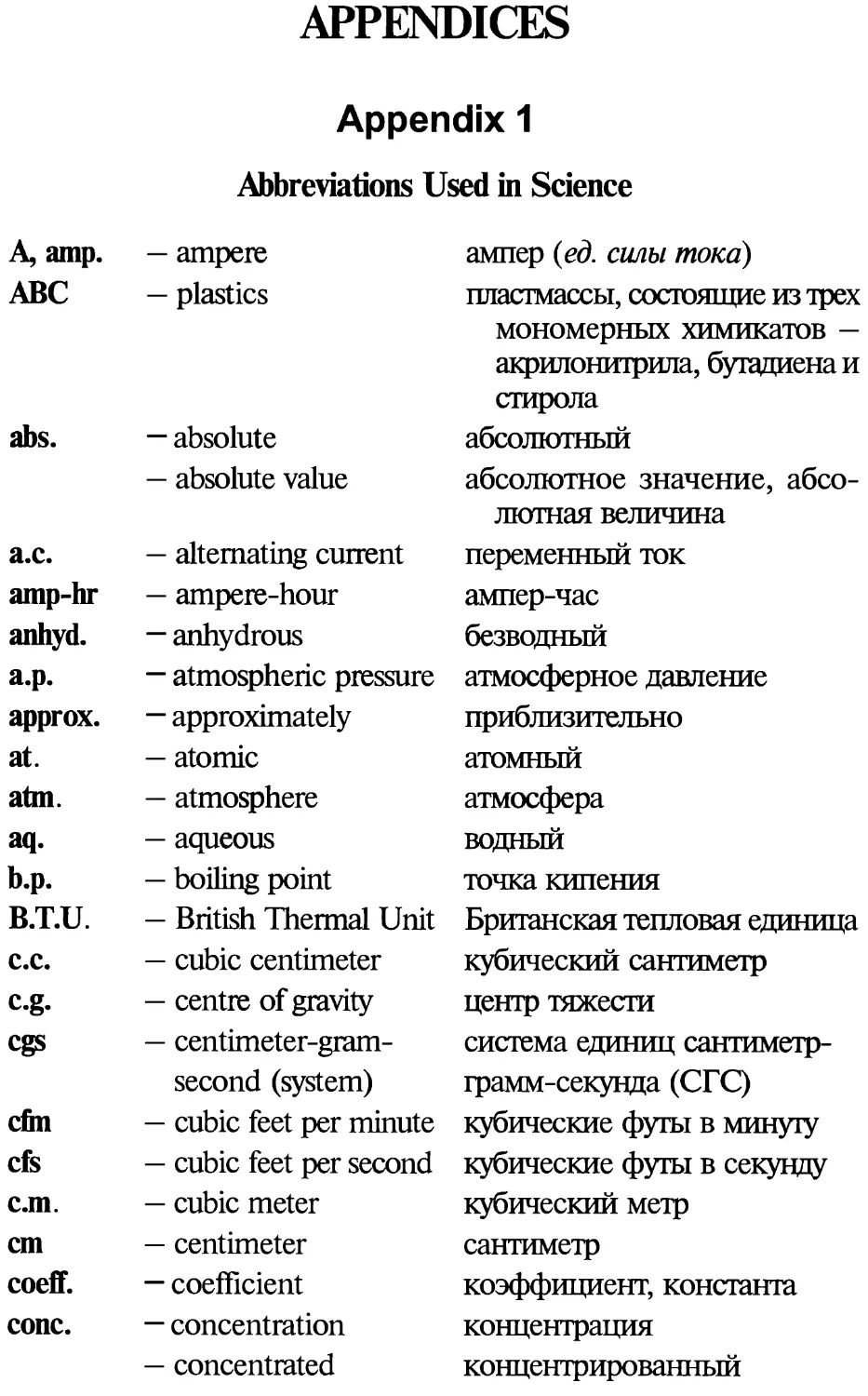
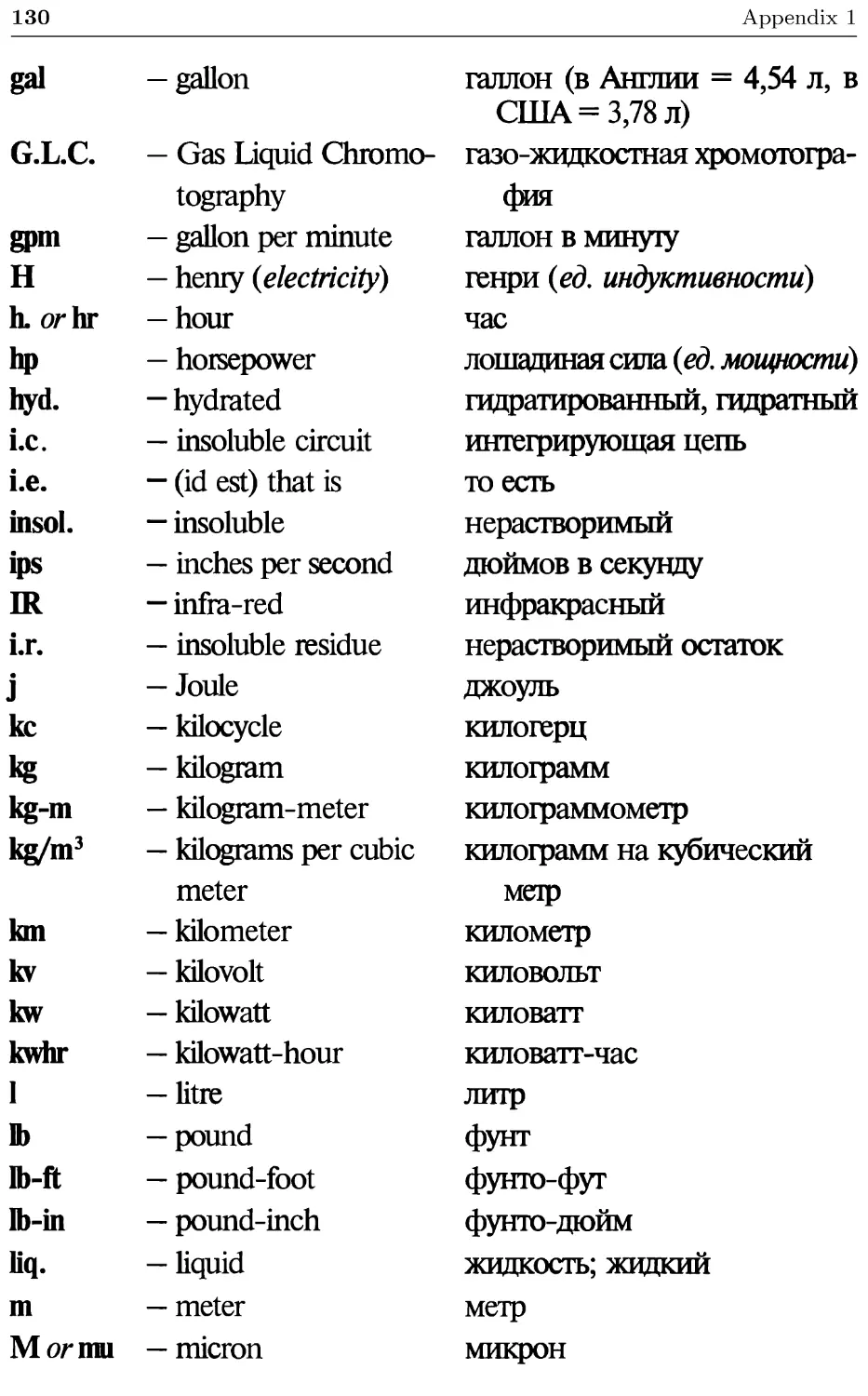
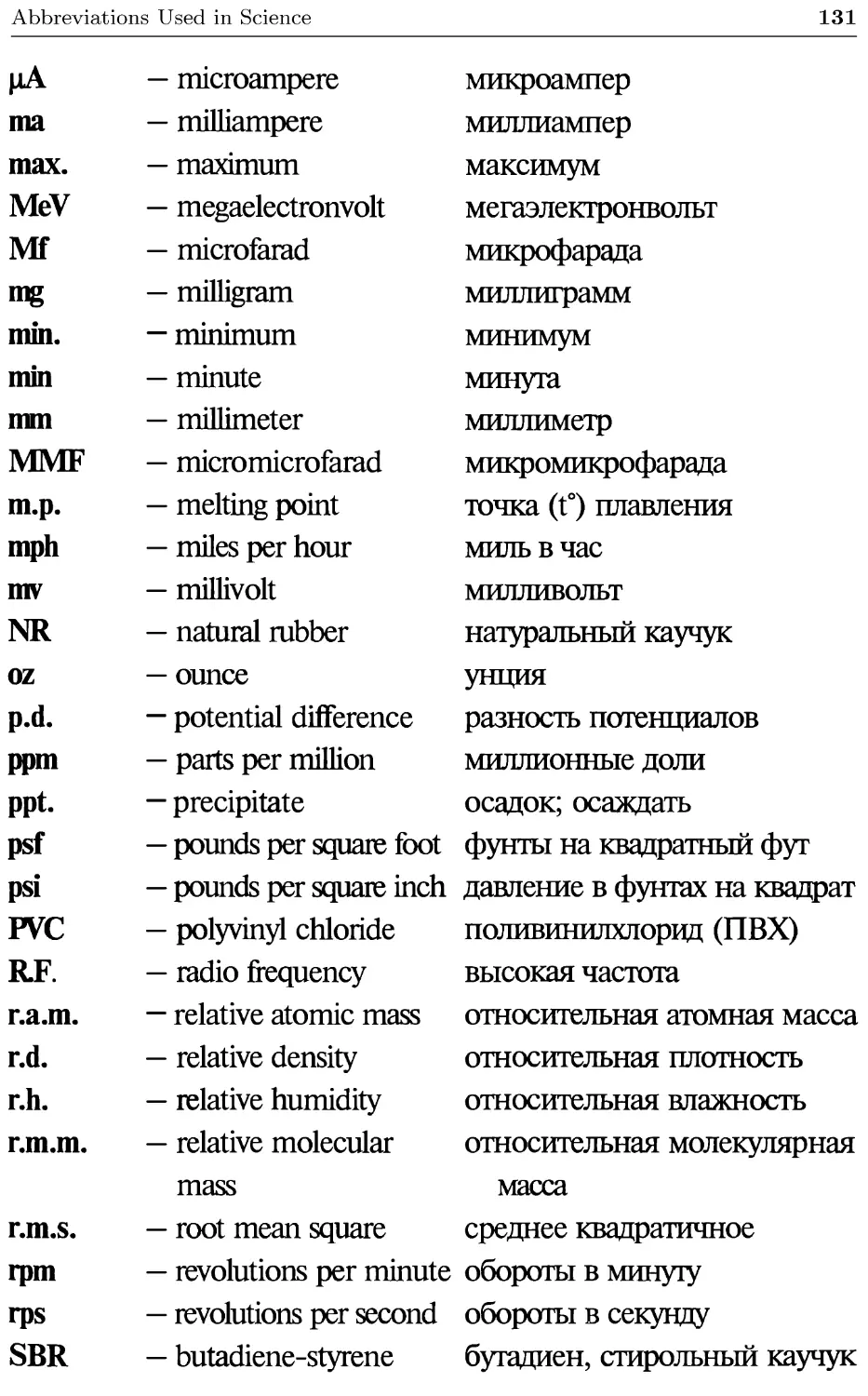
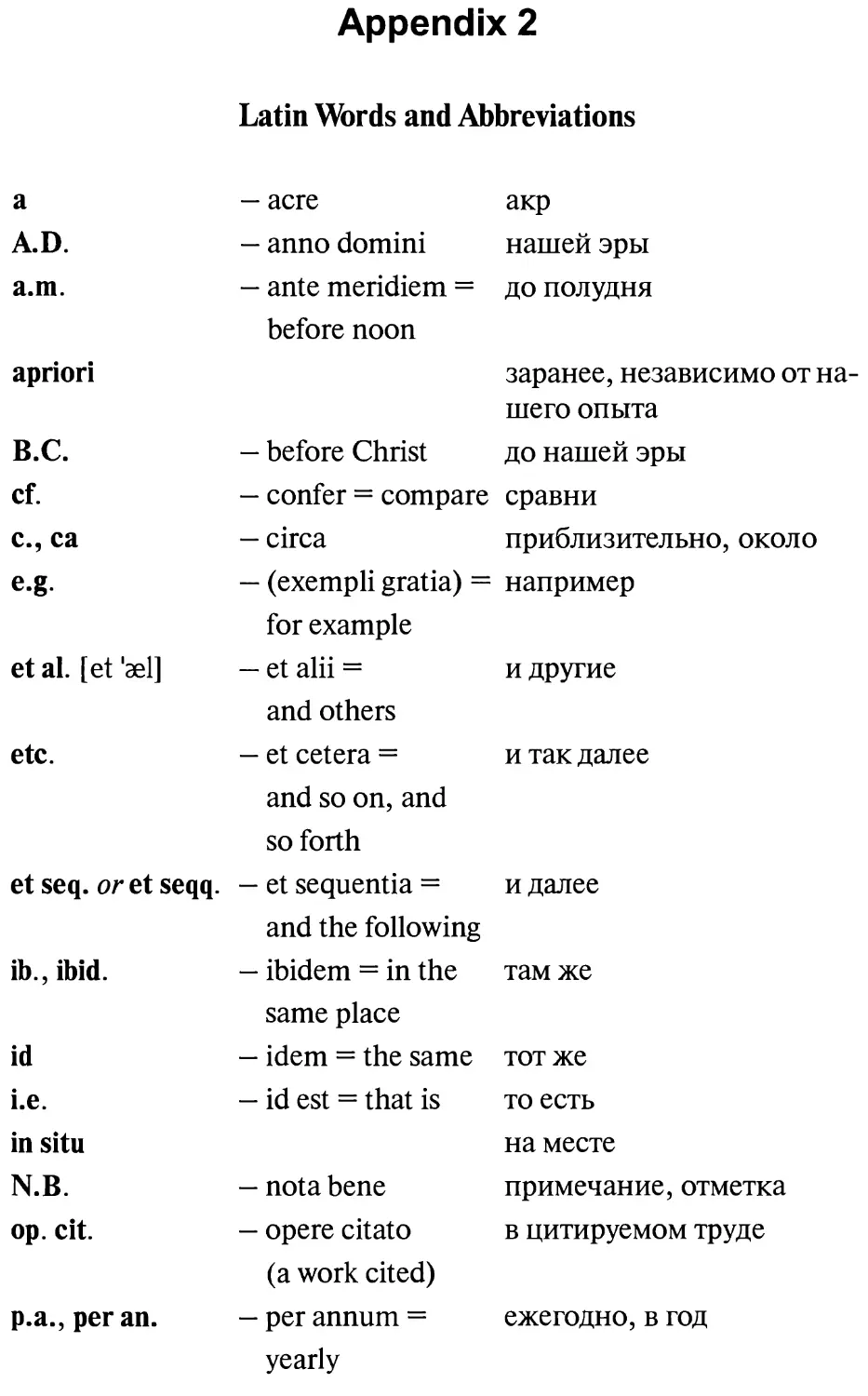
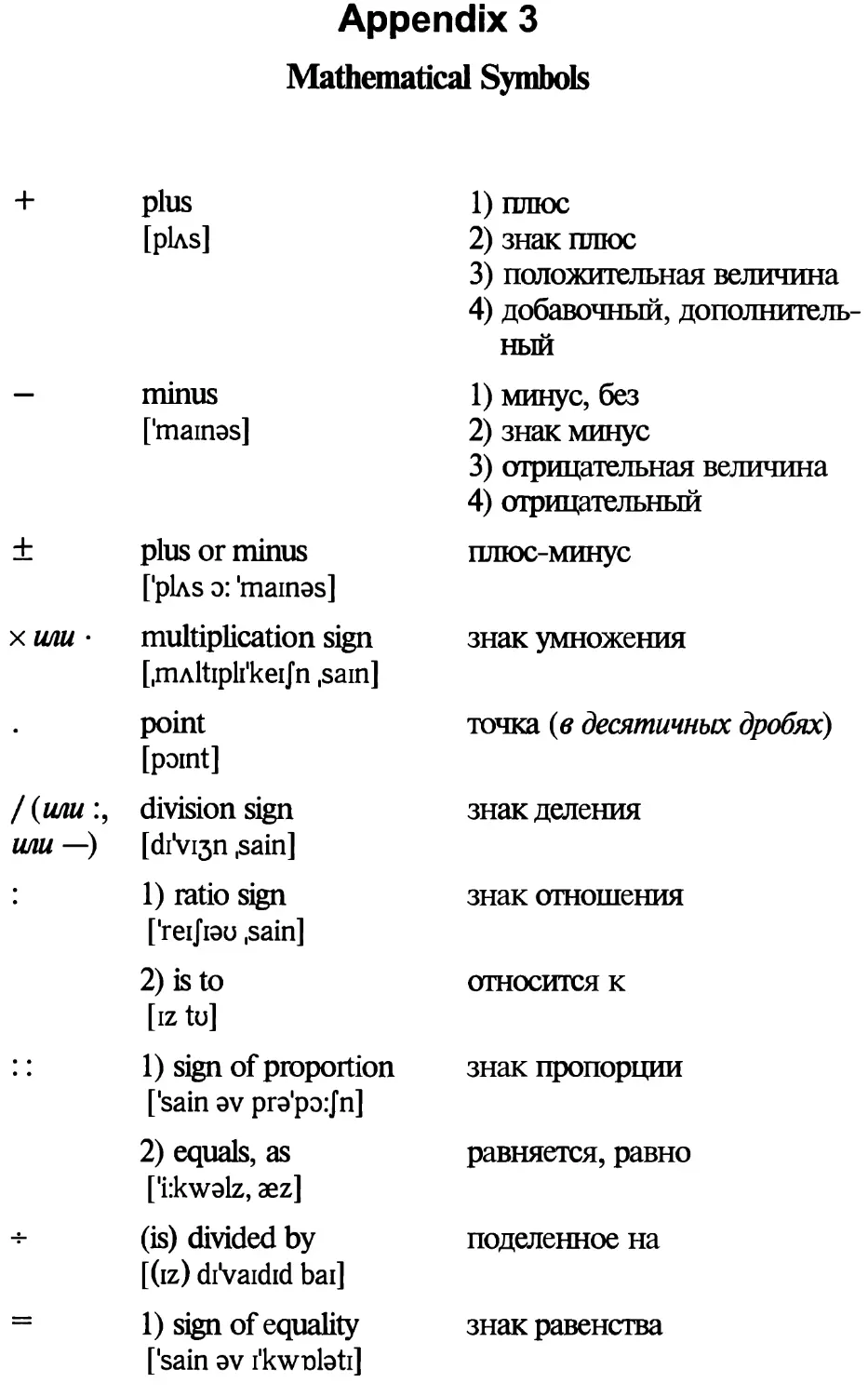
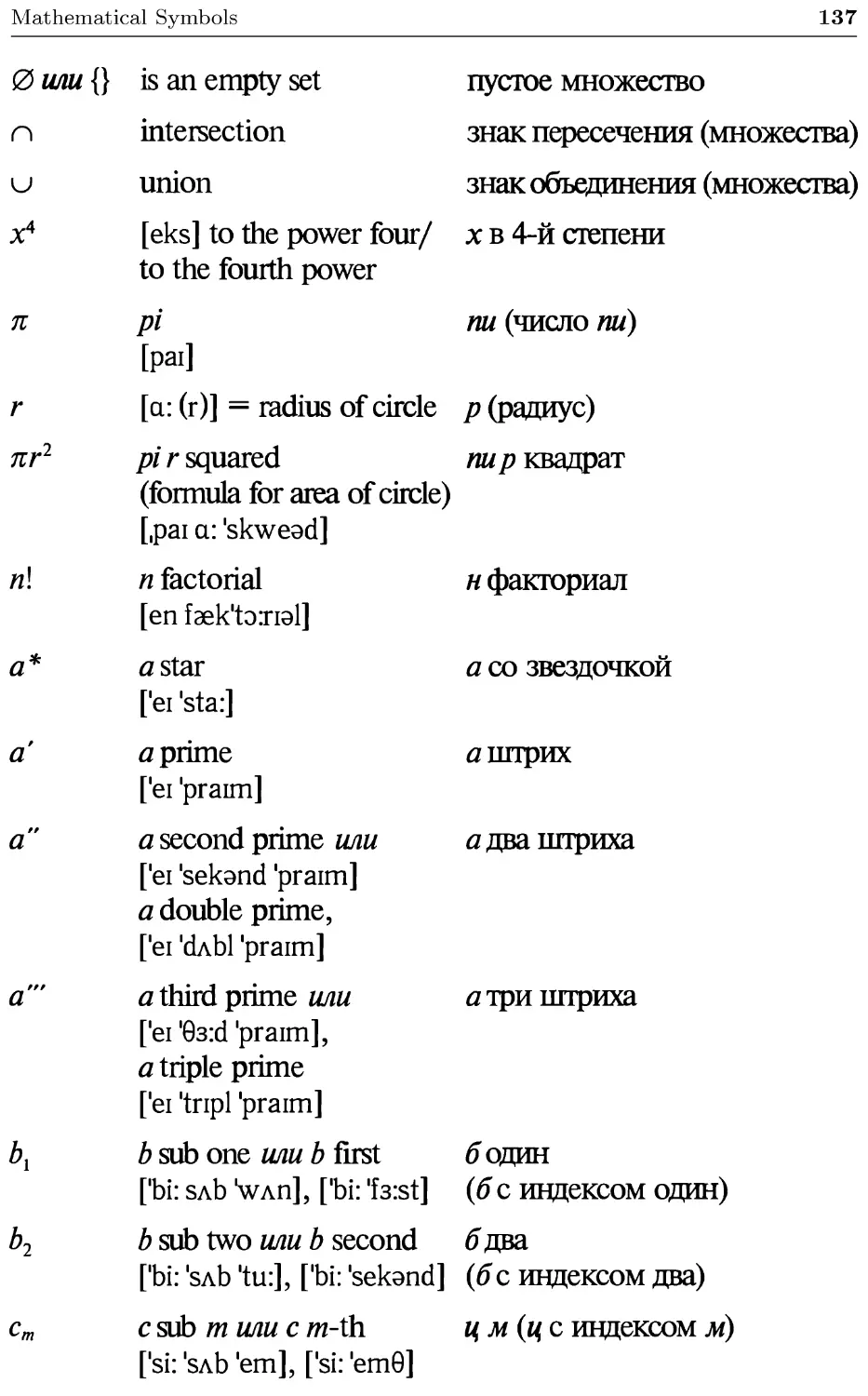
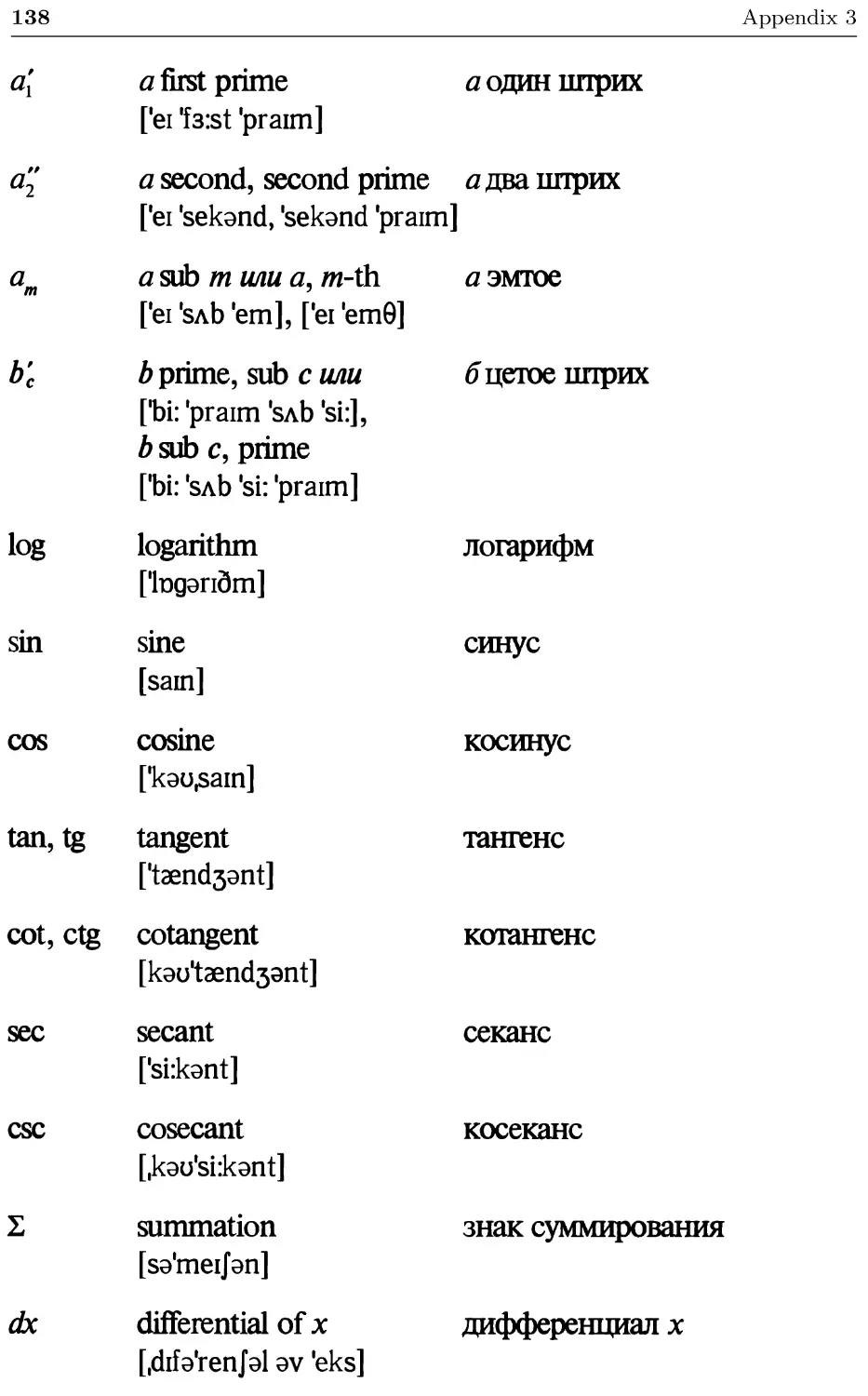
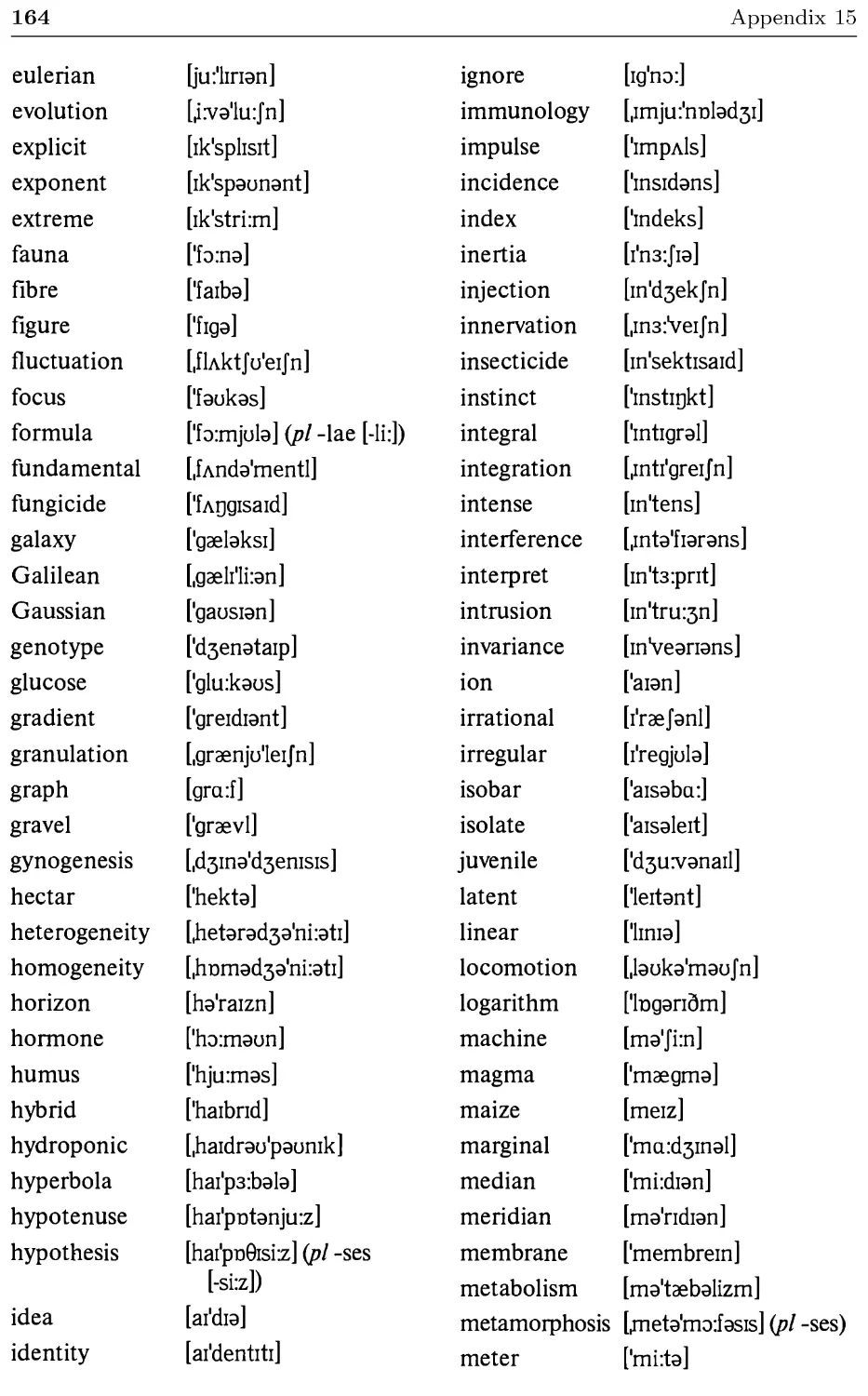
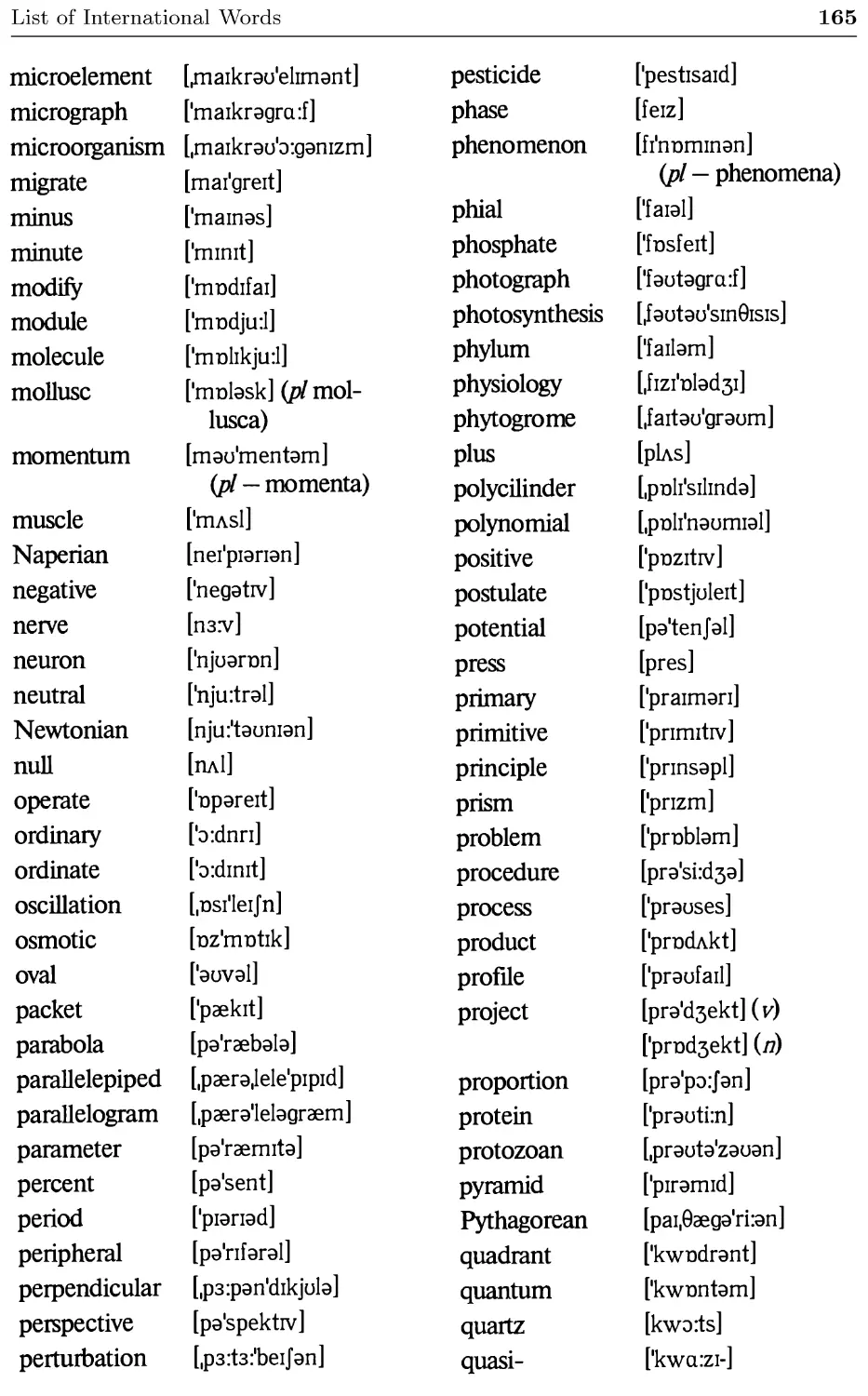
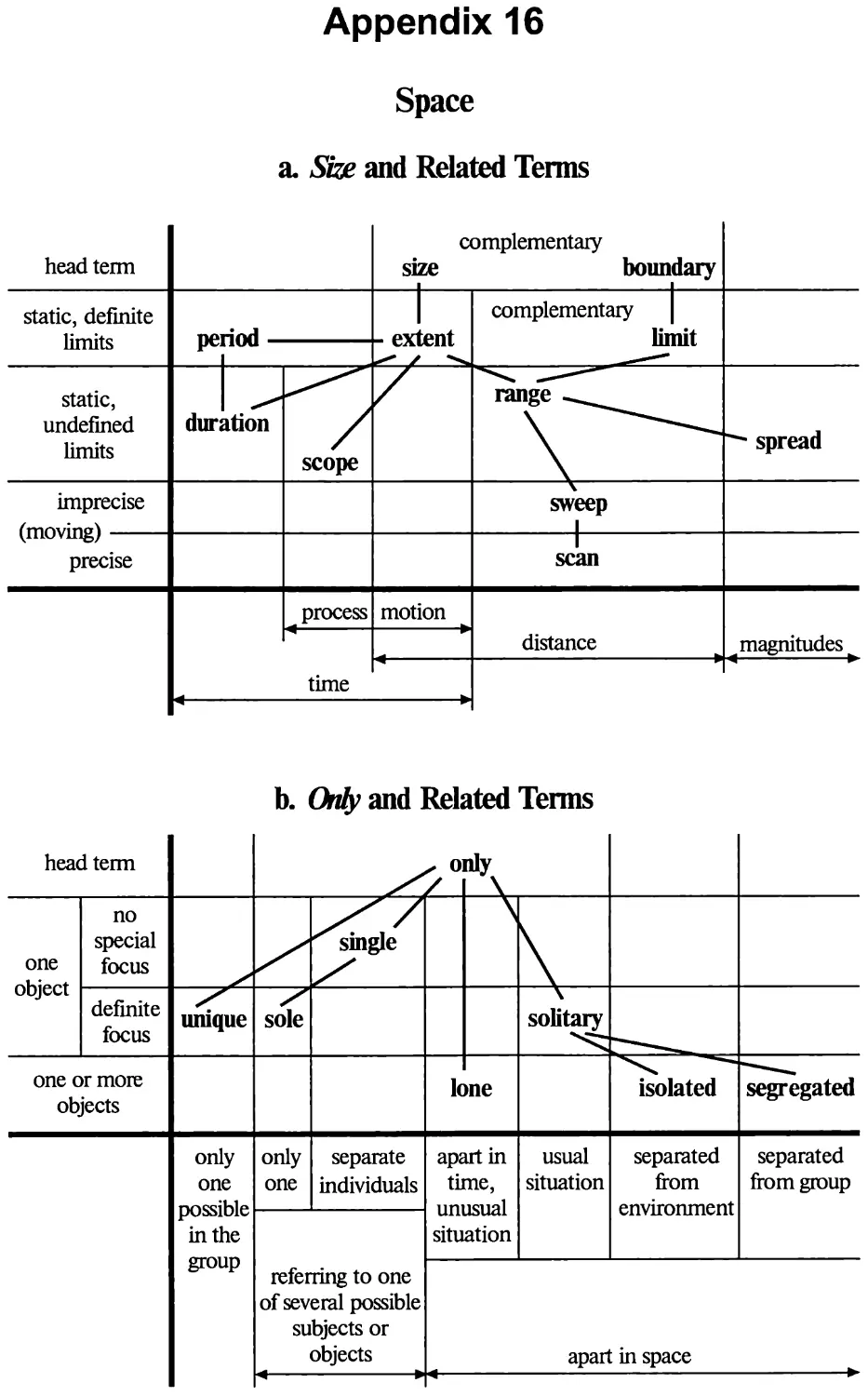
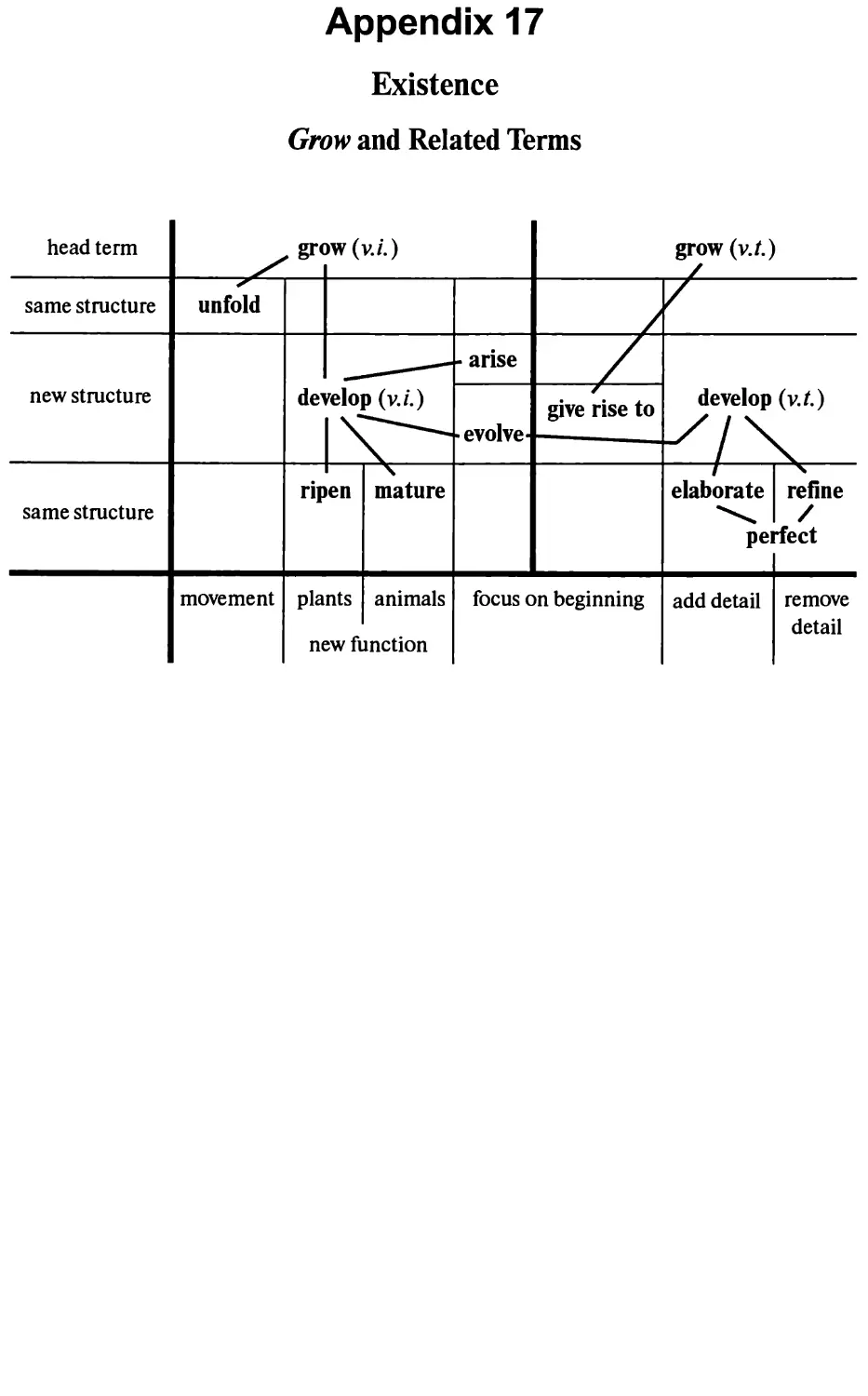
В пособие также входит обширный раздел «Приложения»,
который включает наиболее употребительные сокращения, термины и
словосочетания, принятые в англо-американской
научно-технической литературе, список интернациональной лексики,
представляющей трудности в произношении, и другую информацию (всего 21
приложение).

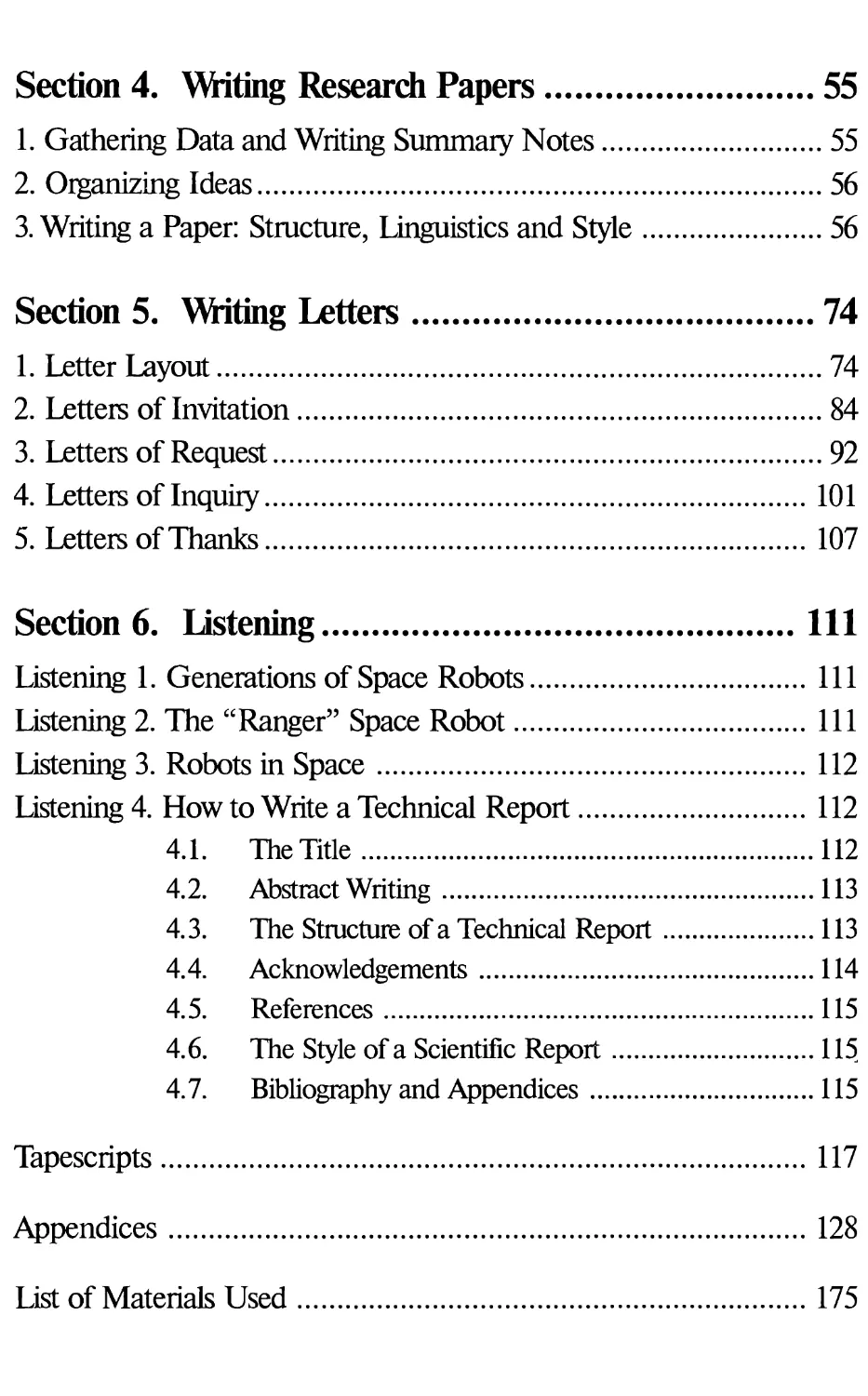
CONTENTS
Section 1. Reading and Speaking 8
Text 1. The Theory of Knowledge 8
Text 2. What Can Computers Do? 10
Text 3. Science and Society in the USA 13
Text 4 15
Text 5. Bill Gates's Vision 17
Text 6. Did Poincare Point the Way to Twentieth-Century Art? .... 19
Text 7. Challenge to Our Darwinian Durability 21
Section 2. Reading and Summarizing Information 24
Text 1. Karle and Haus Receive National Medal of Science 24
Text 2. Japan Stores Sunlight in Crystals 26
Text 3. Viral Soup 28
Text 4. Energy-Converting Plastic Film 30
Text 5. Why Care About Global Warming? 31
Text 6. Virtual Electron Microscope Laboratory Demonstrated ... 34
Text 7. Simulations Predict Failure Mechanisms of Lubricants in
Nanometer-Scale Devices 35
Section 3. Speaking 38
1. Field of Science and Research 38
2. Research Problem 39
3. Historical Background of Research Problem 41
4. Current Research. Purpose and Methods 43
5. Current Research. Results and Conclusion 44
6. Conference 46
7. How to Chair a Conference 48
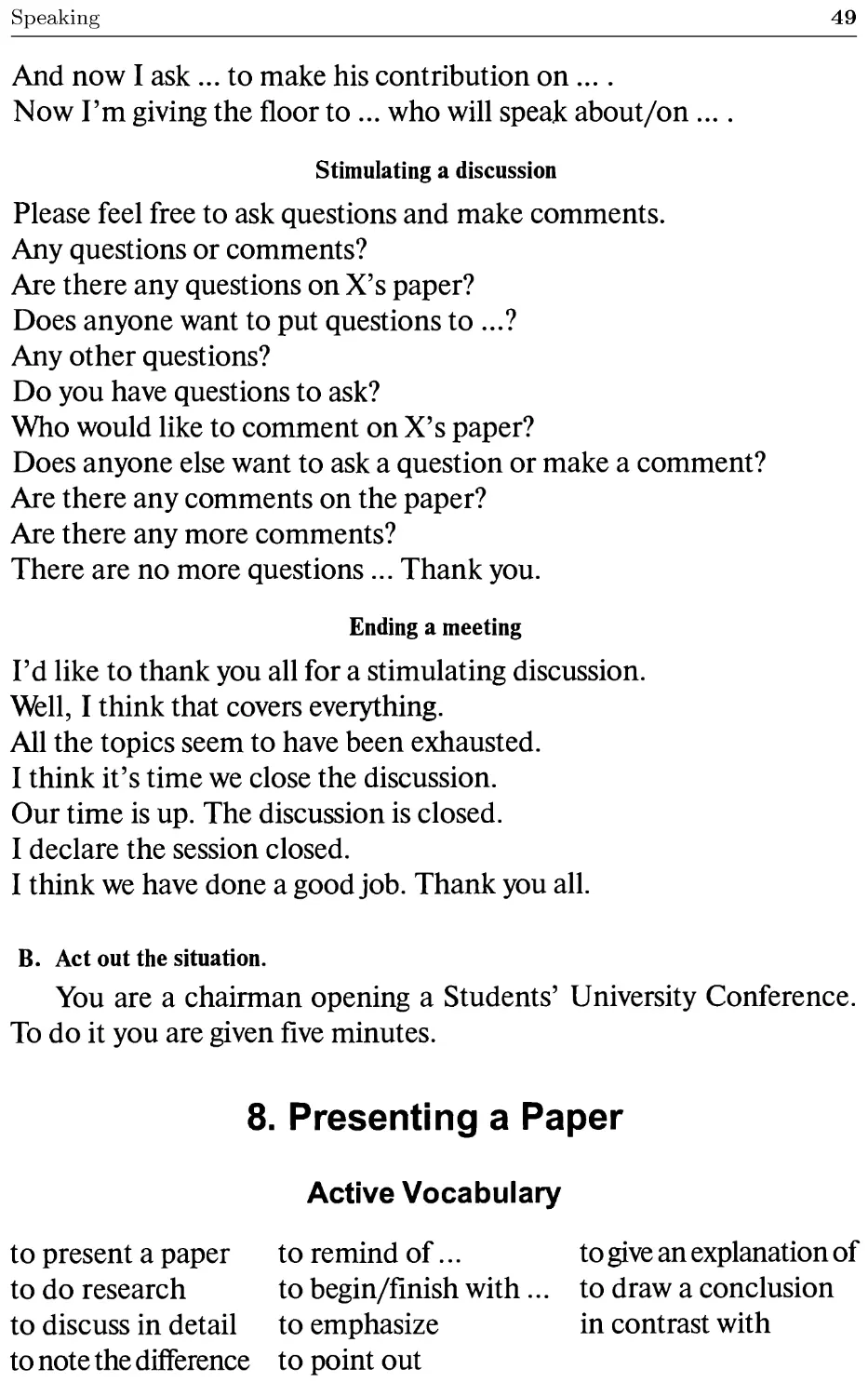
8. Presenting a Paper 49

Section 4. Writing Research Papers 55
1. Gathering Data and Writing Summary Notes 55
2. Organizing Ideas 56
3. Writing a Paper: Structure, Linguistics and Style 56
Section 5. Writing Letters 74
1. Letter Layout 74
2. Letters of Invitation 84
3. Letters of Request 92
4. Letters of Inquiry 101
5. Letters of Thanks 107
Section 6. Listening 111
Listening 1. Generations of Space Robots 111
Listening 2. The "Ranger" Space Robot 111
Listening 3. Robots in Space 112
Listening 4. How to Write a Technical Report 112
4.1. The Title 112
4.2. Abstract Writing 113
4.3. The Structure of a Technical Report 113
4.4. Acknowledgements 114
4.5. References 115
4.6. The Style of a Scientific Report 115
4.7. Bibliography and Appendices 115
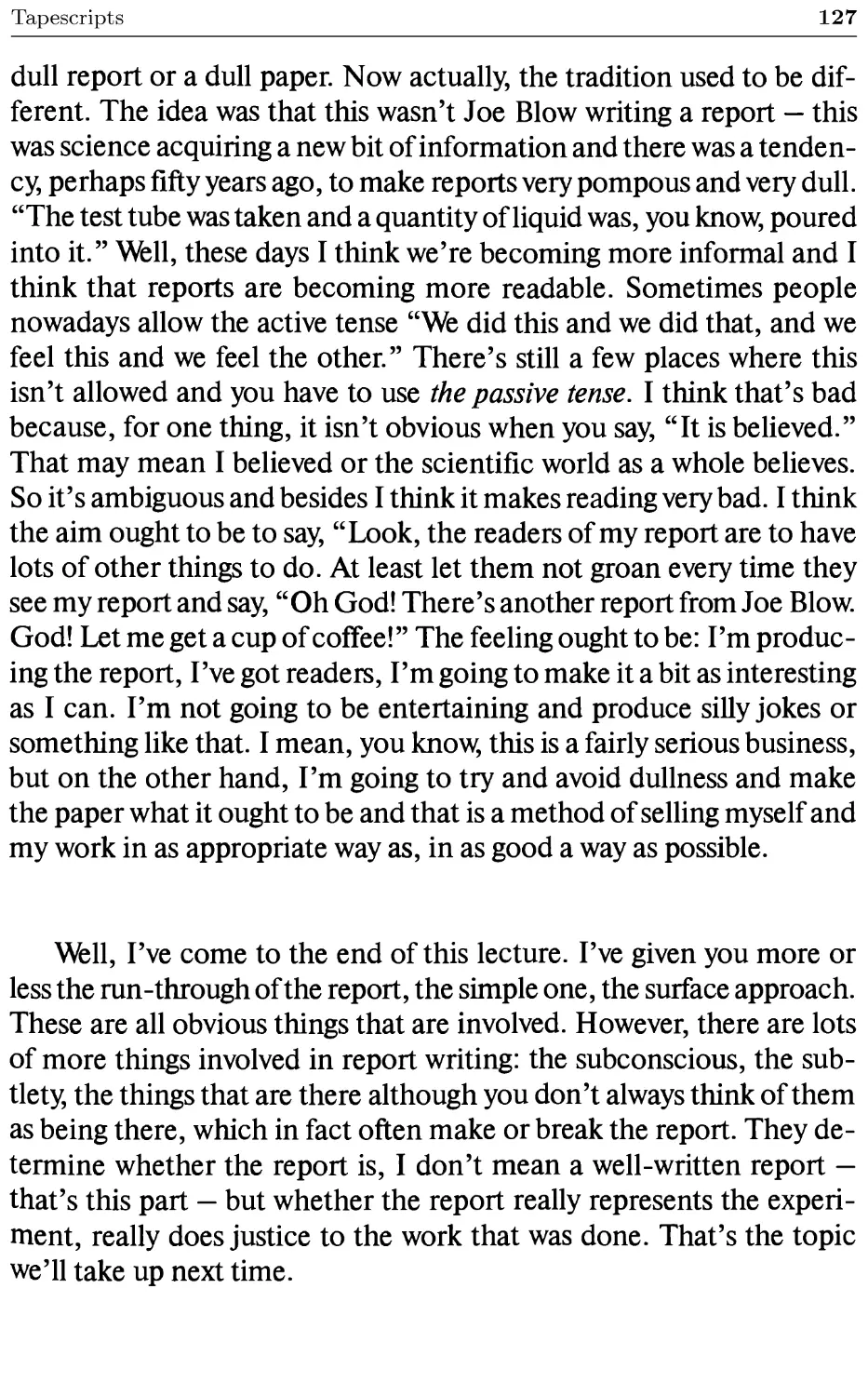
Tapescripts 117
Appendices 128
List of Materials Used 175

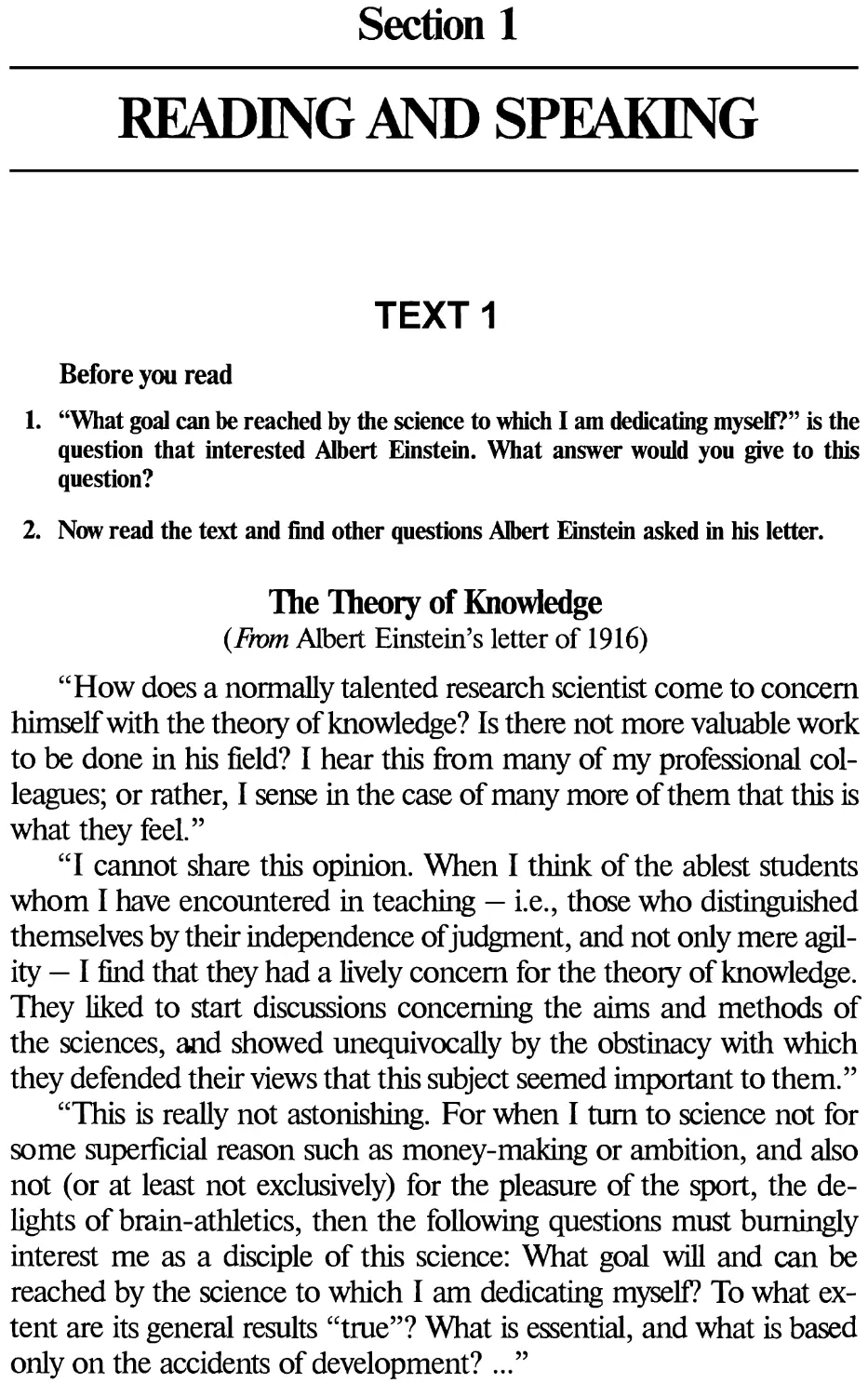
Section 1
READING AND SPEAKING
TEXT 1
Before you read
1. "What goal can be reached by the science to which I am dedicating myself?" is the
question that interested Albert Einstein. What answer would you give to this
question?
2. Now read the text and find other questions Albert Einstein asked in his letter.
The Theory of Knowledge
{From Albert Einstein's letter of 1916)
"How does a normally talented research scientist come to concern
himself with the theory of knowledge? Is there not more valuable work
to be done in his field? I hear this from many of my professional
colleagues; or rather, I sense in the case of many more of them that this is
what they feel."
"I cannot share this opinion. When I think of the ablest students
whom I have encountered in teaching — i.e., those who distinguished
themselves by their independence of judgment, and not only mere
agility — I find that they had a lively concern for the theory of knowledge.
They liked to start discussions concerning the aims and methods of
the sciences, and showed unequivocally by the obstinacy with which
they defended their views that this subject seemed important to them."
"This is really not astonishing. For when I turn to science not for
some superficial reason such as money-making or ambition, and also
not (or at least not exclusively) for the pleasure of the sport, the
delights of brain-athletics, then the following questions must burningly
interest me as a disciple of this science: What goal will and can be
reached by the science to which I am dedicating myself? To what
extent are its general results "true"? What is essential, and what is based
only on the accidents of development? ..."

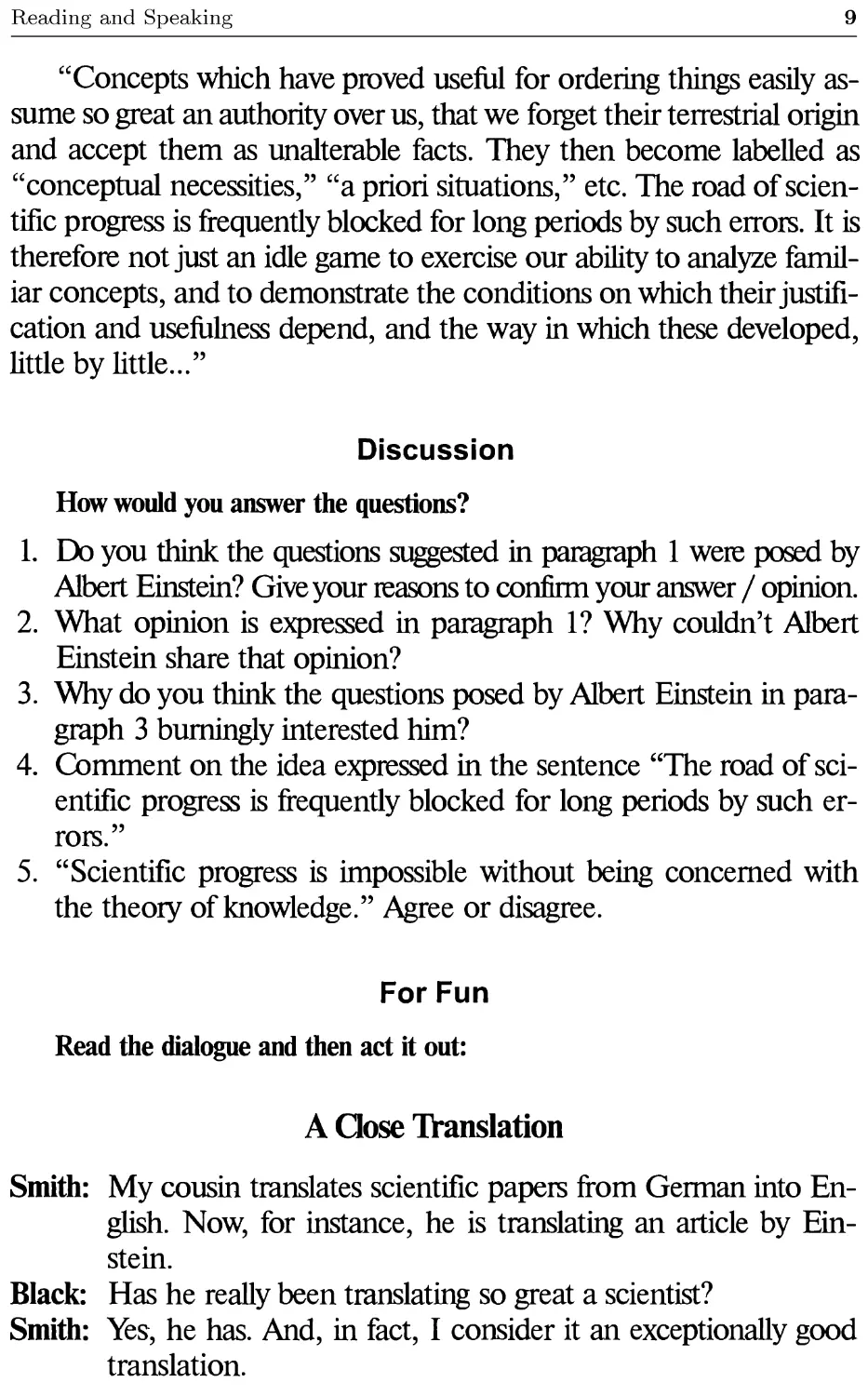
"Concepts which have proved useful for ordering things easily
assume so great an authority over us, that we forget their terrestrial origin
and accept them as unalterable facts. They then become labelled as
"conceptual necessities," "a priori situations," etc. The road of
scientific progress is frequently blocked for long periods by such errors. It is
therefore not just an idle game to exercise our ability to analyze
familiar concepts, and to demonstrate the conditions on which their
justification and usefulness depend, and the way in which these developed,
little by little..."
Discussion
How would you answer the questions?
1. Do you think the questions suggested in paragraph 1 were posed by
Albert Einstein? Give your reasons to confirm your answer / opinion.
2. What opinion is expressed in paragraph 1? Why couldn't Albert
Einstein share that opinion?
3. Why do you think the questions posed by Albert Einstein in
paragraph 3 burningly interested him?
4. Comment on the idea expressed in the sentence "The road of
scientific progress is frequently blocked for long periods by such
errors."
5. "Scientific progress is impossible without being concerned with
the theory of knowledge." Agree or disagree.
For Fun
Read the dialogue and then act it out:
A Close Translation
Smith: My cousin translates scientific papers from German into
English. Now, for instance, he is translating an article by
Einstein.
Black: Has he really been translating so great a scientist?
Smith: Yes, he has. And, in fact, I consider it an exceptionally good
translation.

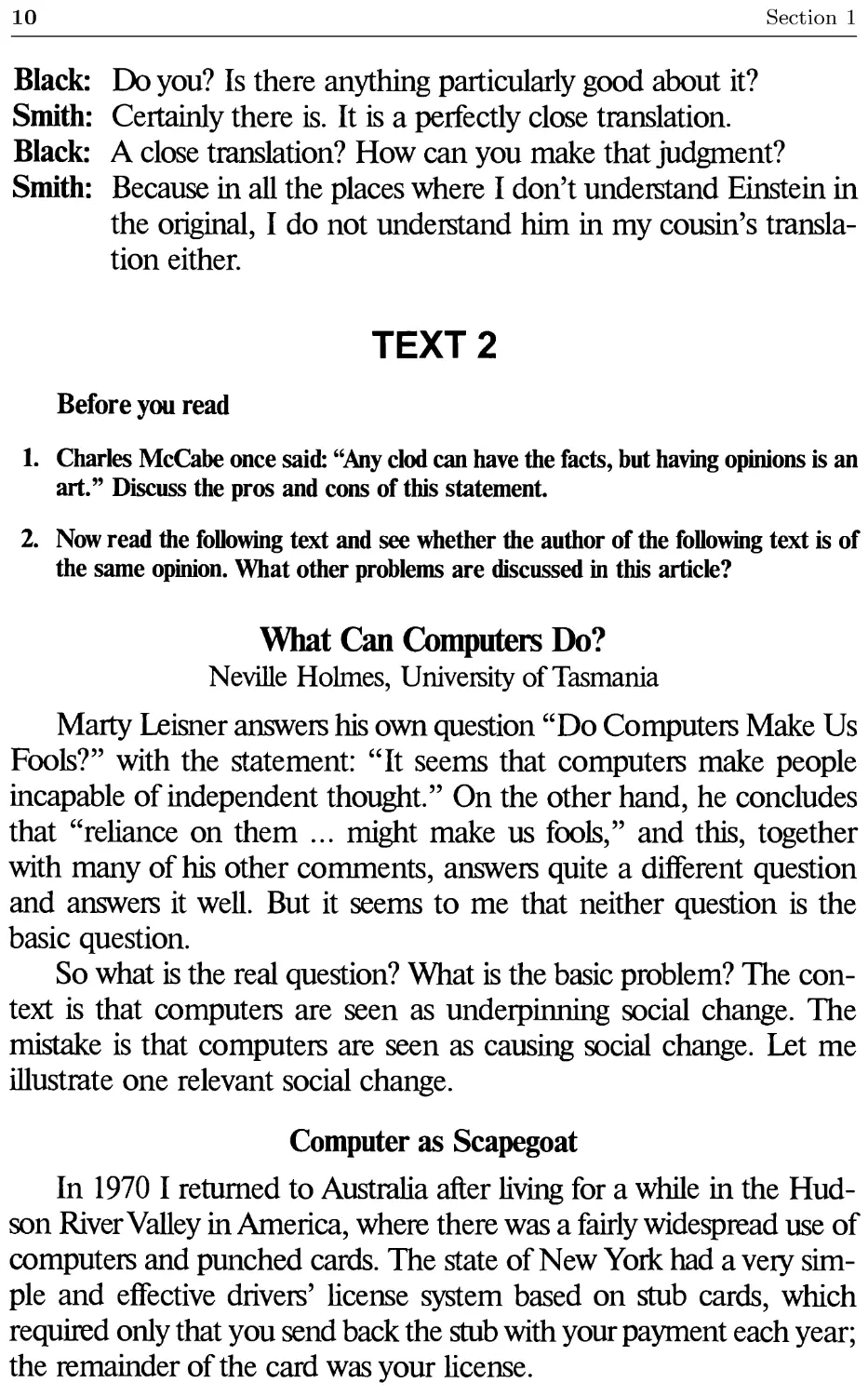
Black: Do you? Is there anything particularly good about it?
Smith: Certainly there is. It is a perfectly close translation.
Black: A close translation? How can you make that judgment?
Smith: Because in all the places where I don't understand Einstein in
the original, I do not understand him in my cousin's
translation either.
TEXT 2
Before you read
1. Charles McCabe once said: "Any clod can have the facts, but having opinions is an
art." Discuss the pros and cons of this statement.
2. Now read the following text and see whether the author of the following text is of
the same opinion. What other problems are discussed in this article?
What Can Computers Do?
Neville Holmes, University of Tasmania
Marty Leisner answers his own question "Do Computers Make Us
Fools?" with the statement: "It seems that computers make people
incapable of independent thought." On the other hand, he concludes
that "reliance on them ... might make us fools," and this, together
with many of his other comments, answers quite a different question
and answers it well. But it seems to me that neither question is the
basic question.
So what is the real question? What is the basic problem? The
context is that computers are seen as underpinning social change. The
mistake is that computers are seen as causing social change. Let me
illustrate one relevant social change.
Computer as Scapegoat
In 1970 I returned to Australia after living for a while in the
Hudson River Valley in America, where there was a fairly widespread use of
computers and punched cards. The state of New York had a very
simple and effective drivers' license system based on stub cards, which
required only that you send back the stub with your payment each year;
the remainder of the card was your license.

When I went to get a license in Canberra, I was given a three-part
form. The form not only asked for many more personal details than
New York ever required, it required them to be written three times.
When I mildly criticized the form design at the counter, I was
solemnly informed that the design was as it was because of The Computer. I
left it at that, but my later inquiries revealed that the department had
neither a computer nor any plans to get one.
This incident altered me to the most important social role of the
computer, then as now: universal scapegoat. I have seen nothing since to change
my mind on this, and indeed I have seen much to confirm it. The social
change here is that people seem to be eager to use computers to avoid
personal responsibility. Computers arc being used to replace personal
values with impersonal ones, like the ultimate abstraction — money.
Computer as Tool
Computers arc merely tools. They are not members of society; they
arc not even pseudomembers, like corporations and governments. They
are independent agents. Like cars and telephones, they only do things
if and when someone uses them. They can neither be blamed for what
they do (arc used for), nor can they be given crcdit for what they do
(arc used for). If there is blame or crcdit then it belongs to the users, or
to the owners, or to the designers, or to the manufacturers, or to the
researchers, or to the financiers, never to the computer itself.
Computers cannot make us fools — they can only allow us to be
foolish faster. And they can be used by others to make fools of us, for
profit or power.
This is not understood by everyone because the computer industry
and the computing profession seem to be saying otherwise. We seem to
be saying that computers arc like people; that they have memory,
intelligence, understanding, and knowledge; that they are even friendly.
How ignorant! How impressive! How profitable!
Attitudes to Computers
Those in the industry who warned against anthropomorphic
language have been ignored. The people who put together the first
standard vocabularies for the industry urged people to call the devices where
data are put "stores" or "storage," not "memories." To suggest there is

any likeness between the computer storage and the memories a human
might reconstruct is farcical, if not insulting.
Those in the industry who urged that people be distinguished from
machines have been ignored. The people who put together the first
standard vocabulary for the industry installed such a distinction in its
very first two definitions. In brief, they defined "data" as
representations of facts or ideas, and they defined "information" as the meaning
that people give to data. Only people can process information;
machines can process only data. Embodying this fundamental distinction
in the definition of the two most basic computing terms was a
complete waste of ink.
As long as we allow people to think of computers as anything else
than machines to be owned and used, powerful people and institutions
will be able to use computers as scapegoats and avoid blame for the
social inequities they are able to bring about for their own benefit by
using computers.
Discussion
How would you answer the questions?
1. What is the author's reason for choosing such a preface to his article?
2. Why does Neville Holmes refer readers with concerns about
computers and social inequities?
3. What, in your opinion, is the social role of computers?
4. Why does the author stick to the idea that "computers cannot make
us fools?"
5. Neville Holmes distinguishes between such terms as "storage" and
"memory," "data" and "information." Why?
For Fun
Comment on the foDowing:
The reasonable man adapts himself to the world, the unreasonable
man persists in trying to adapt the world to himself. Therefore all
progress depends on the unreasonable man.
G.B. Shaw

TEXT 3
Before you read
1. Comment on the statement: "Science is a powerful engine by which the genius of
the few is magnified by the talents of the many for the benefits of all."
2. Now read the text and determine its main points.
Science and Society in the USA
Science on the scale that it exists and is needed today can,
however, be maintained only with large amounts of public support. Large-
scale public support will be provided only if science and technology
are meeting the critical needs of society. Intellectual progress, as
measured by advances in specific scientific disciplines, is not in itself
sufficient to generate such support. Perhaps it should be, but it is not.
Public support for science may be wise policy, but it is not an entitlement.
The central problem is that the costs of meeting the needs of
society are too high, and the time scale for meeting them is too long. Both
the ideals and the pragmatics of American society are based on
improvement in the quality of life. We expect better health care, better
education, economic security. We expect progress towards the
reduction, if not outright elimination of poverty, disease, and environmental
degradation.
Progress towards these goals has recently been frustratingly slow
and increasingly expensive. The heavy costs of providing and
improving health care and education are examples.
The situation has produced a volatility in public opinion and mood
that reflects a lack of confidence in the ability of government and other
sectors of society, including science and technology, to adequately
address fundamental social needs.
If this mood hardens into a lack of vision, of optimism, of belief in
the future, a tremendous problem for science will result. Science, in
its commitment to innovation and expanding frontiers of knowledge,
is a thing of the future.
The vistas of science are inspiring. Condensed matter physics is
embarked on materials by design, nanotechnology and high
temperature superconductivity, each containing the seeds of new industries as

well as new scientific understanding. Molecular biology is in full bloom
with a vast potential for further intellectual progress, betterment of
human (and plant and animal) health, and commercialization. Neuro-
science seems poised for dramatic progress.
Research into the fundamental laws of physics is aiming at a
pinnacle. There is a candidate theory — the superstring theory — which is
proposed as a unification of all the known fundamental forces in
nature and which is supposed to give an account, complete in principle,
of all physical phenomena, down to the shortest distances currently
imaginable. At the largest scales of distance, observational astronomy
is uncovering meta-structures which enlarge the architecture of the
universe — a deepening of the problem of cosmology preliminary to its
resolution.
Underpinning much of this progress, and progress in countless other
areas as well, has been the emergence of scientific computing as an
enabling technology.
All this is first-rate science. All this is not enough — either to
forestall change or to ensure adequate support for science in the present
climate. Why it is not enough — and what else is required — are the
subjects of a special inquiry.
Discussion
How would you answer the questions?
1. Arc there statements in the text that you disagree with? What are they?
2. Arc you aware of the latest achievements in your field of science?
What arc they?
3. Why do you think the achievements of science are not sufficient to
ensure adequate support for science?
4. If you were in power what would you do to support science in Russia?
For Fun
Comment on the following:
Discussion is a method of confirming others in their errors.
A. Bierce

TEXT 4
Before you read
1. Comment on the statement: "We get the best from people by expecting the
best."
2. Read some reminiscences of Thomas £. Hull's students and then give the text
a title.
***
He was an effective leader who got commitment by soliciting
advice, who got the best from people by expecting the best, whose
fundamental decency was apparent in every interaction. He taught by
example that the highest standards can be reached cooperatively,
without envy, jealousy or corrosive competition.
Even before I met Tom, he had a significant influence on me: I
used one of his books in the first computer science course that I took
at the University of Toronto in the early 1970s. Tom was the author
of seven textbooks that played a very important role in establishing
computer science as in academic discipline in the late 1960s and
early 1970s.
I was fortunate to have Tom as an instructor for the first course
on numerical analysis that I took at the university. It was clear to all
of us in the class that Tom knew his subject thoroughly. Moreover, his
lectures were very well organized, clear, concise and delivered with a
sense of humour. Many students find numerical analysis a little dry
and somewhat difficult. Tom was well aware of this and motivated his
students by beginning each of his lectures with a short intuitive
discussion of the topic that he was going to talk about that day and by
briefly outlining its importance, often relating the topic to other
subjects that we were studying. Tom's lecturing style was a model for
many of us who later went on to teaching careers ourselves.
Among the many reasons for Tom's great success as a teacher was
his love of interacting with people. He clearly enjoyed teaching a
subject that was dear to him and seeing others take pleasure in learning
about it. His enthusiasm was infectious and rubbed off on many of
his students.

I was also fortunate to have Tom as a graduate supervisor, a role in
which he excelled. In part, this was because he was an excellent researcher
himself. When I was a graduate student, about 20 years ago, Tom was the
chairman of the computer science department, a member of the NSERC
(Natural Sciences and Engineering Research Council of Canada)
committee on grants and scholarships, an editor of three prestigious
journals, the author of several of the most important papers in our area, and
an invited speaker at many international conferences. He knew most of
the key players in our research area and was aware of the topics on which
they were working. He had a very good sense for what was a good
problem to tackle and what would likely be fruitless.
More importantly, Tom was an excellent graduate supervisor at a
more personal level. His enthusiasm for discussing new ideas with
students was evident. In spite of his extremely busy schedule, he
always found time for his students and he gave all of us the impression
that our work was a high priority for him. He was always supportive,
encouraging, and very generous in his praise of good ideas. But, of
course, not all the ideas that students have are good ones. Tom was
careful not to be too deflating when explaining why some silly scheme
a student had devised was not sound. He usually got the student back
on track and feeling positive about pursuing another line of attack.
Discussion
How would you answer the questions?
1. Give reasons why you have chosen such a title for the text.
2. "The highest standards can be reached cooperatively, without envy,
jealousy or corrosive competition." Doesn't this statement
contradict the common knowledge that competition helps to achieve
better results in some spheres?
3. "Thomas E. Hull was an excellent supervisor. In part, this was
because he was an excellent researcher himself." Does it mean that
every excellent researcher can be a good supervisor?
4. "The influence of a teacher on a student is not always a good thing."
Give your arguments for or against this statement.
5. What could you say about your thesis supervisor?

For Fun
Comment on the following:
I think and think; for months, for years, 99 times the conclusion is
false. The hundredth time I am right.
(A. Einstein)
TEXT 5
Before you read
1. Comment on Henry Ford's saying: "Had I worked fifty or ten or even five years
before, I would have failed. So it is with every new thing. Progress happens when
all the factors mat make for it are ready, and then it is inevitable."
2. Now read the text and then say if it contains any new information for you about the
Microsoft empire.
Bill Gates's Vision
It must be remembered that the future of the Microsoft empire
depends heavily on the accuracy of Bill Gates's vision. If his thoughts
occasionally sound mundane or less than original, it is because they
are the result of a selection process: a person in his position has a
legion of experts at his beck and call, plenty of whom generate ideas as
fast as he does. His job is to sort out the ideas worth staking a piece of
the company's future on. For that, an idea does not have to be
original, or even all that good, but it does have to fit his vision: a computer-
filled world in which Microsoft writes the best-selling software.
Early in 1975, Gates, by then a sophomore at Harvard University,
and Allen, who was working as a programmer in Boston, set out to
overtake the revolution. Their first goal was to write a version of Basic
to run on the Altair. (Altair 8800 was the world's first truly personal
computer.)
Although they didn't own an Altair — and indeed had never even
seen one — Allen wrote a program on a Harvard mainframe to simulate
the new computer. So equipped, working virtually nonstop in his dorm
room, often losing track of night and day and routinely falling asleep at
his desk or on the floor, the 19-year-old Gates needed just five weeks to

complete the task. Later that spring, the pair formed the world's first
microcomputer software company, eventually naming it Microsoft.
Like Ford before him Gates invented nothing: no computer, no
peripheral, no programming language. He certainly didn't invent
microchips. What he did was probably inevitable, once the components
became available. He may, however, have been the very first to see how
the 8080 chip (unlike the 8008) could be used to place significant
computing power at the disposal of Everyman. He didn't know what would
be done with it, and he certainly didn't foresee (as Ford didn't foresee
LA freeways) that offices, not homes, would house most of the early
PCs. Gates and Allen only knew that, if priced within reason, the
products they offered — DOS and Microsoft Basic — would sell.
Gates is eager to distinguish between the services performed by the
present generation of home computers and those to be expected in the
future from a station on an information highway. The current Internet,
he insists, is only a pale imitation of the highway to come. In time,
most of the world's information will be available to almost anyone in
it. His investigations have convinced him, however, that current
satellite technology will never supply the requisite bandwidth (channel
capacity). The transmission of so much information will require that
private homes be connected to the outside world by underground fiber
optic cables, just as they are now connected by existing sewerage,
water, electric power, cable TV, and telephone conduits. The required
cable will be installed in due time, he predicts, and will be no more
costly than current networks.
When the powerful computers of the future are connected to the
information highway, you will be able to stay in touch with anyone,
anywhere, who wants to stay in touch with you; to browse through
thousands of libraries, by day or by night; and to retrieve the answers to
varied questions.
You will also be able to watch almost any movie ever made, at any
time of day or night, interrupted only upon request. The instructions
for assembling your latest purchase will be interactive. Shopping
channels will show you only what you ask to see, and the people with whom
you talk by telephone will see a well-groomed likeness of yourself
responding to their jokes and flirtations, even if you are actually dripping
wet from the shower.

Discussion
Now test your memory by seeing how many of the following questions you
can answer:
1. What does the future of the Microsoft empire depend on?
2. How is Gates's job characterized in the article?
3. If you worked at Microsoft would you try to come up with any
original ideas?
4. What is Gates's vision?
5. How long did it take Allen and Gates to form the word's first
microcomputer software company?
6. Gates did not invent anything special. What do you think made
him so famous?
7. What was the only thing that stimulated Gates's activities?
8. In what way will most of the world's information be available to
almost anyone in it?
9. What benefits does the information highway provide?
10. What else do you know about the Microsoft empire and its founder?
11. Give your arguments for or against the statement: "Scientists
achieve success when they come down from the heights of science
to the level of an ordinary man."
For Fun
Comment on the following:
An eminent mathematician was asked about one of his former pupils.
"Oh, that one," he said. "He's become a writer of science fiction.
He lacked the imagination for mathematics."
TEXT 6
1. Read the text in order to discuss the creative process.
Did Poincare Point the Way to Twentieth-Century Art?
Henri Poincare is well known to mathematicians for the depth and
breadth of his scientific accomplishments. Nowadays he is even more

widely known for creating much of the mathematics that has gone into
the revolutionary scientific theory known as chaos. But could the
French mathematician also be responsible for inspiring a similarly
dramatic revolution in the world of art?
One of Poincare's essays on science directly inspired the artist
Marcel Duchamp to chart a new course for artistic expression.
Duchamp is famous for what he called "readymades" — such
ordinary objects as a hat rack or a snow shovel that became works of art by
virtue of his selecting them. Duchamp's championing of the artist's
"special intuition" in interpreting the world paved the way to today's
unruly art.
But what gave him the idea?
In a section on mathematical creation, Poincare speculates that
unconscious processes continue to sift ideas between periods of active
thought, and that fruitful combinations are brought to consciousness
by virtue of their aesthetic appeal. In other words, a creative
mathematician is one who recognizes a good idea when it jumps up and bites
him on the brainstem.
According to Poincare, the creative process is set in motion during
a period of concentrated, conscious work. Poincare also describes an
instance in which, unable to sleep because of too much black coffee,
he felt his mind crowded with ideas that collided until they locked into
a stable combination; by the next morning, he had the solution to a
problem that had plagued him for weeks.
Duchamp is virtually certain to have read Poincare's essay. The
avant-garde artists of the day were keenly interested in things scientific
and mathematical, with four-dimensional and non-Euclidean
geometries at the top of the list.
Poincare's vivid description of the effects of coffee also influenced
Duchamp.
Duchamp regarded his 1911 painting Coffee Mill as the "key" to
his work, and at one exhibition he kept coffee beans roasting in a
corner of the room, the aroma being an integral part of the show.
"The fun starts now" as art historians and others begin to decode
Duchamp's work in light of the Poincare connection. The question
is: Which mathematician will inspire the next revolutionary figure in
art?

Discussion
How would you answer the questions?
1. What is the definition of the creative process, according to Poincare?
2. "He felt his mind crowded with ideas that collided until they locked
into a stable combination." Can we conclude that chaos is needed
for the creative process?
3. What must one do to make "ideas jump into one's brain?" How do
you develop ideas?
4. What do you think might inspire a scientist?
5. What do you think the creative process is?
6. Can a person be taught to be creative?
For Fun
Read the dialogue and then act it out:
Post-graduate: What is your opinion of my last article?
Professor: There is a great deal in it that is new, and a great deal
that is true...
Post-graduate: Do you really mean...
Professor: ...but it unfortunately happens that those portions
which are new are not true, and those which are true
are not new.
TEXT 7
Before you read
1. Comment on the statement: "Every physical system has its limits."
2. Now read the text and determine its main points.
Challenge to Our Darwinian Durability
Anthropogenic changes to terrestrial and maritime ecological
systems in the last century have caused environmental transformations
normally associated with geological time scales. Plants and animals
once thought to be inexhaustibly plentiful are currently being lost at

an unprecedented rate, and nowhere is the impact of human activity
more alarming than in the oceans. Creatures like horseshoe crabs and
sharks, which have endured meteoric cataclysms on their watch, now
face the most serious threat ever to their survival — human beings who
are blithely turning them into plant fertilizer and steak.
Until recently, the scientific community has been reluctant to pro-
actively engage in policy discussions about the issues that will ultimately
determine the long-term viability of people on this planet. Underlying
this not altogether surprising situation are two forces: First, technical
academy has a somewhat parochial view of what it means to be a
scientist, and it generally frowns upon members of the establishment who
stray very far from conventional "notions of pure or applied research."
Second, there is some element of truth to the popular perception of the
bespectacled, bookish, and socially awkward natural philosopher, whose
heavily laden arguments sound clumsy to the public at large. The
ecological systems of the planet, especially those near the bottom of the
food chain, where solar energy is first fixed into convertible sugars and
proteins, are understood only macroscopically at best. Although
particular representatives from other levels of the hierarchy are well studied,
there is an unsettling dearth of knowledge concerning the dependencies
and interdependences of pelagic fauna and flora. That humans are
irrevocably influencing these links is undisputed; the only remaining
question is the long-term implication of our reliance upon these organisms.
The ability of the seas to hold as much as 50 times more carbon
dioxide than the atmosphere is a function of temperature, which is
slowly but steadily increasing. The release of 2% of the carbon dioxide
currently dissolved in the ocean would almost double its
concentration in the atmosphere, thereby reinforcing the greenhouse cycle by
warming the planet even more.
Meanwhile the polar ice caps are slowly melting, and ocean levels
are rising along with the temperature. Although small changes are
troubling, rational worst-case scenarios of the economic impact of this
kind of sea change are mind-boggling. And that is just the carbon
dioxide part of the story. Confounding subtexts address the nasty
byproducts created in the manufacturing of plastic from petroleum, the
noxious fumes generated when we burn the plastic, and the fish, turtles,
birds, and dolphins that are strangled by the bits we throw away.

Apparently, most people are simply not aware of the wrenching
harm we inflict upon the ocean by overfishing, dumping toxic
chemicals, sinking radioactive submarines and oil platforms, and disposing
of raw sewage. Point sources can be diluted, the wind and currents can
help mix down dangerous substances, and some unusual kinds of
bacteria even thrive on the scum of our earth. But every physical system —
even one as seemingly large as the ocean — has its limits, and we are
rapidly approaching the threshold of its ability to heal itself in any time
frame of interest to ten generations of human beings. This is about
how long it takes for a plastic trash bag to decompose in the salty sea.
Some stuff never will.
Discussion
1. Give reasons for entitling the text "Challenge to our Darwinian
Durability."
2. Give arguments for or against the statement: "We are rapidly
approaching the threshold of ecological catastrophe."
3. Name the burning ecological problems that people have created
on our planet. How do you see the ways for their solution?
For Fun
Comment on the following joke:
Post-graduate: I hear you said my new article was the worst I ever wrote.
Professor: No, I didn't. I said it was the worst article I ever read.

Section 2
Reading and Summarizing Information
Before writing a paper it is vitally important to be able to read,
understand and summarize information gathered from various sources.
Often the title of an article will give the reader insight into the paper's
content, but further reading and analysis is necessary to understand
the major points of the article.
To avoid troubles in evaluating a paper it is recommended to read:
• the title, concentrating on key words that show relevance of the
paper to a certain topic;
• an abstract which helps you decide if a paper satisfies your specific
needs;
• the opening and the closing paragraphs which prove relevance of
the paper to your study.
TASK: Choose a paper from a journal and decide whether it is
related to the subject of your research. What makes you think
that it is relevant to your topic?
The following papers may be used to practise reading and
summarizing information.
TEXT 1
1. Read the title of the paper to know what it deals with.
2. Read the paper carefully to know its content in more detail and complete the tasks
that follow.
Karle and Haus Receive National Medal of Science
(1) Eight scientists received the 1995 U.S. National Medal of
Science, including Isabella Karle from the Naval Research Laboratory
(NRL) and Hermann Haus from the Massachusetts Institute of Tech-

nology (MIT). The medal is awarded annually by the President of the
United States in special recognition of outstanding contributions in
science and engineering, many of which have directly enhanced long-
term economic growth and improved standards of living.
(2) Karle's pioneering X-ray analysis of complex crystal and
molecular structures has profoundly affected the disciplines of organic
and biological chemistry. Her work has elucidated the crystal structures
of numerous complex organic substances, natural products, photo-
rearrangement products, biologically active molecules, ionophores,
peptides containing many residues and supramolecular assemblies,
which have significance in synthetic chemistry, medical drug design,
materials design, reaction mechanisms, ion channel formation,
molecular modeling programs, and energy calculations.
(3) Karle's method systematized analyses that were formerly
tedious and frustrating. From a small number of simple structure
analyses published in the 1960s, her procedure has led to the analysis and
publication of many thousands of structures of complicated molecules
annually. All the present computerized programs for X-ray structure
analyses are based on Karle's fundamental work, known as the
Symbolic Addition Procedure. Karle has also identified and determined
the structures of a number of complex substances of chemical and bio-
medical significance.
(4) Her procedures have been adopted worldwide and have
contributed to the output of crystal structure analyses. More than 10,000
analyses are now published annually, compared to about 150 annually
in the early 1960s.
(5) Haus's research and teaching in quantum optics have enabled
scientists to make significant advances in eye surgery and
instrumentation, as well as fiber optics communications. His work ranges from
fundamental investigations of quantum uncertainty as manifested in
optical communications to the practical generation of ultrashort
optical pulses (10,000 times shorter than a nanosecond).
(6) Fiber optical undersea cables providing rapid voice and data
communications among the United States, Europe, and Asia are
beneficiaries of the pioneering investigations of Haus and fellow
researchers at AT&T Bell Laboratories and Nippon Telegraph and Telephone
Research Laboratories, which developed the "solution" method of

transmission. Their work opens new possibilities for transmitting voice
and data signals across an ocean without repeaters, thus simplifying
the method and enabling higher rates of signal transmission.
Tasks
1. Name the paragraphs describing the contribution to science made
by Isabella Karle.
2. Name the paragraphs describing the contribution to science and
engineering made by Herman Haus.
3. Thoroughly read paragraph 1 and define its main point.
4. Thoroughly read paragraphs 2, 3, 4 and condense their content.
5. Thoroughly read paragraphs 5, 6 and condense their content.
6. Summarize paragraph 1 in no more than two sentences. Begin with:
The paper reports on ...
7. Compress paragraphs 2,3 and 4 into a statement using the phrases:
A careful account is given to ...
It is reported that...
The paper claims that...
8. Compress paragraphs 5 and 6 into a statement using the phrases:
Much attention is given to ...
It is claimed that...
The paper points out that...
9. Summarize the content of the paper.
TEXT 2
1. Read the title of the paper to understand its main point.
2. Read the paper carefully to know its content in more detail and complete the tasks
that follow.
Japan Stores Sunlight in Crystals
(1) Japan has managed to store the sun's energy for 61 days in an
important development in the use of solar power. Scientists have
produced a stable chemical compound to store the energy and claimed it
as a world breakthrough after 20 years of research.

(2) Led by Professor Zenichi Yoshida of the engineering
department of Kyoto University, they claim the compound will overcome the
greatest hurdle to the practical use of solar power: the production of
energy when the sun is not shining.
(3) The new compound has not been named but takes the form of
a yellow crystal, which is made by combining a petroleum derivative,
called norbornadiene, with methyl radicals and a substance named
cyano.
(4) It changes its molecular structure when exposed to sunshine.
Professor Yoshida said that when a small catalyst of silver was applied
to it, the substance reverted to its original structure, generating heat at
any required moment.
(5) If produced in liquid form, the compound would retain the
energy for 61 days without a boost of sunshine.
(6) "The temperature of the compound does not rise when solar
energy is stored. The energy takes the form of molecular change at
normal temperatures. In this way, energy is not lost through the
dissipation of heat," a spokesman for Kyoto University explained.
(7) Professor Yoshida said initial tests showed that 2.2 pounds of
the substance would conserve 92,000 calories. The research team said
a solar heater with a surface of a square meter could store 85 million
calories of energy a year. The compound could also be transported while
it stored energy. If the compound was produced in solid form, it could
store energy for indefinite periods if the silver catalyst was not applied.
However, it would have to be produced in a more impure liquid form
for practical use.
(8) Professor Yoshida said the new compound could be used to
store energy for heating, cooling and eventually the generation of
electrical power. There would be little wastage and no pollution.
Tasks
1. Read the text and find the paragraphs that deal with:
a) the importance of the scientific advance in storing the sun's
energy;
b) the characteristics of the new compound produced in Japan;
c) the possible practical applications of the new compound.

2. Present the information on the importance of the scientific advance
in storing the sun's energy. Begin with:
The paper considers a new advance in storing the sun's energy in
Japan. It emphasizes that...
3. Present the information on the characteristics of the new compound
produced in Japan. Use the phrases:
The paper gives a detailed description of the new compound. It is
reported that...
4. Present the information on the possible practical applications of
the new compound. Use the phrases:
Attention is also given to the practical advantage of the compound.
It is claimed that...
5. Summarize the content of the paper.
TEXT 3
1. Read the title of the paper to know what it deals with.
2. Read the paper carefully to know its content in more detail and complete the tasks
that follow.
Viral Soup
(1) Researchers studying the bacteria that live in the ocean have
long been troubled by one question: Given the abundance of the
bacteria, and given that their marine predators can't possibly consume
them as fast as they grow, why haven't bacterial colonies saturated the
oceans? Two recent studies may have turned up the answer: the
bacteria are held back by bacteria-killing viruses whose numbers are
thousands of times greater than once thought.
(2) The first study was conducted over the past two years by ecologists
from the University of Beigen in Norway. Traveling to remote patches of
ocean, they collected samples of unpolluted water, which they then spun
at 100,000 times the force of gravity — more centrifugal kick than had ever
been used before in similar experiments. With an electron microscope,
they counted the vims particles that were sorted out and found that a
milliliter of water — about one-fifth of a teaspoon — can contain 100 million
viruses. Previous estimates had put the count at less than 10,000.

(3) The second study, by biological oceanographers Jed
Fuhrman and Lita Proctor of the University of Southern California, was
designed to see if these viruses are infecting a large number of
oceanic bacteria. Fuhrman and Proctor concentrated the organic matter
in 25 gallons of seawater down to a pinhead-size pellet. They then
used a diamond-edged knife to slice the pellet into sections four-
millionths of an inch thick, each containing hundreds of thousands
of bacteria. When they examined the sections under the microscope,
they found a virtual viral epidemic — suggesting that viruses could be
killing up to 70 percent of the oceans' bacteria.
(4) The researchers believe that this scenario explains how
nature keeps its bacteria under control. But what controls the viruses?
"So many things kill viruses in the lab," Proctor said, "that we have
to assume something's killing them in the sea. We just don't know
what."
Tasks
1. Name the paragraphs that present the research problem.
2. Name the paragraphs that describe the research results.
3. Name the paragraphs that contain the research conclusion.
4. Thoroughly read paragraph 1 and describe its main point.
5. Thoroughly read paragraphs 2, 3 and describe the research results.
6. Thoroughly read paragraph 4 and describe the main research
conclusion.
7. Condense paragraph 1 using the phrases:
The paper deals with the problem of...
The purpose of the research is to ...
8. Present the content of paragraphs 2 and 3 using the phrases:
The paper describes the experiments in detail...
It is reported that...
9. Compress paragraph 4 into a statement using the phrases:
The research results showed that...
The research has given rise to ...
10. Summarize the content of the paper.

TEXT 4
1. Read the title of the paper to understand its main point.
2. Read the paper carefully to know what information it provides and complete the
tasks that follow.
Energy-Converting Plastic Film
(1) More than 100 years ago, the French scientists Pierre and
Jacques Curie observed that certain crystalline materials, such as quartz,
produced an electrical charge when subjected to pressure. For decades
thereafter this reversible energy conversion phenomenon known as
piezoelectricity has found a number of limited applications in sonar
and radio equipment, scientific instruments and, perhaps most
familiarly, wristwatches. Recently, piezoelectric properties have been
designed into thin, pliable plastic films that resemble transparent kitchen
wrapping material. The versatility of this material promises to open up
a wide variety of new piezoelectric applications for consumer and
industrial products.
(2) One of the new piezoelectric films, developed over the last
eight years by the Pennwalt Corp. of Philadelphia, Pa., is called Ky-
nar Piezo Film. Though it's lightweight and pliant, the material is
actually a rugged engineering plastic that has been specifically
treated to give it piezoelectric properties. As a replacement for
electromagnetic switches, the piezoelectric film offers a number of
advantages. It can be cut, bent and formed into almost any shape or size.
Perhaps best of all, since it converts one form of energy into another,
the piezoelectric film can be used without an external power source
in many applications.
(3) Currently, Kynar Piezo Film and others like it are finding
applications in lightweight, miniature speakers and microphones for
audio equipment and flat switches on office-equipment and control-
panel keyboards. Kynar Piezo Film has another property that makes
it unique: It is also pyroelectric, which means that it produces
electrical current when exposed to heat. As such, it is ideal for use in
security equipment such as fire detectors or body-heat-sensing
burglar alarms.

(4) Yet the greatest range of applications for piezoelectric films
certainly lies ahead. Pennwalt officials see future uses in ocean-wave and
wind-power electrical generators, inexpensive and disposable blood-
pressure cuffs — even a highly sensitive sonar-detecting hull coating
for submarines. Right now research is being conducted on the use of
piezoelectric film as a tactile sensor for robots. Ultimately, Pennwalt
officials claim, piezoelectric film may be the key to providing a bionic
sense of touch to artificial skin for humans.
Tasks
1. Read paragraph 1 and find the sentence that explains
piezoelectricity as a phenomenon.
2. Read paragraph 2 and find the sentence that develops the idea of
the advantages of piezoelectric films.
3. Read paragraph 3 and find the sentence that names the property
that makes piezoelectric films unique.
4. Thoroughly read the paper and name the range of applications for
piezoelectric films.
5. Summarize the content of the paper using the phrases:
The paper provides information on ...
The paper defines the phenomenon of...
An attempt is made to ...
The paper points out...
The paper claims that...
TEXT 5
1. Read the title of the paper to know what it is about.
2. Read the paper carefully to know its content in more detail and complete the tasks
that follow.
Why Care About Global Wanning?
(1) At first glance, global warming may seem like a great idea.
Sunbathing or eating fresh strawberries in the dead of winter sounds
appealing to those who live in cold climates.

(2) But the reality is more complicated. We don't know exactly
what will happen in a warmer world — what the impact will be — nor do
we know exactly where or when the effects of warmer weather will hit
the hardest. Yet it's fair to say that we have a pretty good idea of what's
to come.
(3) Scientists and researchers from various fields tell us that the
possible effects of climate change could be far-reaching, and, in some
cases, cause serious problems. In the words of Pennsylvania State
University professor Brent Yarnal, "I know of no scientific area of study
that has more consensus than the field of global warming."
(4) Scientists' measurements indicate that the average global
temperature has increased by about one degree Fahrenheit in the past
century. It may seem hard to believe that such a small increase could affect
the way we live. But during the Ice Ages, the average global
temperature was only 9-12 degree Fahrenheit colder than the temperatures
today.
(5) Scientists believe that a continuing temperature rise may lead
to increased human illnesses and deaths, worsening erosion of
beaches, and causing the extinction of animal and plant species.
(6) How can global warming affect health? Well, warmer
temperatures encourage the proliferation of disease-carrying mosquitoes and
thus could lead to an increase in infectious diseases such as
encephalitis, malaria, and dengue-fever. Rising temperatures also could increase
pollution and reduce air quality in heavily populated urban areas,
leading to an increase in respiratory and cardiovascular diseases.
(7) In addition, higher temperatures contribute to the melting of
glaciers and the expansion of ocean water as it heats up, causing sea
level to rise. Higher sea levels erode beaches, increase storm surges,
lead to a loss of wetlands, and can compromise freshwater supplies by
introducing saltwater.
(8) Climate change also is likely to increase the number of species
listed as threatened or endangered. For example, when droughts are
prolonged, the habitats required by ducks, frogs, and many other
species dependent on ponds and streams decline.
(9) The effect of climate change on agriculture maybe varied. Yields
are projected to increase in some regions for some crops and decrease
in others. However, large areas of the United States - particularly the

Great Plains — may face moderate to severe drying of the soil as more
frequent droughts occur.
(10) John Magnuson, a professor of zoology at the University of
Wisconsin-Madison, points out, for example, that an expected decline
in rainwater runoff under global warming "would have effects on
drinking water availability, irrigation, and water levels in the Great Lakes."
(11) Chances are that all of these effects will have economic
implications. Among them are expensive clean-up operations from the
possible increase in extreme weather, such as more frequent and heavy
rainfalls in some regions, causing rivers to flood. A rise in sea level may
mean billions of dollars in property damage from worsening storms
and increased flooding along shorelines.
(12) Although it is true that we cannot say for certain what global
warming will bring, we know enough to take sensible measures. Harold
Frumkin, a professor at Emory University in Atlanta, may have put it
best when he said, "The costs of acting are bearable. The risks of not
acting are unbearable."
Tasks
1. Name the paragraphs describing the possible dangerous effects of
global warming.
2. Name the paragraphs that do not provide information about
global warming impact on people's health, soil, animals, plants and
economy.
3. Thoroughly read the paragraphs describing the dangerous effects
of global warming and define their main points.
4. Summarize the content of the paper using the phrases:
The paper suggests the problem of....
The effects of... on ... are considered.
The paper covers such points as ... .
It is claimed that....
The paper also claims that....
The paper points out that....
Attention is given to ....
Attention is also concentrated on ... .

TEXT 6
1. Read the title of the paper to know its topic.
2. Read the paper carefully to know its content in more detail and complete the tasks
that follow.
Virtual Electron Microscope Laboratory Demonstrated
(1) Ernest Orlando Lawrence Berkley National Laboratory
(LBNL) is setting up its high voltage electron microscope so that it
is accessible to users on the Internet. The laboratory has created a
set of interactive, online computing tools that will allow scientists
to manipulate the instrument, conduct experiments, and view
images online from their offices.
(2) To sidestep the time lags that occur across computer
networks, computer scientist Bahram Parvin's team is automating on-
site the positioning and focusing of the microscope. This is being
made possible through the development of advanced computer
vision algorithms.
(3) Parvin said, "You start with what to a computer is an
indiscriminate field. You then detect and lock onto objects of interest.
This is computer vision. Very soon, from a remote location,
computer vision will self-calibrate the microscope, autofocus it, and
compensate for thermal drift. Underlying this is a complex package
of algorithms dealing with shape analysis, background
measurements, wavelet transform, and servo-loop control. Essentially,
though, we are making the microscope smarter, making it do
intuitively what users would have to do on their own."
(4) At the Microscopy Society of America's annual international
meeting in Kansas City, LBNL scientists demonstrated the process
of controlling the in situ electron microscope by computer. They
heated an advanced alloy specimen and observed the ensuing
progression of structural changes on the computer monitor.
(5) The researchers' goal is for experimenters at remote
locations to control the microscope to change magnification, scan the
sample, alter its orientation, and trigger a range of experimental
conditions.

Tasks
1. Name the paragraph dealing with the technological advance in
computer science.
2. Name the paragraph concerned with the possibilities provided by
the virtual electron microscope for experimenters at remote
locations.
3. Summarize the content of the paper using the phrases:
The paper reports on ....
Much attention is given to ....
It is reported that....
It is pointed out that....
The paper claims that... .
The paper is of interest for....
TEXT 7
1. Read the title of the paper to know what it deals with.
2. Read the paper carefully to know its content in more detail and complete the tasks
that Mow.
Simulations Predict Failure Mechanisms of Lubricants
in Nanometer-Scale Devices
(1) Using supercomputers to model the complex physical processes
involved, the researchers studied the behavior of a thin-film hexadecane
(C16H34) lubricant flowing between two gold disks sliding past each other
at a relative velocity of 10 m/s. Under these conditions, the flow of
liquid lubricant through the narrow space between the surfaces creates
pressure high enough to cause temporary elastic deformation of the
disks. Repeated deformation could ultimately lead to fatigue failure
and to the development of pits or cracks on the disk surface.
(2) More troubling are the possible effects associated with tiny
surface nonuniformities, asperities, that exist on disks that appear to be
smooth.
(3) Landman and colleagues Jianping Gao and W.D. Luedtke
studied three instances in which asperities passed close enough together to

affect the lubricating film. The first involved a separation of
approximately 17.5 A; the second a "near-overlap" of 4.6 A, and the third a
situation in which the ridges overlapped and collided.
(4) In the first instance, the increased confinement in the region
between the approaching asperities caused the lubricant to organize
into distinct layers that resembled the ordered structure of a solid. As
the pressure continued to increase, the viscosity of the liquid film
increased as the molecules flowed out of the gap one layer at a time. This
quantized layered structure of the lubricant molecules caused an
oscillation in the force required to maintain the relative sliding velocity
between the disk surfaces.
(5) In the second instance of a much smaller separation, the
pressure imposed on the lubricant became large enough to elastically
deform and flatten the asperities, helping to smooth the surface of the
disks. Pressures of 200,000 to 300,000 atm could be created as the
lubricant is squeezed out of the gap.
(6) In the third instance, all of the lubricant molecules were forced
out of the gap and the asperities collided, briefly forming a metallic
junction and transferring material before separating. The high
pressures created by the collisions caused the liquid lubricant to change
into a near-solid phase.
(7) Landman said, "You come to the point at which the lubricant
molecules are arrested. There is not enough time for them to escape
the confined region that is being produced. This can cause the
lubricant to undergo a phase change to an ultra viscous fluid or a soft solid.
Under extreme circumstances, the liquid can become a glassified solid
that develops a significant resistance to shear. This could bring about
seizure and a disk crash."
(8) Another potentially harmful effect is the cavitation that can
occur after the asperities collide. When they separate as the disks
continue their rotation, lubricant molecules are slow to fill the widening
gap, creating a cavitation phenomena that may be harmful because,
according to Landman, "their collapse releases sufficient energy to
damage the surface through the propagation of supersonic shock waves
and the release of heat."
(9) In addition to the cases of nonuniform surface asperities,
Landman said the normal starting and stopping of a disk drive could also

alter the space between moving surface and create increased pressure.
As render-heads are placed closer and closer to disk surfaces to gain
spatial resolution, this problem could become more of concern. In the
process of deformation and collision, the action of the elastohydro-
dynamic lubrication may liberate wear particles. Landman does not
know, yet, how these particles may affect the device and degrade the
lubricant.
Tasks
1. Name the paragraphs dealing with predictions of the complex
physical processes in ultra-thin films of the organic lubricants used in
nanometer-scale devices.
2. Name the paragraphs that describe the physical processes in
lubricants under different conditions.
3. Find the conclusive paragraph in which phase change in lubricants
is accounted for.
4. Find the paragraph concerned with a captation phenomena.
5. Summarize the content of the paper using the phrases:
The paper is about....
It is recognized that... .
The results of ...are presented.
It is found that....
The paper touches upon ....

Section 3
SPEAKING
1. Field of Science and Research
Active Vocabulary
to do/to carry on/to carry out/to conduct research
to contribute to/to make a contribution to
to influence/to affect / to have an effect on/upon
to study/to make studies/to investigate/to explore
to put forward an idea
to suggest an idea/a theory/a hypothesis
to advance/to develop/to modify a theory
to predict/to forecast/to foresee
to accumulate knowledge
field of science/research
a new area of research
current branch/field of research
latest/recent achievements/developments/advances
a(an) outstanding/prominent/world-known scientist/researcher
Tasks
A. Answer the questions:
1. What is your field of science/research?
2. What are the current issues in your field of science/research?
3. Have new areas of research appeared in recent years?
4. What is your particular area of research?
5. What are the latest achievements in your field of science/research?
6. Have many fundamental discoveries been made in your field of
science/research?
7. Can you name some outstanding researchers in your field of
science? What contribution have they made?

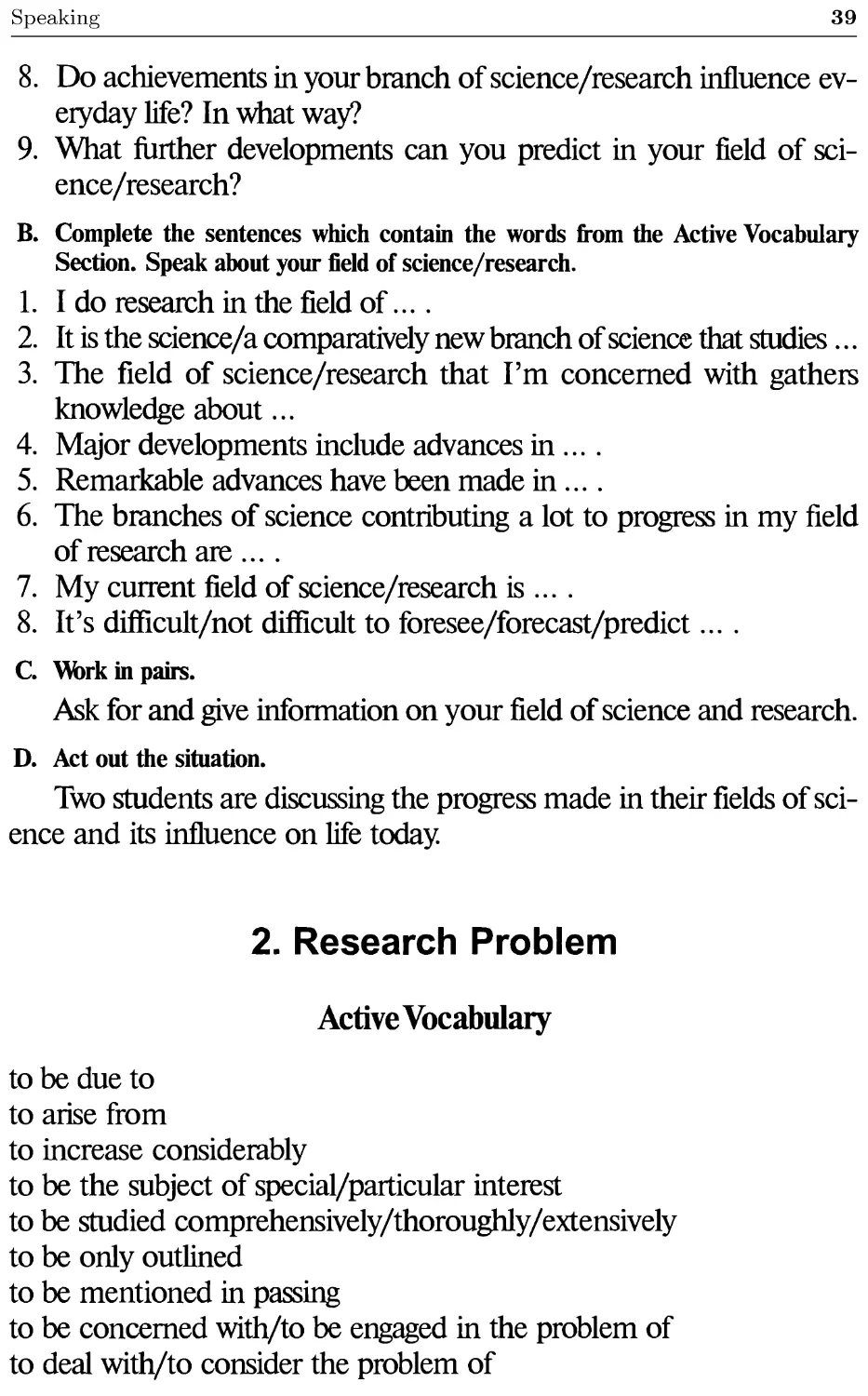
8. Do achievements in your branch of science/research influence
everyday life? In what way?
9. What further developments can you predict in your field of
science/research?
B. Complete the sentences which contain the words from the Active Vocabulary
Section. Speak about your field of science/research.
1. I do research in the field of....
2. It is the science/a comparatively new branch of science that studies...
3. The field of science/research that I'm concerned with gathers
knowledge about...
4. Major developments include advances in ....
5. Remarkable advances have been made in....
6. The branches of science contributing a lot to progress in my field
of research are ....
7. My current field of science/research is ....
8. It's difficult/not difficult to foresee/forecast/predict....
C. Work in pairs.
Ask for and give information on your field of science and research.
D. Act out the situation.
Two students are discussing the progress made in their fields of
science and its influence on life today.
2. Research Problem
Active Vocabulary
to be due to
to arise from
to increase considerably
to be the subject of special/particular interest
to be studied comprehensively/thoroughly/extensively
to be only outlined
to be mentioned in passing
to be concerned with/to be engaged in the problem of
to deal with/to consider the problem of

to be interested in
to be of great/little/no interest/importance/significance/value/use
to take up the problem
to work on the problem
to follow/to stick to the theory/hypothesis/concept
to postulate
to differ/to be different from
a lot of/little/no literature is available on the problem
the reason for the interest in the problem is ...
Tasks
A. Answer the questions:
1. What is your research problem?
2. What is of special interest in the problem of your research?
3. What is the subject of your research?
4. Why has the interest in this problem increased considerably in
recent years?
5. Do you follow/stick to any theory/hypothesis/concept? What is it?
6. What concept is your research based on?
7. How does your research differ from other studies of the same
problem?
8. Is there much literature available on your research problem?
9. Is your research problem described comprehensively/thoroughly/
extensively in literature?
10. Is the problem only outlined or mentioned in passing?
11. What are the main aspects of the problem that have been considered?
B. Complete the sentences which contain the words from the Active Vocabulary
Section. Speak about your research problem.
1. At present/now/currently I am studying the problem of...
2. The problem I am studying is concerned with ....
3. There is a lot of/little/no literature on the problem of....
4. The literature available on the problem only outlines/mentions in
passing/ thoroughly/extensively/describes such aspects as ....
5. We have taken up the problem of... to ....
6. In solving our problem we follow the hypothesis that....

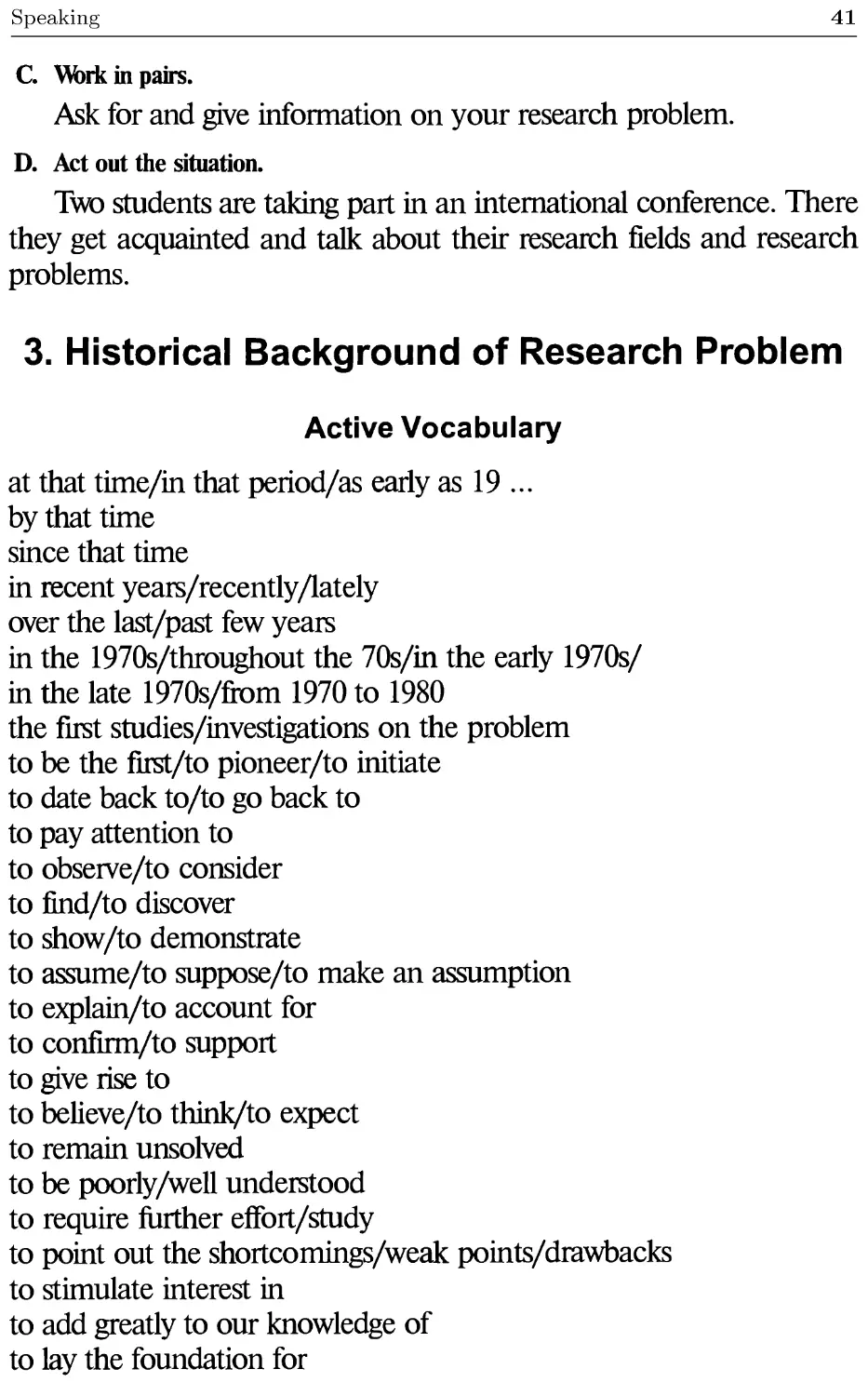
C. Work in pairs.
Ask for and give information on your research problem.
D. Act out the situation.
Two students are taking part in an international conference. There
they get acquainted and talk about their research fields and research
problems.
3. Historical Background of Research Problem
Active Vocabulary
at that time/in that period/as early as 19 ...
by that time
since that time
in recent years/recently/lately
over the last/past few years
in the 1970s/throughout the 70s/in the early 1970s/
in the late 1970s/from 1970 to 1980
the first studies/investigations on the problem
to be the first/to pioneer/to initiate
to date back to/to go back to
to pay attention to
to observe/to consider
to find/to discover
to show/to demonstrate
to assume/to suppose/to make an assumption
to explain/to account for
to confirm/to support
to give rise to
to believe/to think/to expect
to remain unsolved
to be poorly/well understood
to require farther effort/study
to point out the shortcomings/weak points/drawbacks
to stimulate interest in
to add greatly to our knowledge of
to lay the foundation for

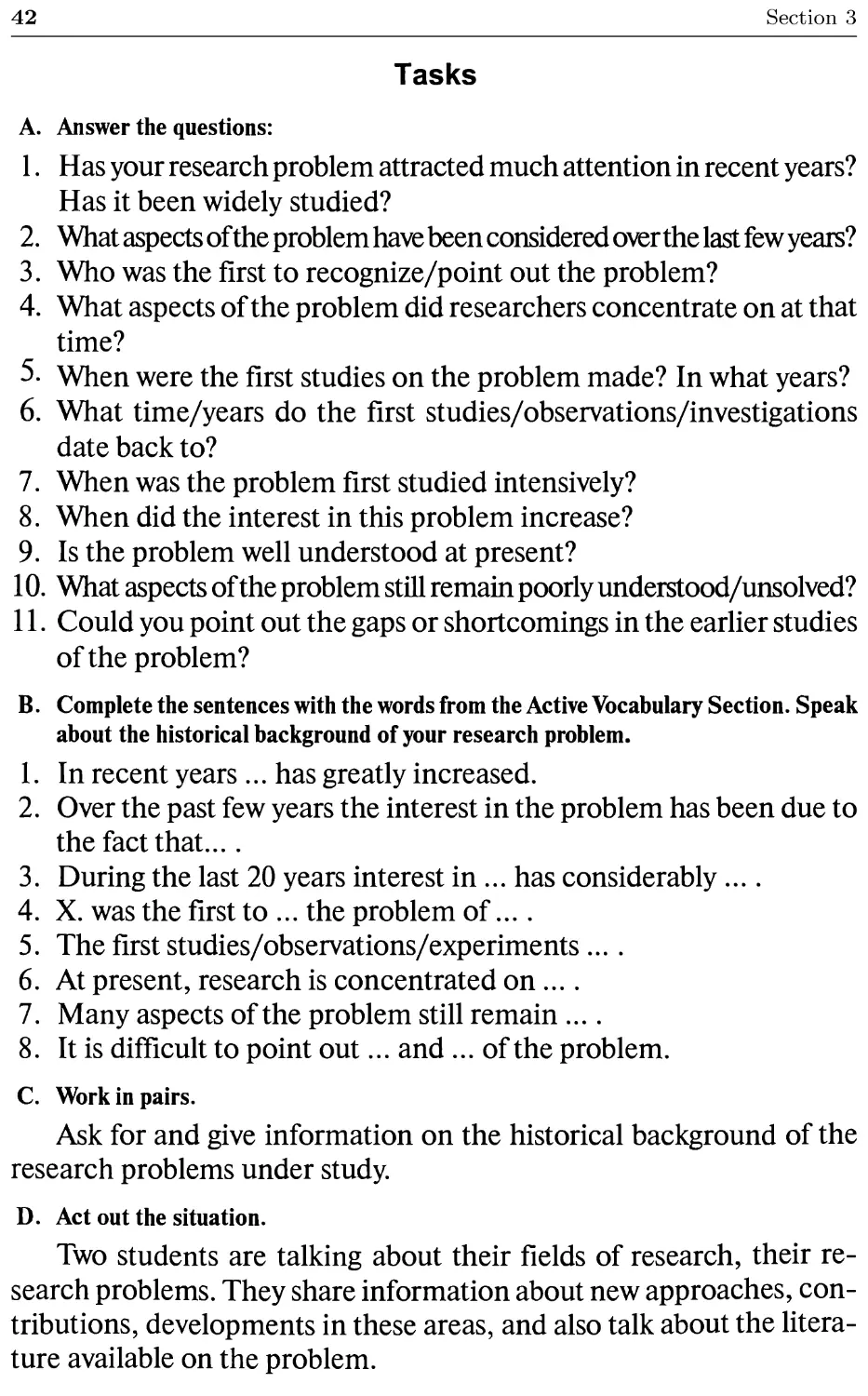
Tasks
A. Answer the questions:
1. Has your research problem attracted much attention in recent years?
Has it been widely studied?
2. What aspects of the problem have been considered over the last few years?
3. Who was the first to recognize/point out the problem?
4. What aspects of the problem did researchers concentrate on at that
time?
5. When were the first studies on the problem made? In what years?
6. What time/years do the first studies/observations/investigations
date back to?
7. When was the problem first studied intensively?
8. When did the interest in this problem increase?
9. Is the problem well understood at present?
10. What aspects of the problem still remain poorly understood/unsolved?
11. Could you point out the gaps or shortcomings in the earlier studies
of the problem?
B. Complete the sentences with the words from the Active Vocabulary Section. Speak
about the historical background of your research problem.
1. In recent years ... has greatly increased.
2. Over the past few years the interest in the problem has been due to
the fact that....
3. During the last 20 years interest in ... has considerably....
4. X. was the first to ... the problem of....
5. The first studies/observations/experiments ....
6. At present, research is concentrated on ....
7. Many aspects of the problem still remain ....
8. It is difficult to point out... and ... of the problem.
C. Work in pairs.
Ask for and give information on the historical background of the
research problems under study.
D. Act out the situation.
Two students are talking about their fields of research, their
research problems. They share information about new approaches,
contributions, developments in these areas, and also talk about the
literature available on the problem.

4. Current Research. Purpose and Methods
Active Vocabulary
purpose/aim/objective/goal/target
a method/a technique/a procedure
detection/identification/observation
measurement/calculation/computation/approximation
consideration/generalization/deduction/assumption
modelling/simulation
advantages/merits
disadvantages/shortcomings/limitations
accurate/precise
accuracy/precision
reliable/valid/conventional/effective/useful/valuable
data/results/method
to make an experiment/analysis
to reveal/to find /to confirm/to prove evidence
to study/to examine
to collect data
to refine the results
to create
to improve
to work out/to develop/to design
to verify/to check
to approve/to disprove an assumption
to use/to employ/to apply
to allow/to permit/to provide
to have much promise/to be promising
to come into use
Tasks
A. Answer the questions:
1. What is the subject of your current research?
2. What is the purpose of your research?
3. What method do you employ? Why?
4. What are the advantages of the method you use over other methods
and techniques?

5. Is this method only now coming into use? Is it new?
6. What does the method consist in? What operations does it include?
7. Do you find the method reliable/precise? Why?
8. How long has your current research been under way?
9. How much time will it take you to complete your research successfully?
B. Complete the sentences with the words from the Active Vocabulary Section. Speak
about the purpose of your current research and the method used.
1. Currently I....
2. I make this set of experiments/analyses in order to ....
3. The experiment/analysis is performed with a view to ....
4. The purpose of my experiments/analyses is to ....
5. We undertake a set/a series of experiments hoping to ....
6. In our current research we ... the method of....
7. The method/technique allows/permits ... to ....
8. The method/technique makes it possible to ....
9. This is, without doubt, the most... and ... method.
10. The method proves to be ....
C. Work in pairs.
Ask for and give information about your current research, namely
its purpose and the methods you employ.
D. Act out the situation.
Two students/colleagues meet at a conference. They talk about their
current research, expressing interest in its purpose, and describe the
methods used.
5. Current Research. Results and Conclusion
Active Vocabulary
results/findings/data/observations/evidence
comprehensive/extensive
detailed
remarkable/encouraging/convincing
preliminary
sufficient/insufficient

superficial
to collect/to get/to receive/to obtain data
to treat the problem
to succeed in/to make progress in/to be a success
to fail (in)
to be similar to/to be the same as
to be consistent with/to coincide
to agree with/to fit the assumption
to support/to provide support/in support of
to reach an understanding/to come to an understanding
to conclude/to come to/to bring to a conclusion/to make conclusions
Tasks
A. Answer the questions:
1. Have you already obtained any research results?
2. What are the main/comprehensive results of your current research?
3. Has your research been successful?
4. Have you succeeded in receiving extensive data?
5. Do your research data agree with the theory you follow?
6. Do your results coincide with those obtained by other researchers?
7. Are the results of purely theoretical or practical interest?
8. Do your research results appear to be of both theoretical and
practical importance?
9. Are the data/observations you have obtained sufficient to
formulate your final conclusions?
10. What part of your research is/remains still unfinished?
11. Do the data/results/observations/findings allow you to come to any
definite conclusion(s)?
12. What conclusion(s) have you come to?
13. How long will it take you to finish your research?
B. Complete the sentences which contain the words from the Active Vocabulary
Speak about your research results and conclusions.
1. The research has been under way for a year and I've got...
2. At present a lot of work is being done to ....
3. The results we have ... so far cannot be used to ....

4. Unfortunately, we have failed to ... but succeeded in....
5. The findings prove to ....
6. The evidence appears to ....
7. As a result of numerous experiments performed we have obtained
sufficient data to ....
8. Most of our research findings are consistent with ....
9. We have come to the conclusion that....
C. Work in pairs.
Ask for and give information about your research results and
conclusions.
D. Act out the situations.
1. You have a poster report/presentation at the conference. Another
participant is interested in your topic. Tell him about the main points
of your research, present the results obtained, and give a short
explanation of the main findings.
2. You are interested in your colleague's research and his latest
findings. Ask him about the difficulties he has had in carrying out his
research (experiments, analyses), and about the progress he has made.
6. Conference
Active Vocabulary
a meeting/a session
a plenary meeting/the opening ceremony
a chairman/a chairwoman/a chairperson
to call upon someone/to give the floor to someone
to set up/to fix the time limit
to break the time limit
to call attention to the time limit
to stimulate discussions
to ask somebody a question
to call for questions
a speaker
to submit abstracts/to present papers/to present poster reports
to take part in/to participate in/to attend a conference

to take the floor
to keep/to stick to the point
to digress from the subject
to have a good/poor knowledge/command of English
to find the knowledge of English adequate/inadequate
to find English hard to follow
to fail to understand reports/questions in English
Tasks
A. Answer the questions:
1. Have you ever participated in international conferences/symposia/
congresses?
2. When did you last take part in a conference?
3. Where was the conference held?
4. What problems were considered and discussed?
5. How many participants attended the conference/session/workshop?
6. Which reports attracted general attention?
7. Whose report was of particular interest?
8. What problem did it deal with?
9. Did you read/present a paper at the conference?
10. Were you given the floor?
11. Was the time limit fixed?
12. Did you find your English sufficient/adequate to participate in
the international conference?
13. Do you think you have a good/poor knowledge of English?
14. Did you find the speaker's English hard to follow?
15. Why is it necessary/important for a scientist to know foreign languages?
B. Complete the sentences with the words from the Active Vocabulary Section:
1. Every year conferences ... in our university.
2. This year I... in the conference which was held ....
3. I had to ... the abstracts covering the problem of....
4. The time limit was ... and I had ten minutes to ....
5. My report ... the problem which ... much attention.
6. Of... interest were the reports presented by X and Y.
7. I... in understanding English, because I find my English ....

C. Work in pairs.
Ask for and give information about your participation in a
conference/symposium/congress.
D. Work in a group.
1. You are at a round-table discussion of your research, its progress and
results. One person in your group is the chairman, the rest are the
speakers.
2. You share your opinions about the organization of the conference,
its agenda, the chairman's speech and the reports presented.
E. Act out the situation.
Your fellow-student has never participated in a conference. He is
eager to know about your experiences. Tell him what the most difficult
thing for you was and what you enjoyed the most.
7. How to Chair a Conference
Active Vocabulary
to give a special welcome to to promote something
to attend the meeting a scientific program
to consider the range of subjects a working group session
to chair the session a poster session
to schedule something for... a panel discussion
to reschedule an agenda
to cancel something an alternation to the agenda
to hold concurrently a stimulating discussion
Tasks
A. Read and practise some useful speech patterns:
Introducing a speaker
I have the great pleasure to introduce ....
Our first guest will speak on ... .
And now I have the pleasure of introducing our first speaker ....
I now give the floor to ....
Our next speaker is ... who will speak about/on ....
Now I'd like to call upon ... who is going to speak about/on ....

And now I ask ... to make his contribution on ....
Now I'm giving the floor to ... who will speak about/on ....
Stimulating a discussion
Please feel free to ask questions and make comments.
Any questions or comments?
Are there any questions on X's paper?
Does anyone want to put questions to ...?
Any other questions?
Do you have questions to ask?
Who would like to comment on X's paper?
Does anyone else want to ask a question or make a comment?
Are there any comments on the paper?
Are there any more comments?
There are no more questions ... Thank you.
Ending a meeting
I'd like to thank you all for a stimulating discussion.
Well, I think that covers everything.
All the topics seem to have been exhausted.
I think it's time we close the discussion.
Our time is up. The discussion is closed.
I declare the session closed.
I think we have done a good job. Thank you all.
B. Act out the situation.
You are a chairman opening a Students' University Conference.
To do it you are given five minutes.
8. Presenting a Paper
Active Vocabulary
to present a paper to remind of... to give an explanation of
to do research to begin/finish with ... to draw a conclusion
to discuss in detail to emphasize in contrast with
to note the difference to point out

Tasks
A. Before doing your oral presentation read the following recommendations:
Thinking about your presentation
1. State your purpose, be specific.
2. Identify the central idea of your presentation.
3. List the main points of your presentation.
4. Think of supporting material for each main point.
5. Decide what kinds of visual aids you will use.
Preparing for your presentation
1. Write an outline of your presentation. You might want to add
transition words between the sections.
2. Write the introduction.
3. Write the conclusion.
4. Print the introduction, outline, and conclusion in big print.
5. Prepare your visuals.
Practising your presentation
1. Stand up and give your presentation. Pretend that you have an
audience and look at it.
2. Do it again and time yourself. Make any adjustments necessary for
time.
3. Ask a friend to listen and critique it.
4. Practise it several more times until you arc comfortable and not
reading it.
Giving the presentation
1. Have everything ready. Don't spend time collecting possessions
and getting it in order when it's time for you to speak.
2. Walk to the front of the room confidently, put your notes on the
lectern, and start.
3. Don't apologize for anything.
4. Make eye contact with your audience. Don't just look at your notes
or at the wall.
5. Do not read! It's really boring.
6. Be enthusiastic about your topic.

7. When you finish, collect your possessions quickly and sit down.
B. Answer the questions:
1. What is the topic of the paper you are going to present?
2. Why are you interested in this particular topic?
3. Do you always prepare for presentations?
4. What recommendations for making oral presentations do you find
most helpful?
5. Which ones do you always follow?
C. Read and practise some useful paper speech patterns:
Introductory Paper Speech Patterns
Mr. Chairman, ladies and gentlemen, I am greatly honoured to be
invited to this conference.
In this paper I would like to talk about the concept of....
The object of this paper is to show ....
To begin with, let us imagine that... .
As many of you know....
First of all I would like to ... .
I am sure I don't have to remind you that....
I am very pleased to have this opportunity to ....
In my paper I want to highlight....
In the introduction to my paper I would like to ....
I tell this story because ... .
I want to begin my presentation with ....
Let me begin with ....
The first thing I want to talk about is ... .
The subject that I will discuss is ... .
Speech Patterns for the Body of the Paper
According to this theory ....
After this, I need/ it remains only to say that....
Again, I want to emphasize that....
It should be emphasized that....
It should be pointed out that....
Let me give you my explanation of....
Let me now turn to ....
Let us consider what happens if....

Let us have a closer look at....
Let us imagine that....
Let us suppose that....
Now I come to....
On the contrary....
On the one hand ..., on the other hand ....
Primarily....
This is indeed the case when ....
This in turn implies ....
This is particularly true for ....
Closing Paper Speech Patterns
Since I am running out of time ....
As my time is running out....
Before I close I would like to emphasize the importance of....
Finally, Iwantto say a few words about....
I end this paper with a description of....
I leave it to you to judge ....
In closing, I want to mention very briefly....
In conclusion, let me say....
In conclusion, may I repeat....
Summing up, I would like to ....
The last part of my talk will be devoted to ....
To all this must be added that....
Formulas of Scientific Communication
Establishing contacts I'm glad you've asked me that question.
Agreeing Yes, indeed.
I think you are entirely right.
It appears to me to be true.
I agree that....
That's just what I think.
Disagreeing I am aiguing against....
I would object just a little ....
I object to ....
I wish I could agree with you but....

Expressing surprise
Expressing uncertainty
Making contribution
Calling attention
Making assessment
Starting a conversation
Making remarks
It is rather surprising ....
It is unbelievable ....
I am puzzled by....
I wonder about....
I find it hard to believe that....
It seems unlikely that....
I have doubts about....
I am not at all sure about....
I am not yet certain ....
I am doubtful whether ....
I have been rather puzzled by....
I doubt it.
In connection with... I would like to add....
Let me add that....
In addition, I would like to mention....
I would add that....
I want to point out that....
I would like to note ....
I would like to stress the importance of....
It is worth pointing out that....
I would like to draw your attention to ....
I would like to call attention to ....
The paper raises an important question ....
This method is particularly important
because ....
The paper demonstrates how important it is
to....
These results/data are of principal interest.
As far as I know....
What I have in mind is that....
I'd like to make a comment on....
I would like to comment on....
I have a point to make.

Provoking arguments
Asking for details/
classification
Introducing opinions/
attitudes
Delaying an answer
Would you agree with ... ?
There seems to be some contradiction
between your points of view. Does that
mean you think... ?
Could you be more specific about... ?
I am not clear about....
Could you give us/me some more facts to
back that up, please?
Well, I'd like to say that....
What I think is....
Well, let me see ....
Well, now....
That's a good question....
Oh, let me think for a moment....
It is rather difficult to answer this question....
It's difficult to give you an exact answer,
but....
I'm not too sure, but....
I've no idea, I'm afraid.
I have no particular theory for this fact, but....
I'm terribly sorry, I really don't know.
Actually, I don't know....
I'd rather not answer that, if you don't mind.
D. Act out the situation.
Your paper has been accepted by the Organizing Committee.
Today you are given the floor to present your research data. The time
limit is six minutes. Make your presentation.
Avoiding answering

Section 4
WRITING RESEARCH PAPERS
Writing a research paper takes a lot of time and effort. It demands
a thorough knowledge not only of the subject you are writing about,
but also of the strategies for generating, verifying, substantiating and
proving ideas. It is nesessary to follow the structure, style, format and
layout of the paper. The following guidelines will help you by providing a
step-by-step explanation of the research-writing process.
1. Gathering Data and Writing Summary Notes
When reading papers written by other authors on the subject that is
of interest to you, you must write summary notes. There are two kinds
of summary notes.
A summary condenses into a brief note the key ideas of a source. It
is a concise description of the material without a lot of concern for
details. Summary notes are very helpful when you deal with references
to source materials, statistical data and all kinds of facts on your
specific topic.
A precis is a polished summary that in a few words experesses the
key ideas of an entire paragraph, section, or chapter. Writing a precis
proves to be very helpful when you review an article, a book or produce
an abstract. To produce a precis, condense the original piece of writing,
reducing a paragraph into a sentence, an article into a brief paragraph,
a book into a page. Preserve the tone and moods of the original (serious,
skeptic, doubtful, etc.), do not take material out of context. Always
locate the source of your material.
TASK: Do you ever write summary notes? If not, are you going to
start? Write a precis of a paper using the instructions given
above.

2. Organizing Ideas
Most papers in various scientific disciplines have a similar
organization pattern - Introduction, Body and Conclusion (especially papers
on theoretical issues). Research papers based on experiments would
include Introduction, Method, Results, Discussion/Conclusions.
When you write a research paper observe the following instructions:
Introduction: identify the subject of your research and narrow it to
a specific topic, provide background information, state the problem
and the hypothesis of research, provide theoretical basics of the study,
formulate the thesis statement/sentence.
Method: describe the subjects/participants of your study, the
apparatus and equipment used, the procedure followed.
Results: report on your findings, support them with statistical data,
diagrams, graphs, tables and figures, etc., note whether your findings
are consistent with the advanced hypothesis.
Discussion/Conclusions: evaluate and interpret the results obtained,
make inferences from the results, discuss the implications of your
findings. You can end your paper with some reflections about the topic
discussed, some suggestions for further research.
TASK: When you start writing a paper, will you follow the
instructions given above? Will you eliminate or add new elements?
Have you consulted your thesis supervisor on this issue? If
not, are you going to dicuss it with him/her?
3. Writing the Paper:
Structure, Linguistics and Style
A research paper has physical and structural characteristics.
The physical characteristics consist of the title, the introduction,
the main body parts and the conclusion, which you write in indented
paragraphs.
THE TITLE
When you start reading a research paper, its title is perhaps the most
important part, because the key words in the title help you make a

decision whether the paper is of interest for you or not. Thus the title
should not be very long and general, but rather specific.
The LUMINA element for the matrix displacement method.
To achieve this effect you can first name the general subject
followed by a colon, and then:
• add the phrase that renames the subject
Matrix displacement method: recent developments
• add the phrase that describes the type of study
Matrix displacement method: experimental observations
• add a sentence in a question form
Matrix displacement method:What comes next?
The title should always be relevant to the problem studied, and fit
the paper. It should provide code words which identify the main points
of research.
TASK: Look through the journals on the subject of your research
and find the titles of papers that fit the requirements
discussed above. Write down several titles for your paper,
discuss them with your fellow-students and choose the
best one.
INTRODUCTION
When you write the introduction, you begin with a broad
statement relating to the subject of research and narrow it down to specifics,
namely the thesis statement/sentence of the whole paper. It is usually
a single declarative sentence, the assertion you make about the main
points of your study. The thesis statement helps both the writer and the
reader. For the writer, it provides a definite framework to follow in the
rest of the paper. For the reader, it provides a guide for a clear
understanding of what to expect from the rest of the paper. Express your
thesis statement at the end of the introduction.

TASK: Think over and write a thesis sentence for your paper. Show
it to your fellow-students. Let them figure out what the
subject and the reason for your research are.
BODY
The body of the paper should provide evidence in support of the
thesis sentence, each paragraph explaining one and only one aspect of
the thesis. Begin each paragraph with a statement of the key idea in one
sentence, which is called the topic sentence, and explain or support it
with details and evidence.There are several ways of supporting the key
idea and developing paragraphs — by describing, classifying, providing
statistical data and scientific evidence, analyzing causes and effects,
comparing and contrasting, etc. The strategies are determined by the point
you want to make and the kind of information you have to work with.
CONCLUSION
The conclusion can be a summary of the introduction and the
developmental paragraphs of the body parts, which is usually done from
specific to general — this study to larger implications. But more
importantly it should express your judgment on the research performed
and the results obtained, explain the findings and/or make suggestions
for further investigation.
* * *
Structurally, a paper should have unity and coherence. Unity gives
the writing single vision, and coherence connects the parts. Your
paper has unity when it talks about one topic, step by step exploring it in
depth. Your paper is coherent if all its parts fit together, talk about the
same topic, are connected logically and flow smoothly from one to the
other. To obtain this effect use cohesive devices.
Cohesive devices help readers follow a writer's train of thought by
connecting key words and phrases through a paper. Among such
devices are pronoun references, same-word repetition, synonym
repetition, sentence-structure repetition, collocations. Transition words serve
as a bridge, connecting one paragraph with another. Transitions help

readers anticipate how the next paragraph or sentence will affect the
meaning of what they have just read:
also,besides, furthermore, in addition — to add more thought;
first, next, finally, later, afterwards, in front, beyond, etc. — to
arrange ideas in order, time or space;
but, still, yet, however, on the other hand, nevertheless — to connect
two contrasting ideas;
for example, in other words - to add an illustration or explanation;
in short, in brief, to sum up — to summarize several ideas.
* * *
Nowadays in scientific publications there is a strong tendency to use
definite verb tenses in certain types of papers. When you write a paper in
natural sciences, use past tense or present perfect tense to cite an author's
work and/or show what has been accomplished: (e.g., "Landau created"
or "the experiment of Lakes and Paul has proven..."). Use present tense
when you discuss the results or when you mention established knowledge
(e.g., "water boils at 100 degrees Centigrade"). Write your paper with a
third-person voice that avoids "I believe" or "It is my opinion"
TASK: Read sample 1 "Introduction" and mark sentences that
describe the subject, background, problem and the thesis
statement.
Sample 1
Pattern Selection in an Anisotropic Hele-Shaw Cell
K.V. McCloud and J.V. Maher
Department of Physics and Astronomy, University of Pittsburgh, Pittsburgh, Pa.
INTRODUCTION
Saffman-Taylor (ST) flow, the motion of an interface between
immiscible fluids in a rectangular Hele-Shaw cell, is a particularly simple
example of a nonlinear, pattern-forming system. The steady-state vis-

cous finger formed in such a system, whose selection from a family of
possible solutions has only recently been explained [1-3], has been
studied in detail [4-7]. Using this steady-state finger as a starting point,
it should be possible to learn more about nonlinear growth laws by
perturbing the system in a well-controlled fashion. Recently, there have
been a number of experiments involving perturbed flows in both
rectangular and radial Hele-Shaw cells. Most of these have involved placing
wires, grooves, or bubbles near the tip of a growing finger [8-15]. Most
available results on flow over a lattice have used the radial Hele-Shaw
geometry [16-18], gaining richness in the patterns observed but
sacrificing the simplicity of the steady state, which is unique to the channel
geometry. In the channel geometry, the experiments performed so far
have all involved macroscopic perturbations in the sense that the
imposed length scale of the perturbation is greater than the capillary length
of the flow [8, 11, 12, 14, 19-21]. In most of these cases, the selected
finger tends to be narrower and much more stable than the unperturbed
solution. The available theoretical work also tends to favor the
selection of narrow fingers in the case of general anisotropy added by the
imposed perturbation [21-32]. One interesting experimental exception
involves high-velocity flow over a lattice [19,21], a flow which exhibits
very unstable diffusion-limited-aggregation (DLA)-like fingers, which
reflect the symmetry of the underlying lattice. Averaging over a large
number of such unstable flows produces an average finger, which has
the general shape of a ST finger, but is sometimes wider than the
corresponding ST finger should be [19, 21]. In this paper, we present
results from an experiment involving stable flow in the channel geometry
over a lattice whose cell size is, in general, much smaller than the
capillary length of the interfacial flow.
TASK: Read the list of phrases and choose the most appropriate
ones to write an introduction of your paper.
List of phrases used in writing the introduction:
1. To give the historical background of the investigation and to formulate the problem:
1. During the past decade there has been increasing research into ....
2. In some theoretical studies ....

3. ...were able to provide a My generalized, compact simultaneous
solution to....
4. In particular, they employed... for....
5. ... is an important and common problem.
6. It has become a canonical problem in the study of..., providing a
valuable test for simulation methods or theoretical models.
7. In the previous paper... we used a specific model for....
8. The paper examines a method for....
9. Earlier descriptions of the ... assumed that....
10. However, detailed experimental studies of...indicate that....
11. The most rigorous treatments available are restricted to the ....
12. Accordingly, we suggest that....
13. To date a number of different interpolation techniques have been
used in....
14. In Section 2, the paper continues with a discussion of.... Section 3
overviews..., Section 4 then proposes... and this matter is discussed
in Section 5. Finally, in Section 6 we discuss ....
15. Several techniques have been used to investigate ....
2. To make a brief review of related literature:
1. There is a wide body of literature which suggests that....
2 ... effects have received much attention.
3. There were the limited number of studies conducted on ....
4. The listings of the program may be found in....
5. Examples are given in....
6. Extensive field studies were undertaken by the scientists at...
3. To justify the need for your investigation:
1. Thus heat transfer regime has received little attention ....
2. It is therefore important to establish the ....
3. Studies on the... process have been and still are of interest because
of the....
4. In spite of significant recent advancement in the fundamental
understanding of... several important aspects of the ... still remain
controversial.
5. ... investigations have been proved very valuable in ... but they do
not give a complete picture of..., since they eliminate ....
6. Most of the above investigations concentrated on the general
effects of... and did not look carefully at the ....

7. There is still lack of knowledge of ... . Much further research is
needed to understand....
8. There is still no complete knowledge of....
9. There are still many gaps in our knowledge of the problems of....
10. ^ still know very little about the origin of... .
4. To state the purpose of the research:
1. The objective of this study is ... .
2. ... is the primary purpose of the paper.
3. The aim of this paper is to investigate the ... .
TASK 1: Let your fellow-students read the introduction you have
written. What do they like/dislike about it?
TASK 2: Discuss with your fellow-students what techniques of writing
research papers are most typical for your field of science,
and then read sample 2 "The Body of the Paper."
Sample 2
EXPERIMENTAL PROCEDURES
AND DATA PRESENTATION
The experimental cells were 50 cm long, with a channel width set
by the placement of Teflon spacers which also set the gap, b, between
the plates of the cell. The channel width, w, varied from 2 to 5 cm, with
most of the data taken at a channel width of 3 cm. Four different
values of the gap, b, were used, ranging from 0.37 mm to 1.60 mm. The
bottom plate of the cell consisted of a 0.5 inch thick piece of very
uniform float glass. The top plate was a 0.5 inch thick piece of glass with a
very precise lattice etched into it. Two etched top plates were used, one
with a square lattice, and the other with a rectangular lattice. Some
calibration data were also measured using a smooth top plate. Lattice
specifications are listed in Table I. A flow realization involved
injecting nitrogen gas into the cell after filling the cell with heavy paraffin oil
(viscosity, u = 180 cP and surface tension, T=35.4 dye/cm). Only flows

with a very constant areal injection rate (variation less than 5% over a
15 cm finger-tip advance) were accepted and analyzed. Each flow was
recorded from above using a CCD camera and a medical-grade VCR,
and the images were analyzed digitally. Measurements were made of
the tip velocities, v, tip curvatures, finger widths, Aw, and limits of
stability as a function of the cell gap, the lattice geometry, and the angle,
0, between the direction of flow and the symmetry axis of the lattice....
TABLE I. The dimensions of the etched lattices are shown here:
Lattice
Square
Rectangle
Depth
(um)
90 ±5
90 ±5
Groove width
(um)
200 ± 13
200 ± 13
Center to center
(um)
400 ±3X400 ±3
400 ±3X400 ±3
TASK 1: What are the main points covered in this part of the paper?
Which techniques used in this paper do you find helpful in
writing the body of your paper?
TASK 2: Read the list of phrases and choose the most appropriate
ones to write the body of your paper.
List of phrases used in writing the body of the paper:
Methods and Techniques
1. The experiments were performed at....
2. The experimental set-up included ....
3. Two array configurations were used.
4. The measurements ... were conducted using ....
5. The main experimental configuration is presented in Fig. 1.
6. The simulation starts with ....
7. The instrumentation and general arrangements were those
described previously....
8. All the experiments were carried out using a ...
9. A standard two-compartment electrochemical cell with a volume
of 50 ml was used to ....

10. The velocity distribution in the ... is obtained numerically using
the finite element method.
11. The experimental work roll is fitted with an array of..., as shown
schematically in Fig
12. The equation governing the direct problem is obtained by ....
13. The direct problem is solved using ... method.
14. The following procedure is used to determine ....
15. Fig. 3 summarizes the direct model and inverse approach.
16. At any given time ... the inverse algorithm determines ....
17. ... was verified by measuring the ... at various axial locations.
18. The device was similar in concept to that described by...
19. The probe itself consisted of...
20.... was recorded by the computer for a set sampling rate and time.
21. The outside diameter of the tube is taken to be ...
22.... under steady state conditions.
Results
1. The results of... numerical calculations are shown in ....
2. Results indicated that....
3. A schematic diagram of the system is shown in Fig. 1.
4. Charts/Tables/Figures show....
5. From the graph it can be seen that there is good agreement
between experiment and theory for....
6. The data cover a wide range of... dimensions and operating
conditions.
7. When the same data in Fig.... were compared to ....
8. As shown in Fig., the discrepancy between equation and the data is
as much as ....
9. The present correlation is in good agreement with most data.
10. We can make several observations.
11. Prior to applying the inverse procedure to experimental results ....
12. Two observations can be made from these plots.
13. Fig. 6 shows a scatter plot of....
14. Table 4 summarizes the results ....
15. Results of the ... are presented in ....
16. As expected, the ... errors decrease with ... more rapidly.
17. The fact that the ... errors are larger than the ... errors suggest one
of two things ....

18. Similar observations can be made about the behavior of the mean
errors.
19. In general, there is no significant qualitative difference between
the ... and ... cases.
20. The data are plotted in logarithmic form, for ease of comparison
with... paper.
21. From Fig. 10 it is estimated that....
22. On the basis of these results it can be observed that....
* * *
To describe results use tentative verts and modals:
It appears/seems/is likely/that....
These results suggest....
It is possible that... .
Use past tense.
TASK 1: How long did it take you to write the body of your paper?
What was the most difficult thing about it?
TASK 2: Read the list of phrases and choose the most appropriate
ones to finish your paper.
list of phrases used in writing the discussion/conclusion:
1. This research has attempted to ....
2. The original assumption was that....
3. The findings of... suggest that... is appropriate to ....
4. Analogous results hold for ... .
5. One reason could be that....
6. These results could be explained by assuming that....
7. It is unlikely that....
8. These findings suggest/imply/provide evidence that....
9. Detailed understanding of... is still lacking ....
10. The method becomes even more efficient for the ... case.
11. From a computational viewpoint....
12. More significant though is the relative ease of implementing the ...
model involving... .

13. In this context, these results are the same as those obtained from
the... method.
14. The methods described here have more general application...
15. It was observed that ... does not have a significant effect on the
performance of the ... equations.
16. The principal results and findings are as follows....
17. Analyses of experimental data obtained during... demonstrate that
the inverse procedure is capable of accurately predicting measured
... over significant periods of time.
18. The results from... were compared with results from....
19. The model will be useful in the analysis of... processes.
20. A significant advantage of this theory is that....
21. It should be noted that the results recorded here are very
preliminary.
22. Finally, an important conclusion follows from....
23. It is a logical consequence of the fact that....
24. It would be interesting to ...
25. Much further research is needed in the area of... .
TASK: Read samples 3-5 and notice how to write the "Discussion
of Results", "Conclusions" and "Acknowledgements" parts
of a research paper.
Sample 3
DISCUSSION OF RESULTS
We can suggest a tentative approach to thinking about the results
presented above. Sarkar and Jasnow [38] have suggested that if the
capillary length is much greater than the lattice-cell size, then it maybe
legitimate to use a coarse graining argument to represent an otherwise
very complicated mobility tensor in Darcy's law:
V=~MVP, (6)
where V is the interface velocity, if is the coarse grained mobility
tensor, and P is the pressure field averaged over the cell gap. If coarse

graining is valid, this mobility tensor should have equal eigenvalues for
a lattice with fourfold or sixfold symmetry. In general, the mobility
tensor will have unequal eigenvalues for the rectangular lattice. Thus
the equation of flow for the square lattice remains a Laplace equation,
and that for the rectangular lattice could change in an important way.
We should also consider changes in the boundary conditions. For a
smooth cell (no lattice at all), the boundary conditions are that the
normal components of velocity for the two fluids must match:
(vj1 = (vw)2, (7)
and that the pressure jump across the two fluids, one of which is
assumed to wet the plates, should have the form,
+ higher order terms in
where k is the curvature in the x-y plane. The presence of the lattice
can be expected to change these boundary conditions, and it is not at
all clear how to write down the corrected boundary conditions which
should reflect the anisotropy. One might expect anisotropy to bring in
both an angular dependence to the surface tension T in Eq. (8) and
also a kinetic (v-dependent) term.
Differences between flows over the square lattice and the rectangular
lattice might be attributed to the dynamical equation, but strong
similarities between anisotropy-dependent features of the flows can probably be
assumed to arise from the boundary conditions. For b = 0.37 mm and a
channel width of 3 cm, the capillary length is larger than the lattice-cell
size for \/B < 2600. The measured lattice effects on the steady-state finger
are very similar for both the square and the rectangular lattice in this range.
This is illustrated in Fig. 4, which shows the ratio of the b = 0.37 mm
finger's width to the ST finger width for all cases. This strong similarity
suggests that the entire wide-finger phenomenon may be attributable to
the lattice boundary conditions, with little sensitivity to the increases....
It is difficult to assess the relation between the present experiment
and solidification. The present experiment achieves a ratio of capillary
length to lattice-cell dimension of 25, whereas the analogous quantity
in solidification is typically of order 1000. In addition, the boundary
conditions are difficult to establish for the present case, the lack of

difference between flow over the rectangular and the square lattices
strongly suggests that the boundary conditions have a profound effect
on the present case, and the available theoretical work with averaged
anisotropy in the surface tension suggests narrowed fingers at some
angles. However, this experiment involves the first test of the effect on
the ST steady-state finger of a perturbation which is both local (which
bubble and wire experiments are not) and "microscopic" in the sense
of having lc/d > 1. As a uniquely local and microscopic perturbation,
its production of dramatically different selection than had been
expected constitutes a challenge to our understanding of this
fundamental growth problem. The smooth onset of the differences in the
selection as anisotropy changes suggests a tractable problem even though
its systematics had not been anticipated.
Sample 4
CONCLUSIONS
We have measured the selection of steady-state viscous fingers in Hele-
Shaw cells, one of whose glass plates has been etched with a very regular
lattice of squares or rectangles. The etched lattices perturb the Saffman-
Taylor problem with an anisotropy whose strength can be varied by
varying the cell gap. Over a wide range of observable finger-tip velocities, the
capillary length of the flow, lc, is much larger than the cell size of the
lattice. In this condition, the perturbation can be said to be both local and
microscopic, in principle, a very different condition from other
perturbations whose channel-flow selection properties have been studied.
At each observed angle, 6 (between the lattice orientation and the
flow-channel orientation), and for both lattices, steady-state fingers
are observed over a wide range of flow-rate control parameter, 1/B.
These fingers are always symmetric and centered in the flow channel,
with tip curvatures which place them in the ST family. At the very
lowest flow velocities, the fingers also have the width of normal ST fingers.
Above a threshold, 1/B = 70, the selected finger becomes wider than
the ST solution selected in the unperturbed case and this wider-finger
solution persists at all larger values of 1/B for which the capillary length

is much larger than the unit cell size. The ratio of the wider finger to
the unperturbed finger increases with the strength of the anisotropy
(i.e., inversely with cell gap).
At much higher tip velocities where the lattice can no longer be
considered microscopic, the finger widths return close to the
unperturbed values, and both narrower and wider fingers are obtainable,
depending on the angle 6. At these high velocities, flows over the square
lattice become very unstable at large anisotropy while the rectangular
lattice solutions are only very unstable at 9 = 0°.
Sample 5
ACKNOWLEDGEMENTS
1) We appreciate helpful discussions with ... and .... This work was
supported by the DOE under Grant No
2) The author is grateful for Grant No... from.... I thank... and... for
supportive comments, constructive suggestions and discussions.
3) The authors wish to express their sincere thanks to ...and ... for
their invaluable assistance in..., and for their penetrating criticism.
TASK: Decide what techniques the authors use to finish their
paper. What do you like/dislike about it?
PROOFREADING THE PAPER
If you write your paper by hand, always type the final manuscript,
paying special attention to the format and layout of your paper
(margins, spacing, arrangement of the text, etc.) and then proofread it. Read
the paper several times to detect and correct all possible types of errors.
A computer can be very helpful with checking the spelling, grammar,
and style.
Double-check in-text citations to be certain that each one is
correct and that each source is listed in the "Works Cited" or "References"
page at the end of the paper.

TASK: Proofread your paper and ask your fellow-students to do
the same. What errors have you/your fellow-students
noticed? What techniques did you use?
ACKNOWLEDGING SOURCES
After writing your paper, you should list your reference materials to
give credit to those sources, and to enable readers to consult the sources
for further information. You can label this page 'Works/Sources Cited",
"Bibliography", or "References" depending on the character of items
included — all works related to the subject or only those quoted; printed
works as well as nonprint items, e.g., speeches. Although there is no
universally agreed-upon system for acknowledging sources, first, write
down name of author, next, title of publication, and then publication
source, date, and page. Alphabetize the entries according to the author's
last name.
TASK: Study sample 6 and write a reference page of your paper.
Sample 6
REFERENCES
[1] R Combescot, T. Dombre, V. Hakim, Y. Pomeau, and A. Pumir,
Phys. Rev. Lett. 56, 2036 (1986).
[2] D.C. Hong and J. Langer, Phys. Rev. Lett. 56, 2032 (1986).
[3] B.I. Shraiman, Phys. Rev. Lett. 56, 2028 (1986).
[4] J.M. Vanden-Broeck, Phys. Fluids 26, 2033 (1983).
[5] D.A. Kessler and H. Levine, Phys. Rev. A 32, 1930 (1986).
[6] S. Tanveer, Phys. Fluids 30, 1589 (1987).
[7] D.A. Kessler and H. Levine, Phys. Fluids 30, 1246 (1987).
[8] Y. Couder, O. Cardoso, D. Dupuy, P. Tavernier, and W. Thorn,
Europhys. Lett. 2, 437 (1986).
[9] Y. Couder, N. Gerard, and M. Rabaud, Phys. Rev. A 34, 5175
(1986).

[10] V. Hoivath, T. Vicsek, and J. Kertesz, Phys. Rev.A35,2353 (1987).
[11] G. Zocchi, B. Shaw, A. Libchaber, and L. Kadanoff, Phys. Rev.
A 36, 1894(1987).
[12] M. Rabaud, Y. Couder, and N. Gerard, Phys. Rev. A 37, 935 (1988).
[13] M. Matsushita and H. Yamada, J. Cryst. Growth 99, 161 (1990).
[14] H. Thome, R Combescot, and Y. Couder, Phys. Rev. A 41, 5739
(1990).
AN ABSTRACT
An abstract is a brief description of the paper. It summarizes the
basic ideas developed in the paper. The abstract, as well as the title,
helps readers decide to read or to skip the paper. Therefore, it should
be accurate, concise, specific, objective and self-contained.
As a rule, the abstract is placed at the beginning of the paper, below
the title. It is written last, when the final version of the paper is
produced.
Providing an abstract in English will give your work a much higher
profile outside your own countiy and make it much more accessible to
international workers in the same field.
There are two types of abstracts: informational and descriptive.
Informational Abstracts, which usually follow a similar order to a
scientific paper:
1. Provide communicative contents of reports.
2. Include purpose, methods, scope, results, conclusions, and
recommendations.
3. Highlight essential points.
4. Are short — from a paragraph to a page, depending upon the length
of the report (10% or less of the report).
5. Allow readers to decide whether they want to read the report.
Descriptive Abstracts, which describe the publication itself (e.g.
surveys, review articles, book chaptes, etc.), rather than report particular
findings:

1. Tell what the report contains.
2. Include purpose, methods, scope, but NOT results, conclusions,
and recommendations.
3. Are always very short — usually less than 100 words.
4. Introduce subject to the readers, who must then read the report to
learn/study results.
Whichever type of abstract you write, follow the suggestions given
below:
Do not repeat the information given in the title.
Do not include in the abstract any facts or ideas that are not in the
text; eliminate unnecessary background information.
Decide the degree of detail you include (especially for
informational abstracts).
Use direct, straightforward English; reduce wordy phrases; avoid
jargon.
Use the past tense when describing what was done.
Finally, revise the opening statement to emphasize the new
information contained in the paper.
TASK: Read sample 7 and notice how to write an abstract.
Sample 7
ABSTRACT
Pattern Selection in an Anisotropic Hele-Shaw Cell
K.V. McCloud and J.V. Maher
Department of Physics and Astronomy, University of Pittsburgh, Pittsburgh, Pa.
The selection of steady-state viscous fingers has been measured in
Hele-Shaw cells that are perturbed by having rectangular and square
lattices etched on one of their plates. The strength of the perturbation

was varied by varying the cell gap, and over a wide range of observable
tip velocities this local perturbation was also made microscopic in the
sense that the capillary length of the flow was large in comparison to
the cell size of the underlying lattice. Above threshold the microscopic
perturbation results in the selection of wider fingers than those
selected in the unperturbed flow for all channel orientations in the
experiment. All observed solutions are symmetric, centered in the channel,
and have the relation between tip curvature and finger width expected
of members of the Saffman-Taylor family of solutions. Selected
solutions narrow again at tip velocities where the perturbations can no longer
be considered microscopic.
list of phrases used in writing an abstract:
1. A quantitative model is presented ....
2. It is shown that imaging effects are ... .
3. The present model shows that....
4. An upper bound of between ... and ... is established for....
5. By examining inherent structures for ... it becomes clear that....
6. ... are shown to have higher/lower indices than ... and to exceed
conventional bounds.
7. ... were observed and studied under ... conditions.
TASK: Read the paper you have written. Choose the most
appropriate strategies, words and phrases given above to write an
abstract of your paper. Was it easy to do? Explain why or
why not?

Section 5
WRITING LETTERS
1. Letter Layout
There are some important parts in a typical standard letter: the
sender's address, date, the receiver's name, title and address, salutation, body
of letter, complimentary close, signature and name and title of sender.
The sender's address is usually placed in the top right-hand corner
of the page. It provides all necessary information about the sender: the
name and address of the institution, organization or the name,
position, title and address of the sender, the telephone, telex, fax numbers,
e-mail or any other details that may be required, such as reference
numbers, codes, etc. Here are some samples:
Department of Physics, Prof. Manfred R.G. Wutting
Rostov State University Dept. of Materials and Nuclear
5 Zorge St. Engineering
Rostov-on-Don, 344090 University of Maryland
Russia College Park, MD. 20742-2111
USA
To avoid difficulties in writing Russian names and surnames the
following information may be of use:
ё
ж
з
й
X
ц
ч
ш
Щ
ы
ь
io, yo, ie: Semionov, Semyonov, Semienov;
zh: Zhukov;
z, s: Kuznetsov, Vosnesenskiy;
i, y: Aliseichik, Bykovskiy;
kh, h: Malakhov, Astahov;
ts: Tsvetkov;
ch: Chugunov;
sh: Timoshenko;
sch: Paschenko;
y: Bykov;
': Belen'kiy;

ю — yu, iu: Yurkov, Mavliukov;
я —ja, ya: Slepian, Yakovlev.
The date should be placed below the sender's address usually one
or two spaces lower. The most common form of writing the date is
March 20, 2005 or 20 March, 2005 both in the UK and the USA The
British ways to write the date are 20th March, 2005 and March 20th,
2005. A comma should be put between the day of the month, and the
year, to separate the numerals and prevent confusion.
The receiver's address includes the name, title and full address of
the recipient. It is placed in the left-hand side of the letter, two spaces
below the date.
Susan Jackson Prof. D.P. Petrovskiy
291 Redfern Avenue 28 Ul. Zorge, Apt. 58
Dayton, Texas 76109 Rostov-on-Don, 344090
USA Russia
Robert S. Canster
36 North St.,
London S.W. 10 2DB
England
The initials of the first name are placed in front of the surname:
Prof. M.B. Linith.
The words street, road or avenue may be abbreviated St., Rd., Ave.:
West St., Highland Rd., Charles Ave.
If the street has a number, it must be written out: 24 Second Ave.,
135 Fifty-fourth St.
The zip code or zone number is a geographical abbreviation. Be
sure to put it in all addresses in countries that use it. In the United
States the zip code uses five numbers; some countries use numbers
and letters. Do not put a comma between the end of the address and
the zip code.
383 Madison Avenue 200 Euston Road
New York, N. Y 10017 London NW1 2DB
Abbreviations for U.S. states and possessions are either traditional
or postal. Traditional abbreviations are usually followed by a period.

Postal abbreviations have two capital letters with no space between them
and are not followed by a period. Use traditional abbreviations for
Canadian addresses.
Abbreviations of U.S. States and Possessions and Canadian Provinces
State
Alabama
Alaska
Alberta
Arizona
Arkanzas
British Columbia
California
Colorado
Connecticut
Delaware
District of Columbia
Florida
Georgia
Guam
Hawaii
Idaho
Illinois
Indiana
Iowa
Kansas
Kentucky
Louisiana
Maine
Manitoba
Maryland
Massachusetts
Michigan
Minnesota
Mississippi
Missouri
Montana
Traditional
Ala.
Alaska
Alta.
Ariz.
Ark.
B.C.
Calif, or Cal.
Colo.
Conn.
Del.
D.C.
Fla.
Ga.
Guam
Hawaii
Idaho
111.
Ind.
la.
Kans.
Ky.
La.
Me.
Man.
Md.
Mass.
Mich.
Minn.
Miss.
Mo.
Mont.
Postal
AL
AK
AZ
AR
CA
CO
CT
DE
DC
FL
GA
GU
HI
ID
IL
IN
IA
KS
KY
LA
ME
MD
MA
MI
MN
MS
MO
MT

Nebraska
Nevada
New Brunswick
Newfoundland
New Hampshire
New Jersey
New Mexico
New York
North Carolina
North Dakota
Nova Scotia
Ohio
Oklahoma
Ontario
Oregon
Pennsylvania
Prince Edward Island
Puerto Rico
Quebec
Rhode Island
Saskatchewan
South Carolina
South Dakota
Tennessee
Texas
Utah
Vermont
Virginia
Virgin Islands
Washington
West Virginia
Wisconsin
Wyoming
Nebr. or Neb.
Nev.
N.B.
Nfld.
N.H.
N.J.
N. Mex. or NM
N.Y.
N.C.
N. Dak.or N.D.
N.S.
Ohio
Okla.
Ont.
Oreg. or Ore
Pa.
P.E.I.
PR.
Que.
R.I.
Sask.
S.C.
S. Dak. or S.D.
Tenn.
Texas
Utah
Vt.
Va.
V.I.
Wash.
WVa.
Wis. or Wisc.
Wyo.
NB
NV
NH
NJ
NM
NY
NC
ND
OH
OK
OR
PA
PR
RI
SC
SD
TN
TX
UT
VT
VA
VI
WA
WV
WI
WY
The salutation, which begins two spaces below the receiver's
address, is written with the margin on the left. In Great Britain the
salutation is followed by a comma, in the USA - by a colon only in formal

letters. The salutation is never followed by an exclamation mark or by
a dash. The salutation that you use is determined by the purpose of the
letter, by the position that your correspondent holds. The word Dear is
capitalized when it is the first word of the salutation. A title, such as
Prof, or Dr., is used only with the surname.
In writing letters the following salutations are used: Dear Sir, Dear
Madam, Dear Ms. Smith (if the letter-writer is not sure whether the
woman is married or unmarried), Dear Mr. Smith, Dear Mrs. Smith (to
married woman), Dear Miss Smith (to unmarried woman); Dear Dr.
Smith, Dear Prof. Smith, Dear Colleague. When writing to a university,
institution or organization the official salutations Dear Sirs, Dear
Madam are used as well as To Whom It May Concern.
The body of a letter should begin two spaces below the salutation.
The body of a letter is, of course, the most important part because it
contains the message for the recipient and should fulfill some
requirements. Each paragraph should deal with one subject, in a brief,
concise and accurate way. It should exclude all matters not relevant to the
purpose of the letter. It is best to avoid long paragraphs. The style of
letter writing requires certain accepted phrase patterns.
Short letters are usually double-spaced (two lines); longer letters
are single-spaced (one line) with double spaces between the paragraphs.
The letter is ended with a closing salutation or a complimentary
close, which is separated from the body of the letter by a double-
spaced line. It always begins with a capital letter and is punctuated
with a comma:
Yours truly,
Sincerely yours,
Yours sincerely,
Yours respectfully,
Respectfully yours,
Yours faithfully,
Faithfully yours.

We finish a letter with Yours truly, Yours sincerely or Truly yours,
Sincerely yours, if the letter began with a person's name or Yours
faithfully or Faithfully yours if it began Dear Sir(s) or Dear Madam.
It is customary for colleagues, especially among scientists, to write
Yours sincerely rather than Yours truly or Yours faithfully.
The complimentary close of a letter may begin as follows:
I look forward to the meeting in Boston
With best wishes
Looking forward to your reply
I hope to hear from you soon
Thank you for your time/effort/help/consideration.
The signature is written directly beneath the complimentary close.
It is indented a little to the right:
(signature)
John Jones
Director, Thompson Institute
In many cases the letter is signed without giving the name of the
institution or organization:
(signature)
S. Kuprianov
Associate Professor of Mathematics
The first name can be written in full or with an initial: Peter B.
Chase, Nina K. Petrova, I. Smirnov, J. Smith.

Components of a Letter
1. Sender's address
2. Date
3. Receiver's name,
title and address
4. Salutation
5. Body of letter
6. Complimentary
close
7. Signature
8. Name and title of
the sender
9. Enclosure
95 New Edition Road
Cambridge CB2 2 RU
United Kingdom
7 May, 2005
Dr. Boris N. Ivanov
Department of Physics
Rostov State University
5 Zorge St.
Rostov-on-Don, 344090
RUSSIA
Dear Dr. Ivanov,
The opening paragraph should arise the reader's
interest in the subject of the letter. State the
purpose of your letter.
Put each separate idea in a separate paragraph.
Letters have to be typed or word-processed
accurately with a smart, clear layout.
Yours sincerely,
{sign here)
Should be printed or written accurately
(if you are noting that you have enclosed
something else with your letter)

Sample of a formal letter and an envelope
14 Plowden
Road
Torquay
Devon
TQ6 IRS
16 June, 2005
The Secretary
Hall School of Design
39 Beaumont Street
London
W4 4LJ
Dear Sir,
I should be grateful if you would send me information about the
regulations for admission to the Hall Schoool of Design. Could
you also tell me whether the School arranges accomodation for
students?
Your faithfully,
(signature)
Keith Parker
The Secretary
Hall School of Design
39 Beaumont Street
London
W4 4LJ

Model Envelope
writer's
writer's
writer's
writer's
full name
street address
city/state/zip code
country
(title) addressee's
addressee
addressee
addressee
's
's
's
STAMP
full name
street address
city/state/zip code
country
On the envelope, put the first name before the surname.
You can write the first name in full (Mr. Keith Parker), or you can
write one or more initials (Mr. K. Parker; Mr. K.S. Parker), Titles like
Mr, Ms, Dr are usually written without a full stop in British English.
TASKS
1. Write the following dates which are placed below the sender's address:
The second of June, nineteen ninety-eight — ...
The nineteenth of September, two thousand and four — ...
The twenty-fifth of October, nineteen eighty-one — ...
The third of January, two thousand and three — ...
2. Correct mistakes in the following dates:
23, February, 2002 November, 2, 2005
20th of July, 2001 August 12 2004
16.2.1998 2003, January 12
3. Complete the following by indicating the dates in the body of the letter.
I have received your letter of....
Further information will be sent to you on....
In your letter of....

The conference will last from... to....
I shall attend the conference in Moscow on ....
Professor Jones is arriving in Rostov on....
4. Supply the letter with your address, the date, some suitable complimentary close
and your signature:
Dear Sir,
I would be grateful if you could forward me a copy of your
reprint entitled "Synaptic Transmitter," which was published in
the Journal of Biological Chemistry, vol. 2, № 3, 2002, pp. 290-
300.
5. Correct the following letter layout:
Feb. 21, 2005
Assoc. Prof. Smirnov
Department of Physics
Rostov State University
Zorge St. 5
344090 Rostov-on-Don
Russia
Dear Dr. Johnson
I wish to acknowledge the receipt of your letter of April 6 and to
thank you for sending me the reprints.
V. Smirnov
Yours sincerely {signature)
Letters referred to as scientific correspondence are concerned with
different situations associated with scientific meetings, publications,
the exchange of scientific information, etc. Due to the objective
identified in the first paragraph, letters can be defined as letters of
invitation, letters of inquiry, letters of request, etc.

2. Letters of Invitation
TASK 1: Read the samples of invitation letters and note the
common phrases used in such letters.
Letter 1
Dear...,
I would like to invite you to attend our conference, "ISFD 4 —
International Symposium on Ferroic Domains and Mesoscopic Structures,"
in Vienna, Austria, March 25-30, 2005. The conference is organized
by the Institute for Experimental Physics of the University of Vienna
and the Austrian Physical Society.
Our conference will pay for your accommodations, including full board
and lodging at the conference hotel during the conference.
Beyond this, the conference organization has no financial
responsibility for your stay in Austria.
Looking forward to seeing you in Vienna.
Sincerely yours,
(Signature)
Name
Letter 2
Second International Conference
on Synchrotron Radiation in Materials Science
SRMS-2
October 31 - November 4, 2005
International Conference Center Kobe
Hyogo Prefecture, Japan
Dear Mr....,
I am writing to invite you to participate in the above conference and to
give a poster presentation on the "Local Distortion of Ideal Perovskite

Structure in KnbO3 Revealed by EXAFS." The conference program
is attached. Further information will be mailed to you from the SRMS-2
conference secretary in about a month.
I look forward to seeing you at the conference and hope that it will be
possible to build even closer collaborative links between our
organizations.
Sincerely yours,
{Signature)
Name
Chair, Organizing Committee
SRMS-2
Letter 3
International Conference on Vacuum Ultraviolet Radiation Physics
August 3-7,2005, San Francisco, California, USA
Dear Colleague,
We are pleased to inform you that San Francisco, California will be
the site of the VUV-XII meeting on August 3-7, 1998. The VUV
International Advisory Board has selected the Advanced Light Source at
Ernest Orlando Lawrence Berkeley National Laboratory to host the
meeting, which will be held at the Hyatt Hotel in downtown San
Francisco, near Union Square.
Sincerely,
{Signature)
Name, Conference Chair
Name, Local Committee Chair
Letter 4
Dear Professor...:
We have recently started publishing a new monthly journal..., which
deals with the problems of... Since the journal extensively covers the
field of your activity, we hope you will find it of interest.

With this in mind, we would welcome any contributions from you
pertaining to the scope of the journal. Perhaps you could contact other
people who would be willing to submit their papers, detailed abstracts
and other publications to our journal. I wish to thank you on behalf of
the editorial board and myself for cooperation.
I look forward to hearing from you.
Sincerely yours,
Name
Editor-in-chief
Letter 5
Dear...,
The American Physical Society is sponsoring a symposium on
Semiconductor Device Research to be held in Boston, September 2-4,2005.
The symposium will focus on the synthesis and properties of
semiconductor devices.
We would like to invite you, as a plenary lecturer, to present a paper at the
symposium on your recent work in this area. Since you have pioneered
some of these structures in the last 20 years, your presence would be
particularly appreciated. We anticipate considerable interest in this topic.
If you accept our invitation, we will waive your registration fee. We
have also applied for funds to pay for your living expenses and
transportation fee from New York to Boston and back. Unfortunately, we
will not be able to pay for your transportation expenses from St.
Petersburg and back.
Our symposium will allow an exchange of ideas in the area of
semiconductor devices, with a rapid publication of the proceedings.
We hope that you will be able to participate and we look forward to your
reply. If you have any questions, please get in touch with me or Alex... at
the Massachusetts Institute of Technology in Boston.
Sincerely,
Name
Program Committee Chairman

Here are some more phrases used in lettes of invitations:
It gives me great pleasure to invite you to attend the Jubilee celebration
of....
On behalf of the Organizing Committee may I invite you to
participate in...
The Institute of Physics officially invites you to deliver a series of lectures
on....
It's my great pleasure to invite you to make a poster presentation at the
17th International Conference in Hamburg....
TASKS
1. Write a letter inviting Prof. Haus to participate in the conference on .... Inform
Prof. Haus about the conference, which will be held in..., September 15-21 of the
next year.
2. Write a letter on behalf of the Organizing Committee inviting Prof. Smith to attend
the 3rd International Congress on ... to be held in ..., July 4-9 of the next year.
3. Write a letter inviting ... to collaborate with your laboratory in carrying out joint
research on
4. Write a letter inviting ... to submit an abstract for publication in the Journal of
Abstracts.
5. Now read the samples of a favourable reply to an invitation letter and note the
phrases that express acceptance of invitations.
Letter 1
Dear Prof....,
It is a pleasure for me to accept your invitation to participate in the
symposium on Semiconductor Device Research to be held in Boston,
September 2-4,2005. The title of my paper is " Some Recent
Developments in High Power Devices". This is a review of the latest research
data obtained in my laboratory.

I look forward to the meeting in Boston as an opportunity for an
exchange of information and ideas.
Sincerely yours,
Dr. Name
Letter 2
Dear Dr....:
It is a pleasure to receive your letter dated March 17, 2005 from which
I am happy to learn that you have established a new journal. From the
numerous issues your journal intends to raise I can immediately see its
importance and value in developing this branch of science.
It is very kind of you to suggest collaboration with your journal and
submit papers for publication. I have also asked some researchers
in this country to contribute papers to your journal, and I hope you
will hear from them soon. Their names are: Prof...., Prof...., Dr....
and Dr. .... They are interested in your journal and wish it much
success.
I look forward to hearing from you again.
Sincerely yours,
Name
Letter 3
Dear Sir,
Thank you for your letter of March 23 and for the circular letter
enclosed. We enjoyed reading about the photographic observational and
computational techniques for keeping track of the minor planets, which
were elaborated at your computing centre.
Wfe greatly appreciate your kind invitation to participate in the
International Cooperative Observational and Computational Program. Our
Computing Centre will give full support to this program and
contribute to the methods of keeping track of the minor planets.
Yours faithfully
Name

Letter 4
Dear Dr....,
I wish to inform you that I have received your letter of 10 February,
2003 in which you invited me to participate in the 3rd International
Congress on ... to be held in ..., July 3-9, 2005.
It gives me great pleasure to accept your invitation. From the list of
topics enclosed I have chosen ... and will present a paper under the
title....
Sincerely yours,
Name
Here are some more samples how to accept an invitation:
I am delighted to accept an invitation of the American Physical Society to
participate in the conference on space research.
I am pleased to accept an invitation to the Congress on Hot Plasma and
would like to contribute to the session on plasma instabilities.
Thank you very much for your kind invitation to the symposium on Optic
Fibers.
I accept your invitation with great pleasure.
I am pleased to receive your invitation to ... .
I appreciate very much your invitation to ... .
TASKS
1. Write a letter in which you:
a) thank the Organizing Committee for inviting you to participate in the
conference;
b) give the title of your poster paper;
c) ask about the program and the deadline for submitting abstracts.
2. Write a letter in which you:
a) acknowledge the receipt of an invitation to submit a paper for publication in
the Journal of...;
b) express gratitude for the invitation;
c) provide the title of your paper.

3. Read the samples of an unfavourable reply to an invitation letter and note the phrases
that decline an invitation.
Letter 1
Dear Professor... :
I received your letter of August 3 inviting me to participate in the Xth
Congress of Physiologists in Pennsylvania. Unfortunately, I will not be
able to take part in it as I have a number of urgent matters to attend to
in this country.
As far as my report is concerned, I have asked Dr.... of the Institute of
Physiology to read my paper and to pass on to you the text for
publication in the Proceedings of Physiology.
Wrth best wishes,
Sincerely yours,
Name
Letter 2
Dear...,
I wish to express my deep gratitude to you for your invitation to
participate in the XIX International Symposium on ... to be held in ... in
early June 2005.
I very much regret to inform you, though, that I have to decline your
invitation because our experiment is in full swing and cannot be
delayed. I am sure you can understand it.
With kind regards,
Sincerely,
Name
Letter 3
Dear Prof....,
I very much appreciate your kind invitation to participate in the VII
Conference on... to be held in Oxford. Unfortunately, I will be unable
to attend.

Had your invitation reached me a little earlier, I would have been able
to attend the Conference and meet my colleagues. But I am now
committed to giving a series of lectures to graduate students and cannot
change the schedule.
All best wishes for a successful Conference.
Sincerely yours,
Name
Letter 4
Dear Dr....:
I was very glad to receive your letter of March 17, 2005 and to know
about your intention to establish a new journal. May I wish you good
luck and great success with your journal. I am grateful to you for your
kind suggestion to collaborate with your journal but I am afraid I will
not be able to submit articles as my field of activity has nothing in
common with the issues being raised in it.
However, as you requested, I have contacted some researchers who
deal with these problems. They informed me of their willingness to
publish their papers in your journal. Attached you will find a list of
their names and addresses.
If I can be of any further help to you, please contact me.
Yours sincerely,
Name
Enclosure: list of names and addresses
Here are some more samples how to decline an invitation:
Thank you for your invitation to... but I regret that I am unable to accept
it as....
I am sorry to decline your kind invitation ....
It is with great regret that I have to decline your invitation to ...
I regret to inform you that I am not in a position to accept your invitation
to....

I regret that I will be unable to attend the conference because of my illness.
I regret to inform you that I will be unable to attend the conference due to
personal circumstances.
I regret that I cannot....
I regret I must... .
I am sorry to inform you that... .
TASKS
1. Wite a letter in which you:
a) express gratitude for the invitation to...;
b) express your regret for declining the invitation because of some circumstances.
2. Write a letter in which you:
a) inform the sender that you have received the letter of (the date);
b) express gratitude for the invitation to...;
c) express regret as you have to decline the invitation because ....
3. Letters of Request
A request usually consists of a request phrase, a reason for the
request and an expression of gratitude.
TASKS
1. Read the samples and notice phrases and sentences that express a request.
Letter 1
Dear Professor...,
I would be pleased to accept a 200-word abstract of your article
"Biological Nitrogen Fixation" for publishing in "Chemical Abstracts."
We look forward to receiving this abstract as soon as possible.
Yours sincerely,
Name
Editor-in-Chief

Letter 2
Dear Madam,
"Physical Abstract" carried an abstract of.... I would very much
appreciate having a reprint of this paper and kindly ask you to send it to
me at your earliest convenience.
With best wishes,
Name
Letter 3
Dear Professor...:
Dr.... has shown me your letter requesting reprints of papers on fluo-
rochemicals. This is within my area of active research, and I am keenly
interested in the developments of electrochemical fluorination. I am
eager to know what research has been done in your country in recent
years.
It would be a great honour for me to correspond with you and other
researchers in your country and to exchange reprints.
I hope to hear from you soon.
Yours sincerely,
Name
Laboratory of Fluorination, Chief
Letter 4
Dear Dr....:
Please find enclosed the galley-proof of your review ... for final
reading. Since we are eager to have the book published before the end of
the year, we ask you to make the appropriate corrections and return
the proofs without delay. The printers have set a December 10, 2004
deadline for printing the review. Please take that into account.

In compliance with your request I am sending you a copy of the Solid-
State Physica, V. 3, No. 4, 2002. Please acknowledge the receipt of the
journal.
Yours sincerely,
Name
Letter 5
DearProf....,
Would it be possible for you to help us collect samples of... We intend
to elaborate an entirely new system of classification based on the
principles of... Your assistance would be of great value to us.
I look forward to hearing from you soon.
Yours sincerely,
Name
Letter 6
Dear Dr....,
Your manuscript has been received in good order and will be
considered for publication in the Journal of Electroceramics.
You are kindly requested to complete the enclosed "Consent to
Publish & Transfer of Copyright" form and return it to us at your earliest
convenience. In the event that your manuscript is NOT accepted for
publication, the signed form will be returned to you.
We will contact you again as soon as a final decision has been made by
the editor, Prof.....
Please remember to quote the manuscript number JECR111-98 in all
future correspondence.

Thank you for your interest in our journal.
Sincerely yours,
Name
Editorial Office JECR
Here are some more phrases used to make a request:
I would greatly appreciate receiving a reprint of your paper....
Please acknowledge the receipt of the following publication (reprint) ....
Please let me know whether I may have the text of my paper distributed
among the participants.
Could you inform me about the scientific program in more detail?
I would appreciate further details of the symposium program.
I would very much appreciate information about accommodation, travel
and living expenses and the terms of financing them.
We would like your permission to translate your reprint and submit it to
(publish it in) the Journal of Mathematics.
I would like to ask you to ....
Could you please ... ?
I would appreciate it very much if you could....
I would be very grateful to you if you could....
Would it be possible for you to ... ?
TASKS
1. Write a letter expressing a request for exchanging scientific information. Explain
why you want to exchange information.
2. Write a letter requesting a reprint of the paper that was published in "Chemical
Abstracts," December 19, 2005 under the title ....
3. Write a letter asking Dr.... to supply you with the recent experimental data on ....
Explain why you need the experimental data.

4. Now read the following samples and note how to reply a request favourably.
Letter 1
Dear Dr....,
I acknowledge the receipt of your letter of May 15 in which you ask me
to supply you with the samples of... I have already instructed some of
my co-workers to collect the following samples for you:
1....
2....
3....
The elaboration of a new classification on the basis of... is exceedingly
interesting and useful, especially in our field of work. I hope to send
you the samples in 5 or 6 days.
I am happy to be of assistance to you and wish you much success in
your work.
Yours sincerely,
Name
Letter 2
Dear Dr....,
I'm sorry I have not replied earlier to your letter and must apologize
for not sending you the reprint until now. Unfortunately I've run out
of the copies and have to order another shipment. I hope you will find
the reprint helpful in your experiment. As soon as you get the final
results, I would be grateful if you could send them to me as I wish to
use them for plotting curves.
I am looking forward to hearing from you soon.
Yours sincerely,
Name

Letter 3
Dear Prof....,
I've received your letter of January 3, 2005 from which I learned that
you are interested in my paper "A Similar Polymerase System Requiring
4-Deoxyribonucleoside Triphosphates." It gives me great pleasure to send
you the reprint, and I hope the information will be of help to you.
Thank you very much for the New Year wishes. My best regards to you
and your wife.
I look forward to hearing from you soon.
Your sincerely,
Name
Letter 4
Dear....
I have recently received your reprint and want to thank you very much for
your permission to translate and publish it in the Journal of Chemistry. As
soon as the translation is ready, I will send it to you for consideration.
In March there will be a symposium on Photosynthesis in Vienna. Find
the program inclosed in this letter. Perhaps it may be of interest to you.
Yours sincerely,
Name
Enclosure: program
Letter 5
Dear Sir,
We acknowledge the receipt of your letter of April 5 and thank you for
the abstract you have sent. We would much appreciate it if you continue
sending us abstracts published in the Physical Review.
Yours faithfully,
Name
Editor-in-chief

Here are some more samples how to reply to a request favourably:
/ am happy to be of help/assistance to you.
I am pleased that I can offer you this help.
If I can be of any further help please do not hesitate to contact me/to let
me know at once.
If you require further information on ..., I will be happy to help you ....
The only help/advice that lean offer/give you is ... .
I am glad that I can help you in this matter.
I hope this advice is of (great) help to you.
I wish to assure you that such an exchange of publications will be to the
mutual benefit of natural science research.
As for your request, let me assure you that when the book comes off the
press, I will be delighted to send you a copy.
TASKS
1. Write a letter in which you:
a) acknowledge the receipt of the letter of (date);
b) respond to the request in a favourable way;
c) offer your help if it is needed in the future.
2. Write a letter in which you:
a) inform Prof.... about the receipt of a letter;
b) respond to the request, expressing your pleasure to be of help in....
3. Read the samples and note how to give an unfavourable reply to a request.
Letter 1
Dear Dr....,
In reply to your letter of May 15 I am veiy sorry to inform you that I
can be of little help to you as there are no samples available in our
laboratory at present.
We are planning an expedition for July-August and hope to collect
samples both for you and for ourselves.

Again, I wish to express my regret.
Yours sincerely,
Name
Letter 2
Dear Professor...,
I have just received your letter of May 12 requesting a contribution to
Physical Review. I am extremely grateful for your kind invitation.
However, I am afraid I shall have to decline it, as only a small part of my
work covers the subjects your journal deals with.
I express my regret once again.
Yours sincerely,
Name
Letter 3
Dear Prof....,
In reply to your letter of January 3, I regret very much to inform you
that I cannot provide you with the reprint you asked me about. I do not
have any extra copies. The only suggestion I can make is that you write
directly to the Journal of Biological Chemistry. Perhaps they will be
able to send you a copy.
Best wishes and regards,
Yours sincerely,
Name
Letter 4
Dear Sirs,
We are very grateful to you for sending us your catalogue and price list
for laboratory refrigerators.

However, we are very sorry to inform you that we have to decline your
offer as we are purchasing other laboratory equipment and devices at
the present time.
Yours faithfully,
Name
Chief Engineer
Here are some more samples of unfavourable responses to requests:
I very much regret/I am sorry that I am unable to help you in any way.
I regret very much that I am not in a position to ....
I regret that it has not been possible for me to help you.
Unfortunately I am unable to ....
I very much regret that I have to decline your request to contribute to ....
I am very sorry that I cannot....
I am very sorry to be unable to ....
I regret to inform you that I am not able to ....
I must apologize to you for....
TASKS
1. Write a letter in which you:
a) acknowledge the receipt of a letter;
b) express regret at being unable to comply with a request regarding the reprint
of the paper...;
c) state the reason why you cannot comply with the request.
2. Write a letter in which you:
a) apologize for taking a long time to answer;
b) express regret that you are not in a position to deliver a series of lectures on...
as circumstances confine you to your work in your laboratory;
c) ask to convey your apologies to Dr. Jones for....

4. Letters of Inquiry
A letter of inquiry asks a person to supply certain information or
knowledge.
TASKS
1. Read the samples and note how to express inquiry.
Letter 1
Dear Colleague,
Our Institute is running a series of experiments on... According to our
preliminary data we have come to the conclusion that....
Professor... of the Institute of... was kind enough to inform me of the
results obtained in his laboratory. He also mentioned that you were
experimenting on....
I would like very much to compare our data with those obtained by
you. Would you be willing to inform me how satisfactory they have
proved to be.
I am especially interested in the following questions:
I shall appreciate any information you can possibly provide and look
forward to the opportunity to return the favour.
Thank you in advance for a favourable reply to my inquiry.
Yours sincerely,
Name
Letter 2
Dear Professor...:
Our laboratory intends to start a research centred on X-ray structural
analysis of different biological substances. We are planning to
investigate the influence of particle additions on the polypeptide crystal
structure. Meanwhile, we have started collecting literature on this subject.

With this purpose in mind we are writing to inquire whether you would
be able to provide us with a list of references or with any information
available.
Perhaps you can also mention some other prominent researchers
engaged in a similar experiment to whom I may turn to with this request.
We would also like to maintain scientific collaboration with your
laboratory and exchange data and information on research results.
We hope you will be interested in such contacts. Please accept my
apologies for any inconvenience I have caused.
I look forward to hearing from you.
Sincerely yours,
Name
Chief of the Sander's Laboratories
Letter 3
Dear Sir,
I am a long-time reader of the "Physical Review" and enjoy reading
your papers. I am writing to inquire whether you would be willing to
establish a regular exchange of reprints in the field of research which is
of mutual interest for both of us. I could offer you the following papers
... and in exchange would appreciate having ...
I look forward to hearing from you.
Faithfully yours,
Name
Letter 4
Dear Dr. Anisimov:
In the journal... I've read your paper entitled .... The results obtained
are interesting, and the investigation methods are excellent. I would
like to follow your methods in my work, but there are some steps that

are not quite clear to me. I am writing to inquire whether it would be
possible to visit your laboratory, so that I could know about your
techniques in more detail. I would like to conduct experiments in your
laboratory for a month.
In return, it would be a great honour to invite you to work in my
laboratory for an equal period of time or longer.
I look forward to hearing from you soon.
Yours sincerely,
Name
Letter 5
Dear Editor,
I have been a subscriber to your journal for six years. Never before have
I failed to receive your journal, but I have not received the March and
April issues. Would you please look into this matter.
Yours respectfully,
Name
Here are some phrases and sentences used to make an inquiry:
May I inquire why....
I wish to inquire about....
I would like to ask if....
I hope you will give attention to my inquiry.
TASKS
1. Write a letter of inquiry in which you:
a) present the subject and the purpose/reason of/ for your inquiry;
b) make an inquiry;
c) express your appreciation for the information provided.

2. Now read the samples and note how to give a favourable reply to an inquiry.
Letter 1
Dear Colleague,
I am very glad to know that you are also doing experiments in ... . It
gives me great pleasure to send you the data I have obtained. We have
chosen these stimulants for several reasons:
I hope you will find this information useful. In return I would much
appreciate it if you send me your reprint of....
If I can be of any further assistance, please do not hesitate to contact
me.
Yours sincerely,
Name
Letter 2
Dear Dr....,
Returning to your letter of April 7, we have the pleasure to inform you
that we have received two copies of the proofs of your paper.
Yours sincerely,
Editor-in-chief
Name
Here are some more samples how to reply to an inquiry favourably:
In reply to your inquiry of (date) I am glad to inform you that....
It gives me great pleasure to send you... . If I can be of any further help,
please do not hesitate to contact me.
In accordance with your inquiry of (date), I am delighted to send you a
list of references and data on ... .

TASKS
1. Write a letter in which you:
a) acknowledge the receipt of the letter of (date);
b) provide information about the inquiry;
c) express hope that the sender of the inquiry is satisfied with the information
provided;
d) express your willingness to be of help in the future.
2. Read the samples and note how to make an unfavourable reply to an inquiry:
Letter 1
Dear Colleague,
Your letter of November 12 has reached me today. I very much regret
to inform you that I am not able to provide the information you
requested. Our laboratory stopped experimenting in ... three years ago.
If you are interested in the results of our work, please consult the
Physiological Review, v. 36, No. 3, July 2002.
Furthermore, I received a reprint from Dr...., who deals with... and if
you wish, you may use my name when writing to him.
If I can be of any help to you in the future, do not hesitate to contact
me.
Yours sincerely,
Name
Letter 2
Dear Professor...:
It was a pleasure to receive your letter of August 3, 2005 in which you
asked me to send you a list of references and the data available on ....
As far as the reference list is concerned, I will be delighted to send it to
you. Regarding the experimental data, however, I'm afraid I will be
unable to provide this information to you since our data are only
preliminary and require verification. We are looking forward to the
publication of our paper in the Biophysics Journal. I can send you a reprint
and its English translation as soon as it is published.

In your letter you suggest establishing scientific contacts through the
exchange of data and information. We support this idea and are willing
to share materials available in our laboratory. Under a separate cover I
am sending you two reprints that, in my opinion, would be of interest
to you. Moreover, an exchange of visits to both countries and an
exchange of literature would be greatly appreciated.
I hope the reference list is just what you need and it will be of help to
you. If I can be of further assistance, please contact me.
Sincerely yours,
Name
Enclosure: reference list
Here are some more phrases and sentences used to make an
unfavourable reply to an inquiry:
I am very sorry to inform you that lam unable to ... .
I am awfully sorry that I cannot comply with your inquiry ....
I regret not being in a position to comply with your inquiry at present.
TASKS
1. Write a letter in which you:
a) express appreciation for the inquiry;
b) give the reason why you are not able to be of any help;
c) suggest some alternative that may be of help.
2. Write a letter in which you:
a) acknowledge the receipt of the letter ...;
b) express regret that you are not able to be of any help;
c) express willingness to offer assistance in the future.

5. Letters of Thanks
On receiving invitations, papers, reprints, books or valuable
information you should send a letter of thanks, gratitude or appreciation to
acknowledge their receipt.
TASKS
1. Read the samples and note the phrases and sentences used to express thanks,
gratitude and appreciation:
Letter 1
Dear Prof. ...,
It was a pleasure to receive your letter of March 15. Thank you for
sending me your book. It is of great help to me. Please give my best
regards to your wife and son.
Hoping to see you at the Congress in London.
Yours sincerely,
Name
Letter 2
Dear Dr....,
I wish to acknowledge the receipt of your letter of April 6 and express
my gratitude for sending the reprints.
Best wishes,
Yours sincerely,
Name

Letter 3
Dear Dr....,
We acknowledge the receipt of your letter of June 6, 2005 and thank
you very much for the paper under the title ....
Yours sincerely,
Name
Letter 4
Dear Mr....,
I am very happy to know that my paper ... was published in the
November issue of your journal. Thank you very much for sending me the
reprint of my paper.
Sincerely yours,
Name
Letter 5
Dear Dr....,
I wish to thank you for your kind letter of April 23. I am happy to
inform you that we have used your method of cultivating unicellular
algae and the results are remarkable.
As soon as I complete the graphs iand tables, I will send them to you for
comparison.
You can hardly realize how much I appreciate the data you sent via
Prof..... She has given me a short outline of the work you are carrying
out in your laboratory. She is a very charming person and I enjoyed the
talks and discussions that we had.

I look forward to seeing you at the Colloquium in August.
Yours sincerely,
Name
Letter 6
Dear Dr....,
I am very grateful to you for your letter of May 5, 2005 in which you
invite me to attend the XI Congress on....
I have recently completed a series of experiments on .... The results
obtained are beyond all our expectations. The subject of my
presentation could be .... I believe it is within the scope of this Congress.
Looking forward to seeing you soon.
Sincerely,
Vladimir A. Karpov
Here are some more phrases used to acknowledge the receipt of
letters containing valuable information:
We are glad/pleased to receive your letter of....
It was a great pleasure to receive your letter of....
It is so kind of you to send me....
I am delighted that you sent....
I am much obliged to you for sending me....
I wish to thank you very much for your kind letter of....
We thank you very much for....
Many thanks for your letter of June 7.
I am most grateful to you for sending me....
Thank you so much for....

TASKS
1. Write a letter in which you:
a) acknowledge the receipt of the letter of {date);
b) express your gratitude to Dr.... for an invitation to the conference to be held;
c) express hope to meet him at the conference.
2. Write a letter in which you:
a) acknowledge the receipt of the letter of (date);
b) express thanks for sending the reprint of the paper.
3. Write a letter in which you:
a) acknowledge with thanks the receipt of the journal...;
b) write that on completing your experimental investigation you will contribute
another paper for publication.
Test on Letter-writing Situations
1. You received an invitation to the Conference on ... but cannot
accept it. Thank the Organizing Committee for the invitation and
state your reason for declining it.
2. You are a member of the Organizing Committee. Write a letter of
invitation to perspective participants of the Congress to be held ...
3. You received an invitation to perform joint research on... .Acceptthe
invitation with gratitude and suggest the date for the first meeting.
4. When looking through the "Physical Review" (or some other
journal) you came across a paper that was of great interest to you. You
need additional information on the problem discussed. Write to
the author and ask for more details.
5. In accordance with your request you have been provided with some
experimental data that you needed for your work. Acknowledge
the receipt of the data and express your thanks.
6. In response to your inquiry you have received a letter informing about
the deadline for the publication of the papers. Acknowledge the
receipt of the information and assure that the paper will be sent on time.

Section 6
LISTENING
1. Generations of Space Robots
TASKS
A. Before you listen to the text, answer the questions:
1. Do you know how many robots America and Russia have sent into
space?
2. What drawbacks did they have?
B. Listen and answer:
1. How many robots did America and Russia send?
2. What is the essential difference between the early robots and the
contemporary ones?
3. What were the early robots able to do?
4. What can Rocky do?
C. Listen to the text again and complete the following sentences:
1. These celestial emissaries sent back ... pictures of the universe.
2. They changed for ever... we see the Universe.
3. But the early probe had little ....
4. They have enough brains on board to take orders without....
5. "Sojourner" has become the humanity's first... emissary to
another world.
6. Rocky is built to do much of its work without....
2. The "Ranger" Space Robot
TASKS
A. listen and correct the following statements if necessary:
1. Ranger is being designed by an enthusiastic inventor.
2. It is being tested in the sea.

3. Ranger will be used on a planetary surface.
4. Ranger will unscrew panels and replace parts.
3. Robots in Space
TASKS
A. Listen and answer:
1. What is the most significant role of robots in space exploration?
2. There are about four functions of robots mentioned by the speaker.
What are they?
B. Discuss the following statements:
1. Robots will have much wider application for space exploration.
2. Robots are dangerous.
3. Russia should make greater efforts to keep up with the
development of robots.
4. How to Write a Technical Report
4.1. The Tide
TASKS
A. Listen to a lecturer describing the importance of a title for a technical report and
answer the questions:
1. Why is the title so important?
2. What are the typical mistakes that people make in titles?
B. listen to the lecture again and eliminate the redundant words from the title "A
Preliminary Report on an Experimental Investigation of the Refractive Index of
Martini."
C. Now answer the questions:
1. Why does the speaker think that these words are redundant?
2. Do you share his opinion?

4.2, Abstract Writing
TASKS
A. Listen carefully to a part of a lecture about abstract writing and answer the following
questions:
1. How long can an abstract be?
2. What is the purpose of an abstract?
B. Write down a list of recommendations of what you should and shouldn't do when
writing an abstract.
You should
You shouldn't
C. Listen to the first part of the lecture on abstract writing and fill in the gaps in the
following:
Now, an abstract, as you know, is something that's about anywhere,
between say 1) words long, a description of the work,
really to 2) , the title in telling people whether this is
something that they ought to be pursuing further. One 3)
that people often make is they don't 4) . They'll tell what
was done 5) was carried out to measure this, that and the
other and 6) some theory - but they'll never mention
whether in fact the theory 7) . So always 8)
that your abstract does include 9) that you've actually
4.3. The Structure of a Technical Report
TASKS
A. Listen to a lecturer speaking about the structure of a technical report and complete
the table with the relevant information.

Structural part (unit)
1. Introduction
2. Theory
3. Description of apparatus
4. Results section
5. Discussion section
6. Recommendation
Purpose
Advice
4.4. Acknowledgements
TASKS
A. Listen to a lecturer describing the importance of acknowledgements for a scientific
report and answer the following questions:
1. Why is the list of acknowledgements important for a scientific
paper?
2. What is the common mistake that people make when preparing a
list of acknowledgements?
B. Now listen to the lecture again and fin in the gaps in the following:
I think I've tried to point out to you 1) that
people have and 2) is don't go round and say to
yourself: "Did this guy help me or not? If so, I'll acknowledge him."
The 3) is: "Does he think he helped me?" If he does;
4) it in the word of acknowledgement for him. It's
thing. It 6)
so easy. It's a 5)
five lines in a text and it's 7)
acknowledgements 8)
about
to make this list of
than you think it really 9)
have been.

4.5. References
TASKS
A. listen to a part of the lecture on references and answer the following questions:
1. How long can a list of references be?
2. Why does the author think that the references are the most
concentrated part of the paper?
3. What is the author's attitude to a paper without references?
4. How many methods of producing references are generally accepted?
B. Now listen to the lecture again and write down a list of recommendations ahout
title citation.
You should
You shouldn't
4.6. The Style of a Scientific Report
TASKS
A. Listen to a lecturer speaking on the style of a scientific report, and write down a
list of recommendations of what you should or shouldn't do when writing a paper.
You should
You shouldn't

4.7. Bibliography and Appendices
TASKS
A. listen to a part of the lecture about bibliography and appendices. Complete the
table with the relevant information.
1. Information to be included
2. Purpose
3. Location in a paper
4. Type of papers that contain
a target item
Bibliography
Appendix
B. Listen to the lecture again and fin in the gaps in the following:
However, there are lots of more things involved in report writing:
1) , 2) , the things that are there although
you don't always think of them as being there, which in fact often
3) or 4) the report. They determine whether
the report is, I don't mean a 5) report — that's this part —
but whether the report really 6)
to the work that was done.
_, really does 7)

TAPESCRHTS
Tapescript 1
Generations of Space Robots
Robotic explorers have flown in space for decades bringing a set of
eyes and ears to places human beings could never dream of visiting.
The robotic space pioneers included America's Mariner, Viking and
Voyager and Russia's Venera and Lunokhod. These celestial emissaries
sent back the first close-up pictures of other worlds. They changed
forever the way we see the Universe. But the early probes had little
onboard intelligence. At that time computers were bulky and slow.
Almost all spacecraft actions were controlled from the Earth.
The next generation of space robots are smaller and smarter. They
have enough brains on board to take orders without second-to-second
supervision. Mars "Farfinder" was the first of a series of missions that
NASA is sending to Mars roughly every two years. "Farfinder" carried
the Mars "Sojourner," the first rover sent into space. Intended as a proof
of concept, vehicle "Sojourner" landed on Mars on July 4, 1997, thus
becoming humanity's first semi-intelligent emissary to another world.
At NASA's jet propulsion laboratory, "Rocky 7" is making its way across
a rock-for-rock recreation of a Mars landing site. This rover is a great
technological leap of a sojourner. Packed full of sensors and downsized
computing power, "Rocky" is built to do much of its work without
constant human guidance. A NASA controller sends Rocky a message
saying, "Take a look at those five rocks and get a soil sample." Rocky works
out for itself how to get to the rocks and what to do when it arrives. At
the end of each mission it will download these data to the Earth then
wait for its next assignment. Eventually fleets of small inexpensive rovers
could roam Mars and the Moon paving the way for human pilgrims.
Tapescript 2
The "Ranger" Space Robot
The SSL is building the Ranger Space robots in NASA under
conditions that reflect the realities of government budget cuts. This is the
Space Systems Laboratory in College Park, Maryland. "Ranger" is

being largely designed and flown by a small band of enthusiastic
scientists and graduate students at the University of Maryland. Its parts were
bought at hardware shops or handmade by the students themselves.
Here the team is placing "Ranger" into a water tank for a practice
round of a mission it will soon fly in outer space. Serving as a kind of
remotely operated "come again" Ranger will float outside the
international space station performing tasks such as unscrewing panels and
replacing parts. It's designed to reduce the number of hours astronauts
have to spend on dangerous spacewalks.
Tapescript 3
Robots in Space
Robots have a number of different roles for space exploration.
Probably, the one that is the most significant is to be a precursor for
eventual human presence, especially on planetary surfaces. This is the idea
where you want to send a robot, for example to the surface of Mars, do
a survey to find out what the chemical composition of the soil of the
planet may be and to see if there is a way we can process that soil to get
life-sustaining chemicals for humans to utilize when they get there
eventually. Then later on they can actually be used in surveys for the
potential human landing sites, or even in preparation of a human habitat so
that basically a human flight that may come 10 or 15 or even 20 years
later will have their house already built, sitting on the surface of Mars
waiting for them just to open the front door, move in and live.
Tapescript 4
This is an excerpt from the lecture by Prof. Ernest Rovinovits of MIT. It is entitled:
How to Write a Technical Report
1. The Title
Hello,
This morning I want to take up with you the question of the report.
Most scientific experiments, most scientific experimental activities
finish up as a technical report of one kind or another ....

Now, what does a technical report consist of? Well, the first item
is the title. This is perhaps the most important single part of the report.
This is important because it acts as a sorting mechanism. All those
people who shouldn't be reading the report are hereby warned to stay away
and all those, who should be reading the report, are told, "Come and get
it! This is the kind of thing that you ought to be looking at."
Now there are lots of mistakes that people make in titles — they
make them so general that it doesn't act as the filtering mechanism
that it should be acting. Some of them are so long that people who have
to quote the title repeatedly — and in many situations one does have to
put the title of the report — well, these people can be driven to madness
at a title that's about seven lines long as some might be. Some of them
are irrelevant; often when you write a paper, a report, you're first asked
to supply a title and then three months later, the actual report or paper
itself. And by that time your views may have changed, you may be stuck
with a title that you now don't find suitable. Well, change it by all means.
Don't ever produce a title that doesn't fit the paper - that's not
productive for anybody.
Then the other kind of mistakes, for example, this might be a
typical title that somebody might come up with: "A Preliminary Report
on an Experimental Investigation of the Refractive Index of Martini."
Well now, what's wrong with that? This may describe the report
perfectly. But actually often after you have produced a title, it's
worthwhile starting at the beginning and going through the title towards the
end to see how far you can go, and how far you can chop before you hit
some real hard wood. In this case, the fact that the report is
"preliminary" is usually not of any particular consequence to anybody. So far
it's the best report that there is, may be there won't ever be a further
report, if there is it's clear that the second one supersedes the first. I
think it's very seldom that warning words like preliminary are helpful
in a report. It'll turn out quite clear eventually that it's going to
become superseded. To say it's a report is pretty redundant - it's obvious
that the thing's a report. So why say it? Experimental investigation — I
suspect, by what comes later, it's fairly clear that it's not a theoretical
investigation. So experimental can go out. And I suppose it's fairly clear
that the thing is investigation as well. Let's take that out as well. Well,
now we've really whittled ourselves down to nothing — now the thing

is: "The Refractive Index of Martini." Now that we have shortened it
to that extent, we can start to shape the report. And this is perhaps one
of the most important functions of a good title and one that people
often make a mistake on. And that is, try to indicate something about
why you are doing it, what the purpose is. Now, this doesn't
necessarily influence the experimental data but it often helps the reader to
know the context in which you did the work, in which he might read
the work and this often tells him whether the thing is actually in his
interest to pursue further. For example, you might make the title "The
Refractive Index of Martini as a Measure of Alcohol Content." Now,
that tells the reader something: you've got a new method of finding out
how strong Martinis are or it might be "The Refractive Index of
Martini as Influenced by Biological Contamination" — this might be a
method of detecting Martini that isn't safe to drink.
I mean, there're all sorts of things one can put in but the point is,
if you take up too much of the title by this "preliminary" stuff, then
you don't have the space to put in the important things, the purpose
of the investigation. Well, anyway, this is highly important and I think
people who produce titles very casually should sit down and perhaps
really say, "I'm not going to write down a title in less than ten
minutes". I think that's ten minutes is well spent or maybe half an hour is
a more suitable time. Make sure that that's the best title you can find
that really describes the work that you've done and will really help
the reader decide whether to go ahead. Well, I suppose that of the
thousands of people, who may read this title, most of those who should
be deterred, for whom the report isn't intended, will decide that after
they've read the title, this isn't their bag, they'll turn the page to the
next report.
2. Abstract Writing
However, we always provide, or we should provide, an additional
mechanism for telling people whether to go ahead, and that is the
abstract. Now, an abstract, as you know, is something that's about
anywhere, between, say fifty and two or three hundred words long, a
description of the work, really to supplement the title in telling people
whether this is something that they ought to be pursuing further. One

mistake that people often make is they don't give the results. They'll
tell what was done — an experiment was carried out to measure this,
that and the other, and to test some theory - but they'll never mention
whether in fact the theory was true or not. So always make sure that
your abstract does include the results that you've actually achieved.
Don't give afterthoughts. The nature of things is such that abstracts are
usually written right at the end of the paper, and often people who've
written the paper and then a couple of days later they think of
something they should have said but didn't, will stick it in the abstract. Now
that's not appropriate, rewrite the paper but the abstract should
correspond to the paper and not be a further extension of it.
Abstracts are frequently published by themselves in Abstracting
journals, so that a person may read the abstract who doesn't have the
paper before him. Hence, you can't use undefined symbols like this
Greek thing — I don't know, zeta, I don't even know what it is. But
often you'll see somebody stick in "a zeta value of 3.8 was obtained".
Well, if you don't define what this zeta is — I'm assuming it is a zeta by
the way — this doesn't help the reader at all who doesn't have the paper
before him. And similarly, often people use some very pompous terms
which I'm sure are perfectly well defined in the paper but if you don't
have the paper it doesn't help. "A compound beneficient quotient of
3.7 was established in category A". Well, you know, if this isn't the
standard term and if the reader doesn't know it, it doesn't help. And the
final comment I might make is that often abstracts are read by very
simple people — laymen, controllers, lawyers, directors — so try and
keep the technical level of the abstract just a notch below that of the
paper. I don't mean to say that, you know, make it such that a seven-
year-old can read it. But don't make it as fiercely technical as you know
how. I don't think that's appropriate in an abstract.
Well, these are the shorting mechanisms — by these means we
reduce the readers down to the number who ought to be reading the
paper. It does no good to have a man read your paper who shouldn't be
reading it. It just makes him angry and it retards the progress of
science. So try and don't use it as a come on so much but make it a device
to deter people who've no interest in what follows. However, those who
ought to be reading it then are going to be with us and we're going to
have to take them further.

3. The Structure of a Technical Report
And now we have a fairly standardized line-up of things that happen
after this point on. First of all there's going to be an introduction. In this
section we outline why we did the work, what the state of knowledge is
before we undertook our work —just put the reader in the picture what
this is all about. How elaborate you make it, of course, depends on
circumstances. You know, some reports have to be, like a thesis would be,
very lengthy; some reports to your boss on continuing an experiment
that you started in the previous reporting period would be half a page,
you know. But in any case this sets the stage for what is to follow.
In experimental studies there is not generally a section called theory -
the theory that is needed to understand what happens is usually put in as
part of the introduction. But where a study is both theoretical and
experimental in nature there might, very appropriately, be a section entitled theory,
in which the whole theory that is to be tested is developed at some length
and evaluated and discussed. I've put a bracket round that to indicate that
this is often omitted in experimental thesis, in experimental report.
Well, then there's a description of the apparatus, in which you discuss
the equipment that you used. Here I want to put in two pleas: in all the
years I've been reading reports - and I must have read a thousand, ten
thousand, I don't even know how many -1 don't think I've ever seen a
picture, a photograph of a piece of apparatus that I've really understood.
Photographs are very hard to interpret, or maybe I'm just slow about
this. On the other hand, I've very seldom seen a line diagram I didn't
understand. So my general comment is: don't put in photographs of
apparatus. It simply isn't worthwhile. By all means draw a line diagram
in which you point out the appropriate features because anybody can
understand a line diagram. But photographs have beauty only to the guy
who took them, the man whose equipment it is. But otherwise they don't
do much good. And secondly, by all means point out the general
weakness of the equipment, the features that make it less than ideal because
this often helps the reader interpret what follows. Point out the
equipment worked very well except when a truck passed outside, in which
case there seemed to be a very severe vibration, or the equipment could
not be operated when the room humidity was above 70% because
something leaked. But, you know, the reader's entitled to know to what extent
this isn't a perfect piece of apparatus and this is the place to tell him.

Wfell, let's carry on. We next come to the results section. Wfell, this is
actually the important section of the paper describing experimental
investigation because the results, of course, are the truly significant thing. This
is what you did it for. The results are maybe valuable even if the rest of the
paper is completely wrong, inappropriate. So perhaps this is the one that
you really have to concentrate your attention on. Present your data. What
do you present? I suppose one ideal is to present every data point that you
ever took. Sometimes this is inappropriate, this may be far too lengthy.
You have to then do some selecting — we'll discuss in the next lecture
some of the problems involved in selecting. You have to display your
results, you have to produce tables, diagrams. All in all, you have to give the
reader a flavour of the results that you obtained and really an appropriate
description as to what happened when you undertook the experiment.
This is often the most difficult, in the sense that if you write the paper at
the very end, you then may find a gap in the results section which by now
you can no longer fill because you dismantled the equipment. So my
general comment is that it's often appropriate to start writing up the results
section of a report while you still got the equipment there, you're still
taking data and then it often becomes clear that there's a gap and then you
can go back and fill the gap. Once the equipment is gone, there's nothing
much you can do about it. But this is usually the section that is worth
writing first, at least that's my own particular opinion.
And lastly there's a discussion section in which you relate the
results that you've obtained both in terms of the theory and the state of
knowledge at the time that you started the work. Discuss whether what
you did was technically or basically a success or failure. Discuss how
you, you know, how your results fit in with work of others, with earlier
results of yourself, and in general, you know, give the reader an
impression as to your evaluation of the experiment. Again, the question as
to how simple or complex to make this section depends a little bit on
just what the purpose of this report is anyway.
Wfell, in a sense this is the end of the report. On the other hand, we
haven't finished yet, we come to a few parts that are often rather tedious
but often very important. The first one is recommendation. You don't
generally make recommendations in a paper intended for the general public,
like a published paper, but you very frequently put in recommendations
when you are producing a report that's to be read by a limited number of

people, perhaps in your own organization. This recommendation or
recommendations are usually what is to be done next. And the time is really
important is that if you know that you're going to continue to work in this
particular area. Because if you don't make a recommendation then your
boss is going to make a recommendation, and unless you tell him what
you think ought to be done, don't be surprised if you finish up doing
something which you feel is useless. So a recommendation is always an
opportunity for you to make things easier for yourself the next time around. So,
by all means put in a recommendation when it's a private report.
4. Acknowledgements
Acknowledgements is the most important thing in a published report,
a published paper and probably also in privately circulated reports. For
reasons that I do not fully understand, scientists are amazingly,
incredibly sensitive about having their contributions acknowledged. It's
psychotic in many cases. I've known quarrels of thirty years duration arise
because somebody didn't acknowledge the fact that somebody else said
something that may have helped him or that had written an earlier paper
in this particular field. I remember this kind of issue of
acknowledgement came up in my very first major paper — my doctoral thesis — I
wrote it together with my thesis supervisor and along comes back a
review from, you know, the unknown reviewer of the paper, "There ought
to be some reference made to the wonderful work of X." X clearly was
the reviewer in this particular case. Well, I was going to fight it and I said,
"My God! He didn't do anything for us. His paper didn't help me one
bit!" And my thesis supervisor, an old and far wiser man, said, "Look
Ernie. You know, it's a trivial issue — you've got forty-three references
already. Put in forty-four and you'll keep this guy happy and so what?"
And I think that's a wise attitude, I've met it a number of times — sense
of people who've held up publication of a paper because they weren't
acknowledged, which, by the way, I regard as being an almost indecent
attitude to take. But it is a very common one, but I think I've tried to
point out to you the intensity of feeling that people have and the general
rule is: don't go round and say to yourself: " Did this guy help me or not?
If so, I'll acknowledge him." The real attitude is: "Does he think he
helped me?" If he does stick, it in the word of acknowledgement for

him. It's so easy. It's a trivial thing. It takes up about five lines in a text
and it's generally wiser to make this list of acknowledgements a little
larger than you think it really ought to have been.
5. References
Well, now we come to the references. The two aspects of that — the
first one is, you know, you really ought to put in as many references as
are appropriate in the paper. In terms of information the references are
the most concentrated part of the paper. You can supply the reader
with more information by a page of references than you can by a page
of almost any other part of the paper. I hate to see a paper with no
references whatever. It makes me think the author's trying to give the
impression that he invented this field all by himself. It doesn't make it
easy to go back and, you know, and learn a little more about this
particular field. On the other hand, a well-chosen list of references can
really help a reader who wants to pursue a subject further, he can find
out what the author knew when he started, what earlier work there's
been in the area and it really can be awfully helpful.
How these references are listed is a standing dispute. Every journal,
every organization has one method of listing references and no other is
accepted. You know, like do you put the initials before the author? Do
you put the date or the year right after the author or right at the end?
You'd be surprised how many combinations of methods there are. I
think that I worked out the other day that there are at least two thousand
generally accepted methods of producing references. And for each
journal or each organization that produces reports, there's generally only
one correct method. Well, don't fight it! Join it! I mean nothing is gained
by starting a campaign that your method of producing references is
better. The only thing where I think some initiative is allowed, for example,
on whether to cite the title of an article - some organizations give you
certain leeway on that. On that I'm convinced that you always want to
put in the title of an article, it helps the reader a lot in deciding whether
to go on with it or not. Another place, where you often have leeway when
you cite a book, is whether you're going to cite the whole book or whether
you're going to refer a single section or a single chapter - here again, if
you're just referring to a little section of a book like Chapter 7 or pages

153 to 158, by all means do that and save the reader the bother of trying
to hunt through to find the proper place for himself. If you're citing a
foreign paper you often have a choice. You can display your erudition by
giving the title in whatever foreign language the paper was in and leaving
it that way, and then that leaves all the readers who don't know that
foreign language just saying, "Gee, this guy's obviously smart but so what?"
I think the only appropriate method is to give a translation of the title
into English and then at the brackets comment to the fact that the
original paper was in Russian or German or Hindustani — whatever
language it was in. But, I don't think it helps, for scientists, anyway, maybe
different, to give the title in Spanish say, and just leave it at that and hope
that something will happen, 'cause nothing will happen.
6. Bibliography and Appendices
In some report writing system, like theses, there is an item called
bibliography which refers to background reading that the author of the
report has produced, background reading that is not reflected in an
actual citation, took place in the paper. Generally, in published papers this
is omitted but there you just have to go along with what's customary.
Appendices. If you have information, as often is the case, that's of a
very specialized nature, for example: the individual data themselves,
possibly a derivation of a formula which is fairly lengthy, rather
abstruse and not of general interest, then it often helps to put in an
appendix or a couple of appendices where the specialized material is put
in the back for those who really want it not to impede the others. A
little semantic mistake that people often make is they don't realize that
the appendix is deep cut from the paper itself. For example, they refer
to the appendix on page 3 and page 7, they say, "We, as shown above..."
but actually appendix isn't above or below. It's just in a separate
location. You can't locate it in any part of the paper. It stands by itself.
7. The Style of a Scientific Report
I've left one item out - the general question of style. I ought to say
something specifically as I close. Try and make your paper, your report
as interesting as possible. You gain no browny points by producing a

dull report or a dull paper. Now actually, the tradition used to be
different. The idea was that this wasn't Joe Blow writing a report - this
was science acquiring a new bit of information and there was a
tendency, perhaps fifty years ago, to make reports very pompous and very dull.
"The test tube was taken and a quantity of liquid was, you know, poured
into it." Well, these days I think we're becoming more informal and I
think that reports are becoming more readable. Sometimes people
nowadays allow the active tense "We did this and we did that, and we
feel this and we feel the other." There's still a few places where this
isn't allowed and you have to use the passive tense. I think that's bad
because, for one thing, it isn't obvious when you say, "It is believed."
That may mean I believed or the scientific world as a whole believes.
So it's ambiguous and besides I think it makes reading very bad. I think
the aim ought to be to say, "Look, the readers of my report are to have
lots of other things to do. At least let them not groan every time they
see my report and say, "Oh God! There's another report from Joe Blow.
God! Let me get a cup of coffee!" The feeling ought to be: I'm
producing the report, I've got readers, I'm going to make it a bit as interesting
as I can. I'm not going to be entertaining and produce silly jokes or
something like that. I mean, you know, this is a fairly serious business,
but on the other hand, I'm going to try and avoid dullness and make
the paper what it ought to be and that is a method of selling myself and
my work in as appropriate way as, in as good a way as possible.
Well, I've come to the end of this lecture. I've given you more or
less the run-through of the report, the simple one, the surface approach.
These are all obvious things that are involved. However, there are lots
of more things involved in report writing: the subconscious, the
subtlety, the things that are there although you don't always think of them
as being there, which in fact often make or break the report. They
determine whether the report is, I don't mean a well-written report -
that's this part - but whether the report really represents the
experiment, really does justice to the work that was done. That's the topic
we'll take up next time.

APPENDICES
Appendix 1
Abbreviations Used in Science
ampere
plastics
absolute
absolute value
alternating current
ampere-hour
anhydrous
atmospheric pressure
approximately
atomic
atmosphere
aqueous
boiling point
British Thermal Unit
cubic centimeter
centre of gravity
centimeter-gram-
second (system)
cubic feet per minute
cubic feet per second
cubic meter
centimeter
coefficient
concentration
concentrated
ампер (ед. силы тока)
пластмассы, состоящие из трех
мономерных химикатов —
акрилонитрила, бутадиена и
стирола
абсолютный
абсолютное значение,
абсолютная величина
переменный ток
ампер-час
безводный
атмосферное давление
приблизительно
атомный
атмосфера
водный
точка кипения
Британская тепловая единица
кубический сантиметр
центр тяжести
система единиц сантиметр-
грамм-секунда (СГС)
кубические футы в минуту
кубические футы в секунду
кубический метр
сантиметр
коэффициент, константа
концентрация
концентрированный

const. — constant
константа, постоянная
величина
cnt.
ciyst.
cuft
cuiii
cumorm3
dordia
d.
dh
d.c.
decomp.
deg
С
F
К
R
dil.
dist.
doz
e.m.f.
eq. oreqn.
expt.
fig.
f.p.
fpm
fps
ips
f.s.d.
ft
g
— critical
— crystalline
— cubic foot
— cubic inch
— cubic meter
— diameter
— decomposed
— decibel
— direct current
— decomposition
-degree
— degree Celsius
— degree Fahrenheit
— degree Kelvin
— degree Reaumur
— dilute
— distilled
— dozen
— electromotive force
— equation
— experiment
— figure (diagram)
— freezing point
— feet per minute
— feet per second
— foot-pound-second
(system)
— full-scale deflection
— foot, feet
— gram
критический
кристаллический
кубический фут
кубический дюйм
кубический метр
диаметр
расщепленный, распавшийся
децибел
постоянный ток, прямой ток
разложение
градус
градусы по шкале Цельсия
градусы по шкале Фаренгейта
градусы по шкале Кельвина
градусы по шкале Реомюра
разбавлять
перегнанный
дюжина
электродвижущая сила
уравнение
эксперимент
иллюстрация, рисунок, чертеж
точка (t°) замерзания,
затвердевания, кристаллизации
футы в минуту
футы в секунду
система фут-фунт-секунда
отклонение на полную шкалу
фут (около 30,5 см)
грамм

— gallon
— Gas Liquid Chromo-
tography
— gallon per minute
— henry {electricity)
— hour
— horsepower
— hydrated
— insoluble circuit
— (id est) that is
— insoluble
— inches per second
— infra-red
— insoluble residue
— Joule
— kilocycle
— kilogram
— kilogram-meter
— kilograms per cubic
meter
— kilometer
— kilovolt
— kilowatt
— kilowatt-hour
-litre
— pound
— pound-foot
— pound-inch
— liquid
— meter
— micron
галлон (в Англии = 4,54 л, в
США =3,78 л)
газо-жидкостная хромотогра-
фия
галлон в минуту
генри (ед. индуктивности)
час
лошадиная сила (ед. мощности)
гидратированный, гидратный
интегрирующая цепь
то есть
нерастворимый
дюймов в секунду
инфракрасный
нерастворимый остаток
джоуль
килогерц
килограмм
килограммометр
килограмм на кубический
мегр
километр
киловольт
киловатт
киловатт-час
литр
фунт
фунто-фут
фунто-дюйм
жидкость; жидкий
метр
микрон

- microampere
- milliampere
-maximum
- megaelectronvolt
- microfarad
■milligram
■minimum
-minute
- millimeter
- micromicrofarad
■ melting point
- miles per hour
■ millivolt
- natural rubber
-ounce
■ potential difference
- parts per million
■ precipitate
■ pounds per square foot
- pounds per square inch
- polyvinyl chloride
■ radio frequency
• relative atomic mass
- relative density
- relative humidity
- relative molecular
mass
- root mean square
- revolutions per minute
- revolutions per second
- butadiene-styrene
микроампер
миллиампер
максимум
мегаэлектронвольт
микрофарада
миллиграмм
минимум
минута
миллиметр
микромикрофарада
точка (t°) плавления
миль в час
милливольт
натуральный каучук
унция
разность потенциалов
миллионные доли
осадок; осаждать
фунты на квадратный фут
давление в фунтах на квадрат
поливинилхлорид (ПВХ)
высокая частота
относительная атомная масса
относительная плотность
относительная влажность
относительная молекулярная
масса
среднее квадратичное
обороты в минуту
обороты в секунду
бутадиен, стирольный каучук

rubber
second
soluble
solution
specific
square
square foot
square inch
standard temperature
and pressure
temperature
ultra-violet
volt
volume
volt-ampere
vacuum
vapour density
volume
velocity ratio
watt
weight
yard
year
zero
секунда
растворимый
раствор
специфический, конкретный,
точный, удельный
квадрат, площадь,
прямоугольник
квадратный фут
квадратный дюйм
стандартные условия
температура
ультрафиолетовая область
спектра, ультрафиолет;
ультрафиолетовый
вольт
том
вольт-ампер
вакуум, разрежение;
вакуумный
плотность пара
объем
коэффициент скорости
ватт
вес
ярд
год
ноль

Appendix 2
Latin Words and Abbreviations
a
A.D.
a.m.
apriori
B.C.
cf.
c, ca
e.g.
et al. [et 'ael]
etc.
etseq. oret seqq.
ib.,ibid.
id
i.e.
in situ
N.B.
op. cit.
p.a., per an.
— acre
— anno domini
- ante meridiem =
before noon
— before Christ
- confer = compare
— circa
— (exempli gratia) =
for example
— et alii =
and others
— et cetera =
and so on, and
so forth
— et sequentia =
and the following
— ibidem = in the
same place
— idem = the same
— id est = that is
— nota bene
- opere citato
(a work cited)
— per annum =
yearly
акр
нашей эры
до полудня
заранее, независимо от на
шего опыта
до нашей эры
сравни
приблизительно, около
например
и другие
и так далее
и далее
там же
тот же
то есть
на месте
примечание, отметка
в цитируемом труде
ежегодно, в год

pet
p.m.
pro et con
sc or scil
terra incognita
vice versa
viz
vs.
v.v.
— per centum =
percent
— post meridiem =
after noon
pro et contra =
for and against
— scilicet =
namely
the opposite of
what has been said
— videlicet =
that is to say,
in other words
— versus
— vice versa =
процент
после полудня
заипротив
а именно
незнакомая область
наоборот
то есть, а именно
против
наоборот

Appendix 3
Mathematical Symbols
plus
[plAS]
minus
['mamas]
plus or minus
['pks o: 'mamas]
multiplication sign
[.mAltipli'keiJn ,sain]
point
[point]
division sign
[diVi3n ,sain]
1) ratio sign
['reijiau ,sain]
2) is to
[iz to]
1) sign of proportion
['sain 3v pra'poijn]
2) equals, as
['i:kwalz, aez]
(is) divided by
[(iz) diVaidid bai]
1) sign of equality
['sain 8v I'kwnteti]
1)плюс
2) знак плюс
3) положительная величина
4) добавочный,
дополнительный
1) минус, без
2) знак минус
3) отрицательная величина
4) отрицательный
плюс-минус
знак умножения
точка (в десятичных дробях)
знак деления
знак отношения
относится к
знак пропорции
равняется, равно
поделенное на
знак равенства

2) equals, (is) equal to
['iikwak], [(iz)'i:kw9lt9]
(is) not equal to
[(iz) 'mrt likwal ta]
approximately equal
[a'prnksimitli !i:kw9l]
is equivalent to/
is identical with
greater than
['дгейэ Зэп]
not greater than
['not 'greita Зэп]
less than
['les йэп]
not less than
[nr)t 'les 9эп]
equal or greater than
['iikwal o: 'greita 9эп]
equal or less than
['i:kw9l o: 'les Зэп]
1) infinity
[m'finiti]
2) infinite
['infinit]
varies as/is proportional to
: 4:12 three is to nine as four
is to twelve
is an element of (a set)
is not an element of (a set)
равняется, равно
не равно
приблизительно равно
тождественно-равный
больше (чем)
не больше (чем)
меньше (чем)
не меньше (чем)
больше (чем) или равно
меньше (чем) или равно
бесконечность,
бесконечно удаленная точка
бесконечный
пропорционально чему-либо
3 к 9 относится, как 4 к 12
эпсилон; является элементом
множества
не является элементом
множества

n
is an empty set
intersection
union
[eks] to the power four/
to the fourth power
Pi
[pai]
[a: (r)] = radius of circle
pi r squared
(formula for area of circle)
[,pai a: 'skweed]
n factorial
[en faek'toiral]
a star
[■ei'sta:]
a prime
['ei 'praim]
a second prime или
['ei 'sekand 'praim]
a double prime,
['ei УлЫ 'praim]
a third prime или
['ei '03:d 'praim],
a triple prime
['ei 'tnpl 'praim]
b sub one или b first
['bi: SAb Vaii], ['bi: fest]
b sub two или b second
[bii'sAb'tu:], ['bi:'sekand]
с sub m или с m-th
['si: 'sAb 'em], ['si: 'em0]
пустое множество
знак пересечения (множества)
знак объединения (множества)
х в 4-й степени
пи (число пи)
р (радиус)
пир квадрат
н факториал
а со звездочкой
а штрих
а два штриха
а три штриха
#один
(б с индексом один)
£два
(б с индексом два)
цм(цс индексом м)

а
a first prime
['ei 'f3:st 'praim]
а один штрих
a second, second prime а два штрих
['ei 'sekand, 'seksnd 'praim]
С
log
sin
cos
tan, tg
cot, ctg
sec
CSC
dx
я sue m или я, m-tn
['ei'sAb'em], ['ei'emG]
b prime, sub с или
[Ы: 'praim 'sAb 'si:],
b sub c, prime
['bi: 'sAb 'si: 'praim]
logarithm
[1т)дэпдт]
sine
[sain]
cosine
['k9u,sam]
tangent
['taend39nt]
cotangent
l^xvoU LoCllUAollLJ
secant
['si:k9nt]
cosecant
[,k9u'si:k9nt]
summation
[s9'meij9n]
differential of x
[,drf9'renj9l 9V 'eks]
яэмтое
^цетое штрих
логарифм
синус
косинус
тангенс
котангенс
секанс
косеканс
знак суммирования
дифференциал х

derivative of у with производная у по х
respect to x
[di'nvativ av Vai wi3
n'spekt tu 'eks]
second derivative of у вторая производная у го х
with respect to x
л-th derivative of у with п-я производная у по х
respect to x
integral of
['intigral 3v]
интеграл от
integral of a function интеграл от функции^ по dx
of x over dx
integral between limits
nandm
absolute value of x
['aebsalu:t Vaelju: av 'eks]
интеграл в пределах от п до т
абсолютное значение х
per cent
[pa'sent]
square root (out) of
['skwea 'ru:t (aut) av]
cube root (out) of
['kju:b 'ru:t (aut) av]
л-th root (out) of
['enG 'ru:t (aut) av]
brackets /?/.,
['braekits]
square brackets pi
[.skwea 'braekits]
процент
квадратный корень из
кубический корень из
корень п-й степени из
квадратные скобки

parentheses/?/.,
[pa'renGisiz]
round brackets pi
[raund "braekrts]
braces pi
['breisiz]
parallel to
ГрэегэЫ ta]
length of line from A to В
[legQ av lain from 'ei t9 t>i:]
degree
[di'gri:]
1) minute
['minit]
2) foot, feet
[fut,fi:t]
1) second
[(sek9nd]
2) inch
[mtjl
angle
['aeggl]
right angle
[,rait 'aeggl]
perpendicular
[p3:p9n'dikjub]
1фуглые скобки
фрпурные скобки
параллельно
длина линии от А до В
градус
минута
фут, футы
секунда
дюйм
угол
прямой угол
перпендикуляр,
перпендикулярный

1 000 000 000 = 109
Appendix 4
Numerical Expressions
US GB and other European countries
a/one billion
[9/wAn 'biljan]
1 000 000 000 000 = 1012
a/one trillion
[q/waii 'tnljan]
1000 000 000 000 000 = 1015
a/one quadrillion
[9/wAn kwTD'dnljan]
1000 000 000 000 000 000 = 1018
a/one thousand million(s)
[9/wAn 'Gauznd 'milj9n(z)]
a/one billion
[g/wAn 'bilj9n]
a/one thousand billion(s)
[9/wAn 'Gauznd 'bilj9n(z)]
a/one quintillion a/one trillion
kwin'tilj9n] [9/waii 'trilpn]
8
1
4
1
3
1
2
3
4
VULGAR FRACTIONS
an/one eighth
[9/wAn 'eitG]
a/one quarter
[9/wAn 'kwo:t9]
a/one third
a/one half
[9/wAn'ha:f(£tf:'h*f)]
three quarters
[,Gri: *kwo:t9z]
DECIMAL FRACTIONS
0.125 (nought) point one two fi
[(,no:t) point Vaii ,tu: 'faiv]
0.25 (nought) point two five
[(,no:t) point ,tu: 'faiv]
0.33 (nought) point three three
[(,no:t) point ,Gri: 'Gri:]
0.5 (nought) point five
[(,no:t) point 'faiv]
0.75 (nought) point seven five
[(,no:t) point .sevon 'faiv]
Notes: 1. In the spoken forms of vulgar fiactions, the versions and a half/
quarter/third are preferred to and one half/quarter/third whether
the measurement is approximate or precise. With more
obviously precise fiactions like 1/8, 1/16, and one eighth/sixteenth

is normal. Complex fractions like 3/462, 20/83 are spoken as
three over four-six-two; twenty over eighty-three, especially in
mathematical expressions, e.g. twenty-two over seven for 22/7.
2. When speaking ordinary numbers we can use zero, nought or
oh [au] for the number 0; zero is the most common US usage
and the most technical or precise form, oh is the least
technical or precise. In using decimals, to say nought point five for
0.5 is a more precise usage than point five.
3. In most continental European countries a comma is usedinplace
of the GB/US decimal point Thus 6.014 is written 6,014 in
France. A space is used to separate off the thousands in
numbers larger than 9999, e.g. 10 000 or 875 380. GB/US usage
can also have a comma in this place, e.g. 7,500,000. This
comma is replaced by a full point in continental European
countries, e.g. 7.500.000. Thus 23,500.75 (GB/US) will be written
23.500,75 in France and Russia.

Appendix 5
Reading Mathematical Symbols
a (one) half
a (one) sixth
three fourths
[au] = nought [no:t] = zero ['zirsu]
(nought) point five
(nought) point two naughts four = two oes [auz] four =
point zero zero four
nought point twenty eight
two point five (nought)
fifty-three point four six = five three point four six
ten thousand
3 a to the power of zero
1 a squared
J a cubed
)"5 the minus fifth power often = ten to the minus fifth
power
)2 ten to the second (power) = ten squared
ten to the minus first (power)
ten to the third (power) = ten cubed
a equals b = a is equal to b
a is not equal to b
a is greater than b
a is less than b
a is much greater than b
a is much less than b

a is approximately equal to b
a sub b = a subscript b
a plus b
a minus b
a times b = a multiplied by b
a divided by b
-r a over b
—r a times b over c times d
cd
a in brackets
a in parentheses
round brackets
square brackets
per cent
fifty-two per cent
differential of x
the integral of
double integral
x squared divided by y cubed in parentheses to the
m-th (power)
square root of a
third (cube) root of a
natural logarithm of x
(common) logarithm of x
-- 0.30103 logarithm of two to the base ten is naught point three
naught one naught three

in
ft
yd
—
mm
cm
m
km
inch(es)
foot/feet
yard(s)
mile(s)
millimetre(s)
centimetre(s)
metre(s)
kilometre(s)
Appendix 6
Measurements (Inantimate)
sqin
sqft
sqyd
—
mm2
cm2
m2
km2
square inch(es)
square foot/feet
square yard(s)
square mile(s)
square millimetre(s)
square centimetre(s)
square metre(s)
square kilometre(s)
cuin
cuft
cuyd
—
mm3
cm3/cc
m3
—
cubic inch(es)
cubic foot/feet
cubic yard(s)
—
cubic millimetre(s)
cubic centimetre^;
cubic metre(s)
—
Appendix 7
Weights and Measures
length
10 millimetres (mm)
100 centimetres
1000 metres
surface
100 square metres (m2)
100 acres
100 hectares
weight
10 milligrams (mg)
100 centigrams
1000 grams
1000 kilograms
capacity
lOOOmillilitres(ml)
10 litres
Metric
= 1 centimetre (cm)
= 1 metre (m)
= 1 kilometre (km)
1 are (a)
1 hectare (ha)
1 square kilometre (km2)
1 centigram (eg)
1 gram (g)
1 kilogram (kg)
1 tonne
1 litre (1)
1 decalitre (dl)
GBandUS
-- 0.3937 inches (in)
= 39.37 inches or
1.094 yards (yd)
= 0.62137 miles or
about 5/8 mile
= 0.0247 acres
= 2.471 acres
= 0.386 square miles
: 0.1543 grains
: 15.4323 grains
: 2.2046 pounds
: 19.684 cwt
= 1.75 pints or
2.101 US pints
= 2.1997 gallons or
2.63 US gallons

Appendix 8
Quantities, Units and Symbols
QUANTITY
acceleration
acceleration due
to gravity
amount of
substance
amplification
factor
angle
— of incidence
— of refraction
-Bragg
- critical
anode slope
resistance
area
atomic number
Avogadro
constant
breadth
capacitance
charge, electric
on electron
conductance
current, electric
decay constant
density
SYMBOL
a
g
n
i
r
e
c
RA
A
Z
L,NA
b
C
Q
e
G
I
A
P
SI UNIT
ms"2
ms"2
mole
a ratio
-
degree or
radian
degree or
radian
number
degree or
radian
ohm
metres
square
a number
number
metre
farad
coulomb
coulomb
ohm"1
ampere
a ratio
kgm"3
SYMBOL
—
—
mol
—
-
°
-
°
m2
—
—
m
F
C
C
Q-1
A
-
—
DERIVATION
velocity/time
velocity/time
mole fraction (n)
used
—
-
—
—
-
—
AVa/AVa
ixb
number of protons
—
fundamental unit
charge/p.d.
current X time
1.60xl(T19C
reciprocal of
resistance
fundamental unit
-
m/V

QUANTITY SYMBOL SI UNIT
distance along
path
efficiency
electrochemical
equivalent
electromotive
force
electron
energy
— kinetic
— potential
Faraday constant
field strength,
electric
magnetic
flux, magnetic
flux density
focal length
force
free energy
frequency
gas constant
half-life,
radioactivity
heat capacity
heat of reaction
heat capacity,
specific
heat, quantity of
height
image distance
s
n
z
E
e
E
Ek
EP
F
E
H
0
B
f
F
AG
f
r
'1/2
C
AH
c
q
h
V
metre
a ratio
gc-'
volt
joule
joule
joule
coulomb mol"1
Vm"1
ampereturns
weber
tesla
metre
newton
joule
hertz
joule
second
JK"1
joule
JK^kg"1
joule
metre
metre
SYMBOL
m
—
—
V
J
J
J
Cmol"1
—
-
Wb
T
M
N
J
Hz
J
s
—
J
—
/
m
m
DERIVATION
fundamental unit
work output/work
input
mass/charge
energy/charge
Nm
Nm. Ek = Smv2
N m. E = mgh
% 500 C mol"1
potential gradient:
p.d./dist.
current x no. of turns
e.m.f./rate of change
of flux
flux/area
-
kgms"2
oscillations/time
energy
fundamental unit
quantity of heat/
temp, rise
heat energy
heat capacity/mass
energy
fundamental unit
fundamental unit

QUANTITY SYMBOL
inductance, mutual
self
intensity of radiation
latent heat
—, specific
—, molar
length
magnetizing force
magnetic moment
magnification, linear
mass
— number
molar volume
molar solution
moment of force
neutron number
number
— of molecules
— of turns on coil
— order of spectrum
object distance
peak current
peak e.m.f.
period
permeability
- of vacuum
-, relative
permittivity
— of vacuum
—, relative
M
L
I
L
I
K
i
H
m
m
m
A
Vm
M
—
N
n
N
n
P
u
h
Eo
T
ju0
lir
e
£
SI UNIT
henry
henry
a number
joule
Jkg"1
joule mol"1
metre
ampereturns
Wbm
a ratio
kilogramme
a number
(dm3)
a ratio
Nm
a number
—
—
a number
a number
metre
ampere
volt
second
Hm"1
Hm"1
a ratio
Fm"1
Fm"1
a ratio
SYMBOL
H
H
-
J
-
J
m
-
—
-
kg
—
—
-
-
—
—
—
—
-
m
A
V
s
-
—
—
-
-
—
DERIVATION
induced e.m.f./rate of
change of current
—
-
quantity of heat
quantity of heat
quantity of heat
fundamental unit
-
torque in unit
magnetic field
-
fundamental unit
number of neutrons +
protons
volume of 1 mole
moles/dm3
force x perp. distance
number of neutrons
—
—
—
-
fundamental unit
see current
see e.m.f.
fundamental unit
henry/metre
—
farad/metre
farad/metre
e=s/en

QUANTITY SYMBOL
potential, electric
potential difference
power
pressure
radius
reactance
refractive index
resistance
resistivity, electrical
relative density
r.m.s. current
r.m.s. voltage
slit separation
tension
temperature, Celsius
temp., interval
temp., absolute
thickness
time
torque
turns ratio
(unit of electricity)
velocity
—, angular
- of e.m. waves
- of sound
volume
wavelength
work
weight
V
V
P
P
r
X
n
R
P
d
1 rms
V
rms
s
T
e
e
T
d
t
T
T
—
u,v
CO
c
V
V
X
w
W
SI UNIT
volt
volt
watt
pascal
metre
ohm
a ratio
ohm
ohm-metre
a ratio
ampere
volt
metre
newton
degree C
degree
kelvin
metre
second
Nm
a ratio
kWh
ms"1
second"1
ms-1
ms"1
metre cubed
metre
joule
newton
SYMBOL DERIVATION
V
V
w
Pa
m
Q
—
Q
—
—
A
V
m
N
°C
°orK
K
m
s
—
—
—
-
5"1
-
-
m3
m
J
N
energy/charge
energy/charge
Js~l
Nm-2\ force/area
fundamental unit
E0/l0
—
p.d./current
resistance x length
^sub ' > water
see current
see e.m.f.
fundamental unit
see force
from kelvin
-
fundamental unit
fundamental unit
fundamental unit
see moment
nscc/nprim
kilowatt x hour
distance/time
angle/time
-
—
Ixbxh
fundamental unit
force x distance (N- m)
kgms-2or/wg

Appendix 9
Letters Used as Symbols for Quantities
Letter Quality
A area, mass number
a acceleration
B magnetic flux density
b breadth
C capacitance, heat capacity
c specific heat capacity,
velocity of e.m. waves in
vacuum, critical angle
d relative density, thickness,
distance apart
E energy, electric field
strength, electromotive
force. Ek kinetic energy, Ep
potential energy, Eo peak
e.m.f.
e charge on electron (or
proton), an electron
F Faraday constant, force
/ frequency, focal length
G free energy (AG),
conductance
g acceleration due to gravity
H magnetic field strength,
magnetizing force, heat of
reaction (Ai/)
h height
/ intensity of radiation,
electric current
Io peak current
/ angle of incidence
k a constant
Letter Quality
L self-inductance, latent
heat, Avogadro constant
Lm molar latent heat
/ length, specific latent heat
M mutual inductance, molar
solution
m mass, electromagnetic
moment, magnification
N number of molecules,
neutron number
NA Avogadro constant
TV a number, refractive index,
number of moles, a
neutron
P power
p pressure, order of a
spectrum, a proton
Q electric charge
q quantity of heat
R resistance
RA anode slope resistance,
molar gas constant
r angle of refraction, gas
constant (nR), radius
s distance along a path, slit
separation
T period, thermodynamic
(absolute) temperature,
torque, tension, turns ratio
/ time
*s half-life

Letter
Quality
Letter
Quality
u initial velocity, velocity of
molecules, object distance
V volume, electrical
potential, potential difference
Vm molar volume
V velocity, image distance,
velocity of sound
W weight
w work
X reactance
Z atomic number
z charge on ion,
electrochemical equivalent
a an angle
A an increment (finite)
e permittivity
r\ efficiency
G temperature (Celsius),
temperature difference, an
angle, Bragg angle
A wavelength, decay constant
/a permeability, amplification
factor
n ratio of circumference to
diameter of circle
p density, resistivity
0 magnetic flux
q> an angle
co angular velocity

Appendix 10
Important Values, Constants and Standards
1. s.t.p. = standard temperature and pressure, expressed as 1.00 atm
or 760 mmHg or 101 kPa (=kNnr2) (Pa = pascal) and 0°C or
273.15 K
2. Temperature of triple point of water, 273.16 K
3. Gas constant, 8.314 JKT'mor1
4. Standard volume of a mole of gas at s.t.p., 22.4 dm3
5. The Faraday constant, F, 9.65 xlO4 C mol"1
6. The Avogadro constant, L, 6.02xlO23 mol"1
7. The Planck constant, h, 6.63 x 10"34 Js
8. Speed of light, c, 3.00 xlO8 ms"1
9. Mass of proton, \H, l^xlO^kg
mass of neutron, \n, 1.67x10 ~v kg
mass of electron, _°e, 9.11 xlO"31 kg
electronic charge, e, -1.60xl0"19C
10. lcal = 4.18J
H.leV=1.60xl0-19J
12. Specific heat capacity of water, 4.18 Jg"1 K"1
13. Ionic product ofwater,^,=1.008xlO"14mol2dm"6,at 289 K(25°C)

Capital,
small
Ka
*P
^Y
i8
le
j (^
I
Ik
a
Ail
iv
1%
)0
In
'p
;a
4
ri)
>Ф
t%
2 со
alpha
beta
gamma
delta
epsilon
(d)zeta
eta
theta
iota
kappa
lambda
rm
nu
xi
omicron
Pi
rho
sigma
tau
upsilon
phi
chi
psi
omega
Appendix 11
Greek Alphabeth
English
equivalent
['aelfa]
['bi:ta, US: Ъейэ]
['даетз]
['delta]
[ep'saibn, US: 'epsilon]
['zi:t8, US: "zerta]
['i:t3, US: "erts]
['9i:t3, US: «erta]
[ai'suts]
['каерэ]
[laembda]
[mju:]
[nju:, US: nu:]
['ksai]
[эи'тагкгэп, US: 'omikrnn]
[pai]
[гзи]
['sigma]
[tau]
['juipsai'bn, US: 'ju:psilt>n]
[fai]
[kai]
[psai]
['эигтдэ, US: эи'тедэ]
a
b
g
d
e (short)
z
e (long)
ih
i
к
I
m
n
X
о (short)
P
r
s
t
и
ph
ch
ps
о (long)
Russian
equivalent
альфа
бега
гамма
дельта
эпсилон
дзета
эта
тэта
йота
каппа
лямбда
ми(мю)
ни (ню)
кси
омикрон
пи
ро
сигма
тау
ипсилон
фи
хи
пси
омега

Appendix 12
list of Chemical Elements
Ac
Ag
Al
Am
At
As
At
Au
В
Ba
Be
Bi
Bk
Br
С
Ca
Cd
Ce
a
a
Cm
Co
a
Cs
Cu
РУ
Er
Es
Eu
F
Ffe
Rn
R
Ga
actinium
argentum= silver
aluminium (£ff = um)
americium
argon
arsenic
astatine
aurum = gold
boron
barium
beryllium
bismuth
berkelium
bromine
carbon
calcium
cadmium
cerium
californium
chlorine
curium
cobalt
chromium
caesium
copper
dysprosium
erbium
einsteinium
europium
fluorine
ferrum=iron
fermium
francium
gallium
[aek'tmiam]
[a:'d3ent9m]
[.aelju'miniam], ['silva]
[.aema'nsiam]
['a:gr>n]
[*a:snik]
[,aest9'ti:n]
['o:rem], [дэиИ]
[Ъэттэп]
[Ъеэпэгп]
[be'nham]
[Ъшпэ9]
[,b3:kili9m]
[Ъгэиткп]
['ка:Ьэп]
['kaelsiam]
['kaedmiam]
['si:ri9m]
[,кзе1Лэ:п19т]
['kb:ri:n]
['kju:ri9m]
[k9'bo:lt]
['кгэитют]
['si:zi9m]
['кврэ]
[dis'prausiam]
['3:bi9m]
[ain'stami9m]
[jui'rgupigm]
['Пиэп:п]
['fer9m], [*ai9n]
['f3:mi9m]
['fraensi9m]
['даекэт]
актиний
серебро
алюминий
америций
аргон
мышьяк
астат
золото
бор
барий
бериллий
висмут
беркелий
бром
углерод
кальций
кадмий
церий
калифорний
хлор
кюрий
кобальт
хром
цезий
медь
диспрозий
эрбий
эйнштейний
европий
фтор
железо
фермий
франций
галлий

Gd
Ge
H
He
Hf
Hg
Ho
I
In
Ir
К
Кг
Ku
La
Li
Lr
Lu
Md
Mg
Mn
Mo
N
Na
Nb
Nd
Ne
Ni
No
Np
Ns
О
Os
P
Pa
Pb
gadolinium
germanium
hydrogen
helium
hafnium
hydrargyrum = mercury
holmium
iodine
indium
iridium
kalium=potassium
krypton
kurchatovium
lanthanum
lithium
lawrencium
lutetium
mendelevium
magnesium
manganese
molybdenum
nitrogen
natrium = sodium
niobium = columbium
neodymium
neon
nickel
nobelium
neptunium
nilsborium
oxygen
osmium
phosphorus
protactinium
plumbum=lead
[.gaedtt'lmiam]
[d33:'meini3m]
[Ъак1пс1з(э)п]
['Ы:1ют]
['haefniam]
[hai'dra:d3ir9m],
['m3:kjun]
[ЪэиЬтпэт]
['aiadi:n]
['indiam]
[ai'ndiam]
['keiliam], [pa'taesiam]
['kriptran]
[,k3:tf9'tevi9m]
['1зеп09П9т]
[Ъвют]
[b:'rensi9m]
[lju:'ti:Ji9m]
[.mendg'levram]
[таед'пшэт]
[.maeggg'niiz]
[rrm'libdmgm]
['naitnd38n]
['neitnam], ['saudiam]
[nai'9ubi9m], [кэ'ктЫэт]
[,ni:8'dimi9m]
[ton]
['nikl]
[пзи'Ьйют]
[nep'tju:ni9m]
['nilzbojiam]
['r)ksid39n]
['югтют]
['fDsfaras]
[,pr9utaek'tini9m]
['рктЬэт], [led]
гадолиний
германий
водород
гелий
гафний
ртуть
гольмий
йод
индий
иридий
калий
криптон
курчатовий
лантан
литий
лоуренсий
лютеций
менделевий
магний
марганец
молибден
азот
натрий
ниобий
неодим
неон
никель
нобелий
нептуний
нильсборий
кислород
осмий
фосфор
протактиний
свинец

Pd
Pm
Po
Pr
Pt
Pu
Ra
Rb
Re
Rh
Rn
Ru
S
Sb
Sc
Se
Si
Sm
Sn
Sr
Та
Tb
Tc
Те
Th
Ti
Tl
Ita
U
V
W
Xe
Y
Yb
Zn
Zr
palladium
promethium
polonium
praseodymium
platinum
plutonium
radium
rubidium
rhenium
rhodium
radon
ruthenium
sulpher/sulfur (US)
antimony = stibium
scandium
selenium
silicon
samarium
stannum = tin
strontium
tantalum
terbium
technetium
tellurium
thorium
titanium
thallium
thulium
uranium
vanadium
wolfram = tungsten
xenon
yttrium
ytterbium
zinc
zirconium
[pa'leictom]
[ргэ'ткВют]
[рэ'Ьишэт]
[.ргешэУишэт]
['plaetmam]
[plui'tauniam]
['reidiam]
[ru:'bidi9m]
['riiniam]
['raudiam]
['reidr)n]
[ru:'0i:ni3m]
['SAlf3]
[aen'tmami], ['stibiam]
['skaendiam]
[si'lmiam]
['sihkan]
[sa'meiriam]
['staensm], [tin]
['stnmjiam]
['taentabm]
['t3:bi3m]
[tek'ni:Ji8m]
[te'ljuanam]
['0э:пзт]
[tai'temiam]
['Gaeliam]
['9ju:li9m]
Уиэ'гетют]
[va'neidiam]
[Vulfram], ['Ugstan]
['zenr)n]
['itriam]
[Лз:Ыэт]
[zigk]
[z3:'k9uni9m]
палладий
прометий
полоний
празеодим
платина
плутоний
радий
рубидий
рений
родий
радон
рутений
сера
сурьма
скандий
селен
кремний
самарий
олово
стронций
тантал
тербий
технеций
теллур
торий
титан
таллий
туллий
уран
ванадий
вольфрам
ксенон
иттрий
иттербий
цинк
цирконий

Appendix 13
Reading Chemical Formulas
Буквы латинского алфавита, обозначающие названия
элементов, читаются так же, как буквы латинского алфавита,
например: Н2О - [ertj tu: эи]
О [эо]
Al ['ei 'el]
Hg['eitJ'd3i:]
НС1 ['eitj'si:'el]
C02 ['si: 'эи 'tu:]
2KC1 ['tu: 'rrrolikjudz av 'kei 'si: 'el]
Знак + читается: plus, and или together with
Знак = читается: give или form (здесь знак = означает
равенство)
Знак —> читается: give, pass over to или lead to
Знак t^ читается: forms или is formed from, либо reversibly
C02 + CaO -> CaCO3
['si: 'эи 'tu: 'pbvs 'si: 'ei 'эи 'giv 'si: 'ei 'si: 'эо '0ri:]
N2 + 3H2 U 2NH3
['en 'tu: 'plAS '0ri: 'mDlikjudz 9V 'eitj 'tu: 'fo:m эпс! a: 'fo:md frr)m 'tu:
'rrmlikju:lz 9V 'en 'eitj '0ri:]
c2h4 + ci2 = c3h4ci2
['si: 'tu: 'eitf To: 'pks 'si: 'el 'tu: 'giv 'si: 'Gri: 'eitj To: 'si: 'el 'tu:]
4HC1 + 02 = 2C12 + 2H2O
['fo: 'mnlikjudz 9V 'eitf 'si: 'el 'pks 'эо tu: 'giv 'tu: 'rrmlikjudz 9v 'si: 'el 'tu:
9nd 'tu: 'mr)likju:lz 9V 'eitj 'tu: 'эо]
^ AcO" + H+
['ei 'si: 'эо 'eitj fo:mz эпс! iz fo:md fr9m 'ei 'si: 'nksid39n 'аюп 'pks
'аюп]
AcO"-acyloxyion

Н+ - hydrogen ion [Ъак1пс1зэп 'аюп] или univalent positive
hydrogen ion или protone
СГ — negative chlorine ion или negative univalent chlorine ion или
chloride
Знак — или : обозначает одну связь, не читается.
:С1: C1
СС14- :С1:С:С1: или Cl-C-Cl ['si: 'si: 'el To:]
Cl '
Знак = или :: обозначает две связи, не читается.
СО2-
н
с-
['si:
■eri
с—с
н
: 'eitj "tu:]
или О = С = О ['si:'9u'tu]
О
О
['si: 'tu: 'эи 'tu: 'эи 'eitj 'tu:]

Appendix 14
Thermal Expansion, Temperature
temperature (n)
Zeroth law of
thermodynamics
temperature scale
Celsius scale
Centigrade scale
Fahrenheit scale
A property of an object that indicates in which
direction heat energy will flow if the object is
placed in thermal contact with another object.
Heat energy flows from places of higher
temperature to places of lower temperature.
If two bodies Xand Fare each separately in
thermal equilibrium with another body Z, then
they are in thermal equilibrium with one
another. In the most common case the body Zis
a thermometer.
A sequence of values which represent
temperature. Such a sequence is usually obtained by
choosing two fixed points (identified by
specified properties of stated substances) between
which there are subdivisions made on a
chosen basis. The Celsius scale has 99 divisions
between the melting point of pure water and the
boiling point of pure water.
A temperature scale for which the ice point is at
0° and the steam point is at 100°. One Celsius
degree is defined as V100 of the temperature
interval between the ice point and the steam point.
The name formerly used for the Celsius scale.
The name is not now used in International
System of Units (SI) but is often used by
meteorologists.
A temperature scale for which the ice point is
at 32Tand the steam point at 212°F.
Originally the zero was obtained in a freezing mixture
and another point was fixed at 96° for blood
temperature.

Reaumur scale
ideal gas scale
thermodynamic
scale
absolute scale
fixed points
A temperature scale in which the ice point is at
0° and the steam point at 80°.
A scale in which changes of temperature are
measured either by changes of pressure, or
changes of volume, for gases operating at
pressure low enough for the gases to behave as
ideal gases. The Celsius temperature 0 is
defined on the scale by:
xl00.
(pV)m-(pV),
A temperature scale which does not depend
upon the working properties of any substance.
The ideal gas scale is identical with this scale.
A thermodynamic temperature scale in which
the lower fixed point is absolute zero of
temperature and the interval is identic with that on
the Celsius scale. The temperature on the
absolute scale is obtained by adding to u, the
Celsius temperature, I/a where a is the
coefficient of expansion of a gas at constant pressure.
This gives a scale on which the ice point is
273.15°; /.e. °A=°C + 273.15.
The absolute scale was often called the Kelvin
scale and temperatures measured in °A or °K.
In SI units temperature is measured in kelvins
(K) by defining the triple point of water as
273.16 K. The ice point is then 273.15 K. The
kelvin has the same size as the degree
absolute.
Those points on a temperature scale which are
fixed and which can be referred to a given
property of a substance. The two main fixed points
are the ice point and the steam point.

ice point
steam point
zinc point
international
temperature
scale
That fixed point on a temperature scale at
which pure solid water (ice) and pure liquid
water are in equilibrium at 101 325 N nr2
(760 mm Hg). It may be more simply described
as the melting point of pure ice at standard
pressure (101 325 N nr2 or 760 mm Hg).
That fixed point on a temperature scale at
which pure water boils at standard pressure
(101 325 N m-2; 760 mm Hg). This is 100° on
the Celsius scale.
A fixed point on an international temperature
scale, fixed at the temperature at which zinc
changes from liquid to solid (the freezing point
of zinc) at standard pressure (101 325 N m2).
This corresponds to 419.58 °C.
A practical scale which is as near as possible to
the thermodynamic scale but easily referable
to a series of fixed points.
Triple point of hydrogen -259.34 °C
Boiling point of neon -246.048 °C
Triple point of oxygen -218.789 °C
Boiling point of oxygen — 182.962 °C
Triple point of water 0.01 °C
Boiling point of water 100.0 °C
Freezing point of zinc oil 419.58 °C
Freezing point of silver 961.93 °C
Freezing point of gold 1064.43 °C
Below 630°C platinum resistance thermometer;
up to 1064°C a thermocouple or special
platinum resistance thermometer; above 1064 °C a
radiation pyrometer.

Appendix 15
List of International Words
abberation
abiotic
abscissa
abstract
accelerate
accumulate
acetate
acre
acyclic
adequate
aeration
aerobe
agglomerate
aggregate
allomorph
amalgam
ammonia
amorphism
amphibian
anabolism
anaerobe
androgenesis
anode
anomalous
antioxidant
apical
apparatus
Archimedus
Aristotel
artesian
asphalt
associate
atmosphere
attribute
autoclave
automorphous
[,ab8'reij(9)n]
[abai'Dtik]
[aeb'sisa]
['aebstraekt]
[aek'setereit]
[a'kjurmjoleit]
['aesitit]
feika]
[9'saikhk]
faedikwrt]
[e8'reij(a)n]
['earob]
[a'glTDmareit]
['aegngit]
[.aela'morf]
[a'mxlgam]
[a'mauma]
[a'moifizm]
[aem'fibian]
[a'naebalizm]
[ae'neiaraub]
[,aendr8'd3inesiz]
['aenaud]
[a'rmmates]
[.aenti'Dksidant]
[.aepikal]
[.aepa'reitas]
[a:ki'mi:d9s]
[aensttrtal]
[a:'ti:zj9n]
faesfaelt]
[a'sgujieit]
['aetmgsfig]
['aetnbju:t]
fo^akleiv]
[lo:t9lmo:f9s]
autotrophic
axiom
azimuth
bacterium
barrier
biatomic
bifurcation
binary
binominal
biochemistry
biogenetic
biomass
biophysics
biosphere
bomb
boolean
briquette
buffer
bushel
calcic
calculate
caliber
calibrate
calorie
camphor
canal
capillary
capsule
carat
carbide
carbon
carburettor
carotene
catalysis
category
cathode
Lo.-tatrDfik]
['aeksi9m]
['aezim90]
[baek'tigrigm]
['baerra]
[baig'tDmik]
[,baif3:'keij(9)n]
['baman]
[bai'nr)min9l]
[.ba^u'kemistn]
[(bai9ud3i:'netik]
['bai9umaes]
[,bai9u'fiziks]
["baiasfra]
[bDm]
Cbudran]
[bn'ket]
['bAf9]
[■bujl]
[■kaelsik]
['kaelkjuleit]
pkaeliba]
[■kaekbreit]
fkaelan]
['kaemfa]
[k9'nael]
['kaepilan]
['kaepsju:l]
[■kaerat]
pkaibaid]
['ka:b9n]
[,ka:b9'ret9]
[,kaer9ti:n]
[katehsis]
['kaetagan]
['kae09ud]

caustic
cellulose
cement
centigrade
centrifugal
ceramic
chemical
chemist
chicory
chlorophyll
chromosome
chord
chrome
circulation
coagulation
coefficient
collapse
colloid
compact
component
compost
concentric
conglomeration
conjunction
coordinate
copernican
corpuscle
corrode
cosecant
cosine
cotangent
covalence
crater
criterion
crystallize
cube
cultivate
cybernetics
[■korstik]
['seljulaus]
[si'ment]
['sentigreid]
[sen'tnfjugl]
[si'raemik]
fkemikl]
['kemist]
[tjikan]
Pkbrafil]
['kraumasaum]
[ko:d]
[kraum]
[,s3:kju'leijn]
[kau.aegju'leijn]
[kau'fijnt]
[ka'laeps]
['kDbld]
['kDmpaekt]
[kam'paunant]
['kumpDst]
[kan'sentnk]
[kan.glDma'reiJn
[k8n'd3AokJn]
[kau'o:dnit]
[ka'psimkan]
['ko:pAsl]
[ka'raud]
[kau'siikant]
['kausam]
[k3u'taend3ant]
[.kauVeilans]
Pkrerta]
[krai'tianan]
['knstalaiz]
[kju:b]
[■kAltrvert]
[.saiba'netiks]
cyclic
cyclone
cylinder
cytology
date
deactivation
degenerate v
deposit
derivative
design
destruction
deviation
diagonal
diagram
diameter
differentiate
diffuse
discrete
divergence
drainage
effect
ejection
electrify
electrode
electron
ellipse
embryo
emission
empirical
endocrine
epicentre
epithelium
equator
equilibrium
equivalent
erosion
ethylen
Euclidian
Psaiklik]
['saikbun]
['silinda]
[saftDlad3i]
[deit]
[dii.aektiVeiJan]
[di'dsenareit]
[di'pr)zit]
[di'rrvatrv]
[di'zain]
[di'strAkJan]
[.di^i'eijn]
[dai'aeganl]
['daiagram]
[dai'aemita]
[.difa'renjieit]
[di'fjurz]
[di'skrirt]
[daiVs:d39ns]
['dremid3]
[I'fekt]
[i'd3ekjn]
[flektrifai]
[rlektraud]
[rlektran]
[flips]
['embnau]
[I'mijn]
[im'pinkl]
['endaukrain]
['episenta]
[.epi'Girliam] (pi -lia)
[ikVeita]
[,i:kwi'libnam] (pi -ria)
[I'kwrvalant]
[i'r8U3n]
['e0ili:n]
[iui'klidianl

eulerian
evolution
explicit
exponent
extreme
fauna
fibre
figure
fluctuation
focus
formula
fundamental
fungicide
galaxy
Galilean
Gaussian
genotype
glucose
gradient
granulation
graph
gravel
gynogenesis
hectar
heterogeneity
homogeneity
horizon
hormone
humus
hybrid
hydroponic
hyperbola
hypotenuse
hypothesis
idea
identity
[jui'linan]
Li.-va'luifn]
[ik'splisit]
[ik'spaunant]
[ik'striim]
[*fo:na]
['faiba]
[Tiga]
[.flAktfu'eiJn]
['faukas]
['fo:mjula](/?/-lae[-li:])
[.fAnda'mentl]
['fArjgisaid]
['gaelaksi]
[,gaeli'li:an]
['gausian]
['d3enataip]
['glu:kaus]
['greidiant]
[.graenju'leijn]
[gra:f]
['graevl]
[,d3ina'd3enisis]
['hekta]
Lhetarad3a'ni:ati]
[,hDmad3a'ni:ati]
[ha'raizn]
['hD:maun]
['hju:mas]
['haibnd]
[.haidrau'paunik]
[hai'psibala]
[hai'pDtanju:z]
[hai'pn9isi:z] (pi -ses
[-si:z])
[ai'dia]
[ai'dentiti]
ignore
immunology
impulse
incidence
index
inertia
injection
innervation
insecticide
instinct
integral
integration
intense
interference
interpret
intrusion
invariance
ion
irrational
irregular
isobar
isolate
juvenile
latent
linear
locomotion
logarithm
machine
magma
maize
marginal
median
meridian
membrane
metabolism
metamorphosis
meter
[ig'no:]
Limjui'ndadsi]
['impAls]
['insidans]
['indeks]
[i'n3:Jia]
[in'd3ekjn]
[,in3:VeiJn]
[in'sektisaid]
['mstirjkt]
['mtigral]
[.mti'greijn]
[in'tens]
[.mta'fiarans]
[in'tsiprit]
[in'tru^n]
[mVeanans]
['aian]
[I'raejanl]
[I'regjula]
['aisaba:]
['aisaleit]
['d3urvanail]
['leitant]
['lima]
[.lauka'maujn]
['lDganQm]
[ma'Ji:n]
['maegma]
[meiz]
['ma:d3inal]
['miidian]
[ma'ndian]
['membrein]
[ma'taebalizm]
[^neta'mo:fasis] (pi -ses)
['mi:ta]

microelement
micrograph
microorganism
migrate
minus
minute
modify
module
molecule
mollusc
momentum
muscle
Naperian
negative
nerve
neuron
neutral
Newtonian
null
operate
ordinary
ordinate
oscillation
osmotic
oval
packet
parabola
parallelepiped
parallelogram
parameter
percent
period
peripheral
perpendicular
perspective
perturbation
[.maikrau'elimant]
['maikragrcd]
[.maikrau'oiganizm]
[mai'greit]
['mamas]
['minit]
['rrmdifai]
['mDclju:l]
['miolikju:l]
['niDtask] (pi mol-
lusca)
[mau'mentam]
(pi — momenta)
I'mAsl]
[nei'pianan]
['negativ]
[n3:v]
['njuanm]
['nju:tral]
[njui'tauman]
[haI]
['Dpareit]
['o:dnn]
['ordmit]
[,r)si'leijn]
[iDz'mTDtik]
['aoval]
[■paekit]
[pa'raebab]
Lpaera.lele'pipid]
Lpaera'lelagraem]
[pa'raemita]
[pa'sent]
['pianad]
[pa'nfaral]
[,p3:p8n'dikjuta]
[pa'spektiv]
[,p3:t3:'bei{8n]
pesticide
phase
phenomenon
phial
phosphate
photograph
photosynthesis
phylum
physiology
phytogrome
plus
polycilinder
polynomial
positive
postulate
potential
press
primary
primitive
principle
prism
problem
procedure
process
product
profile
project
proportion
protein
protozoan
pyramid
Pythagorean
quadrant
quantum
quartz
quasi-
['pestisaid]
[feiz]
[fi'rmmman]
(pi — phenomena)
I'faral]
[fDsfeit]
['fautagra:!]
[,fautau'sin9isis]
['failam]
[,fizi'r)lad3i]
[.faitau'graum]
IplAs]
[.pDh'silinda]
[.piDli'naumial]
fp-Dzitiv]
['pDstjuleit]
[pa'tenjal]
[pres]
['praiman]
['pnmitrv]
['prmsapl]
['prizm]
['prDblam]
[pra'si:d3a]
['prauses]
[•prDdAkt]
['praufail]
[pra'd3ekt](K)
['prDd3ekt] (n)
[pra'po:Jan]
fprautim]
[.prauta'zauan]
['piramid]
[pai.Gaega'riran]
['kwt)drant]
['kwDntam]
[kwo:ts]
['kwarzi-J

radar
radial
radiant
radiate
radius
rational
reason
receptor
reflex
regime
regulate
relief
remark
reptile
resistance
resource
resume
rhesis
rhythm
ribonuclease
ribosome
rotation
satellite
scheme
secretion
segment
separate
service
special
specific
spectrum
sphere
spiral
spontaneous
preida]
[Veidial]
['reidiant]
['reidieit]
['reidias]
['raejanl]
['ri:zn]
[n'septa]
prtfleks]
[rei'3i:m]
['regjuleit]
[n'lirf]
[n'ma:k]
['reptail]
[n'zistans]
[n'sors]
['rezju:mei]
['ri:s9s]
[ViGm]
[.raibau'njuikheis]
[.raiba'saum]
[rau'teijan]
['saetalait]
[skirm]
[si'krirfn]
['segmant]
[■seprrt] (adj)
['separeit] (v)
['S3^IS]
['spejal]
[spa'sifik]
['spektram]
(pi spectra)
[Sfl9]
['spaiaral]
[spDn'teinas]
sporophyl
stationary
sterile
structure
substance
substratum
sulphate
summation
superphosphate
symmetry
synthesis
tangent
technique
temperature
tendency
termite
texture
thermal
topography
trachea
transduction
transpiration
unbalanced
uniform
unique
utilize
valence
variable
vegetative
vermiculate
vernier
vibration
virus
volcano
I'spDrafil]
['steijann]
['sterail]
I'strAktJa]
['sAbstans]
[.SAb'streitam]
['sAlfeit]
[sA'meiJn]
Ujuipe'rosfeit]
['simatri]
['sinGasis]
['taend39nt]
[tek'ni:k]
[temprgtjg]
[tendgnsi]
[t3:mart]
[tekstj9]
['03:m(9)l]
[ta'pngrgfi]
[tr9'ki:9]
[.traens'dAkJn]
[.traenspi'reijn.
UnTDaebnst]
['jujiiform]
Ou:'ni:k]
['ju^ilaiz]
[Veibns]
[Ve9ri9bl]
[,ved3i'teitrv]
[v3:'mikjulrt]
[V3:nja]
[vai'breijn]
[Vai9r9s]
[vtrt'keinau]

Appendix 16
Space
a. Size and Related Terms
b. Only and Related Terms

Appendix 17
Existence
Grow and Related Terms

Appendix 18
Movement
a. Move and Related Terms

b. Change and Related Terms

c Come Out and Related Terms
d. Discharge and Related Terms

Appendix 19
Change
a. Increase and Related Terms
b. Decrease and Related Terms

c. Cut and Related Terms
d. Divide and Related Terms

Appendix 20
Measurement
Enough and Related Term

Appendix 21
Relationship
Same and Related Terms
LIST OF MATERIALS USED
1. MRS Bulletin. Vol.21, No. 1, January 1996.
2. The Discovery Journal. Vol 11, No. 5, May 1990.
3. SIAM News. Vol. 20, No. 10, 1997; Vol. 40, No. 15, 1997.
4. James O. Lester. Waiting Research Papers, a Complete Guide.
Seventh Edition. Harper Collins College Publishers, 1995.
5. Oxford Advanced Learners Dictionary of Current English. Revised
and updated. A.S. Hornby with A.P. Cowie. Oxford University
Press, Oxford, 1988.
6. A. Godman/E.M.F. Payne. Longman Dictionary of Scientific Usage.
The Reprint Edition. Longman Group Limited, Harlow; Russky
Yazyk Publishers, Moscow, 1987.

Учебное издание
Сафроненко Ольга Ивановна
Макарова Жанна Ивановна
Малащенко Марина Валентиновна
АНГЛИЙСКИЙ ЯЗЫК
ДЛЯ МАГИСТРОВ И АСПИРАНТОВ
ЕСТЕСТВЕННЫХ ФАКУЛЬТЕТОВ УНИВЕРСИТЕТОВ
Учебное пособие
Редактор А. В. Рулева
Художник А. А. Солдатов
Художественный редактор А.Ю. Войткевич
Технический редактор Н.И. Тростянская
Компьютерная верстка А.И. Мамаев
Лицензия ИД № 06236 от 09.11.01
Изд. № А-382. Подп. в печать 02.03.05. Формат 60x88 1/16.
Бум. офсетная. Гарнитура «Ньютон». Печать офсетная.
Объем 10,79 усл. п. л. 11,28 усл. кр.-отт. Тираж 3000 экз.
Заказ № 4929.
ФГУП «Издательство «Высшая школа»,
127994, Москва, ГСП-4, Неглинная ул., д. 29/14.
Тел. (095) 200-04-56
http://www.v-shkola.ru
E-mail: info@v-shkola.ru
Отдел реализации:
тел.: (095) 200-07-69, 200-59-39
факс: (095) 200-03-01
E-mail: sales@v-shkola.ru
Отпечатано на ФГУП ордена «Знак Почета»
Смоленская областная типография им. В.И. Смирнова,
214000, г. Смоленск, пр-т им. Ю. Гагарина, 2.