/






Текст
                    Commentationes Humanarum Litterarum
140 2021
Societas Scientiarum Fennica
The Finnish Society of Sciences and Letters
The Portrayal of Pompeian Bacchus
Ilkka Kuivalainen

The Portrayal of Pompeian Bacchus

Societas Scientiarum Fennica
The Finnish Society of Sciences and Letters
Address: Pohjoinen Makasiinikatu 7 A 6, FI – 00130 Helsinki
In Swedish:
Finska Vetenskaps-Societeten, Norra Magasinsgatan 7 A 6, FI – 00130 Helsingfors
In Finnish:
Suomen Tiedeseura, Pohjoinen Makasiinikatu 7 A 6, FI – 00130 Helsinki
Commentationes Humanarum Litterarum
The series, founded in 1923, publishes monographs
or other studies on antiquity and its tradition.
Editor:
Prof. Mika Kajava
Address: Department of Languages, P. O. Box 24, FI – 00014 University of Helsinki.
Requests for Exchange:
Exchange Centre for Scientific Literature, Snellmaninkatu 13, FI – 00170 Helsinki,
or at the Secretary of the Society.
Distribution and Sale:
Tiedekirja, Snellmaninkatu 13, FI – 00170 Helsinki; tiedekirja@tsv.fi, www.tsv.fi.
Other series published by the Society:
Commentationes Physico-Mathematicae
Commentationes Scientiarum Socialium
Bidrag till kännedom av Finlands natur och folk
The History of Learning and Science in Finland 1828–1918
Årsbok – Vuosikirja (Yearbook), serie A sarja
Sphinx (Årsbok – Vuosikirja, serie B sarja)

Commentationes Humanarum Litterarum
140 2021
The Portrayal of Pompeian Bacchus
Ilkka Kuivalainen
Societas Scientiarum Fennica
The Finnish Society of Sciences and Letters

Commentationes Humanarum Litterarum
is part of the publishing cooperation between
the Finnish Society of Sciences and Letters and
the Finnish Academy of Science and Letters
This book has received a subsidy granted by the
Ministry of Education and Culture distributed by
the Federation of Finnish Learned Societies
ISSN 0069-6587 (print)
ISSN 2736-9374 (online)
ISBN 978-951-653-463-6 (print)
ISBN 978-951-653-464-3 (online)
Layout by Maija Holappa
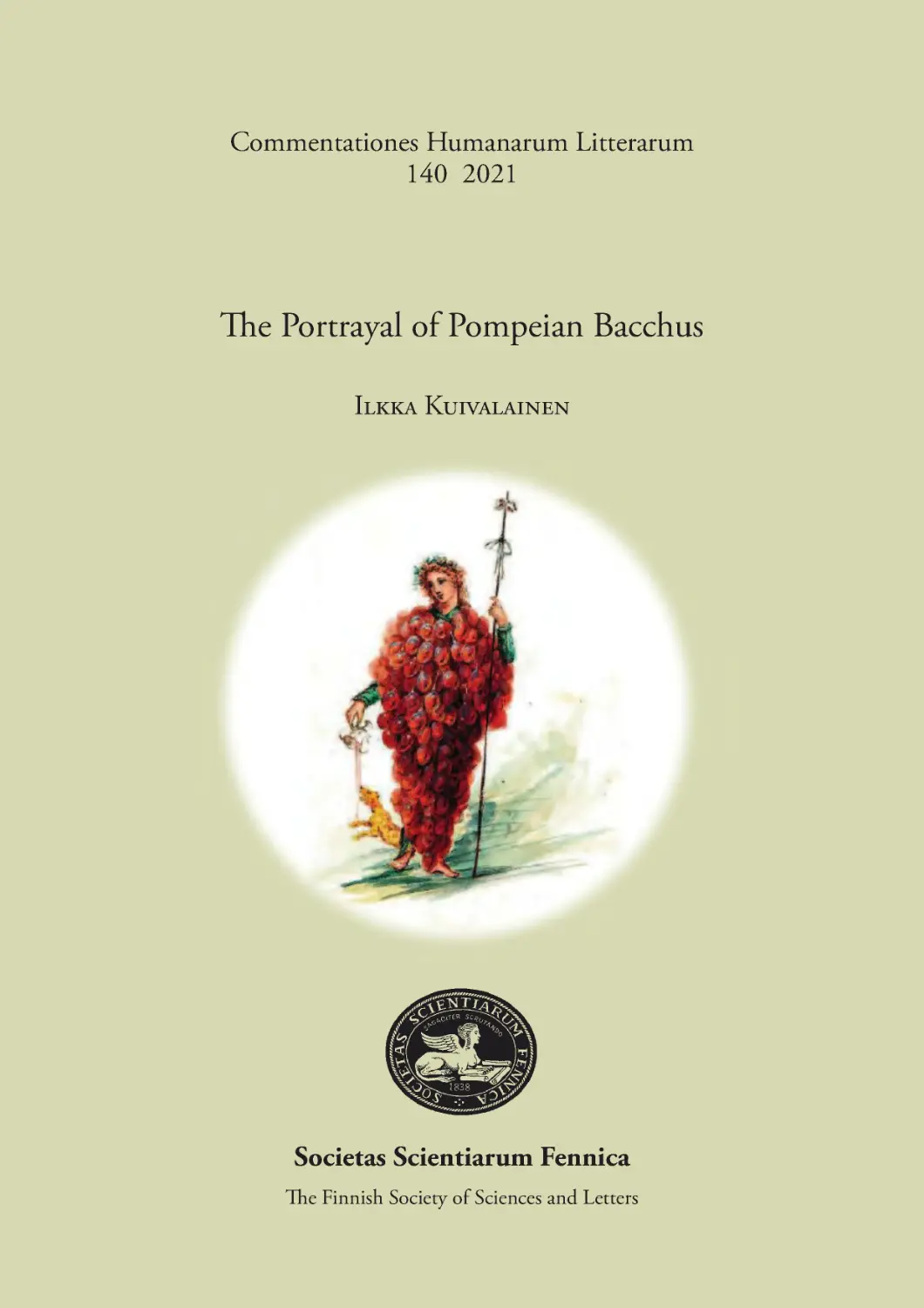
Cover: C at. C17 Casa del Centenario: watercolour (1880),
DAI-Rom, Archivio A-VII-34-001: 34, Wandmalerei, 2. Pompeji (3).
Copyright © 2021 by
Societas Scientiarum Fennica
Printed by Grano Oy, Vaasa 2021

Preface
This book is about the portrayal
of Bacchus in Pompeii. The topic
is much studied, and the ancient
texts and works of art are mainly
well known. My intention has
been to collect the various factors
together, not only some examples.
This idea came from the need to
understand better the wall paint-
ings and sculptures in the House
of Marcus Lucretius (IX 3. 5.24).
The collecting of data and the
writing took a very long time as it
was done simultaneously with my
teaching of Latin, history and an-
cient art history. The first version
was written already at the Finnish
Institute in Rome during the three-
month-long course in 2005. It was
led by Professor Mika Kajava, who
now kindly accepted this new ver-
sion to be published in the series
of Commentationes Humanarum
Litterarum. I am especially thankful to Dr, Docent Leena Pietilä-Castrén who assidu-
ously supervised my PhD thesis. My other supervisor, Professor Heikki Solin, helped
me especially with the inscriptions. A great privilege has also been that Professor Paavo
Castrén took me to the Expeditio Pompeiana Universitas Helsingiensis (EPUH), in
order to analyse the wall paintings in the insula IX 3. I owe thanks to him and the
other colleagues in the Pompeii project, and to my preliminary examiners who read
and commented my original dissertation, especially Professor Arja Karivieri. I would
like to thank the staff both in Pompeii (Parco Archeologico di Pompei) and in Naples
for their help, especially the library and the archives of the archaeological museum
(Museo Archeologico Nazionale di Napoli). I also thank all the scholars, archives and
libraries who have given me access to rare Pompeian sources and illustrations for this
book. Special thanks are again due to Maija Holappa for the layout, and to all my family.
Helsinki, October 2021
Ilkka Kuivalainen
Cat. B13 shows the common problem in Pompeii: seat-
ed Bacchus has almost completely vanished.

CONTENTS
Preface
5
1. Introduction
7
Earlier Research
9
Religious History
9
The Cult in Pompeii
12
Iconography, Wall Paintings, Mosaics and Sculpture
15
The Name of the Divinity in Research
24
Research Question and Methods
26
2. Milestones in the Coming of Bacchus
28
3. The Name of the Divinity in Latin Sources
38
Liber
42
Bacchus
46
Dionysos/Dionysus
48
4. Liber – Bacchus Inscriptions in Pompeii
50
5. The Temple and its Inscriptions
55
The Temple at Sant’Abbondio
57
Inscriptions
63
The Cult
65
The Greek counterparts
67
6. The Main Iconographical Types
69
Bearded Bacchus
72
Young Bacchus
73
Child Bacchus
73
Attributes and animality
74
7. Catalogue of Wall Paintings and Mosaics
75
Old Bacchus
77
Young Bacchus Alone or with a Panther
94
Young Bacchus with Diverse Companions
123
Child Bacchus
188
8. Catalogue of Sculptures and Minor Arts
204
9. Concluding Remarks
228
Bibliography
244
Illustration credits
265
Appendix 1
274
Appendix 2
281

1. Introduction
Dionysus-Liber-Bacchus was one of the most popular gods in the Graeco-Roman world.
In Italy, the domestic god of nature and fertility known as Liber took on the name Bac-
chus and the features of the Greek god Dionysus at an early stage. The original Dionysus
was full of contradictions: gentle but murderous, the giver of wine but also demanding
human sacrifices, a saviour from evil death but also the target of emotional religiosity
– people in his sphere of influence were known to go into an ecstatic frenzy. Already in
Greece, Dionysus was considered to be different from the other Olympian gods because
of his many-sided nature; some considered him a mortal hero who had become one of
these gods, others thought him to be simply another god among the others. Informa-
tion about his origin and his birth were likewise conflicting in many ancient sources.1
For a long time, Dionysus was considered to be a latecomer among the Greek gods.
The origins of his cult were variously thought to be in Thrace, in Phrygia, or in Lydia,
from whence he made his appearance in Greek myths only in the Archaic period. This
view changed when Linear B tablets were discovered in Bronze Age Pylos and Crete
with the name Di-wo-nu-so. On Crete, his cult was probably that of the old Mediter-
ranean god of vegetation. Dionysus had also been worshipped at the site of Agia Irini,
on the island of Keos in the Cyclades, since the late Bronze Age. During the Archaic
period some old festivals refer to an early official cult; e.g . the Anthesteria and Lenaia
in the Ionian area, Attica, and in the Cyclades, the Agrigonia in the Dorian and Aeolic
areas, Boeotia, and Thessaly, as well as the Thuia in the Peloponnese and Thessaly.2 The
cult of Dionysus was thus a mixture of many elements. The original Cretan god was
worshipped with the sacrifice of oxen, and he protected the harvest; it was only later
that his sphere became restricted to winemaking and wine. The reawakening of nature
and the return of growth after the dry dead period of winter associated Dionysus with
Demeter, Persephone (Kore), and the chthonic deities. In the Greek world, the cult of
Dionysus was thus rural, mystic, and official and secret at the same time. This was also
the case in the Hellenistic period, when the popularity of Dionysus spread abroad and
eventually reached Italy.3
1 Bruhl 1953, 1–6; Otto 1965, 113–116; Burkert 1977, 251–252; Pailler 1995, 13–19. In the ancient sourc-
es Dionysus could be identified with e.g . Greek Apollon, Sabazios, Helios, Zeus, or Roman Mars, and there
were also many local epithets. The identification puzzled Macrobius, Sat. 1,18–1,19, as late as the tur n of
the 4th and 5th century.
2 Walter Otto proposed in 1933, even before the Linear B discover y, that Dionysus was part of the Mi-
noan culture, Otto 1965, xx–xxi, 53; Puhvel 1964, 161–170; Pugliese Carratelli 1965, 34; Burkert 1977,
252–253; Cole 2007, 328–329; R. Duev, ’Zeus and Dionysus in the Light of Linear B Records’, Pasiphae.
Rivista di filologia e antichità egee 1, 2007, 226–228; the name Dionysus appears many times in the Linear
B archives, often associated with shepherds.
3 About the origin and plurality of the cult, e.g. Bruhl 1953, 2–5 and 10.

8
The Portrayal of Pompeian Bacchus
In ancient art, this lengthy development process of the cult resulted in an immense
variety in the Dionysiac material. He was abundantly depicted on Greek vases, and was
one of the most popular subjects of Hellenistic sculpture, and also of Roman wall paint-
ings, as inspired by Hellenistic art. By the 2nd century AD the Dionysiac afterlife had
become a particularly important motif on Roman sarcophagi and mosaics, as burial
customs changed.
In Greek literature, Dionysus appeared at first in poetry. He had a minor role in
Homer’s works, and the Iliad relates how Dionysus was persecuted by Lycurgus, king of
Thrace, and fled into the sea to be protected by Thetis. In the Tartaric scene of the Odys-
sey, Ariadne is said to have been killed by Artemis on account of evidence provided by
Dionysus. Dionysus also appears in Hesiod, and other early poems. In drama, he was
referred to by the bacchants in several plays. The most important of these was the Bac-
chae of Euripides, which tells about Pentheus, the king of Thebes, rejecting Dionysus.
In this tragedy, Euripides described two kinds of maenads, Dionysus’ companions and
the Theban women who did not acknowledge Dionysus, and therefore had to climb
Mount Cithaeron in a fit of madness as their punishment.4 Dionysus was also discussed
in prose works. Herodotus, for example, described his influence on people.5 Roman
literature was influenced by these texts. Accius, for example, wrote his tragedy the Bac-
chae, based on that of Euripides, towards the end of the 2nd century BC. The variety
of representations in Greek myths caused writers to describe many different versions
of Dionysus. Thus, as early as the first century BC the plurality of Dionysus’ various
aspects was understood as problematic.6
4 Burkert 1977, 254–255; Cole 2007, 328–331; Hom. Il. 6,130–141; Hom. Od. 11,320–325 does not reveal
why Dionysus made Artemis kill Ariadne. Another reference to Dionysus is in the Odyssey : he is said to
have presented Thetis with a golden amphora made by Hephaistos containing the ashes of Achilles, Od.
24,73–75; Euripides’ Bakkhai was performed posthumously in 405 BC. It depicts Dionysus avenging his
mother S emele’s death. King Pentheus, opposing Dionysus, is killed by his own mother Agave, who was
following Dionysus’ orders, Eur. Bacch . 1044–1148; based on Euripides, Dionysus’ cult is assumed to have
been practised by women at the time, for which S. des Bouvrie’s ’Euripides, Bakkhai and Maenadism’ in
Aspects of Women in Antiquity. Proceedings of the First Nordic Symposium on Women’s Lives in Antiquity,
Göteborg 12–15 June 1997, 58–68, (Jonsered 1998).
5 Herodotus 2,49, suggested that the cult of Dionysus was of Egyptian origin; Melampous was belie ved
to have introduced the sacrifice to Dionysus and the carrying of the phallus in a procession. Herodotus,
however, believed that most Greek gods’ names and personalities were of Egyptian origin, e.g . Rosalind
Thomas, Herodotus in Context. Ethnography, Science and the Art of Persuasion (Cambridge 2000). Other
authors claimed that Orpheus started the Dionysiac mysteries, which, according to Diodorus Siculus, 1,23,
were based on the cult of Osiris.
6 Zeus was generally belie ved to be Dionysus’ father, but accounts of his mothers and birth places were
varied. As a result, Diodorus, 3,62–64, considered determining Dionysus’ origins difficult: there was a
non-anthropomorphic ”wine Dionysus” and three other aspects with human bodies. Cicero, nat.deor. 3,58,
counted five different Dionysi, for his part. S ee Chapter 3 section Liber in this study.

9
Comm. Hum. Litt. Vol. 140
All the different Dionysi, Liberi, and Bacchi go back to several different periods
and places of the Graeco-Roman world. The cult originated in the Bronze Age, but was
very much alive in Late Antiquity. In Campania, many of these influences converged,
and in Romanized Pompeii of the first century BC the old Italic tradition merged with
the koine atmosphere of the Hellenistic culture. In religious life, Dionysus-Liber-Bac-
chus was manifested in various ways, and his popularity was emphasized by his wide
role in literature and in visual arts, of which this study concentrates on wall paintings
and sculpture. Examples of minor arts are also included.
Earlier Research
Owing to the god’s complexity, the research literature on Dionysus-Liber-Bacchus is
very extensive. It is presented below under respective headings, according to the main
field of study. The first and largest group consists of studies of ancient religion, in which
the relationship between the Greek and Roman cults have been of particular interest,
in addition to the controversy over the Bacchanals. The second group covers the previ-
ous research on art and culture, in which the iconography of Liber-Bacchus has been
treated only on a general level. The third group, partly linked with the previous one,
is the most important one, consisting of studies in Pompeian local history, while also
shedding light on the art and inscriptions from the town. In addition to these aspects,
the subject has naturally been dealt with in literary studies.7 From the viewpoint of
my own study, the general development of all the aforementioned aspects is relevant
because the portrayal of the Pompeian Bacchus must have been influenced by all of
them to some degree. It is also essential to examine the choice of names for the divin-
ity that are used by different modern scholars, as this also affects the names used in
my research. The following overview intends to give a broad picture of the tradition
of Pompeian research literature. Each part is also treated in more detail under their
respective chapters.
Religious History
In the study of the Dionysiac cult, certain main avenues of approach can be observed.
On the Greek side, the Dionysiac associations, the role of women, and theatrical plays
have been the focus. The study of these topics has been associated with archaeologi-
7 This study does not focus on accounts of Dionysus in the ancient literature, in which some researchers
have concentrated solely on Euripides’ Bacchants, e.g. Reginald Pepys Winnington-Ingram, Euripides and
Dionysus. An Interpretation of the Bacchae (Cambridge 1948), and Charles Segal, Dionysiac Poetics and
Euripides’ Bacchae (Princeton 1982).

10
The Portrayal of Pompeian Bacchus
cal and art historical material, the emphasis having been on vase painting, but also
including coins and sculpture.8 As to the nature of the cult, its continuity from the
earliest times to the end of the Roman era has been of interest. Suffice it to mention
here Henri Jeanmaire’s work Dionysos. Histoire du culte de Bacchus (1951).9 Walter F.
Otto, Karl Kerényi, and Richard Reitzenstein, Franz Cumont, Martin P. Nilsson, and
Walter Burkert, for their part, all wrote about the mysteries. The main conclusion is
that the cult of Dionysus was continuously evolving, a process in which the Hellenistic
and Roman phases merged to form a single entity.10 More recent research has combined
various branches of study, including wider geographical areas, such as the set of arti-
cles in Masks of Dionysus (1993) which involve religion, art, and literature. In Magna
Graecia, the expansion of the cult of Dionysus and its changes over time, as the result
of cultural encounters, have been studied by Giovanni Casadio in several articles: e.g.
‘Dioniso italiota: un dio greco in Italia meridionale’ (1995) and ‘Dionysus in Campania:
Cumae’ (2009). Outside the Greek world, Dionysos’ appearance in Etruria has also been
explored. Furthermore, several exhibitions on Dionysos, especially in 2008–2011, have
produced up-to-date publications.11
On the Roman side, the relationship between the old Roman Liber and the im-
ported Greek Dionysus has been the focus of research. Georg Wissowa counted Liber,
Ceres, and Libera as imported Greek gods,12 while Adam Schnegelsberg in his some-
what earlier De Liberi apud Romanos cultu capita duo saw Liber as a domestic god
8 A conference on these associations, held in Rome in 1984, resulted in a collection of articles: L’Association
dionysiaque dans les societétés anciennes (Rome 1986). Anne-Françoise Jaccottet studied inscriptions in
Choisir Dionysos. Les associations dionysiaques ou la face cache du dionysisme (Kilchberg 2003). For wom-
en’s role, W.F. Otto 1965, 54, 83–85, 94, 171–180. On Orphism, Alberto Bernabé and Ana Isabel Jiménez
San Cristóbal in Instructions for the Netherworld. The Orphic Gold Tablets (Leiden 2008). Thomas H. Car-
penter discussed the depiction of Dionysus on over 4000 vase paintings, both in the late archaic and classi-
cal eras, Dionysian Imagery in Fifth-Century Athens (Oxford 1997).
9 Je anmaire’s rese arch re aches all the way up to his own time, as he compares the discussion of the ”divine
mania” of the ancient world to 20th century medicine, and provides scientific religious comparisons from
late 19th and early 20th century North Africa and the Arabian peninsula, Je anmaire 1951, 105–131.
10 Otto: Dionysos. Mythos und Kultus (Frankfurt am Main 1933); Kerényi: Der frühe Dionysos (Oslo 1961);
Reitzenstein: Die hellenistischen Mysterienreligionen nach ihren Grundgedanken und Wirkungen (Leipzig
19273); Cumont: Les Religions orientales dans le paganisme romain (Paris 19293) and Lux perpetua (Paris
1949); Nilsson: ’ The Bacchic Mysteries of the Roman Age’, Harvard Theological Review 46 (1953) 175–202
and The Dionysiac Mysteries of the Hellenistic and Roman Age (Lund 1957); Burkert: Ancient Mystery Cults
(Cambridge, Mass. 1987).
11 Dionysos – Ver wandlung und Ekstase, Berlin 2008, La vigna di Dioniso. Vite, vino e culti in Magna Gre-
cia (Taranto 2010), and Vinum nostrum. Arte, scienza e miti del vino nella civiltà del Mediterraneo antico
(Firenze 2010).
12 Wissowa 1902,“Di novensides grie chischer Herkunft 46. Ceres, Liber un Libera”, 242–248.

11
Comm. Hum. Litt. Vol. 140
(1894).13 Franz Altheim’s study Terra mater. Untersuchungen zur altitalischen Religions-
geschichte (1931), which is a sequel to Griechische Götter im alten Rom, has an extensive
presentation of Liber and Libera and a separate section called “Oscilla” with references
to Dionysiac art.14 Adrien Bruhl covered Roman Liber and Greek Dionysus from dif-
ferent points of view, in different periods, and over the whole of the Roman Empire
in his study Liber Pater. Origine et expansion du culte dionysiaque à Rome et dans le
monde romain (1953); both art and cult in Pompeii are treated. Stéphanie Wyler’s Les
perceptions du dionysisme dans la Rome républicaine depuis la deuxième guerre punique
jusqu’à Auguste: Étude littéraire et iconographique (2006) discusses both the origin and
the development of the cult of Liber in Rome and Italy, then in Pompeii, and including
literature. Robert Turcan, in several publications, e.g. Liturgies de l’initiation bacchique à
l’époque romaine (Liber) (2003), and Jean-Marie Pailler, have studied relevant aspects of
the Roman world. Pailler’s Bacchus. Figures et pouvoirs (1995) addresses the routes and
encounters of Dionysus-Bacchus with other gods and his companions in Italy.
Carina Håkansson has studied the archaic cult of Liber, especially satyrs and per-
formances, in her In Search of Dionysus. Reassessing a Dionysian Context in Early Rome
(2010); the Roman Bacchus of Greek origin can be discerned only during the Bacchanal
crisis.15 Peter Wiseman concentrated on the republican Liber in his article “Liber. Myth,
Drama and Ideology in Republican Rome” (2000); he explores the various aspects of the
name Liber, relating it to both ideology and iconography, especially in bronze objects.16
The Bacchanals, as an important event in Roman religious history, have produced
an extensive field of study, with the main question being the relationship between the
domestic and imported elements. Its aspect as a political crisis has also produced a
considerable amount of research. For my study, the most important point is the place of
origin of the Bacchanals. Pailler’s Bacchanalia. La répression de 186 av. J.- C. à Rome et
en Italie: vestiges, images, tradition (1988) deals merely with the restrictions of the year
186 BC, analysing the ancient sources and the participants of the cult. He assembled
the previous research and made additions to his former study in 1998.17 John Briscoe
13 S chnegelsberg 1894, 4, 27–32, 39–47. The first part discusses the 180 graffiti known at that time, in
which Liber or some other name referring to Liber is given. The second part analyses the origin and change
of Liber, as well as his mystery cult.
14 Religionsgeschichtliche Versuche und Vorarbeiten 22 (1930–1931), 15–48, 65–84.
15 Håkansson 2010, 69, 72–73.
16 Wiseman 2000, 266–273, 289.
17 Pailler, ’Les Bacchanales dix ans après’, Pall as , 48 (1998), 67–86. According to him, before 1914 the sub-
ject was approached from a legal-administrative vie wpoint, especially by Theodor Mommsen, Pailler 1988,
61–66. The first study to focus only on the Bacchanalia scandal was T.V. Spinelli’s La decadenza religiosa e la
repressione dei Baccanali a Roma (Naples 1907). As the name of the study already suggests, it proposed that
the decay of Rome followed the influences spreading from the east in the 2nd century BC. Spinelli 1907,
16–26, discusses Italic Liber and his relationship with Greek Dionysus and Indian S oma. The next phase of

12
The Portrayal of Pompeian Bacchus
also referred to the ancient sources in his commentary on Livy’s books 38–40.18 As a
background to the more recent interpretations, the religious tolerance of the Romans
is particularly emphasized; an important exception having been, however, the prohibi-
tion of the Bacchanals. During the Republic, the Senate forbade many religious trends
as unacceptable, but usually restrained from persecuting citizens for following them.19
The Bacchanals have also been studied as a statement of women’s religious activities.20
The influence of the prohibition is important in the Pompeian context, as it crystallizes
what was actually prohibited and what was allowed in its place.
The Cult in Pompeii
The cult of Liber-Bacchus in Campania has not yet been deeply researched, although
many publications refer to it.21 To some extent, it has been treated by Adrien Bruhl,
the research was in the 1930s, according to Pailler, exploring the Bacchanalia scandal through the eyes of
the eastern religions. The most remarkable researchers of the time were the aforementioned Reitzenstein
and Cumont; their school was pre valent until the 1950s, Pailler 1988, 70–73. Pailler considered Michael
I. Rostovtzeff, Franz Altheim and Tenney Frank to represent a parallel approach to this school, by em-
phasizing the role of Hellenistic southern Italy. The 1930s saw a long academic debate on the relationship
between the inscription and Livy’s texts, as well as the reliability of his information, e.g. E. Fraenkel, J. Keil,
W. Krause and Matthias Gelzer from the German-speaking area. The 1940s saw a var iety of views. The re-
ligious background was emphasized, as was the relationship between southern Italy and Rome. 1949–1960
was the era of syntheses, presented by Jeanmaire, who saw Dionysus’ advent as a result of the spre ading of
Hellenistic ideas, and Bruhl, who emphasized the role of Etruria and Campania; their analyses were mostly
based on religion, as was Nilsson’s. According to Pailler 1988, 77–100, some scholars concentrated more
on the scandal itself, and the sources touching it, e.g. G .Tarditi, ’La questione dei Baccanali a Roma nel
186 a.C,’ PP 9 (1954) 265–287, and D. W. L. Van Son’s’ dissertation Livius’ behandeling van de Bacchanalia
(Amsterdam 1960). In 1970 Clara Gallini presented ne w views revolutionizing the research, with her idea
of Dionysus’ cult of politically and socially neglected groups, having little in common with the elite, and
their tradition of cherishing forefathers. She left, however, many aspects of Livy unremarked upon, as they
did not fit with her main idea, Pailler 1988, 101–107, describing both Gallinis’ thoughts and Turcan’s criti-
cism of them.
18 Briscoe 2008, 230–231.
19 Pailler 1988, 111–113; J.A . North 1979, 85–86, has listed several de cisions made by the Senate to ban
religious practices, such as the prohibition of human sacrifices in 97 BC. In Rome one could choose one’s
favourite god, but a new cult should not differ from old religious customs.
20 Hänninen 1998, 111–126.
21 Campanian religious research is represented by Karl Beloch’s Campanien. Geschichte und Topographie
des antiken Neapel und seiner Umgebung, (Berlin 1879 and Breslau 18902), and Roy Merle Peterson’s The
Cults of Campania , PAAR 1 (1919). A more recent study is Paolo Carafa’s Culti e santuari della Camp ania
antica (Rome 2008), but without a discussion of Pompeii.

13
Comm. Hum. Litt. Vol. 140
already mentioned above, and Stéphanie Wyler. The latter examined the relationship
between the cult of Dionysus and religion and art, as well as the pictorial images of
Pompeian houses from the point of view of society. Of her many articles, particular
mention should be made of ’“Dionysos domesticus”: Les motifs dionysiaques dans les
maisons pompéiennes et romaines (IIe s. av. – Ier s. ap. J.-C .)’ (2004) and ‘Programmi
dionisiaci nelle case pompeiane come riflesso della società’ (2006).22 According to Wy-
ler, the role of Dionysiac art was emphasized in homes, but it was rare in public places.
The change of imagery in Pompeii from the Samnite period to the eruption of Vesuvius
reflects a change in social values.23 Both articles are based on a limited number of Pom-
peian examples.
Many studies on Pompeian religious life cover only a selection of the archaeologi-
cal material, even though much has been published on the religious history of Campa-
nia and Pompeii, especially on Pompeian temples and other cult areas. For example,
Michael Rostovtzeff ’s Mystic Italy (1927) also deals with the mystical sphere in Pom-
peii, particularly with Villa dei Misteri and house I 6,2 (Casa del Criptoportico).24 In
his article “Sacrari pompeiani” (1950), Francesco di Capua categorized various private
sanctuaries; he used as his criteria the terms sacraria and sacella, even if they mostly re-
ferred to small public sanctuaries or the cult sites out-of-doors.25 The cult of Isis, other
oriental cults, and the Pompeian religious customs have, for their part, been researched
by V. Tran Tam Tinh.26 In the Vesuvian area, the domestic shrines and small sanctuaries
have been studied by Maddalena Bassani; in her catalogue there are only four spaces as-
sociated with Dionysus, three in Pompeii and one in Stabiae.27 George S. Boyce’s Corpus
of the Lararia of Pompeii (1937) is an extensive catalogue,28 but even more detailed is
Thomas Fröhlich’s Lararien- und Fassadenbilder in den Vesuvstädten. Untersuchungen
zur ”volkstümlichen” pompejanischen Malerei (1991).29 The statuettes in lararia are de-
scribed in Stefania Adamo-Muscettola’s article “Osservazioni sulla compositione dei
22 MEFRA 116, 2 (2004) 933–951 and Ostraka 15, 1 (2006) 155–163.
23 Wyler 2004, 933–934; eadem 2006b, 162.
24 Rostovtzeff 1927 also gives another example, house I 6, 4, and its decoration, p. 55–92. His discus-
sion of Pompeii covers almost one half of the work (pp. 27–98); he stated that Pompeii was a town with a
permanent home for Dionysus-related mysteries, where ever y educated person knew the meaning of the
iconography of the mystery, p. 40; Pailler 1988, 75 criticizes Rostovtzeff ’s pictoral sources as being much
later than the bacchanalian ban.
25 Di Capua 1950, 60–61, 76–81.
26 E.g . Essai sur Le Culte d’Isis à Pompéi (Paris 1964), and ’La Vita religiosa’ in Pompei 79.
27 Bassani 2008, 86–87.
28 MAAR 14 (1937).
29 MDAI(R), Ergänzungsheft 32 (Mainz 1991).

14
The Portrayal of Pompeian Bacchus
larari con statuette in bronzo di Pompei e Ercolano” (1984).30 Another specific study is
Annemari Kaufmann-Heinimann’s article “Statuettes de laraire et religion domestique
a Pompéi” (2007),31 but that is mainly based on her broader book Götter und Lararien
aus Augusta Raurica. Herstellung, Fundzusammenhänge und sakrale Funktion figürli-
cher Bronzen in einer römischen Stadt (1998), which also has a good systematic section
about Pompeian finds.32 Federica Giacobello’s Larari pompeiani. Iconografia e culto dei
lari in ambito domestico (2008) refers briefly to the role of Dionysus in homes.33
Anna Krzyszowska’s Les Cultes privés à Pompéi does not only deal with private
cults; she has studied, in addition to lararia, other private or at least half-private cult
sites at crossroads and temples.34 Antonio Virgili’s Culti misterici ed orientali a Pompei
(2008) also expands its scope to the sphere of religious life outside Pompeii; the study
is, however, of a general nature and most of it consists of a glossary.35 Maria Teresa
D’Alessio’s I culti a Pompei. Divinità, luoghi e frequentatori (VI secolo a.C . – 7 9 d.C.)
(2009) deals with cults within the town walls and those nearby; she differentiates the
public cult of Dionysus-Bacchus and Liber, and claims that Liber only appears in one
inscription, CIL IV 1626.36 William van Andringa’s Quotidien des dieux et des hommes.
La vie religieuse dans les cités du Vésuve à l’époque romaine (2009) deals exclusively with
the Roman period, but the content is much wider, including official cults and private
religious life in all its aspects.37
The temple discovered near the locality of Sant’Abbondio has been abundantly
studied. Olga Elia was the first to publish a wider report (1965).38 Markus Wolf pre-
sented detailed architectural information in his article ‘Der Tempel von Sant’ Abbondio
in Pompeji. Bauaufnahme und Architektur’ (2007), and Ruth Bielfeldt left open the
30 Toreutik und figürliche Bronzen römischer Zeit. Akten der 6. Tagung über antike Bronzen 13. – 17. Mai
1980 in Berlin.
31 Studi SAP 21 (2007) 151–157. When it comes to the statuettes in the lararia,”divinités bacchiques” form
only a ver y small part; 97 statuettes of gods were studied, and only five of them were connected with Bac-
chus. The most favoured single divinities after the lares (25) themselves were Mercury (13), Venus (10), and
Miner va (8).
32 Augst 1998.
33 Università degli Studi di Milano, Pubblicazioni della Facoltà di Lettere e Filosofia 251 (Milan 2008),
75–76.
34 She does not systematically list the paintings in which Dionysus-Bacchus appe ars, but discusses the
topic with the help of selected examples, Krzyszowska 2002, 101–120, 202–205 and 252–254.
35 The study discusses oriental and mystery c ults in the Mediterranean area and the religious life of Cam-
pania.
36 D’Alessio 2009, 105, 107.
37 BEFAR 337 (Rome 2009).
38 Elia’s publications are discussed in Chapter 5 of this study.

15
Comm. Hum. Litt. Vol. 140
difference between the cults of Italic Liber of the vineyards and Greek Dionysus in
private houses in her article ’Der Liber-Tempel in Pompeji in Sant’Abbondio. Oskisches
Vorstadtheiligtum und kaiserzeitliches Kultlokal’ (2007), though she stated that the re-
structuring of the temple was caused by the change of worshippers.39 William van An-
dringa directed the field work on the site in 2008, followed by publications by several
authors ’Archéologie et religion: le sanctuaire dionysiaque de S. Abbondio à Pompéi’
(2013).40
Iconography, Wall Paintings, Mosaics and Sculpture
There are several iconographic classifications of the mythological image of Bacchus.
The most systematic is to be found in the third volume of the Lexicon iconographicum
mythologiae classicae (LIMC, 1986), which contains the articles “Dionysos”, “Dionysos/
Fufluns” and “Dionysos/Bacchus”. To this classification of Greek, Etruscan, and Roman
material are added articles on provincial types of Dionysus in the Empire. The 2009
LIMC supplement contains some new information on the iconographical types of Dio-
nysus.41 Of the older research, the significant work of Friedrich Matz and his extensive
Διονυσιακή τελέτη. Archäologische Untersuchungen zum Dionysoskult in hellenistischer
und römischer Zeit (1963) should be mentioned; it is a wide treatise on the initiation
into the Dionysiac mysteries, the oracle, and sacrificial themes, cult images, herms, and
sarcophagi. He also covered myths about Dionysus’ childhood.42 Erwin Pochmarski’s
more recent Dionysische Gruppen. Eine typologische Untersuchung zur Geschichte des
Stützmotives (1990) collected the works of various arts in which Dionysus physically
leans on either his own companion or on another divinity; the supporting figure is often
a satyr, Silenus, a Maenad, Ariadne, Hephaistos, or Hercules.43 Many researchers have
restricted themselves to certain Dionysiac themes, and several have concentrated on
sculptures, using wall paintings or artefacts as comparative material. In the research on
Roman wall paintings, Pompeii and other Vesuvian sites form the largest source group,
and are essential for any study of motifs.
39 Wolf and Bielfeldt MDAI(R) 113 (2007).
40 MEFRA 125 (2013) 5–74.
41 S everal articles of the LIMC appear in the iconographic Chapter 6 of this study.
42 In addition to Matz’s Διονυσιακή τελέτη, his main work is Die dionysischen Sarkophage (Die Antiken
Sarkophagreliefs 4, Berlin 1968–1974). Another significant work on the sarcophagi is Turcan’s Les S ar-
cophages romains à représentations dionysiaques. Essai de chronologie et d’histoire religieuse, BEFAR 210
(Paris 1966). He also uses other material from Pompeii, such as the pediment of the temple and wall paint-
ings, many depicting Bacchus, Turcan 1966, 219, 407 and 456–457.
43 His study starts from the year 500 BC and continues up to the 5th century AD; he included eight wall
paintings from Pompeii.

16
The Portrayal of Pompeian Bacchus
The most important collective work on Pompeian wall paintings, to which a
large number of authors have contributed, is Pompei, Pitture e Mosaici (PPM, 1990–
2003), in which the pictures listed in Pitture e Pavimenti di Pompei. Repertorio delle
fotografie del Gabinetto Fotografico Nazionale (1981–1986, 1992) have been published.
The PPM series refers also to earlier documentation, such as many either topically or
topographically listed documentations and excavation reports. Both Wofgang Helbig’s
Wandgemälde der vom Vesuv verschütteten Städte Campaniens (1868) and Antonio
Sogliano’s supplementary ‘Le Pitture Murali Campane Scoverte negli Anni 1867–1879’
(1879) are organized according to subject. The most important topographical reference
book of the motifs is Karl Schefold’s Die Wände Pompejis. Topographisches Verzeichnis
der Bildmotive (1957). However, no complete publication of the wall paintings, now in
the National Archaeological Museum of Naples (MANN), exists. That is why the best
source for that material is the museum’s file of photographs.44
The categorization of Roman wall paintings into Pompeian styles was first made by
August Mau in 1882,45 and has been thereafter revised by many scholars.46 The proper
corpus of the first style paintings in Pompeian houses was made by Anne Laidlaw.47 The
second style catalogue was compiled by Ernst Heinrich,48 the third style was researched
44 The most important published catalogues on wall paintings are A. Ruesch’s (ed.) Guida illustrata del
Museo Nazionale di Napoli (Naples 1908) and Olga Elia’s Pitture murali e mosaici nel Museo Nazionale
di Napoli (Rome 1932) and Irene Bragantini and Valeria Sampaolo’s (ed.) La pittura pompeiana (Museo
archeologico Nazionale di Napoli, Naples 2009.) . Other works also include many paintings. Ruesch’s guide
book was used to replace the complicated and problematic numbering system of the museum. Marilena
Griesi has dealt with paintings depicting Dionysus and his companions brought to the museum from Her-
c ulaneum, see ’Immagini dionisiache’ in DHER Domus Herculanensis Rationes. Sito Archivio Museo (Studi
e Scavi nuova serie 30, Bologna 2011), 243–264.
45 Geschichte der decorativen Wandmalerei in Pompeji (Berlin 1882) dealt with the first three styles. The
fourth was presented only briefly at the end of the book (448–456), as the last decadent Pompeian style.
46 E.g . H.G . Beyen, Die pompejanische Wanddekoration vom zweiten bis zum vierten Stil (Haag, 1960);
Heide Lauter-Bufe, Zur Stilgeschichte der figürlichen pompejanischen Fresken (Erlangen 1969); Alix Barbet,
La peinture murale romaine. Les styles décoratifs pompéiens (Paris 1985, revised in 2009); A large revie w
was written by Eric. M. Moormann, ’Una rilettura dei quattro stili pompeiani’, BABesch 62 (1987), 153–
165; Wolfgang Ehrhardt, Stilgeschichtliche Untersuchungen an römischen Wandmalereien von der späten
Republik bis zur Zeit Neros (Mainz am Rhein 1987); Renate Thomas, Die Dekorationssysteme der römischen
Wandmalerei von augusteischer bis in trajanische Zeit (Mainz 1995).
47 The first style in Pompeii. Painting and architecture (Archaeologica 57), Rome 1985. The architectural
style does not, naturally, have any pictures representing Bacchus.
48 Der zweite Stil in pompejanischen Wohnhäusern (Studien zur antiken Malerei und Farbgebung 8), Mu-
nich 2002. The style is quite rare in Pompeian houses, being only more elaborate in the largest houses.
There are some Bacchic elements, however, e.g. satyrs supporting the consoles in exedra of the C aserma
dei gladiatori V 5,3. Heinrichs 2002, 95 (no. 35); the Villa dei Misteri, as a villa outside the town, is not
included.

17
Comm. Hum. Litt. Vol. 140
by F.L . Bastet and M. Vos,49 and there are several studies on the fourth style.50 The origi-
nal division into the four Pompeian styles is still useful, keeping in mind the subsequent
problems; some later works were imitations of earlier paintings, some Pompeian houses
had features of several styles, and earlier style paintings were also often restored at a
later date.51 E.M . Moormann studied the images of statues in wall paintings.52
Many scholars have concentrated on the large central pictures, such as Lucia
Romizzi with her Programmi decorativi di III e IV stile a Pompei. Un’analisi sociologica
ed iconologica (2006), Jürgen Hodske with Mythologische Bildthemen in den Häusern
Pompejis. Die Bedeutung der zentralen Mythenbilder für die Bewohner Pompejis (2007),
and Katharina Lorenz with Bilder machen Räume. Mythenbilder in pompeianischen
Häusern (2008).53 According to Romizzi, Dionysus is the protagonist in 26 paintings
(two of which represent Dionysus and Ariadne), and in 20 more paintings Dionysus
is depicted as discovering Ariadne.54 Hodske’s catalogue consists of 26 central pictures
49 Proposta per una classificazione del terzo stile pompeiano (Archeologische studiën van het Nederlands
instituut te Rome 4, ‘s-Gravenhage 1979).
50 E.g . W.J.T. Peters, ’La composizione delle pitture parietali di IV stile a Roma e in C ampaniá in La
regione sotterrata dal Vesuvio. Studi e prospettive. Atti del Convegno internazionale 11–15 novembre 1979,
(Naples 1982), 635–659; W.C . Archer, ‘ The Paintings in the Alae of the Casa dei Vettii and a Definition of
the Fourth Pompeian Style’ AJA 94 (1990), 95–123.
51 E.g . Renate Thomas, ’Zur Chronologie des 3. und 4. Stils’, Kölner Jahrbuch für Vor- und Frühgeschichte
24 (1991), 153–158 and ’Zum Stilpluralismus in der römischen Wandmalerei seit claudischer Zeit’, in Func-
tional and spatial analysis of wall painting. Proceedings of the Fifth International Congress on Ancient Wall
Painting, Amsterdam 8-12 September 1992, (Leiden 1993), 154–159; W. Ehrhardt, ’Beseitigung und Restau-
rier ung von Wanddekorationen: oder wie verhalten sich die späteren zu den vorausgegangenen Pompe-
janischen Stilen?’, in I Temi Figurativi nella Pittura Parietale Antica. Atti del VI Convegno Internazionale
sulla Pittura Parietale Antica, Bologna 20–23 settembre 1995, (Bologna 1997), 55–58 and Dekorations- und
Wohnkontext. Beseitigung, Restaurierung, Verschmelzung und Konservierung von Wandbemalungen in den
kampanischen Antikenstätten, (Wiesbaden 2012). A summary is done by W. Strocka, EAA Suppl. 2 IV
1971–1994, ‘Pompeiani, Stili’ (Rome 1996), 414–425.
52 According to Moormann 1988, 13–35 many figures in the S econd style show the influence of s culpture,
but in the Third the influence was more limited being frequent in the upper zone, e.g . in the Villa Imperiale
(my G6). In the Fourth Style there are statues depicting Bacchus in several zones, e.g. A6, A9, B6, but many
in the upper zone as parts of the scaenae frontes.
53 Lorenz continued this in Ancient mythological images and their interpretation: an introduction to iconol-
ogy, semiotics and image studies in classical art history, Cambridge 2016, where she shows the problems of
iconological analysis and combines it with semiotics and image studies in classical art history.
54 Romizzi’s main questions deal with the third and fourth Pompeian styles. She would include five repre-
sentations of Dionysus appearing either alone or with a thiasus, one Dionysiac appearance to Ariadne, and
one thiasus without Dionysus in the third style. The corresponding numbers for the fourth style were 19,
18, and 12. Additionally, hermaphroditic subjects could be combined with Dionysus, as could satyrs and
maenads, Romizzi 2006, 100–101, 177–178.

18
The Portrayal of Pompeian Bacchus
with Dionysus and Ariadne, and 16 with other companions, but there are some paint-
ings included in these totals which are probably not from Pompeii.55 Lorenz listed 17
paintings in which Dionysus appeared to Ariadne and three more in which they are
both active.56 Ariadne has also been treated separately, though mainly in the context of
having been abandoned by Theseus.57 Stéphanie Wyler has dealt with Dionysiac wall
paintings in several works, including those of the Villa dei Misteri, one of the favorite
topics in the research of wall paintings.58 Marianna Scapini has also written about Dio-
nysiac iconography.59
The megalographic frieze in the Villa dei Misteri ’s room 5 has been the main point
of interest, with some researchers supporting a cultic interpretation, while others have
seen it merely as decorative, or even as a theatrical scene.60 The idea that it represented
a Dionysiac initiation was presented as early as 1910, when G. de Petra published the
discovery.61 In his handbook Roman Painting (1991), Roger Ling writes that the more
55 Hodske 2007, 159–165 and Tabelle 3.
56 In addition to Ariadne and Dionysus, Lorenz 2008, 108–120, discussed cases in which Ariadne was
depicted in a reclining position without Dionysus.
57 See Franca Paris e Badoni, ’Arianna a Nasso: La rielaboriazione di un mito greco in ambiente romano’,
DialA 8 (1990) 73–89 and Anna Gallo, ’Le pitture rappresentanti Arianna abbandonata in ambiente pom-
peiano’, RSP 2 (1988) 57–80.
58 ’Des images dionysiaques aux limites du religieux: le cubiculum 4 de la villa des Mystères’, in Image et
religion dans l’antiquité gréco-romaine (Naples 2008), 449–459. The presentation on room 4 in Villa dei
Misteri was given in a colloquium in Rome in 2003. Villa dei Misteri played a major role in Wyler’s thesis
(Wyler 2006a). – Originally it was called Villa Item according to the finder Aurelio Item, or by its location
Villa Gargiulo, and nowadays Villa degli Istacidii because of the inscriptions found there.
59 E.g . ‘Augustus and Dionysus’s triumph: A Nonexistent Paradox, Acta Ant. Hung 55 (2015), 185–209,
and ‘Iconographic Aspects of the Winged Demon of the Villa dei Misteri’, Phasi s 15–16 (2012–2013), 481–
492; Scapini’s main work is Le stanze di Dioniso. Contenuti rituali e committenti delle scene dionisiache
domestiche tra Roma e Pompei (ARYS. Antigüedad, Religiones y Sociedades 6), Madrid 2016. I that she
analyses the sociological and Hellenistic aspects of Dionysiac wall paintings. She has a good introduction
to the recent studies of Dionysiac images as important parts of Roman houses. Her main examples in
Pompeii are Casa del Criptoportico, Casa dei Cubicoli Floreali, Casa del Citarista, Casa dei Ceii, Casa di
D. Octavius Quartio/Loreius Tiburtinus, Casa dei Capitelli Colorati, Casa dei Capitelli Figurati, C asa dei
Vettii, Casa di M. Lucretius Fronto, Casa di M. Lucretius and Villa dei Misteri. Her expression for ideology
in Dionysiac rooms is 'una religiosità filodionisiaca'. The models were Hellenistic, many came from Alex-
andria. Scapini 2016, 329–331.
60 On the research tradition, see e.g . Baldwin 1996, 1–12.
61 ‘Villa romana presso Pompei’, NSA 1910 (ser. 5 vol. 7) 139–145. The rooms with significant paintings, 4
and 5, were originally numbered 16 and 20. For the woman being flogged, de Petra refers to Vittorio Mac-
chioro’s idea of a parallel between it and Pausanias’ story. In Arcadia at Alea was a temple of Dionysus, and
women were flogged following the instr uctions of the oracle of Delphi in a feast called Skiereia that was
organised e ver y second year, Paus. 8,23, 1; de Petra 1910, 142–145.

19
Comm. Hum. Litt. Vol. 140
exact interpretation of the occurrences on the frieze of room 5 remains uncertain, due
to the lack of any precise information about the secret rites of Dionysus. In his opinion,
the painting was neither mythological nor historical; rather, it depicts generic mythical
figures associated with the cult of Dionysus. Several models were used for details, but
the whole painting was probably composed for this specific room.62 Many scholars have
viewed the large opening towards the terrace as unsuitable for secret rites. John Clarke
stated in his book The Houses of Roman Italy 100 B.C.– A .D. 250. Ritual, Space and Deco-
ration (1991) that the secret rites were so secret that no proper literary description has
survived to this day. He rejects the initiation theory, believing instead that the question
is rather of a partially public act, or some festive rite connected with Dionysus.63 As ear-
ly as in 1974 F.L . Bastet interpreted the scene as a pantomime.64 Consequently, Ling and
Clarke are of the same opinion about the originality of the composition, that it could
not have been a description of a secret rite. The scholarly opinions have sometimes been
narrow and even based on modern psychology.65 Michelle Baldwin stated in her study
Myth in the Dionysiac Frieze in Pompeii’s Villa of the Mysteries (1996) that the frieze
is more likely based on a myth than a cult, emphasizing the role of women.66 C onse-
quently, Paul Veyne saw it as a scene of γυναικεῖa, connecting it with a profane mar-
riage to which the mythical figure of Dionysus brought good luck.67 A debate between
possible religious and profane meanings continued in France at the turn of the century.
Gilles Sauron wrote several articles already in the 1980’s, and returned to the topic in his
La grande fresque de la villa des Mystères á Pompéi. Mémoires d’une dévote de Dionysos
62 Ling 1991, 101–104. Ling discusses friezes in ’Mythological and historical paintings’.
63 Clarke 1991, 104–105.
64 Bastet 1979, 207–240.
65 Linda Fierz-David discussed women’s initiation into the mystery cult with the help of psychological
concepts in her posthumous work in 1957. She suggested that life and death are united in Dionysus, as are
all the forms of flora and fauna of all ages, water, fire, and e ven air, men and women, sense and soul. She
used Carl Jung’s psychological archetype of ”self ”, in which a person has a wide understanding of his psy-
che. The relationship with Ariadne represents aspects of masc ulinity and femininity, deity and humanity.
Here, Ariadne represents a process in which ”self ” is gained. Ariadne, abandoned on the shores of Naxos,
wants to die. She becomes divinely alive. Her femininity unites with masculinity (conjunctio), in which case
the ”self ” is perfe ct. Fierz-David suggested the dark-winged female figure represented the feminine aspect
of Dionysus, thus referring to the “spirit” by the term pneuma. This would show the women taking part in
the initiation that a feminine prototype was leading the way. By following this figure, the would-be initiate
would reach her own “Naxos”, like Ariadne. In the painting, the initiated woman ends up in the care of the
priestess. At the end, the serene atmosphere describes the women’s life after the initiation, which is both
ordinary and interesting. Fierz-David 1988, 15, 18–26, 30, 97, 99–101, 116, 129–131, 136–141.
66 Baldwin 1996, 12, 156–159.
67 Veyne 1998, 15–153.

20
The Portrayal of Pompeian Bacchus
(1998).68 Jean-Marie Pailler also took part in the discussion,69 and Sauron returned
once more to the topic in his Dans l’intimité des maîtres du monde. Les décors privés
des romains (2009), as well as Veyne with his La Villa des Mystères à Pompéi (2016).70
An interesting collection of studies also referring to some other parts of Pompeii is the
catalogue The Villa of the Mysteries in Pompeii. Ancient Ritual, Modern Muse, edited
by Elaine K. Gazda (2000). It contains e.g. Molly Swetnam-Burland’s article “Bacchus/
Liber in Pompeii: A Religious Context for the Villa of the Mysteries Frieze”.
71
The programmatic view of how the themes for Pompeian houses were selected was
first emphasized by Adolf Trendelenburg.72 Schefold, while studying the pictorial pro-
grams, considered that the topics were located in certain rooms for precise reasons; in
Greece, Dionysus had belonged to the men’s room (ἀνδρών) for the symposia, and cor-
respondingly to Roman dining rooms, while the love symbols, for their part, belonged
to cubicula. Mary Lee Thompson studied 277 rooms, out of which 185 had a pictorial
program with Dionysus or Aphrodite or their attributes.73 She criticized Schefold’s view
that, following the Greek practice, Romans saw their homes and their whole lives as
controlled by the gods. Consequently, art would have sanctified life, and the Augustan
poets emphasized the significance of myths even more. In Pompeii, works of art were
to be found mostly in the private houses, unlike in Greece, as is known from literary
sources. The comprehensively planned pictorial program of an ordinary home would
thus have been a Roman invention, connected with the Third and Fourth Pompeian
styles.74
68 Sauron 1984, 173–174 emphasized the Romanized nature of the Dionysiac myth. He wrote his later
study (1998) according to the view that the owner of the villa was a lady initiated into the mysteries.
69 Pailler 2000, 373–390.
70 Sauron 2009, 105–128; Veyne 2016.
71 Several articles are of specific interest. Swetnam-Burland discusses als o the domestic religion of Bac-
chus/Liber and his iconography, 64–70.
72 A. Trendelenburg, ’Die Gegenstücke in der campanischen Wandmalerei’, Archäologische Zeitung 34
(1876) 1–8, 79–83.
73 Schefold’s most important works on pictorial programmes are Pompejanische Malerei. Sinn und Ideen-
geschichte (1952) and Vergessenes Pompeji. Unveröffentlichte Bilder römischer Wanddekorationen in ge-
schichtlicher Folge (1962). In the last work, the appendix II contains a topographic list of style-specific
picture series; Thompson 1961 discusses the question with earlier research in mind. The published article is
based on her dissertation Programmatic Painting in Pompeii: The Meaningful Combination of Mythological
Pictures in Room Decoration (Ne w York 1960).
74 Thompson 1961, 43. Along with criticism from other researchers against Schefold, Thompson accepts
his main idea, the presence of conceptual and narrative relations in nearly all Pompeian rooms with wall
paintings. Thompson suggested that Schefold put too much emphasis on illustrated manuscripts connect-
ed with the paintings.

21
Comm. Hum. Litt. Vol. 140
Also the location of wall paintings has been discussed. According to Schefold, Bac-
chic motifs adorned several dining rooms, but in those the more common motifs were
connected either with eating or Venus, Diana, still lives, landscapes, and even Nilot-
ic scenes. Ling, for his part, wanted to contest the idea that dining rooms were often
adorned with Bacchic entities: in his list of 137 dining rooms excavated in Pompeii,
only seven triclinia were clearly associated with Bacchus, and 39 had some elements
belonging to a Bacchic theme, while in 86 there were no Bacchic references, and in
five the interpretation of the motif remained unclear. Ling remarked, however, that his
numbers were ultimately inaccurate because so many paintings were destroyed, and an
analysis of the complete pictorial programme was thus not possible. Further, according
to Ling, the Greek symposion became the Roman convivium at the same time as motifs
connected with Dionysus lost part of their significance, and mythological motifs nearly
always dominated the central pictures. Also, entertaining guests was the main activity
in these rooms, which is why the finest decoration possible was chosen – a mythologi-
cal painting based on Greek models was the most expensive and representative choice.
There is no greater Bacchic emphasis in dining rooms compared to other spaces. The
proprietor’s literary taste or knowledge might have affected the choice of themes, but the
choice must have usually been made for practical as well as artistic reasons.75 Tronchin
again accepted Ling’s perspective while analysing the room h in the Casa di Octavius
Quartio, decorated with well-known scenes from the Iliad and Herculean motifs. She
presented the room as an example of the multifunctional role of triclinia. They were not
only spaces for dining (and drinking) but also for dancing, the recitation of poetry, and
other spectacles as part of a banquet. She thought that the wall paintings were more
likely to have inspired discussion when the motifs were familiar to the guests.76
In addition to the themes of the paintings, different painters and workshops have
also been analysed by several scholars. Carlo Ludovico Ragghianti’s Pittori di Pompei
(1963), Lawrence Richardson’s A Catalog of Identifiable Figure Painters of Ancient Pom-
peii, Herculaneum, and Stabiae (2000), and Domenico Esposito’s Le officine pittoriche
di IV stile a Pompei. Dinamiche produttive ed economico-sociali (2009) are the most
important ones.77 Workshops and pattern books have also been studied by Penelope
M. Allison.78
75 Ling 1995, 239–241, 248–250. Ling considers real mythological pictorial programmes to be rare.
76 Tronchin 2006, 251–252.
77 Milan 1963, but the research was finished as early as 1952; Baltimore 2000; Studi SAP 28 (2009). Es-
posito published before e.g. ‘La “Bottega dei Vettii”. Vecchi dati e nuove acquisizioni’ in RSP 10 (1999),
23–61.
78 Allison 1991, 80–82, discusses the wide variety of different sources and e ven the role of the house own-
ers.

22
The Portrayal of Pompeian Bacchus
The role of the individuals who ordered or viewed the wall paintings have also been
studied frequently. The decision to acquire a wall painting reflected both local conven-
tions and fashions, and its exact location in respective houses was chosen according
to the nature of the space, representing the status of a family, whether emotionally or
idealized.79 Tronchin’s criterion for a client’s choice between various possible types of
depictions was his familiarity with a myth. According to Schefold, motifs were selected
for precise reasons on a room-by-room basis, forming programmatic cycles.80 Opin-
ions vary on this matter. According to Ling, the wall paintings in the houses of the
newly rich could develop into pinacotheca, even displaying copies of the old masters,
and he considered the choice of mythological themes as mostly accidental. The owner
ordered the paintings, chose the motifs that he liked, and these were then adapted to
the existing wall surfaces by treating the models fairly freely.81 Fashions also changed
over time,82 and for the wall paintings the personal experiences of the viewer and the
Hellenistic concepts of pleasure and love, i.e. the Dionysiac and Aphrodisiac worlds,
have been emphasized.83 It has been claimed that the Romans did not understand the
portrayals of different divinities in their art in the same way as the Greeks. The Romans
needed more concrete concepts, considering perhaps at first that the Greek images of
gods were of a different religiosity without their attributes.84
In the pictorial hierarchy of respective houses the social status of the users inside
the family was important as well.85 Further studies deal with specific Bacchic aspects,
e.g . V.M . Strocka’s Casa del principe di Napoli (VI 15, 7.8), with a list of some well-
known paintings of Bacchus.86 Little attention is given to certain topics, such as Bac-
chus riding a panther, although the emphasis of the research lies elsewhere; suffice it to
mention Ellen Schwinzer’s Schwebende Gruppen in der pompejanischen Wandmalerei.87
79 E.g. Lorenz 2008, 14–51, 431–454 analyzed the specific contexts of the paintings, in their respective
rooms and in the house. Mythological mosaics in their contexts have been studied by Susanne Muth, e.g .
Erleben von Raum – Leben im Raum. Zur Funktion mythologischer Mosaikbilder in der römisch-kaiserzeitli-
chen Wohnarchitektur (Archäologie und Geschichte 10, Heidelberg 1998), and ‘Überflutet von Bildern. Die
Ikonophilie im spätantiken Haus’ in Zanker – Neudecker 2005, 223–242.
80 Schefold 1962, appendix II.
81 Ling 1991, 135–140.
82 Bragantini 2014, 326–337.
83 E.g. Z anker 1998, 81–85 and Zanker 1999, 44–46.
84 H. Jucker, Vom verhältnis der Römer zur bildenden Kunst der Griechen (diss. Zürich) 1950, 23–24.
85 The persons for whom the pictures were made were of course individuals of various social classes. For
the ordinary people and the images of gods, see e.g . Clarke 2003, 73–94. The room types, according to their
decorations, have als o been studied by e.g . Penelope M. Allison.
86 Häuser in Pompeji 1 (1984), 44–45.
87 Schwinzer 1979, 119–124.

23
Comm. Hum. Litt. Vol. 140
Pompeian figural mosaics have been studied by Erich Pernice (1938)88 and Ma-
riette de Vos (1979)89, and there are other more specific analyses e.g . on workshops.
Bernard Andreae has a good amount of Pompeian examples in his study Antike Bild-
mosaiken.90
Both Bacchic and Pompeian sculpture have also been diligently studied. Pochmar-
ski first examined free-standing statues of Dionysus in Greece in Das Bild des Dionysos
in der Rundplastik der klassischen Zeit Griechenlands,91 also including, however, later
material such as Roman copies. Specific research on Dionysiac sculpture was carried
out by e.g. Brigitte Hundsalz, especially on decorative reliefs (1987),92 Ivonne Manfrini-
Aragno on bronze statues (1987),93 and Stephan F. Schröder on Bacchus of the Apollon
Lykeios -type (1989); Apollon Lykeios has actually been seen as a model for Pompeian
wall paintings. In the book, there are Pompeian examples including our numbers F23
and F1994 – Dionysus’ iconography has also been studied at a general level locally and
chronologically, without any connection to Pompeian sources, by Isabelle Tassignon, in
her Iconographie et religion dionysiaques en Gaule Belgique et dans les deux Germanies.95
Herms in both the Greek and the Roman world have been broadly studied, and are also
common amongst Pompeian sculpture.96
A catalogue of the majority of Pompeian statues, mentioned in the early reports,
was compiled by Hartmut Döhl.97 Subsequently, he published together with Paul Zanker
an article with several thematic types.98 Wilhelmina Jashemski’s The Gardens of Pompeii
lists statues discovered in the gardens of the Pompeian houses,99 and Christopher
Moss’s Roman Marble Tables also includes many statues from Pompeii. This research
is also useful for my study, as herms were often used as table supports.100 Marmora
88 Pernice, Pavimente und figürliche Mosaiken, Die hellenistische Kunst in Pompeji 6, (Berlin 1938).
89 De Vos, ’Pavimenti e mosaici’, in Pompei 79, 161–176.
90 Mainz 2003.
91 Diss ertationen der Universität Graz 26 (Wien 1974).
92 Das dionysische Schmuckrelief (Tuduv-Studien, Reihe Archäologie 1, Munich 1987).
93 Bacchus dans les bronzes hellénistiques et romains, Les artisans et leur repertoire (Lausanne 1987).
94 Römische Bacchusbilder in der Tradition des Apollon Lykeios (Rome 1989).
95 Liège 1996.
96 E.g . H . Wrede, Die antike Herme, Trierer Beiträge zur Altertumskunde 1 (1985), Mainz am Rhein 1986.
This book has no images except on the front cover, which makes it hard to use.
97 Plastik aus Pompeji (Göttingen 1976). I am grateful to Professor Döhl for sending me this rare study.
98 ’La scultura’ in Z evi 1979, 177–210.
99 Espe cially the second volume is a proper catalogue (New Rochelle 1993), but some are mentioned only
in the first volume (Ne w Rochelle 1979).
100 Diss. Princeton 1988.

24
The Portrayal of Pompeian Bacchus
Pompeiana nel Museo Archeologico Nazionale di Napoli (2008), a publication by several
authors, lists the marble sculptures in topographical order, including those without cer-
tain knowledge of their original locations.101 In addition, specific studies on such topics
as portraits,102 statues in Pompeian temples,103 sculptures of tufa,104 and connected to
certain buildings105 have been made, but in these the representations of Bacchus are
very limited. Research on the bronze statuettes of Pompeii has already been mentioned
above. Some scholars, while concentrating on artefacts in several houses, e.g. Eugene
Dwyer and Penelope M. Allison,106 have also produced useful information on statues.
A large amount of Pompeian statues, however, remain without a proper publication.
The Name of the Divinity in Research
Dionysus, Liber, or Bacchus – the name used by scholars for the god has varied all
throughout the history of the research. In order to show the complexity in the usage, I
analyse it in some studies mentioned above. In her study of Roman Dionysus, Håkans-
son stated briefly that the choice had been problematic already in ancient literature,
and remains so among modern scholars. Her own point for using Dionysus was based
on Dionysius of Halicarnassus.107 This is not, however, very conclusive, as Dionysius of
Halicarnassus wrote in Greek and towards the end of the first century BC, and the event
under discussion had taken place during the Early Republic about 496 BC and was con-
nected to the Sibylline books, which were notable for their connections to Greek cult
and conceptions. Bruhl was of the opinion that when the dictator Lucius Postumius
vowed a temple to Demeter, Dionysus, and Kore on the Aventine in 496 BC, the three
101 This study has some problems, but is a catalogue with most Pompeian statues in the museum and has
good illustrations. Studi SAP 26 (Rome 2008).
102 E.g. K .E. Welch, ’Pompeian men and women in portrait sculpture’ in Dobbins – Foss 2007, 550–584;
Raffaella Bonifacio, Ritratti romani da Pompei, (Rome 1997); A. de Franciscis, Il ritratto romano a Pompei,
(Naples 1951).
103 W. Van Andringa 2012.
104 O. Elia 1975.
105 E.g. G . Stefani, ’Le statue del macellum di Pompei’, Ostraka 15/1 (2006), 195–230.
106 E.J. Dwyer, Pompeian domestic sculpture.A study of five Pompeian houses and their contents, (Rome
1982) and ’Sculpture and its display in private houses of Pompeii’, in Pompeii and the Vesuvian Landscape,
(Washington 1979), 59–77; P.M . Allison, Pompeian households. Analysis of the material culture, Monograph
42 (Los Angeles 2004).
107 Dion. Hal. Ant. Rom . 6,17,2–4 writes about the temple using the Greek names Demeter, Dionysus, and
Kore, and also 6,94,3; Håkansson 2010, 72–73. In her footnote 198:”There seems to be confusion over the
names, not only among modern scholars, but even the ancient writers show inconsistencies.” In this case the
use of Dionysius is not inconsistent, although he writes in Greek using Greek names.

25
Comm. Hum. Litt. Vol. 140
were identified with existing Roman divinities: Ceres, Liber, and Libera. The title of
Bruhl’s research carries the name Liber Pater; he showed, however, that the epithet Pater
was a later addition to the name of the old Italic god.108
Bacchus was the choice of Pailler; he argued that even if Liber Pater would have
been the most justified for a study of the Roman world, he was dealing with a divin-
ity whose sphere had already evolved to include that of wine, for the Greek tradition.
Furthermore, for him the Greek Βάκχος better described all the powers of the divinity,
and was thus his most dynamic name;109 it was also the origin of the terms defining his
followers, cult places, and events – bacchants and bacchanalia.110 Drew Wilburn was of
the opinion that all the names are plausible according to the cultural and geographic
context; although Liber or Bacchus/Liber were the most suitable names for Campania
and Italy during the late Republic and Early Empire, for the South Italian Greek colo-
nies and in other particularly Greek contexts Dionysus could well be used in the same
research.111 Yves Perrin discussed his own use of Dionysus and Bacchus, mixing them
without any preference – but he favoured Dionysus in the end, even though he usually
referred to other gods by their Roman names.112 Consequently, in research literature all
three names are used, sometimes even in a confusing manner.113
According to some researchers, Liber, Bacchus, and Dionysus can have the same
iconographic depiction, though their appearance can differ in details.114 As shown later,
the names Liber and Bacchus occur most frequently in the Latin sources, but this is not
comparable to the use of the names in modern iconographic research, where the name
Dionysus is the most frequently used. Helbig, for example, used Greek names in entries
for deities in his catalogue Wandgemälde der von Vesuv verschütteten Städte Campaniens
(1868); the rare exceptions were, among others, Fortuna and Abundantia, which did
not have Greek equivalents.115 The entry “Bacchus” in the Lexicon iconographicum my-
108 Bruhl 1953, 13–14.
109 Pailler 1995, 1–15.
110 For the significance of the word “bacchanalia”, p. 46.
111 Wilburn 2000, 15.
112 Perrin 2006, 129–132.
113 Published as a part of Forcellini’s dictionary on Roman names, L exicon totius Latinitatis Onomasticon,
Giuseppe Perin provides examples of Bacchus with a different name in the original ancient texts. In the
older version, Totius Latinitatis Onomasticon Vincenzo de-Vit refers in the entry “Liber” to the fact that
some authors say the same things about Liber that others do about Bacchus or Dionysus, under their re-
spective entries. Thus, infor mation on them can be found within the entry “Bacchus”, Forcellini – Perin
(Onomasticon 5) 1940, 237; Forcellini – De-Vit (Onomasticon 4) 1887–1892, 121.
114 My comments on this argument appear in the catalogue under the individual entries.
115 Helbig 1868, C ontents page and “Dionysos”, 93–135. In the German text the god himself is Dionys o s,
but the names and adjectives of the companions are derived from the name Bacchus.

26
The Portrayal of Pompeian Bacchus
thologiae classicae has a reference to the assimilation with Dionysus; “Bacchus”, how-
ever, comprises one part of the larger entry under “Dionysos”, with all of the exam-
ples of Bacchus being from the Roman world. In Pompei, Pitture e mosaici there is no
consistency, as different authors use various names without any justification.116 In this
respect, the tradition can differ considerably, even in one and the same work the name
can change continuously, as is the case in Bruhl’s study.117 As a result, the Greek name
“Dionysus” is often used by scholars in the Roman context as well, perhaps because the
Roman tradition obviously played a minor part in the mythology of Liber also known
as Bacchus. The myths and images depicting them show Greek influences.
Research Question and Methods
My research question is simple, but very necessary, as to this day we lack an exhaustive
study on Pompeian Bacchus’ iconography.118 My purpose is to establish how he was
depicted in the visual arts, i.e . in wall paintings, mosaics and free-standing and archi-
tectural sculpture, alone and with his companions, in detail and as a composition. Pur-
suant to this, it is also inevitable to explore which things and circumstances affected the
final result that was expressed in the visual arts. That is why other sources pertaining to
the Pompeian divinity are also taken into consideration. That is, contemporary written
sources and later material, in addition to the drawings and written descriptions made
mainly in the 19th century. The data for my research was collected from Pompei, Pit-
ture e mosaici119, Pitture e Pavimenti di Pompei (Repertorio delle fotografie del Gabinetto
Fotografico Nazionale)120 and Karl Schefold’s Die Wände Pompejis, topographisches Ver-
zeichnis der Bildmotive121, and further from studies of individual Pompeian houses.
“Pompeian” in this connection signifies Bacchus’ display locally inside the town
walls, and in the extramural temple and villas in areas located outside the core of the
town, but still being part of the urban complex. Chronologically the research covers a
period of some three hundred years, from the founding of the temple to the destruction
116 E.g. Elena Maria Menotti uses “Bacco” (PPM 2, 838) and Mariette de Vos “Dioniso” (PPM 2, 677 and
PPM 3, 19, 21).
117 The names var y in different parts of Bruhl’s text, but he tries to separate different names and employs
a parallel study of the figures. Even the title of the work offers an alternative: the god is Liber Pater, but the
cult is dionysiaque. Thus, a differentiation is made between the god’s name and the religion. Similarly, the
title of the fourth part is La religion Dionysiaque..., but in the following there are references to Diony s os ,
Li b e r, and Bacchus: Bruhl 1953, 161–331, 353.
118 I first noticed the state of affairs when starting fieldwork in the House of Marcus Lucretius in 2002.
119 Eds. I . Baldassare – G . Pugliese Carratelli, Rome 1990–2003.
120 Rome I–III 1981–1986, Indici 1992.
121 Berlin 1957.

27
Comm. Hum. Litt. Vol. 140
of the town in AD 79. The research material proper consists, firstly, of the remains of the
temple at the location of Sant’Abbondio and its pedimental sculpture. Secondly, of writ-
ten sources, there are a meagre lot – one inscription, two graffiti, and one dipinto – with
the names occurring in them and the location of the texts being of particular interest.
Thirdly, of the sculpture, amongst which the numerous herms I have to leave out for a
later study. Finally, of the wall paintings, by far the largest group, with more than 150122
entries inside and on the façades of the Pompeian houses and of the mosaics; much
has been written about the wall paintings, but the previous research has concentrated
mostly on the central pictures, while the other pictorial fields have received less atten-
tion. It is my intention to also amend this shortcoming.
The visual arts and iconography are not isolated phenomena, but are instead a ma-
terial manifestation intimately connected to society, individual preferences, religious
customs, and influences from outside.123 This is why it is imperative to recapitulate
the historical background in Chapter 2. In order to better understand the Pompeian
sources, the focus is first on Greek influence affecting Liber and other Italic parallels,
the prohibition of bacchanals, and the influence of Hellenistic art. The literary material
consists of texts by several authors, written mainly around the time of the destruction of
Pompeii. In some cases, the use of even later sources may also be rewarding.
Equally necessary is the overview of the name forms in Chapter 3, as used in the
Latin written sources – Liber, Bacchus, Dionysos/Dionysus, or Iacchus – for a compari-
son of the general Roman usage, on the one hand in Pompeii, and on the other in Latin
texts referring to Pompeii. For my own title, I have chosen Bacchus, for reasons which
will be presented in this chapter.
My research is multidisciplinary, as is characteristic of any research on ancient art
and archaeology. It is also a case study of an ancient divinity within the boundaries of
a well defined area, and in a clearly limited period. The ancient written source material
(Chapter 3) is lamentably limited both in quality and quantity, and to reach my inner-
most goal, exploring the portrayal of Pompeian Bacchus, I depend heavily on the wall
paintings and the sculpture. I apply the descriptive method, by which I firstly make the
122 There may have even been 190 images of Bacchus, but some are clearly Apollo or Hesperus, and some
have been totally destroyed, so it is not possible to analyse them. In the catalogue, more information is
given for 147 examples in separate entries.
123 Mythological images can be studied in several ways. The ideal is to analyse even beyond the deepest
iconographic level i.e . iconology (Panofsky 1955, 32; or iconographical interpretation in a deeper sense,
aiming to show intrinsic meaning or content, the world of symbolical values, Panofsky 1939, 7, 14–15),
and as a part of ever yday life outside the picture. My idea is to look how the space was used (outdoors or
indoors), and classify the images into types. The interpretation of myths clearly identifiable is the easiest
sec tion: in Pompeii that is the discovering of Ariadne, which is also the most studied group. My approach
tends to be more contextual-differentiating than associative-philological or generalizing – using the terms
of Susanne Muth in her revised dissertation, Erleben von Raum – Leben im Raum. Muth 1998, 36–45;
Lorenz 2016, 8.

28
The Portrayal of Pompeian Bacchus
statement of affairs, with an attempt to identify what is seen, without any control over
the variables.124 In this way I will establish knowledge of various aspects and character-
istics of the phenomenon, i.e. Bacchus’ general iconographic features. The three source
groups for this study, even if not commensurable in quantity, allow the use of the com-
parative method, thus bringing together all of my observations. To explain and validate
my conclusions, the analysis of the material will allow one to form an idea of Bacchus’
cult in Pompeii, and the religious versus the merely decorative role of the divinity in
Pompeian visual arts; and, additionally, to what degree the Greek features can be dif-
ferentiated from the Roman ones.
The material is challenging, due to the poor state of preservation of part of the
main source material. We have entirely lost at least 65 paintings, and some scuplture
have been lost as well, but they are known through the (earlier) excavation reports. An-
other difficulty is that the information given in the excavation reports cannot always be
precisely linked to an existing sculpture, e.g . the pieces taken to the storeroom in Naples
cannot always be identified.
2. Milestones in the Coming of Bacchus
The main events and highlights in the process of accepting the Bacchic cult in the Ro-
man world are collected in this chapter, paying special attention to the chronology, ico-
nography, and people. There is a prelude to this process in the area of Cumae (Kyme),
where the tyrant Aristodemus (died ca 490 BC) was nicknamed Malakos, effeminate,
probably due his desire to imitate Bacchus, and may even have been initiated himself.125
Somewhat later, from the mid-fifth century BC, is an individual large tomb from a
Cumaean cemetery with the Greek epitaph: ”Lying buried in this place is illegal un-
less one has become bakchos [i.e ., has lived like a bakchos] ”.
126 The initiated apparently
wanted to separate themselves from other people, even in death.
According to Cicero, there had already been a tendency to control the Dionysiac
cult in Greece. He tells about a Theban named Diagondas who banned all nocturnal
offerings.127 Both the name of the protagonist as well as the time of the event are un-
certain, but probably the 4th century BC, i.e. the time of the Theban hegemony. One
reason for this resistance may have been the worshippers’ desire to devote themselves
to a single god, being thus perhaps an early sign of monotheism.128 There are two Greek
124 D.E . Ethridge, Research Methodology in Applied Economics. Oxford 20042, 24.
125 Casadio 2009, 37–39.
126 Peterson 1919, 70; Cumont 1949, 253; English translation in Casadio 2009, 36.
127 Cic. leg. 2,37.
128 Henk S. Versnel, ‘Heis Dionysos – One Dionysos? A polytheistic Perspective’ in A Different God? Dio-

29
Comm. Hum. Litt. Vol. 140
inscriptions from Hellenistic Mi-
letus that are of interest from the
point of view of cultic practices.
The first is the funeral inscription
of a priestess, while the second
and longer one gives a general
description of a priestess’ duties,
partly consisting of shared duties
with a priest. The priestess was
responsible for both the official
sacrifices and the supervision of private ones.129 Some way further south, on the island
of Kos, an epitaph from the third or second century BC tells of a priestess who officially
supervised the female worshippers of Dionysus.130 These inscriptions illustrate the im-
portance of the role of women, both in performing the rituals and supervising the cult.
It was not unknown for the Romans to adopt Greek religious practices, indirect-
ly, from southern parts of Italy. The plebeian triad of Ceres, Liber and Libera on the
Aventine was certainly inspired by the Eleusinian cult via Magna Graecia.131 Naevius, a
Capuan-born Roman poet in the latter half of the third century BC, is accredited with
providing information about the Liberalia festivities.132 This was a period when many
outside cultural influences were brought to Rome. As a result, some changes were made
in the programmes of the festivals, and more theatrical performances were included.133
With its growing territorial conquests, more religious influences reached Rome,
and foreign cults were widely accepted. Most Italic cult places were adopted by Rome,
and temples and altars were founded for them even in the city of Rome itself. In many
districts, Roman officials and priests joined in the annual festivals. Roman colonies
nysos and Ancient Polytheism, R. Schlesier (ed.), Berlin 2011, 23–46.
129 Jaccottet 2003, 250–253 (nos. 149–150). She dates the epitaph now in Istanbul to the 3rd or 2nd century
BC, a priestess es’ work description 276/275 BC; Cole 2007, 337 analyses the relationship between public
and private cult activities.
130 C ole 2007, 338.
131 Medio repubblicana, 97.
132 Fest. 115–116 is alas interested in the etymology of the festival.
133 Eric Orlin, ’Urban Religion in the Middle and Late Republic’, in Companion to Roman Religion (2007,
58–70), 62–63.
The inscription of the Bacchants’
cemetery in Cumae. Cumont 1949,
252.

30
The Portrayal of Pompeian Bacchus
acquired many old cult sites.134 The Dionysiac cult, with its eastern influences, had
been particularly strengthened during the Second Punic War (218–202 BC). During
the course of the war, there had even been a significant legal case restricting foreign
cults. In 213 BC, certain rituals in public places were forbidden. The event was part
of a longterm discussion about what was Roman in Roman religion, and how much
Greek influence it should incorporate.135 Significantly, in 209–208 BC the Romans took
30,000 prisoners of war from Taras, who may have been instrumental in bringing the
Greek cult of Bacchus to the city.136 Before the Social War (91–87 BC) there were more
exceptions to Roman tolerance, the most important being the cult of Bacchus.137
In the negative atmosphere created by the law of 213 BC, the cult of Bacchus be-
came restricted and secretive in nature. The severeness of the Senate’s actions in out-
right prohibiting it in 186 BC showed it to be an exceptional case. The popularity of the
cult of Bacchus probably did not come as a complete surprise to the Senate, even if the
most extensive Roman source, Livy, so implies it.138 In addition to Livy, other authors
refer to these events. The Senatus Consultum de Bacchanalibus, the bronze tablet found
in 1640 in Ager Teuranus (modern Tiriolo) in Bruttium, 139 confirms the main points
given by Livy: the Roman youth were being corrupted by Paculla Annia, a native from
Campania, but this malice originated from a Greek immigrant in Etruria: Graecus igno-
134 J. S cheid, ’Rome et les grands lieux de culte d’Italie’, in Pouvoir et religion dans le monde Romain, Paris
2006, 75–86. The political center of the Samnite people, Pietrabbondante, was destroyed after the social
wars in 87 BC. In the first century BC the most remarkable cult site in C ampania from the Roman point of
view was the temple of Diana Tiphatina near Capua. Sulla gave the cult autonomy, later confirmed by the
emperors. During the time of Augustus, when many temples around Italy were renovated, all the gods of
the municipia and colonies were considered to be both Roman and local. However, Tesse Stek states that no
archaeological material supports the idea that the defeated nations’ politically significant cult centers were
destroyed, not e ven in Pietrabbondante. Booty could, however, be taken e.g . from the shrine of Proserpina
in Lokroi and Hera’s temple near Kroton. Stek 2009, 29 and 33–34.
135 Liv. 25,1,6–12. Livius on foreign origin:”...tanta religio, et ea magna ex parte externa, civitatem incessit
ut aut homines aut dei repente alii viderentur facti.” Bonorum is a term used of those aware of the dangerous-
ness of the cult (the good ones); E. Orlin, ’Urban Religion in the Middle and Late Republic’, in Companion
to Roman Religion (2007), 63–64; Scheid 2013, 181–182.
136 Frank 1927, 129; Pugliese Carratelli 1965, 32.
137 Stek 2009, 19. Rome not only banned bacchanals, but also prohibited the cults and rituals of the colo-
nies.
138 Briscoe 2008, 231–237. There are different opinions on the reliability of the narrative, and on how Livi-
us gained access to it. Hispala could have either told the truth or changed the story for his own benefit, but
his narrative was a decisive factor. See also Pailler 1988, 450; and oriental features in Turcan 1989, 290–292.
Cf. association with Sabazius.
139 In the 190s BC both Roman and Latin colonies were founded in the area, e.g . in Kroton and Temesa in
194 BC. CIL 12 581 and CIL X 104. The inscription is in Kunsthistorisches Museum in Vienna (Antiken-
abteilung III 168).

31
Comm. Hum. Litt. Vol. 140
bilis in Etruriam primum venit...nec is qui aperta religione, propalam et quaestum et dis-
ciplinam profitendo, animos errore imbueret, sed occultorum et nocturnorum antistes sac-
rorum... Huius mali labes ex Etruria Romam veluti contagione morbi penetravit. Annia
Paculla also initiated men, and especially her own sons, into the cult: Pacullam Anniam
Campanam sacerdotem omnia, tamquam deum monitu, immutasse, nam et viros eam
primam filios suos initiasse, Minium et Herennium Cerrinios...140
The role of Paculla Annia has been interpreted in many ways.141 She may have
originally been a priestess of Ceres, thus holding an office known to have conducted
Greek rites since the early 3rd century BC at the latest. This office was, however,
separate from the priestesses of the triad of Ceres, Liber, and Libera.142 It seems that
Livy received his information from the annalistic tradition, which favoured the Sen-
ate’s severe actions against the Bacchanals.143 They have been understood as a cult
originating both in Campania and Etruria, as stated in Livy, as many Greek customs
adopted by the Etruscans were actually seen as corrupt by the Romans.144 Contrar y
to the Greek custom, as seen above, Paculla Annia acted as private person, not in ac-
cordance with any official role, and so her cultic activities were repressed. It has been
suggested that Paculla Annia was a revivalist who wanted to restore the Bacchic cult
to its original vigour and truth, which meant the older Greek customs rather than
140 Liv. 39,8,3-4 and 39,9,1 and 39,13,9–14.
141 Bruhl 1953, 59–60; Pailler 1988, 435–447; Turcan 1989, 300–301; Hänninen 1998, 121; Briscoe 2008,
236–237. The rites conducted by Paculla Annia were nocturnal, unlike the rites of Ceres. Moreover, only
women were initiated into the cult of Ceres, and only three times a year. Pailler suggests that Paculla Annia
was the priestess of Ceres, which Bris coe considered unlikely, but favored the idea of Paculla Annia having
tried to replace the cult of Ceres with that of Bacchus. Paculla Annia is supposed to have been C ampanian
instead of Greek. On the Greek origin of the priestesses of Ceres, se e Cic. Balb.55: Cognoscite nunc iudicium
senatu s, quod semper iudicio est populi comprobatum. sacra Cereris, iudices, summa maiores nostri religione
confici caerimoniaque voluerunt; quae cum essent adsumpta de Graecia, et per Graecas curata sunt semper
sacerdotes et Graeca omnino nominata. Sed cum illam quae Graecum illud sacrum monstraret et faceret ex
Graecia deligerent, tamen sacra pro civibus civem facere voluer unt, ut deos immortalis scientia peregrina et
externa, mente domestica et civili precaretur. Has sacerdotes video fere aut Neapolitanas aut Veliensis fuisse,
foederatarum sine dubio civitatum; They were also given Roman citizenship. Scheid 2013, 111; Filippo
Coarelli emphasizes the Sicilian origin of the cult of Ceres. Henna was a cult site of Demeter and Perse-
phone, well-known to Romans. C oarelli LTUR 1, 260.
142 S cheid 2013, 148.
143 Turcan 1989, 300; Wiseman 2000, 265. An extensive source analysis was carried out by Dick Willem
Louis Van S on. He classified Livius’ potential primary and se condary sources as follows: 1) Annalists (Q.
Claudius Q uadrigarius and Valerius Antias), 2) Cato, 3) Official documents (the minutes of the Senate, the
decisions and Annales Maximi by the pontifices). Similarly, he listed all the secondary sources of Roman
literature on the topic. Van Son 1960, 9–10, 63–97.
144 Liv. 39,8,5: Additae voluptates religioni vini et epularum, quo plurium animi illicerentur. This sentence is
to be found at the beginning of Van S on’s text on Etruria’s questionable reputation, Van S on 1960, 24–31.

32
The Portrayal of Pompeian Bacchus
the later Hellenistic ones.145 But artistically it was the Hellenistic Bacchus type which
flourished in Italy.
Scholars’ views differ as to how the cult spread so widely in Rome. According to
Tenney Frank, supported by Adrien Bruhl, the prisoners of war from Tarentum (Taras)
promoted the cult. Theoder Mommsen noted that the origin of the names of Paculla
Annia’s family circle, as given by Livy – Pacius and Pacullus (Pâcius, Pahius, and Pâcu-
lus) – were originally Greek and Oscan forms, while the Volscians and the Romans
used Paquius and Pacuvius. The names of Paculla Annia’s sons, Minius and Herennius,
also occur in Nola, in the same geographical area where the cult of Bacchus was strong;
the evidence for this comes both from the Greek colonies and Roman literature.146 By
prohibiting the Bacchanals, the Senate wished to restrict the ecstatic rites, especially
among the military, as the cult was of Greek origin and was thus considered thoroughly
dangerous to the Republic. Besides the many participants originating from elsewhere,
e.g . from South Italy, there were noble Romans as well. According to Livy, the leaders of
the conspiracy against the Republic were a heterogeneous group consisting of Paculla
Annia’s son Minius Cerrinus and another non-Roman, a Faliscan Lucius Opiturnius,
and the Roman plebeians Marcus and Gaius Atinius, whose family name also appears
in Campania, e.g. in Pompeii.147 The plebeian connection may have been strengthened
by the topographical vicinity to the city of Rome: the nocturnal rites were held in a
grove called the lucus Stimulae at the foot of the Aventine hill, where Hispala, who
uncovered the conspiracy, also lived. The official cult of Ceres, Liber, and Libera was
situated on the slope of the Aventine Hill as well.148 Overall, the plebeians have been
considered to have had more connections to the Greeks in the south, while the patri-
cians favoured the Etruscans. The Greek artists who had decorated the temple had their
names inscribed in Greek as well.149 More than seven thousand people were involved,
and as a consequence of the Senatusconsultum de Bacchanalibus many were executed,
145 North 1979, 89.
146 Bruhl suggested Etruria and Campania, Bruhl 1953, 58–59, 63, 70–81, 84–86 and 92; Frank 1927, 128–
129; Cumont 1929, 333–334; Mommsen 1850, 284–285. Of Paculla Annia’s sons, only Herennius is men-
tioned along with Livius in a Nolan inscription, and Minius also in Cato (agr. 151), as the name of a Nolan
expert in growing cypresses. For more details, Mommsen 1850, 178, 261 and 279–280. For the examples
from Roman literature and Campanian inscriptions, see below.
147 Liv. 39,17,6. As youths were desired for bacchanals, the consuls were worried about their military reli-
ability. Liv. 39,15,13; Castrén 1975, 140; Three Pompeian inscriptions: CIL IV 1271 (ATINIUS HIC ATIN-
IUS HIC), 8179 (interpreted M. ATINI, I 7, 19) and 8383 (ATTINI, I 10, 8); Bruhl 1953, 86; John Bris coe
considers it a coincidence that the same name occurs in the ins criptions of Sant’Abbondio temple area,
Briscoe 2008, 238.
148 Liv. 39,9 and 12; Bris coe 2008, 235, 262–263; F. Coarelli LTUR 1, 261.
149 Momigliano 1969, 450–452. He emphasizes both religious and economic links between the plebeians
and the Gre ek colonies in Magna Graecia and Sicily.

33
Comm. Hum. Litt. Vol. 140
exiled, committed suicide, or fled the city.150 The Bacanal remained a target of hostil-
ity in the Roman community, as the movement was considered an enemy of organised
society; in particular, the participation of matronae went against family values, and the
social classes were not to be mixed.151
Under this pressure, the old official agrarian cult of Liber was separated from the
secret mystery cult of Bacchus, so that it could not be limited by the Senate. It is prob-
lematic what precisely was prohibited. Did the cult become illegal only in the city of
Rome, or throughout the whole of Italy? Livy wrote at a time when this did not matter
anymore, as the Ager Teuranus had probably become ager publicus populi Romani after
the second Punic war. Most likely the Senate wanted to prohibit the dangerous cult
throughout the whole of Italy. Archaelogical remains of the ensuing devastation that
probably resulted are extremely limited. One possible shrine of Bacchus near Volsinii
may have been destroyed after the scandal.152 In addition, the Roman historians men-
tion some other persecutions of possible supporters elsewhere to the south of Rome,
e.g. in Tarentum seven thousand shepherds were punished either in 185 or 184 BC by
Lucius Postumius, and there may also have been a slave revolt; in Apulia problems con-
tinued as late as 181 BC.153 The persecution of cult supporters was thorough, especially
150 Liv. 39,17.
151 Pailler 1995, 168; Hänninen 1998, 120–123.The suppressed role of women overall may have been a rea-
son for them becoming worshippers of Bacchus. According to the official notion, women were supposed to
be mothers caring for their children, who had to stick to the old religion and support their men. Women’s
own activities were only allowed within certain limits.
152 Stek 2009, 19–21; An example of a destroyed cult site is from the area of Poggio Moscini in Bolsena,
which has been studied by the French for a long time (l’École française de Rome). See Jolivet – Marchand
2003, 35–51.
153 Cumont 1929, 336–337; Wuilleumier 1939, 497; Bruhl 1953, 108–111; Wuilleumier stated Livius’ num-
ber to have been exaggerated. It is the same number of worshippers that Spurius Postumius Albinus had
condemned in Rome, according to Livy. This number has also been used to support the idea that Taren-
tum’s shepherds were worshippers of Bacchus. Liv. 39,29,8–9: Tarentum provinciam L. Postumius praetor
habebat. Is de pastorum coniuratione, qui vias latrociniis pascuaque publica infesta habuerant, quaestionem
severe exercuit. Ad septem milia hominum condemnavit; multi inde fugerunt, de multis sumptum est sup-
plicium.; Livius has another piece of information of the work of Lucius Postumius in the region when the
bacchanals are mentioned. Liv. 39,41,6–7: Et L. Postumius praetor, cui Tarentum provincia evenerat, magnas
pastorum coniurationes vindicavit et reliquias Bacchanalium quaestionis cum cura exsecutu s est. Multos, qui
aut citati non adfuerant aut vades deseruerant, in ea regione Italiae latentes partim noxios iudicavit, partim
comprehensos Romam ad senatum misit. In carcerem omnes a P. Cornelio coniecti sunt. Obviously, Postu-
mius was allowe d to continue in office and in his suppression of the shepherds and bacchanals. Livy does
not use the term propraetor for the continued position, and it is not common elsewhere either. According
to Briscoe, the first item does not refer to the cult of Bacchus at all. The Greek term βουκὀλοι may refer to
the supporters of Bacchus, or only ordinary farmers without any land of their own. Briscoe 2008, 323, 356,
575–576.; Turcan 1989 304–305; Casadio 1995, 81–82; E.g. Pailler wr ites about the status of the cult of the

34
The Portrayal of Pompeian Bacchus
in the area of Magna Graecia, where the cult may have reflected the general opposi-
tion towards the Romans. In 132 BC the consul, Publius Popillius Laenas, wanted to
allot the ever dangerous shepherds’ land to farmers, but their link to the cult remains
uncertain.154 In spite of these persecutions, the cult of Bacchus survived in the Italian
countryside. According to Livy, Bacchic shrines were not destroyed if they had an old
altar or an old cult image. It seems that the punishments were aimed at those who com-
mitted themselves to Bacchic rituals henceforth. Permission to make sacrifices could
be sought from a Praetor of the Senate, an alternative which probably remained only
theoretical.155
Even while the Bacchic cult was being repressed in Rome, Hellenistic Dionysiac art
was being imported to the West. After the conquest of Corinth in 145 BC, the consul
Lucius Mummius donated a looted painting by the Theban artist Aristeides represent-
ing Bacchus and Ariadne to the temple of Ceres, Liber, and Libera on the Aventine Hill,
which became the first imported painting displayed in a public place in Rome.156 As
to the cult image of the temple, it was probably represented on coins after 126 BC as
depicting a young Bacchus in a Hellenistic manner, crowned with ivy.157 In the second
century BC the identification of Hellenistic rulers with gods did not initially please all
Romans, as when the obese Egyptian king Ptolemy VIII appeared to the Roman envoys
triad and the gifts given to the temple of Aventinus. Pailler 1988, 452–455.
154 Pugliese Carratelli 1965, 43–44. The interpretation partly depends on the identification of the shep-
herds with the cult supporters.
155 Liv. 39,18,7:” ...extra quam si qua ibi vetusta ara aut signum consecratum esset.” and Liv. 39,18,8–9; Tur-
can 1989, 298–303; Barnabei 2007, 39; Wiseman 2004, 182, 192–193; Bruhl 1953, 121–122; Briscoe 2008,
233; Pailler 1995,166.
156 C. Gasparri 1986, s.v. Bacchus’ in LIMC 3, 560. This painting may have been a model for the painting
in the house of Marcus Lucretius Fronto in Pompeii.; After the conquest of Corinth, Lucius Mummius had
intended to sell the painting, but when King Attalos offered such a huge sum for it (600 000 denaarii), he
decided to keep it for himself and took it to Rome. Plin. nat . 35,24: “Tabulis autem externis auctoritatem
Romae publicae fecit primu s omnium L. Mummius, cui cognomen Achaici victoria dedit. Namque cum in
praeda vendenda rex Attalus X [VI] emisset tabulam Aristidis, Liberum patrem, pretium miratus suspica-
tusque aliquid in ea virtutis, quod ipse nesciret, revocavit tabulam, Attalo multum querente, et in Cereris
delubro posuit, quam primam arbitror picturam externam Romae publicatam.” Cf. footnote a, H. Rackham,
Pliny Natural History 9 (Plin. 33–35) (Loeb), London 1952, 278. The painting was obviously destroyed in
the fire in 31 BC. Pietilä-Castrén 1987, 139–140; Cf. F. Coarelli s.v. C eres, Liber, Liberaque, ae des; aedes
Cereris in LTUR 1, 260.
157 M. H . Crawford, Roman Republican Coinage, C ambridge 1975, 316C–317; http://numismatics.org/
crro/results?q=issuer_facet:%22C.%20Cassius%22 (Retrieved 29.12.2018); C. Gasparri 1986, 546 LIMC
III:1 s.v. Dionysos/Bacchus, no. 51. Dionysus wears his hair differently in coins from the 1st and 2nd cen-
turies. C . Cassius was a triumvir monetalis in 126 BC. Earlier the temple of Ceres, Liber, and Libera was
dedicated by Spurius Cassius, thus there may have been a family tradition of favoring Liber of some longev-
ity. Platner – Ashby 1929, 109.

35
Comm. Hum. Litt. Vol. 140
in transparent clothes around 140 BC, much to the visitors’ disapproval. Thryphe,158
meaning either the Dionysiac splendor and wealth of the Ptolemaic rulers or just orien-
tal softness and effeminacy, was part of the Egyptian culture, and gradually this eastern
influence began to gain ground in Rome; Caesar was possibly influenced by the wor-
ship of Dionysus, which was a state-controlled cult in Egypt. He was claimed by Servius
to have brought the mysteries of Liber Pater to Rome. What Caesar exactly brought
to Rome remains unclear. By doing this he obviously wanted to appear as a merciful
Dionysus: a conqueror, benefactor, and provider of civilization. In the early 40’s BC
the Bacchic thiasus became a popular topic in the arts.159 From the same time period,
during the Late Republic, some stuccos and wall paintings with Dionysiac themes sur-
vive. Cleopatra’s arrival at Cilician Tarsus dressed as Aphrodite was a more understand-
able event for Mark Antony than Ptolemy’s earlier appearance to the Senate’s ambassa-
dors.160 Antony, enchanted by Cleopatra, played the role of Dionysus, and he decreed in
40 BC that he should be honored as the new Dionysus in the temples of his provinces;
on Naxos the temple of Dionysus was repaired and an over life-size statue representing
Antony was placed there.161 In the central lappet (pteryx/pteruge) of the lorica mus-
culata of this now acephalous statue, there is a Bacchic depiction. The composition
consists of a naked standing youth with a cloak in his arms; in his uplifted left hand he
holds a thyrsus, and with his right he pours wine for a panther on his right side; behind
him there is a tree. In the open left palm of the statue is a dancing maenad.162
158 W. Ameling 2002, DNP 12:1, 884, s.v. Tryphe.
159 S er v. e cl. 5, 29; Bruhl 1953, 124–127. Caesar was in Egypt and brought Cleopatra to Rome, their time
together was 48–44 BC. Ghisellini 2008, 65.
160 Cumont 1929, 337; Bruhl 1953, 127–129; Zanker 1998, 21–22; C. Gasparri 1986, LIMC 3, 561, s.v. Bac-
chus 1; Pailler 1988, 728–743.; Fat and idle Ptolemy VIII was despised: Quibus confluentibus, obvius legatis
Romanorum, Scipioni Africano et Spurio Mummio et L. Metello, qui ad inspicienda sociorum regna venie-
bant, procedit. Sed quam cruentus civibus, tam ridiculus Romanis fuit. Erat enim vultu deformis et statura
brevis et sagina ventris non homini, sed beluae similis. Quam foeditatem nimia subtilitas perlucidae vestis au-
gebat, prorsus quasi astu inspicienda praeberentur, quae omni studio occultanda pudibundo viro erant. Post
discessum deinde legatorum (quorum Africanus, dum inspicit urbem, spectaculo Alexandrinis fuit) iam etiam
peregrino populo invisus, cum filio, quem ex sorore susceperat, et cum uxore, matris paelice, metu insidiarum
tacitus in exilium proficiscitur, contractoque mercennario exercitu, bellum sorori pariter ac patriae infert.
Iust. 38, 8, 8–11; Ath. 12, 73 (549g and e); Plut. Ant . 26 on the meeting of Cleopatra and Mark Antony in
October 41 BC. Cleopatra arrive d in her ship in Tarsos along the River Kydnos in a reclining position, like
Aphrodite in paintings. People saw Antony correspondingly as Dionysus.
161 Plut. Ant. 24,3-4 tells how Mark Antony arrived at Ephesus as a ne w Dionysus, who was a kind and
benevolent god but also a wild and beastly robber. On Antony’s desire to be depicted as a ne w Dionysus,
see e.g. Plut. Ant. 60,3; Otto 1965, 83, 110; Lambrinoudakis–Gruben 1987, 608–613; Lambrinoudakis 1991,
174 (fig. 3); Gruben 2001, 380; Hekster 2004, 173–174
162 The statue was discovered in 1986, and it is currently in the museum of the island, inv. 8716, 8921.

36
The Portrayal of Pompeian Bacchus
In the east, even the personal cult of Antony was not seen as antagonistic, while in
the provincial town of Pompeii Bacchic themes appear in wall paintings and sculptures
in private homes. The cult of Bacchus was useful in the propaganda war between An-
tony and Octavian, who used the cult of Bacchus against Antony when talking about
the dangers of excessive luxury and drinking.163 In Octavian’s cultural program, on the
other hand, he actually tolerated many gods, both in literature and the visual arts, and
including Bacchus - even if he postponed the restoration of the temple of Ceres, Liber,
and Libera that was burnt in 31 BC until very late.164 It has been suggested that he still
wanted to distinguish between Liber Pater and the Greek Bacchus; for him the agrarian
Liber Pater signified peace, abundance, and concord.165
In the cultural life of Rome, an indication of Augustus’ late-born change of mind
was the festival of poets held somewhere on the Palatine hill in honor of Bacchus.166
Perhaps another sign of this change in his opinions is a reference by Pausanias to the
palace gardens as the location of a sanctuary of Bacchus, where the tusk of the Caly-
donian boar captured from the allies of Antony was kept. However, the exact location
of cult places in Rome has remained at least partly unclear.167 Interestingly, there was
163 Zanker 1987, 65–68; Mac Góráin 2013, 124; Scapini 2015, 193–195, is against any strong opposition
between Dionysus-innovation-East and Apollo-tradition-West.
164 It was dedicated by Tiberius only in 17 AD. Platner – Ashby 1929, 110.
165 Tac. ann . 2,49: Isdem temporibus deum aedis vetustate aut igni abolitas coeptasque ab Augusto dedi-
cav it, Libero Liberaeque et Cereri iuxta circum maximum, quam A. Postumiu s dictator voverat, eodemque
in loco aedem Florae ab Lucio et Marco Publiciis aedilibus constitutam, et Iano templum, quod apud forum
holitorium C. Duilius struxerat, qui primus rem Romanam prospere mari gessit triumphumque navalem de
Poenis meruit. Because Augustus had some other temples repaired at the same time, the conscious nature
of the postponement is not so clear. Platner – Ashby 1929, 110; Coarelli LTUR 1, 260–261; Wiseman 2000,
293–294; Mac Góráin 2017, 331.
166 Ovid has a narrative of a ne w feast for Bacchus: Illa dies haec est, qua te celebrare poetae, si modo non
fallunt tempora, Bacche, solent, festaque odoratis innectunt tempora sertis, et dicunt laudes ad tua vina tuas.
O v. trist. 5,3. the same poem discusses the topic, and so does Propertius: Nunc, o Bacche, tuis humiles
advolvimur aris: da mihi pacato vela secunda, Pater...vertice turrigero iuxta dea magna Cybebe tundet ad
Idaeos cymbala rauca choros. Propertius and Martial refer to a place near the temple of Magna Mater on the
Palatine. Many scholars thought that the right place might have been on Velia. Prop. 3,17,1–2 and 35–36;
Martial also refers to the location near the picture of Cybele: Flecte vias hac qua madidi sunt tecta Lyaei et
Cybeles picto stat Corybante tholus. Lyaeus is the epithet for drunken Bacchus. Mart. 1,70,9–10. Augustus’
more favorable relationship with Liber has be en researched extensively. Gasparri 1986, 563 emphasizes that
Augustus had already become more favorable to traditional cults; K. Galinsky, ’Continuity and Change: re-
ligion in the Augustan Semi-C entury’ in Companion to Roman Religion (2007, 71–82), 75–76; Mac Góráin
2013, 124.
167 Pausanias related that the shrine was located in the emperor’s gardens. Paus. 8,46,1 and 5; a semi-
circular building found near the basilica of Maxentius was considered a possible shrine of Liber. Emilio
Rodríguez Almeida is against this theory, and locates the shrine near the house of Augustus. The cur ved

37
Comm. Hum. Litt. Vol. 140
a lacuna in coinage as well, as after 42 BC Liber was depicted again on coins only in 19
BC.168
The influence of the cult of Bacchus was growing in the private lives of Romans,
and there was also a public statue in the Porticus Octaviae in the southern part of the
Campus Martius, as mentioned by Pliny the Elder, made by an unknown sculptor: it
depicted four satyrs, one of whom carried Liber on his shoulders, the other correspond-
ingly Libera. In Pompeii, there are parallels to Bacchus infants on the shoulder of satyrs,
but Libera in the same position is a unique case.169 The location of shrines of Liber
(Bacchus) is discussed by Vitruvius when dealing with various public buildings in Ro-
man towns; he recommended a site near a theatre, according to the Greek custom,
which was not, however, common in Italy.170 (Pompey’s theatre in Rome was dedicated
to Venus, and Apollo was associated with the theatre of old, and plays were performed
in front of his temple in the Campus Martius, where Caesar began to build his own
theatre.171) Vitruvius also wrote about the architecture of the temple of Ceres, Liber,
and Libera in Rome: In araeostylis autem nec lapideis nec marmoreis epistyliis uti datur,
sed inponendae de materia trabes perpetuae. Et ipsarum aedium species sunt varicae,
barycephalae, humiles, latae, ornanturque signis fictilibus aut aereis inauratis earum fas-
tigia tuscanico more, uti est ad Circum Maximum Cereris et Herculis Pompeiani, item
Capitolii.172 He referred to the temple as being of an old-fashioned Etruscan style, and
compared it with the temple of Jupiter on the Capitoline Hill, and also with the temple
of Hercules built by Pompey. Their mistake, in his opinion, was to have too wide spaces
between the columns (an araeostyle, with columns standing far apart). These features
may indicate the Italic tradition of the cult during the time it was built.173
building depicted on a coin of Antoninus Pius could be a shrine found near Tor di Nona; the shrine is de-
picted on a coin minted by Antoninus Pius in 145. H . Cohen, Description historique des monnaies frappées
sous l’Empire Romain 2, Paris 18822, 396–397 no. 1187. http://www.virtualcohen.com/antoninus-127 ja
128, retrieved 16.4.2014; Platner – Ashby 1929, 316, 321 and 325.; E. Rodríguez Almeida LTUR 1, 153–155
. v. Bacchus (Palatium). In the same series F. Pesando obviously supports the south-western corner of Pala-
tium as the cult site of Bacchus. LTUR 3, 315 s.v. Murus Mustellinus.
168 Gasparri 1986, s.v. Bacchus in LIMC 3, 546, 563.
169 Z anker 1998, 111–114; Wiseman 2004, 225 and 237; For more details on the statue, see Plin. nat . 36,
29: ”Satyri quattuor, ex quibus unus Liberum patrem palla velatum umeris praefert, alter Liberam similiter,
tertius ploratum infantis cohibet, quartu s cratere alterius sitim sedat, duaeque Aurae velificantes sua veste.”
170 Vitr.1,7,1: “Apollini Patrique Libero secundum theatrum”.
171 Simon 1990, 29–30.
172 Vitr. 3,3,5.
173 Orlin 1997, 100–101. Orlin also suggests that the passage from Sibylline books does not support the
Greek origin of the cult.

38
The Portrayal of Pompeian Bacchus
Bacchic themes on sarcophagi appeared during the early imperial age, and flour-
ished during the second and third centuries AD. Most of them are from the city of
Rome.174
3. The Name of the Divinity in Latin Sources
Within the time frame of this research, the sources refer to our divinity by various
names. All the significant names, Liber, Bacchus, and Dionysos/Dionysus, were used by
the Roman writers. In this chapter the etymology of these names, and the known pas-
sages in prose and poetry citing them, are considered in order to discover what kind of
picture of our divinity we can derive from these sources.
To begin with, we should note that in addition to these three names there were also
some other more rarely used names, such as Iacchus ( Ἴακχος, from a hymn honouring
the deity in Eleusis), Bromius (Βρόμιος, possibly meaning noisy or boisterous), and
Lyae us (Λυαῖος, loosener), with several of these being an epiclesis or epithet. As they
mostly do not offer essential information about the divinity’s appearance, they are not
treated in depth in this study. Suffice it to say that Catullus did not hesitate associating
Iacchus with Liber: ”At parte ex alia florens volitabat Iacchus cum thiaso satyrorum et
Nysigenis silenis te quarens, Ariadna, tuoque incensus amore.”
175 He varied the names
either metri causa or to emphasize the remoteness of the Golden Age, when gods visited
men: ”Saepe vagus Liber Parnasi vertice summo Thyiadas effusis euantis crinibus egit,
cum Delphi tota certatim ex urbe ruentes acciperent laeti divum fumantibus aris.”
176 The
174 Matz 1968, 84–85; Sichtermann 1982, 191; Zanker 1998, 114–117.
175 Cat. 64,250–251. The verses 249–266 are about the finding of Ariadne, where the name Iacchus is
used: Quae tum prospectans cedentem maesta carinam multiplices animo volvebat saucia curas. ... quae
tum alacres passim lymphata mente furebant euhoe bacchantes, euhoe capita inflectentes. Harum pars tecta
quatiebant cuspide thyrsos, pars e divulso iactabant membra iuvenco, pars sese tortis serpentibus incingebant,
pars obscura cavis celebrabant orgia cistis, orgia quae frustra cupiunt audire profani, plangebant aliae proceris
tympana palmis aut tereti tenuis tinnitus aere ciebant, multis raucisonos efflabant cornua bombos barba-
raque horribili stridebat tibia cantu. Talibus amplifice vestis decorata figuris pulvinar complexa suo velabat
amictu. “But on another part [of the tapestry] swift hastened the flushed Iacchus with his train of Satyrs
and Nisa-begot Sileni, seeking you, Ariadne, and aflame with love for you. ...These scattered all around, an
inspired band, r ushed madly with mind all distraught, ranting ‘Euhoe’, with tossing of heads ‘Euhoe’. Some
with womanish hands shook thyrsi with wreath-covered points; some tossed limbs of a rended steer; some
girded themselves with wr ithed snakes; some enacted obscure orgies with deep chests, orgies of which the
profane vainly crave a hearing; others beat the tambours with outstretched palms, or from the burnished
brass provoked shrill tinklings, blew raucous-sounding blasts from many horns, and the barbarous pipe
droned forth horrible song.” Translation by Leonard C. Smithers (1894). The images of the thiasus con-
nected to the finding of Ariadne were visible in several Pompeian wall paintings.
176 Catull. 64,390–393: “Often wandering Liber on topmost summit of Parnassus led his howling Thyiads

39
Comm. Hum. Litt. Vol. 140
poet’s image of Iacchus’ Bacchants seeking Ariadne is even more full of action - perhaps
even more so than is depicted in the Pompeian wall paintings analysed later in this
study. Iacchus was borrowed from the mysteries of Eleusis, where that divinity was wor-
shipped as the son of Zeus and Demeter, and could signify in Rome either the divinity
himself or wine. Horace supplemented both Bacchus and Liber with Euhius, Lenaeus,
the above mentioned Lyaeus, Bassareus, Thyoneus, and Semeleius. The epithets were in
many cases formed because of geographical reasons, either because of a place of wor-
ship or the place of mythological origin, like Nysaeus, or other mythological reasons,
such as the naming of the mother, Semele or Thyone. Some were formed because of
different associated invocations, like Euhius. Bassareus was probably given because of
the clothing worn by devotees, either made of animal skins (e.g . fox) or just long robes.
Horace used the epithet Pater for festive occasions. It was given to Liber, though it was
also the epithet of several other Roman gods, e.g. Saturnus, Romulus, and Mars, as well
as Jupiter.177 It was used already by Ennius for the divinity, though he used other names
than Roman Liber: “his erat in ore Bromius, his Bacchus Pater, illis Lyaeus”.
178 Much lat-
er, Macrobius even wrote that Marspiter and Liber Pater are considered by some people
to be the same divinity, and a statue of Liber in Sparta had a spear and not a thyrsus.179
The epithet Pater probably does not refer to the portrayal of the divinity, as it could
already be portrayed as a youthful god, having Hellenistic influences. While describing
probably the first Greek painting exhibited publicly in Rome, that of Aristides looted by
Lucius Mummius, Pliny the Elder uses the name Liber Pater.180
For a period of over three hundred years Roman authors continuously felt the need
to explain these different names. For example, both Ovid and Ausonius presented the
whole list, referring to their respective uses. In the Metamorphoses, Ovid described the
worship of Bacchus by both old and young women: Parent matresque nurusque telasque
calathosque infectaque pensa reponunt, turaque dant Bacchumque vocant Bromiumque
with loosely tossed locks, when the Delphians tumultuously trooping from the whole of their city joyously
acclaimed the god with smoking altars.” Translation by Leonard C. Smithers (1894). Catullus also uses
Mavors for Mars. Even though the spelling Mavors is an older form, it appears in both prose and poetry,
e.g. in Cic. nat. deor. 2,67 and Verg. Ae n . 8,630.
177 H o r. carm . 1,18,6-7: ”Quis non te potius, Bacche Pater, teque, decens Venus? Ac ne quis modici transiliat
munera Liberi,...”; carm. 3,3,13: ”hac te merentem, Bacche Pater, tuae vexere tigres indocili iugum collo tra-
hentes,”; ep. 2,1,5–6: ”Romulu s et Liber Pater et cum Castore Pollux, post ingentia facta deorum in templa
recepti,...”; Teivas Oksala suggests that Pater was used in the festive occasions. The god was mainly refer red
to when the topic was symposiastic, but also as a benefactor. Oksala 1973, 51 and 164–165. For the gener-
ous use of the epithet Pater , see e.g . Prinzen 1998, 106.
178 Jocelyn 1967, 267–268: in Attic drama the epithet pater was not given to Bacchus, but to Zeus. Ennius’
play Athamas had some kind of an orgiastic scene.
179 Macr. s at . 1,19,1–5. The logic comes from the fact that wine’s heat causes wars.
180 Plin. nat. 35,81; Pietilä-Castrén 1987, 139–140.

40
The Portrayal of Pompeian Bacchus
Lyaeumque ignigenamque satumque iterum solumque bimatrem: additur his Nyseus in-
detonsusque Thyoneus, et cum Lenaeo genialis consitor uvae, Nycteliusque Eleleusque
parens et Iacchus et Euhan, et quae praeterea per Graias plurima gentes nomina, Liber,
habes.181 In this list, Ovid shows the divinity’s many names together. Some expressions
refer to his birth, as his mother was put to death by his father Zeus’ fire, and he was
given a second mother and caused to be born twice. He was also indetonsus, unshorn,
and long hair was an important feature of young Bacchus, as of Apollo, and was visible
in many works of art. Ovid also referred to the wreath on Bacchus’ head, e.g.: Bacche
levis leviorque tuis, quae tempora cingunt, frondibus...182 Some epithets in the list above
refer to the Lenaia-festival, to the nocturnal rites and wild cries of his worshippers.183
Ovid continued in the Metamorphoses, providing more information on the god’s ap-
pearance: Tibi enim inconsumpta iuventa est, tu puer aeternus, tu formosissimus alto
conspiceris caelo, tibi, cum sine cornibus adstas, virgineum caput est. Oriens tibi victus,
adusque decolor extremo qua tingitur India Gange: Penthea tu, venerande, bipennifer-
umque Lycurgum sacrilegos mactas, Tyrrhenaque mittis in aequor corpora, tu biiugum
pictis insignia frenis colla premis lyncum; bacchae satyrique sequuntur, quique senex
ferula titubantes ebrius artus sustinet et pando non fortiter haeret asello.184 This passage
shows a good knowledge of the Greek myths, which were depicted visually as well. By
this time, the normal way to depict the divinity was as a youth, and according to Ovid
when not adorned with horns as very effeminate as well, although that was not entirely
true for the Romans. Ovid provided more information in the Fasti, when describing
the Liberalia celebrations: restat, ut inveniam, quare toga libera detur Lucifero pueris,
candide Bacche, tuo: sive quod ipse puer semper iuvenisque videris, et media est aetas in-
181 O v. met. 4,9–17. “Mothers and youthful brides obeyed the priest; and putting by their wickers and their
webs, dropt their unfinished toils to offer up frankincense to the God; invoking him with many names:—
‘O Bacchus! O Twice-born! O Fire-begot! Thou only child Twice-mothered! God of all those who plant
the luscious grape! O Liber!’ All these names and many more, for ages known—throughout the lands of
Greece.” Translated by Brookes More (1922). All the other women joined in the praise, except the three
daughters of King Minya of Orkhomenos, whose punishment was to become mad and turn into bats in the
end.
182 O v. fast. 3, 481–482. “Bacchus, thou light o’ love! lighter than the leaves that wreathe thy brows!” Trans-
lated by James George Frazer (1931).
183 Anders on 1997, 412–413.
184 O v. met. 4,17–27. “ Thy youth is not consumed by wasting time; and lo, thou art an ever-youthful boy,
most beautiful of all the Gods of Heaven, smooth as a virgin when thy horns are hid. The distant east to
tawny India’s clime, where rolls remotest Ganges to the sea, was conquered by thy might. O Most-revere d!
Thou didst destroy the doubting Pentheus, and hurled the sailors’ bodies in the deep, and smote Lycurgus,
wielder of the ax. ‘And thou dost guide thy lynxes, double-yoked, with showy harness. Satyrs follow thee;
and Bacchanals, and old Silenus, dr unk, unsteady on his staff; jolting so rough on his small back-bent ass’;”
Translated by Brookes More (1922).

41
Comm. Hum. Litt. Vol. 140
ter utrumque tibi”.
185 The divinity was something between a boy and a youth, but still a
Pater. The horns of a bull, in this case on his young head, were considered attractive: ce-
perunt matrem formosi cornua tauri, me tua: at hic laudi est, ille pudendus amor.186 The
love of Ariadne was considered to be better than that of Pasiphae, although horns were
one reason in both cases. Bacchus, who had the horns or even the ears of an ox, was
always a youth, and not a bearded adult.187 Diodorus Siculus wrote, although in Greek,
that the horned divinity was the son of Zeus and Persephone or Demeter, and he was
the first to yoke oxen to the plough.188 Tibullus describes Bacchus as an eternal youth
with horns, from which hang grapes. In the poem, farmers attempt to acquire the gods’
favour through their sacrifices:”Bacche, veni, dulcisque tuis e cornibus uva pendeat, et
spicis tempora cinge, Ceres.”
189 The model for many later works of art with horns may
have been a statue of Dionysus in Elis, made by Praxiteles.190
Roman literature also provides evidence for understanding this variety of portray-
als of the divinity. Macrobius, who writes “Dionysus qui est Liber Pater”, gave some
very learned comments on the images depicting him at different ages, and having dif-
ferent local epithets as the bearded and even elderly Liber is called: uti Graeci eius quem
Βασσαρέα, item quem Βρισέα appellant, et ut in Campania Neapolitani celebrant Ἥβωνα
cognominantes.191
185 O v. fast. 3,773–774. “It remains for me to discover why the gown of liberty is given to boys, fair Bacchus,
on thy day, whether it be becaus e thou seemest ever to be a boy and a youth, and thy age is midway betwe en
the two; or it may be that, be cause thou art a father, fathers commend to thy care and divine keeping the
pledges that they love, their sons.” Translated by James George Frazer (1931).
186 “ The horns of a handsome bull won my mother’s heart, a thine won mine. But my love was cause for
praise: hers was shameful.”Ov. fast. 3,499–500. Translated by James G eorge Frazer (1931).
187 Curtius 1882, 3 and 5; Welcker 1864, 37 ja 39; Gasparri 1986, 440–441 LIMC 3, 1 s.v. Dionys os; Lochi
2005, 41–42; Harari 2009, 171–172 LIMC Supplementum 1 s.v. Dionysos; Greek literature identifies both
the image of Dionysus tauromorphos and the horns in the context of finding Ariadne and the Indian tri-
umph. The LIMC gives examples having small horns, on coins or pieces of sc ulpture.
188 Diod. Sic. 3, 64, 1–2. “And as a special symbol and token the painters and sculptors represented him
with horns, at the same time making manifest thereby the other nature of Dionysus and also showing forth
the magnitude of the ser vice which he had devised for the farmers by his invention of the plough.” Trans-
lated by C.H . Oldfather.
189 Tib. 2, 1, 3–4. Bechi associated Bacchus with eternal youth in the poem, and with a beautiful young
person in the painting. MB 1, tav. 29.
190 Lochi 2005, 57, 101 discusses this cult statue ands several others with horns. Paus. 6, 26, 1 does not
mention hor ns in Elis, though.
191 Macr. S at. 1,18,8–10. He explains that the background for the figures in different ages is a reference to
the solar cycle. At the winter solstice the sun is like a small child, at the vernal equinox a youth, at the sum-
mer solstice a be arded man, and at the autumnal equinox an old man.

42
The Portrayal of Pompeian Bacchus
Ausonius wrote in his Epigrammata de diversis rebus that the inhabitants of the
mythical island of Ogygia called the god Bacchus, the Indians Dionysus, the Romans
Liber, and the Egyptians Osiris. He discussed the Latin and the Greek names Liber,
Bacchus, and Dionysus, and others as well, referring to local differences in two of his
epigrams, both called Liber Pater,192 thus understanding the names as alternatives of a
generic nature.193 The theory of a common Indo-European background has been both
supported and opposed. The significance of his role as Liberator is well covered in re-
search literature: the Greek Eleuthēr and Ἐλεύθερος, the Thracian-Phrygian Sabazios,
the Latin Liber, the Faliscan or Samnite Loufir, and the Umbrian Vo fi o n u s (*Leudhy-
on-), the last examples also representing the same word stem. The parallel Latin forms
Loebasius and Lebasius may be Sabine versions, while in Oscan Lúvfreis was used.194
The Etruscan Fufluns is, however, related to Latin populus.195
Liber
Of the names used most often, Liber is the only Roman one. It has sometimes been
given Greek equivalents and etymological models, such as the female form of Libera.
In the early sources the variants were e.g . Leiber, Leber, and Loebasius, in dative L ebro,
and in accusative Loebesum. As the origin of the name Liber, Indo-European lib has
been suggested, from which the Latin word libare (λείβειν in Greek) was derived.196 In
more recent research, it has been proposed that the Oscan forms (-eu- or -ou -) would
192 ”Ogygia me Bacchum vocat, Osirin Aegyptos putat, mystae Phanacem nominant, Dionyson Indi existim-
ant,, Romana sacra Liberum, Arabica gens Adoneum, Lucaniacus Pantheum.” Auson. 30,4 (or epigram 48
and the shorter Greek 49). Ausonius’ epigrams show that a variety of names were used as late as the 300s
BC. The headings of the poems are not necessarily from the same period.
193 Some authors gave a short explanation about Liber being Greek Dionys os/Dionysus. E.g . in Fabul ae
167,3, supposedly written by Hyginus and dated some time after the 2nd century AD, Semele is depicted
as follows: ”Ex utero eiu s Liber est natus, quem Mercurius ab igne ereptum Nyso dedit educandum, et Graece
Dionysus est appellatus;” the rest of the text uses the forms Liber and Liber Pater. Festus gives the following
explanation of the Liberalia festivities: ”Liberalia Liberi festa, quae apud Graecos dicuntur Διονύσια,” Paul.
Fest. 116. Macrobius mostly uses Latin forms and explains his exceptions: ”Dionysus qui est Liber Pater...”
Macr. S at. 1,18,8.
194 Sabine origins were mentioned by grammarian Ser vius in about 400: Quamvis Sabini Cererem Pandam
appellent, Liberum L oebasium, dictu m autem, quia graece λοιβή dicitur res divina. Vel ideo simul Liberum et
Cererem posuit, quia et templa eis simul posita sunt et ludi simul eduntur. Ser v. Georg. 1,7; Ernout – Meillet
[1960], 355.
195 Puhvel 1964, 164–165.
196 Wissowa 1902, 244; Forcellini – Perin (Onomasticon 6) 1940, 112; J. Toutain, s.v. Liber Pater (Darem-
berg – Saglio) 1189–1191; Gasparri 1986, 540 LIMC 3 : 1 s.v. Dionysos/Bacchus.

43
Comm. Hum. Litt. Vol. 140
exclude the connexion with the words libo/λείβω. No final verdict has been reached,
however.197
The etymology of Liber was contemplated already by Roman authors. Cicero es-
tablished his opinion on the adjective liber and its derivative liberi (children) thusly:
”Se quod ex nobis natos liberos appellamus, idcirco Cerere nati nominati sunt Liber et
Libera”. In the same context, Cicero clearly differentiates between the Liber borne
of Semele and the Liber worshipped by Roman forefathers together with Ceres and
Libera:”...hinc Liber etiam (hunc dico Liberum Semela natum, non eum quem nostri
maiores auguste sancteque Liberum cum Cerere et Libera consecraverunt, quod quale
sit ex mysteriis intellegi potest;...”
198 Seneca argued for the same adjective, but differ-
ently, as Liber liberates from worries and makes a person bolder: ”Liberque non ob
licentiam linguae dictus est inventor vini, sed quia liberat servitio curarum animum,
et adserit vegetatque et audaciorem in omnis conatus facit.”
199 Macrobius’ Saturnalia,
written in the early 5th century AD, contained information from earlier periods and
writers, and presented several alternative forms, of which an interesting point of view
comes from Laevius, ”Liber a Romanis appellatur, quod liber et vagus est...Hac qua sol
vagus igneas habenas immittit propius iugatque terrae,”
200 thus proposing “strolling”
as the origin of the name. Christian writers’ remarks reflected the same idea: Paulus
Diaconus, using Festus as his source, claimed that the name was derived from the ex-
cessively liberated speech produced by excessive wine. While describing Liberalia, the
feast celebrating the maturation of boys to manhood, Festus for his part quoted Nae-
vius: ”Libera lingua loquimur ludis Liberalibus”, and Augustine quoted Varro when
describing the fertility cult, and the Liber that made both males and plants fertile.
He also considered the cult indecent, owing to the processions in which a phallus
was carried to the altars by the rural crossroads, and even further into towns.201 In
197 Ernout – Meillet [1960], 355; Wyler 2006a, 49–51.
198 Cic. nat. deor. 2,62: “and also of Liber (I mean Liber the son of Semele, not the Liber whom our ances-
tors solemnly and devoutly consecrated with Ceres and Libera, the import of which joint consecration
may be gathered from the mysteries; but Liber and Libera were s o name d as Ceres’ offspring, that being
the meaning of our Latin word liberi—a use which has sur vived in the case of Libera but not of Liber)...”
Translated by H. Rackham (1933).
199 S en. dial. 9,17,8. “and the inventor of wine is not called the Releaser [Liber] on account of the licence
it gives to the tongue, but because it frees the mind from bondage to cares and emancipates it and gives it
new life and makes it bolder in all that it attempts.” Translated by John W. Basore (1932). De Tranquillitate
Animi recommends walking in the fresh air and travelling before drinking in order to refresh one’s mind.
200 Macr. S at. 1,18,16: “ The Romans call the god Liber because he wanders free [liber]... Along the way
where the wandering sun lets loose his fiery reins and yokes his team closer to earth.” Translated by Robert
A. Kaster (2011).
201 Fest. 115–116; Aug. civ. 6,9; 7,2; 7,21 and 16,4; Mothers and phallus were conne cted with fertility in
agric ulture.

44
The Portrayal of Pompeian Bacchus
Lavinium a whole month was dedicated to Liber, and Varro may have participated
himself in a feast.202
In Latin literature, Plautus may provide the earliest known reference to the god’s
name in Stichus,203 performed in 200 BC and based on a theme by Menander. It oc-
curs in a discussion between Stichus and Sangarinus, with Stichus asking ”Utrum Fon-
tine an Libero imperium te inhibere mavis? and Sangarinus answering “Nimio liquido
Libero.” Liber could have been used here metonymically, with a reference to wine. Some
decades later, in 161 BC, Terence wrote in his Eunuchus about gifts received from three
gods, one of which was clearly wine: ”Verbum hercle hoc verum est; sine Cerere et Libero
friget Venus;” Cicero later used this passage as an example of the gods’ good gifts to peo-
ple.204 Ennius, for his part, referred to Thrace in connexion to Liber: ”O terra Thraeca,
ubi Liberi fanum inclutum Maro locavit;” Maron, a priest of Apollo, had given wine to
Odysseus and was later associated with Dionysus, with a well-known cult site being
situated in Maroneia in Thrace.205
Virgil used the name Liber relatively often. He had taken part in Augustan an-
tibacchic propaganda, but also started the rehabilitation of the divinity.206 While
describing Rome’s future greatness, he states that Augustus is going to start a new
Golden Age - his realm is going to reach more remote areas than the journeys of Al-
cides (i.e Alceus’ grandson Hercules) and Liber. ”Nec qui pampineis victor iuga flectit
habenis Liber, agens celso Nysae de vertice tigris.”
207 Liber also appeared already in the
earlier Bucolics, when the shepherd Thyrsis, complaining about the scorching sun,
said that Liber was not even providing the shade of a vine: Liber pampineas inuidit
collibus umbras. His companion Corydon, in the same passage, uses the name Iac-
202 Bruhl, 1953, 18–19; Stek 2009, 196, 201–212, ponders the origin of the Compitalia, and also concludes
that Liber’s festival was of urban origin, even though the phallus was carried through the countryside to
towns. The best sur viving archaeological evidence with regard to the C ompitalia comes from Roman mer-
chants’ houses on Delos, not from Italy, but s ome compitum shrines or their images have been found in
Rome, Pompeii, and Ostia, the earliest from the 2nd century BC. These festivities in Campania were als o
poltically and probably culturally influenced by Rome. As no compitum type of shrines have been identified
in the countryside, mainly because of their perishable material, he considers that these festivals could als o
have been held at some old Italic shrines.
203 Plaut. Stich. 699–700. Stichus and Sangarinus’ discussions, act 5, scene 4: Stichus: ”Utrum Fontine an
Libero imperium te inhibere mavis? Sagarinus: Nimio liquido Libero.”
204 Ter. Eun. 4,5,6; Cic. nat. deor. 3,60.
205 Enn. scen . 388–389.
206 Smith 2007, 54–55, 61, 73–84.
207 Verg. Ae n . 6,(791–)804–805; Vergilius frequently uses the word pampineus basing it on his own word
pampinus. The reference to a chariot in line 804 is clear, but line 805 can also refer to hunting, and the
events of Aeneas’ hunting expedition in the 4th book of the Aeneid. Weber 2002, 327 and 333; Smith 2007,
52–54.

45
Comm. Hum. Litt. Vol. 140
chus, Populus Alcidae gratissima, uitis Iaccho,208 without differentiating between the
names.
Cicero associated Liber’s origin with Jupiter, and listed him among those deified
because of their merits.209 Vitruvius referred frequently to Liber, usually in connec-
tion to Greek temples, such as the temple in Ionian Teos and the porticoes near the
temple of Dionysus in Athens.210 Pliny the Elder, for his part, pointed out Liber’s con-
nexion with Campania, ”Hinc felix illa Campania, ab hoc sinu incipiunt vitiferi colles et
temulentia nobilis suco per omnes terras incluto atque, ut veteres dixere, summum Liberi
Patris cum Cerere certamen,211 describing Mount Vesuvius with its vines as the location
of the contest between Liber and Ceres. Martial developed this idea in his poem 4,44,
describing the Vesuvian landscape after the destruction (using Bacchus, though): “Hic
est pampineis viridis modo Vesbius umbris, presserat hic madidos nobilis uva lacus: haec
iuga quam Nysae colles plus Bacchus amavit; hoc nuper Satyri monte dedere choros; haec
208 Verg. ecl .7,58 and 61. (”The field is parched; the grass is athirst, dying in the tainted air;) Bacchus has
grudged the hills the shade of his vines” and ”Dearest is the poplar to Alcides, the vine to Bacchus...” Trans-
lated by H. Rushton Fairclough (1999). As one can see, the translators use the name which suits them best.
209 Cic. nat. deor. 3,53:” Dicamus igitur Balbe oportet contra illos etiam, qui hos deos ex hominum genere in
caelum translatos non re sed opinione esse dicunt, quos augu ste omnes sancteque veneramur. Principio Ioves
tres numerant i qui theologi nominantur, ex quibus primum et secundum natos in Arcadia, alterum patre
Aethere, ex quo etiam Proserpinam natam ferunt et Liberum, alterum patre Caelo, qui genuisse Minervam
dicitur, quam principem et inventricem belli ferunt, tertium Cretensem Saturni filium, cuius in illa insula
sepul crum ostenditur. ”; Cic. leg. 2,19:” Divos et eos qui caelestes semper habiti sunt colunto et ollos quos endo
caelo merita locaverint, Herculem, Liberum, Aesculapium, Castorem, Pollucem, Quirinum, ast olla propter
quae datur hominibus ascensus in caelum, Mentem, Virtutem, Pietatem, Fidem, earumque laudum delubra
sunto nec ulla vitiorum sacra sollemnia obeunto. “They shall worship as gods both those who have always
been regarded as dwellers in heaven, and also those whos e merits have admitted them to heaven; Hercules,
Liber, Aesculapius, C astor, Pollux, Quirinus; als o those qualities through which an ascent to heaven is
granted to mankind: Intellect, Virtue, Piety. Good Faith. To their praise there shall be shrines, but none for
the vices.” Translated by Clinton W. Keyes (1928).
210 Vitr. 3,3,8 presents the dimensions between the columns. The best model is eustylos, already mentioned
in the temple situated in Te os: Huius exemplar Romae nullum habemus, sed in Asia Teo hexastylon Liberi
Patris . Vitr. 5,9,1 discusses the porticoes attached to theatre. The theatre of Dionysus in Athens with its ad-
joining temples is one of those mentioned: Post scaenam porticus sunt constituendae, uti, cum imbres repen-
tini ludos interpellaverint, habeat populus, quo se recipiat ex theatro, choragiaque laxamentum habeant ad
comparandum. uti sunt porticus Pompeianae, itemque Athenis porticus Eumenicae Patrisque Liberi fanum
et exeuntibus e theatro sinistra parte odeum, quod Themistocles columnis lapideis dispositis navium malis et
antemnis e spoliis Persicis pertexit (ideo autem etiam incensum Mithridatico bello rex Ariobarzanes restituit).
Vitr. 3,3,1 and 4,3, 1 and 7, praef. 12 also discuss the temple of Teos.
211 Plin. nat. 3,60: “ Then comes the favoured country of Campania; in this valley begin those vine-clad hills
with their glorious wine and wassail, famous all the world over, and (as old writers have said) the scene of
the se verest competition between Father Liber and Ceres.” Translated by H. Rackham (1942).

46
The Portrayal of Pompeian Bacchus
Veneris sedes, Lacedaemone gratior illi; his locus Herculeo nomine clarus erat. Cuncta
iacent flammis et tristi mersa favilla: nec superi vellent hoc licuisse sibi.”
212 According to
the poet, the region was even dearer to the divinity than Mount Nysa, the place of his
birth. The same idea of an environment associated with Liber appears in the Mosella
of Ausonius: ”Tales Cumano despectat in aequore ludos Liber, sulphurei cum per iuga
consita Gauri Perque vaporiferi graditur vineta Vesevi,...”.
213 The name Liber was alive
still in the 4th century, referring to a river and its vines (Mosel in German) in distant
Germania.
Liber was used also as a cognomen and a slave name. The reason for choosing the
name could be a reference to being born of a free father (a libero patre), or to having
been freed, rather than to any predilection for the god himself.214 One reason for look-
ing for other uses here is the use of the names either in graffiti or dipinti in Pompeii. In
each case the context is important.
Bacchus
The etymology of the name Bacchus (Βάκχος) is also disputable. It is most probably
Greek, but could alternatively be derived from the utterance βά βά, from the shout
’Ίακχος, or from the name Bacche, of baby Bacchus’ wet nurse. A more recent explana-
tion is that it derives from the branch that the god carries.215 Further, it could even be
derived from an unknown Phrygian or Lydian word,216 thus emphasizing the idea of
exotic and oriental influences. In Rome, the name Bacchus appears later than the words
derived from it that refer to the cult; the early date of the adoption of the loan word may
also explain the variety of spellings, e.g . Bacus, Baca, Bacanal.217 According to Varro,
212 Mart. 4,44: ”This is Vesuvius, but lately green with shade of vines. Here the noble grape loaded the vats
to overflowing. These slopes were more dear to Bacchus than Nysa’s hills, on this mountain not long ago
Satyrs held their dances. This was Venus’ dwelling, more pleasing to her than Lacedaemon, this spot the
name of Hercules made famous. All lies sunk in flames and drear ashes. The High Ones themselves would
rather this had not been in their power.” Translated by D.R . Shackleton Bailey (1993); for the interpretation
of these lines e.g . Hamdorf 1986, 98; Foster 2001, 48.
213 Au s o n . mos . 207–208: “As those games which Liber beholds on the Cumaean tide, whenas he walks
abroad over the planted hills of reeking Gaurus, or passes through the vineyards of smoke-plumed Vesu-
vius...” Translated by Hugh G. Evelyn-White (1919); Gigante 1998, 217–218.
214 Forcellini – De-Vit (Onomasticon 4) 1887–1892, 120–121; Forcellini – Perin (Onomasticon 6) 1940,
113. Libertus means a freedman.
215 The branch will change into a thyrsus. von Papen 1905, 10–12, 15–21, 29–36.
216 “A (prob. Lydian) vegetation god, identified with Dionysus and Liber.” OLD, s.v. Bacchus 223.
217 For all the etymologies, and also for the eastern influences which were sought for the name earlier, cf.
Forcellini – De-Vit (Onomasticon 6) 1859–1867, 649; Otto 1965, 60; Cole 2007, 327.

47
Comm. Hum. Litt. Vol. 140
the god himself was called Liber, but the females in his company, his priestesses, the
initiated, and even other women were known (in the singular) as a Baccha or Bacche;
and furthermore, that Bacca meant wine in Hispania.218 The prohibition of Bacchanals
by the Senate in 186 BC represents an early usage of a derivative of the god’s name. The
word Bacchanal can mean both a place and festivities (orgies).219 Plautus used it as a
place in Aulularia and Bacchides (ca. 255/250–184), both plays having precedents in
Menander’s works.220 Depending on the text editor’s interpretation, Plautus may have
used the name Bacchus for the god for the first time in Menaechmi: Menaechmus Sosi-
cles pretends to be mad and starts to address Bacchus: ”Euhoe Bacche, Bromie, quo me
in silvam venatum vocas? Audio, sed non abire possum ab his regionibus, ita illa me ab
laeva rabiosa femina adservat canis, poste autem illinc hircus † alus, qui saepe aetate in
sua perdidit civem innocentem falso testimonio.”
221 Alternatively, Plautus never used this
name, and Euhoe is repeated twice in its place.222 Other editorial variations include e.g.
eubi, eum, and heu.223
Bacchus, with its derivations in connexion to wine, appears in two fragments by
Ennius. In Athamas: ”His erat in ore Bromius, his Bacchus Pater, Illis Lyaeus vitis inven-
tor sacrae: Tum pariter euhan euhoe euhoe euhium. Ignatus iuvenum coetus altera vice
Inibat, alacris Bacchico insultans modo.”
224 Vine and fertility are mentioned in Eume-
nides, when Minerva praises the beauty of nature: ”Vites laetificae pampinis pubescere,
Rami bacarum ubertate incurvescere, Segetes largiri fruges, florere omnia, Fontes scatere,
herbis prata convestirier.”
225 Later, several other writers distinguished between many
218 Va r r o ling. 7,87: Bacchi, qui et Liber, cuius comites a Baccho Bacchae, et vinum in Hispania bacca.
219 OLD, s.v. Bacchanal and Bacchanalia 222–223 differentiates betwe en the words Bacchanal –lis n. and
Bacchanalia –lium n. pl, the singular form meaning a cult site and the plural one a festivity or orgy; both
meanings occur in the Senate’s decision CIL I2 581. Jean-Marie Pailler has analysed Livius’ use of Baccha-
nalia, which occurs eight times in plural, and its relation to the use in inscriptions. He also introduces the
meaning of the word for groups that practice rites in certain places. Pailler 1995, 159–168. In the inscrip-
tion, the cult site is also in the plural, together with two cult sites in the singular.
220 Plaut. Aul. 408–412: “Neque ego umquam nisi hodie ad Bacchas veni in Bacchanal coquinatum, ita me
miserum et meos discipulos fustibus male contuderunt. Totu s doleo atque oppido perii, ita me iste habuit
senex g ymnasium; attat, perii hercle ego miser, aperit bacchanal, adest, sequitur.”; Plaut. Bacch. 53: ”Quia,
Bacchis, bacchas metuo et bacchanal tuom.”
221 Plaut. Men. 835–839, F. Leo, Plavti comoediae, Berolini 1895.
222 Pailler 1988, 230–231. ”Euhoe, Euhoe, Bromie...”.
223 For alternative ways of reading, cf. F. Ritschelius – F. Schoell, Lipsiae 1889: ”Euhan, euhoe, Bromie...”;
G. Goetz – F. Schoell, Lipsiae 1895: ”†Eubi atque heu Bromie...”; W.M . Lindsay, Oxford 1903: ”Euhoe, atque
euhoe, Bromie...”; H.N. Fowler, Chigago - New York - Boston 1927: ”Euoe Bacche: heu, Bromie...”; A. Ern-
out, Paris 1936: ”†Eubi atque heu† Bromie...”.
224 Enn. scen .123–127. Euhoe euhoe has been added to complete the meter suitably.
225 Enn. scen . 152–155.

48
The Portrayal of Pompeian Bacchus
Bacchi when using this name, of different origins in Greece or in the Orient, which is an
example of the continuous issues with the different genealogies. It is clear that the divin-
ity was mainly considered to be young, and as having long hair. As Tibullus puts it: solis
aeterna est Baccho Phoeboque iuventas: nam decet intonsus crinis utrumque deum.226Of
great importance is this comparison to Apollo; it is in fact difficult to distinguish be-
tween the portrayal of these two gods in Pompeian wall paintings without the presence
of precise attributes.
Dionysos/Dionysus
In the Italic area, the name Dionysus was considered the most Greek, and remained
in infrequent use. The spelling varied from Dionysos to Dionisus, Dionusus, and Dio-
nyssus. Latin texts (or at least the later manuscripts) also spelled the name with Greek
letters, as Διὀνυσος. Mount Nysa, where Dionysus had been born and raised, has been
seen in the form of this name: the nymph (although later the number grew to three)
who cared for the infant Dionysus was assumed to have been called Nysa. Thus, the
name Dionysos could derive from Dio + Nysos, i.e. divine Nysos, or Zeus’ Nysos, but
the significance of νῦσος itself remains unclear.227 The Greeks themselves may have al-
ready supported the idea of Dionysus as Zeus’ son.228 Macrobius quoted several sources
for another alternative origin of the word: Dioynysus was the νoῦς, the mind of god
[Zeus],”Physici Διόνυσον Διὸς νοῦν, qui solem mundi mentem esse dixerunt”.
229
Plautus used the name for the first time in Stichus in ca. 200 BC, referring, how-
ever, to wine given to Stichus by his master.230 Accius somewhat later used the name in
his tragedy Bacchae, based on the play by Euripides. ”O Dionyse Pater optime vitisator,
Semela Genitus Euhia.”
231 In this case, Dionysus is also associated with wine, and was
226 Tib. 1,4,37–38: “Only Bacchus and Phoebus have youth everlasting; of either god are unshorn tresses
the glory.” Translated by F. W. Cornish, J. P. Postgate & J. W. Mackail (1913).
227 Forcellini – Perin (Onomasticon 5) 1940, 489; Otto 1965, 61.
228 Puhvel 1964, 163; Burkert 1977, 253; other theories were also raised during the Antiquity. One of them
is refer red to by Diodorus Siculus, who says that some consider that Dionysus means the gift of wine (Diod.
Sic. 3,62,2).
229 Macr. s at . 1,18,15: “ The physical scientists say Dionysus is ‘the mind of Zeus’, – and the text continues:
“...claiming that the sun is the mind of the cosmic order, which is called ‘the he avens’, which in turn is ad-
dressed as Jupiter.” Translated by Robert A. Kaster (2011).
230 Plaut. Stich. 660- 665. Stichus’ spee ch in act 5, where slaves are planning a fe ast together : ”Euge, San-
garine lepidissume. Fero convivam Dionysum mihique et tibi. Namque edepol cena cocta est, locus liber datust
mihi et tibi apud vos (nam apud nos est convivium, ibi voster cenat cum uxore adeo et Antipho, ibidem erus
est noster), hoc mihi dono datumst.”
231 Acc. trag. 241–242. Quotation from Macr. S at . 6,5,11.

49
Comm. Hum. Litt. Vol. 140
referred to by the term vitisator, vine planter. Virgil used the same word, but his planter
was called Sabinus,232 thus obviously with a connection to Italic traditions. Cicero in
his De natura deorum listed many gods with the same names, referring to older sources.
He starts with three Jupiters, and proceeds to gods worshipped in different parts of the
Graeco-Roman world. He gives five different Dionysi: ”Dionysos multos habemus, pri-
mum Iove et Proserpina natum, secundum Nilo, qui Nysam dicitur interemisse, tertium
Cabiro patre, eumque regem Asiae praefuisse dicunt, cui Sabazia sunt instituta, quartum
Iove et Luna, cui sacra Orphica putantur confici, quintum Nyso natum et Thyone, a quo
trieterides constitutae putantur.”
233 Interestingly, the name of Semele does not appear at
all, even if several alternative parents are given. For Cicero, the Greek divinity was dif-
ferent than the native one.234 However, his negative attitude towards Greek culture was
also seen in his attitude towards Mark Antony.235 Names deriving from Dionysus were
used as mortal names, with Dionysius being common for slaves and freedmen. For
example, Quintus Hebenus Dionisus, a rare form without the i, was a freedman living
in the first century, i.e. in the time frame of our prime interest; the other known Dionisi
occurred later.236
To conclude, in Latin literature the Romans both distinguished between and mixed
together the many names of the divinity. They obviously recognized the differences in
cultic traditions, but due to not understanding them thoroughly they varied the names
of the divinity. In comedy, the three names could be referred to derogatorily, e.g . in
Plautus’ Menaechmi, where Menaechmus Sosicles addressed the god either as Bacchus
or as Bromius during his faked madness.237 Varro’s description, handed down by Au-
gustine, is either about the cult of Italic Liber before his possible identification as Dio-
232 Verg. Ae n . 7, 179; Vergilius used the play by Accius as his own model. Cf. Mac Góráin 2013, 133.
233 Cic. nat.deor. 3,58. In Cicero’s list of five Dionysi, the first one is the des cendant of Jupiter and Proserpi-
na, who was the founder of agric ulture and wine. The fourth was the descendant of Jupiter, Luna, or Semele
with links to Orphic mysteries. Jean-Marie Pailler considered that the reason for this family background
was the cult of Ceres, which under went changes during the 3rd century BC. In this mystery cult, C eres was
worshipped as a mother goddess. C eres could also be understood as Liber’s mother. Pailler 1988, 465
234 De legibus suggests a Gre ek Liber instead. Cicero does not link Iacchus and Zabasius with Liber either.
Cic. leg. 2,19 and 2,35 and 2,37. He seem to have chosen the names he respectively used directly from his
sources. Pailler sees that Cicero regarded the mysteries of Ceres and Iacchus-Dionysus as good ones, and
the bacchanals as evil ones, that the forefathers wisely rejected. Nocturnal bacchanals were dangerous, un-
like those in the daylight, though they might have had a common background. Pailler 1988, 465.
235 Smith 2007, 55–56.
236 S olin 2003, 332. The form Dionisus appears in an inscription on a golden tile from Dacia, with corre-
sponding forms also appearing in other provinces.CIL III 8080: QVIRILLVS ET DIONISVS. The tiles were
found in Transylvania in 1887.
237 Plaut. Men. 835, 840–841.

50
The Portrayal of Pompeian Bacchus
nysus-Bacchus in 493 BC, or is based on the Greek rites of Dionysus.238 It is clear that
this syncretism, the merging of Greek and Roman traditions, had already started in the
late 3rd century BC, although it is not possible to specify the exact time. The comedies
described the worshippers of the innovative Bacchic cult of that time.239 All of the god’s
primary names, or their derivations, were in use. Later, the poets in Augustus’ time
did not favour the name Dionysus. Metrically it should not have caused problems, as
Bacchus and Liber are of similar syllabic lengths, and Dionysus/Dionysos would have
been suitable for hexameter, for example.240 Their use did not cause problems earlier,
nor later, but there might have been a moral choice in the background; Augustus may
have wanted to show that Mark Antony’s performance as Dionysus when returning
from the east was an example of his immoral oriental desire for luxury. Perhaps that is
why Dionysus, with its distinct Greek flavour, did not fit into Augustus’ plan to elevate
public morals. Under these circumstances, Bacchus was considered more Roman. Virgil
took part in Augustus’ campaign in favour of a more domestic god, using both Bacchus
and Liber, and later participated in his rehabilitation. Bacchus as a dualistic figure was
presented already in the Homeric hymn 7 to Dionysus, and this feature was followed
both by Virgil and Horace. He was both a severe punisher and a gentle benefactor, in
the same way as Octavian wanted to be remembered.241
The portrayal of the divinity, according to the ancient Latin authors, was mainly as
a youth, although horned and infant representations were also known. The horns were
linked to his portrayal as a youth, and as someone who could be effeminate as well. The
long hair sometimes made Bacchus appear similar to Apollo. The other attributes, such
as the thyrsus and wreaths, were of common knowledge. To indicate the imported Dio-
nysus, the sources most often used Liber or Bacchus. There are only a few cases where
the old Italic Liber can be discerned without a connection to the Greek Dionysus.242
4. Liber – Bacchus Inscriptions in Pompeii
There are only three inscriptions pertaining to Lib er, and only one to Bacchus, in
Pompeii. They are all in different regions of the town, both in public and private
places.
238 Green 1963, 444.
239 Rousselle 1987, 194–195, 197–198.
240 Le wis – Short, 583. ”Dĭŏnȳsus or -os, i, m., = Διόν υσος, I. the Greek name of Bacchus (not in the Aug.
poets).”
241 Mac Góráin 2013, 124–126, 130–131, 136–137, 143–145.
242 Bruhl 1953, 13.

51
Comm. Hum. Litt. Vol. 140
A set of several graffiti were inscribed on the northern side of the Vico dei So-
prastanti, west of the Capitolium, on the outer wall of a commercial establishment (VII
6, 34–35).243 The graffiti were scratched between two doors and on both sides of them.
On the right hand side there was also a wall painting depicting Bacchus, and below
his right foot two words, LIB on top of LIBER, were inscribed (CIL IV 1626). The im-
mediate connection with the painting, now entirely destroyed, confirms that the names
indicated the god himself (C11).244 Elsewhere on the same wall Lucretio was written in
small cursive. This name occurred frequently in Pompeii, unlike Afidenus, which was
written beside it with capital letters.245
The second graffito containing the name Liber (CIL IV 10068) was discovered
north of the Palaestra in a small room on the northeastern side of House II 3, 4–6,
opening into a large garden on the southern side.246 Below a plain, whitewashed lara-
rium and behind an altar there was a longish graffito with three lines in larger letters
and two with smaller ones below. According to Matteo Della Corte, the damaged text
should be interpreted as M. Servius Copystor (vel Cotystor) M. f. tene[r]e(?) vellem(?)
positurum (pro ponendum ?) Libe[r]um / [ ] dono et munere fungi / [ ] votis [±3–] om-
nia sancta dat / [ ] ne[cess]arii hic esse vel[i]mus / [ ] adibis.247 The verse could rather
be dono et munere iungi/votis ...omina sancta, and there are some other problems as
well.248 The room was clearly a sacellum. The altar has volutes, and forms a very impos-
ing structure with the lararium aedicula in the back wall.249 Della Corte claimed that
243 “Inter decimum et unde cimum ostium a vicoletto delle terme occidentem versus, in qua pila est Bacchi
pictura,” CIL IV 1626–1634.
244 CIL IV 1626; Diehl 1930, PWV, no. 16; The other graffiti near the painting were written by different
hands and contained names such as AFIDENVS, LVCRETIO, ROMVLVS, Fröhlich 1991, 327, no. F51;
Sampaolo 1997, 207–209 (PPM 7); The house has e ven been considered to be a lupanar, but there is no re al
evidence for that.
245 C astrén 1975, 141, 185–186. The name of Lucretius cannot be connected e.g . with the house of Marcus
Lucretius (IX 3, 5.24) and its Bacchic wall paintings.
246 A. de Vos, 1991, 179–180 (PPM 3), separates the building as II 3,6 and gives a room number 1. The
sacellum floor is on a higher le vel than the garden. There is no dating for the plaster; in the House II 3,4.5
some spaces were rede corated in the Fourth style, e.g . ala 5.
247 Della C orte 1958, 114–115, no. 187, ’Pompei – Iscrizioni scoperti nel quinquennio 1951–1956’ in NSA
1958, 77–184, also CIL IV, suppl. 3 with this new re ading.
248 S olin 1973, 269, ’CIL IV Suppl. 3. Lfg. 3.4’ in Gnomon 45 (1973). He also consideres the name of the
donator unusual, being more probably Cotys, and the place of the filiation is not typical, placed after a
cognomen. – The sentence is incomplete, and a r ude translation could be: I Marc us S er vius Cotys..., son of
Marcus, wou ld like to keep the image of Liber here/ ... and to function as a gift offering./ [It would] receive
vows and give sacred omens./ Let them be necessary here/ ... approach.
249 Eschebach 1993, 90–91: sacellum (house 4 though; in possible caupona 6 nothing recognizable); Orr
1972, 172, no. 64: ”A sacellum room provided with a stuccoed rubble masonry altar and the remains of an

52
The Portrayal of Pompeian Bacchus
the inscription was a dedication of the lararium, like a votum to the Lares nearby, but
his religious interpretation has been challenged by claims that the contents were, oddly
enough, more probably erotic.250 The large garden (II 3,6) associated with this sacel-
lum was almost separate from the other parts of the house, with the main entrance (II
3,4) to the Via dell’ Abbondanza. The property was perhaps a commercial one, like the
other large garden area on the southern side of the insula which has an open garden
triclinium (Nicanor’s restaurant). The Vicolo di Giulia Felice on the eastern side of the
insula II 3 was quite peaceful, with only a few doors, two to these gardens and three
to the building on the opposite side II 4, which is an entertainment complex (Praedia
Iuliae Felicis). The southern garden restaurant has another door (II 3,9) towards the pa-
laestra and the wider spaces around the amphitheatre, from which it probably wanted
to attract customers.
The third case comes from the portico of the temple of Venus, the patroness of
Pompeii. The names of several divinities were inscribed on individual slabs of white
Carrara marble. In addition to LIBER P[ater], there was also Virtus Veneris, [Honos V]
eneris, Opis, Mater Mag n[a], and [Cu]pido, which probably referred to the statues that
decorated the portico but were destroyed in the earthquake of 62. They were found in
a Flavian dump.251 The inscriptions have been dated to the Augustan or the early Julio-
Claudian periods, when the quarries of Carrara were taken into wider use. It has been
argued that Liber Pater may have been included in the group for decorative reasons
only, as he was the only one of these deities with a temple of his own; in which case the
others would have been associated with Venus.252 Another alternative would be to di-
vide the names within their respective associations, into two or even three groups. One
would have probably been comprised of Virtus Veneris, Honos Veneris, and Cupido, in
accordance with the main protagonist of the portico, and the second of Opis (or Ops)
with Liber Pater, both representing old Roman divinities (which had become favoured
again by Augustus), and the third of Magna Mater, belonging to the oriental latecomers
in Pompeii. The combination could also reflect the Augustan situation in Rome on the
Palatine hill, when Bacchus probably became venerated near the temple of Magna Ma-
aedicula shrine is located just to the right of entrance No. 6. .. . The shrine is stuccoed and painted but no
figural decoration is present.”Orr was not permitted to study the shrine for his dissertation, so there are no
measurements for the niche and altar, as there are in most cas es.
250 Solin 1973, 273, thought that the graffito was probably not cultic but erotic. The room is not considered
a sacellum or sacrarium by several scholars (e.g . Bassani 2008), though it is really structured as one. Della
Corte and later Wyler (2013, 54) considered the room to be a taberna. A fine marble statuette of Venus (P
9926) was found in the house in a square niche in the other room, opening onto the large garden, and there
was also an ithyphallic tufa statuette (P10017). Cf. Jashemski 1993, 84–85 who considered the room to be
a sacellum.
251 AE 2008 324–329. They were made by various craftsmen over a longer time period.
252 Curti 2008a, 58; idem 2008b, 74; De Simone 2011, 303; Gregori – Nonnis 2016, 252.

53
Comm. Hum. Litt. Vol. 140
ter. The cult of Loufir could also
have been present in this location
in Pompeii since the third century
BC, not only in the first century
AD when this inscription for the
statue of Liber Pater was made.253
It should be noted that Liber
also appears very seldom in the
larger area around Pompeii; an
inscription with the abbreviated
name LIB and connected to Venus
and Hercules (AE 1922, 101) is
known from Boscoreale, Contrada
Pisanella in the Villa of Numerius
Popidius Florus: inscribed on a
marble slab N(umerius) Popidius
Florus Ven(eri) Lib(ero) Her(culi). The triad of the three divinities contain the patrons
of Pompeii and Herculaneum, adding to them the protector of the vine, the main agri-
cultural plant of the slopes of Vesuvius, which Popidius Florus was growing in his villa
rustica. The inscription was on an altar by the eastern pluteum wall of a garden which
was also used to store wine in several dolia. Another dedication venerates Jupiter on an
altar by the south wall.254 The Popidii were an indigenous Pompeian family who were
very important in pre-Roman times, and also between the Roman conquest and the
colonization, and again during the last period. One branch of the family, of a servile
origin, rebuilt the temple of Isis after the earthquake and decorated it with a statue of
young Bacchus H6.255
The only case that can be connected to Bacchus comes from the house of the
Vettii (VI 15, 1.27), by the Vico di Mercurio. On the southern side of the outer wall,
253 Wyler 2013, 53.
254 Della C orte 1921, 443–445; Della C orte 1954, 373 (no. 1005); Fergola 2002, 108, 110; De Simone 2011,
295; Wyler 2013, 53–54, note 37; Gregori – Nonnis 2016, 250, 253. The villa was excavated in 1906. These
marble slabs are now in the Antiquarium di Boscoreale, inv. 34149 and 34156. For the agricultural rituals
honouring Liber and Libera, see also Wyler 2014, 62–63.
255 C astrén 1975, 207–209. The rebuilding was done by a freedman, N. Popidius Ampliatus, in the name of
his son N. Popidius Celsinus, CIL X 846 and 847.
The inscriptions discovered in the tem-
ple of Venus in Pompeii.

54
The Portrayal of Pompeian Bacchus
a little over five metres from the
western corner, there is a dipinto
BACCHE painted in black (CIL IV
3508). Bacche can be interpreted
either as the vocative form of Bac-
chus, as is done by the author of the
CIL, or as a personal female name,
or even as the name of a nymph.256
Both Bacchus and Bacche appear as
personal names, but could the lat-
ter in our case perhaps advertise a famous local beauty, as personal names were used
more often only later during the Imperial era?257 In the vicinity of this dipinto there
were several other inscriptions: advertisements for elections or personal names refer-
ring to the owners of the house.258 The house itself is one of the best examples for
this study, with Bacchic themes being favoured by the owners (A5, B11, D6, D13, E9,
H7).259
To conclude, three of the four cases inside the town walls can at least superficially
be associated with religion. That of the Vico dei Soprastanti identifies the divinity in
the wall painting; that of House II, 3, 6 is located in an area specifically reserved for
religious activities in the complex; and thirdly, the inscribed stone refers to a statue of
the divinity, even if decorative in purpose, and was at least situated within a sacred area.
The example from the outer wall of the House of the Vettii, due to its location amongst
public announcements, is more ambivalent. The altar from Boscoreale shows the great
importance of the god of wine to the farming people in the region.
256 Diehl 1930, PWV, no. 4, identifies this dipinto as referring to a god.
257 Solin 2003, 333–334: Bacchus and Bacche were used as personal names in Rome, the former is attested
around 210 AD, the latter in the 2nd and 3rd century AD: Antonia Bacche is known from a sepulchral
inscription (CIL VI 10537).
258 CIL IV 3505–3515. One of these names is Liberalis (3507), which is situated immediately east of Bacche.
Liberalis is quite a common name in Pompeii, e ven if it could be connected to Liber as well.
259 Wyler 2004, 951.
The inscription from Boscoreale, Contra-
da Pisanella in the Villa of Numerius Po-
pidius Florus: inscribed on a marble slab
N(umerius) Popidius Florus Ven(eri)
Lib(ero) Her(culi), (AE 1922, 101.)

55
Comm. Hum. Litt. Vol. 140
5. The Temple and its Inscriptions
To better understand the worship of Liber-Bacchus in Pompeii, it is worth casting an eye
on the references to the cult in nearby areas, as well as further away. Quite a large part
of our knowledge of the worship of Bacchus in Campania is from later than 79 AD.260
The exceptions are areas of Greek colonization, such as Cumae (Kyme) or Naples.261 In
Cumae, worship started in the mid-sixth century BC. An archaic Greek epitaph, and
the case of the effeminate Cumaean tyrant Aristodemus (Malakos), have already been
mentioned above.262 A Latin inscription names a priest of Liber: ...VERRIVS•M• ...
ONTANVS•LIBERI SACERDOS.263 For the most part, however, the Latin inscriptions
discovered in Campania and southern Latium are later than the eruption of Mount
Vesuvius, and the divinity is usually called Liber or Liber Pater, also with epithets, e.g .
Hebon. Thus, the cult apparently evolved into a more mystery-oriented and oriental
one during the late second century AD.264
In Atina, nearly at the half-way point between Pompeii and Rome, an inscription
tells us that a new temple (aedes) was dedicated to Liber. The date of this event is the
first century BC,265 but the remains of the temple have not been identified. Other in-
scriptions show that Liber was also worshipped in Privernum, Cora, and Aquinum.266
From Herculaneum comes a bronze tabella with military diplomas refering to a statue
260 Peterson 1919, 8, 11; Turcan 1989, 104, 181–183, 290.
261 C arafa 2008, 42, 150 (index) gives dates. He refers to Baiae and Prop. 3,18,1, but to my mind this is
somewhat far fetched.
262 Peterson 1919, 70; Casadio 2009, 33, 35–39.
263 CIL X 3705; Peterson 1919, 47–48, 70, 71.
264 The idea of a Gre ek cult having more oriental features, and later also those of a certain syncretism,
was suggested quite early, e.g . Dubois 1907, 134–137. From Pute oli comes an inscription to Liber Pater,
whose dedicators were SACERDOTES ORGIOPHANTAE, CIL X 1583 (leader of the orgies, as a complete
word is a hapax in this text). The reference is most probably to a mystery cult, but the place where another
inscription SCHOLA ORG[IOPHANTARUM] was discovere d was the Flavian amphitheatre, thus public
and of importance either for the town itself or its neighborhood; Maiuri dated it to the latter half of the 2nd
century AD (Septimius Severus), Maiuri 1955, 52–53, on the inscription, L’Année Épigraphique 1956 no.
138. The first meaning of the word orgia is the secret nocturnal worshipping held in honour of Bacchus, the
second meaning is any secret ser vice, G eorges II, 1397–1398; CIL X 1584 (an altar) and 1586 also contain
the name Liber Pater. CIL X 1585 includes the thiasus Placidianus, Jaccottet 2003 II, 284–287. The first two
date back to the time of Septimius Se verus, and the last one back to 198–211 AD, they belong thus to the
period after the eruption of Vesuvius.
265 CIL X 5045.
266 CIL X 6435 Privernum; CIL X Cora 6510, dated only to the first or the second century AD; CIL X 5422
Aquinum: sacerdos (a priestess) Liberi publica,

56
The Portrayal of Pompeian Bacchus
of Liber in Rome.267 Both in Campania and in Latium the amount of information con-
cerning the temples or other places dedicated to Liber is limited to only a few places
before the end of the first century AD. In Magna Graecia further to the south, the cult of
Dionysus is known to have been strong in Tarentum,268 and in Lucanian Heraclea there
were two extramural sites.269 In Thurioi 270 and Locroi Epizephyrioi the presence of the
cult is obvious, at least in the material culture.271
Further east, in Athens, the well-known temple of Dionysus on the southern slopes
of the Acropolis goes back to the Archaic period. It was a relatively small in-antis tem-
ple: its plan of 8 x 13.5 m consisted of a cella and pronaos, with an eastern orientation
towards the Tripodon Street, the important route around the northern slope of the
Acropolis from the lower city. Its architectural successor, with the same orientation,
from the latter half of the fifth century grew larger, with a podium of 9 x 21 m and a
Doric tetrastylus in the façade, with one column per side.272 The site of the temple on
rising terrain was very visible to those coming by the southern roads.
267 This is also later, dated to the reign of Vespasian, and does not tell us anything about the cult or objects
in Herculaneum, CIL X 1402; Ara gentis Iuliae was a place in Rome where the diplomas of the honourably
discharged soldiers were displayed, since about 71 AD. Cf. Platner – Ashby 1929, 247. In this text a statue
of Liber is mentioned, ANTE SIGNV(M) LIB(ERI) PATRIS, but it may be a later addition, N. Pollard, s.v.
Liber Pater, signum, LTUR 5, 272; another diploma mentioning the same statue of Liber (CIL XVI 10) was
dated back to the year 70 AD, and was found in 1930 in the village of Goss near Dontchev and the town
of Breznik, now in Sofia. In Rome, there was also a shrine of Liber near Tor di Nona, across the river at
the mausoleum of Hadrian, indicated by the inscription LIB. According to Rodríguez Almeida, the image
on a Roman coin corresponds to this find better than the remains along the Sacra Via. The shrine of Tor
di Nona has often been identified as being dedicated to Herc ules. The dating of the shrine’s statues var ies
from the 1st century to the 3rd AD, while the building itself is clearly later than the pier constructions. The
architrave’s inscription LIB has been poorly documented. Marchetti 1891, 46; Platner – Ashby 1929, 251; E.
Rodríguez Almeida s.v. Bacchus (Hercules?), LTUR 1, 154.
268 Wuilleumier 1939, 496–501; Giannelli 1963, 238; Casadio 1995, 86–92.
269 Bruhl 1953, 60; Sartori 1967, 31, 39–76; Edlund 1987, 110–114; Greco 1992, 318; Buzzi – Giuliano
1995, 161–164; Casadio 1995, 95–96.
270 Bruhl 1953, 60; Casadio 1995, 80; Mertens 2006, 363.
271 Bruhl 1953, 60; Buzzi – Giuliano 1995, 149–150; Casadio 1995, 101–103.
272 Emanuela Santaniello,”Il santuario di Dioniso Eleuthereus: il tempio e il teatro”, Topografia di Atene.
Sviluppo urbano e monumenti dalle origini al III secolo d.C . (SATAA 1), 166–167 Ed. Emanuele Greco.
Athens 2010.

57
Comm. Hum. Litt. Vol. 140
The Temple at Sant’Abbondio
There is a temple allegedly
dedicated to Liber-Bacchus in
Pompeii. The temple is located
at a distance of ca. 700 metres
southeast of the urban walls of
ancient Pompeii.273 In 1943, a
bomb was dropped in the vi-
cinity of the small church of
Sant’Abbondio,274 revealing an-
cient constructions. Archaeo-
logical excavations started in
November 1947, when the first
impression of the construction
was of a summer triclinium,
but emerging columns and the
fragments of a pediment soon
changed the picture into that of
a shrine. The discovery was sig-
nificant, as no other extramural
temple had been discovered before that date in Pompeii.275 The iconography of the ped-
iment relief prompted the plausible identification of the cult,276 consequently including
the temple in the general discussion about the cult of Dionysus and its expansion.277
273 S outh of the modern railway station.
274 It honours the 5th century bishop Abundius of Novum Comum (now C omo).
275 The discover y gained much publicity, and the first to publish it was Amedeo Maiuri, the director of the
excavation, his assistant Olga Elia having been responsible for the actual fieldwork, Maiuri 1958a, 117–120;
Elia 1965, 184; Bielfeldt 2007, 317; Wolf 2007, 277; D’Alessio 2009, 92–93.
276 According to Tarditi 1954, 267–268, the pedimental inscriptions do not provide full certainty as to the
identification of the cult. Cf. also Wyler 2013, 49 who discusses the roles of the two deities.
277 The destiny of the site evolved as follows: the pedimental sculpture and the altar from the forefront were
taken for safekeeping into the museum. In the 1950’s and 1960’s occasional restoration work was done and
lapilli were also removed from the surrounding area. Elia’s reports from 1964 were edited by G. Pugliese
Carratelli, Elia – Pugliese Carratelli 1979, 442; D’Alessio 2009, 92–93. W. F. Jashemski studied the flora of
the area as a part of her garden study in 1973, Jashemski 1979, 124, 157–158; id. 1993, 253–254. Excavatios
were carried out also in the 1990’s, and the temple site was renovated, after having been used for, among
other things, a children’s playground. A copy of the pediment was brought to the site and a glass roof was
installed; Wolf 2007, 277–279 provides a good over view of the temple’s research history; D’Alessio 2009, 93,
96; De Simone 2011, 301–303; Wyler 2011, 209. Nowadays the site is fenced, remaining fairly unnoticed in
The location of the temple is southeast of the town walls of
Pompeii, by the road leading out of the Nuceria Gate, and
overlooking the The River Sarnus.

58
The Portrayal of Pompeian Bacchus
The temple was located
on top of a wooded hill, near
the place where the river Sar-
nus curved towards the sea in
ancient times. Its location was
both visible from afar and most
likely within an easy walking
distance from the town, as well
as from the seaside port,278 which it was most probably facing considering its western
orientation. It is not an isolated case of pre-Roman sanctuaries of Pompeii being vis-
ible on high places: the temple of Venus, the temple in the Triangular forum, and this
example above the vineyards south of the town.279
The chronology of the site goes back to the sixth century BC, based on the earliest
pottery finds indicating cult activities there even before the temple was built. Fragments
of pottery were discovered in two places. Firstly, at the back of the cella inside a struc-
ture, probably a mensa, an offering table and a deposit of pottery fragments were found.
They consisted of bucchero cups and plates, impasto pots, a handle of an Attic kylix, and
18 unglazed miniature cups.280 Secondly, a rim of a bucchero cantharus, some black-
glazed Attic ware, a rim of a cup (skyphos?) and a Campanian kylix emerged from the
NW corner of the temple podium by the triclinium during the excavations of 2008.281
There is one fragment that more than any other indicates Dionysiac features: a rim of a
carinated bucchero cup, perhaps a cantharus. They have been understood having been
brought to the site to fill the podium during the construction of temple, although their
origin is unclear and the interpretations vary.282 In my mind, the fragments are typical
the midst of many houses. The most re cent rese arch was conducted by William van Andringa.
278 Shrines located outside towns that were closely linked with them can be divided into extramural and
extra-urban types, according to their location. Extramural sites were an essential part of the town setting.
Extra-urban buildings were located further away, but had close ties with the town religiously, politically,
and socially, Edlund 1987, 142–143; Wyler 2013, 47–48.
279 Della Corte 1954, 373; Guzzo 2000, 108–109.
280 Elia 1965, 186; Elia 1970, 188, note 13; Elia – Pugliese Carratelli 1979, 451–452; Reusser 1982, 370, no.
14; Bielfedt 2007, 321; D’Alessio 2009, 93; Creissen – Van Andringa 2013, 27; Avagliano 2018, 206–208. The
offering table measured ca 2.85 x 1.40. The fragments are not properly published.
281 Principal 2013, 38–40. Several modest yellowish-beige votive kylikes were also discovered.
282 Creissen – Van Andringa 2013, 27: no e vidence of an earlier cult; Avagliano 2018, 73: cu lt since the
The temple ruins (2010): the wall of
the pronaos is behind the schola.

59
Comm. Hum. Litt. Vol. 140
of vessels from votive depos-
its, and are associated with
consuming wine, not an alien
practice to the cult of Bacchus.
It is highly likely that the cult
existed in the archaic period
before the temple on this hill
was built.
It was not until the latter half of the third century283 that a temple following Italic
conventions, with a deep pronaos and almost equal sized cella in the ratio of about 1:1,
was constructed. The temple has a very low podium, perhaps even considered to be a
low krepis, 14.45 x 8.15–8.20 metres in size, and a Doric tetrastylus façade with three
columns on the long sides, now with some new details and additions:284 a ramp lead-
ing to the pronaos was built at the end of the third century, or in the beginning of the
second, and an altar was added during the second century. After a gap of 150 years
the building activities were resumed during the first century AD: the pronaos was re-
modelled with walls between the columns, and intercolumniar benches were built. The
height of the columns was approximately 6.5–7 metres, and the walls between them
about one-third of that, ca. 2.20 metres. There was now a door between the columns in
the middle of the façade, and two triclinia and a schola were built outside.285 The altar
made of Nucerian tufa was located about 1.30 m in front of the ramp, between the outer
archaic period.
283 Elia 1965, 189, dated the building of the temple to the middle of the third century because of the simi-
larity to structures in some other Pompeian buildings. According to Van Andringa the temple itself was
actually constructed in the middle of the third century but the ramp is later. Creissen – Van Andringa 2013,
27–28; Wyler 2013, 47.
284 Wolf 2007, 284, 286, 287, 298, 299, 304, Abb. 34–35, 315. The walls between the columns re ach at least
to a height of 1.41 metres above the stylobate, but they may have been 2.20 metres high, about one third of
the height of the columns.
285 The ramp with inscriptions was probably protected by wooden structures for creeping plants. The last
phase was probably post-Augustan, but the exac t date is hard to define. Matteo Della Corte referred to the
extremely good condition of the two triclinia and the schola at the time of their discover y, considering
them as part of a later construction, Della Corte 1954, 373; Elia – Pugliese Carratelli 1979, 444–445; Wolf
2007, 285–288, 298; Bielfeldt 2007, 344–345; Van Andringa 2009, 121; Creissen – Van Andringa 2013, 15,
28–30.
The temple ruins (2010): the two
triclinia and the ramp leading to
the pronaos.

60
The Portrayal of Pompeian Bacchus
klinai. The two triclinia each had a round table situated in the middle. The semi-circular
schola was situated to the south of the pronaos. This bench did not quite follow the
orientation of the temple and triclinia, opening slightly more towards the south-west; it
may have been for the uninitiated, if the more enclosed area around the triclinia and the
pronaos was for the initiated, as the plants and the walls of the pronaos created a more
sheltered space.286 The opening between the pronaos and the cella itself was exception-
ally large, 5.95 m, enabling the worshippers to see the cult statue without any hindrance,
whether standing or sitting in the pronaos, or even from further afar. In the cella, there
were two pedestals one behind the other; the smaller, at the front, contained the votive
fragments mentioned above, while on the larger pedestal behind there must have been
one or more cult statues.287
The building technique varied in different periods, but local materials were always
used. The foundations were made of Sarno limestone, partially covered with reddish
stucco, and the floor was made with opus signinum -technique. Large limestone blocks
286 The low wall was made with opus incertum technique, and the bench was covered with opus signinum.
Wolf did not find any pillar foundations, which would have indicated a tighter closing of the opening. Now
it is supposed that the cella would have been protected by a lightweight solution, Wolf 2007, 285.
287 Elia – Pugliese Carratelli 1979, 451; Wolf 2007, 284, 287, 303–312. None of the temples of about the
same size else where in Hellenistic C entral Italy, listed by Markus Wolf, are known to have been dedicated
to Liber, and in most of these cases the divinities remain unknown. He has many examples, the best paral-
lels of which are the temple A of Pietrabbondante in central Italy, Schiavi d’Abruzzo’s two temples, and the
temple of Vastogirardi, and the temple of Hercules in C ori, Latium, best suited for its size and the number
of columns: a tall podium and Tuscan columns. Stylistically, and becaus e of the inscription, this phase of
the C ori temple has been dated to about 100 BC. In southern Italy and Sicily a temple with some similar
features is the temple B of Selinunte, as well as the temple of Zeus in Pergamon, in Asia Minor.
The central part of the pediment, now in the Antiquarium of Pompeii (2017).

61
Comm. Hum. Litt. Vol. 140
were used for the walls of the cella, and Nucerian tufa stone for the upper parts.288 An
opus-signinum floor was also constructed in the Doric temple of the Foro triangolare,
in its Italic-Samnite-Hellenistic phase in the third or second century.289 The techniques
were widely used over an extended period of time, and cannot as such provide a precise
dating.
The temple façade was adorned with a tympanum of seven blocks of Nucerian
tufa stone, cut with reliefs. Six figures – two animals and four human figures - can be
discerned in the composition, the central part having been reserved for a thyrsus. In
the research literature the identification of the temple at Sant’Abbondio is mainly based
on the pediment sculpture, and in my opinion is already supported by the thyrsus, a
characteristic object in the cult of Dionysus; its central position settles the discussion
of the identity of the divinity (or at least one of which was) venerated in the shrine. The
assumed Dionysus-Liber (on the left) has been presented as a young and tightly draped
figure who holds a cantharus and a bunch of grapes in his hands. The other protagonist,
in contrast, has received several interpretations, varying from Ariadne to Aphrodite to
Libera.290 The position of the protagonists on the pediment shows a link to banquets
and ritual eating, assumedly also partaken by the worshippers in the nearby triclinia.291
The pediment has three iconographic parallels in central Italy: a stone pediment
of a funerary aedicula from Vulci in southern Etruria was discovered at the graveyard
of Cavalupo, from the third century BC,292 i.e . approximately of the same date as the
288 Richardson 1988, 369–371: he dates the use of the Nucerian tufa from the beginning of the second
century BC, but the earliest use of this stone seems to go back to the Doric temple, with its columns of
Nucerian tufa from the third century, La Rocca et al. 150.
289 S catozza Höricht 2001, 336.
290 For more on the pediment I1.
291 The ritual wearing of wreaths of ivy and lying on beds of ivy leaves while dining also happened e.g.
during the Athenian Dionysia. The idea of reclining on the ground is commonly depicted in Greek vases,
Sour vinou-Inwood 2003, 80, 88.
292 The dating var ies from the first to the second half of the first century, e.g . F. Jurgeit LIMC 3 (1986) s.v.
The pediment of the temple, drawing 1:25, Wolf 2007, 301.

62
The Portrayal of Pompeian Bacchus
pediment in Pompeii. A
slab of terracotta pedi-
ment from a small funer-
ary temple at Vulci, at the
graveyard of Ponte Rotto,
dates to the first half of
the second century BC.
A pediment of a temple
model of terracotta from
Vulci dates from the first
century BC.293 Thus, there
seems to have been a continuing tradition in southern Etruria which survived all pos-
sible measures against the Bacchic religion. Their imagery clearly follows the Hellenistic
tradition.
The area in front of the temple with the triclinia and the altar was (besides the
ramp) enclosed by vine-covered pergolas from above, and food remnants containing
copious amounts of grapes and figs were subsequently discovered. In addition, the
bone most probably corresponded to pigs and cattle as the most common sacrificial
animals.294 Pergolas with triclinia are not unknown in Pompeian private houses, but
according to Jashemski this garden would have been the only one devoted to cult pur-
poses in the whole town; her main point of justification in this conclusion was the
lack of statues of Bacchus in other gardens.295 In the 1990s the excavations carried out
south and southwest of the temple revealed a large vineyard surrounded by a wall, while
on the northern side of the temple there were remains of a farmstead which may also
have been part of the temple grounds. Only further in the south does the terrain slant
Ariadne/Ariatha 1073: first half. Wyler 2013, 50: second half.
293 Elia 1965, 188–189; Elia – Pugliese Carratelli 1979, 456–471; M. Cristofani LIMC 3 (1986) s.v. Dio-
nysos/Fufluns 539 (nos. 61 and 63); F. Jurgeit LIMC 3 (1986) s.v. Ariadne/Ariatha 1073, 1074 (nos. 20, 21,
31); Bielfeldt 2007, 322–330, 337–339; D’Alessio 2009, 9; Wyler 2013, 50–52.
294 Zech-Matterne – Oueslati 2013, 65–67, 69.
295 Jashemski 1979, 157–158; Wolf 2007, 314 refers to differences between Pompeian garden triclinia and
Sant’Abbondio, and hints at more cultic parallels in Pergamum and Khirbet Semrine in Syria. I shall later
argue against her argument.
A plan of the temple showing
two building phases, drawing
1:125, Wolf 2007, 396, fig. 38 .

63
Comm. Hum. Litt. Vol. 140
towards the Sarnus and its swampy soil unsuitable for cultivation.296 Overall, the im-
mediate surroundings emphasized the agricultural role of Liber, mainly that associated
with wine.
Inscriptions
Three inscriptions connected to the temple shed light on its building history. They are
all written in Oscan: two are on the altar,297 and the third is on top of the low ramp
leading to the pronaos. The ramp is later than the temple, and was possibly preceded by
stairs in the first building phase.298
The texts on the front and back side of the altar convey the same information twice,
even if the back was carved with less accuracy: M(A)R(A(HI?)S). ATINIÍS. MR . AÍDÍL.
SUVAD. EÍTIUVAD, written from left to right with letters of height ca. 3.5 cm.299 In
Latin: Maras Atinius Marae/Marai f. aidilis sua pecunia. By this inscription the altar can
be dated to about 200 BC, or the first half of the second century, when Maras Atinius
was an aedile. He later became a quaestor and spent public funds on a sundial in the
Stabian baths in Pompeii. The style of this sundial dates it to the beginning of the sec-
ond century BC. The type of the altar itself is common, making the exact dating on
stylistic grounds impossible.300
The third inscription on top of the ramp was laid with pebble stones. Oscan pave-
ment inscriptions are very rare, and an example of this material is unique. The text
296 Mastroroberto 2010, 214–215. Only scattered excavations have been made in the area, nowadays cov-
ered tightly by moder n constructions.
297 The me asurements of the altar : height 90 cm, width 105 cm, and depth 75 cm. The original is nowadays
in the museum of Pompeii.
298 Creissen – Van Andringa 2013, 24.
299 The ins criptions are published in e.g . Antonini 1977, 340, no. 6: mr.atiniís.mr.aídíl.súvad.eítiuvad; Elia
–
Pugliese Carratelli 1979, 448; Poccetti 1979, no. 107: MR. ATINIÍS. MR . EÍTIUVAD AÍDÍL. SUVAD.;
Antonini 1983, 202–204; Rix 2002, 105, no. Po 16: m(a)r(a(hi)s). atiniis. mr. aídíl. suvad. eítiuvad; Craw-
ford 2011, 642–643 favours the first name Maras: m(a)r(as). atini í s. m(a)r(ahe í s). a í d í l. suvad e í tiuvad.
Only the front has a full stop after the word atiniís. The dating is 225–200 BC; Sironen 2013, 61–63: mr.
atiniís. mr. aídíl. suvad. eítiuvad. His dating is the first half of the second century. If the texts are from dif-
ferent periods, the later one imitates the older one in order to pres er ve the Sabellic identity.
300 Elia 1965, 186, 189, connected the shape of the altar with the Hellenistic altars of Magna Graecia, with
the altar of the so-called Zeus Meilichios (apparently the temple of Asclepius) in Pompeii, and in Rome
with the considerably older sarcophagus of Scipio Barbatus from 298 BC. Elia – Pugliese C arratelli 1979,
448, 454; Bielfedt 2007, 331–332; Crawford 2011, 650–651. The sundial is of Greek marble and dated back
to 150–100 BC, MANN inv. 2541; on the altar and its material, se e Bielfeldt’s reference 58.

64
The Portrayal of Pompeian Bacchus
consist of names: Ú. EP[P]IDIIS. Ú. TR(EBIS). MEZIIS. TR(EBIEÍS). AÍDILIS.301 In
Latin Ovius/Oppius Ep[p?]idius Ovi/Oppi. f. Trebius Mettius Trebi f. aediles. This may
signify that the aediles paid for the renovation of the whole temple – not necessarily
only of the ramp – but the funding remains unclear, as only the positions of the persons
in question are mentioned. The Epidii belonged to a well-known Pompeian family that
originated in Nuceria and had been known in Pompeii since the time of these inscrip-
tions.302 The house of Marcus Epidius Rufus (IX 1, 20) and of Marcus Epidius Sabinus
(IX 1, 22) contain, interestingly, some elements associated with Bacchus. The most sig-
nificant are the sculptures in the exedra and the façade of the former: in the exedra g
the columns were adorned with capitals depicting maenads, and in the vestibule b with
sphinxes, associated with Thebes and Dionysus. These may have been produced as early
as at the end of the Third century BC.303 In the latter house, the works of art are from
a later period: one III style wall painting represents a young effeminate Bacchus with
Ariadne or a maenad, and a marble herm depicting a youthful Bacchus with an ivy
wreath.304 The religious role of the Epidii has been emphasized, in the same manner as
the social, political, and economic connections of the Campanian Epidii with Aquileia
on the Adriatic coast.305 The three inscriptions specifying the person’s official standing
assert that the cult was accepted and perhaps controlled by the authorities in Pompeii.
The possibly missing information on the cost of the renovation (or extensive repairs),
though typically included for inscriptions of this kind, may have been provided in a lost
part of the inscription.306
301 In Latin: Ovius/Oppius Ep[p?]idius Ovi/Oppi. f. Trebius Mettius Trebi f. aediles. Antonini 1978, 458
(nro 129): ú.epidiis.ú.tr.meziis.tr.aídilis.; Elia – Pugliese Carratelli 1979, 449; Poccetti 1979, nro 108: Ú.
EPIDIIS. Ú. TR. MEZIIS. TR. AÍDIL; Antonini 1983, 205–207; Rix 2002, 105, no. Po 15): ú. epidiis. ú .
tr(ebis). meziis. tr(ebieís). aídilis.; Crawford 2011, 640–641: ú(vis). epidiis.ú(vies í s). tr(ebie ís). a í dilis;
Sironen 2013, 60–61: ]ú. e[p]pidiis. ú . tr. meziis. tr. aídilis. Sironen added another p to the name Epidius,
because the space between was over 4 cm long. He dates the text to the end of the third or e arly second
century.
302 Gallo 2013, 7, 183–184, 193–203. The forefather was said to have had hor ns, as did Dionysus.
303 Gallo 2013, 66–69; 77–78; Elia 1975, 128–130.
304 See D11 in the catalogue for the painting; The marble herm was discovere d in 1866, Fiorelli 1873, 165,
no. 172.
305 Gallo 2001–2002, 109–110; Gallo 2013, 191–192.
306 Elia – Pugliese Car ratelli 1979, 448–449; Antonini 1983, 202–207; D’Alessio 2009, 93–94; Barnabei
2007, 39; Bielfedt 2007, 333–334, 361. The family of Maras/Maraeus Atinii was possibly of the same branch,
a gens originating from Aricia and mentioned by Cicero (Phil. 3, 16). Civil ser vants’ names from the Sam-
nite period in Pompeii are only known in ver y few cases, Castrén 1975, 42–43. Some Atini took part in the
Bacchanalia scandal, but their relationship to the Pompeian Atinii remains unclear.

65
Comm. Hum. Litt. Vol. 140
The Cult
On account of the pediment sculptures, it can be assumed that the ceremonies com-
prised initiation and ritual dining. It has even been argued that the pedimental sculp-
ture depicted the transition from youth to adulthood, with the figure on the right hand
side of Bacchus symbolizing rebirth: a similar depiction of a celebration of local cus-
toms was discovered in the region of Magna Graecia, dating to the period of the fourth
to secnd centuries BC.307
The chronology of the temple is important in the analysis of the changes of the cult
as reflected in the architecture. After the latest research campaign of 2008, more precise
dates for the construction phases of the temple were suggested. The date had initially
been considered to be later, perhaps the late third century or only the second century,
based on stylistic reasons and/or the inscriptions.308 According to Elia, Dionysus’ tem-
ple belonged to the time when Oscan, Samnite, archaic Greek, Hellenistic, and a new
Roman culture were merging. The many religious practices would also have affected the
renovation of the temple.309 The second century was a time when religious influences
were very mixed, and the exact dating of the temple related to the Senate’s resolution to
prohibit bacchanals in 186 BC was considered somewhat unclear. It is certain, however,
that the last building phase was after the prohibition, so the remodelling of the pronaos
with the walls, the intercolumnar benches, and even the pergolae could be explained by
the requirement for privacy while worshipping; considering the height of the pronaos
walls, the worshippers could even stand without being seen. During this time the cult
would have become more restricted and open only to the initiated. Simultaneously,
on the other hand, the official Roman cult was allowed to continue without any need
for privacy. Worshiping Bacchus graeco ritu was prohibited, but the Roman Liber, as
well as Samnite parallels, could be venerated, while Greek and especially Hellenistic
artistic models could be more freely adapted in the adornment of houses and villas
of Pompeii.310 Greek influences started to proliferate in the visual arts even if the cult
307 Mastroroberto 2010, 212; Frisone 2010, 54–55. People celebrated Dionysus with many festivities, or-
ganized to imitate both the festivities of their mother towns and the indigenous customs of local rural
inhabitants.
308 This was a period when religious building projects in Pompeii were not financed exclusively by private
donations, as persons holding high office also participated in the projects with public funds, Richardson
1988, 106; D’Alessio 2009, 124; Wyler 2011, 212; Van Andringa 2013b, 6.
309 Elia – Pugliese C arratelli 1979, 455–456.
310 Bielfeldt 2007, 340–341, 344, 361–363. Bielfeldt remarks that the Oscan name of Liber is not known to
appear in Pompeii. She thinks that Liber Pater is a coy god of the vineyards, while Dionysus was the Greek
counterpart of homes. The connection betwe en them is unclear. She considers the possibility that a large
landowner could have had this temple on his private land. Of the Pompeian extramural cult places, this was
the only one to continue into the early imperial age.

66
The Portrayal of Pompeian Bacchus
remained Italic. Bielfeldt’s interpretation was indeed that the temple in Sant’Abbondio
was dedicated to Liber, the ancient Roman god, who would not have any connection
with the Greek bacchanals. Her idea is further to maintain a clear difference between
Liber and Bacchus.311 This difference did not, however, manifest itself visually in the
temple. The names of the inscriptions are from around this period, the ramp perhaps
a few decades before, and the altar possibly quite near to 186 BC. The restoration may
have taken place due to the steps and the altar having been destroyed during the repres-
sions of 186.312 Nevertheless, the Pompeian temple is the most important of the known
Italic Bacchic sites, and it continued its activities openly after 186.
It cannot be claimed that the temple might only have served the needs of a small
community, at least not all throughout its history. At a later Roman stage this is sug-
gested by the presence of the secluded dining area and the wall of the pronaos. The
current worshippers may have belonged to a local community of Bacchus, perhaps few
in number and with rituals no longer led by town officials.313 In spite of this, there is no
reason to assume that these activities would have been in themselves restricted,314 as
secrecy was a general feature of the cult of Dionysus. The decision to prohibit the bac-
chanals strengthened this restrictiveness, which was also partly transferred to Liber’s
cult. Firstly, emphasizing the extra-urban or extramural character is only one alterna-
tive. In Italy there are very few cult sites identified with Liber or Bacchus, even fewer
with any known connecting features. Secondly, the pergola depicted in a wall painting
with a small temple from Lanuvium is a good parallel to the Pompeian temple with
its outdoor dining activities,315 even if no equivalent archaeological discoveries of cult
areas have been made in Italy.316
The temple in Sant’Abbondio has been identified with both Liber, originally local
Samnite Loufir, and with a local goddess, supposedly Herentas Erycina, a counterpart
of Aphrodite.317 Basing the identification of a shrine merely on one work of art, the ped-
imental sculpture, may be uncertain, as even inside the temples there were sometimes
sculptures depicting different gods. It is only the cult image(s) and their number that
can firmly identify the cult. Clarifying votive artefacts or inscriptions mentioning the
311 Bielfeldt 2007, 338–341.
312 Creissen – Van Andringa 2013, 32.
313 Small 2007, 186. He thinks that the cult here must have been registered as an exemption, as being a
small group of bacchants in a long established sanctuary.
314 Cf. D’Alessio 2009, 97–98.
315 Wyler 2013, 55.
316 The similar buildings listed by Wolf are temples dedicated to different gods, but they remain partly
unidentified, Wolf 2007, 303–312.
317 Van Andringa 2013a, 75–76; Creissen – Van Andringa 2013, 31; Wyler 2011, 209.

67
Comm. Hum. Litt. Vol. 140
cult in expressis verbis are also of utmost importance.318 In this case, we do have votive
objects, but the cult statue(s?) has/have disappeared. Also, the subject of the pediment
is very clear, a symposium. The combination of Loufir and Herentas Erycina is in itself
plausible, as this combination (Bacchus and Venus) appears frequently in Pompeii.319
The fragments of the early votive vessels, especially that of a cantharus, pertain to Bac-
chus.
The Greek counterparts
To compare, some of the Greek temples of Dionysus do have this secluded aspect, while
others are associated with a theatre, a harbour, or some other public spaces. Neither the
orientation nor the architectural orders have any common ground in the Greek world.
Considering the influence of the Greeks in Campania, it is probable that knowledge of
their shrines had been available when the extramural temple in Pompeii was built and
repaired.
A large extra-urban temple built on Naxos in Yria as early as the sixth century was
provided with dining facilities in its annexes. The sacred tree and the vines were also
connected with the cult.320 In Pergamum, a temple close to a theatre was provided with
low walls on the sides of the pronaos. The construction work was probably started by
Eumenes II Soter (197–159), the builder of the Great Altar, as well as the large stoa used
as the foyer of the theatre in 160 BC.321 In Sicily, in Selinus (Selinunte), the smallest
318 E.g . Jupiter MANN 6266 and possibly 6260, Juno MANN 6264. On Pompeian temples and their sculp-
tures, se e Döhl and Zanker ‘La scultura – La scultura nell’ambito cultuale’ Pompei 79 (Naples 1979) 80–185
and Van Andringa ’Statues in the Temples of Pompeii Combinations of Gods, Local Definition of Cults,
and the Memory of the City’, Historical and Religious Memory in the Ancient World (Oxford 2012) 83–115.
Neither discusses the extramural temple in Sant’ Abbondio.
319 E.g . Van Andringa 2013a, 76; Wyler 2013, 52–53.
320 V. Lambrinoudakis – G . Gruben 1987, 569–621; G. Gr uben, ’Il tempio’, in I Greci. Storia Cultura Arte
Società, 2. Una storia grec a, I. Formazione, ed. Salvatore Settis, Torino 1996, 381–435; Torelli – Mavrojannis
1997, 386; Gruben 2001, 375–380.
321 Domenico Musti has studied the Pergamum cult and its relationship to the regent’s family. ’Il di-
onisismo degli Attalidi: antecedenti, modelli, sviluppi’ in Association dionysiaque (1986), 105–126; On the
other hand, the identification of the temple with Dionysus has also been rendered questionable based on
the strong interpretation of the theatre and the site beside it. G .E. Bean, Kleinasien 1 Ägäische Türkei von
Pergamon bis Didyma, 5. Auflage, Stuttgart 1987, 76–77. In the archaeological museum of Istanbul the
Hellenistic door’s block has been decorated with ivy garlands and masks. The inscription refers to Dionysus
Kathegemon. The theatre and the temple together form a sacred are a. S outh of the theatre there was also
a building de voted to the cult of Dionysus. On living quarters, s ee W. Radt 1999, 192–199; in Pergamum
there was also a smallish Dorian prostylus tetrastylus temple from the 100s BC (10.13 m x 6.76 m). It was
dedicated either to Her mes or Dionysus. Gr uben 2001, 465.

68
The Portrayal of Pompeian Bacchus
of the huge temples on the East Hill had intercolumniations closed by a wall over 4.5
metres high. The identification as a temple of Dionysus is partly based on the fact that
the enclosing walls were needed for the mystery rites.322 There was also a sanctuary for
a more closed community in Peiraeus.
Apart from temples with features for seclusion, cave-like spaces were also used for
the cult. A vaulted underground chamber could be modelled after a tomb, and used as a
ritual cave. Some of them could actually be only light constructions, covered by plants,
e.g . a site dedicated to Dionysus in Kallatis in Thrace in the third century BC; it is an
early example of a closed site for a mystery cult, being an underground space with an
arched roof. A later example comes from Thasus, where a temple donated by the physi-
cian Timokleides in the first century AD contained a beautiful evergreen cave under
the open sky.323
A similar sacred site is known from Heracleia in Lucania, where it was situated on
the shore of the river Aciris, west of the town. Dionysus’ temple itself was elsewhere, on
the lower slope of the southern town hill, but both places were extramural. The votive
gifts found in the temple also have dedications to Aphrodite, making a similar combi-
nation to both Liber and Pompeian Venus at Sant’Abbondio more probable.324 It is not
unknown to connect Dionysus with other divinities. On Kos and Klaros, for example,
there were altars dedicated to both Dionysus and Apollo, who was considered more
important in the area.
Indeed, the possible models for the Pompeian temple were many and diverse. It can
be seen that the idea of a more closed pronaos already developed during the Hellenistic
era. The dining area and gardens with trees or vines were also known at this time. The
original Doric temple in Sant’Abbondio was perhaps transformed into this more closed
322 Bruhl 1953, 61–62. The temples were dedicated to Dionysus, Apollo, and Artemis. Bruhl points out that
temple E wou ld have had a metope representing the hierogamy; Buzzi – Giuliano 1995, 223–224. This sixth
century temple F is identified with Dionysus because of its restrictive nature. The Doric columns of this
temple were over ten metres high, so the later enclosed part was thus about the half of their height. Existing
metopes depict both Dionusys and Athena.
323 Jaccottet 2003 I, 150–171, II, 69, 110–116. Kallatis is today Mangalia in Romania; On Lesbos there were
extra-urban temples, M. Paraskevaidïs, s.v. ’Lesbos, Gre ece’ PECS, 503: a small extra-urban Doric temple
identified as the temple of Dionysos Bresagene on the southern part of the island, Agios Fokas. Another
temple in Mesa was possibly devoted to Zeus, Hera, and Dionysus.
324 Bruhl 1953, 60; Sartori 1967, 31, 39–76; Edlund 1987, 110–114. Edlund discusses its connection with
the shrine of Demeter nearby; Greco 1992, 318; Buzzi – Giuliano 1995, 161–164; Casadio 1995, 95–96;
http://www.righel40.alter vista.org/HerakSiris/Herakl.htm, retrie ved 16.2.1014; http://www.basilicata.
beniculturali.it/index.php?option=com_k2&view=item&id=140:area-archeologica-di-herakleia, retrie ved
16.2.2014; The Heracleian bronze tablets from 1732 spe cify the conditions and rent that enabled private
persons to use the lands of the shrines of Dionysus and Athena in about 300 BC, because they had been il-
legally occupied and left untended. The temple of Dionysus probably held cult activities as early as the 600s
BC. Aciris is modern Agri.

69
Comm. Hum. Litt. Vol. 140
shrine according to Hellenistic models. The temple was dedicated to two important di-
vinities, both local gods with a long history of worship in the region. They were portrayed
with Greek connotations and Hellenistic imager y that was also well known in Etruria.325
The temple used to be an open shrine, visible from the river and the road to the town. It
survived the repression, and was an official cult place looked after by the civil servants.
Gradually, during the early Empire the temple became a site tended by a more private
cult community. The same family, the Epidii, who are known to have favoured the temple
also decorated their houses with Bacchic motifs. The long history of the temple up to
the destruction of the whole area shows the importance of Bacchus and his predecessor
Loufir-Liber to the people of Pompeii. Finally, the status of Bacchus as a protector of lo-
cal vine growers probably affected the choice of site.326 The 20th century discovery of the
temple fulfilled the desire for concrete proof of the cult of Bacchus in Pompeii.
6. The Main Iconographical Types
In order to understand the portrayal of Bacchus in Pompeian wall paintings, which is
the largest group of Bacchic material, and also sculpture, one has to describe the main
types of his images. Ausführliches Lateinisch-Deutsches Handwörterbuch by Karl Ernst
and Heinrich Georges defined Greek Bacchus as a young, slender, and beautiful god
of wine, whom the Romans identified with Liber, their god of nature. The entry under
‘Liber’ does not say anything about the physical appearance of Italic Liber, nor does the
entry under ‘Dionysus (-os)’.
327 This definition is not accurate about the pictorial tradi-
tion, because the figure of Bacchus and the gods identified with him was in fact poly-
morphic throughout the whole of Greco-Roman culture. Werner Schur emphasized the
fact that the old Roman Liber was fully associated in art with the Greek Dionysus, and
that an image of a separate Liber cannot be identified without his name actually being
written out. As an example of this rare Liber, he presented a coin with the name Liber
on one side and Libera on the other; the beardless Liber has a strong jaw and an ivy
wreath on his head.328 It is questionable, however, whether one can discern a separate
iconography of Liber in the first century BC, for the presence of the name as such does
not prove anything.
325 Lacam 2010, 313.
326 Van Andringa 2009, 18, still considers the site to be modest, and the cult of Bacchus of no great role in
the town.
327 Ge orges I, 774 ja 2178, II, 636.
328 W. S chur, s.v. Liber pater, RE 13, 1927, 76; Babelon 1885, 328–329. The denarius was pre viously dated
to the year 79 BC, but the year 78 BC is more probable. The coin was probably minted in 66 BC by praetor
L. Cassius Q. f. Longinus. http://nms.scran .ac .u k/database/re cord.php?usi=000-190-000-423-C, retrieved
16.2.2014.

70
The Portrayal of Pompeian Bacchus
The number of different representations of Bacchus in the Greek east, in the bor-
der areas of the Hellenistic world, and in the Roman west are enormous. Besides the
fact that the appearance of the god himself varies, the situations he is portrayed in, the
companions he is associated with, and the myths he is a part of all vary in works of
art. The Lexicon iconographicum mythologiae classicae divides this ancient iconography
according to cultural spheres, however as was mentioned previously the works are all
categorized under the name ‘Dionysus’. The first of the articles by Carlo Gasparri deals
with the Greek side of the iconography. It is divided into ten main sections. In the first
are the earliest methods of depiction (even if the early masks and heads are treated
more extensively in other sections). The second article deals with different types de-
picting the divinity alone; they are grouped e.g . according to clothing, posture, age, or
form. Thirdly, the different types of the god are studied, together with his own more
general cult companions, such as satyrs and maenads, without special links to known
myths. The fourth section deals with his images in association with animals. The fifth is
about different chariot groups in which Bacchus often appears. The sixth describes him
as portrayed when associated with music, dances, and ecstatic movement. The seventh
section introduces events depicted in pottery, in which rare attributes such as cornu-
copia or sceptres occur. The eighth section is the most extensive, with examples of the
god in the company of other Olympic gods. In the ninth section the life story of the
divinity is presented, starting with his birth and childhood, and then proceeding to his
meeting with Ariadne and other myths about various men and gods. The tenth section
presents a collection of festivities and cult activities.329 The supplement of the LIMC
also has additions by several writers. 330 The cult of Bacchus spread into the East during
the Hellenistic period, when the Seleucids favoured it. In the Greek cultural border ar-
eas Bacchus was associated with other gods, where the pictorial tradition gathered new
influences. In the Middle East, Bacchus was depicted mainly in the classical fashion, as
a young, naked or sparsely clothed figure. This is perhaps to be expected, as the assimi-
lated Adonis or Eshmoun were also young. Mysteries and rebirth were connected with
many interpretations, and Bacchus was identified as Osiris in Egypt.331
In Mauro Cristofani’s article about ’Dionysos/Fufluns’ in the Etruscan cultural
sphere, the categories have mainly been made according to events and companions, not
by the divinity’s appearance. When alone, he can be depicted with or without a beard,
and also with various other attributes. A separate chapter deals with the depictions of
birth and childhood. The material used in this section is mainly from pottery and mir-
rors, but some statues are considered as well.332 The article about Roman iconography
329 Gasparri 1986, 420–514 LIMC 3:1 s.v. Dionysos.
330 In addition to Maurizio Harari, other scholars have als o wr itten about single works. LIMC Supplemen-
tum 2009, 171–177 s.v. Dionysus.
331 Augé – Linant de Bellefonds 1986, 514–531 LIMC 3:1 s.v. Dionysos (in peripheria orientali).
332 Cristofani, 1986, 531–541 LIMC 3:1 s.v. Dionysos/Fufluns.

71
Comm. Hum. Litt. Vol. 140
in the LIMC, entitled ‘Bacchus’ and written by Gasparri, divided the different icono-
graphic motifs into more complex categories in a different manner, altogether eleven
in number; the criteria here were his companions, various postures, and the situations
depicted. Bacchus depicted alone, or with a panther, but without participating in any
other specific activities or situations, has several subdivisions: the first is a standing
youth (naked/wearing nebris, a cloak on his legs, a cloak and nebris on his arm, wearing
a short chiton), the second is a youth leaning on a support, the third a sitting youth, the
fourth a youth in motion, and finally the fifth a standing old man. Separate sections are
written for Bacchi depicted in association with an altar, a vine, temples, or in chariots.
In addition, there are also categories for partial figures, such as busts, and now also the
depictions of the newer bearded figure can be distinguished from the archaic one. Most
of the sections deal with the representations of Bacchus with various companions, and
in different mythical situations. The last sections explore the identification with other
deities, as well as the characteristic Pompeian Bacchus, covered with grapes.333 The sup-
plemental article ’Bacchus’, written by Stéphanie Wyler, emphasizes the interpretations
suggested in the current research, representing new types such as Bacchus Tauros from
southern France.334 In other sections of the LIMC series there are also entries dealing
with Bacchus, the most important of them being ‘Ariadne’.
335
In spite of this immense iconographic variation, the dominant types of Bacchi are
human figures of different ages. They include depictions as: 1) bearded, in most cases
old, 2) young, and 3) a child – all of these with respective subtypes,336 often represented
in different environments and mythical events. Sometimes a mere mask designated the
presence of Dionysus, thus emphasizing his penetrating gaze when among ordinary
people.337 The above quoted Macrobius noted the tripartite nature of the images of Bac-
333 Gasparri1986, 541–566 LIMC 3:1 Dionysus/Bacchus. See C17.
334 Wyler 2009, 183–189 LIMC Supplementum s.v. Dionysos/Bacchus.
335 LIMC 3:1, 1050–1077. Also M.- L. Bernhard, W.A . Daszewski and F. Jurgeit refer to Dionysus in their
ar ticles. Exploring a wider spectr um of decorative themes brings its own difficulty to the identification of
Bacchus. For example, in the preser ved parts of the Domus Aurea in Rome there are inde ed vine leaves,
grapes, and satyrs, but also griffins and Delphic tripods, associated with Dionysus. The tripod was used, in
fact, in the Ptolemaic processions, and griffins are found later in the Forum of Trajan, while grotesques and
theatrical scenes and masks refer to Bacchus, at least indirectly, Perrin 2006, 131–132.
336 For example, Wolfgang Helbig uses the same main division in describing wall paintings. The main
chapter II ”Dionysos” is divided into subchapters ”Der Dionysosknabe” (14 paintings, numbers 368–380),
”Der jugendliche Dionysos” (32 paintings, numbers 381–409) and ”Der bärtige Dionysos” (one painting,
number 410). In addition to these, the catalogue has several cases in other subchapters (for instance “Der
Thiasos”) and elsewhere as in main chapter III ”Heroenmythen” with a subchapter ”Dionysos holt Ariadne
heim”.
337 Otto 1965, 86–91. Otto e.g. remarked that in the François vase Dionysus differs from other gods be-
cause of his frontal gaze.

72
The Portrayal of Pompeian Bacchus
chus: Item Liberi patris simulacra partim puerile aetate, partim iuvenis fingunt, praeterea
barbata specie, senili quoque.338
Bearded Bacchus
In Archaic Greek art the most common depiction of this divinity was as a clothed and
bearded adult, analogous with the representations of Zeus and Poseidon, as most of the
gods looked somewhat similar in the sixth century BC. Bacchus and his companions
were a very common motif on black figure vases, with the oldest cult images depicting
pillars with a mask on top. The identification of a specific figure, however, is not easy
without the presence of specific attributes, and Bacchus can be confused particularly
with Zeus and Sabazius, and later even with Serapis.
The bearded figure became popular again in the fourth century BC, possibly be-
cause of interest in the cult of Sabazius. When Bacchus manifests in two different forms
he has sometimes been called Dimorphus. An Orphic influence was also seen in Dio-
nysus Autopator, in which the reborn god was his own father and son. This kind of
“janiform” representation, i.e. female and male heads or only a beardless and bearded
Bacchus, was connected to the idea of continuity. The bearded Bacchus was the first in-
carnation that later reappeared as a youth.339 On the other hand, the bearded and often
ithyphallic Bacchus resembled Priapus, who according to one version, was the son of
Bacchus and Ariadne.340 In literature, the fully bearded figure could be considered the
oldest Bacchus. He was associated with India, where men were thought to grow long
beards and carefully groom them until death. This mythographic idea was well repre-
sented in Pompeian wall paintings.341 Bassareus was one of the epithets of the old divin-
ity, derived from the fox-skin, bassara, or a long (Thracian) robe worn both by himself
and his maenads, and also sometimes referring to effeminate features in clothing.342
338 S at . 1,18,9. – Wrede 1985, 22 quotes this passage while discussing herms, but it is fitting to Bacchic wall
paintings as well.
339 Janiform Bacchi are mainly herms in Pompeii. Autopator was later used also as a Gnostic ter m.
340 Turcan 1958, 275–284, 293, analyses the bearded and beardless Dionysus in same sarcophagi; Turcan
1960, 179–183; E. Simon, die Götter der Griechen, (1969) Darmstadt, Studienausgabe 1985, 276; Perrin
2006, 138, 140 ja 142.
341 Diod. Sic. 3,63,3 quotes mythographs. He writes that ”The same Dionysus is, furthermore, said to have
worn a long be ard, the reason for the report being that it is the custom among the Indians to give gre at care,
until their death, to the raising of a beard.” Translated by C.H . Oldfather (1935).
342 E.g. Hor. carm . 1,18,11. – Turcan 1958, 274–281. Hermaphroditic features could make even an old
person androgynous.

73
Comm. Hum. Litt. Vol. 140
Young Bacchus
A new type of Bacchus emerged in the course of the 5th century BC. He was now
considered a god of the wild and the leader of ecstatic experiences, for which his depic-
tion as a youth seemed more suitable. There were indeed references to the young Dio-
nysus even in the poetry of the 6th century BC, but in the visual arts it became more
widespread only in the late 5th century. The bronze statuette in the Louvre represents
Dionysus as a young naked hunter wearing only high boots; it is one of the earliest ex-
amples of the new type, dated to ca 460–450 BC. Somewhat later, a drunken bearded
Dionysus is depicted on a crater, wearing the same kind of footwear and holding a cloak
on his arm. When the beard disappeared Dionysus became the naked youth, not un-
like an idealized Apollo. While being a masculine hero of war, he also had a feminine
side, which in mythology is perhaps comparable to the effeminate side of Paris.343 The
feminine features of Dionysus were noted quite early in antiquity. In the plays of the
classical period he was referred to as an effeminate character, robed like his maenads,344
and in vase painting he could also appear wearing women’s clothing.345 In Rome, dur-
ing the Second Punic war (218–202 BC) the emerging cult favoured this depiction as a
beardless youth.
Child Bacchus
The representation of Dionysus as a small child developed simultaneously with his de-
piction as a youth. Both the infant and the youth referred to and described his origin
as the descendant of Zeus and Semele. Popular motifs included Hermes carrying Dio-
nysus to the nymphs, the education of Dionysus, and the triumph on returning from India,
which can all also be understood as the victory over death.346 This infant type can also be
343 Otto 1965, 17; Houser 1979, 12–13; Bremmer 1992, 192, 198. Bremmer considers that in literature and
myths the feminine figure emphasizes the heroism of heroes and gods, as well as adult strength, and also
Dionysus’ power over the girl’s dress in childhood.
344 E.g . Haubner 1971, 149–151, though there are several reasons for the choices of robes. She gives a list
of Bacchic clothes in Pompeii, 140–148.
345 Nicole Loraux also discussed this divinity we aring women’s clothes in an article on Heracles. Wearing
the Lydian decorative ribbon, a.k.a. mitra, round the head, and women’s festive clothing, were typical ways
of representing Dionysus, unlike the occasional dressing of Heracles as a woman. ’Herakles: The Super-
male and the Feminine’ in Before Sexuality, The Construction of Erotic E xperience in the Ancient Greek
Wo r l d , Eds. D.M . Halperin, J.J. Winkler, and F.I. Zeitlin (Princeton 1990) 37–38; Cole 2007, 327–328; Pen-
theus is after the effeminate stranger who spoils Theban women (Eur. Bacch. 352–354).
346 O. Kern, 1905, s.v. Dionysos 1045 (RE V); Cole 2007, 331.

74
The Portrayal of Pompeian Bacchus
represented with a panther companion, and no adults nearby. In these cases, the cupids
resemble the infant Bacchus.
Dionysus had two main forms in Hellenistic art as a result of this paired develop-
ment: one was a robed and bearded dignitary in festivities, the other a naked, relaxed,
and negligently, even effeminately beautiful youth. This androgynous figure with long
curly hair was often accompanied by Aphrodite, while the voluptuous Dionysus could
also be represented as drunk. For Romans both forms were referring back.347
Attributes and animality
The thyrsus is the most common attribute of Bacchus. Initially, it consisted of a simple
branch depicted as such, and the chosen material was often the god’s own plant, an
ivy or a vine, or increasingly a giant fennel (ferula communis). At first, it was carried
by Dionysus himself, but was then transferred to his companions, such as satyrs and
maenads, and to the people associated with the cult. The thyrsus was depicted as a plain
stick in vase paintings from the latter half of the 6th century. Later, most probably for
cultic reasons, it became adorned with different items, such as a bunch of ivy or vine
leaves, or a pine cone on top, while the stem was entwined with ribbons or leaves. In art,
this modified thyrsus first appeared in connexion with maenads, and later with other
companions as well. Depictions of a thyrsus with decorations on both ends is a later
phenomenon, and was common in Roman art.348
Dionysus has many connotations with animals. One of the most important of these
images, the god depicted as an ox, with an ox, or wearing the hide of an ox, represents
his fertility and masculinity. In Greek literature, Dionysus even acquired epithets as-
sociated with the ox, e.g. Taurocephalus and Taurophagus, and this concept was trans-
ferred from Greece to Rome. Accordingly, Bacchus could be depicted with horns, or
even with the ears of an ox; however, his figure always remaining youthful, not a beard-
ed adult. The LIMC provides examples of Greek Dionysus Tauromorphus, usually with
347 A relief dated to 40–30 BC depicts a bearded old Dionysus leading a procession to a house, where a
master together with his lady friend are awaiting him for a carousal, Ruesch 1908, 87–88, no. 272, MANN
6713. Other copies are known, e.g. in the Louvre; Paul Zanker thinks that the relief is a good representation
of Mark Antony’s typical theme, that Augustus himself opposed in his own moral and artistic programme.
Zanker 1987, 70–71; Zanker 1998, 20–21.; Hamdorf 1986, 11, 102–103; A well-known later example is a
Dionysus mosaic found in Cologne, dating to around 150 AD (Römisch-Germanisches Museum), where a
satyr supports a drunken Dionysus. The old and young Dionysus could be portrayed even in the same pic-
ture, amongst other examples in sarcophagi. For a long time only four sarcophagi of this type were known,
all with a wine har vesting motif. Friedrich Matz identified the fifth sarcophagus, depicting both an old and
young Dionysus, in 1963, Matz 1963, 1420–1421 (36–37); van Eck 2015, 11–12.
348 von Papen 1905, 10–12, 15–21, 29–36.

75
Comm. Hum. Litt. Vol. 140
small horns, in coins or sculptures.349
Pastoral animals such as goats, rams and particularly kids were important in the
cult of Bacchus, and the use of goats as sacrificial animals was common. Other animals
associated with the cult were a panther (leopard), a young deer, and a wolf. Like the ox
mentioned earlier, the goat and the donkey also represented fertility and sexual desire -
although Dionysus never appeared in the shape of a donkey. According to some myths
the donkey had in fact taught him bad habits, while others simply relate that donkeys
assisted him in some manner. Feline beasts, such as panthers and lions - and tigers as
added by the Romans - represented bloodlust and the will to kill. Moreover, the panther
was thought to move lightly and gracefully, like the bacchants, and was also thought to
be fond of wine, while still maintaining his wild nature.350
7. Catalogue of Wall Paintings and Mosaics
In this catalogue I will mainly use the name Bacchus, and Liber only in the cases where
differentiating between the two might be considered possible. Liber would have been
the more frequently used name in Pompeii, but any iconographic differences are not
explicit, and besides Hellenistic models were certainly used most often. In the biblio-
graphic references, the name occurring in the original source is used. The entries of the
wall paintings are organised from the oldest iconographic type, the bearded one, to the
most popular, i.e. the young divinity, concluding with the child descriptions.
Approximately forty emblema mosaics are known in Pompeii, most of them are
small and follow Hellenistic models.351 Luxurious pavements with an emblema are
less numerous and mythological motifs are not usual, either. Bacchus is depicted very
rarely, which is perhaps why all the scholars have not interpreted the emblema (A14)
presented below as containing this divinity.352 In the Vesuvian area the wall mosaics
349 Curtius 1882, 3 and 5; Welcker 1864, 37 and 39; Gasparri 1986, 440–441 LIMC 3:1 s.v. Dionysos; Lochi
2005, 41–42; Harari 2009, 171–172 LIMC Supplementum 1; Greek literature associates both the image of
Dionysus Tauromorphus and the horns with the context of finding Ariadne and the Indian triumph.
350 Otto 1965, 110–112, 170; Gasparri 1986, 414–415 LIMC 3:1 s.v. Dionysos; Casadio 1995, 93–94.
351 De Vos 1979, 163–174; Tammisto 1997, 442–443; Clarke 2007, 325; Westgate 2000, 266. Dunbabin
1999, 39–40, 47–48, lists se veral examples in Pompeii with an average size from half square metre to one
whole square metre.
352 Cf. my wall painting chapter Child Bacchus above. The other potential Bacchus-emblema, a tiger-rider
(MANN 9991), is more likely a Genius or a Cupid; e.g . Pernice 1938, 158–159, did not favour the identifi-
cation as Bacchus, and also Rizzo 1929, pl. 82 used the term “personificazione del ciclo dionisiaco”. De Vos
1979, 167 wrote Dionysos-pais; Sampaolo 1986, 32, 116, no. 7: Dioniso su tigre; Andreae 2003, 190–191:
Eros.

76
The Portrayal of Pompeian Bacchus
make customarily parts of the fountains,353 as is the case of the other entry (D16), a
recent discovery in Pompeii.354
The following information is given for each entry:
Location: The place of discovery in Pompeii, if known, is indicated according to the
regional division started by Giuseppe Fiorelli, the director of the excavations in 1863.
Regions are numbered with Roman numerals I–IX, followed by the number of the
block (insula) and the door number, then the room is given with a possible definition.
If the painting has been removed to the National Archaeological Museum in Naples
(MANN), or some other collection, the information regarding its current location is
given.
Excavation: The precise year when the painting was found, if known; otherwise the
excavation years of the house.
Condition: Overall condition of the painting.
Measurements: H height; W width in centimetres.
Bibliography: References are given in the chronological order. When the author is
known, he or she is also mentioned in the publication series, which are usually referred
to only with their titles, e.g. Pompei, Pitture e mosaici (PPM). The author of articles in
scientific journals and other series is indicated, in order to better understand and follow
the development of identifications.
Decorative Scheme: The scheme is described more precisely if Bacchic features ap-
pear.355
Dating: Style is given either according to the features visible, or if the paintings have
been analysed by previous scholars. In the case of differing views, both are given if it is
no longer possible to analyse the piece.
Description: Paintings are listed according to the most important iconographic subject.
The main subject is described from bottom to top, from left to right, and secondary
figures in the most logical order.
Comments: Identification and short analysis of the Bacchic features are given.
The items in the catalogue are grouped under headings from A to G, as follows: A con-
tains the depictions of bearded Bacchus as the main figure, B–C contain the youthful
353 Wall mosaics were often associated with water or gardens, gradually they spread, however, to other sur-
faces, such as columns. In Pompeii after the year 50 AD the iconographic similarity betwe en wall mosaics
and wall paintings is obvious. De Vos 1979, 175; Dunbabin 1999, 242–245; Clarke 2007, 334.
354 A wall mosaic (MANN 9989), originally from Herculaneum and now in the Archaeological Museum
of Naples, probably part of a fountain, presents a semi-re cumbent Bacchus. Sampaolo 1986, 122–123, no.
47; Griesi 2011, 257–258, no. 52.
355 In this study the contexts have not always taken into full consideration due to the amount of figures in
certain spaces.

77
Comm. Hum. Litt. Vol. 140
Bacchus alone in different postures and with a panther, D–F with various companions,
G contain the images of the infant and child Bacchus. After each group, preliminary
or auxiliary observations are discussed, and the concluding remarks are in chapter 10.
OLD BACCHUS
A – Bearded Bacchus
In this group there are thirteen wall paintings depicting a bearded adult Bacchus as
the main motif. Five of these have been destroyed; for these works I mainly rely on the
analyses made by Helbig and Sogliano. The wall paintings portraying several Bacchi,
but also including a bearded example as a minor motif, are catalogued according to the
most important figure i.e. young Bacchus. The last, A14 is an emblema mosaic.
A1
Location: Workshop, officina libraria(?), previously living quarters I 2, 24, room k (tablinum) on
the north side of atrium, central picture of the north wall.
Excavation: 1872.
Condition: Destroyed.
Measurements: W of the painting 89 cm (Sogliano).
Bibliography: Mau 1873 (BdI), 246; Mau 1874 (BdI), 254; Sogliano 1879, 133, no. 247; Schefold
1957, 10; Bastet – de Vos 1979, 139; PPP I, 4; Moormann 1988, 142, no. 142: possibly Dionysus
of the Tivoli type; M. de Vos 1990, 53–54, 57 (PPM 1); Romizzi 2006, 306–307, no. 8.
Decorative Scheme: Candelabra against a black background.
Style and Dating: Early III.
Description: An outdoor scene. A statue stands inside a small temple, holding a thyrsus and a
cantharus. In front of the temple there is an altar with two thyrsi, a cup upside down, and two fe-
male worshippers, one holding a thyrsus. Furthermore, there is an ithyphallic statue of Priapus,
and another statue wearing a long chiton.
Comments: Sacral landscape with a statue of bearded Bacchus, also known from the icono-
graphic parallels presented below. – Mortals are also depicted with a cantharus in Pompeii but
the contexts differs.356
A2
Location: House with a workshop I 3, 3, room u (triclinium?) next to the eastern peristyle, cen-
tral picture. Exact location is not known.
Excavation: 1860.
356 E.g . in the atrium of the House VIII 2,18 (Part of the Terme del Sarno) in a Fourth style painting: an el-
derly person holds a patera, which makes the picture an offering scene; he is wreathed, but the cloak differs
from the most typical types of cloaks used by Bacchus. Niccolini 1896 (IV), Nuovi scavi 56–57; Sampaolo
1998 (PPM 8), 117.

78
The Portrayal of Pompeian Bacchus
Condition: Destroyed.
Measurements: H of the male figure 25 cm (Sogliano), otherwise not known.
Bibliography: Mau 1873 (BdI), 237; Mau 1874 (BdI) refers to a male herm, 183–184; Sogliano
1879, 221, no. 685: male herm; Rostowzew 1911, 41; Schefold 1957, 12: Bacchus-herm; Moor-
mann 1988, 142, no. 144: statue of a masculine divinity; Sampaolo 1990, 65 (PPM 1): male herm.
Decorative Scheme: Floating figures against a white background, one with a pot of flowers, the
other with a vine.
Style and Dating: III ‘a candelabri’ (Mau) but most probably IV (e.g. Schefold) as the house is
inPPP1,5.
Description: An outdoor scene. Sacral landscape against a white background, a man in a green
robe approaching a sacred tree decorated with ribbons. A male herm with covered head and a
modius (polos) on top, next to a table and a thyrsus.
Comments: A sacrifice in front of a bearded Bacchus herm and a sacred tree. The presence of the
thyrsus supports the identification. The modius mentioned by Mau is a flat-topped cylindrical
hat of eastern flavour, in Pompeii more likely Egyptian, often worn by Serapis.357
A3
Location: Casa del Chirurgo/Casa del Cerusico VI 1, 10, room 19 southeast of the garden, east
wall, back wall of the room. MANN 9018.
Excavation: 1771.
357 Jashemski 1993, 218; Sebesta – Bonfante 1994, 166.
Location of A1–A14.

79
Comm. Hum. Litt. Vol. 140
Condition: Good.
Measurements: H 32 cm, W 33 cm (Helbig), 37.37 cm (Romana pictura), 45.5 and 45.3 cm
(Rosso pompeiano) with the painted frames.
Bibliography: AdE 7/Pitture 5 (1779) Tav. 1: Bacchus herm; PAH I, 256: a bearded herm358;
Bechi 1831, MB 7, tavola 3: bearded Bacchus; Helbig 1868, 341–432, no. 1443: Dionysus herm,
but the boy should be a winged Eros; Roux – Barré 2 1870, 43–47; Spinazzola 1953, 289, 292359;
Schefold 1957, 92: locates the painting in the room 21; Moormann 1988, 168, no. 198a/2: herm;
Sampaolo 1993, 73–77 (PPM 4): herm as Priapus; Sampaolo 1998, 301 (Romana pictura): both
alternatives; Romizzi 2006, 363, no. 266: Priapus (Dionysus); Lista 2007, 147 (Rosso pompeiano):
a Priapic herm; Grasso 2009, 102 (Pittura pompeiana): Dionysus or Priapus.
Decorative Scheme: In the lower part of the middle zone on both sides of the central panel
there are panthers and masks positioned antithetically on violet socles. On the central panel of
the south wall, there is a poet and two women. In the upper zone of a wall there was a standing
Bacchus, now destroyed. Background is yellow.
Style and Dating: I V.
Description: Indoor scene with a vista through a large opening framed with pilasters. Two
women wearing colourful robes stand on the left observing the female painter; the one on the
right holds a fan in her left hand. The artist sits on a black sella, wearing sandals, a yellow tunic
and a violet cloak covering the left shoulder; her head is in depicted in profile and she maintains
eye contact with a herm she paints; in her curly dark hair she wears a yellow fillet and bracelets
in both wrists; in her right hand she holds a paint brush or a graving tool (Lat. cestrum); next to
her lies a casket with an open lid, on top of a column drum lying on the ground; in her left bent
358 Though the herm is not identified, it is said that there was a frieze with figures above, and one of these
should have be en Bacchus.
359 Spinazzola discusses the marble column and identifies it as cylindrus, a roller.
A3 MANN 9018 (2017); Original drawing N. La Volpe, MB 7, 3

80
The Portrayal of Pompeian Bacchus
hand she holds a small vessel. In front of her, a little cloaked boy is leaning with his left elbow on
the rectangular base of the bearded hipherm, keeping the painting upright for the artist with his
right hand. The hipherm in yellow tunic lifts it with both hands while holding a cantharus in his
right hand, and a thyrsus with pine cone upwards in his left; his beard is grey and hair dark; be-
hind the herm is green foliage. The small painting presents a free adaptation of the model herm
against a bluish background. Above from the lintel hangs a garland and a bucranium and on
the right side pilaster, above the herm there is a small green tabella. The view through the door
shows a vase on top of a column on the left and a herm in profile on the right.
Comments: The scene might allude to a historical person, the painter Iaia, a native of Cyzicus,
who spent her working life in Rome during the Late Republic;360 two of her paintings were dis-
played in Naples (Plin. nat. 35, 147–148). The marble column may refer to her origins by the Sea
of Marmara and its crystalline marble, marmor Cyzicenum or Proconnesium,361 otherwise diffi-
cult to understand as a support for a flat bottom casket. Iaia is also known for encaustic painting,
and the vessel she holds cupped in her left hand is to keep the wax warm. As to the identification
of the herm who lifts the hem of the tunic, the position of the hands supports its identification as
a Priapus of the anasyrma -type. In all cases the identification of painted bearded herms is dif-
ficult; this example could be as well Bacchus as a herm. Helbig for his part identified the little boy
as a cupid decorated with garlands, copied erroneously without wings; in my mind the boy could
also be a satyr with a pine wreath, with the cantharus supporting the identification of the herm
as Bacchus; even if Priapus may sometimes be depicted holding both thyrsus and cantharus, but
this combination is not usual in Pompeii. There is another painting depicting a female painter
with two observers from an unknown location in Pompeii.362
A4
Location: Casa di Sextus Pompeius Axiochus VI 13, 19, room f (ala) southeast of atrium, central
picture of the east wall.
Excavation: 1874.
Condition: Destroyed.
Measurements: H of the standing male figure ca. 35 cm.
Bibliography: Sogliano 1874, 52 (GdSc N.S 3:22): male herm; Mau 1875, 190 (BdI): Bacchus or
Priapus; Sogliano, 1879, 128, no. 227: possibly Priapus; Schefold 1957, 131: Bacchus or Priapus;
Sampaolo 1994, 213 (PPM 5) and Romizzi 2006, 392 (no. 438): a man (?) in front of a bearded
herm.
Decorative Scheme: The socle is black. In the main zone, the paintings are preserved only in
their lower parts: side fields are red, central yellow. The central picture on the west wall depicts a
female worshipping an unspecified object on the top of a pillar, supposedly a winged phallus or
an insect (!). In the predella there may have been a hunting scene.
Style and Dating: III.
Description: An outdoor scene. Sacral landscape, a male figure wearing green shoes and a
green-sleeved violet robe with a yellow cloak stands with his arms open in front of a bearded
360 This identification is already in AdE.
361 M.D. Higgins – R . Higgins, A Geological Companion to Greece and the Aegean, London 1996, 126.
362 MANN 1097, Cf. Grass o 2009, 102.

81
Comm. Hum. Litt. Vol. 140
herm. There is no information on any details of the herm, even of any attributes.
Comments: The lack of specific attributes does not support either of the alternatives, with Bac-
chus perhaps being a better alternative because of the open arms of the worshipper, as in dances
and ecstatic rituals.
A5
Location: Casa dei Vettii VI 15, 1, peristyle l, south
end of the west wall, vignette on the fourth panel
painting.
Excavation: 1894.
Condition: Good.
Measurements: H of the standing female figure ca.
40–44 cm.
Bibliography: Mau 1896, 33: una statuetta virile;
Sogliano 1898, 273–274 fig. 15, 277–278 (MonAnt
8); Moormann 1988, 184, no. 217/6: green-white
statue of Dionysus; Sampaolo 1994, 514 (PPM 5).
Decorative Scheme: Several paintings in a large
peristyle against black background with red frames.
Floral decoration with different animals, a philoso-
pher, masks, still lives, and landscapes. On the left
wall a parallel couple of satyrs with a thyrsus and a
syrinx, and still lives with attributes of Bacchus and
Minerva.
Style and Dating: I V. 363
Description: An outdoor scene against a black
background with a small statue on a square high
pedestal on top of a moulded base, and a main figure standing on a flat slab. The statue depicts a
bearded standing male, fully robed with his right side towards the spectator; in his right hand he
holds a thyrsus with a bunch of leaves upwards, in the left outstretched hand a patera. A female
figure with her weight on the left foot stands in the middle; she is barefoot, and wears a trans-
parent green robe with flowers on the hem, leaving her right shoulder bare; she has a floating
cloak behind her back; her face is in 3⁄4 profile and turned towards the statue; in her right hand
she holds thyrsus364 with a bunch of leaves upwards, and under her left arm a tympanum. Both
figures have wreath of ivy on their heads.
Comments: The scene depicts a nocturnal ritual by a maenad in front of a bearded fully robed
statue of Bacchus of a very small size. The statue is also curiously not in the middle of its pedes-
tal; the reason for this is that it was probably painted later than the main figure, and would have
been too near it.
363 Peters 1977, 107–110 analyses the discussion of the date.
364 This kind of a decoration of the thyrsus is here after considered to be standard. If the decoration differs,
it will be described.
A5 Pompeii (MonAnt 8, 277–278).

82
The Portrayal of Pompeian Bacchus
A6
Location: Casa della Caccia
antica VII 4, 48, room 10 (tab-
linum), four figures in the open-
ings, Durchblick365 parts, of the
predella.
Excavation: 1833–1835.
Condition: Partly damaged.
Measurements: H of the figures
ca. 20 cm.
Bibliography: Schefold 1957,
181; Moormann 1988,195, no.
245/3: the left painted statue in
the west wall bearded Dionysus
wearing a long chiton. Other fig-
ures were not identified because
of their damaged condition;
Sampaolo 1995, 562–563 (PPM
Disegnatori): bearded Dionysus;
Allison 1997, 7, 25 (PPM 7): says
nothing about the statues; Alli-
son 2002, 69 (HiP 11): rejects the
identification as Dionysus because of the type being too generic.
Decorative Scheme: The central paintings depict Cretan myths against a light blue background
in panels: on the east wall Theseus and Ariadne, on the west wall Daedalus and Pasiphae. In the
side fields there are floating figures. Durchblicks and the upper zones have architectural features,
and figures against white background. Under these the socle has marble imitation, and the pre-
della framed hunting cupids and Nilotic scenes.
Style and Dating: I V.
Description: White fully robed frontal figures in architecture. Each stands on square pedestals
against a red background. The best preserved figure on the west wall (6a) holds a patera in the
right hand, a thyrsus with a bunch of leaves upwards in the left hand. In the other figure (6b) the
attributes are held in opposite hands. Mirror images are on the same wall.
Comments: The four white figures depict statues of Bacchus, based on attributes and the pose
of the standing figure. The statues are not all similar, but have the same features, being standard-
ized, and are located as mirror images. The red background and the height of the architectural
frame made the statues very clearly discernible.
A7
Location: Casa dei Postumii/Casa di Marcus Holconius Rufus VIII 4, 4, room 31 (exedra) on the
south side of the peristyle, central picture of the south wall.
Excavation: This part of the house 1855–1861, excavations also in 1766.
365 I prefer this German expression for openings instead of the Italian vista. This is particularly used to
describe openings with perspectival architecture.
A6 Pompeii, one of the statues depicting Bacchus (2010);
Drawing A. Ala (MANN).

83
Comm. Hum. Litt. Vol. 140
Condition: Damaged when discovered, probably due to ancient rescue excavation, now de-
stroyed.
Measurements: H of the painting 123 cm, W 100 cm.
Bibliography: Fiorelli 1861, 84 (GdS); Minervini 1861, 96 (BAIt); Helbig 1868, 300, no. 1356;
Fiorelli 1875, 336; Schefold 1957, 224: room 28; PPP III, 341; Moormann 1988, 207, no. 270366;
Bragantini 1998, 503–504 (PPM 8); Romizzi 2006, 460, no. 772: mentions only Narcissus and
cupid; Hodske 2007, 169, no. 601; Lorenz 2008, 598; Prehn 2018, 67–68, 192–193, no. D5.
Decorative Scheme: Other central pictures depict Bacchus discovering sleeping Ariadne and a
hermaphrodite leaning on Silenus. In other panels there are muses, and in the upper zone sitting
figures, one of which may be Bacchus.
Style and Dating: I V. 367
Description: An outdoor scene by a pond. In the foreground a naked kneeling cupid holds
a torch towards the mirror image of Narcissus reflected on the surface of the water. Behind
the cupid on the left, a pair of legs are visible
up till knees; they are covered with a violet
robe, but the thighs and the upper body are
destroyed, although they are visible in the
nude mirror image. This presents Narcissus
as bending down, the robe covering indeed
only his calves; his right arm is stretched up-
wards. On the right side of the picture above
the pond there are two spearheads, not visible
in the mirror image. Behind them, a round
red pedestal decorated with flowers and fruits,
on the top of which stands a robed bearded
plump bronze statue depicted from knees up-
wards; the statue holds a cantharus in his right
outstretched hand and a thyrsus under his left
arm. A very small herm depicted in profile is
placed leaning on the pedestal.
Comments: Narcissus is one of the most
common motifs among Pompeian central
paintings.368 The legs belonging to him rep-
resent one of his most characteristic postures,
stretching towards his reflection in the water.
366 Moormann locates the painting on the west wall.
367 Richardson 2000, 97 attributes the pictures in this room to the Adone Ferito Painter. He does not men-
tion this painting, probably because of its condition.
368 Hodske 2007, 34–35, 166–171. He counts 52 pictures, which is the second largest amount. There are
pictures with one or two spe ars, and with spear heads up and down. A good parallel to the feet in this pic-
ture is from Casa dell’Orso (VII 2, 45), but there is only one spear and only the head is visible in the mirror
image, as is the case in the picture from Casa delle Vestali (VI 1, 7.24–26) with a cupid holding a torch from
the opposite side.
A7 Drawing A. Aurelj (DAIR).

84
The Portrayal of Pompeian Bacchus
The Priapic herm leans on the bronze statue of bearded Bacchus, the image showing only 3⁄4 of
the body. There are pedestals and various pilasters in several paintings depicting Narcissus, but
this statue of Bacchus is unique in Pompeii. The picture was on the back wall, which is the most
important in the room.
A8
Location: House of the Negotiator (?) Curvius
Marcellus and Fabia IX 2, 18, room f (cubicu-
lum) on the left of tablinum, central picture of
the north wall.
Excavation: 1870.
Condition: Destroyed.
Measurements: H of the painting 149 cm, W
89 cm.
Bibliography: Brizio 1870, 54–55 (GdSc N.S .
2:13): Dioniso barbato369 coperto di ampia
veste – he considers a satyr play by Sophocles
as a potential model for the painting; Tren-
delenburg 1871, 195 (BdI): Bacco imberbe;
Fiorelli 1875, 385–386: Dioniso barbato; Sogli-
ano 1879, 132, no. 245: a bronze statue of Dio-
nysus; Rostowzew 1911, 41: calls the architec-
tural structure das heilige Tor mit dem Baume;
Schefold 1957, 244; PPP III, 421; Moormann
1988, 211, no. 280/1; De Carolis 1989, 231–
232, 310 (water colour painted 16.10.1888,
DAIR 83.228 in Italienische Reise); Sampaolo
1995, 841 (PPM Disegnatori a drawing by G.
Discanno: statua di Dioniso.); Sampaolo 1999,
68, 70–71 (PPM 9); Romizzi 2006, 474, no. 841.
Decorative Scheme: Central panel is white, side fields are red. This large landscape probably
dominated the room.
Style and Dating: Early III (20 BC – 45 AD).
Description: An outdoor scene with a mountain landscape against a white background. Three
grazing goats in the foreground. On the left an oinochoe and Pan in the shape of a hipherm share
a pedestal decorated with garlands and a torch(?) leaning on it; behind him there is a leafy bush.
In the middle on the undulating terrain there is a shrine made of two columns; several thyrsi370
are leaning on the base; an amphora is positioned on the other edge of the entablature; below
it the column is decorated with a tympanum, a thyrsus and a pedum.371 Between the columns
stands a fully robed bronze statue with a patera in the right hand and thyrsus in the left; his
369 I have to rely on Brizio’s first hand information. The beard is not visible in the drawing.
370 Brizio 1877, 55 and Sogliano 1879, 132: two torches.
371 Brizio 1877, 55: a staff and two thyrsi.
A8 Watercolour by unknown author (DAIR).

85
Comm. Hum. Litt. Vol. 140
long hair is covered with an ivy wreath. Behind the columns is a large tree. To the right of the
columns, a sphinx with open wings on a low pedestal faces a standing female figure wearing a
blue chiton and a yellow cloak, and with an ivy wreath or a fillet on her head; in her uplifted
right hand she holds an unidentified object and holds a thyrsus bunch upwards in her left hand.
In the background on the left there is a hillock with cypresses are more trees, and on the right a
mountain with several rocky peaks.
Comments: Bacchus is often represented in sacro-idyllic landscapes among other statues, in
this case a Pan made of bronze and a sphinx of marble. The sphinx may allude to Thebes as the
domicile of Semele. I rely on the excavator’s report of Bacchus having a beard, though it is no
longer clearly visible in drawings. I would see a bearded Bacchus in the drawing by G. Discanno,
but e.g . Sampaolo has made no comments of it. The drawing is from the year 1870, so made right
after the excavation unlike the later watercolour. The approaching female is either a Maenad or a
worshipper. The shrine, a simple structure, protects the statue. A remarkable feature is the asym-
metrical position of the ritual requisite.
A9
Location: Casa di Marcus Lucretius IX 3, 5, room 16 (triclinium), southeast of atrium, east of
ala, and with a window to the garden; central picture on left side field panel of the east wall.
MANN 9207.
Excavation: 1846–1847.
Condition: Good.
Measurements: H of the painting 45 cm, W 40 cm. The statue without the pedestal ca. 18 cm.
Bibliography: Falkener 1852, 64: bearded Bacchus on a pedestal; Raoul-Rochette 1852, 246:
Bacchus herm, the cupid’s dance refers to a Bacchic cult; Minervini 1856, Tav. 45, 2–5 (MB 15);
Helbig 1868, 149, no. 759; Herrmann – Bruckmann I, 84; Reinach 1922, 93, no. 3; Rizzo 1929,
A9 MANN 9207 (photo EPUH); Original drawing A. Abbate (MB 15, 45).

86
The Portrayal of Pompeian Bacchus
tav. 141; Elia 1932, 93, no. 230; Schefold 1957, 249; Thompson 1960, 115; Jashemski 1979, 97,
fig. 153, 99; PPP III, 440; Moormann 1988, 213, no. 282/7: green statue of Dionysus; Bragantini
1999, 267 (PPM 9); Romizzi 2006, 478 (no. 872); Tammisto – Kuivalainen 2008, 96–97.
Decorative Scheme: The central picture of the east wall depicts Hercules visiting Omphale, on
the south wall the triumph of the child Bacchus, on the north wall Bacchus setting up a tro-
paeum. All the pictures in the side fields depict banquets.
Style and Dating: IV, probably AD 65–68.
Description: A symposiac scene al fresco under a baldachin. In the foreground five winged
figures: two cupids face the viewer, the one scarcely robed and sitting on the left plays a lyre; the
other dancing with his right arm raised in the middle of the picture field wears a loin cloth, is
bejewelled and carries a slender transport amphora with long narrow body, long tapering spike,
and elaborate handles on top of his left shoulder. The three figures recline on red mattresses
and enjoy the banquet; the one in between the cupids is a psyche and wears a yellow robe and is
reclining on her right shoulder and clapping her hands. On the left side are two reclining figures
facing each other; the one backwards is a Psyche of callipyge type wearing a yellow cloak with
red linings and leaning her left elbow on her Cupid companion’s thigh, who appears to be kissing
the Psyche. Above this composition is a richly folded yellow baldachin behind which stands a
fully robed white male statue on a pedestal; he holds his right hand on his hip, in the uplifted left
forearm and hand he holds a thyrsus with bunch upwards; the head is presented in 3⁄4 profile; he
has a longish beard, wide open eyes and a wreath; the statue is painted with a loose brush and is
split in two by the baldachin in front; the statue’s round pedestal in scarcely visible behind the
dancing cupid and his amphora.
Comments: A marble statue of Bacchus is supervising a banquet with the three less active fig-
ures protected by the baldachin, while the god and the performers are on each side of the can-
opy. The role of wine is emphasized by the amphora, its central position and the almost parallel
vertical axis with the statue.
A10
Location: Casa di C. Iulius Polybius IX 13, 3, room EE (triclinium or oecus) in the northwest
corner of the peristyle, south wall, central picture.
Excavation: Façade 1912, otherwise 1966–1978, north of the peristyle 1975.
Condition: Good.
Measurements: H of the painting 238 cm, W 160 cm.
Bibliography: PPP III, 562–564: the punishment of Dirce in front of the sanctuary of Dionysus;
Pompei 1748–1980, 165: the punishment of Dirce with Apollo; Moormann 1988, 221, no. 303/4:
white statue of Dionysus; Richardson 2000, 39, 46: The Boscotrecase Painter; Bragantini 2003,
256–261 (PPM 10); Romizzi 2006, 496, no. 997.
Decorative Scheme: Sacro-idyllic landscapes, maenads and cupids as floating figures against a
red background on side fields.
Style and Dating: III, phase IIB.
Description: An outdoor scene depicting the punishment of Dirce in two episodes, in a sacred
gate in the middle and other minor scenes. In the left foreground two tanned men lead a resist-
ing female; behind them stand a group of seven females in bright coloured robes, each with a
thyrsus with a bunch of leaves held high up. A male in white tunic, yellow cloak and a white hat
hastens to the scene, pointing with his right hand outstretched. In the right corner the female

87
Comm. Hum. Litt. Vol. 140
is tied below the charging bull, with
two persons observing the scene
from the high cliffs. In the middle
of the punishment scenes stands an
architectural structure on rocky ter-
rain; it consists of a low pediment
on two columns, and next to it a leaf
tree and two low columns. The sa-
cred gate is decorated with a lyre, a
tympanum, and ribbons attached to
the columns, and a vessel on top. In-
side the gate stands a white bearded
male statue fully robed on a high
pedestal; in his right hand he holds a
cantharus upright, and a thyrsus in
his upraised left hand with a bunch
of leaves upwards. By the pedestal
there are more ribbons, thyrsi, and
a tabella. Quite in the foreground a
flock of brown and white goats by a
pond. In the far background on the
left there is a pastoral scene with an-
other flock, and a shepherd leaning
on his staff. More goats are inside an
orthostatic enclosure with columns and a pediment. In the farthest corner a town is dimly vis-
ible.
Comments: This is a description of the myth of Dirce, a dedicated worshipper of Dionysus.
The essential elements of the story appear in the wall painting: the twins Amphion and Zethos
punishing her, a marble statue of bearded Bacchus, and the pond created by the god, into which
her corpse was thrown. The composition is a varied combination of mythological and pastoral
motifs, with both active and passive elements.
A11
Location: Casa di Giuseppe II, VIII 2, 39, MANN 8968.
Excavation: 1769.
Condition: Partially destroyed, otherwise good.
Measurements: H of the painting 79 cm, W 78 cm.
Bibliography: Bechi 1824, Tav. 34, 5 (MB 1) identifies Sophonisba, and Apollo as a statue; Helbig
1868, 313, no. 1385: probably Bacchus; Rizzo 1929, tav. 196; Elia 1932, 84, no. 193; Moormann
1988, 207, no. 269/3: archaistic green statue of Dionysus (but classicist Apollo); Parise Badoni
1990, 403 (PPM 2); Sampaolo 1998, 354, 356 (PPM 8); Ling 2005, 140–141: symposium; Romiz-
zi 2006, 454, no. 741; Hodske 2007, 253, no. 579; Grasso 2009, 249 (Pittura pompeiana); Kutner
2013, 220–227: Dionysus, a second now-blurred statue at far right; Lorenz 2018, 146.
Decorative Scheme: Not known.
Style and Dating: III (Augustan).
A10 Statue depicting Bacchus stands between the columns,
Pompeii (GFN).

88
The Portrayal of Pompeian Bacchus
Description: An indoor scene with six figures. Two men approaching a kline. The first on the
left is wearing a loin cloth and carries a tray with fruit; the second man, fully robed, is looking
intensively towards the kline: A semi-recumbent female holds a cup on her right hand; she is
deathly pale, seemingly tired, and looks down; she is supported by a man with a cloak around
his shoulders and a cap on his head. Two women, the other dark skinned, stand behind, facing
each other. At the back of this main scene is a slender high candelabrum and a richly folded light
blue baldachin is fastened to columns. Furthest in the background are three openings; the one
on the left is a window, the other two openings are partly covered by the baldachin and conceal
two statues. In the left intercolumnium is a bearded robed male with a thyrsus in his left arm. In
the right intercolumnium there is a naked male raising his right hand with an arrow and holding
a bow in his left. Both are wreathed and presented in 3⁄4 profile.
Comments: This is either a generic scene of a convalescing or a dying female supported by her
relatives or servants, or a historical scene of Scipio Africanus visiting Sophonisba in her “suicidal
symposium” in 203 BC; she was Hasdrubal’s daughter, a Punic noble, who persuaded her first
husband Syphax to support the Carthaginians, then left him after his defeat and took poison
handed by her second husband Massinissa, to avoid being transported for the triumph in Rome
(among others Pol. 17,7, Liv. 30,13–15, Cass. Dio 17 in Zonar. 9, 13372). According to this in-
372 E.g . Cass. Dio 17 in Zonar. 9, 13: Scipio, feeling suspicious about this action of Masinissa, called him and
censured him for having so speedily married without his consent a woman taken captive from the enemy,
and he bade him give her up to the Romans. Masinissa was greatly grieved, and ru shing into the tent where
Sophonisba was, cried out to her: “If I might by my own death have ensured you liberty and freedom from
outrage, I would cheerfully have died for you; but since this is impossible, I send you before me whither I and
all shall go.” With these words he offered her poison. And she uttered neither lament nor moan, but very no-
bly replied: “Husband, if this is our will, I am content. My soul shall after you know no other lord; as for my
A11 MANN 8968 (2017): preserved painting and detail of the statue depicting Bacchus.

89
Comm. Hum. Litt. Vol. 140
terpretation Scipio would be the second man in the left and Massinissa the one supporting the
female. This is plausible, taking into consideration the central position of the vessel held by the
female, and the generally dark complexion of the other figures may refer to African decent. The
statues of Bacchus and Apollo refer to the Hellenistic multiculturalism in northern Africa, even
to the honourable afterlife.373 The baldachin may also refer to the milieu of the event, a military
camp. The Sophonisba painting could be the only concrete reference to triumphal narrative-
paintings.374 The subject may have been chosen during the time when Livy published the story
in his histories, and Carthage was flourishing as a refounded Roman colony. In Pompeii, in the
Casa del Fabbro I 10, 7 there is a variant without the statues of Bacchus and Apollo.
A12
Location: Casa di A. Octavius Primus VII 15,
12, room d (triclinium) in the left front corner
(west) of atrium, central picture of the north
wall.
Excavation: 1872–1873.
Condition: Destroyed.
Measurements: H of the painting 170 cm, W
110 cm.
Bibliography: Mau 1873, 235 (BdI); Sogli-
ano 1879, 221–222, no. 687; Rostowzew 1911,
41–42: Die heilige Schola mit Baum oder
Götterstatue, Priapus herm;375 Herrmann –
Bruckmann I, 205; Schefold 1957, 208: Pria-
pus herm; PPP III, 234–235; Moormann 1988,
200, no. 260: Dionysus herm; Sampaolo 1997,
832–833 (PPM 7): Dionysus with a cantharus.
Decorative Scheme: Socle is red. Middle zone
with red frames in the central panel, side pan-
els are black.
Style and Dating: III (Sampaolo: phase II) or
less likely IV (Moormann; Schefold: Vespa-
sian).
Description: A landscape with several figures
against a white background. In the foreground
body, if Scipio requires that, let him take it with life extinct.” Thus she died, and Scipio marvelled at the deed.
Translated by E. C arey on the basis of H.B. Foster (1914). – Even the Finnish poet V.A . Koskenniemi wrote
a poem about the wedding night of Massinissa in 1915.
373 E.g . Orphic text refer to Apollo as the resurrector of Dionysus, F. Graf – S.I . Johnston, Ritual Texts for
the Afterlife. Orpheus and the Bacchic Gold Tablets, London 2013, 76–80.
374 Kutner 2013, 227.
375 Rostowzew’s fig. 20 is quite different from the drawings depicting this painting. According to S chefold
itisVI16,15.
A12 Watercolour by unknown author (DAIR).

90
The Portrayal of Pompeian Bacchus
are grazing goats by a pond. On the left, a man leaning on his staff stretches his right hand
towards a semi-circular architectural structure. It consists of a podium, two (visible) columns,
and an entablature. The shorter column on the left tapers into a male herm, holding a cantharus
in his outstretched right hand, and in his left a thyrsus with a bunch and ribbons upwards. The
other column on the right is much narrower and longer, decorated with an arrow, quiver, and
a spear, ending in a crown. Inside the shrine a robed figure in bluish grey, with a mural crown,
is reclining; it is a statue sitting on a red klismos, with a round object in the right hand and an
upright spear in the left. A large leafy tree is growing by the shrine, in front of which is an offer-
ing table, decorated with two thyrsi. From the left, a long wall extends towards the shrine, with
another small tree and bushes growing behind it. Further in the background are two hillocks.
Comments: Bacchus is depicted as a hip herm in the function of a column; the outdoor shrine
of schola type is dedicated to goddess Diana, depicted as a seated statue. The high slender col-
umn has been considered a baetylus. The combination of these two divinities is rare in Pompeii,
although it suits their shared rural roles.
A13
Location: Pompeii but precise location not known. MANN 9658.
Excavation: Not known.
Condition: Good.
Measurements: H of the painting 40 cm.
Bibliography: Helbig 1868, 103, no. 410: bearded Dionysus; Sche-
fold 1957, 351: Sabazius of Thracian/Phrygian origin; Gasparri
1986, 544 LIMC 3:1 s.v. Dionysos/Bacchus no. 33: standing Bac-
chus.376
Decorative Scheme: Not known, probably from a dado/predella
like No. A6 (Caccia antica).
Style and Dating: IV (Vespasian).
Description: An outdoor scene with a bearded man against a black
background. He wears a long red chiton with a double fold; in his
right hand he holds a patera, and in his left an upright thyrsus with
a bunch of leaves upward. At some distance above his head is a large
parasol (umbella, σκίρον, σκιάδειον).
Comments: The male’s attributes support his identification as Bac-
chus. A feature typical to parasols in vase painting are the fringes,
not any longer visible in the wall painting. The sunshade, which was
used by noble men and women, is also shown shading Bacchus on a
sarcophagus from the British Museum, inv. 1805,0703.130, depict-
ing the marriage procession of Bacchus and Ariadne. In Pompeii, it is depicted above Dido in
House VI 9, 2. MANN 8898. The red colour of the robe is not very common. The black back-
ground may refer to dark shadows on a sunny day.
376 M. Pagano – R . Prisciandaro 2006, claims in their index (vol. 2, 43) that this painting comes from Villa
San Marco, in Stabiae. However, they do not have any corresponding entry in the section discussing Stabiae
from the excavation under the date 20th of March 1752 on page 238.
A13 MANN 9658.

91
Comm. Hum. Litt. Vol. 140
A14 Emblema
Location: Casa del Centauro VI 9,3.5, room
27 (triclinium) north of tablinum and opening
to the garden, the emblema mosaic from the
floor, MANN 10019.
Excavation: 1829.
Condition: Mainly good, but with few de-
stroyed parts even in the figures, partially re-
stored.
Measurements: Diameter 168 cm, with frames
252 cm.
Bibliography: PAH II, 222: Degli Amorini vi
tengono legato con de’ serti di fiori un leone
in mezzo delle Baccanti. Vi si distingue un
tempio ed un simulacro, che versa da un vaso
il liquore; Finati 1831, MB 7, tavola 61: La
Forza vinta dall’amore... una Sacerdotessa in
atto di eseguire una libazione, reggendo nella
sinistra un’asta, ornate come un tirso; Fiorelli
1875, 134: pavimento di musaico era abbellito
da quella rappresentazione del leone tra vari
Amorini; Ruesch 1908, 62, no. 211: Leone ed
Amorini; Rizzo 1929, 61377; Elia 1932, 146: la
statua di Dioniso col tirso; Pernice 1938, 159–
161, Taf. 60: Dionysus; Meyboom 1977, 89
note 287 identifies the mosaic to the workshop
of Casa del Fauno; Sampaolo 1986, 118–119,
no. 21: Dioniso in lunga veste; Blanc – Gury
1986, 1031 LIMC 3:1 s.v. Eros/Amor, Cupido
no. 632: statue de Bacchus (acéphale); Bragan-
tini 1993, 855, 857 (PPM 4): un leone cacciato
da amorini dinanzi a due Menadi e a una stat-
ua di Dioniso; Meyboom 1995, 361 note 11;
King 2002, 440; Andreae 2003, 188–201: Dionysos ... als Statue; Wyler 2020, 100.
Decorative Scheme: Paintings of the third style, and a marble statue (Hercules with a dog?).
Style and Dating: II, late second or early first century BC.378
Description: The circular shaped emblema is laid with opus vermiculatum technique of ter-
racotta and limestone tesserae, framed with braided ornament or guilloché. The composition
377 Rizzo’s plate 119b depicts only a parallel to the mosaic, from Antium (Anzio) and falsely depicted as
Hercules.
378 The dating varies from the late second to the early first century BC. As an emblema it was customar-
ily prefabricated before attaching to the floor. – The stylistic comparison of mosaics is not explicit. Clarke
2007, 324–325, 328–329, 331; De Vos 1979, 170–171; Ling 1998, 34–41.
A14 MANN 10019. Though the drawing defines
the statue as a priestess, the mosaic figure is
acephalous. The best parallel discovered in An-
tium shows a bearded figure (Ant. Comunale,
Rome) but with a bare chest. The long robe is
more usual to bearded statues of Bacchus but
young beardless men also exist, e.g . MANN 9276
from Herculaneum. Possibly the oldest parallel
is now in the British museum. Drawing G. Mar-
sigli, MB 7 (1831), tav. 61.

92
The Portrayal of Pompeian Bacchus
of eight human figures and a lion is depicted in a rocky sacral landscape against a white back-
ground. The main scene in the centre consists of the lion and five cupids, surrounded by three
adults in smaller scale.
In the foreground two cupids with small bluish wings stand backwards to the viewer, while
trying to catch the attention of the lion; the one on the left carries a torch in his raised right hand,
and the other on the right three flowers; they have small cloaks either covering the left arm or the
left shoulder. The yellowish male lion is in 3⁄4 profile, head to the right; he is tied with a garland
over his back and bands over the paws. Behind on the left a cupid with white wings sits on a rock
playing the kithara379. A standing cupid by the lion’s neck is almost destroyed, as is also a third
cupid with a cornucopia on the right and partly behind the lion’s head. Next to him lies a thyrsus
on the ground. On the right side of the composition there is a tall tree with leaves of various
colours. Some flowers and tree trunks are dispersed on the ground in places.
On the left of the main composition a robed female is sitting on a stepped rock or a tree
trunk, head frontally, but otherwise in 3⁄4 profile; her slippers seem to be in different colours,
one red, other white or barefooted, and she wears a white robe with a pale greenish cloak and a
wreath on her head; in her right hand she holds a thyrsus.
On the right side of the main composition another female depicted in 3⁄4 profile is sitting
on a stepped rock or a tree trunk; her slippers seem to be of different colours, red and yellow;
she wears a pale robe, and a yellow cloak over the thighs; her open hair is decorated with vine
leaves; in her right hand she holds a vessel over her right knee, while supporting herself with
her left hand.
Furthest in the background on the left there is an aedicula by a hillock, against which a red
tympanon is placed. An acephalous figure stands on a high base in 3⁄4 profile, robed in a yellow-
ish tunic and cloak; the figure carries a thyrsus in the left hand and a vessel in the right, pouring
wine on the panther lying by the tympanon. Behind the statue is a white altar with a lidded neck
amphora on top and some leafy trees behind.
379 Blanc – Gury comment the restorations, e.g . ”vraisemblement syrinx restaurée en lyre”.
Parallels of A14 Reinach 82, 2–3 (RP 1922).

93
Comm. Hum. Litt. Vol. 140
Comments: This is a heavily restored outdoor scene in a sacral landscape with a two-layered
composition. The cupids being busy around the lion is the playful main motif, while the two
seated maenads take part in a cultic activity by the statue on the podium, thus identified also
by the overall yellow colour indicating a statue made of bronze. Even if the head of the statue
is lost, the identification of the figure as Bacchus is more plausible with numerous parallels to
his repetitive activity of pouring wine on a panther than a priestess of Bacchus. Interpreting the
central scene as the triumph of love over brutal force has drawn most of the scholars’ attention,
leaving the background events in smaller scale with less notice. Furthermore, the references to
wine, the drinking vessel in the hand of the maenad, the amphora uppermost on the scene, and
finally the statue pouring wine from a jug, all point to the cult of Bacchus in his presence.
Variations and parallels in the main scene are known. Due to its small size perhaps the old-
est in the British Museum depicts four cupids with a lion and a statue of Bacchus identified as
such quite without doubt. Another parallel comes from Antium, also with the statue of Bacchus
and now three cupids with a lion.380 The Pompeian mosaic is the only one of circular shape and
unusually large giving thus space besides the main scene to the encircling additional figures;
they are isolated without visible interaction.
The question of workshop remains open, and the similarities in mosaics in many places
depended more on fashion than on a workshop.381 Pattern books were surely in active use.
The bearded Bacchus is nearly always presented as a statue in these thirteen paintings,
possibly excepting A13, which also stands out due to his red robe and parasol. Oth-
erwise, there is some variety in these depictions: four herms, two statues with partly
hidden legs (with baldachin, or because of an awkward visual angle upwards), six full-
length statues, and one remaining unknown with no specific verbal information. The
identification of the bearded male is not always unambiguous;382 he may easily be con-
fused with Priapus, or indeed any generic archaistic statue. In many cases these statues
are represented in diminutive scale in a landscape, often identified as sacro-idyllic. The
combination of the beard and being fully clothed refers to the more advanced age of the
divinity, as supported also by the use of a parasol. The archaistic figures often wear long
chitons, which is considered a reference to the theatre.383 It has been claimed that Dio-
nysus/Bacchus was the male deity most commonly archaized in Hellenistic and Roman
times,384 and during the reign of Augustus and in the first century AD the Neo-Attic
style was favoured, especially in sculpture.
380 BM inv. 1856, 1213.5; the size of the mosaic is 37.2 x 37.7 cm. The other mosaic was discovered in An-
tium, now in Rome (Ant. C omunale); its size is 70.9 x 71.5 cm. Andreae 2003, 188, 190, 193.
381 Westgate 2000, 270. According to Tammisto 1997, 162–168, 442, our mosaic came perhaps from the
workshop which also worked in the Casa del Fauno, with its seat most likely in Puteoli.
382 On the criteria of painted images as statues, Moor mann 1988, 9–10; Moormann 2008, 198–199.
383 S catozza Höricht 2001–2002, 28, refers to statues of the type known as Dionysus Sardanapalus, with its
origin in the Dionysus theatre in Athens.
384 Fullerton 1990, 127–128, 132–162.

94
The Portrayal of Pompeian Bacchus
YOUNG BACCHUS ALONE OR WITH A PANTHER
B – Young Bacchus Alone
Presenting Bacchus alone, either standing, sitting, or as a bust in a medallion, was a
relatively common motif in Pompeian wall paintings. Twenty entries cover this subject
in the catalogue (standing B1–9, sitting B10–18 and as a bust B19–20), and the main
basis for the figure’s identification as Bacchus is the presence of a thyrsus, a cantharus,
some other vessel, or a bunch of grapes.
B1
Location: Casa di Pinarius Cerialis/Casa dell’orefice/Casa
di Ifigenia, house with a goldsmiths’s workshop, III 4, 4 (III
4 b), room b (exedra/anteroom) in north end of the peri-
style, upper zone of the north wall, western aedicula.
Excavation: 1916–1917, 1926.
Condition: Good.
Measurements: H of the figure from feet to the top of the
thyrsus ca 30 cm.
Bibliography: Spinazzola 1953, 707; Schefold 1957, 60:
youth; PPP I, 254: naked man (offerente maschile nudo);
Location of B1–B20.
B1 Pompeii (GFN), also PPM 3, 448.

95
Comm. Hum. Litt. Vol. 140
Moormann 1988, 162, no. 182/2: nude Dionysus with a syrinx; A. de Vos 1991, 435–436, 438,
448 (PPM 3): possibly Dionysus.
Decorative Scheme: The socle is black and red. The central zone has yellow and red panels with
floating figures. The upper zone has simple architectural structures against a white background.
Inside them is e.g . a robed female and a cupid. The pictorial programme refers to Bacchus with
many of his attributes in various places.
Style and Dating: I V.
Description: Inside an aedicula, on top of a landscape painting, a youth painted in reddish
brown stands with his weight on his right foot, turning slightly to the right, the wreathed head
looking to the left. He wears a yellow chlamys, red inside, and a pardalis with brown and yellow
figures. In his right hand with outstretched forearm he holds a rhyton, in his left arm a berib-
boned thyrsus. In the socle of the aedicula there is a harbour view. On a garland to the left of the
aedicula stands a peacock. The parallel picture of Bacchus is destroyed.
Comments: The pictorial programme as a whole and the posture of the youth support the iden-
tification as Bacchus, depicted half naked. The rhyton is not the most common attribute, but
appears in several paintings in Pompeii. It has been suggested that the youthful male figure often
depicted in South Italian vase painting is Dionysus in his role as god of the mysteries.385 Further
on I shall present another interpretation for the young man’s role more important in viticulture
and fertility.
B2
Location: Casa di Pinarius Cerialis/Casa
dell’orefice/Casa di Ifigenia, house with a gold-
smiths’s workshop, III 4, 4 (III 4 b), room g
(oecus)386 on the east side of the peristyle, cen-
tral panel of the east wall.
Excavation: 1916–1917, 1926.
Condition: Destroyed.
Measurements: Not known.
Bibliography: Spinazzola 1953 II, 690–692;
Schefold 1957, 60: floating youth, room e; PPP
I, 256: vignette Dionysus; A. de Vos 1991, 475,
477 (PPM 3): Dionysus, room g; García y García
2006, 57, 59–60.
Decorative Scheme: The red socle was unfin-
ished in AD 79. Inside the other fields of the cen-
tral zone, floating horae or sacrificing figures. In
the architectural structures of the upper zone, a
standing man, perhaps a poet.
Style and Dating: I V.
Description: A floating naked youth, weight on
385 Trendall 1989, 256.
386 The room could have been used as a space to sell the gems, or even as cubiculum.
B2 Pompeii, detail from Spinazzola 1953, fig.
657.

96
The Portrayal of Pompeian Bacchus
his left foot, on a darkish yellowish background (Spinazzola: fragorosamente giallo). His right
arm is raised and he is hanging a chalice; in his left hand he holds a thyrsus with a pine cone or
a bunch of leaves downwards, and a nebris on his left arm.
Comments: Almost naked Bacchus with thyrsus, depicted as a floating figure, larger than the
floating figures on both side fields. He gives special attention to the chalice, which is quite rare.
B3
Location: Casa di Caecilius Iucundus, V 1, 26, room p (cubiculum) at the north end of the peri-
style, alcove on the east wall.
Excavation: 1844, 1875, Swedish project 2000–2011.
Condition: Nearly destroyed.
Measurements: H of the figure ca 30 cm.
Bibliography: Mau 1876, 229 (BdI): standing Bacchus; Sogliano 1879, 118, no. 158; Schefold
1957, 68: room q possibly because of Mau’s mention of cubiculum to which opens the fourth
door. First door opens to the house V 1, 23; PPP II, 27; A. de Vos 1991, 614, 616 (PPM 3); Kari-
vieri 2014, 98–99, 105–108.
Decorative Scheme: Socle is violet, central and upper zones have a white background. On the
south wall there is a maenad with a thyrsus, on the west Erato at play, in the alcove to the north
a floating figure, a central picture depicting Mars and Venus, and a cupid on the right.
Style and Dating: I V.
Description: A standing youth with a thyrsus in his right hand, a violet cloak on his left arm.
Comments: An almost naked Bacchus, based on the thyrsus and other figures. The pictorial
programme refers to love, and unites Venus and Bacchus as in room t. The picture of Bacchus is
located in a niche for a bed, which is rare.
B4
Location: Fullonica di Lucius Veranius Hypsaeus, VI 8,20, room 10, big atrium-like space on the
east side of the peristyle, next to a marble fountain.
Excavation: 1824–1829, possibly 1826.
Condition: Destroyed.
Measurements: Not known.
Bibliography: Bechi 1827, tav. 48–49, 9 (MB 4); Gell 1832, 190; Fiorelli, 144–145 (PAH II);
Helbig 1868, 97–98, no. 390; Fiorelli 1875, 123–124; Overbeck – Mau 1884, 390–393; Warscher,
Marmi, 520–521; Schefold 1957, 107; PPP II, 174; Jashemski 1993, 134–135; Sampaolo 1993,
605 (PPM 4).
Decorative Scheme: Apollo is on the other side of the basin, on the pillar to the north is Sarnus
and the snakes. On the south pillar, depictions of a fullonica, now in the MANN. On the east
wall, a young standing Bacchus with a panther.
Style and Dating: IV (Vespasian).
Description: A youth next to foliage a chiaroscuro, painted in white on a red background.
Comments: A young Bacchus, with very little surviving information. The combination of pic-
tures in the fountain is unique: Bacchus and Apollo linked to the local river god and snakes typi-
cal for lararia. The two Bacchi are located very near each other in this working and living space.

97
Comm. Hum. Litt. Vol. 140
B5
Location: House VI 14, 40, room f (tablinum), north wall, upper zone, central panel.
Excavation: 1846, 1876.
Condition: Nearly destroyed.
Measurements: H of the figure 45 cm.
Bibliography: Mau 1877, 211(BdI); Sogliano 1879, 118 (no. 157); Schefold 1957, 137; Bragantini
1994, 399, 401 (PPM 5).
Decorative Scheme: The socle is black with floral motifs, the central zone is red with panels
divided with bands, and between the fields are candelabra with twining plants. The upper zone
has a white background. On the other walls, Apollo and Ceres.
Style and Dating: I V.
Description: A youth standing with his weight on his left foot, wearing yellow boots, a red cloak
covering his back and forearms; a band from the right shoulder goes to the left hip. On his head
is a vine wreath. In his right hand he holds a cantharus, in his left a thyrsus.
Comments: Young almost naked Bacchus. The band is rare, the boots or high footwear are more
common.
B6
Location: Casa della Parete nera/Casa dei
Bronzi, VII 4, 59, room y (exedra) southwest
of the peristyle, west wall, central zone, left
opening (Durchblick).
Excavation: 1832–1834.
Condition: Damaged.
Measurements: Not known.
Bibliography: Schefold 1957, 187–188;
Moormann 1988, 196, no. 247: statues of
Dionysus; Staub Gierow 1997, 133 (PPM
7); Bragantini 1995, 238–239 (PPM Diseg-
natori); Staub Gierow 2000, 57, 62, fig. 181;
Staub Gierow 2008, 179, 183, no. 211.
Decorative Scheme: On the parallel east
wall, a statue of Minerva, while the one on
the west wall is unidentifiable. Various other
figures. Cupids and psychae sacrifice to Juno
and Mars as central pictures on the south
wall, on the west wall to Priapus. In the up-
per zone of the south wall is Jupiter, on the
west wall Danae.
Style and Dating: IV imitating III (Vespa-
sian).
Description: A statue painted yellow (gilded)
against a black background, seen through a
door, above a low door leaf. Both in front and
B6 Drawing G. Abbate (MANN). The statue de-
picting Bacchus stands below on the left.

98
The Portrayal of Pompeian Bacchus
behind the naked male statue are slender columns in various colours. The youthful wreathed
figure depicted frontally stands on a high pedestal. In his left hand he holds a thyrsus.
Comments: The identification of the statue as a young almost naked Bacchus is supported by the
whole set of different divinities, along with his characteristic attributes.
B7
Location: Casa di C. Iulius Polybius, IX 13, 1-3, room GG on the north of the peristyle, west
wall, upper zone.
Excavation: Façade 1912, otherwise 1966–1978, north of the peristyle 1975.
Condition: Good.
Measurements: H of the figure ca. 65 cm.
Bibliography: ’Notiziario: attività archeologica’ CrPomp 1 (1975), 247; de Franciscis 1988, 28–
29; La Casa di Giulio Polibio 2001, 297.
Decorative Scheme: Several figures in the white upper zone, e.g . a cupid with a fruit basket and a
thyrsus. In the central zone, mythological central pictures, e.g . Apollo and Daphne, a hermaph-
rodite and a cupid, and birds and still lives.
Style and Dating: IV (or late III, Neronian).
Description: A youth stands slightly turned to the right, with his weight on his right foot, on a
white background. He has a band of ivy across his chest descending from the left shoulder, and
an ivy wreath on his long curly dark brown hair. The right forearm is outstretched, and he holds
a long bunch of grapes. On his left upraised forearm he carries a greenish grey cloak, also cover-
ing the left shoulder, and a thyrsus with a bunch and a ribbon upwards.
Comments: An almost naked young Bacchus with several attributes, such as the grapes and
a thyrsus. – Grapes seem to be even a more favoured attribute of Bacchus than previously
thought.387
387 E.g . Michel 1990, 77, presents four cases. See my C oncluding Remarks.
B7 Pompeii (2010).

99
Comm. Hum. Litt. Vol. 140
B8
Location: Possibly from Pompeii, Collection
Stroganoff in Rome, present not known.
Excavation: Not known.
Condition: Damaged.
Measurements: H 52 cm, W 34 cm.
Bibliography: Pollak 1912, 81; Reinach 1922,
107, no. 6.
Description: A youth is tiptoeing to the right,
his torso presented frontally and his richly
wreathed head slightly turned to the right. He
carries two baskets of grapes with a cowl staff.
He wears a band of leaves descending from the
left shoulder across the chest.
Decorative Scheme: Not known.
Style and Dating: II (Pollak), but probably III or IV.
Comments: The figure is neither a typical Bacchus nor a satyr. A band is also seen with the fig-
ures in B5, B7, and C18, all securely identified as Bacchus. In contrast, satyrs carry a pedum and
a basket in their hands in the painted herms of the amphitheatre of Pompeii. The painting may
be a forgery, which is difficult to verify.
B9
Location: Casa delle Amazzoni, VI 2, 14,
room 11 (triclinium) north of the garden, east
wall, upper zone.
Excavation: 1810.
Condition: Destroyed.
Measurements: Not known.
Bibliography: Schefold 1957, 95: heros and a
vase (trophy); Bragantini 1993, 168, 176–177,
180 (PPM 4); Bragantini 1995, 101 (PPM Dis-
egnatori).
Description: A youth standing with his weight
on his right foot, on a red background, head
slightly turned to the left. His right arm is
raised to the top of his head, and in his raised
left arm he holds a thyrsus with a bunch of
leaves upwards. A large green cloak covers his
left shoulder and reaches to his calves.
Decorative Scheme: Possibly a mourning Ari-
adne or the gods of light; a cupid and thyrsi;
amazons; in the upper zone of the east wall there are swans and sitting women inside architec-
tural structures.
Style and Dating: I V.
Comments: An almost naked young Bacchus with a thyrsus.
B9 Drawing F. Morelli in 1812 (MANN). Bac-
chus stands inside a central pavilion in the upper
zone.
B8 Photo from Pollak 1912, pl. 49 and drawing
from Reinach 107, 6 (RP 1922).

100
The Portrayal of Pompeian Bacchus
B10
Location: Casa dei Dioscuri, VI 9, 6-7, room
43 (oecus) next to the tablinum, west wall, in
the middle of the upper zone.
Excavation: 1826.
Condition: Damaged.
Measurements: Not known.
Bibliography: Richardson 1955, 31: a goddess,
probably Libera or Ariadne; Schefold 1957,
118: Bacchus; Bragantini 1993, 928 (PPM 4):
Dionysos.
Decorative Scheme: The central picture rep-
resents Minos and Scylla on the west wall, on
the north wall in the upper zone is the birth of
Adonis with Fortuna, and an enthroned Juno
on the south wall.
Style and Dating: I V.
Description: An enthroned frontal figure
holds a cantharus in his right hand and a thyr-
sus in his left; the hips and legs are covered
with a himation.
Comments: The identification of this partly
robed and effeminate figure as Bacchus with his characteristic attributes is more likely than
Libera or Ariadne, who are seldom depicted in this pose.
B11
Location: Casa dei Vettii, VI 15, 1.27, room p
(triclinium) northeast of the peristyle, south
wall, upper zone, central part, in the architec-
tural decoration.
Excavation: 1894.
Condition: Damaged. Left shoulder destroyed,
fractures throughout the painting.
Measurements: H of the figure ca. 70 cm.
Bibliography: Mau 1896, 55; Sogliano 1898,
311–312 (MonAnt 8); Schefold 1957, 146; Pe-
ters 1977, 106; Archer 1989, 235–237; Sam-
paolo 1994, 533 (PPM 5).
Decorative Scheme: On the opposite north
wall, a seated Apollo, and a seated Fortuna in
the east. The central picture on the south wall
depicts Bacchus discovering Ariadne E9.388
388 For the iconographic programme of the central pictures, see Wirth 1983, 452–454 and Clarke 1991,
221–227.
B11 The seated Bacchus inside a central pavilion
in the upper zone, Pompeii (2017).
B10 Pompeii, photo from Jackie and Bob Dunn.

101
Comm. Hum. Litt. Vol. 140
Style and Dating: I V.
Description: Inside an aedicula on a white background, a youth sits on a throne with his legs on
a footstool; he leans with his left hand on a long thyrsus and wears high boots and a red cloak on
his hips; the yellowish legs of the throne are turned.
Comments: The whole south wall is thematically Bacchic, and this young half-naked Bacchus is
depicted among other gods in the architecture of the upper zone.
B12
Location: Casa di Romolo e Remo, VII 7, 10, room c (cubiculum), first room on the west side of
the atrium. Excavation: 1859.
Condition: Destroyed. Headless already when discovered.
Measurements: Not known.
Bibliography: Sogliano 1879, 119, no. 162: Bacchus because of the delicate form of the figure;
Schefold 1957, 194; Sampaolo 1997, 259 (PPM 7).
Decorative Scheme: One cupid with a basket and a torch, two others with a discus and possibly
a sceptre.
Style and Dating: I V.
Description: A sitting figure turns to the left. The lower part of his body is covered with a dark
red cloak with a sleeve on the right arm, in which rests a thyrsus. The upper part of the body
otherwise naked.
Comments: Another variation of a common theme, in which the figure is identified by the
thyrsus and the pose.
B13
Location: Formerly a house, later part of the Sarno baths, VIII 2, 21, room z’ (cubiculum) on
the lower floor, next to the town wall of Pompeii, north wall of the room, upper zone, central
aedicula.
Excavation: 1888–1891.
Condition: Almost destroyed.
Measurements: Not known.
Bibliography: Sogliano 1893, 41 (NSA) room θ; Niccolini (1896, IV Nuovi scavi), 57; Noack
–
Lehmann 1936, 95 room ζ, no mention of Bacchus; Schefold 1957, 214 room ζ; PPP III, 300;
Sampaolo 1998, 160–161 (PPM 8).
Decorative Scheme: Maenads and flowers next to the figure. Elsewhere in the room animal
themes, heroes, Apollo, possibly Venus, masks, and candelabra.
Style and Dating: I V.
Description: Naked youth on a throne, holding a thyrsus in his right hand.
Comments: Similar to B12 above.
B14
Location: Casa dei Postumii/Casa di Marcus Holconius Rufus, VIII 4, 4, possibly room 31 (exe-
dra) south of the peristyle, upper zone.
Excavation: This part probably 1855. Excavations also in 1766 and 1861.
Condition: Destroyed. Damaged already when discovered.
Measurements: Not known.

102
The Portrayal of Pompeian Bacchus
Bibliography: Fiorelli 1861, 89 (GdSc): probably sitting
Bacchus in the middle of cupids; Minervini 1861, 94–95
(BAIt): no identification; Overbeck – Mau 1884, 296: men-
tions other figures probably as Adonis and Danae; Sche-
fold 1957, 224: does not mention the room 28; Bragantini
1998, 506 (PPM 8); Bragantini – Sampaolo 1995, 692–693
(PPM Disegnatori) because of the drawing and the order of
the catalogue a sitting Bacchus.
Decorative Scheme: Bacchus discovers Ariadne E13, Nar-
cissus with a statue of Bacchus in the background A7, and
a hermaphrodite leaning on Silenus.
Style and Dating: I V.
Description: A youth sitting frontally on a throne with a
footstool and turned legs; he supports his left elbow on the
back of the throne, while holding a thyrsus in his raised
right hand; a cloak covers his thighs and the throne, and
his left hand touches his left ear. In the drawing, the deco-
ration on top of the thyrsus is a disc-like element with a
ribbon and curved tip.
Comments: The drawing and Fiorelli’s description may
not belong together, or La Volpe may have changed it.
There are several Bacchic motifs elsewhere in this house, one of which is positively this sitting
young Bacchus. The thyrsus decoration is exceptional, otherwise the iconography is similar to
the entries above.
B15
Location: Casa di D. Octavius Quartio/Loreius Tiburtinus, II 2, 2.5, room f (oecus), south wall,
upper zone.
Excavation: 1916.
Condition: Partially destroyed.
Measurements: Not known.
Bibliography: Spinazzola 1953 I, 385–387: room cella Dianea–Isiaca; Schefold 1957, 52: Bac-
chus-Ariadne; M. de Vos and Bragantini 1991, 42–43, 70 (PPM 3); Tronchin 2006, 216–227,
278–279: Dionysiac/Bacchic elements in the central section (with no identification), Isiac reli-
gion; Bassani 2008, 174–175; Scapini 2016, 174–176.
Decorative Scheme: The socle is black. Other zones are mainly white due to the ornate tapes-
tries, although the background of the central zone is black. The panels are divided with openings
(Durchblick), also against a black background. Besides the Isiac themes, there are two medal-
lions with Bacchic motifs; in one a drunken maenad (?) drinking from a glass cup, and in the
other a maenad offering drink to a satyr.
Style and Dating: I V.
Description: A sitting youth barefoot on a throne. In his left hand he holds a thyrsus with a rib-
bon and a bunch of leaves on top. A cloak covers his left thigh, otherwise he is naked.
Comments: Young sitting Bacchus, on account of the pose and the thyrsus. The decoration
clearly indicates cultic purposes.
B14 Drawing N. La Volpe (MANN).

103
Comm. Hum. Litt. Vol. 140
B16
Location: Casa delle Amazzoni, VI 2, 14, room 10 (oecus) south of the garden.
Excavation: 1810.
Condition: Destroyed.
Measurements: Not known.
Bibliography: Breton 1870, 310: Bacchus; Bragantini (PPM 4, 176–177): damaged paintings are
unidentifiable.
Decorative Scheme: The counterpart is Silenus with a donkey.
Style and Dating: I V.
Description: A figure sitting on a barrel.
Comments: Most sources do not mention this painting at all. Bacchus and a barrel is a rare
combination, but the playful nature of the two counterparts supports the identification. Silenus
is also shown riding a donkey in D14. This kind of humorous iconography is more common in
Bacchic sculpture.389 Barrels were relatively rare in the first century AD, with increasing use in
place of amphorae becoming more usual in the later second century.390 The scene combines Bac-
chus with his characteristic product in an unusual reference.
B17
Location: Casa del Menandro, I 10, 4, room 23 (exedra) south of the peristyle, south wall, cen-
tral picture. Excavation: 1928.
Condition: Almost destroyed.
Measurements: Not known.
Bibliography: von Salis 1954, 345–351: Bacchus on a throne, similar to the Bacchus in the Casa
del Naviglio; Schefold 1957, 42 possibly Bacchus; Clarke 1991, 191 possibly Bacchus; Ling 2005,
389 E.g . a bronze statuette found in the Villa dei Papiri, in which Silenus rides a wineskin, MANN 5015.
390 C. Holleran, Shopping in Ancient Rome. The Retail Trade in the Later Republic and the Principate, Ox-
ford 2012, 40, 169–172.
B15 Pompeii (2009).

104
The Portrayal of Pompeian Bacchus
86–87 and 238.
Decorative Scheme: Menander and another poet, masks.
Style and Dating: I V.
Description: A figure sitting on a chair (clismus), with a
robe covering his legs.
Comments: Among the poets, this much taller figure must
be identified as Bacchus; this matches the overall pictorial
programme connected to theatre. All the figures are sitting
on klismoi, a type of seat quite rare for Bacchus.
B18
Location: Casa dei Guerrieri, I 3, 25, room h (oecus) south
of the garden, east wall, central picture.
Excavation: 1869.
Condition: Damaged, head and feet destroyed.
Measurements: Not known.
Bibliography: Trendelenburg 1871, 174 (BdI): Dionysus;
Fiorelli 1875, 58: Bacchus; Sogliano 1879, 118 (no. 156)
young Dionysus; Schefold 1957, 13 probably Apollo; Moor-
mann 1984, 91, 96–100; Moormann 1988, 142 (no. 146):
Dionysus/Apollo after sculptural model, Dionysus type of
Tivoli; Sampaolo 1990, 87, 93, 96, 100 (PPM 1): Apollo in
trono; Romizzi 2006, 309 (no. 14): Apollo and a sceptre.
Decorative Scheme: A scenae frons with naked warriors
on both sides. On the south wall there are several gods, de-
picting either a dispute between the gods of light (Sternen-
streit), or Apollo judging the contest between Hesperus (or
Bacchus?) and Venus.
Style and Dating: IV (Neronian), after 62 (Moormann).
Description: A youth in 3⁄4 profile view sits reclining on pil-
lows in a stepped exedra, with his head in profile. His right
hand is raised to the back of his head, the left hand rests
on his left thigh, holding a thyrsus with bunches of leaves
at both ends. He wears long boots and a long cloak, which
covers his thighs and extends around the back. In the back-
ground, a pillar and bushes.
Comments: The drawing is quite precise, in accordance
with the preserved part of the wall painting. The young al-
most naked Bacchus follows the common model sitting in
a relatively relaxed position, but instead of the customary
throne the pillows are on top of stone slabs. The depiction
in 3⁄4 profile is also a variation of the more usual frontality.
B17 Drawing S. Bird from Ling
2005, 420, fig. 74.
B18 Drawing La Volpe in 1870
(MANN).

105
Comm. Hum. Litt. Vol. 140
B19
Location: Ins. Occ., VI 17, possibly south side of the Via Conso-
lare, (Warscher: Casa di Polibio), MANN 9520.
Excavation: 1760.
Condition: Quite good, discovered fragmented.
Measurements: Inner diameter 21 cm, H of the painting 35 cm,
W with the adjoined Vulcan 65 cm.
Bibliography: AdE 3, 261 and 263, tav. 50; Helbig 1868, 96, no.
381, combined 200–201, no. 1006; Reinach 1922, 334 (no. 8);
Schefold 1957, 161; Grasso 2009, 533 (Pittura pompeiana).
Decorative Scheme: A series of weekdays, Saturnus, Apollo
(Sol), Diana (Luna), Mars, Mercury, Jupiter, Venus and Cupid,
seasons and months separately, with Vulcan for September.
Style and Dating: I V.
Description: A bust of a naked youth in 3⁄4 profile. The dark hair
is long and decorated with ivy wreath. The thyrsus with ribbons crosses the chest diagonally.
Comments: Young Bacchus is presented as a naked bust, probably to indicate October and har-
vest time in a calendar painting with seasons and months.
B20
Location: Caserma dei Gladiatori, V 5, 3, room s (triclinium) opening to the peristyle, west wall,
central zone, southern side field medallion.
Excavation: 1842.
Condition: Almost damaged.
Measurements: Diameter 26 cm.
Bibliography: Sogliano 1899, 355–356 (NSA): a female; Mau 1901, 303 (MDAI(R) 16) Bacchus;
Parise Badoni 1991, (1069, 1084–1087) 1095 (PPM 3).
Decorative Scheme: Silenus is depicted in the northern end of the west wall.
Style and Dating: I V.
Description: A youth wearing a nebris across his chest looks rightwards. Darkish blond locks
fall on his shoulders; he wears a wreath of ivy on his head with small green horns.
Comments: Effeminate and horned young half-naked Bacchus. There are only a few paintings of
Bacchus with horns in Pompeii, with this being the only bust. Painted busts are quite common
in Pompeii, but this type depicting an isolated Bacchus is rare, while busts of the companions of
Bacchus, and some also with the infant Bacchus, are more common.
Remarks on the iconography of young Bacchus: the young slender Bacchus is always
depicted as only sparingly robed. When standing, he usually carries his cloak on one
arm, but it may sometimes cover his back. He may also wear a nebris or a simple band,
or a band of ivy leaves across his torso. He is mostly barefoot, seldom wears boots, and
occasionally covers his head with a wreath. When sitting, he most often prefers to cover
his lower body with a cloak, in two instances wears boots, but never wears a wreath
on his head. In the rare cases when he is presented as a bust, he is more reminiscent of
the paraphernalia of the standing Bacchus, even with the extreme rarity of the horns.
B19 Drawing from Reinach
334, 8 (RP 1922).

106
The Portrayal of Pompeian Bacchus
His most common attribute is the thyrsus, appearing in fifteen cases out of our twenty
entries. In two cases (B4, B17) we lack detailed information: in one he is sitting on a
barrel and has understandably left aside his staff, but here his companion supports the
identification; the other case is also otherwise exceptional (B17), and one bust medal-
lion (B19) is identified by both the thyrsus and the ivy wreath, and by the portrayal of
the other figures of the pictorial programme of the room. It is common for Bacchus to
be seated on a throne with turned legs, and depicted frontally, not unlike the famous
painting of Zeus/Alexander from the House of the Vettii. Some variation in the seating
arrangement is seen, including the use of a barrel, the stone steps of an exedra, although
cushioned, and the more ascetic clismus.
C – Bacchus with a Panther
Instead of being represented alone, Bacchus is frequently – in 24 Pompeian wall paint-
ings – shown as accompanied by his favoured animal, a panther. He is depicted as
standing by the beast in most cases (C1–17), sitting in five (C18–22), and twice even
riding it (C23–24). The panther’s pose also varies, e.g. from the beast facing away from
Bacchus to facing him, to the differing position of the paws. The interaction depicted
between the two also varies.
Location of C1–C24.

107
Comm. Hum. Litt. Vol. 140
C1
Location: Taberna/Popina, I 1, 2, room a
next to the street, east wall, between the two
doors leading to the back.
Excavation: 1872.
Condition: Upper part damaged when dis-
covered, now wholly destroyed.
Measurements: H 31 cm, W 43 cm.
Bibliography: Fiorelli 1874, 49 (GdSc N.S
3:22): either Bacchus or Adonis; Fiorelli
1875, 32–33 mentions thyrsus and a possi-
ble cantharus; Mau 1875, 26 (BdI); Sogliano
1879, 118–119, no. 161; Schefold 1957, 8;
Strocka 1984, 44; Bragantini 1995, 857 and
859 (PPM Disegnatori): no identification.
Decorative Scheme: A lararium painting on
the south wall, depicting libation next to a
round altar.
Style and Dating: I V.
Description: On the left, a youth is standing with his weight on his right foot. He wears a violet
himation over his back and across his left thigh; he leans with his left arm on a dark blue pillar.
On the right stands(?) a panther with dark spots on yellowish fur, his hind legs and long tail vis-
ible, facing the figure. There seems to be rocks in the landscape.
Comments: A half-naked Bacchus offers wine to a panther.391
C2
Location: Domus Volusii Fausti, I 2, 10, room f (triclinium) north of the corridor leading from
the atrium to the peristyle, south wall.
Excavation: 1873.
Condition: Damaged when discovered, destroyed by 1875.
Measurements: Not known.
Bibliography: Mau 1874, 198 (BdI); Fiorelli 1875, 42; Sogliano 1879, 118, no. 160; Sogliano
1904, 308; Schefold 1957, 9; Strocka 1984, 44; Bragantini 1990, 18, 22–23 (PPM 1).
Decorative Scheme: Some female figures, e.g . an opus sectile with a naked Venus leaning on a
column and fastening an ornament or a sandal to her left ankle.
Style and Dating: Strocka IV; Bragantini III because of the simple style of the cornice.
Description: Youth pouring wine to a panther.
Comments: Bacchus pouring wine from a cantharus to a panther.
C3
Location: Casa dei Ceii, I 6, 15, room e (triclinium, Della Corte: room 5) on the right, at the far
edge of the atrium, a central picture in the west wall. In the same wall on the left side, a door
391 Strocka 1984, 44–45, gives a list of some Pompeian cases of Bacchus offering wine to a panther. The
topic was common in the Fourth style, but also known in some Third style paintings.
C1 Drawing G. Discanno (MANN).

108
The Portrayal of Pompeian Bacchus
leads to the back of the house.
Excavation: 1913.
Condition: Partially damaged.
Measurements: H of the figure 48 cm, H of the
painting 118 cm, W 63 cm.
Bibliography: Della Corte 1913, 256 (NSA);
Spinazzola 1953, 270; Schefold 1957, 27;
Strocka 1984, 44; PPP I, 42; Michel 1990, 40,
77; M. de Vos 1990, 442–447 (PPM 1): epiph-
any of Bacchus, with a reference to Apul. met.
11,285,23; Richardson 2000, 77–78: The Neop-
tolemus Painter.
Decorative Scheme: The white background
is in contrast with the dark red and dominant
black of the side panels and the socle. The tho-
los in the upper zone and the motifs in the side
aediculae refer to the cult of Osiris. On the op-
posite wall there is a maenad in the central
panel, above whom a large upper window.
Style and Dating: Late III.
Description: A youth is standing with his
weight on his right foot, against a white back-
ground. A red robe with a light blue lining
covers his hips. In his outstretched right hand he holds a bunch of grapes, and in his left hand
he carries a yellow thyrsus with a cone and a ribbon at the upper end, and another decoration
at the lower end; his head is slightly turned to the right, and he is looking down at the panther;
his curly hair reaches to his shoulders. On the left, the panther, standing with back facing the
viewer, turns its head towards the youth. On the right of the picture, a votive pillar, decorated
with red ribbons and a lekanis on top. In the background on the left, buildings, and yellow and
green vegetation.
Comments: Young half-naked Bacchus giving wine to a panther, in a more extensive scenery
than usual. The domestic-looking buildings are contrasted with the lekanis, in general consid-
ered to be a bridal vessel, or at least connected to females, and perhaps further to his epiphany
to Ariadne; the otherwise blackish interior might indeed point to nocturnal rites, while the
window on the opposite wall gives direct morning light to Bacchus. The thyrsus with decoration
onbboth ends is quite rare in Pompeii. There were also elements of the Bacchic cult in a small
room g which was a sacrarium.392
C4
Location: Casa del Sacerdos Amandus, I 7, 7, room b (triclinium) on the northwest side of the
atrium, north wall, central zone, left side field, the floating figure on the right.
Excavation: 1924.
Condition: Damaged.
392 Bassani 2008, 216–217.
C3 Pompeii (2009).

109
Comm. Hum. Litt. Vol. 140
Measurements: H of the figure ca. 35 cm.
Bibliography: Maiuri 1927, 22 (NSA); Maiuri
1938, 5–6 identifies only cupids, psychae, and
bacchants; Schefold 1957, 30–31; Sampaolo
1990, 587, 590–591 (PPM 1).
Decorative Scheme: On the north wall there
is a central panel with Hercules in the garden
of the Hesperides; on other panels floating fig-
ures, e.g . cupids and a maenad. On the central
panels of the other walls Perseus and Androm-
eda, Polyphemus and Galatea, and Daedalus
and Icarus.
Style and Dating: Late III (AD 50).
Description: A simple thin candelabrum di-
vides a red side panel in two. On the right, a
youth is standing with his weight on his right
foot and his outstretched arm above a panther;
his lower body is covered with a greenish-grey
cloak, the sleeve of which he carries on his
left arm. The panther is painted in movement
forward and in light tones, with only the fore
part of the body visible; its back is behind the
youth.
Comments: This picture of the young half-
naked Bacchus with his panther is larger than
the counterparts on the other walls. He carries
no object in his hand, and his gesture seems to
encourage the lively panther to move on.
C5
Location: North side of the Via Nolana, IV, fa-
çade of a workshop, exact location not known,
possibly IV 1 (Helg – Malgieri), the vine may
have continued over the lintel.
Excavation: 1841.
Condition: Destroyed.
Measurements: Not known.
Bibliography: F. M . Avellino 1843, 17 (BAN);
Helbig 1868, 9, no. 24; Fröhlich 1991, 316, no.
F26; Bragantini 1995, 276–277 (PPM Disegna-
tori); Helg – Malgieri 2017, 273: unusual em-
phasis placed on the vines.
Decorative Scheme: The other side of the fa-
çade depicts Mercury.
Style and Dating: Possibly IV.
C5 Drawing G. Abbate in 1841 (MANN).
C4 Photo S.A. Jashemski (1968).

110
The Portrayal of Pompeian Bacchus
Description: A naked youth is standing with his weight on his right foot, and a leafy wreath of
vines on his head; in his left arm he carries a chlamys and a thyrsus with decorations on top; he
hands a bunch of grapes to the panther sitting on his right with his back towards the youth. The
beast’s left paw is raised, and head turned towards the bunch of grapes. The terrain is marked as
a narrow flat surface. A disproportionally large vine grows like a tree across the picture, passing
through the composition on the right and forming an arch above the figures.
Comments: Bacchus is offering a bunch of grapes to the panther. The composition and its de-
tails, such as the large wreath, the thirsty/covetous panther with the naked Bacchus, and the
considerable size of the vine, all emphasize the significance of the harvest.
C6
Location: Taberna, V 1, 20, in the middle of the north wall.
Excavation: Done partially in 1785 and possibly 1842, but the neighbouring houses only in
1875, and this painting was also around that time.
Condition: Destroyed.
Measurements: H of the figure 55 cm.
Bibliography: Mau 1877, 17 (BdI); Sogliano 1879, 118, no. 159; Schefold 1957, 66: a statue with
no further definitions, but no mention in Mau, to whom he refers.
Decorative Scheme: In the side field animals, possibly goats.
Style and Dating: I V.
Description: A standing youth wearing boots and a vine wreath on his head; a blue cloak covers
his left shoulder and right arm. In his raised right arm he holds a thyrsus, pouring wine from a
cantharus with his left hand into the mouth of a panther.
Comments: Young, practically naked Bacchus with a thyrsus and a panther, representing the
type wearing long boots.
C7
Location: Casa della Regina Margherita, V 2,
1, room r (triclinium) opening to the far right
of the long tablinum, west wall, upper zone,
remaining part with a central aedicula.
Excavation: 1883.
Condition: Partly damaged.
Measurements: H of the figure 30 cm.
Bibliography: Sogliano 1883, 287 (NSA); Mau
1885, 166 (BdI); Schefold 1957, 70; PPP II, 57;
Sampaolo 1991, 774, 796 (PPM 3).
Decorative Scheme: The damaged central
panel of the west wall depicts a raging Lycur-
gus, with a panther. The central panel of the
south wall depicts a sleeping Ariadne, possibly
with Bacchus, and Narcissus on the east wall.
Style and Dating: IV (possibly Vespasian imitation of Neronian style).
Description: A standing youth on a white background in an elaborate architectural setting. In
his right hand he possibly holds a cantharus, from which he pours wine onto a now damaged
C7 Pompeii (GFN) detail, also PPM 3, 796.

111
Comm. Hum. Litt. Vol. 140
panther at his feet. On his left arm, and possibly around his loins, he wears a reddish cloak, and
carries a thyrsus with a bunch and a ribbon at the top in the same arm.
Comments: Young Bacchus of the half-naked type, accompanied by panther.
C8
Location: Fullonica di Lucius Veranius Hypsaeus, VI 8,20, room 10, big atrium-like space in the
east side of the peristyle, east wall, left of the entrance.
Excavation: 1824–1829, possibly 1826.
Condition: Destroyed.
Measurements: Not known.
Bibliography: Helbig 1868, 97–98, no. 390 addenda; Schefold 1957, 106.
Decorative Scheme: In the same space another Bacchus of the young type (B4), Apollo, and life
in a fullonica.
Style and Dating: IV, in accordance with the rest of the decoration in the room.
Description: Standing youth with a panther, with no detailed information.
Comments: Young Bacchus with a panther.
C9
Location: Casa del Principe di Napoli, VI 15,
7-8, room m (exedra) with a wide opening to
space l between the main reception room and
the peristyle, south wall, central panel.
Excavation: 1896.
Condition: Otherwise good, but the panther
is damaged.
Measurements: H of the figure 90 cm.
Bibliography: Mau – Ippel, 65; Warscher 1948
Marmi di Pompei 6, no. 50: depicts a statue;
Lehmann 1953, 69–70, n. 170 emphasizes the
mystic nature of the room and states that the
cista opened by a cupid is a box filled with
snakes; Schefold 1957, 152 (room g); PPP II,
336; Strocka 1984, 29–30, 44–45; Moormann
1988, 185–186, no. 219: live Dionysus mod-
elled after statues, such as the Tivoli type;
Strocka 1994, 648, 668–669 (PPM 5); Wallace-
Hadrill 1994, 50, pl. 5: figures of deities...small
room, with elaborate but unsophisticated dec-
oration.
Decorative Scheme: The counterpart on the
west wall is a naked Venus with her hands in
her hair and elbows out. A niche in the east
wall, and below it a smaller painting, depict-
ing two winged cupids; one holding a mirror,
the other picking something up from a cista.
C9 Pompeii (2009).

112
The Portrayal of Pompeian Bacchus
In the architectural composition of the central zone, various animals and objects, such as deer,
birds, and rhyta.
Style and Dating: Early IV, ca. AD 50–60.
Description: A youth stands with his weight on his right foot inside an architectonic frame on a
white background. His head is presented in 3⁄4 profile, he looks downwards, and wears a wreath
on his long curly hair; a small greyish cloak covers his left shoulder and the bend of the elbow,
in his right hand hanging downwards he holds a cantharus pouring wine for a sitting panther.
In his raised left hand he holds a thyrsus, with long ribbons and a bunch of leaves on the top.
Comments: A young naked Bacchus with a panther, depicted in exceptionally large size, in the
same manner as the Venus on her respective wall. The artist was very talented, and may be the
same one (or used the same pattern) as in the House of Iulius Polybius, showing elaborate curls.
This luxuriously painted room is small; the opposite wall to the painting is wholly open to a
porticus leading in right angle to the garden. The main representative room was on the right side
of the oecus with this painting, and was thus visible to all those frequenting the porticus. The
painting could also be observed through a small window from the garden.
C10
Location: Casa del Bracciale d’Oro, VI 17,42,
garden next to the room 31, fragments of a
predella painting, P 87280.
Excavation: 1983.
Condition: Damaged, restored from parts.
Measurements: H of the painting 49 cm, W 68
cm, H of the statue ca. 8 cm.
Bibliography: Sampaolo 1996, 144 (PPM 6);
De Carolis 2007, 314.
Decorative Scheme: The painting is probably
part of a garden with a trellis on a black back-
ground.
Style and Dating: III, phase II B.
Description: Hortus conclusus with green ter-
rain, plants, and a white statue and a beast,
in the foreground of a round yellow pavil-
ion (tholos). The statue on the pedestal is of
a standing youth with his weight on his right
foot. Around his waist is a long cloak, on his
head a wreath, in his down-stretched right
hand he holds an object, probably a cantharus, and in his left arm he holds an upright thyrsus
with a bunch upwards. On his right side by his feet stands a panther with his back to the viewer,
with his head lifted towards the object. Garlands hang from the conical roof of the tholos.
Comments: A young almost naked Bacchus as a marble statue. Among remaining Pompeian
marble statuary the youth is mainly presented naked. The position of the panther’s head indi-
cates that the object in his master’s hand is a vessel for wine.
C10 Pompeii, fragment inv. 87280.

113
Comm. Hum. Litt. Vol. 140
C11
Location: Taberna lusoria and lupanar(?), VII
6, 34–35, the right pillar in the east end of the
façade.
Excavation: 1859.
Condition: Damaged.
Measurements: H 64 cm (Helbig).
Bibliography: Minervini 1859, 68–69 (BAN
n.s. 159); Helbig 1868, 9, no. 23; CIL IV 1626;
Fiorelli 1875, 438; Boyce 1937, 111, no. 17;
Schefold 1957, 191; PPP III, 156; Fröhlich
1991, 327, no. F51.
Decorative Scheme: In the façade Mercury
(Helbig no. 10), and in the pillar in the middle
a donkey, a lion and Victory (Helbig no. 1548,
MANN 27683.)
Style and Dating: Possibly IV.
Description: A standing figure, probably on a
white background between two vines. He holds a thyrsus in one hand, in the other a cantharus,
from which he pours wine for a panther. There is an inscription LIB LIBER below the figure’s
right foot.
Comments: The figure’s identification as Bacchus is confirmed by the rare inscription. The de-
piction is most likely that of a half-naked youth, known from similar compositions with the pair
of Mercury and Bacchus in Pompeii.
C12
Location: Location VII 9 or VII 12, possibly
façade of VII 9, 30, perhaps a taberna, Boyce
(1937) gives this exact location accepted by
e.g . Van der Poel (1983, CTP II, 328).
Excavation: 1822.
Condition: Destroyed.
Measurements: Not known.
Bibliography: Fiorelli 1864, 55–56 (PAH II);
Bechi 1827, tav. 50 (MB 3); Helbig 1868, 9,
no. 25; Roux – Barré no. II 118; Reinach 1922,
107, 8; Boyce 1937, 111, no. 19; Fröhlich 1991,
328–329, no. F55.
Style and Dating: I V.
Decorative Scheme: Mercury either inside the
workshop or on the next pilaster by the door.
Description: A youth leaning on a pillar. He
stands with his weight on his left foot wearing
sandals, wearing a long blue cloak which cov-
ers his right shoulder and reaches to the calves,
C11 The place of the painting with inscriptions
was on the right. Pompeii (2011).
C12 Original drawing G. Maldarelli, MB 3, Tav.
50.

114
The Portrayal of Pompeian Bacchus
and a wreath on his head. He squeezes juice from grapes into a cantharus onto a lower level of
the pillar, intensively checking the process. In the bend of his left elbow he carries a canonical
thyrsus. A panther on the left stands on his hind legs, reaching towards the juice. The low terrain
is indicated by an undulating diagonal line, with a shallow bush on the right.
Comments: A young half-naked Bacchus, engaged in an activity rarely represented in Pompeian
wall paintings.
C13
Location: British Museum, BM 1901, 0131.1 possibly
from Pompeii.
Excavation: Not known.
Condition: Good.
Measurements: H of the fragment 46 cm, W 29.4 cm, H
of the figure 33 cm.
Bibliography: Lenormant 1866, 231–232 (Gazette des
Beaux-Arts 3/1866) locates possibly to Pompeii based on
style and parallels; de Chanot 1876, 18–19 (Gazette Ar-
chéologique 1876): bought from Raffaële Barone in Na-
ples; Reinach 1922, 106, no. 6: possibly from Pompeii;
BM: possibly from Pompeii, donated by the estate of the
British collector Henry Vaughan (1809–1899) in 1901.
Decorative Scheme: Not known.
Style and Dating: Possibly IV.
Description: A youth standing with his weight on his
right foot. His head is depicted in 3⁄4 profile, and he looks
a little downwards and wears an ivy wreath on his curly
brown hair; he wears a pardalis across his chest, the paws
tied on his left shoulder, hanging down his back and
reaching the bend of the right knee; he holds a yellow cup
by its stem in his right hand and leans with his left on a
very thick vine trunk. A panther stands behind the youth,
raising its right foreleg and looking backwards at him.
The figures stand on greenish terrain, a leafy large vine
with bunches of grapes framing them.
Comments: A young half naked Bacchus with a pardalis
and a rare golden stemmed cup. The fragment may be a
forgery, as there seems to be at least some modern over-
painting. The pose of the figure and the large vine have
parallels in Pompeii, e.g . C5.
C14
Location: Small house, I 12, 16, room 2 (atrium), lara-
rium with vaulted niche high in the south wall.
Excavation: 1960–1962.
Condition: Damaged.
C13 Photo from the British Museum
(BM 1901, 0131.1).
C14 Pompeii (GFN) detail, also PPM
2, 841.

115
Comm. Hum. Litt. Vol. 140
Measurements: H 55 cm, W 39 cm, depth of the niche 22 cm.
Bibliography: Menotti – A . de Vos 1990, 838, 840–841 (PPM 2); Fröhlich 1991, 260–261, no.
L28; Huet – Wyler 2015, 211.
Decorative Scheme: Red panels without figures.
Description: A youth stands on a simple dark terrain line against a white background. His weight
is on his right foot and he wears boots and a long red cloak reaching the calves; in his right hand
he probably holds a vessel, in his raised left hand a thyrsus with leaves. A panther sits on his left
side, facing him. On the extreme left grows a vine, which forms an arch above the composition.
On the vault there are red and orange flowers. Below is a lower zone with a huge slithering snake.
Style and Dating: III.
Comments: A young half-naked Bacchus offering wine to a panther. A lone Bacchus in a lara-
rium is a rare scene. Separate figurines were certainly added in front of the serpent.
C15
Location: House of Quietus (?), II 9, 1, possibly taberna, in the
south wall of a pillar between the corridor 6 and room 8 (summer
triclinium), towards the triclinium in the garden.
Excavation: 1954.
Condition: Damaged.
Measurements: H of the figure ca. 90 cm, W of the pillar 47.5 cm.
Bibliography: Sodo 1988, 199 (RSP 2): Dionisio con pantera;
Fröhlich 1991, 266, no. L41; Eschebach 1993, 97.
Decorative Scheme: On the other sides of the pillar are a Priapus
and the attributes of Mercury and Apollo.
Style and Dating: III.
Description: A frontally depicted youth is standing on a white
background. He stands with his weight on his right foot, wear-
ing a long yellow cloak reaching to the bend of his knees; his jaw
line is strong jaw he and wears a wreath on his head; in his raised
right hand he holds a bunch of grapes, in the lowered left hand a
thyrsus. On his left side sits a panther. Above the composition is
a garland.
Comments: A young half-naked Bacchus wearing a cloak is teas-
ing a panther with a bunch of grapes. The large painting is very
exceptional on a garden pillar. The strong jaw line is also seen in
some Republican coins.393
C16
Location: Casa di un Flamine, V 4, 3, room b (atrium), in the upper left field of the lararium in
the west wall.
Excavation: 1899.
Condition: Destroyed 1943.
Measurements: H of the lararium without the socle 296 cm and W 296 cm, original H of the
393 More generally of Liber in coinage, Chapter 2; Bruhl 1953, pl. 1, especially nos. 2, 4 and 9.
C15 Pompeii, photo from
Jackie and Bob Dunn.

116
The Portrayal of Pompeian Bacchus
figure ca. 80 cm, preserved part when discov-
ered 63 cm.
Bibliography: Sogliano 1899, 340–341 (NSA);
Sogliano 1904, 324; Boyce 1937, 39–40, no.
118; Schefold 1957, 83; Gasparri 1986, 550
LIMC 3:1 s.v. Dionysos/Bacchus no. 121;
Fröhlich 1991, 271–272, no. L52; Bragantini
1991, 1048–1049 (PPM 3); Coralini 2001, 182,
no.P.054; García y García 2006, 62–63; Van
Andringa 2009, 260-261; Huet – Wyler 2015,
211, 218.
Decorative Scheme: A lararium in three
zones. In the socle, plants; in the central zone,
Mercury, Victory, a sacrificial pig, Hercules,
and Minerva in an offering scene outdoors. In
the upper zone, an aedicula. On the right side
of the aedicula, Jupiter on a throne; on its fa-
çade Fortuna on the right, on the left originally
Venus and a cupid.
Style and Dating: I V.
Description: On the left side of the aedicula is a youth standing with his weight on his right foot.
He wears a long cloak and pours wine from a cantharus, turned it upside down in his right hand;
in his left hand he holds a thyrsus. A sitting panther raises its right front leg and drinks the wine.
The figure is surrounded by growing vines, which are shaped into an arch.
Comments: An almost naked young Bacchus offering wine to a panther, depicted as a counter-
part to Jupiter as the main figures by the aedicula.
C17
Location: Casa del Centenario, IX 8, 3.6, small courtyard (atriolum) 49 west of the great peri-
style, east wall of the lararium in the southwest corner, separated with low walls. MANN 112286.
Excavation: 1879.
Condition: Good.
Measurements: H of the painting 140 cm, W 101 cm, H of the figure 40 cm.
Bibliography: Sogliano 1879, 94, no. 32; Fivel 1880, 9–15 (’Bacchus, peinture de Pompéi’ Ga-
zette Archéologique 6); Fiorelli 1880, 232-233 and tav. 7 (NSA); Mau 1881, 235 (BdI); Niccolini 3
(1890) ‘Casa detta del centenario’, 3 and tav. 2; Elia 1932, 57 and 59 (no. 99); Boyce 1937, 89–90,
no. 448: exceptionally good for a lararium painting; Bruhl 1953, 151 and pl. 14; Schefold 1957,
273; Herter 1957, 101–114; Ragghianti 1963, 85 and tav. 80. Jashemski 1979, 219–221; Zagdoun
1986, 143 LIMC 3:1 s.v. Botrys no. 1; Gasparri 1986, 559–560 LIMC 3:1 s.v. Dionysos/Bacchus,
no. 268: Bacco fitomorfo; Fröhlich 1991, 297, no. L107; Scagliarini Corlaità 1998, 61; Sampaolo
1999, 904–905 and 1094–1096 (PPM 9); Bassani 2008, 107, 198–199; Rocco 2009, 426 (Pittura
pompeiana); Van Andringa 2009, 246–247; De Simone 2011, 293–294; Huet – Wyler 2015, 210,
220.
Decorative Scheme: On the connecting wall, a lararium in the shape of an aedicula with lares
on both sides.
C16 Pompeii, detail (NSA 1899, 340).

117
Comm. Hum. Litt. Vol. 140
Style and Dating: Late III or more probably IV. The painter has been identified as “the Visionary
Master” because of his very personal landscapes.394
Description: A youth stands with his weight on his left foot on the lower slope of a volcano. He
wears a long tunic with long sleeves, covered from ankle to neck with big grapes; he has dark
curly hair and wears a wreath, and looks down towards his right hand, while pouring wine from
a cantharus made of glass and turned upside down; his raised left hand holds an upright very
long thyrsus with a ribbon and a bunch of leaves. On his right, a panther is partly hidden by
his master, and steps forward raising its foreleg, with its mouth wide open for the wine. On the
slopes of the conical volcano there are vineyards. A garland with ribbons and a large bird (pas-
serine395) are depicted above the composition. In the foreground, a huge snake is slithering in
front of an altar.
Comments: A fully covered Bacchus is the personification of the vine. The volcano has generally
been identified as Vesuvius as it was before the eruption in 79 AD, making this picture a local
landscape; the owner of the house may have had vineyards on the slopes of the mountain.396 Or
else, it depicts Mount Nysa, where Bacchus was raised. These wall paintings, e.g . of Villa della
394 Ragghianti 1963, 82.
395 Passeriformes sp. most likely Song Thrush (Turdus philomelos).
396 Mau 1881, 235; There is also an identification as Dionysos Bothrus by P. Perdrizet, Bruhl 1953, 151.
C17 Old photo from Warsher, Marmi di Pompei 4 (1948), 320, no. 187 (SvIR); MANN 112286
(Photo A. Tammisto).

118
The Portrayal of Pompeian Bacchus
Farnesina in Rome, however, portray an infant Bacchus without the mountain.397 The youth’s
robe is most unusual, and may have been inspired by that of the cult statue of the Ephesian
Artemis. – In the Villa delle Colonne a Mosaico is another courtyard sacrarium but the image
type is unknown.398
C18
Location: House near the Nolan gate, north side of III
1, on the south side of the street, in the atrium.
Excavation: 1843, only the entrance area, an atrium
with a small marble impluvium.
Condition: Destroyed.
Measurements: H of the painting 69 cm (Helbig).
Bibliography: Avellino 1843, 10–11 (BAN); Helbig
1868, 98, no. 394; Schefold 1957, 56; Sampaolo 1995,
295 (PPM Disegnatori).
Decorative Scheme: Danae and a fisherman, Pegasus,
horae of spring and winter.
Style and Dating: Probably IV.
Description: A barren landscape scene with a youth
sitting on the right on a quadrangular stone. He is
depicted in 3⁄4 profile and wearing a cloak that covers
his legs and left arm; a band of leaves extends from his
right shoulder over his chest and down to his waist; he
wears a wreath of ivy in his long hair. In his left hand he
holds an upright thyrsus; he looks downwards towards
his right hand resting on his right thigh, and holds a cantharus from which a sitting panther is
drinking. On the left side is a high rocky cliff, in the background some bushes.
Comments: A young half-robed Bacchus in relaxed pose, letting the panther drink wine directly
from the cantharus. The protagonists’ interaction is positive. Diagonal, vertical, and horizontal
lines are emphasized, at least in the drawing. The diagonal band is rare in Pompeii but shown
combined with the cloak already in the Paestan vases.399
397 E.g . Villa della Far nesina in Rome, cubiculum B, now in Museo Nazionale Romano, Palazzo Massimo
alle Terme.
398 There is a vau lted chamber with a lararium in which were painted attributes of Hercules on the back
wall. Above them as in a pediment was painted Bacchus accompanied by two genii with a wreath. The
details of Bacchus are unknown except he was offered a pig. Schulz 1838, 195 (AdI): ...un Bacco, a cui offre
un sacrificolo a porchetto; Helbig 1868, 25, no. 77: Bacchus; Breton 1870, 286–287: Hercules; Fiorelli 1875,
415: Hercules; Boyce 1937, 97, no. 479: apparently dedicated to Hercules and Bacchus; Bruhl 1953, 150;
Kockel – Weber 1983, 82, 84; Fröhlich 1991, 300, no. L112; Coralini 2001; 234, no. P143; Bassani 2008, 99,
232–233.
399 Trendall 1989, 199, fig. 350.
C18 Drawing G. Abbate in 1847
(MANN).

119
Comm. Hum. Litt. Vol. 140
C19
Location: Casa detta di Trebius Valens, III 2, 1, room n (tablinum), west wall, framed central
picture.
Excavation: 1915.
Condition: Damaged.
Measurements: Small, ca. 30 cm x 30 cm.
Bibliography: Spinazzola 1953, 287–288, fig. 320; Schefold 1957, 57; PPP I, 246; Bragantini
1991, 372 (PPM 3); Romizzi 2006, 341, no. 161.
Decorative Scheme: The central picture of the north wall depicts a drunken Silenus; otherwise,
psyche-motifs, birds, fruit, masks, vines, and deer.
Style and Dating: III, phase II B.
Description: A sitting youth, depicted frontally, in a landscape scene. He wears a yellow tunic
with a green cloak over his left shoulder and an ivy wreath on his curly hair; his right forearm
and hand are foreshortened. He looks away from a panther, for whom he offers wine from the
cup in his right hand. The beast is standing on a sloping ground. In the background grows a large
tree, from which a mask with horns hangs down.
Comments: Compared to Cat. 18 above, Bacchus is rather nonchalant. The picture is unusually
small.
C20
Location: Casa del Naviglio, VI 10, 11, atrium (2), south wall, MANN 9456.
Excavation: 1825–1826.
Condition: Good.
Measurements: H of the painting 62 cm.
Bibliography: Zahn I 1828, Tav. 3; Bechi 1830, MB 6, tav. 53; Helbig 1868, 98, no. 392; Fiorelli
1875, 144; Ruesch 1908, 348, no. 1466: Reinach 1922, 107, no. 5; Elia 1932, 94, no. 237; Bey-
C19 Detail from PPM 3, 372; Photo Pompeii (2017).

120
The Portrayal of Pompeian Bacchus
en 1951, 243; Bruhl 1953, pl. 12, Richard-
son 1955; pls. 17:1, 22:1; Schefold 1957, 124;
Sampaolo 1993, 1073, 1082–1084 (PPM 4);
Richardson 2000, 110: The Dioscuri Painter;
Romizzi 2006, 388.
Decorative Scheme: Animals both in the socle
and the predella; in the central zone a cande-
labra and garlands with masks. Other central
panels depict an enthroned Jupiter, Juno, and
Ceres. Venus, Victory, and Apollo as floating
figures.
Style and Dating: I V.
Description: A half-naked youth is sitting
on a golden throne with carved feet against
a red background. His sandaled feet rest on
a footstool, his left elbow rests on the arm of
the chair, and his raised right hand holds an
upright thyrsus; his right elbow is resting on
the other arm, and he holds a cantharus in
his hand. He wears a large bluish cloak, which
covers his thighs and most of the throne, and a
nebris tied on his right shoulder falls over his
chest; he has a leafy wreath of ivy on his head.
A sulky-looking panther is sitting to the left
of the throne, a tympanum is leaning on the
right. Behind the throne there is a column with blue ribbons.
Comments: Bacchus portrayed with a panther, with no interactivity between the figures; both
are looking towards the viewer. He is one of the several enthroned divinities in the atrium.
C21
Location: Casa di Bacco, VII 4, 10, atrium, back, east wall.
Excavation: 1826.
Condition: Destroyed.
Measurements: H of the figure near natural size.
Bibliography: Fiorelli 1864, 169 (PAH II); Fiorelli 1875, 213; Helbig 1868, 98, no. 391; Schefold
1957, 179; Sampaolo 1996, 978 (PPM 6).
Decorative Scheme: Plants and birds with Doric columns, somewhere in the house another
painting with two Bacchi D4.
Style and Dating: Probably IV.
Description: A sitting youth with a panther at his feet.
Comments: A young Bacchus in the company of a panther.
C22
Location: Pompeii, but the precise location not known.
Excavation: Before 1779.
C20 Original drawing R. d’Auria, MB 6, 53.

121
Comm. Hum. Litt. Vol. 140
Condition: Destroyed.
Measurements: Not known.
Bibliography: AdE 7/5 (1779) 111–113; Roux
– Barré II, 119, pl. 31; Helbig 1868, 98, no. 393;
Reinach 1922, 107, no. 9.
Decorative Scheme: Not known.
Style and Dating: Not known.
Description: A scene in a rocky landscape. An
effeminate youth with very long hair is sitting
on a stone; he wears sandals, resting his feet
on a slab of stone, and a cloak covers his legs;
he looks downwards; in his raised left hand he
holds a thyrsus, and in his right a vessel offer-
ing a drink to a panther, towards whom he is
looking. The panther stands on his hind legs
on the slab, with his forelegs resting on the
youth’s thighs. In the foreground, a low rock
with shallow bushes, in the background a high
cliff.
Comments: A variation of C18.
C23
Location: Casa dei Cubicoli Floreali/Casa del
Frutteto, I 9,5, room 12 (cubiculum), in the
centre of black barrel vault.
Excavation: 1913 and 1951.
Condition: Damaged, fragments restored in
the vault.
Measurements: Small, not known.
Bibliography: Sichtermann 1974, 46, 50;
Schwinzer 1979, 119; M. De Vos 1990, 2 and
118 (PPM 2).
Decorative Scheme: A garden painting on a
black background. Water basins and statues
in the middle. In the upper zone, trees, and a
slithering snake on a tree.
Style and Dating: III (or possibly Vespasian
imitation). According to Schwinzer this is
the earliest surviving painting of this motif in
Pompeii.
Description: A youth riding a panther from left to right. His upper body is depicted frontally;
his right hand is outstretched, the left hangs down holding a thyrsus. He has a wreath on his
head, and his red cloak covers his legs and his left forearm. Both of the panther’s forelegs are
raised; his neck is long, and the head is turned right towards the viewer.
Comments: The riding figure is attired similarly to most young half-naked depictions of Bac-
C22 Original drawing V. Campana, AdE 7/5,
113.
C23 Pompei (GFN), also PPM 2, 118.

122
The Portrayal of Pompeian Bacchus
chus. In general, Bacchus riding a panther is a young man,400 but in my material the young man
and the child as the rider are evenly proportioned. In this house all the themes are connected to
Bacchus and Egyptian gods.
C24
Location: Stabian baths, VII 1, 8, a stucco
panel as a keystone of the archway between
palaestra C and room F (nymphaeum/basin).
Excavation: 1854.
Condition: Damaged, feet of the panther de-
stroyed.
Measurements: H of the figure ca. 30 cm,
depth of the vault ca. 69 cm.
Bibliography: Ronczewski 1903, 28–29; Sche-
fold 1957, 162; Mielsch 1979, 75.
Decorative Scheme: On the stuccoed wall of
the palaestra the themes vary from a drunken
Hercules, to Hylas and nymphs, Daedalus and
Icarus, satyrs, and finally above the arch a sit-
ting Jupiter.
Style and Dating: I V.
Description: A youth riding a panther backwards, with the upper part of his body turned to-
wards the viewer. He holds the panther’s neck with his right hand, and a thyrsus with his left
hand. The panther is moving forwards, with its left foreleg raised.
Comments: In the two examples the direction of the motion varies, and the postures of the rider
as well as the panther are also different.
In Group C the presence of a panther accompanying Bacchus makes the identifica-
tion of the youthful figure as Bacchus certain. The youth stands with his weight on
his right foot in all the cases except one (C17). He is either naked or lightly robed, the
only anomaly again being the same lararium painting (C17). He stands barefoot except
in two cases (C6, C14) when he wears boots, the latter case perhaps explained by the
setting among vines. The interaction between Bacchus and his panther features all the
variants of the standing Bacchus: dangling a bunch of grapes high in his hand (C15),
squeezing the grapes for the impatient beast (C12), giving the grapes as such without
any other preparation (C3, C5), pouring wine from a cantharus (C2, C6, C9, C11, C16
and C17), or holding a cantharus in his hand without pouring (C14). As for the pan-
ther, he sometimes seems to beg for wine (C13), or else Bacchus is shown encouraging
the beast to move with his empty hand (C4); otherwise, the panther’s pose varies from
standing or sitting with his back to his master, but facing him (C3, C5, C10, C17), to be-
400 E.g. in a Paestan bell-crater, Trendall 1989, 199, fig. 339, and in the pebble-mosaic from Pella, M. Rob-
ertson, A Shorter History of Greek Art, Cambridge 1991, 175, fig. 240, both from the late fourth century BC.
C24 Pompeii (2014).

123
Comm. Hum. Litt. Vol. 140
ing partly behind him (C13), or facing Bacchus directly (C12, C14, C16). The repertory
of the sitting Bacchus variant here is meagre, but the divinity seems to be more often
robed, once even wearing both a tunic and a cloak (C19), and twice sandals (C20, C22).
He either actively offers a drink to the beast (C18, C19, C22), or seemingly denies the
panther wine, about which the beast is clearly dismayed.
The vessel nearby or held in the hands of Bacchus is, in most of the established
cases, a cantharus (C1, C2, C6, C9, C16, C17). A column decorated with ribbons (C20)
and a lekanis on top of a pillar (C13) add an aspect of worship to these scenes.
Bacchus usually carries or leans on his precious thyrsus, but sometimes feels the
need to lean on a more substantial support, such as a pillar (C1, C12) or a thick vine
trunk (C13). The two figures are presented amidst well-grown vines (C5, C11, C14,
C16), or under a garland (C15), or in the shadow of a large tree (C19). In more isolated
cases the setting might be outdoors, and as statues by a pavilion (C10), in an architec-
tural setting (C7, C9), by the vineyards near the volcano (C17), or in a barren landscape
(C18, C22).
When standing with the panther, he wears a wreath in only half of the non-dam-
aged and preserved cases, while when sitting he wears a wreath in all of the preserved
cases; when riding, he wears it in one of the two discernible cases. In Pompeii, the
iconographic type of young Bacchus riding a panther is rare, being more common else-
where in the ancient world, especially in later mosaics.401
YOUNG BACCHUS WITH DIVERSE COMPANIONS
D – Bacchus with a Female and Other Companions
In addition to appearing with a panther, Bacchus also appears in Pompeian wall paint-
ings with human figures – either together with just a single female of uncertain identity
(D1–D11), or beside a female with other companions (D12–D15).
D1
Location: Via Nolana, IV, near the Nolan gate,402 façade of a shop or a workshop, central jamb.
Excavation: Before 1841.
Condition: Destroyed.
Measurements: H of the figure ca. 65 cm.
401 S chwinzer 1979, 116–125, also mentions two isolated wall paintings of unknown or igin, one depicting
a youth riding a panther and the other depicting a satyr riding a goat.
402 Helg – Malgieri 2017, 273: V 4, 6-7. I cannot see the reasoning for this exact location. There are two
Bacchic paintings inside the building, D10 and F8.

124
The Portrayal of Pompeian Bacchus
Bibliography: Avellino 1842, 18 (BAN): god
of wine and Libera; Helbig 1868, 9–10, no. 26:
Bacchus and possibly Libera; Schefold 1957,
61; Fröhlich 1991, 316, no. F27: Bacchus and
Libera, because she looks more like a matron
than a maenad; Bragantini 1995, 279 (PPM
Disegnatori) Liber and Libera; Helg – Malgieri
2017, 273–274: Bacchus and a maenad.
Decorative Scheme: Lower on the same pillar
are harvesting satyrs. On another pillar to the
east is Mercury, to the west Hercules.
Style and Dating: I V.
Description: A composition of two large fig-
ures and two small ones. On the left side a
small cupid, partly destroyed, with a shield
and a lance. Next to him a standing youth with
his weight on his left foot, leaning with his left
arm on a pillar; the head is slightly turned to
the left, the curly short hair is adorned with a
wreath; he wears high boots and a long cloak
covering his collarbones, back, and left thigh;
the right arm is raised and he holds a thyrsus,
Location of D1–D16.
D1 Drawing W. Zahn (Berlin: Zahn H 26) con-
centrates on Bacchus.

125
Comm. Hum. Litt. Vol. 140
in his left hand he holds a cantharus. Next to
him is a sitting panther raising its left foreleg.
On the right stands a heavily draped female
figure with a wreath in her tied hair, leaning on
a pillar with her left arm; she holds a thyrsus
with double bunches of leaves at both ends. A
high vine grows between the two large figures.
Comments: A typical young half-naked Bac-
chus with a panther. The female figure’s iden-
tification as Libera is uncertain but possible,
or else she is a maenad. The cupid might have
been connected to a (destroyed) Venus (Fröh-
lich), which would have made her a third large
figure in the composition; it was not preserved
when the painting was discovered.
D2
Location: South façade of two workshops VI
13, 6-7, probably between the doors, MANN
9282.
Excavation: 1833.
Condition: Damaged when the electoral in-
scriptions were painted on white background,
otherwise good.
Measurements: H of the painting 121 cm, W
151 cm, H of the figures 72 cm.
Bibliography: Helbig 1868, 10, no. 28: no
identification of gods; Boyce 1937, 112, no.
32: gives a wrong place and no identifica-
tion; Schefold 1957, 342: Mars and Venus, but
wrongly refers to Helbig 1868, 83, no. 322, a
painting from different location; Fröhlich
1991, 322–323, no. F41: Liber and Libera by
construction site of a temple, with a theory of the painting order; Sampaolo 1995, 902 no. 29
(PPM Disegnatori); Sampaolo 1998, 305 (Romana pictura no. 108); Varone – Stefani 2009, 329;
Wyler 2013, 34: does not acknowledge Pompeian Libera but calls the construction with a pedi-
ment the temple at Sant’Abbondio, and Liber accompanied by Venus.
Decorative Scheme: Inscriptions CIL IV, 347 and 348 were painted for the elections of AD 73
and 78.
Style and Dating: IV, ca. 70–79.
Description: There are various scenes in different scales, probably signifying overpainting. The
main scene consists of two tall figures. On the left, a robed man stands with his weight on his
left foot; he is wearing high boots and a green tunic and red cloak; the head is in profile, and on
his curly hair there rests a substantial wreath; in his right hand there are small greenish branches
extending towards his right shoulder; in his left hand he holds a rod, the upper part of which is
D1 Drawing G. Abbate (MANN) shows possible
Libera as well.
D2 MANN (2009).

126
The Portrayal of Pompeian Bacchus
not visible. The female figure stands more frontally; she is fully clothed, wears a double necklace,
and has a wreath in her long curly hair. In the crook of her left arm she has a long stick with tiny
decorations at both ends. On the left side of the painting is a scene from a fullonica, with two
drying racks (vimineae caveae) with bird on the tops. On the right side is a construction site with
small figures building temple.
Comments: The male figure’s apparel is not very characteristic of Bacchus, but has established
parallels,403 high boots are more common in Pompeii. The construction on the right side is too
vague to be identified as a temple of Bacchus. The birds on the drying racks may be owls, as in
the famous graffito (CIL IV 9131).
D3
Location: Casa di Vesonius Primus/Casa d’Orfeo, VI 14, 20, room e (cubiculum) next to the
atrium, north wall, central picture with a painted aedicula.
Excavation: 1874.
Condition: Almost destroyed.
Measurements: H of the painting 52 cm, W 42.
Bibliography: Sogliano 1874, 100 (GdSc N.S .); Mau 1876, 20 (BdI); Sogliano 1879, 120, no. 166:
Bacchus and a female; Schefold 1957, 132: room g, the second room on the north side of the
atrium; Narciso 1994, 268–269 (PPM 5); Romizzi 2006, 393, no. 452.
Decorative Scheme: On the side walls Paris, a cupid, and Helen.
Style and Dating: I V.
Description: A youth stands in the middle of the composition, leaning with his right arm on
a pillar; he holds a thyrsus in his left hand. On the right is a female figure, possibly wearing a
crown on her head, her right hand touching her shoulder.
Comments: Young Bacchus with either Venus or Ariadne on account of the crown, in the latter’s
case pertaining to the wedding diadem, the future corona borealis. Libera’s iconography is too
unknown.
D4
Location: Casa di Bacco, VII 4, 10, precise location not known.
Excavation: 1824.
Condition: Destroyed.
Measurements: Not known.
Bibliography: Zahn 1828, no. 35: Bacchus, Ariadne and Acratus; De Witte 1845, 350 note 3
(AdI): child-satyr Comus, a family scene; Helbig 1868, 100–102, no. 402: Dionysus, a bacchant
and a boy with no clear features of a satyr; Schefold 1957, 179: Bacchus-Ariadne with a satyr and
Pan; Schöne 1989, 370, 405.
Decorative Scheme: Not known, in the same house Bacchus on a throne and a panther C21.
Also some other mythological paintings.
Style and Dating: IV.
Description: A composition of three figures standing on low bases. On the left, a boy stands in
3⁄4 profile, back to the viewer, wearing a cloak (exomis) tied on his left shoulder; he has raised his
403 Fröhlich 1991, 323 gives examples with a tunic of e.g. ’ Hope Dionysus’ at the Metropolitan Museum of
Art, and a painting depicting the discover y of Ariadne from hous e VIII 4, 4 and E13.

127
Comm. Hum. Litt. Vol. 140
arms, and is holding a cup with his left hand,
out of which he is drinking; with his right hand
he grasps the forearm of the youth standing in
the middle. The youth stands with his weight
on his right foot, wearing green sandals and
a cloak covering his thighs, left shoulder, and
back; in his right hand he holds a cup, offering
wine to the boy, and with his left he carries a
thyrsus with a ribbon and possibly a pine cone
on top; he is looking down towards the boy
and wears a wreath on his head. On the right,
partially behind the central youth, stands a
fully dressed female with her weight on her left
foot. Her right arm rests on her hip; she has
long curly hair, adorned with a wreath deco-
rated with red flowers. In the background, on
the left, there are two statues on pedestals; the
one in front is a bearded fully robed standing
figure stretching his right hand forward and
holding a thyrsus in his left. The other statue
depicts a naked faun playing the aulos.
Comments: A young Bacchus is depicted with
Ariadne or a maenad, a boy, and statues, the
larger being a bearded Bacchus. The divinity is
depicted twice in two iconographic variations.
Instead of a drinking panther there is now a
boy, probably identifiable as Comus.404
D5
Location: Two houses combined into one with a caupona and a lupanar, IX 5, 14–16, room g
(cubiculum) opening to the left front corner (east) of the atrium, east wall, central picture.
Excavation: 1878.
Condition: Partially damaged, with a large hole.
Measurements: H of the painting 50 cm (Fiorelli and Sogliano)/ 48.5 cm (Romizzi), W 42 cm.
Bibliography: Fiorelli 1878, 181 (NSA); Sogliano 1879, 120, no. 167: Bacchus and possibly Lib-
era; Schefold 1957, 295: Bacchus and Ariadne; Bragantini 1999, 638–640 (PPM 9): Bacchus and
Ariadne; Romizzi 2006, 485, no. 920; Hodske 2007, 163, no. 732.
Decorative Scheme: Hercules and Omphale, Europa and a bull, birds.
Style and Dating: IV (Vespasian).
Description: A composition of two persons, a panther, and a statue, outdoors on green ter-
404 C omus has no specific iconography, but is depicted as a wreathed boy. His depictions are known from
red figure Attic vases to Roman times, A. Kossatz-Deissmann LIMC 6:1, 1992 s.v. Komos, 97–98.
D4 Drawing W. Zahn (Berlin: Zahn H 402)
shows the rare double portrayal of Bacchus.
Zahn also commented about the main figures
that: “Alle drei Köpfe haben den Ausdruck der
Zufriedenheit.“

128
The Portrayal of Pompeian Bacchus
rain with a light blue background. On the left,
a female wearing a yellow-orange tunic stands
almost frontally with her weight on her left
foot; she has a wreath of ivy on her head; in her
right hand she holds a thyrsus, with her right
she holds out a patera towards the youth in the
middle. He stands with his weight on his right
foot, wearing long boots, a pardalis, and a long
violet cloak on his left arm; he has a wreath
of ivy in his curly hair; in the bend of his left
elbow he holds a thyrsus with a small bunch
of leaves on top; in his right hand he holds a
cantharus, out of which he pours wine into the
mouth of a sitting panther with its right fore-
leg raised. On the right there is a pedestal, the
front side of which is decorated with patera,
on top of which stands a small dancing faun
with hairy legs and hoofs; his right arm is out-
stretched, and in his left he holds a pedum.
Comments: It is more likely that young Bac-
chus is depicted in the company of Ariadne rather than Libera, due to the colour of her dress
perhaps a reference to flammeum405.
D6
Location: Casa dei Vettii, VI 15, 1, room q (oecus), north wall, central zone, east side, floating
figures in a red panel.
Excavation: 1894.
Condition: Good.
Measurements: H of the figures 60 cm.
Bibliography: Mau 1896, 85–86. Bacchus and Ariadne; Sogliano 1898, 329–330 fig. 41, 341–342
(MontAnt 8): satyr with pointed ears; Reinach 1922, 141, no. 6; Curtius 1929, 144, 146; Rich-
ardson 1955, 130; Schefold 1957, 146: Bacchus and Ariadne; Schwinzer 1979, 30–31, 66–70,
139, no. 26: Bacchus and Ariadne; Archer 1981, 268–269; Sampaolo 1994, 546, 548–549 (PPM
5); Richardson 2000, 111: The Dioscuri Painter; Romizzi 2006, 401, s.n.; Vatin 2004, 103–104:
Dionysus and Ariadne; Wyler 2009, LIMC Suppl., 187 s.v. Dionysos/Bacchus, add. 34: Bacchus
and Ariadne.
Decorative Scheme: Counterparts are Apollo and Daphne. Other floating figures are Neptune
and Amymone, Perseus and Andromeda, Mars and Venus. In the upper zone there are a her-
maphrodite and Silenus, and Bacchus with faun (F7), in the upper predella cupids.
Style and Dating: I V.
Description: A pair of floating figures on a cinnabar background. On the left, a youth wearing
sandals, a nebris covering his left shoulder, and a blue cloak covering his right thigh. His head is
almost in profile, he has a wreath of ivy in his curly hair, and in his right hand he holds a thyrsus;
405 A flame-coloured veil worn by Roman brides, e.g . Plin. nat. 21,46.
D5 Drawing Reinach 109, 3 (RP 1922).

129
Comm. Hum. Litt. Vol. 140
he is looking at the female clinging to his left arm. She wears a large nearly transparent cloak,
holding it with her left hand. It covers her legs from the hips downwards and goes round the
back, curving under the left elbow. She embraces the youth with her right arm; her head is in 3⁄4
profile, decorated with a diadem; she has a bracelet in her left arm and a necklace.
Comments: Bacchus and Ariadne as floating figures are rare, but on account of the counterpart
figures in the room these two can also be interpreted plausibly as gods. The difference between
this kind of a simple depiction and the more elaborate mythological settings for Bacchus and
Ariadne has been noted; the figures resemble satyrs and bacchants, but their motions are calmer
and, besides, the male figure does not have satyr’s ears.406
D7
Location: House with a caupona, thermopolium and lupanar, I 2, 20–21, garden f (viridarium)
north wall, lararium.
Excavation: 1869.
Condition: Destroyed.
Measurements: H of the painting 230 cm and W 162 cm.407
Bibliography: Mau 1873, 246 (BdI); Fiorelli 1875, 45–46; Sogliano 1879, 95, no. 38; Boyce 1937,
22–23, no. 13; Bruhl 1953, 150; Schefold 1957, 10; Tran Tam Tinh 1964, 123, no. 1: female figure
a combination of Isis and Fortuna; Gasparri 1986, 548 LIMC 3:1 s.v. Dionysos/Bacchus no. 99;
406 S chwinzer 1979, 68.
407 According to Boyce, the measurements given by Sogliano were incorrect, as attested by the picture
published by Fiorelli. The given height probably included the lower part with snakes, which is not, however,
included in the published picture.
D6 MonAnt 8 (1898), 329–330, fig. 41; Drawing Reinach 141, 6 (RP 1922).

130
The Portrayal of Pompeian Bacchus
A. de Vos 1990, 47–48 (PPM 1); Fröhlich 1991,
250–251, no. L3.
Decorative Scheme: In the lower zone there
are a snake, plants, an altar with a pine cone,
and an egg. In the niche, several statuettes and
a head of Bacchus from a herm.
Style and Dating: IV.
Description: A composition of two persons
standing in a landscape, separated by a cres-
cent on top of a globe with a star above. On
the left, a standing female figure wears a tunic
and a cloak, leaving her right breast bare, and
a wreath in her hair; she holds a rudder in her right hand and a cornucopia in her left. On the
right, a youth is leaning on a short column with his weight on his right foot; he wears a cloak
hanging down from the loins, going round his back and his left arm, in which he holds a thyrsus
with a ribbon on top; in his right hand he has a cantharus, out of which he pours wine into the
mouth of a sitting panther with right foreleg raised. A small vine grows to the right of the col-
umn. Above the composition are two garlands with ribbons, stretched overhead.
Comments: A young half-naked Bacchus is depicted in customary fashion. He is in the com-
pany of Fortuna, as identified by her attributes, in a garden lararium.
D8
Location: House with a caupona and possibly
a fullonica, I 11, 1, room 5 (room for clients)
behind the bar, east wall, central part.
Excavation: 1912.
Condition: Destroyed.
Measurements: Not known.
Bibliography: PPP I, 149; Fergola – A . de Vos
1990, 506 and 514–515 (PPM 2); Eschebach
1993, 58; Richardson 2000, 160: The Meleagro
Painter.
Decorative Scheme: Not known.
Style and Dating: I V.
Description: A composition of two figures
standing in a landscape. On the left stands a
youth with his weight on his right foot, leaning
on a pillar; he wears a nebris falling from his
left shoulder over his chest, and a cloak cov-
ering his left thigh but mostly falling on the
column; he looks downwards at his right hand, pouring wine from a cantharus; in his left hand
he holds a thyrsus. A panther sits with its left foreleg raised and drinks the wine. On the right
stands a naked female figure with her weight on her right foot; in her raised right hand she holds
a mirror, towards which she bends her head, and the raised left hand touches her hair; a cloak is
falling down from her upper arm.
D7 Fiorelli 1875, 46.
D8 Pompeii (GFN), also PPM 2, 514.

131
Comm. Hum. Litt. Vol. 140
Comments: A young Bacchus with a panther and a naked female, perhaps Venus by her appear-
ance.
D9
Location: House, IX 2, 19–21, room f (triclinium) be-
tween the atrium and the garden, next to the tablinum,
west wall.
Excavation: 1869.
Condition: Destroyed.
Measurements: H of the painting 126 cm, W 96 cm.
Bibliography: Brizio 1870, 49–51 (GdSc N.S 2:13): Apol-
lo and a bacchant; Fiorelli 1875, 387: no identification;
Sogliano 1879, 207, no. 621: no identification; Schefold
1957, 244: Bacchus and Ariadne; Sampaolo 1995, 843
(PPM Disegnatori); Bragantini 1999, 89, 95 (PPM 9);
Hodske 2007, 163, no. 670.
Decorative Scheme: Not known.
Style and Dating: III.
Description: Two persons in a landscape. On the left,
an almost naked youth sits slightly reclining on a stone;
his body is in a 3⁄4 profile, the head in profile; a cloak is
hanging down from his back; he has a wreath on his head,
which he touches with his right hand; his left hand is out-
stretched, touching the shoulder of the female figure next to him. She leans on a high pillar, with
her left arm holding a thyrsus with very small decorations on top; she wears a tunic and a long
robe; her right arm goes behind her back, and her face is turned away from the youth.
Comments: Bacchus, to judge by the thyrsus, depicted with Ariadne or a maenad. The youth is
the more active figure.
D10
Location: Caupona, V 4, 6–8, back room, probably near
to the door 8.
Excavation: 1899.
Condition: Destroyed.
Measurements: H of the figures 70 cm and 68 cm.
Bibliography: Sogliano (NSA) 1899, 345, fig 6; Schefold
1957, 84; Bragantini 1991, 1055, 1058 (PPM 3).
Decorative Scheme: On the other pillars are Mercury, a
clothed Venus Pompeiana, and a cupid.
Style and Dating: I V.
Description: Two persons are standing against a red
background. On the left, a female figure in a green robe
holds a tympanum in her right hand and a thyrsus in
the left; she has a wreath of ivy on her head. In the mid-
dle sits a panther drinking from a cantharus held by the
D9 Drawing G. Discanno (MANN).
D10 NSA 1899, 345.

132
The Portrayal of Pompeian Bacchus
youth on the right. The youth stands with his weight on his
right foot and leans with his left on a pillar; he carries a yel-
low cloak on his arm and holds a thyrsus.
Comments: A Bacchus of the young and almost naked type,
depicted with a maenad and a panther. Simple two-figure
compositions with Dionysus and one of his companions
were favoured already e.g . by the Python Painter in Paestan
vases ca. 360–320 BC.408
D11
Location: Casa di M. Epidius Sabinus, IX 1, 22.29, room t’
(exedra) next to the peristyle, west wall, south end, central
picture.
Excavation: 1858.
Condition: Almost damaged.
Measurements: H and W of the painting 38 cm.
Bibliography: Helbig 1868, 97, no. 384 b: Dionysus and a
wreathed girl; Fiorelli 1875, 374; Schefold 1957, 238: Bac-
chus and Ariadne; PPP III, 398; Sampaolo 1998, 1040–1041
(PPM 8); Bragantini – Sampaolo 1995, 736 (PPM Disegna-
tori).
Decorative Scheme: On the north wall there are Hercules,
Orpheus, and muses; on the west wall Diana and Actaeon in
a sacral landscape.
Style and Dating: III.
Description: Two overlapping busts in 3⁄4 profile on a blue
background. Behind, on the left, a robed female figure
with a necklace and earrings; she has long hair and wears
a wreath of ivy; with the fingers of her left hand she fiddles
with the long hair of a tanned naked youth on the right. He
is depicted with effeminate breasts; he has a floral wreath
around his neck and a wreath of ivy on his head; he holds a
rhyton in his right hand and a thyrsus in his left hand.
Comments: An effeminate young Bacchus depicted with
Ariadne or a maenad. The wreath or a short garland around
his neck is a rarity.
D12
Location: Two houses with commercial spaces combined,
IX 5, 14–16, Casa del Ristorante, caupona and lupanar,
room f (triclinium), east wall, central panel, MANN 111481.
Excavation: 1878.
Condition: Damaged.
408 Trendall 1989, 202–203.
D11 Drawing N. La Volpe in 1866
(above) emphasizes the breasts
(MANN); Drawing Drawing L.
Schulz in 1867 (below) does not
show so such effeminate Bacchus
(DAIR).
D12 MANN 111481, photo from
Jackie and Bob Dunn.

133
Comm. Hum. Litt. Vol. 140
Measurements: H of the painting 105 cm, W 93 cm.
Bibliography: NSA 1878, 182–183: Dionysus and hermaphrodite; Sogliano 1879, 120–121, no.
168: Dionysus and hermaphrodite; Ruesch 1908, 336, no. 1413: Dionysus and hermaphrodite;
Elia 1932, 86, no. 205: Dionysus and hermaphrodite; Schefold 1957, 260: room o, Bacchus and
Ariadne, not hermaphrodite; Gasparri 1986, 557 LIMC 3:1 s.v. Dionysos/Bacchus no. 225; Bra-
gantini 1999, 626–627 (PPM 9): Dionysus and Ariadne; Richardson 2000, 153: Painter Lucius;
Romizzi 2006, 484, no. 917: Dionysus and Ariadne; Hodske 2007, 162, no. 727: Dionysus and
Ariadne.
Decorative Scheme: The other central pictures depict Pyramus and Thisbe, and the hardly iden-
tifiable but possible Bellerophon.
Style and Dating: I V.
Description: A composition of six main figures with others in the background; the two figures
in the middle are taller. A youth sits reclining backwords, his chest and head depicted nearly
frontally; he wears sandals and a red cloak with white edgings covering both legs, his back, and
part of the chair; his raised right hand touches the back of his head, and his left arm rests on the
back of the chair; his long curly hair is decorated with a vine wreath. A fair female figure stands
next to him with her weight on her right foot; she wears a long yellow cloak which she holds with
both her hands; the right hand is bent to the right breast, keeping the cloak on the left shoulder,
and the left hand holds the cloak on the hips; her right elbow touches the youth’s upper arm; her
head is in 3⁄4 profile and her long curly hair is decorated with a fillet. Between these two figures
there is a small cupid, leaning on the female and whispering in her right ear; the cupid’s right
arm is bent to his chest. In the foreground on the left stands a panther with both forelegs raised,
looking at the youth. Behind it stands a faun with hoofs and long horns; its right arm is stretched
towards a thyrsus held by Silenus standing behind him; the faun holds a syrinx and a nebris in its
left hand. Silenus wears a blue cloak on his waist; his right arm is raised and supports a thyrsus
with ribbons and possibly a pine cone on the top; in his right hand he holds a cantharus. On the
right, behind the female, stands a satyr wearing a fur loincloth and a pine wreath. Above him is
a draped red baldachin in front of a cliff. In the background, behind the main figures, is a larger
thiasus of at least four figures, possibly harvesting grapes.
Comments: This composition is a development of the scene in E30, or an alternative artistic
interpretation of Bacchus and Ariadne after having reached an understanding. The cupid is in-
deed sometimes depicted with Ariadne, not only with Venus. Ariadne’s yellow robe can refer to
her bridal status.
D13
Location: Casa dei Vettii, VI 15, 1, room e (oecus) southeast of atrium, south wall, central pic-
ture.
Excavation: 1894.
Condition: Good.
Measurements: H of the painting 73 cm, W 70 cm.
Bibliography: Mau 1896, 20: Bacchus and Ariadne; Niccolini 1896 (IV), Nuovi scavi tav. 25,
33; Sogliano 1898, 255–259 (MonAnt 8): Dionysus and Ariadne; Rodenwaldt 1909, 156–158:
Roman composition of Dionysus and Ariadne (Liber and Libera); Rizzo 1929, 61, pls. 23, 37;
Beyen 1951, 246–247; Bruhl 1953, 149; Schefold 1957, 142; Ragghianti 1963, pl. 34; Peters 1977,
104, pl. 70; Archer 1981, 494–505; Gasparri 1986, 555–556 LIMC 3:1 s.v. Dionysos/Bacchus no.

134
The Portrayal of Pompeian Bacchus
203; Blanc – Gury 1986, 985 LIMC 3:1 s.v. Eros/
Amor, Cupido no. 240; Sampaolo 1994, 488–
489, 491 (PPM 5); Richardson 2000, 111: The
Dioscuri Painter; Vatin 2004, 100–102; Romizzi
2006, 399, no. 483; Coralini 2011, 204, 206–207;
Scapini 2016, 180.
Decorative Scheme: There are cupids depicted
as various gods, one having a panther and a thyr-
sus; also satyrs, one with a thyrsus, a maenad,
and Danae and Leda. The central picture of the
north wall depicts Cyparissus.
Style and Dating: IV. The room is of high quality,
but less magnificent than room q.409
Description: Five figures in the main composi-
tion, and at least four secondary figures in the
background. A youth sits on a stone slightly
turned to his left; he wears a red cloak edged
with blue, which covers only his legs; his right
hand rests on his right thigh, holding a crown
with golden leaves; he leans on the stone with his left hand, holding a thyrsus with a very small
bunch of leaves on top, pointing diagonally towards the middle of the picture; his hair is curly
and decorated with a wreath of ivy. Next to him on the right, a robed female figure is seated on
a higher level; she wears a blue cloak over her left shoulder; her right arm rests on the youth’s
right shoulder, her raised left hand holds an upright customary thyrsus; her head is in 3⁄4 profile,
409 Peters 1977, 104–105 discusses the dating.
D13 MonAnt 8 (1898), 257–258, fig. 9 . A parallel from Herculaneum shows a more intimate scene
(MANN 9262). Original drawing G. Morghen AdE 2, 85.
D13 Pompeii (2017).

135
Comm. Hum. Litt. Vol. 140
and her curly hair is decorated with vine and a ribbon. In the foreground is a fallen cantharus,
at the feet of the youth, and on the right a small winged cupid is preparing to fight with a small
faun with hoofs and horns. On the right, above them, is Silenus, who is urging them to fight; he
wears a red cloak around his waist; his right hand is above the fighters, his left holding a palm
leaf. On the left, behind the youth, stand members of the thiasus; the first of the four figures is a
satyr with a pine wreath, behind him are two maenads with thyrsi. Behind the female is a pillar,
from which hang a yellow baldachin.
Comments: A young half-naked Bacchus in the company of Ariadne, watching the fight about
to begin, and Silenus already preparing to reward the victor with the palm leaf. The female
figure’s dignified appearance suits Ariadne more than a maenad. His identification is also sup-
ported by her embracing arm. This motif of a fight between a cupid and a faun appears elsewhere
as well; a good example is an outdoor scene from Herculaneum (MANN 9262).
D14
Location: Casa di M. Lucretius
Fronto, V 4, a.11, room 7 (tablinum),
south wall, central picture.
Excavation: 1901.
Condition: Good.
Measurements: H of the painting
41–45 cm, W 46–48 cm.
Bibliography: Mau 1901, 342–343
MDAI(R) 16: Bacchischer Zug, Bac-
chus, Ariadne; Sogliano 1903, 153–
155, 158–159 (NSA 1901); Curtius
1929, 296–298: painted from several
model paintings combined; Schefold
1957, 85; Gasparri 1986, 556 LIMC
3:1 s.v. Dionysos/Bacchus no. 208;
M. de Vos 1991, 966, 1006–1013
(PPM 3); Clarke 1991, 151 and 157:
does not approve the idea of com-
bined models proposed by Curtius,
and considers the motifs as common
in pattern books; Peters – Moor-
mann 1993, 216–219: part of the pictorial programme of divine love; Richardson 2000, 71, 76:
The Lucrezio Frontone Painter; Romizzi 2006, 358–359, no. 243; Hodske 2007, 164, no. 168;
Lorenz 2008, 117–118 and 548; Scapini 2016, 183.
Decorative Scheme: In the socle there is a garden painting with trellis fences and a vase-shaped
fountain against a black background. The background colour of the side fields of the central zone
is also black, with small landscape paintings supported by candelabra. In the upper zone some
Egyptianizing features. The central pictures are on a red (cinnabar) background framed with
black; the one on the north wall depicts Mars and Venus. The slender architectural structures are
complex. In the upper zone on a black background e.g. panthers and swans in an architectural
setting.
D14 Pompeii (2017).

136
The Portrayal of Pompeian Bacchus
Style and Dating: III.
Description: A composition of six figures, with animals on a light blue background. In the fore-
ground on the left stands a tanned satyr with his weight on his left foot; his head, with a pine
wreath, is in 3⁄4 profile, and he looks away from the other figures, playing an aulos; a cloak un-
dulates behind his thighs and on his left arm. Next to him, Silenus is riding a donkey; he wears
yellow shoes, a yellow exomis with red edging, and pinkish braccae; he raises his right hand to
protect his eyes, holding a thyrsus in his left hand. The donkey is depicted in 3⁄4 profile, with his
head turned towards the satyr; a tympanum and crotales hang down from his back. In the fore-
ground on the right stand two female figures; the first, callipyge, dances tiptoeing and plays the
crotales in her uplifted hands; she wears white shoes and a light blue transparent cloak, which
hangs down from the left shoulder, turns to her right side, and then to the calves; her head is
turned to the left in 3⁄4 profile and her long hair is decorated with a fillet and tied in a ponytail.
The second female figure is behind the former; she wears a long yellow robe and her head is in
profile to the left. In the middle, two oxen pull a wagon with a luxurious lectus and two reclining
figures. The first is a drunken youth adorned with a wreath and wearing a violet cloak, leaving
bare the upper part of his body; he leans with his left forearm on the headboard, covered with
purple fabric, holding in his hand a thyrsus with very long ribbons; in his right outstretched
hand he extends a cantharus towards Silenus’ back. The female figure wears a light blue robe; her
left elbow rests on the headboard with her hand supporting the youth in front; her head is in 3⁄4
profile, and her hair is decorated with a wreath.
Comments: This is the high point of the thiasus; all the participants are depicted in their colour-
ful finery, and music is played in the procession. The artist shows a considerable level of skill in
presenting his figures from many different viewpoints and with foreshortenings in a tight com-
position. Ariadne is depicted taking care of the intoxicated Bacchus. Silenos is riding a donkey,
as in the wall painting in the Casa delle Amazzoni, B16.
D15
Location: Villa dei Misteri, room 5, east wall opposite the main door, central zone.
Excavation: 1909.
Condition: The wall painting is destroyed in the upper part of the mid composition.
Measurements: H. 162 cm.
Bibliography: De Petra 1910, 144: Dionyso... riposa in seno ad Ariadne; Winter 1912, 549–555;
Maiuri 1947, 59–62, 125–178, esp. 152–155; Bruhl 1953, 151–154; Schefold 1957, 293–294; Her-
big 1958, 22–25, 59, 66–67; Gasparri 1986, 555 LIMC 3:1 s.v. Dionysos/Bacchus no. 195; Hen-
derson 1996, 249, 255–258; Scatozza Höricht 2001–2002, 19–21; Patanè 2003, 28–53; Sauron
2009, 105–128; Scapini 2016, 195. For the bibliography also p. 17–19.
Description: The main composition opposite the entrance consists of three scenes. On the left
there are three persons: an old Silenus and two teen age boys. Old Silenus sits on a quadrangular
stone in a purple robe, his head covered with an ivy wreath, holding in his hands a jar and look-
ing to his left, away from his companions. The boy in the middle wears a purple cloak and is
bent forward, looking inside a jar, holding it from the bottom with his left hand. The other boy
stands behind him, stretching his yellow cloak on his left arm and holding in his uplifted right
hand a mask of a satyr, resembling a comic mask with an exceptionally long beard. The middle
composition consists of two persons, on the left a reclining figure on a simple angular wooden
seat, a drunken youth with a purple cloak over his legs; he has lost his right sandal and holds his

137
Comm. Hum. Litt. Vol. 140
uplifted and bent arm behind his head; on his head a wreath of ivy lays on his dark, curly long
hair; he looks up towards a robed figure immediately at his back, while resting with his left arm
on the lap of this figure; his thyrsus lies diagonally on his seat, and is decorated with a yellow
ribbon and a bunch of leaves. The other figure at the youth’s back is sitting higher up, with feet
on a rectangular podium, dressed in purple and white; on her pale left hand she wears a ring and
holds a sponge; her right arm with a bracelet is on the youth’s right shoulder, falling on his chest.
The third composition, on the right, consists of four figures; two of which are in the background,
one of which holding a tray with pine needles, and the last with her left arm lifted, wearing a light
green large cloak; in front on the left is a female figure kneeling barefoot, wearing a transparent
tunic which leaves her right shoulder bare, with a yellowish cloak with purple edges and a sak-
kos in her head; with her outstretched right hand she is in the process of uncovering a tall veiled
object, while holding her left hand on its flat top; this object is covered with a purple cloth with
considerable golden embroidery and a pinkish lining; a pole-like object almost parallel with the
thyrsus lies on her left shoulder, pointing towards the middle of the tall object. On the right of
the composition, slightly separated from the rest, stands a half-naked female wearing long boots
and an ochre cloak with purple edges around her loin, waist, and thighs. Large darkish wings
seem to rise from her lower back, curving up and outwards; her hair is drawn into a bun, and
she watches across the corner of the wall towards the next composition; she holds a whip in her
raised right hand, focusing on the next figure; she balances her movement with an uplifted left
hand.
Decorative Scheme: A megalographic frieze on all four walls of this room, with 29 human fig-
ures including a considerable number of women, besides children, satyrs, and silens and two
goats.
Style and Dating: II, first century BC, possibly ca. 70.410
Comments: The three scenes of the wall seem to be separate, without any interaction. Amongst
410 The villa is made after 80 BC. Some scholars date the fresco to 60 BC, but the suggested phase Ib would
mean 80–70 BC.
D15 The Great frieze shows Bacchus as its protagonist. Photo A. Tammisto Pompeii (2017); Draw-
ing Reinach 115, 6 (RP 1922).

138
The Portrayal of Pompeian Bacchus
the plethora of possible interpretations, I would like to concentrate on the most obvious: seen
on the left is the lecanomancy, either connected to the future of the youngster in the middle
or a scene from a play. In the middle, one of the youths is a very drunken Bacchus, leaning on
Ariadne and resting his hand on her head. This reclining pose is known from other wall paint-
ings, e.g. E30, F25, and F31. As to the gesture of his right hand, it is also depicted when Bacchus
is standing, in F22. The same composition, except with a panther, is also known from terracotta
groups in Myrina, now in the Louvre, dated to the first century BC.411 The scene on the right
remains enigmatic due to the poor state of conservation. The object of the figures’ interest has
been interpreted in many ways; I would support the idea of a liknon. Ariadne is depicted taking
care of the intoxicated Bacchus, perhaps using the sponge to refresh him. The established rela-
tionship supports the identification of Ariadne. A recently discovered wall mosaic (below, D16)
uses the same images of Bacchus and Ariadne.
D16 Fountain wall
Location: House V 6, amb. 12 USR 421,
fountain by a wall of a garden or a courtyard
along Via del Vesuvio.
Excavation: 2018.
Condition: Partially destroyed, restored.
Measurements: H 45 cm, W 45 cm, depth
5.5 cm.
Bibliography: F. Muscolino in Pompéi 2020,
90–91, also 160–161.
Decorative Scheme: Not known. This is the
centre mosaic below a niche with columns
and a pediment.
Style and Dating: Early first century AD.
Description: The mosaic with opus ver-
miculatum technique is laid with tesserae
of marble, various stones, shells, and glass
paste. The composition consists of three
figures in an architectural setting against
a light blue background and a white floor
area. On the left a man stands in 3⁄4 profile
looking down on a brownish basin on top of
a low separate stand, a white column, entwined with garland; he wears a white cloak, pallium,
which leaves bare his right shoulder, and ankle high sandals; he holds his right hand with open
palm above the basin, while holding with his left hand on the fold covering his chest.
On the right there is a couple loosely embracing each other on a brownish podium. A
languid male figure in front is reclining on a simple wooden seat, a purple cloak covering his
right leg, he has already lost his right sandal; his right arm is bent behind his head and with his
left he embraces his companion; his dark long hair is decorated with an ivy wreath and he looks
upwards at his companion; on his seat a thyrsus is placed diagonally and decorated with blue
411 Herbig 1958, figs. 31 and 32.
D16 The mosaic with Bacchus and Ariadne
discovered in 2018. (Photo S. Compoint).

139
Comm. Hum. Litt. Vol. 140
ribbons and a bunch of leaves. The figure behind the youth is sitting higher up with feet on the
upper part of the podium, dressed in purple and white; the upper body is now restored, but the
figure seems to be a female with dark hair, looking at the youth.
In the background there are white Ionic columns, which are fluted, with a narrow beam and
two open arches above; from the arches seem to hang down a short drapery in red and green,
while the purple wall is decorated above the arches with white wavy line and with yellow tied
bands in the corners. The square shaped mosaic is framed with black tesserae.
Comments: The main protagonists, a drunken youth in the care of a somewhat anxious lady, are
without doubt Bacchus and Ariadne. The restoration of the mosaic was partially based on the
obvious iconographic similarity to the divine couple in the famous wall painting of the Villa dei
Misteri (D15). Very minor distinctions consist of e.g . the different colours of the ribbons tied
around the thyrsi. Depiction of the couple belongs to a long tradition, as the last generation of
mosaicists in Pompeii used exactly the same image as the painters of the second style.
The scene is placed in a peristyle garden, where the man standing apart the couple is con-
centrating on the activity by the basin, understood here as a bronze labrum with a small foun-
tain. Peristyles with arches are not unkown in Pompei, either, as two examples come from the
houses called Casa degli Archi (I 17,4 and IX 7,20). He is robed in the fashion of philosophers
with models e.g in Hellenistic sculpture, and interpreted here as a worshipper with a parallel in
Pompeii in the house belonging to the Terme del Sarno complex, VIII 2,18.412
This is another example of running water associated with a Bacchic scene, in this case
from the fountain itself and as a depiction in its decoration. The parallels in my Catalogue are
B4 (fountain in fullonica), H4 (a public fountain), H7 (garden of the Casa dei Vettii), H9 (rain
gutter) and even C24 (Stabian baths).
In the compositions D1–D11 Bacchus is depicted with generic companions, either with
a single female who in some cases can be identified as Ariadne (D3, D4, D5, D6, D9,
D11), or with a main female companion, who is also identifiable with Ariadne (D12-
D15), and an additional minor figure or figures, such as a panther, a small boy, a cupid,
a satyr, or a faun. The females are not, however, able to be connected to any specific
event or myth. Whoever they might be, the scene, if recognizable, is outdoors and enliv-
ened with vines, short columns or pillars, statues on pedestals, and even a construction
site, or in its simplest form as a mere line representing the terrain. In the two-figure
scenes Bacchus is standing mostly on the left side of the field, and in only three on the
right (D7, D10, D11); he appears in different attires, from naked (D9–D11), to half-na-
ked and sometimes wearing boots or sandals (D1, D5–D8), to being fully robed (D2).
The interaction between the two figures varies from each seemingly minding their own
business (D1, D7, D8, D10), to seeking contact with their eyes (D4), to actively touch-
ing the other (D9, D11), to chatting with each other (D2) and amorously embracing
(D6). The interesting scene in D5 can be interpreted as a bridal scene, with the female
wishing to share in the offered wine. In the wall paintings D12–D14 the young Bac-
412 There is a man holding a cantharus and a patera in a IV style painting from level 1 atrium 4 south wall,
Niccolini 1896 (IV), ’Nuovi scavi’ 56–57, pl. 19; Sampaolo 1998 (PPM 8), 117.

140
The Portrayal of Pompeian Bacchus
chus is shown as accompanied by a female figure in situations other than those usually
connected with his meeting Ariadne. These women have been interpreted as various
females, but there is no reason why she could not also be identified as Ariadne. In all
these various activities she seems to be already an established and peaceful partner of
the divinity.
Libera in general is difficult to define, because she has no established attributes.413
Fröhlich saw Pompeian Libera as a fully robed dignified companion with no cupids, but
with a thyrsus instead, and nothing else to help in her identification. The first example
in my material is D2, identified by Wyler as Venus, and the second is the figure in D1,
identified as Libera since the 19th century, and the third is D3.414 The cult of Venus was
the most popular in Pompeii, and iconographically two different Venuses existed: the
local, fully robed female and the less attired Hellenistic version, such as D8.415 The local
Venus was adorned with a mural crown or a diadem, and her attributes were a staff or
a sceptre and sometimes a rudder, not unlike Fortuna.416 The identification is nearly
always strengthened by a cupid’s presence. Unfortunately, in my material I cannot see
sufficient grounds for the identification of Libera. The main couple in D15 and in the
rare mosaic D16 are clearly related, otherwise their scenes are not alike.
413 Gasparri gives two examples of Bacchus with Libera and Ceres places other than Pompeii. In the first
one, Libera carries no attributes, and in the second one she has covered her head with a slee ve of her cloak
and a floral wreath, Gasparri 1986, 549 LIMC 3,1 s.v. Dionysos/Bacchus, nos. 113–114; Müller – Wieseler
1877, pl. 31, no. 340 (Denkmäler der alten Kunst 2, Göttingen 1877); von Rohden 1911, pl. 31,1 (Die antiken
Terrakotten IV, 2, Berlin 1911).
414 Fröhlich 1991, 322–323, no. F41; Wyler 2013, 58. Other possible depictions of Libera include my D1,
the painting on the northern side of Via Nolana, in which the female figure holds a thyrsus, and my D3, the
central picture in the cubiculum of the House VI 14, 20, in which the female figure wears a crown.
415 Sulla named the Roman colony Colonia Cornelia Veneria Pompeianorum and constructed a temple of
Venus there. The local deity was called Venus Fisica Pompeiana, with origins in the Mefitis Fisica and the
aforementioned Herentas Erycina.
416 Fortuna holding a rudder in her right hand and a cornucopia in her left was depicted together with
Bacchus in House I 2, 20–21 (D7). The procession of Magna Mater in the taberna IX 7, 1 has also been
interpreted as the procession of Venus. A bearded Bacchus-herm is presented in the niche by this painting,
Fröhlich 1991, 332, no. F63.

141
Comm. Hum. Litt. Vol. 140
E – Bacchus discovering Sleeping or Awakened Ariadne
The myth of Bacchus discovering the sleeping Ariadne on the isle of Naxos was another
popular subject in Pompeian wall paintings, comprising twenty examples.417 The divin-
ity is represented either alone or with a satyr (E1–E6), or accompanied by large thiasus
(E7–E16), while Ariadne is depicted either sleeping or already awakened (E17–E20).
The paintings depicting Ariadne’s discovery have been divided into two main types by
Stemmer, according to her position either as callipyge or with her body turned towards
the viewer.418 Hodske divided the paintings into three types, according to their attire
and the nature of Bacchus’ activity.419
417 In Pompeii, the abandoning of Ariadne se ems to be a more common motif than her discover y, the
difference being perhaps due to the former subject’s popularity during the Third style. This is the case in
vase painting as well. On sleeping Ariadne, e.g . McNally 1985, 158. ’Ariadne and Others. Images of Sleep in
Greek and Early Roman Art’, ClAnt 4 (1985) 152–192; Hodske 2007, table 3.
418 Stemmer 1992, 51–52.
419 Hodske 2007, 159–163: In the first type Bacchus wears a short chiton, a nebris or pardalis and boots,
when going to save the sleeping Ariadne. In the second type, an almost naked Bacchus stands quietly and
looks at the sleeping Ariadne. In the third type Ariadne is awake or either notices or does not notice Bac-
chus. S ome paintings in Hodske’s group of other motifs with Bacchus and Ariadne, such as paintings in
Location of E1–E21.

142
The Portrayal of Pompeian Bacchus
E1
Location: House with a workshop, VI 11, 4,
next to the peristyle.
Excavation: 1842.
Condition: Destroyed.
Measurements: H of the painting 137 cm, W
109 cm.
Bibliography: Avellino 1843, 67 (BAN): Bac-
chus and Ariadne; Helbig 1868, 258–259, no.
1233; Schefold 1957, 125; Bragantini 1995,
283, no. 76 (PPM Disegnatori); Hodske 2007,
161, no. 315.
Decorative Scheme: Not known, although this
painting may have been a vignette or a panel.
Style and Dating: III.
Description: On the left, a sleeping female,
resting her arms and head on a low pillar; she wears a cloak covering the legs, leaving her torso
naked, but continuing to the top of the pillar under her arms; she has a bracelet on each wrist.
On the right stands a naked youth with his weight on his right foot, leaning on a higher pillar; he
wears sandals and a cloak, which he holds with his right hand and over his left forearm; he has a
wreath in his long hair, and he looks down at the sleeping figure.
Comments: An almost naked canonical Bacchus discovers Ariadne, who is sleeping heavily,
even if on an uncomfortable looking support.
E2
Location: Casa di un Flamine, V 4, 3, room
d (triclinium) southeast of the atrium, south
wall, central picture.
Excavation: 1899.
Condition: Damaged, the wreathed head in
the left upper corner preserved.
Measurements: H of the painting 65 cm, W
64/63 cm.
Bibliography: Sogliano 1899, 341–342 (NSA)
room d: Dioniso, che coronato di pampini...
sporge il busto ... per rimirare la bella dor-
mente ravvolta in un manto giallo, di cui un
satiro coronato di pino solleva un limbo; Sche-
fold 1957, 84 room c; PPP II, 96–97; Bragan-
tini 1991, 1052–1054 (PPM 3); Romizzi 2006,
360, no. 255; Hodske 2007, 163, no. 175.
Decorative Scheme: There are cupids, a pe-
V4, 3 (E2) ja VI 17, 42 (E20), belong rather to the
discover y theme.
E2 NSA 1899,342.
E1 Drawing G. Abbate in 1842 (MANN).

143
Comm. Hum. Litt. Vol. 140
dum, a branch, and a griffon in medallions. The central pictures on other walls depict Narcissus
and possibly Europa on a bull.
Style and Dating: IV (Vespasian).
Description: A composition of three figures (in the damaged condition of the painting) on a
blue background. In the foreground, a sleeping female figure reclines to the left; she wears a yel-
low cloak, which covers only her legs. On the left is (the head of ) a youth wearing a vine wreath
on his head. On the right there is a satyr with a pine wreath uncovering the sleeping woman.
Comments: Bacchus discovers sleeping Ariadne, who is already dressed in a yellow robe suit-
able for brides. He is probably alone, except for the satyr on the other side of the picture. The
vine leaves, if not the korymboi, on his wreath are quite well grown.
E3
Location: Casa dell’Ara Massima, VI 16, 15–17, room f
(ala, tablinum or triclinium) on the south side of the atri-
um, east wall, central picture.
Excavation: 1903–1904.
Condition: Good.
Measurements: H of the painting 44 cm, W 42–46 cm
(with frames 50 cm and 48 cm).
Bibliography: Sogliano 1908 NSA, 71–72: bacchant in-
forming Ariadne of the arrival of Bacchus; Schefold 1957,
157: maenad; Schefold 1962, 139: maenad; Bernhard 1986,
LIMC 3:1, 1062 s.v. Ariadne, no. 125: maenad; Stemmer
1992, 24 and 51–52: maenad or Bacchus, probably Bac-
chus, in tablinum; Stemmer 1994, 865 (PPM 5); Romizzi
2006, 406, no. 518: probably Dionysus and Ariadne; Hod-
ske 2007, 159, no. 383: Dionysus and Ariadne; Berg 2007,
71: maenad and a sleeping hermaphrodite; Lorenz 2008,
119–120 and no. K40bO: maenad, probably not Ariadne; Gury 2017, 47–48, 51: Dionysos and
Ariadne, though mixes the painting with the Selene and Endymion.
Decorative Scheme: In the side panel there are vegetables in medallions; otherwise animals and
masks. The central picture of the west wall depicts Selene and Endymion.
Style and Dating: I V.
Description: A composition of two figures. In the foreground a sleeping almost naked female
figure, with her back to the viewer; she is reclining on a stone, with her right arm supporting
her head; she lies on a purple cloak which covers her legs; she has gold arm rings and her hair is
fair. On the left, another figure steps energetically over the legs of the sleeping figure. He wears
sandals and a purple robe with wide drapery, and a flaring blue cloak; he carries a thyrsus with
a red ribbon and possibly a bunch of leaves on top under his left arm; his head is slightly turned
to the left, and his long curly hair is darkish.
Comments: Sleeping Ariadne callipyge discovered by an effeminate Bacchus. The shadowing on
his skin is broader and darker than the female’s. The flaring cloak resembles that of Bacchus e.g.
in the Casa del Citarista E7, referring to velificatio and to the epiphany of the divinity.
E3 Pompeii (2009).

144
The Portrayal of Pompeian Bacchus
E4
Location: Casa del Sacello Iliaco, I 6, 4, back
part of the house, room q (cubiculum) behind
the great triclinium, alcove, east wall, part of
the marble imitation.
Excavation: 1913.
Condition: Damaged.
Measurements: H of the figure ca. 30 cm.
Bibliography: Spinazzola 1953, 552: no identi-
fication; Schefold 1957, 24: finding of Ariadne;
Pompei 1748–1980, 141, fig. 5; PPP I, 32: Ari-
adne and Dionysus; Moormann 1988, 146, no.
149/3: hermaphrodite and satyr; Bragantini
1990, 328–329 (PPM 1); Stemmer 1992, 51,
note 390: a rare scene where satyr wakes Ari-
adne up; Thomas 1997, 136.
Decorative Scheme: On the next panel, a standing satyr playing the aulos and a sitting Silenus.
Above, there are nereids, an armoury, and standing figures.
Style and Dating: II (Phase IIa).
Description: A composition of two figures painted with white on a red background. On the
left, a half reclining robed female figure with her head inclining towards her right shoulder. The
youth on the right side advances energetically, stepping with his left leg over the female’s legs,
with a pedum in his left hand.
Comments: Bacchus, with a pedum in hand, approaching a sleeping Ariadne would be a rare
subject. It can be compared, however, with a painting in the Casa dei Cubicoli floreali I 9, 5 (E5,
E6), in which Bacchus carries a thyrsus and another male figure carries a pedum. In the House
of the Vettii VI 15, 1, a similar composition has been identified as a hermaphrodite with a satyr.
If we accept the identification of E3 above, the advancing male, with his energetic step, would
also make this figure Bacchus.
E5
Location: Casa dei Cubicoli floreali/ del
Frutteto, I 9, 5, room 8 (cubiculum), east wall,
central zone, in a garden painting, painted
marble relief (stylopinakion).
Excavation: 1913.
Condition: Slightly damaged.
Measurements: H of the painting 27.5 cm, W
41.5 cm.
Bibliography: Maiuri 1952, 6–9; Le Corsu
1967, 243 and 245–247: resting Dionysus by
a bacchant; Sichtermann 1974, 45: Dionysus
and maenad; M. De Vos 1990, 20–22 (PPM 2);
Romizzi 2006, 326, no. 83: Dionysiac scene,
possibly Dionysus and Ariadne; Scapini 2016,
E4 Pompeii (2011).
E5 Pompeii (2010).

145
Comm. Hum. Litt. Vol. 140
131, 138, 145.
Decorative Scheme: Two similar paintings are set among painted garden plants and animals. In
one, a musical scene, in the other Dionysus and Ariadne, or a satyr and maenad (E6). The garden
has many Egyptian features.
Style and Dating: III.
Description: A composition of two whitish figures on a light grey background. On the left, a
female in yellowish robe reclines on a stepped platform, leaning on her right arm; in her left
hand she holds a thyrsus; her head, adorned with a wreath of ivy, is depicted frontally. On the
right stands a youth wearing only a yellow loincloth; he raises his right hand on top of his head,
while the left hand holds a thyrsus with a ribbon, and possibly a pine cone at the bottom. The
two thyrsi are depicted in parallel lines.
Comments: It is not unusual for the standing young Bacchus to raise his right arm above his
head, as in several other paintings. The reclining fully robed figure is most likely Ariadne.
E6
Location: Casa dei Cubicoli floreali/ del
Frutteto, I 9, 5, room 8 (cubiculum), south
wall, eastern side, central zone, in a garden
painting, painted marble relief (stylopinakion).
Excavation: 1913.
Condition: Damaged.
Measurements: H of the painting 28.5 cm, W
41.5 cm.
Bibliography: Maiuri 1952, 6–9; Le Corsu
1967, 243 and 245–247: Dionysus and Ari-
adne; Sichtermann 1974, 45: maenad and sa-
tyr by the pedum; M. De Vos 1990, 25, 29 and
31 (PPM 2): satyr discovers a maenad or more
probably Ariadne; Romizzi 2006, 326, no. 85:
satyr discovers maenad or Dionysus and Ari-
adne; Anguissola 2010, 316, 318, fig. 167: satyr
and maenad; Scapini 2016, 132–133.
Decorative Scheme: Among the plants and
animals of the garden there are two similar
paintings: one with a musical scene, the other with Dionysus and Ariadne (E5). Otherwise, the
garden has many Egyptian features.
Style and Dating: III.
Description: A composition of two whitish figures on a bluish-grey background. In the fore-
ground, a sleeping almost naked female figure callipyge with her back to the viewer; she is re-
clining and supporting herself with her left arm; she wears a whitish cloak, which covers her legs;
she has a leafy wreath in her hair. On the right, a male figure steps energetically over the legs of
the reclining figure; his curly long and floating hair is dark brown, adorned with a wreath; he
carries a yellowish flaring cloak and a long pedum with long ribbons in his left arm; his right arm
is outstretched, and he shakes the female figure by her right shoulder.
Comments: The pose of the non-sleeping figure with the energetic step is similar to E3 and E4,
E6 Pompeii (2010).

146
The Portrayal of Pompeian Bacchus
the difference being in the various states of clothing, from fully robed to almost naked. His hair
suits Bacchus well - thus young Bacchus discovering sleeping Ariadne.
E7
Location: Casa del Citarista, I 4, 5.28, room
35 (exedra) in the eastern end of the southern
peristyle, central picture, MANN 9286.
Excavation: 1853.
Condition: Good, some colours faded though.
Measurements: H of the painting 192 cm, W
164 cm.
Bibliography: Helbig 1868, 261, no. 1239;
Overbeck – Mau 1884, 363; Ruesch 1908, 313,
no. 1322; Rizzo 1929, 59, pl. 110; Curtius 1929,
307–310; Elia 1932, 46, no. 60; Elia 1937, 19–
22; Warscher 1943 Catalogo Sala LXXXII, no.
10 (SIR); Schefold 1957, 16; Gasparri 1986,
LIMC 3:1, 554, s.v. Dionysos/Bacchus, no. 180;
M. De Vos 1990, 118, 136–138 (PPM 1); Sam-
paolo 1994, 538 (PPM 5); Richardson 2000, 12,
87–88: [main] version suggested by the copy-
books, The Achilles Painter; Romizzi 2006, 313,
no. 26; Hodske 2007, 159, no. 21; Lorenz 2008,
376–377, 528; Scapini 2016, 158–160.
Decorative Scheme: In the central picture in
the east wall Iphigenia, Orestes and Pylades in Tauris.
Style and Dating: I V.
Description: A composition of eleven figures. In the foreground, a reclining Ariadne callipyge,
her head resting on the lap of a seated female figure on the right, who holds a low vessel with her
left hand. On the left stands a youth wearing boots, a knee length bluish chiton, a yellowish ne-
bris under a girdle, and a billowing bluish green cloak; in his left hand he holds a thyrsus, partly
out of the picture; he looks down at the female figure, pointing at her with his left hand; he has
short curly hair adorned with a wreath of ivy, and short horns. A winged cupid lifts the robe of
the female figure.420 Behind the cupid, a satyr and Silenus carrying a thyrsus are talking. Three
other members of the thiasus, with their heads inclined towards each other, marvel at the scene.
Behind on the left there is a Priapic statue on a high podium and a young satyr. Behind on the
left there is a Priapic statue on a high podium and a young satyr.
Comments: The thiasus consist of seven figures besides a cupid. The tall young figure, Bacchus,
is a velificans framed by his billowing cloak. The winged figure on the right is Hypnus, holding a
vessel filled with Lethean water of forgetfulness to drip on the head of Ariadne.421
420 The figure lifting the cloak varies. A c upid lifting: E7, E8 and E11; a satyr lifting: E9, E13; Pan lifting:
E12, with a parallel in Herculaneum (Casa dell’Atrio corinzio, MANN 9271), Griesi 2011, 255–256, no. 37
(DHER), but in some sources in Pompeii, e.g Hodske 2007, 160, no. 807.
421 This figure, identified variously as Hypnus, Nemesis, Parthenos, or Hymenaeus (amongst others), could
E7 Drawing A. Aurelj (DAIR).

147
Comm. Hum. Litt. Vol. 140
E8
Location: Casa degli Amanti, I 10, 11, room 8 (oecus
or triclinium) between the atrium and the peristyle,
south wall, central picture.
Excavation: 1933.
Condition: Damaged.
Measurements: H of the painting 100 cm, W 92 cm.
Bibliography: Elia 1934, 332 (NSA); Schefold 1957,
48; PPP I, 143; Ling 1990, 472–473 (PPM 2); Ling
2005, 124–126; Romizzi 2006, 332, no. 112; Hodske
2007, 160, no. 76.
Decorative Scheme: In the central panel of the west
wall, an abandoned Dido. In a medallion, Pegasus.
The third central panel cannot be identified.
Style and Dating: I V.
Description: A composition of at least five figures. In
the right corner foreground is a reclining female with
her face towards the viewer; her yellow cloak covers
her legs and is lifted by a cupid, who stands behind
her. In the middle, a standing youth watches the sleeping female. Next to him stand two others,
one wearing a red cloak down to the hips.
Comments: The foremost figure in the middle is Bacchus, and the one in the red cloak is Silenus.
The pictorial programme of the room may concentrate on abandoned lovers, even if a better
destiny awaits Ariadne.
E9
Location: Casa dei Vettii, VI 15, 1.27, room p (tri-
clinium), south wall, central picture.
Excavation: 1894.
Condition: Damaged.
Measurements: H of the painting 113 cm, W 103 cm.
Bibliography: Mau 1896, 52–53; Niccolini 1896 (IV),
Nuovi scavi tav. 31; Sogliano 1898, 299–300, 303–306
(MonAnt 8); Curtius 1929, 310–311; Beyen 1951,
247–248; Peters 1977, 105; Archer 1981, 433–447,
Wirth 1983, 452–453: combines the pictorial pro-
gramme in rooms p and n, the theme being the power
of gods, especially of Zeus and his sons, to guaran-
tee the world order; Daszewski 1986, LIMC 3:1, 1060
s.v. Ariadne, no. 97; Clarke 1991, 222, 225; Sampaolo
1994, 531, 538–540 (PPM 5); Romizzi 2006, 400–401,
no. 492; Hodske 2007, 160, no. 358; Scapini 2016, 180.
be depicted either as a male or a female, e.g . H . Lauter-Bufe, Zur Stilgeschichte der figürlichen pompejanis-
chen Fresken (diss. Köln 1967), Erlangen [1969] 15–16.
E9 Pompeii (2017).
E8 Pompeii, photo Jackie and Bob Dunn
(2009).

148
The Portrayal of Pompeian Bacchus
Decorative Scheme: The central picture on the east wall depicts the punishment of Ixion, on the
north wall Daedalus and Pasiphae and a seated Bacchus (B18). The intense red colour empha-
sizes the richness of the decoration.
Style and Dating: I V.
Description: A composition of at least eight figures, with more behind. In the foreground, a
sleeping female callipyge reclines to the right; she lies on a panther skin, a mattress, and pillows;
she wears blue flowers in her fair hair. Behind the pillows is a female with a patera. On the left
stands the largest figure, wearing a purple cloak and a wreath of ivy in his curly hair, and carry-
ing a thyrsus in his left arm. Behind his right arm are two small satyrs, both looking warily at the
sleeping female, and by his left side are three figures, one of whom lifts the female’s green cloak,
raising his left hand in amazement. Behind, on the right side of the field, is a column on the top
of a rock with three more small figures, also gaping at the scene. In the background in the middle
is Theseus’s ship under full sail. In the lower left corner a tympanum and crotales, in the right a
seated small cupid with wings also watches the scene.
Comments: The positions and places of the protagonists differ, as do the reactions of the on-
lookers, otherwise very much as the many other wall paintings depicting this subject. The hori-
zontal line is exceptionally high.
E10
Location: Casa dell’Ara Massima, VI 16, 15–
17, room g (triclinium) south of atrium, west
wall, central picture.
Excavation: 1903–1904.
Condition: Damaged.
Measurements: H of the painting 55 cm, W
60 cm.
Bibliography: Sogliano 1908, 78–79 (NSA);
Schefold 1957, 158; Bernhard 1986, LIMC 3:1,
1062, s.v. Ariadne, no. 126; Stemmer 1992,
28; Stemmer 1994, 877 (PPM 5); Richardson
2000, 96, 103: The Adone Ferito Painter; Hod-
ske 2007, 160, no. 386; Lorenz 2008, 112–114,
413 and 575–576.
Decorative Scheme: The central picture of
the north wall depicts Venus and Mars, on the
south wall Selene and Endymion, with Hercu-
les on the east. In the side fields there are busts
in medallions.
Style and Dating: I V.
Description: A composition of at least six figures; the two on the right are in an arching cave-
like space, marked with dark brown. In the foreground, a female reclining to the right, raises her
right arm to the top of her head as if awakening; a pink cloak covers her legs. Behind her stands
a figure with green wings, dressed in a green robe, holding branches in her right hand and a large
patera in her left. On the left side of the picture stands a youth stretching his right arm to the
E10 Pompeii (2009).

149
Comm. Hum. Litt. Vol. 140
left, with a red cloak covering his left shoulder; in his left hand he holds a thyrsus. Behind are
members of the thiasus, perhaps with Silenus on the left.
Comments: Another version of the same theme, but Bacchus now seems to be paying less atten-
tion to the awakening Ariadne.
E11
Location: Casa dei Capitelli colorati, VII 4,31.51, room 24 (or room i, oecus), west wall, central
picture, MANN 9278.
Excavation: 1822.
Condition: Good.
Measurements: H of the painting 105 cm, W 97 cm (Helbig), H 72 cm, W 72 cm (Hodske).
Bibliography: Zahn (1828–1844) 2, Taf. 60; Quaranta 1843, MB 13, tav. 6; Helbig 1868, 260, no.
1237; Niccolini 1896 (IV), Nuovi scavi suppl. tav. 33; Reinach 1922, 113, no. 1; Rizzo 1929, pl.
109: right; Elia 1932, 86, no. 202; Warscher 1937, DAI, Codex VII 4 nos. 137–139: room 26 or l
(triclinium); Warscher 1943, SvIR, Catalogo Sala LXXXII no. 12; Schefold 1957, 184; Ragghianti
1963, 127; Gasparri 1986, 554 LIMC 3:1 s.v. Dionysos/Bacchus no. 182; Bernhard 1986, LIMC
3:1 1062 s.v. Ariadne, no. 127; Descoeudres 1996, 1046–1047 (PPM 6); Richardson 2000, 12,
169–170: The Panthera Painter; Romizzi 2006, 427, no. 603; Hodske 2007, 74, 159–160, no. 473;
Lorenz 2008, 398–399 and 584; Scapini 2016, 177.
Decorative Scheme: On the north wall, Apollo or Sol with Rhodus.
Style and Dating: I V.
Description: A composition of thirteen figures. In the right corner foreground, a sleeping fe-
male figure is reclining to the right; a violet cloak covers her legs and she raises her right arm
on top of her head; she is supported by a winged figure at her back, with a large bowl in the left
E11 Original drawing N. La Volpe, MB 13, 6. There are other drawings of this painting, e.g. by G.
Marsigli (MANN, ADS 621); MANN 9278 (2017).

150
The Portrayal of Pompeian Bacchus
hand and a branch in the right. A winged cupid lifts the sleeping female’s cloak, while raising
his right arm towards the tall male figure in the middle, standing on top of a low rock. He wears
high boots and a cloak, barely covering his left arm and right thigh; his long curly hair falls to his
shoulders and is covered with a wreath of ivy; in his raised right hand he holds a thyrsus with ivy
leaves on top. On each side there is a maenad with thyrsi and wreaths of ivy, obviously checking
his reactions. On the left, Silenus is being pulled up to the rocky scene by a satyr bending down
from the exercise. Behind are more satyrs and maenads, some of whom are following Silenus’
progress. At the back, a wall with an opening through which a tree is growing; behind it, a calm
sea and another rocky formation.
Comments: The composition is divided into three events, from the awakening Ariadne to an
admiring Bacchus and to old Silenus trying to get up to share in the scene.
E12
Location: Casa della Caccia nuova, VII
10,3.14, room o (tablinum), south wall, central
picture, MANN 111484.
Excavation: 1821.
Condition: Good.
Measurements: H of the painting 88 cm, W
81 cm.
Bibliography: Helbig 1868, 260, no. 1236;
Schefold 1957, 199; Schefold 1962, 142, pl.
167:2; Gasparri 1986, LIMC 3:1, 554, s.v. Dio-
nysos/Bacchus, no. 181; Bragantini 1997, 409
(PPM 7); Richardson 2000, 127: The Io Paint-
er; Romizzi 2006, 440, no. 667; Hodske 2007,
79, 161, no. 519.
Decorative Scheme: Several Bacchic motifs,
such as attributes, throughout the house. In
triclinium s a bust of young Bacchus.422
Style and Dating: IV (Vespasian).
Description: A composition of six figures. In
the left foreground a sleeping female callipyge
is reclining on a green pillow to the left. A tall youth on the right stands with his weight on his
left leg; his purple cloak covers his right thigh, goes round his waist and up to his left forearm;
his brownish curly hair is decorated with a wreath; he looks down at the female intensively, lift-
ing her yellow cloak with a red lining with his right hand. On his right side stands a small faun
with hoofs, wearing a loincloth; his hair is short and curly with long horns pointing backwards;
he points with his hand at the sleeping woman and watches the youth. Behind, on the left, stands
Silenus wearing a red cloak, and holding a stick or a thyrsus in his left hand. Behind him are
the heads of two more figures. In the upper background a rocky seascape with a ship in full sail.
Comments: A tight composition on the seashore, with a limited amount of companions, and
now without Hypnus.
422 Helbig 1868, 97, no. 385; Richardson 2000, 127: Bust of Bacchus and maenad, The Io Painter.
E12 Drawing A. Aurelj (DAIR).

151
Comm. Hum. Litt. Vol. 140
E13
Location: Casa dei Postumii/Casa di Marcus
Holconius Rufus, VIII 4,4, room 31 (exedra)
south of the peristyle, west wall, central pic-
ture.
Excavation: 1855–1861.
Condition: Destroyed.
Measurements: H of the painting 122 cm, W
99 cm.
Bibliography: Fiorelli 1861, 87 and pl. 7
(GdSc); Minervini 1861, 95–96 and pl. 12
(BAIt); Helbig 1868, 261–262, no. 1240; Rein-
ach 1922, 112, no. 6; Beyen 1951, 255; Sche-
fold 1957, 224, room 28; Sampaolo 1995,
419–420 (PPM Disegnatori); Bragantini 1998,
505 (PPM 8); Richardson 2000, 97, 104: The
Adone Ferito Painter; Romizzi 2006, 460, no.
773; Hodske 2007, 159, no. 600.
Decorative Scheme: The central picture of the
east wall depicts a hermaphrodite surrounded
by a thiasus; on the south wall, Narcissus.
Style and Dating: I V.
Description: In the main composition five
figures, and in the background on the right at
least eight, and on the left two more figures.
In the foreground, a sleeping female callipyge in a greyish purple cloak covering only her legs.
A tanned muscular satyr with a wreath on his head stands astride her, and lifts her cloak with
his right hand, looking backwards and raising his left arm. On the left stands a youth wearing
high boots, a knee length chiton, and a nebris covering his torso; his undulating cloak forms an
arch at his back; in his right hand he holds a thyrsus with at least a ribbon on top, and with his
left he points towards the sleeping figure. Behind the satyr stands a woman with her back to the
viewer, wearing a long chiton and a cloak round her waist; she carries a tympanum in her left
arm, watching the entering thiasus with Silenus foremost. In the left upper corner two figures
lean on a rock, watching the scene. On the right stands a winged robed figure gazing towards
the tall figure.
Comments: A customary theme of discovering Ariadne in a rocky landscape, but the details are
original, such as the challenging-looking Hypnus, more interested in Bacchus velificans than
tending her, the well-built satyr, and the large entourage just arriving on the scene.
E14
Location: Casa e panificio di Papirius Sabinus, IX 3, 19, house with a bakery, room e (triclinium/
oecus), east wall, central picture.
Excavation: 1870.
Condition: Almost damaged.
Measurements: H of the painting 130 cm, W 115 cm.
E13 Original drawing G. Abbate, GdSc 1861,
tav. 7.

152
The Portrayal of Pompeian Bacchus
Bibliography: Sogliano 1879, 178, no. 538; Sampaolo 1999, 352–353
(PPM 9); Bragantini 1995, 844–845 (PPM Disegnatori); Romizzi 2006,
479, no. 883; Hodske 2007, 160, no. 697.
Decorative Scheme: On the central picture of the west wall, Ceres,
Proserpina, and Triptolemus.
Style and Dating: III, phase II B.
Description: A composition of at least eight figures. In front, by the
sea, a female figure sleeps on her back on a mattress of leaves, covered
with a blue blanket; her head is resting on a high blue pillow; a purple
cloak covers her legs. In the middle stands a fully robed youth wearing
high boots, a red chiton, and a purple cloak; he is carrying a thyrsus
and points towards the woman with his languid right hand, supported
by the satyr on his right side. He wears a short cloak, a loincloth, and a
pine crown. Behind these are several figures with thyrsi, and one with
a tympanum, watching the scene.
Comments: The scene of a fully robed Bacchus discovering Ariadne is
depicted as seen from the sea. Exceptionally, she is lying on a mattress,
as in E9.
E15
Location: Casa della Regina Margherita, V 2, 1, room r (triclinium),
south wall, central picture.
Excavation: 1883.
Condition: Destroyed. Only the right side was preserved when dis-
covered.
Measurements: Not known.
Bibliography: Sogliano 1883, 286–287 (NSA): figures in the back-
ground are a river god and a nymph with reed wreaths; Schefold 1957,
70: abandoned Ariadne; Sampaolo 1991, 774, 796 (PPM 3): the epiph-
any of Dionysus; Romizzi 2006, 351, no. 209: the epiphany of Dionysus
due to the divinities shown; Hodske 2007, 161–162, no. 141
Decorative Scheme: In the side field, psyche and an amphora. The
central panel on the east wall depicts Narcissus, the damaged central
panel of the west wall depicted a raging Lycurgus, with a panther and
now destroyed Bacchus in F29. In the upper zone a dancing satyr, For-
tuna, and a standing Bacchus with a panther C7.
Style and Dating: IV (Vespasian).
Description: In the right corner, the head of a sleeping figure reclining
towards the right, depicted almost frontally. Behind her are two male
heads, the bearded one with a jar, both wearing wreaths with tendril-
like attachments.
Comments: Probably a young Bacchus with his thiasus, advancing to-
wards a sleeping Ariadne.
E14 Drawing G. Dis-
canno (MANN).
E15 Drawing G. Dis-
canno (DAIR).

153
Comm. Hum. Litt. Vol. 140
E16
Location: Casa della Fortuna, IX 7, 20, room
i (triclinium) next to the peristyle, south wall,
central picture.
Excavation: 1879.
Condition: Destroyed.
Measurements: H of the painting 58 cm, W
57 cm.
Bibliography: Mau 1883, 52–56 (BdI); Sche-
fold 1957, 271; Schefold 1962, 142, pl. 178:2;
Bragantini 1999, 848 (PPM 9); Romizzi 2006,
490, no. 954; Hodske 2007, 160, no. 765.
Decorative Scheme: The central panel of the
east wall depicts Mars and Venus, on the west
wall Adonis.
Style and Dating: I V.
Description: A composition of at least nine
figures. In the main scene, a sleeping woman
with a cloak covering her legs is reclining
against a boulder in the foreground; she is
attended by a robed winged figure holding a
bowl in her left hand and a branch in her right hand. Behind on the left stands a youth with his
weight on his right foot; he wears sandals and a long cloak covering his legs and extending over
his right arm; he looks at the scene, halting the thiasus behind him with his right arm; in his left
hand he holds a thyrsus with ribbons and a bunch of leaves on top; he has a wreath in his long
hair. Silenos, with a pedum, observes the scene, while the other members of the thiasus, some
of them carrying thyrsi, do not. On the right, behind the scene, is a cliff with an arching branch
of a tree.
Comments: Another type of composition, divided into two halves by Bacchus’ upright thyrsus.
The one on the right is filled with Ariadne and Hypnus, who is looking worried at the crowd of
the entering thiasus on the left half.
E17
Location: Casa dei Capitelli colorati, VII 4, 31.51, room 28 (oecus) east wall, central picture.
Excavation: 1822.
Condition: Destroyed.
Measurements: H and W of the painting 72 cm.
Bibliography: Finati 1835, (MB 11) Tav. 35; Helbig 1868, 259, no. 1234; Reinach 1922, 111, no.
6; Warscher 1937, DAI, CTP VII 4 no. 176–178, room k or 27; Schefold 1957, 184, room g; Sam-
paolo 1995, 833, no. 12, (PPM Disegnatori); Descoeudres 1996, 1072–1073 (PPM 6); Romizzi
2006, 428, no. 608; Hodske 2007, 162, no. 475; Lorenz 2008, 108, no. K48fO; Scapini 2016, 177.
Decorative Scheme: Not known.
Style and Dating: I V.
Description: A composition of five main figures on the sea shore. In the foreground, a female
figure sits on a blue mattress slightly reclining to the right; she wears a red cloak covering her
E16 Drawing E. Discanno (DAIR).

154
The Portrayal of Pompeian Bacchus
legs and a blue robe, which she lifts with her
raised right hand to wipe away tears from
her right eye; the head is in 3⁄4 profile facing
towards the viewer, her brown hair is curly,
decorated with a golden fillet; she has golden
bracelets. Behind her, next to a high rock,
stands Silenus, holding a thyrsus with leaves
on top in his right hand; he has a wreath of
vines on his head and is slightly turned to-
wards a standing youth, who holds his right
arm around Silenus’ shoulders. The youth
wears a red cloak, which covers his legs and
back, and holds a thyrsus in his left hand; his
head is in 3⁄4 profile; his long and curly hair
is decorated with a wreath of ivy. Behind the
youth stand two members of the thiasus with
pine wreaths; only the head is visible of the
one in the middle, the other on the left wears
a greenish peplos. The reclining female fig-
ure seems to be unaware of the group behind
her, as her attention is drawn to a ship sailing
away, with at least six figures around the mast.
Comments: The relationship to the scenes de-
picting a sleeping Ariadne above is obvious.
The sequence of the events is tighter here: the
sailing Theseus is not far from the shore, Ari-
adne is barely awake but already aware of his
departure, and Bacchus with his companions
have just arrived. The central position of Sile-
nus, of equal height with the divinity, is rare.
E18
Location: Casa della Fortuna, IX 7,20, room l
(cubiculum), south wall, central picture.
Excavation: 1879.
Condition: Destroyed.
Measurements: H of the painting 33.5 cm, W
34 cm.
Bibliography: Mau 1883 (BdI); Schefold
1957, 271; Schefold 1962, 173 and pl. 177,1;
Bragantini 1999, 862 (PPM 9); Romizzi 2006,
490–491, no. 958; Hodske 2007, 79, 162, no.
767; Lorenz 2008, 109, no. K78bW.
Decorative Scheme: The central picture on
the east wall depicts Ariadne giving a ball of
E18 Drawing G. Discanno (DAIR).
E17 Original drawing N. La Volpe, MB 11,
35; There are also drawings by S. Mastracchio
(MANN, ADS 622) which was made also a chro-
molithography by H. Roux.

155
Comm. Hum. Litt. Vol. 140
thread to Theseus, on the north wall Neptune and Amymone. In the side fields are cupids with
the attributes of Mars, Diana, Mercury, and Hercules.
Style and Dating: I V.
Description: A composition of two figures on the shore. In the foreground on the left, a female
figure sits supporting herself with her right upright arm on the ground; her head with airy curls
is in profile; she wears a cloak that covers her legs; she points with a long arm and with her fore-
finger towards the youth on the left. He stands with his weight on his left foot, leaning on a rock
with his right elbow; he wears a cloak covering both legs; he nonchalantly holds a cantharus in
his left hand and a thyrsus with a ribbon and other decorations on top in his right hand; his hair
is long and curly, and he is looking down at the sitting female. In the background a ship under
full sail moves away.
Comments: A half-naked Bacchus is observing Ariadne, who points her finger (accusingly?) at
the newly arrived stranger or Theseus' ship.
E19
Location: Casa di M. Fabius Rufus, VII 16, 22,
big room 62 (salone absidato, possibly triclinium
or oecus) opening to the town wall, south wall,
central picture.
Excavation: 1759, 1910, 1940, 1958, this part
1960–1980.
Condition: Partially damaged.
Measurements: H and W of the painting 99 cm.
Bibliography: PPP III, 274; Bragantini 1997,
1094–1095 (PPM 7); Romizzi 2006, 451, no. 722:
the statue depicts Athene; Hodske 2007, 162, no.
565: the statue depicts Artemis; c, 215–216: darker
colour of the skin than usually; Lorenz 2008, 116
and 299–302, no. K60bS; Grimaldi 2014, 33.
Decorative Scheme: On the south wall, a satyr
opens cista mystica, horae, in the upper zone
Apollo. The central picture on the south wall most
probably depicts Apollo, Venus, and Hesperus,
who in research is sometimes identified as Bac-
chus. See the comments in the end of section F.
Style and Dating: I V.
Description: A composition of two main figures
facing each other in a sacred area by the sea. A female callipyge scrambles up from the ground,
helped by the youth opposite her; she wears a purple and blue cloak covering her left side; both
her legs are still bent, although the right is nearly straight, and her hands are held by the youth.
He watches the female, holding the customary thyrsus in his left hand. In the foreground, in the
middle, is a fallen vessel; on the right stands a panther depicted in 3⁄4 back view, looking at the
couple with its forelegs raised and tail upright. Behind the youth on the right is a small figure,
probably a satyr, with a rhyton. Behind the scene above the couple is a narrow-bodied brownish
vase (oenochoe) on a pedestal. On the left is a draped statue depicting a goddess holding a bow.
E19 Pompeii, photo from Jackie and Bob
Dunn.

156
The Portrayal of Pompeian Bacchus
In the seascape, a ship is moving away with full sails.
Comments: This scene is exceptional in many ways: for the couple’s and panther’s postures, and
for the rich environment with a statue and vessels. A Bacchus of the half-naked type helps a con-
fused Ariadne up, while Theseus’s ship is sailing away. The statue of Diana adorned with a crown
has a bronze parallel in the sanctuary of Apollo in Pompeii.423 The horizontal line is very high.
E20
Location: Casa del Bracciale d’oro, VI 17, 42,
longish room 20 (triclinium) on the north side
of the middle floor, north wall, central picture,
deposited in Pompeii P 41658.
Excavation: 1974.
Condition: Good, some fractures.
Measurements: H of the painting 118 cm, W
95 cm, with frames 126 cm and 101 cm.
Bibliography: PPP III, 11–15; Sampaolo 1996,
80–83 (PPM 6): drunken Bacchus and mae-
nad; Richardson 2000, 126: Bacchus, Silenus,
and a maenad, The Io Painter; Romizzi 2006,
411, no. 537: Bacchus discovers Ariadne; Hod-
ske 2007, 163, no. 404: Bacchus and Ariadne
or maenad.
Decorative Scheme: Around the painting
there are garlands, birds, floating figures, e.g .
maenads, and in the vault Victory and possibly
Silenus. In the central picture of the south wall,
the wedding of Alexander and Roxana.
Style and Dating: IV (Neronian).
Description: A composition of three figures
on the shore of a rocky landscape. In the mid-
dle, a youth sits on a stone wearing a red cloak with blue lining, which covers his thighs, hangs
between his legs, and crosses over his raised right forearm; his right hand touches his head, with
curly hair and a wreath of vine with grapes; the left upper arm supports a thyrsus, and the left
hand is stretched out, gripping the right breast of a standing, almost naked female on his left. She
stands with her weight on her right foot, wearing a blue cloak with yellow lining, which extends
behind her shoulders and elbows, its sleeves hanging behind her legs and over her thighs; with
her hands she clasps the sleeves to cover her lower body, and with her right hand she grasps
the left hand of the youth; her head is in 3⁄4 profile, and her brown hair is long with a small hair
ornament. She looks overcome. On the left, behind the youth, stands Silenus looking astonished
at the couple; he has a thyrsus in his right hand and a tympanum in the left; in his hair there is a
leafy wreath of vine. In the background on the right, a ship is sailing away; in both corners there
are barren stems of trees.
Comments: Instead of portraying Bacchus just discovering Ariadne, the situation here has al-
423 Van Andringa 2012, 94–95.
E20 Pompeii (2019).

157
Comm. Hum. Litt. Vol. 140
ready developed. He is drunk and making a pass at her. She is standing wide awake, looks a
little surprised by the encounter with a tipsy looking stranger, and makes efforts to protect her
modesty. The horizontal line is very high.
E21
Location: Casa di Achille/Stronnius, IX 5, 2,
room c (cubiculum) east of atrium,424 south
wall, central panel.
Excavation: 1877.
Condition: Damaged.
Measurements: H 108 cm, W 81 cm, H of the
standing figure 95 cm.425
Bibliography: Fiorelli in NSA 1878, 42: seat-
ed Bacchus, Bacchant, Silenus; Mau in BdI
1879, 49–50: Hermaphrodite, bacchant, Sile-
nus; Sogliano 1879, 200, no. 595: Hermaph-
rodite; Schefold 1957, 252: Bacchus, Ariadne
and Silenus; Schefold 1962, 166; PPP III, 451:
Hermaphrodite and maenad; Carratelli 1999
(PPM 9), 376; Hodske 2007, 80, 274–275, no.
700: Ariadne and Dionysus/Hermaphrodite
and maenad.
Decorative Scheme: The vertical and horizon-
tal red lines divide all the walls, supplemented
with yellow horizontal bands with ornaments.
In the socle there are various vessels. The other two central pictures, framed with red bands, are
Mars and Venus on the north wall, and on the eastern back wall a masculine figure with a nim-
bus, possibly Sol. The side fields have birds and griffins, also a huntress. The white upper zone is
mostly destroyed.
Style and Dating: IV, Vespasian (Schefold).
Description: A composition of three figures on a white background. On the left a female cal-
lipyge is depicted stepping forward with a yellowish cloak covering the back of her legs; She
carries a thyrsus in her left arm; her head is in profile to the right and her long hair is adorned
with a wreath; she looks intently at the youth on the right, and is about grip his genitals. He sits
reclining with a reddish cloak with blue ornaments covering his legs and left elbow; he carries
a thyrsus in his languid right hand and leans with his left arm on a support (stone?); his head is
bent and in 3⁄4 profile, with long hair probably adorned with a wreath. In the middle a little fur-
ther back stands a bearded figure wearing a green cloak, his hair adorned with an ivy wreath; he
looks disapprovingly at the female, making an appalled gesture with his right hand. In the right
corner there is a tympanum, in the background a baldachin, and above it blue sky.
Comments: The indoors scene depicts a lascivious maenad, and a lethargic Bacchus with a dis-
424 Mau 1879 and Schefold 1957: room e.
425 Mau1879:H107cm,W98cm.
E21 Drawing G. Discanno (DAIR).

158
The Portrayal of Pompeian Bacchus
approving Silenus. The scene is a variation of F20 above, now with opposite roles and an active
maenad instead of a passive Ariadne.
We have six paintings of young Bacchus either alone (E1–E6), or accompanied once by
a satyr (E2), and without a large thiasus, discovering a sleeping or at least a reclining
female, mostly identified as Ariadne. The variation comes from the different postures
of both figures; the female’s head is facing either to the right or to the left, or backwards,
or facing the viewer. The male figure either approaches the scene energetically, even
stepping over the legs of the female (E3, E4, E6), and once shaking her by the shoulder
(E6), or else he stands passively admiring the beauty, and sometimes a helper lifts the
femalés cloak. Every stage of waking someone up is represented, from first quietly ad-
miring her to almost violently rousing her by grasping her shoulder. She rests on steps
or stones – not very comfortably – and either her back or front is towards the viewer.
The favoured placement of the wall paintings with this subject seems to be on east or
south walls, possibly indicating the moment of the event as either in the very early
hours of the day or the forenoon.
All ten of the wall paintings of Bacchus discovering the sleeping Ariadne (E7–E16)
with his thiasus are central pictures. The compositions consist of a reclining female
figure and a standing Bacchus, along with a mixed group of his followers numbering
from five to thirteen. The figure usually represented as winged and standing nearest to
the head of Ariadne is Hypnus. There is no doubt as to the identification of Hypnus,
due to the vessel held by the head of Ariadne – it is for the Lethean water; the branch
(E10, E11, and E16) in Hypnus’ hand was probably used to shade the sleeping Ariadne,
or even as a fan. Whatever the composition, Ariadne is always depicted in the fore-
ground, usually either in a 3⁄4 frontal position or as callipyge. The variation comes from
her position, with her head either to the left or to the right, and from her lying either on
stones or boulders, or rarely on a mattress. In most examples the viewpoint is towards
the sea, with the only exception being E14 with a view towards the shore. The variation
in depicting Bacchus comes from the degree of his interest in the scene in front of him,
and from his clothing, and otherwise from the number and type of his companions,
their reactions, and from their actual presence already at the site or still approaching it.
The basic setting in the four wall paintings with an awakened Ariadne (E17–E20)
is the same as in the previous examples with Ariadne still sleeping. The variation comes
from the smaller number of participants, if any, the placement of the scene, and the
varying intensity of Bacchus’ reaction, and further from the different stages Ariadne’s
activity: from awakening, crying over her destiny, to scrambling up to her feet, or even
grasping the genitals of her rather unfocused companion; a correspondingly unfocused
Bacchus grasps her breast. Theseus’ ship is depicted in six of the paintings (E9, E12,
E17–E20). Without using any words, the pictorial narrative is nevertheless most lively
in these wall paintings.

159
Comm. Hum. Litt. Vol. 140
F – Bacchus with Other Companions
In this type, comprising 33 examples, Bacchus is represented in the company of a mis-
cellaneous assemblage; either with other members of the thiasus (F1–F19), with other
divinities (F20–F25), with other mythological figures (F26–F29), or with other various
protagonists (F30–F33).
F1
Location: House V 6, 1, in Via delle Nozze d’Argento, in
the façade.
Excavation: 1905.
Condition: Destroyed.
Measurements: Not known.
Bibliography: Sogliano 1906, 155–156 (NSA); Boyce
1937, 110, no. 6; Schefold 1957, 68; A. de Vos 1991, 1099–
1101 (PPM 3); Fröhlich 1991, 318–319, no. F34.
Decorative Scheme: On the left pilaster, Mercury and a
snake coiled round an omphalos.
Style and Dating: I V.
Description: A composition of two standing figures on a
white background. The higher, in the middle, is a youth F1 Detail from NSA 1906, 155.
Location of F1–F33 .

160
The Portrayal of Pompeian Bacchus
leaning on a shoulder of a satyr; he wears a cloak which hangs down from his left arm and covers
his thighs; his right arm is stretched down, and he holds a cantharus from which he pours wine
into the mouth of a seated panther on his right side, with an artistically folded tail. The smaller
satyr has a pine wreath on his head, and holds a thyrsus in his left hand. On the right is a small
tree trunk.
Comments: This simple and domestic scene takes place in a natural setting.
F2
Location: Casa dei Dioscuri, VI 9, 6-7, great peristyle 53, east
wall.
Excavation: 1828.
Condition: Destroyed.
Measurements: H figure ca. 65 cm, all ca. 100 cm.
Bibliography: Bechi 1824 [1828] MB 1, tav. 29; Helbig 1868,
100, no. 399; Reinach 1922, 108, no.5; Schefold 1957, 120;
Bragantini 1993, 978 (PPM 4).
Decorative Scheme: There are many central pictures in the
peristyle, e.g . Odysseus and Penelope, Achilles, and also
youths and Niobids, and several pictures of Venus.
Style and Dating: I V.
Description: This painting was probably part of the upper
zone intercolumniation, presenting a composition of two
figures in front of opened valvae. A satyr sits on a low wall
with his back in 3⁄4 profile towards the viewer; he supports
his body with his right hand, and the small hairy tail is above
the left buttock; his head is in profile, his hair is curly and
the pointed ear is clearly visible, and he is looking upwards
towards his companion. The youth is standing almost fron-
tally, his weight on his left foot, and lightly resting his right
arm on the upper back of the satyr; he wears a cloak hanging
down from his left shoulder and elbow, covering his thighs;
the raised left hand holds a thyrsus, and his head is slightly
bent to the left; his curly hair is decorated with a wreath.
Comments: The common subject of a half-naked Bacchus leaning on a satyr is presented here in
a sophisticated architectural frame, with the seated satyr shown from an exceptional viewpoint.
F3
Location: Casa di Meleagro, VI 9, 2, peristyle 16, north wall, eighth panel from the west.
Excavation: 1829.
Condition: Destroyed.
Measurements: H of the painting 49 cm, W 46 cm.
Bibliography: Fiorelli 1864 (PAH 3), 86; Helbig 1868, 100, no. 401: Dionysus and a boy; Roux–
Barré 1870, 44–45, no. II 114: with Ampelus; Fiorelli 1875, 131; Overbeck – Mau 1884, 311;
Reinach 1922, 108, 4; Warscher 1938, DAIR, Codex IX 2 no. 178–179; Schefold 1957, 112; Bra-
gantini 1993, 710–711 (PPM 4).
F2 Original drawing G. Marsigli,
MB 1, 29.

161
Comm. Hum. Litt. Vol. 140
Decorative Scheme: There are several mythological
motifs around the peristyle, e.g . Silenus and baby Bac-
chus, Apollo and Daphne, a cupid and a fighting faun,
satyrs and Narcissus.
Style and Dating: I V.
Description: A composition of two standing figures.
A youth with his weight on his right foot is leaning
on an altar or other kind of sculpted stone; he wears a
cloak that covers his legs and winds around his back
towards the left elbow; his head is in 3⁄4 profile, and
his long curly hair decorated with a wreath; in his left
hand he holds a thyrsus diagonally; he looks down-
wards at a small boy, to whom he offers grapes with
his right hand. The boy is depicted in 3⁄4 profile with
his right side towards the viewer; he wears an exomis
over the left shoulder, a cap on his head, and is lifting
up both arms to catch the grapes. There may be a win-
dow in the background above the youth’s head.
Comments: The little boy in the company of Bacchus
is robed and wears a cap, which is a rare type of head-
cover, but used also by Bacchus F5, maenads, and sa-
tyrs. The parallels support his identification as a satyr,
e.g. as Comus as in D4 above and F4 below. Here he is
depicted instead of the more customary panther.
F4
Location: Casa dei Dioscuri, VI, 9, 6-7, atrium (37),
south wall, western end, vignette, MANN 9268.
Excavation: 1828.
Condition: Good.
Measurements: H of the painting 72 cm.
Bibliography: Helbig 1868, 100, no. 400: Dionysus
and a satyr boy; Fiorelli 1875, 135; Schefold 1957, 116;
Bragantini 1993, 861, 890–891 (PPM 4); Richardson
2000, 109: The Dioscuri Painter.
Decorative Scheme: The central panels depict several
gods.
Style and Dating: I V.
Description: A composition of two standing figures
and an animal. In the middle a youth stands with his
weight on his right foot; he wears sandals and an al-
most transparent cloak with light greenish edgings,
hanging down from his left arm and covering his left
thigh; his head is in 3⁄4 profile and decorated with a
wreath; in his raised left hand he holds a thyrsus; his
F3 Original drawing N. La Volpe, MB 8,
51.
F4 Detail MANN 9268 (2009).

162
The Portrayal of Pompeian Bacchus
right arm is stretched out, and he holds a cantharus from which a small satyr is drinking. The
satyr wears a fur loincloth and is adorned with a pine wreath; he holds the cantharus with both
hands above his head. On the left side of the youth stands a panther with both forelegs raised,
trying to get the youth’s attention by biting the fold of his cloak.
Comments: A simple composition with humour. The satyr boy is drinking with enthusiasm,
while the panther calls for Bacchus’ attention to take the boy’s place.
F5
Location: Casa dei Postumii/Casa di Marcus
Holconius Rufus, VIII 4, 4, room 5 (cubicu-
lum), north wall, western side, central picture.
Excavation: (1766, 1855,) 1860–1861.
Condition: Good.
Measurements: H of the painting 28 cm, W 30
cm, with frames 34.5 cm and 36 cm.
Bibliography: Fiorelli 1861, tav. 4, 6 (GdSc);
Minervini 1861, 20 and pl. 11, 4 (BAIt): Bac-
chant and a satyr; Helbig 1868, 96, no. 384: Di-
onysus and a satyr; Breton 1870, 459; Fiorelli
1875, 333; Reinach 1922, 333, no 15; Bragan-
tini 1998, 464–465 (PPM 8); Dickmann – Pir-
son 1998, 418–419; Romizzi 2006, 459, no.
755.
Decorative Scheme: There are several Bacchic
paintings with tight compositions in the room,
e.g. a maenad holding baby Bacchus with a
thyrsus G7.
Style and Dating: I V.
Description: A tight composition of two busts on a white background. The youth on the left is
presented in 3⁄4 profile, looking at the shorter figure in profile; he wears a tunic leaving his right
shoulder bare and a bluish cap on his curly hair; in his right hand he holds a cantharus, in his left
hand he seems to carry a thyrsus, visible behind his head. The satyr’s head, with curls or possibly
also horns, is lifted up, and he looks the youth in the eyes, holding a shorter thyrsus against his
left shoulder.
Comments: A young Bacchus offers wine to a satyr. His cap is a rare type of headcover, but also
known from other paintings. The central position of the vessel and the wordless interaction
between the figures alludes to offering and craving wine.
F6
Location: Casa del Moralista /di C. Arrius Crescens, III 4, 2, upper floor, room 26, south wall,
central picture (room above summer triclinium 12).
Excavation: 1916.
Condition: Fragmentary; only the faces and upper bodies are partially preserved.
Measurements: Large, details not known.
F5 Pompeii, photo from Jackie and Bob Dunn.

163
Comm. Hum. Litt. Vol. 140
Bibliography: Spinazzola 1953, 741, 744,
749–750; Schefold 1957, 58; Bragantini 1991,
431–433 (PPM 3); Hodske 2007, 163, no. 112.
Decorative Scheme: In the side field, a smaller
central picture depicts a satyr discovering a
maenad.
Style and Dating: III, phase II B.
Description: A composition of at least three
figures. A youth with curly hair stands in the
middle, leaning with his right arm on a shorter
male on his right; his fingers touch the darker
skin of this male, of whom only a part of the
hair, the right shoulder, and the right arm are
preserved. On the left stands a robed female
figure in profile, watching the two males; her
hair is tied with a fillet.
Comments: A tranquil scene with young Bac-
chus leaning on a satyr, with a maenad observ-
ing the scene.
F7
Location: Casa dei Vettii, VI 15, 1, room q
(oecus), north wall, upper zone, eastern end.
Excavation: 1894.
Condition: Damaged.
Measurements: H of standing figures 60–70
cm, H of the upper zone ca. 170cm.
Bibliography: Mau 1896, 88: Bacchus with a
short beard; Sogliano 1898, 323–324 fig. 38,
339 (MonAnt 8); Curtius 1929, 145, 147–148:
Dionysiac groups, satyr and maenad, drunken
Silenus, Dionysus and Pan; Schefold 1957,
148; Peters 1977, 103, pl. 65; Archer 1981,
270–273; Peters 1982, 640–641, 651; PPP II,
316–317: no identification of Bacchus; Sam-
paolo 1994, 542–543 (PPM 5): Bacchic figures:
satyrs, maenads and Pan.
Decorative Scheme: The central part of the north wall is destroyed. In the architectural painting
of the upper zone there are 12 figures, e.g . Silenus and a hermaphrodite, dancing and playing
figures, an old satyr, and a torch bearer. On the east wall is a satyr with a skyphos, and a maenad
with a thyrsus. On the wall in the central field, Bacchus and Ariadne as floating figures (D6). In
the predella frieze, several cupids engaged in Dionysiac activities.426
426 The most famous part of this reception room is the frieze with cupids and psychae. One part is a thiasus,
where a cupid as Bacchus rides a cart pulled by goats. Cf. e .g. Clarke 1991, 215–218.
F7 Detail from Curtius 1929, 145.
F6 Pompeii, detail from PPM 3, 433.

164
The Portrayal of Pompeian Bacchus
Style and Dating: I V. 427
Description: Four figures in an architectural setting against the white background of the upper
zone. The composition as a whole remains unclear, due to the destruction of the central part.
On the right, a robed youth stands behind slim columns; his right arm is raised and he holds a
thyrsus in his hand; the left arm is on his waist; the head is almost in profile and adorned with a
wreath, possibly of vine; he looks down at a small faun with horns and hoofs. The faun holds a
long torch with both hands and steps forward to the left, while looking back at the youth. In the
left framed space, there are two figures seemingly engaged in a separate activity from the former
figures. A naked male with his back towards the viewer is reclining on the ground, and against
a framed rectangular space, presumably a socle but depicted as transparent; he supports himself
with his left arm, and his right arm is raised towards the female, who is intently looking down at
him with her right arm lifted; she has a vessel in her hand and pours wine into the mouth of the
satyr. The former group is joining the couple.
Comments: This is a night-time event, with the faun lighting the way for the fully robed Bac-
chus. The idea of the short beard seems not very plausible. The pouring of wine into someone’s
mouth now takes place between a maenad and a satyr, instead of the customary pairing of Bac-
chus and a panther or a satyr. The upper zone as a whole is a depiction of a night-time thiasus,
with the divinity entering last.
F8
Location: Caupona with thermopolium, V 4, 7, behind the counter, north wall between the
doors.
Excavation: 1902.
Condition: Almost destroyed, headless figures when discovered.
Measurements: Not known.
427 For the attribution of the painters and date, see Peters 1977, 103–104.
F8 Lantern slide (York and Son, in/before 1890, HEIR Oxford).

165
Comm. Hum. Litt. Vol. 140
Bibliography: Paribeni (NSA) 1902, 375–377; Schefold 1957, 84: Bacchus and a satyr; PPP II, 98.
Bragantini 1991, 1055–1057 (PPM 3).
Decorative Scheme: Not known.
Style and Dating: I V.
Description: A composition of two figures facing opposite directions on a light background. On
the left, a youth stands with his weight on his right foot; he wears a reddish cloak, which hangs
down from the left side and covers only the left thigh, revealing his genitals, and high boots; in his
right hand he holds an object and leans with his left arm on a shorter Silenus. He wears a cloak that
covers the lower part of his body; his skin is darker, and he plays the cithara, holding it with his left
hand. Above them grows a vine.
Comments: A young almost naked Bacchus with Silenus playing the cithara is a common motif.
The object in the youth’s hand may have been a cantharus, and there may have been a panther
as well.
F9
Location: Casa della Venere in bikini, I 11, 6-7,
room 7 (tablinum), south wall, central picture
Excavation: 1913.
Condition: Damaged.
Measurements: H of the painting 56 cm, W
50 cm.
Bibliography: Fergola – Parise Badoni 1990,
526 and 550–551 (PPM 2); Richardson 2000,
124: Bacchus with a maenad, The Io Painter;
Romizzi 2006, 333, no. 116: the player is mae-
nad; Hodske 2007, 161, no. 79: the player is
Silenus, the composition is a variant of the
discovery of Ariadne.
Decorative Scheme: Other fields depict a cu-
pid and a female head in a medallion.
Style and Dating: I V.
Description: A composition of two adult fig-
ures and a child. In the middle stands a youth
with his weight on his right foot; he wears a
red cloak with blue edgings, covering his
thighs and wrapping around to the left elbow;
his curly hair with a wreath is parted in the
middle and falls to his shoulders; he looks into
the distance; in his left arm he holds a thyrsus with ribbons and pine cone on the top, while in
the right hand he holds a cantharus, from which he pours wine onto a sitting panther. In front
of the youth, to the left, stands a small naked satyr with a pine wreath on his head, holding a
bunch of grapes in both hands. Behind the youth, on the right, stands a Silenus wearing a light
blue cloak covering his legs; he strikes the tambourine with his right hand, supporting it with
his left, against his shoulder.
F9 Pompeii (2014).

166
The Portrayal of Pompeian Bacchus
Comments: A nonchalant Bacchus accompanied by a musician Silenus and a mini thiasus. The
small satyr may be Comus, as above.
F10
Location: Casa del Larario doppio(?), VII 3 east side,
possibly 13. According to the drawing of G. Abbate the
painting was unearthed in the presence of the duke of
Omal, from a house ”prima del Quadrivio della Strada
del Fortuna”.
428
Excavation: 1843.
Condition: Destroyed.
Measurements: Not known.
Bibliography: Sampaolo 1995, 259–260 (PPM Disegna-
tori).
Decorative Scheme: Not known.
Style and Dating: Probably IV.
Description: A composition of two figures. In the mid-
dle stands a youth with his weight on his right foot; he
wears sandals and carries a cloak on both arms, cover-
ing his left thigh and forming an arch on his calf; his
curly hair, tied with loose ribbons, falls to his shoulders;
he looks at the figure on his left; in his left arm he holds a thyrsus, in his right hand a cantharus,
from which he pours wine onto a sitting panther with its right foreleg raised. On the right stands
Silenus with a cloak covering his legs; he is striking the tambourine with his right hand and sup-
ports it with his left against the neck. Behind the youth is a column and a wall with a cornice.
Comments: The musical moment is taking place indoors. Bacchus seems to be listening to Sile-
nus, in contrast to the former depiction F9 above.
F11
Location: Casa di Ercole ed Auge, VIII, 3,4, atrium (2).
Excavation: (1816) and 1838.
Condition: Destroyed.
Measurements: Possibly H and W of the painting 35 cm.
Bibliography: Schultz 1838, 201(AdI); Helbig 1868, 99, no. 395b429; Fiorelli 1875, 321; Schefold
1957, 220: second room on the left side of the atrium; Sampaolo 1995, 259–260 (PPM Disegna-
tori); Bragantini 1998, 357 (PPM 8); Romizzi 2006, 455, no. 742).
428 Abbate’s drawing (Napoli ADS 811) gives the following information: “V.B. L’archtitetto Direttore Cav.
Pietro Bianchi 8bre 9bre 1843.” The easter n side of insula VII 3 was excavated in January–September 1843.
Even if other Bacchic paintings are described from this area, these kind of features are not mentioned, e.g .
by Avellino 1843, 1-7 (BAN 18–19). Helbig 1868, 99, no. 395b, argued erroneously that Abbate’s drawing
depicted a painting in the house VIII 3, 4. The exact location remains thus unclear.
429 Helbig’s information on the drawing by Abbate is incorrect – it places the painting in another location.
PPM Disegnatori 260, analysis of the picture 37.
F10 Drawing G. Abbate (MANN).

167
Comm. Hum. Litt. Vol. 140
Decorative Scheme: Not known.
Style and Dating: IV.
Description: A composition of two figures. A youth leaning on Silenus playing the lyre. With
one hand the youth pours wine from a cantharus onto a standing panther.
Comments: Bacchus is accompanied by Silenus playing a lyre this time, rather than the tympa-
num as in F10 above.
F12
Location: Pompeii, incorrectly considered to
be from the room next to the temple of Apol-
lo. The exact location is unknown, MANN
”9269”, possibly VIII 3, 2.430
Excavation: Not known, because of the incor-
rect attribution to the temple of Apollo.
Condition: Good.
Measurements: H of the painting 95 cm, W
85 cm.
Bibliography: Ruesch 1908, 343, no. 1445;
Herrmann – Bruckmann 1904–1931, 265,
Taf. 194: not in Helbig’s catalogue, location
unknown; Elia 1932, 80–81, no. 177: painting
imitates a statuary group; Gasparri 1986, 547
LIMC 3:1 s.v. Dionysos/Bacchus no. 70; Sam-
paolo 1995, 426, 429–430 (PPM Disegnatori);
Sampaolo 1997, 303 (PPM 7): not from the
temple of Apollo.
Decorative Scheme: Not known.
Style and Dating: I V.
Description: A composition of two figures. In
the middle stands a tall youth, leaning with his
left arm on Silenus playing a lyre; the youth
looks into the distance, and wears a very large
cloak which covers both legs and hangs down from the right forearm and the left upper arm;
with his right hand he pours wine from a cantharus onto a skinny panther sitting with his back
against the others. On the left side of the picture is a cliff with bushes. The painting is framed by
an architectural structure, seen in perspective.
Comments: This musical moment takes place outdoors. The young Bacchus looks absorbed in
his thoughts, not paying attention to the animal.
430 Also C asa degli Scienziati, VI 14, 43 is suggested in a photograph card in the MANN.
F12 Photo from Herrmann – Bruckmann,
Taf. 194. There is also a drawing by G. Abbate
(MANN, ADS 862).

168
The Portrayal of Pompeian Bacchus
F13
Location: House VII 7, 30 room 9, posticum
connected to the temple of Apollo (VII 7, 32),
central picture.431
Excavation: 1817.
Condition: Destroyed.
Measurements: H of the painting 61 cm, W
66 cm.
Bibliography: Bechi 1825 MB 2, tav. 35; Ma-
zois 4 (1838), pl. 42; Ternite - Müller 1, Heft
3, 14–15, Taf. 4-5; Gell 1852, 155, 157, 165,
205–206: a clearly marked halo in the draw-
ing432; Fiorelli PAH I 3, 211–212 (Giornale de-
gli Scavi); Helbig 1868, 98–99, no. 395: white
nimbus; Overbeck – Mau 1884, 103–104;
Schefold 1957, 192; Pompéi. Travaux, 144, 149;
Bragantini 1995, 113, 115 (PPM Disegnatori);
Sampaolo 1997, 302–304 (PPM 7); Romizzi
2006, 436, no. 654; Berg 2007, 70: possibly a
hermaphrodite433, though commonly con-
sidered as Dionysus; Moormann 2011, 71:
drunken Dionysus.
Decorative Scheme: In the side fields, medal-
lions, possibly with Bacchic motifs.
Style and Dating: I V.
Description: There are four 19th century ver-
sions of this painting, with only minor differ-
ences between them. The basic composition is
with two persons. An almost naked youth with a
cloak around his arms and wearing boots stands
in the middle, leaning on the shoulder of Silenus,
who plays the lyre; the youth pours wine from a
cantharus in his right hand. In the foreground, on the left, sits a panther with left foreleg raised (in
three versions, interpreted as a winged cupid in one) drinking the wine. In the background, a land-
scape with rocks and a vine, on the right side a basket full of fruit and a crater on a short pillar.
431 Eschebach 1993, 305 identifies the building as a school.
432 Gell claims that the painting ”had been anciently removed from another situation” and neatly fastened.
The drawing published by Gell is not as precise as the one by Bechi.
433 According to Berg 2007, 69–72, Bacchic hermaphrodites are to be found in the following houses: V 1,
26, room T; V 4, room 12; VI 7, 18, room 11; VIII 4, 4, room 31; VII 7, 32 (the temple of Apollo, but more
likely in 30) and IX 8, 3, room 41; this last mentioned figure carries a torch and a cantharus, and wears
a band across the chest in accordance with some Bacchi, e.g . my E1, but the he ad is not that of Bacchus.
Sampaolo 1999, 1040–1041 (PPM 9). I disagree with some of Berg’s identifications.
F13 Gell 1852, 165 shows a halo.
F13 Map from Overbeck – Mau 1884, 96. Room
9 is x on the lower right.

169
Comm. Hum. Litt. Vol. 140
Comments: Another musical moment out in nature. The variation comes from the outfit of
young Bacchus, and the panther is analogically the most probable figure in the left corner, al-
though some early drawings sketch other animals or even a cupid in its place. This room may
have been used by the priests or custodians of the temple. – It cannot be without significance
that this painting was placed in the side chamber of the temple of Apollo. The relationship be-
tween the two gods was known of old: there were temples dedicated to both divinities in Delphi
and in the deme of Icaria in Attica,434 and they also shared a connection to the theatre.435 In
Pompeii, in the House of Marcus Lucretius Fronto (V 4), the attributes of the two divinities –
holding in one hand a drinking horn, a cup, or tambourine, and on the other a lyre, tripod, or
swans – may have been expressions of the different sides of the same divine impulse.436 – About
a half of the 19th century publishers included a halo for Bacchus.437 Halo as a mark of distinc-
tion became more common for Bacchus in the second century AD.438 The remarkable headgear
434 C.D. Buck 1889, ’Discoveries in the Attic Deme of Ikaria, 1888’, AJA 5 (1889), 174–176.
435 Moltesen 2002, 148, the statue of Omphalos Apollo in the theatre of Dionysus in Athens.
436 Among others Clarke 1991, 157–158 explores the relationship between Apollo and Bacchus.
437 Another suggested case with a halo is the main figure on the southern wall of the room h in the House
I 3, 25. It has been identified as Dionysus with a nimbus only by the posture, which is the same as that of
Bacchus pouring wine from a cantharus to a panther, alas without the animal or the vessel. More probable
identifications are Hesperus or Helios/Sol. Identified as Dionysus or Apollo by Moormann 1988. 142; Hes-
perus by Schefold 1957, 13 and Schefold 1962, 126; Helios by Fiorelli 1875, 58 and Sogliano 1879, 154, no.
455; Bacchus by Lorenz 2008, 526.
438 N. C ecconi, ‘Dioniso e la corona di luce. Iconografia e immaginario della figura di Dioniso nimbato’,
F13 Detail, Ternite - Müller (1), Heft 3, Taf. 4 .
F13 Original drawing G. Maldarelli, MB 2, 35.
There is no halo, which is more likely correct.

170
The Portrayal of Pompeian Bacchus
of cultic male dancers, a basket crown (kalathos), in the cult of the Apollon Karneios, 439 can
easily be mixed with a sun-ray crown.
F14
Location: Casa di M. Lucretius Fronto, V 4,
a.11, room 12 (triclinium) opening to a peri-
style, east wall, southern side, central picture.
Excavation: 1899.
Condition: Damaged.
Measurements: H of the painting 34 cm, W
32 cm.
Bibliography: Sogliano 1901 NSA, 164,
166: Dionysus, cubiculum s; Mau 1901, 353
MDAI(R) 16: Bacchus und Silen; Schefold
1957, 86: Bacchus; PPP II: hermaphrodite;
M. de Vos 1991, 1025 (PPM 3): hermaphro-
dite; Peters – Moormann 1993, 350: Dionysus;
Romizzi 2006, 359, no. 247: both identifica-
tions, more likely Dionysus; Hodske 2007,
161, no. 170: Dionysus; Berg 2007, 70: her-
maphrodite.
Decorative Scheme: Other central pictures
depict Pyramus and Thisbe, possibly a fishing
Venus and Polyphemus receiving a letter from
Galatea.
Style and Dating: IV.
Description: A composition of two standing figures on yellowish terrain against a simple archi-
tectural background. An effeminate youth with fair complexion stands frontally, with his weight
on his right foot; in his right hand he holds a thyrsus with a bunch of leaves and a torch-like
decoration on the top; he leans on a somewhat shorter Silenus with his left elbow, holding in his
left hand a cantharus; he holds a yellow cloak in his arms, appearing otherwise naked; his dark
curly hair falls to his shoulders. Silenus wears yellow shoes and a red cloak with a blue lining,
tucked up as a belt; his upper body is turned to the left, towards his lyre, which he plays with
both hands, while looking at the youth. At the back, a bluish wall with a green cornice and a red
column, just behind the youth.
Comments: Though the pose is customary to practically naked Bacchus leaning on a playing
Silenus, the figure would possible be a hermaphrodite, not Bacchus. This painting had a paral-
lel in room t of the House of Caecilius Iucundus (published e.g . in Karivieri 2014, 99, 102). The
torch-like thyrsus would be a rarity to Bacchus. It is more common for hermaphrodites and
divinites of light.
Otium 1 (2016), Article 8.
439 Trendall 1989, 22, fig. 23.
F14 The torch indicates more likely a hermaphro-
dite. Pompeii, photo from Jackie and Bob Dunn.

171
Comm. Hum. Litt. Vol. 140
F15
Location: Casa delle Forme di Creta, VII 4, 62,
room 7 (triclinium), north wall, upper zone.
Excavation: 1832.
Condition: Destroyed, right side already ear-
lier.440
Measurements: Not known.
Bibliography: Schefold 1957, 189: a thiasus;
Schefold 1962, Taf. 117,1; Staub Gierow 1997,
151–152 (PPM 7): Dionysus with a satyr; PPM
Disegnatori, 368; Staub Gierow 2000 (HiP 10),
100–101, figs. 350–351: Dionysus supported
by Silenus.
Decorative Scheme: The central picture below
depicts Hylas and nymphs (MANN 8882), in
the side fields are floating figures.
Style and Dating: IV, probably after AD 62.
Description: The main composition is of four
persons inside a complex architectural setting,
an arched pergola with pavilion wings. The
figures stand on a garland, which is supported
by round discs over the aedicula of the central
zone. On the left, an almost naked satyr standing on the disc wears a cloak on his back and plays
the syrinx. To his right, the tallest figure, an almost naked youth with a cloak on his left side and
an ivy wreath on his head, leans on a second satyr with his left arm; his right hand extends to-
wards the first satyr; there seems to be something in his hand. The satyr by the youth’s side plays
the lyre, and wears a cloak down from the hips. On the right stands an older satyr, Silenus, on the
disc, facing the others and playing crotales.441 The figures on both sides of the main composition
stand inside the pavilions; the one on the left side carries a hydria, the other on the right a patera.
Comments: A young almost naked Bacchus now leans on a young satyr, elsewhere the player is
an old satyr, Silenus. The event on the top of the garland is also unusual for a thiasus.
F16
Location: Probably Pompeii, but possibly Herculaneum, MANN 9274.
Excavation: Probably 1749.
Condition: Damaged.
Measurements: H of the painting 101–109 cm, W 69–77 cm.
Bibliography: PAH I, 9 (29.3.1749): bacanal; Quaranta 1835, tav. 22 (MB 11): Bacchus with
Silenus and two other figures, Herculaneum; Helbig 1868, no. 397: Dionysus, Silenus, satyr, bac-
chante; Ruesch 1908, 316, no. 1332; Reinach 1922, 108, no. 8; Elia 1932, 52 no. 79; Gasparri 1986,
440 In a photo, DAI Rome 56.1221, the maenad on the right is destroyed.
441 Staub Gierow 2000, 101: tympanum. I do see the crotales in the drawing, but Silenus is cut off from the
old photo presented by Staub Gierow.
F15 Bacchus and his companions stand in the
middle of the upper zone. Drawing G. Abbate
(MANN).

172
The Portrayal of Pompeian Bacchus
547 LIMC 3:1 s.v. Dionysos/Bacchus no. 71;
Grasso 2009, 432–433, no. 255 (Pittura pom-
peiana): Dionysus and maenad; Hodske 2007,
161, no. 847; Griesi 2011, 244 and 256, no. 38:
Dionysus, maenad, satyr, Silenus, Herculane-
um. His reference to Ruggiero 1881, does not
fit to pages of Storia degli Scavi di Ercolano.
Decorative Scheme: Not known.
Style and Dating: I V.
Description: A very tight composition of four
persons. The tallest, in the middle, is a youth
wearing a blue cloak with red edgings; it cov-
ers his legs from mid-thighs downwards, and
goes round his back up to his left elbow; he
carries a thyrsus in his left arm, and in his right
hand a rhyton, from which he pours wine –
in theory to the ground, but in practice into
the right hand of a satyr, who stands behind
the youth with his muscular right leg visible;
he holds a bunch of grapes in his right hand,
and looks up towards the youth; the top of a
pedum appears by the youth’s elbow, assum-
edly held in the satyr’s left hand. In the fore-
ground on the left stands a mangy panther
with a wreath round its body, lapping up the
wine from the ground. On the youth’s left side
stands a short jovial Silenus, playing the lyre
with his left hand and holding the instrument with his right. Behind him stands a tall maenad in
a red robe, looking intensively at the youth. The composition is framed by wine leaves.
Comments: A somewhat effeminate and naked Bacchus; the rhyton is a less customary attribute.
The panther is also unusual both in his appearance and by the way he is lapping his wine up from
the ground. The composition is full of small anomalies.
F17
Location: Casa di M. Spurius Mesor, VII 3, 29, room p (ala), one
of three central pictures.
Excavation: 1868.
Condition: Destroyed.
Measurements: H of the painting 30–31 cm, W 36 cm.
Bibliography: Helbig 1868, 97, no. 386: Dionysus, satyr and Sile-
nus; Fiorelli 1875, 207; Schefold 1957, 178; Sampaolo 1995, 723
(PPM Disegnatori); (PPM VI) 940–941; Romizzi 2006, 422–423,
no. 586.
Decorative Scheme: The other central pictures depict a satyr with
a maenad, and Hercules with Omphale, all with special gestures.
F17 Drawing N. La Volpe
(MANN).
F16 MANN 9274 (2009) originates either from
Pompeii or Herculaneum, but the earliest notifi-
cation is most probably from Pompeii.

173
Comm. Hum. Litt. Vol. 140
Style and Dating: III.
Description: A composition of three busts, heads slightly turned to their left. The one in the
middle is an effeminate youth wearing a chlamys, which forms an arch on his naked chest; his
long and curly hair is tied with a taenia, which he touches with the delicate fingers of his right
hand. On the youth’s left stands a sprightly, bearded satyr with a pine wreath on his head. On the
right side stands Silenus with a ribbon and leaves at his temples. All three are intensively looking
to their left.
Comments: The effeminate Bacchus had, according to Helbig, a thyrsus across his chest, while
La Volpe depicted him with the arching sleeve of a cloak and a leather band. This gesture by
Bacchus appears every now and then in Pompeian wall paintings, notwithstanding the posture
of his bodily frame.
F18
Location: Pompeii, Casa della Regina Caro-
lina VIII 3, 14, room 11, south wall.
Excavation: Before 1838.
Condition: Destroyed.
Measurements: Not known.
Bibliography: Ornati, tav. 63, after F. Morelli’s
drawing ; Schefold 1957, 221; Bragantini – de
Vos 1981, 186–187 (Pompei 1748–1980).
Decorative Scheme: On both sides, cupids
harvesting with ladders, garlands, masks, and
birds.
Style and Dating: I V.
Description: A composition of three figures
inside a draped frame, standing on a podium
decorated with a still life with a goat, a jug,
a stemmed large bowl with fruit, and a capsa
with writing equipment. On the left, a small
faun with hoofs tries to catch a bunch of
grapes held by the almost naked youth in the
middle. On his back he wears a cloak reaching
down to his knees. Partly overlapping him is a robed female figure on his left, seen in side view;
in her left hand she holds a thyrsus with long ribbons.
Comments: A naked young Bacchus holding grapes in his right hand appears from time to
time in Pompeian wall paintings. Here, they are linked to the activity performed by the cupids.
The scene imitates a theatre, and the goat in the socle is one the characteristic animals of Bac-
chus.
F19
Location: Villa dei Misteri, room 4, east wall of the alcove, in the middle of the central zone.
Excavation: 1909.
Condition: Good.
Measurements: H ca. 58 cm.
F18 Drawing F. Morelli in 1806 (MANN).

174
The Portrayal of Pompeian Bacchus
Bibliography: De Petra 1910, 142–143: (NSA) gruppo
del giovane Dionyso in piedi e di un Satiro (tav. 6: Bacco
e Satiro); Maiuri 1947, 58–59, 178–186; Schröder 1989,
176–177, no. Y1; Scatozza Höricht 2001–2002, 24; Wyler
2008, 452–455; Scapini 2016, 198–199.
Decorative Scheme: The walls have a typical decorative
structure, where there are pictures in the central zone
and in the upper zone. Above this group, there is a scene
in front of a Priapic herm, where a pig is lead to be sac-
rificed by a cupid and a satyr with a torch. On the other
walls there are a drunken Silenus supported by a satyr, a
youth aposkopos, two maenads, a priestess and a danc-
ing satyr in the central zone, and another sacrifice scene
in the upper zone.
Style and Dating: II, first century BC.
Description: A composition of two figures on a red
background. On the left is a standing naked youth with
his legs crossed; his left hand is lifted up and rests on his
head; on top of his long brown hair is a leafy wreath; he
looks to the distance on his left, while supporting himself
with his robed left arm around a considerably smaller
figure, Silenus, that reaches up to his armpit. He is look-
ing upwards towards the youth, and desperately trying
to keep him standing, with his arms around the youth’s
waist. Silenus is wearing a pardalis from the waist down;
he has dishevelled hair and longish beard.
Comments: This is a unique subject, a drunken and totally naked standing Bacchus, obviously
exhausted after his drinking ordeal. The gesture of his right hand is also seen in in the reclining
figure in the room next door of the villa (D15), and several others. The pardalis of his helper is
painted with extreme care; overall the picture is of high quality.
F20
Location: Complesso dei Riti magici, II 1, 12, used by the cult community of Sabazius; in the
façade, south of the gate. Now removed.
Excavation: 1915.
Condition: Damaged.
Measurements: H of the painting 80 cm, W 66 cm.
Bibliography: Jashemski 1979, 135; Turcan 1989, 318; M. de Vos 1991, 19–21 (PPM 3); Fröhlich
1991, 312, no. F16; Charles-Laforge 2006, 165–166, Moormann 2011, 183–184.
Decorative Scheme: North of the entrance is Venus with a cupid and a dolphin, on the door-
posts Priapus.
Style and Dating: I V.
Description: A composition of two standing figures on a white background, both turning a little
to their right. On the left stands a youth holding a purse (Fröhlich: a patera with liquid running
out) in his right hand with a down-stretched arm, and a caduceus in his left. On the right side,
F19 Detail from Maiuri 1947, 183.

175
Comm. Hum. Litt. Vol. 140
and further towards the front, stands a youth whose posture is almost the same; he wears a red
cloak hanging over his left arm, which also supports a thyrsus; in his right hand he has a can-
tharus, from which he pours wine; on his head is a leafy wreath. The figures are framed with a
garland.
Comments: A half-naked young Bacchus and Mercury are often represented together, the purse
being, in addition to the caduceus, a characteristic attribute of Mercury. The cult of Sabazius
may have been of importance to many gladiators from Thrace, and of a private nature, associated
with Bacchus in the same way as Egyptian Thot was with Mercury.
F21
Location: Thermopolium, I 8, 8, painting at
the end of the bar counter.
Excavation: 1912.
Condition: Good.
Measurements: H of the painting 120 cm, W
160 cm, H of the weight background 42 cm,
W 122 cm.
Bibliography: Schefold 1957, 37; Sampaolo
1990, 802, 805 (PPM 1); Fröhlich 1991, 252–
253, no. L8.
Decorative Scheme: No other figurative paint-
ings.
Style and Dating: IV (Vespasian). The scene
was painted over the previous one, which was
probably destroyed by the earthquake.
Description: A composition of five figures on
a white background, on the front wall of a lararium. On the left stands a youth looking away; he
wears a short tunic, a petasus hanging on his back, and holds a purse in his right and a caduceus
in his left hand. Next to him stands a lar wearing a short tunic with purple clavi, holding in his
F21 All deities of the lararium painting. Pompeii (2014).
F21 Bar counter in the thermopolium. Pompeii
(2014).

176
The Portrayal of Pompeian Bacchus
raised right hand a cornucopia and a small situla
in the left. In the middle stands an offering genius
by a tripodal altar. On his left stands another lar,
also with a cornucopia and a situla. On the far right
stands a youth with his weight on his right foot,
wearing a red cloak which covers his left shoulder
and both legs; probably there is a band across his
chest from the right shoulder; on his head is a leafy
wreath; he holds a thyrsus with a bunch of leaves
on top in his raised left arm; in his down-stretched
right hand he holds a cantharus, from which he
pours wine on a panther. The panther sits with his
back to the youth, his head turned towards him,
and right foreleg raised. The figures are framed
by a garland. Below the white field, two slithering
snakes are positioned antithetically by an altar on a
red background.
Comments: With the usual retinue of the lararia, a
young half-naked Bacchus is depicted in one of his
typical activities, offering wine to a panther, quite
suitably for the nature of the thermopolium. Mercury is commonly represented in the company
of Bacchus, in this case is the furthest figure. Together they represent commerce and wine.
F22
Location: House north of the House of Iulius Po-
lybius (IX 13, 3), kitchen, lararium. Partly unexca-
vated.
Excavation: 1975–1976.
Condition: Not known.
Measurements: Not known.
Bibliography: Cerulli Irelli 1976, 241; Fröhlich
1991, 298–299, no. L110; Bragantini 2003, 356
(PPM 10).
Decorative Scheme: Not known.
Style and Dating: I V.
Description: A composition of nine figures on a
white background. Two huge slithering snakes di-
vide the picture into two parts. In the lower part are
seven figures on a hill, and two disproportionately
small palm trees in front: on the left there is a couple by a harvested field: a male in a short tunic
holding a sickle in his left hand, and a female in a long robe with her arms lifted up, who seems
to be dancing. In the middle there is a group of three robed figures, the first holding a cantharus,
the second capite velato a cornucopia, and the third a rhyton. In the right corner there are two
figures: the first is an effeminate and wreathed youth standing frontally with his weight on his
right foot; his cloak covers his legs and shoulders, and he holds a jug in his right hand; in his
F22 Drawing M. Oliva (GFN).
F21 Detail, Bacchus with a panther. Pom-
peii (2013).

177
Comm. Hum. Litt. Vol. 140
raised left arm he supports a thyrsus with a pine cone on top. On the right stands a youth wear-
ing winged boots and a short tunic; his head is depicted in profile to the left; he holds a large
purse in his right hand and a caduceus in his left. Between the snakes’ heads is a niche decorated
with garlands, with a lamp inside. Above, on both sides, are lares with cornucopiae and small
situlae.
Comments: In this lararium a young Bacchus is depicted in the company of Mercury, as a cou-
ple. The corresponding couple on the left may represent the family. The jug is a rare vessel for
Bacchus – the drawing by Oliva is perhaps not quite accurate. Palm trees are rarely seen in Pom-
peian lararia, and usually the snakes are slithering amongst leafy bushes.
F23
Location: Popina, taberna lusoria aleariorum,
VI 14, 28, linked with Casa di Laocoonte,
room opening to the street, north wall, eastern
side field, near the entrance.
Excavation: 1875.
Condition: Damaged, details vanished and
only preparatory lines exist. The building was
bombed 16.9.1943.
Measurements: H of the figures ca. 40 cm.
Bibliography: Sogliano 1875, 146, 173 (GdSc
N.S . 3:25); Sogliano 1879, 95, no. 39; Warscher
Codex VI 14 no. 57 (1935 DAIR); Schefold
1957, 134; Bianchi Bandinelli 1969 , 221, fig.
249; PPP II, 288; Schröder 1989, 145 no. M1;
Bragantini 1994, 341–342, 346–347 (PPM 5).
García y García 2006, 90–91. – Drawing by G.
Discanno (DAIR 83.109).
Decorative Scheme: The central picture of the
same north wall depicts a fishing Venus. Other
paintings in the room present two small boys or satyrs and a dog playing with a bunch of grapes
on the west wall, and Polyphemus receiving Galatea’s letter from a cupid riding a dolphin on the
south wall. In the opposite place on the north wall is a floating figure.
Style and Dating: IV; Schefold: Vespasian.
Description: A composition of two almost frontal figures. On the left stands a youth with his
weight on his right foot, leaning idly on a low pillar with his left arm holding a thyrsus; he has
green boots and wears a violet cloak falling from the pillar over his left thigh to the ground; his
right arm is resting on his head, which is in 3⁄4 profile, and his long curls are adorned with a vine
wreath; he is looking at his companion. On his right stands the other youth with his weight on
his right foot; he wears reddish boots and a green short cloak, and points towards his companion
with both his hands, one holding a purse, the other a caduceus; his head is almost in profile, and
he looks at his hands; his hair is curly, and he wears a petasus with wings.
Comments: This is the usual couple of a half-naked young Bacchus and Mercury, decorating the
right side wall of a taberna, which is clearly visible from the street through a wide opening. The
gesture of Bacchus with his hand resting on top of his head is known from both standing and
F23 Drawing G. Discanno (DAIR).

178
The Portrayal of Pompeian Bacchus
reclining figures in Pompeii, and also from statues, e.g . of the Apollon Lykeios-type, identified
as Bacchus.442 The paintings of this taberna were of good quality, and also numerous. It was a
place for games, of apparently above average quality, and seemingly enjoyed unprogrammatic
decoration with some Bacchic features.
F24
Location: House with a pistrinum, VII 1, 36.37, room on the west side of the atrium, lararium of
the bakery.
Excavation: 1862.
Condition: Destroyed, damaged when discovered.
Measurements: H of the painting 116 cm, W 258 cm.
Bibliography: Jordan 1862, 315-316 (AdI): togatus and a naked wreathed youth with a thyrsus;
Helbig 1868, 21–22, no. 66b: Vesta and Bacchus; Breton 1870, 425: Bacchus with his four follow-
ers; Boyce 1937, 60–61, no. 240; Schefold 1957, 166; Gasparri 1986, 548 LIMC 3:1 s.v. Dionysos/
Bacchus no. 98; Fröhlich 1991, 39, 130 and 150.
Decorative Scheme: Not known.
Style and Dating: Probably IV.
Description: A composition of four human figures with animals. In the middle stands a figure
wearing a white robe in front of an altar, holding a sceptre in the left hand and a patera in the
right. Behind him is either a donkey or an ox. On the left stands a youth wearing a red undulat-
ing chlamys over his shoulder and an ivy wreath on his head; he holds a bunch of grapes in his
right hand and a thyrsus in his left. Lares are situated on both sides, and below are two snakes.
Comments: In this lararium scene, the identification of the middle figure depends on the iden-
tification of the animal: if it is a donkey, then the white robed figure is female, Vesta. There is no
problem in identifying the youth as an almost-naked Bacchus.
F25
Location: Casa d’Ercole, VI 7, 6, north wall of triclini-
um behind the atrium.
Excavation: 1835.
Condition: Destroyed in the 19th century.
Measurements: Not known.
Bibliography: Schultz 1838, 179 (AdI); Helbig 1868,
31, no. 104; Schefold 1957, 99; Bragantini 1993, 382
(PPM 4); Bragantini 1995, 273 (PPM Disegnatori);
Romizzi 2006, 370, no. 303.
Decorative Scheme: Hercules and Omphale on the
east wall, otherwise muses, and snakes coiling cande-
labra.
Style and Dating: IV, (Vespasian).
Description: A composition of three larger frontal fig-
ures, whose heads were damaged when found. On the
left stands a female figure with her weight on her right
442 J.- L. Martinez 2009, 86–87, D’Izmir à Smyrne. Découverte d’une cité antique, Paris 2009.
F25 Drawing G. Abbate (MANN).

179
Comm. Hum. Litt. Vol. 140
foot, wearing sandals and a cloak covering her body except her shoulders; her right hand is bent
to her hip, and with her left arm she leans on the back of the throne, with somewhat bent legs.
On her right shoulder is a winged cupid, looking towards the centre. On the throne sits a male
wearing a cloak that covers his hips and legs; he has sandals on his feet; his right hand holds the
sleeve of his cloak, and with his raised left arm he holds a stick, possibly a sceptre. Next to his
right foot stands an eagle. On the right side stands a youth with his weight on his right foot; he
wears a cloak hanging down from his left arm and covering his legs; around his neck is tied a
garment, probably a nebris or pardalis, with a knot on his chest; in his right hand he holds a cup,
from which he pours wine onto a panther sitting in front of him, his left foreleg raised; the pan-
ther is in profile with his back to the youth, but his head is turned towards the youth and the cup.
Comments: This wall painting illustrates a rare combination of Venus, Jupiter, and Bacchus, all
with their characteristic companions or attributes. Bacchus is the only one with bare feet. The
remaining paintings of this triclinium do not provide any insight into this painting.
F26
Location: Casa di Sirico, VII 1, 25.46.47, room
(exedra) northwest of the atrium, north wall,
central picture.
Excavation: 1851–1852.
Condition: Good.
Measurements: H of the painting 126 cm, W
106 cm.
Bibliography: Fiorelli 1862, 14–16 (GdS): as
a secondary motif, a votive tablet depicting
Bacchus in front of the altar; Helbig 1868, 231,
no. 1139; Schefold 1957, 164: no mention of
Bacchus, only Hercules with Omphale; Michel
1982, 560–562, 588; Blanc – Gury 1986, 1028
LIMC 3:1 s.v. Eros/Amor, Cupido no. 616;
Sampaolo 1995, 560–561 (PPM Disegnatori);
Bragantini 1996, 255–257, 266 (PPM 6); Cora-
lini 2001, 53, 100–102; Romizzi 2006, 544, no.
544; Hodske 2007, 172, no. 413.
Decorative Scheme: The other central pictures
depict Thetis and Hephaestus, and Apollo and
Poseidon near the walls of Troy.
Style and Dating: I V.
Description: A composition of 19 figures di-
vided into several scenes around a central altar. In the foreground, on the right, is a semi-recum-
bent half-naked male supporting himself with his left arm; his right arm is raised above his head
and he points upwards with his forefinger; his head is bent backwards. In the left corner, four
small cupids are carrying a club; on the right, one of the cupids is helping the male and another
stands behind him. On top of the altar stand three more cupids carrying a quiver, while a fourth
cupid helps them, crouching from a small nearly barren pine tree. Behind, on the left, sits an
almost naked female by a column with a vessel on top, looking at the scene on her right; two
F26 Drawing A. Ala (MANN).

180
The Portrayal of Pompeian Bacchus
companions stand by her shoulders. On the
right in the background is a group of five fig-
ures on a cliff, behind the small tree. The cen-
tral one reclines almost in the same position as
the one in the foreground, his right hand bent
and touching his head; he wears a cloak that
covers only his legs, and an ivy wreath on his
head. Behind his legs stand three figures, a sa-
tyr with his right arm raised and two maenads,
the one behind carrying a thyrsus. Behind the
semi-recumbent male’s left shoulder stands a
satyr wearing a pine wreath.
Comments: The figure in the foreground is a
drunken Hercules, iconographically not dis-
similar to the bronze statue of a drunken satyr
with a wineskin and snapping fingers from the
Villa dei Papiri (MANN 5628). In front of the
column is Omphale with her attendants, and
in the background on the right is Bacchus with his thiasus. This group is an addition to the type
where onlookers of Hercules are mainly women. An almost naked young Bacchus has his right
hand in a typical position over his head. In the current state of preservation the small votive
tablet leaning on the altar is illegible, and thus Fiorelli’s account of the secondary motif remains
unproven. It is a tempting idea to emphasize the cult of Bacchus in miniature form, with the
divinity himself as one of the onlookers.
F27
Location: House with an officina olearia, VII 4, 25, room 2
(atrium), east wall, central picture.
Excavation: 1868.
Condition: Partially preserved when discovered, now de-
stroyed.
Measurements: H of the painting 140 cm.
Bibliography: Brizio 1868, 31–39 (GdS NS 1,2): youth with
an ivy wreath; Helbig 1868, 232, no. 1141: probably Dionysus;
Sampaolo 1996, 991 (PPM 6); Coralini 2001, 201–202, no.
P.084: certamen bibendi, a unique painting influenced by thea-
tre; Romizzi 2006, 424, no. 592; Hodske 2007, 165, no. 416.
Decorative Scheme: Not known.
Style and Dating: I V.
Description: The painting is reddish all over. In the foreground,
a composition of five main figures with more behind. On the
left, a satyr stands with his weight on his right foot, turned to-
wards the centre of the picture; he wears a pardalis tied over
his left shoulder, and points with his right hand towards the male figure in the middle. Close by
the satyr stands Silenus, who looks in the same direction, while urinating towards the male in
F26 Original drawing V. Loria (Dipinti murali
scelti di Pompei).
F27 Drawing Reinach 116, 1
(RP 1922).

181
Comm. Hum. Litt. Vol. 140
the middle and directing the stream with his right hand; on his bent-upwards left arm he has a
cloak, and a club on his shoulder. The next figure is a robed female who holds the unfortunate
male in the middle by the hand, as he is about to fall on his knees; he wears a hide on his back.
Farther behind, between Silenus and the female, stands a youth with a cloak on his right arm
and left shoulder; otherwise he is naked except for the wreath on his head; in his right arm he
holds a thyrsus, and a cantharus in his raised left hand. In the background is a wall of a house
with an open door, through which a group of people is entering; in the left upper corner is a
piece of baldachin.
Comments: A young Bacchus is presented in the company of a drunken Hercules in the process
of falling down; the thiasus is also slightly tipsy, with Silenus carrying the club of Hercules. Bac-
chus holding the cantharus from the bottom is a rare detail; his larger size and position above
the other figures affirm his identity as Bacchus, supervising the scene.
F28
Location: Casa di Marcus Gavius Rufus, VII 2, 16–17, room u
(cubiculum), north wall, central picture.
Excavation: 1867.
Condition: Destroyed.
Measurements: H of the painting 44 cm, W 44 cm.
Bibliography: Matz 1869, 53–55 (AZ); Sogliano 1879, no. 165;
Reinach 1922, 110, no. 4; Warscher 1936 Codex VII 2 no. 33a
(DAIR); Schefold 1957, 170; Gasparri 1986, 557 LIMC 3:1
s.v. Dionysos/Bacchus no. 557; Sampaolo 1996, 575 (PPM 6);
Romizzi 2006, 417, no. 566; Hodske 2007, 164–165, no. 433.
Decorative Scheme: Not known.
Style and Dating: IV.
Description: A composition of three figures. On the left, an
almost naked female figure with a short cloak on her back is
depicted in 3⁄4 profile; she rises from the sea, with both arms
raised towards the youth in the middle. He is about to step into
the water, and his body is depicted frontally while he is looking back; he wears a billowing cloak
hanging from his waist and covering his back; his right hand touches the left arm of the female
in the water; in his left arm he holds a thyrsus with a double ornament on top; on his head is a
wreath. On the right stands another female, robed and wreathed, her right arm bent over her
chest. In the background there is a wall with a tile roof, and an almost leafless tree on the left.
The horizontal line is in the middle of the picture field.
Comments: This is a half-naked young Bacchus persecuted by Lycurgus, fleeing into the sea and
to the safety of Thetis. The billowing cloak is also sometimes depicted in paintings of the dis-
covery of Ariadne and meeting other humans. The gestures here are noteworthy for expressing
feelings: Thetis anxious, Bacchus calm and having almost reached safety, as the touching arms
indicate; the maenad is trying to protect herself, while checking on the progress of the other two.
Most probably there were more figures in the destroyed part.
F28 Drawing Reinach 110, 4
(RP 1922).

182
The Portrayal of Pompeian Bacchus
F29
Location: Casa della Regina Margherita, V 2, 1, r (triclinium) opening to a long tablinum, west
wall, central picture.
Excavation: 1883.
Condition: Destroyed.
Measurements: H of the painting 85 cm, W 80 cm.
Bibliography: Sogliano 1883, 287 (NSA); Mau 1885, 166 (BdI); Schefold 1957, 70; PPP II, 57;
Sampaolo 1991, 774, 796 (PPM 3).
Decorative Scheme: The central picture on the south wall depicts a sleeping Ariadne with a fig-
ure, possibly Bacchus E15; on the east wall is Narcissus. In the upper zone, Bacchus C7.
Style and Dating: Probably IV.
Description: An angry-looking figure with a panther.
Comments: The angry person is probably Lycurgus, while next to the panther there may have
been a young Bacchus. There are many other Bacchic themes in the same room.
F30
Location: House VII 4, 22 or Villa di Cicero-
ne, MANN 9050.
Excavation: Not known.
Condition: Damaged.
Measurements: H of the painting 48 cm, W
48 cm.
Bibliography: Bechi 1827, MB 3, tav. 4: Bacco
inventore della Commedia; Roux – Barré 2,
201–203, pl. 66; Helbig 1868, 102, no. 408; Re-
inach 1922, 314, no. 3; Elia 1932, 86, no. 206;
Schefold 1957, 335; Gasparri 1986, 548 LIMC
3:1 s.v. Dionysos/Bacchus no. 84; Richardson
2000, 113: The Dioscuri Painter.
Decorative Scheme: Not known.
Style and Dating: IV (Vespasian).
Description: A composition of 13 figures, de-
picted either frontally, sideways, or in 3⁄4 pro-
file. In front, on the left, stands a robed youth
holding in his raised right hand the beard of
a mask, and in his left a long pedum, pointed
downwards. He is assisted by two figures: on
the left a female figure kneels down, wearing a robe leaving her right shoulder bare; on the right,
a naked youth is bending down to tie the standing youth’s right sandal. Behind these figures
stand two others: a veiled female and a youth behind her, both looking at the mask. In the mid-
dle stands the tallest figure, a half-naked youth in 3⁄4 profile to the left, and head to the right;
he wears a cloak around his hips and left shoulder; on his head is an ivy wreath; his long curly
hair falls down on his right shoulder; he holds a mask in his raised right hand. Next to him is
Silenus with only his head, right shoulder, and arm visible, depicted in profile peeking at the
mask. On the right are six other figures: a female in the front wears a cloak leaving her shoulders
F30 Original drawing R. d’Auria, MB 3, 4.

183
Comm. Hum. Litt. Vol. 140
bare, leaning with her left hand on a low struc-
ture made of cut stone, a bearded and bald old
man, a child next to another female, and two
more females in a doorway by a pilaster on
the right. The wall in the background has two
openings (a door and a frame?).
Comments: This is a theatrical scene, with
three different events presented as a compact
composition. The tallest figure in the middle is
Bacchus, the inventor and protector of theatre,
accompanied by the faithful Silenus. On the
left, an actor is preparing for his role, assisted
with his outfit by two other figures; perhaps he
is seeking inspiration from the mask, which is
also touched by the divinity. On the right, per-
haps spectators, a heterogeneous lot. This could be a rare depiction of Bacchus inside a theatre,
with an altar in front of the picture field. Though there are many theatrical wall paintings in
Pompeii, they present other kinds of Bacchic themes, e.g . in the house of Marcus Lucretius (IX
3, 5) and in the house of Menander (I 10, 4).
F31
Location: Casa di Marcus Lucretius, IX 3, 5.24, room 16 (triclinium) southeast of the atrium,
north wall, central picture.
Excavation: 1846–1847.
Condition: Almost destroyed.
Measurements: H of the painting 187 cm, W 156 cm.
Bibliography: Raoul-Rochette 1852, 296: the Indian triumph of Bacchus; Falkener 1852, 60–62:
triumph of Bacchus; Minervini 1865, tav. 23 (MB 15): Bacchus; Helbig 1868, 127, no. 565: a fe-
male figure, though aware of Minervini’s identification as Bacchus; Fiorelli 1875, 392; Overbeck
–
Mau 1884, 318: not Bacchus; Herrmann – Bruckmann I, 80: Dionysus erecting a tropaeum;
Reinach 1922, 149, no. 1; Lehmann-Hartleben 1941, 43; Schefold 1957, 249; Thompson 1960,
114–115, 222; Baldwin 1996, 52–53: older adolescent Bacchus;443 Bragantini 1999, 261–264
(PPM 9): triumph of Dionysus; Richardson 2000, 89: The Achilles Painter; Romizzi 2006, 479,
no. 877; Hodske 2007, 164, no. 691: Dionysus erecting a tropaeum; Tammisto – Kuivalainen
2008, 92, 95.
Decorative Scheme: The central picture on the east wall depicts Hercules and Omphale, on the
south wall the triumph of the infant Bacchus G11. All the smaller pictures depict banqueting
scenes (e.g. A9).
Style and Dating: I V.
Description: A composition of five figures. On the left, a satyr with nebris stands with his back
to the viewer, a pine wreath on his head, and holding a thyrsus. Next to him stands a tall figure,
a fully robed (a long chiton, a cloak, possibly a nebris) youth wearing sandals; his weight is on
443 Baldwin makes a common mistake in calling this house Casa di Marcus Lucretius Fronto, and writing
that the painting was removed to Naples.
F30 Detail, MANN 9050 (2010).

184
The Portrayal of Pompeian Bacchus
his left foot, and he is depicted in 3⁄4 profile except for his chest, which is in full profile; in his
outstretched right arm he holds a shield; on his head is an ivy wreath. In the foreground, in the
right corner, an almost naked youth wearing a cloak loosely round his neck sits on a shield; his
hands are tied behind his back, and he looks away from the other figures. Behind him stand two
female figures; the one in the middle wears only a cloak hanging down from her waist and an ivy
wreath on her head; with her upwards stretched arm she supports a shield, on which a winged
female figure, with her hair tied in a knot, writes with a stylus; she steadies the shield with her left
hand. Furthest in the background is a tropaeum with a cuirass, a sword, a helmet, and a shield,
with more arms on the ground. The sky above is light blue.
Comments: A somewhat effeminate fully robed young Bacchus is depicted with one of his com-
panions, a captive, and Victory with a female assistant. The scene is perhaps to be linked to the
Indian triumph, to a moment of calmness when the accomplishments of the divinity are being
inscribed and he is examining the spoils.
F32
Location: Casa degli Epigrammi, V 1, 18, room y (exedra) north of the peristyle, east wall, cen-
tral picture.
Excavation: 1875–1876, room of the epigrams probably in January 1876.
Condition: Partly damaged.
Measurements: H of the painting 91 cm, W 69.5 cm.
Bibliography: Dilthey 1876, 311–313 (AdI): Effeminate Bacchus, with a similar statue found in
Herculaneum (MANN 9276), a drinking contest in the Anthesteria festival in Athens; Fiorelli
1876, 15 (NSA): Bacchus; Mau 1877, 95 (BdI) Bacchus and adorants; Sogliano 1879, 131, no. 241:
F31 Pompeii (EPUH); Original drawing G. Abbate, MB 15, 32.

185
Comm. Hum. Litt. Vol. 140
cult of Dionysus; Mau 1882, Taf. 5; Schefold
1957, 65: Bacchus; Beyen 1960, 206: Dionys-
os, with males making offerings; Moormann
1988, 17, 163, no. 185/2: Ariadne; M. de Vos
1991, 570–572 (PPM 3): Dionysus; Strocka
1995, 284–287: Bacchus with horns in reclin-
ing position with cantharus and panther; Caso
2006, 29–38 (RSP 17): Dionysus Zagreus with
horns in Anthesteria.
Decorative Scheme: There are large figures
on both sides of the painting: a psyche play-
ing the cithara on the left, and a priestess on
the right. On the west wall the central picture
depicts Venus looking at a faun and a cupid
wrestling. On the north wall there are three
framed scenes: male figures offering their nets
to Pan, Homer with fishermen, and the sacri-
fice of two rams to Bacchus, one of which is
chewing vine. Indicative names and epigrams
in Greek were both painted on the walls.
Style and Dating: II, phase II A, ca. 40–30 BC.
Description: A composition of three (or four)
figures. In the left corner, a naked male car-
ries a sack or a wineskin in his left hand. In
the middle stands a wreathed Silenus with
several wineskins on the ground. (There may
have been a third figure between these two.)
The red pedestal with white details is deco-
rated with garlands; on top of the pedestal, on
a bench covered with a cloth and a thick pil-
low, reclines an effeminate youth; his body is
golden yellow with reddish shades and white
reflections; his right arm is raised on top of his
head, turned left, wreathed and with two small
horns; he holds a cantharus in his hand, in his
left arm he has a thyrsus pointed downwards
and a tympanum; he wears a thin cloak, which covers his legs, and a nebris tied over his left
shoulder. Behind his knees peeks a panther, standing with left foreleg raised. Trees are painted
across the background.
Comments: Bacchus is depicted as a gilded bronze statue. The effeminate features and small
breasts are typical for a young Bacchus with horns, but the tympanum as his personal attribute
is rare. The reference to the Anthesteria is theoretical, with wine skins as the only references, nor
does the pictorial programme with its plethora of paintings in the room support this interpreta-
tion, as the paintings are rather linked to Bacchus and Venus.
F32 Detail, Pompeii (2012); Mau 1908, Taf. 13.

186
The Portrayal of Pompeian Bacchus
F33
Location: House with officina lanifricaria, VII 3, 25
precise location of the painting unknown.
Excavation: 1843 or 1868.
Condition: Destroyed.
Measurements: Not known.
Bibliography: Sogliano 1879, 132–133, no. 246;
Rostowzew 1911, 45, fig. 25; Schefold 1957, 177;
Moormann 1988, 194, no. 240: yellow statue of Di-
onysus of a rare type, similar to Cybele; Sampaolo
1996, 900–901 (PPM 6); Megow 1997, LIMC 8:1,
1033, s.v. Priapos.
Decorative Scheme: Not known.
Style and Dating: III (possibly Tiberian).
Description: A landscape with a shrine and three
figures. In the foreground, on the left, is an arching,
stepped bridge, on which a youth is sitting; he wears
sandals, a short cloak, and a brimmed hat. Across
the river is an ithyphallic statue on top of a stone. On
the other side of the bridge there are two figures: a
small robed boy holds a cantharus in his right hand;
a taller robed figure holds in her left hand a thyrsus with decorations on both ends, and a jug in
her right hand. In the middle, on a hillock, is a sanctuary with four columns and pavilion with
the roof decorated with vessels. A votive tablet, thyrsi, and simple staffs lean on the podium. On
a separate column stands a krater-type vessel. The intercolumnia are decorated with garlands;
inside is a statue of a sitting partially robed youth holding a thyrsus in his raised right hand. In
the background there are hills, cliffs, trees, and a herm on the left side mound. There are three
goats grazing on the right.
Comments: This is a sacral landscape with a cult image depicting Bacchus, as attested by the
various thyrsi, cantharus, and kraters, and the offering followers: a maenad and a small satyr
(Comus?). The herms, the one in front Priapic, also suit his cult quite well. Customarily for sa-
cral landscapes, the shrine is depicted next to a leafy tree.
In more than half of the entries (F1–F19) of this heterogeneous type, Bacchus is depict-
ed in small groups with male, female, and animal companions. Iconographically, these
wall paintings are less ambitious than the former type with females. Bacchus is most
often represented as half-naked and standing, engaged in various overlapping activities:
giving a drink to a panther or to a satyr boy, leaning on a companion, listening atten-
tively or nonchalantly to the music, or showing different levels of interest in the activity
at hand. The events can take place either indoors or out in the nature. Young Bacchus
leaning on a playing Silenus is a common subject. The composition is mostly Bacchus
himself, but a hermaphrodite is also possible. This is a probable situation in F14.
F33 Drawing L. Schulz (DAIR).

187
Comm. Hum. Litt. Vol. 140
Depictions of the young Bacchus in the company of other divinities (F20–F25) are
less numerous, but the theme could be painted in a variety of spaces, such as lararia, and
as central pictures or as façades. Mercury is understandably the favourite companion of
Bacchus, as many of the places in question dealt with food, drink, or trade. The dispute
between the gods of light, i.e. the Sternenstreit, is a topic connected to the halo of Pom-
peian Bacchus and the identification of young male divinities depicted together. The
identification of Bacchus in these scenes is without grounds in my opinion, although
several scholars considered one of the divinities to be Bacchus.444 I base my opinion
on four examples: three from Pompeii (VI 7, 23, Casa di Apollo; VII 2, 16–17, Casa di
Gavio Rufo, MANN 9449; and VII 16, 22, Casa di Fabio Rufo) and one from Hercu-
laneum (MANN 9239), in which the divinities in question are rather Apollo, Sol, and
Hesperus, with Venus as a secondary figure.445 Even if one of the figures does resemble
Bacchus, he does not carry any of his proper attributes, such as a thyrsus, a panther,
grapes, or a drinking vessel, the indentification is not plausible without the attributes.
444 Bechi 1834, MB 14, tav. 21, identified the most important figure as Bacchus, referring to the late build-
ing date, when the cult of Bacchus was especially favoured. The identification as Bacchus by e.g. Helbig
1868, 97, no. 388, Fiorelli 1875, 117 and Reinach 1922, 107, no. 21, 2, with doubt. For more examples, e.g .
Schefold 1957, 103, 170. According to the Orphic theories, Liber is equal to the Sun, and the torch could be
carried by both as an attribute. Elia 1962, 120–121, 123–124.
445 On alternative interpretations of MANN 9449, Gaspar ri 1986, 550 LIMC 3:1 s.v. Dionysos/Bacchus no.
120; Sampaolo 1996, 564–565 (PPM 6); Grasso 2009, 364–365 Pittura pompeiana, no. 170, calls indeed the
wall painting still as a ”Stibadio dionisiaco”, but leaves the identification open. I see no clearly identifiable
panther; the animal is white and rather similar to a lamb. It has be en identified as a griffin by the feet of
Apollo, Hodske 2007, 235–236, no. 428.
The 'Sternenstreit' (VI 7, 23). Drawing M. Mastracchio (MANN).

188
The Portrayal of Pompeian Bacchus
Another less numerous group of
paintings (F26–F29) is exceptionally in-
teresting, and it is a great pity that one of
them (F29) is not preserved. They are re-
markable in both their subjects and com-
positions, and the companions are both
more commonly depicted figures and rar-
er ones, such as Lycurgus (even if no long-
er being visible). The painting in House IX
5, 18–21 is said to have depicted Bacchus
and Pentheus, the Theban king adverse to
the cult of Bacchus, but is preserved only
in fragments and is now damaged.446
The last less numerous group (F30–
F33) depicts a typical young Bacchus, but
in diverse and somewhat unusual situa-
tions: in the company of mortals such as
actors, a captive, or his own worshippers,
alongside a statue of the divinity himself.
These paintings are indications of the artist’s ambitious ability and/or the client’s taste,
and often appear to have a narrative behind them, even if we do not know the specifics.
446 Schefold identified the figure in the middle as a potential Pentheus, howe ver the interpretation remains
ver y uncertain. The painting in the Casa di Iasone, room f (oecus/triclinium), north wall, is H 135 cm, W
62 cm. There are three persons depicted in a portico, a youth with darker skin stands with his back to the
vie wer ; his only attribute is a wreath on his head. In the middle of the composition sits a figure making
a reje cting gesture, while a third draped figure on the left looks at the others. Sampaolo does not accept
Schefold’s identification, and according to Romizzi there are no iconographic parallels. Sogliano/Fiorelli
1878, 265 (NSA); Sogliano 1879, 243, no. 843; Mau 1880, 81–82 (BdI); Schefold 1957, 263; Schefold 1962,
91, pl. 53; PPP III, 487; Sampaolo 1999, 690–691 (PPM 9); Romizzi 2006, 486; Hodske 2007, 274, no. 194,
1–2. The darker skin of the young figure “Bacchus” would be a ver y unusual way of depicting of him.
Bacchus and Pentheus' (IX 5, 18-21). Drawing
A. Sikkard (DAIR).

189
Comm. Hum. Litt. Vol. 140
CHILD BACCHUS
G – Child Bacchus
These images of Bacchus as a child may be categorized in two groups by age. As an
infant – from the Latin infor*, not yet speaking – and as a somewhat more grown child
standing on his own feet, but not yet in his teens. In the following 21 entries, Bacchus is
represented either as alone or accompanied by a selection of human figures or animals.
There are three basic types in the infant group: the adult figure in the first type
takes its inspiration from the Praxitelian Hermes (G1–G6); the second type depicts in-
fant Bacchus being held in someone’s arms or lap, or on the shoulders of an adult (G7–
G13); and in the third type (G14) he lies on the ground. In the child group (G15–G21),
Bacchus is accompanied by one or two persons, either female or male (G15–G18), or is
riding a panther, or driving a chariot pulled by panthers (G19–G21).
G1
Location: Casa di Sallustio, VI 2, 4, north wall of peristyle 31, next to the small garden in the
south side of the house.
Excavation: 1805–1809.
Condition: Damaged.
Measurements: H of the figure 23 cm.
Bibliography: Breton 1855, 212–213: figures of fauns and bacchants; Helbig 1868, 94, no. 373:
Location of G1–G20.

190
The Portrayal of Pompeian Bacchus
Bacchus boy and a satyr; Fiorelli 1875, 88; Furtwängler 1880, 121,
pl. 3, no. 6: Dionysus with wings; Overbeck – Mau 1884, 306;
Klein 1910, 127: free imitation of Praxitelian Hermes; Reinach
1922, 122, no. 12: satyr holding cupid depicted with wings; Sche-
fold 1957, 93: satyr and infant Bacchus; Moormann 1988, 169, no.
198b/2: a satyr (Praxitelian Hermes).
Decorative Scheme: In the peristyle, Bacchic figures. The central
picture at the end of the garden depicts Diana and Actaeon.
Style and Dating: IV (Vespasian, with features of the III style).
Description: A composition of two figures against a black back-
ground. A standing floating figure adorned with a pine wreath
wears a cloak or a nebris over his right shoulder falling to his left
hip; he holds a bunch of grapes in his raised right hand, and car-
ries an infant in his left arm and cupped hand. The infant with
wings tries to reach the grapes.
Comments: The overall iconographic scheme references the
Praxitelian marble Hermes in Olympia, holding a bunch of grapes
above infant Bacchus. The adult’s headgear suggests a satyr. The
little wings of the infant would identify him rather as a cupid, but
due to the many parallels, below, he is considered here to be Bac-
chus. The wings were depicted by Furtwängler, who claimed that
the wings were an error by the painter, copied by Reinach.
G2
Location: Casa del Naviglio, VI 10, 11, room c south (triclinium)
of the peristyle, west wall, upper zone.
Excavation: 1824–1830.
Condition: Damaged.
Measurements: H of the figure ca. 63 cm.
Bibliography: Sogliano 1879, 118, no. 154; Klein 1910, 127; Rein-
ach 1922, 97, 4; Warsher 1948 Marmi di Pompei 6 no. 52a; Sche-
fold 1957, 125; Schefold 1962, 125, pl. 94:2; Moormann 1988, 34,
181, no. 207/2: nude satyr with infant Dionysus; Sampaolo 1993
PPM IV, 1090, 1092.
Decorative Scheme: Floating Bacchic figures.
Style and Dating: IV (Neronian).
Description: A composition of two figures. A slender satyr wear-
ing a reddish cloak over his left arm and a pardalis on his right
shoulder stands with his weight on his right foot; he has a pine
wreath on his head, slightly turned to the left; he holds a bunch
of grapes in his raised right hand and carries an infant in his left
arm and cupped hand. The infant tries to reach the grapes with
his hands, while stretching his left foot towards the satyr. Behind
them, above the satyr’s head, hangs an undulating vine with an-
other bunch of grapes. The figures are represented on a large ped-
G2 Drawing Reinach 97, 4
(RP 1922).
G1 Drawing Reinach 122,
12 (RP 1922).

191
Comm. Hum. Litt. Vol. 140
estal and placed inside a simple architectural frame.
Comments: Similar to G1 above, but the infant is depicted with-
out wings, identifying him without a doubt as Bacchus. The vine
above is a similar feature to some depictions of the young Bac-
chus.
G3
Location: Casa degli Amorini Dorati, VI 16, 7.38, room g (exe-
dra) east of the peristyle, fragment from the upper zone. All up-
per zones are damaged making the original place impossible to
identify. P 20534.
Excavation: 1903–1905.
Condition: Damaged, restored with modern cement.
Measurements: H of the fragment 69 cm, W 39 cm.
Bibliography: Sogliano 1908, 33 (NSA); Schefold 1957, 155; Sche-
fold 1962, 125; Moormann 1988, 186, no. 220/1: a satyr with in-
fant Dionysus; Seiler 1992, 35, and fig. 198 and 200 (HiP 5); Seiler
1994, 715, 787–788 (PPM 5).
Decorative Scheme: There are several mythological paintings
centrally located e.g . Iason, Thetis, Achilles.
Style and Dating: Originally early III, restored after AD 62.
Description: A composition of two figures in an architectural set-
ting against a light background. A young almost naked muscular
satyr with spiky dark hair stands on a pedestal; he has a yellow
cloak over his left arm, and an upright pedum in his hand; the
light comes from the right of the picture, which puts the satyr’s
right side in shadow; with his raised right hand he holds fast a
naked infant, who is sitting astride his right shoulder. The infant’s
small hand, with fingers spread apart, is visible above the satyr’s
hand; his skin is lighter than the satyr’s, even pinkish, and the hair
is fair. Above the satyr’s head is a dark violet candelabrum.
Comments: This is another iconographical variant of the Prax-
itelian type, the raised arms of both figures replacing the grapes,
and with a different placement of the infant. The architectural
background is exceptional, but related to the previous G2 with its
framed composition and the candelabrum at the back of the male
making up part of the architectural structure.447
G4
Location: Casa di Iasone, IX 5, 18, room f (oecus/triclinium) west
of a peristyle, west wall, upper zone, central panel. P 17718.
Excavation: 1878.
447 Cf. e .g . the architectural structure in the Villa Imperiale, east wall in room c, Moormann 1988, 223, fig.
305/3.
G3 Fragment Pompeii inv.
20543.
G4 Drawing H.D. Mirick,
Van Buren 1932, pl. 11,2.

192
The Portrayal of Pompeian Bacchus
Condition: Damaged.
Measurements: H of the figure 41 cm.
Bibliography: Sogliano/Fiorelli 1878, 265 (NSA); Sogliano 1879, 117, no. 153: satyr with pine
wreath and boy Dionysus; Mau 1880, 84 (BdI); van Buren 1932, 38-40, 696; Schefold 1957, 263;
Bastet – De Vos 1979, 49–51; Moormann 1988, 216–217, no. 288: a satyr with infant Dionysus.
Decorative Scheme: The framed picture is divided into two halves by a column; the other half on
the right depicts two female busts, the one in front as reading a book. The central zones had large
mythological pictures, below Iason and Pelias, and in the north wall a fragmentary painting of
three naked men.448 Side fields with isolated figures.
Style and Dating: III.
Description: A composition of two figures against a white background. A young satyr stands
on a quadrangular white pedestal with an undulating cloak on his back; his right arm is raised
above his head and his raised left hand supports the naked infant sitting on his left shoulder. The
infant stretches his right hand towards the right hand of the male.
Comments: This is another reminiscence of the Praxitelian Hermes, and a mirror image of the
previous G3. The pedestal also indicates that this depiction is of a painted statue. Even if the
grapes are no longer visible, the act is the same as in the previous examples. The painting is on
the back wall of a large oecus/triclinium, the wall first seen when entering the room. The females
are presented as realistic portraits, in contrast to the often-repeated statuary style in Pompeii.
This is an odd combination, and I wonder if it is a religious statement.
G5
Location: Casa della Venere in conchiglie, II
3, 3, room 4 (cubiculum) southeast of atrium,
south wall, central picture.
Excavation: 1933–1935.
Condition: Damaged.
Measurements: H of the painting 44 cm, W
44 cm.
Bibliography: Della Corte NSA 1936, 323; A.
De Vos, 1991, 119, 121, 124 (PPM 3); Hermes
and Dionysus; Romizzi 2006, 340, no. 152;
Hodske 2007, Tabelle 1, no. 101; Anguissola
2010, 372 Mercury and Bacchus – she links
the infant with motherhood and the picture of
a young bride around the corner.
Decorative Scheme: Cupids as floating figures
and several busts as medallions.
Style and Dating: I V.
Description: A composition of two figures
against a light blue background, with red
frames. A male bust, raising his right arm to
448 Schefold 1962, 91, pl. 53, “Pentheus Dionysos abweisend”. Cf. Sogliano 1879, 243, no. 843 and Zevi
1964, 37. As there are no distinctive attributes, I see them as unidentifiable.
G5 Pompeii, photo from Jackie and Bob Dunn.

193
Comm. Hum. Litt. Vol. 140
the top of his head, carries an infant on his left shoulder and holds a bunch of grapes in his
right hand. The chubby infant sits astride with his back turned to the male, and his legs hanging
straight down. Both have remains of darkish hair and are facing the viewer.
Comments: Similar to the previous G4, except for the posture of Bacchus turning away from
the adult, interpreted as Mercury rather than a satyr due to his curly hair lacking any features
typical of satyrs.
G6
Location: Villa Imperiale, VIII 1,a, porticus c,
east wall, architectural aedicula in the upper
zone.
Excavation: 1947.
Condition: Partially damaged, e.g . right hand
of the satyr.
Measurements: H ca. 38 cm.
Bibliography: Schefold 1957, 291: satyr with
child Bacchus; Moormann 1988, 223–224, no.
305/3:4: satyr with Eros.
Decorative Scheme: In the socle there are cu-
pids and centaurs; in the black central zone sa-
cral landscapes and medallions and a marine
frieze; in the upper zone, in architectural set-
tings, many mythological figures: one is Apol-
lo, another a possibly standing young Bacchus,
several satyrs, and various mythical animals.
Style and Dating: III.
Description: A naked young and tanned satyr
against a white background, posed frontally, is
standing on a very high and narrow pedestal;
both legs are held tightly together due to the
very limited space; he is holding a syrinx in his
right hand and an infant on his left shoulder. The infant’s complexion is lighter, and he is sitting
astride in a 3⁄4 pose; his right hand is stretched towards the satyr’s head and his raised left hand
touches the satyr’s left hand. On both sides there are two columns sharing a podium, on top of
the entablatures are vases; garlands above, fastened to high columns further away.
Comments: Another variation of the Praxitelian infant Bacchus. The composition varies to
some extent from the other Pompeian examples above, with the protagonists’ left hands joined
together, and the infant is not being teased with a bunch of grapes, and the architectural struc-
ture is more elaborate, similar to a sacred double gate.
G7
Location: Casa dei Postumii/Casa di Marcus Holconius Rufus, VIII 4, 4, room 5 (cubiculum),
north wall, east end, central picture.
Excavation: (1766, 1855), 1860–1861.
Condition: Damaged.
G6 Pompeii (2012).

194
The Portrayal of Pompeian Bacchus
Measurements: H of the painting 28 cm, W
30 cm.
Bibliography: Fiorelli 1861, 20 (GdSc): Ari-
adne and boy Iacchus; Helbig 1868, 94, no. 372:
bacchant and boy Dionysus; Reinach 1922, 33,
no. 16: bacchant and Dionysus child; Sampao-
lo 1995, 692 (PPM Disegnatori): maenad and
baby Dionysus (La Volpe: bacchant and small
faun); Dickmann 1998, 465 (PPM 8): maenad
and baby Dionysus; Dickmann – Pirson 1998,
418–419, Taf. 84; Anguissola 2010, 372, 373,
fig. 202: infant Dionysus in the arms of a mae-
nad, considered as an example of an intimate
picture referring to motherhood and life, with
an infant in a cubiculum.
Decorative Scheme: Several Bacchic paintings
in the room, e.g. a young half-naked Bacchus
offering wine to a satyr F5.
Style and Dating: I V.
Description: A composition of two figures. A robed female holds a naked reclining infant in her
right hand; she wears a green chiton, a red cloak, and an ivy wreath on her head; she looks at the
child. The naked infant carries in his right hand a small thyrsus with a bunch of leaves on top;
his right leg comes out from the frame.
Comments: A maenad holding the infant Bacchus.
G8
Location: Casa del Balcone pensile, VII 12, 28, room k (triclinium).
Excavation: 1863.
Condition: Destroyed.
Measurements: H of the painting 28 cm.
Bibliography: Helbig 1868, 94, no. 374: boy Dionysus; Fiorelli 1875, 292; Bragantini 1997, 609
(PPM 6); Romizzi 2006, 444, no. 685.
Decorative Scheme: Other central pictures depict cupids being sold, Diana and Callisto, and
Admetus with Alcestis.
Style and Dating: I V.
Description: A composition of two figures. Silenus, adorned with an ivy wreath, reclines on the
grass, holding an infant in his lap and right arm. Beside him is a thyrsus and a cantharus.
Comments: Silenus and the infant Bacchus are depicted in a rare pose.
G9
Location: Casa dei Postumii/Casa di Marcus Holconius Rufus, VIII 4, 4, atrium, north wall,
Excavation: 1860–1861.
Condition: Destroyed.
Measurements: H of the picture 34 cm.
Bibliography: Fiorelli 1861, 15 (GdSc): Silenus and boy Bacchus; Helbig 1868, 94, no. 375: boy
G7 Pompeii, photo from Jackie and Bob Dunn.

195
Comm. Hum. Litt. Vol. 140
Dionysus; Dickmann 1998, 460–461 (PPM 8).
Decorative Scheme: There is a mask depicting Oceanus.
Style and Dating: I V.
Description: A composition of two figures. Silenus, wearing an ivy wreath, reclines on the
ground, holding an infant tightly on his lap, a thyrsus beside him. The infant tries to escape.
Comments: Silenus and the infant Bacchus are depicted in this rare pose, similar to the previous
G8, but here with a more active infant, not wanting to be held anymore.
G10
Location: Casa di Meleagro, VI 9, 2, peristyle
16, west wall, one of the central pictures.
Excavation: 1829–1830.
Condition: Destroyed.
Measurements: H of the painting 48 cm, W
46 cm.
Bibliography: Quaranta 1834, (MB 10), tav.
25; Helbig 1868, no. 377; Fiorelli 1875, 130;
Overbeck – Mau 1884, 311; Reinach1922,
105,4; Warsher 1938 CTP IX 2 no. 184 (DAI);
Schefold 1957, 112; Bragantini 1993, 716–717
(PPM IV); Hodske 2007, 165, no. 259.
Decorative Scheme: There are several paint-
ings in the peristyle e.g . Hymenaeus, Silenus
looking at a fighting faun and cupid, Thetis,
Apollo, an abandoned Ariadne, and Venus.
Style and Dating: I V.
Description: A composition of three figures.
On the left stands a half-naked female, leaning
with her left arm on a sitting Silenus; her green
cloak leaves her chest and stomach bare; in her
raised right hand she holds a bunch of grapes.
Old Silenus is wearing a red cloak on his legs
and holds an infant high in the air. The naked infant tries to catch the grapes above him. On the
right side is a small draped male statue on a pedestal decorated with green bands; he holds his
cloak with both hands and wears a wreath on his head.
Comments: Silenus playing with the infant Bacchus. The headless female on the left is a maenad,
who participates in the action by dangling the grapes. The statue probably depicts Priapus. A
parallel motif with more figures was found in Herculaneum (MANN 9270). That painting is also
larger.449
449 Griesi 2011, 247, 255, no. 36. In a rocky landscape there are more nymphs, a faun, Mercury, a donkey,
and a panther. – Richardson 2000, 117–118, 121: The Infancy of Bacchus Painter.
G10 Original drawing N. La Volpe, MB 10, 25.

196
The Portrayal of Pompeian Bacchus
G11
Location: Casa di Marcus Lucretius, IX 3, 5, room
16 (triclinium), southeast of atrium, opening also
to the garden, central picture on the south wall,
MANN 9285.
Excavation: 1846–1847.
Condition: Good.
Measurements: H of the painting 188 cm, W 158
cm.
Bibliography: Panofka 1847, 134–135 (BdI): edu-
cation of Bacchus; Falkener 1855, 60: triumph of
Bacchus in India; Welcker 1861, 205–209: Silenus
with child Bacchus; Helbig 1868, 95–96, no. 379;
Ruesch 1908, 311, no. 1317; Reinach 1922, 106, 3;
Rizzo 1929, 43; Curtius 1929, 296–300; Elia 1932,
44, no. 55; Lehmann-Hartleben 1941, 43; Bruhl
1953, 148450; Schefold 1957, 249: triumph of Bac-
chus; Thompson 1960, 114–115, 221; Gasparri
1986, 554 LIMC 3:1 s.v. Dionysos/Bacchus no.
177; Bragantini 1990, 276–277 (PPM 9); Richard-
son 2000, 89: The Achilles Painter; Romizzi 2006,
479, no. 877; Tammisto – Kuivalainen 2008, 92, 94;
Scapini 2016, 184.
Decorative Scheme: The central picture of the east
wall depicts Hercules visiting Omphale, and on the
north wall Bacchus is setting up a tropaeum F31.
All the pictures in the side fields depict banquets.
Style and Dating: IV (after AD 62).
Description: A composition of 11 figures and a
chariot drawn by two oxen. A clothed Silenus sits
on the chariot with a naked infant on his lap. The
infant holds a thyrsus with a ribbon and a bunch of
leaves on top in his raised right hand, while hold-
ing with his left hand the lower end of the ribbon.
Two clothed female figures are also on the chariot;
the one on the left lifts a large jar, the other behind
Silenus is looking away. In the foreground on the
left stands a robed female in profile, helping to lift
the jar with both of her raised hands; in front of
her walks a faun with hoofs, carrying a pedum on his right shoulder. In between the oxen in the
foreground stands a naked youth, probably a satyr, in profile. In the background on the right are
more members of the thiasus. The first is a satyr wearing a nebris and a pine wreath, and playing
the aulos. Behind him stand three figures with only their heads visible.
450 He gives the place incorrectly as the House of Lucretius Fronto.
G11 Original drawing G. Abbate, Niccolini
(1) 1854, Casa di Marco Lucrezio, tav. 2 .
MANN 9285 (EPUH).

197
Comm. Hum. Litt. Vol. 140
Comments: The infant Bacchus is depicted as
the central figure in a triumphal chariot, sur-
rounded by his thiasus. The oxen are his ani-
mals as well.
G12
Location: Pompeii, MANN 9281.
Excavation: Not known.
Condition: Good.
Measurements: D 21 cm; H of the painting 39
cm,W29cm.
Bibliography: Helbig 1868, 93–94, no. 370;
Elia 1932, 111, no. 305: a Roman family; Sche-
fold 1957, 342; Herbig 1962, 12–13, plate 18,
Richardson 2000, 144: tondo of busts of couple
with infant Bacchus, The Iphigenia Painter.
Decorative Scheme: Not known.
Style and Dating: Vespasian.
Description: A medallion against grey back-
ground. Two busts and an infant.
Comments: A maenad and a satyr with in-
fant Bacchus. If an ordinary family portrait is
painted like this, there is bound to be a reli-
gious meaning.
G13
Location: Praedia Iuliae Felicis, II, 4,3 atrium
24 or courtyard 31. MANN 9275.
Excavation: 1755–1757.
Condition: Good.
Measurements: H of the painting 25 cm, W
84 cm.
Bibliography: Weber’s map (1757) no. 24, no.
31; Reinach 1922, 117, no. 6: bearded Bac-
chus statue with offerings; Spinazzola 1953:1,
292–293: Silenus and the head of Dionysus, a
crater, polishing tools and a beater on a bench;
Sampaolo 1991, 212–213 (PPM 3): statue of a
philosopher.
Decorative Scheme: Three isolated scenes
with respective solitary figures on a dark back-
ground. The one on the left depicts a sphinx
with a fountain, the one in the middle a beard-
G12 MANN 9281 (2017).
G13 Detail MANN 9275.

198
The Portrayal of Pompeian Bacchus
ed herm451 with a fountain, a hoop, and a column drum with possibly a thyrsus.
Style and Dating: IV, after 62 AD.
Description: A statue of a fully robed male stands on a pedestal behind of a table. He is depicted
in 3⁄4 profile to his left; his head is adorned with a wreath; his arms are inside the himation and
he holds tight an infant. The infant peeks morosely out of the drapery; he may be wreathed, his
head is only half visible. The table is cartibulum-like, with lateral supports ending in animal feet
in front; on top of it there is a leafy branch and two unidentified objects crossing each other. By
the table on the right side there is a column-crater and a short thyrsus.
Comments: In Pompeii this is a unique depiction of an infant Bacchus held by Silenus inside
his cloak, by an offering scene. Elsewhere, in an early Apulian volute-crater ca. 400 BC, infant
Bacchus is shown concealed in the thigh of Jupiter surrounded by Mercury and the Nymphs.452
Spinazzola’s idea of polishing tools on a bench, with more tools in the adjacent picture with the
column drum being a roller, is not plausible. The leafy branch could be a stem of giant fennel
(narthex), as is seen in South Italian vases,453 and the other objects on the offering table are
probably firewood.
G14
Location: Casa di Titus Dentatius Panthera, IX 2, 16, room b (cubiculum), east wall, frieze.
Excavation: 1867.
Condition: Destroyed.
Measurements: H of the painting 18 cm, W 64 cm.
Bibliography: Helbig 1868, 324, no. 1401b, 2; Schefold 1957, 242: Child Bacchus with nymphs;
Sampaolo 1999, 8–9 (PPM 9).
Decorative Scheme: The central picture on the east wall depicts Theseus abandoning Ariadne.
The frieze has several paintings with mythological subjects.
Style and Dating: III.
Description: A composition of three figures. On the left sits a female watching a reclining child
in the middle. He is naked and raises his right hand. On the right is another robed female.
Comments: A small Bacchus is depicted with nymphs. The actual subject is uncertain, due to
the scarce information available.
G15
Location: Casa dei Dioscuri, VI 9, 6-7, room 44 (cubiculum), south wall, central picture.
Excavation: 1826.
Condition: Damaged, the incised lines are still clearly visible.
Measurements: H of the painting 45 cm, W 42 cm.
Bibliography: Helbig 1868, 95, no. 378; Warscher 1941 CTP VI 9, 6 nos. 626, 627, after 630, 635
(DAI); Richardson 1955, 38–39; Schefold 1957, 119; Bragantini 1993, 934–935 (PPM IV); Rich-
ardson 2000, 143: The Iphigenia Painter; Romizzi 2006, 384, no. 397; Hodske 2007, 165, 291.
Decorative Scheme: Other central pictures depict Apollo and Daphne on the west wall, and pos-
451 Reinach 1922, 117, no. 7: bearded Dionysus with offerings.
452 Trendall 1989, 27, 256, fig. 49.
453 Trendall 1989, 21–22, fig. 23 (Lucania), 76, fig. 114 (Apulia).

199
Comm. Hum. Litt. Vol. 140
sibly Adonis on the north wall.
Style and Dating: I V.
Description: A composition of three figures. On the
left Silenus, depicted in profile sitting on a rectan-
gular stone bench; he holds a bunch of grapes in his
raised left hand. In the middle stands a child trying
to catch the grapes with raised hands. On the right
stands a robed female figure leaning on a pillar.
Comments: Another playful scene, the teasing of the
standing Bacchus as he is watched over by the third
protagonist, a maenad. This is a variant of G10, with
infant Bacchus in the hands of Silenus.
G16
Location: Casa del Menandro, I 10, 4, room 11
(oecus or triclinium), north wall, central picture. Ex-
cavation: 1928.
Condition: Damaged.
Measurements: H and W of the painting 47 cm, with
frames 51 cm.
Bibliography: Schefold 1957, 41; F. Parise Badoni
1990, 301 (PPM 2); Richardson 2000, 140: The Iphi-
genia Painter; Ling 2005, 67–69, 204–205, plate 61;
Romizzi 2006, 329, no. 94; Hodske 2007, no. 63.
Decorative Scheme: The central picture on the east
wall depicts a satyr with a cupid,454 on the west wall
Perseus and Andromeda.
Style and Dating: IV.
Description: A composition of two figures. On the
left, a robed female figure stands with her weight on
her left foot leaning on a pillar with her right arm, on
which hangs a cloak; she has a thyrsus with a bunch
of leaves on top, and stretches her left hand towards
a small boy in the middle; he raises both his hands
towards the female’s hand above him. Behind them,
on the right side, there is a door.
Comments: The event is taking place indoors, a maenad teasing standing Bacchus. This is a
variant of G15 above.
G17
Location: Casa di M. Fabius Rufus, VII 16, 22, room 58 (cubiculum) north wall, central picture.
Excavation: (1759, 1910, 1940,) 1958, 1960–1980.
Condition: Fractures, otherwise good.
454 This is a variation of the child Bacchus theme, see e.g . Hodske 2007, 165, no. 65.
G15 Pompeii, photo from Jackie and Bob
Dunn.
G16 Drawing L.A . Ling, Ling 2005, 360,
fig. 31

200
The Portrayal of Pompeian Bacchus
Measurements: H of the painting ca. 50 cm,
W40cm.
Bibliography: Pompei 1748–1980, 22, 29; Bra-
gantini 1997 (PPM 7), 1063, 1065: boy Dio-
nysus and a satyr looking like a young god;
Romizzi 2006, 449-450, no. 717; Hodske 2007,
165, no. 562: satyr and boy Dionysus.
Decorative Scheme: The other central pictures
depict Narcissus and Hercules with a female
figure.
Style and Dating: I V.
Description: On the left stands a young
wreathed satyr callipygos 3⁄4 in rear view, with
his weight on his right foot; his cloak hangs
from his left arm, covering only his thighs; he
has a staff in his left arm, probably a thyrsus;
he holds a bunch of grapes in his right hand;
his head is in profile, and he looks down at
the boy standing in the middle. The boy also
stands partly in rear view, looking at the satyr;
he wears a short tunic and tries to catch the
grapes above him with both hands. In the foreground on the right, there is a fallen crater, and
behind it an altar decorated with a pedum and a patera.
Comments: The satyr’s pose is rare, but the event is very common in Bacchic wall paintings. The
scene resembles the young Bacchus offering grapes to a small satyr in F3, now having exchanged
their roles.
G18
Location: Casa di Titus Dentatius Panthera,
IX 2, 16, room b (cubiculum), east wall, frieze
(dado).
Excavation: 1867.
Condition: Destroyed.
Measurements: H of the painting 18 cm, W
70 cm.
Bibliography: Helbig 1868,130, no. 571b;
Fiorelli 1878, 382–382: ithyphallic figure;
Schefold 1957, 242: Bacchus as ephebe with
nymphs; Schefold 1962, 67, pl. 44:3; Sampaolo 1999, 8–9 (PPM 9); Romizzi 2006, 472, s.n .
Decorative Scheme: The central picture on the east wall depicts Theseus abandoning Ariadne.
The second part of the frieze consisted of Bacchic cult objects, e.g . a small herm next to a sacred
tree.455 The third part showed e.g. Apollo and Marsyas.
455 Moor mann 1988, 210, no. 279/1, identifies the herm as Dionysus. Howe ver, the image is without clear
attributes.
G17 Pompeii, photo from Jackie and Bob Dunn.
G18 Drawing L. Schulz (DAIR).

201
Comm. Hum. Litt. Vol. 140
Style and Dating: III.
Description: A composition of three figures. On the left stands a robed female next to a stone,
looking at a child in the middle. He stands with his weight on his right foot, holding a cantharus
in his right hand and an upright thyrsus in his left. On the right is a draped female figure, sitting
on a stone and holding a vessel in her right hand.
Comments: The child Bacchus stands between two nymphs, who are watching him. There is
some confusion in the research literature about the motifs of the frieze, but this part is explicitly
Bacchic. In G15–G17 a standing child is depicted as reaching for grapes, with one or more adults
actively participating in the scene. In the isolated case G18 the standing boy is surrounded by
figures who passively watch him not participating in the action. There is a variation of this theme
with similar isolated figures known from Herculaneum (MANN 9267).456
G19
Location: Casa del Sacello Iliaco, I 6, 4, room
e (sacellum), on the vaulted ceiling, on the
west side between the almond shaped medal-
lions.
Excavation: 1913, 1929.
Condition: Damaged but restored.
Measurements: Not known.
Bibliography: Spinazzola 1953, 545-547, plate
34: cupids; Schefold 1957, 23: chariot of Bac-
chus; Bragantini 1990, 302-304 (PPM 1): cu-
pids; Blanc 1997, 38: une moindre mesure
bacchique; Bassani 2008, 214–215.
Decorative Scheme: On the vault in the mid-
dle is Ganymede, on the west side the chariot
of Venus, elsewhere satyrs and maenads. On
the lunette, Selene and Endymion. The frieze below depicts scenes of the Trojan war.
Style and Dating: IV (Vespasian).
Description: A chariot is drawn by panthers, led by a cupid. On the chariot stands a figure, now
damaged.
Comments: Usually scholars have considered all of the small figures to be cupids, some with
wings and some wingless. Bacchus may therefore be the small damaged charioteer. This exam-
ple, and the next two cases, are interpreted here as the child Bacchus, instead of a cupid, as they
are lacking wings.
G20
Location: Fullonica di Stephanus, I 6,7, room e (atrium), east wall, on the right of the door to
room c.
Excavation: 1912.
Condition: Damaged.
Measurements: W 36 cm.
456 E.g . Ad E, and Elia 1932, 47, no. 61.
G19 Drawing A. Sanarica, detail, Spinazzola
1953, tav. 34.

202
The Portrayal of Pompeian Bacchus
Bibliography: Della Corte NSA 1912, 289: un
bambino nudo (Bacco fanciullo); Boyce 1937,
110, no. 2: outer wall; Schefold 1957, 24457;
PPP I, 33: chariot with Bacchic attributes;
Sampaolo 1990, 336–338 (PPM 1).
Decorative Scheme: Various animals.
Style and Dating: IV (Vespasian).
Description: A composition of a chariot
drawn by two panthers on a red background.
The two-wheeled chariot displays Bacchic at-
tributes such as scyphus and cantharus, and
a child figure leading the panthers beside the
chariot.
Comments: The painting is so damaged that
the identification cannot be explicit, with Bacchus however being a fair possibility. A compari-
son to the above G19 makes the attribution not unlikely.
G21
Location: Casa Imperiale, I 11, 17, room 4
(oecus), south wall, central side field, small
framed panel. Excavation: 1954–1960.
Condition: Damaged.
Measurements: Not known.
Bibliography: Fergola and M. de Vos 1990,
666, 667 and 677 (PPM 2): baby Dionysus.
Decorative Scheme: There are other small pic-
tures with figures. On the east wall is a me-
dallion depicting Venus and two cupids. On
the north wall there is a vannus with a veiled
phallus and a thyrsus in the upper zone, and a medallion with Bacchic heads in the central zone.
Style and Dating: I V.
Description: A child rides a panther holding a bunch of grapes.
Comments: The child Bacchus urges his mount on with grapes, for which the animal has a
predilection known from other wall paintings. From Herculaneum comes a painting of infant
Bacchus sitting on a horse, if not a donkey, MANN 9122.
The subject of the infant Bacchus includes three main iconographic types: the first de-
picts a lone, naked, and standing youth carrying the infant either on his shoulder or in
his arms. In the second type, the infant is carried either by a robed maenad or Silenus,
sometimes accompanied by other figures. The isolated third type, a unicum, depicts the
457 Referring to the Notizie degli Scavi, Boyce placed the painting on the outer wall. That is why Schefold
listed two different paintings for this house, but this is the actual one – the other is an incorrect addition.
G21 Pompeii (GNF), also PPM 2, 677.
G20 Pompeii (1959). Photo Stanley A. Jashems-
ki.

203
Comm. Hum. Litt. Vol. 140
baby Bacchus on the ground, accompanied by two women watching him. The paintings
are in some cases presented inside frames, and some may depict statues, while others
are presented as floating figures or the central pictures in their panels. The size of the
latter examples vary according to the function of the room. G11, the largest example
and of very high quality, depicts the triumph of the infant Bacchus - the only composi-
tion of the kind coming from a large triclinium.
It is not easy to convincingly identify the small figures depicted along with a pan-
ther or a chariot. The overall decorative schemes of the rooms in question, however, al-
low for the identification as Bacchus. Winged Bacchic cupids do exist in Pompeii, with
the most famous examples being those from the Casa dei Vettii, room q, placed along
with other paintings depicting a youthful Bacchus.458 A good example is a mosaic from
Casa del Fauno (MANN 9991) with a Bacchic Cupid or Genius riding a lion-panther.459
There is also a painting with a child Bacchus on a seated panther from Herculaneum
(MANN 9122). The child Bacchus is easy to confuse with cupids carrying Bacchic at-
tributes; my criteria in differentiating between the two has been to classify figures with-
out wings and of individualized appearance, and either alone or in a small group, as
Bacchus - as cupids usually appear in groups of similar figures.460
Although the overall popularity of the infant or child Bacchus in Pompeian wall
paintings is not marked, more than one-third of the examples come from cubicula. This
may refer to the use of these spaces by women and children.
458 The carriage of cupids is considered to depict Bacchus e.g . by Gaspar ri 1986, 557 LIMC 3:1 s.v. Dio-
nysos/Bacchus no. 221. Cf. my chapter Mosaics.
459 E.g . Gasparri 1986, 559 LIMC 3:1 s.v. Dionysos/Bacchus no. 258 defines it as an assimilation (in a
subchapter Assimilazioni di Bacco ad una divinità); Blanc – Gury 1986, 1022 LIMC 3:1 s.v. Eros/Amor,
Cupido no. 578. Cf. below the catalogue of mosaics.
460 In my material, a single c upid appears in the company of Venus on the temple pediment H1.

204
The Portrayal of Pompeian Bacchus
8. Catalogue of Sculptures and Minor Arts
The Pompeian sculptures and objects of minor arts depicting Bacchus appear in many
sizes and materials, from figurines to reliefs, half-size statues, and engravings, and in-
clude all the main iconographic types. The 21 items in the catalogue are divided into
groups according to the material, starting with the oldest, i.e. tufa, followed by marble,
terracotta,461 bronze, bone, and glass. In the following analysis, attention is paid both to
the iconography of the items and to their function. Herms, although the most numer-
ous type of marble sculptures with depictions of Bacchus, are presented here only in the
Appendix 2.462
This section of the catalogue is more heterogeneous, as it includes objects of dif-
ferent materials, and none of the publications that the material was collected from
had Pompeian Bacchus as their primary focus. The catalogue is a modified version of
that used for the wall paintings. As to the dating, I have accepted the given dates in
the research literature, which are mostly vague but acceptable in the context of Ro-
man Pompeian society. In general, there are more imported sculptures compared to
461 Bacchi made of terracotta are ver y rare. There are no examples in the catalogue of d’Ambrosio – Bor-
riello 1990, but many satyrs and Sileni exist, 29–43. I have not included to this study any lamps or terra
sigillata.
462 They are treated more in detail in my forthcoming article.
Location of H1–H21.

205
Comm. Hum. Litt. Vol. 140
the inserted central pictures of wall paintings (none of which seems to appear in my
material).
Stone Objects H1–H8
Tufa H1–H5
H1 Pedimental relief
Location: The extramural temple in the area of Sant’Abbondio, western pediment towards the
river.
Excavation: 1947.
Condition: Outer edges completely missing, edges between blocks damaged, faces of the hu-
man figures partially or completely destroyed, otherwise well preserved. Original colours nearly
vanished, some white, red, yellow and blue traces under later white overpaint.
Measurements: W ca 4.40 m, max. H 0.90 m.
Bibliography: Maiuri 1958a, 119–120; Elia 1965, 188–189; Elia 1975, 120–123, 138–139; Elia
–
Pugliese Carratelli 1979, 456–471; Döhl – Zanker 1979, 181; Lacam 2010, 313; Wyler 2013,
47–58.
Description: The composition consists of six slabs of grey Nucerian tufa with four human and
two animal figures. From the left, a panther with a floating tail is running towards the centre.
A reclining satyr, whose loins are covered with a cloak, faces the panther and stretches his right
hand towards the animal; his left-hand fingers rest on the right knee of the next figure. He is a
fully robed youth who holds a cantharus with a moulded foot by the stem in his outstretched
right hand, and a bunch of grapes in his left, while leaning on a fulcrum of the adjacent kline463;
his torso and face are depicted frontally, his face is round, with a strong chin and a small mouth
with full lips; his short hair is curly and adorned with a wreath, and a veil is falling on his shoul-
ders. In the centre of the pediment - and of the whole composition - there is an upright thyrsus
with a ribbon. On the right side, a female is leaning on the fulcrum covered with upholstery;
463 I would considerer the piece on the ground as belonging to the kline, not to be a tambourine as Wyler
2013, 48, 55.
H1 Pedimental relief from the extramural temple, western pediment towards the river. Pompeii,
antiquarium (2017). All blocks.

206
The Portrayal of Pompeian Bacchus
her upper body is depicted frontally,
making the gesture of anakalypsis
with her left hand; her robe is gir-
dled and tied on the right shoulder,
her right arm rests on her hip. By
her feet is a kneeling cupid, who
holds in his outstretched right hand
a mirror or a fan. A bird with a long,
folded neck is depicted in the right
corner, facing the other figures.
Dating: Second half of the third
century BC.
Comments: This is a scene of a
symposion in connection with a
wedding. The central position of
the thyrsus confirms the subject as
Bacchic and the identity of the male
undisputedly Bacchus, the Oscan
Loufir, who is lifting the cantharus
towards the viewer. The female is
Venus, the Oscan Herentas, rather
than Ariadne; she is identified by
her own specific attributes, the
mirror/fan, the swan, and the cu-
pid, and also by her being the most
important local goddess of old.464
Parallel compositions with similar
figures are known from Etruscan
Vulci, from two sepulchral or model
templar pediments, starting from the third century to the first century BC.465 His left hand as
well as the female’s right hand are somewhat out of proportion, not dissimilarly e.g . to the cameo
glass H21 and innumerous wall paintings. – This is a rare pedimental depiction of the Bacchic
world, sharing the subject of a symposium with an Archaic pediment from Figareto on the is-
land of Corfu, where only half of the pediment is preserved: a bearded Dionysus with a rhyton
464 The sacred are a of the temple of Venus probably existed already in the sixth century BC in Pompeii. The
divinity had features of both the Greek Aphrodite and Etruscan Uni, Curti 2008b, 70–71.
465 Cristofani 1986, 531–541, LIMC 3, s.v. Dionysos/Fufluns. Cristofani’s no. 62, in the museum of Vulci, is
a pediment of a sepulchral aedicule depicting ver y similar figures excluding the satyr, and with two thyrsi
instead of one (= Jurgeit no. 20); Jurgeit 1986, 1073 LIMC 3, s.v. Ariadne/Ariatha no. 21 is a temple model
of terracotta with Dionysus and Ariadne symbolizing the sacred union in the pediment. They are the only
figures and Ariadne is depicted as callipyge. Other parallels depict sitting figures, one a terracotta slab
from Vulci, now in the Archaeological Museum of Florence (73842), the other is a vase from Ruvo, now in
MANN, Elia 1979, 467–468.
H1 Pedimental relief from the extramural temple, Detail:
Bacchus and Venus; panther. Pompeii, antiquarium (2017).

207
Comm. Hum. Litt. Vol. 140
in his hand as the middle figure, accompanied by a young male symposionist, a panther, and a
Molossian hound; the males are intensely looking at the scene on their left, now alas lost (a game
of kottabos perhaps?).466 Both the Figaretan and the Pompeian pediments seem to depict two
scenes seemingly independent of each other. In Figareto the other half of the pediment remains
unknown, in Pompeii the panegyric of wine in the presence of the customary associates, a satyr
and a panther, is presented on the left side, while on the right side a female beauty, Venus, is
tending to her toilet with her usual attendants. She is Venus much rather than Ariadne, as the
pediment comes from Pompeii.
H2 Relief
Location: Pompeii, no exact location, P 8660.
Excavation: Not known.
Condition: Good, but the midpart of the thyrsus is destroyed. Nose tip broken, frame broken
on the right side.
Measurements: H ca. 100, W ca. 40 cm.
Bibliography: Elia 1975, 121, 141, fig. 14: giovinetto in veste muliebre; Wyler 2013, 56.
Description: The relief is cut very deep into a rectangular upright block, with frames indicat-
ing the original thickness of the slab. The width of the frame varies, being thinner on the right
side. It depicts a frontally standing skinny youth with his weight on his right foot, pouring wine
from a cantharus for an animal rather resembling a dog than a panther; he wears long boots
and a knee-length tunic with a long apoptygma and pardalis, both girdled; in his upraised left
466 Boardman 1978, 157, fig. 207a. The preser ved width of the pediment is 2.73 m, which is some what
larger than the example from Pompeii.
Limestone pediment from the temple of Figareto, Corfu. Boardman 1978, fig. 207a.

208
The Portrayal of Pompeian Bacchus
hand he holds a thyrsus ending in a narrow top with scale-
like flakes; his face is angular, mouth small, nose straight,
and eyes carefully indicated with brows; his long hair falls
on his shoulders, and his forehead is partly covered with a
narrow fillet; his hair is either curly or decorated with ru-
dimentary wreath of ivy. The animal rears on its hindlegs,
snout possibly turned towards the pouring wine. Parts of
the animal and the divinity’s arms and legs are almost free-
sculpted from the background.
Dating: Samnite.
Comments: This is a Bacchic votive stele. The workman-
ship is rather coarse and indigenous, i.e . Italic (plebeian),467
making this object unique in this material. The image of
a panther was not well known, but it is presented in gen-
eral accordance with the size and posture of the Bacchic
animal drinking avidly from the cantharus that Bacchus so
nonchalantly offers him. The divinity’s apparel is relatively
known in Pompei,468 and the artist did his best with the
porous stone. There is nothing especially feminine in his
outfit, as is claimed by Elia. The statue may belong to the
period of the construction of the temple, but shows differ-
ent artistic intentions. Italic tombstones with framed reliefs
are known from the second and first centuries BC from
various sites in Campania.469 This Pompeian stela is sim-
pler, and thus probably earlier.
H3 Capital of a pillar
Location: Casa del Torello, V 1,7, the face of a rectangular
capital on the east side by the entrance, P 295-4.
Excavation: 1836.
Condition: Good, except the minor figures are acephalous.
Measurements: H 56.6 cm; W 81 cm.
Bibliography: Mercklin 1962, 71–73, no. 186; Elia 1975, 120, 125–126; Rescigno – Vecchio 2012,
50–51; Staub 2013, 19–21, 230, fig. 7; Staub 2017470.
Description: Three figures of different scales rise from an astragal and a crown of acanthus
leaves of equal length. The primary figure in the middle is depicted as a bust, wearing a tunic
467 G. Colonna, s.v. Arte italica, EAA 4 (1963), 41.
468 Haubner 1971, 125.
469 Bianchi Bandinelli – Giuliano: Etruschi e Italici Prima Del Dominio Di Roma, Milan 1976, 333–334,
416, nos. 386–387.
470 Casa del Torello, Façade – Statues: http://w ww.pompejiprojektet.se/fe ature.php?hid=23&hidnummer
=6060276&hrubrik=V%201,7%20Casa%20del%20Torello&rid=187&ridnummer=2079027&rrubrik=Fac
ade&fid=275&fidnummer=9885409&frubrik=Statues. (Retrie ved 8.12.2019).
H2 Relief, no exact location, inv.
8660 Pompeii Granai del Foro
(2012).

209
Comm. Hum. Litt. Vol. 140
and a cloak on his left shoulder and
possibly a nebris on the right shoul-
der; the head is tilted to the left; he
has an oval face with a strong chin,
a small mouth, a straight nose, and
small eyes; the short undulating hair
is covered with a fillet and clusters
of berries of ivy; a bunch of grapes
hang down from both of his ears.
He is flanked by two minor full fig-
ures, who are standing. The one on
the right side of the middle figure
is a robed female, decorated with a
garland; her left hand stretches to-
wards the youth’s hair. The other, on
his left, is a naked male with a cloak
thrown over his left arm; his right
hand touches the hair of the youth.
Decorative Scheme: A cupid framed by tendrils and topped with a scroll is depicted on the same
capital, with its face towards the street.
Dating: Samnite period, late second century.
Comments: Figural capitals made of tufa are well represented in Pompeii, and often depict the
Bacchic world. This is the only one preserved that portrays the god himself. The miniature fig-
ure’s gesture, touching the god’s hair, is a unique subject, but the bunch of grapes hanging from
his ears is relatively well-known. The smaller figures belong to the thiasus of Bacchus, perhaps
being portrayed in hierarchical proportion. The cupid on the other face of the pillar is depicted
in the same scale as the two figures standing next to young Bacchus. A drawing by G.B. Piranesi,
engraved by F. Piranesi and published in Antiquités de Pompeia 2, pl. 57,471 depicts busts of Sile-
nus, young Bacchus, and a maenad on the two faces of a figural capital of the house opposite the
Basilica. These two capitals certainly come from the same workshop; in both capitals, the divin-
ity is depicted with bunches of grapes hanging from his ears. Some dozen figural tufa capitals are
known from Pompeii; they all seem to come from wealthy residences.
H4 Fountain pilaster with a relief
Location: In front of House VI 17,27, outside Insula Occidentalis, or more preferably in front of
II 3,5.472 Moved possibly to Portici, MANN?
Excavation: 1756 (or 1757).
471 Mercklin 1962, fig. 367, no. 194.
472 Parslow 1995, 283 quotes Karl Weber’s manuscript, in whose map there is a fountain with a head with
grapes. It was discovered 20.9.1756 near the Praedia Iuliae Felicis: ”Fontana di pietra viva con mascarone
buttava l’aqua, con orecchini di grappole d’uva.”; Cf. als o http://pompeiiinpictures.com/pompeiiinpictures/
Fountains/Fountain%2020305.htm and http://pompeiiinpictures.com/pompeiiinpictures/Fountains/
Fountain%2061727.htm. (Retrieved 3.10.2019).
H3 Capital of a pillar, Pompeii, Granai del Foro (2012).

210
The Portrayal of Pompeian Bacchus
Condition: Lost.
Measurements: H ca. 105.2, W ca. 52.6.
Bibliography: PAH 1, 51; Mazois 1824:2, 37, pl. 3, fig. 2:
Bacchus; Weber 1830, 43, no. 17, in BdI 1830; Eschebach
1983, 15, 24–26, no. 43: Vertumnus or Bacchus; Bragan-
tini 1995, 32–33 (PPM Disegnatori) drawing by Weber;
Parslow 1995, 121, 168: a mask wreathed with clusters of
grapes.
Description: A bust of a youth in relief inside a frame
and a pediment. His face is oval, his mouth is wide open,
his nose is straight, and the eyes clearly marked with eye-
brows; a fillet is tied above his forehead, and the hair is
fully covered with pears and roundish fruits, some leaves,
and flowers; bunches of grapes frame the face on both
sides.
Dating: Samnite period.
Comments: The only image was procured by Mazois,
who does not give an exact location for the fountain. The
excavation report in the PAH does not give any informa-
tion on the figure, but excavations were made at the time
in both of the above-mentioned areas in Pompeii. The characteristics could refer to Vertumnus,
who seems to be, however, quite rare in Pompeii; in the potential cases the identification is de-
ficient, because the so-called Vertumnus could also be identified as Vernus, depicted together
with other seasons.473 An identification as Bacchus was made by the author of the drawing, and
I agree with him; in Pompeii, Bacchus is known to have been portrayed with bunches of grapes,
even if the fruits and flowers are here somewhat problematic – we do not know the state of pres-
ervation when the drawing was done. A bronze statuette from Herculaneum (MANN 5925, H
11.2 cm) and two Roman marble heads in Copenhagen are all depicted with grapes in the hair,
thus supporting the identification of the fountain relief as Bacchus as well.474 Water once flowed
out from the wide open mouth.
H5 Relief head
Location: Theatre, VIII 7,20, the keystone of the west side vaulted entrance from the courtyard,
facing south.
Excavation: 1764–1797.
Condition: Damaged, stucco partly fallen, e.g in the nose and curls.
Measurements: H ca. 60 cm.
473 Vertumnus may appear in a wall painting in Pompeii, cf. Helbig 1868, 201, no. 1007; Reinach 1922, 334,
no. 4.
474 The fragmentary marble head in the National Museum in C openhagen depicts a young Bacchus with
grapes and a crown of vine leaves and ivy in his hair. It is a Roman copy of a Greek sculpture from 300–100
BC. The New C arlsberg Glyptotek head had horns made of separate material in his head, I.N . 563, Mol-
tesen 2002, 180–181.
H4 Drawing, Mazois 1824 (2), pl. 3,
fig 2.

211
Comm. Hum. Litt. Vol. 140
Bibliography: Overbeck – Mau 1884, 158: sa-
tyr; Mau 1908, 142: a satyr’s head; Elia 1975,
121; Eschebach 1978, 55: a satyr; Eschebach
1983, 35: Dionysus.
Description: A single naked bust depicts fron-
tally a young male with strong features. Tight
curls frame both sides of the face and clusters
of berries of ivy adorn the hair. Covered with
stucco.
Dating: Samnite period/Sullan colony.
Comments: Eschebach changed his mind on
the identification, from a satyr to Bacchus, and
with reason. The audience entering the cavea
from the courtyard through the west entrance
saw the bust of Bacchus above them, and were
thus elevated to the right mood for the perfor-
mance. The Greek features of the architecture
also support the identification as Bacchus, the
protector of the theatre.
The earliest portrayals of Bacchus have come down to us in five tufa reliefs, four of
which are connected to architecture, both private and public. The stele’s original loca-
tion is not known, but it surely is from a votive context. The chronological range ex-
tends from the third to the second century BC, that is the Samnite period, and the time
when the grey, fine-grained, and easily workable Nucerian tufa stone was especially
favoured. The iconography of the tufa reliefs is essentially Hellenistic. Some models
seem to have come through Etruria, and the sculptors may even have come from Vulci.
The stela was possibly carved by a local craftsman, who had not yet quite mastered the
Greek way of portraying the god of wine and theatre.
Marble H6–H8
Excluding the herms, sculpted representations of Bacchus are extremely rare, with only
three entries in our catalogue. The Bacchic world in general is however very well pre-
sented, with satyrs being the most popular motifs. Beardless figures without visible ears
have been the most challenging group to differentiate between the divinity and his main
followers.
H6 Male statue
Location: The temple of Isis, VIII 7,28, in a niche on the back wall of the cella, MANN 6312.
Excavation: 1766.
H5 Relief head, Eschebach 1978, fig. 64.

212
The Portrayal of Pompeian Bacchus
Condition: Signs of ancient restoration in the right arm, some colours remaining when discov-
ered. The objects in the statue’s hands and the head of the panther have been lost.
Measurements: H 100 cm.
Bibliography: PAH 1, 151 (Addenda); Finati 1833, in MB 9, pl. 11: Bacco con tigre; Fiorelli 1875,
360; Overbeck – Mau 1884, 107, 542–543, fig. 280c; Ruesch 1908, 227, no. 927; Döhl–Zanker
1979, 183; Cooley – Cooley 2004, 86–87; De Caro 2006, 26, 68; Van Andringa 2012, 86, 107.
Description: The statue, made of Carrara marble, is standing on a quadrangular slab with an in-
scription. An almost naked youth stands with his weight on his right foot; he wears high parade
boots decorated with feline heads in front,475 and a nebris across his torso, tied on the top of his
right shoulder; his hair is adorned with a wreath of ivy and clusters of berries, and some wisps
are falling on his shoulders; his face is roundish, with a small mouth and full lips, and he seems
to be looking into the distance; in his raised right hand he probably held a bunch of grapes, and
in his left lowered hand most likely a thyrsus. By his right ankle a panther sits with his head
upraised towards the grapes. Behind the two figures, supporting the right foot of the youth, is
a tree trunk. The Latin inscription on the front of the plinth reads N POPIDIUS AMPLIATUS
PATER P S (CIL X 847).
475 Sebesta – Bonfante 1994, 123; The high parade boots of Dionysus appear also in a early Lucanian vase,
Trendall 1989, 21–22. fig . 23.
H6 Drawing from Overbeck –
Mau 1884, 542, fig. 280c.
H6 Pompeii, west rear wall of cella of the temple
of Isis.

213
Comm. Hum. Litt. Vol. 140
Dating: After 62 AD.
Comments: The statue was donated by a freedman, Numerius Popidius Ampliatus, known to
have paid for the restoration of the temple of Isis after the earthquake of 62. This he made in
the name of his six year old son: “Numerius Popidius Ampliatus, father, at his own expense”.
476
Bacchus was not an object of the cult in the temple of Isis, but as one of the locally venerated
gods it was customary to dedicate his statues in the temples of other divinities.477 In the portico
of the temple of Isis there were statues of other divinities, among them a statue of Venus. The
location of Bacchus was remarkable, as he was presented in the actual temple building, even if
on the exterior wall, but on the same axis as the cult statue inside the cella. He was also con-
nected to Osiris, and positioning him in a temple of an Egyptian cult was also not exceptional.
Ears fashioned of stucco, applied on both sides of the shallow recess, indicated that the divinity
was listening to the prayers of the worshippers.478 The statue itself is of a common type of young
Bacchus, originally with his own specific attributes, but without any Egyptianizing features. The
panther is uncharacteristically small, possibly a cub, as if added as an afterthought.
H7 Male statue
Location: Casa dei Vettii, VI 15,1, garden m, near the second
column of the south side, P 53505 (old 678).
Excavation: 1894.
Condition: A thyrsus, possibly made of bronze, was missing
already during the excavation; now the whole left arm above
the elbow is lost. Traces of yellow were earlier visible on the
nebris and hair, and of black on the eyes and eyebrows.
Measurements: H 63 cm.
Bibliography: NSA 1895, 33–34; Mau 1896, in MDAI(R),
36–37; Döhl 1976 II, 129, 131; Jashemski 1993, 153; Wohl-
mayr 1989, 112, no. 26; di Pasquale – Paolucci 2007, 292, no.
3.B.38.
Description: This is a statue of Carrara marble, depicting a
youth standing with his weight on his right foot. He leans on
a tree trunk and wears a nebris on both shoulders extending
down the back; the right lowered hand holds a cantharus, the
left lifted hand held a thyrsus; his head is tilted to the right; his
face is round, the lips are small, the nose straight and pointed,
and the eyelids are clearly marked; he wears a wreath of ivy
with large leaves over his ears, and clusters of berries on the
forehead, the airy wisps, perhaps with grapes, falling on both
shoulders. The base is made of darker stone. A drill was used
on several parts, e.g . the hair. There is a water pipe about 17
476 C ooley – Cooley 2004, 86–87; The temple dedication CIL X 846.
477 According to Van Andringa 2012, 107, 110, the statue was a non-permanent object, installed only for
the inauguration of the temple.
478 Moormann 2011, 151.
H7 MonAnt 8 (1898), 287–288.
also e.g. Niccolini IV Nuovi Scavi
tav. 23 has a drawing of the stat-
ue.

214
The Portrayal of Pompeian Bacchus
cm above the base, between the right arm and the flank.
Dating: After 62 AD.
Comments: Compared with the former statue, this is of less talented workmanship. The head is
too small for the body, but otherwise the only difference is the reversed position of the arms. The
statue was one of the twelve statues used as a fountain, and the water pipe created an illusion of
emptying the cantharus.
H8 Oscillum
Location: Villa delle Colonne a Mosaico,
garden, MANN 6651.
Excavation: 1838.
Condition: About one third missing from
the upper edge.
Measurements: D 31.6 cm; Th. 3 cm.
Bibliography: PAH 2 (1862), 348; Welck-
er 1850, 133, no. 49; Dwyer 1981, 278, no.
79; Corswandt 1982, 88, no. K 65; Car-
rella 2008, 102, 105 (Marmora).
Description: On both sides, a fascia
decorated with vine. Side A presents a
bearded fully-draped figure wearing a
himation over a chiton. He stands with
his wreathed head in profile to the right,
leaning with his right arm on a short col-
umn decorated with a fillet; in the right
hand he holds a cantharus, and in his left
upwards bent arm he holds a thyrsus with
a large pinecone on the top. Behind on
the left is a leafless tree, and in front of
him a kline with a content-looking panther lying on it, and facing the same direction as his
master, with his right front paw over the edge. On the broken fragment, Falkener sketched the
head of the animal, a tree with some leaves, and an oscillum with the depiction of a cantharus
hanging from a branch.479
Side B presents Pan running to the left on a rocky terrain, and holding a nebris over his left arm.
A panther is running beside him, looking backwards towards Pan. Falkener sketched Pan dan-
gling a bunch of grapes in front of the nose of the animal.
Dating: First century AD.
Comments: A bearded Bacchus is seldom depicted in sculptural form in Pompeii, even if it was
a popular subject in Neo-attic art elsewhere, with examples e.g . from Herculaneum. The images
in the sides of the oscillum are in contrast to the tone of their scenes; a frantic sprint by two
of the divinity’s closest companions, and a relaxed Bacchus, with the panther having already
479 In 1895 Edward Falkener was planning a book Dulcis Pompeia and its Daily Life with a huge number
of his drawings from Pompei, but he was advised by the bookseller Bernard Quaritch “not to produce the
book, as the interest in Pompeian Art is dead”. (A letter in Falkener Archive).
H8 Drawing E. Falkener.

215
Comm. Hum. Litt. Vol. 140
savoured his wine. In Villa delle Colonne a Mosaico was also a now destroyed wall painting
depicting Bacchus in a lararium.
Marble sculptures of Bacchus are a rarity in Pompeii, with only two surviving free-
standing examples, of half-size or less. There is, however, some information on oth-
er examples as well, although either their present or original location (if really from
Pompeii) are not known.480 Our two examples follow the canonical iconography of the
young naked male. Both were made of Carraran marble. One was inherently connected
to another divinity’s temple, and the other functioned as a fountain in the private gar-
den of one of the richest new families in late Pompeii. The oscillum of white marble
depicting a bearded Bacchus is a unicum. The human adult figure of the divinity seems
to have been avoided in sculptural form in Pompeii. Besides these two statues, he was
represented only by one oscillum, although a large number of the oscilla (and pinakes)
discovered are clearly Bacchic in subject; but even here the depictions of satyrs surpass
Bacchus himself in numbers. It seems that Bacchus in his full human form was avoided
as a sculptural subject, and that he was rather represented through herms and masks.
Terracotta H9–H12
Equally rare are the depictions of Bacchus in baked clay, with only four entries in this
catalogue. Two of these are parts of architectural elements, and two belong to the co-
roplastic art.
H9 Fragment of a rain gutter with relief
Location: Insula Occidentalis, corner slab of a rain gutter (sima) of a compluvium, P 12642.
Excavation: Not known.
Condition: Broken on the right side, a diagonal crack in the middle across the slab; figure slight-
ly damaged on the left shoulder and right knee, and on the neck. Considering the broken state, it
seems that the two otherwise unexplainable lumps of clay on both sides of the head were a later
addition to fix the head to the slab.
480 A marble statue was discovered in 1837 in the Casa del Granduca Michele di Russia/Casa dei Vasi di
vetro, VI 5,5, on the south side of its peristyle. According to Schulz (1838, 186) it was given to the namesake
Russian prince present during the excavation, and the statue is probably in St. Petersburg. The informa-
tion on its discover y is given in PAH II, 334: un Bacco, con tazza in una mano, e tirso mancante in parte
nell’altra, non che una pantera a’suoi piedi mancante di un piede, di altezza oltre la base pal. 2 3⁄4 (ca 72.5
cm). Other sources are equally confusing: Schulz 1838, 185–186, 193: tra ess e statuette distinguesi di un
Sileno, intieramente corrispondente alla statua che vedesi sulla fontana della casa del gran duca di Toscana;
Jashemski 1979, 123; Wohlmayr 1989, 112, no. 25 (but his picture is of another statue discovered in Pia-
cenza, and other pieces of his information, e.g . the inventory number and measurements, are incorrect);
Bragantini 1993 (PPM 4), 327, 329; Pagano – Prisciandaro 2006:1, 152.

216
The Portrayal of Pompeian Bacchus
Measurements: H 32.5 cm, W 21.6 cm, Th. 11 cm.
Bibliography: d’Ambrosio – Borriello 1990, 87, no. 224; Känel 2000, 269–278.
Description: A youth stands with his weight on his right foot, leaning with his left elbow on a
short pillar with mouldings in base and top. He is depicted frontally except for the head, which
is turned to his left in 3⁄4 profile; a cloak covers his hips and thighs, some of the folds reach up to
the top of the pillar; the abdominal and pectoral muscles of his torso are clearly marked; his left
elbow is presented in a less skilful foreshortening; he has a serious look on his face, and he gazes
to his left while holding his right arm behind his head, adorned with a wreath with exceptionally
large leaves of ivy and clusters of berries on top of his head. The figure is mould-made and the
details partly tooled.481
Decorative Scheme: Not known.
Dating: Late second or early first century BC.
Comments: Figural decoration in the shape of a human figure is rare for the rain gutters of
compluvia, even rarer is the use of a youthful Bacchus as their decoration. When used, Bacchus
is portrayed in bearded masks.482 As to the apparel of the figure, the loincloth covers the genitals
instead of a more liberal exhibition.
In this case, only one-half of the slab is preserved, and the potential narrative is lost. His leaning
pose suggests a drunken state in need of a support. The position of the raised hand is similar
to the Apollon Lykeios -gesture483 and characteristic of Bacchus, especially when he is depicted
under the influence of alcohol, cf. E20, F23, F26 and F32. The use of Bacchus in connection of
flowing water may refer to the pouring of wine, in analogy with the fountain statues, e.g . marble
No. 2 above.
H10 Male head
Location: Unknown house in VII 2, P 14165.
Excavation: Not known.
Condition: Tip of the nose broken.
Measurements: H 10.3 cm; W 8.2 cm; Thi. 7.9 cm.
Bibliography: d’Ambrosio – Borriello 1990, 40, no. 73; Känel 2000, 275: head of Dionysus.
Description: A well-modelled male head, inclined to his left and slightly upwards; strong ringed
neck, roundish face with fine details: the small mouth, straight nose, eyes with clearly marked
lids, pupils, and eyebrows, and a forehead with wrinkles and small horns, are all clearly ren-
dered; the long hair is drawn back and held together with a fillet, with leaves and clusters of
berries of ivy. The head is left unmodelled at the back, probably signifying that it was attached
to an architectural element.
Decorative Scheme: Not known.
Dating: Second century BC.
481 Känel 2000, 272.
482 E. Vollaro, ’Su alcune sime da Pompei: il tipo con Dioniso ed eroti’, Oebalus 7 (2012) 87–101.
483 This aposkopos gesture is often made by Dionysus in South Italian vase painting of the fourth century
BC. I . Jucker, Der Gestus des Aposkopein. Ein Beittrag zur Gebärdensprache in der antiken Kunst, Zürich
1956.

217
Comm. Hum. Litt. Vol. 140
Comments: The unmodelled back of the head indicates that it was attached to an architectural
element, such as a wall or a pillar. He is identified as Bacchus due to his horns and human ears,
not as a satyr.484 The iconographic type depicting the divinity with small horns and a wreath is
also known from three Pompeian wall paintings, B20, E7 and F32.
H11 Figurine
Location: Partially excavated house, IX 7 (behind IX 7,20), garden, lara-
rium niche on the right of the fountain, MANN 116664, one of a group
of five terracotta figurines.
Excavation: 1881.
Condition: Traces of colour when discovered; the left hand of the youth
and the head of the animal are missing.
Measurements: H 17.7 cm.
Bibliography: Fiorelli 1881, 24 in NSA; Mau 1883, 154 in BdI; Boyce
1937, 89, no. 446; Adamo-Muscettola 1984, 10–11; Fröhlich 1991, 357.
Description: A moulded figurine of a male standing on a round base.
His weight is on his right foot, he wears whitish boots and carries a
white cloak with a red lining on his left outstretched arm, leaving his
body naked in front and turning round the back over the right arm;
his right arm hangs straight down and he pours wine from a cantharus
to the panther sitting next to his right foot; his head is slightly turned
towards the right and he gazes a little upwards.
Dating: First century BC.
Comments: The figurine follows the customary model of the marble statues depicting a young
Bacchus giving wine to a panther. It was not, however, a popular subject as a terracotta figurine,
nor in bronzes. As it was discovered in a lararium it surely had religious meaning.
H12 Figurine
Location: Not known, MANN?
Excavation: Not known.
Condition: Only the head and shoulder preserved, otherwise destroyed. Remains of colours.
Measurements: H 8 cm.
Bibliography: von Rohden 1880, 26, 52, pl. 40, no. 2: fragment of a figurine or a group.
Description: A fragment of a moulded figurine depicting a bearded man frontally; he wears a
red cloak which covers the head as well as his white tunic; his face is reddish, and his beard is
represented by undulating vertical lines; his mouth is small, nose straight, and eyes wide with
clearly marked eyeballs; a fillet goes over his forehead, decorated with clusters of berries of ivy.
The back is not moulded. Non vidi.
Dating: Possibly first century AD.
484 A bronze bust either from Herculaneum or Pompeii in Ward Perkins – Claridge 1978, 177, no. 169, de-
picts a satyr with horns and his characteristic ears; an isolated case of a satyr/Pan as a terracotta figurine with
horns is known, however, from an unspecified location in Pompeii, von Rohden 1880, 34, pl. 12, no. 1 .
H11 MANN 116664.

218
The Portrayal of Pompeian Bacchus
Comments: The remaining fragment of this archaistic
figurine depicts bearded Bacchus. The solemn face is
suitable for a divinity, and follows the same iconog-
raphy as herms. Bearded Bacchic figures appear fre-
quently as terracotta masks, but the identification is
somewhat problematic, bordering between the divinity
and Sileni.485
Of the four objects of terracotta accepted here
as Bacchi, two were utilitarian: one from inside
a compluvium, and thus from a central part of
a domus, and the other similarly from a domus,
whether from the interior or exterior remains un-
known. The complete figurine belonged to a la-
rarium, and thus had a strong religious overtone,
while the other isolated fragment represents a rare
type of depiction as a bearded Bacchus, possibly
even part of a group. Taking into consideration the
popularity of outdoor religious scenes featuring a statue of a bearded Bacchus in wall
paintings, it is reasonable to postulate that this figurine was also intended for religious
purposes.
Bronze H13–H19
Bacchus appears more occasionally in artefacts made of the more valuable materials,
such as bronze, sometimes with damascene, or bone or glass.
H13 Group of two male statues
Location: Casa di Gnaeus Alleius Nigidius Maius/Casa di Pansa, VI 6,1.8.12.13, discovered in a
bronze kettle, in the portico of peristyle a, MANN 4995.
Excavation: 1813.
Condition: The attribute of the taller figure missing, as are all the objects possibly held by both
figures.
Measurements: H 83 cm.
Bibliography: PAH 1, 271 (Addenda): Bacco con Fauno; Finati 1827 in MB 3, pl. 9: Bacco e Am-
pelo; Overbeck – Mau 1884, 545, fig. 283b; Ruesch 1908, 207, no. 836; Döhl 1976, 16; Schröder
1989, 64–65; Jashemski 1993, 127.
Description: A group of two standing and naked males. The taller, on the left, stands with his
weight on his left foot; his right hand is hanging down, and originally held an object judging by
485 von Rohden 1880, pl. 12, nos. 3–4, pl. 13, nos. 1–2.
H12 Figurine, MANN?, von Rohden
1880, pl. 40, 2.

219
Comm. Hum. Litt. Vol. 140
the position of the fingers (cf. Bronze H15); he leans slight-
ly on the shoulder of the shorter figure with his left elbow;
his hair is short and parted in the middle; his face is round,
mouth small, nose straight, and eyes clearly marked; he is
looking into the distance. The short figure stands with his
weight on his right foot, supporting the taller figure with his
right arm around the waist of his companion; his left arm
hangs downwards with fingers open; his pine wreathed head
with pointed ears is lifted, and he watches his companion.
Dating: Classisizing, first century BC – first century AD.
Comments: The taller male’s countenance and pose indi-
cate intoxication, which is why he needs support from his
companion, who is looking anxiously up at him. He may
also have needed a thyrsus in his right hand to keep him
balanced. The composition and pose are typical of a slightly
drunken Bacchus accompanied by a satyr, as identified by his
ears. Such groups of Bacchus and a satyr also occur in bronze
or marble.486
H14 Male statue
Location: House VII 12,17.21, upper floor, MANN 5003.
Excavation: 1862.
Condition: Good, but the original base has been replaced
and the panther is lost.
Measurements: H 63 cm, 58 cm without the base.
Bibliography: Fiorelli 1857, MB 16, pl. 28: Narcisso; Nicco-
lini 1862 (2), pl. 15: un Pane o un Bacco; Brunn 1863, 92–93
in BdI: Bacco, ideato forse in atto di scherzare con una pan-
tera; Overbeck – Mau 1884, 553; Ruesch 1908, 202–203, no.
817; Dwyer 1982, 53–54; Wohlmayr 1989, 45, 112, no. 21;
Kaufmann-Heinimann 1998, 221, no. GFV 34.
Description: A naked youth stands with his weight on his left
foot. His body forms a slight S-curve; he wears dress parade
boots487 decorated with floral patterns, carries a nebris on
his left shoulder, a goat’s skin with hoofs and small horns on
the head, tied with a knot on left shoulder; he is touching
his waist with his left hand fingertips, thumb and little finger
apart; his right arm is bent, the index finger pointed; he in-
clines his head down and left; his hair is curly and short with
a modest ivy wreath with clusters of berries.
Dating: Roman (Flavian?) copy of a Hellenistic original.
486 S chröder 1989, 64: parallel to this group is in Rome, but only partially preser ved.
487 Goldman 1994, 102 fig. 6.1 W, 123–125.
H13 Overbeck – Mau 1884, 545,
fig. 283b.
H14 Overbeck – Mau 1884,
frontispiece.

220
The Portrayal of Pompeian Bacchus
Comments: The male’s apparel and the position of the right-hand fingers identifies the bronze
as Bacchus dangling a bunch of grapes above a panther. The iconographic formula is also known
from wall paintings in Pompeii.
H15 Male statue
Location: I 17,2 cubiculum next to the fauces, P 11864.
Excavation: 1957.
Condition: The original base preserved only under the right
foot.
Measurements: H 96 cm, W 37 cm.
Bibliography: Elia 1961, 1–3; Manfrini-Aragno 1987, 79–80;
Wohlmayr 1989, 35, 46, 112, no. 27; Conticello 1992, 264,
266–267, no. 187.488
Description: A naked youth stands with his weight on his
right foot. In his right hand he holds a small conical amphora
from the handle, with its mouth downwards; the left arm is
bent and he originally held a thyrsus in his hand; the head
is tilted slightly to the right; he gazes downwards with eyes
made of ivory and brown coloured glass paste; the hair is
parted in the middle above the forehead, then drawn undu-
lating back to a complex hairstyle, with ringlets in various
directions; above his forehead are two clusters of ivy berries
with leaves, and more large leaves at the back of his head are
tied with long ribbons, lemnisci, which end in front on his
chest.
Dating: First century AD (Flavian).
Comments: This is another young Bacchus looking absentmindedly elsewhere, and not fully
occupied with the activity he is engaged in. He is pouring wine for a panther, and is perhaps
intoxicated himself, as indicated by the position of his legs and the left hand, which once held a
thyrsus tightly. The hairstyle may be inspired by Isiac counterparts.489
H16 Male statuette
Location: Shop, IX 7,11, to the left of the entrance, P inv.(?).
Excavation: 1912.
Condition: Corroded.
Measurements: H 18 cm.
Bibliography: Della Corte 1912 (NSA), 334–335: Apollo in riposo;490 Schröder 1989, 138–139,
Taf. 12, no. G 1: Bacchus, possibly decoration of a chariot.
Description: A naked man stands with his weight on his left foot, with the right leg crossed.
His abdominal and pectoral muscles are marked; he looks straight ahead, his wreathed hair is
488 Conticello gives the house as I 18,2.
489 Elia 1961, 2–3 suggested that the statue was a product of the eastern provinces.
490 The statuette was discovered together with a dog and a cupid with Hercules’ club.
H15 Pompeii, inv. 11864.

221
Comm. Hum. Litt. Vol. 140
curly and drawn back in a bun; he rests his right hand on
top of his head and leans with his right elbow on a herm;
in the middle of his shoulder blades there is tang for at-
tachment. The bearded hip-herm wears a short chlamys
across his torso.
Dating: Second half of the first century BC.
Comments: This is a unique Pompeian instance, with
Bacchus leaning on a herm depicting Silenus. His more
usual support was either a short column or Silenus him-
self. The legs crossed position is rare in Pompeii, but is
known from the wall painting from the Villa dei Misteri
F19. Arm raised above the head is presented also in the
terracotta H9, and is shown already ca. 300 BC in a bronze
strigilis depicting a female figure from Palestrina;491
from the same place comes another strigilis with the legs
crossed position.492 Dionysus himself is depicted in this
position in an earlier Apulian vase ca. 350 BC.493
H17 Statuette of a child
Location: Casa del Gemmario, II 9,2, room 4 (atrium),
lararium, P 40170.
Excavation: 1986.
Condition: Intact except the object in the right hand
missing.
Measurements: H 14.4 cm, base 1.9 cm, D base 6.4 cm.
Bibliography: Sodo 1987, 158; Sodo 1988, 200; Fröhlich 1991, 358; Sodo 1992, 140–141, no. 5;
Kaufmann-Heinimann 1998, 216, no. GFV 14; King 2002, 440.
Description: A plump child stands on a circular profiled base. His weight is on his right foot, and
the toes of his left foot touch the base; he wears high boots decorated with leaves, and a nebris
with silver damascene is tied on his left shoulder; his lowered right arm probably held a vessel; in
his raised left hand he holds a thyrsus ending in a pine cone made of silver; his neck is short, his
face round with chubby cheeks, small mouth and small nose; his pupils are marked with dots; his
countenance is cheerful, and he looks into the distance; his curly hair reaches his shoulders, and
is drawn back with a fillet decorated with ivy leaves and clusters of berries. A half-sitting panther
with silver damascene lifts its left paw, while reaching for the (now missing) vessel.
Dating: First century AD.
Comments: The Bacchus statuette was discovered together with a terracotta herm inspired by
the classic depiction of Alexander, and another bronze statuette of Fortuna. This standing child
belongs to the group called by Manfrini-Aragno ’Bacchus Eros’.
494 A near parallel was acquired
491 Medio repubblicana 274–275, no. 419.
492 Medio repubblicana 286, no. 424.
493 Trendall 1989, 83, fig. 168.
494 Manfrini-Aragno 1987, 120. The hairstyle resembles that of a cupid.
H16 The Bacchus (Pompeii) has the
same position as a female in a bronze
strigilis from Palestrina (Medio re-
pubblicana 273, no. 419).

222
The Portrayal of Pompeian Bacchus
in Naples, originally perhaps from Pom-
peii, and is now in the British museum; it
portrays a reverse pose, with the goat skin
covering only the left arm.495 In general,
the statuettes discovered in lararia were
mostly made of bronze.496 There is another
“child Bacchus” that is not accepted here
as Bacchus, because of the lack of specific
identifying attributes.497 – The lararia were
the innermost religious places in a house-
hold, and literary sources indicate that
their sculptures had more religious signifi-
cance than their paintings.498
H18 Lampstand
Location: Casa di Pansa, VI 6,1, portico in
peristyle a, MANN 4563 (73 000) discov-
ered together with the group of male stat-
ues H13 above.
Excavation: 1813.
Condition: Entire, but the panther’s tail is broken and the four lamps are a later addition, even
if ancient. Corrosion on the pillar.
Measurements: H 121 cm, W 58 cm. H of the Bacchus riding a panther 20 cm.
Bibliography: Tavarone MB 2, pl. 13: picciol Bacco,...o un Genio di questo Nume; Overbeck
–
Mau 1884, 435–436, no. 233e; Ruesch 1908, 371–371, no. 1649: un puttino cavalcante una
pantera; Jashemski 1993, 127–128: a bronze lampstand attached to which was a small statuette
of Bacchus riding a leopard... now dismantled; Roberts 2013, 228, 230–231, figs. 268–269: Bac-
chus riding a panther.
Description: An elaborate lampstand with a quadrangular base and pillar for hanging four lamps.
The base is cut on one short end with a semi-circular recess, and the profiled borders are decorated
with two astragals; the corners are supported by lion’s paws on top of circular profiled bases, and at-
tached to the base with volutes and semipalmettes on each side; an ivy creeper is engraved in silver
495 Manfrini-Aragno 1987, 121, fig. 234; BM inv. 1977, 0217.1, Bronze 1327: H. 47 cm; Walters 1915, 3, pl.
54.
496 Kauffmann-Heinimann 2007, 155: 85 of 110 statuettes; Fröhlich 1991, 356-358 Katalogbeilage 6: ‘Statu-
etten aus dem Hauskult’ has an abbreviation Tk for terracotta and Ma for marble, if made of bronze noth-
ing; Bronze in this kind of rese arch is synonymous with ‘copper-alloy’, because there are no physical or
chemical analyses, s ee e.g . a revie w of Kaufmann-Heinimann 1998, Hoffmann 2001, n. 1 (Bry n Mawr
Classical Revie w 2001.02.23).
497 Ruesch 1908, 375, no. 1678 considered that a child with elaborate hairstyle and holding a torch (MANN
5008) published by Bernardo Quaranta 1831, MB 7, pl. 15, could be a child Bacchus. Quaranta does not
give this identification; Milliet 1905, 365, pl. 3 fig. 2 refers to an infant under Dionysiac influence.
498 Kaufmann-Heinimann 2007, 189–191, 192–193.
H17 Pompeii, inv. 40170. A bigger bronze statuette
is in the British museum, inv. 1977,0217.1 .

223
Comm. Hum. Litt. Vol. 140
on top of the base, around the semicircle and down
the long sides; on the opposite sides near the semicir-
cle there is an altar with a profiled base, walls deco-
rated with damascene flowers, and burning firewood
on top, and a naked and wreathed child riding astride
a panther. His left hand rests on the back of the ani-
mal and originally held the reins, now lost, while he
lifts a rhyton in his right hand; his hair is longish, and
he looks up, past the object in his hand. The panther
lifts her left foreleg and rears her head to the left, with
her mouth open; her tail is curved with its tip touch-
ing her back; her neck is incised with an ivy garland,
and her skin is mottled with black spots. On the op-
posite end of the semi-circular recess stands the pillar
with its profiled base, all sides decorated with frames;
on top of the shaft, a mask with longish hair adorned
with a wreath is watching the events on top of the
base; on the opposite side is a bucranium. The com-
plex capital of the pillar consists of four lamps, each
with two nozzles, hanging down on their respective
chains from sprigs in the shape of volutes; the chains
of three of the lamps treble, to keep the lamp properly
balanced; the first of the lamps is decorated with two
eagles and the nozzles with shells, the second with the
front halves of two bulls, the third is plain without any
animal decoration; the triple chain of the fourth lamp
is substituted with three dolphins beaks downwards,
and the sides of the reservoir are decorated with elephant heads. The topmost element of each
volute sprig is in the shape of a calyx, protecting the bud-like element. A similar separate object is
also placed on top of the pillar in the middle.
Dating: First century AD.
Comments: This lamp has both a religious and a practical purpose. The pictorial programme of
the lamp is quite obviously dedicated to Bacchus – the child riding a panther, the mask, the bull
as one of his characteristic animals, all speak for this. Choosing a child Bacchus was relatively
original due to his rare appearance in visual arts in general, but it may share the idea of growth
and fertility with a rhyton, a she-panther, not to omit the idea of light in the worship of Bacchus.
Perhaps this lampstand was used for private worship. On the practical side, the asymmetrical
placement of the pillar made more space for a vessel with oil for filling the lamps.499
H19 Male bust
Location: House I 13,5, cubiculum south of atrium, among other bronzes by an armarium, P
11471.
Excavation: 1957.
499 Tavarone 2–3.
H18 Original drawing G. Maldarelli, MB
2, 13.

224
The Portrayal of Pompeian Bacchus
Condition: Intact
Measurements: H 18.3 cm, W 13.5 cm.
Bibliography: Elia 1961, 3–5: Dioniso chtonio; Turcan 1966, 522–523: Dionysos-Sabazios; Man-
frini-Aragno 1987, 49, no. 1, fig. 3: Bacchus or Priapus; Cicirelli 1992, 136–137, no. 3: Dionysus-
Sabazius.
Description: A male bust rises from a rosette with eight angular and punctuated petals; he wears
a nebris500 over the left shoulder, with small horns and hooves hanging over his stomach; his
arms are bent, his right palm is empty, while in the left he holds a poppy; his thick neck is made
of a separate piece, his head is turned slightly upwards, and his face is elongated, with a beard cut
in an oval shape and the long moustache forming volutes downwards; his mouth is large, with
full lips, his nose is straight, and eyes with eyebrows are clearly marked; the pupils made of glass
paste have been lost; his gaze is intent; the hair is parted in the middle and drawn back, forming
a knot at the nape, with two corkscrew curls behind the ears; the hair is decorated with a fillet
with multiple rosettes (stylized bunches of berries) with silver damascene and wine leaves; on
the top of his head there is a complex modius-like kalathos, bursting with grapes, figs, and other
fruits, cereals, and a roundish cake.
Dating: A copy of a Hellenistic, probably Egyptian, original, made in the first century BC in the
Orient.501
Comments: This is a very peculiar piece of art with various connotations, possibly signifying
anodos,502 the emergence of a divinity, identified as Bacchus by many of his attributes. The torso,
arms, and the head are all in different scales making it look even more peculiar. The leaf-like at-
tachments around the waist probably signify that the lower body was made of another material
e.g. wood for the baton. Bacchus was assimilated with Sabazius already in the Hellenistic East.
This elaborate headgear differs from the more modest headgear in the wall painting A2.503 – Elia
already pointed out the chtonic aspect of this Bacchus.
The references to the original locations of these seven bronzes refer to spaces inside the
houses, twice a cubiculum, once a room in the upper floor, a lararium in an atrium, a
shop, and twice in the same garden peristyle. In addition to their decorative function,
some also served utilitarian purposes, but there is no difficulty in seeing a religious
meaning in these bronzes.504 The objects as such cover classicizing pieces and imported
500 Elia 1961, 5 belie ves it is a goat’s skin instead of the more usual fawn.
501 Elia 1961, 5.
502 Elia 1961, 4.
503 Sebesta – Bonfante 1994, 166, shows a modius, as polos is sometimes called in research literature, with
a central rosette.
504 De Caro 1999, 127, emphasizes the role of Bacchus in Pompeian religion, claiming that there are many
statuettes in the lararia in the Vesuvian cities; he gives only one example, a bronze from Herculaneum,
MANN 5009. It appe ars from the Inventario generale of bronze objects in the Archaeological Museum of
Naples and from its photo colle ction that the most popular subjects of statuettes in the lararia were Hercu-
les, Jupiter, Venus, Mercury, Miner va, Lares, and several others – not, however, Bacchus.

225
Comm. Hum. Litt. Vol. 140
ones, and child Bacchus appears in appropriately small size both in the lampstand and
as an independent statuette, a rarity from a lararium. Whatever the size, Bacchus is at-
tending to his usual interests, such as being inebriated, dangling grapes, pouring wine
from a cantharus, even riding a panther. Freestanding statues of Bacchus are extremely
rare, whether in marble or bronze.
Bone H20
H20 Shaft
Location: House I 13, 8, by tablinum, P 11492a.
Excavation: 1955.
Condition: Chipped in places, e.g. youth’s torso.
Measurements: H 11 cm, diam. max. 4.6 cm.
Bibliography: Homo faber 120, no. 72.
Description: A tube-like object with figures all around, engraved in high relief. There are two
compositions, the first of which portrays two frontal figures standing; the one on the left is a
youth with his weight on his right foot; the cloak completely covers his right leg, but only the
left side of his groin; his toes are marked with linear incisions on top of the ring-like base of
the object; his navel and pectorals are also marked; his neck is longish, and his head is slightly
turned to the left; the curly hair is drawn back, with long wisps covering his shoulders and a fil-
let across his forehead; the facial features are carefully rendered, and he looks absent-minded;
his right arm hangs down at the back of his torso, and with his left arm he tightly embraces the
shorter figure beside him. He is completely naked, and stands on a longish stone with his feet (or
hooves) marked and legs apart; his knees are prominent, and genitals, stomach, and pectorals
clearly marked; his head is tilted to the right, with his facial features clearly rendered; his hair is
short, and on top of his head there are two long ridged horns; he carries a cloak on his left elbow.
Below the two figures, the base is in the shape of a torus, and above are two incised rings. The
second composition depicts a panther lying on top of a high altar with his hind quarters raised.
Dating: First century AD.
Comments: Another depiction of an inebriated Bacchus supported by his faithful companion.
The two compositions together point to the wine having been already consumed, not only by the
divinity but also by the panther. The exception to the canon are the Pan’s long straight horns. The
object could be the handle of a mirror.
Glass H21
H21 Panel
Location: From excavation soil in between Porta Marina and Insula Occidentalis, outside Casa
di Marcus Fabius Rufus VII 16,17.20–22, MANN 152652.
Excavation: 1960.
Condition: In fragments, restored in places.

226
The Portrayal of Pompeian Bacchus
Measurements: H ca. 25 cm, W 40
cm, D 0.7–1 cm.
Bibliography: Maiuri 1961, 18–23:
inserted in the walls of a triclinium;
Bianchi Bandinelli 1969, 203–204,
206–207, 407; Gasparri 1986, 554
LIMC 3:1 s.v. Dionysos/Bacchus no.
188; De Caro 1999, 108, 110505; Sca-
tozza Höricht 2003, 33–35: decorated
probably a wooden casket; Vatin
2004, 92–93.
Description: A rectangular cameo
glass, white on a blue background,
with a composition of five figures,
framed by a vine and a double col-
umn. On the left, an effeminate youth
is standing with his weight on his right foot; he leans with his left arm, covered with a sleeve, on
a short column, and holds a twig in his hand; his legs are covered by a himation; his right hand
is raised to the top of his head, and a thyrsus with a pine cone and ribbons rests on his shoulder;
his head is in 3⁄4 profile, and wreathed with large ivy leaves and korymboi, and his curls fall onto
his shoulders; he looks with languid eyes to his left, where a satyr points with his right hand fin-
gers to his left. By the satyr’s right leg hangs the tail of a nebris, and he holds a pedum in his left
hand and on top of his shoulder; he looks alertly back towards his master; his head is depicted
in profile, the ears are pointed and the hair tousled. On the right, a semi-recumbent female with
a cloak over her legs and left arm, sleeping on stone slabs of different levels; her tilted head, in
profile, rests against a column, and she supports it with a raised right hand; her hair is tied with
a ribbon, and her eyes are closed. Cupids float on both sides of the satyr; the one in the left holds
a rhyton in his right hand and balances a small basket on top of his head with his left hand; the
other cupid holds a torch-like object and possibly a twig. A calyx krater stands on the ground to
the left, and under the female’s resting place is an oval object: a stone or a tympanon.
Dating: First half of the first century AD (Augustan).506
Comments: This scene is of the appearance of a youthful Bacchus to a sleeping Ariadne, in a
complex setting full of details. The scene customarily takes place outdoors, and the columns may
signify a sanctuary.507 The high-level of workmanship is shown by the different countenances,
expressing different emotions ranging from alertness to languidness to drowsiness. The details
of the human bodies, however, have caused difficulties for the engraver; the fingers, palms, and
toes are out of proportion. From the same context comes another cameo glass panel depicting
Ariadne with Silenus and a maenad. Both were allegedly used as wall decorations, portraying
a sequence in the myth of Bacchus and Ariadne. This ambitious composition is well known
505 The picture is unfortunately presented as a mirror image.
506 Whitehouse 1991, 19.
507 Vatin 2004, 92–93, interprets the event as a hierogamy between Bacchus and Ariadne. This seems
somewhat premature taking into consideration the initial phase of the courtship.
H21 Cameo glass panel MANN 152652.

227
Comm. Hum. Litt. Vol. 140
from the wall paintings, and here follows their iconography, but the space is crammed with
figures and details. The Fourth style wall paintings of the House of Fabius Rufus are of a later
period than these glass works, so these valuable objects must have originated elsewhere. There
are several Roman vessels made with this cameo technique and depicting Bacchic scenes, e.g. a
Parthian skyphos known also as the Getty cup, and the Portland vase, both of which depict the
reclining female with a raised hand as the central figure.508
Representations of Bacchus in other media and sculpted forms were apparently not
very popular in Pompeii, with only 21 cases accepted into this catalogue. As to the ico-
nography, in most cases the Hellenistic features were followed, but Etruscan and Italic
influence emerged in the early examples. Proportionally there are more bearded as well
as child Bacchi compared to the ratios in wall paintings. There is the usual entourage
represented by satyrs, Venus, and Ariadne, although maenads are absent. The identifi-
cation is mostly indisputable in our cases. If the ears are not visible, there is always the
possibility of an alternative identification as a satyr.
Kaufmann-Heinimann’s Appendix 1 of bronzes in the Vesuvian lararia identifies
only five Bacchic figures out of nearly one hundred statuettes.509 The scarcity of repre-
sentations of Bacchus has been seen as sign of his minor role in domestic religion, and
not being one of the main gods of the house. Even the wall painting images in lararia
are more often from other locations than the atria.510 Even if Bacchus was not favoured
in the lararia, our list of sculptures shows that he was an important figure otherwise
in the households, and may reflect private interest in this divinity. Known exceptions
on the public level were the temple pediment of Bacchus, and the theatre entrance and
the fountain head. The statue at the back of the temple of Isis was a private donation;
the Liber-inscription from the temple of Venus must have been attached to a statue,
further verifying the significance of Bacchus in connection with another important cult
in Pompeii. Whatever the function of the sculptures and objects of the minor arts, the
common feature is their small size. The size of garden statues for their part correlate
with the size of the gardens for which they were intended, as the gardens in Pompeii
were small.511
508 Whitehouse 1991, 25; The G etty Skyphos 84.AF.85; The Portland Vase BM 1945,0927.1.
509 Kauffmann-Heinimann 2007, 155, n. 31, she writes that the total amount of divine statuettes is 97, but
in Figure 5 the sum is 99; Kauffmann-Heinimann 1998, table 1. Her Bacchic statuettes are in fact Priapus,
Pan, or a satyr; only one is Bacchus.
510 Adamo-Muscettola 1984, 10–11. Most of these are located in kitchens or ser vants’ quarters in houses.
511 Farrar 2000, 103.

228
The Portrayal of Pompeian Bacchus
9. Concluding Remarks
In this chapter, the many ways in which Bacchus was portrayed in Pompeian works of
art is discussed. Light is shed on the divinity’s physical appearance, clothing, attributes,
companions, associated myths, and the contexts his image was found in; the locations
are discussed from three viewpoints. In the beginning of this chapter the placement
inside or outside a room, and in what type of room, and later in this chapter finally ac-
cording to houses and regions. Also painters and different hands that portrayed him are
discussed. My material consists of 149 (though one not probably Bacchus) entries for
wall paintings, and 21 sculptures and other kinds of works of art. Sometimes Bacchus is
depicted more than once in a particular instance, so our final number of his depictions
is thus 174.
Physical Appearance
Bacchus seems to be represented in all the stages of his life, from infant to young(ish)
adult to more advanced age - in accordance to the use of the term “bearded” in a some-
what simplified manner, even if the question is mostly of archaistic style rather than
age. In the wall paintings, the three age groups are divided unequally, the most common
being the young man in good physical condition, whereas in sculptures and minor arts
the three age groups are more in balance. The youthful Bacchus is confused with many
figures, including Mercury and Apollo, with a similar appearance; a fully clothed fig-
ure may indeed be difficult to classify and differentiate from maenads, and sometimes
even Ariadne, and has been aptly described by others as lyric, sacral, or Sapphic. Even
his sex is not always clear. Already in Greece, the young Dionysus was sometimes de-
picted as effeminate (Cf. Main iconographical types), a convention not unknown later
in Pompeii. As a sparsely clothed figure with obvious breasts he indeed resembles a her-
maphrodite; however, being represented as drunken and leaning on Silenus is the most
common motif, and is more usual for Bacchus than a hermaphrodite. The second motif
with sometimes differing interpretations is the discovery of a sleeping figure. Here the
contents are decisive. Finally, the bearded Bacchus for his part is easy to confuse with
several other figures, especially when depicted as a statue. Alternative identifications
are mainly Priapus and Mercury; my criteria for the identification as Bacchus has been
that he is represented as a non-ithyphallic figure, and the presence of a thyrsus in the
depiction.
Bacchus is occasionally depicted with a strong jaw line. This is obvious in the
keystone of the theatre (H5), the votive stela (H2), and two wall paintings (C15, D2).
The portrayal with horns, although in general rare in Roman art, are understandable
through the divinity’s connection with oxen: he was called Taurocephalus, Tauropha-
gus, and Tauromorphus. The horns described in many passages in Latin literature also

229
Comm. Hum. Litt. Vol. 140
appear in Pompeian art, and my catalogues now offer an updated list of examples of
Bacchus with horns: B20, E7, F32, and H10. This feature is associated with a young, and
sometimes even effeminate, Bacchus: Ariadne discovered by Bacchus with horns in the
Casa del Citarista (E7) may refer to a passage by Philostratus, and to a similar painting:
“...the ivy clusters forming a crown are the clear mark of Dionysus, ... and a horn just
springing from the temples reveals Dionysus.”
512 The horns are always small, often col-
ourful, and nearly crescent-shaped. They also seem to appear in other types of Bacchic
sculpture: a double herm now lost was equipped with horns, at least on Bacchus’ young
head (P20397).
As a Statue in Wall Paintings
In 24 entries, Bacchus is represented as a statue within an architectural structure, on
a pedestal, as a herm, or as a reproduction of the well-known Praxitelian Hermes. In
these cases, the paint colours indicate the depicted materials: yellow for gilded bronze
or white for marble. Almost all of these statues are drawn in a smaller scale, and some
are inserted into sacral landscapes, mythological scenes such as the punishment of
Dirce, or gardens. In section A of my catalogue the statues are bearded, archaistic, and
seemingly fully robed. That is also the case for the statue as a secondary figure, with
an inebriated young Bacchus as the main figure (D4). The archaistic features remain
quite limited in Pompeii. Bacchus as a (bearded) herm in wall paintings may be easily
confused with Priapus or generic herms, and its identification in general has been most
unsecure. The herms were small in size and sketch-like in their rendering. Priapus and
Bacchus-statues or herms do appear in the same paintings (A1, G13), in which the
herm is not clearly identifiable, but the draped statue carries an infant Bacchus. As an
object of worship, Bacchus was also represented sporadically as a terracotta figurine,
or a bronze statuette in a lararium, and all his age types were used. The wall paintings
are mainly sacral landscapes; a very special case is the nightly(?) offering scene with an
infant Bacchus (G13).
A statue of Bacchus in a sacral landscape appears also in the only floor mosaic in
this catalogue (A14). Bacchus is presented as a robed statue made of bronze and indi-
cated with yellow, not as an explicit figure in a myth, but rather as an object of cult with
his many well-known attributes. The main composition of the same mosaic with a lion
and cupids is thematic, as it implicitly shows the power of love and wine in a triclinium.
512 Philostr. Imag . 1,15. Translated by A. Fairbanks (London 1931); Lochi 2005, 99.

230
The Portrayal of Pompeian Bacchus
Clothing
It is not only the attributes of Bacchus that vary, but also his apparel, not to mention the
degree of his nakedness. I classified as naked figures those who carry a cloak thrown
over the arm(s), or with a cloak covering the legs (e.g. C18), or wearing a band across
the chest (B5, B7, B8). I have defined as half-naked figures those with a cloak that cov-
ers either the torso or the lower body; the half-naked Bacchus has several subtypes,
depending on what specific parts of the body were covered. Of these figures, some wore
a cloak or a hide (nebris or pardalis), or exceptionally a pardalis could be the only gar-
ment (C13). Bacchus as fully robed, which is the primary archaistic type, wore a long
chiton, folded, gathered or belted, and a large cloak, while some young Bacchi wore
either a short or a long tunic with the cloak (C19, D2, E3, E7). The divinity is depicted
as velificans in the epiphany to Ariadne (e.g. E3, E7, E13). As to the colours of Bacchus’
apparel, no predilection for any particular colour has been discerned.
Bacchus’ head is most often covered with a wreath of tied ivy or vine, with dis-
cernible differences being the sizes of the wreaths and the presence or lack of the
korymboi. A simple ribbon may be used as a substitute, and some variation is also
seen in the use of a cap (F5), not dissimilar to the one worn by the little satyr boy
(F3), and even in the portrayal of elaborate hairstyles (e.g . D2 possibly a mural crown,
and H15) and modius (A2, H19). Most often, his long curly hair falls freely onto
his shoulders, or else is drawn back, forming a bun. The Romans were aware of the
similarity between Bacchus and Apollo. The poet Tibullus referred to their eternal
youth and their uncut curls in his first book of elegies (1,4,37–38): ... Solis aeterna est
Baccho Phoeboque iuventas, nam decet intonsus crinis utrumque deum. Their divine
standing could be emphasized by a halo (nimbus), even if it cannot be proved to have
been used in Pompeii with full certainty, as is suggested for the wall painting F13,
now destroyed.
In general Bacchus is barefooted, but sandals also appear e.g . in paintings (C11,
E3). Calf-high dress parade boots, (calcei, a cross between a sandal and a boot) are seen
for example in paintings (B5, C13, D2) and in sculpture, sometimes decorated with
flowers and even animal heads. The terrain does not seem to effect the choice of the
footwear.
Attributes
Recognizing Bacchus in artworks may be challenging without the presence of specific
attributes, and sometimes even with them. The reason for this is the pluralistic nature
of the figure. In our material, Bacchus appears with a plethora of attributes, the most
characteristic being the thyrsus and cantharus. The standard thyrsus is the type with a
bunch of leaves and ribbons on top. There are some with a bunch of leaves on both ends,

231
Comm. Hum. Litt. Vol. 140
while those with pine cones on top are rare. Exceptions used in place of the thyrsus in-
clude objects such as sceptres, torches, or rod-like staffs, or even pedums.
The cantharus, a cup dedicated to drinking wine, had a moulded foot, stem, deep
bowl, and two high vertical handles, and is held by Bacchus in many different ways.
In the oldest depiction from the temple pediment, he grips it by the stem, similar to
the anomalous painting now in the British Museum, although there the cup is without
handles. Most often he holds the cantharus by the handle, especially when he absent-
mindedly pours wine onto or for the panther. The rhyton is an alternative drinking
cup, appearing in rare cases, in addition to the indefinite shapes of some chalices. The
cantharus can also be held by his companions, satyrs or maenads, or even Priapus, once
again making the identification of Bacchus a challenge. When standing alone, he seems
to more often hold a patera, the shallow offering bowl, and in one case he holds a jug in
the company of Mercury and lares. In addition to these vessels, wine is also associated
in one case with a container, a barrel, which was still rarely used in the first century
AD. Indirect references to flowing wine appear in the shape of water, which flows from
a fountain or other sculpture depicting Bacchus in the gardens; more usually, this task
was performed by silens or satyrs with their wine skins, however they do not appear in
our material.
The vine and a bunch of grapes as such are also inevitable attributes of our divinity,
and he is quite physically connected to bunches of grapes in numerous cases. Grapes
appear on his head (H3, H4), in his hands (e.g. B7, H1), in connection to the panther
(e.g. C3, C5, C12, C15), and as an object of interest for the infant Bacchus (e.g . G1,
G2, G10, G15). My catalogue show that the bunches of grapes as Bacchus’ attribute are
much more frequent than formerly thought. A unique case comes from the Casa del
Centenario (C17), where he is fully covered with grapes, an image conceivably associ-
ated with viticulture, especially as the owner of the house perhaps sold wine in the next
door caupona. In his well-known epigram, Martial wrote (4,44,3–4) of the divinity’s
deep affection for the slopes of Mount Vesuvius compared to those of the distant Mount
Nysa, where he was raised: Hic est pampineis viridis modo Vesbius umbris, presserat hic
madidos nobilis uva lacus: haec iuga quam Nysae colles plus Bacchus amavit; hoc nuper
Satyri monte dedere choros. These lines have been interpreted as literary proof for a spe-
cial connection between Bacchus and the Pompeian vineyards on Vesuvius.
Companions
His trusted companions were panthers and satyrs, mainly the old Silenus. The two are
often partners in drinking wine, along with a panther. Bacchus himself is not actually
shown drinking, but he often seems to have had his fair share, and is sometimes clearly
inebriated. This is shown by some of his gestures, such as looking absentmindedly into
the distance, raising his right arm on top of his head, or being obviously in need of a

232
The Portrayal of Pompeian Bacchus
support because his legs have lost their strength. In the latter case, depending on the
size of the satyr/Silenus, Bacchus either leans on his comrade’s shoulder, or is embraced
by the waist, or steadied from the back.
The she-panther as a companion appears in all the stages of Bacchus’ life: the child
Bacchus is shown riding the animal both in wall paintings and sculpture, while the ani-
mal is shown being given wine or fed on grapes by the young Bacchus, and a content-
looking panther is shown lying by a bearded Bacchus, although only once in sculpture
(H8). As a more passive companion, the panther is sometimes added as a mere attrib-
ute, but has not always survived till this day; Bacchus’ posture sometimes indicates,
however, that a panther must have once been part of the composition. Its size and sex
varies, and it may even be a cub. Originally it seems to have been represented with spots
in wall paintings, and later bronze sculpture. In the pediment H1 the artist portrayed
the animal quite skilfully, but in the early stela H2 it resembles a dog. A special case
is the mangy panther in F16, with a wreath wrapped around its body. Sometimes the
panther sits quietly by his master, but may also be actively begging for attention. In two
cases, a boy satyr and a panther are in opposite roles: in F9 he is given grapes and the
panther wine, while in F4 he is given wine while the panthers tries to get his attention.
In general, the panther is recognizable as such. Of the other animals portrayed, goats
may be represented as part of sacral landscapes, and oxen may draw chariots, as do a
pair of panthers.
Bacchus’ usual entourage consists of various individuals including satyrs, Pan, and
maenads. In general, Pan is in an auxiliary role filling out the composition, but in rare
cases a satyr boy is substituted (F18), or Silenus is shown as the figure supporting Bac-
chus (E12), or he is represented as a statue (D4, D5). The size of the thiasus varies
from a couple individuals to more than ten persons, with the largest retinue being in
the scenes of the discovery of Ariadne. On the other hand, the number of maenads is
surprisingly small. Triumphal chariots, for their part, appear in two cases (D14, G11),
showing the thiasus now enlarged with dancers and musicians. Bacchus himself never
plays an instrument, and Silenus is most often the musician, his instruments varying
from a cithara to a lyre, tambourine, or crotales. Satyrs rarely play an instrument, but if
they do, then they play a lyre or aulos. Thyrsi and wreaths may be carried by any of the
members of the entourage.
Bacchus portrayed together with a female is a common subject. She is identified as
Venus in the oldest work of art in our catalogue, the pediment H1, and as the third fig-
ure with Jupiter in F25, but there is an iconographic problem in differentiating between
Libera and Venus in Pompeii, if there are indeed any differences. Another identifica-
tion that poses a problem is that between Ariadne and maenads. The more explicitly
rendered event is the discovery of Ariadne on the shore with Theseus’ ship seen sail-
ing away on the horizon; the somewhat problematic cases take place inland, and the
discoverer without the thiasus, but the presence of a thyrsus convinced me to iden-
tify the protagonists as Bacchus and Ariadne. She is usually either half naked, or one

233
Comm. Hum. Litt. Vol. 140
of the divinity’s companions is shown
raising her cloak in wonderment. The
most common helper in this task is a
cupid, depicted thrice, or twice a satyr,
or once Pan. In my material, its earliest
appearance is in the Second style (E4),
with four entries in the Third style (E1,
E5, E6, E14), and the remaining fifteen
cases belonging to the Fourth style. The
case of E20 is somewhat different, as
Ariadne is already awake but Theseus’
ship is still visible in the horizon. E21
shows a further development of their
meeting. This popular subject in wall
paintings is supplemented by one cam-
eo glass (H21). In some paintings in
my catalogue a more fully robed female
has been regarded, on account of her
posture, as a dignified Ariadne rather
than a maenad (D4, D5), while in D6
her calm posture and the amorous em-
brace are the reasons for identifying her
as Ariadne.
Mercury is shown accompanying
a young Bacchus in paintings either as one of only two figures, or as part of a larger
company, in paintings on an outer wall (F20), in a commercial space (F23), and in
lararia (F21, F22). Mercury is also the preferred choice when representing a divinity
carrying the child Bacchus in the Praxitelian style (e.g . G4, G5), although replaced
elsewhere by a satyr. Fortuna (D7, H17) and Vesta (F24) were very rare companions,
and an intoxicated Hercules appears twice (F26, F27). In broader combinations of
divinities, Bacchus may appear as an occasional addition. Bacchus as the protector
of the theatre is known, oddly enough, from only one painting, portraying actors
preparing for the performance (F30). Less direct references to theatre are the scene-
images of the Fourth style (F15, F18), in accordance with the general tendencies of
that style.
Greek Myths and Roman History
The most common myth depicting Bacchus was the discovery of Ariadne, while other
Greek myths remain exceptional. Lycurgus, the king of Thrace who persecuted Bac-
F20 Bacchus and Mercury in the façade of the
building used by the cult community of Sabazius.,
Pompeii (GFN).

234
The Portrayal of Pompeian Bacchus
chus, is referred to twice: indirectly in
painting, in which Bacchus flees into
the water to be saved by the nymph
Thetis in her undersea grotto (F28).
This motif is without parallels in Pom-
peii. In the other reference, only an
enraged male is now preserved, and
shown next to a panther (F29), but
Bacchus has never been visible due
to the damaged state of the painting.
Paintings referring to persecutors of
Bacchus occur seldom, and leave room
for interpretation. Some isolated paint-
ings may refer to the Indian triumph
of Bacchus, but with no specific refer-
ences to India (F31 with a tropaeum
and a prisoner of war, G11 with a tri-
umphal chariot). Two paintings refer
to Hercules, the first with an elaborate
composition of Hercules as the slave
of the Lydian queen Omphale (F26),
the other a certamen bibendi between
Bacchus and Hercules (F27). The childhood of Bacchus (G15) is shown as a simpli-
fied version of the Herculanean painting MANN 9270, with no proper reference to
Mount Nysa; also, all the other childhood scenes concentrate on the figures, without
the painter showing any interest in portraying the background. Narcissus, one of the
most popular mythological figures in Pompeii, makes an appearance just once with a
statue of Bacchus (A7). The story of the punishment of Dirce, a dedicated worshipper
of Bacchus, is told in two episodes on either side of a sacred gate, and is overseen by a
statue of Bacchus (A10).
An event near the end of the Second Punic war, in 203 BC, is referred to twice
in Pompeian wall paintings, one of which is connected to Bacchus. The event is well-
documented in Greek and Latin sources: after the Roman victory in the battle of Cirta,
the Punic woman Sophonisba was about to be transported from Africa to the triumph
in Rome, but committed suicide by poisoning herself. Further in the background of
the scene, in the garden are statues of Bacchus and Apollo (A11). Historical events are
seldom depicted in Pompeian wall paintings, with the other known cases being the riot
in the Pompeian amphitheatre in 59 AD (MANN 112222; Tac. ann . 14,17), and the
Alexander mosaic from the House of the Faun. In the wall painting A3 the painter may
have been modelled on the historical person Iaia from Cyzicus.
G15 Casa dei Dioscuri (DAIR) is a typical simple
Pompeian childhood depiction.

235
Comm. Hum. Litt. Vol. 140
Locations
A topic of its own in this research
has been determining what kind
of built spaces made use of Bacchic
wall paintings and sculptures. This
problem was tackled from two view-
points: that of private and public
contexts. The specific use of a room
is not always easy to determine, but
I will use the conventional names.
In residences, the atrium, triclinium,
oecus, exedra, and tablinum were
public rooms for entertaining and
receiving guests. Cubiculum means
a multifunctional secluded room,
mainly situated around an atrium.
Ala, for its part, means a room situ-
ated around an atrium with no sepa-
rating walls. Kitchens are consid-
ered to be more private, used only
for household purposes. The com-
mercial spaces will be included here
among public spaces such as temples, theatres, and façades in general.
According to my research, triclinia seem to be the most agreeable space for rep-
resentations of Bacchus in private houses. Of the 147 entries in my wall painting cata-
logue, more than one-third of the paintings, which is by far the largest group, featured
Bacchus in dining rooms or other representative areas, such as oecus and exedra. Two
of these triclinia were for summer use and connected to garden. The only floor mosaic
was discovered in a triclinium. Although other motifs were also used in these spaces,
the triclinium was absolutely the most important space for Bacchus in Pompeii. As
for the sculptures, their original positions are not precisely known, but the gardens
and peristyles were the most popular choices in the cases where the whereabouts are
known. Some terracottas were also visible as architectural parts, e.g . in an atrium (H9).
In the more private areas, the child Bacchus seems to have been favoured as the decora-
tion of cubicula, representing more than one-third of the Bacchic wall painting subjects
in those rooms. As for the sculptures, the two with the very elaborate hair styles also
come from cubicula (H15, H19).
In the wall paintings placed in public places frequented by many people, Bacchus
appears in a bakery (E14), in a caupona or thermopolium (D8, D10, F21), and in the
Stabian baths (C24), while the side room of Apollo’s temple, allegedly a room for priests
The more elaborate painting from Herculaneum
(MANN 9270) is a variant of G10. Drawing Reinach
105, 3 (RP 1922).

236
The Portrayal of Pompeian Bacchus
(F13), may have been a semi-public space, also having an entrance from the peristyle of
the temple. As for the sculptures, those made of tufa were most often public architectur-
al elements, sometimes connected to religion or public welfare. The marble sculpture
H6 was located in the temple of Isis, and there must have been a statue in the temple of
Venus as well, as is shown by the inscription. Some façades were adorned with Bacchus,
occasionally along with Mercury, and many of these were commercial buildings.
The paintings known in more in detail from interior rooms show that either the
predellae or the upper zones were the most popular placement for Bacchus represented
as a statue. In the main zones, Bacchus is sometimes represented in the central pictures,
the sizes of which varied from tiny to very large, nearly two metres in height. The side
fields of the central zones often represent Bacchus as a floating figure (B2, C4, D6). In
façades, the paintings do not the follow the customary tripartite scheme of domestic
spaces, and Bacchus is represented as an isolated figure. A special case with respect to
the location is the lararium; in these Bacchus appears in an atrium (C14, C16, C17), gar-
den (D7), kitchen (F22), and also in a thermopolium (F21). Bacchus was a rare choice
for this context, and appeared either as an isolated figure or in various combinations. As
to the lararium figurines, we have one in terracotta and another in bronze (H11, H17),
the first from a garden, the other from an atrium.
Painters and Pattern Books
In this section, the choices of motifs, models, and painters are discussed. In my opin-
ion, the selection occurred either through personal literary knowledge or interest in a
theme – as seen for instance at a neighbour’s house or some other place, or observed in
an artist’s studio or pattern book – or simply through one’s own religious beliefs. Reli-
gious practices formed part of daily life, and sacrifices and prayers were common oc-
currences at home. Religion might certainly have played a role in choosing the subjects
of paintings, and there must have been programmatic criteria in some cases as well.
A mythological painting by a pictor imaginarius was a luxury item, and the copy of a
well-known Greek painter’s work found in a book of models was regarded as the best
choice. Those patrons wishing for a higher social status chose paintings adapted from
suitable Greek models, and probably did not often think about a theoretical pictorial
programmes.
It is evident that most artists had not seen original Greek paintings themselves,
and worked with notebooks, collections, handbooks, and books of illustrations. We
know from Pliny (nat. 36,39) of a collection of five books on the celebrated Greek mas-
terpieces written by the sculptor Pasiteles for the Roman audience during the time of
Julius Ceasar.513 There are motifs quite obviously copied from pattern books in Pom-
513 Ragghianti – Bridges, 24–28.

237
Comm. Hum. Litt. Vol. 140
peian wall paintings, including individual separate figures and whole compositions. As
examples, I would like to point out Bacchus as a standing separate figure (e.g . C5, D1,
D7) completed with florals, a panther and/or other figures, and as a floating figure (e.g.
D6). Standing Bacchus with a panther was such a common motif that it must have
been painted more than once by the same painters. One case of a repeated detail is e.g .
Bacchus jumping over Ariadne’s legs (E3, E4, E6), and many others connected to the
discovery of Ariadne. The Ariadne cycle as a whole is a very good example of a com-
position that was repeated and varied in numerous ways. A tired Bacchus supported by
Silenus as a musician is a motif that was varied by the portrayal of different musical in-
struments. The depiction of the child Bacchus as a Praxitelian reproduction is another
motif that occurred in varied fashion in Pompeii. Same features could appear both in
painting and sculpture, such as the posture with crossed legs and right arm touching
the head in F19 and H16.
It is interesting to realize that some painters freed themselves from Hellenistic
manners, adding individual details such as the mangy panther wrapped in a wreath
(F16). Local themes with an Italic flavour otherwise appear sparingly. Bacchus is
shown with local craftsmen in an overall unusual painting (D2), and Mount Vesuvius
is seen in the background in another extraordinary painting (C17), both referring to
local scenery.
It has hard to believe that Pompeian painters did not try to copy each other’s styles
as Richardson stated.514 The reality is certainly different; in a large house, several paint-
ers must have been working together, using apprentices and assistants for different
phases, even for repairs. It is not uncommon that the Bacchi in a house were rendered
by different hands, and a master could have painted several Bacchi on the walls of var-
ious houses. Painters have been identified and called according to “their” houses or
motifs. To this list I would like to add the two paintings (E20, E21) from the Casa del
Bracciale d’oro and the Casa di Achille; even if the latter is only known from a drawing,
the style is so similar and the development of the motif is finely invented. The two other
cases forming a pair are from the Casa di C. Iulius Polybius and the Casa del Principe di
Napoli (B7, C9) where the individual lone standing figures are executed skilfully with a
delicate hand. Normally, such lone figures did not require huge gifts taking for granted
that painting individual figures did not cost as much.
The two mosaics (A14 and D16) come from different periods in Pompeii. The first,
the emblema, with parallels from outside Pompeii, belongs to the older Hellenistic tra-
dition and second style, while the fountain wall makes part of the transitional period to
the fourth style, when mosaics decorated also the outer walls as waterproof elements.
The scene by the fountain is basically an offering scene, even if the attention surely turns
primarily to the divine couple, an image well known from the wall painting of Villa dei
Misteri (D15); a period over one hundred years in between the two versions.
514 Richardson 2000, 13.

238
The Portrayal of Pompeian Bacchus
Religious Aspects
When attempting to identify a religious space within a home, one should note all the
various markers of different private cults; in my research this includes both wall paint-
ings and different mobile artefacts (H20), mainly sculptures, even if belonging to a lamp
(H18), or other objects suitable for religious purposes (H19, H21). A special case is Bac-
chus represented as a statue in a sacral landscape, i.e. an idealized view of the country-
side with religious motifs, in the form of small shrines, which are usually on a hillock or
a cliff shaded by a tree. The deity could be represented as a statue or a herm, and other
herms also surround the shrine or are placed near the statue. ”In Roman mystery cults
the sacro-idyllic landscape with herds of cattle became the image of the good life after
death, to which one was granted access through the worship of Dionysus.”
515
On a private level the interest in Bacchus was obvious, as is shown by his presence
in lararia, mostly as paintings, only rarely as a figurine. Private sacella do exist, the most
important being an isolated room in House II 3,6 with an entrance through the garden
and known from the longish graffito (pp. 51-52 and below), and another as a lararium
enclosure (C17). In the House of Pansa the interest in Bacchus was keenly felt, both
in the elaborate bronze lamp with a miniature altar, and the sculpture group of Bac-
chus and a satyr discovered together in the peristyle (H13, H18). Cult objects such as
cista mystica are present in Pompeii, but are not directly connected with Bacchus, and
appear as isolated objects in other zones of the wall paintings. Portrayals of the good
afterlife that could be achieved through Bacchus are not easily perceived in the Pom-
peian material; the rare allusion might be the suicide of Sophonisba, or once again the
epiphany of Bacchus to Ariadne, with its equivocal meaning.
Bacchus in a Broader Context
In the the first half of this chapter I presented my immediate observations on how
Bacchus was portrayed in Pompeian works of art, and now I shall analyse Pompeian
Bacchus in a broader context. My research belongs to the category of basic research,
and the primary purpose was to establish simply how and why Bacchus was depicted in
Pompeii through the centuries. This topic had not previously been studied extensively
enough, although some previous incomplete lists of works of art do exist. My starting
point was to make a comprehensive list of all the images of Bacchus in Pompeii, and
that is why I initially assembled the two Appendices, with their topographical lists of
wall paintings and sculptures as identified in the research literature. However, in my
opinion some of the cases registered by former researchers are not actually portraits
of Bacchus, and in addition so little information had been recorded about some others
515 Moltesen 2002, 180.

239
Comm. Hum. Litt. Vol. 140
that omitting them from my catalogues seemed justified. The descriptions in my wall
painting catalogue were classified, firstly, according to the “age” category of the divin-
ity, and secondly according to the types of companion(s) in the most numerous groups
of depictions of Bacchus as a young man. I chose not to use the same structure in the
catalogue of sculptures and minor arts, as the types of base materials are intrinsically
important for these works of art.
In both catalogues, there are entries for which I had to rely on vague verbal de-
scriptions made during the earlier centuries, which are sometimes unreliable in their
details. The evidence provided by the drawings seemed to be, however, quite accurate,
especially when they concentrated on the central pictures and not entire walls. This
anomaly does not cause a problem here due to the numerous entries in my catalogue,
proving the overall approaches to portraying Bacchus. My detailed descriptions were
crucial for the understanding of the characteristic features of Pompeian Bacchus. In the
course of my research it became obvious that in this context the sculpted herms had
to be excluded, due to their very large number and repetitive nature, even if they were
the most customary way of portraying Bacchus in sculpted form. I did refer to some
of them, however, when needed. All the age types of Bacchus were represented in all
of the different types of art included, so my conclusions even here were not affected by
this omittance.
For our understanding the Pompeian divinity, the use and choice of his name was
of interest. And yet, the total number of inscriptions with alternative names are re-
grettably limited in the Pompeian material, and had to be supplemented from other
literary sources in the hope of establishing a more complete picture. Here the com-
parative method was used, to determine which elements and circumstances affected the
portrayal of Pompeian Bacchus in a wider context. One point unfortunately remains
obscure due to the lack of literary sources directly shedding light on Pompeii, and that
is any causal relationships between the buyers and artists, and thus also the decision-
making process and whether it was based on personal religious beliefs. To underpin my
argumentation I had to examine not only Pompeii, but also the Greek - that is Hellenis-
tic – Roman, and Italic features that may have affected Pompeian society in its relations
to Bacchus, e.g . factors that might explain the changes in the cult through architecture
and images. These descriptive and comparative procedures provided at least limited
answers as to what Bacchus’ cult was like, and consequently the (religious?) role of the
divinity in Pompeian art, and to what degree the Hellenistic features differed from the
Roman or Italic ones. Stimuli surely came from various directions over the course of
time, and indisputably from the third century onwards, if not already two centuries
earlier.
From Greece, either directly from the east or via southern Italy, came the mystery
cults, with a need for privacy being one of their primary characteristics already in Clas-
sical Greece. In Campania, access to the large tomb from the mid-sixth century BC
in Cumae was restricted to the initiated, who there awaited a good afterlife. In Rome,

240
The Portrayal of Pompeian Bacchus
the old Italic triad on the Aventine was Hel-
lenized already in the early 3rd century BC
at the latest, as is shown by the Greek rites of
Ceres and the iconography of its cult image,
but during the repression of the Bacchanals in
the early second century Rome the unwanted
mystery features were again suppressed. In
Pompeii, there is however no evidence of re-
pression. A few decades later, after the con-
quest of Corinth, Lucius Mummius donated
a looted painting of Dionysus to the Aventine
temple; this painting has even been consid-
ered to be a potential model for the painting
with Bacchus’ chariot in the Casa di M. Lu-
cretius Fronto (D14), although without any
proper evidence.
Contacts with the Etruscans are verified
in the pediment sculpture of the temple (H1),
which was perhaps even crafted by an Etrus-
can master. There are also indigenous Italic
features evident in my material, even if sparse.
The votive stela of the divinity with his dog-like panther – doubtless a more familiar
animal to the artist – made of local tufa is the oldest case (H2), and roughly from the
same period as the pediment. Local preferences may appear later in some details (e.g .
F16). The conspicuous role of grapes as the divinity’s attribute, as observed throughout
my material, is a reference to viticulture, a specialized branch of agriculture, and also to
fertility. In this sense it underscores the Pompeian cult of Bacchus as a direct continua-
tion of and blend with the indigenous Italic Liber.
The idea of Bacchus imparting blessedness to mortals is discerned in many Pom-
peian wall paintings, even in the discovery of Ariadne. The contrary aspect, i.e . Bac-
chus punishing people for not accepting his cult, is shown only in the portrayal of his
persecutor(s). Most of the surviving Pompeian wall paintings are datable to the period
after the earthquake of 62 AD, and before the destruction in 79. Accordingly, only a
few of the paintings in my material represent the Second style, and some few more the
Third, while most belong to the Fourth style. This is a pity in a way, as we have lost the
strongest elements from the Greek world that were conveyed at an early age. Pompeian
images almost without exception reflect Hellenistic images adopted through works of
art, vase paintings, pattern books, and by the craftsmen themselves.
The cult of Dionysus was originally a mystery religion. In Pompei, the temple of
Bacchus followed the Etrusco-Italic plan with a deep pronaos but a surprisingly low
podium. Was this exceptional feature a question of economy, or due to the temple’s
H2 The panther looking more like a dog.

241
Comm. Hum. Litt. Vol. 140
site on a hill, making it visible in the distance? A very late addition to the temple was
the partial closing of the columns of the pronaos with triclinia in front. This type of
limited visibility into the pronaos was known already in the late sixth century, from
Temple F at Selinus, allegedly dedicated to Dionysus, and later in the early second cen-
tury temple from the theatre in Pergamum. Was this an incipient sign of the strength-
ening of mystery cults, and the forthcoming popularity of the cult of Bacchus shown
e.g . by the Bacchic depictions on sarcophagi in the second century AD? Torches for
their part are easy to associate with nocturnal rites, and belong to mystery cults in
general, but there are not many of them among my material; the only explicit exam-
ple is in a painting from the upper zone in the House of the Vettii (F7); all the other
cases are ambivalent. Neither is there enough evidence to determine whether Bacchic
paintings correlated with the overall background colours of the walls, especially in
the case of black as a possible reference to the nocturnal features of the cult. A more
strongly established aspect is the already mentioned connection to viticulture, which
is very evident in my material: vines, grapes, and wine appear time after time in wall
paintings and sculptures, and once even on his robe covered with grapes. He is given
wine or grapes from early childhood, and as an adult he carries and squeezes them,
very often giving wine or bunches of grapes to a panther or a satyr. He is never shown
drinking wine himself, but his posture and/or countenance sometimes clearly show
the aftermath of drinking, and he is seldom sober. His temple was located among the
vineyards, and the worshippers ate and drank there. Perhaps even the epiphany of
Bacchus to Ariadne, such a popular subject in wall paintings and even portrayed in
a cameo glass in Pompei, may be linked to the concept of rebirth and welcoming the
new season of vine cultivation.
Theatre had a limited role in the portrayal of Bacchus in Pompeii, and was overall
a less popular subject in the Roman world than in Greece. A sculpted head of the di-
vinity functioned as the keystone of the theatre, and was visible enough for those who
bothered to direct their eyes upwards towards the entrance vault (H5); the same can be
seen in the central part of the archway of the Stabian baths (C24). According to Vitru-
vius, the temple of Liber should ideally be located near a theatre, a feature however not
implemented in Pompeii.
The number of inscriptions referring to Liber (3) or Bacchus (1) in Pompeii is as-
tonishingly low compared to the number of Bacchic themes in Pompeian wall paintings,
but in comparison to the occurrence of the names of other gods it is nothing out of the
ordinary, with the only exception being Venus, as the main cult of Pompeii. It appears
that the old cult of Liber continued in Pompeii as a decorative element alongside Venus,
not only in the pediment of the temple of Bacchus, but also in other depictions: the two
gods were paired on the façade of the House VI 13, 6–7, on a façade in Via Nolana (D2,
D1), and in the temple of Venus, where the inscription marked a statue of our divin-
ity. The meagre epigraphic evidence shows that the old Latin name Liber and the later
term Liber Pater were in use, but their chronology is most unclear, and the use of Bac-

242
The Portrayal of Pompeian Bacchus
chus was in the minority. The inscription CIL
IV 1626 seems to have been an allusion to the
subject of the painting above (C11), alas now
lost; the author of the graffito seems to have
half repeated the name LIB LIBER as a writing
exercise, or else without any serious purpose.
The dipinto BACCHE of CIL IV 3508 on the
façade of the House of the Vettii is most prob-
ably a vocative, by somebody simply wanting
to salute Bacchus, and may be a reference to
the interior decor of the house. I conclude that
Liber appears to be the favoured name of the
divinity in Pompeii of the first century AD.
In some Pompeian houses there were con-
centrations of wall paintings with portraits of
Bacchus himself, and the Bacchic cycle in gen-
eral. The divinity was depicted six times in the
House of Marcus Holconius Rufus/Casa dei
Postumi (VIII 4,4.49): in the exedra (3), cubic-
ulum (2), and atrium (1). In the exedra there
were two high-quality central pictures: Bac-
chus discovering Ariadne (E13), and Bacchus
as a statue behind Narcissus (A7); the third
Bacchus, as a young man enthroned (B14),
was in the upper zone. In the atrium there was
Silenus with a youthful Bacchus (G9). How-
ever, having the divinity supervise these public
display spaces was not enough for the propri-
etor of the house. The divinity was addition-
ally painted in a small cubiculum, which was
in a way the most Bacchic room of the whole
house: two out of seven small framed paint-
ings in the main zone represent Bacchus him-
self (F5, G7), and the rest his companions.
The second concentration of Bacchic pictures is in the House of Marcus Lucretius
(IX 3,5.24). All the central pictures in the large triclinium not only depicted the god him-
self but also referred to his power, and to wine. A bearded Bacchus was shown behind
feasting cupids (A9), a young Bacchus in front of a tropaeum (F31), and an infant Bac-
chus in the arms of Silenus on a triumphal chariot (G11). The pictorial programme has
been considered a paragon of the “Room of Dionysus” described by Philostratus. Bac-
chus also appeared elsewhere in the house, at least as four double herms in the garden.
F5 and G7 are presented together with oth-
er Bacchic figures , Reinach 333, 10–17 (RP
1922) after GdS 1861, pl. 4 .

243
Comm. Hum. Litt. Vol. 140
The third concentration was in the House of the Vettii (VI 15,1), with Bacchus oc-
curring seven times in the public display areas: in the peristyle as a wall painting (A5)
and as a marble statue (H7); in the triclinium as a wall painting discovering Ariadne
(E9) and enthroned in the upper zone (B11); in an oecus as a central picture with Ari-
adne (D13); and in another oecus as a floating figure together with Ariadne (D6) and
a standing figure in the upper zone (F7). It is highly noteworthy that Bacchi of various
types were depicted in so many houses, and that Bacchus could appear twice in the
same painting (D4), and even thrice in the same room. The Villa dei Misteri cannot
be left out from this list of important Bacchic houses in Pompeii. Even if the divinity is
depicted only twice (D15, F19), the Second style and thus the early dating makes it a
valuable example.
There is no real distinction to be made in the portrayal of Bacchus between the dif-
ferent regions in Pompeii, as the most significant number of works of art come from the
best-preserved regions. Some insulae do however have concentrations of Bacchic paint-
ings, in which influence from neighbouring houses may have affected the choice of the
paintings. Insula V 4 may have been one of these, with three different houses decorated
with fine young Bacchi, insulae IX 2 and IX 5 also with three houses but with a variety
of Bacchic images, and insula VII 4 containing six Bacchic houses. The sculptures and
minor arts in my material are split more evenly. In the Casa di Pansa VI 6,1 two pieces
of bronze sculpture (H13, H18) were discovered, but no Bacchic paintings. The reason
for this may be the building’s later use as a tenement; the later inhabitants may not have
had an interest in caring for the wall paintings.
Understanding these subjects and their iconographic details is a challenge. They
are not without ambivalence to us, as we have often partially preserved paintings, par-
tially understood outside of their cultural context, and they must have been equally so
to some Roman viewers dining in the dim light of oil lamps; there would have been
people less versed in the arts in antiquity and they might have not understood the finer
details of some of the compositions. Every person experienced their own religion, at-
taching meanings and purposes to the surroundings, the wall paintings, and the statues
and figurines, be they real ones or images of statues in the wall paintings. My study
shows that in pictorial representations Pompeian Bacchus profusely echoed the previ-
ous Hellenistic forms, inevitably adapted for Pompeian tastes, and that the old Italic
cult of Liber lived on in naming conventions, as well as being the protector of viticulture
with its many symbolic connotations. However, as the various companions of Bacchus
were often depicted without their master, a separate study of them is required in order
to fully understand the role of Bacchus in Pompeii.

244
The Portrayal of Pompeian Bacchus
Bibliography
Abbreviations
AA = Archäologischer Anzeiger
ActaAth-8o = Skrifter utgivna av Svenska Institutet i Athen, Series altera in 8o.
ActaRom-4o = Skrifter utgivna av Svenska Institutet i Rom, Series prima in 4o.
ActaRom-8o = Skrifter utgivna av Svenska Institutet i Rom, Series altera in 8o.
AdE = Le antichità di Ercolano esposte 1-8, Naples 1757–1792.
AdI = Annali dell’Instituto di corrispondenza archeologica. Rome 1829–1885, continued as JdI.
AE = L’Année épigraphique.
AEph = Ἀρχαιολογικὴ ἐφημερίς: περιοδικὸν τῆς ἐν Ἀθήναις Ἀρχαιολογικῆς Ἑταιρείας.
AION(filol) = Annali dell’istituto universitario orientale di Napoli, Dipartimento di studi del mon-
do classico e del mediterraneo antico, Sezione filologico–letteraria.
AIRF = Acta Instituti Romani Finlandiae
AJA = American Journal of Archaeology
ANRW = Aufstieg und Niedergang der römischen Welt, Berlin.
AT TA = Atlante tematico di topografia antica
BABesch = Babesch. Bulletin antieke beschaving
BAIt = Bullettino archeologico italiano, Naples 1861–1862.
BAN = Bullettino archeologico napoletano, Naples 1842–1860.
BCom = Bullettino della commissione archeologica comunale di Roma.
BdI = Bullettino dell’Instituto di corrispondenza archeologica, Rome 1829–1853; 1856–1885, con-
tinued as MDAI(R).
BEFAR = Bibliothèque des Écoles françaises d’Athênes et de Rome.
CEFR = Collection de l’École française de Rome.
CIL = Corpus Inscriptionum Latinarum, Berlin.
Comm. Hum. Litt = Commentationes Humanarum Litterarum, Helsinki.
CP = Classical Philology.
CQ = The Classical Quarterly.
CRAI = Comptes rendus des séances de l’Académie des Inscriptions et Belles-Lettres.
CrPomp = Cronache pompeiane: rivista dell’Associazione internazionale “Amici di Pompei”.
CTP = H.B. Van Der Poel (ed.), Corpus Topographicum Pompeianum, Rome 1977–1986.
Daremberg – Saglio = Ch. Daremberg – E . Saglio, Dictionnaire des antiquités grecques et ro-
maines, d’après les textes et les monuments, [Paris] 1877–1919.
DHER = A. Coralini (ed.), Domus Herculanensis rationes. Sito, archivio, museo, Studi e Scavi 30,
Bologna 2011.
EAA = Enciclopedia dell’arte antica, classica e orientale, Rome 1958–1997.
GdSc = Giornale degli scavi di Pompei, Naples 1850–1851, 1861–1862, 1865.
GdSc N.S. = Giornale degli scavi di Pompei, Nuova serie, Naples 1868–1879.
©Jackie and Bob Dunn = Jackie and Bob Dunn, www.pompeiiinpictures.com.
JdI = Jahrbuch des Kaiserlich Deutschen Archäologischen Instituts, 1886–1917; Jahrbuch des
Deutschen Archäologischen Instituts, 1918– .
LIMC = Lexicon iconographicum mythologiae classicae, Zurich – Munich – Düsseldorf 1981–
2009.

245
Comm. Hum. Litt. Vol. 140
LTUR = Lexicon topographicum urbis Romae, Rome 1993–2000.
MAAR = Memoirs of the American Academy in Rome.
MANN = Museo Archeologico Nazionale di Napoli.
Marsyas = Marsyas, Studies in the History of Art.
MB = Real Museo Borbonico 1–15, Naples 1824–1857, Real Museo di Napoli 16, Naples 1868.
MDAI(A) = Mitteilungen des Deutschen Archäologischen Instituts, Athenische Abteilung.
MDAI(R) = Mitteilungen des Deutschen Archäologischen Instituts, Römische Abteilung.
MEFRA = Mélanges de l’École Française de Rome, Antiquité.
MdI = Monumenti inediti pubblicati dall’Instituto di corrispondenza archeologica. Monuments
inédits publiés par l’Institut de correspondance archéologique.
MonAnt = Monumenti Antichi.
M PA = Monumenti della pittura antica scoperti in Italia.
NSA = Atti della Accademia Nazionale dei Lincei, Notizie degli scavi di antichità.
OLD = The Oxford Latin Dictionary, Oxford 1968–1982, reprinted with corrections 1996.
Ostraka = Ostraka: rivista di antichità.
PAAR = American Academy in Rome, Papers and Monographs.
PAH = G. Fiorelli (ed.), Pompeianarum Antiquitatum Historia, Naples I 1860, II 1862, III 1864
PCPhS = Proceedings of the Cambridge Philological Society.
PdE = Le pitture antiche d’Ercolano e contorni.
PECS = R. Stillwell, W.L. MacDonald & M.H . McAlister (eds.), The Princeton encyclopedia of
classical sites, Princeton NJ, 1976.
PP = La parola del passato: rivista di studi antichi.
PPM = I. Baldassare – G . Pugliese Carratelli (eds.), Pompei, Pitture e mosaici, Rome 1990–2003.
PPM Disegnatori = I. Baldassare, T. Lanzillotta & S. Salomi (eds.), Pompei, Pitture e mosaici, la
documentazione nell’opera di disegnatori e pittori dei secoli XVIII e XIX, Rome 1995.
PPP = Pitture e Pavimenti di Pompei. Repertorio delle fotografie del Gabinetto Fotografico Nazion-
ale, Rome I–III, 1981–1986, Indici 1992.
RA = Revue archéologique.
RE = Paulys Realencyclopädie der classischen Altertumswissenschaft (Pauly – Wissowa), Stuttgart
1893–1980.
Roux – Barré = H. Roux Ainé – M.L. Barré, Herculanum et Pompéi. Recueil général des peintures,
bronzes, mosaïques, etc. Découverts jusqu’à ce jour, et reproduits d’après le Antichita di Ercol-
ano, il Museo Borbonico et tous les ouvrages analogues augmenté de sujets inédits, Paris 1870.
RSP = Rivista di studi pompeiani.
SE = Studi Etruschi.
Studi SAP = Studi della Soprintendenza Archeologica di Pompei.
TLL = Thesaurus linguae Latinae, Leipzig – Munich.
Warscher = T. Warscher, manuscripts at the German archaeological institute in Rome (DAIR)
and in the Swedish institute in Rome (SvIR):
Catalogo delle pitture = Catalogo delle pitture di Pompei e di Ercolano che si trovano nel
Museo di Napoli (DAIR and SvIR)
Catalogo illustrato = Catalogo illustrato degli affreschi del Museo Nazionale di Napoli
(SvIR)
Codex = Codex Topographicus Pompeianus (DAIR and SvIR)
Marmi = Marmi di Pompei (SvIR).

246
The Portrayal of Pompeian Bacchus
Research Literature
Adamo-Muscettola 1984 = S. Adamo-Muscettola, ‘Osservazioni sulla composizione dei larari
con statuette in bronzo di Pompei ed Ercolano’, in Toreutik und figürliche Bronzen römischer
Zeit: Akten der 6. Tagung über antike Bronzen 13. – 17. Mai 1980 in Berlin: Madame G. - M .
Faider-Feytmans zum Gedächtnis, Berlin 1984, 9–32.
Allison 1991 = P.M. Allison, ‘Workshops’ and ‘Patternbooks’, Kölner Jahrbuch für Vor- und Früh-
geschichte 24 (1991) 79–84.
Allison 2006 = P.M. Allison, The insula of the Menander at Pompeii 3. The finds, a contextual
study, Oxford 2006.
Allroggen-Bedel 1976 = A. Allroggen-Bedel, ‘Die Malereien aus dem Haus Insula occidentalis,
10’, CrPomp 2 (1976) 144–183.
Altheim 1931 = F. Altheim, Terra mater, Untersuchungen zur altitalischen Religionsgeschichte
Religionsgeschichtliche Versuche und Vorarbeiten 22, 2 (1931).
Anderson 1997 = W.S . Anderson, Ovid’s Metamorphoses Books 1–5, Edited, with Introduction
and Commentary, by William S. Anderson, Norman 1997.
Andreae 2003 = B. Andreae, Antike Bildmosaiken, Mainz 2003.
Anguissola 2010 = A. Anguissola, Intimità a Pompei. Riservatezza, condivisione e prestigio negli
ambienti ad alcova di Pompei (Image & Context 8), Berlin 2010.
Antonini 1977 = R . Antonini, ‘Rivista di epigrafia italica, Iscrizioni osche pompeiane’, SE 45
(1977) 317–340.
Antonini 1978 = R . Antonini, ‘Rivista di epigrafia italica, Osco’, SE 46 (1978) 456–463.
Antonini 1983 = R . Antonini, ‘Bolli su tegole depositate a Pompei, Materiale oschi’, Pompei,
Herculaneum e Stabiae 1 (1983) 126–207.
Association dionysiaque = O. de Cazanove (ed.), L’Association dionysiaque dans les sociétés anci-
ennes, Actes de la table ronde, Rome 24–25 mai 1984 (CEFR 89), Rome 1986.
Avagliano 2018 = A. Avagliano, Le origini di Pompei. La città tra il VI e il V secolo a.C., (BaBesch
Suppl. 33), Leuven 2018.
Babelon 1885 = E. Babelon, Description historique et chronologique des monnaies de la Répub-
lique romaine vulgairement appelées monnaies consulaires, Paris 1885–1886.
Baldwin 1996 = M. Baldwin, Myth in the Dionysiac Frieze in Pompeii’s Villa of the Mysteries, Diss.
University of Virginia 1996.
Barnabei 2007 = L. Barnabei, ‘I culti di Pompei. Raccolta critica della documentazione’, Con-
tributi in archeologia vesuviana III (Studi SAP 21), Rome 2007, 11–88.
Bassani 2008 = M. Bassani, Sacraria. Ambienti e piccoli edifici per il culto domestico in area vesu-
v iana (Antenor Quaderni 19), Rome 2008.
Bastet 1979 = F.L . Bastet, ‘Fabularum dispositas explicationes’, BABesch 49 (1974), 206–240.
Bastet – de Vos 1979 = F. L. Bastet and M. De Vos, Proposta per una classificazione del terzo stile
pompeiano (Archeologische Studiën van het Nederlands Instituut te Rome IV). Trans. A .
de Vos, The Hague 1979.
Beard 1998 = M. Beard, J. North & S. Price, Religions of Rome 1–2, Cambridge 1998.
Beccarini 1922 = P. Beccarini, Un decennio di nuovi scavi in Pompei, Milan 1922.
Bechi 1824 [1828] = G. Bechi, MB 1 (1824) Tav. 29.

247
Comm. Hum. Litt. Vol. 140
Bechi 1862 = G. Bechi, ‘Relazione degli scavi di Pompei da agosto 1842 a gennaio 1852’, MB 14
(1862) 1–23 appendix.
Bennett 1964 = E.L. Bennett Jr. (ed.), Mycenean Studies, Proceedings of the Third International
Colloquium for Mycenaean Studies held at “Wingspread,” 4–8 September 1961, Madison
1964.
Berg 2007 = R. Berg, ‘Ermafrodito e il gioco delle varianti iconografiche nella pittura pompei-
ana’, in Circulación de temas y sistemas decorativos en la pintura mural antigua. Actas del
IX Congreso Internacional de la Association Internationale pour la Peinture Murale Antique
(AIPMA), Zarazoga – Calatayud 21 – 25 septiembre 2004, 67–75.
Beyen 1951 = H.G . Beyen, ‘The Workshops of the “Fourth Style” at Pompeii and its Neighbour-
hood (I)’, Mnemosyne 4 (1951), 235–257.
Beyen 1960 = H.G . Beyen, Die pompejanische Wanddekoration vom zweiten bis zum vierten Stil
2, The Hague 1960.
Bianchi Bandinelli 1969 = R . Bianchi Bandinelli, Roma. L’arte romana nel centro del potere, Milan
20075.
Bianchi Bandinelli – Giuliano 1976 = R. Bianchi Bandinelli – A . Giuliano, Etruschi e italici prima
del dominio di Roma, Milan 19762.
Bieber 1961 = M. Bieber, The History of the Greek and Roman Theater, second edition, revised
and enlargened, Princeton NJ 1961.
Bielfeldt 2007 = R . Bielfeldt, ‘Der Liber-Tempel in Pompeji, Sant’ Abbondio. Oskisches Vor-
stadtheiligtum und kaiserzeitliches Kultlokal’, MDAI(R) 113 (2007) 317–371.
Blanc 1997 = N. Blanc, ‘L’enigmatique “Sacello Iliaco” (I 6,4 E): Contribution à l’étude des cultes
domestiques’, in D. Scagliarini Corlàita (ed.), I temi figurativi nella pittura parietale antica
(IV sec. a .C. - I V sec. d.C.) . Atti del VI Convegno internazionale sulla pittura parietale antica,
Bologna 1997, 37–41.
Boardman 1978 = J. Boardman, Greek Sculpture. The Archaic Period, London 1978.
Boardman 1991 = J. Boardman, Athenian Black Figure Vases. Corrected edition (1991), reprint-
ed, London 1997.
Bonifacio 1997 = R . Bonifacio, Ritratti romani da Pompei (Archeologia Perusina 14), Rome 1997.
Bonnec 1958 = H. Le Bonnec, Le culte de Cérès a Rome, Des origins á la fin de la République
(Études et commentaires 27), Paris 1958.
Boyce 1937 = George K. Boyce, Corpus of the Lararia of Pompeii (MAAR 14), Rome 1937.
Bragantini 2014 = I. Bragantini, ‘Roman Painting in the Republic and Early Empire’, in J.J. Pollitt
(ed.), The Cambridge History of Painting in the Classical World, Cambridge 2014, 302–369.
Bremmer 1992 = J. Bremmer, ‘Dionysos travesti’, in L’initiation. Actes du colloque international
de Montpellier 11–14 avril 1991 1, Montpellier 1992, 189–198.
Breton = E. Breton, Pompeia décrite et dessinée par Ernest Breton, Suivie d’une notice sur Hercu-
lanum, Paris 1855, new edition 1870.
Briscoe 2008 = J. Briscoe, A Commentary on Livy, Books 38–40, Oxford 2008.
Bruhl 1953 = A. Bruhl, Liber pater, Origine et expansion du culte dionysiaque a Rome et dans le
monde romain (BEFAR 175), Paris 1953.
Brunn 1863 = H. Brunn, ‘Scavi di Pompei, Cuma e Pesto’, BdI 5–6 (1863) 86–107.
Burkert 1977 = W. Burkert, Griechische Religion der archaischen und klassischen Epoke (Die Re-
ligionen der Menschheit 15), Stuttgart 1977.

248
The Portrayal of Pompeian Bacchus
Buzzi – Giuliano 1995 = G. Buzzi – A . Giuliano, Magna Grecia e Sicilia (Guide Archeologiche
Mondadori), seconda edizione, Milano 2000.
Cain – Kader 1997 = H. - U. Cain – I. Kader, Dionysos, “Die Locken lang, ein halbes Weib?...”, Son-
deraustellung Museum für Abgüsse Klassischer Bildwerke München 10. November 1997 bis
28. Februar 1998, Munich 1997.
Cameron 2004 = A. Cameron, Greek Mythography in the Roman World (American Classical
Studies 48), New York 2004.
Carafa 2008 = Culti e santuari della Campania antica, Rome 2008.
Carpenter 1991 = T.H . Carpenter, Art and Myth in Ancient Greece, A Handbook, Reprinted,
London 2002.
Casadio 1995 = G. Casadio, ‘Dioniso italiota: un dio greco in Italia meridionale’, AION(filol) 16
(1994) 79–104.
Casadio 2009 = G. Casadio, ‘Dionysus in Campania: Cumae’, in G. Casadio – P.A . Johnston
(eds.), Mystic Cults in Magna Graecia, Austin 2009, 33–45.
Castrén 1975 = P. Castrén, Ordo populusque Pompeianus, Polity and Society in Roman Pompeii
(AIRF 8), Rome 1975.
Cerulli Irelli 1976 = M.G. Cerulli Irelli, ‘Notiziario’ (CrPomp 2), Naples 1977, 241.
Charles-Laforge 2006 = M. - O. Charles-Laforge, ‘Le “complexe des rites magiques” et le culte
de Sabazios à Pompéi’, Contributi di archeologica vesuviana II (Studi SAP 18), Rome 2006,
161–184.
Cicirelli 1992 = C. Cicirelli, ‘Bust of Dionysus Sabazius’, in Rediscovering Pompeii, Rome 1992,
136–137.
Cicirelli 1996 = C. Cicirelli, ‘Ermetta di Dioniso giovane’, in Pompei. Abitare sotto il Vesuvio,
Ferrara 1996, 215.
Clarke 1991 = J.R . Clarke, The Houses of Roman Italy 100 B.C. – A .D. 250, Ritual, Space and Deco-
ration, Berkeley 1991.
Clarke 2003 = J.R . Clarke, Art in the Lives of Ordinary Romans. Visual Representation and Non-
Elite Viewers in Italy, 100 B.C .- A .D. 315, Berkely – Los Angeles – London 2006.
Clarke 2007 = J.R . Clarke, ‘Domestic Decoration. Mosaics and Stucco’, in World of Pompeii, New
York 2007, 323–335.
Cole 2007 = S. G. Cole, ‘Finding Dionysus’, in Ogden 2007, 327–341.
Companion to Roman Religion = J. Rüpke (ed.), A Companion to Roman Religion (Blackwell
Companions to the Ancient World), Chichester 2007.
Context and Meaning = S.T.A .M. Mols – E .M. Moormann (eds.), Context and Meaning. Proceed-
ings of the Twelfth International Conference of the Association Internationale pour la Peinture
Murale Antique, Athens, September 16–20, 2013 (BABesch Suppl. 31), Leuven 2017.
Conticello 1992 = B. Conticello, ‘Statuette of Bacchus’, in Rediscovering Pompeii, Rome 1992,
264, 266–267.
Cooley – Cooley 2004 = A.E . Cooley – M.G.L. Cooley, Pompeii. A Sourcebook, London 2004.
Coralini 2000 = A. Coralini, Hercules domesticus. Immagini di Ercole nelle case della regione ve-
suviana (I secolo a.C . – 7 9 d.C.) (Studi SAP 4), Naples 2001.
Coralini 2011 = A. Coralini, ‘Figure dalle pareti di Ercolano. Un repertorio di sito?’, in DHER,
181–216.

249
Comm. Hum. Litt. Vol. 140
Crawford 2011 = M.H. Crawford, W.M. Broadhead, J.P.T. Clackson, F. Santangelo, S. Thompson
& M. Watmough (eds.), Imagines Italicae, a Corpus of Italic Inscriptions, (BICA Suppl. 110),
London 2011.
Creissen – Van Andringa 2013 = T. Creissen – W. Van Andringa, ‘De l’analyse stratigraphique
au culte de Loufir/Liber, Archéologie et religion: le sanctuaire dionysiaque de S. Abbondio
à Pompéi’, MEFRA 125 (2013), 11–36.
Cristofani 1986 = M. Cristofani, ‘Dionysos/Fufluns’, LIMC 3:1 (1986) 531–540.
Cumont 1929 = F. Cumont, Les religions orientales dans le paganism romain (Annales du Musée
Guimet 24), troisiéme edition revue, Paris 1929.
Cumont 1949 = F. Cumont, Lux perpetua, Paris 1949.
Curti 2008a = E. Curti, ‘Il tempio di Venere Fisica e il porto di Pompei’, Nuove ricerche archeo-
logiche nell’area vesuviana (scavi 2003–2006), Atti del convegno internazionale, Roma, 1-3
febbraio 2007 (Studi SAP 25), Rome 2008, 47–60.
Curti 2008b = E. Curti, ‘La Venere Fisica trionfante: Un nuovo ciclo di iscrizioni dal santuario di
Venere a Pompei’, in Le perle e il filo. A Mario Torelli per i suoi settanta anni, Venosa 2008,
67–81.
Curtius 1882 = A.W. Curtius, Stier des Dionysos, Jena 1882.
Curtius 1929 = L. Curtius, Die Wandmalerei Pompejis, Leipzig 1929, (Nachdruck: Hildesheim
1960).
D’Alessio 2009 = M.T. D’Alessio, I culti a Pompei. Divinità, luoghi e frequentatori (VI secolo a.C.
– 7 9 d.C.), Rome 2009.
D’Ambrosio – Borriello 1990 = A. D’Ambrosio – M. Borriello, Le terrecotte figurate di Pompei,
Rome 1990.
De Caro 1999 = S. De Caro, Museo Archeologico Nazionale di Napoli, Naples 1999.
De Caro 2006 = S. De Caro, Il santuario di Iside di Pompei, Naples 2006.
De Carolis 2007 = E. De Carolis, ‘Gli horti pompeiani’, in G. Di Pasquale – F. Paolucci (eds.), Il
giardino antico da Babilonia a Roma: Scienza, arte e natura, Leghorn 2007.
De Franciscis 1951 = A. De Franciscis, Il ritratto romano a Pompei, (MemNap n.s . 1), Naples
1951.
De Franciscis 1988 = A. De Franciscis, ‘La casa di C. Iulius Polybius’, RSP 2 (1988) 15–36.
Della Corte 1921 = M. Della Corte, ‘Pompei. Scavi eseguiti da private nel territorio Pompeiano’,
NSA 1921, 415–467.
Della Corte 1954 = M. Della Corte, Case ed abitanti di Pompei, seconda edizione, Pompeii 1954.
De Petra = G. De Petra, ‘Villa romana presso Pompei’, NSA 1910 (ser. 5 vol. 7), 139–145.
De Simone = G.F. De Simone, ‘Con Dioniso fra i vigneti del vaporifero Vesuvio’ Cronache Ercol-
anesi 41 (2011) 289–310.
De Vos 1979 = M. De Vos, ‘Pavimenti e mosaici’, in Pompei 79, 161–176.
Di Capua 1950 = F. Di Capua, ‘Sacrari pompeiani’, Pompeiana. Raccolta di studi per il secondo
centenario degli scavi di Pompei (Biblioteca della PP 4), Naples 1950, 60–85.
Dickmann – Pirson 1998 = J.A . Dickmann – F. Pirson, ‘Die Casa dei Postumii VIII 4, 4.49 und
ihre Insula’, MDAI(R) 105 (1998) 409–423.
Diehl 1930 = E. Diehl, Pompeianische Wandinschriften und Verwandtes, (Kleine Texte für Vor-
lesungen und Übungen 56), 2. vermehrte Auflage, Bonn 1930.

250
The Portrayal of Pompeian Bacchus
Di Pasquale 2010 = G. Di Pasquale (ed.), Vinum nostrum, Arte, scienza e miti del vino nella civ-
iltà del Mediterraneo antico (Firenze, Museo degli Argenti, 20 luglio 2010 - 30 aprile 2011),
Florence 2010.
Di Pasquale – Paolucci 2007 = G. Di Pasquale – F. Paolucci (eds.), Il giardino antico da Babilonia
a Roma. Scienza arte e natura, Leghorn 2007.
Dipinti murali di Pompei = P.D. D’Amelio, E. Cerillo & G. Cottrau, Dipinti murali di Pompei:
medaglie. Istituto d’Incoraggiamento di Napoli, Esposizioni di Londra e Milano, Naples
[1888].
Dobbins – Foss 2007 = J.J. Dobbins – P.W. Foss (eds.), The World of Pompeii, London – New
York 2007.
Döhl 1976 = H. Döhl, Plastik aus Pompeji, Habilitationsschrift, Göttingen 1976.
Döhl – Zanker 1979 = ‘La scultura – La scultura nell’ambito cultuale’ Pompei 79́, Naples 1979,
80–185.
Dubois 1907 = C. Dubois, Pouzzoles antique (histoire et topographie) (BEFAR 98), Paris 1907.
Dunbabin 1999 = K.M.D. Dunbabin, Mosaics of the Greek and Roman World, Cambridge 1999.
Dwyer 1981 = E.J. Dwyer, ‘Pompeian Oscilla Collections’, MDAI(R) 88 (1981) 247–306.
Dwyer 1982 = E.J. Dwyer, Pompeian Domestic Sculpture, A Study of Five Pompeian Houses and
their Contents (Archaeologica 28), Rome 1982.
Edlund 1987 = I.E .M . Edlund, The gods and the Place. Location and Function of Sanctuaries in
the Countryside of Etruria and Magna Graecia (700–400 B.C.) (ActaRom-4o 43), Stockholm
1987.
Elia 1932 = O. Elia, Pitture murali e Mosaici nel Museo Nazionale di Napoli (Guide dei Musei
Italiani), Rome 1932.
Elia 1937 = O. Elia, ‘Le pitture della “Casa del citarista”‘, in La pittura ellenistico-romana, Pompei
1 (MPA 3), Rome 1937.
Elia 1961 = O. Elia, ‘Bacco fanciullo e Dioniso chtonico a Pompei’, Bollettino d’Arte 46 (1961)
1–6.
Elia 1962 = O.Elia, ‘Lo stibadio dionisiaco in pitture pompeiane’ MDAI(R) 69 (1962) 118–127.
Elia 1965 = O. Elia, ‘Dibattito’, Santuari di Magna Grecia, Atti del IV Convegno di Studi sulla
Magna Grecia, Taranto – Reggio di Calabria, 11–16 ottobre 1964, Naples 1965, 184–191.
Elia 1975 = O. Elia, ‘La scultura pompeiana in tufo’, CrPomp 1 (1975) 118–143.
Elia – Pugliese Carratelli 1979 = O. Elia – G . Pugliese Carratelli, ‘Il santuario dionisiaco di Pom-
pei’, PP 34 (1979) 442–481.
Ernout – Meillet [1960] = A. Ernout – A. Meillet, Dictionnaire étymologique de la langue latine,
histoire des mots, quatrième édition, Paris 1959.
Eschebach 1978 = H. Eschebach, Pompeji. Erlebte antike Welt, Leipzig 1978.
Eschebach 1983 = H. Eschebach – T. Schäfer, ‘Die öffentlichen Laufbrunnen Pompejis. Katalog
und Beschreibung’, Pompei, Herculaneum e Stabiae 1 (1983) 11–40.
Eschebach 1993 = L. Eschebach, Gebäudeverzeichnis und Stadtplan der Antiken Stadt Pompeji,
Cologne 1993.
Falkener 1852 = E. Falkener, ‘Report on a House at Pompeii, Excavated under personal super-
intendence in 1847’, in E. Falkener (ed.), The Museum of Classical Antiquities: a Series of
Papers on Ancient Art 2:5 March 1852, “complete in one volume”, London 1855, 35–89.
Farrar 2000 = L. Farrar, Ancient Roman Gardens, Stroud, Glos. 1998, rev. ed. 2000.

251
Comm. Hum. Litt. Vol. 140
Fejfer 2008 = J. Fejfer, Roman portraits in context (Image & context 2), Berlin 2008.
Fergola 2002 = L. Fergola, ‘Villa di Numerius Popidius Florus. Due iscrizioni’, in Stefani 2002,
108–110.
Fierz-David 1988 = L. Fierz-David, Women’s Dionysian Initiation, The Villa of Mysteries in Pom-
peii (Jungian Classics Series 11), Dallas 1988.
Fiorelli 1873 = G. Fiorelli, Gli scavi di Pompei dal 1861 al 1872, Naples 1873.
Fiorelli 1875 = G. Fiorelli, La descrizione di Pompei, Naples 1875.
Forcellini – De-Vit (Onomasticon 4) 1887–1892 = V. De-Vit, Totius Latinitatis Lexicon, Onomas-
ticon 4, Prati 1887–1892.
Forcellini – De-Vit (Onomasticon 6) 1859–1867 = V. De-Vit, Totius Latinitatis Lexicon, Onomas-
ticon 6, Prati 1859–1867.
Forcellini – De-Vit (Onomasticon V8) 1868 = V. De-Vit, Totius Latinitatis Lexicon, Onomasticon
8, Prati 1868.
Forcellini – Perin (Onomasticon 5) 1940 = J. [Giuseppe] Perin, Lexicon totius Latinitatis Ono-
masticon 5, Padova 1940.
Forcellini – Perin (Onomasticon 6) 1940 = J. [Giuseppe] Perin, Lexicon totius Latinitatis Ono-
masticon 6, Padova 1940.
Foster 2001 = K.P. Foster, ‘Dionysos and Vesuvius in the Villa of the Mysteries’, Antike Kunst 44,
(2001) 37–53.
Frank 1927 = T. Frank. ‘The Bacchanalian Cult of 186 B.C .’, CQ 21 (1927) 128–132.
Frisone 2010 = F. Frisone, ‘Le feste religiose’, in La vigna di Dioniso. Vite, vino e culti in Magna
Grecia, Taranto 2010, 53–65.
Fröhlich 1991 = T. Fröhlich, Lararien und Fassadenbilder in den Vesuvstädten, (MDAI(R) Ergän-
zungsheft 32), Mainz 1991.
Froning 1981 = H. Froning, Marmor-Schmuckreliefs mit griechischen Mythen im 1. Jh. v. Chr.
Untersuchungen zu Chronologie und Funktion (Schriften zur antiken Mythologie 5), Mainz
am Rhein 1981.
Frova 1965 = A. Frova, La Villa dei Misteri a Pompei (L’arte racconta 1), Milan 1965.
Fullerton 1990 = M.D. Fullerton, The Archaistic Style in Roman Statuary, Leiden 1990.
Furtwängler 1880 = A. von Furtwängler, ‘Satyr aus Pergamon’, Programm zum Winckelmanns-
feste der Archäologischen Gesellschaft zu Berlin 40, 3–32.
Gallo 2001–2002 = A. Gallo, ‘Gli Epidii campani e gli Epidii adriatici’, RSP 12–13 (2001–2002)
95–124.
Gallo 2013 = A. Gallo, Pompei: la monumentale dimora degli Epidii (IX, 1, 20), Naples 2013.
García y García 2006 = L. García y García, Danni di guerra a Pompei. Una dolorosa vicenda quasi
dimenticata. Con numerose notizie sul ‘Museo Pompeiano’ distrutto nel 1943 (Studi SAP 15),
Rome 2006.
Gasparri 1986 = C. Gasparri, ‘Dionysos’ and ‘Dionysos/Bacchus’, LIMC 3:1 (1986) 414–514,
540–566.
Gazda 2000 = E.K. Gazda (ed.), The Villa of the Mysteries in Pompeii, Ancient Ritual – Modern
Muse, Ann Arbor 2000.
Georges = K.E . Georges – H. Georges, Ausführliches Lateinisch-Deutsches Handwörterbuch I–II,
Basel 196211.

252
The Portrayal of Pompeian Bacchus
Ghisellini 2008 = E. Ghisellini, ‘Il linguaggio figurativo nell’età di Cesare’, in Giulio Cesare.
L’uomo, le imprese, il mito, Milan 2008, 60–71.
Giannelli 1963 = G. Giannelli, Culti e miti della Magna Grecia, Contributo alla storia più antica
delle colonie greche in occidente (Università di Napoli Centro di studi per la Magna Grecia
2), seconda edizione, Florence 1963.
Gigante 1998 = M. Gigante, ‘Bacco e il Vesuvio’, in I culti della Campania antica, (Pubblicazioni
scientifiche del Centro di studi della Magna Grecia dell’Universita degli studi di Napoli
Federico II, terza serie 3), Rome 1998, 213–218.
Goldman 1994 = N. Goldman, ‘Roman Footwear’, in J.L . Sebesta – L . Bonfante (eds.), The World
of Roman Costume, Madison 1994.
Greco 1992 = E. Greco, Archeologia della Magna Grecia (Manuali Laterza 29), Rome – Bari 1992.
Green 1963 = W.M. Green, Saint Augustine, The City of God against the Pagans 2, The Loeb Clas-
sical Library, Cambridge Mass. 1963.
Griesi 2011 = M. Griesi, ‘Immagini dionisiache’, in DHER, 243–264.
Gregori – Nonnis 2016 = G.L. Gregori – D. Nonnis, ‘Culti pubblici a Pompei: L’epigrafia del sacro
in età romana’, Scienze dell’antichità 22:3 (2016) 243–272.
Grimaldi 2014 = M. Grimaldi, Pompei: La Casa di Marco Fabio Rufo, (Collana Pompei 2), Naples
[2014].
Gruben 2001 = G. Gruben, Griechische Tempel und Heiligtümer, Munich 20015.
Gury 2017 = F. Gury, ‘Pour une approche globale des programmes décoratifs’ in Context and
Meaning, 47–54.
Guzzo 2000 = P.G . Guzzo 2000, ‘Alla ricerca della Pompei sannitica’, in Studi sull’Italia dei San-
niti, Milan 2000, 107–117.
Hamdorf 1986 = F.W. Hamdorf, Dionysos-Bacchus. Kult und Wandlungen des Weingottes, Mu-
nich 1986.
Hartswick 2018 = K.J. Hartswick, ‘Sculpture in Anciet Roman Gardens’, in W.F. Jashemski, K.L.
Gleason, K.J. Hartswick & A. - A . Malek (eds.), Gardens of the Roman Empire, Cambridge
341–365.
Haubner 1971 = M. Haubner, Die Tracht des Gottes Dionysos in der griechischen Kunst, Diss.
Wien 1971.
Heinrich 2002 = E. Heinrich, Der zweite Stil in pompejanischen Wohnhäusern (Studien zur an-
tiken Malerei und Farbgebung 8), Munich 2002.
Hekster 2004 = O. Hekster, ‘Hercules, Omphale, and Octavian’s ‘Counter-Propaganda’’, BABesch
79 (2004) 171–178.
Helbig 1868 = W. Helbig, Wandgemälde der von Vesuv verschütteten Städte Campaniens, Leipzig
1868.
Helg – Malgieri 2017 = R. Helg – A . Malgieri, ‘Colours of the street: Form and Meaning of Fa-
çade Paintings at Pompeii and Herculaneum’, in Context and Meaning, 271–276.
Henderson 1996 = J. Henderson, ‘Footnote: representation in the Villa of the Mysterieś, in J.
Elsner (ed.), Art and Text in Roman Culturé, Cambridge 1996, 235–276.
Herrmann – Bruckmann = P. Herrmann – F. Bruckmann, Denkmäler der Malerei des Altertums,
Munich 1904–1931.
Herter 1957 = H. Herter, ‘Bacchus am Vesuv’, Rheinisches Museum für Philologie 100 (1957)
101–114.

253
Comm. Hum. Litt. Vol. 140
Hodske 2007 = J. Hodske, Mythologische Bildthemen in den Häusern Pompejis. Die Bedeutung
der zentralen Mythenbilder für die Bewohner Pompejis (Stendaler Winckelmann-Forschun-
gen 6), Stendal 2007.
Homo faber = Homo faber. Natura, scienza e technica nell’antica Pompei, A. Ciarallo – E . De
Carolis (eds.), Milan 1999.
Houser 1979 = C. Houser, ‘Changing Views of Dionyso’, in Dionysos and his Circle, Ancient
through Modern. The Fogg Art Museum, December 10, 1979, to February 10, 1980, [Cam-
bridge MA] 1979, 12–24.
Huet – Wyler 2015 = V. Huet – S . Wyler, ‘Associations de dieux en images dans les laraires de
Pompéi’, in S. Estienne, V. Huet, F. Lissarrague & F. Prost (eds.), Figures de dieux. Construire
le divin en image (Histoire: Histoire ancienne), Rennes 2015.
Håkansson 2010 = C. Håkansson, In Search of Dionysos. Reassessing a Dionysian Context in Early
Rome (Gothenburg Studies in History 1), Gothenburg 2010.
Hänninen 1998 = M. - L. Hänninen, ‘Conflicting Descriptions of Women’s Religious Activity in
Mid-Republican Rome: Augustan Narratives about the Arrival of Cybele and the Baccha-
nalia Scandal,’ in Aspects of Women in Antiquity, Proceedings of the First Nordic Symposium
on Women’s Lives in Antiquity, Göteborg 12 – 15 June 1997, Jonsered 1998, 111–126.
Italienische Reise = Italienische Reise. Pompejanische Bilder in den deutschen archäologischen
Sammlungen/immagini pompeiane nelle raccolte archeologiche germaniche (Le mostre. So-
printendenza archeologica di Pompei 8), B. Conticello (ed.), Naples 1989.
Jaccottet 2003 = A.- F. Jaccottet, Choisir Dionysos. Les associations dionysiaques ou la face cache
du dionysisme I-II, Kilchberg (Zurich) 2003.
Jashemski 1979 = W.F. Jashemski, The Gardens of Pompeii, Herculaneum and the Villas Destroyed
by Vesuvius, New Rochelle NY 1979.
Jashemski 1993 = W.F. Jashemski, The Gardens of Pompeii, Herculaneum and the Villas Destroyed
by Vesuvius 2: Appendices, New Rochelle NY 1993.
Jeanmaire 1951 = H. Jeanmaire, Dionysos. Histoire du culte de Bacchus (Bibliothèque historique),
Paris 1951.
Jocelyn 1967 = H.D. Jocelyn, The Tragedies of Ennius, (Cambridge classical texts and commen-
taries 10), Cambridge 1967.
Jolivet – Marchand 2003 = V. Jolivet – Fr. Marchand, ‘L’affaire du Bacanal. Nouvelles réflexions
sur le sanctuaire bachique du Poggio Moscini à Bolsena’, in L. Quilici – S. Quilici Gigli
(eds.), Santuari e luoghi di culto nell’Italia antica (ATTA 12), Rome 2003, 35–51.
Känel 2000 = R . Känel, ‘Eine Traufsima mit dionysischem sujet aus Pompeji’, Numismatica e
antichità classiche 29 (2000) 269–278.
Karivieri 2014 = A. Karivieri, ‘Mythic, public and private memory: Creation of a Pompeian iden-
tity in the House of Caecilius Iucundus’, in B. Alroth – C . Scheffer (eds.), Attitudes towards
the past in antiquity: Creating identities. Proceedings of an International Conference held at
Stockholm University, 15–17 May 2009 (Stockholm Studies in Classical Archaeology, 14),
Stockholm 2014, 87–111.
Kaufmann-Heinimann 1998 = A. Kaufmann-Heinimann, Götter und Lararien aus Augusta
Raurica: Herstellung, Fundzusammenhänge und sakrale Funktion figürlicher Bronzen in
einer römischen Stadt, Augst 1998.
Kaufmann-Heinimann 2007 = A. Kaufmann-Heinimann, ‘Religion in the House’, in Companion
to Roman Religion, 188–201.

254
The Portrayal of Pompeian Bacchus
King 2002 = A. King, ‘Mammals. Evidence from Wall Paintings, Sculpture, Mosaics, Faunal
Remains, and Ancient Literary Sources’, in W.F. Jashemski – E .G. Meyer (eds.), The Natural
History of Pompeii, Cambridge 2002, 401–450.
Klein 1910 = W. Klein, ‘Zum Grundproblem der pompejanischen Wandmalerei’, Jahreshefte des
Österreichischen archäologischen Instituts in Wien 13 (1910) 123–149.
Kockel – Weber 1983 = V. Kockel – B.F. Weber, ‘Die Villa delle Colonne a Mosaico in Pompeji’,
MDAI(R) 90 (1983) 51–89.
Krzyszowska 2002 = A. Krzyszowska, Les Cultes privés à Pompéi (Acta Universitatis Wratisla-
viensis 2385, Historia 156), Wroclaw 2002.
Kutner 2013 = A. Kutner, ‘Representing Hellenistic Numidia, in Africa and at Rome’, in J.R .W.
Prag – J.C . Quinn (eds.), The Hellenistic West. Rethinking the Ancient Mediterranean, Cam-
bridge 2013, 216–272.
Lacam 2010 = J.- C . Lacam, Variations rituelles. Les pratiques religieuses en Italie centrale et mé-
ridionale au temps de la Deuxième Guerre Punique (CEFR 430), Rome 2010.
La Casa di Giulio Polibio 2001 = A. Ciarallo – E . De Carolis (eds.), La Casa di Giulio Polibio:
Studi interdisclipinari, Tokyo 2001.
Lambrinoudakis 1991 = V. Lambrinoudakis, ‘The Sanctuary of Iria on Naxos and the Birth of
Monumental Greek Architecture’, Studies in the History of Art 32, Symposium Papers XVI.
New Perspectives in Early Greek Art (1991), 172-188.
Lambrinoudakis – Gruben 1987 = V. Lambrinoudakis – G . Gruben, ‘Das neuentdeckte Heilig-
tum von Iria auf Naxos’, AA 1987, 569–621.
La Rocca et al. = E. La Rocca, M. de Vos & A. de Vos, Pompei, Milan 1994, 20002.
Le Corsu 1967 = Le Corsu, ‘Un oratoire pompéien consacré a Dionysos-Osiris’, RA 1967, 239–
254.
Lehmann 1953 = P. W. Lehmann, Roman Wall Paintings from Boscoreale in the Metropolitan
Museum of Art, Cambridge MA 1953.
Lehmann-Hartleben 1941 = K. Lehmann-Hartleben, ‘The Imagines of the Elder Philostratus’,
The Art Bulletin 23:1 (1941) 16–44.
Lewis – Short = C.T. Lewis, C. Short, E.A . Andrews & W. Freund, A Latin Dictionary; Founded
on Andrews’ edition of Freund’s Latin dictionary, Cambridge 1975.
Ling 1991 = R . Ling, Roman Painting, Cambridge 1991.
Ling 1995 = R . Ling, ‘The Decoration of Roman Triclinia’, in Murray 1995, 239–251.
Ling 1998 = R . Ling, Ancient Mosaics, London 1998.
Ling 2005 = R . Ling – L . Ling, The Insula of the Menander at Pompeii 2: Decorations, Oxford
2005.
Locchi 2005 = A. Locchi, Le corna di Dionysos e il politeismo greco, Diss. Roma “La Sapienza”
2005. https://www.academia.edu/1894742/Le_corna_di_Dionysos_e_il_politeismo_greco.
(Retrieved 19.2.2016.)
Lorenz 2005 = K. Lorenz, ‘Die Quadratur des Sofabildes’, in Zanker – Neudecker 2005, 205–221.
Lorenz 2008 = K. Lorenz, Bilder machen Räume, Mythenbilder in pompejanischen Häusern (Im-
age & Context 5), Berlin 2008.
Lorenz 2016 = K. Lorenz, Ancient mythological images and their interpretation. An introduction
to iconology, semiotics and image studies in classical art history, Cambridge 2016.

255
Comm. Hum. Litt. Vol. 140
Lorenz 2018 = K. Lorenz, ‘Distributed Narrative. A Very Short History of Juxtaposing Myths on
Pompeian Walls’, in L. Audley-Miller – B. Dignas (eds.), Wandering Myths. Transcultural
Uses of Myth in the Ancient World, Berlin 2018.
Mac Góráin 2013 = F. Mac Góráin, ‘Virgil’s Bacchus and the Roman Republic’, in D. Nelis – J.
Farrell (eds.), Augustan Poetry and the Roman Republic, Oxford, 2013, 124–145.
Mac Góráin 2017 = F. Mac Góráin, ‘Dionysus in Rome’, in V. Zajko – H . Hoyle (eds.), A Hand-
book to the Reception of Classical Mythology, Malden 2017, 323–336.
Maiuri 1938 = A. Maiuri, Pompei Le pitture delle Case “M. Fabius Amandio” del “Sacerdos Aman-
dus” e di “P. Cornelius Teges” (MPA 3:2).
Maiuri 1947 = A. Maiuri, La Villa dei Misteri, Rome 19472.
Maiuri 1952 = A. Maiuri, ‘Nuove pitture di giardino a Pompei’, Bollettino d’Ar te 37 (1952), 5–12.
Maiuri 1953 = A. Maiuri, La peinture romaine (Les Grands siècles de la peinture), Genève 1953.
Maiuri 1955 = A. Maiuri, Studi e ricerche sull’Anfiteatro flavio puteolano (Memorie dell’Accademia
di archeologia lettere e belle arti di Napoli 3), Naples 1955.
Maiuri 1958a = A. Maiuri, Pompei ed Ercolano fra case e abitanti, Milan 1958 (new edition Flor-
ence 1998).
Maiuri 1958b = A. Maiuri, Vita d’archeologo: cronache dell’archeologia napoletana, Naples 1958.
Maiuri 1961 = A. Maiuri, ‘Due pannelli vitrei figurati da Pompei’, Bollettino d’Arte 46 (1961),
18–23.
Maiuri – Beyen 1965 = A. Maiuri – H . Beyen, Ercolano, Pompei e stili pompeiani (extract from
Enciclopedia dell’arte antica, classica e orientale), Rome 1965.
Manfrini-Aragno 1987 = I. Manfrini-Aragno, Bacchus dans les bronzes hellénistiques et romains:
les artisans et leur répertoire, Diss. Lausanne 1987.
Marcattili 2006 = F. Marcattili, ‘Un tempio di Esculapio a Pompei. Strutture, divinità e culti del
cossidetto tempio di Giove Meilichio’, in Contributi di Archeologia Vesuviana (Studi SAP
18), Rome 2006, 9–76.
Marchetti 1891 = D. Marchetti, ‘Di un antico molo per lo sbarco dei marmi riconosciuto sulla
riva sinistra del Tevere’, BCom (1891) 45–60.
Marmora = A. Carrella, L.A. D’Acunto, N. Inserra & C. Serpe, Marmora pompeiana nel Museo
archeologico nazionale di Napoli. Gli arredi scultorei delle case pompeiane, (Studi SAP 26),
Rome 2008.
Masks of Dionysus = T.H . Carpenter – C .A. Faraone (eds.), Masks of Dionysus, Ithaca 1993.
Mastroroberto 2010 = M. Mastroroberto, ‘Il santuario dionisiaco in località Sant’Abbondio a
Pompei’ in Di Pasquale 2010, 208–215.
Matz 1963 = F. Matz, Διονυσιακή τελετή Archäologische Untersuchungen zum Dionysoskult in
hellenistischer un römischer Zeit, (Akademie der Wissenschaften und der Literatur, Mainz,
Abhandlungen der Geistes- und Sozialwissenschaftlichen Klasse 15), Mainz 1963, 1389–
1453.
Matz 1968 = F. Matz, Die dionysischen Sarkophage 1, Berlin 1968.
Mau 1882 = A. Mau, Geschichte der decorativen Wandmalerei in Pompeji, Berlin 1882.
Mau 1896 = A. Mau, ‘Scavi di Pompei 1894–95’, MDAI(R) 11 (1896) 3–97.
Mau 1901 = A. Mau, ‘Ausgrabungen von Pompeji’, MDAI(R) 16 (1901) 283–365.
Mau 1908 = A. Mau, Pompeji in Leben und Kunst, zweite verbesserte und vermehrte Auflage,
Leipzig 1908.

256
The Portrayal of Pompeian Bacchus
Mau – Ippel = A. Mau, Führer durch Pompeji, sechste Auflage bearbeitet von A. Ippel, Leipzig
1928.
Mazois = F. Mazois, Les ruines de Pompéi 1–4, Paris 1824–1838.
Medio repubblicana = Roma medio repubblicana. Aspetti culturali di Roma e del Lazio nei secoli
IV e III a.C., Rome 1973.
Mercklin 1962 = E. von Mercklin, Antike Figuralkapitelle, Berlin 1962.
Mertens 2006 = D. Mertens, Città e monumenti dei greci d’Occidente. Dalla colonizzazione alla
crisi di fine V secolo a.C., Rome 2006.
Meyboom 1977 = P.G .P. Meyboom, ‘I mosaici pompeiani con figure di pesci’, Meded 39 (1977)
49–93.
Meyboom 1995 = P.G .P. Meyboom, The Nile Mosaic of Palestrina. Early Evidence of Egyptian
Religion in Italy, Leiden 1995.
Michel 1982 = D. Michel, ‘Bemerkungen über Zuschauerfiguren in pompejanischen sogenannt-
en Tafelbildern’, in La regione sotterrata dal Vesuvio. Studi e prospettive. Atti del Convegno
internazionale 11–15 novembre 1979, Naples 1982, 537–598.
Michel 1990 = D. Michel, Casa dei Cei (HiP 3), Munich 1990.
Mielsch 1979 = H. Mielsch, ‘Die Stukkaturen’, in H. Eschebach, Die Stabianer Thermen in
Pompeji, Berlin 1979, 74–80.
Milliet 1905 = J.P. Milliet, ‘Les yeux hagards. Note sur une mode artistique de l’époque alexan-
drine’, in Mélanges Nicole, Recueil de mémoires de philologie classique et d’archéologie offerts
à Jules Nicole, Professeur à l’Université de Genève, à l’occasion du XXXe anniversaire de son
professorat, Geneva, 1905, 357–366.
Minervini 1865 = G. Minervini, ‘Due pitture pompeiane’, MB 15 (1865) tav. XVIII & XIX 1–8.
Moltesen 2002 = M. Moltesen, Catalogue. Imperial Rome 2. Statues, Copenhagen 2002.
Momigliano 1969 = A.D. Momigliano, Quarto contributo alla storia degli studi classici e del mon-
do antico (Storia e letteratura 115), Rome 1969.
Mommsen 1850 = Th. Mommsen, Die unteritalischen Dialekte, Leipzig 1850.
Moormann 1988 = E.M. Moormann, La pittura parietale romana come fonte di conoscenza per
la scultura antica (Scrinium, Monographs on History, Archaeology, and Art History 2),
Assen 1988.
Moormann 2008 = E.M. Moormann, ‘Statues on the wall: The representation of statuary in Ro-
man wall painting’, in Y.Z. Eliav, E.A . Friedland & S. Herbert (eds.), The Sculptural Environ-
ment of the Roman Near East. Reflections on Culture, Ideology, and Power (Interdisciplinary
Studies in Ancient Culture and Religion 9), Leuven 2008, 197–224.
Moormann 2011 = E.M. Moormann, Divine Interiors. Mural Paintings in Greek and Roman
Sanctuaries (Amsterdam Archaeological Studies 16), Amsterdam 2011.
Moss 1988 = C.F. Moss, Roman Marble Tables, Diss. Princeton 1988.
Murray 1995 = O. Murray – M. TecuŠan (eds.), In Vino Veritas, London 1995.
Muth 1998 = S. Muth, Erleben von Raum – Leben im Raum. Zur Funktion mythologischer Mosai-
kbilder in der römisch-kaiserzeitlichen Wohnarchitektur (Archäologie und Geschichte 10),
Heidelberg 1998.
Niccolini = F. Niccolini – F. Niccolini, Le case ed i monumenti di Pompei disegnati e descritti 1–4,
Naples 1854–1896.
Nilsson 1957 = M.P. Nilsson, The Dionysiac Mysteries of the Hellenistic and Roman Age (Act-
aAth-8o 5), Lund 1957.

257
Comm. Hum. Litt. Vol. 140
Noack – Lehmann 1936 = F. Noack – K. Lehmann-Hartleben, Baugeschichtliche Untersuchungen
am Stadtrand von Pompeji (Denkmäler antiker Architektur 2), Berlin – Leipzig 1936.
North 1979 = J.A. North, ‘Religious Toleration in Republican Rome’, PCPhS 205 (1979) 85–103.
Ogden 2007 = D. Ogden (ed.), A Companion to Greek Religion, Malden – Oxford – Carlton 2007.
Oksala 1973 = T. Oksala, Religion und Mythologie bei Horaz. Eine literarhistorische Untersuchung
(Comm. Hum. Litt. 51), Helsinki 1973.
Oksala 2013 = T. Oksala, Odae Horatianae, Horatiuksen oodit (Carminum libri quattuor et Car-
men saeculare, Neljä oodien kirjaa ja vuosisataislaulu), Espoo 2013.
Orlin 1997 = E.M. Orlin, Temples, Religion and Politics in the Roman Republic (Mnemosyne
Suppl. 164), Leiden 1997.
Ornati = Gli ornati delle pareti ed i pavimenti delle stanze dell’antica Pompei incisi in rame, Naples
1838.
Orr 1972 = D.G . Orr, Roman Domestic Religion: A Study of the Roman Household Deities and
Their Shrines at Pompeii and Herculaneum, Diss. University of Maryland 1972.
Otto 1965 = W.F. Otto, Dionysus, Myth and Cult, (original Dionysos: Mythos und Kultus, 1933),
with introduction by R.B. Palmer, Bloomington – Indianapolis 1965.
Overbeck – Mau 1884 = J. Overbeck – A . Mau, Pompeji in seinen Gebäuden, Alterthümern und
Kunstwerken, vierte durchgearbeitete und vermehrte Auflage, Leipzig 1884.
Pagano – Prisciandaro 2006 = M. Pagano – R . Prisciandaro, Studio sulle provenienze degli og-
getti rinvenuti negli scavi borbonici del Regno di Napoli: una lettura integrata, coordinata e
commentata della documentazione 1–2 (Studi e ricerche della Soprintendenza per i beni
archeologici del Molise), Castellammare di Stabia 2006.
Pailler 1988 = J. -M . Pailler, Bacchanalia. La repression de 186 av. J.- C . à Rome et en Italie. vestiges,
images, tradition (BEFAR 270), Rome 1988.
Pailler 1995 = J. -M. Pailler, Bacchus. Figures et pouvoirs, Paris 1995.
Pailler 1998 = J. -M. Pailler, ‘Les Bacchanales dix ans après’, Pallas, 48 (1998), 67-86.
Pailler 2000 = J. -M . Pailler, ‘Mystères dissipés ou mystères dévoilés ? À propos de quelques
études récentes sur la fresque de la “Villa des Mystères” à Pompéi’, To p o i 10 (2000) 373–390.
Panofsky 1939 = E. Panofsky, Studies in Iconology. Humanistic Themes In the Art of the Renais-
sance (New York 1939), Harper Torchbook edition, Fourth printing, New York 1965.
Panofsky 1955 = E. Panofsky, Meaning in the Visual Arts. Papers in an on Art History, Garden
City NY 1955.
von Papen 1905 = F.G . von Papen, Der Thyrsos in der griechischen und römischen Literatur und
Kunst, Diss. Bonn 1905.
Parslow 1995 = C.C . Parslow, Rediscovering antiquity. Karl Weber and the excavation of Hercula-
neum, Pompeii, and Stabiae, Cambridge 1998.
Patanè 2003 = S. Patanè, La villa degli Istacidii detta dei misteri in Pompei, Sarno 2003.
Pera 1986 = R . Pera, ‘Tipi dionisiaci in Sicilia e Magna Grecia’, Serta historica antiqua 15 (1986)
33–68.
Pernice 1938 = E. Pernice, Pavimente und figürliche Mosaiken (Die hellenistische Kunst in
Pompeji 6), Berlin 1938.
Perrin 2006 = Y. Perrin, ‘Présence de Dionysos dans la fabrique de la Domus aurea de l’Esquilin’,
in Pouvoir et religion dans le monde romain, 129–146.
Peterson 1919 = R.M. Peterson, The Cults of Campania (PAAR 1), Rome 1919.

258
The Portrayal of Pompeian Bacchus
Peters 1977 = W.J.T. Peters, ‘La composizione delle pareti dipinte nella Casa dei Vettii a Pompei’,
Mededeelingen van het Nederlands Historisch Instituut te Rome 39 (1977), 95–128.
Peters 1982 = W.J.T. Peters, ‘La composizione delle pitture parietali di IV stile a Roma e in Cam-
pania’, in La regione sotterrata dal Vesuvio. Studi e prospettive. Atti del Convegno internazi-
onale 11–15 novembre 1979, Naples 1982, 635–659.
Peters – Moormann 1993 = W.J.Th . Peters – E .M. Moormann, ‘Le decorazioni parietali di III
stile’ and ‘Le decorazioni parietali di IV stile’, in W.J .Th. Peters (ed.), La Casa di Marcus
Lucretius Fronto e le sue pitture (Scrinium 5), Amsterdam 1993, 141–379.
Pietilä-Castrén 1987 = L. Pietilä-Castrén, Magnificentia Publica. The Victory Monuments of the
Roman Generals in the Era of the Punic Wars (Comm. Hum. Litt. 84), Helsinki 1987.
Pittura pompeiana = I. Bragantini – V. Sampaolo (eds.), La pittura pompeiana (Museo archeo-
logico Nazionale di Napoli), Milan 2009.
Platner – Ashby 1929 = S.B. Platner – T. Ashby, A Topographical Dictionary of Rome, Special
edition s.a., Oxford.
Poccetti 1979 = P. Poccetti, Nuovi documenti italici a complemento del manuale di E. Vetter, Pisa
1979.
Pochmarski 1974 = E. Pochmarski, Das Bild des Dionysos in der Rundplastik der klassischen Zeit
Griechenlands, Diss. Graz 1974.
Pochmarski 1990 = E. Pochmarski, Dionysische Gruppen. Eine typologische Untersuchung zur
Geschichte des Stützmotivs, Wien 1990.
Pollak 1912 = Piéces de choix de la collection du comte Grégoire Stroganoff. Les Antiques, Rome
1912.
Pompei 1748–1980 = Pompei 1748–1980. I tempi della documentazione, I. Bragantini, F. Parise
Badoni & M. de Vos (eds.), Rome 1981.
Pompéi 2020 = Pompéi (Exposition, Paris, Grand Palais, du 1er juillet au 27 septembre 2020),
Paris 2020.
Pompei 79 = F. Zevi (ed.), Pompei 79. Raccolta di studi per il decimonono centenario dell’ eruzione
vesuviana, Naples 1979.
Pompéi. Travaux = Pompéi. Travaux et envois des architectes français aux XIXe siècle, Naples 1980.
Pouvoir et religion dans le monde romain = A. Vigourt, X. Loriot, A. Bérenger-Badel & B. Klein
(eds.), Pouvoir et religion dans le monde romain en hommage à Jean-Pierre Martin (Passé
Présent), Paris 2006.
Prehn 2018 = W. Prehn, Sehen oder Gesehenwerden? Narziss in der pompejanischen Wandmalerei,
Diss. Hamburg 2018.
Principal 2013 = J. Principal, ‘Reflexiones cronológicas sobre las fases constructivas del santu-
ario de S. Abbondio. El material cerámico’, MEFRA 125:1 (2013) 37–45.
Prinzen 1998 = H. Prinzen, Ennius im Urteil der Antike (Diss. Düsseldorf 1995), (Drama: Bei-
träge zum antiken Drama und seiner Rezeption. Beiheft 8), Stuttgart 1998.
Pugliese Carratelli 1965 = G. Pugliese Carratelli, ‘Culti e dottrine religiose in Magna Grecia’, in
Santuari di Magna Grecia, Atti del IV Convegno di Studi sulla Magna Grecia, Taranto – Reg-
gio di Calabria, 11-16 ottobre 1964, Naples 1965, 17–45.
Puhvel 1964 = J. Puhvel, ‘Eleuthēr and Oinoâtis: Dionysiac Data from Mycenaean Greece’ in
Bennett 1964, 161–170.
Rackham 1952 = H. Rackham, Pliny Natural History 9 (Plin. 33-35). The Loeb Classical Library.
London 1952.

259
Comm. Hum. Litt. Vol. 140
Radt 1999 = W. Radt, Pergamon. Geschichte und Bauten einer antiken Metropole, Darmstadt
1999.
Ragghianti 1963 = C.L. Ragghianti, Pittori di Pompei, (Monumenti d’arte italiana 4), Milan 1963.
Ragghianti – Bridges = C.L . Ragghianti, The Painters of Pompeii, Translated by S. Bridges, Milan
1964.
Raoul-Rochette 1852 = M. Raoul-Rochette, ‘Notice des découvertes les plus récentes opérées
dans le royaume de Naples et dans l’État romain, de 1847 à 1851’, Journal des savants 1852,
65–80 (Février), 232–247 (Avril), 296–304 (Mai).
Rediscovering Pompeii = Rediscovering Pompeii, L.F. dell’Orto – A . Varone (eds.), Rome 1992.
Reinach 1922 = S. Reinach, Répertoire de Peintures Grecques et Romaines, Paris 1922.
Rescigno – Vecchio 2012 = C. Rescigno – G . Vecchio, ‘Un corteo dionisiaco da Nola. Le ter-
recotte architettoniche dalla domus di Via Polveriera’, Oebalus 7 (2012) 27–73.
Reusser 1982 = C. Reusser, ‘Archaische Funde’, MDAI(R) 89 (1982) 353–372.
Richardson 1955 = L. Richardson, Pompeii: The Casa dei Dioscuri and its Painters (MAAR 23),
Rome 1955.
Richardson 1988 = L. Richardson, Pompeii: An Architectural History, Baltimore 1988.
Richardson 2000 = L. Richardson, A Catalog of Identifiable Figure Painters of Ancient Pompeii,
Herculaneum, and Stabiae, Baltimore 2000.
Rix 2002 = H. Rix, Sabellische Texte. Die Texte des Oskischen, Umbrischen und Südpikenischen
(Handbuch der italischen Dialekte 5), Heidelberg 2002.
Rizzo 1929 = G.E. Rizzo, La pittura ellenistico-romana, Milan 1929.
Roberts 2013 = P. Roberts, Life and death in Pompeii and Herculaneum, British Museum 28.3. –
29.9 .2013, London 2013.
Rodenwaldt 1909 = G. Rodenwaldt, Die Komposition der pompejanischen Wandgemälde, Berlin
1909.
von Rohden 1880 = H. von Rohden, Die Terracotten von Pompeji (Die antiken Terracotten 1),
Stuttgart 1880.
Romana pictura = A. Donati (ed.), Romana pictura, La pittura romana dalle origini all’età bizan-
tina, [Milan] 1998.
Roma, PdI = Roma, La Pittura di un Impero, in E. La Rocca, S. Ensoli, S. Tortorella & M. Papini
(eds.), Milan 2009.
Romizzi 2006 = L. Romizzi, Programmi decorativi di III e IV stile a Pompei, Un’ analisi sociologica
ed iconologica (Quaderni di Ostraka 11), Naples 2006.
Ronczewski 1903 = K. Ronczewski, Gewölbeschmuck im römischen Altertum, Studien und
Aufnahmen, Berlin 1903.
Rosso pompeiano = M.L. Nava, R. Paris & R. Friggeri (eds.), Rosso pompeiano. La decorazione
pittorica nelle collezioni del Museo di Napoli e a Pompei, Milan 2007.
Rostowzew 1911 = M. Rostowzew, ‘Die hellenistisch-römische Architekturlandschaft’, MDAI(R)
26 (1911) 1–186.
Rostovtzeff 1927 = M. Rostovtzeff, Mystic Italy, The Colver Lectures in Brown University, New
York 1927.
Rousselle 1987 = R .J. Rousselle, ‘Liber-Dionysus in Early Roman Drama’, CJ 82 (1987), 193–198.
Ruesch 1908 = A. Ruesch (ed.), Guida illustrata del Museo nazionale di Napoli, Naples 1908.
Salis 1954 = A. von Salis, ‘Bacchus redivivus’, in Neue Beiträge zur klassischen Altertumswis-
senschaft: Festschrift zum 60. Geburtstag von Bernhard Schweitzer, Stuttgart 1954, 345–351.

260
The Portrayal of Pompeian Bacchus
Sampaolo 1986 = V. Sampaolo, ‘I mosaici’, in Le Collezioni del Museo Nazionale di Napoli 1, I
mosaici, le pitture, gli oggetti di uso quotidiano, gli argenti, le terrecotte invetriate, i vetri, i
cristalli, gli avori, Rome 1986, 28–37, cat. 116–125.
Sanzi di Mino 1998 = M.R . Sanzi di Mino, ‘La Villa della Farnesina’, in Museo Nazionale Romano.
Palazzo Massimo alle Terme, Rome – Milan 1998, 215–235.
Sartori 1967 = F. Sartori, ‘Eraclea di Lucania: profilo storico’, in Archäologische Forschungen in
Lukanien, II Herakleiastudien, MDAI(R) Ergänzungsheft 11 (1967) 16–95.
Sauron 1984 = G. Sauron, ‘Nature et signification de la mégalographie dionysiaque de Pompei’,
CRAI (1984) 151–175.
Sauron 1998 = G. Sauron, La grande fresque de la villa des Mystères á Pompéi. Mémoires d’une
dévote de Dionysos (Antiqua 3), Paris 1998.
Sauron 2009 = G. Sauron, Dans l’intimité des maîtres du monde. Les décors privés des romains
(Antiqua 11), Paris 2009.
Scagliarini Corlàita 1998 = D. Scagliarini Corlàita, ‘La pittura parietale nelle domus e nelle villae
del territorio vesuviano’, in Romana pictura, La pittura romana dalle origini all’età bizan-
tina, 57–64.
Scapini 2015 = M. Scapini, ‘Augustus and Dionysus’s triumph: A Nonexistent Paradox, Acta Ant.
Hung. 55 (2015), 185–209.
Scapini 2016 = M. Scapini, Le stanze di Dioniso. Contenuti rituali e committenti delle scene di-
onisiache domestiche tra Roma e Pompei (ARYS. Antigüedad, Religiones y Sociedades 6),
Madrid 2016.
Scatozza Höricht 2001 = L.A . Scatozza Höricht, ‘La Cronologia: III period: sannitico’, in J.A .K.E .
de Waele (ed.), Il tempio dorico del Foro triangolare di Pompei, (Studi SAP 2), Rome 2001,
336–337.
Scatozza Höricht 2001–2002 = L.A. Scatozza Höricht, ‘Testimonianze pittoriche di fabulae di-
onisiache a Pompei’, RSP 12–13 (2001/2002) 15–34.
Scatozza Höricht 2003 = L.A . Scatozza Höricht, ‘Kameogläser mit dionysischen Szenen aus
Pompeji’, Annales du Congrès de l’Association Internationale pour l’Histoire du Verre 15
(2003) 33–35.
Schefold 1952 = K. Schefold, Pompejanische Malerei, Sinn und Ideengeschichte, Basel 1952.
Schefold 1956 = K. Schefold, ‘Vorbilder römischer Lanschaftsmalerei’, MDAI(A) 71 (1956) 211–
231.
Schefold 1957 = K. Schefold, Die Wände Pompejis, topographisches Verzeichnis der Bildmotive,
Berlin 1957.
Schefold 1962 = K. Schefold, Vergessenes Pompeji. Unveröffentlichte Bilder römischer Wandde-
korationen in geschichtlicher Folge, (Schriften herausgegeben unter dem Patronat der sch-
weizerischen geisteswissenschaftlichen Gesellschaft 4), Bern 1962.
Scheid 2013 = J. Scheid, Les dieux, l’État et l’individu, Réflexions sur la religion civique à Rome
(Les livres du nouveau monde), Paris 2013.
Schnegelsberg 1894 = A. Schnegelsberg, De liberi apud Romanos cultu capita duo, Marburg 1895.
Schröder 1989 = S.F. Schröder, Römische Bacchusbilder in der Tradition des Apollon Lykeios:
Studien zur Bildformulierung und Bildbedeutung in späthellenistisch-römischer Zeit, (Ar-
chaeologica 77), Rome 1989.
Schulz 1838 = E.G . Schulz, Rapporto intorno gli scavi Pompejani eseguiti negli anni 1835–1838,
(AdI 10), Rome 1838.

261
Comm. Hum. Litt. Vol. 140
Schwinzer 1979 = E. Schwinzer, Schwebende Gruppen in der pompejanischen Wandmalerei (Bei-
träge zur Archäologie 11), Würzburg 1979.
Sebesta – Bonfante 1994 = J.L. Sebesta – L . Bonfante, The World of Roman Costume, Madison
WI 1994.
Sichtermann 1974 = H. Sichtermann, ‘Gemalte Gärten in pompejanischen Zimmern’, Antike
We l t 1974:3, 41–51.
Sichtermann 1982 = H. Sichtermann, ‘Dionysische Themen’, in G. Koch – H. Sichtermann (eds.),
Römische Sarkophage), Munich 1982, 191–195.
Simon 1990 = E. Simon, Die Götter der Römer, Munich 1990.
Sironen 2013 = T. Sironen, ‘Documentazione epigrafica osca del santuario suburbano delle di-
vinità dionisiache a S. Abbondio, MEFRA 125 (2013) 59–63.
Small 2007 = A.M . Small, ‘Religion in the Roman Period’, in World of Pompeii, 184–211.
Small 2003 = J.P. Small, The Parallel Worlds of Classical Art and Text, Cambridge 2003.
Smith 2007 = R .A . Smith, ‘In vino civitas: The Rehabilitation of Bacchus in Vergil’s Georgics’,
Vergilius 53 (2007) 52–85.
Sodo 1987 = A.M. Sodo, ‘Regio II, insula IX’, RSP 1 (1987), 156–159.
Sodo 1988 = A.M. Sodo, ‘Regio II, insula 9’, RSP 2 (1988), 195–202.
Sodo 1992 = A.M. Sodo, ‘Statuette of Bacchus’, in Rediscovering Pompeii, Rome 1992, 140–141.
Sodo 2011 = A.M. Sodo, ‘Éphèbe’, in Pompéi. Un art de vivre, Paris 2011, 120.
Sogliano 1879 = A. Sogliano, ‘Le Pitture Murali Campane Scoverte negli Anni 1867–1879’ Pom-
pei e la Regione Sotterrata dal Vesuvio nell’anno LXXIX 2, Naples 1879, 87–243.
Sogliano 1898 = A. Sogliano, ‘La Casa dei Vettii in Pompei’, MonAnt 8 (1898, reprint 1981)
233–388.
Solin 2003 = H. Solin, Die griechischen Personennamen in Rom. Ein Namenbuch 1 (CIL Auc-
tarium, series nova 2/1), zweite, völlig neu bearbeitete Auflage, Berlin 2003.
Spawforth 2006 = T. Spawforth, The Complete Greek Temples, London 2006.
Spinazzola 1928 = V. Spinazzola, Le arti decorative in Pompei e nel Museo Nazionale di Napoli,
Milan 1928.
Spinazzola 1953 = V. Spinazzola, Pompeii alla Luce degli Scavi nuovi di Via dell’Abbondanza (anni
1910–1923), Rome 1953.
Staub 2013 = T. Staub, The Casa del Torello di Bronzo (V 1,7) in Pompeii. Investigating a residen-
tial house and its complex water system, Stockholm 2013.
Staub Gierow 2000 = M. Staub Gierow, Casa della Parete nera. Casa delle Forme di creta (HiP
10), Munich 2000.
Staub Gierow 2008 = M. Staub Gierow, Pompejanische Kopien aus Dänemark (Studi SAP 24),
Rome 2008.
Stefani 2002 = G. Stefani (ed.), Uomo e ambiente nel territorio vesuviano. Guida all’Antiquarium
di Boscoreale, Pompeii 2002.
Stek 2009 = T.D. Stek, Cult places and cultural change in Republican Italy, a contextual approach
to religious aspects of rural society after the Roman conquest (Amsterdam Archaeological
Studies 14), Amsterdam 2009.
Stemmer 1992 = K. Stemmer, Casa dell’Ara massima (HiP 6), Munich 1992.
Strocka 1984 = V.M. Strocka, Casa del Principe di Napoli (VI 15,7.8) (HiP 1), Tübingen 1984.
Strocka 1991 = V.M. Strocka, Casa del Labirinto (VI 11,8–10) (HiP 4), Munich 1991.

262
The Portrayal of Pompeian Bacchus
Strocka 1995 = V.M. Strocka, ‘Das Bildprogramm des Epigrammzimmers in Pompeji’, MDAI(R)
102 (1995) 269–290.
Sourvinou-Inwood 2003 = C. Sourvinou-Inwood, Tragedy and Athenian religion, Lanham 2003.
Tammisto 1997 = A. Tammisto, Birds in Mosaics. A Study on the Representation of Birds in Hel-
lenistic and Romano-Campanian Tessellated Mosaics to the early Augustan Age (AIRF 18),
Rome 1997.
Tammisto – Kuivalainen 2008 = A. Tammisto – I. Kuivalainen, ‘Pitture e pavimenti della Casa
di M. Lucrezio’, in P. Castrén (ed.), Domus Pompeiana. Una casa a Pompei, Helsinki 2008,
72–103.
Tarditi 1954 = G. Tarditi, ‘La questione dei Baccanali a Roma nel 186 a.C .’, PP 9 (1954) 265–287.
Ternite – Müller = W. Ternite – C .O. Müller, Wandgemälde aus Pompeji und Herculanum nach
den Zeichnungen und Nachbildungen in Farben, Berlin, [1839 – ca. 1858].
Thomas 1997 = E. Thomas, ‘Monochromata’, in D. Scagliarini Corlàita (ed.), I temi figurativi
nella pittura parietale antica (IV sec. a.C. - I V sec. d.C .) . Atti del VI Convegno internazionale
sulla pittura parietale antica, Bologna 1997, 135–141.
Thompson 1960 = M.L. Thompson, Programmatic Painting in Pompeii: The Meaning ful Combi-
nation of Mythological Pictures in Room Decoration, Diss. New York University, facsimile
1985.
Thompson 1961 = M.L. Thompson, ‘The Monumental and Literary Evidence for Programmatic
Painting in Antiquity’, Marsyas 9 (1960–1961) 36–77.
Torelli – Mavrojannis 1997 = M. Torelli – T. Mavrojannis, Grecia (Guide Archeologiche Mon-
dadori), Milan 1997.
Trendall 1989 = A.D. Trendall, Red Figure Vases of South Italy and Sicily, London 1989.
Tronchin 2006 = F.C . Tronchin, An Eclectic locus artis: The Casa di Octavius Quartio at Pompeii,
Diss. Boston 2006.
Turcan 1958 = R . Turcan, ‘Dionysos dimorphos’, MEFRA 70 (1958) 243–293.
Turcan 1960 = R . Turcan, ‘Priapea’, MEFRA 72 (1960) 167–189.
Turcan 1966 = R . Turcan, Les Sarcophages romains à représentations dionysiaques: essai de chro-
nologie et d’histoire religieuse (BEFAR 210), Paris 1966.
Turcan 1989 = R . Turcan, Les cultes orientaux dans le monde romain, Paris 1989.
Turcan 2003 = R . Turcan, Liturgies de l’initiation bacchique à lépoque romaine (Liber), Documen-
tation littéraire, inscrite et figurée, (Memoires de L’académie des inscriptions et belles-lettres
27), 2003.
Van Andringa 2009 = W. Van Andringa. Quotidien des dieux et des hommes. La vie religieuse
dans les cités du Vésuve à l’époque romaine (BEFAR 337), Rome 2009.
Van Andringa 2012 = W. Van Andringa, ‘Statues in the Temples of Gods. Local Definition of
Cults, and the Memory of the City’, in B. Dignas – R .R .R . Smith (eds.), Historical and Reli-
gious Memory in the Ancient World, Oxford 2012, 83–118.
Van Andringa 2013a = W. Van Andringa, Pompéi, Mythologie et histoire, Paris 2013.
Van Andringa 2013b = W. Van Andringa, ‘Introduction, Archéologie et religion: le sanctuaire
dionysiaque de S. Abbondio à Pompéi’, MEFRA 125 (2013) 5–9.
van Eck 2015 = C. van Eck, M.J. Versluys & P. ter Keurs, ‘The biography of cultures: style, objects
and agency. Proposal for an interdisciplinary approach’, Cahiers de l’École du Louvre. Re-
cherches en histoire de l’art, histoire des civilisations, archéologie, anthropologie et muséologie
7 (Oct. 2015) 2–22.

263
Comm. Hum. Litt. Vol. 140
Van Son 1960 = D.W. Van Son, Livius’ behandeling van de Bacchanalia, Diss. Amsterdam 1960.
Varone – Stefani 2009 = A. Varone – G . Stefani, Titulorum Pictorum Pompeianorum qui in CIL
Vol. IV collecti sunt Imagines (Studi SAP 29), Rome 2009.
Vatin 2004 = P. Veyne, C. Vatin, Ariadne et Dionysos: un mythe de l’amour conjugal, (Études de
littérature ancienne 14), Paris 2004.
Veyne 1998 = P. Veyne, ‘La Fresque dite des Mystères à Pompéi’, in Les Mystères du gynécée (Le
temps des images), Paris 1998, 15–153.
Veyne 2016 = La Villa des Mystères à Pompéi (Art et Artistes), Paris 2016.
Vian 1997 = F. Vian, ‘Μάρτυς chez Nonnos de Panopolis: Étude de sémantique et de chronolo-
gie’, Revue des Études grecques 110 (1997) 143–160.
Viola 1879 = L. Viola, ‘Gli Scavi di Pompei dal 1873 al 1878’, in Pompei e la Regione Sotterrata dal
Vesuvio nell’anno LXXIX II, Naples 1879, 7–85.
Wallace-Hadrill 1994 = A. Wallace-Hadrill, Houses and society in Pompeii and Herculaneum,
Princeton NY 1994.
Walters 1915 = H.B. Walters, Select Bronzes. Greek, Roman, and Etruscan, in the Departments of
Antiquities, British Museum, London 1915.
Ward Perkins – Claridge 1978 = J. Ward Perkins – A . Claridge, Pompeii AD 79, Boston 1978.
Weber 2002 = C. Weber, ‘The Dionysus in Aeneas’, CP 97 (2002) 322–343.
Welcker 1861 = F.G . Welcker, Alte Denkmäler 4, Göttingen 1861.
Welcker 1864 = F.G . Welcker, Alte Denkmäler 5, Göttingen 1864.
Westgate 2000 = R . Westgate, ‘Pavimenta atque emblemata vermiculata: Regional Styles in Hel-
lenistic Mosaic and the First Mosaics at Pompeii’, AJA 104:2 (2000), 255–275.
Whitehouse 1991 = D. Whitehouse, ‘Cameo glass’, in M.N . Newby – K. Painter (eds.), Roman
Glass: Two Centuries of Art and Invention, London 1991, 19–32.
Wilburn 2000 = D. Wilburn, ‘The God of Vine: A Note on Nomenclature’, in Gazda 2000, 14–15.
Wirth 1983 = T. Wirth, ‘Zum Bildprogramm der Räume N und P in der Casa dei Vettii’, MDAI(R)
90 (1983) 449–455.
Wiseman 2000 = T.P. Wiseman, ‘Liber, Myth, Drama and Ideology in Republican Rome’, The
Roman Middle Republic, Politics, religion, and Historiography c. 400–133 B.C. (AIRF 23),
Rome 2000, 265–299.
Wiseman 2004 = T.P. Wiseman, The Myths of Rome, Exeter 2004.
Wissowa 1902 = G. Wissowa, Religion und Kultus der Römer, München 1902.
Wohlmayr 1989 = W. Wohlmayr, Studien zur Idealplastik der Vesuvstädte, Buchloe 19912.
Wolf 2007 = M. Wolf, ‘Der Tempel von Sant’Abbondio in Pompeji, Bauaufnahme und Architek-
tur’, MDAI(R) 113 (2007) 277–316.
World of Pompeii = J.J. Dobbins – P.W. Foss (eds.), The World of Pompeii, New York 2007.
Wuilleumier 1939 = P. Wuilleumier, Tarente, des origines à la conquête romaine (BEFAR 148),
Paris 1939.
Wyler 2004 = S. Wyler, ‘“Dionysos domesticus”: les motifs dionysiaques dans les maisons pom-
péiennes et romaines (IIe s. av.– I
er
s. ap. J.- C .)’, MEFRA 116, 2 (2004) 933–951.
Wyler 2006a = S. Wyler, Les perceptions du dionysisme dans la Rome republicaine depuis la deux-
iéme guerre punique jusquà Auguste: étude littéraire et iconographique, Diss. Université
Paris X Nanterre 2006.
Wyler 2006b = S. Wyler, ‘Programmi dionisiaci nelle case pompeiane come riflesso della società’,
Ostraka 15, 1 (2006) 155–163.

264
The Portrayal of Pompeian Bacchus
Wyler 2008 = S. Wyler, ‘Des images dionysiaques aux limites du religieux: le cubiculum 4 de la
villa des Mystères’, Image et religion dans l’antiquité gréco-romaine (Collection du Centre
Jean Bérard 28), Naples 2008, 449–459.
Wyler 2011 = S. Wyler, ‘Le sanctuaire dionysiaque de Sant’Abbondio (Pompei): reconsidérations
archéologiques’, RA 2011, 209–217.
Wyler 2013 = S. Wyler, ‘Dionysos/Loufir/Liber et sa parèdre, Archéologie et religion: le sanc-
tuaire dionysiaque de S. Abbondio à Pompéi’, MEFRA 125 (2013) 47–58.
Wyler 2014 = S. Wyler, ‘Pratiques et représentations religieuses dans les villas de Campanie à
l’époque néronienne’, Neronia IX. La villégiature dans le monde romain de Tibère à Hadrien.
Actes du IXe congrès de la SIEN. (Ausonius Scripta Antiqua 62), Bordeaux 2014, 55–66.
Wyler 2020 = S. Wyler, ‘Images of Dionysus in Rome : the archaic and Augustan periods’, in F.
Mac Góráin (ed.), Dionysus and Rome. Religion and Literature (Trends in Classics - Sup-
plementary Volumes 93), Berlin 2020, 85–110.
Zahn 1828 = W. Zahn, Neu entdeckte Wandgemälde in Pompeji gezeichnet von W. Zahn, Munich
1828.
Zahn 1828–1844 = W. Zahn, Die schönsten Ornamente und merkwürdigsten Gemälde aus
Pompeji, Herculanum und Stabiae 1–3, Berlin 1828–1844.
Zanker 1987 = P. Zanker, Augustus und die Macht der Bilder, third ed., Munich 1997.
Zanker 1998 = P. Zanker, Eine Kunst für die Sinne – Zur Bilderwelt des Dionysos und der Aphro-
dite (Kleine kulturwissenschaftliche Bibliothek 62), Berlin 1998.
Zanker 1999 = P. Zanker, ‘Mythenbilder im Haus’, in R.F. Docter – E .M. Moormann (eds.), Pro-
ceedings of the XVth International Congress of Classical Archaeology (Allard Pierson Series
12), Amsterdam 1999, 40–48.
Zanker – Neudecker 2005 = P. Zanker - R . Neudecker (eds.), Lebenswelten. Bilder und Räume in
der römischen Stadt der Kaiserzeit. Kolloquium Rom, 24. - 25.1 .2002 (Palilia 16), Wiesbaden
2005.
Zech-Matterne – Oueslati 2013 = V. Zech-Matterne – T. Oueslati, ‘Déchets erratiques et vestiges
rituels: les macrorestes végétaux et les os animaux, Archéologie et religion: le sanctuaire
dionysiaque de S. Abbondio à Pompéi’, MEFRA 125 (2013), 65–69.
Zevi 1964 = F. Zevi, La Casa reg. IX .5, 18–21 a Pompei e le sue pitture (Studi Miscellanei 5), Rome
1964.

265
Comm. Hum. Litt. Vol. 140
Illustration Credits
Front cover
Watercolour on paper (1880), glued on paperboard; paperboard sheet: cm. 34 x 25; watercolour : cm. 23 x
19. A-VII -34-001: 34, Wandmalerei, 2. Pompeji (3). http://arachne.uni-koeln.de/item/buchseite/949302.
DAIR.
Preface
p. 5 B13. ICCD – Gabinetto Fotografico Nazionale, Fondo GFN, N045403. Su autorizzazione dell’Istituto
Centrale per il Catalogo e la Documentazione – MiC.
2. Milestones in the Coming of Bacchus
p. 29 The inscription of the Bacchants’ cemetery in Cumae. Cumont 1949, 252.
4. Liber – Bacchus Inscriptions in Pompeii
p. 53 The inscriptions discovered in the temple of Venus in Pompeii. Drawing I. Kuivalainen, after Curti
2008b, 73 (fig. 4).
p. 54 Inscription from Boscoreale, Contrada Pisanella in the Villa of Numerius Popidius Florus: inscribed
on a marble slab N(umerius) Popidius Florus Ven(eri) Lib(ero) Her(culi). Drawing H. Kuivalainen. AE 1922,
101, published als o e.g . in Stefani 2002, 110.
5. The Temple and its Inscriptions
p. 57 Pompeii and the temple of Liber-Bacchus, Map M. Holappa.
pp. 58–60 Photo I. Kuivalainen (2010/2017). Su concessione del Ministero della Cultura – Parco Arche o-
logico di Pompei.
p. 61–62 Drawings (pediment and plan oft he temple) M. Wolf, ‘Der Tempel von Sant’Abbondio in Pompe-
ji, Bauaufnahme und Architektur ‘, MDAI(R) 113 (2007) 301, 396.
7. Catalogue of Wall Paintings and Mosaics
A – Bearded Bacchus
p. 78 Location of A1–A14, Map M. Holappa.
p. 79 A3 MANN 9018. Photo I. Kuivalainen (2017). Su concessione del Ministero della Cultura – Museo
Archelogico Nazionale di Napoli; Original drawing N. La Volpe, MB 7, 3. Universitätsbibliothek Heidel-
berg, https://digi.ub.uni-heidelberg.de/diglit/museoborbonico1831/0021.
p. 81 A5 MonAnt 8, 277–278. Universitätsbibliothek Heidelberg, https://digi.ub.uni-heidelberg.de/diglit/
monant1898/0145.
p. 82 A6 One of the statues depicting Bacchus. Photo I. Kuivalainen (2010) Su concessione del Minis-
tero della Cultura – Parco Arche ologico di Pompei; Drawing A. Ala MANN ADS 582. Su concessione del
Ministero della Cultura – Museo Archelogico Nazionale di Napoli https://catalogo.beniculturali.it/detail/
HistoricOrArtisticProperty/1500573085 (CC BY-SA 4.0).
p. 83 A7 Drawing A. Aurelj [s.d.] . A-VII -32-179: 32, Wandmalerei, 2. Pompeji (1). http://arachne.uni-
koeln.de/item/buchseite/949165. DAIR.
p. 84 A8 Watercolour by unknown author (1888). A-VII -33-019 33, Wandmalerei, 2. Pompeji (2). http://
arachne.uni-koeln.de/item/buchseite/1026519. DAIR.
p. 85 A9 MANN 9207. Photo EPUH. Su concessione del Ministero della Cultura – Museo Archelogico
Nazionale di Napoli; Original drawing A. Abbate, MB 15, 45. Universitätsbibliothek Heidelberg, https://
digi.ub.uni-heidelberg.de/diglit/museoborbonico1856/0277.

266
The Portrayal of Pompeian Bacchus
p. 87 A10 ICCD – Gabinetto Fotografico Nazionale, Fondo GFN, N046307. Su autorizzazione dell’Istituto
Centrale per il Catalogo e la Documentazione – MiC.
p. 88 A11 MANN 8968. Photo I. Kuivalainen (2017): preser ved painting and detail of the statue depicting
Bacchus. Su concessione del Ministero della Cultura – Mus eo Archelogico Nazionale di Napoli.
p. 89 A12 Watercolour by unknown author (1885). A-VII -32-153, 32, Wandmalerei, 2. Pompeji (1). http://
arachne.uni-koeln.de/item/buchseite/949139. DAIR.
p. 90 A13 MANN 9658, foto Archivio MANN. Su concessione del Ministero della Cultura – Muse o Arch-
elogico Nazionale di Napoli.
p. 91 A14 MANN 10019. Drawing G. Marsigli, MB 7, 61. Universitätsbibliothek Heidelberg,
https://digi.ub.uni-heidelberg.de/diglit/museoborbonico1831/0359.
p. 92 Reinach 82, 2–3 (RP 1922).
B – Young Bacchus Alone
p. 94 Location of B1–B20, Map M. Holappa.
p. 94 B1 ICCD – Gabinetto Fotografico Nazionale, Fondo GFN, N057742. Su autorizzazione dell’Istituto
Centrale per il Catalogo e la Documentazione – MiC.
p. 95 B2 Detail from Spinazzola 1953, fig. 657. Su concessione del Ministero della Cultura – Parco Archeo-
logico di Pompei.
p. 97 B6 Drawing G. Abbate ADS 671. Su concessione del Ministero della Cultura – Museo Archelogico
Nazionale di Napoli https://catalogo.beniculturali.it/detail/HistoricOrArtisticProperty/1500573174 (CC
BY-SA 4.0).
p. 98 B7 Photo I. Kuivalainen (2010). Su concessione del Ministero della Cultura – Parco Archeologico di
Pompei.
p. 99 B8 Pollak 1912, pl. 49 and drawing from Reinach 107, 6 (RP 1922).
p. 99 B9 Drawing F. Morelli (1812) ADS 129. Su concessione del Ministero della Cultura – Museo Arch-
elogico Nazionale di Napoli https://catalogo.beniculturali.it/detail/HistoricOrArtisticProperty/150056968
1(CC BY-SA 4.0).
p. 100 B10 Photo Jackie and Bob Dunn (2009), ©Jackie and Bob Dunn www.pompeiiinpictures.com. Su
concessione del Ministero della Cultura – Parco Archeologico di Pompei.
p. 100 B11 Photo I. Kuivalainen (2017). Su concessione del Ministero della Cultura – Parco Archeologico
di Pompei.
p. 102 B14 Drawing N. La Volpe MANN ADS 1194. Su concessione del Ministero della Cultura – Mu-
seo Archelogico Nazionale di Napoli https://catalogo.beniculturali.it/detail/HistoricOrArtisticProper-
ty/1500573630 (CC BY-SA 4.0).
p. 103 B15 Photo I. Kuivalainen (2009). Su concessione del Ministero della Cultura – Parco Archeologico
di Pompei.
p. 104 B17 Detail, drawing S. Bird, Ling 2005, 420, fig. 74. © Roger Ling and Lesley Ling 2005. OUP. Repro-
duced with permission of the Licensor through PLSclear.
p. 104 B18 Drawing La Volpe (1870) MANN ADS 9. Su concessione del Ministero della Cultura – Museo
Archelogico Nazionale di Napoli https://catalogo.beniculturali.it/detail/HistoricOrArtisticProperty/15005
66449(CC BY-SA 4.0).
p. 105 B19 Reinach 334, 8 (RP 1922).
C – Bacchus with a Panther
p. 106 Location of C1–A24, Map M. Holappa.
p. 107 C1 Drawing G. Discanno. MANN ADS 1. Su concessione del Ministero della Cultura – Museo Arche-
logico Nazionale di Napoli https://catalogo.beniculturali.it/detail/HistoricOrArtisticProperty/1500566441

267
Comm. Hum. Litt. Vol. 140
(CC BY-SA 4.0).
p. 108 C3 Photo I. Kuivalainen (2009). Su concessione del Ministero della Cultura – Parco Archeologico
di Pompei.
p. 109 C4 Photo S.A . Jashemski (1968). The Wilhelmina and Stanley A. Jashemski archive in the University
of Maryland Library, J68f0723 Special Collections (Attribution-NonC ommercial 4.0 International), Jackie
and Bob Dunn. Su concessione del Ministero della Cultura – Parco Archeologico di Pompei.
p. 109 C5 Drawing G. Abbate (1841) MANN ADS 101. Su concessione del Ministero della Cultura – Mu-
seo Archelogico Nazionale di Napoli https://catalogo.beniculturali.it/detail/HistoricOrArtisticProper-
ty/1500569653 (CC BY-SA 4.0).
p. 110 C7 ICCD – Gabinetto Fotografico Nazionale, Fondo GFN, N048165. Su autorizzazione dell’Istituto
Centrale per il Catalogo e la Documentazione – MiC.
p. 111 C9 Photo I. Kuivalainen (2009). Su concessione del Ministero della Cultura – Parco Archeologico
di Pompei.
p. 112 C10 Photo after De C arolis 2007, 314. Su concessione del Ministero della Cultura – Parco Archeo-
logico di Pompei.
p. 113 C11 Photo I. Kuivalainen (2011). Su concessione del Ministero della Cultura – Parco Archeologico
di Pompei.
p. 113 C12 Drawing G. Maldarelli, MB 3, 50. Universitätsbibliothek Heidelberg, https://digi.ub.uni-heidel-
berg.de/diglit/museoborbonico1827/0204.
p. 114 C13 https://www.britishmuseum.org/collection/object/G_1901-0131-1, ©The Tr ustees of the Brit-
ish Museum (CC BY-NC-SA 4.0).
p. 114 C14 ICCD – Gabinetto Fotografico Nazionale, Fondo GFN, N036659. Su autorizzazione dell’Istituto
Centrale per il Catalogo e la Documentazione – MiC.
p. 115 C15 Photo Jackie and Bob Dunn (2007), ©Jackie and Bob Dunn ww w.pompeiiinpictures.com . Su
concessione del Ministero della Cultura – Parco Archeologico di Pompei.
p. 116 C16 NSA 1899, 340. Su concessione del Ministero della Cultura – Parco Archeologico di Pompei.
p. 117 C17 MANN 112286 Photo A. Tammisto. Su concessione del Ministero della Cultura – Museo Arch-
elogico Nazionale di Napoli; Photo, 156 Pompei Fouilles nouvelles, detail from Warsher, Marmi di Pompei
4 (1948), 320, no. 187. SvIR.
p. 118 C18 Drawing G. Abbate (1843), MANN ADS 95. Su concessione del Ministero della Cultura –
Museo Archelogico Nazionale di Napoli https://catalogo.beniculturali.it/detail/HistoricOrArtisticProp-
erty/1500566535 (CC BY-SA 4.0).
p. 119 C19 Detail from PPM 3, 372 (AFS C967); Photo I. Kuivalainen (2017). Su concessione del Ministero
della Cultura – Parco Archeologico di Pompei.
p. 120 C20 Original drawing R. d’Auria, MB 6, 53. Universitätsbibliothek Heidelberg, https://digi.ub.uni-
heidelberg.de/diglit/museoborbonico1830/0235.
p. 121 C22 Original drawing V. Campana, AdE 7/5, 113. Universitätsbibliothek Heidelberg, https://digi.
ub.uni-heidelberg.de/diglit/ercolano1779bd7/0129.
p. 121 C23 C7 ICCD – Gabinetto Fotografico Nazionale, Fondo GFN, 80 Diap. 5492. Su autorizzazione
dell’Istituto Centrale per il Catalogo e la Documentazione – MiC, detail from PPM 2, 118.
p. 122 C24 Photo I. Kuivalainen (2014). Su concessione del Ministero della Cultura – Parco Archeologico
di Pompei.
D – Bacchus with a Female and Other Companion s
p. 124 Location of D1–A16, Map M. Holappa.
p. 124 D1 Arch. App. I 2 a: Bacchus und Libera (?) (Wilhelm Zahn, H 26) © ANTIKENSAMMLUNG,
STAATLICHE MUSEEN ZU BERLIN - PREUSSISCHER KULTURBESITZ Foto: Franziska Vu.

268
The Portrayal of Pompeian Bacchus
p. 125 D1 Drawing G. Abbate (1841) MANN ADS 103. Su concessione del Ministero della Cultura –
Museo Archelogico Nazionale di Napoli https://catalogo.beniculturali.it/detail/HistoricOrArtisticProp-
erty/1500569655 (CC BY-SA 4.0).
p. 125 D2 MANN 9282. Photo I. Kuivalainen (2009). Su concessione del Ministero della Cultura – Museo
Archelogico Nazionale di Napoli.
p. 127 D4 Arch. App. I 24: Bacchus und Ariadne (?) (Wilhelm Zahn, H 402) © ANTIKENSAMMLUNG,
STAATLICHE MUSEEN ZU BERLIN - PREUSSISCHER KULTURBESITZ Foto: Franziska Vu.
p. 128 D5 Drawing Reinach 109, 3 (RP 1922).
p. 129 D6 MonAnt 8 (1898), 329–330, fig. 41. Universitätsbibliothek Heidelberg, https://digi.ub.uni-heidel-
berg.de/diglit/monant1898/0173; Drawing Reinach 141, 6 (RP 1922).
p. 130 D7 Fiorelli 1875, 46.
p. 130 D8 ICCD – Gabinetto Fotografico Nazionale, Fondo GFN, N36411. Su autorizzazione dell’Istituto
Centrale per il Catalogo e la Documentazione – MiC.
p. 131 D9 Drawing G. Discanno (1870) MANN ADS 991. Su concessione del Ministero della Cultura
–
Museo Archelogico Nazionale di Napoli https://catalogo.benic ulturali.it/detail/HistoricOrArtisticProp-
erty/1500573458 (CC BY-SA 4.0).
p. 131 D10 NSA 1899, 345. Su concessione del Ministero della Cultura – Parco Archeologico di Pompei.
p. 132 D11 Drawing N. La Volpe (1866) MANN ADS 963. Su concessione del Ministero della Cultura
–
Museo Archelogico Nazionale di Napoli https://catalogo.benic ulturali.it/detail/HistoricOrArtisticProp-
erty/1500573430 (CC BY-SA 4.0); Drawing L. S chulz (1867) A-VII -33-009 33, Wandmalerei, 2. Pompeji
(2). http://arachne.uni-koeln.de/item/buchseite/1026507. DAIR.
p. 132 D12 MANN 111481 Photo Jackie and Bob Dunn, ©Jackie and Bob Dunn www.pompeiiinpictures.
com. Su concessione del Ministero della Cultura – Mus eo Archelogico Nazionale di Napoli.
p. 134 D13 Photo I. Kuivalainen (2017). Su concessione del Ministero della Cultura – Parco Archeologico
di Pompei; MonAnt 8 (1898), 257–258, fig. 9. A . Universitätsbibliothek Heidelberg, https://digi.ub.uni-
heidelberg.de/diglit/monant1898/0137; MANN 9262). Original drawing G. Morghen AdE 2, 85. Univer-
sitätsbibliothek Heidelberg, https://digi.ub.uni-heidelberg.de/diglit/ercolano1760bd2/0097.
p. 135 D14 Photo I. Kuivalainen (2017). Su concessione del Ministero della Cultura – Parco Archeologico
di Pompei.
p. 137 D15 Photo A. Tammisto (2017) Su concessione del Ministero della Cultura – Parco Archeologico di
Pompei; Drawing Reinach 115, 6 (RP 1922).
p. 138 D16 Photo S. Compoint (2020). Su concessione del Ministero della Cultura – Parco Archeologico di
Pompei. Published e.g . Pompéi 2020, 91.
E – Bacchus discovering Sleeping or Awakened Ariadne
p. 141 Location of E1–A21, Map M. Holappa.
p. 142 E1 Drawing G. Abbate (1842) MANN ADS 375. Su concessione del Ministero della Cultura – Mu-
seo Archelogico Nazionale di Napoli https://catalogo.beniculturali.it/detail/HistoricOrArtisticProper-
ty/1500572878 (CC BY-SA 4.0).
p. 142 E2 NSA, 1899, 342. Su concessione del Ministero della Cultura – Parco Archeologico di Pompei.
p. 143 E3 Photo I. Kuivalainen (2009). Su concessione del Ministero della Cultura – Parco Archeologico
di Pompei.
p. 144 E4 Photo I. Kuivalainen (2011). Su concessione del Ministero della Cultura – Parco Archeologico
di Pompei.
p. 144 E5 Photo I. Kuivalainen (2010). Su concessione del Ministero della Cultura – Parco Archeologico
di Pompei.
p. 145 E6 Photo I. Kuivalainen (2010). Su concessione del Ministero della Cultura – Parco Archeologico

269
Comm. Hum. Litt. Vol. 140
di Pompei.
p. 146 E7 Drawing A. Aurelj. A-VII -32-012 32, Wandmalerei, 2. Pompeji (1). http://arachne.uni-koeln.de/
item/buchseite/948997. DAIR.
p. 147 E8 Photo Jackie and Bob Dunn (2009). ©Jackie and Bob Dunn www.pompeiiinpictures.com . Su
concessione del Ministero della Cultura – Parco Archeologico di Pompei.
p. 147 E9 Photo I. Kuivalainen (2017). Su concessione del Ministero della Cultura – Parco Archeologico
di Pompei.
p. 148 E10 Photo I. Kuivalainen (2009). Su concessione del Ministero della Cultura – Parco Archeologico
di Pompei.
p. 149 E11 Original drawing N. La Volpe, MB 13, 6. Universitätsbibliothek Heidelberg, https://digi.ub.uni-
heidelberg.de/diglit/museoborbonico1843/0051; MANN 9278 Photo I. Kuivalainen (2017). Su conces-
sione del Ministero della Cultura – Museo Archelogico Nazionale di Napoli.
p. 150 E12 Drawing A. Aurelj. A-VII -32-143 32, Wandmalerei, 2. Pompeji (1). http://arachne.uni-koeln.de/
item/buchseite/949129. DAIR.
p. 151 E13 Original drawing G. Abbate, GdSc 1861, tav. 7.
p. 152 E14 Drawing G. Discanno (1871) MANN ADS 1095. Su concessione del Ministero della Cultura
–
Museo Archelogico Nazionale di Napoli https://catalogo.beniculturali.it/detail/HistoricOrArtisticProp-
erty/1500573561 (CC BY-SA 4.0).
p. 152 E15 Drawing G. Discanno. A-VII-32-037, 32, Wandmalerei, 2. Pompeji (1). http://arachne.uni-
koeln.de/item/buchseite/949022. DAIR.
p. 153 E16 Drawing G. Discanno. A-VII-33-099, 33, Wandmalerei, 2. Pompeji (2). http://arachne.uni-
koeln.de/item/buchseite/1026599. DAIR.
p. 154 E17 Original drawing N. La Volpe, MB 11, 35. Universitätsbibliothek Heidelberg, https://digi.ub.uni-
heidelberg.de/diglit/museoborbonico1835/0189.
p. 154 E18 Drawing G. Discanno. A-VII-33-100, 33, Wandmalerei, 2. Pompeji (2). http://arachne.uni-
koeln.de/item/buchseite/1026601. DAIR.
p. 155 E19 Photo Jackie and Bob Dunn (2007). ©Jackie and Bob Dunn www.pompeiiinpictures.com . Su
concessione del Ministero della Cultura – Parco Archeologico di Pompei.
p. 156 E20 Photo I. Kuivalainen (2019). Su concessione del Ministero della Cultura – Parco Archeologico
di Pompei.
p. 157 E21 Drawing G. Discanno. A-VII-33-023, 33, Wandmalerei, 2. Pompeji (2). http://arachne.uni-
koeln.de/item/buchseite/1026523. DAIR.
F – Bacchus with Other Companions
p. 159 Location of F1–F33, Map M. Holappa.
p. 159 F1 NSA 1906, 155. Su concessione del Ministero della Cultura – Parco Archeologico di Pompei.
p. 160 F2 Original drawing G. Marsigli, MB 1, 29. Universitätsbibliothek Heidelberg, https://digi.ub.uni-
heidelberg.de/diglit/museoborbonico1824/0233.
p. 161 F3 Original drawing N. La Volpe, MB 8, 51. Universitätsbibliothek Heidelberg, https://digi.ub.uni-
heidelberg.de/diglit/museoborbonico1832/0392.
p. 161 F4 MANN 9268 Photo I. Kuivalainen (2009). Su concessione del Ministero della Cultura – Museo
Archelogico Nazionale di Napoli.
p. 162 F5 Photo Jackie and Bob Dunn (2009). ©Jackie and Bob Dunn www.pompeiiinpictures.com. Su
concessione del Ministero della Cultura – Parco Archeologico di Pompei.
p. 163 F6 Detail from PPM 3, 433 (AFS C1191). Su concessione del Ministero della Cultura – Parco Ar-
cheologico di Pompei.

270
The Portrayal of Pompeian Bacchus
p. 163 F7 Curtius 1929, 145 (Cf. Herr mann – Bruckmann Denkmäler Taf. 26).
p. 164 F8 York and Son, in/before 1890. University of Oxford, HEIR Project. 44541. Pompeii: “26, A wine
shop in the Street of Nola, Pompeii, Past & present” “67, Pompeii, XQk 212”.
p. 165 F9 Photo I. Kuivalainen (2014). Su concessione del Ministero della Cultura – Parco Archeologico
di Pompei.
p. 166 F10 Drawing G. Abbate (1843) MANN ADS 811. Su concessione del Ministero della Cultura –
Museo Archelogico Nazionale di Napoli https://catalogo.beniculturali.it/detail/HistoricOrArtisticProp-
erty/1500573314 (CC BY-SA 4.0).
p. 167 F12 Herrmann – Bruckmann, Taf. 194. Herrmann, Paul, Denkmäler der Malerei des Altertums
herausgegeben von Paul Herrmann. Serie I, Tafeln IV-VI und 108-194 / München 1904-1931. DAIR -
Scan188. http://arachne.uni-koeln.de/item/buchseite/1038088.
p. 168 F13 Overbeck – Mau 1884, 96, fig. 49; Gell 1852, 165; p. 169 Original drawing G. Maldarelli, MB 2,
35. Universitätsbibliothek Heidelberg, https://digi.ub.uni-heidelberg.de/diglit/museoborbonico1825/0191;
W. Ter nite – C .O. Müller Wandgemälde aus Pompeji und Herculanum nach den Zeichnungen und Nachbil-
dungen in Farben, (1), Heft 3, Taf. 4. http://arachne.uni-koeln.de/item/buchseite/509352.
p. 170 F14 Photo Jackie and Bob Dunn (2006). ©Jackie and Bob Dunn www.pompeiiinpictures.com. Su
concessione del Ministero della Cultura – Parco Archeologico di Pompei.
p. 171 F15 Drawing G. Abbate (1847) MANN ADS 684. Su concessione del Ministero della Cultura –
Museo Archelogico Nazionale di Napoli https://catalogo.beniculturali.it/detail/HistoricOrArtisticProp-
erty/1500573187 (CC BY-SA 4.0).
p. 172 F16 MANN 9274 Photo I. Kuivalainen (2009). Su concessione del Ministero della Cultura – Museo
Archelogico Nazionale di Napoli.
p. 172 F17 Drawing N. La Volpe MANN ADS 563. Su concessione del Ministero della Cultura – Mu-
seo Archelogico Nazionale di Napoli https://catalogo.beniculturali.it/detail/HistoricOrArtisticProper-
ty/1500573066 (CC BY-SA 4.0).
p. 173 F18 Drawing F. Morelli (1806) Casa della regina Carolina VIII 3, 14 MANN ADS 827. Su conces-
sione del Ministero della Cultura – Museo Archelogico Nazionale di Napoli https://catalogo.beniculturali.
it/detail/HistoricOrArtisticProperty/1500573330 (CC BY-SA 4.0).
p. 174 F19 Detail from Maiuri 1947, 183. Su concessione del Ministero della Cultura – Parco Archeologico
di Pompei.
p. 175–176 F21 Photo I. Kuivalainen (2013, 2014). Su concessione del Ministero della Cultura – Parco
Arche ologico di Pompei.
p. 176 F22 Drawing M. Oliva, ICCD – Gabinetto Fotografico Nazionale, Fondo GFN, N045633. Su autoriz-
zazione dell’Istituto Centrale per il Catalogo e la Documentazione – MiC.
p. 177 F23 Drawing G. Discanno A-VII -32-10532, Wandmalerei, 2. Pompeji (1). http://arachne.uni-koeln.
de/item/buchseite/949091. DAIR.
p. 178 F25 Drawing G. Abbate (1842) MANN ADS 166. Su concessione del Ministero della Cultura –
Museo Archelogico Nazionale di Napoli https://catalogo.beniculturali.it/detail/HistoricOrArtisticProp-
erty/1500569718 (CC BY-SA 4.0).
p. 179 F26 Drawing A. Ala MANN ADS 499. Su concessione del Ministero della Cultura – Museo Arche-
logico Nazionale di Napoli https://catalogo.beniculturali.it/detail/HistoricOrArtisticProperty/1500573002
(CC BY-SA 4.0); p. 180 F26 Maison de Vedius Siricus, P. d’Amelio, E. Cerillo & G. C ottrau, Dipinti mu-
rali scelti di Pompei, pl. 15. Istituto d’Incoraggiamento di Napoli, Esposizioni di Londra e Milano. http://
arachne.uni-koeln.de/item/buchseite/1013879.
p. 180 F27 Drawing Reinach 116, 1 (RP 1922). There are original drawings by A. Aurelj and G. Marsigli.
p. 181 F28 Drawing Reinach 110, 4 (RP 1922). (This is published also in AZ 1869, Taf. 21, 1).
p. 182 F30 Original drawing R. d’Auria, MB 3, 4. Universitätsbibliothek Heidelberg, https://digi.ub.uni-
heidelberg.de/diglit/museoborbonico1827/0023; p. 183 Detail MANN 9050 Photo I. Kuivalainen (2010).
Su concessione del Ministero della Cultura – Museo Archelogico Nazionale di Napoli.

271
Comm. Hum. Litt. Vol. 140
p. 184 F31 Pompeii Photo EPUH, Su concessione del Ministero della Cultura – Parco Archeologico di
PompeiEPUH; Original drawing G. Abbate, MB 15, 32. Universitätsbibliothek Heidelberg, https://digi.
ub.uni-heidelberg.de/diglit/museoborbonico1856/0191.
p. 185 F32 Photo I. Kuivalainen (2012); Drawing by A. Sikkard was already published in Mau 1882 (Ge-
schichte der Decorativen Wandmalerei in Pompeji), Mau 1908, Taf. 13.
p. 186 F33 Drawing L. Schulz (1867) A-VII -32-131, 32, Wandmalerei, 2. Pompeji (1). http://arachne.uni-
koeln.de/item/buchseite/949117. DAIR.
p. 187 The ‘Sternenstreit’ (VI 7, 23). Drawing M. Mastracchio (1847) MANN ADS 243 Su concessione del
Ministero della Cultura – Museo Archelogico Nazionale di Napoli https://catalogo.beniculturali.it/detail/
HistoricOrArtisticProperty/1500569795 (CC BY-SA 4.0).
p. 188 Bacchus and Pentheus’ (IX 5, 18-21). Drawing A. Sikkard A-VII -33-072, 33, Wandmalerei, 2.
Pompeji (2). http://arachne.uni-koeln.de/item/buchseite/1026572. DAIR.
G – Child Bacchus
p. 189 Location of G1–G20, Map M. Holappa.
p. 190 G1 Drawing Reinach 122, 12 (RP 1922).
p. 190 G2 Drawing Reinach 97, 4 (RP 1922).
p. 191 G3 Photo D-DAI-Z-83.2.257 (old DAIB 83.2253), now DAIR, published PPM 5, 787. Su concessione
del Ministero della Cultura – Parco Archeologico di Pompei.
p. 191 G4 Drawing H.D. Mirick, Van Buren 1932, pl. 11, 2.
p. 192 G5 Photo Jackie and Bob Dunn (2009). ©Jackie and Bob Dunn www.pompeiiinpictures.com. Su
concessione del Ministero della Cultura – Parco Archeologico di Pompei.
p. 193 G6 Photo I. Kuivalainen (2012). Su concessione del Ministero della Cultura – Parco Archeologico
di Pompei.
p. 194 G7 Photo Jackie and Bob Dunn (2009). ©Jackie and Bob Dunn www.pompeiiinpictures.com. Su
concessione del Ministero della Cultura – Parco Archeologico di Pompei.
p 195 G10 Original drawing N. La Volpe, MB 10, 25. Universitätsbibliothek Heidelberg, https://digi.ub.uni-
heidelberg.de/diglit/museoborbonico1834/0113.
p. 196 G11 Original drawing G. Abbate, Niccolini (1) 1854, C asa di Marco Lucrezio, tav. 2.; MANN 9285
(EPUH), Su concessione del Ministero della Cultura – Mus eo Archelogico Nazionale di Napoli.
p. 197 G12 MANN Photo I. Kuivalainen (2017), Su concessione del Ministero della Cultura – Museo Arch-
elogico Nazionale di Napoli.
p. 197 G13 Detail MANN 9275, foto Archivio MANN. Su concessione del Ministero della Cultura – Museo
Archelogico Nazionale di Napoli.
p. 199 G15 Photo Jackie and Bob Dunn (2009). ©Jackie and Bob Dunn www.pompeiiinpictures.com. Su
concessione del Ministero della Cultura – Parco Archeologico di Pompei.
p. 199 G16 Detail, drawing L.A . Ling, Ling 2005, 360, fig. 31. © Roger Ling and Lesley Ling 2005. OUP.
Reproduced with permission of the Licensor through PLSclear.p.
200 G17 Photo Jackie and Bob Dunn (2007). ©Jackie and Bob Dunn www.pompeiiinpictures.com. Su
concessione del Ministero della Cultura – Parco Archeologico di Pompei.
p. 200 G18 Drawing L. Schulz (1867) A-VII-33-015, 33, Wandmalerei, 2. Pompeji (2). http://arachne.uni-
koeln.de/item/buchseite/1026515. DAIR.
p. 201 G19 Drawing A. Sanarica, detail, Spinazzola 1953, tav. 34. Su concessione del Ministero della Cultura
-
Parco Archeologico di Pompei.
p. 202 G20 Photo S.A . Jashemski (1959) Detail of painting of panthers pulling a cart being guided by a cu-
pid, on east wall of atrium. The Wilhelmina and Stanley A. Jashemski archive in the University of Maryland
Library, J59f0169 Special Collections (Attribution-Non Commercial License 4.0 International), Jackie and
Bob Dunn. Su concessione del Ministero della Cultura – Parco Archeologico di Pompei.

272
The Portrayal of Pompeian Bacchus
p. 202 G21 ICCD – Gabinetto Fotografico Nazionale, Fondo GFN, N036072. Su autorizzazione dell’Istituto
Centrale per il Catalogo e la Documentazione – MiC.
8. Catalogue of Sculptures and Minor Arts
Stone Objects H1–H8
p. 204 Location of H1–G21, Map M. Holappa.
pp. 205–206 H1 Pompeii, antiquarium Photo I. Kuivalainen (2017). Su concessione del Ministero della
Cultura – Parco Archeologico di Pompei.
p. 207 Limestone pediment from the temple of Figareto, C orfu. Boardman 1978, fig. 207a.
p. 208 H2 Pompeii inv. 8660, Granai del Foro, Photo I. Kuivalainen (2012). Su concessione del Ministero
della Cultura – Parco Archeologico di Pompei.
p. 209 H3 Capital of a pillar, Pompeii, Granai del Foro, Photo I. Kuivalainen (2012). Su concessione del
Ministero della Cultura – Parco Arche ologico di Pompei.
p. 210 H4 Drawing, Mazois 1824 (2), pl. 3, fig 2. Available https://gallica.bnf.fr/ark:/12148/bpt6k106986n/
f112.item S ource gallica.bnf.fr / Bibliothèque nationale de France.
p. 211 H5 Detail from Eschebach 1978, fig. 64. Su concessione del Ministero della Cultura – Parco Archeo-
logico di Pompei.
p. 212 H6 Pompeii, west rear wall of cella of the temple of Isis. Su concessione del Ministero della Cultura
–
Parco Archeologico di Pompei; Drawing from Overbeck – Mau 1884, 542, fig. 280c.
p. 213 H7 MonAnt 8 (1898), 287–288. Universitätsbibliothek Heidelberg, https://digi.ub.uni-heidelberg.de/
diglit/monant1898/0152.
p. 214 H8 Drawing (watercolour) E. Falkener. ©Michael Portman.
Terracotta H9–H12
p. 217 H11 MANN 116664 Drawing H. Kuivalainen. Su concessione del Ministero della Cultura – Museo
Archelogico Nazionale di Napoli.
p. 218 H12 MANN?, von Rohden 1880, pl. 40, no. 2, Universitätsbibliothek Heidelberg, https://digi.ub.uni-
heidelberg.de/diglit/rohden1880/0137. Su concessione del Ministero della Cultura – Museo Archelogico
Nazionale di Napoli.
Bronze H13–H19
p. 219 H13 MANN 4995 Overbeck – Mau 1884, 545, fig. 283b. Su concessione del Ministero della Cultura
–
Museo Archelogico Nazionale di Napoli.
p. 219 H14 MANN 5003 Overbeck – Mau 1884, frontispiece. Su concessione del Ministero della Cultura –
Museo Archelogico Nazionale di Napoli.
p. 220 H15 Pompeii inv. 11864 Drawing I. Kuivalainen. Su concessione del Ministero della Cultura – Parco
Arche ologico di Pompei.
p. 221 H16 Pompeii, Drawing M. Holappa. Su concessione del Ministero della Cultura – Parco Archeo-
logico di Pompei; strigilis from Palestrina (Medio repubblicana 273, no. 419).
p. 222 H17 Pompeii inv. 40170 Drawing. I . Kuivalainen. Su concessione del Ministero della Cultura – Parco
Arche ologico di Pompei; https://www.britishmuseum.org/collection/object/G_1977-0217-1. ©The Tr us-
tees of the British Museum (CC BY-NC-SA 4.0).
p. 223 H18 Original drawing G. Maldarelli, MB 2, 13. Universitätsbibliothek Heidelberg, https://digi.
ub.uni-heidelberg.de/diglit/museoborbonico1825/0068.

273
Comm. Hum. Litt. Vol. 140
Glass H21
p. 226 H21 MANN 152652 Photo I. Kuivalainen (2017). Su concessione del Ministero della Cultura – Mu-
seo Archelogico Nazionale di Napoli.
9. Concluding Remarks
p. 233 F20 Pompeii. ICCD – Gabinetto Fotografico Nazionale, Fondo GFN, N044502. Su autorizzazione
dell’Istituto Centrale per il Catalogo e la Documentazione – MiC.
p. 234 G15 Photo D-DAI-ROM-56.1196, DAIR. Su concessione del Ministero della Cultura – Parco Ar-
cheologico di Pompei.
p. 235 MANN 9270, Drawing Reinach 105, 3 (RP 1922). Su concessione del Ministero della Cultura – Mu-
seo Archelogico Nazionale di Napoli.
p. 240 H2 Pompeii inv. 8660 Photo I. Kuivalainen (2012). Su concessione del Ministero della Cultura –
Parco Archeologico di Pompei.
p. 242 Reinach 333, 10–17 (RP 1922) after GdS 1861, pl. 4. There are original drawings in MANN, N. La
Volpe ADS 838, 841 and 844.
MANN ADS Photos © ICCD. https://www.catalogo.beniculturali.it Utilizzabili alle condizioni della licen-
za Attribuzione - Non commerciale - C ondividi allo stesso modo 2.5 Italia (CC BY-NC-SA 2.5 IT).
All museum objects in Naples: Su concessione del Ministero della Cultura – Museo Archelogico Nazionale
di Napoli.
All Pompeian pictures: Su concessione del Ministero della Cultura – Parco Archeologico di Pompei.
Photo EPUH: photos taken by Heikki Häyhä, Mika S eppälä (EVTEK); Tiina Tuukkanen, Matti Mustonen
and Antero Tammisto.
Special thanks to Jackie and Bob Dunn, and all the museums, libraries and archives for many pictures,
especially to Daria Lanzuolo, DAI-Rom, Archivio (DAIR).

274
The Portrayal of Pompeian Bacchus
APPENDIX 1
Wall Paintings by Location
The material of this Appendix was collected mainly from W. Helbig’s Wandgemälde
der von Vesuv verschütteten Städte Campaniens (Leipzig 1868), A. Sogliano’s Le Pitture
Murali Campane Scoverte negli Anni 1867–1879 (Naples 1879), K. Schefold’s Die Wände
Pompejis, topographisches Verzeichnis der Bildmotive, (Berlin 1957) and Pompeii Pitture
e Mosaici. The following information is given: the catalogue number of my catalogue,
the inventory number, the condition and the iconographical type of Bacchus.
Destroyed = non-existant or unreadable
Damaged = still visible or readable in part
LOCATION
INV.
CONDITION
TYPE
C1
I1,2
destroyed
youth
C2
I2,10
destroyed
youth
D7
I 2, 20-21
destroyed
youth
A1
I2,24
destroyed
bearded
A2
I3,3
destroyed
bearded herm
B18
I3,25
damaged
youth
I3,25
good
youth/Hesperus
I 4, 5.25.28
MANN 11283
damaged
youth, only feet
E7
I 4, 5.25.28
MANN 9286
good
youth
I6,2
good
youth
I6,2
good
youth
G19
I6,4
restored
infant
E4
I6,4
partially damaged
youth
G20
I6,7
damaged
child
C3
I6,15
partially damaged
youth
C4
I7,7
damaged
youth
F21
I8,8
good
youth
I9,1
destroyed
?
E5
I9,5
good
youth
E6
I9,5
damaged
youth

275
Comm. Hum. Litt. Vol. 140
LOCATION
INV.
CONDITION
TYPE
C23
I9,5
restored
youth
G16
I10,4
damaged
child
B17
I10,4
almost destroyed
youth?
E8
I10,11
damaged
youth
D8
I11,1
destroyed
youth
F9
I11,7
damaged
youth
G21
I11,17
damaged
child
C14
I12,16
damaged
youth
F20
II1,12
damaged
youth
B15
II 2, 2-5
partially destroyed
youth
G5
II3,3
damaged
infant
G13
II4
MANN 9275
good
infant
C15
II9,1
damaged
youth
C18
III 1
destroyed
youth
C19
III2,1
damaged
youth
F6
III4,2
partly preserved
youth
B1
III4,4
good
youth
B2
III4,4
destroyed
youth
C5
IV via Nolana
dis. 276
destroyed
youth
D1
IV via Nolana
dis. 279
destroyed
youth
F32
V1,18
damaged
youth, effeminate
C6
V1,20
destroyed
youth
B3
V1,26
nearly destroyed
youth
C7
V2,1
partly damaged
youth
F21
V2,1
destroyed
youth
E15
V2,1
damaged
youth
V2,4
destroyed
youth? Bust
D14
V 4, a.11
good
youth
F14
V 4, a.11
damaged
youth
C16
V4,3
destroyed
youth
E2
V4,3
damaged
youth
F8
V4,7
destroyed
youth

276
The Portrayal of Pompeian Bacchus
LOCATION
INV.
CONDITION
TYPE
D10
V4,6-8
destroyed
youth
B20
V5,3
almost damaged
youth, effeminate
F1
V6,1
destroyed
youth
VI1,2
destroyed
youth?
A3
VI1,10
MANN 9018
good
bearded
G1
VI2,4
destroyed
infant
VI2,11
destroyed
?
VI2,14
damaged
?
B16
VI2,14
destroyed
youth
B9
VI2,14
destroyed
youth
VI2,22
destroyed
?
F25
VI7,6
destroyed
youth
VI7,23
damaged
youth?
VI7,23
good
youth/Apollo
B4
VI8,20
destroyed
youth
C8
VI8,20
destroyed
youth
VI9,2
MANN
damaged
bearded/Hercules
G10
VI9,2
destroyed
child
F3
VI9,2
destroyed
youth
F4
VI 9, 6-7
MANN 9268
good
youth
B10
VI 9, 6-7
damaged
youth
VI 9, 6-7
damaged
?
G15
VI 9, 6-7
damaged
child
F2
VI 9, 6-7
destroyed
youth
C20
VI 10, 11
MANN 9456
good
youth
G2
VI 10, 11
damaged
infant
E1
VI11,4
destroyed
youth
VI 11, 8-10
damaged
youth?
VI13,6
destroyed
youth?
D2
VI 13, 6-7
MANN 9282
damaged
youth
A4
VI 13, 19
destroyed
bearded
D3
VI 14, 20
almost destroyed
youth

277
Comm. Hum. Litt. Vol. 140
LOCATION
INV.
CONDITION
TYPE
N4
VI 14, 28
damaged
youth
B5
VI 14, 40
nearly destroyed
youth
D13
VI15,1
good
youth
A5
VI15,1
good
bearded
E9
VI15,1
good
youth
B11
VI15,1
damaged
youth
D6
VI15,1
good
youth
F7
VI15,1
damaged
youth
C9
VI 15, 7-8
good
youth
G3
VI 16, 7.38
damaged
infant
E10
VI 16, 15-17
damaged
youth
J4
VI 16, 15
damaged
youth
VI 16, 31
destroyed
VI 17, 10
MANN 9127
good
youth? effeminate
VI 17, 19-20?
destroyed
?
B19
VI17,?
MANN 9520
quite good
youth
VI 17, 41
MANN 9258
damaged
?
C10
VI 17, 42
P 87280
restored
youth
E20
VI 17, 42
good
youth
C24
VII1,8
damaged
youth
F26
VII 1, 25.46.47
good
youth
F24
VII 1, 36.37
destroyed
youth
VII 2, 16-17
MANN 9449
good
youth/Apollo
F28
VII 2, 16-17
destroyed
youth
VII 2, 18
destroyed
bearded/Priapus
VII 2, 45
?
F10
VII 3, 13-15?
destroyed
youth
F33
VII 3, 25
destroyed
youth
F17
VII 3, 29
destroyed
youth, effeminate
C21
VII 4, 10
destroyed
youth
D4
VII 4, 10
destroyed
youth; bearded
F27
VII 4, 25
destroyed
youth

278
The Portrayal of Pompeian Bacchus
LOCATION
INV.
CONDITION
TYPE
E17
VII 4, 31.51
destroyed
youth
E11
VII 4, 31.51
MANN 9278
good
youth
A6
VII 4, 48
partly damaged
bearded
B6
VII 4, 59
damaged
youth
F15
VII 4, 62
destroyed
youth
C11
VII 6, 34-35
damaged
youth
VII7,5
youth, bust
B12
VII 7,10
destroyed
youth
F13
VII 7, 30
destroyed
youth
C12
VII 9, 30?
destroyed
youth
E12
VII 10, 3.14
MANN 111484
good
youth
VII 10, 3.14
?
VII 12, 26
child
G8
VII 12, 28
destroyed
infant
A12
VII 15, 12
destroyed
bearded
VII 16, 22
?
G17
VII 16, 22
good
child
VII 16, 22
?
E19
VII 16, 22
partially damaged
youth
B13
VIII 2, 21
almost destroyed
youth
A11
VIII 2, 39
MANN 8968
good
bearded
F12
VIII 3, 2?
MANN ”9269”
good
youth
F11
VIII 3, 4
dis. 259, 260
destroyed
youth
G7
VIII 4, 4
damaged
infant
B14
VIII 4, 4
dis. 693
destroyed
youth
A7
VIII 4, 4
destroyed
bearded
E13
VIII 4, 4
destroyed
youth
F5
VIII 4, 4
good
youth
G9
VIII 4, 4
destroyed
infant
VIII 7, 28
youth
IX1,7
youth
D11
IX 1, 22.29
dis. 736
almost damaged
youth

279
Comm. Hum. Litt. Vol. 140
LOCATION
INV.
CONDITION
TYPE
IX2,16
bearded herm
G18
IX2,16
destroyed
child
G14
IX2,16
destroyed
infant
A8
IX2,18
dis. 841
destroyed
bearded
IX2,21
dis. 843
bearded?
D9
IX 2, 19-21
dis. 843
destroyed
youth
G11
IX3,5
MANN 9285
good
infant
A9
IX3,5
MANN 9207
good
bearded
F31
IX3,5
almost destroyed
youth, effeminate
E14
IX3,19
almost destroyed
youth
E21
IX5,2
damaged
youth
IX5,11
damaged
youth/athlete
D12
IX 5, 14-16
MANN 111481
partially damaged
youth
D5
IX 5, 14-16
partially damaged
youth
G4
IX5,18
damaged
infant
IX5,18
damaged
youth?
E16
IX7,20
almost damaged
youth
E18
IX7,20
destroyed
youth
IX8,1?
?
C17
IX 8, 3.6
MANN 112286
good
youth
IX 8, 3.6
IX 8, 3.6
IX12,9
F22
IX13,3
not known
youth
B7
IX 13, 1-3
good
youth
A10
IX13,3
good
bearded
IX13,3
mask
IX13,3
mask
V. Imperiale VIII1a
bearded
G6
V. Imperi ale VIII1a 1.1
child
V. Imperiale VIII1a
youth
D15
V. dei Misteri
partially destroyed
youth

280
The Portrayal of Pompeian Bacchus
LOCATION
INV.
CONDITION
TYPE
F19
V. dei Misteri
good
V. d. Col. a Mos.
destroyed
F30
possibly VII 4, 22
MANN 9050
damaged
youth
MANN 9165
MANN ”9191”
P
MANN 9271
F16
P
MANN 9274
partially damaged
youth
G12
P
MANN 9281
good
child
A13
P
MANN 9658
good
bearded
B8
P?
Stroganoff
unknown
youth
C13
P?
BM 1901, 0131.1
good
youth
C22
P
Roux – Barré II, 119
destroyed?
youth
F18
P
Ornati
destroyed
youth

281
Comm. Hum. Litt. Vol. 140
APPENDIX 2
Sculptures by Location
The catalogue of sculptures is compiled initially from H. Döhl’s Plastik aus Pompeji
(Göttingen 1976), W. Jashemski’s The Gardens of Pompeii 2 (New Rochelle 1993), C.
Moss’s Roman Marble Tables (diss. Princeton 1988), and Marmora Pompeiana nel
Museo Archeologico Nazionale di Napoli (Rome 2008). Additionally, diverse publica-
tions on terracotta, bronze sculpture and glass were consulted, not to mention innu-
merable exhibition catalogues. On-site visits were made in locations, storerooms and
archives in Pompeii and in the National Archaeological Museum in Naples, to inspect
the material in person.
For each item the following information is given: the number in my catalogue,
location, material, subject and inventory number, if known. The material in this Appen-
dix 2 is larger than in the present PhD-thesis, as herms and table supports are included.
The Appendix shows that some of the material once documented has gone lost.
LOCATION
MATERIAL
SUBJECT
INV. NO.
I 2,20.21
marble
herm bacchic
MANN 110657?
I 3,25
marble
herm bearded Bacchus (Indian)
MANN 110653
H19
I 13,5
bronze
bust, bearded Bacchus
P 11471
H20
I 13,8
bone
shaft, young Bacchus with a
companion
P 11492a
I 7,10-12
marble (red)
herm child?
P 3742
I 7,19
marble (yellow)
herm bearded
P?
I 8,14
marble
table support,
herm youth Bacchus
P 1180-4 (7394)
I 8,17
marble
table support,
bearded herm Bacchus
P 1178-4 (6584)
I 10,4
marble (giallo antico)
herm youth Bacchus
P 4237
I 10,4.16
marble
table support,
herm youth Bacchus
P 1595 (20396)
H15
I 17,2
bronze
statue, young Bacchus
P 11864
II 1,2
marble
table support,
bearded herm Bacchus
P 10611
H4
II 3,5 or VI 17,27
tufa
fountain pilaster
H17
II 9,2
bronze
statuette, child Bacchus
P 40170
V 1,22-23
marble
herm bearded Bacchus
MANN 110649
V 1,23-26
marble
herm bearded Bacchus
MANN 120427

282
The Portrayal of Pompeian Bacchus
LOCATION
MATERIAL
SUBJECT
INV. NO.
V 1,23-26
marble
herm bearded Bacchus
MANN 120487
V 2,3
marble
herm bearded Bacchus
MANN 120058
V 3,10
marble
table support,
herm youth Bacchus
MANN 126175
V 6,b
marble (white)
herm bearded Bacchus
P 205 (XII-907)
V 6,b
marble (white)
herm bacchante
P 206 (XII-907)
VI4,11orVII7
marble (white)
head (herm) youth Bacchus
VI4,11orVII7
marble (giallo antico?)
head (herm)
bearded Bacchus (Indian)
H3
V 1,7
tufa
capital of pillar
P 295-4
H13
VI 6,1 (Pansa)
bronze
group of Bacchus
and a companion
MANN 4995
H18
VI 6,1 (Pansa)
bronze
lampstand, child Bacchus
MANN 4563 (73000)
VI6?
(near tempio greco?)
bronze
statuette Bacchus and a vase
VI 7,23.24
marble
doubleherm, putto and Bacchus
VI 7,23.24
marble (giallo antico)
head Bacchus
VI 12
marble (Greek)
statue frg. half naked,
youth Bacchus
VI 13,2
marble
herm Bacchus
MANN 110005
VI 13,2 (notamenti
VI 13,49)
marble
doubleherm youth Bacchus,
Silenus
MANN 110002
VI 13,2
marble
herm Indian Bacchus
MANN 110001
VI 13,13.18
marble
head bacchant?
MANN 120577
VI 13,19.12
marble
herm bacchic?
MANN 120451
VI 14,24
marble (rosso antico)
herm youth Bacchus
MANN 110650
VI 14,27
marble
herm youth Bacchus
MANN 110874
H7
VI 15,1
marble
statue youth Bacchus
P 53505 (old 678)
VI 15,1
marble
doubleherm, Silenus, bacchante?
P 630
VI15,1
marble
doubleherm, Bacchus, Ariadne?
P 631
VI 15,2
marble
herm youth Bacchus
MANN 124866
VI 15,7-8
marble
table support, Silenus, infant
Bacchus
P 406-4 (1109)
VI 16,7
marble
herm bearded Bacchus
P 20456?
VI 16,7
marble
table support, herm child Bacchus
MANN 133391
VI 16,7
marble
head b earded Bacchus
P 1282
VI 16,7
marble
doubleherm,
bearded Bacchus, Silenus
P 1280

283
Comm. Hum. Litt. Vol. 140
LOCATION
MATERIAL
SUBJECT
INV. NO.
VI 16,7
marble
doubleherm, Bacchus, Ariadne
P 3056?
VI 16,7
marble
herm bearded Bacchus
P 1281
VI 16,13
travertine
table support,
herm bearded Bacchus
MANN 133389
VI 16,28
marble
table support,
herm youth Bacchus
MANN
VI 16,32
marble
table support,
herm youth Bacchus
MANN 133232
VI Occ. , 17, 15-18
marble
herm Sabazius?, bearded
H10
VII 2
terracotta
head young Bacchus
P 14165
VII 3,11.12
marble
herm youth Bacchus
MANN 109520
VII 3,11.12
marble
herm bearded Bacchus
MANN 6482
VII 5 east side (Via
del Foro)
marble (giallo antico)
herm Bacchus ?
VII 6,3 (Diana)
marble (rosso antico)
herm youth? Bacchus
VII 6,3 (Diana)
marble (white)
herm youth Bacchus (or bacchant)
VII 7, 19
marble
head (herm) Bacchus
(without nose)
VII 9,47.65
travertine
table support,
clipeus bust Bacchus
MANN
VII 9 Northern side
marble
head Bacchus (broken nose)
VII 9 Northern side marble (giallo antico)
herm bearded Bacchus
H14
VII 12, 17.21
bronze
statue Bacchus (Narcissus)
MANN 5003
VII 15,5
marble
herm b earded Bacchus (Indian)
MANN 110656
VII 15,9
marble
herm bearded Bacchus (Indian),
(broken nose)
MANN 120445
VII 15,13
marble
herm b earded ? (Indian Bacchus)
MANN 110652
VII 15,13
marble
herm b earded (Indian) Bacchus
MANN 110655
H21
VII 16,17
glass
relief, young Bacchus
with Ariadne
MANN 152652
VIII 4,44
marble
doubleherm???
MANN 109619
VIII 5
marble
doubleherm???
VIII 5
plaster
base Bacchus
VIII 5
stucco
statue Bacchus
VIII 5,39
marble
herm Bacchus
MANN 120038
VIII 5,39
marble
herm Bacchus
MANN 120039
VIII 5,39
marble
herm Bacchus
MANN 120040
H5
VIII 7,20
tufa
keystone, bust of young Bacchus

284
The Portrayal of Pompeian Bacchus
LOCATION
MATERIAL
SUBJECT
INV. NO.
H6 VIII 7,28 Isis’ temple
marble
statue Bacchus
MANN 6312
IX 1,3
plaster
head Bacchus
IX 1,7
marble
herm Bacchus
MANN 109518
IX 1,22
marble
herm Bacchus
IX 3,5
marble
head bacchic
MANN
IX 3,5
marble
doubleherm
P
IX 3,5
marble
doubleherm
P
IX 3,5
marble
doubleherm
P
IX 3,5
marble
doubleherm
P
IX 3,19, IX 8,3-6
or IX 2,18
marble
herm youth Bacchus
MANN 110651
IX 3,19
marble
herm bearded Bacchus or Faun
MANN 109615
IX 5,11
marble
herm b earded Bacchus
MANN 120508
IX 6,3
marble
herm child Bacchus?
MANN 120532
H16
IX 7,11
bronze
statuette, young Bacchus
P
IX 7,12?
marble (giallo chiaro)
table support,
herm b earded Bacchus
MANN 120598
IX 7,12?
marble (giallo chiaro)
table suppport,
herm bearded Bacchus
MANN 120599
IX 7,12?
marble (bardiglio)
doubleherm,
bearded Bacchus and Libera
MANN120465
IX 7,12?
marble
doubleherm,
bearded Bacchus and Libera
MANN 120600
IX 7,19
marble
table support,
herm youth Bacchus
IX 7,21
marble
head Bacchus
H11 IX 7 fontana mosaico
terracotta
figurine Bacchus and panther
MANN 116664
IX 8,3-6
marble
table support,
herm youth Bacchus
MANN 120441
IX 8,3-6 or IX 1?
marble
herm b earded Bacchus
MANN 120452
near theatre
marble (rosso antico)
herm bacchant?
Vico di Eumachia
VII 13
marble
herm Bacchus
Via della Fortuna (or
Casa del Fauno)
marble
herm Bacchus
Via della Fortuna
marble
clipeus bacchant and Bacchus
Via della Fortuna
marble
herm bachante
Via della Abbondanza
marble
herm bacchante
Apollo’s temple or
casa Citarista?
marble
herm Indian Bacchus

285
Comm. Hum. Litt. Vol. 140
LOCATION
MATERIAL
SUBJECT
INV. NO.
Apollo’s temple or
casa Citarista?
marble
herm Bacchus
VII 1,45?
marble
herm Ariadne
VII1?
marble
herm Bacchus, head and feet
VII?
marble
herm Bacchus
VII?
marble
herm Bacchus
MANN 109613
VII?
marble
herm Bacchus, head and feet
MANN 120477,
120585
I4?
marble
herm Bacchus
MANN 120448
IX 1?
marble
herm Bacchus
MANN 120452
IX 1?
marble
herm Bacchus
MANN 120469
IX 1?
marble
herm Bacchus
MANN 109612
VII 15?
marble
herm Ariadne
Pompeii
bronze
statuette child (Bacchus?)
MANN 5008
Not known?
marble
table support,
herm bearded Bacchus
MANN 12615
Not known?
marble
table support,
herm bearded Bacchus
MANN 6492
Not known?
marble
table support,
herm youth Bacchus
MANN
Pompeii
marble
table support,
herm child Bacchus
MANN 126254
(1167)
Pompeii
marble
table support,
herm youth Bacchus
MANN 126149
H1
Pompei,
Sant’Abbondio
tufa
temple pediment
P
H2
Pompeii
tufa
stela (relief )
P 8660
H8 Villa delle Colonne a
Mosaico
marble
oscillum
MANN 6651
H9 Insula Occidentalis
terracotta
rain gutter, young Bacchus
P 12642
H12
Pompeii
terracotta
figurine, bearded Bacchus

Commentationes Humanarum Litterarum
Vol. 90 (1990)
Solin, Heikki: Namenpaare. Eine Studie zur römischen Namengebung. 1990. 92 p.
Vol. 91 (1990)
Roman Eastern Policy and Other Studies in Roman History, edited by Heikki Solin and Mika Kajava. 1990. 174 p.
Vol. 93 (1991)
Bruun, Christer: The Water Supply of Ancient Rome. A Study of Roman Imperial Administration. 1991. 468 p.
Vol. 94 (1991)
Koskenniemi, Erkki: Der philostrateische Apollonios. 1991. 101 p.
Vol. 95 (1992)
Löfstedt, Leena (ed.): Gratiani Decretum. La traduction en ancient français du Décret de Gratien. Edition critique.
Vol. I: Distinctiones. 1992. 213 p.
Vol. 96 (1991)
Forsén, Björn: Lex Licinia Sextia de modo agrorum – fiction or reality? 1991. 88 p.
Vol. 97 (1992)
Salomies, Olli: Adoptive and Polyonymous Nomenclature in the Roman Empire. 1992. 179 p.
Vol. 99 (1993)
Löfstedt, Leena (ed.): Gratiani Decretum. La traduction en ancient français du Décret de Gratien. Edition critique.
Vol. II: Causae 1–14 . 1993. 276 p.
Vol. 102 (1994)
Leiwo, Martti: Neapolitana. A Study of Population and Language in Graeco-Roman Naples. 1994. 232 p.
Vol. 103 (1995)
Chydenius, Johan: The Spirituality of Fénelon in his Latin Writings 1700-1712. 1995. 60 p.
Vol. 104 (1995)
Acta colloquii epigraphici Latini Helsingiae 3. –6 . sept. 1991 habiti, ediderunt Heikki Solin, Olli Salomies, Uta-Maria
Liertz. 1995. 425 p.
Vol. 105 (1996)
Löfstedt, Leena (ed.): Gratiani Decretum. La traduction en ancient français du Décret de Gratien. Edition critique.
Vol. III: Causae 15–29. 1996. 275 p.
Vol. 108 (1996)
Mehtonen, Päivi: Old Concepts and New Poetics. Historia, Argumentum, and Fabula in the Twelfth- and Early Thir-
teenth-Century Latin Poetics of Fiction. 1996. 173 p.
Vol. 109 (1996)
Kuisma, Oiva: Proclus’ Defence of Homer. 1996. 157 p.
Vol. 110 (1997)
Löfstedt, Leena (ed.): Gratiani Decretum. La traduction en ancient français du Décret de Gratien. Edition critique.
Vol. IV: Causae 30–36 et De Consecratione. 1997. 224 p.
Vol. 111 (1998)
Lampela, Anssi: Rome and the Ptolemies of Egypt. The Development of their Political Relations 273–80 B.C. 1998. 301 p.
Vol. 112 (1998)
Nummenmaa, Tapio: Divine Motions and Human Emotions in the Philebus and in the Laws. Plato’s Theory of Physic
Powers. 1998. 151 p.
Vol. 113 (1999)
Thesleff, Holger: Studies in Plato’s Two-Level Model. 1999. 143 p.
Vol. 114 (1999)
Dimitropoulos, Panagiotis: Untersuchungen zum finalen Genetiv des substantivierten Infinitivs bei Thukydides. 1999.
117 p.
Vol. 115 (2000)
Heinonen, Sirkka: Prometheus Revisited. Human Interaction with Nature through Technology in Seneca, 2000 . 232 p.
Vol. 116 (2000)
Lehtonen, Tuomas M. S. & Mehtonen, Päivi (eds.): Historia. The Concept and Genres in the Middle Ages. 2000. 142 p.
Vol. 117 (2001)
Löfstedt, Leena (ed.): Gratiani Decretum. La traduction en ancient français du Décret de Gratien. Edition critique.
Vol. dV: Observations et explications. 2001. 482 p.
Vol. 118 (2002)
Kivistö, Sari: Creating Anti-eloquence. Epistolae obscurorum virorum and the Humanist Polemics on Style. 2002 . 256 p.

Vol. 119 (2002)
Salmenkivi, Erja: Cartonnage Papyri in Context. New Ptolemaic Documents from Abū Sir al Malaq. 2002 . 182 p., 20
plates.
Vol. 120 (2003)
Kuisma, Oiva: Art or Experience. A Study on Plotinus’ Aesthetics. 2003 . 207 p.
Vol. 121 (2004)
Korhonen, Kalle: Le iscrizioni del Museo civico di Catania. 2004 . 418 p.
Vol. 122 1 –2 (2007)
Proceedings of the 24th International Congress of Papyrology. Helsinki, 1 –7 August, 2004 , edited by Jaakko Frösén,
Tiina Purola and Erja Salmenkivi. 2007 . 1075 p. , plates.
Vol. 123 (2007)
Steinby, Christa: The Roman Republican Navy. 2007. 236 p.
Vol. 124 (2009)
Halla-aho, Hilla: The non-literary Latin letters. A study of their syntax and pragmatics. 2009. 190 p.
Vol. 125 (2008)
The Konikovo Gospel (Bibl. Patr. Alex. 268), edited by Jouko Lindstedt, Ljudmil Spasov and Juhani Nuorluoto. 2008 .
439 p. , 82 plates.
Vol. 126 (2009)
Sipilä, Joonas: The Reorganisation of Provincial Territories in Light of the Imperial Decision-making Process. Later
Roman Arabia and Tres Palaestinae as Case Studies. 2009. 328 p.
Vol. 127 (2010)
Saastamoinen, Ari: The Phraseology of Latin Building Inscriptions in Roman North-Africa. 2010 . 646 p.
Vol. 128 (2011)
Building Roma Aeterna. Current Research on Roman Mortar and Concrete. Proceedings of the conference, March 27–29,
2008. Editors Åsa Ringbom and Robert L. Hohlfelder, assistant editors Pia Sjöberg and Pia Sonck-Koota. 2011. 260 p.
Vol. 129 (2011)
Eikonopoiia. Digital Imaging of Ancient Textual Heritage. Proceedings of the international conference Helsinki, 28 –
29, Novemb er, 2010 , edited by Vesa Vahtikari, Mika Hakkarainen, Antti Nurminen. 2011 . 267 p.
Vol. 130 (2013)
Maurizi, Luca: Il cursus honorum senatorio da Augusto a Traiano. Sviluppi formali e stilistici nell’epigrafia latina e
greca. 2013 . 324 p.
Vol. 131 (2014)
Papyri Turkuenses (P. Turku). Die Papyri im Besitz der Universitätsbibliothek Turku herausgegeben von Heikki
Koskenniemi unter Mitwirkung von Erkki Koskenniemi und Johannes Koskenniemi. 2014 . 135 p. , Tafeln.
Vol. 132 (2015)
Second Sailing: Alternative Perspectives on Plato. Edited by Debra Nails and Harold Tarrant in Collaboration with
Mika Kajava and Eero Salmenkivi. 2015. 366 p.
Vol. 133 (2016)
Korkiakangas, Timo: Subject Case in the Latin of Tuscan Charters of the 8th and 9th Centuries. 2016 . 276 p.
Vol. 134 (2018)
Kivistö, Sari: Luc ubrationes Neolatinae. Readings of Neo-Latin Dissertations and Satires. 2018. 244 p.
Vol. 135 (2018)
Buchholz, Matias: Römisches Recht auf Griechisch. Prolegomena zu einer linguistischen Untersuchung der Zusam-
mensetzung und Semantik des byzantinischen prozessrechtlichen Wortschatzes. 2018 . 236 p.
Vol. 136 (2019)
Domus Pompeiana M. Lucretii IX 3, 5.24 . The Inscriptions, Works of Art and Finds from the Old and New Excava-
tions. Edited by Ria Berg and Ilkka Kuivalainen. 2019. 323 p.
Vol. 137 (2019)
Studi storico-epigrafici sul Lazio antico II. A cura di Heikki Solin. 2019. 168 p.
Vol. 138 (2020)
Meilicha Dôra. Poems and Prose in Greek from Renaissance and Early Modern Europe. Edited by Mika Kajava, Tua
Korhonen and Jamie Vesterinen. 2020 . 356 p.
Vol. 139 (2020)
Papers on Ancient Greek Linguistics. Proceedings of the Ninth International Colloquium on Ancient Greek Linguis-
tics (ICACL 9), 30 August – 1 September 2018, Helsinki. Edited by Martti Leiwo, Marja Vierros & Sonja Dahlgren.
2020. 578 p.

ISBN 978-951-653-463-6
ISSN 0069-6587
9 789516 534636