/




















































Автор: Hoxey S. Karim F. Hay B. Warren H.
Теги: programming computer science
ISBN: 0-9649654-0-2
Год: 1996
Похожие


Текст
The PowerPC
Compiler Writer’s Guide
Edited by:
Steve Hoxey
Faraydon Karim
Bill Hay
Hank Warren
Warthman
Associates
© International Business Machines Corporation 1996. All rights reserved.
1-96. Printed in the United State of America.
This notice applies to The PowerPC Compiler Writer’s Guide, dated January 1996. The following paragraphs do not apply
in any country or state where such provisions are inconsistent with local law: The specifications in this publication are
subject to change without notice. The publication is provided “AS IS.” International Business Machines Corporation
(hereafter “IBM”) does not make any warranty of any kind, either expressed or implied, including, but not limited to, the
implied warranties of merchantability and fitness for a particular purpose. Information in this document is provided solely
to enable system and software implementers to use PowerPC microprocessors. Unless specifically set forth herein, there
are no express or implied patent, copyright or any other intellectual property rights or licenses granted hereunder to design
or fabricate PowerPC integrated circuits or integrated circuits based on the information in this document. Permission is
hereby granted to the owner of this publication to copy and distribute only the code examples contained in this publication
for the sole purpose of enabling system and software implementers to use PowerPC microprocessors, and for no other
purpose. IBM does not warrant that the contents of this publication or the accompanying code examples, whether
individually or as one or more groups, will meet your requirements or that the publication or the accompanying code
examples are error-free. This publication could include technical inaccuracies or typographical errors. Changes may be
made to the information herein; these changes may be incorporated in new editions of the publication.
Notice to U.S. Government Users—Documentation Related to Restricted Rights—Use, duplication or disclosure is subject
to restrictions set forth in GSA ADP Schedule Contract with IBM Corporation.
The following are registered trademarks of the IBM Corporation: IBM and the IBM logo.
The following are trademarks of the IBM Corporation: IBM Microelectronics, POWER, RISC System/6000, PowerPC,
PowerPC logo, PowerPC 601, PowerPC 603, PowerPC 604. PowerPC™ microprocessors are hereinafter sometimes
referred to as “PowerPC”.
The following are trademarks of other companies:
SPECfp92, SPECint92, SPECfp95, and SPECint95 are trademarks of Standard Performance Evaluation Corporation.
Requests for copies of this publication should be made to the office shown below. IBM may use, disclose or distribute
whatever information you supply in any way it believes appropriate without incurring any obligation to you.
IBM Microelectronics Division
1580 Route 52, Bldg. 504
Hopewell Junction, NY 12533-6531
Tel: (800) POWERPC
Fax Service 415-855-4121
The IBM home page can be found at: http://www.ibm.com
The IBM Microelectronics Division PowerPC home page can be found at: http://www.chips.ibm.com/products/ppc
Library of Congress Catalog Card Number: 95-62115
ISBN 0-9649654-0-2
Published for IBM by:
Warthman Associates
240 Hamilton Avenue
Palo Alto, California 94301
(415) 322-4555
writers@warthman.com
Foreword
By
Fredrick R. Sporck
Director
IBM Microelectronics Division—PowerPC Products
IBM’s reputation for commitment to technology and innovation is legendary in the computer
industry. Over the past two decades, IBM has followed this tradition with its dedication to
the development and enhancement of RISC architecture.
With the introduction of the PowerPC architecture, IBM has again recognized the need for
supporting its products. In response, IBM has prepared The PowerPC Compiler Writer’s
Guide. Some of the brightest minds from many companies in the fields of compiler and processor development have combined their efforts in this work. A balanced, insightful examination of the PowerPC architecture and the pipelines implemented by PowerPC processors
has yielded a guide giving compiler developers valuable insight into the generation of highperformance code for PowerPC processors.
By taking this step, IBM is equipping readers of The PowerPC Compiler Writer’s Guide with
the power to harness the potential of the PowerPC revolution. Once again, IBM is stepping
forward with dedication to its customers and the powerful backing of its cutting-edge architecture.
Contents
1.
Introduction
1.1
RISC Technologies........................................................................................................ 1
1.2
Compilers and Optimization .......................................................................................... 3
1.3
Assumptions ................................................................................................................. 4
2.
Overview of the PowerPC Architecture
2.1
2.1.1
2.1.2
2.1.2.1
2.1.2.2
2.1.2.3
2.1.3
2.1.3.1
2.1.3.2
2.1.3.3
2.1.4
Application Environment ............................................................................................... 5
32-Bit and 64-Bit Implementations and Modes......................................................... 5
Register Resources................................................................................................... 7
Branch .................................................................................................................. 7
Fixed-Point ........................................................................................................... 7
Floating-Point ....................................................................................................... 8
Memory Models........................................................................................................ 8
Memory Addressing ............................................................................................. 8
Endian Orientation .............................................................................................. 10
Alignment ........................................................................................................... 10
Floating-Point ......................................................................................................... 11
2.2
2.2.1
2.2.2
2.2.3
2.2.3.1
2.2.3.2
2.2.3.3
Instruction Set ............................................................................................................ 13
Optional Instructions .............................................................................................. 13
Preferred Instruction Forms.................................................................................... 14
Communication Between Functional Classes .......................................................... 14
Fixed-Point and Branch Resources..................................................................... 14
Fixed-Point and Floating-Point Resources.......................................................... 15
Floating-Point and Branch Resources ................................................................ 15
3.
Code Selection
3.1
3.1.1
3.1.1.1
3.1.1.2
3.1.1.3
3.1.2
3.1.2.1
3.1.2.2
3.1.2.3
3.1.3
3.1.3.1
Control Flow................................................................................................................ 17
Architectural Summary ........................................................................................... 19
Link Register ...................................................................................................... 19
Count Register.................................................................................................... 20
Condition Register.............................................................................................. 21
Branch Instruction Performance............................................................................. 22
Fall-Through Path ............................................................................................... 23
Needless Branch Register and Recording Activity .............................................. 23
Condition Register Contention............................................................................ 23
Uses of Branching .................................................................................................. 23
Unconditional Branches...................................................................................... 23
1
5
17
v
3.1.3.2
3.1.3.3
3.1.3.4
3.1.3.5
3.1.3.6
3.1.4
3.1.4.1
3.1.4.2
3.1.4.3
3.1.5
3.1.5.1
3.1.5.2
3.1.5.3
Conditional Branches.......................................................................................... 24
Multi-Way Conditional Branches......................................................................... 25
Iteration .............................................................................................................. 28
Procedure Calls and Returns .............................................................................. 32
Traps and System Calls ...................................................................................... 34
Branch Prediction ................................................................................................... 35
Default Prediction and Rationale......................................................................... 35
Overriding Default Prediction.............................................................................. 36
Dynamic Branch Prediction ................................................................................ 37
Avoiding Branches .................................................................................................. 37
Computing Predicates ........................................................................................ 38
Conditionally Incrementing a Value by 1............................................................. 39
Condition Register Logical.................................................................................. 40
3.2
3.2.1
3.2.1.1
3.2.1.2
3.2.1.3
3.2.1.4
3.2.1.5
3.2.2
3.2.2.1
3.2.2.2
3.2.2.3
3.2.2.4
3.2.2.5
3.2.2.6
3.2.3
3.2.3.1
3.2.3.2
3.2.3.3
3.2.3.4
3.2.3.5
3.2.3.6
3.2.3.7
3.2.3.8
3.2.3.9
3.2.3.10
Integer and String Operations ..................................................................................... 43
Memory Access ...................................................................................................... 43
Single Scalar Load or Store ................................................................................ 43
Load and Reserve/ Store Conditional.................................................................. 44
Multiple Scalar Load or Store ............................................................................. 45
Byte-Reversal Load or Store............................................................................... 45
Cache Touch Instructions ................................................................................... 45
Computation ........................................................................................................... 45
Setting Status ..................................................................................................... 46
Arithmetic Instructions ....................................................................................... 47
Logical Instructions ............................................................................................ 47
Rotate and Shift Instructions .............................................................................. 47
Compare Instructions ......................................................................................... 48
Move To/From XER............................................................................................. 48
Uses of Integer Operations ..................................................................................... 48
Loading a Constant into a Register ..................................................................... 48
Endian Reversal .................................................................................................. 49
Absolute Value.................................................................................................... 50
Minimum and Maximum..................................................................................... 51
Division by Integer Constants ............................................................................. 51
Remainder .......................................................................................................... 61
32-Bit Implementation of a 64-Bit Unsigned Divide ............................................ 62
Bit Manipulation.................................................................................................. 65
Multiple-Precision Shifts .................................................................................... 66
String and Memory Functions ............................................................................ 68
3.3
3.3.1
3.3.2
3.3.2.1
3.3.2.2
3.3.2.3
3.3.2.4
3.3.3
3.3.4
3.3.4.1
3.3.4.2
3.3.4.3
Floating-Point Operations............................................................................................ 72
Typing, Conversions and Rounding ........................................................................ 72
Memory Access ...................................................................................................... 74
Single-Precision Loads and Stores..................................................................... 74
Double-Precision Loads and Stores.................................................................... 74
Endian Conversion.............................................................................................. 75
Touch Instructions.............................................................................................. 75
Floating-Point Move Instructions ............................................................................ 75
Computation ........................................................................................................... 75
Setting Status Bits .............................................................................................. 75
Arithmetic ........................................................................................................... 75
Floating-Point Comparison ................................................................................. 76
vi
3.3.5
3.3.6
3.3.6.1
3.3.6.2
3.3.6.3
3.3.6.4
3.3.6.5
3.3.7
3.3.7.1
3.3.8
3.3.8.1
3.3.8.2
3.3.8.3
3.3.9
3.3.10
3.3.11
3.3.12
FPSCR Instructions................................................................................................. 76
Optional Floating-Point Instructions ....................................................................... 77
Square Root ....................................................................................................... 77
Storage Access................................................................................................... 77
Reciprocal Estimate............................................................................................ 77
Reciprocal Square Root Estimate ....................................................................... 77
Selection............................................................................................................. 78
IEEE 754 Considerations......................................................................................... 78
Relaxations......................................................................................................... 79
Data Format Conversion ......................................................................................... 79
Floating-Point to Integer..................................................................................... 80
Integer to Floating-Point..................................................................................... 83
Rounding to Floating-Point Integer .................................................................... 85
Floating-Point Branch Elimination........................................................................... 86
DSP Filters.............................................................................................................. 92
Replace Division with Multiplication by Reciprocal................................................. 92
Floating-Point Exceptions ....................................................................................... 93
4.
Implementation Issues
4.1
Hardware Implementation Overview ........................................................................... 98
4.2
4.2.1
4.2.2
4.2.3
4.2.4
Hazards ..................................................................................................................... 100
Data Hazards......................................................................................................... 100
Control Hazards .................................................................................................... 102
Structural Hazards ................................................................................................ 103
Serialization .......................................................................................................... 104
4.3
4.3.1
4.3.2
4.3.3
4.3.4
4.3.5
4.3.6
4.3.7
Scheduling ................................................................................................................ 104
Fixed-Point Instructions........................................................................................ 104
Floating-Point Instructions ................................................................................... 105
Load and Store Instructions ................................................................................. 106
Branch Instructions .............................................................................................. 110
List Scheduling Algorithm .................................................................................... 112
Common Model .................................................................................................... 117
Examples .............................................................................................................. 122
4.4
4.4.1
4.4.2
4.4.3
Alignment.................................................................................................................. 133
Loads and Stores.................................................................................................. 133
Fetch Buffer .......................................................................................................... 134
TLB and Cache...................................................................................................... 134
5.
Clever Examples
5.1
Sign Function ............................................................................................................ 139
5.2
Transfer of Sign ........................................................................................................ 140
5.3
Register Exchange .................................................................................................... 140
5.4
x = y Predicate .......................................................................................................... 141
5.5
Clear Least-Significant Nonzero Bit........................................................................... 141
97
139
vii
5.6
Round to a Multiple of a Given Power of 2 ................................................................ 142
5.7
Round Up or Down to Next Power of 2 ..................................................................... 142
5.8
Bounds Checking ...................................................................................................... 144
5.9
Power of 2 Crossing.................................................................................................. 144
5.10
Count Trailing Zeros.................................................................................................. 145
5.11
Population Count....................................................................................................... 146
5.12
Find First String of 1-Bits of a Given Length.............................................................. 150
5.13
Incrementing a Reversed Integer .............................................................................. 152
5.14
Decoding a “Zero Means 2n” Field............................................................................. 153
5.15
2n in Fortran .............................................................................................................. 154
5.16
Integer Log Base 10 .................................................................................................. 154
Appendices
A.
ABI Considerations
A.1
A.1.1
A.1.2
A.1.3
Procedure Interfaces ................................................................................................. 157
Register Conventions............................................................................................ 158
Run-Time Stack .................................................................................................... 160
Leaf Procedures.................................................................................................... 163
A.2
A.2.1
A.2.2
A.2.3
Procedure Calling Sequence...................................................................................... 163
Argument Passing Rules....................................................................................... 163
Function Return Values......................................................................................... 165
Procedure Prologs and Epilogs............................................................................. 165
A.3
A.3.1
A.3.2
A.3.3
Dynamic Linking........................................................................................................ 167
Table Of Contents.................................................................................................. 167
Function Descriptors............................................................................................. 168
Out-of-Module Function Calls ............................................................................... 168
B.
Summary of PowerPC 6xx Implementations
B.1
Feature Summary ...................................................................................................... 171
B.2
B.2.1
B.2.2
Serialization............................................................................................................... 174
PowerPC 603e Processor Classifications.............................................................. 174
PowerPC 604 Processor Classifications ............................................................... 174
B.3
Instruction Timing..................................................................................................... 175
B.4
Misalignment Handling.............................................................................................. 184
viii
157
171
C.
PowerPC Instruction Usage Statistics
C.1
By Instruction Category............................................................................................. 187
C.2
By Instruction............................................................................................................ 188
C.3
General Information .................................................................................................. 195
D.
Optimal Code Sequences
D.1
Comparisons and Comparisons Against Zero ........................................................... 199
D.2
Negated Comparisons and Negated Comparisons Against Zero ............................... 202
D.3
Comparison Operators .............................................................................................. 204
D.4
Sign Manipulation ..................................................................................................... 205
D.5
Comparisons with Addition ....................................................................................... 206
D.6
Bit Manipulation ........................................................................................................ 208
E.
Glossary
209
F.
Bibliography and References
235
F.1
Bibliography .............................................................................................................. 235
F.2
References ................................................................................................................ 235
G.
Index
187
199
237
ix
x
Figures
Figure 2-1.
Figure 2-2.
Figure 3-1.
Figure 3-2.
Figure 3-3.
Figure 3-4.
Figure 3-5.
Figure 3-6.
Figure 3-7.
Figure 3-8.
Figure 3-9.
Figure 3-10.
Figure 3-11.
Figure 3-12.
Figure 3-13.
Figure 3-14.
Figure 3-15.
Figure 3-16.
Figure 3-17.
Figure 3-18.
Figure 3-19.
Figure 3-20.
Figure 3-21.
Figure 3-22.
Figure 3-23.
Figure 3-24.
Figure 3-25.
Figure 3-26.
Figure 3-27.
Figure 3-28.
Figure 3-29.
Figure 3-30.
Figure 3-31.
Figure 3-32.
Figure 3-33.
Figure 3-34.
Figure 3-35.
Figure 3-36.
Figure 3-37.
Figure 3-38.
Figure 3-39.
Application Register Sizes..................................................................................... 6
Floating-Point Application Control Fields ............................................................ 12
if-else Code Example........................................................................................... 25
C Switch: if-else Code Sequence......................................................................... 26
C Switch: Range Test Code Sequence................................................................. 27
C Switch: Table Lookup Code Sequence ............................................................. 28
strlen Code Example ........................................................................................... 29
Branch-On-Count Loop: Simple Code Example................................................... 30
Branch-On-Count Loop: Variable Number of Iterations Code Example ............... 30
Branch-On-Count Loop: Variable Range and Stride Code Example..................... 31
Compound Latch Point Code Example................................................................ 32
Function Call Code Example—C Source ............................................................. 33
Relative Call to foo Code Sequence..................................................................... 33
Call to foo Via Pointer Code Sequence................................................................ 34
Indirect Subroutine Linkage ................................................................................ 35
Conditional Return Code Example....................................................................... 37
Predicate Calculation: Branching Code Sequence ............................................... 38
Predicate Calculation: Condition-Register Logical Code Sequence ..................... 38
Predicate Calculation: Fixed-Point-Operation Code Sequence............................. 38
Arithmetic Expressions for Boolean Predicates................................................... 39
Conditionally Incrementing a Value by 1 Code Example...................................... 40
Complex Condition Code Example ...................................................................... 41
C Switch: Condition Register Logical Code Example........................................... 42
Scalar Load Instructions ..................................................................................... 44
Scalar Store Instructions .................................................................................... 44
Endian Reversal of a 4KB Block of Data Code Sequence..................................... 50
Absolute Value Code Sequence........................................................................... 50
Unsigned Maximum of a and b Code Sequence.................................................. 51
Signed Maximum of a and b Code Sequence...................................................... 52
Signed Divide by 3 Code Sequence..................................................................... 53
Signed Divide by 5 Code Sequence..................................................................... 53
Signed Divide by 7 Code Sequence..................................................................... 54
Signed Divide by -7 Code Sequence ................................................................... 55
Unsigned Divide by 3 Code Sequence................................................................. 55
Unsigned Divide by 7 Code Sequence................................................................. 56
Signed Division Magic Number Computation Code Sequence ............................ 57
Unsigned Division Magic Number Computation Code Sequence ........................ 58
Some Magic Numbers for 32-Bit Operations ...................................................... 60
Some Magic Numbers for 64-Bit Operations ...................................................... 60
32-Bit Signed Remainder Code Sequence........................................................... 61
32-Bit Unsigned Remainder Code Sequence....................................................... 61
xi
Figure 3-40.
Figure 3-41.
Figure 3-42.
Figure 3-43.
Figure 3-44.
Figure 3-45.
Figure 3-46.
Figure 3-47.
Figure 3-48.
Figure 3-49.
Figure 3-50.
Figure 3-51.
Figure 3-52.
Figure 3-53.
Figure 3-54.
Figure 3-55.
Figure 3-56.
Figure 3-57.
Figure 3-58.
Figure 3-59.
Figure 3-60.
Figure 3-61.
Figure 3-62.
Figure 3-63.
Figure 3-64.
Figure 3-65.
Figure 4-1.
Figure 4-2.
Figure 4-3.
Figure 4-4.
Figure 4-5.
Figure 4-6.
Figure 4-7.
Figure 4-8.
Figure 4-9.
Figure 4-10.
Figure 4-11.
Figure 4-12.
Figure 4-13.
Figure 4-14.
Figure 4-15.
Figure 4-16.
Figure 4-17.
Figure 4-18.
Figure 4-19.
Figure 4-20.
xii
32-Bit Implementation of 64-Bit Unsigned Division Code Sequence ................... 62
Structure x .......................................................................................................... 66
Code sequences to Extract Bit Fields................................................................... 66
Code Sequences to Insert Bit Fields .................................................................... 66
Left Shift of a 3-Word Value................................................................................ 67
Code Sequence to Shift 3 Words Left When sh < 64........................................... 67
Find Leftmost 0-Byte: Non-Branching Code Sequence........................................ 69
Memset Code Sequence with Scalar Store Instructions ...................................... 70
Convert Floating-Point to 32-Bit Signed Integer Code Sequence ........................ 80
Convert Floating-Point to 64-Bit Signed Integer Code Sequence ........................ 80
Convert Floating-Point to 32-Bit Unsigned Integer Code Sequence .................... 81
Convert Floating-Point to 64-Bit Unsigned Integer Code Sequence .................... 82
Convert 32-Bit Signed Integer to Floating-Point Code Sequence ........................ 83
Convert 64-Bit Signed Integer to Floating-Point Code Sequence ........................ 84
Convert 32-Bit Unsigned Integer to Floating-Point Code Sequence .................... 84
Convert 64-Bit Unsigned Integer to Floating-Point Code Sequence .................... 85
Round to Floating-Point Integer Code Sequence................................................. 86
Greater Than or Equal to 0.0 Code Example........................................................ 87
Greater Than 0.0 Code Example .......................................................................... 88
Equal to 0.0 Code Example.................................................................................. 89
Minimum Code Example ..................................................................................... 90
a Equal To b Code Example ................................................................................. 91
Matrix Product: C Source Code........................................................................... 92
Double-Precision Matrix Product: Assembly Code.............................................. 92
Convert Division to Multiplication by Reciprocal Code Example.......................... 93
Precise Interrupt in Software Code Example ....................................................... 94
Processor Implementations ................................................................................ 98
2-Bit Branch History Table Algorithm................................................................ 103
Integer Instruction Pipeline ............................................................................... 105
Floating-Point Instruction Pipeline .................................................................... 106
Load-Store Instruction Pipeline......................................................................... 107
Pointer Chasing—Load-Use Delay .................................................................... 108
Integer-to-Float Conversion: Load-Store Contention Code Example ................. 109
mtctr Delay: C Switch Code Example ................................................................ 111
mtctr Delay: Call to Function foo Via Pointer Code Example ............................. 111
Basic Block Code Example ................................................................................ 113
Basic Block Dependence Graph......................................................................... 113
Values for Scheduling Example......................................................................... 115
Scheduled Basic Block Code Example............................................................... 118
Common Model Instruction Classes ................................................................. 119
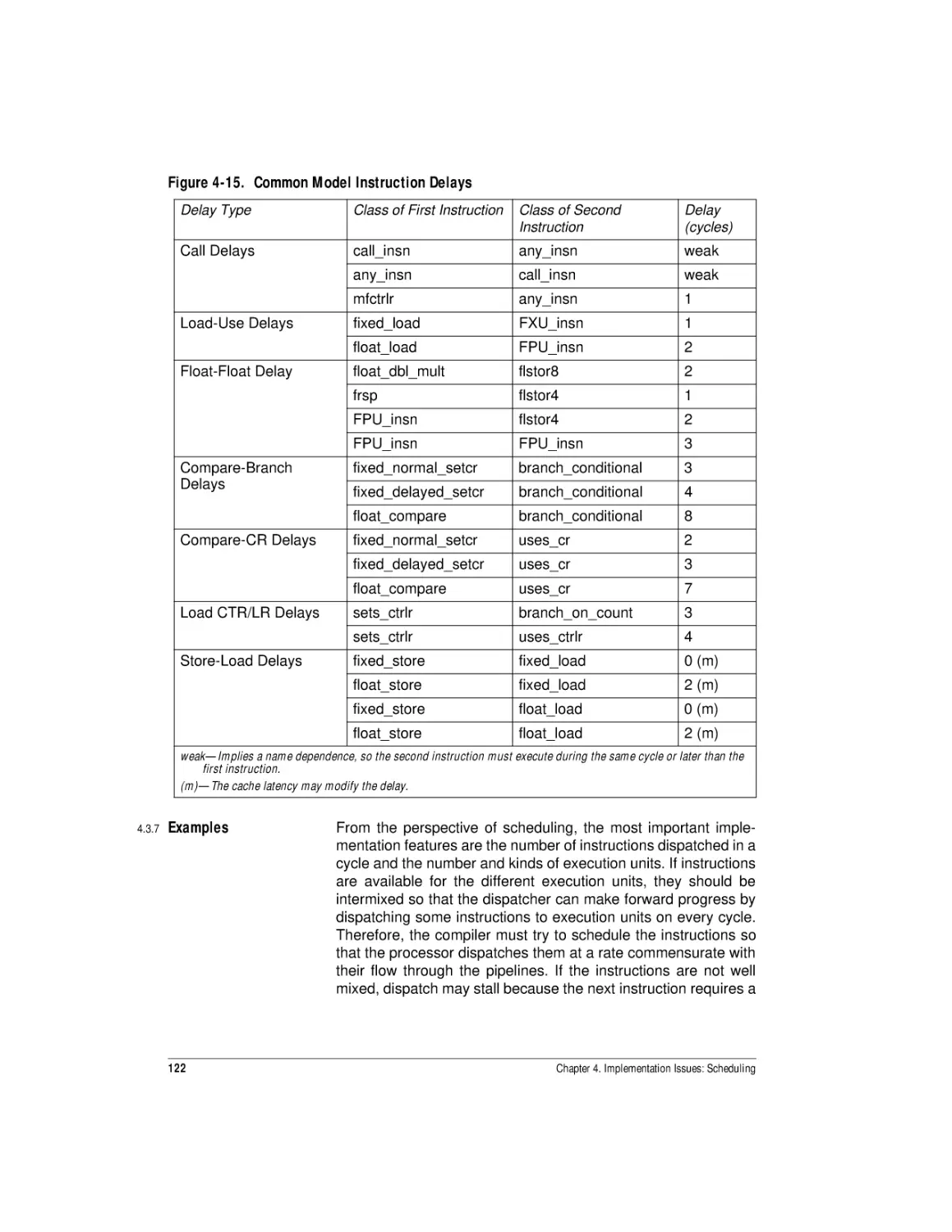
Common Model Instruction Delays................................................................... 122
Simple Scheduling Example with Load-Use Delay Slot ..................................... 123
Multi-Part Expression Evaluation Scheduling Example ..................................... 124
Basic Block Code Example: C Code ................................................................... 125
Basic Block Code Example: Scheduled for Common Model .............................. 126
Basic Block Code Example: Scheduled for PowerPC 604 Processor ................. 127
Figure 4-21.
Figure 4-22.
Figure 4-23.
Figure 4-24.
Figure 4-25.
Figure 5-1.
Figure 5-2.
Figure 5-3.
Figure 5-4.
Figure 5-5.
Figure 5-6.
Figure 5-7.
Figure 5-8.
Figure 5-9.
Figure 5-10.
Figure 5-11.
Figure 5-12.
Figure 5-13.
Figure 5-14.
Figure 5-15.
Figure 5-16.
Figure 5-17.
Figure 5-18.
Figure 5-19.
Figure 5-20.
Figure A-1.
Figure A-2.
Figure A-3.
Figure A-4.
Figure A-5.
Figure A-6.
Figure A-7.
Figure A-8.
Figure B-1.
Figure B-2.
Figure B-3.
Figure B-4.
Figure B-5.
Figure B-6.
Figure B-7.
Figure B-8.
Figure C-1.
Figure C-2.
Figure C-3.
Figure C-4.
Figure C-5.
Dependent Arithmetic-Conditional Assignments Example ................................
Rescheduled Dependent Arithmetic-Conditional Assignments Example ...........
Basic Matrix Multiply Kernel Code Example ......................................................
Matrix Multiply Code Example—Scheduled for PowerPC 604 Processor .........
Nested Loops: Touch Instruction Example........................................................
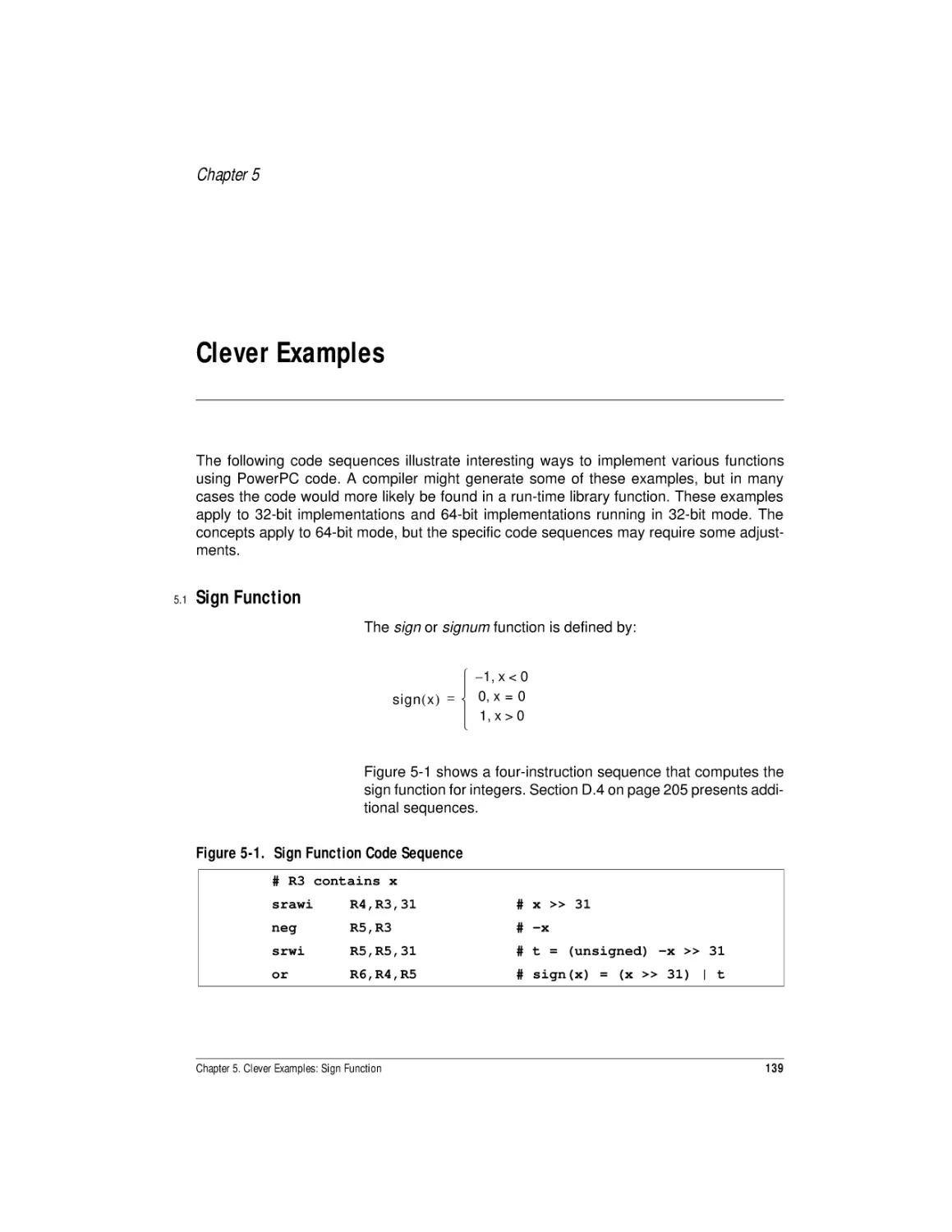
Sign Function Code Sequence ..........................................................................
Fortran ISIGN Function Code Sequence ............................................................
Register Exchange Code Sequence ...................................................................
“x = y” Predicate Code Sequence......................................................................
Clear Least-Significant Nonzero Bit Code Sequence .........................................
Test for 0 or a Power of 2 Code Sequence........................................................
Round Up to a Multiple of 8 Code Sequence.....................................................
Values of flp2(x) and clp2(x).............................................................................
flp2(x) Code Sequence......................................................................................
clp2(x) Code Sequence .....................................................................................
Detect Page Boundary Crossing Code Sequence ..............................................
Count Trailing Zeros Code Sequence ................................................................
Number of Powers of 2 Code Sequence ...........................................................
Branch-Free Population Count Code Sequence.................................................
Branching Population Count Code Sequence....................................................
Alternative Population Count Code Sequence ...................................................
Detect First String of n 1-Bits Code Sequence ..................................................
Incrementing a Reversed Integer Code Sequence.............................................
2n in Fortran Code Sequence ............................................................................
Integer Log Base 10 Code Sequence ................................................................
AIX ABI Register Usage Conventions ................................................................
Relevant Parts of the Run-Time Stack for Subprogram ccc ..............................
Argument Passing for foo1 ...............................................................................
Argument Passing for foo2 ...............................................................................
Function Descriptor ..........................................................................................
main: Function-Calling Code Example...............................................................
ptrgl Routine Code Sequence............................................................................
glink_printf Code Sequence ..............................................................................
PowerPC 6xx Processor Features .....................................................................
Branch Instructions ..........................................................................................
Load and Store Instructions..............................................................................
Cache Control Instructions ...............................................................................
Fixed-Point Computational Instructions ............................................................
Floating-Point Instructions................................................................................
Optional Instructions ........................................................................................
Number of Accesses for Misaligned Operands .................................................
Instruction Frequency in Integer SPEC92 Benchmarks .....................................
Instruction Frequency in Floating-Point SPEC92 Benchmarks ..........................
Most Frequently Used Instructions in Integer SPEC92 Benchmarks .................
Most Frequently Used Instructions in Floating-Point SPEC92 Benchmarks ......
PowerPC Instruction Usage in SPEC92 Benchmarks ........................................
129
130
131
132
135
139
140
141
141
141
142
142
143
143
144
145
145
146
146
148
148
152
153
154
155
159
162
164
164
168
169
170
170
172
176
176
178
178
181
182
184
188
188
189
190
191
xiii
xiv
Preface
Purpose and Audience
This book describes, mainly by coding examples, the code patterns that perform well on
PowerPC processors. The book will be particularly helpful to compiler developers and application-code specialists who are already familiar with optimizing compiler technology and
are looking for ways to exploit the PowerPC architecture. It will also be helpful to application
programmers who need to understand and tune the output of PowerPC compilers and to
faculty members and graduate students specializing in the study of compilers. We assume
that compiler developers have already developed a compiler front-end and are seeking to
develop a PowerPC back-end.
The book does not attempt to teach the average programmer how to write a compiler or the
accompanying library routines. Readers seeking this kind of information may wish to
acquire some of the publications listed in the references.
The book is a companion to Book I of The PowerPC Architecture. Detailed descriptions from
The PowerPC Architecture are not repeated except in summary form, although we include
several references to sections in the specification. The material and instructions described
in Books II and III of The PowerPC Architecture are, in general, not included because they
are primarily of interest to operating-system developers.
Code Examples
Where possible and useful, the book includes code examples, generalizations of coding
approach, and general advice on issues affecting coding decisions. The examples are primarily in PowerPC assembler code, but they may also show related source code (typically
C or Fortran). Most of the code examples are chosen to perform well on a generic PowerPC
processor, called a Common Model, although advice on coding for specific PowerPC-processor implementations is sometimes included.
Most code examples are from IBM. A few code examples in Chapter 5, “Clever Examples”,
have been contributed by non-IBM programmers. A few examples are taken from The PowerPC Architecture or IBM technical papers. The PowerPC extended mnemonics that are
used in the code examples are listed in a table at the end of this preface.
xv
Contributors
Writers and Editors:
■
IBM Editor: Steve Hoxey, IBM Toronto Laboratory
■
IBM Editor: Faraydon Karim, IBM Microelectronics Division
■
IBM Editor: Bill Hay, IBM Toronto Laboratory
■
IBM Editor: Hank Warren, IBM Thomas J. Watson Research Center
■
Writer: Philip Dickinson, Warthman Associates
■
Independent Editor: Dennis Allison, Stanford University
■
Managing Editor: Forrest Warthman, Warthman Associates
Review Comments and/or Code Examples:
■
Steve Barnett, Absoft Corporation
■
Bob Blainey, IBM Toronto Laboratory
■
Patrick Bohrer, IBM Microelectronics Division
■
Gary Davidian, Power Computing Corporation
■
Kaivalya Dixit, IBM RISC System/6000 Division
■
Bill Hay, IBM Toronto Laboratory
■
Richard Hooker, IBM Microelectronics Division
■
Steve Hoxey, IBM Toronto Laboratory
■
Steve Jasik, Jasik Designs
■
Faraydon Karim, IBM Microelectronics Division
■
Lena Lau, IBM Toronto Laboratory
■
Cathy May, IBM Thomas J. Watson Research Center
■
John McEnerney, Metrowerks, Inc.
■
Dave Murrell, IBM Microelectronics Division
■
Tim Olson, Apple Computer, Inc.
■
Brett Olsson, IBM System Technology and Architecture Division
■
Tom Pennello, MetaWare, Inc.
■
Mike Peters, IBM PowerPC Performance Group
■
Brian Peterson, IBM Microelectronics Division
■
Nam H. Pham, IBM Microelectronics Division
■
Warren Ristow, Apogee Software, Inc.
■
Alex Rosenberg, Apple Computer, Inc.
■
Tim Saunders, IBM Microelectronics Division
■
Ed Silha, IBM System Technology and Architecture Division
■
Fred Strietelmeier, IBM System Technology and Architecture Division
■
S. Surya, IBM PowerPC Performance Group
■
Maureen Teodorovich, IBM Microelectronics Division
■
Hank Warren, IBM Thomas J. Watson Research Center
■
Pete Wilson, Groupe Bull
xvi
Notation
0:31
Bits 0 through 31 of a big-endian word.
Ra
General-purpose register a, where a is a number or letter other
than A.
RA
General-purpose register indicated by the field 11:15 in the
instruction encoding for load/store instructions that do not update
and addi and addis instructions. If this field indicates R0, the
value 0 is used.
FRa0:36
Floating-point register a, big-endian bits 0:36.
crn
Condition Register field n.
crn [lt ]
The lt bit in Condition Register field n. The following table summarizes the names of the bits in the Condition Register fields used
in this book.
Condition Register Field Bits
Bit Name
Bit Position in
Field
lt
0
gt
1
eq
2
so
3
fx
0 in CR1
fex
1 in CR1
vx
2 in CR1
ox
3 in CR1
fl
0
fg
1
fe
2
fu
3
Description
The result of a recording fixedpoint operation or a fixed-point
compare.
The result of a recording floatingpoint operation.
The result of a floating-point
compare operation.
(x)
The contents of x, where x indicates some register or field.
(RA|0)
The contents of general-purpose register A, or the value 0 if RA
indicates R0.
0xFFFF
Decimal 65535 (64K) in hexadecimal notation.
0b0011
Decimal 3 in binary notation.
xvii
x || y
The concatenation of x and y.
nx
x repeated n times.
∈
Is a member of.
&
Logical AND.
Logical OR.
⊕
Logical XOR.
¬
Logical NOT.
≡
Logical equivalence.
instruction
A PowerPC instruction mnemonic.
[.]
An optional period at the end of a PowerPC instruction mnemonic. It causes condition codes for the result to be stored in the
Condition Register (CR).
[o]
An optional “o” at the end of a PowerPC instruction mnemonic. It
causes the SO (summary overflow) and OV (overflow) bits of the
fixed-point exception register (XER) to reflect the result.
Acronyms, words, and phrases are defined in the Glossary at the back of the book. The following table gives the equivalent mnemonic for extended mnemonics used in this book:
Extended Mnemonics Used in This Book
Extended Mnemonic
Equivalent Mnemonic
Name
bctr
bcctr 20,bi
Branch Unconditionally to CTR
bctrl
bcctrl 20,bi
Branch Unconditionally to CTR
Setting LR
bdnz target
bc 16,bi,target
Decrement CTR,
Branch If CTR ≠ 0
bdnzf target
bc 8,bi,target
Decrement CTR, Branch If CTR ≠
0 and Condition False
bdz target
bc 18,bi,target
Decrement CTR, Branch If
CTR = 0
beq crn,target
bc 12,4*n+2,target
Branch If Equal To
LR—Link Register
CTR—Count Register
crn—Condition Register field n
xx—Alphabetic code for bit in Condition Register field (see previous table)
UI—Unsigned 14-bit intermediate
SI—Signed 14-bit intermediate
bi—Bit in Condition Register
xviii
Extended Mnemonics Used in This Book (continued)
Extended Mnemonic
Equivalent Mnemonic
Name
bf crn[xx],target bc 4,bi,target
Branch If Condition False
bge crn,target
bc 4,4*n,target
Branch If Greater Than Or Equal
To
bgt crn,target
bc 12,4*n+1,target
Branch If Greater Than
bgtlr crn
bclr 12,4*n+1
Branch If Greater Than to LR
ble crn, target
bc 4,4*n+1,target
Branch If Less Than Or Equal To
blr
bclr 20,bi
Branch Unconditionally to LR
blt crn,target
bc 12,4*n,target
Branch If Less Than
bne crn,target
bc 4,4*n+2,target
Branch If Not Equal To
bt crn[xx],target bc 12,bi,target
Branch If True
cmplw crn,Ra,Rb
cmpl crn,0,Ra,Rb
Compare Logical Word
cmplwi crn,Ra,UI
cmpli crn,0,Ra,UI
Compare Logical Word Immediate
cmpw crn,Ra,Rb
cmp crn,0,Ra,Rb
Compare Word
cmpwi crn,Ra,SI
cmpi crn,0,Ra,SI
Compare Word Immediate
li Rx,value
addi Rx,0,value
Load Immediate
lis Rx,value
addis Rx,0,value
Load Immediate Shifted
mfctr Rx
mfspr Rx,9
Move From CTR
mflr Rx
mfspr Rx,8
Move From LR
mfxer Rx
mfspr Rx,1
Move From XER
mr Rx,Ry
or Rx,Ry,Ry
(ori Rx,Ry,0)
Move Register
mtctr Rx
mtspr 9,Rx
Move To CTR
mtlr Rx
mtspr 8,Rx
Move To LR
mtxer Rx
mtspr 1,Rx
Move To XER
not Rx,Ry
nor Rx,Ry,Ry
Logical NOT
slwi Rx,Ry,n
rlwinm Rx,Ry,n,0,31-n
Shift Left Immediate
srwi Rx,Ry,n
rlwinm Rx,Ry,32-n,n,31
Shift Right Immediate
sub Rx,Ry,Rz
subf Rx,Rz,Ry
Subtract
subi Rx,Ry,value
addi Rx,Ry,-value
Subtract Immediate
LR—Link Register
CTR—Count Register
crn—Condition Register field n
xx—Alphabetic code for bit in Condition Register field (see previous table)
UI—Unsigned 14-bit intermediate
SI—Signed 14-bit intermediate
bi—Bit in Condition Register
xix
xx
Chapter 1
1.
Introduction
High-performance computer systems depend on good hardware design coupled with powerful compilers and operating systems. Although announced in 1991, the PowerPC architecture represents the end product of nearly 20 years of evolution starting with work on the
801 system at IBM. From the beginning, advanced hardware and software techniques were
intermingled to develop first RISC and then superscalar computer systems. This guide
describes how a compiler may select and schedule code that performs to the potential of
the architecture.
1.1
RISC Technologies
The time required to execute a program is the product of the path
length (the number of instructions), the number of cycles per
instruction, and the cycle time. These three variables interact with
one another. For example, reducing the cycle time reduces the
window of time in which useful work can be performed, so the
execution of a complex instruction may be unable to finish. Then,
the function of the complex instruction must be separated into
multiple simpler instructions, increasing the path length. Identifying the optimal combination of these variables in the form of an
instruction set architecture, therefore, represents a challenging
problem whose solution depends on the hardware technology
and the software requirements.
Historically, CISC architectures evolved in response to the limited
availability of memory because complex instructions result in
smaller programs. As technology improved, memory cost
dropped and access times decreased, so the decode and execution of the instructions became the limiting steps in instruction
processing. Work at IBM, Berkeley, and Stanford demonstrated
that performance improved if the instruction set was simple and
instructions required a small number of cycles to execute, preferably one cycle. The reduction in cycle time and number of cycles
Chapter 1. Introduction: RISC Technologies
1
needed to process an instruction were a good trade-off against
the increased path length. Development along these RISC lines
continued at IBM and elsewhere. The physical design of the computer was simplified in exchange for increased hardware management by compilers and operating systems.
The work at IBM led to the development of the POWER™ architecture, which implemented parallel instruction (superscalar) processing, introduced some compound instructions to reduce
instruction path lengths in critical areas, incorporated floatingpoint as a first-class data type, and simplified the architecture as
a compiler target. Multiple pipelines permitted the simultaneous
execution of different instructions, effectively reducing the number of cycles required to execute each instruction. The POWER
architecture refined the original RISC approach by improving the
mapping of the hardware architecture to the needs of programming languages. The functionality of key instructions was
increased by combining multiple operations in the same instruction: the load and store with update instructions, which perform
the access and load the effective address into the base register;
the floating-point multiply-add instructions; the branch-on-count
instructions, which decrement the Count Register and test the
contents for zero; or the rotate-mask instructions. This increased
functionality significantly reduced the path length for critical areas
of code, such as loops, at the expense of moderately longer pipeline stages.
The POWER instruction set architecture and the hardware implementation were developed together so that they share a common
partitioning based on function, minimizing the interaction
between different functions. By arranging the instruction set in
this way, the compiler could better arrange the code so that there
were fewer inter-instruction dependencies impeding superscalar
dispatch. The role of the compiler became more important
because it generated code that could extract the performance
potential of this superscalar hardware.
IBM, Motorola, and Apple jointly defined the PowerPC architecture as an evolution of the POWER architecture. The modifications to the POWER architecture include:
2
■
Clearer distinctions between the architecture and implementations.
■
Simplifications and specifications to improve high-speed
superscalar and single-chip performance.
■
32-bit and 64-bit architectures.
■
Memory-consistency model for symmetric multiprocessing.
Chapter 1. Introduction: RISC Technologies
1.2
Compilers and Optimization
The quality of code generated by a compiler is measured in terms
of its size and execution speed. The compiler must balance these
factors for the particular programming environment. The quality is
most profoundly affected by the choice of algorithm and data
structures, choices which are the province of the individual programmer. Given the algorithm and data structures, quality
depends upon a collusion between the compiler, the processor
architecture, and the specific implementation to best exploit the
resources of the computer system. Modern processors rely upon
statistical properties of the programs and upon the ability of the
compiler to transform and schedule the specification of the algorithm in a semantically equivalent way so as to improve the performance of individual programs. Today, most programming is
done in a high-level language. The compilers for these languages
are free to generate the best possible machine code within the
constraint that the semantics of the language are preserved. This
book concentrates on compilers for procedure-oriented languages, such as C or Fortran.
Optimizations are traditionally classified as machine-independent
or machine-dependent. Compilers usually perform machine-independent optimizations by transforming an intermediate language
version of the program into an equivalent optimized program, also
expressed in the intermediate language. The choice of optimizations normally considered machine-independent and their order
of application, however, may actually be machine-dependent.
Most classical compiler issues, including the front-end syntactic
and semantic checks, intermediate language, and most machineindependent optimizations are not covered here; they are
described elsewhere in the literature. This book focuses principally on implementation-dependent optimizations specific to the
PowerPC architecture.
Machine-dependent optimizations require detailed knowledge of
the processor architecture, the Application Binary Interface (ABI)
and the processor implementation. Detailed issues of code
choice depend mostly on the architecture. Typical compilers
examine the intermediate representation of the program and
select semantically equivalent machine instructions. The ABI is a
convention that allows programs to function in a particular programming environment, but restricts the type of code that a compiler can emit in many contexts. Two PowerPC compilers that
target different operating environments may generate quite different optimized code for the same program. Machine-dependent
optimizations, such as program layout, scheduling, and alignment considerations, depend on the implementation of the archi-
Chapter 1. Introduction: Compilers and Optimization
3
tecture. In the case of the PowerPC architecture, there are a
number of implementations, each with different constraints on
these optimizations.
1.3
Assumptions
The assumptions made in this book include:
■
■
■
4
Familiarity with the PowerPC Architecture—We assume that
you know the PowerPC architecture as described in The PowerPC Architecture: A Specification for a New Family of RISC
Processors (hereafter known as The PowerPC Architecture ).
We make frequent references to sections in this book.
Common Model—Unless otherwise stated, we assume that
you are generating code for the PowerPC Common Model
implementation, which is described in Section 4.3.6 on page
117. The Common Model is a fictional PowerPC implementation whose scheduled code should perform well, though perhaps not optimally, on all PowerPC implementations.
Optimizations for particular processors are mentioned where
appropriate. We consider only uniprocessor systems. Multiprocessing systems lie beyond the scope of this work.
Compiler Environment—We assume that you have already
developed a compiler front-end with an intermediate language
connection to an optimizing and code-emitting back-end, or
that you are directly optimizing application programs in an
assembler. This book discusses only the optimizing and codeemitting back-end that creates PowerPC object files.
Chapter 1. Introduction: Assumptions
Chapter 2
2.
Overview of the PowerPC Architecture
Books I through III of The PowerPC Architecture describe the instruction set, virtual environment, and operating environment, respectively. The user manual for each processor
specifies the implementation features of that processor. In this book, the term PowerPC
architecture refers to the contents of Books I through III. The compiler writer is concerned
principally with the contents of Book I: PowerPC User Instruction Set Architecture.
2.1
Application Environment
The application environment consists of resources accessible
from the problem state, which is the user mode (the PR bit in the
Machine State Register is set). The PowerPC architecture is a
load-store architecture that defines specifications for both 32-bit
and 64-bit implementations. The instruction set is partitioned into
three functional classes: branch, fixed-point and floating-point.
The registers are also partitioned into groups corresponding to
these classes; that is, there are condition code and branch target
registers for branches, Floating-Point Registers for floating-point
operations, and General-Purpose Registers for fixed-point operations. This partition benefits superscalar implementations by
reducing the interlocking necessary for dependency checking.
The explicit indication of all operands in the instructions, combined with the partitioning of the PowerPC architecture into functional classes, exposes dependences to the compiler. Although
instructions must be word (32-bit) aligned, data can be misaligned within certain implementation-dependent constraints.
The floating-point facilities support compliance to the IEEE 754
Standard for Binary Floating-Point Arithmetic (IEEE 754).
2.1.1
32-Bit and 64-Bit
Implementations and
Modes
The PowerPC architecture includes specifications for both 32and 64-bit implementations. In 32-bit implementations, all application registers have 32 bits, except for the 64-bit Floating-Point
Registers, and effective addresses have 32 bits. In 64-bit imple-
Chapter 2. Overview of the PowerPC Architecture: Application Environment
5
mentations, all application registers are 64-bits long—except for
the 32-bit Condition Register, FPSCR, and XER—and effective
addresses have 64 bits. Figure 2-1 shows the application register
sizes in 32-bit and 64-bit implementations.
Figure 2-1. Application Register Sizes
Registers
32-Bit Implementation
Size (Bits)
64-Bit Implementation
Size (Bits)
Condition Register
32
32
Link Register and Count Register
32
64
General-Purpose Registers
32
64
fixed-point Exception Register
32
32
Floating-Point Registers
64
64
Floating-Point Status and Control
Register
32
32
Both 32-bit and 64-bit implementations support most of the
instructions defined by the PowerPC architecture. The 64-bit
implementations support all the application instructions supported 32-bit implementations as well as the following application
instructions: load doubleword, store doubleword, load word algebraic, multiply doubleword, divide doubleword, rotate doubleword, shift doubleword, count leading zeros doubleword, sign
extend word, and convert doubleword integer to a floating-point
value.
The 64-bit implementations have two modes of operation determined by the 64-bit mode (SF) bit in the Machine State Register:
64-bit mode (SF set to 1) and 32-bit mode (SF cleared to 0), for
compatibility with 32-bit implementations. Application code for
32-bit implementations executes without modification on 64-bit
implementations running in 32-bit mode, yielding identical results.
All 64-bit implementation instructions are available in both
modes. Identical instructions, however, may produce different
results in 32-bit and 64-bit modes:
■
■
6
Addressing—Although effective addresses in 64-bit implementations have 64 bits, in 32-bit mode, the high-order 32 bits
are ignored during data access and set to zero during instruction fetching. This modification of the high-order bits of the
address might produce an unexpected jump following the
transition from 64-bit mode to 32-bit mode.
Status Bits—The register result of arithmetic and logical
instructions is independent of mode, but setting of status bits
depends on the mode. In particular, recording, carry-bit–setting, or overflow-bit–setting instruction forms write the status
Chapter 2. Overview of the PowerPC Architecture: Application Environment
bits relative to the mode. Changing the mode in the middle of
a code sequence that depends on one of these status bits can
lead to unexpected results.
■
2.1.2
2.1.2.1
Register Resources
The PowerPC architecture identifies each register with a functional class, and most instructions within a class use only the registers identified with that class. Only a small number of
instructions transfer data between functional classes. This separation of processor functionality reduces the hardware interlocking needed for parallel execution and exposes register
dependences to the compiler.
Branch
The Branch-Processing Unit includes the Condition Register,
Link Register (LR) and Count Register (CTR):
■
■
■
2.1.2.2
Count Register—The entire 64-bit value in the Count Register
of a 64-bit implementation is decremented, even though conditional branches in 32-bit mode only test the low-order 32 bits
for zero.
Fixed-Point
Condition Register—Conditional comparisons are performed
by first setting a condition code in the Condition Register with
a compare instruction or with a recording instruction. The condition code is then available as a value or can be tested by a
branch instruction to control program flow. The 32-bit Condition Register consists of eight independent 4-bit fields
grouped together for convenient save or restore during a context switch. Each field may hold status information from a
comparison, arithmetic, or logical operation. The compiler can
schedule Condition Register fields to avoid data hazards in
the same way that it schedules General-Purpose Registers.
Writes to the Condition Register occur only for instructions
that explicitly request them; most operations have recording
and non-recording instruction forms.
Link Register—The Link Register may be used to hold the
effective address of a branch target. Branch instructions with
the link bit (LK) set to one copy the next instruction address
into the Link Register. A Move To Special-Purpose Register
instruction can copy the contents of a General-Purpose Register into the Link Register.
Count Register—The Count Register may be used to hold
either a loop counter or the effective address of a branch target. Some conditional-branch instruction forms decrement the
Count Register and test it for a zero value. A Move To SpecialPurpose Register instruction can copy the contents of a General-Purpose Register into the Count Register.
The Fixed-Point Unit includes the General-Purpose Register file
and the Fixed-Point Exception Register (XER):
Chapter 2. Overview of the PowerPC Architecture: Application Environment
7
2.1.2.3
Floating-Point
■
General-Purpose Registers—Fixed-point instructions operate
on the full width of the 32 General-Purpose Registers. In 64bit implementations, the instructions are mode-independent,
except that in 32-bit mode, the processor uses only the loworder 32 bits for determination of a memory address and the
carry, overflow, and record status bits.
■
XER—The XER contains the carry and overflow bits and the
byte count for the move-assist instructions. Most arithmetic
operations have carry-bit–setting and overflow-bit–setting
instruction forms.
The Floating-Point Unit includes the Floating-Point Register file
and the Floating-Point Status and Control Register (FPSCR):
■
■
2.1.3
2.1.3.1
Floating-Point Registers—The Floating-Point Register file
contains thirty-two 64-bit registers. The internal format of
floating-point data is the IEEE 754 double-precision format.
Single-precision results are maintained internally in the double-precision format.
FPSCR—The processor updates the 32-bit FPSCR after
every floating-point operation to record information about the
result and any associated exceptions. The status information
required by IEEE 754 is included, plus some additional information to expedite exception handling.
Memory Models
Memory is considered to be a linear array of bytes indexed from
0 to 232 - 1 in 32-bit implementations, and from 0 to 264 - 1 in 64bit implementations. Each byte is identified by its index, called an
address, and each byte contains a value. For the uniprocessor
systems considered in this book, one storage access occurs at a
time and all accesses appear to occur in program order. The main
considerations for the compiler writer are the addressing modes,
alignment, and endian orientation. Although these considerations
alone suffice for the correct execution of a program, code modifications that better utilize the caches and translation-lookaside
buffers may improve performance (see Section 4.4 on page 133).
Memory Addressing
The PowerPC architecture implements three addressing modes
for instructions and three for data. The address of either an
instruction or a multiple-byte data value is its lowest-numbered
byte. This address points to the most-significant end in big-endian
mode, and the least-significant end in little-endian mode.
Instructions
Branches are the only instructions that specify the address of the
next instruction; all others rely on incrementing a program
counter. A branch instruction indicates the effective address of
the target in one of the following ways:
8
Chapter 2. Overview of the PowerPC Architecture: Application Environment
■
Branch Not Taken—The byte address of the next instruction
is the byte address of the current instruction plus 4.
■
Absolute—Branch instructions to absolute addresses (indicated by setting the AA bit in the instruction encoding) transfer
control to the word address given in an immediate field of the
branch instruction. The sign-extended value in the 24-bit or
14-bit immediate field is scaled by 4 to become the byte
address of the next instruction. The high-order 32 bits of the
address are cleared in the 32-bit mode of a 64-bit implementation. An unconditional branch to an absolute address, which
has a 24-bit immediate field, transfers control to a byte
address in the range 0x0 to 0x01FF_FFFC or 0xFE00_8000
to 0xFFFF_FFFC. A conditional branch to an absolute
address, which has a 14-bit immediate field, transfers control
to a byte address in the range 0x0 to 0x7FFC or
0xFFFF_8000 to 0xFFFF_FFFC.
Relative—Branch instructions to relative addresses (indicated
by clearing the AA bit in the instruction encoding) transfer control to the word address given by the sum of the immediate
field of the branch instruction and the word address of the
branch instruction itself. The sign-extended value in the 24-bit
or 14-bit immediate field is scaled by 4 and then added to the
current byte instruction address to become the byte address
of the next instruction. The high-order 32 bits of the address
are cleared in the 32-bit mode of a 64-bit implementation.
Link Register or Count Register—The Branch Conditional to
Link Register and Branch Conditional to Count Register
instructions transfer control to the effective byte address of the
branch target specified in the Link Register or Count Register,
respectively. The low-order two bits are ignored because all
PowerPC instructions must be word aligned. In a 64-bit implementation, the high-order 32 bits of the target address are
cleared in 32-bit mode. The Link Register and Count Registers are written or read using the mtspr and mfspr instructions,
respectively.
■
■
Data
All PowerPC load and store instructions specify an address register, which is indicated in the RA field of the instruction. If RA is
0, the value zero is used instead of the contents of R0. The effective byte address in memory for a data value is calculated relative
to the base register in one of three ways:
■
Register + Displacement—The displacement forms of the
load and store instructions add a displacement specified by
the sign-extended 16-bit immediate field of the instruction to
the contents of RA (or 0 for R0).
Chapter 2. Overview of the PowerPC Architecture: Application Environment
9
■
Register + Register—The indexed forms of the load and store
instructions add the contents of the index register, which is a
General-Purpose Register, to the contents of RA (or 0 for R0).
■
Register—The Load String Immediate and Store String Immediate instructions directly use the contents of RA (or 0 for R0).
The update forms reload the register with the computed address,
unless RA is 0 or RA is the target register of the load.
Arithmetic for address computation is unsigned and ignores any
carry out of bit 0. In 32-bit mode of a 64-bit implementation, the
processor ignores the high-order 32-bits, but includes them when
the address is loaded into a General-Purpose Register, such as
during a load or store with update.
2.1.3.2
Endian Orientation
The address of a multi-byte value in memory can refer to the
most-significant end (big-endian) or the least-significant end (little-endian). By default, the PowerPC architecture assumes that
multi-byte values have a big-endian orientation in memory, but
values stored in little-endian orientation may be accessed by setting the Little-Endian (LE) bit in the Machine State Register. In
PowerPC Little-Endian mode, the memory image is not true littleendian, but rather the ordering obtained by the address modification scheme specified in Appendix D of Book I of The PowerPC
Architecture. In Little-Endian mode, load multiple, store multiple,
load string, and store string operations generate an Alignment
interrupt. Other little-endian misaligned load and store operations
may also generate an Alignment interrupt, depending on the
implementation. In most cases, the load and store with byte
reversal instructions offer the simplest way to convert data from
one endian orientation to the other in either endian mode.
2.1.3.3
Alignment
The alignment of instruction and storage operands affects the
result and performance of instruction fetching and storage
accesses, respectively.
Instructions
PowerPC instructions must be aligned on word (32-bit) boundaries. There is no way to generate an instruction address that is
not divisible by 4.
Data
Although the best performance results from the use of aligned
accesses, the PowerPC architecture is unusual among RISC
architectures in that it permits misaligned data accesses. Different PowerPC implementations respond differently to misaligned
accesses. The processor hardware may handle the access or
may generate an Alignment interrupt. The Alignment interrupt
handler may handle the access or indicate that a program error
has occurred. Load-and-reserve and store-conditional instruc-
10
Chapter 2. Overview of the PowerPC Architecture: Application Environment
tions to misaligned effective addresses are considered program
errors. Alignment interrupt handling may require on the order of
hundreds of cycles, so every effort should be made to avoid misaligned memory values.
In Big-Endian mode, the PowerPC architecture requires implementations to handle automatically misaligned integer halfword
and word accesses, word-aligned integer doubleword accesses,
and word-aligned floating-point accesses. Other accesses may
or may not generate an Alignment interrupt depending on the
implementation.
In Little-Endian mode, the PowerPC architecture does not require
implementation hardware to handle any misaligned accesses
automatically, so any misaligned access may generate an Alignment interrupt. Load multiple, store multiple, load string, and store
string instructions always generate an Alignment interrupt in Little-Endian mode.
A misaligned access, a load multiple access, store multiple
access, a load string access, or a store string access that crosses
a page, Block Address Translation (BAT) block, or segment
boundary in an ordinary segment may be restarted by the implementation or the operating system. Restarting the operation may
load or store some bytes at the target location for a second time.
To ensure that the access is not restarted, the data should be
placed in either a BAT or a direct-store segment, both of which do
not permit a restarted access.
2.1.4
Floating-Point
The PowerPC floating-point formats, operations, interrupts, and
special-value handling conform to IEEE 754. The remainder
operation and some conversion operations required by IEEE 754
must be implemented in software (in the run-time library).
A Floating-Point Register may contain four different data types:
single-precision floating-point, double-precision floating-point,
32-bit integer, and 64-bit integer. The integer data types can be
stored to memory or converted to a floating-point value for computation. The frsp instruction rounds double-precision values to
single-precision. The precision of the result of an operation is
encoded in the instruction. Single-precision operations should act
only on single-precision operands.
The floating-point operating environment for applications is determined by bit settings in the Floating-Point Status and Control
Register (FPSCR) and the Machine State Register (MSR). Figure
2-2 shows the bit fields and their functions. Floating-point interrupts may be disabled by clearing FE0 and FE1. If either FE0 or
FE1 is set, individual IEEE 754 exception types are enabled with
the bits in the FPSCR indicated in Figure 2-2.
Chapter 2. Overview of the PowerPC Architecture: Application Environment
11
The non-IEEE mode implemented by some implementations may
be used to obtain deterministic performance (avoiding traps and
interrupts) in certain applications. See Section 3.3.7.1 on page 79
for further details.
Figure 2-2. Floating-Point Application Control Fields
Register
Field *
Name
Function
FPSCR
24
VE
Floating-Point Invalid Operation Exception Enable
0 Invalid operation exception handled with the IEEE
754 default response.
1 Invalid operation exception causes a Program interrupt.
25
OE
Floating-Point Overflow Exception Enable
0 Overflow exception handled with the IEEE 754
default response.
1 Overflow exception causes a Program interrupt.
26
UE
Floating-Point Underflow Exception Enable
0 Underflow exception handled with the IEEE 754
default response.
1 Underflow exception causes a Program interrupt.
27
ZE
Floating-Point Zero-Divide Exception Enable
0 Zero divide exception handled with the IEEE 754
default response.
1 Zero divide exception causes a Program interrupt.
28
XE
Floating-Point Inexact Exception Enable
0 Inexact exception handled with the IEEE 754
default response.
1 Inexact exception causes a Program interrupt.
29
NI
Floating-Point Non-IEEE Mode
0 The processor executes in an IEEE 754 compatible
manner.
1 The processor produces some results that do not
conform with IEEE 754.
* 64-bit and 32-bit refer to the type of implementation.
12
Chapter 2. Overview of the PowerPC Architecture: Application Environment
Figure 2-2. Floating-Point Application Control Fields (continued)
Register
MSR
Field *
Name
Function
30:31
RN
Floating-Point Rounding Control
00 Round to Nearest
01 Round toward 0
10 Round toward +∞
11 Round toward -∞
64-bit: 52
32-bit: 20
FE0
64-bit: 55
32-bit: 23
FE1
Floating-Point Exception Modes 0 and 1
00 Ignore exceptions mode. Floating-point exceptions
do not cause interrupts.
01 Imprecise nonrecoverable mode. The processor
interrupts the program at some point beyond the
instruction that caused the enabled exception, and
the interrupt handler may not be able to identify this
instruction.
10 Imprecise recoverable mode. The processor interrupts the program at some point beyond the instruction that caused the enabled exception, but the
interrupt handler can identify this instruction.
11 Precise mode. The program interrupt is generated
precisely at the floating-point instruction that caused
the enabled exception.
* 64-bit and 32-bit refer to the type of implementation.
2.2
Instruction Set
All instructions are 32 bits in length. Most computational instructions specify two source register operands and a destination register operand. Only load and store instructions access memory.
Furthermore, most instructions access only the registers of the
same functional class. Branch instructions permit control transfers either unconditionally, or conditionally based on the test of a
bit in the Condition Register. The branch targets can be immediate values given in the branches or the contents of the Link or
Count Register. The fixed-point instructions include the storage
access, arithmetic, compare, logical, rotate and shift, and move
to/from system register instructions. The floating-point instructions include storage access, move, arithmetic, rounding and
conversion, compare, and FPSCR instructions.
2.2.1
Optional Instructions
The PowerPC architecture includes a set of optional instructions:
■
■
General-Purpose Group—fsqrt and fsqrts.
Graphics Group—stfiwx, fres, frsqrte, and fsel.
Chapter 2. Overview of the PowerPC Architecture: Instruction Set
13
If an implementation supports any instruction in a group, it must
support all of the instructions in the group. Check the documentation for a specific implementation to determine which, if any, of
the groups are supported.
2.2.2
2.2.3
2.2.3.1
Preferred Instruction
Forms
Some instructions have a preferred form, which may execute significantly faster than other forms. Instructions having preferred
forms include:
■
Load and Store Multiple—Load multiple and store multiple
instructions load or store the sequence of successive registers from the first target or source register through R31. In the
preferred form, the combination of the effective address and
the first target or source register should align the low-order
byte of R31 to a 128-bit (quadword) boundary.
■
Load and Store String—Load string and store string instructions load or store the sequence of bytes from the first target
or source register through successive registers until all the
bytes are transferred. In the preferred form, the target or
source register is R5 and the last accessed register is R12 or
lower.
■
No-Op—The preferred form of the no-op is ori 0,0,0.
Communication
Between Functional
Classes
A special group of instructions manage the communication
between the resources of different functional classes. No branch
instructions can use resources of the non-branch classes. The
communication always occurs through an fixed-point or floatingpoint instruction. The execution of these instructions may cause
substantial implementation-dependent delays because both execution units must be available simultaneously as both are
involved in the execution of the instruction.
Fixed-Point and
Branch Resources
The fixed-point instructions manage the following transfers
between fixed-point and branch registers:
■
General-Purpose Register to Condition Register—Move To
Condition Register Fields (mtcrf)
■
Condition Register to General-Purpose Register—Move
From Condition Register (mfcr)
General-Purpose Register to Link Register—Move To Link
Register (mtlr)
Link Register to General-Purpose Register—Move From Link
Register (mflr)
General-Purpose Register to Count Register—Move To
Count Register (mtctr)
Count Register to General-Purpose Register—Move From
Count Register (mfctr)
■
■
■
■
14
Chapter 2. Overview of the PowerPC Architecture: Instruction Set
■
■
■
XER to Condition Register—Move to Condition Register Field
from XER (mcrxr)
Fixed-Point Record Instruction to CR0—An fixed-point arithmetic or logical instruction with the record bit set loads CR0
with condition codes representing the comparison of the result
to 0 and the Summary Overflow bit.
Fixed-point Comparison Instruction to CRx—An fixed-point
comparison instruction loads the CR field specified in the
instruction with condition codes representing the result of the
comparison and the Summary Overflow bit.
2.2.3.2
Fixed-Point and
Floating-Point
Resources
No direct connection exists between General-Purpose Registers
and Floating-Point Registers. A transfer between these registers
must be done by storing the register value in memory from one
functional class and then loading the value into a register of the
other class.
2.2.3.3
Floating-Point and
Branch Resources
The floating-point instructions manage the following transfers
between Floating-Point Registers and Branch Unit registers:
■
FPSCR to CR—Move to Condition Register field from FPSCR
(mcrfs)
■
Floating-Point Record Instruction to CR1—A floating-point
arithmetic instruction with the record bit enabled loads CR1
with condition codes indicating whether an exception
occurred.
■
Floating-Point Comparison to CRx—A floating-point comparison instruction loads the CR field specified in the instruction
with condition codes representing the result of the comparison.
Chapter 2. Overview of the PowerPC Architecture: Instruction Set
15
16
Chapter 2. Overview of the PowerPC Architecture: Instruction Set
Chapter 3
3.
Code Selection
An effective compiler must select machine language representations that perform best for
the operations and structures of the high-level language being compiled. This selection
does not necessarily occur at a single step in the compilation process, but rather may be
distributed among several steps. Some of the selection may occur during the transformation
of the source code to an intermediate language, during various optimization transformations, or during the final generation of the assembly or machine language code.
An important consideration for code selection is the relationship between instructions. A
dependence is a relationship between two instructions that requires them to execute in program order. A control dependence requires an instruction to execute in program order with
respect to a branch instruction. An instruction has a data dependence on a preceding
instruction when its source operand is the result of the preceding instruction. This result may
be an indirect input through a data dependence on one or more intermediate instructions.
Two instructions have a name dependence when, although not data dependent, both
access a particular register or memory location as an operand, so they must be executed
in program order. If the register or memory location for one of the instructions is renamed,
the name dependence is removed. An output dependence is a name dependence for which
the instruction’s destination register or memory location is the preceding instruction’s destination register or memory location. An antidependence is a name dependence for which the
instruction’s destination register or memory location is the preceding instruction’s source
register or memory location.
This chapter shows how to compile certain common operations and structures in high-level
languages, such as C or Fortran, into PowerPC instructions. For the purpose of clarity, the
examples illustrate simple sequences that generally do not include full scheduling optimizations.
3.1
Control Flow
The performance of modern processors is extremely sensitive to
branches and program branching behavior. Branches fall into one
of three categories: unconditional branches, conditional branches
that select one of two potential successor addresses (one of
Chapter 3. Code Selection: Control Flow
17
which is the next sequential address, sometimes called the fallthrough successor), and unconstrained branches whose target
address is computed.
Programs decompose into basic blocks, which are single-entry,
multiple-exit units with no internal branch targets. Basic blocks
form the simplest unit of optimization because, within a basic
block, only local data dependencies need be considered. Optimizations that span multiple basic blocks require more complicated
analysis of data flow within the program. Thus, minimizing the use
of branches increases the size of the basic blocks and simplifies
optimization.
A branch is unresolved when either the condition or the target
address is unavailable when the branch is processed. If the processor delays execution until a branch is resolved, the pipeline
usually stalls. As an alternative, the processor may execute a predicted path of the unresolved branch. When the branch is
resolved, if the prediction was correct, execution simply continues. If the prediction was incorrect, the processor must back up,
cancel speculative instructions subsequent to the branch, and
begin execution from the correct instruction, a potentially large
penalty in pipelined and superscalar processors. By using branch
instructions that are always resolved (unconditional branches or
branch-on-count instructions) or by ensuring that the condition
and target address are available before the branch is processed,
the unused cycles and possible mispredict penalties of an unresolved branch may be avoided. If a branch, taken or not, is
resolved early enough, prefetching along the target path may permit the execution of the branch in parallel with other instructions
preventing stalls in the pipeline. Therefore, a highly desirable
optimization is to compute the condition or to load the Link or
Count Register as early as possible in the basic block so that the
dependent branch is resolved when it is encountered.
Because most PowerPC processors are pipelined and superscalar, many clock cycles may go unused during branch-resolution
delays. Therefore, most PowerPC processors have the ability to
execute speculatively. The branch prediction may be derived
from the static prediction ( y ) bit in the conditional branch instruction or from dynamic branch-prediction hardware. Accurate predictions can dramatically improve performance.
The PowerPC architecture allows a variety of features that can
reduce the number of branches, enable the early resolution of
conditional branches, and permit the accurate prediction of unresolved branches. These features include:
■
Multiple branch-instruction formats:
- Conditional based on the test of a bit in the Condition Register.
18
Chapter 3. Code Selection: Control Flow
- Conditional based on the comparison of the value in the
Count Register to zero after decrementing it (resolved).
- Conditional based on the test of a bit in the Condition Register and the comparison of the value in the Count Register
to zero after decrementing it.
- Unconditional (always resolved).
■
The ability of any branch instruction to save the address of the
following instruction in the Link Register as a return address.
■
Eight Condition Register fields and the associated Condition
Register logical instructions, which can combine multiple condition results to reduce the number of branches.
■
Implementation-specific branch prediction mechanisms:
- Static branch prediction bit in the conditional branch instruction encoding.
- Dynamic branch prediction hardware.
3.1.1
3.1.1.1
Architectural
Summary
The PowerPC architecture supports many flow-control options.
The Link Register can be used to save the return address during
subroutine linkage. The Count Register can be used to maintain
the loop counter for loops with a fixed number of iterations. The
result of compare and record operations are first-class values, so
all the traditional optimizations can be applied (e.g., common subexpression and dead code elimination). Book I: Chapter 2 of the
The PowerPC Architecture includes complete details regarding
the control-flow resources and instructions.
Link Register
The Link Register is loaded either directly from a General-Purpose Register (using the mtlr instruction) or by executing a
branch instruction with the link bit (LK) in the instruction set to
one. All branch instructions permit setting LK to one to save the
address of the next instruction in the Link Register. A subsequent
branch to the Link Register using the bclr[l ] instruction initiates a
transfer of control to the instruction following the branch that last
wrote the Link Register. This mechanism permits subroutine linkage because a branch to a function may automatically write its
return address in the Link Register. In fact, a branch instruction
with LK set to one writes the address of the next instruction in the
Link Register whether the branch is actually taken or not. Optimizations that attempt to minimize the saving and restoring of the
Link Register need to be aware of this feature.
Chapter 3. Code Selection: Control Flow
19
The address of the next instruction is given by:
bcl
20,31,$+4
The value 20 in the BO field means branch always, so the result
of the test of bit 31 in the Condition Register is ignored. This
instruction is an unconditional branch to the relative address 4
bytes forward (the next instruction) with LK set to one so that the
address of the next instruction is written to the Link Register.
During a control transfer to a computed target address, depending on the local context and ABI constraints, either the Link Register or the Count Register may hold the target address in order
to preserve some ongoing use of the other. The Link Register,
however, typically maintains the return address for function linkage, so control transfer to a computed address normally uses the
Count Register. The PowerPC architecture does not require this
division of labor.
In most ABIs, the Link Register is volatile and used for subroutine
linkage. A function may save the Link Register value in its stack
frame or leave it in a General-Purpose Register. If the intent is to
return via a branch to the address in the Link Register, the value
must be restored to the Link Register before the return.
3.1.1.2
Count Register
If a loop has a predetermined number of iterations, this number
may be written to the Count Register so that a branch-on-count
instruction (a conditional branch with bit 2 of the BO field cleared)
can automatically decrement the Count Register and test it for
zero. Branch-on-count operations are always resolved, except
perhaps for the first iteration if the value in the Count Register is
not yet valid. In 64-bit implementations, whether in 64-bit or 32-bit
mode, the processor decrements the entire 64-bit Count Register,
but tests only the low-order 32 bits in 32-bit mode.
To transfer control to a computed address, the Count Register
may be loaded with a target address from a General-Purpose
Register using the mtctr instruction, followed by a branch to the
Count Register. When possible, independent instructions should
separate the load of the Count Register from the branch to prevent pipeline stalls.
In most implementations, saving and restoring the Count Register introduces delays that cancel the performance advantage of
the branch-on-count operation over the equivalent add, compare
and branch sequence. In particular, the branch-on-count operation should be used only on a single loop in a set of nested loops
(usually the innermost loop that can be implemented using it) and
should not be used if the loop body contains a call to a subprogram that may alter the Count Register.
20
Chapter 3. Code Selection: Control Flow
3.1.1.3
Condition Register
The 32-bit Condition Register reflects certain properties of computations and their results, either implicitly through recording
operations or explicitly through comparison operations and direct
transfers. Condition Register logical instructions can manipulate
individual Condition Register bits. Conditional branch instructions
may test these computational properties.
The Condition Register has various interpretations. The mfcr
instruction treats it as a 32-bit register. Recording instructions,
compare instructions, mcrf, mcrxr, and mcrfs treat it as eight 4-bit
registers. Conditional branch and Condition Register logical
instructions treat it as 32 1-bit registers. The meaning associated
with each bit is managed by the compiler.
Recording Instructions
Most fixed-point operations have recording instruction forms, that
is, forms that write a 4-bit value to Condition Register field 0 that
includes three bits denoting whether the result is less than,
greater than, or equal to zero, and the summary overflow (SO) bit.
This implicit recording may eliminate the need for an additional
comparison before a conditional branch. Conditional branch
instructions can test SO for fixed-point exception support.
Most floating-point operations have recording instruction forms,
that is, forms that write a 4-bit value to Condition Register field 1
that includes floating-point exception summary information. This
implicit recording allows conditional branches to test for floatingpoint exceptions generated by the recording instruction or a previous instruction.
Compare Instructions
The result of an fixed-point or floating-point comparison can be
written to any of the Condition Register fields. Compare instructions treat the Condition Register as eight 4-bit fields. Condition
Register logical instructions may combine several of the results
from such comparisons, potentially eliminating branches.
Fixed-point comparisons may be signed or unsigned, and 32-bit
or 64-bit (for 64-bit implementations). Floating-point comparisons
may be ordered, which cause an exception if either operand is a
NaN, or unordered, which cause an exception only if either operand is an SNaN.
mcrf Instruction
The mcrf instruction copies the contents of one Condition Register field to another, treating the Condition Register as eight 4-bit
fields. In particular, this instruction can copy the result of one
recording instruction out of Condition Register field 0 or 1 so that
a second recording instruction will not overwrite the previous
record.
Chapter 3. Code Selection: Control Flow
21
If the linkage conventions require certain Condition Register
fields to be preserved across call boundaries and the cost of saving the Condition Register in memory is prohibitive, the mcrf
instruction can move data from volatile to nonvolatile Condition
Register fields. This use of the Condition Register is limited by the
aggressiveness of optimizers and assembly programmers.
3.1.2
mtcrf and mfcr Instructions
The mtcrf instruction loads 4-bit fields of the Condition Register
from a General-Purpose Register. The mfcr instruction copies the
contents of the Condition Register to a General-Purpose Register. The most common use for these instructions is saving and
restoring fields of the Condition Register across subroutine
boundaries. Depending on ABI requirements, the contents of the
Condition Register may remain in a General-Purpose Register or
be stored in memory.
mcrxr Instruction
The mcrxr instruction moves bits 0:3 of the XER to one of the
Condition Register fields. This field of the XER contains the Summary Overflow (SO), Overflow (OV), and Carry (CA) bits. Their
presence in the Condition Register allows conditional branching
on these bits for fixed-point exception support. This instruction
clears bits 0:3 of the XER.
mcrfs Instruction
The mcrfs instruction copies the contents of a 4-bit field of the
FPSCR to a 4-bit field of the Condition Register. The FPSCR contains the floating-point exception summary bits, the floating-point
exception bits, the Floating-Point Fraction Rounded bit, the Floating-Point Fraction Inexact bit, and the Floating-Point Result
Flags. One way to interrogate these bits is to load them into the
Condition Register. Then, conditional branching can determine
the presence and nature of an exception and the class of a floating-point result.
Condition Register Logical
Instructions
The Condition Register logical instructions (crand, cror, crxor,
crnand, crnor, creqv, crandc, and crorc) allow direct manipulation
of bits in the Condition Register. These eight instructions can
combine the results of multiple conditions into a single condition
for test by a conditional branch. Condition Register logical instructions treat the Condition Register as 32 1-bit fields.
Branch Instruction
Performance
Implementation details affect the manner in which the control flow
instructions are selected. The dispatch and cache access behavior favor the fall-through path of branches. Using some branch
unit or recording instructions unnecessarily can degrade performance.
22
Chapter 3. Code Selection: Control Flow
3.1.2.1
Fall-Through Path
When possible, the most likely outcome of a branch should lie on
the fall-through (not-taken) path. Consider a PowerPC processor
that can dispatch four instructions per cycle. If an unresolved
branch is the first instruction, the remaining three instructions,
those lying on the fall-through path, may be dispatched speculatively in the same cycle as the branch, even if the branch is predicted taken. No fetch is needed to access instructions on the fallthrough path. If the unresolved branch is the last instruction and
it is predicted taken, the next group of fetched instructions will
come from the branch target. It is also likely, however, that the
instructions on the fall-through path are available in the cache.
3.1.2.2
Needless Branch
Register and
Recording Activity
On some PowerPC implementations, the execution of the mtlr,
mflr, mtctr, mfctr or Condition Register instructions causes serialized execution, when they could otherwise have executed in parallel. If a branch instruction has the LK bit set to one, it loads the
Link Register with the address of the following instruction,
whether the branch is taken or not. Therefore, do not enable LK
unless you need the address of the next instruction for some purpose, such as function linkage. Setting the record bit of instructions needlessly can prevent parallel execution by introducing
resource dependencies.
3.1.2.3
Condition Register
Contention
Conditional branch instructions and Condition Register logical
instructions treat the Condition Register as 32 1-bit fields. Most
implementations, however, treat the Condition Register as a set
of eight 4-bit fields, so better timing characteristics result if the
destination bit is in a different field than either of the source fields,
thereby avoiding a delay due to contention. For example, on
some implementations,
cror
11,0,2 # cr2[so] = cr0[lt] | cr0[eq]
will execute faster than
cror
3.1.3
3.1.3.1
3,0,2
# cr0[so] = cr0[lt] | cr0[eq].
Uses of Branching
High-level language flow control features map to unconditional
branches, conditional branches, multi-way conditional branches,
counting loops, and function calls and returns. The following sections describe PowerPC code to implement these features.
Unconditional
Branches
Unconditional flow control statements in C include unconditional
goto, break, continue, and return. The unconditional goto, break,
and continue statements may be implemented using unconditional branches to relative immediate addresses (b) or using
Chapter 3. Code Selection: Control Flow
23
unconditional branches to the Link or Count Register (bclr or
bcctr). The return statement is implemented using a branch to the
Link Register (see Section 3.1.3.5 on page 32).
Branching to an absolute address transfers control to the signextended word address given in the immediate field of the branch
instruction. Some ABIs use the linking forms of this instruction
(bla or bcla) to call special functions.
3.1.3.2
Conditional Branches
Conditional branching statements in C include if and if-else,
which are most often implemented using conditional branch
instructions and perhaps some unconditional branches. The conditional expression, which, depending on the source language,
can take various forms, is evaluated, and the result is placed in a
bit of the Condition Register. The most common way to write the
result of a conditional expression to the Condition Register for
testing by conditional branch instructions involves compare
instructions or recording instructions, both of which set a 4-bit
field in the Condition Register. These bits may be further manipulated using Condition Register logical instructions. Figure 3-1
shows C and assembly code for an if-else sequence. This simple
example uses a recording instruction form to provide the conditions for both conditional branches.
Some simple sequences that involve fixed-point comparisons
can be replaced with branch-free code, as shown in
Section 3.1.5.1 on page 38 and Appendix D. For floating-point
comparisons, the optional Floating Select ( fsel ) instruction can
sometimes replace this type of conditional structure when IEEE
754 compatibility is not required. See Section 3.3.9 on page 86.
24
Chapter 3. Code Selection: Control Flow
Figure 3-1. if-else Code Example
C Source Code
a = b + c;
if (a > 0)
...action 1...
else if (a < 0)
...action 2...
else
...action 3...
Assembly Code
add.
Ra,Rb,Rc
# recording form generates conditions
# for both conditional branches
ble
cr0,lab1
# if a > 0, do action 1
...action 1...
b
out
# exit
bge
cr0,lab2
# else if a < 0, do action 2
lab1:
...action 2...
b
out
# exit
lab2:
# else do action 3
...action 3...
out:
3.1.3.3
Multi-Way Conditional
Branches
The multi-way branch construction, as represented by the C
switch or the Fortran computed goto, can be implemented in several different ways. These include if-else sequences, branch
tables, hash tables, arithmetic progressions, search algorithms
over binary or ternary trees, range testing, or combinations of
these and others. The choice of the best implementation depends
on problem specifics, including the number and distribution of test
conditions and the instruction timings and latencies.
Figure 3-2 shows the example of a C Switch and assembly code
that implements it as a series of if-else constructions.
Chapter 3. Code Selection: Control Flow
25
Figure 3-2. C Switch: if-else Code Sequence
C Source Code
switch (x) {
case 10: case 11: case 12: case 13: case 14: case 15:
...do_something...
}
Assembly Code
lwz
R3,x
cmpwi
cr0,R3,10
beq
cr0,lab10
cmpwi
cr1,R3,11
beq
cr1,lab11
cmpwi
cr5,R3,12
beq
cr5,lab12
cmpwi
cr6,R3,13
beq
cr6,lab13
cmpwi
cr7,R3,14
beq
cr7,lab14
cmpwi
cr0,R3,15
beq
cr0,lab15
# load x into R3
# if (x == 10) goto lab10
# else if (x == 11) goto lab11
# else if (x == 12) goto lab12
# else if (x == 13) goto lab13
# else if (x == 14) goto lab14
# else if (x == 15) goto lab15
...
lab10:
lab11:
lab12:
lab13:
lab14:
lab15:
...do_something...
The same example can be coded as a range test as shown in Figure 3-3. Multiple compares and combining branch conditions
facilitate this approach.
26
Chapter 3. Code Selection: Control Flow
Figure 3-3. C Switch: Range Test Code Sequence
lwz
R3,x
# load x into R3
subic
R4,R3,10
# tmp = (x - min)
cmplwi
cr3,R4,5
# logically compare (tmp, max-min)
bgt
cr3,out
# if tmp < 0 or tmp > 5,
#
x is outside the range [min,max]
...do_something...
out:
Another example involves the use of a branch table. Figure 3-4
shows a C switch. Assume that TABLE contains the 32-bit
addresses of code corresponding to the various case n: labels. To
branch to a computable address, load that address (after computation) into either the Count Register or the Link Register, and
then branch to the contents of the register. The local context and
ABI conventions determine which of the special registers to use
for this purpose. For example, within the body of an iterative loop
based on the value in the Count Register, you might choose the
Link Register. If the Link Register is required for other purposes
such as subroutine linkage, its contents can be saved in another
register or memory temporarily while the Link Register is being
used for this purpose. Figure 3-4 shows how to implement the C
switch by using the Count Register to hold the branch target.
The cases of a switch are frequently decomposed into clusters,
which are a group of cases handled as a unit for the purpose of
selecting the implementation. Some guidelines that are useful for
selecting the implementation of a switch statement in the PowerPC architecture include:
■
The average cycle time to traverse a linked list is 4 cycles per
node (i.e., cycles per element for an if-else form, or cycles per
node if the values are arranged in a balanced binary tree).
■
The average cycle time to perform a range test is 5 cycles.
■
The average cycle time to perform a table lookup is 17 cycles
(includes a range test to verify table bounds).
■
The typical density at which table lookup becomes feasible is
33% with a minimum of 5 entries. For example, if the table has
a total of 100 elements, 60 of which lead to labeled clauses,
the table is said to have a density of 60%.
Chapter 3. Code Selection: Control Flow
27
Figure 3-4. C Switch: Table Lookup Code Sequence
C Source Code
switch(x){
case 0: code_for_case_0;
case 1: code_for_case_1;
case 2: code_for_case_2;
case 3: code_for_case_3;
case 4: code_for_case_4;
case 5: code_for_case_5;
...
}
Assembly Code
lwz
R4,x
# load x into R4
lwz
R7,$TABLE
# R7 = address of TABLE
slwi
R5,R4,2
# multiply by 4 (4 bytes/entry in TABLE)
lwzx
R3,R7,R5
# R3 = TABLE[x]
mtctr
R3
# load Count Register
bctr
3.1.3.4
Iteration
# branch to contents of Count Register
A do group is any kind of iterative construct, such as a C for loop
or a Fortran do loop. The latch point of an iterative construct is the
branch that transfers control from the bottom of the loop back to
the top. It is a back edge in the program flow graph. The following
instructions may serve as latch points:
■
■
■
■
Unconditional Branch.
Conditional Branch—Test a specified bit in the Condition Register.
Branch-On-Count—Test the Count Register for zero.
Complex Form (conditional branch and branch-on-count)—
Test a specified bit in the Condition Register and test the
Count Register for zero.
A do group has the general form:
loop:
...body of code...
latch_to_loop
28
Chapter 3. Code Selection: Control Flow
The C language while, do, and for statements are examples of do
groups. Figure 3-5 shows a simple implementation of the C strlen
function that uses the while statement.
Figure 3-5. strlen Code Example
C Source Code
i = 0;
while(s[i] != ‘\0’)
++i;
/* i is the length of the string s */
Assembly Code
addi
R4,R3,-1
# initialize
lbzu
R5,1(R4)
# read s[i] and increment
cmpwi
cr3,R5,0
# compare s[i] to ‘\0’
bne
cr3,loop
# if (s[i] != ‘\0’) goto loop
subf
R3,R3,R4
# R3 is the length of the string s
loop:
out:
Loops for which the number of iterations can be computed at
compile time or at execution time represent a special case of do
groups. In this case, you may use the branch-on-count form of
conditional branch (extended mnemonics bdnz and bdz) for loop
control, rather than some form of add, compare, and branch on a
Condition Register bit. Branch-on-count operations are almost
always resolved, so they may execute in parallel with other
instructions, preventing stalls in the fixed-point and floating-point
pipelines. Fortran do loops and many of the C for loops represent
opportunities to exploit the branch-on-count feature.
Figure 3-6 shows a simple Fortran do loop and the corresponding
assembly code. If the program uses the loop index in computations, increment a separate value because of delays associated
with access of the Count Register.
Chapter 3. Code Selection: Control Flow
29
Figure 3-6. Branch-On-Count Loop: Simple Code Example
Fortran Source Code
do 10 i=1,10
...loop body...
10
continue
Assembly Code
li
R3,10
# number of iterations = 10
li
R4,1
# set up induction variable i
mtctr
R3
# load CTR with the number of iterations
loop:
...loop body...
addi
R4,R4,1
# i = i + 1 (needed if program uses i)
bdnz
loop
# decrement and branch to loop if (CTR) ≠ 0
Figure 3-7 shows an example where the number of iterations is
not known until execution time. The program must confirm that
the number of iterations is at least one. If not, branch around the
loop.
Figure 3-7. Branch-On-Count Loop: Variable Number of Iterations Code Example
Fortran Source Code
do 10 i=1,N
...loop body...
10
continue
Assembly Code
lwz
R3,n
# load number of iterations = n
cmpwi
cr0,R3,1
# compare the number of iterations to 1
li
R4,1
# setup induction variable i
blt
cr0,out
# goto out if n < 1
mtctr
R3
# load CTR with the number of iterations
loop:
...loop body...
addi
R4,R4,1
# i = i + 1 (needed if program uses i)
bdnz
loop
# decrement and branch to loop if (CTR) ≠ 0
out:
30
Chapter 3. Code Selection: Control Flow
Figure 3-8 shows the example of a loop where the initial and final
values of the loop index, as well as the stride, are determined at
execution time. You must calculate the number of iterations and
confirm that it is at least one. If not, as in the preceding example,
branch around the loop.
Figure 3-8. Branch-On-Count Loop: Variable Range and Stride Code Example
Fortran Source Code
do 10 i=ns,nf,nstep
...loop body...
10
continue
Assembly Code
lwz
R3,ns
# load starting value of i
lwz
R4,nf
# load final value of i
subf
R6,R3,R4
# nf - ns
lwz
R5,nstep
# load stepping increment
divw
R6,R6,R5
# (nf - ns)/nstep
addi
R6,R6,1
# (nf-ns)/nstep + 1 = number of iterations
cmpwi
cr0,R6,1
# compare the number of iterations to 1
mr
R7,R3
# set up induction variable i
blt
cr0,out
# goto out if number of iterations < 1
mtctr
R6
# load CTR with the number of iterations
loop:
...loop body...
add
R7,R7,R5
# i = i + nstep (needed if program uses i)
bdnz
loop
# decrement and branch to loop if (CTR) ≠ 0
out:
Figure 3-9 shows a Fortran example with a compound branch
form of latch point. The do loop and the if inside the loop combine
to form a single latch point. Although this form of branch-on-count
is not resolved, it combines the two conditional branches into one.
Chapter 3. Code Selection: Control Flow
31
Figure 3-9. Compound Latch Point Code Example
Fortran Source Code
do 10 i=1,100
...loop body...
if(a .eq. b) goto 20
10
continue
20
continue
Assembly Code
# R3 contains a
# R4 contains b
li
R5,100
# i = 100
mtctr
R5
# CTR = 100
loop:
...loop body...
cmpw
cr3,R3,R4
# compare a and b
bdnzf
cr3[eq],loop
# decrement and branch to loop
#
if (CTR) ≠ 0 and a ≠ b
lab20:
3.1.3.5
Procedure Calls and
Returns
Procedure calls usually use the Link Register to hold the return
address. Details of the linkage conventions, such as parameter
passing, stack format, and specifics of indirect procedure calling,
are ABI-specific. The examples in this section use the Link Register to hold the return address for procedure linkage.
A procedure call can be a relative branch to another procedure or
an indirect call through a pointer. For a call through a pointer, the
address of the procedure is loaded from memory into a GeneralPurpose Register. The simplest case is a direct call through a
pointer, which copies the procedure address to the Count Register and then branches to the Count Register with LK set to one.
Figure 3-10 shows the C source for two calls that illustrate:
■
Relative branch to a procedure (within range of branch displacement).
■
Simple call via pointer to a procedure.
Some system libraries provide stub routines with special linkage
conventions to handle transfers via pointers to arbitrary procedure addresses. The examples in Figures 3-10 through 3-12 do
not assume such a routine.
32
Chapter 3. Code Selection: Control Flow
Figure 3-10. Function Call Code Example—C Source
#include <stdio.h>
int foo(int i)
{
printf("I'm in function foo\n");
return(i);
}
main()
{ int (*foo_bar)(int i);
foo_bar = foo;
foo(1);
/* call foo directly */
foo_bar(2);
/* call foo via pointer foo_bar */
}
Figures 3-11 shows the relative call in assembly language. The
procedure parameter is loaded into R3, and the code branches
unconditionally to the address of the procedure with LK set to
one.
Figure 3-11. Relative Call to foo Code Sequence
li
R3,1
# function argument R3 = 1
bl
foo
# branch relative to foo sets Link Register
Figure 3-12 shows the call via pointer in assembly language. The
address of the procedure is loaded from memory into a GeneralPurpose Register, and then copied to the Count Register. The
procedure parameter is loaded into R3, and the code branches to
the Count Register with LK set to one. In both cases, the return
will occur by branching to the Link Register, perhaps first having
to load it (using mtlr) if it was stored. The Link Register can be
used instead of the Count Register in this example.
Chapter 3. Code Selection: Control Flow
33
Figure 3-12. Call to foo Via Pointer Code Sequence
lwz
R11,foo
# copy address of function foo into R11
li
R3,2
# function argument R3 = 2
mtctr
R11
bctrl
# load Count Register
# branch to contents of Count Register
# copies return address to Link Register
Another possibility involves calling a procedure through an intermediate routine in order to support some type of global subroutine linkage. The details of this subject depend strongly on linkage
conventions established in the ABI. Figure 3-13 shows an example of this process. The procedure main executes until it encounters a procedure call through a pointer, represented in this
example by the bl instruction. Some identifier of the desired procedure is written to a register that is passed as a parameter.
Then, a branch to the intermediate routine, glue, is executed with
LK set to one so that the desired procedure, task, will return to the
original procedure, main. In glue, the address of task is loaded
from memory into a General-Purpose Register and then copied
to the Count Register. The glue procedure executes a branch to
the Count Register with LK disabled, transferring control to task.
When ready to return from task, a branch to the Link Register,
which contains the address of the next instruction in main, is executed. For details regarding ABI linkage conventions, see Appendix A.
3.1.3.6
Traps and System Calls
34
Trap and system call instructions generate conditional and
unconditional interrupts, respectively. They are seldom used by
compilers. Section 3.3.12 on page 93 describes an example
which uses trap instructions to handle floating-point interrupts
precisely using software. Another possible use involves bounds
checking (see Section 5.8 on page 144).
Chapter 3. Code Selection: Control Flow
Figure 3-13. Indirect Subroutine Linkage
main
glue
bctr
bl
task
blr
3.1.4
Branch Prediction
Branches constitute varying portions of PowerPC programs, but
usually around 10% for floating-point code and around 20% for
integer code (see Appendix C). Often these branches can neither
be avoided nor resolved, so speculatively executing down the
path indicated by the predicted outcome of the unresolved branch
offers a significant performance gain if the prediction is accurate.
PowerPC implementations have varying types of branch prediction. Some implementations support only static branch prediction;
some include dynamic branch prediction hardware. In general,
use the static branch prediction bit (the y bit in the BO field of the
conditional branch instruction) when the likely direction of a conditional branch is known. The use of this bit helps on some implementations and hurts on none.
3.1.4.1
Default Prediction and
Rationale
The default static branch prediction (i.e., the y bit in BO is cleared)
corresponds to:
■
Predicted Taken Branch—bc[l ][a ] with a negative value in the
displacement field.
■
Predicted Not-Taken Branch—bc[l ][a ] with a non-negative
value in the displacement field, and bclr[l ] and bcctr[l ].
Chapter 3. Code Selection: Control Flow
35
Conditional branches to either the Link Register or the Count
Register are assumed to be not taken by default. Conditional
branching with a negative displacement (a backward branch)
defaults as taken, but with a positive displacement (a forward
branch) defaults as not taken. In general, branches tend to be not
taken, with the exception of loops, in which they are almost
always taken. Loops involve backward branches, so the default
for this case is taken. These considerations lead to a Backward
Taken/Forward Not-Taken branch prediction algorithm. The rules
apply to absolute as well as relative displacements, although the
sign of the displacement for absolute branches does not necessarily indicate forward or backward. Branch prediction does not
apply to unconditional branches, including the case of a Branch
Conditional with the BO field indicating branch always.
3.1.4.2
Overriding Default
Prediction
Use conditional branching with the override of the static branch
prediction (i.e., the y bit in BO is set to one) when the branch will
most likely behave in contradiction to the default prediction. The
assembly mnemonic indicates this override by the addition of a
suffix: “+” for predicted taken and “-” for predicted not taken. Overriding static branch prediction is useful when:
■
■
■
Testing for Error Conditions—If an unlikely call to an error handler lies on the fall-through path, override the default prediction.
Testing Known Distributions—Sometimes a program has
been profiled for branching. The default might be overridden
on the basis of this information.
Conditional Subroutine Return—Figure 3-14 shows a conditional return. In this case, it is known that a is likely to be positive. Thus, the “+” sign added to the mnemonic overrides the
default static branch prediction.
Ball and Larus [1993] describe heuristics that enable correct
static branch prediction more than 80% of the time. Even better
prediction is possible if the code is profiled, that is, executed to
collect information on branch outcomes for subsequent compilation.
It is preferable to reverse the direction of a branch, rather than
override the default branch prediction because branch reversal
makes more effective use of the instruction cache. To reverse the
direction of a branch, exchange the instructions on the taken path
with those on the fall-through path and adjust the condition calculation and program layout appropriately. In some cases, however,
it is not convenient to reverse a branch’s direction, so overriding
the default branch prediction remains an important option.
36
Chapter 3. Code Selection: Control Flow
Figure 3-14. Conditional Return Code Example
C Source Code
int condret(int a)
{
if(a>0) return(a);
else return(a+1);
}
Assembly Code
# R3 contains the input and return value
# the compiler knows that most likely a > 0
cmpwi
cr0,R3,0
bgtlr+
# set cr0 with comparison a > 0
# conditional branch to the link register
# determined by cr0[gt], R3 = a
# “+” indicates branch is predicted taken
addi
R3,R3,1
blr
3.1.4.3
3.1.5
# R3 = a + 1
# normal return
Dynamic Branch
Prediction
PowerPC processors have implementation-dependent dynamic
branch-prediction capabilities. Although software does not
directly control these mechanisms, knowledge of their behavior
can help software estimate the costs of misprediction for those
processors that implement dynamic prediction. See Section 4.2.2
on page 102 for details.
Avoiding Branches
Branching, both conditional and unconditional, slows most implementations. Even an unconditional branch or a correctly predicted taken branch may cause a delay if the target instruction is
not in the fetch buffer or the cache. It is therefore best to use
branch instructions carefully and to devise algorithms that reduce
branching. Many operations that normally use branches may be
performed either with fewer or no branches.
Reducing the number of branches:
■
Increases the size of the basic blocks, and therefore
increases opportunities for scheduling within a basic block.
■
Decreases the number of basic blocks.
Chapter 3. Code Selection: Control Flow
37
3.1.5.1
Computing Predicates
Predicates utilize a boolean expression as an integer value. For
example, in C:
ne = ((x != y) ? 1 : 0);
Figure 3-15 shows how to calculate this expression using an ordinary control flow translation.
Figure 3-15. Predicate Calculation: Branching Code Sequence
cmpw
cr0,Rx,Ry
# place compare result in cr0
li
R3,1
# R3 = 1
bne
cr0,lab
# x != y
li
R3,0
# R3 = 0
lab:
You can avoid the branch by using Condition Register logical
instructions, as shown in Figure 3-16. In this case, the result of
the comparison is directly transferred from the Condition Register
to a General-Purpose Register, from which the bit is extracted
and then flipped.
Figure 3-16. Predicate Calculation: Condition-Register Logical Code Sequence
cmpw
cr0,Rx,Ry
# place compare result in cr0
mfcr
R4
# R4 = condition register
rlwinm
R5,R4,3,31,31
# extract the cr0[eq] bit
xori
R3,R5,1
# flip the bit to obtain 0/1
Some implementations have delays associated with accessing
the Condition Register using the mfcr instruction. An alternative
that uses only fixed-point operations is shown in Figure 3-17.
Figure 3-17. Predicate Calculation: Fixed-Point-Operation Code Sequence
subf
R0,Rx,Ry
# R0 = y - x
subf
R3,Ry,Rx
# R3 = x - y
or
R3,R3,R0
# R3 = R3 | R0
# sign bit holds desired result
rlwinm
38
R3,R3,1,31,31
# extract the sign bit
Chapter 3. Code Selection: Control Flow
You can generate all boolean predicates with straight-line code
that does not use the Condition Register. Figure 3-18 shows
arithmetic expressions that yield a sign-bit reflecting the appropriate result.
Figure 3-18. Arithmetic Expressions for Boolean Predicates
Boolean Predicate
Arithmetic Expression
x≠y
(x - y) | (y - x)
x=y
¬((x - y) | (y - x))
x<y
(x & ¬y) | ((x ≡ y) & (x - y))
x≤y
(x | ¬y) & ((x ⊕ y) | ¬(y - x))
x < y, unsigned
(¬x & y) | ((x ≡ y) & (x - y)), or
(¬x & y) | ((¬x | y) & (x - y))
x ≤ y, unsigned
(¬x | y) & ((x ⊕ y) | ¬(y - x))
Shorter sequences exist for many of these operations. The GNU
superoptimizer is a program that exhaustively searches a subset
of machine instructions to find the shortest branch-free combinations that perform a specified operation. Appendix D lists the
PowerPC GNU superoptimizer results for a number of functions.
3.1.5.2
Conditionally
Incrementing a Value
by 1
Figure 3-19 shows the C code fragment for conditionally incrementing a value by 1 and equivalent branching and non-branching assembly code sequences. For simple conditions, branchfree equivalents can be formed using computed predicates. See
Appendix D.
Chapter 3. Code Selection: Control Flow
39
Figure 3-19. Conditionally Incrementing a Value by 1 Code Example
C Source Code
if (a < b) ++b;
Branching Code
# R3 contains a
# R4 contains b
cmpw
cr0,R3,R4
# compare a and b
bge
cr0,lab
# branch if a >= b
addi
R4,R4,1
# b = b + 1
lab:
# R4 contains the desired result
Branch-Free Code
# R3 contains a
# R4 contains b
3.1.5.3
subf
R0,R4,R3
# a - b
eqv
R2,R3,R4
# a ≡ b
and
R2,R0,R2
# (a ≡ b) & (a - b)
andc
R0,R3,R4
# a & ~b
or
R0,R0,R2
# (a & ~b) | ((a ≡ b) & (a - b))
rlwinm
R0,R0,1,31,31
# extract predicate
add
R4,R4,R0
# if (a < b) then b++
Condition Register
Logical
40
The Condition Register logical instructions can be used to combine several branch conditions, thus reducing the number of
branches. For example, Figure 3-20 shows the C code fragment
for a complex conditional expression and two equivalent assembly code sequences: one that has a comparison and branch for
each side of the OR, and another that uses a Condition Register
logical OR to combine the results of the compare and recording
operations for a single test by a conditional branch. This form may
present itself in situations where a common sub-expression
exists between this and other code, thus offering opportunities for
multiple compare and recording instructions within a single basic
block.
Chapter 3. Code Selection: Control Flow
Figure 3-20. Complex Condition Code Example
C Source Code
if ((a + b) < 0) || ((x + y) > 0)
...do_something...
Separate Branches
add.
R3,Ra,Rb
# perform add (a + b) with record
blt
cr0,lab1
# if (a + b) < 0, goto lab1
add.
R4,Rx,Ry
# perform add (x + y) with record
ble
cr0,else
# if (x + y) <= 0, goto else
lab1:
...statement...
else:
Combined Branch
add
R3,Ra,Rb
# perform add (a + b)
cmpwi
cr3,R3,0
# compare (a + b) to 0
add.
R4,Rx,Ry
# perform add (x + y) with record
cror
27,1,12
# cr6[so] = cr0[gt] | cr3[lt]
bf
cr6[so],else
# branch to else if condition bit is false
...statement...
else:
Figure 3-21 shows code sequences for a C switch for which the
optimal implementation of the multi-way branch is simply a
sequence of compare-branch tests. Because the tests all have a
common target address, they can be combined using Condition
Register logical instructions, reducing the total number of
branches from four to one. For a specific implementation, compare the timing of sequences using Condition Register logical
instructions to the equivalent multiple-branch sequences
because the relative performance may vary.
Chapter 3. Code Selection: Control Flow
41
Figure 3-21. C Switch: Condition Register Logical Code Example
C Source Code
switch(i){
case 0: case 20: case 30: case 40:
i+=10; break;
}
Assembly Code
lwz
R3,i
# load i into R3
cmpwi
cr0,R3,0
# compare R3 to 0 -> cr0
cmpwi
cr1,R3,20
# compare R3 to 20 -> cr1
cmpwi
cr6,R3,30
# compare R3 to 30 -> cr6
cmpwi
cr7,R3,40
# compare R3 to 40 -> cr7
cror
cr5[eq],cr0[eq],cr1[eq]
# cr5[eq] = cr0[eq] | cr1[eq]
cror
cr0[eq],cr7[eq],cr6[eq]
# cr0[eq] = cr7[eq] | cr6[eq]
cror
cr1[eq],cr5[eq],cr0[eq]
# cr1[eq] = cr5[eq] | cr0[eq]
bne
cr1,out
# i != 0, 20, 30, 40, goto out
addi
R3,R3,10
# i += 10
stw
R3,i
# store new i
out:
42
Chapter 3. Code Selection: Control Flow
Chapter 3
3. Code Selection
3.2
Integer and String Operations
Optimal code selection generally depends on the surrounding
code. The total number of instructions should be minimized, but
scheduling considerations may give longer code sequences a
performance advantage. Where possible, branches and long
latency instructions (multiplies, divides, loads, and stores) should
be avoided. Because of the pipelined, superscalar nature of many
PowerPC implementations, the minimization of dependences
introduces flexibility in scheduling and opportunities for parallel
computation.
Dependences, particularly the so-called false dependences (antidependences and output dependences) may cause the processor to stall, even when it can be avoided. (Renaming mechanisms
are frequently provided in advanced implementations to eliminate
false dependences.) The PowerPC instruction forms explicitly
indicate all operands, facilitating the determination of dependence. Moreover, most operations have instruction forms that do
not record, set the carry bit, or set the overflow bit, thereby reducing the potential for conflicts over these resources.
The PowerPC integer instruction set architecture includes:
■
Load and store instructions
- Byte, halfword, word scalar accesses. 64-bit implementations also have doubleword scalar accesses.
- Update forms, which write the calculated address to the
base register.
- Halfword and word byte-reversal forms.
- Multi-word and multi-byte forms.
3.2.1
3.2.1.1
■
Cache touch instructions.
■
Addition, subtraction, multiplication and division operations.
■
Comparison operations.
■
A complete set of bit-parallel logical operations.
■
Sign extend and count leading zeros operations.
■
Rotate and shift instructions with masking capabilities, which
permit flexible manipulation of bit fields.
Memory Access
The PowerPC architecture is a load-store architecture; that is,
only load and store instructions can move values between registers and memory. These instructions introduce delays due to
memory latencies, so their use should generally be minimized.
Single Scalar Load or
Store
Figures 3-22 and 3-23 show the PowerPC scalar load and store
instructions. The update form of the load or store writes the calculated address to the base register, simplifying the iterative load
Chapter 3. Code Selection: Integer and String Operations
43
or store of data structures, such as strings or arrays. The update
load or store instructions execute as fast or faster than the equivalent non-update load or store instruction and the associated add.
If the RA field of a non-updating load or store is R0, the value 0 is
used instead of the contents of R0.
Figure 3-22. Scalar Load Instructions
Scalar Type
Basic
Form
Indexed
Form
Update
Form
Update
Indexed
Form
logical byte
lbz
lbzx
lbzu
lbzux
logical halfword
lhz
lhzx
lhzu
lhzux
logical word
lwz
lwzx
lwzu
lwzux
logical doubleword (ld)
(ldx)
(ldu)
(ldux)
algebraic halfword
lha
lhax
lhau
lhaux
algebraic word
(lwa)
(lwax)
—
(lwaux)
Instructions in parentheses are available only in 64-bit implementations.
Figure 3-23. Scalar Store Instructions
Scalar Size
Basic
Form
Indexed
Form
Update
Form
Update
Indexed
Form
byte
stb
stbx
stbu
stbux
halfword
sth
sthx
sthu
sthux
word
stw
stwx
stwu
stwux
doubleword
(std)
(stdx)
(stdu)
(stdux)
Instructions in parentheses are available only in 64-bit implementations.
3.2.1.2
Load and Reserve/
Store Conditional
44
The load and reserve instructions load the addressed value from
memory and then set a reservation on an aligned unit of real storage (called a reservation granule ) containing the address. The
size of a reservation granule is implementation dependent. It
must be a multiple of 4 bytes for lwarx and a multiple of 8 bytes
for ldarx. In most implementations, it equals the size of a cache
line. A subsequent store conditional instruction to this address
verifies that the reservation is still set on the granule before carrying out the store. If the reservation does not exist, the instruction completes without altering storage. If the store is performed,
bit 2 of CR0 is set; otherwise, it is cleared. The processor may
clear the reservation by setting another reservation or by executing a conditional store to any address. Another processor may
clear the reservation by accessing the same reservation granule.
Chapter 3. Code Selection: Integer and String Operations
A pair of load-and-reserve and store-conditional instructions permit the atomic update of a single aligned word or doubleword
(only in 64-bit implementations) in memory.
A compiler that directly manages threads may use these instructions for in-line locks and to implement wait-free updates using
primitives similar to compare and swap. Because locked or synchronized operations in multi-processor systems are complex,
these operations are usually exposed only through calls to appropriate run-time library functions.
Further details about the use of these instructions may be found
in Book I Section 3.3.7 and Book II Section 1.8.2 of The PowerPC
Architecture.
3.2.1.3
Multiple Scalar Load or
Store
The load and store multiple and move assist instructions access
a sequence of words or bytes in memory. In PowerPC LittleEndian mode, the execution of these instructions generates an
interrupt.
Some implementations may not execute these instructions as
efficiently as the equivalent sequence of scalar loads and stores.
If the output of the compiler targets a generic PowerPC implementation, the use of an equivalent sequence of scalar loads or
stores may be preferable. For a particular implementation, check
Appendix B and relevant implementation-specific documentation
for the latency and timing of these instructions.
3.2.1.4
Byte-Reversal Load or
Store
The byte-reversal loads and stores reverse the order of the bytes
in the accessed halfword or word, regardless of the processor’s
endian mode. With knowledge of the data structure, data types,
and endian orientation, these instructions may be used for endian
conversion. Some implementations may have a longer latency for
byte reversing loads and stores than for ordinary loads and
stores.
3.2.1.5
Cache Touch
Instructions
The data cache touch instructions may improve performance by
providing the processor with a hint that the cache line containing
the addressed byte will soon be fetched into the data cache. The
processor is not required to act on this hint. Successful use of the
touch instructions requires knowledge of the cache geometry and
a non-blocking cache. See Section 4.4.3 on page 134 for further
details.
3.2.2
Computation
All integer computational instructions have operands that are
stored in registers or appear as intermediate fields in the instruction. With the exception of multiplies and divides, they usually
execute in a single cycle.
Chapter 3. Code Selection: Integer and String Operations
45
3.2.2.1
Setting Status
Integer operations may write the status of the result to either the
Condition Register or the XER, depending on the opcode (some
cause the Carry bit to be written) and the Rc and OE fields (if
present) in the instruction. Unnecessarily setting status bits can
reduce instruction-level parallelism by increasing instruction
interdependence. The addi, addis, add, and subf instructions do
not access status bits.
Recording
Most integer instructions have a Record (Rc) field. When the Rc
field in an instruction is set, CR0 is written reflecting both a comparison of the result to zero and the Summary Overflow bit. The
andi., andis., and addic. instructions also record, even though
they do not have an Rc field. For 64-bit implementations operating in 64-bit mode, the full 64-bit register value is compared to
zero. For 64-bit implementations operating in 32-bit mode, only
the low-order 32 bits are compared to zero. Even unsigned
instructions with the Rc field set, such as the logical and rotation
instructions, set CR0 based on signed comparison of the result to
zero.
Carry
Carrying and extended arithmetic operations may set the Carry
(CA) bit. In addition, the Shift Right Algebraic instruction sets CA
when the argument is negative and a 1-bit has been shifted out;
CA is cleared otherwise. In 64-bit implementations, the value of
CA depends on whether the processor is in 32-bit or 64-bit mode.
During a sequence of instructions using CA, changing modes can
lead to unexpected results.
Overflow
XER contains two overflow bits: overflow (OV) and summary
overflow (SO). OV indicates whether an overflow occurred during
the execution of an integer arithmetic instruction with the OE field
set. Add, subtract from, and negate instructions may set OV if the
carry into the most-significant bit is not the same as the carry out
of it. Multiply low and divide instructions may set OV if the result
cannot be represented in 64 bits for doubleword forms and 32 bits
for word forms.
The processor sets SO whenever setting OV. SO remains set,
however, until explicitly cleared by an mtxer or mcrxr instruction.
Remaining set allows the check for overflow to occur at the end
of a sequence of integer arithmetic instructions, rather than
immediately after each instruction.
In 64-bit implementations, the OV and SO values depend on
whether the processor is in 32-bit or 64-bit mode. During a
sequence of instructions using OV, changing modes can lead to
unexpected results.
46
Chapter 3. Code Selection: Integer and String Operations
3.2.2.2
Arithmetic Instructions
The PowerPC arithmetic operations include:
■
Add and subtract from
■
Add and subtract from carrying
■
Add and subtract from extended
■
High and low multiplies
■
Signed and unsigned multiplies
■
Signed and unsigned divides
addi, addis, add, and subf are the preferred forms for addition and
subtraction because they set no status bits. If the source register
is R0 for addi and addis, the value 0 is used instead of the contents of R0.
In the most general case, the multiplication of two n-bit operands
yields a 2n-bit product. Multiply low and multiply high return the
low-order and high-order n-bits of the product, respectively. For
mulli and mullw, the low-order 32 bits of the product are the correct 32-bit product for 32-bit mode. The low-order 32 bits of the
product are independent of whether the operands are regarded
as signed or unsigned 32-bit integers. For mulli and mulld, the
low-order 64 bits of the product are independent of whether the
operands are regarded as signed or unsigned 64-bit integers. In
some implementations, multiply instructions, with the exception
of mulli, may execute faster if the second argument is smaller in
absolute value than the first.
3.2.2.3
Logical Instructions
The PowerPC architecture provides a large number of Boolean
instructions ( and, or, nand, nor, xor, eqv, andc and orc ) so that
any 2-argument Boolean function can be calculated with only a
single instruction. These instructions can easily implement the
bit-parallel operators in higher-level languages. Logical expressions can be calculated as predicates as described in Section
3.1.5.1 on page 38.
The AND Immediate instruction has only a recording form. If the
immediate value is of the form 2n - 2m with n greater than m (i.e.,
an unbroken series of 1s), the AND Immediate instruction may be
replaced with a non-recording rlwinm instruction.
The Count Leading Zeros operation is useful in many algorithms.
To implement this function with other operations requires at least
10 instructions. If the cntlzw instruction’s record bit is set, the LT
bit in CR0 is cleared.
3.2.2.4
Rotate and Shift
Instructions
The PowerPC architecture implements instructions that can shift,
rotate, extract, clear and insert bit fields in a general way. The
shift instructions have analogous word and doubleword forms.
The rotate instructions, however, do not have analogous word
and doubleword forms because the 32-bit instruction size pre-
Chapter 3. Code Selection: Integer and String Operations
47
vents an equivalent specification of the mask. In a 64-bit implementation, the rotate and shift word instructions operate on the
low-order 32 bits; the high-order 32 bits are cleared.
3.2.2.5
Compare Instructions
The compare instructions write the condition code resulting from
the comparison of two operands to the specified field in the Condition Register, whose 4 bits hold the result of the comparison and
a copy of the Summary Overflow bit from the XER. The L field in
the instruction determines whether the operands are treated as
32-bit (L = 0) or 64-bit (L = 1) quantities. In a 64-bit implementation, bit 32 is the sign bit in 32-bit mode. In 32-bit implementations, L must be cleared.
3.2.2.6
Move To/From XER
mtxer may be used to clear the SO bit or to write bits 25:31 of the
XER, which specify the number of bytes a Move Assist instruction
transfers. mfxer may be used to save the value of the XER during
a function call.
Uses of Integer
Operations
Many high-level language operations and functions have a
straightforward, but not necessarily unique translation into PowerPC assembly. The following sections examine code sequences
for important or non-obvious operations and consider some of the
trade-offs among possible sequences.
Loading a Constant
into a Register
Loading an integer constant into a register (either an address or
a datum) is a common operation. The optimum way to handle this
operation depends on the size of the constant and the availability
of registers and cache lines to hold a constant pool.
3.2.3
3.2.3.1
The Load Immediate extended mnemonic (li Rd,value, which is
equivalent to addi Rd,R0,value) loads a 16-bit sign-extended
value into the destination register. The large number of immediate
instruction forms, however, can handle most operations involving
constants smaller than 16 bits without the need for a separate
load. Immediate arithmetic and signed-compare instructions sign
extend their 16-bit immediate value to allow negative intermediates. Add Immediate and Add Immediate Shifted instructions with
source register R0 use the value of zero instead of the contents
of R0.
The method of loading an arbitrary 32-bit or 64-bit value into a
destination register involves either constructing it in a register or
loading it from memory. The following code sequence builds a 32bit value in a register provided bit 16 of value is 0 and Rd is not
R0:
li
addis
48
Rd,(value & 0xFFFF)
Rd,Rd,((value >> 16) & 0xFFFF)
Chapter 3. Code Selection: Integer and String Operations
If bit 16 of value is 1, use the following code sequence:
li
addis
Rd,(value & 0xFFFF)
Rd,Rd,((value >> 16) & 0xFFFF) + 1
If the destination register is R0, use an intermediate register other
than R0. An alternative to the preceding sequence involves the
OR Immediate instruction (lis Rd,value is equivalent to addis
Rd,R0,value):
lis
ori
Rd,((value >> 16) & 0xffff)
Rd,Rd,(value & 0xffff)
The add instructions are preferred to logical instructions because
future PowerPC implementations may have a three-input adder,
which permits executing the preceding two instructions (and
other forms of add-feeding-add) in parallel, even though they are
not independent. Do not use andi. to load a constant because it
needlessly sets CR0.
The construction of a general 64-bit constant may use the rldimi
instruction to combine two 32-bit constants formed as indicated
above. If the implementation has multiple integer units, the formation of the two 32-bit constants may proceed in parallel so that the
entire 64-bit constant requires 3 cycles. Special 64-bit values or
special circumstances, such as the availability of the needed 32bit components in registers, might reduce the number of required
cycles.
If a register is dedicated to contain the base address of a constant
pool in memory, the cost of loading a constant is the single load
cost plus the associated cache or memory access delay. Loading
the constant from memory is preferred to constructing the constant if the load is likely to hit in the cache and addressing code
is unnecessary, or if too many constants are required to be kept
in registers. It is almost always better to load 64-bit values from a
constant pool in memory. The ABI can affect this trade-off. For
example, in the AIX ABI, constants may be placed in the Table Of
Contents (TOC), whose base address resides in R2. Accessing
these constants, therefore, requires no addressing code and
most likely the access will hit in the cache.
3.2.3.2
Endian Reversal
Byte-reversal load and store instructions allow block transfers of
data between applications with different endian orientations. For
example, assume a 4KB block of data is known to be a sequence
of 32-bit quantities. Figure 3-24 shows a loop that reverses the
Chapter 3. Code Selection: Integer and String Operations
49
endian orientation of the data block. This loop correctly reverses
the endian orientation of the data independent of the endian
mode of the processor.
Figure 3-24. Endian Reversal of a 4KB Block of Data Code Sequence
# R3 = base address of the source buffer
# R4 = base address of the destination buffer
li
R5,1024
# 1024 words to transfer
mtctr
R5
# load count register
addi
R4,R4,-4
# adjust the destination for the loop
subf
R6,R4,R3
# difference between source and destination
lwbrx
R5,R4,R6
# load byte-reverse at (dest + diff)
stwu
R5,4(R4)
# store with update to destination
bdnz
loop
# branch to loop if ctr != 0
loop:
This example illustrates the use of byte-reversal instructions and
how store update can subsume address computation. Because
the byte-reversal instructions do not have an update form, this
example calculates the difference between the source and destination buffer addresses outside of the loop. Then, the load
address is given by the destination address indexed by the difference, allowing the byte-reversal load to use the address updated
by the store.
3.2.3.3
Absolute Value
The absolute value of an integer may be expressed in C as:
(a >= 0) ? a : (0 - a)
Figure 3-25 shows a non-branching instruction sequence to compute this function.
Figure 3-25. Absolute Value Code Sequence
# R3 = argument a
srawi
R4,R3,31
# R4 = (a < 0) ? -1 : 0
xor
R5,R4,R3
# R5 = (a < 0) ? ~a : a
subf
R6,R4,R5
# R6 = (a < 0) ? (~a + 1) : a
# R6 = result
50
Chapter 3. Code Selection: Integer and String Operations
3.2.3.4
Minimum and
Maximum
The integer minimum or maximum can be expressed, assuming
a and b have the same type:
min(a,b):
max(a,b):
(a <= b) ? a : b
(a >= b) ? a : b
Figure 3-26 shows a code sequence computing max(a,b ) for
unsigned values. This approach is based on the fact that subtraction of unsigned values generates a carry if the subtrahend is
greater than or equal to the minuend. By replacing andc with and,
the code in Figure 3-26 produces min(a,b ).
Figure 3-26. Unsigned Maximum of a and b Code Sequence
# R3 = a
# R4 = b
subfc
R5,R3,R4
# R5 = b - a with carry
# CA = (b >= a) ? 1 : 0
subfe
R6,R4,R4
# R6 = (b >= a) ? 0 : -1
andc
R5,R5,R6
# R5 = (b >= a) ? (Rb - Ra) : 0
add
R7,R3,R5
# R3 = (b >= a) ? Rb : Ra
# R7 = result
Figure 3-27 shows a code sequence computing max(a,b ) for
signed values. The first two lines shift the unsigned values so that
the problem becomes finding the maximum of unsigned values.
By replacing andc with and, the code in Figure 3-27 produces
min(a,b ).
3.2.3.5
Division by Integer
Constants
On many implementations, integer division is rather slow compared to integer multiplication or other integer arithmetic and logical operations. When the divisor is a constant, integer division
instructions can be replaced by shifts to the right for divisors that
are powers of 2 or by multiplication by a magic number for other
divisors. The following describes techniques for 32-bit code, but
everything extends in a straightforward way to 64-bit code.
Chapter 3. Code Selection: Integer and String Operations
51
Figure 3-27. Signed Maximum of a and b Code Sequence
# R3 = a
# R4 = b
xoris
R5,R4,0x8000
# flip sign b
xoris
R6,R3,0x8000
# flip sign a
# the problem is now analogous to that of the unsigned maximum
subfc
R6,R6,R5
# R6 = R5 - R6 = b - a with carry
subfe
R5,R5,R5
# R5 = (b >= a) ? 0 : -1
andc
R6,R6,R5
# R6 = (b >= a) ? (Rb - Ra) : 0
add
R6,R6,R3
# R6 = (b >= a) ? Rb : Ra
# CA = (b >= a) ? 1 : 0
# R6 = result
Signed Division
Most computers and high-level languages use a truncating type
of signed-integer division in which the quotient q is defined as the
integer part of n/d with the fraction discarded. The remainder is
defined as the integer r that satisfies
n=q×d+r
where 0 ≤ r < |d| if n ≥ 0, and −|d| < r ≤ 0 if n < 0. If n = -231 and
d = -1, the quotient is undefined. Most computers implement this
definition, including PowerPC processor-based computers. Consider the following examples of truncating division:
7/3 = 2 remainder 1
(-7)/3 = -2 remainder -1
7/(-3) = -2 remainder 1
(-7)/(-3) = 2 remainder -1
Signed Division by a Power
of 2
If the divisor is a power of 2, that is 2k for 1 ≤ k ≤ 31, integer division may be computed using two elementary instructions:
srawi
addze
Rq,Rn,Rk
Rq,Rq
Rn contains the dividend, and after executing the preceding
instructions, Rq contains the quotient of n divided by 2k. This code
uses the fact that, in the PowerPC architecture, the shift right
algebraic instructions set the Carry bit if the source register contains a negative number and one or more 1-bits are shifted out.
52
Chapter 3. Code Selection: Integer and String Operations
Otherwise, the carry bit is cleared. The addze instruction corrects
the quotient, if necessary, when the dividend is negative. For
example, if n = -13, (0xFFFF_FFF3), and k = 2, after executing
the srawi instruction, q = -4 (0xFFFF_FFFC) and CA = 1. After
executing the addze instruction, q = -3, the correct quotient.
Signed Division by NonPowers of 2
For any divisor d other than 0, division by d can be computed by
a multiplication and a few elementary instructions such as adds
and shifts. The basic idea is to multiply the dividend n by a magic
number, a sort of reciprocal of d that is approximately equal to
232/d. The high-order 32 bits of the product represent the quotient. This algorithm uses the PowerPC multiply high instructions.
The details, however, are complicated, particularly for certain divisors such as 7. Figures 3-28, 3-29, and 3-30 show the code for
divisors of 3, 5, and 7, respectively. The examples include steps
for obtaining the remainder by simply subtracting q × d from the
dividend n.
Figure 3-28. Signed Divide by 3 Code Sequence
lis
Rm,0x5555
# load magic number = m
addi
Rm,Rm,0x5556
# m = 0x55555556 = (232 + 2)/3
mulhw
Rq,Rm,Rn
# q = floor(m*n/232)
srwi
Rt,Rn,31
# add 1 to q if
add
Rq,Rq,Rt
# n is negative
#
mulli
Rt,Rq,3
# compute remainder from
sub
Rr,Rn,Rt
# r = n - q*3
Figure 3-29. Signed Divide by 5 Code Sequence
lis
Rm,0x6666
# load magic number = m
addi
Rm,Rm,0x6667
# m = 0x66666667 = (233 + 3)/5
mulhw
Rq,Rm,Rn
# q = floor(m*n/232)
srawi
Rq,Rq,1
srwi
Rt,Rn,31
# add 1 to q if
add
Rq,Rq,Rt
# n is negative
mulli
Rt,Rq,5
# compute remainder from
sub
Rr,Rn,Rt
# r = n - q*5
#
Chapter 3. Code Selection: Integer and String Operations
53
Figure 3-30. Signed Divide by 7 Code Sequence
lis
Rm,0x9249
# load magic number = m
addi
Rm,Rm,0x2493
# m = 0x92492493 = (234 + 5)/7 - 232
mulhw
Rq,Rm,Rn
# q = floor(m*n/232)
add
Rq,Rq,Rn
# q = floor(m*n/232) + n
srawi
Rq,Rq,2
# q = floor(q/4)
srwi
Rt,Rn,31
# add 1 to q if
add
Rq,Rq,Rt
# n is negative
#
mulli
Rt,Rq,7
# compute remainder from
sub
Rr,Rn,Rt
# r = n - q*7
The general method is:
1. Multiply n by a certain magic number.
2. Obtain the high-order half of the product and shift it right some
number of positions from 0 to 31.
3. Add 1 if n is negative.
The general method always reduces to one of the cases illustrated by divisors of 3, 5, and 7. In the case of division by 3, the
multiplier is representable in 32 bits, and the shift amount is 0. In
the case of division by 5, the multiplier is again representable in
32 bits, but the shift amount is 1. In the case of 7, the multiplier is
not representable in 32 bits, but the multiplier less 232 is representable in 32 bits. Therefore, the code multiplies by the multiplier
less 232, and then corrects the product by adding n × 232, that is
by adding n to the high-order half of the product. For d = 7, the
shift amount is 2.
For most divisors, there exists more than one multiplier that gives
the correct result with this method. It is generally desirable, however, to use the minimum multiplier because this sometimes
results in a zero shift amount and the saving of an instruction.
The corresponding procedure for dividing by a negative constant
is analogous. Because signed integer division satisfies the equality n/(-d) = -(n/d), one method involves the generation of code for
division by the absolute value of d followed by negation. It is possible, however, to avoid the negation, as illustrated by the code in
Figure 3-31 for the case of d = -7. This approach does not give
the correct result for d = -231, but for this case and other divisors
that are negative powers of 2, you may use the code described
previously for division by a positive power of 2, followed by negation.
54
Chapter 3. Code Selection: Integer and String Operations
Figure 3-31. Signed Divide by -7 Code Sequence
lis
Rm,0x6DB7
# load magic number = m
addi
Rm,Rm,0xDB6D
# m = 0x6DB6DB6D = -(234 + 5)/7 +232
mulhw
Rq,Rm,Rn
# q = floor(m*n/232)
sub
Rq,Rq,Rn
# q = floor(m*n/232) - n
srawi
Rq,Rq,2
# q = floor(q/4)
srwi
Rt,Rq,31
# add 1 to q if
add
Rq,Rq,Rt
# q is negative (n is positive)
#
mulli
Rt,Rq,-7
# compute remainder from
sub
Rr,Rn,Rt
# r = n - q*(-7)
The code in Figure 3-31 is the same as that for division by +7,
except that it uses the multiplier of the opposite sign, subtracts
rather than adds following the multiply, and shifts q rather than n
to the right by 31. (The case of d = +7 could also shift q to the right
by 31, but there would be less parallelism in the code.)
The multiplier for -d is nearly always the negative of the multiplier
for d. For 32-bit operations, the only exceptions to this rule are
d = 3 and 715,827,883.
Unsigned Division
Perform unsigned division by a power of 2 using a srwi instruction
(a form of rlwinm). For other divisors, except 0 and 1, Figures 332 and 3-33 illustrate the two cases that arise.
Figure 3-32. Unsigned Divide by 3 Code Sequence
lis
Rm,0xAAAB
# load magic number = m
addi
Rm,Rm,0xAAAB
# m = 0xAAAAAAAB = (233 + 1)/3
mulhwu
Rq,Rm,Rn
# q = floor(m*n/232)
srwi
Rq,Rq,1
# q = q/2
#
mulli
Rt,Rq,3
# compute remainder from
sub
Rr,Rn,Rt
# r = n - q*3
Chapter 3. Code Selection: Integer and String Operations
55
Figure 3-33. Unsigned Divide by 7 Code Sequence
lis
Rm,0x2492
# load magic number = m
addi
Rm,Rm,0x4925
# m = 0x24924925 = (235 + 3)/7 - 232
mulhwu
Rq,Rm,Rn
# q = floor(m*n/232)
sub
Rt,Rn,Rq
# t = n - q
srwi
Rt,Rt,1
# t = (n - q)/2
add
Rt,Rt,Rq
# t = (n - q)/2 + q = (n + q)/2
srwi
Rq,Rt,2
# q = (n + m*n/232)/8 = floor(n/7)
#
mulli
Rt,Rq,7
# compute remainder from
sub
Rr,Rn,Rt
# r = n - q*7
The quotient is
(m × n)/2p,
where m is the magic number (e.g., (235 + 3)/7 in the case of division by 7), n is the dividend, p ≥ 32, and the “/” denotes unsigned
integer (truncating) division. The multiply high of c and n yields
(c × n)/232, so we can rewrite the quotient as
[(m × n)/232]/2s,
where s ≥ 0.
In many cases, m is too large to represent in 32 bits, but m is
always less than 233. For those cases in which m ≥ 232, we may
rewrite the computation as
[((m - 232) × n)/232 + n]/2s,
which is of the form (x + n)/2s, and the addition may cause an
overflow. If the PowerPC architecture had a Shift Right instruction
in which the Carry bit participated, that would be useful here. This
instruction is not available, but the computation may be done
without causing an overflow by rearranging it:
[(n - x)/2 + x]/2s-1,
where x = [(m - 232)n]/232. This expression does not overflow, and
s > 0 when c ≥ 232. The code for division by 7 in Figure 3-33 uses
this rearrangement.
If the shift amount is zero, the srwi instruction can be omitted, but
a shift amount of zero occurs only rarely. For 32-bit operations,
the code illustrated in the divide by 3 example has a shift amount
of zero only for d = 641 and 6,700,417. For 64-bit operations, the
analogous code has a shift amount of zero only for d = 274,177
and 67,280,421,310,721.
56
Chapter 3. Code Selection: Integer and String Operations
Sample Magic Numbers
The C code sequences in Figures 3-34 and 3-35 produce the
magic numbers and shift values for signed and unsigned divisors,
respectively. The derivation of these algorithms is beyond the
scope of this book, but it is given in Warren [1992] and Granlund
and Montgomery [1994].
Figure 3-34. Signed Division Magic Number Computation Code Sequence
struct ms {int m;
int s;};
/* magic number */
/* shift amount */
struct ms magic(int d)
/* must have 2 <= d <= 231-1 or -231 <= d <= -2 */
{
int p;
unsigned int ad, anc, delta, q1, r1, q2, r2, t;
const unsigned int two31 = 2147483648;/* 231 */
struct ms mag;
ad = abs(d);
t = two31 + ((unsigned int)d >> 31);
anc = t - 1 - t%ad; /* absolute value of nc */
p = 31;
/* initialize p */
q1 = two31/anc;
/* initialize q1 = 2p/abs(nc) */
r1 = two31 - q1*anc;/* initialize r1 = rem(2p,abs(nc)) */
q2 = two31/ad;
/* initialize q2 = 2p/abs(d) */
r2 = two31 - q2*ad; /* initialize r2 = rem(2p,abs(d)) */
do {
p = p + 1;
q1 = 2*q1;
/* update q1 = 2p/abs(nc) */
r1 = 2*r1;
/* update r1 = rem(2p/abs(nc)) */
if (r1 >= anc) {
/* must be unsigned comparison */
q1 = q1 + 1;
r1 = r1 - anc;
}
q2 = 2*q2
/* update q2 = 2p/abs(d) */
r2 = 2*r2
/* update r2 = rem(2p/abs(d)) */
if (r2 >= ad) {
/* must be unsigned comparison */
q2 = q2 + 1;
Chapter 3. Code Selection: Integer and String Operations
57
Figure 3-34. Signed Division Magic Number Computation Code Sequence (continued)
r2 = r2 - ad;
}
delta = ad - r2;
} while (q1 < delta || (q1 == delta && r1 == 0));
mag.m = q2 + 1;
if (d < 0) mag.m = -mag.m; /* resulting magic number */
mag.s = p - 32;
/* resulting shift */
return mag;
}
Figure 3-35. Unsigned Division Magic Number Computation Code Sequence
struct mu {unsigned int m;/* magic number */
int a;
/* “add” indicator */
int s;}
/* shift amount */
struct mu magicu(unsigned int d)
/* must have 1 <= d <= 232-1 */
{
int p;
unsigned int nc, delta, q1, r1, q2, r2;
struct mu magu;
magu.a = 0;
/* initialize “add” indicator */
nc = - 1 - (-d)%d;
p = 31;
/* initialize p */
q1 = 0x80000000/nc;
/* initialize q1 = 2p/nc */
r1 = 0x80000000 - q1*nc;/* initialize r1 = rem(2p,nc) */
q2 = 0x7FFFFFFF/d;
/* initialize q2 = (2p-1)/d */
r2 = 0x7FFFFFFF - q2*d; /* initialize r2 = rem((2p-1),d) */
do {
p = p + 1;
if (r1 >= nc - r1 ) {
58
q1 = 2*q1 + 1;
/* update q1 */
r1 = 2*r1 - nc;
/* update r1 */
Chapter 3. Code Selection: Integer and String Operations
Figure 3-35. Unsigned Division Magic Number Computation Code Sequence (continued)
}
else {
q1 = 2*q1;
/* update q1 */
r1 = 2*r1;
/* update r1 */
}
if (r2 + 1 >= d - r2) {
if (q2 >= 0x7FFFFFFF) magu.a = 1;
q2 = 2*q2 + 1;
/* update q2 */
r2 = 2*r2 + 1 - d;
/* update r2 */
}
else {
if (q2 >= 0x80000000) magu.a = 1;
q2 = 2*q2;
/* update q2 */
r2 = 2*r2 + 1;
/* update r2 */
}
delta = d - 1 - r2;
} while (p < 64 && (q1 < delta || (q1 == delta && r1 == 0)));
magu.m = q2 + 1;
/* resulting magic number */
mag.s = p - 32;
/* resulting shift */
return magu;
}
Even if a compiler includes these functions to calculate the magic
numbers, it may also incorporate a table of magic numbers for a
few small divisors. Figure 3-36 shows an example of such a table.
Magic numbers and shift amounts for divisors that are negative or
are powers of 2 are shown just as a matter of general interest; a
compiler would probably not include them in its tables. Figure 337 shows the analogous table for 64-bit operations.
The tables need not include even divisors because other techniques handle them better. If the divisor d is of the form b × 2k,
where b is odd, the magic number for d is the same as that for b,
and the shift amount is the shift for b increased by k. This procedure does not always give the minimum magic number, but it
nearly always does. For example, the magic number for 10 is the
same as that for 5, and the shift amount for 10 is 1 plus the shift
amount for 5.
Chapter 3. Code Selection: Integer and String Operations
59
Figure 3-36. Some Magic Numbers for 32-Bit Operations
d
signed
unsigned
m (hex)
s
-5
99999999
1
m (hex)
a
s
-3
55555555
1
-2k
7FFFFFFF
k-1
1
—
—
0
1
0
2k
80000001
k-1
232-k
0
0
3
55555556
0
AAAAAAAB
0
1
5
66666667
1
CCCCCCCD
0
2
6
2AAAAAAB
0
AAAAAAAB
0
2
7
92492493
2
24924925
1
3
9
38E38E39
1
38E38E39
0
1
10
66666667
2
CCCCCCCD
0
3
11
2E8BA2E9
1
BA2E8BA3
0
3
12
2AAAAAAB
1
AAAAAAAB
0
3
25
51EB851F
3
51EB851F
0
3
125
10624DD3
3
10624DD3
0
3
Figure 3-37. Some Magic Numbers for 64-Bit Operations
d
60
signed
unsigned
m (hex)
s
-5
9999999999999999
1
-3
5555555555555555
1
-2k
7FFFFFFFFFFFFFFF
k-1
m (hex)
a
s
1
—
—
0
1
0
2k
8000000000000001
k-1
264-k
0
0
3
5555555555555556
0
AAAAAAAAAAAAAAAB
0
1
5
6666666666666667
1
CCCCCCCCCCCCCCCD
0
2
6
2AAAAAAAAAAAAAAB
0
AAAAAAAAAAAAAAAB
0
2
7
4924924924924925
1
2492492492492493
1
3
9
1C71C71C71C71C72
0
E38E38E38E38E38F
0
3
10
6666666666666667
2
CCCCCCCCCCCCCCCD
0
3
11
2E8BA2E8BA2E8BA3
1
2E8BA2E8BA2E8BA3
0
1
12
2AAAAAAAAAAAAAAB
1
AAAAAAAAAAAAAAAB
0
3
25
A3D70A3D70A3D70B
4
47AE147AE147AE15
1
5
125
20C49BA5E353F7CF
4
0624DD2F1A9FBE77
1
7
Chapter 3. Code Selection: Integer and String Operations
In the special case when the magic number is even, divide the
magic number by 2 and reduce the shift amount by 1. The resulting shift might be 0 (as in the case of signed division by 6), saving
an instruction.
To use the values in Figure 3-36 to replace signed division:
1. Load the magic value.
2. Multiply the numerator by the magic value with the mulhw
instruction.
3. If d > 0 and m < 0, add n.
If d < 0 and m > 0, subtract n.
4. Shift s places to the right with the srawi instruction.
5. Add the sign bit extracted with the srwi instruction.
To use the values in Figure 3-37 to replace unsigned division:
1. Load the magic value.
2. Multiply the numerator by the magic value with the mulhwu
instruction.
3. If a = 0, shift s places to the right with the srwi instruction.
4. If a = 1,
- Subtract q from n.
- Shift to the right 1 place with the srwi instruction.
- Add q.
- Shift s - 1 places to the right with the srwi instruction.
It can be shown that s - 1 ≥ 0, except in the degenerate case
d = 1, for which this technique is not recommended.
3.2.3.6
Remainder
Figure 3-38 shows a code sequence that computes the 32-bit
signed remainder assuming that the quotient is well-defined. The
code in Figure 3-39 shows the computation of the 32-bit unsigned
remainder.
Figure 3-38. 32-Bit Signed Remainder Code Sequence
divw
Rt,Ra,Rb
# quotient = (int)(Ra / Rb)
mullw
Rt,Rt,Rb
# quotient * Rb
subf
Rt,Rt,Ra
# remainder = Ra - quotient * Rb
Figure 3-39. 32-Bit Unsigned Remainder Code Sequence
divwu
Rt,Ra,Rb
# quotient = (int)(Ra / Rb)
mullw
Rt,Rt,Rb
# quotient * Rb
subf
Rt,Rt,Ra
# remainder = Ra - quotient * Rb
Chapter 3. Code Selection: Integer and String Operations
61
The corresponding code sequences for the signed and unsigned
64-bit remainders appears the same, except that the doubleword
forms of the multiply and divide are used.
3.2.3.7
32-Bit Implementation
of a 64-Bit Unsigned
Divide
With the exception of division, 32-bit implementations of 64-bit
arithmetic operations are straightforward exercises in multi-precision arithmetic. This section presents a 32-bit code sequence that
performs 64-bit unsigned division. Signed division may use the
same routine for the magnitudes followed by appropriate correction of the quotient and remainder (and preceded by trapping for
the -263/(-1) case).
Figure 3-40 shows a 32-bit implementation of a 64-bit unsigned
division routine, which uses a restoring shift and subtract algorithm. The dividend (dvd) is placed in the low-order half of a 4-register combination (tmp:dvd). Each iteration includes the following
steps:
1. Shift the tmp:dvd combination 1 bit to the left.
2. Subtract the divisor from tmp.
3. If the result is negative, do not modify tmp and clear the loworder bit of dvd.
4. If the result is positive, place the result in tmp and set the loworder bit of dvd.
5. If the number of iterations is less than the width of dvd, goto
step 1.
This implementation of the algorithm shifts the original dividend
value in tmp:dvd so that the minimum number of iterations is
required.
Figure 3-40. 32-Bit Implementation of 64-Bit Unsigned Division Code Sequence
#
#
(R3:R4) = (R3:R4) / (R5:R6)
quo
dvd
(64b) = (64b / 64b)
dvs
#
# Remainder is returned in R5:R6.
#
# Code comment notation:
# msw = most-significant (high-order) word, i.e. bits 0..31
# lsw = least-significant (low-order) word, i.e. bits 32..63
# LZ = Leading Zeroes
# SD = Significant Digits
#
# R3:R4 = dvd (input dividend); quo (output quotient)
62
Chapter 3. Code Selection: Integer and String Operations
Figure 3-40. 32-Bit Implementation of 64-Bit Unsigned Division Code Sequence (continued)
# R5:R6 = dvs (input divisor); rem (output remainder)
#
# R7:R8 = tmp
# count the number of leading 0s in the dividend
cmpwi
cr0,R3,0
# dvd.msw == 0?
cntlzw
R0,R3
# R0 = dvd.msw.LZ
cntlzw
R9,R4
# R9 = dvd.lsw.LZ
bne
cr0,lab1
# if(dvd.msw == 0) dvd.LZ = dvd.msw.LZ
addi
R0,R9,32
# dvd.LZ = dvd.lsw.LZ + 32
lab1:
# count the number of leading 0s in the divisor
cmpwi
cr0,R5,0
# dvd.msw == 0?
cntlzw
R9,R5
# R9 = dvs.msw.LZ
cntlzw
R10,R6
# R10 = dvs.lsw.LZ
bne
cr0,lab2
# if(dvs.msw == 0) dvs.LZ = dvs.msw.LZ
addi
R9,R10,32
# dvs.LZ = dvs.lsw.LZ + 32
lab2:
# determine shift amounts to minimize the number of iterations
cmpw
cr0,R0,R9
# compare dvd.LZ to dvs.LZ
subfic
R10,R0,64
# R10 = dvd.SD
bgt
cr0,lab9
# if(dvs > dvd) quotient = 0
addi
R9,R9,1
# ++dvs.LZ (or --dvs.SD)
subfic
R9,R9,64
# R9 = dvs.SD
add
R0,R0,R9
# (dvd.LZ + dvs.SD) = left shift of dvd for
#
subf
R9,R9,R10
# (dvd.SD - dvs.SD) = right shift of dvd for
#
mtctr
R9
initial dvd
initial tmp
# number of iterations = dvd.SD - dvs.SD
# R7:R8 = R3:R4 >> R9
cmpwi
cr0,R9,32
addi
R7,R9,-32
blt
cr0,lab3
# compare R9 to 32
# if(R9 < 32) jump to lab3
Chapter 3. Code Selection: Integer and String Operations
63
Figure 3-40. 32-Bit Implementation of 64-Bit Unsigned Division Code Sequence (continued)
srw
R8,R3,R7
# tmp.lsw = dvd.msw >> (R9 - 32)
li
R7,0
# tmp.msw = 0
b
lab4
srw
R8,R4,R9
subfic
R7,R9,32
slw
R7,R3,R7
# R7 = dvd.msw << 32 - R9
or
R8,R8,R7
# tmp.lsw = R8 | R7
srw
R7,R3,R9
# tmp.msw = dvd.msw >> R9
lab3:
# R8 = dvd.lsw >> R9
lab4:
# R3:R4 = R3:R4 << R0
cmpwi
cr0,R0,32
addic
R9,R0,-32
# compare R0 to 32
blt
cr0,lab5
# if(R0 < 32) jump to lab5
slw
R3,R4,R9
# dvd.msw = dvd.lsw << R9
li
R4,0
# dvd.lsw = 0
b
lab6
slw
R3,R3,R0
lab5:
# R3 = dvd.msw << R0
subfic
R9,R0,32
srw
R9,R4,R9
# R9 = dvd.lsw >> 32 - R0
or
R3,R3,R9
# dvd.msw = R3 | R9
slw
R4,R4,R0
# dvd.lsw = dvd.lsw << R0
lab6:
# restoring division shift and subtract loop
li
R10,-1
# R10 = -1
addic
R7,R7,0
# clear carry bit before loop starts
lab7:
# tmp:dvd is considered one large register
# each portion is shifted left 1 bit by adding it to itself
# adde sums the carry from the previous and creates a new carry
64
adde
R4,R4,R4
# shift dvd.lsw left 1 bit
adde
R3,R3,R3
# shift dvd.msw to left 1 bit
adde
R8,R8,R8
# shift tmp.lsw to left 1 bit
Chapter 3. Code Selection: Integer and String Operations
Figure 3-40. 32-Bit Implementation of 64-Bit Unsigned Division Code Sequence (continued)
adde
R7,R7,R7
# shift tmp.msw to left 1 bit
subfc
R0,R6,R8
# tmp.lsw - dvs.lsw
subfe.
R9,R5,R7
# tmp.msw - dvs.msw
blt
cr0,lab8
# if(result < 0) clear carry bit
mr
R8,R0
# move lsw
mr
R7,R9
# move msw
addic
R0,R10,1
# set carry bit
bdnz
lab7
lab8:
# write quotient and remainder
adde
R4,R4,R4
# quo.lsw (lsb = CA)
adde
R3,R3,R3
# quo.msw (lsb from lsw)
mr
R6,R8
# rem.lsw
mr
R5,R7
# rem.msw
blr
# return
lab9:
# Quotient is 0 (dvs > dvd)
mr
R6,R4
# rmd.lsw = dvd.lsw
mr
R5,R3
# rmd.msw = dvd.msw
li
R4,0
# dvd.lsw = 0
li
R3,0
# dvd.msw = 0
blr
3.2.3.8
Bit Manipulation
# return
Extracting and inserting bit fields in register sized quantities are
common operations. For example, consider the following C structure declaration:
struct {
unsigned
unsigned
unsigned
unsigned
} x;
f1
f3
f4
f8
:1;
:3;
:4;
:8;
This structure can be packed into a 32-bit word from left-to-right,
consistent with a big-endian system, as shown in Figure 3-41.
Figure 3-42 presents instructions to extract these bit fields. Figure
3-43 presents instructions to insert into these bit fields.
Chapter 3. Code Selection: Integer and String Operations
65
Figure 3-41. Structure x
1 3 3 3 4 4 4 4 8 8 8 8 8 8 8 8 - - - - - - - - - - - - - - - msb
0
4
8
31
Bit Number
lsb
Figure 3-42. Code sequences to Extract Bit Fields
rlwinm
Rt,Rx,1,31,31
# Rt = f1 from Rx
rlwinm
Rt,Rx,4,29,31
# Rt = f3 from Rx
rlwinm
Rt,Rx,8,28,31
# Rt = f4 from Rx
rlwinm
Rt,Rx,16,24,31
# Rt = f8 from Rx
Figure 3-43. Code Sequences to Insert Bit Fields
3.2.3.9
rlwimi
Rt,Rx,31,0,0
# insert f1 into Rt from Rx
rlwimi
Rt,Rx,28,1,3
# insert f3 into Rt from Rx
rlwimi
Rt,Rx,24,4,7
# insert f4 into Rt from Rx
rlwimi
Rt,Rx,16,8,15
# insert f8 into Rt from Rx
Multiple-Precision
Shifts
A multiple-precision shift is the shift of an N-doubleword quantity
(64-bit mode) or an N-word quantity (32-bit mode). The quantity
to be shifted is contained in N consecutive registers. For further
details, including immediate and algebraic shifts, see Appendix E
of Book I of The PowerPC Architecture and Kacmarcik [1995].
For a general reference, see Lamport [1975].
Figure 3-44 shows the example of the left shift of a 3-word quantity stored in R2 through R4. The size of the shift obviously affects
the algorithm, as indicated in the figure. Figure 3-45 shows
assembly code that executes this shift. The shift instructions in
the code function in such a way that those which are nonzero
when the shift is less than 32 bits, are zero for shifts greater than
or equal to 32 bits and vice versa.
66
Chapter 3. Code Selection: Integer and String Operations
Figure 3-44. Left Shift of a 3-Word Value
R2
R3
R4
sh ≤ 32
sh
32 < sh < 64
sh
Figure 3-45. Code Sequence to Shift 3 Words Left When sh < 64
# R6 = shift amount, sh
# R2 (msw) to R4 (lsw) = multi-word
# R0 = temporary
# introductory assignments
subfic
R31,R6,32
# R31 = 32 - sh
addi
R30,R6,-32
# R30 = sh - 32
subfic
R29,R6,64
# R29 = 64 - sh
# register 2
slw
R2,R2,R6
# R2 << sh (nonzero if sh < 32)
srw
R0,R3,R31
# (unsigned) R3 >> 32 - sh
or
R2,R2,R0
# combine results in R2
slw
R0,R3,R30
# R3 << sh - 32 (nonzero if sh > 31)
or
R2,R2,R0
# combine results in R2
srw
R0,R4,R29
# (unsigned) R4 >> 64 - sh
or
R2,R2,R0
# (nonzero if sh < 32)
# (nonzero if sh > 31)
# combine results in R2
Chapter 3. Code Selection: Integer and String Operations
67
Figure 3-45. Code Sequence to Shift 3 Words Left When sh < 64 (continued)
# register 3
slw
R3,R3,R6
# R3 << sh (nonzero if sh < 32)
srw
R0,R4,R31
# (unsigned) R4 >> 32 - sh
or
R3,R3,R0
# combine results in R3
slw
R0,R4,R30
# R4 << sh - 32 (nonzero if sh > 31)
or
R3,R3,R0
# combine results in R3
# (nonzero if sh < 32)
# register 4
slw
3.2.3.10
String and Memory
Functions
R4,R4,R6
Library functions such as those that perform block moves or pattern searching may perform better by:
■
■
■
■
68
# R4 = r4 << sh (nonzero if sh < 32)
Aligning Accesses—Whenever possible, perform only aligned
accesses.
Aligning Loads—In situations where choice exists to align
loads or stores but not both, preference should be given to
aligning the loads.
Using Floating-Point Registers—In situations where data is
simply copied without being modified or examined, consider
using floating point registers (i.e., lfd and stfd ) to transfer data.
In a 32-bit implementation, the float double loads and stores
can effectively double the available bandwidth. Because they
have 64-bit General-Purpose Registers, 64-bit implementations do not benefit from an increase in bandwidth, but transferring data with the Floating-Point Registers does preserve
the General-Purpose Registers for other uses. Some implementations do not support double-precision loads and stores
and attempting this type of transfer would cause interrupts.
The FP bit in the Machine State Register must be set to avoid
a Floating-Point Unavailable interrupt.
Using Scalar Load and Store Instructions—Consider replacing load multiple, store multiple, load string, or store string
instructions with the equivalent series of scalar load or store
instructions. Load multiple, store multiple, load string, and
store string instructions perform poorly on some implementations in comparison to the equivalent series of scalar load and
store instructions.
Chapter 3. Code Selection: Integer and String Operations
Searching for the First
Occurrence of a Specified
Byte Value
The end of a string in the C language is denoted by an all-0 byte
or null character. Therefore, the length of a string is determined
by searching the string with increasing address for the 0-byte,
and returning the number of bytes scanned, not counting the
0-byte. A string length function might load and test single bytes
until reaching a word boundary, and then load a word at a time
into a register and test the register for the presence of the 0-byte.
In the big-endian case, the index of the first 0-byte from the highorder end of the register is desired. A convenient encoding is values from 0 to 3, denoting bytes 0 to 3, and a value of 4 denoting
there is no 0-byte in the word. Therefore, a value of 0 through 4
is returned. This value is added to the string length as successive
words are searched. The little-endian case functions analogously.
Figure 3-46 shows a branch-free implementation of this function,
which uses the cntlzw instruction.
Figure 3-46. Find Leftmost 0-Byte: Non-Branching Code Sequence
lis
Rc,0x7F7F
addi
Rc,Rc,0x7F7F
# c = 0x7F7F7F7F
and
Ry,Rx,Rc
# x & 0x7F7F7F7F
or
Rt,Rx,Rc
# x | 0x7F7F7F7F
add
Ry,Ry,Rc
# (x & 0x7F7F7F7F) + 0x7F7F7F7F
nor
Ry,Ry,Rt
# ∼(y | t)
# nonzero bytes = 0x00
# zero bytes = 0x80
cntlzw Rn,Ry
# n = 0, 8, 16, 24, or 32
srwi
# divide by 8 to get result
Rn,Rn,3
The same branch-free algorithm can be used to search for any
particular byte value by first XORing the word to be searched with
a word consisting of the desired byte value replicated in each byte
position. For example, to search x for an ASCII blank (0x20),
search x ^ 0x20202020 for a 0-byte. Two words can be compared
for matching bytes by searching for a 0-byte in the word resulting
from the XOR of the two words. If all that is required is a test for
a 0-byte, use the preceding code sequence up to the nor instruction. If the word contains a 0-byte, the result of the nor instruction
is nonzero. By using the recording form of the nor instruction, the
EQ bit in CR0 can be tested by a subsequent conditional branch.
Memset
Figure 3-47 shows a version of the C memset function, which
copies a specified byte value into a range of bytes beginning at
some destination address. The Move Assist instructions may be
used to implement this function, but not all implementations exe-
Chapter 3. Code Selection: Integer and String Operations
69
cute them well, and little-endian systems must trap and emulate
them. This memset function employs scalar store instructions.
This code sequence loads a register with four copies of the byte
value. The sequence begins by storing a byte and/or halfword
until it reaches a word boundary, at which point it can use alignedword stores. If any bytes remain after the final aligned-word store,
byte stores manage these.
Figure 3-47. Memset Code Sequence with Scalar Store Instructions
# R3 = address of the start of the block of memory
# LSB of R4 = value to be copied
# R5 = size of the block in bytes
mr
R0,R5
mr
R31,R3
cmplwi cr1,R0,3
# total vs. 3
rlwimi R5,R4,8,16,23 # low-order of R5 = 2 copies of byte
rlwimi R5,R5,16,0,15 # R5 = 4 copies of byte
ble
cr1,done
# if (total <= 3) goto done
andi.
R6,R3,3
# low-order 2 bits of dest. address
cmpwi
cr1,R6,2
beq
cr0,W_align
subf
R0,R6,R0
beq
cr1,H_align
# block is halfword aligned
stb
R5,0(R31)
# store 1 byte
addi
R31,R31,1
blt
cr1,W_align
# if (2 low-order bits == 0)
# block is word aligned
H_align:
sth
R5,0(R31)
addi
R31,R31,2
cmpwi
cr0,R0,0
# set cr0 comparing R0 to 0
srwi
R6,R0,3
# total bytes/8
W_align:
70
# remainder of block is word aligned
# halfword aligned
# remainder of block is word aligned
cmplwi cr2,R0,8
# total vs. 8
mtctr
R6
# CTR = number of 8 byte blocks
addi
R31,R31,-4
# R31 = R3 - 4
blt
cr2,done
# total < 8 goto done
Chapter 3. Code Selection: Integer and String Operations
Figure 3-47. Memset Code Sequence with Scalar Store Instructions (continued)
andi.
R0,R0,7
# R0 = total % 8
stw
R5,4(R31)
stwu
R5,8(R31)
# issue 2 aligned stores per iteration
bdnz
loop
# loop till no more 8-byte blocks
beqlr
cr0
# return if zero bytes left
mtctr
R0
# CTR = number of bytes left
addi
R31,R31,-1
stbu
R5,1(R31)
bdnz
bloop
loop:
done:
bloop:
blr
Chapter 3. Code Selection: Integer and String Operations
# return, R3 = destination address
71
Chapter 3
3. Code Selection
3.3
Floating-Point Operations
The principles underlying floating-point instruction selection parallel
those for fixed-point instruction selection: The total number of instructions should be reduced, especially the number of long-latency
instructions (divides, loads and stores). Dependences should be minimized to increase flexibility of scheduling and opportunities for parallel computation.
An important difference between floating-point and fixed-point instruction selection, however, involves the inherent rounding of floatingpoint calculations. In general, the finite floating-point format is an
imperfect representation of a real number, hence the need for rounding. The error introduced during rounding can be analyzed, and various approaches have been developed to reproducibly control this
error. The IEEE 754 Standard for Binary Floating-Point Arithmetic
(IEEE 754) specifies the most common approach. The PowerPC
architecture includes the features needed to conform to IEEE 754.
The requirements of IEEE 754, however, restrict the optimizations
available during code selection.
The PowerPC architecture’s floating-point support includes:
3.3.1
Typing,
Conversions and
Rounding
■
Load and store instructions.
■
Elementary arithmetic (addition, subtraction, multiplication and
division) instructions.
■
Fused multiply-add instructions. The processor maintains the
intermediate product at full precision, an attribute that offers considerable advantage to a clever numerical programmer.
■
Support for both single-precision and double-precision.
■
Rounding and conversion instructions.
■
Comparison instructions.
■
Instructions to control the Floating-Point Unit and to test floatingpoint conditions.
■
Hardware support for the IEEE 754 standard, including conforming formats, rounding modes, operations, special values and
exceptions.
The PowerPC architecture includes 32 64-bit Floating-Point Registers. These Floating-Point Registers contain the values of all source
and destination operands for all floating-point operations (except for
floating-point loads and stores). The floating-point data types supported by the PowerPC architecture include the IEEE 754 double and
single formats and a 32-bit two’s complement integer format. 64-bit
implementations also support a 64-bit two’s complement integer format.
Chapter 3. Code Selection: Floating-Point Operations
72
During a load into a Floating-Point Register, the processor converts
32-bit single-precision values to the 64-bit double-precision format. A
full complement of single-precision arithmetic operations accept single-precision values as input and round their results to single-precision. Maintaining the single-precision values in double-precision
format in the Floating-Point Registers removes the need for these values to undergo conversion to double-precision. In addition, a doubleprecision operation can trivially perform the multiplication of two single-precision values to produce a double-precision result.
Some implementations perform all floating-point operations (except
division) in double-precision format, rounding the final result to the target precision. Some implementations perform single-precision operations with less latency than the comparable double-precision
operations. In summary, there may be timing differences between single-precision and double-precision operations, so consult Appendix B
and specific implementation documentation for further information.
The 64-bit integer format fills the entire Floating-Point Register, while
the 32-bit integer format resides in the low-order half of the register.
These integer values result from a direct load into the Floating-Point
Register, a conversion from a floating-point value, or the transferal of
the contents of the FPSCR by mffs. The PowerPC architecture
includes several instructions to support conversion between integer
and floating-point formats in the Floating-Point Registers. Detailed
algorithms describing their behavior can be found in Appendix B of
Book I of The PowerPC Architecture. Code examples that perform
these conversions appear in Section 3.3.8 of this book and Appendix
E.3 of Book I of The PowerPC Architecture.
An important optimization involves avoiding the conversion of integer
induction variables to floating-point values in floating-point computational loops if the integer values take part in floating-point computations. Integer-to-float conversions are time-consuming. One way to
avoid this is to create a floating-point value that increments in lock
step with the induction variable. Using this floating-point value in the
calculation avoids the conversion.
The Floating Round to Single-Precision ( frsp ) instruction explicitly
rounds the value in a Floating-Point Register to single-precision, with
all applicable IEEE 754 exceptions. PowerPC single-precision arithmetic operations automatically round their results to single-precision.
73
Chapter 3. Code Selection: Floating-Point Operations
The value of the RN field in the Floating-Point Status and Control
Register (FPSCR) determines the rounding mode as follows:
■
00—Round to nearest
■
01—Round toward 0
■
10—Round toward +∞
■
11—Round toward -∞
The FPSCR instructions, mtfsb0, mtfsb1, mtfsfi, and mtfsf, can write
this field.
3.3.2
3.3.2.1
Memory Access
The floating-point instruction set architecture includes load and store
functionality analogous to that provided for fixed-point operations.
This includes load, store, load with update, store with update, load
indexed, store indexed, load with update indexed, and store with
update indexed. No floating-point exceptions occur during the execution of these instructions, although the processor may generate Data
Storage or Alignment interrupts.
Single-Precision
Loads and Stores
The single-precision floating-point load copies the addressed word
from memory and interprets it as a 32-bit single-precision value, which
is reformatted as a 64-bit double-precision value and written to a
Floating-Point Register. The single-precision store functions in
reverse, reformatting the double-precision contents of a FloatingPoint Register to a single-precision format and writing the result to the
addressed word in memory. The detailed algorithms for the singleprecision floating-point loads and stores are found in Sections 4.6.2
and 4.6.3 of Book I of The PowerPC Architecture, respectively.
A single-precision store operation does not round the register value to
single-precision, but merely performs a format conversion when copying the data. This format conversion may involve denormalizing the
value, but does not include rounding. For the storage of a properly
rounded single-precision result, it is the compiler’s responsibility
either to round the result to single-precision with the frsp instruction
prior to the store or to ensure that the value in the register falls in the
range of the single-precision format. Storing a double-precision value
that is not rounded to single-precision can produce unexpected
results when the operand is out of range.
3.3.2.2
Double-Precision
Loads and Stores
The double-precision load copies the addressed doubleword from
memory to a Floating-Point Register without modification. Similarly,
the double-precision store copies the contents of a Floating-Point
Register to the addressed doubleword in memory without modification.
Chapter 3. Code Selection: Floating-Point Operations
74
3.3.2.3
Endian
Conversion
The fixed-point load with byte reversal and store with byte reversal
instructions enable the endian reversal of floating-point values. The
procedure for a single-precision floating-point value involves loading
it into a General-Purpose Register using the Load Word with Byte
Reversal instruction, and then storing it normally. The procedure for a
double-precision floating-point value involves loading both of its 32-bit
halves into General-Purpose Registers using Load Word with Byte
Reversal instructions, followed by storing the two halves normally but
reversing their order (upper to lower and lower to upper). Alternatively, the preceding procedures may also use normal loads and bytereversal stores.
3.3.2.4
Touch
Instructions
High-performance compilers and carefully crafted library code may
use the touch instructions to give the processor a hint regarding which
data to load into the cache. See the discussion in Section 4.4.3 on
page 134 for details.
3.3.3
Floating-Point
Move
Instructions
The floating-point move instructions copy data from one FloatingPoint Register to another, altering the sign bit in some cases. These
instructions do not alter the FPSCR.
3.3.4
Computation
All floating-point arithmetic operations use only Floating-Point Register values as source and destination operands. Floating-point comparison operations use only Floating-Point Register values as source
operands and a Condition Register field as a destination operand.
Floating-point operands or results that are NaNs or infinities may
increase execution time.
3.3.4.1
Setting Status Bits
All arithmetic, rounding and conversion floating-point instructions
have a recording form, which copies bits 0:3 of the FPSCR to field 1
of the Condition Register, reflecting possible exceptions that occurred
during calculation of the result. In addition, all floating-point operations
update the FPSCR to characterize the result and associated exceptions.
3.3.4.2
Arithmetic
Arithmetic instructions have two forms: single- and double-precision.
The processor does not round the source operands of a single-precision operation to single-precision, and for this reason and others,
using double-precision valued operands leads to undefined results.
All operands for single-precision operations should either be the result
of a single-precision operation or should be previously rounded to single-precision. Use single-precision operators on single-precision values, and double-precision operators on single- or double-precision
values.
Multiplication followed by a dependent addition is the most common
idiom in floating-point code, so the PowerPC architecture includes a
set of fused multiply-add instructions. The multiply-add instructions do
75
Chapter 3. Code Selection: Floating-Point Operations
not round the multiplication result before performing the addition. This
property is useful for many algorithms, some of which appear in subsequent sections. On the other hand, this property does not conform
to IEEE 754, which requires rounding after every operation, but the
results of the fused multiply-add instructions always differ from IEEE
754 results in a way that would be considered more accurate.
Many PowerPC implementations have floating-point units designed
around the fused multiply-add functionality. Regardless of the arithmetic operation, the actual execution involves both a multiplication
and an addition. Addition operations include an effective multiply by
1. Multiplication operations include an effective add to 0. In these
implementations, the multiply-add operations are faster than separate
multiply and add steps.
For the negative multiply-add or multiply-subtract instructions, the
rounding occurs prior to the sign inversion. Therefore, when the
rounding mode is round toward ±∞, the fnmadd instruction, defined as
-[A × C + B], is not the same as -A × C - B, and the compiler cannot
substitute fnmadd for -A × C - B if IEEE 754 compatibility is required.
Similar concerns apply to fnmsub and -A × C + B.
On all existing designs, the division operation requires a large number
of cycles to execute. In the special case that the divisor is a power of
2, you may replace the division with multiplication by the reciprocal,
which can be represented precisely, unless the divisor is a denormal
other than 2-127 (for single-precision) or 2-1023 (for double-precision).
3.3.4.3
Floating-Point
Comparison
The processor writes the 4-bit result of floating-point compare instructions to both the specified field of the Condition Register and the
FPCC field of the FPSCR. This result indicates the relation between
the two values: less than, greater than, equal to, or unordered. If
either of the operands is a SNaN, VXSNAN in FPSCR is set. If interrupts on Invalid Operations are enabled, the processor generates the
corresponding interrupt.
If either operand is a NaN, the Floating Compare Ordered ( fcmpo )
instruction sets VXVC in FPSCR. If interrupts on Invalid Operations
are enabled, the processor generates the corresponding interrupt.
3.3.5
FPSCR
Instructions
FPSCR instructions appear to synchronize the effects of all floatingpoint instructions. In fact, an FPSCR instruction may not execute until:
■
All floating-point exceptions caused by previous instructions are
recorded in the FPSCR.
■
All floating-point interrupts generated by previous instructions
have been processed.
Chapter 3. Code Selection: Floating-Point Operations
76
No subsequent instruction that depends on or alters the FPSCR may
execute until the FPSCR instruction has completed. Therefore, avoid
unnecessary use of FPSCR instructions.
FPSCR instructions do not set the FEX and VX bits in FPSCR explicitly, but rather these bits represent the logical OR of the exception bits
and the Invalid Operation exception bits, respectively. On some
implementations, updating fewer than all eight fields of the FPSCR
may result in substantially poorer performance than updating all the
fields.
Optional
Floating-Point
Instructions
The PowerPC architecture includes some optional instructions, which
are divided into two groups: general-purpose (fsqrt and fsqrts) and
graphics (stfiwx, fres, frsqrte, and fsel). An implementation must support all instructions in a given group if it supports any of them. If good
performance is required for all implementations, avoid the optional
instructions. On some implementations, they cause interrupts and
hence take on the order of 100 cycles or more to execute. If higher
performance on some set of implementations that directly support
these instructions is desired, their use should be restricted to library
code for reasons of portability. See Appendix B and implementationspecific documentation for availability and performance of these
instructions.
3.3.6.1
Square Root
The fsqrt [ s ] instruction computes the square root, accurate to the
indicated precision. With the exception of -0, if the operand is negative, the operation produces a QNaN for a result and causes an
Invalid Square Root Invalid Operation exception. The square root of 0 is -0.
3.3.6.2
Storage Access
The stfiwx instruction stores the lower 32 bits of a Floating-Point Register to a word in memory without modification. If the source operand
was produced by a single-precision instruction, the value stored in
memory is undefined.
3.3.6.3
Reciprocal
Estimate
The fres instruction generates an estimate of a reciprocal, accurate to
1 part in 256. If greater accuracy is required, this result can serve as
the seed for a Newton-Raphson approximation algorithm.
3.3.6.4
Reciprocal Square
Root Estimate
The frsqrte instruction generates an estimate of the reciprocal square
root, accurate to 1 part in 32. If greater accuracy is required, this result
can serve as the initial seed for a Newton-Raphson approximation
algorithm.
3.3.6
77
Chapter 3. Code Selection: Floating-Point Operations
3.3.6.5
3.3.7
Selection
The optional fsel instruction conditionally copies one of two values to
the target register on the basis of comparison of a third value to zero.
This instruction can implement comparison to zero, minimum or maximum calculations, and simple if-then-else constructions. Examples of
its use appear in Section 3.3.9. This instruction does not cause an
exception if one of the operands is an SNaN. Therefore, using it to
replace comparison-branch combinations does not comply with IEEE
754.
IEEE 754
Considerations
IEEE 754 places requirements on the whole system, including the
processor, run-time libraries, operating system, and compiler. The
division of responsibility for complying with IEEE 754 varies among
systems, but those parts handled by the hardware do not have to be
emulated by the software.
The PowerPC architecture’s hardware support for the IEEE 754 standard includes:
■
Formats—32-bit single-precision and 64-bit double-precision.
■
Rounding—All four rounding modes: Round to Nearest, Round
toward +∞, Round toward -∞, and Round toward 0.
■
Operations—Add, subtract, multiply, divide, square root (optionally supported by PowerPC architecture), round to single-precision, convert floating-point value to integer word or doubleword,
convert integer doubleword to floating-point value, and compare
(result is delivered as a condition code).
■
Special values—Infinity, signed zero, QNaN and SNaN.
■
Exceptions—Invalid Operation, Divide by Zero, Overflow, Underflow, Inexact. The sub-categories of Invalid Operation include:
SNaN, ∞ - ∞, ∞ ÷ ∞, 0 ÷ 0, ∞ × 0, Invalid Compare, Software
Request, Invalid Square Root, and Invalid Integer Convert.
■
Traps—If the IEEE 754 default response to one of the preceding
exceptions is not acceptable to the programmer, an interrupt can
be enabled.
Given the hardware support, the run-time libraries are expected to
provide functions to perform the following:
■
Square root (if not directly supported in hardware).
■
IEEE 754 remainder.
■
Conversion between floating-point and integer formats.
■
Rounding of a floating-point value to a floating-point integer.
■
Conversions between binary and decimal.
■
IEEE 754 recommended functions.
■
Support for extended formats (IEEE 754 recommended).
Chapter 3. Code Selection: Floating-Point Operations
78
These functions are available in run-time libraries, such as those
specified in the AIX API.
The operating system must provide:
■
A floating-point state that is consistent through context changes.
■
Compatible interrupt handling.
The compiler must generate code in a predictable manner consistent
with the source language definition. The influence of IEEE 754 occurs
principally during optimization. The integer optimizations, such as
strength reduction, common subexpression elimination, and even
evaluation of constants at compile time, are greatly restricted in their
use. Some optimizations such as scheduling, inlining of code, and
certain algebraic identities remain legitimate. Farnum [1988] and
Goldberg [1991] examine many of these issues.
3.3.7.1
3.3.8
Relaxations
Certain PowerPC floating-point extensions do not comply with IEEE
754. These include the multiply-add instructions and non-IEEE mode.
Multiply-Add
IEEE 754 requires the rounding of results that do not fit in the destination format. Because the multiply-add operation maintains the full
precision of the multiplication result, rather than rounding before the
addition, the final result may differ from the IEEE 754 result in a manner considered to be more accurate. Compilers should incorporate a
mode that handles multiplications and additions separately for strict
compatibility with IEEE 754.
Non-IEEE Mode
Setting the NI bit in the FPSCR places the processor in Non-IEEE
mode. In this mode, all implementations convert denormalized results
to zero with the appropriate sign. An implementation may demonstrate other modified behaviors in this mode. See the relevant implementation-specific documentation for more information. Non-IEEE
mode makes the performance of floating-point arithmetic deterministic, but the results obtained in this mode may differ from those of the
same calculations in IEEE mode.
Data Format
Conversion
High-level languages define rules specifying various implicit conversions or coercions, in addition to the explicit conversion requests in
the source code. Compilers may execute these conversions between
different types using calls to functions in the run-time library. For simple cases, the compiler may emit the code directly.
The code examples in this section often use the optional fsel instruction. If IEEE 754 compatibility is required or if the instruction is not
supported on the target processor, replace this instruction with the
equivalent comparison-branch sequence.
79
Chapter 3. Code Selection: Floating-Point Operations
3.3.8.1
Floating-Point to
Integer
These examples convert a floating-point value in FR1 to an integer in
R3. The processor always transfers values between the floating-point
unit and the fixed-point unit through memory.
In general, floating-point to integer conversions require rounding. The
rounding mode is that indicated in the RN field of the FPSCR unless
the “z” form of the convert to integer instruction is used. Then, regardless of the rounding mode, the value is rounded toward zero, effectively truncating the fractional part of the floating-point value.
The code sequences in Figures 3-48 and 3-49 convert a floating-point
value to a 32-bit and a 64-bit signed integer value, respectively. The
Floating Convert To Integer instructions convert the floating-point
value to an integer in the Floating-Point Register. The Store FloatPoint Double instructions directly copy the bit pattern of this integer to
memory. Then, the integer is loaded into a General-Purpose Register.
Figure 3-48. Convert Floating-Point to 32-Bit Signed Integer Code Sequence
32-Bit Implementation
fctiw[z]
FR2,FR1
# convert to integer
stfd
FR2,disp(R1)
# copy unmodified to memory
lwz
R3,disp+4(R1)
# load the low-order 32 bits
64-Bit Implementation
fctiw[z]
FR2,FR1
# convert to integer
stfd
FR2,disp(R1)
# copy unmodified to memory
lwa
R3,disp+4(R1)
# load low-order 32 bits with sign
#
extension
Figure 3-49. Convert Floating-Point to 64-Bit Signed Integer Code Sequence
64-Bit Implementation Only
fctid[z]
FR2,FR1
# convert to doubleword integer
stfd
FR2,disp(R1)
# store float double
ld
R3,disp(R1)
# load double word
Chapter 3. Code Selection: Floating-Point Operations
80
The code sequences in Figures 3-50 and 3-51 convert a floating-point
value to a 32-bit and a 64-bit unsigned integer value, respectively. The
Floating Convert To Integer instruction converts a floating-point value
to a signed integer. Using this instruction to convert to an unsigned
integer requires some adjustments. If the floating-point input value is
negative, replace it with 0. If the floating-point input value is greater
than the maximum for the format (2M - 1), replace it with 2M - 1, where
M is the number of bits in the resulting integer (32 or 64). If the floating-point input value lies in the range 2M-1 to 2M - 1, the range where
a signed integer is negative, reduce the input value by 2M-1. Then,
convert the floating-point value to an integer using a Floating Convert
To Integer instruction. If the input was greater than 2M-1, add 2M-1.
Negative values return 0; values exceeding 2M - 1 return 2M - 1. The
64-bit implementation of the conversion to a 32-bit unsigned integer
uses the fctid [ z ] instruction to avoid the extra code associated with
the 231 to 232 range.
Figure 3-50. Convert Floating-Point to 32-Bit Unsigned Integer Code Sequence
# FR0 = 0.0
# FR1 = value to be converted
# FR3 = 232 - 1
# FR4 = 231
# R3 = returned result
# disp = displacement from R1
32-Bit Implementation
fsel
FR2,FR1,FR1,FR0
# use 0 if < 0
fsub
FR5,FR3,FR1
# use 232-1 if >= 232
fsel
FR2,FR5,FR2,FR3
fsub
FR5,FR2,FR4
fcmpu
cr2,FR2,FR4
fsel
FR2,FR5,FR5,FR2
# subtract 2**31
# use diff if >= 231
# next part same as conversion to
#
fctiw[z]
81
FR2,FR2
signed integer word
# convert to integer
stfd
FR2,disp(R1)
# copy unmodified to memory
lwz
R3,disp+4(R1)
# load low-order word
blt
cr2,$+8
# add 231 if input
xoris
R3,R3,0x8000
#
was >= 231
Chapter 3. Code Selection: Floating-Point Operations
Figure 3-50. Convert Floating-Point to 32-Bit Unsigned Integer Code Sequence (continued)
64-Bit Implementation
fsel
FR2,FR1,FR1,FR0
# use 0 if < 0
fsub
FR4,FR3,FR1
# use 232-1 if >= 232
fsel
FR2,FR4,FR2,FR3
# next part same as conversion to
#
signed integer word except
#
convert to double
fctid[z]
FR2,FR2
# convert to doubleword integer
stfd
FR2,disp(R1)
# copy unmodified to memory
lwz
R3,disp+4(R1)
# load low-order word, zero extend
Figure 3-51. Convert Floating-Point to 64-Bit Unsigned Integer Code Sequence
64-Bit Implementation Only
# FR0 = 0.0
# FR1 = value to be converted
# FR3 = 264 - 2048
# FR4 = 263
# R4 = 263
# R3 = returned result
# disp = displacement from R1
fsel
FR2,FR1,FR1,FR0
# use 0 if < 0
fsub
FR5,FR3,FR1
# use max if > max
fsel
FR2,FR5,FR2,FR3
fsub
FR5,FR2,FR4
# subtract 263
fcmpu
cr2,FR2,FR4
# use diff if >= 263
fsel
FR2,FR5,FR5,FR2
# next part same as conversion to
#
signed integer doubleword
fctid[z]
FR2,FR2
# convert to integer
stfd
FR2,disp(R1)
# copy unmodified to memory
ld
R3,disp(R1)
# load doubleword integer value
blt
cr2,$+8
# add 263 if input
add
R3,R3,R4
#
Chapter 3. Code Selection: Floating-Point Operations
was >= 263
82
3.3.8.2
Integer to
Floating-Point
The code sequences in Figures 3-52 and 3-53 convert an integer in
R3 to a floating-point value in FR1. 64-bit implementations include an
instruction that simplifies this task.
In a 32-bit implementation, you may convert a 32-bit integer to a floating-point value as follows. Flip the integer sign bit and place the result
in the low-order part of a doubleword in memory. Create the highorder part with sign and exponent fields such that the resulting doubleword value interpreted as a hexadecimal floating-point value is
0x1.00000dddddddd×10D, where 0xdddddddd is the hexadecimal
sign-flipped integer value. Then, load the doubleword as a floatingpoint value. Subtract the hexadecimal floating-point value
0x1.0000080000000×10D from the previous value to generate the
result.
The 64-bit implementations possess the Floating Convert From Integer Doubleword (fcfid) instruction, which converts an integer to a floating-point value. Both 64-bit implementation examples transfer the
value to the floating-point unit, where the fcfid instruction is used.
The conversion of a 32-bit integer to a floating-point value is always
exact. The conversion of a 64-bit integer to a floating-point value may
require rounding, which conforms to the mode indicated in the RN
field of the FPSCR.
Figure 3-52. Convert 32-Bit Signed Integer to Floating-Point Code Sequence
32-Bit Implementation
# FR2 = 0x4330000080000000
addis
R0,R0,0x4330
# R0 = 0x43300000
stw
R0,disp(R1)
# store upper half
xoris
R3,R3,0x8000
# flip sign bit
stw
R3,disp+4(R1)
# store lower half
lfd
FR1,disp(R1)
# float load double of value
fsub
FR1,FR1,FR2
# subtract 0x4330000080000000
64-Bit Implementation
83
extsw
R3,R3
# extend sign
std
R3,disp(R1)
# store doubleword integer
lfd
FR1,disp(R1)
# load integer into FPR
fcfid
FR1,FR1
# convert to floating-point value
Chapter 3. Code Selection: Floating-Point Operations
Figure 3-53. Convert 64-Bit Signed Integer to Floating-Point Code Sequence
64-Bit Implementation Only
std
R3,disp(R1)
# store doubleword
lfd
FR1,disp(R1)
# load float double
fcfid
FR1,FR1
# convert to floating-point integer
The code sequences in Figure 3-54 convert an unsigned 32-bit integer to a floating-point value. These code examples parallel those
given for the signed case in Figure 3-52.
In a 32-bit implementation, construct the floating-point value in memory, as before, but do not flip the sign bit. Subtract the hexadecimal
floating-point value 0x1.0000080000000×10D from the loaded value
to produce the result.
In a 64-bit implementation, replace the sign extension in the signed
version with a zero extension performed by the rldicl instruction.
Figure 3-54. Convert 32-Bit Unsigned Integer to Floating-Point Code Sequence
32-Bit Implementation
# FR2 = 0x4330000000000000
addis
R0,R0,0x4330
# R0 = 0x43300000
stw
R0,disp(R1)
# store high half
stw
R3,disp+4(R1)
# store low half
lfd
FR1,disp(R1)
# float load double of value
fsub
FR1,FR1,FR2
# subtract 0x4330000000000000
64-Bit Implementation
rldicl
R0,R3,0,32
# zero extend value
std
R0,disp(R1)
# store doubleword value to memory
lfd
FR1,disp(R1)
# load value to FPU
fcfid
FR1,FR1
# convert to floating-point integer
The code sequence in Figure 3-55 converts a 64-bit unsigned integer
value to a floating-point value in a 64-bit implementation. The first
example converts the two 32-bit halves separately and combines the
results at the end with a multiply-add instruction.
The second example presents an alternative, shorter sequence that
can be used if the rounding mode is Round toward ±∞, or if the rounding mode does not matter. This example converts the entire integer
Chapter 3. Code Selection: Floating-Point Operations
84
doubleword in a single step with a subsequent addition to correct for
negative values. The addition operation may cause inaccuracy in certain rounding modes.
Figure 3-55. Convert 64-Bit Unsigned Integer to Floating-Point Code Sequence
64-Bit Implementation (All Rounding Modes)
# FR4 = 232
rldicl
R2,R3,32,32
# isolate high half
rldicl
R0,R3,0,32
# isolate low half
std
R2,disp(R1)
# store high half
std
R0,disp+8(R1)
# store low half
lfd
FR2,disp(R1)
# load high half
lfd
FR1,disp+8(R1)
# load low half
fcfid
FR2,FR2
# convert each half to floating-
fcfid
FR1,FR1
#
fmadd
FR1,FR4,FR2,FR1
# (232)*high + low
#
point integer (no round)
(only add can round)
Alternate Version (Only for Round toward ±∞)
# FR2 = 264
3.3.8.3
std
R3,disp(R1)
# store doubleword
lfd
FR1,disp(R1)
# load float double
fcfid
FR1,FR1
# convert to floating-point integer
fadd
FR4,FR1,FR2
# add 264
fsel
FR1,FR1,FR1,FR4
#
Rounding to
Floating-Point
Integer
if R3 < 0
The code sequences in Figure 3-56 round a floating-point value in
FR1 to a floating-point integer in FR3. The RN field in the FPSCR
determines the rounding mode, unless you use the “z” form of the
convert to integer instruction. Regardless of the rounding mode, the
“z” form rounds the value toward zero, effectively truncating the fractional part of the floating-point value.
You may round a floating-point value to a 32-bit integer as follows. For
non-negative values, add 252 and then subtract it, allowing the floating-point hardware to perform the rounding using the rounding mode
given by the RN field. For negative values, add -252 and then subtract
it. If you require a rounding mode different from that specified in the
RN field, this technique would require modification of RN.
85
Chapter 3. Code Selection: Floating-Point Operations
In a 64-bit implementation, you may round a floating-point value to a
64-bit floating-point integer by converting to a 64-bit integer and then
converting back to a floating-point value. If VXCVI is set, indicating an
invalid integer conversion, the value does not fit into the 64-bit integer
format (i.e., the value is greater than or equal to 264). These large values have no fractional part.
Figure 3-56. Round to Floating-Point Integer Code Sequence
32-Bit Implementation
# FR0 = 0.0
# FR2 = 0x43300000 = 252
# FR3 = 0xC3300000 = -252
fcmpu
cr6,FR1,FR0
bt
cr6[lt],lab
fcmpu
cr7,FR1,FR2
bt
cr7[gt],exit
# input was floating-point integer
fadd
FR4,FR1,FR2
# add 252
fsub
FR1,FR4,FR2
# subtract 252
b
exit
fcmpu
cr7,FR1,FR3
bt
cr7[lt],exit
# input was floating-point integer
fadd
FR4,FR1,FR3
# add -252
fsub
FR1,FR4,FR3
# subtract -252
# branch if value < 0.0
lab:
exit:
64-Bit Implementation
3.3.9
mtfsb0
23
# clear VXCVI
fctid[z]
FR3,FR1
# convert to fixed-point integer
fcfid
FR3,FR3
# convert back again
mcrfs
7,5
# transfer VXCVI to CR
bf
31,$+8
# skip if VXCVI was 0
fmr
FR3,FR1
# input was floating-point integer
Floating-Point
Branch
Elimination
When IEEE 754 conformance is not required, the optional Floating
Select ( fsel ) instruction can eliminate branches in certain floatingpoint constructions that involve comparisons. The fsel instruction has
4 operands. The first is the target register. The second operand is
compared to 0.0. If it is greater than or equal to 0.0, the contents of
Chapter 3. Code Selection: Floating-Point Operations
86
the third operand are copied to the target register. Otherwise, the contents of the fourth operand are copied to the target register. fsel does
not cause an exception if any of the operands are SNaNs. It may also
generate results different from what the equivalent comparisonbranch code yields in some special cases. The floating-point compare
and select instructions ignore the sign of 0.0 (i.e., +0.0 is equal to 0.0).
The code examples in Figure 3-57 perform a greater than or equal to
0.0 comparison for both comparison-branch and fsel object code. The
fsel code does not cause an exception for a NaN, unlike the comparison-branch code.
The use of the Condition Register Logical instruction reduces the
number of branches from two to one. Unlike the integer case, greater
than or equal to is not equivalent to not less than because the result
of the comparison could be unordered.
Figure 3-57. Greater Than or Equal to 0.0 Code Example
Fortran Source Code
if (a .ge. 0.0) then x = y
else x = z
Branching Assembly Code
# (FR0) = 0.0
fcmpo
cr7,FRa,FR0
# causes exception if a is NaN
cror
cr5[fe],cr7[fe],cr7[fg]
# temp = (a .gt. 0.0)
#
.or. (a .eq. 0.0)
bf
cr5[fe],lab1
# if (.not.temp) then branch
fmr
FRx,FRy
# x = y
b
lab2
fmr
FRx,FRz
lab1:
# x = z
lab2:
fsel Assembly Code
fsel
FRx,FRa,FRy,FRz
# if (a .ge. 0.0) then x = y
# else x = z
# no exception if a is NaN
87
Chapter 3. Code Selection: Floating-Point Operations
The code examples in Figure 3-58 perform a greater than 0.0 comparison. The fsel code uses the comparison (-a ≥ 0), while reversing the
assignments. If a is a NaN, the result of the assignment is reversed
from the branch case. Again, an SNaN or a QNaN does not cause an
exception in the fsel case.
Figure 3-58. Greater Than 0.0 Code Example
Fortran Source Code
if (a .gt. 0.0) then x = y
else x = z
Branching Assembly Code
# (FR0) = 0.0
fcmpo
cr7,FRa,FR0
# causes exception if a is NaN
bf
cr7[fg],lab1
# if .not.(a .gt. 0.0) then branch
fmr
FRx,FRy
# x = y
b
lab2
fmr
FRx,FRz
lab1:
# x = z
# if (a is NaN) then x = z
lab2:
fsel Assembly Code
fneg
FRs,FRa
# s = -a
fsel
FRx,FRs,FRz,FRy
# if (s .ge. 0.0) then x = z
# else x = y
# if (a is NaN) then x = y
# no exception if a is NaN
Chapter 3. Code Selection: Floating-Point Operations
88
The code examples in Figure 3-59 perform an equal to 0.0 comparison. Two fsel instructions are used in series so that x is set to y only
if a ≥ 0.0 and a ≤ 0.0. Otherwise, x is set to z. Again, a NaN does not
cause an exception.
Figure 3-59. Equal to 0.0 Code Example
Fortran Source Code
if (a .eq. 0.0) then x = y
else x = z
Branching Assembly Code
# (FR0) = 0.0
fcmpo
cr7,FRa,FR0
# causes exception if a is NaN
bf
cr7[fe],lab1
# if (a .ne. 0) then branch
fmr
FRx,FRy
# x = y
b
lab2
fmr
FRx,FRz
lab1:
# x = z
lab2:
fsel Assembly Code
fsel
FRx,FRa,FRy,FRz
# if (a .ge. 0.0) then x = y
fneg
FRs,FRa
# s = -a
fsel
FRx,FRs,FRx,FRz
# if (s .ge. 0.0) then x = x
# else x = z
# else x = z
# no exception if a is NaN
89
Chapter 3. Code Selection: Floating-Point Operations
The code examples in Figure 3-60 perform the min( a,b ) function. You
may compute this function by comparing 0.0 to the difference
between a and b, and using the result to select a or b conditionally. If
either a or b is a NaN, a different result from the comparison-branch
version may occur. Moreover, the subtraction operation may cause
exceptions that do not occur for the comparison-branch case. The
code for the maximum function is analogous.
Figure 3-60. Minimum Code Example
Fortran Source Code
x = min(a,b)
Branching Assembly Code
fcmpo
cr7,FRa,FRb
# causes exception if a or b is NaN
bf
cr7[fl],lab1
# if (.not.(a .lt. b)) then branch
fmr
FRx,FRa
# min = a
b
lab2
fmr
FRx,FRb
lab1:
# min = b
# if (a or b is NaN) then min = b
lab2:
fsel Assembly Code
fsub
FRs,FRa,FRb
# s = a - b
# causes exception if
#
fsel
FRx,FRs,FRb,FRa
a or b is SNaN
# if (s .ge. 0.0) then min = b
# else min = a
# if (a or b is NaN) then min = a
# no exception if a or b is QNaN
Chapter 3. Code Selection: Floating-Point Operations
90
The code examples in Figure 3-61 compare a and b for equality. Two
fsel instructions are used in series so that x is set to y only if ( a b ) ≥ 0.0 and ( a - b ) ≤ 0.0. Otherwise, x is set to z. This comparison
between two values is similar to the minimum function, having similar
incompatibilities with the comparison-branch approach.
Figure 3-61. a Equal To b Code Example
Fortran Source Code
if (a .eq. b) then x = y
else x = z
Branching Assembly Code
fcmpo
cr7,FRa,FRb
# causes exception if a or b is NaN
bf
cr6[fe],lab1
# if (a .eq. b) then branch
fmr
FRx,FRy
# x = y
b
lab2
fmr
FRx,FRz
lab1:
# x = z
lab2:
fesl Assembly Code
fsub
FRs,FRa,FRb
# s = a - b
# causes exception if
#
fsel
FRx,FRs,FRy,FRz
a or b is SNaN
# if (s .ge. 0.0) then x = y
# else x = z
fneg
FRs,FRs
# s = -s
fsel
FRx,FRs,FRx,FRz
# if (s .ge. 0.0) then x = z
# else x = z
# no exception if a or b is QNaN
91
Chapter 3. Code Selection: Floating-Point Operations
3.3.10
DSP Filters
The dot product represents the core of DSP algorithms. In fact, matrix
multiplication forms the basis of much scientific programming. Figure
3-62 shows the C source for the example of a matrix product.
Figure 3-62. Matrix Product: C Source Code
for(i=0;i<10;i++){
for(j=0;j<10;j++){
c[i][j]=0;
for(k=0;k<10;k++){
c[i][j] = c[i][j] + a[i][k] * b[k][j];
}}}
The central fragment/inner loop code is:
c[i][j] = c[i][j] + a[i][k] × b[k][j];
assume:
Ra -> points to array a - 8
Rb-> points to array b - 80
Rc-> points to array c - 8
Figure 3-63 shows the object code for the double-precision floatingpoint case. The multiply-add instructions and update forms of the load
and store instructions combine to form a tight loop. This example represents an extremely naive compilation that neglects loop transformations.
Figure 3-63. Double-Precision Matrix Product: Assembly Code
dloop:
3.3.11
lfdu
FR0,8(Ra)
lfdu
FR1,80(Rb)
# load b[k][j], bump to next element
fmadd
FR2,FR0,FR1,FR2
# c[i][j] + a[i][k] * b[k][j]
bdnz
dloop
stfdu
FR2,8(Rc)
Replace Division
with
Multiplication by
Reciprocal
# load a[i][k], bump to next element
# store c[i][j] element
Because a floating-point division operation requires significantly more
cycles to execute than a floating-point multiplication operation, you
might replace repeated division by a loop invariant with calculation of
the reciprocal prior to entering the loop and multiplication by the reciprocal inside the loop. The combined rounding error from the calculation of the reciprocal and from multiplication of the reciprocal by the
dividend may differ from the rounding error of simple division. Hence,
this procedure may yield a result different from that required by IEEE
Chapter 3. Code Selection: Floating-Point Operations
92
754. The code example in Figure 3-64 includes a Newton-Raphson
iteration to correct for this error. This transformation requires the full
precision of the intermediate result during the multiply-add operation.
The correction generates the IEEE 754 result so long as the divisor is
a non-zero normal number and the dividend is not infinite. If the divisor is a denormal, multiplying by the reciprocal may give a different
result than division (the reciprocal of a denormalized number may be
infinite). Adding the special cases to the code complicates the use of
this method by the compiler. If it is known that the special cases do
not occur, this technique simplifies.
Figure 3-64. Convert Division to Multiplication by Reciprocal Code Example
Fortran Source Code
do 10 j = 1,n
10
x(j) = x(j)/y
Assembly Code
# FR1 = 1.0
# FR5 = y
# R3 = address of x(j) - 8
# CTR = n
fdiv
FR2,FR1,FR5
# calculate the reciprocal
# FR2 = rec = 1/y
loop:
lfd
FR3,8(R3)
# load x(j)
fmul
FR4,FR3,FR2
# multiply by the reciprocal
# FR4 = q = x(j)*rec
fneg
FR6,FR4
fmadd
FR7,FR6,FR5,FR3
# calculate residual
# FR5 = res = x(j) - q*y
fmadd
FR8,FR7,FR2,FR4
# correct x(j)*rec
# x(j)/y = x(j)*rec + (res * rec)
3.3.12
Floating-Point
Exceptions
93
stfdu
FR8,8(R3)
bdnz
loop
# store x(j)/y with update
The default responses defined by IEEE 754 for floating-point exception conditions are satisfactory for many cases, but certain situations
require the additional software control offered by a trap. The PowerPC
architecture provides four floating-point exception modes: Ignore
Exceptions, Imprecise Nonrecoverable, Imprecise Recoverable, and
Chapter 3. Code Selection: Floating-Point Operations
Precise. Many implementations, however, support only the Ignore
Exceptions and Precise modes. Depending on the implementation,
Precise mode may substantially degrade the performance of the processor. Therefore, software alternatives to Precise mode that enable
trapping on floating-point exceptions, but maintain performance
become important. The choice of using an alternative depends sensitively on the way floating-point operations are handled in the compiler
and the performance of Precise mode on the target implementations.
These software alternatives involve placing the processor into Ignore
Exceptions mode, but enabling the desired exceptions through the
Floating-Point Status and Control Register (FPSCR). Interrogation of
the FEX bit in the FPSCR reveals whether an enabled exception has
occurred. This interrogation may be carried out using run-time library
functions, such as those described in the AIX API. Another approach
uses a recording floating-point instruction form followed by a conditional branch to test the copy of FEX placed in CR1. If FEX is set indicating that an enabled exception has occurred, control is transferred
to the appropriate trap handling routine. This control transfer can be
managed with an unconditional trap instruction that generates an
interrupt, which transfers control to the usual floating-point interrupt
handler or with a simple call to a service routine. Figure 3-65 shows
an example that uses a recording floating-point instruction, a conditional branch to interrogate FEX, and an unconditional trap to transfer
control to the interrupt handler. The interrupt handler must fully diagnose the cause of the interrupt, which involves interrogating the
FPSCR register.
Figure 3-65. Precise Interrupt in Software Code Example
fma.
FR1,FR1,FR2,FR3
# recording floating-point operation
bt
cr1[fex],lab2
# branch if there is an exception
lab1:
...
lab2:
trap
b
# unconditional trap to handler
lab1
Chapter 3. Code Selection: Floating-Point Operations
# return
94
Depending on the frequency of floating-point operations and the cost
of running in Precise mode for the implementation under consideration, the overhead associated with the application of software-controlled trapping to all floating-point instructions may degrade
performance more than running in Precise mode. The potential benefit of these approaches may occur only when a single test for exceptions at the end of a series of floating-point operations suffices. In this
case, if an exception occurs during the execution of the series, you
may not be able identify the operation that caused it.
95
Chapter 3. Code Selection: Floating-Point Operations
Chapter 3. Code Selection: Floating-Point Operations
96
Chapter 4
4.
Implementation Issues
Performance depends on the implementation of an architecture: code optimized for one
implementation or system may function poorly on another. This section describes implementation-specific features and the effects they have on performance. Although optimal
performance on different implementations may involve code selection issues, this chapter
focuses on the following implementation-specific optimization methods:
■
■
Scheduling—Arranging the instruction stream to minimize stalls caused by maintaining
a processor and memory state consistent with scalar execution.
Alignment—Arranging data and instructions with respect to hardware boundaries in
order to minimize the interchange between successively less-efficient layers in the
memory hierarchy.
These optimization methods are sensitive to the detailed layout and code selection of the
program, but the specific optimizations that are most beneficial for general-purpose code
include:
■
Scheduling independent instructions between a comparison and its dependent branch
to fill a possible mispredict delay.
■
Separating a load from the instruction which uses the result of the load.
■
Using a mixture of instruction types designed to allow the maximum use of the multiple
execution units.
■
Aligning loads and stores.
■
Although not an optimization in the traditional sense, avoiding the use of POWER-only
instructions on implementations that do not support them prevents time-consuming trap
handing.
The trade-offs of scheduling and alignment choices are described and, when possible, the
best choices for the full range of PowerPC implementations are identified.
Chapter 4. Implementation Issues:
97
4.1
Hardware Implementation Overview
The PowerPC architecture requires a sequential execution model
in which each instruction appears to complete before the next
instruction starts from the perspective of the programmer.
Because only the appearance of sequential execution is required,
implementations are free to process instructions using any technique so long as the programmer can observe only sequential
execution. Figure 4-1 shows a series of progressively more complex processor implementations.
Figure 4-1. Processor Implementations
Sequential Execution
FDE
Pipelined
D
F
E1
FP
E1
Superscalar
F
D
E2
FP
E2
FX
E
E3
FP
E3
C
B
E
Instruction Path
Forwarding Data Path
98
F—Fetch
D—Decode
E(n)—Execute (Stage n)
C—Complete
FP—Floating-Point
FX—Fixed-Point
B—Branch
Chapter 4. Implementation Issues: Hardware Implementation Overview
The sequential execution implementation fetches, decodes, and
executes one instruction at a time in program order so that a program modifies the processor and memory state one instruction at
a time in program order. This implementation represents the
sequential execution model that a programmer expects.
The pipelined implementation divides the instruction processing
into a series of pipeline stages to overlap the processing of multiple instructions. In principle, pipelining can increase the average
number of instructions executed per unit time by nearly the number of pipeline stages. An instruction often starts before the previous one completes, so certain situations that could violate the
sequential execution model, called hazards, may develop. In
order to eliminate these hazards, the processor must implement
various checking mechanisms, which reduce the average number of instructions executed per cycle in practice.
The superscalar implementation introduces parallel pipelines in
the execution stage to take advantage of instruction parallelism in
the instruction sequence. The fetch and decode stages are modified to handle multiple instructions in parallel. A completion stage
following the finish of execution updates the processor and memory state in program order. Parallel execution can increase the
average number of instructions executed per cycle beyond that
possible in a pipelined model, but hazards again reduce the benefits of parallel execution in practice.
The superscalar implementation also illustrates forwarding (feedback). The General-Purpose Register result calculated by a
fixed-point operation is forwarded to the input latches of the fixedpoint execution stage, where the result is available for a subsequent instruction during update of the General-Purpose Register.
For fixed-point compares and recording instructions, the Condition Register result is forwarded to the input latches of the branch
execution stage, where the result is available for a subsequent
conditional branch during the update of the Condition Register.
Section 4.2.1 on page 100 describes forwarding in greater detail.
The PowerPC instruction set architecture has been designed to
facilitate pipelined and superscalar (or other parallel) implementations. All PowerPC implementations incorporate multiple execution units and some out-of-order execution capability.
For descriptive purposes, the generic pipeline stages of instruction processing are given as follows:
■
■
■
Fetch—One or more instructions are copied from the instruction cache or memory into the fetch buffer.
Decode—Instructions in the fetch buffer are interpreted.
Dispatch—Instructions are sent to the appropriate execution
units.
Chapter 4. Implementation Issues: Hardware Implementation Overview
99
■
Execute—The operations indicated by the instructions are
carried out in the execution units.
■
Complete—At the end of execution, the result of instructions
can be forwarded to other pending instructions while the result
awaits write back.
Write Back—The results of execution are written to the architected register, cache or memory in program order, and any
exceptions are recognized.
■
The user manual for each implementation describes its particular
pipeline stages.
4.2
Hazards
The PowerPC architecture requires any implementation to contain enough interlocks so that the sequential execution model is
maintained. This section examines the various mechanisms that
PowerPC implementations use to maintain the sequential execution model in the face of potential data hazards, control hazards,
and structural hazards.
4.2.1
Data Hazards
100
A data hazard is a situation in which an instruction has a data
dependence or a name dependence on a prior instruction, and
they occur close enough together in the instruction sequence that
the processor could generate a result inconsistent with the
sequential execution model. There are three ways for a data hazard to occur:
■
Write After Read (WAR)—An instruction attempts to write an
operand before a prior instruction has read it, causing the prior
instruction to read the wrong data. This hazard is caused by
an antidependence in the instruction stream and can be
removed by renaming either operand.
■
Write After Write (WAW)—An instruction attempts to write an
operand before a prior instruction has written it, leaving the
wrong value written. This hazard is caused by an output
dependence in the instruction stream and can be removed by
renaming either operand.
■
Read After Write (RAW)—An instruction attempts to read a
source operand before a prior instruction has written it, causing the instruction to read an incorrect value. This hazard is
caused by a data dependence in the instruction stream. A
data dependence represents the flow of data through the program and is the only genuine restriction to parallel and out-oforder execution. That is, you cannot remove it by renaming
the operands.
Chapter 4. Implementation Issues: Hazards
The simplest means to eliminate a data hazard is for the processor to execute the instructions sequentially and, if necessary, to
stall the instruction that occurs later in program order until the first
instruction completes its use of a mutually required operand. Forwarding (feedback or bypassing) represents a performance
improvement for handling true dependences. In a simple model
of instruction execution, an instruction writes its result to a register from which a subsequent dependent instruction reads its
source operand. Forwarding can improve performance by providing the results of the first instruction to a subsequent instruction
simultaneous with the write to the register file. For example, the
final stage of processing an integer instruction consists of writing
the result to a General-Purpose Register for access by subsequent instructions, but this write back may require an extra cycle.
PowerPC implementations usually include forwarding logic that
provides the result to subsequent instructions during the completion stage and thereby permits dependent integer instructions to
execute in consecutive cycles. Forwarding may apply to results
within an execution unit for a subsequent execution in that unit, or
to results of one unit required in some other unit. During execution of an integer comparison, for instance, the processor may
directly forward a Condition Register field result to the Branch
Processing Unit for use by a subsequent branch instruction. Forwarding is reflected in the instruction timing for a given implementation.
To avoid RAW hazards, the processor must sequentially execute
the relevant instructions. Renaming of operands, however, may
be used to eliminate WAR and WAW hazards. Dynamic register
renaming capability varies among PowerPC implementations
from none to full renaming of General-Purpose Registers, Floating-Point Registers, and Condition Register fields.
On some implementations, certain registers may have associated shadow registers. These registers are most often associated
with Branch-Unit registers, like the Link Register and the Count
Register. For example, a shadow register stack for the Link Register may allow speculative execution of function calls.
Full register renaming defines a new renamed register for every
result. High-performance implementations include a large
rename register file. When the rename register file is full, the processor stalls at dispatch until slots in the file become available.
The string instructions tend to serialize the processor because of
the difficulty associated with renaming the multiple destination
registers. The update instructions represent two results, which
most implementations can handle unless a large number of the
update instructions appear consecutively. Knowledge of the processor’s dynamic register renaming capability is important during
register allocation. Register allocation produces many antidepenChapter 4. Implementation Issues: Hazards
101
dences as it tries to optimize register reuse. If the implementation
has minimal or no dynamic register renaming, the compiler
should statically rename the registers to improve performance.
4.2.2
Control Hazards
Control hazards result when an unresolved branch makes the
correct path of execution uncertain. When a processor encounters an unresolved conditional branch, it has these options to prevent the control hazard:
■
Stall until the branch is resolved, thus identifying the correct
path.
■
Execute speculatively down one of the paths (prediction algorithms decide which path).
■
Execute speculatively down both paths until the branch is
resolved. Execution down the incorrect path is cancelled.
Stalling until the branch is resolved is the simplest alternative, but
this alternative idles some of the execution units. Speculative
execution down multiple branch paths may require a substantial
increase in hardware. All current PowerPC implementations predict how the branch will be resolved and speculatively continue
execution down the predicted path. Accurate branch prediction
algorithms may allow speculatively computed results to be used
more than 90% of the time, depending on the program, the prediction algorithm, and hardware support for prediction.
Conditional branch instructions include a static prediction bit that
allows a compiler to specify how the processor predicts the
branch, although some implementations ignore this bit. Section
3.1.4 on page 35 describes the static branch prediction mechanism.
Dynamic branch prediction uses hardware to track the history of
specific branches. Although software does not directly control
these mechanisms, they can significantly affect code performance. Knowledge of their behavior can help software to estimate the costs of misprediction for those processors that
implement dynamic prediction. The main dynamic prediction
mechanisms used in current implementations include branch target address caches and branch history tables.
A Branch Target Address Cache (BTAC) stores the targetaddresses of taken branches as a function of the address of the
branch instruction. If this branch instruction is fetched again, the
fetch logic will automatically fetch the cached target address on
the next cycle, even without decoding the fetched instructions.
Correctly predicted branches may effectively execute in zero
cycles. This approach saves a cycle, but if the branch was
resolved and mispredicted, a delay associated with this misprediction may occur. The size of this delay depends on the stage in
the pipeline at which the misprediction is identified. Some imple102
Chapter 4. Implementation Issues: Hazards
mentations may store target addresses in the BTAC as a function
of an address that references two or more instructions. In such
implementations, branches should be separated to avoid the
interference caused by a taken branch writing its target address
over the target address of another branch.
A Branch History Table (BHT) maintains a record of recent outcomes for conditional branches (taken or not taken). Many implementations have branch history tables that associate 2 bits with
each conditional branch in the table. The four states of the 2-bit
code stand for strongly taken, weakly taken, weakly not taken,
and strongly not taken. Figure 4-2 shows the relationship
between these four states. A conditional branch whose BHT entry
is taken, either strongly or weakly, is predicted taken. Likewise,
any branch whose entry is not taken, is predicted not taken. If a
branch is strongly taken, for example, and is mispredicted once,
the state becomes weakly taken. On the next encounter of the
branch, it is still predicted taken. Requiring two mispredictions to
reverse the prediction for a branch prevents a single anomalous
event from modifying the prediction. If the branch is mispredicted
twice, however, the prediction reverses.
Figure 4-2. 2-Bit Branch History Table Algorithm
T
T
NT
Strongly
Not Taken
Weakly
Not Taken
NT
T
Weakly
Taken
NT
Strongly
Taken
T
NT
T—Taken
NT—Not Taken
The PowerPC architecture offers no means for the operating system to communicate a context switch to the dynamic branch prediction hardware, so the saved history may represent another
context. The processor will correctly execute the code, but additional misprediction and the associated degradation of performance may be introduced.
4.2.3
Structural Hazards
Structural hazards occur when different instructions simultaneously access the same hardware resources, which can be execution units, dispatch or reservation slots, register file ports, store
queue slots, and so forth. The processor handles this hazard by
stalling the later instruction in program order until the resource
Chapter 4. Implementation Issues: Hazards
103
becomes available. Hardware designers can reduce this conflict
by duplicating the resource in contention while adding the necessary logic for its correct integration into the processor.
4.2.4
4.3
Serialization
To maintain a processor and memory state consistent with the
sequential execution model, in certain situations, implementations may serialize the execution of a whole class of instructions
or even all instructions. These situations may involve hazards or
modifications of the processor state. For example, if there is more
than one Fixed-Point Unit, additional precautions may be
required to ensure that common resources, such as the XER
fields, are correctly maintained in program order. If the floatingpoint rounding mode is changed, the processor must ensure that
all subsequent floating-point operations execute in the new
mode. If Precise mode is enabled requiring precise floating-point
exceptions, floating-point instructions may need to execute in
program order. Serialization might involve placing an interlock on
the dispatch of certain instructions; preventing a certain instruction from executing until it is the oldest uncompleted instruction in
the pipeline; or flushing the instruction pipeline, refetching and reexecuting the instructions following a particular instruction.
Appendix B and the user manuals for specific implementations
contain further details regarding serializing instructions and the
processor’s response.
Scheduling
Scheduling is a machine-dependent optimization that reorders
the instruction sequence subject to data and control flow restrictions so as to minimize the execution time for a given processor
hardware. To do effective scheduling, the compiler must possess
a model for the processor that reflects instruction timing and serialization properties, mispredict penalties for branches, and hardware resources available. Instruction scheduling is an area of
code generation that is sensitive to small perturbations of the
algorithm parameters.
4.3.1
Fixed-Point
Instructions
104
The availability of the result of a fixed-point instruction depends
on the length of the pipeline in the Fixed-Point Unit and whether
forwarding is supported. Figure 4-3 shows the instruction pipeline
for most fixed-point instructions. Each stage requires a single
cycle. The completion and write back stages usually occur concurrently. The result is forwarded from the execution stage to the
input latches of the execution stage for use by a subsequent integer instruction, which can execute concurrently with the write
back stage of the first. Therefore, two dependent, single-execution-cycle fixed-point instructions can execute in consecutive
cycles.
Chapter 4. Implementation Issues: Scheduling
Figure 4-3. Integer Instruction Pipeline
Fetch
Decode
Dispatch
Execute
Complete
Writeback
Forwarding
The fixed-point multiply and divide instructions generally require
multiple cycles of execution. The instruction pipeline has the
same form as for single-cycle instructions, but these instructions
remain in the execution stage for several cycles, the number of
which is implementation-dependent (see Appendix B for the specific timing values). In most PowerPC implementations, the number of cycles may also depend on the values of the operands. For
example, if a sufficient number of the high-order bits of the multiplier are sign-extension bits, the number of cycles may be
reduced.
Although most implementations forward the General-Purpose
Register result of a recording instruction from the execution stage
to the input latches of the fixed-point execute unit for the next
fixed-point instruction, the condition code result may not be available in the Branch Processing Unit until after the write back stage.
Similar restrictions may also apply to the Carry (CA) and Overflow
(OV) fields in the Fixed-Point Exception Register (XER).
4.3.2
Floating-Point
Instructions
Figure 4-4 shows the floating-point pipeline. The execute stages
have a multiply-add structure: 1 cycle for multiply, 1 cycle for add,
and one cycle for normalization. Some implementations combine
these stages in different ways. Each stage of the pipeline requires
1 cycle, but the Floating-Point Unit displays more variation in timing than the Fixed-Point Unit. Implementations that have only a
single-precision multiplier or adder increase the latency of some
double-precision operations by 1 cycle; for example, a doubleprecision multiply instruction would occupy a single-precision
multiply stage for 2 cycles. Divide, square root, and floating reciprocal estimate are instructions that require multiple cycles to execute. Floating-point operations whose source or destination
operands are IEEE 754 special values (NaNs or infinity) may
require additional cycles. With these exceptions, independent
floating-point instructions can be dispatched on successive
cycles. Higher-performance PowerPC processors forward the
result from the normalize execute stage to the input latches of the
Chapter 4. Implementation Issues: Scheduling
105
multiply execute stage for use by a subsequent dependent floating-point instruction. This forwarding reduces the stall between
consecutive dependent floating-point instructions by 1 cycle.
Figure 4-4. Floating-Point Instruction Pipeline
Execute
Fetch
Decode
Dispatch
Multiply
Add
Normalize
Complete
Writeback
Forwarding
4.3.3
Load and Store
Instructions
Load and store instructions have complex timing and reordering
properties because they access cache and memory. Organizing
code to minimize cache misses is a difficult implementation-specific task that is normally attempted only in research compilers,
but code that minimizes cache misses may realize significant performance gains. If a data-cache access misses, several cycles
are required to retrieve the data from memory. This section
assumes that all accesses hit in the cache.
Figure 4-5 shows the instruction pipeline for load and store
instructions. The execution of load and store operations is composed of two stages. The first stage calculates the address. The
second stage performs the cache access and either loads or
stores the value when the data is available. Floating-point loads
and stores differ from fixed-point loads and stores, even though
both execute in the same Fixed-Point Unit or Load-Store Unit,
due to differences in operand availability, conversions, and alignment. In most implementations, load instructions forward their
result to the input latches of either the fixed-point or floating-point
execute stages. The load of a General-Purpose Register should
be separated from the instruction which uses it by the cache
access delay, which is usually 1 cycle. The cache access delay
for the load of a Floating-Point Register is usually 2 cycles.
106
Chapter 4. Implementation Issues: Scheduling
Figure 4-5. Load-Store Instruction Pipeline
Execute
Fetch
Decode
Dispatch
Calculate
Address
Access
Cache
Complete
Writeback
Forwarding
The example in Figure 4-6 uses pointer chasing to illustrate how
execution pipelines can stall because of the latency for cache
access. This latency stalls dispatch of the dependent compare,
creating an idle execution cycle in the pipeline. Moving an independent instruction between the compare and the branch can
hide the stall, that is, perform useful work during the delay. The
delay is referred to as the load-use delay. The same principle
applies to any instruction which follows the load and has operands that depend on the result of the load.
To enhance performance, some PowerPC implementations may
dynamically reorder the execution of memory accessing instructions, executing loads prior to stores with the intent of preventing
processor starvation. Processor starvation occurs when an execution unit is stalled waiting for operand data. This reordering
could violate program semantics if a reordered load is executed
prior to a store that modifies an overlapping area in memory. This
situation is called a load-following-store contention. PowerPC
implementations must correct this situation in order to maintain
correct program behavior, but the mechanism of correction varies
among implementations. The correction, however, must result in
re-executing the load in program order. This serialization of the
load may involve redispatching or even refetching the load and
subsequent instructions, thus significantly adding to the effective
latency of the load instruction. This situation can arise in implementations with a single Load-Store Unit that dynamically reorder
the loads and stores, or in implementations with multiple LoadStore Units, which can execute a load instruction and a store
instruction during the same cycle in different units.
Chapter 4. Implementation Issues: Scheduling
107
Figure 4-6. Pointer Chasing—Load-Use Delay
C Source Code
typedef struct ss {
struct ss *p_prev,*p_nxt;
int field;
} SS,*P_SS;
P_SS p_s;
void t001(int i,P_SS x)
{ P_SS p;
for(p = p_s; ; p = p->p_nxt){
if(p->p_nxt == x) break;
}
p->field = i;
}
Assembly Code for Loop Body
# R4 contains x
CL.40:
mr
R5,R0
# p = p->p_nxt
lwz
R0,4(R5)
# load p->p_nxt
cmplw
cr0,R0,R4
# compare p->p_nxt and x
bne
cr0,CL.40
# if p->p_nxt != x, branch back
CL.4:
The example in Figure 4-7 uses an integer to floating-point conversion to illustrate the load-following-store contention. The code
fragment sums two integer vectors (a and b ) into a double-precision floating-point vector (d ), converting an integer value to a
floating-point value. This example uses consecutive storage locations to perform the in-line conversion. The instructions indicated
by asterisks at the left margin consecutively access the same
memory location so that the loaded value is data-dependent on
the preceding store value. Some implementations require additional cycles to perform this sequence because of the special
serialization of the cache accesses. Where possible, compilers
should avoid such load-following-store contentions by separating
the memory-dependent instructions.
108
Chapter 4. Implementation Issues: Scheduling
Figure 4-7. Integer-to-Float Conversion: Load-Store Contention Code Example
C Source Code
void t011(int *a, int *b, double *d)
{ int i;
for(i=0;i<100;++i){
d[i] = (double)(a[i] + b[i]);
}
}
Assembly Code
# R3 points to int array a
# R4 points to int array b
# R5 points to double array d
# SP is reference address for temporary location
lfs
FR1,0(R6)
# float short constant 0x59800004
addis
R0,R0,0x4330
# R0 = 0x4330000
stw
R0,-8(SP)
# prepare floating-point double
# temporary location containing the
...
# value 0x4330 0000 0000 0000
loop:
*
lwzu
R0,4(R3)
# load a[i]
lwzu
R6,4(R4)
# load b[i]
add
R0,R0,R6
# a[i] + b[i]
xoris
R0,R0,0x8000
# flip sign bit
stw
R0,-4(SP)
# store into the low-order part of the
*
*
# floating-point temporary location
lfd
FR0,-8(SP)
# floating-point load double of value
fsub
FR0,FR0,FR1
# perform the conversion
stfdu
FR0,8(R5)
# d[i] = converted value
bdnz
loop
If load and store queues are present, they may perform some of
the following functions:
■
Hold a pending store that was executed out-of-order and is
waiting for the in-order completion signal to access cache or
memory.
Chapter 4. Implementation Issues: Scheduling
109
■
Hold stores while the data bus is busy.
■
Hold loads that are executed prior to stores.
■
Act like a faster cache. Because programs generally reuse a
variable soon after updating it, keeping it around may avoid a
cache access.
■
Allow multiple stores to the same location to be folded into a
single store to memory.
■
Allow store gathering, which is the grouping of storage to
sequential addresses into a single transaction (e.g., multiple
consecutive store byte instructions).
The implementation-dependent depth of the store queue affects
the number of outstanding loads and stores that the processor
can support. A filled store queue may stall instruction dispatch.
In most implementations, a delay should be scheduled following
an instruction that computes the value for a subsequent store. For
example, consider a floating-point add and dependent store of
the result. If the store immediately follows the add, the store will
likely complete execution and wait several cycles for completion
of the add. On the other hand, a dependent store should immediately follow a floating-point arithmetic operation in implementations that have dynamic store forwarding, which synchronizes the
store with the completion of the arithmetic operation. The User
Manual for each processor specifies the specific behavior.
4.3.4
Branch Instructions
Branch prediction in PowerPC implementations uses a combination of static and dynamic branch prediction. In order to hide any
delay due to a mispredicted branch, independent instructions
should be scheduled between the instruction generating the
branch condition or the target address and the dependent branch
that tests the condition or transfers control to the address. The
length of the delay depends on when the condition is available to
the Branch Processing Unit and whether the branch was predicted correctly. A move to the Link Register or move to the Count
Register instruction that generates the target address for a
dependent branch behaves similarly to the compare instruction
case, but the dependence is through the target address rather
than the condition code.
The example in Figure 4-8 illustrates the use of mtctr in a switch
statement implemented as a branch table. In this example,
assume TABLE contains the 32-bit instruction addresses of code
corresponding to the various case n: labels. The mtctr instruction
loads the Count Register, and the bctr instruction branches to the
destination code for the desired case, which depends on the
value in the Count Register. For most implementations, you
should schedule several independent instructions between these
110
Chapter 4. Implementation Issues: Scheduling
two operations to eliminate the stall caused by an empty instruction fetch buffer. A comparable delay also occurs between mtlr
and a dependent branch.
Figure 4-8. mtctr Delay: C Switch Code Example
C Source Code
switch(x){
case 0: code_for_case_0;
case 1: code_for_case_1;
case 2: code_for_case_2;
case 3: code_for_case_3;
case 4: code_for_case_4;
case 5: code_for_case_5;
...
}
Assembly Code
lwz
R4,x
# load the value of x
lwz
R7,$TABLE
# load the address of the base of TABLE
slwi
R5,R4,2
# multiply by 4 (4 bytes/entry in TABLE)
lwz
R3,R7,R5
# R3 = TABLE[x]
mtctr
R3
# load Count Register
bctr
# branch to contents of Count Register
Figure 4-9 illustrates a similar situation that occurs when making
function calls via pointers. The mtctr instruction loads the Count
Register, and the bctrl instruction branches to the destination
code for the desired control transfer, which depends on the value
in the Count Register. Implementations frequently require additional execution cycles between these two instructions to eliminate the stall caused by an empty instruction fetch buffer.
Figure 4-9. mtctr Delay: Call to Function foo Via Pointer Code Example
lwz
R11,foo
# load address of function foo into R11
mtctr
R11
# load Count Register with address of foo
bctrl
# branch to contents of Count Register
# sets LR for return address
Chapter 4. Implementation Issues: Scheduling
111
4.3.5
List Scheduling
Algorithm
List scheduling attempts to reorder instructions in a basic block,
subject to data dependence constraints, to yield the minimum
execution time for a given processor. This section presents the
list scheduling algorithm used in the IBM XL family of compilers,
which evolved from many years of extensive empirical testing at
IBM. Because the scheduler is required to support a wide variety
of processor implementations, it isolates processor-specific information in tables, so scheduling for a different processor merely
requires a different set of tables. The algorithm is processor-independent. Section 4.3.6 presents the tables for the PowerPC Common Model. For further description of the list scheduling algorithm
as well as global scheduling issues and techniques, see Blainey
[1994] and references contained therein.
The list scheduling algorithm reorders the instructions in a window that contains straight-line code. This window is determined
by reaching a maximum allowed size (chosen to limit compile
time), a basic block boundary, or an instruction that restricts code
motion. If the windows are smaller than the basic block, they are
overlapped to ensure that instructions near the boundaries are
well scheduled.
The dependence graph for the scheduling window is computed to
map the data and name dependences. Each node of the dependence graph represents an instruction, which is marked with the
execution unit and execution time (in cycles) required to process
the instruction. The directed edges that connect the nodes represent the dependences. A data dependence edge, marked with
the number representing the delay (in cycles) between the connected instructions, points to the instruction node that has a data
dependence on the source of the edge. A name dependence
edge, marked weak, points to the instruction node that has a
name dependence on the source of the edge. Figure 4-10 shows
a Fortran code sequence and a simple translation to an assembly
code sequence. Figure 4-11 shows the corresponding dependence graph for this example. The indicated execution times,
execution units, and delays are those of the Common Model (see
Section 4.3.6).
112
Chapter 4. Implementation Issues: Scheduling
Figure 4-10. Basic Block Code Example
Fortran Source Code
t5 = (a(i) + b(i))
t0 = (a(i) - b(i))
t0 = t0*c(i)
e(i) = t5/t0
*
Assembly Code
1
lwz
R0,-1596(R3)
# load b(i)
2
lwz
R4,-1196(R3)
# load a(i)
3
add
R5,R0,R4
# t5 = (a(i) + b(i))
4
subf
R0,R0,R4
# t0 = (a(i) - b(i))
5
lwz
R6,-796(R3)
# load c(i)
6
mullw
R0,R0,R6
# t0 = t0*c(i)
7
divw
R0,R5,R0
# e(i) = t5/t0
8
stw
R0,4(R3)
# store e(i)
* Instruction labels to which Figure 4-11 refers.
Figure 4-11. Basic Block Dependence Graph
[fxu,1]
[fxu,1]
2
1
1
1
1
[fxu,1]
1
3
weak
[fxu,1]
4
5
[fxu,1]
0
1
0
6
[fxu,5]
0
7
[fxu,36]
0
8
Chapter 4. Implementation Issues: Scheduling
[fxu,1]
113
Before describing the algorithm, some preliminary concepts need
to be defined. The instructions at the beginning of the window
include:
■
The first instruction in program order.
■
Any subsequent instruction that has no dependence on a previous instruction in the window.
■
Any instruction that has only a weak dependence on an
instruction in one of the preceding two classes.
The sum-delay for instruction v, Sv, is the maximum delay over all
execution paths from the instruction to the end of the window:
max i ∈ Succ(v) ( W vi + S i ), if ( Succ(v) ≠ ∅ )
Sv =
0, otherwise
,
where Wvi is the delay between a successor instruction i that is
data dependent on instruction v, and Succ(v) represents the set
of successor instructions to instruction v in the dependence
graph. The critical path for instruction v, Cv , is the maximum execution time over all execution paths from the instruction to the end
of the window:
max i ∈ Succ(v) ( W vi + Ci ), if ( Succ(v) ≠ ∅ )
Cv = Ev +
0, otherwise
,
where Ev is the CPI for the instruction v. The expected execution
time for a window, T, is the maximum of the longest critical path
for the instructions in the window or the longest execution time
required from an execution unit for the window:
Ei
∑
T = max max v C v, max k ∈ { execution unit types } i ∈ { k-type instructions }
-------------------------------------------------------------- ( number of k-type units )
The earliest time for instruction v, Dv , is the longest of the execution paths from the beginning of the window to the instruction.
114
Chapter 4. Implementation Issues: Scheduling
max
i ∈ Pred(v) ( W vi + E i + D i ), if ( Pred(v) ≠ ∅ )
Dv =
0, otherwise
,
where Pred(v) is the set of predecessor instructions of the instruction v in the dependence graph. The latest time for instruction v,
Fv , is
Fv = T – C v .
Figure 4-12 shows the values of the sum delay, critical path, earliest time, and latest time for the instructions in Figures 4-10 and
4-11.
Figure 4-12. Values for Scheduling Example
Instruction
Sum Delay
Critical Path
Earliest Time
Latest Time
1
1
45
0
2
2
1
45
0
2
3
0
44
2
3
4
0
43
2
4
5
1
44
0
3
6
0
42
3
5
7
0
37
8
10
8
0
1
44
46
The list scheduling algorithm executes a time-driven simulation
that dispatches instructions in each cycle that are expected to dispatch on the target processor during the equivalent cycle. Given
the instruction window, the list scheduling algorithm proceeds as
follows:
1. Generate the dependence graph and compute the expected
time to complete the window and the sum delay, critical path,
earliest time, and latest time for each instruction.
2. Initialize the ready list of instructions. For each cycle, a ready
list is generated that includes all instructions that have no
incoming edges from undispatched nodes or weak incoming
edges from nodes that are currently in the ready list. The
instructions at the beginning of the window comprise the initial
ready list.
Chapter 4. Implementation Issues: Scheduling
115
3. Clear the machine cycle counter.
4. Clear the tentatively scheduled set. The tentatively scheduled
set is a working set of instructions considered for commitment
during this cycle.
5. Select the next instruction v from the ready list. If all the
instructions in the ready list have been considered, goto step
8.
6. Determine if instruction v meets the criteria to be eligible for
dispatch this cycle:
- The machine cycle counter must have reached the earliest
time for instruction v.
- If instruction v has any weak incoming edges, the weak predecessors must have been dispatched in a previous cycle or
tentatively scheduled to dispatch this cycle.
- The execution synchronization counter must not exceed the
processor’s tolerance. The synchronization counter keeps
track of the relative number of fixed-point and floating-point
instructions by adding 1 during the dispatch of a fixed-point
instruction and by subtracting 1 during the dispatch of a
floating-point instruction. If the counter exceeds a processor-specific value, fixed-point instructions will not be dispatched. If the counter is below some negative value,
floating-point instructions are not dispatched.
If ineligible, goto step 5.
If eligible, goto step 7.
7. Attempt to allocate resources for instruction v.
If the resources are available, enter the instruction in the tentatively scheduled list. Goto step 5.
If the resources are not available, identify the instructions in
the tentatively scheduled set that compete for the needed
resources. Calculate the preference function, defined below,
for instruction v and each of the competing instructions. If the
preference function prefers the instruction v over a competing
instruction, replace this instruction in the tentatively scheduled
set by instruction v. Attempt to allocate resources for the displaced instruction and calculate the preference function for
the displaced instruction with competing members of the tentatively scheduled set, except for instruction v. If the initially
displaced instruction can displace another instruction, do it.
Goto step 5.
8. Commit the tentatively scheduled instructions for this cycle.
Add any uncovered instructions to the ready list. Increment
the time counter. If there are additional instructions in the window to dispatch, goto step 3; otherwise, the algorithm has
completed.
116
Chapter 4. Implementation Issues: Scheduling
The preference function takes two instructions as arguments and
returns the instruction that is heuristically preferred for dispatch in
this cycle. The function involves making the following sequence
of steps until one instruction is preferred to the other.
1. If the store queue is filled, prefer a non-store instruction.
2. If the number of stores remaining to be dispatched in the window is greater than the critical store count, qr/(q+1), where q
is the size of the store queue and r is the number of instructions that remain to be dispatched in the window, prefer a
store instruction.
3. If the number of required registers is greater than the number
of available registers for a given register file, prefer the
instruction that minimizes the use of registers. This check
involves lifetime analysis.
4. If dispatching one instruction of the pair causes the other to
dispatch after its latest time, prefer the other instruction.
5. Prefer the instruction with the larger uncover count. The
uncover count is the number of new instructions that enter the
ready list following the dispatch of an instruction.
6. Prefer the instruction with the larger sum delay.
7. Prefer the instruction with the larger critical path.
8. Prefer the instruction that appears first in program order.
Figure 4-13 compares the example from Figure 4-10 to the same
basic block scheduled for the Common Model. The difference is
the upward movement of instruction 5, the load of c(i), because
its sum delay was greater than that of instruction 3 or 4.
4.3.6
Common Model
In order for the compiler to schedule instructions, it requires a
model of the target processor. This section describes the tables
of timing values and resources for the Common Model, which
closely resembles the PowerPC 601 processor. The scheduler
has similar tables for each target processor.
The parameters in the tables do not necessarily reflect the timing
of an actual processor, but rather they lead to the generation of
well scheduled code when used in the scheduler. For example,
following a fixed-point compare, there is a delay of 3 cycles
before a conditional branch can use the result. In most current
implementations, there is no delay. The 3 cycle delay parameter
causes the scheduling algorithm to insert independent operations
between the compare and branch to fill the stall that occurs in the
event of a misprediction.
Chapter 4. Implementation Issues: Scheduling
117
Figure 4-13. Scheduled Basic Block Code Example
Unscheduled Assembly Code
1
lwz
R0,-1596(R3)
# load b(i)
2
lwz
R4,-1196(R3)
# load a(i)
3
add
R5,R0,R4
# t5 = (a(i) + b(i))
4
subf
R0,R0,R4
# t0 = (a(i) - b(i))
5
lwz
R6,-796(R3)
# load c(i)
6
mullw
R0,R0,R6
# t0 = t0*c(i)
7
divw
R0,R5,R0
# e(i) = t5/t0
8
stw
R0,4(R3)
# store e(i)
Scheduled Assembly Code for Common Model
1
lwz
R0,-1596(R3)
# load b(i)
2
lwz
R4,-1196(R3)
# load a(i)
5
lwz
R6,-796(R3)
# load c(i)
3
add
R5,R0,R4
# t5 = (a(i) + b(i))
4
subf
R0,R0,R4
# t0 = (a(i) - b(i))
6
mullw
R0,R0,R6
# t0 = t0*c(i)
7
divw
R0,R5,R0
# e(i) = t5/t0
8
stw
R0,4(R3)
# store e(i)
The Common Model is a fictional processor whose properties
serve as a compiler target. Code developed for this target executes well on all PowerPC processors, although probably not
optimally for any given processor.
The implementation of the Common Model consists of a 32-bit
processor that has three execution units: Branch (BPU), FixedPoint (FXU), and Floating-Point (FPU). It has a store queue of
size 1, and the synchronization can vary between +6 and -2.
The instructions are divided into a series of classes that share
certain timing or delay properties.
The unit-restricted instruction classes are denoted as follows:
■
■
■
■
118
BPU-insn—Branch-Unit instruction.
FXU-insn—Fixed-Point-Unit instruction.
FPU-insn—Floating-Point-Unit instruction.
any-insn—Any instruction.
Chapter 4. Implementation Issues: Scheduling
Figure 4-14 shows further classification of the instruction set
along with the unit(s) required to execute the class of instruction
and the execution time in cycles. The execution units and execution times label the nodes in the dependence graph.
Figure 4-14. Common Model Instruction Classes
Class
Description
Execution Time (cycles)
BPU
FXU
FPU
call_insn
Branch instructions with LK = 1.
1
1
1
branch_unconditional
Unconditional branch instructions.
1
—
—
branch_on_count
Branch-on-count instructions.
1
—
—
branch_conditional
Conditional branch instructions.
1
—
—
cr_logic
Condition Register logical instructions.
1
—
—
mcrf
Move Condition Register fields instruction.
1
—
—
uses_cr
Branch_on_count, branch_conditional,
cr_logic, and mcrf classes
1
—
—
fixed_load
Fixed-point load (except multiple and
string).
—
1
—
fixed_store
Fixed-point store (except multiple and
string).
—
1
—
multiple_string
Load multiple, store multiple, load
string, and store string instructions.
—
#reg
—
touch
Data cache touch instructions.
—
1
—
fixed
Integer arithmetic instructions (except
multiplication and division.
—
1
—
fixed_mul
Integer multiply instructions (when the
magnitude of the multiplier has 16 or
fewer bits).
—
5
—
long_mul
Integer multiply instructions (when the
magnitude of the multiplier has more
than 16 bits).
—
10
—
fixed_div
Integer divide instructions.
—
36
—
fixed_compare
Integer compare instructions.
—
1
—
trap_insn
Trap instructions.
—
1
—
fixed_logic
Logic instructions.
—
1
—
fixed_rot_shift
Rotate and shift instructions.
—
1
—
mtfspr
Move to/from SPRs instructions.
—
1
—
#reg—The number of registers accessed.
Rc=0—Non-recording instruction forms.
Chapter 4. Implementation Issues: Scheduling
119
Figure 4-14. Common Model Instruction Classes (continued)
Class
Description
Execution Time (cycles)
BPU
FXU
FPU
mfctrlr
Move from CTR or LR instructions.
—
1
—
mtctrlr
Move to CTR or LR instructions.
1
1
—
fixed_normal_setcr
Integer compare and recording operations (except multiply and divide).
1
—
fixed_delayed_setcr
Integer multiply and divide recording
operations.
same
as
Rc=0
—
uses_ctrlr
Instructions that read the Link Register
or Count Register.
float_load
Floating-point load instructions.
—
1
1
float_store
Floating-point store instructions.
—
1
1
flstor8
Double-precision floating-point store
instructions.
—
1
1
flstor4
Single-precision floating-point store
instructions.
—
1
1
float_sngl
Single-precision floating-point arithmetic instructions.
—
—
1
float_dbl_mult
Double-precision floating-point operations that include a multiply.
—
—
2
float_dbl_nomult
Double-precision floating-point operations that do not include a multiply.
—
—
1
float_ds
Single-precision floating-point division.
—
—
17
float_dl
Double-precision floating-point divide
instructions.
—
—
31
float_compare
Floating-point compare instructions.
—
2
1
frsp
Floating-point round to single instructions.
—
—
1
convert_to_integer
Convert to integer instructions.
—
—
1
mffs
mffs instruction.
—
—
1
mcrfs
mcrfs instruction.
1
—
1
mtfsf
mtfsf, mtfsfi, mtfsb1, mtfsb0 instructions.
—
—
1
—
Varies with instruction.
#reg—The number of registers accessed.
Rc=0—Non-recording instruction forms.
120
Chapter 4. Implementation Issues: Scheduling
The call_insn class uses all three units for one cycle. From a
scheduling perspective, this establishes a resource dependence
on all units (typically calls pass parameters in registers and place
results into General-Purpose Registers or Floating-Point Registers).
Figure 4-15 shows the delay between dependent instructions of
the indicated classes. These delays label the directed edges in
the dependence graph. Adding the execution time and the delay
yields the instruction latency in most cases. Where a data dependence exists but a delay is not specified, the delay is zero. A
name dependence leads to a weak delay, which means that the
weak predecessor must dispatch before or concurrently with dispatch of the name dependent instruction. The weak delay (i.e., in
call_insn) means that the instruction order is preserved between
a call instruction and any subsequent instruction, even though
they may be dispatched and/or executed in the same cycle. This
name dependance prevents the scheduler from hoisting instructions around call points because the hoisted code might cause
register save/restore code to be emitted. (The nature of
save/restore code and rules governing it are ABI issues.) The
delay time should be added to the earlier throughput number to
yield the latency. The (m) on some delays indicates that cache
latency may modify the delay.
The examples in the next section compare scheduling for the
Common Model to scheduling for the PowerPC 604 processor.
Although the full scheduling model of the PowerPC 604 processor is not presented here, its most significant differences from the
Common Model include:
■
The ability to dispatch four instructions every cycle.
■
A different set of execution units:
- two Simple Fixed-Point Units (for most integer operations).
- a Complex Fixed-Point Unit (for multiply, divide, and move
to/from system register operations).
- a Floating-Point Unit.
- a Load-Store Unit.
- a Branch Processing Unit.
■
Many serializing instructions are serializing and require special handling.
See Appendix B for a summary of the PowerPC 604 implementation.
Chapter 4. Implementation Issues: Scheduling
121
Figure 4-15. Common Model Instruction Delays
Delay Type
Call Delays
Load-Use Delays
Float-Float Delay
Compare-Branch
Delays
Compare-CR Delays
Load CTR/LR Delays
Store-Load Delays
Class of First Instruction
Class of Second
Instruction
Delay
(cycles)
call_insn
any_insn
weak
any_insn
call_insn
weak
mfctrlr
any_insn
1
fixed_load
FXU_insn
1
float_load
FPU_insn
2
float_dbl_mult
flstor8
2
frsp
flstor4
1
FPU_insn
flstor4
2
FPU_insn
FPU_insn
3
fixed_normal_setcr
branch_conditional
3
fixed_delayed_setcr
branch_conditional
4
float_compare
branch_conditional
8
fixed_normal_setcr
uses_cr
2
fixed_delayed_setcr
uses_cr
3
float_compare
uses_cr
7
sets_ctrlr
branch_on_count
3
sets_ctrlr
uses_ctrlr
4
fixed_store
fixed_load
0 (m)
float_store
fixed_load
2 (m)
fixed_store
float_load
0 (m)
float_store
float_load
2 (m)
weak—Implies a name dependence, so the second instruction must execute during the same cycle or later than the
first instruction.
(m)—The cache latency may modify the delay.
4.3.7
Examples
122
From the perspective of scheduling, the most important implementation features are the number of instructions dispatched in a
cycle and the number and kinds of execution units. If instructions
are available for the different execution units, they should be
intermixed so that the dispatcher can make forward progress by
dispatching some instructions to execution units on every cycle.
Therefore, the compiler must try to schedule the instructions so
that the processor dispatches them at a rate commensurate with
their flow through the pipelines. If the instructions are not well
mixed, dispatch may stall because the next instruction requires a
Chapter 4. Implementation Issues: Scheduling
particular execution unit that is busy. Scheduling can affect code
selections for a given operation. Code that is sub-optimal in isolation may execute faster than optimal code in a specific context.
The code sequence in Figure 4-16 shows a simple example with
a load-use delay slot that has been scheduled for the Common
Model and the PowerPC 604 processor. The cycle column on the
left indicates the clock cycle in which the instruction begins execution. The difference between these sequences is the location of
the subtract instruction. The Common Model executes the subtraction in the load-use delay slot, but the PowerPC 604 processor executes the subtraction early because it has multiple FixedPoint Units.
Figure 4-16. Simple Scheduling Example with Load-Use Delay Slot
C Code
int foo(int a[], int i, int j, int k) {
a[i] = a[i] + (k - j);
}
Cycle
PowerPC 601 Processor Schedule
0
slwi
R4,R4,2
# i * 4
1
lwzx
R0,R3,R4
# load a[i]
2
subf
R5,R5,R6
# k - j
3
add
R5,R0,R5
# a[i] = a[i] + (k - j)
4
stwx
R5,R3,R4
# store a[i]
Cycle
PowerPC 604 Processor Schedule
0
subf
R0,R5,R6
# k - j
0
slwi
R5,R4,2
# i * 4
1
lwzx
R4,R3,R5
# load a[i]
3
add
R0,R4,R0
# a[i] = a[i] + (k - j)
4
stwx
R0,R3,R5
# store a[i]
Figure 4-17 shows a related example that uses the evaluation of
an expression with many independent parts to illustrate the differences between various PowerPC implementations with respect
to number and type of execution units. Each iteration involves the
loading and summing of ten elements of an array.
Chapter 4. Implementation Issues: Scheduling
123
Figure 4-17. Multi-Part Expression Evaluation Scheduling Example
C Source Code
int t008i(int *a)
{ int i; int r;
r = 0;
for(i=0;i<100;i+=10){
r = r + a[i+0] + a[i+1] + a[i+2] + a[i+3] + a[i+4]
+ a[i+5] + a[i+6] + a[i+7] + a[i+8] + a[i+9];
}
return(r);
}
Cycle
Unscheduled Assembly Fragment
0
lwz
R0,4(R3)
# load a[i+1]
2
add
R5,R5,R0
# r = r + a[i+1]
3
lwz
R6,8(R3)
# load a[i+2]
5
add
R5,R5,R6
# r = r + a[i+2]
...
Cycle
Assembly Fragment Scheduled to Account for Cache Latency
0
lwz
R0,4(R3)
# load a[i+1]
1
lwz
R6,8(R3)
# load a[i+2]
2
add
R5,R5,R0
# r = r + a[i+1]
3
add
R5,R5,R6
# r = r + a[i+2]
...
Cycle
Assembly Fragment Scheduled for a PowerPC 604 Processor
0
lwz
R0,4(R3)
# load a[i+1]
1
lwz
R6,8(R3)
# load a[i+2]
2
add
R5,R5,R0
# r = r + a[i+1]
2
lwz
R0,12(R3)
# load a[i+3]
3
add
R5,R5,R6
# r = r + a[i+2]
3
lwz
R0,16(R3)
# load a[i+4]
...
124
Chapter 4. Implementation Issues: Scheduling
The unscheduled assembly fragment consists of alternating
loads and dependent adds, whose sum accumulates in R0.
Because of the load-use delay, each load-add combination
requires 3 cycles to execute. The fragment that has been scheduled to account for cache latency pairs the loads and adds to fill
the load-use delay slot. This code motion reduces the number of
cycles to execute each load-add combination to 2 cycles. The
schedule for the Common Model would consist of a larger group
of loads followed by a group of adds because the load and add
operations require the same execution unit, and the sum delay
associated with the loads is larger. On the PowerPC 604 processor or other implementations with a separate Load-Store Unit,
after some initial setup, the schedule will consist of alternating
independent loads and adds. The optimal arrangement of the 20
operations varies among implementations due to variations in the
maximum number of instructions dispatched per cycle and the
types of execution units.
Figure 4-18 shows the C code for a basic block that contains a
mix of floating-point, load, store, and other fixed-point instructions. Figures 4-19 and 4-20 show the corresponding assembly
code when scheduled for the Common Model and for the PowerPC 604 processor. It shows that the primary scheduling differences arise from the fact that the PowerPC 604 processor can
execute loads and stores in parallel with fixed-point arithmetic.
Figure 4-18. Basic Block Code Example: C Code
#include <stdlib.h>
double compute (double a[], double b[], double c[], double d[],
int i, int j, int k) {
double asq, bsq, csq, dsq;
asq = a[i+j] * a[i+j+1];
bsq = b[i+k] * b[i+k+1];
csq = c[j+k] * c[j+k+1];
dsq = d[i+j+k] * d[i+j+k+1];
a[i+j] = bsq;
b[i+k] = asq;
c[j+k] = dsq;
d[i+j+k] = csq;
return asq + bsq + csq + dsq;
}
Chapter 4. Implementation Issues: Scheduling
125
Figure 4-19. Basic Block Code Example: Scheduled for Common Model
Cycle
126
Instruction
0
add
R10,R8,R9
# j + k
1
add
R0,R7,R9
# i + k
2
addi
R11,R0,1
# i + k + 1
3
slwi
R11,R11,3
# (i + k + 1) * 8
4
addi
R12,R10,1
# j + k + 1
5
slwi
R12,R12,3
# (j + k + 1) * 8
6
lfdx
FR3,R5,R12
# load c[j+k+1]
7
add
R8,R7,R8
# i + j
8
add
R9,R8,R9
# i + j + k
9
addi
R7,R9,1
# i + j + k + 1
10
slwi
R7,R7,3
# (i + j + k + 1) * 8
11
lfdx
FR1,R6,R7
# load d[i+j+k+1]
12
slwi
R7,R0,3
# (i + k)*8
13
addi
R0,R8,1
# i + j + 1
14
lfdx
FR5,R4,R11
# load b[i+k+1]
15
slwi
R11,R10,3
# (j + k) * 8
16
slwi
R10,R0,3
# (i + j + 1) * 8
17
slwi
R8,R8,3
# (i + j) * 8
18
lfdx
FR0,R3,R10
# load a[i+j+1]
19
lfdx
FR4,R4,R7
# load b[i+k]
20
lfdx
FR2,R3,R8
# load a[i+j]
22
fmul
FR5,FR4,FR5
# bsq = b[i+k] * b[i+k+1]
23
fmul
FR2,FR2,FR0
# asq = a[i+j] * a[i+j+1]
24
lfdx
FR0,R5,R11
# load c[j+k]
25
slwi
R9,R9,3
# (i + j + k) * 8
27
fmul
FR3,FR0,FR3
# csq = c[j+k] * c[j+k+1]
28
lfdx
FR4,R6,R9
# load d[i+j+k]
29
fadd
FR0,FR5,FR2
# asq + bsq
30
stfdx
FR5,R3,R8
# store a[i+j] = bsq
31
stfdx
FR2,R4,R7
# store b[i+k] = asq
32
fmul
FR1,FR4,FR1
# dsq = d[i+j+k] * d[i+j+k+1]
33
fadd
FR0,FR3,FR0
# (asq + bsq) + csq
35
stfdx
FR1,R5,R11
# store c[j+k] = dsq
36
stfdx
FR3,R6,R9
# store d[i+j+k] = csq
37
fadd
FR1,FR1,FR0
# (asq + bsq + csq) + dsq
Chapter 4. Implementation Issues: Scheduling
Figure 4-20. Basic Block Code Example: Scheduled for PowerPC 604 Processor
Cycle
Instruction
0
add
R10,R7,R9
# i + k
0
add
R0,R8,R9
# j + k
1
add
R7,R7,R8
# i + j
1
addi
R11,R10,1
# i + k + 1
2
slwi
R8,R11,3
# (i + k + 1) * 8
2
addi
R12,R0,1
# j + k + 1
3
slwi
R11,R12,3
# (j + k + 1) * 8
3
lfdx
FR2,R4,R8
# load b[i+k+1]
3
addi
R8,R7,1
# i + j + 1
4
slwi
R8,R8,3
# (i + j + 1) * 8
4
lfdx
FR3,R5,R11
# load c[j+k+1]
4
add
R9,R7,R9
# i + j + k
5
slwi
R7,R7,3
# (i + j) * 8
5
lfdx
FR0,R3,R8
# load a[i+j+1]
5
slwi
R8,R0,3
# (j + k) * 8
6
addi
R0,R9,1
# i + j + k + 1
6
lfdx
FR1,R3,R7
# load a[i+j]
6
slwi
R9,R9,3
# (i + j + k) * 8
7
slwi
R11,R0,3
# (i + j + k + 1) * 8
9
fmul
FR5,FR1,FR0
# asq = a[i+j] * a[i+j+1]
7
lfdx
FR4,R6,R9
# load d[i+j+k]
8
slwi
R10,R10,3
# (i + k) * 8
8
lfdx
FR1,R4,R10
# load b[i+k]
10
fmul
FR1,FR1,FR2
# bsq = b[i+k] * b[i+k+1]
9
lfdx
FR0,R5,R8
# load c[j+k]
11
fmul
FR0,FR0,FR3
# csq = c[j+k] * c[j+k+1]
10
lfdx
FR2,R6,R11
# load d[i+j+k+1]
13
stfdx
FR1,R3,R7
# store a[i+j] = bsq
13
fadd
FR1,FR1,FR5
# asq + bsq
14
fmul
FR2,FR4,FR2
# dsq = d[i+j+k] * d[i+j+k+1]
14
stfdx
FR5,R4,R10
# store b[i+k] = asq
16
fadd
FR1,FR0,FR1
# (asq + bsq) + csq
17
stfdx
FR2,R5,R8
# store c[j+k] = dsq
18
stfdx
FR0,R6,R9
# store d[i+j+k] = csq
19
fadd
FR1,FR2,FR1
# (asq + bsq + csq) + dsq
Chapter 4. Implementation Issues: Scheduling
127
The decision to dispatch instructions may be dependent on:
1. Data pending due to a memory (cache) latency or an instruction currently executing.
2. Required execution resource busy.
3. Insufficient execution units of a desired type.
4. Synchronization events.
The following rules summarize an effective means to manage the
instruction scheduling process:
■
Attempt to hide the data-pending stalls because they are the
easiest to detect and can be removed using relatively simple
list-scheduling techniques. (In this case, the data pending stall
is caused by the cache delay created by the load instructions.)
■
The order of items (1) through (4) indicates their relative
importance. This priority order generates the most improvement for the least effort to do the transformation.
Thus far, the examples have involved code motion within a basic
block. The average size of a basic block in a typical program is
between five and ten instructions, so restricting scheduling to
basic blocks may substantially reduce opportunities for performance enhancement. Figure 4-21 shows an example that uses
serially dependent arithmetic and a conditional assignment. In
the C code, each statement in the body of the loop has a data
dependence on the statement immediately preceding it, so the
statements themselves cannot be rearranged. That is, each addition to r feeds data to a compare which, if true, resets the variable
r used by the next sum.
The basic blocks of the assembly code fragment are indicated by
the letters A through D on the left margin. Consider the first basic
block, which is marked with A. Scheduling within the basic block
has placed the load at the top of the block because of the loaduse delay, which is covered by the add. The compare is data
dependent on both the load and the add, and the branch is data
dependent on the compare. Assuming the branch is predicted
correctly, this block requires at least 3 cycles to execute.
128
Chapter 4. Implementation Issues: Scheduling
Figure 4-21. Dependent Arithmetic-Conditional Assignments Example
C Source Code
/* dependent integer ops */
int t009i(int *a)
{ int i; int r;
int r0,r1,r2,r3,r4,r5,r6,r7,r8,r9;
r = 0;
r0 = a[0]; r1 = a[1]; r2 = a[2]; r3 = a[3]; r4 = a[4];
for(i=0;i<100;i+=10){
r = r + r0; if(r >= a[i+0]) r = 0;
r = r + r1; if(r >= a[i+1]) r = 0;
r = r + r2; if(r >= a[i+2]) r = 0;
r = r + r3; if(r >= a[i+3]) r = 0;
r = r + r4; if(r >= a[i+4]) r = 0;
}
return(r);
}
Assembly Code
# R29 contains the address of a[i]
# R12 contains r0
# R13 contains r1
A
lwz
R10,0(R29)
# get next a[i+0]
A
add
R9,R9,R12
# r = r + r0
A
cmpw
cr0,R9,R10
# r >= a[i+0]
A
blt
cr0,lab1
li
R9,0
# r = 0
C
lwz
R10,4(R29)
# get next a[i+1]
C
add
R9,R9,R13
# r = r + r1
C
cmpw
cr0,R9,R10
# r >= a[i+1]
C
blt
cr0,lab2
D
li
R9,0
B
lab1:
lab2:
# r = 0
....
Chapter 4. Implementation Issues: Scheduling
129
Figure 4-22 shows a version of this code that has been scheduled
using global scheduling to move code between basic blocks. The
load in the first basic block has been hoisted (moved up in program order) from the third basic block, which lies deeper (later) in
the flow graph. This hoist of the load is legal because every
thread of control entering the third basic block includes the first
basic block. This code motion removes the load-use delay. The
compare retains its data dependence on the add, but the compare, load, and branch can execute simultaneously on a processor with a Load-Store Unit that is separate from the Fixed-Point
Unit, such as the PowerPC 604 processor. If the branch is predicted correctly, the basic block can execute in 2 cycles.
Figure 4-22. Rescheduled Dependent Arithmetic-Conditional Assignments Example
# This sequence is the same as in Figure 4-22,
#
except as indicated
A
add
R9,R9,R12
A
cmpw
cr0,R9,R10
lwz
R10,4(R29)
A
A
A
# This load is hoisted from the
#
A
blt
cr0,lab1
B
li
R9,0
C
add
R9,R9,R13
C
cmpw
cr0,R9,R10
lwz
R30,8(R29)
following basic block.
lab1:
C
C
C
# This load is hoisted from the
#
C
blt
cr0,lab2
D
li
R9,0
lab2:
following basic block.
....
Figure 4-23 shows the Fortran code for a basic matrix multiply
kernel before and after loop optimizations have been applied. The
optimizations include interchanging the i and j loops, unrolling the
i loop five times, and fusing the resulting five copies of the k loop.
Figure 4-24 shows the assembly code for the innermost loop. In
addition to the previously mentioned optimizations, the loop has
been software pipelined to cover the latency of the loads.
130
Chapter 4. Implementation Issues: Scheduling
Figure 4-23. Basic Matrix Multiply Kernel Code Example
Fortran Source Code
subroutine multiply (a, b, c, n, m)
integer*4 i, j, k, n;
real*8 a(n,m), b(m,n), c(n,n)
do 30 i = 1, n
do 20 j = 1, n
c(i,j) = 0.0d0
do 10 k = 1, m
c(i,j) = c(i,j) + a(i,k) * b(k,j)
10
continue
20
30
continue
continue
end
Fortran Code Following Loop Transformations
subroutine multiply (a, b, c, n, m)
integer*4 i, j, k, n;
real*8 a(n,m), b(m,n), c(n,n)
do 20 j= 1, n
do 30 i= 1, n/5
c(i,j) = 0.0d0
do 10 k = 1, m
c(i,j) = c(i,j) + a(i,k) * b(k,j)
c(i+1,j) = c(i+1,j) + a(i+1,k) * b(k,j)
c(i+2,j) = c(i+2,j) + a(i+2,k) * b(k,j)
c(i+3,j) = c(i+3,j) + a(i+3,k) * b(k,j)
c(i+4,j) = c(i+4,j) + a(i+4,k) * b(k,j)
10
continue
30
continue
...clean-up code for mod(n,5) iterations of i loop...
20
continue
end
Chapter 4. Implementation Issues: Scheduling
131
Figure 4-24. Matrix Multiply Code Example—Scheduled for PowerPC 604 Processor
mtctr
R30
# load m-1 into the Count Register
lfdux
FR8,R7,R14
# load a(i,1)
mr
R6,R8
# put address b(1,j) - 8 in R6
addi
R3,R3,40
lfd
FR6,16(R4)
# load c(i+1,j)
lfd
FR2,24(R4)
# load c(i+2,j)
lfd
FR0,32(R4)
# load c(i+3,j)
lfd
FR4,8(R7)
# load a(i+1,1)
lfd
FR1,40(R4)
# load c(i+4,j)
bdz
CL.18
lfdu
FR3,8(R6)
# load b(k,j)
lfd
FR5,16(R7)
# load a(i+2,k)
lfd
FR7,24(R7)
# load a(i+3,k)
fmadd
FR10,FR8,FR3,FR10
# c(i,j)=c(i,j)+a(i,k)*b(k,j)
lfd
FR9,32(R7)
# load a(i+4,k)
fmadd
FR6,FR4,FR3,FR6
# c(i+1,j)=c(i+1,j)+a(i+1,k)*b(k,j)
fmadd
FR2,FR5,FR3,FR2
# c(i+2,j)=c(i+2,j)+a(i+2,k)*b(k,j)
lfdux
FR8,R7,R14
# load a(i,k)
fmadd
FR0,FR7,FR3,FR0
# c(i+3,j)=c(i+3,j)+a(i+3,k)*b(k,j)
lfd
FR4,8(R7)
# load a(i+1,k+1)
fmadd
FR1,FR9,FR3,FR1
# c(i+4,j)=c(i+4,j)+a(i+4,k)*b(k,j)
bdnz
CL.27
# latch to CL.27
lfdu
FR7,8(R6)
# load b(m,j)
lfd
FR3,16(R7)
# load a(i+2,m)
lfd
FR5,24(R7)
# load a(i+3,m)
fmadd
FR9,FR8,FR7,FR10
# c(i+4,j)=c(i+4,j)+a(i+4,m)*b(m,j)
fmadd
FR4,FR4,FR7,FR6
# c(i+4,j)=c(i+4,j)+a(i+4,m)*b(m,j)
fmadd
FR2,FR3,FR7,FR2
# c(i+4,j)=c(i+4,j)+a(i+4,m)*b(m,j)
stfd
FR9,8(R4)
# store c(i,j)
lfd
FR8,32(R7)
# load a(i+4,m)
fmadd
FR0,FR5,FR7,FR0
# c(i+4,j)=c(i+4,j)+a(i+4,m)*b(m,j)
stfd
FR4,16(R4)
# store c(i+1,j)
fmadd
FR1,FR8,FR7,FR1
# c(i+4,j)=c(i+4,j)+a(i+4,m)*b(m,j)
stfd
FR2,24(R4)
# store c(i+2,j)
stfd
FR0,32(R4)
# store c(i+3,j)
stfdu
FR1,40(R4)
# store c(i+4,j)
CL.27:
CL.18:
132
Chapter 4. Implementation Issues: Scheduling
The overall observations are:
■
Before applying the loop optimizations, each iteration of the
innermost loop requires one floating-point multiply-add
instruction and two loads. On any of the current PowerPC
implementations, this calculation is significantly load-store
bound.
■
For the transformed loop, each iteration of the innermost loop
requires five floating-point multiply-add instructions and six
loads. This calculation shows a good mix of floating-point and
load instructions that exploit the separate Floating-Point Unit
and Load-Store Unit of the PowerPC 604 processor.
Although loop transformations are performed in a different part of
the compilation process than instruction scheduling, they may
play an important role in balancing the instruction mix for effective
use of the processor’s resources.
4.4
Alignment
The alignment of data and instructions relative to various implementation- and system-defined boundaries can result in
increased throughput. Detailed knowledge of these boundaries
and sufficiently regular algorithms and data structures to take
advantage of this knowledge generally occur only in high-performance situations such as numerically intensive computing or performance-optimized library routines. Alignment of scalar load and
store instructions, however, is important in PowerPC implementations.
4.4.1
Loads and Stores
A value is aligned in memory if its address is a multiple of its size.
Aligned memory references almost always execute in fewer
cycles than misaligned references, which usually require two
sequential accesses to transfer the data. More importantly, most
implementations may not handle the misaligned access within
the hardware. Instead, these implementations generate an interrupt and the associated overhead (~100 cycles). The use of interrupts to handle misaligned references is especially common in
Little-endian mode. Therefore, compilers should search carefully
for misaligned or potentially misaligned storage references at
compile time and generate appropriate equivalent code to avoid
the misaligned references.
For the purpose of high-speed transfers, like memory-to-memory
copies, if the hardware manages misaligned accesses with a sufficiently small penalty, the most efficient way to perform the fixedlength loads and stores may be to execute misaligned loads and
stores and let the hardware handle the alignment corrections.
The specific trade-offs are highly implementation-specific.
Chapter 4. Implementation Issues: Alignment
133
4.4.2
Fetch Buffer
The fetch rate of PowerPC implementations ranges from 1 to 8
instructions per cycle. This number is generally determined by the
cache interface and width of the data bus between the CPU and
the cache. To make most effective use of the fetch buffer, all
fetched instructions should be executed. Branches complicate
matters because they may redirect program flow so as to cancel
the execution of instructions loaded into the fetch buffer. It is possible to arrange the code or introduce no-ops such that branches
reside in the last position in the buffer, and branch targets reside
in the first position. In this way, instructions loaded into the fetch
buffer are not needlessly cancelled. Perhaps the most useful
application of fetch buffer alignment is small loops. Small loops
that can be condensed (perhaps with the assistance of branchon-count and load-with-update instructions) and aligned to fit in
one or two widths of the fetch buffer can substantially increase
the efficiency of code fetching.
4.4.3
TLB and Cache
TLB size, cache size, and cache geometry can have an important
effect on the performance of code. The example in Figure 4-25
shows the Fortran source code for some nested loops and the
corresponding optimized assembly code for the body of the innermost loop. The principal optimizations include loop unrolling, software pipelining, scheduling, and the use of data cache touch
instructions.
The inner loop in this code sequence has been unrolled eight
times, and the copies are indicated in the figure. Software pipelining separates the execution of the loop body into two stages:
■
Load c( i , j +1) and a( i , j +2).
■
Load b(i , j +3), calculate the sum, and store the result.
The code motion among the multiple copies in the inner loop
reveals the scheduling of the code.
Data cache touch instructions prefetch the parts of the arrays that
will be needed in a few iterations. This prefetching prevents
cache misses and associated stalls. This example does a 100byte forward touch to ensure that the touch prefetches data from
the next cache block. This code was compiled for a PowerPC 601
processor, which has a 32KB unified 8-way set associative cache
with a block size of 64 bytes.
The techniques, such as array blocking, that make the most efficient use of the cache and TLB resources are beyond the scope
of this book and are not specific to the PowerPC architecture. For
further reading on this topic, see IBM Corporation [1993b].
134
Chapter 4. Implementation Issues: Alignment
Figure 4-25. Nested Loops: Touch Instruction Example
Fortran Source Code
program main
integer i,j,n
real*4 a(1000,1000), b(1000,1000)
real*4 c(1000,1000)
n=1000
do 20 j=1,n
do 10 i = 1,n
c(i,j) = c(i,j+1) + a(i,j+2) + b(i,j+3)
10
20
continue
continue
end
Assembly Code for Innermost Loop Body
# index for touching a is (R31) = 100
# index for touching b is (R4) = 100
# index for touching the next column in c is (R3) = 4100
CL.2:
lfsu
FR2,4(R5)
# load b(i,j+3)
copy 1
fadds
FR0,FR1,FR0
# tmp = c(i,j+1) + a(i,j+2)
copy 1
lfsu
FR3,4(R29)
# load a(i,j+2)
copy 2
lfs
FR4,4008(R30)
# load c(i,j+1)
copy 2
lfsu
FR5,4(R5)
# load b(i,j+3)
copy 2
fadds
FR0,FR0,FR2
# c(i,j) = tmp + b(i,j+3),
copy 1
stfsu
FR0,4(R30)
# store c(i,j)
copy 1
dcbt
R30,R3
# touch c
fadds
FR1,FR4,FR3
# tmp = c(i,j+1) + a(i,j+2)
copy 2
lfs
FR6,4008(R30)
# load c(i,j+1)
copy 3
lfsu
FR2,4(R29)
# load a(i,j+2)
copy 3
lfsu
FR4,4(R29)
# load a(i,j+2)
copy 4
fadds
FR0,FR1,FR5
# c(i,j) = tmp + b(i,j+3)
copy 2
stfsu
FR0,4(R30)
# store c(i,j)
copy 2
lfs
FR3,4008(R30)
# load c(i,j+1)
copy 4
Chapter 4. Implementation Issues: Alignment
135
Figure 4-25. Nested Loops: Touch Instruction Example (continued)
136
lfsu
FR0,4(R5)
# load b(i,j+3)
copy 3
fadds
FR1,FR6,FR2
# tmp = c(i,j+1) + a(i,j+2)
copy 3
lfsu
FR5,4(R5)
# load b(i,j+3)
copy 4
lfsu
FR2,4(R29)
# load a(i,j+2)
copy 5
fadds
FR0,FR1,FR0
# c(i,j) = tmp + b(i,j+3)
copy 3
stfsu
FR0,4(R30)
# store c(i,j)
copy 3
lfs
FR6,4008(R30)
# load c(i,j+1)
copy 5
fadds
FR1,FR3,FR4
# tmp = c(i,j+1) + a(i,j+2)
copy 4
lfsu
FR4,4(R29)
# load a(i,j+2)
copy 6
fadds
FR0,FR1,FR5
# c(i,j) = tmp + b(i,j+3)
copy 4
stfsu
FR0,4(R30)
# store c(i,j)
copy 4
lfs
FR3,4008(R30)
# load c(i,j+1)
copy 6
lfsu
FR0,4(R5)
# load b(i,j+3)
copy 5
fadds
FR1,FR6,FR2
# tmp = c(i,j+1) + a(i,j+2)
copy 5
dcbt
R5,R4
# touch b
lfsu
FR5,4(R5)
# load b(i,j+3)
copy 6
lfsu
FR2,4(R29)
# load a(i,j+2)
copy 7
fadds
FR0,FR1,FR0
# c(i,j) = tmp + b(i,j+3)
copy 5
stfsu
FR0,4(R30)
# store c(i,j)
copy 5
lfs
FR6,4008(R30)
# load c(i,j+1)
copy 7
fadds
FR1,FR3,FR4
# tmp = c(i,j+1) + a(i,j+2)
copy 6
lfsu
FR4,4(R29)
# load a(i,j+2)
copy 8
fadds
FR0,FR1,FR5
# c(i,j) = tmp + b(i,j+3)
copy 6
stfsu
FR0,4(R30)
# store c(i,j)
copy 6
lfs
FR3,4008(R30)
# load c(i,j+1)
copy 8
dcbt
R29,R31
# touch a
lfsu
FR0,4(R5)
# load b(i,j+3)
copy 7
fadds
FR1,FR6,FR2
# tmp = c(i,j+1) + a(i,j+2)
copy 7
Chapter 4. Implementation Issues: Alignment
Figure 4-25. Nested Loops: Touch Instruction Example (continued)
lfsu
FR5,4(R5)
# load b(i,j+3)
copy 8
fadds
FR2,FR3,FR4
# tmp = c(i,j+1) + a(i,j+2)
copy 8
fadds
FR1,FR1,FR0
# c(i,j) = tmp + b(i,j+3)
copy 7
stfsu
FR1,4(R30)
# store c(i,j)
copy 7
fadds
FR2,FR2,FR5
# c(i,j) = tmp + b(i,j+3)
copy 8
lfsu
FR0,4(R29)
# load a(i,j+2)
copy 1
lfs
FR1,4008(R30)
# load c(i,j+1)
copy 1
stfsu
FR2,4(R30)
# store c(i,j)
copy 8
bdnz
CL.2
# latch to CL.2
CL.40:
Chapter 4. Implementation Issues: Alignment
137
138
Chapter 4. Implementation Issues: Alignment
Chapter 5
5.
Clever Examples
The following code sequences illustrate interesting ways to implement various functions
using PowerPC code. A compiler might generate some of these examples, but in many
cases the code would more likely be found in a run-time library function. These examples
apply to 32-bit implementations and 64-bit implementations running in 32-bit mode. The
concepts apply to 64-bit mode, but the specific code sequences may require some adjustments.
5.1
Sign Function
The sign or signum function is defined by:
– 1, x < 0
=
sign ( x )
0, x = 0
1, x > 0
Figure 5-1 shows a four-instruction sequence that computes the
sign function for integers. Section D.4 on page 205 presents additional sequences.
Figure 5-1. Sign Function Code Sequence
# R3 contains x
srawi
R4,R3,31
# x >> 31
neg
R5,R3
# -x
srwi
R5,R5,31
# t = (unsigned) -x >> 31
or
R6,R4,R5
# sign(x) = (x >> 31) | t
Chapter 5. Clever Examples: Sign Function
139
5.2
Transfer of Sign
The function that transfers the sign of one argument to another,
the integer version of which is called ISIGN in FORTRAN, is
defined by:
abs ( x ), y ≥ 0
ISIGN ( x, y ) = – a bs ( x ), y < 0
Figure 5-2 shows a four-instruction sequence that calculates the
ISIGN function (mod 232).
Figure 5-2. Fortran ISIGN Function Code Sequence
# R3 contains x
# R4 contains y
5.3
xor
R5,R4,R3
# x ^ y
srawi
R5,R5,31
# t = (x ^ y) >> 31
xor
R6,R3,R5
# x ^ t
sub
R6,R6,R5
# ISIGN(x,y) = x ^ t - t
Register Exchange
Figure 5-3 shows two code sequences that exchange the contents of two registers without the need of a temporary register.
The approach of the first sequence, which uses XOR operations,
derives from the fact that a ^ b ^ a = b. The EQV operation can
substitute for XOR operation. The second sequence uses an
addition and two subtractions. The large number of registers in
the PowerPC architecture, however, makes the need for such
exchanges unlikely.
140
Chapter 5. Clever Examples: Transfer of Sign
Figure 5-3. Register Exchange Code Sequence
Using XOR
# R3 = a
# R4 = b
xor
R3,R3,R4
# R3 = a ^ b
xor
R4,R4,R3
# R4 = b ^ (a ^ b) = a
xor
R3,R3,R4
# R3 = (a ^ b) ^ a = b
Using Arithmetic
# R3 = a
# R4 = b
5.4
add
R3,R3,R4
# R3 = a + b
sub
R4,R3,R4
# R4 = (a + b) - b = a
sub
R3,R3,R4
# R3 = (a + b) - a = b
x = y Predicate
The x = y predicate has the value 1 if x = y, and 0 if x ≠ y. The
three-instruction code sequence in Figure 5-4 computes this
predicate. The x = 0 special case requires only two instructions
because the subtraction is not necessary.
Figure 5-4. “x = y” Predicate Code Sequence
# R3 contains x
# R4 contains y
5.5
sub
R5,R4,R3
# x - y
cntlzw
R5,R5
# nlz(x - y)
srwi
R5,R5,5
# (unsigned) nlz(x - y) >> 5
Clear Least-Significant Nonzero Bit
The code in Figure 5-5 illustrates how to clear the least significant
non-zero bit of an integer x by ANDing the value with its value
decremented by 1.
Figure 5-5. Clear Least-Significant Nonzero Bit Code Sequence
# R3 contains x
subi
R4,R3,1
# tmp = x - 1
and
R3,R3,R4
# x = x & (x - 1)
Chapter 5. Clever Examples: x = y Predicate
141
The code in Figure 5-6 uses this idea to test for 0 or a power of 2.
If the result following the clearing of the least-significant bit is 0,
the original value was either 0 or a power of 2.
Figure 5-6. Test for 0 or a Power of 2 Code Sequence
# R3 contains x
subi
R4,R3,1
# tmp = x - 1
and.
R4,R4,R3
# tmp = x & (x - 1)
beq
cr0,ZeroOrPowerOfTwo
# branch if x = 0 or
#
5.6
if x = power of 2
Round to a Multiple of a Given Power of 2
Figure 5-7 illustrates how to round a value up to a multiple of a
given power of 2.
Figure 5-7. Round Up to a Multiple of 8 Code Sequence
# R3 contains x
5.7
addi
R4,R3,7
# x + 7
rlwinm
R4,R4,0,0,28
# (x + 7) & -8
Round Up or Down to Next Power of 2
The floor power of 2 (flp2 ) and ceiling power of 2 (clp2 ) functions
are similar to the floor and ceiling functions, respectively, but they
round to an integral power of 2, rather than to an integer. Figure
5-8 tabulates some sample values of these functions.
142
Chapter 5. Clever Examples: Round to a Multiple of a Given Power of 2
Figure 5-8. Values of flp2(x) and clp2(x)
x
flp2(x)
clp2(x)
0
0
0
1
1
1
2
2
2
3
2
4
4
4
4
5
4
8
...
...
...
231-1
230
231
231
231
231
231+1
231
0
...
...
...
232-1
231
0
For x > 231, clp2(x) is defined to be 0 because 0 is the mathematically correct result modulo 232, following the usual computer
arithmetic convention. Defining these functions to be 0 for x = 0 is
arbitrary.
Figures 5-9 and 5-10 show code sequences that calculate flp2(x)
and clp2(x), respectively. The notation nlz(x) denotes the number
of leading zeros function (evaluated using the cntlzw instruction).
Because PowerPC shifts in 32-bit mode are mod 64, these
instructions give a zero result if the shift amount is in the range 32
to 63.
Figure 5-9. flp2(x) Code Sequence
# R3 contains x
lis
R0,0x8000
# load constant 0x8000_0000
cntlzw
R4,R3
# nlz(x)
srw
R4,R0,R4
# flp2(x) = 0x8000_0000 >> nlz(x)
Chapter 5. Clever Examples: Round Up or Down to Next Power of 2
143
Figure 5-10. clp2(x) Code Sequence
# R3 contains x
5.8
li
R1,1
# load constant 1
addi
R4,R3,-1
# x - 1
cntlzw
R4,R4
# nlz(x - 1)
subfic
R4,R4,32
# 32 - nlz(x - 1)
slw
R4,R1,R4
# clp2(x) = 1 << (32 - nlz(x - 1))
Bounds Checking
Bounds checking refers to verification that an integer x lies
between two bounds a and b; that is, a ≤ x ≤ b. If the integers are
signed and a ≤ b, a ≤ x ≤ b is equivalent to (x - a) u≤ (b - a),
where the notation ≤ denotes a signed comparison, and u≤
denotes an unsigned comparison. Similarly, if the integers are
unsigned and a u≤ b, a u≤ x u≤ b is equivalent to (x - a) u≤ (b - a).
Thus, for both signed and unsigned integers, a single comparison
can perform a check that seems to require two comparisons.
An important application of bounds checking is to ensure that
array indices fall in the proper range. For example, suppose values from 1 to 10 index a one-dimensional array A. For a reference
A(i), a compiler might generate code to check that 1 ≤ i ≤ 10 and
trap if this condition is not satisfied. The compiler can do this
check by evaluating the inequality (i - 1) u≤ 9. In this example,
there is a good chance that the quantity (i - 1) is needed to do
array indexing, so only one additional instruction (trap on
unsigned greater than 9, using the twi instruction) effectively
accomplishes the check.
These transformations are correct only if a ≤ b (or a u≤ b). Computer languages that do not allow arrays to have a zero or negative number of elements may use these transformations even
when the array bounds are variables.
5.9
Power of 2 Crossing
Given an address A and a length L that address memory, we wish
to determine whether the referenced bytes cross a power of 2
boundary of some particular size. The four-instruction sequence
in Figure 5-11 illustrates this operation for a page boundary (4096
bytes).
144
Chapter 5. Clever Examples: Bounds Checking
Figure 5-11. Detect Page Boundary Crossing Code Sequence
# R3 contains address A
# R4 contains length L
rlwinm
R5,R3,0,20,31
# A & 4095
subfic
R5,R5,0x1000
# t = 4096 - (A & 4095)
cmplw
cr3,R5,R4
# unsigned compare of t and L
blt
cr3,boundary_cross
# branch if t
u<
L
If a boundary crossing occurs,
L - (4096 - (A & 4095))
gives the length that extends beyond the block boundary and may
be calculated with one additional instruction ( subf).
5.10
Count Trailing Zeros
The four instruction sequence in Figure 5-12 calculates the number of trailing zeros (ntz) of a word x. The first two instructions
form a mask identifying the trailing zeros. Then, the number of
leading zeros is subtracted from 32 to yield the result.
Figure 5-12. Count Trailing Zeros Code Sequence
# R3 contains x
addi
R4,R3,-1
# x - 1
andc
R4,R4,R3
# ∼x & (x - 1)
cntlzw
R4,R4
# t = nlz(∼x & (x - 1))
subfic
R4,R4,32
# ntz(x) = 32 - t
The “number of powers of 2" (npow2) function might be defined
as follows:
ntz ( x ), x ≠ 0
npow2 ( x ) =
– 1, x = 0
This variation of the count trailing zeros function treats a 0 argument as a special case, returning -1. Figure 5-13 shows a code
sequence that calculates npow2(x). The first two instructions
form a mask identifying the least-significant 1-bit. Then, the num-
Chapter 5. Clever Examples: Count Trailing Zeros
145
ber of leading zeros is subtracted from 31 to yield the result. An
argument of 0 generates an all-0 mask, which has 32 leading
zeros. Subtracting 32 from 31, the function returns -1.
Figure 5-13. Number of Powers of 2 Code Sequence
# R3 contains x
5.11
neg
R4,R3
# -x
and
R4,R4,R3
# x & -x
cntlzw
R4,R4
# t = nlz(x & -x)
subfic
R4,R4,31
# npow2(x) = 31 - t
Population Count
The population count is the number of 1-bits in a 32-bit word. Figure 5-14 shows a branch-free function for population count. The
algorithm involves summing the 1-bits in 2-bit, 4-bit, 8-bit, 16-bit
and 32-bit fields sequentially. This function requires 18 instructions, counting one for a load of each of the large immediate values (but neglecting the function prolog and epilog). The
advantage of this algorithm is its relatively short worst-case execution time and the lack of branches.
Figure 5-14. Branch-Free Population Count Code Sequence
C Source Code
int nbits(unsigned int x)
{
unsigned long int t;
x = x - ((x >> 1) & 0x55555555);
t = ((x >> 2) & 0x33333333);
x = (x & 0x33333333) + t;
x = (x + (x >> 4)) & 0x0F0F0F0F;
x = x + (x << 8);
x = x + (x << 16);
return(x >> 24);
}
146
Chapter 5. Clever Examples: Population Count
Figure 5-14. Branch-Free Population Count Code Sequence (continued)
Assembly Code
# R3 contains x
lwz
R4
# load R4 with 0x33333333
lwz
R5
# load R5 with 0x55555555
lwz
R6
# load R6 with 0x0F0F0F0F
srwi
R7,R3,1
# x >> 1
and
R7,R7,R5
# t = (x >> 1) & 0x55555555
sub
R3,R3,R7
# x = x - t
srwi
R7,R3,2
# x >> 2
and
R7,R7,R4
# t1 = (x >> 2) & 0x33333333
and
R8,R3,R4
# t2 = x & 0x33333333
add
R3,R7,R8
# x = t1 + t2
srwi
R7,R3,4
# x >> 4
add
R7,R7,R3
# t = x + x >> 4
and
R3,R7,R6
# x = t & 0x0F0F0F0F
slwi
R7,R3,8
# x << 8
add
R3,R7,R3
# x = x + x << 8
slwi
R7,R3,16
# x << 16
add
R3,R7,R3
# x = x + x << 16
srwi
R3,R3,24
# return x >> 24
Other algorithms that employ loops have smaller code volume
and execute faster for some values of x. For example, if you
expect that x contains only a few 1-bits, construct a loop that
counts the number of times a bit in x is turned off. The code in Figure 5-15 uses x = x & (x - 1) to clear the least-significant 1-bit.
Chapter 5. Clever Examples: Population Count
147
Figure 5-15. Branching Population Count Code Sequence
# R3 contains x
cmplwi
cr0,R3,0
# test for no bits set
li
R4,0
# initialize the counter
beq
Done
# exit if x = 0
subi
R5,R3,1
# tmp = x - 1
and.
R3,R5,R3
# x = x & (x - 1)
addi
R4,R4,1
# increment the counter
bne
Loop
# next iteration
Loop:
Done:
# R4 contains population count
Figure 5-16 shows an alternative approach employing table
lookup. This code will probably execute faster than that of Figures
5-14 and 5-15 on many implementations, and for many values of
the argument x, particularly on implementations with a large number of functional units.
Figure 5-16. Alternative Population Count Code Sequence
C Source Code
int nbits(unsigned int x)
{
static unsigned char popcnt[256] =
{0, 1, 1, 2, 1, 2, 2, 3, 1, 2, 2, 3, 2, 3, 3, 4,
1, 2, 2, 3, 2, 3, 3, 4, 2, 3, 3, 4, 3, 4, 4, 5,
1, 2, 2, 3, 2, 3, 3, 4, 2, 3, 3, 4, 3, 4, 4, 5,
2, 3, 3, 4, 3, 4, 4, 5, 3, 4, 4, 5, 4, 5, 5, 6,
1, 2, 2, 3, 2, 3, 3, 4, 2, 3, 3, 4, 3, 4, 4, 5,
2, 3, 3, 4, 3, 4, 4, 5, 3, 4, 4, 5, 4, 5, 5, 6,
2, 3, 3, 4, 3, 4, 4, 5, 3, 4, 4, 5, 4, 5, 5, 6,
3, 4, 4, 5, 4, 5, 5, 6, 4, 5, 5, 6, 5, 6, 6, 7,
1, 2, 2, 3, 2, 3, 3, 4, 2, 3, 3, 4, 3, 4, 4, 5,
2, 3, 3, 4, 3, 4, 4, 5, 3, 4, 4, 5, 4, 5, 5, 6,
2, 3, 3, 4, 3, 4, 4, 5, 3, 4, 4, 5, 4, 5, 5, 6,
3, 4, 4, 5, 4, 5, 5, 6, 4, 5, 5, 6, 5, 6, 6, 7,
2, 3, 3, 4, 3, 4, 4, 5, 3, 4, 4, 5, 4, 5, 5, 6,
3, 4, 4, 5, 4, 5, 5, 6, 4, 5, 5, 6, 5, 6, 6, 7,
148
Chapter 5. Clever Examples: Population Count
Figure 5-16. Alternative Population Count Code Sequence (continued)
3, 4, 4, 5, 4, 5, 5, 6, 4, 5, 5, 6, 5, 6, 6, 7,
4, 5, 5, 6, 5, 6, 6, 7, 5, 6, 6, 7, 6, 7, 7, 8};
int count0, count1, count2, count3;
count0 = popcnt[(x & 0x000000FF)];
count1 = popcnt[((x >> 8) & 0x000000FF)];
count2 = popcnt[((x >> 16) & 0x000000FF)];
count3 = popcnt[((x >> 24) & 0x000000FF)];
return(count0 + count1 + count2 + count3);
}
Assembly Code
# R3 contains x
lwz
R2
# load R2 with address of POPCNT array
andi
R4,R3,0x00FF
# extract & right-justify byte 3
rlwinm
R5,R3,24,24,31
# extract & right-justify byte 2
lbzx
R4,R2,R4
# popcnt[byte 3]
rlwinm
R6,R3,16,24,31
# extract & right-justify byte 1
lbzx
R5,R2,R5
# popcnt[byte 2]
rlwinm
R7,R3, 8,24,31
# extract & right-justify byte 0
lbzx
R6,R2,R6
# popcnt[byte 1]
lbzx
R7,R2,R7
# popcnt[byte 0]
add
R3,R4,R5
#
add
R4,R6,R7
# accumulate result into R3 and return
add
R3,R3,R4
#
You may also code a novel algorithm from the following rather
surprising formula (Morton [1990]):
31
nbits ( x ) = –
∑ rotatel( x, i ) ,
i=0
where rotatel( x , i ) rotates x to the left i places.
Chapter 5. Clever Examples: Population Count
149
5.12
Find First String of 1-Bits of a Given Length
The problem of finding the first occurrence of a string of 1-bits of
a given length has application in disk allocation algorithms. For
example, if x = 0b001110001111100011...1 and you are searching
for 4 consecutive 1-bits, this function should return 8 (which is the
position of the leftmost bit in the leftmost string of 4 or more consecutive 1-bits, where the bits are numbered from the left starting
with 0).
One algorithm for this operation uses a series of cntlzw instructions. The function first counts the number of leading 0s in x, and
shifts x left by that amount. The shift amounts are summed to a
variable to keep track of the total amount shifted. Then, the function counts the number of leading 1s in x (by counting the number
of leading 0s in ∼x). If this number is sufficiently large, it returns,
with the return value equal to the total amount shifted. Otherwise,
it shifts left by the value that “count leading zeros” returned to discard the too-short sequence of 1s just encountered, and
increases the total shift by this shift amount. This process repeats
until either the function returns, or x is 0, indicating that no
sequence of sufficient length was found.
This algorithm is fast if the argument x consists of a small number
of groups of consecutive 0s and 1s, or if the desired sequence is
found quickly, which may be common situations. On the other
hand, this algorithm has a worst-case execution time of about 180
instructions for x = 0b0101...01 and n ≥ 2.
An algorithm based on a sequence of Shift Left and AND instructions has a shorter worst-case execution time. To see how this
algorithm works, consider searching for a string of eight or more
consecutive 1-bits in a 32-bit word x. This search might proceed
as follows:
x = x & (x << 1);
x = x & (x << 2);
x = x & (x << 4);
After the first assignment, the 1s in x indicate the starting positions of strings of length two. After the second assignment, the 1s
in x indicate the starting positions of strings of length four (a string
of length two followed by another string of length two). After the
third assignment, the 1s in x indicate the starting positions of
strings of length eight. Executing “count leading zeros” on this
word generates the position of the first string of length eight (or
more) or the value 32 if none exists.
150
Chapter 5. Clever Examples: Find First String of 1-Bits of a Given Length
Observe that the above three assignments may occur in any
order. To develop an algorithm that works for any length n from 1
to 32, the reverse order is more convenient. The case n = 10 illustrates the general method:
x1
x2
x3
x4
=
=
=
=
x & (x << 5);
x1 & (x1 << 2);
x2 & (x2 << 1);
x3 & (x3 << 1);
The first statement uses an n/2 shift, which reduces the problem
to that of finding a string of five 1-bits in x1. The next statement
shifts x1 left by floor(5/2) = 2 and ANDs it with x1, which reduces
the problem to that of finding a string of length 3 (5 - 2). The last
two statements identify the location of length-3 strings in x2. The
sum of the shift amounts is always n - 1.
Figure 5-17 shows this algorithm for a general n. The execution
requires from 3 to 38 instructions, as n ranges from 1 to 32.
If n is often moderately large, unroll this loop by repeating the loop
body five times. This unrolled loop gives a branch-free algorithm
that executes in a constant 20 instructions. The unrolled version
requires fewer instructions than the looping version for n ≥ 5. (For
a 64-bit version of this algorithm, the unrolled code would repeat
the loop six times).
Chapter 5. Clever Examples: Find First String of 1-Bits of a Given Length
151
Figure 5-17. Detect First String of n 1-Bits Code Sequence
C Source Code
int ffstr(int x, int n)
/* Must have 1 ≤ n ≤ 32 */
{
int s;
while(n > 1) {
s = n >> 1;
x = x & (x << s);
n = n - s;
}
return(nlz(x));
/* (Returns 32 if not found) */
}
Assembly Code
# R3 contains x
# R4 contains n
loop:
cmpwi
cr3,R4,1
# compare n and 1
ble
done
# branch if n ≤ 1
srwi
R5,R4,1
# s = n/2
slw
R6,R3,R5
# x << s
and
R3,R3,R6
# x = x & x << s
sub
R4,R4,R5
# n = n - s
b
loop
# next iteration of loop
cntlzw
R3,R3
# return nlz(x)
done:
5.13
Incrementing a Reversed Integer
The problem of incrementing a reversed integer has application
to the Fast Fourier Transform (FFT) algorithm, which employs an
integer and its bitwise reversal to index an array in memory. The
integer and its reversal have the same length, almost certainly
less than 32 bits, and they are both right-justified in a register.
Here, we assume that the reversed integer is 32 bits in length. For
the FFT application, it is necessary to shift the result right a cer152
Chapter 5. Clever Examples: Incrementing a Reversed Integer
tain number of bits before using it to index an array in memory.
Thus, the incrementing proceeds as follows, in hexadecimal:
00000000, 80000000, 40000000, C0000000, 20000000,
A0000000,....
The five instructions in Figure 5-18 increment a reversed integer.
When n = 32, the algebraic shift yields all 1s as a result, so this
code sequence properly steps from 0xFFFFFFFF to 0.
Figure 5-18. Incrementing a Reversed Integer Code Sequence
# R3 contains x
5.14
lis
R4,0x8000
# load R8 with 0x80000000
not
R5,R3
# ∼x
cntlzw
R5,R5
# n = nlz(∼x)
sraw
R5,R4,R5
# m = 0x80000000 >> n
xor
R3,R3,R5
# x = x ^ m
Decoding a “Zero Means 2n” Field
Sometimes a zero or negative value for a quantity does not make
sense, so the quantity is encoded in an n-bit field with a zero
value indicating 2n and a nonzero value having its normal binary
interpretation. The 5-bit length field of Load String Word Immediate (lswi) instruction is a good example. An instruction that loads
zero bytes is not useful, but it is definitely useful to be able to load
32 bytes. Values of 0 to 31 for the length field could denote
lengths from 1 to 32, but the zero means 32 convention results in
simpler logic when the processor must also support a corresponding instruction with a variable (in-register) length that
employs straight binary encoding (e.g., PowerPC's lswx instruction). To encode an integer in the range 1 to 2n into the zero
means 2n encoding, simply mask the integer with 2n - 1. The following 3-instruction sequences perform the decoding operation
without a test-and-branch:
((x - 1) & 7) + 1
((x + 7) | 8) - 7
((x - 1) & 8) + x
There are many other similar and equivalent expressions.
Chapter 5. Clever Examples: Decoding a “Zero Means 2n” Field
153
5.15
2n in Fortran
The IBM XL Fortran compiler defines the 2n function as:
n
2 , 0 ≤ n ≤ 30
31
pow2 ( n ) =
– 2 , n = 31
0, ( n < 0 )or ( n ≥ 32 )
The exponent n and the result are interpreted as signed integers.
This definition satisfies the ANSI/ISO Fortran standard, but is
more restrictive than necessary to meet that standard. The definition is reasonable for n ≥ 31, because it generates the mathematically correct result, modulo 232, and the result agrees with the
result of repeated multiplication.
The standard way to compute 2n involves putting the integer 1 in
a register and shifting it left n places. The difficulty with this procedure is that shift amounts are treated modulo 64, giving incorrect results for large or negative shift amounts.
The code sequence in Figure 5-19 computes the function correctly using four instructions.
Figure 5-19. 2n in Fortran Code Sequence
5.16
addi
R4,R3,-32
# n - 32
andc
R4,R4,R3
# tmp = ¬n & (n - 32)
srw
R4,R4,31
# tmp = (unsigned) tmp >> 31
slw
R5,R4,R3
# pow2(n) = tmp << n
Integer Log Base 10
We define of integer log base 10 to be:
undefined, x < 0
– 1, x = 0
i log 10 ( x ) =
floor ( log 10 ( x ) ), x > 0
where log10(x) is the ordinary (real) base-10 logarithm. This function has application to the conversion of a binary number to decimal for inclusion into a line with leading zeros suppressed. The
conversion process successively divides by 10, producing the
least significant digit first. It would be convenient to know where
to place the least significant digit so that putting the converted
154
Chapter 5. Clever Examples: 2n in Fortran
number in a temporary area and then moving it can be avoided.
For this application, it would be even more convenient to define
ilog10(0) to be 0; this is considered in the following.
The code sequence in Figure 5-20 computes the integer log base
10. This sequence assumes x is an unsigned number, extending
its range of application and avoiding the undefined cases. It computes ilog10(x) with two table lookups, executing in 11 branchfree instructions as coded, or 10 instructions if the values in
table1 are multiplied by 4, to save a shift when accessing table2.
You can modify this procedure to return the value 0, rather than
-1, for x = 0 (which is preferable for the decimal conversion problem) by changing the last entry in table1 to 1 (i.e., change the final
0 in table1 to a 1).
Figure 5-20. Integer Log Base 10 Code Sequence
C Source Code
int ilog10(unsigned int x)
{
static unsigned char table1[33] = { 10, 9, 9, 8, 8, 8,
7, 7, 7, 6, 6, 6, 6, 5, 5, 5, 4, 4, 4,
3, 3, 3, 3, 2, 2, 2, 1, 1, 1, 0, 0, 0, 0 };
static int table2[11] = { 1, 10, 100, 1000,
10000, 100000, 1000000, 10000000,
100000000, 1000000000, 0 };
int y;
y = table1[nlz(x)];
y = y - ((unsigned) (x - table2[y]) >> 31);
return(y);
}
Chapter 5. Clever Examples: Integer Log Base 10
155
Figure 5-20. Integer Log Base 10 Code Sequence (continued)
Assembly Code
# R3 contains x
lwz
R4,.table1
# load table1’s base address
lwz
R5,.table2
# load table2’s base address
cntlzw
R6,R3
# nlz(x)
lbzx
R6,R4,R6
# load table1(nlz(x))
slwi
R7,R6,2
# times 4 for offset into table2
lwzx
R7,R5,R7
# load table2(y)
subf
R7,R7,R3
# t = x - table2(y)
srwi
R7,R7,31
# t = (unsigned) t >> 31
subf
R3,R7,R6
# ilog10(x) = y - t
blr
156
# return
Chapter 5. Clever Examples: Integer Log Base 10
Appendix A
A.
ABI Considerations
A compiler converts the source code into an object module. The linker resolves cross-references between one or more object modules to form an executable module. The loader
converts an executable module into an executable memory image.
An Application Binary Interface (ABI) includes a set of conventions that allows a linker to
combine separately compiled and assembled elements of a program so that they can be
treated as a unit. The ABI defines the binary interfaces between compiled units and the
overall layout of application components comprising a single task within an operating system. Therefore, most compilers target an ABI. The requirements and constraints of the ABI
relevant to the compiler extend only to the interfaces between shared system elements. For
those interfaces totally under the control of the compiler, the compiler writer is free to choose
any convention desired, and the proper choice can significantly improve performance.
IBM has defined three ABIs for the PowerPC architecture: the AIX ABI for big-endian 32-bit
PowerPC processors and the Windows NT and Workplace ABIs for little-endian 32-bit PowerPC processors. Other PowerPC users have defined other ABIs. As a practical matter,
ABIs tend to be associated with a particular operating system or family of operating systems. Programs compiled for one ABI are frequently incompatible with programs compiled
for another ABI because of the low-level strategic decisions required by an ABI. As a framework for the description of ABI issues in this book, we describe the AIX ABI for big-endian,
32-bit systems. For further details, check relevant AIX documentation, especially the
Assembler Language Reference manual (IBM Corporation [1993a]). The AIX ABI is nearly
identical to what was previously published as the PowerOpen ABI.
The AIX ABI supports dynamic linking in order to provide efficient support for shared libraries. Dynamic linking permits an executable module to link functions in a shared library module during loading.
A.1
Procedure Interfaces
Compiled code exposes interfaces to procedures and global
data. The program model for the AIX ABI consists of a code segment, a global data segment, and a stack segment for every
active thread. A thread is a binding of an executing program, its
Appendix A. ABI Considerations: Procedure Interfaces
157
code segment, and a stack segment that contains the state information corresponding to the execution of the thread. Global variables are shared.
The procedure (or subroutine) is the fundamental element of execution and, with the exception of references to globally defined
data and external procedures, represents a closed unit. Many
compilers make the procedure the fundamental unit of compilation and do not attempt any interprocedural optimization. An ABI
specifies conventions for the interprocedure interfaces.
The interface between two procedures is defined in terms of the
caller and the callee. The caller computes parameters to the procedure, binds them to arguments, and then transfers control to
the callee. The callee uses the arguments, computes a value
(possibly null), and then returns control to the statement following
the call. The details of this interface constitute much of the content of the ABI.
When a procedure is called, some prolog code may be executed
to create an a block of storage for the procedure on the run-time
stack, called an activation record, before the procedure body is
executed. When the procedure returns, some epilog code may be
executed to clean up the state of the run-time stack.
A.1.1
Register Conventions
158
At the interface, the ABI defines the use of registers. Registers
are classified as dedicated, volatile, or non-volatile. Dedicated
registers have assigned uses and generally should not be modified by the compiler. Volatile registers are available for use at all
times. Volatile registers are frequently called caller-save registers. Non-volatile registers are available for use, but they must be
saved before being used in the local context and restored prior to
return. These registers are frequently called callee-save registers. Figure A-1 describes the AIX register conventions for management of specific registers at the procedure call interface.
Appendix A. ABI Considerations: Procedure Interfaces
Figure A-1. AIX ABI Register Usage Conventions
Register Type Register
Status
Use
GeneralPurpose
GPR0
Volatile
Used in function prologs.
GPR1
Dedicated
Stack Pointer.
GPR2
Dedicated
Table of Contents (TOC) Pointer.
GPR3
Volatile
First argument word;
first word of function return value.
GPR4
Volatile
Second argument word;
second word function return value.
GPR5
Volatile
Third argument word.
GPR6
Volatile
Fourth argument word.
GPR7
Volatile
Fifth argument word.
GPR8
Volatile
Sixth argument word.
GPR9
Volatile
Seventh argument word.
GPR10
Volatile
Eighth argument word.
GPR11
Volatile
Used in calls by pointer and as an environment pointer.
GPR12
Volatile
Used for special exception handling
and in glink code.
GPR13:31
Non-volatile
Values are preserved across procedure
calls.
FPR0
Volatile
Scratch register.
FPR1
Volatile
First floating-point parameter;
first floating-point scalar return value.
FPR2
Volatile
Second floating-point parameter;
second floating-point scalar return
value.
FPR3
Volatile
Third floating-point parameter;
third floating-point scalar return value.
FPR4
Volatile
Fourth floating-point parameter;
fourth floating-point scalar return value.
FPR5
Volatile
Fifth floating-point parameter.
FPR6
Volatile
Sixth floating-point parameter.
FPR7
Volatile
Seventh floating-point parameter.
FPR8
Volatile
Eighth floating-point parameter.
FPR9
Volatile
Ninth floating-point parameter.
FloatingPoint
Appendix A. ABI Considerations: Procedure Interfaces
159
Figure A-1. AIX ABI Register Usage Conventions (continued)
Register Type Register
Special-Purpose
Condition
Register
A.1.2
Run-Time Stack
Status
Use
FPR10
Volatile
Tenth floating-point parameter.
FPR11
Volatile
Eleventh floating-point parameter.
FPR12
Volatile
Twelfth floating-point parameter.
FPR13
Volatile
Thirteenth floating-point parameter.
FPR14:31
Non-volatile
Values are preserved across procedure
calls.
LR
Volatile
Branch target address;
procedure return address.
CTR
Volatile
Branch target address;
loop count value.
XER
Volatile
Fixed point exception register.
FPSCR
Volatile
Floating-point status and control register.
CR0, CR1
Volatile
Condition codes.
CR2, CR3, CR4
Non-volatile
Condition codes.
CR5, CR6, CR7
Volatile
Condition codes.
The stack provides storage for local variables. A single dedicated
register, GPR1 (also called SP), maintains the stack pointer,
which is used to address data in the stack. The stack grows from
high addresses toward lower addresses. To ensure optimal alignment, the stack pointer is quadword aligned (i.e., its address is a
multiple of 16).
To examine the structure of the run-time stack, consider the following sequence of procedure calls: aaa calls bbb calls ccc calls
ddd. Figure A-2 on page 162 shows the relevant areas of the runtime stack for procedure ccc. These areas include:
160
■
bbb’s Argument Build Area—ccc recognizes this area as its
input parameter area. It is at least eight words long and must
be doubleword aligned. It defines the home location of the
subprogram arguments. The size of this area must be equal
to or greater than the space required for the argument list
used by any subprogram called by bbb. Ownership of this
area of the stack is yielded to the called subprogram (in this
case ccc) at the point of the call and hence must be regarded
as volatile across call boundaries.
■
bbb’s Link Area—The six words contain (offsets are relative to
the stack pointer before calling ccc):
Appendix A. ABI Considerations: Procedure Interfaces
- Offset 0 —Back chain to aaa (i.e., the stack pointer before
calling bbb).
- Offset 4 — ccc saves the Condition Register here if it modifies any of its nonvolatile fields.
- Offset 8 — ccc saves the Link Register here if it calls another
function or uses the Link Register for another purpose.
- Offset 12 —Reserved for compiler use.
- Offset 16 —Reserved for binder use.
- Offset 20 —The glink or ptrgl routines save the address of
the TOC from GPR2 here if bbb executes an out-of-module
call.
■
ccc’s FPR Save Area—Save area for any non-volatile Floating-Point Registers used by ccc. This area must be doubleword aligned. The non-volatile Floating-Point Registers that
the procedure uses are saved immediately adjacent to bbb’s
link area. The space required ranges from 0 to 144 bytes.
■
ccc’s GPR Save Area—Save area for any non-volatile general-purpose registers used by ccc. The non-volatile GeneralPurpose Registers that the procedure uses are saved immediately adjacent to ccc’s FPR save area at a negative displacement from the stack pointer before calling ccc. The
required space ranges from 0 to 76 bytes.
Alignment Padding —Space inserted in order to quadwordalign the stack pointer.
ccc’s Local Stack Area—Local variables and temporary space
for the owner that addresses this region by offset from the
stack pointer.
ccc’s Argument Build Area—The description of this area is
analogous to the for bbb’s argument build area. This area is
at least eight words long and must be doubleword aligned. It
defines the home location of the subprogram arguments. The
size of this area must be equal to or greater than the space for
argument storage used by any subprogram called by ccc.
ccc’s Link Area—The six words contain (offsets are relative to
the stack pointer after the ccc prolog):
- Offset 0 —Back chain to bbb (i.e., the previous stack
pointer).
- Offset 4 — ddd saves the Condition Register here if it modifies any nonvolatile fields.
- Offset 8 — ddd saves the Link Register here if it calls another
function or uses the Link Register for another purpose.
- Offset 12 —Reserved for compiler use.
- Offset 16 —Reserved for binder use.
■
■
■
■
Appendix A. ABI Considerations: Procedure Interfaces
161
- Offset 20 —The glink or ptrgl routines save the address of
the TOC from GPR2 here if ccc executes an out-of-module
call.
Figure A-2. Relevant Parts of the Run-Time Stack for Subprogram ccc
Offset from Stack Pointer
Stack Pointer after
Prolog of ccc
0
4
8
12
16
20
24
Back Chain to bbb
CR Saved by ddd
LR Saved by ddd
Reserved for Compilers
Reserved for Binders
Saved TOC
Argument. Word 0
.
.
Argument Word n
ccc’s Link Area
ccc’s Argument Build Area
24 + 4*(# Argument Words)
aaa
Local Variables and
Temporary Storage
bbb
calls
Increasing
Address
Alignment Padding
-8*(# FPRs) - 4*(# GPRs)
-8*(# FPRs)
Stack Pointer before
Call to ccc
162
calls
ccc’s Local Stack Area
0
4
8
12
16
20
24
GPRx.Value
.
.
GPR31 Value
ccc’s GPR Save Area
FPRy .Value
.
.
FPR31 Value
ccc’s FPR Save Area
Back Chain to aaa
CR Saved by ccc
LR Saved by ccc
Reserved for Compilers
Reserved for Binders
Saved TOC
Parameter
. Word 0
.
.
Parameter Word m
ccc
calls
ddd
bbb’s Link Area
bbb’s Argument Build Area
(ccc’s Input Parameter Area)
Appendix A. ABI Considerations: Procedure Interfaces
A.1.3
A.2
A.2.1
Leaf Procedures
A leaf procedure is a procedure that does not call another procedure. During the normal procedure calling process, the non-volatile registers are saved on the stack with a negative offset to the
stack pointer. If an interrupt occurs, a handler that uses the stack
must avoid modifying a 220-byte area (the size of a full save of all
non-volatile registers) at a negative offset to the stack pointer to
ensure that program execution will continue properly following
the interrupt handling. Therefore, a leaf procedure can use this
220-byte area for saving non-volatile registers or as a local stack
area. If the procedure either calls another procedure or requires
more than 220 bytes of space on the stack, it should establish a
new activation record.
Procedure Calling Sequence
Argument Passing
Rules
Where possible, the actual parameters to subprogram arguments
are passed in registers. The procedure’s argument list maps to
the argument build area on the stack, even if the actual parameters are not stored on the stack. The storage location on the stack
reserved for a parameter that has been passed in a register is
called its home location. Only the first 8 words of the argument list
need not be stored on the stack; the remaining portion of the
argument list is always stored on the stack.
The argument-passing rules provide the maximum level of support for inter-language calls and facilitate consistent handling of
calls between mismatched or incorrectly prototyped C function
definitions. Compilers may discover and exploit the properties of
individual calls (e.g., through the use of prototypes), and thereby
modify various parts of the following description; however, the
program behavior must appear as if the rules were applied uniformly. The argument-passing rules are:
■
All parameters to a subprogram, regardless of type, are
mapped into the argument build area such that the home location of each subprogram argument is appropriately defined for
its type. That is, if an actual parameter were stored to the
home location, the value obtained by a corresponding load
instruction referencing the argument's home location is the
same as the actual parameter.
■
The values corresponding to the first eight words of the input
parameter area are passed in General-Purpose Registers
GPR3:10, inclusive.
■
Up to 13 floating-point parameters, if they exist, are passed in
the Floating-Point Registers FPR1:13, inclusive. Any floatingpoint values that extend beyond the first 8 words of the argument list must also be stored at the corresponding location on
the stack.
Appendix A. ABI Considerations: Procedure Calling Sequence
163
■
If the called subprogram requires addressability to its parameter area, it is sufficient to store GPR3:10 to their corresponding locations on the stack, thus initializing the home locations
of any parameters passed in registers.
Figure A-3 shows how the arguments are passed for the following
function:
void foo1(long a, short b, char c);
Figure A-3. Argument Passing for foo1
Argument
Type
Argument Words in
Build Area
General-Purpose
Registers
Floating-Point
a
long
(0)
GPR3
—
b
short
(1)
GPR4
—
c
char
(2)
GPR5
—
() indicate that the resource is reserved on the stack or in the register, but the value may not be present.
Figure A-4 shows how the arguments are passed for another
function that has both integer and floating-point values:
void foo2(long a, double b, float c, char d,
double e, double f, short g, float h);
Figure A-4. Argument Passing for foo2
Argument
Type
Argument Words in
Build Area
General-Purpose
Registers
Floating-Point
a
long
(0)
GPR3
—
b
double
(1:2)
(GPR4:5)
FPR1
c
float
(3)
(GPR6)
FPR2
d
char
(4)
GPR7
—
e
double
(5:6)
(GPR8:9)
FPR3
f
double
(7),8
(The word at 32
contains the loworder half of f)
(GPR10)
(high-order
part of f)
FPR4
g
short
9
—
—
h
float
10
—
FPR5
() indicate that the resource is reserved on the stack or in the register, but the value may not be present.
164
Appendix A. ABI Considerations: Procedure Calling Sequence
The first 8 words of the argument list are passed in registers. This
example assumes that the function prototype is visible at the
point of the call; hence, floating-point parameters need not be
copied to the General-Purpose Registers.
A.2.2
A.2.3
Function Return
Values
Procedure Prologs
and Epilogs
Where a function returns its value depends upon the type of the
value being returned. The rules are:
■
Values of type int, long, short, pointer, and char (length less
than or equal to four bytes), as well as bit values of lengths
less than or equal to 32 bits, are returned right-justified in
GPR3, sign-extended or not as appropriate.
■
If the called subprogram returns an aggregate, there exists an
implicit first argument, whose value is the address of a callerallocated buffer into which the callee is assumed to store its
return value. All explicit parameters are appropriately relabeled.
■
Eight-byte non-floating-point scalar values must be returned
in GPR3:GPR4.
■
Scalar floating-point values are returned in FPR1 for float or
double, and in FPR1:FPR2 for quadword precision. Fortran
complex*8 and complex*16 are returned in FPR1:FPR2, and
complex*32 is returned in FPR1:FPR4.
A procedure prolog sets up the execution environment for a procedure; a procedure epilog unwinds the execution environment
and re-establishes the old environment so that execution can
continue following the call. The AIX ABI does not specify a prescribed code sequence for prologs and epilogs, but it does stipulate that certain actions be performed. Any update of the SP must
be performed atomically by a single instruction to ensure that
there is no timing window during which an interrupt can occur and
the stack is in a partially updated state.
Prolog code is responsible for establishing a new activation
record and saving on the stack any state that must be preserved:
■
If the Link Register will be used (for another call or for a computed jump), save it at offset 8 from the stack pointer.
■
If any of the non-volatile Condition Register fields will be used,
save the Condition Register at offset 4 from the stack pointer.
■
If any non-volatile Floating-Point Registers will be used, save
them in the FPR save area.
■
If any non-volatile General-Purpose Registers will be used,
save them in the GPR save area.
■
If a new activation record is required, sum the following items
to determine the new stack pointer’s displacement from the
current stack pointer:
Appendix A. ABI Considerations: Procedure Calling Sequence
165
- 8*(number of non-volatile Floating-Point Registers saved)
- 4*(number of General-Purpose Registers saved)
- size in bytes of the local stack area
- 4*(maximum number of argument words for any called procedure)
- 24 (the fixed size of the link area)
- the number of bytes required to align the stack frame
Subtracting this displacement from the current stack pointer to
form the new stack pointer and saving the previous stack
pointer at offset 0 from the new stack pointer must be performed atomically so that an interrupt cannot perturb the creation of a new activation record. If the magnitude of the
displacement is less than 215, use:
stwu
R1,-offset(R1).
If the displacement is greater than or equal to 215, load the offset
into R3 and use:
stwux
R1,R1,R3.
Epilog code is responsible for unwinding and deallocating the
activation record:
■
If a new activation record was acquired, restore the old stack
pointer. If the relative displacement between the current and
previous stack pointers is less than 215, simply add the displacement to the current stack pointer. For procedures that
call alloca() to dynamically increase the size of the local storage area or that have a displacement between the current and
previous stack pointers greater than 215, load the previous
stack pointer from the stack.
■
If any non-volatile General-Purpose Registers were altered,
restore them.
■
If any non-volatile Floating-Point Registers were altered,
restore them.
■
If any non-volatile Condition Register fields were altered,
restore them (mtcrf instruction).
■
If the Link Register was altered, restore it.
■
Return to the caller using the value in the Link Register.
The prolog and epilog sequences support a number of variations,
depending upon the properties of the procedure being compiled.
For example, a stackless leaf procedure (that is, a procedure
which makes no calls and requires no local variables to be allo-
166
Appendix A. ABI Considerations: Procedure Calling Sequence
cated in its stack frame) can save its caller’s registers at a negative offset from the caller’s stack pointer and does not actually
need to acquire an activation record for its own execution.
The content of the prolog and epilog code involves a number of
trade-offs. For example, if the number of General-Purpose Registers and Floating-Point Registers that need to be saved is small,
the saves should be generated in-line. If there are many registers
to be saved, the save and restore could be done with a system
routine at the cost of a branch and link and return. For a high performance machine, the branch penalty may be substantial and
needs to be traded-off against the additional code (and instruction
cache penalties) associated with doing the saves and restores inline. Although load and store multiple instructions could be used,
scalar loads and stores offer better performance for some implementations. Also, they do not function in Little-Endian mode.
A.3
Dynamic Linking
The AIX ABI supports the dynamic linking of procedures. In
effect, all symbols need not be resolved during linking and the
execution module can bind to routines in other modules at load
time or dynamically during program execution. This dynamic linking permits different applications to share library routines and
modification of these routines without the requirement of statically
relinking the applications, reducing the size of a program. On the
other hand, there is a performance cost associated with out-ofmodule references of approximately eight machine cycles per
call.
A.3.1
Table Of Contents
The Table Of Contents (TOC) is a common storage area that may
contain address constants and external scalars for a given object
module. Each object module has its own unique TOC. The calling
conventions between object modules involve multiple TOCs. The
TOC contains addresses of data objects and load-time bound
procedure addresses. The General-Purpose Register GPR2
(also called RTOC) contains the address of the current TOC.
Variables that are visible outside of the module are accessed
using the TOC. The address of the variable is stored in the TOC
at a compiler-known offset. The value may be accessed as follows:
lwz
lwz
Appendix A. ABI Considerations: Dynamic Linking
R3,offset_&value(RTOC)
R4,0(R3)
167
To optimize the access of a number of variables, a single reference address may be stored in the TOC, and the different variables may be indexed from this address. Another optimization is
to directly store the value of the variable in the TOC:
lwz
A.3.2
Function Descriptors
R3,offset_value(RTOC)
Figure A-5 shows the three-word structure defining a function
descriptor. Every function that is externally visible has a function
descriptor. The first word contains the address of the function.
The second word contains the function’s TOC pointer. The third
word contains an optional environment pointer, which is useful for
some programming languages. The loader initializes the function
descriptors when a module is loaded for execution.
Figure A-5. Function Descriptor
struct {
void *(func_ptr)(); /* the address of the function */
void *toc_value;
/* RTOC value for the function */
void *env;
/* environment pointer */
}
A.3.3
Out-of-Module
Function Calls
168
Figure A-6 shows a C fragment and the assembly code generated by a compiler for a function call by pointer and a function call
by name. The instructions indicated by asterisks on the left in the
assembly listing represent the function calls.
Appendix A. ABI Considerations: Dynamic Linking
Figure A-6. main: Function-Calling Code Example
C Source Code
extern int printf(char *,...);
main()
{
int (*foo_bar)(char *,...);
foo_bar = printf;
foo_bar("Via pointer\n");
printf("Direct\n");
}
Assembly Code
mflr
R0
# get value of LR
stw
R31,-4(SP)
# save old R31 in stack
lwz
R31,.CONSTANT(RTOC)
# get address of strings
stw
R0,8(SP)
# save LR in callers stack frame
stwu
SP,-80(SP)
# create activation record
lwz
R11,.printf(RTOC)
# get &(function descriptor)
mr
R3,R31
# string address to parameter 1
*
bl
.ptrgl
# call pointer glue
*
lwz
RTOC,20(SP)
# reload RTOC from stack frame
addi
R3,R31,16
# string address to parameter 1
*
bl
.printf
# call printf via glink code
*
ori
R0,R0,0
# reload RTOC from stack frame
lwz
R12,88(SP)
# reload old LR
lwz
R31,76(SP)
# restore R31
mtlr
R12
# load LR
addi
SP,SP,80
blr
# remove activation record
# return via LR
The function call by pointer uses a system routine, ptrgl, shown in
Figure A-7. The “.” immediately preceding the function name in
the assembly listing is a linker convention indicating that the
address of the function is represented by the symbol. The ptrgl
routine performs a control transfer to an external function whose
address is unknown at compile-link time. On entry, it assumes
that GPR11 contains the address of the function descriptor for the
Appendix A. ABI Considerations: Dynamic Linking
169
function being called. The ptrgl routine acts as a springboard to
the external function, which will return directly to the call point and
not to ptrgl. A compiler may inline the code for ptrgl.
Figure A-7. ptrgl Routine Code Sequence
lwz
R0,0(R11)
# load function’s address
stw
RTOC,20(SP)
# save RTOC in stack frame
mtctr
R0
# CTR = function address
lwz
RTOC,4(R11)
# RTOC = callee's RTOC
lwz
R11,8(R11)
bctr
# R11 = environment of callee
# transfer to function
When an external function is called by name, the linker injects a
call to a global linkage (glink) routine and replaces the no-op with
code to restore the caller’s TOC address in RTOC on return:
bl
lwz
.glink_printf # call glink for printf
RTOC,20(SP) # restore TOC pointer
Figure A-8 shows the glink routine, which intercepts the call to the
out-of-module function, obtains the location of the callee’s function descriptor from the TOC, saves the caller’s RTOC value, load
RTOC with the callee’s TOC address, and transfers control to the
function as in the case of call by pointer. This springboard code is
unique for each procedure and is generated at link time.
Figure A-8. glink_printf Code Sequence
lwz
R12,.printf(RTOC)
# get address of descriptor
stw
RTOC,20(SP)
# save RTOC in stack frame
lwz
R0,0(R12)
# load function address
lwz
RTOC,4(R12)
# RTOC = callee's RTOC
mtctr
R0
# CTR = function address
bctr
# transfer to function
Statically (compiler-time) bound procedures do not need springboard code and can be compiled without the no-op following the
branch and link. The linker introduces the springboard code only
when necessary. If the called routine is linked to the same module
as its caller, then the compiled code sequence is unchanged; that
is, the branch and link target is not directed to the springboard
code and the no-op remains (control transfers directly to the
called function).
170
Appendix A. ABI Considerations: Dynamic Linking
Appendix B
B.
Summary of PowerPC 6xx Implementations
This appendix summarizes the implementation features of currently available PowerPC 6xx
processors that are potentially of interest to compiler writers. These features principally
involve the performance of the programmer interface outlined in Book I of The PowerPC
Architecture. The abbreviations used for the execution units in this section include:
B.1
■
BPU—Branch Processing Unit.
■
FXU—Fixed-Point Unit (also called Integer Unit or IU in the user manuals for the PowerPC 601, 603e, and 604 implementations).
■
FPU—Floating-Point Unit.
■
LSU—Load-Store Unit.
■
SRU—System Register Unit.
■
SFX—Simple Integer Unit (also called Single-Cycle Integer Unit or SCIU in the user
manual for the PowerPC 604 implementation).
■
CFX—Complex Integer Unit (also called the Multi-Cycle Integer Unit or MCIU in the user
manuals for the PowerPC 604 implementation).
Feature Summary
Figure B-1 compares the currently available processors and the
Common Model described in Section 4.3.6 on page 117. The following features are summarized:
■
■
■
■
Implementation Type—The PowerPC Architecture allows for
32-bit and 64-bit implementations. All currently available
implementations are 32-bit.
Maximum Number of Instructions Fetched per Cycle
Instruction Queue—The depth of the buffer that holds fetched
instructions until they are issued to either the execution units
or the reservation stations.
Maximum Number of Instructions Issued per Cycle
Appendix B. Summary of PowerPC 6xx Implementations: Feature Summary
171
■
■
■
■
■
■
■
■
■
■
Number of Rename Registers—The number and type of registers available to remove data hazards caused by name
dependences.
Execution Units—The number and types of execution units.
Reservation Stations—If present, the size of each execution
unit’s buffer that holds the pending instructions for that unit
until they initiate execution.
Maximum Number of Instructions Completed per Cycle
Completion Unit—If present, the buffer that holds instructions
that have completed execution until they update the processor state and memory in program order with their results.
Caches—The types and sizes of caches on the processor
chip.
TLBs—The types and sizes of translation-lookaside buffers.
Reorder Loads and Stores—The step during which the processor first permits reordering of loads and stores, usually to
promote data loads before stores or in the context of a nonblocking cache.
Load and Store Queues—Type and size.
Branch Prediction—Static or dynamic and description of hardware for dynamic case.
Figure B-1. PowerPC 6xx Processor Features
Feature
Common Model PowerPC 601
Processor
PowerPC 603e
Processor
PowerPC 604
Processor
Implementation
Type
32-Bit
32-Bit
32-Bit
32-Bit
Maximum Number
of Instructions
Fetched per Cycle
—
8
2
4
Instruction Queue
—
8-Entry
6-Entry
8-Entry
Maximum Number
of Instructions
Issued per Cycle
3
3
3
4
Number of Rename
Registers
(implied)
LR—2
GPR—5
FPR—4
LR—1
CTR—1
CR—1
GPR—12
FPR—8
LR—1
CTR—1
CR—8
GPR—General-Purpose Register
FPR—Floating-Point Register
LR—Link Register
CTR—Count Register
172
CR—Condition Register
BTAC—Branch Target Address Cache
BHT—Branch History Table
Appendix B. Summary of PowerPC 6xx Implementations: Feature Summary
Figure B-1. PowerPC 6xx Processor Features (continued)
Feature
Common Model PowerPC 601
Processor
PowerPC 603e
Processor
PowerPC 604
Processor
Execution Units
BPU
FXU
FPU
BPU
FXU
FPU
BPU
FXU
LSU
SRU
FPU
BPU
2 SFXs
CFX
LSU
FPU
none
FXU—1
LSU—1
SRU—1
FPU—1
BPU—2
SFX—
2 each
CFX—2
LSU—2
FPU—2
3
2
4
none
5-Entry
16-Entry
Reservation
Stations
Maximum Number
of Instructions
Completed per
Cycle
3
Completion Unit
Caches
(implied)
8-Way 32KB
Unified
64-Byte
Cache Block
4-Way 16KB Iand D-Caches
32-Byte
Cache Block
4-Way 16KB Iand D-Caches
32-Byte
Cache Block
TLBs
—
256-Entry
Unified TLB
2-Way 64entry ITLB and
DTLB
2-Way 128Entry ITLB and
DTLB
Reorder Loads and
Stores
—
during bus
transactions
during cache
access
during cache
access
Load and Store
Queues
—
2-Entry Read
3-Entry Write
1-Entry Store
Queue
4-Entry Finish
Load Queue
6-Entry Store
Queue
Branch Prediction
Static
Static
1 Level of
Prediction
Static
1 Level of
Prediction
Dynamic
64-Entry BTAC
512-Entry
BHT (2 bits per
entry)
2 Levels of
Prediction
GPR—General-Purpose Register
FPR—Floating-Point Register
LR—Link Register
CTR—Count Register
CR—Condition Register
BTAC—Branch Target Address Cache
BHT—Branch History Table
Appendix B. Summary of PowerPC 6xx Implementations: Feature Summary
173
B.2
Serialization
In order to maintain the appearance of execution in program
order, the processor must occasionally enforce varying degrees
of sequential execution in the processor. The degree depends on
both the implementation and the instruction. The PowerPC 601
implementation uses a system of tags that flow through the fixedpoint pipeline; therefore, only instructions that the PowerPC
architecture defines as synchronizing demonstrate serializing
behavior. The PowerPC 603 and 604 implementations permit the
instructions to move through the pipelines more independently,
so certain instructions incorporate the degrees of serialization as
indicated in the following sections.
B.2.1
PowerPC 603e
Processor
Classifications
The PowerPC 603 processor uses the following categories for its
serializing instructions:
■
■
■
B.2.2
PowerPC 604
Processor
Classifications
The PowerPC 604 processor uses the following categories for its
serializing instructions:
■
■
■
■
174
Completion—The processor holds the serializing instruction
in the execution unit until all prior instructions in the completion unit have been retired.
Dispatch—Until retiring the serializing instruction from the
completion unit, the processor inhibits the dispatch of subsequent instructions.
Refetch—Until retiring the serializing instruction from the
completion unit, the processor inhibits the dispatch of subsequent instructions. Then, the processor forces the refetching
of all subsequent instructions.
Dispatch—Following mtlr, mtctr, or mtcrf, no other such
instructions, branch instructions, or CR-logical instructions
can dispatch until the original instruction executes.
Execution—The serializing instruction cannot be executed
until it is the oldest uncompleted instruction in the processor.
Postdispatch—All instructions following the serializing
instruction are flushed, refetched, and re-executed.
String/Multiple—The processor divides string and multiple
storage accesses into a series of scalar accesses that are dispatched one word per cycle.
Appendix B. Summary of PowerPC 6xx Implementations: Serialization
B.3
Instruction Timing
The following cycle counts assume that:
■
Data and instruction accesses hit in the cache.
■
Branch target addresses hit in the cache.
■
Out-of-order loads do not access the same address as a store
which precedes it in program order but follows it in machine
execution.
■
Page translation hits in the TLB.
■
References to memory are aligned.
■
No exceptions are detected during execution.
■
All operands are available for execution.
■
Hardware resources are available to permit execution.
■
Floating-point operations do not involve special case operands or results.
■
If the instruction updates the floating-point overflow exception
enable (OE) bit or the carry (CA) bit, its execution is not
delayed by any other instruction that updates these bits.
The columns in the table are:
■
■
■
■
■
■
■
Instructions —The PowerPC instruction mnemonics.
Execution Unit—The execution unit on the processor that carries out the operation.
Execution Time (cycles)—The number of execution cycles
required per instruction for a series of independent instructions. This number of cycles normally equals the length of the
longest execution stage. For the compiler, it represents the
number of cycles to allow before scheduling another independent instruction to that execution unit.
Latency (cycles )—The effective number of cycles required to
generate the result starting from the beginning of execution.
For the compiler, this number of cycles indicates when the
result is ready for use by another instruction. If two results are
given separated by a forward slash, the first value represents
the latency of the General-Purpose Register result or the
Floating-Point Register result, as appropriate for the instruction. The second value represents latency for the Condition
Register field result for the recording form of the instruction.
Serialize—Indicates the type of serialization caused by execution of the instruction, if any. Serializing instructions reduce
performance and should be avoided when possible.
#reg—The number of registers accessed during multiple and
string instructions.
bus—Refers to an additional system-dependent time associated with the system bus.
Appendix B. Summary of PowerPC 6xx Implementations: Instruction Timing
175
Figure B-2. Branch Instructions
Instructions
Implementation
Execution
Unit
Execution
Time
Latency
Serialize
b[l][a], bc[l][a], bcctr[l],
bclr[l]
Common Model
BRU
1
—
—
601
BPU
1
—
—
603e
BPU
1
—
—
604
BPU
1
—
—
Common Model
BRU
1
1
—
601
FXU
1
1
—
603e
SRU
1
1
completion
604
BPU
1
1
execution
Common Model
BRU
1
1
—
601
FXU
1
1
—
603e
SRU
1
1
completion
604
BPU
1
1
execution
crand, cror, crnand,
crnor, crxor, creqv,
crandc, crorc
mcrf
Figure B-3. Load and Store Instructions
Instructions
Implementation
Execution
Unit
Execution
Time
Latency
Serialize
lbz, lbzu, lbzux, lbzx,
lha, lhau, lhaux, lhax,
lhz, lhzu, lhzux, lhzx,
lwz, lwzu, lwzux, lwzx,
lhbrx, lwbrx
Common Model
FXU
1
2
—
601
FXU
1
2
—
603e
LSU
1
2
—
604
LSU
1
2
—
stb, stbu, stbux, stbx,
sth, sthu, sthux, sthx,
stw, stwu, stwux, stwx,
sthbrx, stwbrx
Common Model
FXU
1
1
—
601
FXU
1
1
—
603e
LSU
1
2
—
604
LSU
1
3
execution
Common Model
FXU
1
3
—
601
FXU
1
3
—
603e
LSU
1
2
—
604
LSU
1
3
—
Common Model
FXU
1
1
—
601
FXU
1
1
—
603e
LSU
1
2
—
604
LSU
1
3
execution
lfd, lfdu, lfdux, lfdx, lfs,
lfsu, lfsux, lfsx
stfd, stfdu, stfdux,
stfdx, stfs, stfsu,
stfsux, stfsx
176
Appendix B. Summary of PowerPC 6xx Implementations: Instruction Timing
Figure B-3. Load and Store Instructions (continued)
Instructions
Implementation
Execution
Unit
Execution
Time
Latency
Serialize
lmw
Common Model
FXU
#reg
#reg + 1
—
601
FXU
#reg
#reg + 1
—
603e
LSU
#reg + 2
#reg + 2
dispatch
604
LSU
#reg + 2
#reg + 2
string/
multiple
Common Model
FXU
#reg
#reg + 1
—
601
FXU
#reg
#reg
—
603e
LSU
#reg + 1
#reg + 1
dispatch
604
LSU
#reg + 2
#reg + 2
string/
multiple
Common Model
FXU
#reg
#reg + 1
—
601
FXU
#reg
#reg + 1
—
603e
LSU
#reg + 2
#reg + 2
dispatch
604
LSU
2 #reg + 2
2 #reg + 2
string/
multiple
Common Model
FXU
#reg
#reg + 1
—
601
FXU
#reg
#reg
—
603e
LSU
#reg + 1
#reg + 1
dispatch
604
LSU
#reg + 2
#reg + 2
string/
multiple
Common Model
FXU
1
1
—
601
FXU
1
2
—
603e
LSU
1
2
—
604
LSU
1
3+bus
execution
Common Model
FXU
1
1/2
—
601
FXU
2
2/3
—
603e
LSU
8
8/9
—
604
LSU
1
3/4
execution
stmw
lswi, lswx
stswi, stswx
lwarx
stwcx.
Appendix B. Summary of PowerPC 6xx Implementations: Instruction Timing
177
Figure B-4. Cache Control Instructions
Instructions
Implementation
Execution
Unit
Execution
Time
Latency
Serialize
dcbf, dcbst
Common Model
—
—
—
—
601
FXU
1
1
—
603e
LSU
2 (miss)
5 (hit)
2 (miss)
5 (hit)
complete
604
LSU
1
3
execution
—
—
—
—
601
FXU
1
1
—
603e
LSU
2
2
completion
dcbi
dcbt, dcbtst
dcbz
Common Model
604
LSU
1
3
execution
Common Model
FXU
1
1
—
601
FXU
1
1
—
603e
LSU
2
2
completion
604
LSU
1
2
execution
—
—
—
—
601
FXU
1
1
—
603e
LSU
10
10
completion
604
LSU
3
3
execution
Common Model
Figure B-5. Fixed-Point Computational Instructions
Instructions
Implementation
Execution
Unit
Execution
Time
Latency
Serialize
addi, addis, add[o][.],
subf[o][.], addic[.],
subfic, addc[o][.],
subfc[o][.], neg[o][.]
Common Model
FXU
1
1/3
—
601
FXU
1
1/1
—
603e
FXU,
SRU
1
1/2
—
604
SFX
1
1/1
—
Common Model
FXU
1
1/3
—
601
FXU
1
1/1
—
603e
FXU,
SRU
1
1/2
—
604
SFX
1
1/1
execution
adde[o][.], subfe[o][.],
addme[o][.],
subfme[o][.],
addze[o][.],
subfze[o][.]
Setting the Overflow bit causes postdispatch serialization in the PowerPC 604 processor.
178
Appendix B. Summary of PowerPC 6xx Implementations: Instruction Timing
Figure B-5. Fixed-Point Computational Instructions (continued)
Instructions
Implementation
Execution
Unit
Execution
Time
Latency
Serialize
mulli
Common Model
FXU
3-5
3-5
—
601
FXU
5
5
—
603e
FXU
2-3
2-3
—
604
CFX
3
3
—
Common Model
FXU
5
5/8
—
601
FXU
5-9
5-9/5-9
—
603e
FXU
2-5
2-5/3-6
—
604
CFX
3-4
3-4/4-5
—
Common Model
FXU
5
5/8
—
601
FXU
5-10
5-10/5-10
—
603e
FXU
2-6
2-6/3-7
—
604
CFX
1-2
3-4/4-5
—
Common Model
FXU
19
19/21
—
601
FXU
36
36/36
—
603e
FXU
37
37/38
—
604
CFX
19
20/21
—
Common Model
FXU
1
3
—
601
FXU
1
1
—
603e
FXU,
SRU
1
1
—
604
SFX
1
1
—
and[.], or[.], nand[.],
nor[.], xor[.], eqv[.],
andc[.], orc[.], andi.,
andis., ori, oris, xori,
xoris, extsb[.], extsh[.]
Common Model
FXU
1
1/3
—
601
FXU
1
1/1
—
603e
FXU
1
1/2
—
604
SFX
1
1/2
—
cntlzw[.]
Common Model
FXU
1
1/3
—
601
FXU
1
1/1
—
603e
FXU
1
1/2
—
604
SFX
1
1/2
—
mulhw[.], mullw[o][.]
mulhwu[.]
divw[o][.], divwu[o][.]
cmp, cmpi, cmpl,
cmpli
Setting the Overflow bit causes postdispatch serialization in the PowerPC 604 processor.
Appendix B. Summary of PowerPC 6xx Implementations: Instruction Timing
179
Figure B-5. Fixed-Point Computational Instructions (continued)
Instructions
Implementation
Execution
Unit
Execution
Time
Latency
Serialize
rlwimi[.], rlwinm[.],
rlwnm[.], slw[.],
sraw[.], srawi[.], srw[.]
Common Model
FXU
1
1/3
—
601
FXU
1
1/1
—
603e
FXU
1
1/2
—
604
SFX
1
1/2
—
Common Model
FXU
1
4
—
601
FXU
1
2
—
603e
SRU
2
2
—
604
CFX
1
1
dispatch
Common Model
FXU
1
2
—
601
FXU
1
1
—
603e
SRU
1
1
completion
604
CFX
1
3
execution
Common Model
FXU
1
1
—
601
FXU
1
1
603e
SRU
2
2
dispatch
604
CFX
1
1
completion
Common Model
FXU
1
1
—
601
FXU
1
1
—
603e
SRU
1
1
completion
604
CFX
3
3
execution
Common Model
FXU
1
3
—
601
FXU
1
1
—
603e
SRU
1
1
completion
604
SFX
CFX
1
1
1
1
—
dispatch/
execution
mtlr, mtctr
mflr, mfctr
mtxer
mfxer
mtcrf
Setting the Overflow bit causes postdispatch serialization in the PowerPC 604 processor.
180
Appendix B. Summary of PowerPC 6xx Implementations: Instruction Timing
Figure B-5. Fixed-Point Computational Instructions (continued)
Instructions
Implementation
Execution
Unit
Execution
Time
Latency
Serialize
mcrxr
Common Model
FXU
1
3
—
601
FXU
1
1
—
603e
SRU
1
1
dispatch
604
CFX
1
3
execution
Common Model
FXU
1
1
—
601
FXU
1
1
—
603e
SRU
1
1
completion
604
CFX
1
3
execution
mfcr
Setting the Overflow bit causes postdispatch serialization in the PowerPC 604 processor.
Figure B-6. Floating-Point Instructions
Instructions
Implementation
Execution
Unit
Execution
Time
Latency
Serialize
fmr[.], fabs[.], fnabs[.],
fneg[.]
Common Model
FPU
1
3/10
—
601
FPU
1
4/4
—
603e
FPU
1
3/3
—
604
FPU
1
3/4
—
Common Model
FPU
1
3/10
—
601
FPU
1
4/4
—
603e
FPU
1
3/3
—
604
FPU
1
3/4
—
Common Model
FPU
1
3/10
—
601
FPU
2
5/5
—
603e
FPU
2
4/4
—
604
FPU
1
3/4
—
Common Model
FPU
1
3/10
—
601
FPU
1
4/4
—
603e
FPU
1
3/3
—
604
FPU
1
3/4
—
Common Model
FPU
19
21/28
—
601
FPU
31
31/31
—
603e
FPU
33
33/33
—
604
FPU
32
32/33
—
fadd[.], fsub[.]
fmul[.], fmadd[.],
fmsub[.], fnmadd[.],
fnsub[.]
fadds[.], fsubs[.],
fmuls[.], fmadds[.],
fmsubs[.], fnmadds[.],
fnsubs[.]
fdiv[.]
Appendix B. Summary of PowerPC 6xx Implementations: Instruction Timing
181
Figure B-6. Floating-Point Instructions (continued)
Instructions
Implementation
Execution
Unit
Execution
Time
Latency
Serialize
fdivs[.]
Common Model
FPU
19
21/28
—
601
FPU
17
17/17
—
603e
FPU
18
18/18
—
604
FPU
18
18/19
—
fctiw[.], fctiwz[.], frsp[.] Common Model
fcmpo, fcmpu
mffs[.]
mcrfs
mtfsf[.], mtfsfi[.],
mtfsb0[.], mtfsb1[.]
FPU
1
3/10
—
601
FPU
1
4/4
—
603e
FPU
1
3/3
—
604
FPU
1
3/4
—
Common Model
FPU
1
8
—
601
FPU
1
2
—
603e
FPU
1
3
—
604
FPU
1
3
—
Common Model
FPU
1
1/8
—
601
FPU
1
4/4
—
603e
FPU
1
3/3
completion
604
FPU
1
3/4
—
Common Model
BPU,
FPU
1
1
—
601
FXU
1
4
—
603e
FPU
3
4
completion
604
FPU
3
3
—
Common Model
FPU
1
1/8
—
601
FXU
4
4/4
—
603e
FPU
3
3/3
completion
604
FPU
3
3/4
—
Figure B-7. Optional Instructions
Instructions
Implementation
Execution
Unit
Execution
Time
Latency
Serialize
stfiwx
Common Model
—
—
—
—
601
—
—
—
—
603e
LSU
1
2
—
604
LSU
1
3
execution
182
Appendix B. Summary of PowerPC 6xx Implementations: Instruction Timing
Figure B-7. Optional Instructions (continued)
Instructions
Implementation
Execution
Unit
Execution
Time
Latency
Serialize
fres[.]
Common Model
—
—
—
—
601
—
—
—
—
603e
FPU
18
18/18
—
604
FPU
18
18/19
—
Common Model
—
—
—
—
601
—
—
—
—
603e
FPU
1
3/3
—
604
FPU
1
3/4
—
Common Model
—
—
—
—
601
—
—
—
—
603e
FPU
1
3/3
—
604
FPU
1
3/4
—
frsqrte[.]
fsel[.]
Appendix B. Summary of PowerPC 6xx Implementations: Instruction Timing
183
B.4
Misalignment Handling
PowerPC processors can automatically handle some misaligned
accesses. Figure B-8 shows the number of transfers required to
access various misaligned operands, or indicates that the processor generates an alignment interrupt. For the indicated processors, all misaligned accesses in Little-Endian mode cause
alignment interrupts. Moreover, the use of any load multiple, store
multiple, load string, or store string operation in Little-Endian
mode causes an alignment interrupt.
Figure B-8. Number of Accesses for Misaligned Operands
Misalignment Type
601
603e
604
Halfword
cross 2B boundary
1
1
1
cross 4B boundary
1
2
2
cross 8B boundary
2
2
2
cross 4KB boundary
interrupt 1
interrupt 1
interrupt 1
cross 256MB boundary
interrupt
interrupt
interrupt
cross 4B boundary
1
2
2
cross 8B boundary
2
Word
load/
store
multiple
2
1
interrupt
cross 4KB boundary
interrupt
cross 256MB boundary
interrupt
interrupt
2
1
interrupt 1
interrupt
not word-aligned
≈
interrupt
interrupt
word-aligned, but cross 4KB
boundary
#reg
—2
—2
word-aligned, but cross
256MB boundary
interrupt
interrupt 3
interrupt 3
1.5#reg 4
— means not applicable.
interrupt refers to an alignment interrupt.
T refers to the T bit in the Segment Register.
DR refers to the Data Relocation bit in the Machine State Register.
1 If T = 0 and DR = 1.
2 If miss in TLB, get PTE and restart instruction.
3 If T changes.
4 The number of cycles depends on the position of the access relative to the doubleword boundaries.
184
Appendix B. Summary of PowerPC 6xx Implementations: Misalignment Handling
Figure B-8. Number of Accesses for Misaligned Operands (continued)
Misalignment Type
601
603e
604
load/
store
string
cross 256MB boundary
interrupt
interrupt 3
interrupt 3
lwarx,
stwcx.
not word-aligned
interrupt
interrupt
interrupt
singleprecision
floatingpoint
cross 4B boundary
1
interrupt
interrupt
cross 8B boundary
2
interrupt
interrupt
interrupt
interrupt
doubleprecision
floatingpoint
1
cross 4KB boundary
interrupt
cross 256MB boundary
interrupt
interrupt
interrupt
odd-word-aligned
2
2
2
not-word-aligned
2
interrupt
interrupt
cross 4KB boundary
interrupt 1
interrupt
cross 256MB boundary
interrupt
interrupt
interrupt
3
interrupt
— means not applicable.
interrupt refers to an alignment interrupt.
T refers to the T bit in the Segment Register.
DR refers to the Data Relocation bit in the Machine State Register.
1 If T = 0 and DR = 1.
2 If miss in TLB, get PTE and restart instruction.
3 If T changes.
4 The number of cycles depends on the position of the access relative to the doubleword boundaries.
Appendix B. Summary of PowerPC 6xx Implementations: Misalignment Handling
185
186
Appendix B. Summary of PowerPC 6xx Implementations: Misalignment Handling
Appendix C
C.
PowerPC Instruction Usage Statistics
The statistical properties of programs are often an important consideration for a compiler
writer who faces difficult trade-offs among different optimizations. This section presents
PowerPC instruction frequency statistics derived from traces of the SPEC92 benchmark
suite. The traces recorded the number of times each type of instruction was executed during
each of the benchmarks.
C.1
By Instruction Category
Figures C-1 and C-2 show the instruction frequency in each of the
benchmarks of the SPEC92 suite for the following categories of
instructions:
■
Branch—Branch, branch conditional, branch conditional to
Link Register, and branch conditional to Count Register
instructions.
■
Integer—Fixed-point arithmetic, compare, logical, rotate, and
shift instructions.
■
Load—Fixed-point load, load with byte reversal, load multiple,
load string, load-and-reserve, and floating-point load instructions.
■
Store—Fixed-point store, store with byte reversal, store multiple, store string, store conditional, and floating-point store
instructions.
Floating-Point—Floating-point arithmetic, rounding, conversion, and compare instructions.
■
The percentages represent the fraction of the total number of
instructions executed in that benchmark program (or in the entire
set of integer or floating-point programs in the case of average)
for the specified category.
Appendix C. PowerPC Instruction Usage Statistics: By Instruction Category
187
Figure C-1. Instruction Frequency in Integer SPEC92 Benchmarks
Benchmark
Branch
Integer
Load
Store
FloatingPoint
008.espresso
22.9%
46.8%
21.1%
5.3%
0.0%
022.li
20.7%
34.2%
25.6%
15.5%
0.0%
023.eqntott
27.9%
42.8%
27.0%
0.9%
—
026.compress
19.5%
53.8%
17.6%
9.0%
—
072.sc
23.5%
40.1%
20.1%
10.7%
1.2%
085.gcc
21.1%
42.0%
21.7%
11.1%
0.0%
average
22.1%
39.7%
23.8%
10.7%
0.1%
Figure C-2. Instruction Frequency in Floating-Point SPEC92 Benchmarks
Benchmark
Branch
Integer
Load
Store
013.spice2g6
16.0%
39.2%
33.0%
4.7%
6.6%
9.7%
15.2%
28.6%
9.2%
34.9%
13.9%
7.4%
17.5%
11.4%
49.6%
039.wave5
7.0%
12.7%
28.3%
18.7%
31.5%
047.tomcatv
4.7%
1.4%
28.9%
11.6%
51.4%
11.2%
20.8%
13.1%
8.5%
41.3%
052.alvinn
5.1%
1.1%
52.1%
14.0%
27.5%
056.ear
7.8%
3.3%
26.8%
19.9%
41.4%
077.mdljsp2
14.7%
7.5%
16.7%
10.7%
50.3%
078.swm256
1.3%
0.3%
28.7%
15.1
54.5%
089.su2cor
5.1%
10.4%
31.7%
14.9%
35.7%
14.2%
3.6%
26.9%
10.4%
44.4%
093.nasa7
4.3%
4.4%
38.0%
16.1%
35.9%
094.fpppp
3.5%
8.4%
37.9%
15.3%
33.9%
average
9.2%
13.9%
29.6%
12.3%
34.0%
015.doduc
034.mdljdp2
048.ora
090.hydro2d
C.2
FloatingPoint
By Instruction
Figures C-3, C-4, and C-5 shows the frequency of PowerPC
instruction execution by instruction averaged over either the integer or floating-point programs in SPEC92. The number of executions for each instruction is divided by the total number of
executions in all of the integer or floating-point programs to give
the percent. Figures C-3 and C-4 show the 20 most frequently
188
Appendix C. PowerPC Instruction Usage Statistics: By Instruction
used instructions in the integer and floating-point parts of
SPEC92 arranged in decreasing order of frequency. Figure C-5
shows the frequency of all instructions in the integer and floatingpoint parts of SPEC92 arranged alphabetically by mnemonic.
Figure C-3. Most Frequently Used Instructions in Integer SPEC92 Benchmarks
Instruction
Number of Executions
Percent of Total
bc
1508917705
18.139%
lwz
1229199616
14.777%
addic
598626049
7.196%
stw
588953694
7.080%
cmpi
520487282
6.257%
addi
486856037
5.853%
rlwinm
317849202
3.821%
addic.
276509061
3.324%
addc
221924567
2.668%
lwzu
199764606
2.401%
cmp
179553516
2.158%
lhau
174867658
2.102%
b
171011479
2.056%
lbz
163250603
1.963%
cmpl
157763383
1.897%
cmpli
155353285
1.868%
stwu
112130839
1.348%
mtcrf
99774741
1.199%
lwzx
97825934
1.176%
stb
73789744
0.887%
7334409001
88.170%
Appendix C. PowerPC Instruction Usage Statistics: By Instruction
189
Figure C-4. Most Frequently Used Instructions in Floating-Point SPEC92 Benchmarks
Instruction
Number of Executions
Percent of Total
bc
4632759740
8.201%
lfd
4541238554
8.039%
lfs
4027314472
7.129%
rlwinm
2622073529
4.642%
fmadd
2552767648
4.519%
lwzx
2550409671
4.515%
fmadds
2226101857
3.941%
stfd
2212288366
3.916%
fmul
2040451730
3.612%
stfs
1829710486
3.239%
fadds
1753192121
3.104%
fcmpu
1643620521
2.910%
lwz
1611894060
2.853%
lfsu
1579616198
2.796%
fmuls
1388578318
2.458%
fnmsub
1365945195
2.418%
stfsu
1299232823
2.300%
cmp
1263727046
2.237%
fsub
1172654396
2.076%
addc
190
1084453453
1.920%
43398030184
76.825%
Appendix C. PowerPC Instruction Usage Statistics: By Instruction
Figure C-5. PowerPC Instruction Usage in SPEC92 Benchmarks
Instruction
Integer Programs
Floating-Point Programs
Number of
Executions
Percent of Total
Number of
Executions
Percent of Total
221924567
2.668%
1084453453
1.920%
1429791
0.017%
2049288
0.004%
adde
—
—
39184
0.000%
addi
486856037
5.853%
320521990
0.567%
addic
598626049
7.196%
782613603
1.385%
addic.
276509061
3.324%
330571846
0.585%
addis
5168608
0.062%
314271092
0.556%
addme
—
—
25240
0.000%
addze
4671144
0.056%
13936494
0.025%
109633
0.001%
13597934
0.024%
and
41115820
0.494%
9797567
0.017%
and.
53685924
0.645%
—
—
andc
23867739
0.287%
7820006
0.014%
andc.
18230312
0.219%
498
0.000%
andi.
5951436
0.072%
18704
0.000%
b
171011479
2.056%
304118306
0.538%
bc
1508917705
18.139%
4632759740
8.201%
19000179
0.228%
3015888
0.005%
182674
0.002%
1054
0.000%
73175784
0.880%
139117978
0.246%
3681108
0.044%
—
—
addc
addc.
addze.
bcctr
bcl
bclr
bclrl
bl
62473955
0.751%
130018248
0.230%
bla
215842
0.003%
55948
0.000%
cmp
179553516
2.158%
1263727046
2.237%
cmpi
520487282
6.257%
309750854
0.548%
cmpl
157763383
1.897%
1279258
0.002%
cmpli
155353285
1.868%
13328060
0.024%
4971137
0.060%
1167422
0.002%
—
—
76952
0.000%
cntlzw
crand
crandc
16
0.000%
60966972
0.108%
creqv
3421939
0.041%
134551
0.000%
crnand
1466272
0.018%
26273
0.000%
crnor
2702659
0.032%
77116
0.000%
Appendix C. PowerPC Instruction Usage Statistics: By Instruction
191
Figure C-5. PowerPC Instruction Usage in SPEC92 Benchmarks (continued)
Instruction
cror
Integer Programs
Floating-Point Programs
Number of
Executions
Percent of Total
Number of
Executions
Percent of Total
7976555
0.096%
71760372
0.127%
crorc
298252
0.004%
38873
0.000%
crxor
6672859
0.080%
104980
0.000%
231212
0.003%
1530368
0.003%
divw.
4
0.000%
1360208
0.002%
divwu
1399
0.000%
—
—
extsh
325088
0.004%
37319
0.000%
16589
0.000%
—
—
fabs
39522
0.000%
399163534
0.707%
fadd
1014834
0.012%
959230838
1.698%
fadds
—
—
1753192121
3.104%
fcmpo
1348
0.000%
2274252
0.004%
fcmpu
997654
0.012%
1643620521
2.910%
28436
0.000%
30243292
0.054%
140573
0.002%
228519745
0.405%
fdivs
—
—
125692567
0.223%
fmadd
518559
0.006%
2552767648
4.519%
divw
extsh.
fctiwz
fdiv
fmadds
fmr
fmsub
fmsubs
fmul
—
—
2226101857
3.941%
1303749
0.016%
673731204
1.193%
126198
0.002%
343716277
0.608%
—
—
197597953
0.350%
689836
0.008%
2040451730
3.612%
fmuls
—
—
1388578318
2.458%
fnabs
—
—
4296
0.000%
573
0.000%
31327405
0.055%
fnmadd
—
—
777075
0.001%
fnmadds
—
—
690006
0.001%
82974
0.001%
1365945195
2.418%
—
—
571824561
1.012%
fneg
fnmsub
fnmsubs
frsp
—
—
692609710
1.226%
fsub
398869
0.005%
1172654396
2.076%
—
—
779069473
1.379%
163250603
1.963%
993619
0.002%
fsubs
lbz
192
Appendix C. PowerPC Instruction Usage Statistics: By Instruction
Figure C-5. PowerPC Instruction Usage in SPEC92 Benchmarks (continued)
Instruction
Integer Programs
Floating-Point Programs
Number of
Executions
Percent of Total
Number of
Executions
Percent of Total
30006762
0.361%
319549
0.001%
28228
0.000%
—
—
7070049
0.085%
109943
0.000%
10279862
0.124%
4541238554
8.039%
lfdu
—
—
1024217155
1.813%
lfdux
—
—
149148931
0.264%
183171
0.002%
801456823
1.419%
1507240
0.018%
4027314472
7.129%
lfsu
—
—
1579616198
2.796%
lfsux
—
—
49660136
0.088%
lfsx
—
—
132365011
0.234%
13485592
0.162%
40598
0.000%
lhau
174867658
2.102%
224
0.000%
lhax
1371004
0.016%
2059234
0.004%
242417
0.003%
325458
0.001%
lhzu
—
—
1332
0.000%
lhzx
1631257
0.020%
62096671
0.110%
lbzu
lbzux
lbzx
lfd
lfdx
lfs
lha
lhz
lmw
45073238
0.542%
14666169
0.026%
lscbx
114286
0.001%
2
0.000%
lscbx.
383371
0.005%
5815
0.000%
lswi
235197
0.003%
11141
0.000%
lswx
657508
0.008%
3139420
0.006%
1229199616
14.777%
1611894060
2.853%
199764606
2.401%
170131767
0.301%
459875
0.006%
—
—
lwzx
97825934
1.176%
2550409671
4.515%
mcrf
10890080
0.131%
10400503
0.018%
4
0.000%
7257
0.000%
6261353
0.075%
5312019
0.009%
mffs
103575
0.001%
95918930
0.170%
mflr
52188006
0.627%
13662190
0.024%
mfxer
335199
0.004%
2246
0.000%
mtcrf
99774741
1.199%
53633362
0.095%
lwz
lwzu
lwzux
mcrfs
mfcr
Appendix C. PowerPC Instruction Usage Statistics: By Instruction
193
Figure C-5. PowerPC Instruction Usage in SPEC92 Benchmarks (continued)
Instruction
Integer Programs
Number of
Executions
mtctr
Floating-Point Programs
Percent of Total
Number of
Executions
Percent of Total
61223320
0.736%
54319408
0.096%
mtfsb0
220
0.000%
1250786
0.002%
mtfsb1
11960
0.000%
941288
0.002%
201208
0.002%
191042591
0.338%
mtfsf
mtlr
53821802
0.647%
17820085
0.032%
mtxer
730895
0.009%
206687
0.000%
mulhw
21619
0.000%
569101
0.001%
mulli
491379
0.006%
2345111
0.004%
mullw
714641
0.009%
38414428
0.068%
mullw.
271070
0.003%
235758
0.000%
nand
529971
0.006%
—
—
17016242
0.205%
10007001
0.018%
neg
neg.
4744
0.000%
8200
0.000%
nor
28890495
0.347%
—
—
or
26593457
0.320%
131473
0.000%
or.
263127
0.003%
92782
0.000%
orc
14434
0.000%
—
—
ori
45094423
0.542%
114268060
0.202%
94877
0.001%
18520054
0.033%
rlwimi
4907005
0.059%
122049076
0.216%
rlwinm
317849202
3.821%
2622073529
4.642%
rlwinm.
23266792
0.280%
43556696
0.077%
7624612
0.092%
81
0.000%
slw.
219
0.000%
76
0.000%
sraw
250893
0.003%
66308
0.000%
10066915
0.121%
30465201
0.054%
4536
0.000%
17840
0.000%
srw
1527328
0.018%
—
—
stb
73789744
0.887%
188058
0.000%
stbu
3253185
0.039%
166728
0.000%
stbx
885848
0.011%
19779
0.000%
stfd
17578444
0.211%
2212288366
3.916%
—
—
603686337
1.069%
oris
slw
srawi
srawi.
stfdu
194
Appendix C. PowerPC Instruction Usage Statistics: By Instruction
Figure C-5. PowerPC Instruction Usage in SPEC92 Benchmarks (continued)
Instruction
Integer Programs
Percent of Total
stfdux
—
—
372
0.000%
stfdx
—
—
189224250
0.335%
stfs
—
—
1829710486
3.239%
stfsu
—
—
1299232823
2.300%
stfsux
—
—
26694600
0.047%
stfsx
—
—
27155759
0.048%
sth
3328726
0.040%
9883
0.000%
sthu
3741612
0.045%
18600
0.000%
sthx
1110650
0.013%
16
0.000%
stmw
50087129
0.602%
14868701
0.026%
stswi
1435842
0.017%
13953336
0.025%
stswx
972972
0.012%
3161671
0.006%
stw
588953694
7.080%
686158051
1.215%
stwu
112130839
1.348%
26753711
0.047%
244822
0.003%
23581
0.000%
stwx
31902458
0.384%
4742094
0.008%
subfc
16985159
0.204%
120372027
0.213%
subfc.
3935482
0.047%
152880700
0.271%
subfe
18628277
0.224%
9718627
0.017%
subfe.
13262
0.000%
—
—
subfic
8357256
0.100%
44722143
0.079%
xor
1181036
0.014%
73418
0.000%
206756
0.002%
125858
0.000%
7662292
0.092%
60957499
0.108%
8318452722
100.000%
56489422213
100.000%
stwux
xori
xoris
C.3
Floating-Point Programs
Number of
Executions
Number of
Executions
Percent of Total
General Information
All benchmarks are compiled under the AIX version 4.1 operating
system.
The C language benchmarks were compiled using:
■
C Compiler: IBM C Set ++ for AIX C/C++ Compiler Version
3.01.
■
KAP C Preprocessor Version 1.4 (as indicated).
Appendix C. PowerPC Instruction Usage Statistics: General Information
195
The Fortran language benchmarks were compiled using:
■
Fortran Compiler: AIX XL Fortran Compiler Version 3.02.
■
KAP Fortran Preprocesor Version 3.1 (as indicated).
■
VAST Preprocessor Version 4.03 (as indicated).
The compiler flags for each specific benchmark are:
■
008.espresso—C Compiler
-O3 -qro -Q=5000 -qunroll=1 -qproto -qupconv -qinlglue\
-qonce -qproclocal -qassert=ALLP -qipa
/usr/ccs/lib/bmalloc.o -bnso -bI:/lib/syscalls.exp
■
022.li—C Compiler, KAP C Preprocessor
-O3 -qarch=ppc -Q -qcompact -qunroll=2 -qdatalocal\
-Dlongjmp=_longjmp -Dsetjmp=_setjmp
+K4 +Kargs=-ur2=100:-arl=3:-inll=5:-ind=10:\
-inline=newnode, xlgetvalue,xlygetvalue,xlxgetvalue, \
xlobgetvalue,getivcnt,consa,consd,cons,evform,\
xlevlist,mark,sweep,xlframe,xlabind,xlbind, \
xlevarg,xlarg,xllastarg,binary,cxr:-inff=xlobj.kapin.c,\
xlsy.kapin.c,xldmem.kapin.c,xlsubr.kapin.c
-bnso -bI:/lib/syscalls.exp
■
023.eqntott—C Compiler, KAP C Preprocessor
-O3 -Q+cmppt:cmppth -qinlglue -qonce -qassert=typeptr\
-qunroll=1
+K4 +Kargs=-ur2=1:-inline=cmppt,cmppth,cmpptx,cmpv
/usr/ccs/lib/bmalloc.o -bnso -bI:/lib/syscalls.exp
■
026.compress—C Compiler, KAP C Preprocessor
-O3 -qarch=ppc -qro -qlibansi -qproclocal -Q=1000\
-qassert=typeptr -qassert=addr
+K4 +Kargs=-inline=output:-inll=4:-ind=4:-ur=2:-arl=3
/usr/ccs/lib/bmalloc.o -bnso -bI:/lib/syscalls.exp
■
072.sc—C Compiler, KAP C Preprocessor
-O3 -qarch=ppc -Q=1000 -DSYSV3 -DSIGVOID\
-DSIMPLE -Dlongjmp=_longjmp -Dsetjmp=_setjmp\
-qdatalocal -qdataimported=stdscr:COLS:LINES:errno\
-qassert=typeptr -qassert=addr -qproclocal
+K4 +Kargs=-ur2=1:-arl=3:-inline=eval,RealEvalOne,\
RealEvalAll,dosum
/usr/ccs/lib/bmalloc.o -bnso -bI:/lib/syscalls.exp
-lcurses -lm -lPW -L/local/spec92/cint92/benchspec/072.sc\
-lc
196
Appendix C. PowerPC Instruction Usage Statistics: General Information
■
085.gcc—C Compiler, KAP C Preprocessor
-O -qarch=ppc -qignerrno -qroconst -ma -Dsetjmp=_setjmp\
-Dlongjmp=_longjmp -qassert=typeptr
+K4 +Kargs=-ur2=1
-lm -bnso -bI:/lib/syscalls.exp
■
013.spice2g6—Fortran Compiler, VAST Preprocessor
-O3 -qarch=ppc -qhsflt -qnofold -qhot
-Pv -Wp,-ea78,-Iindxx:dcsol,-Sv01.f:v06.f
-bnso -bI:/lib/syscalls.exp
■
015.doduc—Fortran Compiler, VAST Preprocessor
-O3 -qarch=ppc -qtune=601 -qhsflt -qnosave
-Pv -Wp,-ea7,-Isi:coeray,-Ssi.f:coeray.f
-bnso -bI:/lib/syscalls.exp -L/local/sharma/lib -lm
■
034.mdljdp2—Fortran Compiler, KAP Fortran Preprocessor
-O3 -qarch=ppc -qhsflt -qnofold
-Pk -Wp,-inline,-r=3,-ur=2
-bnso -bI:/lib/syscalls.exp -L/local/sharma/lib -lm
■
039.wave5—Fortran Compiler, KAP Fortran Preprocessor
-O3 -qarch=ppc -qhsflt -qnoflod
-Pk -Wp,-r=3,-inline,-ur=2
-bnso -bI:/lib/syscalls.exp -L/local/sharma/lib -lm
■
047.tomcatv—Fortran Compiler, KAP Fortran Preprocessor
-O3 -qstrict -qarch=ppc -qhsflt
-Pk -Wp,-r=3,-inline,-ur=4,-ag=a
-bnso -bI:/lib/syscalls.exp -L/local/sharma/lib -lm
■
048.ora—Fortran Compiler, KAP Fortran Preprocessor
-O -qarch=ppc -qhsflt -qrndsngl
-Pk -Wp,-inline,-r=3,-ur=2,-ur2=105,-ag=a,-ind=2,-inll=2
-bnso -bI:/lib/syscalls.exp -L/local/sharma/lib -lm
■
052.alvinn—C Compiler, KAP C Preprocessor
-O3 -Q=1000 -qarch=ppc -qhsflt -qassert=typeptr\
-qassert=addr
+K4 +Kargs=-ur2=5000:-arl=1
-bnso -bI:/lib/syscalls.exp
■
056.ear—C Compiler, KAP C Preprocessor
-O3 -qarch=ppc -qproclocal -qhsflt -Q -qunroll=2
+K4 +Kargs=-arl=3:-ur2=5000
-bnso -bI:/lib/syscalls.exp -L/u/lu/tmp -lm
Appendix C. PowerPC Instruction Usage Statistics: General Information
197
■
077.mdljsp2—Fortran Compiler, KAP Fortran Preprocessor
-O3 -qarch=ppc -qhsflt -qnosave -qunroll=2
-Pk -Wp,-inline,-r=3,-ur2=159,-ag=a
-bnso -bI:/lib/syscalls.exp
■
078.swm256—Fortran Compiler, KAP Fortran Preprocessor
-O3 -qarch=ppc -qhot -qfloat=hssngl -qnofold
-Pk -Wp,-r=3,-ur2=135,-ur=4,-ag=a
-bnso -bI:/lib/syscalls.exp -L/local/sharma/lib -lm
■
089.su2cor—Fortran Compiler, KAP Fortran Preprocessor
-O3 -qarch=ppc -qstrict -qhssngl -qnosave -qnofold
-Pk -Wp,-f,-inline=trngv:sweep:adjmat:matmat,-ind=2,-inll=2,\
-ur=4,-ur2=398,-r=3,-ag=a
-bnso -bI:/lib/syscalls.exp -L/local/sharma/lib -lm
■
090.hydro2d—Fortran Compiler, VAST Preprocessor
-O3 -qarch=ppc -qhsflt -qnofold -qunroll=8
-Pv -Wp,-eq,-f,-me
-bnso -bI:/lib/syscalls.exp -L/local/sharma/lib -lm
■
093.nasa7—Fortran Compiler, KAP Fortran Preprocessor
-O3 -qarch=ppc -qhsflt
-DTIMES
-Pk -Wp,-inline=vpetst:vpenta:ffttst,-ind=2,-inll=2,-ur=2,\
-f,-ur2=200,-r=3,-ag=a
-bnso -bI:/lib/syscalls.exp -L/local/sharma/lib -lm
■
094.fpppp—Fortran Compiler, VAST Preprocessor
-O3 -qarch=ppc -qnofold -qstrict
-Pv -Wp,-ea278,-me
-bnso -bI:/lib/syscalls.exp -L/local/sharma/lib -lm
198
Appendix C. PowerPC Instruction Usage Statistics: General Information
Appendix D
D.
Optimal Code Sequences
These code sequences are derived from the output of the GNU superoptimizer version 2.5
configured for the PowerPC architecture. The superoptimizer generates all sequences that
perform a specified function through an exhaustive search. See Granlund and Kenner
[1992] for further details. When multiple forms were found (most cases), sequences that did
not set the Carry bit, had more parallelism, had fewer register operands, or generalized to
64-bit implementations were favored. A clever compiler might want to consider multiple
sequences to minimize resource conflicts.
The GNU superoptimizer includes a large number of goal functions, basic operations for
which the superoptimizer can attempt to find equivalent instruction sequences. Some of the
goal functions, primarily shifts, for which the PowerPC architecture has direct instruction
support have been removed from this table. The values of v0, v1, and so forth are stored in
R3, R4, and so forth, respectively. At the end of the code sequence, the highest numbered
register contains the result.
D.1
Comparisons and Comparisons Against Zero
These operators provide a truth value for the relationship between two values. Versions for
both signed and unsigned values are required. They are branch-free forms which produce
a truth value in a register with the semantics of ANSI C. That is, true is one, false is zero.
Special forms for comparison against zero are listed because they are frequently shorter
than the general sequence.
eq: equal to
r = v0 == v1;
subf
R5,R3,R4
cntlzw R6,R5
srwi
R7,R6,5
Appendix D. Optimal Code Sequences: Comparisons and Comparisons Against Zero
199
______________________________________________________________________
ne: not equal to
r = v0 != v1;
subf
addic
subfe
R5,R3,R4
R6,R5,-1
R7,R6,R5
subf
R5,R3,R4
subf
R6,R4,R3
or
R7,R6,R5
srwi
R8,R7,31
______________________________________________________________________
les: less than or equal to (signed)
r = (signed_word) v0 <= (signed_word) v1;
ges: greater than or equal to (signed)
r = (signed_word) v1 >= (signed_word) v0;
srwi
R5,R3,31
srawi
R6,R4,31
subfc
R7,R3,R4
adde
R8,R6,R5
______________________________________________________________________
leu: less than or equal to (unsigned)
r = (unsigned_word) v0 <= (unsigned_word) v1;
geu: greater than or equal to (unsigned)
r = (unsigned_word) v1 >= (unsigned_word) v0;
li
R6,-1
subfc
R5,R3,R4
subfze R7,R6
______________________________________________________________________
lts: less than (signed)
r = (signed_word) v0 < (signed_word) v1;
gts: greater than (signed)
r = (signed_word) v1 > (signed_word) v0;
subfc
eqv
srwi
addze
rlwinm
200
R5,R4,R3
R6,R4,R3
R7,R6,31
R8,R7
R9,R8,0,31,31
Appendix D. Optimal Code Sequences: Comparisons and Comparisons Against Zero
______________________________________________________________________
ltu: less than or equal to (unsigned)
r = (unsigned_word) v0 < (unsigned_word) v1;
gtu: greater than or equal to (unsigned)
r = (unsigned_word) v1 > (unsigned_word) v0;
subfc
R5,R4,R3
subfe
R6,R6,R6
neg
R7,R6
______________________________________________________________________
eq0: equal to 0
r = v0 == 0;
subfic R4,R3,0
cntlzw R4,R3
adde
R5,R4,R3
srwi
R5,R4,5
______________________________________________________________________
ne0: not equal to 0
r = v0 != 0;
addic
R4,R3,-1
subfe
R5,R4,R3
______________________________________________________________________
les0: less than or equal to 0 (signed)
r = (signed_word) v0 <= 0;
neg
R4,R3
orc
R5,R3,R4
srwi
R6,R5,31
______________________________________________________________________
ges0: greater than or equal to 0 (signed)
r = (signed_word) v0 >= 0;
srwi
R4,R3,31
xori
R5,R4,1
______________________________________________________________________
lts0: less than 0 (signed)
r = (signed_word) v0 < 0;
srwi
R4,R3,31
Appendix D. Optimal Code Sequences: Comparisons and Comparisons Against Zero
201
______________________________________________________________________
gts0: greater than 0 (signed)
r = (signed_word) v0 > 0;
neg
R4,R3
andc
R5,R4,R3
srwi
R6,R5,31
______________________________________________________________________
D.2
Negated Comparisons and Negated Comparisons Against Zero
These are branch-free forms that place a full word truth value into a register. Negated comparisons return 0 if the condition is false and -1 (0xFFFF_FFFF on a 32-bit machine) if it is
true. That is, each bit in the word reflects the truth value of the comparison. In general, these
sequences are building blocks for specialized sequences, but may be constructed by a
compiler during optimization. Compare to zero is a special case because shorter forms are
frequently available.
neq: negative equal to
r = -(v0 == v1);
subf
R5,R4,R3
addic
R6,R5,-1
subfe
R7,R7,R7
______________________________________________________________________
nne: negative not equal to
r = -(v0 != v1);
subf
R5,R4,R3
subfic R6,R5,0
subfe
R7,R7,R7
______________________________________________________________________
nles: negative less than or equal to (signed)
r = -((signed_word) v0 <= (signed_word) v1);
nges: negative greater than or equal to (signed)
r = -((signed_word) v1 >= (signed_word) v0);
xoris
subf
addc
subfe
202
R5,R3,0x8000
R6,R3,R4
R7,R6,R5
R8,R8,R8
Appendix D. Optimal Code Sequences: Negated Comparisons and Negated Comparisons Against Zero
______________________________________________________________________
nleu: negative less than or equal to (unsigned)
r = -((unsigned_word) v0 <= (unsigned_word) v1);
ngeu: negative greater than or equal to (unsigned)
r = -((unsigned_word) v1 >= (unsigned_word) v0);
subfc
R5,R3,R4
addze
R6,R3
subf
R7,R6,R3
______________________________________________________________________
nlts: negative less than (signed)
r = -((signed_word) v0 < (signed_word) v1);
ngts: negative greater than (signed)
r = -((signed_word) v1 > (signed_word) v0);
subfc
R5,R4,R3
srwi
R6,R4,31
srwi
R7,R3,31
subfe
R8,R7,R6
______________________________________________________________________
nltu: negative less than (unsigned)
r = -((unsigned_word) v0 < (unsigned_word) v1);
ngtu: negative greater than (unsigned)
r = -((unsigned_word) v1 > (unsigned_word) v0);
subfc
R5,R4,R3
subfe
R6,R6,R6
______________________________________________________________________
neq0: negative equal to 0
r = -(v0 == 0);
addic
subfe
R4,R3,-1
R5,R5,R5
______________________________________________________________________
nne0: negative not equal to 0
r = -(v0 != 0);
subfic R4,R3,0
subfe
R5,R5,R5
Appendix D. Optimal Code Sequences: Negated Comparisons and Negated Comparisons Against Zero
203
______________________________________________________________________
nles0: negative less than or equal to 0 (signed)
r = -((signed_word) v0 <= 0);
addic
R4,R3,-1
srwi
R5,R3,31
subfze R6,R5
______________________________________________________________________
nges0: negative greater than or equal to 0 (signed)
r = -((signed_word) v0 >= 0);
srwi
R4,R3,31
addi
R5,R4,-1
______________________________________________________________________
nlts0: negative less than 0 (signed)
r = -((signed_word) v0 < 0);
srawi
R4,R3,31
______________________________________________________________________
ngts0: negative greater than 0 (signed)
r = -((signed_word) v0 > 0);
subfic R4,R3,0
srwi
R5,R3,31
addme
R6,R5
______________________________________________________________________
D.3
Comparison Operators
This operation provides an index value that captures the full relationship between two values: -1 if less than, 0 if equal, and 1 if greater than. Comparisons occur frequently in sorting
and searching. Frequently the value computed is used as an index rather than tested with
branch instructions.
cmpu: compare (unsigned)
r = (unsigned_word) v0 > (unsigned_word) v1? 1 : ((unsigned_word) v0 <
(unsigned_word) v1 ? -1 : 0);
subf
R5,R4,R3
subfc
R6,R3,R4
subfe
R7,R4,R3
subfe
R8,R7,R5
______________________________________________________________________
204
Appendix D. Optimal Code Sequences: Comparison Operators
D.4
Sign Manipulation
These operations manipulate the sign of a value. The sign function sgn returns zero if the
value of its argument is zero, 1 if it is greater than zero, and -1 if it is less than zero. The
absolute value and negated absolute values return the input value made either a positive
or negative, respectively.
sgn:
r = (signed_word) v0 > 0 ? 1 : ((signed_word) v0 < 0 ? -1 : 0);
xoris
R4,R3,0x8000
addc
R4,R3,R3
srawi
R5,R4,31
subfe
R5,R3,R4
subfze R6,R5
subfe
R6,R5,R3
______________________________________________________________________
abs:
r = (signed_word) v0 < 0 ? -v0 : v0;
srawi
R4,R3,31
add
R5,R4,R3
xor
R6,R5,R4
______________________________________________________________________
nabs
r = (signed_word) v0 > 0 ? -v0 : v0;
srawi
R4,R3,31
subf
R5,R3,R4
xor
R6,R5,R4
______________________________________________________________________
Appendix D. Optimal Code Sequences: Sign Manipulation
205
D.5
Comparisons with Addition
These sequences all handle the sum or difference of a value with the result of a relational
operator: a conditional increment or decrement. As with other relational expressions, both
signed and unsigned forms are necessary. Likewise, the case of one of the relation operands having the value of zero is specialized as there are shorter code sequences. These
sequences are for optimizing common C constructs like:
if(cond) a++;
if(cond)a=someval;
else a=someval+1;
eq+: if equal to, increment
r = (v0 == v1) + v2;
subf
R6,R3,R4
subfic R7,R6,0
addze
R8,R5
______________________________________________________________________
ne+: if not equal to, increment
r = (v0 != v1) + v2;
subf
R6,R3,R4
addic
R7,R6,-1
addze
R8,R5
______________________________________________________________________
les+: if less than or equal to (signed), increment
r = ((signed_word) v0 <= (signed_word) v1) + v2;
ges+: if greater than or equal to (signed), increment
r = ((signed_word) v1 >= (signed_word) v0) + v2;
xoris
R6,R3,0x8000
xoris
R7,R4,0x8000
subfc
R8,R6,R7
addze
R9,R5
______________________________________________________________________
leu+: if less than or equal to (unsigned), increment
r = ((unsigned_word) v0 <= (unsigned_word) v1) + v2;
geu+: if greater than or equal to (unsigned), increment
r = ((unsigned_word) v1 >= (unsigned_word) v0) + v2;
subfc
R6,R3,R4
addze
R7,R5
______________________________________________________________________
lts+: if less than (signed), increment
r = ((signed_word) v0 < (signed_word) v1) + v2;
206
Appendix D. Optimal Code Sequences: Comparisons with Addition
gts+: if greater than (signed), increment
r = ((signed_word) v1 > (signed_word) v0) + v2;
subf
R6,R4,R3
xoris
R7,R4,0x8000
addc
R8,R7,R6
addze
R9,R5
______________________________________________________________________
ltu+: if less than (unsigned), increment
r = ((unsigned_word) v0 < (unsigned_word) v1) + v2;
gtu+: if greater than (unsigned), increment
r = ((unsigned_word) v1 > (unsigned_word) v0) + v2;
subfc
R6,R4,R3
subfze R7,R5
neg
R8,R7
______________________________________________________________________
eq0+: if equal to 0, increment
r = (v0 == 0) + v1;
subfic R5,R3,0
addze
R6,R4
______________________________________________________________________
ne0+: if not equal to 0, increment
r = (v0 != 0) + v1;
addic
R5,R3,-1
addze
R6,R4
______________________________________________________________________
les0+: if less than or equal to 0 (signed), increment
r = ((signed_word) v0 <= 0) + v1;
subfic R5,R3,0
srwi
R6,R3,31
adde
R7,R6,R4
Appendix D. Optimal Code Sequences: Comparisons with Addition
207
______________________________________________________________________
ges0+: if greater than or equal to 0 (signed), increment
r = ((signed_word) v0 >= 0) + v1;
addi
R5,R4,1
srwi
R6,R3,31
subf
R7,R6,R5
______________________________________________________________________
lts0+: if less than 0 (signed), increment
r = ((signed_word) v0 < 0) + v1;
srwi
R5,R3,31
add
R6,R5,R4
______________________________________________________________________
gts0+: if greater than 0 (signed), increment
r = ((signed_word) v0 > 0) + v1;
neg
R5,R3
srawi
R6,R5,31
addze
R7,R4
______________________________________________________________________
D.6
Bit Manipulation
The clear_lsb(a) function clears the least-significant 1-bit. The clear_lsb2(a,b) function
clears the bit in b corresponding to the least-significant 1-bit of a.
clear_lsb:
r = v0 & ~(v0 & -v0);
neg
R4,R3
andc
R5,R3,R4
______________________________________________________________________
clear_lsb2:
r = v1 & ~(v0 & -v0);
neg
R5,R3
and
R6,R5,R3
andc
R7,R4,R6
______________________________________________________________________
208
Appendix D. Optimal Code Sequences: Bit Manipulation
Appendix E
E.
Glossary
This glossary defines terms used in this book. Italicized terms within definitions are themselves defined elsewhere in the glossary. The terms are defined with respect to a 32-bit
PowerPC implementation. For more information on the terms defined here, see the Index
at the end of the book.
AA
Bit 30 of certain branch instructions. It differentiates between relative (displacement from current instruction address) and absolute addressing modes.
ABI
Application Binary Interface.
activation record
A block of storage in the run-time stack used to hold information
for a procedure.
address
A 32-bit or 64-bit effective address generated by a program.
algebraic
A type of load instruction that places the sign-extended memory
value in the destination register.
alias
The relationship between two data entities or a data entity and a
pointer that denote a single area in memory.
alignment
The positioning in memory of operand values at addresses relative to their size or length. Thus, a properly aligned value is positioned at an address equal to an integral multiple of its size.
antidependence
A type of name dependence for which the instruction’s destination register or memory location is the preceding instruction’s
source register or memory location. Compare write after read.
API
Application Program Interface.
Appendix E. Glossary:
209
argument
A parameter passed between a calling procedure and the called
procedure.
atomic
Performed as a single indivisible unit, without interference or
interruption.
B
Bytes.
b
Bits.
base
A value in a register that is added to an immediate value or to the
value in an index register to form the effective address for a load
or store instruction.
base address
The reference address of a data structure in memory. Parts of the
data structure are accessed relative to this address.
basic block
Single-entry, single-exit unit of program code with no internal
branch targets.
big-endian
An ordering of bytes and bits in which the lowest-address byte
and lowest-numbered bit are the most-significant (high) byte and
bit, respectively. Compare endian orientation and little-endian.
Big-Endian mode
When the Little-Endian (LE) bit in the Machine State Register is
clear, the processor is said to run in Big-Endian mode. This mode
handles data as if it were big-endian. Compare Little-Endian
mode.
binary point
A radix point in the binary representation of a floating-point number.
Block Address
Translation (BAT)
A hardware mechanism in which effective addresses are translated directly to real addresses, bypassing the segmentation and
paging mechanisms. The BAT mechanism is typically used to
store large numeric arrays, display buffers or other large data
structures, and it has higher priority than segmented address
translations. Compare Segmented Address Translation.
blocking
An optimization that transforms a loop nest into an iteration over
blocks that are designed to improve the locality of memory
access for better use of the cache and TLB.
branch
An instruction that conditionally or unconditionally transfers control.
branch-and-link
A branch instruction that writes the current instruction address
plus 4 into the Link Register.
210
Appendix E. Glossary:
branch folding
The execution of a resolved or correctly predicted branch instruction in parallel with other instructions so as to prevent a stall due
to a control transfer in the non-branch pipelines.
branch-on-count
A conditional branch instruction that has bit 2 of the BO field
cleared. These instructions decrement the Count Register and
test it for zero.
branch prediction
Selecting an outcome for an unresolved conditional branch so
that execution can continue. Misprediction requires the processor
to back up, cancel instructions executed subsequent to the
branch, and begin execution along the correct direction (taken or
not taken).
Branch-Processing
Unit
A logic block that executes control transfer instructions and, in
some implementations and in the Common Model, the Condition
Register logical instructions.
branch resolution
The correct determination of the direction (taken or not taken) of
a conditional branch instruction.
branch target
address cache
A cache used in branch prediction. It stores the target addresses
of taken branches as a function of the branch address. When the
branch instruction is fetched, the fetch unit will fetch the target
address on the next cycle unless a fetch address of higher priority
exists.
BTAC
See branch target address cache.
bubble
An unused stage in the pipeline during a cycle. Compare stall.
bypass
See forward.
CA
See Carry bit.
cache block
An aligned unit of storage operated on by a cache management
instruction. The maximum block size is one page.
cache hit
A cache access for which the cache block is valid.
cache miss
A cache access in which the cache block is either not present or
not valid.
cache touch
Compiler-directed method of prefetch in which the processor is
informed of cache blocks that will be required in the near future.
If the processor has available cycles on the bus, it may load the
requested blocks so that the subsequent accesses hit in the
cache.
Appendix E. Glossary:
211
Carry bit
Bit 2 in the Fixed-Point Exception Register (XER). Fixed-point
carrying and extended arithmetic instructions set CA if there is a
carry out of the most-significant bit. Shift Right Algebraic instructions set CA if any 1-bits are shifted out of a negative operand.
CIA
Current Instruction Address.
clean-up code
In loops that have been unrolled or blocked, an additional code
sequence that ensures that all iterations of the original code are
executed in the unrolled or blocked code.
clear
To write a zero (0) in a bit location. Compare set.
coherence
The ordering of writes to a single location, such as shared memory. Atomic stores to a given location are coherent if they are serialized in some order, and no processor is able to observe any
subset of those stores as occurring in a conflicting order.
coherence block
The block size used in managing memory coherence.
committed
With respect to an instruction, when the process writing back its
result has begun and cannot be prevented by an exception. Compare write back.
Common Model
A fictional PowerPC implementation whose resources and timing
represent a compiler target when scheduling code that is
expected to perform well on all PowerPC implementations.
compiler
A program that translates a source program into machine language output in an object module.
complete
With respect to an instruction, when its result is both available to
another instruction and can be retired, and it is past the point
where the it can cause an exception. Compare retire.
completion unit
In some implementations, a buffer where instructions reside following the finish of execution until the program-order write back
of the results.
condition code
The properties of operation results, as reflected in bit settings in
status registers. The Condition Register has eight 4-bit condition
code fields. Compare Condition Register.
Condition Register
The 32-bit register that indicates the outcome of certain operations and provides a means for testing them as branch conditions.
context
The privilege, protection and address-translation environment of
instruction execution.
context switch
A process or task switch.
212
Appendix E. Glossary:
context
synchronization
The halting of instruction dispatch from the fetch buffer, clearing
of the fetch buffer, and completion of all instructions currently in
execution (i.e., past the point where they can produce an exception) in the context in which they began execution. The first
instruction after a context-synchronizing event is fetched and
executed in the context established by that instruction. Context
synchronization occurs when certain instructions are executed
(such as isync or rfi) or when certain events occur (such as an
exception). All context-synchronizing events are also executionsynchronizing. Compare execution synchronization.
control dependence
The relationship of an instruction with a branch instruction that
requires them to execute in program order.
control hazard
A situation in which a control dependence occurs in the instruction sequence, so the processor could generate a result inconsistent with execution in program order.
Count Register
The 32- or 64-bit register that holds a loop count, which can be
decremented during certain branch instructions, or provides the
branch target address for the bcctr[l ] instructions.
CPU time
The time required to complete an instruction sequence. It is equal
to the (cycle time) * (number of instructions) * (cycles per instruction).
CR
See Condition Register.
CRn
One of eight 4-bit fields (n = 0,...,7) in the Condition Register (CR)
that reflect the results of certain operations.
CTR
See Count Register.
cycle
The internal processor clock cycle.
data dependence
The relationship of a given instruction with a preceding instruction
in which an input for the given instruction is the result of the preceding instruction. This result may be an indirect input through a
data dependence on one or more intermediate instructions. Also
known as a flow dependence, a true dependence, or a def-use
dependence.
data hazard
A situation in which an instruction has a data dependence or a
name dependence on a prior instruction, and they occur close
enough together in the instruction sequence that the processor
could generate a result inconsistent with execution in program
order.
dedicated register
A register designated by an ABI for a specific use.
def-def dependence
See output dependence.
Appendix E. Glossary:
213
def-use dependence
See data dependence.
denormal
See denormalized number.
denormalized
number
A nonzero floating-point number whose exponent is the format’s
minimum, but represented as all zeros, and whose implicit
leading significand bit is zero.
dependence
A relationship between two instructions that requires them to execute in program order. Dependence is a property of a program.
See control dependence, data dependence, and name dependence.
direct-store segment
A memory segment, typically used for I/O, in which effective
addresses are mapped onto an external address space, usually
an I/O bus.
displacement
An offset or index from a base address.
double-precision
format
An IEEE 754 floating-point data type. The common 64-bit implementation includes a 52-bit significand, an 11-bit biased exponent, an implicit binary point, and a 1-bit sign. Also called double
format.
doubleword
8 bytes.
dynamic branch
prediction
Methods in which hardware records the resolution of branches
and uses this information to predict the resolution of a branch
when it is encountered again.
dynamic linking
Linking of a program in which library procedures are not incorporated into the load module, but are dynamically loaded from their
library each time the program is loaded.
dynamic store
forwarding
A feature of the PowerPC 601 processor that allows the floatingpoint to collapse a floating-point arithmetic operation followed by
a floating-point store operation that depends on the result of the
arithmetic operation into a single operation through the pipeline.
endian orientation
A view of bits and bytes in which either the little end (least-significant or low end) or the big end (most-significant or high end) is
assigned the lowest value or address. Thus, there are two types
of endian orientation—little-endian and big-endian. Endian orientation applies to bits, in the context of register-value interpretation, and to bytes, in the context of memory accesses. See Danny
Cohen[1981]. Compare low and high.
exception
An error, unusual condition, or external signal that may alter a status bit and will cause a corresponding interrupt, if the interrupt is
enabled.
214
Appendix E. Glossary:
execution
synchronization
The halting of instruction dispatch and the completion of all
instructions currently in execution (i.e., past the point where they
can produce an exception) in the context in which they began
execution. Unlike context synchronization, the fetch buffer is not
cleared and the execution-synchronizing event need not be executed in a context established by that event (it can be executed in
the context of prior instructions). Compare context synchronization.
execution time
The number of cycles that an instruction occupies an execution
unit preventing another independent instruction from being
issued to the same unit. The execution time is normally equal to
the length of the longest execution stage in cycles.
exponent
The component of a binary floating-point number that signifies the
integer power of two by which the significand is multiplied in
determining the value of the represented number. Occasionally
the exponent is called the signed or unbiased exponent.
extended mnemonic
A simplified instruction mnemonic defined (and required) by the
PowerPC architecture.
external cache
Optional cache external to the processor, often called level-2 (L2)
cache.
fall-through path
The path of execution following a not-taken conditional branch.
FE0, FE1
See Floating-Point Exception Mode bits.
fetch
To load instructions (as opposed to data) from storage. Compare
read.
FEX
See Floating-Point Enabled Exception Summary bit.
FI
See Floating-Point Fraction Inexact bit.
first-class value
A value for which the architecture explicitly supports operations.
fixed-point
The PowerPC architecture’s term for integer. Compare floatingpoint.
Fixed-Point
Exception Register
The 32-bit register whose bits reflect the outcome of certain fixedpoint operations.
Fixed-Point Unit
A logic block that executes integer arithmetic and logical instructions and, in some implementations and in the Common Model,
loads and stores.
flat memory
Memory in which all segments overlap the same linear address
range.
Appendix E. Glossary:
215
floating-point
A fixed-length binary form of the familiar scientific notation, in
which a real number is represented by a pair of numerals. The
real number is the product of one of the numerals (a fixed-point
part called the significand ), and a value obtained by raising the
implicit base to a power denoted by the other numeral (called the
exponent ). Compare integer.
Floating-Point
Available bit
Bit 18 (FP) in the Machine State Register. It controls access to
and execution of floating-point instructions.
Floating-Point
Enabled Exception
Summary bit
Bit 1 (FEX) in the Floating-Point Status and Control Register
(FPSCR), and in field 1 of the Condition Register (CR1). It indicates that an enabled exception bit is currently set.
Floating-Point
Exception Mode bits
Bit 20 (FE0) and bit 23 (FE1) in the Machine State Register. They
specify the enabling, recoverability and precision of interrupts
caused by floating-point instructions.
Floating-Point
Exception Summary
bit
Bit 0 (FX) in the Floating-Point Status and Control Register
(FPSCR) and in field 1 of the Condition Register. It indicates that
an exception bit in the FPSCR has changed from 0 to 1.
Floating-point
Fraction Inexact bit
Bit 14 (FI) in the Floating-Point Status and Control Register
(FPSCR). It indicates that an instruction either produced an inexact significand during rounding or caused a disabled overflow
exception. This bit is a non-sticky version of the XX bit in the
FPSCR register.
Floating-Point
Fraction Rounded bit
Bit 13 (FR) in the Floating-Point Status and Control Register
(FPSCR). It indicates that the instruction that rounded the intermediate result incremented the fraction.
Floating-Point
Inexact Exception bit
Bit 6 (XX) in the Floating-Point Status and Control Register
(FPSCR). It indicates that an Inexact exception has occurred.
This is a sticky version of the FI bit in the FPSCR register.
Floating-Point
Inexact Exception
Enable bit
Bit 28 (XE) in the Floating-Point Status and Control Register
(FPSCR). It causes the processor to generate a Program interrupt when an Inexact exception occurs.
Floating-Point Invalid
Operation Exception
Enable bit
Bit 24 (VE) in the Floating-Point Status and Control Register
(FPSCR). It causes the processor to generate a Program interrupt when an Invalid Operation exception occurs.
Floating-Point Invalid
Operation Exception
(0 ÷ 0 ) bit
Bit 10 (VXZDZ) in the Floating-Point Status and Control Register
(FPSCR). It indicates that a division of zero by zero has occurred.
Floating-Point Invalid
Operation Exception
(∞ ÷ ∞) bit
Bit 9 (VXIDI) in the Floating-Point Status and Control Register
(FPSCR). It indicates that a division of infinity by infinity has
occurred.
216
Appendix E. Glossary:
Floating-Point Invalid
Operation Exception
(∞ − ∞) bit
Bit 8 (VXISI) in the Floating-Point Status and Control Register
(FPSCR). It indicates that a magnitude subtraction of infinities
has occurred.
Floating-Point Invalid
Operation Exception
(∞ × 0 ) bit
Bit 11 (VXIMZ) in the Floating-Point Status and Control Register
(FPSCR). It indicates that a multiplication of infinity by zero has
occurred.
Floating-Point Invalid
Operation Exception
(Invalid Compare ) bit
Bit 12 (VXVC) in the Floating-Point Status and Control Register
(FPSCR). It indicates that an ordered comparison involving a
NaN has occurred.
Floating-Point Invalid
Operation Exception
(Invalid Integer
Convert ) bit
Bit 23 (VXCVI) in the Floating-Point Status and Control Register
(FPSCR). It indicates that the result of a floating-point-to-integer
conversion is invalid.
Floating-Point Invalid
Operation Exception
(Invalid Square Root )
bit
Bit 22 (VXSQRT) in the Floating-Point Status and Control Register (FPSCR). It indicates that an invalid square root exception has
occurred.
Floating-Point Invalid
Operation Exception
( SNaN ) bit
Bit 7 (VXSNAN) in the Floating-Point Status and Control Register
(FPSCR). It indicates that a signaling NaN was an input operand
to a floating-point operation.
Floating-Point Invalid
Operation Exception
(Software Request )
bit
Bit 21 (VXSOFT) in the Floating-Point Status and Control Register (FPSCR). It indicates that an mcrfs, mtfsfi, mtfsf, mtfsb0 or
mtfsb1 instruction was executed setting VXSOFT in order to generate an exception.
Floating-Point Invalid
Operation Exception
Summary bit
Bit 2 (VX) in the Floating-Point Status and Control Register
(FPSCR) and bit 2 in field 1 of the Condition Register (CR1). It
indicates that an Invalid Operation Exception bit is set.
Floating-Point NonIEEE mode bit
Bit 29 (NI) in the Floating-Point Status and Control Register
(FPSCR). Setting the bit enables Non-IEEE mode. See NonIEEE mode.
Floating-Point
Overflow Exception
bit
Bit 3 (OX) in the Floating-Point Status and Control Register
(FPSCR), and in field 1 of the Condition Register (CR1). It indicates that a floating-point Overflow exception has occurred.
Floating-Point
Overflow Exception
Enable bit
Bit 25 (OE) in the Floating-Point Status and Control Register
(FPSCR). It causes the processor to generate a Program interrupt when an Overflow exception occurs.
Floating-Point
Register
One of the 32 64-bit registers that are used for the source and
destination operands in floating-point arithmetic operations.
Appendix E. Glossary:
217
Floating-Point Result
Flags
The field located at 15:19 in the Floating-Point Status and Control
Register (FPSCR), which includes the Floating-Point Result
Class Descriptor (C, bit 15) and the Floating-point Condition
Code (FPCC, bits 16:19). Various combinations of the flags identify a result as a positive or negative normalized, denormalized,
zero or infinite number, or a quiet NaN.
Floating-Point
Rounding Control
Bits 30:31 (RN) in the Floating-Point Status and Control Register
(FPSCR). They specify the processor’s rounding mode (Round to
Nearest, Round toward 0, Round toward +∞, or Round toward
-∞).
Floating-Point Status
and Control Register
The 32-bit register that controls the handling of floating-point
exceptions and records status resulting from floating point operations.
Floating-Point
Underflow Exception
bit
Bit 4 (UX) in the Floating-Point Status and Control Register
(FPSCR). It indicates that an Underflow exception has occurred.
Floating-Point
Underflow Exception
Enable
Bit 26 (UE) in the Floating-Point Status and Control Register
(FPSCR). It causes the processor to generate a Program interrupt when an Underflow exception occurs.
Floating-Point Unit
A logic block that executes floating-point arithmetic, conversion,
rounding instructions.
floating-point value
A fractional number determined by the signed product of a significand and base raised to the power of a signed exponent. Also
called a real number.
Floating-Point Zero
Divide Exception bit
Bit 5 (ZX) in the Floating-Point Status and Control Register
(FPSCR). It indicates that a Zero-Divide exception has occurred.
Floating-Point ZeroDivide Exception
Enable bit
Bit 27 (ZE) in the Floating-Point Status and Control Register
(FPSCR). It causes the processor to generate a Program interrupt when a Zero-Divide exception occurs.
forward
To immediately provide the result of the previous instruction to the
current instruction, at the same time that the result is written to the
register file. Also called bypass.
FP
See Floating-Point Available bit.
FPRF
See Floating-Point Result Flags.
FPR0:31
The 32 64-bit Floating-Point Registers. They are used for source
and destination operands in floating-point operations.
FPSCR
See Floating-Point Status and Control Register.
218
Appendix E. Glossary:
FPU
Floating-Point Unit.
FR
See Floating-Point Fraction Rounded bit.
fraction
The 23- or 52-bit field of a significand that lies to the right of its
implied binary point.
FRx
A Floating-Point Register, where “x” is any number or letter.
function
A procedure that returns a value.
functional class
One of the divisions of the PowerPC architectural resources:
branch, fixed-point, and floating-point. This separation simplifies
superscalar operation.
FX
See Floating-Point Exception Summary bit.
General-Purpose
Register
Any of the 32 registers used for integer, logical, comparison, load,
and store operations.
halfword
2 bytes.
hazard
A situation in which the overlapped or out-of-order execution of a
pair of instructions could generate a result inconsistent with execution of the instructions in program order. A hazard is a property
of a program running on a specific implementation. See control
hazard, data hazard, and structural hazard. Compare dependence.
high
The most-significant bit or byte numbers in a field, register or
memory. Compare low.
hoist
To move an instruction to an earlier point in the program execution order.
home location
The storage location, typically in the local stack frame of the
called procedure, reserved for an actual parameter that has been
passed in a register.
IEEE 754
The IEEE Standard for Binary Floating-Point Arithmetic 7541985.
IEEE mode
The operating mode in which floating-point operations generally
conform to IEEE 754. The mode is enabled by clearing the NI bit
(bit 29) of the FPSCR. Compare Non-IEEE mode.
immediate operand
An operand included in an instruction. Also called immediate constant or immediate value.
implicit bit
An implied value of 1 or 0 located immediately to the left of an
implied binary point in the significand of single- and double-precision floating-point data types.
Appendix E. Glossary:
219
imprecise
A non-restartable event occurring at a point other than an instruction boundary. Compare precise.
imprecise interrupt
An instruction-caused interrupt in which the pipeline state, including intermediate data of partially executed instructions, is frozen
and saved. Imprecise interrupts occur one or more instructions
after execution of the instruction causing the interrupt. They are
not restartable. The PowerPC architecture defines one imprecise
interrupt: the imprecise-mode floating-point enabled exception.
Compare precise interrupt.
index
An offset from a base address.
indirect
An access is said to be “indirect” when a register holds its target.
For example, an indirect branch is one whose target is specified
in a register.
Inexact exception
A floating-point exception, defined by the IEEE 754 standard, that
is generated when the result of a calculation is not exact. Most
programs mask this exception by having XE = 0.
inline expansion
An optimization in which the reference to a procedure is replaced
with the code of the procedure itself to eliminate calling overhead.
instruction queue
A holding place for fetched instructions that are awaiting decode.
instruction restart
The re-execution of an instruction that has generated an exception.
integer bit position
The first bit-position in the significand to the left of the binary point
in a floating-point data-type format.
interlock
A hardware mechanism that enforces program-order execution of
operations under certain dependency circumstances.
interprocedural
analysis
The process of inspecting referenced procedures for information
on relationships between arguments, returned values, and global
data.
interrupt
A change in the machine state in response to an exception.
K
210 (as in KB for 1,024 bytes).
latch point
The branch in an iterative construct that transfers control from the
bottom of the loop back to the top. Also known as the back edge
of the flow graph.
latency
The number of cycles required to complete an instruction. Compare throughput.
LE
See Little-Endian Mode bit.
220
Appendix E. Glossary:
least-significant
The bits or bytes having the least weight in the number representation.
lifetime analysis
The process of inspecting references to variables to determine
whether the final assignment to a variable needs to be stored or
can be discarded.
Link Register
The 32- or 64-bit register used to provide the branch target
address for the bclr instruction and to hold the return address
after the bl instruction.
linkage convention
A set of conventions that determines how control transfers to
other procedures occur. Also called calling conventions. Compare run-time environment.
linkage editor
A program that resolves cross-references between separately
compiled or assembled object modules and then assigns final
addresses to create a single relocatable load module. If a single
object module is linked, the linkage editor simply makes it relocatable. Also known as the linker.
little-endian
An ordering of bytes and bits in which the lowest-address byte
and lowest-numbered bit are the least-significant (low) byte and
bit, respectively. Compare endian orientation, big-endian, low and
high.
Little-Endian Mode
bit
Bit 31 (LE) in the Machine State Register. It specifies the current
operating mode as Little-Endian (LE = 1) or Big-Endian (LE = 0).
LK
Bit 31 of certain branch instructions. When set to 1, it causes the
Link Register (LR) to be loaded with the current instruction
address plus 4.
load
To read data (but not instructions) from storage. Compare fetch.
loader
A program that reads the load module into memory, performing all
necessary dynamic linking, so that the module can execute.
load-following-store
contention
In implementations that can dynamically reorder the execution of
memory-accessing instructions, a situation in which the reordering could violate program semantics because a reordered load is
executed prior to a store that modifies an overlapping area in
memory. PowerPC processors automatically maintain correct
program behavior, but this situation degrades performance.
load module
The executable output file produced by the linkage editor.
load-store bound
Where the delay in a series of computations is caused by the
amount of data that must be loaded into registers or stored back
into memory.
Appendix E. Glossary:
221
load and store
queues
On some implementations, buffers that are used to hold pending
memory accesses.
Load-Store Unit
In some implementations, a logic block that executes memory
accessing instructions.
load-use delay
The time between when a value is requested from cache or memory and when it is available to a subsequent instruction.
locality
See spatial locality and temporal locality.
local variable
A symbol defined in one program module or procedure that can
be used only in that program module or procedure.
loop fusion
An optimization that takes the bodies of loops with identical iteration counts and combines them into a single loop.
loop interchange
An optimization that changes the order of loops within a loop nest
to achieve stride minimization or to eliminate data dependencies.
loop unrolling
A transformation of a loop that copies the loop body a specified
number of times and adjusts the loop control appropriately. The
resulting larger loop body minimizes the loop control overhead
and presents improved opportunities for other optimizations.
low
The least-significant bit or byte numbers in a field, register or
memory. Compare high. Also, the highest-numbered bits or bytes
in a data structure.
LR
See Link Register.
LSB
Least-significant (low) byte.
lsb
Least-significant (low) bit.
machine-dependent
optimization
A code-improving transformation for a particular implementation,
architecture or ABI.
machineindependent
optimization
A code-improving transformation that does not depend on the
implementation, architecture, or ABI.
Machine State
Register
A 32- or 64-bit register that defines certain states of the processor.
mask
A pattern of bits used to keep, delete, or test another pattern of
bits.
memory
Unless otherwise stated, main (virtual) memory. The term is not
normally used for cache, ROM or other memory structures without specific qualification.
222
Appendix E. Glossary:
memory coherence
See coherence.
misaligned
Not in alignment.
miss penalty
The time required to fill a cache block after a cache miss. Also,
for loads, the additional latency due to a cache miss as compared
to a cache hit.
MMU
Memory management unit, which controls address translation
and protection.
most-significant
The bits or bytes having greatest weight in the number representation.
MSB
Most-significant (high) byte.
msb
Most-significant (high) bit.
MSR
See Machine State Register.
name dependence
The relationship between two instructions that, although not data
dependent, both access a particular register or memory location
as an operand, so they must be executed in program order. If the
register or memory location for one of the instructions is changed
either statically by the compiler or dynamically by the processor,
the name dependence is removed. See antidependence and output dependence.
NaN
An abbreviation for Not a Number; a symbolic entity encoded in
floating-point format. See signaling NaN and quiet NaN.
NI
See Floating-Point Non-IEEE-Mode Enable bit.
NIA
Next Instruction Address. For taken branch instructions, it is the
branch target address. For instructions that do not branch or otherwise cause non-sequential instruction fetching, it is the current
instruction address (CIA) plus 4 bytes.
Non-IEEE mode
An implementation-dependent floating-point mode in which the
processor produces some floating-point results that do not conform with IEEE 754. Trapping is suppressed by forcing arithmetically reasonable values, rather than trapping to produce IEEEspecified results, such as using zeros for denormalized values.
Non-IEEE mode makes performance deterministic, which is critical for certain applications. See Floating-Point Non-IEEE Enable
Mode bit.
non-volatile register
A register designated by an ABI whose value must be preserved
across procedure calls. Also called a callee-save register.
Appendix E. Glossary:
223
no-op
No-operation. A single-cycle operation that does not affect registers or generate bus activity.
normal
See normalized number.
normalize
To shift the intermediate result’s significand to the left while decrementing the exponent for each bit shifted until the most significant bit is a 1.
normalized number
A nonzero floating-point number whose leading implicit significand bit is 1 and whose exponent bits are not all 1s, nor all 0s.
object module
The output file of a compiler or other language translator. It
includes the machine language translation and other information
for symbolic binding and relocation.
OE
See Floating-Point Overflow Exception Enable bit.
offset
A value that is added to a base address.
optimization
The process of achieving improved run-time performance or
reduced code size of an application. Optimization can be performed by a compiler, by a preprocessor, or through hand-tuning
of the source code or the assembly language output of a compiler.
ordinary segment
A general-use segment in memory or memory-mapped I/O that
can hold references to code and data, or a mixture thereof. There
can be up to 16M such segments. Each segment is exactly
256MB in size and the segments may not overlap.
out-of-order
Not in program order. Out-of-order applies to instruction processing stages, but the final write back stage must be in program
order.
output dependence
A type of name dependence for which the instruction’s destination register or memory location is the preceding instruction’s
destination register or memory location. Compare Write After
Write.
OV
See Overflow bit.
overflow
A signed integer arithmetic error in which the result cannot be
represented in the destination register. An floating-point arithmetic error in which the exponent of the result exceeds the largest
exponent representable in the destination format.
Overflow bit
Bit 1 (OV) in the Fixed-Point Exception Register (XER). It indicates an overflow result.
OX
See Floating-Point Overflow Exception bit.
224
Appendix E. Glossary:
page
A 4KB storage unit aligned on a 4KB boundary. Each page can
have independent protection and control attributes, and change
and reference status can be independently recorded.
path length
The number of instructions in an instruction sequence. See CPU
time.
pipeline
The sequence of stages in instruction processing. For each
instruction passing through the pipeline, some stages are
skipped and some are repeated. Pipelining makes it possible to
overlap instruction processing so that throughput (the number of
instructions completed per cycle) is greater than latency (the
number of cycles required to complete an instruction).
pointer
In the many programming languages, a variable that contains the
address of another variable.
pointer chasing
Processing a series of pointers to other pointers in a computer
program.
POWER
Performance Optimized With Enhanced RISC, the predecessor
architecture on which the PowerPC architecture is based. The
POWER architecture is used in RS/6000 systems.
PR
The problem state bit in the Machine State Register (bit 17). In
page translation, the PR bit is used in conjunction with the PP, N,
Ks and Kp bits to determine access privilege. In the PowerPC
architecture, the user (non-privileged) mode is called the problem
state. Compare supervisor state.
precise
A restartable event occurring at an instruction boundary. Compare precise interrupt.
precise interrupt
An instruction-caused interrupt in which dispatching of new
instructions to the pipeline is halted, instructions currently in the
pipeline are completed to the extent possible, and the state of the
processor is changed so as to match the sequential order of execution. Instructions following the one causing the interrupt can be
restarted. Compare imprecise interrupt.
precision
The number of bits in the significand of a floating-point data format.
predicate
A logical relationship.
prefetch
To fetch instructions ahead of the processor’s ability to dispatch
them.
preprocessor
A program that modifies, and possibly optimizes, source programs before they are processed by a compiler.
Appendix E. Glossary:
225
privilege level
One of two access-permission levels: supervisor (PR=0) or problem (PR=1). See PR.
privilege mechanism
A resource-protection mechanism controlled by operating-system parameters in the Segment Registers, page table entries and
Machine State Register.
privileged instruction
An instruction that can be executed only in the supervisor state.
See privilege level.
problem state
The less privileged of the processor’s two operating states (the
other is supervisor state, which is the more privileged state).
Problem state is enabled when the problem state (PR) bit in the
Machine State Register is 1. In problem state, software cannot
access most control registers or the supervisor memory space,
and cannot execute privileged operations.
procedure
A subprogram invoked by a branch-and-link instruction. Procedures, unlike tasks, can be re-entrant because each call
(entrance) pushes processor state and parameters onto the
stack, allowing nested returns. Compare task, process and
thread.
process
A unit of resource ownership created and managed by the operating system. Processes correspond to user jobs or applications.
They own resources such as memory segments, open files and
threads. Unlike the threads that can be created within a process,
a process is not itself dispatched for execution. Also called task.
Compare thread and procedure.
processor starvation
A situation in which an execution unit or processor is stalled waiting for operand data. Compare stall.
profile
To collect information from an executing program that can be fed
back into a compiler to improve performance. Profiling is often
used to improve branch prediction.
program order
The order in which instructions occur for execution in the program. When some instruction sequence executes in program
order, the processing of one instruction appears to complete
before the processing of the next instruction appears to begin.
Pipelined and superscalar processors attempt to maintain the
appearance of execution in program order. Compare sequential
order.
protection
The mechanisms, implemented by means of privilege levels or
states, that limit software access to other software and hardware
resources.
quadword
16 bytes.
226
Appendix E. Glossary:
quiet NaN
A floating-point Not a Number (NaN) that propagates through
every arithmetic operation, except ordered comparisons, without
signaling exceptions. It is used to represent the results of certain
invalid operations, such as some arithmetic operations involving
infinities or NaNs. In the PowerPC architecture, a quiet NaN is
denoted by its most significant fraction bit being 1 and all of its
exponent bits being 1. Compare signaling NaN.
R0:32
Any of the 32 General-Purpose Registers. They are used for integer, logical, and string operations.
RAW
See read after write.
Rc
See record.
read
To load data (as opposed to instructions) from storage. Compare
fetch.
read after write
A data hazard in which an instruction attempts to read a source
operand before a prior instruction has written it, causing the
instruction to read an incorrect value. Compare data dependence.
record
To set or clear bits in the Condition Register (CR) to reflect characteristics of an executed instruction’s result. The recording is
caused by instruction mnemonics that end in a period (.); such
instructions have the Rc bit (bit 31) of the instruction set to 1.
re-entrant
The ability of a program to be executed simultaneously by two or
more processes or threads.
register allocation
The process of selecting which variables will reside in registers at
any point in the program.
rename register
In some implementations, an additional register that, along with
some control logic, permits the elimination of a WAW or WAR
hazard.
reservation
An exclusive right to access a storage location. Reservations are
set with the lwarx instruction and cleared with the stwcx. instruction and other instructions that store into the reservation granule
in which the reservation is set. Compare reservation granule.
reservation granule
The storage block size corresponding to the number of low-order
bits ignored when a store to a real address is compared with a
reservation at that address.
Appendix E. Glossary:
227
reservation station
In some implementations, an instruction buffer associated with an
execution unit that holds issued instructions until the execution
unit and required source operands are ready. The reservation
station allows subsequent instructions to issue and execute in
other execution units even though a prior instruction is stalled.
resolved
Describes a branch whose condition and target address are
known.
restart
See instruction restart.
retire
To write the results of a completed instruction back to memory. An
instruction can be retired after it completes. Compare complete.
RN
See Floating-Point Rounding Control Field.
run-time environment
A set of conventions that determines how instructions and data
are loaded into memory, how they are addressed, and how functions and system services are called (linkage or calling conventions). To obtain usable code, a compiler and its target operating
system must observe the same run-time environment model.
Rx
A General-Purpose Register, where “x” is any number or letter.
scheduling
A compiler optimization that reorders the instruction sequence
subject to data and control flow restrictions so as to maximize use
of the processor’s hardware.
segment
A fixed 256-MB unit of address space that can hold code, data, or
any mixture thereof. The PowerPC architecture specifies two
types of segments, ordinary and direct-store (for POWER architecture compatibility). In 32-bit implementations, up to sixteen
segment registers can be loaded with entries that select segments. The 52-bit virtual address space supports up to 16M fixedlength (256MB), non-overlapping segments.
sequential execution
model
The model of program execution in which each instruction
appears to complete before the next instruction starts.
sequential order
The order in which the compiler output of a program appears in
storage. Compare program order.
serialization
A implementation-dependent, hardware-enforced alteration of
the processor state so as to match the sequential ordering of
instructions. The types of serialization are Compare synchronization. See also sequential order, program order, context synchronization, and execution synchronization.
set
To write a value of one (1) into a bit location. Compare clear.
SF
See Sixty-Four-Bit Mode bit.
228
Appendix E. Glossary:
shadow register
A register that can be updated by instructions that are executed
out-of-order without destroying machine state information.
sign extension
The filling of an operand into a wider register or format in which
the additional bits are copied from the sign bit. Compare zero
extension.
signaling NaN
A floating-point Not a Number (NaN) that causes an invalid-operation exception when used. In the PowerPC architecture, a signaling NaN is denoted by its most significant fraction bit being 0
and all of its exponent bits being 1. Compare quiet NaN.
significand
The component of a binary floating-point number that consists of
an implicit leading bit to the left of its implied binary point and a
fraction field to the right.
single-precision
format
The narrowest precision IEEE 754 floating point data type. The
common 32-bit floating-point data type that includes a 23-bit fraction, an 8-bit biased exponent, and a sign bit. Also called single
format.
Sixty-Four-Bit Mode
bit
The bit (bit 0) in the Machine State Register that specifies
whether the processor runs in 32- or 64-bit mode on 64-bit implementations.
SNaN
See signaling NaN.
SO
See Summary Overflow bit.
software pipelining
A loop optimization in which the body of the loop in divided into a
series of stages that are executed in parallel in a manner analogous to hardware pipelining.
spatial locality
The principle that memory references in a time interval tend to be
clustered in the address space. Compare temporal locality.
Special-Purpose
Register
A register with a specific function, including an implementationspecific function, that is not fulfilled by a General-Purpose Register (GPR) or a Floating-Point Register (FPR).
speculation
Execution of an instruction before it is known whether the instruction should be executed. Speculative execution may avoid a stall
caused by a control hazard. The results of speculative execution
must be specially maintained so that the results of mispredicted
execution can be eliminated.
SPR
See Special-Purpose Register.
stale
A value older than what should have been obtained.
Appendix E. Glossary:
229
stall
An instruction in a pipeline cannot proceed. Possible causes of
the stall include occupation of the next stage by another instruction, waiting for operands, or serialization. Compare bubble.
static branch
prediction
A method in which software (for example, compilers) gives a hint
to the processor about the direction the branch is likely to take.
See static branch prediction bit.
static branch
prediction bit
Bit 4 (y) in the BO field of conditional branch instructions. It provides a hint to the processor about whether the branch is likely to
be taken.
static linking
The linking of procedures at compile time, rather than at link time
or at load time.
sticky bit
A bit that is set by hardware and remains so until cleared by software.
stride
The relationship between the layout of an array’s elements in
memory and the order in which those elements are accessed. A
stride of length N means that for each array element accessed,
N-1 adjacent memory elements are skipped over before the next
accessed element.
string
A sequence of characters.
structural hazard
A situation in which the overlapped or out-of-order execution of a
pair of instructions generates a conflict between them for a
hardware resource.
subroutine
A procedure that does not return a value.
Summary Overflow
bit
Bit 0 in the Fixed-Point Exception Register (XER). It indicates an
overflow has occurred since this bit was last cleared. When set,
bit 3 in a field of the Condition Register (CRn) that is specified in
an integer compare instruction is a copy of the SO bit in XER.
supervisor state
The more privileged of the processor’s two operating states (the
other is problem state, which is the less-privileged user state).
Supervisor state is enabled when the problem state (PR) bit in the
Machine State Register is 0. In supervisor state, software can
access all control registers and the supervisor memory space, as
well as execute privileged operations.
synchronization
A software-enforced alteration of the processor state so as to
match the program order of instructions. Compare serialization.
See also sequential order, program order, context synchronization, and execution synchronization.
system
A combination of processors, storage, and associated mechanisms that is capable of executing programs.
230
Appendix E. Glossary:
system register
A register accessible only to supervisor (highest-privilege) software.
taken
Conditional branches are “taken” when the condition they are
testing is “true”.
task
A process (unit of resource ownership) in a multiprogramming
(multitasking) environment. A task owns a virtual address space
in which it stores processor state, and it may own other resources
such as protected access to other processes, I/O devices and
files. Compare process, thread and procedure.
temporal locality
The principle that references to a block of memory tend to be
clustered in time. Compare spatial locality.
thread
A unit of operating-system scheduling and dispatching that executes sequentially and can be interrupted. Threads are created
by processes (tasks), which may own one or more of them, and
threads use the resources of the creating process. A thread can
be running or waiting to be run. Compare process, procedure and
task.
throughput
The number of instructions completed per unit time. Compare
latency.
tiny
A floating-point nonzero intermediate result that is less in magnitude than the smallest normalized number of the destination data
type.
TLB
See translation-lookaside buffer.
translation-lookaside
buffer
An on-chip cache that translates addresses in the virtual address
space to addresses in physical memory. The TLB caches the
page-table entries for the most recently accessed pages, thereby
eliminating the necessity to access the page table from memory
during most load/store operations.
trap
An instruction that tests for a specified set of conditions. If any of
the tested conditions are met, the system trap handler is invoked.
Trap interrupt
An interrupt that results from the execution of a trap instruction.
UE
See Floating-Point Underflow Exception Enable bit.
update
The action, by a load/store instruction, of automatically copying
the target address computed by the instruction into the base register used for the address computation. Update instructions are
useful for moving repetitively through data structures.
use-def dependence
See antidependence.
Appendix E. Glossary:
231
user mode
The least-privileged operating mode. Compare supervisor state.
See problem state.
UX
See Floating-Point Underflow Exception bit.
VE
See Floating-Point Invalid Operation Exception Enable bit.
virtual memory
An address space that is larger than its associated physical memory space, but which maps completely to the physical space. The
mapping is implemented with a paging mechanism. In paging,
unused parts of the virtual memory space are kept in storage (typically disk) that is external to the physical memory, and swapped
into physical memory as needed.
volatile register
A register designated by an ABI as unnecessary to save across
procedure calls. Also called a caller-save register.
VX
See Floating-Point Invalid Operation Exception Summary bit.
VXCVI
See Floating-Point Invalid Operation Exception ( Invalid Integer
Convert ) bit.
VXIDI
See Floating-Point Invalid Operation Exception (∞ ÷ ∞) bit.
VXIMZ
See Floating-Point Invalid Operation Exception (∞ × 0 ) bit.
VXISI
See Floating-Point Invalid Operation Exception (∞ - ∞) bit.
VXSNAN
See Floating-Point Invalid Operation Exception (SNaN ) bit.
VXSOFT
See Floating-Point Invalid Operation Exception (Software
Request ) bit.
VXSQRT
See Floating-Point Invalid Operation Exception (Invalid Square
Root) bit.
VXVC
See Floating-Point
Compare ) bit.
VXZDZ
See Floating-Point Invalid Operation Exception (0 ÷ 0 ) bit.
WAR
See write after read.
WAW
See write after write.
word
4 bytes.
write after read
A data hazard in which an instruction attempts to write an operand before a prior instruction has read it, causing the prior instruction to read the wrong data. Compare antidependence.
232
Invalid
Operation
Exception
(Invalid
Appendix E. Glossary:
write after write
A data hazard in which an instruction attempts to write an operand before a prior instruction has written it, leaving the wrong
value written. Compare output dependence.
write back
A pipeline stage for the process of writing the result of an instruction back to a register. Compare committed.
XE
See Floating-Point Inexact Exception Enable bit.
XER
See Fixed-Point Exception Register.
XX
See Floating-Point Inexact Exception bit.
y bit
See static branch prediction bit.
ZE
See Floating-Point Zero-Divide Exception Enable bit.
zero extension
The filling of an operand into a wider register or format in which
the additional bits are zeros. The resulting destination loses any
sign and is typically an unsigned integer. Compare sign extension.
ZX
See Floating-Point Zero-Divide Exception bit.
Appendix E. Glossary:
233
234
Appendix E. Glossary:
Appendix F
F.
Bibliography and References
F.1
Bibliography
The origin of RISC is described in Hennessy et al [1981], Patterson and Ditzel [1980], and Radin [1982].
Hennessey and Patterson provide an excellent overview of computer architecture. Aho, Sethi, and Ullman [1988] explore the
development of compilers in general. Auslander and Hopkins
[1982] outline the classic methods of compiler optimization.
The PowerPC Tools Catalog lists development tools for PowerPC
systems. It can be found on the Internet at:
http://www.chips.ibm.com:80/products/ppc/
Developers/toolbox.html
F.2
References
■
Aho, Alfred V., Sethi, Ravi, and Ullman, Jeffery D. [1988]. Compilers: Principles, Techniques, and Tools, Addison-Wesley, Reading Massachusetts, ISBN 0-201-10088-6.
■
Auslander, M. and Hopkins, M. [1982]. “An overview of the PL.8 compiler,” Proceedings
of the ACM SIGPLAN ‘82 Conference on Programming Language Design and Implementation, Boston, Massachusetts.
Ball T. and Larus J. [1993]. “Branch prediction for free,” Proceedings of the ACM SIGPLAN ‘93 Conference on Programming Language Design and Implementation (June),
Albuquerque, NM.
Blainey, R. J. [1994]. “Instruction scheduling in the TOBEY compiler,” IBM J. Res.
Develop 38:5 (September), 577.
Farnum, Charles [1988]. “Compiler support for floating-point computation,” Software
Practice and Experience, 18:7 (July), 701.
■
■
■
Appendix F. Bibliography and References: Bibliography
235
■
Goldberg, David [1991]. “What every computer scientist should know about floatingpoint arithmetic,” ACM Computing Surveys, 23:1 (March), 5.
■
Granlund, Torbjorn and Montgomery, Peter L. [1994]. SIGPLAN Notices, 29 (June), 61.
■
Granlund, T. and Kenner, R. [1992]. “Eliminating branches using a superoptimizer and
the GNU C compiler,” Proceedings of the SIGPLAN Conference on Programming Language Design and Implementation (June), San Francisco, CA. In SIGPLAN Not. 27:7
(July), 341.
■
Hennessy, J., Jouppi, N., Baskett, F. and Gill, J. [1981]. “MIPS: A VLSI processor architecture,” Proc. CMU Conf. on VLSI Systems and Computations (October), Computer
Science Press, Rockville, MD, 189.
■
Hennessey, John L. and Patterson, David A. [1996]. Computer Architecture A Quantitative Approach, Second Edition, Morgan Kaufmann Publishers, San Francisco, ISBN 155860-329-8.
IBM Corporation [1994]. The PowerPC™ Architecture, Morgan Kaufmann Publishers,
San Francisco, ISBN 1-55860-316-6.
IBM Corporation [1993a], AIX Version 3.2 Assembler Language Reference, IBM Order
Number SC09-1705-00.
IBM Corporation [1993b], Optimization and Tuning Guide for Fortran, C, and C++, IBM
Order Number SC23-2197-02.
IBM Microelectronics and Motorola[1993]. PowerPC 601: RISC Microprocessor User’s
Manual, IBM Order Number 52G7484.
IBM Microelectronics and Motorola[1994]. PowerPC 603: RISC Microprocessor User’s
Manual, IBM Order Number MPR603UMU-01.
IBM Microelectronics and Motorola[1994]. PowerPC 604: RISC Microprocessor User’s
Manual, IBM Order Number MPR604UMU-01.
IBM Microelectronics and Motorola[1994]. PowerPC Microprocessor Family: The Programming Environments, IBM Order Number MPRPPCFPE-01.
Institute of Electrical and Electronics Engineers [1985]. IEEE Standard for Binary Floating-Point Arithmetic, ANSI/IEEE Std 754-1985.
Institute of Electrical and Electronics Engineers, IEEE Standard Glossary of Mathematics of Computing Terminology, ANSI/IEEE Std 1084-1986 (out of print).
Kacmarcik, Gary [1995]. Optimizing PowerPC Code, Addison-Wesley, Reading Massachusetts, ISBN 0-201-40839-2.
Lamport, Leslie [1975]. Comm. ACM 18:8 (August), 471.
Morton, Mike [1990]. “Quibbles & Bits,” Computer Language 7:12 (December), 45.
Patterson, D. A. and D. R. Ditzel [1980]. “The case for the reduced instruction set computer,” Computer Architecture News 8:6 (October), 25.
Radin, G. [1982]. “The 801 minicomputer,” Proc. Symposium Architectural Support for
Programming Languages and Operating Systems (March), Palo Alto, CA, 39.
Warren, Henry S., Jr., IBM Research Report RC 18601 [1992]. Changing Division by a
Constant to Multiplication in Two’s Complement Arithmetic, (December 21).
■
■
■
■
■
■
■
■
■
■
■
■
■
■
■
236
Appendix F. Bibliography and References: References
Appendix G
G.
Index
Numerics
2n in Fortran, 154
32-bit implementation, 5
32-bit mode, 5
64-bit implementation, 5
64-bit mode, 5
A
AA, 9, 209
ABI, 157, 209
absolute value, 50, 205
activation record, 209
add, 46
addi, 46
addic., 46
addis, 46
address, 6, 209
addressing modes, 8
addze, 53
AIX
argument passing rules, 163
function descriptors, 168
function return values, 165
out-of-module function calls, 168
procedure calling sequence, 163
procedure interfaces, 157
procedure prologs and epilogs, 165
Register Conventions, 158
run-time stack, 160
Table Of Contents, 167
algebraic, 209
Appendix G. Index:
alias, 209
alignment, 10, 68, 133, 184, 209
load and store, 133
Alignment interrupt, 10, 74, 184
andi., 46, 49
andis., 46
API, 209
argument, 210
atomic, 165, 210
B
B, 210
b, 210
base, 210
base address, 210
basic block, 112, 210
bclr, 19
big-endian, 10, 210
Big-Endian mode, 210
binary point, 210
bit manipulation, 65, 208
Block Address Translation, 210
blocking, 210
bounds checking, 144
branch, 210
absolute, 9, 24
branch-and-link, 210
branch-on-count, 29, 211
conditional, 24
conditional to Count Register, 9
conditional to Link Register, 9
237
dynamic prediction, 35, 102
folding, 211
instruction performance, 22
multi-way conditional, 25
needless activity, 23
prediction, 18, 35, 102, 172, 211, 214,
230
registers, 7
relative, 9
resolution, 211, 228
scheduling, 110
static prediction, 35, 230
unconditional, 23
unresolved, 18
branch history table, 103
branch target address cache, 102, 211
Branch-Processing Unit, 7, 211
BTAC (see branch target address cache)
bubble, 211
bypass, 101, 211
C
CA (see Carry bit)
cache, 134, 172
block, 211
hit, 211
miss, 106, 211
touch, 134, 211
touch instructions, 45, 75
Carry bit, 46, 212
CIA, 212
clean-up code, 131, 212
clear, 212
clear least-significant nonzero bit, 141
cntlzw, 47
coherence, 212
coherence block, 212
committed, 212
Common Model, 117, 212
compare instructions, 21
compiler, 157, 212
complete, 100, 212
completion unit, 172
computing predicates, 38
condition code, 212
Condition Register, xix, 6, 7, 21, 160, 212
Condition Register contention, 23
Condition Register logical, 40
238
conditional increment, 39
context, 212
context switch, 103, 212
context synchronization, 213
control flow, 17
conversions, 72
Count Register, 6, 7, 20, 213
count trailing zeros, 145
CPU time, 213
CR (see Condition Register)
CR0:7, 213
CTR (see Count Register)
cycle, 213
D
data
addressing, 9
alignment, 10
decode, 99
decoding a “zero means 2n” field, 153
delay, 112
denormal, 214
denormalized number, 214
dependence, 17, 214
antidependence, 17, 209
control, 17, 213
data, 17, 213
def-def, 213
def-use, 214
name, 17, 223
output, 17, 224
use-def, 231
direct-store segment, 214
dispatch, 99
displacement, 214
division
64-bit unsigned fixed-point, 62
by a power of 2, 52
by integer constants, 51
magic number, 53
replace with multiplication by reciprocal,
92
do loop, 29
double-precision format, 72, 214
doubleword, 214
DSP filters, 92
dynamic branch prediction, 35, 102, 214
dynamic linking, 167, 214
dynamic store forwarding, 214
Appendix G. Index:
E
effective address, 214
endian conversion, 75
endian orientation, 10, 214
endian reversal, 49
exception, 214
executable module, 157
execute, 100
execution synchronization, 215
execution time, 112, 175, 215
exponent, 215
extended mnemonic, xx, 215
external cache, 215
F
fall-through path, 23, 215
FE0, FE1 (see Floating-Point Exception
mode bits)
fetch, 99, 215
fetch buffer alignment, 134
FEX (see Floating-Point Enabled Exception
Summary bit)
FI (see Floating-Point Fraction Inexact bit)
find first string of 1-bits of a given length,
150
first-class value, 215
fixed-point, 215
Fixed-Point Exception Register, 6, 8, 46,
215
Fixed-Point Unit, 7, 104, 215
flat memory, 215
floating-point, 216
Available bit, 216
branch elimination, 86–91
double-precision load and store, 74
Enabled Exception Summary bit, 94, 216
environment controls, 11
Exception Mode bits, 13, 216
Exception Summary bit, 216
exceptions, 93
Floating-Point Status and Control
Register, 6, 8, 11, 94, 218
Fraction Inexact bit, 216
Fraction Rounded bit, 216
Inexact Exception bit, 216
Inexact Exception Enable bit, 12, 216
Invalid Operation Exception (∞ − ∞) bit,
217
Appendix G. Index:
Invalid Operation Exception (∞ × 0) bit,
217
Invalid Operation Exception (∞ ÷ ∞) bit,
216
Invalid Operation Exception (0 ÷ 0) bit,
216
Invalid Operation Exception (Invalid
Compare) bit, 217
Invalid Operation Exception (Invalid
Integer Convert) bit, 217
Invalid Operation Exception (Invalid
Square Root) bit, 217
Invalid Operation Exception (SNaN) bit,
217
Invalid Operation Exception (Software
Request) bit, 217
Invalid Operation Exception Enable bit,
12, 216
Invalid Operation Exception Summary bit,
217
move instructions, 75
multiply-add, 79
Non-IEEE Mode bit, 12, 217
operand, 218
Overflow Exception Bit, 217
Overflow Exception Enable bit, 12, 217
Register, 6, 8, 68, 72, 159, 217
Result Flags, 218
Rounding Control, 13, 74, 218
scheduling, 105
single-precision load and store, 74
Underflow Exception bit, 218
Underflow Exception Enable bit, 12, 218
Zero-Divide Exception bit, 218
Zero-Divide Exception Enable bit, 12,
218
Floating-Point Unit, 8, 105, 218
format conversion, 79–86
floating-point to integer, 80
integer to floating-point, 83
rounding to floating-point integer, 85
forwarding, 99, 101, 218
FP (see Floating-Point Available bit)
FPR0:32, 218
FPRF (see Floating-Point Result Flags)
FPSCR (see Floating-Point Status and
Control Register)
FPU, 219
239
FR (see Floating-Point Fraction Rounded
bit)
fraction, 219
fres, 77
frsp, 74
frsp, 11, 73
frsqrte, 77
FRx, 219
fsel, 78, 86
fsqrt, 77
function, 219
functional class, 5, 219
inter-communication, 14
FX (see Floating-Point Exception Summary
bit)
G
General-Purpose Register, 6, 8, 159, 219
H
halfword, 219
hardware overview, 98
hazard, 100, 219
control, 102, 213
data, 100, 213
read after write, 100, 227
structural, 103, 230
write after read, 100, 232
write after write, 100, 233
high, 219
hoist, 219
home location, 219
I
IEEE 754, 5, 11, 78–79, 86, 92, 219
IEEE mode, 219
if-else, 24
immediate operand, 219
implementations, 171
implicit integer bit, 219
imprecise, 220
imprecise interrupt, 220
incrementing a reversed integer, 152
index, 220
indirect, 220
Inexact Exception, 220
inline expansion, 220
240
instruction, 13
addressing, 8
alignment, 10
arithmetic, 47
compare, 48
Condition Register logical, 22
floating-point arithmetic, 75
floating-point compare, 76
floating-point selection, 78
FPSCR, 76
load, 9
logical, 47
optional, 13, 77
preferred form, 14
queue, 171, 220
reciprocal estimate, 77
reciprocal square root estimate, 77
record, 21
restart, 11, 220
rotate, 47
shift, 47
square root, 77
store, 9
instruction usage statistics, 187
integer
bit position, 220
integer log base 10, 154
interlock, 100, 220
interprocedural analysis, 158, 220
iteration, 28
K
K, 220
L
latch point, 28
latency, 175, 220
LE (see Little-Endian Mode bit)
leaf procedures, 163
least-significant, 221
lifetime analysis, 221
link bit, 7, 19
Link Register, 6, 7, 19, 221
linkage convention, 157, 221
linkage editor, 157, 221
little-endian, 221
Little-Endian Mode bit, 221
LK, 221
Appendix G. Index:
load, 43, 221
and reserve, 44
multiple, 45
scheduling, 106
string, 45
with byte-reversal, 45
load and store queue, 109, 172, 173, 222
loader, 157, 221
load-following-store contention, 107, 221
loading a constant into a register, 48
load-store bound, 133, 221
Load-Store Unit, 106, 130, 222
load-use delay, 107, 222
locality, 222
loop
optimization, 130, 222
low, 222
LR, 222
LSB, 222
lsb, 222
M
Machine State Register, 6, 11, 222
machine-dependent optimization, 3, 222
machine-independent optimization, 3, 222
magic number, 51
algorithm, 57
mask, 48, 222
maximum, 51
mcrf, 21
mcrfs, 21, 22
mcrxr, 21, 22, 46
memory, 8, 222
access, 43
addressing, 8
coherence (see coherence)
functions, 68
models, 8
memset, 69
mfcr, 22, 38
mfctr, 23
mffs, 73
mflr, 23
mfspr, 9
minimum, 51
misaligned, 223
miss penalty, 223
MMU, 223
Appendix G. Index:
most-significant, 223
MSB, 223
msb, 223
MSR (see Machine State Register)
mtcrf, 22
mtctr, 20, 23
mtlr, 19
mtspr, 9
mtxer, 46, 48
mulld, 47
mulli, 47
mullw, 47
multiple-precision shifts, 66
N
NaN, 223
NI (see Floating-Point Non-IEEE-Mode
Enable bit)
NIA, 223
Non-IEEE mode, 12, 79, 223
no-op, 14, 224
normal, 224
normalize, 224
normalized number, 224
Notation, xviii
O
object module, 157, 224
OE (see Floating-Point Overflow Exception
Enable bit)
offset, 224
optimization, 3, 224
ordinary segment, 224
out-of-order, 224
OV (see Overflow bit)
overflow, 46, 224
Overflow bit, 46, 224
OX (see Floating-Point Overflow Exception
bit)
P
page, 225
path length, 225
pipeline, 99, 225
pipeline stages, 99
pointer, 225
pointer chasing, 107, 225
241
population count, 146
POWER, 225
power of 2 crossing, 144
PowerPC Little-Endian mode, 10
PR, 225
precise, 225
precise interrupt, 93, 225
precision, 72, 225
predicate, 38, 225
prefetch, 225
preprocessor, 195, 225
privilege level, 226
privilege mechanism, 226
privileged instruction, 226
problem state, 5, 226
procedure, 32, 157, 226
process, 226
processor starvation, 107, 226
profile, 36, 226
program order, 99, 226
protection, 226
Q
quadword, 226
quiet NaN, 227
R
R0:32, 227
range test, 26
RAW (see read after write)
Rc, 227
read, 227
read after write, 100, 227
record, 21, 46, 227
re-entrant, 227
register
allocation, 101, 227
dedicated, 158, 213
exchange, 140
non-volatile, 158, 223
renaming, 101, 172
volatile, 158, 232
registers, 7
remainder, 61
reservation, 44, 227
reservation granule, 44, 227
reservation station, 172, 228
resolution, 18
242
retire, 228
RISC, 1
rlwinm, 47
RN (see Floating-Point Rounding Control
Field)
round to a multiple of a given power of 2,
142
round up or down to next power of 2, 142
rounding, 72
run-time environment, 228
Rx, 228
S
scheduling, 104, 228
searching for the specified byte value, 69
segment, 228
sequential execution model, 99, 228
sequential order, 228
serialization, 104, 174, 228
set, 228
SF (see Sixty-Four Bit Mode bit)
shadow register, 101, 229
sign extension, 229
sign function, 139, 205
signaling NaN, 229
significand, 229
single-precision format, 72, 229
Sixty-Four-Bit mode, 6, 229
SNaN (see signaling NaN)
SO (see Summary Overflow bit)
software pipelining, 229
spatial locality, 229
Special-Purpose Register, 160, 229
speculation, 18, 229
SPR (see Special-Purpose Register)
srawi, 53
stale, 229
stall, 102, 230
static branch prediction, 35, 230
static linking, 170, 230
status bits, 6, 46
floating-point, 75
stfiwx, 77
sticky bit, 230
store, 43
conditional, 44
multiple, 45
scheduling, 106
Appendix G. Index:
string, 45
with byte reversal, 45
stride, 31, 230
string, 230
functions, 68
strlen, 29
subf, 46
subroutine, 230
Summary Overflow bit, 230
superscalar, 99
supervisor state, 230
switch, 25
synchronization, 230
system, 230
system register, 231
T
taken, 18, 231
task, 231
temporal locality, 231
thread, 158, 231
throughput, 231
tiny, 231
TLB (see translation-lookaside buffer)
transfer of sign, 140
translation-lookaside buffer, 134, 172, 231
trap, 94, 144, 231
trap interrupt, 94, 231
typing, 72
U
UE (see Floating-Point Underflow
Exception Enable bit)
update, 231
user mode, 232
UX (see Floating-Point Underflow
Exception bit)
V
VE (see Floating-Point Invalid Operation
Exception Enable bit)
virtual memory, 232
VX (see Floating-Point Invalid Operation
Exception Summary bit)
VXCVI (see Floating-Point Invalid
Operation Exception (Invalid Integer
Convert) bit)
Appendix G. Index:
VXIDI (see Floating-Point Invalid Operation
Exception (∞ ÷ ∞) bit)
VXIMZ (see Floating-Point Invalid
Operation Exception (∞ × 0) bit)
VXISI (see Floating-Point Invalid Operation
Exception (∞ − ∞) bit)
VXSNAN (see Floating-Point Invalid
Operation Exception (SNaN) bit)
VXSOFT (see Floating-Point Invalid
Operation Exception (Software Request)
bit)
VXSQRT (see Floating-Point Invalid
Operation Exception (Invalid Square
Root) bit)
VXVC (see Floating-Point Invalid Operation
Exception (Invalid Compare) bit)
VXZDZ (see Floating-Point Invalid
Operation Exception (0 ÷ 0) bit)
W
WAR (see write after read)
WAW (see write after write)
while, 29
word, 232
write after read, 100, 232
write after write, 100, 233
write back, 100, 233
X
x = y predicate, 141
XE (see Floating-Point Inexact Exception
Enable bit)
XER (see Fixed-Point Exception Register)
XX (see Floating-Point Inexact Exception
bit)
Y
y bit (see static branch prediction bit)
Z
ZE (see Floating-Point Zero-Divide
Exception Enable bit)
zero extension, 233
ZX (see Floating-Point Zero-Divide
Exception bit)
243
244
Appendix G. Index: