/




Текст
                    W W II

124 PAGES H EYEWITNESSES H AUTHENTIC DOCUMENTS

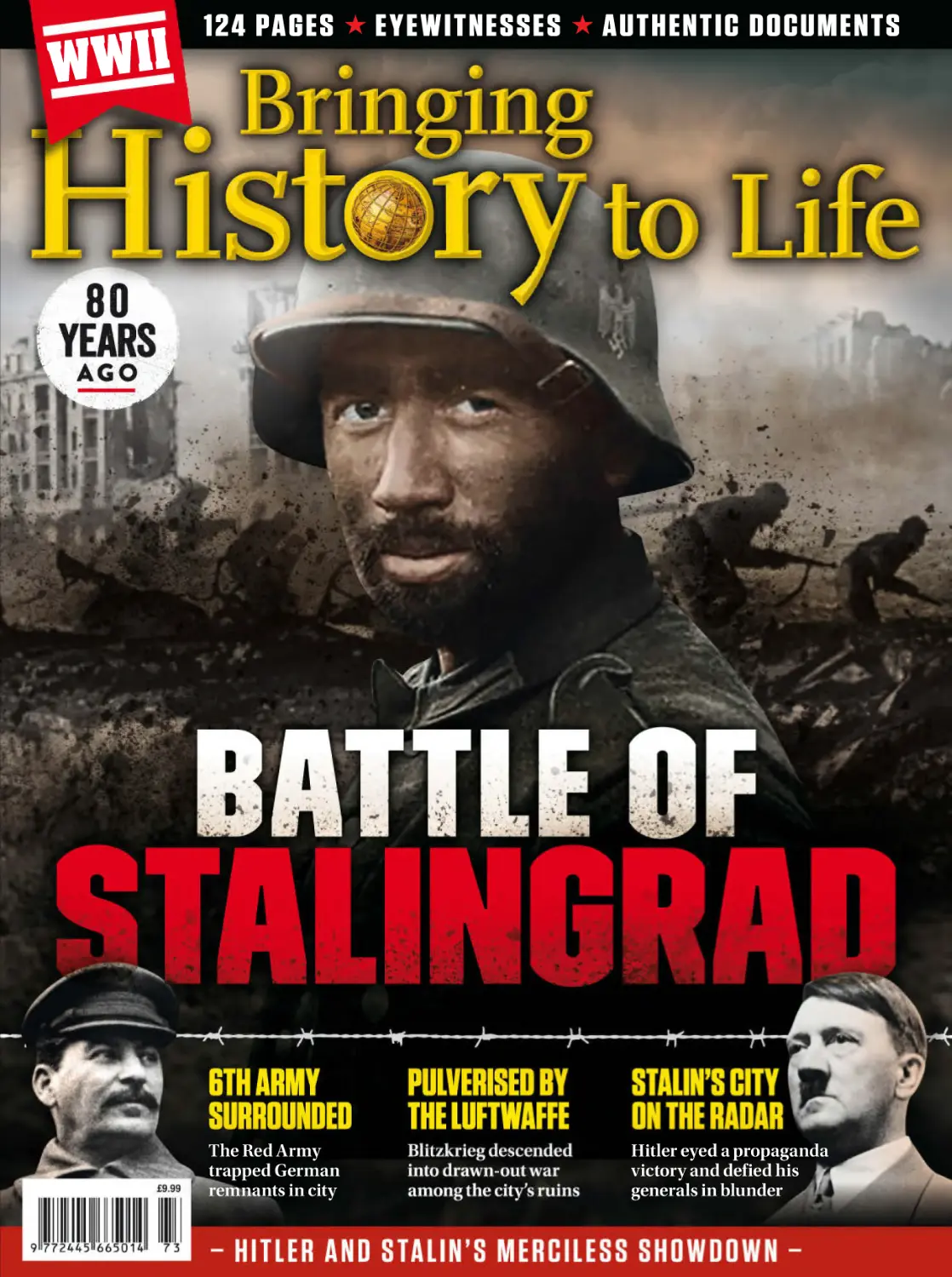
The Red Army
trapped German
remnants in city

Hitler eyed a propaganda
victory and defied his
generals in blunder

Animals flee this hell;
the hardest stones
cannot bear it for long;
only men endure.
Red Army officer to Soviet war reporter Vasily Grossman.

Helsinki

Leningrad

V

o

lg

R e i c h s k o m m i s s a r i a t
O s t l a n d

a

Moscow

Vo l g a

Minsk

GERMANY

Kursk
Don

R e i c h s k o m m i s s a r i a t
U k r a i n e

Stalingrad

Rostov

German advance until 7th July
German advance until 22nd July
German advance until 1st August
German advance until 18th November
0

175

350 km

Odessa

Maikop
Sevastopol

SOVIET UNION

Vo

lga

Grozny

6

Eastern Front, spring/summer 1942
Fall Blau (Case Blue) was originally
designed to secure control of Soviet oil
wells, but Hitler soon changed his mind and
set Stalingrad as his main target instead.

7

Assault on Stalingrad

On 28th June 1942, Army
Group South attacks from
eastern Ukraine. The entire group
is to fight its way to the Volga, then
one part will occupy the Caucasus
to the south, while another covers
the front to the north.

1

On 9th July, Hitler changes plans and
splits the group. The new Army Group B,
with fewer soldiers for the task, will carry out
the original plan: advance to the Volga, hold the
front line and protect Army Group A’s flank.

2

2

1

4
3

Hitler’s split sends Army
3 Group
A south to capture the
‘Gateway to the Caucasus’, the city
of Rostov. From there, the forces
will occupy the oil fields of Maikop,
Grozny and Baku.

Rostov

Stalingrad

On 23rd July, Hitler
again alters his plan.
Rather than remotely
disabling Stalingrad’s
weapons factories, the
Führer now demands that
General Paulus’s 250,000
men capture the city
regardless of cost.

4

Vo

lg

a

Astrakhan

Krasnodar

Sevastopol

T h e
C a s p i a n
S e a

Maikop

Grozny

Front line 27th June 1942
Oil fields
0

100

200 km

Baku

7/1

1942

FEDOR VON BOCK (1880-1945)
Leading the blitzkrieg against the Soviets
in 1942 was Field Marshal Fedor von
Bock, who’d previously led attacks on
Poland and Moscow. Von Bock’s victories
had given him a status that (almost) let
him speak out freely against
Hitler. Von Bock was a
monarchist and therefore
not committed to

12/5

8/2

8/2

River was the Soviets’
main transport route

The Volga was dubbed the heart of the Soviet Union because it
meandered through its central regions. During the war, the
river’s course made it a vital transport artery for the Soviets.

T

he Volga River meanders for 3,531
km from its source north-west of
Moscow to its mouth in the Caspian
Sea. With its branching tributaries, the
river pulsed with life during the war
across almost all of central Russia.
Barges transported food – in
particular grain and fish – to both the
civilian population and the army, but
the river was especially crucial in
relation to war production. Major
industrial cities such as Stalingrad lay

and other munitions were brought as
close to the front as boats could get.
It was also the transport artery used
by the Soviets to bring oil from the rich
fields of Baku in Azerbaijan to the rest
of the Soviet Union. That’s why it was
vital for Stalin to maintain control of
the southernmost part of the Volga,
where Stalingrad was situated.
German tanks reached the Volga

The constant underestimation of enemy potential is gradually taking on a
grotesque form and becoming dangerous.

FACTS
Nazi Germany had no
natural oil resources.

75%

of its oil was imported
from Romania, while most
of the remaining supply
came from the production
of synthetic oil.

The southern part of the
push was called
Operation Edelweiss,
after the mountain flower.

German mountain
divisions, tasked
with capturing the
oil of the Caucasus
Mountains, wore
the flower on
their uniforms.

Street fighting in Rostov
led to a stinging Soviet
defeat in five days. From
the city, the Germans
were free to advance
towards the Caucasus.

FACTS
During Case Blue, Army
Group South was to
capture the oil fields,
Army Group Central to
hold its front line, and
Army Group North to
capture Leningrad and
form an unbroken front
line all the way to Finland.

What’s around me is a very hell. There’s wailing and roaring all
around, the sky is splitting with the din.

The advance on the Volga
was titled Operation
Fischreiher (Heron).

The heron caught fish
and symbolised the
hunt for food and raw
materials in the Volga.

Soviet blood was a sacrifice Joseph
Stalin was willing to make to gain
the precious time required to roll
out an improved war machine.

20

Soviet Union, summer 1942

21

Not one step back!

The slogan “Not one
step back” appeared on
this stamp from the war.

The Soviet Union exploited
the use of stamps for
worldwide propaganda.

ORDER NO. 227

STATUS: Order 227 opened
by highlighting the Germans’
advance and cruelty: “The
enemy throws new forces to the
front without regard to heavy
losses and penetrates deep into
the Soviet Union, seizing new
regions, destroying our cities and
villages, and violating, plundering
and killing the Soviet population.”

ZERO TOLERANCE: Stalin used the order to
do away with commanders who permitted
withdrawals. They would henceforth be
punished: “It is necessary to eliminate talk that
we have the capability endlessly to retreat.”

LAST CHANCE: The order called on
soldiers to sacrifice themselves for
the Soviets: “We have lost more than
70 million people, more than 800
million pounds of bread annually and
more than 10 million tonnes of metal
annually… To retreat further means to
waste ourselves and to waste at the
same time our Motherland.”

SHAME: Red Army soldiers were shamed for
failing to live up to the Germans’ fighting spirit
– which was sustained in part by punishment:
“Our troops have the higher purpose of
protecting the abused Motherland and do not
have such discipline and so suffer defeat.”

FACTS
Brutality against your own
soldiers often has the
opposite effect.

212,400

soldiers from the Red
Army deserted and
surrendered to the Axis
powers during the war.

I don’t know if any population could be strong enough to
carry this terrible burden.

A political commissar storms ahead in
Ukraine in 1942. These men had to imprint
Communist ideology on their units.

All Red Army forces in
the Stalingrad battle
received a medal.

759,560 civilians,
officers and soldiers
received the honour.

STRENGTH RATIO
In 1942, Nazi Germany
produced a total of

5,530

armoured vehicles. In the
same year, the Soviet
Union produced

25,563

tanks and other
armoured vehicles.

...mobilised millions of soldiers
Fear, fervour and rushed training fed the front line with a massive flow of fresh Soviets to help meet Stalin’s
ruthless calculation: the Red Army could raise new soldiers faster than the Nazis could shoot them.

A woman often lay
behind the sniper’s
sights. Around one in
four Soviet snipers who
received formal training
were women.

Penal units sent on
suicide missions

During the war, both Nazi Germany and the Soviet Union
established penal companies for soldiers who violated military
edicts. The men in these units came from prisons and asylums.

I

n Nazi Germany, criminals, violent
offenders and inmates from mental
hospitals were assigned to a variety of
penal companies and battalions from
the outbreak of war in 1939. These
units were under the command of the
German military police and were
typically poorly armed. When not
performing physically demanding
forced labour, the units were forced
into suicide missions such as crossing
minefields, defending hopeless
positions and storming the battlefield.
During the war, over 50,000
Germans served in such punishment
units. Inspired by the Germans, Stalin
raised the number of penal troops,
which largely consisted of deserters,

cowards and “enemies of the people”
– opponents of the regime. The first
new unit was deployed in Stalingrad.
Three days later, 600 of its 929 men
were dead.
“We thought it would be better than
a prison camp. We didn’t realise at the
time that it was just a death sentence,”
said Ivan Gorin, one of the few to
survive his sentence.

Rapists and
murderers were part
of the unscrupulous
Dirlewanger
Brigade, a notorious
Nazi penal unit.

Propaganda posters
stressed the Soviets’
duty to work.

Black as things are, I somehow feel that Stalingrad is going to
provide something very big.
Stalingrad still holds
a special place in the
Russian national psyche.

This coin from 2013,
for example, shows a
memorial from the battle.

WORKERS
Armed with spades

The Red Army

Worker battalions

MORALE
Markets stayed open

Children went to school

Sport flourished

Kindergartens were open

Ballet continued

TANKS

leading
One of the e day,
th
f
o
ts
architec
c an
ri
e
m
A
e
th

hn
Albert Ktoar Plant to

e Trac
designed th most efficient
e
be one of th , capable of
d
rl
o
w
in the
icles at
making veh ed.
e
sp
g
in
lightn

Tractor Plant carried on

Guns fired from the halls

T-34 rolled into battle

VOLGA
Battle raged on west bank
The Battle of Stalingrad took
place on the west bank. There,
the city was reduced to rubble,
and the Germans captured 90
percent of the urban area.

Injured taken to safety
There were no field hospitals in Stalingrad,
because the Soviets could not get
medicine and bandages across the Volga.
The few wounded who reached the river
were attended to by nurses and taken to
the east bank at night in rowing boats.

Supplies to the front
Volga divided city
The river was under heavy German
bombardment throughout the
battle. According to eyewitnesses,
the Volga flowed with corpses and
broken boats, while the bank was
covered with dead fish mixed with
human heads, arms and legs.

From the safety of the east bank, the
Soviets tried to send men, weapons
and supplies across at night – with
horrendous losses as the boats were
fired upon by German guns and
attacked by the Luftwaffe.

Soviets controlled east bank
The east bank was relatively sparsely populated,
and there the Soviets had the opportunity to
deploy powerful anti-aircraft guns. The east bank
was therefore rarely targeted by the Luftwaffe.

38

Stalingrad, summer/autumn 1942
One thousand bombs a day for three
months. The scale of the German air
attack on Stalingrad meant it was
quickly reduced to ruins.

39

Death lurked in the clouds

FACTS
Germany’s Luftflotte 4
was the world’s most
powerful airborne
division in 1942.
The fighter pilots in
Jagdgeschwader 52,
history’s most successful
air unit, provided cover for
the bombers.

…Soviet pilots were
poorly trained
When the air attack on Stalingrad began, Soviet pilots offered
no significant resistance. Poor training and lack of experience
meant the pilots were no match for their enemy.

T

he ordinary Soviet pilot was
anything but a killing machine
behind the controls. Training was short
and in many cases pilots had
extremely poor knowledge of their
aircraft. When the 220th Fighter Air
Division arrived at Stalingrad, twothirds of the pilots had only minimal
experience flying the newly developed
Yak-1 fighters that they were to use in
the coming battle against the enemy.
On top of this, pilots had never been
in combat before and were easily
spooked. This was particularly evident
when the Soviets flew in formation and
the Germans hit their only experienced
pilot – the one usually flying at the front.
“A small group is easily contained
by the enemy. It loses the initiative,
disperses and suffers losses, since its
aircraft fight independently,” was the
conclusion drawn by Fedor Falaleyev,

the Air Force commander on the Southwest Front, in 1942.
Soviet pilots also didn’t gain a
thorough understanding of the region’s
geography, so even where they should
have had a natural advantage, the
pilots fell short. Knowledge of German
aircraft types and their tactics
was similarly poor until the Air Force’s
supreme commander, Alexander
Novikov, set out to do something about
the problem. In the summer of 1942,
he set up an intelligence unit to uncover
the Germans’ secrets so that Red Army
pilots could gain knowledge about what
they were up against in the skies.
Until 1941 there was a
narrow focus on
bombers, which left
Soviet fighter pilots in
short supply.

Gentlemen, flying for fun and seeing who can shoot down the
most enemy machines must stop.

The German
SC250 bomb fitted
most bombers.

The SC250
penetrated walls,
before the explosive
detonated.

42

The bombing raid
was so intense on
23rd August 1942
that columns of
smoke 3.5
kilometres
high rose above
Stalingrad. The
city burned for two
months afterwards.

43

The explosive charge of a
German butterfly bomb fired
splinters in all directions.

The name came from the
wings that unfolded when
the bomb was dropped.

23/8

1942

14/10

5/10

25/9

German air strategy tore the enemy apart
Early success in the German air war was largely due to the pilots’ innovative formation flying, with planes
following each other in pairs. This simple trick easily outmanoeuvred the Soviets’ traditional V-formation.

B

y chance, German pilots discovered that
their superior aircraft could wipe out the
enemy if pilots maintained formations of two

themselves so that anyone could detect an
enemy approaching under cover of the sun’s
glare. Because vision was the only sense pilots

para-zveno (section-flight). In addition, the more
experienced Soviet fighter pilots were assigned
to carry out “zasada” attacks, ambushes in

Shells detonated, it looked like darker and lighter balls of cotton wool.
And we had to fly into them!

The factories were the German bombers’ main target,
but although many were attacked from August onwards,
they continued production, albeit at reduced levels. The
Barrikady factory, which produced anti-tank guns, and the
Red October steel factory continued to operate until October.

1

The oil refinery was so badly hit on 23rd August
that a fireball 500 metres high rose from the plant.
In the days that followed, the black column of smoke
could be seen over 300 km away. Stalingrad’s defence
chief, General Yeremenko, witnessed burning oil flowing in
streams down towards the Volga to set barges and boats
on fire, as roads melted in a “whirl of heat and smoke”.

2

4

3

1

4
2

5

1

The Luftwaffe tried
to take out the guns
on the east bank of the
Volga, which the Soviets
were firing at the Germans.

5

3

Residential areas with civilians did
not escape Luftwaffe bombs. As early
as 23rd August, housing complexes burned
to the ground and German bombs reduced
the vast poorer neighbourhoods, where
houses were built from wood, to ashes.

4

Traffic on the Volga was subjected
to intense German bombardment
throughout the Battle of Stalingrad, as
barges and ships ferried munitions and
supplies across the river. Unfortunately,
many vessels carrying civilians in the
opposite direction were also hit.

3

1

AIRCRAFT

CREW: The aircraft had only one pilot in
ARMOUR PLATES: The aircraft
was extra carefully protected
with armoured plates on the front
where its fuel system, radiators
and cockpit were located.

the early machines used over Stalingrad
in the autumn of 1942. From 1943, a
machine-gunner sat wedged in behind
the pilot. The gunner’s job was to shoot
down attacking fighters.
COLOUR: Il-2s were
coloured white for use in
the snowy landscape of the
winter months. The rest of
the year they were painted
camouflage colours.

MACHINE GUN: The bullets
from the fighter-bomber’s
37-mm machine gun were
so powerful that they could
penetrate a tank’s armour.

TAG: The pilots liked to
ENGINE: With a water-cooled Mikulin
V12 engine, the machine could
reach a top speed of 414 km/h.

write slogans on the side of
the plane, such as “death
to the fascist occupier”.

The real thing was very different. They came back crying their eyes out.
They were ready to drop.

Some German incendiary bombs
had a charge in the nose that
could punch a hole in a house
before the bomb went off.
A single bomber could drop
1,152 incendiary bombs at
once. Each bomb weighed
one kilogram.

AT THE SAME TIME
FRANCE/DIEPPE:
●

An Allied landing ends
in disaster.

POLAND/STANISLAU:
●

German soldiers brutalise
and execute 1,000 Jews.

USSR/MOSCOW:
●

Churchill tells Stalin that
D-Day will not be carried
out in 1942, as the
Soviets hoped.

The Soviets swarmed out of every
corner of Stalingrad like rats, according
to the German troops. It was the only
way to fight in the shattered city.

52

Stalingrad, autumn 1942

53

Rat war in the ruins

The Soviet spade
was designed to
dig trenches.

In Stalingrad, the
spade’s blade was used
as a mêlée weapon.

Those are not people in the silo, they are devils and neither fire
nor bullets can touch them.

FACTS
The Soviet counterattacks in Stalingrad
slowed the German
advance, but cost dearly
in lives; 30% of the 13th
Guards Rifle Division died
within 24 hours of being in
the city. Only 320 out of
10,000 soldiers survived
the battle.

VASILY CHUIKOV

The son of a peasant,
Chuikov enjoyed
respect, thanks to his
stature and strength.
He won the high regard
of privates by staying with
them at the front. The general
served as military advisor to
Chiang Kai-shek in China in
1941, far from the horrors of
the new Eastern Front. In 1942,
Chuikov was brought in as a
breath of fresh air to reverse the
smouldering failure of Stalingrad.

MACHINE GUN

MATERIALS: The PPSh-41 was produced from readily

available materials, primarily wood and steel. Its simplicity
made the weapon durable and required little maintenance.
The machine gun weighed less than its Finnish source of
inspiration, increasing recoil and reducing accuracy.

In some places you had to move two or three dead bodies
aside to lie down.

AMMUNITION: Almost all WWII machine guns used 9 x

19-mm ammunition, but the PPSh-41 was designed to use
7.62 x 25-mm Tokarev cartridges, a considerably more
powerful munition that could be used at longer distances.
Soviet machine guns could fire up to 200 metres.

SIGHT: An adjustable sight
could be set for targets at
either 100 or 200 metres.

MAGAZINE: A drum magazine with 71 cartridges clicked on

to the barrel, but in a packed magazine, the cartridges risked
jamming. The drum also provided poor grip for two hands.
After 1942, the PPSh-41 could be fitted with a 35-round
curved magazine, which provided better grip and reliability.

STRENGTH RATIO
As the battle for Stalingrad
peaked, the Soviets had

1,143,000

soldiers at the front. On
the German side there were

1,040,000

troops, of which about 50
percent were from Hungary,
Italy and Romania.

Soviet bayonets were
screwed on to the end of the
gun barrel and were used
extensively at Stalingrad.

Later rifle types had a
fixed bayonet, that could
be folded up.

The mastermind behind
the AK-47 got the idea for
the iconic assault rifle in
1942 when he heard a
compatriot complaining
about his machine gun.

Mikhail Kalashnikov

Stalingrad was a
school for snipers

During long expeditions in Stalingrad’s ruins, the Soviet Union’s
most skilled snipers taught young Soviets to kill Germans from a
distance. The training made death omnipresent for the enemy.

F

or Vasily Zaitsev, hunting had been
a way of life since his childhood in
the Ural Mountains. There he learned
from a young age to kill prey to put
meat on the table. When Zaitsev
volunteered for the Stalingrad Front,
he impressed army command by
eliminating 40 German soldiers in just
ten days. One-man warfare didn’t
come as easily to other young Soviets,
so Zaitsev, only 27, was put in charge
of training snipers in the city.
Zaitsev’s students received theory
and marksmanship training in a forge,
then got hands-on experience in the
art of killing during missions in
the ruins. Among other things, they

or six Fritzes from the same lair. The
Germans would then usually try to
flush you out with mortar or artillery
fire,” explained another sniper, Mikhail
Mamekov. So, the students had to
constantly move between hiding spots.
Zaitsev was also very aware that
“when someone shoots in the dark you
can see the flash clearly”. That’s why
he spent night-time finding new hiding
places and daylight hours lying with his
rifle. According to star pupil Anatoly
Chekhov, sunlight also caused
problems: “When it was sunny, there
was a shadow on the wall when I
moved [so] I didn’t shoot them when it
was sunny,” he said.

People think that urban warfare is a matter of walking down a street and shooting.
That’s nonsense. The streets are empty.

FACTS
Mamayev Kurgan was so
ravaged by the battle that
every square metre was
covered by

500-1,250

bullets and bomb
fragments. For a year
after, no grass could grow
on the mound.

21/9

1942

1/11

17/10

25/9

…civilians survived
among the rubble
Stalingrad’s remaining inhabitants lived in cellars, sewers and
holes as history’s worst battles unfolded in the city. Shelling,
cold and hunger were an ever-present threat to civilian life.

W

hile everyone knew that war was
approaching, some 150,000
civilians were in Stalingrad when
German troops attacked on 13th
September 1942. Many residents had
fled after the Luftwaffe bombings in
August, but just as many elderly
people, factory workers, women and
children stayed because they didn’t
want to leave everything they owned
behind. Others remained because of
the risks of leaving during the coming
winter, when cold and disease were
major hazards.
“I could have got out of the city, but
all my children were sick at the time,”
said cook Agrafena Pozdnyakova, who
lost her husband and two of her six
children to artillery during the fighting.
Pozdnyakova saw her home wrecked
by bombs and shells. She sought
shelter in cellars, sewers and holes in
the rubble with her children. Many also
Joseph Stalin refused
to evacuate Stalingrad.
The inhabitants had to
remind the soldiers what
they were fighting for.

sought refuge along the Volga, digging
caves in the steep banks. The sight
shocked a Soviet commander:
“I shall never forget the scene that
opened out before me. This gully,
which stretched to my left and right,
swarmed with life, just like an anthill
dotted with caves. Entire streets had
been excavated on either side. The
mouths of the caves were covered with
charred boards and rags. The women
had utilised everything that could be
of service. … [T]he struggle being
waged is for life or death,” he wrote.
In October, the Germans ordered
civilians on long marches to camps in
the west, but 15,000 hid in Stalingrad
throughout the battle. They were
exposed to German and Soviet artillery,
but many died of cold and starvation.
The survivors coped by eating dead
animals and stealing wheat from
German depots that eventually ran out.

Knives and small, sharp spades are the best weapons for storm group fighting – it is all
about physical toughness and quick reflexes.

Molotov cocktails
were thrown at
German tanks.

A windproof match,
for example, could
be used as a fuse.

HITLER’S STALINGRAD SPEECH

ENEMY: Hitler began by naming the Jews
as the enemy ruling the countries Nazi
Germany was fighting. Worst of all was
the Soviet Union, his message went.

TRANSFORMATION: In his speech, Hitler
stressed that since WWI, thanks to the Nazis,
Germany had built a strong national identity
that no other nation would be able to defeat.
Earlier, he cited the Jews as the direct cause
of the Germans losing the war in 1918.

COMPARISON: Then Hitler
measured Nazi Germany’s
strength against the Soviet Union
and explained why Germany,
alone, had created a successful
socialist state. He used the
comparison to portray the Soviets
as an inferior enemy.

LIES: Official Soviet statements
were denigrated as lies.
Ironically, Hitler would claim
that he had reached the
Caucasus at breakneck speed.

STRATEGY: Adolf Hitler had a reputation for
making rash decisions on the battlefield. In the
speech, he discussed how he made them. For
instance, in 1942, the Soviets expected the
Germans to strike in the middle of the Eastern
Front, near Moscow, as they had in 1941.

CHANGE OF COURSE: The Führer
explained the strategy behind setting
course for Stalingrad and said the
change of direction was not due to the
fact that the city bore Stalin’s name.
VICTORY: Luftwaffe bombing had rendered the
Volga virtually useless as a transport route through
the Soviet Union. Stalingrad was therefore as good
as fallen, according to Hitler. But as he gave his
speech, he knew the Soviets were holding out
against an increasingly weakened enemy.

VERDUN: Approximately 714,000
soldiers died during the Battle of Verdun.
In the Battle of Stalingrad, up to two
million died in five and a half months.

CONFIDENCE: Critics of the Third Reich
were given a dressing-down. After the
Battle of Stalingrad, Hitler acknowledged
a German misstep for the first time.

Right then I popped out of the trench, shouldered my rifle,
and shot. I got him.

NEWS FROM THE FRONT:

We were worn down, nearly out of ammunition. We
had limited supplies.

Vasily Chuikov

MEANWHILE
ENGLAND:
●

Conscription is lowered
to 18 years.

NORTHERN GERMANY:
●

First V2 rocket launched.

SOLOMON ISLANDS:
●

Guadalcanal naval
battle begins.

When a grenade went off,
its metal shell shattered,
killing people within a 1015-metre radius.

The Soviet RGD-33 had a
handle that made the
grenade easy to toss 30-40 metres with a
strong throw.

The city battles wore the
German troops down to
lifeless shadows with
thousand-yard stares
painted on their faces.

An expert explains

What was the mood among civilians before the
Germans bombed Stalingrad on 23rd August?
How many civilians were left in Stalingrad
when the Germans attacked in September?

Why did some civilians choose to stay?

How did the remaining citizens of the war-torn
city survive?

(born 1966)
German-born Jochen Hellbeck is a professor at Rutgers
University, New Jersey, and the author of the book Stalingrad:
The City that Defeated the Third Reich, which examines the
city’s significance for Soviet soldiers and its civilians.

What did the Germans do with the civilians in
the city?

How many civilians were left in Stalingrad
after the Germans had captured the ablebodied population?

What happened when the Soviet
army retook Stalingrad?

Soviet prisoners of war
survived by eating
horses as supplies
on the Eastern
Front became
scarce in 1942.

82

Stalingrad, autumn/winter 1942

Ice-covered bodies piled up around
Stalingrad after the ground froze like
concrete. The decisive phase of the
battle cost thousands of lives.

83

The Soviet trap closes

A padded jacket, the
Telogreika, kept Soviet
soldiers warm in subzero temperatures.
The Red Army’s
winter uniform was
far more effective
than that of the
Germans.

STRENGTH RATIO
During Operation Uranus,
the Soviets attacked with

728

tanks against some

164

obsolete Romanian and
German tanks. Many
were incapacitated
because mice had
chewed through their
electrical wires.

ROCKET LAUNCHER

RAMP: Parallel rails
formed the launch
pad, which could
accommodate 6-48
missiles. Rails were
also sometimes
mounted on sleds
or trailers.

BM-13 ROCKET: Each
rocket had a diameter of
13.2 cm and weighed
42 kg. The range was
8.7 km. The BM-13
missiles left a minimal
smoke trail, which made
it difficult to pinpoint the
battery’s position.

SUPPORT FEET: A pair

of front and rear support
feet could be extended
to stabilise the vehicle
before launch, so the
truck didn’t tip over
when the rocket’s
forces were unleashed.

ADJUSTMENT: A frame raised the

launch pad to the proper angle
when launching the rockets. The
entire ramp could be rotated so the
truck didn’t have to park in a certain
direction in relation to the target.

ARMOUR PLATES: Armour plates
were fitted behind the cab to protect
the windows. At the front, plates
could be folded down to protect the
windows at the moment of launch.

I feel much better because we have started to destroy Germans. This was the moment
when we began to beat the snakes.

Walther von Seydlitz-Kurzbach

Friedrich Paulus

1

On 19th November 1942, the Red Army led
by General Nikolai Vatutin attacks 150 km
north-west of Stalingrad. In under ten hours, the
Soviets advance 25-30 km across enemy lines.

1

Klotskaya

1

Golubinskaya
Stalingrad

Kalach

3

Sovetsky

Pitomnik

After only four days, the
Soviet troops meet up on
23rd November to surround the
6th Army. The town of Kalach is
pre-designated as the point
where the two Soviet armies
will meet to close the ring.

3

2

2

Dawn, 19th November 1942
30th November
Axis forces
0

20

On 20th November, another army
under General Andrei Yeremenko
advances on the 4th Romanian Army, 50 km
south of Stalingrad. Here, too, the Soviets
overcome the enemy without much difficulty.

2

23rd November

40 km

I know the 6th Army and your commander-in-chief and have no doubt that
in this difficult situation it will hold on bravely.

Vodka was
distributed to Soviet
soldiers as part of
their field ration.

One of the purposes
of the alcohol was to
warm the soldiers in
the trenches.

Lice and dirt
weakened soldiers

Disease spread like steppe fires among the German soldiers,
who lived like animals in the barren plains and ruinous heaps
of Stalingrad under miserable hygienic conditions.

D

irty men, huddled together for days
in trench holes and bunkers,
quickly crumbled in Stalingrad.
Hypothermia and a lack of food and
nutrients wore down the soldiers’
immune systems, leaving them unable
to fight off infectious diseases such as
hepatitis and dysentery.
The poor sanitary conditions
worsened the situation. The troops
rarely had the opportunity to wash
themselves and their uniforms
properly, because firewood to thaw
snow and heat water was in short
supply. Instead, the army lived in each
other’s dirt, while lice crawled

Bathing, delousing and
washing clothes were
everyday life for Soviet
soldiers (right), who had
access to bathhouses
throughout the battle.

everywhere. A German corporal
described the infestation:
“Every day we become more
infested with lice. Lice are like the
Russians. You kill one, ten new ones
appear in its place.” Lice transmitted
diseases like typhus between the closeknit men and made the skin itch, so the
soldiers’ constant scratching opened
wounds that risked being infected.
In bunkers and cellars, soldiers
couldn’t dig latrines, so they often
squatted over a shovel and did their best
to flush the faeces out of the nearest
hole. Underground, disease ran rampant
among the emaciated soldiers.

Soviets smoked a type
of cigarette called
papirosa with a
cardboard mouthpiece.

Herzegovina Flor was Stalin’s favourite
and therefore also loved by the Soviets.

FACTS
Romania’s poor defences
were largely down to
outdated equipment
and artillery, coupled
with a lack of troops.
Also, the Germans ignored
Romanian pleas to slow
down the Red Army by
blowing up bridges.

After many died in
the cold, the Red
Army introduced the
ushanka fur cap.

The cap was made of
wool with a layer of fur
underneath, typically
sheep or mink.

COMMAND TO THE 6TH ARMY

BATTLE TO THE DEATH: Stalingrad
must be held “in all circumstances”.
Such is the order from Hitler, who thus
denies the 6th Army any conceivable
way out of the Stalingrad cauldron.
Instead, the Führer launches an airlift
to keep the troops supplied and a
push, Operation Winter Storm, to
create a supply route.

FORTRESS: Hitler mentions the importance
of Stalingrad to the Soviets: the enemy “is
desperately trying to recapture the
important fortress on the Volga”.

KHARKIV: In his order,
Hitler draws parallels with
the fighting at Kharkiv,
where the Soviets had
counter-attacked in the
spring but had ultimately
been surrounded and
wiped out in a German
pincer manoeuvre.

FACTS
The area surrounded
by the Red Army
covered almost

2,000

square kilometres –
40 km from north to south
and 50 km from east to
west. Inside the pocket
were 100 tanks and
2,000 pieces of artillery.

Your situation is hopeless, and any further
resistance senseless.

...the German airlift
doomed to failure?
Luftwaffe chief Hermann Göring promised loud and clear that
his planes could keep the 6th Army supplied via an airbridge
in the Stalingrad cauldron. The promise had no basis in reality.

F

rom January to June 1942, the
Luftwaffe supplied 100,000 troops
trapped in a defensive pocket at
Demyansk between Leningrad and
Moscow. So, Luftwaffe commander
Hermann Göring had no hesitation in
promising to deliver at least 500
tonnes of supplies a day to the 6th
Army via an airbridge – a plan proposed
by Colonel-General Hans Jeschonnek.
But in Stalingrad in November 1942,
the situation was vastly different.
Here the Luftwaffe had to supply
almost three times the number of
soldiers, but the Germans had fewer
transport planes available. At the same
time, the airfields outside the cauldron
were hundreds of kilometres away,
making the supply routes longer and
more dangerous. The German Heinkel
and Junker transports couldn’t be
protected by escort aircraft because
the fighters didn’t have the range to

Wounded soldiers
help a transport
plane on the runway
at the captured
airfield in Pitomnik.

make the outward and return journeys.
The Soviets, on the other hand, now
had far more aircraft at their disposal
to shoot down the German transports.
Göring’s optimism also failed to take
into account that the harshest winter
months lay ahead, when bad weather
would prevent many flights. Most
German transport planes weren’t
designed for the frost and snow of the
Eastern Front – one German pilot
bemoaned the poor supply of spare
parts and the fact the aircraft couldn’t
always be started in the harsh cold.
As Generals Richthofen and Zeitzler
pointed out, the airbridge was doomed
to failure. Whereas Göring promised
500 tonnes of supplies per day, the
Luftwaffe delivered just 89.3 tonnes
per day on average from the end of
November. The airlift also cost the
Luftwaffe dearly: it lost 488 aircraft,
plus 1,000 aircraft crew.

Can you tell us how you ended up fighting on
the Eastern Front?

How did you feel about the German Army’s
inability to fortify the front?

Herbert Scherer was drafted into the German Army at the age of 18 and enlisted on the
Eastern Front to stop Stalin and the atrocities that Scherer believed would befall
Germany if the Soviet Union won. He was captured in the autumn of 1943 and
spent six years in Soviet prison camps east of the Ural Mountains. In 1953,
he left Germany and emigrated to Canada, where he lives today.

Can you tell us about when you were captured?

What was it like to be a prisoner of war?
Were you immediately sent marching off
towards the east?

It was in the prison camp that you first saw
prisoners of war from the Battle of Stalingrad. I
know you saw them being treated particularly
badly. Can you tell us about that?

Which camp did you end up in when you
finally got there? Can you tell us about it?

You were also put to work getting timber. What
was the lumber for?

And then you were finally sent home to
Germany. How was it to go back? You must have
been happy…

You were in a prison camp until 1949. Did you
stay in the camp at Gorky for all those years?

You also suffered from tuberculosis but
survived. Can you tell us about it?

Wretched German troops surrender to
the Soviets at Stalingrad in 1943. Of the
approximately 95,000 prisoners of war,
fewer than one in 19 returned home alive.

104

Stalingrad, winter 1943

105

Doomsday awaited in Stalingrad

Spades from the
Red Army were
found in 2015.
They were often
used as weapons.

War materiel still
emerges from the
ground in Stalingrad,
now Volgograd.

FRIEDRICH WILHELM PAULUS

FACTS
While airlifts were
operational, the Germans
carried up to

35,000

wounded out of the
pocket. Many soldiers
clung to the planes
as they took off, until
they ran out of strength
and fell.

German doctors coldly divided wounded

Wounded Germans received no or very little treatment in the field hospitals of the pocket. Only a small group
received genuine help from the doctors, who had to make difficult choices between life and death 24 hours a day.

A

s winter gripped Stalingrad, chaos
reigned in the German field hospitals at
Pitomnik and Gumrak airports, now the 6th
Army’s last way out of the pocket. Every day,

admitted those who had a chance of being
patched up and regaining the ability to fight.
Minor injuries, such as flesh wounds and
frostbite, usually just earned a return ticket to

called the police Kettenhunde – chain dogs –
because they also carried out executions when
doctors spotted men with a bullet wound in
their right hand. The injury was the most

Frozen bodies were piled
in heaps, and almost
every deceased soldier
was robbed of anything
of value, such as food,
boots or warm clothes.

13/1

1943

Friedrich Wilhelm Paulus

19/2

2/2

29/1

The identification
of skeletons of
those killed at the
Battle of Stalingrad
is still ongoing.

New bones and skulls
regularly turn up in mass
graves or open fields.
Here is a find from 2006.

When you have a revolver it’s quite easy. How cowardly you must be to flinch
before such a deed!

The Yelabuga region
became home to most of
the German officers who made
the 1,200-km march north
from Stalingrad to the city. They
were put to work in agriculture –
pulling a plough themselves, for
example, instead of using
horses and oxen.

2

The Ural Mountains
were the final destination
for many German prisoners,
who were made to toil in the
area’s mines. The extraction of
iron and copper was important
for Soviet industry, which the
prisoners’ forced labour
helped to sustain.

3

4

2
3

Stalingrad
1

C

T
as h
e
S pi
e a
a
n

Concentration camps 50 kilometres east of Stalingrad were the
prisoners’ first destination. Here they were registered and assigned
to a prison camp. The Germans expected to be transported by truck or
train, but instead had to walk through the snow in inadequate footwear.

1

Southern Siberia was
home to several prison
camps, where prisoners felled
and dragged timber if they
were not toiling in coal mines
and quarries. To reach this
suffering, the already tortured
prisoners had to first survive a
nearly 5,000-km hike across
the country.

4

1-9 camps
10-19 camps
20-30 camps
0

500

1,000 km

FACTS
The victims of Stalingrad
didn’t die entirely in vain.
The 6th Army held out
just long enough for the
German troops in the
Caucasus to withdraw.
The total loss would have
been higher if Paulus had
surrendered earlier.

I could hear their skulls crack beneath my wheel. Bones too.
And I was glad.

Helsinki

SOVIET UNION

Leningrad

V

o

lg

R e i c h s k o m m i s s a r i a t
O s t l a n d

a

Moscow

Vo l g a

Minsk

GERMANY

Kursk
Don

R e i c h s k o m m i s s a r i a t
U k r a i n e

Stalingrad

Rostov

Odessa

Soviet victories up to 12th December 1942
Soviet victories up to 18th February 1943
0

175

350 km

Maikop
Sevastopol

Vo

lga

Grozny

Surrounded and
frozen, Axis soldiers
were trapped in the
Stalingrad pocket –
the area the Soviets
encircled in winter.

COVER

NOT ONE STEP BACK

WELCOME
RAT WAR IN THE RUINS

CONTENTS

ASSAULT ON STALINGRAD

HOW STALINGRAD SURVIVED
DEATH LURKED IN THE CLOUDS

Georgy Zhukov

Konstantin Rokossovsky
Bernard Montgomery

STALINGRAD’S CITIZENS CAUGHT IN
THE CROSSFIRE

THE SOVIET TRAP CLOSES

WAR’S LAST EYEWITNESSES

DOOMSDAY AWAITED IN STALINGRAD

MAP, PICTURE INDEX, CREDITS

Soviet troops sneak as near to
the enemy as they can. Close
up, German long-range and
heavy artillery was useless.

THE BATTLE OF STALINGRAD
Publishing Director: Morten Kaiser
Editor-in-chief: Ann Qvist
Production: Eva L Strandmose
Cover: Sidse Lange
Translators: Nick Peers, Katharine Davies,
Toni Baxter

Licensing and Syndication:
Regina Erak – regina.erak@globalworks.co.uk
Tel: +44 (0)7753 811622

ISSN: 2445-6659
Printed by: Poligrafijas Grupa Mukusala, Latvia

All rights reserved. Reproduction in any manner or
form is strictly prohibited without the prior written
consent of the publisher. Whilst every care is taken
with the material submitted to this bookazine,
no responsibility can be accepted for loss or
damage. Whilst every effort has been made to
contact all copyright holders, the sources of some
pictures that may be used are varied and, in many
cases, obscure.

Marketing/Distribution UK and Export:
Marketforce (UK), 3rd Floor, 161 Marsh Wall,
Canary Wharf, London E14 9AP
Tel: +44 (0) 20 3787 9001
www.marketforce.co.uk

The publisher is happy to make good in future
editions any error or omissions brought to their
attention. The publication of any quotes or
illustrations for which authorisation has not been
given is unintentional.

Bringing History to Life is published by:
Bonnier Publications International AS,
PB 543, 1411 Kolbotn, Norway.

“CAN WE REALLY HAVE
LOST SO MANY MEN?
GOD DAMN THIS STALINGRAD.”
Those were the words of German soldier Wilhelm Hoffman when he saw the endless
rows of crosses at Stalingrad in September 1942. Hoffman was just one of millions
who fought bitterly and brutally for every inch of the ruined industrial city on the
strategically critical Volga River. ‘The Battle of Stalingrad’ brings you up close to the
young German and Soviet men who were sent to their deaths in that all-consuming
battle. Find yourself in the generals’ headquarters, observe the bloody battles at
close quarters and marvel at those civilians who survived against all the odds. Read
the full story of history’s most brutal urban war as told by those who saw it happen.