/




Текст
New
SCIENCE 4LIFESTYLE 4GENETICS 4NUTRITION
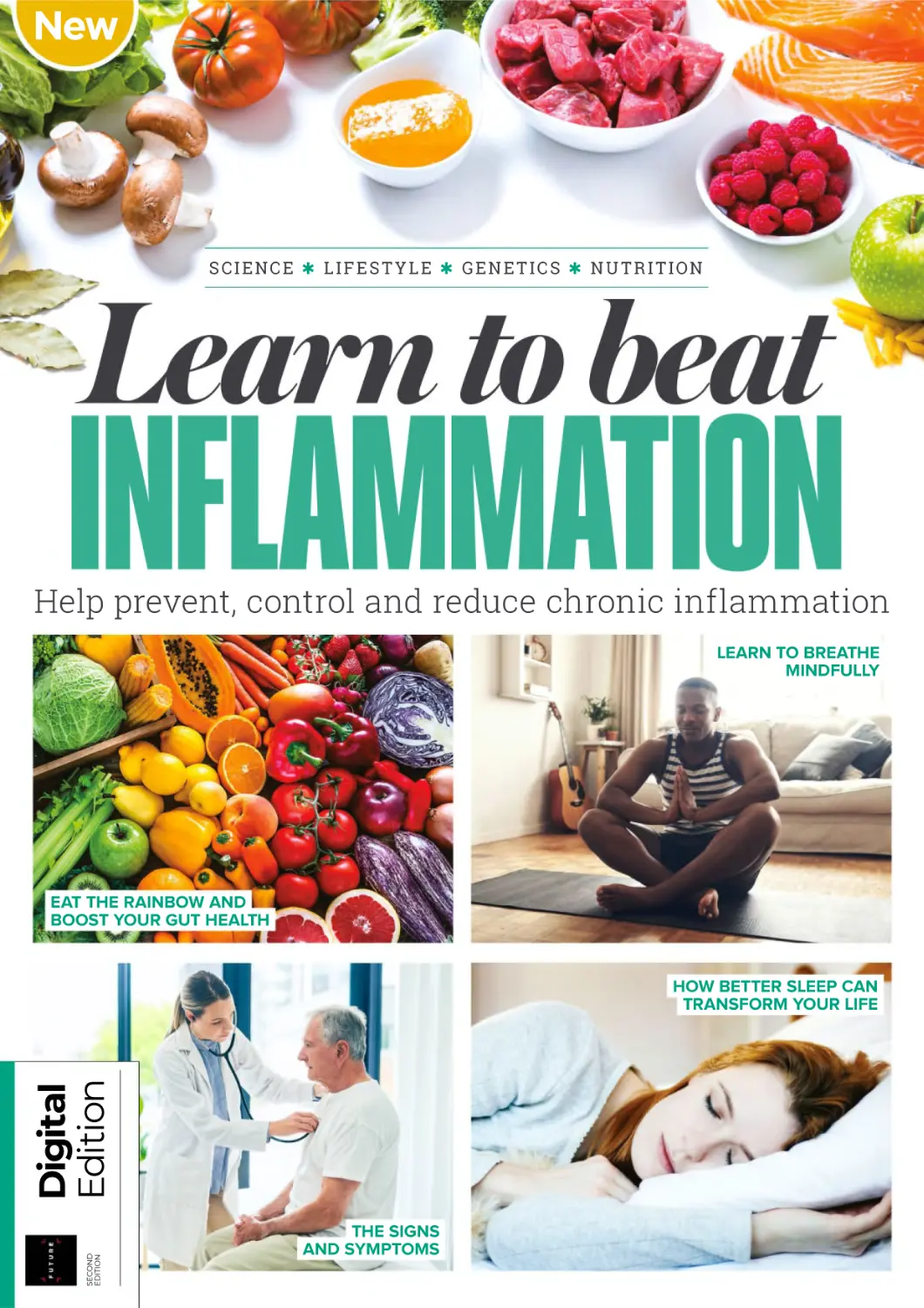
Help prevent, control and reduce chronic inflammation
LEARN TO BREATHE
MINDFULLY
EAT THE RAINBOW AND
BOOST YOUR GUT HEALTH
SECOND
EDITION
Digital
Edition
HOW BETTER SLEEP CAN
TRANSFORM YOUR LIFE
THE SIGNS
AND SYMPTOMS
Learn to beat
INFLAMMATION
Inflammation is necessary for the body
to heal and defend itself against illness.
The inflammatory response, however,
can occasionally go too far, activating
when there is no threat and leading to
pain and discomfort instead. In Learn to
Beat Inflammation, you’ll learn about the
science behind the body’s inflammatory
response and how making small
changes to your lifestyle, such as taking
care of your gut health and reducing
stress, can help you prevent, control,
and reduce chronic inflammation.
20
58
Lifestyle
26 Bodies on fire
Different ways to self-soothe
and reduce stress levels
28 Learning to relax
Different ways to self-soothe
and reduce stress levels
32 Easy breathing
Inflammation
08 Understanding
Inflammation
Discover inflammation and
what it does for our bodies
14 Too much of a good thing
Learn what happens when
inflammation lingers
16 What causes
inflammation?
From diet and gut health to
environmental factors
20 Signs and symptoms
Uncover the symptoms of
chronic inflammation
16
4
Our guide to breathing
mindfully for less stress
34 Exercise is good for you
The benefits of moving your
body to reduce inflammation
36 Time for yoga
Build strength, gain flexibility
and improve your wellbeing
44 Walk off the weight
How transform a simple
stroll into a workout
48 The benefits of sleep
Discover how a lack of sleep
contributes to inflammation
50 The A-Z of better sleep
Get a good night’s rest with
these expert bedtime hacks
54 Breathe and sleep
How meditation can improve
sleep and reduce inflammation
40 Less pain, more gain!
Reap the benefits of gentler
exercise to get you moving
54
Recipes
92 Healthy smoothies
94 Shakshuka
96 Superberry breakfast bowl
96 Butternut & kale
breakfast strata
97 Flapjack breakfast bars
98 Spice lentil soup
99 Veggie boost grain salad
Nutrition
58 Gut health and
inflammation
Improve your diet for a
positive impact on your body
64 Anti-inflammatory foods
Strengthen your body’s
anti-inflammatory shield
100 Greek-inspired bean burgers
80 Taste your way to
better health
The herbs and spices
that can fight inflammation
82 Inflammatory foods
to avoid
Discover the food and drink
that can increase inflammation
101 Tuna and kimchi jackets
101 Green goddess chicken salad
102 Peri-peri rainbow wrap
103 Sausage stews with butternut
squash & cannellini beans
86 How to ferment food
Uncover the benefits of
fermented food for gut health
88 Fibre & vitamin D
The importance of fibre and
vitamin D for your body
103 Miso cod with
tenderstem broccoli
104 Turmeric roast chicken
105 Chicken & kale stir fry
106 Roast side of salmon
with blushing veg
82
108 Sardine & spinach panzanella
109 Beetroot balls in
Spanish-style sauce
110 Berry and watermelon sorbet
111 Raw chocolate brownie
112 Frozen berry yoghurt
5
08 Understanding
Inflammation
Discover inflammation and
what it does for our bodies
14 Too much of a good thing
Learn what happens when
inflammation lingers for too long
16 What causes inflammation?
From diet and gut health to
environmental factors
20 Signs and symptoms
Uncover the symptoms of
chronic inflammation
6
7
INFLAMMATION
8
UNDERSTANDING INFLAMMATION
What is inflammation, when do we
need it and what happens when an
inflammatory response doesn’t stop?
INFLAMMATION
Cytokines regulate inflammation in your
body by activating cells and telling them
where to go, or by creating more cells
of the right type that are needed. They
might even signal that more cytokines
are needed to help in an inflammatory
response. It’s all pretty clever and we
don’t realise quite how much is
happening inside our bodies when
faced with illness or injury.
The immune system’s response to its
trigger can be both inflammatory or
anti-inflammatory, depending on what is
needed. When your body needs to fight
off a viral or bacterial infection, or if
you’ve injured yourself, then it will
trigger inflammation to help fight the
infection or encourage tissue renewal.
However, the immune system also
knows when it needs to stop
inflammation, as too much inflammation
over a too-long a period of time can
cause problems.
You might be able to spot the signs
of this process at work, particularly if
you’ve injured yourself. If you twist your
ankle, you might spot it swell up and
bruise around the sore area; if you’ve
got a cut, then it will go red as the
immune system sends cells to the area
to help fight off any bacteria and
prevent infection. However,
inflammation also happens internally
where you can’t see any external
symptoms at all.
PHOTOS: GETTY IMAGES
O
ur body is pretty clever. It
has a number of built-in
systems and processes to
cope with everything that
is thrown at it. One of these processes
is inflammation, which is a natural bodily
response to the presence of an
unwanted intrusion from a virus,
bacteria or other toxic element, or as
the result of an injury.
Inflammation is part of the immune
system. When something happens to
you, such as catching a virus or
suffering a fall, the immune system
responds by sending out its first line of
defence. This includes inflammatory
cells and cytokines. The inflammatory
cells’ job is to attack any bacteria or
viruses it finds, and to heal damaged
tissue in the case of an injury.
Cytokines are incredibly important
proteins that act as messengers to
signal your immune system to respond
in different ways, including the
production of more inflammatory cells if
needed. There are many types of
cytokines, each signalling different
responses in the body and
communicating between cells – the
word derives from the Greek for ‘cell’
(cyto) and ‘movement’ (kinos). For
example, chemokines direct immune
cells in the right direction towards
where they are needed; interferons
help the body to resist viral infection.
9
INFLAMMATION
An inflammatory response that
happens at the point of an injury is
called acute inflammation, and is a
normal, controlled reaction to a trauma.
Sometimes, however, your body
triggers inflammatory cells over a long
period of time, or when you don’t need
them, which can develop into chronic
inflammation. We cover more about the
differences between acute and chronic
inflammation in the next section.
When we talk about things like an
anti-inflammatory lifestyle or diet, for
example, we’re not trying to stop the
process of inflammation altogether. We
need inflammation to work effectively
as part of our body’s immune system
response. However, we do want to try
Chronic inflammation
has been linked to
several diseases and
conditions, such as
high blood pressure
Researchers are
looking into the
impact of
inflammation on
the development of
type 2 diabetes
and protect against, or reduce, chronic
inflammation and its related symptoms.
Chronic inflammation has been linked
to a number of serious diseases and
conditions, including heart disease,
cancer, bowel disorders, high blood
pressure, kidney disease, arthritis,
vascular dementia and more.
Increased risk
of inflammation
There are many reasons why some
people might be at an increased risk of
an unhelpful level of inflammation. We’ll
explore more of the lifestyle causes of
inflammation in a later feature, which
are factors that we can exert a measure
of control over.
Being overweight or obese carries a
higher risk of inflammation. We’ve
already mentioned the important role
that cytokines play in triggering an
inflammatory response. However,
adipose tissue, aka body fat, can also
produce cytokines, including a sub-type
called adipokines, which impact on
metabolism and inflammation. Some of
these adipokines have been shown* to
regulate the inflammatory response in
10
cartilage, which suggests a strong link
between obesity and osteoarthritis, a
form of chronic inflammation. The body
can also suffer some internal trauma
from carrying excess weight, which can
itself trigger inflammatory cells to help
try and heal the trauma. If the weight
remains or increases, this trauma is
ongoing and therefore so is the
inflammatory response.
Those who have type
1 or type 2
diabetes might
also be at an
enhanced risk
of
inflammation,
and inflammation
itself could be a
factor in the
development of
diabetes.
Research has
shown that people with type 2 diabetes
have higher levels of inflammation and
have more cytokines compared to
those who don’t have the condition.
Being overweight or inactive are risk
factors that contribute to type 2
diabetes, but they’re also risk factors for
inflammation. Researchers are looking
into the impact of inflammation on the
development of type 2 diabetes in the
first place. However, as the condition
begins to develop, the insulin
resistance itself can also
cause inflammation,
which can then
contribute to the
disease continuing to
develop, creating a
difficult cycle to
break out of.
If a
person
has
UNDERSTANDING INFLAMMATION
Inflammation is
the body’s natural
response to viruses,
bacteria and other
toxic elements
Externals
symptoms of
inflammation
include bruising
and swelling
diabetes already, following the advice
in this book to help reduce or limit
inflammation could, therefore, also
positively impact on their condition.
However, it is important to discuss this
with a health professional before
making any significant changes to
lifestyle or diet.
Another risk factor for inflammation
could be environmental exposure.
Those who work in close contact with
certain industrial chemicals or irritants
might find that their immune system is
constantly having to counteract the
effects of these chemicals, triggering an
inflammatory response. In fact,
introducing any regular toxin to the
body will have an impact on
inflammation, which means those who
drink heavily or smoke will also be at
higher risk. Some medications may also
promote an inflammatory result as part
of their side effects.
People with underlying health
conditions can be more at risk of
chronic inflammation, too. This can
include things like an allergy, where the
body triggers an immune response to
the presence of an irritant, which could
result in skin or internal inflammation. It
also includes autoimmune disorders,
autoinflammatory disorders, digestive
disorders, asthma and many other
conditions. There can also be genetic
factors that increase the risk of chronic
inflammation. Even persistent acute
inflammations that are not fully
recovered from can develop into a
more chronic condition.
How inflammation affects
different parts of the body
Inflammation can impact any part of the
body and the effects can be quite
different depending on where you are
experiencing the inflammation.
For example, you may suffer an
inflammatory condition of the skin. This
could be as a result of a specific trigger,
so if you come into contact with an
irritant, poison or something you are
allergic to, your skin may react. This
could show as a rash, swelling, blisters
or itchy skin. Temperature can also
cause inflammation; heat rash is caused
when sweat glands become inflamed.
Other inflammatory skin conditions
include eczema, dermatitis and
psoriasis, which can be uncomfortable
and more complicated to manage.
Some inflammatory lifestyle triggers,
such as stress, can also lead to
symptoms on the skin. You’ll notice the
signs of acute inflammation on the skin,
where you have a cut or injury, you
might see swelling, redness, bruising
and feel soreness.
If you’re feeling ill or stressed, you
may also notice symptoms of
11
INFLAMMATION
Underlying health
conditions are at
increased risk
of inflammation
Your organs can
suffer from the
impact of
inflammation,
including the heart,
lungs and brain
inflammation in the mouth, nose, eyes
or ears. These areas are more open to
infection and attack than other areas,
and can often show the signs of
inflammation. In your mouth you could
develop sores, blisters or inflamed
tonsils. Earache is a sign of
inflammation of the ear canals; the
sensitive area around the eyes can
redden and swell. This is commonly
caused by bacteria or viruses, but some
people find that when they are run
down or tired, it’s these areas that can
suffer with chronic inflammation too. For
example, chronic sinusitis is where the
sinuses stay inflamed for three months
or more.
Your organs can suffer from the
impact of inflammation, including the
12
heart, liver, kidney, lungs, brain,
intestinal tract and reproductive system.
This can lead to such a wide range of
symptoms. Asthma is caused by a
chronic inflammation of the breathing
tubes going in and out of the lungs. The
heart can get inflamed, which can lead
to serious conditions such as
arrhythmia (irregular heartbeat) and
heart disease. Chronic inflammation can
also contribute to heart
attacks and strokes.
When the digestive
system suffers from
inflammation, it can
lead to
inflammatory
bowel disease
(IBD), which
covers both
ulcerative colitis
(inflammation of the
colon) or Crohn’s
disease (any part of
the digestive system).
Symptoms can include
pain, cramps, swelling,
fatigue and diarrhoea.
The more common
irritable bowel syndrome
(IBS) may also be
connected to
UNDERSTANDING INFLAMMATION
inflammation – some studies have
suggested that there could be a link
between IBS and higher than usual
levels of inflammation.
Inflammation can also occur in the
joints and the bones. Rheumatoid
arthritis (RA) is a painful disease that
causes inflammation and swelling in
the joints – it’s an autoimmune
disorder, where the immune system
mistakes healthy tissue for a foreign
trigger and responds by sending out
inflammatory cells.
As you can see, inflammation can
be at the root of many problems and
any part of the body can suffer from
excess inflammation. For more serious
conditions, there might not be any way
to prevent the inflammation, however
lifestyle and dietary changes can help
to relieve symptoms. Inflammation that
has been caused by lifestyle factors
(more on this in our feature on the
causes on inflammation), can be
reduced or relieved through making
targeted changes.
Benefits of trying
to reduce inflammation
Throughout this book, we will be
exploring ways to limit and reduce
inflammation in your body. If you have
an underlying condition, check with
your medical team first to ensure that
any changes you make are okay for
you. Also, if you have any ongoing
symptoms that you can’t explain, it’s
important to talk to a health professional
before making any major adjustments
to your lifestyle and to rule out any
serious reasons for your symptoms.
However, if you think that you might
be suffering from inflammation caused
by lifestyle factors, such as stress, your
diet, lack of exercise or not enough
sleep, then it’s worth trying out the
advice in this book to see if it improves
your health and wellbeing.
There are benefits of trying to reduce
inflammation in your body. In the
immediate future, you might notice that
your energy levels increase and stay
stable throughout the day. This can
then help you to feel motivated to
exercise, which can help to reduce
inflammation further. Your increased
energy and activity levels could then
have a knock-on effect on your sleep,
helping you to rest more fully at night,
which also helps to boost your energy
levels. Your skin may feel calmer and
clearer, and you may notice that your
stomach feels more settled and less
prone to bloating. Some people even
find that they lose weight, if that’s
something that is relevant to you, due
to the lifestyle changes and the
reduction in inflammation. You may feel
less stressed, be less likely to suffer
from a new mental health condition, or
relieve the symptoms of an existing
condition. As well as these benefits, you
may also be lowering your risk of heart
disease, obesity, Alzheimer’s disease,
arthritis and more.
* ‘Pro-inflammatory cytokines: The link
between obesity and osteoarthritis’,
September 2018, Wang and He
Inflammatory skin
conditions include
psoriasis, eczema
and dermatitis
13
INFLAMMATION
OF A
T
rap your finger in a door and,
after screaming and shouting for
a while, you will see the finger
starting to swell. The swelling
is the visible indicator of the body’s
response to harm. It’s a dangerous world
out there – the body can suffer damage
from physical injuries, bacteria, viruses,
poisons and toxins. As such, the body has
developed many strategies for dealing
with injuries. The first to respond are the
body’s emergency services, inflammatory
cells and cytokines, which produce more
inflammatory cells.
The aim is to keep the damage local,
trapping bacteria or stopping the trauma
from injury spreading further. Within
the inflamed area, the body sets about
repairing damaged tissue and hunting for
invading pathogens, targetting them with
white blood cells.
This is a perfectly normal response
and it produces the acute inflammation
associated with injury and disease. In
medical terms, acute conditions develop
suddenly and go just as quickly. In these
cases, inflammation is a welcome thing, as
it helps the body to heal.
14
However, there is another sort of
inflammation – chronic inflammation – that
is not nearly so helpful. Chronic medical
conditions start slowly and last for a long
time, so the same is usually true of chronic
inflammation. Chronic inflammation occurs
when the body keeps on cranking up the
inflammatory response even when there
is no longer any injury or danger. One
example is rheumatoid arthritis, where
joint tissues become inflamed through an
unwarranted inflammatory response.
Chronic inflammation makes the body
think it is under constant attack, so it pumps
out white blood cells and other chemicals
to deal with the infection. But with no
infection to fight, these cells can end up
attacking the body itself, causing more
inflammation and creating a vicious circle.
Stress is a leading cause of chronic
inflammation. Nobody can function when
under constant stress but unfortunately
the stress of modern life has been linked
to a host of physical and psychological
conditions. It underlies many of the most
common modern pathologies, therefore
reducing levels of stress is greatly
beneficial to health.
Inflammation is a
natural response to
disease and injury
but sometimes it
lingers long after
it should… and
then it becomes
dangerous
TOO MUCH OF A GOOD THING
Conditions and
diseases linked to
chronic inflammation
Health problems associated with
chronic inflammation include:
4Fatty liver disease
4Heart disease
4Type I diabetes
4Type II diabetes
4Cancer
4Rheumatoid arthritis
4Endometriosis
4inflammatory bowel diseases
4Asthma
4Obesity
4Alzheimer’s and Parkinson’s disease
PHOTOS: GETTY IMAGES
Many of these conditions develop from the
chronic inflammation that is associated with
chronic stress. Looking at ways to reduce
stress and inflammation in your life is a key
way to improve your health.
15
INFLAMMATION
Inflammation can be caused by a number
of factors, some preventable and some
not, but knowing what you can change
puts you in control of your body
16
WHAT CAUSES INFLAMMATION
detail, as well as offer tips on how to
reduce inflammation for each cause.
Lifestyle factors
There are some things in the way you
live your life that can contribute to
inflammation in the body. Many of these
are preventable causes, but it’s not
always easy to make the necessary
changes. Don’t feel you have to alter
everything at once; even small swaps
or simple solutions can have a huge
impact on your level of inflammation.
If you don’t sleep well and have poor
sleep consistently over a period of time,
then this can cause inflammation.
Research shows that sleep deprivation
has been associated with increases in
inflammatory markers in the body. We
also know that stress can cause higher
levels of inflammation, by which we
mean chronic, ongoing stress and not
one-off stressful situations that we all
experience from time to time. A high
level of stress can
also impact on your
ability to sleep well,
doubling the
possible causes
of inflammation.
Weight gain and
being overweight
can lead to an
increased level of
inflammation in the
body too, which is
why it’s important to
work towards and maintain a healthy
weight for you. This might include
taking part in regular exercise –
inactivity can be another cause of
inflammation. Regular exercise has
been shown to improve inflammation
from the very first session. Be careful
though, as over-exercising flips the
switch the other way and can actually
cause inflammation. If you do a lot of
very high-intensity exercise without
adequate time to recover in between,
then you could be causing more
inflammation than you are reducing it. A
balance between some higher-intensity
workouts and lower-intensity workouts
is best, along with strength work,
stretching and recovery days.
We know that those who smoke or
drink alcohol regularly are at risk of
higher levels of inflammation. If
possible, try and work towards stopping
smoking altogether and limit your
alcohol intake.
red meats,
processed meats,
refined white grains,
sugary and fatty
foods like biscuits,
cakes and crisps,
full-sugar soft drinks
and fried foods. We
also know that these
kinds of foods can
lead to other
problems such as
weight gain, which in
turn can cause higher levels of
inflammation. On the flipside, there are
foods that can actively help to reduce
inflammation, such as oily fish, fruits
and vegetables, nuts and seeds,
legumes and pulses, and wholegrains.
Then there are foods that might be
minimally processed that don’t cause
high levels of inflammation or actively
reduce inflammation. Getting a good
balance and diversity across all food
groups can help, and this is something
that will be explored in more detail in
this book.
Your diet also impacts on your gut
health; an unhealthy gut is more likely
to cause inflammation. With a lot of our
immune system coming from our gut, it
certainly pays to keep this part of our
body working efficiently.
The typical
Western diet these
days is,
unfortunately,
likely to be a cause
of increased
inflammation levels
Diet and gut health
What you eat and how you eat it can
contribute towards inflammation. If you
eat a diet that is very high in ultraprocessed foods, fast foods and sugary
drinks, then you’re putting your body
under a lot of stress and this can trigger
an inflammatory response. The typical
Western diet these days is,
unfortunately, likely to be a cause of
increased inflammation levels. We often
rush our food too, eating on the go or in
front of the television, which again puts
our body under stress.
It can be quite hard to undo bad
dietary habits – especially when the
foods that we enjoy the most might be
causing our inflammation. However, we
know that the food we choose to eat
plays an important role. There are foods
that are more likely to cause
inflammation, which includes things like
Infection
One of the most common causes of
inflammation, and one of the most
noticeable, is the introduction of an
infection to the body. Infection is when
an outside agent enters the body.
There are lots of different types of
organism that can cause an infection.
We all get viral infections from time
to time, which are usually acute
infections. This includes things like the
common cold, chest infections, coughs,
the flu, chicken pox and so on, which
are more common in the winter
months. All of these infections trigger
an immune system response, which
includes inflammation, and we usually
make a full recovery from these within
a few days or weeks.
Bacterial infections are caused by
bacteria entering our body, which
covers things like food poisoning,
meningitis, Lyme disease or strep
throat. If you have a cut or wound, you
need to keep the area clean to prevent
it becoming infected from bacteria
PHOTOS: GETTY IMAGES
B
efore you start to learn how
to beat inflammation, it’s
important to know what can
cause it in the first place. For
many people, there may be more than
one cause and it can be beneficial to
take a whole-body approach to have
the greatest impact. In this feature, we
will look at some of the main known
causes, and throughout this book we’ll
explore some of these in much more
17
INFLAMMATION
Both acute and
chronic infections
cause inflammation
in the body
getting in. These bacterial infections
need to be treated with antibiotics to
not only prevent the bacteria from
growing but to also kill off existing
bacteria. Again, the body will try and
fight the bacteria through an immune
system response and inflammation.
However, taking antibiotics can also kill
off some of our good bacteria, which
can imbalance our gut microbiome – in
itself a cause of inflammation.
Other types of infection include
fungal infections like ringworm or
thrush, and parasitic infections, like
tapeworm, head lice or malaria. Any
kind of infection can trigger an
inflammatory response from the
immune system.
Antibiotics can kill
off some good
bacteria, which can
imbalance our gut
microbiome – in
itself a cause of
inflammation
Usually, infections are acute and
dealt with quickly. However, some
people are more prone to chronic
infection. This can be due to unhealthy
lifestyle factors, like poor nutrition,
inactivity, too much alcohol, smoking or
high levels of stress. Chronic infection
also causes chronic inflammation.
Genes
Your own genetic makeup could also
be a cause of higher levels of
inflammation. A 2017 research study at
Cardiff University discovered that there
is a genetic variation in some people
that might cause the immune system to
overreact to viruses. The gene, called
lfitm3, seems to influence how
vulnerable people are to a flu virus and
also the extent of the body’s
inflammatory response.
Another global study in 2016 involved
50 different research centres
(published in the journal Nature
Genetics) and found that there are
hundreds of genes that cause five
common – but debilitating –
inflammatory diseases. The conditions
18
studied are ankylosing spondylitis,
Crohn’s disease and ulcerative colitis
(which both come under inflammatory
bowel disease), psoriasis and
primary sclerosing cholangitis.
This may pave the way for new
targeted treatments.
We can’t control our
genetic makeup, so it might
be that you are just more
prone to higher levels of
inflammation than others.
However, what you can do, is
target the possible lifestyle causes
of inflammation and take a look at your
diet, for example. If you already have a
condition that causes an inflammatory
response, you don’t want to add more
inflammation on top of that from
preventable causes where possible.
However, if you do have a genetic
inflammatory condition, you should
always consult with a medical
WHAT CAUSES INFLAMMATION
For some people,
inflammation can be
caused by their own
genetic makeup
professional before undertaking any
major lifestyle changes.
Environmental factors
Lifestyle factors,
such as lack of
sleep can lead to
inflammation
There are things in the world around us
that can also cause inflammation in our
body. We can’t always do much about
this, but it does pay to be aware.
Some of us work in difficult
environments as part of our job. You
might be exposed regularly to toxins,
dust and vapours. As you’re breathing
them in all day, this can cause an
immune system response from your
body, which can trigger chronic
inflammation. Even if you don’t work in
an extreme environment, just sitting in
an office all day with other people
exposes you to more pollutants, in
addition to viruses and bacteria. If the
air quality is low and not circulating
enough, you might find yourself getting
ill more often.
There are also pollutants around the
home that we take for granted and
don’t often consider. Cleaning
products, personal care products,
paint… we’re exposed to
manufactured chemicals
almost every day. And when
you’re outside, you might
be breathing the fumes
from cars and public
transport, smoke from
chimneys and factories,
and so on. You might
have a pollen allergy
(hayfever), which can
mean that even the natural
environment is triggering an
inflammatory response.
Everything in our lives, from the
water we drink to the type of
lighting we use, can have an impact
on our health and wellbeing.
Some of these environmental causes
of inflammation can be prevented and
others can’t. Always try and ensure
airflow when you’re indoors, drink fresh
or filtered water, use glass bottles not
plastic, use PPE when relevant in a toxic
work environment, choose your
furnishings and cleaning products
wisely, and wash your hands regularly
to reduce the chance of contracting a
virus – the Covid-19 pandemic certainly
taught us all a lot about the way viruses
spread and prevention.
Now that you are aware of the many
different causes of inflammation, you
can make small changes and start to
beat inflammation in your body.
19
INFLAMMATION
its
and
What are the symptoms of chronic
inflammation and how is it diagnosed?
T
he body is designed to
remain stable. Human beings
have lived everywhere, from
the tropics to the Arctic, but
wherever we live, the conditions inside
the body remain the same: the same
temperature, the same fluid balance,
the same blood pressure. When these
conditions change – a high
temperature, for instance – we know at
once that something is wrong. But in
the normal course of events, the body
responds to changing conditions
without us even noticing. This is known
as homeostasis. It is the body’s
dynamic equilibrium with its
environment. It is a dynamic rather than
a static equilibrium because it is
maintained by the body changing its
response to the environment.
Stress and homeostasis
Stress is by no means always bad.
Indeed, quite the opposite: it is vital.
Stress is the body’s response to a need
to change. The change can be
something as simple as the sun going
down. The temperature drops and the
body prepares to go to sleep. It can be
something as sudden and dramatic as
hearing movement in the long grass
and glimpsing tawny fur. Then it’s all
systems go as the body triggers its
flight/fight reaction.
An emergency – spotting a hunting
lion or the car skidding – triggers the
20
body’s emergency response system.
This is known medically as acute stress
and it’s the response to sudden
danger. The body responds to acute
stress by firing up the autonomic
nervous system, which comprises the
sympathetic and parasympathetic
nervous systems. The sympathetic
nervous system (the flight/fight system)
releases a range of neurotransmitters
and hormones that increase the heart
rate, as well as the blood flow to
muscles, the brain, and to the senses.
Meanwhile, the parasympathetic
nervous system (descriptively called
the rest/digest system) is closed down.
We are ready for action. However, if we
are in a situation that triggers this
response but the situation does not
quickly resolve itself – say the
long-term stress of a gaslighting boss
– then we are on course for developing
hypertension, one of the main causes
of chronic inflammation.
Acute stress also triggers the
hypothalamus, a deep part of the brain,
which then stimulates the pituitary
gland, which in turn triggers the
production of cortisol. Cortisol is the
body’s main stress hormone. As a
hormone, it facilitates the production of
energy and triggers the immune
system. The sort of emergencies that
we used to face often produced
injuries. Cortisol mobilises the body to
deal with this: the inflammation
surrounding a wound is the body
activating white blood cells to deal with
pathogens. But when acute stress
turns into chronic stress, and the
cortisol levels remain consistently high,
then the body is in danger of suffering
from oxidative stress, leading to
chronic inflammation.
Symptoms of chronic
inflammation
Chronic inflammation can affect
particular systems and different parts
of the body. It can also be generalised,
operating at a low level throughout the
body. So not surprisingly, the possible
symptoms are quite varied. To give you
an idea, they can include chronic
fatigue, general or local body pain,
recurring infections, diarrhoea,
constipation, weight loss, weight gain,
depression, anxiety, mood disorders
and Alzheimer’s. And these are just
some of the more common symptoms.
Others include skin rashes, low energy
and high production of mucus. Since
inflammation is the body’s
reaction to stress, it can affect
almost anything – dry eyes are
a symptom of an autoimmune
disease called Sjögren’s
syndrome. The
extraordinary variety of
symptoms is due to
inflammation being part
of the body’s normal
INFLAMMATION: ITS SIGNS AND SYMPTOMS
response to stress. It only becomes a
problem when prolonged and that can
happen anywhere – leading to
localised pains in joints and muscles
– and everywhere, causing less
specific symptoms such as depression
and obesity. What makes diagnosis
more difficult is that some of these
symptoms are both caused by and
causative of inflammation. A good
example is obesity. Fat is stored in two
different places: under the skin and
around the organs in the midriff. When
it is stored around the organs, fat can
start to trigger the body’s immune
system, causing inflammation. Thus
weight gained for some other reason
can cause inflammation. However, a
side effect of high levels of cortisol is
the storing of fat in the midriff, so
obesity can also be caused by high
levels of inflammation.
When to see a doctor
PHOTOS: GETTY IMAGES
The essential difference between
acute and chronic inflammation is
time. Acute inflammation begins
quickly, lasts between a few days
and a few weeks, and goes away.
Chronic inflammation begins
slowly, gradually worsening, and
then lingers on, often indefinitely.
Acute inflammation is usually
connected to something definite: an
injury, a disease or exposure to a toxin,
or a particular shock, which helps to tie
down its cause. Chronic inflammation
is much more difficult to pin on
anything specific as it is usually caused
21
INFLAMMATION
by the slow build-up of a number of
different factors. So make an
appointment to see a doctor if the
condition is ongoing, shows no sign of
improving, and has no obvious cause.
Diagnosing chronic
inflammation
In diagnosing chronic inflammation,
doctors will first look at the symptoms
the patient is presenting and try to
establish possible causes for these. But
if, having considered alternative
possibilities, chronic inflammation
remains a possibility, the doctor will
likely consider one of a number of tests
to check for inflammatory markers in
the system. Although these tests do not
directly check for inflammation, they
instead search for signs that the system
is inflamed.
Among the tests to check for
inflammation are:
Erythrocyte sedimentation rate (more
snappily named sed rate or ESR). This
tests how long it takes for red blood
cells to settle to the bottom of a test
tube. Inflammation makes the red
blood cells settle quicker.
C-reactive protein (CRP). The levels of
this protein usually rise in cases of
chronic inflammation, rising from a
normal level of 3mg/l to over 100mg/l.
Test for ferritin. This is a blood protein
linked to iron levels in the body. The
test is used to check for anaemia,
when levels of ferritin will be very low,
but high levels of the protein indicate
possible inflammation.
Testing fibrinogen. This test checks
how well the body’s blood-clotting
system is working, but again the level
of the protein often rises in cases of
chronic inflammation.
None of the tests for inflammation
confirm, on their own, the presence of
chronic inflammation: a doctor will use
them alongside other symptoms before
making a diagnosis.
Helping to tackle
the disease will
ease the
inflammation
Diseases of chronic
inflammation
As already mentioned, it is difficult to
work out the causative links of the
diseases associated with chronic
inflammation. However, what is clear is
that these diseases exacerbate
inflammation, while chronic
inflammation exacerbates the diseases,
locking the body into a feedback loop.
Therefore, helping to tackle the disease
will ease the inflammation and reducing
the levels of chronic inflammation will
lessen the disease.
Among the most common of
modern-day diseases is type-2
diabetes, which produces insulin
resistance, leading to a reduction in the
ability of cells to turn glucose into fat.
This might not sound so bad – who
wants to turn sugar into fat after all –
but allowing glucose to float around in
the bloodstream is where the
Symptoms of
inflammation include
chronic fatigue and pain
22
Chronic inflammation
plays a role in the
development of
heart disease
INFLAMMATION: ITS SIGNS AND SYMPTOMS
You should see
a doctor if your
symptoms are
not improving
connection with chronic inflammation
comes in. Glucose molecules, when
allowed to circulate in the bloodstream,
are very inflammatory. They irritate
blood vessels, causing plaques to form,
which slowly block blood vessels.
When blood vessels become
completely blocked, the surrounding
tissue dies. This is why people with
diabetes can go blind and have to have
limbs amputated. Thankfully, a diet
cutting out glucose and effective
weight loss can stop and even reverse
type-2 diabetes, making it one of the
disorders amenable to the patient
helping themselves.
Heart disease is the major cause of
death for men in the UK and is high on
the list of causes of death in women. In
the public mind, it’s not a disease
commonly associated with chronic
inflammation but inflammation plays a
crucial role in the disease’s
development. As with diabetes, heart
disease results from plaques forming in
the blood vessels around the heart.
These plaques are often the result of
the interior lining of the blood vessels
becoming inflamed. Thus reducing
inflammation in and around the heart
reduces the risk of a heart attack.
Statins are prescribed to reduce the
build up of plaque in and around the
heart and research shows that these
are very effective drugs. However,
research also indicates that making the
switch to a low-inflammatory diet will
reduce the inflammation markers
around the heart, and help reduce the
risk of a heart attack.
All the diseases associated with
chronic inflammation follow the normal
pattern of chronic diseases: being slow
to develop and
long-lasting. As such,
they are strong
evidence for the
advantages in taking
up a low-inflammation
diet and lifestyle. Doing
so will reduce or curtail
many of the factors leading to
chronic inflammation, and thus
remove many of the diseases that,
in the modern world, plague the last
years of so many peoples’ lives. No
one lives forever but it is possible to
live well until the end if we make the
right sorts of choices today and from
here on in.
23
24
26 Bodies on fire
Different ways to self-soothe
and reduce stress levels
28 Learning to relax
Different ways to self-soothe
and reduce stress levels
32 Easy breathing
Our guide to breathing
mindfully for less stress
34 Exercise is good for you
The benefits of moving your
body to reduce inflammation
36 Time for yoga
Build strength, gain flexibility
and improve your wellbeing
40 Less pain, more gain!
Reap the benefits of gentler
exercise to get you moving
44 Walk off the weight
How transform a simple
stroll into a workout
48 The benefits of sleep
Discover how a lack of sleep
contributes to inflammation
50 The A-Z of better sleep
Get a good night’s rest with
these expert bedtime hacks
54 Breathe and sleep
How meditation can improve
sleep and reduce inflammation
25
LIFESTYLE
26
BODIES ON FIRE
How chronic stress can lead to our
bodies burning up on the inside
PHOTOS: GETTY IMAGES
H
omeostasis is the key to how
our bodies function. It could be
raining or freezing, we might
be relaxing by reading a book
or running for a train but on the inside, the
body will be maintaining an astonishingly
constant environment. If you took the
temperature of a polar explorer and that of
a desert Bedouin it would be, within a tiny
margin, the same. One of the body’s jobs
is to maintain a constant environment on
the inside while dealing with a huge range
of conditions on the outside.
To achieve this stable state, the body
employs a huge range of strategies, from
shivering to sweating. Having started on
the plains of Africa, our bodies had to be
ready to deal with emergencies: no good
keeping the body stable if that means
being eaten by a lion. So in an emergency,
the body triggers the autonomic nervous
system and gets ready for action. The
sympathetic nervous system releases
neurotransmitters telling the heart to pump
faster, filling our muscles and organs with
oxygen so they are ready to react. Our
senses go on high alert, as does the brain.
Simultaneously, the parasympathetic
nervous system is shut down. It’s an
emergency. Until it’s over, the body
doesn’t need to divert energy to digestion,
elimination of waste or any other nonurgent functions.
Unfortunately, bodies that evolved to
deal with lions still have a similar response
when stuck in a traffic jam on the way
to a job interview. The body is perfectly
adapted to deal with the acute stress of
getting away from a hungry lion. It is not
so well adapted to dealing with the kind
of long-term, chronic stresses that are
common in modern life.
Whether we are facing acute or chronic
stress, the same stress hormones are
released. Cortisol is the main stress
hormone and it has two jobs: to produce
energy and to regulate the immune
system. But if the body doesn’t receive a
signal telling it that the emergency is over,
it will keep stress hormones at a high level.
All the functions associated with rest are
suppressed. Sugar levels remain high. The
immune system becomes less vigilant.
Being in constant flight-or-fight mode, all
the markers of high inflammation in the
body increase. Our bodies are on fire.
Living lives of chronic stress, we all
need to find ways to switch off the body
systems that are trying to do their jobs.
It’s not the nervous system’s fault that the
world it evolved for no longer exists. It’s
our task to find ways to help it come to
terms with the modern world.
27
LIFESTYLE
Discovering a new way
of self-soothing – be it
with an activity or natural
medication – can swiftly
reduce stress levels.
So what will suit
you best?
28
LEARNING TO RELAX
R
elaxation is an essential
addition to our wellbeing
toolkit, but it’s not always easy
to accomplish, especially in
challenging circumstances. But
learning to do it right could help reduce
stress and inflammation in our bodies.
‘Relaxation is vital to our health and
wellbeing, as well as our immune
function,’ says natural health and
wellness expert Dr Tim Bond.
‘Researchers at Harvard Medical School
discovered that in people practising
relaxation methods, such as yoga and
meditation, far more “disease-fighting
genes” were active, compared to those
who didn’t practise. In particular, they
found genes were switched on that
help to protect from disorders such as
pain, infertility, high blood pressure and
even rheumatoid arthritis.’
And that’s not all. The art of
relaxation also drives higher levels of
feel-good chemicals, such as serotonin
and growth hormones, which repair
cells and tissue. ‘In essence, relaxation
has virtually the opposite effect to
stress, lowering heart rate, boosting
immunity and enabling the body to
thrive,’ says Dr Bond. ‘An example is
when women menstruate, they often
find taking a long bath or doing some
gentle relaxation exercises helps their
general wellbeing.’
Sounds great, but our hectic lives
often prevent us from finding – and
utilising – what’s best for us. In order to
move away from the sympathetic (fight
or flight) response and activate the
parasympathetic (rest and digest)
response, we must trust our instincts
and choose what produces the most
satisfaction. ‘It’s about finding out what's
right for you,’ says Dr Megan Jones Bell,
chief science officer at Headspace
(headspace.com). ‘Breathing can be a
powerful way to help us reset and
activate our natural relaxation response,
so one of the easiest and most
accessible ways for anyone to relax, in
any setting, environment or activity, is to
focus on the breath.’
As well as spending time in nature,
playing with animals, getting a massage,
and praying or meditating, here are
some quick and effective ways to put
you back on the path to wellness.
The art of…
creating
Creating can be anything, from taking
an art class or colouring in, to crafts
or jigsaw puzzles. These forms of
active mediation allow us to settle our
overworked brains and focus on the
here and now. ‘Art has the power to
heal, increase wellbeing and reduce
anxiety. Researchers liken creating art
to exercise for the brain, and studies
consistently show that creating art helps
individuals cope with stressful and
difficult situations,’ says Scott Phillips,
co-founder of Rise Art (riseart.com).
Even doodling is beneficial. Writing in
Psychology Today (psychologytoday.
com), Cathy Malchiodi, PhD, says: ‘The
wonderful thing about doodling is that it
is a whole-brain activity – self-soothing,
satisfying, exploratory and mindful.’
The art of…
yogic breathing
Brighton-based yoga practitioner Danny
Griffiths (yoga-fit.co.uk) recommends
alternate nostril breathing, called nadi
shodhana pranayama. It activates
the parasympathetic response,
29
LIFESTYLE
The art of…
sound therapy
Sound therapy, such as
drumming, singing, chanting and
gong baths, has been used for
centuries to help people enter a
more relaxed, meditative state,
and promote wellbeing and
healing. Now, thanks to modern
technology, there’s a new-ish kid
on the block – binaural beats.
Through headphones, listeners
receive a different sound
frequency to each ear, which the
brain interprets as a particular
rhythmic frequency. These
sounds create specific neural
responses that, depending on
the frequency, induce one of five
brainwave states that can aid
sleep and ease pain (delta
brainwaves), help you relax or
meditate (theta), reduce stress
(alpha), improve concentration
and focus (beta), and enhance
memory (gamma).
Look up binaural beats on
YouTube or sign in to Spotify and
search for “the most relaxing
songs ever according to
science”. Backed by
neuroscientists, it’s so effective
that it’s strongly recommended
you don’t drive while tuning in.
strengthening the immune system and
providing quick relief from stress.
She says, ‘I do this before classes,
as I find it really relaxing and calming.
It’s meant to balance the “ida” and
“pingala” nadis (channels) or the yin
and the yang.’ Explaining how to do it,
she says, ‘Sit up straight in a crosslegged position with your left hand
resting on your thigh, exhale completely
then use your right thumb to close your
right nostril. Inhale for four to five
seconds through your left nostril then
close this nostril with your ring finger
and exhale for four to five seconds
through your right nostril. Inhale through
30
the right nostril then close it with your
thumb and breathe out through the left
nostril. Repeat for three to five minutes.
Finish on the left nostril.’
While this type of breathing can be
done at any time, it’s worth combining
with yoga. ‘Yoga is more of a work-in
than work-out,’ says Danny. ‘Classes are
meditative as we move from posture to
posture, and for some students it’s the
only time they can switch off. After
concentrating on how the body feels in
the moment, there’s no denying the state
of relaxation at the end of practice.’
The art of…
organising
If your mother ever said “tidy house,
tidy mind”, she wasn’t just trying to
persuade you to clean your room – the
chances are she recognised the
positive effects of an ordered
environment. And, with many of us
taking staycations, it’s more important
than ever to create a Zen home.
Research has shown that working up
a sweat while cleaning improves mental
health and boosts mood, while
Japanese organising consultant
Marie Kondo waxes lyrical about
“a comfortable environment, a space
that feels good to be in, a place where
you can relax” in her bestseller
The Life-Changing Magic of Tidying
Up (Vermilion).
The art of…
ASMR
For those who enjoy Autonomous
Sensory Meridian Response (ASMR),
the experience can be nothing short
With more of
us taking
staycations,
it’s important
to create
a Zen home
LEARNING TO RELAX
of profound. ASMR enthusiasts love the
de-stressing effects of listening to
sounds, such as whispering, eating,
a cat purring or rainfall, or by watching
kinetic sand or soap being sliced, or
even pimples being popped.
The theory behind these stimuli is
the release of feel-good chemicals
– endorphins, dopamine, oxytocin and
serotonin – into our bodies, which
decrease stress and aid relaxation and
sleep. ‘ASMR is consistently helpful at
bringing comfort, peace and calmness
to busy brains when an overactive mind
is preventing a desired feeling of
calmness. While it can’t cure or prevent
any form of illness, it may help reduce
feelings of stress or sleeplessness,’
explains Dr Craig Richard, founder of
ASMR University (asmruniversity.com).
The art of…
natural
self-medicating
with cannabidiol
If you self-medicate with alcohol or
drugs, try a natural approach instead
– it’s better for your body and mental
state. ‘Quality, tested CBD [cannabidiol]
oil like DragonflyCBD (dragonflycbd.
com) has been found to bust anxiety
and stress, and help users, along with
other self-care tips, to get to that deep
relaxation state,’ explains Dr Bond.
‘Evidence from studies has shown that
CBD has anti-anxiety effects, may
regulate learned fear, and appears to
reduce the cardiovascular response to
models of stress and reduce resting
blood pressure,’ he adds.
The art of…
salt bathing
Salt baths have long been regarded
as an elixir to combat stress and
encourage relaxation, and the secret
lies in magnesium. ‘Individuals who
suffer with mental-health illnesses have
been found to have lower platelet
serotonin levels,’ explains Karen Davis,
Westlab chief pharmacist (westlabsalts.
co.uk). ‘There are different ways to
increase serotonin, including magnesium
intake,’ she adds. ‘This is best absorbed
through the skin.’
That’s why a soak in a bath filled with
salts rich in magnesium, such as Dead
Sea, Epsom or Himalayan salts, is
advised. ‘This will not only help to calm
and de-stress the mind and body, but
also improve mood,’ Karen explains.
The art of…
everyday
mindfulness
Contrary to popular belief, mindfulness
isn’t about sitting quietly and meditating,
which can take time and practice. ‘We
can introduce relaxation into our daily
life by simply trying to be more mindful
in our everyday tasks,’ explains Dr
Jones Bell. ‘This could be as simple as
mindful hand-washing, making a cup of
tea or taking moments to pause and
check in with yourself. Rather than
getting lost in the frustration of a task,
acknowledge it, accept it, sit with it,
focus on your breathing and bring your
attention back to how you’re feeling
and why. This will help you be intentional
in every interaction and can bring about
a more relaxed state of being,’ she says.
The art of…
neo-Luddism
For those of us attached to our phones
and laptops, a little neo-Luddism goes
a long way, because if you’re constantly
distracted by your phone or emails
you’ll never relax. Neo-Luddites reject
modern technology and so can you.
‘Give it a go, even for an hour, and see
what difference it makes,’ says burnout
coach Rosie Millen (missnutritionist.
com). ‘We live in a comparative age,
which is not healthy. From the moment
we wake up to the moment we go to
bed we are reminded of what everyone
is doing and achieving in every 24-hour
window. This emphasises the need to
switch off to get in touch with real life.’
DO YOU
SUFFER
FROM
RELAXATION
REMORSE?
Dr Christine Langhoff, clinical
psychologist and director of
Circle Psychology Partners in
south London (circlepsychology
partners.co.uk), explains why
we sometimes feel guilty just
taking it easy…
‘It can come from many places,
including our upbringing,
schooling, religion, the media
and cultural expectations,’
says Dr Langhoff.
‘Our lives have become
increasingly busy with both
real and perceived pressures
that, for many, have led
to perfectionism.
‘Whilst striving for high
standards is not a bad thing,
overly focusing on them
increases stress levels and the
pressure on ourselves.’
Christine’s tips:
% Remember that relaxing is
an important part of staying
physically and mentally healthy.
% What we find relaxing is
subjective – what works for you
may not for another. Bear this
in mind if you tend to compare
yourself to others.
% Be kind to yourself. It can be
hard – but, with practice,
relaxing becomes easier.
% Set aside allocated time to
relax, even if you feel you “don’t
deserve it” or “have too much
to do”. This could be anything
from taking a yoga class to
taking regular short breaks.
31
LIFESTYLE
It’s as easy as
breathing
You breathe 22,000 times a day,
and by doing it mindfully, you
can free yourself from stress
Y
our breath is the greatest
asset you have. Of course,
its primary function is to keep
us alive by bringing oxygen into
your body. But it is also naturally meditative.
It reflects your most powerful emotions
and if you learn to understand it, can either
soothe or harness them. There is an art to
breathing correctly, and it’s one that many
of us have forgotten.
HOW BREATHING
WORKS
Breathing relies on the big, powerful
muscles of the diaphragm, the abdomen
and the intercostal muscles that lie between
the ribs. It is helped along by the smaller
secondary muscles of the neck, shoulders
and upper ribs.
When you are upset, anxious or stressed,
the abdomen tenses and prevents the big
primary muscles from working. Instead, they
begin tugging against each other, leaving
the secondary muscles to do all the work.
But the secondary muscles are only
designed to shoulder 20% of the burden, so
they become stressed.
If this continues, it can lead to chronic
tension in the shoulders and neck,
32
BREATHING
headaches and fatigue, and increasingly
shallower breathing. It’s a vicious cycle
that lies behind much of our anxiety, stress
and unhappiness. But there is an equally
powerful virtuous cycle that you can
cultivate by learning the art of breathing.
It’s at the heart of mindfulness and as
old as meditation itself. You can learn the
basics in just a few minutes, although
mastering it takes a little longer.
UNDERSTANDING
MINDFULNESS
AND YOUR MIND
Mindfulness is simply full, conscious
awareness of whatever thoughts,
feelings and emotions are flowing through
your mind, body and breath without judging
or criticising them in any way. It is being
fully aware of whatever is happening in the
present moment.
The aim of mindfulness is not to clear the
mind of thoughts. It is to understand how
your mind works. It teaches you to observe
how your thoughts and feelings rise and
fall like waves. And in the calm spaces lie
moments of piercing insight.
You come to learn that happiness
is fleeting, while unhappiness lingers.
Psychologists call it the negativity bias.
It skews perception and makes the world
seem far harsher than it actually is.
The negativity bias ensures that it takes
five positive experiences to balance a
single negative one. It’s no more difficult
than tuning into the breath while paying
attention to the little pleasures of daily
life. It means noticing the sights, sounds,
smells and textures that surround you,
and soaking up the tastes and aromas of
everything you consume. And while you
do so, gently remind yourself that most of
life’s difficulties are only half as bad as they
appear, while the good things are two or
three times as intense.
LISTEN TO
YOUR BODY
Through mindfulness, you will come to
learn that thoughts, feelings and emotions
are created by the body as much as the
brain. It’s called embodied cognition.
A fleeting moment of stress, for
example, creates tension in the body. The
brain senses this and interprets it as stress.
The body tenses a little more, breathing
becomes a little shallower, the brain feels
more stressed. It’s a downward spiral.
Mindful breathing will teach you
that your most powerful states of mind
are reflected in the body as physical
sensations. Anxiety might appear as
nausea. Stress as a headache. Depression
might trigger physical pain – a broken
heart, perhaps. Be aware of these
sensations – each one is a message.
If you consciously listen to these
messages by actively feeling them in your
body, you’ll realise that they rise and fall like
your breath. And before long they’ll begin
to melt away, leaving behind a calmer,
happier and more insightful mind.
MEDITATE UNDER
THE STARS
You’ll probably spend 36 minutes worrying
today (most people do). Perspective
dissolves worry. Instead of worrying, why
not go outside and breathe? Even better,
gaze at the stars.
Take off your shoes and socks. Feel
the ground beneath your feet. Look
upwards. Breathe. See the stars streaming
off into infinity in every direction.
Focus on your breath. Feel the cool night
air washing over you. Look at the stars…
those twinkles may have taken billions of
years to reach you.
Breathe… love the arriving of the
light… breathe.
4 The Art of Breathing by Dr Danny Penman
(HQ) is out now. He is also co-author of the
1.5 million-selling book, Mindfulness.
Try this little mindful
breathing meditation
WORDS: DR DANNY PENMAN. PHOTOS: GETTY IMAGES
All you need is a chair, a body, some air, your mind… that’s it
4Sit on a straight-backed chair. Place your feet flat on
the floor, your spine 2-3cm from the back of the chair.
4Be comfortable, with a relaxed but straight back.
Place your hands loosely in your lap. Close your eyes.
4Focus your mind on your breath as it flows in and
out. Feel the sensations the air makes. Feel the rise
and fall of your chest and stomach.
4Where are the strongest feelings? Nose, mouth, throat,
stomach, chest, shoulders? Pay attention and explore
the feelings. Don’t try to alter them in any way.
4When your mind wanders, bring it back to your breath. Be kind
to yourself. Minds wander. It’s what they do. Realising that your
mind has wandered and bringing it back to your breath is the
meditation. It’s a little moment of mindfulness.
4After five or ten minutes, gently open your eyes and take in
what you can see, hear, feel and smell.
You can download or stream this Breathing Meditation
from franticworld.com/aob
33
LIFESTYLE
is
for
34
Why exercise is
about the best thing
you can do for your
overall health
EXERCISE IS GOOD FOR YOU
T
Considering we were made to move,
it’s not surprising that today’s sedentary
lifestyles cause health issues. Researchers
state that the simplest and most costeffective prophylactic is exercise. And it’s
not hard to see why exercise is good for
us. What is more difficult to understand
is why exercise is helpful in reducing
inflammation. After all, we don’t think
of sitting around not doing anything as
particularly stressful psychologically, and it
certainly wouldn’t seem to cause the body
physical stress. However, clear evidence
has emerged showing that exercise does
reduce inflammation, so let us see how
this happens.
Exercise reduces inflammation directly
and indirectly. It does so directly by
causing the production of various antiinflammatory cytokines, the proteins that
control growth and the immune system.
It does not even have to be sustained
exercise: 20 minutes of moderate exercise
is enough to stimulate the production of
the key anti-inflammatory cytokine, TNF
(tumour necrosis factor alpha).
But even more important are its indirect
effects on inflammation. Obesity, and
specifically the sort of fat that accumulates
around the internal organs, is a key factor
in producing chronic inflammation. But
lack of physical activity, even if that has
not lead to obesity, is independently
associated with chronic inflammation.
It does not take a genius to work out
that exercise will both counteract the
inflammatory effects of inactivity as well
as helping reduce obesity, thus further
reducing inflammation.
Finally, chronic stress is another key
factor in producing chronic inflammation.
The two are so closely connected as to be
almost inseparable. The effects of regular
exercise on reducing stress have been
measured in innumerable studies, with
the findings making it clear that exercise
is incredibly beneficial. The only caveat
is that it is possible to overdo exercise.
People who overtrain – and you have
to really work to do this – can increase
inflammation levels, become more prone
to injuries, and find themselves subject to
the law of diminishing returns. But for most
of us, this will not be a problem.
PHOTOS: GETTY IMAGES
here are very few animals
capable of running a marathon
and even fewer capable of
beating human beings over that
distance. That is because we were made
to move – and to keep moving – over
long distances for long periods of time. To
make that possible, we sweat (which also
explains why we aren’t covered in fur).
Sweating enables us to keep cool when
running. Indeed, in hot climates there’s no
other mammal that matches us as longdistance runners (although in temperate
climates horses, which also sweat, can
outrun us and in cold climates, wolves can
pip us to the post).
35
LIFESTYLE
Build strength, gain
ƔGZKDKNKV[CPFKORTQXG
[QWTOGPVCNYGNNDGKPI
to take up
36
YOGA
t is thought that yoga has
a 5,000-year-old history,
QTKIKPCVKPIǡKP+PFKCCPFVJKU
ancient practice has made a
place for itself in our day-to-day lives.
+H[QWJCXGPGXGTVTKGF[QICKVECP
UGGOSWKVGKPVKOKFCVKPICVƒTUV6JG
RKEVWTGUYGQHVGPUGGQHUWRGTƒV
people contorting their bodies into
various shapes while doing yoga can
be quite off-putting – especially to a
EQORNGVGPQXKEG$WVVJGƒTUVVJKPIYG
should mention is that everyone has to
start somewhere, and your yoga routine
should be all about you and what your
body can do. Yoga is a supremely
adaptable exercise and far more
CEEGUUKDNGVJCP[QWOKIJVVJKPM+V
suits all shapes, ages and abilities, and
VJGTGJCUDGGPCPKPETGCUGKPOQFKƒGF
versions that are even more inclusive,
such as chair or seated yoga.
1PEG[QWŨXGDGGPVQ[QWTƒTUV[QIC
class you’ll soon realise that everyone
is focusing purely on themselves
CPFPQVQPGCEJQVJGT+H[QWCTGUVKNN
hesitant, though, there are tons of great
online materials that will enable you to
practise yoga in your own space. Yoga
with Adriene is a great resource on
;QW6WDG XKUKVYYY[QWVWDGEQO
WUGT[QICYKVJCFTKGPG
Jennifer Kesik, founder of
#NNǡ(NQYǡ;QICKP$QWTPGOQWVJ
YYYCNNHNQY[QICEQWM UC[Uū#V#NN
(NQY;QICYGDGNKGXGVJCV[QICKU
CDQWVWPKQP+VKUCDQWVEQPPGEVKQP+V
is about being present, the here and
PQY#RRTQCEJKPI[QWTUGNHǡYKVJNQXKPI
MKPFPGUUURTGCFKPIǡIQQFXKDGUCPF
compassion to the rest of the world.
I
ū;QICQHHGTUWUCPKPXKVCVKQPVQVCMG
time out of your daily routine and
immerse yourself in a practice that
disconnects us from distraction and
noise around us, and brings us in tune
with who we are at our core.
ū+NKMGVQVJKPMQHRJ[UKECNDGPGƒVU
that come from the yoga practice
as ‘side-effects’,” Jennifer continues.
ū9GQDVCKPCVQPGFDQF[UVTGPIVJ
and flexibility through the practice,
but it is the essence of yoga –
ECPVGTKPIǡOKPFHWNPGUUCPFDGKPICDNG
to let go of whatever it is that we are
facing in the outer environment that
changes our life.”
6JKUCPEKGPVRTCEVKEGKUXGT[IQQF
for both our overall health and mental
wellbeing, plus, if you are combining
yoga with strength training, it is even
OQTGDGPGƒEKCNVQ[QWTDQF[+VEQWPVU
as a strength workout on its own and
will help you to improve your balance,
EQTGUVTGPIVJCPFHNGZKDKNKV[6JGUNQY
considered movements, combined
with deep breathing exercises, helps
to increase blood flow and warm up
muscles while holding poses will help
to build strength.
;QICKURCTVKEWNCTN[DGPGƒEKCNHQT
people who sit at a desk for most of
their day due to the stretching nature of
many of the moves. Day-to-day, many
of us forget to stretch our bodies out
properly and we’ve probably all been
guilty of skipping stretches before or
after a workout, so by simply slowing
down with yoga and taking time
on each move, you’ll make a huge
difference to your joints and overall
muscle health.
Three benefits TO YOGA
1 Community 2 Exercise
Going to an actual yoga
class will provide you with
a community of like-minded
connections that we’ve all
likely been craving in recent
years in the light of the effects
of the Covid-19 pandemic.
And, if nothing else, this will
boost your mood and general
OGPVCNaJGCNVJ
When you practise yoga
regularly, you’ll sleep better due to the
meditative properties of the exercise.
Not all types of yoga are good to
do just before sleep and for optimal
relaxation, though: hot yoga and the
more athletic vinyasa will get your
heart rate pumping, but hatha yoga
QTPKFTCaCTGKFGCNRTGUNGGRCPFHQT
relaxation purposes.
3 Wellbeing
Practising yoga regularly is
believed to improve your heart’s
health as well as blood pressure due
to the fact it helps to reduce stress
and overall body inflammation.
Plus it helps with aches and pains
– particularly lower back pain and
arthritis. The mediative aspects of
yoga will also help clear your mind
and make you more focused.
37
LIFESTYLE
It’s a time to
focus internally
on yourself and
forget all of
your troubles
9JGP[QWƒTUVUVCTV[QWT[QIC
journey, you might feel a little
overwhelmed with having to
concentrate on the positioning of
your body, while remembering to
breathe and clear your mind to enter
COKPFHWNURCEG+VECPCNNHGGNCNKVVNG
EQWPVGTKPVWKVKXGCVƒTUVDWV[QWŨNNUQQP
IGVKPVQVJGHNQY SWKVGNKVGTCNN[ QH
things. Before you know it, the moves
will begin to feel like second nature and
so will your ability to escape from your
thoughts and life distractions.
Types of yoga
6JGTGCTGOCP[FKHHGTGPVV[RGUQH[QIC
but here we are going to look closer at
the ones you are most likely to come
across. Vinyasa yoga is often seen as
the most athletic form of yoga as it
involves stringing postures together,
moving from one to the next in a flow.
+VŨUNKMGN[VJCVPQVYQXKP[CUCENCUUGU
YKNNDGVJGUCOGWPNKMGƒZGFHQTOUNKMG
Bikram yoga, which features the same
26 postures each time, or Ashtanga
which has the same sequence every
VKOG6JGEJCPIKPIPCVWTGQHXKP[CUC
yoga helps to develop a more balanced
body and prevent injuries or aches that
might occur from performing the same
OQXGUGCEJVKOGǡ
Yoga nidra is a form of guided
meditation also known as ‘a yogic
sleep’ and is usually practised while
lying down with a teacher guiding you
VJTQWIJVJGGZGTEKUG+VKUUWRRQUGF
to turn your focus inwards to yourself
and float into a relaxed state of
UGNHCYCTGPGUU6JKUHQTOQH[QICKU
the ultimate mindful exercise.
6JGPVJGTGCTGOQTGXKIQTQWU
forms, such as hot yoga which
is practised in a humid room at a
VGORGTCVWTGQHCTQWPF%6JGTG
are many types of yoga performed in
a hot yoga studio, one of which is the
previously mentioned Bikram yoga.
38
+VKUWUWCNN[COKPWVGRTQITCOOG
that consists of a series of extended
UVCPFKPICPFUVTGVEJKPIRQUVWTGU6JG
more demanding nature of the poses,
combined with the heat, is designed
to raise your heart rate and exercise
your muscles. Hot yoga is not for
everyone, though, as the rooms are
WPUWTRTKUKPIN[ UYGNVGTKPIUQEJGEM
with a medical professional before
giving it a go. Hydration is important
for all yoga, but even more so when it
comes to hot yoga.
Aerial yoga, meanwhile, mixes yoga,
Pilates callisthenics and acrobatics
using a suspended hammock. Being
suspended enables you to stretch
deeper than traditional forms of yoga
while providing a full-body workout.
Practice for
mindfulness
6JGCFXCPVCIGUQH[QICCTGUGGOKPIN[
endless, but the fact you’ll be able
to combine a mindful activity with
GZGTEKUGKUQPGQHVJGOCKPDGPGƒVUKP
QWTQRKPKQP+H[QWFGEKFGVQRTCEVKUG
yoga at home, we’d recommend
creating a space dedicated to it. Even if
it isn’t a permanent setup, the very act
of creating a mindful environment each
time will be a meditative experience.
%QPUKFGTNKIJVKPIUQOGUQQVJKPI
candles or incense, dim the lights, lay
out your mat and perhaps a blanket
and cushion, turn off your technology
and close the door to any distractions
if you can. Normally, yoga studios will
create a calming atmosphere for you
to begin, or if you can get yourself to a
beach session we’d highly recommend
VJGOKPFHWNDGPGƒVUQHHGGNKPIVJGUGC
breeze and looking out into the ocean
while you practise.
Yoga will give you an escape from
your everyday life; it’s a time to focus
internally on yourself and forget all of
[QWTVTQWDNGU6T[PQVVQVJKPMCDQWV
your workday, or what you might cook
for dinner while you practise. Aim to
clear your mind and just focus on the
movements, breathing, and how your
DQF[HGGNUCU[QWOQXG QTNKGKPC
[QIKEUNGGR .KUVGPVQVJGOWUKEHGGN
the sensations in your body and don’t
let any distractions from outside of
[QWT[QICDWDDNGETGGRKP+VŨUCVKOGVQ
focus entirely on yourself.
Breathe…
%QPVTQNNKPI[QWTDTGCVJKPIYKNNJGNR
cleanse your body and master the
positions better. Start by trying to
notice how you breathe – do you know
when your breath is usually shallow
or when it speeds up? Knowing your
breathing patterns will help stress
management and also just thinking
about your breath tends to calm it.
.GCTPKPIJQYVQWUG[QWTDTGCVJKP
asana practice is important. Different
teachers will have different styles and
priorities, but generally when to inhale
and exhale should be similar…
WHEN BENDING FORWARD, YOU
SHOULD EXHALE
WHEN YOU LIFT OR OPEN YOUR
CHEST, YOU SHOULD INHALE
WHEN TWISTING, EXHALE
YOGA
ALSO TRY
PILATES
Pilates is very similar to yoga
in that it is not only an exercise
that sculpts your body, but it
also helps to clear your mind,
gives you energy and a sense of
inner balance.
9JGP[QWCTGRTCEVKUKPI2KNCVGU
CPF[QIC [QWYKNNDGEQPEGPVTCVKPI
on one thing: your body, and
because Pilates in particular can be
more strenuous and require more
concentration, you will have to
clear your mind to focus. Pilates is
a great way of meditating without
sitting still and feeling like you might
be wasting time, plus the feeling of
having accomplished something for
your body will boost your mood, and
the endorphins from the work will
leave you feeling amazing.
Much like yoga, Pilates also
works to relieve stress and
tension built up in your muscles
VJTQWIJǡIGPVNGUVTGVEJKPICPF
gradual conditioning.
A Pilates workout will help you
to metabolise the stress hormones
VJCVDWKNFWRKP[QWTOWUENGU6JG
fascial release techniques often
featured in a Pilates session will
also help loosen tight muscles in
ways you are unable to in normal
stretching. And, when you release
stress from your body, you’ll release
it from your mind, too, leaving you
feeling more relaxed overall.
WORDS REBECCA GREIG PHOTOGRAPHS GETTY IMAGES
Get started
+HCHVGTTGCFKPIVJKU[QWƒPFVJCV[QWT
interest in yoga has been piqued,
it’s very easy to get started and
experimenting with this popular form
of exercise. Most towns and cities
will have their own yoga studios
which you can join, where you can be
guided by an expert and be part of a
YKFGT[QICEQOOWPKV[+H[QWFQPŨV
want to commit to something like
that straight away, however, there are
many resources out there which you
ECPWUGVQƒPFQWVKH[QICKUHQT[QW
(KTUVN[VJGTGCTGCPCTTC[QH;QW6WDG
channels you can explore, like the
aforementioned Yoga with Adriene. But
you want to quickly want to experiment
with some moves right now, just turn
VJGRCIGVQƒPFCUGVQHGUUGPVKCN
moves that you can get started with.
So what are you waiting for? Get
started on your yoga journey now!
39
LIFESTYLE
LESS PAIN,
You’ll be pleased to
hear that gentler
exercise is good for
you. Here’s how to
reap the benefits…
40
LESS PAIN , MORE GAIN
T
ake a look at the class list for
most gyms and you can expect
to see promises to “make you
sweat” and “push you to the
max”. So it would be easy to
think that hard and fast exercise is the
only way to see changes. But slowing
down your routine doesn’t have to mean
putting the break on results.
While the ability to get your heart
rate soaring is what gives high-intensity
training its magical calorie-burning
effect, that same intensity can also be
its downfall. ‘As your body starts to tire
during a session, it will try to find easier
ways to complete the moves,’ explains
Matt Harras, a group exercise manager
for Virgin Active. ‘You might start to rely
on momentum (swinging a dumbbell
instead of lifting with control), or try to
switch the effort to other parts of the
body, losing form.’ This loss of form can
reduce the effectiveness of the
exercise. ‘You can do 100 burpees but if
you’re not keeping form you won’t see
results. In that respect, slower and
more controlled moves can actually be
more beneficial.’
‘It’s a myth that you need to be huffing
and puffing to see results,’ says Niki
Rein, founder of Barrecore. ‘There are
lots of different ways to get the same
outcome. Resistance training can
actually bring you further, faster than
high-intensity cardio. It stimulates
mitochondrial production – organisms
that help create energy and melt fat. So
as well as burning calories in class,
you’ll burn even more over the next
three to four days.’
High-intensity exercise can also put
pressure on joints, increase risk of
injury and, when overdone, play havoc
with our levels of the stress hormone
cortisol. ‘Too much HIIT (high intensity
interval training) also puts pressure on
the immune system as the body doesn’t
get a chance to recover,’ reveals Matt.
Take the pace down a few notches and
you can turn those risk factors on their
head. Low-intensity exercise helps
protect joints and has been shown to
reduce the level of stress hormones
circulating in our bodies.
Allow us to introduce you to some
gentler but just as effective alternatives.
MAKE IT EASY ON YOURSELF
Train smarter instead of harder with these clever swaps
Swap burpees
for sun
salutations
‘Like a burpee but
slower and with more
control, which means
you’re holding your
body weight for longer
and focusing more on
strength,’ says Matt.
Stand with your feet
hip-width apart. Stretch
your arms up, then
forwards and down
towards your toes,
keeping your back as flat
as possible. Place your
palms or fingertips on the
floor in front of you (or on
your ankles/shins), lift
your head and hold for
10 seconds.
Plant your hands on
the floor, walk your
feet back into a plank
position and hold for
10 seconds.
Slowly lower your
knees, chest and chin
towards the floor, with
your body straight. Hover
just above the floor for
10 seconds.
Drop your hips to the
floor, straighten your
arms and look up
(upward-facing dog). Hold
for 10 seconds.
Pushing into your
palms, straighten
your legs, raising your
hips into the air and drop
your head (downwardfacing dog). Hold for
10 seconds.
Walk your feet
back to your hands
and slowly roll back up
to standing.
Pause for 10
seconds then repeat
the sequence four to
five times.
1
2
3
4
5
6
7
41
LIFESTYLE
Swap jumping lunge for
warrior pose
Jumping lunges are a great leg toner but
can be hard on the knees. Matt suggests
the warrior pose as a gentle alternative
giving the same results.
Stand with your feet wider than hip-width
apart, arms straight out to the side at
shoulder height, palms down. Turn the right
foot out and bend the right knee until your
thigh is parallel with the floor, making sure
your knee doesn’t go past your toes. Hold
for 10 breaths.
Return to the centre and repeat on
the other side. Repeat the sequence
3 times.
1
2
Swap mountain
climbers for one-legged
down dog
‘It works the same muscle groups as
mountain climbers but the slower
pace should help you maintain
stability and form, and increase the
time under tension for your muscles,
maximising results,’ says Matt.
Start on all fours with your wrists
directly under your shoulders and
knees under your hips. Spread your
fingers, tuck your toes and straighten
your arms and legs, raising your hip
into the air without locking your knees.
Step your feet together then lift
your right leg into the air, flexing
your foot.
Bring your knee in towards the
chest and slowly extend back out.
Repeat 10 times before switching to
the other side. Repeat the sequence 3
times on each side.
1
2
3
Swap squat jump for
wide plie with pulse
Swap press-ups for plank
‘A press-up just works arms and chest –
there’s no time for your back muscles or
core to develop,’ says Paulo Pacifici,
founder of the Ady Centre and DeRose
Method teacher. ‘Hold the plank position
and you work the entire body.’
Start on all fours with your hands directly
under your shoulders. Step your feet
back and tuck your toes. Your body should
form a straight line from the top of your
head to your heels. Look down at the floor.
Hold for 45 seconds, building to
2 minutes. Focus on taking deep
abdominal breaths through
your nostrils.
1
2
‘You won’t be huffing and puffing
but you’ll feel the deep burning
sensation, which is where the
results are,’ says Niki.
Stand with your legs wider than
your hips, feet in a natural turn
out. Lower your hips so your thighs
are parallel to the floor,
and hold your arms straight out
at shoulder height (T position).
Bend your knees so your hips
drop slightly lower than knee
height or as low as possible
without your knees buckling,
raising your arms over your head.
Lift your hips up a couple of
inches, moving your arms back to
the T position. Keep a neutral
spine and your knees over your
toes. Gently pulse up and down.
Repeat 20 times slowly then 20
times at a faster, one-count rate.
Finish by holding in the lowest
position for 15 seconds.
1
2
3
42
LESS PAIN , MORE GAIN
Take a
walk
SWAP a HIIT class
FOR a long walk
‘In a 30-minute HIIT class you can
burn around 500-600 cals, but you
can get the same results with a
60- to 90-minute walk,’ says
Matt. ‘A walk can also clear
your mind and give you
time to think.’
WORDS CLAIRE FOX. PHOTOGRAPHS ANNE MARIE BICKERTON, GETTY IMAGES
Swap squat thrusts for bear crawl
Feel exhausted just thinking about squat thrusts? Try a bear crawl
instead. ‘It’s a full-body exercise that will sculpt your shoulders and fire
up your quads and glutes,’ says Matt. ‘Plus it’s hard to get wrong.’
Crouch down with your hands on the floor, shoulder-width apart, hips in
the air and eyes forward.
Crawl forward with your right hand and left leg then your left hand
and right leg. Go forward five paces then back five paces. Repeat
three times.
1
2
Swap sit ups/crunches
for dead bug
‘It’s one of the simplest, most
effective exercises to strengthen
and tone your core,’ says Matt.
Lie on your back, arms and thighs
straight up to the ceiling, but with
your knees bent to form a table top
with your shins.
Engage the core to avoid rocking
and slowly lower your right arm
behind you while straightening and
lowering your left leg. Tap the floor
with your heel and hand then slowly
move back to the start position before
repeating with the other arm and leg.
Repeat 20 times, 10 on each side.
Rest for 30 seconds, then repeat.
1
2
Swap high knees for
holding leg pose
Give high knees a clever makeover
with this full-body workout from
Paulo, which also improves balance.
Stand with your legs hip-width
apart, arms by your side. Take a
deep breath in and, on the exhale, lift
your right knee towards your chest,
as close as you can without bending
your back. For more of a challenge,
raise both arms above your head.
Hold for as long as possible,
building up to one minute.
Breathe through your nostrils and
into your abdomen. Inhale as you
lower your arm and leg then repeat
on the other side.
1
2
43
LIFESTYLE
THE
Make your walk work for you
with our guide to turning a simple
stroll into a fat-burning workout
44
WALK OFF THE WEIGHT
W
hen we think of walking
as exercise, it’s usually
more of a leisurely stroll
or aiming for those
coveted 10,000 steps a
day. But walking is so much more than
going from A to B, and when you do it
properly, incorporating different paces,
speeds and even elements such as
lunges and squats, it can be a way to
exercise that you hadn’t thought of and
helps the pounds fall away.
Walking is free, easy and good for our
health. The UK even has a National
Walking Month in May, organised by the
British Heart Foundation (bhf.org.uk).
Just 30 minutes of exercise, including
walking, five times a week reduces the
risk of cardiovascular disease, cancer
and type 2 diabetes, and could help
relieve symptoms of depression. Plus,
walking boosts circulation, making your
skin look fresher and younger.
Follow our plan and you’ll be in shape
within 30 days and singing the praises
of walking to everyone you meet.
Your trainers
Joanna Hall
(joannahall.com),
creator of the
Walkactive
technique
Get
some walking
buddies!
Want to make sure you stick to the
challenge? Then why not get some of
your friends and colleagues to do it with
you? Keep a record of who hits their
target each day and you could even
compete to see who walks the
most steps over the
30 days.
Lucy Gornall,
Freelance fitness
writer and
personal trainer
The challenge on the following pages
is all about fitting extra activity into your
busy day, and it’s very simple.
There are three levels. Choose yours
using the test on the next page, then
follow the targets on the grid on the
following page. If you find that your level
is too easy, switch to a more advanced
one – the key thing is the consistency of
your efforts.
Do the daily walks in increments and
the weekly walks when you can fit them
in (for example, at the weekend – see
over the page for details).
45
LIFESTYLE
THE 30-DAY CHALLENGE
Miss
your target
one day?
Don’t worry – add up the total
steps for days 1-7, 8-14 or 15-22,
or 23-30 and make sure
you’ve achieved the total
by the end of that
section.
Now add in your
weekend walks
Twice a week, do two brisk walks.
Each should take 10-15 minutes,
building up to 20-25 minutes.
Novice: 1,200-1,500 steps
Intermediate: 1,500 steps
Whizz: 1,700 steps
✢ DAYS 8-14
Novice: 1,500-1,800 steps; Intermediate:
1,700 steps; Whizz: 1,800 steps
✢ DAYS 15-22
Novice: 1,800 steps; Intermediate:
2,000 steps; Whizz: 2,500 steps
✢ DAYS 23-30
Novice: 2,000 steps; Intermediate:
2,500 steps; Whizz: 3,000 steps
Take the test
The amount of physical movement you do
each day, without long periods of sitting,
has the greatest impact on your health and
fitness. You can track this by counting steps.
Before you start the challenge, use a
pedometer to record the number of steps
you take for three consecutive days, then
divide the total by three.
✢ If your daily average is
less than 5,000, opt for the
Novice Level.
✢ If your daily average is
between 5,000 and 7,500,
go for the Intermediate Level.
✢ If your daily average is
7,500+, choose the Whizz Level.
Get kitted out
Wearing the right kit will help you to
focus on your walking journey…
✢ HIKE TIGHTS
Sherpa Kalpana
Hike Tight,
sherpaadventure
gear.co.uk. Every
item you buy funds
a school day for a
child in Nepal.
✢ PHONE FRIEND
Freetrain V1
phone holder,
freetrain.co.uk.
Track those steps
and free your arms.
✢ HANDY BAG
Quecchua Nature
walking rucksack,
decathlon.co.uk. An
absolute steal!
✢ SUPER SHOE
Columbia SH/FT
OutDry mid shoe,
columbia
sportswear.co.uk.
Special cushioning
technology in the
sole makes this a
lightweight winner.
Make it harder
If you really want to make your workout harder, Lucy recommends pausing your walk at every 1,000 steps
and aiming for either 10 (Novice), 20 (Intermediate) or 30 (Whizz) repetitions of the below.
✢ CURTSY LUNGE
(split the rep count
between each leg).
Feet shoulder-width
apart, step your left
leg behind you and
to the right. Bend
both knees so you’re
in a curtsy position.
From here, jump to
the side to switch the
position of your legs,
ending in a curtsy
lunge with leg
positions reversed.
46
✢ SQUAT Stand with feet hip-width
apart. Keep your feet flat and back
straight, then lower into a sitting
position. Lift your arms out in front of
you to balance. Hold for 3 seconds,
push your heels into the floor and drive
up to standing.
✢ EAGLE SQUAT
Start with your
legs together. Lift
your right leg
over your left leg,
so they’re
crossed. Interlink
your arms so your
right elbow is
underneath your
left, palms
touching. Squat
down, hold for 3
seconds, switch
sides and repeat.
PHOTOS GETTY IMAGES, TI-MEDIACONTENT.COM
WALK OFF THE WEIGHT
DAY 1
DAY 2
DAY 3
Novice
5,000 steps
Intermediate
7,000 steps
Whizz
7,500 steps
Novice
5,000 steps
Intermediate
7,000 steps
Whizz
7,500 steps
Novice
5,000 steps
Intermediate
7,000 steps
Whizz
7,500 steps
DAY 4
DAY 5
DAY 6
Novice
5,000 steps
Intermediate
7,000 steps
Whizz
7,500 steps
Novice
5,000 steps
Intermediate
7,000 steps
Whizz
7,500 steps
Novice
5,000 steps
Intermediate
7,000 steps
Whizz
7,500 steps
DAY 7
DAY 8
DAY 9
DAY 10
DAY 11
DAY 12
Novice
5,000 steps
Intermediate
7,000 steps
Whizz
7,500 steps
Novice
5,550 steps
Intermediate
7,500 steps
Whizz
8,000 steps
Novice
5,550 steps
Intermediate
7,500 steps
Whizz
8,000 steps
Novice
5,550 steps
Intermediate
7,500 steps
Whizz
8,000 steps
Novice
5,550 steps
Intermediate
7,500 steps
Whizz
8,000 steps
Novice
5,550 steps
Intermediate
7,500 steps
Whizz
8,000 steps
DAY 13
DAY 14
DAY 15
DAY 16
DAY 17
DAY 18
Novice
5,550 steps
Intermediate
7,500 steps
Whizz
8,000 steps
Novice
5,550 steps
Intermediate
7,500 steps
Whizz
8,000 steps
Novice
6,000 steps
Intermediate
8,000 steps
Whizz
9,000 steps
Novice
6,000 steps
Intermediate
8,000 steps
Whizz
9,000 steps
Novice
6,000 steps
Intermediate
8,000 steps
Whizz
9,000 steps
Novice
6,000 steps
Intermediate
8,000 steps
Whizz
9,000 steps
DAY 19
DAY 20
DAY 21
DAY 22
DAY 23
DAY 24
Novice
6,000 steps
Intermediate
8,000 steps
Whizz
9,000 steps
Novice
6,000 steps
Intermediate
8,000 steps
Whizz
9,000 steps
Novice
6,000 steps
Intermediate
8,000 steps
Whizz
9,000 steps
Novice
6,000 steps
Intermediate
8,000 steps
Whizz
9,000 steps
Days 23-30 targets
Novice
51,500 steps
Intermediate
68,000 steps
Whizz
80,000 steps
Novice
6,500 steps
Intermediate
8,500 steps
Whizz
10,000 steps
DAY 25
DAY 26
DAY 27
DAY 28
DAY 29
DAY 30
Novice
6,500 steps
Intermediate
8,500 steps
Whizz
10,000 steps
Novice
6,500 steps
Intermediate
8,500 steps
Whizz
10,000 steps
Novice
6,500 steps
Intermediate
8,500 steps
Whizz
10,000 steps
Novice
6,500 steps
Intermediate
8,500 steps
Whizz
10,000 steps
Novice
6,500 steps
Intermediate
8,500 steps
Whizz
10,000 steps
Novice
6,500 steps
Intermediate
8,500 steps
Whizz
10,000 steps
47
LIFESTYLE
The
of
It turns out the proverb, ‘early to bed, early to
rise makes a man healthy, wealthy and wise’,
is true in at least two of its consequences
48
THE BENEFITS OF SLEEP
contribute to chronic stress, such as lack
of sleep, will also further inflame the
body’s immune system, which will lead to
further inflammation.
But how does a lack of sleep contribute
to increased inflammation? Research
is continuing but there seem to be a
number of pathways. The body’s natural
circadian rhythm is mediated by secreting
hormones as light levels increase and
decrease. Cortisol, which we have already
seen plays a crucial role in inflammation,
is naturally secreted in the morning as part
of our body’s wake-up call: it increases
energy levels to deal with the challenges
of the day ahead. Another hormone,
adenosine, is secreted during the day,
making us feel more tired, and as the sun
goes down, melatonin is produced to
send us off to sleep. Melatonin levels rise
during the night and peak between 2am
and 4am, while adenosine and cortisol
are broken down. However, if we’re
not getting enough sleep, then these
hormones are not broken down enough,
and we wake up feeling tired (adenosine)
and with our stress hormone (cortisol)
higher than it should be.
Sleep is also the time when the body
clears up the free radicals that are
sometimes generated as a by-product
of cellular respiration. In particular,
glutathione, produced in the liver, is a
powerful antioxidant. However, sleep
deprivation reduces the production of
glutathione by 20 to 30 percent and
therefore leads to an immune system not
working at optimal efficiency.
The brain also uses sleep time to
clear itself out, bathing itself in increased
amounts of cerebrospinal fluid to flush out
neurotoxins accumulated during the day.
These are just some of the benefits
of a good night’s sleep. Combined with
exercise (which will help aid sleep) and a
good diet, the body will take care of itself.
We just have to get out of the way and
stop sabotaging its efforts to look after us.
PHOTOS: GETTY IMAGES
S
leep is good for you. Scientists
have done the research to prove
that Shakespeare was quite right
when Macbeth says that sleep
“knits up the ravell’d sleeve of care,” and
proclaim it “balm of hurt minds, great
nature’s second course, chief nourisher in
life’s feast”. Those eight or so hours when
we lie abed are vital to our health and
wellbeing. Lack of sleep has been linked
to a whole panorama of diseases and
disorders, ranging from heart disease and
diabetes to obesity and depression. What
is notable is that some of these disorders,
such as obesity, are independently
associated with chronic inflammation. As
we know that chronic inflammation often
results from chronic stress, conditions that
49
LIFESTYLE
of
Get a good night’s rest with these
expert-backed bedtime hacks
50
SLEEP
A
FTER-HOURS
When it comes to having better, healthier
sleep, the first step can simply be going to bed
earlier. According to research by The Sleep
Council, 19% of Brits aren’t in bed before
midnight, with nearly a third of us hitting the
hay between 11pm and 12am. However, studies
show that people with an early-to-bed,
early-to-rise routine are less likely to develop
mental-health problems than night owls.
Scientists say it takes just two weeks to tweak
your body clock so that you fall sleep earlier.
B REW UP
We already love the sleep-inducing
benefits of chamomile, lavender or valerian
herbal tea before bed, but according
to a study by the Journal of
Medicinal Food in 2010, drinking
about 500ml (16oz) of
tart cherry juice
throughout the day
can also help you to
nod off.
CBD
You may have heard the hype about
CBD, but how can it help you sleep? CBD oil
works on the body’s endocannabinoid system
(ECS), which maintains stability in processes
like sleep, pain perception, digestion,
cognition, memory, mood and immunity.
‘Clinical research has found that taking CBD oil
at bedtime can alleviate insomnia and help
people sleep for longer.
What’s more, it doesn’t create
the “sleep hangover” effect
typical of many sleeping pills,’
explains nutritionist Fiona
Lawson. Try 2-4 drops of
CannabiGold Classic 500mg,
£29.99 for 12ml,
natureshealthbox.co.uk.
D UST MITES
These pesky bedfellows – or, rather, their
waste – are the most common cause of allergies
in the home, giving us sleep-stealing symptoms
like sneezing, stuffy nose, sore eyes and itchy
skin. The average mattress contains tens of
thousands of mites, and they love the warm, cosy
conditions of duvets and pillows. To keep mites
at bay, buy anti-allergy bedding, wash bedding
at 60C and regularly vacuum the mattress.
E NOUGH?
Everyone is different, and so is the
amount of sleep we need. ‘On average, a normal
amount of sleep for an adult is considered to
be around seven to nine hours a night,’ says Dr
Irshaad Ebrahim of The London Sleep Centre.
This usually drops to seven to eight hours for
over 65s. Use how you feel mid-morning to
gauge your quota. If you’re refreshed and alert,
then you’re probably getting enough sleep.
F ITNESS FABLE
Evidence shows that adults of all ages
report sleeping significantly better after doing
at least 150 minutes of physical activity per week.
But does the timing of your workout affect your
ability to drop off? It was previously believed
that strenuous exercise in the evening delayed
sleep due to the rise in body temperature and
the release of adrenaline, norepinephrine and
cortisol, but recent findings have dismissed this
idea. A study published in the Sports Medicine
journal revealed that, as long you have an
hour’s recovery before bed, moderate exercise
is not detrimental to a good night’s sleep.
G UT HEALTH
Our gut microbiome produces and
releases neurotransmitters linked to sleep,
including serotonin and GABA. The sleep
hormone melatonin is also produced in the gut.
Some research suggests we should focus on
gut health for better sleep
quality. Eat prebiotic foods,
such as onions, garlic, beans,
pulses and lentils, and try
taking a supplement, such as
Healthspan Super 50 Pro
(£29.95 for 60 capsules,
healthspan.co.uk).
51
LIFESTYLE
HOT, HOT, HOT
Nearly half of menopausal
women suffer with hot flushes andnight
sweats, according to a survey by he
British Menopause Society. Taking a
cool shower, keeping your bedroom
cool and avoiding potential triggers
such as spicy food, caffeine, nicotine
and alcohol before bed can help
reduce discomfort. Menopause clothing
specialists Become have an anti-flush
sleepwear range that boasts moisturewicking properties that it claims keeps
skin drier and cooler during a sweat.
Become Clothing (from £31.46,
becomeclothing.co.uk).
INSOMNIA
Struggle to fall asleep in under 30
minutes? Wake regularly through the
night? Feel that your daytime
functioning is negatively impacted?
If it’s been happening for over three
months, this is insomnia. You don’t
have to accept it, though. ‘CBT for
insomnia is an NHS-recommended
treatment which is so effective that
studies show up to 85% of people will
see improved sleep, often in under
four weeks,’ says Kathryn Pinkham,
founder of The Insomnia Clinic
(theinsomniaclinic.co.uk). ‘CBT works by
tackling the physical side of the condition
and re-aligning your body clock.’
JUST EAT
Sleep-friendly foods are packed with
tryptophan, an amino acid that boosts
sleep hormone melatonin. Turkey, milk,
walnuts and pumpkin seeds are all
good sources to snack on before bed.
K
EEP CALM
‘If you’re feeling stressed before
bed, focus on breathing deeply and
slowly, inhaling for a count of four
through the nose and exhaling for
seven seconds through the mouth,’
says stress and relaxation expert and
motivational speaker Carole Spiers.
52
LIFE-SAVING
Getting adequate amounts of sleep can add years to your life and reduce the
risk of obesity, heart disease, diabetes, cancer and dementia. ‘Almost every known
ailment…is linked in some way to poor sleep. Sleep deprivation increases our risk of
developing health issues and it reduces our body’s ability to cope with them,’ says
Professor Jason Ellis, Director of the Northumbria Centre of Sleep Research.
OF
MAGNESIUM
MAGIC
Low magnesium levels are linked to
restlessness and frequent waking,
and research shows a supplement
can improve sleep quality. Up your
intake with the Together Night Time
Marine Magnesium Complex (£13.99
for 60 capsules,
togetherhealth.com)
– a calming concoction
of ocean-sourced
magnesium with
calcium and 5-HTP
from Griffonia extract.
NAKED
Only one in five Brits sleeps in
the buff despite there being proven
advantages to the practice. Reasons to
bare include better body temperature
regulation, promoting a deeper sleep
and faster metabolism. You’ll also get
a boost of oxytocin from skin-to-skin
contact if sleeping with a naked partner.
OILS
Aromatherapy oils not only make
your bedroom smell good, but relieve
stress and promote relaxation, allowing
you to drop off faster. Try sleep-inducing
classics lavender, ylang-ylang, clary sage
or jasmine misted into the air via a diffuser.
Our fave? Neom Organic’s Wellbeing
Pod Essential Oil Diffuser and oil blends
range (from £95, neomorganics.com).
SLEEP
POSITION POWER
Poor sleep has been linked to raised levels in brain tissue of protein deposits
associated with Alzheimer’s disease. Although most are swept away overnight, sleeping
position can determine how effectively this happens. One study showed that brain
cleansing was more effective in mice that slept on their sides than on their backs.
QUIET TIME
If you’re one of the 30% of people
who can’t snooze in silence, download
the noisli app (noisli.com app). The
soothing audio includes white, pink and
brown noise – everything from a whirring
fan to forest noise with birdsong – to
help you unwind and nod off gradually.
TENSION
If you lie in bed with a tensed-up
body and jaw, your sleep will suffer. ‘To
relax, squeeze the muscles in your feet,
hold, then release; move up through your
body doing the same until you reach the
top of the head,’ suggests Claire Dale
and Patricia Peyton, authors of Physical
Intelligence (£14.99, Simon & Schuster).
RECOVERING SLEEP URINARY URGE
Don’t fret about occasional sleep
deprivation, as it’s lighter sleep that’s
lost. ‘Nearly half of sleep consists of
lightsleep, a quarter of deep sleep and
a quarter of rapid eye movement (REM)
sleep. If you lose sleep one night, deep
and REM sleep increases the next,’ says
Dr Chris Idzikowski, author of Sleep
Well (Eddison Books).
One in 10 people under 45 has
to urinate in the night, and this increases
with age. Needing a wee more than
twice at night is called nocturia and can
be caused by diabetes, sleep apnoea,
hormonal changes, a weak pelvic floor
or too much fluid before bed. If nocturia
persists, see your GP to rule out a UTI.
WIND-DOWN
& WAKE-UP
3 sleep lamps for better bedtimes…
%Glow lamp, £109, casper.
com. Get the Casper Glow
app to sync this lamp to your
nighttime and morning routine.
%Mimics sunset and sunrise
with a full-colour spectrum.
Someno Sleep and WakeUp Light, £199, phillips.co.uk.
%A fading ‘sunset’ with sleep sounds
helps you unwind. Bodyclock
Luxe 750DAB, £229,
lumie.com has built-in
wake-up sounds, too.
XEROSTOMIA
This is the medical term for a dry
mouth. Saliva production can decrease
by 40% as we age, and fluctuating
hormones during menopause may
exacerbate things. A dry mouth can
disturb sleep and affect tooth and gum
health. Drinking plenty during the day,
sleeping with a humidifier and avoiding
alcohol-based mouthwash will all help.
YESTERNIGHT
WORDS: ALI HORSFALL. PHOTOS: GETTY
VIVID DREAMS
SNORING
There are approximately 15 million
snorers in the UK, according to the
British Snoring & Sleep Apnoea
Association. Kally Sleep’s Anti-Snore
Pillow (£39.99, kallysleep.com) claims
to reduce the rumbles by up to 50%,
thanks to its ergonomically S-shaped
foam core, designed to optimise head
and neck position to improve breathing.
Ever wondered why we have
crazy and memorable dreams? Around
25% of our night’s sleep is spent in
rapid eye movement (REM), the sleep
stage important for learning and memory.
Because brain activity is similar to that
of being awake during REM, it’s when
we dream intensely, according to
scientists. Stress, sleep deprivation,
certain medications and hormone
fluctuations have all been linked to more
vivid dreams says the Sleep Council.
‘If you’re lying awake feeling the
hours slip away, turn the clock away or
move it to a different room if you can.
Seeing time move on will increase your
anxiety and keep you awake longer,’
says Carole Spiers. Phenergan Night
Time (£5.75, expresschemist.co.uk)
can be a short-term insomnia solution.
ZINC
This essential mineral and
antioxidant is key for sleep regulation.
Form’s ZZZZs supplement (£19 for 30,
formnutrition.com) blends zinc
with magnesium and the
calming amino acids L-Glycine
and L-Theanine for a
restorative night’s sleep.
53
LIFESTYLE
and
How meditation can help people go to
sleep and thereby reduce inflammation
A
lthough sleep is undoubtedly
good for health in general and
reducing inflammation in
particular, it’s not always easy to
get to sleep. A third of adults find it difficult
to fall or stay asleep at least once a week,
with between six and ten percent suffering
from clinical insomnia. Sleep difficulties are
also strongly correlated with many of the
disorders linked to chronic inflammation,
including heart disease and obesity. So
being able to get to sleep – and stay
asleep – will help on many different levels.
Meditation is one way of achieving this.
A huge range of research has confirmed
that meditation produces general benefits
to health, so even if it doesn’t help you
sleep it will help in other ways. But in most
cases it will help, so let’s see how that
happens and what to do to gain the most
from sleep meditation.
A common factor for many people
suffering from sleep problems is chronic
stress (which is, of course, closely related
to chronic inflammation). Meditation
relieves stress by helping to reduce
the activity in the amygdala, one of the
oldest parts of the brain, which is directly
connected to the flight-fight stress
reaction. Dampening the amygdala
reduces the secretion of stress hormones,
such as cortisol, and enables the body to
switch into its rest/digest state. This helps
put the sympathetic and parasympathetic
nervous systems back into balance.
54
With the parasympathetic nervous
system properly activated, the body slows
its heart rate and breathing, and lowers
blood pressure, allowing it to relax towards
the sleep state. On a purely mental level,
people often find that meditation, which
focuses concentration upon the present
moment, allows them to put aside the
jumble of worries and plans that can spin
through the mind, preventing them from
getting to sleep.
There are a number of meditation
techniques that are useful in getting to
sleep. Mindfulness meditation encourages
focus upon the present moment while
allowing thoughts and emotions to simply
pass through consciousness. When it
comes to aiding sleep, we are encouraged
to concentrate on breathing, letting
thoughts come and go but returning
focus to our breath in the present. Guided
meditations, which are available on many
apps, use a recording to help the listener
towards sleep through imagery and
the imagination. Body scan meditation
involves moving our mental focus through
all the different parts of the body, allowing
us to become aware of hidden tensions so
that we can relax them and move on.
There are other forms of meditation,
including yoga, qi gong and tai chi, which
might prove useful. Online searches will
produce links to these should you wish to
try them. There is no right or wrong way in
this: it’s all about what works for you.
PHOTOS: GETTY IMAGES
BREATHE AND SLEEP
55
56
58 Gut health and
inflammation
Improve your diet for a
positive impact on your body
64 Anti-inflammatory foods
Strengthen your body’s
anti-inflammatory shield
80 Taste your way to
better health
The herbs and spices
that can fight inflammation
82 Inflammatory foods
to avoid
Discover the food and drink
that can increase inflammation
86 How to ferment food
Uncover the benefits of
fermented food for gut health
88 Fibre & vitamin D
The importance of fibre and
vitamin D for your body
57
NUTRITION
Improve your gut health for a positive
impact on inflammation in your body
T
he gut plays an important
role in your physical and
mental health, and by
managing your gut health,
you can also help to relieve symptoms
of inflammation elsewhere in your
body. The term ‘gut’ is another word for
your gastrointestinal (GI) system or
digestive tract. While we might think
about the gut as being in our stomach
area, as that is where many symptoms
of a problem present themselves, it
actually runs from mouth to rectum. Our
gut health refers to the healthy function
and balance of the entire digestive
system. Along with our circulatory
system, muscular system and
respiratory system, it’s one of the key
processes in the human body.
Within our body is the microbiome,
something that we’re only really
beginning to understand the
importance of. Studies into the human
microbiome has intensified in recent
years, as research begins to reveal just
how key it is to our health. Some of the
most recent studies suggest that the
microbiome could contain up to 100
trillion microbes, tiny living organisms
that are too small to be seen with the
naked eye. Microbes include bacteria,
viruses and fungi, and the bulk of these
live within the gut, making it an
essential organ that we can’t function
without. It impacts on everything from
your digestion to your brain health and
immunity. In fact, you have more
58
bacteria cells than you do human cells
in your body, which illustrates just how
important they are. Every human gut
microbiome is unique and it’s impacted
by a multitude of factors, from our diet
to our genetics to our lifestyle. For
optimum health, you want to have a
diverse gut microbiome, made up of a
wide variety of microbes all working
together to support your body.
Research shows that a higher
microbiome diversity is linked with
better overall health.
We often think of bacteria as
something that should be avoided
because they make us ill, but there are
plenty of good bacteria that are
protective rather than destructive. The
good bacteria in our gut microbiome
help us to absorb the vitamins and
nutrients vital to our health, and
regulate bodily systems like bile levels.
A balanced gut microbiome helps us to
stay in good physical and mental
health, whereas an imbalance has been
shown to contribute to inflammatory
diseases, obesity, high cholesterol and
mental health conditions.
Signs of an unhealthy gut
One of the most common questions
that gets asked is, ‘How do I
know if I have a healthy
gut?’. There are tests out
there that analyse your
personal microbiome,
which is performed on a
GUT HEALTH AND INFLAMMATION
Looking after your
gut can improve some
health conditions associated
with inflammation
PHOTOS: GETTY IMAGES
For optimum
health, you want to
have a diverse gut
microbiome
59
NUTRITION
stool sample. However, you don’t need
to go through this process to consider
the health of your gut and whether you
can make improvements.
Some signs of an unhealthy gut
include gastrointestinal symptoms like
gas, bloating, diarrhoea or constipation.
The impact may also be felt outside the
gut and present as skin problems, for
example, or food sensitivity. You might
notice more tiredness than usual and
have problems with your sleep, or
experience headaches and brain fog.
Research suggests that as much as 80
percent of your immune system stems
from your gut, so an imbalance could
mean you’re more prone to illness. It
can also have an impact on your
hormones, including the release of
serotonin, the ‘feel-good hormone’. It’s
important to stress at this point that any
of these symptoms can have many
other causes, so it’s always worth
speaking to your doctor if you have
symptoms that you can’t explain to
eliminate any underlying causes.
An unhealthy gut makes it harder to
maintain good overall health and
wellbeing. The gut is responsible for
digesting everything you eat, extracting
and absorbing the nutrients you need,
and fuelling your body. It also cleans
toxic and metabolic waste from your
body, which it can only do efficiently if
it’s well balanced. The gut microbiome
is linked to inflammation in the body;
when it’s out of balance, we can’t
regulate our metabolism, strengthen
our immune system or defend against
infection without the healthy bacteria
that we need to protect those
systems. The presence of some
bacteria (‘bad’ bacteria) are also
associated with causing
inflammation. Therefore, when
it comes to maintaining a
healthy gut, it means both
maintaining good bacteria and
eliminating the bad bacteria.
Poor gut health can be
linked to intestinal
diseases, such
as inflammatory
bowel disease
(IBD) and
irritable
bowel
syndrome
(IBS), and
some
60
people find that working on improving
their gut health can help to manage the
symptoms of these diseases. There is a
lot more work to be done on
understanding the role that an
unhealthy gut plays within the body, but
it has been linked to heart health, blood
sugar and risk of diabetes, in addition
to brain health.
One of the main contributory factors
towards good gut health is your diet
and eating the right foods. However,
there are other lifestyle factors that can
impact on your gut health and
microbiome. This includes whether you
drink alcohol and how much, whether
you get enough good-quality sleep and
your stress levels. Therefore, if you
follow the advice elsewhere in this
book to get inflammation under control,
you will be helping to improve your gut
health, too.
Gut health and your diet
A healthy, balanced diet is absolutely
key when it come to your gut health.
There are some specific foods that you
can choose to add in for specific
benefits, but the most important thing is
to eat well most of the time and limit
foods that are bad for your gut. The
other key thing is diversity – don’t
forget you’re trying to feed and fuel
millions of microbes that all have a
different purpose and need different
nutrients to thrive. There are thought to
be almost 100 types of fibre and
thousands of phytochemicals from
plants that aid healthy gut microbiome.
The best thing that you can do to
immediately start improving
your gut health is to make sure
that your diet is packed with
lots of healthy whole foods.
For a start, add in more fruits
and vegetables – at least the
recommended five-a-day, but
more if you can. Don’t just stick
to the same fruits and
vegetables all the
time; try and
introduce as
many
different
types and
colours
as
possible.
Think
about
‘Eating the rainbow’ is a
great way to incorporate
different types of fruit
and vegetables into
your diet
A happy gut could
help ensure you get
some quality sleep
GUT HEALTH AND INFLAMMATION
Fermented foods
such as kimchi are
great for gut health
Delve into the world
of plant-based foods
to aid your quest for
a gut-healthy diet
Stomach pain,
gas and bloating
are some of
the symptoms
that indicate an
unhealthy gut
Fermented
foods
Eating foods made from
live cultures can help your
gut microbiome thrive
Eating a variety of fermented foods
can improve the diversity and
health of your gut. They help to
introduce a mix of bacteria for
optimum health, as well as
strengthen the walls of your
intestines, which prevents them
from leaking any toxins into your
bloodstream. Fermented foods can
help to bolster the immune system,
by introducing new bacteria into
the microbiome for the body to
learn to work with.
If you’re not used to eating
fermented foods, start slowly.
Introducing a lot all in one go will
likely cause an upset stomach. You
need to introduce probiotics a little
at a time, so your body can learn
how to respond to them.
Foods you can try include kefir,
which is a cultured dairy product
that you can eat instead of, or
mixed into, yoghurt. Tempeh is
made from fermented soy beans, so
you can use this instead of tofu, for
example. Kombucha is a fermented
tea drink; miso is made from
fermented soy beans and is a good
seasoning for soups or stock; and
kimchi is made from fermented
cabbage that is great with a salad.
Again, variety is important, so look
to include a few different fermented
foods each week and mix it up.
61
NUTRITION
‘eating the rainbow’ by including a wide
range of coloured foods on your plate
throughout the day and the week. This
doesn’t have to be complicated – if you
usually buy red grapes, try green ones.
Get a pack of mixed peppers and not
just the red ones; exotic mushrooms
instead of button. Experiment with
purple carrots, sweet potatoes and
green tomatoes. You could set yourself
a challenge to aim to include one
‘new-to-you’ fruit or vegetable a week
to improve your diversity.
It’s a good idea to eat seasonal fruit
and vegetables if that’s possible. If
you’re eating these foods at their peak,
when they’re grown in their optimum
conditions, then they will have higher
concentrations of nutrients. If you find it
hard to eat enough fruit and vegetables
as it is, then look at ways that you can
add them into your usual meals and
snacks. For example, switch up your
porridge toppings, blend berries into
yoghurt or serve your main meal with a
side salad.
As well as your fruits and vegetables,
try and increase your intake of other
plant foods as well. A good rule of
thumb is to aim for 30 different
plant-based foods per week. This
includes wholegrains, legumes, pulses,
nuts and seeds. You don’t need to eat a
vegetarian, vegan or plant-based diet if
you don’t want to; you can increase
your intake of plant foods alongside
lean meats, dairy products and good
fats. This way of eating mirrors the
Mediterranean diet, which is widely
Plump for oily fish,
such as salmon,
to get a boost of
omega-3
Try to ensure that
every meal has a
diverse selection of
gut-friendly food
considered to be one of the healthiest,
most balanced ways of eating.
In addition to what you eat, consider
the way in which you eat. Take time
with your meals and get in the
habit of eating mindfully,
chewing your food properly
to aid digestion. Try and
sit upright at a table,
rather than on a sofa,
as this also helps
your digestive tract
to process food.
Best foods for
gut health
While a balanced,
healthy and varied
diet is best, there
are some nutrients
that are particularly good for supporting
your gut health.
Many of us don’t eat enough fibre.
Ideally, we want about 30g of dietary
fibre per day as an adult. Eating enough
fibre has been linked with a lower risk
of heart disease, stroke, type 2
diabetes and some cancers. Fibre aids
digestion and therefore improves our
overall gut health. You can get fibre in
your diet by making some simple
swaps, for example picking wholemeal
bread and pasta, eating porridge oats
for breakfast, adding pulses and beans
to salads and stews, and eating a small
amount of dried fruits. Fibrous
vegetables include carrots, beetroot,
broccoli, peas, squash and potatoes.
You can support your gut health
further by eating prebiotics and
GUT HEALTH AND INFLAMMATION
Bananas are rich
in polyphenols,
which tackle
inflammation
Eating porridge
oats for breakfast is
a good way to eat
more fibre
probiotics. You don’t need to take
supplements, as you can get these
nutrients from your daily diet. Prebiotics
feed the healthy bacteria in your body,
and you can get this from things like
leeks, onions, bananas, garlic,
asparagus, spinach and porridge oats.
Probiotics are made with live bacterial
culture, so will enhance your
microbiome’s diversity. These types of
foods include yoghurts with live
cultures, some pickles, sourdough, kefir,
kimchi, miso and other fermented foods
(see the boxout for more on this).
Plant foods contain polyphenols,
which support gut health, have
antioxidant properties and help to
reduce inflammation. You will get plenty
of different polyphenols by eating a
diverse range of fruits and vegetables.
However, you can also get polyphenols
from some spices, like turmeric and
ginger; drinks like coffee, green tea and
red wine; and even dark chocolate.
Finally, make sure that you have
enough omega-3 fatty acids, which are
though to help balance your
microbiome and decrease inflammation.
Fish is a major source of omega-3, so
opt for oily fish like salmon or mackerel.
Plant sources include flaxseeds, chai
seeds and walnuts.
Of course, there are some foods that
have the opposite effect and can
negatively impact on gut health. This
includes processed foods, those high in
sugar, salt and fat. While it’s okay to
have a small amount of ‘junk’ foods,
they shouldn’t make up the majority of
your diet. They lack the nutrients that
we need to ensure that our gut
microbiome remains healthy and they
don’t help to create conditions in which
healthy bacteria can thrive.
It might seem a lot, but small changes
really can make a big difference. If you
start to prioritise your gut health, you
can also impact on inflammation
elsewhere in the body. It doesn’t take
long to notice the difference of
improved gut health. You may start to
have increased energy levels, better
digestion, improved skin condition,
enhanced focus and concentration, and
better sleep. So look after your gut!
63
NUTRITION
64
ESSENTIAL ANTI-INFLAMMATORY FOODS
Essential
anti-inflammatory
Discover some of the best foods for
strengthening your body’s
anti-inflammatory shield
benefits of foods for controlling
inflammation. Some foods trigger
inflammation, while others fight it. The
inflammatory response is beneficial in
some instances, as controlled
inflammation after tissue damage and
infection ensures that the body heals
faster. However, there is a fine balance,
and inflammatory food types can
escalate inflammation to harmful and
chronic levels.
Anti-inflammatory foods should be
incorporated at some level into all diets
as a way to prevent inflammatory
diseases from arising. Those who
experience the symptoms of such
diseases, causing long-lasting or
severe pain and swelling, can seek out
essential anti-inflammatory foods to be
used as central elements of any meal.
Here is a breakdown of what you
might find on your plate, so that you
know which food types to incorporate
more of into your meals – and which
your body will not thank you for.
PHOTOS: GETTY IMAGES
T
he phrase ‘you are what you
eat’ is well known. But, for
many, the extent of the
influence your diet holds over
specific elements of your health is far
less known. You are frequently told
which foods should be labelled as
healthy or junk food, but which
micronutrients make different foods
healthy? By analysing the nutritional
biochemistry of each food type, you
will discover the best food
combinations for your body.
Diet is one of the leading factors in
the likelihood of experiencing
inflammation and, for sufferers of
chronic inflammation, food choices
become as vital as taking medication.
Mostly, this means consuming a range
of foods to ensure that your body is
exposed to a multitude of antioxidants
and other nutrients.
When considering the impact of
consumed food on inflammatory
health, you must acknowledge the two
65
NUTRITION
Protein is essential for all of your
body’s cells. Without a good variation of
proteins in your diet, cells can’t repair
themselves or generate new ones that
well. However, unless you have entered
into a protein deficiency, in which case
any protein will help to reduce the
swelling this causes in the body, it is
only certain types of protein that are
actively anti-inflammatory.
By depriving your body of proteinous
foods, you are more likely to encounter
a severe infection. Yet, you can also
consume too much
protein – especially if
they come from animal
sources. To make sure
you don’t eat protein
in excess, you should
follow the
recommended daily
amount (46 grams for
women and 56 grams
for men).
The most antiinflammatory proteins
are lean proteins, such as protein-rich
vegetables, legumes and fish. Legumes
and beans are plentiful in protein as
well as being full of fibre. Both of these
macronutrients are recognised for
lowering inflammation. Fibre is a type of
carbohydrate that the body can’t digest
properly. This helps to slow down the
uptake of glucose into the blood,
inflammation
caused by high blood
sugar levels.
Despite their benefits on
paper, beans may cause
inflammation in some people. If this is
the case for you, try soaking and
cooking the beans first in order to
remove proteins called lectins. Beans
and legumes are some of many food
types to contain these proteins. Lectins
bind to carbohydrates and can prevent
other nutrients from
being absorbed.
The most
effective beans for
combating
inflammation are
chickpeas, lentils,
black beans, pinto
beans, red beans
and black-eyed
peas. To add these
successfully into
your meals, try
each one and assess how well your
body responds to them. Everyone
reacts differently, so you should avoid
those you may be sensitive to.
On a macronutrient level, fish is a
highly proteinous food that is also low
The most antiinflammatory
proteins are lean
proteins, such as
vegetables, legumes
and fish
Powders used to
build muscle contain
leucine, which
also happens to
reduce inflammation
66
Fish is a highly
proteinous food that
is low in fat. Plus, the
omega-3 can also
reduce the risk of
heart disease
in fat. But, it is the omega-3 fatty acids
in this food type that lower inflammation
in their consumers and reduce their
chance of heart disease. There are
three types of omega-3 fatty acids –
alpha-linolenic acid (ALA),
eicosapentaenoic acid (EPA), and
docosahexaenoic acid (DHA). DHA and
EPA are highly prevalent in fish, with the
former believed to produce the
strongest anti-inflammatory effect. To
obtain DHA and EPA on a plant-based
diet, you should eat plants such as
seaweed and nori. This is the source of
omega-3 that the fish eat themselves to
achieve such high levels.
Salmon, mackerel and tuna in
particular have the highest
concentration of these fatty acids. The
unsaturated fats in omega-3 improve
your heart health by tackling
inflammation in blood vessels.
Inflammation of the blood vessels is
especially harmful because it causes
them to narrow. This can lead to a
build-up of plaque and increase blood
pressure substantially. Incorporating
foods that are high in omega-3 regularly
ESSENTIAL ANTI-INFLAMMATORY FOODS
into your diet is a great way
to assist your heart in
functioning the best
that it can. This has
been proved in many
studies, one of
which involved
analysing the heart
health of 51,000
people. The findings
showed that fish
really can save your
life. Those in the study
who ate fish at least twice
a week had a 16 percent
lower rate of experiencing a
major cardiovascular event,
such as a heart attack, compared
to the group who didn’t eat any fish.
Of the most anti-inflammatory fish,
salmon and mackerel are the best
choices because they are less likely to
be contaminated with mercury. If you
ingest mercury from fish, this can cancel
out the anti-inflammatory properties.
Other pro-inflammatory ingredients
are much less hidden. But, to identify
them, you have to get to know exactly
what you are eating. With so many
plant-based meat substitutes emerging
in supermarkets and restaurants, it is
becoming easier to buy or order
high-protein food without learning what
the core ingredients are. Many of these
plant-based proteins can prevent
inflammation, but some will do the
opposite. Anti-inflammatory versions
are those that are mostly soy or pea
protein-based, while products such as
seitan include pro-inflammatory wheat
gluten. Always check the packaging of
products if you are unsure of their
cause muscle damage. By reducing
high inflammation around these
muscles, the tissue can repair much
more quickly and reduce athletes’
time out of training. Whey protein
powder is commonly chosen, but
for some people it can cause
inflammation in the digestive
tract. Whey protein is derived
from cow’s milk, but there are
many plant-based alternatives
available, such as hemp and
pea-based protein powders to
prevent an inflammatory reaction.
This can be combined with a
low-sugar plant milk.
Legumes and beans
are high in
protein and good
for lowering
inflammation
Although tuna has
loads of omega-3,
it does have high
mercury levels, so
don’t eat too much
contents. Soy-protein foods such as
tempeh and tofu have also been
recommended as anti-inflammatory
products that can significantly reduce
inflammatory pain, such as joint pain.
Another protein-based remedy
for inflammation is the
powder that many use to
build muscle. Thanks
to its leucine
component, a type of
amino acid, these products
reduce excessive
inflammation. This benefit is
utilised by many athletes
as intense exercise can
67
NUTRITION
Sweet potatoes
contain vitamin A,
which is great for
fighting inflammation
the
the
good vs bad
As a primary energy source,
carbohydrates tend to make up a
significant proportion of most meals.
Your body needs more calories from
carbohydrates than from any other food
type, and this is especially true for the
brain and muscles. This makes
carbohydrate choices even more
significant when adapting your diet to
an anti-inflammatory one. Some people
might take the route of completely
avoiding carbohydrates, but that comes
at a cost, because this food type is
essential for aiding beneficial
68
inflammation and many crucial
biological functions.
Carbohydrates are neither solely
good or bad at preventing chronic
inflammation. They can be both. Some
carbohydrates play their role in
providing great amounts of energy to
the body, but can be highly processed
and therefore detrimental. Meanwhile,
others are packed full of
antioxidants, which reduce chronic
inflammation. One example of a
quick switch you can make to greatly
reduce inflammation is switching flour
Strawberries
are among the
fruit that contain
inflammation-fighting
properties
ESSENTIAL ANTI-INFLAMMATORY FOODS
White potatoes
aren’t exactly the evil
carbohydrate they
are made out to be,
especially if you
leave the skin on
tortillas to
corn ones.
These trigger less of a
glycemic response in the body.
A glycemic response is the change in
your body’s blood glucose level after
eating carbohydrates. This is a natural
response, as carbohydrates have a
primary role in helping to keep the
blood glucose level regulated.
However, if this
process is heightened
too much, reaching a
state called
hyperglycemia (high
blood sugar)
carbohydrates can
become proinflammatory. The
carb culprits that
cause hyperglycemia
are carbohydrates
with a low fibre
content and processed breads with
added sugar. An extra feature of
processed carbohydrates which add to
unwanted inflammation, is that foods
with high sugar are also very calorific
and not as nutritious. Incorporating too
many of these into your diet leads to an
increased likelihood of obesity. As
excess calories are stored as fat, when
this fat builds up in tissues, it can put
your organs under stress. Inflammation
may be initiated as a mechanism to
break down some of the fat, as your
body is trying to return the fat levels to
healthier limits.
When you consider the carbohydrate
food group, your brain might first
provide you with images of plain, beigecoloured foods. However,
carbohydrate-dense foods are
much more varied than
potatoes, rice and pasta. Many
are loaded with nutrients and
antioxidants. One of the top
carbohydrate sources you can choose
to reduce inflammation in the body is
fruit. Raspberries, strawberries and
blueberries are packed with antioxidant
compounds, which tackle emerging
inflammation in the body, while their
high fibre levels lower the glycemic
response compared with other fruits.
You might have seen carbohydrateheavy foods, such as breakfast cereals,
being advertised as including ‘whole
grains’. This is promoted because this
form of grain is considered healthier
than refined grains, especially in their
anti-inflammatory
roles. But, what is
the difference
between a whole
grain and refined
grain? And how
does this benefit
your body? When
the entire body of a
grain (wheat, corn,
rice and oats etc) is
used in a food
product, they can
be labelled as whole grain products.
The three components of grain are the
bran, endosperm and germ, but refined
grain only uses the endosperm.
The endosperm is the most
substantial and starchy part of a grain,
however it is more dilute in nutrition.
Consuming just the endosperm means
that you are missing out on the B
vitamins and anti-inflammatory fibre
which is stored in the bran – the outer
shell of the grain. Meanwhile, the core
of the grain, called the germ, can
provide the body with an abundance of
vitamins and minerals, when
Carbohydratedense foods are
more varied than
potatoes and pasta.
Many are loaded
with nutrients
incorporated into whole grains. These
include protein, fibre, magnesium, zinc,
thiamin, folate, potassium, phosphorus
and vitamin E. The latter especially is
renowned for its benefits in alleviating
inflammation. By choosing whole-grain
foods as part of your diet, you are
helping your body for more than just
one day. The anti-inflammatory nutrients
found in whole grains usually stay
circulating around the body for three to
five days after they are eaten, like
dedicated bodyguards.
Refined carbohydrates are easy to
overindulge in, due to low fibre content.
This is another factor that increases
levels of inflammation. Highcarbohydrate foods that don’t make you
feel full as quickly lead to an increased
risk of gaining unhealthy weight,
encouraging an inflammatory response.
Potatoes are a popular staple in
global diets. But, if you like potatoes, it
is beneficial to know how to maximise
their health potential. The main mass of
potatoes provides you with the
slow-release energy needed to tackle a
big day. But, it is the delicate skin
surrounding these starchy masses that
contains high concentrations of the
phytonutrients, flavonoids.
One of the anti-inflammatory
flavonoids found in potato skin is
quercetin. This compound encourages
the immune response and acts to
stabilise the cells that release histamine
during an allergic reaction. In doing so,
this flavonoid prevents unnecessary
inflammation. In general, and
specifically for targeting high
inflammation, sweet potatoes have
more health benefits than other
potatoes thanks to their elevated
vitamin and nutrient content. Sweet
potatoes have much more vitamin A
than white potatoes, which has been
proven to reduce inflammation in skin
disorders such as acne.
The antioxidants in
blueberries will
fight off emerging
inflammation in
the body
69
NUTRITION
HEALTHY
Consuming too
many fatty
foods creates a
daily fight for your
body against fat
tissue inflammation.
But, some fats, when
ingested in moderation, work to
shield you from forms of inflammation.
For example, the omega-3 fats, as
mentioned as a key component of
proteinous fish, stop inflammation from
taking hold by targeting specific
enzymes. Omega-3 inhibits the enzyme
cyclooxygenase – a protein that
releases hormones to relay pain, fever
and inflammation.
If you prepare your food by cooking
it in oil, or maybe drizzle a spoonful
onto a salad or other dish, you should
take the time to pick out the leasttreated olive oil. Extra virgin olive oil is
The
monounsaturated
fats in avocados
are great for
heart health
70
unrefined, meaning that many organic
compounds, called polyphenols, still
remain in the liquid. The main antiinflammatory polyphenols present in
extra virgin olive oil are oleuropein,
aglycone and oleocanthal.
Oleuropein is most appreciated in
people who suffer from arthritis. The
polyphenol lowers the level of tissue
damage that is
experienced during
arthritis flare-ups.
Aglycone prevents
diabetes-based
inflammation, while
oleocanthal could be
compared to
ibuprofen, with its
potential target areas
being widespread.
In recent decades,
the avocado has
captured the hearts of many chefs and
everyday meal-makers. Turns out that
avocados are also saving these very
same hearts. This is because avocados
are mostly monounsaturated fats.
Unlike saturated fatty acids, which
cause inflammation in heart tissue over
the course of prolonged exposure in
the body, monounsaturated fats in
avocados can lead to the development
of a healthier heart.
This pattern was proved in a Harvard
University study, carried out in 2022.
The scientists’ findings show that
people who regularly eat avocados –
consuming at least two servings per
week – were 16 percent less likely to
develop a cardiovascular disease.
Similarly, those who didn’t eat any
avocados were 21 percent more likely
to suffer from a heart attack due to
coronary artery disease.
Other studies have revealed that the
fats in walnuts and walnut oil can
reduce the concentration of
inflammatory
biomarkers in the
body. Biomarkers
are molecules that
increase in the
body when a
certain process is
taking place. By
analysing the
blood, scientists
can monitor the
exact levels of
inflammation. This
is essential in tests, such as monitoring
the impacts of different foods, as it
allows a statistic to be placed on
different scenarios. One of the most
commonly assessed biomarkers is a
protein called the C-reactive protein,
which is released when most forms of
inflammation occur.
Walnuts are easy to incorporate into
your diet by sprinkling them onto meals
or simply consuming alone as a light
snack. To reap the benefits of walnuts
as an anti-inflammatory food, you just
need to eat them regularly and make
them a repeat feature on your weekly
shopping list. The benefits of eating this
Some fats, when
ingested in
moderation, work
to shield you from
forms of
inflammation
ESSENTIAL ANTI-INFLAMMATORY FOODS
Is chocolate
healthy?
Discover the treat that
can beat inflammation
Extra virgin olive
oil is packed with
polyphenols
A link has been established between
consumption of ALA and the prevention
of inflammatory-induced bone loss
food may be most recognisable in
adults in their 60s and 70s, by reducing
the likelihood of developing heart
disease. The high levels of omega-3
and polyphenols in the nut’s oil is what
Give any meal a
health boost by
adding just a couple
of tablespoons
of flaxseeds
produces these positive results.
Walnuts actually contain a different type
of omega-3 fatty acid to fish, as ALA is
the most commonly-produced omega-3
in plants. ALA has anti-inflammatory
effects, especially in the cases of those
with multiple sclerosis, metabolic
syndrome and diabetes, as well as
those who have undergone an organ
transplant. By working to reduce
inflammation, a positive link has been
established between consumption of
ALA and the prevention of
inflammatory-induced bone loss.
Another easy addition to any meal,
which drastically increases its healthboosting potential, are seeds
called flaxseeds. Flaxseed is 42
percent fat, seven percent water,
18 percent protein and 29 percent
carbohydrates. Much of the fat content
contains inflammation-zapping
omega-3. The concentration of this is
so high that just two tablespoons of
ground flaxseed gives you 140 percent
of your recommended daily intake of
omega-3. On top of this, flaxseed
contains lignans, which are chemicals
made by the flax plant that have cancerfighting properties.
Chocolate is often demonised as an
unhealthy snack. However,
chocoholics will be pleased to learn
that the antioxidants in dark
chocolate hold great health
benefits, especially when it comes
to preventing inflammation. This is
due to compounds called
flavonoids, which prevent and
reduce inflammation in the cells
surrounding your arteries.
Flavonoids are naturally present in
the cocoa bean and, when in the
body, they block the biological
pathways that cause inflammation.
Because dark chocolate contains
more cocoa than milk chocolate, it
is richer in antioxidants.
Studies have shown that
regularly eating dark chocolate can
reduce inflammation in those with
diabetes, heart disease and
arthritis. However, despite being
both tasty and anti-inflammatory,
chocolate is also high in calories so
you should eat it in moderation. You
should aim to eat between 30-60
grams of dark chocolate in a day if
you wish to test out its antiinflammatory powers. This equates
to just a few squares. Eating too
much will have the opposite effect.
When choosing your chocolate,
make sure to check the packaging
to see if it was processed with
alkali. This step reduces the acidity
of the natural cocoa, however you
should avoid the chocolate that is
manufactured with this process as
it will reduce the flavonoid content.
71
NUTRITION
Cherries have high
levels of phenolic
compounds,
which can improve
inflammatory pain
All fruit has some health-boosting
properties as they are natural whole
foods and some of the best sources of
vitamins and minerals. Not only do they
provide a sweet range of snacks with
their healthy sugars, but they produce
anti-inflammatory compounds. Each
type of fruit has its own mixture of
antioxidants and by incorporating a
variety of fruit into your diet, you can
maximise their health impacts.
The impressive range of nutrients
allocated to different fruits means that
they are all capable of preventing
disease in some capacity. However,
there are some specific fruits you can
choose to target inflammation. Berries
generally contain a higher
concentration of the pigment-inducing
phytochemicals, anthocyanins and
ellagic acid. Anthocyanins are the
phytochemicals that give berries their
red, blue or purple colouring. And,
when in your body, they shut down the
activity of inflammatory enzymes.
Ellagic acid, on the other hand, is
an antioxidant that can reduce
inflammation in the gut. In
addition to benefiting the gut, the
nutritious powers of berries
reduce the risk of developing
heart disease, Alzheimer’s disease,
and diabetes.
72
People who eat more apples are also
at a lower risk of dying from heart
disease. The components of an apple
that reduce inflammation are fibre,
vitamin C, pectin, and polyphenols,
which also increase the numbers of
‘good’ bacteria in the gut. As a result,
the beneficial bacteria prevent harmful
bacteria from making the gut inflamed.
The gut is made up of 100 trillion
microbial cells, which are part of our
complex microbial community that
completely covers our bodies. This
community is known as the microbiome.
There is some
evidence to suggest
that pomegranates
can lower blood
cholesterol and
sugar levels
By taking care of it, and introducing
more apples to your diet, you can help
to balance out your microbiome in
favour of the good bacteria. This is like
giving the beneficial bacteria as much
of an advantage as you can, to ensure
that the chances of you retaining good
health are higher. If harmful pathogens
enter the body and kill some of the
People who eat
apples are at a
lower risk of dying
from heart disease
good bacteria, the microbiome
becomes unbalanced. This state is
called dysbiosis and can lead to
inflammatory bowel disease, diabetes,
obesity and allergies.
If you don’t mind dealing with the
stone core of cherries, they are a
fantastic anti-inflammatory fruit to add
variation into your diet. In fact, many
of the stone fruits, such as peaches,
plums and apricots, have a similar
biological impact to cherries. But,
cherries in particular have a high level
of phenolic compounds – a form of
compound that is produced as a
ESSENTIAL ANTI-INFLAMMATORY FOODS
Apples contain fibre,
vitamin C, pectin,
and polyphenols,
which all help to
reduce inflammation
byproduct of another metabolic process
in the cherry. While they may not be so
useful to the cherry, the compounds are
crucial in the fruit’s anti-inflammatory
value. They can alleviate pain caused
by skin diseases, rheumatoid arthritis,
and inflammatory bowel disease.
Additionally, they may be beneficial in
preventing allergy-based inflammation
that is caused by inhaling small particles
in the air.
There are many fruits that are well
established for their anti-inflammatory
properties, but the majority of all fruits
hold the potential to reduce pain and
swelling in the body. For example, red
grapes, citrus fruits and pomegranates
have all shown some evidence in
research studies that they lower blood
cholesterol and blood sugar levels.
Apricots, along
with other stone
fruit, can tackle
conditions caused
by inflammation
73
NUTRITION
Luteolin, which
can eliminate
inflammation, is
found in carrots
The
vital
in
Nothing gives off the stereotypical
depiction of healthy food more than a
plate of dark green, leafy vegetables.
And, when studying the impact on
chronic inflammation, this is definitely
an accurate view. Some of the food
products that are classed as leafy
greens are kale, spinach, chard, rocket/
arugula, endive, turnip greens, beet
greens, and collard greens.
The main vitamins in these greens
that elevate their importance are the
vitamins A, D, E and K. Vitamin A helps
the body’s immune response to work
74
more efficiently. This means that
beneficial inflammation will keep the
body safe, without prolonging
inflammation for too long and causing
chronic pain. Meanwhile, vitamin D
controls the production of inflammatory
cytokines and immune cells. Cytokines
are proteins that are released in an
immune response to trigger a reaction,
and some of these cause inflammation
at the required sites. People who are
deficient in vitamin D risk losing control
of inflammatory sites, and too many
cytokines may be released.
Similarly, the presence of vitamin K in
the body has caused suppression in
cytokine levels. People with higher
vitamin E levels have less
C-reactive proteins in their
blood, indicating that their
presence too is reducing
inflammation rates. Eating
leafy greens as a regular
addition to your meals
is a perfect way to
boost the levels of
these essential
vitamins in any of
your chosen dishes.
For some people,
hot chilli peppers can
make their mouth feel
like it’s on fire, but if you can handle the
heat or enjoy a bit of spice, it’s worth
knowing that the active component of
chilli peppers also works to lower
inflammation. Capsaicin is the active
ingredient, which is actually a
neurotoxin for mammals like humans.
The burning sensation is really a trick
formulated in the body, designed to
make your brain think that you have
experienced a real burn. Too much
capsaicin would damage your nerve
fibres, and so the chemical causes this
response to limit the amount that
people can eat.
If you eat too much capsaicin, the
ingredient can cause inflammation, but
by knowing your body’s limits and
eating a comfortable portion of hot
Three plant
pigments combat
inflammation, with
luteolin being
found to eliminate
inflammation
ESSENTIAL ANTI-INFLAMMATORY FOODS
chillies, chronic inflammation can
actually improve. The exact reason for
the anti-inflammatory impact needs
more research to fully establish, but
capsaicin is thought to prevent the
inflammation-initiating proteins from
functioning properly.
Broccoli and other cruciferous
vegetables take a less fiery antiinflammatory approach. These greens
contain a compound called
sulforaphane, which you could consider
as a peacekeeper for your body. After
entering the body, this compound acts
to neutralise toxins, which prevents the
initial need for an inflammatory
response. To truly maximise how much
sulforaphane you consume, you should
eat broccoli raw. Raw broccoli contains
ten times as much of the compound,
and can be cut up finely to better
distribute any bitterness the lack of
cooking can cause.
The same antioxidant which is found
in the skin of potatoes – quercetin – is
also the leading component in onions,
which qualifies them as antiinflammatory food. The quercetin in
onions is most concentrated at the bulb
of the vegetable, in addition to the
outermost rings.
Quercetin is also found in high
volumes in red bell peppers, along with
beta-carotene and luteolin. The three
plant pigments work together to combat
inflammation, with luteolin being found
to completely eliminate the presence of
inflammation in some instances. Celery,
parsley, broccoli, onion leaves, carrots
and cabbages are other examples of
luteolin-rich vegetables.
The extensive health benefits that
stem from these vegetables show that
many of the anti-inflammatory
compounds and nutrients can be
harvested from the ground. However,
not all of these vegetables are from dry
land. As mentioned previously, some of
the most advantageous sources of
omega-3 fatty acids come from the
seas. Like its land-grown relatives, sea
moss has a plethora of antioxidants, in
addition to the added benefit of
increased omega-3.
Red bell peppers
are packed
with quercetin,
making them antiinflammatory food
Cruciferous
vegetables play
a key part of any
anti-inflammatory diet
The capsaicin in chili
peppers can improve
chronic inflammation
75
NUTRITION
BENEFICIAL
So, there are many foods to choose
from when it comes to providing your
body with biological, anti-inflammatory
weapons. But, are there any drinks with
similar results?
One concoction you can make at
home should only be used in an
attempt to eliminate inflammation as a
one-off drink, with expectations of
short-term effects. This is a combination
of baking soda and water. Creating and
consuming this drink as a regular
occurrence can result in liver damage
and bone loss, and
so can be harmful
when not taken in
moderation. However,
baking soda can also
reduce inflammation
by altering the
actions of white
blood cells in the body. Macrophages
are the white blood cells of the immune
system that release signals in the body
to cause inflammation. When in the
presence of baking soda though,
macrophages relax their signals,
reducing how much inflammation arises.
To test out the body-soothing blend,
you should add one quarter of a
teaspoon of baking soda to around 30
millilitres of water. Make sure that you
eat food before trying this drink, as
many people discover that baking soda
on an empty stomach ends up being a
recipe for nausea.
Many nutrient-packed foods are
better suited to being blended into a
home-made juice or smoothie. Those
that you make yourself are the
healthiest, as you can ensure that no
of celery and five centimetres of ginger.
Carnosol is the active ingredient in
parsley, which can resist inflammation
from rheumatoid arthritis. At the same
time, ginger is a highly effective tool
when it comes to preventing multiple
inflammatory molecules from being
released into the body.
A strong antioxidant that works well
in anti-inflammatory shots or juices is
curcumin, which is present in turmeric.
By itself, turmeric can serve to boost
your health by providing pain relief and
limiting inflammation.
But, when combined
with lemon juice, the
two ingredients form
a power couple. The
vitamin-rich lemon
juice aids digestion,
which can reduce gut
inflammation and assist in the uptake of
nutrients. To make this drink at home
you can add the juice of one lemon to
one tablespoon of grated turmeric, one
tablespoon of grated ginger and three
cups of water.
Some studies have shown that those
who are heavy coffee drinkers have
less inflammatory biomarkers in their
blood. This suggests that coffee has the
potential to reduce inflammation. Three
of the polyphenols in coffee –
chlorogenic acid, diterpenes and
trigonelline – prevent damage due to
free radicals. Free radicals are atoms
with unpaired electrons. When these
unstable electrons are present in the
body, they can cause damage to
surrounding cells. If left unstopped, this
damage alerts the immune system and
can cause excessive inflammation.
You should, however, be careful
when consuming coffee, as it can
impact each individual’s body very
differently. In some instances, coffee
Keeping the tissues that surround
your joints hydrated means that
inflammation due to gout is kept at bay
76
processed foods or refined sugars are
contributed to the mix. One such drink
with distinctive flavours is a parsley and
ginger green juice. This includes juicing
one generous handful of parsley, two
cups of spinach, one apple, one lemon,
one small cucumber, a couple of stalks
ESSENTIAL ANTI-INFLAMMATORY FOODS
consumption has been found to cause
a slight increase in inflammation. For an
alternative anti-inflammatory hot
beverage, teas that contain ginger,
turmeric, chamomile, cinnamon and
rosehips are the most likely to
relieve your symptoms.
The simplest drink for
minimising inflammation is
water. This is the most
accessible remedy, and it
works by keeping your body
hydrated and flushing toxins
out of your system. Staying
hydrated has many other
subtle influences on how the
body functions. For example, water is
used in all cells, tissues and organs.
Keeping the tissues that surround your
joints hydrated means that they are well
lubricated and inflammation due to gout
is kept at bay.
Drinking enough water can also
prevent people from overeating, as it
makes you feel full more quickly.
Adopting regular hydration as a lifestyle
habit reduces your chances of obesity
and the tissue inflammation that is
paired with it.
Water is an anti-inflammatory element
that we all consume daily, without
always considering its in-depth health
benefits. The same
applies to most of the
foods listed here.
Knowing which foods
will fight against chronic
inflammation – and
therefore increase your
chances of a healthier
and pain free life – will
help the new meal
additions become
second nature. Most
of the active
ingredients in these
foods and drinks work
best when consumed
regularly as part of your
diet. By sampling a
variety of nature’s own
health products, you will
soon discover which work
the best for your body.
Home-made
smoothies are a
great way to add
more nutrients to
your diet
77
NUTRITION
A Mediterranean diet
is one way to reduce
inflammation
78
ESSENTIAL ANTI-INFLAMMATORY FOODS
Existing
dietary models
What diets are
anti-inflammatory?
If you are looking
for a dietry model to
improve inflammation,
the Mediterranean diet
is one of the best
There are many individual foods that
can help to combat inflammation, but
how can you keep track of them all
and know that you are incorporating
enough into your daily diet? One of
the best ways to achieve this, without
creating an in-depth checklist, is to
follow an existing dietary model that
incorporates many of the food types
that will benefit you. In general, these
are foods that are low in saturated
fats, added sugars, refined
carbohydrates and sodium.
Following a Mediterranean
diet is one way to reduce
inflammation in the longterm, as research has shown
that food from
Mediterranean countries like
Italy, Greece, southern
France and Lebanon share
similar anti-inflammatory
ingredients. This includes a
diverse selection of fruits,
vegetables and fish, which you
may remember contains
inflammation-busting omega-3.
The Mediterranean diet is largely
based on antioxidant-packed whole
food, such as whole grains and a
range of herbs and spices.
A less prominent location-based
diet is the Okinawan Diet of Japan.
Okinawa is an island where much of
the diet centres around sweet
potatoes, vegetables and fish. The
sweet potatoes contain betacarotene, anthocyanins and vitamins
E and C – all of which help to prevent
unwanted inflammation.
Both of these diets are heavily
centred around a diverse range of
fruits, vegetables and lean proteins.
For this reason, plant-based diets are
also a great way to prevent
inflammation from taking hold of your
body. Consuming less meat and dairy
reduces how much saturated fat
enters the body, which can
exacerbate inflammation.
79
NUTRITION
YourtoWay
A little of what tastes
good actually helps
your health, as well as
the food on your plate
W
ant some good news about inflammation? You can eat your
way to improved health and make your food taste better
at the same time. Studies are slowly confirming what our
ancestors believed: herbs and spices are good for you.
While research is continuing, the results so far are impressive. Let’s look at
some of the herbs and spices known to boost health, but if your favourite
isn’t on this list, go ahead and use it: they all seem to have some benefit!
BLACK PEPPER
Pepper, and the vast profits the Venetians were
making through their monopoly on its trade, was
what drove the Portuguese and the Spanish west,
into the Atlantic Ocean, searching for new routes to
the places where pepper grows. As well as spicing
food, pepper was traditionally used as a treatment
for asthma, diarrhoea, and stomach problems.
Recent research indicates that piperine, the chemical
that makes black pepper peppery, is a good antiinflammatory agent as well as having neuroprotective
properties. So spice it up.
80
TASTE YOUR WAY TO BETTER HEALTH
TURMERIC
This yellow spice has a host of active
ingredients, including curcumin. Work
is ongoing on the benefits of curcumin
but one study suggests that it has
powerful anti-inflammatory properties,
providing as much pain relief to arthritis
sufferers as 800mg of ibuprofen,
without side effects. Curcumin also
works as an anti-oxidant, potentially
helping against cancer; India, where
it is widely used, has significantly
lower rates of cancer than the West.
Curcumin is poorly absorbed on its
own but is absorbed much better
when eaten with black pepper.
ROSEMARY
This aromatic Mediterranean herb acts
as an anti-inflammatory through the many
polyphenols it contains, such as rosmarinic
acid and carnosol. Polyphenols are
compounds that plants produce to
protect themselves against excessive UV
light and pathogens, and there is mounting
research to suggest that a diet containing
polyphenols helps to prevent cancers,
heart disease, diabetes and osteoporosis.
Even the perfume helps: smelling rosemary
reduces cortisol levels!
The sulphur
compounds
found in garlic
are potent antiinflammatory
agents
GARLIC
Although not, strictly speaking, a herb or a spice, garlic has
long been viewed as being beneficial to health. Over the
years, it’s been used to treat everything from arthritis, toothache
and infections. When it comes to inflammation, the sulphur
compounds that garlic contains are potent anti-inflammatory
agents. What’s more, it also helps the production of the body’s
anti-oxidants, such as glutathione.
PHOTOS: GETTY IMAGES
GINGER
As you might guess from its flavour, ginger
contains a host of active ingredients. It
has been used in traditional medicine for
centuries to treat colds, arthritis, migraine
and many other conditions. Researchers
have found that it also acts as an excellent
anti-inflammatory, with particularly impressive
results in people suffering with osteoarthritis.
81
NUTRITION
Discover more about the food and drink that
can increase the risk of inflammation
82
INFLAMMAT0RY FOODS TO AVOID
PHOTOS: GETTY IMAGES
T
here’s considerable evidence
that some foods increase the
risk of inflammation. Of course,
as with all dietary matters,
moderation is the key. No one will
suddenly develop arthritis from eating
a McDonalds burger after a night out.
Problems only arise when these
inflammatory foods become major and
ongoing parts of our diets. It’s worth
remembering that we evolved as
hunter-gatherers, eating a huge variety
of plants, seeds, nuts, grains, fish,
birds and animals. The good news is
that our bodies evolved to deal with
variety. The more you mix up what you
eat, the more new and unfamiliar
foods you try, the better. Even the
worst foods won’t kill you: they’re
food, not poison, although some of the
more strident advocates can make it
sound as if they are. It’s worth
remembering that this is the first
generation in human history for whom
obesity is a bigger problem than
malnutrition. Given a choice, it is better
to be fat than to starve. However, there
are some foods that it is best to
reduce our consumption of. Let’s take
a look at them to understand why they
can cause inflammation.
Red meat, and its proposed link to inflammation,
is controversial. You will see articles confidently
proclaiming that a single meal containing red meat
will set off inflammation within the body. You will see
other articles proclaiming, just as confidently, that red
meat is good for you, packed with those omega-3
fatty acids that we hear so much about. There are
lots of people grinding different axes – it’s not
surprising that consumers get confused. As it stands,
the evidence is inconclusive. There have been many
studies linking the consumption of red meat with
inflammation, but these have been mostly
observational, noting a correlation between the two.
However, in science, correlation is not causation.
As hunter-gatherers, meat would certainly have
formed part of our ancient diet – but only a part. A
big meat kill was infrequent; we likely binged on
meat then ate what could be gathered for the next
week. On the other hand, we do know that
palaeolithic humans consumed industrial quantities
of shellfish from excavated mounds of shell – and we
don’t eat enough of such foods today. One thing that
does seem clear, however, is that excessive
consumption of processed meats is bad for you.
These meats, which include sausages, bacon, hot
dogs and salami, often contain large amounts of salt
and fat; regularly eating them in large quantities is
likely to cause weight gain, which is also linked to
inflammation. However, ignore the food moralists
who insist that a single hot dog is a modern-day sin:
this is nonsense.
Red and
processed
meats
We know excessive
consumption of
processed meats is
bad for us
83
NUTRITION
Fast food might be quick but here the evidence is clear:
it really isn’t good for you. What we’re talking about with
respect to fast food ranges from preprepared microwave
and oven meals, through to the multinational chains and
ending at the local kebab and fried chicken shops. Such
foods are characterised by high amounts of salt, sugar and
fats, and low levels of fibre. A recent, much quoted, study
from the University of Bonn found that feeding mice this
sort of diet led to their immune system being activated: they
were treating the food like an infection. As we know that the
immune system plays a crucial role in chronic inflammation,
it’s clear that we should not overstimulate it by eating too
much fast food. As always with such things, the more
extreme food puritans tend to overstate the case: a quarter
pounder won’t kill you. But two or three a week won’t do
you any good.
Fast
foods
It is possible the salt,
sugar and fats in fast
food can stimulate
the immune system,
causing inflammation
The body likes carbohydrates. They are our main source of nutrition.
The body likes carbs because it breaks down these long molecules into
their constituent sugars and uses this to fuel itself. However, carbs work
best when the body has to put effort into breaking them down. In the
case of processed and refined carbohydrates, such as white bread,
pastries and breakfast cereals, the constituent carbohydrates have
already been broken down a lot, so the body gets the sugar uptake in
one huge rush – a sugar high – rather than over a few hours as the food
is digested. This sugar influx requires a surge of insulin to process it,
which puts strain on the pancreas and can lead to the excess sugar being
stored in the liver, producing fatty liver disease. Frequent insulin spikes
can also lead to insulin resistance, a precursor to type-2 diabetes.
When it comes to gluten, the protein in and of itself is not a problem
with respect to inflammation for most people. The exception, of course,
are those who suffer from gluten intolerance. People suffering from
celiac disease, wheat allergy or non-celiac gluten sensitivity should avoid
gluten in what they eat.
Sugary sweets
and beverages
Any reduction you
can make to your
sugar intake will only
be a good thing
84
Processed/refined
carbohydrates
and gluten
When it comes to
carbs, choose ones
that your body has to
break down
What we said about processed and refined carbohydrates
applies double to sugary sweets and fizzy drinks. With these,
there’s no pretence towards complex carbs: what you’re getting is
sugar, sweet and pure. Unfortunately, humans have an
evolutionary weakness for sugar as it signifies a high-energy food:
very useful for running from a lion. But for the vast majority of our
history the only common sources of sugar were honey and fruit.
The sugar rush of the 17th and 18th centuries led to widespread
tooth disease as people started to add sugar to everything. We
still do. Most processed foods have sugar added to them, often in
startling quantities, while fizzy drinks are basically sugar water with
enough carbon dioxide added to make you burp afterwards. If you
really do need a sudden burst of energy, then fine. But unless you
find yourself facing the modern equivalent of running from a lion,
they are best avoided.
INFLAMMAT0RY FOODS TO AVOID
Although a lot of
margarine
manufacturers have
stopped using trans
fats, always check
Margarine
The butter versus margarine debate is a good example of how
incomplete research can still lead to public health authorities giving
the wrong advice. For years, we were told to cut down on the
consumption of butter because it was high in saturated fat, which was
supposed to increase the risk of heart disease. Margarine, made from
vegetable oils, was held up as a healthier alternative. But now it seems
that the saturated fats in butter are not nearly as problematic as were
once thought, while the trans fats produced in making vegetable oils
solid at room temperature raised levels of ‘bad’ LDL-cholesterol (which
increases risk of heart disease and stroke) and lowered the levels of
‘good’ HDL cholesterol (which helps with the absorption of cholesterol
before flushing it from the body). In light of this discovery, many
manufacturers have switched to making margarine without trans fats and
lower levels of saturated fats. Margarines still made with trans fats,
however, should be avoided.
With drinking alcohol, the answer as to whether it is good or bad for
you lies in the amount. A significant body of research shows that a
moderate amount of alcohol can produce health benefits. However,
moderate might be better said to be small: a glass of wine a day (and
we’re not talking one of the big restaurant glasses that allows them to
charge more) is the limit and is best drunk with a meal. Beyond that,
alcohol starts to move into harmful territory. Many of the symptoms of a
hangover result from the body’s immune system dealing with the toxic
effects of alcohol: they are all related to inflammation. Long-term alcohol
abuse brings all the ill effects of inflammation alongside all its other health
issues. Alcohol abuse impairs liver and gut function, produces chronic
inflammation and, ultimately, organ failure. This is one area where the old
maxim that a little of what you fancy does you good holds true.
Dairy
foods
While some dairy
food can help with
inflammation, most is
best left as a treat
Alcohol
You don’t have to
go teetotal, just go
small when it comes
to how much alcohol
you drink
Dairy foods is another area where it is easy to get confused.
There are conflicting messages about whether or not dairy foods
cause inflammation. In part, this is because the term ‘dairy’
covers such a wide area, from probiotic yoghurts to full-fat
clotted cream via cheeses and all the different types of milk. But
the good news is that, for most people, dairy products do not
cause inflammation and they may even have some antiinflammatory properties, particularly yoghurts that promote the
growth of our gut bacteria. One review of the literature found a
weak anti-inflammatory effect of dairy products, including full-fat
dairy products full of saturated fats. Our tolerance to dairy
products is comparatively recent in evolutionary terms: most
mammals become intolerant to lactose after weaning. Since it’s a
new feature of our digestive armoury, a proportion of adults
don’t have it and suffer from lactose intolerance. For these
people, avoiding dairy products is definitely one way to reduce
inflammation. But for the rest of us, we can still bring out the
after-dinner cheese board and enjoy one of life’s delights.
85
NUTRITION
How to
Fermentation is a process that transforms
food into nectar for the gut. Learn more
about its benefits, as well as how to start
fermenting for yourself
Fact
FERMENTED VEG
NOT ONLY RETAINS ALL
OF ITS VITAMINS AND
NUTRIENTS, IT CAN
ACTUALLY MAKE
VITAMIN C, B GROUP
VITAMINS AND
VITAMIN K.
86
E
ating fermented vegetables is
a supreme way to improve gut
health. Fermentation creates
enzymes that break down
large molecules in the vegetables,
which aids digestion and supports
healthy bowel movements. But that’s
not all. Fermented food improves the
gut microbiome, keeping the balance
of ‘good’ bacteria that’s essential for a
healthy gut and beating inflammation.
The process of fermenting
vegetables is a breeze. Basically,
vegetables are submerged in salty
water to remove the oxygen. This briny
environment sends bacteria into a
frenzy, increasing beneficial
microorganisms and probiotics, as well
as breaking down sugar into lactic
acid. This acid gives the distinctive
tang of fermented food – think
sourdough bread, tempeh and
yoghurt, as well as vegetable dishes
like kimchi and sauerkraut.
Why not try fermentation for yourself
– as we show you on the opposite
page, the process for producing your
own fermented food is wonderfully
HOW TO FERMENT FOOD
HOW TO FERMENT
Learn how to transform vegetables into fermented wonder foods
Fact
What you’ll need
OFresh vegetables
(cabbage, carrots and cucumber are a good start point)
OKnife OMixing bowl OSea salt OSpoon
OSterilised screw-top glass jar
1. STERILISE
THE JAR
BECAUSE
FERMENTATION
CAUSES BACTERIA TO
BREAK DOWN FOOD, IT
MEANS THAT NUTRIENTS
ARE MORE EASILY
ABSORBED.
5. WEIGH IT DOWN
Heat your oven to
180°C/160°C fan/gas mark 4.
Wash the jars and lids in
soapy water, leaving the lids
to dry. Pop the jars on a
baking tray and in the oven
for 15 minutes. Remove and
leave to cool while you
prepare the vegetables.
To ensure the vegetables are
submerged, and therefore deprived of
oxygen, use a weight. You can buy
special fermentation weights, or use a
cabbage leaf to act as a kind of cover
to keep the veggies in the water. A
plastic bag filled with water or ceramic
baking beans will also work.
6. BE PATIENT
3. JUST ADD SALT
2. GET CHOPPING
WORDS: JO COLE IMAGES: GETTY
Grab your vegetables and grate
them or cut them into chunks or strips,
whatever you prefer. Do your best to
not cut them too small, as they will be
more difficult to keep submerged.
Pop them in your bowl.
Salt is needed for the fermentation
process to work. If you aren’t following
a recipe, weigh the ingredients and
work out 2%. That’s how much salt to
use. Sprinkle the salt all over the
veggies and work it in well. Leave for
30 minutes, give them a massage and
leave for another 30 minutes.
Put your jar/s somewhere out of the
sun. Fermentation takes roughly seven
days. Every couple of days, ‘burp’
your jar – basically unscrew the lid
slightly to let out the gas caused
by the good bacteria. After five
days, have a taste. If they
need longer, leave for longer.
4. IN THE JAR
Transfer the salted vegetables in the
jars, being careful not to touch the
sides. Pour over any of the salty liquid
left in the bowl – this is the fermenting
nectar. If there isn’t enough liquid to
submerge the vegetables, top up with
mineral water.
87
NUTRITION
Soluble and insoluble
BACK ON THE MENU
It’s not just your gut that will benefit from a daily
hit, fibre can boost other areas of your health too
Gut feeling
When we think of fibre, our digestive
system instantly springs to mind. After all,
it’s essential to ensure the smooth transit
of waste through the colon and to aid in
preventing issues, such as constipation.
Depending on the variety, fibre can
act as a pre or probiotic too. ‘Indigestible
varieties help feed the bacteria in your
gut,’ explains Rob. ‘These prebiotics
help promote a healthy microbiota (the
bacteria, viruses and fungi that live in
your body).’ Beta-glucans, found in oats
and barley, act as a prebiotic. What’s
more, evidence shows that a diet high in
fibre may also help reduce the threat of
bowel cancer. Researchers from Imperial
College London found that for every
10g a day increase in fibre there was
a 10% drop in the risk of bowel cancer.
But the benefits of fibre go much
further than the 30 feet of our digestive
tract. ‘It helps keep our heart healthy
and reduces cholesterol,’ says Rob.
‘And it’s key for keeping our weight on
track and maintaining balanced blood
sugar levels.’
88
Get your fibre fix
It’s easy to up our daily intake. Start
swapping white bread, pasta and rice
for brown varieties, include plenty of
wholegrains (such as oats, quinoa and
rye), nuts, seeds and dried fruit, as well
as ramping up your vegetable
consumption. ‘These are not only a great
source of fibre, but contain many of the
micronutrients needed to allow your
body to function properly and fight
disease,’ says Rob.
We all need a mix of different types
of fibre. Soluble fibre absorbs water to
become a gel-like mass. This slows down
the rate at which food leaves the
stomach, which helps you feel full, plus it
prevents spikes in our blood sugar by
moderating the absorption of
carbohydrates. Insoluble fibre doesn’t
absorb fluid, but traps and retains the
water pulled from your intestine, adding
bulk and moisture to waste and
preventing constipation.
What does your daily
requirement look like?
Experts recommend around 30g a day
with ¼ (around 7.5g) coming from
soluble fibre – that’s a 40g bowl of
porridge and 1 medium apple – and
¾ (around 22.5g) from insoluble fibre.
Try 40g wheat bran, one medium
banana and three spears of broccoli.
OR TRY ROB’S GRAIN SALAD
75g cooked quinoa + 50g
mixed leaves and 4 cherry
tomatoes + ½ avocado
+ 2tsp pumpkin seeds =
a flavoursome fibre fix.
Too
much?
Excess fibre can
inhibit the absorption of
zinc, iron and magnesium,
but this shouldn’t be a
problem if you have a
balanced diet.
WORDS NATALIA LUBOMIRSKI PHOTOGRAPH ALAMY
I
n all its roughage glory, fibre is
back and it’s bigger than ever.
‘Fibre is becoming more popular, as
people have woken up to the fact
that it’s actually a really important
nutrient,’ says Rob Hobson, head of
nutrition at Healthspan. But
unfortunately we’re just not getting
enough in our diets. The experts
recommend we aim for 30g of fibre
daily. But only 4% of women are
managing that. On average, we only
get 17g a day – and our bodies are
suffering as a result.
✢ SOLUBLE FIBRE absorbs water,
and attaches to cholesterol
particles and takes them out of the
body, reducing the risk of heart
disease. Because it isn’t absorbed,
it doesn’t spike blood sugar levels.
GOOD SOURCES: oats, nuts,
seeds, beans, apples and berries.
✢ INSOLUBLE FIBRE doesn’t
dissolve in water and remains
intact as the food moves through
your gut. It acts like a broom
through your bowel, speeding up
the process and movement of
waste and preventing constipation.
GOOD SOURCES: brown rice,
wheat bran, rye, spelt, fruits and
vegetables (esp. the peel and rind).
365 DAYS OF VITAMIN D
DAYS
OF VITAMIN D
Thought you only needed to pop a vitamin D pill
for six months of the year? Think again…
D
WORDS LUCY GORNALL PHOTOGRAPH GETTY IMAGES
on’t just wait for the
gloomy, dark months to
start on the vitamin D
supplement bandwagon.
It’s time to start taking it all
year, through rain, shine, heatwaves –
the lot. Dr Sarah Jarvis explains...
Vitamin D is essential for bone, teeth
and muscle health, as well as aspects
of mental health. Low vitamin D levels
have been linked to increased
inflammation in the body, so it’s vital we
get our recommended daily allowance
– currently 10 micrograms (μg), according
to Public Health England. But how we
get that is a tricky balancing act of
nutrition, supplements – and sunshine.
‘About 90-95% of the vitamin D we
get naturally comes not from our diet –
unlike most other vitamins – but from
what we make in our skin through sun
exposure,’ explains Dr Jarvis. This is
because there simply isn’t enough of
this nutrient in foods (see box). Without
supplements, we rely on the sun for
the rest – but in the UK, this can be
a challenge.
‘From October to April, the UK sun is
too weak for us to make any vitamin D.
The rest of the year, it’s only strong
enough between 11am and 3pm,’ she
adds. During these times, 15-20 minutes
of sun exposure with arms and face
uncovered provides enough vitamin D,
but you shouldn’t have enough sun
exposure to burn or even tan – too much
sun exposure increases your risk of skin
cancer. However, Dr Jarvis explains that
while it’s important to use sunscreen,
‘sun creams can block the sun’s rays that
enable our skin to produce vitamin D.’
It’s a catch-22 for a lot of us: head out
in peak sun but risk skin damage, or stay
indoors and risk vitamin D deficiency.
This is why supplementing is key.
The at-riskers
Anyone over 65, anyone who
is entirely or largely
housebound, and anyone
who covers up for religious
reasons should absolutely
be taking supplements all
year, says Dr Jarvis, as
should pregnant
Improve
blood pressure
Hard to stomach
It’s almost impossible to hit your
RDA of vit D with food; you’d have
to plough through one of these…
✢ 6-10 boiled eggs
✢ 10+ cans of tuna
✢ 7+ bowls of cereal fortified
in vitamin D
✢ 10 rump steaks
✢ 10+ lambs liver
✢ 13+ lumps of reduced-fat spread
✢ 1 portion of oily fish (but the NHS
says certain groups should only
eat 2 portions a week)
and breastfeeding women. Office
workers who sit indoors for the entirety
of their day also need to supplement.
Post-menopause
If you’re post-menopausal, then vitamin
D is even more valuable. ‘After the
menopause, your risk of osteoporosis
rises significantly,’ says Dr Jarvis. ‘Getting
enough calcium and vitamin
D are key to reducing your risk of
osteoporosis, which results in at least
one in three women over 50 fracturing a
bone at some point during her life.
Osteoporosis can also lead to severe
ongoing pain and disability.’
Are you deficient?
Depression, muscle and joint
pains, and breast and colorectal
cancer have all been linked to
low levels of vitamin D. ‘People
with low levels may also be at
increased risk of dementia and
Alzheimer’s disease. Plus,
vitamin D deficiency can be
detrimental to those who have
asthma.’ Taking vitamin D can
actually halve the risk of an
asthmatic flare-up.
A study by University College
London has found a link between
vitamin D deficiency and
hypertension, AKA high
blood pressure. So keep
those vit D levels
topped up!
89
90
92 Healthy smoothies
103 Sausage stew with butternut squash
94 Shakshuka
103 Miso cod with tenderstem broccoli
96 Superberry breakfast bowl
104 Turmeric roast chicken
96 Butter & kale breakfast strata
105 Chicken and kale stir fry
97 Flapjack breakfast bars
106 Roast side of salmon with blushing veg
98 Spice Lentil soup
108 Sardine and spinach panzanella
99 Veggie grain boost salad
109 Beetroot balls in Spanish-style sauce
100 Greek-inspired bean burgers
110 Berry and watermelon sorbet
101 Tuna and kimchi jackets
111 Raw chocolate brownie
101 Green goddess chicken salad
112 Frozen berry yoghurt
102 Peri-peri rainbow wraps
91
RECIPES
Turmeric latte
Reduce inflammation and the risk
of developing a range of chronic
illnesses with the marvel of
turmeric.
Serves 1 • Ready in 5 mins
• 350ml | 11.8fl oz almond milk, or
another milk or milk alternative
• 1⁄4 tsp ground turmeric
• 1⁄4 tsp ground cinnamon
• 1⁄4 tsp ground ginger
• 1 star anise (optional)
• 1⁄2 tsp vanilla extract
• 1 tsp maple syrup
• 1 grind of black pepper
92
1 Put all the ingredients in a
saucepan over a gentle heat.
2 Whisk the mixture constantly,
preferably with a milk frother if you
own one.
3 Once the mixture is hot take it off
the heat and remove the star anise
(if you are using it).
4 Pour the latte into two mugs
and sprinkle over a pinch more
cinnamon to serve.
DRINKS
Pineapple and
lime smoothie
Relax tired muscles and aid
digestion with this summery drink.
Serves 1 • Ready in 5 mins
TOP TIP
Don’t drink your
smoothies too
cold, it can hinder
digestion.
• 245g | 9oz | 11⁄4 cups frozen
pineapple chunks
• 2 tbsp lime juice
• 1 tbsp fresh mint
• 237ml | 8fl oz | 1 cup
coconut water
1 Add all ingredients into
a blender and blend until smooth.
Herbal smoothies
Boost your immune system,
soothe indigestion and fight off
inflammation.
Serves 1 • Ready in 5 mins
• Herbs of your choice, fresh
or dried
• A herbal tea bag (optional)
• Fruit of your choice, fresh
or frozen
• 1 handful ice (optional)
• Yoghurt and/or milk, or your
choice of dairy-free alternative
• Honey, to sweeten (optional)
1 A herbal smoothie can be made
using both fresh and dried herbs.
Brew your chosen herb(s) as a tea –
you could use a herbal tea bag also
– then add the tea to your blender or
smoothie maker.
2 Add your chosen fruit. A handful of
ice is recommended with fresh fruit,
but isn’t required if you’re using
frozen fruit.
3 Blend everything together,
taste and see if you need any honey
to sweeten.
93
RECIPES
Shakshuka
This spicy egg classic is always
a popular brunch choice.
Serves 2 • Ready in 30 mins
• 1 tbsp olive oil
• 2 onions chopped
• 1 red chilli, deseeded
and finely chopped
• 1 garlic clove, sliced
• Small bunch of coriander,
roughly chopped
• 2 cans | 400g | 14oz cherry
tomatoes
• 1 tsp caster sugar
• 3-4 eggs
• 100g | 3½oz spinach
• Pinch Maldon sea salt
1 Heat the oil in a frying pan that
has a lid, soften the onions, chilli,
garlic and coriander for 5 mins
until soft.
2 Stir in the tomatoes and
sugar, then bubble for 8-10 mins
until thick. Stir in the spinach
and coriander and cook for
another minute.
3 Using the back of a large spoon,
make wells in the sauce, then crack
an egg into each one. Put a lid on
the pan, then cook over a low heat
for 6-8 mins, until the eggs are
done to your liking.
4 Add a pinch of Maldon and serve
with crusty bread.
94
DAIRY FREE
SHAKSHOUKA
SHAKSHUKA
95
RECIPES
DAIRY FREE
GLUTEN FREE
Super berry breakfast bowl
The chia seeds and walnut add a
lovely textural contrast to the oats
and compote.
• ½ tsp cocoa nibs
• 25g | 0.9oz walnuts, chopped
• Handful of berries to garnish
Serves 1 • Ready in 25 mins
1 Put the berries, orange zest
and juice into a small pan and
cook on a medium heat for 5 mins
until softened.
2 Stir the oats into the yogurt and
leave to sit for 15 mins. Top with the
warm compote and garnish with
banana, extra berries, chia seeds,
cocoa nibs and walnut.
• 80g | 2.8oz frozen berries
• Zest ½ orange and a
squeeze of juice
• 50g | 1.8oz gluten free oats
• 100ml | 3.3fl oz coconut yoghurt
• ¼ banana, sliced
• ½ tsp chia seeds
DAIRY FREE
GLUTEN FREE
Butternut and
kale breakfast
strata
A healthy and filling breakfast for
busy days.
Serves 2 • Ready in 20 mins
• 250g
| 8.8oz peeled and seeded
butternut squash, diced into
approximately 1cm | ½in cubes
• 30g | 1oz roughly chopped curly
kale leaves
• 120ml | 4fl oz liquid egg white or 4
free-range egg whites
• ¼ tsp chilli flakes
• 2 sage leaves, finely chopped
• Salt and pepper
• 1 tbsp olive oil
• 6 baby cherry tomatoes,
cut in half
• 20g | 0.7oz sprouting seeds, like
Good4U Super Sprouts mix
1 Put the diced squash in a vegetable
steamer placed over a pan of barely
boiling water, then cover and steam
for 5 mins. Add the kale leaves and
steam for a further 5-8 mins, or
until both the squash and kale are
just tender.
2 Whisk the egg white lightly with
the chilli flakes, chopped sage leaves
and a pinch of salt and pepper. Add
96
oil into a non-stick frying pan with
oil, then place over a medium heat
and tip the squash and kale into the
pan. Pour over the egg-white
mixture and shake the pan gently
to combine.
3 Scatter the cherry tomatoes over
the top, then cook over a low heat
for 3-5 mins, until just set. Remove
from the heat, slide on to a plate
and serve immediately, garnished
with a handful of sprouting seeds.
FLAPJACK BREAKFAST BARS
DAIRY FREE
GLUTEN FREE
Flapjack breakfast
bars
These gluten free bars make for an
easy on the go brekkie or mid
morning snack.
Makes 15 • Ready in 40 mins
• Cooking spray
• 50g | 1.7oz coconut oil, melted
• 200ml | 6.7fl oz apple juice
• 1 tsp vanilla extract
• 300g | 10.6oz gluten-free \
jumbo oats
• 40g | 1.4oz sunflower seeds
• 40g | 1.4oz pumpkin seeds
• 40g | 1.4oz dried dates, chopped
• 40g | 1.4oz dried apricots,
finely chopped
1 Heat the oven to 180°C/350°F/
Gas 4. Grease a 20cm | 8in square
tin with the cooking spray and line
with baking parchment. Blend the
coconut oil, apple juice and vanilla
extract in a jug with a stick blender.
2 In a large bowl, stir the oats,
sunflower and pumpkin seeds, dates
and apricots together. Pour the apple
juice into the mixture and mix well –
it will start to look sticky. Spread into
the tin, press down well and bake for
25-30 mins.
97
RECIPES
TOP TIP
If reheating
leftover soup,
add a little water
to adjust the
consistency.
Spiced lentil soup
Comforting, creamy and
packed full of goodness.
Serves 4 • Ready in 40 mins
• 2 tbsp olive oil, plus extra
• ½ tbsp garam masala
• Pinch of turmeric
• 1 tbsp black mustard seeds
• 2 onions, 1 diced and
1 sliced into half moons
• 1 garlic clove, crushed
98
• 1 large carrot, diced
• 2 celery sticks, diced
• 200g | 7oz canned
tomatoes
• 200ml | 7fl oz coconut milk
• 160g | 5½oz kale, shredded
• 400g | 7oz can green lentils
in water, drained
• 30g | 1oz coriander,
roughly chopped
• Mini naan bread,
to serve, optional
1 Heat the olive oil in a large
pot, add the spices and
mustard seeds. Once the
mustard seeds begin to pop,
add the diced onion, garlic,
carrot and the celery. Cook
for 10 mins or until the veg
is softened.
2 Add the tomatoes, coconut
milk, half the kale and 60ml
(2fl oz) water. With a hand
blender, blitz until smooth.
3 Stir in the rest of the
kale and the lentils, and
season to taste. Warm the
soup through.
4 Heat the extra oil in a frying
pan and fry the sliced onions
until crisp. Then drain on
kitchen towel.
5 To serve, top the soup with
fried onions and coriander,
and enjoy with mini naan
bread, if liked.
VEGGIE SALAD
Veggie boost
grain salad
A diet rich in fibrous
‘roughage’ is good for your
gut, so introducing beans,
pulses and a variety of
vegetables is a great way
to start.
Serves 4 • Ready in 20 mins
• 150g | 5oz edamame
(soya) beans
• 250g | 9oz cooked, mixed
grains (e.g Merchant
Gourmet Quinoa, lentils
and wheatberries)
• 250g | 9oz tomatoes,
cut in slices
• 250g | 9oz cooked baby
beetroot, cut into wedges
• 25g | 1oz toasted
peanuts, chopped
• Fresh mint, to serve
FOR THE DRESSING
• 1 tbsp sesame oil
• 1 tbsp olive oil
• 1 tsp rice vinegar
• 1 tsp soy sauce
1 Blanch edamame beans in
boiling water for 2 mins,
refresh under cold running
water. Put grains in a large
bowl. Mix the dressing
ingredients and stir through
the grains.
2 Add the remaining
ingredients and serve.
TOP TIP
Feel free to serve
it as a side dish to
go with grilled fish,
chicken or lamb.
99
RECIPES
Greek-inspired bean burgers
These burgers are a great
meat-free option for lunch
or dinner!
Serves 2 • Ready in 20 mins
• 1 tbsp red wine vinegar
• 75g | 2½oz 0% fat Greek
style natural yoghurt or
vegan alternative
• 2 tbsp roughly chopped
fresh mint
• ½ cucumber, finely diced
• 2 wholemeal pitta
breads, halved
100
• Bag mixed salad leaves,
to serve
FOR THE BURGERS
• 1½ tbsp olive oil
• 1 red onion, ½ diced and ½
finely sliced
• 1 garlic clove, crushed
• 400g | 14oz tin mixed beans,
drained and rinsed
• 30g | 1oz fresh wholemeal
breadcrumbs
• 1 tbsp dried oregano
• 1 tsp chilli flakes
• ½ tsp dried mint
• Zest and juice of ½ lemon
• 75g | 2½oz reduced-fat
Greek-style salad cheese
or vegan alternative
1 For the burgers, heat ½ tbsp
of the oil in a frying pan and
cook the diced onion and the
garlic until soft. Add the mixed
beans to the pan to warm
through. Use a potato masher
to crush them into a paste. Mix
in the breadcrumbs, oregano,
chilli flakes, mint, lemon zest
and juice, and cheese. Press
and shape into 4 patties.
2 Pour the vinegar over the
sliced onion. Mix together and
set aside.
3 Heat the remaining 1 tbsp oil
in the frying pan and cook the
burgers for 4 mins on each
side until cooked through.
4 Meanwhile, mix the yogurt,
mint and cucumber. Toast the
pitta breads and open up the
pockets. Top the bean burgers
with some of the sliced onion.
Serve with the salad leaves,
the pittas and the refreshing
minty yoghurt.
Tuna and kimchi
sweet potato jackets
This dish contains omega 3
and potassium, as well as
gut-loving kimchi.
Serves 4 • Ready in 1 hour
• 4 large sweet potatoes, 1kg
| 2¼lb total
• 400g | 14oz tin cannellini
beans, drained and rinsed
• 200g | 7oz tin tuna steak in
spring water, drained
• Bunch spring onions, sliced
• 100g | 3½oz raw kimchi,
roughly chopped
• 1 tbsp low-salt soy sauce
• 30g | 1oz reduced-fat
mature Cheddar, grated
1 Heat the oven to
200°C/400°F/Gas 6. Prick the
potatoes and roast on a
baking tray for 45 mins until
softened.
2 Meanwhile, stir together the
beans, tuna, most of the
spring onions, the kimchi and
soy sauce.
3 Keeping the potatoes on the
baking tray, slice down the
middle and open out. Top with
the kimchi mix and the
cheese, then return to the
oven for 10-15 mins, until the
filling has warmed through
and the cheese has melted.
Scatter over the reserved
spring onions.
Green goddess chicken salad
The avocado in the dressing
creates a thick sauce that
reminds us of Caesar salad.
Serves 2 • Ready in 10 mins
• 150g | 5oz Tenderstem
broccoli
• 2 Little Gem lettuce,
leaves separated
• 6cm | 2½in piece
cucumber, thinly sliced
• 6 radishes, thinly sliced
• 150g | 5oz leftover roast
chicken, shredded, any
skin removed
• 4 salad onions,
thinly sliced
• ½ tbsp crispy onions
• Salad cress
FOR THE DRESSING
• 1 baby avocado, stoned
and diced
• 1 small garlic clove
• 4 tbsp 0% fat Greek-style
natural yoghurt
• Zest and juice of ½ lemon
• 1 tbsp roughly
chopped fresh tarragon
or coriander
1 For the dressing, whizz all
the ingredients in a blender
until smooth. Check the
seasoning and add a splash
of water if it’s a little thick.
2 Blanch the broccoli in
a pan of boiling, lightly
salted water for 3-4 mins
until tender. Drain and cool
under running water.
3 Arrange the lettuce,
cucumber, radishes, broccoli,
chicken and salad onions
onto 2 serving plates. Drizzle
over the dressing, then
scatter with crispy onions
and salad cress.
101
RECIPES
Peri-peri
rainbow wrap
Bursting with colourful veg, this
healthy meal is quick
to make.
Serves 2 • Ready in 25 mins
• Olive oil spray
• 400g | 14oz can black-eyed
beans, drained and rinsed
• 1 tsp peri-peri seasoning
• 1 avocado, stoned, peeled
and chopped
• Juice of ½ lime
• 2 wholemeal or corn
tortilla wraps
• 150g | 5.3oz red
cabbage, shredded
• 1 large carrot, grated
• ⅓ cucumber, cut into
julienne strips
• 4 radishes, quartered
• 100g | 3.5oz feta
• Few sprigs of mint
• 75g | 2.6oz beetroot, cut in wedges
1 Spray a non-stick pan with oil and
gently fry the beans and peri-peri
seasoning for 10 mins until crispy.
2 In a bowl, mash the avocado with the
lime juice.
3 Warm the wraps according to pack
instructions and spread with avocado.
4 Combine cabbage, carrot, cucumber
and radishes, then stir in the beans. Pile
on top of the tortillas, sprinkle over the
feta, mint and beetroot to serve.
To make
this vegan,
replace the feta
with vegan
cheese.
102
MISO COD WITH TENDERSTEM BROCCOLI
DAIRY FREE
Sausage stew with
butternut squash
& cannellini beans
Stay full for longer with this
healthy dish packed with protein
and vitamins.
Serves 4 • Ready in 55 mins
• 8 extra-lean sausages (ideally 50%
reduced fat)
• 350g | 12.3oz butternut squash,
peeled, deseeded and diced
• 1 red onion, cut into wedges
• 400g | 14oz can cherry tomatoes
• 100ml | 3.4floz balsamic vinegar
• 400g | 14oz can cannellini beans
• 2 rosemary sprigs
1 Heat oven to 200°C/390°F/Gas 6.
Arrange the sausages, squash and red
onion in a large roasting tin and roast
in the oven for 30 mins.
2 Turn the sausages and veg over, add
the tomatoes and stir in the balsamic
vinegar, drained cannellini beans and
rosemary sprigs.
3 Cook for 15 mins until everything is
piping hot, then serve.
Miso cod with
Tenderstem
broccoli
Not only is broccoli tasty and
vibrant, it’s great for the gut and
supports immunity.
Serves 2 • Ready in 35 mins
• 30g | 1oz panko breadcrumbs
• 1 tsp brown rice miso
• 1 tbsp olive oil
• Small handful chopped fresh
coriander
• 2 pieces of cod loin
• 200g | 7oz Tenderstem broccoli
• 100g | 3.5oz edamame beans
• 8-10 radishes, cut in half
• Miso soup sachet – we used Itsu
• 1 tbsp rice wine vinegar
• 1 tsp sesame oil
• 1 tsp honey
• ½ tsp light soy sauce
1 Heat the oven to 200°C/390°F/Gas
6. Mix the breadcrumbs with the miso,
oil and coriander. Coat the top of each
cod loin with the panko mixture and
set aside.
2 Layer the bottom of a deep roasting
tin with the broccoli, beans and
radishes.
3 Mix the miso soup sachet with
200ml boiling water, rice wine vinegar,
sesame oil, honey and soy sauce. Pour
over the veg and roast for 5 mins.
Remove from the oven and place the
cod on top. Bake for a further 20 mins.
103
RECIPES
Serves 4 • Ready in 1 hr 30 mins
• 4 medium sweet potatoes, sliced
into rounds
• 80g | 3oz dried apricots,
roughly chopped
• 1 orange, thickly sliced
• 1 bulb fennel, cut into chunks
• 1 glass of white wine
• 1 bunch of parsley,
roughly chopped
• 4 spring onions, sliced
• 1 whole free-range
chicken, spatchcocked
• 125ml | 5fl oz olive oil
• 2 garlic cloves
• 1 tbsp coriander seeds
• 1 tsp dried turmeric or 1 tbsp
peeled and finely grated
fresh turmeric
1 Blitz the olive oil, garlic, coriander
seeds and turmeric together in a
small processor. Score the chicken
skin a few times, then rub with the
marinade. Cover and chill for at least 1
hour or overnight.
2 Heat the oven to 180°C Fan/ 200°C/
400°F/Gas 6. Put the potatoes,
Turmeric roast
chicken with
orange and fennel
A comforting one-pot dish that will
help you to beat inflammation.
DAIRY FREE
104
apricots, orange slices and fennel in a
large roasting tin. Then put the
marinated chicken on top, skin side
up, and pour over the wine along with
as any leftover marinade. Season well
and cover with foil.
3 Roast for 30 mins. Remove the foil
and reduce the heat to 160°C Fan/
180°C/ 350°F/Gas 4. Roast for another
45 mins, until the chicken is cooked
through and golden. Garnish with
parsley and spring onions to serve.
TOP TIP
Thanks to its high
levels of curcumin,
turmeric has powerful
antioxidant and
anti-inflammatory
qualities.
CHICKEN AND KALE STIR FRY
DAIRY FREE
Chicken and
kale stir fry
This flavourful and simple meal
contains anti-inflammatory turmeric
and miso.
Serves 4 • Ready in 25 mins
• 425g | 15oz mini chicken breast
fillets, or regular sized fillets sliced
into smaller pieces
• 2.5cm | 1in root ginger,
peeled, grated
• 2 garlic cloves, grated
• 1 lemon, grated zest and juice
• 2 tbsp rapeseed oil
• ¼ tsp turmeric
• 2 red onions, sliced
• 250g | 8.8oz curly kale, chopped
• 1 tbsp miso paste
• 2 carrots, peeled
1 Put chicken into a shallow dish and
season. Sprinkle over ginger, garlic
and lemon zest. Squeeze on the
lemon juice and stir to mix evenly.
2 Heat oil in a wok and fry the
chicken for 3 mins without stirring.
Sprinkle with the turmeric, turn and
cook for 3 more mins.
3 Push the chicken to the side and
add onions. Cook for 3 mins. Add
the kale. Stir miso into 200ml | 7fl oz
boiling water, cook for 3 mins.
4 Use a peeler on the carrots to
create ribbons. Add to the wok for
2 mins. Serve with quinoa.
105
RECIPES
106
ROAST SIDE OF SALMON WITH BLUSHING VEG
Roast side of
salmon with
blushing veg
This mouthwatering salmon is
so easy to prepare and will
make a delightful, impressive
centrepiece at your table.
Serves 8 • Ready in 40 mins
• 450g | 1lb mixed radishes
• 250g | 8¾oz asparagus tips
• 300g | 10½oz baby leeks
• 3 tbsp olive oil
• Zest of 1 lemon
• 1kg | 2lb 3¼oz side salmon,
skin on
FOR THE DRESSING
• 1 banana shallot,
finely chopped
• Large bunch of fresh herbs
(we used parsley, dill and
lemon thyme)
• 50g | 1¾oz olive oil
• Juice of 1 lemon
• 1 tsp cracked pink
peppercorns, to garnish
1 Heat the oven to 200°C | 400°F
| Gas 6. Place the radishes,
asparagus and baby leeks on a
large baking tray, and drizzle with
2tbsp of the oil, and season with
salt and pepper. Toss everything
together with the lemon zest to
coat the vegetables evenly.
2 On a separate baking tray lined
with parchment, place the
salmon on top, skin-side down,
and brush with the remaining
olive oil. Season well.
3 Place both trays in the oven for
25 minutes, until the salmon is
just cooked through and the
vegetables are nicely roasted.
Serve hot or at room temperature
with the dressing.
4 For the dressing, simply blitz
all the ingredients together,
and drizzle over the salmon
and vegetables.
107
RECIPES
Sardine and spinach panzanella
A hearty salad that is packed full
of flavour and nutrition.
• 3 tbsp white wine vinegar
• 1 tsp Dijon mustard
Serves 4 • Ready in 35 mins
1 Heat the oven to 180°C/350°F/
Gas 4. Place the onion wedges on a
baking tray, drizzle with 1tbsp olive
oil and roast for 15 mins. Add the
tomatoes and roast for 10 mins.
2 Put the bread on a separate
baking tray, drizzle with 1tbsp oil,
scatter over the garlic and lemon
rind and roast for 10 mins.
3 Combine all the dressing
ingredients, stir in the roasted
tomatoes and season to taste. Mix
together the onion, bread, sardines,
spinach, olives and basil on a platter
and pour over the tomato dressing
to serve.
• 1 red onion, cut into wedges
• 2 tbsp olive oil
• 250g | 9oz tomatoes, halved
• 150g | 5oz wholemeal bread,
roughly torn into chunks
• 1 garlic clove, crushed
• Thin strips of rind from ½ lemon
• 2 x 120g | 4½oz cans sardines
• 75g | 3oz spinach leaves
• 45g | 1½oz black olives
• 30g | 1oz basil leaves, torn
FOR THE DRESSING
• 1 garlic clove, crushed
• 125ml | 4½fl oz olive oil
DAIRY FREE
108
TOP TIP
Sardines are a
nutritional bargain –
rich in fatty acids,
protein and
calcium.
BEETROOT BALLS IN A SPANISH-STYLE SAUCE
Beetroot balls in a Spanish-style sauce
Meatless meatballs doesn't mean
flavourless with these balls!
Serves 4 • Ready in 50 mins
• 400g | 14.1oz raw beetroot,
trimmed and peeled
• 400g | 14.1oz sweet or
waxy potatoes
• 400g | 14.1oz can chickpeas,
drained, rinsed and dried
• 3 garlic cloves, crushed
• A good pinch of chilli powder
• 2 tbsp polenta
• 1 tbsp sesame seeds
• 3 tbsp sunflower oil
• 1 onion, thinly sliced
• 1 small carrot, finely chopped
• 1 red pepper, deseeded
and thinly sliced
• 2 x 200g | 7oz cartons passata
• 200ml | 6.8fl oz veg stock
• ¾ tsp sweet smoked paprika
• Small handful of oregano leaves
1 Wearing clean rubber gloves,
coarsely grate the beetroot, then
squeeze out the excess water with
your hands.
2 Pierce the potatoes all over, then
cook in the microwave on High for
6 mins, or until cooked through.
Leave to cool.
3 Put the chickpeas in a mixing
bowl and roughly break up with
the back of a fork. Scoop out
potato flesh and add to the mix,
along with the beetroot, garlic and
chilli powder. Mix well with your
hands, then shape into 16 balls.
4 Mix the polenta and sesame
seeds together, then roll the balls
in this mixture, one at a time, and
cover loosely with foil. Leave to
firm up in the fridge for around 1 hr
(or more if you like).
5 Heat 1 tbsp of the oil in a pan
over a medium heat, add the onion
and cook for 4 mins, or until
softened and
browning. Add
the carrot and
red pepper, mix
and cook for 2 mins
more. Add the passata,
stock, a pinch of sugar
and the paprika. Bring to
the boil, cover and simmer for
25 mins.
6 Heat the rest of the oil
in a frying pan over a
medium heat. Brown
the beetroot balls, in
batches, on all sides.
Add to the sauce with
the oregano.
DAIRY FREE
109
RECIPES
Quick berry and
watermelon
sorbet
The perfect treat to have stored in
your freezer.
Serves 4-5 • Ready in 10 mins (plus
chilling time)
• 450g | 16oz | 3 cups
frozen berries
• 175g | 6oz | 1 cups prepared
watermelon chunks, frozen
• Juice of 1 lemon
• 2 tbsp icing sugar
• Mint leaves, for garnish
1 Remove the frozen fruits from the
freezer and leave them until they
just start to soften slightly. Tip them
into a blender, along with the lemon
juice and sugar, and then purée
until smooth.
2 If the mixture is very soft, return it
to the freezer until it’s firm enough
to scoop into balls. Serve sorbet
garnished with mint.
DF GF VE
110
RAW CHOCOLATE BROWNIE
Raw chocolate brownie
These no-bake fudgy brownies
are the perfect sweet treat.
Serves 4 Ready in 10 mins
• 450g | 16oz | 3 cups Medjool
dates, pitted
• 220g | 7¾oz | 1½ cups
blanched hazelnuts
• 6 tbsp cacao powder
• 2 tbsp date syrup (or
maple syrup)
• 110g | 4oz | 1 cup goji berries,
roughly chopped
• 125g | 4¼oz | ½ cup crushed
pistachio nuts
• 100g | 3½oz vegan
dark chocolate
• Pinch sea salt, to garnish
1 Toast the hazelnuts in a dry
pan over a medium-high heat
(alternatively, roast them in a hot
oven) for about 5 minutes or until
golden and fragrant. Set aside
to cool.
2 Once the hazelnuts are cooled,
blitz them in a food processor
until they form a crumbly sandlike mixture.
3 Add the dates and blend again
before adding the cacao and
date syrup. Blend further until
everything is mixed together.
4 Pour the brownie mix into
a large bowl, and mix in the
chopped goji berries and
crushed pistachios. Stir it
together until everything is
evenly distributed.
5 Press the mix into a baking tray
and pop it in the fridge for 3-4
hours to set.
6 Once chilled, melt the
chocolate and drizzle it over the
top, chill again until the chocolate
has set, then serve with a
sprinkling of sea salt.
DAIRY FREE
111
RECIPES
DAIRY FREE
Berry Frozen
Yoghurt
This easy dessert is so quick to
put together and works well
as a treat.
Serves 8 • Ready in 10 mins,
plus freezing
• 250ml | 9oz | 1 can
coconut cream
• 375ml | 12¾fl oz coconut
milk yoghurt
• 3 tbsp icing sugar or sweetener
• 300g | 10½oz mixed
frozen berries
1 Whisk the coconut cream,
yoghurt and icing sugar together
until smooth. Stir in the berries
and crush slightly. Turn into a
container and freeze until firm,
preferably overnight.
2 Allow to soften at room
temperature for half an hour
before serving.
112
BERRY FROZEN YOGURT
113
Learn to beat
INFLAMMATION
Future PLC Quay House, The Ambury, Bath, BA1 1UA
Editorial
Editor Jessica Leggett
Designer Perry Wardell-Wicks
Compiled by Zara Gaspar & Andy Downes
Head of Art & Design Greg Whitaker
Editorial Director Jon White
Managing Director Grainne McKenna
Contributors
Edoardo Albert, Julie Bassett, Ailsa Harvey
Cover images
Getty images
Advertising
Media packs are available on request
Commercial Director Clare Dove
International
Head of Print Licensing Rachel Shaw
licensing@futurenet.com
www.futurecontenthub.com
Circulation
Head of Newstrade Tim Mathers
Production
Head of Production Mark Constance
Production Project Manager Matthew Eglinton
Advertising Production Manager Joanne Crosby
Digital Editions Controller Jason Hudson
Production Managers Keely Miller, Nola Cokely,
Vivienne Calvert, Fran Twentyman
Printed in the UK
Distributed by Marketforce, 5 Churchill Place, Canary Wharf, London, E14 5HU
www.marketforce.co.uk - For enquiries, please email:
mfcommunications@futurenet.com
nƺƏȸȇɎȒ ƺƏɎXȇˢƏȅȅƏɎǣȒȇ³ƺƬȒȇƳ0ƳǣɎǣȒȇוזד
© 2024 Future Publishing Limited
We are committed to only using magazine paper which is derived from responsibly managed,
ƬƺȸɎǣˡƺƳǔȒȸƺɀɎȸɵƏȇƳƬǝǼȒȸǣȇƺٮǔȸƺƺȅƏȇɖǔƏƬɎɖȸƺِÁǝƺȵƏȵƺȸǣȇɎǝǣɀƫȒȒǸƏɿǣȇƺɯƏɀɀȒɖȸƬƺƳ
and produced from sustainable managed forests, conforming to strict environmental and
socioeconomic standards.
All contents © 2024 Future Publishing Limited or published under licence. All rights reserved.
No part of this magazine may be used, stored, transmitted or reproduced in any way without
the prior written permission of the publisher. Future Publishing Limited (company number
דזזזא٣ǣɀȸƺǕǣɀɎƺȸƺƳǣȇ0ȇǕǼƏȇƳƏȇƳáƏǼƺɀِ«ƺǕǣɀɎƺȸƺƳȒǔˡƬƺيªɖƏɵRȒɖɀƺًÁǝƺȅƫɖȸɵً
Bath BA1 1UA. All information contained in this publication is for information only and is, as far
as we are aware, correct at the time of going to press. Future cannot accept any responsibility
for errors or inaccuracies in such information. You are advised to contact manufacturers and
retailers directly with regard to the price of products/services referred to in this publication. Apps
and websites mentioned in this publication are not under our control. We are not responsible for
their contents or any other changes or updates to them. This magazine is fully independent and
ȇȒɎƏǔˡǼǣƏɎƺƳǣȇƏȇɵɯƏɵɯǣɎǝɎǝƺƬȒȅȵƏȇǣƺɀȅƺȇɎǣȒȇƺƳǝƺȸƺǣȇِ
Future plc is a public
company quoted on the
London Stock Exchange
(symbol: FUTR)
www.futureplc.com
Chief Executive Zillah Byng-Thorne
Non-Executive Chairman Richard Huntingford
!ǝǣƺǔIǣȇƏȇƬǣƏǼƏȇƳ³ɎȸƏɎƺǕɵ ǔˡƬƺȸ Penny Ladkin-Brand
Tel +44 (0)1225 442 244
INSPIRING READS
FOR A HAPPIER YOU
From travel and food to mindfulness and fitness,
discover motivational books to enrich and enhance your life
www.magazinesdirect.com
20+
DELICIOUS
RECIPES TO FIGHT
INFLAMMATION
9000
9001
Learn to beat