/






Теги: magazine music the story of metal
Год: 2023


Текст
                    NEW S- THE STORY OF -2023
From the
makers of
HAMMER
HIUUIUS4EIH
VOL J
148
№
МШ
METAL г
(	_ STRIKES BACK!
(У И — Over three decades of shock and
Д A UH \\ a uv?. Exclusii c i n ter views
I \v/il l \\ ап^ outraS^ous stories у
FtHEWSE
METAL’-
WBuizUit&nlorv
K“n"Lpw« H„.
KILLSWITCH
TESTAMENT
к 1986 Л
100% HEAVY

MEEADETH «з ШЯ

METAL
VOL 2
At some point in the distant future,
cultural historians in shimmering
silver suits with music and video
being beamed directly into their planet-
sized brains will look back on the holy texts
of the late 20th century/early 21st century
metal scene and say. “What the fuck was
that all about?”
They’d have a point. If metal’s first decade
and a half its Old Testament was a rush of
excitement and exploration, the period from
1986 onwards was where everything went
absolutely batshit crazy.
The new prophet s from Met allica a nd
Guns N’ Roses to Pantera, Korn, Marilyn
Manson and beyond - took the stone tablets
passed down by metal’s elders and smashed
(hem into a thousand pieces. Suddenly, metal
was more than just one genre - it was dozens.
11 was mote than just one way of 1 i fe - it was
whatever you wanted it to 1эе.
In Uiis second volume of Tbe Story Of Metal,
we look at the genre’s New Testament in all its
noisy, larger-than-life, glory. We pick up the
story in 1986. with the landscape-changing
impact of thrash metal and Guns N* Roses,
then follow its breakneck journey tl trough
alt-metal, nu metal, metalcore and beyond.
There are returning icons such as Maiden
and Ozzy plus next-generation heroes in the
shape of Rammstein. Avengid Sevenfold,
Babymetal and more, with all manner of wild
and wonderful pit stops along the way.
It all brings us up to today, over 50 years
after this genre we’re all here to salute was
lx>m. So raise* a toast to over half-century of
metal and another to (he next 50 years...
Daic Everley, Editor
“If metal's first decade and a half - its
Old Testament - was a rush of
excitement and exploration, the
period from 1986 onwards was where
everything went batshit crazy...’”
—
METALHAMMER.COM 3
^Contents
Printed in the UK
let 0203 787 3001
We are сэттптпа tn only using magazine paper whit is denied
are finQOtfxnncmv: tramnnis
Future pic c:cU>>:
оэттозп/ quotoa on tnc
Metal Hammer Editorial
i ditnr Eleanor Goodman
nHeMjCeclure Tbe pupei H U’b №<к«иг« ле wutwj end U'Uikr.«d
fru«»' '.LbU»i1laUe ’-ere^ed fuiesti (.vnVjrniknj u> s£rit1 siiviiuiiueiit*l
uf LI иг uuLlhJ hr. Riluie Pubkhh м Lhi i 'jhJ !wtnueiy  iu’-tjr' 2X00051
h> leuslenrd ill CnsbanJ aid Abie> PettsteieJ jiTw Q-er,-  IviMr.llte
Amnuiy Hirn НА 111АА» nfcrmiton аттагоз r rhnpnfclrnrim г»1пг
intnrrr.ircn arty and r» as er as лг ат плт-гг. -arm tr rhe nm.* nt gni^g
Reviews Editor Ian Fortnam
Online I ditor Fraser Lowry
Newr/l lv* l ditnr Dave Ung
Circulation
Heed of NewstradeTlm Mathers
d'arsaeur .iAJnaia UidHrn.71»b riui4«-Jiw Is "и1у1тЬ$ж'х!«1йлс1 nd
.mitt.nr.ri ir. лпу лпу .vrh rtv wnprwm mrnfwwi retrm
Classic Rock Editorial
I ditnr Sian Llewellyn
Art I ditac Darrell Mayhew
Feature's Editor Polly Class
Production Editor Paul Henderson
АЛ CUHUntb € 2025 FulutePublbtiinu UinUrJd puthslied uitJcr
liivrnas All >4*<s leaerwd Nu o#lu< L>ii»rrwau:nv ~>af tsr ul«U, uUxvU,
Story Of Metal Volume 2
Third Revised Edition (MUB5OS5)
e 2023 Future PuhltEhing Umttod
Advertising
Media packs are availableon request
Commercial Director Clare Dove
International Licensing
Head of Print Licensing Rachel Shaw
HcensinQipf utu renet лот
www.fi^urecontenthubcom
Production I dito- Vanessa Thorpe
Reviews Editoi Jonathan Seller
Art I ditor Louise Brock
Distributed by
Marketforce. 5 Church! N Place.
Сапог у Wharf. London. ЕИ 54 U
wwwxnarkadbrceroxik
Future PLC Quay House, The Arnbury Bull t BAI 1UA
Email cuisskrock^luluiencljconi
Twitter ^GlassdtackMag
You can also find us en facebookxom undar Classic Itock
ipso.i HA responsibility
Story Of Metal Volume 2 Third Revised Edition
Editor Dave Everley
Art I ditor Big John
Compiled ty Drew Sleep & Greg Whitaker
Editor In Chief Scott Rowley
i lead CJf i iesign Brad Merrett
Production
Head of Production Mark Constance
Production Project Manager Matthew Eglinton
Advertising Production Manege- Joanne Crosby
Digital Editions Controller Jason Hudson
Production Managers Keeiy Miller, Nola Cokely.
Vivienne Calvert, Fran TWentyman
mr, pubJK^rnm App; and wctrar» гть-пгг.пгл in thn ptmir.irnn пгт плт
FUTURE
Connectors
Creators
Eaporionco
Makers
lo/mootPjTR:
4 METALHAMMER.COM
Contents
llllllllllllllllllllllllll Illi HUI lllllllllllllllllll lllllllll Hill llllllllllllllllllllllllllllllll
146Lemmy
The late, great Mot drhead frontman on life, the universe and
everything,
46 Pantera
With the landmark Vulgar Display Of Powei album, a bunch of
hellraising Texans gave metal a new lease of life in the 1990s.
114 The Big Four
In 2010, Metallica, Slayer. Megadeth and Anthrax played on the
same stage for the first time ever. We were there.
102 Metalcore
In 2002, Killswitch Engage released their dassic album Alive Or Just
Breathing and lit the Ыне touchpaper on the metalcore explosion.
130 Chester Bennington
The ultimate celebration of the Sfe of the late Lin kin Park frontman
and figurehead for a generation.
118 Five Finger
Death Punch
Tooled up, locked and loaded, Ivan Moody and Zoltan Bathory lead
the charge for a new wave of metal bands.
38 Industrial Metal
From Ministry and Nine Inch Nails to Skinny Puppy and KMFDM, these
are the 10 pipe-banging albums that built a genre.
98 Iron Maiden
How the return of Bruce and Adrian for вгаие New Worid
reinvigorated Maiden and gave classic metal a shot in the arm.
80 Ozzfest
From 1996to today, this is the story of thegreatest travelling
freakshow of aU - as rememberd by the people who played it
106 Lamb Of God
The story behind Laid To Rest- the song that turned Randy Blythe
and co into OOs metal A-listers.
134 Avenged Sevenfold
vs Ozzy Osbourne
Metal's ultimate cross-generational death match as M Shadows
meets the Double 0.
34 Death
A tribute to the late, great Chuck Schuldmer - the founding father of
death metal.
26 Metallica
They were already one of the biggest metal bands on the planet. But
after the Black album, nothing would be the same again
110 Symphonic Metal
Nightwish, Wrthin Temptation, Rhapsody and the other bands who
took metal to an orchestral new level.
SO Rage Against
The Machine
Fuck you. they won’t do what you tell them! The rap-metal
revolutionaries who set the 90s on fire look back on their debut album.
8 Slayer
In 1986, Kerry King and co released Reign in BoodanA changed metal
forever. This is the story of a thrash masterpiece.
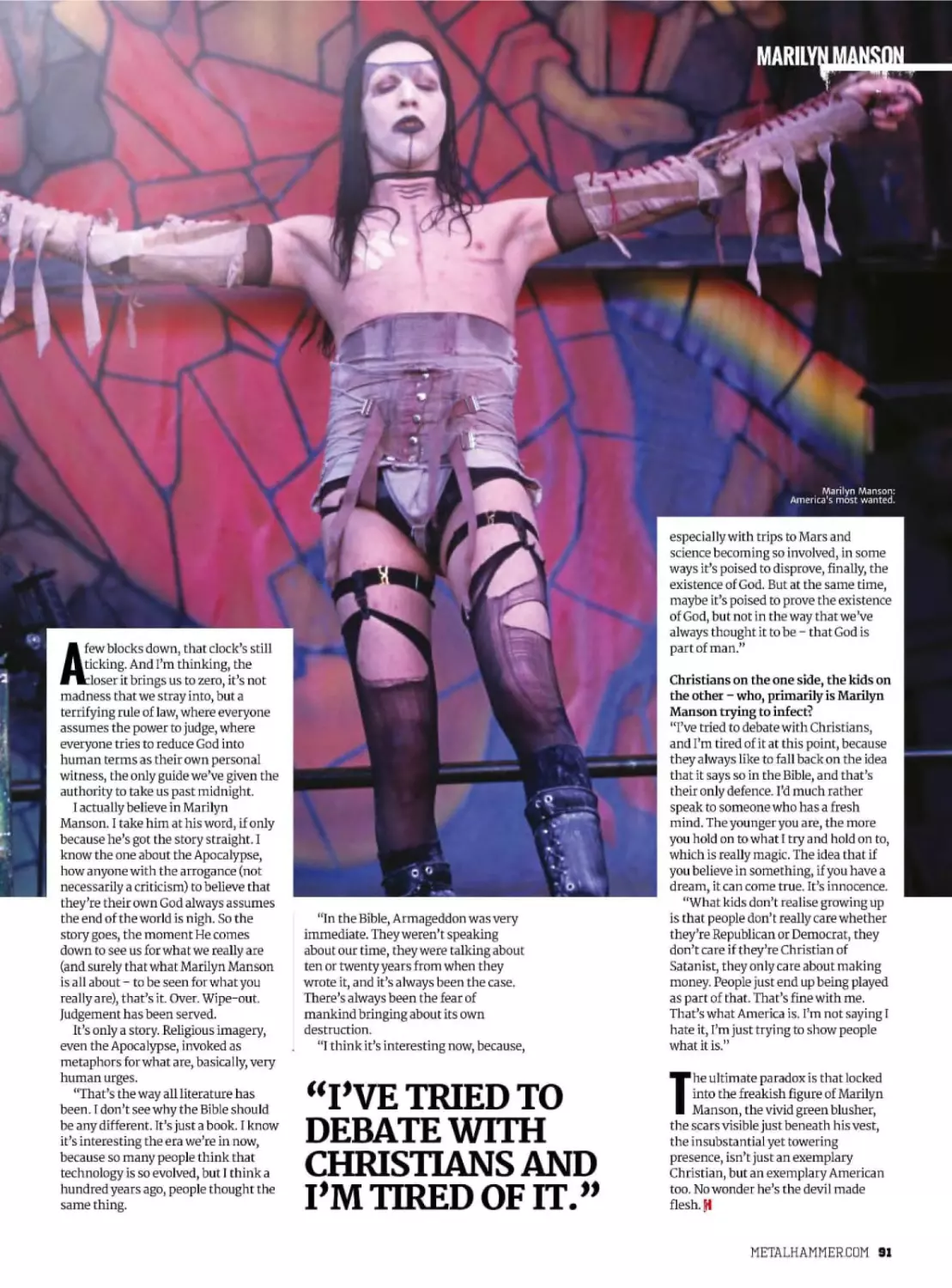
86 Marilyn Manson
An audience with the God Of Fuck as Antichrist Superstarhimed him
from milky-eyed outcast into America's Most Wanted.
124 Babymetal
Cheesy gimmick or tne future of musk? We investigate the biggest
metal phenomenon of the decade.
92 Slipknot
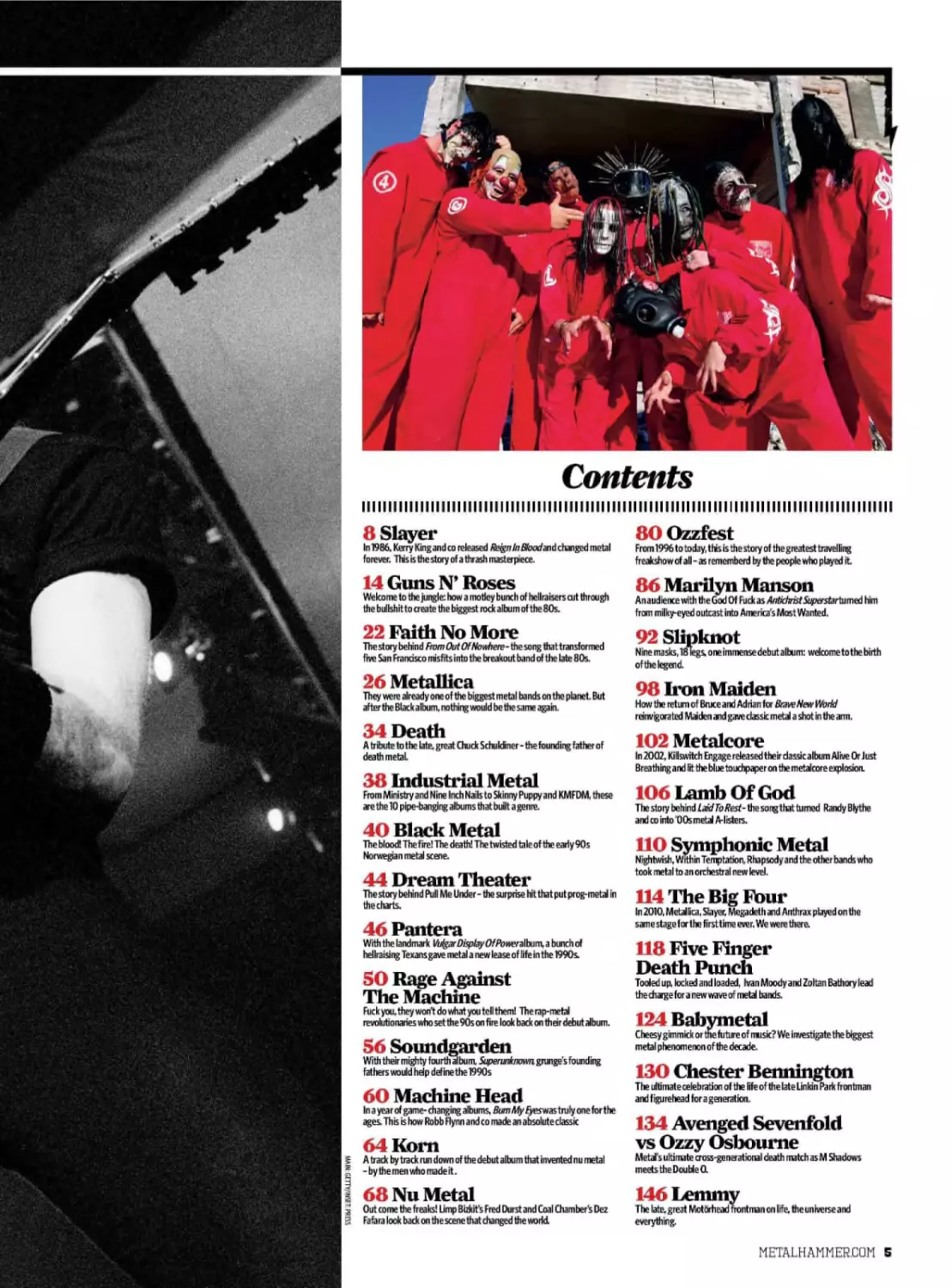
Nine masks, 18 legs, one immense debut album: welcome to the birth
of the legend.
14 Guns N’ Roses
Welcome to the jungle; how a motley bunch of hellraisers cut through
the bulkhit to create the biggest rock album of the 80s.
22 Faith No More
The story behind From Out Of Nowhere - the song that transformed
five San Francisco misfits into the breakout band of the late 80s.
40 Black Metal
The blood The fire! The death! The twisted tale of the eariy 90s
Norwegian metal scene.
44 Dream Theater
The story behind Pull Me Under - the surprise hit that put prog-metal in
the charts.
56 Soundgarden
With their mighty fourth album. Superunkncwn. grunge's founding
fathers wodd help define the 1990s
60 Machine Head
ki a year of game- changing albums, Bum My Eyeswas, truly one for the
ages. This is how Robb Яупл and co made an absolute classic


64 Korn
A track by track rui down of the debut album that invented nu metal
- by the men who made it.
68 Nu Metal
Out come the freaks! Limp Bizkit s Fred Durst and Coal Chamber's Dez
Fafara look back on the scene that cha nged thc world.
METALHAMMER.COM 6
ROCK OUT TO THE GREATEST
SONGS EVER WRITTEN
Journey through more than 50 years of rock history, from early classics to
modern anthems. Celebrate the great and the good of rock’n’roll, written by
some of the finest journalists working today.
ON SALE
NEW
EDITION
SPECIAL
.MATE guide Written
*“NG; ;atl#rush.
I	L Ordering is easy. Go online at:
future	magazines direct .com
I	Г Or get it from selected supermarkets & newsagents
К^ТНЕ^Я
7 NEW
TESTAMENT
THE
STORY OF
METAL
VOL 2
THE THRASH EXPLOSION,
HAIR METAL BABYLON
AND THE ALTERNATIVE
REVOLUTION - THIS IS HOW
THE WORLD GOT FASTER,
LOUDER AND BIGGER.
Kerry is King
Э
WOR
D PAINTED
In October 1986,
would change mi
lool
DAV
EVEBI EY P
gn In Blood - an album that
тх1/King and Tom Araya
erpiece.
BIOWN
Mi
pi|, Keri
ma:
RTI A
STF
ME1ALHAMMER.COM. 9*
гхлшо
it was towards the end of the sessions for
Reign In Blood when the nickel finally
dropped forTom Araya that he and his
bandmates were sitting on something
unique. Slayer's singer and bassist was
sitting in the control of Hollywood's Hit
City West Studio with Andy Wallace, the
engineer on theirthird atbum and the
man charged with capturing a band who had
reached terminal velocity in every respect.
They had just finished mixing Raining Blood,
the perfectly compressed epic that closed the
album in a deluge of torment and viscera, when
Tom glanced up atthe monitor on the wall. The 10
songs that made up the album were listed on the
screen, as was a time: 28. He wasn'tsure what the
number represented. Twenty-eight seconds,
maybe? But that didn't make sense. Perplexed, he
turned to Andy.
"Andy, is that 28 minutes?" he said.
"Yeah," came the engineer's reply.
"Is that for all the songs?" said Tom.
Andy looked up from his desk to the monitor on
the wall and back down to the screen on his
console. "Yeah," he said. "That's 28 minutes."
Unsure of whether 10 songs that ran to 28
minutes - or 28 minutes and 58 seconds, to be
exact - actually constituted an album, or whether
they'd have to come up with more music, they
decided to take their concerns to Rick Rubin, the
album's producer.The bear-like Rick had steered
the band through the sessions with a mix of
fanboy enthusiasm and Zen master calm, and the
answer lay with him. If he said yes, everything
would be fine. If he said no, this perfectly
balanced fusion of speed, aggression and
provocation could be ruined.
More than a quarter of a century on, you can
hear the admiration in the frontman's voice when
he recalls Rick's answer. "His only reply," says Tom,
"was that it had 10 songs, verses, choruses and
leads and that's what constituted an album. He
didn't have any issue with it."
Rick's judgment sealed not only Reign In Blood's
fate as one of the crown jewels of thrash metal's
"HAVE WE MADE AN
ALBUM THAT'S AS
GOOD AS BEIGN
IN BLOOD?"
DEFINITELY NOT"
KERRY KING
Golden Age, but also ensured its status as one of
the great albums of all time. What Tom and his
band mates didn't know then, but what they
certainly know now, is in 28 minutes and 58
seconds, they had changed the game forever.
In May 2012, more than a quarter of a century
after its release, Slayer will play Reign In Blood
in its entirety as part of ATP’s I'll Be Your Mirror,
a three-day festival at London's Alexandra Palace
where they'll be sharing the stage with a wiIf ully
eclectic mix of bands.
"Nah, haven't heard of any of 'em," says Kerry
King,in the sort of clipped, no-bullshittones you'd
expect of a man who has pursued an unswerving
musical vision for the last 30 years.
Few musicians sound as comfortablein their
own skin as Kerry and Tom, but few have had the
luxury of making an out-of-the-park classic so
early in their careers. Reign In Bloodtappedintoa
reservoir of confidence so vast that even the very
serious tribulations of the past two years couldn’t
shake them off course.
In 2010, the band were forced to cancel several
shows when Tom required urgent back surgery.
A year later, in 2011, guitarist Jeff Hanneman
nearly died after contracting the flesh-eating
disease necrotizing fasciitis, after being bitten
byaspiderinhisjacuzzi.
"He's playing again, but we're letting him go at
h is pace," says Tom. "Will he p lay the shоw in
London? Well, we're gonna see how well prepared
we are. We're hoping that he can step in, butthat's
basically where we're at with it."
Right now, the band are prepping for their 12th
album. They have nine songs written ("All the stuff
I wrote, it seems Like it’s more on the thrash side,"
says Kerry. "I gotta pull myself back and make up
some heavy stuff"). The plan is to enter the studio
with producer Greg Philbin in August, though
drummer Dave Lombardo suggests there mig ht be
a stop-gap EP before the album emerges.
Of course, the800lb gorilla in the corner of the
room is the fact that any Slayer alburti, no matter
how good, will always exist in the shadow of Reign
In Blood. The mere factthatit's the only album
they choose to play live in its entirety speaks
volumes. Kerry King is characteristically blunt
about the matter.
"Have we made an album that's as good as Reign
In Blood?” says the guitarist. "Definitely not.”
When Slayer released their second album,
Hell Awaits, in September 1985, thrash
metal had left puberty behind and was
entering ado lescence. The youthful noise of
Metallica, Anthrax and Slayer them selves had
given way to something more focused, yet even
more savage (Megadeth arrived late to the party,
albeit more fully formed).
Hell Awaits cemented Slayer's status as thrash's*
bastard princes. The souped-up trad metal of their
debut album, Show No Mercy, had been
superseded by a hellish noise that sounded like it }
had been recorded in the seventh circle of hell.
Tom's barked-out occult hymns in clipped,
100-words-p er-minute tones foreshadowed what
he'd do on Reign In Blood. Incredibly, given both
its sound and subject matter, major labels were
circling.
"You'd have thought Slayer would have been a
tough sell,’’ says Brian S la gel, who had signed the
band to his label, Metal Blade, and produced their
'10 METALHAMMER.COM
first two albums. "But these were the days when
all the majors were getting involved with metal
and all the Labels were-over them, trying to work
something out. The band had so much momentum
- they were the biggest band who weren’t involved
with a major at the time." .
One very interested party was producer Rick
Rubin. The 22-year-old New York University
graduate had recently set up his own record label.
Def Jam, and had bagged a distribution deal with
CBS Records. Rick was immersed in the Big Apple's
burgeoning hip hop scene, producing the Likes of
LL Cool J, Run DMC and the Beastie Boys, but he
was a rockfan at heart-he grew up on Black
Sabbath and AC/DC, and had played in a pun к
band, Hose. After a friend told him about thebuzz
surrounding Slayer, Rick decided to check the
band out for himself.
"I first met them at their show atThe Ritz in NYC
[in September 1985]," Rick tells Metal Hammer. "I
knew nothing about them before the show and
they blew me away."
It was an unlikely collision of worlds, not least
forthe members of Slayer. "Somebody goes, 'Hey,
Iwantyouto meet Rick Rubin. He’s the guy from
Def Jam. He's a big fan’," says Tom. "We were,
like... Def Jam? [Sounding baffled] Uh, 0/C..’So he
came to the show, we met him, and he really liked
the band. He said he wanted to work with us."
Any reservations about a potential culture clash
were over-ridden by common sense and business
sense. Rick's drive to sign the band suggested
they'd be a top priority. As Kerry points out, Slayer
would have been fools to turn him down.
"Here’s a guy who does a hip hop label, who is
so into a metal band that he signed that band on
his label," says the guitarist. "Ц was a slam dunk
forme."
Ask Kerry today if there was any rivalry
between thrash metal's pacesetters in the
80s, and his reply is an emphatic "No." But
then, as now, Slayer offered something different:
darker, edgier and purerthan their peers. They
may have all been in ft together, but
subconsciously, Slayer were determined to set
themselves apart.
"There was constant competition between all of
those bands," says Brian SLagel, countering
Kerry's assertion. "Who was the fastest band? They
took that very seriously, and that's one thing that
led to the speed of Reign In Blood.”
The songs that Kerry and Jeff were writing for
their fourth album backup that notion. Even early
on, the band's intentions were clear. "Everybody
else was doing something slow," says Tom "Kerry
and Jeff said that they didn't want to do a slow
record - they wanted to do something fast. We
were young. We were hungry. And we wanted to be
faster than everybody else."
In the cross-cultural melting pot of mid-80s LA,
it was inevitable that other influences were going
to seep in. Jeff, for one, was a fan of fist-in-the-
face Los Angeles punk bands such as D.I. and
Verbal Abuse, and had even formed his own
hardcore outfit, Pap Smear. Punk's terse, violent
approach could be heard in the new songs.
"He was going into these speciality shops where
they played nothing but underground music,"
recalls Tom. "He'd show up with these punk discs.
Then Dave got into it, and so did I, because it was
different The last one on the wagon was Kerry
-he was a metalhead, he didn't understand it at
first. But eventually he started to like it."
Slayer may have bagged themselves a major
label deal, but they still weren't rich enough to
afford a proper crew beyond Tom's brother, John.
When they decamped to Hit City West, a small,
storefront studio on the edges of Hollywood, in
the summer of 1986, they set their gear up
themselves.
"We'd rehearsed it and practised enough,"
says Tom. "We went in and Rick said,'Let's just
record it.' We just played it until Rick was satisfied
with the performances. You’re young, you can do
this forever."
Rick was a key figure in the studio. The producer
set up a sofa, where he'd sit and listen to the music
with his eyes closed, dispensing his thoughts like a
bearded guru. Hetold them that they didn't need
any reverb on the guitars or vocals. The result was
a sound thatwas as dry as a bone and heavy as
granite; it instantly set Slayer apart from the other
kids on the thrash metal block.
Today, Rick is modest as to his input. "It really is
atestamentto how great a bandSlayeris,"he
says. "It's very close to being a live album, very
well recorded in a studio. Slayer didn’t sound like
anyone else, that's why the album sounds
different than other metal albums. They really
were creating their own genre."
"There wasn't anything hard aboutit,” says Tom.
"The only thing was that we told Dave to speed it
up:'C'mon, let's pick it up a bit!"
And with that one simple instruction, Reign In
Blood was trimmed from an already compact 34
minutes to an unfathomably terse 28 minutes and
58 seconds.
"I don't think that I even realised it untill got
the record and I listened to it, and I went, 'That's a
little short'," says Brian Slagel. "Butit's one of
those records that's so good - 28 minutes of sheer
brilliance is better than something that's longer
and not as good.
If there were any doubts as to their intentions,
it was a ll laid out in the first few seconds of Angel
Of Death. The gold-standard for album openers, it
was also Slayer's grand statement of intent.
Seventeen seconds of relentlessly grating guitars
are punctuated by bursts of precision tooled-
rhythm, before Tom Launches into the greatest
scream in the history of metal ("Ittook two takes,"
laughs the frontman.)
Where Hell A waits was ornate and occult-
themed, its successor tones down both the
complexity and the Satanic shtick. Necrophobic,
METALHAMMER.COM 11
Jesus Savesand Reborn are concentrated blasts of
noise that wear the influence of Jeff's beloved
hardcore punk, while only Altar Of Sacrifice
descends into hackneyed 'Hail Satan!' territory
(tellingly, that song dated from the sessions for
Hell Awaits. The resulting album was bleak,
relentless and inhuman, a Hieronymus Bosch
painting brought to life for 28 writhing, screaming
minutes. Itsounded like nothing else that had
come before.
"It's as if they were speaking a different musical
language than the rest of the world," says Rick
Rubin.
Inevitably, it was a Language that not every-
body understood. The recently founded
music watchdog the Parents Music
Resource Center had fostered a poisonous
culture of censorship in America. Soon
after they finished recording the a Lbum,
Slayer received some news that threatened
to upend the whole project. CBS, who
distributed Def Jam albums, had refused
to handle Reign In B/ood despite the fact
that it was already paid for. Their issues
were down to two things: the cover and
Angel Of Death.
The provocative sleeve had been
painted by US artist Larry Carroll, and
featured a hellish vista of a demonic Pope
behind carried aloft by four figures, at
least two of which were sporting enormous
erections. But the real flashpoint was
Angel Of Death. Their clinically graphic
retelling of the horrors of Auschwitz was
too much, for a label whose president,
WalterYetnikoff, was Jewish (although
Rick Rubin, who was also Jewish, had no
problem with it).
Г
। Reign In I I
Blood Red
"All of a sudden, the record company doesn't
wantto release the album because of this song,"
says Tom. "When Jeff brought in the song, we
thought, 'Wow, that's really cool-this was the guy
[Nazi physician Josef Mengele] that did all those
crazy, terrible things.'Then allot a sudden we
discovered that people had a problem with that.
We were, like, ‘Рииииск...'”
CBS demanded thatthey remove the song. There
were big bucks riding on the album, and on paper,
it looked like a tough choice for Slayer. In reality,
there was no choice at all...
"We were never, ever tempted to do that," says
Tom. "We felt we hadn't done anything wrong.
They said: 'Take that song off the album.' Rick said:
'No.' And he went and found someone else
to release it."
That 'someone else' was Geffen, a
fast-rising label founded a few years
earlier by music industry whizz kid David
Geffen. For Geffen, controversy too к
second place to one thing: money.
Kerry admits that they never spoke to
anyone from CBS about the issue, nor did
they ask for an explanation. "I wasn't the
Kerry King the world knows today," he
says. "Looking back, Ithought what I think
now. I just wasn't as vocal about it."
Of course, the guitarist isn't a stupid
man. He can see exactly what all the fuss
was about.
"Absolutely," he says. "Nazis, hard
cocks, Popes. Those were weird times."
Released in October 1986, right in the
middle of a remarkable 12-month period
that saw landmark albums from each of
thrash's newly christened Big Four, Reign
In Blood gave Slayer something they’d
never had before: credibility. There were
bumps in the road: Dave Lombardo quit in the
middle of the US tourin support of-the album,
only to return a couple of months later, and the
outcry over Angel Of Death refused to die, not
least in Germany.
But nothing could derail this juggernaut It
cracked the USTop 100, eventually selling more
than 500,000 in America alone - an astonishing
figure for such an extreme album.
The men who made it are aware of their
achievement. Ask Kerry King if he prefers Reign In
Blood or Master Of Puppets, and his reply is
instant:"Reign In Blood, because I did it." Ask
Tom Araya to ran к thrash's Big Four Albums - Reign
In Blood, Master Of Puppets, Peace Sells and
Among The Living- and he laughs: "In that order!
That's perfect!"
The subsequent years have found Slayer
plotting a steady, if sometimes wayward course
- "I don't like much of what we did in the 90s,"
admits Kerry with ty pi cal frankness - but even
when they've drifted, they've always had Reign In
Blood to act as their North Star to bring them back
to whatthey do best.
Today, nearly 26years on, Reign In Blood has
only grown in stature. But why is it so celebrated?
"I can't answerthat," says Tom Araya. "Maybe it *
was because Rick Rubin produced it and it came
out on a rap label. Maybe it was the controversy.
Maybeit was because it was only 28 minutes. I
don't know."
Brian SLagel explains: "It was a pivotal record at
a pivotaltime. When you have a record that’s that
good, it brings peoplein - punk fans loved it, metal
fans loved it. It transcends the whole metalthing."
"It's so extreme and поп-musical," says Rick
Rubin, the man who helped breathe life into this
monster. "It’s like an assault. I can'tthink of
another album that does whatthis album does." Ф
12 METALHAMMER.COM
INTRODUCING THE LEGENDARY
DRUCE SPRINGSTEEN & THE E STREET RAND
Across six decades, 20 studio albums and thousands of live performances,
Bruce Springsteen has cemented his position in music history time and time
again. Delve into his life and career to discover exactly why Bruce is The Boss!
I	L Ordering is easy. Go online at:
future	magazinesdirect .com
I	Г Or get it from selected supermarkets & newsagents
METALHAMMER.COM
Sb® **
? lhe night that made history
1«лел M. L 'W*™*
’?°*; °?e band at the
start of their rise to faine


THERE ISN'T A METAL BAND ON THE PLANET THAT HASN'T BEEN AFFECTED BY GUNS N' ROSES.
THIRTY YEARS ON, THE IMPACTOFTHEIR TURBULENT INCEPTION IS BEING FELT AS KEENLY AS EVER.
WORDS: DAVE EVERLEY
"I watch MTV and it's hard not to throw shit at
the TV set because it's so fucking boring. Even the
bands around here in LA are the same way, the
whole music industry. We meet these people and
they say, 'Do this, do that.'And we go, 'Fuck it,
fuck you!' Because it's just not us. We do
whatever we want to..." AXL ROSE, 1986
Scene: exterior of a club, the Sunset
Strip, Hollywood, an undetermined
night in the mid-80s. The imaginary
camera in your head pans across the
sidewalk, taking in the otherworldly
images. Crowds of people of unspecified
and indistinguishable gender
cluster in pools of neon, some of them
gripping half-full beer bottles, others
clutching empty shot glasses. The
chatter of voices and clack of high
heels is drowned out by a choir of
Harley Davison engines roaring by.
Someone throws a bottle over their
shoulder, not caring where it lands. It
«1
arcs up and down, then smashes in the
busy street. Someone laughs,
and they all head towards the door.
Cut to: the club's interior. The
imaginary camera weaves around the
tightly-packed crowd, cutting through
the Aquanet hairpsray smog as it heads
towards the front of this tiny venue. On
the club's stage, five junkie-looking men
in last night's make-up and last week's
leather trousers are train-crashing
through a new song they've just written
called Welcome To The Jungle. The drape
behind them reads 'Guns N’ Roses', with
a logo to match. Besides them, a trio of
barely-clothed women gyrate in their
underwear. It's hot and getting hotter...
The song rattles to a halt and the singer
- a rail-thin streak of sinew and rage with
an explosion of flaming candy-floss hair
and a tomcat's howl - opens his mouth.
"You have to excuse me," he spits.
“I haven't been asleep in 48 hours, I think.
I am coming down on my fuckin' dope. So this
next song is about getting too fuckin' high.
This song is called My Michelle."
Welcome to Hollywood, baby.
Thirty years on, such scenes have slipped
from reality into myth. But Guns N' Roses were
all too real. They waltzed with the Devil down
Sunset Strip, danced with Mr Brownstone
in long-vanished clubs, and rose above
Hollywood on a pillar of flame that would go on
to engulf the world. They were - and still are -
the great leveller, a seminal force in rock and
metal's evolution over the past three decades.
Ж PEOPLE ТОШ US, DO IT
STEVEN ADLER
Ask any musician from any ba nd in any
genre, and they'll pretty much all tell you
how important Guns N' Roses are to them.
In terms of music, in terms of attitude, in
terms of lifestyle.
"Guns N' Roses is my favourite band of all
time," says M Shadows of Avenged Sevenfold.
"I love that band. You can compare us all you
want - they're a huge reason why I'm in a band,
and even write music. My dad gave
me Appetite For Destruction when it came out."
"The first time I heard Guns N' Roses,
1 instantly fell in love," offers Asking
Alexandria axeman Ben Bruce. "It was just the
perfect recipe. Everything about Guns
was dangerous and exciting; they were
the living embodiment of rock'n'roll in
its truest form. They turned heads
across the globe and wrote one of the
best albums of all time."
Shadows and Ben would be the first
to admit that they're standing on the
shoulders of giants. Guns N' Roses didn't
invent rock'n'roll or carnage, but they
perfected it. At their cliche-defying best -
that is, at any point between 1985, when
they formed, and 1991, when they got so
big and bloated you could see them from
space - they truly were the most dangerous
band in the world. "We were a train wreck,"
says original drummer Steven Adler today.
"But you couldn't take your eyes off us."
Guns N' Roses still exist, of course,
though in radically different form.
While Axl Rose would disagree, they're
overshadowed by their own legend. But
even legends have to begin somewhere.
Guns N' Roses was built on chaos.
In late 1982, a 20-year-old kid from
the hick city of Indiana named Bill
Bailey arrived in Los Angeles in
search of fame, fortune or anything
in-between.
One of the first people he met
:ER.cd!
GUNS PROSES
Slash riffing out. the
i Tfoubadour, October 10,1985 |
in Los Angeles was another Indiana
transplant, an old schoolfriend and budding
guitarist named Jeff Isbell. Within a few
months, both had renamed themselves: Bill
Bailey became Axl Rose and Jeff Isbell became
IzzyStradlin.
Axl was a bundle of trouble, even as a kid.
"I remember, the first day at school there
was this big fucking commotion," Izzy later
recalled. "I heard all these books hit the
ground, yelling, and then he went running
past. A bunch of fucking teachers chasing him
down the hallway..."
At the same time as the young Axl was
giving his teachers the finger, at a different
school 2000 miles away two of his future
bandmates were plotting their own dreams of
rock'n'roll stardom. Steven Adler was a pupil at
Bancroft High, just off Santa Monica Boulevard
in LA. An aspiring drummer, Adler befriended
an English-born, mixed-race kid named Saul
Hudson. It would be a few years before Saul
started calling himself Slash. But he was
already on the way.
"He was one of the cool kids," says Steven now,
his slurred voice the result of a series of strokes
and heart attacks brought on by a lifetime of
hardcore drug abuse (though he's currently
dean). "I gave him his first guitar when he was
12 years old. He was writing songs a week later.
We started ditching school three weeks into
knowing him. We'd walk up and down Sunset,
Santa Monica and
Hollywood
Boulevard, and that
guitar went
everywhere
with him."

For all that, it wets years before they actually
played in a band together. The Sunset Strip
scene of the late 70s and early 80s was basically
a collection of random musicians joining each
others' bands for a few weeks or months at a
time, then moving on to something else. It
wasn't until the middle of 1984, when Adler
joined Slash's band Roadcrew, that the pair
finally teamed up. Even then, they both had a
firm eye on the competition.
"You'd walk up and down Sunset and see
all these flyers everywhere," says Steven.
"Me and Slash were hanging out at the
Rainbow and we saw this one flyer on the
sidewalk and picked it up. The guitar player
and singer looked really cool, so we went to
see them at Gazarri's."
The guitarist was Izzy Stradlin, the singer
was Axl Rose, and their band was called
HE SAT THEBE FOR THREE WEEKS. DOING DRUGS
LISTENING TO LED ZEPPELIN l\li ЕЕСК1Г
AXL ROSE
Hollywood Rose - or maybe just Rose,
depending on what they decided to put on
their flyers. The two parties hooked up,
played a few gigs... then fell apart. Slash joined
a band called Black Sheep. Izzy joined
perpetual no-hopers London. Axl teamed
up with a guitarist named Tracii Guns in
LA Guns. In April 1985, the latter would
change their name to reflect their two key
members: Guns N' Roses.
By June 1985, Tracii Guns was out and
Slash, Izzy and Adler were all back in, as was
a beanpole bass player from Seattle
named Duff McKagan. This soon-to-be-
classic lineup bonded over a trip to Seattle,
which started with their car breaking down 25
miles outside of LA and ended with them
unsuccessfully trying to burn down the actual
venue they were playing in.
। Their chief role
models were the big
7 beasts of the 1970s:
Led Zeppelin,
Aerosmith, the
classic icons of the
:etalhamWer.com
SLASH: JACK LUE/ATLASKDM5.COM
tight-trousered titans who laid down the
foundation stone for arena rock and heavy
metal. But there was no bloat here: Guns N’
Roses were street punks in rock stars' clothing.
"We always read in magazines how they
did it their way/ remembers Steven. "We
figured that we'd do it our way, and fuck
everybody else. When people told us, 'Do it
like this,' we'd go, 'Fuck you, we're gonna do it
like that' We were not going to take any shit
from anybody."
Vicky
Hamilton would
play a key part
in the early
development of
the band that
would become
GN'R, first as their
booker and then as
their manager.
She was working at a booking
agency and managing various
hopeful bands when Axl and Izzy
introduced themselves to her.
"Axl said, 'Can we come in
and play you a demo?'" she
recalls now. "I was, like, 'No,
put it in the mail to me.' 'Well,
we want to bring it in and play
it.' 'Well, I don't have a stereo.'
And Axl went, That's okay, I'll
just bring a ghetto blaster.'
They played me the demo, and
it was unbelievable. I'd worked
with Poison, Stryper, Motley
Criie. But this was a different
animal. It felt a lot more
dangerous. They felt like
outlaws."
Next to a bunch of
pampered poodles like
Poison, Guns N' Roses were a
pack of feral dogs. The two
bands hated each other.
They would paper over each
“WE WERE А MATCH MADE
IN HEAVEN. I III A IT IIEF
STRAIGHT TO HELL”
STEVEN ADLER
others' flyers until telephone poles
were inches thick. "Lock me in
a room with Pbison, and there's only
gonna be one person walking
out," spat Axl.
Even early on, Axl was a unique
figure. "He had his issues," says
Steven. "But he had this real
charismatic, Jim Morrison kind of
aura around him. One minute you're in
love with him,
the next you're
going, 'What the
fuck does that
mean?'"
It was a constant
game to see who
would end up on the
receiving end of the
singer's hair-trigger
temper. 'Axl used to be one of those guys who,
if he even thought someone was looking at
him weird, would just haul off and smack
'em," Izzy later recalled. "And
sometimes the people he went for
weren't even looking at him."
But Guns N’ Roses was far from
just The Axl Rose Show. This was
a band of five distinct
characters: the volatile
frontman in Axl, the elegantly
wasted, top hat-sporting Slash,
the relentlessly eager,
clown-ish Adler;
dyed-in-the-wool punk
rocker Duff; the
effortlessly cool Izzy.
The latter was the
mystery component,
even to his bandmates.
"Izzy was very
quiet and he only
had a small circle
of friends," recalls
Vicky Hamilton. "His
Axl and Slash make
their Roxy debut
August 31,1985
Once upon a time. these guys
were fnends. Somewhere in
Hollywood, 1985
!ER.C(
GUNS N’ROSES
METALHAnMER.COM
1. w,u^[I"* »
2 Olrt Ta W Me «Л
7 Rocker <2^en
4.	IS
q Д/v Mtcbclir
7 Mr Brownstanf	«fl
5.SS#"&, I
u'. Wtolt'w	□
(ЛС/DC wrfT)	„ ?
! I !h ", l I < ,ry	•
J3. MW t0 tb. 1 ’*	•
]4. Mama К»"
How many people can fit
inside that place?" asked the
incredulous guitarist
"Ln years to come, several
thousand people are gonna claim
they were here tonight," butted in
band manager Alan Niven. "Guys,
the phrase 'Opinions Are Like
Assholes, Everyone's Got One' -
a riposte to a less-than-flattering
review of the just-released
Appetite For Destruction. He was
utterly electrifying, with no hint
of the twisted anger that would
subsequently go on to dog
his performances.
The rest of Guns N' Roses were
also equal to the occasion. They
roared through a set based mostly
around Appetite..., although there
trust me, this is where a legend
is born!"
Whether Niven truly believed
his outrageous comment, the fact
remains that, in hindsight, he
was right. This was where the
myth of Guns N' Roses took flight.
By the time the band came
onstage, the Marquee was
swamped in a fever. Everyone
acknowledged it would be the
last time we'd see the Most
Dangerous Band In The World
in such a small location, and
when they burst on with Weteome
To The Jungle, the place went into
absolute meltdown.
Axl strutted across the tiny
stage, wearing a t-shirt bearing
ON JUNE 28,1987, GN'R MADE THEIR FIRST SERIOUS SPLASH IN FOREIGN WATERS AT LONDON'S
LEGENDARY MARQUEE CLUB, AND MALCOLM DOME WAS THERETO SEE IT ALL GO DOWN.
it was the шт tine m see the
MOST II.UGEROI S BAND IK THE WORLD
IN SUCH A SM ALL LOCATION”
was an early taste of Don't Cry,
which wouldn't be released for
four more years, and they finished
the set with sparkling covers
of AC/DC's Whole Lotto Rosie and
Bob Dylan's Knockin' On Heaven's
Door, the former especially
given a breathtaking
shake-up, before encoring
with Move To The City,
featured on the Live
?i*@ Like A Suicide EP,
and Aerosmith's classic
Mama Kin- attack
they would later get to play live on
stage with the mighty Aerosmith
themselves.
After the show, there were
a lot of dazed and delirious
people milling about. Not
least at the band's impromptu
post-gig party, held at
their apartment.
"Were we OK?" Axl asked
them anxiously.
OK? It was the birth of
a legend.
The crowds were
gathering outside the
Marquee from noon on
what was the final
night of Guns N' Roses' three-
show stint at the famed London
club. By now, there was
a massive buzz of expectation
about this lot. The band’s first
trip to London might have
begun with people slightly
cynical about these new great
hopes from Los Angeles, but
there was little argument that
it was ending with everyone in
attendance convinced that they'd
be a major force.
Slash and Duff spent much of
the afternoon across the road
from the Marquee, sitting on the
' steps of a pub, soaking up the sun
| and beer, amazed at how the
‘ queue for a gig still several
>. hours away was g rowing
Guns - complete with Slash
using his trusty Les Paul for the
first time - at Street Scene,
September 28.1985
Marc Canter, pro-photographer and the
man behind classic Guns photo-bio
Reckless Road, talks about life in the fast
lane with rock'n'roll's most chaotic sons.
WHERE DID YOU MEET SLASH?
"Wewenttothesameelementaryschooltogether.
A few years later, I had a motorbike and he was
thinking of taking it. Then he looked atme and
went. 'Wait, we were at school’. Instead of stealing
it, he made friends with me. We used to go out on
BM Xs together."
WHEN DID YOU START SHOOTING HIM?
"I started goi ng to rehearsals for his first band,
Tidus Sloan. I saw right away that he was really
good atwhat he was doing. But hewas good at
ridi ng bikes as well. He did tricks that were way
ahead of theirtime!"
HIS NEXT BAND WAS ROADCREW.
WHATWERETHEYLIKE?
"It was basically an extension of Tidus Sloan,
except with a singer. The riffs and the solos were
good, but the vocals and the melodies weren't
there. The person they had singing didn't really
have whatit takes. It was just another guitar band,
butit was cool because it had Slash in it."
IN 1985, SLASH JOINED FORCES WITH
ANEW BAND CALLED GUNS N* ROSES...
"Slash was in a band called Black Sheep. When
Tracii Guns quit Guns N’ Roses, the rest of them
Joined back with Slash
—and Steven, who had
ЛГ7	PlaYedwiththem aУеаг
[bvb*	before. There were
•, a lot of bands, but
' none of them had the
; samefeelasGunsN’
''ЧВг* < , Roses. They had the
< i	look, the sound, the
,	’ ^еУJust had
' ’	' the charisma to
w * f take it far."
humour was very cynical. He was early on the
drug path. He was already going to rehab
before those guys even started."
Their individual personalities fed into the
songs they were writing. By the end of 1985,
half the songs that would make it onto Appetite
For Destruction were in their set.
"When we first started, none of us were
perfect at playing, apart from maybe Slash,"
admits Steven. "But it was something we
really enjoyed doing, and that was more
important than getting great at playing.
It was a match made in heaven. Then it went
right to hell/'
FIRST MANAGER VICKY HAMILTON
In most bands, there’s a 'sensible one'. Guns
N' Roses weren't most bands. They had five
distinctly insensible ones. According to
Steven, the closest they did had to a steady
hand was him, which shows just how
fucked-up things were.
"Man, I was the sensible one," he laughs.
"I was the one
saying, 'Come
on, this is our
dream coming
true, let's not
throw it away/
The whole
thing was this crazy, out-of-control monster."
In reality, the soberest member of the band
was Axl. Although 'sober' is a relative term.
"I don't abstain from doing drugs, but I won't
allow myself to have a fuckin' habit," he told
writer Del James in 1989. "I'll have done blow
[cocaine] for three days and my mind will go,
'Fuck no.' Ill just refuse to do coke that day.
The same thing with heroin. I did it for three
weeks straight... with a girl I wanted to be
with, and we just sat there listening to Led
Zeppelin, doing drugs and fucking. I stopped
on Saturday because I had serious business to
attend to on Monday. I can't hide in drugs."
His advice to would-be druggies was "don't
get a habit, don't use anybody else's needle
and don't let drugs become a prerequisite to
Axl.tan«edrf.MiTbrush.on
the night .tflieTroutadoui
that allegedly got Guns signed
having a good time/' Unfortunately, his
bandmates weren’t listening. Slash and Izzy
were full-on junkies, and Adler was coming up
fast on the inside. Duff, on the other hand,
was a borderline alcoholic, presumably just to
be different.
"I love the guy a lot, but the fact is
Slash is not what you’d call your thinkin'
man's drug-user," Izzy said of his fellow
guitarist. "He's real careless, doing really
shitty things
likeOD-ingin
other people's
apartments.
A lot”
Sex was
arguably even
higher on their list of priorities, at least for
some members. "The concept of safe sex didn't
exist before then," said Slash. "I was running
around, dick wet from one pussy going into
another."
The gloves were off when it came to sexual
competition between the fivesome too, with
various women flying through the ranks. The
band would have contests to see who could get
the most blowjobs in one day. "I won that
everytime," boasts Steven now. "It didn't
matter if you were hard or not. If she put it in
her mouth, that counted. My record was 13 in a
day. Lucky 13.*
Nor were any of them worried about the
spectre of AIDS - the big sexual bogeyman	Ц
of the day. "I've been tested for AIDS a few
METALHAMMER.COM 19
GUNS PROSES
МЛВССАНТГВ/ATLAS!
times," admitted Slash at the time.
"But honestly, the first time I was tested
I didn't care about the result in terms of my
own mortality. I was more concerned about
the fact that if it was positive, I wouldn't be
able to get laid for however long it took for me
to kick the bucket."
The sexual charge that fired the band
crackled onstage, too. Hollywood wasn't short
of strippers, many of whom were befriended by
the band. Performances would be enhanced by
dancers who were in various states of undress.
The girls had another
use, too. Some of them
would take band
members under their
wings, and sometimes
into their beds. Given
that your average
stripper earned far more
than most struggling
musicians, it guaranteed
them a warm meal and
a hot shower alongside
any other perks /
that may have, /
ahem, arisen.
"Strippers were
our sustenance for D-
the longest time," A J
recalled Slash of r FI
к that era. "We
crashed at the	r
strippers' houses
ИВ and that's where
we got extra cash."	, jf'fc -
When they weren't
нА	enjoying the mothering	у
t	instincts of LA's finest
exotic dancers, the band lived in a loft in their
rehearsal room. It was freezing cold and there
was no plumbing. They would light bonfires in
the car park. They were effectively homeless
people in leather trousers.
In the autumn of 1985, Vicky Hamilton got
a call from Slash. "Can Axl stay on your couch
for a little while?* he asked. "The cops are
looking for him* The singer had been accused
of a sexual assault, and they were basically on
the run from the law [the charges were later
dropped].
*1 said, 'Oh boy, okay, for a couple of days,'*
she says. "What was supposed to be a couple
of days ended up being six months. It started
with Axl on my couch, and then a few days
later the rest of the band moved their gear in."
Her one-bedroom apartment just off the
Sunset Strip became the epicentre of the
carnage. At any given time, there would be
anything between eight and 20 people in
the place: five musicians, assorted roadies,
various girlfriends and any number of
one-night stands. It wasn't so much a home
as an animal house. But even then there was
a pecking order.
"Axl was always on the couch and the rest
would be in sleeping bags in the pretend-
dining room,* says Vicky. "They were terrible
house guests. My roommate and I would
barricade ourselves in the bedroom."
It was Hamilton who helped Guns N' Roses
to the next level. She passed on a tape to Tom
Zutaut, superstar A&R man with Geffen
Records. Zutaut had spotted Motley Criie and
turned them into superstars.
He planned to do the same with Guns. On
February 28,1986, he saw them for the first
time at The Troubadour nightclub. Less than a
month later, he had signed them to Geffen for
a $75,000 advance.
Not that the deal doused the band's fire.
On the day they were due to sign with Geffen,
Axl and Steven got into a fight at Vicky's
l« POWER
1	Even GN'R's artwork caused a fuss...
When Guns soughtouta suitably chaotic and controversial art
piece to grace the cover of Appetite For Destruction, they settled
on the work of Robert Williams, whose depiction of psychedelica,
post-apocalyptic mayhem and, er, rapey robots had gained him
notoriety amongst the Hollywood elite. The resulting piece was
rejected by numerous retailers, causing Geffen to use Robert's
piece as an inlet, replacing itwith the iconic cross image which
would become a staple throughout Gu ns’ early career. Robert
would remain unapologetic about his work. "My paintings are
11	not d esig ned to e nte rtai n у ou," he a rgu es. "They a re mea nt to
trap you, to hold you before them while you try to rationalise
whatelements ofthe picture are making you stand there."
10 METALHA1
[ERCOM
Struggling to play it
straight on a shoot in ’85
1 ...thGunsN Ro»' ,a6
irnubadom- 3ungo- ___________________________________________________________________________
Axl and Slash at the iconic
____A Go Go in 87
apartment It was a big one.
"Axl wouldn't go to Geffen
Records down the street and sign
the deal," says Steven. "I was
pissed at him, and we got into it
Just destroyed the place. It was
fucking crazy."
It was also the final straw for the
apartment's long-suffering owners,
who promptly evicted Vicky and her
unruly house pests.
"My landlord was, like, 'Get them
the fuck out of here,'" she says,
laughing. "I got them a record deal,
they got me evicted."
Guns N' Roses were too tightly bound to
each other to let a fist-fight knock their
accelerating juggernaut off course. "It was
a gang mentality," insists Steven. "We
were one for all, all for one. The three
musketeers. Or the five musketeers."
He laughs. "With guitars and a drumkit."
Geffen half-heartedly tried to tame them.
Vicky Hamilton was replaced as
manager by Alan Niven, and the
band were moved into a shared
hovel in an effort to fire their
creativity.
The plan backfired when the
quintet spent their advance on
getting even more fucked up. The
U1
name they gave their new abode
pretty much tells you all you need
to know: The Hell House.
"A lot of crabs were transferred in that
place," noted Slash years later.
"It was," added Duff McKagan, "a place
where the whole sleaziness of the band
could fester."
Their new paymasters managed to wrangle
them into the studio to record their debut
EP, the mock-live Live ?!*@ Like A Suicide:
a four-track, 14-minute blast of sleaze and
venom with crowd noises pilfered from 70s
mega-festival the Texxas Jam.
Anyone unsure of where Guns N' Roses were
coming from only needed to look at the titles
of two of its songs: Reckless Life and a cover of
Nice Boys (Don't Play Rock'N'Roll).
What happened next has been cut-up,
chewed over and regurgitated countless times
down the years. Guns N' Roses recorded their
debut album. Appetite For Destruction, with
producer Mike Clink. Released in June 1987, it
ultimately exploded like nothing ever had
WE WERE ONE FOR All, ALL FOR
ONE. F IE Ml SKETEERSIT TH
GUITABS AN» A DR UH KIT”
STEVEN ADLER
before it By the end of 1988, it had sold in
excess of ten million copies (today that
figure stands at an impressive 18 million
- the best-seUign debut album of all time).
Guns N' Roses weren't just the most
dangerous band in the world. They were
also the biggest "We wanted to change the
world," says Steven Adler. "And we did."
"Guns N' Roses are one of the
last great rock 'n' roll bands,"
states Asking Alexandria's Ben
Bruce with no shortness of
conviction. "Everything from
their attitudes and love of rock
'n' roll to their huge, anthemic
songs and classic riffs have left
a huge impact and will
continue to do so for years
to come."
That's true, but if you
want to get to the heart of
the matter - and to the
heart of Guns N' Roses -
just crank up Appetite For
Destruction itself. It's not
just one of the greatest
records ever released,
it's a document of a time,
a place and a band that
will never be repeated.
Now that's Hollywood,
baby.
METALH?mMER.CCIl
Faith No More
From Out Of Nowhere
In 1989, hair metal still ruled and the grunge explosion was still a few years away. Enter five
misfits from San Francisco who would rewrite the rules of rock with their breakthrough single,
iiiiiiiiiiiiiiiiiiiiiiiiiiiiiiiiiiiiiiiiiiiiiiiiiiiiiiiiiiiiiiiiiiiiiiiiiiiiiiiiiiiiiiiiiiiiiiiiiiiiiiiiiiiiiiiiiiiiiiiiiiiiiiiiiiiiiiiiiiiiiiiiiiiiiiiiiiiiiiiiiiiiiiiiiiiiiiiiiiiiiiiiiiiiiiiiiiiiiiiiiiiiiiniiiiiiii
Words: Joel McIver
THE FACTS
RELEASE DATE
Oct 30,1989
HIGHEST
CHART
POSITION
No.23 (UK)
PERSONNEL
Mike Patton
Vocals
Jim Martin
Guitar
Billy Gould
Bass
Roddy Bottom
Keyboards
Mike Bordin
Drums
WRITTEN BY
Billy Gould,
Roddy Bottum,
Mike Patton
PRODUCER
Matt Wallace
LABEL
Slash/Reprise
"Tust before rhe «80s ended in an
I explosion of Aqua Nel and
I spandex. Faith No More found
I themselves at a crossroads. While
J the San Francisco-based band
had already released the albums We
Care A Lot (1985) and Introduce Yourself
(1987), relations between singer Chuck
Mosley and the rest of the band -
Roddy Bottum (keyboards), Jim Martin
(guitar). Billy Gould (bass) and Mike
Bordin (drums) - had soured, resulting
in the vocalist being ousted.
“We were in a weird place at the
time," Bottum recalls, "having just lost
a singer. I think I felt it more than the
others. I was pretty close to Chuck. We
were taking stock and starting over, but
the mood among the four of us was
pretty optimistic.”
The group soon had good reason
to feel optimistic: (he arrival of singer
Mike Patton at the end of 1988. Shortly
after the dawn of the 90s, Faith No
More would be one of the world’s lop
rock bands, with 1989’s The Real Thing
(their first album with Patton) and the
single from it, the ground-breaking rap-
metal track Epic, both scaling the charts.
But initially, it was album opener From
Out Of Nowhere that helped the band get
back on track.
Bottum recalls that the music for
that song was written before Patton
joined theband: “Billy, MikeBordin
and I wrote that song together at our
rehearsal space in 1 lunlcr’s Point. It
was among the first batch of songs (hat
we wrote after Chuck left the band.
Typically, rhe three of us would get the
skeleton of a song going on. and then
get Jim Martin to pul his guitar part on.
Sometimes, Billy would write [Martin’s]
guitar part for him, but I think in the
case of From Our O/Nowhero. he wrote
his own part.”
But Bottum docs admit that Patton
lent a major hand in how the song
eventually came out: "[Patton] came in
and did the melody and the lyrics. All
of the music of the songs on The Real
Thing was written prior to Mike joining
the band. He sat with the songs for a
couple of weeks and wrote all his vocal
parts. Really fast."
“We tracked a cassette demo of From
Out Of Nowhere in the rehearsal room,”
adds Gould. "Mike Parton took it home
and worked on the melody and the
lyrics then he would come to my house
and we’d put the parts down on four-
track to hone them down. The majority
of the lyrics and singing melody was
from him."
There has been some debate over
the years concerning exactly what the
song is about. This is made evident
by the fact tliat Bottum and Patton’s
explanations of the lyrics appear to
differ wildly. While Bottum reckons
the song "seems to be about a chance
meeting, and how chance plays a role in
interaction". Patton explains it as: “Jello
shots, hermetic philosophy, Ptolemaic
cosmology... you know, your average
commic/junkie jibber-jabber.” So that’s
cleared up then.
In the 80s, keyboards in heavy metal
were relegated to almost exclusively to
the odd power ballad. By contrast. Faith
No More were one of the first metal
bands to use keyboards for texture -
which is demonstrated clearly on From
Out Of Nowhere.
When it came to actually record the
song, the band were well-prepared.
Looking back, however, Patton’s
memories arc more than just a bit
fuzzy: “I have no recollection of
recording the song," he says. "But I’m
sure it was nothing short of a full-scale
hootenanny."
Bottum, on the other hand, recalls
the sessions (at Sausalito’s Studio D)
as being "a weird, ‘getting to know
each other’ time with Patton. We all
got along and worked together pretty
easily. Everyone was pretty proactive
II Illi lllllllll II Hill IIII III II Hill II III IIII III IIII III II Hill
‘We were in a weird place at the time, having just
lost a singer. We were taking stock and starting
over, but the mood was pretty optimistic.’
in the studio. Jim Martin was becoming
very particular about his guitar sound, I
remember that. “
Indeed, Martin had become quite
particular about his guitar sound. The
guitarist recalls at the time consulting
two renowned names in rhe rock world
for advice - producer Rick Rubin and
Metallica’s James Hetfield.
Due to the fast pace and intensity
of From Out Of Nowhere, as well as
opening the album, it also served as
the opening number for the mammoth
tour in support ofThe Real Tiling, which
lasted from ’89 through to ’91.
“That song was so good because most
of our stuff was mid-tempo that the
set was always in danger of dragging,"
Gould explains. “With that one we
could at least start things on a high
note, and hopefully this spark would
keep the rest of rhe set alive. There’s
nothing worse than being on stage for
80 minutes or so when things are not
working correctly. Generally it seemed
to work out well, and we stuck with it as
an opener until with haled it so much
we scrapped it from the set altogether."
The bassist also recalls how the song
put the audience over the top at one
gig: “1 remember playing in London for,
like, the millionth lime on that tour.
We were pretty popular in England, but
hadn’t really taken off at all in the US.
and all our American label people came
to London to our show to see what all
the hubbub was about. We opened with
that song, and the crowd went bananas
and broke through the barrier between
t he stage and audience. We had to stop
the song midway through because
people were getting hurt. We left the
stage, and came back after the barrier
was rebuilt. The American label were
aghast.” О
22 METALHAMMERCOM

CELEBRATE THE GREATEST
ROCK RAND OF ALL TIME
Uncover four decades of dirty deeds, riff raff and rock ’n’ roll damnation from
the makers of Classic Rock magazine. From the mystery of Bon Scott’s death
to behind the scenes anecdotes, this is the complete AC/DC story
EDf’flQN
J^csrow
ON SALE
STORIES SEH'NO
the ALBUMS
every l*1 ю	J
EVKIlYERACUV™»1
DiLv«ivi:iNrt»'’EW
30 BEST
AC/ос songs
VC\t>EZOn«
I	L Ordering is easy. Go online at:
future	magozinesdirect .com
I	Г Or get it from selected supermarkets & newsagents

КЙГТНЕ^Я
W NEW
TESTAMENT
THE
STORY OF
MEW.
VOL 2
METALLICA EXPLODED,
NU METAL RULED AND
THE FREAKS CAME OUT
TO PLAY. WELCOME
TO THE DECADE THAT
CHANGED EVERYTHING.

METALHAMMER.COM 27
"Waddya mean I'll have to re-learn to
play drums?!" But for the Black Album
Lars spent weeks doing just that
t’s some time in 1988, almost midnight UK time,
and Metallica drummer Lars Ulrich is on the phone
from San Francisco. It’s his first appointment of the
day in promoting Metallica’s new album,
.. .And Justice bar All. But there’s a problem with dial
famously voluble Danish mouth. In fact 1 can barely
make our what he’s saying.
“Man, I’ve got terrible toothache..I.ars mumbles.
“You what?"
“No joke. I’ve got to gel to a dentist. 1’11 call you back."
Yeah, right. Except he does. Two hours lalcr, with me
slumped red-eyed by the phone, I ars rings back.
“Hey; it's Lars...”
Except it sounded more like, "1 ley, id Lards..."
A Frisco mouth mechanic had slammed in some
novocaine, drilled a few holes and sent him home with a
gobful of blood and cotton wool. And the first thing Lars does
is... ring back to talk about his new album.
The point being that Lars Ulrich is a singularly determined
man. He may not be - and certainly wasn't then - the greatest
drummer ever to pick up sticks. He may not be the guy you'd
choose to get trapped in a lift with. But if you need somebody
for whole-hearted, one-eyed and over-arching devotion to the
Metallica cause, then Lars Ulrich’s your man. 1 leis a giver of
the fabled 110 per cent—bad teeth or no bad teeth.
The, frankly; uneven ... And Justice For All record that Lars
was so keen to talk about was a big record. Big enough for
most bands to kill for. 11 reached No.6 on the US Billboard 1 lol
100 and sold more than six million copies worldwide. But
despite rhe tangible signs of success-fast cars, flash houses -
and the rhetoric of their interviews, Metallica knew that
... Justice... was not really good enough at all.
“After listening to the.. Justice... album it was pretty’
apparent that we needed some guidance," James Hetfield later
admitted wryly. It was “obvious." he said, who’d produced the
record. The guitar and drum parts were disastrously high in
the mix. “I’m not knocking it. It was right at die time. But the
drums are really loud and the guitars are really loud. That’ll be
me and Lars, then.”
Metallica and their management team at Q Prime - Peter
Mensch and Cliff Bernstein- realised that die inherent
problem with .. Justice... was that the hand had attracted a
wide new fanbase. If they’ presented them next with a record
dial replicated its nine-minute songs, its dusty sound, the law
28 METALHAM HER COM
of diminishing returns would apply. If Metallica were to
advance and go global they needed to shape up. Now.
After a nine-month break in 1989, Metallica played nine
shows in Europe to knock off the rust. The last of those was in
Glasgow. Backstage afterwards. Lars and James made plans to
meet in San Francisco in two weeks to start work on the new
album. Lars handed James a cassette they called The Riff Tape.
The Riff Tape did exactly what it said on the box. it was a
collection of riffs that James, guitarist Kirk 1 lammcl t and
bassist Jason Newstcd had made during the 240-odd nights of
the.. .Justice... tour. Its contents would form the basis of
Metallica’s next studio album.
Two weeks later, James found himself making the 30-
minule drive each day to Ulrich's house in San Francisco,
where Lars had installed a little eight-track demo studio to the
property cut into the side of one of the city’s famous hills.
The first riff on The RilTTapc was one that 1 lammett had
come up with. “1 tried to write die heaviest tiling 1 could think
of." Hammett said later. “I was all fired up." He certainly was.
The riff in question would become the basis of what remains
the band’s most famous song. Enter Sandman.
Lars and James worked until they had seven songs in rough
demo form. Some, like Hammetts riff”, had na’ther lyrics nor a
title, some had titles, some had titles and the odd lyric. Hetfield
would improvise vocal melodies by mixing snatches of song
titles and ideas with *Ooooh’s and ‘Wooaaah’s.
"The way it works," Lars explained, "is James and I sit with a
big list of song titles and throw them at each other. We might
pick one that will work with a specific guitar part. Others that
don’t catch straight away we just leave on the list.”
With the songs on the tape demoed, things were about to
change more radically.
“Thejr had to make an out-of-thc-box decision on how to
make die next record," said Cliff Bernstein, reiterating
(^'Prime’s belief that Metallica simply had to go big with this
one. “They had been used to doing things a certain way.”
“We’d never really liked die mixing on .. .Justice.... Master
Of Puppets or Ride The Lightning." Ulrich said at the time. “So
we were thinking: ‘Who can we get in iodo the mixing?’ We
felt it was time to make a record with a huge, big. fat low end.
And the best-sounding record like that in the last couple of
years was [Motley Criie’s] Dr Feelgood. So we told our
manager: ‘Call this guy and see if he wants to mix the record.”’
his guy’ was Bob Rock, a former small-time
musician who had since hit it big as a producer.
His speciality was rambunctious pop-rock which
sounded fantastic pumping from a car radio. 1 le’d
turned the trick for Bon Jovi and Aerosmith, and had made
Motley Criie sound like the world’s greatest bar band. Rock
was a fastidious perfectionist whose ear for music was a lol
more finely tuned than some of his work suggested.
He was close friends with Bon Jovi guitarist Richie
Sambora. While Bon Jovi w’ere on a sabbatical, Sambora had
approached him with a view to producing a solo album he
had written. Rock was loathe to let a friend down, but he was
intrigued by the Metallica proposal.
He’d booked a vacation with his family, and took off on a
driving tour of the Grand Canyon still torn between the two
projects. As he drove along he came across a Native American
kid by the side of the road, miles from anywhere. Rock was
"WE RE METALLICA. NO
ONE PRODUCES US; NO ONE
FUCKS WITH OUR SHIT AND
TELLS US WHAT TO DO."
LARS ULRICH
amazed to see that he was wearing a Metallica T-shirt. Later,
he pulled into a desert filling station: a Metallica tune was on
the radio. “Metallica were never on the radio," he recalled.
“These were like signs I couldn’t ignore.”
Rock got back to Q Prime and said that he w'asn’t interested
in mixing the Metallica album. He wanted to produce it.
“Of course, we said: ‘We’re Metallica. No one produces us:
no one fucks with our shit and tells us what to do.’" noted
Above: Lars, Bob Rock and
James in a rare moment of
joviality during their months
of "hell" holed up together
in the studio.
Lars. “But slowly, over the next few days, we thought maybe
wre should let our guard dowm and at least talk to the guy. Like,
if his name really is Bob Rock, how bad can he be?”
James and Lars flew to Canada to meet with Bob Rock al his
Below: Kirk Hammett, the
man who wrote the riff that
was the basis of Enter
Sandman.
home in Vancouver. Lars:" We’re sitting (here saying: ‘Well,
Bob. we think that we’ve made some good albums, but this is
three years later and we want to make a record that is really
bouncy, really lively, just has a lot of groove to it.’
“We told him that live we havethisgreal vibe,and
that’s what we wanted to do in the studio. He was
brutally honest with us. He said he’d seen us playa
bunch of limes and, ’You guys have not captured
what’s live on record yet.’ We’re like: ’Excuse me?
Who the fuck are you?’
"But he basically said the same thing as we
had.” Ulrich rationalised, “and we thought that
maybe we shouldn’t be so stubborn, and maybe
see where the fuck this would bring us."
Hetfield’s and Ulrich’s reactions to Rock pretty'
much reflected how the big wide world saw their
union, loo. “Some people thought Bob would
make us sound too commercial,” said Hetfield.
“You know: ‘Oh, Bob works with Bon Jovi, Bob
works with Motley Criie.’ But if 1 lemming
Rasmussen |Metallica’s producer Io that point |
worked on a Bon Jovi record, would Bon Jovi all of a
sudden sound like Metallica? We chose Bob because
we were impressed with his crisp, full-sounding
production on The Cult's Sonic Temple album
and on Motley Criie’s Dr. Feelgood.
“We wanted to create a different record and
offer something new to our audience," Kirk
I lammett agreed, once the decision was
announced. “A lot of bands put out the
same record three or four times, and
we didn’t want to fall into that
rut. “The truth is, in the past
we may have been guilty of
putting out the same running
order - you know, start out with a* ►
"I DON'T THINK WE NEED
TO JUSTIFY OURSELVES
AT ALL. WE RE DOING
OUR SHIT OUR WAY."
JAMES HETFIELD
fast song, then the title track, then a ballad. Other than that,
though, we’ve really tried to ovale something different every
lime. And on Metallica we definitely made a conscious effort
to alter and expand the band’s basic elements.”
Bob Rock liked to work in bis native Vancouver. In fact he
had never worked anywhere else. When you’re Bob Rock,
they come to you. Metallica didn’t. “We really didn’t want to
do it in Vancouver,"said Ulrich, “and he’d never made a record
outside of Vancouver; everyone comes to him. For a while I
didn’t think it was going to work out."
They compromised on One On One studios, a fine,
un fl ashy complex in North Hollywood. West Hollywood’s
ugly cousin. Settling in for rhe duration, Metallica and Rock
tried to make it home, sprucing it up with all the usual
limekilling junk: pool tables, girlie mags, basketball hoops,
pinball, punchbags - “for fucking tension," said Ulrich.
He needed it, too. For Bob Rock and Metallica, One On One
was a torture chamber, pure and simple. Like a golf coach
rebuilding a pupil’s swing. Rock set to work on Metallica. He
began by having the band play rhe songs through together,
creating agroove anda feel.The method ran directly opposite
to Metallica’s usual working practices. “The whole first three
months of pre-production were very difficult. They were
suspicious," noted Rock.
Lars suffered the most. The new groove and feel had to
originate from him. As a drummer, he had built his technique
around complex fills and flourishes, embellishing already long
and involved tunes. “I used to be concerned with the timing
and lengths of a song when we were writing them. But this
l ime 1 didn’t even want to think about it. Before, it was always
about not fucking up; it was never about letting the music
carry’ учти someplace. We spent a lot of years trying to prove to
ourselves and to everyone out there that we can play our
instruments - you know, listen to this big drum fill I’m doing.’’
Rock and Ulrich each wanted simplicity. Not for its own sake,
but to highlight the purity and power of the songs that they
were refining. Ulrich, though, had trained for years to produce
the exact opposite.
Tiie band shot some home-video footage of the early
months in pre-production. Some of it features Lars, fingers
up, sweat sticking his hair to his face, losing his rag as pushes
him through innumerable rehearsals, countless Lars had to
re-lea rn a lot of technique as he adapted his style the
requirements of the sessions. Even when he had nailed
essential purit y that he and Rock were searching perfectionist
producer was still insisting of upwards of lakes for every song.
Al the same time. Rock was fighting the band’s reluctance
relinquish all their past habits - and also their natural
tendencies to bait him, to test his worth.
In interviews for the Classic Album DVD scries, Lars noted:
"In retrospect, the nine months we spent in this room were
pure hell. We were just really reluctant. The door was open
just enough for Bob to open it more and pull us through. It
became about a vibe and a moment."
The die was cast, though. There would be no turning back. x
The alternative, as Lars knew, was not worth considering.
Metallica must grow, or whither on the vine.	♦ ► §
30 METALHAM HER COM
METALHAMMER.COM Э1
Rock began by making
suggestions.
Hundreds of them,
some good, some
mad. At first the band were
inclined to blow them off. but
slowly he began to make an
impression on them. The first
shift was really a mental leap,
especially for Lars and James.
“Our reaction to his
proposal was initially
negative." confessed Lars. “But
when the first few songs
started to develop we realised
that the shit we were doing
was a little more open-
minded . In the past our stubbornness had been one of our
shortcomings, as well as one of the reasons for our success."
Lars also look heart from the songs they had written. Rock
wasn’t trying to impose anything that the band fell wholly
alienated by. he was concerned more with showing them the
boundaries of possibility.
“All 12 songs arc ours." said Lars. “They were written before
we went into prc-produclion. but Bob was great at helping us
build up the whole sound. Everybody put their ideas more on
the table. Last time it was: ‘This is my drum sound and fuck
you!’ Bob’s forte was dial he was able to drag good
performances out of us. especially the vocals.
“In the past, certain things were sacred. We had the
almighty Metallica guitar riff and nothing could mess with it.
Bob would say: ‘You’ve already played that riff 92 times. I
think people have it in their heads now.’ So he’d put shit on
top of it to give it texture. And that’s been foreign to us. The
main idea was to keep an open mind. A lot of great things on
die record came from not saying no."
I lelfield, too, was unequivocal: “I don’t think we need to
justify ourselves at all. We're doing our shit our way. The
integrity is there and we still get to see all our shit from start to
finish. We’ve got the best people working for us now, people
w’ho respect our integrity, and if outside people supply us with
good ideas for Metallica then why not listen to them?"
Along with the external pressures, the contradictory forces
of wanting change but rejecting its methods, and all of the
quirky personality clashes and coded alliances within the
band, Bob Rock was dealing with some other weird stuff, too.
Lars liked to work at night. James Hetfield preferred the
daytime so that he could go outside, “take a few breaks, feel
some sun." So Rock ended up there al all hours. “24- 7,
burning the midnight oil," says James.
The Black Album was, above all, to be Hetfield’s allium. "It
just got a little loo easy to keep writing lyrics like the .. Justice
shit." he said. “It’s loo easy to watch the news and write a
fucking tune about what you saw. Writing shit from within is
a lot harder than writing the political shit, but once it's out it
feels a lol easier to pul your weight behind it, especially live."
“When the song is great and you add a lyric t hat takes it to
another level. there’s no better feeling. There’s a big satisfaction
in that. But I don’t know; it’s a proud kind of feel: 'Here’s my
baby; look at my kid.'
“I’m not the kind of guy who'll sit down and read novels or
poetry and 1 don't write nice little poems. The only wfay is to
go inward and to be a little bit more universal, things that
touch everyone."
James did, especially with songs like Nothing Else Matters
and Wherever 1 May Roam, which were concerned with the
brotherhood of the band on the road, and The God That
Failed, a particularly personal song about his childhood. The
soundscapes that the band and Rock were creating, though
lush and broad, had the new simplicity that they’d been
aiming for. “The simplicity of the songs left it wide open for
the vocals to take over," said James. “For me that was a first."
Ten years later, 1 lelfield said of Rock: “1 wouldn’t be where 1
am today without his willingness to open my mind and push
me further into di fferent singing styles and moods."
Rock in turn appreciates rhe breakthroughs Hetfield made:
"There’s a real human quality to the album. James look a huge
leap. The album stands as a very’ personal album."
With Rock getting the performances he wanted
from Metallica, they were beginning to grasp
what was possible. It was becoming apparent that
(he Black Album would be something special.
There was one more major breakthrough to come: Metallica
would cut a ballad. Their first. It would be a big one. With a
sym phony orchestra.
James was on the phone to a friend one evening, and w'as
messing around on his acoustic guitar at the same time. He hit
on a little melody picked out on die bass strings, and hung up
quickly when he realised what he wras doing. “I had no
intentions of it being a Metallica song, it was a personal song
for me." he said. “1 didn't even think they’d like it. Il was just
me writing for me.”
The tune was called Nothing Else Matters. Lars Ulrich: “It
was a song you couldn’t pin borders around. So when Bob
suggested the orchestra, 1 was open to it."
With Nothing Else Matters. Metallica had transgressed
evey boundary they’d set for themselves, and every one set by
the media and public expectation. They had proven that
heavy, powerful music could come through more than one
medium. The band had added a new dynamic to their music
and opened their appeal beyond any confines of'genre.
They'd cracked it. It wasn’t until they’d fleshed out the
12 lunes that I hey realised howf far from their thrash roots
they had progressed.
“I’m sure we’re gonna get a lor of people saying we’re selling
out,” said Lars," but fve heard that shit from Ride The
Lightning on. People were already going: ‘Boo, sell out' back
then. One side of me wrants to sit there and defend it - just cos
"I RESENTED BOB ROCK. WE
DIDN'T SPEAK FOR A YEAR
AFTER THAT RECORD WAS
MADE. IT WAS UGLY, NASTY."
LARS ULRICH
3t HETALHAMMERCOM
they’re short songs doesn't mean I hey’re any more accessible
- and die other side says I don’t give a fuck.”
Hetfield, for his part, never even considered the style of the
music he was making: "1 never had the big piclureof this
album that Lars did. Tome it was just a bunch of good songs.”
What weighed on Hetfield, and on the rest of the band and
Bob Rock, was the weight of time. They had been in the studio
for nine moni hs. Their skin was t timing grey. They had cabin
fever. “We’ve seen four other bands come through and do
their albums." said 1 kt field, “and some of those guys have
already gone on tour."
Rock remained utterly fastidious as the album neared
completion. Everything was “big and weighty”. I le would
spend five hours patching a perfectly pitched note into a
Hammett solo. He would push Urich through 40 takes for
“the magical verses and choruses”, then cur them together
“into one magical track.”
“Seven months in the studio with Metallica tends to change
a man. And Bob’s been changed,” laughed James. “He’sgot a
few more grey hairs, a few more wrinkles, hegrew a tumour,
and has some sore knuckles from hitting the studio walls."
Final mixes were done in New York. Enter Sandman took
10 days. As time ground Rock. Urich and Hetfield down,
Holier Than Thou was mixed in one last, desperate session.
That was ironic. Lars and James had fell that 1 lolicr Than
Thou would probably be the first single to be released from
the record when they had completed the initial demos at
I .ars’s eighttrack home studio. By contrast, Enter Sandman
didn’t even have a name at that stage.
It was an example of the record’s natural evolution. Rock
had first described Sad But True as a “Kashmir for the 90s”, yet
it would be the grandeur of Nothing Else Matters and The
Un forgiven that filled that role. In dispelling the public’s
preconceptions of what Metallica might achieve, they
had dispelled their own as well.
Lars Urich spoke with candour about the
sessions that changed his life. “I resented Bob
Rock," he said. “Me and Bob Rock didn't
speak for, like, the first year after that record
was made. Il was ugly, nasty. I’d never
made a record that took that long to make.
Then something strange happened a year
or two after (hat and we became friends.
Now I can’t imagine making an album
without him.”
The rest of the band understood, too.
As did Bob Rock: “You just can’t argue
with the songs," he said.
Lars: “There were definitely a lol of
planets aligning.”
James: "It was a long, slow build. It
fell good to gel the recognition.”
Lars: “To have one record like that in
your career, it’s truly amazing.”
Bob Rock: “When I listen to tapes
now, 1 hear the hours and the
lime and the conflict."
Metallica had made their
‘out-of-thebox’ decision,
and it paid off. They
became the cliched rock
juggernaut, touring
endlessly. When they
did call a halt a couple of
years later, they were
made - commercially,
artistically, financially.
Because of the Black
Album, life for
Metallica would
never be the
same again. О
The Black Album was very
much James Hetfield's
album.
METALLICA
METALLICA
Making it nearly destroyed
them, but it turned them
into global superstars.
WORDS: PHILIP WILDING
By the time of 1988’s ...And Justice For All,
Metallica had taken their expansive,
heavily arranged sound to an almost
unnatural conclusion; ’convoluted’ doesn't
quite describe the way the band were now sounding. And
although songs like One and Harvester Of Sorrow grew
out of this increasingly sophisticated and creative regime,
other material broke up on impact. It was dense and
unwieldy and not helped by a bone-dry production that
drove Jason Newsted's bass all but out of the mix and
even had Lars Ulrich wondering out loud some years
later: “Why did we want a drum sound like
matchboxes being hit?”
At the start of the 90s, Metallica went back to basics.
They shocked fans (easily shocked fans, admittedly) by
employing former Motley Crue producer Bob Rock to
work on what would be their fifth album. Self titled, but
dubbed the 'Black' album, its artworkfrew comparisons
with Spinal Tap. That of course, was until people heard it.
Rich and brooding and dark it might have been, but it was
almost always about the songs first. Even someone at
their record company must have noticed as the band
launched the album with a listening party for 10,000
people at Madison Square Garden
Several days later, at midnight, record stores across
America opened their doors to an eager audience who
propelled the album to the top of the US chart where it
stayed for a month. A three-year long world tour later,
and it had sold in excess of 15 million copies. It had the
kind of shelf life that managed to sustain five singles
(in the US), and in Nothing Else Matters a song you
could dance to with your girlfriend. The album
was so dazzling that no one even felt betrayed
when James Hetfield started crooning at them.
It became a high point of a live set usually
designed to bludgeon an audience.
Every great band takes the true artistic
high ground once, and the
Black Album was the
moment when Metallica
found their footing.
METALHAMMER.COM 33

t
HE OPENED HIS
MOUTH AND/ „
SATAN CAME OUT"
DEATH'S MANAGER, ERIC GREIF, REMEMBERS THE FIRST TIME H E SAW CHUCK SING
34 METALHAMMER.COM
METALHAMMER.COM
WORDS: DAVE EVERLEY
M. The late, great Chuck Schuldinerwas the driving force behind
Florida death metal pioneers Death. We look back at the man who
pioneered a whole new genre before he was taken tod soon.
It's debatable whether Death werethe first
death metal band, but it was a close-run
thing. San Francisco's Possessed edged them
out with their 1983 demo, tellingly titled Death
Metal. But Possessed crashed and burned within
a few years, whereas Chuck persevered with the
vision he'd had as a teenager growing up in
Orlando, Florida.
Original Death guitarist Rick Rozz first met
Chuck ata backyard party in the Sunshine State.
"He was a pretty mellow, Laidback guy," says Rozz
today. "Me and Kam [Lee, drummer] had our
band Mantas going, and we started talking to >
Chuck Schuldiner never wanted to
beThe Godfather Of Death
Metal. It was a genre tag he
could never shake off during his
short life, and one that's only
grown in stature in the years
since he passed away.
His reticence was understandable. Chuck's
band. Death, were conceived in the 1980s as a
brutal eruption of noise and viscera, but the
course they sailed across their seven-album
lifetime took them into uncharted waters. As
their singer, guitarist and chief architect, he was
one of extreme metal's iconic figures, a restless
spirit in perpetual forward motion.
"Death were so far ahead of the curve that
other people were playing catch-up," says Matt
Heafy, Trivium vocalist and Death fan. "Chuck was
so ahead of his timethatit became a hindrance.
If Death were still around, they'd be massive."
He hasn't been forgotten, but neither is his
influence as celebrated today as it should be.
With Chuck at the helm, Death produced some of
the 90s' most game-changing extreme music.
They married the brutaland the progressive, the
blood-splattered and the cerebral. His tenacity
in the face of adversity - from line-up issues to
changing musical trends to the cancer that
eventually killed him - was astounding. But if
there's one thing he wasn't, it's a self-publicist.
"He always downplayed his partin the extreme
metal puzzle," says Eric Greif, who managed
Chuck through Death and beyond. "He never
claimed that he created anything - he just
thought his music was metal, plain and simple.
He'd never admit it, but he was a visionary."

Chuck about music. We were only 16, but within a
couple of weeks we'd moved our stuff over to his
place and dropped out of high school."
Inspired by the nascentthrash metal scene, the
trio changed their band's name from Mantas to
Death, reflecting their fondness for schlocky
horror movies filled with blood, guts and zombies
- something Chuck would draw upon for Death's
first two albums. He christened himself'Evil
Chuck'. "There was no death metal scene in Florida
at all," says Rick. "Obituary weren't together,
Morbid Angel weren't together, Deicide weren't
together. It was just us a t that point."
Eric Greif met Chuck in 1987 at the inaugural
Milwaukee Metal Fest. Death's groundbreaking
debut album, Sc/eon? Bloody Gore, had been
re leased th at year. A rush of gargled noise, it drew
up the template for the underground metal scene
grinding into lifein the Florida heat. But watching
Death play live in Milwaukee, Eric saw the gleam of
potential behind the volume and filth.
"I had never been exposed to a nything as
ferocious as his vocals," says Eric. "In 1987, Tom
Araya was considered the heaviest vocalist around.
Then Chuck-this handsome-looking guy- stepped
onstage, opened his mouth and Satan came out.
But offstage he was the opposite of that. He was
polite, charismatic, kind of like a character from a
Southern TV show: 'How you doing, y'all?', that
kind of thing."
Death were only a few years old atthat point, but
they'd already had several personnel changes
-something that would define them for the rest of
their career. The original line-up had fallen apartin
1986, after Chuck brieflyjoined Canadian thrashers
Slaughter, though Rick Rozz rejoined for Death's
second album, Aeprosy. The upheaval reached a
nadir in 1990, when an exhausted Chuck bailed ona
European tour, leaving his aggrieved bandmates to
play the dates without him (it was unofficially
dubbed the 'Fuck Chuck' tour, to thefrontman's ire).
"Although it was a band set-up, it was clear that
Chuck was the boss," says Eric, whose own
relationship with Chuck had its bumps. "Me and
Chuck sued each other at one point around the time
of [Death's third album] Spiritual Healing, then we
had another break a couple of years later. Our
lawyers rectified everything, and we were good
from then on."
Unlike many of his
death metal
contemporaries, Chuck
was a complex person.
By the time Death
released 1990's Spiritual
Heating, he was already
beginning to outgrow
"HE FOUN D THE
BRUTALITY IN
EVERYDAY LIFE
CHUCK STARTED OUT WRITING ABOUT GORE, BUTSOON
BEGAN WRITING ABOUT REALITY
the scene he had helped spawn. That album marked
the point wherehe largely jettisoned the
adolescent lyrical concerns of Scream Bloody Gore
and its follow-up, Leprosy, in favour of a deeper,
though no less vivid lookatthe human condition.
"He started out striving for what everyone was
striving for atthe time-horror and gore and
brutality," says Eric. "He was a kid, he loved those
kinds of things. But he eventually started to find
the brutality in everyday life."
An even bigger leap came between Spiritual
Healing and Death's next album, 1991's Human.
While it was still anchored in extreme metal, it
found Chuck taking the band down new avenues of
complexity.
For Human, he
recruited
guitarist Paul
Masvidaland
drummer Sean
Reinert of
tech-death
visionaries

Cynic, and Sadus’s fretless bass maestro Steve
DiGiorgio - a line-up that represented the cutting
edge of early 90s metal.
"Chuck grew in an extraordinary way as a
musician and a lyricist from album to album," says
Eric. "He was going through lots of personal
turmoil - relationships with girlfriends falling
apart, issues with his parents getting divorced,
doubting his own abilities. In a lot of ways Death
was catharticfor him. Certainly when we were
suing each other, he'd call me up and say in an
angry voice, 'I just wanna let you knowthatl wrote
another song about you.'"
eath's great leaps forward continued
through the 90s. The one-two of 1993's
Individual Thought Patterns and 1995's
Symbolic (the latter arguably their finest album)
were i ncreasingly complex and forward-looking.
"The way he approached things was so
unorthodox," says Matt Heafy. "He'd treat the
guitar like a flamenco player. There aren't a lot of
bands where you can hear the guitarist play a riff
Chuck's influence spreads right across metal culture
TRIVIUM
Matt Heafy grew up in Orlando,
Florida, a couple of miles away
from where Death were formed.
* The Sound Of Perseverance
was my first Death album and
I worked backwards,” he says.
“To call them 'death metal' is
limiting. There was so much
more to them than that ”
VOLBEAT
Mainman Michael Poulsen
acknowledges Death as an
influence on his pre-Volbeat
band, Dominus. "To this day
I will say thatSpiritual Healing
is the best death metal album
of all time,” he wrote in the
liner notes of a 2012 reissue
ofthe album.
SLIPKNOT
The lowans' frontman Corey
Taylor was just one of many
musicians to pay tribute to
Chuck Schuldiner when he lost
his fight against cancer in 2001.
“Chuck's music was really
important to me growing up,”
said Corey. “It was really
intricate and interesting."
DAVEGROHL
The Foo Fighters frontman is
a fan of 80s/90s underground
metal. He reportedly approached
Chuck Schuldiner to appear
on his all-star Probotalbum,
alongside Lemmy, Max Cavalera,
Tom G. Warrior, King Diamond
and many more. Sadly, Chuck
was too ill to participate.
VENOM PRISON
Extreme metal's new flag-
bearers make no secret of their
love of Death. "When you
explore genres, you want to
see where it started off and
that's how I discovered them,"
says frontwoman Larissa
Stupar. "There isn’t a bad
Death record.”
36 METALHAMMER.COM
and identify them rightaway. Zakk Wylde,
Dimebag, James Hetfield. And you definitely can
with Chuck."
Despite the acclaim that greeted successive
Death albums, the 90s were a tough time. Metal
was on the back foot, sucker-punched by
grunge. The likes of Pantera and
White Zombie were keeping the
flag flying for metal, but for a
band further out on the fringes it
was hard.
"Ithink he’d become
disillusioned with the music
industry," says Eric. "And I think
he was becoming disillusioned
with Death, or at least being the
singer in Death. He’d say, 'All the musicis done,
now I have to ruin it with my vocals.' So he decided
to do something different."
1998’s The Sound Of Perseverance was Death's
final album - and Chuck's last as a vocalist. Within
a year he had ditched the name and launched a
new band, Control Denied. Most ofthe final Death
line-up came with him, but there was one key
difference: Chuck would focus on playing the
guitar, bringing in newcomerTim Aymarto sing.
With its intricate songs and Tim's leather-lunged
vocals, the band's debut album, The Fragile Art Of
Existence, veered closer to progressive metal
titans Dream Theater than
the extreme metal bands
that had risen in Death's
wake. Sadly, the album's
title proved horribly
prophetic. In 1999, the
same year it was released,
Chuck Schuldiner was
diagnosed with brain stem
cancer. "He chose to
fight," says Eric. "His sister
took him from doctor to
doctor."
When it became apparent
И Deaths' line-up in 1984:
Rick Rozz (guitars),
| Kam Lee (drums) and Chuck
Chuck with Autopsy's
Chris Reifert in 1986
HE TREATED THE
GUITAR LIKE A „
FLAMENCO PLAYER"
TRIVIUM'S MATT HEAFY WAS IN AWE OF CHUCK'S UNORTHODOX TECHNIQUE
that the Schuldiner family couldn't afford to pay
fortreatment, fans raised tens of thousands of
dollars to help pay his medical bills. In January
2000, Chuck underwent a life-saving operation.
"I ran into him at a bar, after his first round of
surgery," says Rick Rozz. "He didn’t look good; he
was dragging his leg behind him. We spent a good
three or four hours just sitting around talking. It
was cool to see the guy."
For a while, it looked like the treatment had
been a success. "He was in remission and everyone
thought he was going to survive," says Eric. "But
then he took a turn for the
worse."
In May 2001, Chuck's family
announced that the disease had
returned. The metal community
rallied round him once again.
Heavyweight acts such as
Korn, Marilyn Manson and the
Red Hot Chili Peppers donated
memorabilia for an auction to
help fund his medical bills.
Trivium, who had formed just
a couple of years earlier,
played a fundraising show at
the Fairbanks Inn in
Orlando. "It was just local bands, butitwasan
honour to be able to do it," says Matt Heafy, who
g rew up just a few miles from where Chuck
co-founded Death all those years ago.
Sadly, it was to no avail. On December 13, 2001,
Chuck died, aged 34. "He fought all the way," says
Eric, who helped organise a memorial
service that was attended by Corey
Taylor, HIM’s Ville Vaio, Dave Groh I and
more. Tellingly, despite the occasionally
fractious history they had had with their
former bandmate, every former member
of Death also turned up.
"Even though he seemed to have
falling-outs with the musicians in his
bands, people at his labels, everyone
respected him," says Eric. "Even after a ll this time,
people don't bring up horror stories about working
with him."
Chuck had started work on a second Control
Denied album before his death. Despite fans’
clamour for it to be released, Eric-who was
appointed by the Schuldiner family to look after
Chuck's musical legacy - insists thatthe record was
barely even begun when he died.
"It never got beyond the simplest demos,"
remembers Eric. "He was physically unable to play
even the simplest riffs. Finishing it posthumously
is nearly impossible. You can'tjust snap your
fingers and expect people to know what Chuck
would have wanted."
Even withoutit, Chuck left a stellar legacy. The
eight albums he released during his lifetime were a
personal evolution that mirrored metal's own
evolution. Today, his legacy can be heard in
everyone from Volbeat to next-gen metal
torch-bearers Venom Prison. Almost 20 years after
his death, the reluctant Godfather Of Death Metal
remains as importantand influential as ever.
"I meet kids who don't know their roots, their
history," says Matt Heafy. "They don't know it, but
when they're Listening to their favourite band,
they’re hearing Death in there."
METALHAMMER.COM 37
INDUSTRIAL META! ALBUMS
| From Ministry and Skinny Puppy to Nine Inch Nails and Rammstein,
. these are the pipe-banging classics that built a genre.
* w	• A
M	1м xi ’
-у -4Я^7?\с '  	jr' »	•> \!L * '•
J	Ak
w	1^1МЬ£&
SKINNY PUPPY
Too Dark Park (Nettwerk, 1990)
Along with Ministry, Skinny
Puppy defined industrial
music throughout the 80s.
Although this is a great
album, it marked the end of
Skinny Puppy as a
significant force forthe best
part of 10 years as they
became embroiled In drug
problems, legal disputes and
a titanic struggle to make a
conceptalbum.
Too Dark Park was almost
like their response to the
techno scene: they
plundered the dance-floor
beats, but layered so many
samplesand raw screaming
noise over the top that it
became a sort of anti-house
sound, the polar opposite of
the ecstasy-fuelled dance
music then ubiquitous.
REVOLTING COCKS
Beers, Steers & Queers
(Wax Trax, 1990)
Yee-haw! Ministryside
project Revco featured a
veritable Who's Who from
the industrialscene: Nine
Inch Nails'Trent Reznor,
Richard 23 from Front 242,
Nivek Ogre of Skinny Puppy
and Chris Connelly of Fini
Tribe all toured or recorded
with the band at one time.
Their classic depraved
disco album features the
title track, a pulverising
redneck stomp (sparked off
by a samp le from the movie
Deliverance), as well as a
cover of the Olivia Newton
John hit Physical that almost
got them sued. The result
successfully burst the
bubble of po-faced
industrial music.
| FRONT 242
j Tyranny For You (Epic, 1991)
I Sounding like a gang of
; paramilitaries who had
= salvaged Kraftwerk's
i discarded gear, Belgium's
i Front 242 straddled the old
j industrialsceneandthe
: emergent Euro techno
j scene. Dubbed'nu beat'
i when they emerged in the
i early 80s, they peaked with
= their 1988 album Front By
x front and this collection of
i paranoia-drenched cyber
i metal menace.
: Released at the height of
 the first Gulf War, its barrage
i of samples and frazzled
i electro-beats was the
i perfectaccompanimentto
i getting drunk and watching
: smart bombs zero-in on
i Iraqi schools and hospitals
:: live on TV.
MINISTRY
Psalm 69 (Sire, 1992)
Before this was released,
there was some talk that
Ministry had already peaked
with their 1989 release The
Mind Is A Terrible Thing To
Taste. How wrong they were.
Psalm 69 was actually a
title of convenience, as it’s
actually called something
unpronounceable and
occultish in Greek orjust
plain Ministry. The fact that
it spawned a Top 40 hit and
an MTV favourite in the
demented Jesus Built My
Hotrod (with Butt hole
Surfers man Gibby Haynes
on vocals) may have been an
albatross around their neck
in latertimes, but in 1992, in
t h e wa ke of... Teen Spiri t a n d
all, it seemed like they were
taking over the world.
PIGFACE
Fook (Invisible. 1993)
The second album from
ex-Kilting Joke drummer
Martin Atkins' collective
Pigface features a cast of
thousands including
Revolting Cocks'Chris
Connelly, Killing Joke's Paul
Raven, Skinny Puppy's Nivek
Ogre and Lesley Rankine of
UKindie-punks Silverfish
who bellows out the
abrasive feminist anthem
Hips, Tits, Lips, Power!
It’s a rare and neglected
album, crammed with gems
like the explosive I Can Do
No Wrong and the hellish - in
a good way-Insemination.
The remix album
washingmachinemouth was
even more bizarre and
distorted, and one of the few
such releases worth a shit.
*
KMFDM
Nihil (Wax Trax, 1995)
If you had to pick one album
that represented a 'typical'
industrial album, it would
probably bethis.
KMFDM (which stands for
Kein Mehrheit Fur Die
Mitleid, or‘no pity for the
majority') were cult
mainstays who suddenly
found themselves singled
outin the wake of the
Columbine shootings when
they were found to have
been one of the Trenchcoat
Mafia's favourite bands.
Like an DepecheMode
they had a strong pop
sensibility under their
Teutonic militaristism. This
includes their best song,
Juke Joint Jezebel, their
collaboration with Pig
frontman and kindred spirit
Raymond Watts.
NEUROSIS
Through Silver In Blood
(Music For Nations, 1996)
Continuing in the 'arty'
tradition of early industrial
bands likeThrobbing
Gristle, San Francisco's
Neurosis reached
something of a creative
apogee with this terrifying
and cathartic masterpiece
of an album.
Neurosis have made some
very approachable and
listenable albums, but this
isn't one of them. Through
Silver In Blood is less about
creating songs, and more
about surrounding the
listener with an atmosphere
of malevolence and
impending apocalypse.
Listening to this record is
like being at the calm centre
ofa raging emotional
typhoon of destruction.
NINE INCH NAILS
The Downward Spiral
(Interscope, 1994)
A decade-defining album
- unarguably one of the best
of the 90s. And although it's
undeniably'industrial'in
spirit, it was clear that
mainman Trent Reznor had
no interest in being hemmed
in by any narrow genre
definitions.
The title track and Heresy
were recognisably the work
ofthe man who had made
Pretty Hate Machine - pure,
raging cyberpunk - but
much of it was unfamiliar
territory. Pop, quasi-
classical pieces, ambient
noise and screaming,
decaying heavy metal were
rammed together, with the
end result an unstoppable
chain reaction and a potent
explosion of music.
RAMMSTEIN
Sehnsucht (Slash, 1998)
When they first emerged,
there was a certain amount
of scepticism about
Rammstein; some saw them
as closet Nazi sympathisers
flogging the dead horse of
industrial music. History has
been more favourable,
however, and this album is
now seen as the first
utterances ofa new force in
industrialmusicratherthan
yet another retread of
sub-NIN electro-beat. On
this album they hadn’t taken
the path of symphonic
grandiosity that they would
take on later albums like
Mutter; Sehnsucht keeps it
stripped down and brutally
bare, yet with enough ofa
hint of the epic in their
songs to raise this above the
common herd.
STATIC-X
Wisconsin Death Trip
(Warner Bros, 1999)
It’s ironic that, asStatic-X
weresnapped up by Warners,
Ministry, the band thatthey
were unashamedly based
upon, were quietly dropped.
Sneered at by older
‘buffs', Static-X re-tooled
industrial music for the MTV
generation. The potential
that they displayed on this
album is immense, though
they never really built on it
the way that they should
have. Fake divides between
techno, disco, pop, metal
and industrial never
bothered them - they never
claimed to be making
something 'challenging'.
How could man with a
haircut like Wayne Static be
about anything other than
pure entertainment?
METALHAMMER.COM 39
40 METALHAMMER.COM
I
п 1991, extreme metal was in a
violent state of flux. Death metal
had polisheditself up and emerged
from the tape-trading underground
as a serious commercial force.
Sweden was a prolific stronghold;
scene leaders such as Entombed,
Dismember, Grave and Unleashed
were selling worldwide, and the
inexhaustible torrent of new bands and demos
continued apace.
As the year began, Norway's modest scene was
languishing in the shadow of their more popular,
professional Scandinavian neighbours, but by
December a Norwegian revolution had occurred,
sharply dividing the underground and spawning a
set of distinctive aesthetics, harrowing
atmospheresand merciless philosophies, pushing
metalto dangerous, abstract new extremes. This
approach would escalate to arson, murder and
lasting infamy forthe black metalscene, butin
1991 that was allin the future.
"We didn't have any ambitions, we didn't try to
fit in or make products that would be available in
a mainstream form," says Ihsahn, frontman with
black metalfigureheads Emperor, who formed in
1991. "That's the only state of mind where we
could create something unique enough to have
that impact."
The roots of Norwegian black metal lay in the
mid-80s. Since 1984, Mayhem had
staggered a Long that indistinct 1980s line
between thrash, punk, death and black metal,
but by 1991 guitarist Euronymous was hardening
a co mbative eli ti st sta nee that quick ly ca m e to
dominate the Norwegian underground.
" Ninety-five per cent of the ban ds today are
worthless shit," he announced in issue 8 of Slayer
zine. "There arejust a few who manage to capture
the brutality and evil which the ancient bands
like Sodom, Destruction, Bathory, Possessed,
Venom, Hellhammer/Celtic Frost and so on had.
It's very important that the music is filled with
dark moods and the music smells of destruction."
He spoke of his dream ofa scene where bands in
spikesand chainmail played music that was
"gruesome and evil, that normal people fear."
One person who read the interview was a
teenager from the sleepy town of Notodden in
southern Norway named Harvard Ellefsen, who
started 1991 fronting a Carcass-inspired
junior-DM band by the name of Rupturence.
"The main reason the whole Norwegian black
metalscene got going was probably thanks to
that Mayhem interview," he says today. "It was
[singer] Dead and Euronymous talking about how
the scene was dead and boring. It influenced us a
Lot; we were like, 'Fuck man, these guys are
right!'" By the end of the year Harvard would
have adopted the name Mortiis and joined
Emperor as bassistand Lyricist.
Mayhem's infamy only grew when the intensely
committed Dead killed himself in April 1991. It
precipitated such a call-to-arms response from
Norway's underground that, within months,
Euronymous's dream had cometrue.
Darkthrone were the first to react. The trio had
begun 1991 by releasing their highly creditable,
if distinctly Swedish-sounding, Soulside Journey
debut, but within months they were publicly
repudiating death metal, amplifying those
mid-80s influences cited by Euronymous and
recording the genre-defining classic A Blaze In
The Northern Sky in August. Tellingly, it was
"eternally dedicated "to Euronymous, "the king
of death/black metal underground", who
Euronymous, who aired his
frustrations in an interview and
kickstarted a whole movement
IT WAS LIKE A CULT, BOUND
TO END IN INSANITY"
WHEN MORTIIS LEFT EMPEROR, HE KNEW THEY WERE HEADING FOR TROUBLE
cemented this reputation by opening Oslo record
shop Helvetein summer '91. Mortiis remembers
Helvete's fetid breeding ground in its heyday:
"'Everybody there in '91 was either in a band or
about to join one," he recalls.
Helvete became a crucial meeting place for
Norway's incipient 'Black Metallnner Circle',
which now expanded at an astonishing rate.
Bergen gorehounds Old Funeral released the
brutal Devoured Carcass EP in June; by December
their guitarist Kristian Vikernes had become
CountGrishnackh, formed Burzum and recorded
two demos. The dudes from Amputation became
Immortal. Eczema changed their name to
Satyricon, and members of Mortem set up
Arcturus. Phobia released a thoroughly death
metal demo in July; by December, Phobia's
13-year-old guitarist Ivar Bjornson and
17-year-old bassist/vocalist Grutle Kjellson had
put together the Viking-themed Enslaved, and
released a demo announcing 'The Death Metal
Scene Is Dead. Greet The Age Of Black Metal!' >
METALHAMMER.COM 41
"WE WANTED TO CREATE MUSIC THAT WAS
LARGER THAN LIFE"
IHSAHN EXPLAINS HOW HE WANTED TO SOUNDTRACK THE “MOST EPIC, VIOLENT, DARK MOVIE EVER"
A side from Mayhem and Darkthrone, the
earliest Norwegian black metal in '91
retained the over-eager cack-handedness
of tentative juvenilia, but two musicians
straightaway loomed head-and-shoulders over
contemporary din-makers. Vega rd Thsahn'Tveitan
andTomas'Samoth' Haugen had been making
music together since 1989; entering 1991 in the
appropriately named DM
band Embryonic, the pair
were already impressing
their peers. "They were way
ahead, wethoughtatthe
time," remembers Mortiis.
Swiftly this dynamic duo
started another new band,
Thou Shalt Suffer, recording
two demos and an EP within
six months. Although
retaining cryptic deathly
traces, early atmospheres of
frostbitten grimnity and
keyboard-laced majesty were
glimpsed in embryo, yet
despite the promise so evident in these recordings,
Ygg and Samot (as they then styled themselves)
had one more ace up their sleeve in this turbulent
year: Emperor.
"Emperor really started as a side-project to go
back to basics, more primitive, towards the old
school," affirms Ihsahn of the now-legendary
band's earliest impulses. "The borders were really
clear-cut, although Thou
Shalt Suffer still had some
ofthatevil, Satanicvibe
about it. Bythetimewe
recorded the first Emperor
EP, we'd decided to bring in
the keyboards and that
more epic atmosphere,
so all the stuff we'd been
doing then culminated
in Emperor."
"They wanted to move
more in the black metal
direction," says Mortiis,
reminiscing about the
day he was asked to join
Emperor. "I don't think they called itthat atthe
time, theyjust wanted to do something darker and
more occult."
Although this would become a popular pastime
in Norway in '91, Mortiis knew he was getting
involved with something very special. "The cool
thing about Emperor in the very early days was
thatthey immediately seemed quite original," he
says. "Maybethat's because Ihsahn doesn't come
outofthatunderground death metalscene, he
came out of trying to be a fuckin' great musician.
He was a rea Lly musica I guy, so that added to this
whole thing being a bit different"
"We wanted to create music that sounded
fucking Larger than life," explains Ihsahn. "That's
why we put allthose keyboards in, and all that
reverb - we wanted it to sound like a soundtrack to
the most epic, violent, dark movie ever! It was
almost delusions of grandeur in an artistic sense.
With our music we wanted to paint endless dark
forests with a constant full moon, and to live that
fantasy. There was such a strong dedication to
that, noteven Lifestyle, just this fantasy world
that we'd created!"
42 METALHAMMER.COM

Mayhem’s Dead killed
himselfin 1991
"A MAYHEM
INTERVIEW
STARTED
EVERYTHING"
MORTIIS EXPLAINS HOW THE NORWEGIAN BLACK
METAL SCENE EXPLODED
Within two years, that fantasy world had
turned sour. Euronymous was murdered
by Vi kernes, and after a notorious spate
of church burning, assault and murder, by the
mid-9Os Ihsahn was the only member of Emperor
notin prison. Mortiis, who had left Emperor in
1992 and quickly retreated into his dungeon to
begin a 25-year solo career, remembers how
quickly the scene imploded.
"It didn't Last Long. We'd take our lyrics and try
to live them as much as possible, which didn't end
well. Once you gotinto that whole downward
spiral of being crazy and extreme, it was bound to
dissolve. It was Like a cult; one person would spur
everyone on and it became this loud, screeching
feedback effect where it was bound to end in
insanity. That scene got really scattered and
messed-upin 1993, but by that point it was
spreading across the world, lots of bands were
popping up, it was too late to stop. And it's
still here, so fuck, man, we did something
right. Kinda.'T*b
METALHAMMER.COM 43
Dream Theater
Pull Me Under
In the early 90s, prog metal was a terminally unhip genre with little chance of radio or
MTV airplay. Then a suprise, Shakespeare-inspired hit changed everything.
IllllllllllllllllllllllllllUllllllllllllllllllllllllllllllllllllllllllllllllllllllllllllllllllllllllllllllllllllllllllllllllllllllllltlllllllllllllllllllllllllllllllllllllllllllllllllllllllllllllllllllllllllllllllllllll
Words Malcolm Dome
ТЖЕЛМ.Ц IEMLR
5
nniMEUNOCB
BIG WILLY STYLE
While it is generally
agreed that William
Shakespeare is the
greatest writer in the
history of the English
language, his impact on
modem rock has been
oddly limited. While
Dream Theater took
inspiration from his
play Hamlet for Pull Me
Under, other artists
have been more brazen
in wearing the Bard’s
influence on their
sleeve. Lou Reed and
Dire Straits have both
wntten songs inspired
by Romeo And Juliet
(Reed titled his Romeo
Had Juliette Mark
Knopfler just pinched
the name wholesale):
Rush borrowed the
phrase 'All Ute world's
a stage and we are
merely players for
t98Ts Limelight (and
attendant live albun
All The Worlds
A Stage). Top marks
gotoTitusAndronicus.
who named themselves
after Shakespeare's
bloodiest play.
You can blame William
Shakespeare for Dream
Theater’s success. I 1c may have
died four centuries ago, but the
Bard was the inspiration for the song that
not only saved the budding prog-metal
band’s career, but also gave diem an
unexpected hit during the grunge era in
the shape of Р»П Me I Jnder.
“We got airplay with that song, and
dial was remarkable." says guitarist John
Petrucci. “At the time, grunge was
starting to take over. So unless you were
Nirvana. Pearl Jani or the like, radio
stations weren’t interested. But Pull Me
Under was the exception."
As the 1990s dawned, Dream Theater
were on the skids. The Boston band’s
highly rated debut album. 1989’s When
Dream And Day Unite, had seen them held
up by the press as (he missing link
between Rush and Metallica. But the
acclaim wasn’t matched by record sales,
and the band were dropped by their
label, Mechanic/MCA. To make life even
more difficult, they had fired singer
Charlie Dominici due to what they saw
as limitations with his voice. With no
label and no singer, and out-of-step with
the changing musical times. Dream
Theater considered splitting up.
They didn’t. But they did enter a two-
year wilderness period in which they
knuckled down to ensure they had some
kind of future. Still without a vocalist,
they began to stockpile songs with a
view to recording them when they did
eventually find a suitable frontman. Il
was during this time that original
keyboardist Kevin Moore wrote Pull Me
Under. “To us it was just another decent
track we might be able to use in the
future," Petrucci remembers.
For inspiration, Moore turned to
Shakespeare - specifically Hamlet. The
song was written from the perspective of
the titular Danish prince. One line from
the play even made it into the lyrics: ‘Oh,
dial this too. too much solid flesh wild rndi.’
The band recorded a demo of the song
with Moore on vocals. “That’s the way
things worked out for us - whoever
wrote the lyrics would handle the singing
on the demo," says Petrucci. “We tended
to demo everything.”
The tape caught the car of Derek
Shulman al Alco Records. Shulman had
a stellar track record as an A&R man - he
had been responsible for the signings of
80s hard-rock success stories Bon Jovi
and Cinderella, among others. Shulman
had also been (he vocalist with baroque
British prog band Gentle Giant, and
Dream Theater’s complex, musicianly
approach chimed with him straight
away.
“I heard the basic demo of Pull Me
Under," Shulman recalls. “It was one of
four songs which persuaded me they
were worth having on the label.”
By the time the band began to record
their second album, Images And Wonts,
they had added Canadian singer James
LaBrie, who had until recently been in
glam-metal band Winter
Rose. Pull Me Under might
have been written before
he joined, but LaBrie
stamped his own
personality on it. “1 had
this idea forgiving my
voice a raspy feel,” LaBrie
says today. So 1 went into the vocal booth
and got Doug [Oberkircher, the album's
engineer] to try some settings that would
make me sound a little gruff.”
Apart from that, the finished track
was kept exactly as it was when it was
fi rst written - with one exception: "The
original version has a neo-classical guitar
part in the middle.” explains Petrucci.
"But when we began to record, we
realised that we had to lose this part, as it
didn’t work. We took it out of Pull Me
Under, and it became the instrumental
Erotomania on our next album. Awake.”
Tlie guitarist knew dial Dream
Theater had come up with something
special with Pull Me Under. Despite being
eight minutes long, it was both strongly
melodic and instantly memorable. “1
kept playing it to friends," he says.
“*You\re gotta hear what we've done! ’ But
it never occurred to me that it would
become so popular."
Derek Shulman agreed. He spotted the
song’s potential to get die band airplay,
and put out an edited, five-minute
version to DJs across the US in August
1992. To die band’s surprise, if not
Shulman’s, word of the single began to
spread.
“At first it was one DJ on a radio
station who picked up on it and decided
off his own bat to play it over and over
again." Petrucci says, laughing. "And then
it spread to other stations."
The wildfire success of the single
caught the band on die hop. They made
a hurried decision to shoot a video. “We
were on the road at the time," says
Petrucci, “and suddenly the label were
really pushing us to get a video done. The
only way was to have footage shot of us
on stage, and have that edited down. It
was all such a rushed job. But this did get
on to MTV. which was crucial exposure."
II11II III IIIIII11IIIIIIIII11IIII111111111
“It proved there was hope for
a style of music that was
totally out of favour.”
In the US Pull Me Under reached No. 10
in Millboard’s 1 lot Mainstream Rock Chart
-an impressive achievement, given the
musical climate and the complexity of
Dream Theater's music. After a shaky
start, their career was back on track.
“We were suddenly selling out
venues ” recalls LaBrie. “Before rhe song
got on the radio, we were doing okay.
But now, people wanted to see us. We
were still on the club circuit, but al least
the band could move forward."
But the success of the single had wider
implications. Dream Theater opened the
door for prog metal. Suddenly an almost
terminally unfashionable genre was in
the charts and on the airwaves.
“I wouldn't say loads of bands started
to copy us." LaBrie offers, “but what it did
was prove to them there was hope for
a style of music that was totally out of
favour in the early 90s. For Dream
Theater it was die launching point for
everything we’ve since achieved." О
44 METALHAMMER COM

METALHAMMER.
-fir
NOGOOD®—K
JS§?-
PW\^№UO^B
“mebJJ?Sowh ВЙ5
to’iWUR
Pantera (l-r): Rex Brown.
Phil Anselmo. Vinnie
Paul. Dimebag Darrell

The Story Behind... '
Vulgar Display
Of Power
рАМТЕПД
IT WAS 1992. Machine Head and Stone Sour formed. Metallica and Guns N' Roses were
со-headlining US stadiums when James Hetfield suffered third-degree bums in a pyro
accident and Axl Rose incited a riot in Montreal. Rage Against The Machine released
their self-titled debut album. Nirvana were selling around 300,000 copies a week of
Nevermind. And Pantera delivered up the ultra-heavy Vulgar Display Of Power.
From Dallas, Texas,
Pantera had started as
a glam crew, beginning
in 1981 by covering
Kiss and Van Halen
songs. Their first three
albums-1983‘s Metal
Magic, Prelects In The Jungle a year later
and, finally, I Am The Night (1985) - were
very much rooted in the big hair genre.
But there was to be a radical shift
In 1987. vocalist Phil Anselmo joined
founder-members (and brothers)
Diamond Darrell (guitar) and Vinnie Paul
(drums), plus Rex Rocker (bass). A year
later, the Power Metal album shoved the
band more towards the thrash scene. And
this was taken to another level when, after
signing their first major label deal with
Atco, Pantera reinvented themselves with
1990’s breakthrough album Cowboys
From Hell. By this time. Rex Rocker had
become Rex Brown, and Diamond Darrell
was now Dimebag Darrell. The record,
moreover, established Pantera's reputa •
tlon as a new force on the metal scene.
"On Cowboys From Hell we got the
opportunity to tour with some really
kick-ass bands, including Judas Priest.
Exodus. Sepultura, Suicidal Tendencies
and Prong," recalls Vinnie. “And that really
drove us to another level. We saw our
music kicking ass. and I thmk that
catapulted us into what we did with Vulgar
Display Of Power
What Pantera now had to do with the
follow-up to Cowboys... was build on the
momentum that had driven that album to
capturing the imagination of the metal
hordes. As producer Terry Date says,
"Pantera wanted to make the heaviest
record of all time."
The band chose to record at Pantego
Sound Studios, which was owned by
WORDS: MALCOLM DOME. INTERVIEWS: JON WIEDERHORN.
"This dude was paid $10 a
punch, and it took BO real
punches to his face to get
the perfect [cover] image"
PHIL ANSELMO
Jerry Abbott - Vinnie Paul and Dimebag’s
country musi clan/producer father.
“When we started working on Vulgar....
Phil and I found these really cheap loft
apartments that were right across from
the studio." Rex remembers. "We made
this little hole in the fence, so we could
walk right from our apartments to the
studio. Rita (Haney, Darrell’s girlfriend)
had one of these loft apartments, too.
and Darrell and Vinnie were still at their
mom’s bouse, but they had vehicles
so they could get around. Me and Phil
were still broke, so I bought myself
a bike. I used to ride up to this place
that was like a 7-Eleven, and we knew
a guy that was work ing up there, and
he’d leave us beer and sandwiches so
we had something to eat when we were
done working."
The band were so eager to get this
right that work even started without
their producer.
"We had the songs A New Level.
Regular People (Conceit) and No Good
(Attack The Radical) demoed before Terry
came in,* Vinnie says now. "We wanted
to get a headstart. We had even begun
work on getting the tones, and they were
pretty good, but when Terry showed up,
we really finetuned it.
“To us. heavy metal had to sound like
a machine. So we worked really hard to
just be this abrasive saw. The guitar had
to have a buzzsaw sound to it, the drums
had to have an edge to them, and I just
remember Dime and Terry Date spending
many, many hours in there just being very
meticulous about getting the guitars
‘ass-tight’, as they put it. Once we got the
tones dialled in. the three of us wrote the
music during the day, and then Phil would
come over from his apartment and hear
something. He’d be like, ‘Wow, dude, that
is so badass!’ And then we would finally
take a break and go out to a nightclub,
and then come back to hear what Phil had
done on top of it. We worked together
as a team like that, and we really had
that all-for-one, one-for-all mentality."
But this was Pantera, and while they
worked with a focus and energy, they also
partied with equal commitfnent
"We used to play this game called
Chicken Brake." says Vinnie. “whereyou
suddenly grab the fuckin' emergency
brake and the whole car would come to a
screeching hall. One night we took Terry's
rental car and we were hauling ass down
the highway in the pouring rain, and
all of a sudden Rex thinks it would
be funny to reach over and hit the
METALHAMMER.COM 47
chicken brake. I was doing, like. 60 miles
per hour, and when he hit it the car went
into a 360* spin, and spun and spun and
spun, and then It just came to a stop in
the middle of the highway. We both just
looked at each other pale white and went,
'OK, that didn’t happen...’, and kept going.
’’Later that night, we went out for
drinks, and we were really ripped when we
got back. We went through this neighbour-
hood and ran over every fuckin' mailbox.
I don't know how we didn’t go to jail, or
blow the radiator out! But we pulled up
in front of the studio. And Terry comes
running out and sees the headlights on
his car all busted out, the fucking front
end was all bashed in. There was steam
coming off the motor. And he never yelled
at us I Ike he d Id that night. He's going,
‘Man. I'm gonna have to pay for this and
the fuckin' label’s gonna fire me!' And we
were like, 'Dude, just chill. We’ll take care
of it. We'II make enough money on this
record to pay for it”
Two months into recording the
album, the band got an offer they
couldn't turn down - the opport-
unity to open for AC/DC and Metallica In
Russia. They grabbed the chance to do
this, and it proved to be a triumph.
"We went on at two in the afternoon,
and it was definitely the most unbelievable,
huge stage I had ever been on," exclaims
Phil Anselmo. "Staring out into the crowd
was blinding. It wasn't a crowd; It was
a fucking ocean. But there were no real
nerves there and once we got onstage,
man. we just fucking clicked. We were
a fucking machine. We were ready for war
and we were bringing it to you.
“We flew home, and went back in the
studio with a bit more swagger in our
step, and the music just bled out of us.
I was on the most positive kick I've ever
been on. When I wrote lyrics like, 'Anew
level of confidence and power', it was
fuckin’true, man!"
“One of our favourite things to do at
the studio was this game called Twist And
Hurl,’’ adds Vinnie. "You'd drink one of
these little bottles of beer and guzzle it
until you finished it, and then you had to
spin and throw it at this stop sign; if you
hit it. you won. And we'd do that just
about every night. We'd drink tons ol
these little beers, so we had ammunition.
“And then one night we did it. and
these flashlights popped up through the
trees and there were, like, five cops
there ready to arrest us. I don't know
"The aggression, the intensity, the
stripped raw and bleeding emotion of
those songs connected with the
audience in a dangerous way"
PHIL ANSELMO
how we talked our way out of it!"
The idea for the album title came from
Phil, although it took him a while to realise
that he'd actually got it from a line in the
movie The Exorcist.
"The phrase 'Vulgar Display Of Power'
jumped out al me, and where it came
from didn’t hit me until later. And then
I was like/Oh, it's from The Exorcist'.'
Nice line there. William Peter Blatty [who
wrote the novel and screenplay].
"We told our label we wanted a picture
of something vulgar, like this dude getting
punched in the face [for the album cover].
Then the label brought us the first version
of the album cover, which was a boxer with
a punching glove, and we were like.’Wrong,
dude. It’s gotta be street.' They got it right
with the second version. One of the people
at the label told us this dude was paid
$10 a punch, and it took 30 real punches
to his face to get the perfect image."
The album was released on
February 25.1992, and was the
first from Pantera to chart.
reaching Number 44 in America, where it
has now sold more than two million
copies. In the UK, it made it to number 64.
and has sold in excess of 100.000 copies.
Pantera had finally arrived as a significant
metal force on the widest possible scale.
Says Vinnie: “All I can say is it was
one of those unique times when the band
was still so hungry. We were making
$150 a week (per diems). We weren't
making a pay cheque. We were just doing
it. because we loved music and had fun
jamming together. We were a team.
We were brothers."
Says Phil: “Beingonstage and playing
songs like Walk, Mouth For War and
motherfuckmg Fucking Hostile... whoa
shit. man. That was a powerful statement.
The aggression, the intensity, the stripped
raw and bleeding emotion of those
songs connected with the audience in
a dangerous way. We had a blast playing
them, because they were more real to
us and I think - по. I know - the people
watching knew we were the real deaf
With hindsight, this has become
one of the most iconic and inspirational
metal albums of all time. A totem for
so much that has happened since.
Nobody is more aware of its significance
than Phil Anselmo, who looks back with
a reverence dose to awe on what he
helped to achieve.
“When we did Vulgar Display Of Power.
I never said. 'OK, I'm out to make one for
the books? Of course, we wanted to set
personal goals and make ourselves a
happy band, but I guess I'm still finding out
what kind of an impact that album had.
“Two whole generations have gone
by since then, and so many variations
of music have come and gone. And I still
see kids who are 14 Io 20 years old but
just rabid Pantera fans, because their
dads were rabid fans, and that’s what they
grew up listening to in the house. And that
just blows me away. And I can hear actual
Pantera riffs in a lot of today's bands and
yesterday's bands as well. When that
started happening, I think that's when
I realised the impact we had made.”
And it’s an impact that resonates right
into the 21st century. Ф
THE NEXTCHAPTER.
SOMEWHERE 1
Where Pantera stand in
the chain of inspiration.
Vulgar Display Of Power	*
JUDAS PRIEST
EXHORDER
Perhaps ti
band. The
more nun
British Steel
In 1980. Priest stripped the
blues from Black Sabbath’s
blueprint.donned studded
leather and released this
masterpiece It's still the
definitive metal album
New Orleans thrashers who
were the first to add groove
into the mix. Believed to be
the band who inspired
Pantera to ditch the glam.
rmerge rarer in
the 1990s. But
far more than a
mere bridge, it’s
among the
finest metal
FIVE FINGER
DEATH PUNCH
The Way 01
The Fist
1Ш1П1
time. Titanic
and utterly
essential
When the world was leafing
towards pop punk and ano
in 2007.5f DP were ready to
give it a smack in the face
I Vulgar Otsplay Of Power ! erratic behaviour made the
was a stunning high, then | relationship even woise
uiiat WlowPflin1QA4 The live album Office
was an ever bigger success.
The band's next album. Ev
Beyond Driven, debuted at
number one in I he US.
Pantera even got a Grammy
nomination for the song Гт
Broken. But things started
going wrong
The quartet played at the
Monsters Of Rock Festival at
Donington in June 1994. yet
weeks later Phil was charged
with assault after hitting a
securllyguard who tried Io
prevent fans from getting
orstage. By 1995. Phil’s use
of heroin and alcohol had
become so excessive that it
drove an Irreversible wedge _______________________,o
between him and the rest of ; murder of Dimebag Darrell In
Pantera. A year later. The	“	'
Great Southern Jrendkill
emphasised the growinggulf
between singer and band.
Uve: 101 Proof kept tilings
ticking over, getting to a
respectable number 15 in
the US. but after the release
of ReinventingThe Steell
2000. the band appeared to
be on their last legs.
Although it reached number
four m the US, sales dropped
to just over 500.000-and
within a year it was
effectively over. A European
tour was cut short by the
events of 9/1L and plans for
another studio album were
scrapped.
Pantera officially broke
up in 2003, amid bitter
accusations. The shocking
While the musicians
recorded in Dallas, Phil did
his vocals at Trent Rejnor’s
studio in New Orleans. St ill. it
did reach number lour on the
US charts, and matched the
sales of Far Beyond Driven.
However, when lhe singer
overdosed on heroin in June
1996, It shocked the rest of
Pantera His confinulngiy
December 2004 and the
death of his brother Vinnie
Paul in 2018 means that we
will never see the band back
onstage in all their glory.
48 METALHAMMER.COM
GET INSIDE ACCESS TO THE MAKING OF
LEO ZEPPELIN’S CLASSIC ALDOMS
Led Zeppelin: The Classic Rock Special Edition collects classic stories from
the magazine’s 20 year history. From Led Zeppelin 1 to the reunion gig,
it’s everything you need to know about rock’s greatest band.

—	„ТД1 DrwrK EDITION
SPECIAL KOG«»----. g
LEP ZEPPELIN
Ad Л W \	EXCLUSIVFIATKRVIEWS
ROCK'S GR FATES’
WRI’I EKS
Г -	•niEUh-e'
COLLE’ I ion
ГКОМТНЕ
I ClASSlC ROCK
Tf*LYT »	ARCHIVES
«fflSS

STORIES BEHIND
THE ALBUMS
FED
TltE VtlEb
। up vreniAi?
21OBIE2 BEHIHD _
- /яА'З
I	L Ordering is easy. Go online at:
future	magozinesdirect .com
I	Г Or get it from selected supermarkets & newsagents

rage against the machine
IN 1992, FOUR YOUNG, REBELLIOUS FIREBRANDS FROM LOS ANGELES RELEASED AN
ALBUM THAT WOULD CHANGE HEAVY MUSIC FOREVER. WE TALK TO THE FORMER MEMBERS
OF RAGE AGAINST THE MACHINE - PLUS PRODUCER GARTH RICHARDSON - ABOUT THE DEBUT
ALBUM THAT SPARKED A REVOLUTION
WORDS: DAVE EVERLEY	‘	/
★★★★★★★★★★★★★★★★★★★★★★★★★★★★★★★★★★★★★★★★★★
twas early evening on Sunday, February
21, 1993 when the balloon went up. To
the majority of people listening to Radio
l's weekly chart rundown, the name
Rage AgainstThe Machine meant
nothing. Why would it? A brand new
band mixing metaland hip hop like no
one had done before, they'd yet to make
an impact outside of the nation's rock clubs or the
stereos of the more clued-in metal fan.
And so, when presenter Bruno Brookes
cheerfully announced that their new single, Kilting
In The Name, had entered the charts at No.27 and
cued the song up, neither he nor several million
listeners knew what was about to
happen.
The song started with a coiled
guitar and tense bassline, as
some guy rapped about the
American police force's ,
inherent racism with palpable
vitriol in his voice: 'Someof
those who workforces are the i
same who burn crosses. 'Then 1
'-boom!-the whole thing г
sud den ly erupted. Over	/
guitars that sounded like a L
i, . **
thousand police sirens wailing allatonce, the line
'Fuck you I won't do whatyou tell me!' blasted out of
radio speakers everywhere, not just once, not
twice, but 16 times. And then, suddenly, it reached
its gloriously profane crescendo with one word
hurled out with all the anger and pain that could
possibly be mustered: 'MOTHERFUCKER!'
Understandably, the snafu prompted a deluge of
complaints to the BBC from offended listeners.
Bruno Brookes, who was unaware that an unedited
version of the song had accidentally been aired,
was suspended for a week and almost lost his job.
In just three and a half minutes, a group of political
agitators from Los Angeles had detonated a bomb
live on the airwaves.
'We knew the band's politics were
radical," says guitarist Tom
"7 Morello today. "And that the
J band's music was a radical
 combination of styles. But we
1 didn't think it was going to
’ matter, 'cos no one was ever
going to hear it."
But people did hear it, in their
millions. Rage Against The
Machine were a bout to start a
four-man revolution.
This yea r mar ks the 25th a nni versary of Rage
AgainstThe Machine’s debut album. Even
now, a quarter of a century after it exploded
like a car bomb under the hood of mainstream
culture, that record has lost none ofits power,
impact or provocative fervour. It was the sound of
Public Enemy yoked to Black Flag, of Dr Martin
Luther King and Malcolm X set to a soundtrack of
cutting-edge metal.
Rage arrived as the gloriously shallow,
MTV-driven rock scene of the 1980s was flat on the
canvas with bluebirds fluttering around its head,
laid out by the emergent grunge movement. In
America, a new generation oftiip hop bands was
providing a vital social commentary, marrying the
gritty reality of the streets with the violent
glamour ofa Hollywood crime blockbuster. Allthis
was happening against a backdrop of global t
turmoil, racia L tension and the threat of war in the
Middle East. In hindsight, their timing was perfect.
In reality, it was accidental. Vocalist Zack de La
Rocha, guitaristTom Morello, bassist Timmy C (aka
Tim Commerford) and drummer Brad Wilk had been
in various low-level LA bands, including hardcore
firebrands Inside Out (Zack) and Lock Up (Tom, who
played on their sole album, the unfortunately
titled Something Bitchin' This Way Comes).
™<1chine
METALHAMMER.COM 51
rage against the machine
"I had been in a band that had a record deal, I
had already had my grab at the brass ring," says
Tom. "The band got dropped and I was 26 years
old, and I thought that was it. I thought, 'If I'm
not going to be a rock star, or make albums, I'm at
least going to play music that I believe in 100%.'
And I was fortunate to meet three peop le who felt
very similarly."
The four were brought together by various
mutual friends, though Zack and Tim had known
each other since childhood. Zack and Tom came
from similarly radical backgrounds - Zack was the
son of Mexican-American political artist Robert de
la Rocha, Tom was the son of a white American
activist mother and a Kenyan diplomat father.
Growing up, both had experienced racism first
hand, and bonded over their hard-left political
views - views that would shape Rage from the off.
"I wanted to ensure the protection of this
band's integrity," said Zack in 1999. "Our words
had to be backed up by actions, because we're
dealing with this huge, monstrous pop culture
that has a tendency to suck everything that is
culturally resista nt to it into it in order to pacify it
and make it non-threatening."
Ironically, for a band who would go on to
become one of themost successful of the 1990s,
Rage AgainstThe Machine saw their very existence
as limiting whatthey could achieve.
"We began with zero commercial ambition,"
says Tom. "I didn't think we'd be able to book a gig
in a club, let alone get a record deal. There was no
market for multi-racial, neo-Marxist rap-metal
punk rock bands. That didn't exist. So we made
this musicthat was just 100% authentic, ft was
100% what we felt like playing. We had no
expectations."
Tom Morello: visionary,
revolutionary, bloody
loves a baseball cap
TOM MORELLO DIDN'T FORESEE RAGE EXPLODING
NVVb	* *------
: (WOULD HEAR US
Still, it was clear to the members of Rage from
the startthatthey were onto something
unique. Brad Wilk can vividly recollectthe
band's very first rehearsal.
ZackdelaRocdapcMCt’^to
converted.^"5
Brixton Academy in 1993
1L¥£M>5
"More than anything, I remember this
connection and movement and momentum that
was happening in the room/ he says. "Something
clicked. I played so well with Tim and Tom, and
then we had Zack, who was a bolt of lightning,
flying off my kick drum and was in it for real. There
was something really special about what we were
doing. We weren't ana Lysing it or putting our
fingers on ityet.Itwasjustan intense moment for
us all. We saw the very beginning of the potential
we could have."
Like so many Californian bands before them,
Rage's first gig took place not at a club but at a
party, in Huntington Beach, in the sprawling
suburb of Orange County, south of Los Angeles.
"It was a partyinahouse, and the place felt
electric," says Tim Commerford. "A Lot of our songs
didn't even have vocals at that time. In fact, we
played a version of Killing In The Name that was
just the music - he hadn't got the vocals done. You
could feel the electricity. It felt Like holding onto
a fucking live wire. That's whatit was: a live wire.
And it kept getting more and more live."
Collectively, Ragewerefansof hip hop, and Tom
recalls the band's early days being sound-tracked
bythe likes of Public Enemy and Cypress Hill. But
while hip hop provided a big steer for the band, it
wasn't their sole influence. All four had grown up
on guitar music ranging from 70s rock and 80s
metaltopunk.
"Our histories run deep, that's why we were the
band we were," says Brad. "We didn'tj ust Listen to
hip hop, we listened to all kinds of things, from
Black Sabbath to Led Zeppelin to Minor Threat and
the Sex Pistols. When we were getting together,
we agreed that we wanted our record to sound
somewhere between Ice Cube's AmenKKKa's Most
Wanted and Led Zeppelin's Houses.OfThe Holy."
In March, Rage embarked on their first proper
tour as openers for Pub lie Enemy. Thanks to the
controversies whipped up bythe US media around
'gangsta rap' acts such as NWA and Ice-T,
mainstream America had a poisonous - read:
virulently racist- relationship with hip hbp, and
trouble was never far away. It was the perfect
environmentfor Rage Against The Machine’
"The tour was a needlessly controversial one,"
says Tom. "At the time, rap was considered a
dangerous endeavour, and the police sometimes
outnumbered the audience at these shows. They
tried to shut several down, filed injunctions -
none of which were successful, I might add. We
were playing these co Lieges, and the audience
would be 100% white fraternity boys and sorority
girls, passing through five levels of metal
detectors and pat-downs. I think the cops were
afraid that we were going to be bussing in Bloods
and Crips [gang members] to the show. There was
an air of hysteria."
Today, the guitarist still expresses
bafflement that anyone at allwould want to
take a chance on RageAgainstTheir Machine
and their political message, let alone a corporate
record company. But their 12-track demo tape
found its way into the ha nds of Michael Go Ldstone,
the Epic Records A&R hotshot who'd previously /
signed PearIJam.
"Our only goal was to make music for ourselves
and to make our own record - a cassette tape, an
elaborate demo tape of the 12 songs we had
written," says Tom. "That was our entire goal. We
never thought we'd play a show. We never thought
we'd make a record."
Garth Richardson was a young Canadian studio
engineer whose biggest credit came on an album >
52 METALHAMMERC0M
METRlGOD
Rage Again!.! The Machine (left
to right): Tom Morello, Zack de la
Rocha, Tim Commerford, Brad Wilk
rage against the machine
by hair metal B-listers White Lion. But he was
young and hungry, and when Epic asked his boss,
' producer Michael Wagener, who should work on
the debut album by this hot new rap-metal band
they had signed, he was an obvious choice.
"I got the demo tape and went, 'Holy shit/
There was nothing else Like it," he recalls. "I went
over to seethem playin theirjam space. I think
they played me four songs, and I was blown away,
to the point where I couldn't talk afterwards,
because my stutter was so bad. I was like, 'Are you
fucking kidding me-I’m going to be doing this
band?' It was their power, and also what Zack was
saying. It was so fresh and so new.”
Rage began recording their debut album with
Garth in March 1992. Seven of the 12 tracks from
the denaotape, including Killing In The Name,
Bomb Track and Bulletin The Head, wou Id ap pear
onthealbum.
"The songs were probably about 85 to 90%
‘ there," remembers Garth. We made a few changes,
mostly Lyrically. Literally, somebodyjust had
to capture them."
To achieve this, the producer brought in a
full condert PA system to get thefullimpact
of the band's Live firepower. This was
undiluted Rage-though sometimes it
created unforeseen problems.
"The problem is that sometimes Zack's
voice went," says Garth. "He was working it
so hard. The end of Freedom, where he's
screaming, 'Freedom!', that’s just one take.
Everytime he sang, hegavejt his all.
Anybody that wanted himto hold back, he
was. Like, 'No, fuck off, leave me alone.'"
Given the incendiary lyrical subject
matter, there was surprisingly little input
 from Epic. They seemed to learn their
lesson after suggesting the band remove
the line 'Now you're under control' from
"COPS WERE AFRAID.
(THERE WAS HYSTERIA’
POLICE WERE DAUNTED'BY RAGE'S HIP HOP CONNECTIONS
Killing In The Name. "There was a big conversation
aboutthat," remembers Garth. "And the band just
said, 'Fuck you, that part stays.'"
Killing In The Name would be the song that broke
the band in the UK. For six months, it
soundtracked every rock club in the country, its
impassioned call-to-arms galvanising dancefloors
of people out to party. Yet, like so many of the
great songs, it came about by accident.
"I remember coming up with that riff," says
Tom. "I was giving guitar lessons at the time, and I
wasteaching some Hollywood rock musician how
to do drop-D tuning. In the midst of showing him,
I came up with that riff. Isaid, 'Hold on a second',
and I recorded it on my little cassette recorder to
bring into the rehearsal the nextdpy, never
realising that it would be the genesis of a song
that would have that lasting impact." Ц
In April 1992, a series of riots erupted in Los
Angeles when four white policemen were
acquitted of beating African-American
motorist Rodney King, despite the assault being
filmed by a witness standing onhis balcony.For
America,it was a moment of chaos. For
Rage AgainstThe Machine, who
had already recorded their debut
album and Would releaseitin
November, the timing was
unfortunately convenient.
"All ofthose songs were
written prior tothe Rodney King
riots," says Tom. "In some ways
the record was prescient, in thati£
saw this maelstrom of racial strife
and imperia List war on the
horizon. When the record hit, it
was a fertile field for us to have the
ear of audiences around the
world."
Rage were proudly revolutionary
-too revolutionary for America,
who were slow to catch on. Britain
S4 METALHAMMER.COM
rage against the machine
19934 Lollapalooza
didn't know what hit it
61
Tool's Maynard James Keenan was in the running to
be the frontman of Rage, and actually sings on Know
Your Enemy. He guested with them al festivals, such
as this July 1993 Lollapalooza show
PRODUCER GARTH RICHARDSON WAS OVER
THE MOON WITH WHAT HE HEARD
itself featured a 1963 picture of Vietnamese monk

was a different matter, as Bruno Brookes'
unfortunate Radio 1 mishap proved.
"The UK was the first place people lost
their minds over this music," says Tom.
"One ofthe principal reasons was that
there were more Lax Lyrical censorship
laws on your MTV and radio. We ◄
never edited the curse words out of
songs, so people in the United States
couldn't even hearthem on MTV, they
couldn't hear them on radio. And secondly,
people over there were surprised to hear an
American band that had a view of America that
was similar to Europe's view of America."
From thatsmallspark,a conflagration began to
‘ spread, as word about Rage Against The Machine
grew. Their snowballing success had the desired
effect, as a generation - or at least sections of it
- began to wake up to the messages they were
delivering through the bullhorn of their songs.
Musically, too, they dragged the dormant
rap-metal movement that had briefly flared up in
the late 1980s back out of its stupor (in
Bakersfield, California, the members of a brand
newband named Korn were certainly paying
attention to what Rage were doing).
Plus, society was changing fast in the early 90s.
While sexism, racism and homophobia were still
unfortunately prevalent, there was growing
opposition to such outdated outlooks. Rage
AgainstThe Machine took it severalsteps further,
crediting Black Panthers founder Huey Newton
and Provisional IRA hunger striker Bobby Sands
on the credits list to their album - a contentious
move on both sides ofthe Atlantic. The sleeve
DEMO AND WENT
( HOLY SHIT ! '
Thich Quang Due setting himself on fire in
protestof his government's oppression of
Buddhism. It was the ultimate visual
representationof protest.
"My heroes were not guys in rock bands," says
Tom. "They were revolutionaries who were fighting
to change the world. It looked like we were going
to have an opportunity to getin thatarena.This
was an incredible opportunity to engage the
planet-notjust with our music, but with our
ideas."
The success of Rage Against The Machine took
everyone by surprise, not Least Rage Against
The Machine. They rapidly went from being
the outcasts ofthe Hollywood scene to a Lightning
rod for the alt-rock movement. Rather than
blunting their political edge, success only
sharpened it- mostfamouslyin 1993, when they
took to the stage at a Lo ПараLlooza festiva L show
in Philadelphia naked, apart from gaffa tape over
their mouths, as a protest against censorship.
Butthe pressure-cooker environment that
comes with being in a revolutionary left-wing
band eventually took its toLL Tensions between
the band members grew, and Rage split up in 2000
after just three studio albums. They have
sporadically reformed since - most famously for a
one-off gig in London's Finsbury Park, after a
fan-led campaign sawa reissued Killing In The
Name trounce the Simon Cowell-backed X-Factor \
winnerJoeMcElderrytothe2009 Christmas No.l.
But they have been inactive sTnce 2011 - a
situation that Looks unlikely to change soon, with
Zack working on new solo material and the other
three members now in rap-metal supergroup
Prophets Of Rage (see page 44).	,
A quarter of a century after it was released,
however, Rage's debut remains a landmark -the
point where rap and metaltruly came together to
deliver a body-b low to the status quo.
"Human strife has not changed. Racism has not
changed. Things have actually gone backwards,"
says Garth Richardson. "Rage Against The Machine
wrote an incredible record that was current- and
it will be time and time and time again.” 4*
METALHAMMER.COM Б5
SLEEPLES
“WE HATED COMMERCIAL MUSIC.
AND THEN WE BECAME THAT THING.
THAT WAS A MOMENT OF CRISIS.”
SEA
TILL
Grunge's founding fathers, Soundgarden watched the bands they
inspired shoot past them. But with their mighty fourth album,
Superunknown, they would help define the 1990s.
WORDS: IAN WINV PORTRAIT: ROSS HALFIN
Il begins with a simple question. On the line
is Ben Shepherd, bassist with Soundgarden,
and a man whose speaking voice sounds
like Tom Waits were his batteries running
down. Willi a truck driver’s abruptness and
heavily creased look, ’rustic’ would be a
good word lo describe him. This evening
Shepherd is on the stump to talk about his
band s fourth allium, the timeless SigxTunknown,
which this year celebrates its 20th anniversary. 1 ask
him what it is that he hears when he listens to the
album now.
“I’ve never listened to it,” Shepherd says in a voice
that sounds like a heavy door slowly creaking shut.
Right. What?
“I've never listened to it. I turned my back on it.”
Okay. And why did you do that?
“Because it went to number one. 1 thought, Oh
crap, we’re now one of those bands. Fuck every tiling,"
he says. When Shepherd says this, he sounds not like
a well-cossetted rock musician who has earned
significant wealth from his
trade, but rather like liis younger
self: a man whose band were
once signed to Black Flag
guitarist Greg Ginn’s avowedly
do-it-your-fucking-self label
SST, and who lias never risen
above this station.
“I don’t like the production of
that record," he says. “I don’t like
how it sou nds. I don’t like how it
looks. If people like it then I’m
flattered and I’m honoured and
all that ‘make people happy
bullshit’. But, for me, when an
album is done, it’s done, it’s lime
to move on to something else."
Here-and there is
a reasonable chance that he
knows this - Shepherd is talking
out of his hat. Even before the
passage of time had enabled
listeners to properly separate the
wheal from the Wcctabixoflhc
rock music released in the
1990s, it was obvious that
SiipeninknoyiTi was the most
exceptional offering from a
band whose overall body of
work is rarely less than
exceptional. Painted on a canvas
that may as well have been hung
on the side of a 15-slorey
apartment building, the 16-song
set cruised from the impossibly
claustrophobic (Limo Wreck, 4th Of July) to the oddly
anthemic (Superunknown, Black Hole Sun) to the
downright playful (Kickstand). The album - as
Soundgarden themselves would never dream of
putting it - exploded into the sky. debuting at No.l
on the US Billboaid I lot 200 chart and going on to sell
more than five million copies in the US alone.
“Musically we were ready to try on a lot of new
clothes, in a sense,” says singer and occasional
guitarist Chris Cornell, a man whose squeeze-my-
lemon looks and captivating voice gave his band an
organic, classic rock quality. "Although we had only
been known internationally fora couple of years, we
had been a band for quite a long time by that point.
So we needed to express ourselves differently... And
for me personally, 1 finally had the tools lo lake the
music 1 heard in my head and express it in the way
that I really wanted to.”
The album that would elevate its creators lo
much the same level as some of the bands
they initially influenced shimmered into view
in increments, the fragments of which can be
traced back well before its release in March 1994.
Four years previously the group were riding on the
Santa Monica Freeway when the radio station
KROQ tossed Gel On The Snake on to the air. The
song was from the group’s second album and major-
label debut Louder Than Lent, as gnarled and testing a
record as Soundgarden would ever make. Cornell
couldn’t believe tlral his band
were being played on
a mainstream US rock station.
He was also struck by how at
home the song sounded on
the radio, even though “it was
different from everything else
that was being played".
Of course, this was at a
time when the tectonic plates
beneath the very foundations
of modem rock music were
soon to buckle and crack. The
site of all this activity was not
located on the San Andreas
fault, bul the hitherto
unheralded and charmingly
rain-soaked North-Western
city of Seattle. Before you
could say ‘the times they are
a-changing’. Soundgarden
had been joined at the major
label table by fellow Seattle-ites
and kindred spirits Mother
Love Bone, Alice In Chains,
Nirvana and, later, Pearl Jam.
Nirvana bassist Krist
Novosclic claims that it was
Soundgarden’s decision lo
sign with A&M Records - and
the advice given bythe latter’s
then-manager. Susan Silver -
that had given his own ihrce-
picce group the confidence lo
sign with the Geffen label.
And then it all happened. Within four weeks of
each oilier, Nirvana released Nevtrmind and Pearl jam
unveiled Ten, and suddenly scores of well-groomed
hard rock and metal bands found that overnight their
futures had been cancelled and their pasts negated.
With what was at the time almost a footnote, on
October 8,1991 Soundgardvn released their third
album. Badmotorfmgcr, a record that, despite paling
. in comparison to these other two »
METALHAMMER.COM
Heading into the
Superunknown: (l-r) Kim
Thayil, Chris Cornell,
Matt Cameron and Ben
Shepherd.
albums, would sell more than a million copies
in America.
Suddenly-and it really was wry sudden
indeed - it wasn’t so much a case of the Jet City
being placed on (he map. but rather there no
longer being any maps at all, just a handwritten
sign that pointed to one destination: Seattle.
“When Nevermind came out and Ten came
out, this was the year (hat we released our
fourth album." says Soundgarden guitarist
Kim Thayil. “We’d been a band then for seven
years. We’d loured the country more than
once in a van. So 1 think we definitely did look
al those albums and think, well we’ve
definitely paid our dues, so it would be nice if we
had a bit of that actual success rather than just
critical acclaim, you know? At the lime, we were
getting by prelty much on positive |press| reviews
alone. It would be nice to be able to buy a home,
I remember thinking, because at that time I was
living in the same place that I lived in when 1 went
lo college. That kind of Security w ould make the
emotional and musical investment worthwhile."
Cryptically. Cornell describes the writing
process for Supcrunknown as being “as easy or as
difficult as we wanted to make them”. Writing
sessions began after the band’s appearance at
1992’s lollapalooza tour. The process was reactive,
rather than mapped out in advance.
“We’d listen lo the material we’d gotten together
and then analyse wrhat we had. what we felt about
it and what it said about where we were as a band.”
saysThayil. “Nothing was premeditated. We
weren’t the kind of band that talked about that
kind of stuff."
“I can’t say that we knew that what we had was
significant in a wider sense," says Cornell, “but
1 think we knew that what we were writing was
different foam what we’d done before, i knew that
internally we were* now really stretching our limbs.”
Recording sessions for the album began al
Bad Animals Studios in Seattle in July ’93
and ran for almost three months. In an
effort to fully re-imagine their sound, the
band took the unusual decision to record each
track one al a lime. 11 was an exacting process. And
in order lo help shape their material in the
unforgiving confines of the studio they enlisted the
services of a producer whose pursuit of specific
sounds for certain songs w'as recognised as being
relentless.
Michael Beinhom began his musical life as
a musician in the 1970s. As a producer he made
his bow with the great jazz pianist I lerbie
1 lancock, and by the time Nirvana had rerouted
the musical A To Z. he had worked with Red Hot
Chili Peppers and Soul Asylum, among others.
“To me, Beinhom was an innovator," says Ben
Shepherd - this despite the bassist claiming to
dislike the sound of Supcrunknown. “He totally
thought outside of the box. Then again. I’d just
go in there, record my parts and (hen leave."
Kim Thayil remembers the recording
experience rat her differently. The guitarist says
that Soundgarden “were strong-headed
enough not to do anything that we didn’t want
iodo’’, and so Michael Beinhorn’s reputation as
“a taskmaster wouldn’t really have worked with
us because we would have stood up to that. He
wasn’t a drill sergeant. but he could certainly be
a monumental pain in the ass. If hcgoi us
motivated he did so by being the flea on the
elephant’s bum.”
For example?
“He was difficult because he'd want us lo repeal
things over and over again, whereas wc wanted
things to be fresh: we certainly didn’t want to beat
something to death. I remember I played the main
riff to Limo Wavk for about I wo or three days, over
and over again, trying to hone it down and lo get
the sound right. Now as far as I’m concerned, he’s
the engineer, so he can be concerned about the
sound. If he’s having me play a riff over and over
again for three days trying to get a good amp
sound, then he’s wearing out my fingers in order
to impress his ears.”
In the intervening years other stories of
complications ofa different kind have leaked
into the public domain. Several years ago, Cornell
revealed that he was “drunk" for the recording
of Soundgarden’s final two albums. On hearing
this today, Thayil says: “Chris said he was what?	g
Drunk?" in the same way he might say: “Chris said |
he wus a sabre tooth tiger?”
“Alcohol was never part of our creative process,” 3
58 METALHAMMERCOM
SOUNDGARDEN
says Cornell. “It was never an
inspiration for writing songs. If
anything, il slowed us down. But if a
song was written, then 1 might get
drunk in the studio. There is die
thing of making things as difficult
for yourself as you can. You still
triumph, but if there’s no
impediments in the way then
sometimes you don’t really get
a sense of achievement out of it.
So making things difficult for
ourselves was definitely something
that we did."
If Cornell - or any other member
of Soundgarden, for that matter
- was blind drunk during the
recording of Stjpmnikrioivn, it doesn't
show. Mixed by Brendan O'Brien,it
was unveiled to the rest of world on
March 7,1994 and a day later in the
US. Reviews were effusive, and
advance chatter volcanic. Better yet,
in die tlirev years that had elapsed
since the release of Badmoloifinipr
Soundgarden had been the
beneficiaries of that most precious
of things: word-of-mouth buzz. The
ground, clearly, was prepared for
the eruption that followed. Within
seven days the allium was the most
sought-after property in America.
For all their achievements
inside and outside of the
studio, there was a nagging
doubt at the heart of
Soundgarden. The profile of other
bands from their home (own both
lessened and enlarged the impact of
Superfcncnvrt’s success.
“There was an impact that the
record had that was definitely piled
on top of all the other success
stories diat were coming out of
Scatdeal that lime."says Ihayil.
“We fell (hat what was good for
Nirvana was good for us. Without
that context, whatever success
SuptTunkncnvn would have had
would have been more personal.
Bui because of I hat wider context, it
made the success a lot bigger, but
also in some ways a bit smaller, if
lhat makes sense.”
A corollary to l his was a city-and movement-
vide uneasiness regarding the pursuit of
commercial success. This was a musical first. The
alternative generation of the 1990s was a
movement ridden with guilt. And despite the fact
that Superunbiown utilised the marketing and
promotional tools ofthe day with some panache
- with videos for the album’s five singles (most
notably lite magnificently creepy clip for Black Mole
Sim) being shown on heavy rotation on MTV-this
was a concern from which Soundgarden were
not excused.
“It was the first time that successful bands
became very self-conscious about what success
would mean for them," says Cornell. “We felt as if
we had to explain ourselves. We came from
a world where commerce was-
h-owned upon and where it seemed
that there had to be some of kind of
deception involved in gelling mass
amounts of people to buy your
music. That was the world that we
hated. But not just that, we took a
platform on the fact that we haled
il. as in: 'Look, we hale this - we
hate commercial music.’ And then
we became that thing. So now
what do we say? Thai we were
liars? 11 was a moment of crisis,
although 1 think it was less for us
because we weren’t a band that had
had overnight success.
“But we toured with Guns N’
Roses, and saw what the ultimate
end result of that kind of thing
could be. And that wasn’t
something we were comfortable
with. It wasn't something wc
aspired to; we were self-conscious
on stage in a 60,000-seat stadium."
But then everything changed
again. Just a month after
Swpenmkmwn had been introduced
to its waiting public. Soundgarden
were in Paris, on tour with another
Seattle band. Tad, when their tour
manager took a call from their
then-manager Susan Silver relaying
the news that Kurt Cobain had
called time on the alternative
movement by firing the finishing
gun. What followed, according to
Chris Cornell, “was a strange and
emotional night".
And that, really, was the end
of that. On an individual level
Soundgarden would continue
apace, releasing one more album,
Down On The Upside, in 1996,
before disbanding the following
year (they re-formed in 2010 and
released the excellent King Animal
album in 2013). But the passion
and energy of the movement as a
whole had been sucked from the
room. Within months of Cobain’s
suicide, listeners signalled a
weariness with the lone of
despondency inherent in much
alternative rock. This they did by
wring into power a related yet fundamentally
different movement, spearheaded by Green Day.
What remains is music that lias accd the test of
time. Of this, no record stands taller than
Superunknawn, an album that, even a generation
on, still stands coiled and rattling with tunnoil,
trouble and spite. On die subject of which, the
final word goes to Ben Shepherd.
“You know." he says, “I like playing the iTunes
festivals for those Apple robber barons. We play
Supe nmknmvn and people are all: ‘Yay, we’re
happy I ’ But then wc gel to Limo Wreck and
suddenly they’re all: ‘Oh, Soundgarden is dark!
No wonder they never got to be as big as Pearl
Jam.' 1 like that some people don’t like us. 1 like
that we're smarter than them and that we’re
darker than them." О
“PEOPLE WOULD SHOUTOUT:
КОГ TTTLI
SAVE ME!’”
Meet the real-life inspiration
behind Soundgarden's single.

Of all the people who have
inspired songs over the years,
few are as interesting as Artis
The Spoonman. A street
performer from Seattle, he
inspired and appeared on Soundgarden’s
1994 single, Spoonman.
Artis began playing spoons at the age
of 10. Following a stint in the US Navy, he
began hitchhiking and busking around
the country in the early 70s. ”1 have felt
a strong urge to be a musician/performer
since I was a young boy,” Artis told Classic
Rock. “Spoons became an inadvertent
vehicle. I started making tips in 1974, and
lived on it ever since."
In the early 80s, Artis appeared on stage
with Frank Zappa. “I played along with a
drum machine and got to tell Zappa when
to turn it off," he says," I a I ways thought of
it as conducting Zappa “
But it was as an unlikely muse
for Soundgarden that Artis shot to
prominence. The attention that came via
Spoonman was welcome. Td be driving
along and someone would shout out:
Spoonman! Save me’’ It was awesome.
I got gigs I wouldn’t have gotten for at
least a year or two. I'm still celebrated
and complimented some places I go."
Post-Spoonman, Artis released his own
album, Entertain The Entertainers, and
continued to play on the streets of Seattle
and elsewhere. He appeared on stage with
Aerosmith (“Steven Tyler called me out
of an audience of 10,000 to sit-in"), and
Cornell's later band Audioslave.
After a lifetime of struggle with
drink and drugs, Artis has been clean
and sober for more than five years. He
set up a non-profit organisation Artis
The Spoonman's Soup Spoon Fund as
a vehicle for mental and physical health
programs (there are plans for a fundraiser
later this year). But does this one-off
character have a philosophy for life?
“If you have a philosophy for life, live it
and keep your mouth shut about it”
METALHAMMER.COM БЭ
FHERE WERg-
PEOPLE
FIGHTING


♦
POLICE *
OFFICERS Ш
AND CARSES *
BEING LIT
Machine Head’s 1994
debut Burn My Eyes
stood out. Inspired by
riots and religious cults,
this is the story behind
an absolute classic
WORDS: DOM LAWSON

ON FIRE.

GO METALHAMMER.COM

flLw KJ rod е my bi ке t h rou gh
the riots” Robb Flynn
remembers, thinking
I back to the disorder
I that spread across San
I Francisco’s streets in
I 1992, sparked by the
I riots in LA, where more
than 50 people would be killed and more
than 2,000 injured. The unrest had
begun after the acquittal of four white
police officers charged with beating
black motorist Rodney King. “People
were fighting police, cars were being lit
on fire. Police were trying to chase me
down, gang bangers were trying to
chase me down, it was crazy, but 1 just
had to feel that chaos, soak it in. I was
possessed to be there, and a lot of that
intensity came out in Machine Head.”
They’ve become such a permanent,
unquestioned fixture in the metal world
that it’s easy to forget the monstrous
impact of Machine Head’s first album,
Burn My Eyes. Released by Roadrunner
Records on August 9,1994, it was hailed
as an instant classic and became the
label’s biggest-selling debut ever (an
accolade it retained until Slipknot’s
breakthrough in ’99). With its ground-
breaking blend of thuggish grooves,
vicious thrash and hip hop bravado, not
to mention frontman Robb Flynn’s
incendiary lyrics, Burn My Fyes did more
than most to redefine metal in the 90s.
In fact, forging a new path for metal
was precisely what Robb had in mind
when he formed Machine Head as
a side-project, while still a member
of Bay Area thrashers Vio-lence.
“I love those guys and I loved all the
music that we made together, but I was
ready for something else in my life,”
Robb recalls today. “So I quit Vio-lence
in ’92. Right around that time, Ministry
needed a touring guitar player. They
were fucking massive at that point, it
was the Psalm 69 era. They wanted to
hear some stuff and 1 don’t know why,
but I had some chip on my shoulder and
didn’t want to send them old music.
1 wanted to send them new music.”
Robb had already written a handfid
of new songs, including Death Church,
a slow-burning monster that was
purposefully distinct from anything
he’d written with Vio-lence or his
other former band, Forbidden. With
syncopated, grinding riffs redolent of
Godflesh and Neurosis, and lyrics that
went straight for religion’s jugular,
Machine Head already had a strong
“WE HAD GUNS AND OUR
HOODIES UP, TRYING TO
BE SUPER-INCOGNITO”
Robb Flynn: Al Jourgensen’s
loss is very much our gain
0
Machine Head line-up set about
identity. Meanwhile, Robb needed help
to record his audition for Ministry’s
touring guitarist role, so he enlisted
drummer Chris Kontos, a veteran of the
Bay Area hardcore scene with the likes
of Attitude Adjustment and Grinch.
"One of Chris’s bands had a rehearsal
place in Oakland, three blocks from
where the stabbing incident happened
at the gas station [as documented in
Machine Head’s Triple Beam, from last
year’s Catharsis album]. So going into
this neighbourhood, we were bringing
guns, we had hoodies up, just trying to
be super-incognito and it was tense! But
we got in there and Chris had this high-
tech boombox so we could record in
stereo, and we just sat and jam med. It
was exciting! As far as I was concerned,
that was it. Chris was in bands that were
doing stuff... I was at ground zero... I’m
hoping to tour with Ministry... so there
was no talk of him joining the band.”
As Robb notes with a wry smile, the
call from Ministry never came. Instead,
Robb powered ahead with his new
band. Completed by bassist Adam
Duce, guitarist Logan Mader and
drummer Tony Costanza, with whom
Robb wrote several songs that would
end up on Burn My Eyes, the first
establishing themselves as a ferocious
new force in the Bay Area and beyond.
“Tony got us our first gig in Las Vegas,
a club show,” Robb recalls. “We went
down to Vegas, played to 40 people and
then got wasted! Ha ha! After that, we
had a couple of tilings under our belts
and right about that time Joey [Huston]
became our manager and that’s when
things really started happening.”
If Machine Head’s demo hadn’t been
enough to convince Al Jourgensen,
it certainly grabbed the attention of
Roadrunner Records, who signed the
band in 1993 before even having seen
them play live. With the likes of Fear
Factory, Sepultura, Obituary and Type 0
Negative on their books, Roadrunner
were the perfect home for Robb’s
epoch-wrenching take on the metal
blueprint: all the band needed was a
debut album worthy of their burgeoning
reputation. With Tony Costanza
departing and Chris Kontos returning,
this time on a permanent basis,
Machine Head were ready to deliver the
goods on tape. Recorded at Berkeley’s
Fantasy Studios, and produced by
legendary metal guru Colin Richardson,
Burn My Eyes' ultra-modem metal
anthems perfectly encapsulated both
Robb’s intense focus and the self-
inflicted chaos of the young band’s lives.
GETTY
62 METALHAMMER.COM
МАСрЩЩ
“It was a crazy, intense time. We’d go
in and record every day,” says Robb.
“The guys were all smoking weed. I was
sober because I was so fucking focused
on getting shit right. But Chris tells this
story about how we smoked so much
weed that we set off the fire alarms and
almost killed everybody with the Halon
gas that was going to be released. It
sucks al I of the oxygen out! Ha ha!”
Twenty-five years on, few fans would
dispute the enduring power of songs
like Davidian, Block and Blood For Blood.
With enough old-school bite to keep
the thrash contingent happy and vast
quantities of contemporary punch and
invention, Burn My Eyes made a decent
fist of uniting the tribes. The album’s
impact was immediate, particularly in
the UK and Europe, but until those sales
figures rolled in, Robb remained unsure
whether the band had a bright future.
“We didn’t think we were going to
conquer the world” he shrugs. “We
knew the shit we were playing was
super-aggressive and was never going
to fly on the radio. 1 wasn’t sitting there
thinking, ‘Oh this is going to set the
world on fire’’ 1 just remember trying to
make it as heavy, intense, pissed-off,
experimental and wild as possible.”
Was he conscious of his sound being
genuinely new and groundbreaking?
Machine Head got tagged with the
Ё Pantera/'groove metal’ thing, but they
S never really sounded like that...
“WE SMOKED SO
MUCH WEED THAT
WE SET OFF THE
FIRE ALARMS AND
NEARLY DIED”
“Yeah, that’s something that got
stuck with us because Pantera were
popular at the time. Did we like
Pantera? Of course. I’m not gonna say
that they weren’t an influence. When
we were making Burn My Eyes, I was all
about Dimebag’s guitar tone, it was the
sickest shit ever! But musically we were
coming from a different place. We were
coming from Metallica and Slayer, we
were coming from Neurosis, we were
coming from hardcore and rap. It was
just this confluence of music and
passion and drive, in a really intense
time in our lives, and it became this
crazy mishmash of music that really
shouldn’t have worked. No one realised
it was possible. But we did it and it went
on to change stuff. It’s nuts.”
If Machine Head’s music was an
unstoppable force, Robb Flynn’s
identity as a lyricist was establ ished
with similar vigour on Bum My Eyes.
Remorselessly furious but literate and
inventive, he wrote about the bloody
Waco Siege of 1993 in legendary opener
Davidian. David Koresh, leader of
religious cult the Branch Davidians,
was holed up in his compound in Texas
when a stand-off started between him
and the government, who wanted to
arrest him on charges of illegal firearms
and explosives. Fifty-one days into the
siege, he and almost 80 followers died
in a fire following an FBI assault. The
FBI maintain they did not start the fires.
Robb wrote about the riots in LA in
1992 in twisted interlude Real Eyes,
Realize, Real Lies and album closer Block.
Meanwhile, other songs took pointed
jabs at religion and political corruption,
while slow-burner Гт Your God Now
tackled the horrors of drug addiction.
Twenty-five years later, it all seems
disturbingly relevant to mankind’s
current state of disarray. When Robb
expressed doubts about the lyrics to
Davidian (‘Let freedom ring with a shotgun
blast!’) after the mass shooting in Vegas
in October 2017, it emphasised the
edgy, subversive power that Machine
Head were wielding back in those early
days: this was music bom of chaos and
rage. No compromise, no fucks given.
“I feel proud of what I was able to say
in those songs,” Robb states. “I don’t
want to say it’s political, but songs like
Davidian and Block were documenting
all the crazy shit that was going on.
Until then, there was a lot of fantasy
stuff in metal and I couldn’t connect
with it. Rap and punk rock were still
about the streets and protest and anger.
Anger, whether it was right or wrong,
just spraying it everywhere, is definitely
what was getting me off.”
As it turned out, a lot of people
shared Robb’s proclivity for fury.
Within a matter of months, Machine
Head were being talked about as
heavyweights, and following a major
European tour as main support to
Slayer, the band were soon back as
headliners. The rest, as they say, is
history - albeit history with a shitload
of ups, downs and unexpected detours.
In 2019, Robb is a very different man
from the incensed, snotty hooligan who
bellowed those Burn My Eyes classics.
But despite being older and wiser, there
lingers a sense that if a riot breaks out
anytime soon, Robb will be on his bike
and into the fray before you can say
'fuck it all’. This autumn, Oakland’s
premier riot-starters ride again.
“Think about what would’ve
happened if 1 had got the Ministry gig,”
chuckles Robb. “Machine Head may
never have fucking happened. Life is so
crazy like that. Burn My Eyes could’ve
been our only chance, so we had to come
out swinging and swinging harder than
any motherfucker out there.” H

METALHAMMER.COM 63

DRUGS FUELLED THE CREATION OF CLOWN, REMEMBERS MUNKY
METALHAMMER.COM B5
Ross Robinson who suggested doing a version of
it, so we rearranged it, and I remember the
demo version of it being super heavy. We were
like, 'Wow, this has to be on the album/*
“When my first band broke up,
I asked my friend Ryan [Shuck], who went on to
join Orgy, if I could keep the song. The way we
did it was completely different to the original
version anyway. What was I going for lyrically?
I have no fucking idea, brother! This was just a
here's a certain irony in the fact that
rock critics were busy writing obituaries
for Kurt Cobain as Korn arrived at Indigo
Ranch studios to record their debut
album. For in time, the music the
Bakersfield, California, quintet recorded
at the picturesque Malibu studio would kill
off grunge just as emphatically as
Nirvana's arrival in the mainstream
signalled the death knell for 80s hair
metal. Introduced by Jonathan Davis's
electrifying call to arms, "Are you ready?"
Korn's self-titled debut album is the sound of a
musical revolution - a brutal, thrillingly
invigorating re-imagining of metal for a new
millennium, which has lost nothing of its
power and impact two decades on.
Forensically dissected, the source materials for
its hybrid sound are easily discerned, with Korn
owing a debt of thanks to Pantera, Rage
Against The Machine, Faith No More and the
woozy, noir atmospherics of West Coast
hip-hop. Butin collaboration with maverick
producer Ross Robinson, Korn created a
distinctive, innovative and unique new
vocabulary for metal which would
singularly redefine the musical
landscape.
On its release in October 1994,
Metal Hammer commented that
"throughout the 12 tracks, there is
THE BIRTH OF A LEGEND, AND ONE OF THE
ALL-TIME CLASSIC ALBUM OPENERS
a constant deep, dark groove with a hypnotic
sense of melody".
As the band prepared to return to the UK in
July 2015 for two special shows at which they
will perform their eponymous debut collection
in full, Hammer spoke to founding members
Jonathan Davis (vocals) and Munky (guitar),
about their memories of recording this metallic
milestone.
"It was a bunch of kids from Bakersfield
living out their rock'n'roll dreams," says
Jonathan. "I remember it as a really cool
experience."
"If we’d known just how important the album
would become, maybe we'd have tried to stay
sober for some of it!" Munky adds with a laugh.
"The riff came from Jonathan's old
band, SexArt Head and I saw them play at
some little club and I remember thinking the
riff was pretty cool - it was in a different key,
but still really heavy. It felt like new territory;
like something I'd never heard before.
I think it might have been
KOflN
'some-limes people wei to
be Ш Ш oFFI"
stream-of-consciousness thing; it was all over the
place. I think it's about being blind to your
reality; blocking the shit out that you don't want
to see or hear. Every single fucking time we start
this up and see how the crowd reacts, it's
incredible. Metalheads love this song."
SCAT VOCALS, HIP-HOP BEATS, DISSONANT
SEVEN-STRING GUITARS... THE SOUND OF THE
FUTURE. JONATHAN RECORDED THE VOCALS AT
HIS FATHER'S FAT TRACKS STUDIO WHILE HIGH
ON CRYSTAL METH
"When we moved to Huntington
. Beach, we rehearsed in Anaheim, at a place called
Underground Chicken Sound. The owner then
started managing us. We were all doing lots of
speed at the time, but when he was tweaking he'd
get cramp or something, and his tongue would
ball up in his mouth. We'd be like, 'Uh-oh, he's
getting ball tongue...'
"His tongue would freeze up and he
* couldn't talk. He'd be going, [unintelligible
gurgling noise] 'Guuurrggghhh, gahhhl' Odd then,
but funny now! This has got a great 'hit you over
the head’ riff: it was one of the first songs where
Head [guitars] and I developed call-and-answer
guitar parts and it worked out cool."
"When we got signed and went on to
get real management, Ball ТопдиёЧоок it hard,
t,	and I felt bad because he was I ike a brother to me,
. but we had to cut our links. This was a kind of
4* salute to those early crazy days."
T HATE YOU (WHY ARE YOU TAKEN?)’ SINGS AN
ANGUISHED JD ON THIS BITING TALE OF
UNREQUITED LOVE
"I remember Fieldy [bass] and David
[Silveria, original drummer] working on this
groove in the rehearsal room, and it was really cool
and funky, and Head and I wanted to put some
dissonant, diminished chords around it. There's
always something really exciting about building
songs from the ground up, and this one came
together brilliantly."
"Do you remember the band Human
t Waste Project? Well, this song is about their
singer, Aimee Echo. We were really good friends
back in the day, and we never hooked up, and
• never did anything, but the vibe was there. I don't
think I ever told her this, but I guess she’s going
to find out now..."
JONATHAN DAVIS ATTACKS SMALLTOWN
INTOLERANCE AND PREJUDICE. THE VIDEO FOR
THE SONG REVISITED HIS MEMORIES OF BEING
BULLIED IN HIGH SCHOOL
"Head and I wrote the main riff for this
in our neighbour's apartment in Huntington
Beach when we were pretty high: we had been up
all night doing crystal meth. I'm not sure that
drugs opened our minds creatively, but they made
us push our abilities to our limits, and pushed our
boundaries in terms of making the sounds we
heard it in our heads a reality."
"I remember the show that inspired
the lyrics. We were playing this club in San Diego,
and this fucking old skinhead punk kept
screaming, 'You're not from HB [Huntington
Beach], you're from Bakersfield!' I was like, 'I
don't give a fuck where we're from, bro.' Eventually
he took a swing at me, and Ball Tongue jumped up
and knocked him the fuck out; laid him out right
there. They dragged him out of the dub, and
halfway through the set I could see him out back,
jamming to the music. That tells you what kind of
fucking clown he was."
A FILTHY, ROLLING RIFF ACCOMPANIES ONE OF
JONATHAN DAVIS'S CREEPIEST LYRICS; A
REVENGE FANTASY BORNE FROM OBSESSION
"This was one of the first songs we wrote
at Underground Chicken Sound. I remember
[future Metallica bassist] Robert Trujillo coming
to the studio because we were considering having
him produce our first record, and he said, 'Let's
work on one song to see how we work together', so
we picked this one. We didn't form a relationship
with Robert to the point where he got to produce
the album, but we liked the ideas that he had, and
the song structure we created that day is the one
that's on the album."
"The song is about sadism and
stalking. It's a really dark song about basically
torturing this poor girl psychologically. I’ve been
known to do that... I was definitely letting some
demons out on this album."
THE ALBUM’S FIRST TRULY JAW-DROPPING
MOMENT, AS JONATHAN DAVIS LETS RIP AT THE
HOMOPHOBIC BULLIES WHO MADE HIS
ADOLESCENCE SO MISERABLE
"When people first heard this, they were
like, 'Holy shit!' It's kinda like Rage Against The
Machine on steroids. Sometimes people need to be
told to fuck off." *
"Growing tip, I was a new romantic.
My favourite band was Duran Duran, so I'd wear
make-up and long shirts, and in Bakersfield - an
oil and farming town - there were a lot of macho
jocks who took offence to that. I got my ass kicked
and got called a 'faggot' all the time. I wasn't gay,
but it got to the point where I thought that maybe
I was gay, and just didn't know it. It really fucked
with my head, and I had to get that shit off my
chest. Still to this day, it feels so good to be able
to scream it out. Bullying is not some rite of
passage that people should accept, it's bullshit,
and I hope this song has helped people. Every
time I sing this I relive that shit. It's my therapy,
I guess."
BAGPIPES, NURSERY RHYMES, ATONAL RIFFS...
NO OTHER BAND ON THE PLANET SOUNDED LIKE
THIS IN 1994
"Jonathan is an amazing bagpipes
player, and the first time we heard him play
we were like, 'Holy shit, we have to put this on the
record!’ We knew AC/DC did it, so we tried to
figure out the tuning and mould the riff around it.
This song, for me, fed into the idea of the album	,
cover: it’s this playful nursery rhyme, but you
know there's something dark and mysterious
behind it, and you can kinda sense the monster
emerging in the middle of it..."
"I guess Lwas in a twisted statefof
mind when I wrote this? thinking about hidden
evils and the corrupted4nnocence of childhood,
and the dark meanings behind some of the ♦	. *
nursery rhymes we all grow Up with. I mean, Ring	♦- -
A Ring O'Roses is about the Blansk Plague, which is
kinda fucked up. Now I get-to see big, buff, macho
men sing nursery rhymes at rock shows, which is	. ?
ki nda fucked up, too!"
ONE OF THE ALBUM'S HEAVIEST TRACKS
SONICALLY, WITH AN APPROPRIATELY i %
DOWNBEAT, DEAD-INSIDE JD LYRICv /
"This is one of the more metal songs on
the album; the riff kinda reminds me of Pantera
meets Alice In Chains. I remember tjiinking.it was
cool that it started with this simple figure played •. ’
on one string through a clean channel,-2nd then
the riff comes in and hits you over the head. It's a
great song, but not one of my favourites on the
album.”
"This is just a song about being
bored with life, about being down in the dumps
and thinking life sucks. This whole record is
super dark, and comes from a dark place. Making
it was fun, but it stirred up some dark shit, and- .
* • 4 - * X
KOflN
going back to songs like this for the 20th
-'anniversary shows is a real reminder of those
times.'’
ONE OF THE ALBUM'S LESS CELEBRATED TRACKS,
PARTIALLY INSPIRED BY THE BULLYING
JONATHAN USED TO SUFFER AT THE HANDS
OF FIELDY
"That's about fake people... in part
about some of the shit I had from Fieldy back in
the day. There are still plenty of fake people out
there, particularly in this business, but now I
don't really give a fuck -1 stay well away from
them, and they're not in my life. But when
you’re a kid, 23 years old, it's harder to deal with,
t . and harder to understand why people do what
they do."
"I remember we wrote this song in San
Diego, on a boat. We had a gig in San Diego and
my dad had a small houseboat in a slip near there,
’ so he said we could stay on it, so, of course, we
partied all night. But we came up with most of the
riffs that-night. It’s one of my favourite songs,
because it has so many parts but they all make
sense when played properly."
• LIES
MORE SOUL-BARING SELF-FLAGELLATION FROM
JONATHAN, ON ONE OF THE ALBUM'S MORE
LOW-KEY MOMENTS
"I always loved how Fieldy and David
would think left whenever they heard stuff that
Head and-1 were writing, and when we were
working on this they said, 'Let's do something
that when you turn up your car stereo, the
fucking licence plate is going to rattle.' They
wanted almost like a hip-hop beat, and I loved
what they came up with. We didn't always know
what we were doing on this record, and I think
that's the beauty of it."
"This is as much about me lying to
myself about my problems as hearing lies from
others. Looking back, I wasted so much time and
energy not dealing with problems, but when
you're young you don't always have the
confidence to address shit in your life."
TWISTED INDUSTRIAL DARKNESS, INSPIRED BY
DRUG-FUELLED ANXIETY
"This was written towards the end of
the studio session, on a little drum machine. It
was mainly Jonathan, Head and Ross. I
remember being gone from the studio for one day,
and when I came back they said, 'Listen to this!'
and they had this fucking killer track. I was blown
away, and I was just like, 'Let me put my shit on
it, too!'"
"This is about good old meth
amphetamine - about doing so much speed that
your dick is so small that it just looks like a helmet
in the bush! I remember people fucking freaking
out about us doing electronic shit on that song,
but I think it's stood the test of time. After we did
this record I did crystal meth for about three more
weeks and then I quit, and never did it again: I
thought to myself, 'I have a drug problem, and if
I don't stop it's going to kill me.'"
THE ALBUM’S MOST HARROWING, RAW AND
DISTURBING SONG, closing the album WITH
THE SOUND OF JONATHAN DAVIS SOBBING
UNCONTROLLABLY IN INDIGO RANCH'S VOCAL
RECORDING BOOTH
"Th^t song is fucked up. It's aboWt
abuse, obviously. Not from my parents, but from
a babysitter, and unfortunately the sc±rs still /
remained. That song needed to be done." ?
"We knew what this song was about,
and we wanted to create a spooky, he^vy
foundation for Jonathan so that he could *
open those doors. When we were tracking-tke
song, Jonathan really took the memory and
relived it, and I remember Ross telling us to
just keep playing when he broke down, so we
were totally improvising for the last couple of
minutes. I remember worrying that the tape
would run out, and it did, literally 30 seconds
after the end of the song. It's a scary song."
"In the studio I was properly
freaking out and bawling, and I had no idea
Ross Robinson was getting it all on tape until
I came back a couple of days later and he said,
'Listen to this...' I couldn't even listen to it.
I listened to it to learn the words for this tour,
and even nowit's still raw. It caused a lot of
pain in my life, but it's worth it if it gave other
people some strength and helped them to deal
with the same sort of shit. I think the family we
have, helping and caring about one another, is
magical, and that's Why I still do what 1 do. The
money and the big house is cool, but the real
pay7off now is making people happy. I know
that sounds cheesy and not very rock'n'roll, but
I don't give a fuck. I'm old now and 1 can say .
what I feel? 5?	H .	- ь
A •	METALHaSnERCOM 67

The 90s were responsible for some of freakiest sights and sounds in metal history.
Limp Bizkit frontman Fred Durst and Coal Chamber singer Dez Fafara guide us
through the decadent years of nu metal.
WORDS: DAVE EVERLEY
On October 27,1995, a rising band
from Bakersfield, California, played
their first British gig at London's LA2
club. Their self-titled debutalbum
had caused a minor stir among the
country's more clued-up rock fans,
800 of whom were here tonight
Their name was Korn, and if they weren't an
entirely unknown quantity, then they certainly
counted as dark horses. Especially singer Jonathan
Davis, a former mortuary assistant, who
whispered, gibbered and shrieked his way through
a set of songs about insecurity, twisted sexuality
and child abuse.
Korn sounded Like nothing else. They took the
rap-metal of Faith No More, Rage Against The
Machine and the Red Hot Chili Peppers and twisted
it into unrecognisable shapes. Guitars were
downtuned, lyrics were several shades of nasty
and they even busted out a set of bagpipes. It was
the sound of tomorrow.
Within a couple of years, the scene they
spearheaded would bethe biggest noisein rock.
The bands who came in their wake were an unholy
collection of misfits, weirdos and dead animal-
huffing madmen. This movement would soon be
branded nu metal. But really, itwas the sound of
the lunaticstaking over the asylum.
Los Angeles was dead in the early 90s. Hair
metal was gasping its Last, Aquanet-choked
breath, and the snooty grunge hipsters who had
stepped into the breach wouldn't be seen dead
on the Sunset Strip. Instead itwas left to a bunch
of unknown Local bands to build something from
the ground up.
One of these bands was CoaLChamber, whose
singer Dez Fafara loved punk and 80s synth-pop.
When CoaLChamber started in 1994, they played
stan da rd-issue alt-rock. It was only when they
decided to downtune their guitars that they
noticed other bands doing a simi Lar thing.
"In '92 or '93, the clubs weren't happening,
nobody was playing them," says Dez. "Butthen
you started seeing CoaLChamber, Deftones,
System Of A Down creeping into these places. Korn
would bring busloads of people up from Orange
County. Everybody had to sound differentand look
different to stand out. We went from wearing
Dickies and having our hair braided to getting way
more in touch with our goth side. That's why we
dressed so crazy."
At the same time, something was stirring down
in the swamps of Florida. Fronted by
sometime tattoo artist Fred Durst, Limp
Bizkit were creating waves in Jacksonville. More
explicitly indebted to hip hop than most ofthe
bands in California, their singer nevertheless wore
his outsider status on his sleeve.
"We were the black sheep - or the white sheep,"
says Fred." Not quite hip hop, not quite metal. But
we didn't give a fuck, and we always tried to say
that fairly blatantly. That was one ofthe things
that became dislikable about us."
Limp Bizkit may have been based 3,000 miles
from Los Angeles, but they became honorary
members of this new fraternity of misfits after
Fred pressed his band's demo into Korn's hand
when they played Jacksonville.
They jumped on board atthe righttime. The
scene was gaining traction: Korn released their
debut album in October 1994; Deftones' debut,
Adrenaline, followed a year later. The scene gained
further momentum when Sepultura released their
visionary RootsaLbum in early 1996: the track
Cutawayfeatured Korn's Jonathan Davis and DJ
Lethal ofthe then-unknown Limp Bizkit alongside
the unwitting scene godfather, Mike Patton of
Faith No More.
By the time Limp Bizkit released their own
debut album, Three Dollar BillY'AUS, in 1997,
things were speeding so fast th at it was all Fred
68 METALHANMERCOM
Bi®®
FRED/OURST ON THE NEGATIVE ASPECTS OF SUCCESS
METALHAI
"I GOT TO FIGHT BACK AGAINST
THE BULLIES. IRONICALLY THEY
STARTED TO LIKE THE MUSIC"
Coal Chamber. Devildriver's
De? Fafara (top left) is
hardly recognisable!
Korn's debut
was, and is, the
lodestone of nu
e tai. It had
aces of Faith No
More and Rage
AgainstThe
Machine in its
DNA, butthose
bands' musicwas
as dark as One Direction compared to the burnt
offerings presented by Jonathan Davis. Whether
he's wheedling and screeching his way through the
haunting Daddy or cranking upthe bag pipes for the
otherworldly Shoots & Ladders, this was music made
withouta blueprint. Wholly visionary and utterly
startling, it still soun ds like thestartofa revolution.
LIMP BIZKIT
SIGNIFICANT OTHER 1999, flip/interscope
"THERE WERE 15 GIRLS BENT OVER WITH
STRAWBERRIES UP THEIR BUTTS"
FRED DURST LOOKS BACK ON HIS WILD WAYS
ESSENTIAL
LISTENING
THE ALBUMS EVERY METALHEAD SHOULD OWN
KORN
KORN 1994, EPIC
Subsequent
events sullied
their reputation,
.but at this point,
(Bizkit were still
untouchable.
Their second
album crackled
with energy and
invention, the
likes of Nookfeand Re-Arranged found Fred playing
the role of dumbjockto perfection, while the Method
Man-assisted NZGetherNowqave them hip hop
credibility. But beneath the braggadocio were real
emotions: anger, fear, humour a nd insecurity. The
pe rfect ba lan ce wo uldn't Last long; their next album
featured all the showboating but none of the wit
SLIPKNOT
SLIPKNOT 1999, ROADRUNNER
Justwhenyou
thoughtitwas
safe to go into
к the water, this
118-legged,
mask-wearing,
dead
crow-huffing
monster churns
into view.
Slipknot wasn't their debut - they put out a
self-funded affair with a differentsinger in the
mid-90s - butit neverthelessapplied a 10,000 watt
jolt to the nu metal scene and beyond. This was a
truly toxic miasma of hatred, alienation and
fist-to-the-face craziness, fuelled bythe sort of
small-town frustration thatcomes from living in
America's Least-glamorous city. The bone-rattling
likes of Wart And Rfeedand SpftltOutwere smart
and heavy enough to bust Slipknot out of the
confines ofthescene: this was nu metal for people
who didn't like nu metal.
could do to hold on to his red baseball cap.
"It just happened," he says. "We didn't have
time to pay attention. I was literally bullshitting
anything to keep the band going. We were
la ughing every day at the fact that it even existed
in the first place."
Fred might have quickly presented himself as nu
metal's jock-in-chief, but he insists that
underneath the potty-mouthed braggart in the
baseball cap was a shy, insecure man still bearing
the scars of childhood bullying. His band's success
was a massive "fuck you" to all those people who
had made his life hell.
"They'd ruined my life, and I thought they'd
ruined our fans’ lives as well," he says. "I really
thought that people were identifying where I was
coming from - a guy who finally got to stand up
and fight back. Theirony was thatthe bullies
themselves started to Like the music."
This outsidership - personaland musical - bred
a camaraderie between the bands.
"Everytime Coal Chamber played, I'd call System
to open for us," says Dez. "In the early days, before
they became popular. Limp Bizkit would stop by
and say hi. When Coal Chamber did our first record,
Fieldy loaned [origina I Coal Chamber bassist]
Rayna his gear."
Nowhere was that gang mentality stonger than
on the Ozzfest. Founded in 1996 as a two-day
festival held in different cities, by the following
yearithad become a hugely successful travelling
circus, and a lightning rod for freaks and weirdos
onstage and off.
"Ozzfest was incredible," says Dez. "It was the
first time the US had ever seen anything like it.
Those kids who went to school dressed Eke the
bands they were into and got shit for it, they were
the ones coming to see us," says Dez. "They
wanted to feel like they had something of their
own. To feel like they belonged to something more
powerful than themselves."
Ozzfest's success spawned a rash of copycat
events, most notably Korn's Family Values
extravaganza, which kicked offin 1998. Limp
Bizkit played both events, and played a key role in
the burgeoning hedonism that marked the start of
nu metal's imperial phase.
Tm a guy who couldn't shake a stick at pretty
girls and get them to date me," says Fred. "I went
from that to roomfuls of people who'd do anything
for me. I definitely enjoyed myself as much as I
could. One time there were, like, 15 girls bent over
and there was this other girl putting strawberries
in their butts. We were a ll like, 'Whatthe fuck's
going on?This shit doesn't happen outside of
Motley true videos!"'
In the wake of Ozzfest and Family Values, the
floodgates broke. Nu metal became a truly
mainstream proposition. Korn’s Follow The Leader
and Limp Bizkit's Significant Other were huge
global hits, paving the way for a new wave of bands
to ride their coat-tails. Th ere was Static-X, whose
singer sported a hairstyle that resembled a bizarre
electrical accident; Orgy, a bunch of eyeliner-
sporting hair metal refugees who came on like
Duran Duran in leather onesies, plus Snot, Human
Waste Project, Videodrone, Adema and countless
other Long-forgotten outfits, all with their own
'crazy'shtick, all cranking the dial upto 'weirdo'.
Most unhinged of all were a nine-piece from the
backwaters of the Midwest who wore boilersuits
and horror masks, and huffed the corpses of dead
birds before they went onstage. Slipknot were a
70 METALHAMMERCOM
THE FACTS
's best-selling album
^| 1| Il worldwide was the
Лл V V Л Linkin Park debut
Hybrid Theory. Bye bye, nu metal...
7 million is the number of copies sold
of Significant Other. No surprise with
singles like Nookieand Break Stuff
Л was Dez Fafara's age when Coal
Chamber releasedtheir debut,
" eponymousalbum in 1997
> millionistheamount
Zb grossed by the first
 Family Values Tourin'98
$500,000
was the size ofthe advance Slipknot
received for signing to Roadrunner
truly incredible experience on every level, and
they would eventually keep the freak flag flying
almost single-handedly throughout the OOs. But
even asthey were making a name for themselves,
the more astute onlookers were starting to notice
the writing on the wall.
"It was definitely starting to play itself out,"
says Dez. "There was a certain band - I won't say
which one-who put out a record, and when I
heard it, I went, ‘This is it - the scene is dead.'"
In 2000, Linkin Park released their debut album,
Hybrid Theory. Itwas an instant success, selling
five million copies in 12 months (sales eventually
exceeded 10 million). The band sounded nu metal
but looked like a boy band. They didn'tswear,
didn't drink and they certainly did n't shove
strawberries up anybody's arse. They drove a stake
through the heart of the scene that spawned them.
It raised expectations to unrealistic levels.
A band like Coal Chamber, who looked and sounded
like an explosion in a nailfactory, stood no chance
in this new, hyper-commercial climate.
It didn't helpthatthepersonaland chemical
excesses ofthe past few years were starting to
take their toll. Members of Korn and Deftones
struggled with drug addiction, as did three-
quarters of Coal Chamber, who split up following
their third album. "The drugs and the money
bullshit was tearing us apart," says Dez.
Limp Bizkit were having their own problems.
Their third album, the none-too-subtly titled
Chocolate Starfish And The Hotdog Flavored
Hfater, had been a huge mainstream hit in 2000.
But for everyone who loved them, there were 10
who loathed them - and especially loathed Fred.
One of them happened to be their own guitarist,
Wes Borland, who quit in 2001, partly out of
embarrassmentatwhatthe band had become.
"There was a monster living out there, and he
had a red cap on," admits Fred now. "I was
thinking, That guy? Whothefuckis he.' Itwas like
Tyler Durden from Fight Club”
Itwas Bizkit's disastrous 2003 album. Results
May Uary, that bangedin the final nail. It single-
handedly knocked the bottom out of what was left
of the scene. "We went underground," says Fred
simply, though you could argue that the decision
had been taken out of their hands.
Over the next few years, nu metal became a
dirty word. Some bands ploughed on (Korn, Limp
Bizkit), some wisely ducked out (System Of A
Down), some reinvented themselves as
straightahead rock'n'roll bands (latecomers-to-
the-party Papa Roach). Some, such as Slipknot,
even remained on an upward trajectory, though
they were firmly in the minority.
Butthen a strange thing happened. The passage
oftimeand a lack of a decent scene for misfits to
latch onto conspired to create a nostalgia for nu
metal. For proof, take a look at the lineup for this
year's Download festival: Korn, Slipknot, Limp
Bizkitand CoaLChamber will all be making an
appearance. Nu metal has become classic rock. The
rehabilitation ofthe league of freak sis already
underway.
"I look backonitandlsee how significant it is,"
says Dez, who reformed CoaLChamber in 2011.
"The biggest bands on the planet right now are
from that scene - Slipknot, Korn, System Of A
Down. The reason is that it was so different. The
music, the look, the people. There was something
in that scene that was real to the core. We were
proud to be part of it."
Now, the lunatics are back. The asylum is theirs
for the taking once m ore. HF
isthe combined Scrabble
t Л	score for the names of a ll
four members of System
Of A Down
THE FINAL
WORD
OUR HEROES AS RATED BY THEIR PEERS
MONTE CONNER
PRESIDENT • NUCLEAR BLAST
ЦРИ or me, numetarsdefining characteristic
would belts thick, down tuned guitars and
I	simple groove-based riffs with many bands
incorporating rap-style vocals with a hip hop
mentality and fashion sense. There was an honesty and
emotion in the vocal performances and Lyrics that had
rarely been heard before. Everything Ijust described
can be found on the 1994 debut by Korn, the
revolutionary band who completely invented the
entire genre.
Max Cava Lera of Sepulture was very influenced by
that Korn debutand led Sepulture in a nu metal
direction on their 1996 /tootsalbum. Itwas quite a
controversial move atthe time and itinitially alienated
many of Sepulture’s diehard fans, but overtime, Roots
went on to be a huge success and became a career-
defining moment.
The n u metal sou nd still lives on today, influenci ng
new bands like Five Finger Death Punch. Like with any
innovators connected to a
scene, pioneers such as
Korn, Deftones (who
weren'tstrictly nu metal),
CoaLChamber, Slipknot,
Disturbed and System Of
A Down have all
transcended genre
categorisation at this
stage, and aresimply
known these daysas
great metal bands."
METALHAMMER.COM 71
RAMMSTEIN
in THE
ВБЕ1ПП1ПЕ
As a reunified Germany came to terms with its new identity,
six musicians from the East Side were discovering their own.
This is the story behind the remarkable birth of Rammstein.
WORDS: DAVE EVERLEY
MAIN IMAGE: PRESS/ JOACHIM GERN
ADDITIONAL REPORTING. CLAWFINGER AND FARMER BOYS: MALCOLM DOME
Plake Lorenz can remember
exactly where he was when the
Berlin Wall came down. It was
November 9,1989, and his punk
band, Feeling B, were playing
a show in West Berlin. Nothing
unusual there, except for the fact that
the future Rammstein keyboard player
and his bandmates were natives of East
Berlin - a city that had been physically,
politically and ideologically separated
from its western twin for decades.
Feeling В had been allowed through
the concrete barrier that split the city to
play a gig as part of a government drive
to show the decadent, capitalist West
that the hardline socialist East wasn’t
the monster on the doorstep it was
frequently painted as. As the band
played, Flake spotted some familiar
faces in the audience - faces from East
Berlin that shouldn’t have been there.
“We noticed our friends had come
ini’ Flake tells Metal Hammer today.
“1 said, ‘How can it be that they got to
West Berlin? It’s not possible. Did they
have to jump the Wall?”’
Someone informed him that the Wall
had fallen that very night, smashed by
protesters nearly 30 years after it had
been erected. It was a momentous
occasion, albeit one that prevented
Feeling В from getting home. “It was
not possible,” he says. “The holes in the
wall were closed with people. It was so
busy we couldn’t get back. We had to
stay the night in West Berlin.”
On a global scale, the fall of the
Berlin Wall was the most momentous
event since the end of the Second World
War. It sparked off the reunification
of Germany and set in motion a chain
of events that would end in the
dismantling of the USSR and the end
of the Cold War.
But for Flake and Feeling B, it had
a more detrimental effect. “It changed
so many things” he says. “Nobody in
East Germany wanted to l isten to East
German bands, because now they could
listen to the real thing. Everything
was possible now, where it had been
forbidden in the past. And so everybody
tried to make new things.”
72 METALHAMMER.COM

дщщн
Flake would become one of those
people. Just a few years later, he and two
of his Feeling В bandmates, guitarist
Paul Landers and drummer Christoph
Schneider, would co-found a new band
whose provocative sound and warped,
sardonic worldview was simultaneously
linked to the nation’s divided past and
symbolic of its bright, united future.
Their name was Rammstein, and they
would go on to become the biggest,
boldest and most controversial German
band of the last 25 years.
Like Flake, Rammstein guitarist
Richard Z. Kruspe grew up in what
was East Germany. But where
Flake says that he loved life under the
socialist government - “Life was free
of trouble and pressure, we all had
enough money to live,” - Richard had
a more complicated relationship with
his native country.
“The thing about East Germany is
that it was great to grow up there, until
you were 12” he told Hammer in 2014.
He had moved from his hometown of
Schwerin to East Berlin in his late teens.
“You were presented with the illusion
of a very healthy society, which worked
unless you asked questions - and you
don’t ask questions until you’re 12.”
Both men agree that there was
a thriving underground music scene
in the capital. The authoritarian East
German government forced bands to
apply for a licence to make music, a
process that involved playing in front
of a commission of eight or 10 suited
people. An arty, livewire band like
Feeling В could fudge the audition by
changing their lyrics and toning down
some of their more energetic songs.
Few acts were turned down.
“There were a lot of bands, and we
were all friends with each other,”
remembers Flake. “We played with
each other. If we needed a guitar player,
we took them from another band.”
“There was new band everyday”
says Richard, whose pre-Rammstein
bands included Das Elegante Chaos
and Orgasm Death Gimmick. “There
was a scene here where everyone was
making music with other people.
1 loved that idea. So much excitement,
so much music going on.”
“AT THE START
WE JUST WENT
ONSTAGE IN OUR
STREET CLOTHES
OR UNDERWEAR”
FLAKE LORENZ
All that changed drastically after the
Wall came down. While western music
had previously been easily accessible on
the radio (Flake: “It was the only thing
that East Germany was not behind the
West in”), the appetite for it suddenly
exploded - and now it was readily
available to gorge on.
“When the Wall finally fell in 198%
it was the beginning of a new era for all
of us" says documentary maker Carl G.
Hardt, who first met Feeling В in the
mid-8os (see Made In Berlin, p.45). “But
we quickly realised that no one in the
West was waiting for us. The structure
of the East German music industry
collapsed completely. There was hardly
any demand for East German bands;
western bands dominated all the
opportunities to perform. The eastern
bands whose music had helped bring
about the collapse of the system
were now forced to reposition and
reinvent themselves in order to gain
a foothold in this new, thoroughly
commercialised music business.”
Feeling В managed to get with the
programme. The band released two
post-reunification albums, 1991’s Wir
kriegen each alle and 1993’s Die Maske des
roten Todes, both of which Flake says
were more successful than the one they
released before the Wall came down.
But at the same time, Flake, Paul and
Christoph had begun jamming with
a trio of other East German musicians:
Richard Kruspe, bassist Oliver Riedel
and drummer-tumed-singerTill
Lindemann. And soon, this half-
serious side-project would overshadow
everything else.
lake first met Till at a gig near his
future bandmate’s home in East
Germany. Feeling В would often ask
if anyone in the audience could put
them up for the night. One night, Till
was in the crowd. When the shout out
for five beds or even a floor came, he
offered them space at his house.
“We stayed and had parties there,”
says Flake. “And from time to time we
came back to visit him, and so we
became friends.”
Till was a former swimming prodigy
turned musician. When he met Feeling
B, he was playing in the Schwerin-based
art-punk band First Arsch. He was soon
invited along to the extra-curricular
jam sessions that would eventually sow
the seeds for Rammstein.
“We met without aim, without a plan,
just to play for two hours,” recalls Flake.
“It wasn’t a band, it was a meeting
point for us, just to do something
different from our real bands. It was
like a therapy group.”
One of the first songs this un-named
collective wrote was named after the
town of Ramstein, scene of a 1988
airshow disaster in which 70 people died
after two planes collided in mid-air. As
word got around about this side-project,
they became know as the band with the
‘Ramstein song’. “Later people would
say, ‘This is the Ramstein band’ and
later it became ‘This is Ramstein’” They
soon adopted it as their name, adding
an extra ‘m’. ‘Ramm’ translates into
English as ‘ram’ as in ‘battering ram’,
while ‘stein’ means ‘stone’. Ram-stone:
a name that suited their sound perfectly.
For nearly a year and a half,
Rammstein existed alongside the
members’ regular bands. Sometimes
they would play on the same bill as
Feeling B, taking the money they
earned from the latter and investing it
back into their new project. Flake finds
it difficult to pinpoint exactly when
Rammstein became their main focus.
“It wasn’t a point, it was a feeling,”
he says now. “We played a lot of shows,
and we felt that the people were
fascinated. And we were fascinated
ourselves. We felt it could be great.”
74 METALHAMMER COM
Many of those early shows took place
in small towns in the old East Germany,
where Feeling В were still popular. The
legendary Rammstein live show was
still a few years off, however. “At the
start we just went onstage in our
street clothes, in our underwear” says
Flake. There were early attempts at
pyrotechnic displays, using fireworks
they’d bought for New Year’s Eve
parties and stockpiled. Recalls Flake:
“One time we took them to the show,
and thought, ‘This is great!’ And so we
did a little bit more.”
East German crowds knew the
members from their previous bands,
and loved them. West German crowds
had no idea who they were, and many
early gigs in the newly accessible
western halfof the country were
sparsely populated. “Nobody came to
our shows,” says Flake bluntly of their
appeal in the west.
The band’s connection with their
former home country ran deeper than
just crowd numbers. Till elected to sing
in his native tongue from the start. This
was partly down to the fact that they
had all been taught Russian rather than
English at school. “I saw a lot of East
German bands that sung in very bad
English to people who didn’t understand
English - itwas absolutely stupid” says
Flake. “But if you really want to tell your
emotions, you have to speak in your
mother tongue. It’s not possible to tell
your emotions in another language.”
Squat culture had blossomed in
post-reunification Berlin. Taking
the lead of Feeling В singer Aljoscha,
bands and artists would take over
empty buildings and warehouses,
semi-legally or illegally. One of these
buildings was a set of apartments in
the city’s Prenzlauer Berg district,
which became home to Aljoscha’s new
political movement, Die Wydoks, as
well as a film studio and a pirate radio
station. Itwas in this building, too, that
Rammstein recorded their first songs,
inspired by the change in the air and
the hangovers of the recent past.
Rammstein’s approach may have
been radical, but their journey was
surprisingly conventional. The band
entered a demo tape into a competition
in which the first prize was studio time.
Remarkably, they won, and used their
prize to record a set of demos, which in
turn attracted the attention of German
label Motor Music, who offered them a
deal. Before they could get in the studio,
there was one hurdle to overcome.
“The record company told us we
had to choose a producer,” says Flake.
“We didn’t know what a producer was,
because we didn’t have them in East
Germany. Nobody needed a producer
for anything.”
The band were instructed to hit the
shops and write down the names of the
producers on the back of their favourite
CDs. When they returned and told the
label they wanted to work with Bob
Rock and Rick Rubin, they were politely
told to scale back their ambitions.
The man who ended up overseeing
Herzeleid was Swedish producer Jacob
Hellner, best known for his work
with 90s rap-metal middleweights
Clawfinger. He liked the demo tracks
he had been sent, though it was seeing
the band live that convinced him.
PRESS/F.L LANGE
YOUR1
"IE YOU WANTTOiTEL
YOUR emotions; YOU
HAVE TO SPEAK
MOTHER TONGUE”
METALHAMMERCOM 75
His only stipulation was that the band
come to him to record. They reluctantly
agreed, decamping to Stockholm’s
Polar Studios, before moving to Jacob’s
own recording space.
Things didn’t get off to the most
auspicious start. The studio was
cramped and it was hard for Richard to
from where the band ate to what the
songs sounded like, had to be agreed on
by all six members.
“They let us do what we did,” says
get the guitar sound he wanted. Factor
Ronald, who worked in tandem with
in a problematic cultural gulf, and
Rammstein were unhappy.
“The way Jacob worked was almost
office hours” says Richard. “So we’d be
left on our own during the evenings and
at weekends. We didn’t speak Swedish,
or much English, and felt very alienated.
We couldn’t go anywhere, nor do
anything, so our mood wasn’t the best.”
Things were particularly complicated
by the fact that the producer only spoke
English and Swedish while the band
only spoke German and Russian. The
communication issues became more
apparent as work progressed. The band
were unhappy with how Jacob was
making their music sound, a problem
“THEY SAID TO MIX THE
TRACK LIKE BON JOVI.
THEY WERE SERIOUS”
RONALD PRENT, MIXING/MASTERING
neither party could resolve due to
linguistic barriers. Jacob hit on
a solution: he suggested bringing in
an outsider who spoke both languages.
The man he called in to save the album
was Dutch engineer Ronald Prent.
“‘Save’ is a big word,” Ronald tells
Hammer. “It wasn’t lost, but it wasn’t
where they wanted it to be. We met and
went through the music. I tried to get
into the guys’ heads, and into Jacob
Kellner’s head, to understand what
they were looking for.”
Nailing that first song was a long and
sometimes fraught process. Rammstein
worked as a democracy - all decisions,
Jacob, "and when we thought we had
a version of it, we’d go, ‘This could be
cool’ and get the band in. They would
listen to it and then they would have
what we later called their famous
German Conference - where they went
outside into a room, a living area at the
studio. They would sometimes talk for
10 minutes, sometimes for two hours,
until they formed their opinion. Then
they’d come back and say, ‘It sounds
really great, but that’s not Rammstein
- can you do something else?*”
They tried multiple mixes, altering
levels, shaping guitars, raising and
lowering the volume of the vocals.
There were moments of comedy.
“At one point, somebody said, ‘You
know what, maybe we should sound
like Bon Jovi. Can you do that?’ And
1 said, ‘Sure.’ It was dead serious. So
we mixed the track like Bon Jovi, and
got really close to it. They’d come in
and listen to it and say, ‘Man, that’s
amazing, we really sound like Bon Jovi,
but that’s not us.’”
Richard later said that the process
caused tensions between the band and
Ronald, but the latter has a different
view of it. “Sometimes being in the
studio is like a little community where
you’re locked up with each other for 12
hours a day,” he says now. “You work
your ass off, and they come in and go,
‘Yeah, that’s great, but that’s not us.’
You get desperate. 1 might have said,
‘Maybe you want to think about this
a bit more, maybe you want to give it
another chance before you dismiss it’
-stuff like that.”
According to Ronald, getting the first
song right took seven days. But once that
was locked in, it was smoother sailing.
Any friction was clearly forgotten by
the time the album was done - the
band asked him to come back and work
on their second album, Sehnsucht.
“I created the Rammstein sound on
the first two albums,” says Ronald
today. “1 find it difficult to say, but
that’s my credit.”
Rammstein’s debut album was
released in Germany on September
25,1995- Its title, Herzeleid, roughly
translated to ‘Heartbroken’ in English
- a reference to the romantic problems
more than one bandmember was going
through while they were writing it.
“1 was breaking up with my girlfriend
and it was very tough,” recalls Richard.
“I’d never experienced anything so
emotionally hard before. Il left me
drained. Unless you’ve been through
something similar, then you can’t get
to grips with the way I felt. Til) was
going through something similar, and
as he was a good friend 1 stayed with
him for a few months. I suppose we
helped each other out. In fact, the rest
of what was to become Rammstein
were also suffering personal problems
of their own.”
Their collective state of mind wasn’t
helped by the fact that Herzeleid was
PRESS/EUGFNIO RECUL’NCO.
76 METALHAM HER COM
mnDE in
BERLIN
Carl G. Hardt grew up in the GDR and met
Feeling В at a festival in 1987 while he was
producing a film about music and young
people. His footage of East German bands
and Rammstein’s early days is included
in his forthcoming documentary, Achtung!
Wir Kom men, Und Wir Kriegen Euch Alle
(‘Look Out! We’re Coming to Get You!’).
WHAT HAPPENED AFTER YOU MET
FEELING В AT THE FESTIVAL?
“A few days later, [singerJ Aljoscha
turned up on my doorstep, we cooked
dinner and drank red wine, and he
explained why his band absolutely had
to be in the film. Because Aljoscha was
clever and funny and overflowing with
energy, he quickly had me convinced.
We set up a day to shoot in Hohen
Viecheln, a village near the Baltic Sea.
A funky, well-attended punk festival took place there, and
it ended up in the film we made. The film is called Flustern
undSchreien - Whisper and Scream; it opened in 1988 and
was successful."
“TILL HAD GLOVES ON
THAT SHOT SPARKS. I AM
NOT CERTAIN THEY HAD
PERMISSION TO DO THAT”
MATTHIAS SAYER, FARMER BOYS
slow out of the gates. “After we released
the first record, nothing happened,”
says Flake. “Nobody wanted to buy it
because nobody knew about it. We just
played and played and played, and
slowly the people in the crowd got
more and more.”
Zak Tell is the singer in Clawfinger,
the Swedish band whose Jacob Hellner-
produced album Rammstein had liked.
In late 1995 and early 1996, Clawfinger
took the German band out as support
on a handful of shows.
“They asked to do it. Simple as that,”
Zak says today. “We were very wary of
them at first. Here were a band wearing
military uniforms, singing in German
and rolling their ‘r’s. We were worried
they could turn out to be fascist or Nazi
idiots. So, we got a friend who spoke
German to translate some of their
lyrics, just so we could satisfy ourselves
with what they were all about.”
By the middle of 1996, Rammstein
were headlining their own tour. The
venues were small but sold out - there
was the sense of an underground band
starting to get a lot more attention
from a wider audience. It helped that
the ba nd’s striк i ng visua 1 i mage was
starting to come into focus onstage
- the days of six men wearing street
clothes were over. A penchant for pyros
was increasingly apparent, too.
“They had a lot of fireworks and also
fire on the stage,” recalls Matthias
Sayer, singer with Stuttgart groove-
metal band Farmer Boys, who
supported Rammstein on several dates
in 1996. “Till had glaves on, which
would shoot out sparks as well. I am
not too certain they had official
permission to do some of it back then.
You had to have the right permits, and
the chances are Rammstein were
slightly bending the rules. But it looked
very impressive. They knew what they
were doing, and really did make an
impression on everyone.”
Mainland Europe was starting to take
notice of this strange band from the
old GDRwho looked and sounded like
little that had come before. But their
Eastern Bloc background still presented
a degree of culture clash even back
home in the reunited Germany.
“They were about 10 years older than
us and they had also been through the
whole East German system, so we
found it difficult to relate to their
experiences growing up - it was very
different to what we’d been used to,” ►
WHAT WAS THE SITUATION LIKE FOR BANDS AFTER THE
FALL OF THE WALL, IN 1989?
“In this newly reunited Germany, no one was waiting for
bands from tne East. So Feeling B. for example, went on
tour in the United States. Some of the musicians from
the scene gave up and looked for jobs so they could
make ends meet. Others started new bands with new
names and new concepts, such as Subway To Sally, The
Inchtabokatables, Tanzwut, In Extreme, and of course
Rammstein. You can see by the names where these bands
were going on their musical journey - towards the US and
the rest or the world."
HOW DID YOU FIRST START FILMING WITH RAMMSTEIN?
“Shortly after Christmas of 1993, Aljoscha called and
suggested that I film what was tentatively Feeling B's last
concert in June 1994. He also told me that Paul, Flake and
Christoph were already working on a new project called
Rammstein. My cameramen filmed a two-hour Feeling В
concert. The same year, I first filmed Rammstein."
WHERE DID YOU FILM THEM?
“I had discussed it all with Paul and Flake. They said proudly,
‘There’s a great building on the edge of the city, in the
countryside, with a built-in studio. That's where we’re
producing our first music cassette!' In my mind I was seeing
Abbey Road Studios, and I was excited that some colour
would come into the film, and we wouldn’t just be filming
in squatted apartments, in courtyards and basements.
When I got there, though, my cameraman and I found
a little cottage in an overgrown garden. In any case,
deafening music was now blasting from the house’s every
crack and joint, and a large dog charged towards us,
barking aggressively."
WHAT HAPPENED NEXT?
“Paul held the German
Shepherd’s head still while we
filmed her wagging tail. In the
film, you can see the dog politely
knocking on the musicians’ door
and then running curiously
around the room. The camera
takes a ‘dog’s-eye view’, and
my cameraman then went
around the room in the dog’s
place. During the ‘dog walk,
the musicians are introduced
individually from her perspective.
I'd found a successful way to
bring the band into the film.”
METALHAMMER.COM 77

says Matthias. “This wasn’t a negative
really, just a little odd for us. It seemed
we had very little in common, even
though both bands were German.”
The six members of Rammstein are
the first to admit that Rammstein
were a tough proposition for many
people to get their heads around.
But like most things relating to this
“IN RAMMSTEIN WE WERE
TRYING TO GET RID OF ALL
KINDS OF CENSORSHIP”
RICHARD Z. KRUSPE
deceptively enigmatic and frequently
misunderstood band, there’s a method
to the madness in everything they do.
“Part of the reason Rammstein
were so progressive is that we felt so
much censorship back in the day,”
says Richard. “Tn Rammstein, we
were trying to get rid of all kind of
censorship - from other people and
from ourselves, too. I think that’s
why we all went, ‘What the fuck, we
don’t care.’”
That single-mindedness would pay
off a couple of years later when cult
director David Lynch selected them
to appear on the soundtrack to his
1997 arthouse movie Lost Highway.
Suddenly, this insane German band
with the flaming jackets and funny
accents were opened up to a whole
new audience. That same year their
masterful second album, Sehnsucht,
turned them into stars across mainland
Europe, dragging the first record up by
its bootlaces in the process.
“After the second record, people
remembered the first” says Flake.
"We had a gold record with Sehnsucht
and about five years later, the first
record went gold.”
Over the next few years, Rammstein
weathered a series of storms, taking in
everything from onstage arrests and
misguided accusations of Nazism to
a wrong-headed guilt-by-association
in the wake of 1999’s Columbine school
massacre. Today, they stand as one of
the great success stories of the last two
decades - and certainly one ofthe most
unlikely. No one could ever have seen
that coming. Especially not these six
misfits from the other side of the Wall
who have spent 25 years and counting
bucking every trend imaginable.
"We never could be a western band,”
says Flake, “because we learned in
our youth that it’s important to work
together and one person is not that
important. And that is why we are
still together.” H
IHDRE ТНПП П РЕЕЫП0
Before he co-founded Rammstein, Flake
Lorenz was a member of Feeling B. An
East German underground art/rolk-punk
band founded by in 1983 by charismatic
singer Aljoscha Rompe, they released three
albums between 1989 and 1993. Aljoscha
died in 2000 after suffering a severe
asthma attack. In 2007, Flake oversaw
the release of the compilation Griin & Blau
(‘Green and Blue*). Here, the keyboard
player looks back on his time on the East
German scene with Feeling B...
TELL US WHAT
IT WAS LIKE
GROWING UP IN
EAST GERMANY IN
THE 70S AND 80S.
"Well, I loved it
because it was
the only thing
I knew. The rent
was about 25
bucks. If we
played a show
with the band,
we would each
get about 100
bucks. That
means I had to
play a show every
two months to
survive. Insurance
was io bucks
a month, for medicine and stuff, and the rest was more
or less free. We never had to get out of the apartment,
we never had to care for a job, we were never afraid
for anything. The only thing we were afraid of was the
third World War."
DID YOU LISTEN TO ANY WESTERN ROCK MUSIC
GROWING UP?
"Of course. We only listened to Western music. There
were professional East German rock bands called
Puhdys, Karat and Berluc - they were good musicians
but bad ideas."
DID BANDS HAVE TO BE APPROVED BY THE STATE?
"You had to play for a commission, and then they would
decide if you could get a licence and officially play or not.
But all bands made a special set just for this evening
- they played the slow songs, changed some words
so it was not so evil. Most bands got the licence."
FEELING B’S SINGER ALJOSCHA WAS SEVERAL YEARS
OLDER THAN YOU. WHAT WAS HE LIKE?
"He had a lot of energy. We were the serious people who
made the work, and he was a crazy guy who had the ideas.
And so we worked well together. He was the head and we
were the foot."
WHAT DID YOU LEARN FROM HIM?
"I learned that everything is possible - just do it. Don’t think
what other people think. Don't care."
DID YOU EVER HAVE ANY GIGS SHUT DOWN BY
THE AUTHORITIES?
"No. But sometimes we were so drunken that we had to
stop the show, because Aljoscha was asleep while the
show was on."
WERE FEELING В AN ANTI-ESTABLISHMENT BAND?
WERE YOU AGAINST THE AUTHORITIES?
"‘Against’ is not the real word. We sung about personal
things. If you say some things about the world, you have
to start with yourself - with your own opinion. We sung
about us: ‘Why I don't feel well.’ And then you the listener
have to make you story. We were never openly against
the government because we liked to play and we didn't
want to risk losing the licence. But in our hearts, we liked
the GDR. We dldmt like everything about it, but we liked
the main idea of socialism."
ALL IMAGES: PRESS. BOX WORDS: DAVE EVERlEY
78 METALHAMMERCOM
THE INCREDIBLE STORY OF
ROCK'S PIONEERING DECADE
Relive a time when legends were born and music changed the world.
Packed with the best features from Classic Rock magazine, this is the
ultimate celebration of the Sixties.
I	L Ordering is easy. Go online at:
future	magazinesdirect •com
I	Г Or get it from selected supermarkets & newsagents

From breaking bands to causing controversy, Ozzfest has brought
metal to the masses like no other event. We look back at the festival
that broke the mould through the eyes of the bands that played it...
WORDS: RICH CHAMBERLAIN
В ack in themid-90s,
the notion of
a travelling,all-
metaI festival was
batshit
crazy. Monsters Of
Rock was dead, Download was still a
twinkle in Andy Copping’s eye, and
Lollapalooza filled its lineup
with dirge such as Ben Folds Five,
Cornershop and Coolio. But when
Lollapalooza refused to put Ozzy on
the bill, a frustrated Sharon
Osbourne was spurred on to create a
mini touring festival of her own, and
Ozzfest was born. In the 20 years
since, it's grown beyond
recognition, giving us iconic
moment after iconic moment such
as Fred Durst emerging from a giant
toilet in 1998, Slipknot kicking
serious arse from the second stage
in 1999, and Sharon turning the
power off on Maiden in 2005.
Digging deep into its evolution, we
asked 10 ofits veterans to talk us
through their memories from the
last 20 years of chaos.
1996: THE FIRST
OZZFEST CHANGES
METAL FOREVER
It would soon become a globe-
touring behemoth, but the first ever
Ozzfest made just three stops:
Phoenix, San Bernardino and
Anchorage. It may have been a slow
and steady approach, but there were
no compromises with the lineup:
Ozzy topped the bill, backed by
Slayer, Danzig, Biohazard,
Sepultura, Fear Factory and Narcotic
Gypsy. The second stage,
meanwhile, featured the likes of
Neurosis and Coal Chamber. Not a
bad way to usher in an entire sea
change on the festival circuit
Twenty years on, Fear Factory's
Burton C Bell recalls that putting
together a metal fest was a ballsy
move by the Osbournes. "In the
mid-90s, metal was waning, and
alternative was the king," he says.
"Ozzfest put metal back at the
forefront. We knew were part of
something special. Metal bands in
the 90s and today can thank Ozzy
and Ozzfest for a lot, because they
proved to the world that metal is not
a fleeting genre, and is full of
fiercely loyalfans. The bands all had
a great time, too. There was a lot of
drinking going on - perhaps too
much, sometimes!"
Fear Factory's second album.
De manufacture, had been out for a
year, and the band were constantly
on the road. "The album had been
doing wellin Europe, but the States
is a hard nut to crack," says Burton.
“WE WERE DRIVING
THROUGH THE
RIOT, ABSOLUTELY
HAMMERED!”
WHEN OZZY CANCELLED, MIKE BORDIN WAS ATTHE CENTRE OF THE PROTESTS
We had to prove ourselves to an
audience that wasn't always
listening, because a lot of them were
just there for Ozzy. I learnt a lot
from being able to watch him every
night -1 was a young kid taking
mental pointers from the other
bands on the bill"
Ozzfest was a hit with fans and
bands, but few would envisage what
was to come over the next two
decades, least of all Burton. "There
was talk of them doi ng it agai n the
next year, and we wanted to do it
again, but we never thought it would
last as long as it has."
1997: SABBATH RETURN
& MANSON MANIA
IS BORN
It was the Ozzy-fronted Sabbath's
first tour since 1979. With Bill Ward
sitting this one out, Faith No
More sticksman Mike Bordin
joined the Double 0, Tony lommi and
Geezer Butler onstage. "Those guys
hadn't done a lot together for a long
time," Mike recalls. "That made it
intense. It was emotional. You talk
about Axland Slash getting
together, but Ozzy and Tony was a
fuckin' big deal. For me, it was like
being between Mount Everest and
Mount Fuji, and you're a very small
pebble in an enormous valley."
It wasn't just the returning
Sabs that made Ozzfest '97 stick
in the memory - the Osbournes had
secured a huge coup by signing
Marilyn Manson up to join halfway
through. Back then, adulation and
chaos followed the God Of Fuck
around in equal measure. His second
show of the tour, at the Polaris
Amphitheater, Columbus, went
down in the annuls of metalinfamy.
While protesters picketed
outside, news that Ozzy was ill
and unable to perform that night
sent those inside into an explosive
fury. Mike Bordin had chosen this
particular night to share a few Black >
OZZY. FRANK WHIIUMARILYN MANSON. GETTV
METALHAMMER.COM Bl
Tooth Grins with Dimebag, giving
him an interesting perspective of
the carnage that was unfolding
around him.
"All hell broke loose with the
riot," he says. "What did I do?
I went and started drinking more.
I was shitfaced drunk. I couldn't see
straight; I had to close one eye.
Somebody had gotten a golf cart
and we were driving through the
riot in this cart absolutely
hammered. I had a hand over
one eye, saying, 'Oh look,
7
WOKEN UP
“IT WAS LIKE
IN A NIGHTMARE”
DROWNING POOL'S CJ PIERCE REMEMBERS THE DAY BANDMATE DAVE WILLIAMS PASSED AWAY
’s-SES
SLAYtttEERRRR played the first
UK Ozzfest in 1998 as part of yet
another epic lineup

they're burning the box office
and the fences...'"
1998: OZZFEST MAKES
ITS UK DEBUT
With Ozzfest a runaway hit
Stateside, Ozzy and Sharon were
keen to bring the travelling circus to
their home turf. On June 20,1998,
the Milton Keynes Bowl played host
to an aW-star lineup featuring
Sabbath, an Ozzy solo set, Foo
Fighters, Pantera, Soulfly, Slayer,
Coal Chamber and more.
"The festival had just exploded
since '96," says Coal Chamber/
Devildriver mainman and serial
Ozzfest performer, Dez Fafara. "The
Osbournes took the English thing to
America, and then brought it back to
the UK. It was a trip. It was as if the
festival was going back to its roots,
even though it had started in
America. A lot ofthe bands from
those early years are still around
today, and we have Sharon and Ozzy
to thank for that. We were humbled
to be asked to play - there are a
million bands that want to get onto
Ozzfest every time it's on."
With Coal Chamber riding high on
the back of Loco, Dez recognised the
impact a killer Ozzfest performance
could have. "Before we played, I had
a conversation with some other
members ofthe band who shall
remain nameless, and I said to them,
'Hey, stay semi-sober for this one.
This show has to be tight'," he says.
"We had a really good show. We were
surrounded by a bunch of killer
bands that day, but I knew that even
though it was simple music, when
we were tight and Hawless, no one
could beat us."
Sharon ended up managing Coal
Chamber's career, and the Ozzfest
rolled ever onwards. "We wanted
that festival to do well, because
we felt if the Osbournes won, we all
won, because there were doing so
much for ba nds. Taking Ozzfest to
the UK felt bke a real win."
2001: THE
UNDERGROUND
RISESUP
In 2001, nu metalwasatitspeak,
reflected in an Ozzfest lineup
featuring Linkin Park, Disturbed,
Papa Roach and more. But scratch a
little deeper, and the festival was
giving a platform to underground
US metal and hardcore acts who
were struggling to catch a break.
"Ozzfest 2001 to 2006 is a who's
who of all ofthe different metal
subgenres," says Hatebreed
frontman Jamey Jasta. "Ozzy
and Sharon have given so many
people the opportunity to have
a career and gain fans. These
bands didn't have other mediums to
dothat. If you want to be
a successful band in a metal
subgenre, you don't have MTV,
you won't get front-page
YouTube placement, you won't get
on the late-night TV shows, and
you're sure as hell not goi ng to
get on radio. So when you get an
opportunity like Ozzfest, you have
to roll with it"
Jamey reckons that the Double 0
led by example by shining
a spotlight on the underground.
"For Ozzy to give his name and
put so much time into a travelling
festival, even at times when metal
was almost a dirty word, it is
incredible. Pre-Big 4 comeback,
Metallica were taking out Kid Rock
[in 2000], while Ozzy had Deftones
and the edgier metal bands on
Ozzfest. Ozzy led the charge.
Ozzfest bridged the gap."
By 2001, Ozzfest's metal summer
camp vibe was truly established, and
while Jasta recalls wild times
aplenty, some of the names have
been conveniently forgotten with
the passage oftime. "There were so
many wild moments on Ozzfest, but
I shouldn't talk about them. People
are grown up and have kids now and
are married. Let's say there was
drinking, fighting and fucking, as
82 METALHAMMERCOM
well as crashing golf carts, but we
don't know who it happened to or
when it happened and i n what year,
ha ha ha!"
2002: TRAGEDY
STRIKES ON THE ROAD
Nu metal remained a major draw
as Ozzfest toured Europe and the
States in 2002, with the likes of
POD, Kittie, Mushroomhead and
Drowning Pool on board. But it was
the shocking Loss of the latter's
frontman, Dave Williams, midway
through the US leg, that the tour is
remembered for.
"We did the UK and European
shows, and we got to play with Tool,
Slayer and so many great bands,"
recalls Drowning Pool guitarist
CJ Pierce. "We had the US showsand
everything was going great, and
then tragedy struck." Dave was
founded dead in the band's tourbus,
due to an undiagnosed heart
condition. Hewasjust30yearsold.
"We were planning to work on the
2004: ROB HALFORD
STEPS IN FOR OZZY
As Ozzfest 2004 rolled into New
next record after Ozzfest, so I went
into the hotel room to do some
writing," recalls CJ. "I was working
on some stuff and my phone kept
ringing, but I kept shutting it off
because I was working. It kept
ringing, and I reab’sed something
wasn't right. I walked out of my
room and I saw some of the III Nino
guys and the Meshuggah guys, and
everyone was crying. Everyone was
looking at me, and I thought, 'Oh
fuck, something's not right.' I saw
my guitar tech, and that's when
I found out the news. There were
police barricadesand a helicopter
flying above us. It was like I woke up
in a nightmare."
The final three weeks of Ozzfest
wrapped up while the metal
community mourned their loss. T'm
lucky to have known Dave," CJ says.
"He was one of those stars that
burns brightest and burns out
fastest. Now I treat every show like
it's the last show I'll play, and the
Ozzfest shows we have played since
have been really special."
Jersey, the mainman was struck
down with bronchitis. Perhaps
mindful that his cancellation in
Columbus in 1997 had gone down
badly, the pressure was on to find a
solution. Dez Fafara was on the bill
with Devildriverthat day, and
among those bracing themselves for
the worst.
"We were backstage, leaving
catering, and we had heard that
Ozzy was really sick and he didn't
know if he could play. The talk was
to get on the bus and get ready to
split, because there could be riots,"
he recalls. "We thought it could go
really sour really fast." But then a
chrome-domed, leather-sporting
metal superhero swooped in and
saved the day: Rob Halford agreed to
front Sabbath. In any circumstances
this would be pretty mindblowing,
but it was all the more incredible
given that Halford had only recently
reunited with Judas Priest and had
blasted through a full set right
before taking the stage with the
Sabs. The shit was never going to hit
the fan on Halford's watch.
"Priest and Sabbath come from
the same place, born and raised. We
go all the way back to when both
bands started, and so we have so
much in common. Any chance we
had we were in each other's
company, and as soon as we are, the
rock'n'roll stories start flying’" he
says. "We love and support each
other, so whenever we can help out,
we do. In this case it was just mates
making sure the show went on."
Indeed, the show went on, and
provided an 1 was there' moment
for the tens of thousands of lucky
swines who caught it live.
2008: METALLICA
JOIN THE OZZFEST
FAMILEH
In 2008, Ozzfest scaled back the
mayhem, opting for just one show in
Frisco, Texas, rather than a full tour.
But what a show it was. Having
headed up back-to-back Ozzfests,
Ozzy's solo band took a step back
and settled for second billing. But
surely it'd take a gigantic act to oust
the festival's founder from his
headliner spot? Enter Metallica.
It was a return to the festival for
bassist Rob Trujillo, who had
previously played as a member of
Ozzy's band.
"I remember Sharon talking
about doing thisfestival, creating
an environment that really focused
on metal bands, and really turning it
into a rock'n'roll circus - and I mean
that in a positive way," Rob says of
his Ozzfest origins. "It was an
exciting time, because we had
nothing to lose, so for me to be
a part of that in the initial launch
was really cool" Jumping forward to
2008, Rob reckons that sharing the
bill with Metallica only served to
push Ozzy to put on the show of his
life. "I know for Ozzy, he's fired up,
man, he wants to deliver the goods
- he wants to show Metallica what
he can deliver," he smiles. "I know
how he feels. And he did; he had a
great show, and it was definitely a
special moment for me to be	>
METALHAMMER.COM ВЭ
84 METALHAMMER.COM
Ozzfest Meets Knotfest 2016: Zakk Wylde,
Geezer Butler, Ozzy Osbourne, Sharon
Osbourne, Corey Taylor... We're not worthy!
reconnected with that tri be, to the
Ozzfest universe. Because I was on
the Metallica team, and only doing
the one show, it was like, 'Wow!'I
was excited, but I wish we could
have done more. Maybe in the
future, we'll be able to."
2010: OZZFEST
HITS ISRAEL...
If launching a metal festival in
mid-90s North America seemed
a bold move, taking said festivalto
Israel was fucking insane. Again,
Ozzfest bucked the trend, holding a
one-day show in Tel Aviv in 2010.
Firstand foremost, there were
security concerns given the
relatively recent history of conflict
throughout the region. Then, on a
business level, who knew if this
untapped market really gave two
shits about a metal show? As it
turned out, Ozzfest Israel was one in
a long line of highlights for the fest.
"I had no idea what to expect,"
says guitarist James 'Munky'
Shaffer, whose band, Korn,
sub-headlined for Ozzy. "That show
was crazy. The crowd was huge and
went nuts. I had no idea that it
would be as great as it was. Just
being in that part ofthe world,
there's a different energy over there.
There are all of these religious
beliefs at every angle. It felt like the
spiritual centre ofthe Earth, and you
could feel that clearly. I had a great
time; it was a great experience. The
Ozzfest guys did a great job."
It’d be rude to go all that way and
Ё not take in the sights, right? Or at
| least top up your tan. "Everyone felt
| safe and secure, and we were able to
g explore a little bit," says Munky.
"Jonathan and Fieldy took atrip
to Jerusalem. I chilled on the beach
in Tel Aviv. That show was like a
vacation. It was great that so many
people in that part ofthe world
could come together and enjoy
music. They could sit back and
forget about thei r differences for a
day and enjoy some good
rock music. Music can do that; music
can be a real healer."
2013: ...AND
THEN JAPAN
Becoming ever more ambitious,
Ozzfest pushed into Japan, with
a two-day bill topped by Slipknot
and Sabbath in Chiba City, 25 miles
outside Tokyo. In an unlikely culture
clash, Steel Panther were
sandwiched between acts from the
Far East, so they decided to play one
of the most controversial songs they
could think of.
"Our drummer, Stix Zadinia, said,
'Alright, Let's play Asian Hooker!"'
says frontman Michael Starr. "I said,
'You want me to sing Asian Hooker?1.
C'mon, man! Alright!' I went out to
sing it, and people knew it, and they
enjoyed it."
The crowd reaction was different
from what Panther were used to,
though. Instead of laughter or gasps
of shock, they were met with an
overwhelming quiet. "In between
the songs in Japan, they are
absolutely silent, because that is
their culture. We were thinking we
“WE PLAYED ASIAN
HOOKER IN JAPAN!”
WHO LET STEEL PANTHER PLAY AT OZZFEST JAPAN? COME ON, OWN UP...
were blowing it - we didn't know
what was happening!" says Stix.
"But that's how they are. They clap
really fucking loud, and then they go
silent and wait. Because we talk
a lot between songs, that silence
went on for a while. But it was
a fantastic experience."
The Japanese crowd may have
reacted well, but Michael isn't
convinced that their unique humour
was well suited to the festival.
"I think most ofthe comedy, the fun
part of everything we do, kind of
went over their heads a little bit," he
says. "Because they're so PC there, it
was hard for people to go, 'Oh, OK,
am I supposed to enjoy this or not?'
But I think it went fine. It went so
good, we've hardly been back since!"
2016: OZZFEST
COLLIDES WITH
KNOTFEST
For its 20th anniversary, Ozzfest
joined forces with the new kid on
the block: Knotfest. The result was a
one-off, two-day super-show
featuring the likes of Shyer,
Megadeth and Disturbed, as well as
Sabbath and Slipknot.
"It was mindblowing that we were
asked to be part of Ozzfest," says Jill
Janus, whose band Huntress, played
on the first day. "It's so big that you
get instant gratification from your
performance. Of course, that's not a
good thing if you blow it; we knew
we had to bring it, hard."
"Bringingit" was made difficult
due to the baking conditions of San
Bernardino, California, in early
September. "Our set was at
12:30pm, and we performed in
nearly 100° Fahrenheit [38°
Celsius]. It was brutal."
But Ozzfest once again proved
itself as the ultimate exposure
opportunity for rising bands. Twenty
years in, it remained a major draw.
"We weren't expecting a large
crowd, however, it was massive. We
did a meet-and-greet with a line
that was an hour long," she says.
"Any band I know of would definitely
suck a dick to get on that bill.
Unfortunately, it's not that easy, ha
ha ha!"
Ozzfest’s history may be littered
with booze, stolen golf carts and
even riots, but it's not always
wall-to-wall carnage for everyone
involved in the show.
"I saw Sabbath playin 2013, and
that was life-changing," Jill says.
"This time, I opted for vacuuming
the tourbus and laying in my
bunk listening to the massive
firework show that was going on.
I fell asleep after hearing Ozzy
introducing that, and I dreamt of
demons and rivers. It was perfect.
Ozzfest meets Knotfest was a
perfect marriage, and I'm hoping it
comes back. If anyone can do
it, Ozzfest can." Ф
METALHAMMERCOM 85
THE PASTjYEAR
PREMi
“I DON’T THINK SATAN HAS
DONE QUITE AS WELL AS I
HAVEL

А 0 О АТЕ
In late 1996, Marilyn Manson was riding high on the success
of his breakthrough album Antchrist Superstar and his
reputation as America’s bogeyman. That was when Metal
Hammer caught up with him for one of his most in-depth
and revealing interviews ever.
WORDS: JONATHAN SELZER
If you find yourself wondering
where the line between fact
and fiction lies when it comes
to Brian Warner, aka Marilyn
Manson, be prepared for a
long stint. It’s not just that, in
the wake of self-fulfilling
prophecy that was Antichrist
Superstar, its protagonist’s status as
rock’n’roll’s most potent icon has
taken on all the religious
connotations the word suggests.
Whether he’s your saviour or Satan’s
representative on Earth, he’s become a figure
attributed with almost mystical powers, whether
in terms of his hold over the nation’s disaffected
youth that resulted in a congressional hearing, or
the debased practices he’s supposed to have
performed, all dredged up from the fevered ids of
a religious right all as beholden to an apocalyptic
reckoning as Antichrist Superstar is.
I’m staring into the eye of the storm, in a hotel
room 23 floors above New York’s Time Square.
Down below, the arcane figures and acronyms of
the DOW Jones Index race across their ribbon
screens, leaving you in the thrall of your own
ignorance, and a few blocks further down, a digital
clock counts out the last days of the millennium.
Manson’s iris-bleaching contact lens has the
effect of making him look like some divinely
stricken visionary, his eye tuned into different
frequency. For a man who has received death
threats, bomb threats and bans, he appears
remarkably serene.
“I feel very much in control of
what I’ve become, he says. “Even
the false elements of what people
perceive me as are part of what
Marilyn Manson has always been.
It’s always been about being a ball
of confusion. 1 think I’m the
source of endless conversations
in many households, confusions
between parents and children,
anger amongst religious groups,
and that in itself is an important
part of culture. It makes people think.
Everyone who reacts to Marilyn Manson finds
themselves in some way exposed and
transformed. He has a habit of amplifying people’s
true nature - the bigotry and venom luring in the
Christian psychology, the aching hunger
for more bui lding up within his fans - to the point
where everyone in on the act takes on a specific
role, becomes a parody of themselves.
The Marilyn Manson phenomenon has become
theatre, a vivid portrayal of what is actually one of
the most fundamental stories of all - the rite of
passage. Marilyn Manson himself is no exception.
“I feel that in this past year, making the album
Antichrist Superstar was something that each
person has to put themselves through to really
become themselves. Everybody has to go through
that sort of transformation in their own way. So
now I feel more like me than ever. Because
Antichrist Superstar, in a sense, has come and gone.
I’ve lived through it and now 1 want to go beyond it
and write a new album with a new perspective.” ►
METALHAMMERCOM 87

& <5
‘shock hazarcj’which I thought was
ironic. That was why I chose it. It has
a very powerful, totalitarian element
to it, which is very rock'n'roll. But I
think it described perfectly what I set
out to do. And what I predicted I would
have done was to become a superstar
by going against the mainstream to
become part of the mainstream,
but opposing it, by accepting the
r	paradox of that.
“People complain and say that
4 I’m portraying Nazi imagery, but I
J would be one of the first people
that would be destroyed by the
Nazis. That’s the irony, that I’m
making fun of Christianity in saying
that it’s fascist, but at the same time,
I’m saying so is rock’n’roll. It’s all the
same.”
Do you think every decade needs
something more to be shocked by?
“There needs to be someone who leads
the pack and changes the boundaries
that have been set by the people before
them.”
The Beatles once said they were
bigger than God. Maybe only in
America would the reaction to that
statement have been so violent.
“I’ve said that Marilyn Manson was
bigger than Satan, because people align
me with Satanism, only taking half of
what 1 represent. I don’t think Satan
had done quite as well as 1 have in the
past year, or made the Christians quite
as mad.”
They seem to think that you’re his
embodiment.
“I am to them. To me, I don’t consider
The trouble with being labelled
“shocking” by the so-called moral
guardians is that there is a
temptation to come to the defence of
the accused by denying that they’re
shocking at all, even though the
evidence may be staring at you from
the other side of the dock.
myself evil, or what I do necessarily
wrong. But by their definition, I’m
probably as bad as you can be, which I
aim to be, because I aim to destroy
their definitions.”
Imagine a middle-aged woman in the
mid-West, whose whole life had been
based around the Christian creed.
The typically English response to
Marilyn Manson has been to pass off
the hysteria as a storm in a teacup
(despite the fact that America is a very
large teacup), reducing everything to
cartoonish insignificance. That’s
incredibly lazy. There is a story to be
told, and the only way to understand
Then you come along and say it’s all
shit. You can see how she’s going to
get a little pissed off. Maybe people
react the strongest, not just because
you’re denying their God, but because
you’re taking away all the structures
they’ve built their lives on.
Marilyn Manson is to get involved, to
credit him with that power, watch him
take effect.
The title of “Antichrist Superstar”
sounds as though it was calculated to
shock.
“Absolutely, and the symbol for the
album is the universal symbol for
“I’M SAYING
CHRISTIANITY IS
FASCIST. BUT SO IS
ROCK’N’ROLL.”
I
T 	I
“i think you’re right. That’s why I hope
that what 1 say affects a generation that
hasn’t built that structure up. Because 1
grew up with that structure too. So
that’s why it was just as hard for me to
try and decide what T believed, if I was
going to be in charge of my life, if 1 was
going to be a victim or I was going to be
in control.
“I think that a lot of people are afraid
that it’s easier to not think. It’s easier to
just accept things and to not question
them. When you question them, you
have to start worrying about believing В
in yourself. And so many more people
are content with just being told what
they believe.
“People can’t even decide if they like
a rock album. They have to read a
review. ‘Well, it’s got five stars on it -1
think I’ll buy it’. People in America, by
nature, prefer to be told what they
think than to think for themselves. It’s
just a matter of fear.
“Once you cross that line and make
that transformation, you can’t imagine
being that other person you used to be.
It’s just like Nietzche’s Superman, the
idea of mankind in general, to someone
who’s experienced so much more is like
a lower form of intel ligence. You almost
have pity, in a way.”
Particularly in America, religion
seems to have even less sympathy for
mankind than you do.
“Right. Here, religion is more of a hat
that people put on when it’s
convenient, if they’re trying to make
88 METALHAMMERCOM

Гт not trying to control them, I’m
trying to open their minds. In a sense,
that’s controlling them, but by
destroying one part of Christianity,
you’re creating something very similar.
1 think that if you know that - at least,
going in to it - it’s not as dangerous as
money or to make themselves feel as
though they have something
worthwhile in their life. I don’t think
people are really spiritual in America. 1
think very few people here even have a
spirit. It’s a lot different in Europe;
people have a greater appreciation and
understanding of music and art, and
want to discover and find meaning
behind it Here, people would rather
sensationalise. That’s why Marilyn
Manson has always been a mockery of
sensationalism. When people are
mocking me as a gimmick, I’m
mocking gimmickry.”
There’s an alternative view; that
religion is actually fundamental to
America, it’s just that because it’s also
such a capitalist country, making
money out of it is the only tangible
means they have to measure their
beliefs. Do you feel that you’re
engaged in a cultural war as much as a
religious war?
“Or even political, because it’s really a
struggle of power. It’s not even so much
about God, it’s who’s going to control
the minds of America’s youth, because
it’s who wants to take their money. Do
they want to buy my records or do they
want to throw their money on the
offering plate? So I don’t th in к a lot of
times they care what their kids are
listening to, they just want to make
sure that they’re listening to them.
“But I’m trying to set people free and
let them be controlled by themselves.
what you’re destroying.”
But you found your own sense of
freedom without a guide. Wasn’t it
more of a disposition than a choice?
“Well, I don’t thin к I feel as though I
ever belonged. 1 always felt like an
outsider. One thing that occurred to me
is that there are certain people that
don’t really belong on earth, that earth
has the potential for such greatness,
but something with the potential for
such greatness also has the obligation
for such terribleness, and some people
belong somewhere else. 1 don’t know
where that somewhere else is, but 1 feel
like I don’t belong here, that I can say
what 1 have to say, just like other
people.”	►
METALHAMMER.COM 89
In the Light of recent attacks, do you
feel that Marilyn Manson has become
a sign of the times?
“It is a sign of the times, but it is no
different, really, from the Beatles or
David Bowie or Jim Morrison or Elvis
Presley. There’s always someone for
each era who sums up the Zeitgeist, and
that’s what I’ve become, but maybe
more potent than the ones before.
“But I think that it’s just as necessary
as the story of Jesus in the Bible. 1 think
he was a person like a 11 the ones that
I’ve mentioned, and like myself,
someone who came from beyond
everyone’s understanding, and had
ideas that people couldn’t grasp, and
some people wanted to worship him,
and some people wanted to destroy
him.
“I think, strangely enough, he’s more
similar to me than Christians would
like to believe. That’s what I’m
exploringon the new album I’m
working on. If Antichrist Superstar was
about my relationship to the story of
Lucifer, his fall from grace and wanting
Satan will see you now.
to be your own God, what I’m writing
now is my relationship to the life of
Christ on earth, as a martyr.”
Do you really see your battle in biblical
terms, if on a smaller scale?
"1 think so, and I think not even on a
smaller scale. John the Baptist, when
he sat down - and probably he was on a
lot of drugs - and wrote the Book of
Revelations, it was clearly open to so
many different interpretations, and
Christianity evolved so many of its own
folklores. There’s really no mention of
an Antichrist figure in the Bible at all.
The only time the Antichrist was
4
fl

mentioned was earlier in the Bible,
when people who disbelieved the
teachings of Jesus were considered the
Antichrist. It was more a body of
people; it wasn’t even a figure.
“So I studied it more and more, and it
was always fascinating me, because I
thought that if there was going to be an
Antichrist, particularly in this era, it
would bean entertainer. That’s the
form of media with the most
possibilities, more than politics or
religion, because it is politics and
religion in one.
“I was always really terrified by the
idea of the end of the world but as I got
more into it, I felt like that was what 1
wanted to be the centre of. So I think
there’s a lot of close relationships,
biblically, to what’s happened.
“Y’know, maybe it’s intentional, me
pushing it that way, or maybe it’s a
prophecy. 1 remember reading
Nietzche’s [philosophical novel] Thus
Spoke Zarathustra. He mentioned that
there will come an age when an
Antichrist will really capture the hearts
of everyone, will fascinate everyone by
its own destruction, and he would hate
himself to become himself.
“T read that just recently, and that
tea 1 ly described a pa rt of my 1 i fe as it
happened. 1 think a lot of people have
been intelligent enough to have the
insight to predict things like Marilyn
Manson. I don’t think they were
necessarily speaking about me
specifically, but it seems to fall into
place.”
A few blocks down, that clock’s still
ticking. And I’m thinking, the
closer it brings us to zero, it’s not
madness that we stray into, but a
terrifying rule of law, where everyone
assumes the power to judge, where
everyone tries to reduce God into
human terms as their own personal
witness, the only guide we’ve given the
authority to take us past midnight.
I actually believe in Marilyn
Manson. I take him at his word, if only
because he’s got the story straight. I
know the one about the Apocalypse,
how anyone with the arrogance (not
necessarily a criticism) to believe that
they’re their own God always assumes
the end of the world is nigh. So the
story goes, the moment He comes
down to see us for what we really are
(and surely that what Marilyn Manson
is all about - to be seen for what you
really are), that’s it. Over. Wipe-out.
Judgement has been served.
It’s only a story. Religious imagery,
even the Apocalypse, invoked as
metaphors for what are, basically, very
human urges.
“That’s the way all literature has
been. I don’t see why the Bible shou Id
be any different. It’s just a book. I know
it’s interesting the era we’re in now,
because so many people think that
technology is so evolved, but I think a
hundred years ago, people thought the
same thing.
“In the Bible, Armageddon was very
immediate. They weren’t speaking
about our time, they were talking about
ten or twenty years from when they
wrote it, and it’s always been the case.
There’s always been the fear of
mankind bringing about its own
destruction.
“I think it’s interesting now, because,
«I’VE TRIED TO
DEBATE WITH
CHRISTIANS AND
I’M TIRED OF IT.”
especially with trips to Mars and
science becoming so involved, in some
ways it’s poised to disprove, finally, the
existence of God. But al the same time,
maybe it’s poised to prove the existence
of God, but not in the way that we’ve
always thought it to be - that God is
part of man.”
Christians on the one side, the kids on
the other - who, primarily is Marilyn
Manson trying to infect?
“I’ve tried to debate with Christians,
and I’m tired of it at this point, because
they always like to fall back on the idea
that it says so in the Bible, and that’s
their only defence. I'd much rather
speak to someone who has a fresh
mind. The younger you are, the more
you hold on to what I try and hold on to,
which is really magic. The idea that if
you believe in something, if you have a
dream, it can come true. It’s innocence.
“What kids don’t realise growing up
is that people don’t really care whether
they’re Republican or Democrat, they
don’t care if they’re Christian of
Satanist, theyonlycare about making
money. People just end up being played
as part of that. That’s fine with me.
That’s what America is. I’m not saying I
hate it, I’m just trying to show people
what it is.”
The ultimate paradox is that locked
into the freakish figure of Marilyn
Manson, the vivid green blusher,
the scars visible just beneath his vest,
the insubstantial yet towering
presence, isn’t just an exemplary
Christian, but an exemplary American
too. No wonder he’s the devil made
flesh. H
METALHAMMERCOM 91
The men behind their
eponymous debut album;
note how the masks have
evolved over the years
742617000027
X fs*cJ
^t!eLess
&ed
TattSpitIt°ut
Purity y
'Liberate
Prosthetics
No Life
Diluted
DWyOne
' Scissors
3CHftlSFEHN^LB/fts
-asS®
B?Ross Robinson
92 METALHAMMER.COM
• \	1м.
The Story Behind...
Slipknot
IT WAS 1999. In terms of changing the face of metal, Slipknot's self-titled album
- their first proper label release - was as important as the likes of Black Sabbath
or Judas Priest. So how did they record an album that fused all elements of the
genre to make one of the most pissed-off albums ever recorded?
WORDS: TOMMY UDO
If truth be told it was really
my wife who persuaded
me to sign Slipknot/
Roadrunner Records
supremo Monte Conner
teUs Hammer. "I really
wasn't sure. I liked them
but I was prevaricating. That and a
character that they had in the
band at that time - called, I think,
The Baby {aka the mentalist
Cuddles - Ed] - swung me."
Welcome to the mid 90s, a
period that seems almost as remote
as the Dark Ages in terms of the
phenomenal changes that we have
seen in heavy music and in the
lives of nine [or so] crazy kids from
the Mid-Western USA who had an
idealistic American dream to scare
the living piss out of the whole
motherfucking planet...
"Slipknot is still the heaviest
album ever to make it onto the
Billboard Top 3/ says Corey Taylor.
"There’s no doubt that the album
opened the door to a lot more very
extreme bands crossing into the
mainstream," says Monte Connor.
"It set the bar," agrees original
drummer Joey Jordison.
In retrospect, Slipknot's 1999
self-titled album was a major
change in metal. Until then, bands
were still caught up in the fallout
from grunge, and while the
lightweight pop-metal of bands
such as Korn, Limp Bizkit and
others were keeping hard rock
alive and on permanent rotation on
MTV, there was nothing outside of
the underground to challenge the
old guard of Slayer, Metallica and
Megadeth, nothing with any real
original substance.
Slipknot had no idea what they
were going to sound like when they
formed: stuck in dead-end bands
and dead-end dayjobs, they
wanted to do something -
anything - to get the fuck right
out of that life. "Back at the time,
there was no metal going on in Des
Moines, there was no hardcore,
nothing. We had all been in bands
that had opened up for each other,
and the scene had become just
"It was violent. Things
were getting broken. It got
crazy really quickly'
ROSS ROBINSON
terrible. No one really gave a fuck
about music, so we formed
Slipknot," says Corey Taylor.
Shawn Crahan used to frequent
a club in Des Moines called The
Runway where cover bands and
tribute bands would try to
outshine each other in their
slavish imitation of other bands.
When the only two original metal
bands in Des Moines that he liked
broke up, he knew it was time for
him to do it himself. Along with
vocalist Anders Colsefni and Paul
Gray, he formed a band called Meld.
Local drummer Joey Jordison was
persuaded to come and watch them
rehearse: one song they played
that night was called Slipknot. He
knew there and then that he had to
be involved.
Joey Jordison worked as a night
manager at a gas station. He'd
leave band practice at 10pm, take a
radio and TV to the gas station and
crank out metal all night. Shawn
Crahan would come down and
they'd start plotting things out.
When he left at 5am, they had
worked out the blueprint for the
band that Slipknot would
eventually become. Then he got
fired because he was scaring the
customers away. "We literally had
people pull up, see me and Shawn
sitting in the window, floor it out
of there and go to the Amoco
station across the street."
Slipknot's live shows around the
period between 1995 and 1998
were occasionally shambolic
affairs, played out in bars in the
bad part of town to at best
indifferent and at worst hostile
crowds. Line-ups changed: original
guitarists Donnie Steele and Josh
Brainard left, the former after he
"found Christ", the latter lost
interest Anders Colsefni left in
1997 and was replaced by Corey
Taylor who the band had met when
they faced off against Stone Sour
in a Battle Of The Bands contest.
Craig Jones was tapped to replace
Donnie, but he was moved to
samples and Mick Thomson joined
as lead guitarist When Josh
bolted, Corey suggested a
replacement: James Root from his
old band, Stone Sour. The band
found DJ Sid Wilson later on, and
the incarnation of Slipknot that we
all love to hate was formed.
There were a few labels
interested in Slipknot, particularly
in the wake of their debut release
Mate. Feed. Kill. Repeat, essentially
a collection of demo-quality tracks
that gives us a snapshot of a band
not quite fully formed.
“There were a few tracks on that
record that were good that ended
up being redone on Slipknot's
first Roadrunner album," says
Monte Connor.
As well as Roadninner's Monte
Connor, producer Ross Robinson
- then riding high on the success
of his work with Korn and Limp
Bizkit - had heard the album and
went to Des Moines to see the band
himself, intending to sign them to
his IAM imprint. After seeing them
and hanging out with them in strip
bars - "Des Moines' main form of
entertainment," says Corey Taylor a
tad wearily - Robinson was
impressed by their dedication and
by their vision. It was the
alchemical reaction that would
turn base metal to gold.
Thanks in part to Robinson and
Monte Connor's wife. Slipknot were
signed and travelled out to
Robinson's Indigo Ranch studio in
California tn start work on the
album. For a time, Robinson
seemed to be the oqly person who
was totally convinced by Slipknot.
As far as the band were concerned,
they'd written the album for
themselves and had no idea that
anyone else outside of their friends
and family would buy it.
“We hadn't recorded the album
yet; we hadn't gone out and
toured; we didn't knowhow people
METALHAMMER.COM 93
Boiler room: Slipknot
go to work.
Ross had me pounding that kit so, hard that my hands were
bleeding. They were covered jn.these bloody bandages"
JOEY JO ROTS ON"
were going to take us. So we'd just
written the songs for us. There was no
audience until then," says Corey.
The band travelled economy class
in those days and slept where they
fell, on couches and on armchairs if
they were lucky, but on hard floors if
not. Ross Robinson has a reputation
as a producer who lays down
challenges to bands to get the best
work out of them; with Slipknot it was
a two-way street.
“I was working out every day just
to stay on top of that record,"
Robinson, a man who seems to
hyperventilate with enthusiasm in
everyday conversations, told Hammer.
"It was spontaneous, it was violent.
Things were getting broken. We were
out there away from anyone else,
nobody dropping by or hanging out, it
got crazy really quickly."
"Ross had me pounding that kit so
hard that my hands were bleeding,
and that was when we were just
setting up the drum levels. My hands
were covered in these bloody
bandages," says Joey.
"Ross Robinson pushed us and we
pushed back," says Corey. "It was a
fight. Ross was throwing punches at
us. He was so into it. You can hear
that on the record."
"It’s a piece of magic," says
Robinson. "We made it for us."
It was a brutal, desensitised
catalogue of rage and despair. Itwas
like a fusion ofthe most extreme
hip-hop with the most extreme metal.
In the raw blast of Eyeless Corey Taylor
screams: "Insane -Am I the only
muthafucker with а brain?/Fm hearing
voices but ай they do is complain/How
many times have you wanted to kill/
Everything and everyone - Say you'll do
it but never will/You cant see California
without Marlon Brando's eyes/I am my
Father's son/He's a phantom, a mystery
and that leaves me/Nothing!/How
many times have you wanted to die?/
It's too late for me/AUyou have to do is
get rid of me!”
The song was inspired by the
schizophrenic ravings of a street
dweller that the band met in New York
when they were visiting the offices of
Roadninner Records to sign their
recording contract.
According to Mick Thomson: "He
was running around, screaming it at
everyone. Though I think his choice
of actor was pretty cool. He was off
his shit."
In the more defiant Surfacing,
Corey sings the lyric: "Fuck it all/
Fuck this world/Fuck everything that
you stand for/Don't belong/Don't
exist/Dorit give a shit/Don't ever
judge me/ .
But the truly terrifying Scissors, an
unconnected, rambling stream of
consciousness evocative of a
deranged killer, was the album's
'money shot', the equivalent of Linda
Blair’s 360 degree headspin in The
Exorcist or the chest-burster in Alien:
"I play doctor for five minutes flat/
Before I cut my heart open and let the
air out/Three bugs, a pound of dust/
Some wind spilled before me In the
strangest manner that had/Broke
away my tear spout”.
It may have sounded like horror
comic stuff to some critics, but there
was a basis in the very real human
pain that some of the band's
members had suffered. Rumours of
child abuse, suicide attempts and a
mania for self-slashing added to the
band's mystique.
In an interview with Metal
Hammer at the time, Joey Jordison
said: "You stick nine guys together
who have had no outlet for their
whole lives, and you live in Iowa and
you come out on a fucking stage,
then you have some shit to portray.
We were walking around like ghosts,
slitting our wrists open saying,
'Please take a look at this, look at
what we are trying to do'. When we
put it together and came to doing a
live show all the elements of being
downgraded, not appreciated, being
given nothing because we live in
such a shithole, all that came out.
There is no way you can go through
life thinking everything is great
because it's not Look at all the
fucked-up shit that goes on. The
world is a sick fucking place. The
fact is you can come to our show and
get all your aggressions out and go
away feeling relieved. I want
everyone to get a rush of emotion
from it."
The band’s self-titled debut album
was the most successful record
Roadrunner ever had, with only Coal
Chamber coming close. The rapid
success ofthe album owed a lot to the
rather shrewd decision to buy
Slipknot onto the opening slot of the
1999 Ozzfest tour. The band struck up
a good relationship with Jack
Osbourne, who had a hand in booking
subsequent tours. Without the
benefit of support from press, radio or
MTV, the album became a cult item
that went platinum within three
months of release. This allowed them
to obviously shock the shit out of the
mainstream; the music and the image
guaranteed fodder for the ban-it
brigade in the wake ofthe Columbine
shootings. But the first people to turn
their noses up were not concerned
Conservative Christians, itwas the
metal underground, who wrote them
off as nu metal canon fodder.
Joey: "If you listen to a song like
Get This from the digipack, or
Surfacing or [sic] or even like fucking
Scissors, the roots are death metal,
thrash, speed metal, and I could go
on and on about all those bands. I
know all the songs, and I know every
fucking label... the underground
metal kids should also be happy
because the cunent success of
Slipknot, on songs like Surfacing and
[sic] that have super-fast 16th-note
double-bass - none of those fuckers
in the other bands they lump us in
with could contend with that." 41
94 METALHAMMERCOM
THE MIND-BLOWING STORY OF
ROCK’S GREATEST DECADE
From Queen and Pink Floyd to Aerosmith and Bowie, uncover the magic and
madness of rock’s defining decade. Packed with the best features from
Classic Rock magazine, this is the ultimate celebration of the Seventies
I	L Ordering is easy. Go online at:
future	magazinesdirect .com
I	Г Or get it from selected supermarkets & newsagents
THE EPIC SAGA OF THE BAND
THAT CHANGED PROG
Featuring exclusive interviews with some of the band’s main protagonists
alongside a look back at their key albums - from Nursery Cryme to The Lamb
Lies Down On Broadway-this is a must-have for all Genesis fans
,O|feqPx‘Aon|
N О F
ON SALE v
NOW
I	L Ordering is easy. Go online at:
future	magazinesdirect •com
I	Г Or get it from selected supermarkets & newsagents
STORY OF
NEW MILLENNIUM,
NEW SOUNDS, NEW
SCENES: THE WHOLE
WORLD WAS CHANGING
AND METAL WAS
CHANGING WITH IT.
•METAtHAMMERWM-
IEN
Steve Harns, Nicko AAcBram, Bruce Dickinson,
Dave Murray, janick Gers and Adrian Smith
backstage at Chicago's UIC Pavillion during
their Brave New World Tour, October 17, 2000
“HAVING-THREE LEAD
Guitarists gave us
A DIFFERENT EDGE”
When Bruce Dickinson and Adrian Smith returned to Iron
Maiden in 1999, the pressure was on the metal legends to
deliver an album that could take them back to greatness
WORDS: DOM LAWSON
It might be hard to imagine now, but Iron
Maiden were struggling at the end of the
1990s. Today, the UK’s undisputed kings of
heavy metal casually stalk the globe with
vast, eye-busting stage productions, at the
peak of their powers and more successful
than ever. But after two good-but-not-great
albums with vocalist Blaze Bayley, who replaced
Bruce Dickinson back in 1994, Maiden were visibly
battling the law of diminishing returns, playing
in smaller venues to smaller crowds in many parts
of the world; their status as metal’s unassailable
standard bearers was now in question.
But in 1999, the news that Blaze was gone and
Bruce and guitarist Adrian Smith (who had quit
Maiden in 1990) were to return to the fold sent
the band’s global army of fans into a state of
wide-eyed hysteria. A new, six-man Maiden
(Bruce, bassist Steve Harris, drummer Nicko
McBrain and the newly named ‘Three Amigos’:
guitarists Dave Murray, JanickGers and the
returning Smith) announced that they were to
tour the US and Europe and then, most excitingly,
make a brand-new studio album.
“From the moment we started the songwriting
process, we saw the tour as being just a small
blip on the way to making this record,” Bruce
told Hammer’s Clay Marshall in 2000. "(It was]
something to cheer us up. The tour, in many
ways, was the beginning of the campaign for
this album. It started the ball rolling. It started
IR

winding people up. People realised, ‘If they can
still do this live, can they still make a great record
together?’ It posed a question, and [prompted]
a great deal of discussion.”
The Ed Hunter tour kicked off in the US on July
11,1999, continuing for 31 dates that noisily
confirmed Iron Maiden were back to reclaim their
throne. It ended on October 1 in Athens, at which
point the band were in the thick of writing and
recording the album that would either put them
back at the top of the metal tree... or not. No
pressure, then, for producer Kevin Shirley, who
had mixed feelings about being offered the job
of facilitating such an iconic band’s comeback.
“To be honest, when I got the call I was less
enthusiastic than J should have been, because it
appeared to me that they were a band that had
maybe lost their way,” he recalls. “I was concerned
because I’d had a look at where they’d been and
the trajectory of the albums. It seemed like there
was a pattern emerging and it didn’t look good.
So 1 was apprehensive about it.”
He needn’t have worried, of course. If one thing
has characterised Iron Maiden’s four-decade
reign, it is a steely determination to never
let the fans down. Combined with the kind of
confidence that only comes when you know you’re
the best, Maiden arrived at Guillaume Tell studios
- a converted movie theatre in Paris, a brisk
stroll away from the Champs-Elysees - with	►
METALHAMMER.COM 99
an abundance of musical ideas and
a shared desire to make the best record
possible. In a sense, it must have felt
like business as usual for Steve Harris,
Bruce and the others. But as far as
their new producer was concerned,
a new era demanded a fresh approach.
“Obviously I grew up with the
old-school recording methods, where
you'd record the drums first, then
the bass and the guitars, and it took
forever,” Kevin explains. “But I could
see how there was this intangible
energy you'd get, just from having
musicians playing together. So I was
dead keen on Maiden doing that.
Steve, in particular, was very hesitant
about it. He said he didn’t think it
was gonna work, so I said, ‘If it doesn’t
work then we’ll go back and do it as
you’ve done previously, but let’s give
it a try!’ Pretty much, as soon as
they’d done one or two ain-throughs,
he said, ‘I never want to work another
way again!”’
“There was always gonna be
a different edge to a certain degree
anyway, with the fact we have three
lead guitarists [now),” Steve Harris
noted in 2000. “That in itself, I would’ve
thought wasn’t going to be an easy
thing to handle, but Kevin handled it
brilliantly. I do think he has given us
an edge because it is just working with
someone new and someone who is very
positive, and he has a great vibe about
him. The studio is not my favourite
place to be. 1 would rather be onstage,
so to be able to say 1 enjoyed it is
important and to work with the right
people is important”
With their working methods
refreshed, attention turned to ±e album
itself. With countless ideas and half-
finished songs flying around between
Maiden’s numerous songwriters,
finding enough material for a new
album was never going to be difficult
What was more potentially problematic
was how the songwriting credits were
going to be divided up, but any fears
that the newly convened Maiden
line-up would end up bickering were
soon dispelled. Maybe due to simply
maturing as people or because this
was too good an opportunity to fuck
up with ego battles, Iron Maiden were
a firmly united front
“The first thing that has to happen,
and which did happen, was everybody
was pretty cool and laidback about
getting their songs on or not getting
their songs on” remarked Bruce.
“Everybody was aware that everybody
had to have a bit of give and lake. We
were reading off the same script.”
“People brought in different ideas
and I guess Steve had the bulk of
them,” Kevin notes. “He really is
the keystone in that organisation
- every song goes through Steve,
and especially back then, with the
reforming of that line-up. Over the
last 20 years and the last five or six
albums that we’ve done, it’s evolved
a little since then, and it’s become
a lot more collaborative. But they
needed to have that one solid anchor
and that was Steve.”
With their bass-playing general
guiding the ship, Maiden duly conjured
some of the strongest songs of thei r
career. Listening back to Brave New
World nearly 20 years on, you can hear
the excitement in the air as Maiden
bashed anthems and epics out in the
Paris shadows. Armed with both short,
sharp singalongs such as explosive
opener The Wicker Man a nd the
rampaging The Mercenary, plus
towering, elaborate epics like The
Nomad, the Maiden sound was receiving
a subtle but significant upgrade.
“It was a band finding their feet in
the studio again, finding that natural
chemistry,” says Kevin. “Maiden is just
different - you can’t change Maiden.
1 tried to introduce new elements, like
the orchestra in Blood Brothers, to give
things a very grand feel. But you can’t
say, ‘Look, 1 think gallops are passe!
Let’s go with something else...’ because
that’s what Maiden is. They come in
with a ready-built identity and you
can’t fuck with it. It would be
irresponsible to fuck with it, for one
thing, and why would you want to?”
Preceded by a single, Tire Wicker
Man, that emerged three weeks
prior, Brave New World was
released on May 29,2000. As their
world tour loomed, Maiden would
have been delighted to note that the
album received almost universal
praise from the rock and metal press,
100 METALHAMMERCOM
№

BRAVE NEW
WORLD
DISSECTED
МП
Three choice cuts
from Maiden’s
triumphant return
with only a few bemused mainstream
hacks quest ioning the validity of this
return-to-glory. Most importantly,
the fans absolutely fucking loved it,
sending the album into the upper
echelons ofcharts around the world
and swiftly obliterating the sales
figures for previous album VirtualXI
in the process.
The band's subsequent tour saw
them return to the kind of venues and
events they’d called home during their
80s heyday: Earl’s Court in London,
Madison Square Gardens in New York
and, in January 2001, a show at Rock
In Rio in Brazil, in front of 250,000
people. As comebacks go, Brave New
World was an absolute monster. And
they’ve barely paused for breath since.
“As Bruce has pointed out on more
than one occasion, those guys pay
me a lot of money, so 1 always want
them to be as successful as they can
be” states Kevin. “But success and
chart placement aren’t important.
For me, it’s been about seeing the
evolution. They were a band that were
rea I ly on thei г knees when we went
into record Brave New World. It’s great
to see them out there now, with the
jets flying around and the crazy stage
productions... It’s all just brilliant.”
“Maiden is the best heavy metal
band in the world,” Bruce concluded,
not unreasonably. “The musicianship
within the band is so scarify good.
People don’t even realise how good the
“YOU CAN’T TELL
MAIDEN THAT
GALLOPS ARE
PASSE!”
KEVIN SHIRLEY, PRODUCER
players are in Maiden. That’s why it’s
possible for us to do it. Also, in our
hearts, none of us are satisfied with
second-best. We’re not sad old fuckers
getting back together to go and make a
few bucks. If something’s worth doing,
you’ve got to do it 100%.” H
THE HIT
rhe Wicker Man
The first thing we heard from
post-millennial Maiden. A thunderous
eruption of pagan positivity and
communal righteousness, it wasn’t
directly inspired by the classic British
horror movie of the same name, but
It does go up like a policeman on
a bonfire. It went Top 10 in the UK,
and straight to Number 1 in Greece.
Well done, Greecel
THE CLASSIC
Blood Brothers
On an album dominated by grandiose
epics, Blood Brothers stood out as
a singular and emotionally potent
statement. Gracefully embellished
with Kevin Shirley's orchestral
arrangements, Steve’s poignant
ruminations on the state of the
world and thoughts of his late father
explode Into a chorus that unites
vast, boozy crowds like no other.
THE WILD CARD
Dream Of Mirrors
Maiden have been masters of the
longform song since the beginning,
but Brave New World's longest song
saw them flexing new creative
muscles. Blessed with some of Steve
Harris’s most unsettling lyrics, this
sprawling paean to the restless
subconscious paved the way for
two decades of fascinating musical
evolution. The dream, as Bruce
elegantly points out, is true.
METALHAMMER.COM 101

NOISE
At the turn of the millennium, nu metal still ruled. But a
bunch of metal and hardcore loving kids from the
Massachusetts scene were plotting a change. And leading
this metalcore revolution were Killswitch Engage.
WORDS: STEPHEN HILL
Although metal may,have hit a
commercial highpointat the
turn of the millennium, not
everyone was impressed by
the state of the scene. The
gargantuan success of the
likes of Limp Bizkit and Linkin Park
alienated more traditionally-minded
metal values. As an endless revolving
door of chancers with wacky hair and
dyed goatees, wielding seven stringed
guitars and pumped full of suburban
angst diluted alternative music further
and further, it was clear that something
needed to change.
“1 remember being confused by the
nu metal genr^’says Adam Duckiewicz,
giutarist with metalcore pioneers
Killswitch Engage. “Not much guitar
playing, silly lyrics and mouth noises,
with a lack of blast beats.”
Salvation was found in an unlikley
place; namely a bunch of punk kids
from various satellite districts of
Massachusetts. This is how Killswitch
Engage and the early metalcore scene
saved metal from itself.
By late 1997 Boston hardcore band
Overcast, featuring future
Shadows Fall frontman Brian Fair
and Killswitch Engage members and
Mike D’Antonio, had released two full
length records and picked up a sizable
following in the local scene. But
D’Antonio was feeling frustrated by
what they saw as a staunchly
conservative set of values within the
hardcore scene.
“We were a hardcore band that didn’t
want to be called metaf,’ says D’Antonio
of his time in Overcast, “but we were
playing metal riffs. That was how we
got our sound, we just kept pushing
that envelope.”
Overcast disbanded after a two-
month tour characterised by apathy
and tiny audiences. “It was like a
chocolate and peanut butter scene back
theri,’ recalls Brian Fair. “Hardcore very
much wanted to keep metal out of its
sound. We realised it wasn’t really
going anywhere.”
Despite the setback, D’Antonio
couldn’t lose the bug for playing music,
and approached Dutkiewitcz after
s
5
5
=
a
D’Antonio on bass, the pair added
guitarist Joel Stroetzel and vocalist
seeing him playing drums in local band
Aftershock. Adam’s performance was
so brutal that his kit was covered in
blood by the end of the set, and
D’Antonio was impressed enough to
enquire if the drummer if he wanted to
create something new.
With Dutkiewitcz on drums and
Jesse Leach, and Killswitch Engage
were born. Taking inspiration from the
sound of classic hardcore, plus the
th rash of Slayer and ea rly Meta 11 ica and
the melodic leads mixed with extreme
savagery of Gothenburg pioneers such
as At The Gates to great effect.
After playing their first ever show
alongside Swedish melo-death legends
In Flames, KSE began to pick up a
dedicated local following, and their
self-titled debut album was released on
Ferret Records. Although it didn’t come
close to making a dent beyond the
underground scene, the buzz
102 METALHAMMER COM

Killswitch Engage in 2002:
original frontman lesse
Leach, second left.
surrounding was enough for bigger
labels, such as Road runner Records, the
home of Slipknot, Machine Head and
more, to come sniffing around the
young band. Due to their punk rock
background and staunchly D1Y ethics,
the band were initially sceptical.
“Just being aware of how trends
come and go meant that we were
questioning their motive^,’ Jesse told
Loudwire in 2016. “What’s the angle
here? What are you looking to recreate?
There was definitely a bit of that, but we
stuck to our guns and made Alive Or Just
Breathing”
After signing to Road runner,
Killswitch Engage entered the studio
with producer Andy Sneap in late 2001
to record their second record, and
walked out with one of the most
significant albums of the decade.
Released on the 21st of February 2002,
Alive Or Just Breathing immediately
struck a chord with disenfranchised
fans of heavy music. Partly due to a
brilliant marketing campaign where
the band and Roadrunner held a
funeral to ‘bury’ nu-metal, complete
with a coffin filled with paraphernalia
such as wallet chains, a Slipknot mask,
a red baseball cap and baggy trousers,
but mostly due to the perfect meld of
technical metallic riffs, skyscraper
choruses and punk rock grit.
The band’s first single, the now-
anthemic My Last Serenade, quickly
became a staple of MTV’s Headbangers
Bal! and rock clubs the world over.
Immediately the buzz regarding this
“I WAS CONFUSED
BY THE SILLY
VOCAL NOISES
OF NU METAL”
ADAM DUCKIEW1CZ
hot new sound, christened metalcore,
led to an interest in who else was
stylistically comparable to Killswitch.
Suddenly friends and contemporaries
such as Shadows Fall (also formed from
the ashes of Overcast and Afteshock),
God Forbid, Unearth and more were
being touted as metal’s next big thing.
“They were the superstar,
supergroup bancf,’ Unearth guitarist
Ken Susi says on Killswitch
documentary (Set This) World Ablaze.
“We all just followed their lead.”
What seemed like an unstoppable
rise to metal superstardom was
then thrown into chaos, when
Leach quit the band via email to
D’Antonio halfway through the band’s
first ever national tour.
“After three years of hanging out
with the dude, and considering him a
brother, to just get an email was a little
bit harsh.” the bassist told
Blabbermouth.
Jesse had his own reasons. He had
got married only two weeks prior to
heading out on the road, and, missing
his family and suffering a deterioration
of his mental health, felt he could no
longer continue.	►
METALHAMMERCOM 103

“There was something wrong with
my head,’ Jesse told Metal Hammer in
2013. “Just sort of not being mentally
prepared for life on the road. In your
head, as a kid, it’s one thing but when
you actually get out there it’s a whole
other tiling. I was having trouble with
my voice and how to use it properly, I
was struggling to maintain it, I wasn’t
hanging out with the band because I
was just so worried about conserving
the voice 1 had, I wasn’t drinking, I just
wasn’t participating in any of the fun
aspects of being out on tour. Going out
and seeing things, being sociable,
having a few drinks, I did none of that
and it just ended up driving my head
into some really dark places to the
point where I was apathetic to the band
and apathetic to what 1 was doing.
“I was just a young punk kid and I
didn’t know myself.”
Still, this left Killswitch Engage in a
quandary. With the spotlight on them
they needed to act quickly to keep the
momentum that Alive Or Just Breathing
had given them continuing upward
trajectory. Auditions were immediately
put in place to find Jesse’s replacement,
Meet the new guy:
with Jesse Leach s
replacement Howard
Jones (centre)
“SOMETHING
WAS WRONG
WITH MY HEAD”
JESSE LEACH ON HIS INITIAL DEPARTURE FROM KILLSW1CTH
with the band eventually hiring former
Blood Has Been Shed vocalist Howard
Jones. With Dutkiewicz moving to
guitar to accommodate new drummer
Tom Gomes, the new look KSE headed
out immediately on tour around the
world, alongside the likes of Soilwork,
Kittie, Hypocrisy and Chimaira.
One of the landmark moments for
the band was the 2002 Roadrunner
Road rage tour, alongside 36 Crazyfists
and Five Point 0.
“It was our first time in Europe, so we
were expecting poorly attended shows
with fans that needed to be won ovef,’
says Adam, “it went way better than
expected. And Howard was still new in
the band, so there was also a bit of
nervousness with that.”
They need not have worried. The new
singer slotted in perfectly. With
“We gained a lot of chemistry just
from being out on the road so lon£,'
Howard told Terrorvlag when asked
about how quickly he fitted into the
Killswitch dynamic at that time, “we
played a lot of shows in that year. And,
for us, there just seemed to be this click
when we got together, it seemed to
work out really well.”
It certainly did. With extensive
touring for A/ive Of just Breathing coming
to an end and the group appointing
Justin Foley on drums, the band
re-entered the studio to self-produce
their first record fronted by Jones.
Despite the pressure of having to
follow up a hugely successful
breakthrough record, to continue to
compete as leaders of a scene that was
now starting to pick up some serious
commercial traction, and introduce a
new singer to their ever swelling
fanbase, Killswitch recorded what
would become the most successful
album of their career.
The End Of Heartache was released on
May 11,2004, peaking at Number 21 in
the US Billboard top 200 and winning
the best album award at the 2004 Metal
Howard upfront, Killswitch were
Hammer Golden Gods Awards, while
rapidly buildi ng a reputation as a world
class live band.
the title track was nominated for the
coveted Best Metal Performance
Grammy in 2005. Suddenly the idea
CUTOUT: PRESS MAIN: GETTY

that you could have a hit album playing
genuinely heavy, traditionally inspired
metal, free of the gimmicks of the
rapidly fading nu metal scene, was no
longer a ridiculous idea.
“People are starting to create that
from the same area, grew up with each
other, and here we are on one of the
biggest metal festivals in the worlcf
says Adam. “It was surreal?’
Much of the success of I7?e End Of
Heartache was down to the more

thrash metal, old school sound again’,’
D’Antonio told musicomh.com soon
after the album’s release. “I don’t want
to say ‘mainstream/but it’s definitely
becoming more popular again. It’s nice
to see, I’ve always been a fan of the
riffing, old school, metal kind of stuff.”
With the door kicked in by
Killswitch, an entire generation of
bands were doing exactly that, no
longer was metalcore the preserve of a
small group of Massachusetts based
punks. Now it was repackaged as ‘The
NewWave Of American Heavy MetaV
and the likes of Lamb Of God, As 1 Lay
Dying, Trivium and more were seeing
serious returns on the groundwork that
KSE laid down. And it wasn’t just in the
US, from Parkway Drive in Byron Bay,
Australia to Bullet For My Valentine in
Bridgend, Wales, metalcore was the
dominant sound of mid-oo’s metal.
“I remember being on Ozzfest with
Shadows Fall, thinking ‘Wow, we’re all
emotionally heartfelt lyrics and soaring
melodies that Jones brought to the
band, particularly on songs like the
title track
“Howard’s such a great melodic
singe?,’ Adam explains. “1 think it may
have given us the opportunity to
introduce it into our music a bit
more. We've always liked melody, so
melodic vocaIs were always something
that we were interested in doing.”
Howard’s influence, not only on
KSE, but on the entire metalcore scene
cannot be understated. Over the
intervening years this level of melody
began to take over the sound of
metalcore, arguably to its detriment. By
the end of the decade the metalcore
bands that The End Of Heartache had
inspired were as formulaic and
mainstream as the nu metal that
Killswitch Engage themselves had
helped kill off.
“There will always be people in
bands who care more about haircuts
and clothing than guitar solos and blast
beats.” Adam diplomatically shrugs
when asked about the aftermath of
their success.
Even Killswitch found themselves
struggling to adequately follow up their
early promised, and the band that were
tipped as future festival headliners
started to see interest dwindle, much
like the metalcore scene itself.
It took the departure of Jones and the
band’s emotional reunion with Jesse
Leach in 2012 to give the band a
much-needed shot in the arm.
Today, it feels like Killswitch Engage
are on the road back to former heights.
But, even if they don’t surpass or match
them, credit needs to be given to them
for being one of the most influential
metal bands of the millenniumn - the
band that blended hardcore punk and
classic metal riffs and turned it into the
dominant genre of the era. И
METALHAMMER.COM 105
THE STORY BEHIND
LAID TO REST
LAMB OF GOD
The 2004 anthem that gave Lamb Of God a breakthrough
single and ushered in a new wave of American metal.
WORDS: STEPHEN HILL
ДШШьЕАВХоГthe millennium,
metal was changing shape. The nu
metal era was about to be put out of its
misery, and the rise of more traditional-
sounding metal was starting to form
in die underground. “There was a real
feeling of camaraderie between a lot
of bands from that era,” says Lamb Of
God vocalist Randy Blythe of the time.
“We didn’t necessarily sound like them,
but we had all come tlirough the punk
scene and were playing metal. I guess
you’d call it the start of metalcore.
So itwas a really cool community.”
“We went out on the Headbangers
Ball tour in 2003,” guitarist Mark
Morton remembers. “Itwas us,
Killswitch Engage, Unearth, Shadows
Fall and God Forbid. We would even
swap the bill around every night,
because at that point all of us were in
very similar positions in our career;
there was no real stand-out ‘huge’
band. It felt like we were all coming
up together. There was the sense
that something was happening, which
was exciting.”
What was happening was bigger
than even the band themselves
realised. With two albums under their
belt and an ever-swelling fanbase,
major labels began to circle around
Lamb Of God and the scene around
them, leading to the Virginians signing
to Epic ahead of their imminent third
record - to their own surprise.
“We all had day jobs; we’d go off on
tour and come back and have to work
in construction or whatever,” Randy
chuckles. “We decided that if we were
THE FACTS
2004
ALBUM:
Ashes Of The Wake
PERSONNEL
F Randy Blythe
(vocals), Mark
6 Morton (guitar),
Willie Adler
(guitar), John
Campbell (bass),
Chris Adler
(drums)
HIGHEST CHART
POSIDON:
N/A
going to take the band seriously then
we needed to be able to really commit
to it. There aren’t many jobs that will
go, ‘Sure, take six months off and your
job will be waiting for you when you get
back.’ So, we decided to go with Epic
because the advance meant we could
all quit our jobs. But the punk rocker in
me did feel pretty weird about it. I was
suspicious because it was so far away
from where I came from. I thought
we’d follow the Sex Pistols model
- one album and out. We were this
disgusting-sounding metal band,
I never thought that it could last.”
“I remember feeling an immense
amount of pressure when we went to
write and record Ashes Of The Wake"
adds Mark, “because itwas this new
chapter for our career. And it’s not
enough to just do as well as you had
done before on records like th is; you
can’t stand still, you have to surpass
►—your previous material."

THFSONGTHAT
iCame to define
1 the new Lamb Of God era, and open
► Ashes Of The Wake, was the monstrous
Laid To Rest - a song that was built on
Mark’s new approach to songwriting
at the time.
“I came in with the opening riff and
it just built from there,” Mark tells us.
“But, in my head, I knew we had to try
and do something that we hadn’t done
before. So that’s when 1 started to
experiment with melody. 1 thought that
if we could have Randy do these really
brutal vocals there was a way that you
could infuse the guitar parts with
a sense of melody. That’s really why that
song works: it’s still as brutal as our
older stuff, but it was catchy as well.”
Randy, though, credits the lyrics,
written by Mark, as one ofthe main
reasons that the song struck a chord
with metal fans so quickly.
“If you look at any of the really big
Lamb Of God songs, the lyrics are
usually written by Mark Morton,” he
says. “And I’ll tell you why: he loves
to stick a curse word in there! So, Laid
To Rest has got a big ‘Say who gives
a FUCK’’Redneck is ‘a MOTHERFUCKING
invitation’and there’s Walk with me
in HELL. ’ Metal fans love to scream
a curse word! I’ve lost count ofthe
amount of people that have come up
and screamed that in my face. It’s like,
'Dude, I’m doing my grocery shopping.’
and they’re shouting Who gives a fuck!'
at me. 1 just want to say, for the record,
I’m not giving you a motherfucking
invitation to anything, Mark Morton is.
So, go shout it at him!”
Despite its irresistible melody,
stomping groove and quotable,
profanity-ridden chorus, Laid To Rest
wasn’t initially a song that jumped out
at either Mark or Randy as the hallmark
anthem it has become over the years.
106 METALHAMMERCOM
“Is it the first song on the album?”
Randy asks. “1 genuinely can’t
remember the track listing off the top
of my head. I don’t really remember it
particularly standing out from the other
songs we were writing at the time.”
“You write a bunch of songs and that
was just one of them,” Mark concurs.
“In fact, I actually wanted Hourglass
to open the album. 1 have to say that
I’ve conceded that I got that one
wrong now.”
Mark also believes that, as much as
Laid To Rest represented the start of
something new for the band, it was the
end of something as well. Namely, their
more overtly political lyrical content.
“It was the time of war and the Bush
administration,” he says. “1 think a lot
of the themes that we covered on that
record are still relevant today. I’m not
sure they ever went away really but,
actually, Laid To Rest is really a song
about some personal stuff that I was
going through at the time. It was
cloaked in a lot of metaphor, so there’s
a duality to it, meaning people could
“I’M DOING MY
GROCERY SHOPPING
AND FANS ARE
SHOUTING AT ME”
RANDY BLYTHE
interpret it to be about what was
happening in the world at the time.
It was quite soon after that Randy and
I had a conversation where we decided
that it would be the way for us to go:
more personal and introspective.
So, this is the time when we stepped
off our soapbox, essentially.”
was released
on August 31,2004 and, with Laid To
Rest as its opening track and lead
single, turned Lamb Of God from
underground heroes to true modern
metal heavyweights. To this day it
remains their biggest-selling album,
with Laid To Rest still their most
well-known single, racking up more
than 43 million streams on Spotify.
“We were doing the Ozzfest in 2004
when the album was actually released,
I believe,” Randy says. “We were one
of three non-rotating bands on the
second stage along with Slipknot
and Hatebreed. We were going out in
front of crowds of tens of thousands
of people al I of a sudden, and they al I
knew the words to this song, and they ►
METALHAMMER.COM 107
щщцоо
“THE GUITAR HERO
VERSION SOUNDED
TERRIBLE”
RANDY BLYTHE
Flip-flops are metal. Don't
let anyone tell you otherwise
were going crazy. It was certainly an
odd feeling; when I joined the band,
1 just wanted to play [iconic New York
club] CBGB’s. That was the height of
my ambition, so this was a really
unusual feeling.”
Like many rock and metal acts of
the time, the song was given a huge
commercial shot in the arm due to its
inclusion in the immensely popular
Guitar Hero game series. Although it was
a boost for record sales, Randy wasn’t
entirely happy with the song's inclusion.
“We went to Australia and had this
amazing tour,” He begins. “And one
day we get invited down to our label’s
Australian offices to play the new Guitar
Hero, because Laid To Rest was on it. We
all thought that was pretty cool, so we
head down there and put the song on,
and I’m playing away... then the vocals
come in. And 1 was like, 'Did they get
the wrong song? Is this an outtake
from the studio when I was drunk?’
it sounded terrible! Turns out they
had got a band to cover it to save on
royalties, and the band sounded like
Lamb Of God, but the vocalist was
horrible! I was like, 'Dude! You should
have called me and I’d have come down
and recorded it for $100!’ It’s pretty
ironic (hat so many people were turned
on to our band by hearing that version
of our song... and it isn’t even us.”
Regardless, the true version has more
than stood the test of time. Laid To Rest
has become a staple of the Lamb Of God
back cata logue and one of the songs
that has come to define a very specific
period in their illustrious career.
“I don’t know if it defines us,” shrugs
Randy. “But I know we still play it at
every show. It moves around the setlist
a lot, but it always gets played.”
“I can’t see us ever dropping it from
the set;’ Mark adds. “I think people
would be really bummed out if we did.
It was a huge moment for us as a band:
our first song on our first major label
album. There are a few songs that
we’ve written from back then where
you go, ‘Hmm, yeah, it’s fine’ but it
hasn’t really stood up to what we’re
doing now. I think we’ve continued to
improve as a band, but that song still
holds its own alongside the best of
what we do now.”
We’re sure most heavy metal fans
would agree with him. Fifteen years on
from first hearing Laid To Rest, we still
giveafuck.fi
108 METALHAMMER COM
DISCOVER THE MOST ICONIC AND
ENDORING METAL RAND ON THE PLANET
Celebrate Iron Maiden’s timeless legacy in this special one-off magazine,
which collects the best interviews and features from the pages of Classic
Rock and Metal Hammer magazines
к EVERY i
t MAIDEN 4
\ ALBUM /
in tbeirown words!
NEW!
ваши
RocK HAMMER
I	L Ordering is easy. Go online at:
future	mogozinesdirect •com
I	Г Or get it from selected supermarkets & newsagents
THE 10 ESSENTIAL
SYMPHONIC METAL ALBUMS
Unleash the orchestra! From Blind Guardian and Symphony X to Nightwish and
Within Tempation, these are the metal’s most epic records.
BLIND GUARDIAN
Nightfall In Middle-Earth (1998)
Though they have much in
common with power metal,
German warhorses Blind
Guardian also deserve a
place on any roll call of
symphonic metal's finest,
thanks to the sheer scale of
their songs.
Inspired by JRR Tolkien's
Lord Of The Rings prequel The
SilmariIlion, ...Middle-Earth
provides a banquet of
medieval/folk, speed/power
metaland Queen-esque
vocal twists, complete with
plot-explaining interludes.
RHAPSODY
Symphony Of Enchanted Lands
(1998)
Italy's Rhapsody (later
rebranded as Rhapsody Of
Fire) never sounded better
and few albums have
attained a finer, cleaner
blend of orchestra I sounds
and heavy metal. Symphony
Of Enchanted Lands is equal
parts Conan The Barbarian
and Last Night Of The Proms,
with all the grandiosity that
implies. A belated, if inferior
sequel was anointed by an
appearance from fanboy Sir
Christopher Lee.
I HAGGARD
: Awaking The Centuries (2000)
= The name of Haggard may be i
i unfamiliar to casual fans of i
i symphonic metal but the	i
i Germans have existed since i
; the 1990s, albeit in more =
: death metal-style earlier •
i incarnations.
! While rivals tend to utilise i
i keys for orchestral effect, j
i Haggard prefer to keep it i
: real, their line-up pretty
i much a revolving door of
i players, most of whom wield i
i traditional medieval
; instruments as though they :
: were weapons.
SYMPHONYX
V: The New Mythology Suite (2000)
New Jersey's Symphony X
have been blending
sumptuous symphonic,
neo-classical and power
meta I with prog for more
than two decades to create
someofthemoststriking
and colourful music around.
A conceptual piece
weaving togetherthe story
of Atlantis, ancient Egyptian
mythology and astrological
possibilities, their fifth
album doffed its feathered
cap at Verdi, Mozart and
Bach among others.
THERION
Secret Of The Runes (2001)
Therion remain the original
and - the purists would have
you believe - best of all the
symphonic metal acts.
Namedin honour of Celtic
Frost's second album To
Mega Therion, the Swedes
have been led by multi-
i ns tru mentalist Chr istofer
Johnsson since 1987. While
others have prospered by
'sexing-up' the genre's
principles, theTherion
experience remains a pure
one. Take our word for it: it's
a beautiful thing.
AFTER FOREVER
Decipher (2001)
The second album from this
pioneering and much-
missed Dutch outfit, who
ran from 1995 to 2009,
Decipher employs live
classicalinstruments and a
full choir to complement the
soprano of future Nightwish
singer Floor Jansen.
Founding guitarist Mark
Jansen (no relation) quit
soon afterwards to form
Epica, taking his growled
co-vocals along with him.
But 15 years on, this album's
stirring arrangementsand
vast ambition still sound
entirely masterful.
WITHIN
TEMPTATION
The Silent Force (2004)
Three albumsin, Holland's
Within Temptation began to
discard the doomier
baggage of their early days,
settling upon a uplifting
symphonic style that was
rendered all the more
saleable by the voice and
presence of frontwoman
Sharon den Adel.
Later on they would
infuse more gothic elements
and even a regrettable
dalliance with rapper Xzibit,
though it’s doubtful they’ll
write a better song than
Stand My Ground.
I KAMELOT
i The Black Halo (2005)	j
•	Featuring cameos from
: Epica's Simone Simons and :
i	Stratovarius/Blackmore's	i
I	Rainbow keysman Jens
•	Johansson among others,	:
:	The Black Halo was the
i	seventh album from these	i
i	American metal veterans.	i
•	The second of two
: conceptual pieces inspired :
: by Goethe's Faust, it picked :
; up where predecessor Epica ;
; had left off some two years i
: earlier. Tracks such as March i
: Of Mephisto and The
: Haunting (Somewhere In
i Time) remain among their i
i very best.
NIGHTWISH
Dark Passion Play (2007)
Debate over the merits of
the three female lead
vocalists employed by
Finland’s Nightwish will
most likely rage forever.
Dark Passion Play may
feature their Least popular
singer, Anette Olzon, but it’s
theirfinest set of songs, her
melodic approach being
perfectly suited to its
material. Indeed, from the
rampaging Bye Bye
Beautiful, which roasted
ex-frontwoman Tarja
Turunen, to the almost
14-min ute The Poet And The
Pendulum, it's near perfect.
EPICA
The Quantum Enigma (2014)
This Long-running Dutch
band has played a crucial
partin the success of the
symphonic metal movement
via a string of consistently
impressive releases, but
with their sixth album Epica
raised the bar to a whole
different level, hiring a live
chamber choir and a string
orchestra to enhance a
collection of tunes thatis
uniformly strong. Throw in a
flame-haired mezzo-
soprano by the name of
Simone Simons and the
results can justly be
described as seismic.
110 METALHAMMER.COM

THE ULTIMATE GUIDE TD THE
GREATEST ALGUMS EVER MAGE
Discover 146 pages of classic albums reappraised by rock’s greatest writers
and ranked according to votes cast by Classic Rock magazine's readers.
Did your favourite make the cut?
ON SALE
THE
Guide To The Greats
edZeppelin • Pink 1
• Guns N' Roses •
sM RocK
I	L Ordering is easy. Go online at:
future	magozinesdirect .com
I	Г Or get it from selected supermarkets & newsagents
К^ТНЕ^Я
W NEW
TESTAMENT
THE
STORY OF
METAL
VOL 2
THE LEGENDS STILL LIVE,
BUT A NEW GENERATION
OF BANDS ARE LEADING
METAL FORWARDS INTO
THE FUTURE. THESE
ARE THEIR STORIES.
THEBIBFOUB
On June 16,2010, thrash metal s Big Four - Metallica. Slayer.
Megadeth. Anthrax - shared a stage for the first time ever,
creating the most immense live show. And we were there...
Words: Joel McIver Pics: Kevin Nixon
here is no more metal place to be
on Earth than here, today,
standing on the runway of a vast
airport complex in Poland, with
the light of dusk turning
everything orange. Megadeth
frontman and leader Dave
Mustaine is standing next to us,
his copper locks mirroring the sun's dying glow.
To a soundtrack of equal parts Slayer and the demented
screams of the 81.000 people they’re playing for, Megadave
nudges Hammer, fixes his gaze on some curvaceous PR girls and
murmurs. "Y’know. I said some stuff in the past, and I've tried to
make amends for it - and here we are. with all the bands that I've
had disagreements with. We’re all lovey-dovey I" He shakes his
head in disbelief and prowls off to chat with the ladies.
Dave isn't the only one who can't believe what's happening.
Twelve hours after Hammer left the UK and three after we
arrived at the Sonisphere festival in the industrial outskirts of
Warsaw, we can't quite get it into our heads that we re
witnessing this stupendously important gig. As Scott Ian of
Anthrax puts it. "I was sitting at a table with James [Hetfield]
and Kirk [Hammett] last night. And James glances over and
says: 'Oh look, there’s Lars [Ulrich] boring the shit out of Dave.’
Lars and Dave are just chatting away to each other. And I said.
'It's kind of weird for me to even see them talking to each other,
because the last time I saw that, Dave was still in Metallica! The
energy was insane: we all kept saying to each other, 'Can you
believe we're actually doing this?’ It’s really exciting..."
The scale of this thing is huge. There may only be a handful of
dates Sonisphere successfully brought together the Big Four
(the UK event at Knebworth features Rammstein and Iron
Maiden), but there's a very real sense that history is being made.
After all. the Big Four Of Thrash, as they were labelled in.
the late 1980s. have spent the last 20-plus years

enduring drugs, deaths, stints in rehab, lineup shuffles and
enough spins of the cruel wheel of fashion to finish off lesser
acts - and yet they’re all here, older and mostly wiser, but with a
renewed hunger that makes this show, their very first together,
the only gig to see this year.
The atmosphere at the Polish Sonisphere is electric. Like
medieval armies preparing for battle, the hands are
staked out in two giant white tents. One of them belongs
to Metallica, with a warm-up zone (the ’Tuning Room’) attached:
the other is shared by Slayer, Megadeth and Anthrax.There's no
elitism here, though: all the bandmembers troop freely in and
around each other’s dressing rooms with only a modicum of
security - probably because, unlike a UK or American event,
there are very few PRs. fans, managers and other denizens
lurking about backstage. Lurking near the free vodka stand,
Hammerwatches as the bands are whisked off in golf carts to
the enormous stage. 200 metres away. It’s fascinating to see
the machinery of a massive show like this one in action.
Poland's very own death metal sensations Behemoth are
opening the show, and frontman Nergal is obviously having
trouble coming to terms with it. After his band’s 30-minute set.
he tells us: "What сап I say? I'm blown away! We're honoured to
be opening this show, especially in Poland. Usually stadium
shows are tough for us. because were not an arena band, but I
think our set went really well." Has he met the stars of the
show? "Yeah. Lars approached me - he was so friendly!" he
nods. Asked if Behemoth received a planet-sized
paycheque for their Sonisphere appearance, he says
with great diplomacy: "We get a lot of satisfaction, ha
ha! We would do it for free. Whatever happens in
the future, we’ll always be a band who played
with Metallica."
Warmed up by Behemoth's monstrous
music, the Polish crowd give Anthrax the full
welcome, greeting the opening chords of
Caught In A Mosh with ear-splitting
enthusiasm. Were glad to see it. because
this isn’t any old gig for the New York
veterans: it’s nothing less than the
start of a new era that could make or
METALHAMMERCOM 1X5
Tom Araya of slayer
in fighting form
“IN 1988THIS SHOW NEVER
WOULD HAVE HAPPENED. IN 1998
NO ONE GAVEA FUCK”
и I	h<-- С'УА'.'	- • v." c-v-
Anthrax's Rob Caggiano takes
some time out. while Hammer's
Joel McIver chats to Scott Ian
Kirk says the Big Four tour
was James s idea. Yet another
reason to love Lord Hetfield
break them. After two years of chaos in which no one really knew
who was singing for them. Anthrax have re-recruited their old
frontman Joey Belladonna, who lent his expert wails to
career best albums such as Spreading The Disease and Among
The Living, His reappearance seems to have rejuvenated the
band, judging by today’s set - a quick 45-minute sprint through
the highlights of Among... and classics like their version of Joe
Jackson’s Got The Time.'Thrax also deliver a few bars of
Heaven And Hell in tribute to the late Ronnie James Dio, a
nice touch which gets the crowd rearing with approve! -
even if the song Only gets a small number of fans shouting
"John Bush" for a while.	>
"This is huge for me!" grins Joey backstage, who /
reveals that he spent two hours in the crowd before /
the set meeting tons. C-Jtoriot Scott ion odds: "John > ,

- although Dave knows that he's screwed up, and screwed up
us. “It was awesome. I was sitting at the table with Shawn Drover
Bush decided that he didn't want to be in the band - any band.
He decided that this life is just not for him any more. Knowing
that the Big four shows were coming, it seemed to make sense
that Joey did them, because it’s the lineup of the band that
shouldbe doing these shows John just wasn't able to commit
to doing this full-time, which kinda made up our minds for us:
we were like, ‘OK, let's see if Joey wants to do this' We flew
him down to New York and hung out for two days, and it
definitely felt good."
Scott explains that the Sonisphere gigs represent a whole
new chapter for Anthrax. "After last summer, when Dan Nelson
walked, it really threw us into a downward spiral as a band: we’d
never cancelled a tour before, for any reason. Nothing like that
had happened in the history of this band We were lucky enough
that John came back and did the Knebworth Sonisphere and
some gigs in Japan and Australia. I’d love to think that it was all
meant to happen for a reason, and that Joey is back in the band
to stay, and we re gonna make a record and continue with this
lineup. That's what we all want to happen." Fingers crossed...
Chilling backstage, Dave Mustaine is ready for his set
Megadeth are on fire at the moment, as anyone who
saw them al Download can testify, and the popularity of
their 2009 album Endgame - Dave’s most aggressive and
technical in years - says much about the public’s affection for
thrash metal in 2010. Boasted by the re• recruitment of bassist
David Ellefson. Megadeth are close to the peak of their powers
badly, in the past. Chatting candidly to Hammer, he shrugs:
"This is historic for plenty of reasons. There are so many happy
people standing out there In the audience. There might be
others who are saying. 'Fuck you Dave. I hate you.’ But at the end
of the concert it s like. ‘You know what? I had a good time* I'm
not even the slightest bit concerned about the people who don't
like me. I'm concerned about the people that do!"
Asked if he'd been uneasy opening for Slayer, a band of
roughly equal stature to Megadeth. Dave explains: "No -1 think
that’s because Slayer have been
together for considerably longer,
with less lineup changes" He
adds, "This Is really neat for me,
because I’m the only one that's
been in two of the bands. Last night
we were having dinner and Lars and I
sat at the same table and we were
shooting the shit all night. James and I are
friends. So many people are Metallica fans,
and they're missing out on Megadeth because
they think
we don’t get along. Megadeth make
good music, so I really think they should
give us a fair shot."
Judging by the Polish crowd’s reaction, a lot of people
are willing to do just that, with their appreciation for new
'Deth songs such as Head Crusher just as great as for
classics like Symphony Of Destruction. Backstage,
Kerry King of Slayer is listening to Megadeth's
set while talking to Hammer, telling us: "I
think Megadeth had a fuckin'great last
record - those are great riffs! Metallica’s
making heavy fuckin' music too. Now is a
good time for this tour."
Kerry, who Kirk Hammett later describes to
us as‘*so fuckin' metal", did what he does best on
arrival in Poland the previous night, arriving at the
dinner organised by Metallica In party mood. “It
felt pretty historic to me yesterday," he informs
horn Megadeth and I looked up and said, ‘Dude, there's a lot of
famous fuckin' people here!’The first guy I saw was Ellefson.
then I was hanging out with Kirk and Scott, and then I had Shawn
and Chris [Broderick] from Megadeth with me for most of the
night - and then me and Kirk started doing shots, and it
escalated from there. It was a fuckin’ blast!’'
If anyone could realistically outplay the headliners tonight.
you’d have to nominate Slayer, whose hour long set is
mesmerising. "I put together a brutal set," promises Kerry
beforehand, and indeed the LA quartet’s warp-speed dash
through the classics (Angel Of Death. Chemical Warfare and the
apocalyptic set-closer Raining Blood) and new material (Jihad.
World Painted Blood) is worth coming a long way to see. Slayer
epitomise metal, right down to their old-school musical
preferences: as Kerry tells us, "I saw a poster in town saying that
Venom's playing here soon - and I was like, 'Fuck! Why couldn't
they play on this thing?'"
And so to Metallica, the biggest heavy metal band there
has ever been or. indeed, there is ever likely to be. The
four support acts have done their stuff and retired to
their tour buses, as the long drive to the next Sonisphere in
Switzerland prevents much backstage debauchery.The scene is
set, the sun has gone down, and oh God, is that the beginning of
The Ecstasy Of Gold! With 81.000 people bellowing the M-word,
we slam our vodka and run to the front of the stage...
‘'SLAYERRRGGHHHHH!'
to the power of 81,000
OH YES THEY WILL... OH NO THEY WONT the rocky road to the big four shows.
SEPTEMBER 3,2009	: ked on behind the scenes, or anything like
Kerry King tells Hammel’s bespectacled web : that."The metalheads boners reduce to semis,
monkey Terry Bezer that a Big Four tour might •
happen. Metalheads of the world get an instant Z SEPTEMBER 16,2009
boner/wide-on in excitement	• Robert Trujillo declares: “Nothing's concrete. It’s
; not a sealed deal. Were working on it... We've
SEPTEMBER 15,2009	• had a few different conversations on the subject
Lars Ulrich is all vague about it. saying, **1 think it: I’m friends with Kerry King and had dinner with
- would be a super-fun thing to do... But right now • him a few months back, and it came up there."
V. it's not something that’s like hush-hush being : We get‘upstanding’again.	' We‘lose wood’completely.
OCTOBER 16,2009
Kirk Hammett says, “That tour is not gonna
happen... We've all been hearing that lor a while
I get asked [about] it regularly. As far as a tour
going on, it’s not gonna happen. Conflicting
schedules, conflicting personalities, [a lot of]
conflicting things. It's a good idea, though. And
personally, I can see the significance of playing
a tour like that, but., it's not gonna happen."
DECEMBER 14,2009
Out of the blue. Metallica break the
news that Big Four dates are on their way:
“You’ve been posting and chatting about it for
months, and we're here now to confirm it..
Metallica, Slayer. Megadeth and Anthrax will all
share the same stage for the first lime EVER!"
As Lars summarised: “Thrash metal's Big Four...
what a mindfuck! Bring it on!'7ips pop
worldwide...
ПБ jiETALHA
“You know something?" Kirk Hammett told Hammer
earlier that afternoon. “In 1988 this show never would have
happened, for whatever reason. In 1998 no one gave a fuck, and
now in 2010 its big fuckin' news. God fuckin’ bless it! It was
initially James's idea. He just wondered one day how great it
would be if the Big Four toured together, and we all kinda
scratched our heads in agreement and were all like, 'Yeah, that
would be very, very cool.’"
Talking about the previous night's get-together. Kirk says: “It
was at an Italian restaurant here in Warsaw, and everyone was
hanging out until one or two in the morning. We were all very
happy to be here: the main topic was how great it was that we
were able to pull this off, and how great it was to be still standing
25 years after the fact. We were just bouncing around and
catching up. It was just the bands - no girlfriends or managers.
It was hilarious, because it could easily have been 1985: we have
a lot less hair but a lot more experience!"
The question we had to ask - about whether the bad blood
that has existed between some of the musicians for decades is
still causing resentment - didn’t take Kirk by surprise. “I’m a
man of integrity and sincerity, and I believe in karma," he told us,
“and I don't let anything like that bother me There are more
important things in life, and I don't let myself get all riled up
about who said whatever. I have a pretty good concept of myself,
so I never let any of that shit fuckin’ bother me at all. foul I never
see me replying to any bullshit, I’ve never bothered. I don’t have
time for any of that fuckin'crap. We all collectively know that
that was the past, and this is now, and what is happening is what
is happening. This is the show to see for metal fans."
This view seems to be shared by the vast audience tonight:
when the unmistakable opening chords of Creeping Death hit
the crowd, accompanied by 20-foot pyro eruptions, the idea of
being anywhere else at this precise moment is unthinkable. The
“I’M THE ONLY ONE WHO’S BEEN IN
TWO OFTHE BANDS! IT’S NEAT!”
DAVE MUSTA1NE. MEGADETH
15 songs In the main set come from the earliest days of thrash
metal - The four Horsemen and Master Of Puppets among them
- via Metallica's MTV-dominating early 90s (SadBut True
sounds vast), but the band skip lightly over the Load, Reload and
St Anger era. with only Fuel representing those “sideways
journeys" as Kirk refers to them in our interview. Three Death
Magnetic songs bring the set up to date, but the encores seal
the deal: Metallica's 1990 cover of Queen's Stone Cold Crazy,
followed by their first ever song. Hit The Lights, and the
quintessential thrash anthem, Seek And Destroy. Its a
breathtaking spectacle.
And maybe, just maybe, you'll be seeing it too. You're reading
it here first: if this run is a success (and why wouldn’t it be?), the
Big Four show's may take place in other countries. Kirk tells us.
"If this works out. and everyone has the time, there’s no reason
why we can't do this again in the future. This is basically the trial
run." Kerry King adds.’I’m hoping this grows some big fuckin'
legs and gets to Western Europe, the UK and the rest of the
world. I told James last night. 'Dude. I think this is going to be
such a big thing - hopefully we can take it everywhere'... If it all
works out, I can't imagine why it wouldn’t go everywhere else."
An interesting thing happens at the end of Metallica's set.
After the final encore, the band are throwing drum-sticks and
guitar picks into the crowd when some moron in the control
booth sends a recorded message through the PA system. As a
giant, disembodied voice talks to the crowd in Polish. James
Hetfield barks into his microphone. "Shut the fuck up! We ain't
finished yet!"The stadium erupts in applause.
He's right, too. Metallica aren’t finished yet. Thrash metal is
alive and well, and your life is better because of it. Ф
METALHAMMERCOM 117

AR INSIDE
In 2010, on their first ever Metal Hammer wver, FIVE
FINGER DEATH PUNCH were at war. Their mission: to drag
the metal scene into a new decade of aggression.
Words: Dayal Patterson. Pics: Travis Shinn & John McMurtrie.
Fuuuuuuuuuuuck yooooouuuuuuuu1" bellows an
angry-lookmg man with a mohawk haircut, a
teardrop tattoo under his eye, and a voice loud
enough to wake the dead. As we're learning. Five
Finger Death Punch vocalist Ivan Moody really likes
to give his all when it comes to photoshoots. In
fact, he's screaming into the camera with the same
level of enthusiasm he exhibits at the band's
riotous live performances. The only difference being that, rather
than doing it In a hot venue surrounded by rabid fans, he’s posing
outside London's Imperial War Museum, in the freezing cold, with
a number of confused touristsand a rather concerned-looking
museum manager as his audience. Incredibly, considering all the
commotion outside, the staff of the museum not only allow us
Into the building, but temporarily cordon off a couple of tanks for
our benefit, even allowing Ivan to clamber around the formidable
machines while our talented snapper fires off frames.
But then Ivan is a pretty likeable guy. And in a world where
successful bands are increasingly likely to be fronted by a pretty
boy with a daft haircut, he is also a welcome break from the
norm. Built like a pitbull, he looks like the sort of fella who might
knock your block off as soon as look at you. but sit him down and
you'll find a warm, thoughtful and very open character.
There's a lot of positivity in him. yet at the same time you can
see In his eyes that he's weathered more than a few storms in his
time, this sense of struggle only confirmed when conversation
turns to his youth.
“From what my mother tells me I was a hellion.'' he begins
with a mix of amusement and resignation/1 grew up in and out of
a lot of foster homes, my mother was really stressed raising three
kids by herself and I got to be a little bit too much for her. so she
put me in foster care until I was about 18.1 had a lack of
self-awareness, not knowing who I was or where I came from,
feeling abandoned a lot of the time. I was a handful and... I mean
I'm not saying it was bestowed upon me. but when you go to
school and everyone has their parents around them and they’re
all wearing new shoes, while I was wearing second-hand shoes
and didn't haw the same things around me. it was a little bit
harder. So I rebelled that little bit harder.”
Though these were certainly not easy years for the vocalist
there's little doubt they did much to build and define the
character he has today, providing him with the drive and
METALFIAMMER.COM 119
"It's hard to understand
from the other side of the
iron curtain, but heavy
meta! was our saviour"
ZOLTAN BATHORY
1
Contribution to Five Finger Death
Punch: vocals
Previously Worked with: Black
Blood Orchestra, Motograter and
Ghost Machine.
Has also: appeared in the movie
The Bled, playing a vampire from
another dimension called Incubus.
No. really.
•г/опм
Cont ributton to Five Finger Death
Punch: rhythm guitar
Previously worked with: UPO
(playing bass)
Has also: built up Five Finger from
scratch and been reported missing
by the band while on tour after a wild
weekend in Las Vegas.
3
Contribution to Five Finger Death
Punch: lead guitar
Previously worked with: Alice Cooper.	I
Bulletboysand popsingers Hilary
Duff and Mandy Moore.
Has also, released a solo album
Safety Dunce and become Five
Finger’s newest member, replacing	'
Darrell Roberts in January 2009.
4	I
Contribution to Five Finger Death
Punchrbass, backing vocals
Previously worked with: Anubis
** Rising and Deadsett
Has also: got a very big beard and .
spent much of his life drag racing
and tinkering with racing cars and
*• sports bikes.
5
Contribution to Five Finger Death
Punch: drums
Previously worked with: WASP and
a lot of bands you won’t have heard
of. thanks to his frequent session work.
Has also: created an extreme metal
drum loop CO entitled Hellacious
e* Double Bass.
• •
METALHAMMERCOM
ambition to better himself, whilst conversely
forcing him to look beyond material
possessions for fulfilment.
"I wanted to be bigger and better than
what I was given," he sighs.‘I saw countless
family members strive just to make ends
meet, eating pancakes or hotdogs every day
I just wanted more. I have a daughter and I
want more for her. I don't want her to feel
that shame that I felt.
"I felt so ashamed when I was dropped off
at school. But [because] we didn’t have a lot
of money it was always about what you did
and not what you were given”
It’s an ethos that has certainly stuck with
him. and is coupled with an almost childlike
enthusiasm for life that seems to contrast
with the more measured approach of his
bandmates. When the group headed off for
their first Japanese tour last August, for
example, it was Ivan who turned up at the
airport with little more than the clothes he
stood up in and a toothbrush.
“The band were saying I was an idiot." he
laughs. “But they were the ones having all
their cases searched by customs. I've always
been a kind of a gypsy. Living in foster
homes. I learned to adapt. Material things...
you know, possessions do possess. They will
hold you and bind you.Too many people get
lost in this, 'Do I have this? Do I have that?' I
just wanted to get on the plane and go
somewhere I hadn't been before. But I drive
the others to be chaotic. I'm the anarchist. I
give them a chance to be spirited and live a
little. If they had a singer who was like Zoltan
[Bathory 5FDPguitarist and bandleader], it
would probably drive them into the ground."
With his get up and go spirit, it might
seem that Ivan was always
destined to be In a band. His first
career choice was a rather different one,
however, and it’s something of a surprise to
learn that in his younger years Ivan actually
trained to be a Catholic priest While this was
largely due to the religious nature of his
stepfather, the young Ivan, despite his
rebellious ways, was actually quite happy to
follow in the footsteps of his church’s
minister, a man he even describes as “his
first idol ".
“The way he talked to the crowd and
secured them, comforted them, I think that
was the first time I realised I wanted to be in
front of people," he explains. “I wanted to tell
my story. But I realised later that certain
parts ofthe Bible didn’t fit. And I'm not going
to say I’m an atheist -1 do believe in
something- but I’m more into science than
magic. And being self-educated, there are so
many different religions in the world. I
couldn't understand why you had to conform
to only one. and be cast out by the others. I
had to dig for answers - you get what you
take, and I wasn't going to just sit back and
be complacent."
Unfortunately, when Ivan finally found a
musical role he could pour his energies into
- fronting the nu metal band Motograter -
he found the people he was working with
doing |ust that. Though the group certainly
achieved some success, most notably in
2003 when they played Ozzfest and
appeared on the soundtrack to The Texas
Chainsaw Massacre remake, Ivan still felt
that other members of the band were not
pushing hard enough.
“There was a hump we just couldn't get
over," he ponders. “There were certain guys
who just didn't want it; they were there for
the women, the money, the quick fame, then
they wanted to go home, they didn't really
care. It was so obvious to me. when we were
given the bigger gigs, the lack of concern, the
way they treated their fanbase. I just knew in
my soul they weren't ready for what I wanted.
I wanted to be... not Marilyn Manson where
you're separated from society altogether, but
I didn't want to be that close... I don’t know."
He pauses. 'Tve always felt a little bit
separated from humanity. I guess. The funny
thing is [when it was over] my attorney
explained to me that he wanted me to turn
around and sue for the money lost, and I
explained that if I did that I would never have
another chance in this industry. And he said,
'Well, you can still be rich’. And I said. I’m not
here to be rich. I want to play music.' It was
never even a thought that I wasn't going to
be back where I wanted to be: it was just a
case of finding the right collective of people.
Luckily I found Five Finger Death Punch"
Not that he wasn't looking elsewhere at
the time, mind you. In fact, sitting at home In
Colorado, searching for suitable bands via
the internet. Ivan managed to line up
Interviews with no fewer than three bands he
believed had a bright future, namely Adema,
Spineshank and. of course, Five Finger Death
Punch. Trying out with Spineshank first, it
soon became apparent that he wasn’t going
to be happy filling the shoes of a departed
vocalist and that it was important for him to
be. as he puts it.“the original" singer of
whatever group he committed to. Cancelling
his audition with Adema for that reason, he
travelled out to meet Five Finger, where he
realised almost immediately that he had
made the right decision
“ The moment I walked in the door there
was such camaraderie, everybody seemed
like they were on the same page," he smiles.
“The guys were seasoned, they’d all been in
different bands that had the same sort of
success as Motograter and for whatever
reason it fell apart. When you meet someone
you can always tell, it's in the eyes, the
character. Like Jeremy [Spencer], he's the
nicest guy in the world but he’s very serious
about what he does; he takes drumming very
seriously. Then you meet Zoltan who’s
obviously from Hungary, and he has a
different mindset he doesn't have that
American arrogance, there's no ego. it's just,
'This is the way it is,’cut and dry. Then me
and Matt [Snell, bassist], we're like brothers.
So I don't want to say fate, but it seemed like
I'd waited all these years, then here it was
right in front of me."
It’s obvious that the band’s success has
given the vocalist a sense of vindication, and
a confirmation that the many years
struggling in the music industry weren’t in
vain; something that obviously crossed the
man's mind after the collapse of Motograter.
Many people would have been so
disheartened from such an experience that
they gave up altogether, and got a job in The
Real World. After all. getting a taste of
success then seeing it fall away isn't easy for
anyone, but particularly when you’re of an
age where family and responsibility are never
too far away.
“It was a hard two-and-a-half years." he
admits when asked about the period
between the two bands. “You get depressed
and start questioning. 'Am I made for this?
Should I go back to college? Or get a job?’
You have to question, when you spend so
much bme away from your daughter and you
can’t provide, you start to quesboo, 'Why are
we doing this?’ Because I have full custody of
her - her mother's never been around, kinda
the opposite of what I grew up in - so I
promised myself I'd be there for her But you
still have that beacon of light inside you
which says, 'Don’t give up.' Where I’m at now.
I’m so glad I stuck to the path," he pauses
before finishing the sentence, “'cos I don’t
think I'd be alive if I hadn’t."
As he says himself. Ivan is the one in the
band who brings a sense of anarchy to
proceedings. But if he provides the
madness, then in a sort of yin/yang twist, it
is guitarist Zoltan Bathory who appears to
provide the method. In fact, it is his careful
planning and focussed approach that is
responsible for the creation of Five Finger
Death Punch in the first place. Growing up in
communist Hungary, his youth was naturally
very different to Ivan’s, yet his character was
shaped by his expenences in just as tangible
a fashion. For Zoltan, heavy metal was one of
the only ways to rebel against a very
controlling system, and provided him with
both a passion and. like many young people
around the world, a sense of belonging.
"It’s probably hard to understand from
the other side of the iron curtain," he smiles,
“but heavy metal was kind of our saviour. It
was sort of a rebellion, this was one of the
things we could do against the government:
it was a middle finger to the entire system.
It was underground, definitely not OK and it
created a brotherhood; if you had long hair
you were a friend no matter what. In
retrospect I wouldn't change it it created
that environment that brotherhood, we
always hung out together, it was a very
defined group.
Listening initially to English punk bands
such as UK Subs and The Business before
being converted to more metal territories
thanks to Iron Maiden, a group whose
then-vocalist Paul Di’Anno had enough
punk credibility to convert many to the
dark side. Nevertheless, while Zoltan
realised he had found his calling in life,
actually engaging with the music
remained something of a challenge.
“We couldn’t buy actual records," he
laughs."It was unheard of for someone to
have the vinyl of, say. Number Of The
Beast - there was like one guy and
people would go to his house just to look
at it, you know7 People who had f nends
In Western countries would buy the
tapes and copy it, so there was a pirating
circle, but there was no other way to get
these records. Also the security at all
the Irve shows was the police and you
didn't fuck with the police or you'd get
your ass kicked. You know when the
police is the same as the government,
it's kind of like ultimate power, they
could just approach you for absolutely
no reason and fuck with you. there was
nothing to stop them. There were
concerts where the police would
Invade the whole thing."
Aside from the obvious
disadvantages of living under such a
regime, it quickly became apparent to
Moving to America on the back of a
record deal with an earlier band.
Zoltan soon found himself alone
there when the band split, making money
doing graphic design work and teaching
himself English by sitting down for three
months with a Steven King book and an
English/Hungarian dictionary. Resolving to
form a new band.Zoltan analysed what had
gone wrong with the many groups he’d
played with before and decided he was going
to do things differently this time.
"After being in so many bands. I started
with the mindset.'OK I know what I want to
do and I’m going to be really strong about it’
I started to record and got almost an album's
worth of material and I decided to find
people, show them this and say. 'You are
either 100 per cent in or it’s not going to
happen.' I didn’t want to argue, or have
another band where it falls apart 'cos people
want different things. So it was a very
projected thing. So I went and found people I
knew or had heard before. I saw every one of
Zoltan that he would never be able to achieve
his dream of becoming a professional
musician in such an environment. Though he
would remain in the country until his early
20s when he finished his education, he had
already made his mind up to move as much
as a decade before.
"I decided when I was 10! I was like.‘Give
me the backpack and let's go to the
minefield!' A lot of people tried it, but you had
a trigger-happy border patrol and a minefield
between Austria and Hungary, so it was
dangerous. For me, the things I wanted to do
were not available, or not possible. I wanted
to get out and do more, to play music
internationally, that was a dream from when I
was a little kid. Communism collapsing just
gave me more fuel, all these things people
said were not possible started happening
and when someone says you can’t do this or
that, for me it's like, let’s do it anyway.’"
these guys before: I was already well aware
of them."
Cherry picking musicians he believed
suitable, Zoltan sought those who were
accomplished in their field, but were also still
hungry for success, quickly forming a unit
that had many years of experience under its
belt. The final part of the puzzle turned out
to be Ivan, who was first given the songs and
free rein to write the lyrics, and was then was
flown over to LA one weekend to show what
he could do. Zoltan was so happy with what
he saw that he cancelled his return flight
- not telling him until afterwards - and took
him straight to the studio the next day to
record his vocals. Before long the entire
album was completed, and Zoltan was able
to put some of the songs online, at which
point things exploded.
“Within weeks we had like 5,000
downloads every day," explains Zoltan, still
amazed.“kids were tattooing the band name
and then labels started coming to us, 'cos
when you get lots of downloads you're at the
top of these charts. We were like. 'OK but this
is what we do, this is the record' and they
were like.‘OK.' They didn't change anything.
So that first album [ The Way Of The Fist]
- which has [sold] 400,000 copies now - is
the one we did on our own. But I think the
most interesting thing about this band is the
fans, ’cos I go to a lot of shows but it's really
rare I see fans this fucking crazy and
hardcore."
Having shifted over 40.000 copies of the
follow-up album War Is The Answer in the
first week of release, 5FDP have clearly
tapped into something and managed to
connect with the public in a way their
previous bands did not. Zoltan has his own
theories on the reasons for this.
“The live show was a huge part; we
weren't kids who have just started, we
were older musicians who had J
played in hundreds of bands. We	yJ
had tried and tried to achieve our
NSN'
FIVEFHG^
“Bixys, Гт bringing the М2 machine
guns - they are massive - six
foot long cannons with all the
details like the cooling holes - they
look straight up savage. They are not
extremely heavy so we can easily
hold them. Nothing says better
“you're getting fucked up’than a
barrel of a.50 calibre; this thing was
designed to take down airplanes.
“Also. I have a bunch pfM16
machine-guns and 9mm pistols,
I have black op ranger vests, the
real deal - with bulletproof plates,
a black op commando backpack,
military edition fox hole shovel, and
a bunch of other tactical stuff:
enough shit that I could probably
intimidate a small country.
"Clothing-I’ll bring a suitcase
of stuff so we can have various
looks, military, special op. rangers
etc. I even have some ninja shiznit
No worries! The shoot will look
| absolutelybrOOtal...:)”
THE ART
OF WAR
I«There’s a guy with a gasmask.
I the oil drill behind, the money
underprint" Zoltan explains.' ^ you
look at the artworkjor most people •
the current conflict in the M iddle East
is going to come to mind. What you
take it to mean is up to your individual
perception. But the world - even when
we are at peace - is at economic war.
That's a capitalist system.look at
global economy, a country cannot be
rich if there are no poor countries.
I never took apolitical stance; though:
When you’re in the military, there’s no
turning around and running, so I m in
awe. I have the utmost respect for
those guys. If you're a soldier - the
Iraqi soldier, the American soldier, or
the English soldier - they take an oath,
they don't necessarily even know why.
but they will do what they sign up tor. •
I Mankind became the dominant species
because we have been at warsince the
. beginning. It's a genetic element, we
• try to domesticate ourselves and
[suppress this natural element."
1ETALHAMMER.COM
im when
angry
our last chance"
ZOLTAN BATHORY
METALHAMMERCOM 123.
sHmirHANKsVoWmTEvhM.
§........
I
Ivan welcomes the
newest recruit to the
Five Finger Army
iQi jbpDeafhRuh
the fuck off and this
dreams and it never happened, so you have five
fucking pissed-off guys who have been doing
this 15 years saying. 'OK this time \ve'll give it
150 per cent ’cos this is the last chance.' So
yeah, it’s five accomplished guys who are
pissed the fuck off.
"Musically I think it’s the honesty of the
whole thing - we had no producers changing
our sound and lyrically, you know, if you wanna
say fuck you, you just have to say fuck you. you
don't need to quote Shakespeare ”
Put it down to ambition, experience. Zoltan’s
uber methodical approach, good chemistry, or
a sound that carefully balances melodic
traditional heavy metal influences with a
modern edge. Either way, the group are a
sensation and only look set to become even
. bigger in 2010. Look out world.
ВАВУМЕШ
KEY KOBAYASHI EXPLAINS HIS METAL MASTERPLAN
,^iPefc4 (Left tori ght);
•etat Su-metal, Moametol
To bring Japanese metal
to the world, it has to |je
6something original...—

#сом ii
They may look adorable, but
the music is heavy as fuck!
official mastermind and manager, Key
'Kobametal' Kobayashi, and to ask whether
people's cynicism about the self-evidently
manufactured nature of the band is anywhere
near accurate or just a knee-jerk reaction to
something beyond our usual frame of
reference. Softly spoken and unfailingly
polite, Key certainly looks like a metalhead
and, via the interpretative skills of tour
manager Nora, is quite happy to explain how
Babymetal came to be.
"I have been a huge metal fan for 30 years,"
he states. "But of course metal is only getting
older and older and the scene isn't getting
bigger anymore. I started thinking that I
wanted to come up with something new,
something that no one has ever done before,
and that's where Babymetal came from. The
idea really just fell from the heavens."
At some point, Key may grow weary of
being asked whether his band are a cynical
exercise in pop exploitation, but for now he
seems perfectly happy to address the issue.
"I understand that people outside of Japan
don't really understand the pop scene in
PICS: MICK HUTSON, JAKE OWENS. WORDS: DOM LAWSON
If we hadn't witnessed it with our own
eyes, we would never have believed it.
It's July 5,2014 and thousands of
metal fans are gathered on the
hallowed ground of Knebworth,
Hertfordshire, for the first UK
Sonisphere festival since 2011. And
there they are, on the festival's main
stage... three teenage Japanese girls,
dancing and singing their way tiirough the
catchiest of pop melodies, with big grins
plastered across their faces and fingers bent
into what we soon discover is "the sign of the
fox". Behind them are a band of virtuoso
metal musicians, clad in white and faces
painted similarly, letting rip with a pinpoint
precise and laudably modern barrage of
scything riffs and pummelling rhythms. The
crowd - sizeable as the girls hit the stage,
fucking enormous by the time they leave it -
is going righteously and thrillingly bonkers.
Is it metal? Is it pop? It's both and neither. It's
Babymetal, and within 30 minutes they have
not only won over a supposedly hardcore
crowd of Maiden and Metallica fans but, even
more enjoyably, briskly shut the mewing gobs
of a great number of tiresome cynics and
online try-hards. Joyful, triumphant and
OK, we admit it - we're intrigued. And so
Metal Hammer caught up with
Babymetal at The Forum in London a
few days later to have a chat with the band's
utterly bizarre. Babymetal have arrived and
the UK is plainly digging it.
Although they have been building up a
head of steam in their native Japan for the
last couple of years, Babymetal only began to
make inroads on these shores earlier this
year, when YouTUbe links and bewildered blog
posts started popping up across social
networks and rock and metal media outlets.
Understandably, not everyone was
immediately impressed by the band's
unashamed blending of J-pop (Japanese pop
music, obviously) and thunderous metal. In
stark contrast to Japan, where manufactured
pop is widely accepted as a legitimate part of
a wider pop culture that seems largely bereft
of embittered whining, the UK's rock and
metal scenes are innately suspicious of
anything that seems to have been conjured
from the hellish mind of a record label mogul,
rather than built from the ground up in a
more earnest and "real" fashion. We hate
Simon Cowell and we love Motorhead. The
divide is clear. But part of Babymetal's
irresistible charm is that, whether for cultural
reasons or not, they don't seem to
acknowledge that divide at all. Musically, they
are as heavy and sharp as any modern metal
band. Vocally? Well, yes, the squeaky and
undeniably pop-orientated voices of Su-Metal,
Moametal and Yuimetal remain wholly
untouched by, say, Slayer's back catalogue,
but the final product itself is so deliciously
alien and peculiar, not to mention delivered
with joyous enthusiasm, that griping about
Babymetal not being "proper metal” just
comes across as pointless posturing.
The	**
Seriously, cb

BABYMETAL
Kobayashi
JR.COM«
h yes, the Fox. If you were at
Sonisphere, you may have seen
Babymetal’s intro video, which
Key smiles the broad smile of a man who
simply can't believe his luck. He may yet
end up making tons of money from
Babymetal but it's obvious that the music and
the experience are what have driven this
project from the start. And then, of course,
there are the girls themselves. Metal Hammer
is invited up for a quick chat with Su-Metal
, The ouaon<’"-j1',
Japan and they perceive it differently from
how the Japanese would," he nods,
thoughtfully. "As a longtime metal fan, I
always used to say 'That's not real metal so
I'm not listening to it!' I'm a metal purist too,
to be honest. But I realised that the scene
isn't really getting any bigger. All the
old-school metal bands are still around and
there's still a fanbase, but it’s all getting
smaller. So to bring Japanese metal around
the world, it has to be something different
and original. It's like sushi! Sushi came from
Japan and people had never eaten it before,
and now everyone eats sushi all over the
world. If I just started another metal band
like any other, like Iron Maiden or Metallica
or whoever, then no one is going to listen to it
or be excited by it. Right now, Japan is known
for the Idol scene and the J-pop, and I just
thought that this amalgam of J-Рор and metal
would be a good way to represent Japanese
metal and Japanese music. And people seem
to be enjoying what we do. It's the power of
the Fox!"
anything that makes up its own rules as it
goes along. As a result, Babymetal's
Sonisphere experience - not to mention the
small matter of a show at The Forum that sold
out in a matter of hours, after it had already
been up-scaled from a much smaller venue -
amounts to an unexpected but very welcome
triumph for Key and the band and a very good
omen for their collective future.
"When this began I was just experimenting
and it was a challenge," says Key. "1 didn't
know what was going to happen and I never
expected it to become so big, so fast. We'd
never played a big festival like Sonisphere
before and we really didn't know what to
expect at a big festival full of real metal fans.
In the end, it's just trial and error. We're
always moving forward but we really never
know what to expect. Right now we're getting
a lot of offers from all over the world. We're
opening for Lady Gaga in the US and we're
doing a festival in Canada and more headline
shows, so we want to travel more next year
and just see where it takes us."
recounted the daft but endearing fictional
tale of how the band came together in answer
to a request from the metal-loving Fox God to
start something called the 'Metal Resistance'.
As preposterous as it sounds, there is
something very clever and lovable about
Babymetal's back-story and the mystique that
surrounds those who put the music together.
While the metal media speculate about
whether the band's eponymous debut album
was put together by members of much-loved
noughties' crossover crew Mad Capsule
Markets or just some terrible Machiavellian
producer with a hotline to the best session
musicians, the reality is that in Babymetal's
world it really doesn't matter a shiny shit. In
fact, the whole thing works so brilliantly
because it has side-stepped all the usual
considerations in favour of the wholesale
creation of a unique and fully formed world of
its own.
"I was always interested in metal bands
that had some mystery to them," says Key. "I
wanted to create something that was
different from normal everyday life and
people will be guessing about what's going on
in the band. It's like Disneyland... it's not
reality and you're transported to a different
place. That's what I wanted to create. The
three girls were chosen because they're
suitable and they represent the band really
well. They're great singers and great
performers. But the mystery is important.
That's why I created the story about the Fox
and the Metal Resistance. The girls are like
prophets, speaking for the Fox God. It just
makes it different from everything else... and
it's fun!"
What really comes across while speaking
with Key is that he never expected Babymetal
to be received so well overseas. The band have
already exceeded expectations at home,
becoming a huge deal very quickly and selling
out two nights at the legendary Budokan in
Tokyo - that's 20,000 people per night - back
in March. But conquering the rest of the
world wasn't supposed to be easy, not least
due to the aforementioned cultural
differences that make places like the UK so
susceptible to a sneering, cynical outlook on
SU-METAL CAN’T BELIEVE THAI BABYMETAL
ARE CONQUERING BRITAIN
SIGH
The music to soundtrack youi
most vivid, surreal nightmares.
RECOMMENDED ALBUM:
Scenario IV: Dead Dreams
[Cacophonous, 1999)
;J
if-
G.I.S.M.
G.I.S.M.'s take on hardcore punk
was bizarre, especially the weird
vocals of Sakevi Yokoyama.
RECOMMENDED ALBUM:
Detestation [Dogma, 1983]
BORIS
From languid drones to sparky
stoner pop, Boris are shape-
shifting eccentrics par excellence.
RECOMMENDED ALBUM: Akuma
No Uta [Diwphalanx, 2003]
BOREDOMS
Legendary experimentalists.
Best avoided if you want to
keep your sanity intact
RECOMMENDED ALBUM:
Chocolate Synthesizer (WEA. 1994]
SPEED, GLUE AND SHINKI
Psychedelic rock trio led by "the
Japanese Hendrix", Shinki Chen.
For fans of freewheeling fuzz.
RECOMMENDED ALBUM: Eve
[Atlantic, 1971]
and her diminutive comrades before they
take to the stage at The Forum and they greet
us with excited grins but plenty ofthe
extreme, disarming politeness for which the
Japanese are famed.
"Sonisphere was an amazing experience,
because it was the first time we'd played in
front of such a huge audience!" beams
Su-Metal, every bit the professional but very
much a wide-eyed teenager too. "When I
walked out I thought 'Oh no, what am I going
to do?' but it was such a great experience.
With Japanese fans, because we understand
each other, they join in with the chanting
and the call and response. What's amazing
with the UK fans is that even though they
don't understand the language, they still sing
along with everything! And they also did the
Fox sign which was wonderful to see!"
The Babymetal girls have all had a degree
of experience within Japan's pop and Idol
industry through singing and modelling, but
the metal scene is a very different world and
one that they are clearly enjoying immensely.
Su-Metal excitedly recalls meeting Kirk
Hammett backstage at Sonisphere and not
knowing who he was - "He just seemed like
an ordinary guy and a very kind gentleman!"
she says - and points out, with some
bemusement, that the European crowds that
have come to see Babymeti have been
predominantly made up of diehard metal
fans, as opposed to the Japanese crowds that
are often as passionate about pop as they are
about heavier music. Most of all, it's obvious
that their European adventure has gone way
better than any of the three girls could ever
have dreamed and that being part of
Babymetal is just about as much fun as any
human being could realistically withstand. So
yes, you can be cynical about Babymetal if
you want. Meanwhile, the band, their
manager and an increasing number of
metalheads are enjoying every second of this
unprecedented and wonderfully demented
phenomenon.
"We've received so many comments online
from the UK and lots of people have been
mimicking our dance routines and putting
them up on YouTube, so we're getting such a
great response and we never expected it,"
Su-Metal concludes, eyes twinkling. "The
response we're getting makes us think that
we're being accepted. It feels like a dream!"
fans
DISORIENTATION
Five more genre-bending
bands from Japan.
The Fox God wants you.
Resistance u

METALHAMMERCOM
127
’OP SOUHOTOtCKS BOV SAHOS
HARRY STYLES
MILEY CYRUS
COLLECTION
Explore the lives
and legacies
of some of the
world’s most
< iconic artists /
UNTOLD
STORY
III toll UNI
NIITI ’ОГИВ
LEGACY
hnhii in Jim i
iiNNimmiiir
IIKIIHI SIRKlil
/ Celebrate the '
I songs and
I sounds of the
\ greatest decades
\ in music /
BOB MARLEY
Dir complete cror) of rhe piomwiri# rvqqae aipentar
LBT	AUTlIR
run it iuei
Be HIHIIWIBI III
to	swinsi JURIS
NEW!
IFtcmVtr
ALBUM
A LIFE'S
WORK
Crank up the
volume and get
to know the best
rock and metal
bands on the
\ planet У
W^WWb’
8Gwi
ABBEY ROAD
|Ito PWFto Ul «toMLA Л1ГНИА.ПМ Ml4 ilb
к 14711	HAMMER
DC^>1K]^D^

Get great savings when
you buy direct from us
lOOOs of great titles, many
not available anywhere else
World-wide delivery and
super-safe ordering
TAYLOR SWIFT
ГХЛ0ШК
ROCK ON WITH OUR
MUSIC BOOKAZINES
Discover the origins of legendary songs, relive iconic performances
and meet the pioneers behind some of music’s greatest names
ALL
TYLES
*
global
В ICON
rm$iwi
MSCOVE*
ARIANA GRANDE
'HUI
FASHIOfi,
ACTING,
& MORE! ’
LEADING
MAN
HURT BEAM
тоиошва»
FUTURE
www.magazinesdirect.com
Magazines, back issues & bookazines.
/ Discover 4
/ everything there
I is to know about j
\ your favourite /
\ pop stars
CHESTER BENNINGTON
A LIGHT
GOES OUT
Chester Bennington's voice soundtracked a generation and introduced them to a world of heavy music.
Tragically, the Linkin Park singer took his own life in 2017. We celebrate a life gone far too soon
WORDS: TOM BRYANT • PICTURES: ASHLEY MAILE
Saturday, 20 March, 1999. A skinny
23-year-old in Phoenix, Arizona, signs
fora package sent from Los Angeles.
It's his birthday, but the package is no
present - more an opportunity. Inside
is a demo by a band called Xero. One
side is instrumental, the other has singing, and
throughout a band is trying to blend hip hop with
metal.
The kid in Arizona, Chester Bennington, thinks:
'HmmmJ'm not really into the whole hip hop thing.
But the music is really cool.' Then he listens to it
again. "I knew I could do it better," he would admit
years later.
The next day he goes into a recording studio. He
knows people there, having played in a locally
successful band, Grey Daze. He listens to the Xero
demo once more, lays his own vocals over the top,
and then calls Jeff Blue, the LA record label
executive who sentitto him.
"I'm done," he tells him. "When should I come
out to LA?"
"No," replies Jeff. "We need you to
record some vocals on it."
"Yes, I've done that," says Chester
- cocky, self-assured. "Dude, I'm a
fucking professional."
Then heputsthetapein his stereo,
places the telephone againsta speaker, and blasts
it down the line.
"When can you be here?" asks Jeff.
The next day, 9am, Chester is outside Jeff's LA
office. Within weeks, heisXero'ssingerand, after
they become Linkin Park, for the next 18 years, he
will be the voice, thespiritand thetorturedsoulat
their heart. His death, on July 20,2017 from an
apparent suicide, will stop a generation in its
tracks.
That 23-year-old in Phoenix had some
problems. "Growing up, for me, was very
scary," he said. As a child, he was abused. It
was something that greatly affected his life and his
music, and something he later opened up on. "It
escalated from a touchy, curious, 'what does this
thing do' into full-on, crazy violations," he said. "I
was getting beaten up and being forced to do
things I didn't wantto do. It destroyed my
self-confidence."
His parents split up when he was 11 years old.
His mother left, as did his older sister, while his
other sister was never much around. His father, a
policeman, worked double shifts to make ends
meet. Which just left Chester. "I was pretty much
just left at home by myself. It was horrible."
The abuse continued until he was 13. "The only
thing I wanted to do was kill everybody and run
away," he said. "I hated everybody in my family: I
felt abandoned. I wrote a lot, I drew a lot and I
wrote a lot of poetry."
It was the poetry that led him to music. Aged 15,
he formed the post-grunge band Grey Daze -
inspired by his Love of bands like Stone Temple
Pilots - and says he "knewthat music was all I
wanted to do". Butit was notthe only thing.
Chester, in part to relieve the demons brought on
bythe abuse, in part to pass the time, leaned
heavily on drugs.
"I was doing a ton of LSD and a lot of drinking,"
he said. "When we couldn't find acid, we turned to
“CHESTER SANG LIKE
A FUCKING BEAST”
MIKE SHINODA WAS SCEPTICAL OF CHESTER... UNTIL HE HEARD HIM AUDITION
which did not impress Chester:"! was thinking:
'You've gotto be fucking kidding me. Either choose
me or don’t, but I'm not sitting about fucking
wasting my time.'I was the bestthing they were
going to find!"
"There was one guy who never wore shoes and
told us he wanted to do stand-up comedy during
our show," admitted Mike, before he finally
realised: "Chester sang like a fucking beast."
Hybrid Theory became Linkin Park after signing
to Warner Brothers, with the label concerned the
original name was too similar to another act. Mike
wrote the music then collaborated on lyrics with
Chester, as the new singer explored the abuse of
his childhood with a man who was then a virtual
stranger.
"There really wasn't any room for bashf ulness,"
said Mike. "Some of his Lyrics addressed that stuff,
sowhen he and I were talking about the songs, he
told me. Itwas a weird way to get to know each
other."
From thosesessions came the
juxtaposition atthe centre of Linkin
Park's first two albums, Hybrid Theory
(whose name they recycled fortheir
debut) and Meteoru: the howling fury
and angst of Chester's internal
psyche, a nd the slick assurance of
Mike's rapping. It would be little short of
revolutionary.
The guys in Linkin Park had a bet as to how
many copies Hybrid Theory would sell 1 n the
week of its release in October 2000. The
lowest guess was a measly two, the highest was
Chester's 8,000. It sold 47,000 i n its fi rst week
alone, and has since sold 20million. "We alljust
went, 'Holy shit!'" remarked Chester later.
It was a record that came to represent nu metal's
commercial zenith. Though Linkin Park were Late to
that party-and hated being part of it-they came
to define it. Hybrid Theory delivered rage, fear,
anguish and paranoia in thrillingly big riffs and
choruses. Its commerciality was key: the guitars
were heavy and the emotions visceral, but it played
to radio. Metal purists may have baulked at it as
pop, but it introduced heavy music to an entirely у
new generation, acting as a point of entry for
many who went on to discover a rock and metal
speed. We were smoking itin bongs -1 was doing
bong-hits of meth. It was ridiculous. Then we'd
smoke opium to come down, or I'd drink a Lot."
After an incident when some dealers pistol-
whipped his friends, he moved back in with his
mother. He swapped speed for alcohol and
marijuana. "It kept me off the hard drugs," he
admitted. But it would take over his life.
Following the break-up of Grey Daze, the arrival
of Xero's demo was, Chester felt, his last chance.
When he arrived in Los Angeles in 1999, Xero - who
had changed their name to Hybrid Theory - were
not sure about him.
"He was really skinny, with glasses, and he was
wearing this awful butterfly collar shirt that made
him look Like a cheesy guy from an Arizona
nightclub bar," said Mike Shinoda, the man who
wrote almost all of Hybrid Theory's music. "He was
definitely looking for direction. He was looking at
us like it was his ticket."
They were auditioning a number of singers,
1Э0 METALHAMMERCOM

CHESTER BENNINGTON
“GROWING UP, FOR ME, WAS VERY SCARY”
ART AND MUSIC BECAME CHESTER'S OUTLETS DURING HIS TUMULTUOUS CHILDHOOD
subculture, as well as other nu metal bands and,
perhaps more importantly, their influences.
Chester became nu metal's poster boy with his
easy-on-the-ear angst, giant vocals and relatably
tortured image, even though it was largely Mike's
music (Chester once confessed, “If Mike could sing,
I wouldn't have a job"). It made him
uncomfortable. "I had achieved my lifelong
dream," said Chester. “And I was still not happy."
As Hybrid Theory grew, so did the criticism
-some accused Linkin Park of having been put
together like a boy band, so suspicious were they of
their success. "We blew up so quickly that there was
a lot of resentment," said Chester. "'Who's this
fucking Backstreet Boys rock band?' I feltl had to
defend myself."
It started shaping Chester. He becamespiky in
the press, as did Mike, who admittedto being
"bitter". They felt they needed toprove themselves,
which they did by touring relentlessly. And that
caused its own problems.
"I respect us for getting through that time
without killing each other," said Chester. "We were
playing six nights a week. We weren'ttaking care of
ourselves."
He drank hard and smoked weed; the rest of
Linkin Park did not. "Thatsegregated me from the
band," said Chester later. "I didn't feel connected
with the guys, we didn't feel like friends. My
then-wife and I were at each other's throats. It was
a pretty miserable experience. My drinking put up
a big barricade with the guys but I thought they
just didn't understand me."
Meteora, Linkin Park's second album, was made
in the midstofthis.Andthoughitcemented their
status as megastars, within the band, Chester was
fallingapart.
Asnaphot of Chester Bennington in 2004 is
not pretty. "I wasn't leaving my house," he
said. "I would shack up in my closet in the
dark and shake all day. I would wake up and have a
pint of Jack Daniel's to calm down, then I'd pop a
bunch of pills and go backin my closet and fucking
freak out. I was a mess. I was falling through
windows, having seizures and going to hospitalthe
whole time. It was fucking ridiculous. I was a tota I
wreck.
"Because I had started touching on my
childhood in our songs, I felt like I was doomed to
be this lonely person. I thought I would never have
a fulfilling relationship with anyone. AHI had were
the drugs and my alcohol."
His band staged an intervention, eventually
leading to his rehab. "I had no idea I had been such
a nightmare," he said. "I knew I had a drinking
problem, a drug problem and my personal life was
crazy but I didn't realise how much that was
affecting people until I got a good dose of
' H e re's-w hat-you're- rea lly-li ke.'
"They said that I was two people - Chester and
then that fucking guy. I didn't want to be that guy, I
wanted to be me, so I did everything possible to
stay sober."
By Late 2005, he had divorced his first wife,
Samantha Olit, and metTalinda Bentley,a former
model. "Talinda kept me walking because I couldn't
get there," he said. "It was a very painful road for
her too to watch me try to drink myself to death. I
had this amazing feeling of falling in love and
feeling it coming back. I'd never really felt that
before. It was powerful."
As Linkin Park returned to the studio for their
third album - 2007's Minutes To Midnight, in which
they would begin to move away from nu metal
-Chester was working on his own material as a
purer channel for his emotions.
"There's a specific way we write together [in
Linkin Park] audit's not super-personal," he said.
"Things have to take a Mike and I vibe and then the
rest of the guys give you notes on the Lyrics."
So his moody, atmospheric rock si de-project
1Э2 METALHAMMER.COM
CHESTER BENNINGTON
Dead By Sunrise became a means to detail his
journey through addiction and recovery. "I was two
different people," he said. "I was the guy writing
very personal songs in Dead By Sunrise and then I'd
write Linkin Park songs. Dead By Sunrise was a
journal of falling in love and falling apart."
The one song that crossed the divide was the
second track on Minutes To Midnight, Given Up - in
which Chester details his alcohotissues. "I'djust
gotten back from rehab when I wrote that and the
guys were like, 'This is fucking good, dude'," he
said. "They were letting me just vomit lyrics."
Minutes To Midnight was a bridging album
that allowed Linkin Park to escape their
nu metal past and pointed to a future of
experimentation. It also relieved pressure. No
longer were Linkin Park, and their singer, the voice
ofthenu metalgeneration. Instead, emo had
changed the landscape.
It was noticeable then-and on Linkin Park’s
fourth studio album, 2010'sA Thousand Suns, in
which they experimented with moody beats and
atmospherics-thatthey all appeared to relax.
Mike, normally intense and protective, became
more laidback. Chester, his demonsin check, was
easy-going. Tanned, fit and healthy, he had a smile
on hisface in interviews forthe first time in years.
"Dead By Sunrise was actually good for Linkin
Park because I got all that shit out," said Chester.
"It meant I could make a record with Linkin Park
that wasn't typical. It wasn'tjust me talking about
my poor, hurt Little feelings again."
They reintroduced guitars on their 2012 fifth
album, Living Things, and there was still the sense
the band were increasingly happy in their own skin.
Musically, they could experiment, but they could
still headline festivals in the knowledge the old nu
metal belters would buy them leeway from the
crowds.
Chester seemed happier: "I just don't want to be
that [drunken] person anymore. I'm a person of
faith and I take that very seriously. I pray all the
time. That keeps mein check."
His complex family - he had six chi Idren with
three partners - was working. "Out oftheturmoil
of my life, we now have an extremely stable
environment," he said.
Then in 2013, he was offered his dream gig of
replacing Stone Temple Pilots’troubled singer,
Scott Weiland. Part of the reason he said yes was
that, the more Linkin Park's music changed, the
more Chester was having to find other spaces in
their musicfor himself. StoneTemple Pilots
allowed him to be a frontman again.
It was a two-year ride he enjoyed, but which
came to an end when touring Linkin Park's 2014
album The Hunting Party began demanding his
time. A return to the energy of their earlier
recordings, Linkin Parkfoundan unlikely heavy
tone on it in collaborations with Rage Against The
Machine’s Tom Morello, System Of A Down's Daron
Malakian and Helmet's Page Hamilton.
This year's One More Light changed the band’s
sound again, moving them into pop territory with a
host of mainstream collaborations, but Chester
remained defensive after criticism thatthey had
sold out, telling fans to "move thefuck on". He
continued to be open about his issues, talking of
the "bad neighbourhood" in his head that inspired
the song Heavy from that album.
The news of Chester's death on Thursday July
20,2017, two months afterthe death of his
close friend Chris Cornell and on the
Soundgarden singer's birthday, was an appalling
end to a career of rare and shining brilliance.
“I PRAY ALL THE TIME.
THAT KEEPS ME IN CHECK”
THE SINGER TURNED TO FAITH TO HELP HIM BATTLE HIS PROBLEMS
For a man who had, throughout his life, always
been able to stay one step ahead of his demons -
whetherthrough music, personalstrength orthe
love of his family-it was a desperate blow that, at
41, they finally caught up with him.
For many, he will be remembered for his
presence onstage. In the UK, one of the most
defining performances was when the band played
Hybrid Theory in full at Down load in 2014. Let the
cheers and raucous reaction serve as a memory for
one ofthe defining talents ofanage.*fr
InMemoriaii
Some ofthe other stars we have lost since 1986
Ronnie James Dio
1942-2010
Chris Cornell (Soundgarden)
1964-2017
Dimebag Darrell (Pantera)
1966-2004
Wayne Static (Static-X)
1965-2014
Euronymous (Mayhem)
1968-1993
Cliff Burton (Metallica)
1962-1986
Layne Staley (Alice In Chains)
1967-2002
Pau I Gray (Slipknot)
1972-2010)
Jeff Hanneman (Slayer)
1964-2013
Vinnie Paul (Pantera)
1964-2018
Lemmy
1945-2015
Chuck Schuldiner (Death)
1967-2001
Peter Steele (Type 0 Negative)
1962-2010
Jimmy 'The Rev' Sullivan (Avenged Sevenfold)
1981-2009
s
Dateline 2017: with Black Sabbath stepping into the void for the very last
time, we asked Avenged Sevenfold's M. Shadows to conduct a special, era-
defining interview with the Double 0 himself. Here's what happens when...
"IF YOU CAN'T STAND THE HEAT,
GETOFFTHE FUCKING STAGE"
OZZY HAS NO TIME FOR EGO-DRIVEN SHENANIGANS
WORDS: MERLIN ALDERSLADE & M. SHADOWS
PICTURES: JOHN McMURTRIE
METALH
kMMER.COM 135
It's a rare thing to know that you're bearing
witness to history in the making. It's even
more unusual to see it happen on a buttfuck-
freezing Tuesday nightin Glasgow. And yet
here we are, locked away backstage in the
labyrinthine Hydro Arena, in a curtained-off
dressing room sitting across from two
iron-clad icons of our world.
In one corner, Ozzy Osbourne: frontman of
Black Sabbath, the band that started it all and
without whom this very magazine - hell, every
single facet of this scene - wouldn't exist. The
single biggest personality heavy metal has ever
produced, and a man who has now clocked up
almost five decades at the top of our game.
In the other corner, M. Shadows: singer of
Avenged Sevenfold, the band who have attempted
to pick up the baton and take heavy music
striding into its next chapter, fighting their way
up the ranks over a decade-plus to stand as one of
our biggest 21st-century names.
When Shadows - a huge Sabbath fanboy himself
- agreed to help chair what will serve as Ozzy's
final interview under the Sabbs moniker, we knew
we had something very special on our hands. Put
plainly: moments b*ke these just don't tend to
come along very fucking often.
That said, there is something of the stars
aligning in this meeti ng of heavyweights. As we
chat today, Black Sabbath are midway through
their last ever tour-a definitive full stop on a
career that has come to define metal as we know
it. Birmingham's finest are the godfathers. The
"I THOUGHT METALLICA WERE
TAKINGTHE PISS OUTOF ME"
OZZY COULDN'T BELIEVE BANDS HELD SABBATH IN HIGH REGARD
OGs. The start and endgame for alternative
culture. Their exit from this world will be felt
keenly and immediately.
Avenged, meanwhile, are two days removed
from wrapping up their biggest UK tour to date: an
arena-juggling monster that saw them take down
two packed London 02 arenas and debut their
awe-inspiring new live show.
That makes this not only a true clash of
generations, buta symbolic passing of the torch
- a first and final opportunity to hold an exclusive
audience with these two cornerstones of
everything our magazine has been built on.
With only Hammer and our photographer John
McMurtrie also present, it's time to sit back and
find out what happens when eras unite.
SHADOWS: "So, Metal Hammer asked me to
interview you!"
OZZY: "That's cool, mate!"
S: "Yeah, it really is! I guess it's because my band
are like the younger generation coming up, and
you guys are now on your last ever tour, so it's
come together. How's the tour all goi ng so far?"
0: "Well, today I've got a fucking perforated ear
drum. It's like my head's in a box."
S: "Oh, man. That sounds bad."
0: "Yeah, it feels like my ears are underwater, you
know? But I'm ready! Let's do it!"
S: "Well, since this is the last Black Sabbath tour,
what tours stand out in particular for you from the
early days?"
0: "Every tour has its moments. A tour's a tour,
you know? We've been doing this for 47 years, but
it's like anything in life; you have a good day, you
have a bad day, you have a good gig, you have a
bad gig. Sometimes you go up there and it's
fucking dreadful, ha ha! Every stage has a
different sound. Butthat'sjust rock’n'roll!"
S: "Were there any bands in particular that you
remember from the early days that you enjoyed
touring with?"
0: "Well, the most dangerous one I ever did
personally was my solo tour with Motley Crue in
1Э6 METALHAMMER.COM
AVENGED VS SABBATH
Ozzy and Motley Crue in
the messier days of 1984
the 80s. Fucking hell, it was nuts. We were
like pirates. I said to my tour manager, Tucking
hell, one ofus is gonna die on this tour/ And
sure enough, shortly after, Vince Neil killed
someone in a car. Butfor every tour, even now,
I'm not one of these guys that reads the riot act to
support bands. I don't say, 'You can't be there, you
can't do that.'I look at it like, it's a show, it’s not
about being on the 'A Stage' or 'B Stage', it's just a
fucking show. It's best to be nice rather than be
an asshole. To be an asshole you've got to have a
good memory!"
S: "Ha ha ha! Very true!
0: "The band we've got on this last tour, Rival
Sons, they're a good bunch of guys. I always greet
them and tell them that if there’s anything
they need, just ask us. They don't know
what we're gonna be like. In the old >
Avenged are now filling
arenas with tine genre’
Sabbath started
МАЙ ABOVE GETTY
METALHAMMERCOM 137
"YOU GUYS STARTED THIS FOR ALL OF US"
AVENGED WOULDN'T EXIST WITHOUT BLACK FUCKING SABBATH
days, headline bands would have the lights turned
right up for their supports [to try to sabotage
them] and all that kind of shit. I didn't like that.
If you can't stand the heat, get off the fucking
stage, you know?"
S: "Absolutely. So you look after your support
bands?"
0: "You just treat them like people! Otherwise you
end up with war, and touring's a battle enough
without that. Just because you're the opening
act, it doesn't mean you're not important. I
remember when we toured with Kiss, and it was
dead for us! All the audience were dressed up in
makeup! Butit was fun, and if it’s not fun, don't do
it. If you don't like this gig, get a dayjob! My mum
used to say to me, 'When are you gonna stop
fucking around with this band? Get a realjob!'
That's what she thought, you know, but I just
don't fancy a job at McDonalds, flipping burgers,
ha ha ha! I couldn't hold down a realjob
anyway..."
S: "Me either. Back to Sabbath: why exactly do you
think this band got so big?"
0: "You know what? That's a mystery that I'll
never understand. I used to think bands were
pulling my leg when they told me they loved Black
Sabbath. I remember when I had Metallica
opening up for me [in '86], and I went past their
dressing room and I could hear Sabbath's music
coming out! I was so oblivious, I said to my
assistant, 'Are they taking the piss?!'When you're
in the eye ofthe storm, you don't know how big
the storm is. So I don't know the answer to that.
But I am glad. And now Black Sabbath's nearly 50
fucking years old..."
S: "What do you think Sabbath's most important
contribution to metal is?"
0: "I don't know. People always say we invented
heavy metal. But I like The Kinks, Zeppelin,
The Who, and I think we just spawned from that.
But I do think that Tony lommi, for what it's
worth, is the king of all demonic riffs. There’s
just no one to fucking touch him. Considering
he had his fretboard fingers chopped off... to
this day I'm still amazed he knows he's touching
the strings. He's amazing. He's one of these
guys that you can give any instrument to and
he'll come out of his dressing room playing
something on it. It could be the bagpipes, or
anything really."
S: "Ha! Yeah, no one can touch Tony."	>
138 METALHAMMERCOM
THE UNDILUTED STORY OF ONE OF ROCK’S
MOST ICONIC RANDS
Covering every album, every line-up, every controversy and every story, this is
the ultimate guide to MCR. From the Attic Demos and The Black Parade to
reunions and rivalries, this book has it all.
I	|_ Ordering is easy. Go online at:
future	magazinesdirect .com
I	Г Or get it from selected supermarkets & newsagents
AVENGED VS SABBATH
Dressed in a baggy black t-shirt, jewellery,
black jeans and a (you guessed it) black
beanie. Shadows looked every inch the
modern-day rock star while he was snarling,
screaming and horn-throwing his way through his
shoot with the Prince Of Darkness less than 10
minutes before this interview. Right now, though,
it's very much Matt Sanders the heavy metalfan
whois present and correct, evidently as stoked as
we are to be sitting centimetres away from the
man who started it all, and listening attentively
to the answers his interviewee offers (and, to be
fair to the Avenged frontman, he makes a solid
music journal! st. The fucker). Ozzy, meanwhile,
despite his fame and stature, remains as realasit
gets, waving away any superlatives thrown his
James Hetfield and Ozzy onstage together at
the 25th Anniversary Rock& Roll Hall of Гате
Con ter tat Madison Square Garden in 2009
i
way and giving the air of a boy from Birmi ngham
genuinely humbled to have been able to do what
he does. Despite being savvy enough to click into
'Ozzy mode' for the shoot moments ago (honestly,
it's a sight to behold to witness him go Full Vogue
and throw about 80 poses in two minutes), he
appears bemused to be treated as anything other
than a rock'n'roll fan putting on rock'n'roll shows.
And, despite his 68 years and shuffling ways (and
Jesus, can the man shuffle at speed), he's chatty,
alert and quick to answer everything Shadows
throws at him, whether it's discussing Sabbath's
career, his solo ventures or the next generation of
metal heavyweights...
S: “For me, as someone in a band, you guys really
did start all this for all
of us."
0: “On Ozzfest, younger
bands would come up to
me and go, 'Ooooh, we are
not worthy!' [does bowing
motion]. I get
embarrassed by all that.
And some of it, when
bands say,'You'reour
biggest influence', I can
see it, but with some of
them I just think, 'Where
the fuck does that come
from?!' What I think we
did, is that we handed the
torchon. Why we did I
BLACK SABBATH
GLASGOW SSE HYDRO
How did the masters fare on their
final Scottish bow?
With Sabbath having become such a
solid,reliable cornerstone of our world once
againover the five-plus years since their
2012reunion, it’s easy to take seeing
gamechanginganthems like Fairies Wear
Boots,Into The Void and N.I.B. played live
againfor granted. But, even as the titanic trioof
Ozzy Osbourne. Tony lommi and GeezerButler
take to the stage (backed onceagain by the solid
Tommy Clufetos), there isa looming sense of
dread hanging over theSSE tonight - the
realisation that soonwe really will never see
these three menshare a stage together
becoming sharperby the minute. Even despite
suchforebodings, it’s impossible not to
getswept up in the sheer, unadulterated
heaviness of the opening notes of BlackSabbath.
This right here is the moment that birthed the
reason everyone in this building is here today;
the reason any of us have ever spent money on
an album adorned with gory artwork, spanked a
few coins on a grubby old jukebox to hear some
heavy riffage orcovered our walls in posters
packed withugly. snarling blokes in leather. This
is the inception of heavy metal, and with Ozzy
sounding on form and Messrs lommi and Butler
sounding as in sync and thunderous as ever, it
still sounds utterly fucking glorious.'Tve burst a
fucking ear drum!" shoutsOzzy after the first
song ends, confirmingsome temporary hearing
difficulties that herevealed to us earlier. "But I
wanted to playfor you guys," he adds to cheers.
While his affliction doesn’t initially trip him up,
Fairies Wear Boots and Under The Sun both
sounding ace, there are a couple of times
tonight where it’s clearly giving him some
bother. The Double О never goes fully out of
tune, but he does occasionally come in a pitch
too low, most noticeably on a misfiring War Pigs
as he frantically signals to the sound desk to
turn his mic up. When things do click,
however.they really are spectacular. The
ever-reliablelron Man sounds colossal - given
symbolic new meaning sinceTony lommi’s
lymphoma recovery - and Children Of The
Grave is a rumbling, fire breathing monster,
whilea genuinely spine tingling Snowblind
stealsthe show completely, reminding every
one once again of the pure, unbridled power of
this most vital of bands. The ‘show’ part ofthe
show is kept to a minimum, a few tokenistic
effects peppered around the giant screens
providing more occasional distraction than
enhanced experience, but it’s al I about the
songs. And, as the final,crushing few notes of
Paranoid finish this particular page of Sabbath's
final chapter, it’s hard to not feel that we have
lost something truly fundamental, something
very primal to everything we hold dear. Holdon,
we've just got something in our eye...
140 METALHAMMER COM
AVENGED VS SABBATH
Стоп, Ozzy... Glasgow
isn't that cold..
METALHAMMERCOM 141
"EVERYBODY HAS THEIR FIVE
MINUTES OF EGO"
INCLUDING OZZY HIMSELF
AVENGED VS SABBATH
"IT WAS SAD THAT
BILL NEVER GOT
IT TOG ETHER"
OZZY RUES HIS EX-BANDMATE'S ABSENCE
FROM THE REUNION
Ozzfest is because when Sharon phoned up
Lollapalooza to see if they'd book me, they said I
was a dinosaur. So she said, 'Fuck you, we'll do our
own festival' and that's what happened!''
S: "And we played Ozzfest! Do you think it's
possible for a band nowadays to have the same
sort of impact as bands like Sabbath? What advice
would you give to the next generation?"
S: "Right! So when you got fired in '79 and you
went on and found Randy Rhoads and had a
successful solo career, did you keep tabs on the
other Sabbath guys?"
S: "Ah, you have had some
classic albums yourself,
though!"
0: "Well that's just what
happens. It's like when
McCartney left The
Beatles."
Shadows turns out to be a bloody
good music journalist Damn the
nwlti-talented bastard...
0: "Well, Metallica weren't always the Metallica
you see now. They were just an opening band, and
they're a fucking monster now. But they're good
guys, good people. A guy said to me a long time
ago: 'You're gonna meeta lot of people. Don'tfuck
with them on the way up, 'cause you gotta meet
the same people on the way down.' Everybody has
their five minutes of ego, it’s part of the job, you
just have to get over yourself. Look, I'm on the
inside looking out, and I'm really humbled that
people look upto us, but I'm not very good in the
giving advice section. Just have fun!"
0: "What happened there is that they got Dio, and
it spurred them on and it spurred me on. You
wanna outdo each other, and it’s healthy. Now
I couldn't give a shit!"
LOUDER
LOUDERSOUND.COM
ROCK JAMMER 'PROG BBSS
AVENGED VS SABBATH
Eighty poses in two minutes.
You'd think Ozzy's done this
before or something...
"I THINK WE’VE HANDEDTHETORCH ON"
OZZY ON HELPING THE NEXT GENERATION OF HEAVY
S: "I can actually hear tons of Beatles influence in
the Ozzy stuff."
0: "Oh yeah. The Beatles were my Black Sabbath,
if you like. I met Paul McCartney, and he's very
honest. He said the trouble with The Beatles was
thatthey were lacking musicianship. I said, 'But
fucking hell, they had the best top lines ever.' I
just b’ke melody. Some of this growly stuff gets a
bit over the top for me. And I fucking hate hip hop,
ha ha ha! But some ofthe lyrics are fucking
great!"
S: "How have you been able to make meaningful
music throughout generations?"
0: "It's an impossible question. My solo music and
Sabbath music is a bit different, and it's all
different styles. Ronnie James Dio did a great job
with the Sabbath stuff as well, because you go to
any metal festivalin Europe now, and they all
want to be him! He's dearly missed."
S: "Is there anything left that you wish you'd
achieved with Sabbath?"
144 METALHAMMER.COM
0: "Doing Sabbath again was like putting a pair of
old boots on. I went to school with Tony, I lived
near Geezer, so we're all b’ke brothers, really. The
sad thing was that Bill never got it together. I
don't know what the deal is there, because the
one thing I don't do is negotiating or contracts. I
don't want to be involved in any of that."
S: "That's probably wise. I know you should
probably rest your voice for the show, so the one
last thing I wanted to ask you was: how do you
hope Black Sabbath will be remembered?"
0: "Just the fact that we're remembered is good
enough. We weren't created by some
business guys. We were four guys,
we had an idea, and it worked.
Don't give up on your dreams.
Dreams are what this is all about!1
se~s
And with that, the Prince Of
Darkness jolts up, offers both
Shadows and Hammer a warm
handshake and speed-shuffles his
way out of his dressing room to get
ready for the show. In less than an hour, he'll
make his way onstage to belt out some ofthe
most influential songs ever written in front of a
Scottish crowd for the very last time with
Sabbath. After this, he’ll do the same for Leeds,
London and, finally, Birmingham, the place where
it all started. While rumours of more Ozzy solo
artion after this run means the Double 0 is
unlikely done with us quite yet, the finality of this
tour is impossible to shake.
"Man, that was fucking crazy," beams Shadows
as he looks back over a few select shots from
today's shoot. "Did you see all his poses? I need

to work on my moves!"
Quite where metal will go
once its architects have all
bowed outforgoodis
anyone's guess, but
witnessing these two men
i shoot the shit today, it's
1 hard not to believe that as
| long as there is passion,
1 belief and, above all else,
В realness, heavy will
В always find a way. Ф
THE FULL UNCENSORED STDRY
DF METAL’S MUST ICONIC RAND
Exclusive interviews with all the key band members, the inside story of
their landmark albums, and access-all-areas reports from classic live shows -
the complete, maggot-friendly history of Slipknot
ON SALE
sjs.-*.
sss®r .
МНЕ1воидаи
I	L Ordering is easy. Go online at:
future	magazinesdirect .com
I	Г Or get it from selected supermarkets & newsagents
Heavy Load
‘Heavy questions for heavy rockers
All hail Lemmy - the ultimate metal icon.
Interview; Henry Yates Portrait. Kevin Nixon
You’ve talked about shagging the same girls as yFour son. Paul. Isn’t that
a bit weird?
Well, there's a lot ofchicks who like that - if you ’keep it in the family’, so to
speak. We only did il twice, it wasn’t a constant stream. What kind of women
do 1 attract lhese days? You’d be surprised, man. 1 was surrounded by
country’n’western girls last night at the Rainbow.
e was born Tan Fraser Kilrnister on Christmas Eve,
1945 and passed away 70 years and four days later,
on December 28,2015. But you knew him best by
the monicker that has become a byword for
volume, excess, foot-long bar tails and endless bed
notches: Lemmy. If you like a gamble, he was
undoubtedly your man, beating the odds and
outpacing fashion to drag Motorhead through four
decades of music. Tn 2011, we caught up with the great man to ger his
thoughts on life’s biggest questions...
Burial or cremation?
Cremation. Burial doesn't really appeal to
me. The idea ofbeing eaten is a bit of a
liability. Besides which, if you’re cremated,
you don’t have to wake up in a coffin if they
inadvertently bury7 you alive. You can scatter
my ashes where you fucking want. It’s all
gonna blow away in a couple of hours, innit?
What's your greatest fear?
Nothing keeps me awake at night except
toothache. There’s no fear, except maybe fear
of extreme, long-lasting pain. I’m not scared
of sharks or anything. 1 can’t swim, you see.
so that one’s out. 1 might be scared of
tyrannosaurus rex if they did bring that back.
You live in LA. Have yrou ever been
tempted by therapy or plastic surgery?
Nah. I’m far too English for therapy. As for
plastic surgery... I fucking hate hospitals,
man. They always give you bad news. I don’t
go in ’em voluntarily, my God no. But I won’t
lx* corning back to England. I’m proud to be
English, but the England Гт proud of has
gone. The riots were a symptom of that. I
mean, you’ve always had riots. Kids just
need an excuse and they’re gonna be out
on the street, waving things about.
Does it frustrate you when
people misunderstand your Nazi
weaponry collection?
If they’re gonna be that stupid to think Гт
a fucking Nazi, there’s no hope for them
anyway. Just because you collect
something doesn't mean you are one. If
you collect baseball memorabilia, people
don’t think you’re fucking Babe Ruth. It’s
stupid. It’s a collection, dial’s il.
Have you ever Googled yourself?
I don’t need to, because I know what really happened. The internet is
inevitable. 1 just wish the record companies had got into it a bit earlier and not
made such cunts of themselves. They could have gone with it and it could
have worked out better for everyone. But no, as usual they banged their
fucking heads against the wall until it was too late.
How bad are your hangovers?
1 don’t gel ’em. You have lo slop drinking io get hangovers, it’s still Jack
“Do I believe in God? I
believe there’s a power
out there but I don’t
think it’s got a beard.”
llllllllllllllllllllllllllllllllllllllllllllll
Daniel's, vodka occasionally,cheap beers
now and again. Tve been drinking Bailey's
and vodka, which is like a huge, alcoholic
chocolate milkshake. And what’s not to
love about that? Think Baileys is a ladies’
drink, do you? Listen, man, anything that is
alcoholic and gels you the taste of chocolate
can be anybody’s fucking drink.
Are you a good father?
I do myr best. Which isn't always great,
because I didn’t meet Paul until he was six,
so we lost that bit. His mother wouldn't let
me talk to him for years, but then he
moved out here and it’s been alright since
then. Apart from that Lve done my best.
1 don’t ihink I'm a bad role model. I’m as
good as any footballer. Who are you
supposed lo choose as a fucking role
model, Mr Gladstone?
Couldn’t your flat use a clean?
My Hat’s nol untidy, just very crowded.
It’s even more crowded now, because
someone’s just given me a fucking water
buffalo skull.
Isn’t it unfair that you’re alive when so
many dean-living people die young?
No, 1 don’t think il’s unfair al all. I think il’s
exactly right. 1 pul il down lo dogged
perseverance. I refuse to let it ger me down.
I was a hell raiser... but you have to let go of
it a bit. I’msixly-fucking-sixat Christmas.
1 low much more hellraising have 1 goi left
to do? I did most of it already - twice.
How did you react to die news of
Wurzel’s deadi earlier this year?
What do you think? That's one thing that
pisses me oft about journalists nowadays:
‘I low did you feel when one of your friends died?’ 1 low wouldyou fucking feel?
You can’t pul it into words. Of course, I felt terrible. It was Wurzcl. my fucking
best mate in the band for 11 years. That's a stupid question.
Do you believe in God?
1 believe there’s a power out there, but 1 don’t think il’s got a beard. I think
it’s all random. I like reincarnation as a theory', but it’s probably wishful
thinking. О
146 METALHAMMERCOM

9000	9050
From the
makers of
ROcK
HAMMER
148 PAGES
EROM THE
RocK
HAMMER
ARCHIVE
EXCLUSIVE
INTERVIEWS
30+ YEARS OF CHATS, SPATS AND
INTIMATE ENCOUNTERS
METAL’S MADDEST
ICONS
MANSON, OZZY, RAMMSTEIN & MORE
GET DOWN WITH THE SICKNESS
THE STORIES BEHIND
THE ALBUMS
METALLICA, SLIPKNOT, PANTERA: INSIDE THE
MOST P'SSED-OFF ALBUMS EVER MADE
BOO