/


Автор: Leopold A. Leopold L.B.
Теги: ecology biographies environment diary nature conservation history of ecology
ISBN: 0-19-501563-0
Год: 1993


Текст
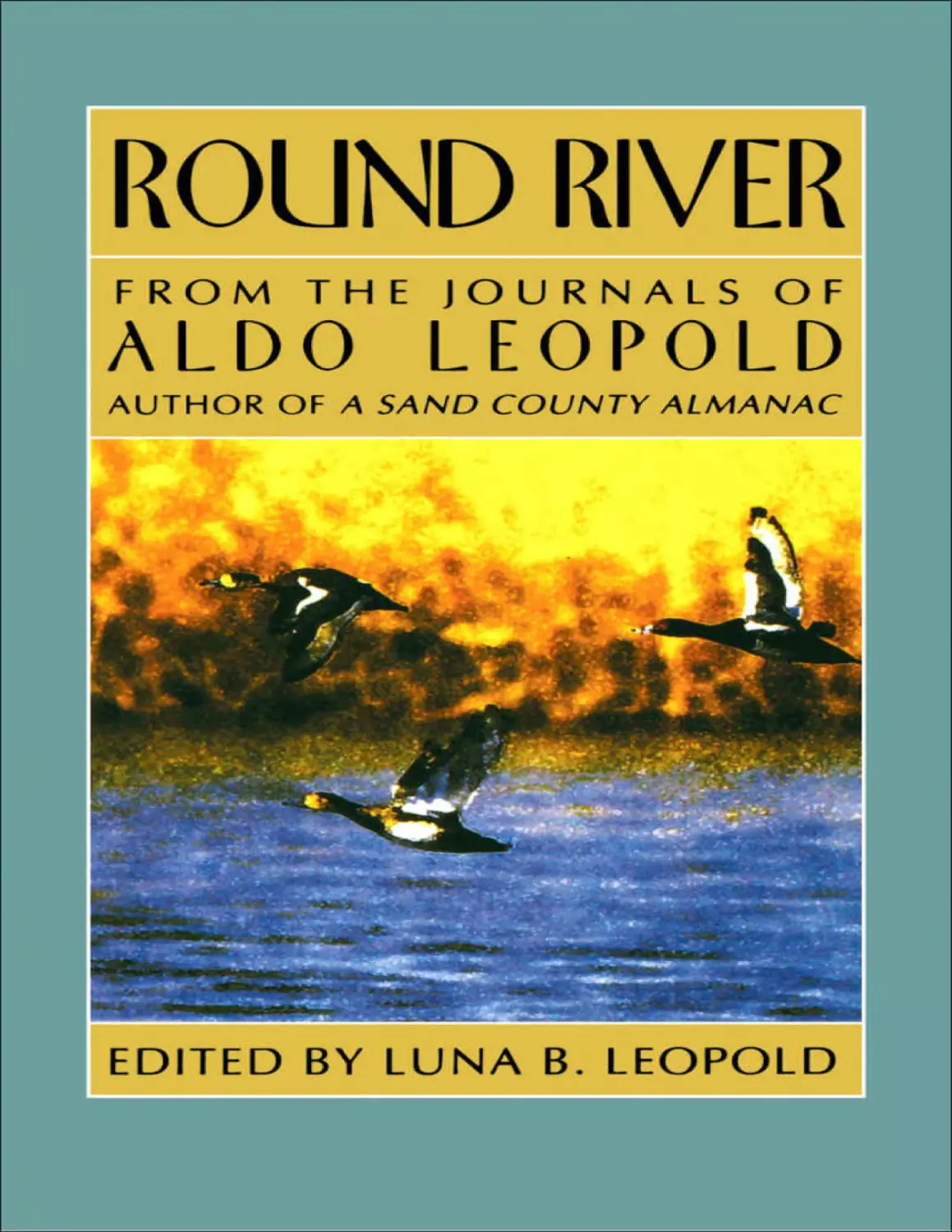
                    ROUND RIVER
OceanofPDF.com

ROUND RIVER
From the Journals of Aldo Leopold

Edited by Luna B. Leopold
Illustrated by Charles W. Schwartz

OceanofPDF.com

Oxford New York Toronto
Delhi Bombay Calcutta Madras Karachi
Kuala Lumpur Singapore Hong Kong Tokyo
Nairobi Dar es Salaam Cape Town
Melbourne Auckland Madrid
and associated companies in
Berlin Ibadan
Copyright © 1993 by Oxford University Press
First published in 1953 by Oxford University Press, Inc.,
198 Madison Avenue, New York, New York 10016-4314
First issued as an Oxford University Press paperback, 1972
Oxford is a registered trademark of Oxford University Press
All rights reserved. No part of this publication may be reproduced, stored in
a retrieval system, or transmitted, in any form or by any means, electronic,
mechanical, photocopying, recording, or otherwise, without the prior
permission of Oxford University Press, Inc
Library of Congress Cataloging-in-Publication Data Leopold, Aldo, 18861948.
Round River ; from the journals of Aldo Leopold / edited by Luna
B. Leopold ; illustrated by Charles W. Schwartz,
p.
cm.
ISBN 0-19-501563-0
1. Leopold, Aldo, 1886-1948—Diaries. 2. Naturalists—Wisconsin—
Diaries. 3. Natural history—North America—Outdoor books.
I. Leopold, Luna Bergere, 1915– . II. Title.
QH31.L618A3 1993
799'.092—dc20 93-9159 CIP
6 8 10 9 7 5
Printed in the United States of America

OceanofPDF.com

To
Fritz, Bruce, Ninitay Wendy, and the others
for they will become navigators on the Round River

OceanofPDF.com

Preface

‘I know an island that is too sandy to make a field and too brushy to make a
pasture; a shining river divides to wash its shores, and to hold a mirror to its
tall birches. In summer mosquitoes and poison ivy defend its shores against
the fisherman; in winter treacherous ice and wide bars fence out the
woodcutter.
‘My island has no name, for no one has ever died, fought, camped, or
farmed there to give it one. History has passed it by.
‘So did I, until one day I noticed the extraordinary number of deer tracks
crossing the wide bar to the only ford. If the deer like to go there, I thought,
I had better take a look. I have often noticed that a deer’s taste in scenery
and solitudes is very much like my own.
‘Years ago the title to my island bounced back to the county, where it has
reposed very quietly ever since. The county holds it in trust, as it were, for
the deer and myself. The peculiarity of this arrangement is that the county
knows nothing about it.’
In these words Aldo Leopold described one of his greatest possessions. It
ranked with the old horse’s skull on the fence post, reclaimed from
complete dismemberment by virtue of some rusty baling wire, but which
could be counted on to conceal a brood of bluebirds every spring. It ranked
with the tree-house in the elm, from which gay laughter and guitar music
could be heard during every school holiday. There were the pasque flowers
on the sandhill, the wahoo bushes to which the rabbits claimed proprietory
rights, the splash of fall yellow in the hickories of the distant hills.
Value is not measured entirely by scarcity, and possession may have a
little to do with the law. But to be rich in these subtle goods requires a

perception that grows slowly and sometimes not at all.
Perception is not acquired by formal education, nor is it necessarily
vouchsafed to those who are learned in the arts or sciences. Perception is
merely a recognition of ethical and aesthetic values to be found in natural
things. It is clear, therefore, that perception is something that grows through
various stages of development.
Aldo Leopold’s journals provide some hint of the progress of this
development. The journal entries included in the present volume will
indicate the source of some of the ideas on land ethics represented by his
essays. Some of the essays are sampled here and others comprised a
previous volume, A Sand County Almanac.
The present volume is keynoted by an opening essay on ‘A Man’s
Leisure Time.’ It is followed by excerpts from his journals which show in
more direct form what he did with his own leisure. These excerpts
constitute only a few of hundreds of journal entries, most of them shorter
than those included here.
Most of the journal notes included in the second part of this book were
written around a campfire. They have, I think, some of the pungency of oak
smoke; the original pages are here and there spattered with a slapped
mosquito or a drop of camp coffee. They convey some measure of insight
into the camp and field experience from which perception gradually
emerged.
The essays separating some of the journal entries and making up the
final part of this book are taken from more contemplative notes which were
in the form of unfinished manuscripts when Aldo died. These resulted from
a lifetime of developing perception. They express in words the feelings of a
large number of people less gifted than he in writing, but whose sense of
values is similar. For those of us less gifted, our experiences can be
mirrored in his words.
Luna B. Leopold
Washington, D. C
July1953
OceanofPDF.com

Dramatis Personae

The entries in Aldo Leopold’s journals usually began with notes on locale,
weather, and dates in the upper right corner of the page. In the upper left
were initials of the members of the party. On long trips some of the daily
journal entries were made by other members of the family. At the beginning
of each such entry, the editor has inserted in parentheses initials that will
serve to identify the author of that portion.
E.B.L.

Estella B. Leopold (Mother)

The Leopold children
A.S.L.

A. Starker Leopold

L.B.L.

Luna B. Leopold

A.M.L.

Adelina M. Leopold

A.C.L.

A. Carl Leopold

E.L.

Estella Leopold

Aldo Leopold’s brothers
C.S.L.
F.L.

Carl S. Leopold
Frederic Leopold

FLICK—Nearly any and all dogs in the Leopold family; in sequence;
1920–30, an English Setter; 1930–34, a Springer Spaniel;

GUS—A German Short-haired Pointer, 1935–43.
OceanofPDF.com

Contents

Part I
A MAN’S LEISURE TIME
Part Il
COUNTRY
The Delta Colorado
Country
Canada, 1924
Natural History—The Forgotten Science
Canada, 1925
Reunion
Red Fox Day
Current River, 1926
The Lily
The Gila, 1927
Gus's Last Hunt
Blue River
The Gila, 1929
The Deer Swath
Deadening
Sierra Madre, 1937
Part III
THE ROUND RIVER

Conservation
The Round River—A Parable
Goose Music
OceanofPDF.com

Part I

A MAN’S LEISURE TIME

OceanofPDF.com

A Man’s Leisure Time

The text of this sermon is taken from the gospel according to Ariosto. I do
not know the chapter and verse, but this is what he says: ‘How miserable
are the idle hours of the ignorant man!’
There are not many texts that I am able to accept as gospel truths, but
this is one of them. I am willing to rise up and declare my belief that this
text is literally true; true forward, true backward, true even before breakfast.
The man who cannot enjoy his leisure is ignorant, though his degrees
exhaust the alphabet, and the man who does enjoy his leisure is to some
extent educated, though he has never seen the inside of a school.
I cannot easily imagine a greater fallacy than for one who has several
hobbies to speak on the subject to those who may have none. For this
implies prescription of avocation by one person for another, which is the
antithesis of whatever virtue may inhere in having any at all. You do not
annex a hobby, the hobby annexes you. To prescribe a hobby would be
dangerously akin to prescribing a wife—with about the same probability of
a happy outcome.
Let it be understood, then, that this is merely an exchange of reflections
among those already obsessed—for better or for worse—with the need of
doing something queer. Let others listen if they will, and profit by our
behavior if they can.
What is a hobby anyway? Where is the line of demarcation between
hobbies and ordinary normal pursuits? I have been unable to answer this
question to my own satisfaction. At first blush I am tempted to conclude
that a satisfactory hobby must be in large degree useless, inefficient,
laborious, or irrelevant. Certainly many of our most satisfying avocations
today consist of making something by hand which machines can usually
make more quickly and cheaply, and sometimes better. Nevertheless I must

in fairness admit that in a different age the mere fashioning of a machine
might have been an excellent hobby. Galileo, I fancy, derived a real and
personal satisfaction when he set the ecclesiastical world on its ear by
embodying in a new catapult some natural law that St. Peter had
inadvertently omitted to catalogue. Today the invention of a new machine,
however noteworthy to industry, would, as a hobby, be trite stuff. Perhaps
we have here the real inwardness of our question: A hobby is a defiance of
the contemporary. It is an assertion of those permanent values which the
momentary eddies of social evolution have contravened or overlooked. If
this is true, then we may also say that every hobbyist is inherently a radical,
and that his tribe is inherently a minority.
This, however, is serious; becoming serious is a grievous fault in
hobbyists. It is an axiom that no hobby should either seek or need rational
justification. To wish to do it is reason enough. To find reasons why it is
useful or beneficial converts it at once from an avocation into an industry—
lowers it at once to the ignominious category of an ‘exercise’ undertaken
for health, power, or profit. Lifting dumbbells is not a hobby. It is a
confession of subservience, not an assertion of liberty.
When I was a boy, there was an old German merchant who lived in a
little cottage in our town. On Sundays he used to go out and knock chips off
the limestone ledges along the Mississippi, and he had a great tonnage of
these chips, all labeled and catalogued. The chips contained little fossil
stems of some defunct water creatures called crinoids. The townspeople
regarded this gentle old fellow as just a little bit abnormal, but harmless.
One day the newspaper reported the arrival of certain titled strangers. It was
whispered that these visitors were great scientists, some of them from
foreign lands, and some were among the world’s leading paleontologists.
They came to visit the harmless old man, and to hear his pronouncements
on crinoids, and they accepted these pronouncements as law. When the old
German died, the town awoke to the fact that he was a world authority on
his subject; a creator of knowledge; a maker of scientific history. He was a
great man—a man beside whom the local captains of industry were mere
bushwhackers. His collection went to a national museum, and his name is
known in all the nations of the earth.
I knew a bank president who adventured in roses. Roses made him a
happy man and a better bank president. I know a wheel manufacturer who

adventures in tomatoes. He knows all about them, and, whether as a result
or as a cause, he also knows all about wheels. I know a taxi driver who
romances in sweet corn. Get him wound up once and you will be surprised
how much he knows, and hardly less at how much there is to be known.
The most glamorous hobby I know of today is the revival of falconry. It
has a few addicts in America, and perhaps a dozen in England—a minority
indeed. For two and a half cents one can buy and shoot a cartridge that will
kill the heron whose capture by hawking requires months or years of
laborious training of both the hawk and the hawker. The cartridge, as a
lethal agent, is a perfect product of industrial chemistry. One can write a
formula for its lethal reaction. The hawk, as a lethal agent, is the perfect
flower of that still utterly mysterious alchemy—evolution. No living man
can, or possibly ever will, understand the instinct of predation that we share
with our raptorial servant. No man-made machine can, or ever will,
synthesize that perfect co-ordination of eye, muscle, and pinion as he stoops
to his kill. The heron, if bagged, is inedible and hence useless (although the
old falconers seem to have eaten him, just as a Boy Scout smokes and eats a
flea-bitten summer cottontail that has fallen victim to his sling, club, or
bow). Moreover the hawk, at the slightest error in technique of handling,
may either ‘go tame’ like Homo sapiens or fly away into the blue. All in all
falconry is the perfect hobby.

To make and shoot the longbow is another. There is a subversive belief
among laymen that in the hands of an expert the bow is an efficient weapon.
Each fall, less than a hundred Wisconsin experts register to hunt deer with
the broadheaded arrow. One out of the hundred may get a buck, and he is
surprised. One out of five riflemen gets his buck. As an archer, therefore,
and on the basis of our record, I indignantly deny the allegation of
efficiency. I admit only this: that making archery tackle is an effective alibi
for being late at the office, or failing to carry out the ashcan on Thursdays.
One cannot make a gun—at least I can’t. But I can make a bow, and
some of them will shoot. And this reminds me that perhaps our definition
ought to be amended; a good hobby, in these times, is one that entails either
making something or making the tools to make it with, and then using it to
accomplish some needless thing. When we have passed out of the present
age, a good hobby will be the reverse of all these. I come again to the
defiance of the contemporary.
A good hobby must also be a gamble. When I look at a rough, heavy,
lumpy, splintery stave of bois d’arc, and envision the perfect gleaming

weapon that will one day emerge from its graceless innards, and when I
picture that bow, drawn in a perfect arc, ready—in a split second—to cleave
the sky with its shining javelin, I must envision also the probability that it
may—in a split second—burst into impotent splinters, while I face another
laborious month of evenings at the bench. The possible debacle is, in short,
an essential element in all hobbies, and stands in bold contradistinction to
the humdrum certainty that the endless belt will eventuate in a Ford.
A good hobby may be a solitary revolt against the commonplace, or it
may be the joint conspiracy of a congenial group. That group may, on
occasion, be the family. In either event it is a rebellion, and if a hopeless
one, all the better. I cannot imagine a worse jumble than to have the whole
body politic suddenly ‘adopt’ all the foolish ideas that smolder in happy
discontent beneath the conventional surface of society. There is no such
danger. Nonconformity is the highest evolutionary attainment of social
animals, and will grow no faster than other new functions. Science is just
beginning to discover what incredible regimentation prevails among the
‘free’ savages, and the freer mammals and birds. A hobby is perhaps
creation’s first denial of the ‘peck-order’ that burdens the gregarious
universe, and of which the majority of mankind is still a part.
OceanofPDF.com

Part II

COUNTRY

OceanofPDF.com

The Delta Colorado
BEING AN ACCOUNT
OF A VOYAGE OF DISCOVERY
BY CARL AND ALDO LEOPOLD
GENTLEMEN—ADVENTURERS

In the Mythical Straits of Annian, the
Jungles of the Rio del Pescador, and the Environs of
the Vermillion Sea. In the hunter’s moon, A.D. 1922.

Many voyages have been pretended, yet hitherto never any
thoroughly accomplished by our nation, of exact discovery into the
bowels of those main, ample, and vast countries. …
SIR HUMPHREY GILBERT
25 October, Wednesday
After arriving in Yuma at midnight Tuesday, we were up at daylight and
found the river flowing under a bridge only a stone’s throw from the hotel.
It looked like plenty of water.
We called at Reclamation Service Headquarters, where I met Mr. Ray
Priest, Assistant Project Manager. He had just been to the mouth of the river
in a skiff with a traveler named Freeman, who had come down from the
very headwaters. They had encountered three days’ hard trucking in the
Pescadero country, and Yuma had been about to send out a rescue party.
Priest said not to try it. Mr. Berry of the Customs said the same.
We then went to see Colonel B. F. Fly, who very kindly devoted his
whole day to seeing us off. After buying our chuck and getting haircuts, we
left at 3 p.m. for San Luis in a Model T Ford truck belonging to Will Lowe.

Having the canoe loaded on diagonally worked very well. An interesting
ride through the rich Yuma Valley landed us at the International Boundary
about 5 p.m. Here Colonel Fly introduced us to Major Y. Gomez Yavias, a
government engineer, Alexandre Sorteon, our host for the night and driver
for tomorrow, Major Arierza, the newly elected Comisario of San Luis, and
Lieutenant Lopez, the commander of the garrison. It being agreed that we
were harmless hunters and not the conspirators of a new revolution, we all
repaired to the saloon and had some real beer. Colonel Fly then returned to
Yuma, while we spent a very interesting evening at Sorteon’s, discussing
the country with Major Gomez and hearing always of the terrible tides or
bores, and the impracticability of venturing into them with our canoe. It was
finally decided to leave the canoe temporarily at San Luis while we spent a
week or so at the head of the Rillito after deer.
Among the evening callers at Sorteon’s was Señor Cor-vola, a finance
inspector on a ‘delicate mission,’ the Comi-sario’s office and records
having been burned just a day or two before the recent election; also Señor
Limon, government wireless operator.
Slept on the floor of Sorteon’s restaurant, and awoke bright and early for
the eventful entrada.
26 October, Thursday
Left about 10 a.m. in Sorteon’s Ford for Rillito, where we arrived about 1
p.m. and unloaded on the bank of a pretty little slough,°dismissing Sorteon
with instructions to come back in a week. Even as we drove up to the
slough a beautiful snowy heron flushed from the reedy bank, and several
cormorants were fishing in a wide place below camp. Flick flushed a covey
of quail.
We built an Apache style ‘rancheria’ for shade and after completing
camp took a walk up the Rillito. Carl got one quail and we found an
unbelievable number of bobcat and coyote tracks in the sandbars and on the
banks of the stream. As we got back to camp a very large coyote was
drinking just below at the head of the little lake—we nearly got a shot at
him. That night we could hear geese passing—they would set up a great
cackling when they saw our fire. Quite a coyote chorus during the night.
27 October, Friday

At daylight I killed a huge drake mallard flying up the stream. Explored
upstream and got our first lesson in arrowweed thickets. They are barren
deserts, full of unkillable but dog-killing rabbits, and travel is difficult to
impossible. A couple of miles above camp we came on a very pretty
lagoon, from which three widgeon flushed. Carl got them all. Here also
were the tracks of a huge buck and a doe. A great flock of wavies came
exploring up the Rillito about 10 a.m. and went on back again—presumably
to El Doctor. From the hill on the mesa near the lagoon we could see the
whole delta and even the mirage—like mud flats at Santa Clara. A howling
wilderness is the only name for it.
In the evening we set out a couple of traps above camp and tried the
mullet, which were jumping in great numbers. No luck. Roast duck and
sourdough biscuit tonight—but we spoiled the noodles by trying to boil
them in the salty water from our ‘well.’
At noon we had a swim and washday, likewise barbershop. Water fine
but cold.
28 October, Saturday
Explored south. Deer tracks more numerous, including quite a few very
small ones which may be fawns or maybe little white-tails. Rillito has many
long pools, on which were snowy herons, night and great blue herons,
cormorants, grebes, coots, and kingfishers. Also a few spoonbills. One flock
of wavies came exploring upstream, and we heard another flock out on the
mesa. More experience with arrowweed jungles.
There are a few cattle here, which seem to eat cane.
The quail killed yesterday had a crop full of berries, which we today
identified as mistletoe. It grows on tornillo and mes-quite.
About 2 p.m. heard an auto on the road. Carl went up. The two men in it
didn’t want to talk. They had the back seat full of wet-looking crates.
This evening we fished, Carl rigging a throwline. Got a big carp—
probably two pounds—that fought at least as hard as a bass, several smaller
carp, and a small mullet. Rabbit belly proved a better bait than pork fat.
At evening a team passed—a big burly Mexicano, four big mules, and
probably a ton of ‘hooch.’ You could smell it tambien. The Mexicano
proved to be Dominguez of La Bolsa. He camped at the ‘Agua dulce’ north

of our camp and we fed him up on noodles and sourdough biscuits and then
plied him in poor Spanish for information about deer and geese.

29 October, Sunday
A cold night. Some impertinent coon took our fish. The upper coyote trap
had a drowned buzzard in it; the proverbial wet hen was handsome in
comparison.
South along the mesa, quail hunting and prospecting. Got two birds, both
full of tornillo hulls. A Gambel quail track is 2″ long x 1½″ wide toe to toe.
There are five feathers in his plume.
On climbing one of the dunes, or ‘montes,’ we found a huge bay of low
country south of camp and cut across to it. No deer tracks there or along the
edge coming back. The deer must use the other montes east of camp.
Back at noon. After dinner a flock of avocets came over. Carl got three.
They are the most delicately beautiful of all waterbirds. Carl also killed one
of the stout-billed waders that had a white rump; turned out to be a willet.
The rest of the afternoon we fished, catching many small mullet. Put
them in a sandbar pool. Sunday dinner we had before dark by way of
celebration—quail and mashed potatoes and a very successful batch of
sourdough bread of which Carolo was the author—his first attempt.
30 October, Monday
As we were eating breakfast I knocked down a big mallard and Carolo two
widgeons. Many geese flew up over the mesa and clamored mightily

around the upper lagoon. We first went up to look at the traps. The first one
was gone, and a clawed-up bank told us why. We were rather blankly
wondering whether the light stake had come off when we heard a rustling
back in the arrowweed. We broke our way through the dense growth, one to
each side of the noise, and Carl sang out, ‘Coyote!’ and at the same time the
coyote made a run for it. He made pretty good progress and we were afraid
he might pull out. So Carl put a .32 bullet behind his ear and we carried our
catch back to the Rillito. It was a very pretty young female in fine fur, but
when we hung her up for skinning we found the fur was loose. So we had to
content ourselves with the brush. So far it was a pretty large morning.
Then took a hike to the ‘montes’ north of camp but found no deer sign.
When we got back at noon a blue heron was in our fish pen, and left with
great reluctance and protestation.
The flats north of camp have many snail shells—evidently carried by
high water.
Fished in the evening. Decided that our so-called ‘carp’ were
sheepshead, as the mouth is not pointed downward, but forward, and they
lack the carp’s ‘whiskers.’
Had sheepshead and mullet for supper, but found both were so soft and
soapy as to be inedible.
The geese made a great to-do up the Rillito. Carl said it sounded like a
daughter getting home from college.
Gathered up our traps preparatory to moving to the Punta de Mesa
tomorrow, where there are said to be ‘muchos venados.’
31 October, Tuesday
Francisco, a vaquero for Jesus of the Rancho Salado, arrived about 9 a.m.
with his ‘carrillo’ and a team of buckskin mules. We loaded up and arrived
at the Punta about noon, telling Francisco to come back Thursday.
Took a walk up the Colorado Viejo and set a trap with the carcass of a
mallard. At the foot of the Punta are a series of pools, full of herons and
lined with waving willows of the most delicate green; the water, bearing the
reflections of the willows, is of a brilliant verdigris hue. A weird and
impressive place. No deer tracks. Killed four quail. Their crops contained a
few tornillo hulls and whole grasshoppers, and a huge amount of minute,

hard, lozenge-shaped, shiny, bronze-black seed, together with the hulls. I
think this must be pigweed (arrow-weed) seed. They contain a white kernel.
A very pleasant camp on the mesa in a clump of mesquite trees. Had the
mallard for supper, with whole rice. (At the Rillito camp a coyote got away
with our trap—pulled the stake.)
1 November, Wednesday
Down the Rillito. Found some deer tracks, most of them old, and sweet
water. Killed three more quail. No deer tracks in the montes along the mesa.
A great clamor of geese below us, but we arrived just in time to see seven
bunches strung out back for El Doctor. These had been using Widgeon
Lake, which is on one of the ‘canales’ and is salt, not sweet. Evidently then,
the geese do not come there for fresh water. Probably they come for gravel,
of which there is plenty, though we can recall none below.

Above Widgeon Lake is a big salt lake on which were cormorant,
spoonbill, ruddies, avocets, yellowlegs, widgeons, willet, jacksnipe, and
two kinds of sandpipers in flocks, one very tiny, the other about the size of a
jacksnipe. There were no goose tracks. Also saw coots, grebes, vermilion
flycatchers, kingfisher, and black phoebe, and a small white gull with red
bill and dark wing tips (royal tern?).
Coming back we sighted a huge ‘chimney’ of cranes wheeling high in
the sky over the Punta. When they got the glint of the sun they showed pure

white and looked like a huge skyrocket bursting into white sparks.
Gradually they worked east and when over us suddenly formed into a series
of ‘V’s and started for El Doctor. Carl counted 130 when they were in this
formation. They still showed white and looked like great draped strings of
pearls against the blue. At no time did they utter a sound. I cannot see how
sandhill cranes could show so white. Could they have been whooping
cranes?
Killed another quail at camp, and packed up for a before-daylight hike to
Widgeon Lake after geese.
2 November, Thursday (Goose Day)
Up at 4 a.m. and hiking across the mesa by 5 a.m. Left our stuff packed
with a note for Francisco to haul it back to Coyote Camp. Very interesting
making our way in the dark, especially breaking through the cane and
cachinilla to the Rillito. Got to the goose bar well before sun-up but nothing
there except ducks. About seven Carl started up to Salt Lake to see if the
geese were there. He had barely left when a big white flock swung in over
the mesa and headed for the blind on set wings. They came over about 30
yards high. If I had shot sideways into the line it would have rained geese,
but I didn’t want to chase any cripples. So I took the two end ones overhead
and killed both stone dead. By now Carl was back and we were starting a
war dance when another bunch came in sight. Carl took the gun. They got
between him and the sun but he got one dead. Immediately came another
bunch, out of which Carl made a pretty double. Then another, and I made a
double. This made seven, which was enough. We were hungry, so went up
to the lighting place and hid under a tornillo, where we were demolishing
cold roast quail and sourdough biscuits when a single came in and lit within
what we afterward paced at 18 yards. We suspended lunch and motions, and
scarcely breathed for five minutes while we watched him—except Flick,
who couldn’t make his eyes behave, in spite of my hand on his collar.
Finally the single got nervous and left, but along came 11 more and lit
within 25 yards. We watched them a long time. These geese keep up a
continual hum of small talk not audible at a distance. We plainly saw them
go after the coarse sand immediately after setting down. Their wing coverts
drape down over their primaries like heron plumes. Some always have their
heads up. When they begin shaking their heads they are getting ready to go.

At this time they line up in pairs facing the wind, so that they spring up in
formation.
The seven we had killed made a he-load packing them down to Coyote
Camp. On the way we saw sign, probably coyote but possibly coon,
containing a mass of the hard wings of Dytescus beetles, hair, and tornillo
beans. At Coyote Camp we had a swim and then Alex Sorteon and
Francisco arrived. In the afternoon we ran down to see La Bolsa. The tide
was in. It didn’t look bad for canoe work. They say sharks come up this far.
On the way back we saw four huge black frigate birds flying east. Also saw
a peculiar buzzard that must have been a caracara. Goose roasted in the
dutch oven tonight. Saw a coyote near camp in the moonlight. Weighed up
the geese. They broke the scales but weighed about 5¼ pounds each. One of
the brick-tinged young ones was so tender that the skin pulled off with the
breast feathers.
3 November, Friday
To El Doctor with Sorteon. Arrived about 10 a.m. There were lots of teal,
blue and green-wing, of which Carl killed three. Three geese came over
rather high. I shot behind with the first barrel but dropped one dead with the
second. The big springs pours up right in the cat-tails—and is warm but fine
and sweet. A huge wheeling flock of sandhill cranes passed by going south.
After lunch a flock of about 100 geese lit in the lagoon in front of us. Posted
Alex for a pass shot while we went around and flushed. He hit two but both
got away.
The mirage effects here are remarkable. It looks as if the whole world
were a goose swamp, but everything in the way of water over half a mile
distant is likely to prove non-existent, as are the beautiful alamos that stand
on its shores and the lines of fowl that seem to be setting on its sandbars.
Alex says that wells sunk here rise with the tide, and that there is one place
where on puncturing the mud with a stick a column of water as high as a
man spouts out.
We left rather reluctantly and at dark arrived below San Luis, where
Alex dropped us on a fine grassy bank of the Rillito while he went in to
bring the canoe down in the morning.
4 November, Saturday

We celebrated washday and shaved off some very long beards. Repacked
the outfit for boat work. Alex arrived with the boat about 9 a.m. Stowed
cargo and embarked on the Rillito. Found lots of exercise, in the form of
two bridges and three beaver dams, two of which we had to portage; also
many log jams and fallen trees which we had to cut out. Going over one of
the latter we pulled a tenderfoot trick in letting the canoe down on the stub
of a limb. This poked a clean hole an inch in diameter right through her
bottom, so we had to haul up and become a dry-dock crew. With a piece of
tin from a tin can, a piece of canvas, and white lead we contrived a patch
that never leaked a drop.
Some interesting scenery, much willow cotton, many herons, but few
ducks. At sunset a Cocopa boy riding bareback came out on the bank while
we were making another portage around a willow thicket. He swore in
English before he saw us but could speak neither English nor Spanish when
we asked him how far to the Hidalgo ranch.
Earlier in the afternoon we stepped ashore at an Indian clearing and
found some fine melons. At sunset we passed a skunk on the bank. While I
cooked supper Carl stepped out and killed a couple of quail and a dove.
Night was very cold.
5 November, Sunday
Started about 10 a.m. after letting some clothes dry. Better going today,
although we had to portage around one log jam and chop our way through
several others and a dozen windfalls. Very pretty traveling along the Rillito,
with frequent grassy banks and handsome white-barked cottonwoods. Saw
many herons and hawks and horned owls, also many coon and beaver
tracks, but no deer. Shortly after lunch we reached the Hidalgo ranch but the
old man was not at home. His rather attractive daughter was very polite but
could tell us nothing about the country, and her beau, who was on deck in
very neat cowpuncher’s clothes, could have but didn’t. Camped above the
ranch and Carl went on a quail hunt. Got two, and half a dozen doves. I
fished and caught many small catfish but none big enough to clean. Set a
coon trap baited with a live catfish in a wet cowtrack, also quail cleanings;
then joined Carl. We saw, or rather heard, an enormous covey in a patch of
tall weeds, but they were hard to work and easy to miss.
The doves killed today were full of wild melon seed.

Had a fine supper of teal, dove, quail, mashed potatoes, and C.S.L.-brand
sourdough biscuits. A fine camp.
6 November, Monday (C.S.L.)
Ten o’clock saw us headed somewhere southwest—canoe, baggage, and
personnel aboard Señor Hidalgo’s spring wagon. It was rough, dusty going
except along the Rillito, which we soon left, taking a course across a semidesert, almost treeless, delta plain. Lunched in the edge of a pigweed patch
—Aldo got four quail with four shells.
Steady travel all afternoon—we passed Laroma’s cow camp in a
beautiful grassy bosque and at 4 p.m. stopped at another camp to ask
information. There were hundreds of quail and many doves. We added six
quail to our larder. With only a mile to the river, but no road, we decided to
try and make it before sundown. It was tough work for the team, through
heavy arrowweed and many small flood-water gullies. But with big bosque
ahead and the air full of cormorants and ducks our hopes were high until we
encountered a small muddy slough. A sashay on foot showed no way to get
ahead; it was almost dark so we camped down in the smoothest available
spot. Hidalgo’s yarns provided the evening’s entertainment.

7 November, Tuesday(C.S.L.)
Quail roosted in the mesquite bush within six feet of our lean-to, flying out
as we got up for an early start. Aldo got breakfast while I prospected north
along the slough. Located a big lagoon and as I walked back toward camp,
surprised a bobcat on the open mud bank. Got in two .30-.30 shots before
the cat made cover. Flick trailed a few yards and barked. It took a .32 to
finish the job. The cat hung from shoulder to heel. Aldo skinned her out.
We finally got into the river and found it a beautiful large stream—banks
overgrown with drooping willows. Considerable beaver and some deer
tracks. Made permanent camp about a mile upstream in a mesquite orchard.
Quail are everywhere but this is venado country so we are keeping quiet. A
paddle up-river before supper netted an appetite. The quail would not be
enticed by our candle lantern.
8 November, Wednesday
Made an expedition by canoe, getting off shortly after sun-up. At the point
where the lagoon joins the river, we became actors in the famous game of
pussy-in-a-corner. Carl, who had the bow, sighted a big bobcat fishing on
the small island that forms the point. We promptly got in between the island
and shore and had the old bob cornered in a willow thicket. Carl went
ashore with the shotgun and stood guard while I backed out the boat to
drive her out. It was too easy. She came out between us, hell bent for
election. We didn’t wake up till she had made a fifteen foot jump across the
little channel, when I bid her Godspeed with an ineffectual shot into the
jungle. It was inconceivable that this cat could get away from us. But she
did.
On down the river (what river Lord only knows—it may be the Santa
Clara, the Pescadero, or the Bee) Carl sighted another cat in a willow
thicket. He made a quick shot and knocked her down but she got up and
kept going. We went ashore and tried to trail her but no luck.
About two miles below camp the river began to break up and we soon
encountered a complete log jam which stopped all further progress. I used
to talk pretty bravely about wiggling through the Labyrinth of the Colorado,
of which this is probably the head. But we learned something on the Rillito.
Neither of us had any desire to travel through that log jam.

Coming back we caught a wet cormorant by diving him down. He put up
quite a fight with his hooked bill. Set him out for live bait at one of the cat
sets. Also set two beaver traps.
In the evening we explored upstream, finding great fields of hemp and
arrowweed but few deer tracks. Built a quail trap out of dead arrowweed as
we needed meat and did not want to shoot around camp.
Every evening a great flight of cormorants comes into the lagoon from
the north, and every morning they go out. Around camp, in camp, and in
fact all over are incredible numbers of quail. Also many doves. A few ducks
fly over the lagoon.
This night a beaver kept slapping the river right by camp. Sounded like a
large heavy boulder plumping into the water. We have a grass bed and sleep
with great comfort.
9 November, Thursday
Up before sun and eastward up the lagoon. Great droves of herons and
cormorants accumulated before us like a round-up. Much fine mesquite and
grass country on the banks, and very little current. About four or five miles
up we found many fine big mallards. Lagoon broken up into several live
and several dead channels, the former very swift and navigable only with
difficulty. Found very few deer tracks.
After lunch and a nap we decided to lay in some meat, so I killed a
greenhead and Carl got 13 quail. We found that in walking through the wild
hemp one can gather quite a lot of beans by simply holding the hands
cupped and letting the beans rain in from overhead. Killed a couple of coots
for trap bait. Killed a duckhawk chasing a heron.
On the way back we were suddenly aware that a great caterwauling
going on in the jungle to our left was not the usual croaking and fighting of
herons and fowl, but rather a real, genuine, back-alley cat fight, with claws,
whiskers, and all the trimmings. We quickly headed for the racket but the
wind was dead against us, and when the fight got fairly in our lee it
suddenly ceased. We caught a glimpse of one of the parties to the
controversy sneaking off under the shadows, but not enough to shoot at.
Our live bait had got loose. We shall henceforth trail a piece of blue
bacon strung over the boundless green miles of the Delta. We rebaited with
coot. Saw an egret just below camp; also a few white herons and many

buzzards. Carl took a still hunt on the point before supper and found much
fresh deer sign.
10 November, Friday
Organized a deer drive. I sat in the lane near camp while Carl still-hunted
the east side of the point. Then he sat while I hunted out the west side. This
took till noon but no deer, although they made fresh tracks within 20 yards
of camp last night. At the point I found a Mexican black hawk in one of the
traps we had baited with a coot. Hawks and buzzards are so plentiful that
one cannot leave any bait exposed.
Carl caught a large mullet on his throw line this noon.
We each saw a cat this morning, but neither shot for fear of spoiling the
deer hunt. Carl had a dead-sure chance at his. One can often locate cats by
listening to the scolding of the quail, which are so nearly ubiquitous that
one can follow anybody or anything through the woods by the quail
scolding and flushing.
We took an evening hunt below Campo del Gato. Found numerous
tracks in a big mesquite park. Carl missed a coyote which almost ran into
him. The cormorants were roosting in the willows as we came home.
11 November, Saturday
We paddled up the river all morning against a strong current. Found an old
corral and killed a mess of quail after lunch. Saw another flock of cranes
wheeling eastward over the lagoon.

The river becomes swift and narrow about two miles above camp, and is
lined with down willows.
Hunted the point again this evening. Carl found a hard mud slough on
which he thought fawns had been playing since our last hunt yesterday
morning. I stood at a pass and tried to count the cormorant flocks coming
in, but gave it up. There must be several thousand. They roost in the trees,
but unless their perch is very high above the water they hit the water first in
order to get the benefit of their feet in taking flight. When they are disturbed
at night it is doubtful if they can again take to trees. If not they may spend
the night on the water, and this may account for the few flightless
individuals one always finds on the lagoon and on the river.
We reset one of the traps for cat just above camp, baiting with the
remains of the mallard and quail.
12 November, Sunday
First made the rounds of the traps, which we had not visited yesterday. The
beaver trap was sprung but empty. We reset it in a different place. The
bobcat trap contained a small coon. He looked very wet and lonesome, but
his hide looked fair so we skinned him out and reset. He had been in a day
and the glands under the pit of his caught foreleg had become swollen and

inflamed. Cased his hide and made another deer hunt of the Del Gato
mesquite orchard. The wind changed on us and furthermore we had moved
from mesquite country into hemp. We saw ravens sitting near where Carl
hit the coyote on 10 November. I have no doubt he is about there, dead, but
we couldn’t find him.
Coming back we saw seven mallards light in the little channel where
Carl killed his cat. Made a sneak and I missed a big greenhead with both
barrels, but I got a hen with a third shell. She flushed late and tried to
follow the others. Flick retrieved her promptly from the arrowweed.
Carl saw the cranes again this morning—a huge flock. He says they are
white with black wing tips.
Paddling home we again heard a loud splashing under a patch of cane
near the creek. I’m pretty sure it is a beaver who airs and suns himself there.
Or maybe a coon.
In evening went north on the east bank and killed 14 quail for carne
seco. Smoked them over mesquite coals that evening. Quite a little deer
sign up there. Quail, noodles, and cornbread for supper, with raisin
preserves. A big mesquite fire to celebrate our last evening in camp, and
made plans for one last try at the deer.
13 November, Monday
Up extra early and started up the lagoon, after looking at our traps, one of
which contained a dead buzzard. A fine bunch of mallards on the lagoon
but we didn’t dare shoot. A little above the old corral Carl sighted a whole
bunch of animals on shore under a patch of cane and mesquite. We hoped
they were cats but as we stole up in the canoe we saw they were a whole
family of coons. I took the shotgun and killed one dead with the first barrel
and thought I’d killed the big one with the second. The big one disappeared,
however, so we put Flick on his trail and he soon barked about a hundred
yards up the bank in a dense mesquite thicket full of deep mud. We rushed
up and found the big crippled one under a pile of dead brush. These coons
were big and fat and in better fur than the previous one.
Went on up the lagoon and made a hunt on the north bank but found very
few tracks. As usual, great numbers of quail and doves. Then while eating
some lunch we drifted down the lagoon and went ashore on the point to
skin out coons and incidentally to watch for mallards, which had been

passing regularly. They continued to pass, but always saw us and the snowwhite coons, which were so covered with fat as to look like big lumps of
lard. The young one skinned out a lot easier than the old one.
Back to camp, regretfully taking up the traps as we went. Carl had
another mullet on his throw line. Lost his pipe in the lagoon shooting at
some teal. Packed up the outfit, including the grass bed, and took our final
paddle down the river to the Campo del Gato, where we were just setting up
for the night when Hidalgo arrived with his team, as per appointment. Roast
mallard dinner to celebrate our last night in camp. At evening heard a
whistling in the swamp which Hidalgo said was a beaver. At bedtime heard
geese passing downstream from us, going east. These were the only geese
we saw or heard in this region.
14 November, Tuesday
Up extra early and breakfast over by sun-up. Did not replenish the
sourdough—the empty kettle a sad symbol of bright days gone by. Hit the
Cachorrilla while the morning sun sculptured old Sierra Mayor into
changing shapes and shadows. Fine fresh breeze from the north.
In the calabasas fields myriad quail were out feeding and whistling in
welcome of the warm sunlight. Walked along beside the wagon and killed a
last fine mess of 14 birds.
White herons sat on the lagoons to the north as we passed. Saw five
pelicans passing as we crossed the big chamise flats. Killed a sharpshin.
Reached Hidalgo’s by noon and were his guests for luncheon. The wind
blew gusts of sand through the wattle walls of his dining hall as we ate
tamales and drank coffee. The pet pig, Flick, two dogs, five children, and a
black mare stood guard by the door, watchful for the crumbs of the master’s
table, and sortied into the hall when the crumbs failed to materialize. A little
white-toothed, dusky-faced boy haunted Flick’s side trying to feed him
watermelon, and repeating over and over again some kind of assurance that
sandias were fine food for dogs. A sick little girl, wrapped in a shabby
overcoat, sat in a dim corner and watched us with great soft eyes. And all
the while our host poured coffee and recounted with gusto and large
gestures brave tales of the days when he was a freelance vaquero seeking
fortune and adventure on the Arizona frontier. Of adventure he found great
store—of fortune, many a fair beginning. Meanwhile the wind blew gusts of

sand, the little boy chanted to Flick of watermelons, and the little girl
looked with great eyes upon us. Finally the coffee pot went dry, and we
started.
Arrived at San Luis before sundown, and hopped a ride on a load of beef
hides into Yuma, where we arrived about 8 p.m. A bath, a call on our good
friend Colonel Fly, and we caught a midnight train for home.
OceanofPDF.com

Country

There is much confusion between land and country. Land is the place where
corn, gullies, and mortgages grow. Country is the personality of land, the
collective harmony of its soil, life, and weather. Country knows no
mortgages, no alphabetical agencies, no tobacco road; it is calmly aloof to
these petty exigencies of its alleged owners. That the previous occupant of
my farm was a bootlegger mattered not one whit to its grouse; they sailed as
proudly over the thickets as if they were guests of a king.
Poor land may be rich country, and vice versa. Only economists mistake
physical opulence for riches. Country may be rich despite a conspicuous
poverty of physical endowment, and its quality may not be apparent at first
glance, nor at all times.
I know, for example, a certain lakeshore, a cool austerity of pines and
wave-washed sands. All day you see it only as something for the surf to
pound, a dark ribbon that stretches farther than you can paddle, a monotony
to mark the miles by. But toward sunset some vagrant breeze may waft a
gull across a headland, behind which a sudden roistering of loons reveals
the presence of a hidden bay. You are seized with an impulse to land, to set
foot on bearberry carpets, to pluck a balsam bed, to pilfer beach plums or
blueberries, or perhaps to poach a partridge from out those bosky quietudes
that lie behind the dunes. A bay? Why not also a trout stream? Incisively
the paddles clip little soughing swirls athwart the gunwale, the bow swings
sharp shoreward and cleaves the greening depths for camp.
Later, a supper-smoke hangs lazily upon the bay; a fire flickers under
drooping boughs. It is a lean poor land, but rich country.
Some woods, perennially lush, are notably lacking in charm. Tall cleanboled oaks and tulip poplars may be good to look at, from the road, but

once inside one may find a coarseness of minor vegetation, a turbidity of
waters, and a paucity of wildlife. I cannot explain why a red rivulet is not a
brook. Neither can I, by logical deduction, prove that a thicket without the
potential roar of a quail covey is only a thorny place. Yet every
outdoorsman knows that this is true. That wildlife is merely something to
shoot at or to look at is the grossest of fallacies. It often represents the
difference between rich country and mere land.
There are woods that are plain to look at, but not to look into. Nothing is
plainer than a cornbelt woodlot; yet, if it be August, a crushed pennyroyal,
or an over-ripe mayapple, tells you here is a place. October sun on a hickory
nut is irrefutable evidence of good country; one senses not only hickory but
a whole chain of further sequences: perhaps of oak coals in the dusk, a
young squirrel browning, and a distant barred owl hilarious over his own
joke.
The taste for country displays the same diversity in aesthetic competence
among individuals as the taste for opera, or oils. There are those who are
willing to be herded in droves through ‘scenic’ places; who find mountains
grand if they be proper mountains, with waterfalls, cliffs, and lakes. To such
the Kansas plains are tedious. They see the endless corn, but not the heave
and the grunt of ox teams breaking the prairie. History, for them, grows on
campuses. They look at the low horizon, but they cannot see it, as de Vaca
did, under the bellies of the buffalo.

In country, as in people, a plain exterior often conceals hidden riches, to
perceive which requires much living in and with. Nothing is more
monotonous than the juniper foothills, until some veteran of a thousand
summers, laden blue with berries, explodes in a blue burst of chattering
jays. The drab sogginess of a March cornfield, saluted by one honker from
the sky, is drab no more.
OceanofPDF.com

Canada, 1924
A.L., C.S.L., F.L., A.S.L.

P. O. Ely, Minn.
11 June,1924
’Twas Wednesday noon when we set sail from Winton, Minnesota, going up
Fall Lake in an old launch, thence by truck over an old logging grade four
miles into the SW arm of Bass-wood Lake. Here we loaded up our two 16foot Racine canoes and struck NE for the international boundary. About
5:00 p.m. we got to the Canadian Ranger Station (Quetico Provincial Park),
bought our licenses from Ranger Seeley, headed north about a mile, and
pitched camp. Starker’s fishing fever was running high, so we paddled out
to a little island and caught two pickerel for supper.
Our camp was under a fine stand of Norway pine, where hermit thrushes
were singing. It is already apparent that the pine timber on the Canadian
side is all uncut and not much burned, while on the American side there is
not a pine left. Fortunately the numerous islands are all covered with fine
mature pines.
Roast pickerel for supper. When we went to bed at nine it wasn’t yet
dark.
12 June
About 4:30 a.m. gave up trying to stay in bed. While eating breakfast saw a
black mallard and several small mergansers pass by. Headed north toward
Canadian Point, where in a wide part of the lake we found a big bunch of
loons, the banks of pine timber echoing their calls. Starker trolled and
caught a big pickerel with a parasitic worm projecting from his side. In

spite of this he was fat. Put him back, of course. About 10 a.m. reached the
Basswood River and soon got to the first falls, portaging around them and
finding our outfit good to carry but not quite to the point where we could
make it in one trip. Had some lunch, and Carl and Fritz caught two fine
walleyed pike, in addition to pickerel which we let go. Several red-breasted
mergansers passed over. Then we portaged the lower falls, at the foot of
which Fritz added another wall-eye and Starker caught a pickerel. About 3
p.m. we camped on the portage of still another very pretty waterfall which
is probably the end of the river and the beginning of Crooked Lake. There is
considerable style to this camp, which is on a grassy knoll overlooking the
falls, with an International Boundary Monument for a tent peg.

Boiled wall-eyed pike with mustard sauce for supper. After supper we
fed an Indian who chanced along in a birchbark canoe, and then went
fishing. Carl flirted with a huge pike at the foot of the falls, but couldn’t
hook him. Fritz caught another wall-eye but put him back. After threatening

rain it cleared up with a beautiful sunset. Fished again—Starker caught a
wall-eye all on his own—he is learning to throw a spoon—and Carl caught
the granddaddy of the white-eyed tribe, a beautiful big four-pounder. This
was on one of the jointed plugs. Everybody caught pike. Turned in at 9:00
after 17½ hours. Even then it wasn’t fully dark.
13 June
Got under way about 7:00. Rounding a point near the painted cliffs Fritz
and Starker saw two does. Carl and I came up and tried to photograph one
of them which broke and ran at 40 yards. The scenery is extraordinary.
Went up a blind bay by mistake and found a muskeg with moose tracks.
They had evidently come down for the lily which has a rosette of red leaves
on the bottom. Moose tracks were visible in the lake bottom as well as on
the shore.
Soon we came to a narrows with a current literally full of big pike—we
caught several and let them go.
No sooner had we started on than I sighted two deer on a grassy shore.
Carl and I made the sneak. They seemed to see us at a quarter mile but
resumed feeding and playing like a pair of puppies, striking with their front
feet and dodging sideways. They, too, were after the red lilies, fragments of
which were floating in the water. We had both the wind and the light in our
favor and got up to not more than 30 yards, snapping two films.
We nooned on a fine point of solid rock, open to the breeze, with deep
pitchoffs full of big pike, and big shiners along the shoreline. Fritz caught a
7¾ pounder, and Starker a smaller one and a wall-eye. Many grouse were
drumming here. A pair of tree swallows had a nest in a woodpecker hole in
an old jack pine. The hole was alive with big red ants. How the young
would survive the ants I can’t imagine.
Continuing through Crooked Lake I caught a big wall-eye of 5¼ pounds,
which we kept for supper. Camped on a little rock island with only half a
dozen trees and no mosquitoes. Tried a fish mulligan consisting of the
planked wall-eye cut into big boneless cubes, ham, potatoes, mixed
dehydrated vegetables, rice, and noodles. It was a huge success. We had the
broth first (thus avoiding any need for a hot drink) and the rest afterward. It
was so good we christened it ‘Island Mulligan,’ and the camp, ‘Mulligan
Island.’

After supper Fritz and Starker went back to a narrows with a strong
current where we had seen many wall-eyes, while Carl and I went trolling
for trout. We were soon diverted, however, by a persistent bawling across
the lake, which we took to be either a bear cub (which bawls very much like
a calf) or a calf moose. We landed and found a lake with a little muskeg full
of moose tracks, beds, trails, and piles of sign. By this time the bawling had
stopped, as the wind was quartering against us. We lifted the canoe over and
found we were on an arm connecting with the channel where the boys were
fishing. They had landed a huge pike and were playing another one at a
place where the pike had run a school of shiners up into the shore rocks and
had them surrounded. The minnows were dashing frantically while the pike
slashed right and left in the shallows. One could hook a pike at nearly every
cast. Fritz had de-barbed a spoon in order to facilitate getting them off for
release. Everybody caught pike (and a few wall-eyes) till the mosquitoes
and approaching dark sent us to camp, towing the two big ones to have their
pictures taken tomorrow.
We distinctly heard grouse drumming at 9:30 p.m. after dark. The moon
was nearly full. Hermit thrushes were also singing.
14 June
Up a little later this morning and got started about 7:00. Trolled for trout a
while but caught nothing but small pickerel. Continued west through the
channels of Crooked Lake. A party of Indians, headed for La Croix, passed
us. Arrived at Curtain Falls for lunch. Two miles before we got there we
could hear the roar, and a quarter mile away one could feel the moist cool
air full of spray vapor. The falls are really quite a show.
A pileated woodpecker flew across the channel near the falls. We had
heard them previously drumming in the woods.
At the falls we had a pow-wow and decided to strike off north into the
wilder country rather than continue along the Indian route near Shortess
Island. We went down the first bay, where we mistakenly supposed the
portage to be, and discovered a little hidden lake on which was an eagle.
Moose, deer, and bear tracks, all fresh, were seen on the sand beach at its
outlet.
On a bare rock in this bay we found a nest of three young herring gulls.
The old ones flew overhead and tried to lead us away. The young took to

the water as we approached. We ran one down and caught it—a pretty
downy chick, white with black dots. It did not dive, but swam well;
however, the down plumage soaked up water rather rapidly.
We now tried the second bay and found the portage. A big buck, whose
fresh tracks we found in the sand, snorted and stampeded up the hill as we
landed. Saw two grouse and the tracks of both moose and deer on the
portage. Crossed an unnamed lake and then portaged into Roland Lake. It
was immediately apparent that we had here the green water of the real north
country, rather than the brown water of Crooked and Basswood Lakes. We
camped on a beautiful rock point full of reindeer moss and backed by pines.
Hermit thrushes serenaded us at supper, and a loon called from a far bay.
Starker, as usual, started to fish, and from the canoe landing hooked what
we supposed (from his spots) to be a small pickerel, but he fought as no
pickerel ever did. On landing him we found him to be a beautifully spotted
lake trout. This was on a barbless spoon—which we shall use hereafter.
Starker got two more trout. We have had two big ambitions—seeing moose
and catching trout, and have now solved the trout problem.
After supper Fritz stumbled upon a hen mallard setting eight eggs right
in the pine forest. The number of adventures awaiting us in this blessed
country seems without end. Watching the gray twilight settling upon our
lake we could truly say that ‘all our ways are pleasantness and all our paths
are peace.’
15 June
Fried lake trout for breakfast were positively the sweetest fish ever eaten.
All the trout on stringers were dead. Have never yet found a way to keep
trout alive, short of a tight pen in the water.
A fine chorus of white-throated sparrows when the sun came up. Their
note sounds like ‘Ah, poor Canada!’ Thank the Lord for country as poor as
this.
We had a laundering and sewing bee around camp. Then explored the
lake and found tomorrow’s portage into Trout Lake. Trolled to the sand
beach, where we found fresh moose tracks and had a fine but brief swim,
the water being cold. Coming back to camp we photographed the mallard
nest. The nest consisted of a hollow pushed into the dry litter under the
overhanging branches of a little spruce. It had a perfect circle of a rim

consisting of the gray down of the hen. The behavior of the hen was entirely
different when approached from the water instead of the land—from the
land she played cripple, whereas from the water she sprang directly into the
air and hardly quacked. Only eight eggs and nest full.
While we were boiling tea for lunch, Starker caught another trout. After
a nap all round we engaged in the very serious occupation of catching perch
minnows to be used as bait for the evening fishing. Later I made Starker a
bow of white cedar. In the evening we caught a few trout, one of which we
had for supper. It was a female and had pink flesh, whereas the previous
ones had white flesh. Only small fish were caught on first casts, indicating
that big ones get used to a spoon and no longer get excited about it. The
first three minnows also drew bites, but later minnows wouldn’t work.
Carl and I learned something while casting in a bay behind camp. The
water was covered with willow cotton, which gummed up the line and the
ferrules so as to make casting nearly impossible.
At dark a solitary loon serenaded us with his lonesome call, which Fritz
imitates very well. This call seems to prevail at night, while the laughing
call is used during the day. Carl remembers the laughing call at night,
however, on the trip we made to Drummond Island with Dad about 1905.
The Lord did well when he put the loon and his music into this lonesome
land.
16 June
Under way by 7:00 and over the portage into Trout Lake. A stiff SW wind
gave us a little tussle getting across into the islands. From here we skirted
the lee shores on an exploration trip into the SW arm, where in a fine sandbeach bay we noticed all the cedars were defoliated up to a six-foot ‘highwater mark.’ We landed to investigate and decided it was undoubtedly a
winter ‘deer yard,’ the occasional spruces not being trimmed up. The cedars
overhanging the water along the shoreline had undoubtedly been browsedoff from the ice.
We rigged a couple of shirt-tail sails, put the canoes side by side, and
returned up the lake ‘four sheets to the wind,’ trolling as we went. We
hooked a big fish which proved to be a four-pound trout. He was hooked
severely, so we kept him for supper. We then attached the little barbless

spoon and at once hooked a small trout, indicating that the size of the lure
has a good deal to do with the size of the fish.
Lunched on a little dream of an island consisting of a single tree on a
single rock. Looked like rain, so we decided not to push on to Darkey Lake.
Got up the tent and hustled in some wood from across the channel just in
time before she came down in sheets, whereupon we holed up and made
some stew.
RAINY DAY OBSERVATIONS

Carl: The nice thing about this country is that there is no cut lumber on the
shorelines. We haven’t seen a sawed board since we left Basswood Lake.
Fritz: We don’t know where we’re going but we always get there.
Following lakeshore on the big lakes there is seldom more than one way to
go and a man always knows what’s at the end of it. Up here there are twenty
ways and every one different.
Starker: There are no Indians or tourists to bother us. We’ve seen one lastyear’s camp since we left Curtain Falls.
A new leech—first seen in Roland Lake. Olive green with orange lines
on each side and a row of orange dots along the dorsal line.
Lichens—our rock island is covered with gray lichens, which in dry
weather flatten out and expose only their ‘rubberized’ upper surfaces, thus
allowing a minimum of evaporation. The minute a drop of water strikes
them, this surface turns olive green and the outer edges curl up, exposing
the rough absorptive under-surface to the rain. The individual plants must
attain great age, since we have passed numerous places where initials have
persisted for years by being scraped into the lichen covers of rocks.
Toward evening it cleared beautifully and we all went fishing. Caught
several small ones and then came back for supper (trout chowder and very
good). After supper about sundown we noticed trout wallowing on the
surface and gave them a try. Fritz hooked a whale, which we played hard
for 36 minutes. The fish sounded with extreme persistence. Finally Fritz
brought him in and the barbless spoon fell out of his mouth as he hit the
bottom of the boat. He weighed six pounds and was 28¾″ long. Tied him up
over night and next morning took his picture before letting him go. He was
a wonderful fish and one of the hardest fighters imaginable. The loons

called and whitethroats sang as we were playing him, and before we had
him home the full moon hung in the east and we had to read the scales by
the firelight.
17 June
Packed up and under way by a little after seven. It was a clear sparkling day
with a stiff north breeze. We found the portage into Darkey Lake very steep
and full of fallen fire-killed pine. On the second trip we bumped right into a
pair of partridges with at least ten or a dozen chicks, of which we caught
two to take a photo. The old hen had a number of calls, one a hiss like a bull
snake, to defy the enemy; another a cluck like a hen to reassure the brood to
sit tight; another a meow like a catbird, evidently meaning alarm; also an
alarm chirp like a Gambel quail. I’m not sure the hen gave all these calls—
both she and the cock were on deck all the time, trying to save the day. The
chicks had a peep just like any chick. They were in the down—I should
guess less than a week old.
Looked for the Indian paintings supposed to be found on the cliffs in the
lower part of Darkey Lake but couldn’t find them. The water we find is
intermediate—not so green as Trout Lake and not so brown as Crooked
Lake. It has an outlet, and we found later that it contains pike, perch, walleyes, trout, and, unfortunately, carp.
Explored the northwest arm down to the outlet, hoping to find bass. We
are sure we saw some small ones. At the outlet we found big three- and
four-pound carp in great numbers. Had a lot of fun gigging or snagging
them with a spoon. I also tried a bow and arrow and later a spear with a nail
lashed to the point. The spear worked right now—with the very first shot I
got a big one right through the back. These carp were active, hard, and
nicely colored, and were spawning. When the spawn dropped from hooked
fish, great numbers of minnows gathered to eat it.
Coming back up the arm Fritz and I saw a doe and snapped her, and I
caught a huge pike with the tail of a one-pound fish projecting from his
throat. We had hooked no bass, so we all set out to catch some supper, using
the fine minnows Starker had caught at the outlet. Rigged a bobber and
fished off our rock point by camp, where I caught a big trout for supper.
After supper we caught a big pike and some wall-eyes, all of which we
turned back.

18 June
We were all lazy this morning and slept until about 6:30. The last hour in
bed was spent slaughtering large blood-filled mosquitoes that in one way or
another had found their way under our netting. Our camp on Darkey was a
beautiful one on a high promontory with exceptionally deep water on three
sides. Left camp about 8:00 with a strong head wind from the east. The first
of five portages to Bunt Lake turned out to be a lining proposition but the
other four were bona fide portages—the roughest we have struck to date.
Launched our canoes in a rough bit of water and paddled out to a small
Norway-pine island where we had lunch.
After lunch we continued on east to the northeast end of the channel
connecting the main east and west sections of the lake; a particularly
attractive spot because there is less evidence of fire than in any of the
country we have struck so far.
Made camp on the westernmost of a string of four small islands. Camp is
made up in apple-pie order because we expect to spend two days here.
In the way of miscellaneous information, the deer we saw yesterday was
feeding on young horse-tail just coming up out of the water.
Found beaver lodges both in dead water in narrow inland channels and
on the open lakeshore with a mile or more of open water offshore.
In exploring the details of our island I heard a continued peep-peeping
and on investigating found a laughing loon’s nest containing one chick and
one partly hatched egg with a live chick peeping inside. The egg is very
large—about the size of a goose egg; color a dull brown with a few black
flecks scattered irregularly. The chick is slate gray in color with black feet
and bill and whitish belly.
During supper the old loons watched us from a distance of sixty yards.
But after supper when we all disappeared into the tent where we kept very
quiet, the hen loon took courage and came right up to within thirty feet of
our white tent and just now she has the chick out in the water with her. The
rooster is off about forty yards making reassuring small talk to the hen
while she takes the chances.
19 June (C.S.L.)
Heavy rain from about 4:00 until 7:00—-we were busy dodging leaks in the
tent. After a good rainy-weather breakfast Aldo set the pace by shaving and

washing clothes—Fritz, Starker, and I soon followed suit and the camp was
and still is bedraped with garments of many shapes. Weather too uncertain
for travel so we spent the forenoon fixing up generally; baked a big batch of
tortillas.
Our loon was on the nest and remained there all morning. Her mate dove
into the nest evidently bringing food. The nest is just 25 feet from our tent.
An early lunch was ready when we discovered a young bull moose
swimming the channel to the west of our camp. We launched a canoe and
raced the moose back to the south shore, coming within six feet of his
posterior as he heaved himself out of the water into the spruce thicket. Aldo
took two pictures.
While we ate lunch a beautiful white-tail doe browsed along shore just
east of camp. She was quite reddish.
In the afternoon we explored an uncharted bay south of camp. Aldo
caught a pike and two wall-eyes for our supper. Fritz baked a whacking
corn bread, and noodles completed the menu.
The loon story is closed. The second chick evidently hatched this
morning and the parents proceeded to move their chicks to a safer place.
The older chick made off at the parents call but the weaker one was left
behind. Fritz and I have just taken it up to another island some distance
from camp in hopes that the old loons will find it.
20 June
Up bright and early, packed up, and under way about 6:30. Eastward along
Brent Lake, which has much spruce shore and many high bold islands. Saw
a blue-wing teal and another pair of loons with two tiny chicks trailing
them. Down the SE arm of Brent and over a beautiful portage into a little
unnamed lake, where we bumped into another pair of loons, one with the
young on her back. Another portage put us into McIntyre Lake. We got as
far as the narrows when the heavy sea in the SW arm led us to try to portage
out of the SE arm, which was calm. We found an old trail about half a mile
long into Sarah Lake. On the trail we found some lovely pink lady’s-slipper
in a swamp, and a mother partridge with a bunch of chicks even smaller
than the ones we saw a few days ago. The old hen whined exactly like a
puppy dog when we approached the chicks, and played the cripple act to

perfection when we started away. She kept ahead of us, leading us almost to
the lake.
This portage is through beautiful birch timber with an undergrowth of
maple brush and hazel. It has never been cleared but has been used at odd
times. On it we found some wolf or bear sign with a big gathering of tigerswallowtail butterflies on it.
Before leaving McIntyre we saw a big, light-red deer on a rocky point.
The water in McIntyre was very high. Could raise no fish.
Cooked lunch near a beaver lodge in the foot of the NE arm of Sarah
Lake. More fresh cuttings on the shores (mostly aspen and alder) than any
place we have yet seen. In several places recently we have seen old dead
pine logs gnawed by beaver—evidently just to exercise their teeth.
All of these waters are now covered with a film of jack-pine pollen,
which also makes a line on all the rocks in protected places. It does not
seem to gum a fishline as the willow cotton does.
Went south on Sarah to just above the narrows, where we made camp on
a fine pine island with bold shores and little underbrush. We thought we had
got away from our nursery duties but soon found we had camped in a
regular kindergarten. Carl found a loon’s nest with one hatched egg and a
pipped one, while Starker found a nest full of little juncos right where we
were pitching our tent. We moved into another place, but the young were
soon hopping all through the camp, while the old birds scolded us
constantly and our new hen loon complained in the channel behind us.
Tried the fish but there was an east wind and we couldn’t connect with
anything but a few wall-eyes, which we had for supper.
During the evening we heard a tree crash across the channel—doubtless
the work of beavers. Very few mosquitoes during the night so we all slept
fine.
21 June
While we were breakfasting three beautiful loons swam up to within 60
yards several times to look us over. Their motive was evidently curiosity.
We have noticed that the trill of the laughing call is produced by vibrating
the lower mandible, and not by a mechanism of the throat alone. Also that
the ‘laugh’ seems to prevail as a note of alarm or fear, the lonesome call
seldom being used when the loon is worried or alarmed.

Packed a lunch and started out on the trail of the big bass. Tried a little
bottlenecked bay just across from camp but could raise nothing on spoons.
Then tried the pike-minnow plug and got results forthwith, removing two
gangs of hooks to give the fish a chance. Also caught them on a pork-rind
spinner. Those caught on a single hook jumped as many as four times; those
on a plug never more than once. No plugs for us if we can help it. Carl also
caught two huge pike, one on a barbless spoon and the other on a pork rind.
Each took forty minutes to land —they were so heavy that the light rod
acted exactly as if it were trying to lift a railroad tie. Both pike had scars,
and the smaller one a healed nick in his back. Both were the same length
but the first one was deeper and heavier. It is impossible to squeeze in the
gill covers on these huge fish—they can be lifted only by getting the fingers
behind the gills. Even then one’s hand would not reach around a much
bigger one. Weighed them by using Starker’s bow on a paddle, giving the
scales three times the leverage of the fish, and multiplying the scale reading
by three. Thus we stayed within the capacity of the scales.

We named this Battleship Bay after the huge proportions of the big pike.
In it was a large beaver lodge recently extended many feet into the lake by
adding sticks of peeled aspen and alder and unpeeled birch. Evidently the
birch is not eaten but just cut as building material. The older section of the
lodge on the shore end was plastered with gravel and mud—this was
evidently the part used last winter.
Broke my glasses while shaving—luckily had an extra pair.
After a fine nap we all went in for a swim, diving off a steep, smooth
rock into the deep water. It didn’t seem nearly so cold after we got in. Then
had a big dinner of bean soup, bass, and tortillas. After supper went back to
our bay after bass. They weren’t biting, but the beaver show was better. A
beaver played around in the mirror-like reflections of the bay, ‘pomping’
down with a huge splash of water only thirty yards from us. Caught a few
wall-eyes and returned to camp.
The narrows at the mouth of the bay are full of deer tracks, plainly
visible under four feet of water.
Before we went to bed Fritz several times started all the loons within
several miles by giving the ‘lonesome’ call through his fingers. Some of
those that answered him were on McIntyre Lake, way over the hills.
Several times today we thought we could hear a waterfall in the NE arm
of Sarah. Tomorrow we are going down there to investigate.
22 June
Off for the NE arm to see what we can see. As we were going down the big
channel Starker caught a fine lake trout trolling with the rod. We kept him
for supper, as we have unanimously concluded they are way ahead of any
other fish.
We soon found our waterfall, which is of brown-stained water, coloring
the whole extreme end of the bay. Followed it up and found a little lake,
only a hundred yards in from Sarah but 25 feet higher, with its mouth
dammed by beaver so that all the shores were flooded. Signs of an old
portage to this lake. No suckers in the stream—we looked for some for
Starker to shoot with his bow and arrow.
Found no bass in this bay as the water is full of jack-pine pollen, which
killed our trout, evidently clogging his gills. There is another but older
beaver lodge in this bay.

Caught a few bass but they soon stopped biting, so we decided to climb
the high hill to the east and eat lunch there. The view was very interesting—
also the vegetation and glaciated dome-like granite. Pink lady’s-slipper was
common all over the mountain.
It was a bit warm so we all decided to go swimming. We had a fine
swim, and seeing a big shoal of minnows we rigged up a dishrag on two
sticks and caught a bucketful. This suggested a perch-fishing party, which
we tried, but without success. There are no long weeds in any of these lakes
and if there are any big perch we haven’t seen them.
Now gave the bass a whirl with the minnows. On the way to the bay
Fritz and Starker heard a big animal crash into the brush—may have been a
moose. Carl and I caught mostly wall-eyes but Fritz and Starker sighted
their bass and dangled minnows in front of them and were very successful.
Turned them all back. While we were fooling with these bass, a deer
snorted at us from the birch woods. It now threatened rain so we scooted for
camp and cooked up a fine dinner. Had the dishes washed before the rain hit
us, after which we holed up in the tent and played the mouth organ and sang
and smoked while the rain beat down and added cheer to the evening. It
cleared up and started blowing just before dark, with a fine pale sunset
behind the blue clouds. Fritz raised some more loon music by calling them.
23 June
Got under way about 8:00 after taking a picture of Starker’s big bass and
turning him loose. Had the wind behind us, so hoisted our shirt-tail sails and
kited down Sarah in a hurry. Starker caught a fine trout trolling and we kept
him for dinner. Tried the bass but couldn’t raise any. Over a very steep
portage into a little lake full of fresh beaver workings. Tried the bass here
and saw many little ones but none big enough to strike. Then into another
little lake with much fresh beaver work and several lodges, and a fine little
lily-padded bay in one end, with muskeg shores. This lake was remarkably
deep with a mud bottom and deep, clear, blue water. Raised no fish. Then
over a very short portage into a lake so flooded by old beaver work that all
the shore timber was killed. We were so hungry that we ate lunch on a
shelving rock. There were many old lodges in this lake but no recent signs
of beaver and all the aspen within reach of shore had been cut. It was
evidently abandoned. Fritz saw a snowshoe rabbit come down to the lakeshore for a drink. Raised no fish here.

Mistaken about the fish. After lunch Starker saw a trout pass our
point and I soon caught a beauty on a small spoon with a piece of skin off
the trout caught in Sarah. This fish had only the faintest suggestion of spots
and was of a beautiful brown mottled color. We kept him for supper. Now
set about to find our portage but couldn’t locate it. Spent the whole
afternoon cruising around, locating two lakes to the west and one to the
south, which we finally concluded was our lake. Meanwhile we had made
camp as it was too late to go on. It proved to be one of our prettiest and
most interesting camps. A bunch of loons kept inspecting us and providing
the music for the evening. After supper I caught another of the beautiful
mottled trout. The feeling of not knowing quite where we were, also a fine
bunch of rootless alder wood, made this an exceptionally nice camp.
P.S.

24 June
Under way about 7 o’clock after an extra-fine breakfast of fried trout,
applesauce, and cornbread. Decided to chance it down the beaver dam and
soon identified the next lake (Brown Lake) as the one we were looking for.
Fredrico Lake, with the beaver dam and duck pond, runs into it from the
west. Portaged on into what we called Blue Lake, from the blue water.
Fished here and Starker had a strike that seemed to be trout but he caught
none. Thence over the forked portage into what we thought was the Ranger
Station bay but where we soon found we had another long portage to make.
Ate lunch here and called it Basswood Jr., from the brown water.
The forked portage was a long one and we rested halfway. There were
very big moose tracks on it. The Blue Lake end has been flooded by beaver
and we sank up to our knees in places. We observed that a boggy portage
was not necessarily a soft one.
At Basswood Jr. we entered the big burn that devastated the ‘civilized’
end of our route about 15 years ago. There is an osprey nest on this lake,
and old beaver lodges on its shores.
At lunch today Carl looked wise and trotted out three tailor-made
cigarettes, which he, with great forbearance, had been carrying in his pocket
these two weeks.
We had a fair breeze quartering against us all afternoon, except for a
two-mile stretch at the mouth of Pipestem Bay, which we sailed in no time
at all. Going up Pipestem we saw a porcupine drinking. After a long drag

got over the lower portage just before sunset. Here we saw several canoes—
the first human beings we had seen since 14 June, ten days ago. Noticed
basswood growing near the falls—evidently it goes this far north only near
water that is open the year long and hence modifies the temperature
sufficiently to enable the basswood to survive.
Camped on a pretty little island within sound of the falls. We were lucky
to have such a nice place for our last camp. Had been paddling and
portaging 16 hours so we cooked a big dinner and turned in early.
25 June
Up at 4:30 and found a big loon inspecting our camp. Also saw a black
mallard and what seemed to be a bluebill. This country has more marshy
bays than do the rock-bound shores where we have been and hence is better
adapted to nesting ducks. After a fine breakfast of bacon and fried noodles
we sorted our duffel and started out. Soon reached our last portage, where
Fritz remarked that there was sign not only of moose but also of elk and
knights of Columbus. Even so, we saw a deer in it, in spite of the landing
docks, tin cans, and old papers.
Now had a long pull up Fall Lake in the teeth of a very stiff wind. It was
quite a tussle, in which Starker had to take a hand to make any progress at
all. He did splendidly and we pulled into Winton about 9:30. Peterson came
over with the truck and we warmed up in Ely and caught the 12:45 train
back to work.
It has been a memorable trip—maybe the best we ever made—and we
have made some that are hard to beat. It is the first trip we have made
together since we went to Drummond Island with Dad about 1906 or 1907.
How Dad would have loved it! I am reminded of Izaak Walton’s terse but
loving tribute—’an excellent angler, now with God.’

The Soon Island Decalogue
1. Cuss not thine ancient backlash, for the poor cast we have with us
always.
2. When thou risest up to smite a mosquito, hold thy peace and lay thy shirt
upon the canopy.

3. Cherish thine hat on the portage, that it may be with thee to the end of
thy trip.
4. Stack not tortillas without flour, lest they cleave together and thy brother
gather up thereof seven baskets full.
5. If thou wouldst bump the tent in a rainstorm, do it over thine own bed.
6. Six days shalt thou paddle and pack, but on the seventh thou shalt wash
thy socks.
7. Covet not thy neighbor’s shave, lest thou cast for a trout and be given a
pickerel.
8. To him that eats shall be given a pancake, but from him that is always
wanting to cook shall be taken away even the one that he hath.
9. An aluminum cup is made for forbearance, and a hot griddle is the trial
of a patient man.
10. See not thy brothers’ bum cast, and love his campsite as thine own. If
there be a rock in the tent, lay thy bed upon it. Ask not for more cheese
till thou see if there be any, and peace shall be with thee to the end of thy
days.
MISCELLANEOUS OBSERVATIONS

Canoes. Turn over at night to keep out dew, and empty all water at once to
avoid taking on weight. Keep paddles and skeg clean of ‘feather.’ Take off
hat and pack down jumpers and all packs in facing a head wind. Have a
nose ring for painter and for lining. Don’t step on yoke pads; place yoke
one rib forward of center of canoe. Carry triangular balloon-silk cloth 5′ on
each side in bow for sail. Carry line. We had two 16′ Racine lightweight,
each 72 pounds when dry.
Packs. Don’t carry over 60 pounds on a tump, or over 90 pounds in any
pack. Kenwood Bags are a little too wide to lie flat crossways. Put extra
shirt under shoulder pads for canoe yokes.
Beds and tents. 7′ x 9′ Silkolene wall tent enough for four people. Should
have bobbinet head-canopy to cover upper end of beds, lower edge
weighted with shot and tied in with tapes. For summer trip wouldn’t take
sleeping bags or pockets. One feather or wool quilt plus two double
blankets for two people. Clothing. A jumper that buttons in front, or a
heavy coat-shirt, is better than a closed overshirt. One extra pair socks, one

extra suit underwear, and one extra kerchief is enough. Extra clothes should
be in bag for pillow. No camp or extra shoes are worth their weight. In a
rock country have rubber soles on boots—if in wet logs or when trout
fishing use new sharp conical hobs.

Miscellaneous. Have several iodine ‘vaporoles’ in medicine kit, in wooden
tubes. Take extra glasses.
Utensils. Heavy skillet with griddle lid pays. By no means forget nippers.
No aluminum cups.
OceanofPDF.com

Natural History
THE FORGOTTEN SCIENCE

One Saturday night not long ago, two middle-aged farmers set the alarm
clock for a dark hour of what proved to be a snowy, blowy Sunday. Milking
over, they jumped into a pick-up and sped for the sand counties of central
Wisconsin, a region productive of tax deeds, tamaracks, and wild hay. In the
evening they returned with a truck full of young tamarack trees and a heart
full of high adventure. The last tree was planted in the home marsh by
lantern-light. There was still the milking.
In Wisconsin ‘man bites dog’ is stale news compared with ‘farmer plants
tamarack.’ Our farmers have been grubbing, burning, draining, and
chopping tamarack since 1840. In the region where these farmers live the
tree is exterminated. Why then should they want to replace it? Because after
twenty years they hope to reintroduce sphagnum moss under the grove, and
then lady’s-slippers, pitcher plants, and the other nearly extinct wildflowers
of the aboriginal Wisconsin bogs.
No extension bureau had offered these farmers any prize for this utterly
quixotic undertaking. Certainly no hope of gain motivated it. How then can
one interpret its meaning? I call it Revolt—revolt against the tedium of the
merely economic attitude toward land. We assume that because we had to
subjugate the land to live on it, the best farm is therefore the one most
completely tamed. These two farmers have learned from experience that the
wholly tamed farm offers not only a slender livelihood but a constricted
life. They have caught the idea that there is pleasure to be had in raising
wild crops as well as tame ones. They propose to devote a little spot of
marsh to growing native wildflowers. Perhaps they wish for their land what
we all wish for our children—not only a chance to make a living but also a
chance to express and develop a rich and varied assortment of inherent

capabilities, both wild and tame. What better expresses land than the plants
that originally grew on it?
I here talk about the pleasure to be had in wild things, about naturalhistory studies as a combination sport and science.
History has not conspired to make my task an easy one. We naturalists
have much to live down. There was a time when ladies and gentlemen
wandered afield not so much to learn how the world is put together as to
gather subject matter for tea-time conversation. This was the era of dickeybird ornithology, of botany expressed in bad verse, of ejaculatory vapors
such as ‘ain’t nature grand.’ But if you will scan the amateur ornithological
or botanical journals of today you will see that a new attitude is abroad. But
this is hardly the result of our present system of formal education.
I know an industrial chemist who spends his spare time reconstructing
the history of the passenger pigeon and its dramatic demise as a member of
our fauna. The pigeon became extinct before this chemist was born, but he
has dug up more knowledge of pigeons than anyone had previously
possessed. How? By reading every newspaper ever printed in our state, as
well as contemporary diaries, letters, and books. I estimate that he has read
100,000 documents in his search for pigeon data. This gigantic labor, which
would kill any man undertaking it as a task, fills him with the keen delight
of a hunter scouring the hills for scarce deer, of an archeologist digging up
Egypt for a scarab. And of course such an undertaking requires more than
digging. After the scarab is found its interpretation requires the highest skill
—a skill not to be learned from others but rather to be developed by the
digger as he digs. Here, then, is a man who has found adventure,
exploration, science, and sport, all in the back yard of current history, where
millions of lesser men find only boredom.

Another exploration—this time literally of a back yard—is a study of the
song sparrow conducted by an Ohio housewife. This commonest of birds
had been scientifically labeled and classified a hundred years ago, and
forthwith forgotten. Our Ohio amateur had the notion that in birds, as in
people, there are things to be known over and above name, sex, and clothes.
She began trapping the song sparrows in her garden, marking each with a
celluloid anklet, and thus she was able to identify each individual by its
colored marker, to observe and record their migrations, feedings, fightings,
singings, matings, nestings, and deaths; in short, to decipher the inner
workings of the sparrow community. In ten years she knew more about
sparrow society, sparrow politics, sparrow economics, and sparrow
psychology than anyone had ever learned about any bird. Science beat a
path to her door. Ornithologists of all nations seek her counsel.
These two amateurs happen to have achieved fame, but no thought of
fame motivated their original work. Fame came expost facto. It is not fame,

however, that I am talking about. They achieved personal satisfactions
which are more important than fame, and hundreds of other amateurs are
achieving these satisfactions. I now ask: What is our educational system
doing to encourage personal amateur scholarship in the natural-history
field? We can perhaps seek an answer to this question by dropping in on a
typical class in a typical zoology department. We find there students
memorizing the names of the bumps on the bones of a cat. It is important,
of course, to study bones; otherwise we should never comprehend the
evolutionary process by which animals came into existence. But why
memorize the bumps? We are told that this is part of biological discipline. I
ask, though, whether a comprehension of the living animal and how it holds
its place in the sun is not an equally important part. Unfortunately the living
animal is virtually omitted from the present system of zoological education.
In my own university, for example, we offer no course in ornithology or
mammalogy.
Botanical education is in like case, except perhaps that the displacement
of interest in the living flora has been not quite so extreme.
The reasons for this eviction of outdoor studies from the schools goes
back into history. Laboratory biology came into existence at about the time
when amateur natural history was of the dickey-bird variety, and when
professional natural history consisted of labeling species and amassing facts
about food habits without interpreting them. In short, a growing and vital
laboratory technique was at that time placed in competition with a stagnated
outdoor technique. It was quite natural that laboratory biology soon came to
be regarded as the superior form of science. As it grew it crowded natural
history out of the educational picture.
The present educational marathon in memorizing the geography of bones
is the aftermath of this perfectly logical process of competition. It has, of
course, other justifications: medical students need it. Zoology teachers need
it. But I contend that the average citizen does not need it so badly as he
needs some understanding of the living world.
In the interim, field studies have developed techniques and ideas quite as
scientific as those of the laboratory. The amateur student is no longer
confined to pleasant ambles in the country resulting merely in lists of
species, lists of migration dates, and lists of rarities. Bird banding, feathermarking, censusing, and experimental manipulations of behavior and

environment are techniques available to all, and they are quantitative
science. The amateur can, if he has imagination and persistence, select and
solve actual scientific natural-history problems as virgin as the stratosphere.
The modern view is to regard laboratory and field not as competitive but
rather as complementary studies. Curricula, however, do not yet reflect this
new situation. It takes money to enlarge curricula, hence the average
college student who inclines toward natural-history avocations is rebuffed
rather than encouraged by his university. Instead of being taught to see his
native countryside with appreciation and intelligence, he is taught to carve
cats. Let him be taught both if this is possible, but if one must be omitted let
it be the latter.
To visualize more clearly the lopsidedness and sterility of biological
education as a means of building citizens, let’s go afield with some typical
Phi Beta Kappa student and ask him some questions. We can safely assume
he knows how angiosperms and cats are put together, but let us test his
comprehension of how the land is put together.
We are driving down a country road in northern Missouri. Here is a
farmstead. Look at the trees in the yard and the soil in the field and tell us
whether the original settler carved his farm out of prairie or woods. Did he
eat prairie chicken or wild turkey for his Thanksgiving? What plants grew
here originally which do not grow here now? Why did they disappear?
What did the prairie plants have to do with creating the corn-yielding
capacity of this soil? Why does this soil erode now but not then?
Again, suppose we are touring the Ozarks. Here is an abandoned field in
which the ragweed is sparse and short. Does this tell us anything about why
the mortgage was foreclosed? About how long ago? Would this field be a
good place to look for quail? Does short ragweed have any connection with
the human story behind yonder graveyard? If all the ragweed in this
watershed were short, would that tell us anything about the future of floods
in the stream? About the future prospects for bass or trout?
I fear that our Phi Beta Kappa biologist would consider these questions
insane, but they are not. Any amateur naturalist with a seeing eye should be
able to speculate intelligently on all of them, and have a lot of fun doing it.
You will see, too, that modern natural history deals only incidentally with
the identity of plants and animals, and only incidentally with their habits
and behaviors. It deals principally with their relations to each other, their

relation to the soil and water in which they grow, and their relations to the
human beings who sing about ‘my country’ but see little or nothing of its
inner workings. This new science of relationships is called ecology, but
what we call it matters nothing. The question is, does the educated citizen
know he is only a cog in an ecological mechanism? That if he will work
with that mechanism his mental wealth and his material wealth can expand
indefinitely? But that if he refuses to work with it, it will ultimately grind
him to dust? If education does not teach us these things, then what is
education for?

Conservationists have, I fear, adopted the pedagogical method of the
prophets: we mutter darkly about impending doom if people don’t mend
their ways. The doom is impending, all right; no one can be an ecologist,
even an amateur one, without seeing it. But do people mend their ways for
fear of calamity? I doubt it. They are more likely to do it out of pure

curiosity and interest. We shall be ready, I think, to practice conservation
when ‘farmer plants tamarack’ is no longer news.
OceanofPDF.com

Canada, 1925
A.L., C.S.L., A.S.L., L.B.L.

P. O. Ely, Minn.
8 August, 1925
At 4 p.m. we ended an unsuccessful argument with the aged Skipper of the
Winton Launch, during which we tried to induce him to tow us to the
railroad portage at the end of Fall Lake. In view of his natural monopoly of
this transportation system, Saturday was a poor day to persuade him to
make an extra trip. So we piled the outfit into the canoe and started up Fall
Lake under our own power. Our outfit consisted of:

Made the five miles to the old log landing in just an hour, all four of us
paddling most of the way. Saw several mallards and many campers.
We aspired to camp close to Canada tonight but when the monopolist of
the motor portage pulled in, he discovered a shortage of gas, a flat tire, and
other appropriate objections to an extra trip on Saturday evening. So we

loaded the stuff back in the canoe and pulled over to a pretty rock point and
philosophically pitched camp. We called it Flat-tire Camp but enjoyed it,
until the wind went down about bedtime and the mosquitoes arrived. We
spent the night in guerrilla fighting and at daylight they started a general
offensive and routed us out.
9 August
It rained a bit during the night and the morning turned out sparkling cool.
Some mallards passed over during breakfast. A launch arrived from Winton
before eight and took us across the four-mile portage and on to Bailey Bay
west of Prairie Portage. We stopped at the Canadian Ranger Station to get
our licenses but nobody home. Henry Chosa, who took us over this portage,
is a real character and a good hand. He told us a Minneapolis man was
starting to build cottages on the islands of Basswood Lake this fall—so
that’s the end of the wilderness south of the boundary.
It rained going over the portage from Bailey Bay but we found our outfit
carries nicely in a single trip. The lake we came to (Meadow Lake?) runs
north for a mile or so and then empties west by a very short portage into
another lake, which runs west for a couple of miles and then sharp north.
Just after the north turn the wind got so bad we camped.
Previously we had landed on a little island to see if it contained a good
camp site and found it loaded with big blueberries. We filled up.
Saw two deer yards in this east arm, where all the shore cedars were
trimmed up six feet high.
Tried for fish where the meadow lake stream empties in. Carl hooked a
small pike but lost him.
Our new camp is on a windswept rock point. Driving tent pegs, we got
all mussed up with blueberry juice.
Near by is the recent sign of a large bear—evidently been eating
raspberries and had visited this blueberry island for his dessert.
It is now 4 p.m. and we have camp all made, a kettle of hominy is on the
coals, the boys have hung up a bucket of blueberries. All that’s lacking is
the fish for supper—Carl is out after him.
We don’t know what lake we’re on, and don’t care …

Carl later came in with a nice pike—we fried the planks and found it
excellent. After supper trolled deep for trout but no strikes. Explored a quiet
bay running south. A beaver was swimming around it. Found a plain
portage going south and on the other end of it came upon a big water with
sawed logs among the driftwood—evidently Basswood Lake. A big red
buck was feeding on the shore.
10 August
After a fine blueberry breakfast with loon music we packed up and hit
north. Found the outlet—a little marshy river in which were a dozen big
black mallards. This took us to a small lake full of water lilies, which we
called the Pike Pond because it was full of small pike. Down the river we
found it lost under big boulders but portaged to a big lake near by. Saw a
camp on it with four people—on asking them we found that we were in
North Bay. So we cut east to a stream coming out of the Shade Lake chain.
At the portage at the head of this stream we bumped into Carl’s friend Jim
Harper and Mrs. Harper, just coming out. Had lunch with them.
Went on through a series of beaver-flooded lakes—South, Center, North,
and into Shade Lake. Camped in a little bay in the east end of Shade. Right
now we are having a time catching fish for supper—there are small bass
here but we can’t get any strikes.
There are entirely too many signs of old camps here—even a big crop of
regular houseflies. A flock of fine black mallards passing over at sunset
helped crystallize our desire to strike off into unfrequented country.
11 August
After a comfortable night, we set off to the north. The sun was just
dispersing a soft fog when we carried down into Tray Lake—a fine little
white water unspoiled by beaver-flooding. Here we tried for both bass and
trout but couldn’t raise anything. Then came a long portage into Cray Lake.
Just as Carl and I arrived at the end of the portage Starker and Luna set up a
shout from a near-by point—they had hooked a fine bass and we all went
over to help land him. We all voted to camp here and have some fishing.
Found a fine place on the north shore. While Carl and I were doing some
chores Starker and Luna set off on a little fishing trip and came back with
four fine bass. We then had a swim and some lunch and a nap, and picked a

mess of blueberries. There was bear sign in the berry patch. In the evening
after a bass dinner we all turned out for a fishing spree. None of us has ever
experienced such bass fishing. Three times two of us had bass jumping out
and shaking the hook simultaneously. We all caught bass till our arms were
tired. They struck best between sunset and dusk. They were lying in the old
beaver-flooded timber along the shore. We put them all back. This would be
a glorious fly-fishing lake. We found our scales would not weigh the small
fish, of which we caught many that do not show on the record.
Twice we jumped black mallards from up on the bank, each time in the
vicinity of blueberry bushes. Next day on Yum-Yum Lake we practically
proved they were after berries when we twice jumped them from the face of
steep rocks thirty feet above water and covered with blueberry bushes.
After all, how foolish they would be not to eat these fine dew-covered
berries dangling from every bank!
12 August
After a very early breakfast we turned out for a last round with the bass. We
repeated last night’s performance and had a hilarious time. Put them all
back.
Packed up and portaged over a little-used trail full of moose sign into
Little Tray Lake. Saw bass jumping here but did not stop to fish. Then over
a short portage into a lily-covered river which emptied into an arm of YumYum. After trolling unsuccessfully and exploring the various arms of the
lake we camped on a fine gently sloping granite point and then set out in
earnest for trout. Put the copper line (about 150 feet) on top of the silk
casting line and weighted it with an ordinary large sinker. This let out at an
angle of about 30° from horizontal in slow paddling and gave us good
depth. In the mouth of the arm from which the portage comes I hooked a
fine fish. We were surprised at the lively action of the copper line. When he
was in sight we found he was a fine trout. By towing him we played him
out without making any sharp angles between the rod and the line. He
proved to be a fine 3½ pounds.
We made tracks for camp and fried him, with macaroni as a side dish. As
we were washing dishes we saw big splashes on the opposite shore and
thought it was a moose. Soon we realized, however, that the splashes were
beaver. Carl now gave the fish a round. Caught a pike—we never suspected

they got down so deep. Next Carl set another fish which proved to be a big
trout. We hung him up and turned in, to the patter of rain, all of us dog tired
and I with some rheumatism in one shoulder and ribs where I fell on a snag
the other day. Beaver splashed around as we went to sleep.
13 August
Slept late, breakfasting luxuriously in a cool breeze at 6:30. Chored around
camp for a while and now are all set for a day’s excursion into Kashahpi
Lake.
At the outlet of the lake we found an entrancing rocky glen with a deep
pool covered with multicolored water-lily leaves. Pale birches and
blueberries overhung the mossy banks, and just below the stream gurgled
down a cascade of boulders. Overhead hung a great cliff with colored
lichens and gnarled pines and cedars. It was quite the loveliest spot I have
ever seen. I attempted some pictures but they probably will not do it justice
without the colors.
We found the portage to be a very old unimproved route blockaded by
three beaver ponds and flanked by frequent muskegs under high cliffs. It
was much harder going afoot than it would have been by canoe. The
direction is west, not south as shown on the map, and the distance is much
greater than the map shows. At noon, having not yet reached the lake, we
attempted to cut across country westward, but found ourselves in a
seemingly endless succession of spruce swamps and granite knolls covered
with scrubby pine and blueberries. So we struck back to the lower beaver
pond and had lunch and a nap, first, however, filling up on blueberries,
which were extra large and sweet.
This whole country is covered with moose and deer sign, but we saw no
evidence of grouse. The moose seem to browse the shoots of alder, willow,
and moosewood maple. There were beds in the tall grass bordering the
muskeg. Beaver trails led up into the woods everywhere, and in the ponds
were big lodges so old as to be covered with grass. A flock of grown but
flightless black mallards swam around in the ponds accompanied and led by
a single merganser.
Carl knocked a squirrel out of a tree with his slingshot but he was not hit
squarely and got away. He hit him second shot at twenty yards, indicating

that the slingshots may be pretty effective pot-boilers. We brought clay
marbles for ammunition.
This river, where it leaves Yum-Yum, is in a narrow gorge and seemingly
easily dammed. Why then have the beavers not raised the whole lake as in
the case of Cray, Shade, et cetera? Carl suggests that the very narrowness of
the outlet would cause floods to tear out the dam. If this is the case, the
beaver seeks the wide dam site, not the narrow one. It will be interesting to
observe how this hypothesis works out.
Coming back in the canoe, Luna trolled with the copper line and landed
a fine trout well down in the bay. We turned him loose, already having a
sack of planked trout steak hung in a tree at camp.
After a supper of trout chowder with bannocks, we had a pleasant
evening listening to the loons and splashing of beaver. Luna caught a pike
right by the campfire. The pike were working on minnows gathered around
some rice we had spilled in the water.
Forgot to wind my watch yesterday so had to set my watch by guess,
hereinafter known as Yum-Yum Meridian.
Argued till bedtime about whether to risk the venture into
Kashahpiwigamak or to return by the safe and sane Dell Lake chain into
North Bay. Being well fed and full of courage we passed an order in council
to return via Kashahpi. The big gamble is the negotiability of the long
portage from the southwest arm of Kashahpi into Rock Lake. We shall see!
14 August
Up before sun-up. A soft fog on the lake—much loon music— a beaver
cutting a wide circle around the fire as he wended his way lodge-ward for
his day’s rest. Carl and I flipped flapjacks and then tried to wake the boys.
They wouldn’t budge until we told Luna there was a jar of jam open, and
Starker that a shoal of minnows had gathered and were doubtless followed
by an escort of pike. Thereupon they came a-running.
1:00 p.m. (Yum-Yum Meridian). We are back at the Lily pool on YumYum. We started down the outlet about seven this morning, cutting our own
portages into the first two beaver ponds and sliding the canoe over six other
dams. We got well below yesterday’s explorations but still no Kashahpi,
while Carl went down a mile and climbed a high cliff from where he could

see the river for several miles more but no lake. Moreover it runs straight
south while the map has it heading nearly north.
This country down the river is full of moose sign but the beaver
workings are much older than those above—in fact we found old dams
from which all wood had rotted entirely away. They were covered with
grass and the floods had torn spillways through them.
On the lowest pond reached with the canoe we flushed a pair of
widgeons. Saw our black ducks again. I killed a squirrel with the rubber
gun, hitting him in the head, second shot, at 25 feet.
On our way back up the now familiar Yum-Yum we took a second look
at the northwest bay just to satisfy our curiosity about the whereabouts of
the elusive Kashahpi portage. We didn’t think it probable that Yum-Yum
would have two outlets, yet the direction of Widgeon River was so at
variance with the map that something seemed wrong. Sure enough, at the
bottom of the northwest bay was a blazed white pine and a plain trail
headed north. We had missed it entirely on our first exploration because we
were looking for a portage down an outlet stream, whereas this trail ran up
a hill. This error was natural enough. The real greenhorn performance was
in not smelling a rat sooner on the wrong direction of the Widgeon River.
We walked over the newly found portage just to make sure. It runs
through several upland muskegs and alder swamps which must be pretty
soft during a wet season but otherwise it is an easy route through beautiful
shady woods. It emerges on a little arm of Kashahpi, affording a calm easy
landing. The rest of the shore in sight was steep cliffs.
There were lots of moose and deer sign on the portage. Coming back a
snowshoe rabbit hopped across the trail and stopped in the alders about 25
feet distant. We all popped at him with our slingshots. At the second shot I
hit him behind the ear with a marble and knocked him cold. It was such a
funny performance to kill a rabbit with a rubber gun that we all roared with
laughter.
Soon after a cock partridge hopped out of the trail—the only one seen
thus far on the trip. We popped several marbles at him but failed to hit. The
grouse seem to have reared no broods this year.
Starker picked up a big pike in Yum-Yum on our way back. Portaged
into Leg and Cray and camped at our bass grounds, feeling very much at
home in our old camp. A partridge flew across the lake to the high hill

opposite camp as we were cooking supper. Dined on a gallon of bean soup
stocked with ham and squirrel. It was delicious. We slept the sleep of the
just after a very satisfying failure to camp on the elusive Kashahpi. Moral:
Look at your compass hard and often, and if the country doesn’t agree with
the map find out who’s a liar and why.

15 August
As I sit against a mossy rock writing up the sequel to yesterday’s
adventures, a cool breeze fans the blueberry bushes, which dangle big dewy
fruit over the very page of this journal. Starker and Luna, after being
prodded through the job of dishes and beds, are organizing the fishing
tackle for the day with thoroughness and enthusiasm. Carl is trying a new

way of putting the tumpline on the boys’ packs. Gentle waves are lapping
the canoe in invitation for the day’s travel. Down the lake a loon calls, and
back in the aspens a pine squirrel tells us to get the hell out o’ here. We
will!
Only a few strikes as we tried the bass on the way out. Stopped at Dell
Lake and caught several bass and a dozen perch on an improvised bait made
out of a small hook, a piece of perch belly, a red rag, and a nail. After we
had cleaned the perch for lunch we found the flesh full of encysted
parasites; had to throw the fish away.
Came through to Lily Lake via Wolf Lake. Camped on a fine shelving
rock carpeted with wintergreen and moss, where we had a fine swim, a
superlative lunch, and a nap with a good many flies.
On down to North Bay by way of a pretty lily-padded stream, the banks
of which were tramped down by deer and moose tracks. Found a stiff head
wind blowing up Basswood so we decided to take the inside passage on the
west side of the bay. We found this very interesting country; there are pretty
camp sites on smooth shelving rock points, with deep bays full of green
grass and lily pads. At the portage of the inside passage a doe and her
yearling were browsing pads. The wind blew in our faces, so we were able,
by keeping quiet when her head was up, to paddle up within 25 feet. Then
she got our wind and got out with a snort and a bound, Carl snapping her
broadside before she disappeared in the brush. We had got between the doe
and the yearling and they had a lot of whistling and hesitating to do back in
the brush before they finally got together again.
At the end of the passage we bucked a mile of head wind across the open
bay, camping on a lovely pine point on the east shore. A flock of black
ducks flushed from the lee of the point as we landed, and we later found all
the blueberries cleaned up from the open ground near the shore.
This was quite the prettiest camp we have had. The rocks form a fine
fireplace, tables, easy chairs, and landing, while a flat rock in an opening is
covered with deep dry moss and duff forming a ready-made bed. The whole
point is covered with blueberries. An International Boundary post, set in the
rock, came very near being in the right position to use as a tent peg. We
lived high on fried pike steaks and creamed macaroni with cheese, and
turned in at ten after a delightful day, all a little blue at the prospect of
tomorrow’s departure for the land of neckties and boiled shirts.

16 August
Up at 3:30 (Yum-Yum Meridian; we afterward found Central Time to be an
hour fast) and got under way at 5:30—a tolerably good start. Several of our
black ducks came back to their little bay as we ate breakfast. It was cloudy
and threatening rain so we missed the chance to take pictures of this
especially pretty camp. Arrived at the Ranger Station at 7:00 Yum-Yum
(8:00 Central) and paid for our licenses. Heading on up the bay toward Four
Mile Portage we saw a launch, and hailing it, found it headed for Winton, so
we hopped aboard.
OceanofPDF.com

Reunion
A.L., C.S.L., F.L.

15 November, 1925
Cold, cloudy, NW wind
New wet snow
Near Stroughurst, Ill.

This was more nearly goose than quail weather, but after sixteen
bobwhiteless years even a bad day was welcome. Incidentally, this was the
first time the three of us had ever been on a quail hunt all together.
Evidently because of the weather conditions, all the birds were bushed
up under hedges, grape tangles, and similar spots of bare ground. We didn’t
find a covey in the corn and saw only one track in the snow, and that one
was made after we had started a covey to run away down a fence line.
Several of the coveys rose wild, especially before getting thoroughly
scattered, and our cold feet made good shooting difficult.
Flick did pretty well, considering his unorthodox education on the
western running birds. He made only one firm point on a covey but many
on singles, and he did no precipitate flushing even on running bunches. One
noticeable fact was that even Flick found none of the singles that flew off
with hanging legs, although we searched hard for them. Evidently they lie
very close. Between us there were three or four of these. We also lost
several birds that came down straight but were evidently winged and did
some hard running.
We scattered the first covey down a hedge and had some comparatively
easy shooting. We then drew a blank on several pretty coverts, but found a
second bunch in a crab thicket roofed over with a grape-vine tangle. These

scattered nicely in the corn but somehow we didn’t punch them much. On
this bunch I made an exceptionally long kill on a towering single but
couldn’t find him.
In the same locust patch we found a covey of two-thirds-grown birds,
which we didn’t follow very hard because of their small size. This is not
very logical, of course. It would have been better to let the big strong birds
off easy and harvest the little ones, which had a lesser chance of getting
through the winter.
By this time it was noon and our feet were in pretty cold storage so we
found a dryish place under a box-elder tree, shed our boots, and took on
some broiled pork chops and toast. There was more comfort than propriety
about this camp, the fire being surrounded by concentric rings of the
following:
First: Pork chops broiling and sizzling on sticks
Second: Toast, browning ditto
Third: Socks, steaming ditto
Fourth: Boots, likewise steaming
Fifth: Feet, not only steaming but aching like a newly pulled tooth
Sixth: Hunters and dogs
After we took on the chops and partly dried footwear it was amusing
with what circumspection we went about the old job of knocking wet snow
off the brush and weeds. We hit off into new territory and very promptly
two big coveys flushed wild and scattered into a woodlot. We got rid of a
lot of shells here without hurting the birds very much, partly because most
of the birds would not lie and the singles ran badly after scattering. We put
more shot into the tree trunks than into the quail.
Proceeding car-ward, Flick located a very large covey which we saw on
the ground under a heavy grape tangle but never succeeded in wholly
flushing. We got only one bird out of this whole layout.
Almost immediately afterward got out a nice covey which flew into
posted land, but we got two that headed back toward open territory. By now
it was pretty dark, and we went back to the car, first having an unpleasant
argument with the owner of said posted land who thought we had purposely
skirted his fence to steal his birds.

On our way out at sunset we saw a beautiful bunch sail with bowed
wings into the jack oaks, evidently having flown down from the hills for
roosting in the extensive jack-oak coverts.
All day long we saw cat tracks and I think one fox track. Saw one very
large horned owl. Many cardinals.
I think there is no solution for this posted-land problem except private
leases. I am surprised and reassured at the number of coveys per farm. A
couple of farms now raise 6–8 coveys—enough for two men—and with
reasonable preservation of coverts the number of coveys could be increased.
P.S. I asked the boys if the bittersweet berry is eaten by wildlife. They say
cedar waxwings once worked on one of the vines in the yard.
OceanofPDF.com

Red Fox Day
A.L., C.S.L.

16 November, 1925
Cloudy, cool, W breeze
2-4:30 p.m.
Bluffs N. of Hopper, III.

We had hardly left the car at the foot of the bluff when we heard Flick put
up quail out of a thicket of saplings on the bank of Allison Creek. Possibly
they flushed wild. Carl guessed they would scale the bluff so we started up
and soon put up a pair. I was standing on one leg and missed with the right
and probably with the left, too, but Carl in any event got the second one.
We skirted the edge of the bluff into the Allison canyons and I noticed a
freshly dug den in the hillside. A few yards farther, as I rounded the point of
a hogback, a big fiery-red fox darted out of the cover of a fallen limb in the
bottom of the draw and started up the opposite slope. I shot about fifteen
yards from the place he started. He slipped for an instant and then turned at
right angles along the slope and got behind a tree before I could fire the
other barrel.
Carl meanwhile was standing on top of the hill, where he could see the
whole performance, but being some 10 yards farther from the fox than I
was, and with brush in the way, he couldn’t shoot to advantage.
Flick, when the fox jumped, was below and behind me but saw him
instantly and was soon dashing after him, not returning for a long time.
Once we thought we heard him bark and we ran forward, but it proved to be
a dog in a farmyard below us. The fox was going strong at 150 yards so I
don’t think he was seriously hurt.

Foxy thoughts (ex post facto, but not post mortem)
I was shooting 2¾″ 1 oz. 7½ c. shot. With such small shot, shooting
virtually into his back muscles, the ribs protected by a long angle through
the fur, I should have realized that the only chance I had was to deliver such
a shock as to knock him over and thus gain time enough to slip in a #4 or #6
load, both of which I had in my shell vest. Realizing this, I should have
pulled both triggers at once at the earliest possible instant. This might have
given Flick time to rush in and hold him. I was, as a matter of fact, so dazed
by the fact of seeing a fox at all that I shot an instant slower than I would
have shot at a quail.
Evidently what happened was that the fox was at work on his den as we
came up. He tried to sneak over the hogback and up the draw to get away
from me, but seeing Carl on top he squatted under the fallen limb, but had
to get out as I rounded the hogback.
Well, anyhow, the whole episode shows how much excitement a fox can
cause by simply carrying away a few birdshot. If we had hung up his hide
we should have put on a war dance the rest of the afternoon. He was in
magnificent feather and seemed over four feet long over-all.
Seeing foxes under every bush, we proceeded on our quail hunt. Put up a
big covey in the corn on top of a hill with a deserted farmhouse and orchard

on it. We couldn’t see them alight because they flew south over the crest of
the hill, and we spent a long time trying to find them. We finally found they
were scattered in the corn around a little pothole but were lying so close
that they had to be stepped on before they would get out. The corn was tall
and ungathered and hard to shoot in but we managed to garner three birds.
Coming home at night Flick again flushed four birds from the thicket at
the car and they towered up the bluff over Carl’s head, but we didn’t see
them in time to shoot.
Still seeing and talking red, we mushed home through the deep mud after
one of those brave adventurous days that we shall smoke pipes over in our
old age.
OceanofPDF.com

Current River, 1926
A.L., C.S.L., F.L.

P. O. Van Buren, Mo.
26 November
Met Carl and Fritz in St. Louis 11 a.m. A cold windy day, gradually
clearing up. Reached Leeper 9 p.m. and stayed at Ozark Hotel.
27 November
Arrived Van Buren 9 a.m. and hit the river at 10:30. A fine sunny morning.
The river is very fast for a mile or so below town, then calms down
somewhat. About noon we had our first excitement when 30 mallards came
up the river and began to circle the timber a hundred yards to our left,
settling down in a little backwater. We sneaked them, only I going all the
way. I got within 30 yards but got only one on the rise; alibi: dark
background and brush. They circled and came over us. Everybody missed;
alibi: too far. Just as we were leaving five came back, but seeing our boat
they went on. We landed again to wait when eight got out unexpectedly
below us, one big drake passing within easy range of Carl and me. Alibi:
none. We named this Bungle Bay.
Fritz later killed a green-wing that flushed from the bank.
Camped in time for a little quail hunt. Found a small covey in a cornfield
and got four. I killed a huge rabbit going home. We had quail and sweet
potatoes—not a bad first-night supper, and spent a comfortable night. This
camp was full of a dry weed whose pods tinkled as one walked through.

28 November
Up before daylight. No mishap except that tinkleweed seed got in the
coffee. Hit the river about 8:00, stopping here and there to hunt quail.
Found two coveys and did well on them, nine altogether. Both were in the
corn. Killed two bluebills (singles) in the river. Camped shortly after noon
in a protected cove. Got camp all dolled up. Carl and Fritz then prospected
for turkey while I got dinner. The boys report the hills are burned and flinty.
Had a comfortable evening, with music and walnuts by the fire. During the
night we had a sharp shower that sprayed through the lean-to and got Fritz’s
bed wet. We had put up the tent so the outfit kept dry.
29 November
Cooked coffeecake before daylight and made an early start for a turkey trip
across the creek. Hunted westerly for about three miles, getting into better
and less burned country with red-haws in the bottoms. No turkey sign. A
razorback sow charged Flick when he eyed her offspring too closely. Ate
lunch on a high hill and took a little nap in a sunny place. Then went north a
mile and thence easterly down a beautiful valley with haws and an

incredible crop of thick-shelled hickory nuts and fat squirrels, of which Carl
killed one who stuck his chin up between a tree fork. He tipped him so
lightly that we had a foot race when he fell. Here, just as we got into ideal
turkey country, we again struck farms. Flick flushed a covey of quail on
which Fritz made a double. Killed four altogether.
Back at the Hornet Nest Spring we had seen another covey with two
hawks in attendance—a sharpshin and a cooper. Did not shoot here as we
suspected turkey.
It was a long jog back to the river, which we struck at the ‘villa,’ and we
had to skirt a bluff to get down to the boat. Coon sign (either pokeberries or
black-gum berries) on a bayou. The soil in the cornfields makes very heavy
going after the rain.
We came into camp all fagged out but soon recovered after a
monumental dinner. We started with a mallard, a teal, and a big pot of
mashed potatoes, but this leaving a vacancy, we roasted three quail to boot,
and then ate walnuts for an hour before we were finally chock-a-block.
The quail we cleaned tonight had whole corn, seeds about radish size,
and green leaves (probably oxalis, which is abundant in the cornfields) in
the crops.
Had a comfortable night in spite of a sharp frost.
30 November
A hominy omelet before daylight is a good start toward a fine day. After
breakfast we dolled up our faces, washed handkerchiefs, and made a
leisurely start. A fine sunny day to drift down the river. Ate lunch in a
marvelously pretty cutoff with a deep blue-green current flowing under an
avenue of stately sycamores. We sat in the sun on a little bench and took a
nap and then moved on, in spite of the temptation to stop and camp. Taking
a little quail hunt in a big bottom on the east side, Fritz found a persimmon
tree and we spent half an hour clubbing ‘simmons’ and spitting seeds.
Toward evening we had difficulty in finding a camp site that combined
wood, dryness, shelter, privacy, fishing hole, boat landing, quail and turkey
ground. It was dark before we finally found a suitable place under a huge
leaning sycamore, to which we pitched the lean-to. Luckily we had bean
soup already cooked. We ate an even gallon of it and went to bed.

1 December
After breakfast we idled around an hour setting fish lines and getting up oak
wood. Another fine sunny day, the threatened rain having passed by. Caught
a hideous waterdog on one line almost as soon as we had set it. There was
another one on it in the evening.
Went on a quail hunt in the corn surrounding our woods. Found only one
covey. Shot rather badly in spite of the fact that they scattered in a coralberry bottom. One field through which we passed was lined with walnut
trees with incredible supplies of big nuts lying in the corn furrows. Also
found a few butternuts.
After a rabbit soup by Carl (excellent, by the way, mixed with Julienne
and noodles) we crossed the river and after setting a trap went on a quail
hunt. Found a covey of fifteen. They scattered in an oak thicket and we
didn’t shine at all in getting them out, especially after Flick got excited
about a rabbit nearly as big as himself and flushed several birds wild. Then
went up the hollow prospecting for turkeys but found no sign. Coming back
we picked up a dozen sweet turnips from a patch planted in the corn.
We had set sourdough at noon and this evening had the finest loaf of hot
bread one could imagine, together with broiled bluebills and fried yams.
What one can cook on these oak coals is almost unbelievable. This was a
cold night but we weathered it nicely with the help of a cane bed Fritz had
built.
2 December
Again made a leisurely start, partly because of needed sock washing, shoe
greasing, etc., and partly because it was frosty cold. We dislike to leave our
old sycamore.
Stopped at an uninhabited cornfield on the east bank and soon flushed a
big covey of fifteen (most coveys here are small, even where unshot). They
flew almost into my face and I was so rattled that I only slobbered one
instead of making an easy double. They disappeared over a slight rise in the
corn. In spite of an hour’s hunting we found only one scattered bird, which
Carl hit as he climbed the timber on the bluff, and the bird dropped against
a limestone cliff. Flick and Carl did some alpine stuff in retrieving him.
Went on down the river and soon came to the mouth of the Buffalo Fork.
Took a walk up to explore for camps. Flick flushed a small covey in the

cane on the edge of the corn and Carl and I each got one of the scatters.
Decided to push up the Buffalo to a nice camp about a half mile up. Had
to climb over a sycamore snag as we pushed the boat under, just as we did
on the Rillito in the Gulf of the Colorado. At the head of navigation we
made a magnificent camp, including a table made of a single slab of
lightning-riven white oak two feet wide and five long. Cut two backloads of
cane for a bed. Had a dinner of roast quail, and noodles with ‘crachelchen’
made of Swede bread. They are infinitely better than ordinary croutons. Set
the traps before supper.
3 December
Cornbread and syrup for breakfast. Shaved and hung out the bedding and
got dolled up generally. Some coon hunters came by at daylight and said
there were turkey in the ridges back of camp so we renewed our turkey zeal
and hit the flints.
Hunted up a draw of Buffalo Creek running southeast. The lower part of
it was full of gray squirrels. These are smaller and the fox squirrels and
rabbits larger than I have ever seen. This draw looked very good, the day
was sunny and fine, and still-hunting through the woods was a keen
pleasure in spite of the absence of turkeys. Once a crow gave me
palpitations by cawing like a gobbler.
We met on the main ridge at the head of the draw and lunched on roast
quail under a hickory tree full of fine nuts, of which we ate a large bait.
Thence westerly along the ridge and hunted down another draw which
opened into some old fields full of springs and surrounded by laden haw
trees. It looked good enough to make a turkey’s mouth water but there was
no sign.
Thence down the main creek hunting quail. After Carl and I had cut for
camp Fritz found a big covey and killed three, including a double on the
rise, but he lost two because the place was full of cockleburs and Flick
wouldn’t work.
A wonderful dinner of squirrel Julienne with a big loaf of hot sourdough
that had raised the lid of the dutch oven during the day and spilled dough
(which we fried for Flick).
A warm night, and we made the most of it in beds just in from the warm
sun. Coon hunters and their hounds serenaded most of the night.

4 December
A balmy dawn. The Carolina wrens are singing as I write up yesterday’s
and speculate upon today’s events. I think we shall have a storm. Fritz does,
too, as he is rustling extra wood and stowing away clothes from the
clothesline.
I slipped off the ‘wharf’ this morning while washing in the creek and
now write barefoot in perfect comfort. That’s how warm it is.
Made a grand quail hunt today. Found four coveys, two of them small or
remnants of normal-size coveys. We shot badly and lost several down birds
due to Flick’s getting so tied up with cockleburs that he gave up and
couldn’t smell.
We found the birds mostly in the corn, the burrier the better. Later in the
day they are in the cane fringes or heavy weed patches. They do not
frequent the light weed patches or grass as they do farther north.
Flick caught a rabbit today all on his own. We were looking for a cripple
in a cane patch when Flick made a plunge and we thought he had our bird,
but he came out proudly holding aloft a kicking bunny.
As we were eating supper two horned owls tuned up within gunshot of
camp. One had a distinctly deeper voice than the other. They moved about a
great deal from tree to tree. It was a thrilling sight to see one swoop down
off the hill against the gray afterglow.
A warm night, threatening rain.
5 December
Up at 5:30 and through breakfast by gray of dawn. I lifted the traps while
the boys packed up camp. Our baggage has a shrunken look after three
days’ feasting at our puncheon table.
Made about eight miles down the river with a north wind behind us.
There is much wide still water in this section which must be paddled. Tried
one cornfield on the east bank but found only a single scattered bird. Began
to meet people in this section, including one Current River ‘Steamboat’
with a stern wheel.
Camped on a high sandy bottom in tall oak and sycamore timber and in
half an hour rigged up a fine camp, including a cane bed. This cane makes

excellent bedding if laid butts-down, parallel with the length of the bed. It
has a faint fragrance that is very agreeable.
After a snack of lunch we found a covey in a ragweed patch within 150
yards of camp and got four birds on the rise, losing a fifth down a possum
hole. Flick made a brilliant find on one cripple which had crawled under a
pile of driftwood within two feet of a dead bird we had already picked up.
Flick worked much better after a greasing of his under parts last night. He is
rubbed pretty raw by the weeds and burrs. I got a scatter from this covey.
We next jumped a covey in a high woods undergrown with cane. These
scatters were the hardest flyers I have ever seen. They would go up like a
skyrocket to the very tops of the trees and then as suddenly pitch down into
the cane again. We must have burned half a box of shells on this covey with
only one kill by Carl.
Had roast rabbit (Flick’s) and macaroni for supper and spent a pleasant
evening recounting past adventures on the Colorado delta. A bit of rain
during the night but cold again by morning.
6 December
Our last day of hunting. All shaved in the hope of improving our shooting a
bit. It is cool and cloudy.
Tried the quail above camp on the west bank. Found the canebrake
covey and did a little better with them, getting three. Hunted a lot of new
country that looked ideal but found no birds. Saw a large flock of doves but
couldn’t get near them. Coming back I unexpectedly flushed a big mallard
drake out of the head of the buckbrush lake. I shot through some saplings at
him but failed to connect. This is the first mallard we have seen since
leaving the cove camp.
In the afternoon we crossed the river and while we were cutting
mistletoe for the girls, Flick put up a beautiful covey out of the tinkleweeds
but nobody had a loaded gun. We got two, however, out of a belated rise
and later a couple of scatters.
Next hunted some lovely ragweed patches to the south and found a nice
covey. Had a hard time finding them again because we overestimated the
distance they flew. Finally got them out. Carl put five right over Fritz and
me and we scored four clean misses overhead as they pitched down into the
cane. Later we retrieved our reputation a bit by killing some singles. It now

began to rain and we regretfully left the whistling birds behind us as we hit
for camp.
7 December
A sad morning packing up and wrestling with temptation to hunt another
day. Carl smoked his last ‘Philadelphia Bayuk,’ I nailed a pair of worn-out
pants to an oak tree, and Fritz packed up his favorite dish mop as parting
ceremonies to mark the end of a famous trip. I sit here on the cane bed, the
stripped camp around me and the boys waiting to be off, while the pileated
taps an oak limb and the last oak coals of our last camp smoke faintly and
die away.
Providentially, it rained all the way down the river to Doniphan, taking
some of the edge off our desire to be hunting instead of leaving.
MISCELLANEOUS OBSERVATIONS
CURRENT RIVER TRIP—1926

Tame squirrels. The big fox squirrels are indifferent to one’s noisy approach
through the dry leaves. Carl suggests this is because the squirrels and the
pigs both live in the same places (namely, the hickory groves) and they are
accustomed to hearing pigs rustling around all day. We seldom saw fox and
gray squirrels on the same ground.
Sexes in quail. Of 18 birds in camp on 4 December, only seven were cocks.
It is rather noticeable that one kills more hens than cocks. Of seven
additional birds killed 4 December, five were cocks. Four of these cocks
were from one covey.
Canebrakes. Cane does not grow at Van Buren but increases gradually in
abundance as one goes down the river. It occurs only in fields that are
fenced against hogs during the growing season. Usually this means that it is
confined to the wooded edges of fields and to the riverbank. The line of
demarcation between the fenced and unfenced ground is always sharp.
Nuts. Even the thickest shelled hickories seem to be eaten by hogs, but the
walnuts are untouched, evidently because of the unsavory hulls. Squirrels
get at the kernels of butternuts by gnawing into the ends and then scooping.
The big-nut hickory nuts remaining on the ground at this season are all
wormy or empty. How the hogs and squirrels distinguish the poor nuts is a
mystery.

Mistletoe is confined almost entirely to the riverbank, the running water
evidently ameliorating the winter cold. Fritz saw one bunch in the hills near
Doniphan.
Habits of quail. Quail do not seem to use short grass or weeds, even when
available. Coveys found in the morning are usually in the corn; those in the
afternoon are usually in the cane or ragweed or occasionally in the
tinkleweed bottoms. When flushed most coveys go either to the cane or to
the wooded bluffs. Scatters in timber often skyrocket to the tops of the trees
and then pitch down again, when it would be entirely practicable for them
to fly through the timber.
OceanofPDF.com

The Lily

This pretty river must have been named by some person other than the usual
trader or surveyor, and for some reason other than the gross and obvious
one that there are lilies in it—for there are none.
The Lily must have been named by some poet-voyager, and for some
more subtle and potent reason—the chance thought, for instance, that not
even the wolf in all his glory is yet arrayed as one of these.
Our poet must have discerned the changeful moods that would have
forever mocked the giver of a masculine name to this river. You may come
upon her at some dancing shingle where irises and marigolds grow on little
mossy islands, and nodding willows dip their branches from wide banks.
But within the space of three casts you have passed into a long cool corridor
where the current runs swift and dark and deep between the roots of alders
and ferns, with here and there a spruce solemnly contemplating your not
very solemn attempts to cast a fly. Soon you emerge upon a long pool
curving in a wide trouty sweep upon a fallen balsam. What a line you could
lay upon that pool, did not the balsam prevent your laying any line at all! Of
course you could fish it downstream, but some-how you feel as if that
would dampen the gay humor that filled the balsam in its particular place.
The pool gives upon another shingle, on which you may cast high, wide,
and handsome, but from which the Lily—except on certain rare and
unpredictable evenings—withholds her trout.
One wonders what were the Lily’s moods before they took her pines. A
dark glory they must have been, in the clearing below the Big Pool—there
are stumps which our voyager could barely have spanned with two lengths
of his rifle. What domes those mighty columns must have held against the
sky, to be reflected in the Lily! The pines are gone now, but bobolinks hover
over their blackened stumps and praise the blue-grass that has taken their

place. Odd it is that birds, and rivers, should know what people don’t—that
bluegrass is the most praiseworthy thing that the white man has brought
into this land; the thing that comes nearest to atoning for what he has taken
away.
The Lily chooses her birds well. In the cool dawn a hundred whitethroats lament in minor chorus that as yet undiscovered tragedy that broke
the heart of ‘poor Canada.’ An occasional winter wren breaks in upon them
with so jovial a whistle that one is led to think perhaps Canada after all has
outgrown her secret sorrow. During the day’s fishing, anxious mother
grouse cluck to their hidden broods and red-wings extoll the lush greenness
of the little marshes along the Lily’s banks. Not until the last evening light
is upon the aspens do the thrushes begin. This is also the hour when
fishermen go to sleep. The ringing cadences are clear at first, then dimmer
with the waning sunset, until at last the windings and unwindings of
thrushes’ song merge with the windings and unwindings of the Lily and the
long lines that fall unerringly upon her trouty pools in fishermen’s dreams.
OceanofPDF.com

The Gila, 1927
A.L., HOWARD WEISS

P. O. Glenwood, N. M.
9 November
Left N-Bar Ranch with two packs at 9 a.m. Emil Tipton came with us to
take back the stock. Rode down Snow Creek to its mouth, where we passed
the last autos. A boy on the Middle Fork below Snow Creek had a fine mess
of trout up to 9 inches in length. Saw turkey scratchings near the Trotter
place. Arrived at the old Flying V ranch, which Tipton said was the mouth
of Canyon Creek, about 2:30, and camped on a watercress spring under two
big pines in a little side canyon just north of the old ranch. After lunch
Tipton started back with all but one horse while Howard and I spent the rest
of the day making camp. Wood scarce, due no doubt to the old ranch.
10 November
Up before daylight just at moonset. Got started before sun-up. Climbed a
high point in the little draw back of camp and made a drive along a nicelooking rim but saw no deer and little sign. Concluded that the absence of
piñon had caused the deer to move out so we headed east for a high hill that
showed piñon through the glasses. Found the true Canyon Creek in a 600foot gulch just west of the hill. Boiled tea at the bottom of this gulch.
Climbing the other side we promptly began to see lots of deer sign. On a
high juniper mesa leading up to the hill we saw that the deer had nearly
finished the piñons and were feeding heavily on alligator juniper berries.
Made a drive of the rincon on the west side of this juniper hill. There was a
strong SW wind which was very favorable. I jumped a yearling which
almost ran Howard down. Then in a piñon thicket I jumped three very fat

does, one of which, I found later by the tracks, had fawns. All these deer
that had a chance jumped into the wind rather than up the hill.
A 4 p.m. headed down Canyon Creek for camp. Ran into ten deer going
to water and feeding on sage in the creek bottom. Could see no horns, but it
was a pretty sight.
An Abert squirrel nearly ran into me while we were watching these deer.
He was in black phase.
Did not get to the mouth of Canyon Creek till dark. We thought camp
was only a mile or two up the Middle Fork but we encountered a seemingly
endless maze of box canyons and S turns in the river. By half past seven we
were both pretty nearly all in, and wet from innumerable fordings of the
river, so we stopped and boiled some hot water with the sugar left over from
lunch. Finally got to camp at 9 p.m. after 3½ hours of steady walking up the
Gila. Several deer snorted at us on our way. It was black as pitch till the
moon came up about 8:30. Too tired to eat, so we rolled in.
11 November
Spent the morning rustling wood and fixing up around camp, shaving,
laundering, and resting from last night’s misadventure. At noon made some
tea and took a walk—Howard down the canyon and I to the hills south of
the river. Found three squirrels eating Douglas Fir cones in one tree and
tried to get one by shooting straight up with a blunt arrow. Shot too well, as
I had to leave an arrow sticking in a limb. The squirrel trotted out his whole
collection of profanity and kept it up till I was out of sight.

Found a nice-looking juniper mesa with an oak slope below, but there
were no berries and little deer sign except whitetail. Started back too late
and got tangled in a rimrock near camp. Howard reported seeing nothing
except some turkey scratchings.
12 November
Started early for Canyon Creek, laying out a ‘baseline’ due east from the
old Flying V dugway that climbs out back of camp. Hit Canyon Creek a
little south of where we climbed down yesterday. Found three saddle horses
tied on the rim but never located the hunters. Descended one on each end of
a rimrock. From a little sharp hogback at my end of the rim I jumped a fine
buck. He was lying under a fir. Though only 50 yards away he had only one

jump to make before he was out of sight. I saw him again as he ran around
the other end of the rim, where Howard caught a glimpse of him but did not
get a shot. No sooner had the buck disappeared when five does, jumped by
Howard, came on his back track and trotted past me at thirty yards—a
nearly sure bow shot.
Crossed the creek and topped out on a flat ridge on the east side. Here
was a heavy crop of juniper berries and any amount of deer tracks. We saw
three bunches of does around this locality but no bucks. Hunted back down
another ridge and climbed out again for camp. One must leave Canyon
Creek at 3:30 to reach camp by dark. Found a fine pair of shed whitetail
horns, four points each side, lying within a few feet of each other. It is
seldom they shed simultaneously. There was no bush or limb on which they
could have been rubbed off.
13 November
Sunday, so we piously shaved, cut up wood, set sourdough biscuits,
sharpened arrows, and similar knickknacks. A beautiful clear day with a
roaring wind. This afternoon we are going to rimrock some bucks.
P.M.: Hunted southeasterly toward Canyon Creek. Met a hunter from
Oklahoma. He flushed a deer into a little canyon heading out into the prairie
and I tried to drive him to Howard but no luck, as he had evidently topped
out over the prairie and dropped into the Gila box. Where the Gila box joins
the Canyon Creek box we found a long knife-like ridge flanked by
palisades. It looks promising. We made one drive at the north end of this
ridge which put two whitetail does past Howard. Returned via the Gila rim.
Walking along this high prairie in the somber sunset with a howling wind
tossing the old cedars along the rim, and a soaring raven croaking over the
abyss below, was a solemn and impressive experience. Jumped three
whitetails right out on the prairie but it was too late to see horns. They were
very pretty bounding over the sea of yellow grama grass with the wind
blowing them along like tufts of thistledown. Felt our way down the rocky
dugway to camp.
14 November
Decided to make a more thorough exploration of the hills south of the river.
Howard went down the box and thence west through the pine ridges. He

jumped two blacktail bucks and had three shots at one of them.
I took Brownie and rode south to the breaks of Clear Creek at the foot of
Lily Mountain. Saw a whitetail doe soon after leaving the horse. Dropped to
the creek and boiled tea in a pretty sunny spot with any number of squirrels
all about. Heard a shot to the south, followed by an enormous flock of
turkeys sailing across the canyon to the north slope, where I watched them
with the glasses as they topped out. Went down the creek to a small trap
where I topped out and hunted back westerly along the rim to the horse,
reaching him just after sunset. Saw nearly twenty deer along this rim,
including two whitetail and one large blacktail buck. One large whitetail
was looking back at me at 70 yards. He jumped at the flash of the bow. My
arrow stuck in his second jump, so that if he had stood still I would have hit
him fairly in the neck.
I also jumped the turkeys again and counted about forty as they sailed
back to the south side of the canyon. I never saw such a flock, or such a
hunting ground.
15 November
Took Howard to Clear Creek by the ‘ride and tie’ method. Boiled tea in the
canyon, then walked down to the trap. Found a whole herd of whitetail
does, yearlings, and fawns down to water and watched them for some time
but no bucks. Then started to top out, Howard taking one hogback and I the
next. I bumped into two very large whitetail bucks immediately after
leaving Howard. One offered a standing rifle shot at 90 yards but brush
prevented shooting with the bow.
Just short of the top I suddenly saw a large buck in a pine thicket about
50 yards up the hill, looking me over. I moved to avoid a bush, drew to the
barb at point blank, and let fly. The unmistakable thud of the arrow striking
flesh told me I had hit—as nearly as I could tell, in the fore ribs or shoulder.
The buck plunged like a pitching bronco and disappeared over the hogback
straight at Howard. I yelled to Howard, who saw him coming, clearing the
oak thicket at every jump. He disappeared in the dip between the two ridges
and did not emerge; we apparently commanded all possible exits. We
waited from 3:30 to 4:00 for hemorrhage and then I went in on his track to
the point where Howard last saw him. The slope was so cut up with other
tracks that absolute tracking was impossible. I followed a plunging track to

the point Howard designated but there was no sign of blood, and a hurried
search failed to reveal any deer. It was getting dangerously late so we
hurried back to the horse. Had a tough time getting home in the dark.
When full of hot supper I evolved two hopeful theories: (1) if there had
been more than one buck I might have been on the wrong track; (2) if the
arrow had not been buried deeply why had it not broken off as the buck
hinged through the stiff oak brush, and thus been found?

16 November
Back to Clear Creek to put these pretty theories to the test. I spent all
morning at the scene of the shooting, and found there had certainly been at
least three bucks, two of which had topped out without being seen by either
of us. However, there was no blood and no broken arrow on any track.
Reluctantly gave up the search.
On my way to the battleground I flushed the whole flock of 40 turkeys.
They flew north and, soon after, I heard two shots so I knew I had put them
into Howard. When he joined me later I found he had had a long shot but no
luck.
In the afternoon we hunted the ridge westerly. Saw no whitetail but I got
a 70-yard shot at a nice blacktail with three points each side. Overestimated

the distance and shot over him. When he ran, Howard saw another one run
but got no shot.
We now heard turkeys ahead. Howard went after them and got up on the
whole flock at 60 yards but missed. Meanwhile I could see them from the
other side but hesitated to shoot at 75 yards, hoping Howard’s shot would
drive them closer. Finally risked an arrow at 70 yards but some overhead
limbs interfered with trajectory and I hit only a juniper tree. When the
whole bunch took wing between us and sailed across the canyon, it seemed
as if the whole landscape had suddenly turned into turkeys beating upward
through the pines. Never again will either of us see such a sight.
A blue evening in camp due to our misses. Got in late.
17 November
Shaved, laundered, sunned, and recorded our misfortunes, which after all
netted us some unforgettable pictures even if no meat. Howard went down
on the open flat and practiced with his rifle. Our confidence and ambition
are returning with clean underwear and warm sunshine. We have three days
left, not counting this afternoon.
P.M.: Walked down the Gila box and climbed west to the second open
mesa. This slope is torn up with turkey scratch-ings and deer sign but we
found none. Believe they are hanging out in the pine thickets further back.
We worked back to the trail, Howard seeing three does. Got into camp
before dark for a change.
18 November
Worked the Clear Creek ridge again. It is getting so dry that it is hopeless to
stalk deer without a wind except early in the morning before the litter has
dried out. Saw a few does and fawns only. When we arrived at the ridge, a
dozen turkeys walked by me, two of them in plain sight, the rest under the
rim. I had a 30-yard shot at the two but missed. They did not see me and
merely hopped a little when the arrow passed as if it were a falling branch.
Had another chance at the bunch at 70 yards but did not shoot, fearing they
would fly and lose Howard his chance. When he came up, however, we
could not find them. Didn’t see any deer going back along the rim—no
wind.

19 November
Took a gamble at the hills across Clear Creek on the south side. Howard
saw three turkeys which had been flushed somewhere and lit near him, but
did not offer a shot and we could not find them later. Worked easterly and
found Jackson mesa too flat, with no deer or turkey sign. Worked the breaks
of the creek but found very little sign. I then walked up the creek to get the
horse while Howard climbed the ridge. He saw nothing. I saw a doe and
fawn while waiting for him at the trail. In late.
20 November
Worked southeasterly across the ridges with great care. Howard jumped a
fine buck out of a pine thicket on a point but he was out of sight in two
jumps. When we got to the ridge I made a new search for the buck I hit on
the 15th. Once thought I had a lead when I heard some flies buzzing on the
ridge north of where he was shot, but I soon found there were flies working
on all the ridges. At sunset worked the rim again but the wind went down
on us and there was little chance. Saw only one doe. The turkeys had been
on this rim during the day and torn it all up.
Found Tipton in camp ready to pack us out.
PRUDENT PROVERBS

1. A Douglas Fir on a hogback under a rimrock is a buck bed. So is a pine
thicket on a point.
2. A piñon thicket is a place for does.
3. When the piñon crop is high-graded, juniper berries are in order for
blacktail. Some whitetail stay in the oaks regardless of nuts.
4. When the edge of a mesa is studded with malpais, it is prairie and will
produce pine only on slopes.
5. Bucks do not necessarily bed on the same side of a canyon they feed on.
6. Only does water before dark, but both bucks and does feed before dark.
7. When you stop to blow or look, stop in a shade.
8. Deer cannot be stalked in dry country except in a heavy wind or early
morning. North slopes stay quiet longest.
9. A startled deer will tend to go (1) uphill, (2) into the wind, (3) around a
point, (4) toward cover or rough ground. When he is startled by sight,

no. 2 is the strongest tendency; when by scent any of the others may be.
10. A turkey cannot smell enough to make scent a factor in hunting.
OceanofPDF.com

Gus’s Last Hunt
A.L., E.B.L., E.L.

The Leopold Shack, Baraboo, Wis.
We came up to get us a deer. Took the boat up to Anchor’s island, hoping to
find it free of hunters. I stood at the lower crossing while Estella and Gus
went up the north shore to make a drive. They had no sooner left than I
found the fresh track of a deer, crossing the channel from the mainland, and
dragging a leg. There was blood. It was clear that somebody’s cripple was
on the island.
In a few minutes a disgusted-looking hunter appeared. He had followed
his cripple to the island but couldn’t find her.
While I was talking to the hunter, I heard Gus’s ‘big-game’ yelp. I knew
he had found the cripple, and hurried to join him.
When I got there, I found Estella in tears and Gus in the middle of the
river. The deer had taken to the water and crossed to the north shore. Gus
had followed. On a bar in the middle he had come upon the doe and gotten
kicked. I had heard the doe give a loud blat, like a half-grown calf in
desperation.
Gus is a weak swimmer because of his crooked leg. I doubted whether
he would make the far shore, toward which the current carried him. We
hurried back toward the boat, but it was too far to enable me to reach him in
time. We were overjoyed when he at last reached the north bank.
It took me half an hour to get to the boat and cross the river. When I
reached him he had his hind legs in the water, his forelegs clinging to a sod.
He was baying weakly, but was unable to lift his head. I carried him up the
bank, but he couldn’t stand. His hind quarters were paralyzed, by either
exhaustion or the kick from the deer, or both.

Gus recognized me when I carried him up the bank, but he was soon
seized by convulsions. I covered him with my coat, but could do nothing
else for him. I had to tell him goodbye, and put him out of his misery.
OceanofPDF.com

Blue River

I reined up, not sure whether the old cow was dead, or just dying. She had
come down out of the drouth-stricken hills to drink, I guess. And now she
lay there, quite still, on the hot sandbar. A swarm of brilliant green flies
buzzed about her head, and plagued her mouth and eyes. She had craned her
neck— the mark was there in the sand—as if for one last look up into the
cruel cliffs of Blue River.

I was reflecting on this—especially the ghoulish flies—when it
happened. A flash of vermilion—a soft bubbling warble— and a little red
bird hovered over the old cow’s head, snapping up flies right and left, one
after another, for each a cry of ecstasy, in very joy of living. And then with
one quick crimson sweep of wing, it disappeared into the green depths of a
cotton-wood.

Did the old cow see the bird? No. Her dead eyes stared up into the cliffs.
Her calf was somewhere up there.
For a while I looked at the old cow, and thought about the little red bird.
Then I rode on down Blue River.
OceanofPDF.com

The Gila, 1929
A.L., C.S.L., A.S.L.

P. O. Magdalena, N. M.

Armaments
STARKER: 50# yew bow, started by George Kemmerer, finished by Starker,
with six footed Alaska Cedar broadheads made by him, and 18 birch
broadheads left over from my 1927 Gila trip. Harness and Rawhide quiver
of his own make.
CARL: .30–.30 Winchester Carbine.
ALDO: 60# Osage bow; 20 unfooted Alaska Cedar arrows with Weniger
broadhead points. Harness and quiver same as 1927.
Going In
6 November, left Albuquerque 8 a.m. Arrived Magdalena 12:30 p.m.
Arrived Evans Ranch 4:30 p.m. 7 November, left 8 a.m. with four light
packs, arrived Whiterock tank in a rain 2 p.m. Saw one buck antelope,
single, in Evans’ pasture, and two herds of 22 and about 6 on Burnt Corral
mesa. Sent packs back but kept ‘Tango,’ a black pony with a white star on
his forehead and an artistic temperament. Heavy wind till bedtime (8 p.m.).
Carl slept cold and I hard.
8 November
A bright fine morning. Up in dark at 4 a.m. and when sun came out started
dolling up camp. We are under a big spreading alligator juniper on the edge
of a pretty park full of fine grama grass. It is 200 yards down to Evans’
stock tank for water. There is enough oak and juniper wood within 200

yards of camp to furnish the U. S. Army, only they wouldn’t appreciate its
fine qualities.
In the afternoon we de-horned a big dead juniper only 50 yards from
camp and piled up half a cord of fragrant wood— also brought in some oak.
Also started the sourdough and other similar ceremonies, including a pot of
beans. Dined on beans and cornbread in a fall of snow which started in the
middle of the afternoon and by bedtime was two inches deep. This will
make fine prospecting for deer tomorrow. Had music in our snug dry camp
after dinner while all the rest of the world outside was white and cold.
9 November
Up before daylight and breakfasted mightily on sourdough hotcakes. Off
about 8 a.m. just as a fog was lifting on the white world. On the mesa
prairie just northwest of camp, came on the tracks of a big bunch of deer,
including at least one large buck, which had drifted west during the night—
possibly moving out of the East Gila country because of the hunters
congregated there. We back-tracked them to where they had topped out of
the Whiterock Rincon and decided this would be a dandy pass on opening
day.
Carl and Starker then prospected the rolling hills to the northwest where
they saw three bunches of does totaling 13 (with only one fawn and no
bucks). They also shot a cottontail but lost him.
I headed northeast along the Montoya drift fence and where it crosses the
first little canyon jumped two bucks, one very large (at least 8 and possibly
10 points) and one smaller. They bounded north over the prairie to Windfall
Canyon. The big one offered me a broadside standing rifle shot before he
ran at 125 yards. At the same time two other deer stood watching me on the
hill to the east. I never found out what they were.
We met at camp for lunch and then explored southward, locating a pass
that would be good but for a drift fence. From the pasture hill back of camp
we saw 30 antelope feeding on the mesa to the south. The whole immensity
of the Gila basin lay spread before us in a sunset so quiet you could hear a
cricket chirp. It was a sight worth the whole trip.
Had a prize dinner of ham, hominy, and sourdough biscuits we had set at
noon. Spent the evening planning tomorrow’s campaign.
My candle is dripping and the boys are in bed, so no more today.

10 November—Opening Day
Starker and I stayed in the ‘pass’ just north of camp while Carl went farther
on to Windfall Canyon, where I saw the two bucks go yesterday. Nothing
came our way on the pass except a doe and a coyote, both routed by the
opening bombardment. We got plenty cold, however. After boiling some
erbswurst we started to drive the little short canyons coming off the rim into
Montoya Canyon. The first three yielded nothing, but just as I was
approaching the fourth (now called Buck Canyon), a big buck jumped out
and headed down the draw instead of up toward where Starker was
stationed. He had not gone more than 200 yards out of sight when I heard
the crack of a rifle— one shot only. I was just starting to tell myself that I
had presented some stranger with a nice buck when ‘toot-toot-toot’ came
three blasts of our little horn, the agreed-upon signal for ‘dead deer—come
and help.’
Straker and I both heard it and ran up with a loud whoop to meet Carl
emerging from the little draw with the hoped-for grin on his face.
Buck Day on the Gila (C.S.L.)
We were late out of camp and the sun was up when I left Aldo and Starker
on the pass above the Whiterock. It is about a mile across the mesa to
Windfall Canyon, where Aldo had seen two bucks the day before. I
followed the old Montoya drift fence and was still 200 yards from the
canyon rim when five bucks went over the horizon just east of me, and ran
parallel with my course. They were looking back and had not seen me.
It took them a long time to disappear into the canyon and I sneaked to
the rim about 200 yards above where they had entered. In a few minutes
they all moved out on to an open point just across from me and not more
than 200 yards from me. I watched them for fully half an hour. They were
suspicious but not frightened—four big bucks and one spiker. Finally they
moved back into the canyon bottom below me but out of sight, so I slipped
a few yards closer and waited for an opening.
They slowly froze me out and I decided to try a shot. One of the big ones
stepped across an opening and I let go at his shoulder—a miss. The place
was suddenly alive with bounding bucks. Two went up the canyon and three
took right out into the open again across from me. They stopped on the

opposite ridge and looked around for several minutes, then disappeared into
a small draw, but still were not badly scared.
I cut down into Windfall and went up about of a mile, then climbed
over the open ridge into the head of their draw and worked down it very
slowly. There was practically no wind. From bush to tree and tree to rock,
always using my glasses, I worked down slowly. At last there he was, right
in the middle of my glass, a fine big buck, about 125 yards away, right in
the bottom of the draw and headed my way. Two smaller bucks were behind
him. I was kneeling on a flat rock behind a low bush, so settled down to
watch and wait. That buck took 30 minutes to move as many feet and was
on the lookout 90 per cent of the time. My knees got stiffer and my neck
likewise but I was determined to stick it out and get a real shot with no
alibis. Finally they practically stopped moving and I decided the time had
come.

As I raised the old .30,1 realized too late that the buck was head-on
instead of broadside but he was looking right at me and it was too late to
retreat. I aimed low and carefully but missed clean. Away they went, again
across the open hillside.
The chest of a ten-point blacktail is a ten-inch circle. How can a man
miss it at 90 yards? Things looked a bit blue from a meat point of view but I
was sure having a whale of a time. No blood sign on the trail of the
fugitives. I worked down the draw to the canyon and then down the bottom
of the canyon. A pipe and a little lunch in a warm sunny spot while seven
does passed up the opposite side.
Jumped two bucks right after lunch—they were plenty close but saw me
first—no more running shots for me. Worked down about half a mile and
then climbed out on the south side and worked the mesa rim back toward
the Whiterock. Three does stampeded out of a waterhole. Farther on another
good buck jumped close by, but kept so well to cover I had no chance.
Got back to the east fork of the Montoya Box, where we were to have
met for lunch, and decided to rest a while and watch. Picked an opening
where I could see across the draw and sat down beside a small juniper bush.
It began to look like the end of a buckless day and I wondered where the
boys were and what their luck had been. A stone rattled on the opposite
hillside and there he was, coming on the sneak, a big one and straight
toward me. I shifted to one knee and picked out the opening where I hoped
he might pass, and he did, at a walking trot. No time for fancy aiming but
he was close, about 70 yards.
It was a lucky shot, as he dropped in his tracks and never moved. I
covered him for a few seconds and then gave the old horn three long blasts.
And then came the real surprise and treat. Aldo and Starker answered the
horn by voice and soon appeared on the buck’s back-track. They had
jumped him themselves and driven him right into my ambush. It was a
lucky break for me and we had a great celebration together while we hung
him up and took pictures. Eleven points and in good condition. The liver
and heart went back to camp with us for dinner.
11 November
All three of us started with Tango’ to pack in Carl’s buck. On the way I
could see a glimpse of half a dozen deer we jumped just under the

Whiterock only half a mile from camp. We found the buck as we left him
and hardly frozen. Took some pictures and also the following weights (part
of them obtained later but presented here to give his complete
specifications).

Carl took the buck into camp while Starker and I went over to Windfall
Canyon across the prairie. Carl went to the mouth of Windfall and drove
toward us on horseback. He sent two yearlings past me at about 20 yards.
Later some other party drove several bucks past us—too far for a shot. We
skipped over the prairie to Buck Canyon, where Carl next tried to drive
them back but no luck except some does. Carl then rode to camp while
Starker and I headed for a high juniper hill to the west. I went in one side
and he on the other. A whole procession of does and four big bucks strung
past me at about 60 yards but the brush was too thick to shoot. Starker tried

one shot but fell short. The whole bunch then showed us their heels as they
disappeared over the next ridge to the west.
On the way back to camp we saw some does. Had kidney stew from the
buck.
12 November
Carl stayed in camp to skin and butcher his buck. Starker and I went back to
where we saw the four bucks yesterday. On the way I drove a piñon point
for Starker and at the head of the draw saw a deer bedded down under a
piñon, looking at me not fifty yards off. He was directly into the sun and I
could hardly find him with the glass, much less tell whether he had horns.
Finally I thought I could see spikes but didn’t want to shoot as I would have
had to shoot him straight in the face, and besides there was a limb in the
way. So I decided to risk walking straight on in the hope of finding a line
for a broadside shot. The deer then jumped up and imagine my surprise to
see an eight-point whitetail! Of course he kept in the brush. I tried one
arrow, but without effect, except that the arrow buried half an inch deep in a
porous malpais rock.

In the draw where we saw the four bucks yesterday we found nothing
but some does.
We then went west to the next slope to hunt it back to camp. Just before
we got there we heard a shot in the canyon to the north. We ducked for a
juniper and waited five minutes, but saw nothing, so went on to a kind of
saddle. Then a big buck (about six or eight points) came down out of the
north and passed right by the juniper where we had been! I tried an arrow
but it was too far. The arrow splintered.
Starker then started down the slope, the crest of which I was to follow on
the way home. Hardly had he gone when a four-point buck preceded by a
doe came out of the canyon to the north and entered our canyon on
Starker’s tracks. There had been another shot so I was hoping he would be
looking back and would see these deer. They were a long shot for me, as I
had moved off 75 yards down the ridge. Soon there was another shot,
followed by another four-pointer. Then another, followed by still another

four-pointer with a broken foreleg. This one I should have tried to intercept,
but still hoping that Starker was there, I did not. Finally two hunters came
along—seemingly unaware of all the game they had put up, and I was sure
they would stampede all three bucks right by me. Nothing came. Then I
blew my horn, and getting no answer, knew that Starker had not been there
at all, but had proceeded down the slope as per his instructions! Thus did I
miss four chances at bucks in 30 minutes.
We got into camp at 2:30 and found Carl had the buck all butchered. We
shaved and roasted the ribs over oak coals. They looked fine but were tough
—too early to be good yet. However, sourdough bread and macaroni
consoled us.
13 November
Starker and I went back to the saddle west of juniper hill while Carl rode to
Black Mountain to look for turkey. We found everything full of hunters and
did not get any shots or good hunts. I found a spikehorn which had been
shot in his bed and not claimed, probably because his horns were a little
short of the legal 6-inch limit. It was very cold standing on pass.
14 November
All of us went south along the rim to the TJ points. We could see deer
below us under the rim and one outfit we passed was bombarding a buck
half a mile away across the canyon. Went down the TJ trail and on the first
hill we drove, Carl jumped a very large blacktail buck who eluded two
attempts to drive him and finally left the country. In the dry box canyon
north of TJ points we found much turkey sign. Drove this canyon north and
got separated. I found a good deer country on the east ridge of this canyon
but could not work it alone. Finally located Starker and climbed out the
little box below camp, the head of which is full of rich vegetation and has
several pools of water. Found Carl had hunted north to the head of the
canyon and was in camp. This was a stiff but interesting day.
15 November
General laundry and housecleaning till 10 a.m. Then climbed down the
Pothole Box into the big canyon, where Carl hunted turkey while Starker
and I tried the deer. On the way down the slope, Carl jumped a big buck—
possibly the same one we hunted on the TJ hill yesterday. He went

diagonally across the canyon. Soon after, a tremendous bombardment
started on the TJ hill. We got into position and soon a doe came panting up
and first nearly ran me down and then Starker. The big buck came back just
behind her, but the doe having scented me and seen Starker, the buck was
able to split exactly the distance between us and remain out of range of
both.
We had intended to work the mesa west of this canyon in the afternoon
but we heard other hunters up there. After cooking lunch with Carl we
drove south toward the TJ points. Jumped several deer but there was not
enough wind—they seemed to know both our locations and to make their
getaway accordingly. Just at sunset Starker saw a big buck in the rincon
below the TJ hill. He wanted to follow him up toward the rim-rock, but I
was done up and couldn’t. Climbed out the TJ trail, getting into camp late.
16 November
Spent the morning making jerky and cleaning up around camp. Used one
whole ham and one shoulder of Carl’s buck. We find it dries nearly
completely in one day when turned over, and ought to be ‘done’ in two
days. It shrinks 75 per cent in area as well as thickness. In the afternoon we
made a little hunt on the Whiterock hill. In spite of the fact that the hill had
been bombarded this morning, Carl, who was doing the driving, jumped
three bucks. One of them was drifting in past the corral in the head of
Montoya Canyon. Carl had two open shots at 80 yards and the arrow went
just over the deer’s back both times. Tomorrow we will concentrate on this
hill.
17 November
Again worked the home hill but it was very quiet. Saw one buck on the
Whiterock but he offered no shot. In evening made another hunt toward the
Montoya box, where I had a fall off a pine log. Saw some does and
yearlings near the mouth of Buck Canyon but saw no bucks. A beautiful
quiet evening.
18 November
Carl drove the malpais box at the waterhole crossing and put a beautiful
buck across the rock face just above it. He had a 70-yard shot nearly
straight down off the rimrock and missed him by only a few inches.

The three of us then made a careful work of the juniper canyon ridge. A
fair west breeze had sprung up and we got close to a number of deer. One
passed me at 60 yards but in shadow and behind brush. I never made out
whether it was a buck or a doe.
At evening we arrived at the point of the ridge. Three bucks which some
other hunters had stirred got up a long way ahead of me and circled to the
right. I then took a stand at what I knew was the crossing at the point of the
ridge on which Carl and Starker were working abreast. Soon I heard deer,
and made out three small deer coming down the hill diagonally past me, but
obscured by brush. When directly opposite me, and about 60 yards distant,
they stopped, seemed to ponder the fate of nations, and then to my utter
surprise, plunged squarely down the hill and directly at me, but still
obscured by brush. As they filed across a very small opening I made out
that the first two were does, while the last seemed to be a spiker. I drew on a
clear opening under a juniper where I knew they would pass, about 30 yards
to my left, and in a moment the two does filed by in that peculiar hesitating
trot which makes it uncertain whether the next instant will bring a total stop
or a terrified leap. Then came the spiker. I was not yet sure whether his
horns were 6 inches (the legal minimum) and devoted the first instant of
clear vision to verifying this fact, instead of to a final appraisal of distance
and aim, as I should have. Then I shot. The arrow passed over his back and
splintered harmlessly on the rocks. I had held only two feet under instead of
three feet.
The spiker bounded up the hill. At 120 yards I shot a second arrow, just
as a sort of goodbye.
More perfect chances to make a kill do not occur, except in deer hunters’
dreams.
A little later Starker came down the hill, looking sheepish. I assumed he
was ashamed of my performance, but soon learned that he had missed a
similar shot at the same spiker. It was his arrow that had pushed them down
to my stand.
19 November
A clear, still, windless day, worthless for hunting. We tried the Juniper Hill
country again. Carl and Starker saw a very large buck but could not contrive
anything more than a rifle chance. On the way home we drove a point near

camp where we had located a buck in the morning and thought the rimrocks would force him to pass the Whiterock Tank. He knew the
topography better than we. He cut back below us on the very edge of the
lower rim.
20 November
Packed out to Evans Ranch.
MAXIMS OF AN UNSUCCESSFUL DEER HUNTER

1. A deer never follows anything. If he can cross a ridge, a rimrock, a
ravine, or even a prairie, he will do so, especially if it is into the wind.
2. The doe always comes first—the buck after.
3. A whitetail will be in his bed and let you pass.
4. A deer will not jump from scent except close by, but he will sneak out as
far as the scent will carry.
5. In a drive, it’s the first run that counts. A drive is no good unless it
proceeds slowly enough for each man to sit down half the time.
6. The opposite hillside is always less brushy than the side you are on. It is
the best place to shoot.
7. The spikers that run with does and yearlings are an easier chance for
bow and arrow than the big bucks.
8. One windy day is worth a week of calm weather, and a windy evening is
best of all.
9. Hunting abreast, into or across the wind, and not over two bowshots
apart, is the best formation. Three abreast is better than two. Driving to
a stationary man on a ‘stand’ seldom works.
10. Clean your glasses daily, and never hunt without them. Good
illumination and clean lenses are necessary to discern horns in shadow,
and are much more important than high magnification. Examine every
‘doe’ twice.
11. Don’t be too cautious. You can run up on a trotting or jumping deer,
where you couldn’t move a foot on a standing or sneaking deer without
detection.
12. If in doubt whether to shoot, do so at once, provided only the deer be
broadside.

13. Keep a practice arrow (marked for the purpose with a section of rubber
tube on the nock) and shoot a few shots daily in the least stony spot you
can find.
USE AND CARE OF VENISON AS LEARNED AT WHITEROCK DEER CAMP

The liver can be braised the first day but should not be broiled until the
second. It is the best part of the deer.
The ribs are tough and strong as late as the third day and possibly do not
become good until much later.
Roasts and chops may be braised by the fifth day but should not be
broiled or fried before the seventh.
All meat cures more quickly after skinning.
Jerky may be started five days after skinning. It dries perfectly in two
days if cut thin and turned after one day. It shrinks 75 per cent in area and
probably more than that in weight (note: find out the shrinkage in weight on
next trip).
Jerky should be cut along the grain while the meat is partly frozen. Slices
down to ¼-inch thickness are entirely feasible. The shoulders and hams are
best for jerky. Remove all fat.
The hide should be stretched on the ground with sharp wooden pegs,
Indian style.
A can of tomato greatly improves venison broth that tends to be ‘strong’
because of insufficient curing.
Baste all broilings with bacon fat applied with a pine-needle brush.
A buck with one inch of fat on the rump is moderately fat; a buck with
less is thin; two inches of fat is found only in piñon-nut or juniper-berry
years.
Kidneys are very choice but because of the suet should be braised, not
boiled. The heart and neck are good as soup stock and boiled meat.
OceanofPDF.com

The Deer Swath

One hot afternoon in August I sat under the elm, idling, when I saw a deer
pass across a small opening a quarter mile east. A deer trail crosses our
farm, and at this point any deer traveling is briefly visible from the shack.
I then realized that half an hour before I had moved my chair to the best
spot for watching the deer trail; that I had done this habitually for years,
without being clearly conscious of it. This led to the thought that by cutting
some brush I could widen the zone of visibility. Before night the swath was
cleared, and within the mouth I detected several deer which otherwise could
likely have passed unseen.
The new deer swath was pointed out to a series of week-end guests for
the purpose of watching their later reactions to it. It was soon clear that
most of them forgot it quickly, while others watched it, as I did, whenever
chance allowed. The upshot was the realization that there are four
categories of outdoors men: deer hunters, duck hunters, bird hunters, and
non-hunters. These categories have nothing to do with sex or age, or
accoutrements; they represent four diverse habits of the human eye. The
deer hunter habitually watches the next bend; the duck hunter watches the
skyline; the bird hunter watches the dog; the non-hunter does not watch.
When the deer hunter sits down he sits where he can see ahead, and with
his back to something. The duck hunter sits where he can see overhead, and
behind something. The non-hunter sits where he is comfortable. None of
these watches the dog. The bird hunter watches only the dog, and always
knows where the dog is, whether or not visible at the moment. The dog’s
nose is the bird hunter’s eye. Many hunters who carry a shotgun in season
have never learned to watch the dog, or to interpret his reactions to scent.

There are good outdoors men who do not conform to these categories.
There is the ornithologist who hunts by ear, and uses the eye only to follow
up on what his ear has detected. There is the botanist who hunts by eye, but
at much closer range; he is a marvel at finding plants, but seldom sees birds
or mammals. There is the forester who sees only trees, and the insects and
fungi that prey upon trees; he is oblivious to all else. And finally there is the
sportsman who sees only game, and regards all else as of little interest or
value.
There is one illusive mode of hunting which I cannot associate
exclusively with any of these groups: the search for scats, tracks, feathers,
dens, roostings, rubbings, dustings, diggings, feedings, fightings, or
preyings collectively known to woodsmen as ‘reading sign.’ This skill is
rare, and too often seems to be inverse to book learning.
The counterpart of reading animal sign exists in the plant field, but skill
is equally rare in occurrence, and illusive in distribution. To prove this I cite
the African explorer who detected the scratchings of a lion on the bark of a
tree, 20 feet up. The scratchings, he said, had been made when the tree was
young.
That biological jack-of-all-trades called ecologist tries to be and do all of
these things. Needless to say, he does not succeed; the best he can do is to
alternate his modes of hunting. I find that while hunting plants, I can give
only indifferent attention to animals, and vice versa. The ecologist has the
choice of setting forth with glass, gun, axe, trowel, or shovel, and adjusting
his eye and mind to the tools at hand.
The common denominator of all hunters is the realization that there is
always something to hunt. The world teems with creatures, processes, and
events that are trying to elude you; there is always a deer, and always a
swath down which he can be seen. Every ground is a hunting ground,
whether it lies between you and the curbstone, or in those illimitable woods
where rolls the Oregon. The final test of the hunter is whether he is keen to
go hunting in a vacant lot.
OceanofPDF.com

Deadening

The old oak had been girdled and was dead.
There are degrees of death in abandoned farms. Some old houses cock
an eye at you as if to say ‘Somebody will move in. Wait and see.’
But this farm was different. Girdling the old oak to squeeze one last crop
out of the barnyard has the same finality as burning the furniture to keep
warm.
OceanofPDF.com

Sierra Madre, 1937
A.L., C.S.L., A.S.L.

P. O. Colonia Pacheco, Chihuahua,
Mexico

23 December
Finally arrived at Colonia Pacheco after surviving the hazards of two days
of Mexican travel. The Chihuahua Flyer landed us safely in Casas Grandes
yesterday afternoon but Mr. Cluff didn’t get in with his truck until dark,
owing to snow and bad roads. Spent a cold night in the Hotel Regis, but we
were all impressed with the luxury of running water. The proprietress, after
showing us our rooms, ushered us pompously down the hall to the door
labeled ‘Caballeros,’ and pointed with pride to the Crane fixtures that really
flushed, obviously an innovation in Casas Grandes. The Cine which we
took in during the evening was probably our coldest hour to date; the hall
would serve admirably as an ice box. The melodrama was quite
unintelligible to us gringos, but was apparently a source of considerable
enjoyment to the natives, judging by the reactions of the house.
The truck ride out this morning was an adventure by itself. The road
follows an old logging railroad grade up the mountain, and in one cut a tenton boulder had slipped during the night, apparently blocking the road. The
measured opening proved to be about three inches narrower than the truck
box. Nevertheless, by a series of carefully manipulated plunges, we got it
through, how we still don’t clearly understand. That International truck with
its mountain training must have quarterback hips.

24 December
Starker took Clarence’s old shotgun down to the creek this morning and
bagged a little meat for camp—three snipe and a teal. There were at least a
dozen snipe, and some 30 or 40 ducks, mostly teal and mallards.
The pack train set out at 10:00 a.m. and pulled into camp in midafternoon. We had plenty of time to get things organized before dark.
Clarence and Harl turned right home so as not to miss the Christmas dance.
Carl took a walk before dark and put up two does but failed to get a shot.
25 December (A.S.L.)
Christmas day! We all forgot to even exchange greetings until sometime
after breakfast.
Worked the hills around Lookout Point all day but saw only seven does
and one little spiker. Carl took two long running shots in the hope of
knocking down some camp meat, but made no hits. I took a flyer at a
jumping doe (50 yards) but the only result was a shattered arrow.
Just before evening Dad and Carl walked the little mesa across the creek
from camp and jumped two big bucks. Both sneaked out wild, however.
I took the shotgun and walked up the hill back of camp after Mearns
quail. Found only two but nailed them both. I am going to carry a slingshot
on the horse after this and try and take some specimen skins.
A cup of cherry bounce and a good plate of beans were ample Christmas
celebration.
26 December
We have meat in camp tonight. Carl knocked down a nice little doe with
a clean shoulder shot. Four does crossed the point 30 yards behind him, and
he took the smallest one. A big buck was following them 20 seconds behind
but Carl didn’t see him till too late.

We saw 4 bucks and 11 does during the day’s hunt on Diablo Mesa. The
bucks all seem to be on points where they can duck out of sight in a split
second. Jump shooting is apparently no dice with a bow.
Just as we were reconvening at the horses, Carl and I spotted a bunch of
gobblers on the slope of Perdita Mesa a mile to the northeast. We shall give
them a chase tomorrow.
Mr. Johnson (Harl’s son) was waiting for us at the horses. He saw a
javelena not 20 minutes before we came.
Liver and kidney stew for dinner and early to bed.
27 December
Floyd took us over the Perdita Mesa and back down Turkey Ridge. Saw one
buck near the Chocolate Drop but few other deer. Much turkey sign on the
hogback leading up to Perdita from the west and also a good deal of deer
sign on the north rim of the mesa bordering Smoke Canyon. No shots with
either bow or gun.
28 December
Explored the Crack Canyon region for the first time. Saw a large number of
deer and the country looks very workable. No turkey sign.
29 December

Back to Crack Canyon with even more deer today. Carl knocked down a
yearling for camp meat, but after a minute’s struggle she regained her feet
and escaped, even under fire. She was probably just creased on the
shoulder, as it was a head-on shot and Carl has been shooting high. Very
little blood shed, and her track was impossible to follow in the rocks. We
hope she will be none the worse for her shock.
Put a fine buck out of the Short Canyon but he topped out the head just
before Carl got there.
30 December
This was buck day! After a hard day’s work, we were taking a last swing
around the point at the mouth of Long Canyon and I put out two fine bucks
bedded together on the point. They topped over from me and skirted down
the low shoulder running north from the point, and ran right into Carl. The
ensuing bombardment dropped one in his tracks with a broken back, a fine
eight-pointer weighing 80 pounds dressed. We were all surprised at the
small size. It was a happy party that rode into camp tonight. He will be
properly hung up in the morning to decorate the camp.
31 December (A.S.L.)
This was Carl’s birthday and Dad came up with an appropriate ‘cake’ for
the occasion, a cookie with a little dickey bird on it and one candle. A round
of cherry bounce marked the general celebration, and then to bed.
Carl started on a quest for turkeys, riding the Bear Canyon area with
Clarence. Found no sign.
Dad and I had an easy day in the same general neighborhood, with
plenty of time off for a nap after lunch and some bow practice on the
bottom of a little dried-up lake. An archer should find some place to shoot
every day. It takes little time, and keeps you in some sort of shape when that
one chance does come along. You soon get stiff and off form if you don’t
shoot at all.
Speaking of getting stiff, the beds are getting harder and more compact
every night. The rim of my hip-hole feels like that rock ledge around the
Perdita.
1 January

New Year’s Day was passed just like any other day, save that Carl killed
another buck. We were riding the Perdita neighborhood for turkey and
happened to spot a doe and fawn ahead down in the Perdita itself. We
dismounted and slipped up on them and up jumped a fine little buck
hitherto unseen. Carl took him standing at 200 yards and put him down, but
he was only paunched and took some more killing before he dropped for
good. He weighed only 60 pounds dressed, and had a tiny little head of
eight points that would near fit in your hat.
Floyd is warming up some during the evening song fests, and seems to
know an infinite number of new Spanish songs. We are all now working on
‘Concha Querida.’
2 January (A.S.L.)
Carl is still looking for turkeys, and finding much sign but no birds. His
edict is that Turkeys is where you find ‘em,’ which is probably pretty sound
philosophy.
Dad and I loafed on top of Perdita Mesa. An old doe and her two
yearlings walked right into us on the open mesa top and I had a standing
shot at the doe at 45 yards. The arrow seemed to brush right over her
withers, and she herded her youngsters right out of there in a hurry. It was
an easy shot that I shouldn’t have missed. We weren’t very sorry, however,
but would have liked a crack at one of those yearlings.
Since that one rainy day we have been having beautiful mild weather. It
would be better for hunting, however, if there were more wind—still, dry
days are noisy.
3 January (A.S.L.)
Today we pulled stakes at the Bathtub Camp and moved down onto the
river at the foot of Chocolate Drop Hill. This is a beautiful camp site with
many oaks for scenery and good wood. We have picked out the limb where
game will be hung from now on.
It was so warm when we finished setting up camp that Carl and I decided
to try a swim in the river. This we did, and hereby take occasion to
recommend the Gavilan as good drinking water but poor swimming—we
were paralyzed for an hour.

We are all reinspired by getting into a new camp with new country to
explore. Tomorrow we shall have a look at the Breaks of the Blue high on
the rim above us.
While taking an evening walk below camp I saw an otter. From a little
cliff above the stream I watched him slide across a deep, still pool far below
and then shoot a rapids to disappear around the bend. Clarence says in all
the years he has lived here he has never had a look at one, though he often
finds tracks.
There are fresh tracks of wolf on the trail down the river. We wish they
would give us a concert some evening.
4 January (A.S.L.)
Dad and I got out at daylight and hunted the Chocolate Drop back of camp.
Saw two bunches of deer, and I got a flash shot at a little fawn in the oak
scrub but failed to catch up with him. We crossed over to the West Rim for
the rest of the day and found a number of deer in the breaks of the Blue
Ridge. I had one brush shot at a standing doe but overshot by a foot. She
was 50 instead of 60 yards. Our drives failed to work, the bucks in
particular preferring to run downhill.
Carl rode all day alone after turkey. He found the Smoke Ridge bunch in
the saddle at the east end of the mesa and put out three hens at 30 yards
after skirting around them on foot. But he was carrying a rifle! Turkey
hunters will carry shotguns from now on.
The glee club enjoyed an evening workout.
5 January (A.S.L.)
The bows went back into the Breaks of the Blue while Carl and Floyd rode
into the Upper Diablo country after the bunch of gobblers. Dad had an 80yard shot at a doe in her bed and laid the arrow in the rocks at her feet. An
archer tends to undershoot the long shots and overshoot the close ones.

Carl put up four of the bunch and dropped one big gobbler on a reflush.
He fell with both wings broken into a manzanita thicket and made his
escape, apparently down a narrow draw. An hour and a half of combing the
thicket on hands and knees failed to yield a trace of him, save the hatful of
feathers where he fell. Page Flick!
A good bird dog that knew how to heel would be a tremendous
advantage in working turkeys. The scattered singles will often run a
hundred yards before laying. Cripples like Carl’s would be in the hand with
a dog. He would also be handy for working Mearns quail.
Floyd killed a fine eight-point buck and also a fawn for camp meat in the
foothills of Smoke Mesa.
6 January (A.S.L.)

I turned into a turkey hunter and rode all day with Carl up through the
Diablo country and back by way of Smoke Mesa. Much fresh sign but no
birds. Saw only one deer on the whole ride, whereas Carl and Floyd had
seen 20 on the same route the day before.
The little coves and hills around camp failed to yield a bow shot for Dad,
though he saw a fair number of deer, including several bucks.
Clarence rode up into the Blue in search of a pair of spurs. He failed to
find the spurs but killed a big buck and saw several turkeys. Also found the
carcass of a big colt that was clearly a fresh lion kill. It was covered with
grass and limbs in good lion style. No traps in camp.
7 January (A.S.L.)
All three of us worked the Smoke and Perdita Mesas for deer and turkey.
After a long day’s search we finally jumped the Perdita bunch on the west
rim. Carl spotted down 4 birds near the little saddle in the west hogback and
we pushed our power hard to reach them before they ran. Jumped one old
hen and she got away by virtue of some very clever maneuvering behind a
pine downfall and some gun trouble on my part. We worked that Johnniejump-up till dark but failed to locate the other three. It later appeared they
had run.
The evening in camp was spent plotting against that scattered bunch,
with Clarence designated to play the lead role as head-caller with a stick of
macaroni. All rolled in early.
8 January (A.S.L.)
It was very dark indeed when Clarence, Carl, and I pointed toward Perdita
Mesa after a scanty breakfast of cold venison and java. We arrived at the
saddle somewhat scratched and disheveled after a brushy ride in the dark,
but with plenty of time to get into position before dawn broke. Just as the
horned owl gave his last call and it became possible to distinguish objects
on the opposite hillside, Clarence started his chirping on that macaroni. He
was immediately rewarded with an answer about 300 yards to the west and
beyond the saddle where the birds had scattered the night before. A little
conversation ensued, and soon other voices were heard coming closer. In
ten minutes the birds appeared on the opposite hilltop, a bunch of six! This
was the critical moment and suspense was intense as they stood there with

heads raised, looking and trying to decide whether to keep coming. A low,
nonchalant chirp or two from the macaroni stick turned the trick, and here
they came, single file down the hill on an easy trot. They dropped out of
sight into the gully, and reappeared after what seemed an interminable time,
20 yards to Carl’s left and 25 yards from me. At Clarence’s signal the
bombardment started, and when the smoke cleared two birds were down for
good. Our shooting was poor, we should have had more, and the big old
gobbler in the bunch escaped unscratched, but we were delighted with what
we had. Both birds were young, Carl’s a-coming gobbler with a little beard,
and mine a hen.
On the way back to camp we stopped and Clarence suggested we try
another chirp or two to try and locate the scattered singles. We slipped out
to a sharp point, and there to our surprise he got immediate answers.
Several birds came slowly toward us, but instead of coming straight they
cautiously swung in a wide circle and unfortunately ran across our saddled
horses. That was the end of those birds; they took immediate flight and we
saw them no more. A saddled horse, Clarence says, will frighten a turkey as
much as a man.
Spent the rest of the day up in the Breaks of the Blue. I had a 40-yard
shot at a spiker, looking at his head and ears over a rise. Shot for his
shoulder, and though the arrow skimmed through the grass as it crossed the
rise, it passed just over his withers. A definite rule should be, ‘Shoot for the
head when that’s all you can see.’
Dad was nearly run over by the granddad buck of the whole Gavilan.
Clarence put him out, and he ran right into Carl who turned him down
toward Dad with a well-placed charge of shot in the dirt. He arrived there
really making knots and so took Dad by storm that he didn’t even shoot.
There should be traffic laws to prevent that sort of thing.
9 January (A.S.L.)
Last day in camp and quite a lazy one. Dad took a daylight hunt while the
rest of us slept. The rest of the morning was spent putting up a turkey skin,
shaving, and getting ready to pack.
Took a last walk with the bows toward late afternoon, but over on the
lower Perdita hogback, where yesterday we saw a dozen deer, there were
only an old doe and her fawn.

Held the last meeing of the glee club after a supper of turkey legs, quail,
and venison cutlets.
10 January (A.S.L.)
Broke camp and were on the trail before the sun rose. I rode ahead to Bear
Canyon to pick up Dad’s belt and miscellany kit, and rejoined the party near
Clarence’s upper fields.
Mrs. Lunt’s enchiladas were a fine lunch for a hungry troupe of riders.
With luggage piled high on Mr. Cluff’s International, we waved adios to
the Sierra Madres for this year. Once more the deer have evaded our arrows,
and we took time as we rode along to try and analyze why we had failed
and what to do next time. It’s a great game.
OceanofPDF.com

Part III

The Round River

OceanofPDF.com

Conservation

Conservation is a bird that flies faster than the shot we aim at it.
I can remember the day when I was sure that reforming the Game
Commission would give us conservation. A group of us worked like
Trojans cleaning house at the Capitol. When we got through we found we
had just started. We learned that you can’t conserve game by itself; to
rebuild the game resource you must first rebuild the game range, and this
means rebuilding the people who use it, and all of the things they use it for.
The job we aspired to perform with a dozen volunteers is now baffling a
hundred professionals. The job we thought would take five years will barely
be started in fifty.
Our target, then, is a receding one. The task grows greater year by year,
but so does its importance. We begin by seeking a few trees or birds; to get
them we must build a new relationship between men and land.
Conservation is a state of harmony between men and land. By land is
meant all of the things on, over, or in the earth. Harmony with land is like
harmony with a friend; you cannot cherish his right hand and chop off his
left. That is to say, you cannot love game and hate predators; you cannot
conserve the waters and waste the ranges; you cannot build the forest and
mine the farm. The land is one organism. Its parts, like our own parts,
compete with each other and co-operate with each other. The competitions
are as much a part of the inner workings as the co-operations. You can
regulate them— cautiously—but not abolish them.

The outstanding scientific discovery of the twentieth century is not
television, or radio, but rather the complexity of the land organism. Only
those who know the most about it can appreciate how little we know about
it. The last word in ignorance is the man who says of an animal or plant:
‘What good is it?’ If the land mechanism as a whole is good, then every
part is good, whether we understand it or not. If the biota, in the course of
aeons, has built something we like but do not understand, then who but a
fool would discard seemingly useless parts? To keep every cog and wheel is
the first precaution of intelligent tinkering.
Have we learned this first principle of conservation: to preserve all the
parts of the land mechanism? No, because even the scientist does not yet
recognize all of them.
In Germany there is a mountain called the Spessart. Its south slope bears
the most magnificent oaks in the world. American cabinetmakers, when
they want the last word in quality, use Spessart oak. The north slope, which
should be the better, bears an indifferent stand of Scotch pine. Why? Both
slopes are part of the same state forest; both have been managed with
equally scrupulous care for two centuries. Why the difference?
Kick up the litter under the oaks and you will see that the leaves rot
almost as fast as they fall. Under the pines, though, the needles pile up as a

thick duff; decay is much slower. Why? Because in the Middle Ages the
south slope was preserved as a deer forest by a hunting bishop; the north
slope was pastured, plowed, and cut by settlers, just as we do with our
woodlots in Wisconsin and Iowa today. Only after this period of abuse was
the north slope replanted to pines. During this period of abuse something
happened to the microscopic flora and fauna of the soil. The number of
species was greatly reduced, i.e. the digestive apparatus of the soil lost
some of its parts. Two centuries of conservation have not sufficed to restore
these losses. It required the modern microscope, and a century of research
in soil science, to discover the existence of these ‘small cogs and wheels’
which determine harmony or disharmony between men and land in the
Spessart.
American conservation is, I fear, still concerned for the most part with
show pieces. We have not yet learned to think in terms of small cogs and
wheels. Look at our own back yard: at the prairies of Iowa and southern
Wisconsin. What is the most valuable part of the prairie? The fat black soil,
the chernozem. Who built the chernozem? The black prairie was built by
the prairie plants, a hundred distinctive species of grasses, herbs, and
shrubs; by the prairie fungi, insects, and bacteria; by the prairie mammals
and birds, all interlocked in one humming community of co-operations and
competitions, one biota. This biota, through ten thousand years of living
and dying, burning and growing, preying and fleeing, freezing and thawing,
built that dark and bloody ground we call prairie.
Our grandfathers did not, could not, know the origin of their prairie
empire. They killed off the prairie fauna and they drove the flora to a last
refuge on railroad embankments and roadsides. To our engineers this flora
is merely weeds and brush; they ply it with grader and mower. Through
processes of plant succession predictable by any botanist, the prairie garden
becomes a refuge for quack grass. After the garden is gone, the highway
department employs landscapers to dot the quack with elms, and with
artistic clumps of Scotch pine, Japanese barberry, and Spiraea.
Conservation Committees, en route to some important convention, whiz by
and applaud this zeal for roadside beauty.
Some day we may need this prairie flora not only to look at but to
rebuild the wasting soil of prairie farms. Many species may then be
missing. We have our hearts in the right place, but we do not yet recognize
the small cogs and wheels.

In our attempts to save the bigger cogs and wheels, we are still pretty
naïve. A little repentance just before a species goes over the brink is enough
to make us feel virtuous. When the species is gone we have a good cry and
repeat the performance.
The recent extermination of the grizzly from most of the western stockraising states is a case in point. Yes, we still have grizzlies in the
Yellowstone. But the species is ridden by imported parasites; the rifles wait
on every refuge boundary; new dude ranches and new roads constantly
shrink the remaining range; every year sees fewer grizzlies on fewer ranges
in fewer states. We console ourselves with the comfortable fallacy that a
single museum-piece will do, ignoring the clear dictum of history that a
species must be saved in many places if it is to be saved at all.
The ivory-billed woodpecker, the California condor, and the desert sheep
are the next candidates for rescue. The rescues will not be effective until we
discard the idea that one sample will do; until we insist on living with our
flora and fauna in as many places as possible.
We need knowledge—public awareness—of the small cogs and wheels,
but sometimes I think there is something we need even more. It is the thing
that Forest and Stream, on its editorial masthead, once called ‘a refined
taste in natural objects.’ Have we made any headway in developing ‘a
refined taste in natural objects’?
In the northern parts of the lake states we have a few wolves left. Each
state offers a bounty on wolves. In addition, it may invoke the expert
services of the U. S. Fish and Wildlife Service in wolf-control. Yet both this
agency and the several conservation commissions complain of an increasing
number of localities where there are too many deer for the available feed.
Foresters complain of periodic damage from too many rabbits. Why, then,
continue the public policy of wolf-extermination? We debate such questions
in terms of economics and biology. The mammalogists assert the wolf is the
natural check on too many deer. The sportsmen reply they will take care of
excess deer. Another decade of argument and there will be no wolves to
argue about. One conservation inkpot cancels another until the resource is
gone. Why? Because the basic question has not been debated at all. The
basic question hinges on ‘a refined taste in natural objects.’ Is a wolfless
north woods any north woods at all?

The hawk and owl question seems to me a parallel one. When you band
a hundred hawks in fall, twenty are shot and the bands returned during the
subsequent year. No four-egged bird on earth can withstand such a kill. Our
raptors are on the toboggan.
Science has been trying for a generation to classify hawks and owls into
‘good’ and ‘bad’ species, the ‘good’ being those that do more economic
good than harm. It seems to me a mistake to call the issue on economic
grounds, even sound ones. The basic issue transcends economics. The basic
question is whether a hawkless, owl-less countryside is a livable
countryside for Americans with eyes to see and ears to hear. Hawks and
owls are a part of the land mechanism. Shall we discard them because they
compete with game and poultry? Can we assume that these competitions
which we perceive are more important than the co-operations which we do
not perceive?
The fish-predator question is likewise parallel. I worked one summer for
a club that owns (and cherishes) a delectable trout stream, set in a matrix of
virgin forest. There are 30,000 acres of the stuff that dreams are made on.
But look more closely and you fail to see what ‘a refined taste in natural
objects’ demands of such a setting. Only once in a great while does a
kingfisher rattle his praise of rushing water. Only here and there does an
otter-slide on the bank tell the story of pups rollicking in the night. At
sunset you may or may not see a heron; the rookery has been shot out. This
club is in the throes of a genuine educational process. One faction wants
simply more trout; another wants trout plus all the trimmings, and has
employed a fish ecologist to find ways and means. Superficially the issue
again is ‘good’ and ‘bad’ predators, but basically the issue is deeper. Any
club privileged to own such a piece of land is morally obligated to keep all
its parts, even though it means a few less trout in the creel.

In the lake states we are proud of our forest nurseries, and of the
progress we are making in replanting what was once the north woods. But
look in these nurseries and you will find no white cedar, no tamarack. Why
no cedar? It grows too slowly, the deer eat it, the alders choke it. The
prospect of a cedarless north woods does not depress our foresters; cedar
has, in effect, been purged on grounds of economic inefficiency. For the
same reason beech has been purged from the future forests of the Southeast.
To these voluntary expungements of species from our future flora, we must
add the involuntary ones arising from the importation of diseases: chestnut,
persimmon, white pine. Is it sound economics to regard any plant as a
separate entity, to proscribe or encourage it on the grounds of its individual
performance? What will be the effect on animal life, on the soil, and on the
health of the forest as an organism? Is there not an aesthetic as well as an
economic issue? Is there, at bottom, any real distinction between aesthetics
and economics? I do not know the answers, but I can see in each of these
questions another receding target for conservation.

I had a bird dog named Gus. When Gus couldn’t find pheasants he
worked up an enthusiasm for Sora rails and meadowlarks. This whipped-up
zeal for unsatisfactory substitutes masked his failure to find the real thing. It
assuaged his inner frustration.
We conservationists are like that. We set out a generation ago to
convince the American landowner to control fire, to grow forests, to
manage wildlife. He did not respond very well. We have virtually no
forestry, and mighty little range management, game management,
wildflower management, pollution control, or erosion control being
practiced voluntarily by private landowners. In many instances the abuse of
private land is worse than it was before we started. If you don’t believe that,
watch the strawstacks burn on the Canadian prairies; watch the fertile mud
flowing down the Rio Grande; watch the gullies climb the hillsides in the
Palouse, in the Ozarks, in the river-breaks of southern Iowa and western
Wisconsin.
To assuage our inner frustration over this failure, we have found us a
meadowlark. I don’t know which dog first caught the scent; I do know that
every dog on the field whipped into an enthusiastic backing-point. I did
myself. The meadowlark was the idea that if the private landowner won’t
practice conservation, let’s build a bureau to do it for him.
Like the meadowlark, this substitute has its good points. It smells like
success. It is satisfactory on poor land which bureaus can buy. The trouble
is that it contains no device for preventing good private land from becoming
poor public land. There is danger in the assuagement of honest frustration;
it helps us forget we have not yet found a pheasant.
I’m afraid the meadowlark is not going to remind us. He is flattered by
his sudden importance.
Why is it that conservation is so rarely practiced by those who must
extract a living from the land? It is said to boil down, in the last analysis, to
economic obstacles. Take forestry as an example: the lumberman says he
will crop his timber when stumpage values rise high enough, and when
wood substitutes quit underselling him. He said this decades ago. In the
interim, stumpage values have gone down, not up; substitutes have
increased, not decreased. Forest devastation goes on as before. I admit the
reality of this predicament. I suspect that the forces inherent in unguided

economic evolution are not all beneficent. Like the forces inside our own
bodies, they may become malignant, pathogenic. I believe that many of the
economic forces inside the modern body-politic are pathogenic in respect to
harmony with land.
What to do? Right now there is a revival of the old idea of legislative
compulsion. I fear it’s another meadowlark. I think we should seek some
organic remedy—something that works from the inside of the economic
structure.
We have learned to use our votes and our dollars for conservation. Must
we perhaps use our purchasing power also? If exploitation-lumber and
forestry-lumber were each labeled as such, would we prefer to buy the
conservation product? If the wheat threshed from burning strawstacks could
be labeled as such, would we have the courage to ask for conservationwheat, and pay for it? If pollution-paper could be distinguished from clean
paper, would we pay the extra penny? Over-grazing beef vs. rangemanagement beef? Corn from chernozem, not subsoil? Butter from pasture
slopes under 20 per cent? Celery from ditchless marshes? Broiled whitefish
from five-inch nets? Oranges from unpoisoned groves? A trip to Europe on
liners that do not dump their bilgewater? Gasoline from capped wells?
The trouble is that we have developed, along with our skill in the
exploitation of land, a prodigious skill in false advertising. I do not want to
be told by advertisers what is a conservation product. The only alternative is
a consumer-discrimination unthinkably perfect, or else a new batch of
bureaus to certify ‘this product is clean.’ The one we can’t hope for, the
other we don’t want. Thus does conservation in a democracy grow ever
bigger, ever farther.
Not all the straws that denote the wind are cause for sadness. There are
several that hearten me. In a single decade conservation has become a
profession and a career for hundreds of young ‘technicians.’ Ill-trained,
many of them; intellectually tethered by bureaucratic superiors, most of
them; but in dead earnest, nearly all of them. I look at these youngsters and
believe they are hungry to learn new cogs and wheels, eager to build a
better taste in natural objects. They are the first generation of leaders in
conservation who ever learned to say, I don’t know.’ After all, one can’t be

too discouraged about an idea which hundreds of young men believe in and
live for.
Another hopeful sign: Conservation research, in a single decade, has
blown its seeds across three continents. Nearly every university from
Oxford to Oregon State has established new research or new teaching in
some field of conservation. Barriers of language do not prevent the
confluence of ideas.
Once poor as a church mouse, American conservation research now
dispenses ‘federal aid’ of several kinds in many ciphers.
These new foci of cerebration are developing not only new facts, which I
hope is important, but also a new land philosophy, which I know is
important. Our first crop of conservation prophets followed the evangelical
pattern; their teachings generated much heat but little light. An entirely new
group of thinkers is now emerging. It consists of men who first made a
reputation in science, and now seek to interpret the land mechanism in
terms any scientist can approve and any layman understand, men like
Robert Cushman Murphy, Charles Elton, Fraser Darling. Is it possible that
science, once seeking only easier ways to live off the land, is now to seek
better ways to live with it?
We shall never achieve harmony with land, any more than we shall
achieve justice or liberty for people. In these higher aspirations the
important thing is not to achieve, but to strive. It is only in mechanical
enterprises that we can expect that early or complete fruition of effort which
we call ‘success.’
The problem, then, is how to bring about a striving for harmony with
land among a people many of whom have forgotten there is any such thing
as land, among whom education and culture have become almost
synonymous with landlessness. This is the problem of ‘conservation
education.’
When we say ‘striving,’ we admit at the outset that the thing we need
must grow from within. No striving for an idea was ever injected wholly
from without.
When we say ‘striving,’ I think we imply an effort of the mind as well as
a disturbance of the emotions. It is inconceivable to me that we can adjust
ourselves to the complexities of the land mechanism without an intense

curiosity to understand its workings and an habitual personal study of those
workings. The urge to comprehend must precede the urge to reform.
When we say ‘striving,’ we likewise disqualify at least in part the two
vehicles which conservation propagandists have most often used: fear and
indignation. He who by a lifetime of observation and reflection has learned
much about our maladjustments with land is entitled to fear, and would be
something less than honest if he were not indignant. But for teaching the
fresh mind, these are outmoded tools. They belong to history.
My own gropings come to a dead end when I try to appraise the profit
motive. For a full generation the American conservation movement has
been substituting the profit motive for the’ feat motive, yet it has failed to
motivate. We can all see profit in conservation practice, but the profit
accrues to society rather than to the individual. This, of course, explains the
trend, at this moment, to wish the whole job on the government.
When one considers the prodigious achievements of the profit motive in
wrecking land, one hesitates to reject it as a vehicle for restoring land. I
incline to believe we have overestimated the scope of the profit motive. Is it
profitable for the individual to build a beautiful home? To give his children
a higher education? No, it is seldom profitable, yet we do both. These are,
in fact, ethical and aesthetic premises which underlie the economic system.
Once accepted, economic forces tend to align the smaller details of social
organization into harmony with them.
No such ethical and aesthetic premise yet exists for the condition of the
land these children must live in. Our children are our signature to the roster
of history; our land is merely the place our money was made. There is as
yet no social stigma in the possession of a gullied farm, a wrecked forest, or
a polluted stream, provided the dividends suffice to send the youngsters to
college. Whatever ails the land, the government will fix it.
I think we have here the root of the problem. What conservation
education must build is an ethical underpinning for land economics and a
universal curiosity to understand the land mechanism. Conservation may
then follow.
OceanofPDF.com

The Round River

A Parable

One of the marvels of early Wisconsin was the Round River, a river that
flowed into itself, and thus sped around and around in a never-ending
circuit. Paul Bunyan discovered it, and the Bunyan saga tells how he floated
many a log down its restless waters.
No one has suspected Paul of speaking in parables, yet in this instance he
did. Wisconsin not only had a round river, Wisconsin is one. The current is
the stream of energy which flows out of the soil into plants, thence into
animals, thence back into the soil in a never-ending circuit of life. ‘Dust
unto dust’ is a desiccated version of the Round River concept.
We of the genus Homo ride the logs that float down the Round River,
and by a little judicious ‘burling’ we have learned to guide their direction
and speed. This feat entitles us to the specific appellation sapiens. The
technique of burling is called economics, the remembering of old routes is
called history, the selection of new ones is called statesmanship, the
conversation about oncoming riffles and rapids is called politics. Some of
the crew aspire to burl not only their own logs, but the whole flotilla as
well. This collective bargaining with nature is called national planning.
In our educational system, the biotic continuum is seldom pictured to us
as a stream. From our tenderest years we are fed with facts about the soils,
floras, and faunas that comprise the channel of Round River (biology),
about their origins in time (geology and evolution), about the technique of
exploiting them (agriculture and engineering). But the concept of a current
with drouths and freshets, backwaters and bars, is left to inference. To learn
the hydrology of the biotic stream we must think at right angles to evolution

and examine the collective behavior of biotic materials. This calls for a
reversal of specialization; instead of learning more and more about less and
less, we must learn more and more about the whole biotic landscape.
Ecology is a science that attempts this feat of thinking in a plane
perpendicular to Darwin. Ecology is an infant just learning to talk, and, like
other infants, is engrossed with its own coinage of big words. Its working
days lie in the future. Ecology is destined to become the lore of Round
River, a belated attempt to convert our collective knowledge of biotic
materials into a collective wisdom of biotic navigation. This, in the last
analysis, is conservation.
The biotic stream is capable of flowing in long or short circuits, rapidly
or slowly, uniformly or in spurts, in declining or ascending volume. No one
understands these variations, but they probably depend on the composition
and arrangement of the soils, faunas, and floras which are the conductors or
channels of flow.
A rock decays and forms soil. In the soil grows an oak, which bears an
acorn, which feeds a squirrel, which feeds an Indian, who ultimately lays
him down to his last sleep in the great tomb of man—to grow another oak:

Ecology calls this sequence of stages in the transmission of energy a
food chain, but it can be more accurately envisioned as a pipe line. It is a
fixed route or channel, established by evolution. Each joint in the pipe is
adapted to receive from the preceding joint and transmit to the succeeding
joint.
The pipe line leaks at every joint. Not all the rock forms soil. Squirrels
do not get all the acorns, nor do Indians get all the squirrels; some die and
decay and return directly to the soil. Owing to this spillage en route, only
part of the energy in any local biota reaches its terminus. This loss of
volume may be depicted thus:

In addition to losses from spillage, energy is side-tracked into branches.
Thus the squirrel drops a crumb of his acorn, which feeds a quail, which
feeds a horned owl, which feeds a parasite. Thus we see that the pipe line
branches like a tree. The owl eats not only quail but also rabbit, which is a
link in still another line:

Thus we see each animal and each plant is the ‘intersection’ of many pipe
lines; the whole system is cross-connected.
Nor is food the only important thing transmitted from one species to
another. The oak grows not only acorns; it grows fuel for the Indian, browse
for deer, hollow dens for raccoon, salad for June beetles, shade for ferns and
bloodroots. It fashions domiciles for gall wasps; it cradles the tanager’s
nest; its fallen leaves insulate the soil from frost; its unfallen leaves screen
the owl from the crow and the partridge from the fox; and all the while its
roots are splitting rocks to make more soil to make more oaks. We see, then,
that chains of plants and animals are not merely ‘food chains,’ but chains of
dependency for a maze of services and competitions, of piracies and
cooperations. This maze is complex; no efficiency engineer could blueprint
the biotic organization of a single acre. It has grown more complex with
time. Paleontology discloses aboriginal chains at first short and simple,
growing longer and more complicated with each revolving century of
evolution. Round River, then, in geological time, grows ever wider, deeper,
and longer.

For the biotic community to survive, its internal processes must balance,
else its member-species would disappear. That particular communities do
survive for long periods is well known: Wisconsin, for example, in 1840
had substantially the same soil, fauna, and flora as at the end of the ice age,
i.e. 12,000 years ago. We know this because the bones of its animals and the
pollens of its plants are preserved in the peat bogs. The successive strata of
peats, with their differing abundance of pollens, even record the weather;
thus around 3000 B.C. an abundance of ragweed pollen indicates either a
series of drouths, or a great stamping of buffalo, or severe fires on the
prairie. These recurring exigencies did not prevent the survival of the 350

kinds of birds, 90 mammals, 150 fishes, 70 reptiles, or the thousands of
insects and plants. That all these should survive as an internally balanced
community for so many centuries shows an astonishing stability in the
original biota. Science cannot explain the mechanisms of stability, but even
a layman can see two of its effects: (1) Fertility, when extracted from rocks,
circulated through such elaborate food chains that it accumulated as fast as
or faster than it washed away. (2) This geological accumulation of soil
fertility paralleled the diversification of flora and fauna; stability and
diversity were apparently interdependent.
We have dealt, so far, with the characteristics of Round River in the preBunyan eras. What now of that enfant terrible, Paul, and we, his heirs and
assigns? What are we doing to the river, and what is the river doing to us?
Are we burling our log of state with skill, or only with energy?
We have radically modified the biotic stream; we had to. Food chains
now begin with corn and alfalfa instead of oaks and bluestem, flow through
cows, hogs, and poultry instead of into elk, deer, and grouse, thence into
farmers, flappers, and freshmen instead of Indians. That the flow is
voluminous you can determine by consulting the telephone directory, or the
roster of government agencies. The flow in this biotic stream is probably
much greater than in the pre-Bunyan eras, but curiously enough science has
never measured this.
Tame animals and plants have no tenacity as links in the new food chain;
they are maintained, artificially, by the labor of farmers, aided by tractors
and horses, and abetted by a new kind of animal: the Professor of
Agriculture. Paul Bunyan’s burling was self-taught; now we have a ‘pro’
standing on the bank giving free instruction.
Each substitution of a tame plant or animal for a wild one, or an artificial
waterway for a natural one, is accompanied by a readjustment in the
circulating system of the land. We do not understand or foresee these
readjustments; we are unconscious of them unless the end effect is bad.
Whether it be the President rebuilding Florida for a ship canal, or Farmer
Jones rebuilding a Wisconsin meadow for cow pasture, we are too busy
with new tinkerings to think of end effects. That so many are painless
attests the youth and elasticity of the land organism.

Now to appraise the new order in terms of the two criteria: (1) Does it
maintain fertility? (2) Does it maintain a diverse fauna and flora? Soils in
the first stages of exploitation display a burst of plant and animal life. The
abundant crops that evoked thanksgiving in the pioneers are well known,
but there was also a burst of wild plants and animals. A score of imported
food-bearing weeds had been added to the native flora, the soil was still
rich, and landscape had been diversified by patches of plowland and
pasture. The abundance of wildlife reported by the pioneers was in part the
response to this diversity.
Such high metabolism is characteristic of new-found lands. It may
represent normal circulation, or it may represent the combustion of stored
fertility, i.e. biotic fever. One cannot distinguish the fever from normality by
asking the biota to bite a thermometer. It can only be told ex post facto by
the effect on the soil. What was the effect? The answer is written in gullies
on a thousand fields and CCC camps on a thousand hills. Crop yields per
acre have remained about stationary. The vast technological improvements
in farming have only offset the wastage in soil. In some regions, such as the
dust bowl, the biotic stream has already shrunk below the point of
navigability, and Paul’s heirs have moved to California to ferment the
grapes of wrath.
As for diversity, what remains of our native fauna and flora remains only
because agriculture has not got around to destroying it. The present ideal of
agriculture is clean farming; clean farming means a food chain aimed solely
at economic profit and purged of all non-conforming links, a sort of Pax
Germanica of the agricultural world. Diversity, on the other hand, means a
food chain aimed to harmonize the wild and the tame in the joint interest of
stability, productivity, and beauty.
Clean farming, to be sure, aspires to rebuild the soil, but it employs to
this end only imported plants, animals, and fertilizers. It sees no need for
the native flora and fauna that built the soil in the first place. Can stability
be synthesized out of imported plants and animals? Is fertility that comes in
sacks sufficient? These are the questions at issue.
No living man really knows. Testifying for the workability of clean
farming is northeastern Europe, where a degree of biotic stability has been
retained (except in humans) despite the wholesale artificialization of the
landscape.

Testifying for its non-workability are all the other lands where it has ever
been tried, including our own, and the tacit evidence of evolution, in which
diversity and stability are so closely intertwined as to seem two names for
one fact.
One of the penalties of an ecological education is that one lives alone in
a world of wounds. Much of the damage inflicted on land is quite invisible
to laymen. An ecologist must either harden his shell and make believe that
the consequences of science are none of his business, or he must be the
doctor who sees the marks of death in a community that believes itself well
and does not want to be told otherwise.
The government tells us we need flood control and comes to straighten
the creek in our pasture. The engineer on the job tells us the creek is now
able to carry off more flood water, but in the process we lost our old
willows where the cows switched flies in the noon shade, and where the
owl hooted on a winter night. We lost the little marshy spot where our
fringed gentians bloomed.
Some engineers are beginning to have a feeling in their bones that the
meanderings of a creek not only improve the landscape but are a necessary
part of the hydrologic functioning. The ecologist sees clearly that for
similar reasons we can get along with less channel improvement on Round
River.
OceanofPDF.com

Goose Music

Some years ago the game of golf was commonly regarded in this country as
a kind of social ornament, a pretty diversion for the idle rich, but hardly
worthy of the curiosity, much less of the serious interest, of men of affairs.
Today scores of cities are building municipal golf courses to make golf
available to the rank and file of their citizens.
What has happened? Golf has not changed, and certainly golfers have
not. The change has been in the public point of view. Golf is no longer
regarded as an ornamental sport, but as a valuable means of physical,
mental (and, to the golfer, spiritual) recreation. Golf has become a valuable
part of our social economy. Of course it has always been valuable to
society, but the twentieth century has been the first to realize the fact.
The same change in point of view has occurred toward most other
outdoor sports—the frivolities of fifty years ago have become the social
necessities of today. But strangely enough, this change is only just
beginning to permeate our attitude toward the oldest and most universal of
all sports, hunting and fishing.
We have realized dimly, of course, that a day afield was good for the
tired businessman. We have also realized that the destruction of wildlife
removed the incentive for days afield.
But we have not yet learned to express the value of wildlife in terms of
social welfare. Some have attempted to justify wildlife conservation in
terms of meat, others in terms of personal pleasure, others in terms of cash,
still others in the interest of science, education, agriculture, art, public
health, and even military preparedness. But few have so far clearly realized
and expressed the whole truth, namely, that all these things are but factors
in a broad social value, and that wildlife, like golf, is a social asset.

But to those whose hearts are stirred by the sound of whistling wings and
quacking mallards, wildlife is something even more than this. Golf is an
acquired taste, but the instinct that finds delight in the sight and pursuit of
game is bred into the very fiber of the race. Golf is a delightful
accomplishment, but the love of hunting is almost a physiological
characteristic. A man may not care for golf and still be human, but the man
who does not like to see, hunt, photograph, or otherwise outwit birds or
animals is hardly normal. He is supercivilized, and I for one do not know
how to deal with him. Babes do not tremble when they are shown a golf
ball, but I should not like to own the boy whose hair does not lift his hat
when he sees his first deer. We are dealing, therefore, with something that
lies pretty deep. Some can live without opportunity for the exercise and
control of the hunting instinct, just as I suppose some can live without
work, play, love, business, or other vital adventure. But in these days we
regard such deprivations as unsocial. Opportunity for exercise of all the
normal instincts has become to be regarded more and more as an
inalienable right. The men who are destroying our wildlife are alienating
one of these rights, and doing a terribly thorough job of it. More than that,
they are doing a permanent job of it. When the last corner lot is covered
with tenements we can still make a playground by tearing them down, but
when the last antelope goes by the board, not all the playground
associations in Christendom can do aught to replace the loss.
One of the anomalies of wildlife conservation is that our social asset is
being destroyed by the very instinct, for the exercise of which we seek to
preserve it. I have often wondered why many Americans, decent at home,
are such barbarians afield. I think they must be exaggerated ‘throwbacks’ to
the old days when the gentle art of poaching was one of the standard
accomplishments of a self-respecting yeoman. If the King still owned all
the game, I think I should make a very good poacher myself. I often feel the
promptings of the breed. I own I would rather kill a mess of mallards
shooting with the hoi polloi just outside the gun-club fence than kill a
backload on the baited preserve. But the King no longer owns the game. It
belongs to my friends and neighbors. The gentle art of poaching, therefore,
has assumed a new complexion. The poacher is no longer a hero, but a
thief. In time he will come to realize this. It is the duty of the forwardlooking citizen to speed the day, and of the law to regulate the poacher’s
conduct meanwhile.

If wild birds and animals are a social asset, how much of an asset are
they? It is easy to say that some of us, afflicted with hereditary hunting
fever, cannot live satisfactory lives without them. But this does not establish
any comparative value, and in these days it is sometimes necessary to
choose between necessities. In short, what is a wild goose worth? As
compared with other sources of health and pleasure, what is its value in the
common denominator of dollars?
I have a ticket to the symphony. It stood me two iron men. They were
well spent, but if I had to choose, I would forgo the experience for the sight
of the big gander that sailed honking into my decoys at daybreak this
morning. It was bitter cold and I was all thumbs, so I blithely missed him.
But miss or no miss, I saw him, I heard the wind whistle through his set
wings as he came honking out of the gray west, and I felt him so that even
now I tingle at the recollection. I doubt not that this very gander has given
ten other men two dollars’ worth of thrills. Therefore I say he is worth at
least twenty dollars to the human race.

My notes tell me I have seen a thousand geese this fall. Every one of
these in the course of their epic journey from the arctic to the gulf has on
one occasion or another probably served man to the equivalent of twenty
dollars. One flock perhaps has thrilled a score of schoolboys, and sent them
scurrying home with tales of high adventure. Another, passing overhead of
a dark night, has serenaded a whole city with goose music, and awakened
who knows what questionings and memories and hopes. A third perhaps
has given pause to some farmer at his plow, and brought new thoughts of
far lands and journeyings and peoples, where before was only drudgery,
barren of any thought at all. I am sure those thousand geese are paying
human dividends on a value of twenty dollars each. But the resulting
$20,000 is only an exchange value, like the sale value of a painting or the
copyright of a poem. What about the replacement value? Supposing there
were no longer any painting, or poetry, or goose music? It is a black thought

to dwell upon, but it must be answered. In dire necessity somebody might
write another Iliad, or paint an ‘Angelus,’ but fashion a goose? ‘I, the Lord,
will answer them. The hand of the Lord hath done this, and the Holy One of
Israel created it.’
Is it impious to weigh goose music and art in the same scales? I think
not, because the true hunter is merely a non-creative artist. Who painted the
first picture on a bone in the caves of France? A hunter. Who alone in our
modern life so thrills to the sight of living beauty that he will endure hunger
and thirst and cold to feed his eye upon it? The hunter. Who wrote the great
hunter’s poem about the sheer wonder of the wind, the hail, and the snow,
the stars, the lightnings, and the clouds, the lion, the deer, and the wild goat,
the raven, the hawk, and the eagle, and above all the eulogy of the horse?
Job, one of the great dramatic artists of all time. Poets sing and hunters
scale the mountains primarily for one and the same reason—the thrill to
beauty. Critics write and hunters outwit their game primarily for one and the
same reason—to reduce that beauty to possession. The differences are
largely matters of degree, consciousness, and that sly arbiter of the
classification of human activities, language. If, then, we can live without
goose music, we may as well do away with stars, or sunsets, or Iliads. But
the point is that we would be fools to do away with any of them.
What value has wildlife from the standpoint of morals and religion? I
heard of a boy once who was brought up an atheist. He changed his mind
when he saw that there were a hundred-odd species of warblers, each
bedecked like to the rainbow, and each performing yearly sundry thousands
of miles of migration about which scientists wrote wisely but did not
understand. No ‘fortuitous concourse of elements’ working blindly through
any number of millions of years could quite account for why warblers are
so beautiful. No mechanistic theory, even bolstered by mutations, has ever
quite answered for the colors of the cerulean warbler, or the vespers of the
woodthrush, or the swansong, or—goose music. I dare say this boy’s
convictions would be harder to shake than those of many inductive
theologians. There are yet many boys to be born who, like Isaiah, ‘may see,
and know, and consider, and understand together, that the hand of the Lord
hath done this.’ But where shall they see, and know, and consider? In
museums?
What is the effect of hunting and fishing on character as compared with
other outdoor sports? I have already pointed out that the desire lies deeper,

that its source is a matter of instinct as well as of competition. A son of a
Robinson Crusoe, having never seen a tennis racket, might get along nicely
without one, but he would be pretty sure to hunt or fish whether or not he
were taught to do so. But this does not establish any superiority as to
subjective benefits. Which helps the more to build a man? This question
(like the one we used to debate in school about whether boys or girls are the
best scholars) might be argued till doomsday. I shall not attempt it. But
there are two points about hunting that deserve special emphasis. One is
that the ethics of sportsmanship is not a fixed code, but must be formulated
and practiced by the individual, with no referee but the Almighty. The other
is that hunting generally involves the handling of dogs and horses, and the
lack of this experience is one of the most serious defects of our gasolinedriven civilization. There was much truth in the old idea that any man
ignorant of dogs and horses was not a gentleman. In the West the abuse of
horses is still a universal blackball. This rule of thumb was adopted in the
cow country long before ‘character analysis’ was invented and, for all we
know, may yet outlive it.
But after all, it is poor business to prove that one good thing is better
than another. The point is that some six or eight millions of Americans like
to hunt and fish, that the hunting fever is endemic in the race, that the race
is benefited by any incentive to get out into the open, and is being injured
by the destruction of the incentive in this case. To combat this destruction is
therefore a social issue.
The difficulty, however, is not so much in proving this principle in the
abstract as in getting people to see and respect its applications. I have seen
many a women’s club pass resolutions on bird protection, but the ‘aigrettes’
do not come off. I have seen many a law-abiding citizen sit down to a
banquet of illegal quail-on-toast, and loudly proclaim his sportsmanship or
patriotism. Many of the ‘best people’ at our summer resorts un-blushingly
buy trout or grouse or venison, and feel delightfully wicked about it,
because they see nothing broken but a law. Members of the ‘Four Hundred’
in a Middle Western town I know openly flout the spring-shooting
regulations, and their friends accept with warm thanks the ducks thus stolen
from their sons. Nightingales’ tongues were doubtless merely meat to Nero,
but it is about time to expect enlightened Americans to know and do better
than he.

To conclude: I have congenital hunting fever and three sons. As little
tots, they spent their time playing with my decoys and scouring vacant lots
with wooden guns. I hope to leave them good health, an education, and
possibly even a competence. But what are they going to do with these
things if there be no more deer in the hills, and no more quail in the
coverts? No more snipe whistling in the meadow, no more piping of
widgeons and chattering of teal as darkness covers the marshes; no more
whistling of swift wings when the morning star pales in the east! And when
the dawn-wind stirs through the ancient cottonwoods, and the gray light
steals down from the hills over the old river sliding softly past its wide
brown sandbars—what if there be no more goose music?
OceanofPDF.com